
The Project Gutenberg EBook of Memoir, Correspondence, And Miscellanies,
From The Papers Of Thomas Jefferson, by Thomas Jefferson

This eBook is for the use of anyone anywhere at no cost and with
almost no restrictions whatsoever.  You may copy it, give it away or
re-use it under the terms of the Project Gutenberg License included
with this eBook or online at www.gutenberg.org


Title: Memoir, Correspondence, And Miscellanies, From The Papers Of Thomas Jefferson

Author: Thomas Jefferson

Editor: Thomas Jefferson Randolph

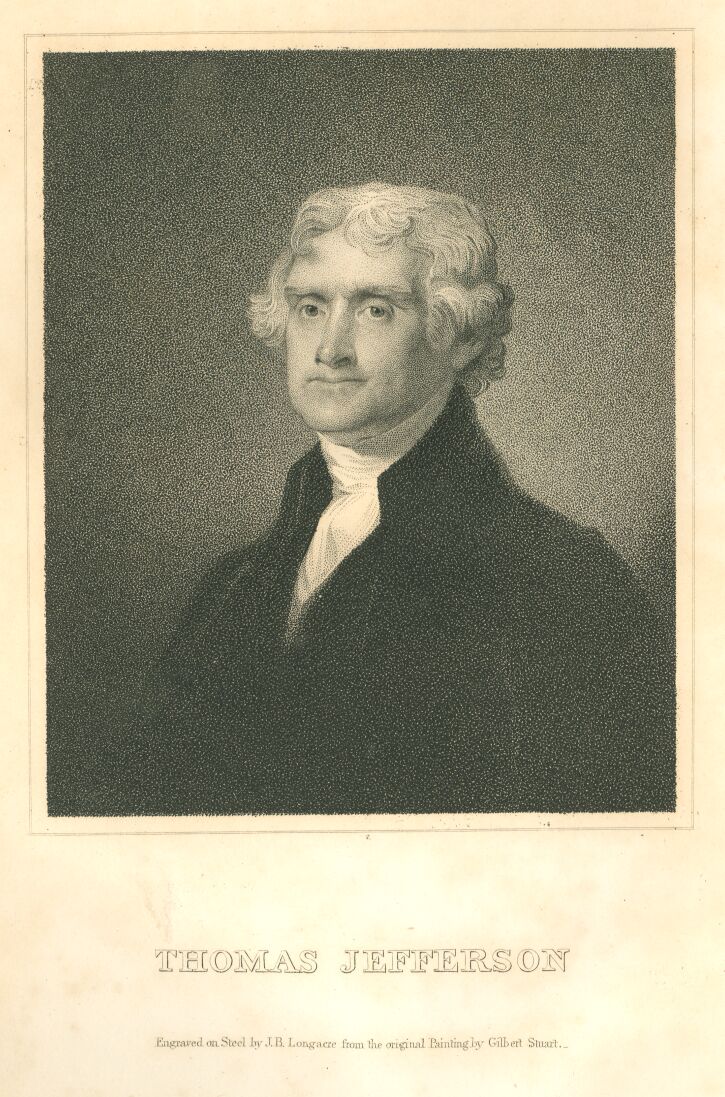
Illustrator: Steel engraving by Longacre from painting of G. Stuart

Release Date: September 30, 2005 [EBook #16784]
Last Updated: September 8, 2016

Language: English

Character set encoding: UTF-8

*** START OF THIS PROJECT GUTENBERG EBOOK THE WRITINGS OF THOMAS JEFFERSON ***


Produced by David Widger
| Contents |
| Illustrations |
| Volume I. |
| Volume II. |
| Volume III. |
CONTENTS
LETTER I. TO LEVI LINCOLN, August 30, 1803
LETTER II. TO WILSON C NICHOLAS, September 7, 1803
LETTER III. TO DOCTOR BENJAMIN RUSH, October 4, 1803
LETTER IV. TO M. DUPONT DE NEMOURS, November 1, 1803
LETTER V. TO ROBERT R. LIVINGSTON, November 4,1803
LETTER VI. TO DAVID WILLIAMS, November 14, 1803
LETTER VII. TO JOHN RANDOLH, December 1, 1803
LETTER VIII. TO MR. GALLATIN, December 13, 1803
LETTER IX. TO DOCTOR PRIESTLEY, January 29, 1804
LETTER X. TO ELBRIDGE GERRY, March 3, 1804
LETTER XI. TO GIDEON GRANGER, April 16, 1804
LETTER XII. TO MRS. ADAMS, June 13,1804
LETTER XIII. TO GOVERNOR PAGE, June 25, 1804
LETTER, XIV. TO P. MAZZEI, July 18, 1804
LETTER XV. TO MRS. ADAMS, July 22, 1804
LETTER XVI. TO JAMES MADISON, August 15, 1804
LETTER XVII. TO GOVERNOR CLAIBORNE, August 30, 1804
LETTER XVIII. TO MRS. ADAMS, September 11, 1804
LETTER XIX. TO MR. NICHOLSON, January 29, 1805
LETTER XX. TO MR. VOLNEY, February 8, 1805
LETTER XXI. TO JUDGE TYLER, March 29, 1805
LETTER XXII. TO DOCTOR LOGAN, May 11, 1805
LETTER XXIII. TO JUDGE SULLIVAN, May 21, 1805
LETTER XXIV. TO THOMAS PAINE, June 5, 1805
LETTER XXV. TO DOCTORS ROGERS AND SLAUGHTER, March 2, 1806
LETTER XXVI. TO MR. DUANE, March 22, 1806
LETTER XXVII. TO WILSON C. NICHOLAS, March 24,1806
LETTER XXVIII. TO WILSON C. NICHOLAS, April 13, 1806
LETTER XXIX. TO MR. HARRIS, April 18, 1806
LETTER XXX. TO THE EMPEROR OF RUSSIA
LETTER XXXI. TO COLONEL MONROE, May 4, 1806
LETTER XXXII. TO GENERAL SMITH, May 4,1806
LETTER XXXIII. TO MR DIGGES, July 1, 1806
LETTER XXXIV. TO MR. BIDWELL, July 5, 1806
LETTER XXXV. TO MR. BOWDOIN, July 10, 1806
LETTER XXXVI. TO W. A. BURWELL, September 17, 1806
LETTER XXXVII. TO ALBERT GALLATIN, October 12, 1806
LETTER XXXVIII. TO JOHN DICKINSON, January 13, 1807
LETTER XXXIX, TO WILSON C. NICHOLAS, February 28,1807
LETTER XL. TO JAMES MONROE, March 21, 1807
LETTER XLI. M. LE COMTE DIODATI, March 29, 1807
LETTER XLII. TO MR. BOWDOIN, April 2, 1807
LETTER XLIII. TO WILLIAM B. GILES, April 20, 1807
LETTER XLIV. TO GEORGE HAY, June 2, 1807
LETTER XLV. TO ALBERT GALLATIN, June 3, 1807
LETTER XLVI. TO GEORGE HAY, June 5, 1807
LETTER XLVII. TO DOCTOR HORATIO TURPIN, June 10, 1807
LETTER XLVIII. TO JOHN NORVELL, June 11, 1807
LETTER XLIX. TO WILLIAM SHORT, June 12, 1807
LETTER L. TO GEORGE HAY, June 12, 1807
LETTER LI. TO GEORGE HAY, June 17, 1807
LETTER LII. TO GEORGE HAY, June 19,1807
LETTER LIII. TO GOVERNOR SULLIVAN, June 19, 1807
LETTER LIV. TO GEORGE HAY, June 20, 1807
LETTER LV. TO DOCTOR WISTAR, June 21, 1807
LETTER LVI. TO MR. BOWDOIN, July 10, 1807
LETTER LVII. TO THE MARQUIS DE LA FAYETTE, July 14, 1807
LETTER LVIII. TO JOHN PAGE, July 17, 1807
LETTER LIX. TO WILLIAM DUANE, July 20, 1807
LETTER LX. TO GEORGE HAY, August 20, 1807
LETTER LXI. TO GEORGE HAY, September 4, 1807
LETTER LXII. TO GEORGE HAY, September 7, 1807
LETTER LXIII. TO THE REV. MR. MILLAR, January 23, 1808
LETTER LXIV. TO COLONEL MONROE, February 18, 1808
LETTER LXV. TO COLONEL MONROE, March 10, 1808
LETTER LXVI. TO RICHARD M. JOHNSON, March 10, 1808
LETTER LXVII. TO LEVI LINCOLN, March 23, 1808
LETTER LXVIII. TO CHARLES PINCKNEY, March 30, 1808
LETTER LXIX. TO DOCTOR LEIB, June 23, 1808
LETTER LXX. TO ROBERT L. LIVINGSTON, October 15, 1808
LETTER LXXI. TO DOCTOR JAMES BROWN, October 27, 1808
LETTER LXXII. TO LIEUTENANT GOVERNOR LINCOLN, November 13, 1808
LETTER LXXIII. TO THOMAS JEFFERSON RANDOLPH, November 24, 1808
LETTER LXXIV. TO DOCTOR EUSTIS, January 14, 1809
LETTER LXXV. TO COLONEL MONROE, January 28, 1809
LETTER LXXVI. TO THOMAS MANN RANDOLPH, February 7, 1809
LETTER LXXVII. TO JOHN HOLLINS, February 19, 1809
LETTER LXXVIII. TO M. DUPONT DE NEMOURS, March 2, 1809
LETTER LXXIX. TO THE PRESIDENT, March 17, 1809
LETTER LXXX. TO THE INHABITANTS OF ALBEMARLE COUNTY, April 3, 1809
LETTER LXXXI. TO WILSON C. NICHOLAS, June 13, 1809
LETTER LXXXII. TO THE PRESIDENT, August 17, 1809
LETTER LXXXIII. TO DOCTOR BARTON, September 21, 1809
LETTER LXXXIV. TO DON VALENTINE DE FORONDA, October 4, 1809
LETTER LXXXV. TO ALBERT GALLATIN, October 11, 1809
LETTER LXXXVI. TO CÆSAR A. RODNEY, February 10, 1810
LETTER LXXXVII.* TO SAMUEL KERCHEVAL, February 19,1810
LETTER LXXXVIII. TO GENERAL KOSCIUSKO, February 26, 1810
LETTER LXXXIX. TO DOCTOR JONES, March 5, 1810
LETTER XC. TO GOVERNOR LANGDON, March 5, 1810
LETTER XCI. TO GENERAL DEARBORN, July 16,1810
LETTER XCII. TO J. B. COLVIN, September 20, 1810
LETTER XCIII. TO MR. LAW, January 15, 1811
LETTER XCIV. TO DOCTOR BENJAMIN RUSH, January 16, 1811
LETTER XCV. TO M. DESTUTT TRACY, January 26, 1811
LETTER XCVI. TO COLONEL MONROE, May 5, 1811
LETTER XCVII. TO GENERAL DEARBORN, August 14, 1811
LETTER XCVIII. TO DOCTOR BENJAMIN RUSH
LETTER XCIX. TO JOHN ADAMS, January 21, 1812
LETTER C. TO JOHN ADAMS, April 20, 1812
LETTER CI. TO JAMES MAURY, April 25, 1812
LETTER CII. TO THE PRESIDENT, May 30, 1812
LETTER CIII. TO ELBRIDGE GERRY, June 11, 1812
LETTER CIV. TO JUDGE TYLER, June 17,1812
LETTER CV. TO COLONEL WILLIAM DUANE, October 1, 1812
LETTER CVI. TO MR. MELISH, January 13, 1813
LETTER CVII. TO MADAME DE STAEL-HOLSTEIN, May 24, 1818
LETTER CVIII. TO JOHN ADAMS, May 27, 1813
LETTER CIX. TO JOHN ADAMS, June 15, 1813
LETTER CX. TO JOHN W. EPPES, June 24, 1813
LETTER CXI. TO JOHN ADAMS, June 21, 1813
LETTER CXII. TO JOHN ADAMS, August 22, 1813
LETTER CXIII. TO JOHN W. EPPES, November 6, 1813
LETTER CXIV. TO JOHN ADAMS, October 13, 1813
LETTER CXV. TO JOHN ADAMS, October 28, 1813
LETTER CXVI. TO THOMAS LIEPER, January 1, 1814
LETTER CXVII. TO DOCTOR WALTER JONES, January 2,1814
LETTER CXVIII. TO JOSEPH C. CABELL, January 31, 1814
LETTER CXIX. TO JOHN ADAMS, July 5, 1814
LETTER CXX. TO COLONEL MONROE, January 1, 1815
LETTER CXXI. TO THE MARQUIS DE LA FAYETTE, February 14, 1815
LETTER CXXII.* TO MR. WENDOVER, March 13, 1815
LETTER CXXIII. TO CÆSAR A. RODNEY, March 16, 1815
LETTER CXXIV. TO GENERAL DEARBORN, March 17, 1815
LETTER CXXV. TO THE PRESIDENT, March 23,1815
LETTER CXXVI. TO JOHN ADAMS, June 10,1815
LETTER CXXVII. TO MR. LEIPER, June 12, 1815
LETTER CXXVIII. TO JOHN ADAMS, August 10,1815
LETTER CXXIX. TO DABNEY CARR, January 19, 1816
LETTER CXXX. TO JOHN ADAMS, April 8, 1816
LETTER CXXXI. TO JOHN TAYLOR, May 28,1816
LETTER CXXXII. TO FRANCIS W. GILMER, June 7,1816
LETTER CXXXIII.* TO BENJAMIN AUSTIN, January 9, 1816
LETTER CXXXIV. TO WILLIAM H. CRAWFORD, June 20, 1816
LETTER CXXXV. TO SAMUEL KERCHIVAL, July 12, 1816
LETTER CXXXVI. TO JOHN TAYLOR, July 21, 1816
LETTER CXXXVII. TO SAMUEL KERCHIVAL, September 5, 1816
LETTER CXXXVIII. TO JOHN ADAMS, October 14, 1816
LETTER CXXXIX. TO JOHN ADAMS, TO JOHN ADAMS
LETTER CXL. TO JOHN ADAMS, May 5, 1817
LETTER CXLI. TO MARQUIS DE LA FAYETTE, May 14, 1817
LETTER CXLII. TO ALBERT GALLATIN, June 16, 1817
LETTER CXLIII. TO JOHN ADAMS, May 17, 1818
LETTER CXLIV. TO JOHN ADAMS, November 13, 1818
LETTER CXLV. TO ROBERT WALSH, December 4, 1818
LETTER CXLVI. TO M. DE NEUVILLE, December 13, 1818
LETTER CXLVII. TO DOCTOR VINE UTLEY, March 21, 1819
LETTER CXLVIII. TO JOHN ADAMS, July 9, 1819
LETTER CXLIX. TO JUDGE ROANE, September 6,1819
LETTER CL. TO JOHN ADAMS, December 10, 1819
LETTER CLI. TO WILLIAM SHORT, April 13, 1820
LETTER CLII. TO JOHN HOLMES, April 22, 1820
LETTER CLIII. TO WILLIAM SHORT, August 4, 1820
LETTER CLIV. TO JOHN ADAMS, August 15, 1820
LETTER CLV. TO JOSEPH C. CABELL, November 28, 1820
LETTER CLVI. TO THOMAS RITCHIE, December, 25, 1820
LETTER CLVII. TO JOHN ADAMS, January 22, 1821
LETTER CLVIII. TO JOSEPH C CABELL, January 31, 1821
LETTER CLIX. TO GENERAL BRECKENRIDGE, February 15, 1821
LETTER CLX. TO — — — NICHOLAS, December 11,1821
LETTER CLXI. TO JEDIDIAH MORSE, March 6, 1822
LETTER CLXII. TO DOCTOR BENJAMIN WATERHOUSE, June 26, 1822
LETTER CLXIII. TO JOHN ADAMS
LETTER CLXIV. TO WILLIAM T. BARRY, July 2, 1822
LETTER CLXV. TO DOCTOR WATERHOUSE, July 19, 1822
LETTER CLXVI. TO JOHN ADAMS
LETTER CLXVII. TO DOCTOR COOPER, November 2, 1822
LETTER CLXVIII. TO JAMES SMITH, December 8, 1822
LETTER, CLXIX. TO JOHN ADAMS, February 25, 1823
LETTER CLXX. TO JOHN ADAMS, April 11, 1823
LETTER CLXXI. TO THE PRESIDENT, June 11, 1823
LETTER CLXXII. TO JUDGE JOHNSON, June 12, 1823
LETTER CLXXIII. TO JAMES MADISON, August 30,1823
LETTER CLXXIV. TO JOHN ADAMS, September 4, 1823
LETTER CLXXV. TO JOHN ADAMS, October 12, 1823
LETTER CLXXVI. TO THE PRESIDENT, October 24,1823
LETTER CLXXVII. TO THE MARQUIS DE LA FAYETTE, November 4, 1823
LETTER CLXXVIII. TO JOSEPH C CABELL, February 3, 1824
LETTER CLXXIX. TO JARED SPARKS, February 4, 1824
LETTER CLXXX. TO EDWARD LIVINGSTON, April 4, 1824
LETTER CLXXXI. TO MAJOR JOHN CARTWRIGHT, June 5,1824
LETTER CLXXXII. TO MARTIN VAN BUREN, June 29, 1824
LETTER CLXXXIII. TO EDWARD EVERETT, October 15, 1824
LETTER CLXXXIV. TO JOSEPH C. CABELL, January 11, 1825
LETTER CLXXXV. TO THOMAS JEFFERSON SMITH, February 21, 1825
LETTER CLXXXVI. TO JAMES MADISON, December 24, 1825
LETTER CLXXXVII. TO WILLIAM B. GILES, December 25, 1825
LETTER CLXXXVIII. TO WILLIAM B. GILES, December 26, 1825
LETTER CLXXXIX. TO CLAIBORNE W. GOOCH, January 9, 1826
LETTER CXC. TO [ANONYMOUS], January 21, 1826
LETTER CXCI. TO JAMES MADISON, February 17,1826
THOUGHTS ON LOTTERIES.
LETTER CXCII. TO JOHN QUINCY ADAMS, March 30, 1826
LETTER CXCIII. TO MR. WEIGHTMAN, June 24, 1826
ANA. EXPLANATION OF VOLUMES IN MARBLED PAPER
List of Illustrations
Book Spines, 1829 Set of Jefferson Papers
Steel Engraving by Longacre from Painting of G. Stuart
Titlepage of Volume Three (of Four)
Pages With Greek Phrases and Tables:
TO LEVI LINCOLN.
Monticello, August 30, 1803.
Deak. Sir,
The enclosed letter came to hand by yesterday’s post. You will be sensible of the circumstances which make it improper that I should hazard a formal answer, as well as of the desire its friendly aspect naturally excites, that those concerned in it should understand that the spirit they express is friendly viewed. You can judge also from your knowledge of the ground, whether it may be usefully encouraged. I take the liberty, therefore, of availing myself of your neighborhood to Boston, and of your friendship to me, to request you to say to the Captain and others verbally whatever you think would be proper, as expressive of my sentiments on the subject. With respect to the day on which they wish to fix their anniversary, they may be told, that disapproving myself of transferring the honors and veneration for the great birthday of our republic to any individual, or of dividing them with individuals, I have declined letting my own birthday be known, and have engaged my family not to communicate it. This has been the uniform answer to every application of the kind.
On further consideration as to the amendment to our constitution respecting Louisiana, I have thought it better, instead of enumerating the powers which Congress may exercise, to give them the same powers they have as to other portions of the Union generally, and to enumerate the special exceptions, in some such form as the following.
‘Louisiana, as ceded by France to the United States, is made a part of the United States, its white inhabitants shall be citizens, and stand, as to their rights and obligations, on the same footing with other citizens of the United States, in analogous situations. Save only that as to the portion thereof lying north of an east and west line drawn through the mouth of Arkansas river, no new State shall be established, nor any grants of land made, other than to Indians, in exchange for equivalent portions of land occupied by them, until an amendment of the constitution shall be made for these purposes.
‘Florida also, whensoever it may be rightfully obtained, shall become a part of the United States, its white inhabitants shall thereupon be citizens, and shall stand, as to their rights and obligations, on the same footing with other citizens of the United States, in analogous situations.’
I quote this for your consideration, observing that the less that is said about any constitutional difficulty, the better: and that it will be desirable for Congress to do what is necessary, in silence. I find but one opinion as to the necessity of shutting up the country for some time. We meet in Washington the 25th of September to prepare for Congress. Accept my affectionate salutations, and great esteem and respect.
Th: Jefferson.
TO WILSON C NICHOLAS.
Monticello, September 7, 1803.
Dear Sir,
Your favor of the 3rd was delivered me at court; but we were much disappointed at not seeing you here, Mr. Madison and the Governor being here at the time. 1 enclose you a letter from Monroe on the subject of the late treaty. You will observe a hint in it, to do without delay what we are bound to do. There is reason, in the opinion of our ministers, to believe, that if the thing were to do over again, it could not be obtained, and that if we give the least opening, they will declare the treaty void. A warning amounting to that has been given to them, and an unusual kind of letter written by their minister to our Secretary of State, direct. Whatever Congress shall think it necessary to do, should be done with as little debate as possible, and particularly so far as respects the constitutional difficulty. I am aware of the force of the observations you make on the power given by the constitution to Congress, to admit new States into the Union, without restraining the subject to the territory then constituting the United States. But when I consider that the limits of the United States are precisely fixed by the treaty of 1783, that the constitution expressly declares itself to be made for the United States, I cannot help believing the intention was not to permit Congress to admit into the Union new States, which should be formed out of the territory for which, and under whose authority alone, they were then acting. I do not believe it was meant that they might receive England, Ireland, Holland, &tc. into it, which would be the case on your construction. When an instrument admits two constructions, the one safe, the other dangerous, the one precise, the other indefinite, I prefer that which is safe and precise. I had rather ask an enlargement of power from the nation, where it is found necessary, than to assume it by a construction which would make our powers boundless. Our peculiar security is in the possession of a written constitution. Let us not make it a blank paper by construction. I say the same as to the opinion of those who consider the grant of the treaty-making power as boundless. If it is, then we have no constitution. If it has bounds, they can be no others than the definitions of the powers which that instrument gives. It specifies and delineates the operations permitted to the federal government, and gives all the powers necessary to carry these into execution. Whatever of these enumerated objects is proper for a law, Congress may make the law; whatever is proper to be executed by way of a treaty, the President and Senate may enter into the treaty; whatever is to be done by a judicial sentence, the judges may pass the sentence. Nothing is more likely than that their enumeration of powers is defective. This is the ordinary case of all human works. Let us go on then perfecting it, by adding, by way of amendment to the constitution, those powers which time and trial show are still wanting. But it has been taken too much for granted, that by this rigorous construction the treaty power would be reduced to nothing. I had occasion once to examine its effect on the French treaty, made by the old Congress, and found that out of thirty odd articles which that contained, there were one, two, or three only, which could not now be stipulated under our present constitution. I confess, then, I think it important, in the present case, to set an example against broad construction, by appealing for new power to the people. If, however, our friends shall think differently, certainly I shall acquiesce with satisfaction; confiding, that the good sense of our country will correct the evil of construction when it shall produce ill effects.
No apologies for writing or speaking to me freely are necessary. On the contrary, nothing my friends can do is so dear to me, and proves to me their friendship so clearly, as the information they give me of their sentiments and those of others on interesting points where I am to act, and where information and warning is so essential to excite in me that due reflection which ought to precede action. I leave this about the 21st, and shall hope the District Court will give me an opportunity of seeing you. Accept my affectionate salutations, and assurances of cordial esteem and respect.
Th: Jefferson.
TO DOCTOR BENJAMIN RUSH.
Washington, October 4, 1803.
Dear Sir,
No one would more willingly than myself pay the just tribute due to the services of Captain Barry, by writing a letter of condolence to his widow, as you suggest. But when one undertakes to administer justice, it must be with an even hand, and by rule; what is done for one, must be done for every one in equal degree. To what a train of attentions would this draw a President? How difficult would it be to draw the line between that degree of merit entitled to such a testimonial of it, and that not so entitled? If drawn in a particular case differently from what the friends of the deceased would judge right, what offence would it give, and of the most tender kind? How much offence would be given by accidental inattentions, or want of information? The first step into such an undertaking ought to be well weighed. On the death of Dr. Franklin, the King and Convention of France went into mourning. So did the House of Representatives of the United States: the Senate refused. I proposed to General Washington that the executive departments should wear mourning; he declined it, because he said he should not know where to draw the line, if he once began that ceremony. Mr. Adams was then Vice-President, and I thought General Washington had his eye on him, whom he certainly did not love. I told him the world had drawn so broad a line between himself and Dr. Franklin, on the one side, and the residue of mankind, on the other, that we might wear mourning for them, and the question still remain new and undecided as to all others. He thought it best, however, to avoid it. On these considerations alone, however well affected to the merit of Commodore Barry, I think it prudent not to engage myself in a practice which may become embarrassing.
Tremendous times in Europe! How mighty this battle of lions and tigers? With what sensations should the common herd of cattle look on it? With no partialities certainly. If they can so far worry one another as to destroy their power of tyrannizing the one over the earth, the other the waters, the world may perhaps enjoy peace, till they recruit again.
Affectionate and respectful salutations.
Th: Jefferson.
TO M. DUPONT DE NEMOURS.
Washington, November 1, 1803.
My Dear Sir,
Your favors of April the 6th and June the 27th were duly received, and with the welcome which every thing brings from you. The treaty which has so happily sealed the friendship of our two countries, has been received here with general acclamation. Some inflexible federalists have still ventured to brave the public opinion. It will fix their character with the world and with posterity, who, not descending to the other points of difference between us, will judge them by this fact, so palpable as to speak for itself, in all times and places. For myself and my country I thank you for the aids you have given in it; and I congratulate you on having lived to give those aids in a transaction replete with blessings to unborn millions of men, and which will mark the face of a portion on the globe so extensive as that which now composes the United States of America. It is true that at this moment a little cloud hovers in the horizon. The government of Spain has protested against the right of France to transfer; and it is possible she may refuse possession, and that this may bring on acts of force. But against such neighbors as France there, and the United States here, what she can expect from so gross a compound of folly and false faith, is not to be sought in the book of wisdom. She is afraid of her enemies in Mexico. But not more than we are. Our policy will be to form New Orleans and the country on both sides of it on the Gulf of Mexico, into a State; and, as to all above that, to transplant our Indians into it, constituting them a Marechaussee to prevent emigrants crossing the river, until we shall have filled up all the vacant country on this side. This will secure both Spain and us as to the mines of Mexico, for half a century, and we may safely trust the provisions for that time to the men who shall live in it.
I have communicated with Mr. Gallatin on the subject of using your house in any matters of consequence we may have to do at Paris. He is impressed with the same desire I feel to give this mark of our confidence in you, and the sense we entertain of your friendship and fidelity. Mr. Behring informs him that none of the money which will be due from us to him, as the assignee of France, will be wanting at Paris. Be assured that our dispositions are such as to let no occasion pass unimproved, of serving you, where occurrences will permit it.
Present my respects to Madame Dupont, and accept yourself assurances of my constant and warm friendship.
Th: Jefferson.
Washington, November 4,1803.
Dear Sir,
A report reaches us this day from Baltimore (on probable, but not certain grounds), that Mr. Jerome Bonaparte, brother of the First Consul, was yesterday* married to Miss Patterson of that city. The effect of this measure on the mind of the First Consul, is not for me to suppose; but as it might occur to him primâ facie, that the executive of the United States ought to have prevented it, I have thought it advisable to mention the subject to you, that if necessary, you may by explanations set that idea to rights. You know that by our laws, all persons are free to enter into marriage, if of twenty-one years of age, no one having a power to restrain it, not even their parents; and that under that age, no one can prevent it but the parent or guardian. The lady is under age, and the parents, placed between her affections which were strongly fixed, and the considerations opposing the measure, yielded with pain and anxiety to the former.
     * November 8. It is now said that it did not take place on
     the 3rd, but will this day.
Mr. Patterson is the President of the bank of Baltimore, the wealthiest man in Maryland, perhaps in the United States, except Mr. Carroll; a man of great virtue and respectability; the mother is the sister of the lady of General Samuel Smith; and, consequently, the station of the family in society is with the first of the United States. These circumstances fix rank in a country where there are no hereditary titles. Your treaty has obtained nearly a general approbation. The federalists spoke and voted against it, but they are now so reduced in their numbers as to be nothing. The question on its ratification in the Senate was decided by twenty-four against seven, which was ten more than enough. The vote in the House of Representatives for making provision for its execution, was carried by eighty-nine against twenty-three, which was a majority of sixty-six, and the necessary bills are going through the Houses by greater majorities. Mr. Pichon, according to instructions from his government, proposed to have added to the ratification a protestation against any failure in time or other circumstances of execution, on our part. He was told, that in that case we should annex a counter protestation, which would leave the thing exactly where it was; that this transaction had been conducted from the commencement of the negotiation to this stage of it, with a frankness and sincerity honorable to both nations, and comfortable to the heart of an honest man to review; that to annex to this last chapter of the transaction such an evidence of mutual distrust, was to change its aspect dishonorably for us both, and contrary to truth as to us; for that we had not the smallest doubt that France would punctually execute its part; and I assured Mr. Pichon that I had more confidence in the word of the First Consul than in all the parchment we could sign. He saw that we had ratified the treaty; that both branches had passed by great majorities one of the bills for execution, and would soon pass the other two; that no circumstances remained that could leave a doubt of our punctual performance; and like an able and an honest minister (which he is in the highest degree) he undertook to do, what he knew his employers would do themselves, were they here spectators of all the existing circumstances, and exchanged the ratification’s purely and simply; so that this instrument goes to the world as an evidence of the candor and confidence of the nations in each other, which will have the best effects. This was the more justifiable, as Mr. Pichon knew that Spain had entered with us a protestation against our ratification of the treaty, grounded, first, on the assertion that the First Consul had not executed the conditions of the treaties of cession, and secondly, that he had broken a solemn promise not to alienate the country to any nation. We answered, that these were private questions between France and Spain, which they must settle together; that we derived our title from the First Consul, and did not doubt his guarantee of it: and we, four days ago, sent off orders to the Governor of the Mississippi territory and General Wilkinson, to move down with the troops at hand to New Orleans, to receive the possession from Mr. Laussat. If he is heartily disposed to carry the order of the Consul into execution, he can probably command a volunteer force at New Orleans, and will have the aid of ours also, if he desires it, to take the possession and deliver it to us. If he is not so disposed, we shall take the possession, and it will rest with the government of France, by adopting the act as their own and obtaining the confirmation of Spain, to supply the non-execution of their stipulation to deliver, and to entitle themselves to the complete execution of our part of the agreements. In the mean time, the legislature is passing the bills, and we are preparing every thing to be done on our part towards execution, and we shall not avail ourselves of the three months’ delay after possession of the province, allowed by the treaty for the delivery of the stock, but shall deliver it the moment that possession is known here, which will be on the eighteenth day after it has taken place.
Accept my affectionate salutations, and assurances of my constant esteem and respect.
Th: Jefferson.
Washington, November 14, 1803.
Sir,
I have duly received the volume on the claims of literature; which you did me the favor to send me through Mr. Monroe: and have read with satisfaction the many judicious reflections it contains, on the condition of the respectable class of literary men. The efforts for their relief, made by a society of private citizens, are truly laudable: but they are, as you justly observe, but a palliation of an evil, the cure of which calls for all the wisdom and the means of the nation. The greatest evils of populous society have ever appeared to me to spring from the vicious distribution of its members among the occupations called for. I have no doubt that those nations are essentially right, which leave this to individual choice, as a better guide to an advantageous distribution, than any other which could be devised. But when, by a blind concourse, particular occupations are ruinously overcharged, and others left in want of hands, the national authorities can do much towards restoring the equilibrium. On the revival of letters, learning became the universal favorite. And with reason, because there was not enough of it existing to manage the affairs of a nation to the best advantage, nor to advance its individuals to the happiness of which they were susceptible, by improvements in their minds, their morals, their health, and in those conveniences which contribute to the comfort and embellishment of life. All the efforts of the society, therefore, were directed to the increase of learning, and the inducements of respect, ease, and profit were held up for its encouragement. Even the charities of the nation forgot that misery was their object, and spent themselves in founding schools to transfer to science the hardy sons of the plough. To these incitements were added the powerful fascinations of great cities. These circumstances have long since produced an overcharge in the class of competitors for learned occupation, and great distress among the supernumerary candidates; and the more, as their habits of life have disqualified them for re-entering into the laborious class. The evil cannot be suddenly, nor perhaps ever entirely cured: nor should I presume to say by what means it may be cured. Doubtless there are many engines which the nation might bring to bear on this object. Public opinion and public encouragement are among these. The class principally defective is that of agriculture. It is the first in utility, and ought to be the first in respect. The same artificial means which have been used to produce a competition in learning, may be equally successful in restoring agriculture to its primary dignity in the eyes of men. It is a science of the very first order. It counts among its handmaids the most respectable sciences, such as Chemistry, Natural Philosophy, Mechanics, Mathematics generally, Natural History, Botany. In every College and University, a professorship of agriculture, and the class of its students, might be honored as the first. Young men closing their academical education with this, as the crown of all other sciences, fascinated with its solid charms, and at a time when they are to choose an occupation, instead of crowding the other classes, would return to the farms of their fathers, their own, or those of others, and replenish and invigorate a calling, now languishing under contempt and oppression. The charitable schools, instead of storing their pupils with a lore which the present state of society does not call for, converted into schools of agriculture, might restore them to that branch, qualified to enrich and honor themselves, and to increase the productions of the nation instead of consuming them. A gradual abolition of the useless offices, so much accumulated in all governments, might close this drain also from the labors of the field, and lessen the burthens imposed on them. By these, and the better means which will occur to others, the surcharge of the learned, might in time be drawn off to recruit the laboring class of citizenss the sum of industry be increased, and that of misery diminished.
Among the ancients, the redundance of population was sometimes checked by exposing infants. To the moderns, America has offered a more humane resource. Many, who cannot find employment in Europe, accordingly come here. Those who can labor do well, for the most part. Of the learned class of emigrants, a small portion find employments analogous to their talents. But many fail, and return to complete their course of misery in the scenes where it began. Even here we find too strong a current from the country to the towns; and instances beginning to appear of that species of misery, which you are so humanely endeavoring to relieve with you. Although we have in the old countries of Europe the lesson of their experience to warn us, yet I am not satisfied we shall have the firmness and wisdom to profit by it. The general desire of men to live by their heads rather than their hands, and the strong allurements of great cities to those who have any turn for dissipation, threaten to make them here, as in Europe, the sinks of voluntary misery. I perceive, however, that I have suffered my pen to run into a disquisition, when I had taken it up only to thank you for the volume you had been so kind as to send me, and to express my approbation of it. After apologizing, therefore, for having touched on a subject so much more familiar to you, and better understood, I beg leave to assure you of my high consideration and respect.
Th: Jefferson.
Washington, December 1, 1803.
Dear Sir,
The explanations in your letter of yesterday were quite unnecessary to me. I have had too satisfactory proofs of your friendly regard, to be disposed to suspect any thing of a contrary aspect.
I understood perfectly the expressions stated in the newspaper to which you allude, to mean, that ‘though the proposition came from the republican quarter of the House, yet you should not concur with it.’ I am aware, that in parts of the Union, and even with persons to whom Mr. Eppes and Mr. Randolph are unknown, and myself little known, it will be presumed from their connection, that what comes from them comes from me. No men on earth are more independent in their sentiments than they are, nor any one less disposed than I am to influence the opinions of others. We rarely speak of politics, or of the proceedings of the House, but merely historically; and I carefully avoid expressing an opinion on them in their presence, that we may all be at our ease. With other members, I have believed that more unreserved communications would be advantageous to the public. This has been, perhaps, prevented by mutual delicacy. I have been afraid to express opinions unasked, lest I should be suspected of wishing to direct the legislative action of members. They have avoided asking communications from me, probably, lest they should be suspected of wishing to fish out executive secrets. I see too many proofs of the imperfection of human reason, to entertain wonder or intolerance at any difference of opinion on any subject; and acquiesce in that difference as easily as on a difference of feature or form: experience having long taught me the reasonableness of mutual sacrifices of opinion among those who are to act together for any common object, and the expediency of doing what good we can, when we cannot do all we would wish.
Accept my friendly salutations, and assurances of great esteem and respect.
Th: Jefferson.
THOMAS JEFFERSON TO MR. GALLATIN.
The Attorney General having considered and decided, that the prescription in the law for establishing a bank, that the officers in the subordinate offices of discount and deposit, shall be appointed ‘on the same terms and in the same manner practised in the principal bank,’ does not extend to them the principle of rotation, established by the legislature in the body of directors in the principal bank, it follows that the extension of that principle has been merely a voluntary and prudential act of the principal bank, from which they are free to depart. I think the extension was wise and proper on their part, because the legislature having deemed rotation useful in the principal bank constituted by them, there would be the same reason for it in the subordinate banks to be established by the principal. It breaks in upon the esprit de corps, so apt to prevail in permanent bodies; it gives a chance for the public eye penetrating into the sanctuary of those proceedings and practices, which the avarice of the directors may introduce for their personal emolument, and which the resentments of excluded directors, or the honesty of those duly admitted, might betray to the public; and it gives an opportunity at the end of the year, or at other periods, of correcting a choice, which, on trial, proves to have been unfortunate; an evil of which themselves complain in their distant institutions. Whether, however, they have a power to alter this or not, the executive has no right to decide; and their consultation with you has been merely an act of complaisance, or from a desire to shield so important an innovation under the cover of executive sanction. But ought we to volunteer our sanction in such a case? Ought we to disarm ourselves of any fair right of animadversion, whenever that institution shall be a legitimate subject of consideration? I own I think the most proper answer would be, that we do not think ourselves authorized to give an opinion on the question.
From a passage in the letter of the President, I observe an idea of establishing a branch bank of the United States in New Orleans. This institution is one of the most deadly hostility existing, against the principles and form of our constitution. The nation is, at this time, so strong and united in its sentiments, that it cannot be shaken at this moment. But suppose a series of untoward events should occur, sufficient to bring into doubt the competency of a republican government to meet a crisis of great danger, or to unhinge the confidence of the people in the public functionaries; an institution like this, penetrating by its branches every part of the Union, acting by command and in phalanx, may, in a critical moment, upset the government. I deem no government safe which is under the vassalage of any self-constituted authorities, or any other authority than that of the nation, or its regular functionaries. What an obstruction could not this bank of the United States, with all its branch banks, be in time of war? It might dictate to us the peace we should accept, or withdraw its aids. Ought we then to give further growth to an institution so powerful, so hostile? That it is so hostile we know, 1. from a knowledge of the principles of the persons composing the body of directors in every bank, principal or branch; and those of most of the stock-holders: 2. from their opposition to the measures and principles of the government, and to the election of those friendly to them: and, 3. from the sentiments of the newspapers they support. Now, while we are strong, it is the greatest duty we owe to the safety of our constitution, to bring this powerful enemy to a perfect subordination under its authorities. The first measure would be to reduce them to an equal footing only with other banks, as to the favors of the government. But, in order to be able to meet a general combination of the banks against us, in a critical emergency, could we not make a beginning towards an independent use of our own money, towards holding our own bank in all the deposits where it is received, and letting the Treasurer give his draft or note for payment at any particular place, which, in a well conducted government, ought to have as much credit as any private draft, or bank note, or bill, and would give us the same facilities which we derive from the banks? I pray you to turn this subject in your mind, and to give it the benefit of your knowledge of details; whereas, I have only very general views of the subject. Affectionate salutations.
Washington, December 13, 1803.
TO DOCTOR PRIESTLEY.
Washington, January 29, 1804.
Dear Sir,
Your favor of December the 12th came duly to hand, as did the second letter to Doctor Linn, and the treatise on Phlogiston, for which I pray you to accept my thanks. The copy for Mr. Livingston has been delivered, together with your letter to him, to Mr. Harvie, my secretary, who departs in a day or two for Paris, and will deliver them himself to Mr. Livingston, whose attention to your matter cannot be doubted. I have also to add my thanks to Mr. Priestley, your son, for the copy of your Harmony, which I have gone through with great satisfaction. It is the first I have been able to meet with, which is clear of those long repetitions of the same transaction, as if it were a different one because related with some different circumstances.
I rejoice that you have undertaken the task of comparing the moral doctrines of Jesus with those of the ancient Philosophers. You are so much in possession of the whole subject, that you will do it easier and better than any other person living. I think you cannot avoid giving, as preliminary to the comparison, a digest of his moral doctrines, extracted in his own words from the Evangelists, and leaving out every thing relative to his personal history and character. It would be short and precious. With a view to do this for my own satisfaction, I had sent to Philadelphia to get two Testaments (Greek) of the same edition, and two English, with a design to cut out the morsels of morality, and paste them on the leaves of a book, in the manner you describe as having been pursued in forming your Harmony. But I shall now get the thing done by better hands.
I very early saw that Louisiana was indeed a speck in our horizon, which was to burst in a tornado; and the public are un-apprized how near this catastrophe was. Nothing but a frank and friendly developement of causes and effects on our part, and good sense enough in Bonaparte to see that the train was unavoidable, and would change the face of the world, saved us from that storm. I did not expect he would yield till a war took place between France and England, and my hope was to palliate and endure, if Messrs. Ross, Morris, &c. did not force a premature rupture until that event. I believed the event not very distant, but acknowledge it came on sooner than I had expected. Whether, however, the good sense of Bonaparte might not see the course predicted to be necessary and unavoidable, even before a war should be imminent, was a chance which we thought it our duty to try: but the immediate prospect of rupture brought the case to immediate decision. The denouement has been happy: and I confess I look to this duplication of area for the extending a government so free and economical as ours, as a great achievement to the mass of happiness which is to ensue. Whether we remain in one confederacy, or form into Atlantic and Mississippi confederacies, I believe not very important to the happiness of either part. Those of the western confederacy will be as much our children and descendants as those of the eastern, and I feel myself as much identified with that country, in future time, as with this: and did I now foresee a separation at some future day, yet I should feel the duty and the desire to promote the western interests as zealously as the eastern, doing all the good for both portions of our future family which should fall within my power.
Have you seen the new work of Malthus on Population? It is one of the ablest I have ever seen. Although his main object is to delineate the effects of redundancy of population, and to test the poor laws of England, and other palliations for that evil, several important questions in political economy, allied to his subject incidentally, are treated with a masterly hand. It is a single octavo volume, and I have been only able to read a borrowed copy, the only one I have yet heard of. Probably our friends in England will think of you, and give you an opportunity of reading it.
Accept my affectionate salutations, and assurances of great esteem and respect.
Th: Jefferson.
Washington, March 3, 1804.
Dear Sir,
Although it is long since I received your favor of October the 27th, yet I have not had leisure sooner to acknowledge it. In the Middle and Southern States, as great an union of sentiment has now taken place as is perhaps desirable. For as there will always be an opposition, I believe it had better be from avowed monarchists than republicans. New York seems to be in danger of republican division; Vermont is solidly with us; Rhode Island with us on anomalous grounds; New Hampshire on the verge of the republican shore; Connecticut advancing towards it very slowly, but with steady step; your State only uncertain of making port at all. I had forgotten Delaware, which will be always uncertain from the divided character of her citizens. If the amendment of the constitution passes Rhode Island (and we expect to hear in a day or two), the election for the ensuing four years seems to present nothing formidable. I sincerely regret that the unbounded calumnies of the federal party have obliged me to throw myself on the verdict of my country for trial, my great desire having been to retire at the end of the present term, to a life of tranquillity; and it was my decided purpose when I entered into office. They force my continuance. If we can keep the vessel of State as steadily in her course for another four years, my earthly purposes will be accomplished, and I shall be free to enjoy, as you are doing, my family, my farm, and my books. That your enjoyments may continue as long as you shall wish them, I sincerely pray, and tender you my friendly salutations, and assurances of great respect and esteem.
Th: Jefferson.
TO GIDEON GRANGER.
Monticello, April 16, 1804.
Dear Sir,
In our last conversation you mentioned a federal scheme afloat, of forming a coalition between the federalists and republicans, of what they called the seven eastern States. The idea was new to me, and after time for reflection, I had no opportunity of conversing with you again. The federalists know that, eo nomine, they are gone for ever. Their object, therefore, is, how to return into power under some other form. Undoubtedly they have but one means, which is to divide the republicans, join the minority, and barter with them for the cloak of their name. I say, join the minority; because the majority of the republicans, not needing them, will not buy them. The minority, having no other means of ruling the majority, will give a price for auxiliaries, and that price must be principle. It is true that the federalists, needing their numbers also, must also give a price, and principle is the coin they must pay in. Thus a bastard system of federo-republicanism will rise on the ruins of the true principles of our revolution. And when this party is formed, who will constitute the majority of it, which majority is then to dictate? Certainly the federalists. Thus their proposition of putting themselves into gear with the republican minority, is exactly like Roger Sherman’s proposition to add Connecticut to Rhode Island. The idea of forming seven eastern States is moreover clearly to form the basis of a separation of the Union. Is it possible that real republicans can be gulled by such a bait? And for what? What do they wish, that they have not? Federal measures? That is impossible. Republican measures? Have they them not? Can any one deny, that in all important questions of principle, republicanism prevails? But do they want that their individual will shall govern the majority? They may purchase the gratification of this unjust wish, for a little time, at a great price; but the federalists must not have the passions of other men, if, after getting thus into the seat of power, they suffer themselves to be governed by their minority. This minority may say, that whenever they relapse into their own principles, they will quit them, and draw the seat from under them. They may quit them, indeed, but, in the mean time, all the venal will have become associated with them, and will give them a majority sufficient to keep them in place, and to enable them to eject the heterogeneous friends by whose aid they get again into power. I cannot believe any portion of real republicans will enter into this trap; and if they do, I do not believe they can carry with them the mass of their States, advancing so steadily as we see them, to an union of principle with their brethren. It will be found in this, as in all other similar cases, that crooked schemes will end by overwhelming their authors and coadjutors in disgrace, and that he alone who walks strict and upright, and who in matters of opinion will be contented that others should be as free as himself, and acquiesce when his opinion is fairly overruled, will attain his object in the end. And that this may be the conduct of us all, I offer my sincere prayers, as well as for your health and happiness.
Th: Jefferson.
TO MRS. ADAMS.
Washington, June 13,1804.
Dear Madam,
The affectionate sentiments which you have had the goodness to express in your letter of May the 20th, towards my dear departed daughter, have awakened in me sensibilities natural to the occasion, and recalled your kindnesses to her, which I shall ever remember with gratitude and friendship. I can assure you with truth, they had made an indelible impression on her mind, and that to the last, on our meetings after long separations, whether I had heard lately of you, and how you did, were among the earliest of her inquiries. In giving you this assurance, I perform a sacred duty for her, and, at the same time, am thankful for the occasion furnished me, of expressing my regret that circumstances should have arisen, which have seemed to draw a line of separation between us. The friendship with which you honored me has ever been valued, and fully reciprocated; and although events have been passing which might be trying to some minds, I never believed yours to be of that kind, nor felt that my own was. Neither my estimate of your character, nor the esteem founded in that, has ever been lessened for a single moment, although doubts whether it would be acceptable may have forbidden manifestations of it.
Mr. Adams’s friendship and mine began at an earlier date. It accompanied us through long and important scenes. The different conclusions we had drawn from our political reading and reflections, were not permitted to lessen mutual esteem; each party being conscious they were the result of an honest conviction in the other. Like differences of opinion existing among our fellow citizens, attached them to the one or the other of us, and produced a rivalship in their minds which did not exist in ours. We never stood in one another’s way. For if either had been withdrawn at any time, his favorers would not have gone over to the other, but would have sought for some one of homogeneous opinions. This consideration was sufficient to keep down all jealousy between us, and to guard our friendship from any disturbance by sentiments of rivalship: and I can say with truth, that one act of Mr. Adams’s life, and one only, ever gave me a moment’s personal displeasure. I did consider his last appointments to office as personally unkind. They were from among my most ardent political enemies, from whom no faithful co-operation could ever be expected; and laid me under the embarrassment of acting through men, whose views were to defeat mine, or to encounter the odium of putting others in their places. It seems but common justice to leave a successor free to act by instruments of his own choice. If my respect for him did not permit me to ascribe the whole blame to the influence of others, it left something for friendship to forgive, and after brooding over it for some little time, and not always resisting the expression of it, I forgave it cordially, and returned to the same state of esteem and respect for him which had so long subsisted. Having come into life a little later than Mr. Adams, his career has preceded mine, as mine is followed by some other; and it will probably be closed at the same distance after him which time originally placed between us. I maintain for him, and shall carry into private life, an uniform and high measure of respect and good will, and for yourself a sincere attachment.
I have thus, my dear Madam, opened myself to you without reserve, which I have long wished an opportunity of doing; and without knowing how it will be received, I feal[sp.] relief from being unbosomed. And I have now only to entreat your forgiveness for this transition from a subject of domestic affliction, to one which seems of a different aspect. But though connected with political events, it has been viewed by me most strongly in its unfortunate bearings on my private friendships. The injury these have sustained has been a heavy price for what has never given me equal pleasure. That you may both be favored with health, tranquillity, and long life, is the prayer of one who tenders you the assurance of his highest consideration and esteem.
Th: Jefferson.
TO GOVERNOR PAGE.
Washington, June 25, 1804.
Your letter, my dear friend, of the 25th ultimo, is a new proof of the goodness of your heart, and the part you take in my loss marks an affectionate concern for the greatness of it. It is great indeed. Others may lose of their abundance, but I, of my want, have lost even the half of all I had. My evening prospects now hang on the slender thread of a single life. Perhaps I maybe destined to see even this last cord of parental affection broken! The hope with which I had looked forward to the moment, when, resigning public cares to younger hands, I was to retire to that domestic comfort from which the last great step is to be taken, is fearfully blighted. When you and I look back on the country over which we have passed, what a field of slaughter does it exhibit! Where are all the friends who entered it with us, under all the inspiring energies of health and hope? As if pursued by the havoc of war, they are strewed by the way, some earlier, some later, and scarce a few stragglers remain to count the numbers fallen, and to mark yet, by their own fall, the last footsteps of their party. Is it a desirable thing to bear up through the heat of the action to witness the death of all our companions, and merely be the last victim? I doubt it. We have, however, the traveller’s consolation. Every step shortens the distance we have to go; the end of our journey is in sight, the bed wherein we are to rest, and to rise in the midst of the friends we have lost. ‘We sorrow not, then, as others who have no hope’; but look forward to the day which ‘joins us to the great majority.’ But whatever is to be our destiny, wisdom, as well as duty, dictates that we should acquiesce in the will of Him whose it is to give and take away, and be contented in the enjoyment of those who are still permitted to be with us. Of those connected by blood, the number does not depend on us. But friends we have, if we have merited them. Those of our earliest years stand nearest in our affections. But in this too, you and I have been unlucky. Of our college friends (and they are the dearest) how few have stood with us in the great political questions which have agitated our country: and these were of a nature to justify agitation. I did not believe the Lilliputian fetters of that day strong enough to have bound so many. Will not Mrs. Page, yourself, and family, think it prudent to seek a healthier region for the months of August and September? And may we not flatter ourselves that you will cast your eye on Monticello? We have not many summers to live. While fortune places us then within striking distance, let us avail ourselves of it, to meet and talk over the tales of other times.
Present me respectfully to Mrs. Page, and accept yourself my friendly salutations, and assurances of constant affection.
Th: Jefferson.
TO P. MAZZEI.
Washington, July 18, 1804.
My Dear Sir,
It is very long, I know, since I wrote you. So constant is the pressure of business that there is never a moment, scarcely, that something of public importance is not waiting for me. I have, therefore, on a principle of conscience, thought it my duty to withdraw almost entirely from all private correspondence, and chiefly the trans-Atlantic; I scarcely write a letter a year to any friend beyond sea. Another consideration has led to this, which is the liability of my letters to miscarry, be opened, and made ill use of. Although the great body of our country are perfectly returned to their ancient principles, yet there remains a phalanx of old tories and monarchists, more envenomed, as all their hopes become more desperate. Every word of mine which they can get hold of, however innocent, however orthodox even, is twisted, tormented, perverted, and, like the words of holy writ, are made to mean every thing but what they were intended to mean. I trust little, therefore, unnecessarily in their way, and especially on political subjects. I shall not, therefore, be free to answer all the several articles of your letters.
On the subject of treaties, our system is to have none with any nation, as far as can be avoided. The treaty with England has therefore, not been renewed, and all overtures for treaty with other nations have been declined. We believe, that with nations as with individuals, dealings may be carried on as anvantageously[sp.], perhaps more so, while their continuance depends on a voluntary good treatment, as if fixed by a contract, which, when it becomes injurious to either, is made, by forced constructions, to mean what suits them, and becomes a cause of war instead of a bond of peace.
We wish to be on the closest terms of friendship with Naples, and we will prove it by giving to her citizens, vessels, and goods all the privileges of the most favored nation; and while we do this voluntarily, we cannot doubt they will voluntarily do the same for us. Our interests against the Barbaresques being also the same, we have little doubt she will give us every facility to insure them, which our situation may ask and hers admit. It is not, then, from a want of friendship that we do not propose a treaty with Naples, but because it is against our system to embarrass ourselves with treaties, or to entangle ourselves at all with the affairs of Europe. The kind offices we receive from that government are more sensibly felt, as such, than they would be, if rendered only as due to us by treaty.
Five fine frigates left the Chesapeake the 1st instant for Tripoli, which, in addition to the force now there, will, I trust, recover the credit which Commodore Morris’s two years’ sleep lost us, and for which he has been broke. I think they will make Tripoli sensible, that they mistake their interest in choosing war with us; and Tunis also, should she have declared war, as we expect, and almost wish.
Notwithstanding this little diversion, we pay seven or eight millions of dollars annually of our public debt, and shall completely discharge it in twelve years more. That done, our annual revenue, now thirteen millions of dollars, which by that time will be twenty-five, will pay the expenses of any war we may be forced into, without new taxes or loans. The spirit of republicanism is now in almost all its ancient vigor, five sixths of the people being with us. Fourteen of the seventeen States are completely with us, and two of the other three will be in one year. We have now got back to the ground on which you left us. I should have retired at the end of the first four years, but that the immense load of tory calumnies which have been manufactured respecting me, and have filled the European market, have obliged me to appeal once more to my country for a justification. I have no fear but that I shall receive honorable testimony by their verdict on those calumnies. At the end of the next four years I shall certainly retire. Age, inclination, and principle all dictate this. My health, which at one time threatened an unfavorable turn, is now firm. The acquisition of Louisiana, besides doubling our extent, and trebling our quantity of fertile country, is of incalculable value, as relieving us from the danger of war. It has enabled us to do a handsome thing for Fayette. He had received a grant of between eleven and twelve thousand acres north of the Ohio, worth, perhaps, a dollar an acre. We have obtained permission of Congress to locate it in Louisiana. Locations can be found adjacent to the city of New Orleans, in the island of New Orleans and in its vicinity, the value of which cannot be calculated. I hope it will induce him to come over and settle there with his family. Mr. Livingston having asked leave to return, General Armstrong, his brother-in-law, goes in his place: he is of the first order of talents.
Remarkable deaths lately, are, Samuel Adams, Edmund Pendleton, Alexander Hamilton, Stephens Thompson Mason, Mann Page, Bellini, and Parson Andrews. To these I have the inexpressible grief of adding the name of my youngest daughter, who had married a son of Mr. Eppes, and has left two children. My eldest daughter alone remains to me, and has six children. This loss has increased my anxiety to retire, while it has dreadfully lessened the comfort of doing it. Wythe, Dickinson, and Charles Thomson are all living, and are firm republicans. You informed me formerly of your marriage, and your having a daughter, but have said nothing in you late letters on that subject. Yet whatever concerns your happiness is sincerely interesting to me, and is a subject of anxiety, retaining, as I do, cordial sentiments of esteem and affection for you. Accept, I pray you, my sincere assurances of this, with my most friendly salutations.
Th: Jefferson.
TO MRS. ADAMS.
Washington, July 22, 1804.
Dear Madam,
Your favor of the 1st instant was duly received, and I would not again have intruded on you, but to rectify certain facts which seem not to have been presented to you under their true aspect. My charities to Callendar are considered as rewards for his calumnies. As early, I think, as 1796, I was told in Philadelphia, that Callendar, the author of the ‘Political Progress of Britain,’ was in that city, a fugitive from persecution for having written that book, and in distress. I had read and approved the book; I considered him as a man of genius, unjustly persecuted. I knew nothing of his private character, and immediately expressed my readiness to contribute to his relief, and to serve him. It was a considerable time after, that, on application from a person who thought of him as I did, I contributed to his relief, and afterwards repeated the contribution. Himself I did not see till long after, nor ever more than two or three times. When he first began to write, he told some useful truths in his coarse way; but nobody sooner disapproved of his writing than I did, or wished more that he would be silent. My charities to him were no more meant as encouragements to his scurrilities, than those I give to the beggar at my door are meant as rewards for the vices of his life, and to make them chargeable to myself. In truth, they would have been greater to him, had he never written a word after the work for which he fled from Britain. With respect to the calumnies and falsehoods which writers and printers at large published against Mr. Adams, I was as far from stooping to any concern or approbation of them, as Mr. Adams was respecting those of Porcupine, Fenno, or Russell, who published volumes against me for every sentence vended by their opponents against Mr. Adams. But I never supposed Mr. Adams had any participation in the atrocities of these editors, or their writers. I knew myself incapable of that base warfare, and believed him to be so. On the contrary, whatever I may have thought of the acts of the administration of that day, I have ever borne testimony to Mr. Adams’s personal worth; nor was it ever impeached in my presence, without a just vindication of it on my part. I never supposed that any person who knew either of us, could believe that either of us meddled in that dirty work. But another fact is, that I ‘liberated a wretch who was suffering for a libel against Mr. Adams.’ I do not know who was the particular wretch alluded to; but I discharged every person under punishment or prosecution under the sedition law, because I considered, and now consider, that law to be a nullity, as absolute and as palpable as if Congress had ordered us to fall down and worship a golden image; and that it was as much my duty to arrest its execution in every stage, as it would have been to have rescued from the fiery furnace those who should have been cast into it for refusing to worship the image. It was accordingly done in every instance, without asking what the offenders had done, or against whom they had offended, but whether the pains they were suffering were inflicted under the pretended sedition law. It was certainly possible that my motives for contributing to the relief of Callendar, and liberating sufferers under the sedition law might have been to protect, encourage, and reward slander; but they may also have been those which inspire ordinary charities to objects of distress, meritorious or not, or the obligation of an oath to protect the constitution, violated by an unauthorized act of Congress. Which of these were my motives, must be decided by a regard to the general tenor of my life. On this I am not afraid to appeal to the nation at large, to posterity, and still less to that Being who sees himself our motives, who will judge us from his own knowledge of them, and not on the testimony of Porcupine or Fenno.
You observe, there has been one other act of my administration personally unkind, and suppose it will readily suggest itself to me. I declare on my honor, Madam, I have not the least conception what act is alluded to. I never did a single one with an unkind intention. My sole object in this letter being to place before your attention, that the acts imputed to me are either such as are falsely imputed, or as might flow from good as well as bad motives, I shall make no other addition, than the assurances of my continued wishes for the health and happiness of yourself and Mr. Adams.
Th: Jefferson.
TO JAMES MADISON.
Monticello, August 15, 1804.
Dear Sir,
Your letter dated the 7th should probably have been of the 14th, as I received it only by that day’s post. I return you Monroe’s letter, which is of an awful complexion; and I do not wonder the communications it contains made some impression on him. To a person placed in Europe, surrounded by the immense resources of the nations there, and the greater wickedness of their courts, even the limits which nature imposes on their enterprises are scarcely sensible. It is impossible that France and England should combine for any purpose; their mutual distrust and deadly hatred of each other admit no co-operation. It is impossible that England should be willing to see France re-possess Louisiana, or get footing on our continent, and that France should willingly see the United States re-annexed to the British dominions. That the Bourbons should be replaced on their throne and agree to any terms of restitution, is possible: but that they and England joined, could recover us to British dominion, is impossible. If these things are not so, then human reason is of no aid in conjecturing the conduct of nations. Still, however, it is our unquestionable interest and duty to conduct ourselves with such sincere friendship and impartiality towards both nations, as that each may see unequivocally, what is unquestionably true, that we may be very possibly driven into her scale by unjust conduct in the other. I am so much impressed with the expediency of putting a termination to the right of France to patronize the rights of Louisiana, which will cease with their complete adoption as citizens of the United States, that I hope to see that take place on the meeting of Congress. I enclose you a paragraph from a newspaper respecting St. Domingo, which gives me uneasiness. Still I conceive the British insults in our harbor as more threatening. We cannot be respected by France as a neutral nation, nor by the world or ourselves as an independent one, if we do not take effectual measures to support, at every risk, our authority in our own harbors. I shall write to Mr. Wagner directly (that a post may not be lost by passing through you) to send us blank commissions for Orleans and Louisiana, ready sealed, to be filled up, signed, and forwarded by us. Affectionate salutations and constant esteem.
Th: Jefferson.
TO GOVERNOR CLAIBORNE.
Monticello, August 30, 1804.
Dear Sir,
Various circumstances of delay have prevented my forwarding till now the general arrangements of the government of the territory of Orleans. Enclosed herewith you will receive the commissions. Among these is one for yourself as Governor. With respect to this I will enter into frank explanations. This office was originally destined for a person * whose great services and established fame would have rendered him peculiarly acceptable to the nation at large. Circumstances, however, exist, which do not now permit his nomination, and perhaps may not at any time hereafter. That, therefore, being suspended, and entirely contingent, your services have been so much approved, as to leave no desire to look elsewhere to fill the office. Should the doubts you have sometimes expressed, whether it would be eligible for you to continue, still exist in your mind, the acceptance of the commission gives you time to satisfy yourself by further experience, and to make the time and manner of withdrawing, should you ultimately determine on that, agreeable to yourself. Be assured, that whether you continue or retire, it will be with every disposition on my part to be just and friendly to you.
I salute you with friendship and respect.
Th: Jefferson.
[* In the margin is written by the author, ‘La Fayette.‘]
TO MRS. ADAMS.
Monticello, September 11, 1804,
Your letter, Madam, of the 18th of August has been some days received, but a press of business has prevented the acknowledgment of it: perhaps, indeed, I may have already trespassed too far on your attention. With those who wish to think amiss of me, I have learned to be perfectly indifferent; but where I know a mind to be ingenuous, and to need only truth to set it to rights, I cannot be as passive. The act of personal unkindness alluded to in your former letter, is said in your last to have been the removal of your eldest son from some office to which the judges had appointed him. I conclude, then, he must have been a commissioner of bankruptcy. But I declare to you, on my honor, that this is the first knowledge I have ever had that he was so. It may be thought, perhaps, that I ought to have inquired who were such, before I appointed others. But it is to be observed, that the former law permitted the judges to name commissioners occasionally only, for every case as it arose, and not to make them permanent officers. Nobody, therefore, being in office, there could be no removal. The judges, you well know, have been considered as highly federal; and it was noted that they confined their nominations exclusively to federalists. The legislature, dissatisfied with this, transferred the nomination to the President, and made the offices permanent. The very object in passing the law was, that he should correct, not confirm, what was deemed the partiality of the judges. I thought it therefore proper to inquire, not whom they had employed, but whom I ought to appoint to fulfil the intentions of the law. In making these appointments, I put in a proportion of federalists, equal, I believe, to the proportion they bear in numbers through the Union generally. Had I known that your son had acted, it would have been a real pleasure to me to have preferred him to some who were named in Boston, in what was deemed the same line of politics. To this I should have been led by my knowledge of his integrity, as well as my sincere dispositions towards yourself and Mr. Adams.
You seem to think it devolved on the judges to decide on the validity of the sedition law. But nothing in the constitution has given them a right to decide for the executive, more than to the executive to decide for them. Both magistracies are equally independent in the sphere of action assigned to them. The judges, believing the law constitutional, had a right to pass a sentence of fine and imprisonment, because the power was placed in their hands by the constitution. But the executive, believing the law to be unconstitutional, were bound to remit the execution of it; because that power has been confided to them by the constitution. That instrument meant that its co-ordinate branches should be checks on each other. But the opinion which gives to the judges the right to decide what laws are constitutional, and what not, not only for themselves in their own sphere of action, but for the legislature and executive also in their spheres, would make the judiciary a despotic branch. Nor does the opinion of the unconstitutionality, and consequent nullity of that law, remove all restraint from the overwhelming torrent of slander, which is confounding all vice and virtue, all truth and falsehood, in the United States. The power to do that is fully possessed by the several State legislatures. It was reserved to them, and was denied to the General Government, by the constitution, according to our construction of it. While we deny that Congress have a right to control the freedom of the press, we have ever asserted the right of the States, and their exclusive right, to do so. They have, accordingly, all of them made provisions for punishing slander, which those who have time and inclination resort to for the vindication of their characters. In general, the State laws appear to have made the presses responsible for slander as far as is consistent with its useful freedom. In those States where they do not admit even the truth of allegations to protect the printer, they have gone too far.
The candor manifested in your letter, and which I ever believed you to possess, has alone inspired the desire of calling your attention once more to those circumstances of fact and motive by which I claim to be judged. I hope you will see these intrusions on your time to be, what they really are, proofs of my great, respect for you. I tolerate with the utmost latitude the right of others to differ from me in opinion, without imputing to them criminality. I know too well the weakness and uncertainty of human reason, to wonder at its different results. Both of our political parties, at least the honest part of them, agree conscientiously in the same object, the public good: but they differ essentially in what they deem the means of promoting that good. One side believes it best done by one composition of the governing powers; the other, by a different one. One fears most the ignorance of the people; the other, the selfishness of rulers independent of them. Which is right, time and experience will prove. We think that one side of this experiment has been long enough tried, and proved not to promote the good of the many: and that the other has not been fairly and sufficiently tried. Our opponents think the reverse. With whichever opinion the body of the nation concurs, that must prevail. My anxieties on this subject will never carry me beyond the use of fair and honorable means of truth and reason; nor have they ever lessened my esteem for moral worth, nor alienated my affections from a single friend, who did not first withdraw himself. Wherever this has happened, I confess I have not been insensible to it: yet have ever kept myself open to a return of their justice. I conclude with sincere prayers for your health and happiness, that yourself and Mr. Adams may long enjoy the tranquillity you desire and merit, and see in the prosperity of your family what is the consummation of the last and warmest of human wishes,
Th: Jefferson.
TO MR. NICHOLSON.
Washington, January 29, 1805.
Dear Sir,
Mr. Eppes has this moment put into my hands your letter of yesterday, asking information on the subject of the gun-boats proposed to be built. I lose no time in communicating to you fully my whole views respecting them, premising a few words on the system of fortifications. Considering the harbors which, from their situation and importance, are entitled to defence, and the estimates we have seen of the fortifications planned for some of them, this system cannot be completed on a moderate scale for less than fifty millions of dollars, nor manned in time of war with less than fifty thousand men, and in peace, two thousand. And when done, they avail little; because all military men agree, that wherever a vessel may pass a fort without tacking under her guns, which is the case at all our sea-port towns, she may be annoyed more or less, according to the advantages of the position, but can never be prevented. Our own experience during the war proved this on different occasions. Our predecessors have, nevertheless, proposed to go into this system, and had commenced it. But, no law requiring us to proceed, we have suspended it.
If we cannot hinder vessels from entering our harbors, we should turn our attention to the putting it out of their power to lie, or come to, before a town, to injure it. Two means of doing this may be adopted in aid of each other. 1. Heavy cannon on travelling carriages, which may be moved to any point on the bank or beach most convenient for dislodging the vessel. A sufficient number of these should be lent to each sea-port town, and their militia trained to them. The executive is authorized to do this; it has been done in a smaller degree, and will now be done more competently.
2. Having cannon on floating batteries or boats, which may be so stationed as to prevent a vessel entering the harbor, or force her after entering to depart. There are about fifteen harbors in the United States, which ought to be in a state of substantial defence. The whole of these would require, according to the best opinions, two hundred and forty gun-boats. Their cost was estimated by Captain Rogers at two thousand dollars each; but we had better say four thousand dollars. The whole would cost one million of dollars. But we should allow ourselves ten years to complete it, unless circumstances should force it sooner. There are three situations in which the gun-boat may be. 1. Hauled up under a shed, in readiness to be launched and manned by the seamen and militia of the town on short notice. In this situation she costs nothing but an enclosure, or a centinel to see that no mischief is done to her. 2. Afloat, and with men enough to navigate her in harbor and take care of her, but depending on receiving her crew from the town on short warning. In this situation, her annual expense is about two thousand dollars, as by an official estimate at the end of this letter. 3. Fully manned for action. Her annual expense in this situation is about eight thousand dollars, as per estimate subjoined. ‘When there is general peace, we should probably keep about six or seven afloat in the second situation; their annual expense twelve to fourteen thousand dollars; the rest all hauled up. When France and England are at war, we should keep, at the utmost, twenty-five in the second situation, their annual expense fifty thousand dollars. When we should be at war ourselves, some of them would probably be kept in the third situation, at an annual expense of eight thousand dollars; but how many, must depend on the circumstances of the war. We now possess ten, built and building. It is the opinion of those consulted, that fifteen more would enable us to put every harbor under our view into a respectable condition; and that this should limit the views of the present year. This would require an appropriation of sixty thousand dollars, and I suppose that the best way of limiting it, without declaring the number, as perhaps that sum would build more. I should think it best not to give a detailed report, which exposes our policy too much. A bill, with verbal explanations, will suffice for the information of the House. I do not know whether General Wilkinson would approve the printing his paper. If he would, it would be useful. Accept affectionate and respectful salutations.
Th: Jefferson.
TO MR. VOLNEY.
Washington, February 8, 1805.
Dear Sir,
Your letter of November the 26th came to hand May the 14th; the books some time after, which were all distributed according to direction. The copy for the East Indies went immediately by a safe conveyance. The letter of April the 28th, and the copy of your work accompanying that, did not come to hand till August. That copy was deposited in the Congressional library. It was not till my return here from my autumnal visit to Monticello, that I had an opportunity of reading your work. I have read it, and with great satisfaction. Of the first part I am less a judge than most people, having never travelled westward of Staunton, so as to know any thing of the face of the country; nor much indulged myself in geological inquiries, from a belief that the skin-deep scratches, which we can make or find on the surface of the earth, do not repay our time with as certain and useful deductions, as our pursuits in some other branches. The subject of our winds is more familiar to me. On that, the views you have taken are always great, supported in their outlines by your facts; and though more extensive observations, and longer continued, may produce some anomalies, yet they will probably take their place in this first great canvass which you have sketched. In no case, perhaps, does habit attach our choice or judgment more than in climate. The Canadian glows with delight in his sleigh and snow, the very idea of which gives me the shivers. The comparison of climate between Europe and North America, taking together its corresponding parts, hangs chiefly on three great points. 1. The changes between heat and cold in America are greater and more frequent, and the extremes comprehend a greater scale on the thermometer in America than in Europe. Habit, however, prevents these from affecting us more than the smaller changes of Europe affect the European. But he is greatly affected by ours. 2. Our sky is always clear; that of Europe always cloudy. Hence a greater accumulation of heat here than there, in the same parallel. 3. The changes between wet and dry are much more frequent and sudden in Europe than in America. Though we have double the rain, it falls in half the time. Taking all these together, I prefer much the climate of the United States to that of Europe. I think it a more cheerful one. It is our cloudless sky which has eradicated from our constitutions all disposition to hang ourselves, which we might otherwise have inherited from our English ancestors. During a residence of between six and seven years in Paris, I never but once saw the sun shine through a whole day, without being obscured by a cloud in any part of it: and I never saw the moment, in which, viewing the sky through its whole hemisphere, I could say there was not the smallest speck of a cloud in it. I arrived at Monticello, on my return from France, in January, and during only two months’ stay there, I observed to my daughters, who had been with me to France, that twenty odd times within that term, there was not a speck of a cloud in the whole hemisphere. Still I do not wonder that an European should prefer his grey to our azure sky. Habit decides our taste in this, as in most other cases.
The account you give of the yellow fever, is entirely agreeable to what we then knew of it. Further experience has developed more and more its peculiar character. Facts appear to have established, that it is originated here by a local atmosphere, which is never generated but in the lower, closer, and dirtier parts of our large cities, in the neighborhood of the water; and that, to catch the disease, you must enter the local atmosphere. Persons having taken the disease in the infected quarter, and going into the country, are nursed and buried by their friends, without an example of communicating it. A vessel going from the infected quarter, and carrying its atmosphere in its hold into another State, has given the disease to every person who there entered her. These have died in the arms of their families, without a single communication of the disease. It is certainly, therefore, an epidemic, not a contagious disease; and calls on the chemists for some mode of purifying the vessel by a decomposition of its atmosphere, if ventilation be found insufficient. In the long scale of bilious fevers, graduated by many shades, this is probably the last and most mortal term. It seizes the native of the place equally with strangers. It has not been long known in any part of the United States. The shade next above it, called the stranger’s fever, has been coeval with the settlement of the larger cities in the southern parts, to wit, Norfolk, Charleston, New Orleans. Strangers going to these places in the months of July, August, or September, find this fever as mortal as the genuine yellow fever. But it rarely attacks those who have resided in them some time. Since we have known that kind of yellow fever which is no respecter of persons, its name has been extended to the stranger’s fever, and every species of bilious fever which produces a black vomit, that is to say, a discharge of very dark bile. Hence we hear of yellow fever on the Allegany mountains, in Kentucky, &c. This is a matter of definition only: but it leads into error those who do not know how loosely and how interestedly some physicians think and speak. So far as we have yet seen, I think we are correct in saying, that the yellow fever, which seizes on all indiscriminately, is an ultimate degree of bilious fever, never known in the United States till lately, nor farther south, as yet, than Alexandria, and that what they have recently called the yellow fever in New Orleans, Charleston, and Norfolk, is what has always been known in those places as confined chiefly to strangers, and nearly as mortal to them, as the other is to all its subjects. But both grades are local: the stranger’s fever less so, as it sometimes extends a little into the neighborhood; but the yellow fever rigorously so, confined within narrow and well defined limits, and not communicable out of those limits. Such a constitution of atmosphere being requisite to originate this disease as is generated only in low, close, and ill-cleansed parts of a town, I have supposed it practicable to prevent its generation by building our cities on a more open plan. Take, for instance, the chequer-board for a plan. Let the black squares only be building squares, and the white ones be left open, in turf and trees. Every square of houses will be surrounded by four open squares, and every house will front an open square. The atmosphere of such a town would be like that of the country, insusceptible of the miasmata which produce yellow fever. I have accordingly proposed that the enlargements of the city of New Orleans, which must immediately take place, shall be on this plan. But it is only in case of enlargements to be made, or of cities to be built, that his means of prevention can be employed.
The genus irritabile vatum could not let the author of the Ruins publish a new work, without seeking in it the means of discrediting that puzzling composition. Some one of those holy calumniators has selected from your new work every scrap of a sentence, which, detached from its context, could displease an American reader. A cento has been made of these, which has run through a particular description of newspapers, and excited a disapprobation even in friendly minds, which nothing but the reading of the book will cure. But time and truth will at length correct error.
Our countrymen are so much occupied in the busy scenes of life, that they have little time to write or invent. A good invention here, therefore, is such a rarity as it is lawful to offer to the acceptance of a friend. A Mr. Hawkins of Frankford, near Philadelphia, has invented a machine, which he calls a polygraph, and which carries two, three, or four pens. That of two pens, with which I am now writing, is best; and is so perfect that I have laid aside the copying-press, for a twelvemonth past, and write always with the polygraph. I have directed one to be made, of which I ask your acceptance. By what conveyance I shall send it while Havre is blockaded, I do not yet know. I think you will be pleased with it, and will use it habitually as I do; because it requires only that degree of mechanical attention which I know you to possess. I am glad to hear that M. Cabanis is engaged in writing on the reformation of medicine. It needs the hand of a reformer, and cannot be in better hands than his. Will you permit my respects to him and the Abbe de la Roche to find a place here.
A word now on our political state. The two parties which prevailed with so much violence when you were here, are almost wholly melted into one. At the late Presidential election I have received one hundred and sixty-two votes against fourteen only. Connecticut is still federal by a small majority; and Delaware on a poise, as she has been since 1775, and will be till Anglomany with her yields to Americanism. Connecticut will be with us in a short time. Though the people in mass have joined us, their leaders had committed themselves too far to retract. Pride keeps them hostile; they brood over their angry passions, and give them vent in the newspapers which they maintain. They still make as much noise as if they were the whole nation. Unfortunately, these being the mercantile papers, published chiefly in the seaports, are the only ones which find their way to Europe, and make very false impressions there. I am happy to hear that the late derangement of your health is going off, and that you are reestablished. I sincerely pray for the continuance of that blessing, and with my affectionate salutations, tender you assurances of great respect and attachment.
Th: Jefferson.
P. S. The sheets which you receive are those of the copying-pen of the polygraph, not of the one with which I have written.
TO JUDGE TYLER.
Monticello, March 29, 1805.
Dear Sir,
Your favor of the 17th found me on a short visit to this place, and I observe in it with great pleasure a continuance of your approbation of the course we are pursuing, and particularly the satisfaction you express with the last inaugural address. The first was, from the nature of the case, all profession and promise. Performance, therefore, seemed to be the proper office of the second. But the occasion restricted me to mention only the most prominent heads, and the strongest justification of these in the fewest words possible. The crusade preached against philosophy by the modern disciples of steady habits, induced me to dwell more in showing its effect with the Indians than the subject otherwise justified.
The war with Tripoli stands on two grounds of fact. 1st. It is made known to us by our agents with the three other Barbary States, that they only wait to see the event of this, to shape their conduct accordingly. If the war is ended by additional tribute, they mean to offer us the same alternative. 2ndly. If peace was made, we should still, and shall ever, be obliged to keep a frigate in the Mediterranean to overawe rupture, or we must abandon that market. Our intention in sending Morris with a respectable force, was to try whether peace could be forced by a coercive enterprise on their town. His inexecution of orders baffled that effort. Having broke him, we try the same experiment under a better commander. If in the course of the summer they cannot produce peace, we shall recall our force, except one frigate and two small vessels, which will keep up a perpetual blockade. Such a blockade will cost us no more than a state of peace, and will save us from increased tributes, and the disgrace attached to them. There is reason to believe the example we have set, begins already to work on the dispositions of the powers of Europe to emancipate themselves from that degrading yoke. Should we produce such a revolution there, we shall be amply rewarded for what we have done. Accept my friendly salutations, and assurances of great respect and esteem.
Th: Jefferson.
TO DOCTOR LOGAN.
Washington, May 11, 1805.
Dear Sir,
I see with infinite pain the bloody schism which has taken place among our friends in Pennsylvania and New York, and will probably take place in other States. The main body of both sections mean well, but their good intentions will produce great public evil. The minority, whichever section shall be the minority, will end in coalition with the federalists, and some compromise of principle; because these will not sell their aid for nothing. Republicanism will thus lose, and royalism gain, some portion of that ground which we thought we had rescued to good government. I do not express my sense of our misfortunes from any idea that they are remediable. I know that the passions of men will take their course, that they are not to be controlled but by despotism, and that this melancholy truth is the pretext for despotism. The duty of an upright administration is to pursue its course steadily, to know nothing of these family dissensions, and to cherish the good principles of both parties. The war ad internecionem which we have waged against federalism, has filled our latter times with strife and unhappiness. We have met it, with pain indeed, but with firmness, because we believed it the last convulsive effort of that Hydra, which in earlier times we had conquered in the field. But if any degeneracy of principle should ever render it necessary to give ascendancy to one of the rising sections over the other, I thank my God it will fall to some other to perform that operation. The only cordial I wish to carry into my retirement, is the undivided good will of all those with whom I have acted.
Present me affectionately to Mrs. Logan, and accept my salutations, and assurances of constant friendship and respect.
Th: Jefferson.
TO JUDGE SULLIVAN.
Washington, May 21, 1805.
Dear Sir,
An accumulation of business, which I found on my return here from a short visit to Monticello, has prevented till now my acknowledgment of your favor of the 14th ultimo. This delay has given time to see the result of the contest in your State, and I cannot but congratulate you on the advance it manifests, and the certain prospect it offers that another year restores Massachusetts to the general body of the nation. You have indeed received the federal unction of lying and slandering. But who has not? Who will ever again come into eminent office, unanointed with this chrism? It seems to be fixed that falsehood and calumny are to be their ordinary engines of opposition; engines which will not be entirely without effect. The circle of characters equal to the first stations is not too large, and will be lessened by the voluntary retreat of those whose sensibilities are stronger than their confidence in the justice of public opinion. I certainly have known, and still know, characters eminently qualified for the most exalted trusts, who could not bear up against the brutal hackings and hewings of these heroes of Billingsgate. I may say, from intimate knowledge, that we should have lost the services of the greatest character of our country, had he been assailed with the degree of abandoned licentiousness now practised. The torture he felt under rare and slight attacks, proved that under those of which the federal bands have shown themselves capable, he would have thrown up the helm in a burst of indignation. Yet this effect of sensibility must not be yielded to. If we suffer ourselves to be frightened from our post by mere lying, surely the enemy will use that weapon; for what one so cheap to those of whose system of politics morality makes no part? The patriot, like the Christian, must learn that to bear revilings and persecutions is a part of his duty; and in proportion as the trial is severe, firmness under it becomes more requisite and praiseworthy. It requires, indeed, self-command. But that will be fortified in proportion as the calls for its exercise are repeated. In this I am persuaded we shall have the benefit of your good example. To the other falsehoods they have brought forward, should they add, as you expect, insinuations of want of confidence in you from the administration generally, or myself particularly, it will, like their other falsehoods, produce in the public mind a contrary inference.
*********
I tender you my friendly and respectful salutations.
Th: Jefferson.
TO THOMAS PAINE.
Washington, June 5, 1805.
Dear Sir,
Your letters, Nos. 1, 2, 3, the last of them dated April the 20th, were received April the 26th. I congratulate you on your retirement to your farm, and still more that it is of a character so worthy of your attention. I much doubt whether the open room on your second story will answer your expectations. There will be a few days in the year in which it will be delightful, but not many. Nothing but trees, or Venetian blinds, can protect it from the sun. The semi-cylindrical roof you propose will have advantages. You know it has been practised on the cloth market at Paris. De Lorme, the inventor, shows many forms of roofs in his book, to which it is applicable. I have used it at home for a dome, being one hundred and twenty degrees of an oblong octagon, and in the capitol we unite two quadrants of a sphere by a semi-cylinder: all framed in De Lorme’s manner. How has your planing machine answered? Has it been tried and persevered in by any workman?
France has become so jealous of our conduct as to St. Domingo (which in truth is only the conduct of our merchants), that the offer to become a mediator would only confirm her suspicions. Bonaparte, however, expressed satisfaction at the paragraph in my message to Congress on the subject of that commerce. With respect to the German redemptioners, you know I can do nothing, unless authorized by law. It would be made a question in Congress, whether any of the enumerated objects to which the constitution authorizes the money of the Union to be applied, would cover an expenditure for importing settlers to Orleans. The letter of the revolutionary sergeant was attended to by General Dearborn, who wrote to him informing him how to proceed to obtain his land.
Doctor Eustis’s observation to you, that ‘certain paragraphs in the National Intelligencer,’ respecting my letter to you, ‘supposed to be under Mr. Jefferson’s direction, had embarrassed Mr. Jefferson’s friends in Massachusetts; that they appeared like a half denial of the letter, or as if there was something in it not proper to be owned, or that needed an apology,’ is one of those mysterious half confidences difficult to be understood. That tory printers should think it advantageous to identify me with that paper, the Aurora, &c. in order to obtain ground for abusing me, is perhaps fair warfare. But that any one who knows me personally should listen one moment to such an insinuation, is what I did not expect. I neither have, nor ever had, any more connection with those papers than our antipodes have; nor know what is to be in them until I see it in them, except proclamations and other documents sent for publication. The friends in Massachusetts who could be embarrassed by so weak a weapon as this, must be feeble friends indeed. With respect to the letter, I never hesitated to avow and to justify it in conversation. In no other way do I trouble myself to contradict any thing which is said. At that time, however, there were certain anomalies in the motions of some of our friends, which events have at length reduced to regularity.
It seems very difficult to find out what turn things are to take in Europe. I suppose it depends on Austria, which knowing it is to stand in the way of receiving the first hard blows, is cautious of entering into a coalition. As to France and England we can have but one wish, that they may disable one another from injuring others.
Accept my friendly salutations, and assurances of esteem and respect.
Th: Jefferson.
[The following, in the hand-writing of the Author, is inserted in his MS. of this period. Whether it was published, or where, is not stated.]
Richmond, 1780, December 31. At 8 A. M. the Governor receives the first intelligence that twenty-seven sail of ships had entered Chesapeake Bay, and were in the morning of the 29th just below Willoughby’s point (the southern cape of James river); their destination unknown.
1781, January 2. At 10 A. M. information received that they had entered James river, their advance being at Warrasqueak bay. Orders were immediately given for calling in the militia, one fourth from some, and one half from other counties. The members of the legislature, which rises this day, are the bearers of the orders to their respective counties. The Governor directs the removal of the records into the country, and the transportation of the military stores from Richmond to Westham (on the river seven miles above); there to be carried across the river.
January 3. At 8 P. M. the enemy are said to be a little below Jamestown; convenient for landing, if Williamsburg is their object.
January 4. At 5 A. M. information is received that they had passed Kennon’s and Hood’s the evening before, with a strong; easterly wind, which determines their object to be either Petersburg or Richmond. The Governor now calls in the whole militia from the adjacent counties.
At 5 P. M. information, that at 2 P. M. they were landed and drawn up at Westover (on the north side of the river, and twenty-five miles below Richmond); and consequently Richmond their destination. Orders are now given to discontinue wagoning the military stores from Richmond to Westham, and to throw them across the river directly at Richmond.
The Governor having attended to this till an hour and a half in the night, then rode up to the foundery (one mile below Westham), ordered Captains Boush and Irish, and Mr. Hylton, to continue all night wagoning to Westham the arms and stores still at the foundery, to be thrown across the river at Westham, then proceeded to Westham to urge the pressing the transportation there across the river, and thence went to Tuckahoe (eight miles above and on the same side of the river) to see after his family, which he had sent that far in the course of the day. He arrived there at 1 o’clock in the night.
January 5. Early in the morning, he carried his family across the river there, and sending them to Fine Creek (eight miles higher up) went himself to Britton’s on the south side of the river, (opposite to Westham). Finding the arms, &c. in a heap near the shore, and exposed to be destroyed by cannon from the north bank, he had them removed under cover of a point of land near by. He proceeded to Manchester (opposite to Richmond). The enemy had arrived at Richmond at 1 P. M. Having found that nearly the whole arms had been got there from Richmond, he set out for Chetwood’s to meet with Baron Steuben, who had appointed that place as a rendezvous and head-quarters; but not finding him there, and understanding he would be at Colonel Fleming’s (six miles above Britton’s), he proceeded thither. The enemy had now a detachment at Westham, and sent a deputation from the city of Richmond to the Governor, at Colonel Fleming’s, to propose terms for ransoming the safety of the city, which terms he rejected.
January 6. The Governor returned to Britton’s, had measures taken more effectually to secure the books and papers there. The enemy, having burnt some houses and stores, left Richmond after twenty-four hours’ stay there, and encamped at Four Mile Creek (eight or ten miles below); and the Governor went to look to his family at Fine Creek.
January 7. He returned to Britton’s to see further to the arms there, exposed on the ground to heavy rains which had fallen the night before, and thence proceeded to Manchester and lodged there. The enemy encamped at Westover.
January 8. At half after 7 A. M. he crossed over to Richmond, and resumed his residence there. The enemy are still retained in their encampment at Westover by an easterly wind. Colonel John Nicholas has now three hundred militia at the Forest (six miles off from Westover); General Nelson, two hundred at Charles City Court-House (eight miles below Westover); Gibson, one thousand, and Baron Steuben, eight hundred, on the south side of the river.
January 9. The enemy are still encamped at Westover.
January 10. At 1 P. M. they embark: and the wind having shifted a little to the north of west, and pretty fresh, they fall down the river. Baron Steuben marches for Hood’s, where their passage may be checked. He reaches Bland’s mills in the evening, within nine miles of Hood’s.
January 11. At 8 A. M. the wind due west and strong, they make good their retreat.
During this period, time and place have been minutely cited, in order that those who think there was any remissness in the movements of the Governor, may lay their finger on the point, and say, when and where it was. Hereafter, less detail will suffice.
Soon after this, General Phillips having joined Arnold with a reinforcement of two thousand men, they advanced again up to Petersburg, and about the last of April to Manchester. The Governor had remained constantly in and about Richmond, exerting all his powers for collecting militia, and providing such means for the defence of the State as its exhausted resources admitted. Never assuming a guard, and with only the river between him and the enemy, his lodgings were frequently within four, five, or six miles of them.
M. de la Fayette about this time arrived at Richmond with some continental troops, with which, and the militia collected, he continued to occupy that place, and the north bank of the river, while Phillips and Arnold held Manchester and the south bank. But Lord Cornwallis, about the middle of May, joining them with the main southern army, M. de la Fayette was obliged to retire. The enemy crossed the river, and advanced up into the country about fifty miles, and within thirty miles of Charlottesville, at which place the legislature being to meet in June, the Governor proceeded to his seat at Monticello, two or three miles from it. His office was now near expiring, the country under invasion by a powerful army, no services but military of any avail; unprepared by his line of life and education for the command of armies, he believed it right not to stand in the way of talents better fitted than his own to the circumstances under which the country was placed. He therefore himself proposed to his friends in the legislature, that General Nelson, who commanded the militia of the State, should be appointed Governor, as he was sensible that the union of the civil and military power in the same hands, at this time, would greatly facilitate military measures. This appointment accordingly took place on the 12th of June, 1781.
This was the state of things, when, his office having actually expired, and no successor yet in place, Colonel Tarleton, with his regiment, of horse, was detached by Lord Cornwallis to surprise Mr. Jefferson (whom they thought still in office) and the legislature now sitting in Charlottesville. The Speakers of the two Houses, and some other members of the legislature, were lodging with Mr. Jefferson at Monticello. Tarleton, early in the morning, (June 23, I believe,) when within ten miles of that place, detached a company of horse to secure him and his guests, and proceeded himself rapidly with his main body to Charlottesville, where he hoped to find the legislature unapprized of his movement. Notice of it, however, had been brought both to Monticello and Charlottesville about sunrise. The Speakers, with their colleagues, returned to Charlottesville, and, with the other members of the legislature, had barely time to get out of his way. Mr. Jefferson sent off his family, to secure them from danger, and was himself still at Monticello, making arrangements for his own departure, when Lieutenant Hudson arrived there at half speed, and informed him the enemy were then ascending the hill of Monticello. He departed immediately, and knowing that he would be pursued if he took the high road, he plunged into the woods of the adjoining mountain, where, being at once safe, he proceeded to overtake his family. This is the famous adventure of Carter’s Mountain, which has been so often resounded through the slanderous chronicles of Federalism. But they have taken care never to detail the facts, lest these should show that this favorite charge amounted to nothing more, than that he did not remain in his house, and there singly fight a whole troop of horse, or suffer himself to be taken prisoner. Having accompanied his family one day’s journey, he returned to Monticello. Tarleton had retired after eighteen hours’ stay in Charlottesville. Mr. Jefferson then rejoined his family, and proceeded with them to an estate he had in Bedford, about eighty miles southwest, where, riding in his farm some time after, he was thrown from his horse, and disabled from riding on horseback for a considerable time. But Mr. Turner finds it more convenient to give him this fall in his retreat before Tarleton, which had happened some weeks before, as a proof that he withdrew from a troop of horse with a precipitancy which Don Quixote would not have practised.
The facts here stated most particularly, with date of time and place, are taken from the notes made by the writer hereof, for his own satisfaction, at the time: the others are from memory, but so well recollected, that he is satisfied there is no material fact misstated. Should any person undertake to contradict any particular, on evidence which may at all merit the public respect, the writer will take the trouble (though not at all in the best situation for it) to produce the proofs in support of it. He finds, indeed, that, of the persons whom he recollects to have been present on these occasions, few have survived the intermediate lapse of four and twenty years. Yet he trusts that some, as well as himself, are yet among the living; and he is positively certain, that no man can falsify any material fact here stated. He well remembers, indeed, that there were then, as there are at all times, some who blamed every thing done contrary to their own opinion, although their opinions were formed on a very partial knowledge of facts. The censures, which have been hazarded by such men as Mr. Turner, are nothing but revivals of these half-informed opinions. Mr. George Nicholas, then a very young man, but always a very honest one, was prompted by these persons to bring specific charges against Mr. Jefferson. The heads of these, in writing, were communicated through a mutual friend to Mr. Jefferson, who committed to writing also the heads of justification on each of them. I well remember this paper, and believe the original of it still exists; and though framed when every real fact was fresh in the knowledge of every one, this fabricated flight from Richmond was not among the charges stated in this paper, nor any charge against Mr. Jefferson for not fighting, singly, the troop of horse. Mr. Nicholas candidly relinquished further proceeding. The House of Representatives of Virginia pronounced an honorable sentence of entire approbation of Mr. Jefferson’s conduct, and so much the more honorable, as themselves had been witnesses to it. And Mr. George Nicholas took a conspicuous occasion afterwards, of his own free will, and when the matter was entirely at rest, to retract publicly the erroneous opinions he had been led into on that occasion, and to make just reparation by a candid acknowledgment of them.
TO DOCTORS ROGERS AND SLAUGHTER.
Washington, March 2, 1806.
Gentlemen,
I have received the favor of your letter of February the 2nd, and read with thankfulness its obliging expressions respecting myself. I regret that the object of a letter from persons whom I so much esteem, and patronized by so many other respectable names, should be beyond the law which a mature consideration of circumstances has prescribed for my conduct. I deem it the duty of every man to devote a certain portion of his income for charitable purposes; and that it is his further duty to see it so applied as to do the most good of which it is capable. This I believe to be best insured, by keeping within the circle of his own inquiry and information, the subjects of distress to whose relief his contributions shall be applied. If this rule be reasonable in private life, it becomes so necessary in my situation, that to relinquish it would leave me without rule or compass. The applications of this kind from different parts of our own, and from foreign countries, are far beyond any resources within my command. The mission of Serampore, in the East Indies, the object of the present application, is but one of many items. However disposed the mind may feel to unlimited good, our means having limits, we are necessarily circumscribed by them. They are too narrow to relieve even the distresses under our own eye: and to desert these for others which we neither see nor know, is to omit doing a certain good for one which is uncertain. I know, indeed, there have been splendid associations for effecting benevolent purposes in remote regions of the earth. But no experience of their effect has proved that more good would not have been done by the same means employed nearer home. In explaining, however, my own motives of action, I must not be understood as impeaching those of others. Their views are those of an expanded liberality. Mine may be too much restrained by the law of usefulness. But it is a law to me, and with minds like yours, will be felt as a justification. With this apology, I pray you to accept my salutations, and assurances of high esteem and respect.
Th: Jefferson.
TO MR. DUANE.
Washington, March 22, 1806.
I thank you, my good Sir, cordially, for your letter of the 12th; which, however, I did not receive till the 20th. It is a proof of sincerity, which I value above all things; as, between those who practise it, falsehood and malice work their efforts in vain. There is an enemy somewhere endeavoring to sow discord among us. Instead of listening first, then doubting, and lastly believing anile tales handed round without an atom of evidence, if my friends will address themselves to me directly, as you have done, they shall be informed with frankness and thankfulness. There is not a truth on earth which I fear or would disguise. But secret slanders cannot be disarmed, because they are secret. Although you desire no answer, I shall give you one to those articles admitting a short answer, reserving those which require more explanation than the compass of a letter admits, to conversation on your arrival here. And as I write this for your personal satisfaction, I rely that my letter will, under no circumstances, be communicated to any mortal, because you well know how every syllable from me is distorted by the ingenuity of political enemies.
In the first place, then, I have had less communication, directly or indirectly, with the republicans of the east, this session, than I ever had before. This has proceeded from accidental circumstances, not from design. And if there be any coolness between those of the south and myself, it has not been from me towards them. Certainly there has been no other reserve, than to avoid taking part in the divisions among our friends. That Mr. R. has openly attacked the administration is sufficiently known. We were not disposed to join in league with Britain, under any belief that she is fighting for the liberties of mankind, and to enter into war with Spain, and consequently France. The House of Representatives were in the same sentiment, when they rejected Mr. R.‘s resolutions for raising a body of regular troops for the western service. We are for a peaceable accommodation with all those nations, if it can be effected honorably. This, perhaps, is not the only ground of his alienation; but which side retains its orthodoxy, the vote of eighty-seven to eleven republicans may satisfy you: but you will better satisfy yourself on coming here, where alone the true state of things can be known, and where you will see republicanism as solidly embodied on all essential points, as you ever saw it on any occasion.
That there is only one minister who is not opposed to me, is totally unfounded. There never was a more harmonious, a more cordial administration, nor ever a moment when it has been otherwise. And while differences of opinion have been always rare among us, I can affirm, that as to present matters, there was not a single paragraph in my message to Congress, or those supplementary to it, in which there was not a unanimity of concurrence in the members of the administration. The fact is, that in ordinary affairs every head of a department consults me on those of his department, and where any thing arises too difficult or important to be decided between us, the consultation becomes general.
That there is an ostensible cabinet and a concealed one, a public profession and concealed counteraction, is false.
That I have denounced republicans by the epithet of Jacobins, and declared I would appoint none but those called moderates of both parties, and that I have avowed or entertain any predilection for those called the third party, or Quids, is in every tittle of it false.
That the expedition of Miranda was countenanced by me is an absolute falsehood, let it have gone from whom it might; and I am satisfied it is equally so as to Mr. Madison. To know as much of it as we could was our duty, but not to encourage it.
Our situation is difficult; and whatever we do, is liable to the criticisms of those who wish to represent it awry. If we recommend measures in a public message, it may be said that members are not sent here to obey the mandates of the President, or to register the edicts of a sovereign. If we express opinions in conversation, we have then our Charles Jenkinsons, and back-door counsellors. If we say nothing, ‘we have no opinions, no plans, no cabinet.’ In truth, it is the fable of the old man, his son, and ass, over again.
These are short facts, which may suffice to inspire you with caution, until you can come here and examine for yourself. No other information can give you a true insight into the state of things; but you will have no difficulty in understanding them when on the spot. In the mean time, accept my friendly salutations and cordial good wishes.
Th: Jefferson.
TO WILSON C. NICHOLAS.—[Confidential.]
Washington, March 24,1806.
Dear Sir,
A last effort at friendly settlement with Spain is proposed to be made at Paris, and under the auspices of France. For this purpose, General Armstrong and Mr. Bowdoin (both now at Paris) have been appointed joint commissioners: but such a cloud of dissatisfaction rests on General Armstrong in the minds of many persons, on account of a late occurrence stated in all the public papers, that we have in contemplation to add a third commissioner, in order to give the necessary measure of public confidence to the commission. Of these two gentlemen, one being of Massachusetts and one of new York, it is thought the third should be a southern man; and the rather, as the interests to be negotiated are almost entirely southern and western. This addition is not yet ultimately decided on; but I am inclined to believe it will be adopted. Under this expectation, and my wish that you may be willing to undertake it, I give you the earliest possible intimation of it, that you may be preparing both your mind and your measures for the mission. The departure would be required to be very prompt; though the absence, I think, will not be long, Bonaparte not being in the practice of procrastination. This particular consideration will, I hope, reconcile the voyage to your affairs and your feelings. The allowance to an extra mission, is salary from the day of leaving home, and expenses to the place of destination, or in lieu of the latter, and to avoid settlements, a competent fixed sum may be given. For the return, a continuance of the salary for three months after fulfilment of the commission. Be so good as to make up your mind as quickly as possible, and to answer me as early as possible. Consider the measure as proposed provisionally only, and not to be communicated to any mortal until we see it proper. Affectionate salutations.
Th: Jefferson.
TO WILSON C. NICHOLAS.
Washington, April 13, 1806.
Dear Sir,
The situation of your affairs certainly furnishes good cause for your not acceding to my proposition of a special mission to Europe. My only hope had been, that they could have gone on one summer without you. An unjust hostility against General Armstrong will, I am afraid, show itself whenever any treaty made by him shall be offered for ratification. I wished, therefore, to provide against this, by joining a person who would have united the confidence of the whole Senate. General Smith was so prominent in the opposition to Armstrong, that it would be impossible for them to act together. We conclude, therefore, to leave the matter with Armstrong and Bowdoin. Indeed, my dear Sir, I wish sincerely you were back in the Senate; and that you would take the necessary measures to get yourself there. Perhaps, as a preliminary, you should go to our legislature. Giles’s absence has been a most serious misfortune. A majority of the Senate means well. But Tracy and Bayard are too dexterous for them, and have very much influenced their proceedings. Tracy has been of nearly every committee during the session, and for the most part the chairman, and of course drawer of the reports. Seven federalists voting always in phalanx, and joined by some discontented republicans, some oblique ones, some capricious, have so often made a majority, as to produce very serious embarrassment to the public operations; and very much do I dread the submitting to them, at the next session, any treaty which can be made with either England or Spain, when I consider that five joining the federalists, can defeat a friendly settlement of our affairs. The House of Representatives is as well disposed as I ever saw one. The defection of so prominent a leader threw them into dismay and confusion for a moment; but they soon rallied to their own principles, and let him go off with five or six followers only. One half of these are from Virginia. His late declaration of perpetual opposition to this administration, drew off a few others, who at first had joined him, supposing his opposition occasional only, and not systematic. The alarm the House has had from this schism, has produced a rallying together, and a harmony, which carelessness and security had begun to endanger. On the whole, this little trial of the firmness of our representatives in their principles, and that of the people also, which is declaring itself in support of their public functionaries, has added much to my confidence in the stability of our government; and to my conviction, that should things go wrong at any time, the people will set them to rights by the peaceable exercise of their elective rights. To explain to you the character of this schism, its objects and combinations, can only be done in conversation; and must be deferred till I see you at Monticello, where I shall probably be about the 10th or 12th of May, to pass the rest of the month there. Congress has agreed to rise on Monday the 21st.
Accept my affectionate salutations.
Th: Jefferson.
Washington, April 18, 1806.
Sir,
It is now some time since I received from you, through the house of Smith and Buchanan, at Baltimore, a bust of the Emperor Alexander, for which I have to return you my thanks. These are the more cordial, because of the value the bust derives from the great estimation in which its original is held by the world, and by none more than by myself. It will constitute one of the most valued ornaments of the retreat I am preparing for myself at my native home. Accept, at the same time, my acknowledgments for the elegant work of Atkinson and Walker on the customs of the Russians. I had laid it down as a law for my conduct while in office, and hitherto scrupulously observed, to accept of no present beyond a book, a pamphlet, or other curiosity of minor value; as well to avoid imputations on my motives of action, as to shut out a practice susceptible of such abuse. But my particular esteem for the character of the Emperor places his image in my mind above the scope of law. I receive it, therefore, and shall cherish it with affection. It nourishes the contemplation of all the good placed in his power, and of his disposition to do it.
A little before Dr. Priestley’s death, he informed me that he had received intimations, through a channel he confided in, that the Emperor entertained a wish to know something of our constitution. I have therefore selected the two best works we have on that subject, for which I pray you to ask a place in his library. They are too much in detail to occupy his time; but they will furnish materials for an abstract, to be made by others, on such a scale as may bring the matter within the compass of the time which his higher callings can yield to such an object.
At a very early period of my life, contemplating the history of the aboriginal inhabitants of America, I was led to believe that if there had ever been a relation between them and the men of color in Asia, traces of it would be found in their several languages. I have therefore availed myself of every opportunity which has offered, to obtain vocabularies of such tribes as have been within my reach, corresponding to a list then formed of about two hundred and fifty words. In this I have made such progress, that within a year or two more I think to give to the public what I then shall have acquired. I have lately seen a report of Mr. Volney’s to the Celtic Academy, on a work of Mr. Pallas, entitled Vocabulaires Comparés des Langues de toute la Terre; with a list of one hundred and thirty words, to which the vocabulary is limited. I find that seventy-three of these words are common to that and to my vocabulary, and therefore will enable us, by a comparison of language, to make the inquiry so long desired, as to the probability of a common origin between the people of color of the two continents. I have to ask the favor of you to procure me a copy of the above work of Pallas, to inform me of the cost, and permit me to pay it here to your use; for I presume you have some mercantile correspondent here, to whom a payment can be made for you. A want of knowledge what the book may cost, as well as of the means of making so small a remittance, obliges me to make this proposition, and to restrain it to the sole condition that I be permitted to reimburse it here.
I enclose you a letter for the Emperor, which be pleased to deliver or have delivered: it has some relation to a subject which the Secretary of State will explain to you.
Accept my salutations, and assurances of esteem and consideration.
Th: Jefferson.
TO THE EMPEROR OF RUSSIA.
Washington, April 19, 1806.
I owe an acknowledgment to your Imperial Majesty, of the great satisfaction I have received from your letter of August the 20th, 1805, and sincere expressions of the respect and veneration I entertain for your character. It will be among the latest and most soothing comforts of my life, to have seen advanced to the government of so extensive a portion of the earth, and at so early a period of his life, a sovereign, whose ruling passion is the advancement of the happiness and prosperity of his people; and not of his own people only, but who can extend his eye and his good will to a distant and infant nation, unoffending in its course, unambitious in its views.
The events of Europe come to us so late, and so suspiciously, that observations on them would certainly be stale, and possibly wide of their actual state. From their general aspect, however, I collect that your Majesty’s interposition in them has been disinterested and generous, and having in view only the general good of the great European family. When you shall proceed to the pacification which is to re-establish peace and commerce, the same dispositions of mind will lead you to think of the general intercourse of nations, and to make that provision for its future maintenance, which, in times past, it has so much needed. The northern nations of Europe, at the head of which your Majesty is distinguished, are habitually peaceable. The United States of America, like them, are attached to peace. We have then with them a common interest in the neutral rights. Every nation, indeed, on the continent of Europe, belligerent as well as neutral, is interested in maintaining these rights, in liberalizing them progressively with the progress of science and refinement of morality, and in relieving them from restrictions which the extension of the arts has long since rendered unreasonable and vexatious.
Two personages in Europe, of which your Majesty is one, have it in their power, at the approaching pacification, to render eminent service to nations in general, by incorporating into the act of pacification, a correct definition of the rights of neutrals on the high seas. Such a definition, declared by all the powers lately or still belligerent, would give to those rights a precision and notoriety, and cover them with an authority, which would protect them in an important degree against future violation; and should any further sanction be necessary, that of an exclusion of the violating nation from commercial intercourse with all the others, would be preferred to war, as more analogous to the offence, more easy and likely to be executed with good faith. The essential articles of these rights, too, are so few and simple as easily to be defined.
Having taken no part in the past or existing troubles of Europe, we have no part to act in its pacification. But as principles may then be settled in which we have a deep interest, it is a great happiness for us that they are placed under the protection of an umpire, who, looking beyond the narrow bounds of an individual nation, will take under the cover of his equity the rights of the absent and unrepresented. It is only by a happy concurrence of good characters and good occasions, that a step can now and then be taken to advance the well being of nations. If the present occasion be good, I am sure your Majesty’s character will not be wanting to avail the world of it. By monuments of such good offices may your life become an epoch in the history of the condition of man, and may He who called it into being for the good of the human family, give it length of days and success, and have it always in his holy keeping.
Th: Jefferson.
Washington, May 4, 1806.
Dear Sir,
I wrote you on the 16th of March by a common vessel, and then expected to have had, on the rising of Congress, an opportunity of peculiar confidence to you. Mr. Beckley then supposed he should take a flying trip to London, on private business. But I believe he does not find it convenient. He could have let you into the arcana rerum, which you have interests in knowing. Mr. Pinckney’s pursuits having been confined to his peculiar line, he has only that general knowledge of what has passed here, which the public possess. He has a just view of things so far as known to him. Our old friend, Mercer, broke off from us some time ago, at first professing to disdain joining the federalists, yet from the habit of voting together, becoming soon identified with them. Without carrying over with him one single person, he is now in a state of as perfect obscurity as if his name had never been known. Mr. J. Randolph is in the same track, and will end in the same way. His course has excited considerable alarm. Timid men consider it as a proof of the weakness of our government, and that it is to be rent into pieces by demagogues and to end in anarchy. I survey the scene with a different eye, and draw a different augury from it. In a House of Representatives of a great mass of good sense, Mr. Randolph’s popular eloquence gave him such advantages as to place him unrivalled as the leader of the House; and, although not conciliatory to those whom he led, principles of duty and patriotism induced many of them to swallow humiliations he subjected them to, and to vote as was right, as long as he kept the path of right himself. The sudden defection of such a man could not but produce a momentary astonishment, and even dismay; but for a moment only. The good sense of the House rallied around its principles, and, without any leader, pursued steadily the business of the session, did it well, and by a strength of vote which has never before been seen. Upon all trying questions, exclusive of the federalists, the minority of republicans voting with him, has been from four to six or eight, against from ninety to one hundred; and although he yet treats the federalists with ineffable contempt, yet having declared eternal opposition to this administration, and consequently associated with them in his votes, he will, like Mercer, end with them. The augury I draw from this is that there is a steady good sense in the legislature, and in the body of the nation, joined with good intentions, which will lead them to discern and to pursue the public good under all circumstances which can arise, and that no ignis faiuus will be able to lead them long astray. In the present case, the public sentiment, as far as declarations of it have yet come in, is, without a single exception, in firm adherence to the administration. One popular paper is endeavoring to maintain equivocal ground; approving the administration in all its proceedings, and Mr. Randolph in all those which have heretofore merited approbation, carefully avoiding to mention his late aberration. The ultimate view of this paper is friendly to you, and the editor, with more judgment than him who assumes to be at the head of your friends, sees that the ground of opposition to the administration is not that on which it would be advantageous to you to be planted. The great body of your friends are among the firmest adherents to the administration, and in their support of you will suffer Mr. Randolph to have no communications with them. My former letter told you the line which both duty and inclination would lead me sacredly to pursue. But it is unfortunate for you, to be embarrassed with such a soi-disant friend. You must not commit yourself to him. These views may assist you to understand such details as Mr. Pinckney will give you. If you are here at any time before the fall, it will be in time for any object you may have, and by that time the public sentiment will be more decisively declared. I wish you were here at present, to take your choice of the two governments of Orleans and Louisiana, in either of which I could now place you; and I verily believe it would be to your advantage to be just that much withdrawn from the focus of the ensuing contest, until its event should be known. The one has a salary of five thousand dollars, the other of two thousand dollars; both with excellent hotels for the Governor. The latter at St. Louis, where there is good society, both French and American, a healthy climate, and the finest field in the United States for acquiring property. The former not unhealthy, if you begin a residence there in the month of November. The Mrs. Trists and their connections are established there. As I think you can within four months inform me what you say to this, I will keep things in their present state till the last day of August, for your answer.
The late change in the ministry I consider as insuring us a just settlement of our differences, and we ask no more. In Mr. Fox, personally, I have more confidence than in any man in England, and it is founded in what, through unquestionable channels, I have had opportunities of knowing of his honesty and his good sense. While he shall be in the administration, my reliance on that government will be solid. We had committed ourselves in a line of proceedings adapted to meet Mr. Pitt’s policy and hostility, before we heard of his death, which self-respect did not permit us to abandon afterwards; and the late unparalleled outrage on us at New York excited such sentiments in the public at large, as did not permit us to do less than has been done. It ought not to be viewed by the ministry as looking towards them at all, but merely as the consequences of the measures of their predecessors, which their nation has called on them to correct. I hope, therefore, they will come to just arrangements. No two countries upon earth have so many points of common interest and friendship; and their rulers must be great bunglers indeed, if, with such dispositions, they break them asunder. The only rivalry that can arise, is on the ocean. England may by petty larceny thwartings check us on that element a little, but nothing she can do will retard us there one year’s growth. We shall be supported there by other nations, and thrown into their scale to make a part of the great counterpoise to her navy. If, on the other hand, she is just to us, conciliatory, and encourages the sentiment of family feelings and conduct, it cannot fail to befriend the security of both. We have the seamen and materials for fifty ships of the line, and half that number of frigates, and were France to give us the money, and England the dispositions to equip them, they would give to England serious proofs of the stock from which they are sprung, and the school in which they have been taught, and added to the efforts of the immensity of sea-coast lately united under one power, would leave the state of the ocean no longer problematical. Were, on the other hand, England to give the money, and France the dispositions to place us on the sea in all our force, the whole world, out of the continent of Europe, might be our joint monopoly. We wish for neither of these scenes. We ask for peace and justice from all nations, and we will remain uprightly neutral in fact, though leaning in belief to the opinion that an English ascendancy on the ocean is safer for us than that of France. We begin to broach the idea that we consider the whole Gulf Stream as of our waters, in which hostilities and cruising are to be frowned on for the present, and prohibited so soon as either consent or force will permit us. We shall never permit another privateer to cruise within it, and shall forbid our harbors to national cruisers. This is essential for our tranquillity and commerce. Be so good as to have the enclosed letters delivered, to present me to your family, and be assured yourself of my unalterable friendship.
For fear of accidents I shall not make the unnecessary addition of my name.
TO GENERAL SMITH.
Washington, May 4,1806.
Dear Sir,
I received your favor covering some papers from General Wilkinson. I have repented but of one appointment there, that of Lucas, whose temper I see overrules every good quality and every qualification he has. Not a single fact has appeared, which occasions me to doubt that I could have made a fitter appointment than General Wilkinson. One qualm of principle I acknowledge I do feel, I mean the union of the civil and military authority. You remember that when I came into office, while we were lodging together at Conrad’s, he was pressed on me to be made Governor of the Mississippi territory; and that I refused it on that very principle. When, therefore, the House of Representatives took that ground, I was not insensible to its having some weight. But in the appointment to Louisiana, I did not think myself departing from my own principle, because I consider it not as a civil government, but merely a military station. The legislature had sanctioned that idea by the establishment of the office of Commandant, in which were completely blended the civil and military powers. It seemed, therefore, that the Governor should be in suit with them. I observed too, that the House of Representatives, on the very day they passed the stricture on this union of authorities, passed a bill making the Governor of Michigan, commander of the regular troops which should at any time be within his government. However, on the subject of General Wilkinson nothing is in contemplation at this time. We shall see what turn things take at home and abroad in the course of the summer. Monroe has had a second conversation with Mr. Fox, which gives me hopes that we shall have an amicable arrangement with that government. Accept my friendly salutations, and assurances of great esteem and respect.
Th: Jefferson.
THOMAS JEFFERSON TO MR DIGGES.
Thomas Jefferson salutes Mr. Digges with friendship and respect, and sends him the newspapers received last night. He is sorry that only the latter part of the particular publication which Mr. Digges wished to see, is in them. He will be happy to see Mr. Digges and his friends on the fourth of July, and to join in congratulations on the return of the day which divorced us from the follies and crimes of Europe, from a dollar in the pound at least of six hundred millions sterling, and from all the ruin of Mr. Pitt’s administration. We, too, shall encounter follies; but if great, they will be short, if long, they will be light: and the vigor of our country will get the better of them. Mr. Pitt’s follies have been great, long, and inflicted on a body emaciated with age, and exhausted by excesses beyond its power to bear. July 1, 1806.
TO MR. BIDWELL.
Washington, July 5, 1806.
Sir,
Your favor of June the 21st has been duly received. We have not as yet heard from General Skinner on the subject of his office. Three persons are proposed on the most respectable recommendations, and under circumstances of such equality as renders it difficult to decide between them. But it shall be done impartially. I sincerely congratulate you on the triumph of republicanism in Massachusetts. The Hydra of Federalism has now lost all its heads but two. Connecticut I think will soon follow Massachusetts. Delaware will probably remain what it ever has been, a mere county of England, conquered indeed, and held under by force, but always disposed to counter-revolution. I speak of its majority only.
Our information from London continues to give us hopes of an accommodation there on both the points of ‘accustomed commerce and impressment.’ In this there must probably be some mutual concession, because we cannot expect to obtain every thing and yield nothing. But I hope it will be such an one as may be accepted. The arrival of the Hornet in France is so recently known, that it will yet be some time before we learn our prospects there. Notwithstanding the efforts made here, and made professedly to assassinate that negotiation in embryo, if the good sense of Bonaparte should prevail over his temper, the present state of things in Europe may induce him to require of Spain, that she should do us justice at least. That he should require her to sell us East Florida, we have no right to insist: yet there are not wanting considerations which may induce him to wish a permanent foundation for peace laid between us. In this treaty, whatever it shall be, our old enemies the federalists, and their new friends, will find enough to carp at. This is a thing of course, and I should suspect error where they found no fault. The buzzard feeds on carrion only. Their rallying point is ‘war with France and Spain, and alliance with Great Britain’: and every thing is wrong with them which checks their new ardor to be fighting for the liberties of mankind; on the sea always excepted. There one nation is to monopolize all the liberties of the others.
I read, with extreme regret, the expressions of an inclination on your part to retire from Congress. I will not say that this time, more than all others, calls for the service of every man; but I will say, there never was a time when the services of those who possess talents, integrity, firmness, and sound judgment, were more wanted in Congress. Some one of that description is particularly wanted to take the lead in the House of Representatives, to consider the business of the nation as his own business, to take it up as if he were singly charged with it, and carry it through. I do not mean that any gentleman, relinquishing his own judgment, should implicitly support all the measures of the administration; but that, where he does not disapprove of them, he should not suffer them to go off in sleep, but bring them to the attention of the House, and give them a fair chance. Where he disapproves, he will of course leave them to be brought forward by those who concur in the sentiment. Shall I explain my idea by an example? The classification of the militia was communicated to General Varnum and yourself merely as a proposition, which, if you approved, it was trusted you would support. I knew, indeed, that General Varnum was opposed to any thing which might break up the present organization of the militia: but when so modified as to avoid this, I thought he might, perhaps, be reconciled to it. As soon as I found it did not coincide with your sentiments, I could not wish you to support it; but using the same freedom of opinion, I procured it to be brought forward elsewhere. It failed there also, and for a time, perhaps, may not prevail: but a militia can never be used for distant service on any other plan; and Bonaparte will conquer the world, if they do not learn his secret of composing armies of young men only, whose enthusiasm and health enable them to surmount all obstacles. When a gentleman, through zeal for the public service, undertakes to do the public business, we know that we shall hear the cant of backstairs counsellors. But we never heard this while the declaimer was himself a backstairs man, as he calls it, but in the confidence and views of the administration, as may more properly and respectfully be said. But if the members are to know nothing but what is important enough to be put into a public message, and indifferent enough to be made known to all the world; if the executive is to keep all other information to himself, and the House to plunge on in the dark, it becomes a government of chance and not of design. The imputation was one of those artifices used to despoil an adversary of his most effectual arms; and men of mind will place themselves above a gabble of this order. The last session of Congress was indeed an uneasy one for a time: but as soon as the members penetrated into the views of those who were taking a new course, they rallied in as solid a phalanx as I have ever seen act together. Indeed I have never seen a House of better dispositions.
Perhaps I am not entitled to speak with so much frankness; but it proceeds from no motive which has not a right to your forgiveness. Opportunities of candid explanation are so seldom afforded me, that I must not lose them when they occur. The information I receive from your quarter agrees with that from the south; that the late schism has made not the smallest impression on the public, and that the seceders are obliged to give to it other grounds than those which we know to be the true ones. All we have to wish is, that, at the ensuing session, every one may take the part openly which he secretly befriends. I recollect nothing new and true, worthy communicating to you. As for what is not true, you will always find abundance in the newspapers. Among other things, are those perpetual alarms as to the Indians, for no one of which has there ever been the slightest ground. They are the suggestions of hostile traders, always wishing to embroil us with the Indians, to perpetuate their own extortionate commerce. I salute you with esteem and respect.
Th: Jefferson.
TO MR. BOWDOIN.
Washington, July 10, 1806.
Dear Sir,
I believe that when you left America, the invention of the polygraph had not yet reached Boston. It is for copying with one pen while you write with the other, and without the least additional embarrassment or exertion to the writer. I think it the finest invention of the present age, and so much superior to the copying machine, that the latter will never be continued a day by any one who tries the polygraph. It was invented by a Mr. Hawkins of Frankford, near Philadelphia, who is now in England, turning it to good account. Knowing that you are in the habit of writing much, I have flattered myself that I could add acceptably to your daily convenience by presenting you with one of these delightful machines. I have accordingly had one made, and to be certain of its perfection I have used it myself some weeks, and have the satisfaction to find it the best one I have ever tried; and in the course of two years’ daily use of them, I have had opportunities of trying several. As a secretary, which copies for us what we write without the power of revealing it, I find it a most precious possession to a man in public-business. I enclose directions for unpacking and using the machine when you receive it; but the machine itself must await a special and sure conveyance under the care of some person going to Paris. It is ready packed, and shall go by the first proper conveyance.
As we heard two or three weeks ago of the safe arrival of the Hornet at L’Orient, we are anxiously waiting to learn from you the first impressions on her mission. If you can succeed in procuring us Florida, and a good western boundary, it will fill the American mind with joy. It will secure to our fellow-citizens one of their most ardent wishes, a long peace with Spain and France. For be assured, the object of war with them and alliance with England, which, at the last session of Congress, drew off from the republican band about half a dozen of its members, is universally reprobated by our native citizens from north to south. I have never seen the nation stand more firm to its principles, or rally so firmly to its constituted authorities, and in reprobation of the opposition to them. With England, I think we shall cut off the resource of impressing our seamen to fight her battles, and establish the inviolability of our flag in its commerce with her enemies.
We shall thus become what we sincerely wish to be, honestly neutral, and truly useful to both belligerents. To the one, by keeping open a market for the consumption of her manufactures, while they are excluded from all the countries under the power of her enemy; to the other, by securing for her a safe carriage of all her productions, metropolitan or colonial, while her own means are restrained by her enemy, and may, therefore, be employed in other useful pursuits. We are certainly more useful friends to France and Spain as neutrals, than as allies. I hope they will be sensible of it, and by a wise removal of all grounds of future misunderstanding to another age, enable you to present us such an arrangement, as will insure to our fellow-citizens long and permanent peace and friendship with them. With respect to our western boundary, your instructions will be your guide. I will only add, as a comment to them, that we are attached to the retaining the Bay of St. Bernard, because it was the first establishment of the unfortunate La Sale, was the cradle of Louisiana, and more incontestibly covered and conveyed to us by France, under that name, than any other spot in the country. This will be secured to us by taking for our western boundary the Guadaloupe, and from its head around the sources of all waters eastward of it, to the highlands embracing the waters running into the Mississippi. However, all these things I presume will be settled before you receive this; and I hope so settled as to give peace and satisfaction to us all.
Our crops of wheat are greater than have ever been known, and are now nearly secured. A caterpillar gave for a while great alarm, but did little injury. Of tobacco, not half a crop has been planted for want of rain; and even this half, with cotton and Indian corn, has yet many chances to run.
This summer will place our harbors in a situation to maintain peace and order within them. The next, or certainly the one following that, will so provide them with gunboats and common batteries, as to be hors d’insulte. Although our prospect is peace, our policy and purpose is to provide for defence by all those means to which our resources are competent.
I salute you with friendship, and assure you of my high respect and consideration.
Th: Jefferson.
TO W. A. BURWELL.
Monticello, September 17, 1806.
Dear Sir,
Yours of August the 7th, from Liberty, never got to my hands till the 9th instant. About the same time, I received the Enquirer in which Decius was so judiciously answered. The writer of that paper observed, that the matter of Decius consisted, first of facts; secondly, of inferences from these facts: that he was not well enough informed to affirm or deny his facts, and he therefore examines his inferences, and in a very masterly manner shows that even were his facts true, the reasonable inferences from them are very different from those drawn by Decius. But his facts are far from truth, and should be corrected. It happened that Mr. Madison and General Dearborn were here when I received your letter. I therefore, with them, took up Decius and read him deliberately; and our memories aided one another in correcting his bold and unauthorized assertions. I shall note the most material of them in the order of the paper.
1. It is grossly false that our ministers, as is said in a note, had proposed to surrender our claims to compensation for Spanish spoliations, or even for French. Their instructions were to make no treaty in which Spanish spoliations were not provided for; and although they were permitted to be silent as to French spoliations carried into Spanish ports, they were not expressly to abandon even them. 2. It is not true that our ministers, in agreeing to establish the Colorado as our western boundary, had been obliged to exceed the authority of their instructions. Although we considered our title good as far as the Rio Bravo, yet in proportion to what they could obtain east of the Mississippi, they were to relinquish to the westward, and successive sacrifices were marked out, of which even the Colorado was not the last. 3. It is not true that the Louisiana treaty was antedated, lest Great Britain should consider our supplying her enemies with money as a breach of neutrality. After the very words of the treaty were finally agreed to, it took some time, perhaps some days, to make out all the copies in the very splendid manner of Bonaparte’s treaties. Whether the 30th of April, 1803, the date expressed, was the day of the actual compact, or that on which it was signed, our memories do not enable us to say. If the former, then it is strictly conformable to the day of the compact; if the latter, then it was postdated, instead of being antedated. The motive assigned, too, is as incorrect as the fact. It was so far from being thought, by any party, a breach of neutrality, that the British minister congratulated Mr. King on the acquisition, and declared that the King had learned it with great pleasure: and when Baring, the British banker, asked leave of the minister to purchase the debt and furnish the money to France, the minister declared to him, that so far from throwing obstacles in the way, if there were any difficulty in the payment of the money, it was the interest of Great Britain to aid it. 4. He speaks of a double set of opinions and principles; the one ostensible, to go on the journals and before the public, the other efficient, and the real motives to action. But where are these double opinions and principles? The executive informed the legislature of the wrongs of Spain, and that preparation should be made to repel them, by force, if necessary. But as it might still be possible to negotiate a settlement, they asked such means as might enable them to meet the negotiation, whatever form it might take. The first part of this system was communicated publicly, the second, privately; but both were equally official, equally involved the responsibility of the executive, and were equally to go on the journals. 5. That the purchase of the Floridas was in direct opposition to the views of the executive, as expressed in the President’s official communication. It was not in opposition even to the public part of the communication, which did not recommend war, but only to be prepared for it. It perfectly harmonized with the private part, which asked the means of negotiation in such terms as covered the purchase of Florida as evidently as it was proper to speak it out. He speaks of secret communications between the executive and members, of backstairs influence, &tc.. But he never spoke of this while he and Mr. Nicholson enjoyed it almost solely. But when he differed from the executive in a leading measure, and the executive, not submitting to him, expressed their sentiments to others, the very sentiments (to wit, for the purchase of Florida), which he acknowledges they expressed to him, then he roars out upon backstairs influence. 6. The committee, he says, forbore to recommend offensive measures. Is this true? Did not they recommend the raising ———- regiments? Besides, if it was proper for the committee to forbear recommending offensive measures, was it not proper for the executive and legislature to exercise the same forbearance? 7. He says Monroe’s letter had a most important bearing on our Spanish relations. Monroe’s letter related, almost entirely, to our British relations. Of those with Spain he knew nothing particular since he left that country. Accordingly, in his letter he simply expressed an opinion on our affairs with Spain, of which he knew we had better information than he could possess. His opinion was no more than that of any other sensible man; and his letter was proper to be communicated with the English papers, and with them only. That the executive did not hold it up on account of any bearing on Spanish affairs, is evident from the fact, that it was communicated when the Senate had not yet entered on the Spanish affairs, and had not yet received the papers relating to them from the other House. The moment the Representatives were ready to enter on the British affairs, Monroe’s letter, which peculiarly related to them, and was official solely as to them, was communicated to both Houses, the Senate being then about entering on the Spanish affairs.
These, my dear Sir, are the principal facts worth correction. Make any use of them you think best, without letting your source of information be known. Can you send me some cones or seeds of the cucumber-tree? Accept affectionate salutations, and assurances of great esteem and respect.
Th: Jefferson.
Washington, October 12, 1806.
Dear Sir,
You witnessed, in the earlier part of the administration, the malignant and long continued efforts which the federalists exerted in their newspapers, to produce misunderstanding between Mr. Madison and myself. These failed completely. A like attempt was afterwards made, through other channels, to effect a similar purpose between General Dearborn and myself, but with no more success. The machinations of the last session to put you at cross questions with us all, were so obvious as to be seen at the first glance of every eye. In order to destroy one member of the administration, the whole were to be set to loggerheads to destroy one another. I observe in the papers lately, new attempts to revive this stale artifice, and that they squint more directly towards you and myself. I cannot, therefore, be satisfied, till I declare to you explicitly, that my affections and confidence in you are nothing impaired, and that they cannot be impaired by means so unworthy the notice of candid and honorable minds. I make the declaration, that no doubts or jealousies, which often beget the facts they fear, may find a moment’s harbor in either of our minds. I have so much reliance on the superior good sense and candor of all those associated with me, as to be satisfied they will not suffer either friend or foe to sow tares among us. Our administration now drawing towards a close, I have a sublime pleasure in believing it will be distinguished as much by having placed itself above all the passions which could disturb its harmony, as by the great operations by which it will have advanced the well-being of the nation.
Accept my affectionate salutations, and assurances of my constant and unalterable respect and attachment.
Th: Jefferson.
TO JOHN DICKINSON.
Washington, January 13, 1807.
My Dear and Ancient Friend,
I have duly received your favor of the 1st instant, and am ever thankful for communications which may guide me in the duties which I wish to perform as well as I am able. It is but too true, that great discontents exist in the territory of Orleans. Those of the French inhabitants have for their sources, 1. the prohibition of importing slaves. This may be partly removed by Congress permitting them to receive slaves from the other States, which, by dividing that evil, would lessen its danger. 2. The administration of justice in our forms, principles, and language, with all of which they are unacquainted, and are the more abhorrent, because of the enormous expense, greatly exaggerated by the corruption of bankrupt and greedy lawyers, who have gone there from the United States and engrossed the practice. 3. The call on them by the land commissioners to produce the titles of their lands. The object of this is really to record and secure their rights. But as many of them hold on rights so ancient that the title papers are lost, they expect the land is to be taken from them wherever they cannot produce a regular deduction of title in writing. In this they will be undeceived by the final result, which will evince to them a liberal disposition of the government towards them. Among the American inhabitants it is the old division of federalists and republicans. The former, are as hostile there as they are every where, and are the most numerous and wealthy. They have been long endeavoring to batter down the Governor, who has always been a firm republican. There were characters superior to him, whom I wished to appoint, but they refused the office: I know no better man who would accept of it, and it would not be right to turn him out for one not better. But it is the second cause, above mentioned, which is deep seated and permanent. The French members of the legislature, being the majority in both Houses, lately passed an act, declaring that the civil, or French laws, should be the laws of their land, and enumerated about fifty folio volumes, in Latin, as the depositories of these laws. The Governor negatived the act. One of the Houses thereupon passed a vote for self-dissolution of the legislature as a useless body, which failed in the other House by a single vote only. They separated, however, and have disseminated all the discontent they could. I propose to the members of Congress in conversation, the enlisting thirty thousand volunteers, Americans by birth, to be carried at the public expense, and settled immediately on a bounty of one hundred and sixty acres of land each, on the west side of the Mississippi, on the condition of giving two years of military service, if that country should be attacked within seven years. The defence of the country would thus be placed on the spot, and the additional number would entitle the territory to become a State, would make the majority American, and make it an American instead of a French State. This would not sweeten the pill to the French; but in making that acquisition we had some view to our own good as well as theirs, and I believe the greatest good of both will be promoted by whatever will amalgamate us together.
I have tired you, my friend, with a long letter. But your tedium will end in a few lines more. Mine has yet two years to endure. I am tired of an office where I can do no more good than many others, who would be glad to be employed in it. To myself, personally, it brings nothing but unceasing drudgery, and daily loss of friends. Every office becoming vacant, every appointment made, me donne un ingrat, et cent ennemis. My only consolation is in the belief, that my fellow-citizens at large give me credit for good intentions. I will certainly endeavor to merit the continuance of that good will which follows well intended actions, and their approbation will be the dearest reward I can carry into retirement.
God bless you, my excellent friend, and give you yet many healthy and happy years.
Th: Jefferson.
TO WILSON C. NICHOLAS.
Washington, February 28,1807.
Dear Sir,
Your letter of January the 20th was received in due time. But such has been the constant pressure of business, that it has been out of my power to answer it. Indeed, the subjects of it would be almost beyond the extent of a letter, and as I hope to see you ere long at Monticello, it can then be more effectually done verbally. Let me observe, however, generally, that it is impossible for my friends ever to render me so acceptable a favor, as by communicating to me, without reserve, facts and opinions. I have none of that sort of self-love which winces at it; indeed, both self-love and the desire to do what is best strongly invite unreserved communication. There is one subject which will not admit a delay till I see you. Mr. T. M. Randolph is, I believe, determined to retire from Congress, and it is strongly his wish, and that of all here, that you should take his place. Never did the calls of patriotism more loudly assail you than at this moment. After excepting the federalists, who will be twenty-seven, and the little band of schismatics, who will be three or four (all tongue), the residue of the House of Representatives is as well disposed a body of men as I ever saw collected. But there is no one whose talents and standing, taken together, have weight enough to give him the lead. The consequence is, that there is no one who will undertake to do the public business, and it remains undone. Were you here, the whole would rally round you in an instant, and willingly co-operate in whatever is for the public good. Nor would it require you to undertake drudgery in the House. There are enough, able and willing to do that. A rallying point is all that is wanting. Let me beseech you then to offer yourself. You never will have it so much in your power again to render such eminent service.
Accept my affectionate salutations and high esteem.
Th: Jefferson.
TO JAMES MONROE.
Washington, March 21, 1807.
Dear Sir,
A copy of the treaty with Great Britain came to Mr. Erskine’s hands on the last day of the session of Congress, which he immediately communicated to us; and since that, Mr. Purviance has arrived with an original. On the subject of it you will receive a letter from the Secretary of State, of about this date, and one more in detail hereafter. I should not have written, but that I perceive uncommon efforts, and with uncommon wickedness, are making by the federal papers to produce mischief between myself, personally, and our negotiators; and also to irritate the British government, by putting a thousand speeches into my mouth, not one word of which I ever uttered. I have, therefore, thought it safe to guard you, by stating the view which we have given out on the subject of the treaty, in conversation and otherwise; for ours, as you know, is a government which will not tolerate the being kept entirely in the dark, and especially on a subject so interesting as this treaty. We immediately stated in conversation, to the members of the legislature and others, that having, by a letter received in January, perceived that our ministers might sign a treaty not providing satisfactorily against the impressment of our seamen, we had, on the 3rd of February, informed you, that should such an one have been forwarded, it could not be ratified, and recommending, therefore, that you should resume negotiations for inserting an article to that effect; that we should hold the treaty in suspense until we could learn from you the result of our instructions, which probably would not be till summer, and then decide on the question of calling the Senate. We observed, too, that a written declaration of the British commissioners, given in at the time of signature, would of itself, unless withdrawn, prevent the acceptance of any treaty, because its effect was to leave us bound by the treaty, and themselves totally unbound. This is the statement we have given out, and nothing more of the contents of the treaty has been made known. But depend on it, my dear Sir, that it will be considered as a hard treaty when it is known. The British commissioners appear to have screwed every article as far as it would bear, to have taken every thing, and yielded nothing. Take out the eleventh article, and the evil of all the others so much overweighs the good, that we should be glad to expunge the whole. And even the eleventh article admits only that we may enjoy our right to the indirect colonial trade, during the present hostilities. If peace is made this year, and war resumed the next, the benefit of this stipulation is gone, and yet we are bound for ten years, to pass no non-importation or non-intercourse laws, nor take any other measures to restrain the unjust pretensions and practices of the British. But on this you will hear from the Secretary of State. If the treaty cannot be put into an acceptable form, then the next best thing is to back out of the negotiation as well as we can, letting that die away insensibly; but, in the mean time, agreeing informally, that both parties shall act on the principles of the treaty, so as to preserve that friendly understanding which we so sincerely desire, until the one or the other may be disposed to yield the points which divide us. This will leave you to follow your desire of coming home, as soon as you see that the amendment of the treaty is desperate. The power of continuing the negotiations will pass oyer to Mr. Pinckney, who, by procrastinations, can let it die away, and give us time, the most precious of all things to us. The government of New Orleans is still without such a head as I wish. The salary of five thousand dollars is too small; but I am assured the Orleans legislature would make it adequate, would you accept it. It is the second office in the United States in importance, and I am still in hopes you will accept it. It is impossible to let you stay at home while the public has so much need of talents. I am writing under a severe indisposition of periodical headache, without scarcely command enough of my mind to know what I write. As a part of this letter concerns Mr. Pinckney as well as yourself, be so good as to communicate so much of it to him; and with my best respects to him, to Mrs. Monroe, and your daughter, be assured yourself, in all cases, of my constant and affectionate friendship and attachment.
Th: Jefferson.
M. LE COMTE DIODATI.
Washington, March 29, 1807.
My Dear and Antient Friend,
Your letter of August the 29th reached me the 18th of February. It enclosed a duplicate of that written from Brunswick five years before, but which I never received, or had notice of, but by this duplicate. Be assured, my friend, that I was incapable of such negligence towards you, as a failure to answer it would have implied. It would illy have accorded with those sentiments of friendship I entertained for you at Paris, and which neither time nor distance has lessened. I often pass in review the many happy hours I spent with Madame Diodati and yourself on the banks of the Seine, as well as at Paris, and I count them among the most pleasing I enjoyed in France. Those were indeed days of tranquillity and happiness. They had begun to cloud a little before I left you; but I had no apprehension that the tempest, of which I saw the beginning, was to spread over such an extent of space and time. I have often thought of you with anxiety, and wished to know how you weathered the storm, and into what port you had retired. The letters now received give me the first information, and I sincerely felicitate you on your safe and quiet retreat. Were I in Europe, pax et panis would certainly be my motto. Wars and contentions, indeed, fill the pages of history with more matter. But more blest is that nation whose silent course of happiness furnishes nothing for history to say. This is what I ambition for my own country, and what it has fortunately enjoyed now upwards of twenty years, while Europe has been in constant volcanic eruption. I again, my friend, repeat my joy that you have escaped the overwhelming torrent of its lava.
At the end of my present term, of which two years are yet to come, I propose to retire from public life, and to close my days on my patrimony of Monticello, in the bosom of my family. I have hitherto enjoyed uniform health; but the weight of public business begins to be too heavy for me, and I long for the enjoyments of rural life, among my books, my farms, and my family. Having performed my quadragena stipendia, I am entitled to my discharge, and should be sorry, indeed, that others should be sooner sensible than myself when I ought to ask it. I have, therefore, requested my fellow-citizens to think of a successor for me, to whom I shall deliver the public concerns with greater joy than I received them. I have the consolation too of having added nothing to my private fortune, during my public service, and of retiring with hands as clean as they are empty. Pardon me these egoisms, which, if ever excusable, are so when writing to a friend to whom our concerns are not uninteresting. I shall always be glad to hear of your health and happiness, and having been out of the way of hearing of any of our cotemporaries of the corps diplomatique at Paris, any details of their subsequent history, which you will favor me with, will be thankfully received. I pray you to make my friendly respects acceptable to Madame la Comtesse Diodati, to assure M. Tronchin of my continued esteem, and to accept yourself my affectionate salutations, and assurances of constant attachment and respect.
Th: Jefferson.
Washington, April 2, 1807.
Dear Sir,
I wrote you on the 10th of July last; but neither your letter of October the 20th nor that of November the 15th mentioning the receipt of it, I fear it has miscarried. I therefore now enclose a duplicate. As that was to go under cover of the Secretary of State’s despatches by any vessel going from our distant ports, I retained the polygraph therein mentioned for a safer conveyance. None such has occurred till now, that the United States’ armed brig the Wasp, on her way to the Mediterranean is to touch at Falmouth, with despatches for our ministers at London, and at Brest, with others for yourself and General Armstrong.
You heard in due time from London of the signature of a treaty there between Great Britain and the United States. By a letter we received in January from our ministers at London, we found they were making up their minds to sign a treaty, in which no provision was made against the impressment of our seamen, contenting themselves with a note received in the course of their correspondence, from the British negotiators, assuring them of the discretion with which impressments should be conducted, which could be construed into a covenant only by inferences, against which its omission in the treaty was a strong inference; and in its terms totally unsatisfactory. By a letter of February the 3rd, they were immediately informed that no treaty, not containing a satisfactory article on that head, would be ratified, and desiring them to resume the negotiations on that point. The treaty having come to as actually in the inadmissible shape apprehended, we, of course, hold it up until we know the result of the instructions of February the 3rd. I have but little expectation that the British government will retire from their habitual wrongs in the impressment of our seamen, and am certain, that without that we will never tie up our hands by treaty, from the right of passing a non-importation or non-intercourse act, to make it her interest to become just. This may bring on a war of commercial restrictions. To show, however, the sincerity of our desire for conciliation, I have suspended the non-importation act. This state of things should be understood at Paris, and every effort used on your part to accommodate our differences with Spain, under the auspices of France, with whom it is all-important that we should stand in terms of the strictest cordiality. In fact, we are to depend on her and Russia for the establishment of neutral rights by the treaty of peace, among which should be that of taking no persons by a belligerent out of a neutral ship, unless they be the soldiers of an enemy. Never did a nation act towards another with more perfidy and injustice than Spain has constantly practised against us: and if we have kept our hands off of her till now, it has been purely out of respect to France, and from the value we set on the friendship of France. We expect, therefore, from the friendship of the Emperor, that he will either compel Spain to do us justice, or abandon her to us. We ask but one month to be in possession of the city of Mexico.
No better proof of the good faith of the United States could have been given, than the vigor with which we have acted, and the expense incurred, in suppressing the enterprise meditated lately by Burr against Mexico. Although at first he proposed a separation of the western country, and on that ground received encouragement and aid from Yrujo, according to the usual spirit of his government towards us, yet he very early saw that the fidelity of the western country was not to be shaken, and turned himself wholly towards Mexico. And so popular is an enterprise on that country in this, that we had only to lie still, and he would have had followers enough to have been in the city of Mexico in six weeks. You have doubtless seen my several messages to Congress, which gave a faithful narrative of that conspiracy. Burr himself, after being disarmed by our endeavors of all his followers, escaped from the custody of the court of Mississippi, but was taken near Fort Stoddart, making his way to Mobile, by some country people, who brought him on as a prisoner to Richmond, where he is now under a course for trial. Hitherto we have believed our law to be, that suspicion on probable grounds was sufficient cause to commit a person for trial, allowing time to collect witnesses till the trial. But the judges here have decided, that conclusive evidence of guilt must be ready in the moment of arrest, or they will discharge the malefactor. If this is still insisted on, Burr will be discharged; because his crimes having been sown from Maine, through the whole line of the western waters, to New Orleans, we cannot bring the witnesses here under four months. The fact is, that the federalists make Burr’s cause their own, and exert their whole influence to shield him from punishment, as they did the adherents of Miranda. And it is unfortunate that federalism is still predominent in our judiciary department, which is consequently in opposition to the legislative and executive branches, and is able to baffle their measures often.
Accept my friendly salutations, and assurances of great esteem and respect.
Th: Jefferson.
TO WILLIAM B. GILES.
Monticello, April 20, 1807.
Dear Sir,
Your favor of the 6th instant, on the subject of Burr’s offences, was received only four days ago. That there should be anxiety and doubt in the public mind, in the present defective state of the proof, is not wonderful; and this has been sedulously encouraged by the tricks of the judges to force trials before it is possible to collect the evidence, dispersed through a line of two thousand miles from Maine to Orleans. The federalists, too, give all their aid, making Burr’s cause their own, mortified only that he did not separate the union or overturn the government, and proving, that had he had a little dawn of success, they would have joined him to introduce his object, their favorite monarchy, as they would any other enemy, foreign or domestic, who could rid them of this hateful republic for any other government in exchange.
The first ground of complaint was the supine inattention of the administration to a treason stalking through the land in open day. The present one, that they have crushed it before it was ripe for execution, so that no overt acts can be produced. This last may be true; though I believe it is not. Our information having been chiefly by way of letter, we do not know of a certainty yet what will be proved. We have set on foot an inquiry through the whole of the country which has been the scene of these transactions, to be able to prove to the courts, if they will give time, or to the public by way of communication to Congress, what the real facts have been. For obtaining this, we are obliged to appeal to the patriotism of particular persons in different places, of whom we have requested to make the inquiry in their neighborhood, and on such information as shall be voluntarily offered. Aided by no process or facilities from the federal courts, but frowned on by their new-born zeal for the liberty of those whom we would not permit to overthrow the liberties of their country, we can expect no revealments from the accomplices of the chief offender. Of treasonable intentions, the judges have been obliged to confess there is probable appearance. What loop-hole they will find in the case, when it comes to trial, we cannot foresee. Eaton, Stoddart, Wilkinson, and two others whom I must not name, will satisfy the world, if not the judges, of Burr’s guilt. And I do suppose the following overt acts will be proved. 1. The enlistment of men, in a regular way. 2. The regular mounting of guard round Blannerhassett’s island, when they expected Governor Tiffin’s men to be on them modo guerrino arraiati. 3. The rendezvous of Burr with his men at the mouth of Cumberland. 4. His letter to the acting Governor of Mississippi, holding up the prospect of civil war. 5. His capitulation, regularly signed with the aid of the Governor, as between two independent and hostile commanders.
But a moment’s calculation will show that this evidence cannot be collected under four months, probably five, from the moment of deciding when and where the trial shall be. I desired Mr. Rodney expressly to inform the Chief Justice of this, inofficially. But Mr. Marshall says, ‘More than five weeks have elapsed since the opinion of the Supreme Court has declared the necessity of proving the overt acts, if they exist. Why are they not proved.’ In what terms of decency can we speak of this? As if an express could go to Natchez, or the mouth of Cumberland, and return in five weeks, to do which has never taken less than twelve. Again, ‘If, in November or December last, a body of troops had been assembled on the Ohio, it is impossible to suppose the affidavits, establishing the fact, could not have been obtained by the last of March.’ But I ask the Judge, where they should have been lodged? At Frankfort? at Cincinnati? at Nashville? St. Louis? Natchez? New Orleans? These were the probable places of apprehension and examination. It was not known at Washington till the 26th of March, that Burr would escape from the western tribunals, be retaken and brought to an eastern one: and in five days after (neither five months nor five weeks, as the Judge calculated) he says, it is ‘impossible to suppose the affidavits could not have been obtained.’ Where? At Richmond he certainly meant, or meant only to throw dust in the eyes of his audience. But all the principles of law are to be perverted which would bear on the favorite offenders, who endeavor to overturn this odious republic. ‘I understand,’ says the Judge, ‘probable cause of guilt to be a case made out of proof furnishing good reason to believe,’ &c. Speaking as a lawyer, he must mean legal proof, i.e. proof on oath, at least. But this is confounding probability and proof. We had always before understood that where there was reasonable ground to believe guilt, the offender must be put on his trial. That guilty intentions were probable, the Judge believed. And as to the overt acts, were not the bundle of letters of information in Mr. Rodney’s hands, the letters and facts published in the local newspapers, Burr’s flight, and the universal belief or rumor of his guilt, probable ground for presuming the facts of enlistment, military guard, rendezvous, threat of civil war, or capitulation, so as to put him on trial? Is there a candid man in the United States who does not believe some one, if not all, of these overt acts to have taken place?
If there ever had been an instance in this or the preceding administrations, of federal judges so applying principles of law as to condemn a federal or acquit a republican offender, I should have judged them in the present case with more charity. All this, however, will work well. The nation will judge both the offender and judges for themselves. If a member of the executive or legislature does wrong, the day is never far distant when the people will remove him. They will see then, and amend the error in our constitution, which makes any branch independent of the nation. They will see that one of the great co-ordinate branches of the government, setting itself in opposition to the other two, and to the common sense of the nation, proclaims impunity to that class of offenders which endeavors to overturn the constitution, and are themselves protected in it by the constitution itself: for impeachment is a farce which will not be tried again. If their protection of Burr produces this amendment, it will do more good than his condemnation would have done. Against Burr, personally, I never had one hostile sentiment. I never, indeed, thought him an honest, frank-dealing man, but considered him as a crooked gun, or other perverted machine, whose aim or shot you could never be sure of. Still, while he possessed the confidence of the nation, I thought it my duty to respect in him their confidence, and to treat him as if he deserved it: and if his punishment can be commuted now for an useful amendment of the constitution, I shall rejoice in it. My sheet being full, I perceive it is high time to offer you my friendly salutations, and assure you of my constant and affectionate esteem and respect.
Th: Jefferson.
TO GEORGE HAY.
Washington, June 2, 1807.
Dear Sir,
While Burr’s case is depending before the court, I will trouble you from time to time with what occurs to me. I observe that the case of Marbury v. Madison has been cited, and I think it material to stop at the threshold the citing that case as authority, and to have it denied to be law. 1. Because the judges, in the outset, disclaimed all cognizance of the case; although they then went on to say what would have been their opinion, had they had cognizance of it. This then was confessedly an extra-judicial opinion, and, as such, of no authority. 2. Because, had it been judicially pronounced, it would have been against law; for to a commission, a deed, a bond, delivery is essential to give validity. Until, therefore, the commission is delivered out of the hands of the executive and his agents, it is not his deed. He may withhold or cancel it at pleasure, as he might his private deed in the same situation. The constitution intended that the three great branches of the government should be co-ordinate, and independent of each other. As to acts, therefore, which are to be done by either, it has given no control to another branch. A judge, I presume, cannot sit on a bench without a commission, or a record of a commission: and the constitution having given to the judiciary branch no means of compelling the executive either to deliver a commission, or to make a record of it, shows it did not intend to give the judiciary that control over the executive, but that it should remain in the power of the latter to do it or not. Where different branches have to act in their respective lines, finally and without appeal, under any law, they may give to it different and opposite constructions. Thus in the case of William Smith, the House of Representatives determined he was a citizen, and in the case of William Duane (precisely the same in every material circumstance) the judges determined he was no citizen. In the cases of Callender and others, the judges determined the sedition act was valid under the constitution, and exercised their regular powers of sentencing them to fine and imprisonment. But the executive determined that the sedition act was a nullity under the constitution, and exercised his regular power of prohibiting the execution of the sentence, or rather of executing the real law, which protected the acts of the defendants. From these different constructions of the same act by different branches, less mischief arises, than from giving to any one of them a control over the others. The executive and Senate act on the construction, that until delivery from the executive department, a commission is in their possession, and within their rightful power; and in cases of commissions not revocable at will, where, after the Senate’s approbation and the President’s signing and sealing, new information of the unfitness of the person has come to hand before the delivery of the commission, new nominations have been made and approved, and new commissions have issued.
On this construction I have hitherto acted; on this I shall ever act, and maintain it with the powers of the government, against any control which may be attempted by the judges in subversion of the independence of the executive and Senate within their peculiar department. I presume, therefore, that in a case where our decision is by the constitution the supreme one, and that which can be carried into effect, it is the constitutionally authoritative one, and that that by the judges was coram non judice, and unauthoritative, because it cannot be carried into effect. I have long wished for a proper occasion to have the gratuitous opinion in Marbury v. Madison brought before the public, and denounced as not law: and I think the present a fortunate one, because it occupies such a place in the public attention. I should be glad, therefore, if, in noticing that case, you could take occasion to express the determination of the executive, that the doctrines of that case were given extra-judicially and against law, and that their reverse will be the rule of action with the executive. If this opinion should not be your own, I would wish it to be expressed merely as that of the executive. If it is your own also, you would of course give to the arguments such a developement, as a case, incidental only, might render proper.
I salute you with friendship and respect.
Th: Jefferson.
THOMAS JEFFERSON TO ALBERT GALLATIN.
I gave you, some time ago, a project of a more equal tariff on wines, than that which now exists. But in that I yielded considerably to the faulty classification of them in our law. I have now formed one with attention, and according to the best information I possess, classing them more rigorously. I am persuaded, that were the duty on cheap wines put on the same ratio with the dear, it would wonderfully enlarge the field of those who use wine, to the expulsion of whiskey. The introduction of a very cheap wine (St. George) into my neighborhood, within two years past, has quadrupled in that time the number of those who keep wine, and will ere long increase them tenfold. This would be a great gain to the treasury, and to the sobriety of our country. I will here add my tariff, wherein you will be able to choose any rate of duty you please; and to decide whether it will not, on a fit occasion, be proper for legislative attention. Affectionate salutations.
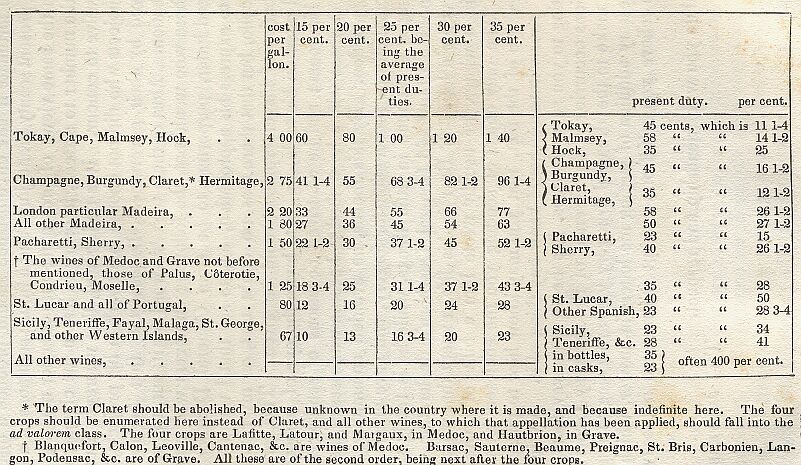
TO GEORGE HAY.
Washington, June 5, 1807.
Dear Sir,
Your favor of the 31st instant has been received, and I think it will be fortunate if any circumstance should produce a discharge of the present scanty grand jury, and a future summons of a fuller: though the same views of protecting the offender may again reduce the number to sixteen, in order to lessen the chance of getting twelve to concur. It is understood, that wherever Burr met with subjects who did not choose to embark in his projects, unless approved by their government, he asserted that he had that approbation. Most of them took his word for it, but it is said that with those who would not, the following stratagem was practised. A forged letter, purporting to be from General Dearborn, was made to express his approbation, and to say that I was absent at Monticello, but that there was no doubt that, on my return, my approbation of his enterprises would be given. This letter was spread open on his table, so as to invite the eye of whoever entered his room; and he contrived occasions of sending up into his room, those whom he wished to become witnesses of his acting under sanction. By this means, he avoided committing himself to any liability to prosecution for forgery, and gave another proof of being a great man in little things, while he is really small in great ones. I must add General Dearborn’s declaration, that he never wrote a letter to Burr in his life, except that when here, once in a winter, he usually wrote him a billet of invitation to dine. The only object of sending you the enclosed letters is to possess you of the fact, that you may know how to pursue it, if any of your witnesses should know any thing of it. My intention in writing to you several times, has been to convey facts or observations occurring in the absence of the Attorney General, and not to make to the dreadful drudgery you are going through the unnecessary addition of writing me letters in answer, which I beg you to relieve yourself from, except when some necessity calls for it.
I salute you with friendship and respect.
Th: Jefferson.
TO DOCTOR HORATIO TURPIN.
Washington, June 10, 1807.
Dear Sir,
Your favor of June the 1st has been duly received. To a mind like yours, capable in any question of abstracting it from its relation to yourself, I may safely hazard explanations, which I have generally avoided to others, on questions of appointment. Bringing into office no desires of making it subservient to the advancement of my own private interests, it has been no sacrifice, by postponing them, to strengthen the confidence of my fellow-citizens. But I have not felt equal indifference towards excluding merit from office, merely because it was related to me. However, I have thought it my duty so to do, that my constituents may be satisfied, that, in selecting persons for the management of their affairs, I am influenced by neither personal nor family interests, and especially, that the field of public office will not be perverted by me into a family property. On this subject, I had the benefit of useful lessons from my predecessors, had I needed them, marking what was to be imitated and what avoided. But, in truth, the nature of our government is lesson enough. Its energy depending mainly on the confidence of the people, in their Chief Magistrate, makes it his duty to spare nothing which can strengthen him with that confidence.
Accept assurances of my constant friendship and respect.
Th: Jefferson.
Washington, June 11, 1807.
Sir,
Your letter of May the 9th has been duly received. The subjects it proposes would require time and space for even moderate developement. My occupations limit me to a very short notice of them. I think there does not exist a good elementary work on the organization of society into civil government: I mean a work which presents in one full and comprehensive view the system of principles on which such an organization should be founded, according to the rights of nature. For want of a single work of that character, I should recommend Locke on Government, Sidney, Priestley’s Essay on the First Principles of Government, Chipman’s Principles of Government, and the Federalist. Adding, perhaps, Beccaria on Crimes and Punishments, because of the demonstrative manner in which he has treated that branch of the subject. If your views of political inquiry go further, to the subjects of money and commerce, Smith’s Wealth of Nations is the best book to be read, unless Say’s Political Economy can be had, which treats the same subjects on the same principles, but in a shorter compass, and more lucid manner. But I believe this work has not been translated into our language.
History, in general, only informs us what bad government is. But as we have employed some of the best materials of the British constitution in the construction of our own government, a knowledge of British history becomes useful to the American politician. There is, however, no general history of that country which can be recommended. The elegant one of Hume seems intended to disguise and discredit the good principles of the government, and is so plausible and pleasing in its style and manner, as to instil its errors and heresies insensibly into the minds of unwary readers. Baxter has performed a good operation on it. He has taken the text of Hume as his ground-work, abridging it by the omission of some details of little interest, and wherever he has found him endeavoring to mislead, by either the suppression of a truth, or by giving it a false coloring, he has changed the text to what it should be, so that we may properly call it Hume’s history republicanized. He has, moreover, continued the history (but indifferently) from where Hume left it, to the year 1800. The work is not popular in England, because it is republican; and but a few copies have ever reached America. It is a single quarto volume. Adding to this Ludlow’s Memoirs, Mrs. Macaulay’s and Belknap’s histories, a sufficient view will be presented of the free principles of the English constitution.
To your request of my opinion of the manner in which a newspaper should be conducted, so as to be most useful, I should answer, ‘by restraining it to true, facts and sound principles only.’ Yet I fear such a paper would find few subscribers. It is a melancholy truth, that a suppression of the press could not more completely deprive the nation of its benefits, than is done by its abandoned prostitution to falsehood. Nothing can now be believed which is seen in a newspaper. Truth itself becomes suspicious by being put into that polluted vehicle. The real extent of this state of misinformation is known only to those who are in situations to confront facts within their knowledge with the lies of the day. I really look with commiseration over the great body of my fellow-citizens, who, reading newspapers, live and die in the belief, that they have known something of what has been passing in the world in their time; whereas the accounts they have read in newspapers are just as true a history of any other period of the world as of the present, except that the real names of the day are affixed to their fables. General facts may indeed be collected from them, such as that Europe is now at war, that Bonaparte has been a successful warrior, that he has subjected a great portion of Europe to his will, &c. &c.; but no details can be relied on. I will add, that the man who never looks into a newspaper is better informed than he who reads them; inasmuch as he who knows nothing is nearer to truth than he whose mind is filled with falsehoods and errors. He who reads nothing will still learn the great facts, and the details are all false.
Perhaps an editor might begin a reformation in some such way as this. Divide his paper into four chapters, heading the 1st, Truths. 2nd, Probabilities. 3rd, Possibilities. 4th, Lies. The 1st chapter would be very short, as it would contain little more than authentic papers, and information from such sources, as the editor would be willing to risk his own reputation for their truth. The 2nd would contain what, from a mature consideration of all circumstances, his judgment should conclude to be probably true. This, however, should rather contain too little than too much. The 3rd and 4th should be professedly for those readers who would rather have lies for their money than the blank paper they would occupy.
Such an editor too, would have to set his face against the demoralizing practice of feeding the public mind habitually on slander, and the depravity of taste which this nauseous aliment induces. Defamation is becoming a necessary of life; insomuch, that a dish of tea in the morning or evening cannot be digested without this stimulant. Even those who do not believe these abominations, still read them with complaisance to their auditors, and instead of the abhorrence and indignation which should fill a virtuous mind, betray a secret pleasure in the possibility that some may believe them, though they do not themselves. It seems to escape them, that it is not he who prints, but he who pays for printing a slander, who is its real author.
These thoughts on the subjects of your letter are hazarded at your request. Repeated instances of the publication of what has not been intended for the public eye, and the malignity with which political enemies torture every sentence from me into meanings imagined by their own wickedness only, justify my expressing a solicitude, that this hasty communication may in nowise be permitted to find its way into the public papers. Not fearing these political bull-dogs, I yet avoided putting myself in the way of being baited by them, and do not wish to volunteer away that portion of tranquillity, which a firm execution of my duties will permit me to enjoy.
I tender you my salutations, and best wishes for your success.
Th: Jefferson.
Washington, June 12, 1807.
Dear Sir,
******
The proposition in your letter of May the 16th, of adding an umpire to our discordant negotiators at Paris, struck me favorably on reading it, and reflection afterwards strengthened my first impressions. I made it therefore a subject of consultation with my coadjutors, as is our usage. For our government, although in theory subject to be directed by the unadvised will of the President, is, and from its origin has been, a very different thing in practice. The minor business in each department is done by the Head of the department, on consultation with the President alone. But all matters of importance or difficulty are submitted to all the Heads of departments composing the cabinet; sometimes by the President’s consulting them separately and successively, as they happen to call on him; but in the greatest cases, by calling them together, discussing the subject maturely, and finally taking the vote, in which the President counts himself but as one. So that in all important cases the executive is, in fact, a directory, which certainly the President might control: but of this there was never an example either in the first or the present administration. I have heard, indeed, that my predecessor sometimes decided things against his council.
I adopted in the present case the mode of separate consultation. The opinion of each member, taken separately, was, that the addition of a third negotiator was not at this time advisable. For the present, therefore, the question must rest. Mr. Bowdoin, we know, is anxious to come home, and is detained only by the delicacy of not deserting his post. In the existing temper between him and his colleague, it would certainly be better that one of them should make an opening for re-composing the commission more harmoniously. I salute you with affection and respect.
Th: Jefferson.
TO GEORGE HAY.
Washington, June 12, 1807.
Dear Sir,
Your letter of the 9th is this moment received. Reserving the necessary right of the President of the United States to decide, independently of all other authority, what papers, coming to him as President, the public interests permit to be communicated, and to whom, I assure you of my readiness, under that restriction, voluntarily to furnish, on all occasions, whatever the purposes of justice may require. But the letter of General Wilkinson, of October the 21st, requested for the defence of Colonel Burr, with every other paper relating to the charges against him, which were in my possession when the Attorney General went on to Richmond in March, I then delivered to him; and I have always taken for granted he left the whole with you. If he did, and the bundle retains the order in which I had arranged it, you will readily find the letter desired, under the date of its receipt, which was November the 25th: but lest the Attorney General should not have left those papers with you, I this day write to him to forward this one by post. An uncertainty whether he is at Philadelphia, Wilmington, or New Castle, may produce delay in his receiving my letter, of which it is proper you should be apprized. But, as I do not recollect the whole contents of that letter, I must beg leave to devolve on you the exercise of that discretion which it would be my right and duty to exercise, by withholding the communication of any parts of the letter, which are not directly material for the purposes of justice.
With this application, which is specific, a prompt compliance is practicable. But when the request goes to ‘copies of the orders issued in relation to Colonel Burr, to the officers at Orleans, Natchez, &c. by the Secretaries of the War and Navy departments,’ it seems to cover a correspondence of many months, with such a variety of officers, civil and military, all over the United States, as would amount to the laying open the whole executive books. I have desired the Secretary of War to examine his official communications; and on a view of these, we may be able to judge what can and ought to be done towards a compliance with the request. If the defendant alleges that there was any particular order, which, as a cause, produced any particular act on his part, then he must know what this order was, can specify it, and a prompt answer can be given. If the object had been specified, we might then have had some guide for our conjectures, as to what part of the executive records might be useful to him: but, with a perfect willingness to do what is right, we are without the indications which may enable us to do it. If the researches of the Secretary at War should produce any thing proper for communication, and pertinent to any point we can conceive in the defence before the court, it shall be forwarded to you. I salute you with respect and esteem.
Th: Jefferson.
TO GEORGE HAY.
Washington, June 17, 1807.
Sir,
In answering your letter of the 9th, which desired a communication of one to me from General Wilkinson, specified by its date, I informed you in mine of the 12th that I had delivered it, with all other papers respecting the charges against Aaron Burr, to the Attorney General, when he went to Richmond; that I had supposed he had left them in your possession, but would immediately write to him, if he had not, to forward that particular letter without delay. I wrote to him accordingly on the same day, but having no answer, I know not whether he has forwarded the letter. I stated in the same letter, that I had desired the Secretary at War, to examine his office, in order to comply with your further request, to furnish copies of the orders which had been given respecting Aaron Burr and his property; and in a subsequent letter of the same day, I forwarded to you copies of two letters from the Secretary at War, which appeared to be within the description expressed in your letter. The order from the Secretary of the Navy, you said, you were in possession of. The receipt of these papers had, I presume, so far anticipated, and others this day forwarded will have substantially fulfilled, the object of a subpoena from the District Court of Richmond, requiring that those officers and myself should attend the Court in Richmond, with the letter of General Wilkinson, the answer to that letter, and the orders of the departments of War and the Navy, therein generally described. No answer to General Wilkinson’s letter, other than a mere acknowledgment of its receipt, in a letter written for a different purpose, was ever written by myself or any other. To these communications of papers, I will add, that if the defendant supposes there are any facts within the knowledge of the Heads of departments, or of myself, which can be useful for his defence, from a desire of doing any thing our situation will permit in furtherance of justice, we shall be ready to give him the benefit of it, by way of deposition, through any persons whom the Court shall authorize to take our testimony at this place. I know, indeed, that this cannot be done but by consent of parties; and I therefore authorize you to give consent on the part of the United States. Mr. Burr’s consent will be given of course, if he supposes the testimony useful.
As to our personal attendance at Richmond, I am persuaded the Court is sensible, that paramount duties to the nation at large control the obligation of compliance with their summons in this case; as they would, should we receive a similar one, to attend the trials of Blannerhassett and others, in the Mississippi territory, those instituted at St. Louis and other places on the western waters, or at any place, other than the seat of government. To comply with such calls would leave the nation without an executive branch, whose agency, nevertheless, is understood to be so constantly necessary, that it is the sole branch which the constitution requires to be always in function. It could not then mean that it should be withdrawn from its station by any co-ordinate authority.
With respect to papers, there is certainly a public and a private side to our offices. To the former belong grants of land, patents for inventions, certain commissions, proclamations, and other papers patent in their nature. To the other belong mere executive proceedings. All nations have found it necessary, that for the advantageous conduct of their affairs, some of these proceedings, at least, should remain known to their executive functionary only. He, of course, from the nature of the case, must be the sole judge of which of them the public interests will permit publication. Hence, under our constitution, in requests of papers, from the legislative to the executive branch, an exception is carefully expressed, as to those which he may deem the public welfare may require not to be disclosed; as you will see in the enclosed resolution of the House of Representatives, which produced the message of January 22nd, respecting this case. The respect mutually due between the constituted authorities, in their official intercourse, as well as sincere dispositions to do for every one what is just, will always insure from the executive, in exercising the duty of discrimination confided to him, the same candor and integrity to which the nation has in like manner trusted in the disposal of its judiciary authorities. Considering you as the organ for communicating these sentiments to the Court, I address them to you for that purpose, and salute you with esteem and respect.
Th: Jefferson.
TO GEORGE HAY.
Washington, June 19,1807.
Dear Sir,
Yours of the 17th was received last night. Three blank pardons had been (as I expect) made up and forwarded by the mail of yesterday, and I have desired three others to go by that of this evening. You ask what is to be done if Bollman finally rejects his pardon, and the Judge decides it to have no effect? Move to commit him immediately for treason or misdemeanor, as you think the evidence will support; let the court decide where he shall be sent for trial; and on application, I will have the marshal aided in his transportation, with the executive means. And we think it proper, further, that when Burr shall have been convicted of either treason or misdemeanor, you should immediately have committed all those persons against whom you should find evidence sufficient, whose agency has been so prominent as to mark them as proper objects of punishment, and especially where their boldness has betrayed an inveteracy of criminal disposition. As to obscure offenders and repenting ones, let them lie for consideration.
I enclose you the copy of a letter received last night, and giving singular information. I have inquired into the character of Graybell. He was an old revolutionary captain, is now a flour merchant in Baltimore, of the most respectable character, and whose word would be taken as implicitly as any man’s for whatever he affirms. The letter-writer, also, is a man of entire respectability. I am well informed, that for more than a twelvemonth it has been believed in Baltimore, generally, that Burr was engaged in some criminal enterprise, and that Luther Martin knew all about it. We think you should immediately despatch a subpoena for Graybell; and while that is on the road, you will have time to consider in what form you will use his testimony; e.g. shall Luther Martin be summoned as a witness against Burr, and Graybell held ready to confront him? It may be doubted whether we could examine a witness to discredit our own witness. Besides, the lawyers say that they are privileged from being forced to breaches of confidence, and that no others are. Shall we move to commit Luther Martin, as particeps criminis with Burr? Graybell will fix upon him misprision of treason at least. And at any rate, his evidence will put down this unprincipled and impudent federal bull-dog, and add another proof that the most clamorous defenders of Burr are all his accomplices. It will explain why Luther Martin flew so hastily to the aid of ‘his honorable friend,’ abandoning his clients and their property during a session of a principal court in Maryland, now filled, as I am told, with the clamors and ruin of his clients. I believe we shall send on Latrobe as a witness. He will prove that Aaron Burr endeavored to get him to engage several thousand men, chiefly Irish emigrants, whom he had been in the habit of employing in the works he directs, under pretence of a canal opposite Louisville, or of the Washita, in which, had he succeeded, he could with that force alone have carried every thing before him, and would not have been where he now is. He knows, too, of certain meetings of Burr, Bollman, Yrujo, and one other whom we have never named yet, but have him not the less in our view.
I salute you with friendship and respect.
Th: Jefferson.
P. S. Will you send us half a dozen blank subpoenas?
Since writing the within I have had a conversation with Latrobe. He says it was five hundred men he was desired to engage. The pretexts were to work on the Ohio canal, and be paid in Washita lands. Your witnesses will some of them prove that Burr had no interest in the Ohio canal, and that consequently this was a mere pretext to cover the real object from the men themselves, and all others. Latrobe will set out in the stage of to-morrow evening, and be with you Monday evening. T. J.
Washington, June 19, 1807.
Dear Sir,
In acknowledging the receipt of your favor of the 3rd instant, I avail myself of the occasion it offers of tendering to yourself, to Mr. Lincoln, and to your State, my sincere congratulations on the late happy event of the election of a republican executive to preside over its councils. The harmony it has introduced between the legislative and executive branches, between the people and both of them, and between all and the General Government, are so many steps towards securing that union of action and effort in all its parts, without which no nation can be happy or safe. The just respect, with which all the States have ever looked to Massachusetts, could leave none of them without anxiety while she was in a state of alienation from her family and friends. Your opinion of the propriety and advantage of a more intimate correspondence between the executives of the several States, and that of the Union, as a central point, is precisely that which I have ever entertained; and on coming into office I felt the advantages which would result from that harmony. I had it even in contemplation, after the annual recommendation to Congress of those measures called for by the times, which the constitution had placed under their power, to make communications in like manner to the executives of the States, as to any parts of them to which their legislatures might be alone competent. For many are the exercises of power reserved to the States, wherein an uniformity of proceeding would be advantageous to all. Such are quarantines, health laws, regulations of the press, banking institutions, training militia, &c. &c. But you know what was the state of the several governments when I came into office. That a great proportion of them were federal, and would have been delighted with such opportunities of proclaiming their contempt, and of opposing republican men and measures. Opportunities so furnished and used by some of the State governments, would have produced an ill effect, and would have insured the failure of the object of uniform proceeding. If it could be ventured even now (Connecticut and Delaware being still hostile) it must be on some greater occasion than is likely to arise within my time. I look to it, therefore, as a course which will probably be to be left to the consideration of my successor.
I consider, with you, the federalists as completely vanquished, and never more to take the field under their own banners. They will now reserve themselves to profit by the schisms among republicans, and to earn favors from minorities, whom they will enable to triumph over their more numerous antagonists. So long as republican minorities barely accept their votes, no great harm will be done; because it will only place in power one shade of republicanism, instead of another. But when they purchase the votes of the federalists, by giving them a participation of office, trust, and power, it is a proof that anti-monarchism is not their strongest passion. I do not think that the republican minority in Pennsylvania has fallen into this heresy, nor that there are in your State materials of which a minority can be made who will fall into it.
With respect to the tour my friends to the north have proposed that I should make in that quarter, I have not made up a final opinion. The course of life which General Washington had run, civil and military, the services he had rendered, and the space he therefore occupied in the affections of his fellow-citizens, take from his examples the weight of precedents for others, because no others can arrogate to themselves the claims which he had on the public homage. To myself, therefore, it comes as a new question, to be viewed under all the phases it may present. I confess, that I am not reconciled to the idea of a chief magistrate parading himself through the several States as an object of public gaze, and in quest of an applause, which, to be valuable, should be purely voluntary. I had rather acquire silent good will by a faithful discharge of my duties, than owe expressions of it to my putting myself in the way of receiving them. Were I to make such a tour to Portsmouth or Portland, I must do it to Savannah, perhaps to Orleans and Frankfort. As I have never yet seen the time when the public business would have permitted me to be so long in a situation in which I could not carry it on, so I have no reason to expect that such a time will come while I remain in office. A journey to Boston or Portsmouth, after I shall be a private citizen, would much better harmonize with my feelings, as well as duties; and, founded in curiosity, would give no claims to an extension of it. I should see my friends, too, more at our mutual ease, and be left more exclusively to their society. However, I end as I began, by declaring I have made up no opinion on the subject, and that I reserve it as a question for future consideration and advice.
In the mean time, and at all times, I salute you with great respect and esteem,
Th: Jefferson.
TO GEORGE HAY.
Washington, June 20, 1807.
Dear Sir,
Mr. Latrobe now comes on as a witness against Burr. His presence here is with great inconvenience dispensed with, as one hundred and fifty workmen require his constant directions on various public works of pressing importance. I hope you will permit him to come away as soon as possible. How far his testimony will be important as to the prisoner, I know not; but I am desirous that those meetings of Yrujo with Burr and his principal accomplices should come fully out, and judicially, as they will establish the just complaints we have against his nation.
I did not see till last night the opinion of the Judge on the subpoena duces tecum against the President. Considering the question there as coram non judice, I did not read his argument with much attention. Yet I saw readily enough, that, as is usual, where an opinion is to be supported, right or wrong, he dwells much on smaller objections, and passes over those which are solid. Laying down the position generally, that all persons owe obedience to subpoenas, he admits no exception unless it can be produced in his law books. But if the constitution enjoins on a particular officer to be always engaged in a particular set of duties imposed on him, does not this supersede the general law, subjecting him to minor duties inconsistent with these? The constitution enjoins his constant agency in the concerns of six millions of people. Is the law paramount to this, which calls on him on behalf of a single one? Let us apply the Judge’s own doctrine to the case of himself and his brethren. The sheriff of Henrico summons him from the bench, to quell a riot somewhere in his county. The federal judge is, by the general law, a part of the posse of the State sheriff. Would the Judge abandon major duties to perform lesser ones? Again; the court of Orleans or Maine commands, by subpoenas, the attendance of all the judges of the Supreme Court. Would they abandon their posts as judges, and the interests of millions committed to them, to serve the purposes of a single individual? The leading principle of our constitution is the independence of the legislature, executive, and judiciary, of each other, and none are more jealous of this than the judiciary. But would the executive be independent of the judiciary, if he were subject to the commands of the latter, and to imprisonment for disobedience; if the several courts could bandy him from pillar to post, keep him constantly trudging from north to south, and east to west, and withdraw him entirely from his constitutional duties? The intention of the constitution, that each branch should be independent of the others, is further manifested by the means it has furnished to each, to protect itself from enterprises of force attempted on them by the others, and to none has it given more effectual or diversified means than to the executive. Again; because ministers can go into a court in London, as witnesses, without interruption to their executive duties, it is inferred that they would go to a court one thousand or one thousand five hundred miles off, and that ours are to be dragged from Maine to Orleans by every criminal who will swear that their testimony ‘may be of use to him.’ The Judge says, ‘it is apparent that the President’s duties, as chief magistrate, do not demand his whole time, and are not unremitting.’ If he alludes to our annual retirement from the seat of government, during the sickly season, he should be told that such arrangements are made for carrying on the public business, at and between the several stations we take, that it goes on as unremittingly there, as if we were at the seat of government. I pass more hours in public business at Monticello than I do here, every day; and it is much more laborious, because all must be done in writing. Our stations being known, all communications come to them regularly, as to fixed points. It would be very different were we always on the road, or placed in the noisy and crowded taverns where courts are held. Mr. Rodney is expected here every hour, having been kept away by a sick child. I salute you with friendship and respect.
Th: Jefferson.
TO DOCTOR WISTAR.
Washington, June 21, 1807.
Dear Sir,
I have a grandson, the son of Mr. Randolph, now about fifteen years of age, in whose education I take a lively interest.
I am not a friend to placing young men in populous cities, because they acquire there habits and partialities which do not contribute to the happiness of their after life. But there are particular branches of science, which are not so advantageously taught any where else in the United States as in Philadelphia. The garden at the Woodlands for Botany, Mr. Peale’s Museum for Natural History, your Medical School for Anatomy, and the able professors in all of them, give advantages not to be found elsewhere. We propose, therefore, to send him to Philadelphia to attend the schools of Botany, Natural History, Anatomy, and perhaps Surgery; but not of Medicine. And why not of Medicine, you will ask? Being led to the subject, I will avail myself of the occasion to express my opinions on that science, and the extent of my medical creed. But, to finish first with respect to my grandson, I will state the favor I ask of you, and which is the object of this letter.
This subject dismissed, I may now take up that which it led to, and further tax your patience with unlearned views of medicine; which, as in most cases, are, perhaps, the more confident in proportion as they are less enlightened.
We know, from what we see and feel, that the animal body is in its organs and functions subject to derangement, inducing pain, and tending to its destruction. In this disordered state, we observe nature providing for the re-establishment of order, by exciting some salutary evacuation of the morbific matter, or by some other operation which escapes our imperfect senses and researches. She brings on a crisis, by stools, vomiting, sweat, urine, expectoration, bleeding, &c, which, for the most part, ends in the restoration of healthy action. Experience has taught us also, that there are certain substances, by which, applied to the living body, internally or externally, we can at will produce these same evacuations, and thus do, in a short time, what nature would do but slowly, and do effectually, what perhaps she would not have strength to accomplish. Where, then, we have seen a disease, characterized by specific signs or phenomena, and relieved by a certain natural evacuation or process, whenever that disease recurs under the same appearances, we may reasonably count on producing a solution of it, by the use of such substances as we have found produce the same evacuation or movement. Thus, fulness of the stomach we can relieve by emetics; diseases of the bowels, by purgatives; inflammatory cases, by bleeding; intermittents, by the Peruvian bark; syphilis, by mercury; watchfulness, by opium; &c. So far, I bow to the utility of medicine. It goes to the well defined forms of disease, and happily, to those the most frequent. But the disorders of the animal body, and the symptoms indicating them, are as various as the elements of which the body is composed. The combinations, too, of these symptoms are so infinitely diversified, that many associations of them appear too rarely to establish a definite disease: and to an unknown disease, there cannot be a known remedy. Here, then, the judicious, the moral, the humane physician should stop. Having been so often a witness to the salutary efforts which nature makes to re-establish the disordered functions, he should rather trust to their action, than hazard the interruption of that, and a greater derangement of the system, by conjectural experiments on a machine so complicated and so unknown as the human body, and a subject so sacred as human life. Or, if the appearance of doing something be necessary to keep alive the hope and spirits of the patient, it should be of the most innocent character. One of the most successful physicians I have ever known, has assured me, that he used more bread pills, drops of colored water, and powders of hickory ashes, than of all other medicines put together. It was certainly a pious fraud. But the adventurous physician goes on, and substitutes presumption for knowledge. From the scanty field of what is known, he launches into the boundless region of what is unknown. He establishes for his guide some fanciful theory of corpuscular attraction, of chemical agency, of mechanical powers, of stimuli, of irritability accumulated or exhausted, of depletion by the lancet, and repletion by mercury, or some other ingenious dream, which lets him into all nature’s secrets at short hand. On the principle which he thus assumes, he forms his table of nosology, arrays his diseases into families, and extends his curative treatment, by analogy, to all the cases he has thus arbitrarily marshaled together. I have lived myself to see the disciples of Hoffman, Boerhaave, Stahl, Cullen, Brown, succeed one another like the shifting figures of a magic-lanthern, and their fancies like the dresses of the annual doll-babies from Paris, becoming, from their novelty, the vogue of the day, and yielding to the next novelty their ephemeral favor. The patient, treated on the fashionable theory, sometimes gets well in spite of the medicine. The medicine therefore restored him, and the young doctor receives new courage to proceed in his bold experiments on the lives of his fellow creatures. I believe we may safely affirm, that the inexperienced and presumptuous band of medical tyros let loose upon the world, destroys more of human life in one year, than all the Robin-hoods, Cartouches, and Macheaths do in a century. It is in this part of medicine that I wish to see a reform, an abandonment of hypothesis for sober facts, the first degree of value set on clinical observation, and the lowest on visionary theories. I would wish the young practitioner, especially, to have deeply impressed on his mind the real limits of his art, and that when the state of his patient gets beyond these, his office is to be a watchful, but quiet spectator of the operations of nature, giving them fair play by a well regulated regimen, and by all the aid they can derive from the excitement of good spirits and hope in the patient. I have no doubt, that some diseases not yet understood may in time be transferred to the table of those known. But, were I a physician, I would rather leave the transfer to the slow hand of accident, than hasten it by guilty experiments on those who put their lives into my hands. The only sure foundations of medicine are, an intimate knowledge of the human body, and observation on the effects of medicinal substances on that. The anatomical and clinical schools, therefore, are those in which the young physician should be formed. If he enters with innocence that of the theory of medicine, it is scarcely possible he should come out untainted with error. His mind must be strong indeed, if, rising above juvenile credulity, it can maintain a wise infidelity against the authority of his instructers, and the bewitching delusions of their theories. You see that I estimate justly that portion of instruction, which our medical students derive from your labors; and, associating with it one of the chairs which my old and able friend, Doctor Rush, so honorably fills, I consider them as the two fundamental pillars of the edifice. Indeed, I have such an opinion of the talents of the professors in the other branches which constitute the school of medicine with you, as to hope and believe, that it is from this side of the Atlantic, that Europe, which has taught us so many other things, will at length be led into sound principles in this branch of science, the most important of all others, being that to which we commit the care of health and life.
I dare say, that by this time you are sufficiently sensible that old heads, as well as young, may sometimes be charged with ignorance and presumption. The natural course of the human mind is certainly from credulity to scepticism: and this is perhaps the most favorable apology I can make for venturing so far out of my depth, and to one, too, to whom the strong as well as the weak points of this science are so familiar. But having stumbled on the subject in my way, I wished to give a confession of my faith to a friend; and the rather, as I had perhaps, at times, to him as well as others, expressed my scepticism in medicine, without defining its extent or foundation. At any rate, it has permitted me, for a moment, to abstract myself from the dry and dreary waste of politics, into which I have been impressed by the times on which I happened, and to indulge in the rich fields of nature, where alone I should have served as a volunteer, if left to my natural inclinations and partialities.
I salute you at all times with affection and respect.
Th: Jefferson.
TO MR. BOWDOIN.
Washington, July 10, 1807.
Dear Sir,
I wrote you on the 10th of July, 1806; but supposing, from your not acknowledging the receipt of the letter, that it had miscarried, I sent a duplicate with my subsequent one of April the 2nd. These having gone by the Wasp, you will doubtless have received them. Since that, yours of May the 1st has come to hand. You will see by the despatches from the department of State, carried by the armed vessel the Revenge, into what a critical state our peace with Great Britain is suddenly brought, by their armed vessels in our waters. Four vessels of war (three of them two-deckers) closely blockade Norfolk at this instant. Of the authority under which this aggression is committed, their minister here is unapprized. You will see by the proclamation of July the 2nd, that (while we are not omitting such measures of force as are immediately necessary) we propose to give Great Britain an opportunity of disavowal and reparation, and to leave the question of war, non-intercourse, or other measures, uncommitted, to the legislature. This country has never been in such a state of excitement since the battle of Lexington. In this state of things, cordial friendship with France, and peace at least with Spain, become more interesting. You know the circumstances respecting this last power, which have rendered it ineligible that you should have proceeded heretofore to your destination. But this obstacle is now removed by their recall of Yrujo, and appointment of another minister, and, in the mean time, of a chargé des affaires, who has been received. The way being now open for taking your station at Madrid, it is certainly our wish you should do so, and that this may be more agreeable to you than your return home, as is solicited in yours of May the 1st. It is with real unwillingness we should relinquish the benefit of your services. Nevertheless, if your mind is decidedly bent on that, we shall regret, but not oppose your return. The choice, therefore, remains with yourself. In the mean time, your place in the joint commission being vacated by either event, we shall take the measures rendered necessary by that. We have seen, with real grief, the misunderstanding which has taken place between yourself and General Armstrong. We are neither qualified nor disposed to form an opinion between you. We regret the pain which must have been felt by persons, both of whom hold so high a place in our esteem, and we have not been without fear that the public interest might suffer by it. It has seemed, however, that the state of Europe has been such as to admit little to be done, in matters so distant from them.
The present alarm has had the effect of suspending our foreign commerce. No merchant ventures to send out a single vessel; and I think it probable this will continue very much the case till we get an answer from England. Our crops are uncommonly plentiful. That of small grain is now secured south of this, and the harvest is advancing here.
Accept my salutations, and assurances of affectionate esteem and respect.
Th: Jefferson.
TO THE MARQUIS DE LA FAYETTE.
Washington, July 14, 1807.
My Dear Friend,
I received last night your letters of February the 20th and April the 29th, and a vessel just sailing from Baltimore enables me hastily to acknowledge them; to assure you of the welcome with which I receive whatever comes from you, and the continuance of my affectionate esteem for yourself and family. I learn with much concern, indeed, the state of Madame de la Fayette’s health. I hope I have the pleasure yet to come of learning its entire re-establishment. She is too young not to give great confidence to that hope.
Measuring happiness by the American scale, and sincerely wishing that of yourself and family, we had been anxious to see them established on this side of the great water. But I am not certain that any equivalent can be found for the loss of that species of society, to which our habits have been formed from infancy. Certainly had you been, as I wished, at the head of the government of Orleans, Burr would never have given me one moment’s uneasiness. His conspiracy has been one of the most flagitious of which history will ever furnish an example. He meant to separate the western States from us, to add Mexico to them, place himself at their head, establish what he would deem an energetic government, and thus provide an example and an instrument for the subversion of our freedom. The man who could expect to effect this, with American materials, must be a fit subject for Bedlam. The seriousness of the crime, however, demands more serious punishment. Yet, although there is not a man in the United States who doubts his guilt, such are the jealous provisions of our laws in favor of the accused against the accuser, that I question if he is convicted. Out of forty-eight jurors to be summoned, he is to select the twelve who are to try him, and if there be any one who will not concur in finding him guilty, he is discharged of course. I am sorry to tell you that Bollman was Burr’s right hand man in all his guilty schemes. On being brought to prison here, he communicated to Mr. Madison and myself the whole of the plans, always, however, apologetically for Burr as far as they would bear. But his subsequent tergiversations have proved him conspicuously base. I gave him a pardon, however, which covers him from every thing but infamy. I was the more astonished at his engaging in this business, from the peculiar motives he should have felt for fidelity. When I came into the government, I sought him out on account of the services he has rendered you, cherished him, offered him two different appointments of value, which, after keeping them long under consideration, he declined for commercial views, and would have given him any thing for which he was fit. Be assured he is unworthy of ever occupying again the care of any honest man. Nothing has ever so strongly proved the innate force of our form of government, as this conspiracy. Burr had probably engaged one thousand men to follow his fortunes, without letting them know his projects, otherwise than by assuring them the government approved of them. The moment a proclamation was issued, undeceiving them, he found himself left with about thirty desperadoes only. The people rose in mass wherever he was or was suspected to be, and by their own energy the thing was crushed in one instant, without its having been necessary to employ a man of the military but to take care of their respective stations. His first enterprise was to have been to seize New Orleans, which he supposed would powerfully bridle the upper country, and place him at the door of Mexico. It is with pleasure I inform you that not a single native Creole, and but one American of those settled there before we received the place, took any part with him. His partisans were the new emigrants from the United States and elsewhere, fugitives from justice or debt, and adventurers and speculators of all descriptions.
I enclose you a proclamation, which will show you the critical footing on which we stand, at present, with England. Never, since the battle of Lexington, have I seen this country in such a state of exasperation as at present. And even that did not produce such unanimity. The federalists themselves coalesce with us as to the object, although they will return to their old trade of condemning every step we take towards obtaining it. ‘Reparation for the past, and security for the future,’ is our motto. Whether these will be yielded freely, or will require resort to non-intercourse, or to war, is yet to be seen. We have actually near two thousand men in the field, covering the exposed parts of the coast, and cutting off supplies from the British vessels.
I am afraid I have been very unsuccessful in my endeavors to serve Madame de Tesse in her taste for planting. A box of seeds, &c. which I sent her in the close of 1805, was carried with the vessel into England, and discharged so late that I fear she lost their benefit, for that season. Another box, which I prepared in the autumn of 1806, has, I fear, been equally delayed from other accidents. However, I will persevere in my endeavors.
Present me respectfully to her, M. de Tesse, Madame de la Fayette, and your family, and accept my affectionate salutations, and assurances of constant esteem and respect.
Th: Jefferson.
TO JOHN PAGE.
Washington, July 17, 1807.
My Dear Friend,
Yours of the 11th is received. In appointments to public offices of mere profit, I have ever considered faithful service in either our first or second revolution as giving preference of claim, and that appointments on that principle would gratify the public, and strengthen that confidence so necessary to enable the executive to direct the whole public force to the best, advantage of the nation. Of Mr. Boiling Robertson’s talents and integrity I have long been apprized, and would gladly use them where talents and integrity are wanting. I had thought of him for the vacant place of secretary of the Orleans territory, but supposing the salary of two thousand dollars not more than he makes by his profession, and while remaining with his friends, I have, in despair, not proposed it to him. If he would accept it, I should name him instantly with the greatest satisfaction. Perhaps you could inform me on this point.
With respect to Major Gibbons, I do indeed recollect, that in some casual conversation, it was said that the most conspicuous accomplices of Burr were at home at his house; but it made so little impression on me, that neither the occasion nor the person is now recollected. On this subject, I have often expressed the principles on which I act, with a wish they might be understood by the federalists in office. I have never removed a man merely because he was a federalist: I have never wished them to give a vote at an election, but according to their own wishes. But as no government could discharge its duties to the best advantage of its citizens, if its agents were in a regular course of thwarting instead of executing all its measures, and were employing the patronage and influence of their offices against the government and its measures, I have only requested they would be quiet, and they should be safe: and if their conscience urges them to take an active and zealous part in opposition, it ought also to urge them to retire from a post which they could not conscientiously conduct with fidelity to the trust reposed in them; and on failure to retire, I have removed them; that is to say, those who maintained an active and zealous opposition to the government. Nothing which I have yet heard of Major Gibbons places him in danger from these principles.
I am much pleased with the ardor displayed by our countrymen on the late British outrage. It gives us the more confidence of support in the demand of reparation for the past, and security for the future, that is to say, an end of impressments. If motives of either justice or interest should produce this from Great Britain, it will save a war: but if they are refused, we shall have gained time for getting in our ships and property, and at least twenty thousand seamen now afloat on the ocean, and who may man two hundred and fifty privateers. The loss of these to us would be worth to Great Britain many victories of the Nile and Trafalgar. The mean time may also be importantly employed in preparations to enable us to give quick and deep blows.
Present to Mrs. Page, and receive yourself my affectionate and respectful salutations.
Th: Jefferson.
TO WILLIAM DUANE.
Washington, July 20, 1807.
Sir,
Although I cannot always acknowledge the receipt of communications, yet I merit their continuance by making all the use of them of which they are susceptible. Some of your suggestions had occurred, and others will be considered. The time is coming when our friends must enable us to hear every thing, and expect us to say nothing; when we shall need all their confidence that every thing is doing which can be done, and when our greatest praise shall be, that we appear to be doing nothing. The law for detaching one hundred thousand militia, and the appropriation for it, and that for fortifications, enable us to do every thing for land service, as well as if Congress were here; and as to naval matters, their opinion is known. The course we have pursued, has gained for our merchants a precious interval to call in their property and our seamen, and the postponing the summons of Congress will aid in avoiding to give too quick an alarm to the adversary. They will be called, however, in good time. Although we demand of England what is merely of right, reparation for the past, security for the future, yet as their pride will possibly, nay probably, prevent their yielding them to the extent we shall require, my opinion is, that the public mind, which I believe is made up for war, should maintain itself at that point. They have often enough, God knows, given us cause of war before; but it has been on points which would not have united the nation. But now they have touched a chord which vibrates in every heart. Now then is the time to settle the old and the new.
I have often wished for an occasion of saying a word to you on the subject of the Emperor of Russia, of whose character and value to us, I suspect you are not apprized correctly. A more virtuous man, I believe, does not exist, nor one who is more enthusiastically devoted to better the condition of mankind. He will probably, one day, fall a victim to it, as a monarch of that principle does not suit a Russian noblesse. He is not of the very first order of understanding, but he is of a high one. He has taken a peculiar affection to this country and its government, of which he has given me public as well as personal proofs. Our nation being like his, habitually neutral, our interests as to neutral rights, and our sentiments, agree. And whenever conferences for peace shall take place, we are assured of a friend in him. In fact, although in questions of restitution he will be with England, in those of neutral rights he will be with Bonaparte and every other power in the world, except England: and I do presume that England will never have peace until she subscribes to a just code of marine law. I have gone into this subject, because I am confident that Russia (while her present monarch lives) is the most cordially friendly to us of any power on earth, will go furthest to serve us, and is most worthy of conciliation. And although the source of this information must be a matter of confidence with you, yet it is desirable that the sentiments should become those of the nation. I salute you with esteem and respect.
Th: Jefferson.
TO GEORGE HAY.
Monticello, August 20, 1807.
Dear Sir,
I received yesterday your favor of the 11th. An error of the post-office had occasioned the delay. Before an impartial jury Burr’s conduct would convict himself, were not one word of testimony to be offered against him. But to what a state will our law be reduced by party feelings in those who administer it? Why do not Blannerhasset, Dayton, &c. demand private and comfortable lodgings? In a country where an equal application of law to every condition of man is fundamental, how could it be denied to them? How can it ever be denied to the most degraded malefactor? The enclosed letter of James Morrison, covering a copy of one from Alston to Blannerhasset, came to hand yesterday. I enclose them, because it is proper all these papers should be in one deposite, and because you should know the case and all its bearings, that you may understand whatever turns up in the cause. Whether the opinion of the letter-writer is sound, may be doubted. For however these, and other circumstances which have come to us, may induce us to believe that the bouncing letter he published, and the insolent one he wrote to me, were intended as blinds, yet they are not sufficient for legal conviction. Blannerhasset and his wife could possibly tell us enough. I commiserate the sufferings you have to go through in such a season, and salute you with great esteem and respect.
Th: Jefferson.
TO GEORGE HAY.
Monticello, September 4, 1807.
Dear Sir,
Yours of the 1st came to hand yesterday. The event has been ——— that is to say, not only to clear Burr, but to prevent the evidence from ever going before the world. But this latter case must not take place. It is now, therefore, more than ever indispensable, that not a single witness be paid or permitted to depart, until his testimony has been committed to writing, either as delivered in court, or as taken by yourself in the presence of any of Burr’s counsel, who may choose to attend to cross-examine. These whole proceedings will be laid before Congress, that they may decide, whether the defect has been in the evidence of guilt, or in the law, or in the application of the law, and that they may provide the proper remedy for the past and the future. I must pray you also to have an authentic copy of the record made out (without saying for what) and to send it to me: if the Judge’s opinions make not a part of it, then I must ask a copy of them, either under his hand, if he delivers one signed, or duly proved by affidavit.
This criminal is preserved to become the rallying point of all the disaffected and the worthless of the United States, and to be the pivot on which all the intrigues and the conspiracies which foreign governments may wish to disturb us with, are to turn. If he is convicted of the misdemeanor, the Judge must in decency give us respite by some short confinement of him; but we must expect it to be very short. Be assured yourself, and communicate the same assurances to your colleagues, that your and their zeal and abilities have been displayed in this affair to my entire satisfaction and your own honor.
I salute you with great esteem and respect.
Th: Jefferson.
TO GEORGE HAY.
Monticello, September 7, 1807.
Dear Sir,
I received, late last night, your favor of the day before, and now re-enclose you the subpoena. As I do not believe that the district courts have a power of commanding the executive government to abandon superior duties and attend on them, at whatever distance, I am unwilling, by any notice of the subpoena, to set a precedent which might sanction a proceeding so preposterous. I enclose you, therefore, a letter, public and for the court, covering substantially all they ought to desire. If the papers which were enclosed in Wilkinson’s letter may, in your judgment, be communicated without injury, you will be pleased to communicate them. I return you the original letter.
I am happy in having the benefit of Mr. Madison’s counsel on this occasion, he happening to be now with me. We are both strongly of opinion, that the prosecution against Burr for misdemeanor should proceed at Richmond. If defeated, it will heap coals of fire on the head of the Judge: if successful, it will give time to see whether a prosecution for treason against him can be instituted in any, and what other court. But, we incline to think, it may be best to send Blannerhasset and Smith (Israel) to Kentucky, to be tried both for the treason and misdemeanor. The trial of Dayton for misdemeanor may as well go on at Richmond.
I salute you with great esteem and respect.
Th: Jefferson.
TO THE REV. MR. MILLAR,
Washington, January 23, 1808.
Sir,
I have duly received your favor of the 18th, and am thankful to you for having written it, because it is more agreeable to prevent than to refuse what I do not think myself authorized to comply with. I consider the government of the United States as interdicted by the constitution from intermeddling with religious institutions, their doctrines, discipline, or exercises. This results not only from the provision that no law shall be made respecting the establishment or free exercise of religion, but from that also which reserves to the States the powers not delegated to the United States. Certainly, no power to prescribe any religious exercise, or to assume authority in religious discipline, has been delegated to the General Government. It must then rest with the States, as far as it can be in any human authority. But it is only proposed that I should recommend, not prescribe, a day of fasting and prayer. That is, that I should indirectly assume to the United States an authority over religious exercises, which the constitution has directly precluded them from. It must be meant, too, that this recommendation is to carry some authority, and to be sanctioned by some penalty on those who disregard it; not indeed of fine and imprisonment, but of some degree of proscription, perhaps in public opinion. And does the change in the nature of the penalty make the recommendation the less a law of conduct for those to whom it is directed? I do not believe it is for the interest of religion to invite the civil magistrate to direct its exercises, its discipline, or its doctrines; nor of the religious societies, that the General Government should be invested with the power of effecting any uniformity of time or matter among them. Fasting and prayer are religious exercises; the enjoining them an act of discipline. Every religious society has a right to determine for itself the times for these exercises, and the objects proper for them, according to their own particular tenets; and this right can never be safer than in their own hands, where the constitution has deposited it.
I am aware that the practice of my predecessors may be quoted. But I have ever believed, that the example of State executives led to the assumption of that authority by the General Government, without due examination, which would have discovered that what might be a right in a State government, was a violation of that right when assumed by another. Be this as it may, every one must act according to the dictates of his own reason, and mine tells me that civil powers alone have been given to the President of the United States, and no authority to direct the religious exercises of his constituents.
I again express my satisfaction that you have been so good as to give me an opportunity of explaining myself in a private letter, in which I could give my reasons more in detail than might have been done in a public answer: and I pray you to accept the assurances of my high esteem and respect.
Th: Jefferson.
TO COLONEL MONROE.
Washington, February 18, 1808.
My Dear Sir,
You informed me that the instruments you had been so kind as to bring for me from England, would arrive at Richmond with your baggage, and you wished to know what was to be done with them there. I will ask the favor of you to deliver them to Mr. Jefferson, who will forward them to Monticello in the way I shall advise him. And I must intreat you to send me either a note of their amount, or the bills, that I may be enabled to reimburse you. There can be no pecuniary matter between us, against which this can be any set-off. But if, contrary to my recollection or knowledge, there were any thing, I pray that that may be left to be settled by itself. If I could have known the amount beforehand, I should have remitted it, and asked the advance only under the idea that it should be the same as ready money to you on your arrival. I must again, therefore, beseech you to let me know its amount.
I see with infinite grief a contest arising between yourself and another, who have been very dear to each other, and equally so to me. I sincerely pray that these dispositions may not be affected between you; with me I confidently trust they will not. For independently of the dictates of public duty, which prescribes neutrality to me, my sincere friendship for you both will insure its sacred observance. I suffer no one to converse with me on the subject. I already perceive my old friend Clinton estranging himself from me. No doubt lies are carried to him, as they will be to the other two candidates, under forms, which, however false he can scarcely question. Yet I have been equally careful as to him also, never to say a word on his subject. The object of the contest is a fair and honorable one, equally open to you all; and I have no doubt the personal conduct of all will be so chaste, as to offer no ground of dissatisfaction with each other. But your friends will not be as delicate. I know too well from experience the progress of political controversy, and the exacerbation of spirit into which it degenerates, not to fear for the continuance of your mutual esteem. One piquing thing said, draws on another, that a third, and always with increasing acrimony, until all restraint is thrown off, and it becomes difficult for yourselves to keep clear of the toils in which your friends will endeavor to interlace you, and to avoid the participation in their passions which they will endeavor to produce. A candid recollection of what you know of each other will be the true corrective. With respect to myself, I hope they will spare me. My longings for retirement are so strong, that I with difficulty encounter the daily drudgeries of my duty. But my wish for retirement itself is not stronger than that of carrying into it the affections of all my friends. I have ever viewed Mr. Madison and yourself as two principal pillars of my happiness. Were either to be withdrawn, I should consider it as among the greatest calamities which could assail my future peace of mind. I have great confidence that the candor and high understanding of both will guard me against this misfortune, the bare possibility of which has so far weighed on my mind, that I could not be easy without unburthening it.
Accept my respectful salutations for yourself and Mrs. Monroe, and be assured of my constant and sincere friendship.
Th: Jefferson.
TO COLONEL MONROE.
Washington, March 10, 1808.
Dear Sir,
From your letter of the 27th ultimo, I perceive that painful impressions have been made on your mind during your late mission, of which I had never entertained a suspicion. I must, therefore, examine the grounds, because explanations between reasonable men can never but do good. 1. You consider the mission of Mr. Pinckney as an associate, to have been in some way injurious to you. Were I to take that measure on myself, I might say in its justification, that it has been the regular and habitual practice of the United States to do this, under every form in which their government has existed. I need not recapitulate the multiplied instances, because you will readily recollect them. I went as an adjunct to Dr. Franklin and Mr. Adams, yourself as an adjunct first to Mr. Livingston, and then to Mr. Pinckney, and I really believe there has scarcely been a great occasion which has not produced an extraordinary mission. Still, however, it is well known, that I was strongly opposed to it in the case of which you complain. A committee of the Senate called on me with two resolutions of that body on the subject of impressment and spoliations by Great Britain, and requesting that I would demand satisfaction. After delivering the resolutions, the committee entered into free conversation, and observed, that although the Senate could not, in form, recommend any extraordinary mission, yet that as individuals, there was but one sentiment among them on the measure, and they pressed it. I was so much averse to it, and gave them so hard an answer, that they felt it, and spoke of it. But it did not end here. The members of the other House took up the subject, and set upon me individually, and these the best friends to you, as well as myself, and represented the responsibility which a failure to obtain redress would throw on us both, pursuing a conduct in opposition to the opinion of nearly every member of the legislature. I found it necessary, at length, to yield my own opinion, to the general sense of the national council, and it really seemed to produce a jubilee among them; not from any want of confidence in you, but from a belief in the effect which an extraordinary mission would have on the British mind, by demonstrating the degree of importance which this country attached to the rights which we considered as infracted.
2. You complain of the manner in which the treaty was received. But what was that manner? I cannot suppose you to have given a moment’s credit to the stuff which was crowded in all sorts of forms into the public papers, or to the thousand speeches they put into my mouth, not a word of which I had ever uttered. I was not insensible at the time of the views to mischief, with which these lies were fabricated. But my confidence was firm, that neither yourself nor the British government, equally outraged by them, would believe me capable of making the editors of newspapers the confidants of my speeches or opinions. The fact was this. The treaty was communicated to us by Mr. Erskine on the day Congress was to rise. Two of the Senators inquired of me in the evening, whether it was my purpose to detain them on account of the treaty. My answer was, ‘that it was not: that the treaty containing no provision against the impressment of our seamen, and being accompanied by a kind of protestation of the British ministers, which would leave that government free to consider it as a treaty or no treaty, according to their own convenience, I should not give them the trouble of deliberating on it.’ This was substantially, and almost verbally, what I said whenever spoken to about it, and I never failed when the occasion would admit of it, to justify yourself and Mr. Pinckney, by expressing my conviction, that it was all that could be obtained from the British government; that you had told their commissioners that your government could not be pledged to ratify, because it was contrary to their instructions; of course, that it should be considered but as a projet; and in this light I stated it publicly in my message to Congress on the opening of the session. Not a single article of the treaty was ever made known beyond the members of the administration, nor would an article of it be known at this day, but for its publication in the newspapers, as communicated by somebody from beyond the water, as we have always understood. But as to myself, I can solemnly protest, as the most sacred of truths, that I never, one instant, lost sight of your reputation and favorable standing with your country, and never omitted to justify your failure to attain our wish, as one which was probably unattainable. Reviewing, therefore, this whole subject, I cannot doubt you will become sensible, that your impressions have been without just ground. I cannot, indeed, judge what falsehoods may have been written or told you; and that, under such forms as to command belief. But you will soon find, my dear Sir, that so inveterate is the rancor of party spirit among us, that nothing ought to be credited but what we hear with our own ears. If you are less on your guard than we are here, at this moment, the designs of the mischief-makers will not fail to be accomplished, and brethren and friends will be made strangers and enemies to each other, without ever having said or thought a thing amiss of each other. I presume that the most insidious falsehoods are daily carried to you, as they are brought to me, to engage us in the passions of our informers, and stated so positively and plausibly as to make even doubt a rudeness to the narrator; who, imposed on himself, has no other than the friendly view of putting us on our guard. My answer is, invariably, that my knowledge of your character is better testimony to me of a negative, than any affirmative which my informant did not hear from yourself with his own ears. In fact, when you shall have been a little longer among us, you will find that little is to be believed which interests the prevailing passions, and happens beyond the limits of our own senses. Let us not then, my dear friend, embark our happiness and our affections on the ocean of slander, of falsehood, and of malice, on which our credulous friends are floating. If you have been made to believe that I ever did, said, or thought a thing unfriendly to your fame and feelings, you do me injury as causeless as it is afflicting to me. In the present contest in which you are concerned, I feel no passion, I take no part, I express no sentiment. Whichever of my friends is called to the supreme cares of the nation, I know that they will be wisely and faithfully administered, and as far as my individual conduct can influence, they shall be cordially supported,
For myself I have nothing further to ask of the world, than to preserve in retirement so much of their esteem as I may have fairly earned, and to be permitted to pass in tranquillity, in the bosom of my family and friends, the days which yet remain for me. Having reached the harbor myself, I shall view with anxiety (but certainly not with a wish to be in their place) those who are still buffeting the storm, uncertain of their fate. Your voyage has so far been favorable, and that it may continue with entire prosperity, is the sincere prayer of that friendship which I have ever borne you, and of which I now assure you, with the tender of my high respect and affectionate salutations.
Th: Jefferson,
TO RICHARD M. JOHNSON.
Washington, March 10, 1808.
Sir,
I am sure you can too justly estimate my occupations, to need an apology for this tardy acknowledgment of your favor of February the 27th. I cannot but be deeply sensible of the good opinion you are pleased to express of my conduct in the administration of our government. This approbation of my fellow-citizens is the richest reward I can receive. I am conscious of having always intended to do what was best for them: and never, for a single moment, to have listened to any personal interest of my own. It has been a source of great pain to me, to have met with so many among our opponents, who had not the liberality to distinguish between political and social opposition; who transferred at once to the person, the hatred they bore to his political opinions. I suppose, indeed, that in public life, a man whose political principles have any decided character, and who has energy enough to give them effect, must always expect to encounter political hostility from those of adverse principles. But I came to the government under circumstances calculated to generate peculiar acrimony. I found all its offices in the possession of a political sect, who wished to transform it ultimately into the shape of their darling model, the English government; and in the mean time, to familiarize the public mind to the change, by administering it on English principles, and in English forms. The elective interposition of the people had blown all their designs, and they found themselves and their fortresses of power and profit put in a moment into the hands of other trustees. Lamentations and invective were all that remained to them. This last was naturally directed against the agent selected to execute the multiplied reformations, which their heresies had rendered necessary. I became of course the butt of every thing which reason, ridicule, malice, and falsehood could supply. They have concentrated all their hatred on me, till they have really persuaded themselves, that I am the sole source of all their imaginary evils. I hope, therefore, that my retirement will abate some of their disaffection to the government of their country, and that my successor will enter on a calmer sea than I did. He will at least find the vessel of state in the hands of his friends, and not of his foes. Federalism is dead, without even the hope of a day of resurrection. The quondam leaders, indeed, retain their rancor and principles; but their followers are amalgamated with us in sentiment, if not in name. If our fellow-citizens, now solidly republican, will sacrifice favoritism towards men for the preservation of principle, we may hope that no divisions will again endanger a degeneracy in our government.
I pray you to accept my salutations, and assurances of great esteem and respect.
Th: Jefferson.
TO LEVI LINCOLN.
Washington, March 23, 1808.
Dear Sir,
Your letter on the subject of Mr. Lee came safely to hand. You know our principles render federalists in office safe, if they do not employ their influence in opposing the government, but only give their own vote according to their conscience. And this principle we act on as well with those put in office by others, as by ourselves.
We have received from your presses a very malevolent and incendiary denunciation of the administration, bottomed on absolute falsehood from beginning to end. The author would merit exemplary punishment for so flagitious a libel, were not the torment of his own abominable temper punishment sufficient for even as base a crime as this. The termination of Mr. Rose’s mission, re infectâ, put it in my power to communicate to Congress yesterday, every thing respecting our relations with England and France, which will effectually put down Mr. Pickering, and his worthy coadjutor Quincy. Their tempers are so much alike, and really their persons, as to induce a supposition that they are related. The embargo appears to be approved, even by the federalists of every quarter except yours. The alternative was between that and war, and, in fact, it is the last card we have to play, short of war. But if peace does not take place in Europe, and if France and England will not consent to withdraw the operation of their decrees and orders from us, when Congress shall meet in December, they will have to consider at what point of time the embargo, continued, becomes a greater evil than war. I am inclined to believe, we shall have this summer and autumn to prepare for the defence of our sea-port towns, and hope that in that time the works of defence will be completed, which have been provided for by the legislature. I think Congress will rise within three weeks. I salute you with great affection and respect.
Th: Jefferson.
Washington, March 30, 1808.
Dear Sir,
Your letter of the 8th was received on the 25th, and I proceed to state to you my views of the present state and prospect of foreign affairs, under the confidence that you will use them for your own government and opinions only, and by no means let them get out as from me. With France we are in no immediate danger of war. Her future views it is impossible to estimate. The immediate danger we are in of a rupture with England, is postponed for this year. This is effected by the embargo, as the question was simply between that and war. That may go on a certain time, perhaps through the year, without the loss of their property to our citizens, but only its remaining unemployed on their hands. A time would come, however, when war would be preferable to a continuance of the embargo. Of this Congress may have to decide at their next meeting. In the mean time, we have good information, that a negotiation for peace between France and England is commencing through the medium of Austria. The way for it has been smoothed by a determination expressed by France (through the Moniteur, which is their government paper), that herself and her allies will demand from Great Britain no renunciation of her maritime principles; nor will they renounce theirs. Nothing shall be said about them in the treaty, and both sides will be left in the next war to act on their own. No doubt the meaning of this is, that all the Continental powers of Europe will form themselves into an armed neutrality, to enforce their own principles. Should peace be made, we shall have safely rode out the storm in peace and prosperity. If we have any thing to fear, it will be after that. Nothing should be spared from this moment in putting our militia into the best condition possible, and procuring arms. I hope, that this summer, we shall get our whole sea-ports put into that state of defence, which Congress has thought proportioned to our circumstances and situation; that is to say, put hors d’insulte from a maritime attack, by a moderate squadron. If armies are combined with their fleets, then no resource can be provided, but to meet them in the field. We propose to raise seven regiments only for the present year, depending always on our militia for the operations of the first year of war. On any other plan, we should be obliged always to keep a large standing army. Congress will adjourn in about three weeks. I hope Captain McComb is going on well with your defensive works. We shall be able by mid-summer, to give you a sufficient number of gun-boats to protect Charleston from any vessels which can cross the bar; but the militia of the place must be depended on to fill up the complement of men necessary for action in the moment of an attack, as we shall man them, in ordinary, but with their navigating crew of eight or ten good seamen. I salute you with great esteem and respect.
Th: Jefferson.
TO DOCTOR LEIB.
Washington, June 23, 1808.
Sir,
I have duly received your favor covering a copy of the talk to the Tammany society, for which I thank you, and particularly for the favorable sentiments expressed towards myself. Certainly, nothing will so much sweeten the tranquillity and comfort of retirement, as the knowledge that I carry with me the good will and approbation of my republican fellow-citizens, and especially of the individuals in unison with whom I have so long acted. With respect to the federalists, I believe we think alike; for when speaking of them, we never mean to include a worthy portion of our fellow-citizens, who consider themselves as in duty bound to support the constituted authorities of every branch, and to reserve their opposition to the period of election. These having acquired the appellation of federalists, while a federal administration was in place, have not cared about throwing off their name, but, adhering to their principle, are the supporters of the present order of things. The other branch of the federalists, those who are so in principle as well as in name, disapprove of the republican principles and features of our constitution, and would, I believe, welcome any public calamity (war with England excepted) which might lessen the confidence of our country in those principles and forms. I have generally considered them rather as subjects for a madhouse. But they are now playing a game of the most mischievous tendency, without perhaps being themselves aware of it. They are endeavoring to convince England, that we suffer more by the embargo than they do, and that, if they will but hold out a while, we must abandon it. It is true, the time will come when we must abandon it. But if this is before the repeal of the orders of council, we must abandon it only for a state of war. The day is not distant, when that will be preferable to a longer continuance of the embargo. But we can never remove that, and let our vessels go out and be taken under these orders, without making reprisal. Yet this is the very state of things which these federal monarchists are endeavoring to bring about; and in this it is but too possible they may succeed. But the fact is, that if we have war with England, it will be solely produced by their manoeuvres. I think that in two or three months we shall know what will be the issue. I salute you with esteem and respect.
Th: Jefferson.
TO ROBERT L. LIVINGSTON.
Washington, October 15, 1808.
Sir,
Your letter of September the 22nd waited here for my return, and it is not till now that I have been able to acknowledge it. The explanation of his principles, given you by the French Emperor, in conversation, is correct as far as it goes. He does not wish us to go to war with England, knowing we have no ships to carry on that war. To submit to pay to England the tribute on our commerce which she demands by her orders of council, would be to aid her in the war against him, and would give him just ground to declare war with us. He concludes, therefore, as every rational man must, that the embargo, the only remaining alternative, was a wise measure. These are acknowledged principles, and should circumstances arise, which may offer advantage to our country in making them public, we shall avail ourselves of them. But as it is not usual nor agreeable to governments to bring their conversations before the public, I think it would be well to consider this on your part as confidential, leaving to the government to retain or make it public, as the general good may require. Had the Emperor gone further, and said that he condemned our vessels going voluntarily into his ports in breach of his municipal laws, we might have admitted it rigorously legal, though not friendly. But his condemnation of vessels taken on the high seas by his privateers, and carried involuntarily into his ports, is justifiable by no law, is piracy, and this is the wrong we complain of against him.
Supposing that you may be still at Clermont, from whence your letter is dated, I avail myself of this circumstance to request your presenting my friendly respects to Chancellor Livingston.
I salute you with esteem and respect.
Th: Jefferson.
TO DOCTOR JAMES BROWN.
Washington, October 27, 1808.
Dear Sir,
You will wonder that your letter of June the 3rd should not be acknowledged till this date. I never received it till September the 12th, and coming soon after to this place, the accumulation of business I found here has prevented my taking it up till now. That you ever participated in any plan for a division of the Union, I never for one moment believed. I knew your Americanism too well. But as the enterprise against Mexico was of a very different character, I had supposed what I heard on that subject to be possible. You disavow it; that is enough for me, and I for ever dismiss the idea. I wish it were possible to extend my belief of innocence to a very different description of men in New Orleans; but I think there is sufficient evidence of there being there a set of foreign adventurers, and native malcontents, who would concur in any enterprise to separate that country from this. I did wish to see these people get what they deserved; and under the maxim of the law itself, that inter arma silent leges, that in an encampment expecting daily attack from a powerful enemy, self-preservation is paramount to all law, I expected that instead of invoking the forms of the law to cover traitors, all good citizens would have concurred in securing them. Should we have ever gained our Revolution, if we had bound our hands by manacles of the law, not only in the beginning, but in any part of the revolutionary conflict? There are extreme cases where the laws become inadequate even to their own preservation, and where the universal resource is a dictator, or martial law. Was New Orleans in that situation? Although we knew here that the force destined against it was suppressed on the Ohio, yet we supposed this unknown at New Orleans at the time that Burr’s accomplices were calling in the aid of the law to enable them to perpetrate its suppression, and that it was reasonable, according to the state of information there, to act on the expectation of a daily attack. Of this you are the best judge.
Burr is in London, and is giving out to his friends that that government offers him two millions of dollars the moment he can raise an ensign of rebellion as big as an handkerchief. Some of his partisans will believe this, because they wish it. But those who know him best will not believe it the more because he says it. For myself, even in his most flattering periods of the conspiracy, I never entertained one moment’s fear. My long and intimate knowledge of my countrymen satisfied and satisfies me, that, let there ever be occasion to display the banners of the law, and the world will see how few and pitiful are those who shall array themselves in opposition. I as little fear foreign invasion. I have indeed thought it a duty to be prepared to meet even the most powerful, that of a Bonaparte, for instance, by the only means competent, that of a classification of the militia, and placing the junior classes at the public disposal: but the lesson he receives in Spain extirpates all apprehensions from my mind. If, in a peninsula, the neck of which is adjacent to him, and at his command, where he can march any army without the possibility of interception or obstruction from any foreign power, he finds it necessary to begin with an army of three hundred thousand men, to subdue a nation of five millions, brutalized by ignorance, and enervated by long peace, and should find constant reinforcements of thousands after thousands necessary to effect at last a conquest as doubtful as deprecated, what numbers would be necessary against eight millions of free Americans, spread over such an extent of country as would wear him down by mere marching, by want of food, autumnal diseases, &c.? How would they be brought, and how reinforced, across an ocean of three thousand miles, in possession of a bitter enemy, whose peace, like the repose of a dog, is never more than momentary? And for what? For nothing but hard blows. If the Orleanese Creoles would but contemplate these truths, they would cling to the American Union, soul and body, as their first affection, and we should be as safe there as we are every where else. I have no doubt of their attachment to us in preference of the English.
I salute you with sincere friendship and respect.
Th: Jefferson.
TO LIEUTENANT GOVERNOR LINCOLN.
Washington, November 13, 1808.
Dear Sir,
I enclose you a petition from Nantucket, and refer it for your decision. Our opinion here is, that that place has been so deeply concerned in smuggling, that if it wants, it is because it has illegally sent away what it ought to have retained for its own consumption. Be so good as to bear in mind that I have asked the favor of you to see that your State encounters no real want, while, at the same time, where applications are made merely to cover fraud, no facilities towards that be furnished. I presume there can be no want in Massachusetts, as yet, as I am informed that Governor Sullivan’s permits are openly bought and sold here and in Alexandria, and at other markets. The Congressional campaign is just opening: three alternatives alone are to be chosen from. 1. Embargo. 2. War. 3. Submission and tribute. And, wonderful to tell, the last will not want advocates. The real question, however, will lie between the two first, on which there is considerable division. As yet the first seems most to prevail; but opinions are by no means yet settled down. Perhaps the advocates of the second may, to a formal declaration of war, prefer general letters of mark and reprisal, because, on a repeal of their edicts by the belligerent, a revocation of the letters of mark restores peace without the delay, difficulties, and ceremonies of a treaty. On this occasion, I think it fair to leave to those who are to act on them, the decisions they prefer, being to be myself but a spectator. I should not feel justified in directing measures which those who are to execute them would disapprove. Our situation is truly difficult. We have been pressed by the belligerents to the very wall, and all further retreat is impracticable. I salute you with sincere friendship.
Th: Jefferson.
TO THOMAS JEFFERSON RANDOLPH.
Washington, November 24, 1808.
My Dear Jefferson,
Your situation, thrown at such a distance from us and alone, cannot but give us all great anxieties for you. As much has been secured for you, by your particular position and the acquaintance to which you have been recommended, as could be done towards shielding you from the dangers which surround you. But thrown on a wide world, among entire strangers, without a friend or guardian to advise, so young, too, and with so little experience of mankind, your dangers are great, and still your safety must rest on yourself. A determination never to do what is wrong, prudence, and good humor, will go far towards securing to you the estimation of the world. When I recollect that at fourteen years of age, the whole care and direction of myself was thrown on myself entirely, without a relation or friend qualified to advise or guide me, and recollect the various sorts of bad company with which I associated from time to time, I am astonished I did not turn off with some of them, and become as worthless to society as they were. I had the good fortune to become acquainted very early with some characters of very high standing, and to feel the incessant wish that I could ever become what they were. Under temptations and difficulties, I would ask myself what would Dr. Small, Mr. Wythe, Peyton Randolph do in this situation? What course in it will insure me their approbation? I am certain that this mode of deciding on my conduct, tended more to its correctness than any reasoning powers I possessed. Knowing the even and dignified line they pursued, I could never doubt for a moment which of two courses would be in character for them. Whereas, seeking the same object through a process of moral reasoning, and with the jaundiced eye of youth, I should often have erred. From the circumstances of my position, I was often thrown into the society of horse-racers, card-players, fox-hunters, scientific and professional men, and of dignified men; and many a time have I asked myself, in the enthusiastic moment of the death of a fox, the victory of a favorite horse, the issue of a question eloquently argued at the bar, or in the great council of the nation, well, which of these kinds of reputation should I prefer? That of a horse-jockey? a fox-hunter? an orator? or the honest advocate of my country’s rights? Be assured, my dear Jefferson, that these little returns into ourselves, this self-catechizing habit, is not trifling, nor useless, but leads to the prudent selection and steady pursuit of what is right.
I have mentioned good humor as one of the preservatives of our peace and tranquillity. It is among the most effectual, and its effect is so well imitated and aided, artificially, by politeness, that this also becomes an acquisition of first-rate value. In truth, politeness is artificial good humor, it covers the natural want of it, and ends by rendering habitual a substitute nearly equivalent to the real virtue. It is the practice of sacrificing to those whom we meet in society, all the little conveniences and preferences which will gratify them, and deprive us of nothing worth a moment’s consideration; it is the giving a pleasing and flattering turn to our expressions, which will conciliate others, and make them pleased with us as well as themselves. How cheap a price for the good will of another! When this is in return for a rude thing said by another, it brings him to his senses, it mortifies and corrects him in the most salutary way, and places him at the feet of your good nature, in the eyes of the company. But in stating prudential rules for our government in society I must not omit the important one of never entering into dispute or argument with another. I never yet saw an instance of one of two disputants convincing the other by argument. I have seen many, of their getting warm, becoming rude, and shooting one another. Conviction is the effect of our own dispassionate reasoning, either in solitude, or weighing within ourselves, dispassionately, what we hear from others, standing uncommitted in argument ourselves. It was one of the rules, which, above all others, made Doctor Franklin the most amiable of men in society, ‘never to contradict any body.’ If he was urged to announce an opinion, he did it rather by asking questions, as if for information, or by suggesting doubts. When I hear another express an opinion which is not mine, I say to myself, he has a right to his opinion, as I to mine; why should I question it? His error does me no injury, and shall I become a Don Quixote, to bring all men by force of argument to one opinion? If a fact be misstated, it is probable he is gratified by a belief of it, and I have no right to deprive him of the gratification. If he wants information, he will ask it, and then I will give it in measured terms; but if he still believes his own story, and shows a desire to dispute the fact with me, I hear him, and say nothing. It is his affair, not mine, if he prefers error. There are two classes of disputants most frequently to be met with among us. The first is of young students, just entered the threshold of science, with a first view of its outlines, not yet filled up with the details and modifications which a further progress would bring to their knowledge. The other consists of the ill-tempered and rude men in society, who have taken up a passion for politics. (Good humor and politeness never introduce into mixed society a question on which they foresee there will be a difference of opinion.) From both of those classes of disputants, my dear Jefferson, keep aloof, as you would from the infected subjects of yellow fever or pestilence. Consider yourself, when with them, as among the patients of Bedlam, needing medical more than moral counsel. Be a listener only, keep within yourself, and endeavor to establish with yourself the habit of silence, especially on politics. In the fevered state of our country, no good can ever result from any attempt to set one of these fiery zealots to rights, either in fact or principle. They are determined as to the facts they will believe, and the opinions on which they will act. Get by them, therefore, as you would by an angry bull: it is not for a man of sense to dispute the road with such an animal. You will be more exposed than others to have these animals shaking their horns at you, because of the relation in which you stand with me. Full of political venom, and willing to see me and to hate me as a chief in the antagonist party, your presence will be to them what the vomit-grass is to the sick dog, a nostrum for producing ejaculation. Look upon them exactly with that eye, and pity them as objects to whom you can administer only occasional ease. My character is not within their power. It is in the hands of my fellow-citizens at large, and will be consigned to honor or infamy by the verdict of the republican mass of our country, according to what themselves will have seen, not what their enemies and mine shall have said. Never, therefore, consider these puppies in politics as requiring any notice from you, and always show, that you are not afraid to leave my character to the umpirage of public opinion. Look steadily to the pursuits which have carried you to Philadelphia, be very select in the society you attach yourself to, avoid taverns, drinkers, smokers, idlers, and dissipated persons generally; for it is with such that broils and contentions arise; and you will find your path more easy and tranquil. The limits of my paper warn me that it is time for me to close with my affectionate adieu.
Th: Jefferson.
P. S. Present me affectionately to Mr. Ogilvie, and in doing the same to Mr. Peale, tell him I am writing with his polygraph, and shall send him mine the first moment I have leisure enough to pack it. T. J.
TO DOCTOR EUSTIS.
Washington, January 14, 1809.
Sir,
I have the pleasure to acknowledge the receipt of your letter of December the 24th, and of the resolutions of the republican citizens of Boston, of the 19th of that month. These are worthy of the ancient character of the sons of Massachusetts, and of the spirit of concord with her sister States, which, and which alone, carried us successfully through the revolutionary war, and finally placed us under that national government, which constitutes the safety of every part, by uniting for its protection the powers of the whole. The moment for exerting these united powers, to repel the injuries of the belligerents of Europe, seems likely to be pressed upon us. They have interdicted our commerce with nearly the whole world. They have declared it shall be carried on with such places, in such articles, and in such measure only, as they shall dictate; thus prostrating all the principles of right, which have hitherto protected it. After exhausting the cup of forbearance and conciliation to its dregs, we found it necessary, on behalf of that commerce, to take time to call it home into a state of safety, to put the towns and harbors which carry it on into a condition of defence, and to make further preparation for enforcing the redress of its wrongs, and restoring it to its rightful freedom. This required a certain measure of time, which, although not admitting specific limitation, must, from its avowed objects, have been obvious to all: and the progress actually made towards the accomplishment of these objects, proves it now to be near its term.
While thus endeavoring to secure, and preparing to vindicate that commerce, the absurd opinion has been propagated, that this temporary and necessary arrangement was to be a permanent system, and was intended for its destruction. The sentiments expressed in the paper you were so kind as to enclose me, show that those who have concurred in them, have judged with more candor the intentions of their government, and are sufficiently aware of the tendency of the excitements and misrepresentations which have been practised on this occasion. And such, I am persuaded, will be the disposition of the citizens of Massachusetts at large, whenever truth can reach them. Associated with her sister States in a common government, the fundamental principle of which is, that the will of the majority is to prevail, sensible, that in the present difficulty, that will has been governed by no local interests or jealousies, that to save permanent rights, temporary sacrifices were necessary, that these have fallen as impartially on all, as in a situation so peculiar they could be made to do, she will see, in the existing measures, a legitimate and honest exercise of the will and wisdom of the whole. And her citizens, faithful to themselves and their associates, will not, to avoid a transient pressure, yield to the seductions of enemies to their independence, foreign or domestic, and take a course equally subversive of their well-being, as of that of their brethren.
The approbation expressed by the republican citizens of the town of Boston, of the course pursued by the national government, is truly consoling to its members: and, encouraged by the declaration of the continuance of their confidence, and by the assurance of their support, they will continue to pursue the line of their high duties according to the best of their understandings, and with undeviating regard to the good of the whole. Permit me to avail myself of this occasion of tendering you personally the assurances of my great esteem and respect.
Th: Jefferson.
TO COLONEL MONROE.
Washington, January 28, 1809.
Dear Sir,
Your favor of the 18th was received in due time, and the answer has been delayed as well by a pressure of business, as by the expectation of your absence from Richmond.
The idea of sending a special mission to France or England is not entertained at all here. After so little attention to us from the former, and so insulting an answer from Canning, such a mark of respect as an extraordinary mission, would be a degradation against which all minds revolt here. The idea was hazarded in the House of Representatives a few days ago, by a member, and an approbation expressed by another, but rejected indignantly by every other person who spoke, and very generally in conversation by all others: and I am satisfied such a proposition would get no vote in the Senate. The course the legislature means to pursue, may be inferred from the act now passed for a meeting in May, and a proposition before them for repealing the embargo in June, and then resuming and maintaining by force our right of navigation. There will be considerable opposition to this last proposition, not only from the federalists, old and new, who oppose every thing, but from sound members of the majority. Yet it is believed it will obtain a good majority, and that it is the only proposition which can be devised that could obtain a majority of any kind. Final propositions, will, therefore, be soon despatched to both the belligerents through the resident ministers, so that their answers will be received before the meeting in May, and will decide what is to be done. This last trial for peace is not thought desperate. If, as is expected, Bonaparte should be successful in Spain, however every virtuous and liberal sentiment revolts at it, it may induce both powers to be more accommodating with us. England will see here the only asylum for her commerce and manufactures, worth more to her than her orders of council. And Bonaparte, having Spain at his feet, will look immediately to the Spanish colonies, and think our neutrality cheaply purchased by a repeal of the illegal parts of his decrees, with perhaps the Floridas thrown into the bargain. Should a change in the aspect of affairs in Europe produce this disposition in both powers, our peace and prosperity may be revived and long continue. Otherwise, we must again take the tented field, as we did in 1776 under more inauspicious circumstances.
There never has been a situation of the world before, in which such endeavors as we have made would not have secured our peace. It is probable there never will be such another. If we go to war now, I fear we may renounce for ever the hope of seeing an end of our national debt. If we can keep at peace eight years longer, our income, liberated from debt, will be adequate to any war, without new taxes or loans, and our position and increasing strength will put us hors d’insulte from any nation. I am now so near the moment of retiring, that I take no part in affairs beyond the expression of an opinion. I think it fair, that my successor should now originate those measures of which he will be charged with the execution and responsibility, and that it is my duty to clothe them with the forms of authority. Five weeks more will relieve me from a drudgery to which I am no longer equal, and restore me to a scene of tranquillity, amidst my family and friends, more congenial to my age and natural inclinations. In that situation, it will always be a pleasure to me to see you, and to repeat to you the assurances of my constant friendship and respect.
Th: Jefferson.
TO THOMAS MANN RANDOLPH.
Washington, February 7, 1809.
Dear Sir,
I thought Congress had taken their ground firmly for continuing their embargo till June, and then war. But a sudden and unaccountable revolution of opinion took place the last week, chiefly among the New England and New York members, and in a kind of panic, they voted the 4th of March for removing the embargo, and by such a majority as gave all reason to believe, they would not agree either to war or non-intercourse. This, too, was after we had become satisfied, that the Essex Junto had found their expectation desperate, of inducing the people there to either separation or forcible opposition. The majority of Congress, however, has now rallied to the removing the embargo on the 4th of March, non-intercourse with France and Great Britain, trade every where else, and continuing war preparations. The further details are not yet settled, but I believe it is perfectly certain that the embargo will be taken off the 4th of March. Present my warmest affections to my dearest Martha, and the young ones, and accept the assurances of them to yourself.
Th: Jefferson.
TO JOHN HOLLINS.
Washington, February 19, 1809.
Dear Sir,
A little transaction of mine, as innocent an one as I ever entered into, and where an improper construction was never less expected, is making some noise, I observe, in your city. I beg leave to explain it to you, because I mean to ask your agency in it. The last year, the Agricultural Society of Paris, of which I am a member, having had a plough presented to them, which, on trial with a graduated instrument, did equal work with half the force of their best ploughs, they thought it would be a benefit to mankind to communicate it. They accordingly sent one to me, with a view to its being made known here, and they sent one to the Duke of Bedford also, who is one of their members, to be made use of for England, although the two nations were then at war. By the Mentor, now going to France, I have given permission to two individuals in Delaware and New York, to import two parcels of Merino sheep from France, which they have procured there, and to some gentlemen in Boston, to import a very valuable machine which spins cotton, wool, and flax equally. The last spring, the Society informed me they were cultivating the cotton of the Levant and other parts of the Mediterranean, and wished to try also that of our southern States. I immediately got a friend to have two tierces of seed forwarded to me. They were consigned to Messrs. Falls and Brown of Baltimore, and notice of it being given me, I immediately wrote to them to re-ship them to New York, to be sent by the Mentor. Their first object was to make a show of my letter, as something very criminal, and to carry the subject into the newspapers. I had, on a like request, some time ago (but before the embargo), from the President of the Board of Agriculture of London, of which I am also a member, to send them some of the genuine May wheat of Virginia, forwarded to them two or three barrels of it. General Washington, in his time, received from the same Society the seed of the perennial succory, which Arthur Young had carried over from France to England, and I have since received from a member of it the seed of the famous turnip of Sweden, now so well known here. I mention these things, to show the nature of the correspondence which is carried on between societies instituted for the benevolent purpose of communicating to all parts of the world whatever useful is discovered in any one of them. These societies are always in peace, however their nations may be at war. Like the republic of letters, they form a great fraternity spreading over the whole earth, and their correspondence is never interrupted by any civilized nation. Vaccination has been a late and remarkable instance of the liberal diffusion of a blessing newly discovered. It is really painful, it is mortifying, to be obliged to note these things, which are known to every one who knows any thing, and felt with approbation by every one who has any feeling. But we have a faction to whose hostile passions the torture even of right into wrong is a delicious gratification. Their malice I have long learned to disregard, their censure to deem praise. But I observe, that some republicans are not satisfied (even while we are receiving liberally from others) that this small return should be made. They will think more justly at another day: but, in the mean time, I wish to avoid offence. My prayer to you, therefore, is, that you will be so good, under the enclosed order, as to receive these two tierces of seed from Falls and Brown, and pay them their disbursements for freight, &c. which I will immediately remit you on knowing the amount. Of the seed, when received, be so good as to make manure for your garden. When rotted with a due mixture of stable manure or earth, it is the best in the world. I rely on your friendship to excuse this trouble, it being necessary I should not commit myself again to persons of whose honor, or the want of it, I know nothing.
Accept the assurances of my constant esteem and respect.
Th: Jefferson.
TO M. DUPONT DE NEMOURS.
Washington, March 2, 1809.
Dear Sir,
My last to you was of May the 2nd; since which I have received yours of May the 25th, June the 1st, July the 23rd, 24th, and September the 5th, and distributed the two pamphlets according to your desire. They are read with the delight which every thing from your pen gives.
After using every effort which could prevent or delay our being entangled in the war of Europe, that seems now our only resource. The edicts of the two belligerents, forbidding us to be seen on the ocean, we met by an embargo. This gave us time to call home our seamen, ships, and property, to levy men and put our sea-ports into a certain state of defence. We have now taken off the embargo, except as to France and England and their territories, because fifty millions of exports annually sacrificed, are the treble of what war would cost us; besides, that by war we should take something, and lose less than at present. But to give you a true description of the state of things here, I must refer you to Mr. Coles, the bearer of this, my secretary, a most worthy, intelligent, and well-informed young man, whom I recommend to your notice, and conversation on our affairs. His discretion and fidelity may be relied on. I expect he will find you with Spain at your feet, but England still afloat, and a barrier to the Spanish colonies. But all these concerns I am now leaving to be settled by my friend Mr. Madison. Within a few days I retire to my family, my books, and farms; and having gained the harbor myself, I shall look on my friends still buffeting the storm, with anxiety indeed, but not with envy. Never did a prisoner, released from his chains, feel such relief as I shall on shaking off the shackles of power. Nature intended me for the tranquil pursuits of science, by rendering them my supreme delight. But the enormities of the times in which I have lived, have forced me to take a part in resisting them, and to commit myself on the boisterous ocean of political passions. I thank God for the opportunity of retiring from them without censure, and carrying with me the most consoling proofs of public approbation. I leave every thing in the hands of men so able to take care of them, that if we are destined to meet misfortunes, it will be because no human wisdom could avert them. Should you return to the United States, perhaps your curiosity may lead you to visit the hermit of Monticello. He will receive you with affection and delight; hailing you in the mean time with his affectionate salutations, and assurances of constant esteem and respect.
Th: Jefferson.
P. S. If you return to us, bring a couple of pair of true-bred shepherd’s dogs. You will add a valuable possession to a country now beginning to pay great attention to the raising sheep.
TO THE PRESIDENT.
Monticello, March 17, 1809.
Dear Sir,
On opening my letters from France, in the moment of my departure from Washington, I found from their signatures that they were from literary characters, except one from Mr. Short, which mentioned in the outset that it was private, and that his public communications were in the letter to the Secretary of State, which I sent you. I find, however, on reading his letter to me (which I did not do till I got home) a passage of some length, proper to be communicated to you, and which I have therefore extracted.
I had a very fatiguing journey, having found the roads excessively bad, although I have seen them worse. The last three days I found it better to be on horseback, and travelled eight hours through as disagreeable a snow storm as I was ever in. Feeling no inconvenience from the expedition but fatigue, I have more confidence in my vis vitæ than I had before entertained. The spring is remarkably backward. No oats sown, not much tobacco seed, and little done in the gardens. Wheat has suffered considerably. No vegetation visible yet but the red maple, weeping-willow, and lilac. Flour is said to be at eight dollars at Richmond, and all produce is hurrying down.
I feel great anxiety for the occurrences of the ensuing four or five months. If peace can be preserved, I hope and trust you will have a smooth administration. I know no government which would be so embarrassing in war as ours. This would proceed very much from the lying and licentious character of our papers; but much, also, from the wonderful credulity of the members of Congress in the floating lies of the day. And in this no experience seems to correct them. I have never seen a Congress during the last eight years, a great majority of which I would not implicitly have relied on in any question, could their minds have been purged of all errors of fact. The evil, too, increases greatly with the protraction of the session, and I apprehend, in case of war, their session would have a tendency to become permanent. It is much, therefore, to be desired that war may be avoided, if circumstances will admit. Nor in the present maniac state of Europe, should I estimate the point of honor by the ordinary scale. I believe we shall, on the contrary, have credit with the world, for having made the avoidance of being engaged in the present unexampled war, our first object. War, however, may become a less losing business than unresisted depredation. With every wish that events may be propitious to your administration, I salute you with sincere affection and every sympathy of the heart.
Th: Jefferson.
TO THE INHABITANTS OF ALBEMARLE COUNTY, IN VIRGINIA,
Returning to the scenes of my birth and early life, to the society of those with whom I was raised, and who have been ever dear to me, I receive, fellow-citizens and neighbors, with inexpressible pleasure, the cordial welcome you are so good as to give me. Long absent on duties which the history of a wonderful era made incumbent on those called to them, the pomp, the turmoil, the bustle, and splendor of office, have drawn but deeper sighs for the tranquil and irresponsible occupations of private life, for the enjoyment of an affectionate intercourse with you, my neighbors and friends, and the endearments of family love, which nature has given us all, as the sweetener of every hour. For these I gladly lay down the distressing burthen of power, and seek, with my fellow-citizens, repose and safety under the watchful cares, the labors, and perplexities of younger and abler minds. The anxieties you express to administer to my happiness, do, of themselves, confer that happiness; and the measure will be complete, if my endeavors to fulfil my duties in the several public stations to which I have been called, have obtained for me the approbation of my country. The part which I have acted on the theatre of public life, has been before them; and to their sentence I submit it: but the testimony of my native county, of the individuals who have known me in private life, to my conduct in its various duties and relations, is the more grateful, as proceeding from eye-witnesses and observers, from triers of the vicinage. Of you, then, my neighbors, I may ask, in the face of the world, ‘Whose ox have I taken, or whom have I defrauded? Whom have I oppressed, or of whose hand have I received a bribe to blind mine eyes therewith?’ On your verdict I rest with conscious security. Your wishes for my happiness are received with just sensibility, and I offer sincere prayers for your own welfare and prosperity.
Th: Jefferson.
April 3, 1809.
TO WILSON C. NICHOLAS.
Monticello, June 13, 1809.
Dear Sir,
I did not know till Mr. Patterson called on us, a few days ago, that you had passed on to Washington. I had recently observed in the debates of Congress, a matter introduced, on which I wished to give explanations more fully in conversation, which I will now do by abridgment in writing. Mr. Randolph has proposed an inquiry into certain prosecutions at common law in Connecticut, for libels on the government, and not only himself, but others have stated them with such affected caution, and such hints at the same time, as to leave on every mind the impression that they had been instituted either by my direction, or with my acquiescence, at least. This has not been denied by my friends, because probably the fact is unknown to them. I shall state it for their satisfaction, and leave it to be disposed of as they think best.
I had observed in a newspaper (some years ago, I do not recollect the time exactly), some dark hints of a prosecution in Connecticut, but so obscurely hinted, that I paid little attention to it. Some considerable time after, it was again mentioned, so that I understood that some prosecution was going on in the federal court there, for calumnies uttered from the pulpit against me by a clergyman. I immediately wrote to Mr. Granger, who, I think, was in Connecticut at the time, stating that I had laid it down as a law to myself, to take no notice of the thousand calumnies issued against me, but to trust my character to my own conduct, and the good sense and candor of my fellow-citizens; that I had found no reason to be dissatisfied with that course, and I was unwilling it should be broke through by others as to any matter concerning me; and I therefore requested him to desire the district attorney to dismiss the prosecution. Some time after this, 1 heard of subpoenas being served on General Lee, David M. Randolph, and others, as witnesses to attend the trial. I then, for the first time, conjectured the subject of the libel. I immediately wrote to Mr. Granger, to require an immediate dismission of the prosecution. The answer of Mr. Huntington, the district attorney, was, that these subpoenas had been issued by the defendant without his knowledge, that it had been his intention to dismiss all the prosecutions at the first meeting of the court, and to accompany it with an avowal of his opinion, that they could not be maintained, because the federal court had no jurisdiction over libels. This was accordingly done. I did not till then know that there were other prosecutions of the same nature, nor do I now know what were their subjects. But all went off together; and I afterwards saw, in the hands of Mr. Granger, a letter written by the clergyman, disavowing any personal ill will towards me, and solemnly declaring he had never uttered the words charged. I think Mr. Granger either showed me, or said there were affidavits of at least half a dozen respectable men who were present at the sermon, and swore no such expressions were uttered, and as many equally respectable who swore the contrary. But the clergyman expressed his gratification at the dismission of the prosecution. I write all this from memory, and after too long an interval of time to be certain of the exactness of all the details; but I am sure there is no variation material, and Mr. Granger, correcting small lapses of memory, can confirm every thing substantial. Certain it is, that the prosecutions had been instituted, and had made considerable progress, without my knowledge; that they were disapproved by me as soon as known, and directed to be discontinued. The attorney did it on the same ground on which I had acted myself in the cases of Duane, Callender, and others; to wit, that the sedition law was unconstitutional and null, and that my obligation to execute what was law, involved that of not suffering rights secured by valid laws, to be prostrated by what was no law. I always understood that these prosecutions had been invited, if not instituted, by Judge Edwards, and the marshal, being republican, had summoned a grand jury partly or wholly republican: but that Mr. Huntington declared from the beginning against the jurisdiction of the court, and had determined to enter nolle-prosequis before he received my directions.
I trouble you with another subject. The law making my letters post free, goes to those to me only, not those from me. The bill had got to its passage before this was observed (and first I believe by Mr. Dana), and the house under too much pressure of business near the close of the session to bring in another bill. As the privilege of freedom was given to the letters from as well as to both my predecessors, I suppose no reason exists for making a distinction. And in so extensive a correspondence as I am subject to, and still considerably on public matters, it would be a sensible convenience to myself, as well as those who have occasion to receive letters from me. It happens, too, as I was told at the time (for I have never looked into it myself), that it was done by two distinct acts on both the former occasions. Mr. Eppes, I think, mentioned this to me. I know from the Post Master General, that Mr. Adams franks all his letters. I state this matter to you as being my representative, which must apologize for the trouble of it. We have been seasonable since you left us. Yesterday evening and this morning we have had refreshing showers, which will close and confirm the business of planting. Affectionately yours,
Th: Jefferson.
TO THE PRESIDENT.
Monticello, August 17, 1809.
Dear Sir,
I never doubted the chicanery of the Anglomen, on whatsoever measures you should take in consequence of the disavowal of Erskine; yet I am satisfied that both the proclamations have been sound. The first has been sanctioned by universal approbation; and although it was not literally the case foreseen by the legislature, yet it was a proper extension of their provision to a case similar, though not the same. It proved to the whole world our desire of accommodation, and must have satisfied every candid federalist on that head. It was not only proper on the well-grounded confidence that the arrangement would be honestly executed, but ought to have taken place even had the perfidy of England been foreseen. Their dirty gain is richly remunerated to us by our placing them so shamefully in the wrong, and by the union it must produce among ourselves. The last proclamation admits of quibbles, of which advantage will doubtless be endeavored to be taken, by those to whom gain is their god, and their country nothing. But it is soundly defensible. The British minister assured us, that the orders of council would be revoked before the 10th of June. The executive, trusting in that assurance, declared by proclamation that the revocation was to take place, and that on that event the law was to be suspended. But the event did not take place, and the consequence, of course, could not follow. This view is derived from the former non-intercourse law only, having never read the latter one. I had doubted whether Congress must not be called; but that arose from another doubt, whether their second law had not changed the ground, so as to require their agency to give operation to the law. Should Bonaparte have the wisdom to correct his injustice towards us, I consider war with England as inevitable. Our ships will go to France and its dependencies, and they will take them. This will be war on their part, and leaves no alternative but reprisal. I have no doubt you will think it safe to act on this hypothesis, and with energy. The moment that open war shall be apprehended from them, we should take possession of Baton Rouge. If we do not, they will, and New Orleans becomes irrecoverable, and the western country blockaded during the war. It would be justifiable towards Spain on this ground, and equally so on that of title to West Florida, and reprisal extended to East Florida. Whatever turn our present difficulty may take, I look upon all cordial conciliation with England as desperate during the life of the present King. I hope and doubt not that Erskine will justify himself. My confidence is founded in a belief of his integrity, and in the ——— of Canning. I consider the present as the most shameless ministry which ever disgraced England. Copenhagen will immortalize their infamy. In general their administrations are so changeable, and they are obliged to descend to such tricks to keep themselves in place, that nothing like honor or morality can ever be counted on in transactions with them. I salute you with all possible affection.
Th: Jefferson.
TO DOCTOR BARTON.
Monticello, September 21, 1809.
Dear Sir,
I received last night your favor of the 14th, and would with all possible pleasure have communicated to you any part or the whole of the Indian vocabularies which I had collected, but an irreparable misfortune has deprived me of them. I have now been thirty years availing myself of every possible opportunity of procuring Indian vocabularies to the same set of words: my opportunities were probably better than will ever occur again to any person having the same desire. I had collected about fifty, and had digested most of them in collateral columns, and meant to have printed them the last year of my stay in Washington. But not having yet digested Captain Lewis’s collection, nor having leisure then to do it, I put it off till I should return home. The whole, as well digest as originals, were packed in a trunk of stationery, and sent round by water with about thirty other packages of my effects, from Washington, and while ascending James river, this package, on account of its weight and presumed precious contents, was singled out and stolen. The thief, being disappointed on opening it, threw into the river all its contents, of which he thought he could make no use. Among these were the whole of the vocabularies. Some leaves floated ashore, and were found in the mud; but these were very few, and so defaced by the mud and water, that no general use can ever be made of them. On the receipt of your letter I turned to them, and was very happy to find, that the only morsel of an original vocabulary among them, was Captain Lewis’s of the Pani language, of which you say you have not one word. I therefore enclose it to you as it is, and a little fragment of some other, which I see is in his hand-writing, but no indication remains on it of what language it is. It is a specimen of the condition of the little which was recovered. I am the more concerned at this accident, as of the two hundred and fifty words of my vocabularies, and the one hundred and thirty words of the great Russian vocabularies of the languages of the other quarters of the globe, seventy-three were common to both, and would have furnished materials for a comparison, from which something might have resulted. Although I believe no general use can ever be made of the wrecks of my loss, yet I will ask the return of the Pani vocabulary when you are done with it. Perhaps I may make another attempt to collect, although I am too old to expect to make much progress in it.
I learn, with pleasure, your acquisition of the pamphlet on the astronomy of the ancient Mexicans. If it be ancient and genuine, or modern and rational, it will be of real value. It is one of the most interesting countries of our hemisphere, and merits every attention.
I am thankful for your kind offer of sending the original Spanish for my perusal. But I think it a pity to trust it to the accidents of the post, and whenever you publish the translation, I shall be satisfied to read that which shall be given by your translator, who is, I am sure, a greater adept in the language than I am.
Accept the assurances of my great esteem and respect.
Th: Jefferson.
TO DON VALENTINE DE FORONDA.
Monticello, October 4, 1809.
Dear Sir,
Your favor of August the 26th came to hand in the succeeding month, and have now to thank you for the pamphlet it contained. I have read it with pleasure, and find the constitution proposed would probably be as free as is consistent with hereditary institutions. It has one feature which I like much; that which provides that when the three co-ordinate branches differ in their construction of the constitution, the opinion of two branches shall overrule the third. Our constitution has not sufficiently solved this difficulty.
Among the multitude of characters with which public office leads us to official intercourse, we cannot fail to observe many, whose personal worth marks them as objects of particular esteem, whom we would wish to select for our society in private life. I avail myself gladly of the present occasion, of assuring you that I was peculiarly impressed with your merit and talents, and that I have ever entertained for them a particular respect. To those whose views are single and direct, it is a great comfort to have to do business with frank and honorable minds. And here give me leave to make an avowal, for which, in my present retirement, there can be no motive but a regard for truth. Your predecessor, soured on a question of etiquette against the administration of this country, wished to impute wrong to them in all their actions, even where he did not believe it himself. In this spirit, he wished it to be believed that we were in unjustifiable co-operation in Miranda’s expedition. I solemnly, and on my personal truth and honor, declare to you, that this was entirely without foundation, and that there was neither co-operation nor connivance on our part. He informed us he was about to attempt the liberation of his native country from bondage, and intimated a hope of our aid, or connivance at least. He was at once informed, that, although we had great cause of complaint against Spain, and even of war, yet whenever we should think proper to act as her enemy, it should be openly and above board, and that our hostility should never be exercised by such petty means. We had no suspicion that he expected to engage men here, but merely to purchase military stores. Against this there was no law, nor consequently any authority for us to interpose obstacles. On the other hand, we deemed it improper to betray his voluntary communication to the agents of Spain. Although his measures were many days in preparation at New York, we never had the least intimation or suspicion of his engaging men in his enterprise, until he was gone; and I presume the secrecy of his proceedings kept them equally unknown to the Marquis Yrujo at Philadelphia, and the Spanish Consul at New York, since neither of them gave us any information of the enlistment of men, until it was too late for any measures taken at Washington to prevent their departure. The officer in the Customs, who participated in this transaction with Miranda, we immediately removed, and should have had him and others further punished, had it not been for the protection given them by private citizens at New York, in opposition to the government, who, by their impudent falsehoods and calumnies, were able to overbear the minds of the jurors. Be assured, Sir, that no motive could induce me, at this time, to make this declaration so gratuitously, were it not founded in sacred truth: and I will add further, that I never did, or countenanced, in public life, a single act inconsistent with the strictest good faith; having never believed there was one code of morality for a public, and another for a private man.
I receive, with great pleasure, the testimonies of personal esteem which breathe through your letter; and I pray you to accept those equally sincere with which I now salute you.
Th: Jefferson.
TO ALBERT GALLATIN.
Monticello, October 11, 1809.
Dear Sir,
I do not know whether the request of Monsieur Moussier, explained in the enclosed letter, is grantable or not. But my partialities in favor of whatever may promote either the useful or liberal arts, induce me to place it under your consideration, to do in it whatever is right, neither more nor less. I would then ask you to favor me with three lines, in such form as I may forward him by way of answer.
I have reflected much and painfully on the change of dispositions which has taken place among the members of the cabinet, since the new arrangement, as you stated to me in the moment of our separation. It would be, indeed, a great public calamity, were it to fix you in the purpose which you seemed to think possible. I consider the fortunes of our republic as depending, in an eminent degree, on the extinguishment of the public debt before we engage in any war: because, that done, we shall have revenue enough to improve our country in peace, and defend it in war, without recurring either to new taxes or loans. But if the debt should once more be swelled to a formidable size, its entire discharge will be despaired of, and we shall be committed to the English career of debt, corruption, and rottenness, closing with revolution. The discharge of the debt, therefore, is vital to the destinies of our government, and it hangs on Mr. Madison and yourself alone. We shall never see another President and Secretary of the Treasury making all other objects subordinate to this. Were either of you to be lost to the public, that great hope is lost. I had always cherished the idea that you would fix on that object the measure of your fame, and of the gratitude which our country will owe you. Nor can I yield up this prospect to the secondary considerations which assail your tranquillity. For sure I am, they never can produce any other serious effect. Your value is too justly estimated by our fellow-citizens at large, as well as their functionaries, to admit any remissness in their support of you. My opinion always was, that none of us ever occupied stronger ground in the esteem of Congress than yourself, and I am satisfied there is no one who does not feel your aid to be still as important for the future, as it has been for the past. You have nothing, therefore, to apprehend in the dispositions of Congress, and still less of the President, who, above all men, is the most interested and affectionately disposed to support you. I hope, then, you will abandon entirely the idea you expressed to me, and that you will consider the eight years to come as essential to your political career. I should certainly consider any earlier day of your retirement, as the most inauspicious day our new government has ever seen. In addition to the common interest in this question, I feel particularly for myself the considerations of gratitude which I personally owe you for your valuable aid during my administration of the public affairs, a just sense of the large portion of the public approbation which was earned by your labors, and belongs to you, and the sincere friendship and attachment which grew out of our joint exertions to promote the common good; and of which I pray you now to accept the most cordial and respectful assurances.
Th: Jefferson.
TO CÆSAR A. RODNEY.
Monticello, February 10, 1810.
My Dear Sir,
I have to thank you for your favor of the 31st ultimo, which is just now received. It has been peculiarly unfortunate for us, personally, that the portion in the history of mankind, at which we were called to take a share in the direction of their affairs, was such an one as history has never before presented. At any other period, the even-handed justice we have observed towards all nations, the efforts we have made to merit their esteem by every act which candor or liberality could exercise, would have preserved our peace, and secured the unqualified confidence of all other nations in our faith and probity. But the hurricane which is now blasting the world, physical and moral, has prostrated all the mounds of reason as well as right. All those calculations which, at any other period, would have been deemed honorable, of the existence of a moral sense in man, individually or associated, of the connection which the laws of nature have established between his duties and his interests, of a regard for honest fame and the esteem of our follow-men, have been a matter of reproach on us, as evidences of imbecility. As if it could be a folly for an honest man to suppose that others could be honest also, when it is their interest to be so. And when is this state of things to end? The death of Bonaparte would, to be sure, remove the first and chiefest apostle of the desolation of men and morals, and might withdraw the scourge of the land. But what is to restore order and safety on the ocean? The death of George III? Not at all. He is only stupid; and his ministers, however weak and profligate in morals, are ephemeral. But his nation is permanent, and it is that which is the tyrant of the ocean. The principle that force is right, is become the principle of the nation itself. They would not permit an honest minister, were accident to bring such an one into power, to relax their system of lawless piracy. These were the difficulties when I was with you. I know they are not lessened, and I pity you.
It is a blessing, however, that our people are reasonable; that they are kept so well informed of the state of things as to judge for themselves, to see the true sources of their difficulties, and to maintain their confidence undiminished in the wisdom and integrity of their functionaries. Macte virtute therefore. Continue to go straight forward, pursuing always that which is right, as the only clue which can lead us out of the labyrinth. Let nothing be spared of either reason or passion, to preserve the public confidence entire, as the only rock of our safety. In times of peace the people look most to their representatives; but in war, to the executive solely. It is visible that their confidence is even now veering in that direction; that they are looking to the executive to give the proper direction to their affairs, with a confidence as auspicious as it is well founded.
I avail myself of this, the first occasion of writing to you, to express all the depth of my affection for you; the sense I entertain of your faithful co-operation in my late labors, and the debt I owe for the valuable aids I received from you. Though separated from my fellow-laborers in place and pursuit, my affections are with you all, and I offer daily prayers that ye love one another, as I love you. God bless you.
Th: Jefferson.
Monticello, February 19,1810.
[* This letter is endorsed, ‘not sent.‘]
Sir,
Yours of the 7th instant has been duly received, with the pamphlet enclosed, for which I return you my thanks. Nothing can be more exactly and seriously true than what is there stated; that but a short time elapsed after the death of the great reformer of the Jewish religion, before his principles were departed from by those who professed to be his special servants, and perverted into an engine for enslaving mankind, and aggrandizing their oppressors in Church and State; that the purest system of morals ever before preached to man, has been adulterated and sophisticated by artificial constructions, into a mere contrivance to filch wealth and power to themselves; that rational men not being able to swallow their impious heresies, in order to force them down their throats, they raise the hue and cry of infidelity, while themselves are the greatest obstacles to the advancement of the real doctrines of Jesus, and do in fact constitute the real Anti-Christ.
You expect that your book will have some effect on the prejudices which the society of Friends entertain against the present and late administrations. In this I think you will be disappointed. The Friends are men, formed with the same passions, and swayed by the same natural principles and prejudices as others. In cases where the passions are neutral, men will display their respect for the religious professions of their sect. But where their passions are enlisted, these professions are no obstacle. You observe very truly, that both the late and present administration conducted the government on principles professed by the Friends. Our efforts to preserve peace, our measures as to the Indians, as to slavery, as to religious freedom, were all in consonance with their professions. Yet I never expected we should get a vote from them, and in this I was neither deceived nor disappointed. There is no riddle in this, to those who do not suffer themselves to be duped by the professions of religious sectaries. The theory of American Quakerism is a very obvious one. The mother society is in England. Its members are English by birth and residence, devoted to their own country, as good citizens ought to be. The Quakers of these States are colonies or filiations from the mother society, to whom that society sends its yearly lessons. On these the filiated societies model their opinions, their conduct, their passions, and attachments. A Quaker is, essentially an Englishman, in whatever part of the earth he is born or lives. The outrages of Great Britain on our navigation and commerce have kept us in perpetual bickerings with her. The Quakers here have taken side against their own government; not on their profession of peace, for they saw that peace was our object also; but from devotion to the views of the mother society. In 1797 and 8, when an administration sought war with France, the Quakers were the most clamorous for war. Their principle of peace, as a secondary one, yielded to the primary one of adherence to the Friends in England, and what was patriotism in the original became treason in the copy. On that occasion, they obliged their good old leader, Mr. Pemberton, to erase his name from a petition to Congress, against war, which had been delivered to a Representative of Pennsylvania, a member of the late and present administration. He accordingly permitted the old gentleman to erase his name. You must not, therefore, expect that your book will have any more effect on the society of Friends here, than on the English merchants settled among us. I apply this to the Friends in general, not universally. I know individuals among them as good patriots as we have.
I thank you for the kind wishes and sentiments towards myself, expressed in your letter, and sincerely wish to yourself the blessings of health and happiness.
Th: Jefferson.
TO GENERAL KOSCIUSKO.
Monticello, February 26, 1810.
My Dear General and Friend,
I have rarely written to you; never but by safe conveyances; and avoiding every thing political, lest coming from one in the station I then held, it might be imputed injuriously to our country, or perhaps even excite jealousy of you. Hence my letters were necessarily dry. Retired now from public concerns, totally unconnected with them, and avoiding all curiosity about what is done or intended, what I say is from myself only, the workings of my own mind, imputable to nobody else.
The anxieties which I know you have felt, on seeing exposed to the justlings of a warring world, a country to which, in early life, you devoted your sword and services when oppressed by foreign dominion, were worthy of your philanthropy and disinterested attachment to the freedom and happiness of man. Although we have not made all the provisions which might be necessary for a war in the field of Europe, yet we have not been inattentive to such as would be necessary here. From the moment that the affair of the Chesapeake rendered the prospect of war imminent, every faculty was exerted to be prepared for it, and I think I may venture to solace you with the assurance, that we are, in a good degree, prepared. Military stores for many campaigns are on hand, all the necessary articles (sulphur excepted), and the art of preparing them among ourselves, abundantly; arms in our magazines for more men than will ever be required in the field, and forty thousand new stand yearly added, of our own fabrication, superior to any we have ever seen from Europe; heavy artillery much beyond our need; an increasing stock of field-pieces, several founderies casting one every other day each; a military school of about fifty students, which has been in operation a dozen years; and the manufacture of men constantly going on, and adding forty thousand young soldiers to our force every year that the war is deferred: at all our sea-port towns of the least consequence we have erected works of defence, and assigned them gunboats, carrying one or two heavy pieces, either eighteen, twenty-four, or thirty-two pounders, sufficient in the smallest harbors to repel the predatory attacks of privateers or single armed ships, and proportioned in the larger harbors to such more serious attacks as they may probably be exposed to. All these were nearly completed, and their gunboats in readiness, when I retired from the government. The works of New York and New Orleans alone, being on a much larger scale, are not yet completed. The former will be finished this summer, mounting four hundred and thirty-eight guns, and, with the aid of from fifty to one hundred gunboats, will be adequate to the resistance of any fleet which will ever be trusted across the Atlantic. The works for New Orleans are less advanced. These are our preparations. They are very different from what you will be told by newspapers, and travellers, even Americans. But it is not to them the government communicates the public condition. Ask one of them if he knows the exact state of any particular harbor, and you will find probably that he does not know even that of the one he comes from. You will ask, perhaps, where are the proofs of these preparations for one who cannot go and see them. I answer, in the acts of Congress, authorizing such preparations, and in your knowledge of me, that, if authorized, they would be executed.
Two measures have not been adopted which I pressed on Congress repeatedly at their meetings. The one, to settle the whole ungranted territory of Orleans, by donations of land to able bodied young men, to be engaged and carried there at the public expense, who would constitute a force always ready on the spot to defend New Orleans. The other was, to class the militia according to the years of their birth, and make all those from twenty to twenty-five liable to be trained and called into service at a moment’s warning. This would have given us a force of three hundred thousand young men, prepared, by proper training, for service in any part of the United States; while those who had passed through that period would remain at home, liable to be used in their own or adjacent States. These two measures would have completed what I deemed necessary for the entire security of our country. They would have given me, on my retirement from the government of the nation, the consolatory reflection, that having found, when I was called to it, not a single sea-port town in a condition to repel a levy of contribution by a single privateer or pirate, I had left every harbor so prepared by works and gun-boats, as to be in a reasonable state of security against any probable attack; the territory of Orleans acquired, and planted with an internal force sufficient for its protection; and the whole territory of the United States organized by such a classification of its male force, as would give it the benefit of all its young population for active service, and that of a middle and advanced age for stationary defence. But these measures will, I hope, be completed by my successor, who, to the purest principles of republican patriotism, adds a wisdom and foresight second to no man on earth.
So much as to my country. Now a word as to myself. I am retired to Monticello, where, in the bosom of my family, and surrounded by my books, I enjoy a repose to which I have been long a stranger. My mornings are devoted to correspondence. From breakfast to dinner, I am in my shops, my garden, or on horseback among my farms; from dinner to dark, I give to society and recreation with my neighbors and friends; and from candle-light to early bed-time, I read. My health is perfect; and my strength considerably reinforced by the activity of the course I pursue; perhaps it is as great as usually falls to the lot of near sixty-seven years of age. I talk of ploughs and harrows, seeding and harvesting, with my neighbors, and of politics too, if they choose, with as little reserve as the rest of my fellow-citizens, and feel, at length, the blessing of being free to say and do what I please, without being responsible for it to any mortal. A part of my occupation, and by no means the least pleasing, is the direction of the studies of such young men as ask it. They place themselves in the neighboring village, and have the use of my library and counsel, and make a part of my society. In advising the course of their reading, I endeavor to keep their attention fixed on the main objects of all science, the freedom and happiness of man. So that coming to bear a share in the councils and government of their country, they will keep ever in view the sole objects of all legitimate government.
Instead of the unalloyed happiness of retiring unembarrassed and independent, to the enjoyment of my estate, which is ample for my limited views, I have to pass such a length of time in a thraldom of mind never before known to me. Except, for this, my happiness would have been perfect. That yours may never know disturbance, and that you may enjoy as many years of life, health, and ease as yourself shall wish, is the sincere prayer of your constant and affectionate friend.
Th: Jefferson.
TO DOCTOR JONES.
Monticello, March 5, 1810.
Dear Sir,
I received duly your favor of the 19th ultimo, and I salute you with all antient and recent recollections of friendship. I have learned, with real sorrow, that circumstances have risen among our executive counsellors, which have rendered foes those who once were friends. To themselves it will be a source of infinite pain and vexation, and therefore chiefly I lament it, for I have a sincere esteem for both parties. To the President it will be really inconvenient: but to the nation I do not know that it can do serious injury, unless we were to believe the newspapers, which pretend that Mr. Gallatin will go out. That indeed would be a day of mourning for the United States: but I hope that the position of both gentlemen may be made so easy as to give no cause for either to withdraw. The ordinary business of every day is done by consultation between the President and the Head of the department alone to which it belongs. For measures of importance or difficulty, a consultation is held with the Heads of departments, either assembled, or by taking their opinions separately in conversation or in writing. The latter is most strictly in the spirit of the constitution. Because the President, on weighing the advice of all, is left free to make up an opinion for himself. In this way they are not brought together, and it is not necessarily known to any what opinion the others have given. This was General Washington’s practice for the first two or three years of his administration, till the affairs of France and England threatened to embroil us, and rendered consideration and discussion desirable. In these discussions, Hamilton and myself were daily pitted in the cabinet like two cocks. We were then but four in number, and, according to the majority, which of course was three to one, the President decided. The pain was for Hamilton and myself, but the public experienced no inconvenience. I practised this last method, because the harmony was so cordial among us all, that we never failed, by a contribution of mutual views of the subject, to form an opinion acceptable to the whole. I think there never was one instance to the contrary, in any case of consequence. Yet this does, in fact, transform the executive into a directory, and I hold the other method to be more constitutional. It is better calculated, too, to prevent collision and irritation, and to cure it, or at least suppress its effects when it has already taken place. It is the obvious and sufficient remedy in the present case, and will doubtless be resorted to.
Our difficulties are indeed great, if we consider ourselves alone. But when viewed in comparison with those of Europe, they are the joys of Paradise. In the eternal revolution of ages, the destinies have placed our portion of existence amidst such scenes of tumult and outrage, as no other period, within our knowledge, had presented. Every government but one on the continent of Europe, demolished, a conqueror roaming over the earth with havoc and destruction, a pirate spreading misery and ruin over the face of the ocean. Indeed, my friend, ours is a bed of roses. And the system of government which shall keep us afloat amidst this wreck of the world, will be immortalized in history. We have, to be sure, our petty squabbles and heart-burnings, and we have something of the blue devils at times, as to these raw heads and bloody bones who are eating up other nations. But happily for us, the Mammoth cannot swim, nor the Leviathan move on dry land: and if we will keep out of their way, they cannot get at us. If, indeed, we choose to place ourselves within the scope of their tether, a gripe of the paw, or flounce of the tail, may be our fortune. Our business certainly was to be still. But a part of our nation chose to declare against this, in such a way as to control the wisdom of the government. I yielded with others, to avoid a greater evil. But from that moment, I have seen no system which could keep us entirely aloof from these agents of destruction. If there be any, I am certain that you, my friends, now charged with the care of us all, will see and pursue it. I give myself, therefore, no trouble with thinking or puzzling about it. Being confident in my watchmen, I sleep soundly. God bless you all, and send you a safe deliverance.
Th: Jefferson.
Monticello, March 5, 1810.
Your letter, my dear friend, of the 18th ultimo, comes like the refreshing dews of the evening on a thirsty soil. It recalls antient as well as recent recollections, very dear to my heart. For five and thirty years we have walked together through a land of tribulations. Yet these have passed away, and so I trust will those of the present day. The toryism with which we struggled in ‘77, differed but in name from the federalism of ‘99, with which we struggled also; and the Anglicism, of 1808, against which we are now struggling, is but the same thing still, in another form. It is a longing for a King, and an English King, rather than any other. This is the true source of their sorrows and wailings.
The fear that Bonaparte will come over to us and conquer us also, is too chimerical to be genuine. Supposing him to have finished Spain and Portugal, he has yet England and Russia to subdue. The maxim of war was never sounder than in this case, not to leave an enemy in the rear; and especially where an insurrectionary flame is known to be under the embers, merely smothered, and ready to burst at every point. These two subdued (and surely the Anglomen will not think the conquest of England alone a short work), ancient Greece and Macedonia, the cradle of Alexander, his prototype, and Constantinople, the seat of empire for the world, would glitter more in his eye than our bleak mountains and rugged forests. Egypt, too, and the golden apples of Mauritania, have for more than half a century fixed the longing eyes of France; and with Syria, you know, he has an old affront to wipe out. Then come ‘Pontus and Galatia, Cappadocia, Asia, and Bithynia,’ the fine countries on the Euphrates and Tigris, the Oxus and Indus, and all beyond the Hyphasis, which bounded the glories of his Macedonian rival; with the invitations of his new British subjects on the banks of the Ganges, whom, after receiving under his protection the mother country, he cannot refuse to visit. When all this is done and settled, and nothing of the old world remains unsubdued, he may turn to the new one. But will he attack us first, from whom he will get but hard knocks, and no money? Or will he first lay hold of the gold and silver of Mexico and Peru, and the diamonds of Brazil? A republican Emperor, from his affection to republics, independent of motives of expediency, must grant to ours the Cyclops’ boon of being the last devoured. While all this is doing, we are to suppose the chapter of accidents read out, and that nothing can happen to cut short or disturb his enterprises.
But the Anglomen, it seems, have found out a much safer dependence, than all these chances of death or disappointment. That is, that we should first let England plunder us, as she has been doing for years, for fear Bonaparte should do it; and then ally ourselves with her, and enter into the war. A conqueror, whose career England could not arrest when aided by Russia, Austria, Prussia, Sweden, Spain, and Portugal, she is now to destroy, with all these on his side, by the aid of the United States alone. This, indeed, is making us a mighty people. And what is to be our security, that when embarked for her in the war, she will not make a separate peace, and leave us in the lurch? Her good faith! The faith of a nation of merchants! The Punica fides of modern Carthage! Of the friend and protectress of Copenhagen! Of the nation who never admitted a chapter of morality into her political code! And is now boldly avowing, that whatever power can make hers, is hers of right. Money, and not morality, is the principle of commerce and commercial nations. But, in addition to this, the nature of the English government forbids, of itself, reliance on her engagements; and it is well known she has been the least faithful to her alliances of any nation of Europe, since the period of her history wherein she has been distinguished for her commerce and corruption, that is to say, under the houses of Stuart and Brunswick. To Portugal alone she has steadily adhered, because, by her Methuin treaty, she had made it a colony, and one of the most valuable to her. It may be asked, what, in the nature of her government, unfits England for the observation of moral duties? In the first place, her King is a cipher; his only function being to name the oligarchy which is to govern her. The parliament is, by corruption, the mere instrument of the will of the administration. The real power and property in the government is in the great aristocratical families of the nation. The nest of office being too small for all of them to cuddle into at once, the contest is eternal, which shall crowd the other out. For this purpose they are divided into two parties, the Ins and the Outs, so equal in weight, that a small matter turns the balance. To keep themselves in, when they are in, every stratagem must be practised, every artifice used, which may flatter the pride, the passions, or power of the nation. Justice, honor, faith, must yield to the necessity of keeping themselves in place. The question, whether a measure is moral, is never asked; but whether it will nourish the avarice of their merchants, or the piratical spirit of their navy, or produce any other effect which may strengthen them in their places. As to engagements, however positive, entered into by the predecessors of the Ins, why, they were their enemies; they did every thing which was wrong; and to reverse every thing they did, must, therefore, be right. This is the true character of the English government in practice, however different its theory; and it presents the singular phenomenon of a nation, the individuals of which are as faithful to their private engagements and duties, as honorable, as worthy, as those of any nation on earth, and whose government is yet the most unprincipled at this day known. In an absolute government there can be no such equiponderant parties. The despot is the government. His power, suppressing all opposition, maintains his ministers firm in their places. What he has contracted, therefore, through them, he has the power to observe with good faith; and he identifies his own honor and faith with that of his nation.
When I observed, however, that the King of England was a cipher, I did not mean to confine the observation to the mere individual now on that throne. The practice of Kings marrying only into the families of Kings, has been that of Europe for some centuries. Now, take any race of animals, confine them in idleness and inaction, whether in a sty, a stable, or a state-room, pamper them with high diet, gratify all their sexual appetites, immerse them in sensualities, nourish their passions, let every thing bend before them, and banish whatever might lead them to think, and in a few generations they become all body, and no mind: and this, too, by a law of nature, by that very law by which we are in the constant practice of changing the characters and propensities of the animals we raise for our own purposes. Such is the regimen in raising Kings, and in this way they have gone on for centuries. While in Europe, I often amused myself with contemplating the characters of the then reigning sovereigns of Europe. Louis the XVI. was a fool, of my own knowledge, and in despite of the answers made for him at his trial. The King of Spain was a fool, and of Naples the same. They passed their lives in hunting, and despatched two couriers a week, one thousand miles, to let each other know what game they had killed the preceding days. The King of Sardinia was a fool. All these were Bourbons. The Queen of Portugal, a Braganza, was an idiot by nature. And so was the King of Denmark. Their sons, as regents, exercised the powers of government. The King of Prussia, successor to the great Frederick, was a mere hog in body as well as in mind. Gustavus of Sweden, and Joseph of Austria, were really crazy, and George of England you know was in a straight waistcoat. There remained, then, none but old Catherine, who had been too lately picked up to have lost her common sense. In this state Bonaparte found Europe; and it was this state of its rulers which lost it with scarce a struggle. These animals had become without mind and powerless; and so will every hereditary monarch be after a few generations. Alexander, the grandson of Catherine, is as yet an exception. He is able to hold his own. But he is only of the third generation. His race is not yet worn out. And so endeth the book of Kings, from all of whom the Lord deliver us and have you, my friend, and all such good men and true, in his holy keeping.
Th: Jefferson.
Monticello, July 16,1810.
Dear General and Friend,
Your favor of May the 31st was duly received, and I join in congratulations with you on the resurrection of republican principles in Massachusetts and New Hampshire, and the hope that the professors of these principles will not again easily be driven off their ground. The federalists, during their short-lived ascendancy, have, nevertheless, by forcing us from the embargo, inflicted a wound on our interests which can never be cured, and on our affections which will require time to cicatrize. I ascribe all this to one pseudo-republican, Story. He came on (in place of Crowningshield, I believe) and staid only a few days; long enough, however, to get complete hold of Bacon, who giving in to his representations, became panic-struck, and communicated his panic to his colleagues, and they to a majority of the sound members of Congress. They believed in the alternative of repeal or civil war, and produced the fatal measure of repeal. This is the immediate parent of all our present evils, and has reduced us to a low standing in the eyes of the world. I should think that even the federalists themselves must now be made, by their feelings, sensible of their error. The wealth which the embargo brought home safely, has now been thrown back into the laps of our enemies; and our navigation completely crushed, and by the unwise and unpatriotic conduct of those engaged in it. Should the orders prove genuine, which are said to have been given against our fisheries, they, too, are gone: and if not true as yet, they will be true on the first breeze of success which England shall feel: for it has now been some years, that I am perfectly satisfied her intentions have been to claim the ocean as her conquest, and prohibit any vessel from navigating it, but on such a tribute as may enable her to keep up such a standing navy as will maintain her dominion over it. She has hauled in, or let herself out, been bold or hesitating, according to occurrences, but has in no situation done any thing which might amount to an acknowledged relinquishment of her intentions. I have ever been anxious to avoid a war with England, unless forced by a situation more losing than war itself. But I did believe we could coerce her to justice by peaceable means, and the embargo, evaded as it was, proved it would have coerced her, had it been honestly executed. The proof she exhibited on that occasion, that she can exercise such an influence in this country, as to control the will of its government and three fourths of its people, and oblige the three fourths to submit to one fourth, is to me the most mortifying circumstance which has occurred since the establishment of our government. The only prospect I see of lessening that influence, is in her own conduct, and not from any thing in our power. Radically hostile to our navigation and commerce, and fearing its rivalry, she will completely crush it, and force us to resort to agriculture, not aware that we shall resort to manufactures also, and render her conquests over our navigation and commerce useless, at least, if not injurious to herself in the end, and perhaps salutary to us, as removing out of our way the chief causes and provocations to war.
But these are views which concern the present and future generation, among neither of which I count myself. You may live to see the change in our pursuits, and chiefly in those of your own State, which England will effect. I am not certain that the change on Massachusetts, by driving her to agriculture, manufactures, and emigration, will lessen her happiness. But once more to be done with politics. How does Mrs. Dearborn do? How do you both like your situation? Do you amuse yourself with a garden, a farm, or what? That your pursuits, whatever they be, may make you both easy, healthy, and happy, is the prayer of your sincere friend,
Th: Jefferson.
Monticello, September 20, 1810.
Sir,
Your favor of the 14th has been duly received, and I have to thank you for the many obliging things respecting myself which are said in it. If I have left in the breasts of my fellow-citizens a sentiment of satisfaction with my conduct in the transaction of their business, it will soften the pillow of my repose through the residue of life.
The question you propose, whether circumstances do not sometimes occur, which make it a duty in officers of high trust, to assume authorities beyond the law, is easy of solution in principle, but sometimes embarrassing in practice. A strict observance of the written laws, is doubtless one of the high duties of a good citizen: but it is not the highest. The laws of necessity, of self-preservation, of saving our country when in danger, are of higher obligation. To lose our country by a scrupulous adherence to written law, would be to lose the law itself, with life, liberty, property, and all those who are enjoying them with us; thus absurdly sacrificing the end to the means. When, in the battle of Germantown, General Washington’s army was annoyed from Chew’s house, he did not hesitate to plant his cannon against it, although the property of a citizen. When he besieged Yorktown, he leveled the suburbs, feeling that the laws of property must be postponed to the safety of the nation. While the army was before York, the Governor of Virginia took horses, carriages, provisions, and even men, by force, to enable that army to stay together till it could master the public enemy; and he was justified. A ship at sea in distress for provisions, meets another having abundance, yet refusing a supply; the law of self-preservation authorizes the distressed to take a supply by force. In all these cases, the unwritten laws of necessity, of self-preservation, and of the public safety, control the written laws of meum and tuum. Further to exemplify the principle, I will state an hypothetical case. Suppose it had been made known to the executive of the Union in the autumn of 1805, that we might have the Floridas for a reasonable sum, that that sum had not indeed been so appropriated by law, but that Congress were to meet within three weeks, and might appropriate it on the first or second day of their session. Ought he, for so great an advantage to his country, to have risked himself by transcending the law and making the purchase? The public advantage offered, in this supposed case, was indeed immense: but a reverence for law, and the probability that the advantage might still be legally accomplished by a delay of only three weeks, were powerful reasons against hazarding the act. But suppose it foreseen that a John Randolph would find means to protract the proceeding on it by Congress, until the ensuing spring, by which time new circumstances would change the mind of the other party. Ought the executive, in that case, and with that foreknowledge, to have secured the good to his country, and to have trusted to their justice for the transgression of the law? I think he ought, and that the act would have been approved. After the affair of the Chesapeake, we thought war a very possible result. Our magazines were illy provided with some necessary articles, nor had any appropriations been made for their purchase. We ventured, however, to provide them, and to place our country in safety; and stating the case to Congress, they sanctioned the act.
To proceed to the conspiracy of Burr, and particularly to General Wilkinson’s situation in New Orleans. In judging this case, we are bound to consider the state of the information, correct and incorrect, which he then possessed. He expected Burr and his band from above, a British fleet from below, and he knew there was a formidable conspiracy within the city. Under these circumstances, was he justifiable, 1. In seizing notorious conspirators? On this there can be but two opinions; one, of the guilty and their accomplices; the other, that of all honest men. 2. In sending them to the seat of government, when the written law gave them a right to trial in the territory? The danger of their rescue, of their continuing their machinations, the tardiness and weakness of the law, apathy of the judges, active patronage of the whole tribe of lawyers, unknown disposition of the juries, an hourly expectation of the enemy, salvation of the city, and of the Union itself, which would have been convulsed to its centre, had that conspiracy succeeded; all these constituted a law of necessity and self-preservation, and rendered the salus populi supreme over the written law. The officer who is called to act on this superior ground, does indeed risk himself on the justice of the controlling powers of the constitution, and his station makes it his duty to incur that risk. But those controlling powers, and his fellow-citizens generally, are bound to judge according to the circumstances under which he acted. They are not to transfer the information of this place or moment to the time and place of his action; but to put themselves into his situation. We knew here that there never was danger of a British fleet from below, and that Burr’s band was crushed before it reached the Mississippi. But General Wilkinson’s information was very different, and he could act on no other.
From these examples and principles you may see what I think on the question proposed. They do not go to the case of persons charged with petty duties, where consequences are trifling, and time allowed for a legal course, nor to authorize them to take such cases out of the written law. In these, the example of overleaping the law is of greater evil than a strict adherence to its imperfect provisions. It is incumbent on those only who accept of great charges, to risk themselves on great occasions, when the safety of the nation, or some of its very high interests are at stake.
An officer is bound to obey orders: yet he would be a bad one who should do it in cases for which they were not intended, and which involved the most important consequences. The line of discrimination between cases may be difficult; but the good officer is bound to draw it at his own peril, and throw himself on the justice of his country, and the rectitude of his motives.
I have indulged freer views on this question, on your assurances that they are for your own eye only, and that they will not get into the hands of news-writers. I met their scurrilities without concern, while in pursuit of the great interests with which I was charged. But in my present retirement, no duty forbids my wish for quiet.
Accept the assurances of my esteem and respect.
Th: Jefferson.
Monticello, January 15, 1811.
Dear Sir,
An absence from home of some length has prevented my sooner acknowledging the receipt of your letter, covering the printed pamphlet, which the same absence has as yet prevented me from taking up, but which I know I shall read with great pleasure. Your favor of December the 22nd is also received.
Mr. Wagner’s malignity, like that of the rest of his tribe of brother printers, who deal out calumnies for federal readers, gives me no pain. When a printer cooks up a falsehood, it is as easy to put it into the mouth of a Mr. Fox, as of a smaller man, and safer into that of a dead than a living one. Your sincere attachment to this country, as well as to your native one, was never doubted by me; and in that persuasion, I felt myself free to express to you my genuine sentiments with respect to England. No man was more sensible than myself of the just value of the friendship of that country. There are between us so many of those circumstances which naturally produce and cement kind dispositions, that if they could have forgiven our resistance to their usurpations, our connections might have been durable, and have insured duration to both our governments. I wished, therefore, a cordial friendship with them, and I spared no occasion of manifesting this in our correspondence and intercourse with them; not disguising, however, my desire of friendship with their enemy also. During the administration of Mr. Addington, I thought I discovered some friendly symptoms on the part of that government; at least, we received some marks of respect from the administration, and some of regret at the wrongs we were suffering from their country. So, also, during the short interval of Mr. Fox’s power. But every other administration since our Revolution has been equally wanton in their injuries and insults, and has manifested equal hatred and aversion. Instead, too, of cultivating the government itself, whose principles are those of the great mass of the nation, they have adopted the miserable policy of teazing and embarrassing it, by allying themselves with a faction here, not a tenth of the people, noisy and unprincipled, and which never can come into power while republicanism is the spirit of the nation, and that must continue to be so, until such a condensation of population shall have taken place as will require centuries. Whereas, the good will of the government itself would give them, and immediately, every benefit which reason or justice would permit it to give. With respect to myself, I saw great reason to believe their ministers were weak enough to credit the newspaper trash about a supposed personal enmity in myself towards England. This wretched party imputation was beneath the notice of wise men. England never did me a personal injury, other than in open war, and for numerous individuals there, I have great esteem and friendship. And I must have had a mind far below the duties of my station, to have felt either national partialities or antipathies in conducting the affairs confided to me. My affections were first for my own country, and then, generally, for all mankind; and nothing but minds placing themselves above the passions, in the functionaries of this country, could have preserved us from the war to which their provocations have been constantly urging us. The war interests in England include a numerous and wealthy part of their population; and their influence is deemed worth courting by ministers wishing to keep their places. Continually endangered by a powerful opposition, they find it convenient to humor the popular passions at the expense of the public good. The shipping interest, commercial interest, and their janizaries of the navy, all fattening on war, will not be neglected by ministers of ordinary minds. Their tenure of office is so infirm that they dare not follow the dictates of wisdom, justice, and the well calculated interests of their country. This vice, in the English constitution, renders a dependance on that government very unsafe. The feelings of their King, too, fundamentally averse to us, have added another motive for unfriendliness in his ministers. This obstacle to friendship, however, seems likely to be soon removed; and I verily believe the successor will come in with fairer and wiser dispositions towards us; perhaps on that event their conduct may be changed. But what England is to become on the crush of her internal structure, now seeming to be begun, I cannot foresee. Her monied interest, created by her paper system, and now constituting a baseless mass of wealth equal to that of the owners of the soil, must disappear with that system, and the medium for paying great taxes thus failing, her navy must be without support. That it shall be supported by permitting her to claim dominion of the ocean, and to levy tribute on every flag traversing that, as lately attempted and not yet relinquished, every nation must contest, even ad internecionem. And yet, that, retiring from this enormity, she should continue able to take a fair share in the necessary equilibrium,of power on that element, would be the desire of every nation.
I feel happy in withdrawing my mind from these anxieties, and resigning myself, for the remnant of life, to the care and guardianship of others. Good wishes are all an old man has to offer to his country or friends. Mine attend yourself, with sincere assurances of esteem and respect, which, however, I should be better pleased to tender you in person, should your rambles ever lead you into the vicinage of Monticello.
Th: Jefferson.
TO DOCTOR BENJAMIN RUSH.
Monticello, January 16, 1811.
Dear Sir,
I had been considering for some days, whether it was not time by a letter, to bring myself to your recollection, when I received your welcome favor of the 2nd instant. I had before heard of the heart-rending calamity you mention, and had sincerely sympathized with your afflictions. But I had not made it the subject of a letter, because I knew that condolences were but renewals of grief. Yet I thought, and still think, this is one of the cases wherein we should ‘not sorrow, even as others who have no hope.’
You ask if I have read Hartley? I have not. ‘My present course of life admits less reading than I wish. From breakfast, or noon at latest, to dinner, I am mostly on horseback, attending to my farms or other concerns, which I find healthful to my body, mind, and affairs; and the few hours I can pass in my cabinet, are devoured by correspondences; not those with my intimate friends, with whom I delight to interchange sentiments, but with others, who, writing to me on concerns of their own in which I have had an agency, or from motives of mere respect and approbation, are entitled to be answered with respect and a return of good will. My hope is that this obstacle to the delights of retirement will wear away with the oblivion which follows that, and that I may at length be indulged in those studious pursuits, from which nothing but revolutionary duties would ever have called me.
I shall receive your proposed publication, and read it with the pleasure which every thing gives me from your pen. Although much of a sceptic in the practice of medicine, I read with pleasure its ingenious theories.
I receive with sensibility your observations on the discontinuance of friendly correspondence between Mr. Adams and myself, and the concern you take in its restoration. This discontinuance has not proceeded from me, nor from the want of sincere desire, and of effort on my part, to renew our intercourse. You know the perfect coincidence of principle and of action, in the early part of the Revolution, which produced a high degree of mutual respect and esteem between Mr. Adams and myself. Certainly no man was ever truer than he was, in that day, to those principles of rational republicanism, which, after the necessity of throwing off our monarchy, dictated all our efforts in the establishment of a new government. And although he swerved, afterwards, towards the principles of the English constitution, our friendship did not abate on that account. While he was Vice-President, and I Secretary of State, I received a letter from President Washington, then at Mount Vernon, desiring me to call together the Heads of departments, and to invite Mr. Adams to join us (which, by the bye, was the only instance of that being done) in order to determine on some measure which required despatch; and he desired me to act on it, as decided, without again recurring to him. I invited them to dine with me, and after dinner, sitting at our wine, having settled our question, other conversation came on, in which a collision of opinion arose between Mr. Adams and Colonel Hamilton, on the merits of the British Constitution, Mr. Adams giving it as his opinion, that, if some of its defects and abuses were corrected, it would be the most perfect constitution of government ever devised by man. Hamilton, on the contrary, asserted, that with its existing vices, it was the most perfect model of government that could be formed; and that the correction of its vices would render it an impracticable government. And this you may be assured was the real line of difference between the political principles of these two gentlemen. Another incident took place on the same occasion, which will further delineate Hamilton’s political principles. The room being hung around with a collection of the portraits of remarkable men, among them were those of Bacon, Newton, and Locke. Hamilton asked me who they were. I told him they were my trinity of the three greatest men the world had ever produced, naming them. He paused for some time: ‘The greatest man,’ said he, ‘that ever lived, was Julius Caesar.’ Mr. Adams was honest as a politician, as well as a man; Hamilton honest as a man, but, as a politician, believing in the necessity of either force or corruption to govern men.
You remember the machinery which the federalists played off, about that time, to beat down the friends to the real principles of our constitution, to silence by terror every expression in their favor, to bring us into war with France and alliance with England, and finally to homologize our constitution with that of England. Mr. Adams, you know, was overwhelmed with feverish addresses, dictated by the fear, and often by the pen of the bloody buoy, and was seduced by them into some open indications of his new principles of government, and in fact, was so elated as to mix with his kindness a little superciliousness towards me. Even Mrs. Adams, with all her good sense and prudence, was sensibly flushed. And you recollect the short suspension of our intercourse, and the circumstance which gave rise to it, which you were so good as to bring to an early explanation, and have set to rights, to the cordial satisfaction of us all. The nation at length passed condemnation on the political principles of the federalists, by refusing to continue Mr. Adams in the Presidency. On the day on which we learned in Philadelphia the vote of the city of New York, which it was well known would decide the vote of the State, and that, again, the vote of the Union, I called on Mr. Adams on some official business. He was very sensibly affected, and accosted me with these words. ‘Well, I understand that you are to beat me in this contest, and I will only say that I will be as faithful a subject as any you will have.’ ‘Mr. Adams,’ said I, ‘this is no personal contest between you and me. Two systems of principles on the subject of government divide our fellow-citizens into two parties. With one of these you concur, and I with the other. As we have been longer on the public stage than most of those now living, our names happen to be more generally known. One of these parties, therefore, has put your name at its head, the other mine. Were we both to die to-day, to-morrow two other names would be in the place of ours, without any change in the motion of the machine. Its motion is from its principle, not from you or myself. ‘I believe you are right,’ said he, ‘that we are but passive instruments, and should not suffer this matter to affect our personal dispositions.’ But he did not long retain this just view of the subject. I have always believed that the thousand calumnies which the federalists, in bitterness of heart, and mortification at their ejection, daily invented against me, were carried to him by their busy intriguers, and made some impression. When the election between Burr and myself was kept in suspense by the federalists, and they were meditating to place the President of the Senate at the head of the government, I called on Mr. Adams with a view to have this desperate measure prevented by his negative. He grew warm in an instant, and said with a vehemence he had not used towards me before, ‘Sir, the event of the election is within your own power. You have only to say you will do justice to the public creditors, maintain the navy, and not disturb those holding offices, and the government will instantly be put into your hands. We know it is the wish of the people it should be so.‘ ‘Mr. Adams,’ said I, ‘I know not what part of my conduct, in either public or private life, can have authorized a doubt of my fidelity to the public engagements. I say, however, I will not come into the government by capitulation. I will not enter on it, but in perfect freedom to follow the dictates of my own judgment.’ I had before given the same answer to the same intimation from Gouverneur Morris. ‘Then,’ said he, ‘things must take their course.’ I turned the conversation to something else, and soon took my leave. It was the first time in our lives we had ever parted with any thing like dissatisfaction. And then followed those scenes of midnight appointment, which have been condemned by all men. The last day of his political power, the last hours, and even beyond the midnight, were employed in filling all offices and especially permanent ones, with the bitterest federalists, and providing for me the alternative, either to execute the government by my enemies, whose study it would be to thwart and defeat all my measures, or to incur the odium of such numerous removals from office, as might bear me down. A little time and reflection effaced in my mind this temporary dissatisfaction with Mr. Adams, and restored me to that just estimate of his virtues and passions, which a long acquaintance had enabled me to fix. And my first wish became that of making his retirement easy by any means in my power; for it was understood he was not rich. I suggested to some republican members of the delegation from his State, the giving him, either directly or indirectly, an office, the most lucrative in that State, and then offered to be resigned, if they thought he would not deem it affrontive. They were of opinion he would take great offence at the offer; and, moreover, that the body of republicans would consider such a step in the outset, as auguring very ill of the course I meant to pursue. I dropped the idea, therefore, but did not cease to wish for some opportunity of renewing our friendly understanding.
Two or three years after, having had the misfortune to lose a daughter, between whom and Mrs. Adams there had been a considerable attachment, she made it the occasion of writing me a letter, in which, with the tenderest expressions of concern at this event, she carefully avoided a single one of friendship towards myself, and even concluded it with the wishes ‘of her who once took pleasure in subscribing herself your friend, Abigail Adams.’ Unpromising as was the complexion of this letter, I determined to make an effort towards removing the clouds from between us. This brought on a correspondence which I now enclose for your perusal, after which be so good as to return it to me, as I have never communicated it to any mortal breathing, before. I send it to you, to convince you I have not been wanting either in the desire, or the endeavor to remove this misunderstanding. Indeed, I thought it highly disgraceful to us both, as indicating minds not sufficiently elevated to prevent a public competition from affecting our personal friendship. I soon found from the correspondence that conciliation was desperate, and yielding to an intimation in her last letter, I ceased from further explanation. I have the same good opinion of Mr. Adams which I ever had. I know him to be an honest man, an able one with his pen, and he was a powerful advocate on the floor of Congress. He has been alienated from me, by belief in the lying suggestions contrived for electioneering purposes, that I perhaps mixed in the activity and intrigues of the occasion. My most intimate friends can testify that I was perfectly passive. They would sometimes, indeed, tell me what was going on; but no man ever heard me take part in such conversations; and none ever misrepresented Mr. Adams in my presence without my asserting his just character. With very confidential persons I have doubtless disapproved of the principles and practices of his administration. This was unavoidable. But never with those with whom it could do him any injury. Decency would have required this conduct from me, if disposition had not: and I am satisfied Mr. Adams’s conduct was equally honorable towards me. But I think it part of his character to suspect foul play in those of whom he is jealous, and not easily to relinquish his suspicions.
I have gone, my dear friend, into these details, that you might know every thing which had passed between us, might be fully possessed of the state of facts and dispositions, and judge for yourself whether they admit a revival of that friendly intercourse for which you are so kindly solicitous. I shall certainly not be wanting in any thing on my part which may second your efforts; which will be the easier with me, inasmuch as I do not entertain a sentiment of Mr. Adams, the expression of which could give him reasonable offence. And I submit the whole to yourself, with the assurance, that whatever be the issue, my friendship and respect for yourself will remain unaltered and unalterable.
Th: Jefferson.
Monticello, January 26, 1811.
Sir,
The length of time your favor of June the 12th, 1809, was on its way to me, and my absence from home the greater part of the autumn, delayed very much the pleasure which awaited me of reading the packet which accompanied it. I cannot express to you the satisfaction which I received from its perusal. I had, with the world, deemed Montesquieu’s a work of much merit; but saw in it, with every thinking man, so much of paradox, of false principle, and misapplied fact, as to render its value equivocal on the whole. Williams and others had nibbled only at its errors. A radical correction of them, therefore, was a great desideratum. This want is now supplied, and with a depth of thought, precision; of idea, of language, and of logic, which will force conviction into every mind. I declare to you, Sir, in the spirit of truth and sincerity, that I consider it the most precious gift the present age has received. But what would it have been, had the author, or would the author, take up the whole scheme of Montesquieu’s work, and following the correct analysis he has here developed, fill up all its parts according to his sound views of them. Montesquieu’s celebrity would be but a small portion of that which would immortalize the author. And with whom? With the rational and high-minded spirits of the present and all future ages. With those whose approbation is both incitement and reward to virtue and ambition. Is then the hope desperate? To what object can the occupation of his future life be devoted so usefully to the world, so splendidly to himself? But I must leave to others who have higher claims on his attention, to press these considerations.
My situation, far in the interior of the country, was not favorable to the object of getting this work translated and printed. Philadelphia is the least distant of the great towns of our States, where there exists any enterprise in this way; and it was not till the spring following the receipt of your letter, that I obtained an arrangement for its execution. The translation is just now completed. The sheets came to me by post, from time to time, for revisal; but not being accompanied by the original, I could not judge of verbal accuracies. I think, however, it is substantially correct, without being an adequate representation of the excellences of the original; as indeed no translation can be. I found it impossible to give it the appearance of an original composition in our language. I therefore think it best to divert inquiries after the author towards a quarter where he will not be found; and with this view, propose to prefix the prefatory epistle now enclosed. As soon as a copy of the work can be had, I will send it to you by duplicate. The secret of the author will be faithfully preserved during his and my joint lives; and those into whose hands my papers will fall at my death will be equally worthy of confidence. When the death of the author, or his living consent shall permit the world to know their benefactor, both his and my papers will furnish the evidence. In the mean time, the many important truths the works so solidly establishes, will, I hope, make it the political rudiment of the young, and manual of our older citizens.
One of its doctrines, indeed, the preference of a plural over a singular executive, will probably not be assented to here. When our present government was first established, we had many doubts on this question, and many leanings towards a supreme executive council. It happened that at that time the experiment of such an one was commenced in France, while the single executive was under trial here. We watched the motions and effects of these two rival plans, with an interest and anxiety proportioned to the importance of a. choice between them. The experiment in France failed after a short course, and not from any circumstance peculiar to the times or nation, but from those internal jealousies and dissensions in the Directory, which will ever arise among men equal in power, without a principal to decide and control their differences. We had tried a similar experiment in 1784, by establishing a committee of the States, composed of a member from every State, then thirteen, to exercise the executive functions during the recess of Congress. They fell immediately into schisms and dissensions, which became at length so inveterate as to render all co-operation among them impracticable: they dissolved themselves, abandoning the helm of government, and it continued without a head, until Congress met the ensuing winter. This was then imputed to the temper of two or three individuals; but the wise ascribed it to the nature of man. The failure of the French Directory, and from the same cause, seems to have authorized a belief that the form of a plurality, however promising in theory, is impracticable with men constituted with the ordinary passions. While the tranquil and steady tenor of our single executive, during a course of twenty-two years of the most tempestuous times the history of the world has ever presented, gives a rational hope that this important problem is at length solved. Aided by the counsels of a cabinet of Heads of departments, originally four, but now five, with whom the President consults, either singly or all together, he has the benefit of their wisdom and information, brings their views to one centre, and produces an unity of action and direction in all the branches of the government. The excellence of this construction of the executive power has already manifested itself here under very opposite circumstances. During the administration of our first President, his cabinet of four members was equally divided, by as marked an opposition of principle, as monarchism and republicanism could bring into conflict. Had that cabinet been a directory, like positive and negative quantities in Algebra, the opposing wills would have balanced each other, and produced a state of absolute inaction. But the President heard with calmness the opinions and reasons of each, decided the course to be pursued, and kept the government steadily in it, unaffected by the agitation. The public knew well the dissensions of the cabinet, but never had an uneasy thought on their account; because they knew also they had provided a regulating power, which would keep the machine in steady movement. I speak with an intimate knowledge of these scenes, quorum pars fui; as I may of others of a character entirely opposite. The third administration, which was of eight years, presented an example of harmony in a cabinet of six persons, to which perhaps history has furnished no parallel. There never arose, during the whole time, an instance of an unpleasant thought or word between the members. We sometimes met under differences of opinion, but scarcely ever failed, by conversing and reasoning, so to modify each other’s ideas, as to produce an unanimous result. Yet, able and amiable as these members were, I am not certain this would have been the case, had each possessed equal and independent powers. Ill defined limits of their respective departments, jealousies, trifling at first, but nourished and strengthened by repetition of occasions, intrigues without doors of designing persons to build an importance to themselves on the divisions of others, might, from small beginnings, have produced persevering oppositions. But the power of decision in the President left no object for internal dissension, and external intrigue was stifled in embryo by the knowledge which incendiaries possessed, that no divisions they could foment would change the course of the executive power. I am not conscious that my participations in executive authority have produced any bias in favor of the single executive; because the parts I have acted have been in the subordinate, as well as superior stations, and because, if I know myself, what I have felt, and what I have wished, I know that I have never been so well pleased, as when I could shift power from my own, on the shoulders of others; nor have I ever been able to conceive how any rational being could propose happiness to himself from the exercise of power over others.
I am still, however, sensible of the solidity of your principle, that, to insure the safety of the public liberty, its depository should be subject to be changed with the greatest ease possible, and without suspending or disturbing for a moment the movements of the machine of government. You apprehend that a single executive, with, eminence of talent, and destitution of principle, equal to the object, might, by usurpation, render his powers hereditary. Yet I think history furnishes as many examples of a single usurper arising out of a government by a plurality, as of temporary trusts of power in a single hand rendered permanent by usurpation. I do not believe, therefore, that this danger is lessened in the hands of a plural executive. Perhaps it is greatly increased, by the state of inefficiency to which they are liable from feuds and divisions among themselves. The conservative body you propose might be so constituted, as, while it would be an admirable sedative in a variety of smaller cases, might also be a valuable sentinel and check on the liberticide views of an ambitious individual. I am friendly to this idea. But the true barriers of our liberty in this country are our State governments: and the wisest conservative power ever contrived by man, is that of which our Revolution and present government found us possessed. Seventeen distinct States, amalgamated into one as to their foreign concerns, but single and independent as to their internal administration, regularly organized with a legislature and governor resting on the choice of the people, and enlightened by a free press, can never be so fascinated by the arts of one man, as to submit voluntarily to his usurpation. Nor can they be constrained to it by any force he can possess. While that may paralyze the single State in which it happens to be encamped, sixteen others, spread over a country of two thousand miles diameter, rise up on every side, ready organized for deliberation by a constitutional legislature, and for action by their governor, constitutionally the commander of the militia of the State, that is to say, of every man in it, able to bear arms; and that militia, too, regularly formed into regiments and battalions, into infantry, cavalry, and artillery, trained under officers general and subordinate, legally appointed, always in readiness, and to whom they are already in habits of obedience. The republican government of France was lost without a struggle, because the party of ‘un et indivisible’ had prevailed: no provincial organizations existed to which the people might rally under authority of the laws, the seats of the directory were virtually vacant, and a small force sufficed to turn the legislature out of their chamber and to salute its leader chief of the nation. But with us, sixteen out of seventeen States rising in mass, under regular organization and legal commanders, united in object and action by their Congress, or, if that be in duresse, by a special convention, present such obstacles to an usurper as for ever to stifle ambition in the first conception of that object.
Dangers of another kind might more reasonably be apprehended from this perfect and distinct organization, civil and military, of the States; to wit, that certain States, from local and occasional discontents, might attempt to secede from the Union. This is certainly possible; and would be befriended by this regular organization. But it is not probable that local discontents can spread to such an extent, as to be able to face the sound parts of so extensive an union: and if ever they could reach the majority, they would then become the regular government, acquire the ascendancy in Congress, and be able to redress their own grievances by laws peaceably and constitutionally passed. And even the States in which local discontents might engender a commencement of fermentation, would be paralyzed and self-checked by that very division into parties into which we have fallen, into which all States must fall wherein men are at liberty to think, speak, and act freely, according to the diversities of their individual conformations, and which are, perhaps, essential to preserve the purity of the government, by the censorship which these parties habitually exercise over each other.
You will read, I am sure, with indulgence, the explanations of the grounds on which I have ventured to form an opinion differing from yours. They prove my respect for your judgment, and diffidence of my own, which have forbidden me to retain, without examination, an opinion questioned by you. Permit me now to render my portion of the general debt of gratitude, by acknowledgments in advance for the singular benefaction which is the subject of this letter, to tender my wishes for the continuance of a life so usefully employed, and to add the assurances of my perfect esteem and respect.
Th: Jefferson.
Monticello, May 5, 1811.
Dear Sir,
Your favor on your departure from Richmond came to hand in due time. Although I may not have been among the first, I am certainly with the sincerest, who congratulate you on your re-entrance into the national councils. Your value there has never been unduly estimated by those whom personal feelings did not misguide. The late misunderstandings at Washington have been a subject of real concern to me. I know that the dissolutions of personal friendships are among the most painful occurrences in human life. I have sincere esteem for all who have been affected by them, having passed with them eight years of great harmony and affection. These incidents are rendered more distressing in our country than elsewhere, because our printers ravin on the agonies of their victims, as wolves do on the blood of the lamb. But the printers and the public are very different personages. The former may lead the latter a little out of their track, while the deviation is insensible: but the moment they usurp their direction and that of their government, they will be reduced to their true places. The two last Congresses have been the theme of the most licentious reprobation for printers thirsting after war, some against France, and some against England. But the people wish for peace with both. They feel no incumbency on them to become the reformers of the other hemisphere, and to inculcate, with fire and sword, a return to moral order. When, indeed, peace shall become more losing than war, they may owe to their interest, what these Quixottes are clamoring for on false estimates of honor. The public are unmoved by these clamors, as the re-election of their legislators shows, and they are firm to their executive on the subject of the more recent clamors.
We are suffering here both in the gathered and the growing crop. The lowness of the river, and great quantity of produce brought to Milton this year, render it almost impossible to get our crops to market. This is the case of mine as well as yours: and the Hessian fly appears alarmingly in our growing crop. Every thing is in distress for the want of rain.
Present me respectfully to Mrs. Monroe, and accept yourself assurances of my constant and affectionate esteem.
Th: Jefferson.
TO GENERAL DEARBORN.
Poplar Forest, August 14, 1811.
Dear General and Friend,
I am happy to learn that your own health is good, and I hope it will long continue so. The friends we left behind us have fallen out by the way. I sincerely lament it, because I sincerely esteem them all, and because it multiplies schisms where harmony is safety. As far as I have been able to judge, however, it has made no sensible impression against the government. Those who were murmuring before are a little louder now; but the mass of our citizens is firm and unshaken. It furnishes, as an incident, another proof that they are perfectly equal to the purposes of self-government, and that we have nothing to fear for its stability. The spirit, indeed, which manifests itself among the tories of your quarter, although I believe there is a majority there sufficient to keep it down in peaceable times, leaves me not without some disquietude. Should the determination of England, now formally expressed, to take possession of the ocean, and to suffer no commerce on it but through her ports, force a war upon us, I foresee a possibility of a separate treaty between her and your Essex men, on the principles of neutrality and commerce. Pickering here, and his nephew Williams there, can easily negotiate this. Such a lure to the quietists in our ranks with you, might recruit theirs to a majority. Yet, excluded as they would be from intercourse with the rest of the Union and of Europe, I scarcely see the gain they would propose to themselves, even for the moment. The defection would certainly disconcert the other States, but it could not ultimately endanger their safety. They are adequate, in all points, to a defensive war. However, I hope your majority, with the aid it is entitled to, will save us from this trial, to which I think it possible we are advancing. The death of George may come to our relief; but I fear the dominion of the sea is the insanity of the nation itself also. Perhaps, if some stroke of fortune were to rid us at the same time from the Mammoth of the land as well as the Leviathan of the ocean, the people of England might lose their fears, and recover their sober senses again. Tell my old friend, Governor Gerry, that I gave him glory for the rasping with which he rubbed down his herd of traitors. Let them have justice and protection against personal violence, but no favor. Powers and pre-eminences conferred on them are daggers put into the hands of assassins, to be plunged into our own bosoms in the moment the thrust can go home to the heart. Moderation can never reclaim them. They deem it timidity, and despise without fearing the tameness from which it flows. Backed by England, they never lose the hope that their day is to come, when the terrorism of their earlier power is to be merged in the more gratifying system,of deportation and the guillotine. Being now hors de combat myself, I resign to others these cares. A long attack of rheumatism has greatly enfeebled me, and warns me, that they will not very long be within my ken. But you may have to meet the trial, and in the focus of its fury. God send you a safe deliverance, a happy issue out of all afflictions, personal and public, with long life, long health, and friends as sincerely attached, as yours affectionately,
Th: Jefferson.
Poplar Forest, December 5, 1811.
Dear Sir,
While at Monticello I am so much engrossed by business or society, that I can only write on matters of strong urgency. Here I have leisure, as I have every where the disposition, to think of my friends. I recur, therefore, to the subject of your kind letters relating to Mr. Adams and myself, which a late occurrence has again presented to me. I communicated to you the correspondence which had parted Mrs. Adams and myself, in proof that I could not give friendship in exchange for such sentiments as she had recently taken up towards myself, and avowed and maintained in her letters to me. Nothing but a total renunciation of these could admit a reconciliation, and that could be cordial only in proportion as the return to ancient opinions was believed sincere. In these jaundiced sentiments of hers I had associated Mr. Adams, knowing the weight which her opinions had with him, and notwithstanding she declared in her letters that they were not communicated to him. A late incident has satisfied me that I wronged him as well as her in not yielding entire confidence to this assurance on her part. Two of the Mr. ———, my neighbors and friends, took a tour to the northward during the last summer. In Boston they fell into company with Mr. Adams, and by his invitation passed a day with him at Braintree. He spoke out to them every thing which came uppermost, and as it occurred to his mind, without any reserve, and seemed most disposed to dwell on those things which happened during his own administration. He spoke of his masters, as he called his Heads of departments, as acting above his control, and often against his opinions. Among many other topics, he adverted to the unprincipled licentiousness of the press against myself, adding, ‘I always loved Jefferson, and still love him.’
This is enough for me. I only needed this knowledge to revive towards him all the affections of the most cordial moments of our lives. Changing a single word only in Dr. Franklin’s character of him, I knew him to be always an honest man, often a great one, but sometimes incorrect and precipitate in his judgments: and it is known to those who have ever heard me speak of Mr. Adams, that I have ever done him justice myself, and defended him when assailed by others, with the single exception as to his political opinions. But with a man possessing so many other estimable qualities, why should we be dissocialized by mere differences of opinion in politics, in religion, in philosophy, or any thing else. His opinions are as honestly formed as my own. Our different views of the same subject are the result of a difference in our organization and experience. I never withdrew from the society of any man on this account, although many have done it from me; much less should I do it from one with whom I had gone through, with hand and heart, so many trying scenes. I wish, therefore, but for an apposite occasion to express to Mr. Adams my unchanged affections for him. There is an awkwardness which hangs over the resuming a correspondence so long discontinued, unless something could arise which should call for a letter. Time and chance may perhaps generate such an occasion, of which I shall not be wanting in promptitude to avail myself. From this fusion of mutual affections, Mrs. Adams is of course separated. It will only be necessary that I never name her. In your letters to Mr. Adams, you can, perhaps, suggest my continued cordiality towards him, and knowing this, should an occasion of writing first present itself to him, he will perhaps avail himself of it, as I certainly will, should it first occur to me. No ground for jealousy now existing, he will certainly give fair play to the natural warmth of his heart. Perhaps I may open the way in some letter to my old friend Gerry, who I know is in habits of the greatest intimacy with him.
I have thus, my friend, laid open my heart to you, because you were so kind as to take an interest in healing again revolutionary affections, which have ceased in expression only, but not in their existence. God ever bless you, and preserve you in life and health.
Th: Jefferson.
TO JOHN ADAMS.
Monticello, January 21, 1812.
Dear Sir,
I thank you beforehand (for they are not yet arrived) for the specimens of homespun you have been so kind as to forward me by post. I doubt not their excellence, knowing how far you are advanced in these things in your quarter. Here we do little in the fine way, but in coarse and middling goods a great deal. Every family in the country is a manufactory within itself, and is very generally able to make within itself all the stouter and middling stuffs for its own clothing and household use. We consider a sheep for every person in the family as sufficient to clothe it, in addition to the cotton, hemp, and flax, which we raise ourselves. For fine stuff we shall depend on your northern manufactories. Of these, that is to say, of company establishments, we have none. We use little machinery. The spinning jenny, and loom with the flying shuttle, can be managed in a family; but nothing more complicated. The economy and thriftiness resulting from our household manufactures are such that they will never again be laid aside; and nothing more salutary for us has ever happened than the British obstructions to our demands for their manufactures. Restore free intercourse when they will, their commerce with us will have totally changed its form, and the articles we shall in future want from them will not exceed their own consumption of our produce.
A letter from you calls up recollections very dear to my mind. It carries me back to the times when, beset with difficulties and dangers, we were fellow-laborers in the same cause, struggling for what is most valuable to man, his right of self-government. Laboring always at the same oar, with some wave ever ahead threatening to overwhelm us, and yet passing harmless under our bark, we knew not how, we rode through the storm with heart and hand, and made a happy port. Still we did not expect to be without rubs and difficulties; and we have had them. First the detention of the western posts: then the coalition of Pilnitz, outlawing our commerce with France, and the British enforcement of the outlawry. In your day, French depredations: in mine, English, and the Berlin and Milan decrees: now, the English orders of council, and the piracies they authorize. When these shall be over, it will be the impressment of our seamen, or something else: and so we have gone on, and so we shall go on, puzzled and prospering beyond example in the history of man. And I do believe we shall continue to growl, to multiply, and prosper, until we exhibit an association, powerful, wise, and happy, beyond what has yet been seen by men. As for France and England, with all their pre-eminence in science, the one is a den of robbers, and the other of pirates. And if science produces no better fruits than tyranny, murder, rapine, and destitution of national morality, I would rather wish our country to be ignorant, honest, and estimable, as our neighboring savages are. But whither is senile garrulity leading me? Into politics, of which I have taken final leave. I think little of them, and say less. I have given up newspapers in exchange for Tacitus and Thucydides, for Newton and Euclid, and I find myself much the happier. Sometimes, indeed, I look back to former occurrences, in remembrance of our old friends and fellow-laborers, who have fallen before us. Of the signers of the Declaration of Independence, I see now living not more than half a dozen on your side of the Potomac, and on this side, myself alone. You and I have been wonderfully spared, and myself with remarkable health, and a considerable activity of body and mind. I am on horseback three or four hours of every day; visit three or four times a year a possession I have ninety miles distant, performing the winter journey on horseback. I walk little, however, a single mile being too much for me; and I live in the midst of my grandchildren, one of whom has lately promoted me to be a great-grandfather. I have heard with pleasure that you also retain good health, and a greater power of exercise in walking than I do. But I would rather have heard this from yourself, and that, writing a letter like mine, full of egotisms, and of details of your health, your habits, occupations, and enjoyments, I should have the pleasure of knowing, that in the race of life, you do not keep, in its physical decline, the same distance ahead of me, which you have done in political honors and achievements. No circumstances have lessened the interest I feel in these particulars respecting yourself; none have suspended for one moment my sincere esteem for you, and I now salute you with unchanged affection and respect.
Th: Jefferson.
TO JOHN ADAMS.
Monticello, April 20, 1812.
Dear Sir,
I have it now in my power to send you a piece of homespun in return for that I received from you. Not of the fine texture, or delicate character of yours, or, to drop our metaphor, not filled as that was with that display of imagination which constitutes excellence in Belles Lettres, but a mere sober, dry, and formal piece of logic. Ornari res ipsa negat. Yet you may have enough left of your old taste for law reading, to cast an eye over some of the questions it discusses. At any rate, accept it as the offering of esteem and friendship.
You wish to know something of the Richmond and Wabash prophets. Of Nimrod Hews I never before heard. Christopher Macpherson I have known for twenty years. He is a man of color, brought up as a book-keeper by a merchant, his master, and afterwards enfranchised. He had understanding enough to post up his leger from his journal, but not enough to bear up against hypochrondriac affections, and the gloomy forebodings they inspire. He became crazy, foggy, his head always in the clouds, and rhapsodizing what neither himself nor any one else could understand. I think he told me he had visited you personally while you were in the administration, and wrote you letters, which you have probably forgotten in the mass of the correspondences of that crazy class, of whose complaints, and terrors, and mysticisms, the several Presidents have been the regular depositories. Macpherson was too honest to be molested by any body, and too inoffensive to be a subject for the mad-house; although, I believe, we are told in the old book, that ‘every man that is mad, and maketh himself a prophet, thou shouldst put him in prison and in the stocks.’
The Wabash prophet is a very different character, more rogue than fool, if to be a rogue is not the greatest of all follies. He arose to notice while I was in the administration, and became, of course, a proper subject of inquiry for me. The inquiry was made with diligence. His declared object was the reformation of his red brethren, and their return to their pristine manner of living. He pretended to be in constant communication with the Great Spirit; that he was instructed by him to make known to the Indians that they were created by him distinct from the whites, of different natures, for different purposes, and placed under different circumstances, adapted to their nature and destinies; that they must return from all the ways of the whites to the habits and opinions of their forefathers; they must not eat the flesh of hogs, of bullocks, of sheep, &c. the deer and buffalo having been created for their food; they must not make bread of wheat, but of Indian corn; they must not wear linen nor woollen, but dress like their fathers in the skins and furs of animals; they must not drink ardent spirits: and I do not remember whether he extended his inhibitions to the gun and gunpowder, in favor of the bow and arrow. I concluded from all this that he was a visionary, enveloped in the clouds of their antiquities, and vainly endeavoring to lead back his brethren to the fancied beatitudes of their golden age. I thought there was little danger of his making many proselytes from the habits and comforts they had learned from the whites, to the hardships and privations of savagism, and no great harm if he did. We let him go on, therefore, unmolested. But his followers increased till the English thought him worth corruption, and found him corruptible. I suppose his views were then changed; but his proceedings in consequence of them were after I left the administration, and are, therefore, unknown to me; nor have I ever been informed what were the particular acts on his part, which produced, an actual commencement of hostilities on ours. I have no doubt, however, that his subsequent proceedings are but a chapter apart, like that of Henry and Lord Liverpool, in the book of the Kings of England.
Of this mission of Henry, your son had got wind in the time of the embargo, and communicated it to me. But he had learned nothing of the particular agent, although, of his workings, the information he had obtained appears now to have been correct. He stated a particular which Henry has not distinctly brought forward, which was, that the eastern States were not to be required to make a formal act of separation from the Union, and to take a part in the war against it; a measure deemed much too strong for their people: but to declare themselves in a state of neutrality, in consideration of which they were to have peace and free commerce, the lure most likely to insure popular acquiescence. Having no indications of Henry as the intermediate in this negotiation of the Essex junto, suspicions fell on Pickering, and his nephew Williams in London. If he was wronged in this, the ground of the suspicion is to be found in his known practices and avowed opinions, as that of his accomplices in the sameness of sentiment and of language with Henry, and subsequently by the fluttering of the wounded pigeons.
This letter, with what it encloses, has given you enough, I presume, of law and the prophets. I will only add to it, therefore, the homage of my respects to Mrs. Adams, and to yourself the assurances of affectionate esteem and respect.
Th: Jefferson.
TO JAMES MAURY.
Monticello, April 25, 1812.
My Dear and Ancient Friend and Classmate,
Often has my heart smote me for delaying acknowledgments to you, receiving, as I do, such frequent proofs of your kind recollection in the transmission of papers to me. But instead of acting on the good old maxim of not putting off to to-morrow what we can do to-day, we are too apt to reverse it, and not to do today what we can put off to to-morrow. But this duty can be no longer put off. To-day we are at peace; to-morrow war. The curtain of separation is drawing between us, and probably will not be withdrawn till one, if not both of us, will be at rest with our fathers. Let me now, then, while I may, renew to you the declarations of my warm attachment, which in no period of life has ever been weakened, and seems to become stronger as the remaining objects of our youthful affections are fewer.
Our two countries are to be at war, but not you and I. And why should our two countries be at war, when by peace we can be so much more useful to one another? Surely the world will acquit our government of having sought it. Never before has there been an instance of a nation’s bearing so much as we have borne. Two items alone in our catalogue of wrongs will for ever acquit us of being the aggressors; the impressment of our seamen, and the excluding us from the ocean. The first foundations of the social compact would be broken up, were we definitively to refuse to its members the protection of their persons and property, while in their lawful pursuits. I think the war will not be short, because the object of England, long obvious, is to claim the ocean as her domain, and to exact transit duties from every vessel traversing it. This is the sum of her orders of council, which were only a step in this bold experiment, never meant to be retracted if it could be permanently maintained. And this object must continue her in war with all the world. To this I see no termination, until her exaggerated efforts, so much beyond her natural strength and resources, shall have exhausted her to bankruptcy. The approach of this crisis is, I think, visible in the departure of her precious metals, and depreciation of her paper medium. We, who have gone through that operation, know its symptoms, its course, and consequences. In England they will be more serious than elsewhere, because half the wealth of her people is now in that medium, the private revenue of her money-holders, or rather of her paper-holders, being, I believe, greater than that of her land-holders. Such a proportion of property, imaginary and baseless as it is, cannot be reduced to vapor, but with great explosion. She will rise out of its ruins, however, because her lands, her houses, her arts, will remain, and the greater part of her men. And these will give her again that place among nations which is proportioned to her natural means, and which we all wish her to hold. We believe that the just standing of all nations is the health and security of all. We consider the overwhelming power of England on the ocean, and of France on the land, as destructive of the prosperity and happiness of the world, and wish both to be reduced only to the necessity of observing moral duties. We believe no more in Bonaparte’s fighting merely for the liberty of the seas, than in Great Britain’s fighting for the liberties of mankind. The object of both is the same, to draw to themselves the power, the wealth, and the resources of other nations. We resist the enterprises of England first, because they first come vitally home to us. And our feelings repel the logic of bearing the lash of George the III. for fear of that of Bonaparte at some future day. When the wrongs of France shall reach us with equal effect, we shall resist them also. But one at a time is enough: and having offered a choice to the champions, England first takes up the gauntlet.
The English newspapers suppose me the personal enemy of their nation. I am not so. I am an enemy to its injuries, as I am to those of France. If I could permit myself to have national partialities, and if the conduct of England would have permitted them to be directed towards her, they would have been so. I thought that, in the administration of Mr. Addington, I discovered some dispositions towards justice, and even friendship and respect for us, and began to pave the way for cherishing these dispositions, and improving them into ties of mutual good will. But we had then a federal minister there, whose dispositions to believe himself, and to inspire others with a belief, in our sincerity, his subsequent conduct has brought into doubt; and poor Merry, the English minister here, had learned nothing of diplomacy but its suspicions, without head enough to distinguish when they were misplaced. Mr. Addington and Mr. Fox passed away too soon to avail the two countries of their dispositions. Had I been personally hostile to England, and biassed in favor of either the character or views of her great antagonist, the affair of the Chesapeake put war into my hand. I had only to open it, and let havoc loose. But if ever I was gratified with the possession of power, and of the confidence of those who had entrusted me with it, it was on that occasion, when I was enabled to use both for the prevention of war, towards which the torrent of passion here was directed almost irresistibly, and when not another person in the United States, less supported by authority and favor, could have resisted it. And now that a definitive adherence to her impressments and orders of council renders war no longer avoidable, my earnest prayer is, that our government may enter into no compact of common cause with the other belligerent, but keep us free to make a separate peace, whenever England will separately give us peace, and future security. But Lord Liverpool is our witness, that this can never be but by her removal from our neighborhood.
I have thus, for a moment, taken a range into the field of politics, to possess you with the view we take of things here. But in the scenes which are to ensue, I am to be but a spectator. I have withdrawn myself from all political intermeddlings, to indulge the evening of my life with what have been the passions of every portion of it, books, science, my farms, my family, and friends.
To these every hour of the day is now devoted. I retain a good activity of mind, not quite as much of body, but uninterrupted health. Still the hand of age is upon me. All my old friends are nearly gone. Of those in my neighborhood, Mr. Divers and Mr. Lindsay alone remain. If you could make it a partie quarrée, it would be a comfort indeed. We would beguile our lingering hours with talking over our youthful exploits, our hunts on Peter’s Mountain, with a long train of et cetera in addition, and feel, by recollection at least, a momentary flash of youth. Reviewing the course of a long and sufficiently successful life, I find in no portion of it happier moments than those were. I think the old hulk in which you are, is near her wreck, and that like a prudent rat, you should escape in time. However, here, there, and every where, in peace or in war, you will have my sincere affections, and prayers for your life, health, and happiness.
Th: Jefferson.
TO THE PRESIDENT.
Monticello, May 30, 1812.
Dear Sir,
Another communication is enclosed, and the letter of the applicant is the only information I have of his qualifications. I barely remember such a person as the secretary of Mr. Adams, and messenger to the Senate while I was of that body. It enlarges the sphere of choice by adding to it a strong federalist. The triangular war must be the idea of the Anglomen and malcontents; in other words, the federalists and quids. Yet it would reconcile neither. It would only change the topic of abuse with the former, and not cure the mental disease of the latter. It would prevent our eastern capitalists and seamen from employment in privateering, take away the only chance of conciliating them, and keep them at home, idle, to swell the discontents; it would completely disarm us of the most powerful weapon we can employ against Great Britain, by shutting every port to our prizes, and yet would not add a single vessel to their number; it would shut every market to our agricultural productions, and engender impatience and discontent with that class which, in fact, composes the nation; it would insulate us in general negotiations for peace, making all the parties our opposers, and very indifferent about peace with us, if they have it with the rest of the world; and would exhibit a solecism worthy of Don Quixotte only, that of a choice to fight two enemies at a time, rather than to take them by succession. And the only motive for all this is a sublimated impartiality, at which the world will laugh, and our own people will turn upon us in mass as soon as it is explained to them, as it will be by the very persons who are now laying that snare. These are the hasty views of one who rarely thinks on these subjects. Your own will be better, and I pray to them every success, and to yourself every felicity.
Th: Jefferson.
TO ELBRIDGE GERRY.
Monticello, June 11, 1812.
Dear Sir,
It has given me great pleasure to receive a letter from you. It seems as if, our ancient friends dying off, the whole mass of the affections of the heart survives undiminished to the few who remain. I think our acquaintance commenced in 1764, both then just of age. We happened to take lodgings in the same house in New York. Our next meeting was in the Congress of 1775, and at various times afterwards in the exercise of that and other public functions, until your mission to Europe. Since we have ceased to meet, we have still thought and acted together, ‘et idem velle, atque idem nolle, ea demum amicitia est.’ Of this harmony of principle, the papers you enclosed me are proof sufficient. I do not condole with you on your release from your government. The vote of your opponents is the most honorable mark by which the soundness of your conduct could be stamped. I claim the same honorable testimonial. There was but a single act of my whole administration of which that party approved. That was the proclamation on the attack of the Chesapeake. And when I found they approved of it, I confess I began strongly to apprehend I had done wrong, and to exclaim with the Psalmist, ‘Lord, what have I done, that the wicked should praise me!’
What, then, does this English faction with you mean? Their newspapers say rebellion, and that they will not remain united with us unless we will permit them to govern the majority. If this be their purpose, their anti-republican spirit, it ought to be met at once. But a government like ours should be slow in believing this, should put forth its whole might when necessary to suppress it, and promptly return to the paths of reconciliation. The extent of our country secures it, I hope, from the vindictive passions of the petty incorporations of Greece. I rather suspect that the principal office of the other seventeen States will be to moderate and restrain the local excitement of our friends with you, when they (with the aid of their brethren of the other States, if they need it) shall have brought the rebellious to their feet. They count on British aid. But what can that avail them by land? They would separate from their friends, who alone furnish employment for their navigation, to unite with their only rival for that employment. When interdicted the harbors of their quondam brethren, they will go, I suppose, to ask a share in the carrying-trade of their rivals, and a dispensation with their navigation act. They think they will be happier in an association under the rulers of Ireland, the East and West Indies, than in an independent government, where they are obliged to put up with their proportional share only in the direction of its affairs. But I trust that such perverseness will not be that of the honest and well meaning mass of the federalists of Massachusetts; and that when the questions of separation and rebellion shall be nakedly proposed to them, the Gores and the Pickerings will find their levees crowded with silk-stocking gentry, but no yeomanry; an army of officers without soldiers. I hope, then, all will still end well: the Anglomen will consent to make peace with their bread and butter, and you and I shall sink to rest, without having been actors or spectators in another civil war.
How many children have you? You beat me, I expect, in that count; but I you in that of our grand-children. We have not timed these things well together, or we might have begun a re-alliance between Massachusetts and the Old Dominion, faithful companions in the war of Independence, peculiarly tallied in interests, by each wanting exactly what the other has to spare; and estranged to each other, in latter times, only by the practices of a third nation, the common enemy of both. Let us live only to see this re-union, and I will say with old Simeon, ‘Lord, now lettest thou thy servant depart in peace, for mine eyes have seen thy salvation.’ In that peace may you long remain, my friend, and depart only in the fulness of years, all passed in health and prosperity. God bless you.
Th: Jefferson.
P.S. June 13. I did not condole with you on the reprobation of your opponents, because it proved your orthodoxy. Yesterday’s post brought me the resolution of the republicans of Congress, to propose you as Vice-President. On this I sincerely congratulate you. It is a stamp of double proof. It is a notification to the factionaries that their nay is the yea of truth, and its best test. We shall be almost within striking distance of each other. Who knows but you may fill up some short recess of Congress with a visit to Monticello, where a numerous family will hail you with a hearty country welcome. T.J.
TO JUDGE TYLER.
Monticello, June 17,1812.
Dear Sir,
On the other subject of your letter, the application of the common law to our present situation, I deride with you the ordinary doctrine, that we brought with us from England the common law rights. This narrow notion was a favorite in the first moment of rallying to our rights against Great Britain. But it was that of men who felt their rights before they had thought of their explanation. The truth is, that we brought with us the rights of men; of expatriated men. On our arrival here, the question would at once arise, by what law will we govern ourselves? The resolution seems to have been, by that system with which we are familiar, to be altered by ourselves occasionally, and adapted to our new situation. The proofs of this resolution are to be found in the form of the oaths of the judges, 1 Hening’s Stat. 169, 187; of the Governor, ib. 504; in the act for a provisional government, ib. 372; in the preamble to the laws of 1661-2; the uniform current of opinions and decisions; and in the general recognition of all our statutes framed on that basis. But the state of the English law at the date of our emigration, constituted the system adopted here. We may doubt, therefore, the propriety of quoting in our courts English authorities subsequent to that adoption; still more, the admission of authorities posterior to the Declaration of Independence, or rather to the accession of that King, whose reign, ab initio, was that very tissue of wrongs which rendered the Declaration at length necessary. The reason for it had inception at least as far back as the commencement of his reign. This relation to the beginning of his reign, would add the advantage of getting us rid of all Mansfield’s innovations, or civilizations of the common law. For however I admit the superiority of the civil, over the common law code, as a system of perfect justice, yet an incorporation of the two would be like Nebuchadnezzar’s image of metals and clay, a thing without cohesion of parts. The only natural improvement of the common law, is through its homogeneous ally, the chancery, in which new principles are to be examined, concocted, and digested. But when, by repeated decisions and modifications, they are rendered pure and certain, they should be transferred by statute to the courts of common law, and placed within the pale of juries. The exclusion from the courts of the malign influence of all authorities after the Georgium sidus became ascendant, would uncanonize Blackstone, whose book, although the most elegant and best digested of our law catalogue, has been perverted more than all others to the degeneracy of legal science. A student finds there a smattering of every thing, and his indolence easily persuades him, that if he understands that book, he is master of the whole body of the law. The distinction between these and those who have drawn their stores from the deep and rich mines of Coke’s Littleton, seems well understood even by the unlettered common people, who apply the appellation of Blackstone-lawyers to these ephemeral insects of the law.
Whether we should undertake to reduce the common law, our own, and so much of the English statutes as we have adopted, to a text, is a question of transcendant difficulty. It was discussed at the first meeting of the committee of the revised code, in 1776, and decided in the negative, by the opinions of Wythe, Mason, and myself, against Pendleton and Thomas Lee. Pendleton proposed to take Blackstone for that text, only purging him of what was inapplicable, or unsuitable to us. In that case, the meaning of every word of Blackstone would have become a source of litigation, until it had been settled by repeated legal decisions. And to come at that meaning, we should have had produced, on all occasions, that very pile of authorities from which it would be said he drew his conclusion, and which, of course, would explain it, and the terms in which it is couched. Thus we should have retained the same chaos of law-lore from which we wished to be emancipated, added to the evils of the uncertainty which a new text and new phrases would have generated. An example of this may be found in the old statutes, and commentaries on them, in Coke’s second institute; but more remarkably, in the institute of Justinian, and the vast masses, explanatory or supplementary of that, which fill the libraries of the civilians. We were deterred from the attempt by these considerations, added to which, the bustle of the times did not permit leisure for such an undertaking.
Your request of my opinion on this subject has given you the trouble of these observations. If your firmer mind in encountering difficulties, would have added your vote to the minority of the committee, you would have had on your side one of the greatest men of our age, and, like him, have detracted nothing from the sentiments of esteem and respect which I bore to him, and tender with sincerity the assurance of to yourself.
Th: Jefferson.
TO COLONEL WILLIAM DUANE.
Monticello, October 1, 1812.
Dear Sir,
Your favor of September the 20th has been duly received, and I cannot but be gratified by the assurance it expresses, that my aid in the councils of our government would increase the public confidence in them; because it admits an inference that they have approved of the course pursued, when I heretofore bore a part in those councils. I profess, too, so much of the Roman principle, as to deem it honorable for the general of yesterday to act as a corporal to-day, if his services can be useful to his country; holding that to be false pride, which postpones the public good to any private or personal considerations. But I am past service. The hand of age is upon me. The decay of bodily faculties apprizes me that those of the mind cannot be unimpaired, had I not still better proofs. Every year counts by increased debility, and departing faculties keep the score. The last year it was the sight, this it is the hearing, the next something else will be going, until all is gone. Of all this I was sensible before I left Washington, and probably my fellow-laborers saw it before I did. The decay of memory was obvious: it is now become distressing. But the mind, too, is weakened. When I was young, mathematics was the passion of my life. The same passion has returned upon me, but with unequal powers. Processes which I then read off with the facility of common discourse, now cost me labor, and time, and slow investigation. When I offered this, therefore, as one of the reasons deciding my retirement from office, it was offered in sincerity and a consciousness of its truth. And I think it a great blessing that I retain understanding enough to be sensible how much of it I have lost, and to avoid exposing myself as a spectacle for the pity of my friends; that I have surmounted the difficult point of knowing when to retire. As a compensation for faculties departed, nature gives me good health, and a perfect resignation to the laws of decay which she has prescribed to all the forms and combinations of matter.
The detestable treason of Hull has, indeed, excited a deep anxiety in all breasts. The depression was in the first moment gloomy and portentous. But it has been succeeded by a revived animation, and a determination to meet the occurrence with increased efforts; and I have so much confidence in the vigorous minds and bodies of our countrymen, as to be fearless as to the final issue. The treachery of Hull, like that of Arnold, cannot be matter of blame on our government. His character, as an officer of skill and bravery, was established on the trials of the last war, and no previous act of his life had led to doubt his fidelity. Whether the Head of the war department is equal to his charge, I am not qualified to decide. I knew him only as a pleasant, gentlemanly man in society; and the indecision of his character rather added to the amenity of his conversation. But when translated from the colloquial circle to the great stage of national concerns, and the direction of the extensive operations of war, whether he has been able to seize at one glance the long line of defenceless border presented by our enemy, the masses of strength which we hold on different points of it, the facility this gave us of attacking him, on the same day, on all his points, from the extremity of the lakes to the neighborhood of Quebec, and the perfect indifference with which this last place, impregnable as it is, might be left in the hands of the enemy to fall of itself; whether, I say, he could see and prepare vigorously for all this, or merely wrapped himself in the cloak of cold defence, I am uninformed. I clearly think with you on the competence of Monroe to embrace great views of action. The decision of his character, his enterprise, firmness, industry, and unceasing vigilance, would, I believe, secure, as I am sure they would merit, the public confidence, and give us all the success which our means can accomplish. If our operations have suffered or languished from any want of energy in the present head which directs them, I have so much confidence in the wisdom and conscientious integrity of Mr. Madison, as to be satisfied, that, however torturing to his feelings, he will fulfil his duty to the public and to his own reputation, by making the necessary change. Perhaps he may be preparing it while we are talking about it: for of all these things I am uninformed. I fear that Hull’s surrender has been more than the mere loss of a year to us. Besides bringing on us the whole mass of savage nations, whom fear and not affection had kept in quiet, there is danger that in giving time to an enemy who can send reinforcements of regulars faster than we can raise them, they may strengthen Canada and Halifax beyond the assailment of our lax and divided powers. Perhaps, however, the patriotic efforts from Kentucky and Ohio, by recalling the British force to its upper posts, may yet give time to Dearborn to strike a blow below. Effectual possession of the river from Montreal to the Chaudiere, which is practicable, would give us the upper country at our leisure, and close for ever the scenes of the tomahawk and scalping-knife.
But these things are for others to plan and achieve. The only succor from the old, must lie in their prayers. These I offer up with sincere devotion; and in my concern for the great public, I do not overlook my friends, but supplicate for them, as I do for yourself, a long course of freedom, happiness, and prosperity.
Th: Jefferson.
TO MR. MELISH.
Monticello, January 13, 1813.
Dear Sir,
I received duly your favor of December the 15th, and with it the copies of your map and travels, for which be pleased to accept my thanks. The book I have read with extreme satisfaction and information. As to the western States, particularly, it has greatly edified me; for of the actual condition of that interesting portion of our country, I had not an adequate idea. I feel myself now as familiar with it as with the condition of the maritime States. I had no conception that manufactures had made such progress there, and particularly of the number of carding and spinning machines dispersed through the whole country. We are but beginning here to have them in our private families. Small spinning-jennies of from half a dozen to twenty spindles, will soon, however, make their way into the humblest cottages, as well as the richest houses; and nothing is more certain, than that the coarse and middling clothing for our families, will for ever hereafter continue to be made within ourselves. I have hitherto myself depended entirely on foreign manufactures: but I have now thirty-five spindles a going, a hand carding-machine, and looms with the flying shuttle, for the supply of my own farms, which will never be relinquished in my time. The continuance of the war will fix the habit generally, and out of the evils of impressment and of the orders of council, a great blessing for us will grow. I have not formerly been an advocate for great manufactories. I doubted whether our labor, employed in agriculture, and aided by the spontaneous energies of the earth, would not procure us more than we could make ourselves of other necessaries. But other considerations entering into the question, have settled my doubts.
The candor with which you have viewed the manners and condition of our citizens, is so unlike the narrow prejudices of the French and English travellers preceding you, who, considering each the manners and habits of their own people as the only orthodox, have viewed every thing differing from that test as boorish and barbarous, that your work will be read here extensively, and operate great good.
Amidst this mass of approbation which is given to every other part of the work, there is a single sentiment which I cannot help wishing to bring to what I think the correct one; and, on a point so interesting, I value your opinion too highly not to ambition its concurrence with my own. Stating in volume first, page sixty-third, the principle of difference between the two great political parties here, you conclude it to be, ‘whether the controlling power shall be vested in this or that set of men.’ That each party endeavors to get into the administration of the government, and to exclude the other from power, is true, and may be stated as a motive of action: but this is only secondary; the primary motive being a real and radical difference of political principle. I sincerely wish our differences were but personally who should govern and that the principles of our constitution were those of both parties. Unfortunately, it is otherwise; and the question of preference between monarchy and republicanism, which has so long divided mankind elsewhere, threatens a permanent division here.
Among that section of our citizens called federalists, there are three shades of opinion. Distinguishing between the leaders and people who compose it, the leaders consider the English constitution as a model of perfection, some, with a correction of its vices, others, with all its corruptions and abuses. This last was Alexander Hamilton’s opinion, which others, as well as myself, have often heard him declare, and that a correction of what are called its vices, would render the English an impracticable government.. This government they wished to have established here, and only accepted and held fast, at first, to the present constitution, as a stepping-stone to the final establishment of their favorite model. This party has therefore always clung to England, as their prototype, and great auxiliary in promoting and effecting this change. A weighty minority, however, of these leaders, considering the voluntary conversion of our government into a monarchy as too distant, if not desperate, wish to break off from our Union its eastern fragment, as being, in truth, the hot-bed of American monarchism, with a view to a commencement of their favorite government, from whence the other States may gangrene by degrees, and the whole be thus brought finally to the desired point. For Massachusetts, the prime mover in this enterprise, is the last State in the Union to mean a final separation, as being of all the most dependant on the others. Not raising bread for the sustenance her own inhabitants, not having a stick of timber for the construction of vessels, her principal occupation, nor an article to export in them, where would she be, excluded from the ports of the other States, and thrown into dependance on England, her direct and natural, but now insidious, rival? At the head of this minority is what is called the Essex Junto of Massachusetts. But the majority of these leaders do not aim at separation. In this they adhere to the known principle of General Hamilton, never, under any views, to break the Union. Anglomany, monarchy, and separation, then, are the principles of the Essex federalists; Anglomany and monarchy, those of the Hamiltonians, and Anglomany alone, that of the portion among the people who call themselves federalists. These last are as good republicans as the brethren whom they oppose, and differ from them only in the devotion to England and hatred of France, which they have imbibed from their leaders. The moment that these leaders should avowedly propose a separation of the Union, or the establishment of regal government, their popular adherents would quit them to a man, and join the republican standard; and the partisans of this change, even in Massachusetts, would thus find themselves an army of officers without a soldier.
The party called republican is steadily for the support of the present constitution. They obtained, at its commencement, all the amendments to it they desired. These reconciled them to it perfectly, and if they have any ulterior view, it is only, perhaps, to popularize it further, by shortening the Senatorial term, and devising a process for the responsibility of judges, more practicable than that of impeachment. They esteem the people of England and France equally, and equally detest the governing powers of both.
This I verily believe, after an intimacy of forty years with the public councils and characters, is a true statement of the grounds on which they are at present divided, and that it is not merely an ambition for power. An honest man can feel no pleasure in the exercise of power over his fellow-citizens. And considering as the only offices of power those conferred by the people directly, that is to say, the executive and legislative functions of the General and State governments, the common refusal of these, and multiplied resignations, are proofs sufficient that power is not alluring to pure minds, and is not, with them, the primary principle of contest. This is my belief of it; it is that on which I have acted; and had it been a mere contest who should be permitted to administer the government according to its genuine republican principles, there has never been a moment of my life, in which I should not have relinquished for it the enjoyments of my family, my farm, my friends, and books.
You expected to discover the difference of our party principles in General Washington’s Valedictory, and my Inaugural Address. Not at all. General Washington did not harbor one principle of federalism. He was neither an Angloman, a monarchist, nor a separatist. He sincerely wished the people to have as much self-government as they were competent to exercise themselves. The only point in which he and I ever differed in opinion, was, that I had more confidence than he had in the natural integrity and discretion of the people, and in the safety and extent to which they might trust themselves with a control over their government. He has asseverated to me a thousand times his determination that the existing government should have a fair trial, and that in support of it he would spend the last drop of his blood. He did this the more repeatedly, because he knew General Hamilton’s political bias, and my apprehensions from it. It is a mere calumny, therefore, in the monarchists, to associate General Washington with their principles. But that may have happened in this case which has been often seen in ordinary cases, that, by often repeating an untruth, men come to believe it themselves. It is a mere artifice in this party, to bolster themselves up on the revered name of that first of our worthies. If I have dwelt longer on this subject than was necessary, it proves the estimation in which I hold your ultimate opinions, and my desire of placing the subject truly before them. In so doing, I am certain I risk no use of the communication which may draw me into contention before the public. Tranquillity is the summum bonum of a Septagénaire.
To return to the merits of your work; I consider it as so lively a picture of the real state of our country, that if I can possibly obtain opportunities of conveyance, I propose to send a copy to a friend in France, and another to one in Italy, who, I know, will translate and circulate it as an antidote to the misrepresentations of former travellers. But whatever effect my profession of political faith may have on your general opinion, a part of my object will be obtained, if it satisfies you as to the principles of my own action, and of the high respect and consideration with which I tender you my salutations.
Th: Jefferson.
TO MADAME LA BARONNE DE STAEL-HOLSTEIN.
United States of America,
May 24, 1818.
I received with great pleasure, my dear Madam and friend, your letter of November the 10th, from Stockholm, and am sincerely gratified by the occasion it gives me of expressing to you the sentiments of high respect and esteem which I entertain for you. It recalls to my remembrance a happy portion of my life, passed in your native city; then the seat of the most amiable and polished society of the world, and of which yourself and your venerable father were such distinguished members. But of what scenes has it since been the theatre, and with what havoc has it overspread the earth! Robespierre met the fate, and his memory the execration, he so justly merited. The rich were his victims, and perished by thousands. It is by millions that Bonaparte destroys the poor, and he is eulogized and deified by the sycophants—even of science. These merit more than the mere oblivion to which they will be consigned; and the day will come when a just posterity will give to their hero the only pre-eminence he has earned, that of having been the greatest of the destroyers of the human race. What year of his military life has not consigned a million of human beings to death, to poverty, and wretchedness? What field in Europe may not raise a monument of the murders, the burnings, the desolations, the famines, and miseries, it has witnessed from him! And all this to acquire a reputation, which Cartouche attained with less injury to mankind, of being fearless of God or man.
To complete and universalize the desolation of the globe, it has been the will of Providence to raise up, at the same time, a tyrant as unprincipled and as overwhelming, for the ocean. Not in the poor maniac George, but in his government and nation. Bonaparte will die, and his tyrannies with him. But a nation never dies. The English government and its piratical principles and practices, have no fixed term of duration. Europe feels, and is writhing under the scorpion whips of Bonaparte. We are assailed by those of England. The one continent thus placed under the gripe of England, and the other of Bonaparte, each has to grapple with the enemy immediately pressing on itself. We must extinguish the fire kindled in our own house, and leave to our friends beyond the water that which is consuming theirs. It was not till England had taken one thousand of our ships, and impressed into her service more than six thousand of our citizens; till she had declared, by the proclamation of her Prince Regent, that she would not repeal her aggressive orders as to us, until Bonaparte should have repealed his as to all nations; till her minister, in formal conference with ours, declared, that no proposition for protecting our seamen from being impressed, under color of taking their own, was practicable or admissible; that, the door to justice and to all amicable arrangement being closed, and negotiation become both desperate and dishonorable, we concluded that the war she had been for years waging against us, might as well become a war on both sides. She takes fewer vessels from us since the declaration of war than before, because they venture more cautiously; and we now make full reprisals where before we made none. England is, in principle, the enemy of all maritime nations, as Bonaparte is of the continental; and I place in the same line of insult to the human understanding, the pretension of conquering the ocean, to establish continental rights, as that of conquering the continent, to restore maritime rights. No, my dear Madam; the object of England is the permanent dominion of the ocean, and the monopoly of the trade of the world. To secure this, she must keep a larger fleet than her own resources will maintain. The resources of other nations, then, must be impressed to supply the deficiency of her own. This is sufficiently developed and evidenced by her successive strides towards the usurpation of the sea. Mark them, from her first war after William Pitt, the little, came into her administration. She first forbade to neutrals all trade with her enemies in time of war, which they had not in time of peace. This deprived them of their trade from port to port of the same nation. Then she forbade them to trade from the port of one nation to that of any other at war with her, although a right fully exercised in time of peace. Next, instead of taking vessels only entering a blockaded port, she took them over the whole ocean, if destined to that port, although ignorant of the blockade, and without intention to violate it. Then she took them returning from that port, as if infected by previous infraction of blockade. Then came her paper blockades, by which she might shut up the whole world without sending a ship to sea, except to take all those sailing on it, as they must, of course, be bound to some port. And these were followed by her orders of council, forbidding every nation to go to the port of any other, without coming first to some port of Great Britain, there paying a tribute to her, regulated by the cargo, and taking from her a license to proceed to the port of destination; which operation the vessel was to repeat with the return cargo on its way home. According to these orders, we could not send a vessel from St. Mary’s to St. Augustine, distant six hour’s sail, on our own coast, without crossing the Atlantic four times, twice with the outward cargo, and twice with the inward. She found this too daring and outrageous for a single step, retracted as to certain articles of commerce, but left it in force as to others which constitute important branches of our exports. And finally, that her views may no longer rest on inference, in a recent debate, her minister declared in open parliament, that the object of the present war is a monopoly of commerce.
In some of these atrocities, France kept pace with her fully in speculative wrong, which her impotence only shortened in practical execution. This was called retaliation by both; each charging the other with the initiation of the outrage. As if two combatants might retaliate on an innocent bystander, the blows they received from each other. To make war on both would have been ridiculous. In order, therefore, to single out an enemy, we offered to both, that if either would revoke its hostile decrees, and the other should refuse, we would interdict all intercourse whatever with that other; which would be war of course, as being an avowed departure from neutrality. France accepted the offer, and revoked her decrees as to us. England not only refused, but declared by a solemn proclamation of her Prince Regent, that she would not revoke her orders even as to us, until those of France should be annulled as to the whole world. We thereon declared war, and with abundant additional cause.
In the mean time, an examination before parliament of the ruinous effects of these orders on her own manufacturers, exposing them to the nation and to the world, their Prince issued a palinodial proclamation, suspending the orders on certain conditions, but claiming to renew them at pleasure, as a matter of right. Even this might have prevented the war, if done and known here before its declaration. But the sword being once drawn, the expense of arming incurred, and hostilities in full course, it would have been unwise to discontinue them, until effectual provision should be agreed to by England, for protecting our citizens on the high seas from impressment by her naval commanders, through, error, voluntary or involuntary; the fact being notorious, that these officers, entering our ships at sea under pretext of searching for their seamen, (which they have no right to do by the law or usage of nations, which they neither do, nor ever did, as to any other nation but ours, and which no nation ever before pretended to do in any case), entering our ships, I say, under pretext of searching for and taking out their seamen, they took ours, native as well as naturalized, knowing them to be ours, merely because they wanted them; insomuch, that no American could safely cross the ocean, or venture to pass by sea from one to another of our own ports. It is not long since they impressed at sea two nephews of General Washington, returning from Europe, and put them, as common seamen, under the ordinary discipline of their ships of war. There are certainly other wrongs to be settled between England and us; but of a minor character, and such as a proper spirit of conciliation on both sides would not permit to continue them at war. The sword, however, can never again be sheathed, until the personal safety of an American on the ocean, among the most important and most vital of the rights we possess, is completely provided for.
As soon as we heard of her partial repeal of her orders of council, we offered instantly to suspend hostilities by an armistice, if she would suspend her impressments, and meet us in arrangements for securing our citizens against them. She refused to do it, because impracticable by any arrangement, as she pretends; but, in truth, because a body of sixty to eighty thousand of the finest seamen in the world, which we possess, is too great a resource for manning her exaggerated navy, to be relinquished, as long as she can keep it open. Peace is in her hand, whenever she will renounce the practice of aggression on the persons of our citizens. If she thinks it worth eternal war, eternal war we must have. She alleges that the sameness of language, of manners, of appearance, renders it impossible to distinguish us from her subjects. But because we speak English, and look like them, are we to be punished? Are free and independent men to be submitted to their bondage?
England has misrepresented to all Europe this ground of the war. She has called it a new pretension, set up since the repeal of her orders of council. She knows there has never been a moment of suspension of our reclamations against it, from General Washington’s time inclusive, to the present day: and that it is distinctly stated in our declaration of war, as one of its principal causes. She has pretended we have entered into the war, to establish the principle of ‘free bottoms, free goods,’ or to protect her seamen against her own right over them. We contend for neither of these. She pretends we are partial to France; that we have observed a fraudulent and unfaithful neutrality between her and her enemy. She knows this to be false, and that if there has been any inequality in our proceedings towards the belligerents, it has been in her favor. Her ministers are in possession of full proofs of this. Our accepting at once, and sincerely, the mediation of the virtuous Alexander, their greatest friend, and the most aggravated enemy of Bonaparte, sufficiently proves whether we have partialities on the side of her enemy. I sincerely pray that this mediation may produce a just peace. It will prove that the immortal character, which has first stopped by war the career of the destroyer of mankind, is the friend of peace, of justice, of human happiness, and the patron of unoffending and injured nations. He is too honest and impartial to countenance propositions of peace derogatory to the freedom of the seas.
Shall I apologize to you, my dear Madam, for this long political letter? But yours justifies the subject, and my feelings must plead for the unreserved expression of them; and they have been the less reserved, as being from a private citizen, retired from all connection with the government of his country, and whose ideas, expressed without communication with any one, are neither known, nor imputable to them.
The dangers of the sea are now so great, and the possibilities of interception by sea and land such, that I shall subscribe no name to this letter. You will know from whom it comes, by its reference to the date of time and place of yours, as well as by its subject in answer to that. This omission must not lessen in your view the assurances of my great esteem, of my sincere sympathies for the share which you bear in the afflictions of your country, and the deprivations to which a lawless will has subjected you. In return, you enjoy the dignified satisfaction of having met them, rather than be yoked, with the abject, to his car; and that, in withdrawing from oppression, you have followed the virtuous example of a father, whose name will ever be dear to your country and to mankind. With my prayers that you may be restored to it, that you may see it re-established in that temperate portion of liberty which does not infer either anarchy or licentiousness, in that high degree of prosperity which would be the consequence of such a government, in that, in short, which the constitution of 1789 would have insured it, if wisdom could have stayed at that point the fervid but imprudent zeal of men, who did not know the character of their own countrymen, and that you may long live in health and happiness under it, and leave to the world a well educated and virtuous representative and descendant of your honored father, is the ardent prayer of the sincere and respectful friend who writes this letter.
TO JOHN ADAMS.
Monticello, May 27, 1813.
Another of our friends of seventy-six is gone, my Dear Sir, another of the co-signers of the Independence of our country. And a better man than Rush could not have left us, more benevolent, more learned, of finer genius, or more honest. We too must go; and that ere long. I believe we are under half a dozen at present; I mean the signers of the Declaration. Yourself, Gerry, Carroll, and myself, are all I know to be living. I am the only one south of the Potomac. Is Robert Treat Paine, or Floyd living? It is long since I heard of them, and yet I do not recollect to have heard of their deaths.
Moreton’s deduction of the origin of our Indians from the fugitive Trojans, stated in your letter of January the 26th, and his manner of accounting for the sprinkling of their Latin with Greeks is really amusing. Adair makes them talk Hebrew. Reinold Foster derives them from the soldiers sent by Kouli Khan to conquer Japan. Brerewood, from the Tartars, as well as our bears, wolves, foxes, &c. which, he says, ‘must of necessity fetch their beginning from Noah’s ark, which rested after the deluge, in Asia, seeing they could not proceed by the course of nature, as the imperfect sort of living creatures do, from putrefaction.’ Bernard Romans is of opinion that God created an original man and woman in this part of the globe. Doctor Barton thinks they are not specifically different from the Persians; but, taking afterwards a broader range, he thinks, ‘that in all the vast countries of America, there is but one language, nay, that it may be proven, or rendered highly probable, that all the languages of the earth bear some affinity together.’ This reduces it to a question of definition, in which every one is free to use his own: to wit, What constitutes identity, or difference in two things, in the common acceptation of sameness? All languages may be called the same, as being all made up of the same primitive sounds, expressed by the letters of the different alphabets. But, in this sense, all things on earth are the same, as consisting of matter. This gives up the useful distribution into genera and species, which we form, arbitrarily indeed, for the relief of our imperfect memories. To aid the question, from whence our Indian tribes descended, some have gone into their religion, their morals, their manners, customs, habits, and physical forms. By such helps it may be learnedly proved, that our trees and plants of every kind are descended from those of Europe; because, like them, they have no locomotion, they draw nourishment from the earth, they clothe themselves with leaves in spring, of which they divest themselves in autumn for the sleep of winter, he. Our animals too must be descended from those of Europe, because our wolves eat lambs, our deer are gregarious, our ants hoard, &c. But when, for convenience, we distribute languages, according to common understanding, into classes originally different, as we choose to consider them, as the Hebrew, the Greek, the Celtic, the Gothic; and these again into genera, or families, as the Icelandic, German, Swedish, Danish, English; and these last into species, or dialects, as English, Scotch, Irish, we then ascribe other meanings to the terms, ‘same’ and ‘different.’ In some one of these senses, Barton, and Adair, and Foster, and Brerewood, and Moreton, may be right, every one according to his own definition of what constitutes ‘identity.’ Romans, indeed, takes a higher stand, and supposes a separate creation. On the same unscriptural ground, he had but to mount one step higher, to suppose no creation at all, but that all things have existed without beginning in time, as they now exist, and may for ever exist, producing and reproducing in a circle, without end. This would very summarily dispose of Mr. Moreton’s learning, and show that the question of Indian origin, like many others, pushed to a certain height, must receive the same answer, ‘Ignoro.’ You ask if the usage of hunting in circles has ever been known among any of our tribes of Indians? It has been practised by them all; and is to this day, by those still remote from the settlements of the whites. But their numbers not enabling them, like Genghis Khan’s seven hundred thousand, to form themselves into circles of one hundred miles diameter, they make their circle by firing the leaves fallen on the ground, which gradually forcing the animals to a centre, they there slaughter them with arrows, darts, and other missiles. This is called fire-hunting, and has been practised in this State within my time, by the white inhabitants. This is the most probable cause of the origin and extension of the vast prairies in the western country, where the grass having been of extraordinary luxuriance, has made a conflagration sufficient to kill even the old as well as the young timber.
I sincerely congratulate you on the successes of our little navy; which must be more gratifying to you than to most men, as having been the early and constant advocate of wooden walls. If I have differed with you on this ground, it was not on the principle, but the time; supposing that we cannot build or maintain a navy, which will not immediately fall into the same gulph which has swallowed not only the minor navies, but even those of the great second-rate powers of the sea. Whenever these can be resuscitated, and brought so near to a balance with England that we can turn the scale, then is my epoch for aiming at a navy. In the mean time, one competent to keep the Barbary States in order is necessary; these being the only smaller powers disposed to quarrel with us. But I respect too much the weighty opinions of others to be unyielding on this point, and acquiesce with the prayer, ‘quod felix faustumque sit’; adding ever a sincere one for your health and happiness.
Th: Jefferson.
TO JOHN ADAMS.
Monticello, June 15, 1813.
Dear Sir,
I wrote you a letter on the 27th of May, which probably would reach you about the 3rd instant, and on the 9th I received yours of the 29th of May. Of Lindsay’s Memoirs I had never before heard, and scarcely indeed of himself. It could not, therefore, but be unexpected, that two letters of mine should have any thing to do with his life. The name of his editor was new to me, and certainly presents itself for the first time under unfavorable circumstances. Religion, I suppose, is the scope of his book; and that a writer on that subject should usher himself to the world in the very act of the grossest abuse of confidence, by publishing private letters which passed between two friends, with no views to their ever being made public, is an instance of inconsistency as well as of infidelity, of which I would rather be the victim than the author.
By your kind quotation of the dates of my two letters, I have been enabled to turn to them. They had completely vanished from my memory. The last is on the subject of religion, and by its publication will gratify the priesthood with new occasion of repeating their comminations against me. They wish it to be believed, that he can have no religion who advocates its freedom. This was not the doctrine of Priestley; and I honored him for the example of liberality he set to his order. The first letter is political. It recalls to our recollection the gloomy transactions of the times, the doctrines they witnessed, and the sensibilities they excited. It was a confidential communication of reflections on these from one friend to another, deposited in his bosom, and never meant to trouble the public mind. Whether the character of the times is justly portrayed or not, posterity will decide. But on one feature of them, they can never decide, the sensations excited in free yet firm minds by the terrorism of the day. None can conceive who did not witness them, and they were felt by one party only. This letter exhibits their side of the medal. The federalists, no doubt, have presented the other, in their private correspondences, as well as open action. If these correspondences should ever be laid open to the public eye, they will probably be found not models of comity towards their adversaries. The readers of my letter should be cautioned not to confine its view to this country alone. England and its alarmists were equally under consideration. Still less must they consider it as looking personally towards you. You happen, indeed, to be quoted, because you happened to express more pithily than had been done by themselves, one of the mottos of the party. This was in your answer to the address of the young men of Philadelphia. [See Selection of Patriotic Addresses, page 198.] One of the questions, you know, on which our parties took different sides, was on the improvability of the human mind, in science, in ethics, in government, &c. Those who advocated reformation of institutions, pari passu with the progress of science, maintained that no definite limits could be assigned to that progress. The enemies of reform, on the other hand, denied improvement, and advocated steady adherence to the principles, practices, and institutions of our fathers, which they represented as the consummation of wisdom, and acme of excellence, beyond which the human mind could never advance. Although in the passage of your answer alluded to, you expressly disclaim the wish to influence the freedom of inquiry, you predict that that will produce nothing more worthy of transmission to posterity than the principles, institutions, and systems of education received from their ancestors. I do not consider this as your deliberate opinion. You possess yourself too much science, not to see how much is still ahead of you, unexplained and unexplored. Your own consciousness must place you as far before our ancestors, as in the rear of our posterity. I consider it as an expression lent to the prejudices of your friends; and although I happened to cite it from you, the whole letter shows I had them only in view. In truth, my dear Sir, we were far from considering you as the author of all the measures we blamed. They were placed under the protection of your name, but we were satisfied they wanted much of your approbation. We ascribed them to their real authors, the Pickerings, the Wolcotts, the Tracys, the Sedgwicks, et id genus omne, with whom we supposed you in a state of duresse. I well remember a conversation with you in the morning of the day on which you nominated to the Senate a substitute for Pickering, in which you expressed a just impatience under ‘the legacy of Secretaries which General Washington had left you,’ and whom you seemed, therefore, to consider as under public protection. Many other incidents showed how differently you would have acted with less impassioned advisers; and subsequent events have proved that your minds were not together. You would do me great injustice, therefore, by taking to yourself what was intended for men who were then your secret, as they are now your open enemies. Should you write on the subject, as you propose, I am sure we shall see you place yourself farther from them than from us.
As to myself, I shall take no part in any discussions. I leave others to judge of what I have done, and to give me exactly that place which they shall think I have occupied. Marshall has written libels on one side; others, I suppose, will be written on the other side; and the world will sift both, and separate the truth as well as they can. I should see with reluctance the passions of that day rekindled in this, while so many of the actors are living, and all are too near the scene not to participate in sympathies with them. About facts you and I cannot differ; because truth is our mutual guide. And if any opinions you may express should be different from mine, I shall receive them with the liberality and indulgence which I ask for my own, and still cherish with warmth the sentiments of affectionate respect of which I can with so much truth tender you the assurance.
Th: Jefferson.
TO JOHN W. EPPES.
Monticello, June 24, 1813.
Dear Sir,
This letter will be on politics only. For although I do not often permit myself to think on that subject, it sometimes obtrudes itself, and suggests ideas which I am tempted to pursue. Some of these, relating to the business of finance, I will hazard to you, as being at the head of that committee, but intended for yourself individually, or such as you trust, but certainly not for a mixed committee.
It is a wise rule, and should be fundamental in a government disposed to cherish its credit, and at the same time to restrain the use of it within the limits of its faculties, ‘never to borrow a dollar without laying a tax in the same instant for paying the interest annually, and the principal within a given term; and to consider that tax as pledged to the creditors on the public faith.’ On such a pledge as this, sacredly observed, a government may always command, on a reasonable interest, all the lendable money of their citizens, while the necessity of an equivalent tax is a salutary warning to them and their constituents against oppressions, bankruptcy, and its inevitable consequence, revolution. But the term of redemption must be moderate, and, at any rate, within the limits of their rightful powers. But what limits, it will be asked, does this prescribe to their powers? What is to hinder them from creating a perpetual debt? The laws of nature, I answer. The earth belongs to the living, not to the dead. The will and the power of man expire with his life, by nature’s law. Some societies give it an artificial continuance, for the encouragement of industry; some refuse it, as our aboriginal neighbors, whom we call barbarians. The generations of men may be considered as bodies or corporations. Each generation has the usufruct of the earth during the period of its continuance. When it ceases to exist, the usufruct passes on to the succeeding generation, free and unincumbered, and so on, successively, from one generation to another for ever. We may consider each generation as a distinct nation, with a right, by the will of its majority, to bind themselves, but none to bind the succeeding generation, more than the inhabitants of another country. Or the case may be likened to the ordinary one of a tenant for life, who may hypothecate the land for his debts, during the continuance of his usufruct; but at his death, the reversioner (who is also for life only) receives it exonerated from all burthen. The period of a generation, or the term of its life, is determined by the laws of mortality, which, varying a little only in different climates, offer a general average, to be found by observation. I turn, for instance, to Buffon’s tables, of twenty-three thousand nine hundred and ninety-four deaths, and the ages at which they happened, and I find that of the numbers of all ages living at one moment, half will be dead in twenty-four years and eight months. Bat (leaving out minors, who have not the power of self-government) of the adults (of twenty-one years of age) living at one moment, a majority of whom act for the society, one half will be dead in eighteen years and eight months. At nineteen years then from the date of a contract, the majority of the contractors are dead, and their contract with them. Let this general theory be applied to a particular case. Suppose the annual births of the State of New York to be twenty-three thousand nine hundred and ninety-four: the whole number of its inhabitants, according to Buffon, will be six hundred and seventeen thousand seven hundred and three, of all ages. Of these there would constantly be two hundred and sixty-nine thousand two hundred and eighty-six minors, and three hundred and forty-eight thousand four hundred and seventeen adults, of which last, one hundred and seventy-four thousand two hundred and nine will be a majority. Suppose that majority, on the first day of the year 1794, had borrowed a sum of money equal to the fee simple value of the State, and to have consumed it in eating, drinking, and making merry in their day; or, if you please, in quarrelling and fighting with their unoffending neighbors. Within eighteen years and eight months, one half of the adult citizens were dead. Till then, being the majority, they might rightfully levy the interest of their debt annually on themselves and their fellow-revellers, or fellow-champions. But at that period, say at this moment, a new majority have come into place, in their own right, and not under the rights, the conditions, or laws of their predecessors. Are they bound to acknowledge the debt, to consider the preceding generation as having had a right to eat up the whole soil of their country in the course of a life, to alienate it from them (for it would be an alienation to the creditors), and would they think themselves either legally or morally bound to give up their country, and emigrate to another for subsistence? Every one will say no: that the soil is the gift of God to the living, as much as it had been to the deceased generation; and that the laws of nature impose no obligation on them to pay this debt. And although, like some other natural rights, this has not yet entered into any declaration of rights, it is no less a law, and ought to be acted on by honest governments. It is, at the same time, a salutary curb on the spirit of war and indebtment, which, since the modern theory of the perpetuation of debt, has drenched the earth with blood, and crushed its inhabitants under burthens ever accumulating. Had this principle been declared in the British bill of rights, England would have been placed under the happy disability of waging eternal war, and of contracting her thousand millions of public debt. In seeking, then, for an ultimate term for the redemption of our debts, let us rally to this principle, and provide for their payment within the term of nineteen years, at the farthest. Our government has not, as yet, begun to act on the rule, of loans and taxation going hand in hand. Had any loan taken place in my time, I should have strongly urged a redeeming tax. For the loan which has been made since the last session of Congress, we should now set the example of appropriating some particular tax, sufficient to pay the interest annually, and the principal within a fixed term, less than nineteen years. And I hope yourself and your committee will render the immortal service of introducing this practice. Not that it is expected that Congress should formally declare such a principle. They wisely enough avoid deciding on abstract questions. But they may be induced to keep themselves within its limits.
I am sorry to see our loans begin at so exorbitant an interest. And yet, even at that, you will soon be at the bottom of the loan-bag. We are an agricultural nation. Such an one employs its sparings in the purchase or improvement of land or stocks. The lendable money among them is chiefly that of orphans and wards in the hands of executors and guardians, and that which the farmer lays by till he has enough for the purchase in view. In such a nation there is one and one only resource for loans, sufficient to carry them through the expense of a war; and that will always be sufficient, and in the power of an honest government, punctual in the preservation of its faith. The fund I mean, is the mass of circulating coin. Every one knows, that, although not literally, it is nearly true, that every paper dollar emitted banishes a silver one from the circulation. A nation, therefore, making its purchases and payments with bills fitted for circulation, thrusts an equal sum of coin out of circulation. This is equivalent to borrowing that sum, and yet the vendor, receiving payment in a medium as effectual as coin for his purchases or payments, has no claim to interest. And so the nation may continue to issue its bills as far as its wants require, and the limits of the circulation will admit. Those limits are understood to extend with us, at present, to two hundred millions of dollars, a greater sum than would be necessary for any war. But this, the only resource which the government could command with certainty, the States have unfortunately fooled away, nay corruptly alienated to swindlers and shavers, under the cover of private banks. Say, too, as an additional evil, that the disposable funds of individuals, to this great amount, have thus been withdrawn from improvement and useful enterprise, and employed in the useless, usurious, and demoralizing practices of bank directors and their accomplices. In the war of 1755, our State availed itself of this fund by issuing a paper money, bottomed on a specific tax for its redemption, and, to insure its credit, bearing an interest of five per cent. Within a very short time, not a bill of this emission was to be found in circulation. It was locked up in the chests of executors, guardians, widows, farmers, &tc. We then issued bills, bottomed on a redeeming tax, but bearing no interest. These were readily received, and never depreciated a single farthing. In the revolutionary war, the old Congress and the States issued bills without interest, and without tax. They occupied the channels of circulation very freely, till those channels were overflowed by an excess beyond all the calls of circulation. But although we have so improvidently suffered the field of circulating medium to be filched from us by private individuals, yet I think we may recover it in part, and even in the whole, if the States will co-operate with us. If treasury bills are emitted on a tax appropriated for their redemption in fifteen years, and (to insure preference in the first moments of competition) bearing an interest of six per cent., there is no one who would not take them in preference to the bank-paper now afloat, on a principle of patriotism as well as interest: and they would be withdrawn from circulation into private hoards to a considerable amount. Their credit once established, others might be emitted, bottomed also on a tax, but not bearing interest: and if ever their credit faltered, open public loans, on which these bills alone should be received as specie. These, operating as a sinking fund, would reduce the quantity in circulation, so as to maintain that in an equilibrium with specie. It is not easy to estimate the obstacles which, in the beginning, we should encounter in ousting the banks from their possession of the circulation: but a steady and judicious alternation of emissions and loans, would reduce them in time. But while this is going on, another measure should be pressed, to recover ultimately our right to the circulation. The States should be applied to, to transfer the right of issuing circulating paper to Congress exclusively, in perpetuum, if possible, but during the war at least, with a saving of charter rights. I believe that every State west and south of Connecticut river, except Delaware, would immediately do it; and the others would follow in time.
Congress would, of course, begin by obliging unchartered banks to wind up their affairs within a short time, and the others as their charters expired, forbidding the subsequent circulation of their paper. This they would supply with their own, bottomed, every emission, on an adequate tax, and bearing or not bearing interest, as the state of the public pulse should indicate. Even in the non-complying States, these bills would make their way, and supplant the unfunded paper of their banks, by their solidity, by the universality of their currency, and by their receivability for customs and taxes. It would be in their power, too, to curtail those banks to the amount of their actual specie, by gathering up their paper, and running it constantly on them. The national paper might thus take place even in the non-complying States. In this way, I am not without a hope, that this great, this sole resource for loans in an agricultural country, might yet be recovered for the use of the nation during war: and, if obtained in perpetuum, it would always be sufficient to carry us through any war; provided, that, in the interval between war and war, all the outstanding paper should be called in, coin be permitted to flow in again, and to hold the field of circulation until another war should require its yielding place again to the national medium.
But it will be asked, are we to have no banks? Are merchants and others to be deprived of the resource of short accommodations, found so convenient? I answer, let us have banks: but let them be such as are alone to be found in any country on earth, except Great Britain. There is not a bank of discount on the continent of Europe (at least there was not one when I was there), which offers any thing but cash in exchange for discounted bills. No one has a natural right to the trade of a money-lender, but he who has the money to lend. Let those then among us, who have a monied capital, and who prefer employing it in loans rather than otherwise, set up banks, and give cash or national bills for the notes they discount. Perhaps, to encourage them, a larger interest than is legal in the other cases might be allowed them, on the condition of their lending for short periods only. It is from Great Britain we copy the idea of giving paper in exchange for discounted bills: and while we have derived from that country some good principles of government and legislation, we unfortunately run into the most servile imitation of all her practices, ruinous as they prove to her, and with the gulph yawning before us into which those very practices are precipitating her. The unlimited emission of bank-paper has banished all her specie, and is now, by a depreciation acknowledged by her own statesmen, carrying her rapidly to bankruptcy, as it did France, as it did us, and will do us again, and every country permitting paper to be circulated, other than that by public authority, rigorously limited to the just measure for circulation. Private fortunes, in the present state of our circulation, are at the mercy of those self-created money-lenders, and are prostrated by the floods of nominal money with which their avarice deluges us. He who lent his money to the public or to an individual, before the institution of the United States bank, twenty years ago, when wheat was well sold at a dollar the bushel, and receives now his nominal sum when it sells at two dollars, is cheated of half his fortune: and by whom? By the banks, which, since that, have thrown into circulation ten dollars of their nominal money where there was one at that time.
Reflect, if you please, on these ideas, and use them or not as they appear to merit. They comfort me in the belief, that they point out a resource ample enough, without overwhelming war-taxes, for the expense of the war, and possibly still recoverable; and that they hold up to all future time a resource within ourselves, ever at the command of government, and competent to any wars into which we may be forced. Nor is it a slight object to equalize taxes through peace and war.
Ever affectionately yours.
Th: Jefferson.
TO JOHN ADAMS.
Monticello, June 21, 1813.
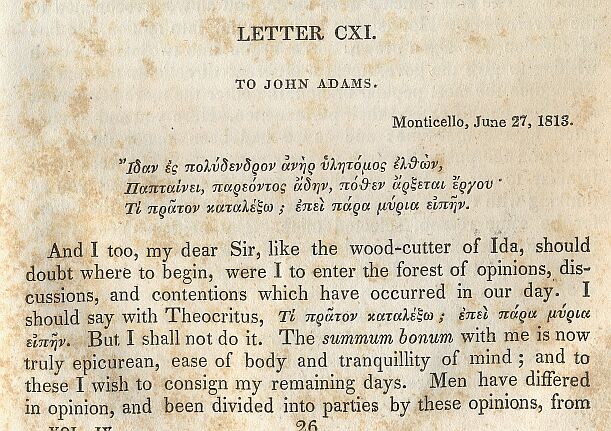
And I too, my dear Sir, like the wood-cutter of Ida, should doubt where to begin, were I to enter the forest of opinions, discussions, and contentions which have occurred in our day. I should say with Theocritus,
But I shall not do it. The summum bonum with me is now truly
epicurean, ease of body and tranquillity of mind; and to these I wish to
consign my remaining days. Men have differed in opinion, and been divided
into parties by these opinions, from the first origin of societies; and in
all governments, where they have been permitted freely to think and to
speak. The same political parties which now agitate the United States,
have existed through all time. Whether the power of the people, or that of
the should prevail, were questions which kept the States of Greece and Rome in
eternal convulsions; as they now schismatize every people whose minds and
mouths are not shut up by the gag of a despot. And in fact, the terms of
whig and tory belong to natural, as well as to civil history. They denote
the temper and constitution of mind of different individuals. To come to
our own country, and to the times when you and I became first acquainted:
we well remember the violent parties which agitated the old Congress, and
their bitter contests. There you and I were together, and the Jays, and
the Dickinsons, and other anti-independents were arrayed against us. They
cherished the monarchy of England, and we the rights of our countrymen.
When our present government was in the mew, passing from Confederation to
Union, how bitter was the schism between the Feds and Antis. Here you and
I were together again. For although, for a moment, separated by the
Atlantic from the scene of action, I favored the opinion that nine States
should confirm the constitution, in order to secure it, and the others
hold off, until certain amendments, deemed favorable to freedom, should be
made. I rallied in the first instant to the wiser proposition of
Massachusetts, that all should confirm, and then all instruct their
delegates to urge those amendments. The amendments were made, and all were
reconciled to the government. But as soon as it was put into motion, the
line of division was again drawn. We broke into two parties, each wishing
to give the government a different direction; the one to strengthen the
most popular branch, the other the more permanent branches, and to extend
their permanence. Here you and I separated for the first time: and as we
had been longer than most others on the public theatre, and our names
therefore were more familiar to our countrymen, the party which considered
you as thinking with them, placed your name at their head; the other, for
the same reason, selected mine. But neither decency nor inclination
permitted us to become the advocates of ourselves, or to take part
personally in the violent contests which followed. We suffered ourselves,
as you so well expressed it, to be passive subjects of public discussion.
And these discussions, whether relating to men, measures, or opinions,
were conducted by the parties with an animosity, a bitterness, and an
indecency, which had never been exceeded. All the resources of reason and
of wrath were exhausted by each party in support of its own, and to
prostrate the adversary opinions; one was upbraided with receiving the
anti-federalists, the other the old tories and refugees, into their bosom.
Of this acrimony, the public papers of the day exhibit ample testimony, in
the debates of Congress, of State legislatures, of stump-orators, in
addresses, answers, and newspaper essays; and to these, without question,
may be added the private correspondences of individuals; and the less
guarded in these, because not meant for the public eye, not restrained by
the respect due to that, but poured forth from the overflowings of the
heart into the bosom of a friend, as a momentary easement of our feelings.
In this way and in answers to addresses, you and I could indulge
ourselves. We have probably done it, sometimes with warmth, often with
prejudice, but always, as we believed, adhering to truth. I have not
examined my letters of that day. I have no stomach to revive the memory of
its feelings. But one of these letters, it seems, has got before the
public, by accident and infidelity, by the death of one friend to whom it
was written, and of his friend to whom it had been communicated, and by
the malice and treachery of a third person, of whom I had never before
heard, merely to make mischief, and in the same Satanic spirit, in which
the same enemy had intercepted and published, in 1776, your letter
animadverting on Dickinson’s character. How it happened that I quoted you
in my letter to Doctor Priestley, and for whom, and not for yourself, the
strictures were meant, has been explained to you in my letter of the 15th,
which had been committed to the post eight days before I received yours of
the 10th, 11th, and 14th. That gave you the reference which these asked to
the particular answer alluded to in the one to Priestley. The renewal of
these old discussions, my friend, would be equally useless and irksome. To
the volumes then written on these subjects, human ingenuity can add
nothing new, and the rather, as lapse of time has obliterated many of the
facts. And shall you and I, my Dear Sir, at our age, like Priam of old,
gird on the
should prevail, were questions which kept the States of Greece and Rome in
eternal convulsions; as they now schismatize every people whose minds and
mouths are not shut up by the gag of a despot. And in fact, the terms of
whig and tory belong to natural, as well as to civil history. They denote
the temper and constitution of mind of different individuals. To come to
our own country, and to the times when you and I became first acquainted:
we well remember the violent parties which agitated the old Congress, and
their bitter contests. There you and I were together, and the Jays, and
the Dickinsons, and other anti-independents were arrayed against us. They
cherished the monarchy of England, and we the rights of our countrymen.
When our present government was in the mew, passing from Confederation to
Union, how bitter was the schism between the Feds and Antis. Here you and
I were together again. For although, for a moment, separated by the
Atlantic from the scene of action, I favored the opinion that nine States
should confirm the constitution, in order to secure it, and the others
hold off, until certain amendments, deemed favorable to freedom, should be
made. I rallied in the first instant to the wiser proposition of
Massachusetts, that all should confirm, and then all instruct their
delegates to urge those amendments. The amendments were made, and all were
reconciled to the government. But as soon as it was put into motion, the
line of division was again drawn. We broke into two parties, each wishing
to give the government a different direction; the one to strengthen the
most popular branch, the other the more permanent branches, and to extend
their permanence. Here you and I separated for the first time: and as we
had been longer than most others on the public theatre, and our names
therefore were more familiar to our countrymen, the party which considered
you as thinking with them, placed your name at their head; the other, for
the same reason, selected mine. But neither decency nor inclination
permitted us to become the advocates of ourselves, or to take part
personally in the violent contests which followed. We suffered ourselves,
as you so well expressed it, to be passive subjects of public discussion.
And these discussions, whether relating to men, measures, or opinions,
were conducted by the parties with an animosity, a bitterness, and an
indecency, which had never been exceeded. All the resources of reason and
of wrath were exhausted by each party in support of its own, and to
prostrate the adversary opinions; one was upbraided with receiving the
anti-federalists, the other the old tories and refugees, into their bosom.
Of this acrimony, the public papers of the day exhibit ample testimony, in
the debates of Congress, of State legislatures, of stump-orators, in
addresses, answers, and newspaper essays; and to these, without question,
may be added the private correspondences of individuals; and the less
guarded in these, because not meant for the public eye, not restrained by
the respect due to that, but poured forth from the overflowings of the
heart into the bosom of a friend, as a momentary easement of our feelings.
In this way and in answers to addresses, you and I could indulge
ourselves. We have probably done it, sometimes with warmth, often with
prejudice, but always, as we believed, adhering to truth. I have not
examined my letters of that day. I have no stomach to revive the memory of
its feelings. But one of these letters, it seems, has got before the
public, by accident and infidelity, by the death of one friend to whom it
was written, and of his friend to whom it had been communicated, and by
the malice and treachery of a third person, of whom I had never before
heard, merely to make mischief, and in the same Satanic spirit, in which
the same enemy had intercepted and published, in 1776, your letter
animadverting on Dickinson’s character. How it happened that I quoted you
in my letter to Doctor Priestley, and for whom, and not for yourself, the
strictures were meant, has been explained to you in my letter of the 15th,
which had been committed to the post eight days before I received yours of
the 10th, 11th, and 14th. That gave you the reference which these asked to
the particular answer alluded to in the one to Priestley. The renewal of
these old discussions, my friend, would be equally useless and irksome. To
the volumes then written on these subjects, human ingenuity can add
nothing new, and the rather, as lapse of time has obliterated many of the
facts. And shall you and I, my Dear Sir, at our age, like Priam of old,
gird on the
Shall we, at our age, become the athletes of party, and exhibit ourselves, as gladiators, in the arena of the newspapers? Nothing in the universe could induce me to it. My mind has been long fixed to bow to the judgment of the world, who will judge by my acts, and will never take counsel from me as to what that judgment shall be. If your objects and opinions have been misunderstood, if the measures and principles of others have been wrongfully imputed to you, as I believe they have been, that you should leave an explanation of them, would be an set of justice to yourself. I will add, that it has been hoped that you would leave such explanations as would place every saddle on its right horse, and replace on the shoulders of others the burdens they shifted to yours.
But all this, my friend, is offered merely for your consideration and judgment, without presuming to anticipate what you alone are qualified to decide for yourself. I mean to express my own purpose only, and the reflections which have led to it. To me, then, it appears, that there have been differences of opinion and party differences, from the first establishment of governments to the present day, and on the same question which now divides our own country: that these will continue through all future time: that every one takes his side in favor of the many, or of the few, according to his constitution, and the circumstances in which he is placed: that opinions, which are equally honest on both sides, should not affect personal esteem or social intercourse: that as we judge between the Claudii and the Gracchi, the Wentworths and the Hampdens of past ages, so, of those among us whose names may happen to be remembered for a while, the next generations will judge, favorably or unfavorably, according to the complexion of individual minds, and the side they shall themselves have taken: that nothing new can be added by you or me to what has been said by others, and will be said in every age in support of the conflicting opinions on government: and that wisdom and duty dictate an humble resignation to the verdict of our future peers. I doing this myself, I shall certainly not suffer moot questions to affect the sentiments of sincere friendship and respect, consecrated to you by so long a course of time, and of which I now repeat sincere assurances,
Th: Jefferson.
TO JOHN ADAMS.
Monticello, August 22, 1813.
Dear Sir,
Since my letter of June the 27th, I am in your debt for many; all of which
I have read with infinite delight. They open a wide field for reflection,
and offer subjects enough to occupy the mind and the pen indefinitely. I
must follow the good example you have set; and when I have not time to
take up every subject, take up a single one. Your approbation of my
outline to Dr. Priestley is a great gratification to me; and I very much
suspect that if thinking men would have the courage to think for
themselves, and to speak what they think, it would be found they do not
differ in religious opinions, as much as is supposed. I remember to have
heard Dr. Priestley say, that if all England would candidly examine
themselves, and confess, they would find that Unitarianism was really the
religion of all: and I observe a bill is now depending in parliament for
the relief of Anti-Trinitarians. It is too late in the day for men of
sincerity to pretend they believe in the Platonic mysticisms that three
are one, and one is three; and yet that the one is not three, and the
three are not one: to divide mankind by a single letter into

But this constitutes the craft, the power, and the profit of the priests. Sweep away their gossamer fabrics of factitious religion, and they would catch no more flies. We should all then, like the Quakers, live without an order of priests, moralize for ourselves, follow the oracle of conscience, and say nothing about what no man can understand, nor therefore believe; for I suppose belief to be the assent of the mind to an intelligible proposition.
It is with great pleasure I can inform you, that Priestley finished the comparative view of the doctrines of the philosophers of antiquity, and of Jesus, before his death; and that it was printed soon after. And with still greater pleasure, that I can have a copy of his work forwarded from Philadelphia, by a correspondent there, and presented for your acceptance, by the same mail which carries you this, or very soon after. The branch of the work which the title announces, is executed with learning and candor, as was every thing Priestley wrote: but perhaps a little hastily; for he felt himself pressed by the hand of death. The Abbe Batteux had, in fact, laid the foundation of this part in his ‘Causes Premieres’; with which he has given us the originals of Ocellus and Timzeus, who first committed the doctrines of Pythagoras to writing: and Enfield, to whom the Doctor refers, had done it more copiously. But he has omitted the important branch, which, in your letter of August the 9th, you say you have never seen executed, a comparison of the morality of the Old Testament with that of the New. And yet, no two things were ever more unlike. I ought not to have asked him to give it. He dared not. He would have been eaten alive by his intolerant brethren, the Cannibal priests. And yet, this was really the most interesting branch of the work.
Very soon after my letter to Doctor Priestley, the subject being still in my mind, I had leisure, during an abstraction from business for a day or two, while on the road, to think a little more on it, and to sketch more fully than I had done to him, a syllabus of the matter which I thought should enter into the work. I wrote it to Doctor Rush; and there ended all my labor on the subject; himself and Doctor Priestley being the only depositories of my secret. The fate of my letter to Priestley, after his death, was a warning to me on that of Doctor Rush; and at my request, his family were so kind as to quiet me by returning my original letter and syllabus. By this you will be sensible how much interest I take in keeping myself clear of religious disputes before the public; and especially of seeing my syllabus disembowelled by the Aruspices of the modern Paganism. Yet I enclose it to you with entire confidence, free to be perused by yourself and Mrs. Adams, but by no one else; and to be returned to me.
You are right in supposing, in one of yours, that I had not read much of Priestley’s Predestination, his no-soul system, or his controversy with Horsley. But I have read his Corruptions of Christianity, and Early Opinions of Jesus, over and over again; and I rest on them, and on Middleton’s writings, especially his letters from Rome, and to Waterland, as the basis of my own faith. These writings have never been answered, nor can be answered by quoting historical proofs, as they have done. For these facts, therefore, I cling to their learning, so much superior to my own.
I now fly off in a tangent to another subject. Marshall, in the first volume of his history, chapter 3, p. 180, ascribes the petition to the King, of 1774, (1 Journ. Cong. 67) to the pen of Richard Henry Lee. I think myself certain, it was not written by him, as well from what I recollect to have heard, as from the internal evidence of style. He was loose, vague, frothy, rhetorical. He was a poorer writer than his brother Arthur; and Arthur’s standing may be seen in his Monitor’s Letters, to insure the sale of which, they took the precaution of tacking to them a new edition of the Farmer’s Letters; like Mezentius, who ‘mortua jungebat corpora vivis.’ You were of the committee, and can tell me who wrote this petition; and who wrote the Address to the Inhabitants of the Colonies, ib. 45. Of the papers of July 1775, I recollect well that Mr. Dickinson drew the petition to the King, ib. 149; I think Robert R. Livingston drew the Address to the Inhabitants of Great Britain, ib. 152. Am I right in this? And who drew the Address to the People of Ireland, ib. 180? On these questions, I ask of your memory to help mine. Ever and affectionately yours,
Th: Jefferson.
Monticello, November 6, 1813.
Dear Sir,
I had not expected to have troubled you again on the subject of finance; but since the date of my last, I have received from Mr. Law a letter covering a memorial on that subject, which, from its tenor, I conjecture must have been before Congress at their two last sessions. This paper contains two propositions; the one for issuing treasury notes, bearing interest, and to be circulated as money; the other for the establishment of a national bank. The first was considered in my former letter; and the second shall be the subject of the present.
The scheme is for Congress to establish a national bank, suppose of thirty millions capital, of which they shall contribute ten millions in new six per cent, stock, the States ten millions, and individuals ten millions, one half of the two last contributions to be of similar stock, for which the parties are to give cash to Congress: the whole, however, to be under the exclusive management of the individual subscribers, who are to name all the directors; neither Congress nor the States having any power of interference in its administration. Discounts are to be at five per cent., but the profits are expected to be seven per cent. Congress then will be paying six per cent, on twenty millions, and receiving seven per cent, on ten millions, being its third of the institution: so that on the ten millions cash which they receive from the States and individuals, they will, in fact, have to pay but five per cent, interest. This is the bait. The charter is proposed to be for forty or fifty years, and if any future augmentations should take place, the individual proprietors are to have the privilege of being the sole subscribers for that. Congress are further allowed to issue to the amount of three millions of notes, bearing interest, which they are to receive back in payment for lands at a premium of five or ten per cent., or as subscriptions for canals, roads, and bridges, in which undertakings they are, of course, to be engaged. This is a summary of the scheme, as I understand it: but it is very possible I may not understand it in all its parts, these schemes being always made Unintelligible for the gulls who are to enter into them. The advantages and disadvantages shall be noted promiscuously as they occur; leaving out the speculation of canals, &c. which, being an episode only in the scheme, may be omitted, to disentangle it as much as we can.
1. Congress are to receive five millions from the States (if they will enter into this partnership, which few probably will), and five millions from the individual subscribers, in exchange for ten millions of six per cent, stock, one per cent, of which, however, they will make on their ten millions of stock remaining in bank, and so reduce it, in effect, to a loan of ten millions at five per cent, interest. This is good: but
2. They authorize this bank to throw into circulation ninety millions of dollars, (three times the capital), which increases our circulating medium fifty per cent., depreciates proportionably the present value of the dollar, and raises the price of all future purchases in the same proportion.
3. This loan of ten millions at five per cent., is to be once for all, only. Neither the terms of the scheme, nor their own prudence could ever permit them to add to the circulation in the same, or any other way, for the supplies of the succeeding years of the war. These succeeding years then are to be left unprovided for, and the means of doing it in a great measure precluded.
4. The individual subscribers, on paying their own five millions of cash to Congress, become the depositories of ten millions of stock belonging to Congress, five millions belonging to the States, and five millions to themselves, say twenty millions, with which, as no one has a right ever to see their books, or to ask a question, they may choose their time for running away, after adding to their booty the proceeds of as much of their own notes as they shall be able to throw into circulation.
5. The subscribers may be one, two, or three, or more individuals, (many single individuals being able to pay in the five millions,) whereupon this bank oligarchy or monarchy enters the field with ninety millions of dollars, to direct and control the politics of the nation; and of the influence of these institutions on our politics, and into what scale it will be thrown, we have had abundant experience. Indeed, England herself may be the real, while her friend and trustee here shall be the nominal and sole subscriber.
6. This state of things is to be fastened on us, without the power of relief, for forty or fifty years. That is to say, the eight millions of people now existing, for the sake of receiving one dollar and twenty-five cents apiece at five per cent, interest, are to subject the fifty millions of people who are to succeed them within that term, to the payment of forty-five millions of dollars, principal and interest, which will be payable in the course of the fifty years.
7. But the great and national advantage is to be the relief of the present scarcity of money, which is produced and proved by,
1. The additional industry created to supply a variety of articles for the troops, ammunition, he.
2. By the cash sent to the frontiers, and the vacuum occasioned in the trading towns by that.
3. By the late loans.
4. By the necessity of recurring to shavers with good paper, which the existing banks are not able to take up; and
5. By the numerous applications for bank charters, showing that an increase of circulating medium is wanting.
Let us examine these causes and proofs of the want of an increase of medium, one by one.
1. The additional industry created to supply a variety of articles for troops, ammunition, &c. Now I had always supposed that war produced a diminution of industry, by the number of hands it withdraws from industrious pursuits, for employment in arms &c. which are totally unproductive. And if it calls for new industry in the articles of ammunition and other military supplies, the hands are borrowed from other branches on which the demand is slackened by the war; so that it is but a shifting of these hands from one pursuit to another.
2. The cash sent to the frontiers occasions a vacuum in the trading towns, which requires a new supply. Let us examine what are the calls for money to the frontiers. Not for clothing, tents, ammunition, arms, which are all bought in the trading towns. Not for provisions; for although these are bought partly in the intermediate country, bank-bills are more acceptable there than even in the trading towns. The pay of the army calls for some cash; but not a great deal, as bank-notes are as acceptable with the military men, perhaps more so; and what cash is sent must find its way back again, in exchange for the wants of the upper from the lower country. For we are not to suppose that cash stays accumulating there for ever.
3. This scarcity has been occasioned by the late loans. But does the government borrow money to keep it in their coffers? Is it not instantly restored to circulation by payment for its necessary supplies? And are we to restore a vacuum of twenty millions of dollars by an emission of ninety millions?
4. The want of medium is proved by the recurrence of individuals with good paper to brokers at exorbitant interest; and
5. By the numerous applications to the State governments for additional banks; New York wanting eighteen millions, Pennsylvania ten millions, &c. But say more correctly, the speculators and spendthrifts of New York and Pennsylvania, but never consider them as being the States of New York and Pennsylvania. These two items shall be considered together.
It is a litigated question, whether the circulation of paper, rather than of specie, is a good or an evil. In the opinion of England and of English writers it is a good; in that of all other nations it is an evil; and excepting England and her copyist, the United States, there is not a nation existing, I believe, which tolerates a paper circulation. The experiment is going on, however, desperately in England, pretty boldly with us, and at the end of the chapter, we shall see which opinion experience approves: for I believe it to be one of those cases where mercantile clamor will bear down reason, until it is corrected by ruin. In the mean time, however, let us reason on this new call for a national bank.
After the solemn decision of Congress against the renewal of the charter of the bank of the United States, and the grounds of that decision (the want of constitutional power), I had imagined that question at rest, and that no more applications would be made to them for the incorporation of banks. The opposition on that ground to its first establishment, the small majority by which it was overborne, and the means practised for obtaining it, cannot be already forgotten. The law having passed, however, by a majority, its opponents, true to the sacred principle of submission to a majority, suffered the law to flow through its term without obstruction. During this, the nation had time to consider the constitutional question, and when the renewal was proposed, they condemned it, not by their representatives in Congress only, but by express instructions from different organs of their will. Here then we might stop, and consider the memorial as answered. But, setting authority apart, we will examine whether the legislature ought to comply with it, even if they had the power.
Proceeding to reason on this subject, some principles must be premised as forming its basis. The adequate price of a thing depends on the capital and labor necessary to produce it. (In the term capital, I mean to include science, because capital as well as labor has been employed to acquire it.) Two things requiring the same capital and labor should be of the same price. If a gallon of wine requires for its production the same capital and labor with a bushel of wheat, they should be expressed by the same price, derived from the application of a common measure to them. The comparative prices of things being thus to be estimated, and expressed by a common measure, we may proceed to observe, that were a country so insulated as to have no commercial intercourse with any other, to confine the interchange of all its wants and supplies within itself, the amount of circulating medium, as a common measure for adjusting these exchanges, would be quite immaterial. If their circulation, for instance, were of a million of dollars, and the annual produce of their industry equivalent to ten millions of bushels of wheat, the price of a bushel of wheat might be one dollar. If, then, by a progressive coinage, their medium should be doubled, the price of a bushel of wheat might become progressively two dollars, and without, inconvenience. Whatever be the proportion of the circulating medium to the value of the annual produce of industry, it may be considered as the representative of that industry. In the first case, a bushel of wheat will be represented by one dollar; in the second, by two dollars. This is well explained by Hume, and seems admitted by Adam Smith, (B. 2. c. 2. 436, 441, 490.) But where a nation is in a full course of interchange of wants and supplies with all others, the proportion of its medium to its produce is no longer indifferent, (lb. 441.) To trade on equal terms, the common measure of values should be as nearly as possible on a par with that of its corresponding nations, whose medium is in a sound state; that is to say, not in an accidental state of excess or deficiency. Now, one of the great advantages of specie as a medium is, that being of universal value, it will keep itself at a general level, flowing out from where it is too high into parts where it is lower. Whereas, if the medium be of local value only, as paper-money, if too little, indeed, gold and silver will flow in to supply the deficiency; but if too much, it accumulates, banishes the gold and silver not locked up in vaults and hoards, and depreciates itself; that is to say, its proportion to the annual produce of industry being raised, more of it is required to represent any particular article of produce than in the other countries. This is agreed by Smith (B. 2. c. 2. 437.), the principal advocate for a paper circulation; but advocating it on the sole condition that it be strictly regulated. He admits, nevertheless, that ‘the commerce and industry of a country cannot be so secure when suspended on the Daedalian wings of paper-money, as on the solid ground of gold and silver; and that in time of war the insecurity is greatly increased, and great confusion possible where the circulation is for the greater part in paper.‘(B. 2. c. 2. 484.) But in a country where loans are uncertain, and a specie circulation the only sure resource for them, the preference of that circulation assumes a far different degree of importance, as is explained in my former letters.
The only advantage which Smith proposes by substituting paper in the room of gold and silver money (B. 2. c. 2. 434.), is, ‘to replace an expensive instrument with one much less costly, and sometimes equally convenient’; that is to say, (page 437,) to allow the gold and silver to be sent abroad and converted into foreign goods,’ and to substitute paper as being a cheaper measure. But this makes no addition to the stock or capital of the nation. The coin sent out was worth as much, while in the country, as the goods imported and taking its place. It is only, then, a change of form in a part of the national capital, from that of gold and silver to other goods. He admits, too, that while a part of the goods received in exchange for the coin exported, may be materials, tools, and provisions for the employment of an additional industry, a part also may be taken back in foreign wines, silks, &c. to be consumed by idle people who produce nothing; and so far the substitution promotes prodigality, increases expense and consumption, without increasing production. So far also, then, it lessens the capital of the nation. What may be the amount which the conversion of the part exchanged for productive goods, may add to the former productive mass, it is not easy to ascertain, because, as he says, (page 441,) ‘It is impossible to determine what is the proportion which the circulating money of any country bears to the whole value of the annual produce. It has been computed by different authors, from a fifth* to a thirtieth of that value.’
     * The real cash or money necessary to carry on the
     circulation and barter of a State, is nearly one third part
     of all the annual rents of the proprietors of the said
     State; that is, one ninth of the whole produce of the land.
     Sir William Petty supposes one tenth part of the value of
     the whole produce sufficient. Postlethwayt, voce, Cash.
In the United States it must be less than in any other part of the commercial world; because the great mass of their inhabitants being in responsible circumstances, the great mass of their exchanges in the country is effected on credit, in their merchant’s ledger, who supplies all their wants through the year, and at the end of it receives the produce of their farms, or other articles of their industry. It is a fact, that a farmer, with a revenue of ten thousand dollars a year, may obtain all his supplies from his merchant, and liquidate them at the end of the year, by the sale of his produce to him, without the intervention of a single dollar of cash. This, then, is merely barter, and in this way of barter a great portion of the annual produce of the United States is exchanged without the intermediation of cash. We might safely, then, state our medium at the minimum of one thirtieth. But what is one thirtieth of the value of the annual produce of the industry of the United States? Or what is the whole value of the annual produce of the United States? An able writer and competent judge of the subject, in 1799, on as good grounds as probably could be taken, estimated it, on the then population of four and a half millions of inhabitants, to be thirty-seven and a half millions sterling, or one hundred and sixty-eight and three fourths millions of dollars. See Cooper’s Political Arithmetic, page 47. According to the same estimate, for our present population it will be three hundred millions of dollars, one thirtieth of which, Smith’s minimum, would be ten millions, and one fifth, his maximum, would be sixty millions for the quantum of circulation. But suppose, that, instead of our needing the least circulating medium of any nation, from the circumstance before mentioned, we should place ourselves in the middle term of the calculation, to wit, at thirty-five millions. One fifth of this, at the least, Smith thinks should be retained in specie, which would leave twenty-eight millions of specie to be exported in exchange for other commodities; and if fifteen millions of that should be returned in productive goods, and not in articles of prodigality, that would be the amount of capital which this operation would add to the existing mass. But to what mass? Not that of the three hundred millions, which is only its gross annual produce; but to that capital of which the three hundred millions are but the annual produce. But this being gross, we may infer from it the value of the capital by considering that the rent of lands is generally fixed at one third of the gross produce, and is deemed its nett profit, and twenty times that its fee simple value. The profits on landed capital may, with accuracy enough for our purpose, be supposed on a par with those of other capital. This would give us then for the United States, a capital of two thousand millions, all in active employment, and exclusive of unimproved lands lying in a great degree dormant. Of this, fifteen millions would be the hundred and thirty-third part. And it is for this petty addition to the capital of the nation, this minimum of one dollar, added to one hundred and thirty-three and a third, or three fourths per cent., that we are to give up our gold and silver medium, its intrinsic solidity, its universal value, and its saving powers in time of war, and to substitute for it paper, with all its train of evils, moral, political, and physical, which I will not pretend to enumerate.
There is another authority to which we may appeal for the proper quantity of circulating medium for the United States. The old Congress, when we were estimated at about two millions of people, on a long and able discussion, June the 22nd, 1775, decided the sufficient quantity to be two millions of dollars, which sum they then emitted.* According to this, it should be eight millions, now that we are eight millions of people. This differs little from Smith’s minimum of ten millions, and strengthens our respect for that estimate.
     * Within five months after this they were compelled, by the
     necessities of the war, to abandon the idea of emitting only
     an adequate circulation, and to make those necessities the
     sole measure of their emissions.
There is, indeed, a convenience in paper; its easy transmission from one place to another. But this may be mainly supplied by bills of exchange, so as to prevent any great displacement of actual coin. Two places trading together balance their dealings, for the most part, by their mutual supplies, and the debtor individuals of either may, instead of cash, remit the bills of those who are creditors in the same dealings; or may obtain them through some third place with which both have dealings. The cases would be rare where such bills could not be obtained, either directly or circuitously, and too unimportant to the nation to overweigh the train of evils flowing from paper circulation.
From eight to thirty-five millions then being our proper circulation, and two hundred millions the actual one, the memorial proposes to issue ninety millions more, because, it says, a great scarcity of money is proved by the numerous applications for banks; to wit, New York for eighteen millions, Pennsylvania ten millions, &c. The answer to this shall be quoted, from Adam Smith (B. 2, c. 2, page 462), where speaking of the complaints of the traders against the Scotch bankers, who had already gone too far in their issues of paper, he says, ‘Those traders and other undertakers having got so much assistance from banks, wished to get still more. The banks, they seem to have thought, could extend their credits to whatever sum might be wanted, without incurring any other expense besides that of a few reams of paper. They complained of the contracted views and dastardly spirit of the directors of those banks, which did not, they said, extend their credits in proportion to the extension of the trade of the country; meaning, no doubt, by the extension of that trade, the extension of their own projects beyond what they could carry on, either with their own capital, or with what they had credit to borrow of private people in the usual way of bond or mortgage. The banks, they seem to have thought, were in honor bound to supply the deficiency, and to provide them with all the capital which they wanted to trade with.’ And again (page 470): ‘When bankers discovered that certain projectors were trading, not with any capital of their own, but with that which they advanced them, they endeavored to withdraw gradually, making every day greater and greater difficulties about discounting. These difficulties alarmed and enraged in the highest degree those projectors. Their own distress, of which this prudent and necessary reserve of the banks was no doubt the immediate occasion, they called the distress of the country; and this distress of the country, they said, was altogether owing to the ignorance, pusillanimity, and bad conduct of the banks, which did not give a sufficiently liberal aid to the spirited undertakings of those who exerted themselves in order to beautify, improve, and enrich the country. It was the duty of the banks, they seemed to think, to lend for as long a time, and to as great an extent, as they might wish to borrow.’ It is, probably, the good paper of these projectors, which, the memorial says, the banks being unable to discount, goes into the hands of brokers, who (knowing the risk of this good paper) discount it at a much higher rate than legal interest, to the great distress of the enterprising adventurers, who had rather try trade on borrowed capital, than go to the plough or other laborious calling. Smith again says, (page 478,) ‘That the industry of Scotland languished for want of money to employ it, was the opinion of the famous Mr. Law. By establishing a bank of a particular kind, which he seems to have imagined might issue paper to the amount of the whole value of all the lands in the country, he proposed to remedy this want of money. It was afterwards adopted, with some variations, by the Duke of Orleans, at that time Regent of France. The idea of the possibility of multiplying paper to almost any extent, was the real foundation of what is called the Mississippi scheme, the most extravagant project both of banking and stockjobbing, that perhaps the world ever saw. The principles upon which it was founded are explained by Mr. Law himself, in a discourse concerning money and trade, which he published in Scotland when he first proposed his project. The splendid but visionary ideas which are set forth in that and some other works upon the same principles, still continue to make an impression upon many people, and have perhaps, in part, contributed to that excess of banking which has of late been complained of both in Scotland and in other places.’ The Mississippi scheme, it is well known, ended in France in the bankruptcy of the public treasury, the crush of thousands and thousands of private fortunes, and scenes of desolation and distress equal to those of an invading army, burning and laying waste all before it.
At the time we were funding our national debt, we heard much about ‘a public debt being a public blessing’; that the stock representing it was a creation of active capital for the aliment of commerce, manufactures, and agriculture. This paradox was well adapted to the minds of believers in dreams, and the gulls of that size entered bonâ fide into it. But the art and mystery of banks is a wonderful improvement on that. It is established on the principle, that ‘private debts are a public blessing;’ that the evidences of those private debts, called bank-notes, become active capital, and aliment the whole commerce, manufactures, and agriculture of the United States. Here are a set of people, for instance, who have bestowed on us the great blessing of running in our debt about two hundred millions of dollars, without our knowing who they are, where they are, or what property they have to pay this debt when called on; nay, who have made us so sensible of the blessings of letting them run in our debt, that we have exempted them by law from the repayment of these debts beyond a given proportion, (generally estimated at one third.) And to fill up the measure of blessing, instead of paying, they receive an interest on what they owe from those to whom they owe; for all the notes, or evidences of what they owe, which we see in circulation, have been lent to somebody on an interest which is levied again on us through the medium of commerce. And they are so ready still to deal out their liberalities to us, that they are now willing to let themselves run in our debt ninety millions more, on our paying them the same premium of six or eight per cent, interest, and on the same legal exemption from the repayment of more than thirty millions of the debt, when it shall be called for. But let us look at this principle in its original form, and its copy will then be equally understood. ‘A public debt is a public blessing.’ That our debt was juggled from forty-three up to eighty millions, and funded at that amount, according to this opinion, was a great public blessing, because the evidences of it could be vested in commerce, and thus converted into active capital, and then the more the debt was made to be, the more active capital was created. That is to say, the creditors could now employ in commerce the money due them from the public, and make from it an annual profit of five per cent., or four millions of dollars. But observe, that the public were at the same time paying on it an interest of exactly the same amount of four millions of dollars. Where then is the gain to either party, which makes it a public blessing? There is no change in the state of things, but of persons only. A has a debt due to him from the public, of which he holds their certificate as evidence, and on which he is receiving an annual interest. He wishes, however, to have the money itself, and to go into business with it. B has an equal sum of money in business, but wishes now to retire, and live on the interest. He therefore gives it to A, in exchange for A’s certificates of public stock. Now, then, A has the money to employ in business, which B so employed before. B has the money on interest to live on, which A lived on before: and the public pays the interest to B, which they paid to A before. Here is no new creation of capital, no additional money employed, nor even a change in the employment of a single dollar. The only change is of place between A and B, in which we discover no creation of capital, nor public blessing. Suppose, again, the public to owe nothing. Then A not having lent his money to the public, would be in possession of it himself, and would go into business without the previous operation of selling stock. Here again, the same quantity of capital is employed as in the former case, though no public debt exists. In neither case is there any creation of active capital, nor other difference than that there is a public debt in the first case, and none in the last; and we may safely ask which of the two situations is most truly a public blessing? If, then, a public debt be no public blessing, we may pronounce a fortiori, that a private one cannot be so. If the debt which the banking companies owe be a blessing to any body, it is to themselves alone, who are realizing a solid interest of eight or ten per cent, on it. As to the public, these companies have banished all our gold and silver medium, which, before their institution, we had without interest, which never could have perished in our hands, and would have been our salvation now in the hour of war; instead of which, they have given us two hundred millions of froth and bubble, on which we are to pay them heavy interest, until it shall vanish into air, as Morris’s notes did. We are warranted, then, in affirming that this parody on the principle of ‘a public debt being a public blessing,’ and its mutation into the blessing of private instead of public debts, is as ridiculous as the original principle itself. In both cases, the truth is, that capital may be produced by industry, and accumulated by economy: but jugglers only will propose to create it by legerdemain tricks with paper. I have called the actual circulation of bank paper in the United States, two hundred millions of dollars. I do not recollect where I have seen this estimate; but I retain the impression that I thought it just at the time. It may be tested, however, by a list of the banks now in the United States, and the amount of their capital. I have no means of recurring to such a list for the present day: but I turn to two lists in my possession for the years of 1803 and 1804.
In 1803, there were thirty-four banks, whose capital was $28,902,000
In 1804, there were sixty-six, consequently thirty-two additional ones. Their capital is not stated, but at the average of the others (excluding the highest, that of the United States, which was of ten millions) they would be of six hundred thousand dollars each, and add.........19,200,000
Making a total of........ $48,102,000
or say, of fifty millions in round numbers. Now every one knows the immense multiplication of these institutions since 1804. If they have only doubled, their capital will be of one hundred millions, and if trebled, as I think probable, it will be of one hundred and fifty millions, on which they are at liberty to circulate treble the amount. I should sooner, therefore, believe two hundred millions to be far below than above the actual circulation. In England, by a late parliamentary document, (see Virginia Argus of October the 18th, 1813, and other public papers of about that date) it appears that six years ago, the bank of England had twelve millions of pounds sterling in circulation, which had increased to forty-two millions in 1812, or to one hundred and eighty-nine millions of dollars. What proportion all the other banks may add to this, I do not know: if we were allowed to suppose they equal it, this would give a circulation of three hundred and seventy-eight millions, or the double of ours on a double population. But that nation is essentially commercial, ours essentially agricultural, and needing, therefore, less circulating medium, because the produce of the husbandman comes but once a year, and is then partly consumed at home, partly exchanged by barter. The dollar, which was of four shillings and six pence sterling, was, by the same document, stated to be then six shillings and nine pence, a depreciation of exactly fifty per cent. The average price of wheat on the continent of Europe, at the commencement of its present war with England, was about a French crown, of one hundred and ten cents, the bushel. With us it was one hundred cents, and consequently we could send it there in competition with their own. That ordinary price has now doubled with us, and more than doubled in England; and although a part of this augmentation may proceed from the war demand, yet from the extraordinary nominal rise in the prices of land and labor here, both of which have nearly doubled in that period, and are still rising with every new bank, it is evident that were a general peace to take place to-morrow, and time allowed for the re-establishment of commerce, justice, and order, we could not afford to raise wheat for much less than two dollars, while the continent of Europe, having no paper circulation, and that of its specie not being augmented, would raise it at their former price of one hundred and ten cents. It follows, then, that with our redundancy of paper, we cannot, after peace, send a bushel of wheat to Europe, unless extraordinary circumstances double its price in particular places, and that then the exporting countries of Europe could undersell us. It is said our paper is as good as silver, because we may have silver for it at the bank where it issues. This is not true. One, two, or three persons might have it: but a general application would soon exhaust their vaults, and leave a ruinous proportion of their paper in its intrinsic worthless form. It is a fallacious pretence, for another reason. The inhabitants of the banking cities might obtain cash for their paper, as far as the cash of the vaults would hold out; but distance puts it out of the power of the country to do this. A farmer having a note of a Boston or Charleston bank, distant hundreds of miles, has no means of calling for the cash. And while these calls are impracticable for the country, the banks have no fear of their being made from the towns; because their inhabitants are mostly on their books, and there on sufferance only and during good behavior.
In this state of things, we are called on to add ninety millions more to the circulation. Proceeding in this career, it is infallible, that we must end where the revolutionary paper ended. Two hundred millions was the whole amount of all the emissions of the old Congress, at which point their bills ceased to circulate. We are now at that sum; but with treble the population, and of course a longer tether. Our depreciation is, as yet, but at about two for one. Owing to the support its credit receives from the small reservoirs of specie in the vaults of the banks, it is impossible to say at what point their notes will stop. Nothing is necessary to effect it but a general alarm; and that may take place whenever the public shall begin to reflect on, and perceive, the impossibility that the banks should repay this sum. At present, caution is inspired no farther than to keep prudent men from selling property on long payments. Let us suppose the panic to arise at three hundred millions, a point to which every session of the legislatures hastens us by long strides. Nobody dreams that they would have three hundred millions of specie to satisfy the holders of their notes. Were they even to stop now, no one supposes they have two hundred millions in cash, or even the sixty-six and two-thirds millions, to which amount alone the law obliges them to repay. One hundred and thirty-three and one-third millions of loss, then, is thrown on the public by law; and as to the sixty-six and two-thirds, which they are legally bound to pay, and ought to have in their vaults, every one knows there is no such amount of cash in the United States, and what would be the course with what they really have there? Their notes are refused. Cash is called for. The inhabitants of the banking towns will get what is in the vaults, until a few banks declare their insolvency; when, the general crush becoming evident, the others will withdraw even the cash they have, declare their bankruptcy at once, and leave an empty house and empty coffers for the holders of their notes. In this scramble of creditors, the country gets nothing, the towns but little. What are they to do? Bring suits? A million of creditors bring a million of suits against John Nokes and Robert Styles, wheresoever to be found? All nonsense. The loss is total. And a sum is thus swindled from our citizens, of seven times the amount of the real debt, and four times that of the factitious one of the United States, at the close of the war. All this they will justly charge on their legislatures; but this will be poor satisfaction for the two or three hundred millions they will have lost. It is time, then, for the public functionaries to look to this. Perhaps it may not be too late. Perhaps, by giving time to the banks, they may call in and pay off their paper by degrees. But no remedy is ever to be expected while it rests with the State legislatures. Personal motives can be excited through so many avenues to their will, that, in their hands, it will continue to go on from bad to worse, until the catastrophe overwhelms us. I still believe, however, that on proper representations of the subject, a great proportion of these legislatures would cede to Congress their power of establishing banks, saving the charter rights already granted. And this should be asked, not by way of amendment to the constitution, because until three fourths should consent, nothing could be done; but accepted from them one by one, singly, as their consent might be obtained. Any single State, even if no other should come into the measure, would find its interest in arresting foreign bank-paper immediately, and its own by degrees. Specie would flow in on them as paper disappeared. Their own banks would call in and pay off their notes gradually, and their constituents would thus be saved from the general wreck. Should the greater part of the States concede, as is expected, their power over banks to Congress, besides insuring their own safety, the paper of the non-conceding States might be so checked and circumscribed, by prohibiting its receipt in any of the conceding States, and even in the non-conceding as to duties, taxes, judgments, or other demands of the United States, or of the citizens of other States, that it would soon die of itself, and the medium of gold and silver be universally restored. This is what ought to be done. But it will not be done. Carthago non delebitur. The overbearing clamor of merchants, speculators, and projectors, will drive us before them with our eyes open, until, as in France, under the Mississippi bubble, our citizens will be overtaken by the crash of this baseless fabric, without other satisfaction than that of execrations on the heads of those functionaries, who, from ignorance, pusillanimity, or corruption, have betrayed the fruits of their industry into the hands of projectors and swindlers.
When I speak comparatively of the paper emissions of the old Congress and the present banks, let it not be imagined that I cover them under the same mantle. The object of the former was a holy one; for if ever there was a holy war, it was that which saved our liberties and gave us independence. The object of the latter, is to enrich swindlers at the expense of the honest and industrious part of the nation.
The sum of what has been said is, that pretermitting the constitutional question on the authority of Congress, and considering this application on the grounds of reason alone, it would be best that our medium should be so proportioned to our produce, as to be on a par with that of the countries with which we trade, and whose medium is in a sound state: that specie is the most perfect medium, because it will preserve its own level; because, having intrinsic and universal value, it can never die in our hands, and it is the surest resource of reliance in time of war: that the trifling economy of paper, as a cheaper medium, or its convenience for transmission, weighs nothing in opposition to the advantages of the precious metals: that it is liable to be abused, has been, is, and for ever will be abused, in every country in which it is permitted; that it is already at a term of abuse in these States, which has never been reached by any other nation, France excepted, whose dreadful catastrophe should be a warning against the instrument which produced it: that we are already at ten or twenty times the due quantity of medium; insomuch, that no man knows what his property is now worth, because it is bloating while he is calculating; and still less what it will be worth when the medium shall be relieved from its present dropsical state: and that it is a palpable falsehood to say we can have specie for our paper whenever demanded. Instead, then, of yielding to the cries of scarcity of medium set up by speculators, projectors, and commercial gamblers, no endeavors should be spared to begin the work of reducing it by such gradual means as may give time to private fortunes to preserve their poise, and settle down with the subsiding medium; and that, for this purpose, the States should be urged to concede to the General Government, with a saving of chartered rights, the exclusive power of establishing banks of discount for paper.
To the existence of banks of discount for cash, as on the continent of Europe, there can be no objection, because there can be no danger of abuse, and they are a convenience both to merchants and individuals. I think they should even be encouraged, by allowing them a larger than legal, interest on short discounts, and tapering thence, in proportion as the term of discount is lengthened, down to legal interest on those of a year or more. Even banks of deposite, where cash should be lodged, and a paper acknowledgment taken out as its representative, entitled to a return of the cash on demand, would be convenient for remittances, travelling persons, he. But, liable as its cash would be to be pilfered and robbed, and its paper to be fraudulently re-issued, or issued without deposite, it would require skilful and strict regulation. This would differ from the bank of Amsterdam, in the circumstance that the cash could be re-demanded on returning the note.
When I commenced this letter to you, my dear Sir, on Mr. Law’s memorial, I expected a short one would have answered that. But as I advanced, the subject branched itself before me into so many collateral questions, that even the rapid views I have taken of each have swelled the volume of my letter beyond my expectations, and, I fear, beyond your patience. Yet on a revisal of it, I find no part which has not so much bearing on the subject as to be worth merely the time of perusal. I leave it then as it is; and will add only the assurances of my constant and affectionate esteem and respect.
Th: Jefferson.
TO JOHN ADAMS.
Monticello, October 13, 1813.
Dear Sir,
Since mine of August the 22nd, I have received your favors of August the 16th, September the 2nd, 14th, 15th, and, and Mrs. Adams’s, of September the 20th. I now send you, according to your request, a copy of the syllabus. To fill up this skeleton with arteries, with veins, with nerves, muscles, and flesh, is really beyond my time and information. Whoever could undertake it, would find great aid in Enfield’s judicious abridgment of Brucker’s History of Philosophy, in which he has reduced five or six quarto volumes, of one thousand pages each of Latin closely printed, to two moderate octavos of English open type.
To compare the morals of the Old, with those of the New Testament, would require an attentive study of the former, a search through all its books for its precepts, and through all its history for its practices, and the principles they prove. As commentaries, too, on these, the philosophy of the Hebrews must be inquired into, their Mishna, their Gemara, Cabbala, Jezirah, Sonar, Cosri, and their Talmud, must be examined and understood, in order to do them full justice. Brucker, it would seem, has gone deeply into these repositories of their ethics, and Enfield his epitomizer, concludes in these words. ‘Ethics were so little understood among the Jews, that, in their whole compilation called the Talmud, there is only one treatise on moral subjects. Their books of morals chiefly consisted in a minute enumeration of duties. From the law of Moses were deduced six hundred and thirteen precepts, which were divided into two classes, affirmative and negative, two hundred and forty-eight in the former, and three hundred and sixty-five in the latter. It may serve to give the reader some idea of the low state of moral philosophy among the Jews in the middle age, to add, that of the two hundred and forty-eight affirmative precepts, only three were considered as obligatory upon women; and that, in order to obtain salvation, it was judged sufficient to fulfil any one single law in the hour of death; the observance of the rest being deemed necessary, only to increase the felicity of the future life. What a wretched depravity of sentiment and manners must have prevailed, before such corrupt maxims could have obtained credit! It is impossible to collect from these writings a consistent series of moral doctrine. (Enfield, B. 4. chap. 3.) It was the reformation of this wretched depravity of morals which Jesus undertook. In extracting the pure principles which he taught, we should have to strip off the artificial vestments in which they have been muffled by priests who have travestied them into various forms, as instruments of riches and power to themselves. We must dismiss the Platonists and Plotinists, the Stagyrites and Gamalielites, the Eclectics, the Gnostics and Scholastics, their essences and emanations, their Logos and Demiurgos, Æons, and Daemons, male and female, with a long train of &c. &c. &c. or, shall I say at once, of nonsense. We must reduce our volume to the simple evangelists, select, even from them, the very words only of Jesus, paring off the amphiboligisms into which they have been led, by forgetting often, or not understanding, what had fallen from him, by giving their own misconceptions as his dicta, and expressing unintelligibly for others what they had not understood themselves. There will be found remaining the most sublime and benevolent code of morals which has ever been offered to man. I have performed this operation for my own use, by cutting verse by verse out of the printed book, and arranging the matter which is evidently his, and which is as easily distinguishable as diamonds, in a dunghill. The result is an octavo of forty-six pages, of pure and unsophisticated doctrines, such as were professed and acted on by the unlettered Apostles, the Apostolic Fathers, and the Christians, of the first century. Their Platonizing successors, indeed, in after times, in order to legitimate the corruptions which they had incorporated into the doctrines of Jesus, found it necessary to disavow the primitive Christians, who had taken their principles from the mouth of Jesus himself, of his Apostles, and the Fathers cotemporary with them. They excommunicated their followers as heretics, branding them with the opprobrious name of Ebionites and Beggars. For a comparison of the Grecian philosophy with that of Jesus, materials might be largely drawn from the same source. Enfield gives a history and detailed account of the opinions and principles of the different sects. These relate to the Gods, their natures, grades, places, and powers; the demi-Gods and Demons, and their agency with man; the universe, its structure, extent, and duration; the origin of things from the elements of fire, water, air, and earth; the human soul, its essence and derivation; the summum bonum, and finis bonorum; with a thousand idle dreams and fancies on these and other subjects, the knowledge of which is withheld from man; leaving but a short chapter for his moral duties, and the principal section of that given to what he owes himself, to precepts for rendering him impassible, and unassailable by the evils of life, and for preserving his mind in a state of constant serenity.
Such a canvass is too broad for the age of seventy, and especially of one whose chief occupations have been in the practical business of life. We must leave, therefore, to others, younger and more learned than we are, to prepare this euthanasia for Platonic Christianity, and its restoration to the primitive simplicity of its founder. I think you give a just outline of the theism of the three religions, when you say that the principle of the Hebrew was the fear, of the Gentile the honor, and of the Christian the love of God.
An expression in your letter of September the 14th, that ‘the human understanding is a revelation from its maker,’ gives the best solution that I believe can be given of the question, ‘What did Socrates mean by his Daemon?’ He was too wise to believe, and too honest to pretend, that he had real and familiar converse with a superior and invisible being. He probably considered the suggestions of his conscience, or reason, as revelations, or inspirations from the Supreme mind, bestowed, on important occasions, by a special superintending providence.
I acknowledge all the merit of the hymn of Cleanthes to Jupiter, which you ascribe to it. It is as highly sublime as a chaste and correct imagination can permit itself to go. Yet in the contemplation of a being so superlative, the hyperbolic flights of the Psalmist may often be followed with approbation, even with rapture; and I have no hesitation in giving him the palm over all the hymnists of every language, and of every time. Turn to the 148th psalm in Brady and Tate’s version. Have such conceptions been ever before expressed? Their version of the 15th psalm is more to be esteemed for its pithiness than its poetry. Even Sternhold, the leaden Sternhold, kindles, in a single instance, with the sublimity of his original, and expresses the majesty of God descending on the earth, in terms not unworthy of the subject.
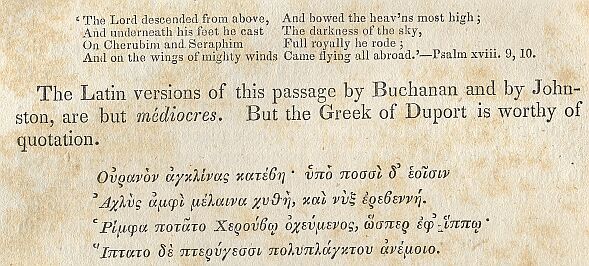
The Latin versions of this passage by Buchanan and by Johnston, are but mediocres. But the Greek of Duport is worthy of quotation.
The best collection of these psalms is that of the Octagonian dissenters of Liverpool, in their printed form of prayer; but they are not always the best versions. Indeed, bad is the best of the English versions; not a ray of poetical genius having ever been employed on them. And how much depends on this, may be seen by comparing Brady and Tate’s 15th psalm with Blacklock’s Justum et tenacem propositi virum of Horace, quoted in Hume’s History, Car. 2. ch. 66. A translation of David in this style, or in that of Pompei’s Cleanthes, might give us some idea of the merit of the original. The character, too, of the poetry of these hymns is singular to us; written in monostichs, each divided into strophe and antistrophe, the sentiment of the first member responded with amplification or antithesis in the second.
On the subject of the Postscript of yours of August the 16th and of Mrs. Adams’s letter, I am silent. I know the depth of the affliction it has caused, and can sympathize with it the more sensibly, inasmuch as there is no degree of affliction, produced by the loss of those dear to us, which experience has not taught me to estimate. I have ever found time and silence the only medicine, and these but assuage, they never can suppress, the deep-drawn sigh which recollection for ever brings up, until recollection and life are extinguished together. Ever affectionately yours.
Th: Jefferson.
TO JOHN ADAMS.
Monticello, October 28, 1813.
Dear Sir,
According to the reservation between us, of taking up one of the subjects of our correspondence at a time, I turn to your letters of August the 16th and September the 2nd.
The passage you quote from Theognis, I think has an ethical rather than a political object. The whole piece is a moral exhortation,
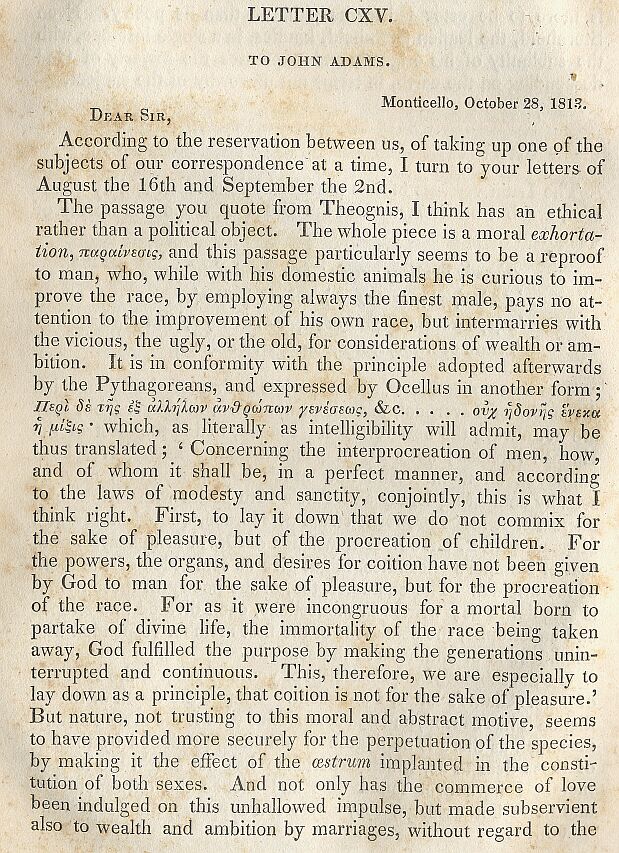
and this passage particularly seems to be a reproof to man, who, while with his domestic animals he is curious to improve the race, by employing always the finest male, pays no attention to the improvement of his own race, but intermarries with the vicious, the ugly, or the old, for considerations of wealth or ambition. It is in conformity with the principle adopted afterwards by the Pythagoreans, and expressed by Ocellus in another form;
which, as literally as intelligibility will admit, may be thus translated;
‘Concerning the interprocreation of men, how, and of whom it shall be, in
a perfect manner, and according to the laws of modesty and sanctity,
conjointly, this is what I think right. First, to lay it down that we do
not commix for the sake of pleasure, but of the procreation of children.
For the powers, the organs, and desires for coition have not been given by
God to man for the sake of pleasure, but for the procreation of the race.
For as it were incongruous for a mortal born to partake of divine life,
the immortality of the race being taken away, God fulfilled the purpose by
making the generations uninterrupted and continuous. This, therefore, we
are especially to lay down as a principle, that coition is not for the
sake of pleasure.’ But nature, not trusting to this moral and abstract
motive, seems to have provided more securely for the perpetuation of the
species, by making it the effect of the oestrum implanted in the
constitution of both sexes. And not only has the commerce of love been
indulged on this unhallowed impulse, but made subservient also to wealth
and ambition by marriages, without regard to the beauty, the healthiness,
the understanding, or virtue of the subject from which we are to breed.
The selecting the best male for a Haram of well chosen females, also,
which Theognis seems to recommend from the example of our sheep and asses,
would doubtless improve the human, as it does the brute animal, and
produce a race of veritable

For experience proves, that the moral and physical qualities of man,
whether good or evil, are transmissible in a certain degree from father to
son. But I suspect that the equal rights of men will rise up against this
privileged Solomon and his Haram, and oblige us to continue acquiescence
under the
 which Theognis complains of, and to content
ourselves with the accidental aristoi produced by the fortuitous
concourse of breeders. For I agree with you, that there is a natural
aristocracy among men. The grounds of this are virtue and talents.
Formerly, bodily powers gave place among the aristoi. But since the
invention of gunpowder has armed the weak as well as the strong with
missile death, bodily strength, like beauty, good humor, politeness, and
other accomplishments, has become but an auxiliary ground of distinction.
There is also an artificial aristocracy, founded on wealth and birth,
without either virtue or talents; for with these it would belong to the
first class. The natural aristocracy I consider as the most precious gift
of nature, for the instruction, the trusts, and government of society.
And, indeed, it would have been inconsistent in creation to have formed
man for the social state, and not to have provided virtue and wisdom
enough to manage the concerns of the society. May we not even say, that
that form of government is the best, which provides the most effectually
for a pure selection of these natural aristoi into the offices of
government? The artificial aristocracy is a mischievous ingredient in
government, and provision should be made to prevent its ascendancy. On the
question, what is the best provision, you and I differ; but we differ as
rational friends, using the free exercise of our own reason, and mutually
indulging its errors. You think it best to put the pseudo-aristoi into a
separate chamber of legislation, where they may be hindered from doing
mischief by their co-ordinate branches, and where, also, they may be a
protection to wealth against the Agrarian and plundering enterprises of
the majority of the people. I think that to give them power in order to
prevent them from doing mischief, is arming them for it, and increasing
instead of remedying the evil. For if the co-ordinate branches can arrest
their action, so may they that of the co-ordinates. Mischief may be done
negatively as well as positively. Of this, a cabal in the Senate of the
United States has furnished many proofs. Nor do I believe them necessary
to protect the wealthy; because enough of these will find their way into
every branch of the legislation, to protect themselves. From fifteen to
twenty legislatures of our own, in action for thirty years past, have
proved that no fears of an equalization of property are to be apprehended
from them. I think the best remedy is exactly that provided by all our
constitutions, to leave to the citizens the free election and separation
of the aristoi from the pseudo-aristoi, of the wheat from
the chaff. In general, they will elect the really good and wise. In some
instances, wealth may corrupt, and birth blind them; but not in sufficient
degree to endanger the society.
which Theognis complains of, and to content
ourselves with the accidental aristoi produced by the fortuitous
concourse of breeders. For I agree with you, that there is a natural
aristocracy among men. The grounds of this are virtue and talents.
Formerly, bodily powers gave place among the aristoi. But since the
invention of gunpowder has armed the weak as well as the strong with
missile death, bodily strength, like beauty, good humor, politeness, and
other accomplishments, has become but an auxiliary ground of distinction.
There is also an artificial aristocracy, founded on wealth and birth,
without either virtue or talents; for with these it would belong to the
first class. The natural aristocracy I consider as the most precious gift
of nature, for the instruction, the trusts, and government of society.
And, indeed, it would have been inconsistent in creation to have formed
man for the social state, and not to have provided virtue and wisdom
enough to manage the concerns of the society. May we not even say, that
that form of government is the best, which provides the most effectually
for a pure selection of these natural aristoi into the offices of
government? The artificial aristocracy is a mischievous ingredient in
government, and provision should be made to prevent its ascendancy. On the
question, what is the best provision, you and I differ; but we differ as
rational friends, using the free exercise of our own reason, and mutually
indulging its errors. You think it best to put the pseudo-aristoi into a
separate chamber of legislation, where they may be hindered from doing
mischief by their co-ordinate branches, and where, also, they may be a
protection to wealth against the Agrarian and plundering enterprises of
the majority of the people. I think that to give them power in order to
prevent them from doing mischief, is arming them for it, and increasing
instead of remedying the evil. For if the co-ordinate branches can arrest
their action, so may they that of the co-ordinates. Mischief may be done
negatively as well as positively. Of this, a cabal in the Senate of the
United States has furnished many proofs. Nor do I believe them necessary
to protect the wealthy; because enough of these will find their way into
every branch of the legislation, to protect themselves. From fifteen to
twenty legislatures of our own, in action for thirty years past, have
proved that no fears of an equalization of property are to be apprehended
from them. I think the best remedy is exactly that provided by all our
constitutions, to leave to the citizens the free election and separation
of the aristoi from the pseudo-aristoi, of the wheat from
the chaff. In general, they will elect the really good and wise. In some
instances, wealth may corrupt, and birth blind them; but not in sufficient
degree to endanger the society.
It is probable that our difference of opinion may, in some measure, be
produced by a difference of character in those among whom we live. From
what I have seen of Massachusetts and Connecticut myself, and still more
from what I have heard, and the character given of the former by yourself,
(Vol. I, page 111,) who know them so much better, there seems to be in
those two States a traditionary reverence for certain families, which has
rendered the offices of government nearly hereditary in those families. I
presume that from an early period of your history, members of these
families happening to possess virtue and talents, have honestly exercised
them for the good of the people, and by their services have endeared their
names to them. In coupling Connecticut with you, I mean it politically
only, not morally. For having made the Bible the common law of their land,
they seem to have modeled their morality on the story of Jacob and Laban.
But although this hereditary succession to office with you may, in some
degree, be founded in real family merit, yet in a much higher degree, it
has proceeded from your strict alliance of Church and State. These
families are canonized in the eyes of the people on the common principle,
‘You tickle me, and I will tickle you.’ In Virginia, we have nothing of
this. Our clergy, before the revolution, having been secured against
rivalship by fixed salaries, did not give themselves the trouble of
acquiring influence over the people. Of wealth, there were great
accumulations in particular families, handed down from generation to
generation, under the English law of entails. But the only object of
ambition for the wealthy was a seat in the King’s Council. All their court
then was paid to the crown and its creatures; and they Philipized in all
collisions between the King and the people. Hence they were unpopular; and
that unpopularity continues attached to their names. A Randolph, a Carter,
or a Burwell must have great personal superiority over a common
competitor, to be elected by the people, even at this day. At the first
session of our legislature after the Declaration of Independence, we
passed a law abolishing entails. And this was followed by one abolishing
the privilege of primogeniture, and dividing the lands of intestates
equally among all their children, or other representatives. These laws,
drawn by myself, laid the axe to the root of pseudo-aristocracy. And had
another which I prepared been adopted by the legislature, our work would
have been complete. It was a bill for the more general diffusion of
learning. This proposed to divide every county into wards of five or six
miles square, like your townships; to establish in each ward a free school
for reading, writing, and common arithmetic; to provide for the annual
selection of the best subjects from these schools, who might receive, at
the public expense, a higher degree of education at a district school; and
from these district schools to select a certain number of the most
promising subjects, to be completed at an University, where all the useful
sciences should be taught. Worth and genius would thus have been sought
out from every condition of life, and completely prepared by education for
defeating the competition of wealth and birth for public trusts. My
proposition had, for a further object, to impart to these wards those
portions of self-government for which they are best qualified, by
confiding to them the care of their poor, their roads, police, elections,
the nomination of jurors, administration of justice in small cases,
elementary exercises of militia; in short, to have made them little
republics, with a warden at the head of each, for all those concerns
which, being under their eye, they would better manage than the larger
republics of the county or State. A general call of ward-meetings by their
wardens on the same day through the State, would at any time produce the
genuine sense of the people on any required point, and would enable the
State to act in mass, as your people have so often done, and with so much
effect, by their town-meetings. The law for religious freedom, which made
a part of this system, having put down the aristocracy of the clergy, and
restored to the citizen the freedom of the mind, and those of entails and
descents nurturing an equality of condition among them, this on education
would have raised the mass of the people to the high ground of moral
respectability necessary to their own safety, and to orderly government;
and would have completed the great object of qualifying them to select the
veritable aristoi, for the trusts of government, to the exclusion of the
pseudalists: and the same Theognis, who has furnished the epigraphs of
your two letters, assures us that
 Although this law has not yet been acted on but
in a small and inefficient degree, it is still considered as before the
legislature, with other bills of the revised code, not yet taken up, and I
have great hope that some patriotic spirit will, at a favorable moment,
call it up, and make it the key-stone of the arch of our government.
Although this law has not yet been acted on but
in a small and inefficient degree, it is still considered as before the
legislature, with other bills of the revised code, not yet taken up, and I
have great hope that some patriotic spirit will, at a favorable moment,
call it up, and make it the key-stone of the arch of our government.
With respect to aristocracy, we should further consider, that before the establishment of the American States, nothing was known to history but the man of the old world, crowded within limits either small or overcharged, and steeped in the vices which that situation generates. A government adapted to such men would be one thing; but a very different one, that for the man of these States. Here every one may have land to labor for himself, if he chooses; or, preferring the exercise of any other industry, may exact for it such compensation as not only to afford a comfortable subsistence, but wherewith to provide for a cessation from labor in old age. Every one, by his property or by his satisfactory situation, is interested in the support of law and order. And such men may safely and advantageously reserve to themselves a wholesome control over their public affairs, and a degree of freedom, which, in the hands of the canaille of the cities of Europe, would be instantly perverted to the demolition and destruction of every thing public and private. The history of the last twenty-five years of France, and of the last forty years in America, nay, of its last two hundred years, proves the truth of both parts of this observation.
But even in Europe a change has sensibly taken place in the mind of man. Science had liberated the ideas of those who read and reflect, and the American example had kindled feelings of right in the people. An insurrection has consequently begun, of science, talents, and courage, against rank and birth, which have fallen into contempt. It has failed in its first effort, because the mobs of the cities, the instrument used for its accomplishment, debased by ignorance, poverty, and vice, could not be restrained to rational action. But the world will recover from the panic of this first catastrophe. Science is progressive, and talents and enterprise on the alert. Resort may be had to the people of the country, a more governable power from their principles and subordination; and rank and birth and tinsel-aristocracy will finally shrink into insignificance, even there. This, however, we have no right to meddle with. It suffices for us, if the moral and physical condition of our own citizens qualifies them to select the able and good for the direction of their government, with a recurrence of elections at such short periods as will enable them to displace an unfaithful servant, before the mischief he meditates may be irremediable, I have thus stated my opinion on a point on which we differ, not with a view to controversy, for we are both too old to change opinions which are the result of a long life of inquiry and reflection; but on the suggestion of a former letter of yours, that we ought not to die before we have explained ourselves to each other. We acted in perfect harmony, through a long and perilous contest for our liberty and independence. A constitution has been acquired, which, though neither of us thinks perfect, yet both consider as competent to render our fellow-citizens the happiest and the securest on whom the sun has ever shone. If we do not think exactly alike as to its imperfections, it matters little to our country, which, after devoting to it long lives of disinterested labor we have delivered over to our successors in life, who will be able to take care of it and of themselves.
Of the pamphlet on aristocracy which has been sent to you, or who may be its author, I have heard nothing but through your letter. If the person you suspect, it may be known from the quaint, mystical, and hyperbolical ideas, involved in affected, newfangled, and pedantic terms, which stamp his writings. Whatever it be, I hope your quiet is not to be affected at this day by the rudeness or intemperance of scribblers; but that you may continue in tranquillity to live and to rejoice in the prosperity of our country, until it shall be your own wish to take your seat among the aristoi who have gone before you.
Ever and affectionately yours.
Th: Jefferson.
TO THOMAS LIEPER.
Monticello, January 1, 1814.
Dear Sir,
I had hoped, when I retired from the business of the world, that I should have been permitted to pass the evening of life in tranquillity, undisturbed by the peltings and passions of which the public papers are the vehicles. I see, however, that I have been dragged into the newspapers by the infidelity of one with whom I was formerly intimate, but who has abandoned the American principles out of which that intimacy grew, and become the bigoted partisan of England, and malcontent of his own government. In a letter which he wrote me, he earnestly besought me to avail our country of the good understanding which subsisted between the executive and myself, by recommending an offer of such terms to our enemy as might produce a peace, towards which he was confident that enemy was disposed. In my answer, I stated the aggressions, the insults, and injuries which England had been heaping on us for years, our long forbearance in the hope she might be led by time and reflection to a sounder view of her own interests, and of their connection with justice to us, the repeated propositions for accommodation made by us, and rejected by her, and at length her Prince Regent’s solemn proclamation to the world, that he would never repeal the orders in council as to us, until France should have revoked her illegal decrees as to all the world, and her minister’s declaration to ours, that no admissible precaution against the impressment of our seamen could be proposed: that the unavoidable declaration of war which followed these was accompanied by advances for peace, on terms which no American could dispense with, made through various channels, and unnoticed and unanswered through any: but that if he could suggest any other conditions which we ought to accept, and which had not been repeatedly offered and rejected, I was ready to be the channel of their conveyance to the government: and, to show him that neither that attachment to Bonaparte nor French influence, which they allege eternally without believing it, themselves, affected my mind, I threw in the two little sentences, of the printed extract enclosed in your friendly favor of the 9th ultimo, and exactly these two little sentences, from a letter of two or three pages, he has thought proper to publish, naked, alone, and with my name, although other parts of the letter would have shown that I wished such limits only to the successes of Bonaparte, as should not prevent his completely closing Europe against British manufactures and commerce; and thereby reducing her to just terms of peace with us.
Thus am I situated. I receive letters from all quarters, some from known friends, some from those who write like friends, on various subjects. What am I to do? Am I to button myself up in Jesuitical reserve, rudely declining any answer, or answering in terms so unmeaning, as only to prove my distrust? Must I withdraw myself from all interchange of sentiment with the world? I cannot do this. It is at war with my habits and temper. I cannot act as if all men were unfaithful, because some are so; nor believe that all will betray me, because some do. I had rather be the victim of occasional infidelities, than relinquish my general confidence in the honesty of man.
So far as to the breach of confidence which has brought me into the newspapers, with a view to embroil me with my friends, by a supposed separation in opinion and principle from them. But it is impossible there can be any difference of opinion among us on the two propositions contained in these two little sentences, when explained, as they were explained in the context from which they were insulated. That Bonaparte is an unprincipled tyrant, who is deluging the continent of Europe with blood, there is not a human being, not even the wife of his bosom, who does not see: nor can there, I think, be a doubt as to the line we ought to wish drawn between his successes and those of Alexander. Surely none of us wish to see Bonaparte conquer Russia, and lay thus at his feet the whole continent of Europe. This done, England would be but a breakfast: and although I am free from the visionary fears which the votaries of England have affected to entertain, because I believe he cannot effect the conquest of Europe; yet put all Europe into his hands, and he might spare such a force, to be sent in British ships, as I would as lieve not have to encounter, when I see how much trouble a handful of British soldiers in Canada has given us. No. It cannot be our interest that all Europe should be reduced to a single monarchy. The true line of interest for us is, that Bonaparte should be able to effect the complete exclusion of England from the whole continent of Europe, in order, as the same letter said, ‘by this peaceable engine of constraint, to make her renounce her views of dominion over the ocean, of permitting no other nation to navigate it but with her license, and on tribute to her, and her aggressions on the persons of our citizens who may choose to exercise their right of passing over that element.’ And this would be effected by Bonaparte’s succeeding so far as to close the Baltic against her. This success I wished him the last year, this I wish him this year; but were he again advanced to Moscow, I should again wish him such disasters as would prevent his reaching Petersburg. And were the consequences even to be the longer continuance of our war, I would rather meet them, than see the whole force of Europe wielded by a single hand.
I have gone into this explanation, my friend, because I know you will not carry my letter to the newspapers, and because I am willing to entrust to your discretion the explaining me to our honest fellow-laborers, and the bringing them to pause and reflect, if any of them have not sufficiently reflected on the extent of the success we ought to wish to Bonaparte, with a view to our own interests only; and even were we not men, to whom nothing human should be indifferent. But is our particular interest to make us insensible to all sentiments of morality? Is it then become criminal, the moral wish that the torrents of blood this man is shedding in Europe, the sufferings of so many human beings, good as ourselves, on whose necks he is trampling, the burnings of ancient cities, devastations of great countries, the destruction of law and order, and demoralization of the world, should be arrested, even if it should place our peace a little further distant? No. You and I cannot differ in wishing that Russia, and Sweden, and Denmark, and Germany, and Spain, and Portugal, and Italy, and even England, may retain their independence. And if we differ in our opinions about Towers and his four beasts and ten kingdoms, we differ as friends, indulging mutual errors, and doing justice to mutual sincerity and honesty. In this spirit of sincere confidence and affection, I pray God to bless you here and hereafter.
Th: Jefferson.
TO DOCTOR WALTER JONES.
Monticello, January 2,1814.
Dear Sir,
Your favor of November the 25th reached this place December the 21st, having been near a month on the way. How this could happen I know not, as we have two mails a week both from Fredericksburg and Richmond. It found me just returned from a long journey and absence, during which so much business had accumulated, commanding the first attentions, that another week has been added to the delay.
I deplore, with you, the putrid state into which our newspapers have passed, and the malignity, the vulgarity, and mendacious spirit of those who write for them; and I enclose you a recent sample, the production of a New England judge, as a proof of the abyss of degradation into which we are fallen. These ordures are rapidly depraving the public taste, and lessening its relish for sound food. As vehicles of information, and a curb on our functionaries, they have rendered themselves useless, by forfeiting all title to belief. That this has, in a great degree, been produced by the violence and malignity of party spirit, I agree with you; and I have read with great pleasure the paper you enclosed me on that subject, which I now return. It is at the same time a perfect model of the style of discussion which candor and decency should observe, of the tone which renders difference of opinion even amiable, and a succinct, correct, and dispassionate history of the origin and progress of party among us. It might be incorporated, as it stands, and without changing a word, into the history of the present epoch, and would give to posterity a fairer view of the times than they will probably derive from other sources. In reading it, with great satisfaction, there was but a single passage where I wished a little more developement of a very sound and catholic idea; a single intercalation to rest it solidly on true bottom. It is near the end of the first page, where you make a statement of genuine republican maxims; saying, ‘that the people ought to possess as much political power as can possibly consist with the order and security of society.’ Instead of this, I would say, ‘that the people, being the only safe depository of power, should exercise in person every function which their qualifications enable them to exercise consistently with the order and security of society; that we now find them equal to the election of those who shall be invested with their executive and legislative powers, and to act themselves in the judiciary, as judges in questions of fact; that the range of their powers ought to be enlarged,’ &c. This gives both the reason and exemplification of the maxim you express, ‘that they ought to possess as much political power,’ &c. I see nothing to correct either in your facts or principles.
You say that in taking General Washington on your shoulders, to bear him harmless through the federal coalition, you encounter a perilous topic. I do not think so. You have given the genuine history of the course of his mind through the trying scenes in which it was engaged, and of the seductions by which it was deceived, but not depraved. I think I knew General Washington intimately and thoroughly; and were I called on to delineate his character, it should be in terms like these.
His mind was great and powerful, without being of the very first order; his penetration strong, though not so acute as that of a Newton, Bacon, or Locke; and as far as he saw, no judgment was ever sounder. It was slow in operation, being little aided by invention or imagination, but sure in conclusion. Hence the common remark of his officers, of the advantage he derived from councils of war, where, hearing all suggestions, he selected whatever was best; and certainly no General ever planned his battles more judiciously. But if deranged during the course of the action, if any member of his plan was dislocated by sudden circumstances, he was slow in a re-adjustment. The consequence was, that he often failed in the field, and rarely against an enemy in station, as at Boston and York. He was incapable of fear, meeting personal dangers with the calmest unconcern. Perhaps the strongest feature in his character was prudence, never acting until every circumstance, every consideration, was maturely weighed; refraining if he saw a doubt, but, when once decided, going through with his purpose, whatever obstacles opposed. His integrity was most pure, his justice the most inflexible I have ever known, no motives of interest or consanguinity, of friendship or hatred, being able to bias his decision. He was, indeed, in every sense of the words, a wise, a good, and a great man. His temper was naturally irritable and high-toned; but reflection and resolution had obtained a firm and habitual ascendancy over it. If ever, however, it broke its bonds, he was most tremendous in his wrath. In his expenses he was honorable, but exact; liberal in contributions to whatever promised utility; but frowning and unyielding on all visionary projects, and all unworthy calls on his charity. His heart was not warm in its affections; but he exactly calculated every man’s value, and gave him a solid esteem proportioned to it. His person, you know, was fine, his stature exactly what one would wish, his deportment easy, erect, and noble; the best horseman of his age, and the most, graceful figure that could be seen on horseback. Although in the circle of his friends, where he might be unreserved with safety, he took a free share in conversation, his colloquial talents were not above mediocrity, possessing neither copiousness of ideas, nor fluency of words. In public, when called on for a sudden opinion, he was unready, short, and embarrassed. Yet he wrote readily, rather diffusely, in an easy and correct style. This he had acquired by conversation with the world, for his education was merely reading, writing, and common arithmetic, to which he added surveying at a later day. His time was employed in action chiefly, reading little, and that only in agriculture and English history. His correspondence became necessarily extensive, and, with journalizing his agricultural proceedings, occupied most of his leisure hours within doors. On the whole, his character was, in its mass, perfect, in nothing bad, in few points indifferent; and it may truly be said, that never did nature and fortune combine more perfectly to make a man great, and to place him in the same constellation with whatever worthies have merited from man an everlasting remembrance. For his was the singular destiny and merit, of leading the armies of his country successfully through an arduous war, for the establishment of its independence; of conducting its councils through the birth of a government, new in its forms and principles, until it had settled down into a quiet and orderly train; and of scrupulously obeying the laws through the whole of his career, civil and military, of which the history of the world furnishes no other example. How, then, can it be perilous for you to take such a man on your shoulders? I am satisfied the great body of republicans think of him as I do. We were, indeed, dissatisfied with him on his ratification of the British treaty. But this was short-lived. We knew his honesty, the wiles with which he was encompassed, and that age had already begun to relax the firmness of his purposes; and I am convinced he is more deeply seated in the love and gratitude of the republicans, than in the Pharisaical homage of the federal monarchists. For he was no monarchist from preference of his judgment. The soundness of that gave him correct views of the rights of man, and his severe justice devoted him to them. He has often declared to me that he considered our new constitution as an experiment on the practicability of republican government, and with what dose of liberty man could be trusted for his own good; that he was determined the experiment should have a fair trial, and would lose the last drop of his blood in support of it. And these declarations he repeated to me the oftener and the more pointedly, because he knew my suspicions of Colonel Hamilton’s views, and probably had heard from him the same declarations which I had, to wit, ‘that the British constitution, with its unequal representation, corruption, and other existing abuses, was the most perfect government which had ever been established on earth, and that a reformation of these abuses would make it an impracticable government.’ I do believe that General Washington had not a firm confidence in the durability of our government. He was naturally distrustful of men, and inclined to gloomy apprehensions: and I was ever persuaded that a belief that we must at length end in something like a British constitution, had some weight in his adoption of the ceremonies of levees, birthdays, pompous meetings with Congress, and other forms of the same character, calculated to prepare us gradually for a change which he believed possible, and to let it come on with as little shock as might be to the public mind.
These are my opinions of General Washington, which I would vouch at the judgment-seat of God, having been formed on an acquaintance of thirty years. I served with him in the Virginia legislature from 1769 to the Revolutionary war, and again, a short time in Congress, until he left us to take command of the army. During the war and after it we corresponded Occasionally, and in the four years of my continuance in the office of Secretary of State, our intercourse was daily, confidential, and cordial. After I retired from that office, great and malignant pains were taken by our federal monarchists, and not entirely without effect, to make him view me as a theorist, holding French principles of government, which would lead infallibly to licentiousness and anarchy. And to this he listened the more easily, from my known disapprobation of the British treaty. I never saw him afterwards, or these malignant insinuations should have been dissipated before his just judgment, as mists before the sun. I felt on his death, with my countrymen, that ‘verily a great man hath fallen this day in Israel.’
More time and recollection would enable me to add many other traits of his character; but why add them to you, who knew him well? And I cannot justify to myself a longer detention of your paper.
Vale, proprieque tuum me esse tibi persuadeas.
Th: Jefferson.
Monticello, January 31, 1814.
Dear Sir,
Your favor of the 23d is received. Say had come to hand safely. But I regretted having asked the return of him; for I did not find in him one new idea on the subject I had been contemplating; nothing more than a succinct, judicious digest of the tedious pages of Smith.
You ask my opinion on the question, whether the States can add any qualifications to those which the constitution has prescribed for their members of Congress? It is a question I had never before reflected on; yet had taken up an off-hand opinion, agreeing with your first, that they could not: that to add new qualifications to those of the constitution, would be as much an alteration, as to detract from them. And so I think the House of Representatives of Congress decided in some case; I believe that of a member from Baltimore. But your letter having induced me to look into the constitution, and to consider the question a little, I am again in your predicament, of doubting the correctness of my first opinion. Had the constitution been silent, nobody can doubt but that the right to prescribe all the qualifications and disqualifications of those they would send to represent them, would have belonged to the State. So also the constitution might have prescribed the whole, and excluded all others. It seems to have preferred the middle way. It has exercised the power in part, by declaring some disqualifications, to wit, those of not being twenty-five years of age, of not having been a citizen seven years, and of not being an inhabitant of the State at the time of election. But it does not declare, itself, that the member shall not be a lunatic, a pauper, a convict of treason, of murder, of felony, or other infamous crime, or a non-resident of his district; nor does it prohibit to the State the power of declaring these, or any other disqualifications which its particular circumstances may call for: and these may be different in different States. Of course, then, by the tenth amendment, the power is reserved to the State. If, wherever the constitution assumes a single power out of many which belong to the same subject, we should consider it as assuming the whole, it would vest the General Government with a mass of powers never contemplated. On the contrary, the assumption of particular powers seems an exclusion of all not assumed. This reasoning appears to me to be sound; but, on so recent a change of view, caution requires us not to be too confident, and that we admit this to be one of the doubtful questions on which honest men may differ with the purest motives; and the more readily, as we find we have differed from ourselves on it.
I have always thought, that where the line of demarcation between the powers of the General and State governments was doubtfully or indistinctly drawn, it would be prudent and praiseworthy in both parties, never to approach it but under the most urgent necessity. Is the necessity now urgent, to declare that no non-resident of his district shall be eligible as a member of Congress? It seems to me that, in practice, the partialities of the people are a sufficient security against such an election; and that if, in any instance, they should ever choose a non-resident, it must be in one of such eminent merit and qualifications, as would make it a good, rather than an evil; and that, in any event, the examples will be so rare, as never to amount to a serious evil. If the case then be neither clear nor urgent, would it not be better to let it lie undisturbed? Perhaps its decision may never be called for. But if it be indispensable to establish this disqualification now, would it not look better to declare such others, at the same time, as may be proper? I frankly confide to yourself these opinions, or rather no-opinions, of mine; but would not wish to have them go any farther. I want to be quiet: and although some circumstances now and then excite me to notice them, I feel safe, and happier in leaving events to those whose turn it is to take care of them; and, in general, to let it be understood, that I meddle little or not at all with public affairs. There are two subjects, indeed, which I shall claim a right to further as long as I breathe, the public education and the subdivision of the counties into wards. I consider the continuance of republican government as absolutely hanging on these two hooks. Of the first, you will, I am sure, be an advocate, as having already reflected on it, and of the last, when you shall have reflected. Ever affectionately yours.
Th: Jefferson.
Monticello, July 5, 1814
Dear Sir,
Since mine of January the 24th, yours of March the 14th has been received. It was not acknowledged in the short one of May the 18th, by Mr. Rives, the only object of that having been to enable one of our most promising young men to have the advantage of making his bow to you. I learned with great regret the serious illness mentioned in your letter; and I hope Mr. Rives will be able to tell me you are entirely restored. But our machines have now been running seventy or eighty years, and we must expect that, worn as they are, here a pivot, there a wheel, now a pinion, next a spring, will be giving way; and however we may tinker them up for a while, all will at length surcease motion. Our watches, with works of brass and steel, wear out within that period. Shall you and I last to see the course the seven-fold wonders of the times will take? The Attila of the age dethroned, the ruthless destroyer of ten millions of the human race, whose thirst for blood appeared unquenchable, the great oppressor of the rights and liberties of the world, shut up within the circuit of a little island of the Mediterranean, and dwindled to the condition of an humble and degraded pensioner on the bounty of those he has most injured. How miserably, how meanly, has he closed his inflated career! What a sample of the bathos will his history present! He should have perished on the swords of his enemies, under the walls of Paris.

But Bonaparte was a lion in the field only. In civil life, a cold-blooded, calculating, unprincipled usurper, without a virtue; no statesman, knowing nothing of commerce, political economy, or civil government, and supplying ignorance by bold presumption. I had supposed him a great man until his entrance into the Assembly des Cinq Cens, eighteenth Brumaire (an 8.) From that date, however, I set him down as a great scoundrel only. To the wonders of his rise and fall, we may add that of a Czar of Muscovy, dictating, in Paris, laws and limits to all the successors of the Caesars, and holding even the balance in which the fortunes of this new world are suspended. I own, that while I rejoice, for the good of mankind, in the deliverance of Europe from the havoc which would have never ceased while Bonaparte should have lived in power, I see with anxiety the tyrant of the ocean remaining in vigor, and even participating in the merit of crushing his brother tyrant. While the world is thus turned upside down, on which side of it are we? All the strong reasons, indeed, place us on the side of peace; the interests of the continent, their friendly dispositions, and even the interests of England. Her passions alone are opposed to it. Peace would seem now to be an easy work, the causes of the war being removed. Her orders of council will no doubt be taken care of by the allied powers, and, war ceasing, her impressment of our seamen ceases of course. But I fear there is foundation for the design intimated in the public papers, of demanding a cession of our right in the fisheries. What will Massachusetts say to this? I mean her majority, which must be considered as speaking through the organs it has appointed itself, as the index of its will. She chose to sacrifice the liberty of our sea-faring citizens, in which we were all interested, and with them her obligations to the co-States, rather than war with England. Will she now sacrifice the fisheries to the same partialities? This question is interesting to her alone; for to the middle, the southern, and western States, they are of no direct concern; of no more than the culture of tobacco, rice, and cotton to Massachusetts. I am really at a loss to conjecture what our refractory sister will say on this occasion. I know what, as a citizen of the Union, I would say to her. ‘Take this question ad referendum. It concerns you alone. If you would rather, give up the fisheries than war with England, we give them up. If you had rather fight for them, we will defend your interests to the last drop of our blood, choosing rather to set a good example than follow a bad one.’ And I hope she will determine to fight for them. With this, however, you and I shall have nothing to do; ours being truly the case wherein ‘Non tali auxilio, nec defensoribus istis, tempus eget.’ Quitting this subject, therefore, I will turn over another leaf.
I am just returned from one of my long absences, having been at my other home for five weeks past. Having more leisure there than here for reading, I amused myself with reading seriously Plato’s Republic. I am wrong, however, in calling it amusement, for it was the heaviest task-work I ever went through. I had occasionally before taken up some of his other works, but scarcely ever had patience to go through a whole dialogue. While wading through the whimsies, the puerilities, and unintelligible jargon of this work, I laid it down often to ask myself, how it could have been that the world should have so long consented to give reputation to such nonsense as this. How the soi-disant Christian world, indeed, should have done it, is a piece of historical curiosity. But how could the Roman good sense do it? And particularly, how could Cicero bestow such eulogies on Plato? Although Cicero did not wield the dense logic of Demosthenes, yet he was able, learned, laborious, practised in the business of the world and honest. He could not be the dupe of mere style, of which he was himself the first master in the world. With the moderns, I think, it is rather a matter of fashion and authority. Education is chiefly in the hands of persons who, from their profession, have an interest in the reputation and the dreams of Plato. They give the tone while at school, and few in their after years have occasion to revise their college opinions. But fashion and authority apart, and bringing Plato to the test of reason, take from him, his sophisms, futilities, and incomprehensibilities, and what remains? In truth, he is one of the race of genuine sophists, who has escaped the oblivion of his brethren, first, by the elegance of his diction, but chiefly by the adoption and incorporation of his whimsies into the body of artificial Christianity. His foggy mind is for ever presenting the semblances of objects which, half seen through a mist, can be defined neither in form nor dimension. Yet this, which should have consigned him to early oblivion, really procured him immortality of fame and reverence. The Christian priesthood, finding the doctrines of Christ levelled to every understanding, and too plain to need explanation, saw in the mysticisms of Plato materials with which they might build up an artificial system, which might, from its indistinctness, admit everlasting controversy, give employment for their order, and introduce it to profit, power, and pre-eminence. The doctrines which flowed from the lips of Jesus himself are within the comprehension of a child; but thousands of volumes have not yet explained the Platonisms engrafted on them: and for this obvious reason, that nonsense can never be explained. Their purposes, however, are answered. Plato is canonized: and it is now deemed as impious to question his merits as those of an Apostle of Jesus. He is peculiarly appealed to as an advocate of the immortality of the soul; and yet I will venture to say, that were there no better arguments than his in proof of it, not a man in the world would believe it. It is fortunate for us, that Platonic republicanism has not obtained the same favor as Platonic Christianity; or we should now have been all living, men, women, and children, pell-mell together, like the beasts of the field or forest. Yet ‘Plato is a great philosopher,’ said La Fontaine. But, says Fontenelle, ‘Do you find his ideas very clear.’ ‘Oh, no! he is of an obscurity impenetrable.’ ‘Do you not find him full of contradictions?’ ‘Certainly,’ replied La Fontaine, ‘he is but a sophist.’ Yet immediately after, he exclaims again, ‘Oh, Plato was a great philosopher.’ Socrates had reason, indeed, to complain of the misrepresentations of Plato; for, in truth, his dialogues are libels on Socrates.
But why am I dosing you with these antediluvian topics? Because I am glad to have some one to whom they are familiar, and who will not receive them as if dropped from the moon. Our post-revolutionary youth are born under happier stars than you and I were. They acquire all learning in their mother’s womb, and bring it into the world ready made. The information of books is no longer necessary; and all knowledge which is not innate is in contempt, or neglect at least. Every folly must run its round; and so, I suppose, must that of self-learning and self-sufficiency; of rejecting the knowledge acquired in past ages, and starting on the new ground of intuition. When sobered by experience, I hope our successors will turn their attention to the advantages of education. I mean of education on the broad scale, and not that of the petty academies, as they call themselves, which are starting up in every neighborhood, and where one or two men, possessing Latin, and sometimes Greek, a knowledge of the globes, and the first six books of Euclid, imagine and communicate this as the sum of science. They commit their pupils to the theatre of the world, with just taste enough of learning to be alienated from industrious pursuits, and not enough to do service in the ranks of science. We have some exceptions, indeed. I presented one to you lately, and we have some others. But the terms I use are general truths. I hope the necessity will, at length, be seen of establishing institutions here, as in Europe, where every branch of science, useful at this day, may be taught in its highest degree. Have you ever turned your thoughts to the plan of such an institution? I mean to a specification of the particular sciences of real use in human affairs, and how they might be so grouped as to require so many professors only, as might bring them within the views of a just but enlightened economy? I should be happy in a communication of your ideas on this problem, either loose or digested. But to avoid my being run away with by another subject, and adding to the length and ennui of the present letter, I will here present to Mrs. Adams and yourself, the assurance of my constant and sincere friendship and respect.
Th: Jefferson.
Monticello, January 1, 1815.
Dear Sir,
Your letters of November the 30th and December the 21st have been received with great pleasure. A truth now and then projecting into the ocean of newspaper lies, serves like headlands to correct our course. Indeed, my scepticism as to every thing I see in a newspaper, makes me indifferent whether I ever see one. The embarrassments at Washington, in August last, I expected would be great in any state of things; but they proved greater than expected. I never doubted that the plans of the President were wise and sufficient. Their failure we all impute, 1. To the insubordinate temper of Armstrong: and, 2. To the indecision of Winder. However, it ends well. It mortifies ourselves, and so may check, perhaps, the silly boasting spirit of our newspapers, and it enlists the feelings of the world on our side: and the advantage of public opinion is like that of the weather-gage in a naval action. In Europe, the transient possession of our Capital can be no disgrace. Nearly every Capital there was in possession of its enemy some often and long. But diabolical as they paint that enemy, he burnt neither public edifices nor private dwellings. It was reserved for England to show that Bonaparte, in atrocity, was an infant to their ministers and their generals. They are taking his place in the eyes of Europe, and have turned into our channel all its good will. This will be worth the million of dollars the repairs of their conflagrations will cost us. I hope that to preserve this weather-gage of public opinion, and to counteract the slanders and falsehoods disseminated by the English papers, the government will make it a standing instruction to their ministers at foreign courts, to keep Europe truly informed of occurrences here, by publishing in their papers the naked truth always, whether favorable or unfavorable. For they will believe the good, if we candidly tell them the bad also.
But you have two more serious causes of uneasiness; the want of men and money. For the former, nothing more wise or efficient could have been imagined than what you proposed. It would have filled our ranks with regulars, and that, too, by throwing a just share of the burthen on the purses of those whose persons are exempt either by age or office; and it would have rendered our militia, like those of the Greeks and Romans, a nation of warriors. But the go-by seems to have been given to your proposition, and longer sufferance is necessary to force us to what is best. We seem equally incorrigible in our financial course. Although a century of British experience has proved to what a wonderful extent the funding on specific redeeming taxes enables a nation to anticipitate in war the resources of peace, and although the other nations of Europe have tried and trodden every path of force or folly in fruitless quest of the same object, yet we still expect to find, in juggling tricks and banking dreams, that money can be made out of nothing, and in sufficient quantity to meet the expenses of a heavy war by sea and land. It is said, indeed, that money cannot be borrowed from our merchants as from those of England. But it can be borrowed from our people. They will give you all the necessaries of war they produce, if, instead of the bankrupt trash they now are obliged to receive for want of any other, you will give them a paper-promise funded on a specific pledge, and of a size for common circulation. But you say the merchants will not take this paper. What the people take the merchants must take, or sell nothing. All these doubts and fears prove only the extent of the dominion which the banking institutions have obtained over the minds of our citizens, and especially of those inhabiting cities or other banking places; and this dominion must be broken, or it will break us. But here, as in the other case, we must make up our mind to suffer yet longer before we can get right. The misfortune is, that in the mean time, we shall plunge ourselves into inextinguishable debt, and entail on our posterity an inheritance of eternal taxes, which will bring our government and people into the condition of those of England, a nation of pikes and gudgeons, the latter bred merely as food for the former. But, however these two difficulties of men and money may be disposed of, it is fortunate that neither of them will affect our war by sea. Privateers will find their own men and money. Let nothing be spared to encourage them. They are the dagger which strikes at the heart of the enemy, their commerce. Frigates and seventy-fours are a sacrifice we must make, heavy as it is, to the prejudices of a part of our citizens. They have, indeed, rendered a great moral service, which has delighted me as much as any one in the United States. But they have had no physical effect sensible to the enemy; and now, while we must fortify them in our harbors, and keep armies to defend them, our privateers are bearding and blockading the enemy in their own sea-ports. Encourage them to burn all their prizes, and let the public pay for them. They will cheat us enormously. No matter; they will make the merchants of England feel, and squeal, and cry out for peace.
I much regretted your acceptance of the war department. Not that I know a person who I think would better conduct it. But, conduct it ever so wisely, it will be a sacrifice of yourself. Were an angel from Heaven to undertake that office, all our miscarriages would be ascribed to him. Raw troops, no troops, insubordinate militia, want of arms, want of money, want of provisions, all will be charged to want of management in you. I speak from experience, when I was Governor of Virginia. Without a regular in the State, and scarcely a musket to put into the hands of the militia, invaded by two armies, Arnold’s from the sea-board, and Cornwallis’s from the southward,—when we were driven from Richmond and Charlottesville, and every member of my council fled to their homes, it was not the total destitution of means, but the mismanagement of them, which, in the querulous voice of the public, caused all our misfortunes. It ended, indeed, in the capture of the whole hostile force, but not till means were brought us by General Washington’s army, and the French fleet and army. And although the legislature, who were personally intimate with both the means and measures, acquitted me with justice and thanks, yet General Lee has put all those imputations among the romances of his historical novel, for the amusement of credulous and uninquisitive readers. Not that I have seen the least disposition to censure you. On the contrary, your conduct on the attack of Washington has met the praises of every one, and your plan for regulars and militia, their approbation. But no campaign is as yet opened. No generals have yet an interest in shifting their own incompetence on you, no army agents, their rogueries. I sincerely pray you may never meet censure where you will deserve most praise, and that your own happiness and prosperity may be the result of your patriotic services.
Ever and affectionately yours.
Th: Jefferson.
TO THE MARQUIS DE LA FAYETTE.
Monticello, February 14, 1815.
Mr Dear Friend,
Your letter of August the 14th has been received and read, again and again, with extraordinary pleasure. It is the first glimpse which has been furnished me of the interior workings of the late unexpected but fortunate revolution of your country. The newspapers told us only that the great beast was fallen; but what part in this the patriots acted, and what the egoists, whether the former slept while the latter were awake to their own interests only, the hireling scribblers of the English press said little, and knew less. I see now the mortifying alternative under which the patriot there is placed, of being either silent, or disgraced by an association in opposition with the remains of Bonaparteism. A full measure of liberty is not now perhaps to be expected by your nation; nor am I confident they are prepared to preserve it. More than a generation will be requisite, under the administration of reasonable laws favoring the progress of knowledge in the general mass of the people, and their habituation to an independent security of person and property, before they will be capable of estimating the value of freedom, and the necessity of a sacred adherence to the principles on which it rests for preservation. Instead of that liberty which takes root and growth in the progress of reason, if recovered by mere force or accident, it becomes, with an unprepared people, a tyranny still, of the many, the few, or the one. Possibly you may remember, at the date of the jeu de paume, how earnestly I urged yourself and the patriots of my acquaintance to enter then into a compact with the King, securing freedom of religion, freedom of the press, trial by jury, habeas corpus, and a national legislature, all of which it was known he would then yield, to go home, and let these work on the amelioration of the condition of the people, until they should have rendered them capable of more, when occasions would not fail to arise for communicating to them more. This was as much as I then thought them able to bear, soberly and usefully for themselves. You thought otherwise, and that the dose might still be larger. And I found you were right; for subsequent events proved they were equal to the constitution of 1791. Unfortunately, some of the most honest and enlightened of our patriotic friends (but closet politicians merely, unpractised in the knowledge of man) thought more could still be obtained and borne. They did not weigh the hazards of a transition from one form of government to another, the value of what they had already rescued from those hazards, and might hold in security if they pleased, nor the imprudence of giving up the certainty of such a degree of liberty, under a limited monarch, for the uncertainty of a little more under the form of a republic. You differed from them. You were for stopping there, and for securing the constitution which the National Assembly had obtained. Here, too, you were right; and from this fatal error of the republicans, from their separation from yourself and the constitutionalists, in their councils, flowed all the subsequent sufferings and crimes of the French nation. The hazards of a second change fell upon them by the way. The foreigner gained time to anarchize by gold the government he could not overthrow by arms, to crush in their own councils the genuine republicans, by the fraternal embraces of exaggerated and hired pretenders, and to turn the machine of Jacobinism from the change to the destruction of order: and, in the end, the limited monarchy they had secured was exchanged for the unprincipled and bloody tyranny of Robespierre, and the equally unprincipled and maniac tyranny of Bonaparte. You are now rid of him, and I sincerely wish you may continue so. But this may depend on the wisdom and moderation of the restored dynasty. It is for them now to read a lesson in the fatal errors of the republicans; to be contented with a certain portion of power, secured by formal compact with the nation, rather than, grasping at more, hazard all upon uncertainty, and risk meeting the fate of their predecessor, or a renewal of their own exile. We are just informed, too, of an example which merits, if true, their most profound contemplation. The gazettes say, that Ferdinand of Spain is dethroned, and his father re-established on the basis of their new constitution. This order of magistrates must, therefore, see, that although the attempts at reformation have not succeeded in their whole length, and some secession from the ultimate point has taken place, yet that men have by no means fallen back to their former passiveness; but on the contrary, that a sense of their rights, and a restlessness to obtain them, remain deeply impressed on every mind, and, if not quieted by reasonable relaxations of power, will break out like a volcano on the first occasion, and overwhelm every thing again in its way. I always thought the present King an honest and moderate man: and having no issue, he is under a motive the less for yielding to personal considerations. I cannot, therefore, but hope, that the patriots in and out of your legislature, acting in phalanx, but temperately and wisely, pressing unremittingly the principles omitted in the late capitulation of the King, and watching the occasions which the course of events will create, may get those principles engrafted into it, and sanctioned by the solemnity of a national act.
With us the affairs of war have taken the more favorable turn which was to be expected. Our thirty years of peace had taken off, or superannuated, all our revolutionary officers of experience and grade; and our first draught in the lottery of untried characters had been most unfortunate. The delivery of the fort and army of Detroit, by the traitor Hull; the disgrace at Queenstown, under Van Rensellaer; the massacre at Frenchtown, under Winchester; and surrender of Boerstler in an open field to one third of his own numbers, were the inauspicious beginnings of the first year of our warfare. The second witnessed but the single miscarriage occasioned by the disagreement of Wilkinson and Hampton, mentioned in my letter to you of November the 30th, 1813; while it gave us the capture of York by Dearborn and Pike; the capture of Fort George by Dearborn also; the capture of Proctor’s army on the Thames by Harrison, Shelby, and Johnson; and that of the whole British fleet on Lake Erie by Perry. The third year has been a continued series of victories; to wit, of Brown and Scott at Chippeway; of the same at Niagara; of Gaines over Drummond at Fort Erie; that of Brown over Drummond at the same place; the capture of another fleet on Lake Champlain by M’Donough; the entire defeat of their army under Prevost, on the same day, by M’Comb, and recently their defeats at New Orleans by Jackson, Coffee, and Carroll, with the loss of four thousand men out of nine thousand and six hundred, with their two Generals, Packingham and Gibbs killed, and a third, Keane, wounded, mortally, as is said.
This series of successes has been tarnished only by the conflagrations at Washington, a coup de main differing from that at Richmond, which you remember, in the revolutionary war, in the circumstance only, that we had, in that case, but forty-eight hour’s notice that an enemy had arrived within our capes; whereas at Washington there was abundant previous notice. The force designated by the President was the double of what was necessary; but failed, as is the general opinion, through the insubordination of Armstrong, who would never believe the attack intended until it was actually made, and the sluggishness of Winder before the occasion, and his indecision during it. Still, in the end, the transaction has helped rather than hurt us, by arousing the general indignation of our country, and by marking to the world of Europe the Vandalism and brutal character of the English government. It has merely served to immortalize their infamy. And add further, that through the whole period of the war, we have beaten them single-handed at sea, and so thoroughly established our superiority over them with equal force, that they retire from that kind of contest, and never suffer their frigates to cruise singly. The Endymion would never have engaged the frigate President, but knowing herself backed by three frigates and a razee, who, though somewhat slower sailors, would get up before she could be taken. The disclosure to the world of the fatal secret that they can be beaten at sea with an equal force, the evidence furnished by the military operations of the last year that experience is rearing us officers, who, when our means shall be fully under way, will plant our standard on the walls of Quebec and Halifax, their recent and signal disaster at New Orleans, and the evaporation of their hopes from the Hartford Convention, will probably raise a clamor in the British nation, which will force their ministry into peace. I say force them; because, willingly, they would never be at peace. The British ministers find in a state of war rather than of peace, by riding the various contractors, and receiving douceurs on the vast expenditures of the war supplies, that they recruit their broken fortunes, or make new ones, and therefore will not make peace, as long as by any delusions they can keep the temper of the nation up to the war point. They found some hopes on the state of our finances. It is true, that the excess of our banking institutions, and their present discredit, have shut us out from the best source of credit we could ever command with certainty. But the foundations of credit still remain to us, and need but skill, which experience will soon produce, to marshal them into an order which may carry us through any length of war. But they have hoped more in their Hartford Convention. Their fears of republican France being now done away, they are directed to republican America, and they are playing the same game for disorganization here, which they played in your country. The Marats, the Dantons, and Robespierres of Massachusetts are in the same pay, under the same orders, and making the same efforts to anarchize us, that their prototypes in France did there.
I do not say that all who met at Hartford were under the same motives of money: nor were those of France. Some of them are Outs, and wish to be Ins; some the mere dupes of the agitators, or of their own party passions; while the Maratists alone are in the real secret: but they have very different materials to work on. The yeomanry of the United States are not the canaille of Paris. We might safely give them leave to go through the United States recruiting their ranks, and I am satisfied they could not raise one single regiment (gambling merchants and silk-stocking clerks excepted), who would support them in any effort to separate from the Union. The cement of this Union is in the heart-blood of every American. I do not believe there is on earth a government established on so immovable a basis. Let them, in any State, even in Massachusetts itself, raise the standard of separation, and its citizens will rise in mass, and do justice themselves on their own incendiaries. If they could have induced the government to some effort of suppression, or even to enter into discussion with them, it would have given them some importance, have brought them into some notice. But they have not been able to make themselves even a subject of conversation, either of public or private societies. A silent contempt has been the sole notice they could excite; consoled, indeed, some of them, by the palpable favors of Philip. Have then no fears for us, my friend. The grounds of these exist only in English newspapers, endited or endowed by the Castlereaghs or the Cannings, or some other such models of pure and uncorrupted virtue. Their military heroes, by land and sea, may sink our oyster-boats, rob our hen-roosts, burn our negro-huts, and run off. But a campaign or two more will relieve them from further trouble or expense in defending their American possessions.
You once gave me a copy of the journal of your campaign in Virginia, in 1781, which I must have lent to some one of the undertakers to write the history of the revolutionary war, and forgot to reclaim. I conclude this, because it is no longer among my papers, which I have very diligently searched for it, but in vain. An author of real ability is now writing that part of the history of Virginia. He does it in my neighborhood, and I lay open to him all my papers. But I possess none, nor has he any, which can enable him to do justice to your faithful and able services in that campaign. If you could be so good as to send me another copy, by the very first vessel bound to any port of the United States, it might be here in time; for although he expects to begin to print within a month or two, yet you know the delays of these undertakings. At any rate, it might be got in as a supplement. The old Count Rochambeau gave me also his memoire of the operations at York, which is gone the same way, and I have no means of applying to his family for it. Perhaps you could render them as well as us, the service of procuring another copy.
I learn, with real sorrow, the deaths of Monsieur and Madame de Tesse. They made an interesting part in the idle reveries in which I have sometimes indulged myself, of seeing all my friends of Paris once more, for a month or two; a thing impossible, which, however, I never permitted myself to despair of. The regrets, however, of seventy-three at the loss of friends, may be the less, as the time is shorter within which we are to meet again, according to the creed of our education.
This letter will be handed you by Mr. Ticknor, a young gentleman of Boston, of great erudition, indefatigable industry, and preparation for a life of distinction, in his own country. He passed a few days with me here, brought high recommendations from Mr. Adams and others, and appeared in every respect to merit them. He is well worthy of those attentions which you so kindly bestow on our countrymen, and for those he may receive I shall join him in acknowledging personal obligations.
I salute you with assurances of my constant and affectionate friendship and respect.
Th; Jefferson.
P.S. February 26. My letter had not yet been sealed, when I received news of our peace. I am glad of it, and especially that we closed our war with the eclat of the action at New Orleans. But I consider it as an armistice only, because no security is provided against the impressment of our seamen. While this is unsettled we are in hostility of mind with England, although actual deeds of arms may be suspended by a truce. If she thinks the exercise of this outrage is worth eternal war, eternal war it must be, or extermination of the one or the other party. The first act of impressment she commits on an American, will be answered by reprisal, or by a declaration of war here; and the interval must be merely a state of preparation for it. In this we have much to do, in further fortifying our seaport towns, providing military stores, classing and disciplining our militia, arranging our financial, system, and above all, pushing our domestic manufactures, which have taken such root as never again can be shaken. Once more, God bless you. T.J.
TO MR. WENDOVER.
Monticello, March 13, 1815.
[* This is endorsed;’ not sent.‘]
Sir,
Your favor of January the 30th was received after long delay on the road, and I have to thank you for the volume of Discourses which you have been so kind as to send me. I have gone over them with great satisfaction, and concur with the able preacher in his estimate of the character of the belligerents in our late war, and lawfulness of defensive war. I consider the war, with him, as ‘made on good advice,’ that is, for just causes, and its dispensation as providential, inasmuch, as it has exercised our patriotism and submission to order, has planted and invigorated among us arts of urgent necessity, has manifested the strong and the weak parts of our republican institutions, and the excellence of a representative democracy compared with the misrule of Kings, has rallied the opinions of mankind to the natural rights of expatriation, and of a common property in the ocean, and raised us to that grade in the scale of nations which the bravery and liberality of our citizen soldiers, by land and by sea, the wisdom of our institutions and their observance of justice, entitled us to in the eyes of the world. All this Mr. McLeod has well proved, and from those sources of argument particularly which belong to his profession. On one question only I differ from him, and it is that which constitutes the subject of his first discourse, the right of discussing public affairs in the pulpit. I add the last words, because I admit the right in general conversation and in writing; in which last form it has been exercised in the valuable book you have now favored me with.
The mass of human concerns, moral and physical, is so vast, the field of knowledge requisite for man to conduct them to the best advantage is so extensive, that no human being can acquire the whole himself, and much less in that degree necessary for the instruction of others. It has of necessity, then, been distributed into different departments, each of which, singly, may give occupation enough to the whole time and attention of a single individual. Thus we have teachers of Languages, teachers of Mathematics, of Natural Philosophy, of Chemistry, of Medicine, of Law, of History, of Government, &c. Religion, too, is a separate department, and happens to be the only one deemed requisite for all men, however high or low. Collections of men associate together, under the name of congregations, and employ a religious teacher of the particular sect of opinions of which they happen to be, and contribute to make up a stipend as a compensation for the trouble of delivering them, at such periods as they agree on, lessons in the religion they profess. If they want instruction in other sciences or arts, they apply to other instructers; and this is generally the business of early life. But I suppose there is not an instance of a single congregation which has employed their preacher for the mixt purpose of lecturing them from the pulpit, in Chemistry, in Medicine, in Law, in the science and principles of Government, or in any thing but Religion exclusively. Whenever, therefore, preachers, instead of a lesson in religion, put them off with a discourse on the Copernican system, on chemical affinities, on the construction of government, or the characters or conduct of those administering it, it is a breach of contract, depriving their audience of the kind of service for which they are salaried, and giving them, instead it, what they did not want, or if wanted, would rather seek from better sources in that particular art or science. In choosing our pastor we look to his religious qualifications, without inquiring into his physical or political dogmas, with which we mean to have nothing to do. I am aware that arguments may be found, which may twist a thread of politics into the cord of religious duties. So may they for every other branch of human art or science. Thus, for example, it is a religious duty to obey the laws of our country: the teacher of religion, therefore, must instruct us in those laws, that we may know how to obey them. It is a religious duty to assist our sick neighbors: the preacher must, therefore, teach us medicine, that we may do it understandingly. It is a religious duty to preserve our own health: our religious teacher, then, must tell us what dishes are wholesome, and give us recipes in cookery, that we may learn how to prepare them. And so ingenuity, by generalizing more and more, may amalgamate all the branches of science into any one of them, and the physician who is paid to visit the sick, may give a sermon instead of medicine; and the merchant to whom money is sent for a hat, may send a handkerchief instead of it. But not withstanding this possible confusion of all sciences into one, common sense draws lines between them sufficiently distinct for the general purposes of life, and no one is at a loss to understand that a recipe in medicine or cookery, or a demonstration in geometry, is not a lesson in religion. I do not deny that a congregation may, if they please, agree with their preacher that he shall instruct them in Medicine also, or Law, or Politics. Then, lectures in these, from the pulpit, become not only a matter of right, but of duty also. But this must be with the consent of every individual; because the association being voluntary, the mere majority has no right to apply the contributions of the minority to purposes unspecified in the agreement of the congregation. I agree, too, that on all other occasions the preacher has the right, equally with every other citizen, to express his sentiments, in speaking or writing, on the subjects of Medicine, Law, Politics, he, his leisure time being his own, and his congregation not obliged to listen to his conversation, or to read his writings; and no one would have regretted more than myself, had any scruple as to this right, withheld from us the valuable discourses which have led to the expression of an opinion as to the true limits of the right. I feel my portion of indebtment to the reverend author, for the distinguished learning, the logic, and the eloquence, with which he had proved that religion, as well as reason, confirms the soundness of those principles on which our government has been founded and its rights asserted.
These are my views of this question. They are in opposition to those of the highly respected and able preacher, and are therefore the more doubtingly offered. Difference of opinion leads to inquiry, and inquiry to truth; and that, I am sure, is the ultimate and sincere object of us both. We both value too much the freedom of opinion sanctioned by our constitution, not to cherish its exercise even where in opposition to ourselves.
Unaccustomed to reserve or mystery in the expression of my opinions, I have opened myself frankly on a question suggested by your letter and present. And although I have not the honor of your acquaintance, this mark of attention, and still more the sentiments of esteem so kindly expressed in your letter, are entitled to a confidence that observations not intended for the public will not be ushered to their notice, as has happened to me sometimes. Tranquillity, at my age, is the balm of life. While I know I am safe in the honor and charity of a McLeod, I do not wish to be cast forth to the Marats, the Dantons, and the Robespierres of the priesthood: I mean the Parishes, the Osgoods, and the Gardiners of Massachusetts.
I pray you to accept the assurances of my esteem and respect.
Th: Jefferson.
TO CÆSAR A. RODNEY.
Monticello, March 16, 1815.
My Dear Friend and Ancient Colleague,
Your letter of February the 19th has been received with very sincere pleasure. It recalls to memory the sociability, the friendship, and the harmony of action which united personal happiness with public duties, during the portion of our lives in which we acted together. Indeed, the affectionate harmony of our cabinet is among the sweetest of my recollections. I have just received a letter of friendship from General Dearborn. He writes me that he is now retiring from every species of public occupation, to pass the remainder of life as a private citizen; and he promises me a visit in the course of the summer. As you hold out a hope of the same gratification, if chance or purpose could time your visits together, it would make a real jubilee. But come as you will, or as you can, it will always be joy enough to me. Only you must give me a month’s notice; because I go three or four times a year to a possession ninety miles southwestward, and am absent a month at a time, and the mortification would be indelible of losing such a visit by a mistimed absence. You will find me in habitual good health, great contentedness, enfeebled in body, impaired in memory, but without decay in my friendships.
Great, indeed, have been the revolutions in the world, since you and I have had any thing to do with it. To me they have been like the howlings of the winter storm over the battlements, while warm in my bed. The unprincipled tyrant of the land is fallen, his power reduced to its original nothingness, his person only not yet in the mad-house, where it ought always to have been. His equally unprincipled competitor, the tyrant of the ocean, in the mad-house indeed, in person, but his power still stalking over the deep. ‘Quem deus vult perdere, prius dementat.’ The madness is acknowledged; the perdition of course impending. Are we to be the instruments? A friendly, a just, and a reasonable conduct on their part, might make us the main pillar of their prosperity and existence. But their deep-rooted hatred to us seems to be the means which Providence permits to lead them to their final catastrophe. ‘Nullam enim in terris gentem esse, nullum infestiorem populum, nomini Romano, said the General who erased Capua from the list of powers. What nourishment and support would not England receive from an hundred millions of industrious descendants, whom some of her people now born will live to see here. What their energies are, she has lately tried. And what has she not to fear from an hundred millions of such men, if she continues her maniac course of hatred and hostility to them. I hope in God she will change. There is not a nation on the globe with whom I have more earnestly wished a friendly intercourse on equal conditions. On no other would I hold out the hand of friendship to any. I know that their creatures represent me as personally an enemy to England. But fools only can believe this, or those who think me a fool. I am an enemy to her insults and injuries. I am an enemy to the flagitious principles of her administration, and to those which govern her conduct towards other nations. But would she give to morality some place in her political code, and especially would she exercise decency, and at least neutral passions towards us, there is not, I repeat it, a people on earth with whom I would sacrifice so much to be in friendship. They can do us, as enemies, more harm than any other nation; and in peace and in war, they have more means of disturbing us internally. Their merchants established among us, the bonds by which our own are chained to their feet, and the banking combinations interwoven with the whole, have shown the extent of their control, even during a war with her. They are the workers of all the embarrassments our finances have experienced during the war. Declaring themselves bankrupt, they have been able still to chain the government to a dependence on them; and had the war continued, they would have reduced us to the inability to command a single dollar. They dared to proclaim that they would not pay their own paper obligations, yet our government could not venture to avail themselves of this opportunity of sweeping their paper from the circulation, and substituting their own notes bottomed on specific taxes for redemption, which every one would have eagerly taken and trusted, rather than the baseless trash of bankrupt companies; our government, I say, have still been overawed from a contest with them, and have even countenanced and strengthened their influence, by proposing new establishments, with authority to swindle yet greater sums from our citizens. This is the British influence to which I am an enemy, and which we must subject to our government, or it will subject us to that of Britain.
Come and gratify, by seeing you once more, a friend, who assures you with sincerity of his constant and affectionate attachment and respect.
Th: Jefferson.
TO GENERAL DEARBORN.
Monticello, March 17, 1815.
My Dear General, Friend, and Ancient Colleague,
I have received your favor of February the 27th, with very great pleasure, and sincerely reciprocate congratulations on the late events. Peace was indeed desirable; yet it would not have been as welcome without the successes of New Orleans. These last have established truths too important not to be valued; that the people of Louisiana are sincerely attached to the Union; that their city can be defended; that the western States make its defence their peculiar concern; that the militia are brave; that their deadly aim countervails the manoeuvring skill of their enemy; that we have officers of natural genius now starting forward from the mass; and that, putting together all our conflicts, we can beat the British, by sea and by land, with equal numbers. All this being now proved, I am glad of the pacification of Ghent, and shall still be more so, if, by a reasonable arrangement against impressment, they will make it truly a treaty of peace, and not a mere truce, as we must all consider it, until the principle of the war is settled. Nor, among the incidents of the war, will we forget your services. After the disasters produced by the treason or the cowardice, or both, of Hull, and the follies of some others, your capture of York and Fort George first turned the tide of success in our favor; and the subsequent campaigns sufficiently wiped away the disgraces of the first. If it were justifiable to look to your own happiness only, your resolution to retire from all public business could not but be approved. But you are too young to ask a discharge as yet, and the public counsels too much needing the wisdom of our ablest citizens, to relinquish their claim on you. And surely none needs your aid more than your own State. Oh, Massachusetts! how have I lamented the degradation of your apostacy! Massachusetts, with whom I went with pride in 1776, whose vote was my vote on every public question, and whose principles were then the standard of whatever was free or fearless. But then she was under the counsels of the two Adamses; while Strong, her present leader, was promoting petitions for submission to British power and British usurpation. While under her present counsels, she must be contented to be nothing; as having a vote, indeed, to be counted, but not respected. But should the State once more buckle on her republican harness, we shall receive her again as a sister, and recollect her wanderings among the crimes only of the parricide party, which would have basely sold what their fathers so bravely won from the same enemy. Let us look forward, then, to the act of repentance, which, by dismissing her venal traitors, shall be the signal of return to the bosom and to the principles of her brethren; and if her late humiliation can just give her modesty enough to suppose that her southern brethren are somewhat on a par with her in wisdom, in information, in patriotism, in bravery, and even in honesty, although not in psalm-singing, she will more justly estimate her own relative momentum in the Union. With her ancient principles, she would really be great, if she did not think herself the whole. I should be pleased to hear that you go into her councils, and assist in bringing her back to those principles, and to a sober satisfaction with her proportionable share in the direction of our affairs.
Be so good as to lay my homage at the feet of Mrs. Dearborn, and to be assured that I am ever and affectionately yours.
Th: Jefferson.
TO THE PRESIDENT.
Monticello, March 23,1815.
Deak Sir,
I duly received your favor of the 12th, and with it the pamphlet on the causes and conduct of the war, which I now return. I have read it with great pleasure, but with irresistible desire that it should be published. The reasons in favor of this are strong, and those against it are so easily gotten over, that there appears to me no balance between them. 1. We need it in Europe. They have totally mistaken our character. Accustomed to rise at a feather themselves, and to be always fighting, they will see in our conduct, fairly stated, that acquiescence under wrong, to a certain degree, is wisdom, and not pusillanimity; and that peace and happiness are preferable to that false honor, which, by eternal wars, keeps their people in eternal labor, want, and wretchedness. 2. It is necessary for the people of England, who have been deceived as to the causes and conduct of the war, and do not entertain a doubt, that it was entirely wanton and wicked on our part, and under the order of Bonaparte. By rectifying their ideas, it will tend to that conciliation which is absolutely necessary to the peace and prosperity of both nations. 3. It is necessary for our own people, who, although they have known the details as they went along, yet have been so plied with false facts and false views by; the federalists, that some impression has been left that all has not been right. It may be said that it will be thought unfriendly. But truths necessary for our own character, must not be suppressed out of tenderness to its calumniators. Although written, generally, with great moderation, there may be some things in the pamphlet which may perhaps irritate. The characterizing every act, for example, by its appropriate epithet, is not necessary to show its deformity to an intelligent reader. The naked narrative will present it truly to his mind, and the more strongly, from its moderation, as he will perceive that no exaggeration is aimed at. Rubbing down these roughnesses (and they are neither many nor prominent), and preserving the original date, might, I think, remove all the offensiveness, and give more effect to the publication. Indeed, I think that a soothing postscript, addressed to the interests, the prospects, and the sober reason of both nations, would make it acceptable to both. The trifling, expense of reprinting it ought not to be considered a moment. Mr. Gallatin could have it translated into French, and suffer it to get abroad in Europe without either avowal or disavowal. But it would be useful to print some copies of an appendix, containing all the documents referred to, to be preserved in libraries, and to facilitate to the present and future writers of history, the acquisition of the materials which test the truths it contains.
I sincerely congratulate you on the peace, and more especially on the eclat with which the war was closed. The affair of New Orleans was fraught with useful lessons to ourselves, our enemies, and our friends, and will powerfully influence our future relations with the nations of Europe. It will show them we mean to take no part in their wars, and count no odds when engaged in our own. I presume, that, having spared to the pride of England her formal acknowledgment of the atrocity of impressment in an article of the treaty, she will concur in a convention for relinquishing it. Without this, she must understand that the present is but a truce, determinable on the first act of impressment of an American citizen, committed by any officer of hers. Would it not be better that this convention should be a separate act, unconnected with any treaty of commerce, and made an indispensable preliminary to all other treaty? If blended with a treaty of commerce, she will make it the price of injurious concessions. Indeed, we are infinitely better without such treaties with any nation. We cannot too distinctly detach ourselves from the European system, which is essentially belligerent, nor too sedulously cultivate an American system, essentially pacific. But if we go into commercial treaties at all, they should be with all, at the same time, with whom we have important commercial relations. France, Spain, Portugal, Holland, Denmark, Sweden, Russia, all should proceed pari passu. Our ministers marching in phalanx on the same line, and intercommunicating freely, each will be supported by the weight of the whole mass, and the facility with which the other nations will agree to equal terms of intercourse, will discountenance the selfish higglings of England, or justify our rejection of them. Perhaps with all of them it would be best to have but the single article gentis amicissimæ, leaving every thing else to the usages and courtesies of civilized nations. But all these things will occur to yourself, with their counter considerations.
Mr. Smith wrote to me on the transportation of the library, and particularly, that it is submitted to your direction. He mentioned also, that Dougherty would be engaged to superintend it. No one will more carefully and faithfully execute all those duties which would belong to a wagon-master. But it requires a character acquainted with books, to receive the library. I am now employing as many hours of every day as my strength will permit, in arranging the books, and putting every one in its place on the shelves, corresponding with its order in the catalogue, and shall have them numbered correspondently. This operation will employ me a considerable time yet. Then I should wish a competent agent to attend, and, with the catalogue in his hand, see that every book is on the shelves, and have their lids nailed on, one by one, as he proceeds. This would take such a person about two days; after which, Dougherty’s business would be the mere mechanical removal, at convenience. I enclose you a letter from Mr. Milligan, offering his service, which would not cost more than eight or ten days’ reasonable compensation. This is necessary for my safety, and your satisfaction, as a just caution for the public. You know there are persons, both in and out of the public councils, who will seize every occasion of imputation on either of us, the more difficult to be repelled in this case, in which a negative could not be proved. If you approve of it, therefore, as soon as I am through the review, I will give notice to Mr. Milligan, or any other person whom you will name, to come on immediately. Indeed it would be well worth while to add to his duty, that of covering the books with a little paper (the good bindings at least), and filling the vacancies of the presses with paper-parings, to be brought from Washington. This would add little more to the time, as he could carry on both operations at once.
Accept the assurance of my constant and affectionate friendship and respect,
Th: Jefferson.
TO JOHN ADAMS.
Monticello, June 10,1815.
Dear Sir,
It is long since we have exchanged a letter, and yet what volumes might have been written on the occurrences even of the last three months. In the first place, peace, God bless it! has returned, to put us all again into a course of lawful and laudable pursuits: a new trial of the Bourbons has proved to the world their incompetence to the functions of the station they have occupied: and the recall of the usurper has clothed him with the semblance of a legitimate autocrat. If adversity should have taught him wisdom, of which I have little expectation, he may yet render some service to mankind, by teaching the ancient dynasties that they can be changed for misrule, and by wearing down the maritime power of England to limitable and safe dimensions. But it is not possible he should love us; and of that our commerce had sufficient proofs during his power. Our military achievements, indeed, which he is capable of estimating, may in some degree moderate the effect of his aversions; and he may perhaps fancy that we are to become the natural enemies of England, as England herself has so steadily endeavored to make us, and as some of our own over-zealous patriots would be willing to proclaim; and in this view, he may admit a cold toleration of some intercourse and commerce between the two nations. He has certainly had time to see the folly of turning the industry of France from the cultures for which nature has so highly endowed her, to those of sugar, cotton, tobacco, and others, which the same creative power has given to other climates: and, on the whole, if he can conquer the passions of his tyrannical soul, if he has understanding enough to pursue from motives of interest, what no moral motives lead him to, the tranquil happiness and prosperity of his country, rather than a ravenous thirst for human blood, his return may become of more advantage than injury to us. And if again some great man could arise in England, who could see and correct the follies of his nation in their conduct as to us, and by exercising justice and comity towards ours, bring both into a state of temperate and useful friendship, it is possible we might thus attain the place we ought to occupy between these two nations, without being degraded to the condition of mere partisans of either.
A little time will now inform us, whether France, within its proper limits, is big enough for its ruler, on the one hand, and whether, on the other, the allied powers are either wicked or foolish enough to attempt the forcing on the French, a ruler and government which they refuse; whether they will risk their own thrones to re-establish that of the Bourbons. If this is attempted, and the European world again committed to war, will the jealousy of England at the commerce which neutrality will give us, induce her again to add us to the number of her enemies, rather than see us prosper in the pursuit of peace and industry? And have our commercial citizens merited from their country its encountering another war to protect their gambling enterprises? That the persons of our citizens shall be safe in freely traversing the ocean, that the transportation of our own produce, in our own vessels, to the markets of our choice, and the return to us of the articles we want for our own use, shall be unmolested, I hold to be fundamental, and that the gauntlet must be for ever hurled at him who questions it. But whether we shall engage in every war of Europe, to protect the mere agency of our merchants and shipowners in carrying on the commerce of other nations, even were those merchants and ship-owners to take the side of their country in the contest, instead of that of the enemy, is a question of deep and serious consideration, with which, however, you and I shall have nothing to do; so we will leave it to those whom it will concern.
I thank you for making known to me Mr. Ticknor and Mr. Gray. They are fine young men, indeed, and if Massachusetts can raise a few more such, it is probable she would be better counselled as to social rights and social duties. Mr. Ticknor is, particularly, the best bibliograph I have met with, and very kindly and opportunely offered me the means of reprocuring some part of the literary treasures which I have ceded to Congress, to replace the devastations of British Vandalism at Washington. I cannot live without books. But fewer will suffice, where amusement, and not use, is the only future object. I am about sending him a catalogue, to which less than his critical knowledge of books would hardly be adequate.
Present my high respects to Mrs. Adams, and accept yourself the assurances of my affectionate attachment.
Th: Jefferson.
TO MR. LEIPER.
Monticello, June 12, 1815.
Dear Sir,
A journey soon after the receipt of your favor of April the 17th and an absence from home of some continuance, have prevented my earlier acknowledgment of it. In that came safely my letter of January the 2nd, 1814. In our principles of government we differ not at all; nor in the general object and tenor of political measures. We concur in considering the government of England as totally without morality, insolent beyond bearing, inflated with vanity and ambition, aiming at the exclusive dominion of the sea, lost in corruption, of deep-rooted hatred towards us, hostile to liberty wherever it endeavors to show its head, and the eternal disturber of the peace of the world. In our estimate of Bonaparte, I suspect we differ. I view him as a political engine only, and a very wicked one; you, I believe, as both political and religious, and obeying, as an instrument, an unseen hand. I still deprecate his becoming sole lord of the continent of Europe, which he would have been, had he reached in triumph the gates of Petersburg. The establishment in our day of another Roman. empire, spreading vassalage and depravity over the face of the globe, is not, I hope, within the purposes of Heaven. Nor does the return of Bonaparte give me pleasure unmixed; I see in his expulsion of the Bourbons, a valuable lesson to the world, as showing that its ancient dynasties may be changed for their misrule. Should the allied powers presume to dictate a ruler and government to France, and follow the example he had set of parcelling and usurping to themselves their neighbor nations, I hope he will give them another lesson in vindication of the rights of independence and self-government, which himself had heretofore so much abused, and that in this contest he will wear down the maritime power of England to limitable and safe dimensions. So far, good. It cannot be denied, on the other hand, that his successful perversion of the force (committed to him for vindicating the rights and liberties of his country) to usurp its government, and to enchain it under an hereditary despotism, is of baneful effect in encouraging future usurpations, and deterring those under oppression from rising to redress themselves. His restless spirit leaves no hope of peace to the world; and his hatred of us is only a little less than that he bears to England, and England to us. Our form of government is odious to him, as a standing contrast between republican and despotic rule; and as much from that hatred, as from ignorance in political economy, he had excluded intercourse between us and his people, by prohibiting the only articles they wanted from us, that is, cotton and tobacco. Whether the war we have had with England, the achievements of that war, and the hope that we may become his instruments and partisans against that enemy, may induce him, in future, to tolerate our commercial intercourse with his people, is still to be seen. For my part, I wish that all nations may recover and retain their independence; that those which are overgrown may not advance beyond safe measures of power, that a salutary balance may be ever maintained among nations, and that our peace, commerce, and friendship may be sought and cultivated by all. It is our business to manufacture for ourselves whatever we can, to keep all markets open for what we can spare or want; and the less we have to do with the amities or enmities of Europe, the better. Not in our day, but at no distant one, we may shake a rod over the heads of all, which may make the stoutest of them tremble. But I hope our wisdom will grow with our power, and teach us that the less we use our power, the greater it will be.
The federal misrepresentation of my sentiments, which occasioned my former letter to you, was gross enough; but that and all others are exceeded by the impudence and falsehood of the printed extract you sent me from Ralph’s paper. That a continuance of the embargo for two months longer would have prevented our war; that the non-importation law which succeeded it was a wise and powerful measure, I have constantly maintained. My friendship for Mr. Madison, my confidence in his wisdom and virtue, and my approbation of all his measures, and especially of his taking up at length the gauntlet against England, is known to all with whom I have ever conversed or corresponded on these measures. The word federal, or its synonyme &c., may therefore be written under every word of Mr. Ralph’s paragraph. I have ransacked my memory to recollect any incident which might have given countenance to any particle of it, but I find none. For if you will except the bringing into power and importance those who were enemies to himself as well as to the principles of republican government, I do not recollect a single measure of the President which I have not approved. Of those under him, and of some very near him, there have been many acts of which we have all disapproved, and he more than we. We have at times dissented from the measures, and lamented the dilatoriness of Congress. I recollect an instance the first winter of the war, when, from sloth of proceedings, an embargo was permitted to run through the winter, while the enemy could not cruise, nor consequently restrain the exportation of our whole produce, and was taken off in the spring, as soon as they could resume their stations. But this procrastination is unavoidable. How can expedition be expected from a body which we have saddled with an hundred lawyers, whose trade is talking? But lies, to sow divisions among us, are so stale an artifice of the federal prints, and are so well understood, that they need neither contradiction nor explanation. As to myself, my confidence in the wisdom and integrity of the administration is so entire, that I scarcely notice what is passing, and have almost ceased to read newspapers. Mine remain in our post-office a week or ten days, sometimes, unasked for. I find more amusement in studies to which I was always more attached, and from which I was dragged by the events of the times in which I have happened to live.
I rejoice exceedingly that our war with England was single-handed. In that of the Revolution, we had France, Spain, and Holland on our side, and the credit of its success was given to them. On the late occasion, unprepared and unexpecting war, we were compelled to declare it, and to receive the attack of England, just issuing from a general war, fully armed, and freed from all other enemies, and have not only made her sick of it, but glad to prevent, by a peace, the capture of her adjacent possessions, which one or two campaigns more would infallibly have made ours. She has found that we can do her more injury than any other enemy on earth, and henceforward will better estimate the value of our peace. But whether her government has power, in opposition to the aristocracy of her navy, to restrain their piracies within the limits of national rights, may well be doubted. I pray, therefore, for peace, as best for all the world, best for us, and best for me, who have already lived to see three wars, and now pant for nothing more than to be permitted to depart in peace. That you also, who have longer to live, may continue to enjoy this blessing with health and prosperity, through as long a life as you desire, is the prayer of yours affectionately.
Th: Jefferson.
P. S. June the 14th. Before I had sent my letter to the post-office, I received the new treaty of the allied powers, declaring that the French nation shall not have Bonaparte, and shall have Louis XVIII for their ruler. They are all then as great rascals, as Bonaparte himself. While he was in the wrong, I wished him exactly as much success as would answer our purposes, and no more. Now that they are wrong and he in the right, he shall have all my prayers for success, and that he may dethrone every man of them.
TO JOHN ADAMS.
Monticello, August 10,1815.
Dear Sir,
The simultaneous movements in our correspondence have been remarkable on several occasions. It would seem as if the state of the air, or state of the times, or some other unknown cause, produced a sympathetic effect on our mutual recollections. I had sat down to answer your letters of June the 19th, 20th, and 22nds with pen, ink, and paper, before me, when I received from our mail that of July the 30th. You ask information on the subject of Camus. All I recollect of him is, that he was one of the deputies sent to arrest Dumourier at the head of his army, who were, however, themselves arrested by Dumourier, and long detained as prisoners. I presume, therefore, he was a Jacobin. You will find his character in the most excellent revolutionary history of Toulongeon. I believe also, he may be the same person who has given us a translation of Aristotle’s Natural History, from the Greek into French. Of his report to the National Institute on the subject of the Bollandists, your letter gives me the first information. I had supposed them defunct with the society of Jesuits, of which they were: and that their works, although above ground, were, from their bulk and insignificance, as effectually entombed on their shelves, as if in the graves of their authors. Fifty-two volumes in folio, of the acta sanctorum, in dog-Latin, would be a formidable enterprise to the most laborious German. I expect, with you, they are the most enormous mass of lies, frauds, hypocrisy, and imposture, that ever was heaped together on this globe. By what chemical process M. Camus supposed that an extract of truth could be obtained from such a farrago of falsehood, I must leave to the chemists and moralists of the age to divine.
On the subject of the history of the American Revolution you ask who shall write it? Who can write it? And who will ever be able to write it? Nobody; except merely its external facts; all its councils, designs, and discussions having been conducted by Congress with closed doors, and no member, as far as I know, having even made notes of them. These, which are the life and soul of history, must for ever be unknown. Botta, as you observe, has put his own speculations and reasonings into the mouths of persons whom he names, but who, you and I know, never made such speeches. In this he has followed the example of the ancients, who made their great men deliver long speeches, all of them in the same style, and in that of the author himself. The work is nevertheless a good one, more judicious, more chaste, more classical, and more true, than the party diatribe of Marshall. Its greatest fault is in having taken too much from him. I possessed the work, and often recurred to considerable portions of it, although I never read it through. But a very judicious and well informed neighbor of mine went through it with great attention, and spoke very highly of it. I have said that no member of the old Congress, as far as I knew, made notes of the discussions. I did not knew of the speeches you mention of Dickinson and Witherspoon But on the questions of Independence, and on the two articles of Confederation respecting taxes and voting, I took minutes of the heads of the arguments. On the first, I threw all into one mass, without ascribing to the speakers their respective arguments; pretty much in the manner of Hume’s summary digests of the reasonings in parliament for and against a measure. On the last, I stated the heads of arguments used by each speaker. But the whole of my notes on the question of Independence does not occupy more than five pages, such as of this letter: and on the other questions, two such sheets. They have never been communicated to any one. Do you know that there exists in manuscript the ablest work of this kind ever yet executed, of the debates of the constitutional convention of Philadelphia in 1788? The whole of every thing said and done there was taken down by Mr. Madison, with a labor and exactness beyond comprehension.
I presume that our correspondence has been observed at the post-offices, and thus has attracted notice. Would you believe, that a printer has had the effrontery to propose to me the letting him publish it? These people think they have a right to every thing, however secret or sacred. I had not before heard of the Boston pamphlet with Priestley’s Letters and mine.
At length Bonaparte has got on the right side of a question. From the time of his entering the legislative hall to his retreat to Elba, no man has execrated him more than myself. I will not except even the members of the Essex Junto; although for very different reasons; I, because he was warring against the liberty of his own country, and independence of others; they, because he was the enemy of England, the Pope, and the Inquisition. But at length, and as far as we can judge, he seems to have become the choice of his nation. At least, he is defending the cause of his nation, and that of all mankind, the rights of every people to independence and self-government. He and the allies have now changed sides. They are parcelling out among themselves Poland, Belgium, Saxony, Italy, dictating a ruler and government to France, and looking askance at our republic, the splendid libel on their governments, and he is fighting for the principles of national independence, of which his whole life hitherto has been a continued violation. He has promised a free government to his own country, and to respect the rights of others; and although his former conduct inspires little confidence in his promises, yet we had better take the chance of his word for doing right, than the certainty of the wrong which his adversaries are doing and avowing. If they succeed, ours is only the boon of the Cyclops to Ulysses, of being the last devoured.
Present me affectionately and respectfully to Mrs. Adams, and Heaven give you both as much more of life as you wish, and bless it with health and happiness.
Th: Jefferson.
P. S. August the 11th. I had finished my letter yesterday, and this morning receive the news of Bonaparte’s second abdication. Very well. For him personally, I have no feeling but reprobation. The representatives of the nation have deposed him. They have taken the allies at their word, that they had no object in the war but his removal. The nation is now free to give itself a good government, either with or without a Bourbon; and France unsubdued, will still be a bridle on the enterprises of the combined powers, and a bulwark to others. T.J.
TO DABNEY CARR.
Monticello, January 19, 1816.
Dear Sir,
At the date of your letter of December the 1st, I was in Bedford, and since my return, so many letters, accumulated during my absence, having been pressing for answers, that this is the first moment I have been able to attend to the subject of yours. While Mr. Girardin was in this neighborhood writing his continuation of Burke’s History, I had suggested to him a proper notice of the establishment of the committee of correspondence here in 1773, and of Mr. Carr, your father, who introduced it. He has doubtless done this, and his work is now in the press. My books, journals of the times, &c. being all gone, I have nothing now but an impaired memory to resort to for the more particular statement you wish. But I give it with the more confidence, as I find that I remember old things better than new. The transaction took place in the session of Assembly of March 1773. Patrick Henry, Richard Henry Lee, Frank Lee, your father, and myself, met by agreement, one evening, about the close of the session, at the Raleigh Tavern, to consult on the measures which the circumstances of the times seemed to call for. We agreed, in result, that concert in the operations of the several Colonies was indispensable; and that to produce this, some channel of correspondence between them must be opened: that, therefore, we would propose to our House the appointment of a committee of correspondence, which should be authorized and instructed to write to the Speakers of the House of Representatives of the several Colonies, recommending the appointment of similar committees on their part, who, by a communication of sentiment on the transactions threatening us all, might promote a harmony of action salutary to all. This was the substance, not pretending to remember words. We proposed the resolution, and your father was agreed on to make the motion. He did it the next day, March the 12th, with great ability, reconciling all to it, not only by the reasonings, but by the temper and moderation with which it was developed. It was adopted by a very general vote. Peyton Randolph, some of us who proposed it, and who else I do not remember, were appointed of the committee. We immediately despatched letters by expresses, to the Speakers of all the other Assemblies. I remember that Mr. Carr and myself, returning home together, and conversing on the subject by the way, concurred in the conclusion, that that measure must inevitably beget the meeting of a Congress of Deputies from all the Colonies, for the purpose of uniting all in the same principles and measures for the maintenance of our rights. My memory cannot deceive me, when I affirm that we did it in consequence of no such proposition from any other Colony. No doubt, the resolution itself, and the journals of the day, will show that ours was original, and not merely responsive to one from any other quarter. Yet, I am certain I remember also, that a similar proposition, and nearly cotemporary, was made by Massachusetts, and that our northern messenger passed theirs on the road. This, too, may be settled by recurrence to the records of Massachusetts. The proposition was generally acceded to by the other Colonies, and the first effect, as expected, was the meeting of a Congress at New York the ensuing year. The committee of correspondence appointed by Massachusetts, as quoted by you from Marshall, under the date of 1770, must have been for a special purpose, and functus officio before the date of 1773, or Massachusetts herself would not then have proposed another. Records should be examined to settle this accurately. I well remember the pleasure expressed in the countenance and conversation of the members generally, on this début of Mr. Carr, and the hopes they conceived as well from the talents as the patriotism it manifested. But he died within two months after, and in him we lost a powerful fellow-laborer. His character was of a high order. A spotless integrity, sound judgment, handsome imagination, enriched by education and reading, quick and clear in his conceptions, of correct and ready elocution, impressing every hearer with the sincerity of the heart from which it flowed. His firmness was inflexible in whatever he thought was right: but when no moral principle stood in the way, never had man more of the milk of human kindness, of indulgence, of softness, of pleasantry in conversation and conduct. The number of his friends, and the warmth of their affection, were proofs of his worth, and of their estimate of it. To give to those now living, an idea of the affliction produced by his death in the minds of all who knew him, I liken it to that lately felt by themselves on the death of his eldest son, Peter Carr, so like him in all his endowments and moral qualities, and whose recollection can never recur without a deep-drawn sigh from the bosom of any one who knew him. You mention that I showed you an inscription I had proposed for the tomb-stone of your father. Did I leave it in your hands to be copied? I ask the question, not that I have any such recollection, but that I find it no longer in the place of its deposite, and think I never took it out but on that occasion. Ever and affectionately yours.
Th: Jefferson.
TO JOHN ADAMS.
Monticello, April 8, 1816.
Dear Sir,
I have to acknowledge your two favors of February the 16th and March the 2nd, and to join sincerely in the sentiment of Mrs. Adams, and regret that distance separates us so widely. An hour of conversation would be worth a volume of letters. But we must take things as they come.
You ask, if I would agree to live my seventy or rather seventy-three years over again? To which I say, yea. I think with you that it is a good world on the whole; that it has been framed on a principle of benevolence, and more pleasure than pain dealt out to us. There are, indeed, (who might say nay) gloomy and hypochondriac minds, inhabitants of diseased bodies, disgusted with the present, and despairing of the future; always counting that the worst will happen, because it may happen. To these I say, how much pain have cost us the evils which have never happened! My temperament is sanguine. I steer my bark with Hope in the head, leaving Fear astern. My hopes, indeed, sometimes fail; but not oftener than the forebodings of the gloomy. There are, I acknowledge, even in the happiest life, some terrible convulsions, heavy set-offs against the opposite page of the account. I have often wondered for what good end the sensations of grief could be intended. All our other passions, within proper bounds, have an useful object. And the perfection of the moral character is, not in a stoical apathy, so hypocritically vaunted, and so untruly too, because impossible, but in a just equilibrium of all the passions. I wish the pathologists then would tell us what is the use of grief in the economy, and of what good it is the cause, proximate or remote.
Did I know Baron Grimm while at Paris? Yes, most intimately. He was the pleasantest and most conversable member of the diplomatic corps while I was there; a man of good fancy, acuteness, irony, cunning, and egoism. No heart, not much of any science, yet enough of every one to speak its language: his forte was Belles-lettres, painting, and sculpture. In these he was the oracle of the society, and as such, was the Empress Catharine’s private correspondent and factor, in all things not diplomatic. It was through him I got her permission for poor Ledyard to go to Kamschatka, and cross over thence to the western coast of America, in order to penetrate across our continent in the opposite direction to that afterwards adopted for Lewis and Clarke: which permission she withdrew after he had got within two hundred miles of Kamschatka, had him seized, brought back, and set down in Poland. Although I never heard Grimm express the opinion directly, yet I always supposed him to be of the school of Diderot, D’Alembert, D’Holbach; the first of whom committed his system of atheism to writing in ‘Le Bon Sens,’ and the last in his ‘Systeme de la Nature? It was a numerous school in the Catholic countries, while the infidelity of the Protestant took generally the form of theism. The former always insisted that it was a mere question of definition between them, the hypostasis of which on both sides, was ‘Nature,’ or ‘the Universe’: that both agreed in the order of the existing system, but the one supposed it from eternity, the other as having begun in time. And when the atheist descanted on the unceasing motion and circulation of matter through the animal, vegetable, and mineral kingdoms, never resting, never annihilated, always changing form, and under all forms gifted with the power of reproduction; the theist pointing ‘to the heavens above, and to the earth beneath, and to the waters under the earth,’ asked, if these did not proclaim a first cause, possessing intelligence and power; power in the production, and intelligence in the design, and constant preservation of the system; urged the palpable existence of final causes; that the eye was made to see, and the ear to hear, and not that we see because we have eyes, and hear because we have ears; an answer obvious to the senses, as that of walking across the room, was to the philosopher demonstrating the non-existence of motion. It was in D’Holbach’s conventicles that Rousseau imagined all the machinations against him were contrived and he left, in his Confessions, the most biting anecdotes of Grimm. These appeared after I left France; but I have heard that poor Grimm was so much afflicted by them, that he kept his bed several weeks. I have never seen the Memoirs of Grimm. Their volume has kept them out of our market.
I have been lately amusing myself with Levi’s book, in answer to Dr. Priestley. It is a curious and tough work. His style is inelegant and incorrect, harsh and petulant to his adversary, and his reasoning flimsy enough. Some of his doctrines were new to me, particularly that of his two resurrections: the first, a particular one of all the dead, in body as well as soul, who are to live over again, the Jews in a state of perfect obedience to God, the other nations in a state of corporeal punishment for the sufferings they have inflicted on the Jews. And he explains this resurrection of bodies to be only of the original stamen of Leibnitz, or the human calus in semine masculino, considering that as a mathematical point, insusceptible of separation or division. The second resurrection, a general one of souls and bodies, eternally to enjoy divine glory in the presence of the Supreme Being. He alleges that the Jews alone preserve the doctrine of the unity of God. Yet their God would be deemed a very indifferent man with us: and it was to correct their anamorphosis of the Deity, that Jesus preached, as well as to establish the doctrine of a future state. However, Levi insists, that that was taught in the Old Testament, and even by Moses himself and the prophets. He agrees that an anointed prince was prophesied and promised: but denies that the character and history of Jesus had any analogy with that of the person promised. He must be fearfully embarrassing to the Hierophants of fabricated Christianity; because it is their own armor in which he clothes himself for the attack. For example, he takes passages of scripture from their context (which would give them a very different meaning), strings them together, and makes them point towards what object he pleases; he interprets them figuratively, typically, analogically, hyperbolically; he calls in the aid of emendation, transposition, ellipsis, metonymy, and every other figure of rhetoric; the name of one man is taken for another, one place for another, days and weeks for months and years; and finally he avails himself of all his advantage over his adversaries by his superior knowledge of the Hebrew, speaking in the very language of the divine communication, while they can only fumble on with conflicting and disputed translations. Such is this war of giants. And how can such pigmies as you and I decide between them? For myself, I confess, that my head is not formed tantas componere lites. And as you began yours of March the 2nd, with a declaration, that you were about to write me the most frivolous letter I had ever read, so I will close mine by saying, I have written you a full match for it, and by adding my affectionate respects to Mrs. Adams, and the assurance of my constant attachment and consideration for yourself.
Th: Jefferson.
TO JOHN TAYLOR.
Monticello, May 28,1816.
Dear Sir,
On my return from a long journey and considerable absence from home, I found here the copy of your ‘Enquiry into the Principles of our Government,’ which you had been so kind as to send me; and for which I pray you to accept my thanks. The difficulties of getting new works in our situation, inland and without a single bookstore, are such as had prevented my obtaining a copy before; and letters which had accumulated during my absence, and were calling for answers, have not yet permitted me to give to the whole a thorough reading: yet certain that you and I could not think differently on the fundamentals of rightful government, I was impatient, and availed myself of the intervals of repose from the writing-table, to obtain a cursory idea of the body of the work.
I see in it much matter for profound reflection; much which should confirm our adhesion, in practice, to the good principles of our constitution, and fix our attention on what is yet to be made good. The sixth section on the good moral principles of our government, I found so interesting and replete with sound principles, as to postpone my letter-writing to its thorough perusal and consideration. Besides much other good matter, it settles unanswerably the right of instructing representatives, and their duty to obey. The system of banking we have both equally and ever reprobated. I contemplate it as a blot left in all our constitutions, which, if not covered, will end in their destruction, which is already hit by the gamblers in corruption, and is sweeping away in its progress the fortunes and morals of our citizens. Funding I consider as limited, rightfully, to a redemption of the debt within the lives of a majority of the generation contracting it; every generation coming equally, by the laws of the Creator of the world, to the free possession of the earth he made for their subsistence, unincumbered by their predecessors, who, like them, were but tenants for life. You have successfully and completely pulverized Mr. Adams’s system of orders, and his opening the mantle of republicanism to every government of laws, whether consistent or not with natural right. Indeed, it must be acknowledged, that the term republic is of very vague application in every language. Witness the self-styled republics of Holland, Switzerland, Genoa, Venice, Poland. Were I to assign to this term a precise and definite idea, I would say, that, purely and simply, it means a government by its citizens in mass, acting directly and personally, according to rules established by the majority: and that every other government is more or less republican, in proportion as it has in its composition more or less of this ingredient of the direct action of the citizens. Such a government is evidently restrained to very narrow limits of space and population. I doubt if it would be practicable beyond the extent of a New England township. The first shade from this pure element, which, like that of pure vital air, cannot sustain life of itself, would be where the powers of the government, being divided, should be exercised each by representatives chosen by the citizens either pro hac vice, or for such short terms as should render secure the duty of expressing the will of their constituents. This I should consider as the nearest approach to a pure republic, which is practicable on a large scale of country or population. And we have examples of it in some of our State constitutions, which, if not poisoned by priestcraft, would prove its excellence over all mixtures with other elements; and, with only equal doses of poison, would still be the best. Other shades of republicanism may be found in other forms of government, where the executive, judiciary, and legislative functions, and the different branches of the latter, are chosen by the people more or less directly, for longer terms of years, or for life, or made hereditary; or where there are mixtures of authorities, some dependent on, and others independent of the peopje. The further the departure from direct and constant control by the citizens, the less has the government of the ingredient of republicanism; evidently none where the authorities are hereditary, as in France, Venice, &c. or self-chosen, as in Holland; and little, where for life, in proportion as the life continues in being after the act of election.
The purest republican feature in the government of our own State, is the House of Representatives. The Senate is equally so the first year, less the second, and so on. The Executive still less, because not chosen by the people directly. The Judiciary seriously anti-republican, because for life; and the national arm wielded, as you observe, by military leaders, irresponsible but to themselves. Add to this the vicious constitution of our county courts (to whom the justice, the executive administration, the taxation, police, the military appointments of the county, and nearly all our daily concerns are confided), self-appointed, self-continued, holding their authorities for life, and with an impossibility of breaking in on the perpetual succession of any faction once possessed of the bench. They are, in truth, the executive, the judiciary, and the military of their respective counties, and the sum of the counties makes the State. And add, also, that one half of our brethren who fight and pay taxes, are excluded, like Helots, from the rights of representation, as if society were instituted for the soil, and not for the men inhabiting it; or one half of these could dispose of the rights and the will of the other half, without their consent.
     What constitutes a State?
     Not high-raised battlements, or lahor’d mound,
     Thick wall, or moated gate;
     Not cities proud, with spires and turrets crown’d;
     No: men, high-minded men;
     Men, who their duties know;
     But know their rights; and, knowing, dare maintain.
     These constitute a State.’
In the General Government, the House of Representatives is mainly republican; the Senate scarcely so at all, as not elected by the people directly, and so long secured even against those who do elect them; the Executive more republican than the Senate, from its shorter term, its election by the people, in practice (for they vote for A only on an assurance that he will vote for B), and because, in practice, also, a principle of rotation seems to be in a course of establishment; the judiciary independent of the nation, their coercion by impeachment being found nugatory.
If, then, the control of the people over the organs of their government be the measure of its republicanism (and I confess I know no other measure), it must be agreed that our governments have much less of republicanism than ought to have been expected; in other words, that the people have less regular control over their agents, than their rights and their interest require. And this I ascribe, not to any want of republican dispositions in those who formed these constitutions, but to a submission of true principle to European authorities, to speculators on government, whose fears of the people have been inspired by the populace of their own great cities, and were unjustly entertained against the independent, the happy, and therefore orderly citizens of the United States. Much I apprehend that the golden moment is past for reforming these heresies. The functionaries of public power rarely strengthen in their dispositions to abridge it, and an unorganized call for timely amendment is not likely to prevail against an organized opposition to it. We are always told that things are going on well; why change them? ‘Chi sta bene, non si muova,’ says the Italian, ‘Let him who stands well, stand still.’ This is true; and I verily believe they would go on well with us under an absolute monarch, while our present character remains, of order, industry, and love of peace, and restrained, as he would be, by the proper spirit of the people. But it is while it remains such, we should provide against the consequences of its deterioration. And let us rest in the hope that it will yet be done, and spare ourselves the pain of evils which may never happen.
On this view of the import of the term republic, instead of saying, as has been said, ‘that it may mean any thing or nothing,’ we may say with truth and meaning, that governments are more or less republican, as they have more or less of the element of popular election and control in their composition: and believing, as I do, that the mass of the citizens is the safest depository of their own rights, and especially, that the evils flowing from the duperies of the people, are less injurious than those from the egoism of their agents, I am a friend to that composition of government which has in it the most of this ingredient. And I sincerely believe, with you, that banking establishments are more dangerous than standing armies; and that the principle of spending money to be paid by posterity, under the name of funding, is but swindling futurity on a large scale.
I salute you with constant friendship and respect.
Th: Jefferson.
TO FRANCIS W. GILMER.
Monticello, June 7,1816.
Dear Sir,
I received a few-days ago from Mr. Dupont the enclosed manuscript, with permission to read it, and a request, when read, to forward it to you, in expectation that you would translate it. It is well worthy of publication for the instruction of our citizens, being profound, sound, and short. Our legislators are not sufficiently apprized of the rightful limits of their powers: that their true office is to declare and enforce only our natural rights and duties, and to take none of them from us. No man has a natural right to commit aggression on the equal rights of another; and this is all from which the laws ought to restrain him: every man is under the natural duty of contributing to the necessities of the society; and this is all the laws should enforce on him: and, no man having a natural right to be the judge between himself and another, it is his natural duty to submit to the umpirage of an impartial third. When the laws have declared and enforced all this, they have fulfilled their functions, and the idea is quite unfounded, that on entering into society we give up any natural right. The trial of every law by one of these texts, would lessen much the labors of our legislators, and lighten equally our municipal codes. There is a work of the first order of merit now in the press at Washington, by Destutt Tracy, on the subject of political economy, which he brings into the compass of three hundred pages, octavo. In a preliminary discourse on the origin of the right of property, he coincides much with the principles of the present manuscript; but is more developed, more demonstrative. He promises a future work on morals, in which I lament to see, that he will adopt the principles of Hobbes, or humiliation to human nature; that the sense of justice and injustice is not derived from our natural organization, but founded on convention only. I lament this the more, as he is unquestionably the ablest writer living, on abstract subjects. Assuming the fact, that the earth has been created in time, and consequently the dogma of final causes, we yield, of course, to this short syllogism. Man was created for social intercourse; but social intercourse cannot be maintained without a sense of justice; then man must have been created with a sense of justice. There is an error into which most of the speculators on government have fallen, and which the well known state of society of our Indians ought, before now, to have corrected. In their hypothesis of the origin of government, they suppose it to have commenced in the patriarchal or monarchical form. Our Indians are evidently in that state of nature which has passed the association of a single family; and not yet submitted to the authority of positive laws, or of any acknowledged magistrate. Every man, with them, is perfectly free to follow his own inclinations. But if, in doing this, he violates the rights of another, if the case be slight, he is punished by the disesteem of his society, or, as we say, by public opinion; if serious, he is tomahawked as a dangerous enemy. Their leaders conduct them by the influence of their character only; and they follow, or not, as they please, him of whose character for wisdom or war they have the highest opinion. Hence the origin of the parties among them adhering to different leaders, and governed by their advice, not by their command. The Cherokees, the only tribe I know to be contemplating the establishment of regular laws, magistrates, and government, propose a government of representatives, elected from every town. But of all things, they least think of subjecting themselves to the will of one man. This, the only instance of actual fact within our knowledge, will be then a beginning by republican, and not by patriarchal or monarchical government, as speculative writers have generally conjectured.
We have to join in mutual congratulations on the appointment of our friend Correa, to be Minister or Envoy of Portugal, here. This, I hope, will give him to us, for life. Nor will it at all interfere with his botanical rambles or journeys. The government of Portugal is so peaceable and inoffensive, that it has never any altercations with its friends. If their minister abroad writes them once a quarter that all is well, they desire no more. I learn (though not from Correa himself) that he thinks of paying us a visit as soon as he is through his course of lectures. Not to lose this happiness again by my absence, I have informed him I shall set out for Poplar Forest the 20th instant, and be back the first week of July. I wish you and he could concert your movements so as to meet here, and that you would make this your headquarters. It is a good central point from which to visit your connections; and you know our practice of placing our guests at their ease, by showing them we are so ourselves, and that we follow our necessary vocations, instead of fatiguing them by hanging unremittingly on their shoulders.
I salute you with affectionate esteem and respect.
Th: Jefferson.
TO BENJAMIN AUSTIN.
Monticello, January 9, 1816.
     [* This letter was accidentally misplaced, and is now
     inserted out of its regular order.]
Dear Sir,
I acknowledge with pleasure your letter of the 9th of December last.
Your opinions on the events which have taken place in France, are entirely just, so far as these events are yet developed. But we have reason to suppose, that they have not reached their ultimate termination. There is still an awful void between the present, and what is to be the last chapter of that history; and I fear it is to be filled with abominations, as frightful as those which have already disgraced it. That nation is too high-minded, has too much innate force, intelligence, and elasticity, to remain quiet under its present compression. Samson will arise in his strength, and probably will ere long burst asunder the cords and the webs of the Philistines. But what are to be the scenes of havoc and horror, and how widely they may spread between the brethren of one family, our ignorance of the interior feuds and antipathies of the country places beyond our view. Whatever may be the convulsions, we cannot but indulge the pleasing hope, they will end in the permanent establishment of a representative government; a government in which the will of the people will be an effective ingredient. This important element has taken root in the European mind, and will have its growth. Their rulers, sensible of this, are already offering this modification of their governments, under the plausible pretence that it is a voluntary concession on their part. Had Bonaparte used his legitimate power honestly, for the establishment and support of a free government, France would now have been in prosperity and rest, and her example operating for the benefit of mankind, every nation in Europe would eventually have founded a government over which the will of the people would have had a powerful control. His improper conduct, however, has checked the salutary progress of principle; but the object is fixed in the eye of nations, and they will press to its accomplishment, and to the general amelioration of the condition of man. What a germ have the freemen of the United States planted, and how faithfully should they cherish the parent tree at home. Chagrin and mortification are the punishments our enemies receive.
You tell me I am quoted by those who wish to continue our dependence on England for manufactures. There was a time when I might have been so quoted with more candor. But within the thirty years which have since elapsed, how are circumstances changed! We were then in peace; our independent place among nations was acknowledged. A commerce which offered the raw material, in exchange for the same material after receiving the last touch of industry, was worthy of welcome to all nations. It was expected, that those especially to whom manufacturing industry was important, would cherish the friendship of such customers by every favor, and particularly cultivate their peace by every act of justice and friendship. Under this prospect, the question seemed legitimate, whether, with such an immensity of unimproved land, courting the hand of husbandry, the industry of agriculture, or that of manufactures, would add most to the national wealth. And the doubt on the utility of the American manufactures was entertained on this consideration, chiefly, that to the labor of the husbandman a vast addition is made by the spontaneous energies of the earth on which it is employed. For one grain of wheat committed to the earth, she renders twenty, thirty, and even fifty fold; whereas to the labor of the manufacturer nothing is added. Pounds of flax, in his hands, on the contrary, yield but penny weights of lace. This exchange, too, laborious as it might seem, what a field did it promise for the occupation of the ocean; what a nursery for that class of citizens who were to exercise and maintain our equal rights on that element! This was the state of things in 1785, when the Notes on Virginia were first published; when, the ocean being open to all nations, and their common right in it acknowledged and exercised under regulations sanctioned by the assent and usage of all, it was thought that the doubt might claim some consideration.
But who, in 1785, could foresee the rapid depravity which was to render the close of that century a disgrace to the history of man? Who could have imagined that the two most distinguished in the rank of nations, for science and civilization, would have suddenly descended from that honorable eminence, and setting at defiance all those moral laws established by the Author of Nature between nation and nation, as between man and man, would cover earth and sea with robberies and piracies, merely because strong enough to do it with temporal impunity, and that under this disbandment of nations from social order, we should have been despoiled of a thousand ships, and have thousands of our citizens reduced to Algerine slavery. Yet all this has taken place. The British interdicted to our vessels all harbors of the globe, without having first proceeded to some one of hers, there paid a tribute proportioned to the cargo, and obtained her license to proceed to the port of destination. The French declared them to be lawful prize if they had touched at the port, or been visited by a ship of the enemy nation. Thus were we completely excluded from the ocean. Compare this state of things with that of ‘85, and say whether an opinion founded in the circumstances of that day, can be fairly applied to those of the present. We have experienced, what we did not then believe, that there exist both profligacy and power enough to exclude us from the field of interchange with other nations. That to be independent for the comforts of life, we must fabricate them ourselves. We must now place the manufacturer by the side of the agriculturalist. The former question is suppressed, or rather assumes a new form. The grand inquiry now is, Shall we make our own comforts, or go without them at the will of a foreign nation? He, therefore, who is now against domestic manufacture, must be for reducing us either to dependence on that foreign nation, or to be clothed in skins, and to live like wild beasts in dens and caverns. I am not one of these. Experience has taught me that manufactures are now as necessary to our independence as to our comfort; and if those who quote me as of a different opinion, will keep pace with me in purchasing nothing foreign, where an equivalent of domestic fabric can be obtained, without regard to difference of price, it will not be our fault if we do not soon have a supply at home equal to our demand, and wrest that weapon of distress from the hand which has so long wantonly wielded it. If it shall be proposed to go beyond our own supply, the question of ‘85 will then recur, Will our surplus labor be then more beneficially employed, in the culture of the earth, or in the fabrications of art? We have time yet for consideration, before that question will press upon us; and the axiom to be applied will depend on the circumstances which shall then exist. For in so complicated a science as political economy, no one axiom can be laid down as wise and expedient for all times and circumstances. Inattention to this is what has called for this explanation, which reflection would have rendered unnecessary with the candid, while nothing will do it with those who use the former opinion only as a stalking-horse to cover their disloyal propensities to keep us in eternal vassalage to a foreign and unfriendly people.
I salute you with assurances of great respect and esteem.
Th: Jefferson.
TO WILLIAM H. CRAWFORD.
Monticello, June 20, 1816.
Dear Sir,
I am about to sin against all discretion, and knowingly, by adding to the drudgery of your letter-reading, this acknowledgment of the receipt of your favor of May the 31st, with the papers it covered. I cannot, however, deny myself the gratification of expressing the satisfaction I have received, not only from the general statement of affairs at Paris, in yours of December the 12th, 1814, (as a matter of history which I had not before received,) but most especially and superlatively, from the perusal of your letter of the 8th of the same month to Mr. Fisk, on the subject of drawbacks. This most heterogeneous principle was transplanted into ours from the British system, by a man whose mind was really powerful, but chained by native partialities to every thing English; who had formed exaggerated ideas of the superior perfection of the English constitution, the superior wisdom of their government, and sincerely believed it for the good of this country to make them their model in every thing; without considering that what might be wise and good for a nation essentially commercial, and entangled in complicated intercourse with numerous and powerful neighbors, might not be so for one essentially agricultural, and insulated by nature from the abusive governments of the old world.
The exercise, by our own citizens, of so much commerce as may suffice to exchange our superfluities for our wants, may be advantageous for the whole. But it does not follow, that, with a territory so boundless, it is the interest of the whole to become a mere city of London, to carry on the business of one half the world at the expense of eternal war with the other half. The agricultural capacities of our country constitute its distinguishing feature; and the adapting our policy and pursuits to that, is more likely to make us a numerous and happy people, than the mimicry of an Amsterdam, a Hamburgh, or a city of London. Every society has a right to fix the fundamental principles of its association, and to say to all individuals, that, if they contemplate pursuits beyond the limits of these principles, and involving dangers which the society chooses to avoid, they must go somewhere else for their exercise; that we want no citizens, and still less ephemeral and pseudo-citizens, on such terms. We may exclude them from our territory, as we do persons infected with disease. Such is the situation of our country. We have most abundant resources of happiness within ourselves, which we may enjoy in peace and safety, without permitting a few citizens, infected with the mania of rambling and gambling, to bring danger on the great mass engaged in innocent and safe pursuits at home. In your letter to Fisk, you have fairly stated the alternatives between which we are to choose: 1. licentious commerce and gambling speculations for a few, with eternal war for the many; or, 2. restricted commerce, peace, and steady occupations for all. If any State in the Union will declare that it prefers separation with the first alternative, to a continuance in union without it, I have no hesitation in saying, ‘Let us separate.’ I would rather the States should withdraw, which are for unlimited commerce and war, and confederate with those alone which are for peace and agriculture. I know that every nation in Europe would join in sincere amity with the latter, and hold the former at arm’s length, by jealousies, prohibitions, restrictions, vexations, and war. No earthly consideration could induce my consent to contract such a debt as England has by her wars for commerce, to reduce our citizens by taxes to such wretchedness, as that laboring sixteen of the twenty-four hours, they are still unable to afford themselves bread, or barely to earn as much oatmeal or potatoes as will keep soul and body together. And all this to feed the avidity of a few millionary merchants, and to keep up one thousand ships of war for the protection of their commercial speculations. I returned from Europe after our government had got under way, and had adopted from the British code the law of drawbacks. I early saw its effects in the jealousies and vexations of Britain; and that, retaining it, we must become, like her, an essentially warring nation, and meet, in the end, the catastrophe impending over her. No one can doubt that this alone produced the orders of council, the depredations which preceded, and the war which followed them. Had we carried but our own produce, and brought back but our own wants, no nation would have troubled us. Our commercial dashers, then, have already cost us so many thousand lives, so many millions of dollars, more than their persons and all their commerce were worth. When war was declared, and especially after Massachusetts, who had produced it, took side with the enemy waging it, I pressed on some confidential friends in Congress to avail us of the happy opportunity of repealing the drawback; and I do rejoice to find that you are in that sentiment. You are young, and may be in the way of bringing it into effect. Perhaps time, even yet, and change of tone (for there are symptoms of that in Massachusetts), may not have obliterated altogether the sense of our late feelings and sufferings; may not have induced oblivion of the friends we have lost, the depredations and conflagrations we have suffered, and the debts we have incurred, and to have to labor for through the lives of the present generation. The earlier the repeal is proposed, the more it will be befriended by all these recollections and considerations. This is one of three great measures necessary to insure us permanent prosperity. This preserves our peace. A second should enable us to meet any war, by adopting the report of the war department, for placing the force of the nation at effectual command: and a third should insure resources of money by the suppression of all paper circulation during peace, and licensing that of the nation alone during war. The metallic medium of which we should be possessed at the commencement of a war, would be a sufficient fund for all the loans we should need through its continuance; and if the national bills issued, be bottomed (as is indispensable) on pledges of specific taxes for their redemption within certain and moderate epochs, and be of proper denominations for circulation, no interest on them would be necessary or just, because they would answer to every one the purposes of the metallic money withdrawn and replaced by them. But possibly these may be the dreams of an old man, or that the occasions of realizing them may have passed away without return. A government regulating itself by what is wise and just for the many, uninfluenced by the local and selfish views of the few who direct their affairs, has not been seen, perhaps, on earth. Or if it existed, for a moment, at the birth of ours, it would not be easy to fix the term of its continuance. Still, I believe it does exist here in a greater degree than any where else; and for its growth and continuance, as well as for your personal health and happiness, I offer sincere prayers, with the homage of my respect and esteem.
Th: Jefferson.
TO SAMUEL KERCHIVAL.
Monticello, July 12, 1816.
Sir,
I duly received your favor of June the 13th, with the copy of the letters on the calling a convention, on which you are pleased to ask my opinion. I have not been in the habit of mysterious reserve on any subject, nor of buttoning up my opinions within my own doublet. On the contrary, while in public service especially, I thought the public entitled to frankness, and intimately to know whom they employed. But I am now retired: I resign myself, as a passenger, with confidence to those at present at the helm, and ask but for rest, peace, and good will. The question you propose, on equal representation, has become a party one, in which I wish to take no public share. Yet, if it be asked for your own satisfaction only, and not to be quoted before the public, I have no motive to withhold it, and the less from you, as it coincides with your own. At the birth of our republic, I committed that opinion to the world, in the draught of a constitution annexed to the Notes on Virginia, in which a provision was inserted for a representation permanently equal. The infancy of the subject at that moment, and our inexperience of self-government, occasioned gross departures in that draught from genuine republican canons. In truth, the abuses of monarchy had so much filled all the space of political contemplation, that we imagined every thing republican which was not monarchy. We had not yet penetrated to the mother principle, that ‘governments are republican only in proportion as they embody the will of their people, and execute it.’ Hence, our first constitutions had really no leading principle in them. But experience and reflection have but more and more confirmed me in the particular importance of the equal representation then proposed. On that point, then, I am entirely in sentiment with your letters; and only lament that a copyright of your pamphlet prevents their appearance in the newspapers, where alone they would be generally read, and produce general effect. The present vacancy too, of other matter, would give them place in every paper, and bring the question home to every man’s conscience.
But inequality of representation in both Houses of our legislature, is not the only republican heresy in this first essay of our revolutionary patriots at forming a constitution. For let it be agreed that a government is republican in proportion as every member composing it has his equal voice in the direction of its concerns, (not indeed in person, which would be impracticable beyond the limits of a city, or small township, but) by representatives chosen by himself, and responsible to him at short periods, and let us bring to the test of this canon every branch of our constitution.
In the legislature, the House of Representatives is chosen by less than half the people, and not at all in proportion to those who do choose. The Senate are still more disproportionate, and for long terms of irresponsibility. In the Executive, the Governor is entirely independent of the choice of the people, and of their control; his Council equally so, and at best but a fifth wheel to a wagon. In the Judiciary, the judges of the highest courts are dependent on none but themselves. In England, where judges were named and removable at the will of an hereditary executive, from which branch most misrule was feared, and has flowed, it was a great point gained, by fixing them for life, to make them independent of that executive. But in a government founded on the public will, this principle operates in an opposite direction, and against that will. There, too, they were still removable on a concurrence of the executive and legislative branches. But we have made them independent of the nation itself. They are irremovable, but by their own body, for any depravities of conduct, and even by their own body for the imbecilities of dotage. The justices of the inferior courts are self-chosen, are for life, and perpetuate their own body in succession for ever, so that a faction once possessing themselves of the bench of a county, can never be broken up, but hold their county in chains, for ever indissoluble. Yet these justices are the real executive as well as judiciary, in all our minor and most ordinary concerns. They tax us at will; fill the office of sheriff, the most important of all the executive officers of the county; name nearly all our military leaders, which leaders, once named, are removable but by themselves. The juries, our judges of all fact, and of law when they choose it, are not selected by the people, nor amenable to them. They are chosen by an officer named by the court and executive. Chosen, did I say? Picked up by the sheriff from the loungings of the court-yard, after every thing respectable has retired from it. Where then is our republicanism to be found? Not in our constitution certainly, but merely in the spirit of our people. That would oblige even a despot to govern us republicanly. Owing to this spirit, and to nothing in the form of our constitution, all things have gone well. But this fact, so triumphantly misquoted by the enemies of reformation, is not the fruit of our constitution, but has prevailed in spite of it. Our functionaries have done well, because generally honest men. If any were not so, they feared to show it.
But it will be said, it is easier to find faults than to amend them. I do not think their amendment so difficult as is pretended. Only lay down true principles, and adhere to them inflexibly. Do not be frightened into their surrender by the alarms of the timid, or the croakings of wealth against the ascendancy of the people. If experience be called for, appeal to that of our fifteen or twenty governments for forty years, and show me where the people have done half the mischief in these forty years, that a single despot would have done in a single year; or show half the riots and rebellions, the crimes and the punishments, which have taken place in any single nation, under Kingly government, during the same period. The true foundation of republican government is the equal right of every citizen, in his person and property, and in their management. Try by this, as a tally, every provision of our constitution, and see if it hangs directly on the will of the people. Reduce your legislature to a convenient number for full, but orderly discussion. Let every man who fights or pays, exercise his just and equal right in their election. Submit them to approbation or rejection at short intervals. Let the executive be chosen in the same way, and for the same term, by those whose agent he is to be; and leave no screen of a council behind which to skulk from responsibility. It has been thought that the people are not competent electors of judges learned in the law. But I do not know that this is true, and if doubtful, we should follow principle. In this, as in many other elections, they would be guided by reputation, which would not err oftener, perhaps, than the present mode of appointment. In one State of the Union, at least, it has been long tried, and with the most satisfactory success. The judges of Connecticut have been chosen by the people every six months, for nearly two centuries, and I believe there has hardly ever been an instance of change; so powerful is the curb of incessant responsibility. If prejudice, however, derived from a monarchical institution, is still to prevail against the vital elective principle of our own, and if the existing example among ourselves of periodical election of judges by the people be still mistrusted, let us at least not adopt the evil, and reject the good, of the English precedent; let us retain a movability on the concurrence of the executive and legislative branches, and nomination by the executive alone. Nomination to office is an executive function. To give it to the legislature, as we do, is a violation of the principle of the separation of powers. It swerves the members from correctness, by temptations to intrigue for office themselves, and to a corrupt barter of votes; and destroys responsibility by dividing it among a multitude. By leaving nomination in its proper place, among executive functions, the principle of the distribution of power is preserved, and responsibility weighs with its heaviest force on a single head.
The organization of our county administrations may be thought more difficult. But follow principle, and the knot unties itself. Divide the counties into wards of such size as that every citizen can attend when called on, and act in person. Ascribe to them the government of their wards in all things relating to themselves exclusively. A justice, chosen by themselves, in each, a constable, a military company, a patrol, a school, the care of their own poor, their own portion of the public roads, the choice of one or more jurors to serve in some court, and the delivery, within their own wards, of their own votes for all elective officers of higher sphere, will relieve the county administration of nearly all its business, will have it better done, and by making every citizen an acting member of the government, and in the offices nearest and most interesting to him, will attach him by his strongest feelings to the independence of his country, and its republican constitution. The justices thus chosen by every ward, would constitute the county court, would do its judiciary business, direct roads and bridges, levy county and poor rates, and administer all the matters of common interest to the whole county. These wards, called townships in New England, are the vital principle of their governments, and have proved themselves the wisest invention ever devised by the wit of man for the perfect exercise of self-government, and for its preservation. We should thus marshal our government into, 1. The general federal republic, for all concerns foreign and federal; 2. That of the State, for what relates to our own citizens exclusively; 3. The county republics, for the duties and concerns of the county; and, 4. The ward republics, for the small, and yet numerous and interesting concerns of the neighborhood: and in government, as well as in every other business of life, it is by division and sub-division of duties alone, that all matters, great and small, can be managed to perfection. And the whole is cemented by giving to every citizen, personally, a part in the administration of the public affairs.
The sum of these amendments is, 1. General suffrage. 2. Equal representation in the legislature. 3. An executive chosen by the people. 4. Judges elective or amovable. 5. Justices, jurors, and sheriffs elective. 6. Ward divisions. And, 7. Periodical amendments of the constitution.
I have thrown out these, as loose heads of amendment, for consideration and correction: and their object is to secure self-government by the republicanism of our constitution, as well as by the spirit of the people; and to nourish and perpetuate that spirit. I am not among those who fear the people. They, and not the rich, are our dependence for continued freedom. And to preserve their independence, we must not let our rulers load us with perpetual debt. We must make our election between economy and liberty, or profusion and servitude. If we run into such debts, as that we must be taxed in our meat and in our drink, in our necessaries and our comforts, in our labors and our amusements, for our callings and our creeds, as the people of England are, our people, like them, must come to labor sixteen hours in the twenty-four, give the earnings of fifteen of these to the government for their debts and daily expenses; and the sixteenth being insufficient to afford us bread, we must live, as they now do, on oatmeal and potatoes; have no time to think, no means of calling the mismanagers to account; but be glad to obtain subsistence by hiring ourselves to rivet their chains on the necks of our fellow-sufferers. Our land-holders, too, like theirs, retaining indeed the title and stewardship of estates called theirs, but held really in trust for the treasury, must wander, like theirs, in foreign countries, and be contented with penury, obscurity, exile, and the glory of the nation. This example reads to us the salutary lesson that private fortunes are destroyed by public, as well as by private extravagance. And this is the tendency of all human governments. A departure from principle in one instance, becomes a precedent for a second; that second for a third; and so on, till the bulk of the society is reduced to be mere automatons of misery, to have no sensibilities left but for sinning and suffering. Then begins, indeed, the bellum omnium in omnia, which some philosophers observing to be so general in this world, have mistaken it for the natural, instead of the abusive state of man. And the fore-horse of this frightful team is public debt. Taxation follows that, and in its train wretchedness and oppression.
Some men look at constitutions with sanctimonious reverence, and deem them, like the ark of the covenant, too sacred to be touched. They ascribe to the men of the preceding age a wisdom more than human, and suppose what they did to be beyond amendment. I knew that age well: I belonged to it, and labored with it. It deserved well of its country. It was very like the present, but without the experience of the present; and forty years of experience in government is worth a century of book-reading: and this they would say themselves, were they to rise from the dead. I am certainly not an advocate for frequent and untried changes in laws and constitutions. I think moderate imperfections had better be borne with; because, when once known, we accommodate ourselves to them, and find practical means of correcting their ill effects. But I know, also, that laws and institutions must go hand in hand with the progress of the human mind. As that becomes more developed, more enlightened, as new discoveries are made, new truths disclosed, and manners and opinions change with the change of circumstances, institutions must advance also, and keep pace with the times. We might as well require a man to wear still the coat which fitted him when a boy, as civilized society to remain ever under the regimen of their barbarous ancestors. It is this preposterous idea which has lately deluged Europe in blood. Their monarchs, instead of wisely yielding to the gradual changes of circumstances, of favoring progressive accommodation to progressive improvement, have clung to old abuses, entrenched themselves behind steady habits, and obliged their subjects to seek through blood and violence rash and ruinous innovations, which, had they been referred to the peaceful deliberations and collected wisdom of the nation, would have been put into acceptable and salutary forms. Let us follow no such examples, nor weakly believe that one generation is not as capable as another of taking care of itself, and of ordering its own affairs. Let us, as our sister States have done, avail ourselves of our reason and experience, to correct the crude essays of our first and unexperienced, although wise, virtuous, and well-meaning councils. And, lastly, let us provide in our constitution for its revision at stated periods. What these periods should be, nature herself indicates. By the European tables of mortality, of the adults living at any one moment of time, a majority will be dead in about nineteen years. At the end of that period, then, a new majority is come into place; or, in other words, a new generation. Each generation is as independent of the one preceding, as that was of all which had gone before. It has, then, like them, a right to choose for itself the form of government it believes most promotive of its own happiness; consequently, to accommodate to the circumstances in which it finds itself, that received from its predecessors: and it is for the peace and good of mankind, that a solemn opportunity of doing this every nineteen or twenty years, should be provided by the constitution; so that it may be handed on, with periodical repairs, from generation to generation, to the end of time, if any thing human can so long endure. It is now forty years since the constitution of Virginia was formed. The same tables inform us, that, within that period, two thirds of the adults then living are now dead. Have then the remaining third, even if they had the wish, the right to hold in obedience to their will, and to laws heretofore made by them, the other two thirds, who, with themselves, compose the present mass of adults? If they have not, who has? The dead? But the dead have no rights. They are nothing; and nothing cannot own something. Where there is no substance, there can be no accident. This corporeal globe, and every thing upon it, belong to its present corporeal inhabitants, during their generation. They alone have a right to direct what is the concern of themselves alone, and to declare the law of that direction: and this declaration can only be made by their majority. That majority, then, has a right to depute representatives to a convention, and to make the constitution what they think will be best for themselves. But how collect their voice? This is the real difficulty. If invited by private authority to county or district meetings, these divisions are so large, that few will attend; and their voice will be imperfectly or falsely pronounced. Here, then, would be one of the advantages of the ward divisions I have proposed. The mayor of every ward, on a question like the present, would call his ward together, take the simple yea or nay of its members, convey these to the county court, who would hand on those of all its wards to the proper general authority; and the voice of the whole people would be thus fairly, fully, and peaceably expressed, discussed, and decided by the common reason of the society. If this avenue be shut to the call of sufferance, it will make itself heard through that of force, and we shall go on, as other nations are doing, in the endless circle of oppression, rebellion, reformation; and oppression, rebellion, reformation, again; and so on, for ever.
These, Sir, are my opinions of the governments we see among men, and of the principles by which alone we may prevent our own from falling into the same dreadful track. I have given them at greater length than your letter called for. But I cannot say things by halves; and I confide them to your honor, so to use them as to preserve me from the gridiron of the public papers. If you shall approve and enforce them, as you have done that of equal representation, they may do some good. If not, keep them to yourself as the effusions of withered age, and useless time. I shall, with not the Less truth, assure you of my great respect and consideration.
Th: Jefferson.
TO JOHN TAYLOR.
Monticello, July 21, 1816.
Dear Sir,
Yours of the 10th is received, and I have to acknowledge a copious supply of the turnip-seed requested. Besides taking care myself, I shall endeavor again to commit it to the depository of the neighborhood, generally found to be the best precaution against losing a good thing. I will add a word on the political part of our letters. I believe we do not differ on either of the points you suppose. On education certainly not; of which the proofs are my bill for the diffusion of knowledge, proposed near forty years ago, and my uniform endeavors, to this day, to get our counties divided into wards, one of the principal objects of which is, the establishment of a primary school in each. But education not being a branch of municipal government, but, like the other arts and sciences, an accident only, I did not place it, with election, as a fundamental member in the structure of government. Nor, I believe, do we differ as to the county courts. I acknowledge the value of this institution; that it is in truth our principal executive and judiciary, and that it does much for little pecuniary reward. It is their self-appointment I wish to correct; to find some means of breaking up a cabal, when such a one gets possession of the bench. When this takes place, it becomes the most afflicting of tyrannies, because its powers are so various, and exercised on every thing most immediately around us. And how many instances have you and I known of these monopolies of county administration! I knew a county in which a particular family (a numerous one) got possession of the bench, and for a whole generation. never admitted a man on it who was not of its clan or connection. 1 know a county now of one thousand and five hundred militia, of which sixty are federalists. Its court is of thirty members, of whom twenty are federalists, (every third man of the sect.) There are large and populous districts in it without a justice, because without a federalist for appointment: the militia are as disproportionably under federal officers. And there is no authority on earth which can break up this junto, short of a general convention. The remaining one thousand four hundred and forty, free, fighting, and paying citizens, are governed by men neither of their choice nor confidence, and without a hope of relief. They are certainly excluded from the blessings of a free government for life, and indefinitely, for aught the constitution has provided. This solecism may be called any thing but republican, and ought undoubtedly to be corrected. I salute you with constant friendship and respect.
Th: Jefferson.
Monticello, September 5, 1816.
Sir,
Your letter of August the 16th is just received. That which I wrote to you under the address of H. Tompkinson, was intended for the author of the pamphlet you were so kind as to send me, and therefore, in your hands, found its true destination. But I must beseech you, Sir, not to admit a possibility of its being published. Many good people will revolt from its doctrines, and my wish is to offend nobody; to leave to those who are to live under it, the settlement of their own constitution, and to pass in peace the remainder of my time. If those opinions are sound, they will occur to others, and will prevail by their own weight, without the aid of names. I am glad to see that the Staunton meeting has rejected the idea of a limited convention. The article, however, nearest my heart, is the division of the counties into wards. These will be pure and elementary republics, the sum of all which, taken together, composes the State, and will make of the whole a true democracy as to the business of the wards, which is that of nearest and daily concern. The affairs of the larger sections, of counties, of States, and of the Union, not admitting personal transaction by the people, will be delegated to agents elected by themselves; and representation will thus be substituted, where personal action becomes impracticable. Yet, even over these representative organs, should they become corrupt and perverted, the division into wards constituting the people, in their wards, a regularly organized power, enables them by that organization to crush, regularly and peaceably, the usurpations of their unfaithful agents, and rescues them from the dreadful necessity of doing it insurrectionally. In this way we shall be as republican as a large society can be; and secure the continuance of purity in our government, by the salutary, peaceable, and regular control of the people. No other depositories of power have ever yet been found, which did not end in converting to their own profit the earnings of those committed to their charge. George the III., in execution of the trust confided to him, has, within his own day, loaded the inhabitants of Great Britain with debts equal to the whole fee-simple value of their island, and under pretext of governing it, has alienated its whole soil to creditors who could lend money to be lavished on priests, pensions, plunder, and perpetual war. This would not have been so, had the people retained organized means of acting on their agents. In this example, then, let us read a lesson for ourselves, and not ‘go, and do likewise.’
Since writing my letter of July the 12th, I have been told, that on the question of equal representation, our fellow-citizens in some sections of the State claim peremptorily a right of representation for their slaves. Principle will, in this, as in most other cases, open the way for us to correct conclusion. Were our State a pure democracy, in which all its inhabitants should meet together to transact all their business, there would yet be excluded from their deliberations, 1. Infants, until arrived at years of discretion. 2. Women, who, to prevent depravation of morals, and ambiguity of issue, could not mix promiscuously in the public meetings of men. 3, Slaves, from whom the unfortunate state of things with us takes away the rights of will and of property. Those, then, who have no will, could be permitted to exercise none in the popular assembly; and of course could delegate none to an agent in a representative assembly. The business, in the first case, would be done by qualified citizens only; and, in the second, by the representatives of qualified citizens only. It is true, that in the general constitution, our State is allowed a larger representation on account of its slaves. But every one knows, that that constitution was a matter of compromise; a capitulation between conflicting interests and opinions. In truth, the condition of different descriptions of inhabitants in any country is a matter of municipal arrangement, of which no foreign country has a right to take notice. All its inhabitants are men as to them. Thus, in the New England States, none have the powers of citizens but those whom they call freemen; and none are freemen Until admitted by a vote of the freemen of the town. Yet, in the General Government, these non-freemen are counted in their quantum of representation and of taxation. So, slaves with us have no powers as citizens; yet, in representation in the General Government, they count in the proportion of three to five; and so also in taxation. Whether this is equal, is not here the question. It is a capitulation of discordant sentiments and circumstances, and is obligatory on that ground. But this view shows there is no inconsistency in claiming representation for them from the other States, and refusing it within our own.
Accept the renewal of assurances of my respect.
Th: Jefferson.
TO JOHN ADAMS,
Monticello, October 14, 1816.
Your letter, dear Sir, of May the 6th, had already well explained the uses of grief. That of September the 3rd, with equal truth, adduces instances of its abuse; and when we put into the same scale these abuses, with the afflictions of soul which even the uses of grief cost us, we may consider its value in the economy of the human being, as equivocal at least. Those afflictions cloud too great a portion of life, to find a counterpoise in any benefits derived from its uses. For setting aside its paroxyms on the occasions of special bereavements, all the latter years of aged men are overshadowed with its gloom. Whither, for instance, can you and I look without seeing the graves of those we have known? And whom can we call up, of our early companions, who has not left us to regret his loss? This, indeed, may be one of the salutary effects of grief; inasmuch as it prepares us to loose ourselves also without repugnance. Doctor Freeman’s instances of female levity cured by grief, are certainly to the point, and constitute an item of credit in the account we examine. I was much mortified by the loss of the Doctor’s visit, by my absence from home. To have shown how much I feel indebted to you for making good people known to me, would have been one pleasure; and to have enjoyed that of his conversation, and the benefits of his information, so favorably reported by my family, would have been another. I returned home on the third day after his departure. The loss of such visits is among the sacrifices which my divided residence costs me.
Your undertaking the twelve volumes of Dupuis, is a degree of heroism to which I could not have aspired even in my younger days. I have been contented with the humble achievement of reading the analysis of his work by Destutt Tracy, in two hundred pages, octavo. I believe I should have ventured on his own abridgment of the work, in one octavo volume, had it ever come to my hands; but the marrow of it in Tracy has satisfied my appetite: and even in that, the preliminary discourse of the analyzer himself, and his conclusion, are worth more in my eye than the body of the work. For the object of that seems to be to smother all history under the mantle of allegory. If histories so unlike as those of Hercules and Jesus, can, by a fertile imagination and allegorical interpretations, be brought to the same tally, no line of distinction remains between fact and fancy. As this pithy morsel will not overburthen the mail in passing and repassing between Quincy and Monticello, I send it for your perusal. Perhaps it will satisfy you, as it has me; and may save you the labor of reading twenty-four times its volume. I have said to you that it was written by Tracy; and I had so entered it on the title-page, as I usually do on anonymous works whose authors are known to me. But Tracy requested me not to betray his anonyme, for reasons which may not yet, perhaps, have ceased to weigh. I am bound, then, to make the same reserve with you. Destutt-Tracy is, in my judgment, the ablest writer living on intellectual subjects, or the operations of the understanding. His three octavo volumes on Ideology, which constitute the foundation of what he has since written, I have not entirely read; because I am not fond of reading what is merely abstract, and unapplied immediately to some useful science. Bonaparte, with his repeated derisions of Ideologists (squinting at this author) has by this time felt that true wisdom does not lie in mere practice without principle. The next work Tracy wrote was the Commentary on Montesquieu, never published in the original, because not safe; but translated and published in Philadelphia, yet without the author’s name. He has since permitted his name to be mentioned. Although called a Commentary, it is, in truth, an elementary work on the principles of government, comprised in about three hundred pages octavo. He has lately published a third work on Political Economy, comprising the whole subject within about the same compass; in which all its principles are demonstrated with the severity of Euclid, and, like him, without ever using a superfluous word. I have procured this to be translated, and have been four years endeavoring to get it printed: but, as yet, without success. In the mean time, the author has published the original in France, which he thought unsafe while Bonaparte was in power. No printed copy, I believe, has yet reached this country. He has his fourth and last work now in the press at Paris, closing, as he conceives, the circle of metaphysical sciences. This work, which is on Ethics, I have not seen, but suspect I shall differ from it in its foundation, although not in its deductions. I gather from his other works that he adopts the principle of Hobbes, that justice is founded in contract solely, and does not result from the constitution of man. I believe, on the contrary, that it is instinct and innate, that the moral sense is as much a part of our constitution as that of feeling, seeing, or hearing; as a wise creator must have seen to be necessary in an animal destined to live in society: that every human mind feels pleasure in doing good to another: that the non-existence of justice is not to be inferred from the fact that the same act is deemed virtuous and right in one society which is held vicious and wrong in another; because, as the circumstances and opinions of different societies vary, so the acts which may do them right or wrong must vary also; for virtue does not consist in the act we do, but in the end it is to effect. If it is to effect the happiness of him to whom it is directed, it is virtuous, while, in a society under different circumstances and opinions, the same act might produce pain, and would be vicious. The essence of virtue is in doing good to others, while what is good may be one thing in one society, and its contrary in another. Yet, however we may differ as to the foundation of morals (and as many foundations have been assumed as there are writers on the subject nearly), so correct a thinker as Tracy will give us a sound system of morals. And, indeed, it is remarkable, that so many writers, setting out from so many different premises, yet meet all in the same conclusions. This looks as if they were guided unconsciously, by the unerring-hand of instinct.
Your history of the Jesuits, by what name of the author or other description is it to be inquired for?
What do you think of the present situation of England? Is not this the great and fatal crush of their funding system, which, like death, has been foreseen by all, but its hour, like that of death, hidden from mortal prescience? It appears to me that all the circumstances now exist which render recovery desperate. The interest of the national debt is now equal to such a portion of the profits of all the land and the labor of the island, as not to leave enough for the subsistence of those who labor. Hence the owners of the land abandon it and retire to other countries, and the laborer has not enough of his earnings left to him to cover his back and to fill his belly. The local insurrections, now almost general, are of the hungry and the naked, who cannot be quieted but by food and raiment. But where are the means of feeding and clothing them? The landholder has nothing of his own to give; he is but the fiduciary of those who have lent him money; the lender is so taxed in his meat, drink, and clothing, that he has but a bare subsistence left. The landholder, then, must give up his land, or the lender his debt, or they must compromise by giving up each one half. But will either consent, peaceably, to such an abandonment of property? Or must it not be settled by civil conflict? If peaceably compromised, will they agree to risk another ruin under the same government unreformed? I think not; but I would rather know what you think; because you have lived with John Bull, and know better than I do the character of his herd. I salute Mrs. Adams and yourself with every sentiment of affectionate cordiality and respect;
Th: Jefferson.
TO JOHN ADAMS.
Monticello, January 11, 1817.
Dear Sir,
Forty-three volumes read in one year, and twelve of them quarto! Dear Sir, how I envy you! Half a dozen octavos in that space of time are as much as I am allowed. I can read by candlelight only, and stealing long hours from my rest: nor would that time be indulged to me, could I by that light see to write. From sunrise to one or two o’clock, and often from dinner to dark, I am drudging at the writing-table. And all this to answer letters into which neither interest nor inclination on my part enters; and often from persons whose names I have never before heard. Yet, writing civilly, it is hard to refuse them civil answers. This is the burthen of my life, a very grievous one indeed, and one which I must get rid of. Delaplaine lately requested me to give him a line on the subject of his book; meaning, as I well knew, to publish it. This I constantly refuse; but in this instance yielded, that in saying a word for him, I might say two for myself. I expressed in it freely my sufferings from this source; hoping it would have the effect of an indirect appeal to the discretion of those, strangers and others, who, in the most friendly dispositions, oppress me with their concerns, their pursuits, their projects, inventions, and speculations, political, moral, religious, mechanical, mathematical, historical, &c. &c. &c. I hope the appeal will bring me relief, and that I shall be left to, exercise and enjoy correspondence with the friends I love, and on subjects which they, or my own inclinations, present. In that case, your letters shall not be so long on my files unanswered, as sometimes they have been to my great mortification.
To advert now to the subjects of those of December the 12th and 16th. Tracy’s Commentaries on Montesquieu have never been published in the original. Duane printed a translation from the original manuscript a few years ago. It sold, I believe, readily, and whether a copy can now be had, I doubt. If it can, you will receive it from my bookseller in Philadelphia, to whom I now write for that purpose. Tracy comprehends, under the word ‘Ideology’ all the subjects which the French term Morale, as the correlative to Physique, His works on Logic, Government, Political Economy, and Morality, he considers as making up the circle of ideological subjects, or of those which are within the scope of the understanding, and not of the senses. His Logic occupies exactly the ground of Locke’s work on the Understanding. The translation of that on Political Economy is now printing; but it is no translation of mine. I have only had the correction of it, which was, indeed, very laborious. Le premier jet having been by some one who understood neither French nor English, it was impossible to make it more than faithful. But it is a valuable work.
The result of your fifty or sixty years of religious reading in the four words, ‘Be just and good,’ is that in which all our inquiries must end; as the riddles of all the priesthoods end in four more, ‘Ubi panis, ibi deus.’ What all agree in, is probably right; what no two agree in, most probably wrong. One of our fan-coloring biographers, who paints small men as very great, inquired of me lately, with real affection too, whether he might consider as authentic, the change in my religion much spoken of in some circles. Now this supposed that they knew what had been my religion before, taking for it the word of their priests, whom I certainly never made the confidants of my creed. My answer was, ‘Say nothing of my religion. It is known to my God and myself alone. Its evidence before the world is to be sought in my life; if that has been honest and dutiful to society, the religion which has regulated it cannot be a bad one.’ Affectionately adieu.
Th: Jefferson.
Monticello, May 5, 1817.
Dear Sir,
Absences and avocations had prevented my acknowledging your favor of February the 2nd, when that of April the 19th arrived. I had not the pleasure of receiving the former by the hands of Mr. Lyman. His business probably carried him in another direction; for I am far inland, and distant from the great line of communication between the trading cities. Your recommendations are always welcome, for, indeed, the subjects of them always merit that welcome, and some of them in an extraordinary degree. They make us acquainted with what there is excellent in our ancient sister State of Massachusetts, once venerated and beloved, and still hanging on our hopes, for what need we despair of after the resurrection of Connecticut to light and liberality. I had believed that the last retreat of monkish darkness, bigotry, and abhorrence of those advances of the mind which had carried the other States a century ahead of them. They seemed still to be exactly where their forefathers were when they schismatized from the covenant of works, and to consider as dangerous heresies all innovations good or bad. I join you, therefore, in sincere congratulations that this den of the priesthood is at length broken up, and that a Protestant Popedom is no longer to disgrace the American history and character. If by religion, we are to understand sectarian dogmas, in which no two of them agree, then your exclamation on that hypothesis is just, ‘that this would be the best of all possible worlds, if there were no religion in it.’ But if the moral precepts, innate in man, and made a part of his physical constitution, as necessary for a social being, if the sublime doctrines of philanthropism and deism taught us by Jesus of Nazareth, in which all agree, constitute true religion, then, without it, this would be, as you again say, ‘something not fit to be named, even indeed, a hell.’
You certainly acted wisely in taking no notice of what the malice of Pickering could say of you. Were such things to be answered, our lives would be wasted in the filth of fendings and provings, instead of being employed in promoting the happiness and prosperity of our fellow-citizens. The tenor of your life is the proper and sufficient answer. It is fortunate for those in public trust, that posterity will judge them by their works, and not by the malignant vituperations and invectives of the Pickerings and Gardiners of their age. After all, men of energy of character must have enemies; because there are two sides to every question, and taking one with decision, and acting on it with effect, those who take the other will of course be hostile in proportion as they feel that effect. Thus, in the Revolution, Hancock and the Adamses were the raw-head and bloody bones of tories and traitors; who yet knew nothing of you personally but what was good. I do not entertain your apprehensions for the happiness of our brother Madison in a state of retirement. Such a mind as his, fraught with information and with matter for reflection, can never know ennui. Besides, there will always be work enough cut out for him to continue his active usefulness to his country. For example, he and Monroe (the President) are now here on the work of a collegiate institution to be established in our neighborhood, of which they and myself are three of six Visitors. This, if it succeeds, will raise up children for Mr. Madison to employ his attention through life. I say, if it succeeds; for we have two very essential wants in our way: 1. means to compass our views; and 2. men qualified to fulfil them. And these you will agree are essential wants indeed.
I am glad to find you have a copy of Sismondi, because his is a field familiar to you, and on which you can judge him. His work is highly praised, but I have not yet read it. I have been occupied and delighted with reading another work, the title of which did not promise much useful information or amusement, ‘L’Italia avanti il Dominio del Romani, dal Micali. It has often, you know, been a subject of regret that Carthage had no writer to give her side of her own history, while her wealth, power, and splendor prove she must have had a very distinguished policy and government. Micali has given the counterpart of the Roman history, for the nations over which they extended their dominion. For this he has gleaned up matter from every quarter, and furnished materials for reflection and digestion to those who, thinking as they read, have perceived that there was a great deal of matter behind the curtain, could that be fully withdrawn. He certainly gives new views of a nation whose splendor has masked and palliated their barbarous ambition. I am now reading Botta’s History of our own Revolution. Bating the ancient practice which he has adopted, of putting speeches into mouths which never made them, and fancying motives of action which we never felt, he has given that history with more detail, precision, and candor, than any writer I have yet met with. It is, to be sure, compiled from those writers; but it is a good secretion of their matter, the pure from the impure, and presented in a just sense of right, in opposition to usurpation.
Accept assurances for Mrs. Adams and yourself of my affectionate esteem and respect.
Th: Jefferson.
TO MARQUIS DE LA FAYETTE.
Monticello, May 14, 1817.
Although, Dear Sir, much retired from the world, and meddling little in its concerns, yet I think it almost a religious duty to salute at times my old friends, were it only to say and to know that ‘all’s well.’ Our hobby has been politics; but all here is so quiet, and with you so desperate, that little matter is furnished us for active attention. With you too, it has long been forbidden ground, and therefore imprudent for a foreign friend to tread, in writing to you. But although our speculations might be intrusive, our prayers cannot but be acceptable, and mine are sincerely offered for the well-being of France. What government she can bear, depends not on the state of science, however exalted, in a select band of enlightened men, but on the condition of the general mind. That, I am sure, is advanced and will advance, and the last change of government was fortunate, inasmuch as the new will be less obstructive to the effects of that advancement. For I consider your foreign military oppression as an ephemeral obstacle only.
Here all is quiet. The British war has left us in debt; but that is a cheap price for the good it has done us. The establishment of the necessary manufactures among ourselves, the proof that our government is solid, can stand the shock of war, and is superior even to civil schism, are precious facts for us; and of these the strongest proofs were furnished, when, with four eastern States tied to us, as dead to living bodies, all doubt was removed as to the achievements of the war, had it continued. But its best effect has been the complete suppression of party. The federalists who were truly American, and their great mass was so, have separated from their brethren who were mere Anglomen, and are received with cordiality into the republican ranks. Even Connecticut, as a State, and the last one expected to yield its steady habits (which were essentially bigoted in politics as well as religion), has chosen a republican governor, and republican legislature. Massachusetts indeed still lags; because most deeply involved in the parricide crimes and treasons of the war. But her gangrene is contracting, the sound flesh advancing on it, and all there will be well. I mentioned Connecticut as the most hopeless of our States. Little Delaware had escaped my attention. That is essentially a Quaker State, the fragment of a religious sect which, there, in the other States, in England, are a homogeneous mass, acting with one mind, and that directed by the mother society in England. Dispersed, as the Jews, they still form, as those do, one nation, foreign to the land they live in. They are Protestant Jesuits, implicitly devoted to the will of their superior, and forgetting all duties to their country in the execution of the policy of their order. When war is proposed with England, they have religious scruples; but when with France, these are laid by, and they become clamorous for it. They are, however, silent, passive, and give no other trouble than of whipping them along. Nor is the election of Monroe an inefficient circumstance in our felicities. Four and twenty years, which he will accomplish, of administration in republican forms and principles, will so consecrate them in the eyes of the people as to secure them against the danger of change. The evanition of party dissensions has harmonized intercourse, and sweetened society beyond imagination. The war then has done us all this good, and the further one of assuring the world, that although attached to peace from a sense of its blessings, we will meet war when it is made necessary.
I wish I could give better hopes of our southern brethren. The achievement of their independence of Spain is no longer a question. But it is a very serious one, what will then become of them. Ignorance and bigotry, like other insanities, are incapable of self-government. They will fall under military despotisms, and become the murderous tools of the ambition of their respective Bonapartes; and whether this will be for their greater happiness, the rule of one only has taught you to judge. No one, I hope, can doubt my wish to see them and all mankind exercising self-government, and capable of exercising it. But the question is not what we wish, but what is practicable. As their sincere friend and brother, then, I do believe the best thing for them, would be for themselves to come to an accord with Spain, under the guarantee of France, Russia, Holland, and the United States, allowing to Spain a nominal supremacy, with authority only to keep the peace among them, leaving them otherwise all the powers of self-government, until their experience in them, their emancipation from their priests, and advancement in information, shall prepare them for complete independence. I exclude England from this confederacy, because her selfish principles render her incapable of honorable patronage or disinterested co-operation: unless, indeed, what seems now probable, a revolution, should restore to her an honest government, one which will permit the world to live in peace. Portugal grasping at an extension of her dominion in the south, has lost her great northern province of Pernambuco, and I shall not wonder if Brazil should revolt in mass, and send their royal family back to Portugal, Brazil is more populous, more wealthy, more energetic, and as wise as Portugal. I have been insensibly led, my dear friend, while writing to you, to indulge in that line of sentiment in which we have been always associated, forgetting that these are matters not belonging to my time. Not so with you, who have still many years to be a spectator of these events. That these years may indeed be many and happy, is the sincere prayer of your affectionate friend.
Th: Jefferson.
TO ALBERT GALLATIN.
Monticello, June 16, 1817.
Dear Sir,
The importance that the enclosed letters should safely reach their destination, impels me to avail myself of the protection of your cover. This is an inconvenience to which your situation exposes you, while it adds to the opportunities of exercising yourself in works of charity.
According to the opinion I hazarded to you a little before your departure, we have had almost an entire change in the body of Congress. The unpopularity of the compensation law was completed, by the manner of repealing it as to all the world except themselves. In some States, it is said, every member is changed; in all, many. What opposition there was to the original law, was chiefly from southern members. Yet many of those have been left out, because they received the advanced wages. I have never known so unanimous a sentiment of disapprobation; and what is remarkable, is, that it was spontaneous. The newspapers were almost entirely silent, and the people not only unled by their leaders, but in opposition to them. I confess I was highly pleased with this proof of the innate good sense, the vigilance, and the determination of the people to act for themselves.
Among the laws of the late Congress, some were of note: a navigation act, particularly, applicable to those nations only who have navigation acts; pinching one of them especially, not only in the general way, but in the intercourse with her foreign possessions. This part may re-act on us, and it remains for trial which may bear longest. A law respecting our conduct as a neutral between Spain and her contending colonies, was passed by a majority of one only, I believe, and against the very general sentiment of our country. It is thought to strain our complaisance to Spain beyond her right or merit, and almost against the right of the other party, and certainly against the claims they have to our good wishes and neighborly relations. That we should wish to see the people of other countries free, is as natural, and at least as justifiable, as that one King should wish to see the Kings of other countries maintained in their despotism. Right to both parties, innocent favor to the juster cause, is our proper sentiment.
You will have learned that an act for internal improvement, after passing both houses, was negatived by the President. The act was founded, avowedly, on the principle that the phrase in the constitution, which authorizes Congress ‘to lay taxes, to pay the debts and provide for the general welfare,’ was an extension of the powers specifically enumerated to whatever would promote the general welfare; and this, you know, was the federal doctrine. Whereas, our tenet ever was, and, indeed, it is almost the only land-mark which now divides the federalists from the republicans, that Congress had not unlimited powers to provide for the general welfare, but were restrained to those specifically enumerated; and that, as it was never meant they should provide for that welfare but by the exercise of the enumerated powers, so it could not have been meant they should raise money for purposes which the enumeration did not place under their action: consequently, that the specification of powers is a limitation of the purposes for which they may raise money. I think the passage and rejection of this bill a fortunate incident. Every State will certainly concede the power; and this will be a national confirmation of the grounds of appeal to them, and will settle for ever the meaning of this phrase, which, by a mere grammatical quibble, has countenanced the General Government in a claim of universal power. For in the phrase, ‘to lay taxes, to pay the debts and provide for the general welfare,’ it is a mere question of syntax, whether the two last infinitives are governed by the first, or are distinct and co-ordinate powers; a question unequivocally decided by the exact definition of powers immediately following. It is fortunate for another reason, as the States, in conceding the power, will modify it, either by requiring the federal ratio of expense in each State, or otherwise, so as to secure us against its partial exercise. Without this caution, intrigue, negotiation, and the barter of votes might become as habitual in Congress, as they are in those legislatures which have the appointment of officers, and which, with us, is called ‘logging,’ the term of the farmers for their exchanges of aid in rolling together the logs of their newly cleared grounds. Three of our papers have presented us the copy of an act of the legislature of New York, which, if it has really passed, will carry us back to the times of the darkest bigotry and barbarism to find a parallel. Its purport is, that all those who shall hereafter join in communion with the religious sect of Shaking Quakers, shall be deemed civilly dead, their marriages dissolved, and all their children and property taken out of their hands. This act being published nakedly in the papers, without the usual signatures, or any history of the circumstances of its passage, I am not without a hope it may have been a mere abortive attempt. It contrasts singularly with a cotemporary vote of the Pennsylvania legislature, who, on a proposition to make the belief in a God a necessary qualification for office, rejected it by a great majority, although assuredly there was not a single atheist in their body. And you remember to have heard, that, when the act for religious freedom was before the Virginia Assembly, a motion to insert the name of Jesus Christ before the phrase, ‘the author of our holy religion,’ which stood in the bill, was rejected, although that was the creed of a great majority of them.
I have been charmed to see that a Presidential election now produces scarcely any agitation. On Mr. Madison’s election there was little, on Monroe’s all but none. In Mr. Adams’s time and mine, parties were so nearly balanced as to make the struggle fearful for our peace. But since the decided ascendancy of the republican body, federalism has looked on with silent but unresisting anguish. In the middle, southern, and western States, it is as low as it ever can be; for nature has made some men monarchists and tories by their constitution, and some, of course, there always will be.
We have had a remarkably cold winter. At Hallowell, in Maine, the mercury was at thirty-four degrees below zero, of Fahrenheit, which is sixteen degrees lower than it was in Paris in 1788-9. Here it was at six degrees above zero, which is our greatest degree of cold.
Present me respectfully to Mrs. Gallatin, and be assured of my constant and affectionate friendship.
Th: Jefferson.
Monticello, May 17, 1818.
Dear Sir,
I was so unfortunate as not to receive from Mr. Holly’s own hand your favor of January the 28th, being then at my other home. He dined only with my family, and left them with an impression which has filled me with regret that I did not partake of the pleasure his visit gave them. I am glad he is gone to Kentucky. Rational Christianity will thrive more rapidly there than here. They are freer from prejudices than we are, and bolder in grasping at truth. The time is not distant, though neither you nor I shall see it, when we shall be but a secondary people to them. Our greediness for wealth, and fantastical expense have degraded, and will degrade, the minds of our maritime citizens. These are the peculiar vices of commerce.
I had been long without hearing from you, but I had heard of you through a letter from Doctor Waterhouse. He wrote to reclaim against an expression of Mr. Wirt’s, as to the commencement of motion in the revolutionary ball. The lawyers say that words are always to be expounded secundum subjectam materiem, which, in Mr. Wirt’s case, was Virginia. It would, moreover, be as difficult to say at what moment the Revolution began, and what incident set it in motion, as to fix the moment that the embryo becomes an animal, or the act which gives him a beginning. But the most agreeable part of his letter was that which informed me of your health, your activity, and strength of memory; and the most wonderful, that which assured me that you retained your industry and promptness in epistolary correspondence. Here you have entire advantage over me. My repugnance to the writing-table becomes daily and hourly more deadly and insurmountable. In place of this has come on a canine appetite for reading. And I indulge it, because I see in it a relief against the tædium senectutis; a lamp to lighten my path through the dreary wilderness of time before me, whose bourne I see not. Losing daily all interest in the things around us, something else is necessary to fill the void. With me it is reading, which occupies the mind without the labor of producing ideas from my own stock.
I enter into all your doubts as to the event of the revolution of South America. They will succeed against Spain. But the dangerous enemy is within their own breasts. Ignorance and superstition will chain their minds and bodies under religious and military despotism. I do believe it would be better for them to obtain freedom by degrees only; because that would by degrees bring on light and information, and qualify them to take charge of themselves understanding; with more certainty, if, in the mean time, under so much control as may keep them at peace with one another. Surely, it is our duty to wish them independence and self-government, because they wish it themselves, and they have the right, and we none, to choose for themselves: and I wish, moreover, that our ideas may be erroneous, and theirs prove well-founded. But these are speculations, my friend, which we may as well deliver over to those who are to see their developement. We shall only be lookers on, from the clouds above, as now we look down on the labors, the hurry, and bustle of the ants and bees. Perhaps, in that super-mundane region, we may be amused with seeing the fallacy of our own guesses, and even the nothingness of those labors which have filled and agitated our own time here.
En attendant, with sincere affections to Mrs. Adams and yourself, I salute you both cordially.
Th: Jefferson.
Monticello, November 13, 1818.
The public papers, my dear friend, announce the fatal event of which your letter of October the 20th had given me ominous foreboding. Tried myself in the school of affliction, by the loss of every form of connection which can rive the human heart, I know well, and feel what you have lost, what you have suffered, are suffering, and have yet to endure. The same trials have taught me that, for ills so immeasurable, time and silence are the only medicine. I will not, therefore, by useless condolences, open afresh the sluices of your grief, nor, although mingling sincerely my tears with yours, will I say a word more where words are vain, but that it is of some comfort to us both, that the term is not very distant, at which we are to deposit in the same cerement our sorrows and suffering bodies, and to ascend in essence to an ecstatic meeting with the friends we have loved and lost, and whom we shall still love, and never lose again. God bless you, and support you under your heavy affliction.
Th: Jefferson.
TO ROBERT WALSH.
Monticello, December 4, 1818.
Dear Sir,
Yours of November the 8th has been some time received; but it is in my power to give little satisfaction as to its inquiries. Dr. Franklin had many political enemies, as every character must, which, with decision enough to have opinions, has energy and talent to give them effect on the feelings of the adversary opinion. These enmities were chiefly in Pennsylvania and Massachusetts. In the former, they were merely of the proprietary party. In the latter, they did not commence till the Revolution, and then sprung chiefly from personal animosities, which, spreading by little and little, became at length of some extent. Dr. Lee was his principal calumniator, a man of much malignity, who, besides enlisting his whole family in the same hostility, was enabled, as the agent of Massachusetts with the British government, to infuse it into that State with considerable effect. Mr. Izard, the Doctor’s enemy also, but from a pecuniary transaction, never countenanced these charges against him. Mr. Jay, Silas Deane, Mr. Laurens, his colleagues also, ever maintained towards him unlimited confidence and respect. That he would have waived the formal recognition of our independence, I never heard on any authority worthy notice. As to the fisheries, England was urgent to retain them exclusively, France neutral, and I believe, that had they been ultimately made a sine qua non, our commissioners (Mr. Adams excepted) would have relinquished them, rather than have broken off the treaty. To Mr. Adams’s perseverance alone, on that point, I have always understood we were indebted for their reservation. As to the charge of subservience to France, besides the evidence of his friendly colleagues before named, two years of my own service with him at Paris, daily visits, and the most friendly and confidential conversations, convince me it had not a shadow of foundation. He possessed the confidence of that government in the highest degree, insomuch, that it may truly be said, that they were more under his influence, than he under theirs. The fact is, that his temper was so amiable and conciliatory, his conduct so rational, never urging impossibilities, or even things unreasonably inconvenient to them, in short, so moderate and attentive to their difficulties, as well as our own, that what his enemies called subserviency, I saw was only that reasonable disposition, which, sensible that advantages are not all to be on one side, yielding what is just and liberal, is the more certain of obtaining liberality and justice. Mutual confidence produces, of course, mutual influence, and this was all which subsisted between Dr. Franklin and the government of France.
I state a few anecdotes of Dr. Franklin, within my own knowledge, too much in detail for the scale of Delaplaine’s work, but which may find a cadre in some of the more particular views you contemplate. My health is in a great measure restored, and our family join with me in affectionate recollections and assurances of respect.
Th: Jefferson.
TO M. DE NEUVILLE.
Monticello, December 13, 1818.
I thank your Excellency for the notice with which your letters favor me, of the liberation of France from the occupation of the allied powers. To no one, not a native, will it give more pleasure. In the desolation of Europe, to gratify the atrocious caprices of Bonaparte, France sinned much: but she has suffered more than retaliation. Once relieved from the incubus of her late oppression, she will rise like a giant from her slumbers. Her soil and climate, her arts and eminent science, her central position and free constitution, will soon make her greater than she ever was. And I am a false prophet if she does not, at some future day, remind of her sufferings those who have inflicted them the most eagerly. I hope, however, she will be quiet for the present, and risk no new troubles. Her constitution, as now amended, gives as much of self-government as perhaps she can yet bear, and will give more, when the habits of order shall have prepared her to receive more. Besides the gratitude which every American owes her, as our sole ally during the war of independence, I am additionally affectioned by the friendships I contracted there, by the good dispositions I witnessed, and by the courtesies I received.
I rejoice, as a moralist, at the prospect of a reduction of the duties on wine, by our national legislature. It is an error to view a tax on that liquor as merely a tax on the rich. It is a prohibition of its use to the middling class of our citizens, and a condemnation of them to the poison of whiskey, which is desolating their houses. No nation is drunken where wine is cheap; and none sober, where the dearness of wine substitutes ardent spirits as the common beverage. It is, in truth, the only antidote to the bane of whiskey. Fix but the duty at the rate of other merchandise, and we can drink wine here as cheap as we do grog: and who will not prefer it? Its extended use will carry health and comfort to a much enlarged circle. Every one in easy circumstances (as the bulk of our citizens are) will prefer it to the poison to which they are now driven by their government. And the treasury itself will find that a penny a piece from a dozen, is more than a groat from a single one. This reformation, however, will require time. Our merchants know nothing of the infinite variety of cheap and good wines to be had in Europe; and particularly in France, in Italy, and the Grecian islands: as they know little, also, of the variety of excellent manufactures and comforts to be had any where out of England. Nor will these things be known, nor of course called for here, until the native merchants of those countries, to whom they are known, shall bring them forward, exhibit, and vend them at the moderate profits they can afford. This alone will procure them familiarity with us, and the preference they merit in competition with corresponding articles now in use.
Our family renew with pleasure their recollections of your kind visit to Monticello, and join me in tendering sincere assurances of the gratification it afforded us, and of our great esteem and respectful consideration.
Th: Jefferson.
TO DOCTOR VINE UTLEY.
Monticello, March 21, 1819.
Sir,
Your letter of February the 18th came to hand on the 1st instant; and the request of the history of my physical habits would have puzzled me not a little, had it not been for the model with which you accompanied it, of Doctor Rush’s answer to a similar inquiry. I live so much like other people, that I might refer to ordinary life as the history of my own. Like my friend the Doctor, I have lived temperately, eating little animal food, and that not as an aliment, so much as a condiment for the vegetables, which constitute my principal diet. I double, however, the Doctor’s glass and a half of wine, and even treble it with a friend; but halve its effect by drinking the weak wines only. The ardent wines I cannot drink, nor do I use ardent spirits in any form. Malt liquors and cider are my table drinks, and my breakfast, like that also of my friend, is of tea and coffee. I have been blest with organs of digestion, which accept and concoct, without ever murmuring, whatever the palate chooses to consign to them, and I have not yet lost a tooth by age. I was a hard student until I entered on the business of life, the duties of which leave no idle time to those disposed to fulfil them; and now, retired, and at the age of seventy-six, I am again a hard student. Indeed my fondness for reading and study revolts me from the drudgery of letter-writing. And a stiff wrist, the consequence of an early dislocation, makes writing both slow and painful. I am not so regular in my sleep as the Doctor says he was, devoting to it from five to eight hours, according as my company or the book I am reading interests me; and I never go to bed without an hour, or half hour’s previous reading of something moral, whereon to ruminate in the intervals of sleep. But whether I retire to bed early or late, I rise with the sun. I use spectacles at night, but not necessarily in the day, unless in reading small print. My hearing is distinct in particular conversation, but confused when several voices cross each other, which unfits me for the society of the table. I have been more fortunate than my friend in the article of health. So free from catarrhs that I have not had one (in the breast, I mean) on an average of eight or ten years through life. I ascribe this exemption partly to the habit of bathing my feet in cold water every morning for sixty years past. A fever of more than twenty-four hours I have not had above two or three times in my life. A periodical headache has afflicted me occasionally, once, perhaps, in six or eight years, for two or three weeks at a time, which seems now to have left me; and, except on a late occasion of indisposition, I enjoy good health; too feeble, indeed, to walk much, but riding without fatigue six or eight miles a day, and sometimes thirty or forty. I may end these egotisms, therefore, as I began, by saying that my life has been so much like that of other people, that I might say with Horace, to every one, ‘Nomine mutato, narratur fabula de te.’ I must not end, however, without due thanks for the kind sentiments of regard you are so good as to express towards myself; and with my acknowledgments for these, be pleased to accept the assurances of my respect and esteem.
Th: Jefferson.
TO JOHN ADAMS.
Monticello, July 9, 1819.
Dear Sir,
I am in debt to you for your letters of May the 21st, 27th, and June the 22nd. The first, delivered me by Mr. Greenwood, gave me the gratification of his acquaintance; and a gratification it always is, to be made acquainted with gentlemen of candor, worth, and information, as I found Mr. Greenwood to be. That, on the subject of Mr. Samuel Adams Wells, shall not be forgotten in time and place, when it can be used to his advantage.
But what has attracted my peculiar notice, is the paper from Mecklenburg county, of North Carolina, published in the Essex Register, which you were so kind as to enclose in your last, of June the 22nd. And you seem to think it genuine. I believe it spurious. I deem it to be a very unjustifiable quiz, like that of the volcano, so minutely related to us as having broken out in North Carolina, some half dozen years ago, in that part of the country, and perhaps in that very county of Mecklenburg, for I do not remember its precise locality. If this paper be really taken from the Raleigh Register, as quoted, I wonder it should have escaped Ritchie, who culls what is good from every paper, as the bee from every flower; and the National Intelligencer, too, which is edited by a North-Carolinian: and that the fire should blaze out all at once in Essex, one thousand miles from where the spark is said to have fallen. But if really taken from the Raleigh Register, who is the narrator, and is the name subscribed real, or is it as fictitious as the paper itself? It appeals, too, to an original book, which is burnt, to Mr. Alexander, who is dead, to a joint letter from Caswell, Hughes, and Hooper, all dead, to a copy sent to the dead Caswell, and another sent to Doctor Williamson, now probably dead, whose memory did not recollect, in the history he has written of North Carolina, this gigantic step of its county of Mecklenburg. Horry, too, is silent in his history of Marion, whose scene of action was the country bordering On Mecklenburg. Ramsay, Marshall, Jones, Girardin, Wirt, historians of the adjacent States, all silent. When Mr. Henry’s resolutions, far short of independence, flew like lightning through every paper, and kindled both sides of the Atlantic, this flaming declaration of the same date, of the independence of Mecklenburg county, of North Carolina, absolving it from the British allegiance, and abjuring all political connection with that nation, although sent to Congress, too, is never heard of. It is not known even a twelvemonth after, when a similar proposition is first made in that body. Armed with this bold example, would not you have addressed our timid brethren in peals of thunder, on their tardy fears? Would not every advocate of independence have rung the glories of Mecklenburg county, in North Carolina, in the ears of the doubting Dickinson and others, who hung so heavily on us? Yet the example of independent Mecklenburg county, in North Carolina, was never once quoted. The paper speaks, too, of the continued exertions of their delegation (Caswell, Hooper, Hughes,) ‘in the cause of liberty and independence.’ Now, you remember as well as I do, that we had not a greater tory in Congress than Hooper; that Hughes was very wavering, sometimes firm, sometimes feeble, according as the day was clear or cloudy; that Caswell, indeed, was a good whig, and kept these gentlemen to the notch, while he was present; but that he left us soon, and their line of conduct became then uncertain until Penn came, who fixed Hughes, and the vote of the State. I must not be understood as suggesting any doubtfulness in the State of North Carolina. No State was more fixed or forward. Nor do I affirm, positively, that this paper is a fabrication: because the proof of a negative can only be presumptive. But I shall believe it such until positive and solemn proof of its authenticity shall be produced. And if the name of McKnitt be real, and not a part of the fabrication, it needs a vindication by the production of such proof. For the present, I must be an unbeliever in the apocryphal gospel.
I am glad to learn that Mr. Ticknor has safely returned to his friends; but should have been much more pleased had he accepted the Professorship in our University, which we should have offered him in form. Mr. Bowditch, too, refuses us; so fascinating is the vinculum of the dulce natale solum. Our wish is to procure natives, where they can be found, like these gentlemen, of the first order of acquirement in their respective lines; but preferring foreigners of the first order to natives of the second, we shall certainly have to go, for several of our Professors, to countries more advanced in science than we are.
I set out within three or four days for my other home, the distance of which, and its cross mails, are great impediments to epistolary communications. I shall remain there about two months; and there, here, and every where, I am and shall always be, affectionately and respectfully yours.
Th: Jefferson.
TO JUDGE ROANE.
Poplar Forest, September 6,1819.
Dear Sir,
I had read in the Enquirer, and with great approbation, the pieces signed Hampden, and have read them again with redoubled approbation in the copies you have been so kind as to send me. I subscribe to every tittle of them. They contain the true principles of the revolution of 1800, for that was as real a revolution in the principles of our government as that of 1776 was in its form; not effected indeed by the sword, as that, but by the rational and peaceable instrument of reform, the suffrage of the people. The nation declared its will by dismissing functionaries of one principle, and electing those of another, in the two branches, executive and legislative, submitted to their election. Over the judiciary department, the constitution had deprived them of their control. That, therefore, has continued the reprobated system: and although new matter has been occasionally incorporated into the old, yet the leaven of the old mass seems to assimilate to itself the new; and after twenty years’ confirmation of the federated system by the voice of the nation, declared through the medium of elections, we find the judiciary, on every occasion, still driving us into consolidation.
In denying the right they usurp of exclusively explaining the constitution, I go further than you do, if I understand rightly your quotation from the Federalist, of an opinion that ‘the judiciary is the last resort in relation to the other departments of the government, but not in relation to the rights of the parties to the compact under which the judiciary is derived.’ If this opinion be sound, then indeed is our constitution a complete felo de se. For intending to establish three departments, co-ordinate and independent, that they might check and balance one another, it has given, according to this opinion, to one of them alone, the right to prescribe rules for the government of the others, and to that one too, which is unelected by, and independent of the nation. For experience has already shown that the impeachment it has provided is not even a scare-crow; that such opinions as the one you combat, sent cautiously out, as you observe also, by detachment, not belonging to the case often, but sought for out of it, as if to rally the public opinion beforehand to their views, and to indicate the line they are to walk in, have been so quietly passed over as never to have excited animadversion, even in a speech of any one of the body entrusted with impeachment. The constitution, on this hypothesis, is a mere thing of wax in the hands of the judiciary, which they may twist and shape into any form they please. It should be remembered, as an axiom of eternal truth in politics, that whatever power in any government is independent, is absolute also; in theory only, at first, while the spirit of the people is up, but in practice, as fast as that relaxes. Independence can be trusted no where but with the people in mass. They are inherently independent of all but moral law. My construction of the constitution is very different from that you quote. It is that each department is truly independent of the others, and has an equal right to decide for itself what is the meaning of the constitution in the cases submitted to its action; and especially, where it is to act ultimately and without appeal. I will explain myself by examples, which, having occurred while I was in office, are better known to me, and the principles which governed them.
A legislature had passed the sedition-law. The federal courts had subjected certain individuals to its penalties, of fine and imprisonment. On coming into office, I released these individuals by the power of pardon committed to executive discretion, which could never be more properly exercised than where citizens were suffering without the authority of law, or, which was equivalent, under a law unauthorized by the constitution, and therefore null. In the case of Marbury and Madison, the federal judges declared that commissions, signed and sealed by the President, were valid, although not delivered. I deemed delivery essential to complete a deed, which, as long as it remains in the hands of the party, is as yet no deed, it is in posse only, but not in esse, and I withheld delivery of the commissions. They cannot issue a mandamus* to the President or legislature, or to any of their officers. When the British treaty of 180- arrived, without any provision against the impressment of our seamen, I determined not to ratify it. The Senate thought I should ask their advice. I thought that would be a mockery of them, when I was predetermined against following it, should they advise its ratification. The constitution had made their advice necessary to confirm a treaty, but not to reject it. This has been blamed by some; but I have never doubted its soundness. In the cases of two persons, antenati, under exactly similar circumstances, the federal court had determined that one of them (Duane) was not a citizen; the House of Representatives nevertheless determined that the other (Smith of South Carolina) was a citizen, and admitted him to his seat in their body. Duane was a republican, and Smith a federalist, and these decisions were during the federal ascendancy.
     * The constitution controlling the common law in this
     particular.
These are examples of my position, that each of the three departments has equally the right to decide for itself what is its duty under the constitution, without any regard to what the others may have decided for themselves under a similar question. But you intimate a wish that my opinion should be known on this subject. No, dear Sir, I withdraw from all contests of opinion, and resign every thing cheerfully to the generation now in place. They are wiser than we were, and their successors will be wiser than they, from the progressive advance of science. Tranquillity is the summum bonum of age. I wish, therefore, to offend no man’s opinions, nor to draw disquieting animadversions on my own. While duty required it, I met opposition with a firm and fearless step. But, loving mankind in my individual relations with them, I pray to be permitted to depart in their peace; and like the superannuated soldier, ‘quadragenis stipendiis emeritis’to hang my arms on the post. I have unwisely, I fear, embarked in an enterprise of great public concern, but not to be accomplished within my term, without their liberal and prompt support. A severe illness the last year and another from which I am just emerged, admonish me that repetitions may be expected, against which a declining frame cannot long bear up. I am anxious therefore to get our University so far advanced as may encourage the public to persevere to its final accomplishment. That secured, I shall sing my Nunc demittas. I hope your labors will be long continued in the spirit in which they have always been exercised, in maintenance of those principles on which I verily believe the future happiness of our country essentially depends. I salute you with affectionate and great respect.
Th: Jefferson.
TO JOHN ADAMS.
Monticello, December 10, 1819.
Dear Sir,
I have to acknowledge the receipt of your favor of November the 23rd. The banks, bankrupt-law, manufacturers, Spanish treaty, are nothing. These are occurrences which, like waves in a storm, will pass under the ship. But the Missouri question is a breaker on which we lose the Missouri country by revolt, and what more, God only knows. From the battle of Bunker’s Hill to the treaty of Paris, we never had so ominous a question. It even damps the joy with which I hear of your high health, and welcomes to me the consequences of my want of it. I thank God that I shall not live to witness its issue. Sed hæc hactenus.
I have been amusing myself latterly with reading the voluminous letters of Cicero. They certainly breathe the purest effusions of an exalted patriot, while the parricide Caesar is lost in odious contrast. When the enthusiasm, however, kindled by Cicero’s pen and principles, subsides into cool reflection, I ask myself, What was that government which the virtues of Cicero were so zealous to restore, and the ambition of Caesar to subvert? And if Caesar had been as virtuous as he was daring and sagacious, what could he, even in the plenitude of his usurped power, have done to lead his fellow-citizens into good government? I do not say to restore it, because they never had it, from the rape of the Sabines to the ravages of the Caesars. If their people indeed had been, like ourselves, enlightened, peaceable, and really free, the answer would be obvious. ‘Restore independence to all your foreign conquests, relieve Italy from the government of the rabble of Rome, consult it as a nation entitled to self-government, and do its will.’ But steeped in corruption, vice, and venality, as the whole nation was, (and nobody had done more than Caesar to corrupt it,) what could even Cicero, Cato, Brutus, have done, had it been referred to them to establish a good government for their country? They had no ideas of government themselves, but of their degenerate Senate, nor the people of liberty, but of the factious opposition of their tribunes. They had afterwards their Tituses, their Trajans, and Antoninuses, who had the will to make them happy, and the power to mould their government into a good and permanent form. But it would seem as if they could not see their way clearly to do it. No government can continue good, but under the control of the people; and their people were so demoralized and depraved, as to be incapable of exercising a wholesome control. Their reformation then was to be taken up ab incunabulis. Their minds were to be informed by education what is right and what wrong; to be encouraged in habits of virtue, and deterred from those of vice, by the dread of punishments, proportioned indeed, but irremissible; in all cases, to follow truth as the only safe guide, and to eschew error, which bewilders us in one false consequence after another, in endless succession. These are the inculcations necessary to render the people a sure basis for the structure of order and good government. But this would have been an operation of a generation or two, at least, within which period would have succeeded many Neros and Commoduses, who would have quashed the whole process. I confess then, I can neither see what Cicero, Cato, and Brutus, united and uncontrolled, could have devised to lead their people into good government, nor how this enigma can be solved, nor how further shown why it has been the fate of that delightful country never to have known, to this day, and through a course of five and twenty hundred years, the history of which we possess, one single day of free and rational government. Your intimacy with their history, ancient, middle, and modern, your familiarity with the improvements in the science of government at this time, will enable you, if any body, to go back with our principles and opinions to the limes of Cicero, Cato, and Brutus, and tell us by what process these great and virtuous men could have led so unenlightened and vitiated a people into freedom and good government, et eris mihi magnus Apollo. Cura ut valeas, et tibi persuadeas carissimum te mihi esse.
Th: Jefferson.
TO WILLIAM SHORT.
Monticello, April 13, 1820.
Dear Sir,
Your favor of March the 27th is received, and, as you request, a copy of the syllabus is now enclosed. It was originally written to Dr. Rush. On his death, fearing that the inquisition of the public might get hold of it, I asked the return of it from the family, which they kindly complied with. At the request of another friend, I had given him a copy. He lent it to his friend to read, who copied it, and in a few months it appeared in the Theological Magazine of London. Happily that repository is scarcely known in this country; and the syllabus, therefore, is still a secret, and in your hands I am sure it will continue so.
But while this syllabus is meant to place the character of Jesus in its true and high light, as no impostor himself, but a great reformer of the Hebrew code of religion, it is not to be understood that I am with him in all his doctrines. I am a Materialist; he takes the side of Spiritualism: he preaches the efficacy of repentance towards forgiveness of sin; I require a counterpoise of good works to redeem it, &c. &c. It is the innocence of his character, the purity and sublimity of his moral precepts, the eloquence of his inculcations, the beauty of the apologues in which he conveys them, that I so much admire; sometimes, indeed, needing indulgence to eastern hyperbolism. My eulogies, too, may be founded on a postulate which all may not be ready to grant. Among the sayings and discourses imputed to him by his biographers, I find many passages of fine imagination, correct morality, and of the most lovely benevolence; and others again, of so much ignorance, so much absurdity, so much untruth, charlatanism, and imposture, as to pronounce it impossible that such contradictions should have proceeded from the same being. I separate, therefore, the gold from the dross; restore to him the former, and leave the latter to the stupidity of some, and roguery of others of his disciples. Of this band of dupes and impostors, Paul was the great Coryphæus, and first corrupter of the doctrines of Jesus. These palpable interpolations and falsifications of his doctrines led me to try to sift them apart. I found the work obvious and easy, and that his part composed the most beautiful morsel of morality which has been given to us by man. The syllabus is therefore of his doctrine, not all of mine: I read them as I do those of other ancient and modern moralists, with a mixture of approbation and dissent.
I rejoice, with you, to see an encouraging spirit of internal improvement prevailing in the States. The opinion I have ever expressed of the advantages of a western communication through the James River, I still entertain; and that the Cayuga is the most promising of the links of communication.
The history of our University you know so far. Seven of the ten pavilions destined for the Professors, and about thirty dormitories, will be completed this year, and three others, with six hotels for boarding, and seventy other dormitories, will be completed the next year, and the whole be in readiness then to receive those who are to occupy them. But means to bring these into place, and to set the machine into motion, must come from the legislature. An opposition, in the mean time, has been got up. That of our alma mater, William and Mary, is not of much weight. She must descend into the secondary rank of academies of preparation for the University. The serious enemies are the priests of the different religious sects, to whose spells on the human mind its improvement is ominous. Their pulpits are now resounding with denunciations against the appointment of Doctor Cooper, whom they charge as a monotheist in opposition to their tritheism. Hostile as these sects are, in every other point, to one another, they unite in maintaining their mystical theogony against those who believe there is one God only. The Presbyterian clergy are loudest; the most intolerant of all sects, the most tyrannical and ambitious; ready at the word of the lawgiver, if such a word could be now obtained, to put the torch to the pile, and to rekindle in this virgin hemisphere the flames in which their oracle Calvin consumed the poor Servetus, because, he could not find in his Euclid the proposition which has demonstrated that three are one, and one is three, nor subscribe to that of Calvin, that magistrates have a right to exterminate all heretics to Calvinistic creed. They pant to re-establish, by law, that holy inquisition, which they can now only infuse into public opinion. We have most unwisely committed to the hierophants of our particular superstition the direction of public opinion, that lord of the universe. We have given them stated and privileged days to collect and catechize us, opportunities of delivering their oracles to the people in mass, and of moulding their minds as wax in the hollow of their hands. But in despite of their fulminations against endeavors to enlighten the general mind, to improve the reason of the people, and encourage them in the use of it, the liberality of this State will support this institution, and give fair play to the cultivation of reason. Can you ever find a more eligible occasion of visiting once more your native country, than that of accompanying Mr. Correa, and of seeing with him this beautiful and hopeful institution in ovo.
Although I had laid down as a law to myself, never to write, talk, or even think of politics, to know nothing of public affairs, and therefore had ceased to read newspapers, yet the Missouri question aroused and filled me with alarm. The old schism of federal and republican threatened nothing, because it existed in every State, and united them together by the fraternism of party. But the coincidence of a marked principle, moral and political, with a geographical line, once conceived, I feared would never more be obliterated from the mind; that it would be recurring on every occasion, and renewing irritations, until it would kindle such mutual and mortal hatred, as to render separation preferable to eternal discord. I have been among the most sanguine in believing that our Union would be of long duration. I now doubt it much, and see the event at no great distance, and the direct consequence of this question: not by the line which has been so confidently counted on; the laws of nature control this; but by the Potomac, Ohio, and Missouri, or more probably, the Mississippi upwards to our northern boundary. My only comfort and confidence is, that I shall not live to see this; and I envy not the present generation the glory of throwing away the fruits of their fathers’ sacrifices of life and fortune, and of rendering desperate the experiment which was to decide ultimately whether man is capable of self-government. This treason against human hope will signalize their epoch in future history, as the counterpart of the medal of their predecessors.
You kindly inquire after my health. There is nothing in it immediately threatening, but swelled legs, which are kept down mechanically, by bandages from the toe to the knee. These I have worn for six months. But the tendency to turgidity may proceed from debility alone. I can walk the round of my garden; not more. But I ride six or eight miles a day without fatigue. I shall set out for Poplar Forest within three or four days; a journey from which my physician augurs much good.
I salute you with constant and affectionate friendship and respect.
Th: Jefferson.
TO JOHN HOLMES.
Monticello, April 22, 1820.
I thank you, dear Sir, for the copy you have been so kind as to send me of the letter to your constituents on the Missouri question. It is a perfect justification to them. I had for a long time ceased to read newspapers, or pay any attention to public affairs, confident they were in good hands, and content to be a passenger in our bark to the shore from which I am not distant. But this momentous question, like a fire-bell in the night, awakened and filled me with terror. I considered it at once as the knell of the Union. It is hushed, indeed, for the moment. But this is a reprieve only, not a final sentence. A geographical line, coinciding with a marked principle, moral and political, once conceived and held up to the angry passions of men, will never be obliterated; and every new irritation will mark it deeper and deeper. I can say, with conscious truth, that there is not a man on earth who would sacrifice more than I would to relieve us from this heavy reproach, in any practicable way. The cession of that kind of property (for so it is misnamed) is a bagatelle which would not cost me a second thought, if, in that way, a general emancipation and expatriation could be effected: and, gradually, and with due sacrifices, I think it might be. But as it is, we have the wolf by the ears, and we can neither hold him, nor safely let him go. Justice is in one scale, and self-preservation in the other. Of one thing I am certain, that as the passage of slaves from one State to another, would not make a slave of a single human being who would not be so without it, so their diffusion over a greater surface would make them individually happier, and proportionally facilitate the accomplishment of their emancipation, by dividing the burthen on a greater number of coadjutors. An abstinence, too, from this act of power, would remove the jealousy excited by the undertaking of Congress to regulate the condition of the different descriptions of men composing a State. This certainly is the exclusive right of every State, which nothing in the constitution has taken from them, and given to the General Government. Could Congress, for example, say, that the non-freemen of Connecticut shall be freemen, or that they shall not emigrate into any other State?
I regret that I am now to die in the belief, that the useless sacrifice of themselves by the generation of 1776, to acquire self-government and happiness to their country, is to be thrown away by the unwise and unworthy passions of their sons, and that my only consolation is to be, that I live not to weep over it. If they would but dispassionately weigh the blessings they will throw away, against an abstract principle more likely to be effected by union than by scission, they would pause before they would perpetrate this act of suicide on themselves, and of treason against the hopes of the world. To yourself, as the faithful advocate of the Union, I tender the offering of my high esteem and respect.
Th: Jefferson.
TO WILLIAM SHORT.
Monticello, August 4, 1820.
Dear Sir,
I owe you a letter for your favor of June the 29th, which was received in due time; and there being no subject of the day, of particular interest, I will make this a supplement to mine of April the 13th. My aim in that was, to justify the character of Jesus against the fictions of his pseudo-followers, which have exposed him to the inference of being an impostor. For if we could believe that he really countenanced the follies, the falsehoods, and the charlatanisms which his biographers father on him, and admit the misconstructions, interpolations, and theorizations of the fathers of the early, and fanatics of the latter ages, the conclusion would be irresistible by every sound mind, that he was an impostor. I give no credit to their falsifications of his actions and doctrines, and to rescue his character, the postulate in my letter asked only what is granted in reading every other historian. When Livy and Siculus, for example, tell us things which coincide with our experience of the order of nature, we credit them on their word, and place their narrations among the records of credible history. But when they tell us of calves speaking, of statues sweating blood, and other things against the course of nature, we reject these as fables not belonging to history. In like manner, when an historian, speaking of a character well known and established on satisfactory testimony, imputes to it things incompatible with that character, we reject them without hesitation, and assent to that only of which we have better evidence. Had Plutarch informed us that Cæsar and Cicero passed their whole lives in religious exercises, and abstinence from the affairs of the world, we should reject what was so inconsistent with their established characters, still crediting what he relates in conformity with our ideas of them. So again, the superlative wisdom of Socrates is testified by all antiquity, and placed on ground not to be questioned. When, therefore, Plato puts into his mouth such paralogisms, such quibbles on words, and sophisms, as a school-boy would be ashamed of, we conclude they were the whimsies of Plato’s own foggy brain, and acquit Socrates of puerilities so unlike his character. (Speaking of Plato, I will add, that no writer, ancient or modern, has bewildered the world with more ignes fatui, than this renowned philosopher, in Ethics, in Politics, and Physics. In the latter, to specify a single example, compare his views of the animal economy, in his Timasus, with those of Mrs. Bryan in her Conversations on Chemistry, and weigh the science of the canonized philosopher against the good sense of the unassuming lady. But Plato’s visions have furnished a basis for endless systems of mystical theology, and he is therefore all but adopted as a Christian saint. It is surely time for men to think for themselves, and to throw off the authority of names so artificially magnified. But to return from this parenthesis.) I say, that this free exercise of reason is all I ask for the vindication of the character of Jesus. We find in the writings of his biographers matter of two distinct descriptions. First, a ground-work of vulgar ignorance, of things impossible, of superstitions, fanaticisms, and fabrications. Intermixed with these, again, are sublime ideas of the Supreme Being, aphorisms, and precepts of the purest morality and benevolence, sanctioned by a life of humility, innocence, and simplicity of manners, neglect of riches, absence of worldly ambition and honors, with an eloquence and persuasiveness which have not been surpassed. These could not be inventions of the grovelling authors who relate them. They are far beyond the powers of their feeble minds. They show that there was a character, the subject of their history, whose splendid conceptions were above all suspicion of being interpolations from their hands. Can we be at a loss in separating such materials, and ascribing each to its genuine author? The difference is obvious to the eye and to the understanding, and we may read as we run to each his part; and I will venture to affirm, that he who, as I have done, will undertake to winnow this grain from its chaff, will find it not to require a moment’s consideration. The parts fall asunder of themselves, as would those of an image of metal and clay.
There are, I acknowledge, passages not free from objection, which we may, with probability, ascribe to Jesus himself; but claiming indulgence from the circumstances under which he acted. His object was the reformation of some articles in the religion of the Jews, as taught by Moses. That sect had presented for the object of their worship, a being of terrific character, cruel, vindictive, capricious, and unjust. Jesus, taking for his type the best qualities of the human head and heart, wisdom, justice, goodness, and adding to them power, ascribed all of these, but in infinite perfection, to the Supreme Being, and formed him really worthy of their adoration. Moses had either not believed in a future state of existence, or had not thought it essential to be explicitly taught to his people. Jesus inculcated that doctrine with emphasis and precision. Moses had bound the Jews to many idle ceremonies, mummeries, and observances, of no effect towards producing the social utilities which constitute the essence of virtue; Jesus exposed their futility and insignificance. The one instilled into his people the most anti-social spirit towards other nations; the other preached philanthropy and universal charity and benevolence. The office of reformer of the superstitions of a nation, is ever dangerous. Jesus had to walk on the perilous confines of reason and religion: and a step to right or left might place him within the gripe of the priests of the superstition, a blood-thirsty race, as cruel and remorseless as the being whom they represented as the family God of Abraham, of Isaac, and of Jacob, and the local God of Israel. They were constantly laying snares, too, to entangle him in the web of the law. He was justifiable, therefore, in avoiding these by evasions, by sophisms, by misconstructions, and misapplications of scraps of the prophets, and in defending himself with these their own weapons, as sufficient, ad homines, at least. That Jesus did not mean to impose himself on mankind as the Son of God, physically speaking, I have been convinced by the writings of men more learned than myself in that lore. But that he might conscientiously believe himself inspired from above, is very possible. The whole religion of the Jews, inculcated on him from his infancy, was founded in the belief of divine inspiration. The fumes of the most disordered imaginations were recorded in their religious code, as special communications of the Deity; and as it could not but happen that, in the course of ages events would now and then turn up to which some of these vague rhapsodies might be accommodated by the aid of allegories, figures, types, and other tricks upon words, they have not only preserved their credit with the Jews of all subsequent times, but are the foundation of much of the religions of those who have schismatized from them. Elevated by the enthusiasm of a warm and pure heart, conscious of the high strains of an eloquence which had not been taught him, he might readily mistake the coruscations of his own fine genius for inspirations of an higher order. This belief, carried, therefore, no more personal imputation, than the belief of Socrates, that himself was under the care and admonitions of a guardian Daemon. And how many of our wisest men still believe in the reality of these inspirations, while perfectly sane on all other subjects. Excusing, therefore, on these considerations, those passages in the gospels which seem to bear marks of weakness in Jesus, ascribing to him what alone is consistent with the great and pure character of which the same writings furnish proofs, and to their proper authors their own trivialities and imbecilities, I think myself authorized to conclude the purity and distinction of his character, in opposition to the impostures which those authors would fix upon him; and that the postulate of my former letter is no more than is granted in all other historical works.
Mr. Correa is here, on his farewell visit to us. He has been much pleased with the plan and progress of our University, and has given some valuable hints to its botanical branch. He goes to do, I hope, much good in his new country; the public instruction there, as I understand, being within the department destined for him. He is not without dissatisfaction, and reasonable dissatisfaction, too, with the piracies of Baltimore; but his justice and friendly dispositions will, I am sure, distinguish between the iniquities of a few plunderers, and the sound principles of our country at large, and of our government especially. From many conversations with him, I hope he sees, and will promote, in his new situation, the advantages of a cordial fraternization among all the American nations, and the importance of their coalescing in an American system of policy, totally independent of, and unconnected with that of Europe. The day is not distant, when we may formally require a meridian of partition through the ocean which separates the two hemispheres, on the hither side of which no European gun shall ever be heard, nor an American on the other; and when, during the rage of the eternal wars of Europe, the lion and the lamb, within our regions, shall lie down together in peace. The excess of population in Europe, and want of room, render war, in their opinion, necessary to keep down that excess of numbers. Here, room is abundant, population scanty, and peace the necessary means for producing men, to whom the redundant soil is offering the means of life and happiness. The principles of society there and here, then, are radically different, and I hope no American patriot will ever lose sight of the essential policy of interdicting in the seas and territories of both Americas, the ferocious and sanguinary contests of Europe. I wish to see this coalition begun. I am earnest for an agreement with the maritime powers of Europe, assigning them the task of keeping down the piracies of their seas and the cannibalisms of the African coasts, and, to us, the suppression of the same enormities within our seas: and for this purpose, I should rejoice to see the fleets of Brazil and the United States riding together as brethren of the same family, and pursuing the same object. And indeed it would be of happy augury to begin at once this concert of action here, on the invitation of either to the other government, while the way might be preparing for withdrawing our cruisers from Europe, and preventing naval collisions there which daily endanger our peace.
Accept assurances of the sincerity of my friendship and respect for you.
Th: Jefferson.
TO JOHN ADAMS.
Monticello, August 15, 1820.
I am a great defaulter, my Dear Sir, in our correspondence, but prostrate health rarely permits me to write; and when it does, matters of business imperiously press their claims. I am getting better however, slowly, swelled legs being now the only serious symptom, and these, I believe, proceed from extreme debility. I can walk but little; but I ride six or eight miles a day without fatigue; and within a few days, I shall endeavor to visit my other home, after a twelvemonth’s absence from it. Our University, four miles distant, gives me frequent exercise, and the oftener, as I direct its architecture. Its plan is unique, and it is becoming an object of curiosity for the traveller. I have lately had an opportunity of reading a critique on this institution in your North American Review of January last, having been not without anxiety to see what that able work would say of us: and I was relieved on finding in it much coincidence of opinion, and even where criticisms where indulged, I found they would have been obviated had the developements of our plan been fuller. But these were restrained by the character of the paper reviewed, being merely a report of outlines, not a detailed treatise, and addressed to a legislative body, not to a learned academy. For example, as an inducement to introduce the Anglo-Saxon into our plan, it was said that it would reward amply the few weeks of attention which alone would be requisite for its attainment; leaving both term and degree under an indefinite expression, because I know that not much time is necessary to attain it to an useful degree, sufficient to give such instruction in the etymologies of our language as may satisfy ordinary students, while more time would be requisite for those who should propose to attain a critical knowledge of it. In a letter which I had occasion to write to Mr. Crofts who sent you, I believe, as well as myself, a copy of his treatise on the English and German languages, as preliminary to an etymological dictionary he meditated, I went into explanations with him of an easy process for simplifying the study of the Anglo-Saxon, and lessening the terrors and difficulties presented by it’s rude alphabet, and unformed orthography. But this is a subject beyond the bounds of a letter, as it was beyond the bounds of a report to the legislature. Mr. Crofts died, I believe, before any progress was made in the work he had projected.
The reviewer expresses doubt, rather than decision, on our placing military and naval architecture in the department of pure mathematics. Military architecture embraces fortification and field works, which, with their bastions, curtains, hornworks, redoubts, &c. are based on a technical combination of lines and angles. These are adapted to offence and defence, with and against the effects of bombs, balls, escalades, he. But lines and angles make the sum of elementary geometry, a branch of pure mathematics: and the direction of the bombs, balls, and other projectiles, the necessary appendages of military works, although no part of their architecture, belong to the conic sections, a branch of transcendental geometry. Diderot and D’Alembert, therefore, in their Arbor scienciæ, have placed military architecture in the department of elementary geometry. Naval architecture teaches the best form and construction of vessels; for which best form it has recourse to the question of the solid of least resistance; a problem of transcendental geometry. And its appurtenant projectiles belong to the same branch as in the preceding case. It is true, that so far as respects the action of the water on the rudder and oars, and of the wind on the sails, it may be placed in the department of mechanics, as Diderot and D’Alembert have done; but belonging quite as much to geometry, and allied in its military character to military architecture, it simplified our plan to place both under the same head. These views are so obvious, that I am sure they would have required but a second thought to reconcile the reviewer to their location under the head of pure mathematics. For this word location, see Bailey, Johnson, Sheridan, Walker, &c. But if dictionaries are to be the arbiters of language, in which of them shall we find neologism? No matter. It is a good word, well sounding, obvious, and expresses an idea, which would otherwise require circumlocution. The reviewer was justifiable, therefore, in using it; although he noted at the same time, as unauthoritative, centrality, grade, sparse; all which have been long used in common speech and writing. I am a friend to neology. It is the only way to give to a language copiousness and euphony. Without it we should still be held to the vocabulary of Alfred or of Ulphilas; and held to their state of science also: for I am sure they had no words which could have conveyed the ideas of oxygen, cotyledons, zoophytes, magnetism, electricity, hyaline, and thousands of others expressing ideas not then existing, nor of possible communication in the state of their language. What a language has the French become since the date of their revolution, by the free introduction of new words! The most copious and eloquent in the living world; and equal to the Greek, had not that been regularly modifiable almost ad infinitum. Their rule was, that whenever their language furnished or adopted a root, all its branches in every part of speech, were legitimated by giving them their appropriate terminations:

And this should be the law of every language. Thus, having adopted the adjective fraternal, it is a root which should legitimate fraternity, fraternation, fraternization, fraternism, to fratenate, fraternize, fraternally. And give the word neologism to our language, as a root, and it should give us its fellow substantives, neology, neologist, neologization; its adjectives, neologous, neological, neologistical; its verb, neologize; and adverb neologically. Dictionaries are but the depositories of words already legitimated by usage. Society is the work-shop in which new ones are elaborated. When an individual uses a new word, if ill formed, it is rejected in society, if well formed, adopted, and after due time, laid up in the depository of dictionaries. And if, in this process of sound neologization, our trans-Atlantic brethren shall not choose to accompany us, we may furnish, after the Ionians, a second example of a colonial dialect improving on its primitive.
But enough of criticism: let me turn to your puzzling letter of May the 12th, on matter, spirit, motion, &c. Its crowd of scepticisms kept me from sleep. I read it, and laid it down: read it, and laid it down, again and again: and to give rest to my mind, I was obliged to recur ultimately to my habitual anodyne, ‘I feel, therefore I exist.’ I feel bodies which are not myself: there are other existences then. I call them matter. I feel them changing place. This gives me motion. Where there is an absence of matter, I call it void, or nothing, or immaterial space. On the basis of sensation, of matter and motion, we may erect the fabric of all the certainties we can have or need. I can conceive thought to be an action of a particular organization of matter, formed for that purpose by its creator, as well as that attraction is an action of matter, or magnetism of loadstone. When he who denies to the Creator the power of endowing matter with the mode of action called thinking, shall show how he could endow the sun with the mode of action called attraction, which reins the planets in the track of their orbits, or how an absence of matter can have a will, and by that will put matter into motion, then the Materialist may be lawfully required to explain the process by which matter exercises the faculty of thinking. When once we quit the basis of sensation, all is in the wind. To talk of immaterial existences, is to talk of nothings. To say that the human soul, angels, God, are immaterial, is to say, they are nothings, or that there is no God, no angels, no soul. I cannot reason otherwise: but I believe I am supported in my creed of materialism by the Lockes, the Tracys, and the Stewarts. At what age* of the Christian church this heresy of immaterialism, or masked atheism, crept in, I do not exactly know. But a heresy it certainly is. Jesus taught nothing of it. He told us, indeed, that ‘God is a spirit,’ but he has not defined what a spirit is, nor said that it is not matter. And the ancient fathers generally, of the three first centuries, held it to be matter, light and thin indeed, an ethereal gas; but still matter. Origen says. ‘Deus reapse corporalis est; sed graviorum tantum ratione corporum incorporeus.’ Tertullian,’ Quid enim Deus nisi corpus?’ And again, ‘Quis negabit Deum esse corpus? Etsi Deus spiritus, spiritus etiam corpus est, sui generis in sua effigie. St. Justin Martyr,

And St. Macarius, speaking of angels, says, ‘Quamvis enim subtilia sint, tamen in substantia, forma, et figura, secundum tenuitatem naturas eorum, corpora sunt tenuia.’ And St. Austin, St. Basil, Lactantius, Tatian, Athenagoras, and others, with whose writings I pretend not a familiarity, are said by those who are better acquainted with them, to deliver the same doctrine. (Enfield x. 3. 1.) Turn to your Ocellus d’Argens, 97, 105. and to his Timseus 17. for these quotations. In England, these Immaterialists might have been burnt until the 29 Car. 2. when the writ de hæretico comburendo was abolished; and here until the Revolution, that statute not having extended to us. All heresies being now done away with us, these schismatists are merely atheists, differing from the material atheist only in their belief, that ‘nothing made something,’ and from the material deist, who believes that matter alone can operate on matter.
[* That of Athanasius and the Council of Nicasa, anno 324]
Rejecting all organs of information, therefore, but my senses, I rid myself of the pyrrhonisms with which an indulgence in speculations hyperphysical and antiphysical, so uselessly occupy and disquiet the mind. A single sense may indeed be sometimes deceived, but rarely; and never all our senses together, with their faculty of reasoning. They evidence realities, and there are enough of these for all the purposes of life, without plunging into the fathomless abyss of dreams and phantasms. I am satisfied, and sufficiently occupied with the things which are, without tormenting or troubling myself about those which may indeed be, but of which I have no evidence. I am sure that I really know many, many things, and none more surely than that I love you with all my heart, and pray for the continuance of your life until you shall be tired of it yourself.
Th: Jefferson.
TO JOSEPH C. CABELL.
Poplar Forest, November 28, 1820.
Dear Sir,
I sent in due time the Report of the Visitors to the Governor, with a request that he would endeavor to convene the Literary Board in time to lay it before the legislature on the second day of their session. It was enclosed in a letter which will explain itself to you. If delivered before the crowd of other business presses on them, they may act on it immediately, and before there will have been time for unfriendly combinations and manoeuvres by the enemies of the institution. I enclose you now a paper presenting some views which may be useful to you in conversations, to rebut exaggerated estimates of what our institution is to cost, and reproaches of deceptive estimates. One hundred and sixty-two thousand three hundred and sixty-four dollars will be about the cost of the whole establishment, when completed. Not an office at Washington has cost less. The single building of the courthouse of Henrico has cost nearly that: and the massive walls of the millions of bricks of William and Mary could not now be built for a less sum.
Surely Governor Clinton’s display of the gigantic efforts of New York towards the education of her citizens, will stimulate the pride as well as the patriotism of our legislature, to look to the reputation and safety of their own country, to rescue it from the degradation of becoming the Barbary of the Union, and of falling into the ranks of our own negroes. To that condition it is fast sinking. We shall be in the hands of the other States, what our indigenous predecessors were when invaded by the science and arts of Europe. The mass of education in Virginia, before the Revolution, placed her with the foremost of her sister colonies. What is her education now? Where is it? The little we have, we import, like beggars, from other States; or import their beggars to bestow on us their miserable crumbs. And what is wanting to restore us to our station among our confederates? Not more money from the people. Enough has been raised by them, and appropriated to this very object. It is that it should be employed understandingly, and for their greatest good. That good requires, that while they are instructed in general, competently to the common business of life, others should employ their genius with necessary information to the useful arts, to inventions for saving labor and increasing our comforts, to nourishing our health, to civil government, military science, &c.
Would it not have a good effect for the friends of the University to take the lead in proposing and effecting a practical scheme of elementary schools? to assume the character of the friends, rather than the opponents of that object? The present plan has appropriated to the primary schools forty-five thousand dollars for three years, making one hundred and thirty-five thousand dollars. I should be glad to know if this sum has educated one hundred and thirty-five poor children? I doubt it much. And if it has, they have cost us one thousand dollars a piece for what might have been done with thirty dollars. Supposing the literary revenue to be sixty thousand dollars, I think it demonstrable, that this sum, equally divided between the two objects, would amply suffice for both. One hundred counties, divided into about twelve wards each, on an average, and a school in each ward of perhaps ten children, would be one thousand and two hundred schools, distributed proportionably over the surface of the State. The inhabitants of each ward, meeting together (as when they work on the roads), building good log-houses for their school and teacher, and contributing for his provisions, rations of pork, beef, and corn, in the proportion, each of his other taxes, would thus lodge and feed him without feeling it; and those of them who are able, paying for the tuition of their own children, would leave no call on the public fund but for the tuition fee of, here and there, an accidental pauper, who would still be fed and lodged with his parents. Suppose this fee ten dollars, and three hundred dollars apportioned to a county on an average (more or less duly proportioned), would there be thirty such paupers for every county? I think not. The truth is, that the want of common education with us is not from our poverty, but from want of an orderly system. More money is now paid for the education of a part, than would be paid for that of the whole, if systematically arranged. Six thousand common schools in New York, fifty pupils in each, three hundred thousand in all; one hundred and sixty thousand dollars annually paid to the masters; forty established academies, with two thousand two hundred and eighteen pupils; and five colleges, with seven hundred and eighteen students; to which last classes of institutions seven hundred and twenty thousand dollars have been given; and the whole appropriations for education estimated at two and a half millions of dollars! What a pigmy to this is Virginia become, with a population almost equal to that of New York! And whence this difference? From the difference their rulers set on the value of knowledge, and the prosperity it produces. But still, if a pigmy, let her do what a pigmy may do. If among fifty children in each of the six thousand schools of New York, there are only paupers enough to employ twenty-five dollars of public money to each school, surely among the ten children of each of our one thousand and two hundred schools, the same sum of twenty-five dollars to each school will teach its paupers (five times as much as to the same number in New York), and will amount for the whole to thirty thousand dollars a year, the one half only of our literary revenue.
Do then, Dear Sir, think of this, and engage our friends to take in hand the whole subject. It will reconcile the friends of the elementary schools, and none are more warmly so than myself, lighten the difficulties of the University, and promote in every order of men the degree of instruction proportioned to their condition, and to their views in life. It will combine with the mass of our force, a wise direction of it, which will insure to our country its future prosperity and safety. I had formerly thought that visitors of the schools might be chosen by the county, and charged to provide teachers for every ward, and to superintend them. I now think it would be better for every ward to choose its own resident visitor, whose business it would be to keep a teacher in the ward, to superintend the school, and to call meetings of the ward for all purposes relating to it: their accounts to be settled, and wards laid off by the courts. I think ward elections better for many reasons, one of which is sufficient, that it will keep elementary education out of the hands of fanaticizing preachers, who, in county elections, would be universally chosen, and the predominant sect of the county would possess itself of all its schools.
A wrist stiffened by an ancient accident, now more so by the effect of age, renders writing a slow and irksome operation with me. I cannot, therefore, present these views by separate letters to each of our colleagues in the legislature, but must pray you to communicate them to Mr. Johnson and General Breckenridge, and to request them to consider this as equally meant for them. Mr. Gordon, being the local representative of the University and among its most zealous friends, would be a more useful second to General Breckenridge in the House of Delegates, by a free communication of what concerns the University, with which he has had little opportunity of becoming acquainted. So also, would it be as to Mr. Rives, who would be a friendly advocate.
Accept the assurances of my constant and affectionate esteem and respect.
Th: Jefferson.
Monticello, December, 25, 1820.
Dear Sir,
On my return home after a long absence, I find here your favor of November the 23rd, with Colonel Taylor’s ‘Construction Construed,’ which you have been so kind as to send me, in the name of the author as well as yourself. Permit me, if you please, to use the same channel for conveying to him the thanks I render you also for this mark of attention. I shall read it, I know, with edification, as I did his Enquiry, to which I acknowledge myself indebted for many valuable ideas, and for the correction of some errors of early opinion, never seen in a correct light until presented to me in that work. That the present volume is equally orthodox I know before reading it, because I know that Colonel Taylor and myself have rarely, if ever, differed in any political principle of importance. Every act of his life, and every word he ever wrote, satisfies me of this. So, also, as to the two Presidents, late and now in office, I know them both to be of principles as truly republican as any men living. If there be any thing amiss, therefore, in the present state of our affairs, as the formidable deficit lately unfolded to us indicates, I ascribe it to the inattention of Congress to their duties, to their unwise dissipation and waste of the public contributions. They seemed, some little while ago, to be at a loss for objects whereon to throw away the supposed fathomless funds of the treasury. I had feared the result, because I saw among them some of my old fellow-laborers, of tried and known principles, yet often in their minorities. I am aware that in one of their most ruinous vagaries, the people were themselves betrayed into the same phrenzy with their Representatives. The deficit produced, and a heavy tax to supply it, will, I trust, bring both to their sober senses.
But it is not from this branch of government we have most to fear. Taxes and short elections will keep them right. The judiciary of the United States is the subtle corps of sappers and miners constantly working under ground to undermine the foundations of our confederated fabric. They are construing our constitution from a co-ordination of a general and special government to a general and supreme one alone. This will lay all things at their feet, and they are too well versed in English law to forget the maxim, ‘Boni judicis est ampliare jurisdictionem.’ We shall see if they are bold enough to take the daring stride their five lawyers have lately taken. If they do, then, with the editor of our book in his address to the public, I will say, that against this every man should raise his voice, and more, should uplift his arm. Who wrote this admirable address? Sound, luminous, strong, not a word too much, nor one which can be changed but for the worse. That pen should go on, lay bare these wounds of our constitution, expose these decisions seriatim, and arouse, as it is able, the attention of the nation to these bold speculators on its patience. Having found, from experience, that impeachment is an impracticable thing, a mere scare-crow, they consider themselves secure for life; they skulk from responsibility to public opinion, the only remaining hold on them, under a practice first introduced into England by Lord Mansfield. An opinion is huddled up in conclave, perhaps by a majority of one, delivered as if unanimous and with the silent acquiescence of lazy or timid associates, by a crafty chief judge, who sophisticates the law to his mind, by the turn of his own reasoning. A judiciary law was once reported by the Attorney General to Congress, requiring each judge to deliver his opinion seriatim and openly, and then to give it in writing to the clerk to be entered in the record. A judiciary independent of a King or executive alone, is a good thing; but independence of the will of the nation is a solecism, at least in a republican government.
But to return to your letter; you ask for my opinion of the work you send me, and to let it go out to the public. This I have ever made a point of declining (one or two instances only excepted). Complimentary thanks to writers who have sent me their works, have betrayed me sometimes before the public, without my consent having been asked. But I am far from presuming to direct the reading of my fellow-citizens, who are good enough judges themselves of what is worthy their reading. I am, also, too desirous of quiet to place myself in the way of contention. Against this I am admonished by bodily decay, which cannot be unaccompanied by corresponding wane of the mind. Of this I am as yet sensible sufficiently to be unwilling to trust myself before the public, and when I cease to be so, I hope that my friends will be too careful of me to draw me forth and present me, like a Priam in armor, as a spectacle for public compassion. I hope our political bark will ride through all its dangers; but I can in future be but an inert passenger.
I salute you with sentiments of great friendship and respect.
Th: Jefferson.
TO JOHN ADAMS.
Monticello, January 22, 1821.
I was quite rejoiced, dear Sir, to see that you had health and spirits enough to take part in the late convention of your State, for revising its constitution, and to bear your share in its debates and labors. The amendments of which we have as yet heard, prove the advance of liberalism in the intervening period; and encourage a hope that the human mind will some day get back to the freedom it enjoyed two thousand years ago. This country, which has given to the world the example of physical liberty, owes to it that of moral emancipation also, for as yet it is but nominal with us. The inquisition of public opinion overwhelms, in practice, the freedom asserted by the laws in theory.
Our anxieties in this quarter are all concentrated in the question, what does the Holy Alliance in and out of Congress mean to do with us on the Missouri question? And this, by the bye, is but the name of the case, it is only the John Doe or Richard Roe of the ejectment. The real question, as seen in the States afflicted with this unfortunate population, is, Are our slaves to be presented with freedom and a dagger? For if Congress has the power to regulate the conditions of the inhabitants of the States, within the States, it will be but another exercise of that power, to declare that all shall be free. Are we then to see again Athenian and Lacedæmonian confederacies? To wage another Peloponnesian war to settle the ascendancy between them? Or is this the tocsin of merely a servile war? That remains to be seen: but not, I hope, by you or me. Surely, they will parley awhile, and give us time to get out of the way. What a Bedlamite is man? But let us turn from our own uneasiness to the miseries of our southern friends. Bolivar and Morillo, it seems, have come to a parley, with dispositions at length to stop the useless effusion of human blood in that quarter. I feared from the beginning, that these people were not yet sufficiently enlightened for self-government; and that after wading through blood and slaughter, they would end in military tyrannies, more or less numerous. Yet as they wished to try the experiment, I wished them success in it: they have now tried it, and will possibly find that their safest road will be an accommodation with the mother country, which shall hold them together by the single link of the same chief magistrate, leaving to him power enough to keep them in peace with one another, and to themselves the essential power of self-government and self-improvement, until they shall be sufficiently trained by education and habits of freedom, to walk safely by themselves. Representative government, native functionaries, a qualified negative on their laws, with a previous security by compact for freedom of commerce, freedom of the press, habeas corpus, and trial by jury, would make a good beginning. This last would be the school in which their people might begin to learn the exercise of civic duties as well as rights. For freedom of religion they are not yet prepared. The scales of bigotry have not sufficiently fallen from their eyes, to accept it for themselves individually, much less to trust others with it. But that will come in time, as well as a general ripeness to break entirely from the parent stem. You see, my dear Sir, how easily we prescribe for others a cure for their difficulties, while we cannot cure our own. We must leave both, I believe, to Heaven, and wrap ourselves up in the mantle of resignation, and of that friendship of which I tender to you the most sincere assurances.
Th: Jefferson.
TO JOSEPH C CABELL.
Monticello, January 31, 1821.
Dear Sir,
Your favors of the 18th and 25th came together, three days ago. They fill me with gloom as to the dispositions of our legislature towards the University. I perceive that I am not to live to see it opened. As to what had better be done within the limits of their will, I trust with entire confidence to what yourself, General Breckenridge, and Mr. Johnson shall think best. You will see what is practicable, and give it such shape as you think best. If a loan is to be resorted to, I think sixty thousand dollars will be necessary, including the library. Its instalments cannot begin until those of the former loan are accomplished; and they should not begin later, nor be less than thirteen thousand dollars a year. (I think it safe to retain two thousand dollars a year for care of the buildings, improvement of the grounds, and unavoidable contingencies.) To extinguish the second loan, will require between five and six instalments, which will carry us to the end of 1833, or thirteen years from this time. My individual opinion is, that we had better not open the institution until the buildings, library, and all, are finished, and our funds cleared of incumbrance. These buildings once erected, will secure the full object infallibly at the end of thirteen years, and as much earlier as the legislature shall choose. And if we were to begin sooner, with half funds only, it would satisfy the common mind, prevent their aid beyond that point, and our institution, remaining at that for ever, would be no more than the paltry academies we now have. Even with the whole funds we shall be reduced to six Professors. While Harvard will still prime it over us with her twenty Professors. How many of our youths she now has, learning the lessons of anti-Missourianism, I know not; but a gentleman lately from Princeton told me he saw there the list of the students at that place, and that more than half were Virginians. These will return home, no doubt, deeply impressed with the sacred principles of our Holy Alliance of restrictionists.
But the gloomiest of all prospects, is in the desertion of the best friends of the institution, for desertion I must call it. I know not the necessities which may force this on you. General Cocke, you say, will explain them to me; but I cannot conceive them, nor persuade myself they are uncontrollable. I have ever hoped, that yourself, General Breckenridge, and Mr. Johnson, would stand at your posts in the legislature, until every thing was effected, and the institution opened. If it is so difficult to get along with all the energy and influence of our present colleagues in the legislature, how can we expect to proceed at all, reducing our moving power? I know well your devotion to your country, and your foresight of the awful scenes coming on her, sooner or later. With this foresight, what service can we ever render her equal to this? What object of our lives can we propose so important? What interest of our own which ought not to be postponed to this? Health, time, labor, on what in the single life which nature has given us, can these be better bestowed than on this immortal boon to our country? The exertions and the mortifications are temporary; the benefit eternal. If any member of our college of Visitors could justifiably withdraw from this sacred duty, it would be myself, who quadragenis stipendiis jamdudum peractis, have neither vigor of body nor mind left to keep the field: but I will die in the last ditch, and so I hope you will, my friend, as well as our firm-breasted brothers and colleagues, Mr. Johnson and General Breckenridge. Nature will not give you a second life wherein to atone for the omissions of this. Pray then, dear and very dear Sir, do not think of deserting us, but view the sacrifices which seem to stand in your way, as the lesser duties, and such as ought to be postponed to this, the greatest of all. Continue with us in these holy labors, until, having seen their accomplishment, we may say with old Simeon, ‘Nunc dimittas, Domine. Under all circumstances, however, of praise or blame, I shall be affectionately yours.
Th: Jefferson.
TO GENERAL BRECKENRIDGE.
Monticello, February 15, 1821.
Dear Sir,
I learn with deep affliction, that nothing is likely to be done for our University this year. So near as it is to the shore that one shove more would land it there, I had hoped that would be given; and that we should open with the next year an institution on which the fortunes of our country may depend more than may meet the general eye. The reflections that the boys of this age are to be the men of the next; that they should be prepared to receive the holy charge which we are cherishing to deliver over to them; that in establishing an institution of wisdom for them, we secure it to all our future generations; that in fulfilling this duty, we bring home to our own bosoms the sweet consolation of seeing our sons rising under a luminous tuition, to destinies of high promise; these are considerations which will occur to all; but all, I fear, do not see the speck in our horizon which is to burst on us as a tornado, sooner or later. The line of division lately marked out between different portions of our confederacy, is such as will never, I fear, be obliterated, and we are now trusting to those who are against us in position and principle, to fashion to their own form the minds and affections of our youth. If, as has been estimated, we send three hundred thousand dollars a year to the northern seminaries, for the instruction of our own sons, then we must have there five hundred of our sons, imbibing opinions and principles in discord with those of their own country. This canker is eating on the vitals of our existence, and if not arrested at once, will be beyond remedy. We are now certainly furnishing recruits to their school. If it be asked what are we to do, or said we cannot give the last lift to the University without stopping our primary schools, and these we think most important; I answer, I know their importance. Nobody can doubt my zeal for the general instruction of the people. Who first started that idea? I may surely say, Myself. Turn to the bill in the revised code, which I drew more than forty years ago, and before which the idea of a plan for the education of the people, generally, had never been suggested in this State. There you will see developed the first rudiments of the whole system of general education we are now urging and acting on: and it is well known to those With whom I have acted on this subject, that I never have proposed a sacrifice of the primary to the ultimate grade of instruction. Let us keep our eye steadily on the whole system. If we cannot do every thing at once, let us do one at a time. The primary schools need no preliminary expense; the ultimate grade requires a considerable expenditure in advance. A suspension of proceeding for a year or two on the primary schools, and an application of the whole income, during that time, to the completion of the buildings necessary for the University, would enable us then to start both institutions at the same time. The intermediate branch, of colleges, academies, and private classical schools, for the middle grade, may hereafter receive any necessary aids when the funds shall become competent. In the mean time, they are going on sufficiently, as they have ever yet gone on, at the private expense of those who use them, and who in numbers and means are competent to their own exigencies. The experience of three years has, I presume, left no doubt, that the present plan of primary schools, of putting money into the hands of twelve hundred persons acting for nothing, and under no responsibility, is entirely inefficient. Some other must be thought of; and during this pause, if it be only for a year, the whole revenue of that year, with that of the last three years which has not been already thrown away, would place our University in readiness to start with a better organization of primary schools, and both may then go on, hand in hand, for ever. No diminution of the capital will in this way have been incurred; a principle which ought to be deemed sacred. A relinquishment of interest on the late loan of sixty thousand dollars, would so far, also, forward the University without lessening the capital.
But what may be best done I leave with entire confidence to yourself and your colleagues in legislation, who know better than I do the conditions of the literary fund and its wisest application; and I shall acquiesce with perfect resignation to their will. I have brooded, perhaps with fondness, over this establishment, as it held up to me the hope of continuing to be useful while I continued to live. I had believed that the course and circumstances of my life had placed within my power some services favorable to the outset of the institution. But this may be egoism; pardonable, perhaps, when I express a consciousness that my colleagues and successors will do as well, whatever the legislature shall enable them to do.
I have thus, my dear Sir, opened my bosom, with all its anxieties, freely to you. I blame nobody for seeing things in a different light. I am sure that all act conscientiously, and that all will be done honestly and wisely which can be done. I yield the concerns of the world with cheerfulness to those who are appointed in the order of nature to succeed to them; and for yourself, for our colleagues, and for all in charge of our country’s future fame and fortune, I offer up sincere prayers.
Th: Jefferson.
TO ————- NICHOLAS.
Monticello, December 11,1821,
Dear Sir,
Your letter of December the 19th places me under a dilemma, which I cannot solve but by an exposition of the naked truth. I would have wished this rather to have remained as hitherto, without inquiry; but your inquiries have a right to be answered. I will do it as exactly as the great lapse of time and a waning memory will enable me. I may misremember indifferent circumstances, but can be right in substance.
At the time when the republicans of our country were so much alarmed at the proceedings of the federal ascendancy in Congress, in the executive and the judiciary departments, it became a matter of serious consideration how head could be made against their enterprises on the constitution. The leading republicans in Congress found themselves of no use there, browbeaten, as they were, by a bold and overwhelming majority. They concluded to retire from that field, take a stand in the State legislatures, and endeavor there to arrest their progress. The alien and sedition laws furnished the particular occasion. The sympathy between Virginia and Kentucky was more cordial, and more intimately confidential, than between any other two States of republican policy. Mr. Madison came into the Virginia legislature. 1 was then in the Vice-Presidency, and could not leave my station. But your father, Colonel W. C. Nicholas, and myself happening to be together, the engaging the co-operation of Kentucky in an energetic protestation against the constitutionality of those laws, became a subject of consultation. Those gentlemen pressed me strongly to sketch resolutions for that purpose, your father undertaking to introduce them to that legislature, with a solemn assurance, which I strictly required, that it should not be known from what quarter they came. I drew and delivered them to him, and, in keeping their origin secret, he fulfilled his pledge of honor. Some years after this, Colonel Nicholas asked me if I would have any objection to its being known that I had drawn them. I pointedly enjoined that it should not. Whether he had unguardedly intimated it before to any one, I know not: but I afterwards observed in the papers repeated imputations of them to me; on which, as has been my practice on all occasions of imputation, I have observed entire silence. The question, indeed, has never before been put to me, nor should I answer it to any other than yourself; seeing no good end to be proposed by it, and the desire of tranquillity inducing with me a wish to be withdrawn from public notice. Your father’s zeal and talents were too well known, to derive any additional distinction from the penning these resolutions. That circumstance, surely, was of far less merit than the, proposing and carrying them through the legislature of his State. The only fact in this statement, on which my memory is not distinct, is the time and occasion of the consultation with your father and Colonel Nicholas. It took place here I know; but whether any other person was present, or communicated with, is my doubt. I think Mr. Madison was either with us, or consulted, but my memory is uncertain as to minute details.
I fear, Dear Sir, we are now in such another crisis, with this difference only, that the judiciary branch is alone and single-handed in the present assaults on the constitution. But its assaults are more sure and deadly, as from an agent seemingly passive and unassuming. May you and your cotemporaries meet them with the same determination and effect, as your father and his did the alien and sedition laws, and preserve inviolate a constitution, which, cherished in all its chastity and purity, will prove in the end a blessing to all the nations of the earth. With these prayers, accept those for your own happiness and prosperity.
Th: Jefferson.
TO JEDIDIAH MORSE.
Monticello, March 6, 1822.
Sir,
I have duly received your letter of February the 16th, and have now to express my sense of the honorable station proposed to my ex-brethren and myself, in the constitution of the society for the civilization and improvement of the Indian tribes. The object, too, expressed, as that of the association, is one which I have ever had much at heart, and never omitted an occasion of promoting, while I have been in situations to do it with effect, and nothing, even now, in the calm of age and retirement, would excite in me a more lively interest than an approvable plan of raising that respectable and unfortunate people from the state of physical and moral abjection, to which they have been reduced by circumstances foreign to them. That the plan now proposed is entitled to unmixed approbation, I am not prepared to say, after mature consideration, and with all the partialities which its professed object would rightfully claim from me.
I shall not undertake to draw the line of demarcation between private associations of laudable views and unimposing numbers, and those whose magnitude may rivalize and jeopardize the march of regular government. Yet such a line does exist. I have seen the days, they were those which preceded the Revolution, when even this last and perilous engine became necessary; but they were days which no man would wish to see a second time. That was the case where the regular authorities of the government had combined against the rights of the people, and no means of correction remained to them, but to organize a collateral power, which, with their support, might rescue and secure their violated rights. But such is not the case with our government. We need hazard no collateral power, which, by a change of its original views, and assumption of others we know not how virtuous or how mischievous, would be ready organized, and in force sufficient to shake the established foundations of society, and endanger its peace and the principles on which it is based. Is not the machine now proposed of this gigantic stature? It is to consist of the ex-Presidents of the United States, the Vice-President, the Heads of all the executive departments, the members of the supreme judiciary, the Governors of the several States and Territories, all the members of both Houses of Congress, all the general officers of the army, the commissioners of the navy, all Presidents and Professors of colleges and theological seminaries, all the clergy of the United States, the. Presidents and Secretaries of all associations having relation to Indians, all commanding officers within or near Indian territories, all Indian superintendants and agents; all these ex officio; and as many private individuals as will pay a certain price for membership. Observe, too, that the clergy will constitute * nineteen twentieths of this association, and, by the law of the majority, may command the twentieth part, which, composed of all the high authorities of the United States, civil and military, may be outvoted and wielded by the nineteen parts with uncontrollable power, both as to purpose and process. . Can this formidable array be reviewed without dismay?
     * The clergy of the United States may probably be estimated
     at eight thousand. The residue of this society at four
     hundred; but if the former number be halved, the reasoning
     will be the same.
It will be said, that in this association will be all the confidential officers of the government; the choice of the people themselves. No man on earth has more implicit confidence than myself in the integrity and discretion of this chosen band of servants. But is confidence or discretion, or is strict limit, the principle of our constitution? It will comprehend, indeed, all the functionaries of the government: but seceded from their consitutional stations as guardians of the nation, and acting not by the laws of their station, but by those of a voluntary society, having no limit to their purposes but the same will which constitutes their existence. It will be the authorities of the people, and all influential characters from among them, arrayed on one side, and on the other, the people themselves deserted by their leaders. It is a fearful array. It will be said, that these are imaginary fears. I know they are so at present. I know it is as impossible for these agents of our choice and unbounded confidence, to harbor machinations against the adored principles of our constitution, as for gravity to change its direction, and gravid bodies to mount upwards. The fears are indeed imaginary: but the example is real. Under its authority, as a precedent, future associations will arise with objects at which we should shudder at this time. The society of Jacobins, in another country, was instituted on principles and views as virtuous as ever kindled the hearts of patriots. It was the pure patriotism of their purposes which extended their association to the limits of the nation, and rendered their power within it boundless; and it was this power which degenerated their principles and practices to such enormities, as never before could have been imagined. Yet these were men; and we and our descendants will be no more. The present is a case where, if ever, we are to guard against ourselves; not against ourselves as we are, but as we may be; for who can now imagine what we may become under circumstances not now imaginable? The object, too, of this institution, seems to require so hazardous an example as little as any which could be proposed. The government is, at this time, going on with the process of civilizing the Indians, on a plan probably as promising as any one of us is able to devise, and with resources more competent than we could expect to command by voluntary taxation. Is it that the new characters called into association with those of the government, are wiser than these? Is it that a plan originated by a meeting of private individuals, is better than that prepared by the concentrated wisdom of the nation, of men not self-chosen, but clothed with the full confidence of the people? Is it that there is no danger that a new authority, marching independently along side of the government, in the same line and to the same object, may not produce collision, may not thwart and obstruct the operations of the government, or wrest the object entirely from their hands? Might we not as well appoint a committee for each department of the government, to counsel and direct its head separately, as volunteer ourselves to counsel and direct the whole, in mass? And might we not do it as well for their foreign, their fiscal, and their military, as for their Indian affairs? And how many societies, auxiliary to the government, may we expect to see spring up, in imitation of this, offering to associate themselves in this and that of its functions? In a word, why not take the government out of its constitutional hands, associate them indeed with us, to preserve a semblance that the acts are theirs, but insuring them to be our own by allowing them a minor vote only?
These considerations have impressed my mind with a force so irrresistible, that (in duty bound to answer your polite letter, without which I should not have obtruded an opinion) I have not been able to withhold the expression of them. Not knowing the individuals who have proposed this plan, I cannot be conceived as entertaining personal disrespect for them. On the contrary, I see in the printed list persons for whom I cherish sentiments of sincere friendship; and others, for whose opinions and purity of purpose I have the highest respect. Yet thinking, as I do, that this association is unnecessary; that the government is proceeding to the same object under control of the law; that they are competent to it in wisdom, in means, and inclination; that this association, this wheel within a wheel, is more likely to produce collision than aid; and that it is, in its magnitude, of dangerous example; I am bound to say, that, as a dutiful citizen, I cannot in conscience become a member of this society, possessing as it does my entire confidence in the integrity of its views. I feel with awe the weight of opinion to which I may be opposed, and that, for myself, I have need to ask the indulgence of a belief, that the opinion I have given is the best result I can deduce from my own reason and experience, and that it is sincerely conscientious. Repeating, therefore, my just acknowledgments for the honor proposed to me, I beg leave to add the assurances to the society and yourself of my highest confidence and consideration.
Th: Jefferson.
Monticello, June 26, 1822.
Dear Sir,
I have received and read with thankfulness and pleasure your denunciation of the abuses of tobacco and wine. Yet, however sound in its principles, I expect it will be but a sermon to the wind. You will find it is as difficult to inculcate these sanative precepts on the sensualities of the present day, as to convince an Athanasian that there is but one God. I wish success to both attempts, and am happy to learn from you that the latter, at least, is making progress, and the more rapidly in proportion as our Platonizing Christians make more stir and noise about it. The doctrines of Jesus are simple, and tend all to the happiness of man.
1. That there is one only God, and he all perfect.
2. That there is a future state of rewards and punishments.
3. That to love God with all thy heart, and thy neighbor as thyself, is the sum of religion. These are the great points on which he endeavored to reform the religion of the Jews. But compare with these the demoralizing dogmas of Calvin.
1. That there are three Gods.
2. That good works, or the love of our neighbor, are nothing.
3. That faith is everything, and the more incomprehensible the proposition, the more merit in its faith.
4. That reason in religion is of unlawful use.
5. That God, from the beginning, elected certain individuals to be saved, and certain others to be damned; and that no crimes of the former can damn them; no virtues of the latter, save.
Now, which of these is the true and charitable Christian? He who believes and acts on the simple doctrines of Jesus; or the impious dogmatists, as Athanasius and Calvin? Verily I say these are the false shepherds foretold as to enter not by the door into the sheepfold, but to climb up some other way. They are mere usurpers of the Christian name, teaching a counter-religion made up of the deliria of crazy imaginations, as foreign from Christianity as is that of Mahomet. Their blasphemies have driven thinking men into infidelity, who have too hastily rejected the supposed author himself, with the horrors so falsely imputed to him. Had the doctrines of Jesus been preached always as pure as they came from his lips, the whole civilized world would now have been Christian. I rejoice that in this blessed country of free inquiry and belief, which has surrendered its creed and conscience to neither kings nor priests, the genuine doctrine of one only God is reviving, and I trust that there is not a young man now living in the United States, who will not die an Unitarian.
But much I fear, that when this great truth shall be re-established, its votaries will fall into the fatal error of fabricating formulas of creed and confessions of faith, the engines which so soon destroyed the religion of Jesus, and made of Christendom a mere Aceldama; that they will give up morals for mysteries, and Jesus for Plato. How much wiser are the Quakers, who, agreeing in the fundamental doctrines of the Gospel, schismatize about no mysteries, and, keeping within the pale of common sense, suffer no speculative differences of opinion, any more than of feature, to impair the love of their brethren. Be this the wisdom of Unitarians, this the holy mantle which shall cover within its charitable circumference all who believe in one God, and who love their neighbor! I conclude my sermon with sincere assurances of my friendly esteem and respect.
Th: Jefferson.
TO JOHN ADAMS.
Monticello, June 27, 1822.
Dear Sir,
Your kind letter of the 11th has given me great satisfaction. For although I could not doubt but that the hand of age was pressing heavily on you, as on myself, yet we like to know the particulars and the degree of that pressure. Much reflection, too, has been produced by your suggestion of lending my letter of the 1st, to a printer. I have generally great aversion to the insertion of my letters in the public papers; because of my passion for quiet retirement, and never to be exhibited in scene on the public stage. Nor am I unmindful of the precept of Horace, ‘Solve senescentem, mature sanus, equum, ne peccet ad extremum ridendus.’ In the present case, however, I see a possibility that this might aid in producing the very quiet after which I pant. I do not know how far you may suffer, as I do, under the persecution of letters, of which every mail brings a fresh load. They are letters of inquiry, for the most part, always of good will, sometimes from friends whom I esteem, but much oftener from persons whose names are unknown to me, but written kindly and civilly, and to which, therefore, civility requires answers. Perhaps, the better known failure of your hand in its function of writing, may shield you in greater degree from this distress, and so far qualify the misfortune of its disability. I happened to turn to my letter-list some time ago, and a curiosity was excited to count those received in a single year. It was the year before the last. I found the number to be one thousand two hundred and sixty-seven, many of them requiring answers of elaborate research, and all to be answered with due attention and consideration. Take an average of this number for a week or a day, and I will repeat the question suggested by other considerations in mine of the 1st. Is this life? At best it is but the life of a mill-horse, who sees no end to his circle but in death. To such a life, that of a cabbage is paradise. It occurs, then, that my condition of existence, truly stated in that letter, if better known, might check the kind indiscretions which are so heavily oppressing the departing hours of life. Such a relief would, to me, be an ineffable blessing. But yours of the 11th, equally interesting and affecting, should accompany that to which it is an answer. The two, taken together, would excite a joint interest, and place before our fellow-citizens the present condition of two ancient servants, who, having faithfully performed their forty or fifty campaigns, stipendiis omnibus expletis, have a reasonable claim to repose from all disturbance in the sanctuary of invalids and superannuates. But some device should be thought of for their getting before the public otherwise than by our own publication. Your printer, perhaps, could frame something plausible, ———‘s name, should be left blank, as his picture, should it meet his eye, might give him pain. I consign, however, the whole subject to your consideration, to do in it whatever your own judgment shall approve, and repeat always, with truth, the assurance of my constant and affectionate friendship and respect.
Th: Jefferson.
TO WILLIAM T. BARRY.
Monticello, July 2, 1822.
Sir,
Your favor of the 15th of June is received, and I am very thankful for the kindness of its expressions respecting myself. But it ascribes to me merits which I do not claim. I was only of a band devoted to the cause of independence, all of whom exerted equally their best endeavors for its success, and have a common right to the merits of its acquisition. So also in the civil revolution of 1801. Very many and very meritorious were the worthy patriots who assisted in bringing back our government to its republican tack. To preserve it in that will require unremitting vigilance. Whether the surrender of our opponents, their reception into our camp, their assumption of our name, and apparent accession to our objects, may strengthen or weaken the genuine principles of republicanism, may be a good or an evil, is yet to be seen. I consider the party division of whig and tory the most wholesome which can exist in any government, and well worthy of being nourished, to keep out those of a more dangerous character. We already see the power, installed for life, responsible to no authority (for impeachment is not even a scare-crow), advancing with a noiseless and steady pace to the great object of consolidation. The foundations are already deeply laid by their decisions, for the annihilation of constitutional State rights, and the removal of every check, every counterpoise to the ingulphing* power of which themselves are to make a sovereign part. If ever this vast country is brought under a single government, it will be one of the most extensive corruption, indifferent and incapable of a wholesome care over so wide a spread of surface. This will not be borne, and you will have to choose between reformation and revolution. If I know the spirit of this country, the one or the other is inevitable. Before the canker is become inveterate, before its venom has reached so much of the body politic as to get beyond control, remedy should be applied. Let the future appointments of judges be for four or six years, and renewable by the President and Senate. This will bring their conduct, at regular periods, under revision and probation, and may keep them in equipoise between the general and special governments. We have erred in this point, by copying England, where certainly it is a good thing to have the judges independent of the King. But we have omitted to copy their caution also, which makes a judge removable on the address of both legislative Houses. That there should be public functionaries independent of the nation, whatever may be their demerit, is a solecism in a republic, of the first order of absurdity and inconsistency.
To the printed inquiries respecting our schools, it is not in my power to give an answer. Age, debility, an ancient dislocated, and now stiffened wrist, render writing so slow and painful, that I am obliged to decline every thing possible requiring writing. An act of our legislature will inform you of our plan of primary schools, and the annual reports show that it is becoming completely abortive, and must be abandoned very shortly, after costing us to this day one hundred and eighty thousand dollars, and yet to cost us forty-five thousand dollars a year more until it shall be discontinued; and if a single boy has received the elements of common education, it must be in some part of the country not known to me. Experience has but too fully confirmed the early predictions of its fate. But on this subject I must refer you to others more able than I am to go into the necessary details; and I conclude with the assurances of my great esteem and respect.
Th: Jefferson.
TO DOCTOR WATERHOUSE.
Monticello, July 19, 1822.
Dear Sir,
An anciently dislocated, and now stiffening wrist, makes writing an operation so slow and painful to me, that I should not so soon have troubled you with an acknowledgment of your favor of the 8th, but for the request it contained of my consent to the publication of my letter of June the 26th. No, my dear Sir, not for the world. Into what a nest of hornets would it thrust my head! the genus irritabile vatum, on whom argument is lost, and reason is, by themselves, disclaimed in matters of religion. Don Quixote undertook to redress the bodily wrongs of the world, but the redressment of mental vagaries would be an enterprise more than Quixotic. I should as soon undertake to bring the crazy skulls of Bedlam to sound understanding, as inculcate reason into that of an Athanasian. I am old, and tranquillity is now my summum bonum. Keep me, therefore, from the fire and faggots of Calvin and his victim Servetus. Happy in the prospect of a restoration of primitive Christianity, I must leave to younger athletes to encounter and lop off the false branches which have been engrafted into it by the mycologists of the middle and modern ages. I am not aware of the peculiar resistance to Unitarianism, which you ascribe to Pennsylvania. When I lived in Philadelphia there was a respectable congregation of that sect, with a meeting-house and regular service which I attended, and in which Doctor Priestley officiated to numerous audiences. Baltimore has one or two churches, and their pastor, author of an inestimable book on this subject, was elected chaplain to the late Congress. That doctrine has not yet been preached to us: but the breeze begins to be felt which precedes the storm; and fanaticism is all in a bustle, shutting its doors and windows to keep it out. But it will come, and drive before it the foggy mists of Platonism which have so long obscured our atmosphere. I am in hopes that some of the disciples of your institution will become missionaries to us, of these doctrines truly evangelical, and open our eyes to what has been so long hidden from them. A bold and eloquent preacher would be no where listened to with more freedom than in this State, nor with more firmness of mind. They might need a preparatory discourse on the text of ‘Prove all things, hold fast that which is good,’ in order to unlearn the lesson that reason is an unlawful guide in religion. They might startle on being first awaked from the dreams of the night, but they would rub their eyes at once, and look the spectres boldly in the face. The preacher might be excluded by our hierophants from their churches and meeting-houses, but would be attended in the fields by whole acres of hearers and thinkers. Missionaries from Cambridge would soon be greeted with more welcome, than from the tritheistical school of Andover. Such are my wishes, such would be my welcomes, warm and cordial as the assurances of my esteem and respect for you.
Th: Jefferson.
TO JOHN ADAMS.
Monticello, November 1, 1822.
Dear Sir,
I have racked my memory and ransacked my papers, to enable myself to answer the inquiries of your favor of October the 15th; but to little purpose. My papers furnish me nothing, my memory, generalities only. I know that while I was in Europe, and anxious about the fate of our seafaring men, for some of whom, then in captivity in Algiers, we were treating, and all were in like danger, I formed, undoubtingly, the opinion that our government, as soon as practicable, should provide a naval force sufficient to keep the Barbary States in order; and on this subject we communicated together, as you observe. When I returned to the United States and took part in the administration under General Washington, I constantly maintained that opinion; and in December, 1790, took advantage of a reference to me from the first Congress which met after I was in office, to report in favor of a force sufficient for the protection of our Mediterranean commerce; and I laid before them an accurate statement of the whole Barbary force, public and private. I think General Washington approved of building vessels of war to that extent. General Knox, I know, did. But what was Colonel Hamilton’s opinion, I do not in the least remember. Your recollections on that subject are certainly corroborated by his known anxieties for a close connection with Great Britain, to which he might apprehend danger from collisions between their vessels and ours. Randolph was then Attorney General; but his opinion on the question I also entirely forget. Some vessels of war were accordingly built and sent into the Mediterranean. The additions to these in your time, I need not note to you, who are well known to have ever been an advocate for the wooden walls of Themistocles. Some of those you added, were sold under an act of Congress passed while you were in office. I thought, afterwards, that the public safety might require some additional vessels of strength, to be prepared and in readiness for the first moment of a war, provided they could be preserved against the decay which is unavoidable if kept in the water, and clear of the expense of officers and men. With this view I proposed that they should be built in dry docks, above the level of the tide waters, and covered with roofs. I further advised, that places for these docks should be selected where there was a command of water on a high level, as that of the Tiber at Washington, by which the vessels might be floated out, on the principle of a lock. But the majority of the legislature was against any addition to the navy, and the minority, although for it in judgment, voted against it on a principle of opposition. We are now, I understand, building vessels to remain on the stocks, under shelter, until wanted, when they will be launched and finished. On my plan they could be in service at an hour’s notice. On this, the finishing, after launching, will be a work of time.
This is all I recollect about the origin and progress of our navy. That of the late war, certainly raised our rank and character among nations. Yet a navy is a very expensive engine. It is admitted, that in ten or twelve years a vessel goes to entire decay; or, if kept in repair, costs as much as would build a new one: and that a nation who could count on twelve or fifteen years’ of peace, would gain by burning its navy and building a new one in time. Its extent, therefore, must be governed by circumstances. Since my proposition for a force adequate to the piracies of the Mediterranean, a similar necessity has arisen in our own seas for considerable addition to that force. Indeed, I wish we could have a convention with the naval powers of Europe, for them to keep down the pirates of the Mediterranean, and the slave ships on the coast of Africa, and for us to perform the same duties for the society of nations in our seas. In this way, those collisions would be avoided between the vessels of war of different nations, which beget wars and constitute the weightiest objection to navies. I salute you with constant affection and respect.
Th: Jefferson.
[The annexed is the letter to which the foregoing is a reply.]
TO THOMAS JEFFERSON.
Montezillo, October 15, 1822. Dear Sir,
I have long entertained scruples about writing this letter, upon a subject of some delicacy. But old age has overcome them at last.
You remember the four ships ordered by Congress to be built, and the four captains appointed by Washington, Talbot, and Truxton, and Barry, &c, to carry an ambassador to Algiers, and protect our commerce in the Mediterranean. I have always imputed this measure to you; for several reasons. First, because you frequently proposed it to me while we were at Paris, negotiating together for peace with the Barbary powers. Secondly, because I knew that Washington and Hamilton were not only indifferent about a navy, but averse to it. There was no Secretary of the Navy; only four Heads of department. You were Secretary of State; Hamilton, Secretary of the Treasury; Knox, Secretary of War; and I believe Bradford was Attorney General. I have always suspected that you and Knox were in favor of a navy. If Bradford was so, the majority was clear. But Washington, I am confident, was against it in his judgment. But his attachment to Knox, and his deference to your opinion, for I know he had a great regard for you, might induce him to decide in favor of you and Knox, even though Bradford united with Hamilton in opposition to you. That Hamilton was averse to the measure, I have personal evidence; for while it was pending, he came in a hurry and a fit of impatience to make a visit to me. He said, he was likely to be called upon for a large sum of money to build ships of war, to fight the Algerines, and he asked my opinion of the measure. I answered him that I was clearly in favor of it. For I had always been of opinion, from the commencement of the Revolution, that a navy was the most powerful, the safest, and the cheapest national defence for this country. My advice, therefore, was, that as much of the revenue as could possibly be spared, should be applied to the building and equipping of ships. The conversation was of some length, but it was manifest in his looks and in his air, that he was disgusted at the measure, as well as at the opinion that I had expressed.
Mrs. Knox not long since wrote a letter to Doctor Waterhouse, requesting him to procure a commision for her son, in the navy; ‘that navy,’ says her ladyship, ‘of which his father was the parent.’ ‘For,’ says she, ‘I have frequently heard General Washington say to my husband, the navy was your child.’ I have always believed it to be Jefferson’s child, though Knox may have assisted in ushering it into the world. Hamilton’s hobby was the army. That Washington was averse to a navy, I had full proof from his own lips, in many different conversations, some of them of length, in which he always insisted that it was only building and arming ships for the English. ‘Si quid novisti rectius istis, candidus imperii; si non, his utere mecum.’
If I am in error in any particular, pray correct your humble servant.
John Adams.
TO DOCTOR COOPER.
Monticello, November 2, 1822.
Dear Sir,
Your favor of October the 18th came to hand yesterday. The atmosphere of our country is unquestionably charged with a threatening cloud of fanaticism, lighter in some parts, denser in others, but too heavy in all. I had no idea, however, that in Pennsylvania, the cradle of toleration and freedom of religion, it could have arisen to the height you describe. This must be owing to the growth of Presbyterianism. The blasphemy and absurdity of the five points of Calvin, and the impossibility of defending them, render their advocates impatient of reasoning, irritable, and prone to denunciation. In Boston, however, and its neighborhood, Unitarianism has advanced to so great strength, as now to humble this haughtiest of all religious sects; insomuch, that they condescend to interchange with them and the other sects, the civilities of preaching freely and frequently in each other’s meeting-houses. In Rhode Island, on the other hand, no sectarian preacher will permit an Unitarian to pollute his desk. In our Richmond there is much fanaticism, but chiefly among the women. They have their night meetings and praying parties, where, attended by their priests, and sometimes by a hen-pecked husband, they pour forth the effusions of their love to Jesus, in terms as amatory and carnal, as their modesty would permit them to use to a mere earthly lover. In our village of Charlottesville, there is a good degree of religion, with a small spice only of fanaticism. We have four sects, but without either church or meeting-house. The court-house is the common temple, one Sunday in the month to each. Here, Episcopalian and Presbyterian, Methodist and Baptist, meet together, join in hymning their Maker, listen with attention and devotion to each others’ preachers, and all mix in society with perfect harmony. It is not so in the districts where Presbyterianism prevails undividedly. Their ambition and tyranny would tolerate no rival, if they had power. Systematical in grasping at an ascendancy over all other sects, they aim, like the Jesuits, at engrossing the education of the country, are hostile to every institution which they do not direct, and jealous at seeing others begin to attend at all to that object. The diffusion of instruction, to which there is now so growing an attention, will be the remote remedy to this fever of fanaticism; while the more proximate one will be the progress of Unitarianism. That this will, ere long, be the religion of the majority from north to south, I have no doubt.
In our University you know there is no professorship of Divinity. A handle has been made of this, to disseminate an idea that this is an institution, not merely of no religion, but against all religion. Occasion was taken at the last meeting of the Visitors, to bring forward an idea that might silence this calumny, which weighed on the minds of some honest friends to the institution. In our annual report to the legislature, after stating the constitutional reasons against a public establishment of any religious instruction, we suggest the expediency of encouraging the different religious sects to establish, each for itself, a professorship of their own tenets, on the confines of the University, so near as that the students may attend the lectures there, and have the free use our own library, and every other accommodation we can give them; preserving, however, their independence of us and of each other. This fills the chasm objected to ours, as a defect in an institution professing to give instruction in all useful sciences. I think the invitation will be accepted, by some sects from candid intentions, and by others from jealousy and rivalship. And by bringing the sects together, and mixing them with the mass of other students, we shall soften their asperities, liberalize and neutralize their prejudices, and make the general religion, a religion of peace, reason, and morality.
The time of opening our University is still as uncertain as ever. All the pavilions, boarding-houses, and dormitories are done. Nothing is now wanting but the central building for a library and other general purposes. For this we have no funds, and the last legislature refused all aid. We have better hopes of the next. But all is uncertain. I have heard with regret of disturbances on the part of the students in your seminary. The article of discipline is the most difficult in American education. Premature ideas of independence, too little repressed by parents, beget a spirit of insubordination, which is the great obstacle to science with us, and a principal cause of its decay since the Revolution. I look to it with dismay in our institution, as a breaker ahead, which I am far from being confident we shall be able to weather. The advance of age, and tardy pace of the public patronage, may probably spare me the pain of witnessing consequences.
I salute you with constant friendship and respect.
Th: Jefferson.
TO JAMES SMITH.
Monticello, December 8, 1822.
Sir,
I have to thank you for your pamphlets on the subject of Unitarianism, and to express my gratification with your efforts for the revival of primitive Christianity in your quarter. No historical fact is better established, than that the doctrine of one God, pure and uncompounded, was that of the early ages of Christianity; and was amoung the efficacious doctrines which gave it triumph over the polytheism of the ancients, sickened with the absurdities of their own theology. Nor was the unity of the Supreme Being ousted from the Christian creed by the force of reason, but by the sword of civil government, wielded at the will of the fanatic Athanasius. The hocus-pocus phantasm of a God like another Cerberus, with one body and three heads, had its birth and growth in the blood of thousands and thousands of martyrs. And a strong proof of the solidity of the primitive faith, is its restoration, as soon as a nation arises which vindicates to itself the freedom of religious opinion, and its external divorce from the civil authority. The pure and simple unity of the Creator of the universe, is now all but ascendant in the eastern States; it is dawning in the west, and advancing towards the south; and I confidently expect that the present generation will see Unitarianism become the general religion of the United States. The eastern presses are giving us many excellent pieces on the subject, and Priestley’s learned writings on it are, or should be, in every hand. In fact, the Athanasian paradox that one is three, and three but one, is so incomprehensible to the human mind, that no candid man can say he has any idea of it, and how can he believe what presents no idea? He who thinks he does, only deceives himself. He proves, also, that man, once surrendering his reason, has no remaining guard against absurdities the most monstrous, and like a ship without rudder, is the sport of every wind. With such persons, gullability, which they call faith, takes the helm from the hand of reason, and the mind becomes a wreck.
I write with freedom, because, while I claim a right to believe in one God, if so my reason tells me, I yield as freely to others that of believing in three. Both religions, I find, make honest men, and that is the only point society has any right to look to. Although this mutual freedom should produce mutual indulgence, yet I wish not to be brought in question before the public on this or any other subject, and I pray you to consider me as writing under that trust. I take no part in controversies, religious or political. At the age of eighty, tranquillity is the greatest good of life, and the strongest of our desires that of dying in the good-will of all mankind. And with the assurances of all my good-will to Unitarian and Trinitarian, to Whig and Tory, accept for yourself that of my entire respect.
Th: Jefferson.
TO JOHN ADAMS,
Monticello, February 25, 1823.
Dear Sir,
I received, in due time, your two favors of December the 2nd and February the 10th, and have to acknowledge for the ladies of my native State their obligations to you for the encomiums which you are so kind as to bestow on them. They certainly claim no advantages over those of their sister States, and are sensible of more favorable circumstances existing with many of them, and happily availed, which our situation does not offer. But the paper respecting Monticello, to which you allude, was not written by a Virginian, but a visitant from another State; and written by memory at least a dozen years after the visit. This has occasioned some lapses of recollection, and a confusion of some things in the mind of our friend, and particularly as to the volume of slanders supposed to have been cut out of newspapers and preserved. It would not, indeed, have been a single volume, but an Encyclopaedia in bulk. But I never had such a volume; indeed, I rarely thought those libels worth reading, much less preserving and remembering. At the end of every year, I generally sorted all my pamphlets, and had them bound according to their subjects. One of these volumes consisted of personal altercations between individuals, and calumnies on each other. This was lettered on the back, ‘Personalities,’ and is now in the library of Congress. I was in the habit, also, while living apart from my family, of cutting out of the newspapers such morsels of poetry, or tales, as I thought would please, and of sending them to my grandchildren, who pasted them on leaves of blank paper and formed them into a book. These two volumes have been confounded into one in the recollection of our friend. Her poetical imagination, too, has heightened the scenes she visited, as well as the merits of the inhabitants, to whom her society was a delightful gratification.
I have just finished reading O’Meara’s Bonaparte. It places him in a higher scale of understanding than I had allotted him. I had thought him the greatest of all military captains, but an indifferent statesman, and misled by unworthy passions. The flashes, however, which escaped from him in these conversations with O’Meara, prove a mind of great expansion, although not of distinct developement and reasoning. He seizes results with rapidity and penetration, but never explains logically the process of reasoning by which he arrives at them. This book, too, makes us forget his atrocities for a moment, in commiseration of his sufferings. I will not say that the authorities of the world, charged with the care of their country and people, had not a right to confine him for life, as a lion or tiger, on the principles of self-preservation. There was no safety to nations while he was permitted to roam at large. But the putting him to death in cold blood, by lingering tortures of mind, by vexations, insults, and deprivations, was a degree of inhumanity to which the poisonings and assassinations of the school of Borgia and the den of Marat never attained. The book proves, also, that nature had denied him the moral sense, the first excellence of well-organized man. If he could seriously and repeatedly affirm, that he had raised himself to power without ever having committed a crime, it proves that he wanted totally the sense of right and wrong. If he could consider the millions of human lives which he had destroyed or caused to be destroyed, the desolations of countries by plunderings, burnings, and famine, the destitutions of lawful rulers of the world without the consent of their constituents, to place his brothers and sisters on their thrones, the cutting up of established societies of men and jumbling them discordantly together again at his caprice, the demolition of the fairest hopes of mankind for the recovery of their rights and amelioration of their condition, and all the numberless train of his other enormities; the man, I say, who could consider all these as no crimes, must have been a moral monster, against whom every hand should have been lifted to slay him.
You are so kind as to inquire after my health. The bone of my arm is well knitted, but my hand and fingers are in a discouraging condition, kept entirely useless by an oedematous swelling of slow amendment.
God bless you and continue your good health of body and mind.
Th: Jefferson.
TO JOHN ADAMS.
Monticello, April 11, 1823.
Dear Sir,
The wishes expressed in your last favor, that I may continue in life and health until I become a Calvinist, at least in his exclamation of, ‘Mon Dieu! jusqu’a quand?’ would make me immortal. I can never join Calvin in addressing his God. He was indeed an atheist, which I can never be; or rather his religion was daemonism. If ever man worshipped a false God, he did. The being described in his five points, is not the God whom you and I acknowledge and adore, the Creator and benevolent Governor of the world; but a daemon of malignant spirit. It would be more pardonable to believe in no God at all, than to blaspheme him by the atrocious attributes of Calvin. Indeed, I think that every Christian sect gives a great handle to atheism by their general dogma, that, without a revelation, there would not be sufficient proof of the being of a God. Now one sixth of mankind only are supposed to be Christians: the other five sixths then, who do not believe in the Jewish and Christian revelation, are without a knowledge of the existence of a God! This gives completely a gain de cause to the disciples of Ocellus, Timasus, Spinosa, Diderot, and D’Holbach. The argument which they rest on as triumphant and unanswerable is, that in every hypothesis of cosmogony, you must admit an eternal pre-existence of something; and according to the rule of sound philosophy, you are never to employ two principles to solve a difficulty when one will suffice. They say then, that it is more simple to believe at once in the eternal pre-existence of the world, as it is now going on, and may for ever go on by the principle of reproduction which we see and witness, than to believe in the eternal pre-existence of an ulterior cause, or creator of the world, a being whom we see not and know not, of whose form, substance, and mode, or place of existence, or of action, no sense informs us, no power of the mind enables us to delineate or comprehend. On the contrary, I hold (without appeal to revelation), that when we take a view of the universe, in its parts, general or particular, it is impossible for the human mind not to perceive and feel a conviction of design, consummate skill, and indefinite power in every atom of its composition. The movements of the heavenly bodies, so exactly held in their course by the balance of centrifugal and centripetal forces; the structure of our earth itself, with its distribution of lands, waters, and atmosphere; animal and vegetable bodies, examined in all their minutest particles; insects, mere atoms of life, yet as perfectly organized as man or mammoth; the mineral substances, their generation and uses; it is impossible, I say, for the human mind not to believe, that there is in all this, design, cause, and effect, up to an ultimate cause, a fabricator of all things from matter and motion, their preserver and regulator while permitted to exist in their present forms, and their regenerator into new and other forms. We see, too, evident proofs of the necessity of a superintending power, to maintain the universe in its course and order. Stars, well known, have disappeared, new ones have come into view; comets, in their incalculable courses, may run foul of suns and planets, and require renovation under other laws; certain races of animals are become extinct; and were there no restoring power, all existences might extinguish successively, one by one, until all should be reduced to a shapeless chaos. So irresistible are these evidences of an intelligent and powerful agent, that, of the infinite numbers of men who have existed through all time, they have believed, in the proportion of a million at least to unit, in the hypothesis of an eternal pre-existence of a creator, rather than in that of a self-existent universe. Surely this unanimous sentiment renders this more probable, than that of the few in the other hypothesis. Some early Christians, indeed, have believed in the co-eternal pre-existence of both the creator and the world, without changing their relation of cause and effect. That this was the opinion of St. Thomas, we are informed by Cardinal Toleta, in these words; ‘Deus ab terno fuit jam omnipotens, si cut cum produxit mundum. Ah aternopotuit producers mundum. Si sol ah czterno esset, lumen ah æterno esset; et si pes, similiter vestigium. At lumen et vestigium effectus sunt efficients solis et pedis; potuit ergo cum causa æterna effectus coaternus esse. Cujus sententia, est S. Thomas, theologorum primus.’—Cardinal Toleta.
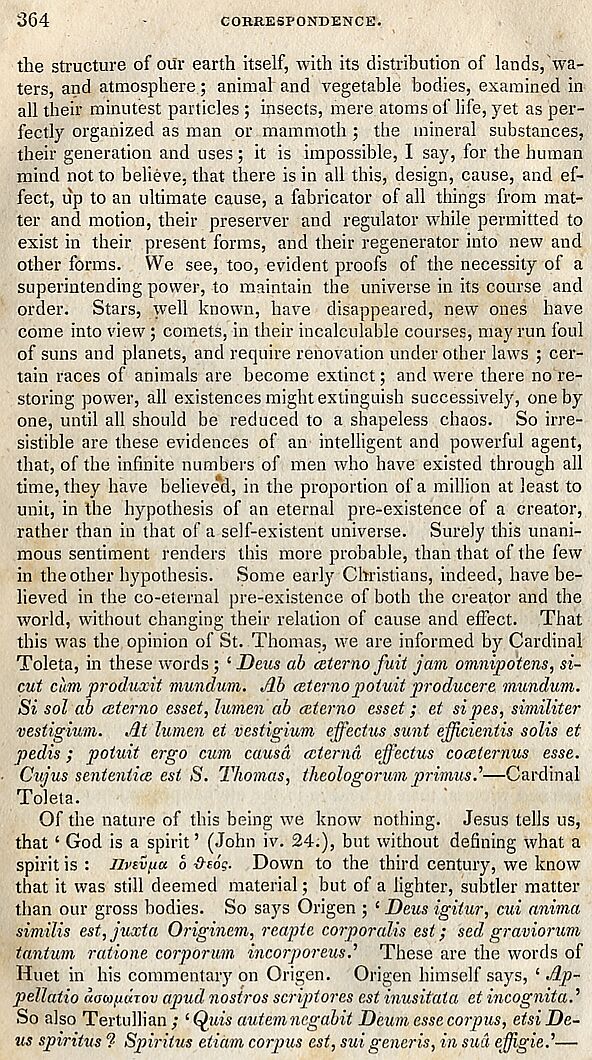
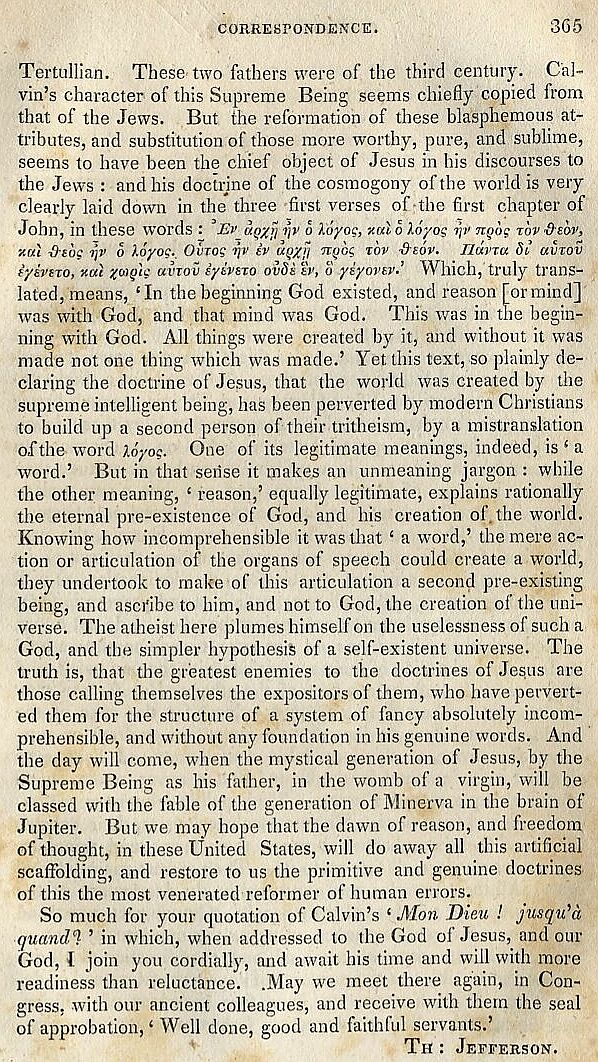
Of the nature of this being we know nothing. Jesus tells us, that ‘God is a spirit’ (John iv. 24.), but without defining what a spirit is: [Greek phrase] Down to the third century, we know that it was still deemed material but of a lighter, subtler matter than our gross bodies. So says Origen; Deus igitur, cui anima similis est, juxta Originem, reapte corporalis est; sed graviorum tantum ratione corporum incorporeus.’ These are the words of Huet in his commentary on Origen. Origen himself says, [Greek and Latin phrase]
These two fathers were of the third century. Calvin’s character of this Supreme Being seems chiefly copied from that of the Jews. But the reformation of these blasphemous attributes, and substitution of those more worthy, pure, and sublime, seems to have been the chief object of Jesus in his discourses to the Jews: and his doctrine of the cosmogony of the world is very clearly laid down in the three first verses of the first chapter of John, in these words: [Greek phrase] Which, truly translated, means, ‘In the beginning God existed, and reason [or mind] was with God, and that mind was God. This was in the beginning with God. All things were created by it, and without it was made not one thing which was made.’ Yet this text, so plainly declaring the doctrine of Jesus, that the world was created by the supreme intelligent being, has been perverted by modern Christians to build up a second person of their tritheism, by a mistranslation of the word Xoyog. One of its legitimate meanings, indeed, is ‘a word.’ But in that sense it makes an unmeaning jargon: while the other meaning, ‘reason,’ equally legitimate, explains rationally the eternal pre-existence of God, and his creation of, the world. Knowing how incomprehensible it was that ‘a word,’ the mere action or articulation of the organs of speech could create a world, they undertook to make of this articulation a second pre-existing being, and ascribe to him, and not to God, the creation of the universe. The atheist here plumes himself on the uselessness of such a God, and the simpler hypothesis of a self-existent universe. The truth is, that the greatest enemies to the doctrines of Jesus are those calling themselves the expositors of them, who have perverted them for the structure of a system of fancy absolutely incomprehensible, and without any foundation in his genuine words. And the day will come, when the mystical generation of Jesus, by the Supreme Being as his father, in the womb of a virgin, will be classed with the fable of the generation of Minerva in the brain of Jupiter. But we may hope that the dawn of reason, and freedom of thought, in these United States, will do away all this artificial scaffolding, and restore to us the primitive and genuine doctrines of this the most venerated reformer of human errors.
So much for your quotation of Calvin’s ‘Mon Dieu! jusqu’a quand’in which, when addressed to the God of Jesus, and our God, I join you cordially, and await his time and will with more readiness than reluctance. May we meet there again, in Congress, with our ancient colleagues, and receive with them the seal of approbation, ‘Well done, good and faithful servants.’
Th: Jefferson.
TO THE PRESIDENT.
Monticello, June 11, 1823.
Dear Sir,
Considering that I had not been to Bedford for a twelvemonth before, I thought myself singularly unfortunate in so timing my journey, as to have been absent exactly at the moment of your late visit to our neighborhood. The loss, indeed, was all my own; for in these short interviews with you. I generally get my political compass rectified, learn from you whereabouts we are, and correct my course again. In exchange for this, I can give you but newspaper ideas, and little indeed of these, for I read but a single paper, and that hastily. I find Horace and Tacitus so much better writers than the champions of the gazettes, that I lay those down, to take up these, with great reluctance. And on the question you propose, whether we can, in any form, take a bolder attitude than formerly in favor of liberty, I can give you but commonplace ideas. They will be but the widow’s mite, and offered only because requested. The matter which now embroils Europe, the presumption of dictating to an independent nation the form of its government, is so arrogant, so atrocious, that indignation, as well as moral sentiment, enlists all our partialities and prayers in favor of one, and our equal execrations against the other. I do not know, indeed, whether all nations do not owe to one another a bold and open declaration of their sympathies with the one party, and their detestation of the conduct of the other. But farther than this we are not bound to go; and indeed, for the sake of the world, we ought not to increase the jealousies, or draw on ourselves the power, of this formidable confederacy. I have ever deemed it fundamental for the United States, never to take active part in the quarrels of Europe. Their political interests are entirely distinct from ours. Their mutual jealousies, their balance of power, their complicated alliances, their forms and principles of government, are all foreign to us. They are nations of eternal war. All their energies are expended in the destruction of the labor, property, and lives of their people. On our part, never had a people so favorable a chance of trying the opposite system, of peace and fraternity with mankind, and the direction of all our means and faculties to the purposes of improvement instead of destruction. With Europe we have few occasions of collision, and these, with a little prudence and forbearance, may be generally accommodated. Of the brethren of our own hemisphere, none are yet, or for an age to come will be, in a shape, condition, or disposition to war against us. And the foothold, which the nations of Europe had in either America, is slipping from under them, so that we shall soon be rid of their neighborhood. Cuba alone seems at present to hold up a speck of war to us. Its possession by Great Britain would indeed be a great calamity to us. Could we induce her to join us in guarantying its independence against all the world, except Spain, it would be nearly as valuable to us as if it were our own. But should she take it, I would not immediately go to war for it; because the first war on other accounts will give it to us; or the island will give itself to us, when, able to do so. While no duty, therefore, calls on us to take part in the present war of Europe, and a golden harvest offers itself in reward for doing nothing, peace and neutrality seem to be our duty and interest. We may gratify ourselves, indeed, with a neutrality as partial to Spain as would be justifiable without giving cause of war to her adversary; we might and ought to avail ourselves of the happy occasion of procuring and cementing a cordial reconciliation with her, by giving assurance of every friendly office which neutrality admits, and especially, against all apprehension of our intermeddling in the quarrel with her colonies. And I expect daily and confidently to hear of a spark kindled in France, which will employ her at home, and relieve Spain from all further apprehensions of danger.
That England is playing false with Spain cannot be doubted. Her government is looking one way and rowing another. It is curious to look back a little on past events. During the ascendancy of Bonaparte, the word among the herd of Kings was, ‘Sauve qui peut.’ Each shifted for himself, and left his brethren to squander and do the same as they could. After the battle of Waterloo, and the military possession of France, they rallied and combined in common cause, to maintain each other against any similar and future danger. And in this alliance, Louis, now avowedly, and George, secretly but solidly, were of the contracting parties; and there can be no doubt that the allies are bound by treaty to aid England with their armies, should insurrection take place among her people. The coquetry she is now playing off between her people and her allies is perfectly understood by the latter, and accordingly gives no apprehensions to France, to whom it is all explained. The diplomatic correspondence she is now displaying, these double papers fabricated merely for exhibition, in which she makes herself talk of morals and principle, as if her qualms of conscience would not permit her to go all lengths with her Holy Allies, are all to gull her own people. It is a theatrical farce, in which the five powers are the actors, England the Tartuffe, and her people the dupes. Playing thus so dextrously into each other’s hands, and their own persons seeming secured, they are now looking to their privileged orders. These faithful auxiliaries, or accomplices, must be saved. This war is evidently that of the general body of the aristocracy, in which England is also acting her part. ‘Save but the Nobles, and there shall be no war,’ says she, masking her measures at the same time under the form of friendship and mediation, and hypocritically, while a party, offering herself as a judge, to betray those whom she is not permitted openly to oppose. A fraudulent neutrality, if neutrality at all, is all Spain will get from her. And Spain, probably, perceives this, and willingly winks at it rather than have her weight thrown openly into the other scale.
But I am going beyond my text, and sinning against the adage of carrying coals to Newcastle. In hazarding to you my crude and uninformed notions of things beyond my cognizance, only be so good as to remember that it is at your request, and with as little confidence on my part as profit on yours. You will do what is right, leaving the people of Europe to act their follies and crimes among themselves, while we pursue in good faith the paths of peace and prosperity. To your judgment we are willingly resigned, with sincere assurances of affectionate esteem and respect.
Th: Jefferson.
TO JUDGE JOHNSON.
Monticello, June 12, 1823.
Dear Sir,
Our correspondence is of that accommodating character, which admits of suspension at the convenience of either party, without inconvenience to the other. Hence this tardy acknowledgment of your favor of April the 11th. I learn from that with great pleasure, that you have resolved on continuing your history of parties. Our opponents are far ahead of us in preparations for placing their cause favorably before posterity. Yet I hope even from some of them the escape of precious truths, in angry explosions or effusions of vanity, which will betray the genuine monarchism of their principles. They do not themselves believe what they endeavor to inculcate, that we were an opposition party, not on principle, but merely seeking for office. The fact is, that at the formation of our government, many had formed their political opinions on European writings and practices, believing the experience of old countries, and especially of England, abusive as it was, to be a safer guide than mere theory. The doctrines of Europe were, that men in numerous associations cannot be restrained within the limits of order and justice, but by forces physical and moral, wielded over them by authorities independent of their will. Hence their organization of kings, hereditary nobles, and priests. Still further to constrain the brute force of the people, they deem it necessary to keep them down by hard labor, poverty, and ignorance, and to take from them, as from bees, so much of their earnings, as that unremitting labor shall be necessary to obtain a sufficient surplus barely to sustain a scanty and miserable life. And these earnings they apply to maintain their privileged orders in splendor and idleness, to fascinate the eyes of the people, and excite in them an humble adoration and submission, as to an order of superior beings. Although few among us had gone all these lengths of opinion, yet many had advanced, some more, some less, on the way. And in the convention which formed our government, they endeavored to draw the cords of power as tight as they could obtain them, to lessen the dependence of the general functionaries on their constituents, to subject to them those of the States, and to weaken their means of maintaining the steady equilibrium which the majority of the convention had deemed salutary for both branches, general and local. To recover, therefore, in practice, the powers which the nation had refused, and to warp to their own wishes those actually given, was the steady object of the federal party. Ours, on the contrary, was to maintain the will of the majority of the convention, and of the people themselves. We believed, with them, that man was a rational animal, endowed by nature with rights, and with an innate sense of justice; and that he could be restrained from wrong and protected in right, by moderate powers, confided to persons of his own choice, and held to their duties by dependence on his own will. We believed that the complicated organization of kings, nobles, and priests, was not the wisest nor best to effect the happiness of associated man; that wisdom and virtue were not hereditary; that the trappings of such a machinery consumed, by their expense, those earnings of industry they were meant to protect, and, by the inequalities they produced, exposed liberty to sufferance. We believed that men, enjoying in ease and security the full fruits of their own industry, enlisted by all their interests on the side of law and order, habituated to think for themselves, and to follow their reason as their guide, would be more easily and safely governed, than with minds nourished in error, and vitiated and debased, as in Europe, by ignorance, indigence, and oppression. The cherishment of the people then was our principle, the fear and distrust of them, that of the other party. Composed, as we were, of the landed and laboring interests of the country, we could not be less anxious for a government of law and order than were the inhabitants of the cities, the strong holds of federalism. And whether our efforts to save the principles and form of our constitution have not been salutary, let the present republican freedom, order, and prosperity of our country determine. History may distort truth, and will distort it for a time, by the superior efforts at justification of those who are conscious of needing it most. Nor will the opening scenes of our present government be seen in their true aspect, until the letters of the day, now held in private hoards, shall be broken up and laid open to public view. What a treasure will be found in General Washington’s cabinet, when it shall pass into the hands of as candid a friend to truth as he was himself! When no longer, like Caesar’s notes and memorandums in the hands of Anthony, it shall be open to the high priests of federalism only, and garbled to say so much, and no more, as suits their views.
With respect to his Farewell Address, to the authorship of which, it seems, there are conflicting claims, I can state to you some facts. He had determined to decline a re-election at the end of his first term, and so far determined, that he had requested Mr. Madison to prepare for him something valedictory, to be addressed to his constituents on his retirement. This was done: but he was finally persuaded to acquiesce in a second election, to which no one more strenuously pressed him than myself, from a conviction of the importance of strengthening, by longer habit, the respect necessary for that office, which the weight of his character only could effect. When, at the end of this second term, his Valedictory came out, Mr. Madison recognised in it several passages of his draught; several others we were both satisfied were from the pen of Hamilton, and others from that of the President himself. These he probably put into the hands of Hamilton to form into a whole, and hence it may all appear in Hamilton’s hand-writing, as if it were all of his composition.
I have stated above, that the original objects of the federalists were, 1. To warp our government more to the form and principles of monarchy, and 2. To weaken the barriers of the State governments as co-ordinate powers. In the first they have been so completely foiled by the universal spirit of the nation, that they have abandoned the enterprise, shrunk from the odium of their old appellation, taken to themselves a participation of ours, and under the pseudo-republican mask, are now aiming at their second object, and strengthened by unsuspecting or apostate recruits from our ranks, are advancing fast towards an ascendancy. I have been blamed for saying, that a prevalence of the doctrines of consolidation would one day call for reformation or revolution. I answer by asking, if a single State of the Union would have agreed to the constitution, had it given all powers to the General Government? If the whole opposition to it did not proceed from the jealousy and fear of every State, of being subjected to the other States, in matters merely its own? And if there is any reason to believe the States more disposed now than then, to acquiesce in this general surrender of all their rights and powers to a consolidated government, one and undivided?
You request me confidentially, to examine the question, whether the Supreme Court has advanced beyond its constitutional limits, and trespassed on those of the State authorities? I do not undertake it, my dear Sir, because I am unable. Age, and the wane of mind consequent on it, have disqualified me from investigations so severe, and researches so laborious. And it is the less necessary in this case, as having been already done by others with a logic and learning to which I could add nothing. On the decision of the case of Cohens vs. The State of Virginia, in the Supreme Court of the United States, in March, 1821, Judge Roane, under the signature of Algernon Sidney, wrote for the Enquirer, a series of papers on the law of that case. I considered these papers maturely as they came out, and confess, that they appeared to me to pulverize every word which had been delivered by Judge Marshall, of the extra-judicial part of his opinion; and all was extra-judicial, except the decision that the act of Congress had not purported to give to the corporation of Washington the authority claimed by their lottery-law, of controlling the laws of the States within the States themselves. But unable to claim that case, he could not let it go entirely, but went on gratuitously to prove, that notwithstanding the eleventh amendment of the constitution, a State could be brought, as a defendant, to the bar of his court; and again, that Congress might authorize a corporation of its territory to exercise legislation within a State, and paramount to the laws of that State. I cite the sum and result only of his doctrines, according to the impression made on my mind at the time, and still remaining. If not strictly accurate in circumstance, it is so in substance. This doctrine was so completely refuted by Roane, that if he can be answered, I surrender human reason as a vain and useless faculty, given to bewilder, and not to guide us. And I mention this particular case as one only of several, because it gave occasion to that thorough examination of the constitutional limits between the General and State jurisdictions, which you have asked for. There were two other writers in the same paper, under the signatures of Fletcher of Saltoun, and Somers, who in a few essays presented some very luminous and striking views of the question. And there was a particular paper which recapitulated all the cases in which it was thought the federal court had usurped on the State jurisdictions. These essays will be found in the Enquirers of 1821, from May the 10th to July the 13th. It is not in my present power to send them to you, but if Ritchie can furnish them, I will procure and forward them. If they had been read in the other States, as they were here, I think they would have left, there as here, no dissentients from their doctrine. The subject was taken up by our legislature of 1821-22, and two draughts of remonstrances were prepared and discussed. As well as I remember, there was no difference of opinion as to the matter of right; but there was as to the expediency of a remonstrance at that time, the general mind of the States being then under extraordinary excitement by the Missouri question; and it was dropped on that consideration. But this case is not dead; it only sleepeth. The Indian Chief said, he did not go to war for every petty injury by itself, but put it into his pouch, and when that was full, he then made war. Thank Heaven, we have provided a more peaceable and rational mode of redress.
This practice of Judge Marshall, of travelling out of his case to prescribe what the law would be in a moot case not before the court, is very irregular and very censurable. 1 recollect another instance, and the more particularly, perhaps, because it in some measure bore on myself. Among the midnight appointments of Mr. Adams, were commissions to some federal justices of the peace for Alexandria. These were signed and sealed by him, but not delivered. I found them on the table of the department of State, on my entrance into office, and 1 forbade their delivery. Marbury, named in one of them, applied to the Supreme Court for a Mandamus to the Secretary of State (Mr. Madison), to deliver the commission intended for him. The Court determined at once, that being an original process, they had no cognizance of it; and there the question before them was ended. But the Chief Justice went on to lay down what the law would be, had they jurisdiction of the case; to wit, that they should command the delivery.
The object was clearly to instruct any other court having the jurisdiction, what they should do, if Marbury should apply to them. Besides the impropriety of this gratuitous interference, could any thing exceed the perversion of law? For if there is any principle of law never yet contradicted, it is that delivery is one of the essentials to the validity of a deed. Although signed and sealed, yet as long as it remains in the hands of the party himself, it is in fieri only, it is not a deed, and can be made so only by its delivery. In the hands of a third person it may be made an escrow. But whatever is in the executive offices is certainly deemed to be in the hands of the President; and, in this case, was actually in my hands, because, when I countermanded them, there was as yet no Secretary of State. Yet this case of Marbury and Madison is continually cited by bench and bar, as if it were settled law, without any animadversion on its being merely an obiter dissertation of the Chief Justice.
It may be impracticable to lay down any general formula of words which shall decide at once, and with precision, in every case, this limit of jurisdiction. But there are two canons which will guide us safely in most of the cases. 1. The capital and leading object of the constitution was, to leave with the States all authorities which respected their own citizens only, and to transfer to the United States those which respected citizens of foreign or other States: to make us several as to ourselves, but one as to all others. In the latter case, then, constructions should lean to the general jurisdiction, if the words will bear it; and in favor of the States in the former, if possible to be so construed. And indeed, between citizens and citizens of the same State, and under their own laws, I know but a single case in which a jurisdiction is given to the General Government. That is, where any thing but gold or silver is made a lawful tender, or the obligation of contracts is any otherwise impaired. The separate legislatures had so often abused that power, that the citizens themselves chose to trust it to the general, rather than to their own special authorities. 2. On every question of construction, carry ourselves back to the time when the constitution was adopted, recollect the spirit manifested in the debates, and instead of trying what meaning may be squeezed out of the text, or invented against it, conform to the probable one in which it was passed. Let us try Cohen’s case by these canons only, referring always however, for full argument, to the essays before cited.
1. It was between a citizen and his own State, and under a law of his State. It was a domestic case therefore, and not a foreign one.
2. Can it be believed, that under the jealousies prevailing against the General Government, at the adoption of the constitution, the States meant to surrender the authority of preserving order, of enforcing moral duties, and restraining vice, within their own territory? And this is the present case, that of Cohen being under the ancient and general law of gaming. Can any good be effected, by taking from the States the moral rule of their citizens, and subordinating it to the general authority, or to one of their corporations, which may justify forcing the meaning of words, hunting after possible constructions, and hanging inference on inference, from heaven to earth, like Jacob’s ladder? Such an intention was impossible, and such a licentiousness of construction and inference, if exercised by, both governments, as may be done with equal right, would equally authorize both to claim all powers, general and particular, and break up the foundations of the Union. Laws are made for men of ordinary understanding, and should, therefore, be construed by the ordinary rules of common sense. Their meaning is not to be sought for in metaphysical subtleties, which may make any thing mean every thing or nothing, at pleasure. It should be left to the sophisms of advocates, whose trade it is, to prove that a defendant is a plaintiff, though dragged into court, torto collo, like Bonaparte’s volunteers into the field in chains, or that a power has been given, because it ought to have been given, et alia talia. The States supposed, that, by their tenth amendment, they had secured themselves against constructive powers. They were not lessoned yet by Cohen’s case, nor aware of the slipperiness of the eels of the law. I ask for no straining of words against the General Government nor yet against the States. I believe the States can best govern our home concerns, and the General Government our foreign ones. I wish, therefore, to see maintained that wholesome distribution of powers, established by the constitution for the limitation of both; and never to see all offices transferred to Washington, where, further withdrawn from the eyes of the people, they may more secretly be bought and sold, as at market.
But the Chief Justice says, ‘there must be an ultimate arbiter somewhere.’ True, there must; but does that prove it is either party? The ultimate arbiter is the people of the Union, assembled by their deputies in convention, at the call of Congress, or of two thirds of the States. Let them decide to which they mean to give an authority claimed by two of their organs. And it has been the peculiar wisdom and felicity of our constitution, to have provided this peaceable appeal, where that of other nations is at once to force.
I rejoice in the example you set of seriatim opinions. I have heard it often noticed, and always with high approbation. Some of your brethren will be encouraged to follow it occasionally, and in time, it may be felt by all as a duty, and the sound practice of the primitive court be again restored. Why should not every judge be asked his opinion, and give it from the bench, if only by yea or nay? Besides ascertaining the fact of his opinion, which the public have a right to know, in order to judge whether it is impeachable or not, it would show whether the opinions were unanimous or not, and thus settle more exactly the weight of their authority.
The close of my second sheet warns me that it is time now to relieve you from this letter of unmerciful length. Indeed, I wonder how I have accomplished it, with two crippled wrists, the one scarcely able to move my pen, the other to hold my paper. But I am hurried sometimes beyond the sense of pain, when unbosoming myself to friends who harmonize with me in principle. You and I may differ occasionally in details of minor consequence, as no two minds, more than two faces, are the same in every feature. But our general objects are the same; to preserve the republican form and principles of our constitution, and cleave to the salutary distribution of powers which that has established. These are the two sheet anchors of our Union. If driven from either, we shall be in danger of foundering. To my prayers for its safety and perpetuity, I add those for the continuation of your health, happiness, and usefulness to your country.
Th: Jefferson.
TO JAMES MADISON.
Monticello, August 30,1823.
Dear Sir,
I received the enclosed letters from the President, with a request that after perusal I would forward them to you, for perusal by yourself also, and to be returned then to him.
You have doubtless seen Timothy Pickering’s fourth of July observations on the Declaration of Independence. If his principles and prejudices, personal and political, gave us no reason to doubt whether he had truly quoted the information he alleges to have received from Mr. Adams, I should then say, that in some of the particulars, Mr. Adams’s memory has led him into unquestionable error. At the age of eighty-eight, and forty-seven years after the transactions of Independence, this is not wonderful. Nor should I, at the age of eighty, on the small advantage of that difference only, venture to oppose my memory to his, were it not supported by written notes, taken by myself at the moment and on the spot. He says, ‘The committee of five, to wit, Doctor Franklin, Sherman, Livingston, and ourselves, met, discussed the subject, and then appointed him and myself to make the draught; that, we, as a sub-committee, met, and after the urgencies of each on the other, I consented to undertake the task; that, the draught being made, we, the sub-committee, met, and conned the paper over, and he does not remember that he made or suggested a single alteration.’ Now these details are quite incorrect. The committee of five met; no such thing as a sub-committee was proposed, but they unanimously pressed on myself alone to undertake the draught. I consented; I drew it: but before I reported it to the committee, I communicated it separately to Doctor Franklin and Mr. Adams, requesting their corrections, because they were the two members of whose judgments and amendments I wished most to have the benefit, before presenting it to the committee: and you have seen the original paper now in my hands, with the corrections of Doctor Franklin and Mr. Adams interlined in their own hand-writings. Their alterations were two or three only, and merely verbal. I then wrote a fair copy, reported it to the committee, and from them, unaltered, to Congress. This personal communication and consultation with Mr. Adams, he has misremembered into the actings of a sub-committee. Pickering’s observations, and Mr. Adams’s in addition, ‘that it contained no new ideas, that it is a common-place compilation, its sentiments hacknied in Congress for two years before, and its essence contained in Otis’s pamphlet,’ may all be true. Of that I am not to be the judge. Richard Henry Lee charged it as copied from Locke’s Treatise on Government. Otis’s pamphlet I never saw, and whether I had gathered my ideas from reading or reflection I do not know. I know only that I turned to neither book nor pamphlet while writing it. I did not consider it as any part of my charge to invent new ideas altogether, and to offer no sentiment which had ever been expressed before. Had Mr. Adams been so restrained, Congress would have lost the benefit of his bold and impressive advocations of the rights of Revolution. For no man’s confident and fervid addresses, more than Mr. Adams’s, encouraged and supported us through the difficulties surrounding us, which, like the ceaseless action of gravity, weighed on us by night and by day. Yet, on the same ground, we may ask what of these elevated thoughts was new, or can be affirmed never before to have entered the conceptions of man?
Whether, also, the sentiments of Independence, and the reasons for declaring it, which makes so great a portion of the instrument, had been hacknied in Congress for two years before the 4th of July, ‘76, or this dictum also of Mr. Adams be another slip of memory, let history say. This, however, I will say for Mr. Adams, that he supported the Declaration with zeal and ability, fighting fearlessly for every word of it. As to myself, I thought it a duty to be, on that occasion, a passive auditor of the opinions of others, more impartial judges than I could be, of its merits or demerits. During the debate I was sitting by Doctor Franklin, and he observed that I was writhing a little under the acrimonious criticisms on some of its parts; and it was on that occasion, that by way of comfort, he told me the story of John Thomson, the hatter, and his new sign.
Timothy thinks the instrument the better for having a fourth of it expunged. He would have thought it still better, had the other three fourths gone out also, all but the single sentiment (the only one he approves), which recommends friendship to his dear England, whenever she is willing to be at peace with us. His insinuations are, that although ‘the high tone of the instrument was in unison with the warm feelings of the times, this sentiment of habitual friendship to England should never be forgotten, and that the duties it enjoins should especially be borne in mind on every celebration of this anniversary.’ In other words, that the Declaration, as being a libel on the government of England, composed in times of passion, should now be buried in utter oblivion, to spare the feelings of our English friends and Angloman fellow-citizens. But it is not to wound them that we wish to keep it in mind; but to cherish the principles of the instrument in the besoms of our own citizens: and it is a heavenly comfort to see that these principles are yet so strongly felt, as to render a circumstance so trifling as this little lapse of memory of Mr. Adams’s, worthy of being solemnly announced and supported at an anniversary assemblage of the nation on its birth-day. In opposition, however, to Mr. Pickering, I pray God that these principles may be eternal, and close the prayer with my affectionate wishes for yourself of long life, health, and happiness.
Th: Jefferson.
TO JOHN ADAMS.
Monticello, September 4, 1823.
Dear Sir,
Your letter of August the 15th was received in due time, and with the welcome of every thing which comes from you. With its opinions on the difficulties of revolutions from despotism to freedom, I very much concur. The generation which commences a revolution rarely completes it. Habituated from their infancy to passive submission of body fend mind to their kings and priests, they are not qualified, when called on, to think and provide for themselves; and their inexperience, their ignorance and bigotry, make them instruments often, in the hands of the Bonapartes and Iturbides, to defeat their own rights and purposes. This is the present situation of Europe and Spanish America. But it is not desperate. The light which has been shed on mankind by the art of printing, has eminently changed the condition of the world. As yet, that light has dawned on the middling classes only of the men in Europe. The kings and the rabble, of equal ignorance, have not yet received its rays; but it continues to spread, and while printing is preserved, it can no more recede than the sun return on his course. A first attempt to recover the right of self-government may fail, so may a second, a third, &c. But as a younger and more instructed race comes on, the sentiment becomes more and more intuitive, and a fourth, a fifth, or some subsequent one of the ever-renewed attempts will ultimately succeed. In France, the first effort was defeated by Robespierre, the second by Bonaparte, the third by Louis XVIII., and his holy allies; another is yet to come, and all Europe, Russia excepted, has caught the spirit; and all will attain representative government, more or less perfect. This is now well understood to be a necessary check on Kings, whom they will probably think it more prudent to chain and tame, than to exterminate. To attain all this, however, rivers of blood must yet flow, and years of desolation pass over; yet the object is worth rivers of blood, and years of desolation. For what inheritance so valuable, can man leave to his posterity? The spirit of the Spaniard, and his deadly and eternal hatred to a Frenchman, give me much confidence that he will never submit, but finally defeat this atrocious violation of the laws of God and man, under which he is suffering; and the wisdom and firmness of the Cortes, afford reasonable hope, that that nation will settle down in a temperate representative government, with an executive properly subordinated to that. Portugal, Italy, Prussia, Germany, Greece, will follow suit. You and I shall look down from another world on these glorious achievements to man, which will add to the joys even of heaven.
I observe your toast of Mr. Jay on the 4th of July, wherein you say that the omission of his signature to the Declaration of Independence was by accident. Our impressions as to this fact being different, I shall be glad to have mine corrected, if wrong. Jay, you know, had been in constant opposition to our laboring majority. Our estimate at the time was, that he, Dickinson, and Johnson of Maryland, by their ingenuity, perseverance, and partiality to our English connection, had constantly kept us a year behind where we ought to have been, in our preparations and proceedings. From about the date of the Virginia instructions of May the 15th, 1776, to declare Independence, Mr. Jay absented himself from Congress, and never came there again until December, 1778. Of course, he had no part in the discussions or decision of that question. The instructions to their Delegates by the convention of New York, then sitting, to sign the Declaration, were presented to Congress on the 15th of July only, and on that day the journals show the absence of Mr. Jay, by a letter received from him, as they had done as early as the 29th of May, by another letter. And I think he had been omitted by the convention on a new election of Delegates, when they changed their instructions. Of this last fact, however, having no evidence but an ancient impression, I shall not affirm it. But whether so or not, no agency of accident appears in the case. This error of fact, however, whether yours or mine, is of little consequence to the public. But truth being as cheap as error, it is as well to rectify it for our own satisfaction.
I have had a fever of about three weeks, during the last and preceding month, from which I am entirely recovered except as to strength.
Ever affectionately yours.
Th: Jefferson.
TO JOHN ADAMS.
Monticello, October 12, 1823.
Dear Sir,
I do not write with the ease which your letter of September the 18th supposes. Crippled wrists and fingers make writing slow and laborious. But while writing to you, I lose the sense of these things in the recollection of ancient times, when youth and health made happiness out of every thing. I forget for a while the hoary winter of age, when we can think of nothing but how to keep ourselves warm, and how to get rid of our heavy hours until the friendly hand of death shall rid us of all at once. Against this tedium vita, however, I am fortunately mounted on a hobby, which, indeed, I should have better managed some thirty or forty years ago; but whose easy amble is still sufficient to give exercise and amusement to an octogenary rider. This is the establishment of a University, on a scale more comprehensive, and in a country more healthy and central than our old William and Mary, which these obstacles have long kept in a state of languor and inefficiency. But the tardiness with which such works proceed, may render it doubtful whether I shall live to see it go into action.
Putting aside these things, however, for the present, I write this letter as due to a friendship coeval with our government, and now attempted to be poisoned, when too late in life to be replaced by new affections. I had for some time observed, in the public papers, dark hints and mysterious innuendoes of a correspondence of yours with a friend, to whom you had opened your bosom without reserve, and which was to be made public by that friend or his representative. And now it is said to be actually published. It has not yet reached us, but extracts have been given, and such as seemed most likely to draw a curtain of separation between you and myself. Were there no other motive than that of indignation against the author of this outrage on private confidence, whose shaft seems to have been aimed at yourself more particularly, this would make it the duty of every honorable mind to disappoint that aim, by opposing to its impression a seven-fold shield of apathy and insensibility. With me, however, no such armor is needed. The circumstances of the times in which we have happened to live, and the partiality of our friends at a particular period, placed us in a state of apparent opposition, which some might suppose to be personal also: and there might, not be wanting those who wished to make it so, by filling our ears with malignant falsehoods, by dressing up hideous phantoms of their own creation, presenting them to you under my name, to me under yours, and endeavoring to instil into our minds things concerning each other the most destitute of truth. And if there had been, at any time, a moment when we were off our guard, and in a temper to let the whispers of these people make us forget what we had known of each other for so many years, and years of so much trial, yet all men, who have attended to the workings of the human mind, who have seen the false colors under which passion sometimes dresses the actions and motives of others, have seen also those passions subsiding with time and reflection, dissipating like mists before the rising sun, and restoring to us the sight of all things in their true shape and colors. It would be strange, indeed, if, at our years, we were to go an age back to hunt up imaginary or forgotten facts, to disturb the repose of affections so sweetening to the evening of our lives. Be assured, my dear Sir, that I am incapable of receiving the slightest impression from the effort now made to plant thorns on the pillow of age, worth, and wisdom, and to sow tares between friends who have been such for near half a century. Beseeching you, then, not to suffer your mind to be disquieted by this wicked attempt to poison its peace, and praying you to throw it by among the things which have never happened, I add sincere assurances of my unabated and constant attachment, friendship, and respect.
Th: Jefferson.
TO THE PRESIDENT.
Monticello, October 24,1823.
Dear Sir,
The question presented by the letters you have sent me, is the most momentous which has ever been offered to my contemplation since that of Independence. That made us a nation, this sets our compass, and points the course which we are to steer through the ocean of time opening on us. And never could we embark on it under circumstances more auspicious. Our first and fundamental maxim should be, never to entangle ourselves in the broils of Europe. Our second, never to suffer Europe to intermeddle with cis-Atlantic affairs. America, North and South, has a set of interests distinct from those of Europe, and peculiarly her own.
She should therefore have a system of her own, separate and apart from that of Europe. While the last is laboring to become the domicile of despotism, our endeavor should surely be, to make our hemisphere that of freedom. One nation, most of all, could disturb us in this pursuit; she now offers to lead, aid, and accompany us in it. By acceding to her proposition, we detach her from the band of despots, bring her mighty weight into the scale of free government, and emancipate a continent at one stroke, which might otherwise linger long in doubt and difficulty. Great Britain is the nation which can do us the most harm of any one, or all, on earth; and with her on our side we need not fear the whole world. With her, then, we should most sedulously cherish a cordial friendship; and nothing would tend more to knit our affections, than to be fighting once more, side by side, in the same cause. Not that I would purchase even her amity at the price of taking part in her wars. But the war in which the present proposition might engage us, should that be its consequence, is not her war, but ours. Its object is to introduce and establish the American system, of keeping out of our land all foreign powers, of never permitting those of Europe to intermeddle with the affairs of our nations. It is to maintain our own principle, not to depart from it. And if, to facilitate this, we can effect a division in the body of the European powers, and draw over to our side its most powerful member, surely we should do it. But I am clearly of Mr. Canning’s opinion, that it will prevent instead of provoking war. With Great Britain withdrawn from their scale, and shifted into that of our two continents, all Europe combined would not undertake such a war. For how would they propose to get at either enemy without superior fleets? Nor is the occasion to be slighted which this proposition offers, of declaring our protest against the atrocious violations of the rights of nations, by the interference of any one in the internal affairs of another, so flagitiously begun by Bonaparte, and now continued by the equally lawless Alliance, calling itself Holy.
But we have first to ask ourselves a question. Do we wish to acquire to our own confederacy any one or more of the Spanish provinces? I candidly confess, that I have ever looked on Cuba as the most interesting addition which could ever be made to our system of States. The control which, with Florida Point, this island would give us over the Gulf of Mexico, and the countries and isthmus bordering on it, as well as all those whose waters flow into it, would fill up the measure of our political well-being. Yet, as I am sensible that this can never be obtained, even with her own consent, but by war; and its independence, which is our second interest (and especially its independence of England), can be secured without it, I have no hesitation in abandoning my first wish to future chances, and accepting its independence, with peace and the friendship of England, rather than its association, at the expense of war and her enmity.
I could honestly, therefore, join in the declaration proposed, that we aim not at the acquisition of any of those possessions, that we will not stand in the way of any amicable arrangement between them and the mother country; but that we will oppose, with all our means, the forcible interposition of any other power, as auxiliary, stipendiary, or under any other form or pretext, and most especially, their transfer to any power by conquest, cession, or acquisition in any other way. I should think it, therefore, advisable, that the Executive should encourage the British government to a continuance in the dispositions expressed in these letters, by an assurance of his concurrence with them as far as his authority goes; and that as it may lead to war, the declaration of which requires an act of Congress, the case shall be laid before them for consideration at their first meeting, and under the reasonable aspect in which it is seen by himself.
I have been so long weaned from political subjects, and have so long ceased to take any interest in them, that I am sensible I am not qualified to offer opinions on them worthy of any attention. But the question now proposed involves consequences so lasting, and effects so decisive of our future destinies, as to re-kindle all the interest I have heretofore felt on such occasions, and to induce me to the hazard of opinions, which will prove only my wish to contribute still my mite towards any thing which may be useful to our country. And praying you to accept it at only what it is worth, I add the assurance of my constant and affectionate friendship and respect.
Th: Jefferson.
TO THE MARQUIS DE LA FAYETTE.
Monticello, November 4, 1823.
My Dear Friend,
Two dislocated wrists and crippled fingers have rendered writing so slow and laborious, as to oblige me to withdraw from nearly all correspondence: not, however, from yours, while I can make a stroke with a pen. We have gone through too many trying scenes together, to forget the sympathies and affections they nourished.
Your trials have indeed been long and severe. When they will end, is yet unknown, but where they will end, cannot be doubted. Alliances, Holy or Hellish, may be formed, and retard the epoch of deliverance, may swell the rivers of blood which are yet to flow, but their own will close the scene, and leave to mankind the right of self-government. I trust that Spain will prove, that a nation cannot be conquered which determines not to be so, and that her success will be the turning of the tide of liberty, no more to be arrested by human efforts. Whether the state of society in Europe can bear a republican government, I doubted, you know when with you, and I do now. A hereditary chief, strictly limited, the right of war vested in the legislative body, a rigid economy of the public contributions, and absolute interdiction of all useless expenses, will go far towards keeping the government honest and unoppressive. But the only security o£ all, is in a free press. The force of public opinion cannot be resisted, when permitted freely to be expressed. The agitation it produces must be submitted to. It is necessary to keep the waters pure.
We are all, for example, in agitation even in our peaceful country. For in peace as well as in war, the mind must be kept in motion. Who is to be the next President, is the topic here of every conversation. My opinion on that subject is what I expressed to you in my last letter. The question will be ultimately reduced to the northernmost and southernmost candidates. The former will get every federal vote in the Union, and many republicans; the latter, all those denominated of the old school; for you are not to believe that these two parties are amalgamated, that the lion and the lamb are lying down together. The Hartford convention, the victory of Orleans, the peace of Ghent, prostrated the name of federalism. Its votaries abandoned it through shame and mortification; and now call themselves republicans. But the name alone is changed, the principles are the same. For in truth, the parties of Whig and Tory are those of nature. They exist in all countries, whether called by these names, or by those of Aristocrats and Democrats, Cote Droite and Cote Gauche, Ultras and Radicals, Serviles and Liberals. The sickly, weakly, timid man, fears the people, and is a tory by nature. The healthy, strong, and bold, cherishes them, and is formed a whig by nature. On the eclipse of federalism with us, although not its extinction, its leaders got up the Missouri question, under the false front of lessening the measure of slavery, but with the real view of producing a geographical division of parties, which might insure them the next President. The people of the north went blindfold into the snare, followed their leaders for a while with a zeal truly moral and laudable, until they became sensible that they were injuring instead of aiding the real interests of the slaves, that they had been used, merely as tools for electioneering purposes; and that trick of hypocrisy then fell as quickly as it had been got up. To that is now succeeding a distinction, which, like that of republican and federal, or whig and tory, being equally intermixed through every State, threatens none of those geographical schisms which go immediately to a separation. The line of division now is the preservation of State rights as reserved in the constitution, or by strained constructions of that instrument, to merge all into a consolidated government. The tories are for strengthening the executive and General Government; the whigs cherish the representative branch, and the rights reserved by the States, as the bulwark against consolidation, which must immediately generate monarchy. And although this division excites, as yet, no warmth, yet it exists, is well understood, and will be a principle of voting at the ensuing election, with the reflecting men of both parties.
I thank you much for the two books you were so kind as to send me by Mr. Gallatin. Miss Wright had before favored me with the first edition of her American work: but her ‘Few Days in Athens,’ was entirely new, and has been a treat to me of the highest order. The matter and manner of the dialogue is strictly ancient; the principles of the sects are beautifully and candidly explained and contrasted; and the scenery and portraiture of the interlocutors are of higher finish than any thing in that line left us by the ancients; and like Ossian, if not ancient, it is equal to the best morsels of antiquity. I augur, from this instance, that Herculaneum is likely to furnish better specimens of modern than of ancient genius; and may we not hope more from the same pen?
After much sickness, and the accident of a broken and disabled arm, I am again in tolerable health, but extremely debilitated, so as to be scarcely able to walk into my garden. The hebitude of age too, and extinguishment of interest in the things around me, are weaning me from them, and dispose me with cheerfulness to resign them to the existing generation, satisfied that the daily advance of science will enable them to administer the commonwealth with increased wisdom. You have still many valuable years to give to your country, and with my prayers that, they may be years of health and happiness, and especially that they may see the establishment of the principles of government which you have cherished through life, accept the assurance of my affectionate and constant friendship and respect.
Th: Jefferson.
TO JOSEPH C CABELL.
Monticello, February 3, 1824.
Dear Sir,
I am favored with your two letters of January the 26th and 29th, and am glad that yourself and the friends of the University are so well satisfied, that the provisos amendatory of the University Act are mere nullities. I had not been able to put out of my head the Algebraical equation, which was among the first of my college lessons, that a-a = 0. Yet I cheerfully arrange myself to your opinions. I did not suppose, nor do I now suppose it possible, that both Houses of the legislature should ever consent, for an additional fifteen thousand dollars of revenue, to set all the Professors and students of the University adrift: and if foreigners will have the same confidence which we have in our legislature, no harm will have been done by the provisos.
You recollect that we had agreed that the Visitors who are of the legislature should fix on a certain day of meeting, after the rising of the Assembly, to put into immediate motion the measures which this act was expected to call for. You will of course remind the Governor that a re-appointment of Visitors is to be made on the day following Sunday, the 29th of this month; and as he is to appoint the day of their first meeting, it would be well to recommend to him that which our brethren there shall fix on. It may be designated by the Governor as the third, fourth, &c. day after the rising of the legislature, which will give it certainty enough.
You ask what sum would be desirable for the purchase of books and apparatus. Certainly the largest you can obtain. Forty or fifty thousand dollars would enable us to purchase the most essential books of text and reference for the schools, and such an apparatus for Mathematics, Astronomy, and Chemistry, as may enable us to set out with tolerable competence, if we can, through the banks and otherwise, anticipate the whole sum at once.
I remark what you say on the subject of committing ourselves to any one for the Law appointment. Your caution is perfectly just. I hope, and am certain, that this will be the standing law of discretion and duty with every member of our board, in this and all cases. You know we have all, from the beginning, considered the high qualifications of our Professors, as the only means by which we can give to our institution splendor and pre-eminence over all its sister seminaries. The only question, therefore, we can ever ask ourselves, as to any candidate, will be, Is he the most highly qualified? The college of Philadelphia has lost its character of primacy by indulging motives of favoritism and nepotism, and by conferring the appointments as if the professorships were entrusted to them as provisions for their friends. And even that of Edinburgh, you know, is also much lowered from the same cause. We are next to observe, that a man is not qualified for a Professor, knowing nothing but merely his own profession. He should be otherwise well educated as to the sciences generally; able to converse understandingly with the scientific men with whom he is associated, and to assist in the councils of the Faculty on any subject of science on which they may have occasion to deliberate. Without this, he will incur their contempt, and bring disreputation on the institution. With respect to the professorship you mention, I scarcely know any of our judges personally; but I will name, for example, the late Judge Roane, who, I believe, was generally admitted to be among the ablest of them. His knowledge was confined to the common law chiefly, which does not constitute one half of the qualification of a really learned lawyer, much less that of a Professor of law for an University. And as to any other branches of science, he must have stood mute in the presence of his literary associates, or of any learned strangers or others visiting the University. Would this constitute the splendid stand we propose to take?
In the course of the trusts I have exercised through life with powers of appointment, I can say with truth, and with unspeakable comfort, that I never did appoint a relation to office, and that merely because I never saw the case in which some one did not offer, or occur, better qualified; and I have the most unlimited confidence, that in the appointment of Professors to our nursling institution, every individual of my associates will look with a single eye to the sublimation of its character, and adopt, as our sacred motto, ‘Detur digniori? In this way it will honor us, and bless our country.
I perceive that I have permitted my reflections to run into generalities beyond the scope of the particular intimation in your letter I will let them go, however, as a general confession of faith, not belonging merely to the present case.
Name me affectionately to our brethren with you, and be assured yourself of my constant friendship and respect.
Th: Jefferson.
TO JARED SPARKS.
Monticello, February 4, 1824.
Dear Sir,
I duly received your favor of the 3th, and with it the last number of the North American Review. This has anticipated the one I should receive in course, but have not yet received, under my subscription to the new series. The article on the African colonization of the people of color, to which you invite my attention, I have read with great consideration. It is, indeed, a fine one, and will do much good. I learn from it more, too, than I had before known, of the degree of success and promise of that colony.
In the disposition of these unfortunate people, there are two rational objects to be distinctly kept in view. 1. The establishment of a colony on the coast of Africa, which may introduce among the aborigines the arts of cultivated life, and the blessings of civilization and science. By doing this, we may make to them some retribution for the long course of injuries we have been committing on their population. And considering that these blessings will descend to the ‘nati natorum, et qui nascentur ab illis,’ we shall in the long run have rendered them perhaps more good than evil. To fulfil this object, the colony of Sierra Leone promises well, and that of Mesurado adds to our prospect of success. Under this view, the Colonization Society is to be considered as a missionary society, having in view, however, objects more humane, more justifiable, and less aggressive on the peace of other nations, than the others of that appellation.
The second object, and the most interesting to us, as coming home to our physical and moral characters, to our happiness and safety, is to provide an asylum to which we can, by degrees, send the whole of that population from among us, and establish them under our patronage and protection, as a separate, free, and independent people, in some country and climate friendly to human life and happiness. That any place on the coast of Africa should answer the latter purpose, I have ever deemed entirely impossible. And without repeating the other arguments which have been urged by others, I will appeal to figures only, which admit no controversy. I shall speak in round numbers, not absolutely accurate, yet not so wide from truth as to vary the result materially. There are in the United States a million and a half of people of color in slavery. To send off the whole of these at once, nobody conceives to be practicable for us, or expedient for them. Let us take twenty-five years for its accomplishment, within which time they will be doubled. Their estimated value as property, in the first place, (for actual property has been lawfully vested in that form, and who can lawfully take it from the possessors?) at an average of two hundred dollars each, young and old, would amount to six hundred millions of dollars, which must be paid or lost by somebody. To this, add the cost of their transportation by land and sea to Mesurado, a year’s provision of food and clothing, implements of husbandry and of their trades, which will amount to three hundred millions more, making thirty-six millions of dollars a year for twenty-five years, with insurance of peace all that time, and it is impossible to look at the question a second time. I am aware that at the end of about sixteen years, a gradual detraction from this sum will commence, from the gradual diminution of breeders, and go on during the remaining nine years. Calculate this deduction, and it is still impossible to look at the enterprise a second time. I do not say this to induce an inference that the getting rid of them is for ever impossible. For that is neither my opinion nor my hope. But only that it cannot be done in this way. There is, I think, a way in which it can be done; that is, by emancipating the after born, leaving them, on due compensation, with their mothers, until their services are worth their maintenance, and then putting them to industrious occupations, until a proper age for deportation. This was the result of my reflections on the subject five and forty years ago, and I have never yet been able to conceive any other practicable plan. It was sketched in the Notes on Virginia, under the fourteenth query. The estimated value of the new-born infant is so low (say twelve dollars and fifty cents), that it would probably be yielded by the owner gratis, and would thus reduce the six hundred millions of dollars, the first head of expense, to thirty-seven millions and a half: leaving only the expenses of nourishment while with the mother, and of transportation. And from what fund are these expenses to be furnished? Why not from that of the lands which have been ceded by the very States now needing this relief? And ceded on no consideration, for the most part, but that of the general good of the whole. These cessions already constitute one fourth of the States of the Union. It may be said that these lands have been sold; are now the property of the citizens composing those States; and the money long ago received and expended. But an equivalent of lands in the territories since acquired may be appropriated to that object, or so much at least, as may be sufficient; and the object, although more important to the slave States, is highly so to the others also, if they were serious in their arguments on the Missouri question. The slave States, too, if more interested, would also contribute more by their gratuitous liberation, thus taking on themselves alone the first and heaviest item of expense.
In the plan sketched in the Notes on Virginia, no particular place of asylum was specified; because it was thought possible, that in the revolutionary state of America, then commenced, events might open to us some one within practicable distance. This has now happened. St. Domingo has become independent, and with a population of that color only; and if the public papers are to be credited, their Chief offers to pay their passage, to receive them as free citizens, and to provide them employment. This leaves, then, for the general confederacy, no expense but of nurture with the mother a few years, and would call, of course, for a very moderate appropriation of the vacant lands. Suppose the whole annual increase to be of sixty thousand effective births, fifty vessels, of four hundred tons burthen each, constantly employed in that short run, would carry off the increase of every year, and the old stock would die off in the ordinary course of nature, lessening from the commencement until its final disappearance. In this way no violation of private rights is proposed. Voluntary surrenders would probably come in as fast as the means to be provided for their care would be competent to it. Looking at my own State only, (and I presume not to speak for the others,) I verily believe that this surrender of property would not amount to more, annually, than half our present direct taxes, to be continued fully about twenty or twenty-five years, and then gradually diminishing for as many more until their final extinction; and even this half tax would not be paid in cash, but by the delivery of an object which they have never yet known or counted as part of their property: and those not possessing the object will be called on for nothing. I do not go into all the details of the burthens and benefits of this operation. And who could estimate its blessed effects? I leave this to those who will live to see their accomplishment, and to enjoy a beatitude forbidden to my age. But I leave it with this admonition, to rise and be doing. A million and a half are within their control; but six millions (which a majority of those now living will see them attain), and one million of these fighting men, will say, ‘We will not go.’
I am aware that this subject involves some constitutional scruples. But a liberal construction, justified by the object, may go far, and an amendment of the constitution, the whole length necessary. The separation of infants from their mothers, too, would produce some scruples of humanity. But this would be straining at a gnat, and swallowing a camel.
I am much pleased to see that you have taken up the subject of the duty on imported books. I hope a crusade will be kept up against it, until those in power shall become sensible of this stain on our legislation and shall wipe it from their code, and from the remembrance of man, if possible.
I salute you with assurances of high respect and esteem.
Th: Jefferson
TO EDWARD LIVINGSTON.
Monticello, April 4, 1824.
Dear Sir,
It was with great pleasure I learned that the good people of New Orleans had restored you again to the councils of our country. I did not doubt the aid it would bring to the remains of our old school in Congress, in which your early labors had been so useful. You will find, I suppose, on revisiting our maritime States, the names of things more changed than the things themselves; that though our old opponents have given up their appellation, they have not, in assuming ours, abandoned their views, and that they are as strong nearly as they ever were. These cares, however, are no longer mine. I resign myself cheerfully to the managers of the ship, and the more contentedly, as I am near the end of my voyage. I have learned to be less confident in the conclusions of human reason, and give more credit to the honesty of contrary opinions. The radical idea of the character of the constitution of our government, which I have adopted as a key in cases of doubtful construction, is, that the whole field of government is divided into two departments, domestic and foreign, (the States in their mutual relations being of the latter) that the former department is reserved exclusively to the respective States within their own limits, and the latter assigned to a separate set of functionaries, constituting what may be called the, foreign branch, which, instead of a federal basis, is established as a distinct government quo ad hoc, acting as the domestic branch does on the citizens directly and coercively; that these departments have distinct directories, co-ordinate, and equally independent and supreme, each within its own sphere of action. Whenever a doubt arises to which of these branches a power belongs, I try it by this test. I recollect no case where a question simply between citizens of the same State has been transferred to the foreign department, except that of inhibiting tenders but of metallic money, and ex post facto legislation. The causes of these singularities are well remembered.
I thank you for the copy of your speech on the question of national improvement, which I have read with great pleasure, and recognise in it those powers of reasoning and persuasion of which I had formerly seen from you so many proofs. Yet, in candor, I must say it has not removed, in my mind, all the difficulties of the question. And I should really be alarmed at a difference of opinion with you, and suspicious of my own, were it not that I have, as companions in sentiment, the Madisons, the Monroes, the Randolphs, the Macons, all good men and true, of primitive principles. In one sentiment of the speech I particularly concur. ‘If we have a doubt relative to any power, we ought not to exercise it.’ When we consider the extensive and deep-seated opposition to this assumption, the conviction entertained by so many, that this deduction of powers by elaborate construction prostrates the rights reserved to the States, the difficulties with which it will rub along in the course of its exercise; that changes of majorities will be changing the system backwards and forwards, so that no undertaking under it will be safe; that there is not a State in the Union which would not give the power willingly, by way of amendment, with some little guard, perhaps, against abuse; I cannot but think it would be the wisest course to ask an express grant of the power. A government held together by the bands of reason only, requires much compromise of opinion; that things even salutary should not be crammed down the throats of dissenting brethren, especially when they may be put into a form to be willingly swallowed, and that a great deal of indulgence is necessary to strengthen habits of harmony and fraternity. In such a case, it seems to me it would be safer and wiser to ask an express grant of the power. This would render its exercise smooth and acceptable to all, and insure to it all the facilities which the could contribute, to prevent that kind of abuse which all will fear, because all know it is so much practised in public bodies, I mean the bartering of votes. It would reconcile every one, if limited by the proviso, that the federal proportion of each State should be expended within the State. With this single security against partiality and corrupt bargaining, I suppose there is not a State, perhaps not a man in the Union, who would not consent to add this to the powers of the General Government. But age has weaned me from questions of this kind. My delight is now in the passive occupation of reading; and it is with great reluctance I permit my mind ever to encounter subjects of difficult investigation. You have many years yet to come of vigorous activity, and I confidently trust they will be employed in cherishing every measure which may foster our brotherly union, and perpetuate a constitution of government destined to be the primitive and precious model of what is to change the condition of man over the globe. With this confidence, equally strong in your powers and purposes, I pray you to accept the assurance of my cordial esteem and respect.
Th: Jefferson.
TO MAJOR JOHN CARTWRIGHT.
Monticello, June 5,1824.
Dear and Venerable Sir,
I am much indebted for your kind letter of February the 29th, and for your valuable volume on the English constitution. I have, read this with pleasure and much approbation, and think it has deduced the constitution of the English nation from its rightful root, the Anglo-Saxon, it is really wonderful, that so many able and learned men should have failed in their attempts to define it with correctness. No wonder then, that Paine, who thought more than he read, should have credited the great authorities who have declared, that the will of Parliament is the constitution of England. So Marbois, before the French revolution, observed to me, that the Almanac Royal was the constitution of France. Your derivation of it from the Anglo-Saxons, seems to be made on legitimate principles. Having driven out the former inhabitants of that part of the island called England, they became aborigines as to you, and your lineal ancestors. They doubtless had a constitution; and although they have not left it in a written formula, to the precise text of which you may always appeal, yet they have left fragments of their history and laws, from which it may be inferred with considerable certainty. Whatever their history and laws show to have been practised with approbation, we may presume was permitted by their constitution; whatever was not so practised, was not permitted. And although this constitution was violated and set at nought by Norman force, yet force cannot change right. A perpetual claim was kept up by the nation, by their perpetual demand of a restoration of their Saxon laws; which shows they were never relinquished by the will of the nation. In the pullings and haulings for these ancient rights, between the nation, and its kings of the races of Plantagenets, Tudors, and Stuarts, there was sometimes gain, and sometimes loss, until the final re-conquest of their rights from the Stuarts. The destitution and expulsion of this race broke the thread of pretended inheritance extinguished all regal usurpations, and the nation reentered into all its rights; and although in their bill of rights they specifically reclaimed some only, yet the omission of the others was no renunciation of the right to assume their exercise also, whenever occasion should occur. The new King received no rights or powers, but those expressly granted to him. It has ever appeared to me, that the difference between the whig and the tory of England is, that the whig deduces his rights from the Anglo-Saxon source, and the tory from the Norman. And Hume, the great apostle of toryism, says in so many words, (note AA to chapter 42,) that, in the reign of the Stuarts, ‘it was the people who encroached upon the sovereign, not the sovereign who attempted, as is pretended, to usurp upon the people.’ This supposes the Norman usurpations to be rights in his successors. And again, (C. 159,) ‘the Commons established a principle, which is noble in itself, and seems specious, but is belied by all history and experience, that the people are the origin of all just power.’ And where else will this degenerate son of science, this traitor to his fellow-men, find the origin of just powers, if not in the majority of the society? Will it be in the minority? Or in an individual of that minority?
Our revolution commenced on more favorable ground. It presented us an album on which we were free to write what we pleased. We had no occasion to search into musty records, to hunt up royal parchments, or to investigate the laws and institutions of a semi-barbarous ancestry. We appealed to those of nature, and found them engraved on our hearts. Yet we did not avail ourselves of all the advantages of our position. We had never been permitted to exercise self-government. When forced to assume it, we were novices in its science. Its principles and forms had entered little into our former education. We established however some, although not all its important principles. The constitutions of most of our States assert, that all power is inherent in the people; that they may exercise it by themselves, in all cases to which they think themselves competent (as in electing their functionaries, executive and legislative, and deciding by a jury of themselves, in all judiciary cases in which any fact is involved), or they may act by representatives, freely and equally chosen; that it is their right and duty to be at all times armed; that they are entitled to freedom of person, freedom of religion, freedom of property, and freedom of the press. In the structure of our legislatures, we think experience has proved the benefit of subjecting questions to two separate bodies of deliberants; but in constituting these, natural right has been mistaken, some making one of these bodies, and some both, the representatives of property instead of persons; whereas the double deliberation might be as well obtained without any violation of true principle, either by requiring a greater age in one of the bodies, or by electing a proper number of representatives of persons, dividing them by lots into two chambers, and renewing the division at frequent intervals, in order to break up all cabals. Virginia, of which I am myself a native and resident, was not only the first of the States, but, I believe I may say, the first of the nations of the earth, which assembled its wise men peaceably together to form a fundamental constitution, to commit it to writing, and place it among their archives, where every one should be free to appeal to its text. But this act was very imperfect. The other States, as they proceeded successively to the same work, made successive improvements; and several of them, still further corrected by experience, have, by conventions, still further amended their first forms. My own State has gone on so far with its première ébauch; but it is now proposing to call a convention for amendment. Among other improvements, I hope they will adopt the subdivision of our counties into wards. The former may be estimated at an average of twenty-four miles square; the latter should be about six miles square each, and would answer to the hundreds of your Saxon Alfred. In each of these might be, 1. An elementary school. 2. A company of militia, with its officers. 3. A justice of the peace and constable. 4. Each ward should take care of their own poor. 5. Their own roads. 6. Their own police. 7. Elect within themselves one or more jurors to attend the courts of justice. And, 8. Give in at their Folk-house, their votes for all functionaries reserved to their election. Each ward would thus be a small republic within itself, and every man in the State would thus become an acting member of the common government, transacting in person a great portion of its rights and duties, subordinate indeed, yet important and entirely within his competence. The wit of man cannot devise a more solid basis for a free, durable, and well-administered republic.
With respect to our State and federal governments, I do not think their relations correctly understood by foreigners. They generally suppose the former subordinate to the latter. But this is not the case. They are co-ordinate departments of one simple and integral whole. To the State governments, are reserved all legislation and administration, in affairs which concern their own citizens only, and to the federal government is given whatever concerns foreigners, or the citizens of other States; these functions alone being made federal. The one is the domestic, the other the foreign branch of the same government; neither having control over the other, but within its own department. There are one or two exceptions only to this partition of power. But you may ask, if the two departments should claim each the same subject of power, where is the common umpire to decide ultimately between them? In cases of little importance or urgency, the prudence of both parties will keep them aloof from the questionable ground: but if it can neither be avoided nor compromised, a convention of the States must be called, to ascribe the doubtful power to that department which they may think best. You will perceive by these details, that we have not yet so far perfected our constitutions as to venture to make them unchangeable. But still, in their present state, we consider them not otherwise changeable than by the authority of the people, on a special election of representatives for that purpose expressly: they are until then the lex legum.
But can they be made unchangeable? Can one generation bind another, and all others, in succession for ever? I think not. The Creator has made the earth for the living, not the dead. Rights and powrers can only belong to persons, not to things, not to mere matter, unendowed with will. The dead are not even things. The particles of matter which composed their bodies, make part now of the bodies of other animals, vegetables, or minerals, of a thousand forms. To what then are attached the rights and powers they held while in the form of men? A generation may bind itself as long as its majority continues in life; when that has disappeared, another majority is in place, holds all the rights and powers their predecessors once held, and may change their laws and institutions to suit themselves. Nothing then is unchangeable but the inherent and unalienable rights of man.
I was glad to find in your book a formal contradiction, at length, of the judiciary usurpation of legislative powers; for such the judges have usurped in their repeated decisions, that Christianity is a part of the common law. The proof of the contrary, which you have adduced, is incontrovertible; to wit, that the common law existed while the Anglo-Saxons were yet Pagans, at a time when they had never yet heard the name of Christ pronounced, or knew that such a character had ever existed. But it may amuse you, to show when, and by what means, they stole this law in upon us. In a case of quare impedit in the Year-book, 34. H. 6. folio 38. (anno 1458,) a question was made, how far the ecclesiastical law was to be respected in a common law court. And Prisot, Chief Justice, gives his opinion in these words. ‘A tiel leis qu’ils de seint eglise ont enancien scripture, covient a nous a donner credence; car ceo common ley stir quels touts manners leis sont fondes. Et auxy, Sir, nous sumus obliges de conustre lour ley de saint eglise: et semblablement ils sont obliges de conustre nostre ley. Et, Sir, si poit apperer or a nous que Pevesque ad fait come un ordinary fera en tiel cas, adong nous devons ceo adju-ger bon,ou auterment nemy,’ &c. See S. C. Fitzh.Abr. Qu. imp. 89. Bro. Abr. Qu. imp. 12. Finch in his first book, c. 3. is the first afterwards who quotes this case, and mistakes it thus. ‘To such laws of the church as have warrant in holy scripture, our law giveth credence.’ And cites Prisot; mistranslating ‘ancien scripture’ into ‘holy scripture.’ Whereas, Prisot palpably says, ‘to such laws as those of holy church have in ancient writing, it is proper for us to give credence;’ to wit, to their ancient written laws. This was in 1613, a century and a half after the dictum of Prisot. Wingate, in 1658, erects this false translation into a maxim of the common law, copying the words of Finch, but citing Prisot. Wing. Max. 3. and Sheppard, title, ‘Religion,’ in 1675, copies the same mistranslation, quoting the Y. B. Finch and Win-gate. Hale expresses it in these words; ‘Christianity is parcel of the laws of England.’ 1 Ventr. 293, 3 Keb. 607. But he quotes no authority. By these echoings and re-echoings from one to another, it had become so established in 1728, that in the case of the King vs. Woolston, 2 Stra. 834, the court would not suffer it to be debated, whether to write against Christianity was punishable in the temporal court at common law. Wood, therefore, 409, ventures still to vary the phrase and say, that all blasphemy and profaneness are offences by the common law; and cites 2 Stra. Then Blackstone, in 1763, IV. 59, repeats the words of Hale, that ‘Christianity is part of the laws of England,’ citing Ventris and Strange. And finally, Lord Mansfield, with a little qualification, in Evans’s case, in 1767, says, that ‘the essential principles of revealed religion are part of the common law.’ Thus ingulphing Bible, Testament, and all into the common law, without citing any authority. And thus we find this chain of authorities hanging link by link, one upon another, and all ultimately on one and the same hook, and that a mistranslation of the words ‘ancien scripture,’ used by Prisot. Finch quotes Prisot; Wingate does the same. Sheppard quotes Prisot, Finch, and Wingate. Hale cites nobody. The court, in Woolston’s case, cite Hale. Wood cites Woolston’s case. Blackstone quotes Woolston’s case and Hale. And Lord Mansfield, like Hale, ventures it on his own authority. Here I might defy the best read lawyer to produce another scrip of authority for this judiciary forgery; and I might go on further to show, how some of the Anglo-Saxon priests interpolated into the text of Alfred’s laws, the 20th, 21st, 22nd, and 23rd chapters of Exodus, and the 15th of the Acts of the Apostles, from the 23rd to the 29th verses. But this would lead my pen and your patience too far. What a conspiracy this, between Church and State! Sing Tantarara, rogues all, rogues all, Sing Tantarara, rogues all!
I must still add to this long and rambling letter, my acknowledgments for your good wishes to the University we are now establishing in this State. There are some novelties in it. Of that of a professorship of the principles of government, you express your approbation. They will be founded in the rights of man. That of agriculture, I am sure, you will approve: and that also of Anglo-Saxon. As the histories and laws left us in that type and dialect, must be the text-books of the reading of the learners, they will imbibe with the language their free principles of government. The volumes you have been so kind as to send, shall be placed in the library of the University. Having at this time in England a person sent for the purpose of selecting some Professors, a Mr. Gilmer of my neighborhood, I cannot but recommend him to your patronage, counsel, and guardianship, against imposition, misinformation, and the deceptions of partial and false recommendations, in the selection of characters. He is a gentleman of great worth and correctness, my particular friend, well educated in various branches of science, and worthy of entire confidence.
Your age of eighty-four and mine of eighty-one years, insure us a speedy meeting. We may then commune at leisure, and more fully, on the good and evil, which in the course of our long lives, we have.both witnessed; and in the mean time, I pray you to accept assurances of my high veneration and esteem for your person and character.
Th: Jefferson.
TO MARTIN VAN BUREN.
Monticello, June 29, 1824.
Dear Sir,
I have to thank you for Mr. Pickering’s elaborate philippic against Mr. Adams, Gerry, Smith, and myself; and I have delayed the acknowledgment until I could read it and make some observations on it.
I could not have believed, that for so many years, and to such a period of advanced age, he could have nourished passions so vehement and viperous. It appears, that for thirty years past, he has been industriously collecting materials for vituperating the characters he had marked for his hatred; some of whom certainly, if enmities towards him had ever existed, had forgotten them all, or buried them in the grave with themselves. As to myself, there never had been any thing personal between us, nothing but the general opposition of party sentiment; and our personal intercourse had been that of urbanity, as himself says. But it seems he has been all this time brooding over an enmity which I had never felt, and that with respect to myself, as well as others, he has been writing far and near, and in every direction, to get hold of original letters, where he could, copies, where he could not, certificates and journals, catching at every gossipping story he could hear of in any quarter, supplying by suspicions what he could find no where else, and then arguing on this motley farrago, as if established on gospel evidence. And while expressing his wonder, ‘at the age of eighty-eight, the strong passions of Mr. Adams should not have cooled ‘; that on the contrary, ‘they had acquired the mastery of his soul,’ (p. 100 ;) that ‘where these were enlisted, no reliance could be placed on his statements,’ (p. 104 ;) the facility and little truth with which he could represent facts and occurrences, concerning persons who were the objects of his hatred, (p. 3 ;) that ‘he is capable of making the grossest misrepresentations, and, from detached facts, and often from bare suspicions, of drawing unwarrantable inferences,’ if suited to his purpose at the instant,’ (p. 174;) while making such charges, I say, on Mr. Adams, instead of his ‘ecce homo,’ (p. 100;) how justly might we say to him, ‘Mutato nomine, de te fabula narratur.’ For the assiduity and industry he has employed in his benevolent researches after matter of crimination against us, I refer to his pages 13, 14, 34, 36, 46, 71, 79, 90, bis. 92, 93, bis. 101, ter. 104, 116, 118, 141, 143, 146,150,151,153, 168, 171, 172. That Mr. Adams’s strictures on him, written and pointed, should have excited some notice on his part, was not perhaps to be wondered at. But the sufficiency of his motive for the large attack on me may be more questionable. He says, (p. 4) ‘of Mr. Jefferson I should have said nothing, but for his letter to Mr. Adams, of October the 12th, 1823.’ Now the object of that letter was to soothe the feelings of a friend, wounded by a publication which I thought an ‘outrage on private confidence.’ Not a word or allusion in it respecting Mr. Pickering, nor was it suspected that it would draw forth his pen in justification of this infidelity, which he has, however, undertaken in the course of his pamphlet, but more particularly in its conclusion.
He arraigns me on two grounds, my actions, and my motives. The very actions, however, which he arraigns, have been such as the great majority of my fellow-citizens have approved. The approbation of Mr. Pickering, and of those who thought with him, I had no right to expect. My motives he chooses to ascribe to hypocrisy, to ambition, and a passion for popularity. Of these the world must judge between us. It is no office of his or mine. To that tribunal I have ever submitted my actions and motives, without ransacking the Union for certificates, letters, journals, and gossiping tales, to justify myself and weary them. Nor shall I do this on the present occasion, but leave still to them these antiquated party diatribes, now newly revamped and paraded, as if they had not been already a thousand times repeated, refuted, and adjudged against him, by the nation itself. If no action is to be deemed virtuous for which malice can imagine a sinister motive, then there never was a virtuous action; no, not even in the life of our Savior himself. But he has taught us to judge the tree by its fruit, and to leave motives to him who can alone see into them.
But whilst I leave to its fate the libel of Mr. Pickering, with the thousands of others like it, to which I have given no other answer than a steady course of similar action, there are two facts or fancies of his which I must set to rights. The one respects Mr. Adams, the other myself. He observes, that my letter of October the 12th, 1823, acknowledges the receipt of one from Mr. Adams, of September the 18th, which, having been written a few days after Cunningham’s publication, he says was no doubt written to apologize to me for the pointed reproaches he had uttered against me in his confidential letters to Cunningham. And thus having ‘no doubt’ of his conjecture, he considers it as proven, goes on to suppose the contents of the letter (19, 22), makes it place Mr. Adams at my feet suing for pardon, and continues to rant upon it, as an undoubted fact. Now I do most solemnly declare, that so far from being a letter of apology, as Mr. Pickering so undoubtingly assumes, there was not a word or allusion in it respecting Cunningham’s publication.
The other allegation respecting myself, is equally false. In page 34, he quotes Doctor Stuart, as having, twenty years ago, informed him that General Washington, ‘when he became a private citizen,’ called me to account for expressions in a letter to Mazzei, requiring, in a tone of unusual severity, an explanation of that letter. He adds of himself, ‘in what manner the latter humbled himself, and appeased the just resentment of Washington, will never be known, as some time after his death, the correspondence was not to be found, and a diary for an important period of his Presidency was also missing.’ The diary being of transactions during his Presidency, the letter to Mazzei not known here until some time after he became a private citizen, and the pretended correspondence of course after that, I know not why this lost diary and supposed correspondence are brought together here, unless for insinuations worthy of the letter itself. The correspondence could not be found, indeed, because it had never existed. I do affirm, that there never passed a word, written or verbal, directly or indirectly, between General Washington and myself on the subject of that letter. He would never have degraded himself so far as to take to himself the imputation in that letter on the ‘Samsons in combat.’ The whole story is a fabrication, and I defy the framers of it, and all mankind, to produce a scrip of a pen between General Washington and myself on the subject, or any other evidence more worthy of credit than the suspicions, suppositions, and presumptions of the two persons here quoting and quoted for it. With Doctor Stuart I had not much acquaintance. I supposed him to be an honest man, knew him to be a very weak one, and, like Mr. Pickering, very prone to antipathies, boiling with party passions, and, under the dominion of these, readily welcoming fancies for facts. But, come the story from whomsoever it might, it is an unqualified falsehood.
This letter to Mazzei has been a precious theme of crimination for federal malice. It was a long letter of business, in which was inserted a single paragraph only of political information as to the state of our country. In this information there was not one word which would not then have been, or would not now be approved by every republican in the United States, looking back to those times, as you will see by a faithful copy now enclosed of the whole of what that letter said on the subject of the United States, or of its government. This paragraph, extracted and translated, got into a Paris paper at a time when the persons in power there were laboring under very general disfavor, and their friends were eager to catch even at straws to buoy them up. ‘To them, therefore, I have always imputed the interpolation of an entire paragraph additional to mine, which makes me charge my own country with ingratitude and injustice to France. There was not a word in my letter respecting France, or any of the proceedings or relations between this country and that. Yet this interpolated paragraph has been the burden of federal calumny, has been constantly quoted by them, made the subject of unceasing and virulent abuse, and is still quoted, as you see, by Mr. Pickering, (page 33,) as if it were genuine, and really written by me. And even Judge Marshall makes history descend from its dignity, and the ermine from its sanctity, to exaggerate, to record, and to sanction this forgery. In the very last note of his book, he says, ‘A letter from Mr. Jefferson to Mr. Mazzei, an Italian, was published in Florence, and republished in the Moniteur, with very severe strictures on the conduct of the United States.’ And instead of the letter itself, he copies what he says are the remarks of the editor, which are an exaggerated commentary on the fabricated paragraph itself, and silently leaves to his reader to make the ready inference that these were the sentiments of the letter. Proof is the duty of the affirmative side. A negative cannot be possibly proved. But, in defect of impossible proof of what was not in the original letter, I have its press-copy still in my possession. It has been shown to several, and is open to any one who wishes to see it. I have presumed only that the interpolation was done in Paris. But I never saw the letter in either its Italian or French dress, and it may have been done here, with the commentary handed down to posterity by the judge. The genuine paragraph, re-translated through Italian and French into English, as it appeared here in a federal paper, besides the mutilated hue which these translations and re-translations of it produced generally, gave a mistranslation of a single word, which entirely perverted its meaning, and made it a pliant and fertile text of misrepresentation of my political principles. The original, speaking of an Anglican, monarchical, and aristocratical party, which had sprung up since he had left us, states their object to be ‘to draw over us the substance, as they had already done the forms of the British government.’ Now the ‘forms’ here meant, were the levees, birth-days, the pompous cavalcade to the State House on the meeting of Congress, the formal speech from the throne, the procession of Congress in a body to re-echo the speech in an answer, &c. &c. But the translator here, by substituting form in the singular number, for forms in the plural, made it mean the frame or organization of our government, or its form of legislative, executive, and judiciary authorities, co-ordinate and independent: to which form it was to be inferred that I was an enemy. In this sense they always quoted it, and in this sense Mr. Pickering still quotes, it (pages 34, 35, 38), and countenances the inference. Now General Washington perfectly understood what I meant by these forms, as they were frequent subjects of conversation between us. When, on my return from Europe, I joined the government in March, 1790, at New York, I was much astonished, indeed, at the mimicry I found established of royal forms and ceremonies, and more alarmed at the unexpected phenomenon, by the monarchical sentiments I heard expressed and openly maintained in every company, and among others by the high members of the government, executive and judiciary (General Washington alone excepted), and by a great part of the legislature, save only some members who had been of the old Congress, and a very few of recent introduction. I took occasion, at various times, of expressing to General Washington my disappointment at these symptoms of a change of principle, and that I thought them encouraged by the forms and ceremonies, which I found prevailing, not at all in character with the simplicity of republican government, and looking as if wishfully to those of European courts. His general explanations to me were, that when he arrived at New York to enter on the executive administration of the new government, he observed to those who were to assist him, that placed as he was in an office entirely new to him, unacquainted with the forms and ceremonies of other governments, still less apprized of those which might be properly established here, and himself perfectly indifferent to all forms, he wished them to consider and prescribe what they should be; and the task was assigned particularly to General Knox, a man of parade, and to Colonel Humphreys, who had resided some time at a foreign court. They, he said, were the author’s of the present regulations, and that others were proposed so highly strained, that he absolutely rejected them. Attentive to the difference of opinion prevailing on this subject, when the term of his second election arrived, he called the Heads of departments together, observed to them the situation in which he had been at the commencement of the government, the advice he had taken, and the course he had observed in compliance with it; that a proper occasion had now arrived of revising that course, of correcting in it any particulars not approved in experience; and he desired us to consult together, agree on any changes we should think for the better, and that he should willingly conform to what we should advise. We met at my office. Hamilton and myself agreed at once that there was too much ceremony for the character of our government, and, particularly, that the parade of the installation at New York ought not to be copied on the present occasion, that the President should desire the Chief Justice to attend him at his chambers, that he should administer the oath of office to him in the presence of the higher officers of the government, and that the certificate of the fact should be delivered to the Secretary of State to be recorded. Randolph and Knox differed from us, the latter vehemently: they thought it not advisable to change any of the established forms, and we authorized Randolph to report our opinions to the President. As these opinions were divided, and no positive advice given as to any change, no change was made. Thus the forms, which I had censured in my letter to Mazzei, were perfectly understood by General Washington, and were those which he himself but barely tolerated. He had furnished me a proper occasion for proposing their reformation, and, my opinion not prevailing, he knew I could not have meant any part of the censure for him.
Mr. Pickering quotes too (page 34) the expression in the letter, of ‘the men who were Samsons in the field, and Solomons in the council, but who had had their heads shorn by the harlot England’ or, as expressed in their re-translation, the men who were Solomons in council, and Samsons in combat, but whose hair had been cut off by the whore England.’ Now this expression also was perfectly understood by General Washington. He knew that I meant it for the Cincinnati generally, and that, from what had passed between us at the commencement of that institution, I could not mean to include him. When the first meeting was called for its establishment, I was a member of the Congress then sitting at Annapolis. General Washington wrote to me, asking my opinion on that proposition, and the course, if any, which I thought Congress would observe respecting it. I wrote him frankly my own disapprobation of it; that I found the members of Congress generally in the same sentiment; that I thought they would take no express notice of it, but that in all appointments of trust, honor, or profit, they would silently pass by all candidates of that order, and give an uniform preference to others. On his way to the first meeting in Philadelphia, which I think was in the spring of 1784, he called on me at Annapolis. It was a little after candle-light, and he sat with me till after midnight, conversing, almost exclusively, on that subject. While he was feelingly indulgent to the motives which might induce the officers to promote it, he concurred with me entirely in condemning it; and when I expressed an idea that, if the hereditary quality were suppressed, the institution might perhaps be indulged during the lives of the officers now living, and who had actually served; ‘No,’ he said, ‘not a fibre of it ought, to be left, to be an eye-sore to the public, a ground of dissatisfaction, and a line of separation between them and their country’: and he left me with a determination to use all his influence for its entire suppression. On his return from the meeting, he called on me again, and related to me the course the thing had taken. He. said, that, from the beginning, he had used every endeavor to prevail on the officers to renounce the project altogether, urging the many considerations which would render it odious to their fellow-citizens, and disreputable and injurious to themselves; that he had at length prevailed on most of the old officers to reject it, although with great and warm opposition from others, and especially the younger ones, among whom he named Colonel W. S. Smith as particularly intemperate. But that in this state of things, when he thought the question safe, and the meeting drawing to a close, Major L’Enfant arrived from France with a bundle of eagles, for which he had been sent there, with letters from the French officers who had served in. America, praying for admission into the order, and a solemn act of their King permitting them to wear its ensign. This, he said, changed the face of matters at once, produced an entire revolution of sentiment, and turned the torrent so strongly in an opposite direction, that it could be no longer withstood: all he could then obtain, was a suppression of the hereditary quality. He added, that it was the French applications, and respect for the approbation of the King, which saved the establishment in its modified and temporary form. Disapproving thus of the institution as much as I did, and conscious that I knew him to do so, he could never suppose that I meant to include him among the Samsons in the field, whose object was to draw over us the form, as they made the letter say, of the British government, and especially its aristocractic member, an hereditary House of Lords. Add to this, that the letter saying, ‘that two out of the three branches of legislature were against us,’ was an obvious exception of him; it being well known that the majorities in the two branches of Senate and Representatives were the very instruments which carried, in opposition to the old and real republicans, the measures which were the subjects of condemnation in this letter. General Washington, then, understanding perfectly what and whom I meant to designate, in both phrases, and that they could not have any application or view to himself, could find in neither any cause of offence to himself; and therefore neither needed, nor ever asked any explanation of them from me. Had it even been otherwise, they must know very little of General Washington, who should believe to be within the laws of his character what Doctor Stuart is said to have imputed to him. Be this, however, as it may, the story is infamously false in every article of it. My last parting with General Washington was at the inauguration of Mr. Adams, in March, 1797, and was warmly affectionate; and I never had any reason to believe any change on his part, as there certainly was none on mine. But one session of Congress intervened between that and his death, the year following, in my passage to and from which, as it happened to be not convenient to call on him, I never had another opportunity; and as to the cessation of correspondence observed during that short interval, no particular circumstance occurred for epistolary communication, and both of us were too much oppressed with letter-writing, to trouble either the other, with a letter about nothing.
The truth is, that the federalists, pretending to be the exclusive friends of General Washington, have ever done what they could to sink his character, by hanging theirs on it, and by representing as the enemy of republicans him, who, of all men, is best entitled to the appellation of the father of that republic which they were endeavoring to subvert, and the republicans to maintain. They cannot deny, because the elections proclaimed the truth, that the great body of the nation approved the republican measures. General Washington was himself sincerely a friend to the republican principles of our constitution. His faith, perhaps, in its duration, might not have been as confident as mine; but he repeatedly declared to me, that he was determined it should have a fair chance for success, and that he would lose the last drop of his blood in its support, against any attempt which, might be made to change it from its republican form. He made these declarations the oftener, because he knew my suspicions that Hamilton had other views, and he wished to quiet my jealousies on this subject. For Hamilton frankly avowed, that he considered the British constitution, with all the corruptions of its administration, as the most perfect model of government which had ever been devised by the wit of man; professing, however, at the same time, that the spirit of this country was so fundamentally republican, that it would be visionary to think of introducing monarchy here, and that, therefore, it was the duty of its administrators to conduct it on the principles their constituents had elected.
General Washington, after the retirement of his first cabinet, and the composition of his second, entirely federal, and at the head of which was Mr. Pickering himself, had no opportunity of hearing both sides of any question. His measures, consequently, took more the hue of the party in whose hands he was. These measures were certainly not approved by the republicans; yet were they not imputed, to him, but to the counsellors around him; and his prudence so far restrained their impassioned course and bias, that no act of strong mark, during the remainder of his administration, excited much dissatisfaction. He lived too short a time after, and too much withdrawn from information, to correct the views into which he had been deluded; and the continued assiduities of the party drew him into the vortex of their intemperate career; separated him still farther from his real friends, and excited him to actions and expressions of dissatisfaction, which grieved them, but could not loosen their affections from him. They would not suffer the temporary aberration to weigh against the immeasurable merits of his life; and although they tumbled his seducers from their places, they preserved his memory embalmed in their hearts, with undiminished love and devotion; and there it for ever will remain embalmed, in entire oblivion of every temporary thing which might cloud the glories of his splendid life. It is vain, then, for Mr. Pickering and his friends to endeavor to falsify his character, by representing him as an enemy to republicans and republican principles, and as exclusively the friend of those who were so; and had he lived longer, he would have returned to his ancient and unbiassed opinions, would have replaced his confidence in those whom the people approved and supported, and would have seen that they were only restoring and acting on the principles of his own first administration.
I find, my dear Sir, that I have written you a very long letter or rather a history. The civility of having sent me a copy of Mr. Pickering’s diatribe, would scarcely justify its address to you. I do not publish these things, because my rule of life has been never to harass the public with fendings and provings of personal slanders; and least of all would I descend into the arena of slander with such a champion as Mr. Pickering. I have ever trusted to the justice and consideration of my fellow-citizens, and have no reason to repent it, or to change my course. At this time of life, too, tranquillity is the summum bonum. But although I decline all newspaper controversy, yet when falsehoods have been advanced, within the knowledge of no one so much as myself, I have sometimes deposited a contradiction in the hands of a friend, which, if worth preservation, may, when I am no more, nor those whom I might offend, throw light on history, and recall that into the path of truth. And if of no other value, the present communication may amuse you with anecdotes not known to every one.
I had meant to have added some views on the amalgamation of parties, to which your favor of the 8th has some allusion; an amalgamation of name, but not of principle. Tories are tories still, by whatever name they may be called. But my letter is already too unmercifully long, and I close it here with assurances of my great esteem and respectful consideration.
Th: Jefferson.
Monticello, October 15, 1824.
Dear Sir,
I have yet to thank you for your O. B. K. oration, delivered in presence of General la Fayette. It is all excellent, much of it sublimely so, well worthy of its author and his subject, of whom we may truly say, as was said of Germanicus, ‘Fruitur famâ sui.’
Your letter of September the 10th gave me the first information that mine to Major Cartwright had got into the newspapers; and the first notice, indeed, that he had received it. I was a stranger to his person, but not to his respectable and patriotic character. I received from him a long and interesting letter, and answered it with frankness, going without reserve into several subjects, to which his letter had led, but on which I did not suppose I was writing for the newspapers. The publication of a letter in such a case, without the consent of the writer, is not a fair practice.
The part which you quote, may draw on me the host of judges and divines. They may cavil, but cannot refute it. Those who read Prisot’s opinion with a candid view to understand, and not to chicane it, cannot mistake its meaning. The reports in the Year-books were taken very short. The opinions of the judges were written down sententiously, as notes or memoranda, and not with all the developement which they probably used in delivering them. Prisot’s opinion, to be fully expressed, should be thus paraphrased. ‘To such laws as those of holy church have recorded, and preserved in their ancient books and writings, it is proper for us to give credence; for so is, or so says, the common law, or law of the land, on which all manner of other laws rest for their authority, or are founded; that is to say, the common law, or the law of the land common to us all, and established by the authority of us all, is that from which is derived the authority of all other special and subordinate branches of law, such as the canon law, law merchant, law maritime, law of Gavelkind, Borough English, corporation laws, local customs and usages, to all of which the common law requires its judges to permit authority in the special or local cases belonging to them. The evidence of these laws is preserved in their ancient treatises, books, and writings, in like manner as our own common law itself is known, the text-of its original enactments having been long lost, and its substance only preserved in ancient and traditionary writings. And if it appears, from their ancient books, writings, and records, that the bishop, in this case, according to the rules prescribed by these authorities, has done what an ordinary would have done, in such case, then we should adjudge it good, otherwise not.’ To decide this question, they would have to turn to the ancient writings and records of the canon law, in which they would find evidence of the laws of advowsons, quare impedit, the duties of bishops and ordinaries, for which terms Prisot could never have meant to refer them to the Old or New Testament, les saincts scriptures, where surely they would not be found. A license which should permit ‘ancien scripture’ to be translated ‘holy scripture,’ annihilates at once all the evidence of language. With such a license, we might reverse the sixth commandment into ‘Thou shalt not omit murder.’ It would be the more extraordinary in this case, where the mistranslation was to effect the adoption of the whole code of the Jewish and Christian laws into the text of our statutes, to convert religious offences into temporal crimes, to make the breach of every religious precept a subject of indictment, submit the question of idolatry, for example, to the trial of a jury, and to a court, its punishment, to the third and fourth generation of the offender. Do we allow to our judges this lumping legislation?
The term ‘common law,’ although it has more than one meaning, is perfectly definite, secundum subjectam materiem. Its most probable origin was on the conquest of the Heptarchy by Alfred, and the amalgamation of their several codes of law into one, which became common to them all. The authentic text of these enactments has not been preserved; but their substance has been committed to many ancient books and writings, so faithfully as to have been deemed genuine from generation to generation, and obeyed as such by all. We have some fragments of them collected by Lambard, Wilkins, and others, but abounding with proofs of their spurious authenticity. Magna Charta is the earliest statute, the text of which has come down to us in an authentic form, and thence downward we have them entire. We do not know exactly when the common law and statute law, the lex scripta et non scripta, began to be contra-distinguished, so as to give a second acceptation to the former term; whether before or after Prisot’s day, at which time we know that nearly two centuries and a half of statutes were in preservation. In later times, on the introduction of the chancery branch of law, the term common law began to be used in a third sense, as the correlative of chancery law. This, however, having been long after Prisot’s time, could not have been the sense in which he used the term. He must have meant the ancient lex, non scripta, because, had he used it as inclusive of the lex scripta, he would have put his finger on the statute which had enjoined on the judges a deference to the laws of holy church. But no such statute existing, he must have referred to the common law in the sense of a lex non scripta. Whenever, then, the term common law is used in either of these senses, and it is never employed in any other, it is readily known in which of them by the context and subject matter under consideration; which, in the present case, leave no room for doubt. I do not remember the occasion which led me to take up this subject, while a practitioner of the law. But I know I went into it with all the research which a very copious law library enabled me to indulge; and I fear not for the accuracy of any of my quotations. The doctrine might be disproved by many other and different topics of reasoning; but having satisfied myself of the origin of the forgery, and found how, like a rolling snow-ball, it had gathered volume, I leave its further pursuit to those who need further proof, and perhaps I have already gone further than the feeble doubt you expressed might require, I salute you with great esteem and respect.
Th: Jefferson.
TO JOSEPH C. CABELL.
Monticello, January 11, 1825.
Dear Sir,
We are dreadfully nonplussed here by the non-arrival of our three Professors. We apprehend that the idea of our opening on the 1st of February prevails so much abroad (although we have always mentioned it doubtfully), as that the students will assemble on that day without awaiting the further notice which was promised. To send them away will be discouraging, and to open an University without Mathematics or Natural Philosophy would bring on us ridicule and disgrace. We therefore publish an advertisement, stating that on the arrival of these Professors, notice will be given of the day of opening the institution.
Governor Barbour writes me hopefully of getting our fifty thousand dollars from Congress. The proposition has been originated in the House of Representatives, referred to the committee of claims, the chairman of which has prepared a very favorable report, and a bill conformable, assuming the repayment of all interest which the State has actually paid. The legislature will certainly owe to us the recovery of this money; for had they not given it in some measure the reverenced character of a donation for the promotion of learning, it would never have been paid. It is to be hoped, therefore, that the displeasure incurred by wringing it from them at the last session, will now give way to a contrary feeling, and even place us on a ground of some merit. Should this sentiment take place, and the arrival of our Professors, and filling our dormitories with students on the 1st of February, encourage them to look more favorably towards us, perhaps it might dispose them to enlarge somewhat their order on the same fund. You observe the Proctor has stated in a letter accompanying our Report, that it will take about twenty-five thousand dollars more than we have to finish the Rotunda. Besides this, an Anatomical theatre (costing about as much as one of our hotels, say about five thousand dollars,) is indispensable to the school of Anatomy. There cannot be a single dissection until a proper theatre is prepared, giving an advantageous view of the operation to those within, and effectually excluding observation from without. Either the additional sums, therefore, of twenty-five thousand and five thousand dollars will be wanting, or we must be permitted to appropriate a part of the fifty thousand to a theatre, leaving the Rotunda unfinished for the present. Yet I should think neither of these objects an equivalent for renewing the displeasure of the legislature. Unless we can carry their hearty patronage with us, the institution can never flourish. I would not, therefore, hint at this additional aid, unless it were agreeable to our friends generally, and tolerably sure of being carried without irritation.
In your letter of December the 31st, you say my ‘hand-writing and my letters have great effect there,’ i.e. at Richmond. I am sensible, my dear Sir, of the kindness with which this encouragement is held up to me. But my views of their effect are very different. When I retired from the administration of public affairs, I thought I saw some evidence that I retired with a good degree of public favor, and that my conduct in office had been considered, by the one party at least, with approbation, and with acquiescence by the other. But the attempt, in which I have embarked so earnestly, to procure an improvement in the moral condition of my native State, although, perhaps, in other States it may have strengthened good dispositions, it has assuredly weakened them within our own. The attempt ran foul of so many local interests, of so many personal views, and so much ignorance, and I have been considered as so particularly its promoter, that I see evidently a great change of sentiment towards myself. I cannot doubt its having dissatisfied with myself a respectable minority, if not a majority of the House of Delegates. I feel it deeply, and very discouragingly. Yet I shall not give way. I have ever found in my progress through life, that, acting for the public, if we do always what is right, the approbation denied in the beginning will surely follow us in the end. It is from posterity we are to expect remuneration for the sacrifices we are making for their service, of time, quiet, and good will. And I fear not the appeal. The multitude of fine young men whom we shall redeem from ignorance, who will feel that they owe to us the elevation of mind, of character, and station they will be able to attain from the result of our efforts, will insure their remembering us with gratitude. We will not, then, be ‘weary in well-doing.’ Usque ad aras amicus tuus,
Th: Jefferson.
THOMAS JEFFERSON TO THOMAS JEFFERSON SMITH.
This letter will, to you, be as one from the dead. The writer will be in the grave before you can weigh its counsels. Your affectionate and excellent father has requested that I would address to you something which might possibly have a favorable influence on the course of life you have to run, and I too, as a namesake, feel an interest in that course. Few words will be necessary, with good dispositions on your part. Adore God. Reverence and cherish your parents. Love your neighbor as yourself, and your country more than yourself. Be just. Be true. Murmur not at the ways of Providence. So shall the life, into which you have entered, be the portal to one of eternal and ineffable bliss. And if to the dead it is permitted to care for the things of this world, every action of your life will be under my regard. Farewell.
Monticello, February 21, 1825.
The Portrait of a Good Man, by the most sublime of Poets, for your imitation.
     Lord, who’s the happy man that may to thy blest courts repair;
     Not stranger-like to visit them, but to inhabit there?
     ‘Tis he, whose every thought and deed by rules of virtue moves;
     Whose generous tongue disdains to speak the thing his heart
          disproves.
     Who never did a slander forge, his neighbor’s fame to wound;
     Nor hearken to a false report, by malice whispered round.
     Who vice, in all its pomp and power, can treat with just neglect;
     And piety, though clothed in rags, religiously respect.
     Who to his plighted vows and trust has ever firmly stood;
     And though he promise to his loss, he makes his promise good.
     Whose soul in usury disdains his treasure to employ;
     Whom no rewards can ever bribe the guiltless to destroy.
     The man, who, by this steady course, has happiness insured,
     When earth’s foundations shake, shall stand, by Providence secured.
A Decalogue of Canons for observation in practical life.
1. Never put off till to-morrow what you can do to-day.
2. Never trouble another for what you can do yourself.
3. Never spend your money before you have it.
4. Never buy what you do not want, because it is cheap; it will be dear to you.
5. Pride costs us more than hunger, thirst, and cold.
6. We never repent of having eaten too little.
7. Nothing is troublesome that we do willingly.
8. How much pain have cost us the evils which have never happened.
9. Take things always by their smooth handle.
10. When angry, count ten before you speak; if very angry, an hundred.
TO JAMES MADISON.
Monticello, December 24, 1825.
Dear Sir,
I have for sometime considered the question of internal improvement as desperate. The torrent of general opinion sets so strongly in favor of it as to be irresistible. And I suppose that even the opposition in Congress will hereafter be feeble and formal, unless something can be done which may give a gleam of encouragement to our friends, or alarm their opponents in their fancied security. I learn from Richmond, that those who think with us there are in a state of perfect dismay, not knowing what to do, or what to propose. Mr. Gordon, our representative, particularly, has written to me in very desponding terms, not disposed to yield, indeed, but pressing for opinions and advice on the subject. I have no doubt you are pressed in the same way, and I hope you have devised and recommended something to them. If you have, stop here and read no more, but consider all that follows as non avenue. I shall be better satisfied to adopt implicitly any thing which you may have advised, than any thing occurring to myself. For I have long ceased to think on subjects of this kind, and pay little attention to public proceedings. But if you have done nothing in it, then I risk for your consideration what has occurred to me, and is expressed in the enclosed paper. Bailey’s propositions, which came to hand since I wrote the paper, and which I suppose to have come from the President himself, show a little hesitation in the purposes of his party; and in that state of mind, a bolt shot critically may decide the contest, by its effect on the less bold. The olive-branch held out to them at this moment may be accepted, and the constitution thus saved at a moderate sacrifice. I say nothing of the paper, which will explain itself. The following heads of consideration, or some of them, may weigh in its favor.
It may intimidate the wavering. It may break the western coalition, by offering the same thing in a different form. It will be viewed with favor in contrast with the Georgia opposition and fear of strengthening that. It will be an example of a temperate mode of opposition in future and similar cases. It will delay the measure a year at least. It will give us the chance of better times and of intervening accidents; and in no way place us in a worse than our present situation. I do not dwell on these topics; your mind will develope them.
The first question is, whether you approve of doing any thing of the kind. If not, send it back to me, and it shall be suppressed; for I would not hazard so important a measure against your opinion, nor even without its support. If you think it may be a canvass on which to put something good, make what alterations you please, and I will forward it to Gordon, under the most sacred injunctions that it shall be so used as that not a shadow of suspicion shall fall on you or myself, that it has come from either of us. But what you do, do as promptly as your convenience will admit, lest it should be anticipated by something worse. Ever and affectionately yours,
Th: Jefferson.
The solemn Declaration and Protest of the Commonwealth of Virginia, on the Principles of the Constitution of the United, States of America, and on the Violations of them.
We, the General Assembly of Virginia, on behalf and in the name of the people thereof, do declare as follows.
The States in North America which confederated to establish their independence on the government of Great Britain, of which Virginia was one, became, on that acquisition, free and independent States, and, as such, authorized to constitute governments, each for itself, in such form as it thought best.
They entered into a compact (which is called the Constitution of the United States of America), by which they agreed to unite in a single government as to their relations with each other, and with foreign nations, and as to certain other articles particularly specified. They retained at the same time, each to itself, the other rights of independent government, comprehending mainly their domestic interests.
For the administration of their federal branch, they agreed to appoint, in conjunction, a distinct set of functionaries, legislative, executive, and judiciary, in the manner settled in that compact: while to each, severally and of course, remained its original right of appointing, each for itself, a separate set of functionaries, legislative, executive, and judiciary, also, for administering the domestic branch of their respective governments.
These two sets of officers, each independent of the other, constitute thus a whole of government, for each State separately; the powers ascribed to the one, as specifically made federal, exercised over the whole, the residuary powers, retained to the other, exercisable exclusively over its particular State, foreign herein, each to the others, as they were before the original compact.
To this construction of government and distribution of its powers, the Commonwealth of Virginia does religiously and affectionately adhere, opposing, with equal fidelity and firmness, the usurpation of either set of functionaries on the rightful powers of the other.
But the federal branch has assumed in some cases, and claimed in others, a right of enlarging its own powers by constructions, inferences, and indefinite deductions from those directly given, which this Assembly does declare to be usurpations of the powers retained to the independent branches, mere interpolations into the compact, and direct infractions of it.
They claim, for example, and have commenced the exercise of a right to construct roads, open canals, and effect other internal improvements within the territories and jurisdictions exclusively belonging to the several States, which this Assembly does declare has not been given to that branch by the constitutional compact, but remains to each State among its domestic and unalienated powers, exercisable within itself and by its domestic authorities alone.
This Assembly does further disavow, and declare to be most false and unfounded, the doctrine, that the compact, in authorizing its federal branch to lay and collect taxes, duties, imposts, and excises to pay the debts and provide for the common defence and general welfare of the United States, has given them thereby a power to do whatever they may think, or pretend, would promote the general welfare, which construction would make that, of itself, a complete government, without limitation of powers; but that the plain sense and obvious meaning were, that they might levy the taxes necessary to provide for the general welfare, by the various acts of power therein specified and delegated to them, and by no others.
Nor is it admitted, as has been said, that the people of these States, by not investing their federal branch with all the means of bettering their condition, have denied to themselves any which may effect that purpose; since, in the distribution of these means, they have given to that branch those which belong to its department, and to the States have reserved separately the residue which belong to them separately: and thus by the organization of the two branches taken together, have completely secured the first object of human association, the full improvement of their condition, and reserved to themselves all the faculties of multiplying their own blessings.
Whilst the General Assembly thus declares the rights retained by the States, rights which they have never yielded, and which this State will never voluntarily yield, they do not mean to raise the banner of disaffection, or of separation from their sister States, co-parties with themselves to this compact. They know and value too highly the blessings of their Union, as to foreign nations and questions arising among themselves, to consider every infraction as to be met by actual resistance. They respect too affectionately the opinions of those possessing the same rights, under the same instrument, to make every difference of construction a ground of immediate rupture. They would, indeed, consider such a rupture as among the greatest calamities which could befall them; but not the greatest. There is yet one greater, submission to a government of unlimited powers. It is only when the hope of avoiding this shall become absolutely desperate, that further forbearance could not be indulged. Should a majority of the co-parties, therefore, contrary to the expectation and hope of this Assembly, prefer, at this time, acquiescence in these assumptions of power by the federal member of the government, we will be patient and suffer much, under the confidence that time, ere it be too late, will prove to them also the bitter consequences in which that usurpation will involve us all. In the mean while, we will breast with them, rather than separate from them, every misfortune, save that only of living under a government of unlimited powers. We owe every other sacrifice to ourselves, to our federal brethren, and to the world at large, to pursue with temper and perseverance the great experiment which shall prove that man is capable of living in society, governing itself by laws self-imposed, and securing to its members the enjoyment of life, liberty, property, and peace; and further to show, that even when the government of its choice shall manifest a tendency to degeneracy, we are not at once to despair but that the will and the watchfulness of its sounder parts will reform its aberrations, recall it to original and legitimate principles, and restrain it within the rightful limits of self-government. And these are the objects of this Declaration and Protest.
Supposing then, that it might be for the good of the whole, as some of its co-States seem to think, that the power of making roads and canals should be added to those directly given to the federal branch, as more likely to be systematically and beneficially directed, than by the independent action of the several States, this Commonwealth, from respect to these opinions, and a desire of conciliation with its co-States, will consent, in concurrence with them, to make this addition, provided it be done regularly by an amendment of the compact, in the way established by that instrument, and provided also, it be sufficiently guarded against abuses, compromises, and corrupt practices, not only of possible, but of probable occurrence.
And as a further pledge of the sincere and cordial attachment of this Commonwealth to the union of the whole, so far as has been consented to by the compact called ‘The Constitution of the United States of America,’ (construed according to the plain and ordinary meaning of its language, to the common intendment of the time, and of those who framed it;) to give also to all parties and authorities, time for reflection and for consideration, whether, under a temperate view of the possible consequences, and especially of the constant obstructions which an equivocal majority must ever expect to meet, they will still prefer the assumption of this power rather than its acceptance from the free will of their constituents; and to preserve peace in the mean while, we proceed to make it the duty of our citizens, until the legislature shall otherwise and ultimately decide, to acquiesce under those acts of the federal branch of our government which we have declared to be usurpations, and against which, in point of right, we do protest as null and void, and never to be quoted as precedents of right.
We therefore do enact, and be it enacted by the General Assembly of Virginia, that all citizens of this Commonwealth, and persons and authorities within the same, shall pay full obedience at all times to the acts which may be passed by the Congress of the United States, the object of which shall be the construction of post-roads, making canals of navigation, and maintaining the same, in any part of the United States, in like manner as if the said acts were, totidem verbis, passed by the legislature of this Commonwealth.
TO WILLIAM B. GILES.
Monticello, December 25, 1825.
Dear Sir,
Your favor of the 15th was received four days ago. It found me engaged in what I could not lay aside till this day.
Far advanced in my eighty-third year, worn down with infirmities which have confined me almost entirely to the house for seven or eight months past, it afflicts me much to receive appeals to my memory for transactions so far back as that which is the subject of your letter. My memory is indeed become almost a blank, of which no better proof can probably be given you than by my solemn protestation, that I have not the least recollection of your intervention between Mr. John Q. Adams and myself, in what passed on the subject of the embargo. Not the slightest trace of it remains in my mind. Yet I have no doubt of the exactitude of the statement in your letter. And the less, as I recollect the interview with Mr. Adams, to which the previous communications which had passed between him and yourself were probably and naturally the preliminary. That interview I remember well; not indeed in the very words which passed between us, but in their substance, which was of a character too awful, too deeply engraved in my mind, and influencing too materially the course I had to pursue, ever to be forgotten. Mr. Adams called on me pending the embargo, and while endeavors were making to obtain its repeal. He made some apologies for the call, on the ground of our not being then in the habit of confidential communications, but that that which he had then to make, involved too seriously the interest of our country not to overrule all other considerations with him, and make it his duty to reveal it to myself particularly. I assured him there was no occasion for any apology for his visit; that, on the contrary, his communications would be thankfully received, and would add a confirmation the more to my entire confidence in the rectitude and patriotism of his conduct and principles. He spoke then of the dissatisfaction of the eastern portion of our confederacy with the restraints of the embargo then existing, and their restlessness under it. That there was nothing which might not be attempted, to rid themselves of it. That he had information of the most unquestionable certainty, that certain citizens of the Eastern States (I think he named Massachusetts particularly) were in negotiation with agents of the British government, the object of which was an agreement that the New England States should take no further part in the war then going on; that, without formally declaring their separation from the Union of the States, they should withdraw from all aid and obedience to them, that their navigation and commerce should be free from restraint and interruption by the British; that they should be considered and treated by them as neutrals, and as such might conduct themselves towards both parties; and, at the close of the war, be at liberty to rejoin the confederacy. He assured me that there was imminent danger that the convention would take place; that the temptations were such as might debauch many from their fidelity to the Union; and that, to enable its friends to make head against it, the repeal of the embargo was absolutely necessary. I expressed a just sense of the merit of this information, and of the importance of the disclosure to the safety and even the salvation of our country: and however reluctant I was to abandon the measure (a measure which persevered in a little longer, we had subsequent and satisfactory assurance would have effected its object completely), from that moment, and influenced by that information, I saw the necessity of abandoning it, and instead of effecting our purpose by this peaceful weapon, we must fight it out, or break the Union. I then recommended to my friends to yield to the necessity of a repeal of the embargo, and to endeavor to supply its place by the best substitute, in which they could procure a general concurrence.
I cannot too often repeat, that this statement is not pretended to be in the very words which passed; that it only gives faithfully the impression remaining on my mind. The very words of a conversation are too transient and fugitive to be so long retained in remembrance. But the substance was too important to be forgotten, not only from the revolution of measures it obliged me to adopt, but also from the renewals of it in my memory on the frequent occasions I have had of doing justice to Mr. Adams, by repeating this proof of his fidelity to his country, and of his superiority over all ordinary considerations when the safety of that was brought into question.
With this best exertion of a waning memory which I can command, accept assurances of my constant and affectionate friendship and respect.
Th: Jefferson.
TO WILLIAM B. GILES.
Monticello, December 26, 1825.
Dear Sir,
I wrote you a letter yesterday, of which you will be free to make what use you please. This will contain matters not intended for the public eye. I see, as you do, and with the deepest affliction, the rapid strides with which the federal branch of our government is advancing towards the usurpation of all the rights reserved to the States, and the consolidation in itself of all powers, foreign and domestic; and that too, by constructions which, if legitimate, leave no limits to their power. Take together the decisions of the federal court, the doctrines of the President, and the misconstructions of the constitutional compact acted on by the legislature of the federal branch, and it is but too evident, that the three ruling branches of that department are in combination to strip their colleagues, the State authorities, of the powers reserved by them, and to exercise themselves all functions, foreign and domestic. Under the power to regulate commerce, they assume indefinitely that also over agriculture and manufactures, and call it regulation to take the earnings of one of these branches of industry, and that too the most depressed, and put them into the pockets of the other, the most flourishing of all. Under the authority to establish post-roads, they claim that of cutting down mountains for the construction of roads, of digging canals, and aided by a little sophistry on the words ‘general welfare,’ a right to do, not only the acts to effect that, which are specifically enumerated and permitted, but whatsoever they shall think or pretend will be for the general welfare. And what is our resource for the preservation of the constitution? Reason and argument? You might as well reason and argue with the marble columns encircling them. The representatives chosen by ourselves? They are joined in the combination, some from incorrect views of government, some from corrupt ones, sufficient, voting together, to outnumber the sound parts; and with majorities only of one, two, or three, bold enough to go forward in defiance. Are we then to stand to our arms, with the hot-headed Georgian? No. That must be the last resource, not to be thought of until much longer and greater sufferings. If every infraction of a compact of so many parties is to be resisted at once, as a dissolution of it, none can ever be formed which would last one year. We must have patience and longer endurance then with our brethren while under delusion; give them time for reflection and experience of consequences; keep ourselves in a situation to profit by the chapter of accidents; and separate from our companions only when the sole alternatives left, are the dissolution of our Union with them, or submission to a government without limitation of powers. Between these two evils, when we must make a choice, there can be no hesitation. But in the mean while, the States should be watchful to note every material usurpation on their rights; to denounce them as they occur in the most peremptory terms; to protest against them as wrongs to which our present submission shall be considered, not as acknowledgments or precedents of right, but as a temporary yielding to the lesser evil, until their accumulation shall overweigh that of separation. I would go still further, and give to the federal member, by a regular amendment of the constitution, a right to make roads and canals of intercommunication between the States, providing sufficiently against corrupt practices in Congress (log-rolling, &c.), by declaring that the federal proportion of each State of the monies so employed, shall be in works within the State, or elsewhere with its consent, and with a due salvo of jurisdiction. This is the course which I think safest and best as yet. You ask my opinion of the propriety of giving publicity to what is stated in your letter, as having passed between Mr. John Q. Adams and yourself. Of this no one can judge but yourself. It is one of those questions which belong to the forum of feeling. This alone can decide on the degree of confidence implied in the disclosure; whether under no circumstances it was to be communicated to others. It does not seem to be of that character, or at all to wear that aspect. They are historical facts, which belong to the present, as well as future times. I doubt whether a single fact, known to the world, will carry as clear conviction to it, of the correctness of our knowledge of the treasonable views of the federal party of that day, as that disclosed by this, the most nefarious and daring attempt to dissever the Union, of which the Hartford Convention was a subsequent chapter: and both of these having failed, consolidation becomes the first chapter of the next book of their history. But this opens with a vast accession of strength from their younger recruits, who, having nothing in them of the feelings or principles of ‘76, now look to a single and splendid government of an aristocracy, founded on banking institutions, and monied incorporations under the guise and cloak of their favored branches of manufactures, commerce, and navigation, riding and ruling over the plundered ploughman and beggared yeomanry. This will be to them a next best blessing to the monarchy of their first aim, and perhaps the surest stepping-stone to it.
I learn with great satisfaction that your school is thriving well, and that you have at its head a truly classical scholar. He is one of three or four whom I can hear of in the State. We were obliged the last year to receive shameful Latinists into the classical school of the University; such as we will certainly refuse as soon as we can get from better schools a sufficiency of those properly instructed to form a class. We must get rid of this Connecticut Latin, of this barbarous confusion of long and short syllables, which renders doubtful whether we are listening to a reader of Cherokee, Shawnee, Iroquois, or what. Our University has been most fortunate in the five Professors procured from England. A finer selection could not have been made. Besides their being of a grade of science which has left little superior behind, the correctness of their moral character, their accommodating dispositions, and zeal for the prosperity of the institution, leave us nothing more to wish. I verily believe that as high a degree of, education can now be obtained here, as in the country they left. And a finer set of youths I never saw assembled for instruction. They committed some irregularities at first, until they learned the lawful length of their tether; since which it has never been transgressed in the smallest degree. A great proportion of them are severely devoted to study, and I fear not to say, that within twelve or fifteen years from this time, a majority of the rulers of our State will have been educated here. They shall carry hence the correct principles of our day, and you may count assuredly that they will exhibit their country in a degree of sound respectability it has never known, either in our days, or those of our forefathers. I cannot live to see it. My joy must only be that of anticipation. But that you may see it in full fruition, is the probable consequence of the twenty years I am ahead of you in time, and is the sincere prayer of your affectionate and constant friend,
Th: Jefferson.
TO CLAIBORNE W. GOOCH.
Monticello, January 9, 1826.
Dear Sir,
I have duly received your favor of December the 31st, and fear, with you, all the evils which the present lowering aspect of our political horizon so ominously portends. That at some future day, which I hoped to be very distant, the free principles of our government might change, with the change of circumstances, was to be expected. But I certainly did not expect that they would not over-live the generation which established them. And what I still less expected was, that my favorite western country was to be made the instrument of change. I had ever and fondly cherished the interests of that country, relying on it as a barrier against the degeneracy of public opinion from our original and free principles. But the bait of local interests, artfully prepared for their palate, has decoyed them from their kindred attachments, to alliances alien to them. Yet, although I have little hope that the torrent of consolidation can be withstood, I should not be for giving up the ship without efforts to save her. She lived well through the first squall, and may weather the present one. But, Dear Sir, I am not the champion called for by our present dangers; Non tali auxilio, nee defensoribus istis, tempus eget.’ A waning body, a waning mind, and waning memory, with habitual ill health, warn me to withdraw and relinquish the arena to younger and abler athletes. I am sensible myself, if others are not, that this is my duty. If my distant friends know it not, those around me can inform them that they should not, in friendship, wish to call me into conflicts, exposing only the decays which nature has inscribed among her unalterable laws, and injuring the common cause by a senile and puny defence.
I will, however, say one word on the subject. The South Carolina resolutions, Van Buren’s motion, and above all Bailey’s propositions, show that other States are coming forward on the subject, and better for any one to take the lead than Virginia, where opposition is considered as common-place, and a mere matter of form and habit. We shall see what our co-States propose, and before the close of the session we may shape our own course more understandingly.
Accept the assurance of my great esteem and respect.
Th: Jefferson.
Monticello, January 21, 1826.
Dear Sir,
Your favor of January the 15th is received, and I am entirely sensible of the kindness of the motives which suggested the caution it recommended. But I believe what I have done is the only thing I could have done with honor or conscience. Mr. Giles requested me to state a fact which he knew himself, and of which he knew me to be possessed. What use he intended to make of it I knew not, nor had I a right to inquire, or to indicate any suspicion that he would make an unfair one. That was his concern, not mine, and his character was sufficient to sustain the responsibility for it. I knew, too, that if an uncandid use should be made of it, there would be found those who would so prove it. Independent of the terms of intimate friendship on which Mr. Giles and myself have ever lived together, the world’s respect entitled him to the justice of my testimony to any truth he might call for; and how that testimony should connect me with whatever he may do or write hereafter, and with his whole career, as you apprehend, is not understood by me. With his personal controversies I have nothing to do. I never took any part in them, or in those of any other person. Add to this, that the statement I have given him on the subject of Mr. Adams, is entirely honorable to him in every sentiment and fact it contains. There is not a word in it which I would wish to recall. It is one which Mr. Adams himself might willingly quote, did he need to quote any thing. It was simply, that during the continuance of the embargo, Mr. Adams informed me of a combination (without naming any one concerned in it), which had for its object a severance of the Union, for a time at least. That Mr. Adams and myself not being then in the habit of mutual consultation and confidence, I considered it as the stronger proof of the purity of his patriotism, which was able to lift him above all party passions when the safety of his country was endangered. Nor have I kept this honorable fact to myself. During the late canvass, particularly, I had more than one occasion to quote it to persons who were expressing opinions respecting him, of which this was a direct corrective. I have never entertained for Mr. Adams any but sentiments of esteem and respect; and if we have not thought alike on political subjects, I yet never doubted the honesty of his opinions, of which the letter in question, if published, will be an additional proof. Still, I recognise your friendship in suggesting a review of it, and am glad of this, as of every other occasion, of repeating to you the assurance of my constant attachment and respect.
Th: Jefferson.
TO JAMES MADISON.
Monticello, February 17,1826.
Dear Sir,
Immediately on seeing the overwhelming vote of the House of Representatives against giving us another dollar, I rode to the University and desired Mr. Brockenbrough to engage in nothing new, to stop every thing on hand which could be done without, and to employ all his force and funds in finishing the circular room for the books, and the Anatomical theatre. These cannot be done without; and for these and all our debts, we have funds enough. But I think it prudent then to clear the decks thoroughly, to see how we shall stand, and what we may accomplish further. In the mean time, there have arrived for us in different ports of the United States, ten boxes of books, from Paris, seven from London, and from Germany I know not how many; in all, perhaps, about twenty-five boxes. Not one of these can be opened until the book-room is completely finished, and all the shelves ready to receive their charge directly from the boxes, as they shall be opened. This cannot be till May. I hear nothing definitive of the three thousand dollars duty of which we are asking the remission from Congress. In the selection of our Law Professor, we must be rigorously attentive to his political principles. You will recollect, that, before the Revolution, Coke Littleton was the universal elementary book of law students, and a sounder whig never wrote, nor of profounder learning in the orthodox doctrines of the British constitution, or in what were called English liberties. You remember also that our lawyers were then all whigs. But when his black-letter text, and uncouth but cunning learning got out of fashion, and the honied Mansfieldism of Blackstone became the students’ hornbook, from that moment, that profession (the nursery of our Congress) began to slide into toryism, and nearly all the young brood of lawyers now are of that hue. They suppose themselves, indeed, to be whigs, because they no longer know what whigism or republicanism means. It is in our seminary that that vestal flame is to be kept alive; it is thence it is to spread anew over our own and the sister States. If we are true and vigilant in our trust, within a dozen or twenty years a majority of our own legislature will be from our school, and many disciples will have carried its doctrines home with them to their several States, and will have leavened thus the whole mass. New York has taken strong ground in vindication of the constitution; South Carolina had already done the same. Although I was against our leading, I am equally against omitting to follow in the same line, and backing them firmly; and i hope that yourself or some other will mark out the track to be pursued by us.
You will have seen in the newspapers some proceedings in the legislature, which have cost me much mortification. My own debts had become considerable, but not beyond the effect of some lopping of property, which would have been little felt, when our friend —— gave me the coup de grace. Ever since that I have been paying twelve hundred dollars a year interest on his debt, which, with my own, was absorbing so much of my annual income, as that the maintenance of my family was making deep and rapid inroads on my capital, and had already done it. Still, sales at a fair price would leave me competently provided. Had crops and prices for several years been such as to maintain a steady competition of substantial bidders at market, all would have been safe. But the long succession of years of stunted crops, of reduced prices, the general prostration of the farming business, under levies for the support of manufacturers, &c, with the calamitous fluctuations of value in our paper medium, have kept agriculture in a state of abject depression, which has peopled the western States by silently breaking up those on the Atlantic, and glutted the land-market, while it drew off its bidders. In such a state of things, property has lost its character of being a resource for debts. Highland in Bedford, which, in the days of our plethory, sold readily for from fifty to one hundred dollars the acre (and such sales were many then), would not now sell for more than from ten to twenty dollars, or one quarter or one fifth of its former price. Reflecting on these things, the practice occurred to me, of selling, on fair valuation, and by way of lottery, often resorted to before the Revolution to effect large sales, and still in constant usage in every State for individual as well as corporation purposes. If it is permitted in my case, my lands here alone, with the mills, he, will pay every thing, and leave me Monticello and a farm free. If refused, I must sell every thing here, perhaps considerably in Bedford, move thither with my family, where I have not even a log hut to put my head into, and whether ground for burial, will depend on the depredations which, under the form of sales, shall have been committed on my property. The question then with me was, Utrum horum? But why afflict you with these details? Indeed, I cannot tell, unless pains are lessened by communication with a friend. The friendship which has subsisted between us, now half a century, and the harmony of our political principles and pursuits, have been sources of constant happiness to me through that long period. And if I remove beyond the reach of attentions to the University, or beyond the bourne of life itself, as I soon must, it is a comfort to leave that institution under your care, and an assurance that it will not be wanting. It has also been a great solace to me, to believe that you are engaged in vindicating to posterity the course we have pursued for preserving to them, in all their purity, the blessings of self-government, which we had assisted too in acquiring for them. If ever the earth has beheld a system of administration conducted with a single and steadfast eye to the general interest and happiness of those committed to it, one which, protected by truth, can never know reproach, it is that to which our lives have been devoted. To myself you have been a pillar of support through life. Take care of me when dead, and be assured that I shall leave with you my last affections.
Th: Jefferson.
     [The following paper it is deemed proper to insert, as well
     because of the explanation it contains of the reasons which
     led the author to ask permission of the legislature to sell
     his property by lottery, as of its otherwise interesting
     character.]
It is a common idea that games of chance are immoral. But what is chance? Nothing happens in this world without a cause. If we know the cause, we do not call it chance; but if we do not know it, we say it was produced by chance. If we see a loaded die turn its lightest side up, we know the cause, and that it is not an effect of chance; but whatever side an unloaded die turns up, not knowing the cause, we say it is the effect of chance. Yet the morality of a thing cannot depend on our knowledge or ignorance of its cause. Not knowing why a particular side of an unloaded die turns up, cannot make the act of throwing it, or of betting on it, immoral. If we consider games of chance immoral, then every pursuit of human industry is immoral, for there is not a single one that is not subject to chance; not one wherein you do not risk a loss for the chance of some gain. The navigator, for example, risks his ship in the hope (if she is not lost in the voyage) of gaining an advantageous freight. The merchant risks his cargo to gain a better price for it. A landholder builds a house on the risk of indemnifying himself by a rent. The hunter hazards his time and trouble in the hope of killing game. In all these pursuits, you stake some one thing against another which you hope to win. But the greatest of all gamblers is the farmer. He risks the seed he puts into the ground, the rent he pays for the ground itself, the year’s labor on it, and the wear and tear of his cattle and gear, to win a crop, which the chances of too much or too little rain, and general uncertainties of weather, insects, waste, &c. often make a total or partial loss. These, then, are games of chance. Yet so far from being immoral, they are indispensable to the existence of man, and every one has a natural right to choose for his pursuit such one of them as he thinks most likely to furnish him subsistence. Almost all these pursuits of chance produce something useful to society. But there are some which produce nothing, and endanger the well-being of the individuals engaged in them, or of others depending on them. Such are games with cards, dice, billiards, &c. And although the pursuit of them is a matter of natural right, yet society, perceiving the irresistible bent of some of its members to pursue them, and the ruin produced by them to the families depending on these individuals, consider it as a case of insanity, quoad hoc, step in to protect the family and the party himself, as in other cases of insanity, infancy, imbecility, &c, and suppress the pursuit altogether, and the natural right of following it. There are some other games of chance, useful on certain occasions, and injurious only when carried beyond their useful bounds. Such are insurances, lotteries, raffles, &tc. These they do not suppress, but take their regulation under their own discretion. The insurance of ships on voyages is a vocation of chance, yet useful, and the right to exercise it therefore is left free. So of houses against fire, doubtful debts, the continuance of a particular life, and similar cases. Money is wanting for an useful undertaking, as a school, &c. for which a direct tax would be disapproved. It is raised therefore by a lottery, wherein the tax is laid on the willing only, that is to say, on those who can risk the price of a ticket without sensible injury, for the possibility of a higher prize. An article of property, insusceptible of division at all, or not without great diminution of its worth, is sometimes of so large value as that no purchaser can be found, while the owner owes debts, has no other means of payment, and his creditors no other chance of obtaining it, but by its sale at a full and fair price. The lottery is here a salutary instrument for disposing of it, where many run small risks for the chance of obtaining a high prize. In this way, the great estate of the late Colonel Byrd (in 1756) was made competent to pay his debts, which, had the whole been brought into the market at once, would have overdone the demand, would have sold at half or quarter the value, and sacrificed the creditors, half or three fourths of whom would have lost their debts. This method of selling was formerly very much resorted to, until it was thought to nourish too much a spirit of hazard. The legislature Were therefore induced, not to suppress it altogether, but to take it under their own special regulation. This they did, for the first time, by their act of 1769, c.17., before which time, every person exercised the right freely; and since which time, it is made unlawful but when approved and authorized by a special act of the legislature.
Since then, this right of sale, by way of lottery, has been exercised only under the discretion of the legislature. Let us examine the purposes for which they have allowed it in practice, not looking beyond the date of our independence.
1. It was for a long time an item of the standing revenue of the State.
1813. c. 1. § 3 An act imposing taxes for the support of government, and c. 2. § 10.
1814. Dec. c. 1. § 3. 1814. Feb. c. 1. § 3. 1818. c. 1. § 1. 1819. c. 1. 1820. c. 1.
This then is a declaration by the nation, that an act was not immoral, of which they were in the habitual use themselves as a part of the regular means of supporting the government: the tax on the vender of tickets was their share of the profits, and if their share was innocent, his could not be criminal.
2. It has been abundantly permitted, to raise money by lottery for the purposes of schools; and in this, as in many other cases, the lottery has been permitted to retain a part of the money (generally from ten to fifteen per cent.) for the use to which the lottery has been applied. So that while the adventurers paid one hundred dollars for tickets, they received back eighty-five or ninety dollars only, in the form of prizes, the remaining ten or fifteen being the tax levied on them, with their own consent. Examples are.
1784. c. 34. Authorizing the city of Williamsburg to raise £2000 for a grammar school.
1789. c. 68. For Randolph Academy, £1000.
1789. c. 73. For Fauquier Academy, £500. c. 74. For the Fredericksburg Academy, £4000.
1790. c. 46. For the Transylvania Seminary, £500. For the Southampton Academy, £300.
1796. c. 82. For the New London Academy.
1803. c. 49. For the Fredericksburg Charity School. c» 50. For finishing the Strasburg Seminary. c. 58. For William and Mary College. c. 62. For the Bannister Academy.c. 79. For the Belfield Academy. c. 82. For the Petersburg Academy.
1804. c. 40. For the Hotsprings Seminary. c. 76. For the Stevensburg Academy. c.100. For William and Mary College.
1805. c. 24. For the Rumford Academy.
1812. c. 10. For the Literary Fund. To sell the privilege for $30,000 annually, for seven years.
1816. c. 80. For Norfolk Academy, $12,000. Norfolk Female Society, $2000. Lancastrian School, $6000.
3. The next object of lotteries has been rivers.
1790. c. 46. For a bridge between Gosport and Portsmouth, £400.
1796. c. 83. For clearing Roanoke River.
1804. c. 62. For clearing Quantico Creek.
1805. c. 42. For a toll-bridge over Cheat River.
1816. c. 49. For the Dismal Swamp, $50,000.
4. For roads.
1790. c. 46. For a road to Warminster, £200. For cutting a road from Rockfish gap to Scott’s and Nicholas’s landing, £400. 1796. c. 85. To repair certain roads.
1803. c. 60. For improving roads to Snigger’s and Ashby’s gaps. c. 61. For opening a road to Brock’s gap. c. 65. For opening a road from the town of Monroe to Sweet Springs and Lewisburg.
* The acts not being at hand, the sums allowed are not known.
1803. c. 71. For improving the road to Brock’s gap.
1805. c. 5. For improving the road to Clarksburg. c. 26. For opening a road from Monongalia Glades to Fishing Creek.
1813. c. 44. For opening a road from Thornton’s gap.
5. Lotteries for the benefit of counties.
1796. c. 78. To authorize a lottery in the county of Shenandoah. c. 84. To authorize a lottery in the county of Gloucester.
6. Lotteries for the benefit of towns.
1782. c. 31. Richmond, for a bridge over Shockoe, amount not limited.
1789. c. 75. Alexandria, to pave its streets, £1500.
1790. c. 46. do. do. £5000. 1796. c. 79. Norfolk, one or more lotteries authorized., c. 81. Petersburg, a lottery authorized.
1803. c. 12. Woodstock, a lottery authorized c. 48. Fredericksburg, for improving its main street. c. 73. Harrisonburg, for improving its streets.
7. Lotteries for religious congregations.
1785. c.lll. Completing a church in Winchester. For rebuilding a church in the parish of Elizabeth River.
1791. c. 69. For the benefit of the Episcopal society.
1790. c. 46. For building a church in Warminster, £200. in Halifax, £200. in Alexandria, £500. in Petersburg, £750. in Shepherdstown, £250.
8. Lotteries for private societies.
1790. c. 46. For the Amicable Society in Richmond, £1000.
1791. c. 70. For building a Freemason’s hall in Charlotte, £750.
9. Lotteries for the benefit of private individuals. [To raise money for them.]
1796. c. 80. For the sufferers by fire in the town of Lexington.
1781. c. 6. For completing titles under Byrd’s lottery.
1790. c. 46. To erect a paper-mill in Staunton, £300. To raise £2000 for Nathaniel Twining.
1791. c. 13. To raise £4000 for William Tatham, to enable him to complete his geographical work. To enable————-to complete a literary work.*
* I found such an act, but not noting it at the time, I have not been able to find it again. But there is such an one.
We have seen, then, that every vocation in life is subject to the influence of chance; that so far from being rendered immoral by the admixture of that ingredient, were they abandoned on that account, man could no longer subsist; that, among them, every one has a natural right to choose that which he thinks most likely to give him comfortable subsistence; but that while the greater number of these pursuits are productive of something which adds to the necessaries and comforts of life, others again, such as cards, dice, &ic, are entirely unproductive, doing good to none, injury to many, yet so easy, and so seducing in practice to men of a certain constitution of mind, that they cannot resist the temptation, be the consequences what they may; that in this case, as in those of insanity, idiocy, infancy, &c, it is the duty of society to take them under its protection, even against their own acts, and to restrain their right of choice of these pursuits, by suppressing them entirely; that there are others, as lotteries particularly, which, although liable to chance also, are useful for many purposes, and are therefore retained and placed under the discretion of the legislature, to be permitted or refused according to the circumstances of every special case, of which they are to judge: that between the years 1782 and 1820, a space of thirty-eight years only, we have observed seventy case’s, where the permission of them has been found useful by the legislature, some of which are in progress at this time. These cases relate to the emolument of the whole State, to local benefits of education, of navigation, of roads, of counties, towns, religious assemblies, private societies, and of individuals under particular circumstances which may claim indulgence or favor. The latter is the case now submitted to the legislature, and the question is, whether the individual soliciting their attention, or his situation, may merit that degree of consideration, which will justify the legislature in permitting him to avail himself of the mode of selling by lottery, for the purpose of paying his debts.
That a fair price cannot be obtained by sale in the ordinary way, and in the present depressed state of agricultural industry, is well known. Lands in this State will not now sell for more than a third or fourth of what they would have brought a few years ago, perhaps at the very time of the contraction of the debts for which they are now to be sold. The low price in foreign markets, for a series of years past, of agricultural produce, of wheat generally, of tobacco most commonly, and the accumulation of duties on the articles of consumption not produced within our State, not only disable the farmer or planter from adding to his farm by purchase, but reduce him to sell his own, and remove to the western country, glutting the market he leave’s, while he lessens the number of bidders. To be protected against this sacrifice is the object of the present application, and whether the applicant has any particular claim to this protection, is the present question.
Here the answer must be left to others. It is not for me to give it. I may, however, more readily than others, suggest the offices in which I have served. I came of age in 1764, and was soon put into the nomination of justices of the county in which I live, and at the first election following I became one of its representatives in the legislature.
I was thence sent to the old Congress.
Then employed two years, with Mr. Pendleton and Mr. Wythe, on the revisal and reduction to a single code of the whole body of the British statutes, the acts of our Assembly, and certain parts of the common law.
Then elected Governor.
Next to the legislature, and to Congress again.
Sent to Europe as Minister Plenipotentiary.
Appointed Secretary of State to the new government.
Elected Vice President, and
President.
And lastly, a Visitor and Rector of the University.
In these different offices, with scarcely any interval between them, I have been in the public service now sixty-one years; and during the far greater part of the time, in foreign countries or in other States. Every one knows how inevitably a Virginia estate, goes to ruin, when the owner is so far distant as to be unable to pay attention to it himself; and the more especially, when the line of his employment is of a character to abstract and alienate his mind entirely from the knowledge necessary to good, and even to saving management.
If it were thought worth while to specify any particular services rendered, I would refer to the specification of them made by the legislature itself in their Farewell Address, on my retiring from the Presidency, February, 1809. [This will be found in 2 Pleasant’s Collection, page 144.] There is one, however, not therein specified, the most important in its consequences, of any transaction in any portion of my life; to wit, the head I personally made against the federal principles and proceedings, during the administration of Mr. Adams. Their usurpations and violations of the constitution at that period, and their majority in both Houses of Congress, were so great, so decided, and so daring, that after combating their aggressions, inch by inch, without being able in the least to check their career, the republican leaders thought it would be best for them to give up their useless efforts there, go home, get into their respective legislatures, embody whatever of resistance they could be formed into, and if ineffectual, to perish there as in the last ditch. All, therefore, retired, leaving Mr. Gallatin alone in the House of Representatives, and myself in the Senate, where I then presided as Vice-President. Remaining at our posts, and bidding defiance to the brow-beatings and insults by which they endeavored to drive us off also, we kept the mass of republicans in phalanx together, until the legislatures could be brought up to the charge; and nothing on earth is more certain, than that if myself particularly, placed by my office of Vice-President at the head of the republicans, had given way and withdrawn from my post, the republicans throughout the Union would have given up in despair, and the cause would have been lost for ever. By holding on, we obtained time for the legislatures to come up with their weight; and those of Virginia and Kentucky particularly, but more especially the former, by their celebrated resolutions, saved the constitution, at its last gasp. No person who was not a witness of the scenes of that gloomy period, can form any idea of the afflicting persecutions and personal indignities we had to brook. They saved our country however. The spirits of the people were so much subdued and reduced to despair by the X. Y. Z. imposture, and other stratagems and machinations, that they would have sunk into apathy and monarchy, as the only form of government which could maintain itself.
If legislative services are worth mentioning, and the stamp of liberality and equality, which was necessary to be impressed on our laws in the first crisis of our birth as a nation, was of any value, they will find that the leading and most important laws of that day were prepared by myself, and carried chiefly by my efforts; supported, indeed, by able and faithful coadjutors from the ranks of the House, very effective as seconds, but who would not have taken the field as leaders.
The prohibition of the further importation of slaves, was the first of these measures in time.
This was followed by the abolition of entails, which broke up the hereditary and high-handed aristocracy, which, by accumulating immense masses of property in single lines of families, had divided our country into two distinct orders, of nobles and plebeians.
But further to complete the equality among our citizens so essential to the maintenance of republican government, it was necessary to abolish the principle of primogeniture. I drew the law of descents, giving equal inheritance to sons and daughters which made a part of the revised code.
The attack on the establishment of a dominant religion, was first made by myself. It could be carried at first only by a suspension of salaries for one year, by battling it again at the next session for another year, and so from year to year, until the public mind was ripened for the bill for establishing religious freedom, which I had prepared for the revised code also. This was at length established permanently, and by the efforts chiefly of Mr. Madison, being myself in Europe at the time that work was brought forward.
To these particular services, I think I might add the establishment of our University, as principally my work, acknowledging at the same time, as I do, the great assistance received from my able colleagues of the Visitation. But my residence in the vicinity threw, of course, on me the chief burthen of the enterprise, as well of the buildings, as of the general organization and care of the whole. The effect of this institution on the future fame, fortune, and prosperity of our country, can as yet be seen but at a distance. But an hundred well educated youths, which it will turn out annually, and ere long, will fill all its offices with men of superior qualifications, and raise it from its humble state to an eminence among its associates which it has never yet known; no, not in its brightest days. That institution is now qualified to raise its youth to an order of science unequalled in any other State; and this superiority will be the greater from the free range of mind encouraged there, and the restraint imposed at other seminaries by the shackles of a domineering hierarchy, and a bigoted adhesion to ancient habits. Those now on the theatre of affairs will enjoy the ineffable happiness of seeing themselves succeeded by sons of a grade of science beyond their own ken. Our sister States will also be repairing to the same fountains of instruction, will bring hither their genius to be kindled at our fire, and will carry back the fraternal affections which, nourished by the same alma mater, will knit us to them by the indissoluble bonds of early personal friendships. The good Old Dominion, the blessed mother of us all, will then raise her head with pride among the nations, will present to them that splendor of genius which she has ever possessed, but has too long suffered to rest uncultivated and unknown, and will become a centre of ralliance to the States whose youths she has instructed, and, as it were, adopted.
I claim some share in the merits of this great work of regeneration. My whole labors, now for many years, have been devoted to it, and I stand pledged to follow it up through the remnant of life remaining to me. And what remuneration do I ask? Money from the treasury? Not a cent. I ask nothing from the earnings or labors of my fellow-citizens. I wish no man’s comforts to be abridged for the enlargement of mine. For the services rendered on all occasions, I have been always paid to my full satisfaction. I never wished a dollar more than what the law had fixed on. My request is, only to be permitted to sell my own property freely to pay my own debts. To sell it, I say, and not to sacrifice it, not to have it gobbled up by speculators to make fortunes for themselves, leaving unpaid those who have trusted to my good faith, and myself without resource in the last and most helpless stage of life. If permitted to sell it in a way which will bring me a fair price, all will be honestly and honorably paid, and a competence left for myself, and for those who look to me for subsistence. To sell it in a way which will offend no moral principle, and expose none to risk but the willing, and those wishing to be permitted to take the chance of gain. To give me, in short, that permission which you often allow to others for purposes not more moral.
Will it be objected, that although not evil in itself, it may, as a precedent, lead to evil? But let those who shall quote the precedent bring their case within the same measure. Have they, as in this case, devoted three-score years and one of their lives, uninterruptedly, to the service of their country? Have the times of those services been as trying as those which have embraced our Revolution, our transition from a colonial to a free structure of government? Have the stations of their trial been of equal importance? Has the share they have borne in holding their new government to its genuine principles, been equally marked? And has the cause of the distress, against which they seek a remedy, proceeded, not merely from themselves, but from errors of the public authorities, disordering the circulating medium, over which they had no control, and which have, in fact, doubled and trebled debts, by reducing, in that proportion, the value of the property which was to pay them? If all these circumstances, which characterize the present case, have taken place in theirs also, then follow the precedent. Be assured, the cases will be so rare as to produce no embarrassment, as never to settle into an injurious habit. The single feature of a sixty years’ service, as no other instance of it has yet occurred in our country, so it probably never may again. And should it occur, even once and again, it will not impoverish your treasury, as it takes nothing from that, and asks but a simple permission, by an act of natural right, to do one of moral justice.
In the ‘Thoughts on Lotteries,’ the following paper is referred to. It is here copied to spare the trouble of seeking for the-book.
Farewell Address To Th: Jefferson, President Of The United States.
[Agreed to by both Houses, February 7, 1809.]
Sir, The General Assembly of your native State cannot close their session, without acknowledging your services in the office which you are just about to lay down, and bidding you a respectful and affectionate farewell.
We have to thank you for the model of an administration conducted on the purest principles of republicanism; for pomp and state laid aside; patronage discarded; internal taxes abolished; a host of superfluous officers disbanded; the monarchic maxim that ‘a national debt is a national blessing,’ renounced, and more than thirty-three millions of our debt discharged; the native right to nearly one hundred millions of acres of our national domain extinguished; and, without the guilt or calamities of conquest, a vast and, fertile region added to our country, far more extensive than her original possessions, bringing along with it the Mississippi and the port of Orleans, the trade of the west to the Pacific Ocean, and in the intrinsic value of the land itself, a source of permanent and almost inexhaustible revenue. These are points in your administration which the historian will not fail to seize, to expand, and teach posterity to dwell upon with delight. Nor will he forget our peace with the civilized world, preserved through a season of uncommon difficulty and trial; the good-will cultivated with the unfortunate aborigines of our country, and the civilization humanely extended among them; the lesson taught the inhabitants of the coast of Barbary, that we have the means of chastising their piratical encroachments, and awing them into justice; and that theme, on which, above all others, the historic genius will hang with rapture, the liberty of speech and of the press, preserved inviolate, without which genius and science are given to man in vain.
In the principles on which you have administered the government, we see only the continuation and maturity of the same virtues and abilities, which drew upon you in your youth the resentment of Dunmore. From the first brilliant and happy moment of your resistance to foreign tyranny, until the present day, we mark with pleasure and with gratitude the same uniform, consistent character, the same warm and devoted attachment to liberty and the republic, the same Roman love of your country, her rights, her peace, her honor, her prosperity.
How blessed will be the retirement into which you are about to go! How deservedly blessed will it be! For you carry with you the richest of all rewards, the recollection of a life well spent in the service of your country, and proofs the most decisive, of the love, the gratitude, the veneration of your countrymen.
That your retirement may be as happy as your life has been virtuous and useful; that our youth may see, in the blissful close of your days, an additional inducement to form themselves on your model, is the devout and earnest prayer of your fellow-citizens who compose the General Assembly of Virginia.
TO JOHN QUINCY ADAMS.
Monticello, March 30, 1826.
Dear Sir,
I am thankful for the very interesting message and documents of which you have been so kind as to send me a copy, and will state my recollections as to the particular passage of the message to which you ask my attention. On the conclusion of peace, Congress, sensible of their right to assume independence, would not condescend to ask its acknowledgment from other nations, yet were willing, by some of the ordinary international transactions, to receive what would imply that acknowledgment. They appointed commissioners, therefore, to propose treaties of commerce to the principal nations of Europe. I was then a member of Congress, was of the committee appointed to prepare instructions for the commissioners, was, as you suppose, the draughtsman of those actually agreed to, and was joined with your father and Doctor Franklin to carry them into execution. But the stipulations making part of these instructions, which respected privateering, blockades, contraband, and freedom of the fisheries, were not original conceptions of mine. They had before been suggested by Doctor Franklin, in some of his papers in possession of the public, and had I think, been recommended in some letter of his to Congress I happen only to have been the inserter of them in the first public act which gave the formal sanction of a public authority. We accordingly proposed our treaties, containing these stipulations, to the principal governments of Europe. But we were then just emerged from a subordinate condition; the nations had as yet known nothing of us and had not yet reflected on the relations which it might be their interest to establish with us. Most of them, therefore, listened to our propositions with coyness and reserve; old Frederic alone closing with us without hesitation. The negotiator of Portugal, indeed, signed a treaty with us, which his government did not ratify, and Tuscany was near a final agreement. Becoming sensible, however, ourselves, that we should do nothing with the greater powers, we thought it better not to hamper our country with engagements to those of less significance, and suffered our powers to expire without closing any other negotiation. Austria soon after became desirous of a treaty with us, and her ambassador pressed it often on me; but our commerce with her being no object, I evaded her repeated invitations. Had these governments been then apprized of the station we should so soon occupy among nations, all, I believe, would have met us promptly and with frankness. These principles would then have been established with all, and from being the conventional law with us alone, would have slid into their engagements with one another, and become general. These are the facts within my recollection. They have not yet got into written history; but their adoption by our southern brethren will bring them into observance, and make them, what they should be, a part of the law of the world and of the reformation of principles for which they will be indebted to us. I pray you to accept the homage of my friendly and high consideration.
Th: Jefferson.
Monticello, June 24, 1826.
Respected Sir,
The kind invitation I receive from you, on the part of the citizens of the city of Washington, to be present with them at their celebration on the fiftieth anniversary of American Independence, as one of the surviving signers of an instrument pregnant with our own, and the fate of the world, is most flattering to myself, and heightened by the honorable accompaniment proposed for the comfort of such a journey. It adds sensibly to the sufferings of sickness, to be deprived by it of a personal participation in the rejoicings of that day. But acquiescence is a duty, under circumstances not placed among those we are permitted to control. I should indeed, with peculiar delight, have met and exchanged there congratulations personally with the small band, the remnant of that host of worthies, who joined with us on that day, in the bold and doubtful election we were to make for our country, between submission or the sword; and to have enjoyed with them the consolatory fact, that our fellow-citizens, after half a century of experience and prosperity, continue to approve the choice we made. May it be to the world, what I believe it will be (to some parts sooner, to others later, but finally to all), the signal of arousing men to burst the chains under which monkish ignorance and superstition had persuaded them to bind themselves, and to assume the blessings and security of self-government. That form which we have substituted, restores the free right to the unbounded exercise of reason and freedom of opinion. All eyes are opened, or opening, to the rights of man. The general spread of the light of science has already laid open to every view the palpable truth, that the mass of mankind has not been born with saddles on their backs, nor a favored few booted and spurred, ready to ride them legitimately, by the grace of God. These are grounds of hope for others. For ourselves, let the annual return of this day for ever refresh our recollections of these rights, and an undiminished devotion to them.
I will ask permission here to express the pleasure with which I should have met my ancient neighbors of the city of Washington and its vicinities, with whom I passed so many years of a pleasing social intercourse; an intercourse which so much relieved the anxieties of the public cares, and left impressions so deeply engraved in my affections, as never to be forgotten. With my regret that ill health forbids me the gratification of an acceptance, be pleased to receive for yourself, and those for whom you write, the assurance of my highest respect and friendly attachments.
Th: Jefferson.
Explanation of the Three Volumes bound in Marbled Paper.*
In these three volumes will be found copies of the official opinions given in writing by me to General Washington, while I was Secretary of State, with sometimes the documents belonging to the case. Some of these are the rough draughts, some press copies, some fair ones. In the earlier part of my acting in that office, I took no other note of the passing transactions; but after a while, I saw the importance of doing it in aid of my memory. Very often, therefore, I made memorandums on loose scraps of paper, taken out of my pocket in the moment, and laid by to be copied fair at leisure, which, however, they hardly ever were. These scraps, therefore, ragged, rubbed, and scribbled as they were, I had bound with the others by a binder, who came into my cabinet, did it under my own eye, and without the opportunity of reading a single paper. At this day, after the lapse of twenty-five years, or more, from their dates, I have given to the whole a calm revisal, when the passions of the time are passed away, and the reasons of the transactions act alone on the judgment. Some of the informations I had recorded, are now cut out from the rest, because I have seen that they were incorrect, or doubtful, or merely personal or private, with which we have nothing to do. I should perhaps have thought the rest not worth preserving, but for their testimony against the only history of that period, which pretends to have been compiled from authentic and unpublished documents.
[* These are the volumes containing the Ana to the time that the Author retired from the office of Secretary of State. The official opinions and documents referred to, being very voluminous, are for the most part omitted, to make room for the conversations which the same volumes comprise.]
But a short review of facts ***** will show, that the contests of that day were contests of principle between the advocates of republican, and those of kingly government, and that, had not the former made the efforts they did, our government would have been even at this early day, a very different thing from what the successful issue of those efforts have made it.
The alliance between the States under the old Articles of Confederation, for the purpose of joint defence against the aggressions of Great Britain, was found insufficient, as treaties of alliance generally are, to enforce compliance with their mutual stipulations; and these, once fulfilled, that bond was to expire of itself, and each State to become sovereign and independent in all things. Yet, it could not but occur to every one, that these separate independencies, like the petty States of Greece, would be eternally at war with each other, and would become at length the mere partisans and satellites of the leading powers of Europe. All, then, must have looked forward to some further bond of union, which would insure internal peace, and a political system of our own, independent of that of Europe. Whether all should be consolidated into a single government, or each remain independent as to internal matters, and the whole form a single nation as to what was foreign only, and whether that national government should be a monarchy or republic, would of course divide opinions, according to the constitutions, the habits, and the circumstances of each individual. Some officers of the army, as it has always been said and believed, (and Steuben and Knox have ever been named as the leading agents,) trained to monarchy by military habits, are understood to have proposed to General Washington, to decide this great question by the army before its disbandment, and to assume himself the crown, on the assurance of their support. The indignity with which he is said to have scouted this parricide proposition, was equally worthy of his virtue and wisdom. The next effort was, (on suggestion of the same individuals, in the moment of their separation,) the establishment of an hereditary order, under the name of the Cincinnati, ready prepared by that distinction to be engrafted into the future frame of government, and placing General Washington still at their head. The General wrote to me on this subject, while I was in Congress at Annapolis, and an extract from my letter is inserted in 5th Marshall’s History, page 28. He afterwards called on me at that place, on his way to a meeting of the society, and after a whole evening of consultation, he left that place fully determined to use all his endeavors for its total suppression. But he found it so firmly riveted in the affections of the members, that, strengthened as they happened to be by an adventitious occurrence of the moment, he could effect no more than the abolition of its hereditary principle. He called again on his return, and explained to me fully the opposition which had been made, the effect of the occurrence from France, and the difficulty with which its duration had been limited to the lives of the present members. Further details will be found among my papers, in his and my letters, and some in the Encyclopédic Méthodique et Dictionnaire d’Economic Politique, communicated by myself to M. Meusnier, its author, who had made the establishment of this society the ground, in that work, of a libel on our country.
The want of some authority which should procure justice to the public creditors, and an observance of treaties with foreign nations, produced, some time after, the call of a convention of the States at Annapolis. Although, at this meeting, a difference of opinion was evident on the question of a republican or kingly government, yet, so general through the States was the sentiment in favor of the former, that the friends of the latter confined themselves to a course of obstruction only, and delay, to every thing proposed; they hoped, that nothing being done, and all things going from bad to worse, a kingly government might be usurped, and submitted to by the people, as better than anarchy and wars, internal and external, the certain consequences of the present want of a general government. The effect of their manoeuvres, with the defective attendance of Deputies from the States, resulted in the measure of calling a more general convention, to be held at Philadelphia. At this the same party exhibited the same practices, and with the same views of preventing a government of concord, which they foresaw would be republican, and of forcing: through anarchy their way to monarchy. But the mass of that convention was too honest, too wise, and too steady, to be baffled and misled by their manoeuvres. One of these was a form of government proposed by Colonel Hamilton, which would have been in fact a compromise between the two parties of royalism and republicanism. According to this, the executive and one branch of the legislature were to be during good behavior, i.e. for life, and the governors of the States were to be named by these two permanent organs. This, however, was rejected; on which Hamilton left the convention, as desperate, and never returned again until near its final conclusion. These opinions and efforts, secret or avowed, of the advocates for monarchy, had begotten great jealousy through the States generally; and this jealousy it was, which excited the strong opposition to the conventional constitution; a jealousy which yielded at last only to a general determination to establish certain amendments, as barriers against a government either monarchical or consolidated. In what passed through the whole period of these conventions, I have gone on the information of those who were members of them, being absent myself on my mission to France.
I returned from that mission in the first year of the new government, having landed in Virginia in December, 1789, and proceeded to New York in March, 1790, to enter on the office of Secretary of State. Here, certainly, I found a state of things which, of all I had ever contemplated, I the least expected. I had left France in the first year of her revolution, in the fervor of natural rights, and zeal for reformation. My conscientious devotion to these rights could not be heightened, but it had been aroused and excited by daily exercise. The President received me cordially, and my colleagues and the circle of principal citizens, apparently with welcome. The courtesies of dinner-parties given me, as a stranger newly arrived among them, placed me at once in their familiar society. But I cannot describe the wonder and mortification with which the table conversations filled me. Politics were the chief topic, and a preference of kingly over republican government, was evidently the favorite sentiment. An apostate I could not be, nor yet a hypocrite; and I found myself, for the most part, the only advocate on the republican side of the question, unless among the guests there chanced to be some member of that party from the legislative Houses. Hamilton’s financial system had then passed. It had two objects; 1. as a puzzle, to exclude popular understanding and inquiry; 2. as a machine for the corruption of the legislature: for he avowed the opinion, that man could be governed by one of two motives only, force or interest: force, he observed, in this country, was out of the question, and the interests, therefore, of the members must be laid hold of, to keep the legislature in unison with the executive. And with grief and shame it must be acknowledged that his machine was not without effect; that even in this, the birth of our government, some members were found sordid enough to bend their duty, to their interests, and to look after personal rather than public good.
It is well known that during the war, the greatest difficulty we encountered, was the want of money or means to pay our soldiers who fought, or our farmers, manufacturers, and merchants, who furnished the necessary supplies of food and clothing for them. After the expedient of paper money had exhausted itself, certificates of debt were given to the individual creditors, with assurance of payment, so soon as the United States should be able. But the distresses of these people often obliged them to part with these for the half, the fifth, and even a tenth of their value; and speculators had made a trade of cozening them from the holders, by the most fraudulent practices, and persuasions that they would never be paid. In the bill for funding and paying these, Hamilton made no difference between the original holders, and the fraudulent purchasers of this paper. Great and just repugnance arose at putting these two classes of creditors on the same footing, and great exertions were used to pay the former the full value, and to the latter, the price only which they had paid, with interest. But this would have prevented the game which was to be played, and for which the minds of greedy members were already tutored and prepared. When the trial of strength, on these several efforts, had indicated the form in which the bill would finally pass, this being known within doors sooner than without, and especially, than to those who were in distant parts of the Union, the base scramble began. Couriers and relay-horses by land, and swift-sailing pilot-boats by sea, were flying in all directions. Active partners and agents were associated and employed in every State, town, and country neighborhood, and this paper was bought up at five shillings, and even as low as two shillings in the pound, before the holder knew that Congress had already provided for its redemption at par. Immense sums were thus filched from the poor and ignorant, and fortunes accumulated by those who had themselves been poor enough before. Men thus enriched by the dexterity of a leader, would follow of course the chief who was leading them to fortune, and become the zealous instruments of all his enterprises.
This game was over, and another was on the carpet at the moment of my arrival; and to this I was most ignorantly and innocently made to hold the candle. This fiscal manoeuvre is well known by the name of the Assumption. Independently of the debts of Congress, the States had, during the war, contracted separate and heavy debts; and Massachusetts particularly, in an absurd attempt, absurdly conducted, on the British post of Penobscot: and the more debt Hamilton could rake up, the more plunder for his mercenaries. This money, whether wisely or foolishly spent, was pretended to have been spent for general purposes, and ought, therefore, to be paid from the general purse. But it was objected, that nobody knew what these debts were, what their amount, or what their proofs. No matter; we will guess them to be twenty millions. But of these twenty millions, we do not know how much should be reimbursed to one State, or how much to another. No matter; we will guess. And so another scramble was set on foot among the several States, and some got much, some little, some nothing. But the main object was obtained, the phalanx of the Treasury was reinforced by additional recruits. This measure produced the most bitter and angry contests ever known in Congress, before or since the Union of the States. I arrived in the midst of it. But a stranger to the ground, a stranger to the actors on it, so long absent as to have lost all familiarity with the subject, and as yet unaware of its object, I took no concern in it. The great and trying question, however, was lost in the House of Representatives. So high were the feuds excited by this subject, that on its rejection business was suspended. Congress met and adjourned from day to day without doing any thing, the parties being too much out of temper to do business together. The eastern members particularly, who, with Smith from South Carolina, were the principal gamblers in these scenes, threatened a secession and dissolution. Hamilton was in despair. As I was going to the President’s one day, I met him in the street. He walked me backwards and forwards before the President’s door for half an hour. He painted pathetically the temper into which the legislature had been wrought; the disgust of those who were called the creditor States; the danger of the secession of their members, and the separation of the States. He observed that the members of the administration ought to act in concert; that though this question was not of my department, yet a common duty should make it a common concern; that the President was the centre on which all administrative questions ultimately rested, and that all of us should rally around him, and support, with joint efforts, measures approved by him; and that the question having been lost by a small majority only, it was probable that an appeal from me to the judgment and discretion of some of my friends, might effect a change in the vote, and the machine of government, now suspended, might be again set into motion. I told him that I was really a stranger to the whole subject; that not having yet informed myself of the system of finance adopted, I knew not how far this was a necessary sequence; that undoubtedly, if its rejection endangered a dissolution of our Union at this incipient stage, I should deem that the most unfortunate of all consequences, to avert which all partial and temporary evils should be yielded. I proposed to him, however, to dine with me the next day, and I would invite another friend or two, bring them into conference together, and I thought it impossible that reasonable men, consulting together coolly, could fail, by some mutual sacrifices of opinion, to form a compromise which was to save the Union. The discussion took place. I could take no part in it but an exhortatory one, because I was a stranger to the circumstances which should govern it. But it was finally agreed, that whatever importance had been attached to the rejection of this proposition, the preservation of the Union and of concord among the States was more important, and that therefore it would be better that the vote of rejection should be rescinded, to effect which, some members should change their votes. But it was observed that this pill would be peculiarly bitter to the Southern States, and that some concomitant measure should be adopted to sweeten it a little to them. There had before been propositions to fix the seat of government either at Philadelphia, or at Georgetown on the Potomac; and it was thought that by giving it to Philadelphia for ten years, and to Georgetown permanently afterwards, this might, as an anodyne, calm in some degree the ferment which might be excited by the other measure alone. So two of the Potomac members (White and Lee, but White with a revulsion of stomach almost convulsive,) agreed to change their votes, and Hamilton undertook to carry the other point. In doing this, the influence he had established over the eastern members, with the agency of Robert Morris with those of the middle States, effected his side of the engagement; and so the Assumption was passed, and twenty millions of stock divided among favored States, and thrown in as a pabulum to the stock-jobbing herd. This added to the number of votaries to the Treasury, and made its chief the master of every vote in the legislature, which might give to the government the direction suited to his political views.
I know well, and so must be understood, that nothing like a majority in Congress had yielded to this corruption. Far from it. But a division, not very unequal, had already taken place in the honest part of that body, between the parties styled republican and federal. The latter being monarchists in principle, adhered to Hamilton of course, as their leader in that principle, and this mercenary phalanx added to them, insured him always a majority in both Houses: so that the whole action of the legislature was now under the direction of the Treasury. Still the machine was not complete. The effect of the funding system, and of the Assumption, would be temporary; it would be lost with the loss of the individual members whom it had enriched, and some engine of influence more permanent must be contrived, while these myrmidons were yet in place to carry it through all opposition. This engine was the Bank of the United States. All that history is known, so I shall say nothing about it. While the government remained at Philadelphia, a selection of members of both Houses were constantly kept as directors, who, on every question interesting to that institution, or to the views of the federal head, voted at the will of that head; and, together with the stock-holding members, could always make the federal vote that of the majority. By this combination, legislative expositions were given to the constitution, and all the administrative laws were shaped on the model of England and so passed. And from this influence we were not relieved, until the removal from the precincts of the bank, to Washington. Here then was the real ground of the opposition which was made to the course of administration. Its object was to preserve the legislature pure and independent of the executive, to restrain, the administration to republican forms and principles, and not permit the constitution to be construed into a monarchy, and to be warped, in practice, into all the principles and pollutions of their favorite English model. Nor was this an opposition to General Washington. He was true to the republican charge confided to him; and has solemnly and repeatedly protested to me, in our conversations, that he would lose the last drop of his blood in support of it; and he did this the oftener and with the more earnestness, because he knew my suspicions of Hamilton’s designs against it, and wished to quiet them. For he was not aware of the drift, or of the effect of Hamilton’s schemes. Unversed in financial projects and calculations and budgets, his approbation of them was bottomed on his confidence in the man.
But Hamilton was not only a monarchist, but for a monarchy bottomed on corruption. In proof of this, I will relate an anecdote, for the truth of which I attest the God who made me. Before the President set out on his southern tour in April, 1791, he addressed a letter of the fourth of that month, from Mount Vernon, to the Secretaries of State, Treasury, and War, desiring that if any serious and important cases should arise during his absence, they would consult and act on them. And he requested that the Vice-President should also be consulted. This was the only occasion on which that officer was ever requested to take part in a cabinet question. Some occasion for consultation arising, I invited those gentlemen (and the Attorney General, as well as I remember,) to dine with me, in order to confer on the subject. After the cloth was removed, and our question agreed and dismissed, conversation began on other matters, and, by some circumstance, was led to the British constitution, on which Mr. Adams observed, ‘Purge that constitution of its corruption, and give to its popular branch equality of representation, and it would be the most perfect constitution ever devised by the wit of man.’ Hamilton paused and said, ‘Purge it of its corruption, and give to its popular branch equality of representation, and it would become an impracticable government: as it stands at present, with all its supposed defects, it is the most perfect government which ever existed.’ And this was assuredly the exact line which separated the political creeds of these two gentlemen. The one was for two hereditary branches and an honest elective one: the other, for an hereditary King, with a House of Lords and Commons corrupted to his will, and standing between him and the people. Hamilton was, indeed, a singular character. Of acute understanding, disinterested, honest, and honorable in all private transactions, amiable in society, and duly valuing virtue in private life, yet so bewitched and perverted by the British example, as to be under thorough conviction that corruption was essential to the government of a nation. Mr. Adams had originally been a republican. The glare of royalty and nobility, during his mission to England, had made him believe their fascination a necessary ingredient in government; and Shays’s rebellion, not sufficiently understood where he then was, seemed to prove that the absence of want and oppression, was not a sufficient guarantee of order. His book on the American Constitutions having made known his political bias, he was taken up by the monarchical federalists in his absence, and, on his return to the United States, he was by them made to believe that the general disposition of our citizens was favorable to monarchy. He here wrote his Davila, as a supplement to the former work, and his election to the Presidency confirmed him in his errors. Innumerable addresses too, artfully and industriously poured in upon him, deceived him into a confidence that he was on the pinnacle of popularity, when the gulph was yawning at his feet, which was to swallow up him and his deceivers. For when General Washington was withdrawn, these energumeni of royalism, kept in check hitherto by the dread of his honesty, his firmness, his patriotism, and the authority of his name, now mounted on the car of State and free from control, like Phaeton on that of the sun, drove headlong and wild, looking neither to right nor left, nor regarding any thing but the objects they were driving at; until, displaying these fully, the eyes of the nation were opened, and a general disbandment of them from the public councils took place.
Mr. Adams, I am sure, has been long since convinced of the treacheries with which he was surrounded during his administration. He has since thoroughly seen, that his constituents were devoted to republican government, and whether his judgment is resettled on its ancient basis, or not, he is conformed as a good citizen to the will of the majority, and would now, I am persuaded, maintain its republican structure with the zeal and fidelity belonging to his character. For even an enemy has said, ‘He is always an honest man, and often a great one.’ But in the fervor of the fury and follies of those who made him their stalking-horse, no man who did not witness it can form an idea of their unbridled madness, and the terrorism with which they surrounded themselves. The horrors of the French revolution, then raging, aided them mainly, and using that as a raw-head and bloody-bones, they were enabled by their stratagems of X. Y. Z. in which ——— was a leading mountebank, their tales of tub-plots, ocean-massacres, bloody-buoys, and pulpit-lyings and slanderings, and maniacal ravings of their Gardiners, their Osgoods, and Parishes, to spread alarm into all but the firmest breasts. Their Attorney General had the impudence to say to a republican member, that deportation must be resorted to, of which, said he, ‘you republicans have set the example’; thus daring to identify us with the murderous Jacobins of France. These transactions, now recollected but as dreams of the night, were then sad realities; and nothing rescued us from their liberticide effect, but the unyielding opposition of those firm spirits who sternly maintained their post in defiance of terror, until their fellow-citizens could be aroused to their own danger, and rally and rescue the standard of the constitution. This has been happily done. Federalism and monarchism have languished from that moment, until their treasonable combinations with the enemies of their country during the late war, their plots of dismembering the Union, and their Hartford Convention, have consigned them to the tomb of the dead: and I fondly hope, ‘we may now truly say, We are all republicans, all federalists,’ and that the motto of the standard to which our country will for ever rally, will be, ‘Federal union, and republican government’: and sure I am we may say, that we are indebted for the preservation of this point of ralliance, to that opposition of which so injurious an idea is so artfully insinuated and excited in this history.
Much of this relation is notorious to the world; and many intimate proofs of it will be found in these notes. From the moment where they end, of my retiring from the administration, the federalists * got unchecked hold of General Washington. His memory was already sensibly impaired by age, the firm tone of mind for which he had been remarkable, was beginning to relax, its energy was abated, a listlessness of labor, a desire for tranquillity had crept on him, and a willingness to let others act, and even think for him. Like the rest of mankind, he was disgusted with atrocities of the French revolution, and was not sufficiently aware of the difference between the rabble who were used as instruments of their perpetration, and the steady and rational character of the American people, in which he had not sufficient confidence. The opposition too of the republicans to the British treaty, and the zealous support of the federalists in that unpopular but favorite measure of theirs, had made him all their own. Understanding, moreover, that I disapproved of that treaty, and copiously nourished with falsehoods by a malignant neighbor of mine, who ambitioned to be his correspondent, he had become alienated from myself personally, as from the republican body generally of his fellow-citizens; and he wrote the letters to Mr. Adams and Mr. Carroll, over which, in devotion to his imperishable fame, we must for ever weep as monuments of mortal decay.
Th: Jefferson. February 4th, 1818.
* See conversation with General Washington, of October 1,1792,
****
August the 13th, 1791. Notes of a conversation between Alexander Hamilton and Thomas Jefferson. Th: Jefferson mentioned to him a letter received from John Adams, disavowing Publicola, and denying that he ever entertained a wish to bring this country under an hereditary executive, or introduce an hereditary branch of legislature, &c. See his letter. Alexander Hamilton condemning Mr. Adams’s writings, and most particularly Davila, as having a tendency to weaken the present government, declared in substance as follows: ‘I own it is my own opinion, though I do not publish it in Dan or Beersheba, that the present government is not that which will answer the ends of society, by giving stability and protection to its rights, and that it will probably be found expedient to go into the British form. However, since we have undertaken the experiment, I am for giving it a fair course, whatever my expectations may be. The success, indeed, so far, is greater than I had expected, and therefore, at present, success seems more possible than it had done heretofore, and there are still other and other stages of improvement, which, if the present does not succeed, may be tried, and ought to be tried, before we give up the republican form altogether; for that mind must be really depraved, which would not prefer the equality of political rights, which is the foundation of pure republicanism, if it can be obtained consistently with order. Therefore, whoever by his writings disturbs the present order of things, is really blameable, however pure his intentions may be, and he was sure Mr. Adams’s were pure.’ This is the substance of a declaration made in much more lengthy terms, and which seemed to be more formal than usual for a private conversation between two, and as if intended to qualify some less guarded expressions which had been dropped on former occasions. Th: Jefferson has committed it to writing in the moment of A. Hamilton’s leaving the room.
December the 25th, 1791. Colonel Gunn (of Georgia), dining the other day with Colonel Hamilton, said to him, with that plain freedom he is known to use, ‘I wish, Sir, you would advise your friend King to observe some kind of consistency in his votes. There has been scarcely a question before the Senate on which he has not voted both ways. On the representation bill, for instance, he first voted for the proposition of the Representatives, and ultimately voted against it.’ ‘Why,’ says Colonel Hamilton, ‘I ‘ll tell you as to that, Colonel Gunn, that it never was intended that bill should pass.’ Gunn told this to Butler, who told it to Th: Jefferson.
CONVERSATIONS WITH THE PRESIDENT.
February the 28th, 1792. I was to have been with him long enough before three o’clock (which was the hour and day he received visits) to have opened to him a proposition for doubling the velocity of the post-riders, who now travel about fifty miles a day, and might, without difficulty, go one hundred, and for taking measures (by way-bills) to know where the delay is, when there is any. I was delayed by business, so as to have scarcely time to give him the outlines. I run over them rapidly, and observed afterwards, that I had hitherto never spoken to him on the subject of the post-office, not knowing whether it was considered as a revenue law, or a law for the general accommodation of the citizens: that the law just passed seemed to have removed the doubt, by declaring that the whole profits of the office should be applied to extending the posts, and that even the past profits should be refunded by the Treasury for the same purpose: that I therefore conceived it was now in the department of the Secretary of State: that I thought it would be advantageous so to declare it for another reason, to wit, that the department of the Treasury possessed already such an influence as to swallow up the whole executive powers, and that even the future Presidents (not supported by the weight of character which himself possessed) would not be able to make head against this department. That in urging this measure I had certainly no personal interest, since, if I was supposed to have any appetite for power, yet, as my career would certainly be exactly as short as his own, the intervening time was too short to be an object. My real wish was to avail the public of every occasion, during the residue of the President’s period, to place things on a safe footing. He was now called on to attend his company, and he desired me to come and breakfast with him the next morning.
February the 29th. I did so; and after breakfast we retired to his room, and I unfolded my plan for the post-office, and after such an approbation of it as he usually permitted himself on the first presentment of any idea, and desiring me to commit it to writing, he, during that pause of conversation which follows a business closed, said, in an affectionate tone, that he had felt much concern at an expression which dropped from me yesterday, and which marked my intention of retiring when he should. That as to himself, many motives obliged him to it. He had, through the whole course of the war, and most particularly at the close of it, uniformly declared his resolution to retire from public affairs, and never to act in any public office; that he had retired under that firm resolution: that the government however, which had been formed, being found evidently too inefficacious, and it being supposed that his aid was of some consequence towards bringing the people to consent to one of sufficient efficacy for their own good, he consented to come into the convention, and on the same motive, after much pressing, to take a part in the new government, and get it under way. That were he to continue longer, it might give room to say, that having tasted the sweets of office, he could not do without them: that he really felt himself growing old, his bodily health less firm, his memory, always bad, becoming worse, and perhaps the other faculties of his mind showing a decay to others of which he was insensible himself; that this apprehension particularly oppressed him: that he found, moreover, his activity lessened, business therefore more irksome, and tranquillity and retirement become an irresistible passion. That, however he felt himself obliged, for these reasons, to retire from the government, yet he should consider it as unfortunate, if that should bring on the retirement of the great officers of the government, and that this might produce a shock on the public mind of dangerous consequence.
I told him that no man had ever had less desire of entering into public offices than myself; that the circumstance of a perilous war, which brought every thing into danger, and called for all the services which every citizen could render, had induced me to undertake the administration of the government of Virginia; that I had both before and after refused repeated appointments of Congress to go abroad in that sort of office, which, if I had consulted my own gratification, would always have been the most agreeable to me; that at the end of two years, I resigned the government of Virginia, and retired with a firm resolution never more to appear in public life; that a domestic loss, however, happened, and made me fancy that absence and a change of scene for a time might be expedient for me; that I therefore accepted a foreign appointment, limited to two years; that at the close of that, Doctor Franklin having left France, I was appointed to supply his place, which I had accepted, and though I continued in it three or four years, it was under the constant idea of remaining only a year or two longer; that the revolution in France coming on, I had so interested myself in the event of that, that when obliged to bring my family home, I had still an idea of returning and awaiting the close of that, to fix the era of my final retirement; that on my arrival here I found he had appointed me to my present office; that he knew I had not come into it without some reluctance; that it was, on my part, a sacrifice of inclination to the opinion that I might be more serviceable here than in France, and with a firm resolution in my mind, to indulge my constant wish for retirement at no very distant day; that when, therefore, I had received his letter, written from Mount Vernon, on his way to Carolina and Georgia (April the 1st, 1791), and discovered, from an expression in that, that he meant to retire from the government ere long, and as to the precise epoch there could be no doubt, my mind was immediately made up, to make that the epoch of my own retirement from those labors of which I was heartily tired. That, however, I did not believe there was any idea in either of my brethren in the administration of retiring; that on the contrary, I had perceived at a late meeting of the trustees of the sinking fund, that the Secretary of the Treasury had developed the plan he intended to pursue, and that it embraced years in its view.
He said, that he considered the Treasury department as a much more limited one, going only to the single object of revenue, while that of the Secretary of State, embracing nearly all the objects of administration, was much more important, and the retirement of the officer therefore, would be more noticed: that though the government had set out with a pretty general good will of the public, yet that symptoms of dissatisfaction had lately shown themselves far beyond what he could have expected, and to what height these might arise, in case of too great a change in the administration, could not be foreseen.
I told him that in my opinion, there was only a single source of these discontents. Though they had indeed appeared to spread themselves over the War department also, yet I considered that as an overflowing only from their real channel, which would never have taken place, if they had not first been generated in another department, to wit, that of the Treasury. That a system had there been contrived, for deluging the States with paper-money instead of gold and silver, for withdrawing our citizens from the pursuits of commerce, manufactures, buildings, and other branches of useful industry, to occupy themselves and their capitals in a species of gambling, destructive of morality, and which had introduced its poison into the government itself. That it was a fact, as certainly known as that he and I were then conversing, that particular members of the legislature, while those laws were on the carpet, had feathered their nests with paper, had then voted for the laws, and constantly since lent all the energy of their talents, and instrumentality of their offices, to the establishment and enlargement of this system; that they had chained it about our necks for a great length of time, and in order to keep the game in their hands, had, from time to time, aided in making such legislative constructions of the constitution, as made it a very different thing from what the people thought they had submitted to; that they had now brought forward a proposition far beyond every one ever yet advanced, and to which the eyes of many were turned, as the decision which was to let us know, whether we live under a limited or an unlimited government. He asked me to what proposition I alluded; I answered, to that in the report on manufactures, which, under color of giving bounties for the encouragement of particular manufactures, meant to establish the doctrine, that the power given by the constitution to collect taxes to provide for the general welfare of the United States, permitted Congress to take every thing under their management which they should deem for the public welfare, and which is susceptible of the application of money; consequently, that the subsequent enumeration of their powers was not the description to which resort must be had, and did not at all constitute the limits of their authority: that this was a very different question from that of the bank, which was thought an incident to an enumerated power: that, therefore, this decision was expected with great anxiety; that, indeed, I hoped the proposition would be rejected, believing there was a majority in both Houses against it, and that if it should be, it would be considered as a proof that things were returning into their true channel: and that, at any rate, I looked forward to the broad representation which would shortly take place, for keeping the general constitution on its true ground; and that this would remove a great deal of the discontent which had shown itself. The conversation ended with this last topic. It is here stated nearly as much at length as it really was; the expressions preserved where I could recollect them, and their substance always faithfully stated.
Th: Jefferson.
March 1, 1792.
On the 2nd of January, 1792, Messrs. Fitzsimmons and Gerry (among others) dined with me. These two staid, with a Mr. Learned of Connecticut, after the company was gone. We got on the subject of references by the legislature to the Heads of departments, considering their mischief in every direction. Gerry and Fitzsimmons clearly opposed to them.
Two days afterwards (January the 4th), Mr. Bourne from Rhode Island presented a memorial from his State, complaining of inequality in the Assumption, and moved to refer it to the Secretary of the Treasury. Fitzsimmons, Gerry, and others opposed it; but it was carried.
January the 19th. Fitzsimmons moved, that the President of the United States be requested to direct the Secretary of the Treasury, to lay before the House information to enable the legislature to judge of the additional revenue necessary on the increase of the military establishment. The House, on debate, struck out the words, ‘President of the United States.’
March the 7th. The subject resumed. An animated debate took place on the tendency of references to the Heads of departments; and it seemed that a great majority would be against it: the House adjourned. Treasury greatly alarmed, and much industry supposed to be used before next morning, when it was brought on again, and debated through the day, and on the question, the Treasury carried it by thirty-one to twenty-seven: but deeply wounded, since it was seen that all Pennsylvania, except Jacobs, voted against the reference; that Tucker of South Carolina voted for it, and Sumpter absented himself, debauched for the moment only, because of the connection of the question with a further assumption which South Carolina favored; but showing that they never were to be counted on among the Treasury votes.
Some others absented themselves. Gerry changed sides. On the whole, it showed that Treasury influence was tottering. Committed to writing this 10th of March, 1792.
March the 11th, 1792. Consulted verbally by the President, on whom a committee of the Senate (Izard, Morris, and King) are to wait to-morrow morning, to know whether he will think it proper to redeem our Algerine captives, and make a treaty with the Algerines, on the single vote of the Senate, without taking that of the Representatives.
My opinions run on the following heads.
We must go to Algiers with cash in our hands. Where shall we get it? By loan? By converting money now in the treasury?
Probably a loan might be obtained on the President’s authority: but as this could not be repaid without a subsequent act of legislature, the Representatives might refuse it. So if money in the treasury be converted, they may refuse to sanction it.
The subsequent approbation of the Senate being necessary to validate a treaty, they expect to be consulted beforehand, if the case admits.
So the subsequent act of the Representatives being necessary where money is given, why should not they expect to be consulted in like manner, when the case admits? A treaty is a law of the land. But prudence will point out this difference to be attended to in making them; viz. where a treaty contains such articles only as will go into execution of themselves, or be carried into execution by the judges, they may be safely made; but where there are articles which require a law to be passed afterwards by the legislature, great caution is requisite.
For example; the consular convention with France required a very small legislative regulation. This convention was unanimously ratified by the Senate. Yet the same identical men threw by the law to enforce it at the last session, and the Representatives at this session have placed it among the laws which they may take up or not, at their own convenience, as if that was a higher motive than the public faith.
Therefore, against hazarding this transaction without the sanction of both Houses.
The President concurred. The Senate express the motive for this proposition, to be a fear that the Representatives would not keep the secret. He has no opinion of the secrecy of the Senate. In this very case, Mr. Izard made the communication to him, sitting next to him at table, on one hand, while a lady (Mrs. McLane) was on his other hand, and the French minister next to her; and as Mr. Izard got on with his communication, his voice kept rising, and his stutter bolting the words out loudly at intervals, so that the minister might hear if he would. He said he had a great mind at one time to have got up, in order to put a stop to Mr. Izard.
March the 11th, 1792. Mr. Sterret tells me that sitting round a fire the other day with four or five others, Mr. Smith (of South Carolina) was one. Somebody mentioned that the murderers of Hogeboom, sheriff of Columbia county, New York, were acquitted. ‘Ay,’ says Smith, ‘this is what comes of your damned trial by jury.’
1791. Towards the latter end of November, Hamilton had drawn Ternant into a conversation on the subject of the treaty of commerce recommended by the National Assembly of France to be negotiated with us, and, as he had no ready instructions on the subject, he led him into a proposal that Ternant should take the thing up as a volunteer with me, that we should arrange conditions, and let them go for confirmation or refusal. Hamilton communicated this to the President, who came into it, and proposed it to me. I disapproved of it, observing, that such a volunteer project would be binding on us, and not them; that it would enable them to find out how far we would go, and avail themselves of it. However, the President thought it worth trying, and I acquiesced. I prepared a plan of treaty for exchanging the privileges of native subjects, and fixing all duties for ever as they now stood. Hamilton did not like this way of fixing the duties, because, he said, many articles here would bear to be raised, and therefore, he would prepare a tariff. He did so, raising duties for the French, from twenty-five to fifty per cent. So they were to give us the privileges of native subjects, and we, as a compensation, were to make them pay higher duties. Hamilton, having made his arrangements with Hammond to pretend that though he had no powers to conclude a treaty of commerce, yet his general commission authorized him to enter into the discussion of one, then proposed to the President at one of our meetings, that the business should be taken up with Hammond in the same informal way. I now discovered the trap which he had laid, by first getting the President into the step with Ternant. I opposed the thing warmly. Hamilton observed, if we did it with Ternant we should also with Hammond. The President thought this reasonable. I desired him to recollect, I had been against it with Ternant, and only acquiesced under his opinion. So the matter went off as to both. His scheme evidently was, to get us engaged first with Ternant, merely that he might have a pretext to engage us on the same ground with Hammond, taking care, at the same time, by an extravagant tariff, to render it impossible we should come to any conclusion with Ternant: probably meaning, at the same time, to propose terms so favorable to Great Britain, as would attach us to that country by treaty. On one of those occasions he asserted, that our commerce with Great Britain and her colonies was put on a much more favorable footing than with France and her colonies. I therefore prepared the tabular comparative view of the footing-of our commerce with those nations, which see among my papers. See also my project of a treaty and Hamilton’s tariff. Committed to writing March the 11th, 1792.
It was observable, that whenever, at any of our consultations, any thing was proposed as to Great Britain, Hamilton had constantly ready something which Mr. Hammond had communicated to him, which suited the subject and proved the intimacy of their communications; insomuch, that I believe he communicated to Hammond all our views, and knew from him, in return, the views of the British court. Many evidences of this occurred; I will state some. I delivered to the President my report of instructions for Carmichael and Short, on the subject of navigation, boundary, and commerce, and desired him to submit it to Hamilton. Hamilton made several just criticisms on different parts of it. But where I asserted that the United States had no right to alienate an inch of the territory of any State, he attacked and denied the doctrine. See my report, his note, and my answer. A few days after came to hand Kirkland’s letter, informing us that the British, at Niagara, expected to run a new line between themselves and us; and the reports of Pond and Stedman, informing us it was understood at Niagara, that Captain Stevenson had been sent here by Simcoe to settle that plan with Hammond. Hence Hamilton’s attack of the principle I had laid down, in order to prepare the way for this new line. See minute of March the 9th. Another proof. At one of our consultations, about the last of December, I mentioned that I wished to give in my report on commerce, in which I could not avoid recommending a commercial retaliation against Great Britain. Hamilton opposed it violently: and among other arguments, observed, that it was of more importance to us to have the posts than to commence a commercial war; that this, and this alone, would free us from the expense of the Indian wars; that it would therefore be the height of imprudence in us, while treating for the surrender of the posts, to engage in any thing which would irritate them; that if we did so, they would naturally say, ‘These people mean war; let us therefore hold what we have in our hands.’ This argument, struck me forcibly, and I said, ‘If there is a hope of obtaining the posts, I agree it would be imprudent to risk that hope by a commercial retaliation. I will, therefore, wait till Mr. Hammond gives me in his assignment of breaches, and if that gives a glimmering of hope that they mean to surrender the posts, I will not give in my report till the next session.’ Now, Hammond had received my assignment of breaches on the 15th of December, and about the 22nd or 23rd had made me an apology for not having been able to send me his counter-assignment of breaches; but in terms which showed I might expect it in a few days. From the moment it escaped my lips in the presence of Hamilton, that I would not give in my report till I should see Hammond’s counter-complaint, and judge if there was a hope of the posts, Hammond never said a word to me on any occasion, as to the time he should be ready. At length the President got out of patience, and insisted I should jog him. This I did on the 21st of February, at the President’s assembly: he immediately promised I should have it in a few days, and accordingly, on the 5th of March I received it.
Written March the 11th, 1792.
March the 12th, 1792. Sent for by the President, and desired to bring the letter he had signed to the King of France. Went. He said the House of Representatives had, on Saturday, taken up the communication he had made of the King’s letter to him, and come to a vote in their own name; that he did not expect this when he sent this message and the letter, otherwise he would have sent the message without the letter, as I had proposed. That he apprehended the legislature would be endeavoring to invade the executive. I told him, I had understood the House had resolved to request him to join their congratulations to his on the completion and acceptance of the constitution; on which part of the vote, there were only two dissentients (Barnwell and Benson); that the vote was thirty-five to sixteen on the part which expressed an approbation of the wisdom of the constitution; that in the letter he had signed, I had avoided saying a word in approbation of the constitution, not knowing whether the King, in his heart, approved it. ‘Why, indeed,’ says he,’ I begin to doubt very much of the affairs of France; there are papers from London as late as the 10th of January, which represent them as going into confusion. He read over the letter he had signed, found there was not a word which could commit his judgment about the constitution, and gave it to me back again. This is one of many proofs I have had, of his want of confidence in the event of the French revolution. The fact is, that Gouverneur Morris, a highflying monarchy man, shutting his eyes and his faith to every fact against his wishes, and believing every thing he desires to be true, has kept the President’s mind constantly poisoned with his forebodings. That the President wishes the revolution may be established, I believe from several indications. I remember, when I received the news of the King’s flight and capture, I first told him of it at his assembly. I never saw him so much dejected by any event in my life. He expressed clearly, on this occasion, his disapprobation of the legislature referring things to the Heads of departments.
Written March the 12th.
Eodem die. Ten o’clock, A. M. The preceding was about nine o’clock. The President now sends Lear to me, to ask what answer he shall give to the committee, and particularly, whether he shall add to it, that, ‘in making the communication, it was not his expectation that the House should give any answer.’ I told Mr. Lear, that I thought the House had a right, independently of legislation, to express sentiments on other subjects. That when these subjects did not belong to any other branch particularly, they would publish them by their own authority; that in the present case, which respected a foreign nation, the President being the organ of our nation with other nations, the House would satisfy their duty, if, instead of a direct communication, they should pass their sentiments through the President: that if expressing a sentiment were really an invasion of the executive power, it was so faint a one, that it would be difficult to demonstrate it to the public, and to a public partial to the French revolution, and not disposed to considered the approbation of it from any quarter is improper. That the Senate, indeed, had given many indications of their wish to invade the executive power: the Representatives had done it in one case, which was indeed mischievous and alarming; that of giving orders to the Heads of the executive departments, without consulting the President; but that the late vote for directing the Secretary of the Treasury to report ways and means, though carried, was carried by so small a majority, and with the aid of members so notoriously under local influence on that question, as to give a hope that the practice would be arrested, and the constitutional course be taken up, of asking the President to have information laid before them. But that in the present instance, it was so far from being clearly an invasion of the executive, and would be so little approved by the general voice, that I could not advise the President to express any dissatisfaction at the vote of the House; and I gave Lear, in writing, what I thought should be his answers. See it.
March the 31st. A meeting at the President’s; present, Thomas Jefferson, Alexander Hamilton, Henry Knox, and Edmund Randolph. The subject was the resolution of the House of Representatives, of March the 27th, to appoint a committee to inquire into the causes of the failure of the late expedition under Major General St. Clair, with the power to call for such persons, papers, and records, as may be necessary to assist their inquiries. The committee had written to Knox for the original letters, instructions, &tc. The President had called us to consult, merely because it was the first example, and he wished that so far as it should become a precedent, it should be rightly conducted. He neither acknowledged nor denied, nor even doubted the propriety of what the House were doing, for he had not thought upon it, nor was acquainted with subjects of this kind: he could readily conceive there might be papers of so secret a nature, as that they ought not to be given up. We were not prepared, and wished time to think and inquire.
April the 2nd. Met again at the President’s, on the same subject. We had all considered, and were of one mind, first, that the House was an inquest, and therefore might institute inquiries. Secondly, that it might call for papers generally. Thirdly, that the executive ought to communicate such papers as the public good would permit, and ought to refuse those, the disclosure of which would injure the public: consequently were to exercise a discretion. Fourthly, that neither the committee nor House had a right to call on the Head of a department, who and whose papers were under the President alone; but that the committee should instruct their chairman to move the House to address the President. We had principally consulted the proceedings of the Commons in the case of Sir Robert Walpole, 13 Chandler’s Debates. For the first point, seepages 161, 170, 172,183, 187,207; for the second, pages 153, 173,207; for the third, 81, 173, Appendix, page 44; for the fourth, page 246. Note: Hamilton agreed with us in all these points, except as to the power of the House to call on Heads of departments. He observed, that as to his department, the act constituting it had made it subject to Congress, in some points, but he thought himself not so far subject, as to be obliged to produce all the papers they might call for. They might demand secrets of a very mischievous nature. [Here I thought he began to fear they would go to examining how far their own members and other persons in the government had been dabbling in stocks, banks, &c. and that he probably would choose in this case to deny their power; and, in short, he endeavored to place himself subject to the House, when the executive should propose what he did not like, and subject to the executive, when the House should propose any thing disagreeable.] I observed here a difference between the British parliament and our Congress; that the former was a legislature, an inquest, and a council (S. C. page 91.) for the King. The latter was, by the constitution, a legislature and an inquest, but not a council. Finally agreed, to speak separately to the members of the committee, and bring them by persuasion into the right channel. It was agreed in this case, that there was not a paper which might not be properly produced; that copies only should be sent, with an assurance, that if they should desire it, a clerk should attend with the originals to be verified by themselves. The committee were Fitzsimmons, Steele, Mercer, Clarke, Sedgwick, Giles, and Vining.
April the 9th, 1792. The President had wished to redeem our captives at Algiers, and to make a peace with them on paying an annual tribute. The Senate were willing to approve this, but unwilling to have the lower House applied to previously to furnish the money; they wished the President to take the money from the treasury, or open a loan for it. They thought that to consult the Representatives on one occasion, would give them a handle always to claim it, and would let them into a participation of the power of making treaties, which the constitution had given exclusively to the President and Senate. They said, too, that if the particular sum was noted by the Representatives, it would not be a secret. The President had no confidence in the secrecy of the Senate, and did not choose to take money from the treasury or to borrow. But he agreed he would enter into provisional treaties with the Algerines, not to be binding on us till ratified here. I prepared questions for consultation with the Senate, and added, that the Senate were to be apprized, that on the return of the provisional treaty, and after they should advise the ratification, he would not have the seal put to it till the two Houses should vote the money. He asked me, if the treaty stipulating a sum and ratified by him, with the advice of the Senate, would not be good under the constitution, and obligatory on the Representatives to furnish the money. I answered, it certainly would, and that it would be the duty of the Representatives to raise the money; but that they might decline to do what was their duty, and I thought it might be incautious to commit himself by a ratification with a foreign nation, where he might be left in the lurch in the execution: it was possible too, to conceive a treaty, which it would not be their duty to provide for. He said that he did not like throwing too much into democratic hands, that if they would not do what the constitution called on them to do, the government would be at an end, and must then assume another form. He stopped here; and I kept silence to see whether he would say any thing more in the same line, or add any qualifying expression to soften what he had said: but he did neither. I had observed, that wherever the agency of either, or both Houses would be requisite subsequent to a treaty, to carry it into effect, it would be prudent to consult them previously, if the occasion admitted. That thus it was, we were in the habit of consulting the Senate previously, when the occasion permitted, because their subsequent ratification would be necessary. That there was the same reason for consulting the lower House previously, where they were to be called on afterwards, and especially in the case of money, as they held the purse-strings, and would be jealous of them. However, he desired me to strike out the intimation that the seal would not be put till both Houses should have voted the money.
April the 6th. The President called on me before breakfast, and first introduced some other matter, then fell on the representation bill, which he had now in his possession for the tenth day. I had before given him my opinion in writing, that the method of apportionment was contrary to the constitution. He agreed that it was contrary to the common understanding of that instrument, and to what was understood at the time by the makers of it: that, yet it would bear the construction which the bill put, and he observed that the vote for and against the bill was perfectly geographical, a northern against a southern vote, and he feared he should be thought to be taking side with a southern party. I admitted the motive of delicacy, but that it should not induce him to do wrong: urged the dangers to which the scramble for the fractionary members would always lead. He here expressed his fear that there would, ere long, be a separation of the Union; that the public mind seemed dissatisfied and tending to this. He went home, sent for Randolph, the Attorney General, desired him to get Mr. Madison immediately and come to me, and if we three concurred in opinion that he should negative the bill, he desired to hear nothing more about it, but that we would draw the instrument for him to sign. They came. Our minds had been before made up.
We drew the instrument. Randolph carried it to him, and told him we all concurred in it. He walked with him to the door, and as if he still wished to get off, he said, ‘And you say you approve of this yourself.’ ‘Yes, Sir,’ says Randolph, ‘I do upon my honor.’ He sent it to the House of Representatives instantly. A few of the hottest friends of the bill expressed passion, but the majority were satisfied, and both in and out of doors it gave pleasure to have, at length, an instance of the negative being exercised.
Written this the 9th of April.
July the 10th, 1792. My letter of —— to the President, directed to him at Mount Vernon, had not found him there, but came to him here. He told me of this, and that he would take an occasion of speaking with me on the subject. He did so this day. He began by observing that he had put it off from day to day, because the subject was painful; to wit, his remaining in office, which that letter solicited. He said that the declaration he had made when he quitted his military command, of never again entering into public life, was sincere. That, however, when he was called on to come forward to set the present government in motion, it appeared to him that circumstances were so changed as to justify a change in his resolution: he was made to believe that in two years all would be well in motion, and he might retire. At the end of two years he found some things still to be done. At the end of the third year, he thought it was not worth while to disturb the course of things, as in one year more his office would expire, and he was decided then to retire. Now he was told there would still be danger in it. Certainly, if he thought so, he would conquer his longing for retirement. But he feared it would be said his former professions of retirement had been mere affectation, and that he was like other men, when once in office he could not quit it. He was sensible, too, of a decay of his hearing, perhaps his other faculties might fall off and he not be sensible of it. That with respect to the existing causes of uneasiness, he thought there we’re suspicions against a particular party, which had been carried a great deal too far: there might be desires, but he did not believe there were designs to change the form of government into a monarchy: that there might be a few who wished it in the higher walks of life, particularly in the great cities; but that the main body of the people in the eastern States were as steadily for republicanism as in the southern. That the pieces lately published, and particularly in Freneau’s paper, seemed to have in view the exciting opposition to the government. That this had taken place in Pennsylvania as to the excise-law, according to information he had received from General Hand. That they tended to produce a separation of the Union, the most dreadful of all calamities, and that whatever tended to produce anarchy, tended, of course, to produce a resort to monarchical government. He considered those papers as attacking him directly, for he must be a fool indeed to swallow the little sugar-plumbs here and there thrown out to him. That in condemning the administration of the government, they condemned him, for if they thought there were measures pursued contrary to his sentiments, they must conceive him too careless to attend to them, or too stupid to understand them. That though, indeed, he had signed many acts which he did not approve in all their parts, yet he had never put his name to one which he did not think, on the whole, was eligible. That as to the bank, which had been an act of so much complaint, until there was some infallible criterion of reason, a difference of opinion must be tolerated. He did not believe the discontents extended far from the seat of government. He had seen and spoken with many people in Maryland and Virginia in his late journey. He found the people contented and happy. He wished, however, to be better informed on this head. If the discontents were more extensive than he supposed, it might be, that the desire that he should remain in the government was not general.
My observations to him tended principally to enforce the topics of my letter. I will not, therefore, repeat them, except where they produced observations from him. I said, that the two great complaints were, that the national debt was unnecessarily increased, and that it had furnished the means of corrupting both branches of the legislature; that he must know, and every body knew, there was a considerable squadron in both, whose votes were devoted to the paper and stock-jobbing interest, that the names of a weighty number were known, and several others suspected on good grounds. That on examining the votes of these men, they would be found uniformly for every Treasury measure, and that as most of these measures had been carried by small majorities, they were carried by these very votes. That, therefore, it was a cause of just uneasiness, when we saw a legislature legislating for their own interests, in opposition to those of the people. He said not a word on the corruption of the legislature, but took up the other point, defended the Assumption, and argued that it had not increased the debt, for that all of it was honest debt. He justified the excise-law, as one of the best laws which could be passed, as nobody would pay the tax who did not choose to do it. With respect to the increase of the debt by the Assumption, I observed to him, that what was meant and objected to was, that it increased the debt of the General Government, and carried it beyond the possibility of payment. That if the balances had been settled, and the debtor States directed to pay their deficiencies to the creditor States, they would have done it easily, and by resources of taxation in their power, and acceptable to the people; by a direct tax in the south, and an excise in the north. Still, he said, it would be paid by the people. Finding him decided, I avoided entering into argument with him on those points.
Bladensburg, October the 1st, 1792. This morning, at Mount Vernon, I had the following conversation with the President. He opened it by expressing his regret at the resolution in which I appeared so fixed, in the letter I had written him, of retiring from public affairs. He said, that he should be extremely sorry that I should do it, as long as he was in office, and that he could not see where he should find another character to fill my office. That as yet, he was quite undecided whether to retire in March or not. His inclinations led him strongly to do it. Nobody disliked more the ceremonies of his office, and he had not the least taste or gratification in the execution of its functions. That he was happy at home alone, and that his presence there was now peculiarly called for by the situation of Major Washington, whom he thought irrecoverable, and should he get well, he would remove into another part of the country, which might better agree with him. That he did not believe his presence necessary; that there were other characters who would do the business as well or better. Still, however, if his aid was thought necessary to save the cause to which he had devoted his life principally, he would make the sacrifice of a longer continuance. That he therefore reserved himself for future decision, as his declaration would be in time if made a month before the day of election. He had desired Mr. Lear to find out from conversation, without appearing to make the inquiry, whether any other person would be desired by any body. He had informed him, he judged from conversations that it was the universal desire he should continue, and he believed that those who expressed a doubt of his continuance, did it in the language of apprehension, and not of desire. But this, says he, is only from the north; it may be very different in the south. I thought this meant as an opening to me to say what was the sentiment in the south, from which quarter I came. I told him, that as far as I knew, there was but one voice there, which was for his continuance. That as to myself, I had ever preferred the pursuits of private life to those of public, which had nothing in them agreeable to me. I explained to him the circumstances of the war which had first called me into public life, and those following the war, which had called me from a retirement on which I had determined. That I had constantly kept my eye on my own home, and could no longer refrain from returning to it. As to himself, his presence was important; that he was the only man in the United States who possessed the confidence of the whole; that government was founded in opinion and confidence, and that the longer he remained, the stronger would become the habits of the people in submitting to the government, and in thinking it a thing to be maintained; that there was no other person, who would be thought any thing more than the head of a party. He then expressed his concern at the difference which he found to subsist between the Secretary of the Treasury and myself, of which he said he had not been aware. He knew, indeed, that there was a marked difference in our political sentiments, but he had never suspected it had gone so far in producing a personal difference, and he wished he could be the mediator to put an end to it. That he thought it important to preserve the check of my opinions in the administration, in order to keep things in their proper channel, and prevent them from going too far. That as to the idea of transforming this government into a monarchy, he did not believe there were ten men in the United States whose opinions were worth attention, who entertained such a thought. I told him there were many more than he imagined. I recalled to his memory a dispute at his own table, a little before we left Philadelphia, between General Schuyler on one side and Pinckney and myself on the other, wherein the former maintained the position, that hereditary descent was as likely to produce good magistrates as election. I told him, that though the people were sound, there were a numerous sect who had monarchy in contemplation; that the Secretary of the Treasury was one of these. That I had heard him say that this constitution was a shilly-shally thing, of mere milk and water, which could not last, and was only good as a step to something better. That when we reflected, that he had endeavored in the convention, to make an English constitution of it, and when failing in that, we saw all his measures tending to bring it to the same thing, it was natural for us to be jealous; and particularly, when we saw that these measures had established corruption in the legislature, where there was a squadron devoted to the nod of the Treasury, doing whatever he had directed, and ready to do what he should direct. That if the equilibrium of the three great bodies, legislative, executive, and judiciary, could be preserved, if the legislature could be kept independent, I should never fear the result of such a government; but that I could not but be uneasy, when I saw that the executive had swallowed up the legislative branch. He said, that as to that interested spirit in the legislature, it was what could not be avoided in any government, unless we were to exclude particular descriptions of men, such as the holders of the funds, from all office. I told him, there was great difference between the little accidental schemes of self-interest, which would take place in every body of men, and influence their votes, and a regular system for forming a corps of interested persons, who should be steadily at the orders of the Treasury. He touched on the merits of the funding system, observed there was a difference of opinion about it, some thinking it very bad, others very good; that experience was the only criterion of right which he knew, and this alone would decide which opinion was right. That for himself, he had seen our affairs desperate and our credit lost, and that this was in a sudden and extraordinary degree raised to the highest pitch. I told him, all that was ever necessary to establish our credit, was an efficient government and an honest one, declaring it would sacredly pay our debts, laying taxes for this purpose, and applying them to it. I avoided going further into the subject. He finished by another exhortation to me not to decide too positively on retirement, and here we were called to breakfast.
October the 31st, 1792. I had sent to the President, Viar and Jaudenes’s letter of the 29th instant, whereupon he desired a consultation of Hamilton, Knox, E. Randolph, and myself, on these points. 1. What notice was to be taken hereof to Spain. 2. Whether it should make part of the communication to the legislature. I delivered my opinion, that it ought to be communicated to both Houses, because the communications intended to be made, being to bring on the question, whether they would declare war against any, and which of the nations or parts of the nations of Indians to the south, it would be proper this information should be before them, that they might know how far such a declaration would lead them. There might be some who would be for war against the Indians, if it were to stop there, but who would not be for it, if it were to lead to a war against Spain. I thought it should be laid before both Houses, because it concerned the question of declaring war, which was the function equally of both Houses. I thought a simple acknowledgment of the receipt of the letter should be made by me to the Spanish Charges, expressing that it contained some things very unexpected to us, but that we should refer the whole, as they had proposed, to the negotiators at Madrid. This would secure to us a continuation of the suspension of Indian hostilities, which the Governor of New Orleans said he had brought about till the result of the negotiation at Madrid should be known; would not commit us as to running or not running the line, or imply any admission of doubt about our tentorial right; and would avoid a rupture with Spain, which was much to be desired, while we had similar points to discuss with Great Britain. Hamilton declared himself the advocate for peace. War would derange our affairs greatly; throw us back many years in the march towards prosperity; be difficult for us to pursue, our countrymen not being disposed to become soldiers; a part of the Union feeling no interest in the war, would with difficulty be brought to exert itself; and we had no navy. He was for every thing which would procrastinate the event. A year, even, was a great gain to a nation strengthening as we were. It laid open to us, too, the chapter of accidents, which in the present state of Europe, was a very pregnant one. That while, however, he was for delaying the event of war, he had no doubt it was to take place between us for the object in question: that jealousy and perseverance were remarkable features in the character of the Spanish government, with respect to their American possessions; that so far from receding as to their claims against us, they had been strengthening themselves in them. He had no doubt the present communication was by authority from the court. Under this impression he thought we should be looking forward to the day of rupture, and preparing for it. That if we were unequal to the contest ourselves, it behoved us to provide allies for our aid. That in this view, but two nations could be named, France and England. France was too intimately connected with Spain in other points, and of too great mutual value, ever to separate for us. Her affairs too, were such, that whatever issue they had, she could not be in a situation to make a respectable mediation for us. England alone, then, remained. It would not be easy to effect it with her; however, he was for trying it, and for sounding them on the proposition of a defensive treaty of alliance. The inducements to such a treaty, on their part, might be, 1. The desire of breaking up our former connections, which we knew they had long wished. 2. A continuance of the statu quo in commerce for ten years, which he believed would be desirable to them. 3. An admission to some navigable part of the Mississippi, by some line drawn from the Lake of the Woods to such navigable part. He had not, he said, examined the map to see how such a line might be run, so as not to make too great a sacrifice. The navigation of the Mississippi being a joint possession, we might then take measures in concert for the joint security of it. He was, therefore, for immediately sounding them on this subject through our minister at London; yet so as to keep ourselves unengaged as long as possible, in hopes a favorable issue with Spain might be otherwise effected. But he was for sounding immediately, and for not letting slip an opportunity of securing our object.
E. Randolph concurred, in general, with me. He objected that such a reliance could not be effected without pecuniary consideration probably, which he could not give. And what was to be their aid? If men, our citizens would see their armies get foothold in the United States, with great jealousy; it would be difficult to protect them. Even the French, during the distresses of the late war, excited some jealous sentiments,
Hamilton said, money was often but not always demanded, and the aid he should propose to stipulate would be in ships. Knox non dissentiente.
The President said the remedy would be worse than the disease, and stated some of the disagreeable circumstances which would attend our making such overtures.
November, 1792. Hamilton called on me to speak about our furnishing supplies to the French colony of St. Domingo. He expressed his opinion, that we ought to be cautious, and not go too far in our application of money to their use, lest it should not be recognised by the mother country. He did not even think that some kinds of government they might establish could give a sufficient sanction.* I observed, that the National Convention was now met, and would certainly establish a form of government; that as we had recognised the former government because established by authority of the nation, so we must recognise any other which should be established by the authority of the nation. He said we had recognised the former, because it contained an important member of the ancient, to wit, the King, and wore the appearance of his consent; but if, in any future form, they should omit the King, he did not know that we could with safety recognise it, or pay money to its order.
     * There had been a previous consultation at the President’s
     (about the first week in November) on the expediency of
     suspending payments to France, under her present situation.
     I had admitted that the late constitution was dissolved by
     the dethronement of the King; and the management of affairs
     surviving to the National Assembly only, this was not an
     integral legislature, and therefore not competent to give a
     legitimate discharge for our payments: that I thought
     consequently, that none should be made till some legitimate
     body came into place; and that I should consider the
     National Convention, called, but not met as we had yet
     heard, to be a legitimate body. Hamilton doubted whether it
     would be a legitimate body, and whether, if the King should
     be re-established, he might not disallow such payments on
     good grounds. Knox, for once, dared to differ from Hamilton,
     and to express, very submissively, an opinion, that a
     convention named by the whole body of the nation, would be
     competent to do any thing. It ended by agreeing, that I
     should write to Gouverneur Morris to suspend payment
     generally, till further orders.
November the 19th, 1792. Beckley brings me the pamphlet written by Hamilton, before the war, in answer to ‘Common Sense.’ It is entitled ‘Plain Truth.’ Melancthon Smith sends it to Beckley, and in his letter says, it was not printed in New York by Loudon, because prevented by a mob, and was printed in Philadelphia, and that he has these facts from Loudon.
November the 21st, 1792. Mr. Butler tells me, that he dined last winter with Mr. Campbell from Denmark, in company with Hamilton, Lawrence, Dr. Shippen, T. Shippen, and one other person whom he cannot recollect. That after dinner political principles became the subject of conversation; that Hamilton declared openly, that ‘there was no stability, no security in any kind of government but a monarchy.’ That Lawrence took him up, and entered the lists of argument against him; that the dispute continued long, and grew warm, remarkably so as between them; that Shippen, at length, joined Lawrence in it; and in fine, that it broke up the company. Butler recommended to the company, that the dispute having probably gone farther than was intended, it ought to be considered as confined to the company.
Thursday, December the 27th, 1792. I waited on the President on some current business. After this was over, he observed to me, that he thought it was time to endeavor to effect a stricter connection with France, and that Gouverneur Morris should be written to on this subject. He went into the circumstances of dissatisfaction between Spain and Great Britain, and us, and observed, there was no nation on whom we could rely, at all times, but France; and that, if we did not prepare in time some support, in the event of rupture with Spain and England, we might be charged with a criminal negligence. I was much pleased with the tone of these observations. It was the very doctrine which had been my polar star, and I did not need the successes of the republican arms in France, lately announced to us, to bring me to these sentiments. For it is to be noted, that on Saturday last, (the 22nd) I received Mr. Short’s letters of October the 9th and 12th, with the Leyden gazettes to October the 13th, giving us the first news of the retreat of the Duke of Brunswick, and the capture of Spires and Worms by Custine, and that of Nice by Anselme. I therefore expressed to the President my cordial approbation of these ideas; told him, I had meant on that day (as an opportunity of writing by the British packet would occur immediately) to take his orders for removing the suspension of payments to France, which had been imposed by my last letter to Gouverneur Morris, but was meant, as I supposed, only for the interval between the abolition of the late constitution by the dethronement of the King, and the meeting of some other body, invested by the will of the nation with powers to transact their affairs; that I considered the National Convention, then assembled, as such a body; and that, therefore, we ought to go on with the payments to them, or to any government they should establish; that, however, I had learned last night, that some clause in the bill for providing reimbursement of the loan made by the bank to the United States, had given rise to a question before the House of Representatives yesterday, which might affect these payments; a clause in that bill proposing, that the money formerly borrowed in Amsterdam, to pay the French debt, and appropriated by law (1790, August 4th, c. 34. § 2.) to that purpose, lying dead as was suggested, should be taken to pay the bank, and the President be authorized to borrow two millions of dollars more, out of which it should be replaced: and if this should be done, the removal of our suspension of payments, as I had been about to propose, would be premature. He expressed his disapprobation of the clause above mentioned; thought it highly improper in the legislature to change an appropriation once made, and added, that no one could tell in what that would end. I concurred, but observed, that on a division of the House, the ayes for striking out the clause were twenty-seven, the noes twenty-six; whereon the Speaker gave his vote against striking out, which divides the House: the clause for the disappropriation remained of course. I mentioned suspicions, that the whole of this was a trick to serve the bank under a great existing embarrassment; that the debt to the bank was to be repaid by instalments; that the first instalment was of two hundred thousand dollars only, or rather one hundred and sixty thousand dollars, (because forty thousand of the two hundred thousand dollars would be the United States’ own dividend of the instalment.) Yet here were two millions to be paid them at once, and to be taken from a purpose of gratitude and honor, to which it had been appropriated.
December the 30th, 1792. I took the occasion furnished by Pinckney’s letter of September the 19th, asking instructions how to conduct himself as to the French revolution, to lay down the catholic principle of republicanism, to wit, that every people may establish what form of government they please, and change it as they please; the will of the nation being the only thing essential. I was induced to do this, in order to extract the President’s opinion on the question which divided Hamilton and myself in the conversation of November, 1792, and the previous one of the first week of November, on the suspension of payments to France: and if favorable to mine, to place the principle on record in the letter-books of my office. I therefore wrote the letter of December the 30th, to Pinckney, and sent it to the President, and he returned me his approbation in writing, in his note of the same date, which see.
February the 7th, 1793. I waited on the President with letters and papers from Lisbon. After going through these, I told him that I had for some time suspended speaking with him on the subject of my going out of office, because I had understood that the bill for intercourse with foreign nations was likely to be rejected by the Senate, in which case, the remaining business of the department would be too inconsiderable to make it worth while to keep it up. But that the bill being now passed, I was freed from the considerations of propriety which had embarrassed me. That &c. [nearly in the words of a letter to Mr. T. M. Randolph, of a few days ago,] and that I should be willing, if he had taken no arrangements to the contrary, to continue somewhat longer, how long I could not say, perhaps till summer, perhaps autumn. He said, so far from taking arrangements on the subject, he had never mentioned to any mortal the design of retiring which I had expressed to him, till yesterday, when having heard that I had given up my house, and that it was rented by another, he thereupon mentioned it to Mr. E. Randolph, and asked him, as he knew my retirement had been talked of, whether he had heard any persons suggested in conversation to succeed me. He expressed his satisfaction at my change of purpose and his apprehensions that my retirement would be a new source of uneasiness to the public. He said Governor Lee had that day informed him of the general discontent prevailing in Virginia, of which he never had had any conception, much less sound information. That it appeared to him very alarming. He proceeded to express his earnest wish that Hamilton and myself could coalesce in the measures of the government, and urged here the general reasons for it, which he had done to me in two former conversations. He said he had proposed the same thing to Hamilton, who expressed his readiness, and he thought our coalition would secure the general acquiescence of the public. I told him my concurrence was of much less importance than he seemed to imagine; that I kept myself aloof from all cabal and correspondence on the subject with the government, and saw and spoke with as few as I could. That as to a coalition with Mr. Hamilton, if by that was meant that either was to sacrifice his general system to the other, it was impossible. We had both, no doubt, formed our conclusions after the most mature consideration; and principles conscientiously adopted, could not be given up on either side. My wish was, to see both Houses of Congress cleansed of all persons interested in the bank or public stocks: and that a pure legislature being given us, I should always be ready to acquiesce under their determinations, even if contrary to my own opinions; for that I subscribe to the principle, that the will of the majority, honestly expressed, should give law. I confirmed him in the fact of the great discontents to the south; that they were grounded on seeing that their judgments and interests were sacrificed to those of the eastern States on every occasion, and their belief that it was the effect of a corrupt squadron of voters in Congress, at the command of the Treasury; and they see that if the votes of those members who had any interest distinct from, and contrary to the general interest of their constituents, had been withdrawn, as in decency and honesty they should have been, the laws would have been the reverse of what they are on all the great questions. I instanced the new Assumption carried in the House of Representatives by the Speaker’s vote. On this subject he made no reply. He explained his remaining in office to have been the effect of strong solicitations after he returned here; declaring that he had never mentioned his purpose of going out but to the Heads of departments and Mr. Madison; he expressed the extreme wretchedness of his existence while in office, and went lengthily into the late attacks on him for levees, &c. and explained to me how he had been led into them by the persons he consulted at New York; and that if he could but know what the sense of the public was, he would most cheerfully conform to it.
February the 16th, 1793. E. Randolph tells J. Madison and myself, a curious fact which he had from Lear. When the President went to New York, he resisted for three weeks the efforts to introduce levees. At length he yielded, and left it to Humphreys and some others to settle the forms. Accordingly, an antechamber and presence-room were provided, and when those who were to pay their court were assembled, the President set out, preceded by Humphreys. After passing through the antechamber, the door of the inner room was thrown open, and Humphreys entered first, calling out with a loud voice, ‘The President of the United States.’ The President was so much disconcerted with it, that he did not recover it the whole time of the levee, and when the company was gone, he said to Humphreys, ‘Well, you have taken me in once, but, by God, you shall never take me in a second time.’
There is reason to believe that the rejection of the late additional Assumption by the Senate was effected by the President through Lear, operating on Langdon. Beckley knows this.
February the 26th, 1793. Notes on the proceedings of yesterday. [See the formal opinions given to the President in writing, and signed.]
First question. We were all of opinion that the treaty should proceed merely to gratify the public opinion, and not from an expectation of success. I expressed myself strongly, that the event was so unpromising, that I thought the preparations for a campaign should go on without the least relaxation, and that a day should be fixed with the commissioners for the treaty, beyond which they should not permit the treaty to be protracted, by which day, orders should be given for our forces to enter into action. The President took up the thing instantly, after I had said this, and declared he was so much in the opinion that the treaty would end in nothing, that he then, in the presence of us all, gave orders to General Knox, not to slacken the preparations for the campaign in the least, but to exert every nerve in preparing for it. Knox said something about the ultimate day for continuing the negotiations. I acknowledged myself not a judge on what day the campaign should begin, but that whatever it was, that day should terminate the treaty. Knox said he thought a winter campaign was always the most efficacious against the Indians. I was of opinion, since Great Britain insisted on furnishing provisions, that we should offer to repay. Hamilton thought we should not.
Second question. I considered our right of preemption of the Indian lands, not as amounting to any dominion, or jurisdiction, or paramountship whatever, but merely in the nature of a remainder after the extinguishment of a present right, which gave us no present right whatever, but of preventing other nations from taking possession, and so defeating our expectancy; that the Indians had the full, undivided, and independent sovereignty as long as they chose to keep it, and that this might be for ever; that as fast as we extend our rights by purchase from them, so fast we extend the limits of our society, and as soon as a new portion became encircled within our line, it became a fixed limit of our society: that the executive, with either or both branches of the legislature, could not alien any part of our territory; that by the law of nations it was settled, that the unity and indivisibility of the society was so fundamental, that it could not be dismembered by the constituted authorities, except, 1. where all power was delegated to them (as in the case of despotic governments,) or, 2. where it was expressly delegated; that neither of these delegations had been made to our General Government, and, therefore, that it had no right to dismember or alienate any portion of territory once ultimately consolidated with us; and that we could no more cede to the Indians than to the English or Spaniards, as it might, according to acknowledged principles, remain as irrevocably and eternally with the one as the other. But I thought, that, as we had a right to sell and settle lands once comprehended within our lines, so we might forbear to exercise that right, retaining the property, till circumstances should be more favorable to the settlement, and this I agreed to do in the present instance, if necessary for peace.
Hamilton agreed to the doctrine of the law of nations, as laid down in Europe, but that it was founded on the universality of settlement there; consequently that no lopping-off of territory could be made without a lopping-off of citizens, which required their consent; but that the law of nations for us, must be adapted to the circumstance of our unsettled country, which he conceived the President and Senate may cede: that the power of treaty was given to them by the constitution, without restraining it to particular objects; consequently that it was given in as plenipotentiary a form as held by any sovereign in any other society. Randolph was of opinion, there was a difference between a cession to Indians and to any others, because it only restored the ceded part to the condition in which it was before we bought it, and consequently, that we might buy it again hereafter: therefore, he thought the executive and Senate could cede it. Knox joined in the main opinion. The President discovered no opinion, but he made some efforts to get us to join in some terms which could unite us all, and he seemed to direct those efforts more towards me: but the thing could not be done.
Third question. We agreed in idea as to the line to be drawn; to wit, so as to retain all lands appropriated, or granted, or reserved.
Fourth question. We all thought, if the Senate should be consulted, and consequently apprized of our line, it would become known to Hammond, and we should lose all chance of saving any thing more at the treaty than our ultimatum.
The President, at this meeting, mentioned the declaration of some person, in a paper of Fenno, that he would commence an attack on the character of Dr. Franklin. He said, the theme was to him excessively disagreeable on other considerations, but most particularly so, as the party seemed to do it as a means of defending him (the President) against the late attacks on him: that such a mode of defence would be peculiarly painful to him, and he wished it could be stopped. Hamilton and Randolph undertook to speak to Fenno to suppress it, without mentioning it as the President’s wish. Both observed, that they had heard this declaration mentioned in many companies, and that it had excited universal horror and detestation.
The paper in Fenno must lie between two persons, viz. Adams and Izard, because they are the only persons who could know such facts as are there promised to be unfolded. Adams is an enemy to both characters, and might choose this ground as an effectual position to injure both. Izard hated Franklin with unparalleled bitterness, but humbly adores the President, because he is in loco regis. If the paper proceeds, we shall easily discover which of these two gentlemen is the champion. In the mean time, the first paper leads our suspicions more towards Izard than Adams, from the circumstance of style, and because he is quite booby enough not to see the injury he would do to the President by such a mode of defence.
February the 28th. Knox, E. Randolph, and myself met at Knox’s, where Hamilton was also to have met, to consider the time, manner, and place of the President’s swearing in. Hamilton had been there before, and had left his opinion with Knox; to wit, that the President should ask a judge to attend him in his own house to administer the oath, in the presence of the Heads of departments; which oath should be deposited in the Secretary of State’s office. I concurred in this opinion. Randolph was for the President’s going to the Senate chamber to take the oath, attended by the marshal of the United States, who should then make proclamation, &c. Knox was for this, and for adding the House of Representatives to the presence, as they would not yet be departed. Our individual opinions were written, to be communicated to the President, out of which he might form one. In the course of our conversation, Knox, stickling for parade, got into great warmth, and swore that our government must either be entirely new modeled, or it would be knocked to pieces in less than ten years; and that, as it is at present, he would not give a copper for it; that it is the President’s character, and not the written constitution which keeps it together.
Same day. Conversation with Lear. He expressed the strongest confidence that republicanism was the universal creed of America, except of a very few; that a republican administration must of necessity immediately overbear the contrary faction; said that he had seen with extreme regret, that a number of gentlemen had for a long time been endeavoring to instil into the President, that the noise against the administration of the government was that of a little faction, which would soon be silent, and which was detested by the people, who were contented and prosperous: that this very party, however, began to see their error, and that the sense of America was bursting forth to their conviction.
March the 2nd, 1793. See, in the papers of this date, Mr. Giles’s resolutions. He and one or two others were sanguine enough to believe, that the palpableness of these resolutions rendered it impossible the House could reject them. Those who knew the composition of the House, 1. of bank directors, 2. holders of bank stock, 3. stock-jobbers, 4. blind devotees, 5. ignorant persons who did not comprehend them, 6. lazy and good-humored persons, who comprehended and acknowledged them, yet were too lazy to examine, or unwilling to pronounce censure; the persons who knew these characters, foresaw, that the three first descriptions making one third of the House, the three latter would make one half of the residue; and of course, that they would be rejected by a majority of two to one. But they thought, that even this rejection would do good, by showing the public the desperate and abandoned dispositions with which their affairs were conducted. The resolutions were proposed, and nothing spared to present them in the fulness of demonstration. There were not more than three or four who voted otherwise than had been expected.
March the 30th, 1793. At our meeting at the President’s, February the 25th, in discussing the question, whether we should furnish to France the three millions of livres desired, Hamilton, in speaking on the subject, used this expression; ‘When Mr. Genet arrives, whether we shall receive him or not, will then be a question for discussion’; which expression I did not recollect till E. Randolph reminded me of it a few days after. Therefore, on the 20th instant, as the President was shortly to set out for Mount Vernon, I observed to him, that as Genet might arrive in his absence, I wished to know beforehand how I should treat him, whether as a person who would or would not be received. He said, he could see no ground of doubt, but that he ought to be received. On the 24th, he asked E. Randolph’s opinion on the subject, saying, he had consulted Colonel Hamilton thereon, who went into lengthy considerations of doubt and difficulty, and viewing it as a very unfortunate thing, that the President should have the decision of so critical a point forced on him; but in conclusion, said, since he was brought into that situation, he did not see but that he must receive Mr. Genet. Randolph told the President, he was clear he should be received, and the President said, he had never had any doubt on the subject in his mind. Afterwards on the same day, he spoke to me again on it, and said, Mr. Genet should unquestionably be received; but he thought not with too much warmth or Cordiality, so only as to be satisfactory to him. I wondered at first at this restriction: but when Randolph afterwards communicated to me his conversation of the 24th, I became satisfied it was a small sacrifice to the opinion of Hamilton.
March the 31st. Mr. Beckley tells me, that the merchants’ bonds for duties on six months’ credit became due the 1st instant, to a very great amount; that Hamilton went to the bank on that day, and directed the bank to discount for those merchants all their bonds at thirty days, and that he would have the collectors credited for the money at the treasury. Hence, the treasury lumping its receipts by the month in its printed accounts, these sums will be considered by the public as only received on the last day; consequently, the bank makes the month’s interest out of it. Beckley had this from a merchant, who had a bond discounted, and who supposes a million of dollars were discounted at the bank here. Mr. Brown got the same information from another merchant, who supposed only six hundred thousand dollars discounted here. But they suppose the same orders went to all the branch banks to a great amount.
Eodem die. Mr. Brown tells me he has it from a merchant here, that during the last winter, the directors of the bank ordered the freest discounts. Every man could obtain it. Money being so flush, the six per cents run up to twenty-one and twenty-two shillings. Then the directors sold out their private stocks. When the discounted notes were becoming due, they stopped discounts, and not a dollar was to be had. This reduced six per cents to eighteen shillings and three pence; then the same directors bought in again.
April the 7th, 1793. Mr. Lear called on me, and introduced of himself a conversation on the affairs of the United States. He laughed at the cry of prosperity, and the deriving it from the establishment of the treasury: he said, that, so far from giving in to this opinion, and that we were paying off our national debt, he was clear the debt was growing on us: that he had lately expressed this opinion to the President, who appeared much astonished at it. I told him I had given the same hint to the President last summer, and lately again had suggested, that we were even depending for the daily subsistence of government on borrowed money. He said, that was certain, and was the only way of accounting for what was become of the money drawn over from Holland to this country. He regretted that the President was not in the way of hearing full information, declared he communicated to him every thing he could learn himself; that the men who vaunted the present government so much on some occasions, were the very men who at other times declared it was a poor thing, and such a one as could not stand, and he was sensible they only esteemed it as a stepping-stone to something else, and had availed themselves of the first moments of the enthusiasm in favor of it, to pervert its principles and make of it what they wanted: and that though they raised the cry of anti-federalism against those who censured the mode of administration, yet he was satisfied, whenever it should come to be tried, that the very men whom they called anti-federalists, were the men who would save the government, and he looked to the next Congress for much rectification.
April the 18th. The President sends a set of questions to be considered, and calls a meeting. Though those sent me were in his own hand-writing, yet it was palpable from the style, their ingenious tissue and suite, that they were not the President’s, that they were raised upon a prepared chain of argument, in short, that the language was Hamilton’s, and the doubts his alone. They led to a declaration of the executive, that our treaty with France is void. E. Randolph, the next day, told me that the day before the date of these questions, Hamilton went with him through the whole chain of reasoning of which these questions are the skeleton, and that he recognised them the moment he saw them.
We met. The first question, whether we should receive the French minister, Genet, was proposed, and we agreed unanimously that he should be received; Hamilton, at the same time, expressing his great regret that any accident had happened, which should oblige us to recognise the government. The next question was, whether he should be received absolutely, or with qualifications. Here Hamilton took up the whole subject, and went through it in the order in which the questions sketch it. See the chain of his reasoning in my opinion of April the 28th. Knox subscribed at once to Hamilton’s opinion that we ought to declare the treaty void, acknowledging, at the same time, like a fool as he is, that he knew nothing about it. I was clear it remained valid. Randolph declared himself of the same opinion, but on Hamilton’s undertaking to present to him the authority in Vattel (which we had not present), and to prove to him, that if the authority was admitted, the treaty might be declared void, Randolph agreed to take further time to consider. It was adjourned. We determined unanimously the last question, that Congress should not be called. There having been an intimation by Randolph, that in so great a question he should choose to give a written opinion, and this being approved by the President, I gave in mine April the 28th. Hamilton gave in his. I believe Knox’s was never thought worth offering or asking for. Randolph gave his May the 6th, concurring with mine. The President told me, the same day, he had never had a doubt about the validity of the treaty; but that since a question had been suggested, he thought it ought to be considered: that this being done, I might now issue passports to sea-vessels in the form prescribed by the French treaty. I had for a week past only issued the Dutch form; to have issued the French, would have been presupposing the treaty to be in existence. The President suggested, that he thought it would be as well that nothing should be said of such a question having been under consideration. Written May the 6th.
May the 6th, 1793. When the question was, whether the proclamation of April the 22nd should be issued, Randolph observed, that there should be a letter written by me to the ministers of the belligerent powers, to declare that it should not be taken as conclusive evidence against our citizens in foreign courts of admiralty, for contraband goods. Knox suddenly adopted the opinion before Hamilton delivered his. Hamilton opposed it pretty strongly. I thought it an indifferent thing, but rather approved Randolph’s opinion. The President was against it; but observed that, as there were three for it, it should go. This was the first instance I had seen of an opportunity to decide by a mere majority, including his own vote.
May the 12th. Lear called on me to-day. Speaking of the lowness of stocks (sixteen shillings), I observed it was a pity we had not money to buy on public account. He said, yes, and that it was the more provoking, as two millions had been borrowed for that purpose, and drawn over here, and yet were not here. That he had no doubt those would take notice of the circumstance whose duty it was to do so. I suppose he must mean the President.
May the 23rd. I had sent to the President, yesterday, draughts of a letter from him to the Provisory Executive Council of France, and of one from myself to Mr. Ternant, both on the occasion of his recall. I called on him to-day. He said there was an expression in one of them, which he had never before seen in any of our public communications, to wit, ‘our republic’ The letter prepared for him to the Council, began thus: ‘The Citizen Ternant has delivered to me the letter wherein you inform me, that yielding &c. you had determined to recall him from his mission, as your Minister Plenipotentiary to our republic.’ He had underscored the words our republic. He said that certainly ours was a republican government, but yet we had not used that style in this way; that if any body wanted to change its form into a monarchy, he was sure it was only a few individuals, and that no man in the United States would set his face against it more than himself: but that this was not what he was afraid of; his fears were from another quarter; that there was more danger of anarchy being introduced. He adverted to a piece in Freneau’s paper of yesterday; he said he despised all their attacks on him personally, but that there never had been an act of the government, not meaning in the executive line only, but in any line, which that paper had not abused. He had also marked the word republic thus X, where it was applied to the French republic. (See the original paper.) He was evidently sore and warm, and I took his intention to be, that I should interpose in some way with Freneau, perhaps withdraw his appointment of translating clerk to my office. But I will not do it. His paper has saved our constitution, which was galloping fast into monarchy, and has been checked by no one means so powerfully as by that paper. It is well and universally known, that it has been that paper which has checked the career of the monocrats; and the President, not sensible of the designs of the party, has not, with his usual good sense and sang froid, looked on the efforts and effects of this free press, and seen that, though some bad things have passed through it to the public, yet the good have preponderated immensely.
June the 7th, 1793. Mr. Beckley, who has returned from New York within a few days, tells me that, while he was there, Sir John Temple, Consul General of the northern States for Great Britain showed him a letter from Sir Gregory Page Turner, a member of parliament for a borough in Yorkshire, who, he said, had been a member for twenty-five years, and always confidential for the ministers in which he permitted him to read particular passages of the following purport: that the government was well apprized of the predominancy of the British interest in the United States; that they considered Colonel Hamilton, Mr. King, and Mr. Smith of South Carolina, as the main supports of that interest; that particularly, they considered Colonel Hamilton, and not Mr. Hammond as their effective minister here; that if the anti-federal interest (that was his term) at the head of which they considered Mr. Jefferson to be should prevail, these gentlemen had secured an asylum to themselves in England.’ Beckley could not understand whether they had secured it themselves* or whether they were only notified that it was secured to them. So that they understand that they may go on boldly in their machinations to change the government, and if they should be overset and choose to withdraw, they will be secure of a pension in England, as Arnold, Deane, &c. had. Sir John read passages of a letter (which he did not put into Beckley’s hand, as he did the other) from Lord Grenville, saying nearly the same things. This letter mentions Sir John, that though they had divided the Consul-Generalship, and given the southern department to Bond, yet he Sir John, was to retain his whole salary. [By this it would seem, as if, wanting to use Bond, they had covered his employment with this cloak.] Mr. Beckley says that Sir John Temple is a strong republican. I had a proof of his intimacy with Sir John in this circumstance. Sir John received his new commission of Consul General for the northern department, and, instead of sending it through Mr. Hammond, got Beckley to enclose it to me for his exequatur I wrote to Sir John that it must come through Mr Hammond enclosing it back to him. He accordingly then sent it to Mr. Hammond.
     [* In the margin is written, by Mr. Jefferson; ‘Impossible
     as to Hamilton; he was far above that.]
In conversation with the President to-day, and speaking about General Greene, he said that he and General Greene had always differed in opinion about the manner of using militia. Greene always placed them in his front: himself was of opinion, they should always be used as a reserve to improve any advantage, for which purpose they were the finest fellows in the world. He said he was on the ground of the battle of Guilford, with a person who was in the action, and who explained the whole of it to him. That General Greene’s front was behind a fence at the edge of a large field, through which the enemy were obliged to pass to get at them; and that, in their passage through this, they must have been torn all to pieces, if troops had been posted there who would have stood their ground; and that the retreat from that position was through a thicket, perfectly secure. Instead of this he posted the North Carolina militia there who only gave one fire and fell back, so that the whole benefit of their position was lost. He thinks that the regulars, with their field-pieces, would have hardly let a single man get through that field.
Eodem die (June the 7th). Beckley tells me that he has the following fact from Governor Clinton. That before the proposition for the present General Government, i.e. a little before Hamilton conceived a plan for establishing a monarchical government in the United States, he wrote a draught of a circular letter, which was to be sent to about ———-persons, to bring it about. One of these letters in Hamilton’s hand-writing, is now in possession of an old militia General up the North River, who, at that time, was thought orthodox enough to be entrusted in the execution. This General has given notice to Governor Clinton, that he has this paper, and that he will deliver it into his hands, and no one’s else. Clinton intends, the first interval of leisure, to go for it, and he will bring it to Philadelphia. Beckley is a man of perfect truth as to what he affirms of his own knowledge, but too credulous as to what he hears from others.
June the 10th, 1793. Mr. Brown gives me the following specimen of the phrenzy which prevailed at New York on the opening of the new government. The first public ball which took place after the President’s arrival there, Colonel Humphreys, Colonel W. S. Smith, and Mrs. Knox were to arrange the ceremonials. These arrangements were as follows: a sofa at the head of the room, raised on several steps whereon the President and Mrs. Washington were to be seated. The gentlemen were to dance in swords. Each one, when going to dance, was to lead his partner to the foot of the sofa, make a low obeisance to the President and his lady, then go and dance, and when done, bring his partner again to the foot of the sofa for new obeisances, and then to retire to their chairs. It was to be understood, too, that gentlemen should be dressed in bags. Mrs. Knox contrived to come with the President, and to follow him and Mrs. Washington to their destination, and she had the design of forcing an invitation from the President to a seat on the sofa. She mounted up the steps after them unbidden, but unfortunately the wicked sofa was so short, that when the President and Mrs. Washington were seated, there was not room for a third person; she was obliged therefore to descend in the face of the company, and to sit where she could. In other respects the ceremony was conducted rigorously according to the arrangements, and the President made to pass an evening which his good sense rendered a very miserable one to him.
June the 12th. Beckley tells me that Klingham has been with him to-day, and relates to him the following fact. A certificate of the old Congress had been offered at the treasury and refused payment and so endorsed in red ink as usual. This certificate came to the hands of Francis, (the quondam clerk of the treasury who, on account of his being dipped in the infamous case of the Baron Glaubec, Hamilton had been obliged to dismiss, to save appearances, but with an assurance of all future service, and he accordingly got him established in New York). Francis wrote to Hamilton that such a ticket was offered him, but he could not buy it unless he would inform him and give him his certificate that it was good. Hamilton wrote him a most friendly letter, and sent him the certificate. He bought the paper, and came on here and got it recognised, whereby he made twenty-five hundred dollars Klingham saw both the letter and certificate.
Irving, a clerk in the treasury, an Irishman, is the author of the pieces now coming out under the signature of Verita’s and attacking the President. I have long suspected this detestable game was playing by the fiscal party, to place the President on their side.
July the 18th, 1793. Lear calls on me. I told him that Irving, an Irishman, and a writer in the treasury, who, on a former occasion, had given the most decisive proofs of his devotion to his principal, was the author of the pieces signed Veritas: and I wished he could get at some of Irving’s acquaintances and inform himself of the fact, as the person who told me of it would not permit the name of his informer to be mentioned. [Note. Beckley told me of it, and he had it from Swaine, the printer to whom the pieces were delivered]; that I had long before suspected this excessive foul play in that party of writing themselves in the character of the most exaggerated democrats and incorporating with it a great deal of abuse on the President to make him believe it was that party who were his enemies, and so throw him entirely into the scale of the monocrats. Lear said he no longer ago than yesterday expressed to the President his suspicions of the artifices of that party to work on him. He mentioned the following fact as a proof of their writing in the character of their adversaries; to wit, the day after the little incident of Richet’s toasting ‘the man of the people’ (see the gazettes), Mrs. Washington was at Mrs. Powel’s, who mentioned to her that, when the toast was given, there was a good deal of disapprobation appeared in the audience, and that many put on their hats and went out: on inquiry, he had not found the fact true, and yet it was put into ———‘s paper, and written under the character of a republican, though he is satisfied it is altogether a slander of the monocrats. He mentioned this to the President, but he did not mention to him the following fact, which he knows; that in New York, the last summer, when the parties of Jay and Clinton were running so high, it was an agreed point with the former, that if any circumstances should ever bring it to a question, whether to drop Hamilton or the President, they had decided to drop the President. He said that lately one of the loudest pretended friends to the government, damned it, and said it was good for nothing, that it could not support itself, and it was time to put it down and set up a better; and yet the same person, in speaking to the President, puffed off that party as the only friends to the government. He said he really feared, that by their artifices and industry, they would aggravate the President so much against the republicans, as to separate him from the body of the people. I told him what the same cabals had decided to do, if the President had refused his assent to the bank bill; also what Brockhurst Livingston said to ———, that Hamilton’s life was much more precious to the community than the President’s.
August the 1st. Met at the President’s, to consider what was to be done with Mr. Genet. All his correspondence with me was read over. The following propositions were made. 1. That a full statement of Mr. Genet’s conduct be made in a letter to G. Morris, and be sent with his correspondence, to be communicated to the Executive Council of France; the letter to be so prepared, as to serve for the form of communication to the Council. Agreed unanimously. 2. That in that letter his recall be required. Agreed by all, though I expressed a preference of expressing that desire with great delicacy; the others were for peremptory terms. 3. To send him off. This was proposed by Knox; but rejected by every other. 4. To write a letter to Mr. Genet, the same in substance with that written to G. Morris, and let him know we had applied for his recall. I was against this, because I thought it would render him extremely active in his plans, and endanger confusion. But I was overruled by the other three gentlemen and the President. 5. That a publication of the whole correspondence, and statement of the proceedings should be made by way of appeal to the people. Hamilton made a jury speech of three quarters of an hour, as inflammatory and declamatory as if he had been speaking to a jury. E. Randolph opposed it. I chose to leave the contest between them. Adjourned to next day.
August the 2nd. Met again. Hamilton spoke again three quarters of an hour. I answered on these topics. Object of the appeal. The democratic society; this the great circumstance of alarm; afraid it would extend its connections over the continent; chiefly meant for the local object of the ensuing election of Governor. If left alone, would die away after that is over. If opposed, if proscribed, would give it importance and vigor; would give it a new object, and multitudes would join it merely to assert the right of voluntary associations. That the measure was calculated to make the President assume the station of the head of a party, instead of the head of the nation. Plan of the appeal. To consist of facts and the decisions of the President. As to facts we are agreed; but as to the decisions, there have been great differences of opinion among us. Sometimes as many opinions as persons. This proves there will be ground to attack the decision. Genet will appeal also; it will become a contest between the President and Genet—anonymous writers—will be same difference of opinion in public, as in our cabinet—will be same difference in Congress, lot it must be laid before them—would, therefore, work very unpleasantly at home. How would it work abroad? France—unkind—after such proofs of her friendship, should rely on that friendship and her justice. Why appeal to the world? Friendly nations always negotiate little differences in private. Never appeal to the world, but when they appeal to the sword. Confederacy of Pilnitz was to overthrow the government of France. The interference of France to disturb other governments and excite insurrections, was a measure of reprisal. Yet these Princes have been able to make it believed to be the system of France. Colonel Hamilton supposes Mr. Genet’s proceedings here are in pursuance of that system: and we are so to declare it to the world, and to add our testimony to this base calumny of the Princes. What a triumph to them to be backed by our testimony. What a fatal stroke at the cause of liberty; Et tu, Brute? We indispose the French government, and they will retract their offer of the treaty of commerce. The President manifestly inclined to the appeal to the people.* Knox, in a foolish, incoherent sort of a speech, introduced the pasquinade lately printed, called the funeral of George W—n and James W—-n, King and Judge, &c, where the President was placed on a guillotine. The President was much inflamed; got into one of those passions when he cannot command himself; ran on much on the personal abuse which had been bestowed on him; defied any man on earth to produce one single act of his since he had been in the government, which was not done on the purest motives; that he had never repented but once the having slipped the moment of resigning his office, and that was every moment since; that by God he had rather be in his grave than in his present situation; that he had rather be on his farm than to be made Emperor of the world; and yet that they were charging him with wanting to be a King. That that rascal Freneau sent him three of his papers every day, as if he thought he would become the distributor of his papers; that he could see in this, nothing but an impudent design to insult him: he ended in this high tone. There was a pause. Some difficulty in resuming our question; it was, however, after a little while, presented again, and he said there seemed to be no necessity for deciding it now; the propositions before agreed on might be put into a train of execution, and perhaps events would show whether the appeal would be necessary or not. He desired we would meet at my office the next day, to consider what should be done with the vessels armed in our ports by Mr. Genet, and their prizes.
     * He said that Mr. Morris, taking a family dinner with him
     the other day, went largely, and of his own accord, into
     this subject; advised this appeal, and promised, if the
     President adopted it, that he would support it himself, and
     engage for all his connections. The President repeated this
     twice, and with an air of importance. Now Mr. Morris has no
     family connections; he engaged then for his political
     friends. This shows that the President has not confidence
     enough in the virtue and good sense of mankind, to confide
     in a government bottomed on them, and thinks other props
     necessary.
August the 3rd. We met. The President wrote to take our opinions, whether Congress should be called. Knox pronounced at once against it. Randolph was against it. Hamilton said his judgment was against it, but that if any two were for it, or against it, he would join them to make a majority. I was for it. We agreed to give separate opinions to the President. Knox said we should have had fine work, if Congress had been sitting these two last months. The fool thus let out the secret. Hamilton endeavored to patch up the indiscretion of this blabber, by saying ‘he did not know; he rather thought they would have strengthened the executive arm.’
It is evident they do not wish to lengthen the session of the next Congress, and probably they particularly wish it should not meet till Genet is gone. At this meeting I received a letter from Mr. Remsen at New York, informing me of the event of the combat between the Ambuscade and the Boston. Knox broke out into the most unqualified abuse of Captain Courtnay. Hamilton, with less fury, but with the deepest vexation, loaded him with censures. Both showed the most unequivocal mortification at the event.
August the 6th, 1793. The President calls on me at my house in the country, and introduces my letter of July the 31st, announcing that I should resign at the close of the next month. He again expressed his repentance at not having resigned himself, and how much it was increased by seeing that he was to be deserted by those on whose aid he had counted: that he did not know where he should look to find characters to fill up the offices; that mere talents did not suffice for the department of State, but it required a person conversant in foreign affairs, perhaps acquainted with foreign courts; that without this, the best talents would be awkward and at a loss. He told me that Colonel Hamilton had three or four weeks ago written to him, informing him that private as well as public reasons had brought him to the determination to retire, and that he should do it towards the close of the next session. He said he had often before intimated dispositions to resign, but never as decisively before; that he supposed he had fixed on the latter part of next session, to give an opportunity to Congress to examine into his conduct: that our going out at times so different, increased his difficulty; for if he had both places to fill at once, he might consult both the particular talents and geographical situation of our successors. He expressed great apprehensions at the fermentation which seemed to be working in the mind of the public; that many descriptions of persons, actuated by different causes, appeared to be uniting; what it would end in he knew not; a new Congress was to assemble, more numerous, perhaps of a different spirit; the first expressions of their sentiment would be important; if I would only stay to the end of that, it would relieve him considerably.
I expressed to him my excessive repugnance to public life, the particular uneasiness of my situation in this place, where the laws of society oblige me always to move exactly in the circle which I know to bear me peculiar hatred; that is to say, the wealthy aristocrats, the merchants connected closely with England, the new created paper fortunes; that thus surrounded, my words were caught, multiplied, misconstrued, and even fabricated and spread abroad to my injury; that he saw also, that there was such an opposition of views between myself and another part of the administration, as to render it peculiarly unpleasing, and to destroy the necessary harmony. Without knowing the views of what is called the republican party here, or having any communication with them, I could, undertake to assure him, from my intimacy with that party in the late Congress, that there was not a view in the republican party as spread over the United States, which went to the frame of the government; that I believed the next Congress would attempt nothing material, but to render their own body independent; that that party were firm in their dispositions to support the government; that the manoeuvres of Mr. Genet might produce some little embarrassment, but that he would be abandoned by the republicans the moment they knew the nature of his conduct; and on the whole, no crisis existed which threatened any thing.
He said, he believed the views of the republican party were perfectly pure, but when men put a machine into motion, it is impossible for them to stop it exactly where they would choose, or to say where it will stop. That the constitution we have is an excellent one, if we can keep it where it is; that it was, indeed, supposed there was a party disposed to change it into a monarchical form, but that he could conscientiously declare there was not a man in the United States who would set his face more decidedly against it than himself. Here I interrupted him by saying, ‘No rational man in the United States suspects you of any other disposition; but there does not pass a week, in which we cannot prove declarations dropping from the monarchical party, that our government is good for nothing, is a milk-and-water thing which cannot support itself, we must knock it down, and set up something of more energy. He said, if that was the case, he thought it a proof of their insanity, for that the republican spirit of the Union was so manifest and so solid, that it was astonishing how any one could expect to move it.
He returned to the difficulty of naming my successor; he said Mr. Madison would be his first choice, but that he had always expressed to him such a decision against public office, that he could not expect he would undertake it. Mr. Jay would prefer his present office. He said that Mr. Jay had a great opinion of the talents of Mr. King; that there was also Mr. Smith of South Carolina, and E. Rutledge: but he observed, that, name whom he would, some objections would be made, some would be called speculators, some one thing, some another; and he asked me to mention any characters occurring to me. I asked him if Governor Johnson of Maryland had occurred to him. He said he had; that he was a man of great good sense, an honest man, and, he believed, clear of speculations: but this, says he, is an instance of what I was observing; with all these qualifications, Governor Johnson, from a want of familiarity with foreign affairs, would be in them like a fish out of water; every thing would be new to him, and he awkward in every thing. I confessed to him that I had considered Johnson rather as fit for the Treasury department. ‘Yes,’ says he, ‘for that he would be the fittest appointment that could be made; he is a man acquainted with figures, and having as good a knowledge of the resources of this country as any man.’ I asked him if Chancellor Livingston had occurred to him. He said yes; but he was from New York, and to appoint him while Hamilton was in, and before it should be known he was going out, would excite a newspaper conflagration, as the ultimate arrangement would not be known. He said McLurg had occurred to him as a man of first-rate abilities, but it is said that he is a speculator. He asked me what sort of a man Wolcot was. I told him I knew nothing of him myself; I had heard him characterized as a cunning man. I asked him whether some person could not take my office per interim, till he should make an appointment; as Mr. Randolph, for instance. ‘Yes,’ says he; ‘but there you would raise the expectation of keeping it, and I do not know that he is fit for it, nor what is thought of Mr. Randolph.’ I avoided noticing the last observation, and he put the question to me directly. I then told him, I went into society so little as to be unable to answer it. I knew that the embarrassments in his private affairs had obliged him to use expedients, which had injured him with the merchants and shop-keepers, and affected his character of independence; that these embarrassments were serious, and not likely to cease soon. He said, if I would only stay in till the end of another quarter (the last of December), it would get us through the difficulties of this year, and he was satisfied that the affairs of Europe would be settled with this campaign: for that either France would be overwhelmed by it, or the confederacy would give up the contest. By that time, too, Congress will have manifested its character and views. I told him that I had set my private affairs in motion in a line which had powerfully called for my presence the last spring, and that they had suffered immensely from my not going home; that I had now calculated them to my return in the fall, and to fail in going then, would be the loss of another year, and prejudicial beyond measure. I asked him whether he could not name Governor Johnson to my office, under an express arrangement that at the close of the session he should take that of the Treasury. He said that men never chose to descend; that being once in a higher department, he would not like to go into a lower one. He asked me whether I could not arrange my affairs by going home. I told him I did not think the public business would admit of it; that there never was a day now, in which the absence of the Secretary of State would not be inconvenient to the public. And he concluded by desiring that I would take two or three days to consider whether I could not stay in till the end of another quarter, for that, like a man going, to the gallows, he was willing to put it off as long as he could; but if I persisted, he must then look about him and make up his mind to do the best he could: and so he took leave.
November the 5th, 1793. E. Randolph tells me, that Hamilton, in conversation with him yesterday, said, ‘Sir, if all the people in America were now assembled, and to call on me to say whether I am a friend to the French revolution, I would declare that I have it in abhorrence?’
November the 8th, 1793. At a conference at the President’s, where I read several letters of Mr. Genet; on finishing one of them, I asked what should be the answer. The President thereupon took occasion to observe, that Mr. Genet’s conduct continued to be of so extraordinary a nature, that he meant to propose to our serious consideration, whether he should not have his functions discontinued, and be ordered away. He went lengthily into observations on his conduct, to raise against the executive, 1. the people, 2. the State governments, 3. the Congress. He showed he felt the venom of Genet’s pen, but declared he would not choose his insolence should be regarded any farther, than as might be thought to affect the honor of the country. Hamilton and Knox readily and zealously argued for dismissing Mr. Genet. Randolph opposed it with firmness, and pretty lengthily. The President replied to him lengthily, and concluded by saying he did not wish to have the thing hastily decided, but that we should consider of it, and give our opinions on his return from Reading and Lancaster. Accordingly, November the 18th, we met at his house; read new volumes of Genet’s letters, received since the President’s departure; then took up the discussion of the subjects of communication to Congress. 1. The Proclamation. E. Randolph read the statement he had prepared; Hamilton did not like it; said much about his own views; that the President had a right to declare his opinion to our citizens and foreign nations; that it was not the interest of this country to join in the war, and that we were under no obligation to join in it; that though the declaration would not legally bind Congress, yet the President had a right to give his opinion of it, and he was against any explanation in the speech, which should yield that he did not intend that foreign nations should consider it as a declaration of neutrality, future as well as present; that he understood it as meant to give them that sort of assurance and satisfaction, and to say otherwise now, would be a deception on them. He was for the President’s using such expressions, as should neither affirm his right to make such a declaration to foreign nations, nor yield it. Randolph and myself opposed the right of the President to declare any thing future on the question, Shall there or shall there not be a war? and that no such thing was intended; that Hamilton’s construction of the effect of the proclamation would have been a determination of the question of the guarantee, which we both denied to have intended, and I had at the time declared the executive incompetent to. Randolph said he meant that foreign nations should understand it as an intimation of the President’s opinion, that neutrality would be our interest. I declared my meaning to have been, that foreign nations should understand no such thing; that, on the contrary, I would have chosen them to be doubtful, and to come and bid for our neutrality. I admitted the President, having received the nation at the close of Congress in a state of peace, was bound to preserve them in that state till Congress should meet again, and might proclaim any thing which went no farther. The President declared he never had an idea that he could bind Congress against declaring war, or that any thing contained in his proclamation could look beyond the first day of their meeting. His main view was to keep our people in peace; he apologized for the use of the term neutrality in his answers, and justified it, by having submitted the first of them (that to the merchants, wherein it was used) to our consideration, and we had not objected to the term. He concluded in the end, that Colonel Hamilton should prepare a paragraph on this subject for the speech, and it should then be considered. We were here called to dinner.
After dinner, the renvoi of Genet was proposed by himself. I opposed it on these topics. France, the only nation on earth sincerely our friend. The measure so harsh a one, that no precedent is produced where it has not been followed by war. Our messenger has now been gone eighty-four days; consequently, we may hourly expect the return, and to be relieved by their revocation of him. Were it now resolved on, it would be eight or ten days before the matter on which the order should be founded, could be selected, arranged, discussed, and forwarded. This would bring us within four or five days of the meeting of Congress. Would it not be better to wait and see how the pulse of that body, new as it is, would beat. They are with us now, probably, but such a step as this may carry many over to Genet’s side. Genet will not obey the order, &c. &c. The President asked me what I would do if Genet sent the accusation to us to be communicated to Congress, as he threatened in the letter to Moultrie. I said I would not send it to Congress; but either put it in the newspapers, or send it back to him to be published if he pleased. Other questions and answers were put and returned in a quicker altercation than I ever before saw the President use. Hamilton was for the renvoi; spoke much of the dignity of the nation; that they were now to form their character; that our conduct now would tempt or deter other foreign ministers from treating us in the same manner; touched on the President’s personal feelings; did not believe France would make it a cause of war; if she did, we ought to do what was right, and meet the consequences, &c. Knox on the same side, and said he thought it very possible Mr. Genet would either declare us a department of France, or levy troops here and endeavor to reduce us to obedience. Randolph of my opinion, and argued chiefly on the resurrection of popularity to Genet, which might be produced by this measure. That at present he was dead in the public opinion, if we would but leave him so. The President lamented there was not unanimity among us; that as it was, we had left him exactly where we found him; and so it ended.
November the 21st. We met at the President’s. The manner of explaining to Congress the intentions of the proclamation, was the matter of debate. Randolph produced his way of stating it. This expressed its views to have been, 1. to keep our citizens quiet; 2. to intimate to foreign nations that it was the President’s opinion, that the interests and dispositions of this country were for peace. Hamilton produced his statement, in which he declared his intention to be, to say nothing which could be laid hold of for any purpose; to leave the proclamation to explain itself. He entered pretty fully into all the argumentation of Pacificus; he justified the right of the President to declare his opinion for a future neutrality, and that there existed no circumstances to oblige the United States to enter into the war on account of the guarantee; and that in agreeing to the proclamation, he meant it to be understood as conveying both those declarations; viz. neutrality, and that the casus foederis on the guarantee did not exist. He admitted the Congress might declare war, notwithstanding these declarations of the President. In like manner, they might declare war in the face of a treaty, and in direct infraction of it. Among other positions laid down by him, this was with great positiveness; that the constitution having given power to the President and Senate to make treaties, they might make a treaty of neutrality which should take from Congress the right to declare war in that particular case, and that under the form of a treaty they might exercise any powers whatever, even those exclusively given by the constitution to the House of Representatives. Randolph opposed this position, and seemed to think that where they undertook to do acts by treaty (as to settle a tariff of duties), which were exclusively given to the legislature, that an act of the legislature would be necessary to confirm them, as happens in England, when a treaty interferes with duties established by law. I insisted that in giving to the President and Senate a power to make treaties, the constitution meant only to authorize them to carry into effect, by way of treaty, any powers they might constitutionally exercise. I was sensible of the weak points in this position, but there were still weaker in the other hypothesis; and if it be impossible to discover a rational measure of authority to have been given by this clause, I would rather suppose that the cases which my hypothesis would leave unprovided, were not thought of by the convention, or if thought of, could not be agreed on, or were thought of and deemed unnecessary to be invested in the government. Of this last description, were treaties of neutrality, treaties offensive and defensive, &c. In every event, I would rather construe so narrowly as to oblige the nation to amend, and thus declare what powers they would agree to yield, than too broadly, and, indeed, so broadly as to enable the executive and Senate to do things which the constitution forbids. On the question, which form of explaining the principles of the proclamation should be adopted, I declared for Randolph’s, though it gave to that instrument more objects than I had contemplated. Knox declared for Hamilton’s. The President said he had had but one object, the keeping our people quiet till Congress should meet; that nevertheless, to declare he did not mean a declaration of neutrality, in the technical sense of the phrase, might perhaps be crying peccavi before he was charged. However, he did not decide between the two draughts.
November the 23rd. At the President’s. Present, Knox, Randolph, and Th: Jefferson. Subject, the heads of the speech. One was, a proposition to Congress to fortify the principal harbors. I opposed the expediency of the General Government’s undertaking it, and the expediency of the President’s proposing it. It was amended, by substituting a proposition to adopt means for enforcing respect to the jurisdiction of the United States within its waters. It was proposed to recommend the establishment of a military academy. I objected that none of the specified powers given by the constitution to Congress, would authorize this. It was, therefore, referred for further consideration and inquiry. Knox was for both propositions. Randolph against the former, but said nothing as to the latter. The President acknowledged he had doubted of the expediency of undertaking the former; and as to the latter, though it would be a good thing, he did not wish to bring on any thing which might generate heat and ill-humor. It was agreed that Randolph should draw the speech and the messages.
November the 28th. Met at the President’s. I read over a list of the papers copying, to be communicated to Congress on the subject of Mr. Genet. It was agreed that Genet’s letter of August the 13th to the President, mine of August the 16th, and Genet’s of November to myself and the Attorney General, desiring a prosecution of Jay and King, should not be sent to the legislature: on a general opinion, that the discussion of the fact certified by Jay and King had better be left to the channel of the newspapers, and in the private hands in which it now is, than for the President to meddle in it, or give room to a discussion of it in Congress.
Randolph had prepared a draught of the speech. The clause recommending fortifications was left out; but that for a military academy was inserted. I opposed it, as unauthorized by the constitution. Hamilton and Knox approved it without discussion. Randolph was for it, saying that the words of the constitution anthorizing Congress to lay taxes, &c. for the common defence, might comprehend it. The President said he would not choose to recommend any thing against the constitution, but if it was doubtful, he was so impressed with the necessity of this measure, that he would refer it to Congress, and let them decide for themselves whether the constitution authorized it or not. It was, therefore, left in. I was happy to see that Randolph had, by accident, used the expression ‘our republic,’ in the speech. The President, however, made no objection to it, and so, as much as it had disconcerted him on a former occasion with me, it was now put into his own mouth to be pronounced to the two Houses of legislature.
No material alterations were proposed or made in any part of the draught.
After dinner, I produced the draught of messages on the subject of France and England, proposing that that relative to Spain should be subsequent and secret.
Hamilton objected to the draught in toto; said that the contrast drawn between the conduct of France and England amounted to a declaration of war; he denied that France had ever done us favors; that it was mean for a nation to acknowledge favors; that the dispositions of the people of this country towards France, he considered as a serious calamity; that the executive ought not, by an echo of this language, to nourish that disposition in the people; that the offers in commerce made us by France, were the offspring of the moment, of circumstances which would not last, and it was wrong to receive as permanent, things merely temporary; that he could demonstrate that Great Britain showed us more favors than France. In complaisance to him I whittled down the expressions without opposition; struck out that of ‘favors ancient and recent’ from France; softened some terms, and omitted some sentiments respecting Great Britain. He still was against the whole, but insisted that, at any rate, it should be a secret communication, because the matters it stated were still depending. These were, 1. the inexecution of the treaty; 2. the restraining our commerce to their own ports and those of their friends. Knox joined Hamilton in every thing. Randolph was for the communications; that the documents respecting the first should be given in as public; but that those respecting the second should not be given to the legislature at all, but kept secret. I began to tremble now for the whole, lest all should be kept secret. I urged, especially, the duty now incumbent on the President, to lay before the legislature and the public what had passed on the inexecution of the treaty, since Mr. Hammond’s answer of this month might be considered as the last we should ever have; that, therefore, it could no longer be considered as a negotiation pending. I urged that the documents respecting the stopping our corn ought also to go, but insisted that if it should be thought better to withhold them, the restrictions should not go to those respecting the treaty; that neither of these subjects was more in a state of pendency than the recall of Mr. Genet, on which, nevertheless, no scruples had been expressed. The President took up the subject with more vehemence than I have seen him show, and decided without reserve, that not only what had passed on the inexecution of the treaty should go in as public (in which Hamilton and Knox had divided in opinion from Randolph and myself), but also that those respecting the stopping our corn should go in as public (wherein Hamilton, Knox, and Randolph had been against me.) This was the first instance I had seen of his deciding on the opinion of one against that of three others, which proved his own to have been very strong.
December the 1st, 1793. Beckley tells me he had the following fact from Lear. Langdon, Cabot, and some others of the Senate, standing in a knot before the fire after the Senate had adjourned, and growling together about some measure which they had just lost; ‘Ah!’ said Cabot, ‘things will never go right till you have a President for life, and an hereditary Senate.’ Langdon told this to Lear, who mentioned it to the President. The President seemed struck with it, and declared he had not supposed there was a man in the United States who could have entertained such an idea.
March the 2nd, 1797. I arrived at Philadelphia to qualify as Vice-President, and called instantly on Mr. Adams, who lodged at Francis’s, in Fourth street. The next morning he returned my visit at Mr. Madison’s, where I lodged. He found me alone in my room, and shutting the door himself, he said he was glad to find me alone, for that he wished a free conversation with me. He entered immediately on an explanation of the situation of our affairs with France, and the danger of rupture with that nation, a rupture which would convulse the attachments of this country; that he was impressed with the necessity of an immediate mission to the Directory; that it would have been the first wish of his heart to have got me to go there, but that he supposed it was out of the question, as it did not seem justifiable for him to send away the person destined to take his place in case of accident to himself, nor decent to remove from competition one who was a rival in the public favor. That he had, therefore, concluded to send a mission, which, by its dignity, should satisfy France, and by its selection from the three great divisions of the continent, should satisfy all parts of the United States; in short, that he had determined to join Gerry and Madison to Pinckney, and he wished me to consult Mr. Madison for him. I told him that, as to myself, I concurred in the opinion of the impropriety of my leaving the post assigned me, and that my inclinations, moreover, would never permit me to cross the Atlantic again; that I would, as he desired, consult Mr. Madison, but I feared it was desperate, as he had refused that mission on my leaving it, in General Washington’s time, though it was kept open a twelvemonth for him. He said that if Mr. Madison should refuse, he would still appoint him, and leave the responsibility on him. I consulted Mr. Madison, who declined, as I expected. I think it was on Monday the 6th of March, Mr. Adams and myself met at dinner at General Washington’s, and we happened, in the evening, to rise from table and come away together. As soon as we got into the street, I told him the event of my negotiation with Mr. Madison. He immediately said, that, on consultation, some objections to that nomination had been raised, which he had not contemplated; and was going on with excuses which evidently embarrassed him, when we came to Fifth street, where our road separated, his being down Market street, mine off along Fifth, and we took leave: and he never after that said one word to me on the subject, or ever consulted me as to any measures of the government. The opinion I formed at the time on this transaction was, that Mr. Adams, in the first moments of the enthusiasm of the occasion (his inauguration), forgot party sentiments, and, as he never acted on any system, but was always governed by the feeling of the moment, he thought, for a moment, to steer impartially between the parties; that Monday, the 6th of March, being the first time he had met his cabinet, on expressing ideas of this kind, he had been at once diverted from them, and returned to his former party views.
July, 1797. Murray is rewarded for his services by an appointment to Amsterdam; W. Smith of Charleston, to Lisbon.
August the 24th. About the time of the British treaty, Hamilton and Talleyrand, bishop of Autun, dined together, and Hamilton drank freely. Conversing on the treaty, Talleyrand says, ‘Mais vraiment, Monsieur Hamilton, ce n’est pas Men honnete, after making the Senate ratify the treaty, to advise the President to reject it.’ ‘The treaty,’ says Hamilton, ‘is an execrable one, and Jay was an old woman for making it; but the whole credit of saving us from it must be given to the President.’ After circumstances had led to a conclusion that the President also must ratify it, he said to the same Talleyrand, ‘Though the treaty is a most execrable one, yet when once we have come to a determination on it, we must carry it through thick and thin, right or wrong.’ Talleyrand told this to Volney, who told it to me.
There is a letter now appearing in the papers, from Pickering to Monroe, dated July the 24th, 1797, which I am satisfied is written by Hamilton. He was in Philadelphia at that date.
December the 26th, 1797. Langdon tells me, that at the second election of President and Vice-President of the United States, when there was a considerable vote given to Clinton in opposition to Mr. Adams, he took occasion to remark it in conversation in the Senate chamber with Mr. Adams, who gritting his teeth, said, ‘Damn ‘em, damn ‘em, damn ‘em, you see that an elective government will not do.’ He also tells me that Mr. Adams, in a late conversation,said,’ Republicanism must be disgraced, ‘Sir.’ The Chevalier Yrujo called on him at Braintree, and conversing on French affairs, and Yrujo expressing his belief of their stability, in opposition to Mr. Adamses, the latter lifting up and shaking his finger at him, said, ‘I’ll tell you what, the French republic will not last three months.’ This I had from Yrujo.
Harper, lately in a large company, was saying that the best thing the friends of the French could do, was to pray for the restoration of their monarch. ‘Then,’ says a by-stander, ‘the best thing we could do, I suppose, would be to pray for the establishment of a monarch in the United States.’ ‘Qur people,’ says Harper, ‘are not yet ripe for it, but it is the best thing we can come to, and we shall come to it.’ Something like this was said in presence of Findlay. He now denies it in the public papers, though it can be proved by several members.
December the 27th. Tench Coxe tells me, that a little before Hamilton went out of office, or just as he was going out, taking with him his last conversation, and among other things, on the subject of their differences, ‘For my part,’ says he, ‘I avow myself a monarchist; I have no objection to a trial being made of this thing of a republic, but,’ &c.
January the 5th, 1798. I receive a very remarkable fact indeed, in our history, from Baldwin and Skinner. Before the establishment of our present government, a very extensive combination had taken place in New York and the eastern States, among that description of people who were partly monarchical in principle, or frightened with Shays’s rebellion and the impotence of the old Congress. Delegates in different places had actually had consultations on the subject of seizing on the powers of a government, and establishing them by force; had corresponded with one another, and had sent a deputy to General Washington to solicit his co-operation. He refused to join them. The new convention was in the mean time proposed by Virginia and appointed. These people believed it impossible the States should ever agree on a government, as this must include the impost and all the other powers which the States had, a thousand times, refused to the general authority. They therefore let the proposed convention go on, not doubting its failure, and confiding that on its failure would be a still more favorable moment for their enterprise. They therefore wished it to fail, and especially, when Hamilton, their leader, brought forward his plan of government, failed entirely in carrying it, and retired in disgust from the convention. His associates then took every method to prevent any form of government being agreed to. But the well-intentioned never ceased trying, first one thing, then another, till they could get something agreed to. The final passage and adoption of the constitution completely defeated the views of the combination, and saved us from an attempt to establish a government over us by force. This fact throws a blaze of light on the conduct of several members from New York and the eastern States in the convention of Annapolis, and the grand convention. At that of Annapolis, several eastern members most vehemently opposed Madison’s proposition for a more general convention, with more general powers. They wished things to get more and more into confusion, to justify the violent measure they proposed. The idea of establishing a government by reasoning and agreement, they publicly ridiculed as an Utopian project, visionary and unexampled.
February the 6th, 1798. Mr. Baldwin tells me, that in a conversation yesterday with Goodhue, on the state of our affairs, Goodhue said, ‘I’ll tell you what, I have made up my mind on this subject; I would rather the old ship should go down than not’; (meaning the Union of the States.) Mr. Hillhouse coming up, ‘Well,’ says Mr. Baldwin, ‘I’ll tell my old friend Hillhouse what you say ‘; and he told him. ‘Well,’ says Goodhue, ‘I repeat, that I would rather the old ship should go down, if we are to be always kept pumping so.’ ‘Mr. Hillhouse,’ says Baldwin, ‘you remember when we were learning logic together at school, there was the case categorical and the case hypothetical. Mr. Goodhue stated it to me first as the case categorical. I am glad to see that he now changes it to the case hypothetical, by adding, ‘if we are always to be kept pumping so.’ Baldwin went on then to remind Goodhue what an advocate he had been for our tonnage duty, wanting to make it one dollar instead of fifty cents; and how impatiently he bore the delays of Congress in proceeding to retaliate on Great Britain before Mr. Madison’s propositions came on. Goodhue acknowledged that his opinions had changed since that.
February the 15th, 1798. I dined this day with Mr. Adams, (the President.) The company was large. After dinner I was sitting next to him, and our conversation was first on the enormous price of labor,* house rent, and other things. We both concurred in ascribing it chiefly to the flood of bank paper now afloat, and in condemning those institutions. We then got on the constitution; and in the course of our conversation he said, that no republic could ever last which had not a Senate, and a Senate deeply and strongly rooted, strong enough to bear up against all popular storms and passions; that he thought our Senate as well constituted as it could have been, being chosen by the legislatures; for if these could not support them, he did not know what could do it; that perhaps it might have been as well for them to be chosen by the State at large, as that would insure a choice of distinguished men, since none but such could be known to a whole people; that the only fault in our Senate was, that it was not durable enough; that hitherto, it had behaved very well; however, he was afraid they would give way in the end. That as to trusting to a popular assembly for the preservation of our liberties, it was the merest chimera imaginable; they never had any rule of decision but their own will; that he would as lieve be again in the hands of our old committees of safety, who made the law and executed it at the same time; that it had been observed by some writer (I forget whom he named), that anarchy did more mischief in one night, than tyranny in an age; and that in modern times we might say with truth, that, in France, anarchy had done more harm in one night, than all the despotism of their Kings had ever done in twenty or thirty years. The point in which he views our Senate, as the colossus of the constitution, serves as a key to the politics of the Senate, who are two thirds of them in his sentiments, and accounts for the bold line of conduct they pursue.
     * He observed, that eight or ten years ago he gave only
     fifty dollars to a common laborer for his farm, finding him
     food and lodging. Now he gives one hundred and fifty
     dollars, and even two hundred dollars to one.
March the 1st. Mr. Tazewell tells me, that when the appropriations for the British treaty were on the carpet, and very uncertain in the lower House, there being at that time a number of bills in the hands of committees of the Senate, none reported, and the Senate idle for want of them, he, in his place, called on the committees to report, and particularly on Mr. King, who was of most of them. King said that it was true the committees kept back their reports, waiting the event of the question about appropriation: that if that was not carried, they considered legislation as at an end; that they might as well break up and consider the Union as dissolved. Tazewell expressed his astonishment at these ideas, and called on King to know if he had misapprehended him. King rose again and repeated the same words. The next day, Cabot took an occasion in debate, and so awkward a one as to show it was a thing agreed to be done, to repeat the same sentiments in stronger terms, and carried further, by declaring a determination on their side to break up and dissolve the government.
March the 11th. In conversation with Baldwin and Brown of Kentucky, Brown says that in a private company once, consisting of Hamilton, King, Madison, himself, and some one else making a fifth, speaking of the ‘federal government’; ‘Oh!’ says Hamilton, ‘say the federal monarchy; let us call things by their right names, for a monarchy it is.’
Baldwin mentions at table the following fact. When the bank bill was under discussion in the House of Representatives, Judge Wilson came in, and was standing by Baldwin. Baldwin reminded him of the following fact which passed in the grand convention. Among the enumerated powers given to Congress, was one to erect corporations. It was on debate struck out. Several particular powers were then proposed. Among others, Robert Morris proposed to give Congress a power to establish a national bank. Gouverneur Morris opposed it, observing that it was extremely doubtful whether the constitution they were framing could ever be passed at all by the people of America; that to give it its best chance, however, they should make it as palatable as possible and put nothing into it not very essential, which might raise up enemies; that his colleague (Robert Morris) well knew that ‘a bank’ was, in their State (Pennsylvania) the very watch-word of party; that a bank had been the great bone of contention between the two parties of the State, from the establishment of their constitution, having been erected, put down, and erected again, as either party preponderated; that therefore, to insert this power, would instantly enlist against the whole instrument, the whole of the anti-bank party in Pennsylvania. Whereupon it was rejected, as was every other special power, except that of giving copyrights to authors, and patents to inventors; the general power of incorporating being whittled down to this shred. Wilson agreed to the fact.
Mr. Hunter of South Carolina, who lodges with Rutledge, [* J. Rutledge, junior] tells me, that Rutledge was explaining to him the plan they proposed to pursue as to war measures, when Otis came in. Rutledge addressed Otis. ‘Now, Sir,’ says he, ‘you must come forward with something liberal for the southern States, fortify their harbors and build galleys, in order to obtain their concurrence.’ Otis said, ‘We insist on convoys for our European trade, and guarda-costas, on which condition alone, we will give them galleys and fortifications.’ Rutledge observed, that in the event of war, McHenry and Pickering must go out; Wolcott, he thought, might remain, but the others were incapable of conducting a war. Otis said the eastern people would never abandon Pickering; he must be retained; McHenry might go. They considered together whether General Pinckney would accept the office of Secretary of War. They apprehended he would not. It was agreed in this conversation, that Sewall had more the ear of the President than any other person.
March the 12th. When the bill for appropriations was before the Senate, Anderson moved to strike out a clause recognising (by way of appropriation) the appointment of a committee by the House of Representatives, to sit during their recess to collect evidence on Blount’s case, denying they had power, but by a law, to authorize a committee to sit during recess. Tracy advocated the motion, and said, ‘We may as well speak out. The committee was appointed by the House of Representatives, to take care of the British minister, to take care of the Spanish minister, to take care of the Secretary of State, in short, to take care of the President of the United States. They were afraid the President and Secretary of State would not perform the office of collecting evidence faithfully; that there would be collusion, &c. Therefore, the House appointed a committee of their own. We shall have them next sending a committee to Europe to make a treaty, &c. Suppose that the House of Representatives should resolve, that after the adjournment of Congress, they should continue to sit as a committee of the whole House during the whole recess.’ This shows how the appointment of that committee has been viewed by the President’s friends.
April the 5th. Doctor Rush tells me he had it from Mrs. Adams, that not a scrip of a pen has passed between the late and present President, since he came into office.
April the 13th. New instructions of the British government to their armed ships now appear, which clearly infringe their treaty with us, by authorizing them to take our vessels carrying produce of the French colonies from those colonies to Europe, and to lake vessels bound to a blockaded port. See them in Brown’s paper, of April the 18th, in due form.
The President has sent a government brig to France, probably to carry despatches. He has chosen as the bearer of these, one Humphreys, the son of a ship-carpenter, ignorant, under age, not speaking a word of French, most abusive of that nation; whose only merit is, the having mobbed and beaten Bache on board the frigate built here, for which he was indicted and punished by fine.
April the 25th. At a dinner given by the bar to the federal judges, Chase and Peters, present about twenty-four lawyers, and William Tilghman in the chair, this toast was given; ‘Our King in old England.’ Observe the double entendre on the word King. Du Ponceau, who was one of the bar present, told this to Tench Coxe, who told me in presence of H. Tazewell. Dallas was at the dinner; so was Colonel Charles Sims of Alexandria, who is here on a law-suit vs. General Irving.
May the 3rd. The President some time ago appointed Steele, of Virginia, a commissioner to the Indians, and recently Secretary of the Mississippi Territory. Steele was a Counsellor of Virginia, and was voted out by the Assembly because he turned tory. He then offered for Congress, and was rejected by the people. Then offered for the Senate of Virginia, and was rejected. The President has also appointed Joseph Hopkinson commissioner to make a treaty with the Oneida Indians. He is a youth of about twenty-two or twenty-three, and has no other claims to such an appointment than extreme toryism, and the having made a poor song to the tune of the President’s March.
October the 13th, 1798. Littlepage, who has been on one or two missions from Poland to Spain, said that when Gardoqui returned from America, he settled with his court an account of secret service money, of six hundred thousand dollars. Ex relatione Colonel Monroe.
January, 1799. In a conversation between Doctor Ewen and the President, the former said one of his sons was an aristocrat, the other a democrat. The President asked if it were not the youngest who was the democrat. ‘Yes,’ said Ewen. ‘Well,’ said the President, ‘a boy of fifteen who is not a democrat is good for nothing, and he is no better who is a democrat at twenty.’ Ewen told Hurt, and Hurt told me.
January the 14th. Logan tells me that in his conversation with Pickering on his arrival, the latter abused Gerry very much; said he was a traitor to his country, and had deserted the post to which he was appointed; that the French temporized at first with Pinckney, but found him too much of a man for their purpose. Logan observing, that, notwithstanding the pacific declarations of France, it might still be well to keep up. the military ardor of our citizens, and to have the militia in good order: ‘The militia,’ said Pickering, ‘the militia never did any good to this country, except in the single affair of Bunker’s Hill; that we must have a standing army of fifty thousand men, which being stationed in different parts of the continent, might serve as rallying points for the militia, and so render them of some service.’ In his conversation with Mr. Adams, Logan mentioned the willingness of the French to treat with Gerry. ‘And do you know why,’ said Mr. Adams. ‘Why, Sir?’ said Logan. ‘Because,’ said Mr. Adams, ‘they know him to have been an anti-federalist, against the constitution.’
January the 2nd, 1800. Information from Tench Coxe. Mr. Liston had sent two letters to the Governor of Canada by one Sweezy. He had sent copies of them, together with a third, (original) by one Cribs. Sweezy was arrested (being an old horse-thief), and his papers examined. T. Coxe had a sight of them. As soon as a rumor got out that there were letters of Mr. Liston disclosed, but no particulars yet mentioned, Mr. Liston suspecting that Cribs had betrayed him, thought it best to bring all his three letters, and lay them before Pickering, Secretary of State. Pickering thought them all very innocent. In his office they were seen by Mr. Hodgen of New Jersey, commissary of military stores, and the intimate friend of Pickering. It happens that there is some land partnership between Pickering, Hodgen, and Coxe, so that the latter is freely and intimately visited by Hodgen, who, moreover, speaks freely with him on political subjects. They were talking the news of the day, when Mr. Coxe observed that these intercepted letters of Liston were serious things; (nothing being yet out but a general rumor.) Hodgen asked which he thought the most serious. Coxe said the second; (for he knew yet of no other.) Hodgen said he thought little of any of them, but that the third was the most exceptionable. This struck Coxe, who, not betraying his ignorance of a third letter, asked generally what part of that he alluded to. Hodgen said to that wherein he assured the Governor of Canada, that if the French invaded Canada, an army would be marched from these States to his assistance. After this it became known that it was Sweezy who was arrested, and not Cribs; so that Mr. Liston had made an unnecessary disclosure of his third letter to Mr. Pickering, who, however, keeps his secret for him. In the beginning of the conversation between Hodgen and Coxe, Coxe happened to name Sweezy as the bearer of the letters. ‘That ‘s not his name,’ says Hodgen, (for he did not know that two of the letters had been sent by Sweezy also) ‘his name is Cribs.’ This put Coxe on his guard, and set him to fishing for the new matter.
January the 10th. Doctor Rush tells me, that he had it from Samuel Lyman, that during the X. Y. Z. Congress, the federal members held the largest caucus they have ever had, at which he was present, and the question was proposed and debated, whether they should declare war against France, and determined in the negative. Lyman was against it. He tells me, that Mr. Adams told him, that when he came on in the fall to Trenton, he was there surrounded constantly by the opponents of the late mission to France. That Hamilton pressing him to delay it, said, ‘Why, Sir, by Christmas, Louis the XVIII. will be seated on his throne.’ Mr. A. ‘By whom?’ H. ‘By the coalition.’ Mr. A. ‘Ah! then farewell to the independence of Europe. If a coalition, moved by the finger of England, is to give a government to France, there is an end to the independence of every country.’
January the 12th. General Samuel Smith says that Pickering, Wolcott, and McHenry, wrote a joint letter from Trenton to the President, then at Braintree, dissuading him from the mission to France. Stoddard refused to join it. Stoddard says the instructions are such, that if the Directory have any disposition to reconciliation, a treaty will be made. He observed to him also, that Ellsworth looks beyond this mission to the Presidential chair. That with this view, he will endeavor to make a treaty, and a good one. That Davie has the same vanity and views. All this communicated by Stoddard to S. Smith.
January the 13th. Baer and Harrison G. Otis told J. Nicholas, that in the caucus mentioned ante 10th, there wanted but five votes to produce a declaration of war. Baer was against it.
January the 19th. W. C. Nicholas tells me, that in a conversation with Dexter three or four days ago, he asked Dexter whether it would not be practicable for the States to agree on some uniform mode of choosing electors of President. Dexter said, ‘I suppose you would prefer an election by districts.’ ‘Yes,’ said Nicholas, ‘I think it would be best; but would nevertheless agree to any other consistent with the constitution.’ Dexter said he did not know what might be the opinion of his State, but his own was, that no mode of election would answer any good purpose; that he should prefer one for life. ‘On that reasoning,’ said Nicholas, ‘you should prefer an hereditary one.’ ‘No,’ he said, ‘we are not ripe for that yet. I suppose,’ added he, ‘this doctrine is not very popular with you.’ ‘No,’ said Nicholas, ‘it would effectually damn any man in my State.’ ‘So it would in mine,’ said Dexter; ‘but I am under no inducement to belie my sentiment; I have nothing to ask from any body; I had rather be at home than here, therefore I speak my sentiments freely.’ Mr. Nicholas, a little before or after this, made the same proposition of a uniform election to Rossr who replied that he saw no good in any kind of election. ‘Perhaps,’ said he, ‘the present one may last a while.’ On the whole, Mr. Nicholas thinks he perceives, in that party, a willingness and a wish to let every thing go from bad to worse, to amend nothing, in hopes it may bring on confusion, and open a door to the kind of government they wish. In a conversation with Gunn, who goes with them, but thinks in some degree with us, Gunn told him that the very game which the minority of Pennsylvania is now playing with McKean (see substitute of minority in lower House, and address of Senate in upper), was meditated by the same party in the federal government, in case of the election of a republican President; and that the eastern States would in that case throw things into confusion, and break the Union. That they have in a great degree got rid of their paper, so as no longer to be creditors, and the moment they cease to enjoy the plunder of the immense appropriations now exclusively theirs, they would aim at some other order of things.
January the 24th. Mr. Smith, a merchant of Hamburg, gives me the following information. The St. Andrew’s Club, of New York, (all of Scotch tories,) gave a public dinner lately. Among other guests Alexander Hamilton was one. After dinner, the first toast was ‘The President of the United States.’ It was drunk without any particular approbation. The next was, ‘George the Third.’ Hamilton started up on his feet, and insisted on a bumper and three cheers. The whole company accordingly rose and gave the cheers. One of them, though a federalist, was so disgusted at the partiality shown by Hamilton to a foreign sovereign over his own President, that he mentioned it to a Mr. Schwart-house, an American merchant of New York, who mentioned it to Smith.
Mr. Smith also tells me, that calling one evening on Mr. Evans, then Speaker of the House of Representatives of Pennsylvania, and asking the news, Evans said, Harper had just been there, and speaking of the President’s setting out to Braintree, said, ‘he prayed to God that his horses might run away with him, or some other accident happen to break his neck before he reached Braintree.’ This was in indignation at his having named Murray, &c. to negotiate with France. Evans approved of the wish.
February the 1st. Doctor Rush tells me that he had it from Asa Green, that when the clergy addressed General Washington on his departure from the government, it was observed in their consultation, that he had never, on any occasion, said a word to the public which showed a belief in the Christian religion, and they thought they should so pen their address, as to force him at length to declare publicly whether he was a Christian or not. They did so. However, he observed, the old fox was too cunning for them. He answered every article of their address particularly except that, which he passed over without notice. Rush observes, he never did say a word on the subject in any of his public papers, except in his valedictory letter to the Governors of the States when he resigned his commission in the army, wherein he speaks of ‘the benign influence of the Christian religion.’
I know that Gouverneur Morris, who pretended to be in his secrets and believed himself to be so, has often told me that General Washington believed no more of that system than he himself did.
March, 1800. Heretical doctrines maintained in Senate, on the motion against the Aurora. That there is in every legal body of men a right of self-preservation, authorizing them to do whatever is necessary for that purpose: by Tracy, Read, and Lawrence. That the common law authorizes the proceeding proposed against the Aurora, and is in force here: by Read. That the privileges of Congress are and ought to be indefinite: by Read.
Tracy says, he would not say exactly that the common law of England in all its extent is in force here; but common sense reason, and morality, which are the foundations of the common law, are in force here, and establish a common law. He held himself so nearly half way between the common law of England and what every body else has called natural law, and not common law, that he could hold to either the one or the other, as he should find expedient.
Dexter maintained that the common law, as to crimes, is in force in the United States.
Chipman says, that the principles of common right are common law.
March the 11th. Conversing with Mrs. Adams on the subject of the writers in the newspapers, I took occasion to mention that I never in my life had, directly or indirectly, written one sentence for a newspaper; which is an absolute truth. She said that Mr. Adams, she believed, had pretty well ceased to meddle in the newspapers, since he closed the pieces on Davila. This is the first direct avowal of that work to be his, though long and universally understood to be so.
March the 14th. Freneau, in Charleston, had the printing of the laws in his paper. He printed a pamphlet of Pinckney’s letters on Robbins’s case. Pickering has given the printing of the laws to the tory paper of that place, though not of half the circulation. The printing amounted to about one hundred dollars a year.
March the 24th. Mr. Perez Morton of Massachusetts tells me that Thatcher, on his return from the war Congress, declared to him he had been for a declaration of war against France, and many others also; but that on counting noses they found they could not carry it, and therefore did not attempt it.
March the 27th. Judge Breckenridge gives me the following information. He and Mr. Ross were originally very intimate; indeed, he says, he found him keeping a little Latin school, and advised and aided him in the study of the law, and brought him forward. After Ross became a Senator, and particularly at the time of the western insurrection, they still were in concert. After the British treaty, Ross, on his return, informed him there was a party in the United States who wanted to overturn the government, who were in league with France; that France, by a secret article of treaty with Spain, was to have Louisiana; and that Great Britain was likely to be our best friend and dependence.
On this information, he, Breckenridge, was induced to become an advocate for the British treaty. During this intimacy with Ross, he says, that General Collot, in his journey to the western country, called on him, and he frequently led Breckenridge into conversations on their grievances under the government, and particularly the western expedition; that he spoke to him of the advantages that country would have in joining France when she should hold Louisiana; showed him a map he had drawn of that part of the country; pointed out the passes in the mountain, and the facility with which they might hold them against the United States, and with which France could support them from New Orleans. He says, that in these conversations, Collot let himself out without common prudence. He says, Michaux (to whom I, at the request of Genet, had given a letter of introduction to the Governor of Kentucky as a botanist, which was his real profession,) called on him; that Michaux had a commissary’s commission for the expedition, which Genet had planned from that quarter against the Spaniards; that —————, the late Spanish commandant of St. Genevieve, with one Powers, an Englishman, called on him. That from all these circumstances, together with Ross’s stories, he did believe that there was a conspiracy to deliver our country, or some part of it at least, to the French; that he made notes of what passed between himself and Collot and the others, and lent them to Mr. Ross, who gave them to the President, by whom they were deposited in the office of the Board of War; that when he complained to Ross of this breach of confidence, he endeavored to get off by compliments on the utility and importance of his notes. They now cooled towards each other; and his opposition to Ross’s election as Governor has separated them in truth, though not entirely to appearance.
Doctor Rush tells me, that within a few days he has heard a member of Congress lament our separation from Great Britain, and express his sincere wishes that we were again dependent on her.
December the 25th, 1800. Colonel Hitchburn tells me what Colonel Monroe had before told me of, as coming from Hitchburn. He was giving me the characters of persons in Massachusetts. Speaking of Lowell, he said he was, in the beginning of the Revolution, a timid whig, but as soon as he found we were likely to prevail, he became a great office-hunter. And in the very breath of speaking of Lowell, he stopped: says he, I will give you a piece of information which I do not venture to speak of to others. There was a Mr. Hale in Massachusetts, a reputable, worthy man, who becoming a little embarrassed in his affairs, I aided him, which made him very friendly to me. He went to Canada on some business. The Governor there took great notice of him. On his return, he took occasion to mention to me that he was authorized by the Governor of Canada to give from three to five thousand guineas each to himself and some others, to induce them not to do any thing to the injury of their country, but to befriend a good connection between England and it. Hitchburn said he would think of it, and asked Hale to come and dine with him to-morrow. After dinner he drew Hale fully out. He told him he had his doubts, but particularly, that he should not like to be alone in such a business. On that, Hale named to him four others who were to be engaged, two of whom, said Hitchburn, are now dead, and two living. Hitchburn, when he had got all he wanted out of Hale, declined in a friendly way. But he observed those, four men, from that moment, to espouse the interests of England in every point and on every occasion. Though he did not name the men to me, yet as the speaking of Lowell was what brought into his Read to tell me this anecdote, I concluded he was one. From other circumstances respecting Stephen Higginson, of whom he spoke, I conjectured him to be the other living one.
December the 26th. In another conversation, I mentioned to Colonel Hitchburn, that though he had not named names, I had strongly suspected Higginson to be one of Hale’s men. He smiled and said, if I had strongly suspected any man wrongfully from his information, he would undeceive me: that there were no persons he thought more strongly to be suspected himself, than Higginson and Lowell. I considered this as saying they were the men. Higginson is employed in an important business about our navy.
February the 12th, 1801. Edward Livingston tells me, that Bayard applied to-day or last night to General Samuel Smith, and represented to him the expediency of his coming over to the States who vote for Burr, that there was nothing in the way of appointment which he might not command, and particularly mentioned the Secretaryship of the Navy. Smith asked him if he was authorized to make the offer. He said he was authorized. Smith told this to Livingston, and to W. C. Nicholas, who confirms it to me. Bayard in like manner tempted Livingston, not by offering any particular office, but by representing to him his (Livingston’s) intimacy and connection with Burr; that from him he had every thing to expect, if he would come over to him. To Doctor Linn of New Jersey, they have offered the government of New Jersey. See a paragraph in Martin’s Baltimore paper of February the 10th, signed, ‘a looker on,’ staling an intimacy of views between Harper and Burr.
February the 14th. General Armstrong tells me, that Gouverneur Morris, in conversation with him to-day on the scene which is passing, expressed himself thus. ‘How comes it,’ says he, ‘that Burr, who is four hundred miles off (at Albany), has agents here at work with great activity, while Mr. Jefferson, who is on the spot, does nothing?’ This explains the ambiguous conduct of himself and his nephew, Lewis Morris, and that they were holding themselves free for a price; i.e. some office, either to the uncle or nephew.
February the 16th. See in the Wilmington Mirror of February the 14th, Mr. Bayard’s elaborate argument to prove that the common law, as modified by the laws of the respective States at the epoch of the ratification of the constitution, attached to the courts of the United States.
June the 23rd, 1801. Andrew Ellicot tells me, that in a conversation last summer with Major William Jackson of Philadelphia, on the subject of our intercourse with Spain, Jackson said we had managed our affairs badly; that he himself was the author of the papers against the Spanish minister signed Americanus; that his object was irritation; that he was anxious, if it could have been brought, about, to have plunged us into a war with Spain, that the people might have been occupied with that, and not with the conduct of the administration, and other things they had no business to meddle with.
December the 13th, 1803. The Reverend Mr. Coffin of New England, who is now here soliciting donations for a college in Greene county, in Tennessee, tells me that when he first determined to engage in this enterprise, he wrote a paper recommendatory of the enterprise, which he meant to get signed by clergymen, and a similar one for persons in a civil character, at the head of which he wished Mr. Adams to put his name, he being then President, and the application going only for his name, and not for a donation. Mr. Adams, after reading the paper and considering, said, ‘he saw no possibility of continuing the union of the States; that their dissolution must necessarily take place; that he therefore saw no propriety in recommending to New England men to promote a literary institution in the south; that it was in fact giving strength to those who were to be their enemies, and therefore, he would have nothing to do with it.’
December the 31st. After dinner to-day, the pamphlet on the conduct of Colonel Burr being the subject of conversation, Matthew Lyon noticed the insinuations against the republicans at Washington, pending the Presidential election, and expressed his wish that every thing was spoken out which was known; that it would then appear on which side there was a bidding for votes, and he declared that John Brown of Rhode Island, urging him to vote for Colonel Burr, used these words. ‘What is it you want, Colonel Lyon? Is it office, is it money? Only say what you want, and you shall have it.’
January the 2nd, 1804. Colonel Hitchburn, of Massachusetts, reminding me of a letter he had written me from Philadelphia, pending the Presidential election, says he did not therein give the details. That he was in company at Philadelphia with Colonel Burr and ——— that in the course of the conversation on the election, Colonel Burr said, ‘We must have a President, and a constitutional one, in some way.’ ‘How is it to be done,’ says Hitchburn; ‘Mr. Jefferson’s friends will not quit him, and his enemies are not strong enough to carry another.’ ‘Why,’ says Burr, ‘our friends must join the federalists, and give the President.’ ‘The next morning at breakfast, Colonel Burr repeated nearly the same, saying, ‘We cannot be without a President, our friends must join the federal vote.’ ‘But,’ says Hitchburn, ‘we shall then be without a Vice-President; who is to be our Vice-President?’ Colonel Burr answered, ‘Mr. Jefferson.’
January the 26th. Colonel Burr, the Vice-President, calls on me in the evening, having previously asked an opportunity of conversing with me. He began by recapitulating summarily, that he had come to New York a stranger, some years ago; that he found the country in possession of two rich families (the Livingstons and Clintons); that his pursuits were not political, and he meddled not. When the crisis, however, of 1800 came on, they found their influence worn out, and solicited his aid with the people. He lent it without any views of promotion. That his being named as a candidate for Vice-President was unexpected by him. He acceded to it with a view to promote my fame and advancement, and from a desire to be with me, whose company and conversation had always been fascinating to him. That, since, those great families had become hostile to him, and had excited the calumnies which I had seen published. That in this Hamilton had joined, and had even written some of the pieces against him. That his attachment to me had been sincere, and was still unchanged, although many little stories had been carried to him, and he supposed to me also, which he despised; but that attachments must be reciprocal, or cease to exist, and therefore he asked if any change had taken place in mine towards him; that he had chosen to have this conversation with myself directly, and not through any intermediate agent. He reminded me of a letter written to him about the time of counting the votes (say February, 1801), mentioning that his election had left a chasm in my arrangements; that I had lost him from my list in the administration, &c. He observed, he believed it would be for the interest of the republican cause for him to retire; that a disadvantageous schism would otherwise take place; but that were he to retire, it would be said he shrunk from the public sentence, which he never would do; that his enemies were using my name to destroy him, and something was necessary from me to prevent and deprive them of that weapon, some mark of favor from me which would declare to the world that he retired with my confidence.
I answered by recapitulating to him what had been my conduct previous to the election of 1800. That I had never interfered directly or indirectly, with my friends or any others, to influence the election either for him or myself; that I considered it as my duty to be merely passive, except that in Virginia I had taken some measures to procure for him the unanimous vote of that State, because I thought any failure there might be imputed to me. That in the election now coming on, I was observing the same conduct, held no councils with any body respecting it, nor suffered any one to speak to me on the subject, believing it my duty to leave myself to the free discussion of the public; that I do not at this moment know, nor have ever heard, who were to be proposed as candidates for the public choice, except so far as could be gathered from the newspapers. That as to the attack excited against him in the newspapers, I had noticed it but as the passing wind; that I had seen complaints that Cheetham, employed in publishing the laws, should be permitted to eat the public bread and abuse its second officer: that as to this, the publishers of the laws were appointed by the Secretary of State, without any reference to me; that to make the notice general, it was often given to one republican and one federal printer of the same place; that these federal printers did not in the least intermit their abuse of me, though receiving emoluments from the government, and that I have never thought it proper to interfere for myself, and consequently not in the case of the Vice-President. That as to the letter he referred to, I remembered it, and believed he had only mistaken the date at which it was written; that I thought it must have been on the first notice of the event of the election of South Carolina; and that I had taken that occasion to mention to him, that I had intended to have proposed to him one of the great offices, if he had not been elected; but that his election, in giving him a higher station, had deprived me of his aid in the administration. The letter alluded to was, in fact, mine to him of December the 15th, 1800. I now went on to explain to him verbally, what I meant by saying I had lost him from my list. That in General Washington’s time, it had been signified to him that Mr. Adams, the Vice-President, would be glad of a foreign embassy; that General Washington mentioned it to me, expressed his doubts whether Mr. Adams was a fit character for such an office, and his still greater doubts, indeed, his conviction, that it would not be justifiable to send away the person who, in case of his death, was provided by the constitution to take his place: that it would moreover appear indecent for him to be disposing of the public trusts, in apparently buying off a competitor for the public favor. I concurred with him in the opinion, and, if I recollect rightly, Hamilton, Knox, and Randolph were consulted, and gave the same opinions. That when Mr. Adams came to the administration, in his first interview with me, he mentioned the necessity of a mission to France, and how desirable it would have been to him if he could have got me to undertake it; but that he conceived it would be wrong in him to send me away, and assigned the same reasons General Washington had done; and therefore, he should appoint Mr. Madison, &c. That I had myself contemplated his (Colonel Burr’s) appointment to one of the great offices, in case he was not elected Vice-President; but that as soon as that election was known, I saw it could not be done, for the good reasons which had led General Washington and Mr. Adams to the same conclusion; and therefore, in my first letter to Colonel Burr, after the issue was known, I had mentioned to him that a chasm in my arrangements had been produced by this event. I was thus particular in rectifying the date of this letter, because it gave me an opportunity of explaining the grounds on which it was written, which were, indirectly, an answer to his present hints. He left the matter with me for consideration, and the conversation was turned to indifferent subjects. I should here notice, that Colonel Burr must have thought I could swallow strong things in my own favor, when he founded his acquiescence to the nomination as Vice-President, to his desire of promoting my honor, the being with me, whose company and conversation had always been fascinating with him, &c. I had never seen Colonel Burr till he came as a member of Senate. His conduct very soon inspired me with distrust. I habitually cautioned Mr. Madison against trusting him too much. I saw afterwards, that under General Washington’s and Mr. Adams’s administrations, whenever a great military appointment or a diplomatic one was to be made, he came post to Philadelphia to show himself, and in fact that he was always at market, if they had wanted him. He was indeed told by Dayton in 1800, he might be Secretary at War; but this bid was too late! His election as Vice-President was then foreseen. With these impressions of Colonel Burr, there never had been an intimacy between us, and but little association. When I destined him for a high appointment, it was out of respect for the favor he had obtained with the republican party, by his extraordinary exertions and success in the New York election in 1800.
April the 15th, 1806. About a month ago, Colonel Burr called on me, and entered into a conversation, in which he mentioned, that a little before my coming into office, I had written to him a letter intimating that I had destined him for a high employ, had he not been placed by the people in a different one; that he had signified his willingness to resign as Vice-President, to give aid to the administration in any other place; that he had never asked an office, however; he asked aid of nobody, but could walk on his own legs and take care of himself; that I had always used him with politeness, but nothing more; that he aided in bringing on the present order of things; that he had supported the administration; and that he could do me much harm: he wished, however, to be on different ground: he was now disengaged from all particular business—willing to engage in something—should be in town some days, if I should have any thing to propose to him. I observed to him, that I had always been sensible that he possessed talents which might be employed greatly to the advantage of the public, and that, as to myself, I had a confidence that if he were employed, he would use his talents for the public good: but that he must be sensible the public had withdrawn their confidence from him, and that in a government like ours it was necessary to embrace in its administration as great a mass of public confidence as possible, by employing those who had a character with the public, of their own, and not merely a secondary one through the executive. He observed, that if we believed a few newspapers, it might be supposed he had lost the public confidence, but that I knew how easy it was to engage newspapers in any thing. I observed, that I did not refer to that kind of evidence of his having lost the public confidence, but to the late Presidential election, when, though in possession of the office of Vice-President, there was not a single voice heard for his retaining it. That as to any harm he could do me, I knew no cause why he should desire it, but, at the same time, I feared no injury which any man could do me: that I never had done a single act, or been concerned in any transaction, which I feared to have fully laid open, or which could do me any hurt, if truly stated: that I had never done a single thing with a view to my personal interest, or that of any friend, or with any other view than that of the greatest public good: that, therefore, no threat or fear on that head would ever be a motive of action with me. He has continued in town to this time; dined with me this day week, and called on me to take leave two or three days ago.
I did not commit these things to writing at the time, but I do it now, because in a suit between him and Cheetham, he has had a deposition of Mr. Bayard taken, which seems to have no relation to the suit, nor to any other object than to calumniate me. Bayard pretends to have addressed to me, during the pending of the Presidential election in February, 1801, through General Samuel Smith, certain conditions on which my election might be obtained, and that General Smith, after conversing with me, gave answers from me. This is absolutely false. No proposition of any kind was ever made to me on that occasion by General Smith, nor any answer authorized by me. And this fact General Smith affirms at this moment.
For some matters connected with this, see my notes of February the 12th and 14th, 1801, made at the moment. But the following transactions took place about the same time, that is to say, while the Presidential election was in suspense in Congress, which, though I did not enter at the time, they made such an impression on my mind, that they are now as fresh, as to their principal circumstances, as if they had happened yesterday. Coming out of the Senate chamber one day, I found Gouverneur Morris on the steps. He stopped me, and began a conversation on the strange and portentous state of things then existing, and went on to observe, that the reasons why the minority of States was so opposed to my being elected, were, that they apprehended that, 1. I would turn all federalists out of office; 2. put down the navy; 3. wipe off the public debt. That I need only to declare, or authorize my friends to declare, that I would not take these steps, and instantly the event of the election would be fixed. I told him, that I should leave the world to judge of the course I meant to pursue, by that which I had pursued hitherto, believing it to be my duty to be passive and silent during the present scene; that I should certainly make no terms; should never go into the office of President by capitulation, nor with my hands tied by any conditions which should hinder me from pursuing the measures which I should deem for the public good. It was understood that Gouverneur Morris had entirely the direction of the vote of Lewis Morris of Vermont, who, by coming over to Matthew Lyon, would have added another vote, and decided the election. About the same time, I called on Mr. Adams. We conversed on the state of things. I observed to him, that a very dangerous experiment was then in contemplation, to defeat the Presidential election by an act of Congress declaring the right of the Senate to name a President of the Senate, to devolve on him the government during any interregnum: that such a measure would probably produce resistance by force, and incalculable consequences, which it would be in his power to prevent by negativing such an act. He seemed to think such an act justifiable, and observed, it was in my power to fix the election by a word in an instant, by declaring I would not turn out the federal officers, nor put down the navy, nor spunge the national debt. Finding his mind made up as to the usurpation of the government by the President of the Senate, I urged it no further, observed, the world must judge as to myself of the future by the past, and turned the conversation to something else. About the same time, Dwight Foster of Massachusetts called on me in my room one night, and went into a very long conversation on the state of affairs, the drift of which was to let me understand, that the fears above mentioned were the only obstacle to my election, to all of which I avoided giving any answer the one way or the other. From this moment he became most bitterly and personally opposed to me, and so has ever continued. I do not recollect that I ever had any particular conversation with General Samuel Smith on this subject. Very possibly I had, however, as the general subject and all its parts were the constant themes of conversation in the private tête-à-têtes with our friends. But certain I am, that neither he nor any other republican ever uttered the most distant hint to me about submitting to any conditions, or giving any assurances to any body; and still more certainly, was neither he nor any other person ever authorized by me to say what I would or would not do.
[The following official opinion, though inadvertently omitted in its proper place, is deemed of sufficient importance to be inserted here.]
The bill for establishing a National Bank, undertakes, among other things,
1. To form the subscribers into a corporation.
2. To enable them, in their corporate capacities, to receive grants of land; and so far, is against the laws of Mortmain.*
     * Though the constitution controls the laws of Mortmain, so
     far as to permit Congress itself to hold lands for certain
     purposes, yet not so far as to permit them to communicate a
     similar right to other corporate bodies.
3. To make alien subscribers capable of holding lands; and so far, is against the laws of Alienage.
4. To transmit these lands, on the death of a proprietor, to a certain line of successors; and so far, changes the course of Descents.
5. To put the lands out of the reach of forfeiture or escheat; and so far, is against the laws of Forfeiture and Escheat.
6. To transmit personal chattels to successors in a certain line; and so far, is against the laws of Distribution.
7. To give them the sole and exclusive right of banking under the national authority; and so far, is against the laws of Monopoly.
8. To communicate to them a power to make laws paramount to the laws of the States; for so they must be construed, to protect the institution from the control of the State legislatures; and so, probably, they will be construed.
I consider the foundation of the constitution as laid on this ground, that all powers not delegated to the United States by the constitution nor prohibited by it to the States, are reserved to the States or to the people.’ (Twelfth amendment.) To take a single step beyond the boundaries thus specially drawn around the powers of Congress, is to take possession of a boundless field of power, no longer susceptible of any definition.
The incorporation of a bank, and the powers assumed by this bill, have not, in my opinion, been delegated to the United States by the constitution.
I. They are not among the powers specially, enumerated. For these are,
1. A power to lay taxes for the purpose of paying the debts of the United States. But no debt is paid by this bill, nor any tax laid. Were it a bill to raise money, its origination in the Senate would condemn it by the constitution.
2. To ‘borrow money.’ But this bill neither borrows money, nor insures the borrowing it. The proprietors of the bank will be just as free as any other money-holders, to lend or not to lend their money to the public. The operation proposed in the bill, first to lend them two millions, and then borrow them back again cannot change the nature of the latter act, which will still be a payment and not a loan, call it by what name you please.
3. ‘To regulate commerce with foreign nations, and among the States, and with the Indian tribes.’ To erect a bank, and to regulate commerce, are very different acts. He who erects a bank creates a subject of commerce in its bills: so does he who makes a bushel of wheat, or digs a dollar out of the mines. Yet neither of these persons regulates commerce thereby. To make a thing which may be bought and sold, is not to prescribe regulations for buying and selling. Besides, if this were an exercise of the power of regulating commerce, it would be void, as extending as much to the internal commerce of every State, as to its external. For the power given to Congress by the constitution, does not extend to the internal regulation, of the commerce of a State (that is to say, of the commerce between citizen and citizen), which remains exclusively with its own legislature; but to its external commerce only, that is to say, its commerce with another State, or with foreign nations, or with the Indian tribes. Accordingly, the bill does not propose the measure as a ‘regulation of trade,’ but as ‘productive of considerable advantage to trade.’
Still less are these powers covered by any other of the special enumerations.
II. Nor are they within either of the general phrases, which are the two following.
1. ‘To lay taxes to provide for the general welfare of the United States’; that is to say, ‘to lay taxes for the purpose of providing for the general welfare.’ For the laying of taxes is the power, and the general welfare the purpose for which the power is to be exercised. Congress are not to lay taxes, ad libitum, for any purpose they please: but only to pay the debts, or provide for the welfare of the Union. In like manner, they are not to do any thing they please, to provide for the general welfare, but only to lay taxes for that purpose. To consider the latter phrase, not as describing the purpose of the first, but as giving a distinct and independent power to do any act they please, which might be for the good of the Union, would render all the preceding and subsequent enumerations of power completely useless. It would reduce the whole instrument to a single phrase, that of instituting a Congress with power to do whatever would be for the good of the United States; and as they would be the sole judges of the good or evil, it would be also a power to do whatever evil they pleased. It is an established rule of construction, where a phrase will bear either of two meanings, to give it that which will allow some meaning to the other parts of the instrument, and not that which will render all the others useless. Certainly no such universal power was meant to be given them. It was intended to lace them up straitly within the enumerated powers, and those without which, as means, these powers could not be carried into effect. It is known that the very power now proposed as a means, was rejected as an end by the convention which formed the constitution. A proposition was made to them, to authorize Congress to open parials, and an amendatory one, to empower them to incorporate. But the whole was rejected; and one of the reasons of rejection urged in debate was, that they then would have a power to erect a bank, which would render the great cities, where there were prejudices and jealousies on that subject, adverse to the reception of the constitution.
2. The second general phrase is, ‘to make all laws necessary and proper for carrying into execution the enumerated powers.’ But they can all be carried into execution without a bank. A bank, therefore, is not necessary, and consequently, not authorized by this phrase.
It has been much urged, that a bank will give great facility or convenience in the collection of taxes. Suppose this were true: yet the constitution allows only the means which are ‘necessary’ not those which are merely ‘convenient’ for effecting the enumerated powers. If such a latitude of construction be allowed to this phrase, as to give any non-enumerated power, it will go to every one; for there is no one which ingenuity may not torture into a convenience, in some way or other, to some one of so long a list of enumerated powers. It would swallow up all the delegated powers, and reduce the whole to one phrase, as before observed. Therefore it was, that the constitution restrained them to the necessary means, that is to say, to those means without which the grant of the power would be nugatory.
But let us examine this ‘convenience,’ and see what it is. The report on this subject, page 2, states the only general convenience to be, the preventing the transportation and re-transportation of money between the States and the treasury. (For I pass over the increase of circulating medium ascribed to it as a merit, and which, according to my ideas of paper money, is clearly a demerit.) Every State will have to pay a sum of tax-money into the treasury; and the treasury will have to pay in every State a part of the interest on the public debt, and salaries to the officers of government resident in that State. In most of the States, there will be still a surplus of tax-money, to come up to the seat of government, for the officers residing there. The payments of interest and salary in each State, may be made by treasury orders on the state collector. This will take up the greater part of the money he has collected in his State and consequently prevent the great mass of it from being drawn out of the state. If there be a balance of commerce in favor of that State, against the one in which the government resides, the surplus of taxes will be remitted by the bills of exchange drawn for that commercial balance. And so it must be if there were a bank. But if there be no balance of commerce, either direct or circuitous, all the banks in the world could not bring us the surplus of taxes but in the form of money. Treasury orders, then, and bills of exchange, may prevent the displacement of the main mass of the money collected, without the aid of any bank: and where these fail, it cannot be prevented even with that aid.
Perhaps, indeed, bank bills may be a more convenient vehicle than treasury orders. But a little difference in the degree of convenience, cannot constitute the necessity which the constitution makes the ground for assuming any non-enumerated power.
Besides; the existing banks will, without doubt, enter into arrangements for lending their agency, and the more favorable, as there will be a competition among them for it. Whereas, this bill delivers us up bound to the national bank, who are free to refuse all arrangements but on their own terms, and the public not free, on such refusal to employ any other bank. That of Philadelphia, I believe, now does this business by their post notes, which, by an arrangement with the treasury, are paid by any State collector to whom they are presented. This expedient alone, suffices to prevent the existence of that necessity which may justify the assumption of a non-enumerated power, as a means for carrying into effect an enumerated one. The thing may be done, and has been done, and well done, without this assumption; therefore, it does not stand on that degree of necessity which can honestly justify it.
It may be said, that a bank, whose bills would have a currency all over the States, would be more convenient than one whose currency is limited to a single State. So it would be still more convenient, that there should be a bank whose bills should have a currency all over the world. But it does not follow from this superior conveniency, that there exists any where a power to establish such a bank, or that the world may not go on very well without it. Can it be thought that the constitution intended, that for a shade or two of convenience, more or less, Congress should be authorized to break down the most ancient and fundamental laws of the several States, such as those against mortmain, the laws of alienage, the rules of descent, the acts of distribution, the laws of escheat and forfeiture, and the laws of monopoly. Nothing but a necessity invincible by any other means, can justify such a prostration of laws, which constitute the pillars of our whole system of jurisprudence. Will Congress be too strait-laced to carry the constitution into honest effect, unless they may pass over the foundation laws of the State governments, for the slightest convenience to theirs?
The negative of the President is the shield provided by the constitution, to protect against the invasions of the legislature, 1. the rights of the Executive; 2. of the Judiciary; 3. of the States and State legislatures. The present is the case of a right remaining exclusively with the States, and is, consequently, one of those intended by the constitution to be placed under his protection.
It must be added, however, that unless the President’s mind, on a view of every thing which is urged for and against this bill, is tolerably clear that it is unauthorized by the constitution, if the pro and the con hang so even as to balance his judgment, a just respect for the wisdom of the legislature would naturally decide the balance in favor of their opinion. It is chiefly for cases where they are clearly misled by error, ambition, or interest, that the constitution has placed a check in the negative of the President.
Th: Jefferson.
February 15, 1791.
End of the Project Gutenberg EBook of Memoir, Correspondence, And
Miscellanies, From The Papers Of Thomas Jefferson, by Thomas Jefferson

*** END OF THIS PROJECT GUTENBERG EBOOK THE WRITINGS OF THOMAS JEFFERSON ***

***** This file should be named 16784-h.htm or 16784-h.zip *****
This and all associated files of various formats will be found in:
        https://www.gutenberg.org/1/6/7/8/16784/

Produced by David Widger

Updated editions will replace the previous one--the old editions
will be renamed.

Creating the works from public domain print editions means that no
one owns a United States copyright in these works, so the Foundation
(and you!) can copy and distribute it in the United States without
permission and without paying copyright royalties.  Special rules,
set forth in the General Terms of Use part of this license, apply to
copying and distributing Project Gutenberg-tm electronic works to
protect the PROJECT GUTENBERG-tm concept and trademark.  Project
Gutenberg is a registered trademark, and may not be used if you
charge for the eBooks, unless you receive specific permission.  If you
do not charge anything for copies of this eBook, complying with the
rules is very easy.  You may use this eBook for nearly any purpose
such as creation of derivative works, reports, performances and
research.  They may be modified and printed and given away--you may do
practically ANYTHING with public domain eBooks.  Redistribution is
subject to the trademark license, especially commercial
redistribution.


*** START: FULL LICENSE ***

THE FULL PROJECT GUTENBERG LICENSE
PLEASE READ THIS BEFORE YOU DISTRIBUTE OR USE THIS WORK

To protect the Project Gutenberg-tm mission of promoting the free
distribution of electronic works, by using or distributing this work
(or any other work associated in any way with the phrase “Project
Gutenberg”), you agree to comply with all the terms of the Full Project
Gutenberg-tm License (available with this file or online at
https://gutenberg.org/license).


Section 1.  General Terms of Use and Redistributing Project Gutenberg-tm
electronic works

1.A.  By reading or using any part of this Project Gutenberg-tm
electronic work, you indicate that you have read, understand, agree to
and accept all the terms of this license and intellectual property
(trademark/copyright) agreement.  If you do not agree to abide by all
the terms of this agreement, you must cease using and return or destroy
all copies of Project Gutenberg-tm electronic works in your possession.
If you paid a fee for obtaining a copy of or access to a Project
Gutenberg-tm electronic work and you do not agree to be bound by the
terms of this agreement, you may obtain a refund from the person or
entity to whom you paid the fee as set forth in paragraph 1.E.8.

1.B.  “Project Gutenberg” is a registered trademark.  It may only be
used on or associated in any way with an electronic work by people who
agree to be bound by the terms of this agreement.  There are a few
things that you can do with most Project Gutenberg-tm electronic works
even without complying with the full terms of this agreement.  See
paragraph 1.C below.  There are a lot of things you can do with Project
Gutenberg-tm electronic works if you follow the terms of this agreement
and help preserve free future access to Project Gutenberg-tm electronic
works.  See paragraph 1.E below.

1.C.  The Project Gutenberg Literary Archive Foundation (“the Foundation”
 or PGLAF), owns a compilation copyright in the collection of Project
Gutenberg-tm electronic works.  Nearly all the individual works in the
collection are in the public domain in the United States.  If an
individual work is in the public domain in the United States and you are
located in the United States, we do not claim a right to prevent you from
copying, distributing, performing, displaying or creating derivative
works based on the work as long as all references to Project Gutenberg
are removed.  Of course, we hope that you will support the Project
Gutenberg-tm mission of promoting free access to electronic works by
freely sharing Project Gutenberg-tm works in compliance with the terms of
this agreement for keeping the Project Gutenberg-tm name associated with
the work.  You can easily comply with the terms of this agreement by
keeping this work in the same format with its attached full Project
Gutenberg-tm License when you share it without charge with others.

1.D.  The copyright laws of the place where you are located also govern
what you can do with this work.  Copyright laws in most countries are in
a constant state of change.  If you are outside the United States, check
the laws of your country in addition to the terms of this agreement
before downloading, copying, displaying, performing, distributing or
creating derivative works based on this work or any other Project
Gutenberg-tm work.  The Foundation makes no representations concerning
the copyright status of any work in any country outside the United
States.

1.E.  Unless you have removed all references to Project Gutenberg:

1.E.1.  The following sentence, with active links to, or other immediate
access to, the full Project Gutenberg-tm License must appear prominently
whenever any copy of a Project Gutenberg-tm work (any work on which the
phrase “Project Gutenberg” appears, or with which the phrase “Project
Gutenberg” is associated) is accessed, displayed, performed, viewed,
copied or distributed:

This eBook is for the use of anyone anywhere at no cost and with
almost no restrictions whatsoever.  You may copy it, give it away or
re-use it under the terms of the Project Gutenberg License included
with this eBook or online at www.gutenberg.org

1.E.2.  If an individual Project Gutenberg-tm electronic work is derived
from the public domain (does not contain a notice indicating that it is
posted with permission of the copyright holder), the work can be copied
and distributed to anyone in the United States without paying any fees
or charges.  If you are redistributing or providing access to a work
with the phrase “Project Gutenberg” associated with or appearing on the
work, you must comply either with the requirements of paragraphs 1.E.1
through 1.E.7 or obtain permission for the use of the work and the
Project Gutenberg-tm trademark as set forth in paragraphs 1.E.8 or
1.E.9.

1.E.3.  If an individual Project Gutenberg-tm electronic work is posted
with the permission of the copyright holder, your use and distribution
must comply with both paragraphs 1.E.1 through 1.E.7 and any additional
terms imposed by the copyright holder.  Additional terms will be linked
to the Project Gutenberg-tm License for all works posted with the
permission of the copyright holder found at the beginning of this work.

1.E.4.  Do not unlink or detach or remove the full Project Gutenberg-tm
License terms from this work, or any files containing a part of this
work or any other work associated with Project Gutenberg-tm.

1.E.5.  Do not copy, display, perform, distribute or redistribute this
electronic work, or any part of this electronic work, without
prominently displaying the sentence set forth in paragraph 1.E.1 with
active links or immediate access to the full terms of the Project
Gutenberg-tm License.

1.E.6.  You may convert to and distribute this work in any binary,
compressed, marked up, nonproprietary or proprietary form, including any
word processing or hypertext form.  However, if you provide access to or
distribute copies of a Project Gutenberg-tm work in a format other than
“Plain Vanilla ASCII” or other format used in the official version
posted on the official Project Gutenberg-tm web site (www.gutenberg.org),
you must, at no additional cost, fee or expense to the user, provide a
copy, a means of exporting a copy, or a means of obtaining a copy upon
request, of the work in its original “Plain Vanilla ASCII” or other
form.  Any alternate format must include the full Project Gutenberg-tm
License as specified in paragraph 1.E.1.

1.E.7.  Do not charge a fee for access to, viewing, displaying,
performing, copying or distributing any Project Gutenberg-tm works
unless you comply with paragraph 1.E.8 or 1.E.9.

1.E.8.  You may charge a reasonable fee for copies of or providing
access to or distributing Project Gutenberg-tm electronic works provided
that

- You pay a royalty fee of 20% of the gross profits you derive from
     the use of Project Gutenberg-tm works calculated using the method
     you already use to calculate your applicable taxes.  The fee is
     owed to the owner of the Project Gutenberg-tm trademark, but he
     has agreed to donate royalties under this paragraph to the
     Project Gutenberg Literary Archive Foundation.  Royalty payments
     must be paid within 60 days following each date on which you
     prepare (or are legally required to prepare) your periodic tax
     returns.  Royalty payments should be clearly marked as such and
     sent to the Project Gutenberg Literary Archive Foundation at the
     address specified in Section 4, “Information about donations to
     the Project Gutenberg Literary Archive Foundation.”

- You provide a full refund of any money paid by a user who notifies
     you in writing (or by e-mail) within 30 days of receipt that s/he
     does not agree to the terms of the full Project Gutenberg-tm
     License.  You must require such a user to return or
     destroy all copies of the works possessed in a physical medium
     and discontinue all use of and all access to other copies of
     Project Gutenberg-tm works.

- You provide, in accordance with paragraph 1.F.3, a full refund of any
     money paid for a work or a replacement copy, if a defect in the
     electronic work is discovered and reported to you within 90 days
     of receipt of the work.

- You comply with all other terms of this agreement for free
     distribution of Project Gutenberg-tm works.

1.E.9.  If you wish to charge a fee or distribute a Project Gutenberg-tm
electronic work or group of works on different terms than are set
forth in this agreement, you must obtain permission in writing from
both the Project Gutenberg Literary Archive Foundation and Michael
Hart, the owner of the Project Gutenberg-tm trademark.  Contact the
Foundation as set forth in Section 3 below.

1.F.

1.F.1.  Project Gutenberg volunteers and employees expend considerable
effort to identify, do copyright research on, transcribe and proofread
public domain works in creating the Project Gutenberg-tm
collection.  Despite these efforts, Project Gutenberg-tm electronic
works, and the medium on which they may be stored, may contain
“Defects,” such as, but not limited to, incomplete, inaccurate or
corrupt data, transcription errors, a copyright or other intellectual
property infringement, a defective or damaged disk or other medium, a
computer virus, or computer codes that damage or cannot be read by
your equipment.

1.F.2.  LIMITED WARRANTY, DISCLAIMER OF DAMAGES - Except for the “Right
of Replacement or Refund” described in paragraph 1.F.3, the Project
Gutenberg Literary Archive Foundation, the owner of the Project
Gutenberg-tm trademark, and any other party distributing a Project
Gutenberg-tm electronic work under this agreement, disclaim all
liability to you for damages, costs and expenses, including legal
fees.  YOU AGREE THAT YOU HAVE NO REMEDIES FOR NEGLIGENCE, STRICT
LIABILITY, BREACH OF WARRANTY OR BREACH OF CONTRACT EXCEPT THOSE
PROVIDED IN PARAGRAPH F3.  YOU AGREE THAT THE FOUNDATION, THE
TRADEMARK OWNER, AND ANY DISTRIBUTOR UNDER THIS AGREEMENT WILL NOT BE
LIABLE TO YOU FOR ACTUAL, DIRECT, INDIRECT, CONSEQUENTIAL, PUNITIVE OR
INCIDENTAL DAMAGES EVEN IF YOU GIVE NOTICE OF THE POSSIBILITY OF SUCH
DAMAGE.

1.F.3.  LIMITED RIGHT OF REPLACEMENT OR REFUND - If you discover a
defect in this electronic work within 90 days of receiving it, you can
receive a refund of the money (if any) you paid for it by sending a
written explanation to the person you received the work from.  If you
received the work on a physical medium, you must return the medium with
your written explanation.  The person or entity that provided you with
the defective work may elect to provide a replacement copy in lieu of a
refund.  If you received the work electronically, the person or entity
providing it to you may choose to give you a second opportunity to
receive the work electronically in lieu of a refund.  If the second copy
is also defective, you may demand a refund in writing without further
opportunities to fix the problem.

1.F.4.  Except for the limited right of replacement or refund set forth
in paragraph 1.F.3, this work is provided to you ‘AS-IS’ WITH NO OTHER
WARRANTIES OF ANY KIND, EXPRESS OR IMPLIED, INCLUDING BUT NOT LIMITED TO
WARRANTIES OF MERCHANTIBILITY OR FITNESS FOR ANY PURPOSE.

1.F.5.  Some states do not allow disclaimers of certain implied
warranties or the exclusion or limitation of certain types of damages.
If any disclaimer or limitation set forth in this agreement violates the
law of the state applicable to this agreement, the agreement shall be
interpreted to make the maximum disclaimer or limitation permitted by
the applicable state law.  The invalidity or unenforceability of any
provision of this agreement shall not void the remaining provisions.

1.F.6.  INDEMNITY - You agree to indemnify and hold the Foundation, the
trademark owner, any agent or employee of the Foundation, anyone
providing copies of Project Gutenberg-tm electronic works in accordance
with this agreement, and any volunteers associated with the production,
promotion and distribution of Project Gutenberg-tm electronic works,
harmless from all liability, costs and expenses, including legal fees,
that arise directly or indirectly from any of the following which you do
or cause to occur: (a) distribution of this or any Project Gutenberg-tm
work, (b) alteration, modification, or additions or deletions to any
Project Gutenberg-tm work, and (c) any Defect you cause.


Section  2.  Information about the Mission of Project Gutenberg-tm

Project Gutenberg-tm is synonymous with the free distribution of
electronic works in formats readable by the widest variety of computers
including obsolete, old, middle-aged and new computers.  It exists
because of the efforts of hundreds of volunteers and donations from
people in all walks of life.

Volunteers and financial support to provide volunteers with the
assistance they need, is critical to reaching Project Gutenberg-tm’s
goals and ensuring that the Project Gutenberg-tm collection will
remain freely available for generations to come.  In 2001, the Project
Gutenberg Literary Archive Foundation was created to provide a secure
and permanent future for Project Gutenberg-tm and future generations.
To learn more about the Project Gutenberg Literary Archive Foundation
and how your efforts and donations can help, see Sections 3 and 4
and the Foundation web page at https://www.pglaf.org.


Section 3.  Information about the Project Gutenberg Literary Archive
Foundation

The Project Gutenberg Literary Archive Foundation is a non profit
501(c)(3) educational corporation organized under the laws of the
state of Mississippi and granted tax exempt status by the Internal
Revenue Service.  The Foundation’s EIN or federal tax identification
number is 64-6221541.  Its 501(c)(3) letter is posted at
https://pglaf.org/fundraising.  Contributions to the Project Gutenberg
Literary Archive Foundation are tax deductible to the full extent
permitted by U.S. federal laws and your state’s laws.

The Foundation’s principal office is located at 4557 Melan Dr. S.
Fairbanks, AK, 99712., but its volunteers and employees are scattered
throughout numerous locations.  Its business office is located at
809 North 1500 West, Salt Lake City, UT 84116, (801) 596-1887, email
business@pglaf.org.  Email contact links and up to date contact
information can be found at the Foundation’s web site and official
page at https://pglaf.org

For additional contact information:
     Dr. Gregory B. Newby
     Chief Executive and Director
     gbnewby@pglaf.org


Section 4.  Information about Donations to the Project Gutenberg
Literary Archive Foundation

Project Gutenberg-tm depends upon and cannot survive without wide
spread public support and donations to carry out its mission of
increasing the number of public domain and licensed works that can be
freely distributed in machine readable form accessible by the widest
array of equipment including outdated equipment.  Many small donations
($1 to $5,000) are particularly important to maintaining tax exempt
status with the IRS.

The Foundation is committed to complying with the laws regulating
charities and charitable donations in all 50 states of the United
States.  Compliance requirements are not uniform and it takes a
considerable effort, much paperwork and many fees to meet and keep up
with these requirements.  We do not solicit donations in locations
where we have not received written confirmation of compliance.  To
SEND DONATIONS or determine the status of compliance for any
particular state visit https://pglaf.org

While we cannot and do not solicit contributions from states where we
have not met the solicitation requirements, we know of no prohibition
against accepting unsolicited donations from donors in such states who
approach us with offers to donate.

International donations are gratefully accepted, but we cannot make
any statements concerning tax treatment of donations received from
outside the United States.  U.S. laws alone swamp our small staff.

Please check the Project Gutenberg Web pages for current donation
methods and addresses.  Donations are accepted in a number of other
ways including including checks, online payments and credit card
donations.  To donate, please visit: https://pglaf.org/donate


Section 5.  General Information About Project Gutenberg-tm electronic
works.

Professor Michael S. Hart was the originator of the Project Gutenberg-tm
concept of a library of electronic works that could be freely shared
with anyone.  For thirty years, he produced and distributed Project
Gutenberg-tm eBooks with only a loose network of volunteer support.


Project Gutenberg-tm eBooks are often created from several printed
editions, all of which are confirmed as Public Domain in the U.S.
unless a copyright notice is included.  Thus, we do not necessarily
keep eBooks in compliance with any particular paper edition.


Most people start at our Web site which has the main PG search facility:

     https://www.gutenberg.org

This Web site includes information about Project Gutenberg-tm,
including how to make donations to the Project Gutenberg Literary
Archive Foundation, how to help produce our new eBooks, and how to
subscribe to our email newsletter to hear about new eBooks.