
The Project Gutenberg EBook of Pratt's Practical Pointers on the Care of
Livestock and Poultry, by Pratt Food Co.

This eBook is for the use of anyone anywhere at no cost and with
almost no restrictions whatsoever.  You may copy it, give it away or
re-use it under the terms of the Project Gutenberg License included
with this eBook or online at www.gutenberg.org


Title: Pratt's Practical Pointers on the Care of Livestock and Poultry

Author: Pratt Food Co.

Release Date: September 25, 2005 [EBook #16744]

Language: English

Character set encoding: ASCII

*** START OF THIS PROJECT GUTENBERG EBOOK PRATT'S PRACTICAL POINTERS ***


Produced by Bruce Albrecht, K.D. Thornton, Janet Blenkinship
and the Online Distributed Proofreading Team at
https://www.pgdp.net
HE PRATT FOOD COMPANY OF CANADA, Limited, maintains its established position of leadership, after nearly half a century of business service, because of the sustained good will of those whom it serves.
Better products than anyone else could produce, plus expert, personal, whole-hearted service, built that good will. And retained it through all these years.
It was the constant aim and effort of those who founded this business, and of those who have carried out the founders' work to the present, to anticipate the needs of the industry, to co-operate with the individuals in it, to show their vital interest in the success of their customers.
These principles of business practice won the good will that established this company as the authority in its important field.
Our future success depends upon the continuance of that good will. Our appreciation of that fact is your best assurance that in the future the services of this company, as well as the superiority of its products, will justify the confidence and good will of the thousands to whom the name of Pratt is but another name for Quality and Service.
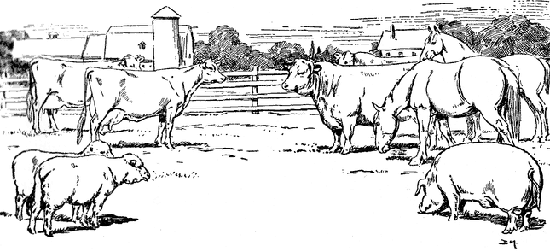
Animal husbandry is the sure foundation of profitable, permanent agriculture. Where many animals are kept and their manure properly cared for and returned to the land, the soil becomes richer and crop-production steadily increases. And the farmer grows rich with his land.
Further, the keeping of live stock distributes the farm labor and the farm income over the entire year. This is true whether meat, milk or eggs are the money crops. And certainly both factors are worthy of consideration from a straight business standpoint. With labor as valuable as it is at present, lost time cuts into the profits. And when the income is regular, not concentrated in a short period or dependent upon the success of a single crop, the matter of farm finance is much simplified.
Consider the richest and most desirable agricultural sections of our great land. With very few exceptions, the best and most valuable farms are those which are heavily stocked with domestic animals. Here, too, are found the finest farm homes, the most prosperous and contented farm families. And this fact, which is so well established that it requires no argument, plainly shows that animal husbandry pays.
In the following pages you will find much valuable information regarding the proper care—in health and sickness—of horses, cattle, swine, sheep and poultry.
We trust, and believe that you will find it most helpful in connection with your work. That it will enable you to be more successful, earn bigger profits.
Right at the start we wish to emphasize two facts which are really fundamental and which are recognized by the most successful stock keepers. The first is this: It does not pay to keep scrub stock, animals which cannot under any conditions give the big returns. The second: No animal, regardless of breeding, can do its best work unless it is kept in perfect physical condition.
The selection of your animals is up to you. Get good ones. Than keep them good and make them better. The Pratt line of stock and poultry preparations, regulators, tonics, disinfectants and remedies, will help you greatly. Made for nearly fifty years by America's pioneer concern in this line, each article is the best of its kind, each is backed by this square-deal guarantee—"Your Money Back If You Are Not Satisfied."
PhiladelphiaChicagoToronto
The Pratt Food Company believes in fair play. We desire that our millions of customers shall receive full value for every cent they spend in purchasing our goods. And to that end we spare no expense in making each article in the Pratt Line just as good, just as efficient, as is humanly possible.
More than that, we wish each customer to be completely satisfied. If for any reason any article bearing the Pratt trade-mark fails to give such satisfaction, the full purchase price will be refunded on demand by the dealer who made the sale.
You can buy and use Pratts Stock and Poultry Preparations with fullest confidence because you are protected by
Copyright, 1919, by Pratt Food Co.

While the automobile and the tractor are now doing much of the work formerly done by horses, the "horseless era" is still far off. A good horse will always be worth good money, will always be a desirable and profitable member of the farm family. But the undersized no-breed specimen will be even less valuable in the future than in the past.
The great demand for horses for army use and the high prices paid by the Government, tempted horse breeders and farmers to dispose of the fine specimens which alone met the exacting requirements of army buyers. It will take years to make good this tremendous wastage of horse flesh. But this is a big opportunity for breeders of good horses and we may expect them to make the most of it.
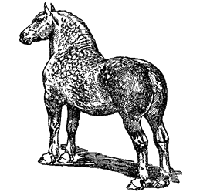
Prices of really desirable horses are now high. If you have a good one, take good care of him. Protect his health, lengthen his life. If you must buy, be sure that you get a sound animal which will serve you long and faithfully.
See the horse in his stall. If he has a spavin he will hop on one leg when made to "get over," or jerk it up as he backs out if he is affected with chorea (St. Vitus' dance). In the latter disease the tail is suddenly raised and quivers when the animal backs out of stall. Watch to see if the horse "cribs" and "sucks wind": also that he is not vicious in the stall. Stand him at rest on a level floor before exercise. If he is lame he will rest the sore foot.
Examine both sides of the horse. The dealer may stand the "bad side" next to a wall. Pick up each foot in turn. Suspect something wrong if he wears bar shoes, special shape shoes, leather soles or rubber pads. Remove all such things and examine carefully before buying.
I have had many dealings with rundown horses, both in the draft and hot blood classes, and Pratts goods have always brought them out on top.
Reject for contracted feet, steep heels, shrunken frogs and bars, dropped soles, corns, quarter cracks and signs of founder. See that hoof dressing does not cover evidences of un-soundness. Following bad attacks of founder the hoof grows out long at the toes, shows marked grooves and ridges, is convex at the points of the frogs, and the horse tends to thrust his forefeet out in front when standing and walks and trots on his heels. Ringbones are indicated by hard bony enlargements on the pastern; side-bones, by similar enlargements at the quarters just above juncture of horn and hair. Examine front of knees for scars indicating results of stumbling and falling. Similar scars on the inside of knees and fetlocks indicate objectionable cutting and interfering. Shoulders and hips should be smooth, well covered, and free from tumors or sores. No sores should be seen on back or top of neck under collar.
Examine teeth for age and soundness. See that eyes are of like color, are sound, and the eyelids whole.
The horse should allow one to examine his ears, and should neither hold them absolutely still nor keep them constantly moving. Still ears may indicate deafness; restless ones, poor eyesight or nervousness.
See that the horse goes sound and does not "roar" when galloped. Give him all the water he will drink before testing for "wind." It will bring out the characteristic symptoms of "heaves" if he has been "doped." Heaves is indicated by labored bellows-like action of the abdominal muscles when breathing. Examine the nostrils, as sponges or squeezed lemons may have been inserted to hide roaring.
I think every man that owns horses should have Pratts Animal Regulator on hand. I am a teamster and find it of great benefit to my horses, whether run down or not.
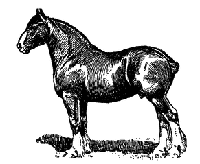
A spavined horse starts out lame for a few steps or rods and then goes sound. A lame shoulder causes dragging of the toe and rolling when in motion. A ring-bone causes an extra long step and lameness increases with exercise. Stifle lameness causes walking on the heels of shoe and consequent wearing of the iron. Hip lameness causes outward rolling of the leg in trotting, and wasting of the muscles of stifle and hip leads to a characteristic drop. See that the horse's tail is sound, has not been joined on and is free from sores, tumors or evidences of recent docking. Always remember to back the horse up as well as drive or ride him and see that he is not only sound and gentle but suitable for the special work he will be required to do.

Care of the Horse
A grown work horse requires daily about one pound of grain (concentrate) for each hundred pounds of live weight. Of hay he will need a slightly larger amount or about fourteen to eighteen pounds a day, according to size, weight, and character of work done. The idle horse will do well on less grain and more roughage.
For a farm horse, 10 pounds of oats, 5 pounds of corn, and 3 pounds of bran, divided into three equal feeds, will make a suitable ration for one day.
The corn may be fed at noon to give variety. For the evening meal crushed oats, bran, and a few handfuls of cut hay, wetted and salted, will be relished. The bulk of the hay should be fed at night, and but two or three pounds of it at noon, during hot weather. Avoid dusty hay. Clover hay is apt to be moldy. It is suitable food for work horses, or idle drafters, if sound and not too liberally fed. Increase the corn in cold weather. Omit it in hot weather entirely. Alfalfa is of high feeding value, but if moldy, or fed as a well-nigh exclusive ration, is apt to affect the kidneys injuriously. It is deemed unsafe food for stallions, as it is said to induce impotence or sterility.
Horses should drink before they eat, unless they have ready access to fresh water. It is best to allow drinking water often in small quantities, even if the horse is hot. So used it will not hurt him. The horse's stomach holds three and one-half gallons. Water flows through the stomach along seventy or more feet of small intestine, into the "waterbag." Hay is not digested to any extent in the stomach. That organ cares for the concentrated food. Theoretically, a horse should drink first, then eat hay, then grain. Practically no great amount of water should be taken just after a meal as it tends to flush undigested food out of the stomach; nor should it be given soon after a meal.
All stables, pens, out houses, poultry houses and yards should be regularly disinfected every week; nothing better can be used than Pratts Dip and Disinfectant.
This preparation is entirely free from all dangerous substances, arsenic, mercury, etc., but full of medicinal qualities and properties which make it most effective without the dangerous results which are experienced with many other preparations, such as carbolic acid, etc. It kills disease germs and prevents contagious diseases from spreading.
Farm horses do not need blanketing in the stable under ordinary circumstances. A thin sheet in the stable keeps off flies and dust and is necessary. Pratts Fly Chaser is a proved and safe fly repellant. It does not gum the hair. Its efficiency is unequalled.
If a horse sweats under the blanket, uncover his rear parts. Always tuck the blanket about a horse's chest when standing on the street in inclement weather or when cooling off. Rubber loin covers, used on carriage horses in wet weather, should be perforated. In the spring, the amount of Pratts Animal Regulator given should be somewhat increased. This will put the horse into condition in much less time, and be of great assistance in helping to shed readily.
I have used Pratts Animal Regulator for the past three years and have found it very successful with both horses and hogs.

Don't permit your hard-working, heavy-producing or fast-growing animals to become run-down and out of condition. It's much easier and less expensive to keep them right than to restore them to perfect health.
The regular use of Pratts Animal Regulator absolutely insures health and vigor in live stock of all kinds. It keeps healthy animals in the pink of condition; it quickly puts half-sick, unprofitable stock in the money-making class.
Pratts Animal Regulator, America's original guaranteed Stock Tonic and Conditioner, is not a food. It is a combination of roots, herbs, spices and medicines which sharpen appetite and improves digestion, regulates the bowels, makes rich, red blood, and naturally invigorates the organs of production. It promotes growth, improves health and strength, increases production. And all at very little cost.
Packed in handy cartons, pails and boxes. The larger sizes are more economical.
Early treatment is most necessary. Do not let the disorder become firmly seated before you attack it. Keep these Pratts Remedies on hand and use them at once if needed. Delay may mean the loss of a valuable animal.
PRATTS COLIC REMEDY
A quick certain cure for colic and acute indigestion in horses. Has a record of 998 cures out of 1,000 cases.
Keep a bottle in each wagon and in your stable.
PRATTS DISTEMPER and PINK EYE REMEDY
It goes direct to the cause of the disease, purifies the blood, prevents weakening of the internal organs caused by impure blood or poisoned by absorbing the impure matter from the abscesses.
PRATTS HEALING OINTMENT
A splendid antiseptic ointment for man or beast. Keep a box on hand for cuts, burns, sores, scratches, eczema, galls, etc.
PRATTS WORM POWDER
is a special preparation for the destruction of all kinds of worms in horses, cows, hogs and sheep. It is purely vegetable and is unquestionably the quickest, surest and most thorough worm destroyer procurable.
PRATTS LINIMENT
For man or beast. The best thing in the world for lameness, sprains, bruises, thrush, kicks, shoe boils, etc. A bottle should be kept in every medicine chest.
PRATTS HEAVE REMEDY
A positive guaranteed remedy for heaves, coughs and colds. It cures coughs and colds by strengthening the digestive and respiratory organs, and counteracts the inflammation and irritation.
Try a box on your "heavy" horse.
PRATTS HEALING POWDER
A guaranteed remedy for harness galls, sores, grease heel, bleeding ulcers, etc. It will arrest hemorrhage and check blood flow. Dirt and dust cannot get into wounds, as the Powder forms a coating over them.
PRATTS FLY CHASER
Gives comfort to Horses and Cows. Insures more milk and prevents annoyance at milking time to both the milker and the cow. Guaranteed to satisfy.
Sold by 60,000 Pratts dealers. There is one near you.
Always go to a horseshoer who thoroughly understands the anatomy of the horse's foot.
The hoof is not an insensitive mass of horn, to be cut, rasped, burned, nail-pierced, and hammered without causing pain or injury. It is a thin mass of horn overlying and intimately attached to a sensitive, blood and nerve-endowed tissue called the "quick" which is capable of suffering excruciating agony.
The slices should be made to fit the hoof and need to be reset once a month.
The permanent teeth are forty—twenty-four grinders, twelve front teeth and four tusks, except in mares, which seldom have tusks. The age of a horse can be told more or less accurately by the teeth.
The teeth are liable to disease and should be closely watched.
Bad teeth are often an unsuspected cause of indigestion, loss of condition, bad coat, slobbering and other troubles which puzzle the owner. Horses very often have decayed teeth, and suffer with toothache. These teeth should be removed.
Horse Diseases
If horses and cattle were left free to roam as Nature intended, many of their present-day ailments would be unknown. Man has taken these animals from Nature's broad garden, and confined them to the narrow limits of stable and stall. No longer can they seek out and instinctively find just those roots, herbs, seeds, and barks which their systems demand.
This explains why Pratts Animal Regulator has been used by successful horsemen for nearly a half century, as it is largely composed of these same vegetable ingredients from Nature's garden.
Merit and quality count, and while hosts of imitators have sprung up, none have ever come near equalling our product. Pratts Animal Regulator restores to the animals their natural constitutions and functions, supplying just that which they formerly had, but now lack. While not a cure for every disease, it is a positive preventive of the most common disorders.
It aids digestion and insures the animal receiving full benefit of its food; purifies the blood and keeps the bowels free and regular. After you have accomplished these three things, you need not fear disease in the shape of colic, bloat, heaves, hide-bound, distemper, constipation, worms, and the like.
I shall be pleased to recommend Pratts Animal Regulator always, as my horse has gained in strength and weight and is looking fine, always having a glossy coat. He works hard every day in the dray business.
Clean with soap and water, and apply Pratts Healing Ointment or Pratts Healing Powder. These remedies heal naturally and leave no dangerous scar.
Colds
Symptoms.—A dull appearance of the horse, rough coat; the body will be hot in parts and cold in others; running of the eyes and a discharge from the nose.
Treatment.—Keep the horse warm and free from draughts; use nose bag and give Pratts Heave, Cough and Cold Remedy according to directions. It never fails. Give nourishing feed and bran mashes and Pratts Animal Regulator daily.
Colic
Common causes of colic are sudden changes of food; feeding too much or too seldom; feeding when the horse is hot and tired; watering or working too soon after a meal; feeding new oats, or new hay, or grass; or, in short, anything that is apt to derange digestion. There are various forms of colic. In cramp (spasmodic) colic, pains come and go and the horse rolls violently and fearlessly. In wind (flatulent) colic there is bloating of the right flank and the horse lies down, rolls without violence, breathes with difficulty, paws, looks around at his sides and finds no relief. In bloat of the stomach, gas and fluid gush back and forth from the stomach to the throat; flanks may not show bloat; pain is steady but not violent; horse sweats; nostrils flap; pulse is fast and weak; countenance is haggard and anxious. In enteritis (inflammation of the bowels) pain is constant and severe; the horse makes frequent attempts to lie down but is afraid to do so; pulse and temperature run high; membranes of eyelids, nostrils, and mouth are red; bowels and bladder do not act; horse may walk persistently in a circle. In impaction of the bowels, pains are comparatively mild or fugitive; horse is restless, paws often, strains and passes no manure, or only a few balls covered with slime and streaks of white mucus. In gut-tie, hernia, and other absolute stoppage of the bowels, symptoms of enteritis are common and the horse may, when down, strain and then sit on his haunches. The latter condition, and enteritis, usually prove fatal. Wind colic may need prompt use of the trocar and cannula to puncture high up in the right flank for liberation of gas. In impaction, raw linseed oil should be freely given in repeated doses of one pint, and rectal injections of soapy warm water and glycerine will help. No irritants should be inserted in the vagina or sheath in any form of colic. Stoppage of urine is a result of pain, not the cause of colic. The urine will come when the pain subsides. A good all-around colic remedy will be found in Pratts Veterinary Colic Remedy. It is compounded from the prescription of a qualified veterinarian and has a record of curing 998 cases out of 1,000 treated.
Constipation
All horses should be given a warm bran mash weekly and Pratts Animal Regulator daily, and constipation will be unknown. Constipation is often the cause of hide bound, rough coat and loss of flesh. Give a good physic of linseed oil, aloes or cantor oil, and use the Regulator mentioned above.
Coughs
Cause.—Chronic coughs are the result of distemper, sore throat, a neglected cold, catarrh or dusty hay, and frequently turn into heaves, bronchitis, etc.
Treatment.—Give only the best and most nourishing foods, dampened. Keep horse warm, and blanketed in a well ventilated stable.
If there is a swelling of the throat it should be blistered with Pratts Liniment, or Pratts Spavin Paste—A Blister. Use Pratts Heave, Cough and Cold Remedy according to directions.
Diarrhoea
Symptoms.—At first it resembles colic, and will be followed by violent diarrhoea; the discharge soon becomes merely discolored water and smells bad; the horse is very thirsty, the pulse thick and feeble, the heart skips its beats, the position of the horse is something like colic, and he sweats freely.
Cause.—From diseased condition of teeth, eating rich, juicy food, drinking impure water or from overdose of physic.
Treatment.—If the diarrhoea is severe, call a veterinarian. During and after recovery pay attention to the food. Avoid bran mashes. Much depends on the care at this time, and the constant using of Pratts Animal Regulator, with all feed, during his recovery. Feed lightly for first two or three days.
Distemper
Distemper and Pink Eye are closely related and one is often mistaken for the other.
It usually affects colts between the ages of three and five years. If a horse is once afflicted it is immune from a second attack. The feature of distemper is the swelling under the jaw, the size indicating the severity of the case. The animal is dull; the head has a "poked-out" appearance; coughs; no appetite; feet are cold; saliva runs from its mouth; has catarrhal symptoms and difficulty in swallowing; the name "strangles" is often applied to it. When this swelling forms on the lungs, liver, etc., the case is aggravated and difficult to cure.
Distemper is contagious. It may occur at any time, but is most prevalent from September to April.
Pratts Distemper and Pink Eye Remedy will positively relieve the disease at once. Blanket the horse and keep in a well-ventilated stable, free from draughts. Give cold water frequently in small quantities and feed with whatever he will eat. When an abscess forms on the outside and becomes soft, it should be opened and the soft parts surrounding it poulticed so that there will be no "bunch" left after it heals. Disinfect stable with Pratts Dip and Disinfectant.
Founder or Laminitis
Symptoms.—An inflammation of the entire foot which causes such intense pain that the animal cannot stand. The pulse is strong, thick and throbbing, and the horse lies down with legs stretched out.
Cause.—Over-exertion, or after-effects from chilling, inflammation of the lungs, bowels or mucous membrane of the bronchial tubes, etc.
I doctored a very lame horse with Pratts Liniment after trying other treatment for months. In a couple of days the lameness left and we used him every day till he died of old age.
Treatment.—Remove the shoe, and soak the feet in warm water for six or eight hours and repeat in two or three days. Also apply Pratts Peerless Hoof Ointment at night all over the bottom of the foot and to all parts of the frog and at top of hoof joining the hair, and cover the entire wall of the foot. The horse should stand on a deep, soft bed. Cover with blankets. Feed bran mashes, vegetables and hay; no grain. Use wide-webbed shoes two weeks after recovery.
Heaves
The symptoms of this disease are chronic, spasmodic cough and simultaneous passage of gas from the rectum; double bellowslike action of the abdominal muscles in breathing; harsh staring coat; hide-bound skin; weakness, and ill-health in general. Over-burdening of the stomach with coarse, bulky, dusty, or woody hay or other roughage, and working the horse immediately after such a meal induces heaves. The horse that has inherited a gluttonous appetite is especially subject to the disease. Probably the most effective remedy for this disease is Pratts Heave Remedy. In addition to using the Remedy as directed, we would suggest wetting all food with lime water, feeding wet oat straw in winter and grass in summer in preference to hay; allowing double the customary rest period after meals and keeping the bowels freely open by feeding bran mashes containing raw linseed oil or flaxseed meal.
Itch
This is the name given to mange, eczema and other skin diseases. It is usually prevalent in summer and from a small beginning on an animal, will rapidly spread all over the body.
Treatment.—Wash the parts thoroughly with a solution of one part of Pratts Disinfectant to 20 parts water. Let it dry and then apply Pratts Healing Ointment or Healing Powder two or three times a day.
Lice
Sprinkle Pratts Disinfectant on an old blanket and tie it around the animal for two or three hours. This will quickly kill all vermin. Spray lightly upon the legs and such places that the blanket will not cover. Then spray thoroughly the stable and all poultry houses near with the Disinfectant, according to directions. Give Pratts Animal Regulator to build up the animals that have been affected.
Puncture and Wounds in the Foot
In all cases, the opening or puncture in the hoof must be made larger, so as to give free vent for the matter which is sure to form. If this is not done, quittor will follow. Then dress with Pratts Peerless Hoof Ointment.
While working the horse, a pledget of tow, covered with Pratts Peerless Hoof Ointment, may be placed in and over the puncture and confined; but it must not be allowed to remain after the horse returns to the stable. Soak the feet for eight or ten hours a day for two or three days in a 5% solution of Pratts Disinfectant and apply the Ointment. Horse will not have proud flesh when this remedy is used.
Quarter Cracks
Cut top of hoof above the crack deep enough to draw blood. Soak foot in hot water, apply Pratts Peerless Hoof Ointment and cover with oakum. Pare out sole and open heel—blacksmith must use care in expanding. Apply Pratts Peerless Hoof Ointment daily to the coronet and frogs—this is very important. Use bar shoe.
Animal needs a good tonic. Use Pratts Animal Regulator daily with the feed according to directions. This is a regulator, tonic and digestive and so works upon the blood, liver, bowels and digestive organs that the animal is quickly built up, and is given strength, health and flesh.
Thrush
Symptoms.—Shown by a foul discharge issuing from the cleft of the foot, and usually attended with decay of the horn and a vile odor. The foot is hot and hard.
Cause.—In the fore feet, it is generally the result of navicular disease or contraction of the feet. In the hind feet it is entirely caused by filthy stables, allowing the feet to stand in decaying manure.
Treatment.—Have absolute cleanliness in the stable and stalls, disinfecting with Pratts Disinfectant. Wash the foot thoroughly with soap and water, and cut away all diseased and ragged parts as well as the white, powdery decayed horn and substance, even if the flesh is exposed and the frog much reduced. Then pour Pratts Liniment over the affected parts. Dress daily until cured. Another excellent remedy is to wash out diseased portion of hoof with one part Pratts Disinfectant and 20 parts of water three times a day.
Worms
Horses take in worm eggs on pasture, in hay, and in drinking water from contaminated troughs or ponds. Marsh or swale hay is particularly liable to infest with worms. Avoid sources of worms. Cleanliness is imperative.
Cut down feed one-half, mix bran with feed and dampen it. Give one dose of Pratts Specially Prepared Worm Powder with the feed twice a day for four days. After fourth day give large, soft, well-scalded bran mash to loosen bowels freely. Repeat the bran mashes if necessary, as the bowels must be moved freely. Should the horse refuse to eat the bran mash, it will be necessary to give him a dose of Glauber's salts, or some other purge to loosen the bowels.
Pin Worms.—Sometimes pin worms remain just inside the rectum, and are very hard and stubborn to cure. In cases of this kind, if the desired result is not obtained by feeding Pratts Worm Powder, dissolve one of the powders in a quart of water and inject in the rectum. Repeat this once a day in the evening, and continue for four or five days. Do not fail in this case, as in all other cases of worms, to feed bran mashes until the bowels are freely moved, and should the horse refuse the bran mash or should it fail to move the bowels, give the horse a dose of Glauber's salts.
Pratts Worm Powder is a special preparation for the destruction of all kinds of worms in horses, hogs, and sheep. It is purely vegetable, has a strong tonic effect that builds up and helps the animal to regain strength, and is the quickest and most thorough worm destroyer on the market.
Cows will bring large or small profits in proportion to the care they receive. If properly housed, properly fed, properly bred, and properly protected against disease they will fully repay the little extra attention required. Strive intelligently to secure the greatest possible regular production. Keep a sharp lookout for unfavorable symptoms and be prompt in finding a cause for poor condition and remedying it. Cows kept in perfect health are the least expense, least trouble, and the greatest profit-earners.
You do not need to be a veterinarian to know that the health of a cow depends on a good healthy appetite with complete digestion and perfect assimilation of the daily ration.
That is just plain common sense. No cow which is not a big eater can be profitable. But appetite is not of itself sufficient to make a cow a money maker. There must be sound digestion.
Once establish and maintain good digestion, food performs its natural functions. Bodily waste is repaired. Strength and growth are noticed and the cow gives the utmost possible amount of milk. See then, that your cows have hearty, healthy appetites and good digestion. Good digestion does not always follow a large appetite. A cow giving only a few quarts of milk a day will often eat as much as one giving gallons. She requires the same amount of care and attention.
The trouble is that she does not have good digestion to convert food into milk. Of course there are cows which will always be small milkers, but there are many many more cows which can be made to give substantial, paying increase of milk production if proper attention is given them. Perhaps there are such cows in your herd. Without your even realizing it, they are out of condition. A little help and they would give enough more milk to pay you a satisfactory profit.
This "help" can easily be given. Your own dealer has it. We mean Pratts Cow Remedy, for cows only.
We all know how, when we are well, the sight or smell of pleasant tasting food, "makes the mouth water." This is literally true because the digestive glands of the mouth and stomach pour out their secretions and are ready to begin digesting the food.
When, however, the nerves fail to send their messages to the glands or the glands fail to respond, we have a diseased condition and we take medicine to assist in recovery.
Thus the sensation known as appetite is really at the basis of sound health. Without it, it is doubtful if animals would eat enough to supply their bodily needs.
The mere forcing of food into the stomach would avail little. There must be desire for food, and restoring the appetite is the first step in bringing the health back. In other words an appetizer is often required to induce us to eat. Then thorough digestion builds up bodily strength.
Pratts Cow Remedy does all this for the cow, assisting Nature in bringing up the appetite, stimulating digestion, restoring and maintaining health.
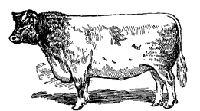
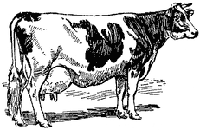
Cattle is generally divided into dairy, beef and dual purpose breeds. The names signify the advantages claimed for them. In the dairy breeds, the Holstein, Jersey, Guernseys, French Canadian and Ayrshire are leaders.
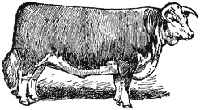
Shorthorns, Herefords, Polled Durhams are the best-known beef breeds.
While among the dual purpose breeds, Milking Shorthorns, Red Polls, Brown Swiss and Devons have many admirers.
The indications when selecting dairy females, and important in the order given, are: (1) Much length or depth in the barrel or coupling, indicating a large possible consumption and utilization of food. (2) Refinement of form, as evidenced more particularly in the head, neck, withers, thighs, and limbs. (3) Good development of udder and milk veins. (4) Constitution, as indicated by a capacious chest, much width through the heart, a broad loin, a full, clear eye, and an active carriage. (5) Downward and yet outward spring and open-spaced ribs, covered with a soft, pliable and elastic skin.
The essential indications of correct form in beef cattle are: (1) A compact form wide and deep throughout, and but moderately long in the coupling. (2) A good back, wide from neck to tail, well fleshed, and straight. (3) A good front quarter, wide, deep, and full. (4) A good hind quarter, long, wide, and deep. (5) Good handling qualities, as indicated in elastic flesh and pliant skin.
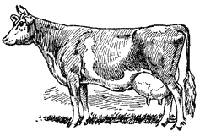
The important indications of good form in dual females are: (1) Medium to large size for the breed or grade. (2) Good length and depth in the coupling. (3) Good development of udder and milk veins. (4) Good constitution, as indicated by good width through the heart. (5) Head and neck inclining to long and fine. (6) Ribs of medium spring, open spaced, and covered with a good handling skin. The dual types have an absence of extreme development in the direction of either the dairy or the beef form.
In males selected for breeding, the evidences of masculinity should be markedly present. These include increased strength as shown in the head, neck, breast, shoulders, back and limbs.
The advantage of having pure blood stock over "scrubs" is apparent. For those, however, who want something better than scrubstock and cannot pay the high price which pure blood commands, the ownership of grade cattle offers a satisfactory solution of the problem.
Grading consists in mating thoroughbred sires with common females and with the female progeny for a number of generations. Where the work is wisely done by the use of good sires, accompanied by the rejection of all inferior animals for future breeding, the progeny of beef sires may be brought up to the level of the pure breed for beef making from which the sires have been selected in four generations. To bring milking qualities up to the level may call for one or two more generations of such breeding. Not only do these grade animals answer almost equally well, with pure breeds, but they may be bought for much less.
If cows are to produce a maximum return in milk, they must be kept in comfort. In winter they are usually tied in the stall. The light should be ample and the ventilation thorough. Lack of proper ventilation causes the spread of tuberculosis in cattle.
Cows must be allowed exercise, even in winter.
They should be allowed to go out daily for an hour or more into a sheltered yard, save on days when the weather is extreme; or, better still, be given the liberty of a closed and well-ventilated shed during a portion of the day. It should be supplied with a fodder rack.
In summer, cows in milk must be protected from storms, from excessive sunshine, and from flies, as far as this may be practicable. Pratts Fly Chaser is unequalled as a fly repellant. It is perfectly safe to use, does not injure or gum the hair, and is economical. A light spray is both lasting and effective.
Cows in milk should be driven gently. The pasture should not be too distant from the stable, and driving during the heat of the day should be avoided.
The quality of milk is easily injured by coming in direct contact with foreign substances or by imbibing odors. The milk must be drawn from clean udders, with clean hands, into clean pails, and amid clean surroundings. The stables must have attention. The udder and teats should be wiped off by using a damp cloth. Milking should be done with dry hands into metal pails, kept clean by scalding. Milking before feeding prevents dust particles from getting into the milk. Noxious odors are kept down by the prompt removal of droppings and by strewing sand, plaster, rock phosphate, or dry earth in the manure gutters.
"I have used Pratts Cow Remedy with best results. I fully believe it cannot be surpassed for increasing the flow of milk."
Unless milking is done at stated times, and by the same person, there will be a loss in the production. When milking is delayed, a decreased flow is noticeable the following morning. When a change of milkers is made, some cows resent it by withholding a part of the milk.
It is not easy to dry some dairy cows prior to the birth of the next calf, and yet, as a rule, it ought to be done. When they are to be dried the process should begin by milking them once a day and putting them on dry food. The food may also be reduced somewhat in quantity. Later the milk is taken out at intervals which constantly increase in length until the cow is dry. The udder should be carefully watched during the later stages of the drying process.
Where suitable pasture may be obtained, it is usually a cheaper source of food for cows than soiling food or cured fodders, as the element of labor in giving the food is largely eliminated. The best pastures, viewed from the standpoint of production, are those grown on lands that may be irrigated during the season of growth. These consist of clover and certain grasses. Permanent pastures which are grown on moist land, and which contain a number of grasses, are usually satisfactory, but the nature of the pasture must, of course, be largely determined by the attendant conditions. Blue grass pastures are excellent while succulent and abundant, but in midsummer they lose their succulence for weeks in succession. Brouer grass is a favorite pasture in northwestern areas, and Bermuda grass in the South. In the Eastern and Central States, the most suitable pastures are made up of blue grass, timothy, and orchard grass, and of the common red, white and alsike clovers.
There is more or less of hazard to cows when grazing on alfalfa—liability to bloating, which may result fatally. Likewise second growth sorghum or the second growth of the non-saccharine sorghums is full of hazard, especially in dry seasons when it has become stunted in growth. Nor should rape and rye be grazed, save for a short time after the cows have been milked, lest they give a taint to the milk.
The change from winter rations to grazing should never be suddenly made, or purging caused by the fresh grass will lead to loss in weight and loss of milk, though at first there will probably be an advance in the same. The change may be made in outline as follows:
(1) The cows will not be turned out until after the food given in the morning has been sufficiently consumed.
(2) They will be kept out an hour, or two the first day, and the time increased.
(3) The time called for to effect the change should never be less than one week or more than three.
(4) As soon as the change begins, the reduction in succulent food, ensilage, and field roots should also begin.
(5) The dry fodder should be continued morning and evening as long as the cows will take it.
(6) There should be some reduction and it may be modification in the grain for a short time.
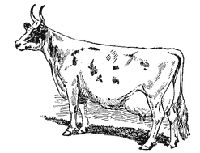
After turning out a full supply may be necessary. Should the pasture be composed mainly of grasses, food rich in protein, as wheat bran, should be fed, but if it is composed mainly of clover, then more carbonaceous grain, as corn, should be fed.
When pasture is succulent and abundant, it is a disputed point as to whether it will pay to feed meal of any kind in addition. The following conclusion in regard to this question would seem safe:
When cows are fed grain on pastures succulent and abundant, the tendency is to increase the yield in the milk and also to increase flesh.
The quality of the milk is not materially influenced.
Some saving is effected in the grazing, and the resultant fertilizer
from the grain fed has a tangible value. It is certain, therefore, that
full value will be obtained for a small grain ration thus fed.
Pratts Cow Remedy was fed to the cow from the receipt of Remedy until the calf was eight weeks old and the calf weighed 234 pounds and was acknowledged unanimously to be the nicest calf that was ever shipped from this depot.

Help your cows, every one, to give the largest possible amount of milk and to produce big, strong, husky calves each season. The extra pounds of milk, the extra value of the calves are all clear profit.
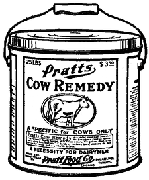
It costs as much to house and care for and nearly as much to feed a poor producer as a good one. The first may be kept at a loss. The latter is a sure profit-payer. The difference is generally merely a matter of physical condition. And this you can control.
Pratts Cow Remedy makes cows healthy and productive. It is not a food—it is all medicine, preventive and curative. It is absolutely safe to use because free from arsenic, antimony and other dangerous ingredients.
is nature's able assistant. It not only improves appetite and assists digestion, increases milk yield and percentage of butter fat, but in large measure prevents and overcomes such disorders as barrenness and abortion, garget, milk fever, scours, indigestion, liver and kidney troubles.
The reason is plain when you know the ingredients. Here they are—gentian root, Epsom salts, capsicum, oxide of iron, fenugreek, nux vomica, ginger root, charcoal, soda, salt. All of superior quality and properly proportioned and combined.
You may think your cows are doing their best when they are not. Now find out. Secure a supply of the original and genuine Pratts Cow Remedy. Use it and watch results. You will be astonished and delighted. But if for any reason you are not—
As soon as the supply of pasture becomes insufficient in quantity or lacking in succulence, it should be supplemented with food cut and fed in the green form, as winter rye, oats and peas, and oats and vetches grown together, millet in several varieties, grasses, perennial and Italian rye, especially the latter, alfalfa, the medium red, the mammoth, alsike and crimson clovers, corn of many varieties, and the sorghums. Alfalfa, where it can be freely grown, is king among soiling foods. Peas and oats grown together are excellent, the bulk being peas. Corn is more commonly used, and in some sections sweet sorghum is given an important place. The aim should be to grow soiling foods that will be ready for feeding in that succession that will provide food through all the summer and autumn. Soiling furnished by grains, grasses, and clovers are usually fed in the stables or feed yards, and corn and sorghum are usually strewn over the pastures, as much as is needed from day to day.
Where much soiling food is wanted from year to year, it would seem safe to say that it can be most cheaply supplied in the form of silage. Even when grass is abundant, cows will eat with avidity more or less of ensilage well made. They should not be fed in winter more than 25 pounds per animal per day, but the quantity needed is determined largely by the condition of the pastures. Because of the less quantity of the silage called for in summer, the silo that contains the silage should be of less diameter than the silo that holds food for winter use, otherwise the exposed silage will dry out too much between the times of feeding it.
In autumn soiling foods may be fed with profit that are possessed of less succulence than would suffice at an earlier period, as in the autumn the pastures are usually more succulent than in the summer. Corn may be fed at such a time with much advantage from the shock, and sorghum that has been harvested may likewise be fed from the shock or from the cocks. Pumpkins may be thrown into the pasture and broken when fed.
Viewed from the standpoint of milk production, the legumes (clover, cow peas, soy beans, etc.) must be assigned first rank. After these come grain fodders, corn and sorghum fodders, and fodders from grasses, suitable in the order named. Lowest of all is straw furnished by the small cereals. Fodders when fed are not restricted in quantity as concentrates are.
Among legumes, hay furnished by alfalfa, any of the clovers, cow peas, soy beans and vetches, is excellent for producing milk when these are cut at the proper stage and properly cured. Alfalfa should be cut for such feeding when only a small per cent. of blooms have been formed, clovers when in full bloom, and cow peas, soy beans, and vetches when the first forward pods are filling. Proper curing means by the aid of wind stirring through the mass rather than sun bleaching it.
When good leguminous fodders are fed, from 33 to 50 per cent. less grain will suffice than would be called for when non-leguminous fodders only are fed.
When two veterinarians had given up a cow to die, I gave her Pratts Animal Regulator with the result that she was on her feed in about a week. I am a constant user of Pratt Products.
Fodder may usually be cheaply furnished from corn and sorghum, when grown so that the stalks are fine and leafy, and if cut when nearing completed maturity and well cured. Such food is excellent for milk production when fed with suitable adjuncts, even though the fodder is grown so thickly that nubbins do not form. The aim should be to feed the sorghums in the autumn and early winter and the corn so that it may be supplemented by other hay when the winter is past, as later than the time specified these foods deteriorate.
Rye and wheat straw are of little use in making milk, oat straw is better, and good bright pea straw is still more valuable. When fodder is scarce, these may be fed to advantage if run through a cutting box and mixed with cut hay.
Since I started feeding her Pratts Cow Remedy, my cow has shown an increase in her daily flow of milk of over one gallon and is now in better condition than she has ever been. I give all the credit for this remarkable improvement to Pratts Cow remedy.
The necessity for feeding succulent food in some form where maximum milk yields are to be attained has come to be recognized by all dairy-men. The plants that furnish succulence in winter are corn in all its varieties, field roots of certain kinds, and the sorghums. Corn and sorghum to furnish the necessary succulence must be ensiled. Corn ensilage is without a rival in providing winter succulence for cows. Field roots furnish succulence that, pound for pound, is more valuable than corn, because of the more favorable influence which it exerts on the digestion. But roots cost more to grow than corn. Rutabagas and turnips will give the milk an offensive taint if fed freely at any other time than just after the milk has been withdrawn, but that is not true of mangel wurtzel, sugar beets, or carrots.
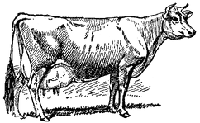
The necessity for giving grain feed containing high percentage of digestible matter (known as concentrates) to dairy cows is based on the inability of the cow to consume and digest enough coarse fodders to result in maximum production, even though the fodders should be in balance as to their constituents.
Concentrates are purchased or home grown. It matters not from which source they are obtained, but the values of those purchased are becoming so high as to force upon dairy-men the necessity of growing them at home as far as this may be practicable, and of insuring sound digestion by giving some such tonic and appetizer as Pratts Cow Remedy. This splendid prescription should be kept on hand the year round, and should be given with every feeding, especially in winter. Its value in keeping up milk production and for maintaining health is unequalled.
The method of furnishing concentrates by growing certain of the small grains in combination is growing in favor. These combinations may include wheat, barley, outs, peas, and flax. Frequently but two varieties are grown together. They are grown thus, in the first place, to secure better yields, and, in the second, to furnish concentrates in approximate balance. Such a food, for instance, is obtained from growing wheat and oats together, and if some flax is grown in the mixture it will be further improved.
When choosing concentrates for feeding cows, the aim should be to select them so that when fed along with the roughage on hand, they will be in approximate balance, that is, the elements in them will best meet the needs of the cows.
If a flesh and milk-making food, like clover, is the source of the fodder, then a fat and heat-producing food, like corn, should furnish a large proportion of the grain fed. But it is not more profitable in all instances to feed foods in exact balance. Some of the factors may be so high priced and others so cheap that it will pay better to feed them more or less out of balance.
When good clover hay or alfalfa is being fed to cows in milk, any one of the following grain supplements will give satisfactory results.
(1) Corn meal and wheat bran, equal parts by weight.
(2) Corn meal, wheat bran, and ground oats in the proportions of 2, 1, and 1 parts.
(3) Corn meal, wheat bran, and cottonseed meal in the proportion of 2, 1, and 1 parts. Whether corn meal or corn and cob meals is fed is not very material. Barley meal may be fed instead of corn.
Should corn ensilage be fed to the extent of, say, 40 pounds per day along with clover or alfalfa, any one of the following grain supplements should suffice:
(1) Corn or barley meal, wheat bran, and ground oats, fed in equal parts by weight.
(2) Corn or barley meal and wheat bran, fed in the proportions of 1 and 2 parts.
(3) Corn or barley meal, cottonseed meal, and wheat or rice bran, fed in equal proportions.
(4) Ground peas and oats, also fed in equal proportions. The succotash mixture may be fed alone or in conjunction with other meal added to make the food still more in balance.
It is preferable to feed meal admixed with cut fodders. The mastication that follows will then be more thorough and the digestion more complete. When ensilage is fed, admixture will result sufficiently if the meal is thrown over the ensilage where it has been put into the mangers.
In order to insure the animal obtaining full benefit of all its feed, it will be found highly profitable to include Pratts Cow Remedy with the daily ration. It acts as a digestive and at the same time insures a healthy and natural action of the bowels.
Bulls should be fed and managed with a view to secure good, large and robust physical development and the retention of begetting powers unimpaired to a good old age. The aim should be to avoid tying bulls in the stall continuously for any prolonged period, but to give them opportunity to take exercise in box stalls, paddocks, and pastures to the greatest extent that may be practicable.
Have used Pratts Cow Remedy with good success as a general tonic and for increasing milk. Omitting it at intervals as a test showed a falling off of about a pint for each cow, which was always made up when the remedy was added.
A ring should be inserted in the nose when not yet one year old. Rings most commonly used are two and one-half to three inches in diameter. When inserting them the head of the animal should be drawn tightly up to a post or other firm objects, so that the muzzle points upward at a suitable angle. A hole is then made with a suitable implement through the cartilage between the nasal passages, and forward rather than backward in the cartilage. The ring is then inserted, the two parts are brought together again, and they are held in place by a small screw. When ringed, a strap or rope with a spring attached will suffice for a time when leading them, but later they should be led with a lead, which is a strong, tough circular piece of wood, four to five feet long, with a snap attached to one end.
Whole milk is too valuable to use as calf feed, even if calves—both veals and those kept for dairy purposes—are selling at such high prices. Sell the milk, get all the cash out of it, but grow the calves just the same. Merely feed the perfect milk substitute—
When prepared and fed in accordance with the simple directions, Pratts Calf Meal will grow calves equal to those grown on whole or skim-milk and at less cost.
This truly wonderful calf feed has practically the same chemical composition as the solids of whole milk. It is made of superior materials, carefully selected and especially adapted to calf feeding. These are milled separately and bolted to remove hulls and coarse particles, which insures perfect digestion. Finally, the mixture is thoroughly steam-cooked, in a sense pre-digested.
Calves fed Pratts way thrive and grow rapidly and are not subject to scours and other calf disorders. Just make a test. Feed some calves your way and some Pratts way. Let your eye and the scales tell the story. Learn how easy it is to grow the best of calves at less cost.
"Your Money Back If YOU Are Not Satisfied"
Avoid using in service bulls under one year. During the one-year form they should not be allowed to serve more than a score of cows; after they have reached the age of 24 to 30 months they may be used with much freedom in service until the vital forces begin to weaken with age. When properly managed, waning should not begin before the age of 7 or 8 years. It has been found that the bull's service can be made more sure by the use of Pratts Cow Remedy, because of its mild and safe tonic properties. Bulls should he able to serve from 75 to 300 cows a year without injury when the times of service spread over much of the year.
Calves reared to be made into meat at a later period are very frequently allowed to nurse from their dams. This should never be done in the dairy. Such a method of raising them is adverse to maximum milk giving, as the calves when young cannot take all the milk the cows are capable of giving; hence the stimulus is absent that would lead her to give more.
At no time in the life of a dairy cow should she be allowed to suckle her calf longer than the third day of its existence.
In certain parts of the country, especially where whole milk is sold for consumption in the cities, dairy-men frequently kill calves at birth because of lack of milk for feeding them. This practice is wrong and unnecessary. All strong calves should be grown, either for milking animals or veal. And this can now be done, easily and cheaply, by feeding Pratts Calf Meal, the perfect milk substitute, the guaranteed "baby food for baby calves." When this scientific food is used, calves of really superior quality, big, sturdy, vigorous, are grown practically without milk.
Pratts Calf Meal must not be confused with coarse mixtures of mill by-products sometimes sold as "calf meal" or "calf food." Pratts is as carefully made as the baby foods which are so widely used for children. It appeals to the calf's appetite, is easily and quickly digested, produces rapid growth and even development. It does not cause scours and other digestive troubles. And it is easy to prepare and feed.
In chemical composition, Pratts Calf Meal is practically identical with the solids of whole milk. It is made exclusively of materials especially suited to calf feeding and these are always of the highest quality obtainable. This is one secret of the great success of this truly remarkable feed.
The various materials are ground very fine, milled separately, and are then bolted to remove any coarse particles. They are then combined in exact proportions and thoroughly mixed.
Finally, the mixture is steam-cooked, which makes the feed easy to digest and assimilate. This expensive, but most necessary process, prevents indigestion and bowel troubles which accompany the use of unbolted, uncooked meals.
Where milk is available for calf feeding the following plan may be used:
The young calf should take milk from its dam for, say, three days. During that period the milk is only fit for feeding purposes. It is very important that the calf shall be started right, and in no way can this be done so well as by Nature's method, that is, by allowing it to take milk from the dam at will. At the end of that time it should be taught to drink. This can usually be accomplished without difficulty by allowing the calf to become hungry before its first lesson in drinking. It should be given all whole milk, for say, two weeks. This given in three feeds per day, and not more in quantity, as a rule, than two quarts at a feed.
The change from whole to skim-milk should be made gradually. A small amount of skim-milk should be added to the whole milk the first day, and a corresponding amount of whole milk withheld. The amount of skim-milk increased from day to day, and the whole milk fed decreased correspondingly. The time covered in making the change from all whole to all skim-milk should be from one to two weeks. Any skim-milk that is sweet will answer, but it should not be fed to young calves at a lower temperature than about 98 degrees in winter. Milk obtained by cream separators, soon after drawn from the cow, is particularly suitable.
As soon as the change from whole to skim-milk is begun, some substitute should be added to replace the fat withheld by reducing the amount of whole milk fed. Ground flax or oil-meal is the best. It is generally fed in the latter form. In some instances the oil-meal is put directly into the milk beginning with a heaping teaspoonful and gradually increasing the quantity. A too lax condition of the digestion would indicate that an excessive amount was being fed. Later the meal may be more conveniently fed when mixed with other meal.
Very much pleased with results of Pratts Animal Regulator during the present period of my cows breeding. An extraordinary strong calf and the mother in fine condition.
As soon as the calves will eat meal it should be given to them. No meal is more suitable at the first than ground oats and wheat bran. A little later whole oats will answer quite well. To calves grown for dairy uses they may form the sole grain food. If the calves are to be grown for beef, some more fattening food, as ground corn, or ground barley, should be added to the meal. For such calves, equal parts of bran, oats whole or ground, and ground corn, barley, rye, or speltz are excellent. Until three months old they may be allowed to take all the grain that they will eat. Later it may be necessary to restrict the quantity fed. Calves for the dairy must be kept in a good growing condition, but without an excess of fat. The meal should be kept in a box at all times accessible to the calves and should be frequently renewed. Grain feeding may cease when the calves are put upon pasture.
As soon as the calves will eat fodder it should be given to them. Fodder gives the necessary distention to the digestive organs, which makes the animals capable of taking a sufficient quantity of food to result in high production. Alfalfa, clover-hay, and pea and oat hay are excellent, provided they are of fine growth and cut before they are too advanced in growth. If field roots can be added to the fodder the result in development and good digestion will be excellent. Any kind of field roots are good, but mangels, sugar beets, and rutabagas are the most suitable because of their good keeping qualities. They should be fed sliced, preferably with a root slicer, and the calves may be given all that they will eat without harm resulting.
The duration of the milk period more commonly covers three to four months with calves that are hand fed, but it may be extended indefinitely providing skim-milk may be spared for such a use. Such feeding is costly. Calves reared on their dams are seldom allowed milk for more than six or seven months, save when they are reared for show purposes.
(1) The amount should be determined by the observed capacity of the calf to take milk and by the relative cost of the skim-milk and the adjuncts fed along with it.
(2) During the first weeks until it begins to eat other food freely, it should be given all the milk that it will take without disturbing the digestion.
(3) Usually it would be safe to begin with six pounds of milk per day, giving eight pounds at the end of the first week, and to add one pound each week subsequently until the age of 10 to 12 weeks. Any excess of milk given at one time usually disturbs the digestion and is followed by too lax a condition of the bowels.
When milk has been the chief food, and the weaning is sudden, usually growth will be more or less arrested. When sustained largely on other foods, the change may be made without any check to the growth, even in the case of calves that suck their dams. When hand raised, the quantity of milk is gradually reduced until none is given. In the case of sucking calves they should be allowed to take milk once a day for a time before being shut entirely away from the dams. The supplementary food should be strengthened as the milk is withheld.
Calves should have constant access to good water, even during the milk period, and also to salt.
Where many are fed simultaneously, the milk should be given in pails kept scrupulously clean. The pails should be set in a manger, but not until the calves have been secured by the neck in suitable stanchions. As soon as they have taken the milk, a little meal should be thrown into each pail. Eating the dry meal takes away the desire to suck one another.
Calves of the dairy, dual purpose, and beef breeds may be reared by hand along the same lines, but with the following points of difference:
(1) The dual types want to carry more flesh than the dairy types, and the beef types more than either.
(2) To secure this end, more and richer milk must be given to calves of the beef type, especially during the first weeks of growth. Forcing calves of the beef type would be against the highest development attainable. Until the milking period is reached, the food and general treatment for the three classes is the same. They should be in fair flesh until they begin to furnish milk.
With good care and Pratts Animal Regulator (which I have used for two years) this Jersey calf grew like a weed. I can prove what it has done for my cow and calves.
When calves come in the autumn, the heifers enter the first winter strong and vigorous. They should be so fed that growth will be continuous right through the winter, but on cheap foods. It is different with animals for the block, which should have grain every winter until sold, when reared on the arable farm, unless roots are freely fed, when they may be carried through the winter in fine form on straw and cornstalks, feeding some hay toward spring. They may be fed in an open or a closed shed, and without being tied when dehorned as they ought to be when not purely bred. It is a good time to dehorn them when about one year old, as they will be more peaceful subsequently than if the horns had never been allowed to grow. The bedding should be plentiful and they should have free access to water and salt.
To carry growing animals through the winter so that they make no increase and in some instances lose weight, to be made up the following summer, is short-sighted policy and wasteful of food. If a stunted condition is allowed at any time, increase is not only retarded, but the capacity for future increase is also lessened.
The pastures for heifers should be abundant, or supplemented by soiling food where they are short. This is specially necessary because the heifers will then be pregnant, and because of the burden thus put upon them in addition to that of growth, certain evils will follow.
In some instances calves are grown on whole milk and adjuncts, and are sold at the age of 6 to 9 months. This is practicable when two or three calves are reared on one cow. The meal adjuncts to accompany such feeding may consist of ground corn, oats, bran, and oil meal, fed in the proportions of, say 4, 2, 1, and 1 parts by weight. In some instances they are kept two or three months longer, and when sold such calves well fattened bring high prices.
The growing of baby beef is coming into much favor. Baby beef means beef put upon the market when it can no longer be called veal and when considerably short of maturity, usually under the age of 24 months. To grow such beef properly animals must be given a good healthy start, growth must not be interrupted and must be reasonably rapid, and the condition of flesh in which they are kept must be higher than for breeding uses. The process is in a sense a forcing one through feeding of relatively large amounts of grain. Though kept in good flesh all the while, the highest condition of flesh should be sought during the latter stages of feeding.
When stall feeding begins, cattle are led up gradually during preliminary feeding to full feeding. Full feeding means consumption of all grain and other food the animal can take without injuring digestion. A lean animal cannot be fattened quickly. Before rapid deposits of fat can occur the lean animal must be brought into a well-nourished condition. Preliminary feeding should cover a period of four to eight weeks in ordinary fattening.
When cattle are to be finished on grass, they are usually fed a moderate amount of grain daily the previous winter. The amount will be influenced by the character of the fodders and by the season when the cattle are to be sold. Usually it is not less than three pounds per animal, daily, nor more than six pounds. Steers will fatten in much shorter time when Pratts Cow Remedy is used. It causes them to quickly put on solid flesh, due to its action on the blood, bowels, and digestive organs.
The cow is generally healthy and if fed, stabled and cared for properly she will seldom be ill.
When a cow is sick, provide clean, comfortable quarters, with plenty of bedding and let her lie down. If weather is cold, cover her with a blanket. A healthy cow has a good appetite, the muzzle is moist, the eye bright, coat is smooth, the horns are warm, breathing is regular, the milk is given in good quantities and the process of rumination is constant soon after eating. The sick cow has more or less fever, the muzzle is dry and hot, the breathing is rapid, no appetite, an increase in the pulse, dull eye, rough coat, a suspension of rumination, and the cow will stand alone with head down. Usually all that is needed is Pratts Cow Remedy with bran mashes and good digestible feed. Give pure, clean water, and careful attention.
Preventing Milk Fever
Many excellent cows have been lost through milk fever within a day or two of the birth of the calf. The preventive measures include:
(1) Reducing the quantity of the food fed.
(2) Feeding food that is not unduly succulent, lest the milk flow should be overstimulated.
(3) Giving a mild purgative a day or two before the calf is born, or within a few hours after its birth. The purgative most commonly used is Epsom salts, and the dose is three-quarters of a pound to one pound.
(4) Removing only a small portion of the milk at a time for the first two or three days. Only moderate amounts of food are necessary until the danger of milk fever is past. Where Pratts Cow Remedy has been given, there is little, if any, danger of milk fever. The value of this splendid prescription during the calving season has been tested time and time again.
Abortion
A germ disease highly contagious and one of the most injurious of those which affect dairy cattle. The money-making value of a herd in which the germs of contagious abortion are permitted to exist will be completely destroyed.
A cow which has once aborted will do so again unless carefully treated. So contagious is the disease that the germs introduced into a perfectly healthy cow will cause her to abort, and it is no uncommon thing for the infection to spread through an entire herd in a single season. The herd bull readily becomes a source of herd infection, and service from a bull, where there are aborting cows should be refused.
Cause.—By infection, the herding together of a large number of cows, high feeding, smutty corn and ergotty pastures. In a small number of cows abortion may result from accidental injuries. Such cases are pure accidents and are not to be considered along with contagious abortion.
Abortion had got a hold on my herd and I was expecting to have to dispose of them, when Pratts Cow Remedy came to my rescue. Calves are all coming now at the right time.
Treatment.—As in all contagious diseases, treatment should be given the infected animals and sanitary measures with treatment should be adopted to prevent its spread to healthy cows. For increasing the disease resistance of cows as well as for building up the vitality of infected and suspected animals, Pratts Cow Remedy is most effective. It is a true remedy and tonic, which restores to health and upbuilds the cow's constitution. It is all medicine, free from harmful ingredients or mineral poisons.
Give one level tablespoonful of Pratts Cow Remedy three times a day to each cow, either with the grain or separately.
Pratts Cow Remedy should be given before and after service, and when Contagious Abortion is only suspected, should be continued during the period when the cow is in calf.
An excellent preventive practice is to douche the vagina of all pregnant cows and to wash the tails and hind quarters of the entire herd with one part Pratts Dip and Disinfectant to 100 parts warm water.
As a certain number of the cows will harbor the germ in the womb when treatment is started, it is not to be expected that abortion will cease at once, but by keeping up the treatment the trouble will probably disappear the following year.
When the small cost of Pratts Cow Remedy and Pratts Dip and Disinfectant and their wonderful effectiveness in ridding the cow of the disease are considered, there is no question but that it ought always to be given to all cows to keep them well.
To prevent the spread of Contagious Abortion, the entire premises should be disinfected regularly with Pratts Dip and Disinfectant.
Retained After-Birth
Causes.—The cow, the most of all our domestic animals, is especially subject to this accident. It is most likely to occur after abortion. Again, in low conditions of health and an imperfect power of contraction, we have causes for retention. The condition is common when the cow is given food insufficient in quantity or in nutriment.
Milking is a twice-a-day job. And if the cow has a sore, feverish and inflamed udder, cut, cracked or sore teats, milking time is most uncomfortable for both the cow and the one who does the milking.
Whenever a cow gives any indication of tenderness or soreness of udder or teats, apply
and speedy improvement will follow. It quickly penetrates to the seat of the trouble, softens and soothes the feverish parts, and heals up the sores.
Use it for caked bags, or garget, for cuts, cracks, scratches or sores on udder or teats. It works wonders. Better keep a package on hand for quick use.
Treatment.—Blanket the cow in a warm stable, and three times a day give hot drinks and hot mashes of wheat bran to which two tablespoonfuls of Pratts Cow Remedy have been added. When the after-birth comes away, continue treatment giving one tablespoonful of Pratts Cow Remedy until full recovery. The vagina and womb should be syringed with a solution of one ounce of Pratts Dip and Disinfectant to a gallon of warm water. Repeat daily until all discharge has disappeared.
Prevention.—If the cow has been given Pratts Cow Remedy during pregnancy or from two to four weeks before calving, there will be very few cases of this trouble.
Barrenness and Sterility
When a cow persistently fails to breed and bear young, she is said to be barren. That a barren cow cannot be a profit maker, goes without saying.
Causes.—Barrenness in many cases is due to malformation of the generative organs, tumors or other diseased conditions. Very frequently it is a result of Contagious Abortion, and this should always be suspected. Cows bred at too early an age frequently produce calves which prove to be barren, due to constitutional weakness.
Treatment.—The true preventive of such conditions is to be found in sound hygiene. Use Pratts Dip and Disinfectant freely about the premises.
The breeding animal should be of adult age neither overfed nor underfed, but well fed and moderately exercised.
In proof of the beneficial results of exercise, it is of record that a cow pronounced barren, when driven to a new owner, living several miles distant, became fertile and for years thereafter produced healthy calves.
Vigorous health must be sought, not only that a strong race may be propagated but that the cow may breed with certainty.
For toning up the generative organs, so that they can perform their natural functions, Pratts Cow Remedy is safe and positive.
The usual dose is a level tablespoonful twice a day in the feed.
Thus for less than a cent a day, you can make sure of the cow enjoying health and being productive.
Aphtha, Sores on the Lips and Tongue
Symptoms.—Painful blisters which become sores on the lips and tongue. Occurs often in sucking calves.
Treatment.—Wash the mouth twice a day with one ounce of borax and one fluid ounce of myrrh mixed in one quart of water or a mild solution of Pratts Dip and Disinfectant. Give Pratts Cow Remedy daily. If the mouth is very sore give the remedies in gruel form. Feed animal on regular gruel feed. If it occurs in calves, give Pratts Cow Remedy with milk and use borax as mentioned above.
Am using Pratts Bag Ointment on young heifer with a very sore bag and
she is doing fine.
I would not do without it.
Bloat
Symptoms.—While eating, or shortly afterward, a swelling appears on the left side, and as the swelling increases the animal appears to be in great distress, pants, strikes belly with its hind feet, the belching of gas is noticed and the animal does not chew its cud. Later the breathing becomes difficult, the animal moans, its back is arched, eyes protrude, the tongue hangs out and saliva runs from the mouth.
Cause.—Eating damp grass, succulent grass of early spring and second crop clover in autumn when wet with dew or rain. Also caused by a change of food or over filling the paunch of animal with indigestible food.
Treatment.—At this stage mix one ounce aromatic spirits of ammonia in one pint of water and give the mixture as a drench. Repeat in twenty minutes if necessary. In extreme cases a mechanical treatment can be successfully employed by the use of Pratts Cattle Trocar.
Caked Udder, or Garget
Apply Pratts Bag Ointment according to directions. It is very penetrating, and has great softening and cooling properties. Use also for chafing and inflammation.
Cold
Symptoms.—Heated forehead, sneezing, coughing, may have diarrhoea or be constipated, fever and loss of appetite. Urine deficient.
Pratts Animal Regulator can't be beat for sick calves—this is from actual experience.
Treatment.—Give large doses of Pratts Cow Remedy in gruel form and gradually reduce quantity. Keep animal warm, bandage legs and rub throat and lungs with Pratts Liniment.
Colic
Animal will be uneasy, gets up and lies down, and suffers much pain.
Walk the animal for a few minutes, then give one pint of Glauber Salts dissolved in a pint of warm water, and inject a quart of warm water, with two fluid ounces of laudanum, into the bowels. Give regularly Pratts Cow Remedy mixed with warm water as gruel until animal is relieved, then mix with the feed. In extreme cases give four drams of carbonate of ammonia, two drams of belladonna, mixed with one pint of water. Blankets wrung out of hot water and applied will help to relieve the pain. Another remedy is one ounce of sulphuric ether and one ounce tincture of opium in a pint of warm water. A pint of whiskey in a pint of warm water is also good.
Constipation
Cause.—From eating dry, coarse food, lack of exercise and not enough water.
Treatment.—Give Epsom salts or a pint of raw linseed oil and plenty of green food, linseed meal, bran mashes, roots and Pratts Cow Remedy daily. Exercise is necessary.
Cow Pox
(Variola)
Symptoms.—Round inflamed spots appear upon the teats. They enlarge and form large scabs. The milk yield is always diminished. It is very contagious. This is the vaccine-virus used as a preventive for smallpox.
Treatment.—Separate the cows affected. Do not break the pox. Apply Pratts Healing Ointment to the sores and give Pratts Cow Remedy to all the cows, whether affected or not.
Use Pratts Self-Retaining Milking Tube. Never use a solid probe or needle.
Cut, Cracked, Injured or Sore Teats
Apply Pratts Bag Ointment according to directions on box.
Diarrhoea
(Scours)
Treatment.—Give large doses of Pratts Cow Remedy at first, then reduce to regular quantity. Give starch gruel or flour and water. Another remedy is two fluid drams of tincture of kino three times daily.
Foot and Mouth Disease
Symptoms.—Sore feet and blisters form in and about the mouth and on udder. Animal shivers, has fever, becomes lame and teeth become loose. It is very contagious.
Treatment.—Separate all sick animals and wash mouths with one part Pratts Disinfectant to 100 parts water, or one-half teaspoonful of tincture of aloes and myrrh. Stand animals in a trough containing one part Pratts Dip and Disinfectant to 20 parts water. Repeat in five days. Disinfect all stables, litter, etc. Give daily Pratts Cow Remedy with the regular feed. Use Pratts Bag Ointment on teats and udder. When recovered, sponge all over with one part Pratts Dip and Disinfectant to 20 parts water.
Foot Rot
Treatment.—Clean stalls and disinfect with one part Pratts Dip and Disinfectant to 100 parts water. Pare away all ragged portions of the foot and keep animal on clean floor until cured. Make a poultice of one part Disinfectant to five parts water and stir in a little flour to the proper constituency and apply to the foot.
Lice
Lousy stock cannot grow fat for the nourishment given is absorbed by the lice.
Treatment.—Clean stable thoroughly and spray Pratts Dip and Disinfectant everywhere. Sprinkle a small quantity on an old blanket and tie it around the animal for two or three hours. Spray the legs and such places the blanket does not cover. Repeat if necessary.
If Pratts Powdered Lice Killer is used, dust the animals thoroughly with the powder, rubbing the hair the wrong way, then rub it thoroughly into the skin.
Lump Jaw
Cause.—A vegetable parasite. It is contagious.
Treatment.—Remove the tumor by surgical means or paint daily with tincture of iodine. Give daily two drams of iodide of potash. Give nourishing feed with Pratts Cow Remedy daily. Disinfect stable with Pratts Dip and Disinfectant.
Milk—Bloody or Stringy
Cause.—By rupture of minute vessels in the udder due to injury, irritation or inflammation and derangement of the system.
Please send me a box of Pratts Cow Remedy and some Pratts Bag Ointment. I sure do need it. I found no other that will do the work. It brings in calves easy.
Treatment.—Change the food and pasture. Give large doses of Pratts Cow Remedy at first, and gradually reduce to regular quantity. Give good nutritious feed with bran mashes and clean fresh, water. Rub udder twice daily with Pratts Bag Ointment. Four drams of hyposulphite of soda in feed twice a day has produced good results.
Milk—Blue and Watery
Treatment.—Keep stable perfectly clean, disinfect thoroughly with Pratts Disinfectant and treat same as for bloody milk. Sometimes blue milk is the sign of tuberculosis. If so, have the cow killed and burned or buried deep.
Milk Fever
Symptoms.—There is a feverish condition and inflammation of the brain; a complete stoppage of milk, weakness in hind quarters, animal staggers and when down is unable to rise, throws head to one side and goes into a state of stupor.
Cause.—By trouble peculiar to calving or running into rich pasture during hot weather; by lack of exercise and from costiveness. Usually attacks fat cows.
Treatment.—(From Circular 45, Bureau of Animal Industry, U.S. Department of Agriculture.) "Of all known methods of treating milk fever, the injection of sterile atmospheric air into the udder is by far the most simple and practicable as well as the most efficacious and harmless one at our disposal." Pratts Milk Fever Outfit for air treatment should always be kept on hand. The price is $3. This treatment has cured 97 per cent. of cases treated.
Prevention.—Feed pregnant cows with nutritious and laxative feed, give plenty of water and Pratts Cow Remedy daily. Keep stable clean, well ventilated and disinfected with Pratts Dip and Disinfectant.
Milk—To Increase the Flow of
Treatment.—To increase flow of milk give Pratts Cow Remedy daily with a good nutritious ration and plenty of water. These supply just what a cow needs to make her food appetizing, to regulate the blood, bowels and digestive organs, to turn all the nutriment of the feed given into flesh and milk without waste. Pratts Cow Remedy has been used for over 40 years by successful and conservative feeders, and wherever used, according to directions, has produced wonderful results.
Ophthalmia—Sore Eyes
Treatment.—Separate affected animals at once and put them in clean, well ventilated but dark stalls as this is contagious. Disinfect entire place with one part Pratts Dip and Disinfectant to 75 parts of water. Give physic of a pound and a half of Epsom salts, dissolve in a pint of warm water, to which add two ounces of powdered ginger. Give sloppy feed with one dram of powdered nitrate of potassia added and Pratts Cow Remedy daily.
Fasten a cloth over the eyes and keep it wet with a lotion of chloride of zinc, one dram; carbolic acid, two drams; water, one gallon. Apply to the cheek below each eye, to the space of about two inches, a small portion composed of Spanish fly, 2 drams; lard, two tablespoonfuls. Apply in the morning and wash off with soap suds and a sponge, six hours later. Apply lard. Keep separated from herd for a month after recovery.
Rheumatism
Symptoms.—Hot, painful swellings at the joints, stiffness in walking and difficulty in rising.
Cause.—By exposure, badly ventilated and wet stables, damp, marshy pasture and impure food.
Treatment.—Bathe joints with Pratts Liniment. Give a physic of a pound of Epsom salts in warm water. Give two drams of salicylate of soda every three hours for two days. Keep animal warm and dry. Give nutritious feed of a laxative nature with Pratts Cow Remedy daily.
Sore Throat
Symptoms.—Difficulty in swallowing, pain and difficult breathing.
Treatment.—Place in dry, clean, well ventilated stable. Use nose bag. Rub throat with Pratts Liniment. Give physic of one pound of Epsom salts in warm water. Give one-half ounce of tincture of belladonna every six hours. Syringe throat three times a day with an ounce of following solution: one and one-half drams nitrate of silver and one pint of distilled water.
Sprains
Use Pratts Liniment, nothing better.
Teats—Obstructed
Treatment.—Wash off with one part Pratts Dip and Disinfectant and 50 parts of water. Use Pratts Teat Opener. Pratts Self-Retaining Milking Tube can then be inserted until teat is better. Rub teats with Pratts Bag Ointment.
Ticks
Treatment.—All cattle infected with ticks should be sponged or dipped at once with one part Pratts Dip and Disinfectant to 20 parts water. Repeat in ten days. This will not only kill the ticks but cure mange, soften the hair and make the skin healthy.
Tuberculosis—Consumption
Symptoms.—Not well marked in early stages. Disease develops slowly. There is a loss of flesh, a short dry cough, irregular appetite, rapid breathing, weakness, bloating, diarrhoea, the milk is lessened and is watery and blue in color. The coat is rough and back arched. Whenever an animal is suspected of having tuberculosis, have a competent person give the "Tuberculosis Test" at once.
Cause.—Poor feed and water, badly ventilated stables, dirty stables, from over-feeding and inoculation. It is hereditary. May also follow abortion and catarrhal trouble of the genital organs.
Treatment.—Disease is incurable. Kill and burn all animals affected at once and disinfect thoroughly stables, yards, etc., with one part Pratts Dip and Disinfectant to 50 parts of water. Disinfect every week until every germ is destroyed. Use Pratts Dip and Disinfectant in all whitewash and sponge or dip all the cattle in a solution of one part Disinfectant to 100 parts water.
Wire Cuts, Wounds, Bites, Etc.
Treatment.—Wash with one part Pratts Dip and Disinfectant and 50 parts water and apply Pratts Healing Ointment or Healing Powder three times a day.
Worms
Give Pratts Specially Prepared Worm Powder according to directions. It
is quick in its action and has a strong tonic effect.

Many years ago the sheep industry of America flourished. Then came a period of depression in this line accompanied by a steady decrease in the number of sheep kept. But the tide turned again about 1914 and the sheep are rapidly coming back to American farms and ranges.
This change is doubtless due to the steadily increasing cost of grain and labor accompanied by correspondingly high prices of lamb, mutton and wool. Also to a general recognition of the economic value of sheep—both of the mutton and wool breeds—as quick producers of income, no little part of which should be profit. The latter point is due to the fact that sheep are inexpensive to maintain as they thrive upon the roughest of pastures and coarse feeds which will not sell to advantage, and their care consumes but little time. Low production costs—feed and labor—and high prices for the products make a most satisfactory combination.
Methods of successful sheep management vary in different sections of the country. The beginner may well consult the successful sheep-growers in his section and adopt the methods which give good results under the conditions existing in his locality. At the same time he should neglect no opportunity to secure more information from all sources, in order to know and use the most advanced methods and so make the maximum profits.
Here are a few basic facts:
Sheep raising requires careful attention, but does not demand a great amount of heavy labor or expensive equipment.
The best time to make a start is in the early fall when good breeding stock may be selected.
While pure-bred breeders are best, a pure-bred ram and ewes of good grade will prove very satisfactory.
A start may be made in a small way, but it is best to have at least twenty to forty breeders for economy of time, labor and other expenses.
As a rule it is most profitable to push the lambs for growth and market them when they weigh 65 to 75 pounds.
This weight can be secured in about four months.
If a very large pasture is available the flock will thrive on this. Otherwise fields must be fenced off and forage crops provided.
Breeding ewes must be exercised in the winter to insure strong lambs. But protect them from rain or wet snow as soaked fleeces cause colds and pneumonia.
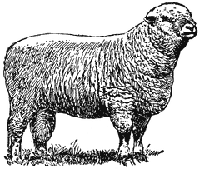
Thrifty condition and vigorous health must be maintained at all costs. Otherwise the lambs will be small and weak and fleeces of inferior quality. The regular use of Pratts Animal Regulator will improve condition, insure health and vigor, increase number and quality of lambs, promote growth of flesh and wool. And in large measure, it keeps common diseases away because Pratt-fed sheep are in condition to resist disease.
Shearing should be done after lambing, usually in late spring or early summer. If lambing time is late, the shearing may be done before the lambs arrive. Tie up the fleeces separately, first sorting out dung locks and tags.
After lambing, the individual ewes should be carefully watched to see that they have plenty of milk and are in good condition. They should be kept in pens for about three days, when they may be permitted to run with the flock. Feed lightly for two or three days, then heavily to stimulate the milk flow so lambs will be well-nourished. They may profitably receive one to two pounds of grain per day during the nursing period.
Inferior ewes should be marketed as rapidly as they are identified. Get rid of the barren ones, producers of poor lambs, poor milkers, light shearers.
Sheep must be protected against blood-thirsty dogs and external and internal parasites. In many sections sheep growers have united to fight sheep-killing dogs and good results have been secured. United action against a common enemy is best, as public sentiment may thus be aroused.
Because of their thick fleeces and helplessness, sheep suffer greatly from the attacks of ticks, lice and other parasites. Ticks are particularly injurious. They annoy and weaken the adult animals, torture the lambs and check their growth. The result is always a money loss to the sheep owner.
Fortunately it is a simple matter to exterminate the ticks and lice and overcome the ordinary skin diseases of sheep. Merely dip the sheep in a solution of Pratts Disinfectant. It is non-poisonous, inexpensive—does the work!
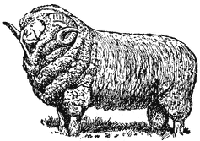
July and August is the popular time for dipping, but the work can be done as soon after shearing as the shear cuts heal. Two dippings are necessary, about twenty-four days apart. The first treatment may not kill all the eggs, but the second will kill the young ticks, thus completing the job. For successful results, it is necessary to use a dipping tank or vat large enough to hold sufficient of the solution to immerse and thoroughly saturate each animal.
Intestinal parasites, of which the stomach worm is perhaps the most dreaded, cause great loss to sheep owners. These worms live in the fourth stomach. They are easily identified, being from one-half to one and a quarter inches long, marked with a red stripe. Their eggs are found in the droppings of the sheep, so infection is secured in the pasture.
As a constant user of Pratts Animal Regulator, for sheep, I find that it not only helps them to put on flesh but keeps their system in fine condition. I take great pleasure in recommending it, knowing its benefit to Cloverdale Shropshires.
No other class of animals kept upon the farm brings returns so quickly as swine, with the exception of fowls. Swine are specially valuable for utilizing food that would otherwise go to waste. They are an invaluable adjunct to the dairy, particularly when the whole milk is separated on the farm.
You can grow big, healthy, profit-paying hogs, if you will merely meet certain clearly defined hog requirements. If you do this, and it's easy, you need never worry about profits. You are sure to succeed.
The world needs and will pay you well for all the hogs you can produce. Aside from the pork products required for consumption in America, the hog growers of the United States must for years export to Europe more pork in various forms, and more lard, than ever before.
The European herds of hogs have been sadly depleted. Dr. Vernon Kellogg, of the United States Food Administration, has personally investigated the situation. He reports decreases in hogs in leading countries as follows: France, 49 per cent.; Great Britain, 25 per cent.; Italy, 12-1/2 per cent. And, of course, conditions are even worse in Germany, Austria and the Balkan Nations, all of which are big producers in normal times.
Properly handled, kept healthy and vigorous, the American hog is a money-maker. Many farmers know this from experience: others fail to realize how useful and profitable the hog really is.
The experts connected with the United States Department of Agriculture make the following assertions in Farmers' Bulletin 874:
"No branch of live-stock farming gives better results than the raising of well-bred swine when conducted with a reasonable amount of intelligence. The hog is one of the most important animals to raise on the farm, either for meat or for profit, and no farm is complete unless some hogs are kept to aid in the modern method of farming. The farmers of the South and West, awakening to the merits of the hog, are rapidly increasing their output of pork and their bank accounts. The hog requires less labor, less equipment, less capital, and makes greater gains per hundred pounds of concentrates than any other farm animal, and reproduces himself faster and in greater numbers; and returns the money invested more quickly than any other farm animal except poultry."
The University of Minnesota, in Extension Bulletin 7, sums up the matter as follows:
"From a business point of view, the hog is described as a great national resource, a farm mortgage lifter and debt-payer, and the most generally profitable domesticated animal in American agriculture."
And this summarizes the general opinion of progressive hog growers and the experts connected with the United States Department of Agriculture and the various State Agricultural Experiment Stations and Colleges.
Breeds of hogs are divided into two general classes—bacon type and lard type. Where milk is plentiful, and especially where such foods as barley and peas are grown, the bacon type will be the most profitable, as they furnish the largest litters and also make pork that brings the best price in the market. The lard type of swine are usually kept where corn is the cereal that is most grown.
The large Yorkshire and Tamworth are the leading bacon breeds. The Poland China, the Duroc Jersey, and the Chester White are leading lard types. The Berkshires, Cheshires, and Hampshires are intermediate between the bacon and lard types. When bacon sires are crossed upon sows of any of the other breeds, the progeny are excellent for pork.
The farmer who is about to adopt a breed should be sure to select one of the standard and common breeds of his own neighborhood. Many men make the mistake of introducing a breed new to the section, and when the time comes that a new boar must be secured much difficulty and expense are incurred before a satisfactory one can be found.
The bulletin quoted above further says: "To the production of pork, then, in the largest amount, in the shortest time, and with the minimum of money and labor, all the details of the hog-raising industry are directed." Here is the whole secret—pork in largest amount, in shortest time, at lowest production costs. And the very foundation is perfect health and vigorous condition of the hogs, both breeding animals and market stock.
Health and vigor are necessary in the breeding animals if they are to produce big litters of sturdy pigs—in the market animals if they are to consume large amounts of food and economically and quickly convert it into fat and muscle. Weak, sickly, run-down hogs are a constant source of trouble and are never profitable under any conditions. Disease is one of the greatest drawbacks in the hog industry.
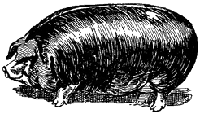
When selecting brood sows of any breed, the preference should be given to those which have reasonably long sides and limbs of medium length. When selecting boars make sure that vigor is present in a marked degree and also strong limbs. Any weakness in the back of male or female is to be carefully shunned.
During pregnancy two facts must be borne in mind. The first is that the sow is doing double duty. She is keeping up her own bodily functions, as well as developing her fetal litter. Therefore, feeding should be liberal. The mistakes in feeding breeding animals are more frequently those which keep such stock thin. The importance of ample feeding at this time is a demonstrated fact, as well as one which appeals to common sense.
In the second place the sow is building new tissue. Hence the kind of feed is important. Bran, peas, oats and barley and such forage plants as clover, alfalfa, vetches and the like. Ordinary pasture grasses are of much value.
All breeders lay great emphasis on the condition of the bowels during pregnancy, and particularly at farrowing. The special danger to be avoided is constipation. It is right here that Pratts Hog Tonic shows its great worth to hog raiser. It puts the digestion organs into healthy condition and the result is safe farrowing and a healthy litter which is not apt to suffer from scours or thumps.
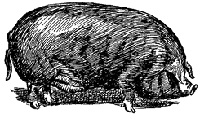
Good health is inherited from vigorous, healthy ancestors. It is intensified and preserved by proper management. "The time to begin fitting pigs for market is before they are farrowed. For this reason it is advisable to pay particular attention to the feed and care of the brood sow from breeding to farrowing time." And "It must be understood that it is much easier to continue an animal (hog) in a thrifty, hardy condition than to bring the animal back to his normal appetite and rate of growth, once he is out of order." (Circular 90, New Jersey Agr. Exp. Station.)
These common-sense statements must appeal to the reason of every thinking hog producer. And they make plain the wisdom of regularly supplying Pratts Hog Tonic to the entire herd, to breeding stock, growing pigs, fattening hogs.
This remarkable natural tonic and conditioners is not a specific for any single disease. It is a health-builder and health-preserver. In this connection we wish to particularly mention that most dreaded and destructive of all hog diseases—hog cholera. We do not claim that Pratts Hog Tonic will entirely prevent or cure this scourge. But it will put and keep your herd in such fine condition that the individuals will be more resistant and will not as readily contract cholera or other germ diseases. It will prevent and control such troubles as indigestion, diarrhoea, constipation and the like, which are such a source of trouble in the average herd.
You may not appreciate the value of using such a conditioner, but the Kentucky Agr. Exp. Station, in Bulletin 181, contains the following statement which deserves the careful consideration of every thoughtful hog raiser: "General conditioners have been found to be advantageous in the maintenance of healthy conditions in hogs."
Brood sows should not produce their first litter under twelve months. Whether they should produce one or two litters a year will depend largely upon the conditions, especially of climate. Sows should be kept for breeding as long as they will produce good, even litters. Well-chosen sows should rear an average of eight to the litter.
Brood sows should have ample exercise. They get it in good form when they are allowed to turn over litter in the barnyard on which a little grain, as corn, has previously been sprinkled. Two-thirds of the winter rations may consist of mangels or alfalfa hay—the other third being grain or swill. Alfalfa for hogs should be cut before blossoming.
When sows farrow they should be fed lightly for the first three days. Later give all they will eat of milk-making foods. A combination of ground oats, wheat shorts, and some corn is excellent. And Pratts Hog Tonic will be found especially valuable during the nursing period. Meal is fed ground and soaked. As soon as young pigs will take skim-milk they should get it in a trough apart from the sow. They are weaned at seven or eight weeks where two litters are grown in a year, and at twelve weeks where but one is grown.
When pigs are weaned, and previously, there is nothing better than shorts and skim milk. They should be grown subsequently to weaning on pasture, with one to two pounds of grain added daily. In season, winter or spring rye, clover, alfalfa, barley, and rape all make excellent pasture.
The fattening period with swine covers from six to eight weeks. Unground corn and water will fatten swine in good form. The same is true of barley and rye, ground and soaked. They may be fattened nicely while grazing on field peas. They may also be similarly fattened by hogging off corn or gathering it from the excrement of cattle that are being fattened on it. Swine well grown should make an average gain of a pound a day. Bacon swine may be best sold at 175 to 200 pounds in weight. Lard types are usually grown to greater weights.
Swine breeders have long recognized the value of Pratts Hog Tonic as a disease preventive and fattener. Progressive breeders now consider it a necessity in profitable hog raising.
If a second litter is wanted during a year the sows should be put to the boar during the first heat after weaning. Many breeders do not like to pass periods of heat for fear that the sows may become "shy," and there is little reason why a sow should not have two litters a year. In any case, the sows should be carried on comparatively light feed until time to breed again, gaining a little in weight; and their treatment after breeding should be as already detailed for pregnant sows.
When the boar arrives at the farm he should be dipped in a solution of Pratts Dip and Disinfectant, as a matter of ordinary precaution against the introduction of vermin. As an additional precaution, a quarantine pen should be ready for him, especially if epizootics are prevalent. His feed before change of owners should be known, and either adhered to or changed gradually to suit the new conditions. If he has come from a long distance it will be well to feed lightly until he is well acclimated.
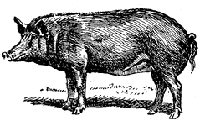
Breeders generally advocate the practice of keeping a boar to himself during the entire year—out of sight and hearing of the sows. However, a boar is often allowed to run with the sows after they are safe in pig; but during the breeding season it is by far the best policy to keep him by himself, admitting a sow to his yard for mating, and allowing but one service. The litters will generally be larger and the pigs stronger.
The boar should not serve more than two sows daily, preferably one in the morning and one in the afternoon, and can serve 50 to 60 in a season without difficulty.
In order to keep the boar in vigorous physical condition, he should be given Pratts Hog Tonic regularly. The beneficial results will be seen in the way of larger litters and stronger pigs.
The greatest drawback to the hog industry which breeders in this country have to contend against is found in the losses which may be experienced through the infestation of the animals, especially young pigs, by parasites, through outbreaks of hog cholera or swine plague, or through the contraction of tuberculosis.
In dealing with the diseases of hogs, preventive measures must be most relied upon. The animals must be given dry and well-ventilated quarters, which must be kept clean. Contrary to common belief, hogs have some habits which raise them above other domestic animals from the standpoint of cleanliness. For example, unless compelled to do so, a hog will not sleep in its own filth. If part of the floor of the pen is raised and kept well bedded with straw, while the rest is not, all excrement will be left on the unbedded portion of the floor, and the bed itself will be always clean.
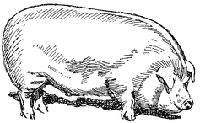
In addition to cleanliness, close attention should be given to the feed which is supplied, that nothing may be fed which will convey the germs of disease, especially tuberculosis, to the herd. If the hogs are fed milk in any form obtained from cows kept upon the same farm, the cows should be subjected to the tuberculin test, as by this means all tuberculous milk may be kept from the hogs. If they run with the cattle of the farm a tuberculin test of all the cattle is none the less desirable. Animals dead from any disease should not be fed to the hogs until the meat has been made safe by cooking. Skim milk or refuse from a public creamery should not be fed to hogs until it has been thoroughly sterilized.
Feeding and drinking places should be clean and the water supply pure. Unless the origin is known to be uncontaminated and there has been no possibility of infection during its course, hogs should not be allowed access to any stream. Wallows should be drained out or kept filled up as much as possible. At least once a month the quarters should be disinfected with a solution of Pratts Dip and Disinfectant. These precautions will be found valuable aids in the destruction of the various animal parasites, as well as a protection from some more serious troubles.
The methods of feeding and management outlined above have been successfully followed by hog growers for many years. They are conservative and safe. But during recent years a new method of feeding has been developed and is being generally adopted, especially by specialists who make hog growing a real business. This is known as the "self-fed" plan, under which system feed is kept before the hogs at all times and they are permitted to eat at will. In poultry feeding this is called "the dry mash system."
Just who deserves credit for originating or developing this plan cannot be stated. That it is a good one is evidenced by the fact that it has received the endorsement of the Bureau of Animal Industry, United States Department of Agriculture; of many Agricultural Experiment Stations; of the specialty swine journals; of practical hog breeders in all sections of the country.
For this self-feed plan it is claimed that both feed and labor are saved, thus reducing production costs. That a 250-pound hog can be grown in thirty days less time than is possible where slop-feeding is practiced, thus getting the hogs to market earlier and avoiding danger of loss during this time. That it produces pork of highest quality, the meat being fine in flavor, firm, and with lean and fat well distributed.
Advocates of the self-feeding plan make the following comparison with the old-time slop-feeding method:
When dry food is supplied in automatic feeders, the attendant may fill the feeders at any convenient time of day and that at intervals of several days. In slop feeding, the meals must be prepared and fed twice daily, usually when other duties are pressing and time especially valuable.
When dry, ground grains are kept before the hogs at all times, they eat when they feel the need of food and are not liable to overeat at any time. Because of the dry character of the feed, they eat slowly, masticating the food thoroughly and mixing it with saliva. This means more thorough digestion and an absence of indigestion and bowel troubles. And, of course, quicker growth.
Slop-fed hogs, on the other hand, get very hungry between meals. At feeding time they pile up around the troughs, the stronger rushing and pushing away the weaker ones, those that really need the feed the most. Then they bolt the food without chewing it, taking all they can hold and leaving little for those that cannot find a place at the "first table."
The quality of the dry-fed pork has been mentioned. Equally important, from the standpoint of the butcher, is the loss in dressing of hogs. Tests have shown that slop-fed stock loses six to eight pounds more per hundredweight than does the dry-fed.
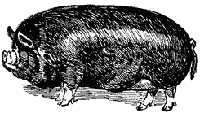
Another big advantage of dry-feeding lies in the fact that large numbers of swine, including those of various ages and sizes, can be safely kept in one herd. The writer has seen over two hundred head of swine, ranging in size from pigs just weaned to 250-pound porkers ready for market, living in peace and contentment in one building, eating and sleeping and sharing the forage pastures together. Of course this means a big saving in buildings and fencing and a great reduction in the amount of necessary labor.
The self-feeder may be used all through the life of the hog, beginning when the pigs are still nursing and continuing until they reach market weight. During all this time the ration should contain Pratts Hog Tonic, the guaranteed hog conditioner, in order that at all times the herd may be maintained in vigorous condition, be kept free from disease, may avoid wasting feed through imperfect or sluggish digestion, may earn for the farmer the maximum amount of profit. We suggest that you make a test of this results-insuring, profit-producing tonic. Watch results. If you are not satisfied the dealer from whom you purchased the goods will refund the full amount you paid for them.
The self-feeding plan of growing hogs gives best results when the animals are given access to growing forage crops. The feeders may be placed under cover out in the fields or kept in the hog house if the latter is reasonably near the pasture lots. An unlimited supply of fresh water must be available at all times because dry-fed stock drinks many times the amount of water that slop-fed hogs do. The reason is plain.
There are many different systems of handling hogs under this plan, varying according to local conditions. We will give in detail the method used most successfully for many years on a Pennsylvania farm which each season markets several hundred hogs of a quality which commands a premium above current quotations.
On this farm, particular attention is paid to keeping the hog houses clean and sanitary, light, sunny and dry. Dampness is always a fertile source of loss. Further, the houses are never crowded. Each animal is given plenty of room.
The brood sows are placed in separate pens at farrowing time and watched carefully when giving birth to the pigs. They are fed a rich slop, a small quantity at first, but in gradually increasing amount until they are receiving enough to insure a big flow of milk.
When the pigs are eight to ten days of age they are permitted to go at will to the self-feeder containing a mixture of ground grains. As a rule, several sows farrow at about the same time and the pens are so arranged that the pigs from several litters may all use one feeder.
Big litters of strong-boned, growthy pigs, and rapid growth of pigs from birth to maturity are the natural result of health and vigor of breeding stock and youngsters. Weak, run-down boars and sows produce inferior pigs and usually small litters. And such pigs are not money-makers.
the guaranteed conditioner for swine, overcomes most hog diseases, makes the breeders healthy and vigorous, insures big litters of big pigs, makes the youngsters grow steadily and rapidly from birth to maturity and fatten quickly and economically.
Many of the most successful hog-growers will tell you that one secret of their success is the regular use of Pratts Hog Tonic. You should at least test it. No risk on your part because

This arrangement results in the pigs taking more exercise, eating more food and making more rapid growth. It reduces the danger of thumps and gives the youngsters a wonderfully strong start in life.
The feed mixture used at this time varies somewhat according to available supplies and current prices. A sample pig ration is made up as follows:
| Winter wheat middlings | 40 | lbs. |
| Hominy meal | 40 | lbs. |
| Oil meal | 3 | lbs. |
| Whole oats (heavy) | 5 | lbs. |
| 60 per cent. Digester tankage | 12 | lbs. |
| Fine salt | 1/2 | lb. |
Mix thoroughly.
When the pigs are weaned they are placed with the herd, a safe practice because of the general contentment and quietness and the entire absence of meal-time stampedes. They quickly adjust themselves to their new surroundings, and, because accustomed to the use of self-feeders, at once begin eating the regular hog ration with the rest of the herd.
In the hog house, enough self-feeders are provided to permit all animals to eat at will without being crowded. One feeder to each twenty-five hogs is the rule.
The hog ration, like the pig ration, varies according to conditions. But at all times it is palatable and contains feeds which build bone, muscle and fat. A favorite formula is this:
| Winter wheat middlings | 50 | lbs. |
| Wheat bran | 50 | lbs. |
| Corn chop | 50 | lbs. |
| Whole oats | 10 | lbs. |
| 50 per cent. Digester tankage | 20 | lbs. |
Soft coal and salt are kept before the herd at all times. The hogs eat these at will.
The grazing system is used on this farm. Many different forage crops are planted, in order to insure a regular succession of succulent feeds. As each field reaches proper condition for grazing, a hog fence is thrown around it and the herd admitted. The hogs do all the work of harvesting, thus securing valuable exercise and at the same time saving man labor. Under this system the fields have steadily improved in fertility, due to the turning under of the uneaten green stuff and the direct application of the valuable hog manure.
Forage crops vary in different sections of the country. On the farm in question the earliest forage is rye, followed in rotation by the various clovers and mixtures of oats, Canada field peas, vetch, soy beans, etc. Dwarf Essex rape is a favorite crop and one that furnishes a tremendous amount of forage per acre.
When the corn crop matures, the larger individuals are given the liberty of the corn fields and the crop is "hogged down." This again saves a great amount of hand labor, a big item under existing conditions.
In the winter, when grazing is out of the question, the herd receives once daily a liberal feed of second crop alfalfa or clover hay.
Understand, the feeders containing the dry mixture of ground grains, are available to the hogs at all times. They help themselves at will, day and night.
We have been trying to produce the largest hog in the world and we have done it! We have a Big Type Poland China hog, that has been fed 123 days, making a gain of 450 pounds and at this time weighs over 1200 pounds. We fed him on Pratts Animal Regulator.
When keeping hogs in large herds like this, it is of primary importance that the most careful attention be paid to sanitation. Pratts Dip and Disinfectant should be used regularly and thoroughly to protect against disease germs and vermin. And Pratts Hog Tonic used to keep the hogs in perfect condition inside.
If sickness appears in the herd the unaffected hogs should at once be removed to clean, disinfected quarters, preferably without much range, for by running over pastures they may come in contact with contagion. Their feed should be carefully regulated, and, if they have previously been on pasture, should include some green feed, roots, or an abundance of skim milk.
To make a success of hog raising, dipping is almost as essential as feeding. At least it is second only to proper feeding.
Lice and vermin, the comfort-destroyers and profit-reducers, and the germs which cause cholera and tuberculosis, are exterminated by the regular use of
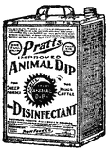
Put the hogs and pigs through the dipping vat and spray the quarters and feed receptacles occasionally with a strong solution of the original Pratts Dip and Disinfectant. Result—comfortable, vermin-free and disease-free hogs, less loss, more pork, more money.
There are other dips that look like the original Pratts, but they are not the same in efficiency. Refuse the substitutes. Use Pratts, the dip you can depend upon. It costs no more but it's worth more! You be the judge—
The quarters in which the sickness first appeared should be thoroughly cleaned, all bedding and rubbish burned, and loose boards and old partitions torn out and burned. If the pen is old, knock it to pieces and burn it. Disinfect pens and sleeping places using Pratts Dip and Disinfectant on the floors, walls and ceilings. Whitewash everything. If a hog dies from any cause, the carcass should never be exposed where it may be devoured by the other hogs or by passing birds or beasts, but should be burned at once or buried deeply and the pens thoroughly disinfected immediately. If possible, do not move the carcass from the place where it falls; but if this cannot be done the ground over which it is dragged should be disinfected. Hog-cholera bacilli can live in the ground for at least three months. Care must be taken to maintain an absolute quarantine between the sick and well hogs. The same attendant should not care for both lots unless he disinfects himself thoroughly after each visit to the infected hogs. Dogs should be confined until the disease is stamped out.
Treatment of hogs suffering from cholera or swine plague is not always satisfactory. The disease runs its course so rapidly that curative measures are more or less ineffectual, and prevention of an outbreak should be relied upon rather than the cure of sick animals. Pratts Hog Tonic has been successful in less virulent outbreaks when administered as soon as signs of sickness are shown.
Pratts Hog Tonic should be thoroughly mixed with the feed, which should be soft, made of bran and middlings, corn meal and middlings, corn meal and ground and sifted oats, or crushed wheat, mixed with hot water. If the hogs are too sick to come to the feed, the tonic should be given as a drench. Pull the cheek away from the teeth and pour the mixture in slowly. Care should be exercised, as hogs are easily suffocated by drenching. Do not turn a hog on its back to drench it.
Hogs often suffer very much from vermin. Lice are introduced from neighboring herds, and the losses in feeding are often severe, especially among young pigs, when death is sometimes a secondary if not an immediate result. When very numerous, lice are a very serious drain on vitality, fattening is prevented, and in case of exposure to disease the lousy hogs are much more liable to contract and succumb to it.
Newly purchased hogs should be carefully examined for vermin, and they should not be turned out with the herd until they are known to be free from these pests.
When the herd is found to be badly infested with lice all bedding should be burned and loose boards and partitions torn out. Old boards and rubbish should be burned. The quarters should then be thoroughly disinfected by spraying with Pratts Dip and Disinfectant.
Vermin are most common around the ears, inside the legs, and in the folds of the skin on the jowl sides and flanks. In light and isolated cases they may be destroyed by washing the hogs with Pratts Dip and Disinfectant, properly diluted, applied with a broom.
In severe cases, however, especially where the whole herd is affected, thorough spraying or dipping should be resorted to. In this case a dipping tank will be a great convenience.
Whenever any animals are brought to the farm, or when animals are brought home from shows or from neighboring farms, they should be kept apart from the rest of the herd for at least three weeks. If they have been exposed to hog cholera or swine plague the diseases will be manifested within this time, and the sick animals can be treated or killed and disposed of at once.
I bought two spring pigs the 15th of April and began feeding them Pratts Animal Regulator until the 15th of December when I butchered them. One weighed 415 pounds, the other 420 pounds. I know this Regulator does what you claim it to do.
If cholera breaks out in the neighborhood the farmer should maintain a strict quarantine against the infected herds. He should refrain from visits to farms where they are located, and should insist on requiring that his neighbors stay out of his hog lots. Visiting of all kinds at this time should be carefully restricted. Dogs, cats, crows, and buzzards are very active carriers of infection from farm to farm, and should be guarded against as far as possible.
(Symptoms and Treatment)
Diarrhoea or Scours
Cause.—By milk of the dam being affected by feeding of food tainted with the elements of decay; by making a sudden change in the food; by some disordered condition in the health of the sow, and by excess of milk furnished by the dam.
Usually occurs before the weaning stage, as a rule in swine not yet ten days old.
Symptoms.—Very soft condition of the voidings which are sometimes almost watery.
Treatment.—Being highly contagious, spray the floor thoroughly with Pratts Disinfectant. Keep the young swine comfortable and remove the voidings carefully two or three times a day. Correct the food given the dam, mixing Pratts Hog Tonic with her feed. Also give a small tablespoonful of sulphur daily to the sow.
Hog Cholera and Swine Plague
Hog Cholera and Swine Plague are very much alike. Both are characterized by inflammation of stomach and intestines, enlarged and inflamed lymphatic glands and sloughing of portions of the skin. The treatment and preventive measures are alike in many respects.
They are germ diseases, contracted in purchasing swine which may contract the germs when in transit on cars; by exhibiting at fairs; through persons who have visited infected herds; through the feet of dogs and birds to which the germs may have adhered; through the water of an infected pond or stream.
The most dangerous source of infection by far is coming in touch with diseased animals.
Reduced stamina and filthy quarters favor the spread of these diseases.
Hog Cholera
Symptoms.—Dullness, loss of appetite or depraved appetite and a disposition to lie down; constipation or diarrhoea; stiff gait; red spots or blotches discernible about the ears and under the neck and belly; in some instances there is difficulty in breathing.
Treatment.—Authorities agree that there is no known cure for real hog cholera. Preventive measures, therefore, are of vital importance. Pratts Disinfectant should be used frequently and to build up the general health of the hog, giving it full disease-resisting power, Pratts Hog Tonic should be added to the ration. Besides, it is a valuable tonic and fattener.
Swine Plague
Symptoms.—Extensive inflammation of the lungs, by which it can be distinguished from hog cholera. There is coughing and labored, painful and oppressed breathing.
It frequently comes as a pneumonia or an inflammation of the lungs and pleural membrane. The animal is in a sleepy and even comatose condition much of the time. If it walks it staggers. The skin reddens in a marked degree and the bowels become constipated. This disease, though not nearly so common as hog cholera is usually very fatal. Preventive measures, as indicated for hog cholera, are all important. Use Pratts Hog Tonic as directed and disinfect with Pratts Disinfectant.
Thumps
Cause.—Too liberal feeding and lack of exercise, resulting in poor digestion. The diaphragm contracts suddenly at irregular intervals, thus giving the name to the disease. The pig becomes unthrifty and stunted. If the sow is a liberal milker, nursing pigs may be affected. Treatment is usually preventive, consisting of exercise and careful feeding, Pratts Hog Tonic being added to the feed.
Tuberculosis in Swine
The losses from this disease are beginning to assume enormous proportions. It results largely from swine drinking the milk of tuberculous cattle.
Symptoms.—Digestive disorders, such as diarrhoea and vomiting; a stunted condition and a staring coat and breathing more or less labored.
Treatment.—There is no positive cure for this severe disease, but good sanitation is the best preventive. Use Pratts Disinfectant freely and maintain health and vigor by regularly using Pratts Hog Tonic.
The importance of testing heads of cattle that may be affected with tuberculosis is thus further emphasized.
Worms
There is perhaps no other animal troubled to so great an extent or with so many varieties of worms, as the hog. Indeed it is almost a rule with some growers when a hog is sick and it cannot be told exactly what is the matter that they doctor for worms.
There are four species of worms that live in the intestines of swine, resulting in more or less harm. The Common Round Worm, Pin Worm and Whip Worm develop from eggs taken in in food and water. The Thornheaded Worm develops from a white grub which swine eat. To a great extent these are kept in check by Pratts Hog Tonic.
As preventive measures, drain stagnant pools and wet places where these eggs may be found; plough up yards and pastures; do not feed on floors not properly cleaned, or on ground that may have been much used for such feeding; do not give water from a deep well, do not allow the swine to wallow in the drinking trough.
Symptoms.—Frequently a gluttonous appetite without corresponding improvement in flesh. Again a much impaired appetite is found; diarrhoea or constipation; excessive itching, causing the animal to rub, especially the hind parts. These symptoms will only exist when worms are present in large numbers.
Treatment.—Give each adult hog one heaping tablespoonful of Pratts Worm Powder with the feed once a day for four days. After the last dose give a bran mash to loosen bowels.
Repeat this treatment two weeks after the first to insure killing any worms which may have hatched in the meantime.
Even if you are not sure that your hogs have worms—as they probably have—you should use Pratts Worm Powder as above as a matter of precaution.
I bought four pigs, four months' old, weighing about 16 pounds each, and, in bad condition. Began to feed Pratts Animal Regulator and at 5 months' old they averaged a gain of one pound a day per pig.

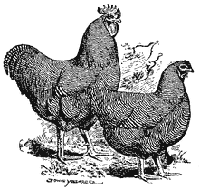
"One hundred hens on every farm" was the small number set by the United States Department of Agriculture in its great war drive for increased production of foods. And certainly this number of fowls, and many more, can be easily and profitably maintained on the average farm. Easily, because under free range conditions, which are possible on the farm they require but little attention. Profitably, because under these conditions, where they pick up much of their living, the cost of production is comparatively low, while eggs and flesh sell at good prices. Further, these delicious and nutritious foods add variety to the farm table.
I have used Pratts Poultry Regulator regularly.
The egg record for 900 fowls for five months the past winter was as follows: Dec., 50%; Jan., 43%; Feb., 55%; March, 69%; April, 69%. The lower record of January was caused by some pullets moulting.
Would say that fertility of eggs averaged 87% in December to over 90% later in the spring.
Many a farmer's wife finds her poultry flock a never-failing source of pin money. Many a farm girl and boy have secured their education from faithfully saving the "egg-money." And the opportunities for profit in this line are now greater than ever before.
Helps for Poultrymen
In a short chapter in a general publication of this kind it is impossible to go into the finer details of modern methods of poultry husbandry. For those who desire more information on this subject we have a big 160-page book, pages 6x9 inches in size, fully illustrated with 150 photos and drawings. The title is "The Poultryman's Complete Handbook." It's worth a dollar, but we will send you a copy, prepaid, for only ten cents in stamps or silver. Address your request to Pratt Food Co., Philadelphia.
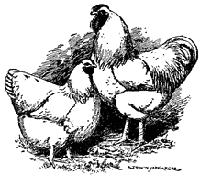
Pratts Poultry Service Department is maintained to give expert information and advice on poultry topics. There is no charge for this service. Whenever you get puzzled, write Pratts experts. They will send you a prompt personal reply containing the information you desire. No charge, no obligation. Address such letters to Poultry Service Department, Pratt Food Co., Philadelphia.
Breeds of Poultry
Regardless of breeding and appearance, a heavy layer is a good hen to own. And laying ability is not confined to any one breed or class of fowls. There are exceptional layers, dependable profit-payers, in practically every fair-sized flock, whether made up of standard-bred stock or mongrels.
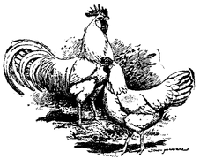
As a general rule, however, standard-bred birds are best. By that term we mean those which have been bred to meet the typical breed and variety descriptions as appearing in the official Standard of Perfection which is published by the American Poultry Association. Such a flock is bound to be uniform in size, appearance and general characteristics, is easier to manage properly because of its uniformity, and its products, both eggs and table poultry, will also be uniform. Further the income from such a flock may be increased through the sale of eggs for hatching and of breeding stock at prices many times greater than those of table eggs and poultry.
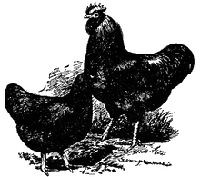
No matter what breed you select, the most important matter, the very foundation of success, is the securing of individual birds which are strong, sturdy, vigorous and healthy. Only stock of high vitality can be depended upon to give continuously good results. It is time and money wasted to keep fowls which are weak, sickly or "run-down," the result of improper breeding or management.
As a rule, it is best to select that breed which is most popular locally, because such popularity indicates that the breed in question thrives under local conditions and meets the requirements of the local markets. Further, one has greater opportunities of securing good birds and a larger market for hatching eggs and stock.
We have been using Pratts Baby Chick Food and are very well pleased with it. I think that it is the best baby chick mash on the market today.
Among the farmers whose markets demand white-shelled eggs, the S.C. White Leghorn is the most popular fowl. The Black Minorca is another favorite. It produces the largest white eggs.
Where brown-shelled eggs are wanted, the Plymouth Rock, Wyandotte, Rhode
Island Red and Orpington lead. And for the production of the largest
table carcasses the Light Brahma, either pure or crossed with a more
active breed, is a favorite. The live weights of adult birds of these
breeds are as follows:
| Breed. | Cock. | Hen. | |||
| Leghorns | 5-1/2 | lbs. | 4 | lbs. | |
| Black Minorcas | 9 | lbs. | 7-1/2 | lbs. | |
| Plymouth Rocks | 9-1/2 | lbs. | 7-1/2 | lbs. | |
| Wyandottes | 8-1/2 | lbs. | 6-1/2 | lbs. | |
| Rhode Island Reds | 8-1/2 | lbs. | 6-1/2 | lbs. | |
| Orpingtons | 10 | lbs. | 8 | lbs. | |
| Light Brahmas | 12 | lbs. | 9-1/2 | lbs. | |
Most of these breeds have varieties, determined by color of plumage or shape of comb. Select that one which best pleases you.
Poultry Houses
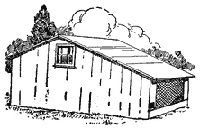
When locating the poultry house remember that it is a great advantage to have soil which is light and naturally well drained, since such soil dries off quickly after a rain and is "much warmer," as poultrymen express it. Heavy soil, even stiff clay, may be made to serve the purpose admirably if provision is made to drain off all surface water. But avoid a site on which water settles in pools, as the surface soon becomes filthy and is a menace to the health of the flock.
The birds should have the benefit of several hours of sunshine each day. So locate the poultry house where the sun can strike it freely. The shelter of tall buildings on the north, or even on the east or west, is frequently an advantage during the winter months, but the south side should be open if conditions permit. Shade trees and large shrubs about the house are a source of comfort to the fowls during hot weather and may be used to screen or partially hide the poultry plant.
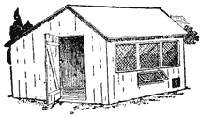
The poultry house must be dry, well-ventilated, free from draughts, light, sunny and cheerful. And if it is planned with reference to the convenience of the poultryman, so much the better. The most simple and inexpensive form of construction should be used. In all sections of the country, excepting the extreme north, a single wall of matched boards on a light frame is perfectly satisfactory. Unmatched boards with battens nailed over the cracks or a layer of lightweight roofing paper over all are equally good. In fact, in case of necessity, one may use the roughest of lumber, and by covering the entire structure with roofing paper make a building which is tight and comfortable and acceptable in appearance.
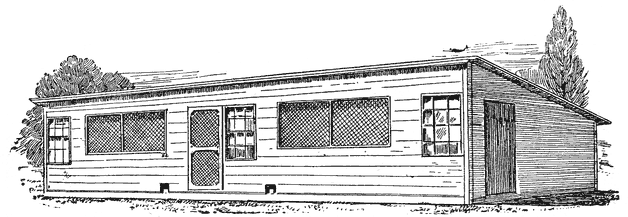
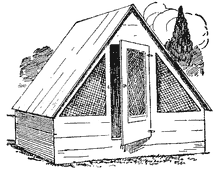
The rear and end walls and roof must be tight to insure dryness and prevent all draughts. Windows and doors may be placed in end walls, but these should usually be located forward of the center of the building and made to fit snugly. The rear part of the house, where the roosts are located, must at all costs be protected against cross-currents of air.
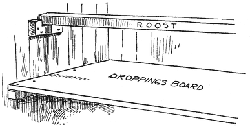
The south or front walls, on the other hand, should have ample openings
to admit air and sunshine. The open-front or fresh-air type of house is
much superior to the old tightly closed type. Plenty of fresh air means
comfort, health, vitality and increased production.
What is Pratts Poultry Regulator? A positive tonic and conditioner for poultry of all kinds and ages. A health-builder and health-preserver. Not a food.
What does it contain? Roots, herbs, spices, mineral substances, etc. Each ingredient performs a certain duty. The combination spells "health insurance."
What does it do? Pratts Poultry Regulator makes and keeps poultry healthy, vigorous and productive. It shortens the molt, sharpens the appetite, improves digestion and circulation, hastens growth and increases egg-production. It saves feed by preventing waste due to poor digestion. It prevents disease by keeping the birds in condition to resist the common ailments.
Has it been fully tested? Yes! In general use for nearly fifty years. The original poultry conditioner. Imitated, but unequalled.
Does it give general satisfaction? Positively! Satisfaction guaranteed or money refunded. Test it at our risk. Increased egg production will prove that "Pratts makes hens lay."
How is it best used? Daily in small quantities. For adults, tablespoonful daily for 10 birds. Younger stock in proportion. Mix with dry or moist mash.
What does it cost? Nothing, because it pays big profits. About a cent a month per hen is the investment required.
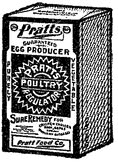
Where can I get it? From 60,000 Pratt dealers. There is one near you.
Direct from the Pratt Food Co., prepaid, if your dealer can't supply
you.
I have been using your poultry foods and remedies with the best of
satisfaction and
results for the last ten years.
From a quarter to a third of the front wall should be left open. Cover the openings with one-inch mesh wire netting to keep the fowls in and repel all enemies and food-seeking sparrows. Cloth-covered frames should be provided to close these openings and keep out driving storms. The cloth, should be open in texture, as coarse cotton or heavy cheese cloth, not "boardy" and air-tight. Frames may be left loose to hook or button on inside or outside, or hinged to the top of the openings and swung up against the roof when not in use. In some cases, as in the Tolman house, these openings are never closed, day or night, summer or winter.
It is advisable to provide one or more glass windows in addition to the openings referred to above in order to admit light when the cloth-covered frames are closed. The windows may be placed in either the front wall or the side walls. In the latter case the sun is admitted to the building more hours each day, which is a big advantage during the fall and winter months.
Poultry house floors may be of cement, boards or earth. Cement is best for large, permanent structures. Board floors are excellent in houses of any size and are almost a necessity in small ones which may be moved frequently. Earth floors seem to be favored by the fowls, but if used the earth should be filled in to bring the floor level several inches above the surrounding ground. This to insure dryness.
The accompanying cuts show typical designs of satisfactory poultry houses. When building, just bear the above principles in mind and the results will be satisfactory.
The Tolman type is a strictly "fresh air" or "open front" house. For a flock of thirty to forty birds this house should be ten feet wide, sixteen feet front to back, seven feet to peak of roof, front wall four feet and rear wall five feet high. The highest point of roof is five feet from the rear wall.
The entire south side is a wire-covered opening, save for boards placed as shown in the cut. A full-sized door is located in the east wall opposite the window in the west side. Roosts are placed near the north wall, level with or slightly above the front opening.
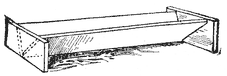
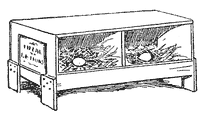
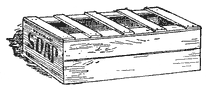
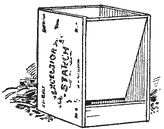
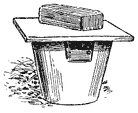
After a long experience I find Pratts Poultry Regulator to be absolutely the best tonic to keep a flock of poultry in condition. Just as soon as I find a pen is not doing well, I use the Regulator in their mash. Almost immediately I notice their appetites improve, their combs redden and they lay better. I have also made trial of your other remedies and I find them all absolutely reliable.
For a flock of one hundred or more birds the New Jersey Multiple Unit Laying House is to be recommended. Each unit is twenty feet square, accommodating a hundred fowls. Similar units may be added for each hundred additional birds. The drawing on page 48 shows two units.
In this house the front studs are nine feet high, rear studs are four and a half feet high.
Simple, inexpensive furnishings are best. The cuts show home-made equipment which will meet all practical requirements.
Getting the Eggs
Early-hatched, well-matured pullets are the most dependable layers during the fall and early winter months. Some few yearling hens may continue to lay fairly well during their molting period, but, as a rule, egg production drops with the feathers and does not begin until the new coat of plumage is completed and the system readjusted. So yearlings, taken as a whole, do little toward filling the egg-basket until January or later.
Get the early-hatched pullets into winter quarters by late September or early October before they begin to lay. But be sure the house is fully prepared in advance. Clean house! Disinfect thoroughly with a strong solution of Pratts Poultry Disinfectant. Kill every germ. Avoid possible loss.
I have used Pratts Poultry Regulator for the last twenty years and
always had the best
of results. It is a great egg producer and the best
feed to keep little chicks strong and guard
off that terrible disease,
bowel complaint. In fact, I cannot do without it.
Get Fall and Winter Eggs
It is most desirable that the flock begin egg production before the weather becomes severe. Get the laying habit established while the season is favorable, and it is comparatively easy to maintain it. And, as production will not commence until the layers are fully matured, the pullets must be hatched early to give ample time for them to make the needed growth.
As a rule, it takes about seven months to mature pullets of the general purpose breeds and six months for the egg breeds. Therefore, March and April chicks of the former, and April and May chicks of the latter, are most valuable. This is a general rule. Some poultrymen are experts in this matter of growing chicks and can bring them to laying maturity in less time.
If disease appears take instant action to check it. Delay of a day or two may permit an epidemic to get well started. In order to enable you to give proper treatment without delay you may well keep a stock of Pratts Poultry Remedies on hand.
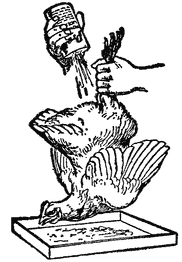
Give every bird a thorough treatment for lice. Work Pratts Powdered Lice Killer all through the plumage. This will fix the lice, but will not kill the eggs. In anticipation of the latter hatching, rub Pratts Lice Salve in the small feathers about the vent and beneath the wings. That means death to the young lice as they appear, but to make sure, apply the salve at intervals of a few weeks.
Don't overcrowd the house. Better have a hundred hens comfortable and laying than double the number crowded and loafing.
Leave all ventilating openings wide open. Keep them open until winter storms make more protection necessary. During the summer months the pullets have had plenty of fresh air. To bring them into a warm, tightly closed house is to invite general debility and an epidemic of colds, catarrh, roup and other allied diseases. (Pratts Roup Remedy dissolved in the drinking water every few days, especially during changes of weather, will help to prevent such troubles.)
Keep the house clean. Remove the litter from the floor as soon as it becomes damp or soiled and replace with new, fresh material. Clean the droppings boards at frequent intervals. Wash with Pratts Poultry Disinfectant or scald the food and water dishes. Disinfect the whole house every few weeks, taking advantage of sunny weather so quick drying will follow. Disease causes loss—disinfection prevents disease. Therefore, DISINFECT whether you see need of it or not.
Poultry Feeding
The more food the birds eat beyond bodily requirements the greater the amount of the salable products they create. Any hen that is a natural layer will turn the surplus food into eggs. If she is naturally a meat producer she will build flesh or take on fat. And the sooner the fat producers are identified and removed from the laying flock, the better for all concerned. Your birds will not "get too fat to lay"—they will get fat if they don't lay. And the big problem is to induce the layers to eat as much food as they can digest in order that they may lay heavily and steadily.
To overcome all possible danger of overfeeding, Pratts Poultry Regulator should be regularly added to the mash. This natural tonic and conditioner contains appetizers, to stimulate the desire for food—digestives, to insure complete digestion and assimilation of the food consumed—laxatives, to regulate the bowels—internal antiseptics, to keep the entire digestive tract in a condition of perfect health—worm destroyers, to expel irritating and dangerous intestinal parasites.
Regularly used, Pratts Poultry Regulator insures freedom from the more common poultry disorders, reduces feed bills by preventing feed waste due to sluggish digestion, hastens growth, improves the egg-yield, shortens the molt, makes the entire flock more efficient, swells the profits.
Pratts Poultry Regulator should be added to the mash at the rate of one and three-quarters pound to each hundred pounds of mash. Mix thoroughly so each layer will get her share. The ideal poultry ration is a varied one. It contains mineral matter, green food, animal food and grains. The absence of any one of these groups of foodstuffs means a reduced egg yield.
I am both selling and feeding Pratts Poultry Regulator, and make a specialty of high-bred Buff Orpingtons. Twelve cockerels, worth from $20 to $75 each, were all placed in healthy condition by use of Pratts Poultry Regulator and their quarters disinfected with Pratts Disinfectant.
The staple grain feeds are corn, oats, wheat, barley and buckwheat. The grain by-products, bran, middlings and gluten feed, to which may be added corn meal, ground oats and ground barley.
Animal food of some kind is an essential to growth and egg-production. Skim milk and butter milk, fish scrap made from oil-free fish, beef scrap, fresh cut green bone and good grades of digester tankage are all excellent. But use only feeds of this character which are of prime quality. Oily fish, poor beef scrap and mouldy green bone will surely cause trouble.
Fowls on range during the growing season will pick up all needed green food. In the winter one may feed cabbages, mangel wurtzels, beets, carrots, etc. Or, if fresh stuff is not available, heavy oats may be sprouted and fed when the sprouts are two or three inches long. Dried beet pulp, a dairy food made at beet sugar factories, is a convenient green food. It must be well soaked before feeding.
One saves much time, and not infrequently some money, by buying ready-mixed feeds, especially dry mash. In, making such purchases, be guided by quality rather than price. Adopt some brand made by a reputable concern and give it a fair trial. But do not hesitate to change if a better brand becomes available. Just try Pratts Milk Egg Mash.
I have used your Baby Chick Food with the best success and would gladly
recommend it to anyone wanting such food. I do not only use it for baby
chicks, but for those
5-7 weeks' of age.
Feeding Dry Mash
The most simple and generally satisfactory feeding method is the dry mash system. Feed a certain amount of the scratch mixture—whole and cracked grains—each day and permit the fowls to complete the daily ration by eating dry mash—ground grains—at will. Keep mash before them in open hoppers and let them help themselves.
The mash, because of its high protein content, is the real egg-maker. And during recent years there has been a tendency toward restricting the scratch feed and inducing the layers to eat more mash. Results seem to indicate that this plan is best, increasing the yield and reducing feed costs.
The laying ration now recommended by the New Jersey Agricultural Experiment Station is simple and efficient. This ration is made as follows:
| Dry Mash | lbs. |
|---|---|
| Wheat bran | 100 |
| Wheat Middlings | 100 |
| Ground Oats (heavy) | 100 |
| Corn Meal | 100 |
| High Grade Fish Scrap or Meat | |
| Scrap | 100 |
| Scratch Grain | |
| Cracked Corn | 200 |
| Wheat | 100 |
| Oats (heavy) | 100 |
| Barley | 100 |
The same institution has perfected the following feeding table showing what amount of scratch feed should be given the layers daily each month in the year. This is a most valuable guide, especially to the inexperienced poultryman. When the birds are fed scratch grain, as indicated, they will naturally eat enough mash from the open hoppers to meet their requirements.
| Months | Amount Per Day | Pounds for Each | ||
| Per 100 Birds | Feeding | |||
| A.M. | P.M. | |||
| November | 12 lbs. | 4 lbs. | 8 lbs. | |
| December | 12 lbs. | 4 lbs. | 8 lbs. | |
| January | 12 lbs. | 4 lbs. | 8 lbs. | |
| February | 12 lbs. | 4 lbs. | 8 lbs. | |
| March | 12 lbs. | 4 lbs. | 8 lbs. | |
| April | 12 lbs. | 4 lbs. | 8 lbs. | |
| May | 10 lbs. | 4 lbs. | 6 lbs. | |
| June | 10 lbs. | 4 lbs. | 6 lbs. | |
| July | 8 lbs. | 3 lbs. | 5 lbs. | |
| August | 6 lbs. | 2 lbs. | 4 lbs. | |
| September | 5 lbs. | 2 lbs. | 3 lbs. | |
| October | 5 lbs. | 2 lbs. | 3 lbs. | |
Study this question of mash and grain consumption, for if your birds are not getting enough protein mash, they cannot lay eggs in larger numbers.
Hatching the Chicks
For layers or broilers, hatch chicks early. For late markets and home use, you may bring off hatches at intervals throughout the entire summer.
The incubator and brooder are big helps where many chicks are hatched. Pratts Poultry Service Department will gladly advise you regarding makes of such machines which are giving general satisfaction.
Just a word of caution. Operate incubators and brooders in accordance with the directions furnished by the maker. Go slow in making changes.
Sitting hens are very satisfactory if properly handled. Use only quiet, motherly sitters and place them where they will not be troubled by the rest of the flock. Feed whole grain and a little green food and supply plenty of water.
Dust the sitting hens occasionally with Pratts Powdered Lice Killer so they won't hatch a brood of lice with the chicks. And paint the nest boxes with Pratts Red Mite Special to keep the blood-thirsty mites away.
Growing the Chicks
Little chicks must be attended to no matter what else is done, because lack of intelligent care in early life will be reflected in poor performance when the chicks reach maturity. One can seldom, if ever, offset the mistakes of brooding time by the best of attention later on.
Protect your chicks against the weather, against their various enemies, against diseases, against lice and mites. Keep them comfortable and happy. Start them right, keep them growing steadily until they attain their full size.
Protection against unfavorable weather conditions—rain, cold winds, blazing sun—is secured by providing well-built coops and natural or artificial shade. Coops should be weather-proof, but well ventilated, and so located that surface water from sudden showers cannot flood their floors. They should also be sufficiently roomy to keep the flock happy during long hours of confinement in periods of stormy weather.
Chick enemies include those that do their work in the coops, usually at night, as rats, weasels and skunks, and those that prey upon the flock when it is at liberty, as cats, dogs, crows and hawks.
Protection against the former is found in proper construction of the coops, which should have tight floors and fine wire netting over openings left open at night. A good dog will discourage these night prowlers and steel traps placed at strategic points will often put a quick end to their activities.
Protection against ordinary diseases lies in keeping the little birds strong and vigorous through proper feeding, exercise, etc., and by close attention to sanitation. Keep the quarters and food and water dishes clean. Use Pratts Poultry Disinfectant at frequent intervals.
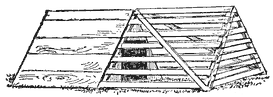
Aim to prevent rather than cure disease. Should there be any evidence of bowel trouble, give Pratts White Diarrhoea Remedy in the drinking water. Don't let the condition become chronic or general. In "sour weather," when colds may be expected to appear, use Pratts Roup Remedy in the drinking water.
Lice and mites work practically unseen, but they are the source of heavy loss, both directly and indirectly. In extreme cases they actually kill many chicks.
Pratts Buttermilk Baby Chick Food raises every good chick. It won't prevent losses from accidents, but it does prevent death from digestive troubles and the more common chick disorders which are so often due to improper feeding.
The original Baby Chick Food—PRATTS—contains all the food elements required to build muscle, bone and feather, to nourish the whole body, to give that strong start in life which assures rapid growth, even development and profitable maturity.
Feed the original Pratts for the first three weeks—the critical period—at least; it may profitably be used much longer. Refuse substitutes and imitations. These may be slightly less in first cost, but in results, as measured by number and quality of chicks reared, Pratts Buttermilk Baby Chick Food is
The Cheapest Food on Earth
Early in life, when two to four days old, all chicks should be treated with Pratts Head Lice Ointment. Rub a little of the mild preparation on top of the head, under the throat and beneath the wings. At the same time dust with Pratts Powdered Lice Killer. Treat the mother hens most thoroughly, substituting Pratts Lice Salve for the ointment. When the youngsters are ten days old, treat them again, this time using the salve. And repeat the treatment at reasonably frequent intervals to insure complete freedom from the trouble makers.
The deadly blood-sucking mites do not live on the bodies of the birds, but make their homes in cracks and crevices of walls and floors of the coops. Attack them there. Clean coops carefully, then spray or wash walls and floors with Pratts Red Mite Special. Repeat as necessary. That will fix 'em. But you had best do the work on a bright, sunny day when the flock can be kept outside until the coop dries.
Feeding the Chicks
Do not feed chicks for forty-eight hours after hatching. In fact, you may safely wait until they are seventy-two hours old before giving them their first meal. Nature has provided for nourishment during this period and it is best not to upset things.
If possible, start the youngsters off on their life's journey with a drink of sour milk. Let them have sour milk to drink exclusively for the first ten days at least, and give it to them all through life, if this excellent food drink is available.
The principal feed for the first three weeks and profitably for a much longer time should be Pratts Buttermilk Baby Chick Food, a real "baby food for baby chicks," a mixture which is properly balanced in composition and in the right mechanical condition to insure quick digestion. As chicks eat so little during this period, as measured by pounds, one is fully justified in paying a relatively high price per pound for this special feed which will give them a strong, vigorous start and put their digestive organs in proper condition to efficiently use less expensive foods when food consumption becomes heavy.
The ideal baby chick food, Pratts, is made of a variety of foodstuffs so blended as to supply, in proper proportion, the nutrients required to build flesh, bone and feather. It is ground exceedingly fine so it may be consumed freely and yet not tax the digestive organs. Obviously such a feed cannot satisfactorily be prepared at home, which explains the rapidly growing demand which has arisen for Pratts Buttermilk Baby Chick Food during recent years.
For the first day or two, feed Pratts Buttermilk Baby Chick Food exclusively at intervals of two to three hours. At first, spread it upon a shingle or piece of board. Later place it in little troughs or shallow dishes. Let the chicks eat a reasonable amount, what they will take in twenty to thirty minutes, then remove it. Supply a bit of fine, bright grit during this time.
I have used the Baby Chick Food this season and have had excellent results. I find it to meet all requirements. It makes rapid growth and at the same time maintains vigor.
The second or third day after feeding has begun, cut out a meal or two of the baby chick food and instead sprinkle a little regulation chick feed (scratch feed) in the litter. There are many good brands of such feed on the market. If preferred, one may be made as follows:
| Cracked Wheat | 15 lbs. |
| Fine Cracked Corn | 15 lbs. |
| Pinhead Oats | 10 lbs. |
| Broken Rice | 3 lbs. |
| Charcoal | 2 lbs. |
At the beginning of the second week the scratch feed may be given three times daily, just the quantity they will clean up and hunt for more, and the baby chick food left in open hoppers or dishes to which the chicks may run at will. By this time, too, grit may safely be left in open hoppers before the flock. And if milk is not given freely it is well to supply some additional animal food each day. Fine fish scrap or beef scrap—always of high quality—may be fed sparingly in troughs or on pieces of board. Do not feed too much of this material. If bowel trouble develops, reduce the quantity of animal food. The amount given may be increased progressively as the youngsters gain in size.
While Pratts Baby Chick Food need not be fed longer than the first three weeks, it is good practice to continue its use for two to three weeks longer. But at any time after the critical twenty-one day period one may safely begin to substitute a somewhat coarser and heavier developing or growing mash for the baby chick food. We advise the use of Pratts Buttermilk Growing Mash. Here is a good home-made mixture:
| Cornmeal | 10 lbs. |
| Wheat Bran | 20 lbs. |
| Feeding Flour | 10 lbs. |
| Fine Ground Oats, Sifted | 10 lbs. |
| Fine Fish or Beef Scrap | 10 lbs. |
"The regular use of Pratts Poultry Regulator in the ration for growing chicks prevents deaths from common disease, increases the appetite and hastens growth. This means less loss, earlier laying or market maturity, bigger profits."
At six to eight weeks of age, or as soon as the youngsters can comfortably eat coarser grains, the fine scratch feed may be replaced by a coarser mixture. Equal parts, by weight, of cracked corn and wheat, form the basis of this, with barley, heavy oats, kafir corn and buckwheat added for variety if available at reasonable prices. When the flock is weaned and well feathered, the regular laying mash may be substituted for the growing mash, though the latter may well be continued for a much longer period.
Above all things, see to it that nothing but feed of superior quality is supplied. Moldy, chaffy, grains and weed seeds may be cheaper to buy than sweet, sound materials, but the latter are cheaper to feed.
Begin giving green food when the chicks are three or four days old, cutting it up finely so they can eat it. And continue to feed greens liberally at all times. It's good for the health and cuts feed bills, too.
Care of the Growing Chicks
As the chicks grow, provide larger quarters if the original coops are at all crowded. And teach the youngsters to roost early, especially where brooders are used, so they will not "pile up" in corners when the heat is removed. When the brood is five to six weeks of age place low roosts, lath tacked on six to eight-inch boards, in the coops. The sturdier individuals will soon learn to use them and educate the rest of the flock.
Pay special attention to the water supply. Have clean water available at all times. And do not leave the water dishes in the sun, which will quickly make the water so warm that it is unfit to drink.
Give the growing pullets as much space, indoors and out, as you possibly can. Feed them liberally. Keep them clean and comfortable. In every way help them gain the health, strength and vigor which they must have in order to do full duty in the laying and breeding pens.
Finally, cull your flock without mercy, beginning at hatching time and continuing to the end. If any baby chicks are crippled or weak, dispose of them at once. As the flock grows, mark—by toe punching or otherwise—all individuals which show evidence of being lacking in vigor, which are stunted or do not make rapid growth, which fail to feather properly, which are ever noticeably sick. Then rush them to market as soon as they reach the proper weight. Thus you will save for your own use only those which are physically right, which have the health and stamina that will enable them to stand up under the strain of continuous egg-production. And such a flock, after it has undergone the further culling of a year in the laying pen, will give you breeding birds capable of producing worthwhile chicks.
Poultry Diseases
Prevention of disease is most essential. And the first step consists of carefully selecting the birds which will he given a place in the flock, retaining only those which are healthy and vigorous, and rejecting the weaklings and physically unfit. The next step is to keep the birds in a high state of vitality through proper management and keep contagious and infectious diseases away by adopting the necessary sanitary measures.
Fresh air, wholesome food and clean water are essential. Equally necessary is the use of Pratts Poultry Regulator, which keeps the birds in perfect condition internally and so prevents such self-developed disorders as indigestion, constipation, and the like.
Most of the serious diseases which take heavy toll of carelessly managed flocks are due to germs of various kinds. These may be introduced in many different ways, and when present in the flock they multiply and spread with great rapidity. Cleanliness and sanitation will largely overcome them, and as each fowl is worth so much money under present conditions, it is really economical to prevent loss even at the expense of some time and of germ-killing preparations.
Pratts Poultry Disinfectant costs but a trifle. A gallon, diluted with water, makes fifty gallons of a powerful disinfectant, one that is highly efficient, but both safe and pleasant to use. Spray the house and furnishings and wash feed and water containers at frequent intervals with this economical germ-killer. Results will surely be seen in healthier, more productive birds, less trouble and less loss from disease.
I would not have tried to raise expensive poultry without Pratts products in my house. While I was a boy at home we always had a supply of Pratts on hand.
I find that my success is due to the use of the Pratts products kept constantly on the shelf.
In this condensed book we can discuss only the more general disorders. The subject is covered thoroughly in Chapter IX, The Poultryman's Complete Handbook, including directions for equipping a hospital, administering medicine, symptom and treatment chart, diagrams of the fowl's digestive system and skeleton, control of poultry vices, etc. Send a dime, in silver or stamps, for a copy, to Pratt Food Co., Philadelphia.
If necessary, do not hesitate to consult the poultry experts connected with Pratts Poultry Service Dept. They will give you personal help without charge. In writing, give all symptoms and necessary facts. Address such letters to our Philadelphia office.
It is important that diseases of all kinds be recognized as early as possible, and equally so that immediate treatment be given.
Watch your birds! If any show signs of being out of condition, examine them carefully to determine the trouble. Then give them the care which is demanded in each case. Quick treatment will often effect a speedy cure of a valuable bird that might be lost if the disease became firmly established.
Pratts Poultry Remedies include dependable preparations for most common poultry diseases. They are guaranteed to give satisfaction and are inexpensive. Keep a supply on hand. Use promptly as occasion demands. The saving of a single good laying or breeding fowl by instant treatment will more than pay the cost of a well-stocked poultry medicine shelf.
POULTRY LICE AND MITES
Body Lice—There are many different kinds of these parasites and all are serious trouble makers. They cause endless annoyance, check growth and egg production. Lice-free fowls are healthier and more comfortable, therefore more productive and profitable.
Pratts line of Guaranteed Poultry Remedies is the result of fifty years of experience. Each preparation is positively the best of its kind. Keep a supply on hand for instant use.
PRATTS ROUP REMEDY (Tablets or Powder)
A sure preventive and cure for roup, colds, canker, catarrh and similar diseases.
PRATTS GAPE REMEDY
Guaranteed to bring prompt relief. Use as a preventive the first four weeks and your chicks will not be troubled with gape-worms.
PRATTS SORE-HEAD CHICKEN-POX REMEDY
A guaranteed cure for this highly contagious disease. Don't risk having your entire flock ruined. Keep it on hand for quick use when the ailment is first noticed.
PRATTS BRONCHITIS REMEDY
A quick and effective remedy. Fully guaranteed for a disease that is generally fatal unless promptly checked.
PRATTS WHITE DIARRHOEA REMEDY
Will save the chicks and cure completely when used promptly. Valuable in preventing the heavy chick losses usually experienced.
PRATTS CHOLERA REMEDY
A sure remedy for cholera, indigestion, sour crop, dysentery, and bowel trouble. Guaranteed to satisfy or money refunded.
PRATTS SCALY LEG REMEDY
This disease impairs the vitality of the birds and ruins their appearance. Pratts remedy will keep the legs clean and healthy.
PRATTS CONDITION TABLETS
An effective remedy for "run-down" birds. Keeps show birds in condition and prevents colds, roup and liver trouble.
Treatment—If all poultrymen would use Pratts Powdered Lice Killer on their poultry, lice would be unknown. It is different and better than many like preparations, being stronger, non-poisonous, has great disinfecting qualities, and positively kills all kinds of chicken lice. If you want to make money from your poultry you can't afford to be without it. Pratts Poultry Disinfectant, or the more powerful Pratts Red Mite Special, should also be used in the poultry houses. Lice seek crevices, cracks, openings, etc., that can only be reached by the liquid. This should be sprayed or sprinkled on perches, nest boxes, drop boards, floors and inside walls of all poultry houses. It not only kills lice, but has great disinfecting value. Do not accept a substitute.
Pratts Lice Salve is a sure-fire lice killer in another form. Apply to the feathers beneath the wings and around the vent and quick results will be noticed. A single application will be effective for a considerable time.
Head Lice—The big grey lice commonly found on heads of little chicks, causing great mortality.
Treatment—Keep on hand all the time a box of Pratts Head Lice Ointment, and use it on your little chicks, and save their lives. Two or three days before the brood should hatch, sprinkle the sitting hen thoroughly with Pratts Powdered Lice Killer.
Poultry Mites (Red Mites)—These tiny parasites are poultry killers. They do not live on the bodies of the birds, but in cracks and crevices of the building, coming out for their food. They suck the blood from the fowls, weakening and often killing them.
Treatment—Look around roosts and in cracks in warm weather and you are apt to see hundreds of mites. Every week spray perches, dropping boards, sides of houses, and roof near perches with Pratts Red Mite Special; powder birds with Pratts Powdered Lice Killer, and also add this to the dust bath.
Depluming Mites—Parasites that attack the roots or base of feathers which break off leaving bare spots. Will quickly spread through an entire flock. Usually found in spring and summer.
Treatment—Separate all affected birds from the rest of flock. Rub Pratts Head Lice Ointment on and around the bare spots every few days, until the mites have all been destroyed. Spray houses, roofs, runs, etc., with Pratts Poultry Disinfectant. Persistent treatment is necessary to get rid of these pests.
THE MORE COMMON POULTRY DISEASES
Symptoms and Treatment
Apoplexy—Cause: Fowls too fat, general poor condition. Symptoms: Paralysis, sudden death. Birds frequently found dead under roosts. Treatment: Affected birds will not usually respond to treatment. Flocks should be treated to prevent further loss. Reduce the amount of feed, give less corn, supply Pratts Poultry Regulator to improve general condition.
Have been using your poultry remedies for many years. Have used your Baby Chick Food and had wonderful results. I think it is great. I also use your Disinfectant, Lice Powder and Roup Remedy.
Aspergilosis—Cause: Growth of mould in air passages. Symptoms: Rapid breathing, rattling in throat, loss of weight, dragging wings, weakness, exhaustion. In chicks, sleepiness, diarrhoea, yellowish growth on lungs. Treatment: Avoid mouldy grain and litter to keep flock free from infection. Disinfect with Pratts Poultry Disinfectant. Put flock in condition with Pratts Poultry Regulator.
Bacillary White Diarrhoea—Cause: Bacteria. The disease may be inherited from hens having infected ovaries, or pass from chick to chick. Symptoms: Chicks have diarrhoea, usually white or creamy. Sleepy, chilly, thin, rough plumage, drooping wings. Heaviest mortality under three weeks of age. Treatment: Badly infected chicks should be killed. Prevent epidemics by disinfecting everything with Pratts Poultry Disinfectant. Give Pratts White Diarrhoea Remedy in drinking water. Give chicks strong start by feeding Pratts Baby Chick Food.
Bronchitis—Cause: Development of common cold, breathing in dust. Symptoms: Cough, rapid breathing, whistling, rattling and bubbling in throat. Treatment: Keep patient dry, give laxative, treat with Pratts Bronchitis Remedy.
Canker—Cause: Development of pus germs following injury or digestive troubles. Symptoms: Cheesy growths in mouth and throat. Treatment: Scrape off canker and swab with full strength Pratts Poultry Disinfectant. Improve general condition with Pratts Poultry Regulator.
I have used Pratts White Diarrhoea Remedy, and I wish to say that I have had some chicks that started with the white diarrhoea and I have given them the tablets in their drinking water, and have not had any trouble since. They are growing fine.
Catarrh—Cause: Draughts, dampness, exposure. Symptoms: Thin discharge from eyes and nostrils, sneezing, difficult breathing, dullness. Treatment: Pratts Condition Tablets to quickly tone up the system and Pratts Roup Remedy to overcome the disease.
Chicken Pox or Sore Head—Cause: Bacteria. Symptoms: Eruption on unfeathered areas of head. At first small and gray in color, increasing until head is covered with scabs. Eyes frequently closed. Treatment: Disinfect most thoroughly with Pratts Poultry Disinfectant. Treat with Pratts Sore Head (Chicken Pox) Remedy.
Cholera—Cause: Bacteria. Symptoms: Weakness, thirst, head drawn down, drooping wings, intense thirst, frequently full crops, yellow or green diarrhoea. Treatment: Give Pratts Chicken Cholera Remedy to whole flock as remedy and preventive. Improve general health with Pratts Poultry Regulator. Disinfect most carefully and frequently. Burn all dead birds and everything taken from poultry house. A most difficult disease to control if it gets established.
Gapes—Cause: Small Y-shaped worm, about one-half inch long. May be either pale or red in color. Attaches itself to interior walls of windpipe, weakening the chick by sucking the blood, and also causing strangulation. This apparently double-headed worm is really two worms, one of each sex, joined together. Symptoms: Usually afflicts young chicks. Frequent gasping; gaping; coughing; discharge of mucus and worms from throat. Treatment: Use Pratts Gape Remedy. Disinfect floors of coops and runs with Pratts Disinfectant. Move to new ground and keep chicks off wet grass.
Intestinal Parasites (Worms)—Symptoms: Dullness, poor condition. Worms found in droppings. Treatment: Fowls regularly receiving Pratts Poultry Regulator are almost invariably free from this trouble. See details of individual treatment in The Poultryman's Complete Handbook.
Leg Weakness (Chicks)—Cause: Feed lacking in bone and animal matter; close confinement; lack of exercise; over-heating in brooders. Symptoms: Chicks walk in a wobbly, weak-kneed fashion, often resting or hobbling along on the joints. Treatment: Feed young chicks on Pratts Baby Chick Food. Give fair amount of beef or fish scrap and bone meal. Afford opportunity for exercise, especially on the ground. Avoid bottom heat in brooders. Feed liberally on green food. Add small quantity Pratts Poultry Regulator to the ration.
Liver Disease—Cause: Improper food, as overfeeding of corn or animal food, lack of exercise, general inactivity of intestinal tract. Symptoms: No prominent ones. If flock is not doing well and birds are lazy and sluggish, kill one or more and examine the livers. If found diseased, treat the flock. Treatment: Use Pratts Poultry Regulator to improve general condition. Feed plenty of green food. Disinfect the buildings, and admit a big volume of fresh air. Induce the birds to exercise.
Rheumatism—Cause: Exposure to dampness, and cold. Symptoms: Swelling of joints, stiffness, lameness. Treatment: Make house dry and sunny. Use Pratts Poultry Regulator to improve general condition. Rub affected parts with Pratts Liniment. (This fine liniment should be in every household. It has a hundred uses.)
Roup—Symptoms: Bad-smelling discharge from the nostrils; sticky discharge from the eyes; feathers under wings and on back smeared and sticky, where bird has wiped its head; sometimes coughing and sneezing; eyes stuck shut; eyes closed and swollen out; mouth forced open by cheesy growth; patches of canker in mouth and throat. Treatment: The disease is very contagious. Remove all birds showing symptoms. Clean up and disinfect the quarters, using Pratts Disinfectant liberally. Give sick and well birds Pratts Roup Remedy. Give the healthy flock Pratts Poultry Regulator. Treat the sick with Pratts Condition Tablets in addition to the Roup remedy. Burn all dead birds and all material removed from the hospital.
Scaly Leg—Cause: A tiny mite which burrows under the scales and into the tissues of the leg. Symptoms: Scaly, rough, crusty appearance of feet and shanks. Treatment: Apply Pratts Scaly Leg Ointment.
Tuberculosis—Cause: A minute germ. Symptoms: Steady loss in weight; paleness of comb, wattles and face; general weakness; lameness, ruffling of feathers; frequently diarrhoea. Eye bright; ravenous appetite. Treatment: The disease is contagious and will spread through the flock unless proper precautions are taken. Remove affected birds. Disinfect the poultry plant and surroundings with Pratts Disinfectant. Kill birds in advanced stages. Give the whole flock a nourishing ration, and include Pratts Poultry Regulator. Use lime freely. If disease continues to spread, dispose of entire flock, disinfect with greatest care, start anew with healthy stock.
I gave Pratts Roup Remedy a careful test on a flock of 50 growing white Wyandotte chicks in October which were infected with bad colds, and after treating one week with your roup remedy nearly every one was well.
End of the Project Gutenberg EBook of Pratt's Practical Pointers on the Care
of Livestock and Poultry, by Pratt Food Co.

*** END OF THIS PROJECT GUTENBERG EBOOK PRATT'S PRACTICAL POINTERS ***

***** This file should be named 16744-h.htm or 16744-h.zip *****
This and all associated files of various formats will be found in:
        https://www.gutenberg.org/1/6/7/4/16744/

Produced by Bruce Albrecht, K.D. Thornton, Janet Blenkinship
and the Online Distributed Proofreading Team at
https://www.pgdp.net


Updated editions will replace the previous one--the old editions
will be renamed.

Creating the works from public domain print editions means that no
one owns a United States copyright in these works, so the Foundation
(and you!) can copy and distribute it in the United States without
permission and without paying copyright royalties.  Special rules,
set forth in the General Terms of Use part of this license, apply to
copying and distributing Project Gutenberg-tm electronic works to
protect the PROJECT GUTENBERG-tm concept and trademark.  Project
Gutenberg is a registered trademark, and may not be used if you
charge for the eBooks, unless you receive specific permission.  If you
do not charge anything for copies of this eBook, complying with the
rules is very easy.  You may use this eBook for nearly any purpose
such as creation of derivative works, reports, performances and
research.  They may be modified and printed and given away--you may do
practically ANYTHING with public domain eBooks.  Redistribution is
subject to the trademark license, especially commercial
redistribution.


*** START: FULL LICENSE ***

THE FULL PROJECT GUTENBERG LICENSE
PLEASE READ THIS BEFORE YOU DISTRIBUTE OR USE THIS WORK

To protect the Project Gutenberg-tm mission of promoting the free
distribution of electronic works, by using or distributing this work
(or any other work associated in any way with the phrase "Project
Gutenberg"), you agree to comply with all the terms of the Full Project
Gutenberg-tm License (available with this file or online at
https://gutenberg.org/license).


Section 1.  General Terms of Use and Redistributing Project Gutenberg-tm
electronic works

1.A.  By reading or using any part of this Project Gutenberg-tm
electronic work, you indicate that you have read, understand, agree to
and accept all the terms of this license and intellectual property
(trademark/copyright) agreement.  If you do not agree to abide by all
the terms of this agreement, you must cease using and return or destroy
all copies of Project Gutenberg-tm electronic works in your possession.
If you paid a fee for obtaining a copy of or access to a Project
Gutenberg-tm electronic work and you do not agree to be bound by the
terms of this agreement, you may obtain a refund from the person or
entity to whom you paid the fee as set forth in paragraph 1.E.8.

1.B.  "Project Gutenberg" is a registered trademark.  It may only be
used on or associated in any way with an electronic work by people who
agree to be bound by the terms of this agreement.  There are a few
things that you can do with most Project Gutenberg-tm electronic works
even without complying with the full terms of this agreement.  See
paragraph 1.C below.  There are a lot of things you can do with Project
Gutenberg-tm electronic works if you follow the terms of this agreement
and help preserve free future access to Project Gutenberg-tm electronic
works.  See paragraph 1.E below.

1.C.  The Project Gutenberg Literary Archive Foundation ("the Foundation"
or PGLAF), owns a compilation copyright in the collection of Project
Gutenberg-tm electronic works.  Nearly all the individual works in the
collection are in the public domain in the United States.  If an
individual work is in the public domain in the United States and you are
located in the United States, we do not claim a right to prevent you from
copying, distributing, performing, displaying or creating derivative
works based on the work as long as all references to Project Gutenberg
are removed.  Of course, we hope that you will support the Project
Gutenberg-tm mission of promoting free access to electronic works by
freely sharing Project Gutenberg-tm works in compliance with the terms of
this agreement for keeping the Project Gutenberg-tm name associated with
the work.  You can easily comply with the terms of this agreement by
keeping this work in the same format with its attached full Project
Gutenberg-tm License when you share it without charge with others.

1.D.  The copyright laws of the place where you are located also govern
what you can do with this work.  Copyright laws in most countries are in
a constant state of change.  If you are outside the United States, check
the laws of your country in addition to the terms of this agreement
before downloading, copying, displaying, performing, distributing or
creating derivative works based on this work or any other Project
Gutenberg-tm work.  The Foundation makes no representations concerning
the copyright status of any work in any country outside the United
States.

1.E.  Unless you have removed all references to Project Gutenberg:

1.E.1.  The following sentence, with active links to, or other immediate
access to, the full Project Gutenberg-tm License must appear prominently
whenever any copy of a Project Gutenberg-tm work (any work on which the
phrase "Project Gutenberg" appears, or with which the phrase "Project
Gutenberg" is associated) is accessed, displayed, performed, viewed,
copied or distributed:

This eBook is for the use of anyone anywhere at no cost and with
almost no restrictions whatsoever.  You may copy it, give it away or
re-use it under the terms of the Project Gutenberg License included
with this eBook or online at www.gutenberg.org

1.E.2.  If an individual Project Gutenberg-tm electronic work is derived
from the public domain (does not contain a notice indicating that it is
posted with permission of the copyright holder), the work can be copied
and distributed to anyone in the United States without paying any fees
or charges.  If you are redistributing or providing access to a work
with the phrase "Project Gutenberg" associated with or appearing on the
work, you must comply either with the requirements of paragraphs 1.E.1
through 1.E.7 or obtain permission for the use of the work and the
Project Gutenberg-tm trademark as set forth in paragraphs 1.E.8 or
1.E.9.

1.E.3.  If an individual Project Gutenberg-tm electronic work is posted
with the permission of the copyright holder, your use and distribution
must comply with both paragraphs 1.E.1 through 1.E.7 and any additional
terms imposed by the copyright holder.  Additional terms will be linked
to the Project Gutenberg-tm License for all works posted with the
permission of the copyright holder found at the beginning of this work.

1.E.4.  Do not unlink or detach or remove the full Project Gutenberg-tm
License terms from this work, or any files containing a part of this
work or any other work associated with Project Gutenberg-tm.

1.E.5.  Do not copy, display, perform, distribute or redistribute this
electronic work, or any part of this electronic work, without
prominently displaying the sentence set forth in paragraph 1.E.1 with
active links or immediate access to the full terms of the Project
Gutenberg-tm License.

1.E.6.  You may convert to and distribute this work in any binary,
compressed, marked up, nonproprietary or proprietary form, including any
word processing or hypertext form.  However, if you provide access to or
distribute copies of a Project Gutenberg-tm work in a format other than
"Plain Vanilla ASCII" or other format used in the official version
posted on the official Project Gutenberg-tm web site (www.gutenberg.org),
you must, at no additional cost, fee or expense to the user, provide a
copy, a means of exporting a copy, or a means of obtaining a copy upon
request, of the work in its original "Plain Vanilla ASCII" or other
form.  Any alternate format must include the full Project Gutenberg-tm
License as specified in paragraph 1.E.1.

1.E.7.  Do not charge a fee for access to, viewing, displaying,
performing, copying or distributing any Project Gutenberg-tm works
unless you comply with paragraph 1.E.8 or 1.E.9.

1.E.8.  You may charge a reasonable fee for copies of or providing
access to or distributing Project Gutenberg-tm electronic works provided
that

- You pay a royalty fee of 20% of the gross profits you derive from
     the use of Project Gutenberg-tm works calculated using the method
     you already use to calculate your applicable taxes.  The fee is
     owed to the owner of the Project Gutenberg-tm trademark, but he
     has agreed to donate royalties under this paragraph to the
     Project Gutenberg Literary Archive Foundation.  Royalty payments
     must be paid within 60 days following each date on which you
     prepare (or are legally required to prepare) your periodic tax
     returns.  Royalty payments should be clearly marked as such and
     sent to the Project Gutenberg Literary Archive Foundation at the
     address specified in Section 4, "Information about donations to
     the Project Gutenberg Literary Archive Foundation."

- You provide a full refund of any money paid by a user who notifies
     you in writing (or by e-mail) within 30 days of receipt that s/he
     does not agree to the terms of the full Project Gutenberg-tm
     License.  You must require such a user to return or
     destroy all copies of the works possessed in a physical medium
     and discontinue all use of and all access to other copies of
     Project Gutenberg-tm works.

- You provide, in accordance with paragraph 1.F.3, a full refund of any
     money paid for a work or a replacement copy, if a defect in the
     electronic work is discovered and reported to you within 90 days
     of receipt of the work.

- You comply with all other terms of this agreement for free
     distribution of Project Gutenberg-tm works.

1.E.9.  If you wish to charge a fee or distribute a Project Gutenberg-tm
electronic work or group of works on different terms than are set
forth in this agreement, you must obtain permission in writing from
both the Project Gutenberg Literary Archive Foundation and Michael
Hart, the owner of the Project Gutenberg-tm trademark.  Contact the
Foundation as set forth in Section 3 below.

1.F.

1.F.1.  Project Gutenberg volunteers and employees expend considerable
effort to identify, do copyright research on, transcribe and proofread
public domain works in creating the Project Gutenberg-tm
collection.  Despite these efforts, Project Gutenberg-tm electronic
works, and the medium on which they may be stored, may contain
"Defects," such as, but not limited to, incomplete, inaccurate or
corrupt data, transcription errors, a copyright or other intellectual
property infringement, a defective or damaged disk or other medium, a
computer virus, or computer codes that damage or cannot be read by
your equipment.

1.F.2.  LIMITED WARRANTY, DISCLAIMER OF DAMAGES - Except for the "Right
of Replacement or Refund" described in paragraph 1.F.3, the Project
Gutenberg Literary Archive Foundation, the owner of the Project
Gutenberg-tm trademark, and any other party distributing a Project
Gutenberg-tm electronic work under this agreement, disclaim all
liability to you for damages, costs and expenses, including legal
fees.  YOU AGREE THAT YOU HAVE NO REMEDIES FOR NEGLIGENCE, STRICT
LIABILITY, BREACH OF WARRANTY OR BREACH OF CONTRACT EXCEPT THOSE
PROVIDED IN PARAGRAPH F3.  YOU AGREE THAT THE FOUNDATION, THE
TRADEMARK OWNER, AND ANY DISTRIBUTOR UNDER THIS AGREEMENT WILL NOT BE
LIABLE TO YOU FOR ACTUAL, DIRECT, INDIRECT, CONSEQUENTIAL, PUNITIVE OR
INCIDENTAL DAMAGES EVEN IF YOU GIVE NOTICE OF THE POSSIBILITY OF SUCH
DAMAGE.

1.F.3.  LIMITED RIGHT OF REPLACEMENT OR REFUND - If you discover a
defect in this electronic work within 90 days of receiving it, you can
receive a refund of the money (if any) you paid for it by sending a
written explanation to the person you received the work from.  If you
received the work on a physical medium, you must return the medium with
your written explanation.  The person or entity that provided you with
the defective work may elect to provide a replacement copy in lieu of a
refund.  If you received the work electronically, the person or entity
providing it to you may choose to give you a second opportunity to
receive the work electronically in lieu of a refund.  If the second copy
is also defective, you may demand a refund in writing without further
opportunities to fix the problem.

1.F.4.  Except for the limited right of replacement or refund set forth
in paragraph 1.F.3, this work is provided to you 'AS-IS', WITH NO OTHER
WARRANTIES OF ANY KIND, EXPRESS OR IMPLIED, INCLUDING BUT NOT LIMITED TO
WARRANTIES OF MERCHANTIBILITY OR FITNESS FOR ANY PURPOSE.

1.F.5.  Some states do not allow disclaimers of certain implied
warranties or the exclusion or limitation of certain types of damages.
If any disclaimer or limitation set forth in this agreement violates the
law of the state applicable to this agreement, the agreement shall be
interpreted to make the maximum disclaimer or limitation permitted by
the applicable state law.  The invalidity or unenforceability of any
provision of this agreement shall not void the remaining provisions.

1.F.6.  INDEMNITY - You agree to indemnify and hold the Foundation, the
trademark owner, any agent or employee of the Foundation, anyone
providing copies of Project Gutenberg-tm electronic works in accordance
with this agreement, and any volunteers associated with the production,
promotion and distribution of Project Gutenberg-tm electronic works,
harmless from all liability, costs and expenses, including legal fees,
that arise directly or indirectly from any of the following which you do
or cause to occur: (a) distribution of this or any Project Gutenberg-tm
work, (b) alteration, modification, or additions or deletions to any
Project Gutenberg-tm work, and (c) any Defect you cause.


Section  2.  Information about the Mission of Project Gutenberg-tm

Project Gutenberg-tm is synonymous with the free distribution of
electronic works in formats readable by the widest variety of computers
including obsolete, old, middle-aged and new computers.  It exists
because of the efforts of hundreds of volunteers and donations from
people in all walks of life.

Volunteers and financial support to provide volunteers with the
assistance they need, is critical to reaching Project Gutenberg-tm's
goals and ensuring that the Project Gutenberg-tm collection will
remain freely available for generations to come.  In 2001, the Project
Gutenberg Literary Archive Foundation was created to provide a secure
and permanent future for Project Gutenberg-tm and future generations.
To learn more about the Project Gutenberg Literary Archive Foundation
and how your efforts and donations can help, see Sections 3 and 4
and the Foundation web page at https://www.pglaf.org.


Section 3.  Information about the Project Gutenberg Literary Archive
Foundation

The Project Gutenberg Literary Archive Foundation is a non profit
501(c)(3) educational corporation organized under the laws of the
state of Mississippi and granted tax exempt status by the Internal
Revenue Service.  The Foundation's EIN or federal tax identification
number is 64-6221541.  Its 501(c)(3) letter is posted at
https://pglaf.org/fundraising.  Contributions to the Project Gutenberg
Literary Archive Foundation are tax deductible to the full extent
permitted by U.S. federal laws and your state's laws.

The Foundation's principal office is located at 4557 Melan Dr. S.
Fairbanks, AK, 99712., but its volunteers and employees are scattered
throughout numerous locations.  Its business office is located at
809 North 1500 West, Salt Lake City, UT 84116, (801) 596-1887, email
business@pglaf.org.  Email contact links and up to date contact
information can be found at the Foundation's web site and official
page at https://pglaf.org

For additional contact information:
     Dr. Gregory B. Newby
     Chief Executive and Director
     gbnewby@pglaf.org

Section 4.  Information about Donations to the Project Gutenberg
Literary Archive Foundation

Project Gutenberg-tm depends upon and cannot survive without wide
spread public support and donations to carry out its mission of
increasing the number of public domain and licensed works that can be
freely distributed in machine readable form accessible by the widest
array of equipment including outdated equipment.  Many small donations
($1 to $5,000) are particularly important to maintaining tax exempt
status with the IRS.

The Foundation is committed to complying with the laws regulating
charities and charitable donations in all 50 states of the United
States.  Compliance requirements are not uniform and it takes a
considerable effort, much paperwork and many fees to meet and keep up
with these requirements.  We do not solicit donations in locations
where we have not received written confirmation of compliance.  To
SEND DONATIONS or determine the status of compliance for any
particular state visit https://pglaf.org

While we cannot and do not solicit contributions from states where we
have not met the solicitation requirements, we know of no prohibition
against accepting unsolicited donations from donors in such states who
approach us with offers to donate.

International donations are gratefully accepted, but we cannot make
any statements concerning tax treatment of donations received from
outside the United States.  U.S. laws alone swamp our small staff.

Please check the Project Gutenberg Web pages for current donation
methods and addresses.  Donations are accepted in a number of other
ways including including checks, online payments and credit card
donations.  To donate, please visit: https://pglaf.org/donate


Section 5.  General Information About Project Gutenberg-tm electronic
works.

Professor Michael S. Hart was the originator of the Project Gutenberg-tm
concept of a library of electronic works that could be freely shared
with anyone.  For thirty years, he produced and distributed Project
Gutenberg-tm eBooks with only a loose network of volunteer support.

Project Gutenberg-tm eBooks are often created from several printed
editions, all of which are confirmed as Public Domain in the U.S.
unless a copyright notice is included.  Thus, we do not necessarily
keep eBooks in compliance with any particular paper edition.

Most people start at our Web site which has the main PG search facility:

     https://www.gutenberg.org

This Web site includes information about Project Gutenberg-tm,
including how to make donations to the Project Gutenberg Literary
Archive Foundation, how to help produce our new eBooks, and how to
subscribe to our email newsletter to hear about new eBooks.

*** END: FULL LICENSE ***