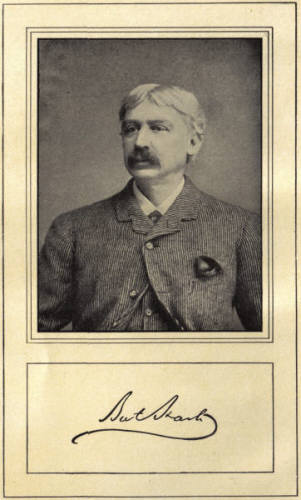
Project Gutenberg's Short Story Classics (American) Vol. 2, by Various

This eBook is for the use of anyone anywhere at no cost and with
almost no restrictions whatsoever.  You may copy it, give it away or
re-use it under the terms of the Project Gutenberg License included
with this eBook or online at www.gutenberg.org


Title: Short Story Classics (American) Vol. 2
       The Brigade Commander by J. W. Deforest; Who Was She? by
              Bayard Taylor; Mademoiselle Olympe Zabriski by Thomas
              Bailey Aldrich; Brother Sebastian's Friendship by Harold
              Frederic; A Good-For-Nothing by Hjalmar Hjorth Boyesen;
              The Idyl Of Red Gulch by Bret Harte; Crutch, The Page by
              George Alfred Townsend ("Gath"); In Each Other's Shoes by
              George Parsons Lathrop; The Denver Express by A. A. Hayes;
              Jaune D'antimoine by Thomas Allibone Janvier; Ole 'Stracted
              by Thomas Nelson Page; Our Consul At Carlsruhe by F. J.
              Stimson ("J. S. Of Dale")

Author: Various

Editor: William Patten

Release Date: August 20, 2005 [EBook #16556]

Language: English

Character set encoding: ASCII

*** START OF THIS PROJECT GUTENBERG EBOOK SHORT STORY CLASSICS ***


Produced by Michael Gray
COPYRIGHT
1905
BY
P. F. COLLIER
& SON
————————
The use of the copyrighted stories in this
collection has been authorized in every
instance by the authors or
their representatives.
BROTHER SEBASTIAN'S FRIENDSHIP

John William De Forest (born March 36, 1826, in Seymour, Ct.) at the outbreak of the Rebellion abandoned a promising career as a historian and writer of books of travel to enlist in the Union army. He served throughout the entire war, first as captain, then as major, and so acquired a thorough knowledge of military tactics and the psychology of our war which enabled him, on his return to civil life, to write the best war stories of his generation. Of these "The Brigade Commander" is Mr. De Forest's masterpiece. Solidly grounded on experience, and drawing its emotive power from our greatest national cataclysm, like a Niagara dynamo the story sends us a thrill undiminishing with the increasing distance of its source.

THE BRIGADE
COMMANDER
BY J. W. DE FOREST
[By permission of "The New
York Times."]
THE Colonel was the idol of
his bragging old regiment and of the bragging brigade which for the last six
months he had commanded.
He was the idol, not because he was good and
gracious, not because he spared his soldiers or treated them as fellow-
citizens, but because he had led them to victory and made them famous. If a man
will win battles and give his brigade a right to brag loudly of its doings, he
may have its admiration and even its enthusiastic devotion, though he be as
pitiless and as wicked as Lucifer.
"It's nothin' to me what the Currnell
is in prrivit, so long as he shows us how to whack the rrebs," said Major
Gahogan, commandant of the "Old Tenth." "Moses saw God in the burrnin' bussh,
an' bowed down to it, an' worrshipt it. It wasn't the bussh he worrshipt; it
was his God that was in it. An' I worr-ship this villin of a Currnell (if he is
a villin) because he's almighty and gives us the vict'ry. He's nothin' but a
human burrnin' bussh, perhaps, but he's got the god of war in urn. Adjetant
Wallis, it's a ——— long time between dhrinks, as I think ye
was sayin', an' with rayson. See if ye can't confiscate a canteen of whiskee
somewhere in the camp. Bedad, if I can't buy it I'll stale it. We're goin' to
fight tomorry, an' it may be it's the last chance we'll have for a dhrink,
unless there's more lik'r now in the other worrld than Dives got."
The
brigade was bivouacked in some invisible region, amid the damp, misty darkness
of a September night. The men lay in their ranks, each with his feet to the
front and his head rearward, each covered by his overcoat and pillowed upon his
haversack, each with his loaded rifle nestled close beside him. Asleep as they
were, or dropping placidly into slumber, they were ready to start in order to
their feet and pour out the red light and harsh roar of combat. There were two
lines of battle, each of three regiments of infantry, the first some two
hundred yards in advance of the second. In the space between them lay two four-
gun batteries, one of them brass twelve-pounder "Napoleons," and the other
rifled Parrotts. To the rear of the infantry were the recumbent troopers and
picketed horses of a regiment of cavalry. All around, in the far, black
distance, invisible and inaudible, paced or watched stealthily the sentinels of
the grand guards.
There was not a fire, not a torch, nor a star-beam in
the whole bivouac to guide the feet of Adjutant Wallis in his pilgrimage after
whiskey. The orders from brigade headquarters had been strict against
illuminations, for the Confederates were near at hand in force, and a surprise
was proposed as well as feared. A tired and sleepy youngster, almost dropping
with the heavy somnolence of wearied adolescence, he stumbled on through the
trials of an undiscernible and unfamiliar footing, lifting his heavy riding-
boots sluggishly over imaginary obstacles, and fearing the while lest his toil
were labor misspent. It was a dry camp, he felt dolefully certain, or there
would have been more noise in it. He fell over a sleeping sergeant, and said to
him hastily, "Steady, man—a friend!" as the half-roused soldier clutched
his rifle. Then he found a lieutenant, and shook him in vain; further on a
captain, and exchanged saddening murmurs with him; further still a camp-
follower of African extraction, and blasphemed him.
"It's a God-forsaken
camp, and there isn't a horn in it," said Adjutant Wallis to himself as he
pursued his groping journey. "Bet you I don't find the first drop," he
continued, for he was a betting boy, and frequently argued by wagers, even with
himself. "Bet you two to one I don't. Bet you three to one—ten to
one."
Then he saw, an indefinite distance beyond him, burning like red-
hot iron through the darkness, a little scarlet or crimson gleam, as of a
lighted cigar.
"That's Old Grumps, of the Bloody Fourteenth," he
thought. "I've raided into his happy sleeping-grounds. I'll draw on
him."
But Old Grumps, otherwise Colonel Lafayette Gildersleeve, had no
rations—that is, no whiskey.
"How do you suppose an officer is to
have a drink, Lieutenant?" he grumbled. "Don't you know that our would-be
Brigadier sent all the commissary to the rear day before yesterday? A
canteenful can't last two days. Mine went empty about five minutes
ago."
"Oh, thunder!" groaned Wallis, saddened by that saddest of all
thoughts, "Too late!" "Well, least said soonest mended. I must wobble back to
my Major."
"He'll send you off to some other camp as dry as this one.
Wait ten minutes, and he'll be asleep. Lie down on my blanket and light your
pipe. I want to talk to you about, official business—about our would-be
Brigadier."
"Oh, your turn will come some day," mumbled Wallis,
remembering Gildersleeve's jealousy of the brigade commander—a jealousy
which only gave tongue when aroused by "commissary." "If you do as well as
usual to-morrow you can have your own brigade."
"I suppose you think we
are all going to do well to-morrow," scoffed old Grumps, whose utterance by
this time stumbled. "I suppose you expect to whip and to have a good time. I
suppose you brag on fighting and enjoy it."
"I like it well enough when
it goes right; and it generally does go right with this brigade. I should like
it better if the rebs would fire higher and break quicker."
"That
depends on the way those are commanded whose business it is to break them,"
growled Old Grumps. "I don't say but what we are rightly commanded," he added,
remembering his duty to superiors. "I concede and acknowledge that our would-be
Brigadier knows his military business. But the blessing of God, Wallis! I
believe in Waldron as a soldier. But as a man and a Christian,
faugh!"
Gildersleeve had clearly emptied his canteen unassisted; he
never talked about Christianity when perfectly sober.
"What was your
last remark?" inquired Wallis, taking his pipe from his mouth to grin. Even a
superior officer might be chaffed a little in the darkness.
"I made no
last remark," asserted the Colonel with dignity. "I'm not a-dying yet. If I
said anything last it was a mere exclamation of disgust—the disgust of an
officer and gentleman. I suppose you know something about our would-be
Brigadier. I suppose you think you know something about him."
"Bet you I
know all about him" affirmed Wallis. "He enlisted in the Old Tenth as a
common soldier. Before he had been a week in camp they found that he knew his
biz, and they made him a sergeant. Before we started for the field the Governor
got his eye on him and shoved him into a lieutenancy. The first battle h'isted
him to a captain. And the second—bang! whiz! he shot up to colonel right
over the heads of everybody, line and field. Nobody in the Old Tenth grumbled.
They saw that he knew his biz. I know all about him. What'll you
bet?"
"I'm not a betting man, Lieutenant, except in a friendly game of
poker," sighed Old Grumps. "You don't know anything about your Brigadier," he
added in a sepulchral murmur, the echo of an empty canteen. "I have only been
in this brigade a month, and I know more than you do, far, very far more, sorry
to say it. He's a reformed clergyman. He's an apostatized minister." The
Colonel's voice as he said this was solemn and sad enough to do credit to an
undertaker. "It's a bad sort, Wallis," he continued, after another deep sigh, a
very highly perfumed one, the sigh of a barkeeper. "When a clergyman falls, he
falls for life and eternity, like a woman or an angel. I never knew a
backslidden shepherd to come to good. Sooner or later he always goes to the
devil, and takes down whomsoever hangs to him."
"He'll take down the Old
Tenth, then," asserted Wallis. "It hangs to him. Bet you two to one he takes it
along."
"You're right, Adjutant; spoken like a soldier," swore
Gildersleeve. "And the Bloody Fourteenth, too. It will march into the burning
pit as far as any regiment; and the whole brigade, yes, sir! But a backslidden
shepherd, my God! Have we come to that? I often say to myself, in the solemn
hours of the night, as I remember my Sabbath-school days, 'Great Scott! have we
come to that?' A reformed clergyman! An apostatized minister! Think of it,
Wallis, think of it! Why, sir, his very wife ran away from him. They had but
just buried their first boy," pursued Old Grumps, his hoarse voice sinking to a
whimper. "They drove home from the burial-place, where lay the new-made grave.
Arrived at their door, he got out and extended his hand to help
her out. Instead of accepting, instead of throwing herself into his arms
and weeping there, she turned to the coachman and said, 'Driver, drive me to my
father's house.' That was the end of their wedded life, Wallis."
The
Colonel actually wept at this point, and the maudlin tears were not altogether
insincere. His own wife and children he heartily loved, and remembered them now
with honest tenderness. At home he was not a drinker and a rough; only amid the
hardships and perils of the field.
"That was the end of it, Wallis," he
repeated. "And what was it while it lasted? What does a woman leave her husband
for? Why does she separate from him over the grave of her innocent first-born?
There are twenty reasons, but they must all of them be good ones. I am sorry to
give it as my decided opinion, Wallis, in perfect confidence, that they must
all be whopping good ones. Well, that was the beginning; only the beginning.
After that he held on for a while, breaking the bread of life to a skedaddling
flock, and then he bolted. The next known of him, three years later, he
enlisted in your regiment, a smart but seedy recruit, smelling strongly of
whiskey."
"I wish I smelt half as strong of it myself," grumbled Wallis.
"It might keep out the swamp fever."
"That's the true story of Col. John
James Waldron," continued Old Grumps, with a groan which was very somnolent, as
if it were a twin to a snore. "That's the true story."
"I don't believe
the first word of it—that is to say, Colonel, I think you have been
misinformed—and I'll bet you two to one on it. If he was nothing more
than a minister, how did he know drill and tactics?"
"Oh, I forgot to
say he went through West Point—that is, nearly through. They graduated
him in his third year by the back door, Wallis."
"Oh, that was it, was
it? He was a West Pointer, was he? Well, then, the backsliding was natural, and
oughtn't to count against him. A member of Benny Havens's church has a right to
backslide anywhere, especially as the Colonel doesn't seem to be any worse than
some of the rest of us, who haven't fallen from grace the least particle, but
took our stand at the start just where we are now. A fellow that begins with a
handful of trumps has a right to play a risky game."
"I know what
euchered him, Wallis. It was the old Little Joker; and there's another of the
same on hand now."
"On hand where? What are you driving at,
Colonel?"
"He looks like a boy. I mean she looks like a boy. You know
what I mean, Wallis; I mean the boy that makes believe to wait on him. And her
brother is in camp, got here to-night. There'll be an explanation to-morrow,
and there'll be bloodshed."
"Good-night, Colonel, and sleep it off,"
said Wallis, rising from the side of a man whom he believed to be sillily drunk
and altogether untrustworthy. "You know we get after the rebs at
dawn."
"I know it—goo-night, Adjutant—gawblessyou," mumbled
Old Crumps. "We'll lick those rebs, won't we?" he chuckled. "Goo-night, ole
fellow, an' gawblessyou."
Whereupon Old Grumps fell asleep, very
absurdly overcome by liquor, we extremely regret to concede, but nobly sure to
do his soldierly duty as soon as he should awake.
Stumbling wearily
blanketward, Wallis found his Major and regimental commander, the genial and
gallant Gahogan, slumbering in a peace like that of the just. He stretched
himself anear, put out his hand to touch his sabre and revolver, drew his caped
greatcoat over him, moved once to free his back of a root or pebble, glanced
languidly at a single struggling star, thought for an instant of his far-away
mother, turned his head with a sigh and slept. In the morning he was to fight,
and perhaps to die; but the boyish veteran was too seasoned, and also too
tired, to mind that; he could mind but one thing—nature's pleading for
rest.
In the iron-gray dawn, while the troops were falling dimly and
spectrally into line, and he was mounting his horse to be ready for orders, he
remembered Gildersleeve's drunken tale concerning the commandant, and laughed
aloud. But turning his face toward brigade headquarters (a sylvan region marked
out by the branches of a great oak), he was surprised to see a strange officer,
a fair young man in captain's uniform, riding slowly toward it.
"Is that
the boy's brother?" he said to himself; and in the next instant he had
forgotten the whole subject; it was time to form and present the
regiment.
Quietly and without tap of drum the small, battle-worn
battalions filed out of their bivouacs into the highway, ordered arms and
waited for the word to march. With a dull rumble the field-pieces trundled
slowly after, and halted in rear of the infantry. The cavalry trotted off
circuitously through the fields, emerged upon a road in advance and likewise
halted, all but a single company, which pushed on for half a mile, spreading
out as it went into a thin line of skirmishers.
Meanwhile a strange
interview took place near the great oak which had sheltered brigade
headquarters. As the unknown officer, whom Wallis had noted, approached it,
Col. Waldron was standing by his horse ready to mount. The commandant was a man
of medium size, fairly handsome in person and features, and apparently about
twenty-eight years of age. Perhaps it was the singular breadth of his forehead
which made the lower part of his face look so unusually slight and feminine.
His eyes were dark hazel, as clear, brilliant, and tender as a girl's, and
brimming full of a pensiveness which seemed both loving and melancholy. Few
persons, at all events few women, who looked upon him ever looked beyond his
eyes. They were very fascinating, and in a man's countenance very strange. They
were the kind of eyes which reveal passionate romances, and which make
them.
By his side stood a boy, a singularly interesting and beautiful
boy, fair-haired and blue-eyed, and delicate in color. When this boy saw the
stranger approach he turned as pale as marble, slid away from the brigade
commander's side, and disappeared behind a group of staff officers and
orderlies. The new-comer also became deathly white as he glanced after the
retreating youth. Then he dismounted, touched his cap slightly and, as if
mechanically, advanced a few steps, and said hoarsely, "I believe this is
Colonel Waldron. I am Captain Fitz Hugh, of the —th
Delaware."
Waldron put his hand to his revolver, withdrew it
instantaneously, and stood motionless.
"I am on leave of absence from my
regiment, Colonel," continued Fitz Hugh, speaking now with an elaborate
ceremoniousness of utterance significant of a struggle to suppress violent
emotion. "I suppose you can understand why I made use of it in seeking
you."
Waldron hesitated; he stood gazing at the earth with the air of
one who represses deep pain; at last, after a profound sigh, he raised his eyes
and answered:
"Captain, we are on the eve of a battle. I must attend to
my public duties first. After the battle we will settle our private
affair."
"There is but one way to settle it, Colonel."
"You shall
have your way if you will. You shall do what you will. I only ask what good
will it do to her?"
"It will do good to me, Colonel,"
whispered Fitz Hugh, suddenly turning crimson. "You forget
me."
Waldron's face also flushed, and an angry sparkle shot from
under his lashes in reply to this utterance of hate, but it died out in an
instant.
"I have done a wrong, and I will accept the consequences," he
said. "I pledge you my word that I will be at your disposal if I survive the
battle. Where do you propose to remain meanwhile?"
"I will take the same
chance, sir. I propose to do my share in the fighting if you will use
me."
"I am short of staff officers. Will you act as my aid?"
"I
will, Colonel," bowed Fitz Hugh, with a glance which expressed surprise, and
perhaps admiration, at this confidence.
Waldron turned, beckoned his
staff officers to approach, and said, "Gentlemen, this is Captain Fitz Hugh of
the —th Delaware. He has volunteered to join us for the day, and will act
as my aid. And now, Captain, will you ride to the head of the column and order
it forward? There will be no drum-beat and no noise. When you have given your
order and seen it executed, you will wait for me."
Fitz Hugh saluted,
sprang into his saddle and galloped away. A few minutes later the whole column
was plodding on silently toward its bloody goal. To a civilian, unaccustomed to
scenes of war, the tranquillity of these men would have seemed very wonderful.
Many of the soldiers were still munching the hard bread and raw pork of their
meagre breakfasts, or drinking the cold coffee with which they had filled their
canteens the day previous. Many more were chatting in an undertone, grumbling
over their sore feet and other discomfits, chaffing each other, and laughing.
The general bearing, however, was grave, patient, quietly enduring, and one
might almost say stolid. You would have said, to judge by their expressions,
that these sunburned fellows were merely doing hard work, and thoroughly
commonplace work, without a prospect of adventure, and much less of danger. The
explanation of this calmness, so brutal perhaps to the eye of a sensitive soul,
lies mainly in the fact that they were all veterans, the survivors of marches,
privations, maladies, sieges, and battles. Not a regiment present numbered four
hundred men, and the average was not above three hundred. The whole force,
including artillery and cavalry, might have been about twenty-five hundred
sabres and bayonets.
At the beginning of the march Waldron fell into the
rear of his staff and mounted orderlies. Then the boy who had fled from Fitz
Hugh dropped out of the tramping escort, and rode up to his side.
"Well,
Charlie," said Waldron, casting a pitying glance at the yet pallid face and
anxious eyes of the youth, "you have had a sad fright. I make you very
miserable."
"He has found us at last," murmured Charlie in a tremulous
soprano voice. "What did he say?"
"We are to talk to-morrow. He acts as
my aide-de-camp to-day. I ought to tell you frankly that he is not
friendly."
"Of course, I knew it," sighed Charlie, while the tears
fell.
"It is only one more trouble—one more danger, and perhaps it
may pass. So many have passed."
"Did you tell him anything to
quiet him? Did you tell him that we were married?"
"But we are not
married yet, Charlie. We shall be, I hope."
"But you ought to have told
him that we were. It might stop him from doing something—mad. Why didn't
you tell him so? Why didn't you think of it?"
"My dear little child, we
are about to have a battle. I should like to carry some honor and truth into
it."
"Where is he?" continued Charlie, unconvinced and unappeased. "I
want to see him. Is he at the head of the column? I want to speak to him, just
one word. He won't hurt me."
She suddenly spurred her horse, wheeled
into the fields, and dashed onward. Fitz Hugh was lounging in his saddle, and
sombrely surveying the passing column, when she galloped up to
him.
"Carrol!" she said, in a choked voice, reining in by his side, and
leaning forward to touch his sleeve.
He threw one glance at her—a
glance of aversion, if not of downright hatred, and turned his back in
silence.
"He is my husband, Carrol," she went on rapidly. "I knew you
didn't understand it. I ought to have written you about it. I thought I would
come and tell you before you did anything absurd. We were married as soon as he
heard that his wife was dead."
"What is the use of this?" he muttered
hoarsely. "She is not dead. I heard from her a week ago. She was living a week
ago."
"Oh, Carrol!" stammered Charlie. "It was some mistake then. Is it
possible! And he was so sure! But he can get a divorce, you know. She abandoned
him. Or she can get one. No, he can get it—of course, when
she abandoned him. But, Carrol, she must be dead—he was so
sure."
"She is not dead, I tell you. And there can be no divorce.
Insanity bars all claim to a divorce. She is in an asylum. She had to leave
him, and then she went mad."
"Oh, no, Carrol, it is all a mistake; it is
not so. Carrol," she murmured in a voice so faint that he could not help
glancing at her, half in fury and half in pity. She was slowly falling from her
horse. He sprang from his saddle, caught her in his arms, and laid her on the
turf, wishing the while that it covered her grave. Just then one of Waldron's
orderlies rode up and exclaimed: "What is the matter with the—the boy?
Hullo, Charlie."
Fitz Hugh stared at the man in silence, tempted to tear
him from his horse. "The boy is ill," he answered when he recovered his self-
command. "Take charge of him yourself." He remounted, rode onward out of sight
beyond a thicket, and there waited for the brigade commander, now and then
fingering his revolver. As Charlie was being placed in an ambulance by the
orderly and a sergeant's wife, Waldron came up, reined in his horse violently,
and asked in a furious voice, "Is that boy hurt?
"Ah—fainted," he
added immediately. "Thank you, Mrs. Gunner. Take good care of him—the
best of care, my dear woman, and don't let him leave you all
day."
Further on, when Fitz Hugh silently fell into his escort, he
merely glanced at him in a furtive way, and then cantered on rapidly to the
head of the cavalry. There he beckoned to the tall, grave, iron-gray Chaplain
of the Tenth, and rode with him for nearly an hour, apart, engaged in low and
seemingly impassioned discourse. From this interview Mr. Colquhoun returned to
the escort with a strangely solemnized, tender countenance, while the
commandant, with a more cheerful air than he had yet worn that day, gave
himself to his martial duties, inspecting the landscape incessantly with his
glass, and sending frequently for news to the advance scouts. It may properly
be stated here that the Chaplain never divulged to any one the nature of the
conversation which he had held with his Colonel.
Nothing further of note
occurred until the little army, after two hours of plodding march, wound
through a sinuous, wooded ravine, entered a broad, bare, slightly undulating
valley, and for the second time halted. Waldron galloped to the summit of a
knoll, pointed to a long eminence which faced him some two miles distant, and
said tranquilly, "There is our battle-ground."
"Is that the enemy's
position?" returned Captain Ives, his adjutant-general. "We shall have a tough
job if we go at it from here."
Waldron remained in deep thought for some
minutes, meanwhile scanning the ridge and all its surroundings.
"What I
want to know," he observed, at last, "is whether they have occupied the wooded
knolls in front of their right and around their right flank."
Shortly
afterward the commander of the scouting squadron came riding back at a furious
pace.
"They are on the hill. Colonel," he shouted.
"Yes, of
course," nodded Waldron; "but have they occupied the woods which veil their
right front and flank?"
"Not a bit of it; my fellows have cantered all
through, and up to the base of the hill."
"Ah!" exclaimed the brigade
commander, with a rush of elation. "Then it will be easy work. Go back,
Captain, and scatter your men through the wood, and hold it, if possible.
Adjutant, call up the regimental commanders at once. I want them to understand
my plan fully."
In a few minutes, Gahogan, of the Tenth; Gilder-sleeve,
of the Fourteenth; Peck, of the First; Thomas, of the Seventh; Taylor, of the
Eighth, and Colburn, of the Fifth, were gathered around their commander. There,
too, was Bradley, the boyish, red-cheeked chief of the artillery; and Stilton,
the rough, old, bearded regular, who headed the cavalry. The staff was at hand,
also, including Fitz Hugh, who sat his horse a little apart, downcast and
sombre and silent, but nevertheless keenly interested. It is worthy of remark,
by the way, that Waldron took no special note of him, and did not seem
conscious of any disturbing presence. Evil as the man may have been, he was a
thoroughly good soldier, and just now he thought but of his
duties.
"Gentlemen," he said, "I want you to see your field of battle.
The enemy occupy that long ridge. How shall we reach it?"
"I think, if
we go at it straight from here, we shan't miss it," promptly judged Old Crumps,
his red-oak countenance admirably cheerful and hopeful, and his jealousy all
dissolved in the interest of approaching combat.
"Nor they won't miss us
nuther," laughed Major Gahogan. "Betther slide our infantree into thim wuds,
push up our skirmishers, play wid our guns for an hour, an' thin rowl in a
couple o' col'ms."
There was a general murmur of approval. The limits of
volunteer invention in tactics had been reached by Gahogan. The other
regimental commanders looked upon him as their superior in the art of
war.
"That would be well, Major, if we could do nothing better," said
Waldron. "But I do not feel obliged to attack the front seriously at all. The
rebels have been thoughtless enough to leave that long semicircle of wooded
knolls unoccupied, even by scouts. It stretches from the front of their centre
clear around their right flank. I shall use it as a veil to cover us while we
get into position. I shall throw out a regiment, a battery, and five companies
of cavalry, to make a feint against their centre and left. With the remainder
of the brigade I shall skirt the woods, double around the right of the
position, and close in upon it front and rear."
"Loike scissors blades
upon a snip o' paper," shouted Gahogan, in delight. Then he turned to Fitz
Hugh, who happened to be nearest him, and added, "I tell ye he's got the God o'
War in um. He's the burrnin' bussh of humanity, wid a God o' Battles inside
on't."
"But how if they come down on our thin right wing?" asked a
cautious officer, Taylor, of the Eighth. They might smash it and seize our line
of retreat."
"Men who have taken up a strong position, a position
obviously chosen for defence, rarely quit it promptly for an attack," replied
Waldron. "There is not one chance in ten that these gentlemen will make a
considerable forward movement early in the fight. Only the greatest geniuses
jump from the defensive to the offensive. Besides, we must hold the wood. So
long as we hold the wood in front of their centre we save the
road."
Then came personal and detailed instructions. Each regimental
commander was told whither he should march, the point where he should halt to
form line, and the direction by which he should attack. The mass of the command
was to advance in marching column toward a knoll where the highway entered and
traversed the wood. Some time before reaching it Taylor was to deploy the
Eighth to the right, throw out a strong skirmish line and open fire on the
enemy's centre and left, supported by the battery of Parrotts, and, if pushed,
by five companies of cavalry. The remaining troops would reach the knoll, file
to the left under cover of the forest, skirt it for a mile as rapidly as
possible, infold the right of the Confederate position, and then move upon it
concentrically. Counting from the left, the Tenth, the Seventh, and the
Fourteenth were to constitute the first line of battle, while five companies of
cavalry, then the First, and then the Fifth formed the second line. Not until
Gahogan might have time to wind into the enemy's right rear should Gildersleeve
move out of the wood and commence the real attack.
"You will go straight
at the front of their right," said Waldron, with a gay smile, to this latter
Colonel. "Send up two companies as skirmishers. The moment they are clearly
checked, lead up the other eight in line. It will be rough work. But keep
pushing. You won't have fifteen minutes of it before Thomas, on your left, will
be climbing the end of the ridge to take the rebels in flank. In fifteen
minutes more Gahogan will be running in on their backs. Of course, they will
try to change front and meet us. But they have extended their line a long way
in order to cover the whole ridge. They will not be quick enough. We shall get
hold of their right, and we shall roll them up. Then, Colonel Stilton, I shall
expect to see the troopers jumping into the gaps and making
prisoners."
"All right, Colonel," answered Stilton in that hoarse growl
which is apt to mark the old cavalry officer. "Where shall we find you if we
want a fresh order?" "I shall be with Colburn, in rear of Gildersleeve. That is
our centre. But never mind me; you know what the battle is to be, and you know
how to fight it. The whole point with the infantry is to fold around the
enemy's right, go in upon it concentrically, smash it, and roll up their line.
The cavalry will watch against the infantry being flanked, and when the latter
have seized the hill, will charge for prisoners. The artillery will reply to
the enemy's guns with shell, and fire grape at any offensive demonstration. You
all know your duties, now, gentlemen. Go to your commands, and
march!"
The colonels saluted and started off at a gallop. In a few
minutes twenty-five hundred men were in simultaneous movement. Five companies
of cavalry wheeled into column of companies, and advanced at a trot through the
fields, seeking to gain the shelter of the forest. The six infantry regiments
slid up alongside of each other, and pushed on in six parallel columns of
march, two on the right of the road and four on the left. The artillery, which
alone left the highway, followed at a distance of two or three hundred yards.
The remaining cavalry made a wide detour to the right as if to flank the
enemy's left.
It was a mile and a quarter—it was a march of fully
twenty minutes—to the edge of the woodland, the proposed cover of the
column. Ten minutes before this point was reached a tiny puff of smoke showed
on the brow of the hostile ridge; then, at an interval of several seconds,
followed the sound of a distant explosion; then, almost immediately, came the
screech of a rifled shell. Every man who heard it swiftly asked himself, "Will
it strike me?" But even as the words were thought out it had passed, high in
air, clean to the rear, and burst harmlessly. A few faces turned upward and a
few eyes glanced backward, as if to see the invisible enemy. But there was no
pause in the column; it flowed onward quietly, eagerly, and with business-like
precision; it gave forth no sound but the trampling of feet and the muttering
of the officers, "Steady, men! Forward, men!"
The Confederates, however,
had got their range. A half minute later four puffs of smoke dotted the ridge,
and a flight of hoarse humming shrieks tore the air. A little aureole cracked
and splintered over the First, followed by loud cries of anguish and a brief,
slight confusion. The voice of an officer rose sharply out of the flurry,
"Close up, Company A! Forward, men!" The battalion column resumed its even
formation in an instant, and tramped unitedly onward, leaving behind it two
quivering corpses and a wounded man who tottered rearward.
Then came
more screeches, and a shell exploded over the highroad, knocking a gunner
lifeless from his carriage. The brigade commander glanced anxiously along his
batteries, and addressed a few words to his chief of artillery. Presently the
four Napoleons set forward at a gallop for the wood, while the four Parrotts
wheeled to the right, deployed, and advanced across the fields, inclining
toward the left of the enemy. Next, Taylor's regiment (the Eighth) halted,
fronted, faced to the right, and filed off in column of march at a double-quick
until it had gained the rear of the Parrotts, when it fronted again, and pushed
on in support. A quarter of a mile further on these guns went into battery
behind the brow of a little knoll, and opened fire. Four companies of the
Eighth spread out to the right as skirmishers, and commenced stealing toward
the ridge, from time to time measuring the distance with rifle-balls. The
remainder of the regiment lay down in line between the Parrotts and the forest.
Far away to the right, five companies of cavalry showed themselves, manoeuvring
as if they proposed to turn the left flank of the Southerners. The attack on
this side was in form and in operation.
Meantime the Confederate fire
had divided. Two guns pounded away at Taylor's feint, while two shelled the
main column. The latter was struck repeatedly; more than twenty men dropped
silent or groaning out of the hurrying files; but the survivors pushed on
without faltering and without even caring for the wounded. At last a broad belt
of green branches rose between the regiments and the ridge; and the rebel
gunners, unable to see their foe, dropped suddenly into silence.
Here it
appeared that the road divided. The highway traversed the forest, mounted the
slope beyond and dissected the enemy's position, while a branch road turned to
the left and skirted the exterior of the long curve of wooded hillocks. At the
fork the battery of Napoleons had halted, and there it was ordered to remain
for the present in quiet. There, too, the Fourteenth filed in among the dense
greenery, threw out two companies of skirmishers toward the ridge, and pushed
slowly after them into the shadows.
"Get sight of the enemy at once!"
was Waldron's last word to Gildersleeve. "If they move down the slope, drive
them back. But don't commence your attack under half an hour."
Next he
filed the Fifth into the thickets, saying to Colburn, "I want you to halt a
hundred yards to the left and rear of Gildersleeve. Cover his flank if he is
attacked; but otherwise lie quiet. As soon as he charges, move forward to the
edge of the wood, and be ready to support him. But make no assault yourself
until further orders."
The next two regiments—the Seventh and
First—he placed in échelon, in like manner, a quarter of a mile
further along. Then he galloped forward to the cavalry, and a last word with
Stilton. "You and Gahogan must take care of yourselves. Push on four or five
hundred yards, and then face to the right. Whatever Gahogan finds let him go at
it. If he can't shake it, help him. You two must reach the top of the
ridge. Only, look out for your left flank. Keep a squadron or two in reserve on
that side."
"Currnel, if we don't raich the top of the hill, it'll be
because it hasn't got wan," answered Gahogan. Stilton only laughed and rode
forward.
Waldron now returned toward the fork of the road. On the way he
sent a staff officer to the Seventh with renewed orders to attack as soon as
possible after Gildersleeve. Then another staff officer was hurried forward to
Taylor with directions to push his feint strongly, and drive his skirmishers as
far up the slope as they could get. A third staff officer set the Parrotts in
rear of Taylor to firing with all their might. By the time that the commandant
had returned to Colburn's ambushed ranks, no one was with him but his enemy,
Fitz Hugh.
"You don't seem to trust me With duty, Colonel," said the
young man.
"I shall use you only in case of extremity, Captain," replied
Waldron. "We have business to settle tomorrow."
"I ask no favors on that
account. I hope you will offer me none."
"In case of need I shall spare
no one," declared Waldron.
Then he took out his watch, looked at it
impatiently, put it to his ear, restored it to his pocket, and fell into an
attitude of deep attention. Evidently his whole mind was on his battle, and he
was waiting, watching, yearning for its outburst.
"If he wins this
fight," thought Fitz Hugh, "how can I do him a harm? And yet," he added, "how
can I help it?"
Minutes passed. Fitz Hugh tried to think of his injury,
and to steel himself against his chief. But the roar of battle on the right,
and the suspense and imminence of battle on the left, absorbed the attention of
even this wounded and angry spirit, as, indeed, they might have absorbed that
of any being not more or less than human. A private wrong, insupportable though
it might be, seemed so small amid that deadly clamor and awful expectation!
Moreover, the intellect which worked so calmly and vigorously by his side, and
which alone of all things near appeared able to rule the coming crisis, began
to dominate him, in spite of his sense of injury. A thought crossed him to the
effect that the great among men are too valuable to be punished for their evil
deeds. He turned to the absorbed brigade commander, now not only his ruler, but
even his protector, with a feeling that he must accord him a word of peace, a
proffer in some form of possible forgiveness and friendship. But the man's face
was clouded and stern with responsibility and authority. He seemed at that
moment too lofty to be approached with a message of pardon. Fitz Hugh gazed at
him with a mixture of profound respect and smothered hate. He gazed, turned
away, and remained silent.
Minutes more passed. Then a mounted orderly
dashed up at full speed, with the words, "Colonel, Major Gahogan has
fronted."
"Has he?" answered Waldron, with a smile which thanked the
trooper and made him happy. "Ride on through the thicket here, my man, and tell
Colonel Gildersleeve to push up his skirmishers."
With a thud of hoofs
and a rustling of parting foliage the cavalryman disappeared amid the
underwood. A minute or two later a thin, dropping rattle of musketry, five
hundred yards or so to the front, announced that the sharpshooters of the
Fourteenth were at work. Almost immediately there was an angry response, full
of the threatenings and execution of death. Through the lofty leafage tore the
screech of a shell, bursting with a sharp crash as it passed overhead, and
scattering in humming slivers. Then came another, and another, and many more,
chasing each other with hoarse hissings through the trembling air, a succession
of flying serpents. The enemy doubtless believed that nearly the whole
attacking force was massed in the wood around the road, and they had brought at
least four guns to bear upon that point, and were working them with the utmost
possible rapidity. Presently a large chestnut, not fifty yards from Fitz Hugh
was struck by a shot. The solid trunk, nearly three feet in diameter, parted
asunder as if it were the brittlest of vegetable matter. The upper portion
started aside with a monstrous groan, dropped in a standing posture to the
earth, and then toppled slowly, sublimely prostrate, its branches crashing and
all its leaves wailing. Ere long, a little further to the front, another Anak
of the forest went down; and, mingled with the noise of its sylvan agony, there
arose sharp cries of human suffering. Then Colonel Colburn, a broad-chested and
ruddy man of thirty-five, with a look of indignant anxiety in his iron-gray
eyes, rode up to the brigade commander.
"This is very annoying,
Colonel," he said. "I am losing my men without using them. That last tree fell
into my command."
"Are they firing toward our left?" asked Waldron. "Not
a shot."
"Very good," said the chief, with a sigh of contentment. "If we
can only keep them occupied in this direction! By the way, let your men lie
down under the fallen tree, as far as it will go. It will protect them from
others."
Colburn rode back to his regiment. Waldron looked impatiently
at his watch. At that moment a fierce burst of line firing arose in front,
followed and almost overborne by a long-drawn yell, the scream of charging men.
Waldron put up his watch, glanced excitedly at Fitz Hugh, and smiled.
"I
must forgive or forget," the latter could not help saying to himself. "All the
rest of life is nothing compared with this."
"Captain," said Waldron,
"ride off to the left at full speed. As soon as you hear firing at the shoulder
of the ridge, return instantly and let me know."
Fitz Hugh dashed away.
Three minutes carried him into perfect peace, beyond the whistling of ball or
the screeching of shell. On the right was a tranquil, wide waving of foliage,
and on the left a serene landscape of cultivated fields, with here and there an
embowered farm-house. Only for the clamor of artillery and musketry far behind
him, he could not have believed in the near presence of battle, of blood and
suffering and triumphant death. But suddenly he heard to his right, assaulting
and slaughtering the tranquillity of nature, a tumultuous outbreak of file
firing, mingled with savage yells. He wheeled, drove spurs into his horse, and
flew back to Waldron. As he re-entered the wood he met wounded men streaming
through it, a few marching alertly upright, many more crouching and groaning,
some clinging to their less injured comrades, but all haggard in face and
ghastly.
"Are we winning?" he hastily asked of one man who held up a
hand with three fingers gone and the bones projecting in sharp spikes through
mangled flesh.
"All right, sir; sailing in," was the answer.
"Is
the brigade commander all right?" he inquired of another who was winding a
bloody handkerchief around his arm.
"Straight ahead, sir; hurrah for
Waldron!" responded the soldier, and almost in the same instant fell lifeless
with a fresh ball through his head.
"Hurrah for him!" Fitz Hugh answered
frantically, plunging on through the underwood. He found Waldron with Colburn,
the two conversing tranquilly in their saddles amid hissing bullets and
dropping branches.
"Move your regiment forward now," the brigade
commander was saying; "but halt it in the edge of the wood."
"Shan't I
relieve Gildersleeve if he gets beaten?" asked the subordinate officer
eagerly.
"No. The regiments on the left will help him out. I want your
men and Peck's for the fight on top of the hill. Of course the rebels will try
to retake it; then I shall call for you."
Fitz Hugh now approached and
said, "Colonel, the Seventh has attacked in force."
"Good!" answered
Waldron, with that sweet smile of his which thanked people who brought him
pleasant news. "I thought I heard his fire. Gahogan will be on their right rear
in ten minutes. Then we shall get the ridge. Ride back now to Major Bradley,
and tell him to bring his Napoleons through the wood, and set two of them to
shelling the enemy's centre. Tell him my idea is to amuse them, and keep them
from changing front."
Again Fitz Hugh galloped off as before on a
comfortably safe errand, safer at all events than many errands of that day.
"This man is sparing my life," he said to himself. "Would to God I knew how to
spare his!"
He found Bradley lunching on a gun caisson, and delivered
his orders. "Something to do at last, eh?" laughed the rosy-cheeked youngster.
"The smallest favors thankfully received. Won't you take a bite of rebel
chicken, Captain? This rebellion must be put down. No? Well, tell the Colonel I
am moving on, and John Brown's soul not far ahead."
When Fitz Hugh
returned to Waldron he found him outside of the wood, at the base of the long
incline which rose into the rebel position. About the slope were scattered
prostrate forms, most numerous near the bottom, some crawling slowly rearward,
some quiescent. Under the brow of the ridge, decimated and broken into a mere
skirmish line sheltered in knots and singly, behind rocks and knolls and
bushes, lay the Fourteenth Regiment, keeping up a steady, slow fire. From the
edge above, smokily dim against a pure, blue heaven, answered another rattle of
musketry, incessant, obstinate, and spiteful. The combatants on both sides were
lying down; otherwise neither party could have lasted ten minutes. From Fitz
Hugh's point of view not a Confederate uniform could be seen. But the smoke of
their rifles made a long gray line, which was disagreeably visible and
permanent; and the sharp whit! whit! of their bullets continually passed
him, and cheeped away in the leafage behind.
"Our men can't get on
another inch," he ventured say to his commander. "Wouldn't it be well for me to
ride up and say a cheering word?"
"Every battle consists largely in
waiting," replied Waldron thoughtfully. "They have undoubtedly brought up a
reserve to face Thomas. But when Gahogan strikes the flank of the reserve, we
shall win."
"I wish you would take shelter," begged Fitz Hugh.
"Everything depends on your life."
"My life has been both a help and a
hurt to my fellow-creatures," sighed the brigade commander. "Let come what will
to it."
He glanced upward with an expression of profound emotion; he was
evidently fighting two battles, an outward and an inward one.
Presently
he added, "I think the musketry is increasing on the left. Does it strike you
so?"
He was all eagerness again, leaning forward with an air of earnest
listening, his face deeply flushed and his eye brilliant. Of a sudden the
combat above rose and swelled into higher violence. There was a clamor far
away—it seemed nearly a mile away—over the hill. Then the nearer
musketry—first Thomas's on the shoulder of the ridge, next Gildersleeve's
in front—caught fire and raged with new fury.
Waldron laughed
outright. "Gahogan has reached them," he said to one of his staff who had just
rejoined him. "We shall all be up there in five minutes. Tell Colburn to bring
on his regiment slowly."
Then, turning to Fitz Hugh, he added, "Captain,
we will ride forward."
They set off at a walk, now watching the smoking
brow of the eminence, now picking their way among dead and wounded. Suddenly
there was a shout above them and a sudden diminution of the firing; and looking
upward they saw the men of the Fourteenth running confusedly toward the summit.
Without a word the brigade commander struck spurs into his horse and dashed up
the long slope at a run, closely followed by his enemy and aid. What they saw
when they overtook the straggling, running, panting, screaming pell-mell of the
Fourteenth was victory!
The entire right wing of the Confederates,
attacked on three sides at once, placed at enormous disadvantage, completely
outgeneraled, had given way in confusion, was retreating, breaking, and flying.
There were lines yet of dirty gray or butternut; but they were few, meagre,
fluctuating, and recoiling, and there were scattered and scurrying men in
hundreds. Three veteran and gallant regiments had gone all to wreck under the
shock of three similar regiments far more intelligently directed. A strong
position had been lost because the heroes who held it could not perform the
impossible feat of forming successively two fresh fronts under a concentric
fire of musketry. The inferior brain power had confessed the superiority of the
stronger one.
On the victorious side there was wild, clamorous, fierce
exultation. The hurrying, shouting, firing soldiers, who noted their commander
riding among them, swung their rifles or their tattered hats at him, and
screamed "Hurrah!" No one thought of the Confederate dead underfoot, nor of the
Union dead who dotted the slope behind. "What are you here for, Colonel?"
shouted rough old Gildersleeve, one leg of his trousers dripping blood. "We can
do it alone."
"It is a battle won," laughed Fitz Hugh, almost worshiping
the man whom he had come to slay.
"It is a battle won, but not used,"
answered Waldron. "We haven't a gun yet, nor a flag. Where is the cavalry? Why
isn't Stilton here? He must have got afoul of the enemy's horse, and been
obliged to beat it off. Can anybody hear anything of Stilton?"
"Let him
go," roared Old Crumps. "The infantry don't want any help."
"Your
regiment has suffered, Colonel," answered Waldron, glancing at the scattered
files of the Fourteenth. "Halt it and reorganize it, and let it fall in with
the right of the First when Peck comes up. I shall replace you with the Fifth.
Send your Adjutant back to Colburn and tell him to hurry along. Those fellows
are making a new front over there," he added, pointing to the centre of the
hill. "I want the Fifth, Seventh and Tenth in échelon as quickly as
possible. And I want that cavalry. Lieutenant," turning to one of his staff,
"ride off to the left and find Colonel Stilton. Tell him that I need a charge
in ten minutes."
Presently cannon opened from that part of the ridge
still held by the Confederates, the shell tearing through or over the
dissolving groups of their right wing, and cracking viciously above the heads
of the victorious Unionists. The explosions followed each other with stunning
rapidity, and the shrill whirring of the splinters was ominous. Men began to
fall again in the ranks or to drop out of them wounded. Of all this Waldron
took no further note than to ride hastily to the brow of the ridge and look for
his own artillery.
"See how he attinds to iverything himself," said
Major Gahogan, who had cantered up to the side of Fitz Hugh. "It's just a
matther of plain business, an' he looks after it loike a business man. Did ye
see us, though, Captin, whin we come in on their right flank? By George, we
murthered um. There's more'n a hundred lyin' in hapes back there. As for old
Stilton, I just caught sight of um behind that wood to our left, an' he's
makin' for the enemy's right rair. He'll have lots o' prisoners in half an
hour."
When Waldron returned to the group he was told of his cavalry's
whereabouts, and responded to the information with a smile of
satisfaction.
"Bradley is hurrying up," he said, "and Taylor is pushing
their left smartly. They will make one more tussle to recover their line of
retreat; but we shall smash them from end to end and take every gun."
He
galloped now to his infantry, and gave the word "Forward!" The three regiments
which composed the échelon were the Fifth on the right, the Seventh
fifty yards to the rear and left of the Fifth, the Tenth to the rear and left
of the Seventh. It was behind the Fifth, that is the foremost battalion, that
the brigade commander posted himself.
"Do you mean to stay here,
Colonel?" asked Fitz Hugh, in surprise and anxiety.
"It is a certain
victory now," answered Waldron, with a singular glance upward. "My life is no
longer important. I prefer to do my duty to the utmost in the sight of all
men."
"I shall follow you and do mine, sir," said the Captain, much
moved, he could scarcely say by what emotions, they were so many and
conflicting.
"I want you otherwheres. Ride to Colonel Taylor at once,
and hurry him up the hill. Tell him the enemy have greatly weakened their left.
Tell him to push up everything, infantry, and cavalry, and artillery, and to do
it in haste."
"Colonel, this is saving my life against my will,"
remonstrated Fitz Hugh.
"Go!" ordered Waldron, imperiously. "Time is
precious."
Fitz Hugh dashed down the slope to the right at a gallop. The
brigade commander turned tranquilly, and followed the march of his
échelon. The second and decisive crisis of the little battle was
approaching, and to understand it we must glance at the ground on which it was
to be fought. Two hostile lines were marching toward each other along the
broad, gently rounded crest of the hill and at right angles to its general
course. Between these lines, but much the nearest to the Union troops, a
spacious road came up out of the forest in front, crossed the ridge, swept down
the smooth decline in rear, and led to a single wooden bridge over a narrow but
deep rivulet. On either hand the road was hedged in by a close board fence,
four feet or so in height. It was for the possession of this highway that the
approaching lines were about to shed their blood. If the Confederates failed to
win it all their artillery would be lost, and their army captured or
dispersed.
The two parties came on without firing. The soldiers on both
sides were veterans, cool, obedient to orders, intelligent through long
service, and able to reserve all their resources for a short-range and final
struggle. Moreover, the fences as yet partially hid them from each other, and
would have rendered all aim for the present vague and
uncertain.
"Forward, Fifth!" shouted Waldron. "Steady. Reserve your
fire." Then, as the regiment came up to the fence, he added, "Halt; right
dress. Steady, men."
Meantime he watched the advancing array with an
eager gaze. It was a noble sight, full of moral sublimity, and worthy of all
admiration. The long, lean, sunburned, weather-beaten soldiers in ragged gray
stepped forward, superbly, their ranks loose, but swift and firm, the men
leaning forward in their haste, their tattered slouch hats pushed backward,
their whole aspect business-like and virile. Their line was three battalions
strong, far outflanking the Fifth, and at least equal to the entire
échelon. When within thirty or forty yards of the further fence they
increased their pace to nearly a double-quick, many of them stooping low in
hunter fashion, and a few firing. Then Waldron rose in his stirrups and yelled,
"Battalion! ready—aim—aim low. Fire!"
There was a stunning
roar of three hundred and fifty rifles, and a deadly screech of bullets. But
the smoke rolled out, the haste to reload was intense, and none could mark what
execution was done. Whatever the Confederates may have suffered, they bore up
under the volley, and they came on. In another minute each of those fences, not
more than twenty-five yards apart, was lined by the shattered fragment of a
regiment, each firing as fast as possible into the face of the other. The Fifth
bled fearfully: it had five of its ten company commanders shot dead in three
minutes; and its loss in other officers and in men fell scarcely short of this
terrible ratio. On its left the Seventh and the Tenth were up, pouring in
musketry, and receiving it in a fashion hardly less sanguinary. No one present
had ever seen, or ever afterward saw, such another close and deadly
contest.
But the strangest thing in this whole wonderful fight was the
conduct of the brigade commander. Up and down the rear of the lacerated Fifth
Waldron rode thrice, spurring his plunging and wounded horse close to the
yelling and fighting file-closers, and shouting in a piercing voice
encouragement to his men. Stranger still, considering the character which he
had borne in the army, and considering the evil deed for which he was to
account on the morrow, were the words which he was distinctly and repeatedly
heard to utter. "Stand steady, men—God is with us!" was the extraordinary
battle-cry of this backslidden clergyman, this sinner above many.
And it
was a prophecy of victory. Bradley ran up his Napoleons on the right in the
nick of time, and, although only one of them could be brought to bear, it was
enough; the grape raked the Confederate left, broke it, and the battle was
over. In five minutes more their whole array was scattered, and the entire
position open to galloping cavalry, seizing guns, standards, and
prisoners.
It was in the very moment of triumph, just as the stubborn
Southern line reeled back from the fence in isolated clusters, that the
miraculous immunity of Waldron terminated, and he received his death wound. A
quarter of an hour later Fitz Hugh found a sorrowful group of officers gazing
from a little distance upon their dying commander.
"Is the Colonel hit?"
he asked, shocked and grieved, incredible as the emotion may
seem.
"Don't go near him," called Gildersleeve, who, it will be
remembered, knew or guessed his errand in camp. "The chaplain and surgeon are
there. Let him alone."
"He's going to render his account," added
Gahogan. "An' whativer he's done wrong, he's made it square to-day. Let um lave
it to his brigade."
Adjutant Wallis, who had been blubbering aloud, who
had cursed the rebels and the luck energetically, and who had also been trying
to pray inwardly, groaned out, "This is our last victory. You see if it ain't.
Bet you, two to one."
"Hush, man!" replied Gahogan. "We'll win our share
of urn, though we'll have to work harder for it. We'll have to do more
ourselves, an' get less done for us in the way of tactics."
"That's so,
Major," whimpered a drummer, looking up from his duty of attending to a wounded
comrade. "He knowed how to put his men in the right place, and his men knowed
when they was in the right place. But it's goin' to be uphill through the
steepest part of hell the rest of the way."
Soldiers, some of them
weeping, some of them bleeding, arrived constantly to inquire after their
commander, only to be sent quietly back to their ranks or to the rear. Around
lay other men—dead men, and senseless, groaning men—all for the
present unnoticed. Everything, except the distant pursuit of the cavalry,
waited for Waldron to die. Fitz Hugh looked on silently with the tears of
mingled emotions in his eyes, and with hopes and hatreds expiring in his heart.
The surgeon supported the expiring victor's head, while Chaplain Colquhoun
knelt beside him, holding his hand and praying audibly. Of a sudden the
petition ceased, both bent hastily toward the wounded man, and after what
seemed a long time exchanged whispers. Then the Chaplain rose, came slowly
toward the now advancing group of officers, his hands outspread toward heaven
in an attitude of benediction, and tears running down his haggard white
face.
"I trust, dear friends," he said, in a tremulous voice, "that all
is well with our brother and commander. His last words were, 'God is with
us.'"
"Oh! but, man, that isn't well," broke out Gahogan, in a
groan. "What did ye pray for his soul for? Why didn't ye pray for his
loife?"
Fitz Hugh turned his horse and rode silently away. The next day
he was seen journeying rearward by the side of an ambulance, within which lay
what seemed a strangely delicate boy, insensible, and, one would say, mortally
ill.
James Bayard Taylor (born at Kennett Square, Pa., in 1825; died in 1878) was probably in his day the best American example of the all- round literary craftsman. He was poet, novelist, journalist, writer of books of travel, translator, and, in general, magazine writer. Says Albert H. Smith in the volume on Taylor in the "American Men of Letters" series: "He was a man of talent, and master of the mechanics of his craft. On all sides he touched the life of his time." Henry A. Beers, in his "Initial Studies in American Letters," says that in his short stories, as in his novels, "Taylor's pictorial skill is greater, on the whole, than his power of creating characters or inventing plots." In the present selection, however, he has both conceived an original type of character in the mysterious heroine, and invented an ingenious situation, if not plot, and so, in one instance at least, has achieved a short story classic.
WHO WAS SHE?
BY BAYARD TAYLOR
[Reprinted
by permission. From "The Atlantic Monthly" for September,
1874.]
COME, now, there may as well be an
end of this! Every time I meet your eyes squarely, I detect the question just
slipping out of them. If you had spoken it, or even boldly looked it; if you
had shown in your motions the least sign of a fussy or fidgety concern on my
account; if this were not the evening of my birthday, and you the only friend
who remembered it; if confession were not good for the soul, though harder than
sin to some people, of whom I am one—well, if all reasons were not at
this instant converged into a focus, and burning me rather violently, in that
region where the seat of emotion is supposed to lie, I should keep my trouble
to myself. Yes, I have fifty times had it on my mind to tell you the whole
story. But who can be certain that his best friend will not smile—or,
what is worse, cherish a kind of charitable pity ever afterward—when the
external forms of a very serious kind of passion seem trivial, fantastic,
foolish? And the worst of all is that the heroic part which I imagined I was
playing proves to have been almost the reverse. The only comfort which I can
find in my humiliation is that I am capable of feeling it. There isn't a bit of
a paradox in this, as you will see; but I only mention it, now, to prepare you
for, maybe, a little morbid sensitiveness of my moral nerves.
The
documents are all in this portfolio under my elbow. I had just read them again
completely through when you were announced. You may examine them as you like
afterward: for the present, fill your glass, take another Cabana, and keep
silent until my "ghastly tale" has reached its most lamentable
conclusion.
The beginning of it was at Wampsocket Springs, three years
ago last summer. I suppose most unmarried men who have reached, or passed, the
age of thirty—and I was then thirty-three—experience a milder
return of their adolescent warmth, a kind of fainter second spring, since the
first has not fulfilled its promise. Of course, I wasn't clearly conscious of
this at the time: who is? But I had had my youthful passion and my tragic
disappointment, as you know: I had looked far enough into what Thackeray used
to call the cryptic mysteries to save me from the Scylla of dissipation, and
yet preserved enough of natural nature to keep me out of the Pharisaic Charyb-
dis. My devotion to my legal studies had already brought me a mild distinction;
the paternal legacy was a good nest-egg for the incubation of wealth—in
short, I was a fair, respectable "party," desirable to the humbler mammas, and
not to be despised by the haughty exclusives.
The fashionable hotel at
the Springs holds three hundred, and it was packed. I had meant to lounge there
for a fortnight and then finish my holidays at Long Branch; but eighty, at
least, out of the three hundred were young and moved lightly in muslin. With my
years and experience I felt so safe that to walk, talk, or dance with them
became simply a luxury, such as I had never—at least so
freely—possessed before. My name and standing, known to some families,
were agreeably exaggerated to the others, and I enjoyed that supreme
satisfaction which a man always feels when he discovers, or imagines, that he
is popular in society. There is a kind of premonitory apology implied in my
saying this, I am aware. You must remember that I am culprit, and culprit's
counsel, at the same time.
You have never been at Wampsocket? Well, the
hills sweep around in a crescent, on the northern side, and four or five
radiating glens, descending from them, unite just above the village. The
central one, leading to a waterfall (called "Minne-hehe" by the irreverent
young people, because there is so little of it), is the fashionable drive and
promenade; but the second ravine on the left, steep, crooked, and cumbered with
bowlders which have tumbled from somewhere and lodged in the most extraordinary
groupings, became my favorite walk of a morning. There was a footpath in it,
well-trodden at first, but gradually fading out as it became more like a ladder
than a path, and I soon discovered that no other city feet than mine were
likely to scale a certain rough slope which seemed the end of the ravine. With
the aid of the tough laurel-stems I climbed to the top, passed through a cleft
as narrow as a doorway, and presently found myself in a little upper dell, as
wild and sweet and strange as one of the pictures that haunts us on the brink
of sleep.
There was a pond—no, rather a bowl—of water in the
centre; hardly twenty yards across, yet the sky in it was so pure and far down
that the circle of rocks and summer foliage inclosing it seemed like a little
planetary ring, floating off alone through space. I can't explain the charm of
the spot, nor the selfishness which instantly suggested that I should keep the
discovery to myself. Ten years earlier I should have looked around for some
fair spirit to be my "minister," but now—
One forenoon—I
think it was the third or fourth time I had visited the place—I was
startled to find the dent of a heel in the earth, half-way up the slope. There
had been rain during the night and the earth was still moist and soft. It was
the mark of a woman's boot, only to be distinguished from that of a walking-
stick by its semicircular form. A little higher, I found the outline of a foot,
not so small as to awake an ecstasy, but with a suggestion of lightness,
elasticity, and grace. If hands were thrust through holes in a board-fence, and
nothing of the attached bodies seen, I can easily imagine that some would
attract and others repel us: with footprints the impression is weaker, of
course, but we can not escape it. I am not sure whether I wanted to find the
unknown wearer of the boot within my precious personal solitude: I was afraid I
should see her, while passing through the rocky crevice, and yet was
disappointed when I found no one.
But on the flat, warm rock overhanging
the tarn—my special throne—lay some withering wild-flowers and a
book! I looked up and down, right and left: there was not the slightest sign of
another human life than mine. Then I lay down for a quarter of an hour, and
listened: there were only the noises of bird and squirrel, as before. At last,
I took up the book, the flat breadth of which suggested only sketches. There
were, indeed, some tolerable studies of rocks and trees on the first pages; a
few not very striking caricatures, which seemed to have been commenced as
portraits, but recalled no faces I knew; then a number of fragmentary notes,
written in pencil. I found no name, from first to last; only, under the
sketches, a monogram so complicated and laborious that the initials could
hardly be discovered unless one already knew them.
The writing was a
woman's, but it had surely taken its character from certain features of her
own: it was clear, firm, individual. It had nothing of that air of general
debility which usually marks the manuscript of young ladies, yet its firmness
was far removed from the stiff, conventional slope which all Englishwomen seem
to acquire in youth and retain through life. I don't see how any man in my
situation could have helped reading a few lines—if only for the sake of
restoring lost property. But I was drawn on, and on, and finished by reading
all: thence, since no further harm could be done, I reread, pondering over
certain passages until they stayed with me. Here they are, as I set them down,
that evening, on the back of a legal blank:
"It makes a great deal of
difference whether we wear social forms as bracelets or handcuffs."
"Can
we not still be wholly our independent selves, even while doing, in the main,
as others do? I know two who are so; but they are married."
"The men who
admire these bold, dashing young girls treat them like weaker copies of
themselves. And yet they boast of what they call 'experience'!"
"I
wonder if any one felt the exquisite beauty of the noon as I did to-day? A
faint appreciation of sunsets and storms is taught us in youth, and kept alive
by novels and flirtations; but the broad, imperial splendor of this summer
noon!—and myself standing alone in it—-yes, utterly
alone!"
"The men I seek must exist: where are they? How make an
acquaintance, when one obsequiously bows himself away, as I advance? The fault
is surely not all on my side."
There was much more, intimate enough to
inspire me with a keen interest in the writer, yet not sufficiently so to make
my perusal a painful indiscretion. I yielded to the impulse of the moment, took
out my pencil, and wrote a dozen lines on one of the blank pages. They ran
something in this wise:
"IGNOTUS IGNOTAE!—You
have bestowed without intending it, and I have taken without your knowledge. Do
not regret the accident which has enriched another. This concealed idyl of the
hills was mine, as I supposed, but I acknowledge your equal right to it. Shall
we share the possession, or will you banish me?"
There was a
frank advance, tempered by a proper caution, I fancied, in the words I wrote.
It was evident that she was unmarried, but outside of that certainty there lay
a vast range of possibilities, some of them alarming enough. However, if any
nearer acquaintance should arise out of the incident, the next step must be
taken by her. Was I one of the men she sought? I almost imagined
so—certainly hoped so.
I laid the book on the rock, as I had found
it, bestowed another keen scrutiny on the lonely landscape, and then descended
the ravine. That evening, I went early to the ladies' parlor, chatted more than
usual with the various damsels whom I knew, and watched with a new interest
those whom I knew not. My mind, involuntarily, had already created a picture of
the unknown. She might be twenty-five, I thought; a reflective habit of mind
would hardly be developed before that age. Tall and stately, of course;
distinctly proud in her bearing, and somewhat reserved in her manners. Why she
should have large dark eyes, with long dark lashes, I could not tell; but so I
seemed to see her. Quite forgetting that I was (or had meant to be)
Ignotus, I found myself staring rather significantly at one or the other
of the young ladies, in whom I discovered some slight general resemblance to
the imaginary character. My fancies, I must confess, played strange pranks with
me. They had been kept in a coop so many years that now, when I suddenly turned
them loose, their rickety attempts at flight quite bewildered me.
No!
there was no use in expecting a sudden discovery. I went to the glen betimes,
next morning: the book was gone and so were the faded flowers, but some of the
latter were scattered over the top of another rock, a few yards from mine. Ha!
this means that I am not to withdraw, I said to myself: she makes room for me!
But how to surprise her?—for by this time I was fully resolved to make
her acquaintance, even though she might turn out to be forty, scraggy, and
sandy-haired.
I knew no other way so likely as that of visiting the glen
at all times of the day. I even went so far as to write a line of greeting,
with a regret that our visits had not yet coincided, and laid it under a stone
on the top of her rock. The note disappeared, but there was no answer in
its place. Then I suddenly remembered her fondness for the noon hours, at which
time she was "utterly alone." The hotel table d'hôte Avas at one
o'clock: her family, doubtless, dined later, in their own rooms. Why, this gave
me, at least, her place in society! The question of age, to be sure, remained
unsettled; but all else was safe.
The next day I took a late and large
breakfast, and sacrificed my dinner. Before noon the guests had all straggled
back to the hotel from glen and grove and lane, so bright and hot was the
sunshine. Indeed, I could hardly have supported the reverberation of heat from
the sides of the ravine, but for a fixed belief that I should be successful.
While crossing the narrow meadow upon which it opened, I caught a glimpse of
something white among the thickets higher up. A moment later it had vanished,
and I quickened my pace, feeling the beginning of an absurd nervous excitement
in my limbs. At the next turn, there it was again! but only for another moment.
I paused, exulting, and wiped my drenched forehead. "She can not escape me!" I
murmured between the deep draughts of cooler air I inhaled in the shadow of a
rock.
A few hundred steps more brought me to the foot of the steep
ascent, where I had counted on overtaking her. I was too late for that, but the
dry, baked soil had surely been crumbled and dislodged, here and there, by a
rapid foot. I followed, in reckless haste, snatching at the laurel branches
right and left, and paying little heed to my footing. About one-third of the
way up I slipped, fell, caught a bush which snapped at the root, slid, whirled
over, and before I fairly knew what had happened, I was lying doubled up at the
bottom of the slope.
I rose, made two steps forward, and then sat down
with a groan of pain; my left ankle was badly sprained, in addition to various
minor scratches and bruises. There was a revulsion of feeling, of
course—instant, complete, and hideous. I fairly hated the Unknown. "Fool
that I was!" I exclaimed, in the theatrical manner, dashing the palm of my hand
softly against my brow: "lured to this by the fair traitress! But,
no!—not fair: she shows the artfulness of faded, desperate spinsterhood;
she is all compact of enamel, 'liquid bloom of youth' and hair
dye!"
There was a fierce comfort in this thought, but it couldn't help
me out of the scrape. I dared not sit still, lest a sunstroke should be added,
and there was no resource but to hop or crawl down the rugged path, in the hope
of finding a forked sapling from which I could extemporize a crutch. With
endless pain and trouble I reached a thicket, and was feebly working on a
branch with my pen-knife, when the sound of a heavy footstep surprised
me.
A brown harvest-hand, in straw hat and shirtsleeves, presently
appeared. He grinned when he saw me, and the thick snub of his nose would have
seemed like a sneer at any other time.
"Are you the gentleman that got
hurt?" he asked. "Is it pretty tolerable bad?"
"Who said I was hurt?" I
cried, in astonishment.
"One of your town-women from the hotel—I
reckon she was. I was binding oats, in the field over the ridge; but I haven't
lost no time in comin' here."
While I was stupidly staring at this
announcement, he whipped out a big clasp-knife, and in a few minutes fashioned
me a practicable crutch. Then, taking me by the other arm, he set me in motion
toward the village.
Grateful as I was for the man's help, he aggravated
me by his ignorance. When I asked if he knew the lady, he answered: "It's
more'n likely you know her better." But where did she come from? Down
from the hill, he guessed, but it might ha' been up the road. How did she look?
was she old or young? what was the color of her eyes? of her hair? There, now,
I was too much for him. When a woman kept one o' them speckled veils over her
face, turned her head away, and held her parasol between, how were you to know
her from Adam? I declare to you, I couldn't arrive at one positive particular.
Even when he affirmed that she was tall, he added, the next instant: "Now I
come to think on it, she stepped mighty quick; so I guess she must ha' been
short."
By the time we reached the hotel, I was in a state of fever;
opiates and lotions had their will of me for the rest of the day. I was glad to
escape the worry of questions, and the conventional sympathy expressed in
inflections of the voice which are meant to soothe, and only exasperate. The
next morning, as I lay upon my sofa, restful, patient, and properly cheerful,
the waiter entered with a bouquet of wild flowers.
"Who sent them?" I
asked.
"I found them outside your door, sir. Maybe there's a card; yes,
here's a bit o' paper."
I opened the twisted slip he handed me, and
read: "From your dell—and mine." I took the flowers; among them were two
or three rare and beautiful varieties which I had only found in that one spot.
Fool, again! I noiselessly kissed, while pretending to smell them, had them
placed on a stand within reach, and fell into a state of quiet and agreeable
contemplation.
Tell me, yourself, whether any male human being is ever
too old for sentiment, provided that it strikes him at the right time and in
the right way! What did that bunch of wild flowers betoken? Knowledge, first;
then, sympathy; and finally, encouragement, at least. Of course she had seen my
accident, from above; of course she had sent the harvest laborer to aid me
home. It was quite natural she should imagine some special, romantic interest
in the lonely dell, on my part, and the gift took additional value from her
conjecture.
Four days afterward, there was a hop in the large dining-
room of the hotel. Early in the morning, a fresh bouquet had been left at my
door. I was tired of my enforced idleness, eager to discover the fair unknown
(she was again fair, to my fancy!), and I determined to go down, believing that
a cane and a crimson velvet slipper on the left foot would provoke a glance of
sympathy from certain eyes, and thus enable me to detect them.
The fact
was, the sympathy was much too general and effusive. Everybody, it seemed, came
to me with kindly greetings; seats were vacated at my approach, even fat Mrs.
Huxter insisting on my taking her warm place, at the head of the room. But Bob
Leroy—you know him—as gallant a gentleman as ever lived, put me
down at the right point, and kept me there. He only meant to divert me, yet
gave me the only place where I could quietly inspect all the younger ladies, as
dance or supper brought them near.
One of the dances was an old-
fashioned cotillon, and one of the figures, the "coquette," brought every one,
in turn, before me. I received a pleasant word or two from those whom I knew,
and a long, kind, silent glance from Miss May Danvers. Where had been my eyes?
She was tall, stately, twenty-five, had large dark eyes, and long dark lashes!
Again the changes of the dance brought her near me; I threw (or strove to
throw) unutterable meanings into my eyes, and cast them upon hers. She seemed
startled, looked suddenly away, looked back to me, and—blushed. I knew
her for what is called "a nice girl"—that is, tolerably frank, gently
feminine, and not dangerously intelligent. Was it possible that I had
overlooked so much character and intellect?
As the cotillon closed, she
was again in my neighborhood, and her partner led her in my direction. I was
rising painfully from my chair, when Bob Leroy pushed me down again, whisked
another seat from somewhere, planted it at my side, and there she
was!
She knew who was her neighbor, I plainly saw; but instead of
turning toward me, she began to fan herself in a nervous way and to fidget with
the buttons of her gloves. I grew impatient.
"Miss Danvers!" I said, at
last.
"Oh!" was all her answer, as she looked at me for a
moment.
"Where are your thoughts?" I asked.
Then she turned, with
wide, astonished eyes, coloring softly up to the roots of her hair. My heart
gave a sudden leap.
"How can you tell, if I can not?" she
asked.
"May I guess?"
She made a slight inclination of the head,
saying nothing. I was then quite sure.
"The second ravine to the left of
the main drive?"
This time she actually started; her color became
deeper, and a leaf of the ivory fan snapped between her fingers.
"Let
there be no more a secret!" I exclaimed. "Your flowers have brought me your
messages; I knew I should find you—"
Full of certainty, I was
speaking in a low, impassioned voice. She cut me short by rising from her seat;
I felt that she was both angry and alarmed. Fisher, of Philadelphia, jostling
right and left in his haste, made his way toward her. She fairly snatched his
arm, clung to it with a warmth I had never seen expressed in a ballroom, and
began to whisper in his ear. It was not five minutes before he came to me,
alone, with a very stern face, bent down, and said:
"If you have
discovered our secret, you will keep silent. You are certainly a
gentleman."
I bowed, coldly and savagely. There was a draught from the
open window; my ankle became suddenly weary and painful, and I went to bed. Can
you believe that I didn't guess, immediately, what it all meant? In a vague
way, I fancied that I had been premature in my attempt to drop our mutual
incognito, and that Fisher, a rival lover, was jealous of me. This was rather
flattering than otherwise; but when I limped down to the ladies' parlor, the
next day, no Miss Danvers was to be seen. I did not venture to ask for her; it
might seem importunate, and a woman of so much hidden capacity was evidently
not to be wooed in the ordinary way.
So another night passed by; and
then, with the morning, came a letter which made me feel, at the same instant,
like a fool and a hero. It had been dropped in the Wampsocket post-office, was
legibly addressed to me and delivered with some other letters which had arrived
by the night mail. Here it is; listen!
"NOTO
IGNOTA!—Haste is not a gift of the gods, and you have been impatient,
with the usual result. I was almost prepared for this, and thus am not wholly
disappointed. In a day or two more you will discover your mistake, which, so
far as I can learn, has done no particular harm. If you wish to find me, there
is only one way to seek me; should I tell you what it is, I should run the risk
of losing you—that is, I should preclude the manifestation of a certain
quality which I hope to find in the man who may—or, rather, must—be
my friend. This sounds enigmatical, yet you have read enough of my nature, as
written in those random notes in my sketch-book, to guess, at least, how much I
require. Only this let me add: mere guessing is useless.
"Being unknown,
I can write freely. If you find me, I shall be justified; if not, I shall
hardly need to blush, even to myself, over a futile experiment.
"It is
possible for me to learn enough of your life, henceforth, to direct my relation
toward you. This may be the end; if so, I shall know it soon. I shall also know
whether you continue to seek me. Trusting in your honor as a man, I must ask
you to trust in mine, as a woman."
I did discover my
mistake, as the Unknown promised. There had been a secret betrothal between
Fisher and Miss Danvers, and, singularly enough, the momentous question and
answer had been given in the very ravine leading to my upper dell! The two
meant to keep the matter to themselves; but therein, it seems, I thwarted them;
there was a little opposition on the part of their respective families, but all
was amicably settled before I left Wampsocket.
The letter made a very
deep impression upon me. What was the one way to find her? What could it be but
the triumph that follows ambitious toil—the manifestation of all my best
qualities as a man? Be she old or young, plain or beautiful, I reflected, hers
is surely a nature worth knowing, and its candid intelligence conceals no
hazards for me. I have sought her rashly, blundered, betrayed that I set her
lower, in my thoughts, than her actual self: let me now adopt the opposite
course, seek her openly no longer, go back to my tasks, and, following my own
aims vigorously and cheerfully, restore that respect which she seemed to be on
the point of losing. For, consciously or not, she had communicated to me a
doubt, implied in the very expression of her own strength and pride. She had
meant to address me as an equal, yet, despite herself, took a stand a little
above that which she accorded to me.
I came back to New York earlier
than usual, worked steadily at my profession and with increasing success, and
began to accept opportunities (which I had previously declined) of making
myself personally known to the great, impressible, fickle, tyrannical public.
One or two of my speeches in the hall of the Cooper Institute, on various
occasions—as you may perhaps remember—gave me a good headway with
the party, and were the chief cause of my nomination for the State office which
I still hold. (There, on the table, lies a resignation, written to-day, but not
yet signed. We'll talk of it afterward.) Several months passed by, and no
further letter reached me. I gave up much of my time to society, moved
familiarly in more than one province of the kingdom here, and vastly extended
my acquaintance, especially among the women; but not one of them betrayed the
mysterious something or other—really I can't explain precisely what it
was!—which I was looking for. In fact, the more I endeavored quietly to
study the sex, the more confused I became.
At last, I was subjected to
the usual onslaught from the strong-minded. A small but formidable committee
entered my office one morning and demanded a categorical declaration of my
principles. What my views on the subject were, I knew very well; they were
clear and decided; and yet, I hesitated to declare them! It wasn't a temptation
of Saint Anthony—that is, turned the other way—and the belligerent
attitude of the dames did not alarm me in the least; but she! What was
her position? How could I best please her? It flashed upon my mind,
while Mrs. ——— was making her formal speech, that I had taken
no step for months without a vague, secret reference to her. So I strove
to be courteous, friendly, and agreeably noncommittal; begged for further
documents, and promised to reply by letter in a few days.
I was hardly
surprised to find the well-known hand on the envelope of a letter shortly
afterward. I held it for a minute in my palm, with an absurd hope that I might
sympathetically feel its character before breaking the seal. Then I read it
with a great sense of relief.
"I have never assumed to
guide a man, except toward the full exercise of his powers. It is not opinion
in action, but opinion in a state of idleness or indifference, which repels me.
I am deeply glad that you have gained so much since you left the country. If,
in shaping your course, you have thought of me, I will frankly say that, to
that extent, you have drawn nearer. Am I mistaken in conjecturing that you
wish to know my relation to the movement concerning which you were recently
interrogated? In this, as in other instances which may come, I must beg you to
consider me only as a spectator. The more my own views may seem likely to sway
your action, the less I shall be inclined to declare them. If you find this
cold or unwomanly, remember that it is not easy!"
Yes! I felt
that I had certainly drawn much nearer to her. And from this time on, her
imaginary face and form became other than they were. She was twenty-
eight—three years older; a very little above the middle height, but not
tall; serene, rather than stately, in her movements; with a calm, almost grave
face, relieved by the sweetness of the full, firm lips; and finally eyes of
pure, limpid gray, such as we fancy belonged to the Venus of Milo. I found her
thus much more attractive than with the dark eyes and lashes—but she did
not make her appearance in the circles which I frequented.
Another year
slipped away. As an official personage, my importance increased, but I was
careful not to exaggerate it to myself. Many have wondered (perhaps you among
the rest) at my success, seeing that I possess no remarkable abilities. If I
have any secret, it is simply this—doing faithfully, with all my might,
whatever I undertake. Nine-tenths of our politicians become inflated and
careless, after the first few years, and are easily forgotten when they once
lose place.
I am a little surprised now that I had so much patience with
the Unknown. I was too important, at least, to be played with; too mature to be
subjected to a longer test; too earnest, as I had proved, to be doubted, or
thrown aside without a further explanation.
Growing tired, at last, of
silent waiting, I bethought me of advertising. A carefully written "Personal,"
in which Ignotus informed Ignota of the necessity of his
communicating with her, appeared simultaneously in the "Tribune," "Herald,"
"World," and "Times." I renewed the advertisement as the time expired without
an answer, and I think it was about the end of the third week before one came,
through the post, as before.
Ah, yes! I had forgotten. See! my
advertisement is pasted on the note, as a heading or motto for the manuscript
lines. I don't know why the printed slip should give me a particular feeling of
humiliation as I look at it, but such is the fact. What she wrote is all I need
read to you:
"I could not, at first, be certain that
this was meant for me. If I were to explain to you why I have not written for
so long a time, I might give you one of the few clews which I insist on keeping
in my own hands. In your public capacity, you have been (so far as a woman may
judge) upright, independent, wholly manly: in your relations with other men I
learn nothing of you that is not honorable: toward women you are kind,
chivalrous, no doubt, overflowing with the usual social refinements,
but—Here, again, I run hard upon the absolute necessity of silence. The
way to me, if you care to traverse it, is so simple, so very simple! Yet, after
what I have written, I can not even wave my hand in the direction of it,
without certain self-contempt. When I feel free to tell you, we shall draw
apart and remain unknown forever.
"You desire to write? I do not
prohibit it. I have heretofore made no arrangement for hearing from you, in
turn, because I could not discover that any advantage would accrue from it. But
it seems only fair, I confess, and you dare not think me capricious. So, three
days hence, at six o'clock in the evening, a trusty messenger of mine will call
at your door. If you have anything to give her for me, the act of giving it
must be the sign of a compact on your part that you will allow her to leave
immediately, unquestioned and unfollowed."
You look puzzled, I
see: you don't catch the real drift of her words? Well, that's a melancholy
encouragement. Neither did I, at the time: it was plain that I had disappointed
her in some way, and my intercourse with or manner toward women had something
to do with it. In vain I ran over as much of my later social life as I could
recall. There had been no special attention, nothing to mislead a susceptible
heart; on the other side, certainly no rudeness, no want of "chivalrous" (she
used the word!) respect and attention. What, in the name of all the gods, was
the matter?
In spite of all my efforts to grow clearer, I was obliged to
write my letter in a rather muddled state of mind. I had so much to say!
sixteen folio pages, I was sure, would only suffice for an introduction to the
case; yet, when the creamy vellum lay before me and the moist pen drew my
fingers toward it, I sat stock dumb for half an hour. I wrote, finally, in a
half-desperate mood, without regard to coherency or logic. Here's a rough draft
of a part of the letter, and a single passage from it will be
enough:
"I can conceive of no simpler way to you than
the knowledge of your name and address. I have drawn airy images of you, but
they do not become incarnate, and I am not sure that I should recognize you in
the brief moment of passing. Your nature is not of those which are instantly
legible. As an abstract power, it has wrought in my life and it continually
moves my heart with desires which are unsatisfactory because so vague and
ignorant. Let me offer you personally, my gratitude, my earnest friendship,
you would laugh if I were to now offer more."
Stay!
here is another fragment, more reckless in tone:
"I
want to find the woman whom I can love—who can love me. But this is a
masquerade where the features are hidden, the voice disguised, even the hands
grotesquely gloved. Come! I will venture more than I ever thought was possible
to me. You shall know my deepest nature as I myself seem to know it. Then, give
me the commonest chance of learning yours, through an intercourse which shall
leave both free, should we not feel the closing of the inevitable
bond!"
After I had written that, the pages filled rapidly. When
the appointed hour arrived, a bulky epistle, in a strong linen envelope, sealed
with five wax seals, was waiting on my table. Precisely at six there was an
announcement: the door opened, and a little outside, in the shadow, I saw an
old woman, in a threadbare dress of rusty black.
"Come in!" I
said.
"The letter!" answered a husky voice. She stretched out a bony
hand, without moving a step.
"It is for a lady—very important
business," said I, taking up the letter; "are you sure that there is no
mistake?"
She drew her hand under the shawl, turned without a word, and
moved toward the hall door.
"Stop!" I cried: "I beg a thousand pardons!
Take it—take it! You are the right messenger!"
She clutched it,
and was instantly gone.
Several days passed, and I gradually became so
nervous and uneasy that I was on the point of inserting another "Personal" in
the daily papers, when the answer arrived. It was brief and mysterious; you
shall hear the whole of it:
"I thank you. Your letter
is a sacred confidence which I pray you never to regret. Your nature is sound
and good. You ask no more than is reasonable, and I have no real right to
refuse. In the one respect which I have hinted, I may have been
unskilful or too narrowly cautious: I must have the certainty of this.
Therefore, as a generous favor, give me six months more! At the end of that
time I will write to you again. Have patience with these brief lines: another
word might be a word too much."
You notice the change in her
tone? The letter gave me the strongest impression of a new, warm, almost
anxious interest on her part. My fancies, as first at Wampsocket, began to play
all sorts of singular pranks: sometimes she was rich and of an old family,
sometimes moderately poor and obscure, but always the same calm, reposeful face
and clear gray eyes. I ceased looking for her in society, quite sure that I
should not find her, and nursed a wild expectation of suddenly meeting her,
face to face, in the most unlikely places and under startling circumstances.
However, the end of it all was patience—patience for six
months.
There's not much more to tell; but this last letter is hard for
me to read. It came punctually, to a day. I knew it would, and at the last I
began to dread the time, as if a heavy note were falling due, and I had no
funds to meet it. My head was in a whirl when I broke the seal. The fact in it
stared at me blankly, at once, but it was a long time before the words and
sentences became intelligible.
"The stipulated time has
come, and our hidden romance is at an end. Had I taken this resolution a year
ago, it would have saved me many vain hopes, and you, perhaps, a little
uncertainty. Forgive me, first, if you can, and then hear the
explanation:
"You wished for a personal interview: you have had, not
one, but many. We have met, in society, talked face to face, discussed the
weather, the opera, toilettes, Queechy, Aurora Floyd, Long Branch and Newport,
and exchanged a weary amount of fashionable gossip; and you never guessed that
I was governed by any deeper interest! I have purposely uttered ridiculous
platitudes, and you were as smilingly courteous as if you enjoyed them: I have
let fall remarks whose hollowness and selfishness could not have escaped you,
and have waited in vain for a word of sharp, honest, manly reproof. Your manner
to me was unexceptionable, as it was to all other women: but there lies the
source of my disappointment, of—yes—of my sorrow!
"You
appreciate, I can not doubt, the qualities in woman which men value in one
another—culture, independence of thought, a high and earnest apprehension
of life; but you know not how to seek them. It is not true that a mature and
unperverted woman is flattered by receiving only the general obsequiousness
which most men give to the whole sex. In the man who contradicts and strives
with her, she discovers a truer interest, a nobler respect. The empty-headed,
spindle-shanked youths who dance admirably, understand something of billiards,
much less of horses, and still less of navigation, soon grow inexpressibly
wearisome to us; but the men who adopt their social courtesy, never seeking to
arouse, uplift, instruct us, are a bitter disappointment.
"What would
have been the end, had you really found me? Certainly a sincere, satisfying
friendship. No mysterious magnetic force has drawn you to me or held you near
me, nor has my experiment inspired me with an interest which can not be given
up without a personal pang. I am grieved, for the sake of all men and all
women. Yet, understand me! I mean no slightest reproach. I esteem and honor you
for what you are. Farewell!"
There! Nothing could be kinder in
tone, nothing more humiliating in substance. I was sore and offended for a few
days; but I soon began to see, and ever more and more clearly, that she was
wholly right. I was sure, also, that any further attempt to correspond with her
would be vain. It all comes of taking society just as we find it, and supposing
that conventional courtesy is the only safe ground on which men and women can
meet.
The fact is—there's no use in hiding it from myself (and I
see, by your face, that the letter cuts deep into you own conscience)—she
is a free, courageous, independent character, and—I am not.
But
who was she?
Thomas Bailey Aldrich (born at Portsmouth, N. H., Nov. n, 1836) is an artist to his finger tips, whether working in verse or prose. His short story of a non-existent heroine, "Marjorie Daw" has been repeatedly mentioned by the critics as a masterpiece of dainty workmanship. Consequently most readers are familiar with it. It gave title to a volume of short stories, one of which, the present selection, hardly deserved to be thrust in this manner into the background. Its denouement is fully as ingenious and unexpected as that of "Marjorie Daw," and it is led up to with an art that is just as illusory. The reader, too, is relieved at the final shattering of the romance, where, in the same case with "Marjorie Daw," he can hardly bring himself to forgive the author.
MADEMOISELLE OLYMPE
ZABRISKI
BY THOMAS BAILEY ALDRICH
[Copyright, 1873 and
1901, by Thomas Bailey Aldrich. Published by special arrangement with Messrs.
Houghton, Mifflin & Co., publishers of Mr. Aldrich's works.]
I
WE are accustomed to speak with
a certain light irony of the tendency which women have to gossip, as if the sin
itself, if it is a sin, were of the gentler sex, and could by no chance be a
masculine peccadillo. So far as my observation goes, men are as much given to
small talk as women, and it is undeniable that we have produced the highest
type of gossiper extant. Where will you find, in or out of literature, such
another droll, delightful, chatty busybody as Samuel Pepys, Esq., Secretary to
the Admiralty in the reigns of those fortunate gentlemen Charles II and James
II of England? He is the king of tattlers, as Shakespeare is the king of
poets.
If it came to a matter of pure gossip, I would back Our Club
against the Sorosis or any women's club in existence. Whenever you see in your
drawing-room four or five young fellows lounging in easy chairs, cigar in hand,
and now and then bringing their heads together over the small round Japanese
table which is always the pivot of these social circles, you may be sure that
they are discussing Tom's engagement, or Dick's extravagance, or Harry's
hopeless passion for the younger Miss Fleurdelys. It is here old Tippleton gets
execrated for that everlasting bon mot of his which was quite a success
at dinner-parties forty years ago; it is here the belle of the season passes
under the scalpels of merciless young surgeons; it is here B's financial
condition is handled in a way that would make B's hair stand on end; it is
here, in short, that everything is canvassed—everything that happens in
our set, I mean—much that never happens, and a great deal that could not
possibly happen. It was at Our Club that I learned the particulars of the Van
Twiller affair.
It was great entertainment to Our Club, the Van Twiller
affair, though it was rather a joyless thing, I fancy, for Van Twiller. To
understand the case fully, it should be understood that Ralph Van Twiller is
one of the proudest and most sensitive men living. He is a lineal descendant of
Wouter Van Twiller, the famous old Dutch governor of New York—Nieuw
Amsterdam, as it was then; his ancestors have always been burgomasters or
admirals or generals, and his mother is the Mrs. Vanrensselaer Vanzandt Van
Twiller whose magnificent place will be pointed out to you on the right bank of
the Hudson as you pass up the historic river toward Idlewild. Ralph is about
twenty-five years old. Birth made him a gentleman, and the rise of real
estate—some of it in the family since the old governor's time—made
him a millionaire. It was a kindly fairy that stepped in and made him a good
fellow also. Fortune, I take it, was in her most jocund mood when she heaped
her gifts in this fashion on Van Twiller, who was, and will be again, when this
cloud blows over, the flower of Our Club.
About a year ago there came a
whisper—if the word "whisper" is not too harsh a term to apply to what
seemed a mere breath floating gently through the atmosphere of the billiard-
room—imparting the intelligence that Van Twiller was in some kind of
trouble. Just as everybody suddenly takes to wearing square-toed boots, or to
drawing his neckscarf through a ring, so it became all at once the fashion,
without any preconcerted agreement, for everybody to speak of Van Twiller as a
man in some way under a cloud. But what the cloud was, and how he got under it,
and why he did not get away from it, were points that lifted themselves into
the realm of pure conjecture. There was no man in the club with strong enough
wing to his imagination to soar to the supposition that Van Twiller was
embarrassed in money matters. Was he in love? That appeared nearly as
improbable; for if he had been in love all the world—that is, perhaps a
hundred first families—would have known all about it
instantly.
"He has the symptoms," said Delaney, laughing. "I remember
once when Jack Fleming—"
"Ned!" cried Flemming, "I protest against
any allusion to that business."
This was one night when Van Twiller had
wandered into the club, turned over the magazines absently in the reading-room,
and wandered out again without speaking ten words. The most careless eye would
have remarked the great change that had come over Van Twiller. Now and then he
would play a game of billiards with De Peyster or Haseltine, or stop to chat a
moment in the vestibule with old Duane; but he was an altered man. When at the
club, he was usually to be found in the small smoking-room upstairs, seated on
a fauteuil fast asleep, with the last number of "The Nation" in his hand. Once,
if you went to two or three places of an evening, you were certain to meet Van
Twiller at them all. You seldom met him in society now.
By and by came
whisper number two—a whisper more emphatic than number one, but still
untraceable to any tangible mouthpiece. This time the whisper said that Van
Twiller was in love. But with whom? The list of possible Mrs. Van
Twillers was carefully examined by experienced hands, and a check placed
against a fine old Knickerbocker name here and there, but nothing satisfactory
arrived at. Then that same still small voice of rumor but now with an easily
detected staccato sharpness to it, said that Van Twiller was in love—with
an actress! Van Twiller, whom it had taken all these years and all this waste
of raw material in the way of ancestors to bring to perfection—Ralph Van
Twiller, the net result and flower of his race, the descendant of Wouter, the
son of Mrs. Vanrensselaer Vanzandt Van Twiller—in love with an actress!
That was too ridiculous to be believed—and so everybody believed
it.
Six or seven members of the club abruptly discovered in themselves
an unsuspected latent passion for the histrionic art. In squads of two or three
they stormed successively all the theatres in town—Booth's, Wallack's,
Daly's Fifth Avenue (not burned down then), and the Grand Opera House. Even the
shabby homes of the drama over in the Bowery, where the Germanic Thespis has
not taken out his naturalization papers, underwent rigid exploration. But no
clew was found to Van Twiller's mysterious attachment. The opéra bouffe,
which promised the widest field for investigation, produced absolutely nothing,
not even a crop of suspicions. One night, after several weeks of this, Delaney
and I fancied that we caught sight of Van Twiller in the private box of an
uptown theatre, where some thrilling trapeze performance was going on, which we
did not care to sit through; but we concluded afterward that it was only
somebody who looked like him. Delaney, by the way, was unusually active in this
search. I dare say he never quite forgave Van Twiller for calling him Muslin
Delaney. Ned is fond of ladies' society, and that's a fact.
The
Cimmerian darkness which surrounded Van Twiller's inamorata left us free to
indulge in the wildest conjectures. Whether she was black-tressed Melpomene,
with bowl and dagger, or Thalia, with the fair hair and the laughing face, was
only to be guessed at. It was popularly conceded, however, that Van Twiller was
on the point of forming a dreadful mésalliance.
Up to this period
he had visited the club regularly. Suddenly he ceased to appear. He was not to
be seen on Fifth Avenue, or in the Central Park, or at the houses he generally
frequented. His chambers—and mighty comfortable chambers they
were—on Thirty-fourth Street were deserted. He had dropped out of the
world, shot like a bright particular star from his orbit in the heaven of the
best society.
The following conversation took place one night in the
smoking-room:
"Where's Van Twiller?"
"Who's seen Van
Twiller?
"What has become of Van Twiller?"
Delaney picked up the
"Evening Post," and read—with a solemnity that betrayed young Firkins
into exclaiming, "By Jove, now!—"
"Married, on the 10th instant,
by the Rev. Friar Laurence, at the residence of the bride's uncle, Montague
Capulet, Esq., Miss Adrienne Le Couvreur to Mr. Ralph Van Twiller, both of this
city. No cards."
"Free List suspended," murmured De Peyster.
"It
strikes me," said Frank Livingstone, who had been ruffling the leaves of a
magazine at the other end of the table, "that you fellows are in a great fever
about Van Twiller."
"So we are."
"Well, he has simply gone out of
town."
"Where?"
"Up to the old homestead on the
Hudson."
"It's an odd time of year for a fellow to go into the
country."
"He has gone to visit his mother," said
Livingstone.
"In February?"
"I didn't know, Delaney, that there
was any statute in force prohibiting a man from visiting his mother in February
if he wants to."
Delaney made some light remark about the pleasure of
communing with Nature with a cold in her head, and the topic was
dropped.
Livingstone was hand in glove with Van Twiller, and if any man
shared his confidence it was Living-stone. He was aware of the gossip and
speculation that had been rife in the club, but he either was not at liberty or
did not think it worth while to relieve our curiosity. In the course of a week
or two it was reported that Van Twiller was going to Europe; and go he did. A
dozen of us went down to the "Scythia" to see him off. It was refreshing to
have something as positive as the fact that Van Twiller had sailed.
II
Shortly after Van Twiller's departure the whole thing
came out. Whether Livingstone found the secret too heavy a burden, or whether
it transpired through some indiscretion on the part of Mrs. Vanrensselaer
Vanzandt Van Twiller, I can not say; but one evening the entire story was in
the possession of the club.
Van Twiller had actually been very deeply
interested—not in an actress, for the legitimate drama was not her humble
walk in life,
but—in Mademoiselle Olympe Zabriski, whose really
perilous feats on the trapeze had astonished New York the year before, though
they had failed to attract Delaney and me the night we wandered into the up-
town theatre on the trail of Van Twiller's mystery.
That a man like Van
Twiller should he fascinated even for an instant by a common circus-girl seems
incredible; but it is always the incredible thing that happens. Besides,
Mademoiselle Olympe was not a common circus-girl; she was a most daring and
startling gymnaste, with a beauty and a grace of movement that gave to her
audacious performance almost an air of prudery. Watching her wondrous dexterity
and pliant strength, both exercised without apparent effort, it seemed the most
natural proceeding in the world that she should do those unpardonable things.
She had a way of melting from one graceful posture into another like the
dissolving figures thrown from a stereopticon. She was a lithe, radiant shape
out of the Grecian mythology, now poised up there above the gaslights, and now
gleaming through the air like a slender gilt arrow.
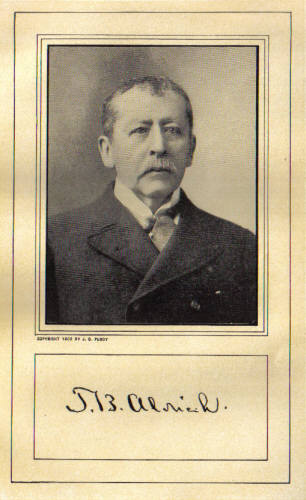
I am describing Mademoiselle
Olympe as she appeared to Van Twiller on the first occasion when he strolled
into the theatre where she was performing. To me she was a girl of eighteen or
twenty years of age (maybe she was much older, for pearl powder and distance
keep these people perpetually young), slightly but exquisitely built, with
sinews of silver wire; rather pretty, perhaps, after a manner, but showing
plainly the effects of the exhaustive draughts she was making on her physical
vitality. Now, Van Twiller was an enthusiast on the subject of calisthenics.
"If I had a daughter," Van Twiller used to say, "I wouldn't send her to a
boarding school, or a nunnery; I'd send her to a gymnasium for the first five
years. Our American women have no physique. They are lilies, pallid,
pretty—and perishable. You marry an American woman, and what do you
marry? A headache. Look at English girls. They are at least roses, and last the
season through."
Walking home from the theatre that first night, it
flitted through Van Twiller's mind that if he could give this girl's set of
nerves and muscles to any one of the two hundred high-bred women he knew, he
would marry her on the spot and worship her forever.
The following
evening he went to see Mademoiselle Olympe again. "Olympe Zabriski," he
soliloquized as he sauntered through the lobby—"what a queer name! Olympe
is French and Zabriski is Polish. It is her nom de guerre, of course;
her real name is probably Sarah Jones. What kind of creature can she be in
private life, I wonder? I wonder if she wears that costume all the time, and if
she springs to her meals from a horizontal bar. Of course she rocks the baby to
sleep on the trapeze." And Van Twiller went on making comical domestic tableaux
of Mademoiselle Zabriski, like the clever, satirical dog he was, until the
curtain rose.
This was on a Friday. There was a matinee the next day,
and he attended that, though he had secured a seat for the usual evening
entertainment. Then it became a habit of Van Twiller's to drop into the theatre
for half an hour or so every night, to assist at the interlude, in which she
appeared. He cared only for her part of the programme, and timed his visits
accordingly. It was a surprise to himself when he reflected, one morning, that
he had not missed a single performance of Mademoiselle Olympe for nearly two
weeks.
"This will never do," said Van Twiller. "Olympe"—he called
her Olympe, as if she were an old acquaintance, and so she might have been
considered by that time—"is a wonderful creature; but this will never do.
Van, my boy, you must reform this altogether."
But half-past nine that
night saw him in his accustomed orchestra chair, and so on for another week. A
habit leads a man so gently in the beginning that he does not perceive he is
led—with what silken threads and down what pleasant avenues it leads him!
By and by the soft silk threads become iron chains, and the pleasant avenues
Avernus!
Quite a new element had lately entered into Van Twiller's
enjoyment of Mademoiselle Olympe's ingenious feats—a vaguely born
apprehension that she might slip from that swinging bar; that one of the thin
cords supporting it might snap, and let her go headlong from the dizzy height.
Now and then, for a terrible instant, he would imagine her lying a glittering,
palpitating heap at the foot-lights, with no color in her lips! Sometimes it
seemed as if the girl were tempting this kind of fate. It was a hard, bitter
life, and nothing but poverty and sordid misery at home could have driven her
to it. What if she should end it all some night, by just unclasping that little
hand? It looked so small and white from where Van Twiller sat!
This
frightful idea fascinated while it chilled him, and helped to make it nearly
impossible for him to keep away from the theatre. In the beginning his
attendance had not interfered with his social duties or pleasures; but now he
came to find it distasteful after dinner to do anything but read, or walk the
streets aimlessly, until it was time to go to the play. When that was over, he
was in no mood to go anywhere but to his rooms. So he dropped away by
insensible degrees from his habitual haunts, was missed, and began to be talked
about at the club. Catching some intimation of this, he ventured no more in the
orchestra stalls, but shrouded himself behind the draperies of the private box
in which Delaney and I thought we saw him on one occasion.
Now, I find
it very perplexing to explain what Van Twiller was wholly unable to explain to
himself. He was not in love with Mademoiselle Olympe. He had no wish to speak
to her, or to hear her speak. Nothing could have been easier, and nothing
further from his desire, than to know her personally. A Van Twiller personally
acquainted with a strolling female acrobat! Good heavens! That was something
possible only with the discovery of perpetual motion. Taken from her theatrical
setting, from her lofty perch, so to say, on the trapeze-bar, Olympe Zabriski
would have shocked every aristocratic fibre in Van Twiller's body. He was
simply fascinated by her marvelous grace and élan, and the magnetic
recklessness of the girl. It was very young in him and very weak, and no member
of the Sorosis, or all the Sorosisters together, could have been more severe on
Van Twiller than he was on himself. To be weak, and to know it, is something of
a punishment for a proud man. Van Twiller took his punishment, and went to the
theatre, regularly.
"When her engagement comes to an end," he meditated,
"that will finish the business."
Mademoiselle Olympe's engagement
finally did come to an end and she departed. But her engagement had been highly
beneficial to the treasury-chest of the uptown theatre, and before Van Twiller
could get over missing her she had returned from a short Western tour, and her
immediate reappearance was underlined on the play-bills.
On a dead wall
opposite the windows of Van Twiller's sleeping-room there appeared, as if by
necromancy, an aggressive poster with MADEMOISELLE
OLYMPE ZABRISKI on it in
letters at least a foot high. This thing stared him in the face when he woke up
one morning. It gave him a sensation as if she had called on him overnight and
left her card.
From time to time through the day he regarded that poster
with a sardonic eye. He had pitilessly resolved not to repeat the folly of the
previous month. To say that this moral victory cost him nothing would be to
deprive it of merit. It cost him many internal struggles. It is a fine thing to
see a man seizing his temptation by the throat, and wrestling with it, and
trampling it underfoot like St. Anthony. This was the spectacle Van Twiller was
exhibiting to the angels.
The evening Mademoiselle Olympe was to make
her reappearance, Van Twiller, having dined at the club, and feeling more like
himself than he had felt for weeks, returned to his chamber, and, putting on
dressing-gown and slippers, piled up the greater portion of his library about
him, and fell to reading assiduously. There is nothing like a quiet evening at
home with some slight intellectual occupation, after one's feathers have been
stroked the wrong way.
When the lively French clock on the
mantelpiece—a base of malachite surmounted by a flying bronze Mercury
with its arms spread gracefully in the air, and not remotely suggestive of
Mademoiselle Olympe in the act of executing her grand flight from the
trapeze—when the clock, I repeat, struck nine, Van Twiller paid no
attention to it. That was certainly a triumph. I am anxious to render Van
Twiller all the justice I can, at this point of the narrative, inasmuch as when
the half hour sounded musically, like a crystal ball dropping into a silver
bowl, he rose from the chair automatically, thrust his feet into his walking-
shoes, threw his overcoat across his arm, and strode out of the room.
To
be weak and to scorn your weakness, and not to be able to conquer it, is, as
has been said, a hard thing; and I suspect it was not with unalloyed
satisfaction that Van Twiller found himself taking his seat in the back part of
the private box night after night during the second engagement of Mademoiselle
Olympe. It was so easy not to stay away!
In this second edition of Van
Twiller's fatuity, his case was even worse than before. He not only thought of
Olympe quite a number of times between breakfast and dinner, he not only
attended the interlude regularly, but he began, in spite of himself, to occupy
his leisure hours at night by dreaming of her. This was too much of a good
thing, and Van Twiller regarded it so. Besides, the dream was always the
same—a harrowing dream, a dream singularly adapted to shattering the
nerves of a man like Van Twiller. He would imagine himself seated at the
theatre (with all the members of Our Club in the parquette), watching
Mademoiselle Olympe as usual, when suddenly that young lady would launch
herself desperately from the trapeze, and come flying through the air like a
firebrand hurled at his private box. Then the unfortunate man would wake up
with cold drops standing on his forehead.
There is one redeeming feature
in this infatuation of Van Twiller's which the sober moralist will love to look
upon—the serene unconsciousness of the person who caused it. She went
through her rôle with admirable aplomb, drew her salary, it may be
assumed, punctually, and appears from first to last to have been ignorant that
there was a miserable slave wearing her chains nightly in the left-hand
proscenium box.
That Van Twiller, haunting the theatre with the
persistency of an ex-actor, conducted himself so discreetly as not to draw the
fire of Mademoiselle Olympe's blue eyes shows that Van Twiller, however deeply
under a spell, was not in love. I say this, though I think if Van Twiller had
not been Van Twiller, if he had been a man of no family and no position and no
money, if New York had been Paris and Thirty-fourth Street a street in the
Latin Quarter—but it is useless to speculate on what might have happened.
What did happen is sufficient.
It happened, then, in the second week of
Queen Olympe's second unconscious reign, that an appalling Whisper floated up
the Hudson, effected a landing at a point between Spuyten Duyvil Creek and Cold
Spring, and sought out a stately mansion of Dutch architecture standing on the
bank of the river. The Whisper straightway informed the lady dwelling in this
mansion that all was not well with the last of the Van Twillers; that he was
gradually estranging himself from his peers, and wasting his nights in a
playhouse watching a misguided young woman turning unmaidenly somersaults on a
piece of wood attached to two ropes.
Mrs. Vanrensselaer Vanzandt Van
Twiller came down to town by the next train to look into this little
matter.
She found the flower of the family taking an early breakfast
at
11 A. M., in his cosey apartments on Thirty-fourth Street. With the least
possible circumlocution she confronted him with what rumor had reported of his
pursuits, and was pleased, but not too much pleased, when he gave her an exact
account of his relations with Mademoiselle Zabriski, neither concealing nor
qualifying anything. As a confession, it was unique, and might have been a
great deal less entertaining. Two or three times in the course of the
narrative, the matron had some difficulty in preserving the gravity of her
countenance. After meditating a few minutes, she tapped Van Twiller softly on
the arm with the tip of her parasol, and invited him to return with her the
next day up the Hudson and make a brief visit at the home of his ancestors. He
accepted the invitation with outward alacrity and inward disgust.
When
this was settled, and the worthy lady had withdrawn, Van Twiller went directly
to the establishment of Messrs. Ball, Black, and Company, and selected, with
unerring taste, the finest diamond bracelet procurable. For his mother? Dear
me, no! She had the family jewels.
I would not like to state the
enormous sum Van Twiller paid for this bracelet. It was such a clasp of
diamonds as would have hastened the pulsation of a patrician wrist. It was such
a bracelet as Prince Camaralzaman might have sent to the Princess Badoura, and
the Princess Badoura—might have been very glad to get.
In the
fragrant Levant morocco case, where these happy jewels lived when they were at
home, Van Twiller thoughtfully placed his card, on the back of which he had
written a line begging Mademoiselle Olympe Zabriski to accept the accompanying
trifle from one who had witnessed her graceful performances with interest and
pleasure. This was not done inconsiderately. "Of course, I must inclose my
card, as I would to any lady," Van Twiller had said to himself. "A Van Twiller
can neither write an anonymous letter nor make an anonymous present." Blood
entails its duties as well as its privileges.
The casket despatched to
its destination, Van Twiller felt easier in his mind. He was under obligations
to the girl for many an agreeable hour that might otherwise have passed
heavily. He had paid the debt, and he had paid it en prince, as became a
Van Twiller. He spent the rest of the day in looking at some pictures at
Goupil's, and at the club, and in making a few purchases for his trip up the
Hudson. A consciousness that this trip up the Hudson was a disorderly retreat
came over him unpleasantly at intervals.
When he returned to his rooms
late at night, he found a note lying on the writing-table. He started as his
eyes caught the words "——— Theatre" stamped in carmine
letters on one corner of the envelope. Van Twiller broke the seal with
trembling fingers.
Now, this note some time afterward fell into the
hands of Livingstone, who showed it to Stuyvesant, who showed it to Delaney,
who showed it to me, and I copied it as a literary curiosity. The note ran as
follows:
MR VAN TWILLER DEAR SIR—i am verry
greatfull to you for that Bracelett. it come just in the nic of time for me.
The Mademoiselle Zabriski dodg is about Plaid out. my beard is getting to much
for me. i shall have to grow a mustash and take to some other line of busyness,
i dont no what now, but will let you no. You wont feel bad if i sell that
Bracelett. i have seen Abrahams Moss and he says he will do the square thing.
Pleas accep my thanks for youre Beautifull and Unexpected present. Youre
respectfull servent,
CHARLES MONTMORENCI WALTERS.
The next day Van
Twiller neither expressed nor felt any unwillingness to spend a few weeks with
his mother at the old homestead.
And then he went abroad.
Harold Frederic (born at Utica, N. Y., August 19, 1856; died in 1898) was a novelist whose every book exceeded its predecessor in conception, general construction, and technique of detail. His death at the maturity of his powers was therefore a great loss to American literature. His posthumous novel, "The Market Place" indicates that Frederic, had he lived, might have outshone even Balzac in the fiction of business life. "Brother Sebastian's Friendship" is a clever short story of the days of his literary 'prenticeship. It was his introduction to the "Utica Observer," where he worked for several years.
BROTHER
SEBASTIAN'S FRIENDSHIP
BY HAROLD FREDERIC
[Footnote: By
permission of the "Utica Observer."]
I WHO
tell this story am called Brother Sebastian. This name was given me more than
forty years ago, while Louis Philippe was still king. My other name has been
buried so long that I have nearly forgotten it. I think that my people are
dead. At least I have heard nothing from them in many years. My reputation has
always been that of a misanthrope—if not that, then of a dreamer. In the
seminary I had no intimates. In the order, for I am a Brother of the Christian
Schools, my associates are polite—nothing more. I seem to be outside
their social circles, their plans, their enjoyments. True, I am an old man now.
But in other years it was the same. All my life I have been in
solitude.
To this there is a single exception—one star shining in
the blackness. And my career has been so bleak that, although it ended in
deeper sadness than I had known before, I look back to the epsiode with
gratitude. The bank of clouds which shut out this sole light of my life
quickened its brilliancy before they submerged it.
After the terrible
siege of '71, when the last German was gone, and our houses had breasted the
ordeal of the Commune, I was sent to the South. The Superior thought my cheeks
were ominously hollow, and suspected threats of consumption in my cough. So I
was to go to the Mediterranean, and try its milder air. I liked the change.
Paris, with its gloss of noisy gayety and its substance of sceptical
heartlessness, was repugnant to me. Perhaps it was because of this that Brother
Sebastian had been mured up in the capital two-thirds of his life. If our
surroundings are too congenial we neglect the work set before us. But no
matter; to the coast I went.
My new home was a long-established house,
spacious, venerable, and dreary. It was on the outskirts of an ancient town,
which was of far more importance before our Lord was born than it has ever been
since. We had little to do. There were nine brothers, a handful of resident
orphans, and some threescore pupils. Ragged, stupid, big-eyed urchins they
were, altogether different from the keen Paris boys. For that matter, every
feature of my new home was odd. The heat of the summer was scorching in its
intensity. The peasants were much more respectful to our cloth, and, as to
appearance, looked like figures from Murillo's canvases. The foliage, the wine,
the language, the manners of the people—everything was changed. This
interested me, and my morbidness vanished. The Director was delighted with my
improved condition. Poor man! he was positive that my cheeks had puffed out
perceptibly after the first two months. So the winter came—a mild, wet,
muggy winter, wholly unlike my favorite sharp season in the North.
We
were killing time in the library one afternoon, the Director and a Swiss
Brother sitting by the lamp reading, I standing at one of the tall, narrow
windows, drumming on the panes and dreaming. The view was not an inspiring one.
There was a long horizontal line of pale yellow sky and another of flat, black
land, out of Avhich an occasional poplar raised itself solemnly. The great mass
below the stripes was brown; above, gloomy gray. Close under the window two
boys were playing in the garden of the house. I recall distinctly that they
threw armfuls of wet fallen leaves at each other with a great shouting. While I
stood thus, the Brother Servitor, Abonus, came in and whispered to the
Director. He always whispered. It was not fraternal, but I did not like this
Abonus.
"Send him up here," said the Director. Then I remembered that I
had heard the roll of a carriage and the bell ring a few moments before. Abonus
came in again. Behind him there was some one else, whose footsteps had the
hesitating sound of a stranger's. Then I heard the Director's
voice:
"You are from Algiers?"—"I am, Brother."
"Your
name?"
"Edouard, Brother."
"Well, tell me more."
"I was
under orders to be in Paris in January, Brother. As my health was poor, I
received permission to come back to France this autumn. At Marseilles I was
instructed to come here. So I am here. I have these papers from the Mother
house, and from Etienne, Director, of Algiers."
Something in the voice
seemed peculiar to me. I turned and examined the new-comer. He stood behind and
to one side of the Director, who was laboriously deciphering some papers
through his big horn spectacles. The light was not very bright, but there was
enough to see a wonderfully handsome face, framed in dazzling black curls.
Perhaps it looked the more beautiful because contrasted with the shaven gray
poll and surly features of grim Abonus, But to me it was a dream of St. John
the Evangel. The eyes of the face were lowered upon the Director, so I could
only guess their brilliancy. The features were those of an extreme
youth—round, soft, and delicate. The expression was one of utter fatigue,
almost pain. It bore out the statement of ill-health.
The Director had
finished his reading. He lifted his head now and surveyed the stranger in turn.
Finally, stretching out his fat hand, he said:
"You are welcome, Brother
Edouard. I see the letter says you have had no experience except with the
youngest children. Brother Photius does that now. We will have you rest for a
time. Then we will see about it. Meanwhile I will turn you over to the care of
good Abonus, who will give you one of the north rooms."
So the two went
out, Abonus shuffling his feet disagreeably. It was strange that he could do
nothing to please me.
"Brother Sebastian," said the Director, as the
door closed, "it is curious that they should have sent me a tenth man. Why, I
lie awake now to invent pretences of work for those I have already. I will give
up all show of teaching presently, and give out that I keep a hospital—a
retreat for ailing brothers. Still, this Edouard is a pretty
boy."
"Very."
"Etienne's letter says he is twenty and a Savoyard.
He speaks like a Parisian."
"Very likely he is seminary bred," put in
the Swiss.
"Whatever he is, I like his looks," said our Superior. This
good man liked every one. His was the placid, easy Alsatian nature, prone to
find goodness in all things—even crabbed Abonus. The Director, or, as he
was known, Brother Elysee, was a stout, round little man, with a fine face and
imperturbable good spirits. He was adored by all his subordinates. But I fancy
he did not advance in favor at Paris very rapidly.
I liked Edouard from
the first. The day after he came we were together much, and, when we parted
after vespers, I was conscious of a vast respect for this new-comer. He was
bright, ready spoken, and almost a man of the world. Compared with my dull
career, his short life had been one of positive gayety. He had seen Frederic le
Maitre at the Comédie Française. He had been at Court and spoken with the
Prince Imperial. He was on terms of intimacy with Monsignori, and had been a
protégé of the sainted Darboy. It was a rare pleasure to hear him talk of these
things.
Before this, the ceaseless shifting of brothers from one house
to another had been indifferent to me. For the hundreds of strangers who came
and went in the Paris house on Oudinot Street I cared absolutely nothing. I did
not suffer their entrance nor their exit to excite me. This was so much the
case that they called me a machine. But with Edouard this was different. I grew
to love the boy from the first evening, when, as he left my room, I caught
myself saying, "I shall be sorry when he goes." He seemed to be fond of me,
too. For that matter most of the brothers petted him, Elysee especially. But I
was flattered that he chose me as his particular friend. For the first time my
heart had opened.
We were alone one evening after the holidays. It was
cold without, but in my room it was warm and bright. The fire crackled merrily,
and the candles gave out a mellow and pleasant light. The Director had gone up
to Paris, and his mantle had fallen on me. Edouard sat with his feet stretched
to the fender, his curly head buried in the great curved back of my invalid
chair, the red fire-light reflected on his childish features. I took pleasure
in looking at him. He looked at the coals and knit his brows as if in a puzzle.
I often fancied that something weightier than the usual troubles of life
weighed upon him. At last he spoke, just as I was about to question
him:
"Are you afraid to die, Sebastian?"
Not knowing what else to
say, I answered, "No, my child."
"I wonder if you enjoy life in
community?"
This was still stranger. I could but reply that I had never
known any other life; that I was fitted for nothing else.
"But still,"
persisted he, "would you not like to leave it—to have a career of your
own before you die? Do you think this is what a man is created for—to
give away his chance to live?"
"Edouard, you are interrogating your own
conscience," I answered. "These are questions which you must have answered
yourself, before you took your vows. When you answered them, you sealed
them."
Perhaps I spoke too harshly, for he colored and drew up his feet.
Such shapely little feet they were. I felt ashamed of my
crustiness.
"But, Edouard," I added, "your vows are those of the
novitiate. You are not yet twenty-eight. You have still the right to ask
yourself these things. The world is very fair to men of your age. Do not dream
that I was angry with you."
He sat gazing into the fire. His face wore a
strange, far-away expression, as he reached forth his hand, in a groping way,
and rested it on my knee, clutching the gown nervously. Then he spoke slowly,
seeking for words, and keeping his eyes on the flames.
"You have
been good to me, Brother Sebastian. Let me ask you: May I tell you something in
confidence—something which shall never pass your lips? I mean
it."
He had turned and poured those marvelous eyes into mine with
irresistible magnetism. Of course I said, "Speak!" and I said it without the
slightest hesitation.
"I am not a Christian Brother. I do not belong to
your order. I have no claim upon the hospitality of this roof. I am an
impostor!"
He ejected these astounding sentences with an energy almost
fierce, gripping my knee meanwhile. Then, as suddenly, his grasp relaxed, and
he fell to weeping bitterly.
I stared at him solemnly, in silence. My
tongue seemed paralyzed. Confusing thoughts whirled in a maze unbidden through
my head. I could say nothing. But a strange impulse prompted me to reach out
and take his hot hand in mine. It was piteous to hear him sobbing, his head
upon his raised arm, his whole frame quivering with emotion. I had never seen
any one weep like that before. So I sat dumb, trying in vain to answer this
bewildering self-accusation. At last there came out of the folds of the chair
the words, faint and tear-choked:
"You have promised me secrecy, and you
will keep your word; but you will hate me."
"Why, no, no, Edouard, not
hate you," I answered, scarcely knowing what I said. I did not comprehend it at
all. There was nothing more for me to say. Finally, when some power of thought
returned, I asked:
"Of all things, my poor boy, why should you choose
such a dreary life as this? What possible reason led you to enter the
community? What attractions has it for you?"
Edouard turned again from
the fire to me. His eyes sparkled. His teeth were tight set.
"Why? Why?
I will tell you why, Brother Sebastian. Can you not understand how a poor
hunted beast should rejoice to find shelter in such an out-of-the-way place,
among such kind men, in the grave of this cloister life? I have not told you
half enough. Do you not know in the outside world, in Toulon, or Marseilles, or
that fine Paris of yours, there is a price on my head?—or no, not that,
but enemies that are looking for me, searching everywhere, turning every little
stone for the poor privilege of making me suffer? And do you know that these
enemies wear shakos, and are called gens d'armes? Would you be pleased to learn
that it is a prison I escape by coming here? Now, will you hate
me?"
The boy had risen from his chair. He spoke hurriedly, almost
hysterically, his eyes snapping at mine like coals, his curls disheveled, his
fingers curved and stiffened like the talons of a hawk. I had never seen such
intense earnestness in a human face. Passions like these had never penetrated
the convent walls before.
While I sat dumb before him, Edouard left the
room. I was conscious of his exit only in a vague way. For hours I sat in my
chair beside the grate thinking, or trying to think. You can see readily that I
was more than a little perplexed. In the absence of Elysee, I was director. The
management of the house, its good fame, its discipline, all rested on my
shoulders. And to be confronted by such an abyss as this! I could do absolutely
nothing. The boy had tied my tongue by the pledge. Besides, had I been unsworn,
I am sure the idea of exposure would never have come to me. It was late before
I retired that night. And I recall with terrible distinctness the chaos of
brain and faculty which ushered in a restless sleep almost as dawn was
breaking.
I had fancied that Brother Edouard would find life intolerable
in community after his revelation to me. He would be chary of meeting me before
the brothers; would be constantly tortured by fear of detection. As I saw this
prospect of the poor innocent—for it was absurd to think of him as
anything else—dreading exposure at each step in his false life, shrinking
from observation, biting his tongue at every word—I was greatly moved by
pity. Judge my surprise, then, when I saw him the next morning join in the
younger brothers' regular walk around the garden, joking and laughing as I had
never seen before. On his right was thin, sickly Victor, rest his soul! and on
the other pursy, thick-necked John, as merry a soul as Cork ever turned out.
And how they laughed, even the frail consumptive! It was a pleasure to see his
blue eyes brighten with enjoyment and his warm cheeks blush. Above John's
queer, Irish chuckle, I heard Edouard's voice, with its dainty Parisian accent,
retailing jokes and leading in the laughter. The tramp was stretched out longer
than usual, so pleasant did they find it. At this development I was much
amazed.
The same change was noticeable in all that Edouard did. Instead
of the apathy with which he had discharged his nominal duties, his baby pupils
(for Photius had gone to Peru) now became bewitched with him. He told them
droll stories, incited their rivalry in study by instituting prizes for which
they struggled monthly, and, in short, metamorphosed his department. The change
spread to himself. His cheeks took on a ruddier hue, the sparkle of his black
eyes mellowed into a calm and steady radiance. There was no trace of feverish
elation which, in solitude, recoiled to the brink of despair. He sang to
himself evenings in his dormitory, clearly and with joy. His step was as
elastic as that of any schoolboy. I often thought upon this change, and
meditated how beautiful an illustration of confession's blessings it furnished.
Frequently we were alone, but he never referred again to that memorable
evening, even by implication. At first I dreaded to have the door close upon
us, feeling that he must perforce seek to take up the thread where he had
broken it then. But he talked of other things, and so easily and naturally that
I felt embarrassed. For weeks I could not shake off the feeling that, at our
next talk, he would broach the subject. But he never did.
Elysee
returned, bringing me kind words from the Mother house, and a half-jocular hint
that Superior General Philippe had me much in his mind. No doubt there had been
a time when the idea of becoming a Director would have stirred my pulses.
Surely it was gone now. I asked for nothing but to stay beside Edouard, to
watch him, and to be near to lend him a helping hand when his hour of trouble
should come. From that ordeal, which I saw approaching clearly and certainly, I
shrank with all my nerves on edge. As the object of my misery grew bright-eyed
and strong, I felt myself declining in health. My face grew thin, and I could
not eat. I saw before my eyes always this wretched boy singing upon the brow of
the abyss. Sometimes I strove not to see his fall—frightful and swift.
His secret seemed to harass him no longer. To me it was heavier than
lead.
The evening the Brother Director returned, we sat together in the
reading-room, the entire community. Elysee had been speaking of the Mother
house concerning which Brother Barnabas, an odd little Lorrainer who spoke
better German than French, and who regarded Paris with the true provincial awe
and veneration, exhibited much curiosity. We had a visitor, a gaunt, self-
sufficient old Parisian, who had spent fourteen days in the Mazas prison during
the Commune. I will call him Brother Albert, for his true name in religion is
very well known.
"I heard a curious story in the Vaugirard house," said
the Brother Director, refreshing himself with a pinch of snuff, "which made the
more impression upon me that I once knew intimately one of the persons in it.
Martin Delette was my schoolmate at Pfalsbourg in the old days. A fine,
studious lad he was, too. He took orders and went to the north, where he lived
for many years a quiet country curé. He had a niece, a charming girl who is not
now more than twenty or one-and-twenty. She was an orphan, and lived with him,
going to a convent to school and returning at vacations. She was not a bad
girl, but a trifle wayward and easily led. She gave the Sisters much anxiety.
Last spring she barely escaped compromising the house by an escapade with a
young miserable of the town, named Banin."
"I know your story,"
said Albert, with an air which hinted that this was a sufficient reason why the
rest should not hear it. "Banin is in prison."
Elysee proceeded: "The
girl was reprimanded. Next week she disappeared. To one of her companions she
had confided a great desire to see Paris. So good Father Delette was summoned,
and, after a talk with the Superioress, started post-haste for the capital. He
found no signs either of poor Renée or of Banin, who had also disappeared. The
Curé was nearly heart-broken. Each day, they told me, added a year to his
appearance. He did not cease to importune the police chiefs and to haunt the
public places for a glimpse of his niece's face. But the summer came, and no
Renée. The Curé began to cough and grow weak. But one day in August the
Director, good Prosper, called him down to the reception-room to see a
visitor.
"'There is news for you,'" he whispered, pressing poor Martin's
hand. In the room he found—"
"In the room he found—" broke
in Albert, impertinently, but with a quiet tone of authority which cowed good
Elysee, "a shabby man, looking like a poorly fed waiter. This person rose and
said, 'I am a detective; do you know Banin—young man, tall, blond,
squints, broken tooth upper jaw, hat back on his head, much talk, hails from
Rheims?'
"'Ah,' said Delette, 'I have not seen him, but I know him too
well.'
"The detective pointed with his thumb over his left shoulder. 'He
is in jail. He is good for twenty years. I did it myself. My name is So-and-so.
Good job. Procurator said you were interested—some woman in the case,
parishioner of yours, eh?'
"'My niece,' gasped the Curé.
"'O ho!
does you credit; pretty girl, curly head. good manners. Well, she's off. Good
trick, too. She was the decoy. Banin stood in the shadow with club. She brought
gentleman into alley, friend did work. That's Banin's story. Perhaps a lie. You
have a brother in Algiers? Thought so. Girl went out there once? So I was told.
Probably there now. African officers say not; but they're a sleepy lot. If I
was a criminal I'd go to Algiers. Good hiding. The detective went. Delette
stood where he was in silence. I went to him, and helped carry him upstairs. We
put him in his bed. He died there."
Brother Albeit stopped. He had told
the story, dialogue and all, like a machine. We did not doubt its correctness.
The memory of Albert had passed into a proverb years before.
Brother
Albert raised his eyes again, and added, as if he had not paused, "He was
ashamed to hold his head up. He might well be."
A strange, excited voice
rose from the other end of the room. I looked and saw that it was Edouard who
spoke. He had half arisen from his chair and scowled at Albert, throwing out
his words with the tremulous haste of a young man first addressing an
audience:
"Why should he be ashamed? Was he not a good man? Was the
blame of his bad niece's acts his? From the story, she was well used and had no
excuse. It is he who is to be pitied, not blamed!"
The Brother Director
smiled benignly at the young enthusiast. "Brother Edouard is right," he said.
"Poor Martin was to be compassioned. None the less, my heart is touched for the
girl. In Banin's trial it appeared that he maltreated her, and forced her to do
what she did by blows. They were really married. Her neighbors gave Renee a
name for gentleness and a good heart. Poor thing!"
"And she never was
found?" asked Abonus, eagerly. He spoke very rarely. He looked now at me as he
spoke, and there was a strange, ungodly glitter in his eyes which made me
shudder involuntarily.
"Never," replied the Director, "although there is
a reward, 5,000 francs, offered for her recovery. Miserable child, who can tell
what depths of suffering she may be in this moment?"
"It would be
remarkable if she should be found now, after all this time," said Abonus,
sharply. His wicked, squinting old eyes were still fastened upon me. This time,
as by a flash of eternal knowledge, I read their meaning, and felt the ground
slipping from under me.
I shall never forget the night that followed. I
made no pretence of going to bed. Edouard's little dormitory was in another
part of the house. I went once to see him, but dared not knock, since Abonus
was stirring about just across the hall, in his own den. I scratched on a piece
of paper "Fly!" in the dark, and pushed it under the door. Then I returned to
walk my chamber, chafing like a wild beast. Ah, that night, that
night!
With the first cock crow in the village below, long before the
bell, I left my room. I wanted air to breathe. I passed Abonus on the broad
stairway. He strode up with unwonted vigor, bearing a heavy caldron of water as
if it had been straw. His gown was tumbled and dusty; his greasy rabat
hung awry about his neck. I had it in my head to speak with him, but could not.
So the early hours, with devotions which I went through in a dream, wore on in
horrible suspense, and breakfast came.
We sat at the long table, five on
a side, the Director—looking red-eyed and weary from the evening's
unaccustomed dissipation—sitting at the head. Below us stood Brother
Albert, reading from Tertullian in a dry, monotonous chant. I recall, as I
write, how I found a certain comfort in those splendid, sonorous Latin
sentences, though I was conscious of not comprehending a word. I dreaded the
moment they should end. Edouard sat beside me. We had not exchanged a word
during the morning. How could I speak? What should I say? I was in a nervous
flutter, like unto those who watch the final pinioning of a criminal whose
guillotine is awaiting him. I could not keep my eyes from the fair face beside
me, with its delicately cut profile, made all the more cameo-like by its pallid
whiteness. The lips were tightly compressed. I could see askant that the tiny
nostrils were quivering with excitement. All else was impassive on Edouard's
face. We two sat waiting for the axe to fall.
It is as distinct as a
nightmare to me. Abonus came in with his great server laden with victuals. He
stumbled as he approached. He too was excited. He drew near, and stood behind
me. I seemed to feel his breath penetrate my skull; and yet I was forced to
answer a whispered question of Brother John's with a smooth face. I saw Edouard
suddenly reach for the milk glass in front of his plate, and hand it back to
Abonus with the disdain of a duchess. He said, in a sharp, peremptory
tone:
"Take it away and cleanse it. No one but a dirty monk would place
such a glass on the table."
Albert ceased his reading. Abonus did not
touch the glass. He shuffled hastily to the sideboard and deposited his burden.
Then he came back with the same eager movement. He placed his fists on his
hips, like a fish-woman, and hissed, in a voice choking with concentrated
rage:
"No one but a woman would complain of it!"
The brothers
stared at each other and the two speakers in mute surprise. But they saw
nothing in the words beyond a personal wrangle—though even that was such
a novelty as to arrest instant attention. I busied myself with my plate. The
Director assumed his harshest tone, and asked the cause of the altercation.
Abonus leaned over and whispered something in his ear. I remember next a room
full of confusion, a babel of conflicting voices, and a whirling glimpse of
uniforms. Then I fainted.
When I revived I was in my own room, stretched
upon my pallet. I looked around in a dazed way and saw the Brother Director and
a young gendarme by the closed door. Something black and irregular in the
outline of the bed at my side attracted my eyes. I saw that it was Edouard's
head buried in the drapery. As in a dream I laid my numb hand upon those crisp
curls. I was an old man, she was a weak, wretched girl. She raised her face at
my touch, and burned in my brain a vision of stricken agony, of horrible soul-
pain, which we liken, for want of a better simile, to the anguish in the eyes
of a dying doe. Her lips moved; she said something, I know not what. Then she
went, and I was left alone with Elysee. His words—broken, stumbling
words—I remember:
"She asked to see you, Sebastian, my friend. I
could not refuse. Her papers were forged. She did come from Algiers, where her
uncle is a Capuchin. I do not ask, I do not wish to know, how much you know of
this. Before my Redeemer, I feel nothing but pity for the poor lamb. Lie still,
my friend; try to sleep. We are both older men than we were
yesterday."
There is little else to tell. Only twice have reflections of
this episode in my old life reached me in the seclusion of a missionary post at
the foot of the Andes. I learned a few weeks ago that the wretched Abonus had
bought a sailor's café on the Toulon wharves with his five thousand francs. And
I know also that the heart of the Marshal-President was touched by the sad
story of Renee, and that she left the prison La Salpetriere to lay herself in
penitence at the foot of Mother Church. This is the story of my friendship.
Hjalmar Hjorth Boyescn (born at Frederiksvaern, Norway, September 23, 1848; died in 1895) was a university graduate who came to this country in 1869 to take a professorship of languages in a small Ohio college. Soon after he was called to Cornell, and in 1882 he became Professor of German in Columbia. His proficiency in the English language was phenomenal. His mastery of scholarly English in the essay form was to be expected, but his ready command of the delicately shaded style required of a literary novelist has not been equaled by any other naturalized American author. Hence in this series he has received citizenship among those to the manner born. The story selected by his son, as representative of his work in brief fiction, is a fine study of character, with a pathetic ending, whose poignancy is due to its fidelity to truth.
A GOOD-FOR-NOTHING
BY HJALMAR HJORTH
BOYESEN
[By permission of Charles Scribner's Sons. Copyright, 1876, by James
R. Osgood & Co.]
I
RALPH GRIM was born a gentleman. He had the misfortune of
coming into the world some ten years later than might reasonably have been
expected. Colonel Grim and his lady had celebrated twelve anniversaries of
their wedding-day, and had given up all hopes of ever having a son and heir,
when this late comer startled them by his unexpected appearance. The only
previous addition to the family had been a daughter, and she was then ten
summers old.
Ralph was a very feeble child, and could only with great
difficulty be persuaded to retain his hold of the slender thread which bound
him to existence. He was rubbed with whiskey, and wrapped in cotton, and given
mare's milk to drink, and God knows what not, and the Colonel swore a round
oath of paternal delight when at last the infant stopped gasping in that
distressing way and began to breathe like other human beings. The mother, who,
in spite of her anxiety for the child's life, had found time to plot for him a
career of future magnificence, now suddenly set him apart for literature,
because that was the easiest road to fame, and disposed of him in marriage to
one of the most distinguished families of the land. She cautiously suggested
this to her husband when he came to take his seat at her bedside; but to her
utter astonishment she found that he had been indulging a similar train of
thought, and had already destined the infant prodigy for the army. She,
however, could not give up her predilection for literature, and the Colonel,
who could not bear to be contradicted in his own house, as he used to say, was
getting every minute louder and more flushed, when, happily, the doctor's
arrival interrupted the dispute.
As Ralph grew up from infancy to
childhood, he began to give decided promise of future distinction. He was fond
of sitting down in a corner and sucking his thumb, which his mother interpreted
as the sign of that brooding disposition peculiar to poets and men of lofty
genius. At the age of five, he had become sole master in the house. He slapped
his sister Hilda in the face, or pulled her hair, when she hesitated to obey
him, tyrannized over his nurse, and sternly refused to go to bed in spite of
his mother's entreaties. On such occasions, the Colonel would hide his face
behind his newspaper, and chuckle with delight; it was evident that nature had
intended his son for a great military commander. As soon as Ralph himself was
old enough to have any thoughts about his future destiny, he made up his mind
that he would like to be a pirate. A few months later, having contracted an
immoderate taste for candy, he contented himself with the comparatively humble
position of a baker; but when he had read "Robinson Crusoe" he manifested a
strong desire to go to sea in the hope of being wrecked on some desolate
island. The parents spent long evenings gravely discussing these indications of
uncommon genius, and each interpreted them in his or her own way.
"He is
not like any other child I ever knew," said the mother.
"To be sure,"
responded the father, earnestly. "He is a most extraordinary child. I was a
very remarkable child too, even if I do say it myself; but, as far as I
remember, I never aspired to being wrecked on an uninhabited
island."
The Colonel probably spoke the truth; but he forgot to take
into account that he had never read "Robinson Crusoe."
Of Ralph's
school-days there is but little to report, for, to tell the truth, he did not
fancy going to school, as the discipline annoyed him. The day after his having
entered the gymnasium, which was to prepare him for the Military Academy, the
principal saw him waiting at the gate after his class had been dismissed. He
approached him, and asked why he did not go home with the rest.
"I am
waiting for the servant to carry my books," was the boy's answer.
"Give
me your books," said the teacher.
Ralph reluctantly obeyed. That day the
Colonel was not a little surprised to see his son marching up the street, and
every now and then glancing behind him with a look of discomfort at the
principal, who was following quietly in his train, carrying a parcel of school-
books. Colonel Grim and his wife, divining the teacher's intention, agreed that
it was a great outrage, but they did not mention the matter to Ralph.
Henceforth, however, the boy refused to be accompanied by his servant. A week
later he was impudent to the teacher of gymnastics, who whipped him in return.
The Colonel's rage knew no bounds; he rode in great haste to the gymnasium,
reviled the teacher for presuming to chastise his son, and committed the
boy to the care of a private tutor.
At the age of sixteen, Ralph went to
the capital with the intention of entering the Military Academy. He was a tall,
handsome youth, slender of stature, and carried himself as erect as a candle.
He had a light, clear complexion of almost feminine delicacy; blond, curly
hair, which he always kept carefully brushed; a low forehead, and a straight,
finely modeled nose. There was an expression of extreme sensitiveness about the
nostrils, and a look of indolence in the dark-blue eyes. But the
ensemble of his features was pleasing, his dress irreproachable, and his
manners bore no trace of the awkward self-consciousness peculiar to his age.
Immediately on his arrival in the capital he hired a suite of rooms in the
aristocratic part of the city, and furnished them rather expensively, but in
excellent taste. From a bosom friend, whom he met by accident in the
restaurant's pavilion in the park, he learned that a pair of antlers, a stuffed
eagle, or falcon, and a couple of swords, were indispensable to a well-
appointed apartment. He accordingly bought these articles at a curiosity shop.
During the first weeks of his residence in the city he made some feeble efforts
to perfect himself in mathematics, in which he suspected he was somewhat
deficient. But when the same officious friend laughed at him, and called him
"green," he determined to trust to fortune, and henceforth devoted himself the
more assiduously to the French ballet, where he had already made some
interesting acquaintances.
The time for the examination came; the French
ballet did not prove a good preparation; Ralph failed. It quite shook him for
the time, and he felt humiliated. He had not the courage to tell his father; so
he lingered on from day to day, sat vacantly gazing out of his window, and
tried vainly to interest himself in the busy bustle down on the street. It
provoked him that everybody else should be so light-hearted, when he was, or at
least fancied himself, in trouble. The parlor grew intolerable; he sought
refuge in his bedroom. There he sat one evening (it was the third day after the
examination), and stared out upon the gray stone walls which on all sides
inclosed the narrow courtyard. The round stupid face of the moon stood
tranquilly dozing like a great Limburger cheese suspended under the
sky.
Ralph, at least, could think of a no more fitting simile. But the
bright-eyed young girl in the window hard by sent a longing look up to the same
moon, and thought of her distant home on the fjords, where the glaciers stood
like hoary giants, and caught the yellow moonbeams on their glittering shields
of snow. She had been reading "Ivanhoe" all the afternoon, until the twilight
had overtaken her quite unaware, and now she suddenly remembered that she had
forgotten to write her German exercise. She lifted her face and saw a pair of
sad, vacant eyes gazing at her from the next window in the angle of the court.
She was a little startled at first, but in the next moment she thought of her
German exercise and took heart.
"Do you know German?" she said; then
immediately repented that she had said it.
"I do," was the
answer.
She took up her apron and began to twist it with an air of
embarrassment.
"I didn't mean anything," she whispered, at last. "I only
wanted to know."
"You are very kind."
That answer roused her; he
was evidently making sport of her.
"Well, then, if you do, you may write
my exercise for me. I have marked the place in the book."
And she flung
her book over to the window, and he caught it on the edge of the sill, just as
it was falling.
"You are a very strange girl," he remarked, turning over
the leaves of the book, although it was too dark to read. "How old are
you?"
"I shall be fourteen six weeks before Christmas," answered she,
frankly.
"Then I excuse you."
"No, indeed," cried she,
vehemently. "You needn't excuse me at all. If you don't want to write my
exercise, you may send the book back again. I am very sorry I spoke to you, and
I shall never do it again."
"But you will not get the book back again
without the exercise," replied he, quietly. "Good-night."
The girl stood
long looking after him, hoping that he would return. Then, with a great burst
of repentance, she hid her face in her lap, and began to cry.
"Oh, dear,
I didn't mean to be rude," she sobbed. "But it was Ivanhoe and Rebecca who
upset me."
The next morning she was up before daylight, and waited for
two long hours in great suspense before the curtain of his window was raised.
He greeted her politely; threw a hasty glance around the court to see if he was
observed, and then tossed her book dexterously over into her hands.
"I
have pinned the written exercise to the flyleaf," he said. "You will probably
have time to copy it before breakfast."
"I am ever so much obliged to
you," she managed to stammer.
He looked so tall and handsome, and grown-
up, and her remorse stuck in her throat, and threatened to choke her. She had
taken him for a boy as he sat there in his window the evening
before.
"By the way, what is your name?" he asked, carelessly, as he
turned to go.
"Bertha."
"Well, my dear Bertha, I am happy to have
made your acquaintance."
And he again made her a polite bow, and entered
his parlor.
"How provokingly familiar he is," thought she; "but no one
can deny that he is handsome."
The bright roguish face of the young girl
haunted Ralph during the whole next week. He had been in love at least ten
times before, of course; but, like most boys, with young ladies far older than
himself. He found himself frequently glancing over to her window in the hope of
catching another glimpse of her face; but the curtain was always drawn down,
and Bertha remained invisible. During the second week, however, she relented,
and they had many a pleasant chat together. He now volunteered to write all her
exercises, and she made no objections. He learned that she was the daughter of
a well-to-do peasant in the
sea-districts of Norway (and it gave him quite a
shock to hear it), and that she was going to school in the city, and boarded
with an old lady who kept a pension in the house adjoining the one in which he
lived.
One day in the autumn Ralph was surprised by the sudden arrival
of his father, and the fact of his failure in the examination could no longer
be kept a secret. The old Colonel flared up at once when Ralph made his
confession; the large veins upon his forehead swelled; he grew
coppery-red
in his face, and stormed up and down the floor, until his son became seriously
alarmed; but, to his great relief, he was soon made aware that his father's
wrath was not turned against him personally, but against the officials of the
Military Academy who had rejected him. The Colonel took it as insult to his own
good name and irreproachable standing as an officer; he promptly refused any
other explanation, and vainly racked his brain to remember if any youthful
folly of his could possibly have made him enemies among the teachers of the
Academy. He at last felt satisfied that it was envy of his own greatness and
rapid advancement which had induced the rascals to take vengeance on his son.
Ralph reluctantly followed his father back to the country town where the latter
was stationed, and the fair-haired Bertha vanished from his horizon. His
mother's wish now prevailed, and he began, in his own easy way, to prepare
himself for the University. He had little taste for Cicero, and still less for
Virgil, but with the use of a "pony" he soon gained sufficient knowledge of
these authors to be able to talk in a sort of patronizing way about them, to
the great delight of his fond parents. He took quite a fancy, however, to the
ode in Horace ending with the lines:
Dulce ridentem,
Dulce loquentem,
Lalagen
amabo.
And in his thought he substituted for Lalage the fair-haired
Bertha, quite regardless of the requirements of the metre.
To make a
long story short, three years later Ralph returned to the capital, and, after
having worn out several tutors, actually succeeded in entering the
University.
The first year of college life is a happy time to every
young man, and Ralph enjoyed its processions, its parliamentary gatherings, and
its leisure, as well as the rest. He was certainly not the man to be
sentimental over the loss of a young girl whom, moreover, he had only known for
a few weeks. Nevertheless, he thought of her at odd times, but not enough to
disturb his pleasure. The standing of his family, his own handsome appearance,
and his immaculate linen opened to him the best houses of the city, and he
became a great favorite in society. At lectures he was seldom seen, but more
frequently in the theatres, where he used to come in during the middle of the
first act, take his station in front of the orchestra box, and eye, through his
lorgnette, by turns, the actresses and the ladies of the parquet.
II
Two months passed, and then came the great annual ball
which the students give at the opening of the second semester. Ralph was a man
of importance that evening; first, because he belonged to a great family;
secondly, because he was the handsomest man of his year. He wore a large golden
star on his breast (for his fellow-students had made him a Knight of the Golden
Boar) and a badge of colored ribbons in his buttonhole.
The ball was a
brilliant affair, and everybody was in excellent spirits, especially the
ladies. Ralph danced incessantly, twirled his soft mustache, and uttered
amiable platitudes. It was toward midnight, just as the company was moving out
to supper, that he caught the glance of a pair of dark-blue eyes, which
suddenly drove the blood to his cheeks and hastened the beating of his heart.
But when he looked once more the dark-blue eyes were gone, and his unruly heart
went on hammering against his side. He laid his hand on his breast and glanced
furtively at his fair neighbor, but she looked happy and unconcerned, for the
flavor of the ice cream was delicious. It seemed an endless meal, but, when it
was done, Ralph rose, led his partner back to the ballroom, and hastily excused
himself. His glance wandered round the wide hall, seeking the well-remembered
eyes once more, and, at length, finding them in a remote corner, half hid
behind a moving wall of promenaders. In another moment he was at Bertha's
side.
"You must have been purposely hiding yourself, Miss Bertha," said
he, when the usual greetings were exchanged. "I have not caught a glimpse of
you all this evening, until a few moments ago."
"But I have seen you all
the while," answered the girl, frankly. "I knew you at once as I entered the
hall."
"If I had but known that you were here," resumed Ralph, as it
were invisibly expanding with an agreeable sense of dignity, "I assure you, you
would have been the very first one I should have sought."
She raised her
large grave eyes to his, as if questioning his sincerity; but she made no
answer.
"Good gracious!" thought Ralph. "She takes things terribly in
earnest."
"You look so serious, Miss Bertha," said he, after a moment's
pause. "I remember you as a bright-eyed, flaxen-haired little girl, who threw
her German exercise-book to me across the yard, and whose merry laughter still
rings pleasantly in my memory. I confess I don't find it quite easy to identify
this grave young lady with my merry friend of three years ago."
"In
other words, you are disappointed at not finding me the same as I used to
be."
"No, not exactly that; but—"
Ralph paused and looked
puzzled. There was something in the earnestness of her manner which made a
facetious compliment seem grossly inappropriate, and in the moment no other
escape suggested itself.
"But what?" demanded Bertha,
mercilessly.
"Have you ever lost an old friend?" asked he,
abruptly.
"Yes; how so?"
"Then," answered he, while his features
lighted up with a happy inspiration—"then you will appreciate my
situation. I fondly cherished my old picture of you in my memory. Now I have
lost it, and I can not help regretting the loss. I do not mean, however, to
imply that this new acquaintance—this second edition of yourself, so to
speak—will prove less interesting."
She again sent him a grave,
questioning look, and began to gaze intently upon the stone in her
bracelet.
"I suppose you will laugh at me," began she, while a sudden
blush flitted over her countenance. "But this is my first ball, and I feel as
if I had rushed into a whirlpool, from which I have, since the first rash
plunge was made, been vainly trying to escape. I feel so dreadfully forlorn. I
hardly know anybody here except my cousin, who invited me, and I hardly think I
know him either."
"Well, since you are irredeemably committed," replied
Ralph, as the music, after some prefatory flourishes, broke into the delicious
rhythm of a Strauss waltz, "then it is no use struggling against fate. Come,
let us make the plunge together. Misery loves company."
He offered her
his arm, and she rose, somewhat hesitatingly, and followed.
"I am
afraid," she whispered, as they fell into line with the procession that was
moving down the long hall, "that you have asked me to dance merely because I
said I felt forlorn. If that is the case, I should prefer to be led back to my
seat."
"What a base imputation!" cried Ralph.
There was something
so charmingly naïve in this self-depreciation—something so
altogether novel in his experience, and, he could not help adding, just a
little bit countrified. His spirits rose; he began to relish keenly his
position as an experienced man of the world, and, in the agreeable glow of
patronage and conscious superiority, chatted with hearty abandon with
his little rustic beauty.
"If your dancing is as perfect as your German
ex1-ercises were," said she, laughing, as they swung out upon the floor, "then
I promise myself a good deal of pleasure from our meeting."
"Never
fear," answered he, quickly reversing his step, and whirling with many a
capricious turn away among the thronging couples.
When Ralph drove home
in his carriage toward morning he briefly summed up his impressions of Bertha
in the following adjectives: intelligent, delightfully unsophisticated, a
little bit verdant, but devilish pretty.
Some weeks later Colonel Grim
received an appointment at the fortress of Aggershuus, and immediately took up
his residence in the capital. He saw that his son cut a fine figure in the
highest circles of society, and expressed his gratification in the most
emphatic terms. If he had known, however, that Ralph was in the habit of
visiting, with alarming regularity, at the house of a plebeian merchant in a
somewhat obscure street, he would, no doubt, have been more chary of his
praise. But the Colonel suspected nothing, and it was well for the peace of the
family that he did not. It may have been cowardice in Ralph that he never
mentioned Bertha's name to his family or to his aristocratic acquaintances;
for, to be candid, he himself felt ashamed of the power she exerted over him,
and by turns pitied and ridiculed himself for pursuing so inglorious a
conquest. Nevertheless it wounded his egotism that she never showed any
surprise at seeing him, that she received him with a certain frank
unceremoniousness, which, however, was very becoming to her; that she
invariably went on with her work heedless of his presence, and in everything
treated him as if she had been his equal. She persisted in talking with him in
a half sisterly fashion about his studies and his future career, warned him
with great solicitude against some of his reprobate friends, of whose merry
adventures he had told her; and if he ventured to compliment her on her beauty
or her accomplishments, she would look up gravely from her sewing, or answer
him in a way which seemed to banish the idea of
love-making into the land of
the impossible. He was constantly tormented by the suspicion that she secretly
disapproved of him, and that from a mere moral interest in his welfare she was
conscientiously laboring to make him a better man. Day after day he parted from
her feeling humiliated, faint-hearted, and secretly indignant both at himself
and her, and day after day he returned only to renew the same experience. At
last it became too intolerable, he could endure it no longer. Let it make or
break, certainty, at all risks, was at least preferable to this sickening
suspense. That he loved her, he could no longer doubt; let his parents foam and
fret as much as they pleased; for once he was going to stand on his own legs.
And in the end, he thought, they would have to yield, for they had no son but
him.
Bertha was going to return to her home on the sea-coast in a week.
Ralph stood in the little low-ceiled parlor, as she imagined, to bid her good-
by. They had been speaking of her father, her brothers, and the farm, and she
had expressed the wish that if he ever should come to that part of the country
he might pay them a visit. Her words had kindled a vague hope in his breast,
but in their very frankness and friendly regard there was something which slew
the hope they had begotten. He held her hand in his, and her large confiding
eyes shone with an emotion which was beautiful, but was yet not
love.
"If you were but a peasant born like myself," said she, in a voice
which sounded almost tender, "then I should like to talk to you as I would to
my own brother; but—"
"No, not brother, Bertha," cried he, with
sudden vehemence; "I love you better than I ever loved any earthly being, and
if you knew how firmly this love has clutched at the roots of my heart, you
would perhaps—you would at least not look so reproachfully at
me."
She dropped his hand, and stood for a moment silent.
"I am
sorry that it should have come to this, Mr. Grim," said she, visibly struggling
for calmness. "And I am perhaps more to blame than you."
"Blame,"
muttered he, "why are you to blame?"
"Because I do not love you;
although I sometimes feared that this might come. But then again I persuaded
myself that it could not be so."
He took a step toward the door, laid
his hand on the knob, and gazed down before him.
"Bertha," began he,
slowly, raising his head, "you have always disapproved of me, you have despised
me in your heart, but you thought you would be doing a good work if you
succeeded in making a man of me."
"You use strong language," answered
she, hesitatingly; "but there is truth in what you say."
Again there was
a long pause, in which the ticking of the old parlor clock grew louder and
louder.
"Then," he broke out at last, "tell me before we part if I can
do nothing to gain—I will not say your love—but only your regard?
What would you do if you were in my place?"
"My advice you will hardly
heed, and I do not even know that it would be well if you did. But if I were a
man in your position, I should break with my whole past, start out into the
world where nobody knew me, and where I should be dependent only upon my own
strength, and there I would conquer a place for myself, if it were only for the
satisfaction of knowing that I was really a man. Here cushions are sewed under
your arms, a hundred invisible threads bind you to a life of idleness and
vanity, everybody is ready to carry you on his hands, the road is smoothed for
you, every stone carefully moved out of your path, and you will probably go to
your grave without having ever harbored one earnest thought, without having
done one manly deed."
Ralph stood transfixed, gazing at her with open
mouth; he felt a kind of stupid fright, as if some one had suddenly seized him
by the shoulders and shaken him violently. He tried vainly to remove his eyes
from Bertha. She held him as by a powerful spell. He saw that her face was
lighted with an altogether new beauty; he noticed the deep glow upon her cheek,
the brilliancy of her eye, the slight quiver of her lip. But he saw all this as
one sees things in a half-trance, without attempting to account for them; the
door between his soul and his senses was closed.
"I know that I have
been bold in speaking to you in this way," she said at last, seating herself in
a chair at the window. "But it was yourself who asked me. And I have felt all
the time that I should have to tell you this before we parted."
"And,"
answered he, making a strong effort to appear calm, "if I follow your advice,
will you allow me to see you once more before you go?"
"I shall remain
here another week, and shall, during that time, always be ready to receive
you."
"Thank you. Good-by."
"Good-by."
Ralph carefully
avoided all the fashionable thoroughfares; he felt degraded before himself, and
he had an idea that every man could read his humiliation in his countenance.
Now he walked on quickly, striking the sidewalk with his heels; now, again, he
fell into an uneasy, reckless saunter, according as the changing moods inspired
defiance of his sentence, or a qualified surrender. And, as he walked on, the
bitterness grew within him, and he piteously reviled himself for having allowed
himself to be made a fool of by "that little country goose," when he was well
aware that there were hundreds of women of the best families of the land who
would feel honored at receiving his attentions. But this sort of reasoning he
knew to be both weak and contemptible, and his better self soon rose in loud
rebellion.
"After all," he muttered, "in the main thing she was right. I
am a miserable good-for-nothing, a hothouse plant, a poor stick, and if I were
a woman myself, I don't think I should waste my affections on a man of that
calibre."
Then he unconsciously fell to analyzing Bertha's character,
wondering vaguely that a person who moved so timidly in social life, appearing
so diffident, from an ever-present fear of blundering against the established
forms of etiquette, could judge so quickly, and with such a merciless
certainty, whenever a moral question, a question of right and wrong, was at
issue. And, pursuing the same train of thought, he contrasted her with himself,
who moved in the highest spheres of society as in his native element, heedless
of moral scruples, and conscious of no loftier motive for his actions than the
immediate pleasure of the moment.
As Ralph turned the corner of a
street, he heard himself hailed from the other sidewalk by a chorus of merry
voices.
"Ah, my dear Baroness," cried a young man, springing across the
street and grasping Ralph's hand (all his student friends called him the
Baroness), "in the name of this illustrious company, allow me to salute you.
But why the deuce—what is the matter with you? If you have the
Katzenjammer [Footnote: Katzenjammer is the sensation a man has
the morning after a carousal.] soda-water is the thing. Come along—it's
my treat!"
The students instantly thronged around Ralph, who stood
distractedly swinging his cane and smiling idiotically.
"I am not quite
well," said he; "leave me alone."
"No, to be sure, you don't look well,"
cried a jolly youth, against whom Bertha had frequently warned him; "but a
glass of sherry will soon restore you. It would be highly immoral to leave you
in this condition without taking care of you."
Ralph again vainly tried
to remonstrate; but the end was, that he reluctantly followed.
He had
always been a conspicuous figure in the student world; but that night he
astonished his friends by his eloquence, his reckless humor, and his capacity
for drinking. He made a speech for "Woman," which bristled with wit, cynicism,
and sarcastic epigrams. One young man, named Vinter, who was engaged, undertook
to protest against his sweeping condemnation, and declared that Ralph, who was
a universal favorite among the ladies, ought to be the last to revile
them.
"If," he went on, "the Baroness should propose to six well-known
ladies here in this city whom I could mention, I would wager six
Johannisbergers, and an equal amount of champagne, that every one of them would
accept him."
The others loudly applauded this proposal, and Ralph
accepted the wager. The letters were written on the spot, and immediately
despatched. Toward morning, the merry carousal broke up, and Ralph was
conducted in triumph to his home.
III
Two days
later, Ralph again knocked on Bertha's door. He looked paler than usual, almost
haggard; his immaculate linen was a little crumpled, and he carried no cane;
his lips were tightly compressed, and his face wore an air of desperate
resolution.
"It is done," he said, as he seated himself opposite her. "I
am going."
"Going!" cried she, startled at his unusual appearance. "How,
where?"
"To America. I sail to-night. I have followed your advice, you
see. I have cut off the last bridge behind me."
"But, Ralph," she
exclaimed, in a voice of alarm. "Something dreadful must have happened. Tell me
quick; I must know it."
"No; nothing dreadful," muttered he, smiling
bitterly. "I have made a little scandal, that is all. My father told me to-day
to go to the devil, if I chose, and my mother gave me five hundred dollars to
help me along on the way. If you wish to know, here is the
explanation."
And he pulled from his pocket six perfumed and carefully
folded notes, and threw them into her lap.
"Do you wish me to read
them?" she asked, with growing surprise.
"Certainly. Why not?"
She
hastily opened one note after the other, and read.
"But, Ralph," she
cried, springing up from her seat, while her eyes flamed with indignation,
"what does this mean? What have you done?"
"I didn't think it needed any
explanation," replied he, with feigned indifference. "I proposed to them all,
and, you see, they all accepted me. I received all these letters to-day. I only
wished to know whether the whole world regarded me as such a worthless scamp as
you told me I was."
She did not answer, but sat mutely staring at him,
fiercely crumpling a rose-colored note in her hand. He began to feel
uncomfortable under her gaze, and threw himself about uneasily in his
chair.
"Well," said he, at length, rising, "I suppose there is nothing
more. Good-by."
"One moment, Mr. Grim," demanded she, sternly. "Since
I have already said so much, and you have obligingly revealed to me a new side
of your character, I claim the right to correct the opinion I expressed of you
at our last meeting."
"I am all attention."
"I did think, Mr.
Grim," began she, breathing hard, and steadying herself against the table at
which she stood, "that you were a very selfish man—an embodiment of
selfishness, absolute and supreme, but I did not believe that you were
wicked."
"And what convinced you that I was selfish, if I may
ask?"
"What convinced me?" repeated she, in a tone of inexpressible
contempt. "When did you ever act from any generous regard for others? What good
did you ever do to anybody?"
"You might ask, with equal justice, what
good I ever did to myself."
"In a certain sense, yes; because to gratify
a mere momentary wish is hardly doing one's self good."
"Then I have, at
all events, followed the Biblical precept, and treated my neighbor very much as
I treat myself."
"I did think," continued Bertha, without heeding the
remark, "that you were, at bottom kind-hearted, but too hopelessly well-bred
ever to commit an act of any decided complexion, either good or bad. Now I see
that I have misjudged you, and that you are capable of outraging the most
sacred feelings of a woman's heart in mere wantonness, or for the sake of
satisfying a base curiosity, which never could have entered the mind of an
upright and generous man."
The hard, benumbed look in Ralph's face
thawed in the warmth of her presence, and her words, though stern, touched a
secret spring in his heart. He made two or three vain attempts to speak, then
suddenly broke down, and cried:
"Bertha, Bertha, even if you scorn me,
have patience with me, and listen."
And he told her, in rapid, broken
sentences, how his love for her had grown from day to day, until he could no
longer master it; and how, in an unguarded moment, when his pride rose in
fierce conflict against his love, he had done this reckless deed of which he
was now heartily ashamed. The fervor of his words touched her, for she felt
that they were sincere. Large mute tears trembled in her eyelashes as she sat
gazing tenderly at him, and in the depth of her soul the wish awoke that she
might have been able to return this great and strong love of his; for she felt
that in this love lay the germ of a new, of a stronger and better man. She
noticed, with a half-regretful pleasure, his handsome figure, his delicately
shaped hands, and the noble cast of his features; an overwhelming pity for him
rose within her, and she began to reproach herself for having spoken so
harshly, and, as she now thought, so unjustly. Perhaps he read in her eyes the
unspoken wish. He seized her hand, and his words fell with a warm and alluring
cadence upon her ear.
"I shall not see you for a long time to come,
Bertha," said he, "but if at the end of five or six years your hand is still
free, and I return another man—a man to whom you could safely intrust
your
happiness—would you then listen to what I may have to say to you?
For I promise, by all that we both hold sacred—"
"No, no,"
interrupted she, hastily. "Promise nothing. It would be unjust to yourself, and
perhaps also to me; for a sacred promise is a terrible thing, Ralph. Let us
both remain free; and, if you return and still love me, then come, and I shall
receive you and listen to you. And even if you have outgrown your love, which
is, indeed, more probable, come still to visit me wherever I may be, and we
shall meet as friends and rejoice in the meeting."
"You know best," he
murmured. "Let it be as you have said."
He arose, took her face between
his hands, gazed long and tenderly into her eyes, pressed a kiss upon her
forehead, and hastened away.
That night Ralph boarded the steamer for
Hull, and three weeks later landed in New York.
IV
The first three months of Ralph's sojourn in America
were spent in vain attempts to obtain a situation. Day after day he walked down
Broadway, calling at various places of business, and night after night he
returned to his cheerless room with a faint heart and declining spirits. It
was, after all, a more serious thing than he had imagined, to cut the cable
which binds one to the land of one's birth. There a hundred subtile influences,
the existence of which no one suspects until the moment they are withdrawn,
unite to keep one in the straight path of rectitude, or at least of external
respectability; and Ralph's life had been all in society; the opinion of his
fellow-men had been the one force to which he implicitly deferred, and the
conscience by which he had been wont to test his actions had been nothing but
the aggregate judgment of his friends. To such a man the isolation and the
utter irresponsibility of a life among strangers was tenfold more dangerous;
and Ralph found, to his horror, that his character contained innumerable latent
possibilities which the easy-going life in his home probably never would have
revealed to him. It often cut him to the quick, when, on entering an office in
his daily search for employment, he was met by hostile or suspicious glances,
or when, as it occasionally happened, the door was slammed in his face, as if
he were a vagabond or an impostor. Then the wolf was often roused within him,
and he felt a momentary wild desire to become what the people here evidently
believed him to be. Many a night he sauntered irresolutely about the gambling
places in obscure streets, and the glare of light, the rude shouts and clamors
in the same moment repelled and attracted him. If he went to the devil, who
would care? His father had himself pointed out the way to him; and nobody could
blame him if he followed the advice. But then again a memory emerged from that
chamber of his soul which still he held sacred; and Bertha's deep-blue eyes
gazed upon him with their earnest look of tender warning and regret. When the
summer was half gone, Ralph had gained many a hard victory over himself, and
learned many a useful lesson; and at length he swallowed his pride, divested
himself of his fine clothes, and accepted a position as assistant gardener at a
villa on the Hudson. And as he stood perspiring with a spade in his hand, and a
cheap broad-brimmed straw hat on his head, he often took a grim pleasure in
picturing to himself how his aristocratic friends at home would receive him if
he should introduce himself to them in this new costume.
"After all, it
was only my position they cared for," he reflected, bitterly; "without my
father's name what would I be to them?"
Then, again, there was a certain
satisfaction in knowing that, for his present situation, humble as it was, he
was indebted to nobody but himself; and the thought that Bertha's eyes, if they
could have seen him now, would have dwelt upon him with pleasure and
approbation, went far to console him for his aching back, his sunburned face,
and his swollen and blistered hands.
One day, as Ralph was raking the
gravel-walks in the garden, his employer's daughter, a young lady of seventeen,
came out and spoke to him. His culture and refinement of manner struck her with
wonder, and she asked him to tell her his history; but then he suddenly grew
very grave, and she forbore pressing him. From that time she attached a kind of
romantic interest to him, and finally induced her father to obtain him a
situation that would be more to his taste. And, before winter came, Ralph saw
the dawn of a new future glimmering before him. He had wrestled bravely with
fate, and had once more gained a victory. He began the career in which success
and distinction awaited him as proofreader on a newspaper in the city. He had
fortunately been familiar with the English language before he left home, and by
the strength of his will he conquered all difficulties. At the end of two years
he became attached to the editorial staff; new ambitious hopes, hitherto
foreign to his mind, awoke within him; and with joyous tumult of heart he saw
life opening its wide vistas before him, and he labored on manfully to repair
the losses of the past, and to prepare himself for greater usefulness in times
to come. He felt in himself a stronger and fuller manhood, as if the great
arteries of the vast universal world-life pulsed in his own being. The drowsy,
indolent existence at home appeared like a dull remote dream from which he had
awaked, and he blessed the destiny which, by its very sternness, had mercifully
saved him; he blessed her, too, who, from the very want of love for him, had,
perhaps, made him worthier of love.
The years flew rapidly. Society had
flung its doors open to him, and what was more, he had found some warm friends,
in whose houses he could come and go at pleasure. He enjoyed keenly the
privilege of daily association with high-minded and refined women; their eager
activity of intellect stimulated him, their exquisite ethereal grace and their
delicately chiseled beauty satisfied his aesthetic cravings, and the responsive
vivacity of their nature prepared him ever new surprises. He felt a strange
fascination in the presence of these women, and the conviction grew upon him
that their type of womanhood was superior to any he had hitherto known. And by
way of refuting his own argument, he would draw from his pocketbook the
photograph of Bertha, which had a secret compartment there all to itself, and,
gazing tenderly at it, would eagerly defend her against the disparaging
reflections which the involuntary comparison had provoked. And still, how could
he help seeing that her features, though well molded, lacked animation; that
her eye, with its deep, trustful glance, was not brilliant, and that the calm
earnestness of her face, when compared with the bright, intellectual beauty of
his present friends, appeared pale and simple, like a violet in a bouquet of
vividly colored roses? It gave him a quick pang, when, at times, he was forced
to admit this; nevertheless, it was the truth.
After six years of
residence in America, Ralph had gained a very high reputation as a journalist
of rare culture and ability, and in 1867 he was sent to the World's Exhibition
in Paris, as correspondent of the paper on which he had during all these years
been employed. What wonder, then, that he started for Europe a few weeks before
his presence was needed in the imperial city, and that he steered his course
directly toward the fjord valley where Bertha had her home? It was she who had
bidden him Godspeed when he fled from the land of his birth, and she, too,
should receive his first greeting on his return.
V
The sun had fortified itself behind a citadel of flaming
clouds, and the upper forest region shone with a strange ethereal glow, while
the lower plains were wrapped in shadow; but the shadow itself had a strong
suffusion of color. The mountain peaks rose cold and blue in the
distance.
Ralph, having inquired his way of the boatman who had landed
him at the pier, walked rapidly along the beach, with a small valise in his
hand, and a light summer overcoat flung over his shoulder. Many half-thoughts
grazed his mind, and ere the first had taken shape, the second and the third
came and chased it away. And still they all in some fashion had reference to
Bertha; for in a misty, abstract way, she filled his whole mind; but for some
indefinable reason, he was afraid to give free rein to the sentiment which
lurked in the remoter corners of his soul.
Onward he hastened, while his
heart throbbed with the quickening tempo of mingled expectation and fear. Now
and then one of those chill gusts of air, which seem to be careering about
aimlessly in the atmosphere during early summer, would strike into his face,
and recall him to a keener self-consciousness.
Ralph concluded, from his
increasing agitation, that he must be very near Bertha's home. He stopped and
looked around him. He saw a large maple at the roadside, some thirty steps from
where he was standing, and the girl who was sitting under it, resting her head
in her hand and gazing out over the sea, he recognized in an instant to be
Bertha. He sprang up on the road, not crossing, however, her line of vision,
and approached her noiselessly from behind.
"Bertha," he
whispered.
She gave a little joyous cry, sprang up, and made a gesture
as if to throw herself in his arms; then suddenly checked herself, blushed
crimson, and moved a step backward.
"You came so suddenly," she
murmured.
"But, Bertha," cried he (and the full bass of his voice rang
through her very soul), "have I gone into exile and waited these many years for
so cold a welcome?"
"You have changed so much, Ralph," she answered,
with that old grave smile which he knew so well, and stretched out both her
hands toward him. "And I have thought of you so much since you went away, and
blamed myself because I had judged you so harshly, and wondered that you could
listen to me so patiently, and never bear me any malice for what I
said."
"If you had said a word less," declared Ralph, seating himself at
her side on the greensward, "or if you had varnished it over with politeness,
then you would probably have failed to produce any effect and I should not have
been burdened with that heavy debt of gratitude which I now owe you. I was a
pretty thick-skinned animal in those days, Bertha. You said the right word at
the right moment; you gave me a bold and a good piece of advice, which my own
ingenuity would never have suggested to me. I will not thank you, because, in
so grave a case as this, spoken thanks sound like a mere mockery. Whatever I
am, Bertha, and whatever I may hope to be, I owe it all to that
hour."
She listened with rapture to the manly assurance of his voice;
her eyes dwelt with unspeakable joy upon his strong, bronzed features, his full
thick blond beard, and the vigorous proportions of his frame. Many and many a
time during his absence had she wondered how he would look if he ever came
back, and with that minute conscientiousness which, as it were, pervaded her
whole character, she had held herself responsible before God for his fate,
prayed for him, and trembled lest evil powers should gain the ascendency over
his soul.
On their way to the house they talked together of many things,
but in a guarded, cautious fashion, and without the cheerful abandonment of
former years. They both, as it were, groped their way carefully in each other's
minds, and each vaguely felt that there was something in the other's thought
which it was not well to touch unbidden. Bertha saw that all her fears for him
had been groundless, and his very appearance lifted the whole weight of
responsibility from her breast; and still, did she rejoice at her deliverance
from her burden? Ah, no; in this moment she knew that that which she had
foolishly cherished as the best and noblest part of herself had been but a
selfish need of her own heart. She feared that she had only taken that interest
in him which one feels in a thing of one's own making, and now, when she saw
that he had risen quite above her; that he was free and strong, and could have
no more need of her, she had, instead of generous pleasure at his success, but
a painful sense of emptiness, as if something very dear had been taken from
her.
Ralph, too, was loth to analyze the impression his old love made
upon him. His feelings were of so complex a nature, he was anxious to keep his
more magnanimous impulses active, and he strove hard to convince himself that
she was still the same to him as she had been before they had ever parted. But,
alas! though the heart be warm and generous, the eye is a merciless critic. And
the man who had moved on the wide arena of the world, whose mind had housed the
large thoughts of this century, and expanded with its invigorating
breath—was he to blame because he had unconsciously outgrown his old
provincial self, and could no more judge by its standards?
Bertha's
father was a peasant, but he had, by his lumber trade, acquired what in Norway
was called a very handsome fortune. He received his guest with dignified
reserve, and Ralph thought he detected in his eyes a lurking look of distrust.
"I know your errand," that look seemed to say, "but you had better give it up
at once. It will be of no use for you to try."
And after supper, as
Ralph and Bertha sat talking confidingly with each other at the window, he sent
his daughter a quick, sharp glance, and then, without ceremony, commanded her
to go to bed. Ralph's heart gave a great thump within him; not because he
feared the old man, but because his words, as well as his glances, revealed to
him the sad history of these long, patient years. He doubted no longer that the
love which he had once so ardently desired was his at last: and he made a
silent vow that, come what might, he would remain faithful.
As he came
down to breakfast the next morning, he found Bertha sitting at the window,
engaged in hemming what appeared to be a rough kitchen towel. She bent eagerly
over her work, and only a vivid flush upon her cheek told him that she had
noticed his coming. He took a chair, seated himself opposite her, and bade her
"good-morning." She raised her head, and showed him a sweet, troubled
countenance, which the early sunlight illumined with a high spiritual beauty.
It reminded him forcibly of those pale, sweet-faced saints of Fra Angelico,
with whom the frail flesh seems ever on the point of yielding to the ardent
aspirations of the spirit. And still even in this moment he could not prevent
his eyes from observing that one side of her forefinger was rough from sewing,
and that the whiteness of her arm, which the loose sleeves displayed,
contrasted strongly with the browned and sunburned complexion of her
hands.
After breakfast they again walked together on the beach, and
Ralph, having once formed his resolution, now talked freely of the New
World—of his sphere of activity there; of his friends and of his plans
for the future; and she listened to him with a mild, perplexed look in her
eyes, as if trying vainly to follow the flight of his thoughts. And he
wondered, with secret dismay, whether she was still the same strong, brave-
hearted girl whom he had once accounted almost bold; whether the life in this
narrow valley, amid a hundred petty and depressing cares, had not cramped her
spiritual growth, and narrowed the sphere of her thought. Or was she still the
same, and was it only he who had changed? At last he gave utterance to his
wonder, and she answered him in those grave, earnest tones which seemed in
themselves to be half a refutation of his doubts.
"It was easy for me to
give you daring advice then, Ralph," she said. "Like most school-girls, I
thought that life was a great and glorious thing, and that happiness was a
fruit which hung within reach of every hand. Now I have lived for six years
trying single-handed to relieve the want and suffering of the needy people with
whom I come in contact, and their squalor and wretchedness have sickened me,
and, what is still worse, I feel that all I can do is as a drop in the ocean,
and, after all, amounts to nothing. I know I am no longer the same reckless
girl who, with the very best intention, sent you wandering through the wide
world; and I thank God that it proved to be for your good, although the whole
now appears quite incredible to me. My thoughts have moved so long within the
narrow circle of these mountains that they have lost their youthful elasticity,
and can no more rise above them."
Ralph detected, in the midst of her
despondency, a spark of her former fire, and grew eloquent in his endeavors to
persuade her that she was unjust to herself, and that there was but a wider
sphere of life needed to develop all the latent powers of her rich
nature.
At the dinner-table, her father again sat eying his guest with
that same cold look of distrust and suspicion. And when the meal was at an end,
he rose abruptly and called his daughter into another room. Presently Ralph
heard his angry voice resounding through the house, interrupted now and then by
a woman's sobs, and a subdued, passionate pleading. When Bertha again entered
the room, her eyes were very red, and he saw that she had been weeping. She
threw a shawl over her shoulders, beckoned to him with her hand, and he arose
and followed her. She led the way silently until they reached a thick copse of
birch and alder near the strand. She dropped down upon a bench between two
trees, and he took his seat at her side.
"Ralph," began she, with a
visible effort, "I hardly know what to say to you; but there is something which
I must tell you—my father wishes you to leave us at once."
"And
you, Bertha?"
"Well—yes—I wish it too."
She
saw the painful shock which her words gave him, and she strove hard to speak.
Her lips trembled, her eyes became suffused with tears, which grew and grew,
but never fell; she could not utter a word.
"Well, Bertha," answered he,
with a little quiver in his voice, "if you, too, wish me to go, I shall not
tarry. Good-by."
He rose quickly, and, with averted face, held out his
hand to her; but as she made no motion to grasp the hand, he began distractedly
to button his coat, and moved slowly away.
"Ralph."
He turned
sharply, and, before he knew it, she lay sobbing upon his
breast.
"Ralph," she murmured, while the tears almost choked her words,
"I could not have you leave me thus. It is hard enough—it is
hard
enough—"
"What is hard, beloved?"
She raised her
head abruptly, and turned upon him a gaze full of hope and doubt, and sweet
perplexity.
"Ah, no, you do not love me," she whispered,
sadly.
"Why should I come to seek you, after these many years, dearest,
if I did not wish to make you my wife before God and men? Why should
I—"
"Ah, yes, I know," she interrupted him with a fresh fit of
weeping, "you are too good and honest to wish to throw me away, now when you
have seen how my soul has hungered for the sight of you these many years, how
even now I cling to you with a despairing clutch. But you can not disguise
yourself, Ralph, and I saw from the first moment that you loved me no
more.
"Do not be such an unreasonable child," he remonstrated, feebly.
"I do not love you with the wild, irrational passion of former years; but I
have the tenderest regard for you, and my heart warms at the sight of your
sweet face, and I shall do all in my power to make you as happy as any man can
make you who—"
"Who does not love me," she finished.
A
sudden shudder seemed to shake her whole frame, and she drew herself more
tightly up to him.
"Ah, no," she continued, after a while, sinking back
upon her seat. "It is a hopeless thing to compel a reluctant heart. I will
accept no sacrifice from you. You owe me nothing, for you have acted toward me
honestly and uprightly, and I shall be a stronger or—at least—a
better woman for what you gave me—and—for what you could not give
me, even though you would."
"But, Bertha," exclaimed he, looking
mournfully at her, "it is not true when you say that I owe you nothing. Six
years ago, when first I wooed you, you could not return my love, and you sent
me out into the world, and even refused to accept any pledge or promise for the
future."
"And you returned," she responded, "a man, such as my hope had
pictured you; but, while I had almost been standing still, you had outgrown me,
and outgrown your old self, and, with your old self, outgrown its love for me,
for your love was not of your new self, but of the old. Alas! it is a sad tale,
but it is true."
She spoke gravely now, and with a steadier voice, but
her eyes hung upon his face with an eager look of expectation, as if yearning
to detect there some gleam of hope, some contradiction of the dismal truth. He
read that look aright and it pierced him like a sharp sword. He made a brave
effort to respond to its appeal, but his features seemed hard as stone, and he
could only cry out against his destiny, and bewail his misfortune and
hers.
Toward evening, Ralph was sitting in an open boat, listening to
the measured oar-strokes of the boatmen who were rowing him out to the nearest
stopping-place of the steamer. The mountains lifted their great placid heads up
among the sun-bathed clouds, and the fjord opened its cool depths as if to make
room for their vast reflections. Ralph felt as if he were floating in the midst
of the blue infinite space, and, with the strength which this feeling inspired,
he tried to face boldly the thought from which he had but a moment ago shrunk
as from something hopelessly sad and perplexing.
And in that hour he
looked fearlessly into the gulf which separates the New World from the Old. He
had hoped to bridge it; but, alas! it can not be bridged.
Francis Bret Harte (born at Albany, N. Y., August 25, 1839; died in 1902) wrought a revolution in the art of story-writing by his California tale, "The Luck of Roaring Camp" which appeared in 1868 in the second number of "The Overland Monthly," of which Harte was editor. This was followed by a number of stories of the same original quality, such as "The Outcasts of Poker Flat" and "The Idyl of Red Gulch," concerning which Parke Godwin wrote in "Putnam's Magazine," 1870: "Bret Harte has deepened and broadened our literary and moral sympathies; he has broken the sway of the artificial and conventional; he has substituted actualities for idealities—but actualities that manifest the grandeur of self-sacrifice, the beauty of love, the power of childhood, and the ascendency of nature."
THE IDYL OF RED GULCH
BY BRET
HARTE
[Footnote: Copyright, 1899, by Bret Harte. Published by special
arrangement with Messrs. Houghton, Mifflin & Co., publishers of Mr. Harte's
works.]
SANDY was very drunk. He was lying
under an azalea-bush, in pretty much the same attitude in which he had fallen
some hours before. How long he had been lying there he could not tell, and
didn't care; how long he should lie there was a matter equally indefinite and
unconsidered. A tranquil philosophy, born of his physical condition, suffused
and saturated his moral being.
The spectacle of a drunken man, and of
this drunken man in particular, was not, I grieve to say, of sufficient novelty
in Red Gulch to attract attention. Earlier in the day some local satirist had
erected a temporary tombstone at Sandy's head, bearing the inscription,
"Effects of McCorkle's whiskey—kills at forty rods," with a hand pointing
to McCorkle's saloon. But this, I imagine, was, like most local satire,
personal; and was a reflection upon the unfairness of the process rather than a
commentary upon the impropriety of the result. With this facetious exception,
Sandy had been undisturbed. A wandering mule, released from his pack, had
cropped the scant herbage beside him, and sniffed curiously at the prostrate
man; a vagabond dog, with that deep sympathy which the species have for drunken
men, had licked his dusty boots and curled himself up at his feet, and lay
there, blinking one eye in the sunlight, with a simulation of dissipation that
was ingenious and dog-like in its implied flattery of the unconscious man
beside him.
Meanwhile the shadows of the pine-trees had slowly swung
around until they crossed the road, and their trunks barred the open meadow
with gigantic parallels of black and yellow. Little puffs of red dust, lifted
by the plunging hoofs of passing teams, dispersed in a grimy shower upon the
recumbent man. The sun sank lower and lower, and still Sandy stirred not. And
then the repose of this philosopher was disturbed, as other philosophers have
been, by the intrusion of an unphilosophical sex.
"Miss Mary," as she
was known to the little flock that she had just dismissed from the log
schoolhouse beyond the pines, was taking her afternoon walk. Observing an
unusually fine cluster of blossoms on the azalea-bush opposite, she crossed the
road to pluck it, picking her way through the red dust, not without certain
fierce little shivers of disgust and some feline circumlocution. And then she
came suddenly upon Sandy!
Of course she uttered the little staccato cry
of her sex. But when she had paid that tribute to her physical weakness she
became overbold and halted for a moment—at least six feet from this
prostrate
monster—with her white skirts gathered in her hand, ready
for flight. But neither sound nor motion came from the bush. With one little
foot she then overturned the satirical headboard, and muttered
"Beasts!"—an epithet which probably, at that moment, conveniently
classified in her mind the entire male population of Red Gulch. For Miss Mary,
being possessed of certain rigid notions of her own, had not, perhaps, properly
appreciated the demonstrative gallantry for which the Californian has been so
justly celebrated by his brother Californians, and had, as a new-comer, perhaps
fairly earned the reputation of being "stuck up."
As she stood there she
noticed, also, that the slant sunbeams were heating Sandy's head to what she
judged to be an unhealthy temperature, and that his hat was lying uselessly at
his side. To pick it up and to place it over his face was a work requiring some
courage, particularly as his eyes were open. Yet she did it and made good her
retreat. But she was somewhat concerned, on looking back, to see that the hat
was removed, and that Sandy was sitting up and saying something.
The
truth was, that in the calm depths of Sandy's mind he was satisfied that the
rays of the sun were beneficial and healthful; that from childhood he had
objected to lying down in a hat; that no people but condemned fools, past
redemption, ever wore hats; and that his right to dispense with them when he
pleased was inalienable. This was the statement of his inner consciousness.
Unfortunately, its outward expression was vague, being limited to a repetition
of the following formula: "Su'shine all ri'! Wasser maär, eh? Wass up,
su'shine?"
Miss Mary stopped, and, taking fresh courage from her vantage
of distance, asked him if there was anything that he wanted.
"Wass up?
Wasser maär?" continued Sandy, in a very high key.
"Get up, you horrid
man!" said Miss Mary, now thoroughly incensed; "get up and go
home."
Sandy staggered to his feet. He was six feet high, and Miss Mary
trembled. He started forward a few paces and then stopped.
"Wass I go
home for?" he suddenly asked, with great gravity.
"Go and take a bath,"
replied Miss Mary, eying his grimy person with great disfavor.
To her
infinite dismay, Sandy suddenly pulled off his coat and vest, threw them on the
ground, kicked off his boots, and, plunging wildly forward, darted headlong
over the hill in the direction of the river.
"Goodness heavens! the man
will be drowned!" said Miss Mary; and then, with feminine inconsistency, she
ran back to the schoolhouse and locked herself in.
That night, while
seated at supper with her hostess, the blacksmith's wife, it came to Miss Mary
to ask, demurely, if her husband ever got drunk. "Abner," responded Mrs.
Stidger reflectively—"let's see! Abner hasn't been tight since last
'lection." Miss Mary would have liked to ask if he preferred lying in the sun
on these occasions, and if a cold bath would have hurt him; but this would have
involved an explanation, which she did not then care to give. So she contented
herself with opening her gray eyes widely at the red-cheeked Mrs.
Stidger—a fine specimen of Southwestern efflorescence—and then
dismissed the subject altogether. The next day she wrote to her dearest friend
in Boston: "I think I find the intoxicated portion of this community the least
objectionable. I refer, my dear, to the men, of course. I do not know anything
that could make the women tolerable."
In less than a week Miss Mary had
forgotten this episode, except that her afternoon walks took thereafter, almost
unconsciously, another direction. She noticed, however, that every morning a
fresh cluster of azalea, blossoms appeared among the flowers on her desk. This
was not strange, as her little flock were aware of her fondness for flowers,
and invariably kept her desk bright with anemones, syringas, and lupines; but,
on questioning them, they one and all professed ignorance of the azaleas. A few
days later, Master Johnny Stidger, whose desk was nearest to the window, was
suddenly taken with spasms of apparently gratuitous laughter, that threatened
the discipline of the school. All that Miss Mary could get from him was, that
some one had been "looking in the winder." Irate and indignant, she sallied
from her hive to do battle with the intruder. As she turned the corner of the
schoolhouse she came plump upon the quondam drunkard, now perfectly sober, and
inexpressibly sheepish and guilty-looking.
These facts Miss Mary was not
slow to take a feminine advantage of, in her present humor. But it was somewhat
confusing to observe, also, that the beast, despite some faint signs of past
dissipation, was
amiable-looking—in fact, a kind of blond Samson,
whose corn-colored silken beard apparently had never yet known the touch of
barber's razor or Delilah's shears. So that the cutting speech which quivered
on her ready tongue died upon her lips, and she contented herself with
receiving his stammering apology with supercilious eyelids and the gathered
skirts of uncontamination. When she re-entered the schoolroom, her eyes fell
upon the azaleas with a new sense of revelation; and then she laughed, and the
little people all laughed, and they were all unconsciously very
happy.
It was a hot day, and not long after this, that two short-legged
boys came to grief on the threshold of the school with a pail of water, which
they had laboriously brought from the spring, and that Miss Mary
compassionately seized the pail and started for the spring herself. At the foot
of the hill a shadow crossed her path, and a blue-shirted arm dexterously but
gently relieved her of her burden. Miss Mary was both embarrassed and angry.
"If you carried more of that for yourself," she said spitefully to the blue
arm, without deigning to raise her lashes to its owner, "you'd do better." In
the submissive silence that followed she regretted the speech, and thanked him
so sweetly at the door that he stumbled. Which caused the children to laugh
again—a laugh in which Miss Mary joined, until the color came faintly
into her pale cheek. The next day a barrel was mysteriously placed beside the
door, and as mysteriously filled with fresh spring-water every
morning.
Nor was this superior young person without other quiet
attentions. "Profane Bill," driver of the Slumgullion Stage, widely known in
the newspapers for his "gallantry" in invariably offering the box-seat to the
fair sex, had excepted Miss Mary from this attention, on the ground that he had
a habit of "cussin' on up grades," and gave her half the coach to herself. Jack
Hamlin, a gambler, having once silently ridden with her in the same coach,
afterward threw a decanter at the head of a confederate for mentioning her name
in a barroom. The over-dressed mother of a pupil whose paternity was doubtful
had often lingered near this astute Vestal's temple, never daring to enter its
sacred precincts, but content to worship the priestess from afar.
With
such unconscious intervals the monotonous procession of blue skies, glittering
sunshine, brief twilights, and starlit nights passed over Red Gulch. Miss Mary
grew fond of walking in the sedate and proper woods. Perhaps she believed, with
Mrs. Stidger, that the balsamic odors of the firs "did her chest good," for
certainly her slight cough was less frequent and her step was firmer; perhaps
she had learned the unending lesson which the patient pines are never weary of
repeating to heedful or listless ears. And so one day she planned a picnic on
Buckeye Hill, and took the children with her. Away from the dusty road, the
straggling shanties, the yellow ditches, the clamor of restless engines, the
cheap finery of shop-windows, the deeper glitter of paint and colored glass,
and the thin veneering which barbarism takes upon itself in such localities,
what infinite relief was theirs! The last heap of ragged rock and clay passed,
the last unsightly chasm crossed—how the waiting woods opened their long
files to receive them! How the children—perhaps because they had not yet
grown quite away from the breast of the bounteous Mother—threw themselves
face downward on her brown bosom with uncouth caresses, filling the air with
their laughter; and how Miss Mary herself—felinely fastidious and
intrenched as she was in the purity of spotless skirts, collar, and
cuffs—forgot all, and ran like a crested quail at the head of her brood,
until, romping, laughing, and panting, with a loosened braid of brown hair, a
hat hanging by a knotted ribbon from her throat, she came suddenly and
violently, in the heart of the forest, upon the luckless Sandy!
The
explanations, apologies, and not overwise conversation that ensued need not be
indicated here. It would seem, however, that Miss Mary had already established
some acquaintance with this ex-drunkard. Enough that he was soon accepted as
one of the party; that the children, with that quick intelligence which
Providence gives the helpless, recognized a friend, and played with his blond
beard and long silken mustache, and took other liberties—as the helpless
are apt to do. And when he had built a fire against a tree, and had shown them
other mysteries of woodcraft, their admiration knew no bounds. At the close of
two such foolish, idle, happy hours he found himself lying at the feet of the
schoolmistress, gazing dreamily in her face as she sat upon the sloping
hillside weaving wreaths of laurel and syringa, in very much the same attitude
as he had lain when first they met. Nor was the similitude greatly forced. The
weakness of an easy, sensuous nature, that had found a dreamy exaltation in
liquor, it is to be feared was now finding ah equal intoxication in
love.
I think that Sandy was dimly conscious of this himself. I know
that he longed to be doing something—slaying a grizzly, scalping a
savage, or sacrificing himself in some way for the sake of this sallow-faced,
gray-eyed schoolmistress. As I should like to present him in an heroic
attitude, I stay my hand with great difficulty at this moment, being only
withheld from introducing such an episode by a strong conviction that it does
not usually occur at such times. And I trust that my fairest reader, who
remembers that, in a real crisis, it is always some uninteresting stranger or
unromantic policeman, and not Adolphus, who rescues, will forgive the
omission.
So they sat there undisturbed—the woodpeckers chattering
overhead and the voices of the children coming pleasantly from the hollow
below. What they said matters little. What they thought—which might have
been interesting—did not transpire. The woodpeckers only learned how Miss
Mary was an orphan; how she left her uncle's house to come to California for
the sake of health and independence; how Sandy was an orphan too; how he came
to California for excitement; how he had lived a wild life, and how he was
trying to reform; and other details, which, from a woodpecker's viewpoint,
undoubtedly must have seemed stupid and a waste of time. But even in such
trifles was the afternoon spent; and when the children were again gathered, and
Sandy, with a delicacy which the schoolmistress well understood, took leave of
them quietly at the outskirts of the settlement, it had seemed the shortest day
of her weary life.
As the long, dry summer withered to its roots, the
school term of Red Gulch—to use a local euphuism—"dried up" also.
In another day Miss Mary would be free, and for a season, at least, Red Gulch
would know her no more. She was seated alone in the school-house, her cheek
resting on her hand, her eyes half closed in one of those day-dreams in which
Miss Mary, I fear, to the danger of school discipline, was lately in the habit
of indulging. Her lap was full of mosses, ferns, and other woodland memories.
She was so preoccupied with these and her own thoughts that a gentle tapping at
the door passed unheard, or translated itself into the remembrance of far-off
woodpeckers. When at last it asserted itself more distinctly, she started up
with a flushed cheek and opened the door. On the threshold stood a woman,
the
self-assertion and audacity of whose dress were in singular contrast to
her timid, irresolute bearing.
Miss Mary recognized at a glance the
dubious mother of her anonymous pupil. Perhaps she was disappointed, perhaps
she was only fastidious; but as she coldly invited her to enter, she half
unconsciously settled her white cuffs and collar, and gathered closer her own
chaste skirts. It was, perhaps, for this reason that the embarrassed stranger,
after a moment's hesitation, left her gorgeous parasol open and sticking in the
dust beside the door, and then sat down at the further end of a long bench. Her
voice was husky as she began:
"I heerd tell that you were goin' down to
the Bay to-morrow, and I couldn't let you go until I came to thank you for your
kindness to my Tommy."
Tommy, Miss Mary said, was a good boy, and
deserved more than the poor attention she could give him.
"Thank you,
miss; thank ye!" cried the stranger, brightening even through the color which
Red Gulch knew facetiously as her "war paint," and striving, in her
embarrassment, to drag the long bench nearer the schoolmistress. "I thank you,
miss, for that; and if I am his mother, there ain't a sweeter, dearer, better
boy lives than him. And if I ain't much as says it, thar ain't a sweeter,
dearer, angeler teacher lives than he's got."
Miss Mary, sitting primly
behind her desk, with a ruler over her shoulder, opened her gray eyes widely at
this, but said nothing.
"It ain't for you to be complimented by the like
of me, I know," she went on hurriedly. "It ain't for me to be comin' here, in
broad day, to do it, either; but I come to ask a favor—not for me,
miss—not for me, but for the darling boy."
Encouraged by a look in
the young schoolmistress's eye, and putting her lilac-gloved hands together,
the ringers downward, between her knees, she went on, in a low
voice:
"You see, miss, there's no one the boy has any claim on but me,
and I ain't the proper person to bring him up. I thought some, last year, of
sending him away to Frisco to school, but when they talked of bringing a
schoolma'am here, I waited till I saw you, and then I knew it was all right,
and I could keep my boy a little longer. And, oh! miss, he loves you so much;
and if you could hear him talk about you in his pretty way, and if he could ask
you what I ask you now, you couldn't refuse him.
"It is natural," she
went on rapidly, in a voice that trembled strangely between pride and
humility—"it's natural that he should take to you, miss, for his father,
when I first knew him, was a gentleman—and the boy must forget me, sooner
or later—and so I ain't a-goin' to cry about that. For I come to ask you
to take my Tommy—God bless him for the bestest, sweetest boy that
lives—to—to—take him with you."
She had risen and
caught the young girl's hand in her own, and had fallen on her knees beside
her.
"I've money plenty, and it's all yours and his. Put him in some
good school, where you can go and see him, and help him to—to—to
forget his mother. Do with him what you like. The worst you can do will be
kindness to what he will learn with me. Only take him out of this wicked life,
this cruel place, this home of shame and sorrow. You will! I know you
will—won't you? You will—you must not, you can not say no! You will
make him as pure, as gentle as yourself; and when he has grown up, you will
tell him his father's name—the name that hasn't passed my lips for
years—the name of Alexander Morton, whom they call here Sandy! Miss
Mary!—do not take your hand away! Miss Mary, speak to me! You will take
my boy? Do not put your face from me. I know it ought not to look on such as
me. Miss Mary!—my God, be merciful!—she is leaving me!"
Miss
Mary had risen, and in the gathering twilight had felt her way to the open
window. She stood there, leaning against the casement, her eyes fixed on the
last rosy tints that were fading from the western sky. There was still some of
its light on her pure young forehead, on her white collar, on her clasped white
hands, but all fading slowly away. The suppliant had dragged herself, still on
her knees, beside her.
"I know it takes time to consider. I will wait
here all night; but I can not go until you speak. Do not deny me now. You
will!—I see it in your sweet face—such a face as I have seen in my
dreams. I see it in your eyes, Miss Mary!—you will take my
boy!"
The last red beam crept higher, suffused Miss Mary's eyes with
something of its glory, flickered, and faded, and went out. The sun had set on
Red Gulch. In the twilight and silence Miss Mary's voice sounded
pleasantly.
"I will take the boy. Send him to me to-night."
The
happy mother raised the hem of Miss Mary's skirts to her lips. She would have
buried her hot face in its virgin folds, but she dared not. She rose to her
feet.
"Does—this man—know of your intention?" asked Miss
Mary suddenly.
"No, nor cares. He has never seen the child to know
it."
"Go to him at once—to-night—now! Tell him what you have
done. Tell him I have taken his child, and tell him—he must never
see—see—the child again. Wherever it may be, he must not come;
wherever I may take it, he must not follow! There, go now, please—I'm
weary, and—have much yet to do!"
They walked together to the door.
On the threshold the woman turned.
"Good-night!"
She would have
fallen at Miss Mary's feet. But at the same moment the young girl reached out
her arms, caught the sinful woman to her own pure breast for one brief moment,
and then closed and locked the door.
It was with a sudden sense of great
responsibility that Profane Bill took the reins of the Slumgullion stage the
next morning, for the schoolmistress was one of his passengers. As he entered
the highroad, in obedience to a pleasant voice from the "inside," he suddenly
reined up his horses and respectfully waited, as Tommy hopped out at the
command of Miss Mary.
"Not that bush, Tommy—the
next."
Tommy whipped out his new pocket-knife, and cutting a branch from
a tall azalea-bush, returned with it to Miss Mary.
"All right
now?"
"All right!"
And the stage-door closed on the Idyl of Red
Gulch.
George Alfred Townsend (born at Georgetown, Del., January 30, 1841) has written over his signature of "Gath" more newspaper correspondence than any other living writer. In addition he has found time to write a number of books, one of which, "Tales of the Chesapeake" published in 1880, ranks among the notable collections of American short stories. It contains tales in the manner of Hawthorne, Poe, and Bret Harte, which critics have complimented as being equal to the work of these masters. Of the present selection, a story in which a famous Washington character, "Beau Hickman" is introduced, E. C. Stedman said: "It is good enough for Bret Harte or anybody."
CRUTCH, THE PAGE
BY GEORGE ALFRED TOWNSEND
("GATH")
[Footnote: From "Tales of the Chesapeake." Copyright, 1880, by
George Alfred Townsend]
I—CHIPS
THE Honorable Jeems Bee, of Texas, sitting in his committee-
room half an hour before the convening of Congress, waiting for his negro
familiar to compound a julep, was suddenly confronted by a small boy on
crutches.
"A letter!" exclaimed Mr. Bee, "with the frank of Reybold on
it—that Yankeest of Pennsylvania Whigs! Yer's familiarity! Wants me to
appoint one U—U—U, what?"
"Uriel Basil," said the small boy
on crutches, with a clear, bold, but rather sensitive voice.
"Uriel
Basil, a page in the House of Representatives, bein' an infirm, deservin' boy,
willin' to work to support his mother. Infirm boy wants to be a page, on the
recommendation of a Whig, to a Dimmycratic committee. I say, gen'lemen, what do
you think of that, heigh?"
This last addressed to some other members of
the committee, who had meantime entered.
"Infum boy will make a spry
page," said the Hon. Box Izard, of Arkansaw.
"Harder to get infum page
than the Speaker's eye," said the orator, Pontotoc Bibb, of
Georgia.
"Harder to get both than a 'pintment in these crowded times on
a opposition recommendation when all ole Virginny is yaw to be tuk care of,"
said Hon. Fitzchew Smy, of the Old Dominion.
The small boy standing up
on crutches, with large hazel eyes swimming and wistful, so far from being cut
down by these criticisms, stood straighter, and only his narrow little chest
showed feeling, as it breathed quickly under his brown jacket.
"I can
run as fast as anybody," he said impetuously. "My sister says so. You try
me!"
"Who's yo' sister, bub?"
"Joyce."
"Who's
Joyce?"
"Joyce Basil—Miss Joyce Basil to you, gentlemen. My
mother keeps boarders. Mr. Reybold boards there. I think it's hard when a
little boy from the South wants to work, that the only body to help him find it
is a Northern man. Don't you?"
"Good hit!" cried Jeroboam Coffee, Esq.,
of Alabama. "That boy would run, if he could!"
"Gentlemen," said another
member of the committee, the youthful abstractionist from South Carolina, who
was reputed to be a great poet on the stump, the Hon. Lowndes
Cleburn—"gentlemen, that boy puts the thing on its igeel merits and
brings it home to us. I'll ju my juty in this issue. Abe, wha's my
julep?"
"Gentlemen," said the Chairman of the Committee, Jeems Bee, "it
'pears to me that there's a social p'int right here. Reybold, bein' the only
Whig on the Lake and Bayou Committee, ought to have something if he sees fit to
ask for it. That's courtesy! We, of all men, gentlemen, can't afford to forget
it."
"No, by durn!" cried Fitzchew Smy.
"You're right, Bee!"
cried Box Izard. "You give it a constitutional set."
"Reybold,"
continued Jeems Bee, thus encouraged, "Reybold is (to speak out) no genius! He
never will rise to the summits of usefulness. He lacks the air, the swing, the
pose, as the sculptors say; he won't treat, but he'll lend a little
money, provided he knows where you goin' with it. If he ain't open-hearted, he
ain't precisely mean!"
"You're right, Bee!" (General
expression.)
"Further on, it may be said that the framers of the
gov'ment never intended all the patronage to go to one side. Mr.
Jeff'son put that on the steelyard principle: the long beam here, the
big weight of being in the minority there. Mr. Jackson only threw it considabul
more on one side, but even he, gentlemen, didn't take the whole patronage from
the Outs; he always left 'em enough to keep up the courtesy of the thing, and
we can't go behind him. Not and be true to our traditions. Do I put it
right?"
"Bee," said the youthful Lowndes Cleburn, extending his hand,
"you put it with the lucidity and spirituality of Kulhoon
himself!"
"Thanks, Cleburn," said Bee; "this is a compliment not likely
to be forgotten, coming from you. Then it is agreed, as the Chayman of yo'
Committee, that I accede to the request of Mr. Reybold, of
Pennsylvania?"
"Aye!" from everybody.
"And now," said Mr. Bee,
"as we wair all up late at the club last night, I propose we take a second
julep, and as Reybold is coming in he will jine us."
"I won't give you a
farthing!" cried Reybold at the door, speaking to some one. "Chips, indeed!
What shall I give you money to gamble away for? A gambling beggar is worse than
an impostor! No, sir! Emphatically no!"
"A dollar for four chips for
brave old Beau!" said the other voice. "I've struck 'em all but you. By the
State Arms! I've got rights in this distreek! Everybody pays toll to brave old
Beau! Come down!"
The Northern Congressman retreated before this
pertinacious mendicant into his committee-room, and his pesterer followed him
closely, nothing abashed, even into the privileged cloisters of the committee.
The Southern members enjoyed the situation.
"Chips, Right Honorable!
Chips for old Beau. Nobody this ten-year has run as long as you. I've laid for
you, and now I've fell on you. Judge Bee, the fust business befo' yo' committee
this mornin' is a assessment for old Beau, who's 'way down! Rheu-matiz, bettin'
on the black, failure of remittances from Fauqueeah, and other casualties by
wind an' flood, have put ole Beau away down. He's a institution of his country
and must be sustained!"
The laughter was general and cordial among the
Southerners, while the intruder pressed hard upon Mr. Reybold. He was a
singular object; tall, grim, half-comical, with a leer of low familiarity in
his eyes, but his waxed mustache of military proportions, his patch of goatee
just above the chin, his elaborately oiled hair and flaming necktie, set off
his faded face with an odd gear of finery and impressiveness. His skin was that
of an old roué's, patched up and chalked, but the features were those of
a once handsome man of style and carriage.
He wore what appeared to be a
cast-off spring overcoat, out of season and color on this blustering winter
day, a rich buff waistcoat of an embossed pattern, such as few persons would
care to assume, save, perhaps, a gambler, negro buyer, or fine "buck" barber.
The assumption of a large and flashy pin stood in his frilled shirt-bosom. He
wore watch-seals without the accompanying watch, and his pantaloons, though
faded and threadbare, were once of fine material and cut in a style of
extravagant elegance, and they covered his long, shrunken, but aristocratic
limbs, and were strapped beneath his boots to keep them shapely. The boots
themselves had been once of varnished kid or fine calf, but they were cracked
and cut, partly by use, partly for comfort; for it was plain that their wearer
had the gout, by his aristocratic hobble upon a gold-mounted cane, which was
not the least inconsistent garniture of mendicancy.
"Boys," said
Fitzchew Smy, "I s'pose we better come down early. There's a shillin', Beau. If
I had one more such constituent as you, I should resign or die
premachorely!"
"There's a piece o' tobacker," said Jeems Bee languidly,
"all I can afford, Beau, this mornin'. I went to a chicken-fight yesterday and
lost all my change."
"Mine," said Box Izard, "is a regulation pen-knife,
contributed by the United States, with the regret, Beau, that I can't
'commodate you with a pine coffin for you to git into and git away down lower
than you ever been."
"Yaw's a dollar," said Pontotoc Bibb; "it'll do for
me an' Lowndes Cleburn, who's a poet and genius, and never has no money. This
buys me off, Beau, for a month."
The gorgeous old mendicant took them
all grimly and leering, and then pounced upon the Northern man, assured by
their twinkles and winks that the rest expected some sport.
"And now,
Right Honorable from the banks of the Susquehanna, Colonel Reybold—you
see, I got your name; I ben a layin' for you!—come down handsome for the
Uncle and ornament of this capital and country. What's
yore's?"
"Nothing," said Reybold in a quiet way. "I can not give a man
like you anything, even to get rid of him."
"You're mean," said the
stylish beggar, winking to the rest. "You hate to put your hand down in yer
pocket, mightily. I'd rather be ole Beau, and live on suppers at the faro
banks, than love a dollar like you!"
"I'll make it a V for Beau," said
Pontotoc Bibb, "if he gives him a rub on the raw like that another lick. Durn a
mean man, Cleburn!"
"Come down, Northerner," pressed the incorrigible
loafer again; "it don't become a Right Honorable to be so mean with old
Beau."
The little boy on crutches, who had been looking at this scene in
a state of suspense and interest for some time, here cried hotly:
"If
you say Mr. Reybold is a mean man, you tell a story, you nasty beggar! He often
gives things to me and Joyce, my sister. He's just got me work, which is the
best thing to give; don't you think so, gentlemen?"
"Work," said Lowndes
Cleburn, "is the best thing to give away, and the most onhandy thing to keep. I
like play the best—Beau's kind o' play!"
"Yes," said Jeroboam
Coffee; "I think I prefer to make the chips fly out of a table more than out of
a log."
"I like to work!" cried the little boy, his hazel eyes shining,
and his poor, narrow body beating with unconscious fervor, half suspended on
his crutches, as if he were of that good descent and natural spirit which could
assert itself without bashfulness in the presence of older people. "I like to
work for my mother. If I was strong, like other little boys, I would make money
for her, so that she shouldn't keep any boarders—except Mr. Reybold. Oh!
she has to work a lot; but she's proud and won't tell anybody. All the money I
get I mean to give her; but I wouldn't have it if I had to beg for it like that
man!"
"O Beau," said Colonel Jeems Bee, "you've cotched it now!
Reybold's even with you. Little Crutch has cooked your goose! Crutch is right
eloquent when his wind will permit."
The fine old loafer looked at the
boy, whom he had not previously noticed, and it was observed that the last
shaft had hurt his pride. The boy returned his wounded look with a straight,
undaunted, spirited glance, out of a child's nature. Mr. Reybold was impressed
with something in the attitude of the two, which made him forget his own
interest in the controversy.
Beau answered with a tone of nearly tender
pacification:
"Now, my little man; come, don't be hard on the old
veteran! He's down, old Beau is, sence the time he owned his blooded pacer and
dined with the Corps Diplomatique; Beau's down sence then; but don't
call the old feller hard names. We take it back, don't we?—we take
them words back?"
"There's a angel somewhere," said Lowndes
Cleburn, "even in a Washington bummer, which responds to a little chap on
crutches with a clear voice. Whether the angel takes the side of the bummer or
the little chap, is a p'int out of our jurisdiction. Abe, give Beau a julep. He
seems to have been demoralized by little Crutch's last."
"Take them hard
words back, Bub," whined the licensed mendicant, with either real or affected
pain; "it's a p'int of honor I'm a-standin' on. Do, now, little
Major!"
"I shan't!" cried the boy. "Go and work like me. You're big, and
you called Mr. Reybold mean. Haven't you got a wife or little girl, or nobody
to work for? You ought to work for yourself, anyhow. Oughtn't he,
gentlemen?"
Reybold, who had slipped around by the little cripple and
was holding him in a caressing way from behind, looked over to Beau and was
even more impressed with that generally undaunted worthy's expression. It was
that of acute and suffering sensibility, perhaps the effervescence of some
little remaining pride, or it might have been a twinge of the gout. Beau looked
at the little boy, suspended there with the weak back and the narrow chest, and
that scintillant, sincere spirit beaming out with courage born in the stock he
belonged to. Admiration, conciliation, and pain were in the ruined vagrant's
eyes. Reybold felt a sense of pity. He put his hand in his pocket and drew
forth a dollar.
"Here, Beau," he said, "I'll make an exception. You seem
to have some feeling. Don't mind the boy!"
In an instant the coin was
flying from his hand through the air. The beggar, with a livid face and
clinched cane, confronted the Congressman like a maniac.
"You bilk!" he
cried. "You supper customer! I'll brain you! I had rather parted with my shoes
at a dolly shop and gone gadding the hoof, without a doss to sleep on—a
town pauper, done on the vag—than to have been made scurvy in the sight
of that child and deserve his words of shame!"
He threw his head upon
the table and burst into tears.
II—HASH
Mrs.
Tryphonia Basil kept a boarding-house of the usual kind on Four-and-a-Half
Street. Male clerks—there were no female clerks in the Government in
1854—to the number of half a dozen, two old bureau officers, an
architect's assistant, Reybold, and certain temporary visitors made up the
table. The landlady was the mistress; the slave was Joyce.
Joyce Basil
was a fine-looking girl, who did not know it—a fact so astounding as to
be fitly related only in fiction. She did not know it, because she had to work
so hard for the boarders and her mother. Loving her mother with the whole of
her affection, she had suffered all the pains and penalties of love from that
repository. She was to-day upbraided for her want of coquetry and neatness; to-
morrow, for proposing to desert her mother and elope with a person she had
never thought of. The mainstay of the establishment, she was not aware of her
usefulness. Accepting every complaint and outbreak as if she deserved it, the
poor girl lived at the capital a beautiful scullion, an unsalaried domestic,
and daily forwarded the food to the table, led in the chamber work, rose from
bed unrested and retired with all her bones aching. But she was of a natural
grace that hard work could not make awkward; work only gave her bodily power,
brawn, and form. Though no more than seventeen years of age, she was a superb
woman, her chest thrown forward, her back like the torso of a Venus de Milo,
her head placed on the throat of a Minerva, and the nature of a child molded in
the form of a matron. Joyce Basil had black hair and eyes—very long,
excessive hair, that in the mornings she tied up with haste so imperfectly that
once Reybold had seen it drop like a cloud around her and nearly touch her
feet. At that moment, seeing him, she blushed. He pleaded, for once, a
Congressman's impudence, and without her objection wound that great crown of
woman's glory around her head, and as he did so, the perfection of her form and
skin, and the overrunning health and height of the Virginia girl, struck him so
thoroughly that he said:
"Miss Joyce, I don't wonder that Virginia is
the mother of Presidents."
Between Reybold and Joyce there were already
the delicate relations of a girl who did not know that she was a woman and a
man who knew she was beautiful and worthy. He was a man vigilant over himself,
and the poverty and menial estate of Joyce Basil were already insuperable
obstacles to marrying her, but still he was attracted by her insensibility that
he could ever have regarded her in the light of marriage. "Who was her father,
the Judge?" he used to reflect. The Judge was a favorite topic with Mrs. Basil
at the table.
"Mr. Reybold," she would say, "you commercial people of
the Nawth can't hunt, I believe. Jedge Basil is now on the mountains of
Fawquear hunting the plova. His grandfather's estate is full of
plova."
If, by chance, Reybold saw a look of care on Mrs. Basil's face,
he inquired for the Judge, her husband, and found he was still shooting on the
Occequan.
"Does he never come to Washington, Mrs. Basil?" asked Reybold
one day, when his mind was very full of Joyce, the daughter.
"Not while
Congress is in session," said Mrs, Basil. "It's a little too much of the oi
polloi for the Judge. His family, you may not know, Mr. Reybold, air oi the
Basils of King George. They married into the Tayloze of Mount Snaffle. The
Tayloze of Mount Snaffle have Ingin blood in their veins—the blood of
Pokyhuntus. They dropped the name of Taylor, which had got to be common through
a want of Ingin blood, and spelled it with a E. It used to be Taylor, but now
it's Tayloze."
On another occasion, at sight of Joyce Basil cooking over
the fire, against whose flame her molded arms took momentary roses upon their
ivory, Reybold said to himself: "Surely there is something above the common in
the race of this girl." And he asked the question of Mrs.
Basil:
"Madame, how was the Judge, your husband, at the last
advices?"
"Hunting the snipe, Mr. Reybold. I suppose you do not have the
snipe in the Nawth. It is the aristocratic fowl of the Old Dominion. Its bill
is only shorter than its legs, and it will not brown at the fire, to
perfection, unless upon a silver spit. Ah! when the Jedge and myself were
young, before his land troubles overtook us, we went to the springs with our
own silver and carriages, Mr. Reybold."
Looking up at Mrs. Basil,
Reybold noticed a pallor and flush alternately, and she evaded his
eye.
Once Mrs. Basil borrowed a hundred dollars from Reybold in advance
of board, and the table suffered in consequence.
"The Judge," she had
explained, "is short of taxes on his Fawquear lands. It's a desperate moment
with him." Yet in two days the Judge was shooting blue-winged teal at the mouth
of the Acco-tink, and his entire indifference to his family set Reybold to
thinking whether the Virginia husband and father was anything more than a
forgetful savage. The boarders, however, made very merry over the absent
unknown. If the beefsteak was tough, threats were made to send for "the Judge,"
and let him try a tooth on it; if scant, it was suggested that the Judge might
have paid a gunning visit to the premises and inspected the larder. The
daughter of the house kept such an even temper, and was so obliging within the
limitations of the establishment, that many a boarder went to his department
without complaint, though with an appetite only partly satisfied. The boy,
Uriel, also was the guardsman of the household, old-faced as if with the
responsibility of taking care of two women. Indeed, the children of the
landlady were so well behaved and prepossessing that, compared with Mrs.
Basil's shabby hauteur and garrulity, the legend of the Judge seemed to
require no other foundation than offspring of such good spirit and
intonation.
Mrs. Tryphonia Basil was no respecter of persons. She kept
boarders, she said, as a matter of society, and to lighten the load of the
Judge. He had very little idea that she was making a mercantile matter of
hospitality, but, as she feelingly remarked, "the old families are misplaced in
such times as these yer, when the departments are filled with Dutch, Yankees,
Crackers, Pore Whites, and other foreigners." Her manner was, at periods,
insolent to Mr. Reynold, who seldom protested, out of regard to the daughter
and the little Page; he was a man of quite ordinary appearance, saying little,
never making speeches or soliciting notice, and he accepted his fare and
quarters with little or no complaint.
"Crutch," he said one day to the
little boy, "did you ever see your father?"
"No, I never saw him, Mr.
Reybold, but I've had letters from him."
"Don't he ever come to see you
when you are sick?"
"No. He wanted to come once when my back was very
sick, and I laid in bed weeks and weeks, sir, dreaming, oh! such beautiful
things. I thought mamma and sister and I were all with papa in that old home we
are going to some day. He carried me up and down in his arms, and I felt such
rest that I never knew anything like it, when I woke up, and my back began to
ache again. I wouldn't let mamma send for him, though, because she said he was
working for us all to make our fortunes, and get doctors for me, and clothes
and school for dear Joyce. So I sent him my love, and told papa to work, and he
and I would bring the family out all right."
"What did your papa seem
like in that dream, my little boy?"
"Oh! sir, his forehead was bright as
the sun. Sometimes I see him now when I am tired at night after running all day
through Congress."
Reybold's eyes were full of tears as he listened to
the boy, and, turning aside, he saw Joyce Basil weeping also.
"My dear
girl," he said to her, looking up significantly, "I fear he will see his great
Father very soon."
Reybold had few acquaintances, and he encouraged the
landlady's daughter to go about with him when she could get a leisure hour or
evening. Sometimes they took a seat at the theatre, more often at the old
Ascension Church, and once they attended a President's reception. Joyce had the
bearing of a well-bred lady, and the purity of thought of a child. She was
noticed as if she had been a new and distinguished arrival in
Washington.
"Ah! Reybold," said Pontotoc Bibb, "I understand, ole
feller, what keeps you so quiet now. You've got a wife unbeknown to the
Remittee! and a happy man I know you air."
It pleased Reybold to hear
this, and deepened his interest in the landlady's family. His attention to her
daughter stirred Mrs. Basil's pride and revolt together.
"My daughter,
Colonel Reybold," she said, "is designed for the army. The Judge never writes
to me but he says: 'Tryphonee, be careful that you impress upon my daughter the
importance of the military profession. My mother, grandmother, and great-
grandmother married into the army, and no girl of the Basil stock shall descend
to civil life while I can keep the Fawquear estates.'"
"Madame," said
the Congressman, "will you permit me to make the suggestion that your daughter
is already a woman and needs a father's care, if she is ever to receive it. I
beseech you to impress this subject upon the Judge. His estates can not be more
precious to his heart, if he is a man of honor; nay, what is better than honor,
his duty requires him to come to the side of these children, though he be ever
so constrained by business or pleasure to attend to more worldly
concerns."
"The Judge," exclaimed Mrs. Basil, much miffed, "is a man of
hereditary ijees, Colonel Reybold. He is now in pursuit of
the—ahem!—the Kinvas-back on his ancestral waters. If he should
hear that you suggest a pacific life and the groveling associations of the
capital for him, he might call you out, sir!"
Reybold said no more; but
one evening when Mrs. Basil was absent, called across the Potomac, as happened
frequently, at the summons of the Judge—and on such occasions she
generally requested a temporary loan or a slight advance of board—Reybold
found Joyce Basil in the little parlor of the dwelling. She was alone and in
tears, but the little boy Uriel slept before the chimney-fire on a rug, and his
pale, thin face, catching the glow of the burning wood, looked beautified as
Reybold addressed the young woman.
"Miss Joyce," he said, "our little
brother works too hard. Is there never to be relief for him? His poor, withered
body, slung on those crutches for hours and hours, racing up the aisles of the
House with stronger pages, is wearing him out. His ambition is very interesting
to see, but his breath is growing shorter and his strength is frailer every
week. Do you know what it will lead to?"
"O my Lord!" she said, in the
negrofied phrase natural to her latitude, "I wish it was no sin to wish him
dead."
"Tell me, my friend," said Reybold, "can I do nothing to assist
you both? Let me understand you. Accept my sympathy and confidence. Where is
Uriel's father? What is this mystery?"
She did not answer.
"It is
for no idle curiosity that I ask," he continued. "I will appeal to him for his
family, even at the risk of his resentment. Where is he?"
"Oh, do not
ask!" she exclaimed. "You want me to tell you only the truth. He is
there!"
She pointed to one of the old portraits in the
room—a picture fairly painted by some provincial artist—and it
revealed a handsome face, a little voluptuous, but aristocratic, the shoulders
clad in a martial cloak, the neck in ruffles, and a diamond in the shirt bosom.
Reybold studied it with all his mind.
"Then it is no fiction," he said,
"that you have a living father, one answering to your mother's description.
Where have I seen that face? Has some irreparable mistake, some miserable
controversy, alienated him from his wife? Has he another family?"
She
answered with spirit:
"No, sir. He is my father and my brother's only.
But I can tell you no more."
"Joyce," he said, taking her hand, "this is
not enough. I will not press you to betray any secret you may possess. Keep it.
But of yourself I must know something more. You are almost a woman. You are
beautiful."
At this he tightened his grasp, and it brought him closer to
her side. She made a little struggle to draw away, but it pleased him to see
that when the first modest opposition had been tried she sat quite happily,
though trembling, with his arm around her.
"Joyce," he continued, "you
have a double duty: one to your mother and this poor invalid, whose journey
toward that Father's house not made with hands is swiftly hastening; another
duty toward your nobler self—the future that is in you and your woman's
heart. I tell you again that you are beautiful, and the slavery to which you
are condemning yourself forever is an offence against the creator of such
perfection. Do you know what it is to love?"
"I know what it is to feel
kindness," she answered after a time of silence. "I ought to know no more. Your
goodness is very dear to me. We never sleep, brother and I, but we say your
name together, and ask God to bless you."
Reybold sought in vain to
suppress a confession he had resisted. The contact of her form, her large dark
eyes now fixed upon him in emotion, the birth of the conscious woman in the
virgin and her affection still in the leashes of a slavish sacrifice, tempted
him onward to the conquest.
"I am about to retire from Congress," he
said. "It is no place for me in times so insubstantial. There is darkness and
beggary ahead for all your Southern race. There is a crisis coming which will
be followed by desolation. The generation to which your parents belong is
doomed! I open my arms to you, dear girl, and offer you a home never yet
gladdened by a wife. Accept it, and leave Washington with me and with your
brother. I love you wholly."
A happy light shone in her face a moment.
She was weary to the bone with the day's work and had not the strength, if she
had the will, to prevent the Congressman drawing her to his heart. Sobbing
there, she spoke with bitter agony:
"Heaven bless you, dear Mr. Reybold,
with a wife good enough to deserve you! Blessings on your generous heart. But I
can not leave Washington. I love another here!"
III—DUST
The Lake and Bayou Committee reaped the
reward of a good action. Crutch, the page, as they all called Uriel Basil,
affected the sensibility of the whole committee to the extent that profanity
almost ceased there, and vulgarity became a crime in the presence of a child.
Gentle words and wishes became the rule; a glimmer of reverence and a thought
of piety were not unknown in that little chamber.
"Dog my skin!" said
Jeems Bee, "if I ever made a 'pintment that give me sech satisfaction! I feel
as if I had sot a nigger free!"
The youthful abstractionist, Lowndes
Cleburn, expressed it even better. "Crutch," he said, "is like a angel reduced
to his bones. Them air wings or pinions, that he might have flew off with,
being a pair of crutches, keeps him here to tarry awhile in our service. But,
gentlemen, he's not got long to stay. His crutches is growing too heavy for
that expandin' sperit. Some day we'll look up and miss him through our
tears."
They gave him many a present; they put a silver watch in his
pocket, and dressed him in a jacket with gilt buttons. He had a bouquet of
flowers to take home every day to that marvelous sister of whom he spoke so
often; and there were times when the whole committee, seeing him drop off to
sleep as he often did through frail and weary nature, sat silently watching
lest he might be wakened before his rest was over. But no persuasion could take
him off the floor of Congress. In that solemn old Hall of Representatives,
under the semicircle of gray columns, he darted with agility from noon to dusk,
keeping speed upon his crutches with the healthiest of the pages, and racing
into the document-room, and through the dark and narrow corridors of the old
Capitol loft, where the House library was lost in twilight. Visitors looked
with interest and sympathy at the narrow back and body of this invalid child,
whose eyes were full of bright, beaming spirit. He sometimes nodded on the
steps by the Speaker's chair; and these spells of dreaminess and fatigue
increased as his disease advanced upon his wasting system. Once he did not
awaken at all until adjournment. The great Congress and audience passed out,
and the little fellow still slept, with his head against the Clerk's desk,
while all the other pages were grouped around him, and they finally bore him
off to the committee-room in their arms, where, among the sympathetic watchers,
was old Beau. When Uriel opened his eyes the old mendicant was looking into
them.
"Ah! little Major," he said, "poor Beau has been waiting for you
to take those bad words back. Old Beau thought it was all bob with his little
cove."
"Beau," said the boy, "I've had such a dream! I thought my dear
father, who is working so hard to bring me home to him, had carried me out on
the river in a boat. We sailed through the greenest marshes, among white
lilies, where the wild ducks were tame as they can be. All the ducks were
diving and diving, and they brought up long stalks of celery from the water and
gave them to us. Father ate all his. But mine turned into lilies and grew up so
high that I felt myself going with them, and the higher I went the more
beautiful grew the birds. Oh! let me sleep and see if it will be so
again."
The outcast raised his gold-headed cane and hobbled up and down
the room with a laced handkerchief at his eyes.
"Great God!" he
exclaimed, "another generation is going out, and here I stay without a stake,
playing a lone hand forever and forever."
"Beau," said Reybold, "there's
hope while one can feel. Don't go away until you have a good word from our
little passenger."
The outstretched hand of the Northern Congressman was
not refused by the vagrant, whose eccentric sorrow yet amused the Southern
Committeemen.
"Ole Beau's jib-boom of a mustache '11 put his eye out,"
said Pontotoc Bibb, "ef he fetches another groan like that."
"Beau's
very shaky around the hams an' knees," said Box Izard; "he's been a good
figger, but even figgers can lie ef they stand up too long."
The little
boy unclosed his eyes and looked around on all those kindly, watching
faces.
"Did anybody fire a gun?" he said. "Oh! no. I was only dreaming
that I was hunting with father, and he shot at the beautiful pheasants that
were making such a whirring of wings for me. It was music. When can I hunt with
father, dear gentlemen?"
They all felt the tread of the mighty hunter
before the Lord very near at hand—the hunter whose name is
Death.
"There are little tiny birds along the beach," muttered the boy.
"They twitter and run into the surf and back again, and I am one of them! I
must be, for I feel the water cold, and yet I see you all, so kind to me! Don't
whistle for me now; for I don't get much play, gentlemen! Will the Speaker turn
me out if I play with the beach birds just once? I'm only a little boy working
for my mother."
"Dear Uriel," whispered Reybold, "here's Old Beau, to
whom you once spoke angrily. Don't you see him?"
The little boy's eyes
came back from far-land somewhere, and he saw the ruined gamester at his
feet.
"Dear Beau," he said, "I can't get off to go home with you. They
Avon't excuse me, and I give all my money to mother. But you go to the back
gate. Ask for Joyce. She'll give you a nice warm meal every day. Go with him,
Mr. Reybold! If you ask for him it will be all right; for Joyce—dear
Joyce!—she loves you."
The beach birds played again along the
strand; the boy ran into the foam with his companions and felt the spray once
more. The Mighty Hunter shot his bird—a little cripple that twittered the
sweetest of them all. Nothing moved in the solemn chamber of the committee but
the voice of an old forsaken man, sobbing bitterly.
IV—CAKE
The funeral was over, and Mr. Reybold
marveled much that the Judge had not put in an appearance. The whole committee
had attended the obsequies of Crutch and acted as pall-bearers. Reybold had
escorted the page's sister to the Congressional cemetery, and had observed even
old Beau to come with a wreath of flowers and hobble to the grave and deposit
them there. But the Judge, remorseless in death as frivolous in life, never
came near his mourning wife and daughter in their severest sorrow. Mrs.
Tryphonia Basil, seeing that this singular want of behavior on the Judge's part
was making some ado, raised her voice above the general din of
meals.
"Jedge Basil," she exclaimed, "has been on his Tennessee
purchase. These Christmas times there's no getting through the snow in the
Cumberland Gap. He's stopped off thaw to shoot the—ahem!—the wild
torkey—a great passion with the Jedge. His half-uncle, Gineral Johnson,
of Awkinso, was a torkey-killer of high celebrity. He was a Deshay on his Maw's
side. I s'pose you haven't the torkey in the Dutch country, Mr.
Reybold?"
"Madame," said Reybold, in a quieter moment, "have you written
to the Judge the fact of his son's death?"
"Oh, yes—to
Fawquear."
"Mrs. Basil," continued the Congressman, "I want you to be
explicit with me. Where is the Judge, your husband, at this
moment?"
"Excuse me, Colonel Reybold, this is a little of a assumption,
sir. The Jedge might call you out, sir, for intruding upon his incog. He's very
fine on his incog., you air awair."
"Madame," exclaimed Reybold
straightforwardly, "there are reasons why I should communicate with your
husband. My term in Congress is nearly expired. I might arouse your interest,
if I chose, by recalling to your mind the memorandum of about seven hundred
dollars in which you are my debtor. That would be a reason for seeing your
husband anywhere north of the Potomac, but I do not intend to mention it. Is he
aware—are you?—that Joyce Basil is in love with some one in this
city?"
Mrs. Basil drew a long breath, raised both hands, and ejaculated:
"Well, I declaw!"
"I have it from her own lips," continued Reybold. "She
told me as a secret, but all my suspicions, are awakened. If I can prevent it,
madame, that girl shall not follow the example of hundreds of her class in
Washington, and descend, through the boarding-house or the lodging quarter, to
be the wife of some common and unambitious clerk, whose penury she must some
day sustain by her labor. I love her myself, but I will never take her until I
know her heart to be free. Who is this lover of your daughter?"
An
expression of agitation and cunning passed over Mrs. Basil's
face.
"Colonel Reybold," she whined, "I pity your blasted hopes. If I
was a widow, they should be comfoted. Alas! my daughter is in love with one of
the Fitz-chews of Fawqueeah. His parents is cousins of the Jedge, and attached
to the military."
The Congressman looked disappointed, but not yet
satisfied.
"Give me at once the address of your husband," he spoke. "If
you do not, I shall ask your daughter for it, and she can not refuse
me."
The mistress of the boarding-house was not without alarm, but she
dispelled it with an outbreak of anger.
"If my daughter disobeys her
mother," she cried, "and betrays the Jedge's incog., she is no Basil, Colonel
Reybold. The Basils repudiate her, and she may jine the Dutch and other
foreigners at her pleasure."
"That is her only safety," exclaimed
Reybold. "I hope to break every string that holds her to yonder barren honor
and exhausted soil."
He pointed toward Virginia, and hastened away to
the Capitol. All the way up the squalid and muddy avenue of that day he mused
and wondered: "Who is Fitzhugh? Is there such a person any more than a Judge
Basil? And yet there is a Judge, for Joyce has told me so. She,
at least, can not lie to me. At last," he thought, "the dream of my happiness
is over. Invincible in her prejudice as all these Virginians, Joyce Basil has
made her bed among the starveling First Families, and there she means to live
and die. Five years hence she will have her brood around her. In ten years she
will keep a boarding-house and borrow money. As her daughters grow up to the
stature and grace of their mother, they will be proud and poor again and breed
in and out, until the race will perish from the earth."
Slow to love,
deeply interested, baffled but unsatisfied, Reybold made up his mind to cut his
perplexity short by leaving the city for the county of Fauquier. As he passed
down the avenue late that afternoon, he turned into E Street, near the theatre,
to engage a carriage for his expedition. It was a street of livery stables,
gambling dens, drinking houses, and worse; murders had been committed along its
sidewalks. The more pretentious canaille of the city harbored there to
prey on the hotels close at hand and aspire to the chance acquaintance of
gentlemen. As Reybold stood in an archway of this street, just as the evening
shadows deepened above the line of sunset, he saw something pass which made his
heart start to his throat and fastened him to the spot. Veiled and walking
fast, as if escaping detection or pursuit, the figure of Joyce Basil flitted
over the pavement and disappeared in a door about at the middle of this
Alsatian quarter of the capital.
"What house is that?" he asked of a
constable passing by, pointing to the door she entered.
"Gambling den,"
answered the officer. "It used to be old Phil Pendleton's."
Reybold knew
the reputation of the house: a resort for the scions of the old tidewater
families, where hospitality thinly veiled the paramount design of plunder. The
connection established the truth of Mrs. Basil's statement. Here, perhaps,
already married to the dissipated heir of some unproductive estate, Joyce
Basil's lot was cast forever. It might even be that she had been tempted here
by some wretch whose villany she knew not of. Reybold's brain took fire at the
thought, and he pursued the fugitive into the doorway. A negro steward
unfastened a slide and peeped at Reybold knocking in the hall; and, seeing him
of respectable appearance, bowed ceremoniously as he let down a chain and
opened the door.
"Short cards in the front saloon," he said; "supper and
faro back. Chambers on the third floor. Walk up."
Reybold only tarried a
moment at the gaming tables, where the silent, monotonous deal from the tin
box, the lazy stroke of the markers, and the transfer of ivory "chips" from
card to card of the sweat-cloth, impressed him as the dullest form of vice he
had ever found. Treading softly up the stairs, he was attracted by the light of
a door partly ajar, and a deep groan, as of a dying person. He peeped through
the crack of the door and beheld Joyce Basil leaning over an old man, whose
brow she moistened with her handkerchief. "Dear father," he heard her say, and
it brought consolation to more than the sick man. Reybold threw open the door
and entered into the presence of Mrs. Basil and her daughter. The former arose
with surprise and shame, and cried:
"Jedge Basil, the Dutch have hunted
you down. He's here—the Yankee creditor."
Joyce Basil held up her
hand in imploration, but Reybold did not heed the woman's remark. He felt a
weight rising from his heart, and the blindness of many months lifted from his
eyes. The dying mortal upon the bed, over whose face the blue billow of death
was rolling rapidly, and whose eyes sought in his daughter's the promise of
mercy from on high, was the mysterious parent who had never arrived—the
Judge from Fauquier. In that old man's long waxed mustache, crimped hair, and
threadbare finery the Congressman recognized old Beau, the outcast gamester and
mendicant, and the father of Joyce and Uriel Basil.
"Colonel Reybold,"
faltered that old wreck of manly beauty and of promise long departed, "old
Beau's passing in his checks. The chant coves will be telling to-morrow what
they know of his life in the papers, but I've dropped a cold deck on 'em these
twenty years. Not one knows old Beau, the Bloke, to be Tom Basil, cadet at West
Point in the last generation. I've kept nothing of my own but my children's
good names. My little boy never knew me to be his father. I tried to keep the
secret from my daughter, but her affection broke down my disguises. Thank God!
the old rounder's deal has run out at last. For his wife he'll flash her diles
no more, nor be taken on the vag."
"Basil," said Reybold, "what trust do
you leave to me in your family?"
Mrs. Basil strove to interpose, but the
dying man raised his voice:
"Tryphonee can go home to Fauquier. She was
always welcome there—without me. I was disinherited. But here, Colonel!
My last drop of blood is in the girl. She loves you."
A rattle arose in
the sinner's throat. He made an effort, and transferred his daughter's hand to
the Congressman's. Not taking it away, she knelt with her future husband at the
bedside and raised her voice:
"Lord, when Thou comest into Thy kingdom,
remember him!"
George Parsons Lathrop (born in Hawaii, August 25, 1851; died in 1898) was literally wedded to American literature, in that he married Rose, the second daughter of Nathaniel Hawthorne. She had inspired his youthful poems, and now collaborated with him in several prose works, as well as helped him materially in his master work, a biographical edition of the works of Hawthorne. The fantastic conception of the present story is reminiscent of the imaginative tales of his father-in-law, but there is lacking the glamour of mysticism that Hawthorne would have thrown around it. However, in aiming directly at the moral sense of his readers, instead of approaching this through the aesthetic sense, the obvious treatment of Lathrop gains in human interest more than it loses in literary quality.
IN FACH OTHER'S SHOES
BY GEORGE PARSONS LATHROP
[Footnote: By permission of the
publishers. From "True and Other Stories" copyright, 1884, by Punk &
Wagnalls.]
I
JOHN
CROMBIE had taken a room at the new apartment building, The Lorne; having
advanced so far in his experience of New York as to be aware that if he could
once establish himself in a house associated by name with foreign places and
titles his chance of securing "position" would be greatly increased. He did
not, however, take his meals in the expensive café of that establishment,
finding it more economical to go to an outlandish little French restaurant,
some distance away, which had been nicknamed among those of his acquaintance
who resorted to it "The Fried Cat." This designation, based on a supposed
resemblance to the name of the proprietor, Fricat, was also believed to have
value as a sarcasm.
It was with no pleasant sensations, therefore, that
Crombie, waking on a gray and drizzling morning of November, remembered that he
must hie him to "The Fried Cat" for an early breakfast. He was in a hurry that
day; he had a great deal to do. His room was very small and dark; he bounced up
and dressed himself, in an obscure sort of way, surreptitiously opening the
door and reaching vaguely for his shoes, which stood just outside, ready
blacked. Nor did it add to his comfort to know that the shoes were very
defective as to their soles, and would admit the water freely from the
accumulated puddles of the sidewalks. In fact, he had been ashamed to expose
their bad condition to the porter when he put them out every night, as he was
forced to do, since they were his only pair. Drawing them on hastily, in order
to conceal his mortification from even his own mind, he sallied forth; and
though at the moment of putting them on a dim sense of something unfamiliar
crossed his mind, it was not until he reached "The Fried Cat" that he became
fully aware that he had carried off some one else's shoes. He turned up the
soles, privately, underneath the low-hanging tablecloth, and by a brief
examination convinced himself that the gaiters did not belong to him. The test
was simple: his feet were unaccountably dry, and there were none of those
breaks in the lower surface of their leather covering which he had so often
been obliged to contemplate.
He saw at once that the porter of The Lorne
had made a mistake, and must have deposited at another apartment his own very
insufficient foot-gear; but there was no chance now to remedy the confusion.
Crombie had barely time to reach the office where he was employed.
On an
ordinary occasion he would perhaps have gone back to The Lorne and effected an
honorable exchange. This particular day, however, was by no means an ordinary
occasion. Crombie had made up his mind to take a momentous step; and it was
therefore essential that he should appear at his desk exactly on
time.
He was a clerk in an important engraving company. For several
years he had occupied that post, without any opportunity having presented
itself for a promotion. At the best, even should he rise, what could he expect?
To be cashier, perhaps, or possibly, under exceptional circumstances, a
confidential private secretary. This prospect did not satisfy him; he was
determined to strike for something higher.
It will naturally be inferred
that he was ambitious. I am not in a position to deny this; but all I can be
certain of is, that he was in love—which is often about the same
thing.
Several times at The Lorne he had met in the hallways or in the
elevator a young lady, who was in no small degree beautiful, and charmed him
still more by her generous presence, which conveyed the idea of a harmonious
and lovely character. She had light hair and blue eyes, but these outward
attributes were joined with a serenity and poise of manner that indicated
greater stability than is attributed, as a rule, to individuals of her
type.
Once he happened to arrive at the main entrance just as this
vision of beauty emerged to take her place in a coupe which was waiting by the
curbstone. She dropped her card-case upon the sidewalk, and Crombie's heart
throbbed with delight as he picked it up, gave it to her, and received her
smiling thanks for his little service. Another time, as he was descending in
the elevator, a door opposite the shaft, on the second floor, stood open, and
he caught a glimpse of the apartment to which it gave access. The room was
finished in soft tints, and was full of upholstery and hangings that lent it a
dim golden atmosphere. In the middle of it stood the young girl, clad in the
palest blue, above which her hair shone like a golden cloud on some dim evening
sky.
Slight occurrences of this sort had affected him. He learned that
she was the daughter of Littimer, the rich, widowed banker: her name was
Blanche.
II
In these new, stout shoes that did not
belong to him Crombie trod with a buoyancy and assurance strongly in contrast
with the limp and half-hearted pace to which his old, shabby gaiters had
formerly inclined him. He rattled down the stairs of the elevated station with
an alacrity almost bumptious; and the sharp, confident step that announced his
entrance into the company's office made the other clerks quite ashamed of their
own want of spirit.
He worked at his desk until noon; but when the bells
of Trinity rang twelve in solemn music over the busy streets, he dropped his
pen, walked with a decisive air the length of the room, and, opening a door at
the other end, presented himself before Mr. Blatchford, the treasurer, who was
also an influential director. "Crombie, eh? Well, what is it?"
"I want
to speak with you a moment, sir."
"Anything important? I'm
busy."
"Yes, sir; quite important—to me. Possibly it may be to
you."
"Fire away, then; but cut it short." Mr. Blatchford's dense, well-
combed gray side-whiskers were directed toward the young man in an aggressive
way, as if they had been some sort of weapon.
Crombie nonchalantly
settled himself in a chair, at ease.
"I am tired of being a clerk," he
said. "I'm going to be a director in this company."
"I guess you're
going to be an inmate of a lunatic asylum," Mr. Blatchford remarked with
astonished cheerfulness.
"That seems as unlikely to me as the other
thing does to you," said Crombie.
Hereupon Mr. Blatchford became
sarcastically deferential. "And just about when do you propose to become a
director?" he asked.
"In the course of a month. The election, I believe,
takes place in December."
"Quite right," said his senior, whose urbanity
was meant to be crushing. "Meanwhile, you will need leisure to attend to this
little matter. Suppose I oblige you by saying that the company has no further
need of your services?"
"Suppose you do. What then?"
Mr.
Blatchford gave way to his anger. "What then? Why, then you would have to go;
that's all. You would be thrown out of employment. You would have to live on
your principal, as long as there was any; and afterward you would be obliged to
find some other work, or beg, or borrow, or—"
"That's enough,"
said Crombie, rising with dignity.
"No, it isn't," the treasurer
declared, "for you don't seem to understand even now. I discharge you, Mr.
Crombie, on the company's behalf, and you may leave this office at
once."
Crombie bowed and went out. "I'm going to be a director, all the
same," he told Mr. Blatchford before he closed the door. Then he collected the
few articles that belonged to him from his desk, and departed, a free man. He
had his future to himself; or else he had no future worth speaking of; he
wasn't sure which. Nevertheless, he felt quite happy. Such a result as this had
seemed to him, in the prospect, hardly possible; but now that it had arrived he
was not discomfited. Unbounded courage seemed to rise from the stout soles of
the alien boots, percolating through his whole system. He was surprised at
himself. He had intended to use more diplomacy with Mr. Blatchford, and it was
no joke to him to lose his place. But instead of feeling despondent, or going
at once in search of new employment, he cheerfully went about making calls on
several gentlemen who, he thought, might be induced to aid in his ambitious
project. His manner was that of a person sure of his powers and enjoying a
well-earned leisure. It had its effect. Two or three stockholders of the
company joined in agreeing with him that improved methods could be introduced
into its management, and that it would be a good thing to have in the board,
say, two young, fresh, active men—of whom Crombie, by reason of his
experience and training, should be one.
"I own a little stock," said the
deposed clerk, who had taken the precaution to obtain a couple of shares by
great effort in saving. "Besides, not having any other engrossing interests at
present, I could give my whole attention to the company's
affairs."
"Quite so," said the merchant whom he was addressing,
comfortably. "We must see if we can get together a majority; no time to be
lost, you know."
"No, sir. I shall go right to work; and perhaps you
will speak to some of your friends, and give me some names."
"Certainly.
Come in again pretty soon; will you?"
Crombie saw that he had a good
foundation to build upon already. Blatchford was not popular, even among the
other directors; and sundry stockholders, as well as people having business
with the company, had conceived a strong dislike of him on account of his
overbearing manners. Therefore it would not be hard to enlist sympathy for a
movement obnoxious to him. But it was imperative that the self-nominated
candidate should acquire more of the stock; and to do this capital must be had.
Crombie did not see quite how it was to be got; he had no sufficient influence
with the bankers.
The afternoon was nearly spent, and he trudged uptown,
thinking of the ways and means. But though the problem was far from solved, he
still continued in a state of extraordinary buoyancy. Those shoes, those shoes!
He was so much impressed by their comfort and the service they had done him in
making a good appearance that he resolved to get a new pair of his own. He
stopped and bought them; then kept on toward The Lorne, carrying his purchase
under his arm without embarrassment. The cold drizzle had ceased, and the
sunset came out clear and golden, dipping its bright darts into the shallow
pools of wet on the pavement, and somehow mingling with his financial dreams a
dream of that fair hair that gave a glory to Miss Blanche's face.
On
regaining his modest apartment he sent for the boot-boy, and inquired the
whereabouts of his missing shoes.
"Couldn't tell you, sir," said the
servant. "Pretty near all the men's boots in the house has gone out, you see,
and they'll only be coming back just about now. I'll look out for 'em, sir, and
nab 'em as soon as they show up."
"All right. Whose are these that I've
been wearing?"
The boy took them, turned them over, and examined them
with the eye of a connoisseur in every part. "Them? I should say, sir, them was
Mr. Littimer's."
Crombie blushed with mortification. Of all the dwellers
in The Lorne, this was the very one with whom it was the most embarrassing to
have such a complication occur; and yet, strange inconsistency! he had been
longing for any accident, no matter how absurd or fantastic, that could bring
him some chance of an acquaintance with Blanche.
"Take these boots, dry
them right away, and give 'em a shine. Then carry them up to Mr. Littimer's
rooms." He gave the boy a quarter: he was becoming reckless.
Now that he
had embarked upon a new career, he perceived the impropriety of a future
director in the Engraving Company going to dine at "The Fried Cat," and so
resolved to take his dinner in the gorgeous café of The Lorne. While he was
waiting for the proper moment to descend thither, he could not get the shoe
question out of his mind. Surely, the boot-boy could not have been so idiotic
as to have left that ancient, broken-down pair at Littimer's threshold! And yet
it was possible. Crombie felt another flush of humility upon his cheeks. Then
he wandered off into reverie upon the multifarious errands of all the pairs of
boots and shoes that had gone forth from the great apartment house that day.
Patter, patter, patter! tramp, tramp!—he imagined he heard them all
walking, stamping, shuffling along toward different parts of the city, with
many different objects, and sending back significant echoes. Whither had his
own ruinous Congress gaiters gone?—to what destination which they would
never have reached had he been in them? Had they carried their temporary
possessor into any such worriment and trouble as he himself had often traveled
through on their worn but faithful soles?
Breaking off from these idle
fancies at length, he went down to the café; and there he had the pleasure of
dining at a table not far from Blanche Littimer. But, to his surprise, she was
alone. Her father did not appear during the meal.
III
The fact was that the awful possibility, mere
conjecture of which had frightened Crombie, had occurred. Littimer had received
the young man's shoes in place of his own.
They happened to fit him
moderately well; so that he, likewise, did not notice the exchange until he had
started for his office. He believed in walking the entire distance, no matter
what the weather; and to this practice he made rare exceptions. But he had not
progressed very far before he became annoyed by an unaccustomed intrusion of
dampness that threatened him with a cold. He looked down, carefully surveyed
the artificial casing of his extremities, and decided to hail the first
unoccupied coupé he should meet. It was some time before he found one; and when
finally he took his seat in the luxurious little bank parlor at Broad Street,
his feet were quite wet.
His surprise at this occurrence was doubled
when, on taking off the shoes and scrutinizing them more closely, he
ascertained that they were the work of his usual maker. What had happened to
him? Was he dreaming? It seemed to him that he had gone back many years; that
he was a poor young man again, entering upon his first struggle for a foothold
in the crowded, selfish, unhomelike metropolis. He remembered the day when
he had worn shoes like these.
He sent out for an assortment of
new ones, from which, with unnecessary lavishness, he chose and kept three or
four pairs. All the rest of the day, nevertheless, those sorry Congress boots
of Crombie's, which he had directed his office-boy to place beside the soft-
coal fire, for drying, faced him with a sort of haunting look. However much he
might be occupied with weightier matters, he could not keep his eyes from
straying in that direction; and whenever they rested on that battered "right"
and that way-worn "left," turned up in that mute, appealing repose and
uselessness at the fender, his thoughts recurred to his early years of trial
and poverty. Ah! how greatly he had changed since then! On some accounts he
could almost wish that he were poor again. But when he remembered Blanche, he
was glad, for her sake, that he was rich.
But if for her sake, why not
for others? Perhaps he had been rather selfish, not only about Blanche, but
toward her. His conscience began to reproach him. Had he made for her a large
life? Since her mother's premature death, had he instilled into her sympathies,
tastes, companionships that would make her existence the richer? Had he not
kept her too much to himself? On the other hand, he had gratified all her
material wants; she could wear what she pleased, she could go where she chose,
she had acquaintances of a sort becoming to the daughter of a wealthy man. Yet
there was something lacking. What did she know about old, used-up boots and all
that pertains to them? What did she know about indigence, real privation, and
brave endurance, such as a hundred thousand fellow-creatures all around her
were undergoing?
Somehow it dawned upon the old banker that if she knew
about all these things and had some share in them, albeit only through sympathy
and helping, she might be happier, more truly a woman, than she was
now.
As he sat alone, in revery, he actually heaved a deep sigh. A sigh
is often as happy a deliverance as a laugh, in this world of sorrows. It was
the first that had escaped Littimer in years. Let us say that it was a
breathing space, which gave him time for reflection; it marked the turning of a
leaf; it was the beginning of a new chapter in his life.
Before he left
the bank he locked the door of the private parlor, and was alone for two or
three minutes. The office boy was greatly puzzled the next morning, when he
found all the new pairs of shoes ranged intact in the adjoining cupboard. The
old ones were missing.
Littimer had gone away in them, furtively. He was
ashamed of his own impulse.
This time he resolutely remained afoot
instead of hiring a carriage. He despatched a messenger to Blanche, saying that
sudden business would prevent his returning to dinner, and continued
indefinitely on his way—whither? As to that he was by no means certain;
he knew only that he must get out of the beaten track, out of the ruts. For an
hour or two he must cease to be Littimer, the prosperous moneyed man, and must
tread once more the obscure paths through which he had made his way to fortune.
He could hardly have explained the prompting which he obeyed. Could it have had
anything to do with the treacherous holes in the bottoms of those old
shoes?
As it chanced, he passed by "The Fried Cat"; and, clingy though
the place was, lie felt an irresistible desire to enter it. Seating himself, he
ordered the regular dinner of the day. The light was dim; the tablecloth was
dirty; the attendance was irregular and distracted. Littimer took one sip of
the sour wine—which had a flavor resembling vinegar and carmine ink in
equal parts—and left the further contents of his bottle untasted. The
soup, the stew, and the faded roast that were set before him, he could scarcely
swallow; but a small cup of coffee at the end of the wellnigh Barmecide repast
came in very palatably.
In default of prandial attractions, Littimer
tried to occupy himself by looking at the people around him. The omnifarious
assembly included pale, prim-whiskered young clerks; shabby, lonely, sallow
young women, whose sallowness and shabbiness stamped them with the mark of
integrity; other females whose specious splendor was not nearly so reassuring;
old men, broken-down men, middle-aged men of every description, except the
well-to-do.
"Some of them," Littimer reflected, "are no worse than I am.
But are any of them really any better?"
He could not convince himself
that they were; yet his sympathies, somehow, went out toward this motley crowd.
It appeared to him very foolish that he should sympathize, but he could not
help it. "And, after all," was the next thought that came to him, "are we to
give pity to people, or withhold it, simply because they are better or worse
than ourselves? No; there is something more in it than that."
Leaving
"The Fried Cat" abruptly, he betook himself to an acquaintance who, he knew,
was very active in charities—a man who worked practically, and gave time
to the work.
"Do you visit any of your distress cases to-night?" he
asked.
"Yes, I shall make a few calls," answered the man of charity.
"Would you like to go along?"
"Very much."
So the two started out
together. The places they went to were of various kinds, and revealed a
considerable diversity of misfortune. Sometimes they entered tenement houses of
the most wretched character; but in other instances they went to small and
cheap but decent lodgings over the shops on West Side avenues, or even
penetrated into boarding-houses of such good appearance that the banker was
surprised to find his friend's mission carrying him thither. All the cases,
however, had been studied, and were vouched for; and several were those of
young men and women having employment, but temporarily disabled, and without
friends who could help them.
"You do well to help these beginners, at
critical times," said the banker, with satisfaction. "I take a special interest
in them."
It was almost the same as if he were receiving relief himself.
Who knows? Perhaps he was; but to the outward eye it appeared merely that, with
his friend's sanction, he was dispensing money and offers of goodwill to the
needy. What a strange freak it was, though, in Littimer! He kept on with the
work until quite late in the evening, regardless of the risk he ran by
continuing out-of-doors when so ill shod.
I think he had some idea in
his mind that he was performing an act of penance.
IV
Having waited a reasonable length of time after dinner,
Crombie again left his room, resolved to make a call upon Mr. Littimer, on the
plea of apologizing for having marched away with his shoes.
He would not
run the risk, by sending his card, of being denied as a stranger; so,
notwithstanding much hesitation and tremor, he approached the door which he had
once seen standing open, and knocked. A voice which he now heard for the second
time in his life, but which was so sweet and crept so naturally into the centre
of his heart that the thought of it seemed always to have been there, answered:
"Come in." And he did come in.
"Is Mr. Lit—is your father at
home?" It seemed to bring him a little nearer to her to say "your
father."
Blanche had risen from the chair where she was reading, and
looked very much surprised. "Oh," she exclaimed, with girlish simplicity, "I
thought it was the waiter! N-no; he hasn't come home yet."
"I beg
pardon. Then perhaps I'd better call later." Crombie made a feeble movement
toward withdrawal.
"Did you want to see him on business? Who shall I
tell him?"
"Mr. Crombie, please. It's nothing very
important."
"Oh," said Blanche, with a little blush at her own
deception, "haven't I seen you in the house before? Are you staying
here?"
She remembered distinctly the incident of the card-case, and how
very nice she had thought him, both on that occasion and every time she had
seen him. But as for him, his heart sank at the vague impersonality with which
she seemed to regard him.
"Yes, I'm here, and can easily come in
again."
"I expect my father almost any moment," she said. "Would you
like to wait?"
What an absurd question, to one in his frame of mind!
"Well, really, it is such a very small matter," he began, examining his hat
attentively. Then he glanced up at her again, and smiled: "I only wanted
to—to make an apology."
"An apology!" echoed Blanche, becoming
rather more distant. "Oh, dear! I'm very sorry, I'm sure. I didn't know there'd
been any trouble." She began to look anxious, and turned her eyes upon the
smouldering fire in the grate. So this was to be the end of her pleasant,
cheerful reveries about this nice young man. And the reveries had been more
frequent than she had been aware of until now.
"There has been no
trouble," he assured her, eagerly. "Just a little mistake that occurred; and,
in fact, I was hardly responsible for it."
Blanche's eyes began to
twinkle with a new and amusing interpretation. "Ah!" she cried, "are you the
gentleman who—" Then she stopped short.
Crombie was placed in an
unexpected embarrassment. How could he possibly drag into his conversation with
this lovely young creature so commonplace and vulgar a subject as shoe-leather!
Ignoring her unfinished question, he asked: "Do you know, Miss Littimer,
whether the—a—one of the servants here has brought up anything for
your father—that is, a parcel, a—"
"A pair of shoes?"
Blanche broke in, her eyes dancing, while her lips parted in a
smile.
"Yes, yes; that's what I meant."
"They came up just after
dinner," Blanche returned. "Then you are the gentleman."
"I'm
afraid I am," Crombie owned, and they both laughed.
Blanche quietly, and
with no apparent intention, resumed her chair; and this time Crombie took a
seat without waiting to be invited again. Thus they fell to talking in the
friendliest way.
"I can't imagine what has become of papa," said
Blanche. "He sent word, in the most mysterious manner, that he had an
engagement; and it is so unusual! Perhaps it's something about the new house
he's building—up-town, you know. Dear me! it does make so much trouble,
and I don't believe I shall like it half as well as these little, cosey
rooms."
The little, cosey rooms were as the abode of giants compared
with Crombie's contracted quarters; but he drew comfort from what she said,
thinking how such sentiments might make it possible to win even so unattainable
an heiress into some modest home of his own.
"You don't know till you
try it," he replied. "Just think of having a place all to yourself, belonging
to you."
Blanche lifted her eyebrows, and a little sigh escaped her. She
was reflecting, perhaps, that a place all to herself would be rather
lonely.
"You have never met my father?" she asked.
"No. I have
seen him."
"Well, I think you will like him when you know
him."
"I don't doubt it!" Crombie exclaimed with fervor, worshiping the
very furniture that surrounded Blanche.
"I hope we may become better
acquainted."
"Only I think, Mr. Crombie, he will owe you an apology
now."
"Why?"
"For keeping your shoes out so late."
"My
shoes!" said the young man, in vehement surprise.
"Why, yes. Didn't you
know they came to him? The porter said so."
Crombie grew red with the
sense of his disgrace in having his poverty-stricken boots come to the
knowledge of the banker. Really, his mortification was so great that the
accident seemed to him to put an end to all his hopes of further relations with
Blanche and her father.
"Oh, I assure you," he said, rising, "that makes
no difference at all! I'm sorry I mentioned the matter. Pray tell Mr. Littimer
not to think of it. I—I believe I'd better go now, Miss
Littimer."
Blanche rose too, and Crombie was on the point of bowing a
good-night, when the door opened, and a weary figure presented itself on the
threshold; the figure of a short man with a spare face, and whiskers in which
gray mingled with the sandy tint. He had a pinched, half-growling expression,
was draped in a light, draggled overcoat, and carried an umbrella, the ribs of
which hung loose around the stick.
"There's papa this moment!" cried
Blanche.
Crombie perceived that escape was impossible, and, in a few
words, the reason of his presence there was made known to the old
gentleman.
Littimer examined the visitor swiftly, from head to
foot—especially the foot. He advanced to the fire, toasted first one and
then the other of the damp gaiters he had on? and at length broke out, in a
tone bordering on reproach: "So you are the owner, are you? Then my sympathy
has all been wasted! Why, I supposed, from the condition of these machines that
I've been lugging around with me half the day that you must be in the greatest
distress. And, lo and behold! I find you a young fellow in prime health, spruce
and trim, doing well, I should say, and perfectly happy."
"I can't help
that, sir," retorted Crombie, nettled, but speaking with respect. "I confess I
was very happy until a moment or two ago."
"What do you mean by that?"
the other demanded, with half-yielding pugnacity. "Till I came in—is that
the idea?"
"Oh, papa!" said Banche, softly.
"Well, honey-bee,
what's the matter?" her father asked, trying to be gruff. "Can't I say what I
like, here?" But he surrendered at once by adding: "You may be sure I don't
want to offend any one. Sit down, Mr. Crombie, and wait just a few moments
while I go into the other room and rejuvenate my hoofs, so to speak—for I
fear I've made a donkey of myself."
He disappeared into an adjoining
room with Blanche, who there informed him artlessly of Crombie's consideration
and attentiveness in restoring the errant shoes. When they came back Littimer
insisted upon having the young man remain a little longer and drink a glass of
port with him. Before taking his departure, however, Crombie, who felt free to
speak since Blanche had retired, made a brief statement in satisfaction of
conscience.
"You hinted," he said, "that you judged me to be doing well.
I don't want to leave you with a false impression. The truth is, I am not doing
well. I have no money to speak of, and to-day I lost the position on which I
depended."
"You don't tell me!" Littimer's newly roused charitable
impulses came to the fore. "Why, now you begin to be really interesting, Mr.
Crombie."
"Thanks," said Crombie; "I'm not ambitious to interest people
in that way, I told you only because I thought it fair."
"Don't be
touchy, my dear sir," answered the banker. "I meant what I said. Come, let's
see what can be done. Have you any scheme in view?"
"Yes, I have," said
Crombie, with decision.
Littimer gave a grunt. He was afraid of people
with schemes, and was disappointed with the young man's want of helplessness.
Dependence would have been an easier thing to deal with.
"Well," said
he, "we must talk it over. Come and see me at the bank to-morrow. You know the
address."
The next day Crombie called at the bank; but Littimer was not
there. He was not very well, it was said; had not come down-town. Crombie did
what he could toward organizing his fight for a directorship, and then returned
to The Lorne, where he punctually inquired after Mr. Littimer's health, and
learned that the banker's ardor in making the rounds among distressed people
the night before had been followed by reaction into a bad cold, with some
threat of pneumonia. Blanche was plainly anxious. The attack lasted three or
four days, and Crombie, though the affair of the directorship was pressing for
attention, could not forbear to remain as near as possible to Blanche, offering
every aid within his power, so far as he might without overstepping the lines
of his very recent acquaintance. But the Littimers did not, according to his
observation, number any very intimate companions in their circle, or at least
had not many friends who would be assiduous in such an emergency. Perhaps their
friends were too busy with social engagements. Consequently, he saw a good deal
of Blanche, and became to her an object of reliance.
Well, it was simply
one of those things that happen only in fairy tales or in romances—or in
real life. Littimer recovered without any serious illness, and, after a brief
conference with Crombie, entered heartily into the young man's campaign.
Crombie showed him just what combinations could be formed, how success could be
achieved, and what lucrative results might be made to ensue. He conquered by
figures and by lucid common-sense. Littimer agreed to buy a number of shares in
the Engraving Company, which he happened to know could be purchased, and to
advance Crombie a good sum with which to procure a portion of the same lot. But
before this agreement could be consummated, Crombie, with his usual frankness,
said to the banker:
"I will conceal nothing from you, Mr. Littimer. I
fell in love with Blanche before I knew her, and if this venture of mine
succeeds, I shall ask her to become my wife."
"Let us attend to
business," said Littimer, severely. "Sentiment can take care of
itself."
Their manoeuvre went on so vigorously that Blatchford became
alarmed, and sent an ambassador to arrange a compromise; but by this time
Crombie had determined to oust Blatchford himself and elect an entirely new set
of men, to compose more than half the Board, and so control
everything.
He succeeded.
But Littimer did not forget the
charitable enthusiasm which had been awakened by a circumstance on the surface
so trivial as the mistake of a boot-boy. He did not desist from his interest in
aiding disabled or unfortunate people who could really be aided. Some time
after Crombie had achieved his triumph in the Engraving Company, and had repaid
Littimer's loan, he was admitted to a share in the banking business; and
eventually the head of the house was able to give a great deal of attention to
perfecting his benevolent plans.
When the details of their wedding were
under discussion, Crombie said to Blanche: "Oughtn't we to have an old shoe
thrown after the carriage as we drive away?"
She smiled; looked him full
in the eyes with a peculiar tenderness in which there was a bright, delicious
sparkle of humor. "No; old shoes are much too useful to be wasted that
way."
Somehow she had possessed herself of that particular, providential
pair; and, though I don't want anybody to laugh at my two friends, I must risk
saying that I suspect Mrs. Crombie of preserving it somewhere to this day, in
the big new house up-town.
Augustus Alien Hayes (born in New England in 1837, died in 1892) was the author of two works relating to the Far West which have placed on permanent record an interesting phase, now forever past, of the development of civilisation in that region. "New Colorado and the Santa Fe Trail" is a descriptive book yielding the information of fact concerning the pioneer period of settlement in that region; and "The Denver Express" is a stirring piece of fiction vividly reproducing the spirit of those days when the forces of social order introduced by the railroad were battling with the primitive elements of vice and crime. The latter story, which is here reproduced, appeared in an English magazine, "Belgravia," where it was most favorably received by readers whose appetite for such fiction had already been whetted by the tales of Bret Harte.
THE DENVER EXPRESS
BY A. A.
HAYES
[Footnote: From "Belgravia" for January, 1884]
ANY one who has seen an outward-bound clipper ship getting under way, and heard the "shanty-songs" sung by the sailors as they toiled at capstan and halliards, will probably remember that rhymeless but melodious refrain—
"I'm bound to see its muddy
waters,
Yeo ho! that rolling river;
Bound to see its muddy
waters,
Yeo ho! the wild Missouri."
Only a happy inspiration
could have impelled Jack to apply the adjective "wild" to that ill-behaved and
disreputable river which, tipsily bearing its enormous burden of mud from the
far Northwest, totters, reels, runs its tortuous course for hundreds on
hundreds of miles; and which, encountering the lordly and thus far well-behaved
Mississippi at Alton, and forcing its company upon this splendid river (as if
some drunken fellow should lock arms with a dignified pedestrian), contaminates
it all the way to the Gulf of Mexico.
At a certain point on the banks of
this river, or rather—as it has the habit of abandoning and destroying
said banks—at a safe distance therefrom, there is a town from which a
railroad takes its departure, for its long climb up the natural incline of the
Great Plains, to the base of the mountains; hence the importance to this town
of the large but somewhat shabby building serving as terminal station. In its
smoky interior, late in the evening and not very long ago, a train was nearly
ready to start. It was a train possessing a certain consideration. For the
benefit of a public easily gulled and enamored of grandiloquent terms, it was
advertised as the "Denver Fast Express"; sometimes, with strange unfitness, as
the "Lightning Express"; "elegant" and "palatial" cars were declared to be
included therein; and its departure was one of the great events of the twenty-
four hours in the country round about. A local poet described it in the "live"
paper of the town, cribbing from an old Eastern magazine and passing off as
original the lines—
"Again we stepped into the
street,
A train came thundering by,
Drawn by the snorting iron
steed
Swifter than eagles fly.
Rumbled the wheels, the whistle
shrieked,
Far rolled the smoky cloud,
Echoed the hills, the valleys
shook,
The flying forests bowed."
The trainmen, on the other
hand, used no fine phrases. They called it simply "Number Seventeen"; and, when
it started, said it had "pulled out."
On the evening in question, there
it stood, nearly ready. Just behind the great hissing locomotive, with its
parabolic headlight and its coal-laden tender, came the baggage, mail, and
express cars; then the passenger coaches, in which the social condition of the
occupants seemed to be in inverse ratio to their distance from the engine.
First came emigrants, "honest miners," "cowboys," and laborers; Irishmen,
Germans, Welshmen, Mennonites from Russia, quaint of garb and speech, and
Chinamen. Then came long cars full of people of better station, and last the
great Pullman "sleepers," in which the busy black porters were making up the
berths for well-to-do travelers of diverse nationalities and
occupations.
It was a curious study for a thoughtful observer, this
motley crowd of human beings sinking all differences of race, creed, and habits
in the common purpose to move westward—to the mountain fastnesses, the
sage-brush deserts and the Golden Gate.
The warning bell had sounded,
and the fireman leaned far out for the signal. The gong struck sharply the
conductor shouted, "All aboard," and raised his hand; the tired ticket-seller
shut his window, and the train moved out of the station, gathered way as it
cleared the outskirts of the town, rounded a curve, entered on an absolutely
straight line, and, with one long whistle from the engine, settled down to its
work. Through the night hours it sped on, past lonely ranches and infrequent
stations, by and across shallow streams fringed with cottonwood trees, over the
greenish-yellow buffalo grass near the old trail where many a poor emigrant,
many a bold frontiersman, many a brave soldier, had laid his bones but a short
time before.
Familiar as they may be, there is something strangely
impressive about all-night journeys by rail, and those forming part of an
American transcontinental trip are almost weird. From the windows of a night
express in Europe or the older portions of the United States, one looks on
houses and lights, cultivated fields, fences, and hedges; and, hurled as he may
be through the darkness, he has a sense of companionship and semi-security. Far
different is it when the long train is running over those two rails which, seen
before night set in, seem to meet on the horizon. Within all is as if between
two great seaboard cities; the neatly dressed people, the uniformed officials,
the handsome fittings, the various appliances for comfort. Without are now long
dreary levels, now deep and wild canyons, now an environment of strange and
grotesque rock-formations, castles, battlements, churches, statues. The
antelope fleetly runs, and the coyote skulks away from the track, and the gray
wolf howls afar off. It is for all the world, to one's fancy, as if a bit of
civilization, a family or community, its belongings and surroundings complete,
were flying through regions barbarous and inhospitable.
From the cab of
Engine No. 32, the driver of the Denver Express saw, showing faintly in the
early morning, the buildings grouped about the little station ten miles ahead,
where breakfast awaited his passengers. He looked at his watch; he had just
twenty minutes in which to run the distance, as he had run it often before.
Something, however, traveled faster than he. From the smoky station out of
which the train passed the night before, along the slender wire stretched on
rough poles at the side of the track, a spark of that mysterious something
which we call electricity flashed at the moment he returned the watch to his
pocket; and in five minutes' time the station-master came out on the platform,
a little more thoughtful than his wont, and looked eastward for the smoke of
the train. With but three of the passengers in that train has this tale
especially to do, and they were all in the new and comfortable Pullman "City of
Cheyenne." One was a tall, well-made man of about thirty—blond, blue-
eyed, bearded, straight, sinewy, alert. Of all in the train he seemed the most
thoroughly at home, and the respectful greeting of the conductor, as he passed
through the car, marked him as an officer of the road. Such was he—Henry
Sinclair, assistant engineer, quite famed on the line, high in favor with the
directors, and a rising man in all ways. It was known on the road that he was
expected in Denver, and there were rumors that he was to organize the parties
for the survey of an important "extension." Beside him sat his pretty young
wife. She was a New Yorker—one could tell at first glance—from the
feather of her little bonnet, matching the gray traveling dress, to the tips of
her dainty boots; and one, too, at whom old Fifth Avenue promenaders would have
turned to look. She had a charming figure, brown hair, hazel eyes, and an
expression at once kind, intelligent, and spirited. She had cheerfully left a
luxurious home to follow the young engineer's fortunes; and it was well known
that those fortunes had been materially advanced by her tact and
cleverness.
The third passenger in question had just been in
conversation with Sinclair and the latter was telling his wife of their curious
meeting. Entering the toilet-room at the rear of the car, he said, he had begun
his ablutions by the side of another man, and it was as they were sluicing
their faces with water that he heard the cry:
"Why, Major, is that you?
Just to think of meeting you here!"
A man of about tweny-eight years of
age, slight, muscular, wiry, had seized his wet hand and was wringing it. He
had black eyes, keen and bright, swarthy complexion, black hair and mustache. A
keen observer might have seen about him some signs of a jeunesse
orageuse, but his manner was frank and pleasing. Sinclair looked him in the
face, puzzled for a moment.
"Don't you remember Foster?" asked the
man.
"Of course I do," replied Sinclair. "For a moment I could not place
you. Where have you been and what have you been doing?"
"Oh," replied
Foster, laughing, "I've braced up and turned over a new leaf. I'm a respectable
member of society, have a place in the express company, and am going to Denver
to take charge."
"I am very glad to hear it, and you must tell me your
story when we have had our breakfast."
The pretty young woman was just
about to ask who Foster was, when the speed of the train slackened, and the
brakeman opened the door of the car and cried out in stentorian
tones:
"Pawnee Junction; twenty minutes for refreshments!"
II
When the celebrated Rocky Mountain gold excitement
broke out, more than twenty years ago, and people painted "PIKE'S PEAK OR BUST"
on the canvas covers of their wagons and started for the diggings, they
established a "trail" or "trace" leading in a southwesterly direction from the
old one to California.
At a certain point on this trail a frontiersman
named Barker built a forlorn ranch-house and corral, and offered what is
conventionally called "entertainment for man and beast."
For years he
lived there, dividing his time between fighting the Indians and feeding the
passing emigrants and their stock. Then the first railroad to Denver was built,
taking another route from the Missouri, and Barker's occupation was gone. He
retired with his gains to St. Louis and lived in comfort.
Years passed
on, and the "extension" over which our train is to pass was planned. The old
pioneers were excellent natural engineers and their successors could find no
better route than they had chosen. Thus it was that "Barker's" became, during
the construction period, an important point, and the frontiersman's name came
to figure on time-tables. Meanwhile the place passed through a process of
evolution which would have delighted Darwin. In the party of engineers which
first camped there was Sinclair and it was by his advice that the contractors
selected it for division headquarters. Then came drinking "saloons" and
gambling houses—alike the inevitable concomitant and the bane of Western
settlements; then scattered houses and shops and a shabby so-called hotel, in
which the letting of miserable rooms (divided from each other by canvas
partitions) was wholly subordinated to the business of the bar. Before long,
Barker's had acquired a worse reputation than even other towns of its type, the
abnormal and uncanny aggregations of squalor and vice which dotted the plains
in those days; and it was at its worst when Sinclair returned thither and took
up his quarters in the engineers' building. The passion for gambling was
raging, and to pander thereto were collected as choice a lot of desperadoes as
ever "stacked" cards or loaded dice. It came to be noticed that they were on
excellent terms with a man called "Jeff" Johnson, who was lessee of the hotel;
and to be suspected that said Johnson, in local parlance, "stood in with" them.
With this man had come to Barker's his daughter Sarah, commonly known as
"Sally," a handsome girl, with a straight, lithe figure, fine features, reddish
auburn hair, and dark-blue eyes. It is but fair to say that even the "toughs"
of a place like Barker's show some respect for the other sex, and Miss Sally's
case was no exception to the rule. The male population admired her; they said
she "put on heaps of style"; but none of them had seemed to make any progress
in her good graces.
On a pleasant afternoon just after the track had
been laid some miles west of Barker's, and construction trains were running
with some regularity to and from the end thereof, Sinclair sat on the rude
veranda of the engineers' quarters, smoking his well-colored meerschaum and
looking at the sunset. The atmosphere had been so clear during the day that
glimpses were had of Long's and Pike's peaks, and as the young engineer gazed
at the gorgeous cloud display he was thinking of the miners' quaint and
pathetic idea that the dead "go over the Range."
"Nice-looking, ain't
it, Major?" asked a voice at his elbow, and he turned to see one of the
contractors' officials taking a seat near him.
"More than nice-looking
to my mind, Sam," he replied. "What is the news to-day?"
"Nothin' much.
There's a sight of talk about the doin's of them faro an' keno sharps. The boys
is gettin' kind o' riled, fur they allow the game ain't on the square wuth a
cent. Some of 'em down to the tie-camp wuz a-talkin' about a vigilance
committee, an' I wouldn't be surprised ef they meant business. Hev yer heard
about the young feller that come in a week ago from Laramie an' set up a new
faro-bank?"
"No. What about him?"
"Wa'al, yer see he's a feller
thet's got a lot of sand an' ain't afeared of nobody, an' he's allowed to hev
the deal to his place on the square every time. Accord-in' to my idee,
gamblin's about the wust racket a feller kin work, but it takes all sorts of
men to make a world, an' ef the boys is bound to hev a game, I cal-kilate
they'd like to patronize his bank. Thet's made the old crowd mighty mad an'
they're a-talkin' about puttin' up a job of cheatin' on him an' then stringin'
him up. Besides, I kind o' think there's some cussed jealousy on another lay as
comes in. Yer see the young feller—Cyrus Foster's his name—is sweet
on thet gal of Jeff Johnson's. Jeff wuz to Laramie before he come here, an'
Foster knowed Sally up thar. I allow he moved here to see her. Hello! Ef thar
they ain't a-coming now."
Down a path leading from the town past the
railroad buildings, and well on the prairie, Sinclair saw the girl walking with
the "young feller." He was talking earnestly to her and her eyes were cast
down. She looked pretty and, in a way, graceful; and there was in her attire a
noticeable attempt at neatness, and a faint reminiscence of bygone fashions. A
smile came to Sinclair's lips as he thought of a couple walking up Fifth Avenue
during his leave of absence not many months before, and of a letter many times
read, lying at that moment in his breast-pocket.
"Papa's bark is worse
than his bite," ran one of its sentences. "Of course he does not like the idea
of my leaving him and going away to such dreadful and remote places as Denver
and Omaha and I don't know what else; but he will not oppose me in the end, and
when you come on again.—"
"By thunder!" exclaimed Sam; "ef thar
ain't one of them cussed sharps a-watchin' 'em."
Sure enough a rough-
looking fellow, his hat pulled over his eyes, half concealed behind a pile of
lumber, was casting a sinister glance toward the pair.
"The gal's well
enough," continued Sam; "but I don't take a cent's wuth of stock in thet thar
father of her'n. He's in with them sharps, sure pop, an' it don't suit his book
to hev Foster hangin' round. It's ten to one he sent that cuss to watch 'em.
Wa'al, they're a queer lot, an' I'm afeared thar's plenty of trouble ahead
among 'em. Good luck to you, Major," and he pushed back his chair and walked
away.
After breakfast next morning, when Sinclair was sitting at the
table in his office, busy with maps and plans, the door was Lhrown open, and
Foster, panting for breath, ran in.
"Major Sinclair," he said, speaking
with difficulty, "I've no claim on you, but I ask you to protect me. The other
gamblers are going to hang me. They are more than ten to one. They will track
me here unless you harbor me, I'm a dead man."
Sinclair rose from his
chair in a second and Avalked to the window. A party of men were approaching
the building. He turned to Foster:
"I do not like your trade," said he;
"but I will not see you murdered if I can help it. You are welcome here."
Foster said "Thank you," stood still a moment, and then began to pace the room,
rapidly clinching his hands, his whole frame quivering, his eyes flashing
fire—"for all the world," Sinclair said, in telling the story afterward,
"like a fierce caged tiger."
"My God!" he muttered, with concentrated
intensity, "to be trapped, TRAPPED like this!"
Sinclair stepped
quickly to the door of his bedroom and motioned Foster to enter. Then there
came a knock at the outer door, and he opened it and stood on the threshold
erect and firm. Half a dozen "toughs" faced him.
"Major," said their
spokesman, "we want that man."
"You can not have him,
boys."
"Major, we're a-goin' to take him."
"You had better not
try," said Sinclair, with perfect ease and self-possession, and in a pleasant
voice. "I have given him shelter, and you can only get him over my dead body.
Of course you can kill me, but you won't do even that without one or two of you
going down; and then you know perfectly well, boys, what will happen. You
know that if you lay your finger on a railroad man it's all up with you.
There are five hundred men in the tie-camp, not five miles away, and you don't
need to be told that in less than one hour after they get word there won't be a
piece of one of you big enough to bury."
The men made no reply. They
looked him straight in the eyes for a moment. Had they seen a sign of flinching
they might have risked the issue, but there was none. With muttered curses,
they slunk away. Sinclair shut and bolted the door, then opened the one leading
to the bedroom.
"Foster," he said, "the train will pass here in half an
hour. Have you money enough?"
"Plenty, Major."
"Very well; keep
perfectly quiet and I will try to get you safely off." He went to an adjoining
room and called Sam, the contractor's man. He took in the situation at a
glance.
"Wa'al, Foster," said he, "kind o' 'close call' for yer, warn't
it? Guess yer'd better be gittin' up an' gittin' pretty lively. The train boys
will take yer through an' yer kin come back when this racket's worked
out."
Sinclair glanced at his watch, then he walked to the window and
looked out. On a small mesa, or elevated plateau, commanding the path to
the railroad, he saw a number of men with rifles.
"Just as I expected,"
said he. "Sam, ask one of the boys to go down to the track and, when the train
arrives, tell the conductor to come here."
In a few minutes the whistle
was heard and the conductor entered the building. Receiving his instructions,
he returned, and immediately on engine, tender, and platform appeared the
trainmen, with their rifles covering the group on the bluff. Sinclair
put on his hat.
"Now, Foster," said he, "we have no time to lose. Take
Sam's arm and mine, and walk between us."
The trio left the building and
walked deliberately to the railroad. Not a word was spoken. Besides the men in
sight on the train, two behind the window-blinds of the one passenger coach,
and unseen, kept their fingers on the triggers of their repeating carbines. It
seemed a long time, counted by anxious seconds, until Foster was safe in the
coach.
"All ready, conductor," said Sinclair. "Now, Foster, good-by. I
am not good at lecturing, but if I were you, I would make this the turning-
point in my life."
Foster was much moved.
"I will do it, Major,"
said he; "and I shall never forget what you have done for me to-day. I am sure
we shall meet again."
With another shriek from the whistle the train
started. Sinclair and Sam saw the men quietly returning the firearms to their
places as it gathered way. Then they walked back to their quarters. The men on
the mesa, balked of their purpose, had withdrawn.
Sam accompanied
Sinclair to his door, and then sententiously remarked: "Major, I think I'll
light out and find some of the boys. You ain't got no call to know anything
about it, but I allow it's about time them cusses was bounced."
Three
nights after this, a powerful party of Vigilantes, stern and inexorable,
made a raid on all the gambling dens, broke the tables and apparatus, and
conducted the men to a distance from the town, where they left them with an
emphatic and concise warning as to the consequences of any attempt to return.
An exception was made in Jeff Johnson's case—but only for the sake of his
daughter—for it was found that many a "little game" had been carried on
in his house.
Ere long he found it convenient to sell his business and
retire to a town some miles to the eastward, where the railroad influence was
not as strong as at Barker's. At about this time, Sinclair made his
arrangements to go to New York, with the pleasant prospect of marrying the
young lady in Fifth Avenue. In due time he arrived at Barker's, with his young
and charming wife and remained for some days. The changes were astounding.
Commonplace respectability had replaced abnormal lawlessness. A neat station
stood where had been the rough contractor's buildings. At a new "Windsor" (or
was it "Brunswick"?) the performance of the kitchen contrasted sadly (alas! how
common is such contrast in these regions) with the promise of the menu.
There was a tawdry theatre yclept "Academy of Music," and there was not much to
choose in the way of ugliness between two "meeting-houses."
"Upon my
word, my dear," said Sinclair to his wife, "I ought to be ashamed to say it,
but I prefer Barker's au naturel."
One evening, just before the
young people left the town, and as Mrs. Sinclair sat alone in her room, the
frowzy waitress announced "a lady," and was requested to bid her enter. A woman
came with timid mien into the room, sat down, as invited, and removed her veil.
Of course the young bride had never known Sally Johnson, the whilom belle of
Barker's, but her husband would have noticed at a glance how greatly she was
changed from the girl who walked with Foster past the engineers' quarters. It
would be hard to find a more striking contrast than was presented by the two
women as they sat facing each other: the one in the flush of health and beauty,
calm, sweet, self-possessed; the other still retaining some of the shabby
finery of old days, but pale and haggard, with black rings under her eyes, and
a pathetic air of humiliation.
"Mrs. Sinclair," she hurriedly began,
"you do not know me, nor the like of me. I've got no right to speak to you, but
I couldn't help it. Oh! please believe me, I am not real downright bad. I'm
Sally Johnson, daughter of a man whom they drove out of the town. My mother
died when I was little, and I never had a show; and folks think because
I live with my father, and he makes me know the crowd he travels with, that I
must be in with them, and be of their sort. I never had a woman speak a kind
word to me, and I've had so much trouble that I'm just drove wild, and like to
kill myself; and then I was at the station when you came in, and I saw your
sweet face and the kind look in your eyes, and it came in my heart that I'd
speak to you if I died for it." She leaned eagerly forward, her hands nervously
closing on the back of a chair. "I suppose your husband never told you of me;
like enough he never knew me; but I'll never forget him as long as I live. When
he was here before, there was a young man"—here a faint color came in the
wan cheeks—"who was fond of me, and I thought the world of him, and my
father was down on him, and the men that father was in with wanted to kill him;
and Mr. Sinclair saved his life. He's gone away, and I've waited and waited for
him to come back—and perhaps I'll never see him again. But oh! dear lady,
I'll never forget what your husband did. He's a good man, and he deserves the
love of a dear good woman like you, and if I dared I'd pray for you both, night
and day."
She stopped suddenly and sank back in her seat, pale as
before, and as if frightened by her own emotion. Mrs. Sinclair had listened
with sympathy and increasing interest.
"My poor girl," she said,
speaking tenderly (she had a lovely, soft voice) and with slightly heightened
color, "I am delighted that you came to see me, and that my husband was able to
help you. Tell me, can we not do more for you? I do not for one moment believe
you can be happy with your present surroundings. Can we not assist you to leave
them?"
The girl rose, sadly shaking her head. "I thank you for your
words," she said. "I don't suppose I'll ever see you again, but I'll say, God
bless you!"
She caught Mrs. Sinclair's hand, pressed it to her lips, and
was gone.
Sinclair found his wife very thoughtful when he came home, and
he listened with much interest to her story.
"Poor girl!" said he;
"Foster is the man to help her. I wonder where he is? I must inquire about
him."
The next day they proceeded on their way to San Francisco, and
matters drifted on at Barker's much as before. Johnson had, after an absence of
some months, come back and lived without molestation amid the shifting
population. Now and then, too, some of the older residents fancied they
recognized, under slouched sombreros, the faces of some of his former "crowd"
about the "Ranchman's Home," as his gaudy saloon was called.
Late on the
very evening on which this story opens, and they had been "making up" the
Denver Express in the train-house on the Missouri, "Jim" Watkins, agent and
telegrapher at Barker's, was sitting in his little office, communicating with
the station rooms by the ticket window. Jim was a cool, silent, efficient man,
and not much given to talk about such episodes in his past life as the "wiping
out" by Indians of the construction party to which he belonged, and his own
rescue by the scouts. He was smoking an old and favorite pipe, and talking with
one of "the boys" whose head appeared at the wicket. On a seat in the station
sat a woman in a black dress and veil, apparently waiting for a
train.
"Got a heap of letters and telegrams there, ain't yer, Jim?"
remarked the man at the window.
"Yes," replied Jim; "they're for
Engineer Sinclair, to be delivered to him when he passes through here. He left
on No. 17, to-night." The inquirer did not notice the sharp start of the woman
near him.
"Is that good-lookin' wife of his'n a-comin' with him?" asked
he.
"Yes, there's letters for her, too." "Well, good-night, Jim. See yer
later," and he went out. The woman suddenly rose and ran to the window. "Mr.
Watkins," cried she, "can I see you for a few moments where no one can
interrupt us? It's a matter of life and death." She clutched the sill with her
thin hands, and her voice trembled. Watkins recognized Sally Johnson in a
moment. He unbolted a door, motioned her to enter, closed and again bolted it,
and also closed the ticket window. Then he pointed to a chair, and the girl sat
down and leaned eagerly forward.
"If they knew I was here," she said in
a hoarse whisper, "my life wouldn't be safe five minutes. I was waiting to tell
you a terrible story, and then I heard who was on the train due here to-morrow
night. Mr. Watkins, don't, for God's sake, ask me how I found out, but I hope
to die if I ain't telling you the living truth! They're going to wreck that
train—No. 17—at Dead Man's Crossing, fifteen miles east, and rob
the passengers and the express car. It's the worst gang in the country,
Perry's. They're going to throw the train off the track, the passengers
will be maimed and killed—and Mr. Sinclair and his wife on the cars! Oh!
my God! Mr. Watkins, send them warning!"
She stood upright, her face
deadly pale, her hands clasped. Watkins walked deliberately to the railroad map
which hung on the wall and scanned it. Then he resumed his seat, laid his pipe
down, fixed his eyes on the girl's face, and began to question her. At the same
time his right hand, with which he had held the pipe, found its way to the
telegraph key. None but an expert could have distinguished any change in the
clicking of the instrument, which had been almost incessant; but Watkins
had "called" the head office on the Missouri. In two minutes the "sounder"
rattled out "All right! What is it?"
Watkins went on with his
questions, his eyes still fixed on the poor girl's face, and all the time his
fingers, as it were, playing with the key. If he were imperturbable, so was
not a man sitting at a receiving instrument nearly five hundred miles
away. He had "taken" but a few words when he jumped from his chair and
cried:
"Shut that door, and call the superintendent and be quick!
Charley, brace up—lively—and come and write this out!" With his
wonderful electric pen, the handle several hundreds of miles long, Watkins,
unknown to his interlocutor, was printing in the Morse alphabet this startling
message:
"Inform'n rec'd. Perry gang going to throw No. 17 off track near —xth mile-post, this division, about nine to-morrow (Thursday) night, kill passengers, and rob express and mail. Am alone here. No chance to verify story, but believe it to be on square. Better make arrangements from your end to block game. No Sheriff here now. Answer."
The superintendent,
responding to the hasty summons, heard the message before the clerk had time to
write it out. His lips were closely compressed as he put his own hand on the
key and sent these laconic sentences: "O. K. Keep perfectly dark. Will
manage from this end."
Watkins, at Barker's, rose from his seat,
opened the door a little way, saw that the station was empty, and then said to
the girl, brusquely, but kindly:
"Sally, you've done the square thing,
and saved that train. I'll take care that you don't suffer and that you get
well paid. Now come home with me, and my wife will look out for
you."
"Oh! no," cried the girl, shrinking back, "I must run away. You're
mighty kind, but I daren't go with you." Detecting a shade of doubt in his eye,
she added: "Don't be afeared; I'll die before they'll know I've given them away
to you!" and she disappeared in the darkness.
At the other end of the
wire, the superintendent had quietly impressed secrecy on his operator and
clerk, ordered his fast mare harnessed, and gone to his private
office.
"Read that!" said he to his secretary. "It was about time for
some trouble of this kind, and now I'm going to let Uncle Sam take care of his
mails. If I don't get to the reservation before the General's turned in, I
shall have to wake him up. Wait for me, please."
The gray mare made the
six miles to the military reservation in just half an hour. The General was
smoking his last cigar, and was alert in an instant; and before the
superintendent had finished the jorum of "hot Scotch" hospitably tendered, the
orders had gone by wire to the commanding officer at Fort
———, some distance east of Barker's, and been duly
acknowledged.
Returning to the station, the superintendent remarked to
the waiting secretary:
"The General's all right. Of course we can't tell
that this is not a sell; but if those Perry hounds mean business they'll get
all the fight they want—and if they've got any souls—which I
doubt—may the Lord have mercy on them!"
He prepared several
despatches, two of which were as follows:
"MR.
HENRY SINCLAIR:
"On No.
17, Pawnee Junction:
This telegram your authority to take charge of
train on which you are, and demand obedience of all officials and trainmen on
road. Please do so, and act in accordance with information wired station agent
at Pawnee Junction."
To the Station Agent:
"Reported Perry
gang will try wreck and rob No. 17 near —xth mile-post, Denver Division,
about nine Thursday night. Troops will await train at Fort
———. Car ordered ready for them. Keep everything secret, and
act in accordance with orders of Mr. Sinclair."
"It's worth about ten
thousand dollars," sententiously remarked he, "that Sinclair's on that train.
He's got both sand and brains. Good-night," and he went to bed and slept the
sleep of the just.
III
The sun never shone more
brightly and the air was never more clear and bracing than when Sinclair helped
his wife off the train at Pawnee Junction. The station-master's face fell as he
saw the lady, but he saluted the engineer with as easy an air as he could
assume, and watched for an opportunity to speak to him alone. Sinclair read the
despatches with an unmoved countenance, and after a few minutes' reflection
simply said: "All right. Be sure to keep the matter perfectly quiet." At
breakfast he was distrait—so much so that his wife asked him what
was the matter. Taking her aside, he at once showed her the
telegrams.
"You see my duty," he said. "My only thought is about you, my
dear child. Will you stay here?"
She simply replied, looking into his
face without a tremor:
"My place is with you." Then the conductor called
"All aboard," and the train once more started.
Sinclair asked Foster to
join him in the smoking compartment and tell him the promised story, which the
latter did. His rescue at Barker's, he frankly and gratefully said, had
been the turning point in his life. In brief, he had "sworn off" from gambling
and drinking, had found honest employment, and was doing well.
"I've two
things to do now, Major," he added; "first, I must show my gratitude to you;
and next"—he hesitated a little—"I want to find that poor girl that
I left behind at Barker's. She was engaged to marry me, and when I came to
think of it, and what a life I'd have made her lead, I hadn't the heart till
now to look for her; but, seeing I'm on the right track, I'm going to find her,
and get her to come with me. Her father's an—old scoundrel; but that
ain't her fault, and I ain't going to marry him."
"Foster,"
quietly asked Sinclair, "do you know the Perry gang?"
The man's brow
darkened.
"Know them?" said he. "I know them much too well. Perry is as
ungodly a cutthroat as ever killed an emigrant in cold blood, and he's got in
his gang nearly all those hounds that tried to hang me. Why do you ask,
Major?"
Sinclair handed him the despatches. "You are the only man on the
train to whom I have shown them," said he.
Foster read them slowly, his
eyes lighting up as he did so. "Looks as if it was true," said he. "Let me see!
Fort ——. Yes, that's the —th infantry. Two of their boys were
killed at Sidney last summer by some of the same gang, and the regiment's sworn
vengeance. Major, if this story's on the square, that crowd's goose is cooked,
and don't you forget it! I say, you must give me a hand
in."
"Foster," said Sinclair, "I am going to put responsibility on your
shoulders. I have no doubt that, if we be attacked, the soldiers will dispose
of the gang; but I must take all possible precautions for the safety of the
passengers. We must not alarm them. They can be made to think that the troops
are going on a scout, and only a certain number of resolute men need be told of
what we expect. Can you, late this afternoon, go through the cars, and pick
them out? I will then put you in charge of the passenger cars, and you can post
your men on the platforms to act in case of need. My place will be
ahead."
"Major, you can depend on me," was Foster's reply. "I'll go
through the train and have my eye on some boys of the right sort, and that's
got their shooting-irons with them."
Through the hours of that day on
rolled the train, still over the crisp buffalo grass, across the well-worn
buffalo trails, past the prairie-dog villages. The passengers chatted, dozed,
played cards, read, all unconscious, with the exception of three, of the coming
conflict between the good and the evil forces bearing on their fate; of the
fell preparations making for their disaster; of the grim preparations making to
avert such disaster; of all of which the little wires alongside of them had
been talking back and forth. Watkins had telegraphed that he still saw no
reason to doubt the good faith of his warning, and Sinclair had reported his
receipt of authority and his acceptance thereof. Meanwhile, also, there had
been set in motion a measure of that power to which appeal is so reluctantly
made in time of peace. At Fort ———, a lonely post on the
plains, the orders had that morning been issued for twenty men under Lieutenant
Halsey to parade at 4 p. M., with overcoats, two days' rations, and ball
cartridges; also for Assistant Surgeon Kesler to report for duty with the
party. Orders as to destination were communicated direct to the lieutenant from
the post commander, and on the minute the little column moved, taking the road
to the station. The regiment from which it came had been in active service
among the Indians on the frontier for a long time, and the officers and men
were tried and seasoned fighters. Lieutenant Halsey had been well known at the
West Point balls as the "leader of the german." From the last of these balls he
had gone straight to the field, and three years had given him an enviable
reputation for sang-froid and determined bravery. He looked every inch
the soldier as he walked along the trail, his cloak thrown back and his sword
tucked under his arm. The doctor, who carried a Modoc bullet in some
inaccessible part of his scarred body, growled good-naturedly at the need of
walking, and the men, enveloped in their army-blue overcoats, marched easily by
fours. Reaching the station, the lieutenant called the agent aside, and with
him inspected, on a siding, a long platform car on which benches had been
placed and secured. Then he took his seat in the station and quietly waited,
occasionally twisting his long blond mustache. The doctor took a cigar with the
agent, and the men walked about or sat on the edge of the platform. One of
them, who obtained a surreptitious glance at his silent commander, told his
companions that there was trouble ahead for somebody.
"That's just the
way the leftenant looked, boys," said he, "when we was laying for them Apaches
that raided Jones's Ranch and killed the women and little children."
In
a short time the officer looked at his watch, formed his men, and directed them
to take their places on the seats of the car. They had hardly done so when the
whistle of the approaching train was heard. When it came up, the conductor, who
had his instructions from Sinclair, had the engine detached and backed on the
siding for the soldiers' car, which thus came between it and the foremost
baggage car when the train was again made up. As arranged, it was announced
that the troops were to be taken a certain distance to join a scouting party,
and the curiosity of the passengers was but slightly excited. The soldiers sat
quietly in their seats, their repeating rifles held between their knees, and
the officer in front. Sinclair joined the latter, and had a few words with him
as the train moved on. A little later, when the stars were shining brightly
overhead, they passed into the express car, and sent for the conductor and
other trainmen, and for Foster. In a few words Sinclair explained the position
of affairs. His statement was received with perfect coolness, and the men only
asked what they were to do.
"I hope, boys," said Sinclair, "that we are
going to put this gang to-night where they will make no more trouble.
Lieutenant Halsey will bear the brunt of the fight, and it only remains for you
to stand by the interests committed to your care. Mr. Express Agent, what help
do you want?" The person addressed, a good-natured giant, girded with a
cartridge belt, smiled as he replied:
"Well, sir, I'm wearing a watch
which the company gave me for standing off the James gang in Missouri for half
an hour, when we hadn't the ghost of a soldier about. I'll take the contract,
and welcome, to hold this fort alone."
"Very well," said
Sinclair. "Foster, what progress have you made?"
"Major, I've got ten or
fifteen as good men as ever drew a bead, and just red-hot for a
fight."
"That will do very well. Conductor, give the trainmen the rifles
from the baggage car and let them act under Mr. Foster. Now, boys, I am sure
you will do your duty. That is all."
From the next station Sinclair
telegraphed "All ready" to the superintendent, who was pacing his office in
much suspense. Then he said a few words to his brave but anxious wife, and
walked to the rear platform. On it were several armed men, who bade him good-
evening, and asked "when the fun was going to begin." Walking through the
train, he found each platform similarly occupied, and Foster going from one to
the other. The latter whispered as he passed him:
"Major, I found
Arizona Joe, the scout, in the smokin' car, and he's on the front platform.
That lets me out, and although I know as well as you that there ain't any
danger about that rear sleeper where the madam is, I ain't a-going to be far
off from her." Sinclair shook him by the hand; then he looked at his watch. It
was half-past eight. He passed through the baggage and express cars, finding in
the latter the agent sitting behind his safe, on which lay two large revolvers.
On the platform car he found the soldiers and their commander sitting silent
and unconcerned as before. When Sinclair reached the latter and nodded, he rose
and faced the men, and his fine voice was clearly heard above the rattle of the
train.
"Company, 'tention!" The soldiers straightened themselves
in a second.
"With ball cartridge, load!" It was done with the
precision of a machine. Then the lieutenant spoke, in the same clear, crisp,
tones that the troops had heard in more than one fierce battle.
"Men,"
said he, "in a few minutes the Perry gang, which you will remember, are going
to try to run this train off the track, wound and kill the passengers, and rob
the cars and the United States mail. It is our business to prevent them.
Sergeant Wilson" (a gray-bearded non-commissioned officer stood up and
saluted), "I am going on the engine. See that my orders are repeated. Now, men,
aim low, and don't waste any shots." He and Sinclair climbed over the tender
and spoke to the engine-driver.
"How are the air-brakes working?" asked
Sinclair.
"First-rate."
"Then, if you slowed down now, you could
stop the train in a third of her length, couldn't you?"
"Easy, if you
don't mind being shaken up a bit."
"That is good. How is the country
about the —xth mile-post?"
"Dead level, and smooth."
"Good
again. Now, Lieutenant Halsey, this is a splendid head-light, and we can see a
long way with my night glass. I will have a—"
"—2d mile-pole
just past," interrupted the engine-driver.
"Only one more to pass, then,
before we ought to strike them. Now, lieutenant, I undertake to stop the train
within a very short distance of the gang. They will be on both sides of the
track, no doubt; and the ground, as you hear, is quite level. You will best
know what to do."
The officer stepped back. "Sergeant," called he, "do
you hear me plainly?" "Yes, sir."
"Have the men fix bayonets. When the
train stops, and I wave my sword, let half jump off each side, run up quickly,
and form line abreast of the engine—not ahead."
"Jack,"
said Sinclair to the engine-driver, "is your hand steady?" The man held it up
with a smile. "Good. Now stand by your throttle and your air-brake. Lieutenant,
better warn the men to hold on tight, and tell the sergeant to pass the word to
the boys on the platforms, or they will be knocked off by the sudden stop. Now
for a look ahead!" and he brought the binocular to his eyes.
The great
parabolic head-light illuminated the track a long way in advance, all behind it
being of course in darkness. Suddenly Sinclair cried out:
"The fools
have a light there, as I am a living man; and there is a little red one near
us. What can that be? All ready, Jack! By heaven! they have taken up two rails.
Now hold on, all! STOP HER!!"
The engine-
driver shut his throttle-valve with a jerk. Then, holding hard by it, he
sharply turned a brass handle. There was a fearful jolt—a
grating—and the train's way was checked. The lieutenant, standing
sidewise, had drawn his sword. He waved it, and almost before he could get off
the engine the soldiers were up and forming, still in shadow, while the bright
light was thrown on a body of men ahead.
"Surrender, or you are dead
men!" roared the officer. Curses and several shots were the reply. Then came
the orders, quick and sharp:
"Forward! Close tip! Double-quick!
Halt! FIRE!" . . . It was speedily over. Left on
the car with the men, the old sergeant had said:
"Boys, you hear. It's
that ——— Perry gang. Now, don't forget Larry and Charley that
they murdered last year," and there had come from the soldiers a sort of
fierce, subdued growl. The volley was followed by a bayonet charge, and
it required all the officer's authority to save the lives even of those who
"threw up their hands." Large as the gang was (outnumbering the troops), well
armed and desperate as they were, every one was dead, wounded, or a prisoner
when the men who guarded the train platforms ran up. The surgeon, with
professional coolness, walked up to the robbers, his instrument case under his
arm.
"Not much for me to do here, Lieutenant," said he. "That practice
for Creedmoor is telling on the shooting. Good thing for the gang, too. Bullets
are better than rope, and a Colorado jury will give them plenty of
that."
Sinclair had sent a man to tell his wife that all was over. Then
he ordered a fire lighted, and the rails relaid. The flames lit a strange scene
as the passengers flocked up. The lieutenant posted men to keep them
back.
"Is there a telegraph station not far ahead, Sinclair?" asked he.
"Yes? All right." He drew a small pad from his pocket, and wrote a despatch to
the post commander.
"Be good enough to send that for me," said he, "and
leave orders at Barker's for the night express eastward to stop for us, and
bring a posse to take care of the wounded and prisoners. And now, my dear
Sinclair, I suggest that you get the passengers into the cars, and go on as
soon as those rails are spiked. When they realize the situation, some of them
will feel precious ugly, and you know we can't have any
lynching."
Sinclair glanced at the rails and gave the word at once to
the conductor and brakemen, who began vociferating, "All aboard!"' Just then
Foster appeared, an expression of intense satisfaction showing clearly on his
face, in the firelight.
"Major," said he, "I didn't use to take much
stock in special Providence, or things being ordered; but I'm darned if I don't
believe in them from this day. I was bound to stay where you put me, but I was
uneasy, and wild to be in the scrimmage; and, if I had been there, I wouldn't
have taken notice of a little red light that wasn't much behind the rear
platform when we stopped. When I saw there was no danger there I ran back, and
what do you think I found? There was a woman in a dead faint, and just
clutching a lantern that she had tied up in a red scarf, poor little thing!
And, Major, it was Sally! It was the little girl that loved me out at Barker's,
and has loved me and waited for me ever since! And when she came to, and knew
me, she was so glad she 'most fainted away again; and she let on as it was her
that gave away the job. And I took her into the sleeper, and the madam, God
bless her!—she knew Sally before and was good to her—she took care
of her and is cheering her up. And now, Major, I'm going to take her straight
to Denver, and send for a parson and get her married to me, and she'll brace
up, sure pop."
The whistle sounded, and the train started. From the
window of the "sleeper" Sinclair and his wife took their last look at the weird
scene. The lieutenant, standing at the side of the track, wrapped in his cloak,
caught a glimpse of Mrs. Sinclair's pretty face, and returned her bow. Then, as
the car passed out of sight, he tugged at his mustache and hummed:
"Why, boys, why,
Should we be melancholy, boys,
Whose
business 'tis to die?"
In less than an hour, telegrams having in
the meantime been sent in both directions, the train ran alongside the platform
at Barker's; and Watkins, imperturbable as usual, met Sinclair, and gave him
his letters.
"Perry gang wiped out, I hear, Major," said he. "Good thing
for the country. That's a lesson the 'toughs' in these parts won't forget for a
long time. Plucky girl that give 'em away, wasn't she? Hope she's all
right."
"She is all right," said Sinclair with a smile.
"Glad of
that. By the way, that father of her'n passed in his checks to-night. He'd got
one warning from the Vigilantes, and yesterday they found out he was in with
this gang, and they was a-going for him; but when the telegram come, he put a
pistol to his head and saved them all trouble. Good riddance to everybody, I
say. The sheriff's here now, and is going east on the next train to get them
fellows. He's got a big posse together, and I wouldn't wonder if they was hard
to hold in, after the 'boys in blue' is gone."
In a few minutes the
train was off, and its living freight—the just and the unjust, the
reformed and the rescued, the happy and the anxious. With many of the
passengers, the episode of the night was already a thing of the past. Sinclair
sat by the side of his wife, to whose cheeks the color had all come back; and
Sally Johnson lay in her berth, faith still, but able to give an occasional
smile to Foster. In the station on the Missouri the reporters were gathered
around the happy superintendent, smoking his cigars, and filling their note-
books with items. In Denver, their brethren would gladly have done the same,
but Watkins failed to gratify them. He was a man of few words. When the train
had gone through, and a friend remarked: "Hope they'll get through all right,
now," he simply said: "Yes, likely. Two shots don't 'most always go in the same
hole." Then he went to the telegraph instrument. In a few minutes, he could
have told a story as wild as a Norse saga, but what he said, when Denver
had responded, was only—
"No. 17, fifty-five minutes
late."
Thomas Allibone Janvier (born in Philadelphia in 1849) began work as a journalist in his native city in 1870. In 1881 he went to spend several years in Colorado, and New and Old Mexico—sojourns which left their impression upon his literary work, A well-known writer of short stories, Janvier is especially skilled in the delineation of the picturesque foreign life of New York.
JAUNE D'ANTIMOINE
BY THOMAS ALLIBONE
JANVIER
[Footnote: By permission of Charles Scribner's Sons. From "Color
Studies and a Mexican Campaign," copyright, 1891.]
DOWN Greenwich way—that is to say, about in the heart
of the city of New York—in a room with a glaring south light that made
even the thought of painting in it send shivers all over you, Jaune d'Antimoine
lived and labored in the service of Art.
By all odds, it was the very
worst room in the whole building; and that was precisely the reason why Jaune
d'Antimoine had chosen it, for the rent was next to nothing: he would have
preferred a room that rented for even less. It certainly was a forlorn-looking
place. There was no furniture in it worth speaking of; it was cheerless,
desolate. A lot of studies of animals were stuck against the walls, and a
couple of finished pictures—a lioness with her cubs, and a span of
stunning draught-horses—stood in one corner, frameless. There was good
work in the studies, and the pictures really were capital—a fact that
Jaune himself recognized, and that made him feel all the more dismal because
they so persistently remained unsold. Indeed, this animal painter was having a
pretty hard time of it, and as he sat there day after day in the shocking
light, doing honest work and getting no return for it, he could not help
growing desperately blue.
But to-day Jaune d'Antimoine was not blue, for
of a sudden he had come to be stayed by a lofty purpose and upheld by a high
resolve: and his purpose and resolve were that within one month's time he would
gain for himself a new suit of clothes! There were several excellent reasons
which together served to fortify him in his exalted resolution. The most
careless observer could not fail to perceive that the clothes which he
wore—and which were incomparably superior to certain others which he
possessed, but did not wear—were sadly shabby; and Vandyke Brown had
asked him to be best man at his wedding; and further—and this was the
strongest reason of all—Jaune d'Antimoine longed, from the very depths of
his soul, to make himself pleasing in the eyes of Rose Carthame.
How she
managed it none but herself knew; but this charming young person, although the
daughter of a widowly exile of France who made an uncertain living by letting
lodgings in the region between south and west of Washington Square, always
managed to dress herself delightfully. It is true that feminine analysis might
reveal the fact that the materials of which her gowns were made were of the
cheapest product of the loom; yet was feminine envy aroused—yea, even in
the dignified portion of Fifth Avenue that lies not south but north of
Washington Square—by the undeniable style of these same gowns, and by
their charming accord with the stylish gait and air of the trig little body who
wore them. Therefore it was that when Monsieur Jaune graciously was permitted
to accompany Mademoiselle Rose in her jaunts into the grand quarter of the
town, the propriety of her garments and the impropriety of his own brought a
sense of desolation upon his spirit and a great heaviness upon his loyal
heart.
For Jaune loved Rose absolutely to distraction. To say that he
would have laid his coat in the mud for her to walk over does not—the
condition of the coat being remembered—imply a very superior sort of
devotion. He would have done more than this; he would have laid himself in the
mud, and most gladly, that he might have preserved from contamination her
single pair of nice shoes. Even a cool and unprejudiced person, being permitted
to see these shoes—and he certainly would have been, for Rose made
anything but a mystery of them—would have declared that such gallant
sacrifice was well bestowed.
The ardor of Jaune's passion was
increased—as has been common in love matters ever since the world
began—by the knowledge that he had a rival; and this rival was a most
dangerous rival, being none other than Madame Carthame's second-story-front
lodger, the Count Siccatif de Courtray. Simply to be the second-story-front
lodger carries with it a most notable distinction in a lodging-house; but to be
that and a count too was a combination of splendors that placed Jaune's rival
on a social pinnacle and kept him there. Not that counts are rare in the region
between west and south of Washington Square; on the contrary, they are rather
astonishingly plentiful. But the sort of count who is very rare indeed there is
the count who pays his way as he goes along. Now, in the matter of payments, at
least so far as Madame Carthame was concerned, the Count Siccatif de Courtray
was exemplary.
That there was something of a mystery about this nobleman
was undeniable. Among other things, he had stated that he was a relative of the
Siccatifs of Harlem—the old family established here in New Amsterdam in
the early days of the Dutch Colony. Persons disposed to comment invidiously
upon this asserted relationship, and such there were, did not fail to draw
attention to the fact that the Harlem Siccatifs, without exception, were fair,
while the Count Siccatif de Courtray was strikingly dark; and to the further
fact that, if the distinguished American family really was akin to the Count,
its several members were most harmoniously agreed to give him the cold
shoulder. With these malicious whisperings, however, Madame Carthame did not
concern herself. She was content, more than content, to take the Count as he
was, and at his own valuation. That he was a proscribed Bonapartist, as he
declared himself to be, seemed to her a reasonable and entirely credible
statement; and it certainly had the effect of creating about him a halo of
romance. Though not proscribed, Madame Carthame herself was a Bonapartist, and
a most ardent one; a fact, it may be observed, concerning which the Count
assured himself prior to the avowal of his own political convictions. When, on
the 2Oth of April, he came home wearing a cluster of violets in his buttonhole,
and bearing also a bunch of these imperial flowers for Madame Carthame, and
with the presentation confessed his own imperialistic faith and touched
gloomily upon the sorry reward that it had brought him—when this event
occurred, Madame Carthame's kindly feelings toward her second-floor lodger were
resolved into an abiding faith and high esteem. It was upon this auspicious day
that the conviction took firm root in her mind that the Count Siccatif de
Courtray was the heaven-sent husband for her daughter Rose.
That Rose
approved this ambitious matrimonial project of her mother's was a matter open
to doubt; at least her conduct was such that two diametrically opposite views
were entertained in regard to her intentions. On the one hand, Madame Carthame
and the Count Siccatif de Courtray believed that she had made up her mind to
live in her mother's own second-story front and be a countess. On the other
hand, Jaune d'Antimoine, whose wish, perhaps, was father to his thought,
believed that she would not do anything of the sort. Jaune gladly would have
believed, also, that she cherished matrimonial intentions in quite a different,
namely, an artistic, direction; but he was a modest young fellow, and suffered
his hopes to be greatly diluted by his fears. And, in truth, the conduct of
Rose was so perplexing, at times so atrociously exasperating, that a person
much more deeply versed in women's ways than this young painter was, very well
might have been puzzled hopelessly; for if ever a born flirt came out of
France, that flirt was Rose Carthame.
Of one thing, however, Jaune was
convinced: that unless something of a positive nature was done, and done
speedily, for the improvement of his outward man, his chance of success was
gone forever. Already, Madame Carthame eyed his seedy garments askance;
already, for Rose had admitted the truth of his suspicions in this dismal
direction, Madame Carthame had instituted most unfavorable comparisons between
his own chronic shabbiness and the no less chronic splendor of the Count
Siccatif de Courtray. Therefore, it came to pass—out of his abstract need
for presentable habiliments, out of his desire to appear in creditable form at
Vandyke Brown's wedding, and, more than all else, out of his love for
Rose—that Jaune d'Antimoine registered a mighty oath before high heaven
that within a month's time a new suit of clothes should be his!
Yet the
chances are that he would have gone down Christopher Street to the North River,
and still further down, even into a watery grave—as he very frequently
thought of doing during this melancholy period of his existence—had not
his fortunes suddenly been irradiated by the birth in his mind of a happy
thought. It came to him in this wise: He was standing drearily in front of a
ready-made clothing store on Broadway, sadly contemplating a wooden figure clad
in precisely the morning suit for which his soul panted, when suddenly
something gave him a whack in the back. Turning sharply, and making use of an
exclamation not to be found in the French dictionaries compiled for the use of
young ladies' boarding-schools, he perceived a wooden framework, from the lower
end of which protruded the legs of a man. From a cleft in the upper portion of
the framework came the apologetic utterance, "Didn't mean ter hit yer, boss,"
and then the structure moved slowly away through the throng. Over its four
sides, he observed, were blazoned announcements of the excellences of the
garments manufactured by the very clothing establishment in front of which he
stood.
The thought came idly into his mind that this method of
advertising was clumsy, and not especially effective; followed by the further
thought that a much better plan would be to set agoing upon the streets a
really gentlemanly-looking man, clad in the best garments that the tailoring
people manufactured—while a handsome sign upon the man's back, or a
silken banner proudly borne aloft, should tell where the clothes were made, and
how, for two weeks only, clothes equally excellent could be bought there at a
tremendous sacrifice. And then came into his mind the great thought of his
life: he would disguise himself by changing his blond hair and beard to gray,
and by wearing dark eye-glasses, and thus disguised he would be that man!
Detection he believed to be impossible, for merely dressing himself in
respectable clothes almost would suffice to prevent his recognition by even the
nearest of his friends. With that prompt decision which is the sure sign of
genius backed by force of character, he paused no longer to consider. He acted.
With a firm step he entered the clothing establishment; with dignity demanded a
personal interview with its proprietor; with eloquence presented to that
personage his scheme.
"You will understand, sare," he said, in
conclusion, "that these clothes such as yours see themselves in the best way
when they are carried by a man very well made, and who 'as the air comme il
faut. I 'ave not the custom to say that I am justly that man. But now we
talk of affaires. Look at me and see!" And so speaking, he drew himself
up his full six feet, and turned slowly around. There could not be any question
about it: a handsomer, a more distinguished-looking man was not to be found in
all New York. With the added dignity of age, his look of distinction would be
but increased.
The great head of the great tailoring establishment was
visibly affected. Original devices in advertising had been the making of him.
He perceived that the device now suggested to him was superior to anything that
his own genius had struck out. "It's a pretty good plan," he said,
meditatively. "What do you want for carrying it out?"
"For you to serve
two weeks, I ask but the clothes I go to wear."
For a moment the tailor
paused. In that moment the destinies of Jaune d'Antimoine, of Rose Carthame, of
the Count Siccatif de Courtray, hung in the balance. It was life or death.
Jaune felt his heart beating like a trip-hammer. There was upon him a feeling
of suffocation. The silence seemed interminable; and the longer it lasted, the
more did he feel that his chances of success were oozing away, that the crisis
of his life was going against him. Darkness, the darkness of desolate despair,
settled down upon his soul. Mechanically he felt in his waistcoat pocket for a
five-cent piece that he believed to be there—for the stillness, the
restful oblivion of the North River were in his mind. His fingers clutched the
coin convulsively, thankfully. At least he would not be compelled' to walk down
Christopher Street to his death: he could pay his way to eternity in the one-
horse car. Yet even while the blackness of shattered hope seemed to be closing
him in irrevocably, the glad light came again. As the voice of an angel sounded
the voice of the tailor; and the words which the tailor spake were
these:
"Young man, it's a bargain!"
But the tailor, upon whom
Heaven had bestowed shrewdness to an extraordinary degree, perceived in the
plan proposed to him higher, more artistic possibilities than had been
perceived in it by its inventor. There was a dramatic instinct, an appreciation
of surprise, of climax, in this man's mind that he proceeded to apply to the
existing situation. With a wave of his hand he banished the suggested sign on
the walking advertiser's back, and the suggested silken banner. His plan at
once was simpler and more profound. Dressed in the highest style of art, Jaune
was to walk Broadway daily between the hours of 11 A. M. and 2 P. M. He was to
walk slowly; he was to look searchingly in the faces of all young women of
about the age of twenty years; he was to wear, over and above his garments of
price, an air of confirmed melancholy. That was all.
"But of the
advertisement? 'Ow ——"
"Now, never you mind about the
advertisement, young man. Where that is going to come in is my business. But
you can just bet your bottom dollar that I don't intend to lose any money on
you. All that you have to do is just what I've told you; and to be well
dressed, and walk up and down Broadway for three hours every day, and look in
all the girls' faces, don't strike me as being the hardest work that you might
be set at. Now come along and be measured, and day after to-morrow you shall
begin."
As Jaune walked slowly homeward to his dismal studio, he
meditated deeply upon the adventure before him. He did not fancy it at all; but
it was the means to an end, and he was braced morally to go through with it
without flinching. For the chance of winning Rose he would have stormed a
battery single-handed; and not a bit more of moral courage would have been
needed for such desperate work than was needed for the execution of the
bloodless but soul-trying project that he had in hand. For the life and spirit
of him, though, he could not see how the tailor was to get any good out of this
magnificent masquerading.
In one of the evening papers, about a week
later, there appeared a half-column romance that quite took Jaune d'Antimoine's
breath away. It began with a reference to the distinguished elderly gentleman
who, during the past week, had been seen daily upon Broadway about the hour of
noon; who gazed with such intense though respectful curiosity into every 'young
woman's face; who, in the gay crowd, was conspicuous not less by the elegance
of his dress than by his air of profound melancholy. Then briefly, but
precisely, the sorrowful story of the Marquis de ——— ("out of
consideration for the nobleman's feelings" the name was withheld) was told:
how, the son of a peer of France, he had married, while yet a minor, against
the wishes of his stern father; how his young wife and infant daughter had been
spirited away by the stern father's orders; how on his death-bed the father had
confessed his evil deed to his son, and had told that mother and child had been
banished to America, where the mother speedily had died of grief, and where the
child, though in ignorance of her noble origin, had been adopted by an
enormously rich American, about whom nothing more was known than the fact that
he lived in New York. The Marquis, the article stated, now was engaged in
searching for his long-lost daughter, and among other means to the desired end
had hit upon this—of walking New York's chief thoroughfare in the faith
that should he see his child his paternal instinct would reveal to him her
identity.
"I calculate that this will rather whoop up public interest in
our performance," said the tailor, cheerfully, the next day, as he handed the
newspaper containing the pleasing fiction to Jaune. "That's my idea, for a
starter. I've got the whole story ready to come out in sections—paid a
literary feller twenty dollars to get it up for me. And you be careful to-day
when you are interviewed" (Jaune shuddered) "to keep the story up—or"
(for Jaune was beginning a remonstrance) "you can keep out of it altogether, if
you'd rather. Say you must refuse to talk upon so delicate a subject, or
something of that sort. Yes, that's your card. It'll make the mystery greater,
you know—and I'll see that the public gets the facts, all the
same."
The tailor chuckled, and Jaune was unutterably wretched. He was
on the point of throwing up his contract. He opened his mouth to speak the
decisive words—and shut it again as the thought came into his mind that
his misery must be borne, and borne gallantly, because it was all for the love
of Rose.
That day there was no affectation in his air of melancholy. He
was profoundly miserable. Faithful to his contract, he looked searchingly upon
the many young women of twenty years whom he met; and such of them as were
possessors of tender hearts grew very sorrowful at sight of the obvious woe by
which he was oppressed. His woe, indeed, was keen, for the newspaper article
had had its destined effect, and he was a marked man. People turned to look at
him as people had not turned before; it was evident that he was a subject of
conversation. Several times he caught broken sentences which he recognized as
portions of his supposititious biography. His crowning torture was the assault
of the newspaper reporters. They were suave, they were surly, they were
insinuatingly sympathetic, they were aggressively peremptory—but all
alike were determined to wring from him to the uttermost the details of the
sorrow that he never had suffered, of the life that he never had lived. It was
a confusing sort of an experience. He began to wonder, at last, whether or not
it were possible that he could be somebody else without knowing it; and if it
were, in whom, precisely, his identity was vested. Being but a simple-minded
young fellow, with no taste whatever for metaphysics, this line of thought was
upsetting.
While involved in these perplexing doubts and the crowd at
the Fifth Avenue crossing, he was so careless as to step upon the heel of a
lady in front of him. And when the lady turned, half angrily, half to receive
his profuse apologies, he beheld Mademoiselle Carthame. The face of this young
person wore an expression made up of not less than three conflicting emotions:
of resentment of the assault upon the heel of her one pair of good shoes, of
friendly recognition of the familiar voice, of blank surprise upon perceiving
that this voice came from the lips of a total stranger. She looked searchingly
upon the smoked glasses, obviously trying to pry into the secret of the hidden
eyes. Jaune's blood rushed up into his face, and he realized that detection was
imminent. Mercifully, at that moment the crowd opened, and with a bow that hid
his face behind his hat he made good his retreat. During the remaining half
hour of his walk, he thought no more of metaphysics. The horrid danger of
physical discovery from which he had escaped so narrowly filled him with a
shuddering alarm. Nor could he banish from his mind the harrowing thought that
perhaps, for all his gray hair and painted wrinkles and fine clothes, Rose in
truth had recognized him.
That night an irresistible attraction drew him
to the Carthame abode. In the little parlor he found the severe Madame
Carthame, her adorable daughter, and the offensive Count Siccatif de Courtray.
Greatly to his relief, his reception was in the usual form: Madame Carthame
conducted herself after the fashion of a well-bred iceberg; Rose endeavored to
mitigate the severity of her parent's demeanor by her own affability; the
Count, as much as possible, ignored his presence. Jaune could not repress a
sigh of relief. She had not recognized him.
But his evening was one of
trial. With much vivacity, Rose entertained the little company with an account
of her romantic adventure with the French nobleman who had come to America in
quest of his lost daughter; for she had read the newspaper story, and had
identified its hero with the assailant of her heel. She dwelt with enthusiasm
upon the distinguished appearance of the unhappy foreigner; she ventured the
suggestion, promptly and sternly checked by her mamma, that she herself might
be the lost child; she grew plaintive, and expressed a burning desire to
comfort this stricken parent with a daughter's love, and, worst of all, she sat
silent, with a far-away look in her charming eyes, and obviously suffered her
thoughts to go astray after this handsome Marquis in a fashion that made even
the Count Siccatif de Courtray fidget, and that filled the soul of Jaune
d'Antimoine with a consuming jealousy—not the less consuming because of
the absurd fact that it was jealousy of himself! As he walked home that night
through the devious ways of Greenwich to his dismal studio, he seriously
entertained the wish that he never had been born.
The next day all the
morning papers contained elaborate "interviews" with the Marquis: for each of
the several reporters who had been put on the case, believing that he alone had
failed to get the facts, and being upheld by a lofty determination that no
other reporter should "get a beat on him," had evolved from his own inner
consciousness the story that Jaune, for the best of reasons, had refused to
tell. The stories thus told, being based upon the original fiction, bore a
family resemblance to each other; and as all of them were interesting, they
stimulated popular curiosity in regard to their hero to a very high pitch. As
the result of them, Jaune found himself the most conspicuous man in New York.
During the three hours of his walk he was the centre of an interested crowd.
Several benevolent persons stopped to tell him of fatherless young women with
whom they were acquainted, and to urge upon him the probability that each of
these young women was his long-lost child. The representatives of a dozen
detective bureaus introduced themselves to him, and made offer of their
professional services; a messenger from the chief of police handed him a polite
note tendering the services of the department and inviting him to a conference.
It was maddening.
But worst of all were his meetings with Rose. As these
multiplied, the conviction became irresistible that they were not the result of
chance; indeed, her manner made doubt upon this head impossible. At first she
gave him only a passing glance, then a glance somewhat longer, then a look of
kindly interest, then a long look of sympathy; and at last she bestowed upon
him a gentle, almost affectionate, smile that expressed, as plainly as a smile
could express, her sorrow for his misery and her readiness to comfort him. In a
word, Rose Carthame's conduct simply was outrageous!
The jealous anger
which had inflamed Jattne's breast the night before swelled and expanded into a
raging passion. He longed to engage in mortal combat this stranger who was
alienating the affection that should be his. The element of absurdity in the
situation no longer was apparent to him. In truth, as he reasoned, the
situation was not absurd. To all intents and purposes he was two people and it
was the other one of him, not himself at all, who was winning Rose's interest,
perhaps her love. For a moment the thought crossed his mind that he would
adjust the difficulty in his own favor by remaining this other person always.
But the hard truth confronted him that every time he washed his face he would
cease to be the elderly Marquis, with the harder truth that the fabulous wealth
with which, as the Marquis, the newspapers had endowed him was too entirely
fabulous to serve as a basis for substantial life. And being thus cut off from
hope, he fell back upon jealous hatred of himself.
That night the
evening paper in which the first mention of the mysterious French nobleman had
been made contained an article cleverly contrived to give point to the mystery
in its commercial aspect. The fact had been observed, the article declared,
that the nobleman's promenade began and ended at a prominent clothing
establishment on Broadway; and then followed, in the guise of a contribution
toward the clearing up of the mystery, an interview with the proprietor of the
establishment in question. However, the interview left the mystery just where
it found it, for all that the tailor told was that the Marquis had bought
several suits of clothes from him; that he had shown himself to be an
exceptionally critical person in the matter of his wearing apparel; that he had
expressed repeatedly his entire satisfaction with his purchases. In another
portion of the paper was a glaring advertisement, in which the clothing man set
forth, in an animated fashion, the cheapness and desirability of "The Marquis
Suit"—a suit that "might be seen to advantage on the person of the
afflicted French nobleman now in our midst who had honored it with his
approval, and in whose honor it had been named." Upon reading the newspaper
narrative and its advertisement pendant, Jaune groaned aloud. He was oppressed
by a horror of discovery, and here, as it seemed to him in his morbidly nervous
condition, was a clew to his duplex identity sufficiently obvious to be
apparent even to a detective.
The Count Siccatif de Courtray, as has
been intimated, went so far as to fidget while listening to Mademoiselle
Carthame's vivacious description of her encounter with the handsome Marquis.
Being regaled during the ensuing evening with a very similar narrative—a
materially modified version of the events which had aroused in so lively a
manner the passion of jealousy in the breast of Jaune d'Antimoine—the
Count ceased merely to fidget and became the prey to a serious anxiety. He
determined that the next day, quite unobtrusively, he would observe
Mademoiselle Carthame in her relations with this unknown but dangerously
fascinating nobleman; and also that he would give some attention to the
nobleman himself. This secondary purpose was strengthened the next morning,
while the Count was engaged with his coffee and newspaper, by his finding in
the "Courrier des Etats-Unis" a translation of the paragraph stating the
curious fact that the daily walk of the Marquis began and ended at the Broadway
tailor shop.
Having finished his breakfast, the Count leisurely betook
himself to Broadway. As he slowly strolled eastward, he observed on the other
side of the street Jaune d'Antimoine, in his desperately shabby raiment,
hurriedly walking eastward also. The Count murmured a brief panegyric upon M.
d'Antimoine, in which the words "cet animal" alone were distinguishable. They
were near Broadway at this moment, and to the Count's surprise M. d'Antimoine
entered the clothing establishment from which the Marquis departed upon his
daily walk. Could it be possible, he thought, that fortune had smiled upon the
young artist, and that he was about to purchase a new suit of clothes? The
Count entertained the charitable hope that such could not be the
case.
It was the Count's purpose, in order that he might follow also the
movements of Mademoiselle Carthame, to follow the Marquis from the beginning to
the end of his promenade. He set himself, therefore, to watching
closely—for the appearance of the grief-stricken foreigner, moving
carelessly the while from one shop-window to another that commanded a view of
the field. At the end of half an hour, when the Count was beginning to think
that the object of his solicitude was a myth, out from the broad portal of the
clothing establishment came the Marquis in all his glory—more glorious,
in truth, than Solomon, and more melancholy than the melancholy Jaques. And yet
for an instant the Count Siccatif de Courtray was possessed by the absurd fancy
that this stately personage was Jaune d'Antimoine! Truly, here was the same
tall, handsome figure, the same easy, elegant carriage, the same cut of hair
and beard. But the resemblance went no further, for beard and hair were gray
almost to whiteness, the face was pale and old, and the clothes, so far from
being desperately seedy, were more resplendent even than the Count's own. No,
the thought was incredible, preposterous, and yet the Count could not discharge
it from his mind. He stamped his foot savagely; this mystery was becoming more
interesting than pleasing.
In the crowd that the Marquis drew in his
wake, as he slowly, sadly sauntered up Broadway, the Count had no difficulty in
following him unobserved. The situation was that of the previous day, only it
was intensified, and therefore, to its hero, the more horrible. The benevolent
people with stray fatherless young women to dispose of were out in greater
force; the detectives were more aggressive; the newspaper people were more
persistent; the general public was more keenly interested in the whole
performance. And Rose—most dreadful of all—was more outrageous than
ever! The Count grew almost green with rage during the three hours that he was
a witness of this young woman's scandalous conduct. A dozen times she met the
Marquis in the course of his walk, and each time that she met him she greeted
him with a yet more tender smile. A curious fact that at first surprised, then
puzzled, then comforted the Count was the very obvious annoyance which these
flattering attentions caused their recipient. Evidently, he persistently
endeavored to evade the meetings which Rose as persistently and more
successfully endeavored to force upon him. Within the scope of M. de Courtary's
comprehension only one reason seemed to be sufficient to explain the
determination on the part of the Marquis to resist the advances of a singularly
attractive young woman, whose good disposition toward him was so conspicuously,
though so irregularly, manifested: a fear of recognition. And this reason
adjusted itself in a striking manner to the queer notion that had come into his
mind that the Marquis was an ideal creation whose reality was Jeaune
d'Antimoine. The thought was absurd, irrational, but it grew stronger and
stronger within him—and became an assured conviction when, shortly after
the promenade of the Marquis had ended, Jaune came forth from the clothing
store in his normal condition of shabbiness and youth. The Count was not in all
respects a praiseworthy person, but among his vices was not that of stupidity.
Without any very tremendous mental effort he grasped the fact that his rival
had sold himself into bondage as a walking advertisement, and, knowing this, a
righteous exultation filled his soul. Jaune's destiny, so far as Mademoiselle
Carthame was concerned, he felt was in his power: and he was perplexed by no
nice doubts as to the purpose to which the power that he had gained should be
applied.
Untroubled by the knowledge that his secret was discovered,
Jaune entered upon the last day of his martyrdom. It was the most agonizing day
of all. The benevolent persons, the reporters, the detectives, the crowd
surging about him, drove him almost to madness. He walked as one dazed. And
above and over all he was possessed by a frenzy of jealousy that came of the
offensively friendly smiles which Rose bestowed upon him as she forced meetings
upon him again and again. It was with difficulty that he restrained himself
from laying violent hands upon this bogus Marquis who falsely and infamously
had beguiled away from him the love for which he gladly would have given his
life. Only the blood of his despicable rival, he felt, would satisfy him. He
longed to find himself with a sword in his hand on a bit of smooth turf, and
the villanous Marquis over against him, ready to be run through. The thought
was so delightful, so animating, that involuntarily he made a lunge—and
had to apologize confusedly to an elderly gentleman whom he had poked in the
back with his umbrella.
At last the three hours of torture, the last of
his two weeks of hateful servitude, came to an end. Pale beneath his false
paleness, haggard beyond his false haggardness of age, he entered the clothing
store and once more was himself. With a gladness unspeakable he washed off his
wrinkles and washed out the gray from his hair and beard; with a sense of
infinite satisfaction that, a fortnight earlier, he would not have believed
possible, he resumed his shabby old clothes. Had he chosen to do so, he might
have walked away in the new and magnificent apparel which he now fairly had
earned; but just at present his loathing for these fine garments was beyond all
words.
The tailor fain would have had the masquerade continue longer,
for, as he frankly stated, "The Marquis Suit" was having a tremendous sale. But
Jaune was deaf not only to the tailor's blandishments, but to his offers of
substantial cash. "Not for the millions would I be in this part of the Marquis
for one day yet more," he said firmly. And he added, "I trust to you in honor,
sare, that not never shall my name be spoken in this affair."
"Couldn't
speak it if I wanted to, my dear boy. It's a mystery to me how you're able to
say it yourself! Well, I'd like you to run the 'Marquis' for another week; but
if you won't, you won't, I suppose, so there's an end of it. I'm sorry you
haven't enjoyed it. I have. It's been as good a thing as I ever got hold of.
Now give me your address and I'll have your clothes sent to you. Don't you want
some more? I don't mind letting you have a regular outfit if you want it. One
good turn, you know—and you've done me a good turn, and that's a
fact."
But Jaune declined this liberal offer, and declined also to leave
his address, which would have involved a revelation of his name. It was a
comfort to him to know that his name was safe—a great comfort. So the
garments of the forever departed Marquis were put up in a big bundle, and Jaune
journeyed homeward to his studio in Greenwich—bearing his sheaves with
him—in a Bleecker Street car.
"Well, you are a cheeky beggar,
d'Antimoine," said Vandyke Brown, cheerfully, the next morning, as he came into
Jaune's studio with a newspaper in his hand. "So you are the Marquis who has
been setting the town wild for the last week, eh? And whom did you bet with?
And what started you in such a crazy performance, anyway? Tell me all about it.
It's as funny—Good heavens! d'Antimoine, what's the matter? Are you ill?"
For Jaune had grown deathly pale and was gasping.
"I do not know of what
it is that you talk," he answered, with a great effort.
"Oh, come now,
that's too thin, you know. Why, here's a whole column about it, telling how you
made a bet with somebody that you could set all the town to talking about you,
and yet do it all in such a clever disguise that nobody would know who you
really were, not even your most intimate friends. And I should say that you had
won handsomely. Why, I've seen you on Broadway a dozen times myself this last
week, and I never had the remotest suspicion that the Marquis was you. I must
say, though," continued Brown, reflectively, and looking closely at Jaune,
"that it was stupid of me. I did think that you had a familiar sort of look;
and once, I remember, it did occur to me that you looked astonishingly like
yourself. It—it was the clothes, you see, that threw me out. Where ever
did you get such a stunning rig? I don't believe that I'd have known you
dressed like that, even if you hadn't been gray and wrinkled. But tell me all
about it, old man. It must have been jolly fun!"
"Fun!" groaned Jaune;
"it was the despair!" And then, his heart being very full and his longing for
sympathy overpowering, Jatine told Brown the whole story. "But what is this of
one bet, my dear Van," he concluded, "I do not of the least
know."
"Well, here it all is in the paper, anyway. Calls you 'a
distinguished animal-painter,' and alludes to your 'strikingly vigorous
"Lioness and Cubs" and powerful "Dray Horses" at the last spring exhibition of
the Society of American Artists.' Must be somebody who knows you, you see, and
somebody who means well by you, too. There's nothing at all about your being an
advertisement; indeed, there's nothing in the story but a good joke, of which
you are the hero. It's an eccentric sort of heroism, to be sure; but then, for
some unknown reason, people never seem to believe that artists are rational
human beings, so your eccentricity will do you no harm. And it's no end of an
advertisement for you. Whoever wrote it meant well by you. And, by Jove! I know
who it is! It's little Conté Crayon. He's a good-hearted little beggar, and he
likes you ever so much, for I've heard him say so; but how he ever got hold of
the story, and especially of such a jolly version of it, I don't
see."
At this moment, by a pleasing coincidence, Conté Crayon himself
appeared with the desired explanation. "You see," he said, "that beast of a
Siccatif de Courtray hunted me up yesterday and told me the yarn about you and
the slop-shop man. He wanted me to write it up and publish it, 'as a joke,' he
said; but it was clear enough that he was in ugly earnest about it. And so, you
see, I had to rush it into print in the way I chose to tell it—which
won't do you a bit of harm, d'Antimoine—in order to head him off. The
blackguard meant to get you into a mess, and if I'd hung fire he'd have told
somebody else about it, and had the real story published. Of course, you know,
there's nothing in the real story that you need be ashamed of; but if it had
been told, you certainly would have been laughed at, and nasty people would
have said nasty things about it. And as there wasn't any time to lose, I had to
print it first and then come here and explain matters afterward. And what I've
got to say is this: Just you cheek it out and say that it was a bet, and that
you won it! Brown and I will back you up in it, and so will the slop-shop man.
I've been to see him this morning, and he is so pleased with the way that 'The
Marquis Suit' is selling, and with the extra free advertisement that he has got
out of my article, that he's promised to adopt the bet version in his
advertisement in all the papers. He is going to advertise that The Marquis Suit
is so called because everybody who wears it looks like a marquis—just as
you did. This cuts the ground right from under the Count's feet, you see; for
nobody'd believe him on his oath if they could help it.
"And now I must
clear out. I've got a race at Jerome Park at two o'clock. It's all right,
d'Antimoine; I assure you it's all right—but I should advise you to punch
the Count's head, all the same."
Vandyke Brown thought it was all right,
too, as he talked the matter over with Jaune after little Conté Crayon had
gone. But Jaune refused to be comforted. So far as the public was concerned he
admitted that Conté Crayon's story had saved him, but he was oppressed by a
great dread of what might be the effect of the truth upon Rose. For Juane
d'Antimoine was too honest a gentleman even to think of deceiving his mistress.
He must tell her the whole story, without reserve, and as she approved or
disapproved of what he had done must his hopes of happiness live or
die.
"Better have it out with her to-day, and be done with it,"
counseled Brown.
"Ah! it is well for you to speak of a 'urry, my good
Van; but it is not you who go to execute your life. No, I 'ave not the force to
go to-day. To-day I go to make a long walk. Then this night I sleep well.
Tomorrow, in the morning, do I go to affront my destiny." And from this
resolution Jaune was not to be moved.
Yet it was an unfortunate
resolution, for it gave the Count Siccatif de Courtray time and opportunity for
a flank movement. In the Count's breast rage and astonishment contended for the
mastery as he contemplated the curious miscarriage of his newspaper assault. He
had chosen this line of attack partly because his modesty counseled him to keep
his own personality in the background, partly because the wider the publicity
of his rival's disgrace the more complete would that disgrace be. But as his
newspaper ally failed him, he took the campaign into his own hands; that is to
say, he hurried to tell the true story, and a good deal more than the true
story, to Rose and Madame Carthame.
Concerning its effect upon Rose, he
was in doubt; but its effect upon Madame Carthame was all that he could desire.
This severe person instantly took the cue that the Count dexterously gave her
by affecting to palliate Jaune's erratic conduct. He urged that, inasmuch as M.
d'Antimoine was a conspicuous failure as an artist, for him to engage himself
to a tailor as a walking advertisement, so far from being a disgrace to him,
was greatly to his credit. And Madame Carthame promptly and vehemently asserted
that it wasn't. She refused to regard what he had done in any other light than
that of a crime. She declared that never again should his offensive form darken
her door. Solemnly she forbade Rose from recognizing him when in the future
they should chance to meet. And then she abated her severity to the extent of
thanking the Count with tears in her eyes for the service that he had done her
in tearing off this viper's disguise. Naturally, the Count was charmed by Ma-
dame Carthame's energetic indignation. He perceived that his unselfish
investigations of the actions of Monsieur Jaune were bearing excellent fruit.
Already, as he believed, the way toward his own happiness was smooth and clear.
As the Count retired from this successful conference, he laughed softly to
himself: nor did he pause in his unobtrusive mirth to reflect that those laugh
best who laugh last.
And thus it came to pass that when Jaune, refreshed
by sound slumber and a little cheered by hope, presented himself the next
morning at Madame Carthame's gates, fate decreed that Rose herself should open
the gates to him—in response to his ring—and in her own proper
person should tell him that she was not at home. In explanation of this
obviously inexact statement she announced to him her mother's stern decree.
Being but a giddy young person, however, and one somewhat lacking in fit
reverence of maternal authority, she added, on her own account, that in half an
hour or so she was going up Fourth Street to the Gansevoort market, and that
Fourth Street was a public thoroughfare, upon which M. d'Antimoine also had a
perfect right to walk.
In the course of this walk, while Jaune gallantly
carried the market-basket, the story that Rose already had heard from the Count
Siccatif de Courtray was told again—but told with a very different
coloring. For Mademoiselle Carthame clearly perceived how great the sacrifice
had been that Jaune had made for her sake, and how bravely, because it was for
her sake, it had been made. There was real pathos in his voice; once or twice
he nearly broke down. Possibly it was because she did not wish him to see her
eyes that she manifested so marked an interest in the shop windows as they
walked along.
"And so that adorable Marquis was unreal?" queried
Mademoiselle Carthame sadly, and somewhat irrelevantly, when Jaune had told her
all.
"He was not adorable. He was a disgusting beast!" replied M.
d'Antimoine savagely.
"I—I loved him!" answered Rose, turning upon
Jaune, at last, her black eyes. They did not sparkle, as was their wont, but
they were wonderfully lustrous and soft.
Jaune looked down into the
market-basket and groaned.
"And—and I love him still. I think,
I—I hope, that he will live always in my heart."
The voice of
Mademoiselle Carthame trembled, and her hand grasped very tightly the bag of
carrots that they had been unable to make a place for in the basket: they were
coming back from the market now.
Jaune did not look up. For the life of
him he could not keep back a sob. It was bitter hard, he felt, that out of his
love for Rose should come love's wreck; and harder yet that the rival who had
stolen her from him should be himself! Through the mist of his misery he seemed
to hear Rose laughing softly. Could this be so? Then, indeed, was the capstone
set upon his grief!
"Jaune!"
He started, and so violently that a
cabbage, with half a dozen potatoes after it, sprang out of the basket and
rolled along the pavement at her feet. His bowed head rose with a jerk, and
their eyes met full. In hers there was a look half mocking, that as he gazed
changed into tenderness; into his, as he saw the change and perceived its
meaning, there came a look of glad delight.
"As though you could deceive
me! Why, of course, I knew you from the very first!"
Then they
collected the potatoes and the cabbage and walked slowly on, and great
happiness was in their hearts.
The world was a brighter world for Jaune
d'Antimoine when he gave into Rose's hand the market-basket on her own
doorstep, and turned reluctantly away. But there still were clouds in it. Rose
had admitted that two things were necessary before getting married could be
thought of at all seriously: something must be done by which the nose of the
Count Siccatif de Courtray would be disjointed; something must be done to
assure Madame Carthame that M. d'Antimoine, in some fashion at least a little
removed from semi-starvation, could maintain a wife.
It was certain that
until these things were accomplished Madame Carthame's lofty resolution to
transform her daughter into a countess, and her stern disapprobation of Jaune
as a social outcast, never would be overcome!
As events turned out, it
was the second of these requirements that was fulfilled first.
Mr.
Badger Brush was a very rich sporting man, whose tastes were horsey, but whose
heart was in the right place. It was his delight to make or to back
extraordinary wagers. Few New Yorkers have forgotten that very queer bet of his
that resulted in putting high hats on all the Broadway telegraph poles. When
Mr. Brush read the story of Jaune d'Antimoine's wager, therefore, he was
greatly pleased with its originality; and when, later in the day, he fell in
with little Conté Crayon at Jerome Park, he pressed that ingenious young
newspaper man for additional particulars. And knowing the whereabouts of Mr.
Badger Brush's heart, Conté Crayon did not hesitate to tell the whole
story—winding up with the pointed suggestion that inasmuch as the hero of
the story was an animal-painter of decided, though as yet unrecognized,
ability, Mr. Brush could not do better than manifest his interest in a
practical way by giving him an order. The sporting man rose to the suggestion
with a commendable promptness and warmth.
"I don't care a blank if it
wasn't a bet," he said, heartily. "That young man has pluck, and he deserves to
be encouraged. I'll go down and see him to-morrow, and I'll order a portrait of
Celeripes; a life-size, thousand-dollar portrait, by Jove! Celeripes deserves
it, after the pot of money he brought me at Long Branch, and your friend
deserves it too. And I have some other horses that I want painted, and some
dogs—he paints dogs, I suppose? And I know a lot of other fellows who
ought to have their horses painted, and I'll start them along at him. I'll give
him all the painting he can handle in the next ten years. For it was a
bet, you see, after all. Didn't he back his cleverness in disguise against the
wits of the whole town? And didn't the slop-shop man put up the stakes? And
didn't he just win in a canter? I should rather think he did! Of course it was
a bet, and a mighty good one at that. Gad! Crayon, it's the best thing that's
been done in New York for years. It's what I call first-class cheek. I couldn't
have done it better, sir, myself!"
Thus it fell out that half an hour
after Jaune got back to his studio from that memorable walk to the Gansevoort
market, he had the breath-taking-away felicity of booking a thousand-dollar
order, and of receiving such obviously trustworthy assurances of many more
orders that his wildest hopes of success in a moment were resolved into
substantial realities. When he was alone again he certainly would have believed
that he had been dreaming but for the fact that Mr. Badger Brush had insisted
upon paying half the price of the picture down in advance; for whatever this
good-hearted, horsey gentleman did, he did thoroughly well. The crisp notes,
more than Jaune ever had seen together in all his life before—save once,
when he took a dealer's check for ten dollars to a bank and looked through the
wire screen while the bank man haughtily cashed it—lay on the table where
Mr. Badger Brush had left them; and their blissful presence proved that his
happiness was not a dream, but real.
From the corner into which,
loathingly, he had kicked it, he drew forth the bundle containing "The Marquis
Suit." With a certain solemnity he resumed these garments of price in which he
had suffered so much torture, and, being clad, boldly presented himself to
Madame Carthame with a formal demand for her daughter's hand. And in view of
the sudden and prodigious change that had come over M. d'Antimoine's fortunes,
almost was Madame Carthame persuaded that the matrimonial plans which she had
laid out for her daughter might be changed. Yet did she hesitate before
announcing that their Median and Persian quality might be questioned: for the
hope that Rose might be a countess lay very close to Madarne Carthame's heart.
However, her determination was shaken, which was a great point
gained.
And presently—for Jaune's star was triumphantly in the
ascendant—it was completely destroyed. The instrument of its destruction
was Mr. Badger Brush's groom, Stumps.
Stumps was a talkative creature,
and whenever he came down to Jaune's studio, as he very often did while the
portrait of Celeripes was in progress, he had a good deal to say over and above
the message that he brought, as to when the horse would be free for the next
"sitting" in the paddock at Mr. Brush's country place, where Jaune was painting
him. And Jaune, who was one of the best-natured of mortals, usually suffered
Stumps to talk away until he was tired.
"You might knock me down with a
wisp of hay, you might, indeed, sir," said the groom one morning a fortnight
after the picture had been begun—the day but one, in fact, before that
set for Vandyke Brown's wedding. "Yes, sir," he continued, "with a wisp of hay,
or even with a single straw! Here I've been face to face with my own father's
brother's son, and I've put out my hand to him, and he's turned away short and
pretended as he didn't know me and went off! And they tells me at his lodgin',
for I follered him a-purpose to find him out, that he calls hisself a
Frenchman, and says as how his name—which it is Stumps, and always has
been—is Count Sikativ de Cortray!"
Jaune's palette and brushes
fell to the floor with a crash. "Is it posseeble that you do tell me of the
Comte Siccatif de Courtray? Are you then sure that you do not make one grand
meestake? Is it 'im truly that you 'ave seen?"
"Him, sir? Why, in course
it's him. Haven't I knowed him ever since he wasn't higher'n a hoss's fetlock?
Don't I tell you as me and him's fust cousins? Him? In course it's
him—the gump!"
"Then, my good Stump, you will now tell me of this
wonder all."
It's not much there is to tell, sir, and wat there is isn't
to his credit. His father was my father's brother. My father was in the hoss
line out Saint John's Wood way—in Lunnon, you know, sir—and his
father lived in our street and was a swell barber. Uncle'd married a French
young 'ooman as was dressmakin' and had been a lady's maid; it's along of his
mother that he gets his Frenchness, you see. He was an only son, he was, and
they made a lot of him—dressin' him fine, and coddlin' him, and sendin'
him to school like anythink. Uncle was doin' a big trade, you see, and makin'
money fast. Then, when he was a young fellow of twenty or so, and after he'd
served at barberin' with his father for a couple of years, he took service with
young Lord Cadmium—as had his 'cousin' livin' in a willa down our way and
came to uncle's to be barbered frequent. And wen Lord Cadmium went sudden-like
over to the Continent, wishin' to give his 'cousin' the slip, havin' got sick
of her, Stumps he went along. That's a matter of ten years ago, sir, and
blessed if I've laid eyes on him since until I seed him here in New York to-
day. Uncle died better'n two year back, aunt havin' died fust, and he left a
tidy pot of money to Stumps; and I did hear that Stumps, who'd been barberin'
in Paris, had giv' up work when he got the cash and had set up to be a
gentleman, but I didn't know as he'd set up to be a count too. The like of this
I never did see!"
"And you are then sure, you will swear, my good Stump,
that this are the same man?"
"Swear, sir! I'll swear to it 'igh and low
and all day long! But I must be goin', sir. You will please to remember that
the hoss will be ready for you at ten o'clock to-morrow mornin',
sharp."
Jaune rushed down to Vandyke Brown's studio for counsel as to
whether he should go at once to the Count's lodgings and charge him with fraud
to his face, or should make the charge first to Madame Carthame. But Brown was
out. Nor was he in old Madder's studio, though about this time he was much more
likely to be there than in his own. Old Madder said that Brown had taken Rose
over to Brooklyn, to the Philharmonic, and he believed that they were going to
dinner at Mr. Mangan Brown's afterward, and would not be in till late; and he
seemed to be pretty grumpy about it.
Jaune fumed and fretted away what
was left of the afternoon and a good part of the evening. At last Brown and
Rose came home, and Brown, with a very bad grace, suffered himself to be led
away from old Madder's threshold. To do him justice, though, when he had heard
the story that Jaune had to tell, he was all eagerness. His advice was to make
the attack instantly; and without more words they set off together, walking
briskly through the chill air of the late October night.
As they were
passing along Macdougal Street—midway between Bleecker and Houston, in
front of the row of pretty houses with verandas all over their
fronts—Jaune suddenly gripped Brown's arm and drew him quickly within one
of the little front yards and into the shadow of the high iron
steps.
"Look!" he said.
On the other side of the street, in the
light of the gas-lamp that stands in the centre of the block, was the Count
himself. For the moment that he was beneath the gas-lamp they saw him clearly.
His face was set in an expression of gloomy sternness; his rapid, resolute walk
indicated a definite purpose; he carried a little bundle in his
hand.
"What a villain he looks!" whispered Brown. "Upon my soul, I do
believe that he is going to murder somebody!"
"Ah, the vile animal! We
will pursue," answered Jaune, also in a whisper.
Giving the Count a
start of a dozen house fronts, they stepped out from their retreat and followed
him cautiously. He walked quickly up Macdougal Street until he came out on
Washington Square. For a moment he paused—by Sam Wah's laundry—and
then turned sharply to the left along Fourth Street. At a good pace he crossed
Sixth Avenue, swung around the curve that Fourth Street makes before beginning
its preposterous journey northward, went on past the three little balconied
houses whose fronts are on Washington Place, and so came out upon the open
space where Washington Place and Barrow Street and Fourth Street all run into
each other. It was hereabout that Wouter Van Twiller had his tobacco farm a
trifle less than two centuries ago.
The Count stopped, as though to get
his bearings, and while they waited for him to go on Brown nudged Jaune to look
at the delightfully picturesque frame house, set in a deep niche between two
high brick houses, with the wooden stair elbowing up its outside to its third
story. It came out wonderfully well in the moonlight, but Jaune was too much
excited even to glance at it.
At the next group of corners—where
Fourth Street crosses Grove and Christopher Streets at the point where they go
sidling into each other along the slanting lines of the little park—the
Count halted again. Evidently, the exceeding crookedness of Greenwich Village
puzzled him—as well it might. Presently a Christopher Street car came
along and set him straight; and thus guided, he started resolutely westward, as
though heading for the river.
"Is it posseeble that he goes 'imself to
drown?" suggested d'Antimoine.
"No such good luck," Brown answered
shortly.
Coming out on what used to be called "the Strand"—West
Street they call it now—the Count bore away from the lights of the
Hoboken Ferry and from the guarded docks of the White Star and Anchor lines of
steamers, skirted the fleet of oyster boats, and so came to the quiet pier at
the foot of Perry Street, where the hay barges unload. This pier runs a long
way out into the river, for it is a part of what was called Sapo-kamikke Point
in Indian times. The Count stopped and looked cautiously around him, but his
pursuers promptly crouched behind a dray and became invisible.
As he
went out upon the pier, though, they were close upon his heels—walking
noiselessly over the loose hay and keeping themselves hidden in the shadow of
the barges and behind the piles of bales. At the very end of the pier he
stopped. Jaune and Brown, hidden by a bale of hay, were within five feet of
him. Their hearts were beating tremendously. There had been no tragical purpose
in their minds when they started, but it certainly did look now as though they
were in the thick of a tragedy. In the crisp October moonlight the Count's face
shone deathly pale; they could see the fingers of his right hand working
convulsively; they could hear his labored breathing. Below him was the deep,
black water, lapping and rippling as the swirl of the tide sucked it into the
dark, slimy recesses among the piles. In its bosom was horrible death. The
Count stepped out upon the very edge of the pier and gazed wofully down upon
the swelling waters. His dismal purpose no longer admitted of doubt.
Involuntarily the two followed him until they were close at his back. Little as
they loved him, they could not suffer him thus despairingly to leave the
world.
But instead of casting himself over the edge of the pier, the
Count slowly raised the hand that held the bundle, with the obvious intention
of throwing the bundle and whatever was the evil secret that it contained into
the river's depths. Quick as thought, Brown had seized the upraised arm, and
Jaune had settled upon the other arm with a grip like a vise.
"No, you
don't, my boy! Let's see what it is before it goes overboard. Hold fast,
d'Antimoine!"
The Count struggled furiously, but
hopelessly.
"It's no use. You may as well give in, Stumps!"
As
Brown uttered this name the Count suddenly became limp. The little bundle that
he had clutched tightly through the struggle dropped from his nerveless hand,
and fell open as it struck the ground. And there, gleaming in the moonlight, a
brace of razors, a stubby brush, a stout pair of shears, lay loosely in the
folds of a barber's jacket!
And this was the sorry climax to the
brilliant romance of the proscribed Bonapartist, the Count Sicca-tif de
Courtray!
Jaune, who was a generous-hearted young fellow, was for
setting free his crestfallen rival at once, and so having done with him. Brown
took a more statesmanlike view of the situation. "We will let him go after he
has owned up to Madame Carthame what a fraud he is," he said. The Count winced
when this sentence was pronounced, but he uttered no remonstrance. The shock of
the discovery had completely demoralized him.
It was after midnight when
they reached Madame Carthame's dwelling, and Rose herself, with her hair done
up in curl papers, opened the door for them, When she recognized the three
visitors and perceived that the Count was in custody, and at the same moment
remembered her curl papers, on her face the gaze of astonishment and the blush
of maidenly modesty contended for the right of way.
Madame Carthame
fairly was in bed—as was evident from the spirited conversation between
herself and her vivacious daughter that was perfectly audible through the
folding doors which separated the little parlor from her bedroom. It was
evident, also, that she was indisposed to rise. However, her indisposition was
overcome and in the course of twenty minutes or so she appeared arrayed in a
frigid dignity and a loose wrapper. Rose, meanwhile, had taken off her curl
papers, and Jaune regarded her tumbled hair with ecstasy.
The tribunal
being assembled, the prisoner was placed at the bar and the trial began. It was
an eminently irregular trial, looking at it from a legal point of view, for the
verbal evidence all was hearsay. But it also was extra-legal in that it was
brief and decisive. Brown gave his testimony in the shape of a repetition of
the story that Jaune had told him had been told by Mr. Badger Brush's groom;
and when this was concluded, Jaune produced the jacket, razors, shears, and
shaving brush, and stated the circumstances under which they had been found.
Then the prosecution rested.
Being questioned by the court—that is
to say, by Madame Carthame—in his own defence, the Count replied gloomily
that he hadn't any. "When I saw that horse fellow," he said, "I knew that I was
likely to get into trouble, and that was the reason why I wanted to get rid of
these things. And now the game is up. It is all true. I was a barber. I am not
a count. My real name is Stumps."
Then it was that Madame Carthame,
blissfully ignorant of the fact that she had neglected to remove her nightcap,
stood up in her place, with her wrapper gathered about her in a statuesque
fashion, and in a tragic tone uttered the single
word:
"Sortez!"
And the Count went!
Out, out into the
chill and gloom of night went the false Count, never to return; and with him
went Madame Carthame's fond hope that her daughter would be a countess, which
also was the last barrier in the way of Jaune d'Antimoine's love. Perceiving
that the force of fate inexorably was pressing upon her, Madame
Carthame—still in her night-cap—bestowed upon Rose and Jaune the
maternal blessing in a manner that, even allowing for the nightcap, was both
stately and severe.
As at Vandyke Brown's wedding Jaune d'Antimoine was
radiantly magnificent in "The Marquis Suit," adding splendor to the ceremony
and rendering himself most pleasing in the eyes of Rose Carthame; so, a month
later, he was yet more radiant when he wore the famous suit again, in the
church of Saint Vincent de Paul, and was himself married.
Conté Crayon
brought Mr. Badger Brush down to the wedding, and the groom came too, and the
tailor got wind of it and came without being asked—and had to be implored
not to work it up into an advertisement, as he very much wanted to do. Mrs.
Vandyke Brown, just home from her wedding journey, was the first—after
the kiss of Madame Carthame had been sternly bestowed—to kiss the bride;
and Mr. Badger Brush irreverently whispered to Conté Crayon that he wished, by
gad! he had her chance!
Thomas Nelson Page (born in Oakland, Virginia, April 23, 1853) represents the generation of Southerners who were too young to fight but not to feel during the Civil War. In the middle eighties he published a number of stories in the "Century Magazine" which presented with loving sympathy charming views of the old aristocratic régime that it had become a literary fashion sweepingly to condemn. These tales of courtly ideals on the part of the masters, and affecting loyalty on the side of the slaves, were gathered together and published in 1887 in a volume entitled "In Ole Virginia." "Marse Chan," "Meh Lady" and "Ole 'Stracted" the present selection, are the favorites of the collection.
OLE 'STRACTED
BY THOMAS NELSON
PAGE
[Footnote: This story is reprinted, by permission, from the book
entitled "In Ole Virginia." Copyright, 1887, by Charles Scribner's
Sons.]
AWE, little Ephum! awe
little E-phum! ef you don' come 'long heah, boy, an' rock dis chile, I'll buss
you haid open!" screamed the high-pitched voice of a woman, breaking the
stillness of the summer evening. She had just come to the door of the little
cabin, where she was now standing, anxiously scanning the space before her,
while a baby's plaintive wail rose and fell within with wearying monotony. The
log cabin, set in a gall in the middle of an old field all grown up in
sassafras, was not a very inviting-looking place; a few hens loitering about
the new hen-house, a brood of half-grown chickens picking in the grass and
watching the door, and a runty pig tied to a "stob," were the only signs of
thrift; yet the face of the woman cleared up as she gazed about her and afar
off, where the gleam of green made a pleasant spot, where the corn grew in the
river bottom; for it was her home, and the best of all was she thought it
belonged to them.
A rumble of distant thunder caught her ear, and she
stepped down and took a well-worn garment from the clothes-line, stretched
between two dogwood forks, and having, after a keen glance down the path
through the bushes, satisfied herself that no one was in sight, she returned to
the house, and the baby's voice rose louder than before. The mother, as she set
out her ironing table, raised a dirge-like hymn, which she chanted, partly from
habit and partly in self-defence. She ironed carefully the ragged shirt she had
just taken from the line, and then, after some search, finding a needle and
cotton, she drew a chair to the door and proceeded to mend the
garment.
"Dis de on'ies' shut Ole 'Stracted got," she said, as if in
apology to herself for being so careful.
The cloud slowly gathered over
the pines in the direction of the path; the fowls carefully tripped up the
path, and after a prudent pause at the hole, disappeared one by one within; the
chickens picked in a gradually contracting circuit, and finally one or two
stole furtively to the cabin door, and after a brief reconnaissance came in,
and fluttered up the ladder to the loft, where they had been born, and yet
roosted. Once more the baby's voice prevailed, and once more the woman went to
the door, and, looking down the path, screamed, "Awe, little Ephum! awe, little
Ephum!"
"Ma'm," came the not very distant answer from the
bushes.
"Why 'n't you come 'long heah, boy, an' rock dis
chile?"
"Yes'm, I comin'," came the answer. She waited, watching, until
there emerged from the bushes a queer little caravan, headed by a small brat,
who staggered under the weight of another apparently nearly as large and quite
as black as himself, while several more of various degrees of diminutiveness
struggled along behind.
"Ain't you heah me callin' you, boy? You better
come when I call you. I'll tyah you all to pieces!" pursued the woman, in the
angriest of keys, her countenance, however, appearing unruffled. The head of
the caravan stooped and deposited his burden carefully on the ground; then,
with a comical look of mingled alarm and penitence, he slowly approached the
door, keeping his eye watchfully on his mother, and, picking his opportunity,
slipped in past her, dodging skilfully just enough to escape a blow which she
aimed at him, and which would have "slapped him flat" had it struck him, but
which, in truth, was intended merely to warn and keep him in wholesome fear,
and was purposely aimed high enough to miss him, allowing for the certain
dodge.
The culprit, having stifled the whimper with which he was
prepared, flung himself on to the foot of the rough plank cradle, and began to
rock it violently and noisily, using one leg as a lever, and singing an
accompaniment, of which the only words that rose above the noise of the rockers
were "By-a-by, don't you cry; go to sleep, little baby"; and sure enough the
baby stopped crying and went to sleep.
Eph watched his mammy furtively
as she scraped away the ashes and laid the thick pone of dough on the hearth,
and shoveled the hot ashes upon it. Supper would be ready directly, and it was
time to propitiate her. He bethought himself of a message.
"Mammy, Ole
'Stracted say you must bring he shut; he say he marster comin' to-
night."
"How he say he is?" inquired the woman, with some
interest.
"He ain' say—jes say he want he shut. He sutny is
comical—he layin' down in de baid." Then, having relieved his mind, Eph
went to sleep in the cradle.
"'Layin' down in de baid?'" quoted the
woman to herself as she moved about the room. "I 'ain' nuver hern 'bout dat
befo'. Dat sutny is a comical ole man anyways. He say he used to live on dis
plantation, an' yit he al'ays talkin' 'bout de gret house an' de fine kerridges
dee used to have, an' 'bout he marster comin' to buy him back. De 'ain' nuver
been no gret house on dis place, not sence I know nuttin 'bout it, 'sep de
overseer house whar dat man live. I heah Ephum say Aunt Dinah tell him de ole
house whar used to be on de hill whar dat gret oak-tree is in de pines bu'nt
down de year he wuz born, an' he ole marster had to live in de overseer house,
an' hit break he heart, an' dee teck all he niggers, an' dat's de way he
come to blongst to we all; but dat ole man ain' know nuttin 'bout dat house,
'cause hit bu'nt down. I wonder whar he did come from?" she pursued, "an' what
he sho' 'nough name? He sholy couldn' been named 'Ole 'Stracted,' jes so; dat
ain' no name 'tall. Yit ef he ain' 'stracted, 'tain' nobody is. He ain' even
know he own name," she continued, presently. "Say he marster'll know him when
he come—ain' know de folks is free; say he marster gwi buy him back in de
summer an' kyar him home, an' 'bout de money he gwine gi' him. Ef he got any
money, I wonder he live down dyah in dat evil-sperit hole." And the woman
glanced around with great complacency on the picture-pasted walls of her own by
no means sumptuously furnished house. "Money!" she repeated aloud, as she began
to rake in the ashes, "He ain' got nuttin. I got to kyar him piece o' dis bread
now," and she went off into a dream of what they would do when the big crop on
their land should be all in, and the last payment made on the house; of what
she would wear, and how she would dress the children, and the appearance she
would make at meeting, not reflecting that the sum they had paid for the
property had never, even with all their stinting, amounted in any one year to
more than a few dollars over the rent charged for the place, and that the eight
hundred dollars yet due on it was more than they could make at the present rate
in a lifetime.
"Ef Ephum jes had a mule, or even somebody to help him,"
she thought, "but he ain' got nuttin. De chil'n ain big 'nough to do nuttin but
eat; he 'ain' not no brurrs, an' he deddy took 'way an' sold down Souf de same
time my ole marster whar dead buy him; dat's what I al'ays heah 'em say, an' I
know he's dead long befo' dis, 'cause I heah 'em say dese Virginia niggers earn
stan' hit long deah, hit so hot, hit frizzle 'em up, an' I reckon he die befo'
he ole marster, whar I heah say die of a broked heart torectly after dee teck
he niggers an' sell 'em befo' he face. I heah Aunt Dinah say dat, an' dat he
might'ly sot on he ole servants, spressaly on Ephum deddy, whar named Little
Ephum, an' whar used to wait on him. Dis mus' 'a' been a gret place dem days,
'cordin' to what dee say." She went on: "Dee say he sutny live strong, wuz jes
rich as cream, an' weahed he blue coat an' brass buttons, an' lived in dat ole
house whar was up whar de pines is now, an' whar bu'nt down, like he owned de
wull. An' now look at it; dat man own it all, an' cuttin' all de woods off it.
He don't know nuttin 'bout black folks, ain' nuver been fotch up wid 'em. Who
ever heah he name 'fo' he come heah an' buy de place, an' move in de overseer
house, an' charge we all eight hundred dollars for dis land, jes 'cause it got
little piece o' bottom on it, an' forty-eight dollars rent besides, wid he ole
stingy wife whar oon' even gi' 'way buttermilk!" An expression of mingled
disgust and contempt concluded the reflection.
She took the ash-cake out
of the ashes, slapped it first on one side, then on the other, with her hand,
dusted it with her apron, and walked to the door and poured a gourd of water
from the piggin over it. Then she divided it in half; one half she set up
against the side of the chimney, the other she broke up into smaller pieces and
distributed among the children, dragging the sleeping Eph, limp and soaked with
sleep, from the cradle to receive his share. Her manner was not rough—was
perhaps even tender—but she used no caresses, as a white woman would have
done under the circumstances. It was only toward the baby at the breast that
she exhibited any endearments. Her nearest approach to it with the others was
when she told them, as she portioned out the ash-cake, "Mammy ain't got nuttin
else; but ntiver min', she gwine have plenty o' good meat next year, when deddy
done pay for he land."
"Hi! who dat out dyah?" she said, suddenly. "Run
to de do', son, an' see who dat comin'," and the whole tribe rushed to inspect
the new-comer.
It was, as she suspected, her husband, and as soon as he
entered she saw that something was wrong. He dropped into a chair, and sat in
moody silence, the picture of fatigue, physical and mental. After waiting for
some time, she asked, indifferently. "What de matter?"
"Dat
man."
"What he done do now?" The query was sharp with
suspicion.
"He say he ain' gwine let me have my land."
"He's a
half-strainer," said the woman, with sudden anger. "How he gwine help it? Ain'
you got crap on it?" She felt that there must be a defence against such an
outrage.
"He say he ain' gwine wait no longer; dat I wuz to have tell
Christmas to finish payin' for it, an' I ain' do it, an' now he done change he
min'."
"Tell dis Christmas comin'," said his wife, with the positiveness
of one accustomed to expound contracts.
"Yes; but I tell you he say he
done change he min'." The man had evidently given up all hope; he was dead
beat.
"De crap's yourn," said she, affected by his surrender, but
prepared only to compromise.
"He say he gwine teck all dat for de rent,
and dat he gwine drive Ole 'Stracted 'way too."
"He ain' nuttin but po'
white trash!" It expressed her supreme contempt.
"He say he'll gi' me
jes one week mo' to pay him all he ax for it," continued he, forced to a
correction by her intense feeling, and the instinct of a man to defend the
absent from a woman's attack, and perhaps in the hope that she might suggest
some escape.
"He ain' nuttin sep po' white trash!" she repeated. "How
you gwine raise eight hundred dollars at once? Dee kyarn nobody do dat. Gord
mout! He ain' got good sense."
"You ain' see dat corn lately, is you?"
he asked. "Hit jes as rank! You can almos' see it growin' ef you look at it
good. Dat's strong land. I know dat when I buy it."
He knew it was gone
now, but he had been in the habit of calling it his in the past three years,
and it did him good to claim the ownership a little longer.
"I wonder
whar Marse Johnny is?" said the woman. He was the son of her former owner; and
now, finding her proper support failing her, she instinctively turned to him.
"He wouldn' let him turn we all out."
"He ain' got nuttin, an' ef he is,
he kyarn get it in a week," said Ephraim.
"Kyarn you teck it in de
co't?"
"Dat's whar he say he gwine have it ef I don' git out," said her
husband, despairingly.
Her last defence was gone.
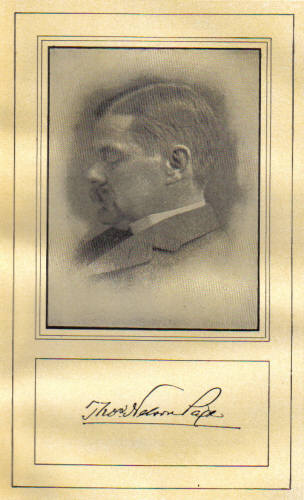
"Ain' you hongry?" she
inquired.
"What you got?"
"I jes gwine kill a chicken for
you."
It was her nearest approach to tenderness, and he knew it was a
mark of special attention, for all the chickens and eggs had for the past three
years gone to swell the fund which was to buy the home, and it was only on
special occasions that one was spared for food.
The news that he was to
be turned out of his home had fallen on him like a blow, and had stunned him;
he could make no resistance, he could form no plans. He went into a rough
estimate as he waited.
"Le' me see: I done wuck for it three years dis
Christmas done gone; how much does dat meek?"
"An' fo' dollars, an' five
dollars, an' two dollars an' a half last Christmas from de chickens, an' all
dem ducks I done sell he wife, an' de washin' I been doin' for 'em; how much is
dat?" supplemented his wife.
"Dat's what I say!"
His wife
endeavored vainly to remember the amount she had been told it was; but the
unaccounted-for washing changed the sum and destroyed her reliance on the
result. And as the chicken was now approaching perfection, and required her
undivided attention, she gave up the arithmetic and applied herself to her
culinary duties.
Ephraim also abandoned the attempt, and waited in a
reverie, in which he saw corn stand so high and rank over his land that he
could scarcely distinguish the bulk, and a stable and barn and a mule, or maybe
two—it was a possibility—and two cows which his wife would milk,
and a green wagon driven by his boys, while he took it easy and gave orders
like a master, and a clover patch, and wheat, and he saw the' yellow grain
waving, and heard his sons sing the old harvest song of "Cool Water" while they
swung their cradles, and—
"You say he gwine turn Ole 'Stracted
out, too?" inquired his wife, breaking the spell. The chicken was done now, and
her mind reverted to the all-engrossing subject.
"Yes; say he tired o'
ole 'stracted nigger livin' on he place an' payin' no rent."
"Good Gord
A'mighty! Pay rent for dat ole pile o' logs! Ain't he been mendin' he shoes an'
harness for rent all dese years?"
"'Twill kill dat ole man to tu'n him
out dat house," said Ephraim; "he ain 'nuver stay away from dyah a hour since
he come heah."
"Sutny 'twill," assented his wife; then she added, in
reply to the rest of the remark, "Nuver min'; den we'll see what he got in
dyah." To a woman, that was at least some compensation. Ephraim's thoughts had
taken a new direction.
"He al'ays feared he marster'd come for him while
he 'way," he said, in mere continuance of his last remark.
"He sen' me
wud he marster comin' to-night, an he want he shut," said his wife, as she
handed him his supper. Ephraim's face expressed more than interest; it was
tenderness which softened the rugged lines as he sat looking into the fire.
Perhaps he thought of the old man's loneliness, and of his own father torn away
and sold so long ago, before he could even remember, and perhaps very dimly of
the beauty of the sublime devotion of this poor old creature to his love and
his trust, holding steadfast beyond memory, beyond reason, after the knowledge
even of his own identity and of his very name was lost.
The woman caught
the contagion of his sympathy.
"De chil'n say he mighty comical, an' he
layin' down in de baid," she said.
Ephraim rose from his
seat.
"Whar you gwine?"
"I mus' go to see 'bout him," he said,
simply.
"Ain' you gwine finish eatin'?"
"I gwine kyar dis to
him."
"Well, I kin cook you anurr when we come back," said his wife,
with ready acquiescence.
In a few minutes they were on the way, going
single file down the path through the sassafras, along which little Eph and his
followers had come an hour before, the man in the lead and his wife following,
and, according to the custom of their race, carrying the bundles, one the
surrendered supper and the other the neatly folded and well-patched shirt in
which Ole 'Stracted hoped to meet his long-expected loved ones.
As they
came in sight of the ruinous little hut which had been the old man's abode
since his sudden appearance in the neighborhood a few years after the war, they
observed that the bench beside the door was deserted, and that the door stood
ajar—two circumstances which neither of them remembered ever to have seen
before; for in all the years in which he had been their neighbor Ole 'Stracted
had never admitted any one within his door, and had never been known to leave
it open. In mild weather he occupied a bench outside, where he either cobbled
shoes for his neighbors, accepting without question anything they paid him, or
else sat perfectly quiet, with the air of a person waiting for some one. He
held only the briefest communication with anybody, and was believed by some to
have intimate relations with the Evil One, and his tumble-down hut, which he
was particular to keep closely daubed, was thought by such as took this view of
the matter to be the temple where he practiced his unholy rites. For this
reason, and because the little cabin, surrounded by dense pines and covered
with vines which the popular belief held "pizenous," was the most desolate
abode a human being could have selected, most of the dwellers in that section
gave the place a wide berth, especially toward nightfall, and Ole 'Stracted
would probably have suffered but for the charity of Ephraim and his wife, who,
although often wanting the necessaries of life themselves, had long divided it
with their strange neighbor. Yet even they had never been admitted inside his
door, and knew no more of him than the other people about the settlement
knew.
His advent in the neighborhood had been mysterious. The first that
was known of him was one summer morning, when he was found sitting on the bench
beside the door of this cabin, which had long been unoccupied and left to
decay. He was unable to give any account of himself, except that he always
declared that he had been sold by some one other than his master from that
plantation, that his wife and boy had been sold to some other person at the
same time for twelve hundred dollars (he was particular as to the amount), and
that his master was coming in the summer to buy him back and take him home, and
would bring him his wife and child when he came. Everything since that day was
a blank to him, and as he could not tell the name of his master or wife, or
even his own name, and as no one was left old enough to remember him, the
neighborhood having been entirely deserted after the war, he simply passed as a
harmless old lunatic laboring under a delusion. He was devoted to children, and
Ephraim's small brood were his chief delight. They were not at all afraid of
him, and whenever they got a chance they would slip off and steal down to his
house, where they might be found any time squatting about his feet, listening
to his accounts of his expected visit from his master, and what he was going to
do afterward. It was all of a great plantation, and fine carriages and horses,
and a house with his wife and the boy.
This was all that was known of
him, except that once a stranger, passing through the country, and hearing the
name Ole 'Stracted, said that he heard a similar one once, long before the war,
in one of the Louisiana parishes, where the man roamed at will, having been
bought of the trader by the gentleman who owned him, for a small price, on
account of his infirmity.
"Is you gwine in dyah?" asked the woman, as
they approached the hut.
"Hi! yes; 'tain' nuttin' gwine hu't you; an'
you say Ephum say he be layin' in de baid?" he replied, his mind having
evidently been busy on the subject.
"An' mighty comical," she corrected
him, with exactness born of apprehension.
"Well? I 'feared he
sick."
"I ain' nuver been in dyah," she persisted.
"Ain' de
chil'n been in dyah?"
"Dee say 'stracted folks oon hu't
chil'n."
"Dat ole man oon hu't nobody; he jes tame as a ole
tomcat."
"I wonder he ain' feared to live in dat lonesome ole house by
hisself. I jes lieve stay in a graveyard at once. I ain' wonder folks say he
sees sperrits in dat hanty-lookin' place." She came up by her husband's side at
the suggestion. "I wonder he don' go home."
"Whar he got any home to go
to sep heaven?" said Ephraim.
"What was you mammy name,
Ephum?"
"Mymy," said he, simply.
They were at the cabin now, and
a brief pause of doubt ensued. It was perfectly dark inside the door, and there
was not a sound. The bench where they had heretofore held their only
communication with their strange neighbor was lying on its side in the weeds
which grew up to the very walls of the ruinous cabin, and a lizard suddenly ran
over it, and with a little rustle disappeared under the rotting ground-sill. To
the woman it was an ill omen. She glanced furtively behind her, and moved
nearer her husband's side. She noticed that the cloud above the pines was
getting a faint yellow tinge on its lower border, while it was very black above
them. It filled her with dread, and she was about to call her husband's notice
to it, when a voice within arrested their attention. It was very low, and they
both listened in awed silence, watching the door meanwhile as if they expected
to see something supernatural spring from it.
"Nem min'—jes
wait—'tain so long now—he'll be heah torectly," said the voice.
"Dat's what he say—gwine come an' buy me back—den we gwine
home."
In their endeavor to catch the words they moved nearer, and made
a slight noise. Suddenly the low, earnest tone changed to one full of
eagerness.
"Who dat?" was called in sharp inquiry.
"'Tain' nobody
but me an' Polly, Ole 'Stracted," said Ephraim, pushing the door slightly wider
open and stepping in. They had an indistinct idea that the poor deluded
creature had fancied them his longed-for loved ones, yet it was a relief to see
him bodily.
"Who you say you is?" inquired the old man,
feebly.
"Me an' Polly."
"I done bring you shut home," said the
woman, as if supplementing her husband's reply. "Hit all bran' clean, an' I
done patch it."
"Oh, I thought—" said the voice,
sadly.
They knew what he thought. Their eyes were now accustomed to the
darkness, and they saw that the only article of furniture which the room
contained was the wretched bed or bench on which the old man was stretched. The
light sifting through the chinks in the roof enabled them to see his face, and
that it had changed much in the last twenty-four hours, and an instinct told
them that he was near the end of his long waiting.
"How is you, Ole
'Stracted?" asked the woman.
"Dat ain' my name," answered the old man,
promptly. It was the first time he had ever disowned the name.
"Well,
how is you, Ole—What I gwine to call you?" asked she, with feeble
finesse.
"I don' know—he kin tell you."
"Who?"
"Who?
Marster. He know it. Ole 'Stracted ain' know it; but dat ain' nuttin. He
know it—got it set down in de book. I jes waitin' for 'em now."
A
hush fell on the little audience—they were in full sympathy with him,
and, knowing no way of expressing it, kept silence. Only the breathing of the
old man was audible in the room. He was evidently nearing the end. "I mighty
tired of waitin'," he said, pathetically. "Look out dyah and see ef you see
anybody," he added suddenly.
Both of them obeyed, and then returned and
stood silent; they could not tell him no.
Presently the woman said,
"Don' you warn put you' shut on?"
"What did you say my name was?" he
said.
"Ole 'Str—" She paused at the look of pain on his face,
shifted uneasily from one foot to the other, and relapsed into embarrassed
silence.
"Nem min'! dee'll know it—dee'll know me 'dout any name,
oon dee?" He appealed wistfully to them both. The woman for answer unfolded the
shirt. He moved feebly, as if in assent.
"I so tired waitin'," he
whispered; "done 'mos gin out, an' he oon come; but I thought I heah little Eph
to-day?" There was a faint inquiry in his voice.
"Yes, he wuz
heah."
"Wuz he?" The languid form became instantly alert, the tired face
took on a look of eager expectancy. "Heah, gi'm'y shut quick. I knowed it.
Wait; go over dyah, son, and git me dat money. He'll be heah torectly." They
thought his mind wandered, and merely followed the direction of his eyes with
theirs. "Go over dyah quick—don't you heah me?"
And to humor him
Ephraim went over to the corner indicated.
"Retch up dyah, an' run you'
hand in onder de second jice. It's all in dyah," he said to the
woman—"twelve hunderd dollars—dat's what dee went for. I wucked
night an' day forty year to save dat money for marster; you know dee teck all
he land an' all he niggers an' tu'n him out in de old fiel'? I put 'tin dyah
'ginst he come. You ain' know he comin' dis evenin', is you? Heah, help me on
wid dat shut, gal—I stan'in' heah talkin' an' maybe ole marster waitin'.
Push de do' open so you kin see. Forty year ago," he murmured, as Polly jammed
the door back and returned to his side—"forty year ago dee come an'
leveled on me: marster sutny did cry. 'Nem min',' he said, 'I comin' right down
in de summer to buy you back an' bring you home.' He's comin', too—nuver
tol' me a lie in he life—comin' dis evenin.' Make 'aste." This in
tremulous eagerness to the woman, who had involuntarily caught the feeling, and
was now with eager and ineffectual haste trying to button his shirt.
An
exclamation from her husband caused her to turn around, as he stepped into the
light and held up an old sock filled with something.
"Heah, hoi you'
apron," said the old man to Polly, who gathered up the lower corners of her
apron and stood nearer the bed.
"Po' it in dyah." This to Ephraim, who
mechanically obeyed. He pulled off the string, and poured into his wife's lap
the heap of glittering coin—gold and silver more than their eyes had ever
seen before.
"Hit's all dyah," said the old man, confidentially, as if
he were rendering an account. "I been savin' it ever sence dee took me 'way. I
so busy savin' it I ain' had time to eat, but I ain' hongry now; have plenty
when I git home." He sank back exhausted. "Oon marster be glad to see me?" he
asked presently in pathetic simplicity. "You know we grewed up to-gerr? I been
waitin' so long I 'feared dee 'mos' done forgit me. You reckon dee is?" he
asked the woman, appealingly.
"No, suh, dee ain' forgit you," she said,
comfortingly.
"I know dee ain'," he said, reassured. "Dat's what he tell
me—he ain' nuver gwine forgit me." The reaction had set in, and his voice
was so feeble now it was scarcely audible. He was talking rather to himself
than to them, and finally he sank into a doze. A painful silence reigned in the
little hut, in which the only sign was the breathing of the dying man. A single
shaft of light stole down under the edge of the slowly passing cloud and
slipped up to the door. Suddenly the sleeper waked with a start, and gazed
around.
"Hit gittin' mighty dark," he whispered, faintly. "You reckon
dee'll git heah 'fo' dark?"
The light was dying from his
eyes.
"Ephum," said the woman, softly, to her husband.
The effect
was electrical.
"Heish! you heah dat!" exclaimed the dying man,
eagerly.
"Ephum"—she repeated. The rest was drowned by Ole
'Stracted's joyous exclamation.
"Gord! I knowed it!" he cried, suddenly
rising upright, and, with beaming face, stretching both arms toward the door.
"Dyah dee come! Now watch 'em smile. All y'all jes stand back. Heah de one you
lookin' for. Marster—Mymy—heah's Little Ephum!" And with a smile on
his face he sank back into his son's arms.
The evening sun, dropping on
the instant to his setting, flooded the room with light; but as Ephraim gently
eased him down and drew his arm from around him, it was the light of the
unending morning that was on his face. His Master had at last come for him, and
after his long waiting, Ole 'Stracted had indeed gone home.
Frederic Jesup Stimson is a prominent lawyer of Boston. He is a member of the New York and Boston bars and is a special lecturer at Harvard. He has been more or less identified with State politics in Massachusetts for a great many years, was Assistant Attorney-General of the State in 1884-85, general counsel to the United States Industrial Commission, and Democratic candidate for Congress in 1902. In addition to being the author of several novels, essays, etc., Mr. Stimson has written a number of law books. His earlier novels were published under the pen-name of "J. S. of Dale." Mr. Stimsorfs latest novel is entitled "In Cure of Her Soul". The hero of the story, Austin Pinckney, is a son of the "Consul at Carlsruhe."
OUR CONSUL AT
CARLSRUHE
BY F. J. STIMSON ("J. S. OF DALE")
[Footnote:
By permission of the publishers, from "The Sentimental Calendar," by J. S. of
Dale (F. J. Stimson). Copyright, 1886, by Charles Scribner's
Sons.]
DIED.—In Baden, Germany,
the 22d instant, Charles Austin Pinckney, late U. S. Consul at Carlsruhe, aged
sixty years.
There: most stories of men's lives end with the
epitaph, but this of Pinckney's shall begin there. If we, as haply God or Devil
can, could unroof the houses of men's souls, if their visible works were of
their hearts rather than their brains, we should know strange things. And this
alone, of all the possible, is certain. For bethink you, how men appear to
their Creator, as He looks down into the soul, that matrix of their visible
lives we find so hard to localize and yet so sure to be. For all of us believe
in self, and few of us but are forced, one way or another, to grant existence
to some selves outside of us. Can you not fancy that men's souls, like their
farms, would show here a patch of grain, and there the tares; there the weeds
and here the sowing; over this place the rain has been, and that other, to one
looking down upon it from afar, seems brown and desolate, wasted by fire or
made arid by the drought? In this man's life is a poor beginning, but a better
end; in this other's we see the foundations, the staging, and the schemes of
mighty structures, now stopped, given over, or abandoned; of vessels, fashioned
for the world's seas, now rotting on the stocks. Of this one all seems ready
but the launching, of that the large keelson only has been laid; but both alike
have died unborn, and the rain falls upon them, and the mosses grow: the sound
of labor is far off, and the scene of work is silent. Small laws make great
changes; slight differences of adjustment end quick in death. Small, now, they
would seem to us; but to the infinite mind all things small and great are
alike; the spore of rust in the ear is very slight, but a famine in the corn
will shake the world.
Pinckney's life the world called lazy; his leisure
was not fruitful, and his sixty years of life were but a gentleman's. Some
slight lesion may have caused paralysis of energy, some clot of heart's blood
pressed upon the soul: I make no doubt our doctors could diagnose it, if they
knew a little more. Tall and slender, he had a strange face, a face with a
young man's beauty; his white hair gave a charm to the rare smile, like new
snow to the spring, and the slight stoop with which he walked was but a grace
the more. In short, Pinckney was interesting. Women raved about him; young men
fell in love with him; and if he was selfish, the fault lay between him and his
Maker, not visible to other men. There are three things that make a man
interesting in his old age: the first, being heroism, we may put aside; but the
other two are regret and remorse. Now, Mr. Pinckney's fragrance was not of
remorse—women and young men would have called it heroism: it may have
been. As much heroism as could be practiced in thirty-six years of
Carlsruhe.
Why Carlsruhe? That was the keynote of inquiry; and no one
knew. Old men spoke unctuously of youthful scandals; women dreamed. I suspect
even Mrs. Pinckney wondered, about as much as the plowed field may wonder at
the silence of the autumn. But Pinckney limped gracefully about the sleepy
avenues which converge at the Grand Duke's palace, like a wakeful page in the
castle of the Sleeping Beauty. Pinckney was a friend of the Grand Duke's, and
perhaps it was a certain American flavor persisting in his manners which made
him seem the only man at the Baden court who met his arch-serene altitude on
equal terms. For one who had done nothing and possessed little, Pinckney
certainly preserved a marvelous personal dignity. His four daughters were all
married to scions of Teutonic nobility; and each one in turn had asked him for
the Pinckney arms, and quartered them into the appropriate check-square with as
much grave satisfaction as he felt for the far-off patch of Hohenzollern, or of
Hapsburg in sinister chief. Pinckney had laughed at it and referred them to the
Declaration of Independence, clause the first; but his wife had copied them
from some spoon or sugar bowl. She was very fond of Pinckney, and no more
questioned him why they always lived in Carlsruhe than a Persian would the sun
for rising east. Now and then they went to Baden, and her cup was
full.
Pinckney died of a cold, unostentatiously, and was buried like a
gentleman; though the Grand Duke ac tually wanted to put the court in mourning
for three days, and consulted with his chamberlain whether it would do. Mrs.
Pinckney had preceded him by some six years; but she was an appendage, and her
husband's deference had always seemed in Carlsruhe a trifle strained. It was
only in these last six years that any one had gossiped of remorse, in answer to
the sphinx-like question of his marble brow. Such questions vex the curious.
Furrows trouble nobody—money matters are enough f them; but white
smoothness in old age is a bait, and tickles curiosity. Some said at home he
was a devil and beat his wife.
But Pinckney never beat his wife. Late in
the last twilight of her life she had called him to her, and excluded even the
four daughters, with their stout and splendid barons; then, alone with him, she
looked to him and smiled. And suddenly his gentleman's heart took a jump, and
the tears fell on her still soft hands. I suppose some old road was opened
again in the gray matter of his brain. Mrs. Pinckney smiled the more strongly
and said—not quite so terribly as Mrs. Amos Barton: "Have I made you
happy, dearest Charles?" And Charles, the perfect-mannered, said she had; but
said it stammering. "Then," said she, "I die very happily, dear." And she did;
and Pinckney continued to live at Carlsruhe.
The only activities of
Pinckney's mind were critical. He was a wonderful orator, but he rarely spoke.
People said he could have been a great writer, but he never wrote, at least
nothing original. He was the art and continental-drama critic of several
English and American reviews; in music, he was a Wagnerian, which debarred him
from writing of it except in German; but the little Court Theatre at Carlsruhe
has Wagner's portrait over the drop-curtain, and the consul's box was never
empty when the mighty heathen legends were declaimed or the holy music of the
Grail was sung. In fiction of the earnest sort, and poetry, Pinckney's critical
pen showed a marvelous magic, striking the scant springs of the author's
inspiration through the most rocky ground of incident or style. He had a
curious sympathy with youthful tenderness. But, after all, as every young
compatriot who went to Baden said, what the deuce and all did he live in Baden
for? Miles Breeze had said it in 'Fifty, when he made the grand tour with his
young wife, and dined with him in Baden-Baden; that is, when Breeze dined with
him, for his young wife was indisposed and could not go. Miles Breeze, junior,
had said it, as late as 'Seventy-six, when he went abroad, ostensibly for
instruction, after leaving college. He had letters to Mr. Pinckney, who was
very kind to the young Baltimorean, and greatly troubled the Grand Duke his
Serenity by presenting him as a relative of the Bonapartes. Many another
American had said it, and even some leading politicians: he might have held
office at home: but Pinckney continued to live in Carlsruhe.
His
critical faculties seemed sharpened after his wife's death, as his hair grew
whiter; and if you remember how he looked before you must have noticed that the
greatest change was in the expression of his face. There was one faint downward
line at either side of his mouth, and the counterpart at the eyes; n doubtful
line which, faint as it was graven, gave a strange amount of shading to the
face. And in speaking of him still earlier, you must remember to take your
india-rubber and rub out this line from his face. This done, the face is still
serious; but it has a certain light, a certain air of confidence, of
determination, regretful though it be, which makes it loved by women. Women can
love a desperate, but never begin to love a beaten, cause. Women fell in love
with Pinckney, for the lightning does strike twice in the same place; but his
race was rather that of Lohengrin than of the Asra, and he saw it, or seemed to
see it, not. Still, in these times those downward lines had not come, and there
was a certain sober light in his face as of a sorrowful triumph. This was in
the epoch of his greatest interestingness to women.
When he first came
to Carlsruhe, he was simply the new consul, nothing more; a handsome young man,
almost in his honeymoon, with a young and pretty wife. He had less presence in
those days, and seemed absorbed in his new home, or deeply sunk in something;
people at first fancied he was a poet, meditating a great work, which finished,
he would soon leave Carlsruhe. He never was seen to look at a woman, not
overmuch at his wife, and was not yet popular in society.
But it was
true that he was newly married. He was married in Boston, in 'Forty-three or
four, to Emily Austin, a far-off cousin of his, whom he had known (he himself
was a Carolinian) during his four years at Cambridge. For his four years in
Cambridge were succeeded by two more at the Law School; then he won a great
case against Mr. Choate, and was narrowly beaten in an election for Congress;
after that it surprised no one to hear the announcement of his engagement to
Miss Austin, for his family was unexceptionable and he had a brilliant future.
The marriage came in the fall, rather sooner than people expected, at King's
Chapel. They went abroad, as was natural; and then he surprised his friends and
hers by accepting his consulship and staying there. And they were
imperceptibly, gradually, slowly, and utterly forgotten.
The engagement
came out in the spring of 'Forty-three. And in June of that year young Pinckney
had gone to visit his fiancée at Newport. Had you seen him there, you
would have seen him in perhaps the brightest role that fate has yet permitted
on this world's stage. A young man, a lover, rich, gifted, and ambitious, of
social position unquestioned in South Carolina and the old Bay State—all
the world loved him, as a lover; the many envied him, the upper few desired
him. Handsome he has always remained.
And the world did look to him as
bright as he to the world. He was in love, as he told himself, and Miss Austin
was a lovable girl; and the other things he was dimly conscious of; and he had
a long vacation ahead of him, and was to be married late in the autumn, and he
walked up from the wharf in Newport swinging his cane and thinking on these
pleasant things.
Newport, in those days, was not the paradise of
cottages and curricles, of lawns and laces, of new New Yorkers and Nevada
miners; it was the time of big hotels and balls, of Southern planters, of
Jullien's orchestras, and of hotel hops; such a barbarous time as the wandering
New Yorker still may find, lingering on the simple shores of Maine, sunning in
the verdant valleys of the Green Mountains; in short, it was Arcadia, not
Belgravia. And you must remember that Pinckney, who was dressed in the latest
style, wore a blue broadcloth frock coat, cut very low and tight in the waist,
with a coat-collar rolling back to reveal a vast expanse of shirt-bosom,
surmounted by a cravat of awful splendor, bow-knotted and blue-fringed. His
trousers were of white duck, his boots lacquered, and he carried a gold-tipped
cane in his hand. So he walked up the narrow old streets from the wharf, making
a sunshine in those shady places. It was the hottest hour of a midsummer
afternoon; not a soul was stirring, and Pinckney was left to his own pleasant
meditations.
He got up the hill and turned into the park by the old
mill; over opposite was the great hotel, its piazzas deserted, silent even to
the hotel band. But one flutter of a white dress he saw beneath the trees, and
then it disappeared behind them, causing Pinckney to quicken his steps. He
thought he knew the shape and motion, and he followed it until he came upon it
suddenly, behind the trees, and it turned.
A young girl of wonderful
beauty, rare, erect carriage, and eyes of a strange, violet-gray, full of much
meaning. This was all Pinckney had time to note; it was no one he had ever seen
before. He had gone up like a hunter, sure of his game, and too far in it to
retract. The embarrassment of the situation was such that Pinckney forgot all
his cleverness of manner, and blurted out the truth like any
schoolboy.
"I beg pardon—I was looking for Miss Austin," said he;
and he raised his hat.
A delightful smile of merriment curled the
beauty's lips. "My acquaintance with Miss Austin is too slight to justify my
finding her for you; but I wish you all success in your efforts," she said, and
vanished, leaving the promising young lawyer to blush at his own awkwardness
and wonder who she was. As she disappeared, he only saw that her hair was a
lustrous coil of pale gold-brown, borne proudly.
He soon found Emily
Austin, and forgot the beauty, as he gave his betrothed a kiss and saw her
color heighten; and in the afternoon they took a long drive. It was only at
tea, as he was sitting at table with the Austins in the long dining-room, that
some one walked in like a goddess; and it was she. He asked her name; and they
told him it was a Miss Warfield, of Baltimore, and she was engaged to a Mr.
Breeze.
In the evening there was a ball; and as they were dancing (for
every one danced in those days) he saw her again, sitting alone this time and
unattended. She was looking eagerly across the room, through the dancers and
beyond; and in her eyes was the deepest look of sadness Pinckney had ever seen
in a girl's face; a look such as he had thought no girl could feel. A moment
after, and it was gone, as some one spoke to her; and Pinckney wondered if he
had not been mistaken, so fleeting was it, and so strange. An
acquaintance—one of those men who delight to act as brokers of
acquaintances—who had noticed his gaze came up. "That is the famous Miss
Mary Warfield," said he. "Shall I not introduce you?"
"No," said
Pinckney; and he turned away rudely. To be rude when you like is perhaps one of
the choicest prerogatives of a good social position. The acquaintance stared
after him, as he went back to Miss Austin, and then went up and spoke to Miss
Warfield himself. A moment after, Pinckney saw her look over at him with some
interest; and he wondered if the man had been ass enough to tell her. Pinckney
was sitting withlimily Austin; and, after another moment, he saw Miss Warfield
look at her. Then her glance seemed to lose its interest; her eyelids drooped,
and Pinckney could see, from her interlocutor's mantief^ that he was put to his
trumps to keep her attention. At last he got away, awkwardly; and for many
minutes the strange girl sat like a statue, her long lashes just veiling her
eyes, so that Pinckney, from a distance, could not see what was in them.
Suddenly the veil was drawn and her eyes shone full upon him, her look meeting
his. Pinckney's glance fell, and his cheeks grew redder. Miss Warfield's face
did not change, but she rose and walked unattended through the centre of the
ballroom to the door. Pinckney's seat was nearer it than hers; she passed him
as if without seeing him, moving with unconscious grace, though it would not
have been the custom at that time for a girl to cross so large a room alone.
Just then some one asked Miss Austin for a dance; and Pinckney, who was growing
weary of it, went out on the piazza for a cigar, and then, attracted by the
beauty of the night, strayed further than he knew, alone, along the cliffs
above the sea.
The next day he was walking with Miss Austin, and they
passed her, in her riding habit, waiting by the mounting stone; she bowed to
Miss Austin alone, leaving him out, as it seemed to Pinckney, with exaggerated
care.
"Is she not beautiful?" said Emily, ardently.
"Humph!" said
Pinckney. A short time after, as they were driving on the road to the Fort, he
saw her again; she was riding alone, across country, through the rocky knolls
and marshy pools that form the southern part of Rhode Island. She had no groom
lagging behind, but it was not so necessary then as now; and, indeed, a groom
would have had a hard time to keep up with her, as she rattled up the granite
slopes and down over logs and bushes with her bright bay horse. The last
Pinckney saw of her she disappeared over a rocky hill against the sky; her
beautiful horse flecked with foam, quivering with happy animal life, and the
girl calm as a figure carved in stone, with but the faintest touch of rose upon
her face, as the pure profile was outlined one moment against the sunlit
blue.
"How recklessly she rides!" whispered Miss Austin to him, and
Pinckney said yes, absently, and, whipping up his horse, drove on,
pretending to listen to his fiancée's talk. It seemed to be about dresses, and
rings, and a coming visit to the B———s, at Nahant. He had
never seen a girl like her before; she was a puzzle to him.
"It is a
great pity she is engaged to Mr. Breeze," said Miss Austin; and Pinckney woke
up with a start, for he was thinking of Miss Warneld too.
"Why?" said
he.
"I don't like him," said Emily. "He isn't good enough for
her."
As this is a thing that women say of all wooers after they have
won, and which the winner is usually at that period the first to admit,
Pinckney paid little attention to this remark. But that evening he met Miles
Breeze, saw him, talked with him, and heard others talk of him. A handsome man,
physically; well made, well dressed, well fed; well bred, as breeding goes in
dogs or horses; a good shot, a good sportsman, yachtsman, story-teller; a good
fellow, with a weak mouth; a man of good old Maryland blood, yet red and
healthy, who had come there in his yacht and had his horses sent by sea. A
well-appointed man, in short; provided amply with the conveniences of
fashionable life. A man of good family, good fortune, good health, good sense,
good nature, whom it were hypercritical to charge with lack of soul. "The first
duty of a gentleman is to be a good animal," and Miles Breeze performed it
thoroughly. Pinckney liked him, and he could have been his companion for years
and still have liked him, except as a husband for Miss Warfield.
He
could not but recognize his excellence as a parti. But the race of Joan
of Arc does not mate with Bon-homme Richard, even when he owns the next farm.
Pinckney used to watch the crease of Breeze's neck, above the collar, and
curse.
Coming upon Miss Austin one morning, she had said, "Come—I
want to introduce you to Miss War-field." Pinckney had demurred, and offered as
an excuse that he was smoking. "Nonsense, Charles," said the girl; "I have told
her you are coming." Pinckney threw away his cigar and followed, and the
presentation was made. Miss Warfield drew herself almost unusually erect after
courtesying, as if in protest at having to bow at all. She was so tall that, as
Emily stood between them, he could meet Miss War-field's iron-gray eyes above
her head. It was the first time in Pinckney's life that he had consciously not
known what to say.
"I was so anxious to have you meet Charles before he
left," said Emily. Evidently, his fiancée had been expatiating upon him to this
new friend, and if there is anything that puts a man in a foolish position it
is to have this sort of preamble precede an acquaintance.
"An anxiety I
duly shared, Miss Warfield, I assure you," said he; which was a truth spoiled
in the uttering—what the conversational Frenchman terms
banale.
"Thank you," said Miss Warfield, very simply and
tremendously effectively. Pinckney, for the second time with this young lady,
felt himself a schoolboy. Emily interposed some feeble commonplaces, and then,
after a moment, Miss Warfield said, "I must go for my ride"; and she left, with
a smile for Emily and the faintest possible glance for him. She went off with
Breeze; and it gave Pinckney some relief to see that she seemed equally to
ignore the presence of the man who was her acknowledged lover, as he trotted on
a smart cob beside her. That evening, when he went on the piazza, after tea, he
found her sitting alone, in one corner, with her hands folded: it was one
peculiarity about this woman that she was never seen with work. She made no
sign of recognition as he approached; but, none the less, he took the chair
that was beside her and waited a moment for her to speak. "Have you found Miss
Austin?" said the beauty, with the faintest trace of malice in her coldly
modulated tones, not looking at him. "I am not looking for Miss Austin," said
he; and she continued not looking at him, and so this strange pair sat there in
the twilight, silent.
What was said between them I do not know. But in
some way or other their minds met; for long after Miss Austin and her mother
had returned from some call, long after they had all left him, Pinckney
continued to pace up and down restlessly in the dark. Pinckney had never seen a
woman like this. After all, he was very young; and he had, in his heart,
supposed that the doubts and delights of his soul were peculiar to men alone.
He thought all women—at all events, all young and worthy
women—regarded life and its accepted forms as an accomplished fact, not
to be questioned, and, indeed, too delightful to need it. The young South
Carolinian, in his ambitions, in his heart-longings and heart-sickenings, in
his poetry, even in his emotions, had always been lonely; so that his
loneliness had grown to seem to him as merely part of the day's work. The best
women, he knew, where the best housewives; they were a rest and a benefit for
the war-weary man, much as might be a pretty child, a bed of flowers, a strain
of music. With Emily Austin he should find all this; and he loved her as good,
pretty, amiable, perfect in her way. But now, with Miss Warfield—it had
seemed that he was not even lonely.
Pinckney did not see her again for a
week. When he met her, he avoided her; she certainly avoided him. Breeze,
meantime, gave a dinner. He gave it on his yacht, and gave it to men alone.
Pinckney was of the number.
The next day there was a driving party; it
was to drive out of town to Purgatory, a pretty place, where there is a brook
in a deep ravine with a verdant meadow-floor; and there they were to take food
and drink, as is the way of humanity in pretty places. Now it so happened that
the Austins, Miss Warfield, Breeze, and Pinckney were going to drive in a
party, the Austins and Miss Warfield having carriages of their own; but at the
last moment Breeze did not appear, and Emily Austin was incapacitated by a
headache. She insisted, as is the way of loving women, that "Charles should not
lose it"; for to her it was one of life's pleasures, and such pleasures
satisfied her soul. (It may be that she gave more of her soul to life's duties
than did Charles, and life's pleasures were thus adequate to the remainder; I
do not know.) Probably Miles Breeze also had a headache; at all events, he did
not, at the last moment, appear. It was supposable that he would turn up at the
picnic; Mrs. Austin joined her daughter's entreaty; Miss Warfield was left
unattended; in fine, Pinckney went with her.
Miss Warfield had a solid
little phaeton with two stout ponies: she drove herself. For some time they
were silent; then, insensibly, Pinckney began to talk and she to answer. What
they said I need not say —indeed I could not, for Pinckney was a poet, a
man of rare intellect and imagination, and Miss Warfield was a woman of this
world and the next; a woman who used conventions as another might use a fan,
to' screen her from fools; whose views were based on the ultimate. But they
talked of the world, and of life in it; and when it came to an end, Pinckney
noted to himself this strange thing, that they had both talked as of an
intellectual problem, no longer concerning their emotions—in short, as if
this life were at an end, and they were two dead people discussing
it.
So they arrived at the picnic, silent; and the people assembled
looked to one another and smiled, and said to one another how glum those two
engaged people looked, being together, and each wanting another. Mr. Breeze had
not yet come; and as the people scattered while the luncheon was being
prepared, Pinckney and she wandered off like the others. They went some
distance—perhaps a mile or more—aimlessly; and then, as they seemed
to have come about to the end of the valley, Pinckney sat down upon a rock, but
she did not do so, but remained standing. Hardly a word had so far been said
between them: and then Pinckney looked at her and said:
"Why are you
going to marry Mr. Breeze?"
"Why not?"—listlessly.
"You
might as well throw yourself into the sea," said Pinckney; and he looked at the
sea which lay beyond them shimmering.
"That I had not thought of," said
she; and she looked at the sea herself with more interest. Pinckney drew a long
breath.
"But why this man?" he said at length.
"Why that man?"
said the woman; and her beautiful lip curled, with the humor of the mind, while
her eyes kept still the sadness of the heart, the look that he had seen in the
ballroom. "We are all poor," she added; then scornfully, "it is my duty to
marry."
"But Miles Breeze?" persisted Pinckney.
The lip curled
almost to a laugh. "I never met a better fellow than Miles," said she; and the
thought was so like his own of the night before that Pinckney gasped for
breath. They went back, and had chicken croquettes and champagne, and a band
that was hidden in the wood made some wild Spanish music.
Going home, a
curious thing happened. They had started first and far preceded all the others.
Miss Warfield was driving; and when they were again in the main road, not more
than a mile from the hotel, Pinckney saw ahead of them, coming in a light
trotting buggy of the sort that one associates with the gentry who call
themselves "sports," two of the gentlemen whom he had met at Breeze's dinner
the night before. Whether Miss Warfield also knew them he did not know; but
they evidently had more wine than was good for them, and were driving along in
a reckless manner on the wrong side of the road. The buggy was much too narrow
for the two; and the one that was driving leaned out toward them with a tipsy
leer. Pinckney shouted at him, but Miss War-field drove calmly on. He was on
the point of grasping the reins, but a look of hers withheld him, and he sat
still, wondering; and in a moment their small front wheel had crashed through
both the axles and spider-web wheels of the trotting buggy. The shock of the
second axle whirled them round, and Pinckney fell violently against the dasher,
while Miss Warfield was thrown clear of the phaeton on the outer side. But she
had kept the reins, and before Pinckney could get to her she was standing at
her horses' heads, patting their necks calmly, with a slight cut in her
forehead where she had fallen, and only her nostril quivering like theirs, as
the horses stood there trembling. The buggy was a wreck, and the horse had
disappeared; and the two men, sobered by the fall, came up humbly to her to
apologize. She heard them silently, with a pale face like some injured queen's;
and then, bowing to them their dismissal, motioned Pinckney into the phaeton,
which, though much broken, was still standing, and, getting in herself, drove
slowly home.
"She might have killed herself," thought Pinckney, but he
held his peace, as if it were the most natural course of action in the world.
To tell the truth, under the circumstances he might have done the same
alone.
Then it began. Pinckney could not keep this woman out of his
head. He would think of her at all times, alone and in company. Her face would
come to him in the loneliness of the sea, in the loneliness of crowds; the
strong spirit of the morning was hers, and the sadness of the sunset and the
wakeful watches of the night. Her face was in the clouds of evening, in the
sea-coal fire by night; her spirit in the dreams of summer morns, in the
hopeless breakers on the stormy shores, in the useless, endless effort of the
sea. Her eyes made some strange shining through his dreams; and he would wake
with a cry that she was going from him, in the deepest hours of the night, as
if in the dreams he had lost her, vanishing forever in the daily crowd. Then he
would lie awake until morning, and all the laws of God and men would seem like
cobwebs to his sorrow, and the power of it freezing in his heart. This was the
ultimate nature of his being, to follow her, as drop of water blends in drop of
water, as frost rends rock. Let him then follow out his law, as other beings do
theirs; gravitation has no conscience; should he be weaker than a drop of
water, because he was conscious, and a man?
So these early morning
battles would go on, and character, training, conscience, would go down before
the simpler force, like bands of man's upon essential nature. Then, with the
first ray of the dawn, he would think of Emily Austin, sleeping near him,
perhaps dreaming of him, and his mad visions seemed to fade; and he would rise
exhausted, and wander out among the fresh fields and green dewy lanes, and
calm, contentful trees, and be glad that these things were so; yet could these
not be moved, nor their destiny be changed. And as for him, what did it
matter?
So the days went by. And Emily Austin looked upon him with eyes
of limitless love and trust, and Pinckney did not dare to look upon himself;
but his mind judged by day-time and his heart strove by night. Hardly at all
had he spoken to Miss Warfield since; and no reference had ever been made
between them to the accident, or to the talk between them in the valley. Only
Pinckney knew that she was to be married very shortly; and he had urged Miss
Austin to hasten their own wedding.
Emily went off with her mother to
pay her last visit among the family, and to make her preparations; and it was
deemed proper that at this time Pinckney should not be with her. So he stayed
in Newport five long days alone; and during this time he never spoke to Miss
Warfield. I believe he tried not to look at her: she did not look at him. And
on the fifth night Pinckney swore that he must speak to her once more, whatever
happened.
In the morning there was talk of a sailing party; and Pinckney
noted Breeze busying himself about the arrangements. He waited; and at noon
Breeze came to him and said that there was a scarcity of men: would he go? Yes.
They had two sail-boats, and meant to land upon Conanicut, which was then a
barren island without a house, upon the southern end, where it stretches out to
sea.
Pinckney did not go in the same boat with Breeze and Miss Warfield;
and, landing, he spent the afternoon with others and saw nothing of her. But
after dinner was over, he spoke to her, inviting her to walk; and she came,
silently. A strange evening promenade that was: they took a path close on the
sheer brink of the cliffs, so narrow that one must go behind the other.
Pinckney had thought at first she might be frightened, with the rough path, and
the steepness of the rocks, and the breakers churning at their base; but he saw
that she was walking erect and fearlessly. Finally she motioned him to let her
go ahead; and she led the way, choosing indiscriminately the straightest path,
whether on the verge of the sea or leading through green meadows. A few
colorless remarks were made by him, and then he saw the folly of it, and they
walked in silence. After nearly an hour, she stopped.
"We must be
getting back," she said.
"Yes," said he, in the same tone; and they
turned; she still leading the way, while he followed silently. They were
walking toward the sunset; the sun was going down in a bank of dense gray
cloud, but its long, level rays came over to them, across a silent sea. She
walked on over the rugged cliff, like some siren, some genius of the place,
with a sure, proud grace of step; she never looked around, and his eyes were
fixed upon the black line of her figure, as it went before him, toward the gray
and blood-red sunset. It seemed to him this was the last hour of his life; and
even as he thought his ankle turned, and he stumbled and fell, walking
unwittingly into one of the chasms, where the line of the cliff turned in. He
grasped a knuckle of rock, and held his fall, just on the brink of a ledge
above the sea. Miss Warfield had turned quickly and seen it all; and she leaned
down over the brink, with one hand around the rock and the other extended to
help him, the ledge on which he lay being some six feet below. Pinckney grasped
her hand and kissed it.
Her color did not change at this; but, with a
strange strength in her beautiful lithe figure, she drew him up steadily, he
helping partly with the other hand, until his knees rested on the path again.
He stood up with some difficulty, as his ankle was badly wrenched.
"I am
afraid you can not walk," said she.
"Oh, yes," he answered; and took a
few steps to show her. The pain was great; but she walked on, and he followed,
as best he could, limping. She looked behind now, as if to encourage him; and
he set his teeth and smiled.
"We must not be late," she said. "It is
growing dark, and they will miss us."
But they did not miss them; for
when they got to the landing-place, both the sail-boats had left the shore
without them. There was nothing but the purple cloud-light left by this time;
but Pinckney fancied he could see her face grow pale for the first time that
day.
"We must get home," she said, hurriedly. "Is there no
boat?"
Pinckney pointed to a small dory on the beach, and then to the
sea. In the east was a black bank of cloud, rifted now and then by lightning;
and from it the wind came down and the white caps curled angrily toward
them.
"No matter," said she; "we must go."
Pinckney found a pair
of oars under the boat, and dragged it, with much labor, over the pebbles, she
helping him. The beach was steep and gravelly, with short breakers rather than
surf; and he got the bow well into the water and held it there.
"Get
in," said he.
Miss Warfield got into the stern, and Pinckney waded out,
dragging the flat-bottomed boat until it was well afloat. Then he sprang in
himself, and, grasping the oars, headed the boat for the Fort point across the
channel, three miles away. She sat silently in the stern, and it was too dark
for him to see her face. He rowed savagely.
But the wind was straight
ahead, and the sea increasing every moment. They were not, of course, exposed
to the full swell of the ocean; but the wide sea-channel was full of short,
fierce waves that struck the little skiff repeated rapid blows, and dashed the
spray over both of them.
"Are you not afraid?" said he, calmly. "It is
growing rougher every minute."
"Oh, no, Mr. Pinckney," said she. "Pray
keep on."
Pinckney noticed a tremor of excitement in her voice; but by a
flash of lightning that came just then he saw her deep eyes fixed on his, and
the pure white outline of her face undisturbed. So he rowed the harder, and she
took a board there was and tried to steer; and now and then, as the clouds were
lit, he saw her, like a fleeting vision in the night.
But the storm grew
stronger; and Pinckney knew the boat that they were in was not really moving at
all, though, of course, the swash of the waves went by and the drifted spray.
He tried to row harder, but with the pain in his ankle and the labor he was
nearly exhausted, and his heart jumped in his chest at each recover. "Can you
not make it?" said she, in the dark; and Pinckney vowed that he could, and set
his teeth for a mighty pull. The oar broke, and the boat's head fell rapidly
off in the trough of the sea. He quickly changed about his remaining oar, and
with it kept the head to the wind. "We must go back," he said, panting. "I
know," said she. The windstorm was fairly upon them; and, in spite of all his
efforts, an occasional wave would get upon the beam and spill its frothing
crest into the boat. Pinckney almost doubted whether it would float until it
reached the shore; but Miss Warfield did not seem in the least disturbed, and
spoke without a tremor in her voice. The lightning had stopped now, and he
could not see her.
He had miscalculated the force of the wind and waves,
however; for in a very minutes they were driven broadside back upon the beach,
almost at the same place from which they had started. Miss War-field sprang out
quickly, and he after, just as a wave turned the dory bottom upward on the
stones.
"They will soon send for us," he said; and stepping painfully up
the shore, he occupied himself with spreading her shawl in a sheltered spot for
them to wait in. She sat down, and he beside her. He was very wet, and she made
him put some of the shawl over himself. The quick summer storm had passed now,
with only a few big drops of rain; and the moon was breaking out fitfully
through veils of driving clouds and their storm-scud. By its light he looked at
her, and their eyes met. Pinckney groaned aloud, and stood up. "Would that they
would never come; would God that we could—"
"We can not," said
she, softly, in a voice that he had never heard from her before—a voice
with tears in it; and the man threw himself down at her feet, inarticulate,
maddened. Then, with a great effort at control, not touching her, but looking
straight into her eyes, he said, in blunt, low speech: "Miss Warfield, I love
you—do you know it?"
Her head sank slowly down; but she answered,
very low, but clearly, yes. Then their eyes met again; and, by some
common impulse, they rose and walked apart. After a few steps, he stopped,
being lame, and leaned against the cliff; but she went on until her dark figure
was blended with the shadows of the crags.
So, when the boat came back,
its sail silvered by the moonlight, they saw it, and, coming down, they met
again; but only as the party were landing on the beach. Several of the party
had come back; and Mr. Breeze, who was among them, was full of explanation how
he had missed the first boat and barely caught the second, supposing that his
fiancée was in the first. An awkward accident, but easily explained by
Pinckney, with the sprain in his ankle; and, indeed, the others were too full
of excuses for having forgotten them to inquire into the causes of their
absence together.
Pinckney went to his room, and had a night of
delirium. Toward morning, his troubled wakefulness ended, and he fell into a
dream. He dreamed that in the centre of the world was one green bower, beneath
a blossoming tree, and he and Miss Warfield were there. And the outer world was
being destroyed, one sphere by fire and the other by flood, and there was only
this bower left. But they could not stay there, or the tree would die. So they
went away, he to the one side and she to the other, and the ruins of the world
fell upon them, and they saw each other no more.
In the morning his
delirium left him, and his will resumed its sway. He went down, and out into
the green roads, and listened to the singing of the birds; and then out to the
cliff-path, and there he found Miss Warfield sitting as if she knew that he
would come. He watched her pure face while she spoke, and her gray eyes: the
clear light of the morning was in them, and on the gleaming sea
beyond.
"You must go," said she.
"Yes," he said, and that was
all. He took her hand for one moment, and lifted it lightly to his lips; then
he turned and took the path across the fields. When he got to the first stile,
he looked around. She was still sitting there, turned toward him. He lifted his
hat, and held it for a second or two; then he turned the corner of the hedge
and went down to the town.
Thus it happened that this story, which began
sadly, with an epitaph, may end with wedding bells:
MARRIED.At King's Chapel, by the Rev. Dr. A——,
the 21st of September, Charles Austin Pinckney to Emily, daughter of the late
James Austin.
END OF VOLUME TWO
End of Project Gutenberg's Short Story Classics (American) Vol. 2, by Various

*** END OF THIS PROJECT GUTENBERG EBOOK SHORT STORY CLASSICS ***

***** This file should be named 16556-h.htm or 16556-h.zip *****
This and all associated files of various formats will be found in:
        https://www.gutenberg.org/1/6/5/5/16556/

Produced by Michael Gray

Updated editions will replace the previous one--the old editions
will be renamed.

Creating the works from public domain print editions means that no
one owns a United States copyright in these works, so the Foundation
(and you!) can copy and distribute it in the United States without
permission and without paying copyright royalties.  Special rules,
set forth in the General Terms of Use part of this license, apply to
copying and distributing Project Gutenberg-tm electronic works to
protect the PROJECT GUTENBERG-tm concept and trademark.  Project
Gutenberg is a registered trademark, and may not be used if you
charge for the eBooks, unless you receive specific permission.  If you
do not charge anything for copies of this eBook, complying with the
rules is very easy.  You may use this eBook for nearly any purpose
such as creation of derivative works, reports, performances and
research.  They may be modified and printed and given away--you may do
practically ANYTHING with public domain eBooks.  Redistribution is
subject to the trademark license, especially commercial
redistribution.


*** START: FULL LICENSE ***

THE FULL PROJECT GUTENBERG LICENSE
PLEASE READ THIS BEFORE YOU DISTRIBUTE OR USE THIS WORK

To protect the Project Gutenberg-tm mission of promoting the free
distribution of electronic works, by using or distributing this work
(or any other work associated in any way with the phrase "Project
Gutenberg"), you agree to comply with all the terms of the Full Project
Gutenberg-tm License (available with this file or online at
https://gutenberg.org/license).


Section 1.  General Terms of Use and Redistributing Project Gutenberg-tm
electronic works

1.A.  By reading or using any part of this Project Gutenberg-tm
electronic work, you indicate that you have read, understand, agree to
and accept all the terms of this license and intellectual property
(trademark/copyright) agreement.  If you do not agree to abide by all
the terms of this agreement, you must cease using and return or destroy
all copies of Project Gutenberg-tm electronic works in your possession.
If you paid a fee for obtaining a copy of or access to a Project
Gutenberg-tm electronic work and you do not agree to be bound by the
terms of this agreement, you may obtain a refund from the person or
entity to whom you paid the fee as set forth in paragraph 1.E.8.

1.B.  "Project Gutenberg" is a registered trademark.  It may only be
used on or associated in any way with an electronic work by people who
agree to be bound by the terms of this agreement.  There are a few
things that you can do with most Project Gutenberg-tm electronic works
even without complying with the full terms of this agreement.  See
paragraph 1.C below.  There are a lot of things you can do with Project
Gutenberg-tm electronic works if you follow the terms of this agreement
and help preserve free future access to Project Gutenberg-tm electronic
works.  See paragraph 1.E below.

1.C.  The Project Gutenberg Literary Archive Foundation ("the Foundation"
or PGLAF), owns a compilation copyright in the collection of Project
Gutenberg-tm electronic works.  Nearly all the individual works in the
collection are in the public domain in the United States.  If an
individual work is in the public domain in the United States and you are
located in the United States, we do not claim a right to prevent you from
copying, distributing, performing, displaying or creating derivative
works based on the work as long as all references to Project Gutenberg
are removed.  Of course, we hope that you will support the Project
Gutenberg-tm mission of promoting free access to electronic works by
freely sharing Project Gutenberg-tm works in compliance with the terms of
this agreement for keeping the Project Gutenberg-tm name associated with
the work.  You can easily comply with the terms of this agreement by
keeping this work in the same format with its attached full Project
Gutenberg-tm License when you share it without charge with others.

1.D.  The copyright laws of the place where you are located also govern
what you can do with this work.  Copyright laws in most countries are in
a constant state of change.  If you are outside the United States, check
the laws of your country in addition to the terms of this agreement
before downloading, copying, displaying, performing, distributing or
creating derivative works based on this work or any other Project
Gutenberg-tm work.  The Foundation makes no representations concerning
the copyright status of any work in any country outside the United
States.

1.E.  Unless you have removed all references to Project Gutenberg:

1.E.1.  The following sentence, with active links to, or other immediate
access to, the full Project Gutenberg-tm License must appear prominently
whenever any copy of a Project Gutenberg-tm work (any work on which the
phrase "Project Gutenberg" appears, or with which the phrase "Project
Gutenberg" is associated) is accessed, displayed, performed, viewed,
copied or distributed:

This eBook is for the use of anyone anywhere at no cost and with
almost no restrictions whatsoever.  You may copy it, give it away or
re-use it under the terms of the Project Gutenberg License included
with this eBook or online at www.gutenberg.org

1.E.2.  If an individual Project Gutenberg-tm electronic work is derived
from the public domain (does not contain a notice indicating that it is
posted with permission of the copyright holder), the work can be copied
and distributed to anyone in the United States without paying any fees
or charges.  If you are redistributing or providing access to a work
with the phrase "Project Gutenberg" associated with or appearing on the
work, you must comply either with the requirements of paragraphs 1.E.1
through 1.E.7 or obtain permission for the use of the work and the
Project Gutenberg-tm trademark as set forth in paragraphs 1.E.8 or
1.E.9.

1.E.3.  If an individual Project Gutenberg-tm electronic work is posted
with the permission of the copyright holder, your use and distribution
must comply with both paragraphs 1.E.1 through 1.E.7 and any additional
terms imposed by the copyright holder.  Additional terms will be linked
to the Project Gutenberg-tm License for all works posted with the
permission of the copyright holder found at the beginning of this work.

1.E.4.  Do not unlink or detach or remove the full Project Gutenberg-tm
License terms from this work, or any files containing a part of this
work or any other work associated with Project Gutenberg-tm.

1.E.5.  Do not copy, display, perform, distribute or redistribute this
electronic work, or any part of this electronic work, without
prominently displaying the sentence set forth in paragraph 1.E.1 with
active links or immediate access to the full terms of the Project
Gutenberg-tm License.

1.E.6.  You may convert to and distribute this work in any binary,
compressed, marked up, nonproprietary or proprietary form, including any
word processing or hypertext form.  However, if you provide access to or
distribute copies of a Project Gutenberg-tm work in a format other than
"Plain Vanilla ASCII" or other format used in the official version
posted on the official Project Gutenberg-tm web site (www.gutenberg.org),
you must, at no additional cost, fee or expense to the user, provide a
copy, a means of exporting a copy, or a means of obtaining a copy upon
request, of the work in its original "Plain Vanilla ASCII" or other
form.  Any alternate format must include the full Project Gutenberg-tm
License as specified in paragraph 1.E.1.

1.E.7.  Do not charge a fee for access to, viewing, displaying,
performing, copying or distributing any Project Gutenberg-tm works
unless you comply with paragraph 1.E.8 or 1.E.9.

1.E.8.  You may charge a reasonable fee for copies of or providing
access to or distributing Project Gutenberg-tm electronic works provided
that

- You pay a royalty fee of 20% of the gross profits you derive from
     the use of Project Gutenberg-tm works calculated using the method
     you already use to calculate your applicable taxes.  The fee is
     owed to the owner of the Project Gutenberg-tm trademark, but he
     has agreed to donate royalties under this paragraph to the
     Project Gutenberg Literary Archive Foundation.  Royalty payments
     must be paid within 60 days following each date on which you
     prepare (or are legally required to prepare) your periodic tax
     returns.  Royalty payments should be clearly marked as such and
     sent to the Project Gutenberg Literary Archive Foundation at the
     address specified in Section 4, "Information about donations to
     the Project Gutenberg Literary Archive Foundation."

- You provide a full refund of any money paid by a user who notifies
     you in writing (or by e-mail) within 30 days of receipt that s/he
     does not agree to the terms of the full Project Gutenberg-tm
     License.  You must require such a user to return or
     destroy all copies of the works possessed in a physical medium
     and discontinue all use of and all access to other copies of
     Project Gutenberg-tm works.

- You provide, in accordance with paragraph 1.F.3, a full refund of any
     money paid for a work or a replacement copy, if a defect in the
     electronic work is discovered and reported to you within 90 days
     of receipt of the work.

- You comply with all other terms of this agreement for free
     distribution of Project Gutenberg-tm works.

1.E.9.  If you wish to charge a fee or distribute a Project Gutenberg-tm
electronic work or group of works on different terms than are set
forth in this agreement, you must obtain permission in writing from
both the Project Gutenberg Literary Archive Foundation and Michael
Hart, the owner of the Project Gutenberg-tm trademark.  Contact the
Foundation as set forth in Section 3 below.

1.F.

1.F.1.  Project Gutenberg volunteers and employees expend considerable
effort to identify, do copyright research on, transcribe and proofread
public domain works in creating the Project Gutenberg-tm
collection.  Despite these efforts, Project Gutenberg-tm electronic
works, and the medium on which they may be stored, may contain
"Defects," such as, but not limited to, incomplete, inaccurate or
corrupt data, transcription errors, a copyright or other intellectual
property infringement, a defective or damaged disk or other medium, a
computer virus, or computer codes that damage or cannot be read by
your equipment.

1.F.2.  LIMITED WARRANTY, DISCLAIMER OF DAMAGES - Except for the "Right
of Replacement or Refund" described in paragraph 1.F.3, the Project
Gutenberg Literary Archive Foundation, the owner of the Project
Gutenberg-tm trademark, and any other party distributing a Project
Gutenberg-tm electronic work under this agreement, disclaim all
liability to you for damages, costs and expenses, including legal
fees.  YOU AGREE THAT YOU HAVE NO REMEDIES FOR NEGLIGENCE, STRICT
LIABILITY, BREACH OF WARRANTY OR BREACH OF CONTRACT EXCEPT THOSE
PROVIDED IN PARAGRAPH F3.  YOU AGREE THAT THE FOUNDATION, THE
TRADEMARK OWNER, AND ANY DISTRIBUTOR UNDER THIS AGREEMENT WILL NOT BE
LIABLE TO YOU FOR ACTUAL, DIRECT, INDIRECT, CONSEQUENTIAL, PUNITIVE OR
INCIDENTAL DAMAGES EVEN IF YOU GIVE NOTICE OF THE POSSIBILITY OF SUCH
DAMAGE.

1.F.3.  LIMITED RIGHT OF REPLACEMENT OR REFUND - If you discover a
defect in this electronic work within 90 days of receiving it, you can
receive a refund of the money (if any) you paid for it by sending a
written explanation to the person you received the work from.  If you
received the work on a physical medium, you must return the medium with
your written explanation.  The person or entity that provided you with
the defective work may elect to provide a replacement copy in lieu of a
refund.  If you received the work electronically, the person or entity
providing it to you may choose to give you a second opportunity to
receive the work electronically in lieu of a refund.  If the second copy
is also defective, you may demand a refund in writing without further
opportunities to fix the problem.

1.F.4.  Except for the limited right of replacement or refund set forth
in paragraph 1.F.3, this work is provided to you 'AS-IS' WITH NO OTHER
WARRANTIES OF ANY KIND, EXPRESS OR IMPLIED, INCLUDING BUT NOT LIMITED TO
WARRANTIES OF MERCHANTIBILITY OR FITNESS FOR ANY PURPOSE.

1.F.5.  Some states do not allow disclaimers of certain implied
warranties or the exclusion or limitation of certain types of damages.
If any disclaimer or limitation set forth in this agreement violates the
law of the state applicable to this agreement, the agreement shall be
interpreted to make the maximum disclaimer or limitation permitted by
the applicable state law.  The invalidity or unenforceability of any
provision of this agreement shall not void the remaining provisions.

1.F.6.  INDEMNITY - You agree to indemnify and hold the Foundation, the
trademark owner, any agent or employee of the Foundation, anyone
providing copies of Project Gutenberg-tm electronic works in accordance
with this agreement, and any volunteers associated with the production,
promotion and distribution of Project Gutenberg-tm electronic works,
harmless from all liability, costs and expenses, including legal fees,
that arise directly or indirectly from any of the following which you do
or cause to occur: (a) distribution of this or any Project Gutenberg-tm
work, (b) alteration, modification, or additions or deletions to any
Project Gutenberg-tm work, and (c) any Defect you cause.


Section  2.  Information about the Mission of Project Gutenberg-tm

Project Gutenberg-tm is synonymous with the free distribution of
electronic works in formats readable by the widest variety of computers
including obsolete, old, middle-aged and new computers.  It exists
because of the efforts of hundreds of volunteers and donations from
people in all walks of life.

Volunteers and financial support to provide volunteers with the
assistance they need, is critical to reaching Project Gutenberg-tm's
goals and ensuring that the Project Gutenberg-tm collection will
remain freely available for generations to come.  In 2001, the Project
Gutenberg Literary Archive Foundation was created to provide a secure
and permanent future for Project Gutenberg-tm and future generations.
To learn more about the Project Gutenberg Literary Archive Foundation
and how your efforts and donations can help, see Sections 3 and 4
and the Foundation web page at https://www.pglaf.org.


Section 3.  Information about the Project Gutenberg Literary Archive
Foundation

The Project Gutenberg Literary Archive Foundation is a non profit
501(c)(3) educational corporation organized under the laws of the
state of Mississippi and granted tax exempt status by the Internal
Revenue Service.  The Foundation's EIN or federal tax identification
number is 64-6221541.  Its 501(c)(3) letter is posted at
https://pglaf.org/fundraising.  Contributions to the Project Gutenberg
Literary Archive Foundation are tax deductible to the full extent
permitted by U.S. federal laws and your state's laws.

The Foundation's principal office is located at 4557 Melan Dr. S.
Fairbanks, AK, 99712., but its volunteers and employees are scattered
throughout numerous locations.  Its business office is located at
809 North 1500 West, Salt Lake City, UT 84116, (801) 596-1887, email
business@pglaf.org.  Email contact links and up to date contact
information can be found at the Foundation's web site and official
page at https://pglaf.org

For additional contact information:
     Dr. Gregory B. Newby
     Chief Executive and Director
     gbnewby@pglaf.org


Section 4.  Information about Donations to the Project Gutenberg
Literary Archive Foundation

Project Gutenberg-tm depends upon and cannot survive without wide
spread public support and donations to carry out its mission of
increasing the number of public domain and licensed works that can be
freely distributed in machine readable form accessible by the widest
array of equipment including outdated equipment.  Many small donations
($1 to $5,000) are particularly important to maintaining tax exempt
status with the IRS.

The Foundation is committed to complying with the laws regulating
charities and charitable donations in all 50 states of the United
States.  Compliance requirements are not uniform and it takes a
considerable effort, much paperwork and many fees to meet and keep up
with these requirements.  We do not solicit donations in locations
where we have not received written confirmation of compliance.  To
SEND DONATIONS or determine the status of compliance for any
particular state visit https://pglaf.org

While we cannot and do not solicit contributions from states where we
have not met the solicitation requirements, we know of no prohibition
against accepting unsolicited donations from donors in such states who
approach us with offers to donate.

International donations are gratefully accepted, but we cannot make
any statements concerning tax treatment of donations received from
outside the United States.  U.S. laws alone swamp our small staff.

Please check the Project Gutenberg Web pages for current donation
methods and addresses.  Donations are accepted in a number of other
ways including including checks, online payments and credit card
donations.  To donate, please visit: https://pglaf.org/donate


Section 5.  General Information About Project Gutenberg-tm electronic
works.

Professor Michael S. Hart was the originator of the Project Gutenberg-tm
concept of a library of electronic works that could be freely shared
with anyone.  For thirty years, he produced and distributed Project
Gutenberg-tm eBooks with only a loose network of volunteer support.


Project Gutenberg-tm eBooks are often created from several printed
editions, all of which are confirmed as Public Domain in the U.S.
unless a copyright notice is included.  Thus, we do not necessarily
keep eBooks in compliance with any particular paper edition.


Most people start at our Web site which has the main PG search facility:

     https://www.gutenberg.org

This Web site includes information about Project Gutenberg-tm,
including how to make donations to the Project Gutenberg Literary
Archive Foundation, how to help produce our new eBooks, and how to
subscribe to our email newsletter to hear about new eBooks.