The Project Gutenberg EBook of Pinnock's Improved Edition of Dr.
Goldsmith's History of Rome, by Oliver Goldsmith

This eBook is for the use of anyone anywhere at no cost and with
almost no restrictions whatsoever.  You may copy it, give it away or
re-use it under the terms of the Project Gutenberg License included
with this eBook or online at www.gutenberg.org


Title: Pinnock's Improved Edition of Dr. Goldsmith's History of Rome

Author: Oliver Goldsmith

Editor: William C. Taylor

Release Date: July 29, 2005 [EBook #16387]

Language: English

Character set encoding: ISO-8859-1

*** START OF THIS PROJECT GUTENBERG EBOOK HISTORY OF ROME ***


Produced by Alicia Williams, Jayam Subramanian and the
Online Distributed Proofreading Team at https://www.pgdp.net
TO WHICH IS PREFIXED AN
AND
A GREAT VARIETY OF VALUABLE INFORMATION ADDED
THROUGHOUT THE WORK, ON THE
WITH
AND
AT THE END OF EACH SECTION.
ILLUSTRATED WITH NUMEROUS ENGRAVINGS.
OF TRINITY COLLEGE, DUBLIN.
AUTHOR OF MANUAL OF ANCIENT AND MODERN HISTORY, ETC. ETC.
THIRTY-FIFTH AMERICAN, FROM THE TWENTY-THIRD ENGLISH EDITION
Franklin Buildings, Sixth Street below Arch, Philadelphia.
The researches of Niebuhr and several other distinguished German scholars have thrown a new light on Roman History, and enabled us to discover the true constitution of that republic which once ruled the destinies of the known world, and the influence of whose literature and laws is still powerful in every civilized state, and will probably continue to be felt to the remotest posterity. These discoveries have, however, been hitherto useless to junior students in this country; the works of the German critics being unsuited to the purposes of schools, not only from their price, but also from the extensive learning requisite to follow them through their laborious disquisitions. The editor has, therefore, thought that it would be no unacceptable service, to prefix a few Introductory Chapters, detailing such results from their inquiries as best elucidate the character and condition of the Roman people, and explain the most important portion of the history. The struggles between the patricians and plebeians, respecting the agrarian laws have been so strangely misrepresented, even by some of the best historians, that the nature of the contest may, with truth, be said to have been wholly misunderstood before the publication of Niebuhr's work: a perfect explanation of these important matters cannot be expected in a work of this kind; the Editors trust that the brief account given here of the Roman tenure of land, and the nature of the agrarian laws, will be found sufficient for all practical purposes. After all the researches that have been made, the true origin of the Latin people, and even of the Roman city, is involved in impenetrable obscurity; the legendary traditions collected by the historians are, however, the best guides that we can now follow; but it would be absurd to bestow implicit credit on all the accounts they have given, and the editor has, therefore, pointed out the uncertain nature of the early history, not to encourage scepticism, but to accustom students to consider the nature of historical evidence, and thus early form the useful habit of criticising and weighing testimony.
The authorities followed in the geographical chapters, are principally Heeren and Cramer; the treatise of the latter on ancient Italy is one of the most valuable aids acquired by historical students within the present century. Much important information respecting the peculiar character of the Roman religion has been derived from Mr. Keightley's excellent Treatise on Mythology; the only writer who has, in our language, hitherto, explained the difference between the religious systems of Greece and Rome. The account of the barbarians in the conclusion of the volume, is, for the most part, extracted from "Koch's Revolutions of Europe;" the sources of the notes, scattered through the volume, are too varied for a distinct acknowledgment of each.
INTRODUCTION.
| CHAPTER | PAGE | |
| I. | Geographical Outline of Italy | 11 |
| II. | The Latin Language and People—Credibility of the Early History | 18 |
| III. | Topography of Rome | 23 |
| IV. | The Roman Constitution | 30 |
| V. | The Roman Tenure of Land—Colonial Government | 37 |
| VI. | The Roman Religion | 39 |
| VII. | The Roman Army and Navy | 43 |
| VIII. | Roman Law.—Finance | 51 |
| IX. | The public Amusements and private Life of the Romans | 55 |
| X. | Geography of the empire at the time of its greatest extent | 59 |
HISTORY.
| I. | Of the Origin of the Romans | 63 |
| II. | From the building of Rome to the death of Romulus | 66 |
| III. | From the death of Romulus to the death of Numa | 71 |
| IV. | From the death of Numa to the death of Tullus Hostilius | 73 |
| V. | From the death of Tullus Hostilius to the death of Ancus Martius | 75 |
| VI. | From the death of Ancus Martius to the death of Taiquinius Priscus | 77 |
| VII. | From the death of Tarquinius Priscus to the death of Servius Tullius | 80 |
| VIII. | From the death of Servius Tullius to the banishment of Tarquinius Superbus | 83 |
| IX. | From the banishment of Tarquinius Superbus to the appointment of the first Dictator | 88 |
| X. | From the Creation of the Dictator to the election of the Tribunes | 93 |
| XI. | From the Creation of the Tribunes to the appointment of the Decemviri, viz. | |
| Section 1.—The great Volscian war | 96 | |
| —— 2.—Civil commotions on account of the Agrarian law | 101 | |
| XII. | From the creation of the Decemviri to the destruction of the city by the Gauls, viz. | |
| Section 1.—Tyranny of the Decemviri | 106 | |
| —— 2.—Crimes of Appius—Revolt of the army | 110 | |
| —— 3.—Election of Military Tribunes— Creation of the Censorship | 115 | |
| —— 4.—Siege and capture of Veii—Invasion of the Gauls | 119 | |
| —— 5.—Deliverance of Rome from the Gauls | 125 | |
| XIII. | From the wars with the Samnites to the First Punic war, viz. | |
| Section 1.—The Latin war | 131 | |
| —— 2.—Invasion of Italy by Pyrrhus, king of Epirus | 135 | |
| —— 3.—Defeat and departure of Pyrrhus | 140 | |
| XIV. | From the beginning of the First Punic war to the beginning of the Second, viz. | |
| Section 1.—Causes and commencement of the war—Invasion of Africa by Regulus | 144 | |
| —— 2.—Death of Regulus—Final Triumph of the Romans | 149 | |
| XV. | The Second Punic war, viz. | |
| Section 1.—Commencement of the war—Hannibal's invasion of Italy | 151 | |
| —— 2.—Victorious career of Hannibal | 155 | |
| —— 3.—Retrieval of the Roman affairs—Invasion of Africa by Scipio—Conclusion of the war | 160 | |
| XVI. | Macedonian, Syrian, Third Punic, and Spanish wars | 164 |
| XVII. | From the Destruction of Carthage to the end of the Sedition of the Gracchi, viz. | |
| Section 1.—Murder of Tiberius Gracchus | 170 | |
| —— 2.—Slaughter of Caius Gracchus and his adherents | 174 | |
| XVIII. | From the Sedition of Gracchus to the perpetual Dictatorship of Sylla, viz. | |
| Section 1.—The Jugurthine and Social wars | 178 | |
| —— 2.—The cruel massacres perpetrated by Marius and Sylla | 183 | |
| XIX. | From the perpetual Dictatorship of Sylla to the first Triumvirate | 188 |
| XX. | From the First Triumvirate to the death of Pompey, viz. | |
| Section 1.—Cæsar's wars in Gaul—Commencement of the Civil war | 194 | |
| —— 2.—Cæsar's victorious career | 199 | |
| —— 3.—The campaign in Thessaly and Epirus | 204 | |
| —— 4.—The battle of Pharsalia | 208 | |
| —— 5.—Death of Pompey | 212 | |
| XXI. | From the Destruction of the Commonwealth to the establishment of the first Emperor, Augustus, viz. | |
| Section 1.—Cæsar's Egyptian campaign | 218 | |
| —— 2.—The African campaign | 223 | |
| —— 3.—Death of Cæsar | 228 | |
| —— 4.—The Second Triumvirate | 234 | |
| —— 5.—The Battle of Philippi | 239 | |
| —— 6.—Dissensions of Antony and Augustus | 244 | |
| —— 7.—The Battle of Actium | 249 | |
| —— 8.—The Conquest of Egypt | 255 | |
| XXII. | From the accession of Augustus to the death of Domitian, viz. | |
| Section 1.—The beneficent Administration of Augustus | 262 | |
| —— 2.—Death of Augustus | 267 | |
| —— 3.—The reign of Tiberius—Death of Germanicus | 271 | |
| —— 4.—Death of Sejanus and Tiberius—Accession of Caligula | 276 | |
| —— 5.—Extravagant cruelties of Caligula—His death | 281 | |
| —— 6.—The Reign of Claudius | 285 | |
| —— 7.—The reign of Nero | 291 | |
| —— 8.—Death of Nero—Reigns of Galba and Otho | 296 | |
| —— 9.—The reigns of Vitellius and Vespasian—The siege of Jerusalem by Titus | 301 | |
| —— 10.—The Reigns of Titus and Domitian | 307 | |
| —— 11.—The assassination of Domitian | 312 | |
| XXIII. | The Five good emperors of Rome, viz. | |
| Section 1.—The Reigns of Nerva and Trajan | 316 | |
| —— 2.—The Reign of Adrian | 321 | |
| —— 3.—The Reign of Antoninus Pius | 325 | |
| —— 4.—The reign of Marcus Aurelius | 330 | |
| XXIV. | From the accession of Commodus to the change of the seat of Government, from Rome to Constantinople, viz. | |
| Section 1.—The Reigns of Commodus, Pertinax, and Didius | 333 | |
| —— 2.—The Reigns of Severus, Caracalla, Maximus, and Heliogabalus | 337 | |
| —— 3.—The reigns of Alexander, Maximin, and Gordian | 342 | |
| —— 4.—The Reigns of Philip, Decius, Gallus, Valerian, Claudius, Aurelian, Tacitus, and Probus | 346 | |
| —— 5.—The reigns of Carus, Carinus, Dioclesian, and Constantius—Accession of Constantine | 350 | |
| —— 6.—The reign of Constantine | 355 | |
| XXV. | From the death of Constantine, to the reunion of the Roman empire under Theodosius the Great, viz. | |
| Section 1.—The Reign of Constantius | 358 | |
| —— 2.—The Reigns of Julian Jovian, the Valentinians, and Theodosius | 365 | |
| XXVI. | From the death of Theodosius to the subversion of the Western Empire, viz. | |
| Section 1.—The division of the Roman dominions into the Eastern and Western empires | 373 | |
| —— 2.—Decline and fall of the Western empire | 377 | |
| XXVII. | Historical notices of the different barbarous tribes that aided in overthrowing the Roman empire | 385 |
| XXVIII. | The progress of Christianity | 391 |
| Chronological Index | 395 |
GEOGRAPHICAL OUTLINE OF ITALY.
Italia! oh, Italia! thou who hast
The fatal gift of beauty, which became
A funeral dower of present woes and past,
On thy sweet brow is sorrow plough'd by shame,
And annals traced in characters of flame.—Byron.
1. The outline of Italy presents a geographical unity and completeness which naturally would lead us to believe that it was regarded as a whole, and named as a single country, from the earliest ages. This opinion would, however, be erroneous; while the country was possessed by various independent tribes of varied origin and different customs, the districts inhabited by each were reckoned separate states, and it was not until these several nations had fallen under the power of one predominant people that the physical unity which the peninsula possesses was expressed by a single name. Italy was the name originally given to a small peninsula in Brut'tium, between the Scylacean and Napetine gulfs; the name was gradually made to comprehend new districts, until at length it included the entire country lying south of the Alps, between the Adriatic and Tuscan seas. 2. The names Hespéria, Satúrnia, and Œnot'ria have also been given to this country by the poets; but these designations are not properly applicable; for Hespéria was a general name for all the countries lying to the west of Greece, and the other two names really belonged to particular districts.
3. The northern boundary of Italy, in its full extent, is the chain of the Alps, which forms a kind of crescent, with the convex side towards Gaul. The various branches of these mountains had distinct names; the most remarkable were, the Maritime Alps, extending from the Ligurian sea to Mount Vésulus, Veso; the Collian, Graian, Penine, Rhœtian, Tridentine, Carnic, and Julian Alps, which nearly complete the crescent; the Euganean, Venetian, and Pannonian Alps, that extend the chain to the east.[Pg. 12]
4. The political divisions of Italy have been frequently altered, but it may be considered as naturally divided into Northern, Central, and Southern Italy.
The principal divisions of Northern Italy were Ligu'ria and Cisalpine Gaul.
5. Only one half of Liguria was accounted part of Italy; the remainder was included in Gaul. The Ligurians originally possessed the entire line of sea-coast from the Pyrennees to the Tiber, and the mountainous district now called Piedmont; but before the historic age a great part of their territory was wrested from them by the Iberians, the Celts, and the Tuscans, until their limits were contracted nearly to those of the present district attached to Genoa. Their chief cities were Genúa, Genoa; Nicœ'a, Nice, founded by a colony from Marseilles; and As'ta, Asti. The Ligurians were one of the last Italian states conquered by the Romans; on account of their inveterate hostility, they are grossly maligned by the historians of the victorious people, and described as ignorant, treacherous, and deceitful; but the Greek writers have given a different and more impartial account; they assure us that the Ligurians were eminent for boldness and dexterity, and at the same time patient and contented.
6. Cisalpine Gaul extended from Liguria to the Adriatic or Upper Sea, and nearly coincides with the modern district of Lombardy. The country is a continuous plain divided by the Pa'dus, Po, into two parts; the northern, Gallia Transpada'na, was inhabited by the tribes of the Tauri'ni, In'subres, and Cenoma'nni; the southern, Gallia Cispada'na, was possessed by the Boi'i, Leno'nes, and Lingo'nes. 7. These plains were originally inhabited by a portion of the Etrurian or Tuscan nation, once the most powerful in Italy; but at an uncertain period a vast horde of Celtic Gauls forced the passage of the Alps and spread themselves over the country, which thence received their name.
8. It was sometimes called Gallia Toga'ta, because the invaders conformed to Italian customs, and wore the toga. Cisalpine Gaul was not accounted part of Italy in the republican age; its southern boundary, the river Rubicon, being esteemed by the Romans the limit of their domestic empire.
9. The river Pa'dus and its tributary streams fertilized these rich plains. The principal rivers falling into the Padus were, from the north, the Du'ria, Durance; the Tici'nus, Tessino; the Ad'dua, Adda; the Ol'lius, Oglio;[Pg. 13] and the Min'tius, Minzio: from the south, the Ta'narus, Tanaro, and the Tre'bia. The Ath'esis, Adige; the Pla'vis, Paive; fall directly into the Adriatic.
10. The principal cities in Cisalpine Gaul were Roman colonies with municipal rights; many of them have preserved their names unchanged to the present day. The most remarkable were; north of the Pa'dus, Terge'ste, Trieste; Aquilei'a; Pata'vium, Padua; Vincen'tia, Vero'na, all east of the Athe'sis: Mantua; Cremo'na; Brix'ia, Brescia; Mediola'num, Milan; Tici'num, Pavia; and Augusta Turino'rum, Turin; all west of the Athe'sis. South of the Po we find Raven'na; Bono'nia, Bologna; Muti'na, Modena; Par'ma, and Placen'tia. 11. From the time that Rome was burned by the Gauls (B.C. 390), the Romans were harassed by the hostilities of this warlike people; and it was not until after the first Punic war, that any vigorous efforts were made for their subjugation. The Cisalpine Gauls, after a fierce resistance, were overthrown by Marcell'us (B.C. 223) and compelled to submit, and immediately afterwards military colonies were sent out as garrisons to the most favourable situations in their country. The Gauls zealously supported An'nibal when he invaded Italy, and were severely punished when the Romans finally became victorious.
12. North-east of Cisalpine Gaul, at the upper extremity of the Adriatic, lay the territory of the Venetians; they were a rich and unwarlike people, and submitted to the Romans without a struggle, long before northern Italy had been annexed to the dominions of the republic.
13. Central Italy comprises six countries, Etru'ria, La'tium, and Campa'nia on the west; Um'bria, Pice'num, and Sam'nium, on the east.
14. Etru'ria, called also Tus'cia (whence the modern name Tuscany) and Tyrrhe'nia, was an extensive mountainous district, bounded on the north by the river Mac'ra, and on the south and east by the Tiber. The chain of the Apennines, which intersects middle and Lower Italy, commences in the north of Etru'ria. The chief river is the Ar'nus, Arno. 15. The names Etruscan and Tyrrhenian, indifferently applied to the inhabitants of this country, originally belonged to different tribes, which, before the historic age, coalesced into one people. The Etruscans appear to have been Celts who descended from the Alps; the Tyrrhenians were undoubtedly a part of the Pelas'gi who originally possessed the south-east of Europe. The[Pg. 14] circumstances of the Pelasgic migration are differently related by the several historians, but the fact is asserted by all.[1] These Tyrrhenians brought with them the knowledge of letters and the arts, and the united people attained a high degree of power and civilization, long before the name of Rome was known beyond the precincts of Latium. They possessed a strong naval force, which was chiefly employed in piratical expeditions, and they claimed the sovereignty of the western seas. The first sea-fight recorded in history was fought between the fugitive Phocians,[2] and the allied fleets of the Tyrrhenians and the Carthaginians (B.C. 539.)
16. To commerce and navigation the Etruscans were indebted for their opulence and consequent magnificence; their destruction was owing to the defects of their political system. There were twelve Tuscan cities united in a federative alliance. Between the Mac'ra and Arnus were, Pi'sæ, Pisa; Floren'tia, Florence; and Fæ'sulæ: between the Arnus and the Tiber, Volate'rræ, Volterra; Volsin'ii, Bolsena; Clu'sium, Chiusi; Arre'tium, Arrezzo; Corto'na; Peru'sia, Perugia, (near which is the Thrasamene lake); Fale'rii, and Ve'ii.
17. Each of these cities was ruled by a chief magistrate called lu'cumo, chosen for life; he possessed regal power, and is frequently called a king by the Roman historians. In enterprises undertaken by the whole body, the supreme command was committed to one of the twelve lucumones, and he received a lictor from each city. But from the time that Roman history begins to assume a regular form, the Tuscan cities stand isolated, uniting only transiently and casually; we do not, however, find any traces of intestine wars between the several states.
18. The Etrurian form of government was aristocratical, and the condition of the people appears to have been miserable in the extreme; they were treated as slaves destitute of political rights, and compelled to labour solely for the benefit of their taskmasters. A revolution at a late period took place at Volsin'ii, and the exclusive privileges of the nobility abolished after a fierce and bloody struggle; it is remarkable that this town, in which the people had obtained their rights, alone made an obstinate resistance to the Romans.
19. The progress of the Tuscans in the fine arts is attested by the monuments that still remain; but of their literature[Pg. 15] we know nothing; their language is unknown, and their books have perished. In the first ages of the Roman republic, the children of the nobility were sent to Etru'ria for education, especially in divination and the art of soothsaying, in which the Tuscans were supposed to excel. The form of the Roman constitution, the religious ceremonies, and the ensigns of civil government, were borrowed from the Etrurians.
20. La'tium originally extended along the coast from the Tiber to the promontory of Circe'ii; hence that district was called, old La'tium; the part subsequently added, called new La'tium, extended from Circeii to the Li'ris, Garigliano. The people were called Latins; but eastward, towards the Apennines, were the tribes of the Her'nici, the Æ'qui, the Mar'si, and the Sabines; and on the south were the Vols'ci, Ru'tuli, and Aurun'ci. The chief rivers in this country were the A'nio, Teverone; and Al'lia, which fall into the Tiber; and the Liris, Garigliano; which flows directly into the Mediterranean.
21. The chief cities in old Latium were ROME; Ti'bur, Tivoli; Tus'culum, Frescati; Al'ba Lon'ga, of which no trace remains; Lavin'ium; An'tium; Ga'bii; and Os'tia, Civita Vecchia; the chief towns in new Latium were Fun'di, Anx'ur or Terraci'na, Ar'pinum, Mintur'næ, and For'miæ.
22. CAMPA'NIA included the fertile volcanic plains that lie between the Liris on the north, and the Si'lanus, Selo, on the south; the other most remarkable river was the Voltur'nus, Volturno. The chief cities were, Ca'pua the capital, Linter'num, Cu'mæ, Neapo'lis, Naples; Hercula'neum, Pompe'ii, Surren'tum, Saler'num, &c. The original inhabitants of Campa'nia, were the Auso'nes and Op'ici or Osci, the most ancient of the native Italian tribes. The Tyrrhenian Pelas'gi made several settlements on the coast, and are supposed to have founded Cap'ua. The Etruscans were afterwards masters of the country, but their dominion was of brief duration, and left no trace behind. Campa'nia was subdued by the Romans after the Volscian war.
23. The soil of Campa'nia is the most fruitful, perhaps, in the world, but it is subject to earthquakes and volcanic eruptions. Mount Vesu'vius in the early ages of Italy was not a volcano; its first eruption took place A.D. 79.
24. UM'BRIA extended along the middle and east of Italy, from the river Rubicon in the north, to the Æ'sis, Gesano,[Pg. 16] dividing it from Pise'num, and the Nar, Nera, separating it from Sam'nium in the south. The Umbrians were esteemed one of the most ancient races in Italy, and were said to have possessed the greater part of the northern and central provinces. They were divided into several tribes, which seem to have been semi-barbarous, and they were subject to the Gauls before they were conquered by the Romans. Their chief towns were Arimi'nium, Rimini; Spole'tium, Spoleto; Nar'nia, Narni; and Ocricu'lum, Otriculi.
25. PICE'NUM was the name given to the fertile plain that skirts the Adriatic, between the Æ'sis, Gesano, and the Atar'nus, Pescara. The chief cities were Anco'na and Asc'ulum Pice'num, Ascoli. The Picentines were descended from the Sabines, and observed the strict and severe discipline of that warlike race, but they were destitute of courage or vigour.
26. SAM'NIUM included the mountainous tract which stretches from the Atar'nus in the north, to the Fren'to in the south. It was inhabited by several tribes descended from the Sabines[3] and Ma'rsi, of which the Samnites were the most distinguished; the other most remarkable septs were the Marruci'ni and Pelig'ni in the north, the Frenta'ni in the east, and the Hirpi'ni in the south.
27. The Samnites were distinguished by their love of war, and their unconquerable attachment to liberty; their sway at one time extended over Campa'nia, and the greater part of central Italy; and the Romans found them the fiercest and most dangerous of their early enemies. The chief towns in the Samnite territory were Alli'fæ, Beneventum, and Cau'dium.
28. Lower Italy was also called Magna Græ'cia, from the number of Greek[4] colonies that settled on the coast; it comprised four countries; Luca'nia and Brut'tium on the west, and Apu'lia and Cala'bria on the east.
29. LUCA'NIA was a mountainous country between the Sil'arus, Selo, on the north, and the Lä'us, Lavo, on the south. The Lucanians were of Sabine origin, and conquered[Pg. 17] the Œnotrians, who first possessed the country: they also subdued several Greek cities on the coast. The chief cities were Posido'nia or Pæstum, He'lia or Ve'lia, Sib'aris and Thu'rii.
30. Brut'tium is the modern Cala'bria, and received that name when the ancient province was wrested from the empire. It included the tongue of land from the river Läus to the southern extremity of Italy at Rhe'gium. The mountains of the interior were inhabited by the Bruta'tes or Brut'tii, a semi-barbarous tribe, at first subject to the Sibarites, and afterwards to the Lucanians. In a late age they asserted their independence, and maintained a vigorous resistance to the Romans. As the Brut'tii used the Oscan language, they must have been of the Ausonian race. The chief towns were the Greek settlements on the coast, Consen'tia, Cosenza; Pando'sia, Cirenza; Croto'na, Mame'rtum, Petil'ia, and Rhe'gium, Reggio.
31. Apu'lia extended along the eastern coast from the river Fren'to, to the eastern tongue of land which forms the foot of the boot, to which Italy has been compared. It was a very fruitful plain, without fortresses or harbours, and was particularly adapted to grazing cattle. It was divided by the river Au'fidus, Ofanto, into Apu'lia Dau'nia, and Apu'lia Peuce'tia, or pine-bearing Apu'lia. The chief towns were, in Dau'nia, Sipon'tum and Luce'ria: in Peuce'tia, Ba'rium, Can'næ, and Venu'sia.
32. Cala'bria, or Messa'pia, is the eastern tongue of land which terminates at Cape Japy'gium, Santa Maria; it was almost wholly occupied by Grecian colonies. The chief towns were Brundu'sium, Brindisi: Callipolis, Gallipoli: and Taren'tum.
33. The islands of Sicily, Corsica, and Sardinia, which are now reckoned as appertaining to Italy, were by the Romans considered separate provinces.
Questions for Examination.
1. How is Italy situated?
2. By what names was the country known to the ancients?
3. How is Italy bounded on the north?
4. What districts were in northern Italy?
5. What was the extent of Liguria, and the character of its inhabitants?
6. How was Cisalpine Gaul divided?[Pg. 18]
7. By whom was Cisalpine Gaul inhabited?
8. Why was it called Togata?
9. What are the principal rivers in northern Italy?
10. What are the chief cities in Cisalpine Gaul?
11. When did the Romans subdue this district?
12. Did the Venetians resist the Roman power?
13. What are the chief divisions of central Italy?
14. How is Etruria situated?
15. By what people was Etruria colonized?
16. What were the Tuscan cities?
17. How were the cities ruled?
18. What was the general form of Tuscan government?
19. For what were the Tuscans remarkable?
20. What was the geographical situation of Latium?
21. What were the chief towns in Latium?
22. What towns and people were in Campania?
23. For what is the soil of Campania remarkable?
24. What description is given of Umbria?
25. What towns and people were in Picenum?
26. From whom were the Samnites descended?
27. What was the character of this people?
28. How was southern Italy divided?
29. What description is given of Lucania?
30. By what people was Bruttium inhabited?
31. What is the geographical situation of Apulia?
32. What description is given of Calabria?
33. What islands belong to Italy?
FOOTNOTES:
See Pinnock's History of Greece, Chap. I.
See Historical Miscellany, Part II. Chap. I.
These colonies, sent out by the Sabines, are said to have originated from the observance of the Ver sacrum (sacred spring.) During certain years, every thing was vowed to the gods that was born between the calends (first day) of March and May, whether men or animals. At first they were sacrificed; but in later ages this cruel custom was laid aside, and they were sent out as colonists.
The history of these colonies is contained in the Historical Miscellany, Part II. Chap. ii.
THE LATIN LANGUAGE AND PEOPLE—CREDIBILITY OF THE EARLY HISTORY.
Succeeding times did equal folly call.
Believing nothing, or believing all.—Dryden.
The Latin language contains two primary elements, the first intimately connected with the Grecian, and the second with the Oscan tongue; to the former, for the most part, belong all words expressing the arts and relations of civilized life; to the latter, such terms as express the wants of men before society has been organized. We are therefore warranted in conjecturing that the Latin people was a mixed race; that one of its component parts came from some Grecian stock, and introduced the first elements of civilization, and that the other was indigenous, and borrowed refinement from the strangers. The traditions recorded by the historians sufficiently confirm this opinion; they unanimously[Pg. 19] assert that certain bodies of Pelasgi came into the country before the historic age, and coalesced with the ancient inhabitants. The traditions respecting these immigrations are so varied, that it is impossible to discover any of the circumstances; but there is one so connected with the early history of Rome, that it cannot be passed over without notice. All the Roman historians declare, that after the destruction of Troy, Æneas, with a body of the fugitives, arrived in Latium, and having married the daughter of king Lati'nus, succeeded him on the throne. It would be easy to show that this narrative is so very improbable, as to be wholly unworthy of credit; but how are we to account for the universal credence which it received? To decide this question we must discuss the credibility of the early Roman history, a subject which has of late years attracted more than ordinary attention.
The first Roman historian of any authority, was Fa'bius Pic'tor, who flourished at the close of the second Punic war; that is, about five centuries and a half after the foundation of the city, and nearly a thousand years after the destruction of Troy. The materials from which his narrative was compiled, were the legendary ballads, which are in every country the first record of warlike exploits; the calendars and annals kept by the priests, and the documents kept by noble families to establish their genealogy. Imperfect as these materials must necessarily have been under any circumstances, we must remember that the city of Rome was twice captured; once by Porsenna, and a second time by the Gauls, about a century and a half before Fabius was born. On the latter occasion the city was burned to the ground, and the capital saved only by the payment of an immense ransom. By such a calamity it is manifest that the most valuable documents must have been dispersed or destroyed, and the part that escaped thrown into great disorder. The heroic songs might indeed have been preserved in the memory of the public reciters; but there is little necessity for proving that poetic historians would naturally mingle so much fiction with truth, that few of their assertions could be deemed authentic. The history of the four first centuries of the Roman state is accordingly full of the greatest inconsistences and improbabilities; so much so, that many respectable writers have rejected the whole as unworthy of credit; but this is as great an excess in scepticism, as the reception of the whole would be of credulity.[Pg. 20] But if the founders of the city, the date of its erection, and the circumstances under which its citizens were assembled be altogether doubtful, as will subsequently be shown, assuredly the history of events that occurred four centuries previous must be involved in still greater obscurity. The legend of Æneas, when he first appears noticed as a progenitor of the Romans, differs materially from that which afterwards prevailed. Romulus, in the earlier version of the story, is invariably described as the son or grandson of Æneas. He is the grandson in the poems of Nævius and Ennius, who were both nearly contemporary with Fabius Pictor. This gave rise to an insuperable chronological difficulty; for Troy was destroyed B.C. 1184, and Rome was not founded until B.C. 753. To remedy this incongruity, a list of Latin kings intervening between Æne'as and Rom'ulus, was invented; but the forgery was so clumsily executed, that its falsehood is apparent on the slightest inspection. It may also be remarked, that the actions attributed to Æneas are, in other traditions of the same age and country, ascribed to other adventurers; to Evander, a Pelasgic leader from Arcadia, who is said to have founded a city on the site afterwards occupied by Rome; or to Uly'sses, whose son Tele'gonus is reported to have built Tus'culum.
If then we deny the historical truth of a legend which seems to have been universally credited by the Romans, how are we to account for the origin of the tale? Was the tradition of native growth, or was it imported from Greece when the literature of that country was introduced into Latium? These are questions that can only be answered by guess; but perhaps the following theory may in some degree be found satisfactory. We have shown that tradition, from the earliest age, invariably asserted that Pelasgic colonies had formed settlements in central Italy; nothing is more notorious than the custom of the Pelasgic tribes to take the name of their general, or of some town in which they had taken up their temporary residence; now Æne'a and Æ'nus were common names of the Pelasgic towns; the city of Thessaloni'ca was erected on the site of the ancient Æne'a; there was an Æ'nus in Thrace,[1] another in Thessaly,[1] another among the Locrians, and another in Epi'rus:[1] hence it is not very improbable but that some of[Pg. 21] the Pelasgic tribes which entered Latium may have been called the Æne'adæ; and the name, as in a thousand instances, preserved after the cause was forgotten. This conjecture is confirmed by the fact, that temples traditionally said to have been erected by a people called the Æne'adæ, are found in the Macedonian peninsula of Pall'ene,[2] in the islands of De'los, Cythe'ra, Zacy'nthus, Leuca'dia, and Sicily, on the western coasts of Ambra'cia and Epi'rus, and on the southern coast of Sicily.
The account of several Trojans, and especially Æne'as, having survived the destruction of the city, is as old as the earliest narrative of that famous siege; Homer distinctly asserts it when he makes Neptune declare,
—— Nor thus can Jove resign
The future father of the Dardan line:
The first great ancestor obtain'd his grace,
And still his love descends on all the race.
For Priam now, and Priam's faithless kind,
At length are odious, to the all-seeing mind;
On great Æneas shall devolve the reign,
And sons succeeding sons the lasting line sustain.
ILIAD, xx.
But long before the historic age, Phrygia and the greater part of the western shores of Asia Minor were occupied by Grecian colonies, and all remembrance of Æne'as and his followers lost. When the narrative of the Trojan war, with other Greek legends, began to be circulated in Lati'um, it was natural that the identity of name should have led to the confounding of the Æne'adæ who had survived the destruction of Troy, with those who had come to La'tium from the Pelasgic Æ'nus. The cities which were said to be founded by the Æne'adæ were, Latin Troy, which possessed empire for three years; Lavinium, whose sway lasted thirty; Alba, which was supreme for three hundred years; and Rome, whose dominion was to be interminable, though some assign a limit of three thousand years. These numbers bear evident traces of superstitious invention; and the legends by which these cities are successively deduced from the first encampment of Æne'as, are at variance with these fanciful periods. The account that Alba was built by a son of Æne'as, who had been guided to the spot by a white sow, which had farrowed thirty young, is clearly a story[Pg. 22] framed from the similarity of the name to Albus (white,) and the circumstance of the city having been the capital of the thirty Latin tribes. The city derived its name from its position on the Alban mountain; for Alb, or Alp, signifies lofty in the ancient language of Italy, and the emblem of a sow with thirty young, may have been a significant emblem of the dominion which it unquestionably possessed over the other Latin states. The only thing that we can establish as certain in the early history of La'tium is, that its inhabitants were of a mixed race, and the sources from whence they sprung Pelasgic and Oscan; that is, one connected with the Greeks, and the other with some ancient Italian tribe. We have seen that this fact is the basis of all their traditions, that it is confirmed by the structure of their language, and, we may add, that it is further proved by their political institutions. In all the Latin cities, as well as Rome, we find the people divided into an aristocracy and democracy, or, as they are more properly called, Patricians and Plebeians. The experience of all ages warrants the inference, which may be best stated in the words of Dr. Faber: "In the progress of the human mind there is an invariable tendency not to introduce into an undisturbed community a palpable difference between lords and serfs, instead of a legal equality of rights; but to abolish such difference by enfranchising the serfs. Hence, from the universal experience of history, we may be sure that whenever this distinction is found to exist, the society must be composed of two races differing from each other in point of origin."
The traditions respecting the origin of Rome are innumerable; some historians assert that its founder was a Greek; others, Æneas and his Trojans; and others give the honour to the Tyrrhenians: all, however, agree, that the first inhabitants were a Latin colony from Alba. Even those who adopted the most current story, which is followed by Dr. Goldsmith, believed that the city existed before the time of Rom'ulus, and that he was called the founder from being the first who gave it strength and stability. It seems probable that several villages might have been formed at an early age on the different hills, which were afterwards included in the circuit of Rome; and that the first of them which obtained a decided superiority, the village on the Palatine hill, finally absorbed the rest, and gave its name to "the eternal city".
There seems to be some uncertainty whether Romulus[Pg. 23] gave his name to the city, or derived his own from it; the latter is asserted by several historians, but those who ascribe to the city a Grecian origin, with some show of probability assert that Romus (another form of Romulus) and Roma are both derived from the Greek ῥωμη, strength. The city, we are assured, had another name, which the priests were forbidden to divulge; but what that was, it is now impossible to discover.
We have thus traced the history of the Latins down to the period when Rome was founded, or at least when it became a city, and shown how little reliance can be placed on the accounts given of these periods by the early historians. We shall hereafter see that great uncertainty rests on the history of Rome itself during the first four centuries of its existence.
FOOTNOTES:
It is scarcely necessary to remark that the Pelas'gi were the original settlers in these countries.
In all these places we find also the Tyrrhenian Pelas'gi.
THE TOPOGRAPHY OF ROME.
Full in the centre of these wondrous works
The pride of earth! Rome in her glory see.—Thomson.
1. The city of Rome, according to Varro, was founded in the fourth year of the sixth Olympiad, B.C. 753; but Cato, the censor, places the event four years later, in the second year of the seventh Olympiad. The day of its foundation was the 21st of April, which was sacred to the rural goddess Pa'les, when the rustics were accustomed to solicit the increase of their flocks from the deity, and to purify themselves for involuntary violation of the consecrated places. The account preserved by tradition of the ceremonies used on this occasion, confirms the opinion of those who contend that Rome had a previous existence as a village, and that what is called its foundation was really an enlargement of its boundaries, by taking in the ground at the foot of the Palatine hill. The first care of Ro'mulus was to mark out the Pomœ'rium; a space round the walls of the city, on which it was unlawful to erect buildings.
2. The person who determined the Pomœ'rium yoked a bullock and heifer to a plough, having a copper-share, and drew a furrow to mark the course of the future wall; he guided the plough so that all the sods might fall inwards, and was [Pg. 24] followed by others, who took care that none should lie the other way. 3. When he came to the place where it was designed to erect a gate, the plough was taken up,[1] and carried to where the wall recommenced. The next ceremony was the consecration of the commit'ium, or place of public assembly. A vault was built under ground, and filled with the firstlings of all the natural productions that sustain human life, and with earth which each foreign settler had brought from his own home. This place was called Mun'dus, and was supposed to become the gate of the lower world; it was opened on three several days of the year, for the spirits of the dead.
4. The next addition made to the city was the Sabine town,[2] which occupied the Quirinal and part of the Capitoline hills. The name of this town most probably was Qui'rium, and from it the Roman people received the name Quirites. The two cities were united on terms of equality, and the double-faced Ja'nus stamped on the earliest Roman coins was probably a symbol of the double state. They were at first so disunited, that even the rights of intermarriage did not exist between them, and it was probably from Qui'rium that the Roman youths obtained the wives[3] by force, which were refused to their entreaties. 5. The next addition was the Cœlian hill,[4] on which a Tuscan colony settled; from these three colonies the three tribes of Ram'nes, Ti'ties, and Lu'ceres were formed. 6. The Ram'nes, or Ram'nenses, derived their name from Rom'ulus; the Tities, or Titien'ses, from Titus Tatius, the king of the [Pg. 25] Sabines; and the Lu'ceres, from Lu'cumo, the Tuscan title of a general or leader.[5] From this it appears that the three tribes[6] were really three distinct nations, differing in their origin, and dwelling apart.
7. The city was enlarged by Tullus Hostilius,[7] after the destruction of Alba, and the Viminal hill included within the walls; Ancus Martius added mount Aventine, and the Esquiline and Capitoline[8] being enclosed in the next reign, completed the number of the seven hills on which the ancient city stood.
8. The hill called Jani'culum, on the north bank of the Tiber, was fortified as an outwork by Ancus Martius, and joined to the city by the bridge; he also dug a trench round the newly erected buildings, for their greater security, and called it the ditch of the Quirites. 9. The public works erected by the kings were of stupendous magnitude, but the private buildings were wretched, the streets narrow, and the houses mean. It was not until after the burning of the city by the Gauls that the city was laid out on a better plan; after the Punic wars wealth flowed in abundantly, and private persons began to erect magnificent mansions. From the period of the conquest of Asia until the reign of Augustus, the city daily augmented its splendour, but so much was added by that emperor, that he boasted that "he found Rome a city of brick, and left it a city of marble."
10. The circumference of the city has been variously estimated, some writers including in their computation a part of the suburbs; according to Pliny it was near twenty miles round the walls. In consequence of this great extent the city had more than thirty gates, of which the most remarkable were the Carmental, the Esquiline, the Triumphal, the Naval, and those called Tergem'ina and Cape'na.
11. The division of the city into four tribes continued until the reign of Augustus; a new arrangement was made by the emperor, who divided Rome into fourteen wards, or [Pg. 26] regions.[9] The magnificent public and private buildings in a city so extensive and wealthy were very numerous, and a bare catalogue of them would fill a volume;[10] our attention must be confined to those which possessed some historical importance.
12. The most celebrated and conspicuous buildings were in the eighth division of the city, which contained the Capitol and its temples, the Senate House, and the Forum. The Capitoline-hill was anciently called Saturnius, from the ancient city of Satur'nia, of which it was the citadel; it was afterwards called the Tarpeian mount, and finally received the name of Capitoline from a human head[11] being found on its summit when the foundations of the temple of Jupiter were laid. It had two summits; that on the south retained the name Tarpeian;[12] the northern was properly the Capitol. 13. On this part of the hill Romulus first established his asylum, in a sacred grove, dedicated to some unknown divinity; and erected a fort or citadel[13] on the Tarpeian summit. The celebrated temple of Jupiter Capitoli'nus, erected on this hill, was begun by the elder Tarquin, and finished by Tarquin the Proud. It was burned down in the civil wars between Ma'rius and Syl'la, [Pg. 27] but restored by the latter, who adorned it with pillars taken from the temple of Jupiter at Olympia. It was rebuilt after similar accidents by Vespa'sian and Domitian, and on each occasion with additional splendour. The rich ornaments and gifts presented to this temple by different princes and generals amounted to a scarcely credible sum. The gold and jewels given by Augustus alone are said to have exceeded in value four thousand pounds sterling. A nail was annually driven into the wall of the temple to mark the course of time; besides this chronological record, it contained the Sibylline books, and other oracles supposed to be pregnant with the fate of the city. There were several other temples on this hill, of which the most remarkable was that of Jupiter Feretrius, erected by Romulus, where the spolia opima were deposited.
14. The Forum, or place of public assembly, was situated between the Palatine and Capitoline hills. It was surrounded with temples, basilicks,[14] and public offices, and adorned with innumerable statues.[15] On one side of this space were the elevated seats from which the Roman magistrates and orators addressed the people; they were called Rostra, because they were ornamented with the beaks of some galleys taken from the city of Antium. In the centre of the forum was a place called the Curtian Lake, either from a Sabine general called Curtius, said to have been smothered in the marsh which was once there; or from[16] the Roman knight who plunged into a gulf that opened suddenly on the spot. The celebrated temple of Ja'nus, built entirely of bronze, stood in the Forum; it is supposed to have been erected by Numa. The gates of this temple were opened in time of war, and shut during peace. So continuous we're the wars of the Romans, that the gates were only closed three times during the space of eight centuries. In the vicinity stood the temple of Concord, where the senate frequently assembled, and the temple of Vesta, where the palla'dium was said to be deposited.
15. Above the rostra was the Senate-house, said to have [Pg. 28] been first erected by Tullus Hostilius; and near the Comitium, or place of meeting for the patrician Curiæ.[17] This area was at first uncovered, but a roof was erected at the close of the second Pu'nic war.
16. The Cam'pus Mar'tius, or field of Mars, was originally the estate of Tarquin the Proud, and was, with his other property, confiscated after the expulsion of that monarch. It was a large space, where armies were mustered, general assemblies of the people held, and the young nobility trained in martial exercises. In the later ages, it was surrounded by several magnificent structures, and porticos were erected, under which the citizens might take their accustomed exercise in rainy weather. These improvements were principally made by Marcus Agrippa, in the reign of Augustus. 17. He erected in the neighbourhood, the Panthe'on, or temple of all the gods, one of the most splendid buildings in ancient Rome. It is of a circular form, and its roof is in the form of a cupola or dome; it is used at present as a Christian church. Near the Panthe'on were the baths and gardens which Agrippa, at his death, bequeathed to the Roman people.
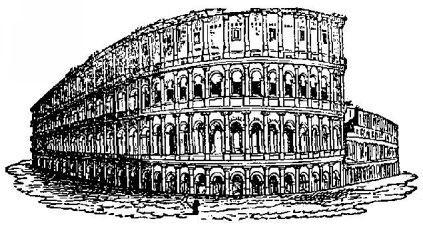
18. The theatres and circi for the exhibition of public spectacles were very numerous. The first theatre was erected by Pompey the Great; but the Circus Maximus, where gladiatorial combats were displayed, was erected by Tarquinus Priscus; this enormous building was frequently enlarged, and in the age of Pliny could accommodate two hundred thousand spectators. A still more remarkable edifice was the amphitheatre erected by Vespasian, called, from its enormous size, the Colosse'um.
19. Public baths were early erected for the use of the people, and in the later ages were among the most remarkable displays of Roman luxury and splendour. Lofty arches, stately pillars, vaulted ceilings, seats of solid silver, costly marbles inlaid with precious stones, were exhibited in these buildings with the most lavish profusion.
20. The aqueducts for supplying the city with water, were still more worthy of admiration; they were supported by arches, many of them a hundred feet high, and carried over mountains and morasses that might have appeared insuperable. The first aqueduct was erected by Ap'pius Clo'dius, the censor, four hundred years after the foundation[Pg. 29]
of the city; but under the emperors there were not less than twenty of these useful structures, and such was the supply of water, that rivers seemed to flow through the streets and sewers. Even now, though only three of the aqueducts remain, such are their dimensions that no city in Europe has a greater abundance of wholesome water than Rome.
21. The Cloa'cæ, or common sewers, attracted the wonder of the ancients themselves; the largest was completed by Tarquin the Proud. The innermost vault of this astonishing structure forms a semicircle eighteen Roman palms wide, and as many high: this is inclosed in a second vault, and that again in a third, all formed of hewn blocks of pepenno, fixed together without cement. So extensive were these channels, that in the reign of Augustus the city was subterraneously navigable.
22. The public roads were little inferior to the aqueducts and Cloa'cæ in utility and costliness; the chief was the Appian road from Rome to Brundu'sium; it extended three hundred and fifty miles, and was paved with huge squares through its entire length. After the lapse of nineteen centuries many parts of it are still as perfect as when it was first made.
23. The Appian road passed through the following towns; Ari'cia, Fo'rum Ap'pii, An'xur or Terraci'na, Fun'di, Mintur'næ, Sinue'ssa, Cap'ua, Can'dium, Beneven'tum, Equotu'ticum, Herdo'nia, Canu'sium, Ba'rium, and Brundu'sium. Between Fo'rum Ap'pii and Terraci'na lie the celebrated Pomptine marshes, formed by the overflowing of some small streams. In the flourishing ages of Roman history these pestilential marshes did not exist, or were confined to a very limited space; but from the decline of the Roman empire, the waters gradually encroached, until the successful exertions made by the Pontiffs in modern times to arrest their baleful progress. Before the drainage of Pope Sixtus, the marshes covered at least thirteen thousand acres of ground, which in the earlier ages was the most fruitful portion of the Italian soil.
Questions for Examination.
1. When was Rome founded?
2. What ceremonies were used in determining the pomcerium?
3. How was the comitium consecrated?
4. What was the first addition made to Rome?[Pg. 30]
5. What was the next addition?
6. Into what tribes were the Romans divided?
7. What were the hills added in later times to Rome?
8. Had the Romans any buildings north of the Tiber?
9. When did Rome become a magnificent city?
10. What was the extent of the city?
11. How was the city divided?
12. Which was the most remarkable of the seven hills?
13. What buildings were on the Capitoline hill?
14. What description is given of the forum?
15. Where was the senate-house and comitium?
16. What use was made of the Campus Martius?
17. What was the Pantheon?
18. Were the theatres and circii remarkable?
19. Had the Romans public baths?
20. How was the city supplied with water?
21. Were the cloacæ remarkable for their size?
22. Which was the chief Italian road?
23. What were the most remarkable places on the Appian road?
FOOTNOTES:
Hence a gate was called porta, from porta're, to carry. The reason of this part of the ceremony was, that the plough being deemed holy, it was unlawful that any thing unclean should pollute the place which it had touched; but it was obviously necessary that things clean and unclean should pass through the gates of the city. It is remarkable that all the ceremonies here mentioned were imitated from the Tuscans.
This, though apparently a mere conjecture, has been so fully proved by Niebuhr, (vol. i. p. 251,) that it may safely be assumed as an historical fact.
See Chapter II. of the following history.
All authors are agreed that the Cœlian hill was named from Cœles Viben'na, a Tuscan chief; but there is a great variety in the date assigned to his settlement at Rome. Some make him cotemporary with Rom'ulus, others with the elder Tarquin, or Servius Tullius. In this uncertainty all that can be satisfactorily determined is, that at some early period a Tuscan colony settled in Rome.
Others say that they were named so in honour of Lu'ceres, king of Ardea, according to which theory the third would have been a Pelasgo-Tyrrhenian colony.
We shall hereafter have occasion to remark, that the Lu'ceres were subject to the other tribes.
See History, Chapter IV.
The Pincian and Vatican hills were added at a much later period and these, with Janiculum, made the number ten.
They were named as follow:
1. Porta Cape'na
2. Cœlimon'tium
3. I'sis and Sera'pis
4. Via Sa'cra
5. Esquili'na
6. Acta Se'mita
7. Vita Lata
8. Forum Roma'num
9. Circus Flamin'ius
10. Pala'tium
11. Circus Max'imus
12. Pici'na Pub'lica
13. Aventinus
14. Transtiberi'na.
The divisions made by Servius were named: the Suburan, which comprised chiefly the Cœlian mount; the Colline, which included the Viminal and Quirinal hills; the Esquiline and Palatine, which evidently coincided with the hills of the same name.
Among the public buildings of ancient Rome, when in her zenith, are numbered 420 temples, five regular theatres, two amphitheatres, and seven circusses of vast extent; sixteen public baths, fourteen aqueducts, from which a prodigious number of fountains were constantly supplied; innumerable palaces and public halls, stately columns, splendid porticos, and lofty obelisks.
From caput, "a head."
State criminals were punished by being precipitated from the Tarpeian rock; the soil has been since so much raised by the accumulation of ruins, that a fall from it is no longer dangerous.
In the reign of Numa, the Quirinal hill was deemed the citadel of Rome; an additional confirmation of Niebuhr's theory, that Quirium was a Sabine town, which, being early absorbed in Rome, was mistaken by subsequent, writers for Cu'res.
Basilicks were spacious halls for the administration of justice.
It is called Templum by Livy; but the word templum with the Romans does not mean an edifice, but a consecrated inclosure. From its position, we may conjecture that the forum was originally a place of meeting common to the inhabitants of the Sabine town on the Quirinal, and the Latin town on the Palatine hill.
See Chap. XII. Sect. V. of the following History.
See the following chapter.
THE ROMAN CONSTITUTION.
As once in virtue, so in vice extreme,
This universal fabric yielded loose,
Before ambition still; and thundering down,
At last beneath its ruins crush'd a world.—Thomson.
I. The most remarkable feature in the Roman constitution is the division of the people into Patricians and Plebeians, and our first inquiry must be the origin of this separation. It is clearly impossible that such a distinction could have existed from the very beginning, because no persons would have consented in a new community to the investing of any class with peculiar privileges. We find that all the Roman kings, after they had subdued a city, drafted a portion of its inhabitants to Rome; and if they did not destroy the subjugated place, garrisoned it with a Roman colony. The strangers thus brought to Rome were not admitted to a participation of civic rights; they were like the inhabitants of a corporate town who are excluded from the elective franchise: by successive immigrations, the number of persons thus disqualified became more numerous than that of the first inhabitants or old freemen, and they naturally sought a share in the government, as a means of protecting their persons and properties. On the other hand, the men who possessed the exclusive power of legislation, struggled hard to retain their hereditary privileges, and when forced[Pg. 31] to make concessions, yielded as little as they possibly could to the popular demands. Modern history furnishes us with numerous instances of similar struggles between classes, and of a separation in interests and feelings between inhabitants of the same country, fully as strong as that between the patricians and plebeians at Rome.
2. The first tribes were divided by Ro'mulus into thirty cu'riæ, and each cu'ria contained ten gentes or associations. The individuals of each gens were not in all cases, and probably not in the majority of instances, connected by birth;[1] the attributes of the members of a gens, according to Cicero, were, a common name and participation in private religious rites; descent from free ancestors; the absence of legal disqualification. 3. The members of these associations were united by certain laws, which conferred peculiar privileges, called jura gentium; of these the most remarkable were, the succession to the property of every member who died without kin and intestate, and the obligation imposed on all to assist their indigent fellows under any extraordinary burthen.[2] 4. The head of each gens was regarded as a kind of father, and possessed a paternal authority over the members; the chieftancy was both elective and hereditary;[3] that is, the individual was always selected from some particular family.
5. Besides the members of the gens, there were attached to it a number of dependents called clients, who owed submission to the chief as their patron, and received from him assistance and protection. The clients were generally foreigners who came to settle at Rome, and not possessing municipal rights, were forced to appear in the courts of law, &c. by proxy. In process of time this relation assumed a feudal form, and the clients were bound to the same duties as vassals[4] in the middle ages.
6. The chiefs of the gentes composed the senate, and were called "fathers," (patres.) In the time of Romulus,[Pg. 32] the senate at first consisted only of one hundred members, who of course represented the Latin tribe Ramne'nses; the number was doubled after the union with the Sabines, and the new members were chosen from the Titienses. The Tuscan tribe of the Lu'ceres remained unrepresented in the senate until the reign of the first Tarquin, when the legislative body received another hundred[5] from that tribe. Tarquin the elder was, according to history, a Tuscan Iticumo, and seems to have owed his elevation principally to the efforts of his compatriots settled at Rome. It is to this event we must refer, in a great degree, the number of Tuscan ceremonies which are to be found in the political institutions of the Romans.
7. The gentes were not only represented in the senate, but met also in a public assembly called "comitia curiata." In these comitia the kings were elected and invested with royal authority. After the complete change of the constitution in later ages, the "comitia curiata"[6] rarely assembled, and their power was limited to religious matters; but during the earlier period of the republic, they claimed and frequently exercised the supreme powers of the state, and were named emphatically, The People.
8. The power and prerogatives of the kings at Rome, were similar to those of the Grecian sovereigns in the heroic ages. The monarch was general of the army, a high priest,[7] and first magistrate of the realm; he administered justice in person every ninth day, but an appeal lay from his sentence, in criminal cases, to the general assemblies of the people.[Pg. 33] The pontiffs and augurs, however, were in some measure independent of the sovereign, and assumed the uncontrolled direction of the religion of the state.
9. The entire constitution was remodelled by Ser'vius Tul'lius, and a more liberal form of government introduced. His first and greatest achievement was the formation of the plebeians into an organized order of the state, invested with political rights. He divided them into four cities and twenty-six rustic tribes, and thus made the number of tribes the same as that of the curiæ. This was strictly a geographical division, analagous to our parishes, and had no connection with families, like that of the Jewish tribes.
10. Still more remarkable was the institution of the census, and the distribution of the people into classes and centuries proportionate to their wealth. The census was a periodical valuation of all the property possessed by the citizens, and an enumeration of all the subjects of the state: there were five classes, ranged according to the estimated value of their possessions, and the taxes they consequently paid. The first class contained eighty centuries out of the hundred and seventy; the sixth class, in which those were included who were too poor to be taxed, counted but for one. We shall, hereafter have occasion to see that this arrangement was also used for military purposes; it is only necessary to say here, that the sixth class were deprived of the use of arms, and exempt from serving in war.
11. The people voted in the comitia centuriata by centuries; that is, the vote of each century was taken separately and counted only as one. By this arrangement a just influence was secured to property; and the clients of the patricians in the sixth class prevented from out-numbering the free citizens.
12. Ser'vius Tul'lius undoubtedly intended that the comitia centuriata should form the third estate of the realm, and during his reign they probably held that rank; but when, by an aristocratic insurrection he was slain in the senate-house, the power conceded to the people was again usurped by the patricians, and the comitio centuriata did not recover the right[8] of legislation before the laws[9] of the twelve tables were established.[Pg. 34]
13. The law which made the debtor a slave to his creditor was repealed by Ser'vius, and re-enacted by his successor; the patricians preserved this abominable custom during several ages, and did not resign it until the state had been brought to the very brink of ruin.
14. During the reign of Ser'vius, Rome was placed at the head of the Latin confederacy, and acknowledged to be the metropolitan city. It was deprived of this supremacy after the war with Porsen'na, but soon recovered its former greatness.
15. The equestrian rank was an order in the Roman state from the very beginning. It was at first confined to the nobility, and none but the patricians had the privilege of serving on horseback. But in the later ages, it became a political dignity, and persons were raised to the equestrian rank by the amount of their possessions.
16. The next great change took place after the expulsion of the kings; annual magistrates, called consuls, were elected in the comitia centuriata, but none but patricians could hold this office. 17. The liberties of the people were soon after extended and secured by certain laws, traditionally attributed to Vale'rius Public'ola, of which the most important was that which allowed[10] an appeal to a general assembly of the people from the sentence of a magistrate. 18. To deprive the plebeians of this privilege was the darling object of the patricians, and it was for this purpose alone that they instituted the dictatorship. From the sentence of this magistrate there was no appeal to the tribes or centuries, but the patricians kept their own privilege of being tried before the tribunal of the curiæ. 19. The power of the state was now usurped by a factious oligarchy, whose oppressions were more grievous than those of the worst tyrant; they at last became so intolerable, that the commonalty had recourse to arms, and fortified that part of the city which was exclusively inhabited by the plebeians, while others formed a camp on the Sacred Mount at some distance from Rome. A tumult of this kind was called a secession; it threatened to terminate in a civil war, which would have been both long and doubtful; for the patricians and their clients were probably as numerous as the people. A [Pg. 35]reconciliation was effected, and the plebeians placed under the protection of magistrates chosen from their own body, called tribunes of the people.
20. The plebeians, having now authorised leaders, began to struggle for an equalization of rights, and the patricians resisted them with the most determined energy. In this protracted contest the popular cause prevailed, though the patricians made use of the most violent means to secure their usurped powers. The first triumph obtained by the people was the right to summon patricians before the comitia tributa, or assemblies of people in tribes; soon after they obtained the privilege of electing their tribunes at these comitia, instead of the centuria'ta; and finally, after a fierce opposition, the patricians were forced to consent that the state should be governed by a written code.
21. The laws of the twelve tables did not alter the legal relations between the citizens; the struggle was renewed with greater violence than ever after the expulsion of the decem'viri, but finally terminated in the complete triumph of the people. The Roman constitution became essentially democratical; the offices of the state were open to all the citizens; and although the difference between the patrician and plebeian families still subsisted, they soon ceased of themselves to be political parties. From the time that equal rights were granted to all the citizens, Rome advanced rapidly in wealth and power; the subjugation of Italy was effected within the succeeding century, and that was soon followed by foreign conquests.
22. In the early part of the struggle between the patricians and plebeians, the magistracy, named the censorship, was instituted. The censors were designed at first merely to preside over the taking of the census, but they afterwards obtained the power of punishing, by a deprivation of civil rights, those who were guilty of any flagrant immorality. The patricians retained exclusive possession of the censorship, long after the consulship had been opened to the plebeians.
23. The senate,[11] which had been originally a patrician[Pg. 36] council, was gradually opened to the plebeians; when the free constitution was perfected, every person possessing a competent fortune that had held a superior magistracy, was enrolled as a senator at the census immediately succeeding the termination of his office.
Questions for Examination.
1. What is the most probable account given of the origin of the distinction between the patricians and the plebeians at Rome?
2. How did Romulus subdivide the Roman tribes?
3. By what regulations were the gentes governed?
4. Who were the chiefs of the gentes?
5. What was the condition of the clients?
6. By whom were alterations made in the number and constitution of the senate?
7. What assembly was peculiar to the patricians?
8. What were the powers of the Roman kings?
9. What great change was made in the Roman constitution by Servius Tullius?
10. For what purpose was the census instituted?
11. How were votes taken in the comitia centuriata?
12. Were the designs of Servius frustrated?
13. What was the Roman law respecting debtors?
14. When did the Roman power decline?
15. What changes were made in the constitution of the equestrian rank?
16. What change was made after the abolition of royalty?
17. How were the liberties of the people secured?
18. Why was the office of dictator appointed?
19. How did the plebeians obtain the protection of magistrates chosen from their own order?
20. What additional triumphs were obtained by the plebeians?
21. What was the consequence of the establishment of freedom?
22. For what purpose was the censorship instituted?
23. What change took place in the constitution of the senate?[Pg. 37]
FOOTNOTES:
The same remark may be applied to the Scottish clans and the ancient Irish septs, which were very similar to the Roman gentes.
When the plebeians endeavoured to procure the repeal of the laws which prohibited the intermarriage of the patricians and plebeians, the principal objection made by the former was, that these rights and obligations of the gentes (jura gentium) would be thrown into confusion.
This was also the case with the Irish tanists, or chiefs of septs; the people elected a tanist, but their choice was confined to the members of the ruling family.
See Historical Miscellany Part III. Chap. i.
They were called "patres nunorum gentium," the senators of the inferior gentes.
The "comitia curiata," assembled in the comi'tium, the general assemblies of the people were held in the forum. The patrician curiæ were called, emphatically, the council of the people; (concilium populi;) the third estate was called plebeian, (plebs.) This distinction between populus and plebs was disregarded after the plebeians had established their claim to equal rights. The English reader will easily understand the difference, if he considers that the patricians were precisely similar to the members of a close corporation, and the plebeians to the other inhabitants of a city. In London, for example, the common council may represent the senate, the livery answer for the populus, patricians, or comitia curiata, and the general body of other inhabitants will correspond with the plebs.
There were certain sacrifices which the Romans believed could only be offered by a king; after the abolition of royalty, a priest, named the petty sacrificing king, (rex sacrificulus,) was elected to perform this duty.
Perhaps it would be more accurate to say the exclusive right of legislation; for it appears that the comitia centuriata were sometimes summoned to give their sanction to laws which had been previously enacted by the curiæ.
See Chap. XII.
The Romans were previously acquainted with that great principle of justice, the right of trial by a person's peers. In the earliest ages the patricians had a right of appeal to the curiæ; the Valerian laws extended the same right to the plebeians.
The senators were called conscript fathers, (patres conscripti,) either from their being enrolled on the censor's list, or more probably from the addition made to their numbers after the expulsion of the kings, in order to supply the places of those who had been murdered by Tarquin. The new senators were at first called conscript, and in the process of time the name was extended to the entire body.
THE ROMAN TENURE OF LAND—COLONIAL GOVERNMENT.
Each rules his race, his neighbour not his care,
Heedless of others, to his own severe.—Homer.
[As this chapter is principally designed for advanced students, it has not been thought necessary to add questions for examination.
The contests respecting agrarian laws occupy so large a space in Roman history, and are so liable to be misunderstood, that it is necessary to explain their origin at some length. According to an almost universal custom, the right of conquest was supposed to involve the property of the land. Thus the Normans who assisted William I. were supposed to have obtained a right to the possessions of the Saxons; and in a later age, the Irish princes, whose estates were not confirmed by a direct grant from the English crown, were exposed to forfeiture when legally summoned to prove their titles. The extensive acquisitions made by the Romans, were either formed into extensive national domains, or divided into small lots among the poorer classes. The usufruct of the domains was monopolized by the patricians who rented them from the state; the smaller lots were assigned to the plebeians, subject to a tax called tribute, but not to rent. An agrarian law was a proposal to make an assignment of portions of the public lands to the people, and to limit the quantity of national land that could be farmed by any particular patrician.[1] Such a law may have been frequently impolitic, because it may have disturbed ancient possessions, but it could never have been unjust; for the property of the land was absolutely fixed in the state. The lands held by the patricians, being divided into extensive tracts, were principally used for pasturage; the small lots assigned to the plebeians were, of necessity, devoted to agriculture. Hence arose the first great cause of hostility between the two orders; the patricians were naturally eager to extend their possessions in the public domains, which enabled them to provide for their numerous clients, and in remote districts they frequently wrested the estates from the free proprietors in their neighbourhood; the plebeians, on[Pg. 38] the other hand, deemed that they had the best right to the land purchased by their blood, and saw with just indignation, the fruits of victory monopolized by a single order in the state. The tribute paid by the plebeians increased this hardship, for it was a land-tax levied on estates, and consequently fell most heavily on the smaller proprietors; indeed, in many cases, the possessors of the national domains paid nothing.
From all this it is evident that an agrarian law only removed tenants who held from the state at will, and did not in any case interfere with the sacred right of property; but it is also plain that such a change must have been frequently inconvenient to the individual in possession. It also appears, that had not agrarian laws been introduced, the great body of the plebeians would have become the clients of the patricians, and the form of government would have been a complete oligarchy.
The chief means to which the Romans, even from the earliest ages, had recourse for securing their conquests, and at the same time relieving the poorer classes of citizens, was the establishment of colonies in the conquered states. The new citizens formed a kind of garrison, and were held together by a constitution formed on the model of the parent state. From what has been said above, it is evident that a law for sending out a colony was virtually an agrarian law, since lands were invariably assigned to those who were thus induced to abandon their homes.
The relations between Rome and the subject cities in Italy were very various. Some, called municipia, were placed in full possession of the rights of Roman citizens, but could not in all cases vote in the comitia. The privileges of the colonies were more restricted, for they were absolutely excluded from the Roman comitia and magistracies. The federative[2] states enjoyed their own constitutions, but were bound to supply the Romans with tribute and auxiliary forces. Finally, the subject states were deprived of their internal constitutions, and were governed by annual prefects chosen in Rome.
Before discussing the subject of the Roman constitution, we must observe that it was, like our own, gradually formed by practice; there was no single written code like those of[Pg. 39] Athens and Sparta, but changes were made whenever they were required by circumstances; before the plebeians obtained an equality of civil rights, the state neither commanded respect abroad, nor enjoyed tranquillity at home. The patricians sacrificed their own real advantages, as well as the interests of their country, to maintain an ascendancy as injurious to themselves, as it was unjust to the other citizens. But no sooner had the agrarian laws established a more equitable distribution of property, and other popular laws opened the magistracy to merit without distinction of rank, than the city rose to empire with unexampled rapidity.
FOOTNOTES:
The Licinian law provided that no one should rent at a time more than 500 acres of public land.
The league by which the Latin states were bound (jus Latii) was more favourable than that granted to the other Italians (jus Italicum.)
THE ROMAN RELIGION.
First to the gods 'tis fitting to prepare
The due libation, and the solemn prayer;
For all mankind alike require their grace,
All born to want; a miserable race.—Homer.
1. We have shown that the Romans were, most probably, a people compounded of the Latins, the Sabines, and the Tuscans; and that the first and last of these component parts were themselves formed from Pelasgic and native tribes. The original deities[1] worshipped by the Romans were derived from the joint traditions of all these tribes; but the religious institutions and ceremonies were almost wholly borrowed from the Tuscans. Unlike the Grecian mythology, with which, in later ages, it was united, the Roman system of religion had all the gloom and mystery of the eastern superstitions; their gods were objects of fear rather than love, and were worshipped more to avert the consequences of their anger than to conciliate their favour. A consequence of this system was, the institution of human sacrifices, which were not quite disused in Rome until a late period of the republic.
2. The religious institutions of the Romans form an essential part of their civil government; every public act, whether of legislation or election, was connected with certain determined forms, and thus received the sanction of a higher power. Every public assembly was opened by the[Pg. 40] magistrate and augurs taking the auspices, or signs by which they believed that the will of the gods could be determined; and if any unfavourable omen was discovered, either then or at any subsequent time, the assembly was at once dismissed. 3. The right of taking auspices was long the peculiar privilege of the patricians, and frequently afforded them pretexts for evading the demands of the plebeians; when a popular law was to be proposed, it was easy to discover some unfavourable omen which prohibited discussion; when it was evident that the centuries were about to annul some patrician privilege, the augurs readily saw or heard some signal of divine wrath, which prevented the vote from being completed. It was on this account that the plebeians would not consent to place the comitia tributa under the sanction of the auspices.
4. The augurs were at first only three in number, but they were in later ages increased to fifteen, and formed into a college. Nothing of importance was transacted without their concurrence in the earlier ages of the republic, but after the second punic war, their influence was considerably diminished.[2] 5. They derived omens from five sources: 1, from celestial phenomena, such as thunder, lightning, comets, &c.; 2, from the flight of birds; 3, from the feeding of the sacred chickens; 4, from the appearance of a beast in any unusual place; 5, from any accident that occurred unexpectedly.
6. The usual form of taking an augury was very solemn; the augur ascended a tower, bearing in his hand a curved stick called a lituus. He turned his face to the east, and marked out some distant objects as the limits within which[Pg. 41] he would make his observations, and divided mentally the enclosed space into four divisions. He next, with covered head, offered sacrifices to the gods, and prayed that they would vouchsafe some manifestation of their will. After these preliminaries he made his observations in silence, and then announced the result to the expecting people.
7. The Arusp'ices were a Tuscan order of priests, who attempted to predict futurity by observing the beasts offered in sacrifice. They formed their opinions most commonly from inspecting the entrails, but there was no circumstance too trivial to escape their notice, and which they did not believe in some degree portentous. The arusp'ices were most commonly consulted by individuals; but their opinions, as well as those of the augurs, were taken on all important affairs of state. The arusp'ices seem not to have been appointed officially, nor are they recognised as a regular order of priesthood.
8. The pontiffs and fla'mens, as the superior priests were designated, enjoyed great privileges, and were generally men of rank. When the republic was abolished, the emperors assumed the office of pontifex maximus, or chief pontiff, deeming its powers too extensive to be entrusted to a subject.
9. The institution of vestal virgins was older than the city itself, and was regarded by the Romans as the most sacred part of their religious system. In the time of Numa there were but four, but two more were added by Tarquin; probably the addition made by Tarquin was to give the tribe of the Lu'ceres a share in this important priesthood. The duty of the vestal virgins was to keep the sacred fire that burned on the altar of Vesta from being extinguished; and to preserve a certain sacred pledge on which the very existence of Rome was supposed to depend. What this pledge was we have no means of discovering; some suppose that it was the Trojan Palla'dium, others, with more probability, some traditional mystery brought by the Pelas'gi from Samothrace.
10. The privileges conceded to the vestals were very great; they had the most honourable seats at public games and festivals; they were attended by a lictor with fasces like the magistrates; they were provided with chariots when they required them; and they possessed the power of pardoning any criminal whom they met on the way to execution, if they declared that the meeting was accidental. The magistrates[Pg. 42] were obliged to salute them as they passed, and the fasces of the consul were lowered to do them reverence. To withhold from them marks of respect subjected the offender to public odium; a personal insult was capitally punished. They possessed the exclusive privilege of being buried within the city; an honour which the Romans rarely extended to others.
11. The vestals were bound by a vow of perpetual virginity, and a violation of this oath was cruelly punished. The unfortunate offender was buried alive in a vault constructed beneath the Fo'rum by the elder Tarquin. The terror of such a dreadful fate had the desired effect; there were only eighteen instances of incontinence among the vestals, during the space of a thousand years.
12. The mixture of religion with civil polity, gave permanence and stability to the Roman institutions; notwithstanding all the changes and revolutions in the government the old forms were preserved; and thus, though the city was taken by Porsenna, and burned by the Gauls, the Roman constitution survived the ruin, and was again restored to its pristine vigour.
13. The Romans always adopted the gods of the conquered nations, and, consequently, when their empire became very extensive, the number of deities was absurdly excessive, and the variety of religious worship perfectly ridiculous. The rulers of the world wanted the taste and ingenuity of the lively Greeks, who accommodated every religious system to their own, and from some real or fancied resemblance, identified the gods of Olym'pus with other nations. The Romans never used this process of assimilation, and, consequently, introduced so much confusion into their mythology, that philosophers rejected the entire system. This circumstance greatly facilitated the progress of Christianity, whose beautiful simplicity furnished a powerful contrast to the confused and cumbrous mass of divinities, worshipped in the time of the emperors.
Questions for Examination.
1. How did the religion of the Romans differ from that of the Greeks?
2. Was the Roman religion connected with the government?
3. How was the right of taking the Auspices abused?
4. Who were the augurs?[Pg. 43]
5. From what did the augurs take omens?
6. What were the forms used in taking the auspices?
7. Who were the aruspices?
8. What other priests had the Romans?
9. What was the duty of the vestal virgins?
10. Did the vestals enjoy great privileges?
11. How were the vestals punished for a breach of their vows?
12. Why was the Roman constitution very permanent?
13. Whence arose the confusion in the religious system of the Romans?
FOOTNOTES:
The reader will find an exceedingly interesting account of the deities peculiar to the Romans, in Mr. Keightley's very valuable work on Mythology.
The poet Ennius, who was of Grecian descent, ridiculed very successfully the Roman superstitions; the following fragment, translated by Dunlop, would, probably, have been punished as blasphemous in the first ages of the republic:—
For no Marsian augur (whom fools view with awe,)
Nor diviner, nor star-gazer, care I a straw;
The Isis-taught quack, an expounder of dreams,
Is neither in science nor art what he seems;
Superstitious and shameless they prowl through our streets,
Some hungry, some crazy, but all of them cheats.
Impostors, who vaunt that to others they'll show
A path which themselves neither travel nor know:
Since they promise us wealth if we pay for their pains,
Let them take from that wealth and bestow what remains
THE ROMAN ARMY AND NAVY.
Is the soldier found
In the riot and waste which he spreads around?
The sharpness makes him—the dash, the tact,
The cunning to plan, and the spirit to act.—Lord L. Gower.
1. It has been frequently remarked by ancient writers that the strength of a free state consists in its infantry; and, on the other hand, that when the infantry in a state become more valuable than the cavalry, the power of the aristocracy is diminished, and equal rights can no longer be withheld from the people. The employment of mercenary soldiers in modern times renders these observations no longer applicable; but in the military states of antiquity, where the citizens themselves served as soldiers, there are innumerable examples of this mutual connection between political and military systems. It is further illustrated in the history of the middle ages; for we can unquestionably trace the origin of free institutions in Europe to the time when the hardy infantry of the commons were first found able to resist the charges of the brilliant chivalry of the nobles. 2. Rome was, from the very commencement, a military state; as with the Spartans, all their civil institutions had a direct reference to warlike affairs; their public assemblies were marshalled like armies; the order of their line of battle was regulated by the distinction of classes in the state. It is, therefore, natural to conclude, that the tactics of the Roman armies underwent important changes when the revolutions mentioned in the preceding chapters were effected, though we cannot trace the alterations with precision, because no historians appeared until the military system of the Romans had been brought to perfection.
3. The strength of the Tuscans consisted principally in their cavalry; and if we judge from the importance attributed to the equestrian rank in the earliest ages, we may[Pg. 44] suppose that the early Romans esteemed this force equally valuable. It was to Ser'vius Tul'lius, the great patron of the commonalty, that the Romans were indebted for the formation of a body of infantry, which, after the lapse of centuries, received so many improvements that it became invincible.
4. The ancient battle array of the Greeks was the phalanx; the troops were drawn up in close column, the best armed being in front. The improvements made in this system of tactics by Philip, are recorded in Grecian history; they chiefly consisted in making the evolutions of the entire body more manageable, and counteracting the difficulties which attended the motions of this cumbrous mass.
5. The Romans originally used the phalanx; and the lines were formed according to the classes determined by the centuries. Those who were sufficiently wealthy to purchase a full suit of armour, formed the front ranks; those who could only purchase a portion of the defensive weapons, filled the centre; and the rear was formed by the poorer classes, who scarcely required any armour, being protected by the lines in front. From this explanation, it is easy to see why, in the constitution of the centuries by Servius Tullius, the first class were perfectly covered with mail, the second had helmets and breast-plates but no protection for the body, the third, neither a coat of mail, nor greaves. 6. The defects of this system are sufficiently obvious; an unexpected attack on the flanks, the breaking of the line by rugged and uneven ground, and a thousand similar accidents exposed the unprotected portions of the army to destruction besides, a line with files ten deep was necessarily slow in its movements and evolutions. Another and not less important defect was, that the whole should act together; and consequently, there were few opportunities for the display of individual bravery.
7. It is not certainly known who was the great commander that substituted the living body of the Roman legion for this inanimate mass; but there is some reason to believe that this wondrous improvement was effected by Camil'lus. Every legion was in itself an army, combining the advantages of every variety of weapon, with the absolute perfection of a military division.
8. The legion consisted of three lines or battalions; the Hasta'ti, the Prin'cipes, and the Tria'rii; there were besides two classes, which we may likewise call battalions, [Pg. 45] the Rora'rii, or Velites, consisting of light armed troops, and the Accen'si or supernumeraries, who were ready to supply the place of those that fell. Each of the two first battalions contained fifteen manip'uli, consisting of sixty privates, commanded by two centurions, and having each a separate standard (vexil'lum) borne by one of the privates called Vexilla'rius; the manip'uli in the other battalions were fewer in number, but contained a greater portion of men; so that, in round numbers, nine hundred men may be allowed to each battalion, exclusive of officers. If the officers and the troop of three hundred cavalry be taken into account, we shall find that the legion, as originally constituted, contained about five thousand men. The Romans, however, did not always observe these exact proportions, and the number of soldiers in a legion varied at different times of their history.[1]
9. A cohort was formed by taking a manipulus from each of the battalions; more frequently two manipuli were taken, and the cohort then contained six hundred men. The cavalry were divided into tur'mæ, consisting each of thirty men.
10. A battle was usually commenced by the light troops, who skirmished with missile weapons; the hasta'ti then advanced to the charge, and if defeated, fell back on the prin'cipes; if the enemy proved still superior, the two front lines retired to the ranks of the tria'rii, which being composed of veteran troops, generally turned the scale. But this order was not always observed; the number of divisions in the legion made it extremely flexible, and the commander-in-chief could always adapt the form of his line to circumstances.
11. The levies of troops were made in the Cam'pus Mar'tius, by the tribunes appointed to command the legions. The tribes which were to supply soldiers were determined by lot, and as each came forward, the tribunes, in their turn, selected such as seemed best fitted for war. Four legions was most commonly the number in an army. When the selected individuals had been enrolled as soldiers, one was chosen from each legion to take the military oath of obedience to the generals; the other soldiers swore in succession, to observe the oath taken by their foreman. [Pg. 46]
12. Such was the sacredness of this obligation, that even in the midst of the political contests by which the city was distracted, the soldiers, though eager to secure the freedom of their country, would not attempt to gain it by mutiny against their commanders. On this account the senate frequently declared war, and ordered a levy as an expedient to prevent the enactment of a popular law, and were of course opposed by the tribunes of the people.
13. There was no part of the Roman discipline more admirable than their form of encampment. No matter how fatigued the soldiers might be by a long march, or how harassed by a tedious battle, the camp was regularly measured out and fortified by a rampart and ditch, before any one sought sleep or refreshment. Careful watch was kept during the night, and frequent picquets sent out to guard against a surprise, and to see that the sentinels were vigilant. As the arrangement in every camp was the same, every soldier knew his exact position, and if an alarm occurred, could easily find the rallying point of his division. To this excellent system Polyb'ius attributes the superiority of the Romans over the Greeks; for the latter scarcely ever fortified their camp, but chose some place naturally strong, and did not keep their ranks distinct.
14. The military age extended from the sixteenth to the forty-sixth year; and under the old constitution no one could hold a civic office who had not served ten campaigns. The horsemen were considered free after serving through ten campaigns, but the foot had to remain during twenty. Those who had served out their required time were free for the rest of their lives, unless the city was attacked, when all under the age of sixty were obliged to arm in its defence.
15. In the early ages, when wars were begun and ended in a few days, the soldiers received no pay; but when the conquest of distant countries became the object of Roman ambition, it became necessary to provide for the pay and support of the army. This office was given to the quæstors, who were generally chosen from the younger nobility, and were thus prepared for the higher magistracies by acquiring a practical acquaintance with finance.
16. The soldiers were subject to penalties of life and limb at the discretion of the commander-in-chief, without the intervention of a court-martial; but it deserves to be recorded that this power was rarely abused. 17. There were several species of rewards to excite emulation; the most honourable[Pg. 47] were, the civic crown of gold to him who had saved the life of a citizen; the mural crown to him who had first scaled the wall of a besieged town; a gilt spear to him who had severely wounded an enemy; but he who had slain and spoiled his foe, received, if a horseman, an ornamental trapping; if a foot soldier, a goblet.
18. The lower classes of the centuries were excused from serving in the army, except on dangerous emergencies; but they supplied sailors to the navy. We learn, from a document preserved by Polyb'ius, that the Romans were a naval power at a very early age. 19. This interesting record is the copy of a treaty concluded with the Carthaginians, in the year after the expulsion of the kings. It is not mentioned by the Roman historians, because it decisively establishes a fact which they studiously labour to conceal, that is, the weakness and decline of the Roman power during the two centuries that followed the abolition of royalty, when the power of the state was monopolized by a vile aristocracy. In this treaty Rome negociates for the cities of La'tium, as her dependencies, just as Carthage does for her subject colonies. But in the course of the following century, Rome lost her supremacy over the Latin cities, and being thus nearly excluded from the coast, her navy was ruined.
20. At the commencement of the first Punic war, the Romans once more began to prepare a fleet, and luckily obtained an excellent model in a Carthaginian ship that had been driven ashore in a storm. 21. The vessels used for war, were either long ships or banked galleys; the former were not much used in the Punic wars, the latter being found more convenient. The rowers of these sat on banks or benches, rising one above the other, like stairs; and from the number of these benches, the galleys derived their names; that which had three rows of benches was called a trireme; that which had four, a quadrireme; and that which had five, a quinquireme. Some vessels had turrets erected in them for soldiers and warlike engines; others had sharp prows covered with brass, for the purpose of dashing against and sinking their enemies.
22. The naval tactics of the ancients were very simple; the ships closed very early, and the battle became a contest between single vessels. It was on this account that the personal valour of the Romans proved more than a match[Pg. 48] for the naval skill of the Carthaginians, and enabled them to, add the empire of the sea to that of the land.
23. Before concluding this chapter, we must notice the triumphal processions granted to victorious commanders. Of these there are two kinds; the lesser triumph, called an ovation,[2] and the greater, called, emphatically, the triumph. In the former, the victorious general entered the city on foot, wearing a crown of myrtle; in the latter, he was borne in a chariot, and wore a crown of laurel. The ovation was granted to such generals as had averted a threatened war, or gained some great advantage without inflicting great loss on the enemy. The triumph was allowed only to those who had gained some signal victory, which decided the fate of a protracted war. The following description, extracted from Plutarch, of the great triumph granted to Paulus Æmilius, for his glorious termination of the Macedonian war, will give the reader an adequate idea of the splendour displayed by the Romans on these festive occasions.
The people erected scaffolds in the forum and circus, and all other parts of the city where they could best behold the pomp. The spectators were clad in white garments; all the temples were open, and full of garlands and perfumes; and the ways cleared and cleansed by a great many officers, who drove away such as thronged the passage, or straggled up and down.
The triumph lasted three days; on the first, which was scarce long enough for the sight, were to be seen the statues, pictures, and images of an extraordinary size, which were taken from the enemy, drawn upon seven hundred and fifty chariots. On the second was carried, in a great many wains, the fairest and richest armour of the Macedonians, both of brass and steel, all newly furbished and glittering: which, although piled up with the greatest art and order, yet seemed to be tumbled on heaps carelessly and by chance; helmets were thrown on shields, coats of mail upon greaves; Cretan targets and Thracian bucklers, and quivers of arrows, lay huddled among the horses' bits; and through these appeared the points of naked swords, intermixed with long spears. All these arms were tied together with such a just liberty, that they knocked against one another as they were drawn[Pg. 49] along, and made a harsh and terrible noise, so that the very spoils of the conquered could not be beheld without dread. After these wagons loaded with armour, there followed three thousand men, who carried the silver that was coined, in seven hundred and fifty vessels, each of which weighed three talents, and was carried by four men. Others brought silver bowls, and goblets, and cups, all disposed in such order as to make the best show, and all valuable, as well for their magnitude as the thickness of their engraved work. On the third day, early in the morning, first came the trumpeters, who did not sound as they were wont in a procession or solemn entry, but such a charge as the Romans use when they encourage their soldiers to fight. Next followed young men, girt about with girdles curiously wrought, who led to the sacrifice one hundred and twenty stalled oxen, with their horns gilded, and their heads adorned with ribbons and garlands, and with these were boys that carried dishes of silver and gold. After these was brought the gold coin, which was divided into vessels that weighed three talents each, similar to those that contained the silver; they were in number fourscore, wanting three. These were followed by those that brought the consecrated bowl which Emil'ius caused to be made, that weighed ten talents, and was adorned with precious stones. Then were exposed to view the cups of Antig'onus and Seleu'cus, and such as were made after the fashion invented by The'ricles, and all the gold plate that was used at Per'seus's table. Next to these came Per'seus's chariot, in which his armour was placed, and on that his diadem. After a little intermission the king's children were led captives, and with them a train of nurses, masters, and governors, who all wept, and stretched forth their hands to the spectators, and taught the little infants to beg and intreat their compassion. There were two sons and a daughter, who, by reason of their tender age, were altogether insensible of the greatness of their misery; which insensibility of their condition rendered it much more deplorable, insomuch that Per'seus himself was scarce regarded as he went along, whilst pity had fixed the eyes of the Romans upon the infants, and many of them could not forbear tears; all beheld the sight with a mixture of sorrow and joy until the children were past. After his children and attendants came Per'seus himself, clad in black, and wearing slippers after the fashion of his country; he looked like one altogether astonished, and deprived of reason, through the [Pg. 50] greatness of his misfortune. Next followed a great company of his friends and familiars, whose countenances were disfigured with grief, and who testified, to all that beheld them, by their tears and their continual looking upon Per'seus, that it was his hard fortune they so much lamented, and that they were regardless of their own. After these were carried four hundred crowns of gold, sent from the cities by their respective ambassadors to Emil'ius, as a reward due to his valour. Then he himself came, seated on a chariot magnificently, adorned, (a man worthy to be beheld even without these ensigns of power) clad in a garland of purple interwoven with gold, and with a laurel branch in his right hand. All the army in like manner, with boughs of laurel in their hands, and divided into bands and companies, followed the chariot of their commander; some singing odes according to the usual custom, mingled with raillery; others songs of triumph and the praises of Emil'ius's deeds, who was admired and accounted happy by all men, yet unenvied by every one that was good.
Questions for Examination.
1. What political change has frequently resulted from improved military tactics?
2. Was Rome a military state?
3. Why are we led to conclude that the Romans considered cavalry an important force?
4. By whom was the phalanx instituted?
5. How was the phalanx formed?
6. What were the defects of the phalanx?
7. By whom was the legion substituted for the phalanx?
8. Of what troops was a legion composed?
9. What was a cohort?
10. What was the Roman form of battle?
11. In what manner was an army levied?
12. How was the sanctity of the military oath proved?
13. What advantages resulted from the Roman form of encampment?
14. How long was the citizens liable to be called upon as soldiers?
15. How was the army paid?
16. What power had the general?
17. On what occasion did the soldiers receive rewards?
18. How was the navy supplied with sailors?
19. What fact concealed by the Roman historians is established by Polybius?
20. How did the Romans form a fleet?
[Pg. 51] 21. What were the several kinds of ships?
22. What naval tactics did the Romans use?
23. How did an ovation differ from a triumph?
24. Can you give a general description of a triumph?
FOOTNOTES:
This is virtually the same account as that given by Niebuhr, but he excludes the accensi and cavalry from his computation, which brings down the amount to 3600 soldiers.
From ovis, a sheep, the animal on this occasion offered in sacrifice; in the greater triumph the victim was a milk-white bull hung over with garlands, and having his horns tipped with gold.
ROMAN LAW—FINANCE.
Then equal laws were planted in the state, To shield alike the humble and the great.—Cooke.
1. In the early stages of society, little difficulty is felt in providing for the administration of justice, because the subjects of controversy are plain and simple, such as any man of common sense may determine; but as civilization advances, the relations between men become more complicated, property assumes innumerable forms, and the determination of questions resulting from these changes, becomes a matter of no ordinary difficulty. In the first ages of the republic, the consuls were the judges in civil and criminal matters, as the kings had previously been;[1] but as the state increased, a new class of magistrates, called prætors, was appointed to preside in the courts of law. Until the age of the decemvirs, there was no written code to regulate their decisions; and even after the laws of the twelve tables had been established, there was no perfect system of law, for the enactments in that code were brief, and only asserted a few leading principles. 2. The Roman judges did not, however, decide altogether according to their own caprice; they were bound to regard the principles that had been established by the decisions of former judges; and consequently, a system of law was formed similar to the common law of England, founded on precedent and analogy. In the later ages of the empire, the number of law-books and records became so enormous, that it was no longer possible to determine the law with accuracy, and the contradictory decisions made at different periods, greatly increased the uncertainty. To remedy this evil, the emperor Justinian caused the entire to be digested into a uniform system, and his code still forms the basis of the civil law in Europe.
[Pg. 52] 3. The trials in courts refer either to the affairs of the state, or to the persons or properties of individuals, and are called state, criminal, or civil trials. The two former are the most important in regard to history.
4. The division of the Roman people into two nations, made the classification of state offences very difficult. In general, the council of the patricians judged any plebeian who was accused of conspiring against their order; and the plebeians on the other hand, brought a patrician accused of having violated their privileges before their own tribunal. 5. Disobedience to the commands of the chief magistrate was punished by fine and imprisonment, and from his sentence there was no appeal; but if the consul wished to punish any person by stripes or death, the condemned man had the right of appealing to the general assembly of his peers.[2] 6. To prevent usurpation, it was established that every person who exercised an authority not conferred on him by the people, should be devoted as a victim to the gods.[3] This, was at once a sentence of outlawry and excommunication; the Criminal might be slain by any person-with impunity, and all connection with him was shunned as pollution. 7. No magistrate could legally be brought to trial during the continuance of his office, but when his time was expired, he could be accused before the general assembly of the people, if he had transgressed the legal limits of his authority. The punishment in this case was banishment; the form of the sentence declared that the criminal "should be deprived of fire and water;" that is, the citizens, were prohibited from supplying him with the ordinary necessaries of life.
8. In all criminal trials, and in all cases where damages were sought to be recovered for wrongs or injuries, the prætor impanelled a jury, but the number of which it was[Pg. 53] to consist seems to have been left to his discretion. The jurors were called ju'dices, and the opinion of the majority decided the verdict. Where the votes were equal, the traverser or defendant escaped; and when half the jury assessed damages at one amount, and half at another, the defendant paid only the lesser sum. In disputes about property, the prætor seldom called for the assistance of a jury.
9. The general form of all trials was the same; the prosecutor or plaintiff made his complaint, and the defendant was compelled either to find sufficient bail, or to go into prison until the day of trial. On the appointed day, the plaintiff, or his advocate, stated his case, and proceeded to establish it by evidence; the defendant replied; and the jury then gave their verdict by ballot.
10. In cases tried before the general assembly of the people, it was allowed to make use of artifices in order to conciliate the popular favour. The accused and his friends put on mourning robes to excite pity; they went into the most public places and took every opportunity of showing their respect for popular power. When Cicero was accused by Clo'dius for having illegally put to death the associates of Cataline, the entire senatorian rank changed their robes to show the deep interest they felt in his fate. At these great trials, the noblest specimens of forensic eloquence were displayed by the advocates of the accuser and the accused; but the decisions were usually more in accordance with the spirit of party than strict justice.
11. The accused, however, might escape, if he could prevail on any of the tribunes to interpose in his behalf, or the accuser to relinquish his charge; if unfavourable omens appeared during the trial, it was usually adjourned, or sometimes the accusation withdrawn; and up to the very moment of the commencement of the trial, the criminal had the option of escaping a heavier penalty by going into voluntary exile.
12. The punishments to which state criminals were sentenced, were usually, in capital cases, precipitation from the Tarpeian rock, beheading, or strangulation in prison; when life was spared, the penalties were either exile or fine. Under the emperors severer punishments were introduced, such as exposure to wild beasts, or burning alive; and torture, which, under the republic, could not be inflicted on free citizens, was exercised unsparingly.
13. The punishment of parricides was curious; the criminal[Pg. 54] having been beaten with rods, was sown up in a sack together with a serpent, an ape and a cock, and thrown either into the sea or a river, as if even the inanimate carcase of such a wretch would pollute the earth.
14. Masters had an absolute, authority over their slaves, extending to life or limb; and in the earlier ages patrons had similar power over their clients. The condition of slaves in Rome was most miserable, especially in the later ages; they were subject to the most excruciating tortures, and when capitally punished, were generally crucified. Except in this single particular, the Roman criminal code, was very lenient and sparing of human life. This was chiefly owing to the exertions of the plebeians, for the patricians always patronized a more sanguinary policy; and could do so the more easily, as the aristocracy retained their monopoly of the administration of justice much longer than that of civil government.
15. The Roman system of finance was at first very simple, the public revenue being derived from a land-tax on Quiritary property,[4] and the tithes of the public lands; but after the conquest of Macedon, the revenues from other sources were so abundant, that tribute was no longer demanded from Roman citizens. These sources were:—
1. The tribute of the allies, which was a property tax, differing in different places according to the terms of their league.
2. The tribute of the provinces, which was both a property and poll-tax.
3. Revenue of the national domains leased out by the censors.
4. Revenue from the mines, especially from the Spanish silver-mines.
5. Duties on imports and exports. And,
6. A duty on enfranchised slaves.
The receipts were all paid into the national treasury, and the senate had the uncontrolled direction of the general expenditure, as well as the regulation of the amount of imposts. The officers employed to manage the affairs of the revenue, were the quæstors, chosen annually, and under them the scribes, who held their situations for life. Those who[Pg. 55] farmed the public revenue were called-publicans, and were generally persons of equestrian dignity; but in the remote provinces they frequently sublet to other collectors, who were guilty of great extortion. The latter are the publicans mentioned in the New Testament.
Questions for Examination.
1. When did the Romans first appoint judges?
2. How were the decisions of the prætors regulated?
3. How are trials divided?
4. In what manner were offences against the classes of patricians and plebeians tried?
5. How was disobedience to the chief magistrate punished?
6. What was the penalty for usurpation?
7. How was mal-administration punished?
8. When did the prætors impannel a jury?
9. What was the form of a trial?
10. Were there any other forms used, in trials before the people?
11. Had the criminal any chances of escape?
12. What were the usual punishments?
13. How was parricide punished?
14. In what respect alone was the criminal law of the Romans severe?
15. What were the sources of the Roman revenue?
16. To whom was the management of the finances entrusted?
FOOTNOTES:
Niebuhr, however, is of opinion, that judicial officers were elected by the "comitia curiata," from the earliest ages.
This privilege was conceded to the plebeians by the Valerian law, but must have been possessed by the patricians from the earliest times; for Horatius, when condemned for the murder of his sister, in the reign of Tullus Hostilius, escaped by appealing to the comitia curiata. The Valerian law had no sanction, that is, no penalty was annexed to its transgression; and during the two centuries of patrician usurpation and tyranny, was frequently and flagrantly violated. On this account the law, though never repealed, was frequently re-enacted.
The formula "to devote his head to the gods," used to express the sentence of capital punishment, was derived from the human sacrifices anciently used in Rome; probably, because criminals were usually selected for these sanguinary offerings.
The lands absolutely assigned to the plebeians free from rent, were the most remarkable species of Quiritary property. It was so called from the Quirites, who formed a constituent part of the Roman people, and whose name was subsequently given to the entire.
THE PUBLIC AMUSEMENTS AND PRIVATE LIFE OF THE ROMANS.
Butchered to make a Roman holiday.—Byron.
The inferiority of the Romans to the Greeks in intellectual acquirements, was no where more conspicuous than in their public amusements. While the refined Grecians sought to gratify their taste by music, the fine arts, and dramatic entertainments, the Romans derived their chief pleasure from contemplating the brutal and bloody fights of gladiators; or at best, such rich shows and processions as gratify the uneducated vulgar. The games in the circus, with which the Romans were so delighted, that they considered them of equal importance, with the necessaries of life, consisted of athletic exercises, such as boxing, racing, [Pg. 56]wrestling, and gladiatorial combats. To these, chariot-racing was added under the emperors, and exhibitions of combats between wild beasts, and, in numerous instances, between men and beasts.
2. After the establishment of the naval power of Rome, naumachiæ, or naval combats, were frequently exhibited in circi built for the purpose. These were not always sham fights; the contests were, in many instances, real engagements displaying all the horrors of a sanguinary battle.
3. The custom of exhibiting shows of gladiators, originated in the barbarous sacrifices of human beings, which prevailed in remote ages. In the gloomy superstition of the Romans, it was believed that the manes, or shades of the dead, derived pleasure from human blood, and they therefore sacrificed, at the tombs of their ancestors, captives taken in war, or wretched slaves. It was soon found that sport to the living might be combined with this horrible offering to the dead; and instead of giving up the miserable victims to the executioner, they were compelled to fight with each other, until the greater part was exterminated.
4. The pleasure that the people derived from this execrable amusement, induced the candidates for office to gratify, them frequently with this spectacle. The exhibitions were no longer confined to funerals; they formed an integrant part of every election, and were found more powerful than merit in opening a way to office. The utter demoralization of the Roman people, and the facility with which the tyranny of the emperors was established, unquestionably was owing, in a great degree to the pernicious prevalence of these scandalous exhibitions.
5. To supply the people with gladiators, schools were, established in various parts of Italy, each under the controul of a lanis'ta, or fencing-master, who instructed them in martial exercises. The victims were either prisoners of war, or refractory slaves, sold by their masters; but in the degenerate ages of the empire, freemen, and even senators, ventured their lives on the stage along with the regular gladiators. Under the mild and merciful influence of Christianity these combats were abolished, and human blood was no longer shed to gratify a cruel and sanguinary populace.
6. So numerous were the gladiators, that Spar'tacus, one of their number, having escaped from a school, raised an army of his fellow-sufferers, amounting to seventy thousand men; he was finally subdued by Cras'sus, the colleague of[Pg. 57] Pompey. Ju'lius Cæsar, during his ædileship, exhibited at one time three hundred and twenty pairs of gladiators; but even this was surpassed by the emperor Trajan, who displayed no less than one thousand.
7. The gladiators were named from their peculiar arms; the most common were the retiarius, who endeavoured to hamper his antagonist with a net; and his opponent the secutor.
8. When a gladiator was wounded, or in any way disabled, he fled to the extremity of the stage, and implored the pity of the spectators; if he had shown good sport, they took him under their protection by pressing down their thumbs; but if he had been found deficient in courage or activity, they held the thumb back, and he was instantly murdered by his adversary.
9. The Roman theatre was formed after the model of the Greeks, but never attained equal eminence. The populace always paid more regard to the dresses of the actors, and the richness of the decoration, than to ingenious structure of plot, or elegance of language. Scenic representations do not appear to have been very popular at Rome, certainly never so much as the sports of the circus. Besides comedies and tragedies, the Romans had a species of drama peculiar to their country, called the Atellane farces, which were, in general, low pieces of gross indecency and vulgar buffoonery, but sometimes contained spirited satires on the character and conduct of public men.
10. We should be greatly mistaken if we supposed that the theatres in ancient Rome at all resembled those of modern times; they were stupendous edifices, some of which could accommodate thirty thousand spectators, and an army could perform its evolutions on the stage. To remedy the defects of distance, the tragic actors wore a buskin with very thick soles, to raise them above their natural size, and covered their faces with a mask so contrived as to render the voice more clear and full.[1] Instead of the buskin, comic actors wore a sort of slipper called a sock.
11. The periodical festivals of the Romans were celebrated with theatrical entertainments and sports in the circus at the public expense. The most remarkable of these[Pg. 58] festivals was the secular, which occurred only at periods of one hundred and ten years. The others occurred annually, and were named from the gods to whose honour they were dedicated.
12. The Romans were a more grave and domestic people than the lively Greeks; their favourite dress, the toga or gown, was more formal and stately than the Grecian short cloak; their demeanour was more stern, and their manners more imposing. The great object of the old Roman was, to maintain his dignity under all circumstances, and to show that he could controul the emotions to which ordinary men too readily yield. Excessive joy or grief, unqualified admiration, or intense surprise, were deemed disgraceful; and even at a funeral, the duty of lamenting the deceased was entrusted to hired mourners. Temperance at meals was a leading feature in the character of the Romans during the early ages of the republic; but after the conquest of Asia, their luxuries were more extravagant than those of any nation recorded in history. But there was more extravagance than refinement in the Roman luxury; and though immense sums were lavished on entertainments, they were destitute of that taste and elegance more delightful than the most costly delicacies.
13. The Roman ladies, enjoyed more freedom than those in any other, ancient nation. They visited all places of public amusement uncontrolled, and mingled in general society. The power of the husband, however, was absolute, and he could divorce his wife at pleasure without assigning any cause. In the early ages of the republic this privilege was rarely exercised, and the Roman ladies were strictly virtuous; but at a later period divorces were multiplied, and the most shocking depravity was the consequence.
Questions for Examination.
1. What were the national amusements of the Romans?
2. What were the naumachiæ?
3. Whence arose the custom of gladiatorial combats?
4. Why were these exhibitions of frequent occurrence?
5. How was the supply of gladiators kept up?
6. From what circumstances do we learn the great numbers of the gladiators?
7. What names were given to the gladiators?
8. How were these combats terminated?
9. What pieces were exhibited on the Roman stage?[Pg. 59]
10. How did the dramatic entertainments in Rome differ from those of modern times?
11. Which were the most remarkable Roman festivals?
12. What was the general character of the Roman people?
13. How were women treated in Rome?
FOOTNOTES:
Hence the mask was called persona, from personare, to sound through. From persona the English word person is derived, which properly signifies not so much an individual, as the aspect of that individual in relation to civil society.
GEOGRAPHY OF THE EMPIRE AT THE TIME OF ITS GREATEST EXTENT.
The Roman eagle seized
The double prey, and proudly perch'd on high
And here a thousand years he plumed his wing
Till from his lofty eyry, tempest-tost,
And impotent through age, headlong he plunged,
While nations shuddered as they saw him fall.—Anon.
1. The ordinary boundaries of the Roman empire, over which, however, it sometimes passed, were, in Europe, the two great rivers of the Rhine and Danube; in Asia, the Euphrates and the Syrian deserts; in Africa, the tracts of arid sand which fence the interior of that continent. It thus contained those fertile and rich countries which surround the Mediterranean sea, and constitute the fairest portion of the earth.
2. Beginning at the west of Europe,[1] we find, first, Hispa'nia, Spain. Its boundaries are, on the east, the chain of the Pyrenees; on every other side, the sea. It was divided into three provinces: 1. Lusita'nia, Portugal, bounded on the north by the Du'rius, Douro, and on the south by the Anas; Guadiana: 2. Bo'etica, bounded on the north and west by the A'nas, and on the east by the mountains of Orospe'da, Sierra Moreno: 3. Tarracone'nsis, which includes the remainder of the Spanish peninsula. 3. Spain was annexed to the Roman empire after the conclusion of the second Punic war; Lusitania, after a desperate resistance, was added at a later period.
4. Transalpine Gaul was the name given to the entire country between the Pyrenees and the Rhine; it consequently included France, Switzerland, and Belgium.
5. Gaul was divided in four provinces: 1. Narbonen'sis or Bracca'ta, bounded on the west by the Pyrenees; on the north by the Cevennian mountains, and on the east by the Va'rus, Var: 2. Lugdunen'sis or Cel'tica, bounded on the south and west by the Li'ger, Loire; on the north by the Sequa'na, Seine, and on the east by the A'rar, Saone:[Pg. 60] 3. Aquita'nica, bounded by the Pyrenees on the south, and the Li'ger on the north and east: 4. Bel'gica, bounded on the north and east by the Rhe'nus, Rhine; on the west by the Arar, and on the south by the Rhoda'nus, Rhone, as far as the city Lugdu'num, Lyons. Helve'tia, the modern Switzerland, was included in Belgic Gaul. This extensive country was not totally subdued before the time of Julius Cæsar.
6. Italy has been already mentioned in the first chapter; we shall therefore pass it over and come to the islands in the Mediterranean.
Sici'lia or Trinac'ria, Sicily, was the first province that the Romans gained beyond the confines of Italy. The cities on its coast were founded by Phoenician and Grecian colonies, but the native inhabitants retained possession of the interior; one tribe, named the Sic'uli, are said to have migrated from Italy, and to have given their name to the island. The Greeks and Carthaginians long contended for supremacy in this island, but it was wrested from both by the Romans towards the close of the second Punic war. Nearly at the same time, the islands of Corsica and Sardinia were annexed to the empire.
7. Britan'nia, divided into Britan'nia Roma'na, which contained England and the south of Scotland; and Britannia Bar'bara or Caledo'nia, the northern part of Scotland, into which the Romans never penetrated. Britain was first invaded by Julius Cæsar, but was not wholly subdued before the time of Nero. As for Hiber'nia or Ier'ne, Ireland, it was visited by Roman merchants, but never by Roman legions.
8. The countries south of the Danube, were subdued and divided into provinces during the reign of Augustus. The number of these provinces was seven: 1. Vindeli'cia, bounded on the north by the Danube; on the east by the Æ'nus, Inn; on the west by Helve'tia, and on the south by Rhæ'tia: 2. Rhætia, lying between Helve'tia, Vindeli'cia, and the eastern chain of the Alps: 3. Novi'cum, bounded on the north by the Danube, on the west by the Æ'nus, Inn, on the east by mount Ce'tius Kahlenberg, and on the south by the Julian Alps and the Sa'vus, Save: 4. Panno'nia Superior, having as boundaries, the Danube on the north and east; the Ar'rabo, Raab, on the south; and the Cetian mountains on the west: 5. Panno'nia Inferior, having the Ar'rabo on the north; the Ar'rabo on the east; and the Sa'vus on the south: 6. Mœ'sia Superior, bounded on the[Pg. 61] north by the Danube, on the south by Mount Scar'dus. Tihar-dag; on the west by the Pan'nonia, and on the east by the river Ce'brus, Isker: 7. Mœ'sia Inferior, having the Danube on the north; the Ce'brus on the west; the chain of mount Hæ'mus on the south, and the Pon'tus Eux'imus, Black Sea, on the east.
9. Illyricum included the districts along the eastern coast of the Adriatic, from Rhæ'tia to the river Dri'nus, Drino Brianco, in the south, and the Sa'vus, Save, on the east. It was subdued by the Romans about the time of the Macedonian war.
10. Macedon and Greece were subdued after the conquest of Carthage; for the particulars of their geography, the student is referred to the introduction prefixed to the last edition of the Grecian History. Thrace was governed by its own kings, who were tributary to the Romans until the reign of the emperor Claudian, when it was made a province.
11. Da'cia was first subdued by the emperor Trajan, and was the only province north of the Danube; its boundaries were, the Carpathian mountains on the north, the Tibis'eus, Theiss, on the west, the Hiera'sus, Pruth, on the east, and the Danube on the south.
12. The principal Asiatic provinces were, Asia Minor, Syria, and Phœni'cia. Beyond the Euphra'tes, Arme'nia and Mesopota'mia were reduced to provinces by Trajan, but abandoned by his successor Adrian.
13. The African provinces were, Egypt, Cyrena'ica, Namidia, and Maurita'nia.
14. The principal states on the borders of the empire were, Germa'nia and Sarma'tia in Europe, Arme'nia and Par'thia in Asia, and Æthio'pia in Africa.
15. Eastern Asia, or India, was only known to the Romans by a commercial intercourse, which was opened with that country soon after the conquest of Egypt.
It was divided into India on this side the Ganges, and India beyond the Ganges, which included Se'rica, a country of which the Romans possessed but little knowledge. India at the western side of the Ganges contained, 1. The territory between the In'dus and Gan'ges: 2. The western coast, now called Malabar, which was the part best known, and, 3. The island of Taproba'ne, Ceylon.
16. The commerce between Europe and southern Asia became important in the reign of Alexan'der the Great;[Pg. 62] the greater part of the towns founded by that mighty conqueror were intended to facilitate this lucrative trade.[2] After his death, the Ptol'emys of Egypt became the patrons of Indian traffic, which was unwisely neglected by the kings of Syria. When Egypt was conquered by the Romans, the commerce with India was not interrupted, and the principal mart for Indian commerce under the Roman emperors, was always Alexandria. The jealousy of the Parthians excluded strangers from their territories, and put an end to the trade that was carried on between northern India, the shores of the Caspian sea, and thence to the Ægean. In consequence of this interruption, Palmy'ra and Alexandri'a became the great depots of eastern commerce, and to this circumstance they owed their enormous wealth and magnificence.
Questions for Examination.
1. What were the boundaries of the Roman empire?
2. How was Spain divided?
3. When was Spain annexed to the Roman empire?
4. What countries were included in Transalpine Gaul?
5. How was Gaul divided?
6. What islands in the Mediterranean were included in the Roman empire?
7. When was Britain invaded by the Romans, and how much of the country did they subdue?
8. Into what provinces were the countries south of the Danube divided?
9. What was the extent of Illyricum?
10. What were the Roman provinces in the east of Europe?
11. By whom was Dacia conquered?
12. What were the Asiatic provinces?
13. What were the African provinces?
14. What were the principal states bordering on the empire?
15. Was India known to the Romans?
16. What cities under the Romans enjoyed the greatest commerce with India?
FOOTNOTES:
The student will find the particulars of the ancient state of these countries detailed more fully in Mitchell's Ancient Geography.
See Pinnock's Grecian History.
END OF THE INTRODUCTION.[Pg. 63]
OF THE ORIGIN OF THE ROMANS.
In Alba he shall fix his royal seat.—Dryden.
1. The Romans were particularly desirous of being thought descendants of the gods, as if to hide the meanness of their real ancestry. Æne'as, the son of Venus and Anchi'ses, having escaped from the destruction of Troy, after many adventures and dangers, arrived in Italy, A.M. 2294, where he was kindly received by Lati'nus, king of the Latins, who promised him his daughter Lavin'ia in marriage.
2. Turnus, king of the Ru'tuli, was the first who opposed Æne'as, he having long made pretensions to her himself. A war ensued, in which the Trojan hero was victorious, and Turnus slain. In consequence of this, Lavin'ia became the wife of Æne'as, who built a city to her honour, and called it Lavin'ium. Some time after, engaging in a war against Mezen'tius, one of the petty kings of the country, he was vanquished in turn, and died in battle, after a reign of four years. 3. Asca'nius his son, succeeded to the kingdom; and to him Sil'vius, a second son, whom he had by Lavin'ia. It would be tedious and uninteresting to recite a dry catalogue of the kings that followed, of whom we know little more than the names; it will be sufficient to say, that the succession continued for nearly four hundred years in the same family, and that Nu'mitor, the fifteenth from Æne'as, was the last king of Alba.
Nu'mitor, who took possession of the kingdom in consequence of his father's will, had a brother named Amu'lius, to whom were left the treasures which had been brought from Troy. 4. As riches too generally prevail against right, Amu'lius made use of his wealth to supplant his brother, and soon found means to possess himself of the kingdom. Not contented with the crime of usurpation, he added that of murder also. Nu'mitor's sons first fell a sacrifice to his suspicions; and to remove all apprehensions of being one[Pg. 64] day disturbed in his ill-gotten power, he caused Rhe'a Sil'via, his brother's only daughter, to become a vestal.
5. His precautions, however, were all frusrtrated in the event. Rhe'a Sil'via, and, according to tradition, Mars the god of war, were the parents of two boys, who were no sooner born, than devoted by the usurper to destruction. 7. The mother was condemned to be buried alive, the usual punishment for vestals who had violated their vows, and the twins were ordered to be flung into the river Tiber. 8. It happened, however, at the time this rigorous sentence was put into execution, that the river had, more than usual, overflowed its banks, so that the place where the children were thrown being distant from the main current, the water was too shallow to drown them. It is said by some, that they were exposed in a cradle, which, after floating for a time, was, by the water's retiring, left on dry ground; that a wolf, descending from the mountains to drink, ran, at the cry of the children, and fed them under a fig-tree, caressing and licking them as if they had been her own young, the infants hanging on to her as if she had been their mother, until Faus'tulus, the king's shepherd, struck with so surprising a sight, conveyed them home, and delivered them to his wife, Ac'ca Lauren'tia, to nurse, who brought them up as her own. 9. Others, however, assert, that from the vicious life of this woman, the shepherds had given her the nickname of Lupa, or wolf, which they suppose might possibly be the occasion of this marvellous story.
10. Romu'lus and Re'mus, the twins, in whatever manner preserved, seemed early to discover abilities and desires above the meanness of their supposed origin. From their very infancy, an air of superiority and grandeur seemed to discover their rank. They led, however, the shepherd's life like the rest; worked for their livelihood, and built their own huts. But pastoral idleness displeased them, and, from tending their flocks, they betook themselves to the chase. Then, no longer content with hunting wild beasts, they turned their strength against the robbers of their country, whom they often stripped of their plunder, and divided it among the shepherds. 11. The youths who continually joined them so increased in number, as to enable them to hold assemblies, and celebrate games. In one of their excursions, the two brothers were surprised. Re'mus was taken prisoner, carried before the king, and accused of being a plunderer and robber on Nu'mitor's lands.[Pg. 65] Rom'ulus had escaped; but Re'mus, the king sent to Nu'mitor, that he might do himself justice.
12. From many circumstances, Faus'tulus suspected the twins under his care to be the same that Amu'lius had exposed on the Ti'ber, and at length divulged his suspicions to Rom'ulus. Nu'mitor made the same discovery to Re'mus. From that time nothing was thought of but the tyrant's destruction. He was beset on all sides; and, during the amazement and distraction that ensued, was taken and slain; while Nu'mitor, who had been deposed for forty years, recognised his grandsons, and was once more placed on the throne.
13. The two brothers, leaving Nu'mitor the kingdom of Alba, determined to build a city upon the spot where they had been exposed and preserved. But a fatal desire of reigning seized them both, and created a difference between these noble youths, which terminated tragically. Birth right in the case of twins could claim no precedence; they therefore were advised by the king to take an omen from the flight of birds, to know to which of them the tutelar gods would decree the honour of governing the rising city, and, consequently, of being the director of the other. 14. In compliance with this advice, each took his station on a different hill. To Re'mus appeared six vultures; in the moment after, Rom'ulus saw twelve. Two parties had been formed for this purpose; the one declared for Re'mus, who first saw the vultures; the other for Rom'ulus, who saw the greater number. Each party called itself victorious; the one having the first omen, the other that which was most complete. This produced a contest which ended in a battle, wherein Re'mus was slain. It is even said, that he was killed by his brother, who, being provoked at his leaping contemptuously over the city wall, struck him dead upon the spot.
15. Rom'ulus being now sole commander and eighteen years of age, began the foundation of a city that was one day to give laws to the world. It was called Rome, after the name of the founder, and built upon the Palatine hill, on which he had taken his successful omen, A.M. 3252; ANTE c. 752. The city was at first nearly square, containing about a thousand houses. It was almost a mile in circumference, and commanded a small territory round it of eight miles over. 16. However, small as it appears, it was yet worse inhabited; and the first method made use of to[Pg. 66] increase its numbers, was the opening of a sanctuary for all malefactors and slaves, and such as were desirous of novelty; these came in great multitudes, and contributed to increase the number of our legislator's new subjects.
Questions for Examination.
1. What was the origin of the Romans?
2. Who first opposed Æneas, and what was the result?
3. Who were the successors of Æneas?
4. What was the conduct of Amulius?
5. What event frustrated his precautions?
6. What followed?
7. What was the sentence on Rhea Silvia and her children?
8. How were the children preserved?
9. What is supposed to have occasioned this marvellous story?
10. What was the character and conduct of Romulus and Remus?
11. In what manner were they surprised?
12. How was the birth of Romulus and Remus discovered, and what consequences followed?
13. What caused a difference between the brothers?
14. Relate the circumstances which followed?
15. By whom was Rome built, and what was then its situation?
16. By what means was the new city peopled?
FROM THE BUILDING OF ROME TO THE DEATH OF ROMULUS.
See Romulus the great, born to restore
The crown that once his injured grandsire wore.
This prince a priestess of our blood shall bear;
And like his sire in arms he shall appear.—Dryden.
1. Scarcely was the city raised above its foundation, when its rude inhabitants began to think of giving some form to their constitution. Rom'ulus, by an act of great generosity, left them at liberty to choose whom they would for their king; and they, in gratitude, concurred to elect him for their founder. He, accordingly, was acknowledged as chief of their religion, sovereign magistrate of Rome, and general of the army. Beside a guard to attend his person, it was agreed, that he should be preceded wherever he went, by twelve lictors, each armed with an axe tied up in a bundle of rods;[1] these were to serve as executioners of[Pg. 67] the law, and to impress his new subjects with an idea of his authority.
2. The senate, who were to act as counsellors to the king, was composed of a hundred of the principal citizens of Rome, consisting of men whose age, wisdom, or valour, gave them a natural authority over their fellow-subjects. The king named the first senator, who was called prince of the senate, and appointed him to the government of the city, whenever war required his own absence.
3. The patricians, who composed the third part of the legislature, assumed to themselves the power of authorising those laws which were passed by the king, or the senate. All things relative to peace or war, to the election of magistrates, and even to the choosing a king, were confirmed by suffrages in their assemblies.
4. The plebeians were to till the fields, feed cattle, and follow trades; but not to have any share in the government, to avoid the inconveniences of a popular power.
5. The first care of the new-created king was, to attend to the interests of religion. The precise form of their worship is unknown; but the greatest part of the religion of that age consisted in a firm reliance upon the credit of their soothsayers, who pretended, from observation on the flight of birds, and the entrails of beasts, to direct the present, and to dive into futurity. Rom'ulus, by an express law, commanded that no election should be made, nor enterprise undertaken, without first consulting them.
6. Wives were forbidden, upon any pretext whatsoever, to separate from their husbands; while, on the contrary, the husband was empowered to repudiate the wife, and even, in some cases, to put her to death. The laws between children and their parents were still more severe; the father had entire power over his offspring, both of fortune and life; he could imprison and sell them at any time of their lives, or in any stations to which they were arrived.
7. After endeavouring to regulate his subjects by law, Rom'ulus next gave orders to ascertain their numbers. The whole amounted to no more than three thousand foot, and about as many hundred horsemen, capable of bearing arms. These, therefore, were divided equally into three tribes, and to each he assigned a different part of the city. Each of these tribes was subdivided into ten curiæ, or companies, consisting of a hundred men each, with a centurion to command it; a priest called curio, to perform the sacrifices,
[Pg. 68] and two of the principal inhabitants, called duumviri, to distribute justice.
8. By these judicious regulations, each day added strength to the new city; multitudes of people flocked in from all the adjacent towns, and it only seemed to want women to insure its duration. In this exigence, Rom'ulus, by the advice of the senate, sent deputies among the Sab'ines, his neighbours, entreating their alliance; and, upon these terms, offering to cement the strictest confederacy with them. The Sab'ines, who were at that time considered as the most warlike people of Italy, rejected the proposal with disdain. 9. Rom'ulus, therefore, proclaimed a feast, in honour of Neptune,[2] throughout all the neighbouring villages, and made the most magnificent preparations for celebrating it. These feasts were generally preceded by sacrifices, and ended in shows of wrestlers, gladiators, and chariot-courses. The Sab'ines, as he had expected, were among the foremost who came to be spectators, bringing their wives and daughters with them, to share the pleasures of the sight. 10. In the mean time the games began, and while the strangers were most intent upon the spectacle, a number of the Roman youth rushed in among them with drawn swords, seized the youngest and most beautiful women, and carried them off by violence. In vain the parents protested against this breach of hospitality; the virgins were carried away and became the wives of the Romans.
11. A bloody war ensued. The cities of Cæ'nina,[3] Antem'næ,[4] and Crustumi'num,[5] were the first who resolved to avenge the common cause, which the Sab'ines seemed too dilatory in pursuing. But all these, by making separate inroads, became an easy conquest to Rom'ulus, who made the most merciful use of his victories; instead of destroying their towns, or lessening their numbers, he only placed colonies of Romans in them, to serve as a frontier to repress more distant invasions.
12. Ta'tius, king of Cures, a Sabine city, was the last, although the most formidable, who undertook to revenge the [Pg. 69] disgrace his country had suffered. He entered the Roman territories at the head of twenty-five thousand men, and not content with a superiority of forces, he added stratagem also. 13. Tarpe'ia, who was daughter to the commander of the Capit'oline hill, happened to fall into his hands, as she went without the walls of the city to fetch water. Upon her he prevailed, by means of large promises, to betray one of the gates to his army. The reward she engaged for, was what the soldiers wore on their arms, by which she meant their bracelets. They, however, either mistaking her meaning, or willing to punish her perfidy, threw their bucklers upon her as they entered, and crushed her to death. 14. The Sab'ines being thus possessed of the Capit'oline, after some time a general engagement ensued, which was renewed for several days, with almost equal success, and neither army could think of submitting; it was in the valley between the Capit'oline and Quiri'nal hills that the last engagement was fought between the Romans and the Sab'ines. 15. The battle was now become general, and the slaughter prodigious; when the attention of both sides was suddenly turned from the scene of horror before them to another. The Sab'ine women, who had been carried off by the Romans, flew in between the combatants, with their hair loose, and their ornaments neglected, regardless of their own danger; and, with loud outcries, implored their husbands and their fathers to desist. Upon this the combatants, as if by natural impulse, let fall their weapons. 16. An accommodation ensued, by which it was agreed, that Rom'ulus and Ta'tius should reign jointly in Rome, with equal power and prerogative; that a hundred Sab'ines should be admitted into the senate; that the city should retain its former name, but the citizens, should be called Qui'rites, after Cu'res, the principal town of the Sab'ines; and that both nations being thus united, such of the Sab'ines as chose it, should be admitted to live in and enjoy all the privileges of citizens of Rome. 17. The conquest of Came'ria was the only military achievement under the two kings, and Ta'tius was killed about five years after by the Lavin'ians, for having protected some of his servants who had plundered them and slain their ambassadors; so that, by this accident, Rom'ulus once more saw himself sole monarch of Rome. 18. Soon after the death of Ta'tius, a cruel plague and famine having broken out at Rome, the Camerini embraced the opportunity to lay waste the Roman territory. But Rom'ulus gave them [Pg. 70] battle, killed six thousand on the spot, and returned in triumph to Rome. He took likewise Fidenæ, a city about forty furlongs distant from his capital, and reduced the Veien'tes to submission.
19. Successes like these produced an equal share of pride in the conqueror. From being contented with those limits which had been wisely assigned to his power, he began to affect absolute sway, and to controul those laws to which he had himself formerly professed implicit obedience. The senate was particularly displeased at his conduct, as they found themselves used only as instruments to ratify the rigour of his commands. 20. We are not told the precise manner which they employed to get rid of the tyrant. Some say that he was torn in pieces in the senate-house; others, that he disappeared while reviewing his army; certain it is, that, from the secrecy of the fact, and the concealment of the body, they took occasion to persuade the multitude that he was taken up into heaven; thus, him whom they could not bear as a king, they were contented to worship as a god. Rom'ulus reigned thirty-seven years; and, after his death, had a temple built to him, under the name of Quiri'nus.
Questions for Examination.
1. What were the first proceedings of the rude inhabitants of Rome?
2. Of whom was the senate composed?
3. Who were the patricians?
4. Who were the plebeians?
5. What was the first care of the new king? In what did the Religion of Rome consist?
6. What were the laws between husband and wife, and between parents and children?
7. What were the regulations directed by Romulus?
8. What was the result of these regulations?
9. What conduct did Romulus adopt in consequence?
10. What treatment did the Sabines experience?
11. Did they tamely acquiesce in this outrage?
12. Who undertook to revenge the disgrace of the Sabines?
13. What was this stratagem, and how was its perpetrator rewarded?
14. Did the possession of the Capitoline put an end to the war?
15. What put a stop to this sanguinary conflict?
16. What were the terms of accommodation?
17. Was this joint sovereignty of long continuance?
18. Was Romulus successful in military affairs?
19. What was the consequence?
20. What was the manner of his death?[Pg. 71]
FOOTNOTES:
This symbol of authority was borrowed from his neighbours, the Istrurians.
More properly in honour of Con'sus, a deity of Sabine origin, whom the Romans, in a later age, confounded with Neptune. (See Keightley's Mythology.)
A town of Latium, near Rome. (Livy.)
A city of the Sabines, between Rome and the Anio, from whence its name,—Ante Amnem. (Dionys. Hal.)
A town of Etruria, near Veii. (Virg.)
FROM THE DEATH OF ROMULUS TO THE DEATH OF NUMA POMPILIUS, THE SECOND KING OF ROME.—U.C. 38.
When pious Numa reigned, Bellona's voice
No longer called the Roman youth to arms;
In peaceful arts he bid her sons rejoice,
And tranquil live, secure from war's alarms.—Brooke.
1. Upon the death of Rom'ulus, the city seemed greatly divided in the choice of a successor. The Sab'ines were for having a king chosen from their body; but the Romans could not endure the thoughts of advancing a stranger to the throne. In this perplexity, the senators undertook to supply the place of the king, by taking the government each of them in turn, for five days, and during that time enjoying all the honours and all the privileges of royalty. 2. This new form of government continued for a year; but the plebeians, who saw this method of transferring power was only multiplying their masters, insisted upon altering that mode of government. The senate being thus driven to an election, at length pitched upon Nu'ma Pompil'ius, a Sab'ine, and their choice was received with universal approbation by the people.[1]
3. Nu'ma Pompil'ius, who was now about forty, had long been eminent for his piety, his justice, his moderation, and exemplary life. He was skilled in all the learning and philosophy of the Sab'ines, and lived at home at Cu'res,[2] contented with a private fortune; unambitious of higher honours. It was not, therefore, without reluctance, that he accepted the dignity; which, when he did so, produced such joy, that the people seemed not so much to receive a king as a kingdom.
4. No monarch could be more proper for them than Nu'ma, at a conjuncture when the government was composed of various petty states lately subdued, and but ill united to each other: they wanted a master who could, by his laws and precepts, soften their fierce dispositions; and, by his example, induce them to a love of religion, and every milder virtue. 5. Numa's whole time, therefore, was[Pg. 72] spent in inspiring his subjects with a love of piety, and a veneration for the gods. He built many new temples, instituted sacred offices and feasts; and the sanctity of his life gave strength to his assertion—that he had a particular correspondence with the goddess Ege'ria. By her advice he built the temple of Janus, which was to be shut in time of peace, and open in war. He regulated the appointment of the vestal virgins, and added considerably to the privileges which they had previously enjoyed.
6. For the encouragement of agriculture, he divided those lands, which Romulus had gained in war, among the poorer part of the people; he regulated the calendar, and abolished the distinction between Romans and Sabines, by dividing the people according to their several trades, and compelling them to live together. Thus having arrived at the age of fourscore years, and having reigned forty-three in profound peace, he died, ordering his body, contrary to the custom of the times, to be buried in a stone coffin; and his books of ceremonies, which consisted of twelve in Latin, and as many in Greek, to be buried by his side in another.[3]
Questions for Examination.
1. Upon the death of Romulus, what took place in regard to his successor?
2. How long did this order of things continue?
3. What was the character of Numa Pompilius?
4. Was Numa a monarch suited to this peculiar conjuncture?
5. Relate the acts of Numa?
6. What were the further acts of Numa?
7. What orders did he leave at his death?[Pg. 73]
FOOTNOTES:
Nu'ma Pompil'ius was the fourth son of Pompil'ius Pom'po, an illustrious Sab'ine. He had married Ta'tia, the daughter of Ta'tius, the colleague of Rom'ulus, and on the death of his wife, gave himself up entirely to solitude and study. (Plutarch—Livy.)
More probably at Quirium, the Sabine town which was united with Rome. (See Introduction, Chap. II.)
The age of Nu'ma is scarcely more historical than that of Rom'ulus, but the legends respecting it are fewer and partake less of extravagance. Indeed, he had himself discouraged the songs of the bards, by ordering the highest honours to be paid to Tac'ita, the Came'na or Muse of Silence. His memory was best preserved by the religious ceremonies ascribed to him by universal tradition. The later poets loved to dwell on his peaceful virtues, and on the pure affection that existed between him and the nymph Egeria. They tell us that when the king served up a moderate repast to his guests on earthen-ware, she suddenly changed the dishes into gold, and the plain food into the most sumptuous viands. They also add, that when he died, Egeria melted away in tears for his loss, and was changed into a fountain.
FROM THE DEATH OF NUMA TO THE DEATH OF TULLUS HOSTILIUS THE THIRD KING OF ROME.—U.C. 82.
From either army shall be chose three champions,
To fight the cause alone.—Whitehead.
1. At the death of Nu'ma, the government once more devolved upon the senate, and so continued, till the people elected Tullus Hostil'ius for their king, which choice had also the concurrence of the other part of the constitution. This monarch, the grandson of a noble Roman,[1] who had formerly signalized himself against the Sab'ines, was every way unlike his predecessor, being entirely devoted to war, and more fond of enterprise than even the founder of the empire himself had been; so that he only sought a pretext for leading his forces to the field.
2. The Albans, by committing some depredations on the Roman territory, were the first people that gave him an opportunity of indulging his favourite inclinations. The forces of the two states met about five miles from Rome, prepared to decide the fate of their respective kingdoms; for, in these times, a single battle was generally decisive. The two armies were for some time drawn out in array, awaiting the signal to begin, both chiding the length of that dreadful suspense, when an unexpected proposal from the Alban general put a stop to the onset. 3. Stepping in between both armies, he offered the Romans to decide the dispute by single combat; adding, that the side whose champion was overcome, should submit to the conqueror. A proposal like this, suited the impetuous temper of the Roman king, and was embraced with joy by his subjects, each of whom hoped that he himself should be chosen to fight the cause of his country. 4. There were, at that time, three twin brothers in each army; those of the Romans were called Hora'tii, and those of the Albans Curia'tii; all six remarkable for their courage, strength, and activity, and to these it was resolved to commit the management of the combat.[2] At length the champions met, and each, totally[Pg. 74] regardless of his own safety, only sought the destruction of his opponent. The spectators, in horrid silence, trembled at every blow, and wished to share the danger, till fortune seemed to decide the glory of the field. 5. Victory, that had hitherto been doubtful, appeared to declare against the Romans: they beheld two of their champions lying dead upon the plain, and the three Curia'tii, who were wounded, slowly endeavouring to pursue the survivor, who seemed by flight to beg for mercy. Too soon, however, they perceived that his flight was only pretended, in order to separate his three antagonists, whom he was unable to oppose united; for quickly after, stopping his course, and turning upon the first, who followed closely behind, he laid him dead at his feet: the second brother, who was coming up to assist him that had already fallen, shared the same fate. 6. There now remained but the last Curia'tius to conquer, who, fatigued and disabled by his wounds, slowly advanced to offer an easy victory. He was killed, almost unresisting, while the conqueror, exclaiming, "Two have I already sacrificed to the manes of my brothers, the third I will offer up to my country," despatched him as a victim to the superiority of the Romans, whom now the Alban army consented to obey.[3]
7. But the virtues of that age were not without alloy; that very hand that in the morning was exerted to save his country, was, before night, imbrued in the blood of a sister: for, returning triumphant from the field, it raised his indignation to behold her bathed in tears, and lamenting the loss of her lover, one of the Curia'tii, to whom she had been betrothed. This so provoked him beyond the powers of sufferance, that in a rage he slew her: but the action displeased the senate, and drew after it the condemnation of the magistrate. He was, however, pardoned, by making his appeal to the people, but obliged to pass under the yoke; an ignominious punishment, usually inflicted on prisoners of war.[4]
8. Tullus having greatly increased the power and wealth of Rome by repeated victories, now thought proper to demand satisfaction of the Sab'ines for the insults which had been formerly offered to some Roman citizens at the temple[Pg. 75] of the goddess Fero'nia, which was common to both nations A war ensued, which lasted some years, and ended in the total overthrow of the Sab'ines.
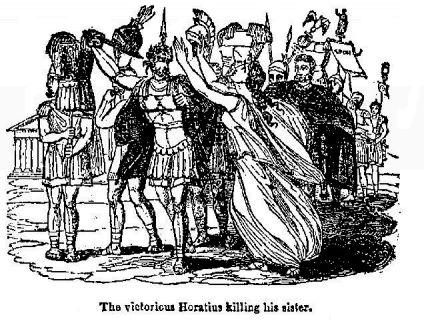
Hostil'ius died after a reign of thirty-two years; some say by lightning; others, with more probability, by treason.
Questions for Examination.
1. On whom devolved the government on the death of Numa, and what is the character of his successor?
2. What opportunity first offered of indulging the new king's inclinations?
3. What proposal was offered, and accepted for deciding the dispute?
4-6. Relate the circumstances which attended the combat, and the result of it.
7. What act followed the victory?
8. What conquest was next achieved?
FOOTNOTES:
It seems to have been part of the compact between the Romans and Sabines, that a king of each people should reign alternately.
The Hora'tii and Curia'tii were, according to Diony'sius of Halicarnas'sus, the sons of two sisters, daughters of Sequin'ius, an illustrious citizen of Alba. One married to Curia'tius, a citizen of Alba, and the other to Hora'tius, a Roman: so that the champions were near relatives.
This obedience of the Albans was of short duration; they soon rebelled and were defeated by Tullus, who razed the city of Alba to the ground, and transplanted the inhabitants to Rome, where he conferred on them the privileges of citizens.
Livy, lib. i. cap. 26. Dion. Hal. l. 3.
FROM THE DEATH OF TULLUS HOSTILIUS TO THE DEATH OF ANCUS MARTIUS THE FOURTH KING OF ROME.—U.C. 115.
Where what remains
Of Alba, still her ancient rights retains,
Still worships Vesta, though an humbler way,
Nor lets the hallow'd Trojan fire decay.—Juvenal.
1. After an interregnum, as in the former case, Ancus Mar'tius, the grandson of Numa, was elected king by the people, and their choice was afterwards confirmed by the senate. As this monarch was a lineal descendant from[Pg. 76] Numa, so he seemed to make him the great object of his imitation. He instituted the sacred ceremonies, which were to precede a declaration of war;[1] but he took every occasion to advise his subjects to return to the arts of agriculture, and to lay aside the less useful stratagems of war.
2. These institutions and precepts were considered by the neighbouring powers rather as marks of cowardice than of wisdom. The Latins therefore began to make incursions upon his territories, but their success was equal to their justice. An'cus conquered the Latins, destroyed their cities, removed their inhabitants to Rome, and increased his dominions by the addition of part of theirs. He quelled also an insurrection of the Ve'ii, the Fiden'ates, and the Vol'sci; and over the Sab'ines he obtained a second triumph.
3. But his victories over the enemy were by no means comparable to his works at home, in raising temples, fortifying the city, making a prison for malefactors, and building a sea-port at the mouth of the Ti'ber, called Os'tia, by which he secured to his subjects the trade of that river, and that of the salt-pits adjacent. Thus having enriched his subjects, and beautified the city, he died, after a reign of twenty-four years.
Questions for Examination.
1. Who was elected by the people after the interregnum, and what measures did he pursue?
2. In what light did his enemies consider his institutions? With what success did they oppose him?
3. What were the other acts of Ancus? How many years did he reign?
FOOTNOTES:
First an ambassador was sent to demand satisfaction for the alleged injury; if this were not granted within thirty-three days, heralds were appointed to proclaim the war in the name of the gods and people of Rome. At the conclusion of their speech, they threw their javelins into the enemy's confines, and departed.[Pg. 77]
FROM THE DEATH OF ANCUS MARTIUS, TO THE DEATH OF TARQUINIUS PRISCUS THE FIFTH KING OF ROME.—U.C. 130.
The first of Tarquin's hapless race was he,
Who odium tried to cast on augury;
But Nævius Accius, with an augur's skill.
Preserved its fame, and raised it higher still.—Robertson.
1. Lu'cius TARQUIN'IUS PRIS'CUS was appointed guardian to the sons of the late king, and took the surname of Tarquin'ius from the city of Tarquin'ia, whence he last came. His father was a merchant of Corinth,[1] who had acquired considerable wealth by trade, and had settled in Italy, upon account of some troubles at home. His son, who inherited his fortune, married a woman of family in the city of Tarquin'ia.
2. His birth, profession, and country, being contemptible to the nobles of the place, he, by his wife's persuasion, came to settle at Rome, where merit also gave a title to distinction. On his way thither, say the historians, as he approached the city gate, an eagle, stooping from above, took off his hat, and flying round his chariot for some time, with much noise, put it on again. This his wife Tan'aquil, who it seems was skilled in augury, interpreted as a presage that he should one day wear the crown. Perhaps it was this which first fired his ambition to pursue it.
3. Ancus being dead, and the kingdom, as usual, devolving upon the senate, Tarquin used all his power and arts to set aside the children of the late king, and to get himself elected in their stead. For this purpose, upon the day appointed for election, he contrived to have them sent out of the city; and in a set speech, in which he urged his friendship for the people, the fortune he had spent among them, and his knowledge of their government, he offered himself for their king. As there was nothing in this harangue that could be contested, it had the desired effect, and the people, with one consent, elected him as their sovereign.
4. A kingdom thus obtained by intrigue, was, notwithstanding, governed with equity. In the beginning of his reign, in order to recompense his friends, he added a hundred members more to the senate, which made them, in all, three hundred.[Pg. 78]
5. But his peaceful endeavours were soon interrupted by the inroads of his restless neighbours, particularly the Latins, over whom he triumphed, and whom he forced to beg for peace. He then turned his arms against the Sabines, who had risen once more, and had passed the river Ti'ber; but attacking them with vigour, Tarquin routed their army; so that many who escaped the sword, were drowned in attempting to cross over, while their bodies and armour, floating down to Rome, brought news of the victory, even before the messengers could arrive that were sent with the tidings. These conquests were followed by several advantages over the Latins, from whom he took many towns, though without gaining any decisive victory.
6. Tarquin, having thus forced his enemies into submission, was resolved not to let his subjects grow corrupt through indolence. He therefore undertook and perfected several public works for the convenience and embellishment of the city.[2]
7. In his time it was, that the augurs came into a great increase of reputation. He found it his interest to promote the superstition of the people; for this was, in fact, but to increase their obedience. Tan'aquil, his wife, was a great pretender to this art; but Ac'cius Næ'vius was the most celebrated adept of the kind ever known in Rome. 8. Upon a certain occasion, Tarquin, being resolved to try the augur's skill, asked him, whether what he was then pondering in his mind could be effected? Næ'vius, having consulted his auguries, boldly affirmed that it might: "Why, then," cries the king, with an insulting smile, "I had thoughts of cutting this whetstone with a razor." "Cut boldly," replied the augur; and the king cut it through accordingly. Thenceforward nothing was undertaken in Rome without consulting the augurs, and obtaining their advice and approbation.
9. Tarquin was not content with a kingdom, without having also the ensigns of royalty. In imitation of the Lyd'ian kings, he assumed a crown of gold, an ivory throne, a sceptre with an eagle on the top, and robes of purple. It was, perhaps, the splendour of these royalties that first raised the envy of the late king's sons, who had[Pg. 79] now, for above thirty-seven years, quietly submitted to his government. His design also of adopting Ser'vius Tul'lius, his son-in-law, for his successor, might have contributed to inflame their resentment. 10. Whatever was the cause of their tardy vengeance, they resolved to destroy him; and, at last, found means to effect their purpose, by hiring two ruffians, who, demanding to speak with the king, pretending that they came for justice, struck him dead in his palace with the blow of an axe. The lictors, however, who waited upon the person of the king, seized the murderers as they were attempting to escape, and put them to death: but the sons of Ancus, who were the instigators, found safety in flight.
11. Thus fell Lu'cius Tarquin'ius, surnamed Pris'cus, to distinguish him from one of his successors of the same name. He was eighty years of age, and had reigned thirty-eight years.[3]
Questions for Examination.
1. Who was Lucius Tarquinius Priscus?
2. What occasioned his removal to Rome, and what circumstances attended it?
3. Was this presage fulfilled, and by what means?
4. In what manner did he govern?
5. Was Tarquin a warlike prince?
6. How did he improve his victories?
7. By what act did he insure the obedience of his subjects?
8. What contributed to increase the reputation of the augurs?
9. What part of his conduct is supposed, to have raised the envy of the late king's sons?
10. What was the consequence of this envy and resentment?
11. What was his age, and how long did he reign?[Pg. 80]
FOOTNOTES:
Corinth (now Corito) was a celebrated city of ancient Greece, situated on the isthmus of that name, about sixty stadia or furlongs from the sea. Its original name was Ephy're.
Preparations for building the Capitol were made in this reign. The city was likewise fortified with stone walls, and the cloacæ, or common sewers, constructed by the munificence of this prince. (See Introd.)
The history of the elder Tarquin presents insuperable difficulties. We are told that his original name was Lu'cumo; but that, as has been mentioned in the Introduction, was the Etrurian designation of a chief magistrate. One circumstance, however, is unquestionable, that with him began the greatness and the splendour of the Roman city. He commenced those vaulted sewers which still attract the admiration of posterity; he erected the first circus for the exhibition of public spectacles; he planned the Capitol, and commenced, if he did not complete, the first city wall. The tradition that he was a Tuscan prince, appears to be well founded; but the Corinthian origin of his family is very improbable.
FROM THE DEATH OF TARQUINIUS PRISCUS TO THE DEATH OF SERVIUS TULLIUS THE SIXTH KING OF ROME.—U.C. 176.
Servius, the king, who laid the solid base
On which o'er earth the vast republic spread.—Thomson.
1. The report of the murder of Tarquin filled all his subjects with complaint and indignation; while the citizens ran from every quarter to the palace, to learn the truth of the account, or to take vengeance on the assassins. 2. In this tumult, Tan'aquil, widow of the late king, considering the danger she must incur, in case the conspirators should succeed to the crown, and desirous of seeing her son-in-law his successor, with great art dissembled her sorrow, as well as the king's death. She assured the people, from one of the windows of the palace, that he was not killed, but only stunned by the blow; that he would shortly recover; and that in the meantime he had deputed his power to Ser'vius Tul'lius, his son-in-law. Ser'vius, accordingly, as it had been agreed upon between them, issued from the palace, adorned with the ensigns of royalty, and, preceded by his lictors, went to despatch some affairs that related to the public safety, still pretending that he took all his instructions from the king. This scene of dissimulation continued for some days, till he had made his party good among the nobles; when, the death of Tarquin being publicly ascertained, Ser'vius came to the crown, solely at the senate's appointment, and without attempting to gain the suffrages of the people.
3. Ser'vius was the son of a bondwoman, who had been taken at the sacking of a town belonging to the Latins, and was born whilst his mother was a slave. While yet an infant in his cradle, a lambent flame[1] is said to have played round his head, which Tan'aquil converted into an omen of future greatness.
4. Upon being acknowledged king, he determined to make a great change in the Roman constitution by admitting the plebeians to a participation in the civil government. The senate was too weak to resist the change when it was proposed, but it submitted with great reluctance. 5. Ser'vius divided all the Romans into classes and centuries[Pg. 81] according to their wealth and the amount of taxes paid to the state. The number of centuries in the first class nearly equalled that of all the others; a great advantage to the plebeians; for the lower classes being chiefly clients of the patricians, were always inclined to vote according to the prejudices or interests of their patrons.
6. The classification by centuries was also used for military purposes; the heavy armed infantry being selected from the richer classes; the light troops, whose arms and armour could be obtained at less expense, were levied among the lower centuries.
7. In order to ascertain the increase or decay of his subjects, and their fortunes, he instituted another regulation, which he called a lustrum. By this, all the citizens were to assemble in the Cam'pus Mar'tius,[2] in complete armour, and in their respective classes, once in five years, and there to give an exact account of their families and fortune.
8. Having enjoyed a long reign, spent in settling the domestic policy of the state, and also not inattentive to foreign concerns, he conceived reasonable hopes of concluding it with tranquillity and ease. He even had thoughts of laying down his power; and, having formed the kingdom into a republic, to retire into obscurity; but so generous a design was frustrated ere it could be put into execution.
9. In the beginning of his reign, to secure the throne by every precaution, he had married his two daughters to the two grandsons of Tarquin; and as he knew that the women, as well as their intended husbands, were of opposite dispositions, he resolved to cross their tempers, by giving each to him of a contrary turn of mind; her that was meek and gentle to him that was bold and furious; her that was ungovernable and proud, to him that was remarkable for a contrary character; by this he supposed that each would correct the failings of the other, and that the mixture would be productive of concord. 10. The event, however, proved otherwise. Lu'cius, the haughty son-in-law, soon grew displeased with the meekness of his consort, and placed his whole affections upon his brother's wife, Tul'lia, who answered his passion with sympathetic ardour. As their wishes were ungovernable, they soon resolved to break[Pg. 82] through every restraint that prevented their union; they both undertook to murder their respective consorts; they succeeded, and were soon after married together. 11. A first crime ever produces a second; from the destruction of their consorts, they proceeded to conspiring that of the king. They began by raising factions against him, alleging his illegal title to the crown, and Lu'cius claiming it as his own, as heir to Tarquin. At length, when he found the senate ripe for seconding his views, he entered the senate-house, adorned with all the ensigns of royalty, and, placing himself upon the throne, began to harangue them on the obscurity of the king's birth, and the injustice of his title. 12. While he was yet speaking, Ser'vius entered, attended by a few followers, and seeing his throne thus rudely invaded, offered to push the usurper from his seat; but Tarquin, being in the vigour of youth, threw the old king down the steps which led to the throne; some of his adherents, who were instructed for that purpose, followed him, as he was feebly attempting to get to the palace, dispatched him by the way, and threw his body, all mangled and bleeding, as a public spectacle, into the street. 13. In the mean time, Tul'lia, burning with impatience for the event, was informed of what her husband had done, and, resolving to be among the first who should salute him as monarch, ordered her chariot to the senate-house. But as her charioteer approached the place where the body of the old king, her father, lay exposed and bloody; the man, amazed at the inhuman spectacle, and not willing to trample upon it with his horses, offered to turn another way; this serving only to increase the fierceness of her anger, she threw the foot-stool at his head, and ordered him to drive over the body without hesitation.[3]
14. This was the end of Ser'vius Tul'lius, a prince of eminent justice and moderation, after an useful and prosperous reign of forty-four years.
Questions for Examination.
1. What effect had the murder of Tarquin on his subjects?
2. By what means was the succession assured to Servius Tullius?[Pg. 83]
3. Who was Servius?
4. What was the chief object of his reign?
5. What was the nature of the change made by Servius in the Roman constitution?
6. Was the classification by centuries used for civil purposes only?
7. What other important measure did he adopt?
8. What hopes did he entertain in his old age?
9. By what means did he hope to secure tranquil possession of the throne?
10. How was it that the event failed to answer his expectations?
11. To what farther crimes did the commencement lead?
12. What followed?
13. What was the conduct of his daughter on this melancholy occasion?
14. What was the character of Servius, and how long did he reign?
FOOTNOTES:
A flame of fire gliding about without doing any harm.
A large plain at Rome, without the walls of the city, where the Roman youth performed their exercises. Cam'pus is the Latin word for field; and this field or plain was called Mar'tius, because it was dedicated to Mars, the god of war.
The blood of the good old king is said to have dyed the chariot wheels, and even the clothes of the inhuman daughter; from that time the street where it happened was called vicus sceleratus, the wicked or accursed street.
FROM THE DEATH OF SERVIUS TULLIUS TO THE BANISHMENT OF TARQUINIUS SUPERBUS THE SEVENTH AND LAST KING OF ROME U.C. 220.
A nobler spirit warm'd
Her sons; and roused by tyrants, nobler still
It burn'd in Brutus.—Thomson.
1. LU'CIUS TARQUIN'IUS, afterwards called Super'bus, or the Proud, having placed himself upon the throne, in consequence of this horrid deed, was resolved to support his dignity with the same violence with which it was acquired. Regardless of the senate or the people's approbation, he seemed to claim the crown by an hereditary right, and refused burial to the late king's' body, under pretence of his being an usurper. 2. All the good part of mankind, however, looked upon his accession with detestation and horror: and this act of inefficient cruelty only served to confirm their hatred. 3. Conscious of this, he ordered all such as he suspected to have been attached to Ser'vius, to be put to death; and fearing the natural consequences of his tyranny, he increased the guard round his person.
4. His chief policy seems to have been to keep the people always employed either in wars or public works, by which means he diverted their attention from his unlawful method of coming to the crown. He first marched against the Sab'ines, who refused to pay him obedience; and he soon reduced them to submission. 5. In the meantime, many of the discontented patricians, abandoning their native country, took refuge in Ga'bii, a city of Latium, about[Pg. 84] twelve miles from Rome, waiting an opportunity to take up arms, and drive Tarquin from his throne. To escape this danger. Tarquin had recourse to the following stratagem. 6. He caused his son Sextus to counterfeit desertion, upon pretence of barbarous usage, and to seek refuge among the inhabitants of the place. There, by artful complaints and studied lamentations, Sextus so prevailed upon the pity of the people, as to be chosen their governor, and, soon after, general of their army. 7. At first, in every engagement, he appeared successful; till, at length, finding himself entirely possessed of the confidence of the state, he sent a trusty messenger to his father for instructions. Tarquin made no answer; but taking the messenger to the garden, he cut down before him the tallest poppies. Sextus readily understood the meaning of this reply, and found means to destroy or remove, one by one, the principal men of the city; taking care to confiscate their effects among the people. 8. The charms of this dividend kept the giddy populace blind to their approaching ruin, till they found themselves at last without counsellors or head; and, in the end, fell under the power of Tarquin, without even striking a blow.[1]
9. But, while he was engaged in wars abroad, he took care not to suffer the people to continue in idleness at home. He undertook to build the Capitol, the foundation of which had been laid in a former reign; and an extraordinary event contributed to hasten the execution of his design. A woman, in strange attire, made her appearance at Rome, and came to the king, offering to sell nine books, which, she said, were of her own composing. 10. Not knowing the abilities of the seller, or that she was, in fact, one of the celebrated Sybils, whose prophecies were never found to fail, Tarquin refused to buy them. Upon this she departed, and burning three of her books, returned again, demanding the same price for the six remaining. 11. Being once more despised as an impostor, she again departed, and burning three more, she returned with the remaining three, still asking the same price as at first. Tarquin, surprised at the[Pg. 85] inconsistency of her behaviour, consulted the augurs, to be advised what to do. These much blamed him for not buying the nine, and commanded him to take the three remaining, at whatsoever price they were to be had. 12. The woman, says the historian, after thus selling and delivering the three prophetic volumes, and advising him to have a special attention to what they contained, vanished from before him, and was never seen after. A trick this, invented probably by Tarquin himself, to impose upon the people; and to find in the Sybil's leaves whatever the government might require. However this was, he chose proper persons to keep them, who, though but two at first, were afterwards increased to fifteen, under the name of Quindecemviri. The important volumes were put into a stone chest, and a vault in the newly designed building was thought the properest place to secure them.[2]
13. The people, having been now for four years together employed in building the Capitol, began, at last, to wish for something new to engage them; Tarquin, therefore, to satisfy their wishes, proclaimed war against the Ru'tuli, upon a frivolous pretence of their having entertained some malefactors, whom he had banished; and invested their chief city, Ar'dea, which lay about sixteen miles from Rome. 14. While the army was encamped before this place, the king's son Sextus Tarquinius, Collati'nus a noble Roman, and some others, sitting in a tent drinking together, the discourse turned upon wives, each man preferring the beauty and virtue of his own. Collati'nus offered to decide the dispute by putting it to an immediate trial, whose wife should be found possessed of the greatest beauty, and most sedulously employed at that very hour: being heated with wine, the proposal was relished by the whole company; and, taking horse without delay, they posted to Rome, though the night was already pretty far advanced.
15. There they found Lucre'tia, the wife of Collati'nus, not like the other women of her age, spending the time in ease and luxury, but spinning in the midst of her maids, and cheerfully portioning out their tasks. Her modest beauty, and the easy reception she gave her husband and his friends, so charmed them all, that they unanimously gave her the preference, but kindled, in the breast of Sextus Tarquin'ius, a detestable passion, which occasioned the[Pg. 86] grossest insult and injury to Lucre'tia, who, detesting the light, and resolving to destroy herself for the crime of another, demanded her husband Collati'nus, and Spu'rius, her father, to come to her; an indelible disgrace having befallen the family. 16. They instantly obeyed the summons, bringing with them Valerius, a kinsman of her father, and Junius Bru'tus, a reputed idiot, whose father Tarquin had murdered, and who had accidentally met the messenger by the way. 17. Their arrival only served to increase Lucre'tia's poignant anguish; they found her in a state of the deepest desperation, and vainly attempted to give her relief. After passionately charging Sextus Tarquin'ius with the basest perfidy towards her husband and injury to herself, she drew a poinard from beneath her robe, and instantly plunging it into her bosom, expired without a groan. 18. Struck with sorrow, pity, and indignation, Spu'rius and Collati'nus gave vent to their grief; but Bru'tus, drawing the poinard, reeking, from Lucre'tia's wound, and lifting it up towards heaven, "Be witness, ye gods," he cried, "that, from this moment, I proclaim myself the avenger of the chaste Lucretia's cause; from this moment I profess myself the enemy of Tarquin and his wicked house; from henceforth this life, while life continues, shall be employed in opposition to tyranny, and for the happiness and freedom of my much-loved country." 19. A new amazement seized the hearers: he, whom they had hitherto considered as an idiot, now appearing, in his real character, the friend of justice, and of Rome. He told them, that tears and lamentations were unmanly, when vengeance called so loudly; and, delivering the poinard to the rest, imposed the same oath upon them which he himself had just taken.
20. Ju'nius Brutus was the son of Marcus Ju'nius, who was put to death by Tarquin the Proud, and the grandson of Tarquin the elder. He had received an excellent education from his father, and had, from nature, strong sense and an inflexible attachment to virtue; but knowing that Tarquin had murdered his father and his eldest brother, he counterfeited a fool, in order to escape the same danger, and thence obtained the surname of Bru'tus. Tarquin, thinking his folly real, despised the man; and having possessed himself of his estate, kept him as an idiot in his house, merely with a view of making sport for his children.
21. Brutus, however, only waited this opportunity to avenge the cause of his family. He ordered Lucre'tia's[Pg. 87] dead body to be brought out to view, and exposing it in the public forum, inflamed the ardour of the citizens by a display of the horrid transaction. He obtained a decree of the senate, that Tarquin and his family should be for ever banished from Rome, and that it should be capital for any to plead for, or to attempt his future return. 22. Thus this monarch, who had now reigned twenty-five years, being expelled his kingdom, went to take refuge with his family at Ci'ra, a little city of Etru'ria. In the mean time the Roman army made a truce with the enemy, and Bru'tus was proclaimed deliverer of the people.
Thus ended with Tarquin, after a continuance of two hundred and forty-five years, the regal state of Rome.
Questions for Examination.
1. What was the conduct of Lucius Tarquinius at the commencement of his reign?
2. Was his claim quietly acquiesced in?
3. What means did he adopt for his security?
4. By what means did he divert the people's attention from the unlawful manner in which he acquired the crown?
5. What happened in the mean time?
6. To what mean artifice did he have recourse?
7. How did Sextus accomplish his father's design?
8. What were the effects of this measure?
9. In what way did he employ his subjects at home during his absence, and what extraordinary event occurred?
10. Did he accept her offer?
11. Was her second application successful, and what followed?
12. What became of the Sybil, and what is the general opinion respecting this transaction?
13. Upon what pretence did Tarquin proclaim war against the Rutuli?
14. What remarkable event took place at the siege of Ardea?
15. What was the consequence of this intemperate frolic?
16. How did Lucretia support the loss of her honour?
17. Did they obey her summons, and who did they bring with them?
18. What was the consequence of their arrival?
19. What effect had this dreadful catastrophe on those present?
20. How was this unexpected resolution received?
21. Give some account of Brutus.
22. For what reason, and by what means, did Brutus endeavour the abolition of royalty?
23. What became of Tarquin after his expulsion?[Pg. 88]
FOOTNOTES:
This story is manifestly a fiction formed from the Greek traditions respecting Zopy'nus and Thrasybu'lus. It is decisively contradicted by the fact, that a treaty for the union of the Romans and Gabians, on equitable terms, was preserved in the Capitol. It was painted on a shield covered with the hide of the bull which had been sacrificed at the ratification of the league.
The Capitol, or temple of Jupiter Capitoli'nus.
THE COMMONWEALTH.
FROM THE BANISHMENT OF TARQUIN TO THE APPOINTMENT OF THE DICTATOR—U.C. 245.
The great republic seek that glowed, sublime,
With the mixt freedom of a thousand states.—Thomson.
1. The regal power being overthrown, a republican form of government was substituted in its room. The senate, however, reserved by far the greatest share of the authority to themselves, and decorated their own body with all the spoils of deposed monarchy. The centuries of the people chose from among the senators, instead of a king, two annual magistrates, whom they called CONSULS,[1] with power equal to that of the regal, and with the same privileges and the same ensigns of authority.
2. Brutus, the deliverer of his country, and Collati'nus, the husband of Lucre'tia, were chosen the first consuls in Rome.
3. But this new republic, however, which seemed so grateful to the people, had like to have been destroyed in its very commencement. A party was formed in favour of Tarquin. Some young men of the principal families in the state, who had been educated about the king, and had shared in all the luxuries and pleasures of the court, undertook to re-establish monarchy. 4. This party secretly increased every day; and what may create surprise, the sons of Bru'tus himself, and the Aqui'lii, the nephews of Collati'nus, were among the number, 5. Tarquin, who was informed of these intrigues in his favour, sent ambassadors from Etru'ria to Rome, under a pretence of reclaiming the estates of the exiles; but, in reality, with a design to give spirit to his faction. 6. The conspiracy was discovered by a slave who had accidentally hid himself in the room where the conspirators used to assemble. 7. Few situations could have been more terribly affecting than that of Bru'tus: a father placed as a judge upon the life and death of his own[Pg. 89] children, impelled by justice to condemn, and by nature to spare them. 8. The young men pleaded nothing for themselves; but, with conscious guilt, awaited their sentence in silence and agony. 9. The other judges who were present felt all the pangs of nature; Collati'nus wept, and Vale'rius could not repress his sentiments of pity. Brutus, alone, seemed to have lost all the softness of humanity; and, with a stern countenance and a tone of voice that marked his gloomy resolution, demanded of his sons if they could make any defence, to the crimes with which they had been charged. This demand he made three several times; but receiving no answer, he at length turned himself to the executioner: "Now," cried he, "it is your part to perform the rest." 10. Thus saying, he again resumed his seat with an air of determined majesty; nor could all the sentiments of paternal pity, the imploring looks of the people, nor yet the tears of his sons, who were preparing for execution, alter the tenor of his resolution. Bru'tus, unmoved by any motive but the public good, pronounced upon them the sentence of death, and by his office was obliged to see it put in execution. The prisoners were scourged and then beheaded, and Bru'tus beheld the cruel spectacle; but, in spite of his stoic firmness, could not stifle the sentiments of nature which he sacrificed to the necessity of his office.
11. Tarquin's hopes of an insurrection in his favour being thus overset, he now resolved to force himself upon his former throne by foreign assistance. He prevailed upon the Veians to assist him, and, with a considerable army, advanced towards Rome.
12. The consuls were not remiss in preparations to oppose him. Vale'rius commanded the foot, and Bru'tus being appointed to head the cavalry, went out to meet him on the Roman border. 13. A'runs, the son of Tarquin, who commanded the cavalry for his father, seeing Bru'tus at a distance, resolved, by one great attempt, to decide the fate of the day before the engaging of the armies, when, spurring his horse he flew to him with fury. Bru'tus perceived his approach, and singled out from the ranks, they met with such ungoverned rage, that, eager only to assail, and thoughtless of defending, they both fell dead upon the field together. 14. A bloody battle ensued, with equal slaughter on both sides: but the Romans, remaining in possession of the field of battle, claimed the victory. In consequence, Vale'rius returned in triumph to Rome. [Pg. 90] 15. In the mean time Tarquin, no way intimidated by his misfortunes, prevailed upon Porsen'na, one of the kings of Etruria, to espouse his cause, and in person to undertake his quarrel. 16. This prince, equally noted for courage and conduct marched directly to Rome, with a numerous army, and laid siege to the city; while the terror of his name and arms filled all ranks of the people with dismay The siege was carried on with vigour; a furious attack was made upon the place; the consuls opposed in vain, and were carried off wounded from the field; while the Romans, flying in great consternation, were pursued by the enemy to the bridge, over which both victors and vanquished were about to enter the city in the confusion. 17. All now appeared lost, when Hora'tius Co'cles, who had been placed there as sentinel to defend it, opposed himself to the torrent of the enemy, and, assisted only by two more, for some time sustained the whole fury of the assault, till the bridge was broken down behind him. When he found the communication thus cut off, plunging with his arms into the torrent of the Tiber, he swam back victorious to his fellow-soldiers, and was received with just applause.[2]
18. Still, however, Porsen'na was determined upon taking the city; and though five hundred of his men were slain in a sally of the Romans, he reduced it to the greatest straits, and turning the siege into a blockade, resolved to take it by famine. 19. The distress of the besieged soon began to be insufferable, and all things seemed to threaten a speedy surrender, when another act of fierce bravery, still superior to that which had saved the city before again brought about its safety and freedom.
20. Mu'tius, a youth of undaunted courage, was resolved to rid his country of an enemy that so continued to oppress it; and, for this purpose, disguised in the habit of an Etru'rian peasant, entered the camp of the enemy, resolving to die or to kill the king. 21. With this resolution he made up to the place where Porsen'na was paying his troops, with a secretary by his side; but mistaking the latter for the king, he stabbed him to the heart, and was immediately apprehended and brought into the royal presence. 22. Upon[Pg. 91] Porsen'na's demanding who he was, and the cause of so heinous an action, Mu'tius, without reserve, informed him of his country and his design, and at the same time thrusting his right hand into a fire that was burning upon the altar before him, "You see," cried he, "how little I regard the severest punishment your cruelty can inflict. A Roman knows not only how to act, but how to suffer; I am not the only person you have to fear; three hundred Roman youths, like me, have conspired your destruction; therefore prepare for their attempts." 23. Porsen'na, amazed at so much intrepidity, had too noble a mind not to acknowledge merit, though found in an enemy; he therefore ordered him to be safely conducted back to Rome, and offered the besieged conditions of peace.[3] 24. These were readily accepted on their side, being neither hard nor disgraceful, except that twenty hostages were demanded; ten young men, and as many virgins, of the best families in Rome. 25. But even in this instance also, as if the gentler sex were resolved to be sharers in the desperate valour of the times, Cle'lia, one of the hostages, escaping from her guards, and pointing out the way to the rest of her female companions, swam over the Tiber on horseback, amidst showers of darts from the enemy, and presented herself to the consul. 26. This magistrate, fearing the consequences of detaining her, sent her back; upon which Porsen'na, not to be outdone in generosity, not only gave her liberty, but permitted her to choose such of the hostages of the opposite sex as she should think fit, to attend her. 27. On her part, she, with all the modesty of a Roman virgin, chose only such as were under fourteen, alleging, that their tender age was least capable of sustaining the rigours of slavery.[4] 28. The year after the departure of Porsen'na, the Sab'ines invading the Roman territories, committed great devastations. The war that ensued was long and bloody; but at length the Sab'ines[Pg. 92] were compelled to purchase a peace, with corn, money, and the cession of part of their territory.
29. Tarquin, by means of his son-in-law, Man'lius, once more stirred up the Latins to espouse his interest, and took the most convenient opportunity when the plebeians were at variance with the senators concerning the payment of their debts.[5] These refused to go to war, unless their debts were remitted upon their return: so that the consuls, finding their authority insufficient, offered the people to elect a temporary magistrate, who should have absolute power, not only over all ranks of the state, but even over the laws themselves. To this the plebeians readily consented, willing to give up their own power for the sake of abridging that of their superiors. 30. In consequence of this, Lar'tius was created the first dictator of Rome, for so was this high office called, being nominated to it by his colleague in the consulship. 31. Thus the people, who could not bear the very name of king, readily submitted to a magistrate possessed of much greater power; so much do the names of things mislead us, and so little is any form of government irksome to the people, when it coincides with their prejudices.
Questions for Examination.
1. What form of government was substituted for the regal?
2. Who were the first consuls?
3. Did this new government appear stable at its commencement?
4. Was this party formidable, and who were the most remarkable of its members?
5. What share had Tarquin in this conspiracy?
6. By what means was it discovered?
7. In what unhappy situation was Brutus placed?
8. What had the criminals to say in extenuation of their offences?
9. What effect had this scene on the judges?
10. Did not paternal affection cause him to relent?
11. What measures did Tarquin next pursue?
12. What steps were taken to resist him?[Pg. 93]
13. What remarkable event attended the meeting of the armies?
14. Did this decide the fate of the day?
15. Did Tarquin relinquish his hopes?
16. In what manner did Porsenna attempt the restoration of Tarquin?
17. By what heroic action was the city saved?
18. Did Porsenna persevere in his attempt?
19. What was the consequence?
20. What was this act of heroism?
21. Did he succeed?
22. What followed?
23. How did Porsenna act on the occasion?
24. Were these conditions accepted?
25. What remarkable circumstance attended the delivery of the hostages?
26. How did the consul act on the occasion?
27. Whom did she choose?
28. What happened after the departure of Porsenna?
29. What measures did Tarquin next resort to?
30. What was the consequence?
31. What inference may be drawn from this?
FOOTNOTES:
These were first called Prætors, next Judices, and afterwards Consuls: a Consulendo, from their consulting the good of the Common wealth. They had the royal ornaments, as the golden crown, sceptre, purple robes, lictors, and the ivory and curule chairs. The crowns and sceptres were, however, used only on extraordinary days of triumph.—See Introduction.
For this heroic act, Hora'tius was crowned on his return; his status was erected in the temple of Vulcan; as much land was given him as a plough could surround with a furrow in one day, and a tax was voluntarily imposed to make him a present in some degree suitable to the service he had performed.
From this time he obtained the additional name of Scævola, or left-handed, from his having lost the use of his right hand by the fire.
National pride induced the Romans to conceal the fact that the city was surrendered to Porsenna; Tacitus, however, expressly declares that it was, and Pliny informs us of the severe conditions imposed by the conqueror; one of the articles prohibited them from using iron except for the purposes of agriculture. Plutarch, in his Roman Questions, declares that there was a time when the Romans paid a tenth of their produce to the Etrurians, but that they were freed from the disgraceful tribute by Hercules; this tradition appears to refer to the conquest of the city by Porsenna.
Besides this, by his emissaries, he engaged the meaner sort of citizens and the slaves in a conspiracy. The former were, at an appointed time, to seize the ramparts, and the latter to murder their masters at the same instant. The gates were then to be opened to the Tar'quins, who were to enter Rome while it was yet reeking with the blood of the senators. This conspiracy was discovered to the consul by two of Tarquin's principal agents.
FROM THE CREATION OF THE DICTATOR TO THE ELECTION OF THE TRIBUNES.—U.C. 255.
And add the Tribunes, image of the people—Anon.
1. LAR'TIUS, being created dictator,[1] entered upon his office, surrounded with lictors and all the ensigns of ancient royalty; and, seated upon a throne in the midst of the people, ordered the levies to be made, in the manner of the kings of Rome. 2. The populace looked with terror upon a magistrate whom they had invested with uncontrollable power, and each went peaceably to range himself under his respective standard. 3. Thus going forth to oppose the enemy, he, after concluding a truce for a year, returned with his army, and, in six months, laid down the dictatorship, with the reputation of having exercised it with blameless lenity.
4. But, though for this time the people submitted to be led forth, they yet resolved to free themselves from the[Pg. 94] yoke; and, though they could not get their grievances redressed, yet they determined to fly from those whom they could not move to compassion. The grievances, therefore, continuing, they resolved to quit a city which gave them no shelter, and to form a new establishment without its limits. They, therefore, under the conduct of a plebe'ian, named Sicin'ius Bellu'tus, retired to a mountain, hence called the Mons Sacer, within three miles of Rome.
5. Upon the news of this defection, the city was filled with tumult and consternation: those who wished well to the people made every attempt to scale the walls, in order to join it.[2] 6. The senate was not less agitated than the rest; some were for violent measures, and repelling force by force; others were of opinion that gentler arts were to be used, and that even a victory over such enemies would be worse than a defeat. At length, it was resolved to send a messenger, entreating the people to return home, and declare their grievances; promising, at the same time, an oblivion of all that had passed.
7. This message not succeeding, Mene'nias Agrip'pa, one of the wisest and best of the senators, was of opinion, that the demands of the people were to be complied with. It was resolved, therefore, to enter into a treaty, and to make them such offers as should induce them to return. 8. Ten commissioners were deputed. The dignity and popularity of the ambassadors procured them a very respectful reception among the soldiers, and a conference began. They employed all their oratory; while Sicin'ius and Lu'cius Ju'nius, who were speakers for the soldiery, aggravated their distresses with all that masculine eloquence which is the child of nature.
9. The conference had now continued for a long time, when Mene'nius Agrip'pa, who had been originally a plebe'ian himself, a shrewd man, and who, consequently, knew what kind of eloquence was most likely to please the people, addressed them with that celebrated fable of the body and the members, which is so finely told by Livy.[3][Pg. 95]
10. This fable, the application of which is obvious, had an instantaneous effect upon the people. They unanimously cried out, that Agrip'pa should lead them back to Rome; and were making preparations to follow him, when Lu'cius Junius withheld them; alleging, that though they ought gratefully to acknowledge the kind offers of the senate, yet they had no safeguard against their future resentments; that therefore it was necessary, for the security of the people, to have certain officers created annually from among themselves, who should have power to give redress to such of them as should be injured, and plead the cause of the community. 11. The people, who are generally of opinion with the last speaker,[4] highly applauded this proposal, with which, however, the commissioners had not power to comply; they, therefore, sent to Rome to take the instructions of the senate, who, distracted with divisions among themselves, and harassed by complaints from without, were resolved to have peace, at whatever price it should be obtained; accordingly, as if with one voice, they consented to the creation of these new officers, who were called Tribunes[5] of the People.
12. The tribunes of the people were at first five in number, though afterwards their body was increased by five more. They were always annually elected by the people, and almost always from their body. They at first had their seats placed before the doors of the senate house, and, when called in, they were to examine every decree, annulling it by the word Veto, "I forbid it;" or confirming it by signing the letter T, which gave it validity. 13. This new office being thus instituted, all things were adjusted both on the one side and the other, and the people, after having sacrificed to the gods of the mountain, returned back once more in triumph to Rome.[Pg. 96]
Questions for Examination.
1. What were the first acts of the dictator?
2. Were his decrees peaceably obeyed?
3. What were his exploits?
4. Were the discontents of the people entirely appeased?
5. How was the news of this defection received?
6. What was its effect on the senate?
7. Was this offer accepted?
8. In what manner was this done, and how were they received?
9. What was the result of this conference?
10. What fable was addressed to the people?
11. What effect did this apology produce?
12. How was this obstacle removed?
13. Who were the tribunes of the people, and what was their authority?
14. Did this new regulation answer the desired end?
FOOTNOTES:
The power of the dictator was absolute; he could, of his own will, make peace or war, levy forces, lead them forth, disband them, and even dispense with the existing laws, at his pleasure, without consulting the senate.
The gates had been shut by order of the senate, to prevent further defection.
Titus Livius was born at Pad'ua (the ancient Patavi'nus) in the year of Rome, 695. He wrote the Roman history, from the foundation of the city to the year 744, in 140 books, of which only 35 remain and some of them are still imperfect. Though Livy was treated with great marks of respect by the emperor Augustus, in whose reign he flourished, yet he extolled Pompey so highly, that Augustus used to call him a Pompeian: and though he was by no means backward in bestowing praises on Brutus and Cassius, the enemies of Augustus, yet it did not interrupt their friendship. Livy died at his native city, in the fourth year of the reign of Tiberius, aged 76 years.
This is a severe satire upon the judgment of the multitude; indeed, it seems intended to show, that when the passions are appealed to, the judgment is not much consulted; and therefore, that little reliance ought to be placed on acts resulting from popular acclamation.
They were called tribunes, because chosen by the tribes. The first tribunes were L. Ju'nius Bru'tus, C. Sicin'ius Mellu'tus, Pub'lius Licin'ius, C. Licin'ius, and Sp. Ici'lius Ruga.
FROM THE CREATION OF THE TRIBUNES, TO THE APPOINTMENT OF THE DECEMVIRI—U.C. 260.
Welcome to Rome, renowned Coriolanus!—Shakspeare.
1. During the late separation, all tillage had been entirely neglected, and a famine was the consequence the ensuing season. 2. The senate did all that lay in their power to remedy the distress; but the people, pinched with want and willing to throw the blame on any but themselves, ascribed the whole of their distress to the avarice of the patricians, who, having purchased all the corn, as was alleged, intended to indemnify themselves for the abolition of debts, by selling it out to great advantage. 3. But plenty soon after appeased them for a time. A fleet of ships, laden with corn, from Sicily, once more raised their spirits.
4. But Coriola'nus[1] incurred their resentment, by insisting that the corn should not be distributed till the grievances of the senate were removed. For this, the tribunes summoned[Pg. 97] him to a trial before the people.
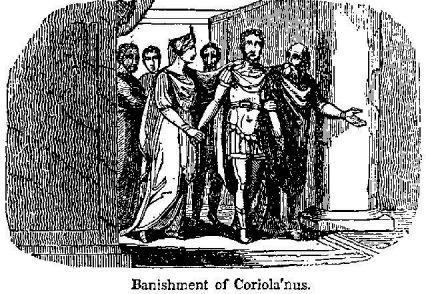
5. When the appointed day was come, all persons were filled with the greatest expectations, and a vast concourse from the adjacent country assembled and filled the forum. Coriola'nus presented himself before the people, with a degree of intrepidity that merited better fortune. His graceful person, his persuasive eloquence, and the cries of those whom he had saved from the enemy, inclined the auditors to relent. 6. But, being unable to answer what was alleged against him to the satisfaction of the people, and utterly confounded with a new charge, of having embezzled the plunder of Antium, the tribunes immediately took the votes, and Coriola'nus was condemned to perpetual exile.
7. This sentence against their bravest defender struck the senate with sorrow, consternation and regret. Coriola'nus alone, in the midst of the tumult, seemed an unconcerned spectator. 8. He returned home, followed by the lamentations of the most respectable senators and citizens, to take leave of his wife, his children, and his mother, Vetu'ria. Thus, recommending all to the care of Heaven, he left the city, without followers or fortune, to take refuge with Tullus At'tius,[2] a man of great power among the Volsci, who took him under his protection, and espoused his quarrel.
9. Some pretence was necessary to induce the Volsci to[Pg. 98] break the league which had been made with Rome; and, for this purpose, Tullus sent many of his citizens thither, apparently for the purpose of seeing some games at that time celebrating; but gave the senate private information, that the strangers had dangerous intentions of burning the city. 10. This had the desired effect; the senate issued an order, that all strangers, whoever they were, should depart from Rome before sun-set. 11. This order Tullus represented to his countrymen as an infraction of the treaty, and procured an embassy to Rome, complaining of the breach, and redemanding all the territories belonging to the Volsci, of which they had been violently dispossessed; declaring war in case of refusal. This message, however, was treated by the senate with contempt. 12. War being, in consequence, declared on both sides, Coriola'nus and Tullus were made generals of the Volsci, and accordingly invaded the Roman territories, ravaging and laying waste all such lands as belonged to the plebeians, but letting those of the senators remain untouched. 13. In the mean time, the levies went on but slowly at Rome; the two consuls, who were re-elected by the people, seemed but little skilled in war, and even feared to encounter a general whom they knew to be their superior in the field. The allies also showed their fears, and slowly brought in their succours: so that Coriola'nus continued to take their towns one after the other. 14. Fortune followed him in every expedition, and he was now so famous for his victories, that the Volsci left their towns defenceless to follow him into the field. The very soldiers of his colleague's army came over to him, and would acknowledge no other general. 15. Thus finding himself unopposed in the field, and at the head of a numerous army, he at length invested the city of Rome itself, fully resolved to besiege it. 16. It was then the senate and the people unanimously agreed to send deputies to him, with proposals for his restoration, in case he would draw off his army. 17. Coriola'nus received these proposals at the head of his principal officers, and, with the sternness of a general that was to give the law, refused their offers.
18. Another embassy was now sent, conjuring him not to exact from his native city aught but what became Romans to grant. Coriola'nus, however, naturally severe, still persisted in his former demands, and granted them only three days for deliberation. 19. In this exigence, all that was left to be done was another deputation, still more solemn[Pg. 99] than either of the former, composed of the pontiffs, priests, and augurs. These, clothed in their habits of ceremony, and with a grave and mournful deportment, issued from the city, and entered the camp of the conqueror: but all in vain, they found him severe and inflexible.
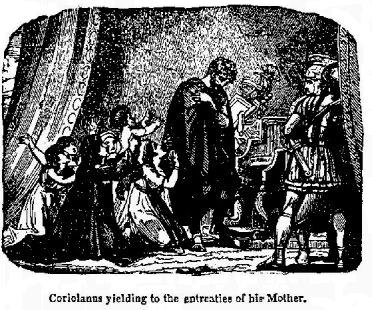
20. When the people saw them return without success, they began to give up the commonwealth as lost. Their temples were filled with old men, with women and children, who, prostrate at the altars, put up their ardent prayers for the preservation of their country. Nothing was to be heard but anguish and lamentation; nothing to be seen but scenes of affright and distress. 21. At length it was suggested to them, that what could not be effected by the intercession of the senate, or the adjuration of the priests, might be brought about by the tears of a wife, or the commands of a mother. 22. This deputation seemed to be approved by all, and even the senate themselves gave it the sanction of their authority. Vetu'ria, the mother of Coriola'nus, at first hesitated to undertake so pious a work; knowing the inflexible temper of her son, and fearing only to show his disobedience in a new point of light, by his rejecting the commands of a parent; however, she at last undertook the embassy, and set forward from the city, accompanied by many of the principal matrons of Rome, with Volum'nia his wife, and his two children. 23. Coriola'nus, who at a distance discovered this mournful train of females, was resolved to give them a denial, and called his officers round him to be witnesses of his resolution; but, when told that his mother and his wife were among the number, he instantly[Pg. 100] came down from his tribunal to meet and embrace them. 24. At first, the women's tears and embraces took away the power of words, and the rough soldier himself, hardy as he was, could not refrain, from sharing their distress. Coriola'nus now seemed much agitated by contending passions; while his mother, who saw him moved, seconded her words by the most persuasive eloquence, that of tears: his wife and children hung around him, entreating for protection and pity: while the female train, her companions, added their lamentations, and deplored their own and their country's distress. 25. Coriola'nus for a moment was silent, feeling the strong conflict between honour and inclination; at length, as if roused from a dream, he flew to raise his mother, who had fallen at his feet, crying out, "O, my mother, thou hast saved Rome, but lost thy son!" He accordingly gave orders to draw off the army, pretending to the officers that the city was too strong to be taken. 26. Tullus, who had long envied Coriola'nus, was not remiss in aggravating the lenity of his conduct to his countrymen. Upon their return, Coriola'nus is said to have been slain by an insurrection of the people, and honourably buried, after a late and ineffectual repentance.
27. Great and many were the public rejoicings at Rome upon the retreat of the Volscian army;[3] but they were clouded soon after by the intrigues of Spu'rius Cas'sius, who, wanting to make himself despotic by means of the people, was found guilty of a number of crimes, all tending towards altering the constitution; and was thrown headlong from the Tarpei'an rock,[4] by those very people whose interests he had endeavoured to extend.
Questions for Examination.
1. What were the consequences of the late separation?
2. What measures were taken to remedy these misfortunes, and to whom was the blame of them attributed?
3. What happened to remove the popular discontent?
4. What circumstances raised a fresh commotion?[Pg. 101]
5. Did Coriolanus obey the summons?
6. What was the issue of the trial?
7. To what sensations did this sentence give rise?
8. What circumstance attended his departure?
9. In what manner did he commence his revenge?
10. Was this information believed?
11. What use did Tullus make of this order?
12. To whom was the conduct of the war committed?
13. Was this invasion vigorously opposed?
14. Was Coriolanus uniformly successful?
15. What did this good fortune induce him to undertake?
16. What measures did the senate adopt on this emergency?
17. How were these proposals received?
18. Were they repeated?
19. What was the next step adopted?
20. Did the Romans boldly resolve to oppose force by force?
21. What new expedient was proposed?
22. Was this proposal adopted?
23. What was the conduct of Coriola'nus on the occasion?
24. Describe this interview.
25. What was the result?
26. Did the Volscians approve of this measure?
27. What followed this happy deliverance?
Like rigid Cincinnatus, nobly poor.—Thomson.
1. The year following, the two consuls of the former year, Man'lius and Fa'bius, were cited by the tribunes to appear before the people. The Agra'rian law, which had been proposed some time before, for equally dividing the lands of the commonwealth among the people, was the object invariably pursued, and they were accused of having made unjustifiable delays in putting it off.
2. The Agra'rian law was a grant the senate could not think of making to the people. The consuls, therefore, made many delays and excuses, till at length they were once more obliged to have recourse to a dictator; and they fixed upon Quintus Cincinna'tus, a man who had for some time, given up all views of ambition, and retired to his little farm, where the deputies of the senate found him holding the plough, and dressed in the mean attire of a labouring husbandman. 3. He appeared but little elevated with the addresses of ceremony, and the pompous habits they brought him; and, upon declaring to him the senate's pleasure, he testified rather a concern that his aid should be wanted. He naturally preferred the charms of a country retirement to the[Pg. 102] fatiguing splendors of office, and only said to his wife, as they were leading him away, "I fear, my Atti'lia, that for this year our little fields must remain unsown." 4. Then, taking a tender leave, he departed for the city, where both parties were strongly inflamed against each other. However, he resolved to side with neither; but, by a strict attention to the interests of his country, instead of gaining the confidence of faction, to seize the esteem of all. 5. Thus, by threats and well-timed submission, he prevailed upon the tribunes to put off their law for a time, and conducted himself so as to be a terror to the multitude whenever they refused to enlist, and their greatest encourager whenever their submission deserved it. 6. Having, by these means, restored that tranquillity to the people which he so much loved himself, he again gave up the splendors of ambition, to enjoy it with a greater relish on his little farm.
7. Cincinna'tus had not long retired from his office, when a fresh exigence of the state once more required his assistance; and the Æ'qui and the Vol'sci, who, although always worsted, were still for renewing the war, made new inroads into the territories of Rome. 8. Minu'tius, one of the consuls who succeeded Cincinna'tus, was sent to oppose them; but being naturally timid, and rather more afraid of being conquered than desirous of victory, his army was driven into a defile between two mountains, from which, except through the enemy, there was no egress. 9. This, however, the Æ'qui had the precaution to fortify, by which the Roman army was so hemmed in on every side, that nothing remained but submission to the enemy, famine, or immediate death. 10. Some knights who found means of getting away privately through the enemy's camp, were the first that brought the account of this disaster to Rome. 11. Nothing could exceed the consternation of all ranks of people when informed of it: the senate at first thought of the other consul; but not having sufficient experience of his abilities, they unanimously turned their eyes upon Cincinna'tus, and resolved to make him dictator. 12. Cincinna'tus, the only person on whom Rome could now place her whole dependence, was found, as before, by the messengers of the senate, labouring in his field with cheerful industry. 13. He was at first astonished at the ensigns of unbounded power, with which the deputies came to invest him; but still more at the approach of the principal of the senate, who came out to attend him.
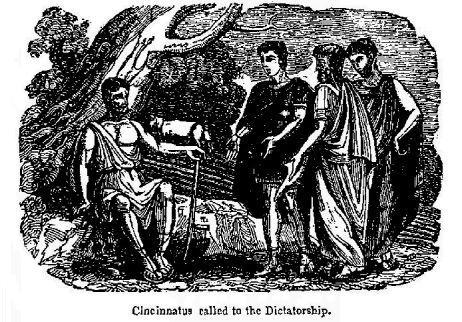
14. A dignity so[Pg. 103] unlooked for, however, had no effect upon the simplicity or integrity of his manners; and being now possessed of absolute power, and called upon to nominate his master of the horse, he chose a poor man named Tarqui'tius, one who, like himself, despised riches when they led to dishonour. Thus the saving a great nation was devolved upon a husbandman taken from the plough, and an obscure sentinel found among the dregs of the army. 15. Upon entering the city, the dictator put on a serene look, and entreated all those who were able to bear arms, to repair, before sunset, to the Cam'pus Mar'tius (the place where the levies were made) with necessary arms, and provisions for five days. 16. He put himself at the head of these, and, marching all night with great expedition, arrived early the next day within sight of the enemy. Upon his approach, he ordered his soldiers to raise a loud shout, to apprise the consul's army of the relief that was at hand. 17. The Æ'qui were not a little amazed when they saw themselves between two enemies; but still more when they perceived Cincinna'tus making the strongest entrenchments beyond them, to prevent their escape, and enclosing them as they had enclosed the consul. 18. To prevent this, a furious combat ensued; but the Æ'qui, being attacked on both sides, and unable longer to resist or fly, begged a cessation of arms. 19. They offered the dictator his own terms: he gave them their lives, and obliged them, in token of servitude, to pass under the yoke, which was two spears set upright, and another across, in the form of a gallows, beneath which the vanquished were to march. Their captains and generals he made prisoners [Pg. 104] of war, being reserved to adorn his triumph. 20. As for the plunder of the enemy's camp, that he gave entirely up to his own soldiers, without reserving any part for himself, or permitting those of the delivered army to have a share. 21. Thus having rescued a Roman army from inevitable destruction, having defeated a powerful enemy, having taken and fortified their city, and still more, having refused any part of the spoil, he resigned his dictatorship, after having enjoyed it but fourteen days. The senate would have enriched him, but he declined their proffers, choosing to retire once more to his farm and his cottage, content with competency and fame.
22. But this repose from foreign invasion did not lessen the tumults of the city within. The clamours for the Agra'rian law still continued, and still more fiercely, when Sic'cius Denta'tus, a plebeian advanced in years, but of an admirable person and military deportment, came forward to enumerate his hardships and his merits. This old soldier made no scruple of extolling the various achievements of his youth; indeed, his merits more than supported his ostentation. 23. He had served his country in the wars forty years: he had been an officer thirty, first a centurion, and then a tribune; he had fought one hundred and twenty battles, in which, by the force of his single arm, he had saved a multitude of lives; he had gained fourteen civic,[5] three mural,[6] and eight golden crowns; besides eighty-three chains, sixty bracelets, eighteen gilt spears, and twenty-three horse-trappings, whereof nine were for killing the enemy in single combat; moreover, he had received forty-five wounds in front, and none behind. 24. These were his honours; yet, notwithstanding all these, he had never received any share of those lands which were won from the enemy, but continued to drag on a life of poverty and contempt, while others were possessed of those very territories which his valour had won, without any merit to deserve them, or ever having contributed to the conquest.[7] 25. A[Pg. 105] case of so much hardship had a strong effect upon the multitude; they unanimously demanded that the law might be passed, and that such merit should not go unrewarded. It was in vain that some of the senators rose up to speak against it, their voices were drowned by the cries of the people. 26. When reason, therefore, could no longer be heard, passion, as usual, succeeded; and the young patricians, running furiously into the throng, broke the balloting urns, and dispersed the multitude that offered to oppose them. 27. For this they were, some time after, fined by the tribunes; their resolution, however, for the present, put off the Agra'rian law.
Questions for Examination.
1. On what accusation were Manlius and Fabius cited to appear before, the people?
2. What measure did the consuls adopt? Where, and in what employment was Cincinnatus found?
3. What effect had this dignity on Cincinnatus?
4. How did he conduct himself?
5. Were his measures successful?
6. Did Cincinnatus continue in office?
7. Was he permitted to continue in retirement?
8. What was the exigence that required his return to office?
9. What prevented the Romans from forcing their way through?
10. How was this news received at Rome?
11. Whom did they resolve to appoint dictator?
12. How was Cincinnatus now employed when the messengers arrived?
13. What was his behaviour on the occasion?
14. How was he affected by this exaltation?
15. What were his first measures?
16. What followed?
17. How were the enemy affected by his approach?
18. What was the consequence?
19. What were the terms of peace?
20. What became of the plunder?
21. What were his rewards for this important service?
22. Was domestic tranquillity the consequence of foreign conquest?
23. What were these achievements?
24. How was he rewarded?
25. What was the consequence of his appeal to the people?
26. Did the people obtain their demand?
27. How was this outrage punished?[Pg. 106]
FOOTNOTES:
This man's name was originally Ca'ius Mar'cius. He received the surname of Coriola'nus as a reward for having, by his valour, occasioned the taking of Cori'oli, the capital of the Vol'sci. Previous to the occurrence mentioned in the text, he had been condemned to death by the tribunes, but saved by the interference of his friends.
Tullus At'tius was a most determined enemy to the Romans, and to Coriola'nus in particular, for the share he had in humbling the power of the Vol'sci. It was probably more from a hope of revenge, by means of this valiant soldier, than any noble principle, that he offered him his countenance and protection.
The senate commanded a temple to be erected on the spot where the interview between Coriola'nus and his mother took place, which saved Rome, and dedicated it to maternal influence?
Tarpe'ian Rock, or Tarpei'us Mons, a hill at Rome, about eighty feet in perpendicular height, whence the Romans threw down their condemned criminals.
A civic crown among the Romans, was made of oaken leaves, and given to those who had saved the life of a citizen.
A mural crown was an honorary reward, given by the ancient Romans to the soldiers who first scaled the walls of an enemy's city.
"These military toys," said he, "are the only rewards I have hitherto received. No lands, no share of the conquered countries. Usurpers, without any title but that of a patrician extraction, possess them. Is this to be endured? Shall they alone possess the fruits of our conquests? The purchase of our blood?"
FROM THE CREATION OF THE DECEMVIRI TO THE EXTINCTION OF THAT OFFICE.—U.C. 302.
She's gone, forever gone! The king of terrors
Lays his rude hands upon her lovely limbs.
And blasts her beauty with his icy breath.—Dennis.
1. The commonwealth of Rome had now, for nearly sixty years, been fluctuating between the contending orders that composed it, till at length each side, as if weary, was willing to respire awhile from the mutual exertions of its claims. The citizens, of every rank, began to complain of the arbitrary decisions of their magistrates, and wished to be guided by a written body of laws which, being known, might prevent wrongs, as well as punish them. 2. In this both the senate and the people concurred, as hoping that such laws would put an end to the commotions that so long had harassed the state. 3. It was thereupon agreed that ambassadors should be sent to the Greek cities in Italy, and to Athens, to bring home such laws from thence, as, by experience, had been found most equitable and useful. For this purpose three senators, Posthu'mus, Sulpi'cius, and Man'lius, were fixed upon, and galleys assigned to convoy them, agreeably to the majesty of the Roman people. 4. While they were upon this commission abroad, a dreadful plague depopulated the city at home, and supplied the interval of their absence with other anxiety than that of wishes for their return. 5. In about a year the plague ceased, and the ambassadors returned, bringing home a body of laws, collected from the most civilised states of Greece and Italy, which, being afterwards formed into ten tables, and two more being added, made that celebrated code, called, The Laws of the Twelve Tables.[1]
6. The ambassadors were no sooner returned, than the tribunes required that a body of men should be chosen to digest their new laws into proper form, and to give weight to the execution of them. 7. After long debate, whether this choice should not be made from the people, as well as the patricians, it was at last agreed that ten of the principal[Pg. 107] senators should be elected, whose power, continuing for a year, should be equal to that of kings and consuls, and that without any appeal. 8. Thus the whole constitution of the state at once took a new form, and a dreadful experiment was about to be tried, of governing one nation by laws formed from the manners and customs of another.
9. These Decemviri, being now invested with absolute power, agreed to take the reins of government by turns, each to administer justice for a day. 10. For the first year, they wrought with extreme application: and their work being finished, it was expected that they would be content to give up their office; but, having known the charms of power, they were unwilling to resign: they pretended that some laws were yet wanting to complete their design, and entreated the senate for a continuance in office; which request was readily granted.
11. But they soon threw off the mask of moderation, and, regardless of the approbation of the senate or the people, resolved to continue, against all order, in the decemvirate. 12. A conduct so tyrannical produced discontents, and these were as sure to produce fresh acts of tyranny. The city was become almost a desert, with respect to all who had any thing to lose, and the rapacity of the decemvirs was then only discontinued when they wanted fresh subjects to exercise it upon. 13. In this state of slavery, proscription, and mutual distrust, not one citizen was found to strike for his country's freedom; these tyrants continued to rule without controul, being constantly guarded, not by the lictors alone, but by a numerous crowd of dependents, clients, and even patricians, whom their vices had confederated round them.
14. In this gloomy situation of the state, the Æ'qui and Vol'sci, those constant enemies of the Romans, renewed their incursions, and, resolving to profit by the intestine divisions of the people, advanced within about ten miles of Rome.
15. The decemviri, being in possession of all the military as well as of the civil power, divided their army into three parts; whereof one continued with Ap'pius in the city, to keep it in awe; the other two were commanded by his colleagues, and were led, one against the Æ'qui, and the other against the Vol'sci. 16. The Roman soldiers had now adopted a method of punishing the generals whom they disliked, by suffering themselves to be vanquished in the[Pg. 108] field. They put it in practice upon this occasion, and shamefully abandoned their camp upon the approach of the enemy, 17. Never was victorious news more joyfully received at Rome, than the tidings of this defeat; the generals, as is always the case, were blamed for the treachery of their men; some demanded that they should be deposed, others cried out for a dictator to lead the troops to conquest. 18. Among the rest, old Sic'cius Denta'tus, the tribune, spoke his sentiments with his usual openness; and, treating the generals with contempt, pointed out the faults of their discipline in the camp, and their conduct in the field. 19. Ap'pius, in the mean time, was not remiss in observing the dispositions of the people. Denta'tus, in particular, was marked out for vengeance; and, under pretence of doing him particular honour, he was appointed legate, and put at the head of the supplies which were sent from Rome, to reinforce the army. 20. The office of legate was held sacred among the Romans, as in it was united the authority of a general, with the reverence due to the priesthood. 21. Denta'tus, no way suspecting the design, went to the camp with alacrity, where he was received with all the external marks of respect. But the generals soon found means of indulging their desire of revenge. 22. He was appointed at the head of a hundred men to go and examine a more commodious place for encampment, as he had very candidly assured the commanders, that their present situation was wrong. 23. The soldiers, however, who were given as his attendants, were assassins; wretches who had long been ministers of the vengeance of the decemviri, and who had now engaged to murder him, though with all those apprehensions which his reputation (for he was called the Roman Achilles) might be supposed to inspire. 24. With these designs they led him into the hollow bosom of a retired mountain, where they began to set upon him behind. 25. Denta'tus too late perceived the treachery of the decemviri, and was resolved to sell his life as dearly as he could; he therefore set his back against a rock, and defended himself against those who pressed most closely. Though now grown old, he had still the remains of his former valour, and, with his own hand, killed no less than fifteen of the assailants, and wounded thirty. 26. The assassins now, therefore, terrified at his amazing bravery, showered their javelins upon him at a distance, all which he received in his shield with undaunted resolution.
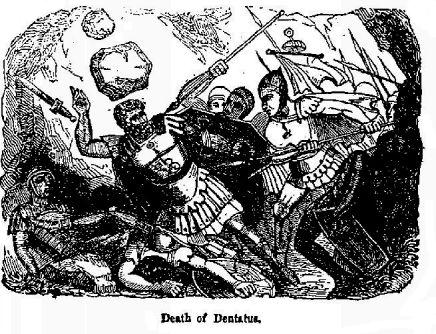
27. The combat,[Pg. 109] though so unequal in numbers, was managed for some time with doubtful success, till at length the assailants bethought themselves of ascending the rock, against which he stood, and pouring down stones upon him from above. 28. This succeeded: the old soldier fell beneath their united efforts; after having shown, by his death, that he owed to his fortitude, and not his fortune, that he had come off so many times victorious. 29. The decemviri pretended to join in the general sorrow for so brave a man, and decreed him a funeral with the first military honours; but their pretended grief, compared with their known hatred, only rendered them still more detestable to the people.
Questions for Examination.
1. Of what did the Roman citizens complain, and what did they wish?
2. Was this assented to by the nation at large?
3. What means were adopted for this purpose?
4. What happened during their absence?
5. How long did this calamity last?
6. What steps were taken on the return of the ambassadors?
7. Who were chosen for this purpose?
8. Was this proceeding an important one?
9. In what manner did the decemviri govern?
10. How did they discharge the duties of their office?
11. Did they continue in the conscientious discharge of their duties?
12. What was the consequence of this conduct?
13. Was no patriot to be found bold enough to be a champion in his country's cause?
14. What added to the miseries of the Romans?[Pg. 110]
15. What steps were taken to oppose them?
16. What was the conduct of the Roman soldiers on this occasion?
17. How was this news received at Rome?
18. Who appeared most conspicuous on this occasion?
19. How was this honest sincerity received?
20. Was the office of legate a respectable one?
21. Did Dentatus suspect treachery?
22. What plan of revenge was adopted?
23. What was the character of his attendants?
24. How did they commence their base design?
25. Was Dentatus aware of their treachery, and what resistance did he make?
26. Did the assassins boldly engage the hero?
27. What new method of attack did they attempt?
28. Was this plan successful?
29. What was the conduct of the decemviri on this occasion?
That chastity of look which seems to hang
A veil of purest light o'er all her beauties.
And, by forbidding, most inflames!—Young.
1. But a transaction still more atrocious than the former, served to inspire the citizens with a resolution to break all measures of obedience, so as at last to restore freedom.
2. Ap'pius, sitting one day on his tribunal to dispense justice, saw a maiden of exquisite beauty, aged about fifteen, passing to one of the public schools, attended by a matron, her nurse. The charms of the damsel, heightened by all the innocence of virgin modesty, caught his attention, and fired his heart. The day following, as she passed, he found her still more beautiful, and his breast still more inflamed. 3. He now, therefore, resolved to obtain the gratification of his passion, whatever should be the consequence, and found means to inform himself of the maiden's name and family. 4. Her name was Virgin'ia; she was the daughter of Virgin'ius, a centurion, then with the army in the field, and had been contracted to Icil'ius, formerly a tribune of the people, who had agreed to marry her at the end of the present campaign.
5. Ap'pius at first resolved to break off this match, and to espouse her himself; but the laws of the Twelve Tables had forbidden the patricians to intermarry with the plebeians, and he could not infringe these, as he was the enactor of them. 6. He determined, therefore, to make her his slave. 7. After having vainly tried to corrupt the fidelity of her nurse, he had recourse to another expedient, still more[Pg. 111] wicked. He fixed upon one Clau'dius, who had long been the minister of his crimes, to assert that the beautiful maid was his slave, and to refer the cause to Ap'pius's tribunal for decision. 8. Clau'dius behaved exactly according to his instructions; for, taking with him a band of ruffians like himself, he entered into the public school, where Virginia was found among her female companions, and seizing upon her under pretence that she was the daughter of one of his slaves, was dragging her away, when he was prevented by the people, drawn together by her cries. 9. At length, after the first heat of opposition was over, he led the weeping virgin to the tribunal of Ap'pius, and there plausibly exposed his pretensions. 10. Clau'dius asserted that she was born in his house, of a female slave, who sold her to the wife of Virgin'ius, who had been childless. That he had credible evidences to prove the truth of what he had advanced; but that, until they could come together, it was but reasonable the slave should be delivered into his custody, he being her proper master. 11. Ap'pius pretended to be struck with the justice of his claim; he observed, that if the reputed father himself were present, he might indeed be willing to delay the delivery of the maid; but that it was not lawful for him, in the present case, to detain her from her master. He, therefore, adjudged her to Clau'dius, as his slave, to be kept by him till Virgin'ius should arrive, and be able to prove his paternity. 12. This sentence was received with loud clamours and reproaches by the multitude, particularly by the women, who came round the innocent Virgin'ia, desirous to protect her from the judge's fury; while Icil'ius, her lover, boldly opposed the decree, and obliged Clau'dius to take refuge under the tribunal of the decemvir. 13. All things now threatened an open insurrection, when Ap'pius, fearing the event, thought proper to suspend his judgment, under pretence of waiting the arrival of Virgin'ius, who was then about eleven miles from Rome, with the army. 14. The day following was fixed for the trial. In the mean time Ap'pius privately sent letters to the general to confine Virgin'ius, as his arrival in town might only serve to kindle sedition among the people. 15. These letters, however, being intercepted by the centurion's friends, they sent him a full relation of the design laid against his liberty and the honour of his only daughter. 16. Virgin'ius, upon this, pretending the death of a near relation, got permission to leave the camp, and hastened to Rome, inspired with[Pg. 112] indignation and revenge. 17. Accordingly, the next day, to the astonishment of Ap'pius, he appeared before the tribunal, leading his weeping daughter by the hand, both of them habited in deep mourning. 18. Clau'dius, the accuser, began by making his demand. Virgin'ius next spoke in turn: he represented, that, if he had had intentions of adopting a suppositious child, he should have fixed upon a boy rather than a girl; that it was notorious to all, that his wife had herself nursed this daughter; and that it was surprising such a claim should be made after a fifteen years' silence; and not till Virginia was become marriageable, and acknowledged to be exquisitely beautiful. 19. While the father spoke this, with a stern air, the eyes of all were turned on Virgin'ia, who stood trembling, with looks of persuasive eloquence and excessive grief, which added weight to his remonstrances, and excited compassion. 20. The people, satisfied of the cruelty of his case, raised an outcry, expressive of their indignation. 21. Ap'pius, fearing that what had been said might have a dangerous effect upon the multitude, and under a pretence of being sufficiently instructed in the merits of the cause, with rage interrupted him. "Yes," said he, "my conscience obliges me to declare, that I, myself, am a witness to the truth of the deposition of Clau'dius. Most of this assembly know that I was left guardian to him. I was early apprised that he had a right to this young slave; but public affairs, and the dissensions of the people, have prevented my doing him justice. However, it is not now too late; and by the power vested in me for the general good, I adjudge Virgin'ia to be the property of Clau'dius, the plaintiff. Go, therefore, lictors, disperse the multitude, and make room for the master to repossess himself of his slave." 22. The lictors, in obedience to his command, drove off the throng that pressed round the tribunal; they seized upon Virgin'ia, and were delivering her up into the hands of Clau'dius: the multitude were terrified and withdrew; and Virgin'ius, who found that all was over, seemed to acquiesce in the sentence. 22. He, however, mildly entreated of Ap'pius to be permitted to take a last farewell of a child whom he had at least considered as his own, and so satisfied, he would return to his duty with fresh alacrity. 24. Ap'pius granted the favour, upon condition that their endearments should pass in his presence. But Virgin'ius was then meditating a dreadful resolution.
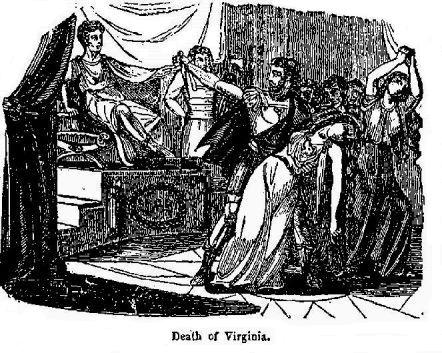
25. The crowd made way, and Virgin'ius, with the[Pg. 113] most poignant anguish, taking his almost expiring daughter in his arms, for a while supported her head upon his breast, and wiped away the tears that trickled down her cheeks. 26. He most tenderly embraced her, and drawing her insensibly to some shops which were on the side of the forum, snatched up a butcher's knife: "My dearest lost child," cried Virgin'ius, "thus, thus alone is it in my power to preserve your honour and your freedom!" So saying, he plunged the weapon into her heart. Then drawing it out, reeking with her blood, he held it up to Ap'pius: "Tyrant," cried he, "by this blood I devote thy head to the infernal gods!" 27. Thus saying, and covered with his daughter's blood, the knife remaining in his hand, threatening destruction to whomsoever should oppose him, he ran through the city, wildly calling upon the people to strike for freedom. By the favour of the multitude he then mounted his horse, and rode directly to the camp.
28. He no sooner arrived, followed by a number of his friends, than he informed the army of all that had been done, still holding the bloody knife in his hand. He asked their pardon and the pardon of the gods, for having committed so rash an action, but ascribed it to the dreadful necessity of the times. 29. The army, already predisposed to revolt by the murder of Denta'tus, and other acts of tyranny and oppression, immediately with shouts echoed their approbation, and decamping, left the generals behind, to take their station once more upon mount Aven'tine, whither they had retired[Pg. 114] about, forty years before. The other army, which had been to oppose the Sab'ines, felt a like resentment, and came over in large parties to join them.
30. Ap'pius, in the mean time, did all he could to quell the disturbances in the city; but finding the tumult incapable of controul, and perceiving that his mortal enemies, Vale'rius and Hora'tius, were the most active in opposition, at first attempted to find safety by flight; nevertheless, being encouraged by Op'pius, who was one of his colleagues, he ventured to assemble the senate, and urged the punishment of all deserters. 31. The senate, however, was far from giving him the relief he sought for; they foresaw the dangers and miseries that threatened the state, in case of opposing the incensed army; they therefore despatched messengers to them, offering to restore their former mode of government. 32. To this proposal all the people joyfully assented, and the army gladly obeying, now returned to the city, if not with the ensigns, at least with the pleasure of a triumphant entry. 33. Ap'pius and Op'pius both died by their own hands in prison. The other eight decemvirs went into exile; and Clau'dius, the pretended master of Virgin'ia, was ignominiously banished.
Questions for Examination.
1. Did the Romans tamely submit to the tyranny of the decemviri?
2. Relate the particulars of this transaction.
3. What resolution did Appius form?
4. Who was this maiden?
5. What was Appius's first determination?
6. On what did he next resolve?
7. To what means did he have recourse for the accomplishment of his purpose?
8. Did Claudius undertake this base?
9. Was the opposition of the people ultimately successful?
10. How did Claudius attempt to make good his claims?
11. What was the conduct of Appius on this occasion?
12. How was this sentence received?
13. What consequences were likely to ensue, and how were they averted?
14. Was not this pretence a false one?
15. By what means were his designs frustrated?
16. Under what pretence did Virginius obtain leave of absence?
17 What measures did he take on his arrival?
18. How was the trial conducted?
19. How did Virginia support this trying scene?[Pg. 115]
20. What was the general opinion of the auditors?
21. Did the arguments of Virginius induce Appius to forego his iniquitous designs?
22. Were his commands obeyed?
23. What was the request of Virginius?
24. Was this favour granted?
25. Describe this affecting scene?
26. What was the catastrophe?
27. What followed?
28. What use did he make of this dreadful circumstance?
29. What was the effect of his address on the army?
30. How was Appius employed in the mean time?
31. Did the senate second his designs?
32. Did the people accede to this proposal?
33. What was the fate of the tyrants?
From the plough
Rose her dictators; fought, o'ercame return'd.
Yes, to the plough returned, and nail'd their peers.—Dyer.
1. In the mean time, these intestine tumults produced weakness within the state, and confidence in the enemy abroad. The wars with the Æ'qui and the Vol'sci still continued; and, as each year some trifling advantage was obtained over the Romans, they, at last, advanced so far, as to make their incursions to the very walls of Rome.[2]
2. But not the courage only of the Romans, their other virtues also, particularly their justice, seemed diminished by these contests.
3. The tribunes of the people now grew more turbulent; they proposed two laws: one to permit plebeians to intermarry with the patricians; and the other, to permit them to be admitted to the consulship also. 4. The senators received these proposals with indignation, and seemed resolved to undergo the utmost extremities, rather than submit to enact these laws. However, finding their resistance only increased the commotions of the state, they, at last, consented to pass that concerning marriages, hoping that this concession would satisfy the people. 5. But they were to be appeased for a very short time only; for, returning, to their old custom of refusing to enlist upon the approach of an enemy, the consuls were obliged to hold a private conference with the chief of the senate, where, after many debates, Clau'dius proposed an expedient, as the most probable means[Pg. 116] of satisfying the people in the present conjuncture. 6. This was to create six or eight governors in the room of consuls, whereof one half, at least, should be patricians. 7. This project, which was, in fact, granting what the people demanded, pleased the whole meeting, and it was agreed, that the consuls should, contrary to their usual custom, begin by asking the opinion of the youngest senator. 8. Upon assembling the senate, one of the tribunes accused them of holding secret meetings, and managing dangerous designs against the people. The consuls, on the other hand, averred their innocence; and to demonstrate their sincerity, gave leave to any of the younger members of the house to propound their opinions. 9. These remaining silent, such of the older senators, as were known to be popular, began by observing that the people ought to be indulged in their request; that none so well deserved power, as those who were most instrumental in gaining it; and that the city could not be free until all were reduced to perfect equality. Clau'dius spoke next, and broke out into bitter invectives against the people; asserting that it was his opinion that the law should not pass. 10. This produced some disturbance among the plebeians; at length, Genu'tius proposed, as had been preconcerted, that six governors should be annually chosen, with consular authority; three from the senate, and three from the people; and that, when the time of their magistracy should be expired, it would be seen whether they would have the same office continued, or whether the consulship should be established upon its former footing. 11. This project was eagerly embraced by the people; yet so fickle were the multitude, that, though many of the plebeians stood candidates, the choice wholly fell upon the patricians who had offered themselves.
12. These new magistrates were called Military Tribunes; they were, at first, but three: afterwards they were increased to four, and at length to six; and they had the power and ensigns of consuls: yet, that power being divided among a number, each singly was of less authority. 13. The first that were chosen continued in office only about three months, the augurs having found something amiss in the ceremonies of their election.
14. The military tribunes being deposed, the consuls once more came into office; and in order to lighten the weight of business which they were obliged to sustain, a new office was created; namely, that of Censors, who were to be[Pg. 117] chosen every fifth, year.[3] 15. Their business was to take an estimate of the number and estates of the people, and to distribute them into their proper classes: to inspect into the lives and manners of their fellow citizens; to degrade senators for misconduct; to dismount knights, and to remove plebeians from their tribes into an inferior class, in case of misdemeanor. 16. The first censors were Papir'ius and Sempro'nius, both patricians; and from this order censors continued to be elected for nearly a hundred years.
17. This new creation served to restore peace for some time among the orders; and a triumph gained over the Vol'scians, by Gega'nius the consul, added to the universal satisfaction that reigned among the people.
18. This calm, however, was but of short continuance; for, some time after, a famine pressing hard upon the poor, the usual complaints against the rich were renewed; and these, as before, proving ineffectual, produced new seditions. 19. The consuls were accused of neglect, in not having laid in proper quantities of corn: they, however, disregarded the murmurs of the populace, content with using every exertion to supply the pressing necessity.[4] 20. But, though they did all that could be expected from active magistrates in procuring provisions, and distributing them to the poor: yet Spu'rius Mæ'lius, a rich knight, who had bought up all the corn of Tuscany, by far outshone them in liberality. 21. This demagogue, inflamed with a secret desire of becoming powerful by the contentions in the state, distributed corn in great quantities among the poorer sort each day, till his house became the asylum of all such as wished to exchange a life of labour for one of lazy dependence. 22. When he had thus gained a sufficient number of partisans, he procured large quantities of arms to be brought into his house by night, and formed a conspiracy, by which he was to obtain the command, while some of the tribunes, whom he had found means to corrupt, were to act under[Pg. 118] him, in seizing upon the liberties of his country. 23. Minu'tius soon discovered the plot, and, informing the senate, they immediately resolved to create a dictator, who should have the power of quelling the conspiracy without appealing to the people. 24. Cincinna'tus, who was now eighty years old, was chosen once more to rescue his country from impending danger. 25. He began by summoning Mæ'lius to appear, who refused to obey. He next sent Aha'la, the master of the horse, to compel his attendance; when, meeting him in the forum, Aha'la, on his refusal, killed him upon the spot. The dictator applauded the resolution of his officer, and commanded the conspirator's goods to be sold, his house to be demolished, and his stores to be distributed among the people.[5]
26. The tribunes of the people were much enraged at the death of Mæ'lius. In order, therefore, to punish the senate at the next election, instead of consuls, they insisted upon restoring the military tribunes, and the senate were obliged to comply.
The next year, however, the government returned to its ancient channel, and consuls were chosen.
Questions for Examination.
1. What was the consequence of those intestine tumults related in the preceding section?
2. Was it their courage only that was impaired by them?
3. How did the tribunes conduct themselves?
4. How were these proposals received?
5. Did it answer the desired end?[Pg. 119]
6. What expedient was resorted to?
7. How was it received?
8. What happened on assembling the senate?
9. Did they avail themselves of this permission, and what farther passed on this occasion?
10. Was his opinion agreeable to the people? What new proposition was offered by Genutius?
11. Was this plan adopted and acted upon?
12. What were the name, number, and powers of these new magistrates?
13. How long did they continue in office?
14. What government was substituted?
15. What were the duties of the censors?
16. Who were the first censors?
17. What was the consequence of this new creation?
18. Was this satisfaction lasting?
19. How were the consuls affected by it?
20, 21. Through what means did Spurius Manlius obtain credit for being more liberal than the consuls? And what was his real object?
22. How did he proceed in his designs against the liberties of his country?
23. By what means was the plot frustrated?
24. Who was appointed dictator?
25. What steps did he take?
26. How were these rigorous measures received?
Hence every passion, e'en the proudest, stoop'd
To common good; Camillus, thy revenge,
Thy glory, Fabius.
—Thomson.
1. The Ve'ians had long been the rivals of Rome: they had even taken the opportunity of internal distresses to ravage its territories, and had even threatened its ambassadors sent to complain of these injuries, with outrage. 2. It seemed, now, therefore, determined that the city of Ve'ii, whatever it might cost, should fall; and the Romans accordingly sat down regularly before it, and prepared for a long and painful resistance. 3. The strength of the place may be inferred from the continuance of the siege, which lasted for ten years; during which time, the army continued encamped round it, lying, in winter, under tents made of the skins of beasts, and, in summer, driving on the operations of the attack. 4. Various were the successes, and many were the commanders that directed the siege; sometimes all their works were destroyed, and many of their men cut off by sallies from the town; sometimes they were annoyed by an army of Veians, who attempted to bring assistance from without. 5. A siege so bloody seemed to threaten[Pg. 120] depopulation to Rome itself, by a continual drain of its forces; so that a law was obliged to be made, for all bachelors to marry the widows of the soldiers who were slain. 6. Fu'rius Camil'lus was now created dictator, and to him was entrusted the sole power of managing the long protracted war. 7. Camil'lus, who, without intrigue or solicitation, had raised himself to the first eminence in the state, had been made one of the censors some time before, and was considered as the head of that office; he was afterwards made a military tribune, and had, in this post, gained several advantages over the enemy. 8. It was his great courage and abilities in the above offices that made him be thought most worthy to serve his country on this pressing occasion. 9. Upon his appointment, numbers of the people flocked to his standard, confident of success under so experienced a commander. 10. Conscious, however, that he was unable to take the city by storm, he, with vast labour, opened a passage under ground, which led into the very midst of the citadel. 11. Certain thus of success, and finding the city incapable of relief, he sent to the senate desiring, that all who chose to share in the plunder of Ve'ii, should immediately repair to the army. 12. Then, giving his directions how to enter at the breach, the city was instantly filled with his legions, to the amazement and consternation of the besieged, who, but a moment before, had rested in perfect security. 13. Thus, like a second Troy,[6] was the city of Ve'ii taken, after a ten years' siege, and, with its spoils, enriched the conquerors; while Camil'lus himself, transported with the honour of having subdued the rival of his native city, triumphed after the manner of the kings of Rome, having his chariot drawn by four milk-white horses; a distinction which did not fail to disgust the majority of the spectators, as they considered those as sacred, and more proper for doing honour to their gods than their generals.
14. His usual good fortune attended Camil'lus in another expedition against the Falis'ci. He routed their army, and besieged their capital city Fale'rii, which threatened a long and vigorous resistance. 15. The reduction of this little place would have been scarcely worth mentioning in this[Pg. 121] scanty page, were it not for an action of the Roman general, that has done him more credit with posterity than all his other triumphs united. 16. A school-master, who had the care of the children belonging to the principal men in the city, having found means to decoy them into the Roman camp, offered to put them into the hands of Camil'lus, as the surest means of inducing the citizens to a speedy surrender. 17. The general, struck with the treachery of a wretch whose duty it was to protect innocence, and not to betray it, for some time regarded the traitor with a stern silence: but, at last, finding words, "Execrable villain!" cried the noble Roman, "offer thy abominable proposals to creatures like thyself, and not to me; what, though we are the enemies of your city, are there not natural ties that bind all mankind, which should never be broken? There are duties required from us in war, as well as in peace: we fight not against the age of innocence, but against men—men who have used us ill indeed; but yet, whose crimes are virtues, when compared to thine. Against such base acts, let it be my duty to use only the Roman ones—valour and arms." 18. So saying, he ordered him to be stript, his hands to be tied behind him, and, in that ignominious manner, to be whipped into the town by his own scholars. 19. This generous behaviour in Camil'lus effected more than his arms could do; the magistrates of the town submitted to the senate, leaving to Camil'lus the condition of their surrender; who only fined them a sum of money to satisfy the army, and received them under the protection, and into the alliance, of Rome.
20. Notwithstanding the veneration which the virtues of Camil'lus had excited abroad, they seemed but little adapted to command the respect of the turbulent tribunes at home, who raised fresh accusations against him every day. 21. To the charge of being an opposer of their intended emigration from Rome to Ve'ii, they added that of his having concealed a part of the plunder of that city, particularly two brazen gates, for his own use; and appointed him a day on which to appear before the people. 22. Camil'lus, finding the multitude exasperated against him on many accounts, and detesting their ingratitude, resolved not to await the ignominy of a trial; but embracing his wife and children, prepared to depart from Rome. 23. He had already passed as far as one of the gates, unattended and unlamented. There he could suppress his indignation no longer, but, turning his[Pg. 122] face to the Capitol, and lifting up his hands to heaven, he entreated all the gods, that his countrymen might one day be sensible of their injustice and ingratitude. So saying, he passed forward to take refuge at Ar'dea, a town at a little distance from Rome, where he afterwards learned that he had been fined fifteen thousand ases[7] by the tribunes at Rome.
24. The tribunes were not a little pleased with their triumphs over this great man; but they soon had reason to repent their injustice, and to wish for the assistance of one, who alone was able to protect their country from ruin: for now a more terrible and redoubtable enemy than the Romans had ever yet encountered, began to make their appearance. 25. The Gauls, a barbarous nation, had, about two centuries before, made an irruption from beyond the Alps, and settled in the northern parts of Italy. They had been invited over by the deliciousness of the wines, and the mildness of the climate. 26. Wherever they came they dispossessed the original inhabitants, as they were men of superior courage, extraordinary stature, fierce in aspect, barbarous in their manners, and prone to emigration. 27. A body of these, wild from their original habitations, was now besieging Clu'sium, a city of Etru'ria, under the conduct of Brennus, their king. 28. The inhabitants of Clu'sium, frightened at their numbers, and still more at their savage appearance, entreated the assistance, or, at least, the mediation of the Romans. 29. The senate, who had long made it a maxim never to refuse succour to the distressed, were willing, previously, to send ambassadors to the Gauls, to dissuade them from their enterprise, and to show the injustice of the irruption. 30. Accordingly, three young senators were chosen out of the family of the Fabii, to manage the commission, who seemed more fitted for the field than the cabinet. 31. Brennus received them with a degree of complaisance that argued but little of the barbarian, and desiring to know the business of their embassy, was answered, according to their instructions, that it was not customary in Italy to make war, but on just grounds of provocation, and that they desired to know what offence the citizens of Clu'sium had given to the king of the Gauls. 32. To this Brennus sternly replied, that the rights of valiant men lay in their swords; that the Romans themselves had no right to the many cities they, had conquered; and that he had particular reasons of resentment[Pg. 123] against the people of Clu'sium, as they refused to part with those lands, which they had neither hands to till, nor inhabitants to occupy. 33. The Roman ambassadors, who were but little used to hear the language of a conqueror, for a while dissembled their resentment at this haughty reply; but, upon entering the besieged city, instead of acting as ambassadors, and forgetful of their sacred character, they headed the citizens in a sally against the besiegers. In this combat Fa'bius Ambus'tus killed a Gaul with his own hand, but was discovered in the act of despoiling him of his armour. 34. A conduct so unjust and unbecoming excited the resentment of Brennus, who, having made his complaint by a herald to the senate, and finding no redress, broke up the siege and marched away with his conquering army directly for Rome. 35. The countries through which the Gauls made their rapid progress, gave up all hopes of safety upon their approach; being terrified at their numbers, the fierceness of their natures, and their dreadful preparations for war. 36. But the rage and impetuosity of this wild people were directed solely against Rome. They went on without doing the least injury in their march, breathing vengeance only against the Romans. A terrible engagement soon after ensued, in which the Romans were defeated near the river Al'lia, with the loss of about forty thousand men.[8]
37. Rome, thus deprived of succour, prepared for every extremity. The inhabitants endeavoured to hide themselves in the neighbouring towns, or resolved to await the conqueror's fury, and end their lives with the ruin of their native city.[9] 38. But, more particularly, the ancient senators and priests, struck with a religious enthusiasm, on this occasion resolved to devote their lives to atone for the crimes of the people, and, habited in their robes of ceremony, placed themselves in the forum, on their ivory chairs. 39. The Gauls, in the mean time, were giving a loose to their triumph, in sharing and enjoying the plunder of the enemy's camp. Had they immediately marched to Rome, upon gaining the victory, the Capitol would, in all probability, have been taken; but they continued two days feasting upon[Pg. 124] the field of battle, and, with barbarous pleasure, exulting amidst their slaughtered enemies. 40. On the third day after this easy victory, Brennus appeared with all his forces before the city. He was at first much surprised to find the gates open to receive him, and the walls defenceless; so that he began to impute the unguarded situation of the place to a Roman stratagem. After proper precaution, he entered the city, and, marching into the forum, beheld there the ancient senators sitting in their order, observing a profound silence, unmoved and undaunted. 41. The splendid habits, the majestic gravity, and the venerable looks of these old men, who, in their time, had all borne the highest offices of state, awed the barbarous enemy into reverence; they mistook them for the tutelar deities of the place, and began to offer blind adoration; till one, more forward than the rest, putting forth his hand to stroke the beard of Papyr'ius, an insult the noble Roman could not endure, he lifted up his ivory sceptre, and struck the savage to the ground. 42. This proved to be a signal for general slaughter. Papyr'ius fell first, and all the rest shared his fate without mercy or distinction.[10] The fierce invaders pursued their slaughter for three days successively, sparing neither sex nor age; then, setting fire to the city, burnt every house to the ground.
Questions for Examination.
1. What was the conduct of the Veians?
2. What resolution was adopted in consequence?
3. Was Veii a strong place?
4. Did the besieged make a vigorous resistance?
5. What consequences were likely to ensue, and how were they obviated?
6. To whom was the conduct of the war now committed?
7. Who was Camillus?
8. By what means did he attain his present dignity?
9. What was the consequence of his appointment?
10. What plan did he adopt to take the city?
11. How did he next proceed?
12. What followed?
13. What was the consequence of this capture, and how did Camillus comport himself?[Pg. 125]
14. What was Camillus's next exploit?
15. Was this a conquest of importance?
16. Relate the particulars?
17. How was his proposal received?
18. How was the traitor punished?
19. What was the consequence of this conduct?
20. Was Camillus universally respected?
21. What charges were brought against him?
22. Did Camillus abide the event of a trial?
23. Was he resigned to his fate, and whither did he retire?
24. What followed his departure?
25. Who was the enemy?
26. What were the conduct and character of the Gauls?
27. How were they employed at this conjuncture?
28. What measure did the Clusians adopt for their defence?
29. Was their application successful?
30. Who were appointed for this purpose?
31. How were they received?
32. What was the reply of Brennus?
33. What was the conduct of the ambassadors?
34. What was the consequence of this improper conduct?
35. What sensations were excited in the countries through which they passed?
36. Did the Gauls commit any ravages on their march?
37. What measures were adopted at Rome?
38. Who more particularly displayed their devotedness on this occasion?
39. What use did the Gauls make of their victory?
40. What happened on their arrival before the city?
41. What was the effect of this spectacle?
42. What was the consequence of this boldness?
This is true courage, not the brutal force
Of vulgar heroes, but the firm resolve
Of virtue and of reason.—Whitehead.
1. All the hopes of Rome were now placed in the Capitol; every thing without that fortress formed an extensive scene of misery, desolation, and despair.
2. Brennus first summoned it, with threats, to surrender, but in vain; then resolving to besiege it in form, hemmed it round with his army. The Romans, however, repelled the attempt with great bravery: despair had supplied them with that perseverance and vigour which they seemed to want when in prosperity.
3. In the meanwhile, Brennus carried on the siege with extreme ardour. He hoped to starve the garrison into a capitulation; but they, sensible of his intent, although in actual want, caused loaves to be thrown into his camp, to[Pg. 126] convince him of the futility of such expectations. 4. His hopes were soon after revived, when some of his soldiers came to inform him, that they had discovered footsteps,[11] which led up to the rock, by which they supposed the Capitol might be surprised. 5. Accordingly, a chosen body of his men were ordered by night upon this dangerous service, which, with great labour and difficulty, they almost effected. 6. They were got upon the very wall; the Roman sentinel was fast asleep; their dogs within gave no signal, and all promised an instant victory, when the garrison was awakened by the gabbling of some sacred geese, that had been kept in the temple of Juno. 7. The besieged soon perceived the imminence of their danger, and each, snatching the weapon that first presented itself, ran to oppose the assailants. 8. M. Man'lius, a patrician of acknowledged bravery, was the first who opposed the foe, and inspired courage by his example. He boldly mounted the rampart, and, at one effort, threw two Gauls headlong down the precipice; his companions soon came to his assistance, and the walls were cleared of the enemy with a most incredible celerity.[12]
9. From this time the hopes of the barbarians began to decline, and Brennus wished for an opportunity of raising the siege with credit.[13] His soldiers had often conferences with the besieged while upon duty, and proposals for an accommodation were wished for by the common men, before the chiefs thought of a congress. At length, the commanders on both sides came to an agreement, that the Gauls should immediately quit the city and territories, upon being paid a thousand pounds weight of gold.
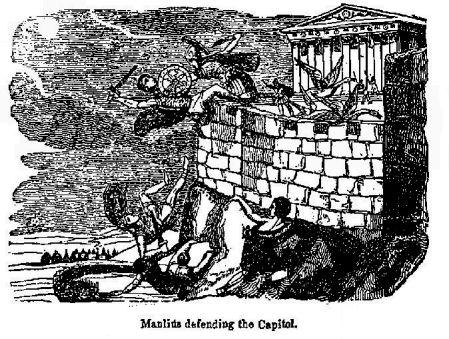
10. This agreement[Pg. 127] being confirmed by oath on either side, the gold was brought forth. But, upon weighing, the Gauls fraudulently attempted to kick the beam, of which the Romans complaining, Brennus insultingly cast his sword and belt into the scale, crying out that the only portion of the vanquished was to suffer. 11. By this reply, the Romans saw that they were at the victor's mercy, and knew it was in vain to expostulate against any conditions he should please to impose. 12. But while they were thus debating upon the payment, it was told them that Camil'lus, their old general, was at the head of a large army, hastening to their relief, and entering the gates of Rome. 13. Camil'lus actually appeared soon after, and entering the place of controversy, with the air of one who was resolved not to suffer imposition, demanded the cause of the contest; of which being informed, he ordered the gold to be taken and carried back to the Capitol. "For it has ever been," cried he, "the manner with us Romans, to ransom our country, not with gold, but with iron; it is I only that am to make peace, as being the dictator of Rome, and my sword alone shall purchase it." 14. Upon this a battle ensued, the Gauls were entirely routed, and such a slaughter followed, that the Roman territories were soon cleared of the invaders. Thus, by the bravery of Camil'lus, was Rome delivered from its enemy.[14][Pg. 128]
15. The city being one continued heap of ruins, except the Capitol, and the greatest number of its former inhabitants having gone to take refuge in Ve'ii, the tribunes of the people urged for the removal of the poor remains of Rome to that city, where they might have houses to shelter, and walls to defend them. 16. On this occasion Camil'lus attempted to appease them with all the arts of persuasion; observing, that it was unworthy of them, both as Romans and men, to desert the venerable seat of their ancestors, where they had been encouraged by repeated marks of divine approbation, in order to inhabit a city which they had conquered, and which wanted even the good fortune of defending itself. 17. By these, and such like remonstrances, he prevailed upon the people to go contentedly to work; and Rome soon began to rise from its ashes.[15]
18. We have already seen the bravery of Man'lius in defending the Capitol, and saving the last remains of Rome. For this the people were by no means ungrateful. They built him a house near the place where his valour was so conspicuous, and appointed him a public fund for his support. 19. But he aspired at being more than equal to Camil'lus, and to be sovereign of Rome. With this view he laboured to ingratiate himself with the populace, paid their debts, and railed at the patricians, whom he called their oppressors. 20. The senate was not ignorant of his speeches or his designs, and created Corne'lius Cossus dictator, with a view to curb the ambition of Man'lius. 21. The dictator soon called Man'lius to an account for his conduct. Man'lius, however, was too much the darling of the populace to be affected by the power of Cossus, who was obliged to lay down his office, and Man'lius was carried from confinement in triumph through the city. 22. This success only served to inflame his ambition. He now began to talk of a division of the lands among the people, insinuated that there should be no distinctions in the state; and, to give weight to his discourses, always appeared at the head of a large body of the dregs of the people, whom largesses had[Pg. 129] made his followers. 23. The city being thus filled with sedition and clamour, the senate had recourse to another expedient, which was, to oppose the power of Camil'lus to that of the demagogue. Camil'lus, accordingly, being made one of the military tribunes, appointed Man'lius a day to answer for his life. 24. The place in which he was tried was near the Capitol, whither, when he was accused of sedition, and of aspiring to sovereignty, he turned his eyes, and pointing to that edifice, put them in mind of what he had there done for his country. 25. The multitude, whose compassion or whose justice seldom springs from rational motives, refused to condemn him, so long as he pleaded in sight of the Capitol; but when he was brought from thence to the Pe'teline grove, where the Capitol was no longer in view, they condemned him to be thrown headlong from the Tarpe'ian rock.[16] 26. Thus, the place which had been the theatre of his glory, became that of his punishment and infamy. His house, in which his conspiracies had been secretly carried on, and which had been built as the reward of his valour, was ordered to be razed to the ground, and his family were forbidden ever after to assume the name of Man'lius.
27. Thus the Romans went gradually forward, with a mixture of turbulence and superstition within their walls, and successful enterprises without.
28. With what implicit obedience they submitted to their pontiffs, and how far they might be impelled to encounter even death itself, at their command, will evidently appear from the behaviour of Cur'tius, about this time.
Upon the opening of the gulf in the forum, which the augurs affirmed would never close till the most precious things in Rome were thrown into it, this heroic man, clad in complete armour, and mounted on horseback, boldly leaped into the midst, declaring, that nothing was more truly valuable than patriotism and military virtue. 29. The gulf, say the historians, closed immediately upon this, and Cur'tius was seen no more.[17][Pg. 130]
30. This year died the great Camil'lus, deservedly regretted by all. He was styled a second Romulus, the first having founded, and he having restored the city. He is said never to have fought a battle without gaining a victory; never to have besieged a city without taking it. He was a zealous patriot, ever ready to dismiss his just resentments for the affronts he received, when the necessities of his country required his services.
Questions for Examination.
1. What was the state of Rome at this period?
2. What was the next step taken by Brennus, and how did it succeed?
3. In what manner was the siege carried on?
4. Did he consider the attempt as hopeless?
5. What advantage did he take of this information?
6. Was the attempt successful?
7. What was the consequence?
8. Was there any particular instance of valour?
9. What effect had this failure on the mind of Brennus?
10. In what manner was this agreement carried into execution?
11. What inference did the Romans draw from this insolent speech?
12. What agreeable news did they now hear?
13. Was this information correct?
14. What followed?
15. What was the first measure proposed after this deliverance?
16. Was this proposal carried into effect?
17. Were his remonstrances successful?
18. Was the bravery of Manlius rewarded?
19. Was he content with these favours?
20. What measures were taken to oppose his designs?
21. Was this expedient attended with success?
22. What was the conduct of Manlius after this?
23. What farther measures were taken to punish his ambition?
24. What defence did he set up?
25. Was his plea successful?
26. What is remarkable in his punishment?
27. How did the Roman affairs proceed at this time?
28. Relate a memorable instance of the obedience paid by the Romans to their pontiffs or priests?
29. What was the consequence of this heroic act?
30. What happened this year, and what was the character of Camil'lus?[Pg. 131]
FOOTNOTES:
These laws were engraven on brass, and hung up in the most conspicuous part of the Forum.
They were, however, defeated, first by the consul Vale'rius, and next still more decisively by the consuls Quinc'tius and Fu'rius.
The duty of the censors, at first, was merely to perform the census, or numbering of the people. It was by degrees that they became Magistri Morum, or inspectors and regulators of men's lives and manners.
They appointed an extraordinary magistrate, under the title of superintendent of provisions, and the person named for this office, L. Minutius, an active and prudent man, immediately sent his agents into the neighbouring countries to buy corn; but little, however was procured, as Mælius had been beforehand with him. (Liv. l. iv. c. 13, 14.)
The guilt of Mæ'lius was never proved, and no arms were found when his house was searched. The charge of aiming at royalty is more than absurd; it is morally impossible. He seems to have aimed at opening the higher offices of state to the plebeians, and to have looked upon the consulship with too eager desire. He fell a sacrifice, to deter the plebeians from aiming at breaking up a patrician monopoly of power. It is painful to see Cincinna'tus, at the close of a long and illustrious life, countenancing, if not suggesting this wanton murder. But, as Niebuhr remarks, "no where have characters been more cruel, no where has the voice of conscience against the views of faction been so defied, as in the aristocratic republics, and not those of antiquity only. Men, otherwise of spotless conduct, have frequently shed the purest and noblest blood, influenced by fanaticism, and often without any resentment, in the service of party."
The account of the siege of Ve'ii is full of improbabilities, and the story of the mine is utterly impossible, for without a compass and a good plan of the city, such a work could not have been formed. That Ve'ii, however, was besieged and taken at this time is very certain, but that is the only part of the legend on which we can rely.
The as was a brass coin, about three farthings of our money.
This day was from henceforth marked as unlucky in their calendar, and called Allien'sis.
Among others, the Vestals fled from the city, carrying with them the two Palladiums and the sacred fire. They took shelter at Cære, a town of Etru'ria, where they continued to celebrate their religious rites; from this circumstance religious rites acquired the name of ceremonies.
This self-devotion was in consequence of a vow made by these brave old men, which Fa'bius, the Pontifex Maximus, pronounced in their names. The Romans believed that, by thus devoting themselves to the internal gods, disorder and confusion were brought among the enemy.
These were the footsteps of Pon'tius Comin'ius, who, with great prudence and bravery, found means to carry a message from Camil'lus to the Romans in the Capi'tol, and to return with the appointment of dictator for Camil'lus.
As a reward for this essential service, every soldier gave Man'lius a small quantity of corn and a little measure of wine, out of his scanty allowance; a present of no mean value in their then distressed situation. On the other hand, the captain of the guard, who ought to have kept the sentinels to their duty, was thrown headlong from the Capitol. In memory of this event, a goose was annually carried in triumph on a soft litter, finely adorned; whilst dogs were held in abhorrence, and were impaled every year on a branch of elder.
As the Gauls suffered the bodies of the Romans, who were slain in their frequent encounters, to lie unburied, the stench of their putrefaction occasioned a plague to break out, which carried off great numbers of the army of Brennus.
The authenticity of this narrative is more than suspicious. Polyb'ius, the most accurate of the Roman historians, says that the Gauls carried their old home with them. Sueto'nius confirms this account, and adds that it was recovered at a much later period from the Galli Seno'nes, by Liv'ius Dru'sus; and that on this occasion Dru'sus first became a name in the Livian family, in consequence of the victorious general having killed Drau'sus, the Gallic leader.
So little taste, however, for order and beauty, did those display who had the direction of the works, that the city, when rebuilt, was even less regular than in the time of Romulus.
This account appears so absurd as to be scarcely credible; in fact, Manlius was first tried by the "comitia centuriata," and acquitted. His second trial was before the "comitia curiata," where his enemies, the patricians, alone had the right of voting. See Introduction, Chap. III.
Some judicious writers, however, acknowledge that the chasm was afterwards filled up with earth and rubbish. (Livy, l. 7. c. 6. Val. Maximus, l. 5. c. 6. et alli.)
FROM THE WARS WITH THE SAMNITES AND THOSE WITH PYRRHUS, TO THE BEGINNING OF THE FIRST PUNIC WAR; WHEN THE ROMANS BEGAN TO EXTEND THEIR CONQUESTS BEYOND ITALY.
The brave man is not he who feels no fear
For that were stupid and irrational;
But he, whose noble soul his fear subdues,
And bravely dares the danger nature shrinks from.—Baillie.
1. The Romans had triumphed over the Sab'ines, the Etru'rians, the Latins, the Her'nici, the Æ'qui, and the Volsci; and now began to look for greater conquests. They accordingly turned their arms against the Sam'nites, a people descended from the Sab'ines, and inhabiting a large tract of southern Italy, which at this day makes, a considerable part of the kingdom of Naples. 2. Vale'rius Cor'vus, and Corne'lius, were the two consuls to whose care it first fell to manage this dreadful contention between the rivals.
3. Vale'rius was one of the greatest commanders of his time; he was surnamed Cor'vus, from the strange circumstance of being assisted by a crow in a single combat, in which he killed a Gaul of gigantic stature. 4. To his colleague's care it was consigned to lead an army to Sam'nium, the enemy's capital, while Cor'vus was sent to relieve Cap'ua, the capital of the Capin'ians. 5. Never was a captain more fitted for command than he. To a habit naturally robust and athletic, he joined the gentlest manners; he was the fiercest, and yet the most good-natured man in the army; and, while the meanest sentinel was his companion, no man kept them more strictly to their duty; but to complete his character, he constantly endeavoured to preserve his dignity by the same arts by which he gained it. 6. Such soldiers as the Romans then were, hardened by their late adversity, and led on by such a general, were unconquerable. The Samnites were the bravest men they ever yet had encountered, and the contention between the two nations was managed on both sides with the most determined resolution. 7. But the fortune of Rome prevailed; the Samnites at length fled, averring, that they were not able to withstand the fierce looks, and the fire-darting eye of the Romans. 8. Corne'lius, however, was not at first so fortunate; for having unwarily led his army into a defile,[Pg. 132] he was in danger of being cut off, had not De'cius possessed himself of a hill which commanded the enemy; so that the Samnites, being attacked on both sides, were defeated with great slaughter; not less than thirty thousand of them being left dead upon the field.
9. Some time after this victory, the forces stationed at Cap'ua mutinying, compelled Quin'tinus, an eminent old soldier, to be their leader; and, conducted by their rage, more than by their general, came within six miles of the city. 10. So terrible an enemy, almost at the gates, not a little alarmed the senate, who immediately created Vale'rius dictator, and sent him forth with an army to oppose them. 11. The two armies were now drawn up against each other, while fathers and sons beheld themselves prepared to engage in opposite causes. 12. Any other general than Corvus would, perhaps, have brought this civil war to extremity; but he, knowing his influence among the soldiery, instead of going forward to meet the mutineers in a hostile manner, went with the most cordial friendship to embrace, and expostulate with his old acquaintances. 13. His conduct had the desired effect. Quin'tius, as their speaker, solicited no more than to have their defection from their duty forgiven; and for himself, as he was innocent of their conspiracy, he had no reason to solicit pardon for offences. 14. Thus this defection, which threatened danger to Rome, was repaired by the prudence and moderation of a general, whose ambition it was to be gentle to his friends, and formidable only to his enemies.
15. A war between the Romans and Latins followed soon after. 16. As their habits, arms, and language were the same, the exactest discipline was necessary to prevent confusion in the engagement. Orders, therefore, were issued, that no soldier should leave his ranks on pain of death. 17. With these injunctions, both armies were drawn out and ready, when Me'tius, the general of the enemy's cavalry, pushed forward from his lines, and challenged any knight in the Roman army to single combat. 18. For some time there was a general pause, no soldier daring to disobey his orders, till Ti'tus Man'lius, son of the consul Man'lius, burning with shame to see the whole body of the Romans intimidated, boldly advanced against his adversary. 19. The soldiers, on both sides, for a while suspended the general engagement, to be spectators of this fierce encounter. The two champions drove their horses against each other with[Pg. 133] great violence: Me'tius wounded his adversary's horse in the neck; but Man'lius, with better fortune, killed that of Me'tius. The Latin general, fallen to the ground, for a while attempted to support himself upon his shield; but the Roman followed his blows, and laid him dead as he was endeavouring to rise; then despoiling him of his armour, returned in triumph to his father's tent, where he was preparing for, and giving orders relative to, the engagement. 20. However he might have been applauded by his fellow-soldiers, being as yet doubtful what reception he should find with his father, he came with hesitation, to lay the enemy's spoils at his feet, and with a modest air insinuated, that what he had done was entirely from a spirit of hereditary virtue. 21. Alas! he was soon dreadfully made sensible of his error; when his father, turning away, ordered him to be led publicly forth before his army. Being brought forward, the consul, with a stern countenance, and yet with tears, spoke as follows: "Ti'tus Man'lius, as thou hast regarded neither the dignity of the consulship, nor the commands of a father; as thou hast destroyed military discipline, and set a pattern of disobedience by thy example, thou hast reduced me to the deplorable extremity of sacrificing my son or my country. But let us not hesitate in this dreadful alternative; a thousand lives were well lost in such a cause; nor do I think that thou thyself wilt refuse to die, when thy country is to reap the advantage of thy sufferings. Lictor, bind him, and let his death be our future example." 22. At this unnatural mandate the whole army was struck with horror; fear, for a while, kept them in suspense; but when they saw their young champion's head struck off, and his blood streaming upon the ground, they could no longer contain their execrations and their groans. His dead body was carried forth without the camp, and, being adorned with the spoils of the vanquished enemy, was buried with all the pomp of military solemnity.
23. In the mean time, the battle began with mutual fury; and as the two armies had often fought under the same leaders, they combated with all the animosity of a civil war. The Latins chiefly depended on bodily strength; the Romans on their invincible courage and conduct. 24. Forces so nearly matched, seemed only to want the aid of their deities to turn the scale of victory; and in fact the augurs had foretold, that whatever part of the Roman army should be distressed, the commander of that part should devote himself[Pg. 134] for his country, and die as a sacrifice to the immortal gods. Man'lius commanded the right wing, and De'cius the left. 25. Both sides fought with doubtful success, as their courage was equal; but, after a time, the left wing of the Roman army began to give ground. 26. It was then that De'cius resolved to devote himself for his country; and to offer his own life, as an atonement, to save his army.
27. Thus determined, he called out to Man'lius with a loud voice, and demanded his instructions, as he was the chief pontiff, how to devote himself, and what form of words he should use. 28. By his directions, therefore, being clothed in a long robe, his head covered, and his arms stretched forward, standing upon a javelin, he devoted himself to the celestial and infernal gods for the safety of Rome. Then arming himself, and mounting his horse, he drove furiously into the midst of the enemy, striking terror and consternation wherever he came, till he fell covered with wounds. 29. In the mean time the Roman army considered his devoting himself in this manner, as an assurance of success; nor was the superstition of the Latins less powerfully influenced by his resolution; a total route began to ensue: the Romans pressed them on every side, and so great was the carnage, that scarcely a fourth part of the enemy survived the defeat.
Questions for Examination.
1. Against whom did the Romans next turn their arms?
2. Who were appointed commanders in this war?
3. Who was Valerius?
4. What separate commands were entrusted to the consuls?
5. What was the character of Valerius?
6. What was the character of the hostile armies?
7. To whom did the advantage belong?
8. Was not the division under Cornelius led into a difficulty, and how was it extricated?
9. What important event next occurred?
10. How were the senate affected by their approach?
11. What are the peculiar evils attendant on civil wars?
12. What steps did Corvus take on this occasion?
13. What was the consequence of this mildness?
14. What reflection may be drawn from this incident?
15. What was the next occurrence of note?
16. What precautions were necessary in this war?
17. In what way was the discipline of the Romans put to the proof?
18. Was his challenge disregarded?[Pg. 135]
19. Relate the particulars of the combat?
20. What reception did he expect from his father?
21. What was the consequence of his rashness?
22. How was this sentence received by the army?
23. Did a battle ensue?
24. What was wanting to insure the victory?
25. To whom did success incline?
26 What heroic resolution did Decius make?
27. In what way did he do this?
28. What followed?
29. What effect had this sacrifice on the hostile armies?
U.C. 431.
Absurd the fumed advice to Pyrrhus given,
More praised than pander'd, specious, but unsound;
Sooner that hero's sword the world had quell'd,
Than reason, his ambition.—Young
1. But a signal disgrace which the Romans sustained about this time, in their contest with the Samnites, made a pause in their usual good fortune, and turned the scale for a while in the enemy's favour.[1] 2. The senate having denied the Samnites peace, Pon'tius, their general, was resolved to gain by stratagem, what he had frequently lost by force. 3. Accordingly, leading his army into the neighbourhood of a defile, called Cau'dium, and taking possession of all its outlets, he sent ten of his soldiers, habited like shepherds, with directions to throw themselves into the way which the Romans were to march. 4. Exactly to his wishes, the Roman consul, Posthu'mius, met them, and taking them for what they appeared, demanded the route the Samnite army had taken: they, with seeming indifference, replied, that[Pg. 136] they were going to Luce'ria, a town in Apulia, and were then actually besieging it. 5 The Roman general, not suspecting the stratagem that was laid against him, marched directly by the shortest road, which lay through the defile, to relieve that city; and was not undeceived till he saw his army surrounded, and blocked up on every side.[2] 6. Pon'tius, thus having the Romans entirely in his power, first obliged the army to pass under the yoke, after having stript them of all but their under garments. He then stipulated, that they should wholly quit the territories of the Samnites, and that they should continue to live upon the terms of their former confederacy. 7. The Romans were constrained to submit to this ignominious treaty, and marched into Cap'ua disarmed, half naked, and burning with a desire of retrieving their lost honour. 8. When the army arrived at Rome, the whole city was most sensibly affected at their shameful return; nothing but grief and resentment were to be seen, and the whole city was put into mourning.
9. This was a transitory calamity; the state had suffered a diminution of its glory, but not of its power.[3] The war was carried on as usual, for many years; the power of the Samnites declining every day, while that of the Romans gained fresh vigour from every victory. 10. Under the conduct of Papir'ius Cursor, repeated triumphs were gained. Fa'bius Max'imus also had his share in the glory of conquering the Samnites; and De'cius, the son of that Decius whom we saw devoting himself, for his country about forty years before, followed the example of his noble father, and, rushing into the midst of the enemy, saved the lives of his countrymen with the loss of his own.[4]
11. The Samnites being driven to the most extreme distress, and unable to defend themselves, were obliged to call in the assistance of a foreign power, and have recourse to[Pg. 137] Pyr'rhus, king of Epi'rus,[5] to save them from impending ruin. 12. Pyr'rhus, a man of great courage, ambition, and power, who had always kept the example of Alexan'der, his great predecessor, before his eyes, promised to come to their assistance; and, in the mean time, despatched a body of three thousand men, under the command of Cin'eas, an experienced soldier, and a scholar of the great orator Demos'thenes.[6] 13. Nor did he himself remain long behind, but soon after put to sea with three thousand horse, twenty thousand foot, and twenty elephants, in which the commanders of that time began to place very great confidence. 14. However, only a small part of this great armament arrived in Italy with him; for many of his ships were dispersed, and some were totally lost in a storm.
15. Upon his arrival at Taren'tum,[7] his first care was to reform the people whom he came to succour. Observing a total dissoluteness of manners in this luxurious city, and that the inhabitants were rather occupied with the pleasures of bathing, feasting, and dancing, than the care of preparing for war, he gave orders to have all their places of public entertainment shut up, and that they should be restrained in such amusements as rendered soldiers unfit for battle. 16. In the mean time the Romans did all which prudence could suggest, to oppose so formidable an enemy; and the consul Lævi'nus was sent with a numerous force to interrupt his progress. 17. Pyr'rhus, though his whole army was not yet arrived, drew out to meet him; but previously sent an ambassador, desiring to be permitted to mediate between the Romans and the people of Tarentum. 18. To this Lævi'nus answered, that he neither esteemed him as a mediator, nor feared him as an enemy: and then leading the ambassador through the Roman camp, desired him to observe diligently what he saw, and to report the result to his master.
19. In consequence of this, both armies approaching, pitched their tents in sight of each other, upon the opposite banks of the river Ly'ris. Pyr'rhus was always extremely[Pg. 138] careful in directing the situation of his own camp, and in observing that of the enemy. 20. Walking along the banks of the river, and surveying the Roman method of encamping, he was heard to observe, that these barbarians seemed to be no way barbarous, and that he should too soon find their actions equal to their resolution. 21. In the mean time he placed a body of men in readiness to oppose the Romans, in case they should attempt to ford the stream before his whole army was brought together. 22. Things turned out according to his expectations; the consul, with an impetuosity that marked his inexperience, gave orders for passing the river where it was fordable; and the advanced guard, having attempted to oppose him in vain, was obliged to retire to the whole body of the army. 23. Pyr'rhus being apprised of the enemy's attempt, at first hoped to cut off their cavalry, before they could be reinforced by the foot, which were not as yet got over; and led on in person a chosen body of horse against them. 24. The Roman legions having, with much difficulty, advanced across the river, the engagement became general; the Greeks fought with a consciousness of their former fame, and the Romans with a desire of gaining fresh glory: mankind had seldom seen two such differently disciplined armies opposed to each other; nor is it to this day determined whether the Greek phalanx, or the Roman legion were preferable. 25. The combat was long in suspense; the Romans had seven times repulsed the enemy, and were as often driven back themselves; but at length, while the success seemed doubtful, Pyr'rhus sent his elephants into the midst of the engagement, and these turned the scale of victory in his favour. 26. The Romans, who had never before encountered creatures of such magnitude, were terrified not only at their intrepid fierceness, but at the castles that were fastened on their backs, filled with armed men. 27. It was then that Pyr'rhus saw the day was his own; and, sending his Thessalian cavalry to charge the enemy in disorder, the route became general. A dreadful slaughter of the Romans ensued, fifteen thousand men being killed on the spot, and eighteen hundred taken prisoners. 28. Nor were the conquerors in a much better state than the vanquished, Pyr'rhus himself being wounded, and thirteen thousand of his forces slain. Night coming on, put an end to the slaughter on both sides, and Pyr'rhus was heard to exclaim, that one such victory more would ruin his whole army. 29. The next day, as[Pg. 139] he walked to view the field of battle, he could not help regarding with admiration the bodies of the Romans who were slain. Upon seeing them all with their wounds in front, their countenances, even in death, marked with noble resolution, and a sternness that awed him into respect, he was heard to cry out, in the true spirit of a military adventurer, "Oh! with what ease could I conquer the world, had I the Romans for soldiers, or had they me for their king!"
30. Pyr'rhus, after this victory, was still unwilling to drive them to an extremity, and considering that it was best to treat with an humbled enemy, he resolved to send his friend Cin'eas,[8] the orator, to negociate a peace; of whom he often asserted, that he had won more towns by the eloquence of Cin'eas, than by his own arms. 31. But Cin'eas, with all his art, found the Romans incapable of being seduced, either by private bribery, or public persuasion; with a haughtiness little expected from a vanquished enemy, they insisted that Pyr'rhus should evacuate Italy, previous to a commencement of a treaty of peace.
Questions for Examination.
1. Were the Romans uniformly successful?
2. Who resolved to use stratagem, and why?
3. By what means did he effect it?
4. What followed?
5. Was the Roman general deceived by this stratagem?
6. What advantage did the Samnite commander take of the situation of the Romans?
7. Were these terms accepted?
8. How was this news received at Rome?
9. Did this event put an end to the war?
10. Who signalized themselves against the Samnites?
11. What measure did the Samnites adopt in this extremity?
12. What was the character of Pyrrhus, and what effort did he make for their relief?
13. Did he follow in person?
14. Did this great force arrive in safety?
15. What was his first care?
16. What measures did the Romans adopt?
17. Did Pyrrhus immediately commence hostilities?
18. What answer was returned?
19. What followed?[Pg. 140]
20. What opinion did Pyrrhus form of the Romans?
21. What were his first measures?
22. Were his precautions justified?
23. In what way did Pyrrhus resist this attack?
24. What is worthy of observation in this engagement?
25. To whom did the victory fall?
26. On what account were the Romans terrified by the appearance of the elephants?
27. What completed the route?
28. Was this victory cheaply purchased?
29. What were the sensations of Pyrrhus on viewing the field of battle?
30. What measures did he adopt after this victory?
31. Were the arts of Cineas successful?
In public life, severe,
To virtue still inexorably firm;
But when, beneath his low illustrious roof,
Sweet peace and happy wisdom smoothed his brow.
Not friendship softer was, nor love more kind.—Thomson.
1. Being frustrated, therefore, in his expectations, Cin'eas returned to his master, extolling both the virtues and the grandeur of the Romans. The senate, he said, appeared a reverend assembly of demi-gods; and the city, a temple for their reception. 2. Of this Pyr'rhus soon after became sensible, by an embassy from Rome, concerning the ransom and exchange of prisoners. 3. At the head of this venerable deputation was Fabri'cius, an ancient senator, who had long been a pattern to his countrymen of the most extreme poverty, joined to the most cheerful content. 4. Pyr'rhus received this celebrated old man with great kindness; and willing to try how far fame had been just in his favour, offered him rich presents; but the Roman refused. 5. The day after, he was desirous of examining the equality of his temper, and ordered one of his largest elephants to be placed behind the tapestry, which, upon a signal given, being drawn aside, the huge animal raised its trunk above the ambassador's head, making a hideous noise, and using other arts to intimidate him. 6. But Fabri'cius, with an unchanged countenance, smiled upon the king, and told him, that he looked with an equal eye on the terrors of that day, as he had upon the allurements of the preceding. 7. Pyr'rhus, pleased to find so much virtue in one he had considered as a barbarian, was willing to grant him the only favour which he knew could make him happy; he released the Roman prisoners, entrusting them to Fabri'cius alone, upon his promise, that, in case the senate were determined to continue[Pg. 141] the war, he might reclaim them whenever he thought proper.
8. By this time the Roman army was recovered from its late defeat, and Sulpi'cius and De'cius, the consuls for the following year, were placed at its head.
9. The panic which had formerly seized it from the elephants, now began to wear off, and both armies met near the city of As'culum, pretty nearly equal in numbers. 10. Here again, after a long and obstinate fight, the Grecian discipline prevailed. The Romans, pressed on every side, particularly by the elephants, were obliged to retire to their camp, leaving six thousand men upon the field of battle. 11. But the enemy had no great reason to boast of their triumph, as they had four thousand slain. Pyr'rhus again observed, to a soldier who was congratulating him upon his victory, "Another such a triumph, and I shall be undone." This battle finished the campaign. 12. The next season began with equal vigour on both sides; Pyr'rhus having received new succours from home. 13. While the two armies were approaching, and yet but a small distance, from each other, a letter was brought to old Fabri'cius, the Roman general, from the king's physician, importing that, for a proper reward, he would take him off by poison, and thus rid the Romans of a powerful enemy, and a dangerous war. 14. Fabri'cius felt all the honest indignation at this base proposal that was consistent with his former character; he communicated it to his colleague, and instantly gave it as his opinion, that Pyr'rhus should be informed of the treachery that was plotted against him. 15. Accordingly, letters were despatched for that purpose, informing Pyr'rhus of the affair, and alleging his unfortunate choice of friends and enemies; that he had trusted and promoted murderers, while he directed his resentment against the generous and brave. 16. Pyr'rhus now began to find that these bold barbarians were, by degrees, schooled into refinement, and would not suffer him to be their superior, even in generosity. He received the message with as much amazement at their candour, as indignation at his physician's treachery. "Admirable Fabri'cius!" cried he, "it would be as easy to turn the sun from its course, as thee from the path of honour." 17. Then, making the proper inquiry among his servants, and having discovered the treason, he ordered his physician to be executed. 18. Not to be outdone in magnanimity, he immediately sent to Rome all his prisoners without ransom,[Pg. 142] and again desired to negociate a peace: but the Romans still refused, upon any other conditions than had been offered before.
19. After an interval of two years, Pyr'rhus, having increased his army by new levies, sent one part of it to oppose the march of Len'tulus, while he, with the other, went to attack Cu'rius Denta'tus, before his colleague could come up. 20. His principal aim was to surprise the enemy by night; but unfortunately, passing through woods, and the light failing him, his men lost their way; so that at the approach of morning, he saw himself in sight of the Roman camp, with the enemy drawn out ready to receive him. The vanguard of both armies soon met, in which the Romans had the advantage. 21. Soon after, a general engagement ensuing, Pyr'rhus, finding the balance of the victory turning still against him, had once more recourse to his elephants. 22. These, however, the Romans were now too well acquainted with, to feel any vain terrors from; and having found that fire was the most effectual means to repel them, they caused a number of balls to be made, composed of flax and rosin, which were lighted and thrown against them as they approached the ranks. 23. The elephants, rendered furious by the flame, and boldly opposed by the soldiers, could no longer be brought on; but ran back on their own army, bearing down their ranks, and filling all places with terror and confusion: thus victory, at length, declared in favour of Rome. 24. Pyr'rhus, in vain, attempted to stop the flight and slaughter of his troops; he lost not only twenty-three thousand of his best soldiers, but his camp was also taken. 25. This served as a new lesson to the Romans, who were ever open to improvement. They had formerly pitched their tents without order; but, by this new capture, they were taught to measure out their ground, and fortify the whole with a trench; so that many of their succeeding victories are to be ascribed to their improved method of encamping.
26. Pyr'rhus, thus finding all hopes fruitless, resolved to leave Italy, where he found only desperate enemies, and faithless allies; accordingly, calling together the Taren'tines, he informed them that he had received assurances from Greece of speedy assistance, and desiring them to await the event with tranquillity, the night following he embarked his troops, and returned, undisturbed, into his native kingdom, with the remains of his shattered forces, leaving[Pg. 143] a garrison in Taren'tum merely to save appearances: and in this manner ended the war with Pyr'rhus, after six years' continuance.
27. As for the poor luxurious Taren'tines, who were the original promoters of the war, they soon began to find a worse enemy in the garrison that was left for their defence, than in the Romans who attacked them from without. The hatred between them and Mi'lo, who commanded their citadel for Pyr'rhus, was become so great, that nothing but the fear of their old inveterate enemies, the Romans, could equal it. 28. In this distress they applied to the Carthaginians, who, with a large fleet, came and blocked up the port of Taren'tum; so that this unfortunate people, once famous through Italy for their refinements and pleasures, now saw themselves contended for by three different armies, without a choice of a conqueror. 29. At length, however, the Romans found means to bring over the garrison to their interest; after which they easily became masters of the city, and demolished its walls, granting the inhabitants liberty and protection.
Questions for Examination.
1. What report did Cineas give of the Romans?
2. By what means did Pyrrhus become convinced of its truth?
3. Who headed this deputation?
4. What reception did he experience?
5. What farther trial was made of his disposition?
6. What effect did this produce in Fabricius?
7. In what way did Pyrrhus evince his satisfaction?
8. In what state was the Roman army at this time?
9. Where did the rival armies meet?
10. What was the event of the engagement?
11. Did it cost the enemy dear?
12. Was the war continued?
13. What proposal was made to Fabricius?
14. How was this proposal received?
15. How was this done?
16. What effect had this conduct on Pyrrhus?
17. What followed?
18. What return did he make to the Romans?
19. How was this war carried on?
20. What views had he in this, and how did they succeed?
21. What expedient did Pyrrhus have recourse to, to insure the victory?
22. How did the Romans endeavour to counteract it?
23. What was the consequence?
24. What loss did Pyrrhus sustain?[Pg. 144]
25. What advantage did the Romans gain from this victory?
26. What resolution did Pyrrhus form, and how did he effect it?
27. What became of the Tarentines?
28. To whom did they have recourse?
29. How did this terminate?
FOOTNOTES:
An additional instance of the severity with which military discipline was maintained among the Romans, happened a short time previous to this: L. Papir'ius Cursor, the dictator, having occasion to quit the army and repair to Rome, strictly forbade Q. Fa'bius Rullia'nus, his master of the horse, to venture a battle in his absence. This order Fa'bius disobeyed, and gained a complete victory. Instead, however, of finding success a palliation of his offence, he was immediately condemned by the stern dictator to expiate his breach of discipline by death. In spite of the mutinous disposition of the army—in spite of the intercessions and threats, both of the senate and people, Papir'ius persisted in his resolution: but what menaces and powerful interposition could not obtain, was granted to the prayers and tears of the criminal's relatives; and Fa'bius lived to fill some of the highest offices of the state, with honour to himself and infinite advantage to his country. (Liv. l. 8. c. 30. 35.)
This gives but an indifferent idea of the military skill of those ages.
It appears, however, to have suffered a diminution of its honour on this occasion, by breaking every article of the treaty of peace extorted from Posthu'mius. As some atonement for this breach of faith, they delivered Posthu'mius, and those who signed the treaty, into the hands of the Samnites, to do with them as they thought fit; but this generous people instantly set them at liberty. Liv. l. 9. c. 8-11.
U.C. 447. About this time Appius Claudius, the censor, constructed an aqueduct, seven miles long, for supplying Rome with water, and that famous road from Rome to Capua, which still remains, the admiration of all Europe.
Epi'rus, a country situated between Macedonia, Achaia, and the Ionian sea. (Strabo.)
Demos'thenes, famous for his bold and nervous style of oratory, flourished at Athens about 320 years before the Christian era.
Taren'tum, now Taren'to, was a town of Calabria, in Italy, situate on a bay of the same name, near the mouth of the river Gale'sus: it was celebrated for its fine harbour. (Strabo.)
Cin'eas is said to have possessed so retentive a memory, that the day after his arrival at Rome, he could salute every senator and knight by name.
FROM THE BEGINNING OF THE FIRST PUNIC WAR, TO THE BEGINNING OF THE SECOND, WHEN THE ROMANS BEGAN TO GROW POWERFUL BY SEA.—U.C. 493.
In every heart
Are sown the sparks that kindle fiery war,
Occasion needs but fan them, and they blaze.—Cowper.
1. The Romans having destroyed all rival pretensions at home, began to pant after foreign conquests. 2. The Carthagin'ians were at that time in possession of the greatest part of Sicily, and, like the Romans, only wanted an opportunity of embroiling the natives, in order to become masters of the whole island. 3. This opportunity at length offered. Hi'ero, king of Sy'racuse, one of the states of that island, which was as yet unconquered, entreated their aid against the Mam'ertines, an insignificant people of the same country, and they sent him supplies both by sea and land. 4. The Mam'ertines, on the other hand, to shield off impending ruin, put themselves under the protection of Rome. 5. The Romans, not thinking the Mam'ertines worthy of the name of allies, instead of professing to assist them, boldly declared war against Carthage; alleging as a reason, the assistance which Carthage had lately sent to the southern parts of Italy against the Romans. In this manner a war was declared between two powerful states, both too great to continue patient spectators of each other's increase.
6. Carthage, a colony of the Phœni'cians, was built on the coast of Africa, near the place where Tunis now stands, about a hundred and thirty-seven years before the foundation of Rome. 7. As it had been long growing into power, so it had extended its dominions all along the coasts: but its chief strength lay in its fleets and commerce. 8. Thus circumstanced, these two great powers began what is called the First Punic war. The Carthagin'ians were possessed[Pg. 145] of gold and silver, which might be exhausted; the Romans were famous for perseverance, patriotism, and poverty, which gathered strength by every defeat.
9. But there seemed to be an insurmountable obstacle to the ambitious views of Rome, as they had no fleet, or at least none that deserved the title; while the Carthagin'ians had the entire command at sea, and kept all the maritime towns in obedience.[1] 10. In such a situation, under disadvantages which nature seemed to have imposed, any people but the Romans would have rested; but nothing could conquer or intimidate them. 11. A Carthagin'ian vessel happened to be driven on shore, in a storm, and this was sufficient to serve as a model. They began to apply themselves to maritime affairs; and though without shipwrights to build, or seamen to navigate a fleet, they resolved to surmount every obstacle with inflexible perseverance. 12. The consul Duil'ius was the first who ventured to sea with his new-constructed armament; he proceeded in quest of the enemy, whom he met near the Lipari islands; and by means of grappling-irons, he so connected the ships of the Carthaginians with his own, that the combat became a sort of land-fight. By this manœuvre, though his own force was far inferior to that of the enemy, he gained for Rome her first naval triumph, taking from the Carthaginians fifty ships, and what they valued still more, the undisturbed sovereignty of the sea. At Rome medals were struck and a column was erected in commemoration of the victory. This column, called Columna Rostrata, because adorned with the beaks of ships, was struck down by lightning in the interval between the second and third Punic wars. A new column was erected by the Emperor Claudius, and the inscription restored, though probably modernized. It still exists in a state of partial preservation.
13. The Romans soon invaded Sicily, and gained some signal successes, principally by the aid of their ally, king Hi'ero. On one occasion the consul Calati'nus was entrapped by the Carthaginians in a defile, and would certainly have[Pg. 146] been destroyed but for the bravery of the military tribune Calpur'nius Flem'ma, who, with three hundred resolute men, possessed himself of a neighbouring eminence, and so engaged the attention of the Carthaginians, that the Roman army escaped with very little opposition. This band of heroes was slaughtered to a man, and Calpur'nius himself fell dreadfully wounded, but afterwards recovered, and was rewarded with a corona graminis, or crown made of grass. But notwithstanding their repeated triumphs, the Romans discovered that the conquest of Sicily was only to be obtained by humbling the power of Carthage at home. For this reason the senate resolved to carry the war into Africa itself, and accordingly they sent Reg'ulus and Man'lius, with a fleet of three hundred sail, to make the invasion. 14. Reg'ulus was reckoned the most consummate warrior that Rome could then produce, and a professed example of frugal severity. His patriotism was still greater than his temperance: all private passions seemed extinguished in him; at least they were swallowed up in one great ruling affection, the love of his country. 15. The two generals set sail with their fleet, which was the greatest that had ever yet left an Italian port, carrying a hundred and forty thousand men. They were met by the Carthagin'ians with a fleet equally powerful, and men more used to the sea. 16. While the fight continued at a distance, the Carthagin'ians seemed successful; but when the Romans came to grapple with them, the difference between a mercenary army and one that fought for fame, was apparent. 17. The resolution of the Romans was crowned with success; the enemy's fleet was dispersed, and fifty-four of their vessels taken. 18. The consequence of this victory was an immediate descent upon the coast of Africa, and the capture of the city Clu'pea, together with twenty thousand men, who were made prisoners of war. While Reg'ulus lay encamped here, near the river Bagra'da, he is said to have slain a monstrous serpent by the help of his battering engines. Its skin, which was one hundred and twenty feet long, was sent to Rome and preserved for a long time with great care.
19. The senate being informed of these great successes, and applied to for fresh instructions, commanded Man'lius back to Italy, in order to superintend the Sicilian war, and directed that Reg'ulus should continue in Africa to prosecute his victories there.[Pg. 147]
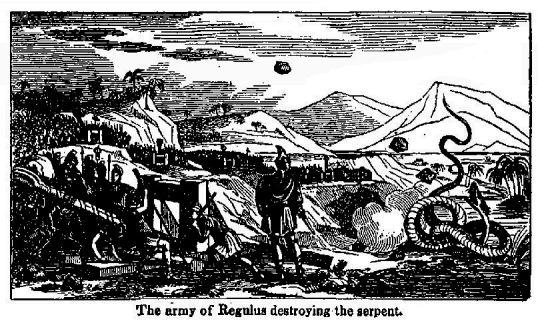
20. A battle ensued, in which Carthage was once more defeated, and 17,000 of its best troops were cut off. This fresh victory contributed to throw them into the utmost despair; for more than eighty of their towns submitted to the Romans. 21. In this distress, the Carthagin'ians, destitute of generals at home, were obliged to send to Lacedæ'mon, offering the command of their armies to Xantip'pus, a general of great experience, who undertook to conduct them.
22. This general began by giving the magistrates proper instructions for levying their men; he assured them that their armies were hitherto overthrown, not by the strength of the enemy, but by the ignorance of their own commanders; he, therefore, required a ready obedience to his orders, and assured them of an easy victory. 23. The whole city seemed once more revived from despondence by the exhortations of a single stranger, and soon from hope grew into confidence. 24. This was the spirit the Grecian general wished to excite in them; so that when he saw them thus ripe for the engagement, he joyfully took the field. 25. The Lacedæmo'nian made the most skilful disposition of his forces; he placed his cavalry in the wings; he disposed the elephants at proper intervals, behind the line of the heavy-armed infantry, and bringing up the light-armed troops before, he ordered them to retire through the line of infantry, after they had discharged their weapons. 26. At length both armies engaged; after a long and obstinate resistance the Romans were overthrown with dreadful slaughter, the greatest part of their army destroyed, and Reg'ulus himself[Pg. 148] taken prisoner. 27. Several other distresses of the Romans followed soon after. They lost their fleet in a storm, and Agrigen'tum, their principal town in Sicily, was taken by Karth'alo, the Carthagin'ian general. They built a new fleet, which shared the fate of the former; for the mariners, as yet unacquainted with the Mediterranean shores, drove upon quicksands, and soon after the greater part perished in a storm.[2]
Questions for Examination.
1. What did the Romans now desire?
2. What state afforded them an opportunity for this purpose?
3. Were their wishes gratified, and how?
4. What measures did the Mamertines adopt?
5. Did the Romans afford them the assistance they requested?
6. Where was Carthage situated, and when was it built?
7. Was it a powerful state?
8. Had the Romans or the Carthaginians the means most likely to insure success?
9. Were Rome and Carthage on an equal footing in other respects?
10. Did the Romans attempt to overcome this obstacle?
11. What assisted their endeavours?
12. Who was their first naval commander, and what was his success?
13. What were the means adopted to conquer Sicily?
14. What was the character of Regulus?
15. What was the amount of the force on both sides?
16. On what side did the advantage lie?
17. With whom did the victory remain?
18. What was the consequence of this victory?
19. What were the orders of the senate?
20. What was the next event deserving notice, and its consequences?
21. To what expedient were the Carthaginians obliged to have recourse?
22. What were the first acts of this general?
23. What were the effects his arrival produced?
24. What was the consequence?
25. In what way was the Carthaginian army drawn up?
26. What was the event of the battle?
27. What other disasters did the Romans encounter?[Pg. 149]
Who has not heard the Fulvian heroes sung
Dentatus' scars, or Mutius' flaming hand?
How Manlius saved the capitol? the choice
Of steady Regulus?—Dyer.
1. The Carthagin'ians being thus successful, were desirous of a new treaty for peace, hoping to have better terms than those insisted upon by Reg'ulus. They supposed that he, whom they had now for four years kept in a dungeon, confined and chained, would be a proper solicitor. It was expected that, being wearied with imprisonment and bondage, he would gladly endeavour to persuade his countrymen to a discontinuance of the war which prolonged his captivity. 2. He was accordingly sent with their ambassadors to Rome, under a promise, previously exacted from him, to return in case of being unsuccessful. He was even given to understand that his life depended upon the success of his negociation.
3. When this old general, together with the ambassadors of Carthage, approached Rome, numbers of his friends came out to meet him, and congratulate him on his return. 4. Their acclamations resounded through the city; but Reg'ulus refused, with settled melancholy, to enter the gates. In vain he was entreated on every side to visit once more his little dwelling, and share in that joy which his return had inspired. He persisted in saying that he was now a slave belonging to the Carthagin'ians, and unfit to partake in the liberal honours of his country. 5. The senate assembling without the walls, as usual, to give audience to the ambassadors, Reg'ulus opened his commission as he had been directed by the Carthagin'ian council, and their ambassadors seconded his proposals. 6. The senate themselves, who were weary of a war which had been protracted above fourteen years, were no way disinclinable to a peace. It only remained for Reg'ulus himself to give his opinion. 7. When it came to his turn to speak, to the surprise of the whole, he gave his voice for continuing the war. 8. So unexpected an advice not a little disturbed the senate: they pitied as well as admired a man who had used such eloquence against his private interest, and could conclude upon[Pg. 150] a measure which was to terminate in his own ruin. 9. But he soon relieved their embarrassment by breaking off the treaty, and by rising, in order to return to his bonds and his confinement. 10. In vain did the senate and his dearest friends entreat his stay; he still repressed their solicitations. Marcia, his wife, with her children, vainly entreated to be permitted to see him: he still obstinately persisted in keeping his promise; and though sufficiently apprised of the tortures that awaited his return, without embracing his family, or taking leave of his friends, he departed with the ambassadors for Carthage.
11. Nothing could equal the fury and the disappointment of the Carthagin'ians, when they, were informed by their ambassadors that Regulus, instead of hastening a peace, had given his opinion for continuing the war. 12. They accordingly prepared to punish his conduct with the most studied tortures. His eye-lids were cut off, and he was remanded to prison. After some days, he was again brought out from his dark and dismal dungeon, and exposed with, his face opposite the burning sun. At last, when malice was fatigued studying all the arts of torture, he was put into a sort of barrel, stuck full of spikes, and in this painful position he continued till he died.
13. Both sides now took up arms with more than former animosity. At length, Roman perseverance was crowned with success; and one victory followed on the back of another. Fa'bius Bu'teo, the consul, once more showed them the way to naval victory, by defeating a large squadron of the enemy's ships; but Luta'tius Cat'ulus gained a victory still more complete, in which the power of Carthage seemed totally destroyed at sea, by the loss of a hundred and twenty ships. 14. This loss compelled the Carthagin'ians again to sue for peace, which Rome thought proper to grant; but still inflexible in its demands, exacted the same conditions which Reg'ulus had formerly offered at the gates of Carthage. 15. These were, that they should lay down a thousand talents of silver, to defray the charge of the war, and should pay two thousand two hundred more within ten years; that they should quit Sicily, with all such islands as they possessed near it; that they should never make war against the allies of Rome, nor come with any vessels of war within the Roman dominions; and lastly, that all their prisoners and deserters should be delivered up without ransom.
16. To these hard[Pg. 151] conditions, the Carthagin'ians, now exhausted, readily subscribed; and thus ended the first Punic war, which had lasted twenty-four years; and, in some measure, had drained both nations of their resources.
Questions for Examination.
1. What were the Carthaginians now desirous of obtaining?
2. Was Regulus employed for this purpose?
3. How was Regulus received by the Romans?
4. What was the conduct of Regulus on this occasion?
5. How did the negociation commence?
6. Were the Romans inclined for peace?
7. What was the opinion of Regulus?
8. What was the effect of this advice?
9. How did Regulus put an end to their embarrassment?
10. Could he not be prevailed on to remain at Rome?
11. How did the Carthaginians receive an account of his conduct?
12. In what way did they punish him?
13. With what success was the war continued?
14. What was the consequence of this loss?
15. What were these terms?
16. Were they agreed to? What was the duration of the first Punic war?
FOOTNOTES:
The vessels in which they had hitherto transported their troops, were principally hired from their neighbours the Locrians, Tarentines, &c. It is certain that the Romans had ships of war before this period; but from the little attention they had hitherto paid to naval affairs, they were, probably, badly constructed and ill managed.
The Romans considering these two disasters as indications of the will of the gods that they should not contend by sea, made a decree that no more than fifty galleys should, for the future, be equipped. This decree, however, did not continue long in force,
FROM THE END OF THE FIRST PUNIC WAR TO THE END OF THE SECOND.
Spain first he won, the Pyrenieans pass'd,
And sleepy Alps, the mounds that nature cast;
And with corroding juices, as he went,
A passage through the living rocks he rent,
Then, like a torrent rolling from on high,
He pours his headlong rage on Italy.—Juvenal.
1. The war being ended between the Carthagin'ians and Romans, a profound peace ensued, and in about six years after, the temple of Ja'nus was shut for the second time since the foundation of the city.[1] 2. The Romans being thus in friendship with all nations, had an opportunity of turning to the arts of peace; they now began to have a relish for poetry, the first liberal art which rises in every civilized nation, and the first also that decays. 3. Hitherto they had been entertained only with the rude drolleries of[Pg. 152] their lowest buffoons, who entertained them with sports called Fescen'nine, in which a few debauched actors invented their own parts, while raillery and indecency supplied the place of humour. 4. To these a composition of a higher kind succeeded, called satire; a sort of dramatic poem, in which the characters of the great were particularly, pointed out, and made an object of derision to the vulgar.
5. After these, came tragedy and comedy, which were borrowed from the Greeks: indeed, the first dramatic poet of Rome, whose name was Liv'ius Andronicus, was a native of one of the Greek colonies in southern Italy. 6. The instant these finer kinds of composition appeared, this great people rejected their former impurities with disdain. From thenceforward they laboured upon the Grecian model; and though they were never able to rival their masters in dramatic composition, they soon surpassed them in many of the more soothing kinds of poetry. Elegiac, pastoral, and didactic compositions began to assume new beauties in the Roman language; and satire, not that rude kind of dialogue already mentioned, but a nobler sort, was all their own.
7. While they were thus cultivating the arts of peace, they were not unmindful of making fresh preparations for war; intervals of ease seemed to give fresh vigour for new designs, rather than relax their former intrepidity.
8. The Illyr'ians were the first people upon whom they tried their strength. That nation happened to make depredations upon some of the trading subjects of Rome, which being complained of to Teuta, the queen of the country, she, instead of granting redress, ordered the ambassadors, who were sent to demand restitution, to be murdered. 9. A war ensued, in which the Romans were victorious; most of the Illy'ric towns were surrendered to the consuls, and a peace at last concluded, by which the greatest part of the country was ceded to Rome; a yearly tribute was exacted for the rest, and a prohibition added, that the Illyr'ians should not sail beyond the river Lissus with more than two barks, and those unarmed.
10. The Gauls were the next people that incurred the displeasure of the Romans. 11. A time of peace, when the armies were disbanded, was the proper season for new irruptions; accordingly, these barbarians invited fresh forces from beyond the Alps, and entering Etru'ria, wasted all with fire and sword, till they came within about three days' journey[Pg. 153] of Rome. 12. A prætor and a consul were sent to oppose them, who, now instructed in the improved arts of war, were enabled to surround the Gauls. 13. It was in vain that those hardy troops, who had nothing but courage to protect them, formed two fronts to oppose their adversaries; their naked bodies and undisciplined forces were unable to withstand the shock of an enemy completely armed, and skilled in military evolutions. 14. A miserable slaughter ensued, in which forty thousand were killed, and ten thousand taken prisoners. 15. This victory was followed by another, gained by Marcel'lus, in which he killed Viridoma'rus, their king, with his own hand. 16. These conquests forced them to beg for peace, the conditions of which served greatly to enlarge the empire. Thus the Romans went on with success; retrieved their former losses, and only wanted an enemy worthy of their arms to begin a new war.
17. The Carthagin'ians had made peace solely because they were no longer able to continue the war. They, therefore, took the earliest opportunity of breaking the treaty, and besieged Sagun'tum, a city of Spain, which had been in alliance with Rome; and, though desired to desist, prosecuted their operations with vigour. 18. Ambassadors were sent, in consequence, from Rome to Carthage, complaining of the infraction of their articles, and required that Han'nibal, the Carthagin'ian general, who had advised this measure, should be delivered up: which being refused, both sides prepared for a second Punic war.
19. The Carthaginians trusted the management of it to Han'nibal. 20. This extraordinary man had been made the sworn foe of Rome, almost from his infancy; for, while yet very young, his father brought him before the altar, and obliged him to take an oath, that he would never be in friendship with the Romans, nor desist from opposing their power, until he or they should be no more. 21. On his first appearance in the field, he united in his own person the most masterly method of commanding, with the most perfect obedience to his superiors. Thus he was equally beloved by his generals, and the troops he was appointed to lead. 22. He was possessed of the greatest courage in opposing danger, and the greatest presence of mind in retiring from it. No fatigue was able to subdue his body, nor any misfortune to break his spirit; he was equally patient of heat and cold, and he took sustenance merely to content[Pg. 154] nature, not to delight his appetite. He was the best horseman and the swiftest runner, of the time. 23. This great general, who is considered as the most skilful commander of antiquity, having overrun all Spain, and levied a large army composed of various nations, resolved to carry the war into Italy itself, as the Romans had before carried it into the dominions of Carthage. 24. For this purpose, leaving Hanno with a sufficient force to guard his conquests in Spain, he crossed the Pyrene'an mountains into Gaul, with an army of fifty thousand foot, and nine thousand horse. He quickly traversed that country, which was then wild and extensive, and filled with nations that were his declared enemies.
25. In vain its forests and rivers appeared to intimidate; in vain the Rhone, with its rapid current, and its banks covered with enemies, or the Dura branched out into numberless channels, opposed his way; he passed them all with undaunted spirit, and in ten days arrived at the foot of the Alps, over which he was to explore a new passage into Italy. 26. It was in the midst of winter when this astonishing project was undertaken. The season added new horrors to the scene. The prodigious height and tremendous steepness of these mountains, capped with snow; the people barbarous and fierce, dressed in skins, and with long shaggy hair, presented a picture that impressed the beholders with astonishment and terror. 27. But nothing was capable of subduing the courage of the Carthaginian general. At the end of fifteen days, spent in crossing the Alps, he found himself in the plains of Italy, with about half his army; the other half having died of cold, or been cut off by the natives.
Questions for Examination.
1. What was the consequence of the conclusion of the first Punic war?
2. What advantages did the Romans derive from this interval of peace?
3. What species of entertainment had they hitherto enjoyed?
4. What succeeded these low buffooneries?
5. What was the next species, and from whom was it borrowed?
6. Did their former amusements still continue to please?
7. Were the Romans attentive only to the arts of peace?
8. Who first incurred their resentment, and what was their offence?
9. What was the consequence?
10. Who next incurred the displeasure of the Romans?[Pg. 155] 11. What was their offence, and what favourable opportunity did they choose?
12. What steps were taken to oppose them?
13. Did the Gauls make any effectual resistance?
14. What was the result of the battle?
15. Did this victory decide the contest?
16. What advantages occurred to the Romans from this war?
17. Were the Carthaginians sincere in their overture for peace?
18. What was the consequence of this refusal?
19. To whom was the conduct of the war committed by the Carthaginians?
20. What rendered Hannibal particularly eligible to this post?
21. Was he a favourite with the army?
22. Describe his corporeal and mental qualifications?
23. What resolution did he adopt?
24. What measures did he take for that purpose?
25. Was he not deterred by the dangers of the way?
26. What rendered this passage peculiarly difficult?
27. Did these horrors render the attempt unsuccessful?
With Hannibal I cleft yon Alpine rocks.
With Hannibal choked Thrasymene with slaughter;
But, O the night of Cannæ's raging field!
When half the Roman senate lay in blood.—Young.
1. As soon as it was known at Rome, that Han'nibal, at the head of an immense army, was crossing the Alps, the senate sent Scip'io to oppose him; the armies met near the little river Tici'nus, and the Roman general was obliged to retreat with considerable loss. 2. In the mean time, Han'nibal, thus victorious, took the most prudent precautions to increase his army; giving orders always to spare the possessions of the Gauls, while depredations were committed upon those of Rome; and this so pleased that simple people, that they declared for him in great numbers, and flocked to his standard with alacrity.
3. The second battle was fought upon the banks of the river Tre'bia. 4. The Carthaginian general, being apprised of the Roman impetuosity, of which he availed himself in almost every engagement, had sent off a thousand horse, each with a foot soldier behind, to cross the river, to ravage the enemy's country, and provoke them to engage. The Romans quickly routed this force. Seeming to be defeated, they took the river, and were as eagerly pursued by Sempro'nius, the consul. No sooner had his army attained the opposite bank, than he perceived himself half-conquered, his men being fatigued with wading up to their arm-pits, and quite benumbed by the intense coldness of the water[Pg. 156] 5. A total route ensued; twenty-six thousand of the Romans were either killed by the enemy, or drowned in attempting to repass the river. A body of ten thousand men were all that survived; who, finding themselves enclosed on every side, broke desperately through the enemy's ranks, and fought, retreating, till they found shelter in the city of Placentia.
6. The third defeat the Romans sustained was at the lake of Thrasyme'ne, near to which was a chain of mountains, and between these and the lake, a narrow passage leading to a valley that was embosomed in hills. It was upon these hills that Han'nibal disposed his best troops and it was into this valley that Flamin'ius, the Roman general, led his men to attack him. 7. A disposition every way so favourable for the Carthaginians, was also assisted by accident; for a mist rising from the lake, kept the Romans from seeing their enemies; while the army upon the mountains, being above its influence, saw the whole disposition of their opponents. 8. The fortune of the day was such as might be expected from the conduct of the two generals. The Roman army was slaughtered, almost before they could perceive the enemy that destroyed them. About fifteen thousand Romans, with Flamin'ius himself, fell in the valley, and six thousand more were obliged to yield themselves prisoners of war.
9. Upon the news of this defeat, after the general consternation was allayed, the senate resolved to elect a commander with absolute authority, in whom they might repose their last and greatest expectations. 10. The choice fell upon Fa'bius Max'imus, a man of great courage, with a happy mixture of caution. 11. He was apprised that the only way to humble the Carthaginians at such a distance from home, was rather by harassing than fighting. For this purpose, he always encamped upon the highest grounds, inaccessible to the enemy's cavalry. Whenever they moved, he watched their motions, straitened their quarters, and cut off their provisions.
12. By these arts, Fa'bius had actually, at one time, enclosed Han'nibal among mountains, where it was impossible to winter, and from which it was almost impracticable to extricate his army without imminent danger. 13. In this exigence, nothing but one of those stratagems of war, which only men of great abilities invent, could save him. 14. He ordered a number of small faggots and lighted torches to be[Pg. 157] tied to the horns of two thousand oxen, which should be driven towards the enemy. These, tossing their heads, and funning up the sides of the mountain, seemed to fill the whole neighbouring forest with fire; while the sentinels that were placed to guard the approaches to the mountain, seeing such a number of flames advancing towards their posts, fled in consternation, supposing the whole body of the enemy was in arms to overwhelm them. 15. By this stratagem Han'nibal drew off his army, and escaped through the defiles that led beneath the hills, though with considerable damage to his rear.
16. Fa'bius, still pursuing the same judicious measures, followed Han'nibal in all his movements, but at length received a letter from the senate, recalling him to Rome, on pretence of a solemn sacrifice, requiring his presence. 17. On his departure from the army, he strictly charged Minu'tius, his general of the horse, not to hazard an engagement in his absence. This command he disobeyed, and Fa'bius expressed his determination to punish so flagrant a breach of military discipline. 18. The senate, however, favouring Minu'tius, gave him an equal authority with the dictator. 19. On the arrival of Fa'bius at the camp, he divided the army with Minu'tius, and each pursued his own separate plan. 20. By artful management, Han'nibal soon brought the troops of the latter to an engagement, and they would have been cut off to a man, had not Fa'bius sacrificed his private resentment to the public good, and hastened to the relief of his colleague. 21. By their united forces Han'nibal was repulsed, and Minu'tius, conscious of his rashness, resigned the supreme command into the hands of the dictator.
22. On the expiration of his year of office, Fa'bius resigned, and Taren'tius Varro was chosen to the command. 23. Varro was a man sprung from the dregs of the people, with nothing but confidence and riches to recommend him. 24. With him was joined Æmil'ius Paulus, of a disposition entirely opposite; experienced, in the field, cautious in action, and impressed with a thorough contempt for the abilities of his plebeian colleague.
25. The Romans finding themselves enabled to bring a competent force into the field, being almost ninety thousand strong, now again resolved to meet Han'nibal, who was at this time encamped near the village of Cannæ, with a wind in his rear, that, for a certain season, blows constantly one[Pg. 158] way, which, raising great clouds of dust from the parched plains behind, he knew must greatly distress an approaching enemy. In this situation he waited the coming of the Romans with an army of forty thousand foot, and half that number of cavalry. 26. The consuls soon appeared to his wish, dividing their forces into two parts, and agreeing to take the command each day by turns. 27. On the first day of their arrival, Æmil'ius was entirely averse to engaging. The next day, however, it being Varro's turn to command, he, without asking his colleague's concurrence, gave the signal for battle: and passing the river Au'fidus, that lay between both armies, put his forces in array. 28. The battle began with the light-armed infantry; the horse engaged soon after; but the cavalry being unable to stand against those of Numid'ia, the legions came up to reinforce them. It was then that the conflict became general; the Roman soldiers endeavoured, in vain, to penetrate the centre, where the Gauls and Spaniards fought; which Han'nibal observing, he ordered part of those troops to give way, and to permit the Romans to embosom themselves within a chosen body of his Africans, whom he had placed on their wings, so as to surround them; upon that a terrible slaughter of the Romans ensued, fatigued with repeated attacks of the Africans, who were fresh and vigorous. 29. At last the rout became general in every part of the Roman army; the boastings of Varro were now no longer heard: while Æmil'ius, who had been wounded by a slinger, feebly led on his body of horse, and did all that could be done to make head against the enemy. 30. Unable to sit on horseback, he was forced to dismount. It was in these deplorable circumstances, that one Len'tulus, a tribune of the army, flying from the enemy, who at some distance pursued him, met Æmil'ius, sitting upon a stone, covered with blood and wounds, and waiting for the coming up of the pursuers. 31. "Æmil'ius," cried the generous tribune, "you, at least, are guiltless of this day's slaughter; take my horse and fly." "I thank thee, Len'tulus," cried the dying consul, "all is over, my part is chosen. Go, and tell the senate to fortify Rome against the approach of the conqueror. Tell Fa'bius, that Æmil'ius, while living, ever remembered his advice; and now, dying, approves it." 32. While he was yet speaking, the enemy approached; and Len'tulus at some distance saw the consul expire, feebly fighting in the midst of hundreds. 33. In this battle the Romans lost fifty thousand men, and so[Pg. 159] many knights, that it is said that Han'nibal sent three bushels of gold rings to Carthage, which those of this order wore on their fingers.[2]
Questions for Examination.
1. What measures were adopted by the Romans when they heard of Hannibal's approach?
2. What precautions did Hannibal take?
3. Where was the next battle fought?
4. What was the stratagem employed by Hannibal?
5. What followed?
6. Where was the next engagement?
7. Was this a judicious disposition of the Roman general?
8. What was the result?
9. What expedient did the senate adopt on this occasion?
10. Who was chosen to this office?
11. What method of fighting did he adopt?
12. What was the success of this plan?
13. Was his situation hopeless?
14. Describe his stratagem and its consequences?
15. Did it answer his purpose?
16. Was Fabius continued in office?
17, 18. Of what disobedience was Minutius guilty? Was he punished?
19. How was the army divided?
20, 21. What plan did Fabius pursue? How was its superiority proved?
22, 23, 24. Who succeeded Fabius? What was his character, and that of his colleague?
25. How were the Carthaginians posted at Cannæ?
26, 27. How did the consuls behave? How did Varro act?
28. What were the circumstances of the engagement?
29. How did the battle terminate?
30. What was the fate of Æmilius?
31. What generous offer was made by Lentulus?
32. Did the consul accept the tribune's offer?
33. Was the loss of the Romans severe?[Pg. 160]
The storming Hannibal
In vain the thunder of the battle rolled.
The thunder of the battle they returned
Back on his Punic shores.—Dyer.
1. When the first consternation was abated after this dreadful blow, the senate came to a resolution to create a dictator, in order to give strength to their government. 2. A short time after Varro arrived, having left behind him the wretched remains of his army. As he had been the principal cause of the late calamity, it was natural to suppose, that the senate would severely reprimand the rashness of his conduct. But far otherwise! The Romans went out in multitudes to meet him; and the senate returned him thanks that he had not despaired of the safety of Rome. 3. Fa'bius, who was considered as the shield, and Marcellus, as the sword of Rome, were appointed to lead the armies: and though Hannibal once more offered them peace, they refused it, but upon condition that he should quit Italy—a measure similar to that they had formerly insisted upon from Pyrrhus.
4. Han'nibal finding the impossibility of marching directly to Rome, or willing to give his forces rest after so mighty a victory, led them to Cap'ua, where he resolved to winter. 5. This city had long been considered as the nurse of luxury, and the corrupter of all military virtue. 6. Here a new scene of pleasure opened to his barbarian troops: they at once gave themselves up to intoxication; and from being hardy veterans, became infirm rioters.
7. Hitherto we have found this great man successful; but now we are to reverse the picture, and survey him struggling with accumulated misfortunes, and, at last, sinking beneath them.
8. His first loss was at the siege of Nola, where Marcel'lus, the prætor, made a successful sally. He some time after attempted to raise the siege of Cap'ua, attacked the Romans in their trenches, and was repulsed with considerable loss. He then made a feint to besiege Rome, but finding a superior army ready to receive him, was obliged to retire. 9. For many years he fought with varied success; Marcel'lus, his opponent, sometimes gaining, and sometimes losing the advantage, without coming to any decisive engagement.
10. The senate of Carthage at length came to a resolution [Pg. 161] of sending his brother As'drubal to his assistance, with a body of forces drawn out of Spain. 11. As'drubal's march being made known to the consuls Liv'ius and Nero, they went against him with great expedition; and, surrounding him in a place into which he was led by the treachery of his guides, they cut his whole army to pieces. 12. Han'nibal had long expected these succours with impatience; and the very night on which he had been assured of his brother's arrival, Nero ordered As'drubal's head to be cut off, and thrown into his brother's camp. 13. The Carthaginian general now began to perceive the downfall of Carthage; and, with a sigh, observed to those about him, that fortune seemed fatigued with granting her favours.
14. In the mean time, the Roman arms seemed to be favoured in other parts; Marcel'lus took the city of Syr'acuse, in Sicily, defended by the machines and the fires of Archime'des,[3] the mathematician. 15. The inhabitants were put to the sword, and among the rest, Archime'des himself, who was found, by a Roman soldier, meditating in his study. 16. Marcel'lus, the general, was not a little grieved at his death. A love of literature at that time began to prevail among the higher ranks at Rome. Marcel'lus ordered Archime'des to be honourably buried, and a tomb to be erected to his memory.
17. As to their fortunes in Spain, though for a while doubtful, they soon recovered their complexion under the conduct of Scip'io Africa'nus, who sued for the office of proconsul to that kingdom, at a time when every one else was willing to decline it. 18. Scip'io, now no more than twenty-four years old, had all the qualifications requisite for forming a great general, and a good man; he united courage with tenderness, was superior to Hannibal in the arts of peace, and almost his equal in those of war. 19. His father had been killed in Spain, so that he seemed to have an hereditary claim to attack that country. He, therefore, appeared irresistible, obtaining many great victories,[Pg. 162] yet subduing more by his generosity, mildness, and benevolent disposition, than by the force of arms.[4]
20. He returned with an army from the conquest of Spain, and was made consul at the age of twenty-nine. It was at first supposed he intended meeting Hannibal in Italy, and that he would attempt driving him from thence: but he had formed a wiser plan, which was, to carry the war into Africa; and, while the Carthaginians kept an army near Rome, to make them tremble for their own capital.
21. Scip'io was not long in Africa without employment; Hanno opposed him, but was defeated and slain. Sy'phax, the usurper of Numid'ia, led up a large army against him. 22. The Roman general, for a time, declined fighting, till finding an opportunity, he set fire to the enemy's tents, and attacking them in the midst of the confusion, killed forty thousand, and took six thousand prisoners.
23. The Carthaginians, terrified at their repeated defeats, and at the fame of Scip'io's successes, determined to recall Hannibal, their great champion, out of Italy, in order to oppose the Romans at home. Deputies were accordingly despatched with a positive command for him to return and oppose the Roman general, who at that time threatened Carthage with a siege. 24. Nothing could exceed the regret and disappointment of Hannibal; but he obeyed the orders of his infatuated country with the submission of the meanest soldier; and took leave of Italy with tears, after having kept possession of its most beautiful parts above fifteen years.
25. Upon his arrival at Leptis, in Africa, he set out for Adrume'tum, and at last approached Za'ma, a city about seventy-five miles from Carthage. 26. Scip'io, in the mean time, led his army to meet him, joined by Massinis'sa, with six thousand horse; and to show his rival how little he[Pg. 163] feared his approach, sent back the spies which were sent to explore his camp, having previously shown them the whole, with directions to inform Hannibal of what they had seen. 27. The Carthaginian general, conscious of his inferiority, endeavoured to discontinue the war by negociation, and desired a meeting with. Scip'io to confer upon terms of peace; to which the Roman general assented. 28. But after a long conference, both sides parting dissatisfied, they returned to their camps, to prepare for deciding the controversy by the sword. 29. Never was a more memorable battle fought, whether we regard the generals, the armies, the two states that contended, or the empire that was in dispute. The disposition Hannibal made of his men, is said to be superior to any even of his former arrangements. 30. The battle began with the elephants on the side of the Carthaginians, which being terrified at the cries of the Romans, and wounded by the slingers and archers, turned upon their drivers, and caused much confusion in both wings of their army, where the cavalry were placed. 31. Being thus deprived of the assistance of the horse, in which their greatest strength consisted, the heavy infantry joined on both sides; but the Romans being stronger of body, the Carthaginians gave ground. 32. In the mean time, Massinissa, who had been in pursuit of their cavalry, returning and attacking them in the rear, completed their-defeat. A total rout ensued, twenty thousand men were killed, and as many taken prisoners. 33. Hannibal, who had done all that a great and undaunted general could perform, fled with a small body of horse to Adrume'tum; fortune seeming to delight in confounding his ability, his valour, and experience.
34. This victory brought on a peace. The Carthaginians, by Hannibal's advice, submitted to the conditions which the Romans dictated, not as rivals, but as sovereigns. 35. By this treaty the Carthaginians were obliged to quit Spain, and all the islands in the Mediterranean. They were bound to pay ten thousand talents in fifty years; to give hostages for the delivery of their ships and their elephants; to restore to Massanis'sa all the territories that had been taken from him; and not to make war in Africa but by the permission of the Romans. Thus ended the second Punic war, seventeen years after it had begun.[Pg. 164]
Questions for Examination.
1. By what measure did the senate attempt to retrieve this disaster?
2. Did Varro venture to return, and what was his reception?
3. Who were appointed to carry on the war?
4. What was Hannibal's next step?
5. What was the character of this city?
6. What was the consequence to the Carthaginian army?
7. Was Hannibal uniformly successful?
8. What was his first reverse?
9. What happened to him afterwards?
10. What resolution did the senate of Carthage adopt?
11. Did he effect a junction with his brother?
12. Was Hannibal apprised of these intended succours?
13. What inference did Hannibal draw from this?
14. Were the Romans successful in other parts?
15. What was the fate of its inhabitants?
16. Was his loss deplored?
17. What was the success of the Romans in Spain?
18. What was the character of Scipio?
19. What rendered him particularly eligible for this command?
20. Were his exploits confined to Spain?
21. Had he any formidable opposition to encounter?
22. What was the conduct of Scipio?
23. What measures did the Carthaginians have recourse to on this occasion?
24. Was Hannibal pleased at his recall?
25. Whither did he repair on his arrival in Africa?
26. What was the conduct of Scipio?
27. Was Hannibal desirous of continuing hostilities?
28. What was the result?
29. Was the battle of consequence?
30. How did it commence?
31. What followed?
32. What completed the defeat of the Carthaginians?
33. What became of Hannibal?
34. What was the result of the victory?
35. What were the conditions of the treaty?
FOOTNOTES:
The first was in the reign of Numa.
Hannibal has been blamed for not having marched to Rome immediately after this victory; but his army was by no means adequate to the siege of the city; and the allies of the Romans would have been able to curtail his quarters and intercept his convoys. He was, besides, badly provided with provisions and the munitions of war, both of which he could procure by invading Campania, the course which he actually pursued.
This great man was equal to an army for the defence of the place. He invented engines which threw enormous stones against the Romans, hoisted their ships in the air, and then dashed them against the rocks beneath, and dismounted their battering engines. He also set fire to some of the Roman ships by the use of reflectors, or looking-glasses, directing the sun's rays from a great number of them on the same spot at the same time.
During his command in Spain, a circumstance occurred which has contributed more to the fame and glory of Scipio than all his military exploits. At the taking of New Carthage, a lady of extraordinary beauty was brought to Scipio, who found himself greatly affected by her charms. Understanding, however, that she was betrothed to a Celtibe'rian prince, named Allu'cius, he generously resolved to conquer his rising passion, and sending for her lover, restored her without any other recompence than requesting his friendship to the republic. Her parents had brought a large sum of money for her ransom, which they earnestly entreated Scipio to accept; but he generously bestowed it on Allu'cius, as the portion of his bride. (Liv. l. xxvi. c. 50.)
Beauteous Greece,
Torn from her joys, in vain, with languid arm,
Half raised her lusty shield.—Dyer.
1. While the Romans were engaged with Hannibal, they carried on also a vigorous war against Philip, king of Ma'cedon, not a little incited thereto by the prayers of the Athe'nians; who, from once controlling the powers of Persia,[Pg. 165] were now unable to defend themselves. The Rho'dians with At'talus, king of Per'gamus, also entered into the confederacy against Philip. 2. He was more than once defeated by Galba, the consul. He attempted to besiege Athens, but the Romans obliged him to raise the siege. He tried to take possession of the Straits of Thermop'ylæ, but was driven from thence by Quin'tus Flamin'ius, with great slaughter. He attempted to take refuge in Thes'saly, where he was again defeated, with considerable loss, and obliged to beg a peace, upon condition of paying a thousand talents. 3. Peace with Philip gave the Romans an opportunity of showing their generosity, by restoring liberty to Greece.
4. Antio'chus, king of Syria, was next brought to submit to the Roman arms: after embassies on the one side and on the other, hostilities were commenced against him five years after the conclusion of the Macedo'nian war. 5. After many mistakes and great misconduct, he attempted to obtain a peace, by offering to quit all his places in Europe, and such in Asia as professed alliance to Rome. 6. But it was now too late; Scip'io perceived his own superiority, and was resolved to avail himself of it. 7. Antio'chus, thus driven into resistance, for some time retreated before the enemy, till, being pressed hard, near the city of Magnesia he was forced to draw out his men, to the number of seventy thousand foot, and twelve thousand horse.
8. Scip'io opposed him with forces as much inferior in number, as they were superior in courage and discipline. Antio'chus, therefore, was in a short time entirely defeated; his own chariots, armed with scythes, being driven back upon his men, contributed much to his overthrow. 9. Being thus reduced to the last extremity, he was glad to procure peace from the Romans, upon their own terms; which were, to pay fifteen thousand talents; to quit his possessions in Europe, and in Asia, on the hither side of Mount Taurus; to give twenty hostages, as pledges of his fidelity; and to deliver up Hannibal, the inveterate enemy of Rome, who had taken refuge at his court.
10. In the mean time Hannibal, whose destruction was one of the articles of this extorted treaty, endeavoured to avoid the threatened ruin. 11. This consummate general had long been a wanderer, and an exile from his ungrateful country. He had taken refuge at the court of Antio'chus who, at first, gave him a sincere welcome, and made him[Pg. 166] admiral of his fleet, in which station he showed his usual skill in stratagem.
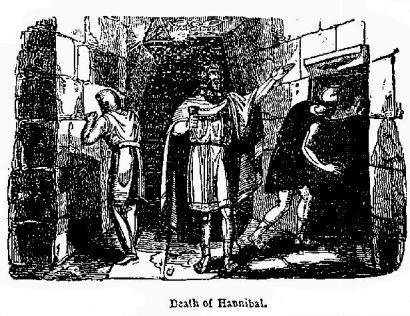
12. But he soon sunk in the Syrian's esteem for projecting schemes which that monarch had neither genius to understand, nor talents to execute. 13. Sure, therefore, to find no safety or protection, he departed by stealth; and, after wandering for a time among the petty states, which had neither power nor generosity to protect him, he took refuge at the court of Pru'sias, king of Bythin'ia. 14. In the mean time, the Romans, with a vindictive spirit utterly unworthy of them, sent Æmil'ius, one of their most celebrated generals, to demand him of this king; who, fearing the resentment of Rome, and willing to conciliate their friendship by this breach of hospitality, ordered a guard to be placed upon Hannibal, with an intent to deliver him up. 15. The poor old general, thus implacably persecuted from one country to another, and finding every method of safety cut off, determined to die. He, therefore, desired one of his followers to bring him poison; and drinking it, he expired as he had lived, with intrepid bravery.
16. A second Macedo'nian war was soon after proclaimed against Per'seus, the son of that Philip who had been obliged to beg peace of the Romans. 17. Perseus, in order to secure the crown, had murdered his brother Deme'trius; and, upon the death of his father, pleased with the hopes of imaginary triumphs, made war against Rome. 18, During the course of this war, which continued about three years, opportunities were offered him of cutting off the Roman army; but being ignorant how to take advantage of their rashness, he spent the time in empty[Pg. 167] overtures for peace. 19. At length Æmil'ius gave him a decisive overthrow. He attempted to procure safety by flying into Crete: but being abandoned by all, he was obliged to surrender himself, and to grace the splendid triumph of the Roman general.[1]
20. About this time Massinis'sa, the Numidian, having made some incursions into a territory claimed by the Carthaginians, they attempted to repel the invasion. 21. This brought on a war between that monarch and them; while the Romans, who pretended to consider this conduct of theirs as an infraction of the treaty, sent to make a complaint. 22. The ambassadors who were employed upon this occasion, finding the city very rich and flourishing, from the long interval of peace which it had now enjoyed for nearly fifty years, either from motives of avarice to possess its plunder, or from fear of its growing greatness, insisted much on the necessity of a war, which was soon after proclaimed, and the consuls set out with a thorough resolution utterly to demolish Carthage.
The territory thus invaded by Massinis'sa, was Tysca, a rich province, undoubtedly belonging to the Carthaginians. One of the ambassadors sent from Rome was the celebrated Cato, the censor, who, whatever his virtues may have been, appears to have imbibed an inveterate hatred to Carthage. For, on whatever subject he debated in the senate, he never failed to conclude in these words, "I am also of opinion that Carthage should be destroyed." The war, however, which had broken out in Spain, and the bad success of the Roman arms in that quarter, for some time delayed the fate of that devoted city; and it might, perhaps, have stood much longer, had not some seditious demagogues incited the populace to insult the Roman ambassador, and to banish those senators who voted for peace.
To account for the apparent pusillanimity of the Carthaginians, it is necessary to observe, that they had suffered repeated defeats in their war with Massinis'sa; and that fifty thousand of their troops, after having been blocked up in their camp till from want they were obliged to submit to the most humiliating conditions, were inhumanly massacred by Gulus'sa, the son of the Numidian king. The Romans chose this distressing juncture to declare war against them.
As one proof of their sincere desire for peace, they had[Pg. 168] previously delivered up to the Romans all their arms and warlike engines, of which they possessed prodigious magazines; thus leaving themselves still more defenceless than before.
23. The wretched Carthaginians, finding that the conquerors would not desist from making demands, while the vanquished had any thing to give, attempted to soften the victors by submission; but they received orders to leave the city, which was to be levelled with the ground. 24. This severe command they received with all the distress of a despairing people: they implored for a respite from such a hard sentence: they used tears and lamentations; but finding the consuls inexorable, they departed with a gloomy resolution, prepared to suffer the utmost extremities, and fight to the last for their seat of empire.
25. Those vessels, therefore, of gold and silver, which their luxury had taken such pride in, were converted into arms. The women parted also with their ornaments, and even cut off their hair to be converted into strings for the bowmen. As'drubal, who had been lately condemned for opposing the Romans, was now taken from prison to head their army; and such preparations were made, that when the consuls came before the city, which they expected to find an easy conquest, they met with such resistance as quite dispirited their forces and shook their resolution. 26. Several engagements were fought before the walls, with disadvantage to the assailants; so that the siege would have been discontinued, had not Scip'io Æmilia'nus, the adopted son of Africa'nus, who was now appointed to command it, used as much skill to save his forces after a defeat, as to inspire them with fresh hopes of a victory. 27. But all his arts would have failed, had he not found means to seduce Phar'nes, the master of the Carthaginian horse, who came over to his side. The unhappy townsmen soon saw the enemy make nearer approaches; the wall which led to the haven was quickly demolished; soon after the forum itself was taken, which offered to the conquerors a deplorable spectacle of houses nodding to their fall, heaps of men lying dead, hundreds of the wounded struggling to emerge from the carnage around them, and deploring their own and their country's ruin. The citadel soon after surrendered at discretion. 28. All now but the temple was subdued, and that was defended by deserters from the Roman army, and[Pg. 169]
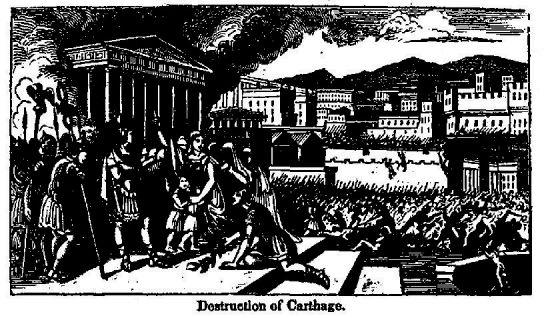
those who had been most forward to undertake the war. These expected no mercy, and finding their condition desperate, set fire to the building, and voluntarily perished in the flames. This was the end of one of the most renowned cities in the world, for arts, opulence, and extent of dominion; it had rivalled Rome for above a hundred years, and, at one time, was thought to have the superiority.
29. The conquest of Carthage was soon followed by many others. The same year Corinth, one of the noblest cities of Greece, was levelled to the ground. Scip'io also having laid siege to Numan'tia, the strongest city in Spain, the wretched inhabitants, to avoid falling into the hands of the enemy, fired the city, over their own heads; and all, to a man, expired in the flames. Thus Spain became a Roman province, and was governed thenceforward by two annual prætors.
Questions for Examination.
1. With whom were the Romans at war besides Carthage, and who assisted in it?
2. What was the success of Philip in this war?
3. What was the consequence of peace with Philip?
4. Who next fell under the displeasure of the Romans?
5. What was the result?
6. Were his offers accepted?
7. Did Antiochus boldly face the Romans?[Pg. 170]
8. What were the strength and character of the Roman army, and what the result of the battle?
9. Was he able to make further resistance?
10. Was Hannibal delivered up?
11. What occasioned Hannibal to put himself in the power of Antiochus?
12. Was this kindness lasting?
13. Whither did he next betake himself?
14. Was he in safety at this court?
15. How did Hannibal escape his persecution?
16. Against whom did the Romans next direct their arms?
17. What occasioned it?
18. Was Perseus a skilful general?
19. What was the result of the war?
20. What farther happened about this time?
21. What was the consequence?
22. Was this misunderstanding peaceably accommodated?
23. By what means did the Carthaginians endeavour to avert their fate?
24. Did they obey these orders?
25. What extraordinary efforts were made for the defence of the city?
26. Were the Romans successful in their attempts?
27. Describe the progress of the siege.
28. Was the city now completely in the power of the Romans?
29. What other conquests were made by the Romans?
FOOTNOTES:
From this time, Macedon became a Roman province.
FROM THE DESTRUCTION OF CARTHAGE TO THE END OF THE SEDITION OF THE GRACCHI.—U.C. 621.
Seldom is faction's ire in haughty minds
Extinguished but by death; it oft, like flame
Suppressed, breaks forth again, and blazes higher.—May.
1. The Romans being now left without a rival, the triumphs and the spoils of Asia introduced a taste for splendid expense, and this produced avarice and inverted ambition. 2. The two Gracchi were the first who saw this strange corruption among the great, and resolved to repress it, by renewing the Licinian law, which had enacted that no person in the state should possess above five hundred acres of land. 3. Tibe'rius Gracchus, the elder of the two, was, both for the advantages of his person and the qualities of his mind, very different from Scipio, of whom he was the grandson. He seemed more ambitious of power than desirous of glory; his compassion for the oppressed was equal to his animosity against the oppressors; but unhappily his passions, rather than his reason, operated even in his pursuits[Pg. 171] of virtue; and these always drove him beyond the line of duty. 4. This was the disposition of the elder Gracchus, who found the lower orders of people ready to second all his proposals. 5. The above law, though at first carried on with proper moderation, greatly disgusted the rich, who endeavoured to persuade the people that the proposer only aimed at disturbing the government, and throwing all things into confusion. 6. But Gracchus, who was a man of the greatest eloquence of his time, easily wiped off these impressions from the minds of the people, already irritated by their wrongs, and at length the law was passed.
7. The death of At'talus, king of Per'gamus, furnished Gracchus with a new opportunity of gratifying the meaner part of the people at the expense of the great. 8. This king had by his last will made the Romans his heirs; and it was now proposed, that the money so left should be divided among the poor, in order to furnish them with proper utensils for cultivating the lands which became theirs by the late law of partition. 9. This caused still greater disturbances than before, and the senate assembled upon the occasion, in order to concert the most proper methods of securing these riches to themselves, which they now valued above the safety of the commonwealth. 10. They had numerous dependents, who were willing to give up liberty for plenty and ease. These, therefore, were commanded to be in readiness to intimidate the people, who expected no such opposition, and who were now attending to the harangues of Gracchus in the capitol. 11. Here, as a clamour was raised by the clients of the great on one side, and by the favourers of the law on the other, Gracchus found his speech entirely interrupted, and begged in vain to be attended to; till at last, raising his hand to his head, to intimate that his life was in danger, the partisans of the senate gave out that he wanted a diadem. 12. In consequence of this an universal uproar spread itself through all ranks of the people; the corrupt part of the senate were of opinion that the consul should defend the commonwealth by force of arms; but this prudent magistrate declining such violence, Scip'io Nas'ica, kinsman to Gracchus, immediately rose up, and preparing himself for the contest, desired that all who would defend the dignity and authority of the laws, should follow him. 13. Upon this, attended by a large body of senators and clients armed with clubs, he went directly to the Capitol, striking down all who ventured to resist.[Pg. 172]
14. Tibe'rius Gracchus, perceiving by the tumult that his life was in danger, endeavoured to fly; and throwing away his robe to expedite his escape, attempted to get through the throng; but happening to fall over a person already on the ground, Sature'ius, one of his colleagues in the tribuneship, who was of the opposite faction, struck him dead with a piece of a seat; and not less than three hundred of his hearers shared the same fate, being killed in the tumult. 15. Nor did the vengeance of the senate rest here, but extended to numbers of those who seemed to espouse his cause; many of them were put to death, many were banished, and nothing was omitted to inspire the people with an abhorrence of his pretended crimes. Soon after the death of Gracchus a rebellion broke out in Sicily among the slaves, who, exasperated by the cruelties exercised upon them by their masters, revolted, and having seized Enna, chose one Eunus for their king. This new monarch gained considerable advantages over the Romans, took the strong city of Tauromin'ium, and protracted the war upwards of six years. At length he was completely defeated by the consul Rupil'ius, and his followers slaughtered or executed: as for Eunus, he died in prison.
16. Ca'ius Gracchus was but twenty-one upon the death of Tibe'rius his brother; and as he was too young to be much dreaded by the great, so he was at first unwilling to incur their resentment by aims beyond his reach; he therefore lived in retirement, unseen and forgotten. 17. But, while he thus seemed desirous of avoiding popularity, he was employed in his solitude in the study of eloquence, which was the surest means to obtain it. 18. At length, when he thought himself qualified to serve his country, he offered himself a candidate for the quæstorship to the army in Sardin'ia, which he easily obtained. His valour, affability, and temperance in this office were remarked by all. 19. The king of Numid'ia sending a present of corn to the Romans, ordered his ambassadors to say, that it was a tribute to the virtues of Ca'ius Gracchus. 20. This the senate treated with scorn, and ordered the ambassadors to be treated with contempt, as ignorant barbarians, which so inflamed the resentment of young Gracchus, that he immediately came from the army to complain of the indignity thrown upon his reputation, and to offer himself for the tribuneship of the people. 21. It was then that this youth, who had been hitherto neglected, proved a more formidable enemy than[Pg. 173] even his brother had been. Notwithstanding the warmest opposition from the senate, he was declared tribune by a very large majority; and he now prepared for the career which his brother had run before him.
22. His first effort was to have Pompil'ius, one of the most inveterate of his brother's enemies, cited before the people; but rather than stand the event of a trial, he chose to go into voluntary banishment. 23. He next procured an edict, granting the freedom of the city to the inhabitants of La'tium, and soon after to all the people on the hither side of the Alps. 24. He afterwards fixed the price of corn at a moderate standard, and procured a monthly distribution of it among the people. 25. He then proceeded to an inspection into the late corruptions of the senate; in which the whole body being convicted of bribery, extortion, and the sale of offices (for at that time a total degeneracy seemed to have taken place,) a law was made, transferring the power of judging corrupt magistrates from the senate to the knights, which made a great alteration in the constitution.
26. Gracchus, by these means, being grown not only popular, but powerful, was become an object at which the senate aimed all their resentment. 27. But he soon found the populace a faithless and unsteady support. They began to withdraw all their confidence from him, and to place it upon Drusus, a man insidiously set up against him by the senate. 28. It was in vain that he revived the Licin'ian law in their favour, and called up several of the inhabitants of the different towns of Italy to his support; the senate ordered all to depart from Rome, and even sent one stranger to prison whom Gracchus had invited to live with him, and honoured with his table and friendship. 29. To this indignity was shortly after added a disgrace of a more fatal tendency; for, standing for the tribuneship a third time, he was rejected. It was supposed that the officers, whose duty it was to make the return, were bribed to reject him, though fairly chosen.
Questions for Examination.
1. What consequences followed this great prosperity of the Roman arms?
2. Who first resolved to repress the corruption which had taken place in the manners of the people?[Pg. 174]
3. What was the character of Tiberius Gracchus?
4. Had he any influence with the people?
5. How was the Licinian law received?
6. Did the people believe them?
7. What furthered his views?
8. What advantages occurred to the Romans by his death?
9. What was the effect of this will?
10. What measures did they adopt for this purpose?
11. What was the consequence of their interference?
12. Was this insinuation believed?
13. Did Scipio use violence?
14. What was the fate of Gracchus and his friends?
15. Were his enemies satisfied with this vengeance?
16. What became of Caius Gracchus in the mean time?
17. Was he really desirous of avoiding popularity?
18. In what way did he bring himself into notice?
19. What proof of esteem was given him?
20. How was this compliment received?
21. What was the consequence of this resentment?
22. What was his first effort?
23. What was his next act?
24. What was the next?
25. What followed?
26. What was the consequence of these acts?
27. Did he find steady friends?
28. Were his measures of precaution successful?
29. What farther indignities did he experience?
Say, Romans, whence so dire a fury rose,
To glut with Latin blood your barbarous foes?
Could you in wars like these provoke your fate?
Wars, where no triumphs on the victors waits—'Rowe's Lucan.
1. It was now seen that the fate of Gracchus was resolved on. Opim'ius, the consul, was not contented with the protection of the senate, the knights, and a numerous retinue of slaves and clients; he ordered a body of Candians, who were mercenaries in the Roman service, to follow and attend him. 2. Thus guarded, and conscious of the superiority of his forces, he insulted Gracchus whereever he met him, doing all in his power to produce a quarrel, in which he might have a pretence for despatching his enemy in the fray. 3. Gracchus avoided all recrimination, and, as if apprised of the consul's designs, would not even wear any arms for his defence. 4. His friend Ful'vius Flaccus, however, a zealous tribune, was not so remiss, but resolved to oppose party against party, and for this purpose brought up several countrymen to Rome, who came under[Pg. 175] pretence of desiring employment. 5. When the day for determining the controversy was arrived, the two parties, early in the morning, attended at the Capitol, where, while the consul was sacrificing, according to custom, one of the lictors taking up the entrails of the beast that was slain in order to remove them, could not forbear crying out to Flac'cus and his party, "Make way, ye factious citizens, for honest men." 6. This insult so provoked, the party to whom it was addressed, that they instantly fell upon him, and pierced him to death with the instruments they used in writing, which they then happened to have in their hands. 7. This murder caused a great disturbance in the assembly. Gracchus, who saw the consequences that were likely to ensue, reprimanded his party for giving his enemies such advantage over him; and now prepared to lead his followers to Mount Av'entine. 8. It was there he learned, that a proclamation had been made by the consuls, that whosoever should bring either his head, or that of Flaccus, should receive its weight in gold as a reward. 9. It was to no purpose that he sent the youngest son of Flaccus, who was yet a child, with proposals for an accommodation. The senate and the consuls, who were sensible of their superiority, rejected all his offers, and resolved to punish his offence with nothing less than death; and they offered pardon also to all who should leave him immediately. 10. This produced the desired effect; the people fell from him by degrees, and left him with very inferior forces. 11. In the meantime, Opim'ius, the consul, who thirsted for slaughter, leading his forces up to Mount Av'entine, fell in among the crowd with ungovernable fury. A terrible slaughter of the scarcely resisting multitude ensued, and not less than three thousand citizens were slain upon the spot. 12. Flaccus attempted to find shelter in a ruinous cottage; but, being discovered, was slain, with his eldest son. Gracchus, at first, retired to the temple of Dian'a, where he resolved to die by his own hand, but was prevented by two of his faithful friends and followers, Pompo'nius and Lucin'ius, who forced him to seek safety by flight. Thence he made the best of his way across a bridge that led from the city, still attended by his two generous friends, and a Grecian slave, whose name was Philoc'rates. 13. But his pursuers still pressed upon him from behind, and when come to the foot of the bridge, he was obliged to turn and face the enemy. His two friends were soon slain, defending him against the crowd; and he[Pg. 176] was forced to take refuge, with his slave, in a grove beyond the Ti'ber, which had long been dedicated to the Furies. 14. Here, finding himself surrounded on every side, and no way left of escaping, he prevailed upon his slave to despatch him. The slave immediately after killed himself, and fell down upon the body of his beloved master. The pursuers coming up, cut off the head of Gracchus, and placed it for a while as a trophy on a spear. 15. Soon after, one Septimule'ius carried it home, and taking out the brain artfully filled it with lead, in order to increase its weight, and then received of the consul seventeen pounds of gold as his recompence.
16. Thus died Cai'us Gracchus. He is usually impeached by historians, as guilty of sedition; but from what we see of his character, the disturbance of public tranquillity was rather owing to his opposers than to him; so that, instead of calling the tumults of that time the sedition of the Gracchi, we should rather call them the sedition of the senate against the Gracchi; since the efforts of the latter were made in vindication of a law to which the senate had assented; and the designs of the former were supported by an extraneous armed power from the country, that had never before meddled in the business of legislation, and whose introduction gave a most irrecoverable blow to the constitution. 17. Whether the Gracchi were actuated by motives of ambition or of patriotism, in the promulgation of the law, it is impossible to determine; but from what appears, justice was on their side, and all injury on that of the senate. 18. In fact, this body was now changed from that venerable assembly, which we have seen overthrowing Pyr'rhus and Hannibal, as much by their virtues as their arms. They were now only to be distinguished from the rest of the people by their superior luxuries; and ruled the commonwealth by the weight of an authority gained from riches and mercenary dependents. 19. The venal and the base were attached to them from motives of self-interest; and they who still ventured to be independent, were borne down, and entirely lost in an infamous majority. 20. In short, the empire at this period came under the government of a hateful aristocracy; the tribunes, who were formerly accounted protectors of the people, becoming rich themselves, and having no longer opposite interests from those of the senate, concurred in their oppressions; for the struggle was not now between patricians and plebeians, who only nominally differed,[Pg. 177] but between the rich and the poor. 21. The lower orders of the state being by these means reduced to a degree of hopeless subjection, instead of looking after liberty, only sought for a leader; while the rich, with all the suspicion of tyrants, terrified at the slightest appearance of opposition, entrusted men with uncontrollable power, from whom they had not strength to withdraw it when the danger was over. 22. Thus both parties of the state concurred in giving up their freedom; the fears of the senate first made the dictator, and the hatred of the people kept him in his office. Nothing can be more dreadful to a thinking mind than the government of Rome from this period, till it found refuge under the protection of Augus'tus.[1]
Questions for Examination.
1. What appearances now threatened the life of Gracchus?
2. How did he commence hostilities?
3. How did Gracchus attempt to divert the storm?
4. Were his friends equally prudent?
5. What unhappy incident increased the animosity?
6. How was this insult revenged?
7. What was the consequence of this outrage?
8. What news did he hear on his arrival?
9. Did he attempt to conciliate his enemies, and were his attempts successful?
10. Was this offer accepted?
11. What was the conduct of the consul?
12. What was the fate of the chiefs?
13. Did Gracchus effect his escape?
14. Did he fall into the hands of his enemies?
15. What artifice did avarice contrive?
16.' Was the conduct of Gracchus deserving of praise or blame?
17. By what motives were the Gracchi supposed to be actuated?
18. What was the character of the senate at this period?
19. What was the character of their adherents?
20. What was the nature of their government?
31. What concurred to perpetuate this tyranny?[Pg. 178]
FOOTNOTES:
From the death of Gracchus until the first consulship of Marius, Rome was governed by a venal and profligate oligarchy, formed from a coalition of the most powerful families. Shame was unknown to this body; the offices of state were openly sold to the highest bidder, redress of grievances was to be obtained only by paying a heavier sum for vengeance than the oppressor would give for impunity: advocacy of popular rights was punished as treason, and complaints were treated as criminal acts of sedition. The young patricians, under such a system, became the scourge of the state, for nothing remained safe from their violence or their lust, when the monopoly of judicial office by their friends and relatives insured them impunity for every excess, however flagrant or disgraceful.
FROM THE SEDITION OF GRACCHUS TO THE PERPETUAL DICTATORSHIP OF SYLLA, WHICH WAS THE FIRST STEP TOWARDS THE RUIN OF THE COMMONWEALTH.—U.C. 634.
By brutal Marius, and keen Sylla, first
Effused the deluge dire of civil blood,
Unceasing woes began.—Thomson.
1. While the Romans were in this state of deplorable corruption at home, they nevertheless were very successful in their transactions with foreign powers.
2. Among other victories, a signal one was gained over Jugur'tha, king of Numid'ia. He was grandson to Massinis'sa, who sided with Rome against Hannibal, and educated with the two young princes, who were left to inherit the kingdom. 3. Being superior in abilities to both, and greatly in favour with the people, he murdered Hiemp'sal, the eldest son, but Adher'bal, the younger, escaped, and fled to the Romans for succour. 4. Jugur'tha, sensible how much avarice and injustice had crept into the senate, sent his ambassadors to Rome with large presents, which so successfully prevailed, that the senate decreed him half the kingdom thus acquired by murder and usurpation, and sent ten commissioners to divide it between him and Adher'bal. 5. The commissioners, of whom Opim'ius, the enemy of Gracchus, was one, willing to follow the example which the senate had set them, were also bribed to bestow the richest and most populous parts of that kingdom upon the usurper. 6. But Jugur'tha resolved to possess himself of the whole: and willing to give a colour to his ambition, he only made, in the beginning, incursions in order to provoke reprisals, which he knew how to convert into seeming aggression. 7. This scheme failing, he resolved to throw off the mask, and besieging Adher'bal in Cirta, his capital, he at length got him into his power, and murdered him. 8. The Roman people, who had still some generosity remaining, unanimously complained of this treachery, and procured a decree that Jugur'tha should be summoned in person before them, to give an account of all such as had accepted bribes. 9. Jugur'tha made no difficulty of throwing himself upon the clemency of Rome; but not giving[Pg. 179] the people satisfaction, he had orders to depart the city.[1] 10. In the meantime, Alba'nus, the consul, was sent with an army to follow him, who giving up the direction of it to Au'lus, his brother; a person who was every way unqualified for the command, the Romans were compelled to hazard a battle upon disadvantageous terms; and the whole army, to avoid being cut to pieces, was obliged to pass under the yoke.
11. In this condition Metel'lus, the succeeding consul, found affairs upon his arrival in Numid'ia; officers in whom the soldiers had no confidence, an army without discipline, and an enemy ever watchful and intriguing. 12. However, by his great attention to business, and by integrity that shuddered at corruption, he soon began to retrieve the affairs of Rome, and the credit of the army. In the space of two years, Jugur'tha was overthrown in several battles, forced out of his own dominions, and constrained to beg a peace. 13. Thus all things promised Metel'lus a happy termination of the war; but he was frustrated in his expectations by the intrigues of Ca'ius Ma'rius, his lieutenant, who came in to reap that harvest of glory which the other's industry had sown. 14. Ca'ius Ma'rius was born in a village near Apin'ium, of poor parents, who gained their living by their labour. As he had been bred up in a participation of their toils, his manners were as rude as his countenance was frightful. He was a man of extraordinary stature, incomparable strength, and undaunted bravery.
15. When Metel'lus was obliged to solicit at Rome for a continuance of his command, Ma'rius, whose ambition knew no bounds, was resolved to obtain it for himself, and thus gain all the glory of putting an end to the war. 16. To that end he privately inveighed against Metel'lus by his emissaries at Rome, and having excited a spirit of discontent against him, he had leave granted him to go there to stand for the consulship, which he obtained, contrary to the expectation and interest of the nobles.
17. Marius, being thus invested with the supreme power of managing the war, showed himself every way fit for the commission. His vigilance was equal to his valour, and he quickly made himself master of the cities which Jugur'tha[Pg. 180] had yet remaining in Numid'ia.[2] 18. This unfortunate prince, finding himself unable to make opposition singly was obliged to have recourse for assistance to Bocchus, king of Maurita'nia, to whose daughter he was married. A battle soon after ensued, in which the Numid'ians surprised the Roman camp by night, and gained a temporary advantage. However, it was but of short continuance, for Ma'rius soon after overthrew them in two signal engagements, in one of which not less than ninety thousand of the African army were slain. 19. Bocchus now finding the Romans too powerful to be resisted, did not think it expedient to hazard his own crown, to protect that of his ally; he, therefore, determined to make peace, upon whatever conditions he might obtain it; and accordingly sent to Rome, imploring protection. 20. The senate received the ambassadors with their usual haughtiness, and without complying with their request, granted the suppliant, not their friendship, but their pardon. Notwithstanding, after some time, he was given to understand, that the delivering up of Jugur'tha to the Romans would, in some measure, conciliate their favour, and soften their resentment. 21. At first the pride of Bocchus struggled against such a proposal; but a few interviews with Sylla reconciled him to this treacherous measure, and Jugur'tha was given up, being drawn into an ambuscade by the specious pretences of his ally, who deluded him by desiring a conference; and being made a prisoner, he was loaded with chains, and carried by Ma'rius to Rome, a deplorable instance of blighted ambition. 22. He did not long survive his overthrow, being condemned by the senate to be starved to death in prison, a short time after he had been made to adorn the triumph of the conqueror.[3][Pg. 181]
23. Ma'rius, by this and two succeeding victories over the Gauls, having become very formidable to distant nations in war, became soon after much more dangerous to his fellow-citizens in peace. 24. The strength which he had given to the popular party every day grew more conspicuous, and the Italians, being frustrated by the intrigues of the senate in their aims of gaining the freedom of Rome, resolved upon obtaining by force, what was refused them as a favour. This gave rise to the Social War, in which most of the states of Italy entered into a confederacy against Rome, in order to obtain a redress of their grievances.
25. After a lapse of two years, this war having continued to rage with doubtful success, the senate began to reflect that, whether conquered or conquerors, the power of the Romans was in danger of being destroyed. 26. To soften, therefore, their compliance by degrees, they began by giving the freedom of the city to such of the Italian states as had not revolted. They then offered it to such as would lay down their arms. 27. This unexpected bounty had its effect; the allies, with mutual distrust, offered each a separate treaty; the senate took them one by one into favour, but gave the freedom of the city in such a manner, that, not being empowered to vote until all the other tribes had given their suffrages, they had very little weight in the constitution.
28. This destructive war being concluded, the senate began to think of turning their arms against Mithrida'tes, the most powerful and warlike monarch of the east.[4] 29. For this expedition Ma'rius had long been preparing, but Sylla had interest enough to get himself appointed to the expedition. Ma'rius, however, tried all his arts with the people to get his appointment reversed; and the command of the army, intended to oppose Mithrida'tes, was ordered to be transferred from Sylla to Ma'rius. 30. In consequence of this, Ma'rius immediately sent officers from Rome, to take the command in his name. But instead of being obeyed, the officers were slain, and Sylla was entreated by the army to lead them directly to take signal vengeance upon all his enemies at Rome.
31. Accordingly, his soldiers entered the city sword in[Pg. 182] hand, as a place taken by storm. Ma'rius and Sulpi'cius, at the head of a tumultuary body of their partisans, attempted to oppose their entrance; and the citizens themselves, who feared the sackage of the place, threw down stones and tiles from the houses upon the intruders. 32. So unequal a conflict lasted longer than could have been expected; at length Ma'rius and his party were obliged to seek safety by flight, after having vainly offered liberty to the slaves who would assist them.
Questions for Examination.
1. Was this internal degeneracy of the Roman people accompanied by ill success abroad?
2. What signal victory did they obtain, and who was Jugurtha?
3. By what means did he obtain the crown?
4. How did he propitiate the Romans?
5. How did these commissioners discharge their trust?
6. Was Jugurtha satisfied with this allotment?
7. Did this answer his purpose?
8. Did the Romans suffer this treachery to pass unpunished?
9. Did Jugurtha obey this summons?
10. Were hostilities commenced against him, and what was the result?
11. What was the condition of the army when Metellus assumed the command?
12. Did this deplorable state continue?
13. Did Metellus enjoy the fruits of his victories?
14. Who was Caius Marius?
15. What resolution did he adopt?
16. By what artifices did he succeed in his design?
17. What was the conduct of Marius in his new command?
18. To whom did Jugurtha have recourse in his extremity?
19. Did Bocchus continue to befriend Jugurtha?
20. Was his request complied with?
21. Did Bocchus submit to this condition?
22. What became of Jugurtha after this?
23. How did Marius conduct himself after his victories?
24. What was the consequence of his attempts at popularity?
25. Was this war of long continuance?
26. What measure did the senate adopt to end it?
27. What was the consequence of this measure?
28. Against whom did the senate next turn their arms?
29. Who was appointed to command this expedition?
30. What was the consequence of this order?
31. Did Sylla comply with their request?
32. What was the issue of the contest?[Pg. 183]
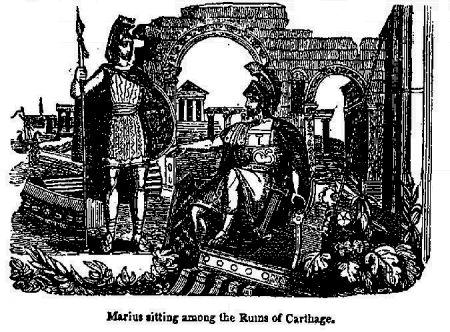
It is a vain attempt
To bind th' ambitious and unjust by treaties.—Thomson.
1. Sylla, now finding himself master of the city, began by modelling the laws so as to favour his outrages; while Ma'rius, driven out of Rome and declared a public enemy at the age of seventy, was obliged to save himself, unattended and on foot, from the pursuit of those who sought his life. 2. After having wandered for some time in this deplorable condition, he found every day his dangers increase, and his pursuers making nearer advances. In this distress he concealed himself in the marshes of Mintur'næ, where he continued a night up to the chin in a quagmire. 3. At break of day he left this dismal place, and made towards the seaside, in hopes of finding a ship to facilitate his escape; but being known and discovered by some of the inhabitants, he was conducted to a neighbouring town, with a halter round his neck, without clothes, and covered with mud; and in this condition was sent to prison. 4. The governor of the place, willing to conform to the orders of the senate, soon after sent a Cim'brian slave to despatch him; but the barbarian no sooner entered the dungeon for this purpose than he stopped short, intimidated by the dreadful visage and awful voice of the fallen general, who sternly demanded if he had the presumption to kill Ca'ius Ma'rius? The slave, unable to reply, threw down his sword, and rushing back from the prison, cried out, that he found it impossible to kill him! 5. The governor, considering the fear of the slave as an omen in the unhappy exile's favour, gave him[Pg. 184] his freedom; and, commending him to his fortune, provided him with a ship to convey him from Italy. 6. He was forced by a tempest on the coast of Sicily. A Roman quæstor, who happened to be there, resolved to seize him; and he lost sixteen of his crew, who were killed in their endeavours to cover his retreat to the ship. He afterwards landed in Africa, near Carthage, and, overwhelmed with melancholy, sat himself down amongst the ruins of that desolate place. He soon, however had orders from the prætor to retire. 7. Marius, who remembered his having once served this very man in necessity, could not suppress his indignation at finding ingratitude every where: and, preparing to obey, bid the messenger tell his master, that he had seen Ma'rius sitting among the ruins of Carthage; intimating the greatness of his fall, by the desolation that was around him. 8. He once more embarked, and not knowing where to land without encountering an enemy, he spent the winter at sea, expecting every hour the return of a messenger from his son, whom he had sent to solicit protection from the African prince, Mandras'tal. 9. After long expectation, instead of the messenger, his son himself arrived, having escaped from the inhospitable court of that monarch, where he had been kept, not as a friend, but as a prisoner, and had returned just time enough to prevent his father from sharing the same fate. 10. In this situation they were informed that Cinna, one of their party who had remained at Rome, had put himself at the head of a large army, collected out of the Italian states, who had espoused his cause. Nor was it long before they joined their forces at the gates of Rome. Sylla was at that time absent in his command against Mithri'dates. 11. Cinna marched into the city; but Ma'rius stopped, and refused to enter, alleging, that having been banished by a public decree, it was necessary to have another to authorise his return. It was thus that he desired to give his meditated cruelties the appearance of justice; and while he was about to destroy thousands, to pretend an implicit veneration for the laws. 12. An assembly of the people being called, they began to reverse his banishment; but they had scarcely gone through three of the tribes, when, incapable of restraining his desire of revenge, he entered the city at the head of his guards, and massacred all who had been obnoxious to him, without remorse or pity. 13. Several who sought to propitiate the tyrant's rage, were murdered by[Pg. 185] his command in his presence; many even of those who had never offended him were put to death; and, at last, even his own officers never approached him but with terror. 14. Having in this manner satiated his revenge, he next abrogated all the laws which were enacted by his rival, and then made himself consul with Cinna. 15. Thus gratified in his two favourite passions, vengeance and ambition, having once saved his country, and now deluged it with blood, at last, as if willing to crown the pile of slaughter which he had made, with his own body, he died the month after, not without suspicion of having hastened his end. 16. In the mean time these accounts were brought to Sylla, who had been sent against Mithrida'tes, and who was performing many signal exploits against him; hastily concluding a peace, therefore, he returned home to take vengeance on his enemies at Rome. 17. Nothing could intimidate Cinna from attempting to repel his opponent. Being joined by Car'bo, (now elected in the room of Vale'rius, who had been slain) together with young Ma'rius, who inherited all the abilities and the ambition of his father, he determined to send over part of the forces he had raised in Dalma'tia to oppose Sylla before he entered Italy. Some troops were accordingly embarked; but being dispersed by a storm, the others that had not yet put to sea, absolutely refused to go. 18. Upon this, Cinna, quite furious at their disobedience, rushed forward to persuade them to their duty. In the mean time one of the most mutinous of the soldiers being struck by an officer, returned the blow, and was apprehended for his crime. This ill-timed severity produced a tumult and a mutiny through the whole army; and, while Cinna did all he could to appease it, he was run through the body by one of the crowd. 19. Scip'io, the consul, who commanded against Sylla, was soon after allured by proposals for a treaty; but a suspension of arms being agreed upon, Sylla's soldiers went into the opposite camp, displaying those riches which they had acquired in their expeditions, and offering to participate with their fellow-citizens, in case they changed their party. 20. In consequence of this the whole army declared unanimously for Sylla; and Scip'io scarcely knew that he was forsaken and deposed, till he was informed of it by a party of the enemy, who, entering his tent, made him and his son prisoners.
21. In this manner both factions, exasperated to the[Pg. 186] highest degree, and expecting no mercy on either part, gave vent to their fury in several engagements. The forces on the side of young Ma'rius, who now succeeded his father in command, were the most numerous, but those of Sylla better united, and more under subordination. 22. Carbo, who commanded for Ma'rius in the field, sent eight legions to Prænes'te, to relieve his colleague, but they were met by Pompey, afterwards surnamed the Great, in a defile, who slew many of them, and dispersed the rest. Carbo soon after engaged Metel'lus, but was overcome, with the loss of ten thousand slain, and six thousand taken prisoners. 23. In consequence, Urba'nus, one of the consuls, killed himself, and Carbo fled to Africa, where, after wandering a long time, he was at last delivered up to Pompey, who, to please Sylla, ordered him to be beheaded. 24. Sylla, now become undisputed master of his country, entered Rome at the head of his army. Happy, had he supported in peace the glory which he had acquired in war; or, had he ceased to live when he ceased to conquer!
25. Eight thousand men, who had escaped the general carnage, surrendered themselves to the conqueror; he ordered them to be put into the Villa Pub'lica, a large house in the Campus Mar'tius; and, at the same time, convoked the senate: there, without discovering the least emotion, he spoke with great fluency of his own exploits, and, in the mean time, gave private directions that all those wretches whom he had confined, should be slain. 26. The senate, amazed at the horrid outcries of the sufferers, at first thought that the city was given up to plunder; but Sylla, with an unembarrassed air, informed them, that it was only some criminals who were punished by his order, and that the senate ought not to make themselves uneasy at their fate. 27. The day after he proscribed forty senators, and sixteen hundred knights; and after an intermission of two days, forty senators more, with an infinite number of the richest citizens. 28. He next resolved to invest himself with the dictatorship, and that for a perpetuity; and thus uniting all civil as well as military power in his own person, he thought he might thence give an air of justice to every oppression. 29. Thus he continued to govern with capricious tyranny, none daring to resist his power, until, contrary to the expectation of all mankind, he laid down the dictatorship, after having held it not quite three years.[Pg. 187]
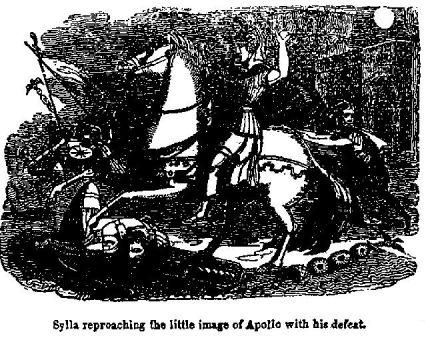
30 After this, he retired into the country, and abandoned himself to debauchery; but he did not long survive his abdication; he was seized with a horrible distemper, and died a loathsome and mortifying object, and a melancholy proof of the futility of human ambition.[5]
The character of Sylla exhibits a singular compound of great and mean qualities. Superstition was one of its features. It is said that having suffered a defeat in the course of the Social War, in Italy, he drew from his bosom a little image of Apollo, which he had stolen from the temple of Delphi, and had ever since carried about him when engaged in war. Kissing it with great devotion, he expostulated with the god, for having brought him to perish dishonourably, with his countrymen, at the gates of his native city, after having raised him by many victories to such a height of glory and greatness.[Pg. 188]
Questions for Examination.
1. What were the first acts of Sylla?
2. What became of Marius?
3. To what dangers was he exposed?
4. Was an attempt made on his life?
5. How did the governor treat the fugitive general?
6. What ingratitude was shown to Marius?
7. What was his reply?
8. From what African prince did he ask aid?
9. Was it granted?
10. What opportunity was taken by the Marian party to renew the struggle?
11. To what scruple did Marius pretend?
12. What proves it a pretence?
13. What cruelties were practised by Marius?
14. What laws did he change? 15. How did Marius die?
16. How did Sylla act when he learned the news of the change?
17. What caused a tumult in Cinna's army?
18. How did it end?
19. What artifice was practised on Scipio?
20. What was the result?
21. Describe the relative condition of the rival forces?
22. Did Pompey obtain any victory?
23. What was the consequence?
24. Which faction finally prevailed?
25. What massacre was perpetrated by Sylla?
26. How did he excuse it? 27. Were these his only cruelties?
28. What magistracy did Sylla usurp?
29. How did he govern?
30. In what manner did the tyranny of Sylla terminate?
FOOTNOTES:
So astonished was Jugur'tha at the mercenary disposition discovered by the Romans, that he is said to have exclaimed, on leaving the city, "Oh, Rome! thou wouldst thyself be sold, could a chapman be found to purchase thee."
It has been said with great truth, that "the wicked have no friends." Jugur'tha experienced this. Bomil'car, who professed the warmest attachment to Jugur'tha, was gained over by the proconsul Metel'lus to persuade his master, that submission to the Romans was absolutely necessary. Jugur'tha accordingly sent an embassy to the proconsul, professing his readiness to submit to any terms. Upon this he was required to send to the Romans 200,000 pounds weight of silver, all his elephants, a certain number of horses and arms, and all deserters. The king complied exactly with these hard conditions; but after thus weakening his resources, he found himself still obliged to continue the war, or submit to such farther impositions as would have endangered, not only his crown, but his life.
Never did any one more deservedly suffer than this treacherous and cruel man.
This king incurred the resentment of the Romans by making war on some of their allies, and by putting Op'pius and Aquil'ius to death. Upbraiding the Romans with their avarice and corruption, he caused melted gold to be poured down the throat of the latter.
Two events, important in the history of Rome, occurred about this time. Serto'rius, a Roman general, in Spain, had rebelled against the government of Syl'la, and defeated every army sent against him, till Pompey took the command; and even then the result appeared doubtful, till Serto'rius, being assassinated by his own officers put an end to the war. Spar'tacus, a gladiator, having escaped from confinement, and assembled a number of his followers, commenced what is called the second Servile War. His army gradually increasing, he became a formidable enemy to the Roman state; overthrew the prætors and consuls sent against him; but was at length defeated by Crassus, and the remains of his army cut in pieces by Pompey, who met them on his return from Spain.
FROM THE PERPETUAL DICTATORSHIP OF SYLLA TO THE TRIUMVIRATE OF CÆSAR, POMPEY, AND CRASSUS.—U.C. 680.
With Tully she her wide reviving light
To senates holds, a Catiline confounds.
And saves awhile from Cæsar sinking Rome.—Thomson.
1. Upon the death of Sylla, the jealousies of Pompey and Crassus, the two most powerful men in the empire, began to excite fresh dissensions. Pompey was the most beloved general, but Crassus the richest man in Rome.
2. The first opportunity that was offered of discovering their mutual jealousy, was upon disbanding their troops. Neither chose to begin; so that the most fatal consequences were likely to arise from their dissension. At length Crassus, stifling his resentment, laid down his command; and[Pg. 189] the other followed his example immediately after. 3. The next trial between them was, who should be foremost in obtaining the favour of the people. Crassus entertained the populace at a thousand tables, distributed corn to the families of the poor, and fed the greatest part of the citizens for nearly three months. Pompey, on the other hand, laboured to abrogate the laws made against the authority of the people by Sylla; restored to the knights the power of judging, which had been formerly granted them by Gracchus; and gave back to the tribunes all their former privileges. 4. Thus each gave his private aims an appearance of zeal for the public good; so that what was in reality ambition in both, took with one the name of liberality; with the other, that of a love of freedom.
5. An expedition, in which Pompey cleared the Mediterranean, which was infested by pirates, having added greatly to his reputation, the tribunes of the people hoped it would be easy to advance their favourite still higher. 6. Man'lius, therefore, one of the number, preferred a law, that all the armies of the empire, the government of Asia, and the management of the war which was renewed against Mithrida'tes, should be committed to Pompey alone. The law passed, with little opposition, and the decree was confirmed.
7. Being thus appointed to the command of that important war, he departed for Asia. 8. Mithrida'tes had been obliged by Lucul'lus to take refuge in Lesser Armenia, and thither that general was preparing to follow him, when his whole army abandoned him; so that it remained for Pompey to terminate the war, which he effected with great ease and expedition, adding a large extent of dominion to the Roman empire, and returning to Rome in triumph at the head of his conquering army.
9. But the victories of Pompey rather served to heighten the glory than to increase the power of Rome; they made it more a glaring object of ambition, and exposed its liberties to greater danger. Those liberties, indeed, seemed devoted to ruin on every side; for, even while he was pursuing his conquests abroad, Rome was at the verge of ruin from a conspiracy at home. 10. This conspiracy was projected and carried on by Ser'gius Cat'iline, a patrician by birth, who resolved to build his own power on the downfall of his country. 11. He was singularly formed, both by art and nature, to conduct a conspiracy: he was possessed of courage equal to the most desperate attempts, and of eloquence [Pg. 190] to give a colour to his ambition: ruined in his fortunes, profligate in his manners, vigilant in pursuing his aims, he was insatiable after wealth, only with a view to lavish it on his guilty pleasures. 12. Cat'iline having contracted debts in consequence of such an ill-spent life, was resolved to extricate himself from them by any means, however unlawful. Accordingly, he assembled about thirty of his debauched associates, and informed them of his aims, his hopes, and his settled plans of operations. 13. It was resolved among them, that a general insurrection should be raised throughout Italy, the different parts of which he assigned to different leaders. Rome was to be fired at several places at once; and Cat'iline, at the head of an army raised in Etru'ria, was, in the general confusion, to possess himself of the city, and massacre all the senators. Len'tulus, one of his profligate assistants, who had been prætor, or judge in the city, was to preside in their general councils; Cethe'gus, a man who sacrificed the possession of great present power to the hopes of gratifying his revenge against Cicero,[1] was to direct the massacre through the city; and Cas'sius was to conduct those who fired it.
14. But the vigilance of Ci'cero being the chief obstacle to their designs, Catiline was very desirous to see him taken off before he left Rome; upon which two knights of the company undertook to kill him the next morning in his bed, in an early visit, on pretence of business. 15. But the meeting was no sooner over, than Ci'cero had information of all that passed in it; for, by the intrigues of a woman named Ful'via, he had gained over Cu'rius, her lover, one of the conspirators, to send him a punctual account of all their deliberations. 16. Having taken proper precautions to guard himself against the designs of his morning visitors, who were punctual to the appointment, he next took care to provide for the defence of the city; when, assembling the senate, he consulted what was best to be done in such a time of danger.
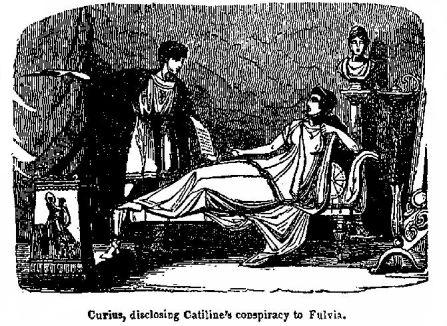
17. The first step taken was to offer considerable rewards for farther discoveries, and then to prepare for[Pg. 191] the defence of the state. 18. Cat'iline, to show how well he could dissemble, or justify any crime, went boldly to the senate, declaring his innocence;[2] but, when confronted by the eloquence of Ci'cero, he hastily withdrew, declaring aloud, that since he was denied a vindication of himself, and driven headlong into rebellion by his enemies, he would extinguish the flame which was raised about him in universal ruin. 19. After a short conference with Len'tulus and Cethe'gus, he left Rome by night, with a small retinue, to hasten towards Etru'ria, where Man'lius, one of the conspirators, was raising an army to support him.[3]
20. In the mean time Ci'cero took proper precautions to secure all those of the conspiracy who remained in Rome. Len'tulus, Cethe'gus, Cas'sius, and several others, were put into confinement; and soon after strangled in prison.
21. While his associates were put to death in the city, Cat'iline had raised an army of twelve thousand men, of which a fourth part only were completely armed, the rest being furnished with such weapons as chance afforded; darts, lances, and clubs. 22. He refused, at first, to enlist slaves, who flocked to him in great numbers, trusting to the strength of the conspiracy; but upon the approach of the consul, who was sent against him, and upon the arrival of the news that his confederates were put to death, the face[Pg. 192] of affairs altered. 23. His first attempt, therefore, was, by long marches, to make his escape over the Appenines into Gaul; but in this his hopes were disappointed; all the passes being guarded by an army superior to his own. 24. Being thus hemmed in on every side, and seeing all things desperate, with nothing left him but either to die or conquer, he resolved to make one vigorous effort against that army which pursued him. Anto'nius, the consul, being sick, the command devolved upon Petrei'us, who, after a fierce and bloody action in which he lost a considerable part of his best troops, put Cat'iline's forces to the rout, and destroyed his whole army.[4]
25. The extinction of this conspiracy seemed only to leave an open theatre for the ambition of the great men to display itself in. Pompey was now returned in triumph from conquering the east, as he had before been victorious in Europe and Africa.
26. Crassus was the richest man in Rome, and next to Pompey, possessed the greatest authority; his party in the senate was even greater than that of his rival, and the envy raised against him was less. He and Pompey had long been disunited by an opposition of interests and of characters; however, it was from a continuance of their mutual jealousies that the state was in some measure to expect its future safety. 27. It was in this situation of things that Julius Cæsar, who had lately gone, as prætor, into Spain, and had returned with great riches and glory, resolved to convert their mutual jealousy to his own advantage. 28. This celebrated man was descended from popular and illustrious ancestors. He warmly espoused the side of the people, and shortly after the death of Sylla, procured the recall of those whom Sylla had banished. He had all along declared for the populace against the senate, and became their most favourite magistrate. 29. This consummate statesman began by offering his services to Pompey, promising to assist him in getting all his acts passed, notwithstanding the senate's opposition. Pompey, pleased at the acquisition of a person of so much merit, readily granted him his confidence and protection. 30. He next applied to Crassus, who, from former connections, was disposed to become still more nearly his friend. 31. At length, finding them not averse to an union of interests, he took an opportunity[Pg. 193] of bringing them together; and, remonstrating with them on the advantages as well as the necessity of a reconciliation, he had art enough to persuade them to forget former animosities. 32. A combination was thus formed, by which they agreed that nothing should be done in the commonwealth without their mutual concurrence and approbation. This was called the first Trium'virate, by which we find the constitution weakened by a new interest which had not hitherto taken place, very different from that of the senate or the people, and yet dependent on both.
Questions for Examination.
1. What followed on the death of Sylla?
2. What first discovered their mutual jealousy?
3. What was the next trial between them?
4. Under what pretences did they hide their real views?
5. What farther raised the reputation of Pompey?
6. What means were had recourse to for this purpose?
7, 8. What was the state of the war in Asia?
9. What were the consequences of Pompey's victories?
10. Who was the author, and what was the object of this conspiracy?
11. What was the character of Catiline?
12. What occasioned this conspiracy?
13. How was it to be carried into execution?
14. What was the chief obstacle to its accomplishment, and how was this obstacle to be removed?
15. Was Cicero informed of their proceedings?
16. What precautions did he take in consequence?
17. What was the first step taken?
18. What was the conduct of Catiline on this occasion?
19. Did he continue in Rome?
20. Did the other conspirators escape?
21. How was Catiline employed in the mean time?
22. Had he a fair prospect of success?
23. Did he boldly face his opponents?
24. What followed?
25. Did the extinction of this conspiracy give peace to Rome?
26. Who were the contending parties, and what was the consequence of this dissension?
27. Who profited by these jealousies?
28. Who was Julius Cæsar, and by what means did he acquire popularity?
29. What was his first step towards power?
30. To whom did he next apply?
31. What consequence resulted from his application?
32. What agreement was entered into by them, and what were they called?[Pg. 194]
FOOTNOTES:
Ci'cero, the first of Roman orators, as Demos'thenes was of the Greek, was born at Arpin'um, a town of the Volsci, and studied under the most celebrated orators and philosophers of Greece. His style of eloquence was copious, highly ornamented, and addressed more to the passions than to the judgment of his hearers. He was consul at the time of Cat'iline's conspiracy; and, for his eminent services in detecting and frustrating it, was honoured with the title of Pater Patriæ.
On his entrance, the senators near whom he attempted to seal himself, quitting their places, left him quite alone.
On his arrival, he assumed all the insignia of a supreme magistrate being preceded by lictors carrying the axes and fasces.
Cataline himself, finding his affairs desperate, threw himself into the midst of the enemy, and there found the death he sought. (Sallust.)
FROM THE BEGINNING OF THE FIRST TRIUMVIRATE, TO THE DEATH OF POMPEY.—U.C. 694.
How happy was I, in my lawful wars
In Germany, in Gaul, and Brittany!
When every night with pleasure I set down
What the day ministered; then sleep came sweetly.Beaumont and Fletcher.
1. The first thing that Cæsar did, upon forming the Trium'virate, was to avail himself of the interest of his confederates to obtain the consulship. 2. The senate had still some influence left; and though they were obliged to concur in choosing him, yet they gave him for a colleague one Bib'ulus, whom they supposed would be a check upon his power. 3. But the opposition was too strong for even superior abilities to resist; so that Bib'ulus, after a slight attempt in favour of the senate, remained inactive. 4. Cæsar began his schemes for empire by ingratiating himself with the people; he procured a law for dividing certain lands in Campa'nia among such of the poor citizens as had at least three children. This proposal was just enough in itself, and it was criminal only from the views of the proposer.
5. Having thus strengthened himself at home, he deliberated with his confederates about sharing the foreign provinces of the empire. 6. The partition was soon made: Pompey chose Spain; for, being fatigued with conquest, and satiated with military fame, he was willing to take his pleasures at Rome. Crassus chose Syria; which province, as it had hitherto enriched the generals who had subdued it, would, he hoped, gratify him in this his favourite pursuit. To Cæsar were left the provinces of Gaul, composed of fierce and powerful nations, most of them unsubdued, and the rest only professing a nominal subjection. 7. As this was appointing him rather to conquer than command, the government was granted him for five years, as if by its continuance to compensate for its danger.
8. It would be impossible, in this narrow compass, to enumerate the battles Cæsar fought, and the states he subdued, in his expeditions into Gaul and Britain, which continued eight years.
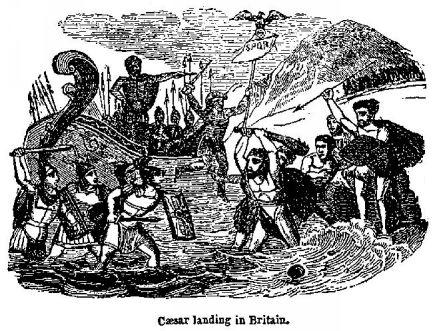
9. The Helvetians[1] were the first that were brought into subjection, with the loss of nearly two[Pg. 195] hundred thousand men; those who remained after the carnage were sent by Cæsar in safety to the forests whence they had issued.[2] 10. The Germans, with Ariovis'tus at their head, were next cut off, to the number of eighty thousand, their monarch himself narrowly escaping in a little boat across the Rhine. The Belgæ[3] suffered such a terrible overthrow, that marshes and rivers were rendered impassable from the heaps of slain. 11. The Ner'vians,[4] who were the most warlike of those barbarous nations, made head for a short time, and fell upon the Romans with such fury, that their army was in danger of being utterly routed; but Cæsar himself, hastily catching up a buckler, rushed through his troops into the midst of the enemy; by which means he so turned the fate of the day, that the barbarians were all cut off to a man. 12. The Celtic Gauls were next brought under subjection. After them, the Sue'vi, the Mena'pii, and all the nations from the Mediterranean to the British sea. 13. Thence, stimulated by the desire of conquest, he crossed over into Britain, upon pretence that the natives had furnished his enemies with continual supplies. 14. Upon approaching the shores, he found them covered with men to oppose his landing, and his forces were in danger of being[Pg. 196] driven back, till the standard-bearer of the tenth legion boldly leapt ashore, and being well assisted by Cæsar, the natives were put to flight. 15. The Britons being terrified at Cæsar's power, sent to desire a peace, which was granted them, and some hostages delivered. A storm, however, soon after destroying great part of his fleet, they resolved to take advantage of the disaster, and marched against him with a powerful army. But what could naked undisciplined troops do against forces that had been exercised under the greatest generals, and hardened by the conquest of the greatest part of the world? Being overthrown, they were obliged once more to sue for peace. Cæsar granted it, and returned to the continent.
16. While Cæsar was thus increasing his reputation and riches abroad, Pompey, who remained in Rome, steadily co-operated with his ambition, and advanced his interests, while he vainly supposed he was forwarding his own. By this means Cæsar was continued five years longer in Gaul. 17. Nor was Pompey roused from his lethargy till the fame of that great commander's valour, riches, and humanity, began to make him suspect they would soon eclipse his own. 18. He now therefore did all in his power to diminish Cæsar's reputation; obliging the magistrates not to publish any letters they received till he had diminished the credit of them, by spreading disadvantageous reports. 19. One or two accidents, also, helped to widen the separation; namely, the death of Julia,[5] Pompey's wife, who had not a little contributed to improve the harmony that subsisted between them; and the destruction of Crassus, who had conducted the war against the Parthians with so little prudence, that he suffered them to get the advantage of him in almost every skirmish; when, incapable of extricating himself, he fell a sacrifice to his own rashness in trusting himself to a perfidious enemy.[6]
It was at this period that T. Maurius Milo, being a candidate for the office of consul, during the heat of the canvassing happened, when riding into the country, to meet Clodius, a turbulent man, who favoured his opponent.
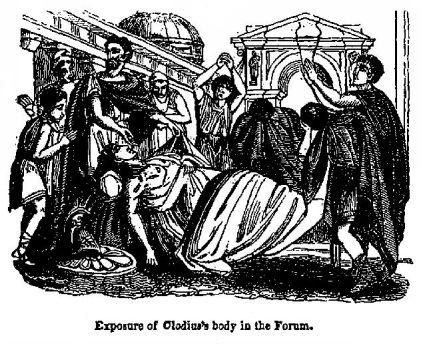
The meeting was accidental, but a skirmish between their attendants[Pg. 197] drew on a contest which terminated in the death of Clodius. The body was brought into Rome where it was exposed, all covered with blood and wounds, to the view of the populace, who flocked around it in crowds to lament the miserable fate of their leader. The next day the mob, headed by a kinsman of the deceased, carried the body, with the wounds exposed, into the forum; and the enemies of Milo, addressing the crowd with inflammatory speeches, wrought them up to such a frenzy that they carried the body into the senate-house, and, tearing up the benches and tables, made a funeral pile, and, together with the body, burnt the house itself, and then stormed the house of Milo, but were repulsed. This violence, and the eloquence of Cicero in his defence, saved Milo from the punishment which he had good reason to fear for the assassination of Clodius.
20. Cæsar, who now began to be sensible of the jealousies of Pompey, took occasion to solicit for the consulship, together with a prolongation of his government in Gaul, desirous of trying whether Pompey would thwart or promote his pretensions. 21. In this Pompey seemed to be quite inactive; but, at the same time, privately employed two of his creatures, who alleged in the senate that the laws did not permit a person who was absent to offer himself as a candidate for that high office. 22. Pompey's view in this was to allure Cæsar from his government, in order to stand for the consulship in person. 23. Cæsar, however, perceiving[Pg. 198] his artifice, chose to remain in his province, convinced that while he headed an army devoted to him, he could give law as well as magistrates to the state.
24. The senate, which was devoted to Pompey, because he had for some time attempted to defend them from the encroachments of the people, ordered home the two legions which were in Cæsar's army belonging to Pompey, as it was pretended, to oppose the Parthians, but in reality to diminish Cæsar's power. 25. Cæsar saw their motive: but as his plans were not yet ripe for execution, he sent them home in pursuance of the orders of the senate, having previously attached the officers to him by benefits, and the soldiers by bounties. 26. The next step the senate took, was to recall Cæsar from his government, as his time was very near expiring. But Cu'rio, his friend in the senate, proposed that Cæsar should not leave his army till Pompey had set him the example. 27. This for a while perplexed Pompey; however, during the debate, one of the senate declaring that Cæsar had passed the Alps, and was marching with his whole army directly towards Rome, the consul, immediately quitting the senate, went with his colleagues to a house where Pompey at that time resided. He there presented him with a sword, commanding him to march against Cæsar, and fight in defence of the commonwealth. 28. Pompey declared he was ready to obey, but with an air of pretended moderation added, that it was only in case more gentle expedients could not be employed. 29. Cæsar, who was instructed in all that passed, though he was still in Gaul, was willing to give his aims all the appearance of justice. He agreed to lay down his employment when Pompey should do the same. But the senate rejected his propositions, blindly confident of their power, and relying on the assurances of Pompey. Cæsar, still unwilling to come to an open rupture with the state, at last was content to ask the government of Illyr'ia, with two legions; but this also was refused him. 30. Finding all attempts at an accommodation fruitless, and conscious, if not of the goodness of his cause, at least of the goodness of his troops, he began to draw them down towards the confines of Italy; and passing the Alps with his third legion, stopped at Raven'na, whence he once more wrote to the consuls, declaring that he was ready to resign all command in case Pompey would do so. 31. On the other hand, the senate decreed, that[Pg. 199] Cæsar should lay down his government, and disband his forces within a limited time; and, if he refused obedience, that he should be declared an enemy to the commonwealth.
Questions for Examination.
1. What was Cæsar's first act after the Triumvirate had been formed?
2. Whom did the senate appoint as Cæsar's colleague, and why?
3. Had Bibulus any controul over Cæsar?
4. How did Cæsar commence his schemes?
5. How did he farther promote his views?
6. How were the provinces allotted?
7, 8. Was Cæsar's a desirable allotment?
9. Who were the first that submitted to Cæsar's arms?
10. Who were the next?
11. Who made the most formidable resistance?
12. What other nations were subdued by Cæsar?
13. Did these conquests content him?
14. What opposition did he experience on the British coast?
15. What followed this defeat?
16. In what way were Cæsar's views promoted?
17. Did not Pompey suspect his intentions?
18. When undeceived, what measures did he pursue?
19. What contributed to widen the breach?
20. How did Cæsar ascertain the disposition of Pompey towards him?
21. Did Pompey take an active part?
22. What was Pompey's view in this?
23. Did Cæsar fall into the snare?
24. Which side did the senate favour?
25. Did Cæsar give up the legions?
26. What was the next step they took?
27. What was the consequence of this proposal?
28. Did Pompey obey this command?
29. What was Cæsar's conduct on this occasion?
30. How did he next proceed?
31. What measure did the senate adopt?
On him thy hate, on him thy curse bestow.
Who would persuade thee Cæsar is thy foe;
And since to thee I consecrate my toil,
Oh! favour thou my cause, and on thy soldier smile.—Lucan.
1. Cæsar, however, seemed no way disturbed at these violent proceedings; the night before his intended expedition into Italy, he sat down to table cheerfully, conversing with his friends on subjects of literature and philosophy; and apparently disengaged from every ambitious concern. After[Pg. 200] some time, rising up, he desired the company to make themselves joyous in his absence, and that he would be with them in a moment: in the mean time, having ordered his chariot to be prepared, he immediately set out, attended by a few friends, for Arim'inum, a city upon the confines of Italy, whither he had despatched a part of his army the morning before. 2. This journey by night, which was very fatiguing, he performed with great diligence, sometimes walking, and sometimes on horseback; till at the break of day, he came up with his army, which consisted of about five thousand men, near the Ru'bicon, a little river which separates Italy from Gaul, and which marked the limits of his command. 3. The Romans had ever been taught to consider this river as the sacred boundary of their domestic empire. 4. Cæsar, therefore, when he advanced at the head of his army to the side of it, stopped short upon the bank, as if impressed with terror at the greatness of his enterprise. He could not pass it without transgressing the laws; he therefore pondered for some time in fixed melancholy, looking and debating with himself whether he should venture in. "If I pass this river," said he to one of his generals, "what miseries shall I bring upon my country! and if I now stop short I am undone." 5. After a pause he exclaimed, "Let us go where the gods and the injustice of our enemies call us." Thus saying, and renewing all his former alacrity, he plunged in, crying out, "The die is cast." His soldiers followed him with equal promptitude, and having passed the Ru'bicon, quickly arrived at Arim'inum, and made themselves masters of the place without any resistance.
6. This unexpected enterprise excited the utmost terror in Rome; every one imagining that Cæsar was leading his army to lay the city in ruins. At the same time were to be seen the citizens flying into the country for safety, and the inhabitants of the country coming to seek shelter in the city. 7. In this universal confusion, Pompey felt all that repentance and self-condemnation, which must necessarily arise from the remembrance of having advanced his rival to his present pitch of power: wherever he appeared, many of his former friends were ready to tax him with his supineness, and sarcastically to reproach his ill-grounded presumption. 8. "Where is now," cried Favo'nius, a ridiculous senator of this party, "the army that is to rise at your command?[Pg. 201] let us see if it will appear by stamping."[7] Cato reminded him of the many warnings he had given him; which, however, as he was continually boding nothing but calamities, Pompey might very justly be excused from attending to. 9. Being at length wearied with these reproaches, which were offered under colour of advice, he did all that lay in his power to encourage and confirm his followers: he told them that they should not want an army, for that he would be their leader. He confessed, indeed, that he had all along mistaken Cæsar's aims, judging only from what they ought to have been; however, if his friends were still inspired with the love of freedom, they might yet enjoy it in whatever place their necessities should happen to conduct them. 16. He let them know that their affairs were in a very promising situation: that his two lieutenants were at the head of a very considerable army in Spain, composed of veteran troops that had made a conquest of the east: besides these, there were infinite resources, both in Asia and Africa, together with the succours they were sure to receive from all the kingdoms that were in alliance with Rome. 11. This speech served in some measure to revive the hopes of the confederacy. The greatest part of the senate, his private friends and dependents, with all those who expected to make their fortunes by espousing his cause, agreed to follow him. But being in no capacity to resist Cæsar at Rome, he resolved to lead his forces to Cap'ua, where the two legions that served under Cæsar in Gaul were stationed.
12. Cæsar in the mean time, after having vainly attempted to bring Pompey to an accommodation, resolved to pursue him into Cap'ua before he could collect his forces. Accordingly, he marched on to take possession of the cities that lay between him and his rival, not regarding Rome, which he knew would fall of course to the conqueror.
13. Corfin'ium was the first city that attempted to stop the rapidity of his march. It was defended by Domi'tius, who had been appointed by the senate to succeed him in Gaul. Cæsar quickly invested it; and though Domi'tius sent frequently to Pompey, exhorting him to come and raise[Pg. 202] the siege, he was at length obliged to endeavour to escape privately. 14. His intentions being divulged, the garrison resolved to consult their own safety by delivering him up to the besiegers. Cæsar readily accepted their offers, but kept his men from immediately entering the town. 15. After some time, Len'tulus the consul, who was one of the besieged, came out to implore forgiveness for himself and the rest of his confederates, putting Cæsar in mind of their ancient friendship, and acknowledging the many favours he had received at his hands. 16. To this Cæsar, who would not wait the conclusion of his speech, generously replied, that he came into Italy not to injure the liberties of Rome and its citizens, but to restore them. 17. This humane reply being quickly carried into the city, the senators and the knights, with their children, and some officers of the garrison, came out to claim the conqueror's protection, who, just glancing at their ingratitude, gave them their liberty, with permission to go wheresoever they should think proper. 18. But while he dismissed the leaders, he took care upon this, as upon all other occasions, to attach the common soldiers to his interest, sensible that he might stand in need of the army; but that while he lived, the army could never stand in need of a commander.
19. Pompey, who was unable to continue in Rome, having intelligence of what had passed upon this occasion, retreated to Brundu'sium, where he resolved to stand a siege, in order to retard the enemy, until the forces of the empire should be united to oppose him. 20. His aim in this succeeded to his wish; and after having employed Cæsar for some time in a fruitless siege, he privately carried his forces over to Dyrrach'ium, where the consul had levied a body of troops for his assistance. 21. However, though he made good his escape, he was compelled to leave all Italy at the mercy of his rival, without a town or an army that had strength to oppose his progress.
22. Cæsar, who could not follow Pompey for want of shipping, went back to Rome, to take possession of the public treasures, which his opponent, by a most unaccountable oversight, had neglected to take with him. 23. Upon his coming up to the door of the treasury, Metel'lus, the tribune, who guarded it, refused to let him pass; but Cæsar, with emotion, laying his hand upon his sword, threatened to strike him dead. "Know, young man," cried he, "it is easier to do this than say it." This menace had its effect;[Pg. 203] Metel'lus retired, and Cæsar took out of the treasury three hundred thousand pounds weight of gold, and an immense quantity of silver.
24. Having thus provided for continuing the war, he departed from Rome, resolved to subdue Pompey's lieutenants, Afra'nius and Petrei'us, who had been long in Spain at the head of a veteran army, which had ever been victorious. 25. Cæsar, however, who knew the abilities of its present commanders, jocosely said, as he was preparing to march, "I am going to fight an army without a general, and return to fight a general without an army."
26. The first conflict which he had with Afra'nius and Petrei'us was rather unfavourable. It was fought near the city of Ilerda,[8] and both sides claimed the honour of the victory. But, by various stratagems, he reduced them at last to such extremity of hunger and drought, that they were obliged to yield at discretion. 27. Clemency was his favourite virtue; he dismissed them all with the kindest professions, and then sent them home to Rome loaded with shame, and with obligations to publish his virtues, and confirm the affections of his adherents. 28. Thus, in the space of about forty days, he became master of Spain, and returned again victorious to Rome. The citizens on this occasion received him with fresh demonstrations of joy, and created him dictator and consul. But the first of these offices he laid down when he had held it eleven days.
Questions for Examination.
1. How did Cæsar conduct himself on the night previous to his intended journey to Italy?
2. Did he accomplish his journey in safety?
3. What rendered this little river of consequence?
4. Did Cæsar pass it without hesitation?
5. How did he determine?
6. What effect was produced at Rome by this enterprise?
7. How was Pompey affected by it?
8. What taunting expressions were used on this occasion?
9. What was Pompey's conduct in reply?
10. How did he represent the state of affairs?
11. What was the consequence of this statement?
12. How was Cæsar employed in the mean while?
13. What city first arrested his progress?[Pg. 204]
14. Did he succeed in his endeavour?
15. What attempt was made to incline Cæsar to mercy?
16. What was Cæsar's reply?
17. What was the consequence of this reply?
18. Did he dismiss the soldiers likewise?
19. Whither did Pompey retreat, and with what view?
20. Did he succeed in his aims?
21. What was the consequence of his retreat?
22. Did Cæsar follow Pompey?
23. Was he opposed in his attempt?
24. What was his next enterprise?
25. What was Cæsar's opinion of these commanders?
26. Were they easily conquered?
27. What use did he make of his victory?
28. What was the duration of this campaign, and what were its consequences?
O war! what art thou?
At once the proof and scourge of man's fall'n state!
After the brightest conquest, what appears
Of all thy glories? for the vanquish'd, chains!
For the proud victors, what? Alas! to reign
O'er desolated nations.—H.More.
1. While Cæsar was thus employed, Pompey was active in making preparations in Epi'rus and Greece to oppose him. 2. All the monarchs of the East had declared in his favour, and sent very large supplies. He was master of nine effective Italian legions, and had a fleet of five hundred large ships, under the conduct of Bib'ulus, an active and experienced commander. Added to these, he was supplied with large sums of money, and all the necessaries for an army, from the tributary provinces round him. 3. He had attacked Antony and Dolabel'la, who commanded for Cæsar in that part of the empire, with such success, that the former was obliged to fly, and the latter was taken prisoner. Crowds of the most distinguished citizens and nobles from Rome came every day to join him. He had at one time above two hundred senators in his camp, among whom were Ci'cero and Ca'to, whose approbation of his cause was equivalent to an army.
4. Notwithstanding these preparations, Cæsar shipped off five of his twelve legions at Brundu'sium, and fortunately steered through the midst of his enemies, timing it so well that he made his passage in one day.
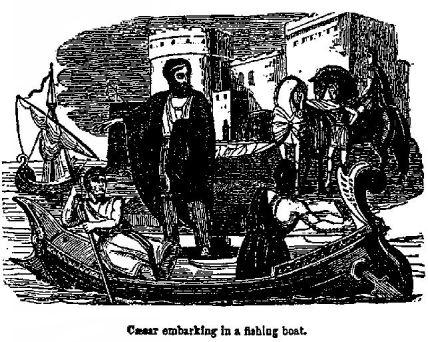
5. Still, however, convinced that the proper time for making proposals for a peace was after gaining advantage, he sent one Ru'fus, whom he had taken prisoner, to effect an accommodation with [Pg. 205] Pompey, offering to refer all to the senate and people of Rome; but Pompey once more rejected the overture, considering the people of Rome too much in Cæsar's interest to be relied on.
6. Pompey had been raising supplies in Macedo'nia when he was first informed of Cæsar's landing upon the coast of Epi'rus: he now resolved immediately to march to Dyrrach'ium, in order to cover that place from Cæsar's attempts, as all his ammunition and provisions were deposited there. 7. The first place where both armies came in sight of each other was on the opposite banks of the river Ap'sus; and as both were commanded by the two greatest generals then in the world; the one renowned for his conquests in the East, and the other celebrated for his victories over the western parts of the empire, a battle was eagerly desired by the soldiers on either side. 8. But neither of the generals was willing to hazard it upon this occasion: Pompey could not rely upon his new levies; and Cæsar would not venture an engagement till he was joined by the rest of his forces.
9. Cæsar had waited some time with extreme impatience for the coming up of the remainder of his army, and even ventured alone in an open fishing-boat to hasten its arrival; but he was driven back by a storm.[9] 10. However, his disappointment was soon relieved by an information of the[Pg. 206] landing of the troops at Apollo'nia; he, therefore, decamped in order to meet them; and to prevent Pompey, with his army, from engaging them on their march, as he lay on that side of the river where the succours had been obliged to come on shore.
11. Pompey, being compelled to retreat, led his forces to Aspara'gium, where he was sure of being supplied with every thing necessary for his army, by the numerous fleets which he employed along the coasts of Epi'rus: there he pitched his camp upon a tongue of land (as mariner's express it) that jutted into the sea, where also was a small shelter for his ships. 12. In this place, being most advantageously situated, he began immediately to intrench his camp; which Cæsar perceiving, and finding that he was not likely soon to quit so advantageous a post, began also to intrench behind him. 13. As all beyond Pompey's camp towards the land side was hilly and steep, Cæsar built redoubts upon the hills, stretching from shore to shore, and then caused lines of communication to be drawn from hill to hill, by which he blocked up the camp of the enemy. 14. He hoped by this blockade to force his opponent to a battle, which he ardently desired, and which the other with equal industry declined. Thus both sides continued for some time employed in designs and stratagems, the one to annoy and the other to defend. 15. Cæsar's men daily carried on their works to straiten the enemy; those of Pompey, having the advantage of numbers, did the same to enlarge themselves, and severely galled the enemy by their slingers and archers. 16. Cæsar, however, was indefatigable; he caused blinds or mantalets to be made of the skins of beasts, to cover his men while at work; he cut off all the water that supplied the enemy's camp, and the forage from the horses, so that there remained no more subsistence for them. 17. But Pompey at last resolved to break through his lines, and gain some other part of the country more convenient for encampment. Accordingly, having informed himself of the condition of Cæsar's fortifications from some deserters who came over to him, he ordered the light infantry and archers on board his ships to attack Cæsar's entrenchments by sea, where they were least defended. 18. This was done with such effect, that though Cæsar and his officers used their utmost endeavours to hinder Pompey's designs, yet by means of reiterated attempts, he at last effected his purpose of extricating his army from its present camp, and of encamping[Pg. 207] in another place by the sea, where he had the convenience both of forage and shipping. 19. Cæsar being thus frustrated in his views of blocking up the enemy, and perceiving the loss he had sustained, resolved at last to force Pompey to a battle, though upon disadvantageous terms. 20. The engagement began by attempting to cut off a legion which was posted in a wood; and this brought on a general battle. The conflict was for some time carried on with great ardour, and with equal fortune; but Cæsar's army being entangled in the entrenchments of the old camps lately abandoned, began to fall into disorder; upon which Pompey pressing his advantage, they at last fled with precipitation. Great numbers perished in the trenches and on the banks of the river, or were pressed to death by their fellows. 21. Pompey pursued his success to the very camp of Cæsar; but either from surprise, under the suddenness of his victory, or fearful of an ambuscade, he with drew his troops into his own camp, and thus lost an opportunity of completing his victory.
22. After this defeat, which was by no means decisive, Cæsar marched, with all his forces united in one body, directly to Gom'phi, a town in the province of Thes'saly. But the news of his defeat at Dyr'rachium had reached this place before him; the inhabitants, therefore, who had before promised him obedience, now changed their minds, and, with a degree of baseness equal to their imprudence, shut their gates against him. 23. Cæsar was not to be injured with impunity. Having represented to his soldiers the great advantage of forcing a place so very rich, he ordered the scaling ladders to be got ready, and causing an assault to be made, proceeded with such vigour that, notwithstanding the height of the walls, the town was taken in a few hours. 24. Cæsar left it to be plundered, and, without delaying his march, went forward to Metrop'olis, another town of the same province, which yielded at his approach. By this means he soon became possessed of all Thes'saly, except Laris'sa, which was garrisoned by Scip'io, with his legion who commanded for Pompey. 25. During this interval, Pompey's officers continually soliciting their commander to come to a battle, he, at length, resolved to renounce his own judgment in compliance with those about him, and gave up all schemes of prudence for those dictated by avarice and passion. 26. Advancing, therefore, into Thes'saly, within a few days after the taking of Gom'phi, he drew [Pg. 208] down upon the plains of Pharsa'lia, where he was joined by Scip'io, his lieutenant, and the troops under his command. There, waiting the coming of Cæsar, he resolved to engage, and, by a single battle, decide the fate of kingdoms.
Questions for Examination.
1. How was Pompey engaged at this time?
2. What advantages did he possess?
3. What farther contributed to give him hopes of success?
4. Was Cæsar discouraged by these formidable preparations?
5. Was he resolutely bent on hostilities?
6. What was Pompey's first measure?
7. Where did the armies first come in sight of each other?
8. Was an immediate engagement the consequence?
9. Was this junction soon effected?
10. What was the consequence?
11. What was Pompey's next measure?
12. Did he remain long in this place?
13. What means did Cæsar adopt to distress the enemy?
14. What did he promise himself from the adoption of this plan?
15. How were both armies employed?
16. What was the conduct of Cæsar on this occasion?
17. How did Pompey frustrate his designs?
18. Was he successful in his attempts?
19. What was Cæsar's resolution on this occasion?
20. By what means did he effect this?
21. Did Pompey make the most of his victory?
22. Whither did Cæsar betake himself, and what was the consequence of his defeat?
23. Did he quietly submit to this insult?
24. What revenge did he take?
25. How did Pompey act on this occasion?
26. Where was this great contest about to be decided?
Each had proposed an empire to be won;
Had each once known a Pompey for his son,
Had Cæsar's soul informed each private breast.
A fiercer fury could not be expressed.—Lucan
1. Cæsar had employed all his art for some time in sounding the inclinations of his men; and finding his army once more resolute and vigorous, he advanced towards the plains of Pharsa'lia, where Pompey was encamped.
2. The approach of two armies, composed of the best and bravest troops in the world, together with the greatness of the prize for which they contended, filled every mind [Pg. 209] with anxiety, though with different expectations. 3. Pompey's army, being most numerous, turned all their thoughts to the enjoyment of the victory; Cæsar's considered only the means of obtaining it; Pompey's army depended upon their numbers, and their many generals; Cæsar's upon their discipline, and the conduct of their single commander. 4. Pompey's partisans hoped much from the justice of their cause; Cæsar's alleged the frequent proposals which they had made for peace without effect. Thus the views, hopes and motives of both seemed different, whilst their hatred and ambition were the same. 5. Cæsar, who was ever foremost in offering battle, led out his army to meet the enemy; but Pompey, either suspecting his troops, or dreading the event, kept his advantageous situation at the foot of the hill near which he was posted. 6. Cæsar, unwilling to attack him at a disadvantage, resolved to decamp the next day, hoping to weary out his antagonist, who was not a match for him in sustaining the fatigues of duty. 7. Accordingly the order for marching was given, and the tents were struck, when word was brought him that Pompey's army had now quitted their intrenchments, and advanced farther into the plain than usual; so that he might engage them at less disadvantage. 8. Upon this he caused his troops to halt, and, with a countenance of joy, informed them that the happy time was at last come, which they had so long wished for, and which was to crown their glory, and terminate their fatigues. He then drew up his troops in order, and advanced towards the place of battle. 9. His forces did not amount to above half those of Pompey; the army of the one was about forty-five thousand foot, and seven thousand horse: that of the other not exceeding twenty-two thousand foot, and about a thousand horse. 10. This disproportion, particularly in the cavalry, had filled Cæsar with apprehensions; he therefore had some days before picked out the strongest and nimblest of his foot soldiers, and accustomed them to fight between the ranks of his cavalry. By their assistance, his thousand horse was a match for Pompey's seven thousand, and had actually got the better in a skirmish that happened between them some days before.
11. Pompey, on the other hand, had a strong expectation of success; he boasted that he could put Cæsar's legions to flight without striking a single blow; presuming that as soon as the armies formed, his cavalry, on which he placed his greatest expectations, would out-flank and surround the [Pg. 210] enemy. In this disposition Pompey led his troops to battle. 12. As the armies approached, the two generals went from rank to rank, encouraging their men, exciting their hopes, and lessening their apprehensions. 13. Pompey represented to his men that the glorious occasion which they had long besought him to grant was now before them. "What advantages," said he, "could you wish, that you are not now possessed of. Your numbers, your vigour, a late victory, all assure us of a speedy and an easy conquest of those harassed and broken troops, composed of men worn out with age, and impressed with the terrors of a recent defeat; but there is still a stronger bulwark for our protection than the superiority of our strength; and that is, the justice of our cause. You are engaged in the defence of liberty and of your country; you are supported by its laws, and followed by its magistrates; the world are spectators of your conduct, and wish you success: on the contrary, he whom you oppose is a robber, an oppressor of his country, already nearly sunk with the consciousness of his crimes, as well as the ill success of his arms. Show then, on this occasion, all that ardour and detestation of tyranny which should animate Romans, and do justice to mankind."
14. Cæsar, on his part, went among his men with that steady serenity for which he was so much admired in the midst of danger. He insisted on nothing so strongly, as his frequent and unsuccessful endeavours for peace. He spoke with terror of the blood he was about to shed, and pleaded the necessity that urged him to it. He deplored the many brave men that were to fall on both sides, and the wounds of his country, whoever might be victorious. 15. His soldiers answered only with looks of ardour and impatience. He gave the signal to begin. The word on Pompey's side was, "Her'cules the Invincible:" that on Cæsar's, "Ve'nus the Victorious." 16. There was no more space between both armies than to give room for the charge: Pompey therefore ordered his men to receive the first shock without moving from their places, expecting the enemy's ranks to be put into disorder. Cæsar's soldiers were now rushing on with their usual impetuosity, when, perceiving the enemy motionless, they all stopt short, as if by general consent, and halted in the midst of their career. 17. A terrible pause ensued, in which both armies continued to gaze upon each other with mutual terror and dreadful serenity. At length, Cæsar's men having taken breath, ran furiously upon the [Pg. 211] enemy, first discharging their javelins, and then drawing their swords. The same method was observed by Pompey's troops, who as firmly sustained the attack. His cavalry also were ordered to charge at the very onset, which, with the multitude of archers and slingers, soon obliged Cæsar's men to give ground. 18. Cæsar instantly ordered the six cohorts, that were placed as a reinforcement, to advance, and to strike at the enemy's faces. 19. This had its desired effect: Pompey's cavalry, that were just before sure of the victory, received an immediate check. The unusual method of fighting pursued by the cohorts, their aiming entirely at the visages of the assailants, and the horrible disfiguring wounds they made, all contributed to intimidate them so much, that instead of defending their persons, they endeavoured only to save their faces.[10] 20. A total rout ensued; they fled to the neighbouring mountains, while the archers and slingers, who were thus abandoned, were cut to pieces. 21. Cæsar now commanded the cohorts to pursue their success, and charge Pompey's troops upon the flank: this charge the enemy withstood for some time with great bravery, till Cæsar brought up his third line, which had not yet engaged. 22. Pompey's infantry being thus doubly attacked, in front by fresh troops, and in the rear by the victorious cohorts, could no longer resist, but fled to their camp. The flight began among the strangers. Pompey's right wing still valiantly maintained their ground. 23. Cæsar, however, convinced that the victory was certain, with his usual clemency cried out to pursue the strangers, but to spare the Romans; upon which they all laid down their arms and received quarter. The greatest slaughter was among the auxiliaries, who fled on all sides. 24. The battle had now lasted from break of day till noon, and the weather was extremely hot; nevertheless, the conquerors remitted not their ardour, being encouraged by the example of a general, who thought his victory incomplete till he should become master of the enemy's camp. Accordingly, marching on foot at their head, he called upon them to follow and strike the decisive blow. 25. The cohorts which were left to defend the camp, for some time made a formidable resistance; particularly a great number of Thra'cians and other barbarians, who were appointed for that purpose; but nothing could[Pg. 212] resist the ardour of Cæsar's victorious army; the enemy were at last driven from the trenches, and compelled to fly to the mountains.
Questions for Examination.
1. What was the state of Cæsar's army immediately before the battle of Pharsalia?
2. What effect had the approaching event on the minds of men?
3. What were the respective advantages of each army?
4. On what did they principally build their hopes?
5. Who was the first to offer battle?
6. How did Cæsar act on this occasion?
7. What followed?
8. What effect had this intelligence on Cæsar's plan?
9. Of what number of troops were each of the armies composed?
10. What did Cæsar consider necessary to be done to remedy this dis-proportion?
11. What were Pompey's expectations and boasts?
12. What was the conduct of the generals?
13. Repeat Pompey's address to his troops?
14. How did Cæsar encourage his men?
15. What effect had this speech, and what was the word on both sides?
16. In what manner did the attack commence?
17. Describe the progress of the battle?
18. What means did Cæsar adopt to prevent a defeat?
19. Was this measure successful?
20. What was the consequence?
21. What were Cæsar's farther commands?
22. What followed?
23. What use did Cæsar make of his victory?
24. Did not fatigue abate the ardour of Cæsar's troops?
25. Did they attempt to defend the camp?
Sad Pompey's soul uneasy thoughts infest,
And his Cornelia pains his anxious breast,
To distant Lesbos fain he would remove.
Far from the war, the partner of his love.—Lucan.
1. Cæsar, seeing the field and camp strewed with his fallen countrymen, was strongly affected at the melancholy prospect, and cried out to one that stood near him, "They would have it so." 2. In the camp, every object presented fresh instances of the blind presumption and madness of his adversaries. On all sides were to be seen tents adorned with ivy and myrtle, couches covered with purple, and sideboards loaded with plate. Every thing gave proof of the [Pg. 213] highest luxury, and seemed rather the preparatives for a banquet, or the rejoicings for a victory, than dispositions for a battle. 3. A camp so richly furnished would have engaged the attention of any troops but Cæsar's; but there was still something to be done, and he permitted them not to pursue any other object than their enemies. 4. A considerable body having retired to the adjacent mountains, he prevailed on his soldiers to join him in the pursuit, in order to oblige these to surrender. He began by inclosing them with a line drawn at the foot of the mountain; but they quickly abandoned a post which was untenable for want of water, and endeavoured to reach the city of Laris'sa. 5. Cæsar, leading a part of his army by a shorter way, intercepted their retreat. However, these unhappy fugitives again found protection from a mountain, at the foot of which ran a rivulet that supplied them with water. 6. Night approaching, Cæsar's men were almost spent, and fainting with their incessant toil since morning; yet still he prevailed upon them to renew their labours, and cut off the rivulet that supplied the defendants. 7. The fugitives, thus deprived of all hopes of succour or subsistence, sent deputies to the conqueror, offering to surrender at discretion. During this interval of negociation, a few senators that were among them, took the advantage of the night to escape, and the rest, next morning, gave up their arms, and experienced the conqueror's clemency. In fact, he addressed them with great gentleness, and forbade the soldiers to offer violence, or to take any thing from them. 8. Thus Cæsar gained the most complete victory that had ever been obtained; and by his great clemency after the battle, seemed to have deserved it. His loss amounted only to two hundred men; that of Pompey to fifteen thousand; twenty-four thousand men surrendered themselves prisoners of war, and the greatest part of these entered into Cæsar's army, and were incorporated with the rest of his forces. 9. To the senators and Roman knights, who fell into his hands, he generously gave liberty to retire wherever they thought proper; and as for the letters which Pompey had received from those who wished to be thought neutral, Cæsar burnt them all without reading, as Pompey had done on a former occasion. 10. Thus having performed all the duties of a general and a statesman, he sent for the legions which had passed the night in camp, to relieve those which had accompanied him in the pursuit, and arrived the same day at Laris'sa.[Pg. 214]
11. As for Pompey, who had formerly shown such instances of courage and conduct, when he saw his cavalry routed, on which he had placed his sole dependence, he absolutely lost his reason. 12. Instead of thinking how to remedy this disorder by rallying such troops as fled, or by opposing fresh forces to stop the progress of the conqueror, being totally amazed by this first blow, he returned to the camp, and in his tent waited the issue of an event which it was his duty to have directed, not to follow. There he remained for some moments speechless, till being told that the camp was attacked—"What!" says he, "are we pursued to our very intrenchments?" when, immediately quitting his armour for a habit more suited to his circumstances, he fled on horseback to Laris'sa: thence, perceiving that he was not pursued, he slackened his pace, giving way to all the agonizing reflections which his deplorable situation must naturally suggest. 13. In this melancholy manner he passed along the vale of Tempe, and pursuing the course of the river Pe'neus, at last arrived at a fisherman's hut; here he passed the night, and then went on board a little bark, keeping along the sea-shore, till he descried a ship of some burden, which seemed preparing to sail. In this he embarked; the master of the vessel still paying him that homage which was due to his former station.
14. From the mouth of the river Pe'neus he sailed to Amphip'olis, where, finding his affairs desperate, he steered to Les'bos, to take with him his wife Corne'lia, whom he had left there, at a distance from the dangers and distresses of war. 15. She, who had long flattered herself with the hopes of victory, now felt the agonizing reverse of fortune: she was desired by the messenger, whose tears more than his words proclaimed her unspeakable misfortunes, to hasten away if she expected to see Pompey, who had but one ship, and even that not his own. 16. Her grief, which before was violent, became now insupportable: she fainted, and lay without signs of life. At length recovering, and reflecting that it was no time for vain lamentations, she fled through the city to the seaside.
17. Pompey received and embraced her, and in silent despair supported her in his arms. "Alas!" said Corne'lia, "you who, before our marriage, appeared in these seas as the commander of five hundred sail, are now reduced to make your escape in a single vessel. Why come you in search of an unfortunate woman? Why was I not left to a [Pg. 215] fate which now you are under the necessity of sharing with me? Happy for me had I executed, long since, my design of quitting this life! But fatally have I been reserved to add to Pompey's sorrows."
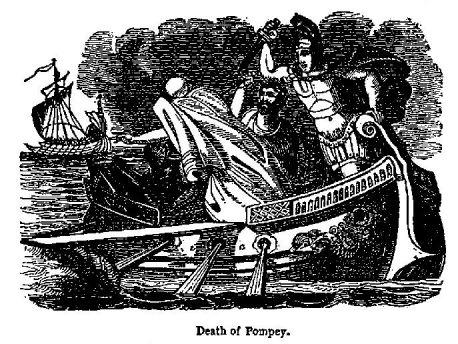
18. Pompey instanced the uncertainty of all human affairs, and endeavoured by every argument to give her comfort; then, taking her under his protection, he continued his course, stopping no longer than was necessary for a supply of provisions at the ports which occurred in his passage. 19. He now determined upon applying to Ptol'emy, king of Egypt, to whose father he had been a considerable benefactor. Ptol'emy was yet a minor, and had not the government in his own hands, but was under the direction of an administration. 20. His council insidiously contrived that Pompey should be invited on shore, and murdered before he should come into the king's presence. Achil'las, commander of the forces, and Septim'ius, a Roman, who had formerly been a centurion in Pompey's army, undertook to carry the treacherous design into execution. Attended by three or four more, they put off in a little bark, and rowed to Pompey's ship, that lay about a mile from the shore.
21. Pompey now took leave of Corne'lia, repeating to her a verse of Soph'ocles, signifying, that "he who trusts his freedom to a tyrant, from that moment becomes a slave." He then gave his hand to Achil'las, and, with only two of his own attendants, stepped into the bark. 22. The frantic Corne'lia hung over the side of the deck, weeping and [Pg. 216] exclaiming against his separation from her. "Alas!" said she, "whither art thou going?"
He spoke; but she, unmoved at his commands,
Thus loud exclaiming, stretch'd her eager hands;
"Whither, inhuman! whither art thou gone?
Still must I weep our common griefs alone?"ROWE'S LUCAN.
In wild astonishment she followed him with her eyes, and uttering to the winds her fruitless lamentations.
23. The mariners, regardless of her sorrows, rowed towards land, without a word passing among them, till Pompey, by way of breaking silence, looking at Septim'ius, whose face he recollected. "Methinks, friend," said he, "you once served under me." Septim'ius noticing these words only by a contemptuous nod of the head, Pompey betook himself to a paper, on which he had minuted a speech intended to be made to the king, and began reading it. In this manner they approached the shore; whilst Corne'lia, whose insufferable sorrow had never let her lose sight of her husband, began to conceive hopes, perceiving that the people on the strand crowded down along the coast as if eager to receive him. 24. Alas! these hopes were soon destroyed. At the instant that Pompey rose, supporting himself upon his freedman's arm, Septim'ius stabbed him in the back, and Achil'las instantly seconded the blow. 25. Pompey, perceiving his death inevitable, calmly disposed himself to meet it with decency; and covering his face with his robe, without a word resigned himself to his fate. 26. At this horrid sight, Corne'lia and her attendants shrieked, so as to be heard to the very shore. But the danger they were in allowing no time to look on, they immediately set sail, and, the wind proving favourable, fortunately escaped the pursuit of the Egyptian galleys. 27. In the mean time, Pompey's murderers, having taken off his head, embalmed it for a present to Cæsar, whilst the body was thrown naked on the strand, and exposed to the view of those whose curiosity was to be satisfied. 28. But his faithful freedman, Philip, still kept near it; and when the crowd dispersed, he washed it in the sea, and looking round for materials to burn it, perceived the wrecks of a fishing-boat, of which he composed a pile. 29. While he was thus piously employed, he was accosted by an old Roman soldier, who had served under Pompey in his youth. "Who art thou?" said he [Pg. 217] "that art making these humble preparations for Pompey's funeral?"—"One of his freedmen," answered Philip.—"Alas," replied the soldier, "permit me to share with you the honour of this sacred action. Among all the miseries of my exile, it will be my last sad comfort, that I have been able to assist at the funeral of my old commander, and to touch the body of the bravest general that ever Rome produced."
30. Thus were the last rites performed to Pompey. But his ashes (according to Plutarch) were carefully collected, and carried to Corne'lia, who deposited them at his villa near Alba, in Italy. 31. We are told, too, that the Egyptians afterwards erected a monument to him, on the spot on which his funeral pile had been raised, with an inscription to this purpose:—"How poor a tomb covers the man who once had temples erected to his honour!"
32. From Pompey's death we may date the extinction of the republic. From this period the senate was dispossessed of its power; and Rome henceforward was never without master.
Questions for Examination.
1. How was Cæsar affected by the result of the battle?
2. What appearance did Pompey's camp present?
3. Did Cæsar's troops immediately begin to plunder?
4. What became of the fugitives?
5. Did they succeed in the attempt?
6. Were the labours of Cæsar's soldiers now at an end?
7. What effect had this on the fugitives?
8. Was this victory of importance, and what was the loss on both sides?
9. In what manner did Cæsar behave to the vanquished?
10. What followed?
11. What was the conduct of Pompey on this occasion?
12. Mention your reasons for this assertion?
13. Proceed in relating farther particulars?
14. Whither did he next steer his course?
15, 16. What effect had the tidings on Cornelia?
17. Relate what passed at their interview?
18. How did Pompey attempt to comfort her?
19. What determination did he now form? 20. What was his intended reception?
21. Did Pompey fall into the snare?
22. Was his separation from his wife a painful one?
23. What passed in the boat?
24. Were Cornelia's hopes well founded?[Pg. 218]
25. Did Pompey resist this treacherous attack?
26. Was Cornelia a witness to this horrid transaction?
27. How was the body of Pompey treated?
28. Had he no friend to perform the last offices for him?
29. By whom was he assisted?
30. What became of his remains?
31. What respect did the Egyptians afterwards pay to his memory?
32. What was the face of affairs after Pompey's death?
FOOTNOTES:
The inhabitants of the country now called Switzerland.
The Helvetians, finding their country too narrow for their increased population, had determined on emigration. Being denied by Cæsar a passage through his province, hostilities commenced, which terminated us above. (Cæsar de Bel. Gal.)
Inhabitants of the country between the Rhine and the Loire.
Inhabitants of the modern province of Hainault.
She was the daughter of Cæsar.
Crassus was inveigled into the power of Surena, the Parthian general, under the pretence of treating for peace. His head was cut off and sent to Orodes, the king of Parthia, who poured molten gold down his throat.
This alludes to a boasting speech made some time before by Pompey, when he told the senate not to be alarmed at the news of Cæsar's approach, for that he had only to stamp, and an army would rise at his command.
Now Lerida in Catalonia.
It was on this occasion that he encouraged the master of the vessel, to whom he had not before made himself known, with these memorable words—"Fear nothing, for thou carriest Cæsar and all his fortunes."
Cæsar calls the young patricians that composed Pompey's cavalry "pretty young dancers."
FROM THE DESTRUCTION OF THE COMMONWEALTH TO THE ESTABLISHMENT OF THE FIRST EMPEROR, AUGUSTUS.—U.C. 706.
When our ear is pierced
With the sad notes which mournful beauty yields, Our manhood melts in sympathizing tears.—Fenton.
1. Cæsar has been much celebrated for his good fortune, but his abilities seem equal to the highest success. He possessed shining qualities, tarnished by ambition only. His talents were such as would have rendered him victorious at the head of any army; and he would have governed in any republic that had given him birth. 2. Having now gained a most complete victory, his success seemed only to increase his activity, and inspire him with fresh resolution to face new dangers. He determined, therefore, to pursue his last advantage, and follow Pompey to whatever country he had retired; convinced that, though he might gain new triumphs, he should never enjoy security until his rival was in his power.
3. Accordingly, losing no time, he set sail for Egypt, and arrived at Alexandria with about four thousand men: a very inconsiderable force to keep so powerful a kingdom under subjection. 4. The first accounts he received were of Pompey's miserable end; and soon after, one of the murderers came with his head and his ring, as a most grateful present to the conqueror. 5. But Cæsar had too much humanity to be pleased with so horrid a spectacle—with the sad remains of the man he once loved; his partner in power. He turned from it with disgust; and, after a short pause, gave vent to his pity in a flood of tears. He ordered the head to be burned with the most costly perfumes,[Pg. 219] and placed the ashes in a temple, which he built and dedicated to the goddess Nem'esis, the avenger of cruel and inhuman deeds.
6. It should seem that the Egyptians, by this time, had some hopes of breaking off all alliance with the Romans, which they considered, as in fact it was, only another name for subjection. They first took offence at Cæsar's carrying the ensigns of Roman power before him as he entered the city. Photi'nus also treated him with great disrespect, and even attempted his life. 7. Cæsar, however, concealed his resentment till he had a force sufficient to punish his treachery; sending, therefore, privately, for the legions which he had formerly enrolled for Pompey's service, as being the nearest to Egypt, he, in the mean time, pretended to repose an entire confidence in the king's ministers, making great entertainments, and assisting at the conferences of the philosophers, who were numerous at Alexandria. 8. However, he soon changed his manner, when he found himself in no danger from the ministers' attempts: and declared, that, being a Roman consul, it was his duty to settle the succession of the Egyptian crown.
9. There were at that time two pretenders to the crown of Egypt; Ptol'emy, the acknowledged king, and the celebrated Cleopa'tra, his sister, to whom, by the custom of the country, he was married; and who, by his father's will, shared jointly in the succession. 10. Not contented with the participation of power, Cleopa'tra aimed at governing alone; but being opposed in her views by the Roman senate, who confirmed her brother's title to the crown, she was banished into Sy'ria, with Arsin'oe, her younger sister. 11. Cæsar gave her new hopes of aspiring to the kingdom, and sent both to her and her brother to plead their cause before him. But Photi'nus, the young king's guardian, disdaining to accept this proposal, backed his refusal by sending an army of twenty thousand men to besiege him in Alexandria. 12. Cæsar bravely repulsed the enemy; but finding the city of too great extent to be defended by so small an army as his, he retired to the palace, which commanded the harbour, and there purposed to make his stand. 13. Achil'las, who commanded the Egyptians, attacked him with great vigour, and aimed at making himself master of the fleet that lay before the palace. 14. Cæsar, however, too well knew the importance of those ships in the hands of an enemy; and therefore burnt them all, in spite of every[Pg. 220] effort to prevent him. He next possessed himself of the isle of Pha'ros, by which he was enabled to receive supplies; and, in this situation, determined to withstand the united force of the Egyptians.[1]
15. In the mean time, Cleopa'tra, having heard of the present turn in her favour, resolved to depend on Cæsar's patronage for gaining the government, rather than on her own forces. But no arts, as she justly conceived, were so likely to influence Cæsar as the charms of her person, which were irresistible. 16. She was now in the bloom of youth and beauty, while every feature borrowed grace from the lively turn of her temper. To the most enchanting address she joined the most harmonious voice. With all these accomplishments, she possessed a great share of the learning of the times, and could give audience to the ambassadors of seven different nations without an interpreter. 17. The difficulty was, how to gain admission to Cæsar, as her enemies were in possession of all the avenues that led to the palace. For this purpose she went on board a small vessel, and, in the evening, landed near the palace; where, being wrapt up in a coverlet, she was carried as a bundle of clothes into the very presence of Cæsar. 18. Her address instantly struck him; her wit and understanding fanned the flame; but her affability entirely brought him over to second her claims.
19. While Cleopa'tra was thus employed in forwarding her own views, her sister, Arsin'oe was also strenuously engaged in the camp, in pursuing a separate interest. She had found means, by the assistance of one Gan'ymede, her confidant, to make a large division in the Egyptian army in her favour; and, soon after, by one of those sudden revolutions which are common in barbarian camps to this day, she caused Achil'las to be murdered, and Gan'ymede to take the command in his stead, and to carry on the siege with greater vigour than before. 20. Gan'ymede's principal effort was by letting in the sea upon those canals which supplied the palace with fresh water; but this inconvenience Cæsar remedied by digging a great number of wells. His next endeavour was to prevent the junction of Cæsar's twenty-fourth legion, which he twice attempted in vain. He soon after made himself master of a bridge which joined the isle[Pg. 221] of Pha'ros to the continent, from which post Cæsar was resolved to dislodge him. 21. In the heat of the action, some mariners, partly through curiosity, and partly through ambition, came and joined the combatants; but, being seized with a panic, instantly fled, and spread a general terror through the army. All Cæesar's endeavours to rally his forces were in vain, the confusion was past remedy, and numbers were drowned or put to the sword in attempting to escape. 22. Now, therefore, seeing the irremediable disorder of his troops, he fled to a ship, in order to get to the palace that was just opposite; but he was no sooner on board, than such crowds entered after him, that being apprehensive of the ship's sinking, he jumped into the sea, and swam two hundred paces to the fleet which lay before the palace, all the time holding his Commentaries in his left hand above the water, and his coat of mail in his teeth.
23. The Alexandrians, finding their efforts to take the palace ineffectual, endeavoured at least to get their king out of Cæsar's power, as he had seized upon his person in the beginning of their disputes. For this purpose they made use of their customary arts of dissimulation, professing the utmost desire of peace, and only wanting the presence of their lawful prince to give a sanction to the treaty. 24. Cæsar was sensible of their perfidy, but concealed his suspicions, and gave them their king, as he was under no apprehensions from the abilities of a boy. Ptol'emy, however, the instant he was set at liberty, instead of promoting the peace, made every effort to give vigour to his hostilities.
25. In this manner was Cæsar hemmed in for some time by an artful and insidious enemy, and surrounded with almost insurmountable difficulties; but he was at last relieved from this mortifying situation by Mithrida'tes Pergame'nus, one of his most faithful partizans, who came with an army to his assistance. This general marched into Egypt, took the city of Pelu'sium, repulsed the Egyptian army with loss, and, at last, joining with Cæsar, attacked their camp with a great slaughter of the Egyptians. Ptol'emy himself, attempting to escape on board a vessel, was drowned by the ship's sinking. 26. Cæsar thus became master of all Egypt, without any farther opposition. He appointed Cleopa'tra, with her younger brother, who was then an infant, joint governors, according to the intent of their father's will, and drove out Arsin'oe, with Gan'ymede, to banishment.
27. Having thus given away kingdoms, he now, for a[Pg. 222] while, seemed to relax from the usual activity of his conduct, being captivated with the charms of Cleopa'tra. Instead of quitting Egypt to go and quell the remains of Pompey's party, he abandoned himself to his pleasures, passing whole nights in feasting with the young queen. He even resolved on attending her up the Nile, into Ethiopia; but the brave veterans, who had long followed his fortune, boldly reprehended his conduct, and refused to be partners in so infamous an expedition. 23. Thus at length roused from his lethargy, he resolved to prefer the call of ambition to that of love; and to leave Cleopa'tra, in order to oppose Pharna'ces, the king of Bosphorus, who had made some inroads upon the dominions of Rome in the East.
29. This prince, who had cruelly deposed his father, the great Mithrida'tes, being ambitious of conquering those dominions, seized upon Arme'nia and Col'chis, and overcame Domit'ius, who had been sent against him. 30. Upon Cæsar's march to oppose him, Pharna'ces, who was as much terrified at the name of the general as at the strength of his army, laboured, by all the arts of negociation, to avert the impending danger. 31. Cæsar, exasperated at his crimes and ingratitude, at first dissembled with the ambassadors; and using all expedition, fell upon the enemy unexpectedly, and, in a few hours, obtained an easy and complete victory. Pharna'ces attempting to take refuge in his capital, was slain by one of his own commanders—a just punishment for his former parricide. Cæsar achieved this conquest with so much ease, that in writing to a friend at Rome, he expressed the rapidity of his victory in three words, "VENI, VIDI, VICI."[2] A man so accustomed to conquest might, perhaps, think a slight battle scarcely worth a long letter; though it is more probable that these memorable words were dictated rather by vanity than indifference.
Questions for Examination.
1. What were the abilities and character of Cæsar?
2. Did he rest satisfied with his present successes?
3. Whither did he steer his course?
4. What occurred on his arrival?
5. Was Cæsar pleased with this spectacle?[Pg. 223]
6. What was the conduct of the Egyptians towards Cæsar?
7. Did Cæsar resent this conduct?
8. Did he continue this appearance of confidence?
9. Who were at this time the sovereigns of Egypt?
10. What rendered Cæsar's interference necessary?
11. Was this interference agreeable to the Egyptians?
12. How did Cæsar conduct himself on this occasion?
13. Was the attack formidable?
14. How did Cæsar prevent the designs of the enemy?
15. What was the conduct of Cleopatra?
16. What attractions did she possess?
17. What obstacles presented themselves, and how were they overcome?
18. Was Cæsar captivated by her charms?
19. What measures did Arsinoe pursue?
20. What attempts did the enemy make to annoy Cæsar, and how were they frustrated?
21. What unlucky accident occasioned the miscarriage of Cæsar's design?
22. How did Cæsar escape?
23. What did the Alexandrians next attempt?
24. Did Cæsar comply with their wishes?
25. How was Cæsar delivered from this dangerous situation?
26. What was the consequence of this victory?
27. Did Cæsar pursue his career of victory?
28. What was the consequence of this boldness?
29. What farther cause of offence had Pharnaces given?
30. Did Pharnaces boldly oppose the invader?
31. Did he succeed?
Oh, my friends,
How is the toil of fate, the work of ages,
The Roman empire fallen! Oh, cursed ambition!
Fallen into Cæsar's hand: our great forefathers
Had left him nought to conquer but his country.—Addison's Cato.
1. Cæsar, having settled affairs in this part of the empire, embarked for Italy, where he arrived sooner than his enemies could expect, but not before his presence there was absolutely required. 2. During his absence, he had been created consul for five years, dictator for one year, and tribune of the people for life. 3. But Antony, who in the mean time governed for him in Rome, had filled the city with riot and debauchery, and many commotions ensued, which nothing but the arrival of Cæsar could appease. 4. By his moderation and humanity he soon restored tranquillity to the city, scarcely making any distinction between those of his own and the opposite party. 5. Having, by gentle means, restored his authority at home, he prepared to march into Africa, where Pompey's party had found time[Pg. 224] to rally under Scipio and Cato, assisted by Juba, king of Maurita'nia; and, with his usual diligence, landed with a small party in Africa, while the rest of his army followed him. 6. Scipio coming to a battle soon after, received a complete and final overthrow, with little, or no loss on the side of the victor. Juba, and Petrei'us his general, killed each other in despair. Scipio, attempting to escape by sea into Spain, fell in among the enemy, and was slain; so that of all the generals of that undone party, Cato was now the only one that remained.
7. This extraordinary man, whom prosperity could not elate, nor misfortunes depress, having retired into Africa, after the battle of Pharsa'lia, had led the wretched remains of Pompey's army through burning deserts, and tracts infested with serpents of various malignity, and was now in the city of Utica, which he had been left to defend. 8. In love, however, with the show of Roman government, Cato had formed the principal citizens into a senate, and conceived a resolution of holding out the town. But the enthusiasm for liberty subsiding among his followers, he was resolved no longer to force men to be free, who seemed naturally prone to slavery. 9. He now, therefore, desired some of his friends to save themselves by sea, and bade others submit to Cæsar's clemency; observing, that, as to himself, he was at last victorious. After this, supping cheerfully among his friends, he retired to his apartment, where he behaved with unusual tenderness to his son, and to all his friends. When he came into his bed-chamber, laying himself down, he took up Plato's Dialogue on the Immortality of the Soul, and read for some time. Casting his eyes to the head of his bed, he wondered much not to see his sword there, which had been conveyed away by his son's order while they were at supper. Calling to one of his domestics to know what was become of it, and receiving no answer, he resumed his studies; and some time after asked again for his sword. When he had done reading, and perceived that nobody obeyed him, he called for his domestics one after the other, and with a peremptory air again demanded his sword. 10. His son, with tears, besought him to change his resolution; but, receiving a stern reprimand, desisted from his persuasions. His sword being at length brought to him, he seemed satisfied, and cried out, "Now, again, I am master of myself." He took up the book again, which having pursued, he fell into a sound[Pg. 225] sleep. Upon awaking, he called to one of his freedmen to know if his friends were embarked, or if any thing yet remained that could be done to serve them. The freedman, assuring him that all was quiet, was ordered to leave the room. Cato no sooner found himself alone, than, seizing his sword, he stabbed himself below his chest. The blow not despatching him, he fell from his bed and overturned a table, on which he had been drawing some geometrical figures. At the noise of the fall, his servants shrieked, and his son and friends immediately flew to the room. They found him weltering in his blood, with his bowels appearing through the wound. 11. The surgeon, perceiving that his intestines were not wounded, was replacing them; but Cato recovering himself, and understanding their intention was to preserve his life, forced the surgeon from him, and, with a fierce resolution, tore out his bowels and expired.
12. Upon the death of Cato, the war in Africa being completed, Cæsar returned in such triumph to Rome, as if he had abridged all his former triumphs only to increase the splendour of this. The citizens were astonished at the magnificence of the procession, and at the number of the countries he had subdued. 13. It lasted four days: the first was for Gaul, the second for Egypt, the third for his victories in Asia, and the fourth for that over Juba in Africa. His veteran soldiers, scarred with wounds, and now laid up for life, followed their triumphant general, crowned with laurels, and conducted him to the Capitol. 14. To every one of those he gave a sum equivalent to about a hundred and fifty pounds sterling, double that sum to the centurions, and four times as much to the superior officers. The citizens also shared his bounty: to every one he distributed ten bushels of corn, ten pounds of oil, and a sum of money equal to about two pounds sterling. After this he entertained the people at above twenty thousand tables, treated them with combats of gladiators, and filled Rome with a concourse of spectators from every part of Italy.
15. The people, intoxicated with pleasure, thought their freedom too small a return for such benefits. They seemed eager only to find out new modes of homage, and unusual epithets of adulation for their great enslaver. He was created, by a new title, Magis'ter Mo'rum, or Master of the Morals of the People. He received the title of Emperor and father of his country. His person was declared sacred; and, in short, upon him alone were devolved for life all the[Pg. 226] great dignities of the state. 16. It must be owned, that so much power could never have been entrusted to better keeping. He immediately began his empire by repressing vice and encouraging virtue. He committed the power of judicature to the senators and knights alone; and by many sumptuary laws restrained the scandalous luxuries of the rich. He proposed rewards to all such as had many children, and took the most prudent method of re-peopling the city, which had been exhausted in the late commotions.
17. Having thus restored prosperity once more to Rome, he again found himself under a necessity of going into Spain to oppose an army which had been raised there under the two sons of Pompey, and Labie'nus his former general. 18. He proceeded in this expedition with his usual celerity, and arrived in Spain before the enemy thought him yet departed from Rome. Cne'ius Pompey, and Sextus, Pompey's sons, profiting by their unhappy father's example, resolved, as much as possible, to protract the war; so that the first operations of the two armies were spent in sieges and fruitless attempts to surprise each other. 19. However, Cæsar, after taking many cities from the enemy, and pursuing his adversary with unwearied perseverance, at last compelled him to come to a battle upon the plain of Munda. 20. Pompey drew up his men, by break of day, upon the declivity of a hill, with great exactness and order. Cæsar drew up likewise in the plains below; and after advancing a little way from his trenches, ordered his men to make a halt, expecting the enemy to come down from the hill. This delay made Cæsar's soldiers begin to murmur; while Pompey's with full vigour poured down upon them, and a dreadful conflict ensued. 21. The first shock was so dreadful, that Cæsar's men, who had hitherto been used to conquer, now began to waver. Cæsar was never in so much danger as now; he threw himself several times into the very thickest of the battle. "What," cried he, "are you going to give up to a parcel of boys your general, who is grown grey in fighting at your head?" 22. Upon this, his tenth legion exerted themselves with more than usual bravery; and a party of horse being detached by Labie'nus from the camp in pursuit of a body of Numid'ian cavalry, Cæsar cried aloud that they were flying. This cry instantly spread itself through both armies, exciting the one as much as it depressed the other. 23. Now, therefore, the tenth legion pressed forward, and a total rout soon ensued. Thirty thousand[Pg. 227] men were killed on Cne'ius Pompey's side, and amongst them Labie'nus, whom Cæsar ordered to be buried with the funeral honours of a general officer. Cne'ius Pompey escaped with a few horsemen to the seaside; but finding his passage intercepted by Cæsar's lieutenant, he was obliged to seek for a retreat in an obscure cavern. He was quickly discovered by some of Cæsar's troops, who presently cut off his head, and brought it to the conqueror. His brother Sextus, however, concealed himself so well, that he escaped all pursuit; and afterwards, from his piracies, became noted and formidable to the people of Rome.
24. Cæsar, by this last blow, subdued all his avowed enemies; and the rest of his life was employed for the advantage of the state. He adorned the city with magnificent buildings; he rebuilt Carthage and Corinth, sending colonies to both cities: he undertook to level several mountains in Italy, to drain the Pontine marshes near Rome; and he designed to cut through the Isthmus of Peloponne'sus. 25. Thus, with a mind that could never remain inactive, he pondered mighty projects and schemes, beyond the limits of the longest life; but the greatest of all was his intended expedition against the Parthians, by which he designed to revenge the death of Crassus, who having penetrated too far into their country, was overthrown, taken prisoner, and put to a cruel death, by having molten gold poured down his throat, as a punishment for his former avarice. From Parthia, Cæsar intended to pass through Hyrca'nia, and enter Scyth'ia, along the banks of the Caspian sea; then to open a way through the immeasurable forests of Germany into Gaul, and so to return to Rome. These were the aims of ambition; but the jealousy of a few individuals put an end to them all.
Questions for Examination.
1. What was Cæsar's next step?
2. What honours were awarded him in his absence?
3. What was the conduct of his deputy?
4. How did he put an end to these disturbances?
5. What was his next enterprise?
6. What was the success of the campaign?
7. How was Cato situated?
8. What measure had he pursued?
9. When all hope had forsaken him, what was his conduct?
10. Was no effort made to change his resolution, and what followed?[Pg. 228]
11. Was the wound mortal?
12. What happened after the death of Cato?
13. Describe the triumph.
14. Was not Cæsar extremely liberal?
15. What returns were made for this extraordinary liberality?
16. Was he deserving of these honours?
17. Was he destined to pass the rest of his life in tranquillity?
18. Describe the opening of the campaign?
19. Were the sons of Pompey successful in their attempts?
20. What were the dispositions of the two armies?
21. What memorable expression did the danger of the conflict draw from Cæsar?
22. What was the consequence of this exclamation?
23. What was the result of the battle?
24. In what manner did Cæsar employ himself at this time?
25. What were his most important resolutions?
O mighty Cæsar! dost thou lie so low?
Are all thy conquests, glories, triumphs, spoils,
Shrunk to this little measure?—Shakspeare.
1. Cæsar having been made perpetual dictator, and received from the senate accumulated honours, it began to be rumoured that he intended to make himself king. In fact, he was possessed of the power; but the people, who had an aversion to the name, could not bear his assuming the title. 2. Whether he really designed to assume that empty honour, must for ever remain a secret; but certain it is, that the unsuspecting openness of his conduct created something like confidence in the innocence of his intentions. 3. When informed by those about him of the jealousies of many who envied his power, he was heard to say, that he would rather die once by treason, than live continually in the apprehension of it. When advised by some to beware of Brutus, in whom he had for some time reposed the greatest confidence, he opened his breast, all scarred with wounds, saying, "Do you think Brutus cares for such poor pillage as this?" and, being one night at supper, as his friends disputed among themselves what death was easiest, he replied, "That which is most sudden and least foreseen." But, to convince the world how little he apprehended from his enemies, he disbanded his Spanish guards, and thus facilitated the enterprise against his life.
4. A deep conspiracy was now laid against him, into which no less than sixty senators entered. They were still the more formidable, as the generality of them were of his[Pg. 229] own party; and, having been raised above other citizens, felt more strongly the weight of a single superior.
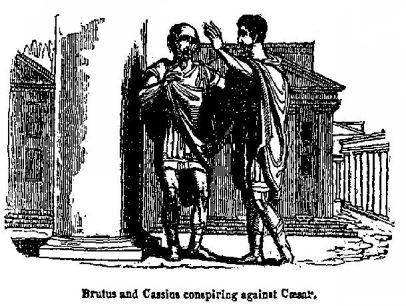
At the head of this conspiracy were Brutus, whose life Cæsar had spared after the battle of Pharsalia, and Cassius, who was pardoned soon after; both prætors for the present year. 5. Brutus made it his chief glory to have descended from that Brutus who first gave liberty to Rome. The passion for freedom seemed to have been transmitted to him with the blood of his ancestors. But, though he detested tyranny, yet could he not forbear loving the tyrant from whom he had received the most signal benefits.
6. The conspirators, to give a colour of justice to their proceedings, put off the execution of their design to the ides of March,[3] the day on which Cæsar was to be offered the crown. 7. The augurs had foretold that this day would be fatal to him. The night preceding he heard his wife, Calphur'nia, lamenting in her sleep. Being awakened, she confessed to him, that she dreamt of his being assassinated in her arms. 8. These omens, in some measure, began to change his intention of going to the senate; but one of the[Pg. 230] conspirators coming in, prevailed upon him to keep his resolution, telling him of the reproach that would attend his staying at home till his wife should have lucky dreams, and of the preparations that were made for his appearance. 9. As he went along to the senate, a slave who hastened to him with information of the conspiracy, attempted to come near him, but was prevented by the crowd. Artemido'rus, a Greek philosopher, who had discovered the whole plot, delivered him a memorial, containing the heads of his information; but Cæsar gave it, with other papers, to one of his secretaries, without reading, as was visual in matters of this nature. Having at length entered the senate-house, where the conspirators were prepared to receive him, he met one Spuri'na, an augur, who had foretold his danger, to whom he said smiling, "Well, Spuri'na, the ides of March are come."—"Yes," replied the augur, "but they are not yet gone." 10. No sooner had he taken his place, than the conspirators approached, under pretence of saluting him: Cimber, who was one of them, in a suppliant posture, pretended to sue for his brother's pardon, who had been banished by Cæsar's order. The conspirators seconded him with great earnestness; and Cimber, seeming to sue with still greater submission, took hold of the bottom of his robe; holding him, so as to prevent his rising. 11. This was the signal agreed on; when Casca, who was behind, instantly stabbed him in the shoulder, Cæsar sprung around, and, with the steel of his tablet, wounded him in the arm. The conspirators were all alarmed; when, being inclosed round, he received a second stab, from an unseen hand, in the breast; while Cassius wounded him in the face. He still defended himself with great vigour, rushing among them, and throwing down such as opposed him, till he saw Brutus among the conspirators, who, coming up, struck his dagger into his thigh. 12. Cæsar, from that moment, thought no more of defending himself; but, looking upon Brutus, cried out, "Et tu Brute!"—And you too, O Brutus! Then covering his head, and spreading his robe before him, in order to fall with decency, he sunk down at the base of Pompey's statue: after having received three and twenty wounds, from those whom he vainly supposed he had disarmed by his benefits.
13. Cæsar was killed in his fifty-sixth year, and about fourteen years after he had begun the conquest of the world.
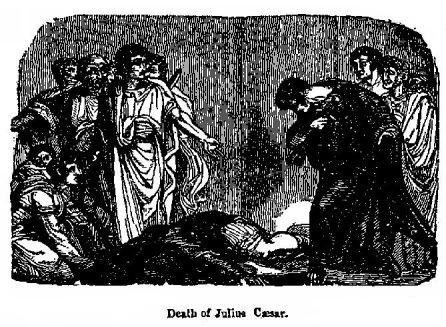
14. If we examine his history, we shall[Pg. 231] be at a loss whether most to admire his great abilities, or his wonderful fortune. To pretend to say, that from the beginning he planned the subjection of his native country, is doing no great credit to his well-known penetration, as a thousand obstacles lay in his way, which fortune, rather than conduct, was to surmount; no man, therefore, of his sagacity, would have begun a scheme in which the chances of succeeding were so many against him. It is most probable that, like all very successful men, he made the best of every occurrence; and his ambition rising with his good fortune, from at first being content with humbler aims, he at last began to think of governing the world, when he found scarcely any obstacle to oppose his designs. Such is the disposition of man, whose cravings after power are then most insatiable when he enjoys the greatest share.[4]
16. As soon as the conspirators had despatched Cæsar, they retired to the Capitol, and guarded its accesses by a body of gladiators which Brutus had in pay.
17. The friends of the late dictator now began to find that this was the time for coming into greater power than before, and for satisfying their ambition under the pretence of promoting justice: of this number was Antony. 18. He was a man of moderate abilities, of excessive vices, ambitious[Pg. 232] of power only because it gave his pleasures a wider range to riot in; but skilled in war, to which he had been trained from his youth.[5] He was consul for this year, and resolved, with Lep'idus, who like himself was fond of commotions, to seize this opportunity of gaining a power which Cæsar had died for usurping. Lep'idus, therefore, took possession of the Forum,[6] with a band of soldiers at his devotion; and Antony, being consul, was permitted to command them. 19. Their first step was to possess themselves of Cæsar's papers and money, and the next to assemble the senate. 20. Never had this august assembly been convened upon so delicate an occasion, as to determine whether Cæsar had been a legal magistrate, or a tyrannical usurper; and whether those who killed him merited rewards or punishments. Many of them had received all their promotions from Cæsar, and had acquired large fortunes in consequence of his appointments: to vote him an usurper, therefore, would be to endanger their property; and yet, to vote him innocent, might endanger the state. In this dilemma they seemed willing to reconcile extremes; they approved all the acts of Cæsar, and yet granted a general pardon to the conspirators.
21. This decree was very far from giving Antony satisfaction, as it granted security to a number of men who were the avowed enemies of tyranny, and who would be foremost in opposing his schemes of restoring absolute power. As, therefore, the senate had ratified all Cæsar's acts without distinction, he formed a plan of making him rule when dead as imperiously as he had done when living. 22. Being possessed of Cæsar's books of accounts, he so far gained over his secretary as to make him insert whatever he thought proper. By these means, great sums of money, which Cæsar would never have bestowed, were distributed among the people; and every man who had any seditious designs against the government was there sure to find a gratuity. 23. Things being in this situation, Antony demanded of the senate that Cæsar's funeral obsequies should be performed. This they could not decently forbid, as they had never declared [Pg. 233] him a tyrant: accordingly, the body was brought forth into the Forum with the utmost solemnity; and Antony, who charged himself with these last duties of friendship, began his operations upon the passions of the people by the prevailing motives of private interest. 24. He first read to them Cæsar's will, in which he made Octavius, his sister's grandson, his heir, permitting him to take the name of Cæsar, and bequeathed him three parts of his private fortune; which, in case of his death, Brutus was to have inherited. To the Roman people were left the gardens which he possessed on the other side of the Tiber; and to every citizen three hundred sesterces. Unfolding Cæsar's bloody robe, pierced by the daggers of the conspirators, he observed to them the number of stabs in it. He also displayed a waxen image, representing the body of Cæsar, all covered with wounds. 25. The people could no longer retain their indignation, but unanimously cried out for revenge, and ran, with flaming brands from the pile, to set fire to the houses of the conspirators. In this rage of resentment, meeting with one Cinna, whom they mistook for another of the same name that was in the conspiracy, they tore him in pieces. 26. The conspirators themselves, however, being well guarded, repulsed the multitude with no great trouble; but perceiving the general rage of the people, they thought it safest to retire from the city.
27. In the mean time, Antony, who had excited this flame, resolved to make the most of the occasion. But an obstacle to his ambition seemed to arise from a quarter in which he least expected it, namely, from Octa'vius, afterwards called Augus'tus, who was the grand-nephew and adopted son of Cæsar. A third competitor also for power appeared in Lep'idus, a man of some authority and great riches. 28. At first, the ambition of these three seemed to threaten fatal consequences to each other; but, uniting in the common cause, they resolved to revenge the death of Cæsar, and dividing their power, they formed what is called the Second Triumvirate.
Questions for Examination.
1. What design was Cæsar supposed to entertain?
2. Was this rumour well founded?
3. When hints of danger were given him, what was his conduct?[Pg. 234]
4. What was the consequence of this imprudence?
5. What was the character of Brutus?
6. What time was fixed for the conspiracy to take place?
7. Had Cæsar any intimations of his danger?
8. Was he at all influenced by them?
9. Were no other attempts made to warn him of his approaching fate?
10. In what way did the conspirators commence their attempt?
11. What followed?
12. What was the consequence of this?
13. What was Cæsar's age?
14. Did Cæsar plan the conquest of his country from the first?
15. By what means did he accomplish it?
16. How did the conspirators escape the vengeance of the people?
17. What advantage was taken of this event?
18. What was the character of Antony, and what resolution did he form?
19. What were his first acts?
20. How were the seriate situated on this occasion?
21. Was Antony satisfied with this decree?
22. How did he accomplish this?
23. What was his next measure?
24. By what means did he effect his purpose?
25. What was the consequence of this artful conduct?
26. Did the conspirators fall victims to their fury?
27. Had Antony no rivals in his attempts to acquire power?
28. What was the result of this rivalship?
Come, Antony, and young Octavius, come,
Revenge yourself alone on Cassius,
For Cassius is aweary of the world.—Shakspeare.
1. The meeting of these three usurpers of their country's freedom, was upon a little island of the river Rhenus.[7] Their mutual suspicions were the cause of their meeting in a place where they had no fear of treachery; for, even in their union, they could not divest themselves of mutual diffidence. 2. Lep'idus first entered; and, finding all things safe, made the signal for the other two to approach. At their first meeting, after saluting each other, Augustus began the conference, by thanking Antony for putting Dec'imus Brutus to death; who, being abandoned by his army, had been taken, as he was endeavouring to escape into Macedo'nia, and was beheaded by Antony's soldiers. 3. They then entered upon the business that lay before them, without any retrospection to the past.
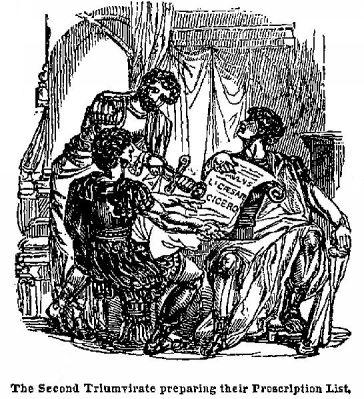
Their conference lasted three[Pg. 235] days; and, in this period, they settled a division of the government, and determined the fate of thousands. 4. The result of this conference was, that the supreme authority should be lodged in their hands, under the title of the Trium'virate, for the space of five years; that Antony should have Gaul; Lep'idus, Spain, and Augustus, Africa and the Mediterranean islands. As for Italy, and the eastern provinces, they were to remain in common, until their general enemy should be subdued; and, among other articles of union, it was agreed that all their enemies should be destroyed, of which each presented a list. 5. In these were comprised, not only the enemies but the friends of the Trium'virate, since the partisans of the one were found among the opposers of the other. Thus Lep'idus gave up his brother Æmil'ius Paulus to the vengeance of his colleague; Antony permitted the proscription of his uncle Lucius; and Augustus delivered up the great Ci'cero, who was assassinated shortly after by Antony's command.[8]
[Pg. 236]6. In the mean time Brutus and Cassius, the principal of the conspirators against Cæsar, being compelled to quit Rome, went into Greece, where they persuaded the Roman students at Athens to declare in the cause of freedom; then parting, the former raised a powerful army in Macedonia, while the latter went into Syria, where he soon became master of twelve legions, and reduced his opponent, Dolabella, to such straits as to force him to lay violent hands on himself. 7. Both armies joined at Smyr'na: the sight of such a formidable force began to revive the declining spirits of the party, and to reunite the two generals still more closely, between whom there had been, some time before, a slight misunderstanding. In short, having quitted Italy like distressed exiles, without having one soldier or one town that owned their command, they now found themselves at the head of a flourishing army, furnished with every necessary for carrying on the war, and in a condition to support a contest on which the empire of the world depended.
8. It was in this flourishing state of their affairs that the conspirators formed a resolution of marching against Cleopatra, who had made great preparations to assist their opponents. 9. However, they were diverted from this purpose by information that Augustus and Antony were now upon their march, with forty legipns, to oppose them. Brutus, therefore, moved to have their army pass over into Greece and Macedonia, and there meet the enemy: but Cassius so far prevailed as to have the Rho'dians and Ly'cians first reduced, who had refused their usual contributions. 10. This expedition was immediately put in execution, and extraordinary contributions were thus raised, the Rho'dians having scarcely anything left them but their lives. The Ly'cians suffered still more severely; for having shut themselves up in their capital town Nanthus, they defended the place against Brutus with so much fury, that neither his arts nor entreaties could prevail upon them to surrender. 11. At length, the town being set on fire by their attempting to burn the works of the Romans, Brutus, instead of laying hold of this opportunity to storm the place, made every effort to preserve it, entreating his soldiers to try all means of extinguishing the fire; but the desperate frenzy[Pg. 237] of the citizens was not to be mollified. 12. Far from thinking themselves obliged to the generous enemy for the efforts which they made to save them, they resolved to perish in the flames. Instead of extinguishing, therefore, they did all in their power to augment the fire, by throwing in wood, dry reeds, and all kinds of fuel. 13. Nothing could exceed the distress of Brutus upon seeing the townsmen thus resolutely bent on destroying themselves. He rode about the fortifications, stretching out his hands to the Xan'thians, and conjuring them to have pity on themselves and their city; but, insensible to his expostulations, they rushed into the flames with desperate obstinacy, and the whole soon became a heap of undistinguishable ruin. 14. At this horrid spectacle Brutus melted into tears, offering a reward to every soldier who should bring him a Ly'cian alive. The number of those whom it was possible to save from their own fury amounted to no more than one hundred and fifty. 15. Some writers, however, affirm that the town was burnt to the ground, and the inhabitants destroyed, by the command of Brutus; and that those who surrendered at discretion, he deprived of all their public and private property.
16. Brutus and Cassius met once more at Sardis where they resolved to have a private conference together. They shut themselves up in the first convenient house, with express orders to their servants to give admission to no one. 17. Brutus began by reprimanding Cassius for having disposed of offices for money, which should ever be the reward of merit, and for having overtaxed the tributary states. Cassius repelled the imputation of avarice with the more bitterness, as he knew the charge to be groundless. The debate grew warm; till, from loud speaking, they burst into tears. 18. Their friends, who were standing at the door, overheard the increasing vehemence of their voices, and began to tremble for the consequences, till Favo'nius, who valued himself upon a cynical boldness, that knew no restraint, entering the room with a jest, calmed their mutual animosity. 19. Cassius was ready enough to forego his anger, being a man of great abilities, but of an uneven disposition; not averse to pleasure in private company, and, upon the whole, of morals not quite correct. But the conduct of Brutus was perfectly steady. An even gentleness, a noble elevation of sentiment, a strength of mind over which neither vice nor pleasure could have an influence, and an inflexible firmness in the cause of justice, composed[Pg. 238] the character of this great man. 20. After their conference night coming on, Cassius invited Brutus and his friends to an entertainment, where freedom and cheerfulness, for a while, took place of political anxiety, and softened the severity of wisdom. Upon retiring home it was that Brutus thought he saw a spectre in his tent. 21. He naturally slept but little, and was capable of bearing want of rest by long habit and great sobriety. He never allowed himself to sleep in the daytime, as was common in Rome; and only gave so much of the night to repose as could barely renew the functions of nature. But now, oppressed with various cares, he allowed himself a still shorter time after his nightly repast; and, waking about midnight, generally read or studied till morning. 22. It was in the dead of night, says Plutarch, when the whole camp was perfectly quiet, that Brutus was thus employed; reading by a lamp that was just expiring. On a sudden he thought he heard a noise, as if somebody was approaching, and looking towards the door, perceived it open. A gigantic figure of frightful aspect stood before him, and continued to gaze upon him with silent severity. 23. Brutus is reported to have asked, "Art thou a dæmon or a mortal? and why comest thou to me?" "Brutus," answered the phantom, "I am thy evil genius—thou shalt see me again at Philippi."[9] "Well, then," replied Brutus, without being discomposed, "we shall meet again." Upon this the phantom vanished; when Brutus, calling to his servants, asked if they had seen anything; to which they answering in the negative, he resumed his studies. 24. Struck with so strange an occurrence, he mentioned it to Cassius, who rightly considered it as the effect of an imagination disordered by vigilance and anxiety. 25. Brutus appeared satisfied with this solution; and as Antony and Augustus were now advanced into Macedonia, he and his colleague passed over into Thrace, and drew near to Philippi, where the forces of the Trium'viri were posted to receive them.[Pg. 239]
Questions for Examination.
1. Where was the first meeting of the Triumvirate, and why was it chosen?
2. What precautions did they take?
3. What farther was done?
4. What was the result of the conference?
5. Who were the proscribed?
6. What became of Brutus and Cassius?
7. What effect had this success on the minds of their party?
8. What was their first resolution?
9. Did they put it in execution?
10. What was the consequence to the Rhodians and Lycians?
11. What unfortunate accident hastened the fate of the town?
12. Did they not second the efforts of Brutus?
13. By what means did Brutus attempt to divert them from their purpose?
14, 15. By what method did he endeavour to save some of the Lycians?
16. Where did Brutus and Cassius meet, and what ensued?
17. Was their interview an amicable one?
18. Did no one interpose?
19. What were the characters of these great men?
20. What happened after the conference?
21. What were the peculiar habits of Brutus?
22. What happened to him while thus employed?
23. What conversation passed between them?
24. Did he mention the circumstance to any one?
25. Did Brutus assent to this opinion, and what followed?
I dare assure you that no enemy
Shall ever take alive the noble Brutus.—Shakspeare.
1. Mankind now began to regard the approaching armies with terror and suspense. The empire of the world depended upon the fate of a battle. From victory, on the one side, they had to expect freedom; on the other, a sovereign with absolute command. 2. Brutus was the only man who looked upon these great events with calmness and tranquillity. Indifferent as to success, and satisfied with having done his duty, he said to one of his friends, "If I am victorious, I shall restore liberty to my country: if not, by dying, I shall myself be delivered from slavery. My condition is fixed; I run no hazards." 3. The republican army consisted of fourscore thousand foot, and twenty thousand horse. The army of the Trium'viri amounted to a hundred thousand foot and thirteen thousand horse. 4. Thus complete on both sides, they met and encamped near each other[Pg. 240] upon the plains of Philip'pi. Near the town were two little hills, about a mile distant from each other; upon these hills, Brutus and Cassius fixed their camps, and kept up a free communication, which mutually defended each other. 5. In this commodious situation they could act as they thought proper, and give battle just when it was thought to their advantage to engage. Behind was the sea, which furnished them with all kinds of provisions; and, at twelve miles distance, the island of Thasos, which served them for a general magazine. 6. The Trium'viri, on the other hand, were encamped on the plain below, and were obliged to bring provisions from fifteen leagues' distance; so that their scheme and interest were to forward a battle as soon as possible. This they offered several times, drawing out their men from the camp, and provoking the enemy to engage. 7. On the contrary, the enemy contented themselves with drawing up their troops at the head of their camps, without descending to the plain. This resolution of postponing the battle, was the chance that the republican army had for victory; and Cassius, sensible of his advantage, resolved to harass rather than engage the enemy. 8. But Brutus, who began to suspect the fidelity of some of his officers, used all his influence to persuade Cassius to change his resolution. "I am impatient," said he, "to put an end to the miseries of mankind; and in this I hope to succeed whether I conquer or fall." 9. His wishes were soon gratified; for Antony's soldiers having, with great labour, made a road through the marsh which lay to the left of Cassius's camp, by that means opened a communication with the island of Thasos, which lay behind him. Both armies, after several attempts to possess themselves of this road, resolved at length to come to a general engagement. 10. This, however, was contrary to the advice of Cassius, who found himself forced, as Pompey had formerly been, to expose the liberty of Rome to the hazard of a battle. On the ensuing morning, the two generals gave the signal for engaging, and conferred together a little while before the battle began. 11. Cassius desired to be informed how Brutus intended to act in case they should be unsuccessful. To this Brutus replied, "Formerly, in my writings, I condemned the death of Cato, and maintained, that avoiding calamities by suicide is an insolent attempt against Heaven, that allotted them: but I have altered my opinion; I have given up my life to my country, and I think I have a right to my own way of[Pg. 241] ending it.[10] I am resolved, therefore, to change a miserable being here for a better hereafter, if fortune turn against me." 12. "My friend," cried Cassius, embracing him, "now may we venture to face the enemy; for either we shall be conquerors, or we shall have no cause to fear those that be so." 13. Augustus being sick, the forces of the Triumviri were commanded by Antony alone, who began the engagement by a victorious attack upon the lines of Cassius. Brutus, on the other side, made a dreadful irruption on the army of Augustus, and drove forward with so much intrepidity, that he broke them upon the very first charge. Upon this, he penetrated as far as the camp, and slaughtering those that were left for its defence, his troops immediately began to plunder. 14. In the mean time, however, the lines of Cassius were forced, and his cavalry put to flight. There was no effort that this unfortunate general did not exert to make his infantry stand; stopping those that fled, and himself seizing the colours to rally them. But the valour of an individual was insufficient to inspire a timorous army. 15. At length, despairing of success, Cassius retired to his tent and killed himself. Brutus was soon informed of the defeat of Cassius, and in a little time after, of his death; scarcely able to restrain the excess of his grief for a man whom he lamented as the last of the Romans.
16. Brutus, now become sole general, assembled the dispersed troops of Cassius, and animated them with fresh hopes of victory. As they had lost their all from the plundering of their camp, he promised two thousand denarii to each man to make them amends. 17. Inspired with new ardour, they admired the liberality of their general, and, with loud shouts, proclaimed his intrepidity. Still, however, he wanted confidence to face the adversary, who offered him battle the ensuing day. His aim was to starve the enemy, who were in extreme want of provisions, from their fleet having been lately defeated. 18. But his single opinion was overruled by the army, who now grew every day more confident of their strength, and more arrogant to their general. At last, therefore, after a respite of twenty days, he was obliged to comply with their solicitations to try the fate of a battle. Both armies were drawn out, and [Pg. 242] they remained a long while opposite to each other without offering to engage. It is said, that he himself had lost much of his ardour by having again seen, or fancied that he saw, the spectre, in the night preceding. However, he encouraged his men, and gave the signal for battle. As usual, he had the advantage where he commanded in person; bearing down the enemy at the head of his infantry, and supported by his cavalry, making great slaughter. 19. But the forces which had belonged to Cassius were seized with a panic, and communicating their terror to the rest, the whole army at last gave way. Brutus, surrounded by the most valiant of his officers, fought long with amazing valour. The son of Cato, and the brother of Cassius, fell fighting by his side. At last, he was obliged to yield to necessity, and fled. 20. In the mean time, the two Triumviri, assured of victory, expressly ordered that the general should by no means be suffered to escape. Thus the whole body of the enemy being intent on the person of Brutus alone, his capture seemed inevitable. 21. In this deplorable exigence, Lucil'ius, his friend, resolved, by his own death, to effect his general's delivery. 22. Seeing a body of Thracian horse closely pursuing Brutus, and just upon the point of taking him, he boldly threw himself in their way, telling them that he was Brutus. The Thra'cians overjoyed with so great a prize, immediately despatched some of their companions with the news of their success to the army. 23. Upon this, the ardour of the pursuit abating, Antony marched out to meet his prisoner, either to hasten his death, or insult his misfortunes. He was followed by a great number of officers and soldiers, some silently deploring the fate of so virtuous a man, others reproaching that mean desire of life far which he consented to undergo captivity. 24. Antony now seeing the Thracians approach, began to prepare himself for the interview; but the faithful Lucilius, advancing with a cheerful air—"It is not Brutus," said he, "that is taken; fortune has not yet had the power of committing so great an outrage upon virtue. As for my life, it is well lost in preserving his honour; take it, for I have deceived you." Antony, struck with so much fidelity, pardoned him, loaded him with benefits, and honoured him with his friendship.
25. In the mean time, Brutus, with a small number of friends, passed over a rivulet; and night coming on, sat down under a rock, which concealed him from the pursuit of the enemy. After taking breath, and casting his eyes to[Pg. 243] heaven, he repeated a line from Eurip'ides, containing a wish to the gods, "That guilt should not pass in this life without punishment." To this he added another from the same poet: "O unhappy virtue! I have worshipped thee as a real good; but thou art a vain empty name, and the slave of fortune." He then called to mind, with great tenderness, those whom he had seen perish in battle. 26. He sent out one Statil'ius to give him information of those that remained; but Statil'ius never returned, being killed by a party of the enemy's horse. Brutus, judging rightly of his fate, now resolved to die likewise; and entreated those who stood round him to give him their last sad assistance: but they all refused so melancholy a service. 27. He then retired aside with his friend Strato, requesting him to perform the last office of friendship. Upon Strato's refusal, he ordered one of his slaves to execute what he so ardently desired; but Strato crying out, "that it never should be said that Brutus, in his last extremity, stood in need of a slave for want of a friend," turned aside his head, and presenting the sword's point, Brutus threw himself upon it, and immediately expired, in the forty-third year of his age. A.U. 711.
Questions for Examination.
1. What great event was now depending?
2. What were Brutus's feelings on this occasion?
3. What was the respective strength of the armies?
4. Where did they meet and encamp?
5. What were the advantages of this situation?
6. Were the Triumviri equally well situated?
7. Were the enemy equally ready to engage?
8. What induced Brutus to combat this resolution?
9. Did he obtain his wish?
10. Did Cassius wish to engage?
11. What passed between the generals on this occasion?
12. What was the reply of Cassius?
13. What happened at the commencement of the battle?
14. Was Cassius equally successful?
15. What did he do in his extremity, and what effect had it on Brutus?
16. Did Brutus attempt to recover the victory?
17. What followed?
18. Were his intentions agreeable to his troops, and what was the consequence?
19. What decided the victory against him?
20. What orders were issued by the Triumviri or this occasion?[Pg. 244]
21. By whom was his deliverance attempted?
22. How did he accomplish this?
23. What was the consequence?
24. Relate the circumstances of their interview?
25. What happened to Brutus in the mean time?
26. How did he attempt to gain intelligence, and what followed his disappointment?
27. Relate the manner of his death?
But anxious cares already seized the queen;
She fed within her veins a flame unseen:
The hero's valour, acts, and birth, inspire
Her soul with love, and fan the secret fire.—Dryden.
1. From the moment of Brutus's death, the Trium'viri began to act as sovereigns, and to divide the Roman dominions among them as their own by right of conquest. 2. However, though there were apparently three who participated all power, yet, in fact, only two were actually possessed of it, since Lep'idus was admitted at first merely to curb the mutual jealousy of Antony and Augustus, and was possessed neither of interest in the army, nor authority among the people. 3. Their earliest care was to punish those whom they had formerly marked for vengeance. Horten'sius, Dru'sus, and Quintil'ius Va'rus, all men of the first rank in the commonwealth, either killed themselves or were slain. A senator and his son were ordered to cast lots for their lives, but both refused; the father voluntarily gave himself up to the executioner, and the son stabbed himself before his face. Another begged to have the rites of burial after his death: to which Augus'tus replied, "that he would soon find a grave in the vultures that would devour him." 4. But chiefly the people lamented to see the head of Brutus sent to Rome to be thrown at the foot of Cæsar's statue. His ashes, however, were sent to his wife Portia, Cato's daughter, who, following the examples of both her husband and father, killed herself, by swallowing coals. 5. It is observed, that of all those who had a hand in the death of Cæsar, not one died a natural death.
6. The power of the Triumviri being thus established upon the ruin of the commonwealth, they now began to think of enjoying that homage to which they had aspired. 7. Antony went into Greece to receive the flattery of that refined people, and spent some time at A'thens, conversing with the philosophers, and assisting at their disputes in person.
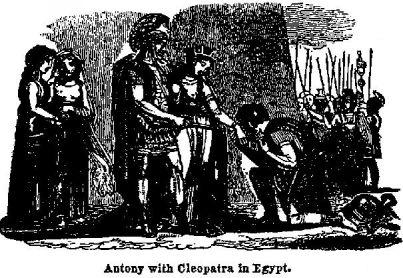
Thence he passed over into Asia, where all the[Pg. 245] monarchs of the east, who acknowledged the Roman power, came to pay him their obedience; while the fairest princesses strove to gain his favour by the greatness of their presents or the allurements of their beauty. 8. In this manner he proceeded from kingdom to kingdom, attended by a succession of sovereigns, exacting contributions, distributing favours, and giving away crowns with capricious insolence. He presented the kingdom of Cappado'cia to Sy'senes, in prejudice of Ariara'thes, only because he was pleased with the beauty of Glaph'yra, the mother of the former. He settled Herod in the kingdom of Judea, and supported him. But among all the sovereigns of the east, who depended upon Antony, Cleopatra, the celebrated queen of Egypt, was the most distinguished.
9. It happened that Sera'pion, her governor in the isle of Cyprus, had formerly furnished some succours to Cassius and the conspirators; and it was thought proper she should answer for his conduct. Accordingly, having received orders from Antony to clear herself of the imputation of infidelity, she readily complied, equally conscious of the goodness of her cause and the power of her beauty. 10. She was now in her twenty-seventh year, and consequently had improved those allurements by art, which in earlier age are seldom attended to. Her address and wit were still farther heightened; and though there were some women in Rome that were her equals in beauty, none could rival her in the powers of conversation; 11. Antony was in Tarsus, a city of Cili'cia, when Cleopatra resolved to attend his court in person. She sailed down the river Cydnus to meet him, with the most sumptuous pageantry. The stern of[Pg. 246] her galley was covered with gold, its sails were purple silk, its oars silver, and they kept time to the sound of flutes and cymbals. She exhibited herself reclining on a couch spangled with stars of gold, and such other ornaments as poets and painters had usually ascribed to Venus. On each side were boys like cupids, fanning her by turns, while beautiful nymphs, dressed like Nereids and Graces, were placed at proper distances around her: the sweets that were burning on board her galley perfumed the banks of the river as she passed, while an infinite number of people gazed upon the exhibition with delight and admiration. 12. Antony soon became captivated with her beauty, and found himself unable to defend his heart against that passion which proved the cause of his future misfortunes. When Cleopa'tra had thus secured her power, she set out on her return to Egypt. Antony, quitting every other object, presently hastened after her, and there gave himself up to all that case and softness to which his vicious heart was prone, and which that luxurious people were able to supply.
13. While he remained thus idle in Egypt, Augustus, who took upon him to lead back the veteran troops, and settle them in Italy, was assiduously employed in providing for their subsistence. 14. He had promised them lands at home, as a recompense for their past services; but they could not receive their new grants without turning out the former inhabitants. 15. In consequence of this, multitudes of women, with their children in their arms, whose tender years and innocence excited compassion, daily filled the temples and the streets with their lamentations. Numbers of husbandmen and shepherds came to deprecate the conqueror's intention, or to obtain a habitation in some other part of the world. 16. Among this number was Virgil, the poet, to whom mankind owe more obligations than to a thousand conquerors, who, in an humble manner, begged permission to retain his patrimonial farm. 17. Virgil obtained his request;[11] but the rest of his countrymen at Mantua,[12] and Cremo'na, were turned out without mercy.
18. Italy and Rome now felt the most extreme miseries. [Pg. 247] The insolent soldiers plundered at will; while Sextus Pompey, being master of the sea, cut off all foreign communication, and prevented the people from receiving their usual supplies of corn. To these mischiefs were added the commencement of another civil war. 19. Fulvia, the wife of Antony, whom he had left behind at Rome, felt for some time all the rage of jealousy, and resolved to try every method of bringing back her husband from Cleopa'tra. 20. She considered a breach with Augustus as the only probable means of rousing him from his lethargy; and, accordingly, with the assistance of Lucius, her brother-in-law, she began to sow the seeds of dissension. The pretext was, that Antony should have a share in the distribution of lands as well as Augustus. 21. This produced negotiations between them, and Augustus offered to make the veterans themselves umpires in this dispute. Lucius refused to acquiesce; and being at the head of more than six legions, mostly composed of such as were dispossessed of their lands, he resolved to compel Augustus to accept of whatever terms he should offer. Thus a new war was excited between Augustus and Antony; or, at least, the generals of Antony assumed the sanction of his name. 22. Augustus was victorious; Lucius was hemmed in between two armies, and constrained to retreat to Peru'sia, where he was closely besieged by the opposite party. He made many desperate sallies, and Fulvia did all in her power to relieve him, but without success, so that, being at last reduced to extremity by famine, he delivered himself up to the mercy of the conqueror. Augustus received him honourably, and generously pardoned him and all his followers.[13]
23. Antony having heard of his brother's overthrow, and of his wife being compelled to leave Italy, was resolved to oppose Augustus. He accordingly sailed at the head of a considerable fleet, and had an interview with Fulvia at Athens. 24. He much blamed her for occasioning the late disorders, testified the utmost contempt for her person, and, leaving her upon her death-bed, hastened into Italy to fight Augustus. They both met at Brundu'sium, and it was now thought that the flames of civil war were going to blaze out once more. 25. The forces of Antony were numerous, but [Pg. 248] mostly newly raised; however, he was assisted by Sextus Pompei'us, who, in those oppositions of interest, was daily coming into power. Augustus was at the head of those veterans who had always been irresistible, but who seemed no way disposed to fight against Antony, their former general. 26. A negociation was therefore proposed, and a reconciliation was effected: all offences and affronts were mutually forgiven; and, to cement the union, a marriage was concluded between Antony and Octavia, the sister of Augustus. 27. A new division of the Roman empire was made between them; Augustus was to have command of the West—Antony of the East; while Lepidus was obliged to content himself with the provinces in Africa. As for Sextus Pompei'us, he was permitted to retain all the islands he already possessed, together with Peloponnesus; he was also granted the privilege of demanding the consulship, though absent, and of discharging that office by a friend. It was stipulated to leave the sea open, and to pay the people what corn was due out of Sicily. Thus a general peace was concluded, to the great satisfaction of the people, who now expected an end to all their calamities.
Questions for Examination.
1. What ensued on the death of Brutus?
2. Were the triumviri possessed of equal power?
3. What were their first measures?
4. By what were the people most affected?
5. What observation has been made on these events?
6. What was the consequence of the establishment of their power?
7. Whither did Antony betake himself for that purpose?
8. How was he employed?
9. By what means did Cleopatra incur his displeasure?
10. What personal advantages did she possess?
11. Did she appear before Antony as an humble suppliant?
12. What was the result of the interview?
13. How was Augustus employed in the mean time?
14. What recompense had he promised these troops?
15. What was the consequence of this tyranny?
16. What remarkable person was among the sufferers?
17. Was his request granted?
18. What was the state of Italy at this time?
19. What occasioned it?
20. What did she consider as the most probable means of reclaiming him?[Pg. 249]
21. Were terms of accommodation offered and accepted?
22. What was the event of the war?
23. What was Antony's conduct on the occasion?
24. Did he approve of his wife's proceedings?
25. Were the two armies of nearly equal strength?
26. What was the consequence?
27. What further measures were adopted?
Octavia.—You have been his ruin.
Who made him cheap at Rome, but Cleopatra?
Who made him scorned abroad, but Cleopatra?
At Actium who betrayed him? Cleopatra.—Dryden.
1. The only obstacle to the ambition of Augustus was Antony, whom he resolved to remove; and for that purpose rendered his character at Rome as contemptible as he possibly could. In fact, Antony's conduct did not a little contribute to promote the endeavours of his ambitious partner. 2. He had marched against the Parthians with a prodigious army, but was forced to return with the loss of the fourth part of his forces, and all his baggage.
3. However, Antony seemed quite regardless of contempt: alive only to pleasure, and totally disregarding the business of the state, he spent his whole time in the company of Cleopatra, who studied every art to increase his passion and vary his entertainments. 4. Few women have been so much celebrated for the art of giving novelty to pleasure, and making trifles important. Still ingenious in filling up the time with some new strokes of refinement, she was at one time a queen, then a bac'chanal, and sometimes a huntress. 5. Not contented with sharing with her all the delights which Egypt could afford, Antony was resolved to enlarge his sphere of luxury, by granting her some of those kingdoms which belonged to the Roman empire. He gave her all Pheni'cia, Celo-Syria, and Cy'prus, with a great part of Cili'cia, Ara'bia, and Jude'a, gifts which he had no right to bestow, but which he pretended to grant in imitation of Hercules. 6. This complication of vice and folly at last totally exasperated the Romans, and Augus'tus, willing to take the advantage of their resentment, took care to exaggerate all his defects. 7. At length, when he found the people sufficiently irritated against him, he resolved to send Octa'via, who was then at Rome, to Antony, as if with a view of reclaiming her husband; but, in fact, to furnish a sufficient pretext for declaring war against him, as he knew she would be dismissed with contempt.
[Pg. 250] 8. Antony was now in the city of Leucop'olis, revelling with Cleopatra, when he heard that Octa'via was at Athens, upon her journey to visit him. This was very unwelcome news both to him and Cleopa'tra; the latter, fearing the charms of her rival, endeavoured to convince Antony of the strength of her passion, by her sighs, her looks, and well-feigned melancholy. He frequently caught her in tears, which she seemingly attempted to hide, and of which she appeared extremely reluctant to tell him the cause. 9. These artifices, together with the ceaseless flattery and importunity of her creatures, prevailed so much on Antony's weakness, that he commanded Octa'via to return home without seeing her; and still more to exasperate the people of Rome, he resolved to repudiate her, and take Cleopa'tra as his wife. 10. He accordingly assembled the people of Alexandria in the public theatre, where was raised an alcove of silver, under which were placed two thrones of gold, one for himself, and the other for Cleopa'tra. There he seated himself, dressed as Bacchus, while Cleopatra sat beside him, clothed in the ornaments and attributes of I'sis, the principal deity of the Egyptians. 11. On that occasion he declared her queen of all the countries which he had already bestowed upon her, while he associated Cæsa'rio, her son by Cæsar, as her partner in the government. To the two children of himself by her, he gave the title of King of Kings, with very extensive dominions; and, to crown his absurdities, he next sent a minute account of his proceedings to the two consuls at Rome.
12. In the mean time, Augustus had a sufficient pretext for declaring war, and informed the senate of his intentions. However, he deferred the execution of his design for a while, being then employed in quelling an insurrection of the Illy'rians. 13. The following year was chiefly taken up in preparations against Antony, who, perceiving his intentions, remonstrated to the senate, that he had many causes of complaint against his colleague, who had seized upon Sicily without affording him a share; alleging that he had also dispossessed Lep'idus, and kept to himself the province he had commanded; and that he had divided all Italy among his own soldiers, leaving nothing to recompense those in Asia. 14. To this complaint Augustus was content to make a sarcastic answer, implying that it was absurd to complain of his distribution of a few trifling districts in Italy, when Antony, having conquered Par'thia[Pg. 251] might now reward his soldiers with cities and provinces.[14] 15. This sarcasm provoked him to send his army without delay into Europe, to meet Augustus, while he and Cleopa'tra followed to Sa'mos,[15] in order to prepare for carrying on the war with vigour. 16. When arrived there, it was ridiculous enough to behold the odd mixture of preparations for pleasure and for war. On one side, all the kings and princes from Egypt to the Euxine Sea had orders to send him supplies of men, provisions, and arms; on the other, comedians, dancers, buffoons, and musicians, were ordered to attend him.
17. His delay at Sa'mos, and afterwards at A'thens, where he carried Cleopa'tra to receive new honours, proved extremely favourable to the arms of Augustus, who was at first scarcely in a situation to oppose him, had he gone into Italy; but he soon found time to put himself in a condition for carrying on the war, and shortly after declared it against him in form. At length both sides found themselves in readiness to begin, and their armies were suitable to the greatness of the empire for which they contended. 18. The one was followed by all the forces of the East; the other drew after him all the strength of the West. Antony's force composed a body of one hundred thousand foot, and twelve thousand horse, while his fleet amounted to five hundred ships of war. Augustus mustered but eighty thousand foot, but equalled his adversary in the number of cavalry; his fleet was but half as numerous as Antony's; however, his ships were better built, and manned with better soldiers.
19. The great decisive engagement, which was a naval one, was fought near Ac'tium,[16] a city of Epi'rus, at the entrance of the gulf of Ambra'cia. Antony ranged his ships before the mouth of the gulf; and Augustus drew up his fleet in opposition. Neither general assumed any fixed station to command in, but went about from ship to ship, wherever his presence was necessary. In the mean time the two land armies, on the opposite sides of the gulf, were drawn up, only as spectators of the engagement, and[Pg. 252] couraged the fleets, by their shouts, to engage. 20. The battle began on both sides after a manner not practised upon former occasions. The prows of their vessels were armed with brazen beaks, with which it was usual to drive furiously against each other; but Antony's ships being large, unwieldy, and badly manned, were incapable of the necessary swiftness, while those of Augustus, from the lightness of their construction, were fearful of the rude encounter: the battle, therefore, rather resembled a land fight, the ships being brought alongside each other. They fought with great ardour, without advantage on either side, except from a small appearance of disorder in the centre of Antony's fleet. 21. But, all on a sudden, Cleopa'tra determined the fortune of the day. She was seen flying from the engagement with her sixty sail, struck, perhaps, with the terrors natural to her sex; and, to increase the general amazement, Antony himself precipitately followed, leaving his fleet at the mercy of the conquerors; while the army on land submitted, being thus abandoned by their general.
22. When Cleopa'tra fled, Antony pursued her in a quinquireme,[17] and coming alongside her ship, entered it without any desire of seeing her. She was in the stern, and he went to the prow, where he remained silent and melancholy. In this manner he continued three whole days, during which, either through indignation or shame, he neither saw nor spoke to Cleopa'tra. The queen's female attendants, however, reconciled them, and every thing went on as before. 23. Still he had the consolation to suppose his army continued faithful to him, and accordingly despatched orders to conduct it into Asia. But he was soon undeceived when he arrived in Africa, where he was informed of their submission to his rival.[18] 24. This so transported him with rage, that with difficulty he was prevented from killing him self. At length, at the entreaty of his friends, he returned to Alexandria. 25. Cleopa'tra seemed to retain that fortitude in her misfortunes, which had utterly abandoned her admirer. Having amassed considerable riches, by means of confiscations and other acts of violence, she formed a very[Pg. 253] singular and unheard of project.
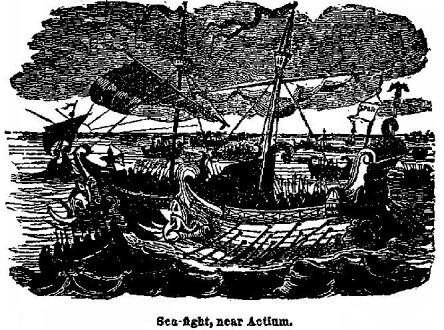
26. This was to convey her whole fleet over the Isthmus of Su'ez into the Red Sea, and thereby save herself, with all her treasures, in another region beyond the power of Rome. 27. Some of her vessels were actually transported thither, pursuant to her orders; but the Arabians having burnt them, and Antony dissuading her from the design, she abandoned it for the more improbable scheme of defending Egypt against the conqueror. 28. She omitted nothing in her power to put this in practice, and made all kinds of preparations for war, hoping, at least, by these means to obtain better terms from Augustus. In fact, she had been more in love with Antony's fortune than his person; and if she could have fallen upon any method of saving herself, though even at his expense, there is little doubt but she would have embraced it with gladness. 29. She had still hopes from the power of her charms, though she was almost arrived at the age of forty: and was desirous of trying upon Augustus those arts which had already been so successful. Thus, in three embassies which were sent from Antony to Augustus in Asia, the queen had always her secret agents, charged with proposals in her name. Antony desired no more than that his life might be spared, and to have the liberty of passing the remainder of his days in obscurity. To these requests Augustus made no reply. 30. Cleopa'tra also sent him public proposals in favour of her children; but at the same time privately resigned to him her crown, with all the ensigns of royalty. To the queen's public proposal no[Pg. 254] answer was given; to her private offer he replied by giving her assurances of his favour, in case she would send away Antony, or put him to death. 31. These private negociations were not so concealed but they came to the knowledge of Antony, whose jealousy and rage every occurrence now contributed to heighten. He built a small solitary house upon a mole in the sea, and shut himself up, a prey to those passions that are the tormentors of unsuccessful tyranny. There he passed his time; shunning all commerce with man kind, and professing to imitate Timon,[19] the man-hater. 32. However, his furious jealousy drove him from this retreat into society; for hearing that Cleopa'tra had secret conferences with one Thyrsus, an emissary from Augustus, he seized upon him, ordered him to be cruelly scourged, and sent him back to his patron. At the same time he sent letters by him importing that Thyrsus had been chastised for insulting a man in misfortunes; but withal he gave Augustus permission to revenge himself by scourging Hippar'chus, Antony's freedman, in the same manner. The revenge, in this case, would have been highly pleasing to Antony, as Hippar'chus had left him, to join the fortunes of his more successful rival.
Questions for Examination.
1. What obstacle remained to the ambition of Augustus, and how did he attempt its removal?
2. How was Antony at this time employed?
3. Did he keenly feel his misfortune?
4. Was she eminently skilled in the art of pleasing?
5. Was not Antony lavish in his favours to her?
6. What was the consequence of this folly?
7. By what means did he seek a quarrel?
8. How was this measure approved by Antony and Cleopatra?
9. What imprudent resolutions did he adopt?
10. Did he do this publicly?
11. What farther favours did he bestow on her?
12. Did Augustus immediately commence hostilities?[Pg. 255]
13. What complaints did Antony make of Augustus?
14. Did Augustus notice these accusations?
15. What effect had his reply on Antony?
16. Were these military preparations formidable?
17. What advantages did Antony offer Augustus?
18. What was the respective strength of the armies?
19. Describe the preparations for this great conflict?
20. Was the engagement well contested?
21. What extraordinary circumstance decided its fate?
22. Did he reproach Cleopatra for her timidity?
23. Had Antony any resources left?
24. How did he receive this news?
25. How did Cleopatra act in this exigence?
26. What was this project?
27. Was it put in execution?
28. How did she attempt this, and with what views?
29. What farther hopes had she of favour?
30. What proposals did she make, and how were they received?
31. Was Antony aware of these negociations?
32. Did he persist in thus secluding himself?
O sun, thy uprise I shall see no more:
Fortune and Antony part here.—Shakspeare.
1. Augustus advanced with another army against Pellu'sium,[20] which, by its strong situation, might have retarded his progress for some time. But the governor of the city, either wanting courage to defend it, or previously instructed by Cleopa'tra to give it up, permitted him to take possession; so that Augus'tus had now no obstacle in his way to Alexan'dria, whither he marched with all expedition. 2. Antony, upon his arrival, sallied out to oppose him, fighting with desperation, and putting the enemy's cavalry to flight. 3. This slight advantage once more revived his declining hopes; and, being naturally vain, he re-entered Alexan'dria in triumph. Then going, armed as he was, to the palace, and embracing Cleopa'tra, he presented to her a soldier who had distinguished himself in the engagement. 4. The queen rewarded him very magnificently, presenting him with a helmet and breastplate of gold. With these, however, the soldier deserted in the night to the other army, prudently resolving to secure his riches by keeping on the strongest side. 5. Antony, not able to bear this defection without fresh indignation, resolved to make a bold expiring effort by[Pg. 256] sea and land; but previously offered to fight his adversary in single combat. Augus'tus, however, too well knew the inequality of their situations to comply with this forlorn proposal; he, therefore, coolly replied, "Antony has ways enough to die besides in single combat."
6. The next day, he posted the few troops he had remaining upon a rising ground near the city, whence he sent orders to his galleys to engage the enemy. There he waited to be a spectator of the combat; and at first he had the satisfaction to see them advance in good order. 7. But his joy was soon turned into rage, when he beheld his ships only saluting those of Augus'tus, and both fleets uniting together and sailing back into the harbour, and at the same time his cavalry deserting him. He tried, however, to lead on his infantry; but these were easily vanquished, and he himself compelled to return into the town. 8. His fury was now ungovernable, crying out as he passed that he was betrayed by Cleopa'tra, and delivered up to those who, for her sake alone, were his enemies. In these suspicions he was not deceived; for it was by secret orders from the queen that the fleet passed over to the enemy.
9. Cleopa'tra had for a long while dreaded the effects of Antony's jealousy; and had some time before prepared a method of obviating the effects of any sudden sallies it might produce. 10. Near the temple of Isis she had erected a building, which was seemingly designed for a sepulchre. Hither she moved her treasure and most valuable effects, covering them with torches, fagots, and other combustible matter. 11. This sepulchre she designed to answer a double purpose, as well to screen her from the sudden resentments of Antony, as to make Augustus believe that she would burn all her treasure, in case he refused proper terms of capitulation. Here, therefore, she retired from Antony's fury—shutting the fortified gates, and giving orders to have it reported that she was dead. 12. This news soon reached Antony, and it recalled all his former love and tenderness. Subject to every gust of passion, and each of them in the extreme, he now lamented her death with the same violence that he had just before seemed to desire it. "Miserable man!" exclaimed he, "what is there now worth living for? since all that could soothe or soften my cares is departed! O Cleopa'tra! our separation does not so much afflict me, as the disgrace I suffer, in permitting a woman to instruct me in the ways of dying."
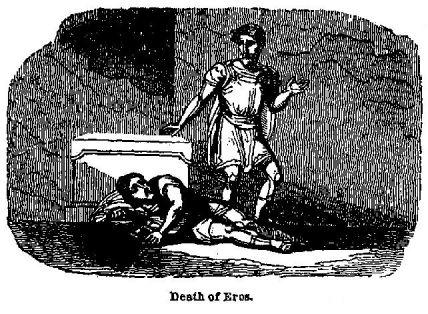
13. He now called to[Pg. 257] him one of his freedmen, named Eros, whom he had engaged, by oath, to kill him, whenever fortune should drive him to this last resource, and commanded him to perform his promise. This faithful follower drew his sword, as if going instantly to strike the blow, when, turning his face, he plunged it into his own bosom, and dropped at his master's feet. 14. Antony, for a while, hung over his faithful servant, charmed with his fidelity. Then snatching up the sword he stabbed himself in the belly, and fell backward upon a couch. 15. The wound was mortal; yet the blood stopping, he recovered his spirits, and earnestly conjured those who were come into the room to put an end to his life; but they all fled, seized with fright and horror. 16. He continued in this miserable condition till he was informed by one of the queen's secretaries, that his mistress was still alive, and begged that he would suffer himself to be transported to the monument where she was. He was accordingly brought to the sepulchre; but Cleopa'tra, attended by her two women only, durst by no means permit the gate to be opened, but from the window threw down cords, with which, with great difficulty, they drew him up. 17. Antony, bathed in his blood, held out his hands to Cleopa'tra, and faintly endeavoured to raise himself from the couch on which he had been laid. The queen gave way to sorrow, tore her clothes, beat her breast, and kissing the wound of which he was dying, called him her husband, her lord, her emperor. 18. Antony entreated her to moderate the transports of her grief, and to preserve her life, if she could be able to do it with honour. "As for [Pg. 258] me, lament not my misfortunes," he said; "but congratulate me upon the happiness which I have enjoyed; I have lived the greatest and most powerful of men; and though I fall, my fate is not ignominious; a Roman myself, I am, at last, by a Roman overcome" Having thus said, he expired.
19. Proculei'us now made his appearance by command of Augus'tus, who had been informed of Antony's desperate conduct. He was sent to try all means of getting Cleopa'tra into his power. 20. Augustus had a double motive for his solicitude on this occasion; one was—to prevent her destroying the treasures she had taken with her into the tomb; the other—to preserve her person, as an ornament to grace his triumph. 21. Cleopa'tra, however, was upon her guard, and rejected any conference with Proculei'us, except through the gate, which was well secured. At length, having procured a ladder, he, with two of Augustus's soldiers, entered by the same window through which Antony had been drawn up. Cleopa'tra, perceiving what had happened, drew a poinard, that hung at her girdle, to stab herself; but Proculei'us forced it from her. 22. Augustus, pleased to find her in his power, sent Epaphrodi'tus to bring her to his palace, and to watch her with the utmost circumspection. He was ordered to use her, in every respect, with that deference and submission which were due to her rank, and to do every thing in his power to render her captivity tolerable.
23. Though kings and generals made interest for Antony's body, in order to pay the last honours to it, this consolation was reserved for Cleopa'tra. She alone was permitted to have the honour of granting Antony the rites of burial, and was furnished with every thing becoming his dignity to receive, or her love to offer. 24. Yet still she languished under her new confinement. Her many losses, her frantic sorrow, the blows which she had given her bosom, produced a fever, which she wished to increase. She resolved, by abstaining from nourishment, to starve herself to death, under the pretence of a regimen necessary for her disorder. 25. But Augus'tus, being made acquainted with the real motive by her physicians, began to threaten her, with regard to the safety of her children, in case she should perish. The fear of being the cause of their death was a motive she could not resist. Cleopa'tra, therefore, allowed herself to be treated as was thought proper, and she recovered.
26. In the mean time Augustus made his entry into Alexandria, taking care to mitigate the fears of the inhabitants, [Pg. 259] by conversing familiarly with Ar'cus, a philosopher, and a native of the place. The citizens, however, trembled at his approach. And when he placed himself upon the tribunal, they prostrated themselves, with their faces to the ground, before him, like criminals who waited the sentence for their execution. 27. Augus'tus presently ordered them to rise, telling them that three motives induced him to pardon them: his respect for Alexander, who was the founder of their city; his admiration of its beauty; and his friendship for Ar'cus, their fellow citizen. 28. Two only of particular note were put to death upon this occasion; Antony's eldest son, Antyl'lus, and Cæsa'rio, the son of Julius Cæsar, both betrayed into his hands by their respective tutors, who themselves suffered for their perfidy shortly after. As for the rest of Cleopa'tra's children, he treated them with great gentleness, leaving them to the care of those who were intrusted with their education, to whom he gave orders to provide them with every thing suitable to their birth. 29. Cleopa'tra, being recovered, Augus'tus visited her in person: she received him lying on a couch; but, upon his entering the apartment, rose up, habited in a loose robe, and prostrated herself before him. Her misfortunes had given an air of severity to her features; her hair was dishevelled, her voice trembling, her complexion pale, and her eyes swollen with weeping; yet, still, her natural beauty seemed to gleam through the distresses that surrounded her; and the grace of her motions, and the alluring softness of her looks, still bore testimony to the former power of her charms. 30. Augus'tus raised her with his usual complaisance, and, desiring her to sit, placed himself beside her. 31. Cleopa'tra had been prepared for this interview, and made use of every art to propitiate the conqueror. She tried apologies, entreaties and allurements, to obtain his favour and soften his resentment. She began by attempting to justify her conduct; but when her skill failed against manifest proofs, she turned her defence into supplications. She reminded him of Cæsar's humanity to those in distress; she read some of his letters to her, full of tenderness, and expatiated upon the intimacy that subsisted between them. "But of what service," cried she, "are now all his benefits to me! Why did I not die with him! Yet, still he lives—methinks I see him still before me! he revives in you." 32. Augus'tus, who was no stranger to this method of address, remained firm against all attacks; answering with a cold indifference[Pg. 260] which obliged her to give her attempts a different turn. 33. She now addressed his avarice, presenting him with an inventory of her treasure and jewels. This gave occasion to a very singular scene, that may serve to show that the little decorums of breeding were then by no means attended to as in modern times. 34. One of her stewards having alleged, that the inventory was defective, and that she had secreted a part of her effects, she fell into the most extravagant passion, started from her couch, and snatching him by the hair, gave him repeated blows on the face. Augus'tus, smiling at her indignation, led her to the couch, and desired her to be pacified. To this she replied, that it was insufferable to be insulted in the presence of one whom she so highly esteemed. "And admitting," cried she, "that I have secreted a few ornaments, am I to blame, when they are reserved, not for myself, but for Liv'ia and Octa'via, whom I hope to make my intercessors with you?" 35. The apology, which intimated a desire of living, was not disagreeable to Augustus, who politely assured her she was at liberty to keep whatever she had reserved, and that in everything she should be indulged to the height of her expectations. He then took leave, and departed, imagining he had reconciled her to life, and to the indignity of being shown in the intended triumph, which he was preparing for his return to Rome; but in this he was deceived. 36. Cleopa'tra had all this time corresponded with Dolabel'la, a young Roman of high birth in the camp of Augustus, who, from compassion, or perhaps from stronger motives, was interested in her misfortunes. By him she was secretly informed that Augustus determined to send her and her children, within three days, to Rome, to grace his triumphant entry. 37. She, at length, therefore, determined upon dying; but first throwing herself upon Antony's coffin, bewailed her captivity, and renewed her protestations not to survive him. Having bathed, and ordered a sumptuous banquet, she attired herself in the most splendid manner. After partaking of the banquet, she commanded all, except her two women, to leave the apartment. She had contrived to have an asp secretly conveyed to her in a basket of fruit, and then wrote to Augustus, to inform him of her fatal purpose, desiring to be buried in the same tomb with Antony. 38. Augustus, upon receiving the letter, instantly despatched messengers in hopes to stop the fulfilment of her intentions; but they arrived too late.
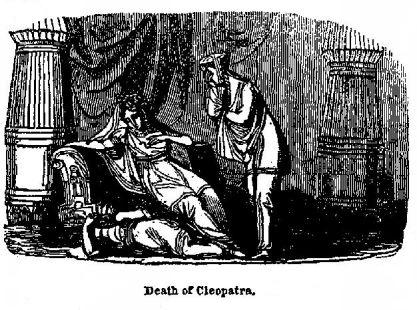
Upon entering the chamber, they beheld[Pg. 261] Cleopa'tra lying dead upon her couch, arrayed in royal robes. Near her, I'ras, one of her faithful attendants, was stretched at the feet of her mistress; and Char'mion,[21] the other, scarcely alive, was settling the diadem upon Cleopa'tra's head. "Alas!" cried one of the messengers, "is this well done, Charmion?" "Yes," replied she, "it is well done—such a death become a glorious queen, descended from a race of glorious ancestors." Pronouncing these words, she dropped and expired with her much loved mistress.[22]
Questions for Examination.
1. What new conquest was achieved by Augustus?
2. What was Antony's conduct on his arrival?
3. Was he elated by this slight success?
4. How was he rewarded, and in what manner did he evince his gratitude?
5. What were Antony's feelings and conduct on the occasion?
6. Did he attempt farther hostilities?
7. Was this satisfaction well founded?
8. How was he affected by this ill success?
9. Was Cleopatra prepared for these misfortunes?
10. What precautions had she taken?
11 What was her design in building this sepulchre?
12. Was Antony affected by this news?[Pg. 262]
13. What followed?
14. Did Antony persist in his purpose?
15. Did he immediately expire?
16. Had he another interview with Cleopatra?
17, 18. Relate the particulars of this interview?
19. How did Augustus act on this occasion?
20. Why was Augustus anxious to preserve this life of Cleopatra?
21. Did he obtain ready admittance to her, and what was the consequence?
22. How was she treated?
23. By whom were the last honours paid to Antony?
24. Did this kindness reconcile her to her situation?
25. By what means did Augustus overcome her resolution?
26. What circumstance attended the entrance of Augustus into Alexandria?
27. Were their fears realized?
28. Who fell victims on the occasion?
29. Did Augustus visit Cleopatra, and how was he received?
30. What was his conduct towards her?
31. How did Cleopatra conduct herself at this interview?
32. Was Augustus moved by her artifices?
33. Mention her next attempt and its consequence.
34. Relate the particulars.
35. Was the apology accepted?
36. With whom did Cleopatra correspond, and what did she learn?
37. What resolution did she form, and how did she accomplish it?
38. Did not Augustus attempt to prevent her resolution, and was he successful?
FOOTNOTES:
In this contest the famous Alexan'drian library, consisting, it is said, of 700,000 volumes, was accidentally burnt.
I came, I saw, I conquered.
The Romans divided their months into three parts; namely, Calends, Nones, and Ides; all which they reckoned backwards. The Ides were always eight in number. The Nones sometimes four, at others six. The Calends varied according to the length of the month, and also with the Nones, as they were four or six. The Calends always began on the first of every month, and were counted backwards to the Ides, which fell on the 15th of March, May, July, and October; and on the 13th of other months; so that the Nones began on the 5th of each month when four, and on the 7th when six in number. The Nones, therefore, always ended on the 2d day of the month.
Though Cæsar's ambition led him to usurp a power to which the Romans were not willing to submit, it appears that he used it with unexampled moderation. He was beloved and revered by the people, honoured and almost adored by his friends, and esteemed and admired even by his enemies. Absolute power could not have been in better hands.
It was the general opinion of the conspirators that Antony should be cut off with Cæsar; but Brutus pleaded for and obtained his safety. This kindness was ill repaid.
The Forum was a public place at Rome, where lawyers and orators made their speeches in matters of property of the state, or in criminal cases.
Now the Rheno, which runs through Bologna and falls into the Po.
It is impossible to paint the horrors of this dreadful proscription. Nothing was to be seen but blood and slaughter; the streets were covered with dead bodies; the heads of the most illustrious senators were exposed on the rostra, and their bodies left to be devoured by dogs and birds of prey; three hundred senators, and above two thousand knights, besides a vast number of others of considerable rank, fell victims on this occasion. Many noble instances of fidelity were displayed by slaves at this terrible conjuncture, several chose rather to die on the rack, in the most exquisite torments, than betray the place where their masters were concealed.
A city on the confines of Macedonia, noted for the battle between Brutus and Cassius, and Mark Antony and Augustus, B.C. 42; and also the Epistle of Paul to the people of Philip'pi.
This is very erroneous reasoning: suicide is, no doubt a heinous crime: but Brutus appears to have been governed by his apprehension of danger, instead of being convinced by the sober dictates of his judgment.
On showing the order for the restoration of his property, he was nearly killed by the centurion who was in possession, and escaped only by swimming across a river. To these melancholy events he alludes in his first Eclogue.
Mantua was a very ancient town, supposed to be older than Rome. It is still called Mantua, and is the capital of a duchy of the same name.
He, however, displayed his usual cruelty towards the inhabitants, causing three hundred senators to be sacrificed at an altar erected to the memory of Julius Cæsar, and delivering up the city to plunder and the flames.
The severity of this sarcasm lay in its being directly contrary to truth, as Antony had been defeated by the Par'thians.
Samos, a celebrated island in the Archipel'ago. It has been rendered famous for the worship and a temple of Juno, with a noted Asylum. Its capital was of the same name, and is memorable for the birth of Pythag'oras.
Actium is famous for a temple of Apollo.
A galley with five banks of oars.
They continued unshaken in their fidelity for seven days after the battle of Actium, notwithstanding the advantageous offers made them by Augustus, in hopes Antony would return and put himself at their head, but finding themselves disappointed, and abandoned by their principal officers, they at length surrendered.
Ti'mon, the misanthrope, was born near Athens, B.C. 420. He declared himself the enemy of the human race, and had a companion named Apeman'tus, who possessed a similar disposition. The latter asking him one day why he paid such respect to Alcibi'ades, "It is," said the churl, "because I foresee he will prove the ruin of the Athe'nians, my countrymen."(Plutarch.)
A strong city of Egypt.
Pronounced Kar'mion.
Cleopatra was forty years old at the time of her death, and had wed twelve years with Antony.
Happy Augustus! who so well inspired,
Couldst throw thy pomp and royalties aside.
Attentive to the wise, the great of soul.
And dignify thy mind. Thrice glorious days.
Auspicious to the muses!—Dyer.
1. By the death of Antony, Augus'tus having become master of the Roman empire, returned to Rome in triumph; where, by feasts and magnificent shows, he began to obliterate the impressions of his former cruelty; and thenceforward resolved to secure, by his clemency, a throne, the foundations of which were laid in blood. 2. He was now at the head of the most extensive empire that mankind had ever beheld. The former spirit of the Romans, and those characteristic marks that distinguished them from others, were now totally lost. The city was inhabited by a concourse from all the countries of the world; and being consequently divested of all just patriotic principles, perhaps a[Pg. 263] monarchy is the best form of government that could be found to unite its members. 3. However, it was very remarkable, that during these long contentions among themselves, and these horrid devastations by civil war, the state was daily growing more formidable and powerful, and completed the destruction of all the kings-who presumed to oppose it.
4. The first care of Augus'tus was to assure himself of the friends of Antony; to which end he publickly reported that he had burnt all Antony's letters and papers without reading them, convinced that, while any thought themselves suspected, they would be fearful of even offering him their friendship.
5. He had gained the kingdom by his army, but he resolved to govern it by the senate. This body, though greatly fallen from its ancient splendor, he knew to be the best constituted, and most remarkable for wisdom and justice. To the senate, therefore, he gave the chief power in the administration of his government, while he himself secured the fidelity of the people and the army by donatives, and acts of favour. 6. By these means the odium of severity fell upon the senate, and the popularity of pardon was solely his own. Thus restoring splendor to the senate and discountenancing corruption, he pretended to reserve to himself a very moderate share of authority, to which none could object: namely, power to compel all ranks of the state to do their duty. 7. This was, in fact, reserving absolute dominion in his own hands; but the misguided people began to look upon his moderation with astonishment: they considered themselves as restored to their former freedom, except the capacity of promoting sedition; and the senate supposed their power re-established in all things but their tendency to injustice. It was even said that the Romans, by such a government, lost nothing of the happiness that liberty could produce, and were exempt from all the misfortunes it could occasion. 8. This observation might have some truth under such a monarch as Augustus now appeared to be; but they were afterwards taught to change their sentiments under his successors, when they found themselves afflicted with all the punishments that tyranny could inflict, or sedition make necessary.
9. After having established this admirable order, Augustus found himself agitated by different passions; and considered, a long time, whether he should keep the empire, or restore the people to their ancient liberty. 10. But he adopted [Pg. 264] the advice of Mæce'nas, which was, to continue in power: and he was afterwards swayed by him on every occasion. By the advice of that minister, he became gentle, affable, and humane: he encouraged men of learning, and gave them much of his time and his friendship. These in their turn relieved his most anxious hours, and circulated his praise throughout the empire.
11. Thus having given peace and happiness to his subjects, and being convinced of the attachment of all orders of the state to his person, he resolved upon impressing the people with an idea of his magnanimity, by making a show of resigning his authority. 12. To this end, having previously instructed his creatures in the senate how to act, he addressed them in a studied speech, importing the difficulty of governing so extensive an empire; a task to which, he said, none but the immortal gods were equal. He modestly urged his own inability, though impelled by every motive to undertake it; and then, with a degree of seeming generosity, freely gave up all that power which his arms had gained, and which the senate had confirmed, giving them to understand, that the true spirit of the Romans was not lost in him. 13. This speech operated upon the senate variously, as they were more or less in the secret. Many believed the sincerity of his conduct as an act of heroism unequalled by any thing that had hitherto appeared; others, though ignorant of his motives, distrusted his designs. Some there were, who, having greatly suffered during the popular commotions, were fearful of their being renewed; but the majority, who were properly instructed by his ministers, frequently attempted to interrupt him while speaking, and received his proposals with pretended indignation. 14. These unanimously besought him not to resign the administration; and, upon his continuing to decline their request, they in a manner compelled him to comply. However, that his person might be in greater security, they immediately decreed that the pay of his guard should be doubled. 15. On the other hand, that he might seem to make concessions on his side, he permitted the senate to govern the weak, internal provinces, while the most powerful provinces, and those that required the greatest armies for their defence, were taken entirely under his own command. Over these he assumed the government for ten years only, leaving the people still in hopes of regaining their ancient freedom; at the same tune, however, laying his measures so well, [Pg. 265] that his government was renewed every ten years, to his death.
16. This show of resignation only served to confirm him in the empire, and in the hearts of the people. New honours were heaped upon him. He was now first called Augustus (a name I have hitherto used as that by which he is best known in history.) A laurel was ordered to be planted at his gates. That house was called the palace wherever he made his abode. He was confirmed in the title of father of his country, and his person declared sacred and inviolable. 17. In short, flattery seemed on the rack to find out new modes of pleasing him; but, though he despised the arts of the senate, he permitted their homage, well knowing that, among mankind, titles produce a respect which enforces authority.
18. Upon entering into his tenth consulship, the senate, by oath, approved of all his acts, and set him wholly above the power of the laws. They, some time after, offered to swear not only to all the laws he had made, but such as he should make for the future. 19. It was customary with fathers, upon their death-beds, to command their children to carry oblations to the Capitol, with an inscription, that at the day of their deaths they left Augustus in health. It was determined that no man should be put to death on such days as the emperor entered the city. Upon a dearth of provisions, the people entreated him to accept of the dictatorship; but he would by no means assume the title of dictator, which had been abolished by law.
20. An accumulation of titles and employments did not in the least diminish his assiduity in fulfilling the duties of each. Several very wholesome edicts were passed by his command, tending to suppress corruption in the senate, and licentiousness in the people. 21. He ordained that none should exhibit a show of gladiators without an order from the senate; and then not oftener than twice a year, nor with more than a hundred and twenty at a time. This law was extremely necessary at so corrupt a period of the empire, when armies of these unfortunate men were brought at once upon the stage, and compelled to fight, often, till half of them were slain. 22. It had been usual also with the knights, and women of the first distinction, to exhibit themselves as dancers upon the theatre; he ordered that not only these, but their children and grand-children should be restrained from such exercises for the future. 23. He fined many[Pg. 266] that had refused to marry at a certain age, and rewarded such as had many children. He enacted that the senators should be held in great reverence; adding to their dignity what he had taken from their power. 24. He made a law, that no man should have the freedom of the city without a previous examination into his merit and character. He appointed new rules and limits to the manumission of slaves, and was himself very strict in the observance of them. With regard to dramatic performers, of whom he was very fond, he severely examined their morals, not allowing licentiousness in their lives, nor indecency in their actions. Though he encouraged the athletic exercises, he would not permit women to be present at them. 25. In order to prevent bribery in suing for offices, he took considerable sums of money from the candidates by way of pledge; and if any indirect practices were proved against them, they were obliged to forfeit all. 26. Slaves had been hitherto disallowed to confess anything against their own masters; but he abolished the practice, and first sold the slave to another, which altering the property, his examination became free. 27. These and other laws, all tending to extirpate vice or deter from crimes, gave the manners of the people another complexion; and the rough character of the Roman soldier was now softened into that of the refined citizen.[1]
Questions for Examination..
1. What was the consequence of the death of Antony?
2. What was the character of the Roman people at this time?
3. Did these convulsions weaken the empire?
4. What was the first care of Augustus?
5. In what way did he propose to govern?
6. What were the consequences of this conduct?
7. What advantages did the Romans fancy they enjoyed?
8. Was this observation correct?
9. What conflicting passions agitated the mind of Augustus?
10. Whose advice did he adopt, and what was that advice?
11. What artifice did he employ to confirm his power?
12. How did he make his intentions known?
13. What effect was produced by this proposal?
14. What was their conduct on this occasion?[Pg. 267]
15. What farther artifices did he employ?
16. What were the consequences of this affected moderation?
17. Was he imposed upon by these arts?
18. What farther instances of abject servility did the senate display?
19. What else was done to his honour?
20. Did these honours render him remiss?
21. What salutary law did he enact?
22. What next?
23. What regulations concerning marriage, and respect to senators, did he enforce?
24. How did he improve the morals of the people?
25. How did he prevent bribery?
26. By what means did he promote justice?
27. What was the consequence of these regulations?
The death of those distinguished by their station,
But by their virtue more, awakes the mind
To solemn dread, and strikes a saddening awe.—Young.
1. Augustus, by his own example, tended greatly to humanize his fellow-citizens; for being placed above all equality, he had nothing to fear from condescension. He was familiar with all, and suffered himself to be reprimanded with the most patient humility. Though, by his sole authority, he could condemn or acquit whomsoever he thought proper, he gave the laws their proper course, and even pleaded for persons he desired to protect. 2. When the advocate for Pri'mus[2] desired to know, with an insolent air, what brought Augustus into court, the emperor calmly replied, "The public good." When one of his veteran soldiers entreated his protection, Augustus bid him apply to an advocate. "Ah!" replied the soldier, "it was not by proxy that I served you at the battle of Ac'tium." Augustus was so pleased that he pleaded his cause and gained it for him. One day a petition was presented to him with so much awe as to displease him. "Friend," cried he, "you seem as if you were offering something to an elephant rather than to a man; be bolder." 3. Once as he was sitting in judgment, Mæce'nas perceiving that he was inclined to be severe, and not being able to get to him through the crowd, he threw a paper into his lap, on which was written, "Arise, executioner!" Augustus read it without displeasure, and immediately[Pg. 268] rising, pardoned those whom he was disposed to condemn. 4. But what most of all showed a total alteration, was his treatment of Corne'lius Cinna, Pompey's grandson. This nobleman had entered into a conspiracy against him: Augustus sent for the other conspirators, reprimanded them, and dismissed them. But resolving to mortify Cinna by the greatness of his generosity—"I have twice," says he, "given you your life, as an enemy and as a conspirator: I now give you the consulship; let us therefore be friends for the future; let us contend only in showing whether my confidence or your fidelity shall be victorious."
5. In the practice of such virtues he passed a long reign. In fact, he seemed the first Roman who aimed at gaining a character by the arts of peace, and who obtained the affections of the soldiers without any military talents of his own: nevertheless, the Roman arms, under his lieutenants, were crowned with success.
6. But he had uneasiness of a domestic nature that distressed him. He had married Liv'ia, the wife of Tibe'rius Nero, by the consent of her husband, when she was six months advanced in her pregnancy. She was an imperious woman, and, conscious of being beloved, controlled him at her pleasure. 7. She had two sons, Tibe'rius the elder, and Dru'sus, who was born three months after she had been married to Augustus, and who was thought to be his own son. The elder of these, Tibe'rius, whom he afterwards adopted, and who succeeded him in the empire, was a good general, but of a suspicious and obstinate temper, and of a conduct so turbulent and restless, that he was at last exiled for five years to the island of Rhodes, where he chiefly spent his time in a retired manner, conversing with the Greeks, and addicting himself to literature, of which, however he afterwards made but a bad use.
8. But the greatest affliction that Augustus experienced was from the conduct of his daughter Julia, whom he had by Scribo'nia, his former wife. Julia, whom he married to his general Agrip'pa, and afterwards to Tibe'rius, set no bounds to her misconduct. She was arrived at that excess of wickedness, that the very court where her father presided was not exempt from her infamies. 9. Augustus, at first, had thoughts of putting her to death: but, after consideration, he banished her to Pandata'ria.[3] He ordered that no[Pg. 269] person should come near her without his permission, and sent her mother Scribo'nia along with her, to bear her company. When any one attempted to intercede for Julia, his answer was, "that fire and water should sooner unite than he with her." 10. Augustus, having survived most of his contemporaries, at length, in the seventy-fourth year of his age, began to think of retiring from the fatigues of state, and of constituting Tibe'rius his partner in the throne. He desired the senate to salute him no longer at the palace, nor take it amiss, if, for the future, he could not converse with them, as formerly.
11. From that time Tibe'rius was joined in the government of the provinces with him, and invested with nearly the same authority. However, Augustus could not entirely forsake the administration, which habit had rendered a source of pleasure; and he still continued a watchful guardian, and showed himself, to the last, a lover of his people. 12. Finding it now, therefore, very inconvenient to come to the senate, by reason of his age, he desired to have twenty privy-counsellors assigned him for a year; and it was decreed, that whatever measures were resolved upon by them and the consuls, should have entirely the force of a law. 13. He seemed apprehensive of his approaching end, for he made his will, and delivered it to the vestal virgins. He then solemnized the census, or numbering the people, whom he found to amount to four millions one hundred and thirty-seven thousand; which shows Rome to be equal to four of the greatest cities of modern times. 14. While these ceremonies were performing, in the midst of a mighty concourse of people in the Cam'pus Mar'tius, it is said that an eagle flew round the emperor several times, and, directing its flight to a neighbouring temple, perched over the name of Agrippa: this omen was, by the augurs, conceived to portend the death of the emperor. 15. Shortly after, having accompanied Tibe'rius in his march into Illyr'ia, he was taken ill. Returning thence, he sent for Tibe'rius and his most intimate friends. A few hours before his death he ordered a looking-glass to be brought, and his hair to be adjusted with more than usual care. He then addressed his friends, whom he beheld surrounding his bed, and desired to know whether he had properly played his part in life; to which, being answered in the affirmative, he cried out with his last breath, "Then give me your applause." Thus, at the age of seventy-six, after reigning forty-four years, he expired in the arms of[Pg. 270] Liv'ia, bidding her remember their marriage and their last farewell.[4]
16. The death of the emperor caused inexpressible grief throughout the whole empire. It was, by some, supposed that his wife Liv'ia had some hand in hastening it, with a view to procure the succession more speedily for her son. However this was, she took care, for a time, to keep the important event concealed, by guarding all the passages to the palace; sometimes giving out that he was recovered, and then pretending a relapse. At length, having settled the succession to her mind, she published the emperor's death; and at the same time, the adoption of Tibe'rius to the empire. 17. The emperor's funeral was performed with great magnificence. The senators being in their places, Tibe'rius, on whom that care devolved, pronounced a consolatory oration. After this his will was read, wherein he made Tibe'rius and Liv'ia his heirs. 18. He was studious of serving his country to the very last, and the sorrow of the people seemed equal to his assiduity. It was decreed, that all the women should mourn for him a whole year. Temples were erected to him, divine honours were allowed him, and one Nume'rius At'ticus, a senator, willing to convert the adulation of the times to his own benefit, received a large sum of money for swearing that he saw him ascending into heaven; so that no doubt remained among the people concerning his divinity.
19. Such were the honours paid to Augustus, whose power began in the slaughter, and terminated in the happiness of his subjects; so that it was said of him, "that it had been good for mankind if he had never been born, or if he had never died." 20. It is possible that the cruelties exercised in his triumvirate were suggested by his colleagues. In the case of Cæsar's death, he might think that revenge was virtue. Certain it is, that severities were necessary to restore public tranquillity; for, until the Roman spirit should be eradicated, no monarchy could be secure. 21. He indulged his subjects in the appearance of a republic, while[Pg. 271] he made them really happy in the effects of a most absolute monarchy, administered with the most consummate prudence. In this last quality he seems to have excelled most monarchs; and indeed, could we separate Octavius from Augustus, he was one of the most faultless princes in history. 22. About this time our Saviour was born in Jude'a.[5]
Questions for Examination.
1. What was the general conduct of Augustus?
2. Mention some instances of his moderation?
3. What farther instance of his moderation is on record?
4. How did he most decidedly show the alteration in his disposition?
5. In what was he particularly remarkable?
6. Was he happy in domestic life?
7. What family had she, and what was the character of her son?
8. Had he no other domestic trials?
9. In what way was she punished?
10. Was the reign of Augustus of considerable length?
11. Did he associate Tiberius with him in the government?
12. By what means did he lighten the burden of government?
13. By what measure did he prepare for his approaching end?
14. What omen portended his death?
15. How did he meet his end?
16. How were the people affected by his death, and why was it for a time concealed?
17. How was his funeral celebrated?
18. What honours were decreed him?
19. Were those honours deserved?
20. What excuses may be made for his early cruelties?
21. By what means did he secure his power?
22. What remarkable event happened in his reign?
Thy acts,
Thy fame, Germanicus, will long outlive
The venomed shafts of envy; and the praise
Of patriot tongues shall follow thee in death.—Clarke.
1. Tibe'rius was fifty-six years old when he took upon him the government of the Roman empire. He had lived in a state of profound dissimulation under Augustus, and was not yet hardy enough to show himself in his real character. In the beginning of his reign nothing appeared but prudence, generosity, and[Pg. 272] clemency.[6] 2. But the successes of his nephew, German'icus, son of his late brother Dru'sus, over the Germans, first brought his natural disposition to light, and discovered the malignity of his mind without disguise. 3. He was hardly settled on his throne, when he received intelligence that the legions in Panno'nia, hearing of the death of Augustus, and desirous of novelty, had revolted; but these were soon quieted, and Percen'nius, their leader, slain. 4. A commotion in Germany was attended with much more important consequences. The legions in that part of the empire were conducted by German'icus, a youth of most admirable qualities, who had been at the late emperor's request, adopted, in order to succeed to the empire. These forces had taken the opportunity of his absence to revolt, and now began to affirm that the whole Roman empire was in their power, and that its principal grandeur was owing to the success of their arms; when German'icus returned, therefore, they unanimously resolved to choose him emperor. 5. This general was the darling of the soldiers, and almost idolized, so that he might, with very little difficulty, have raised himself to the highest dignity in the state; but his duty prevailed over his ambition; he rejected their offers with the utmost indignation, and used the most indefatigable endeavours to quell the sedition. This he effected, though with extreme hazard, by cutting off many of the principal revolters, and then by leading the troops against the Germans, who were considered as the common enemies of the empire.
6. Tiberius was as much pleased with the loyalty of German'icus, as he was distressed at his superior popularity; his success, also, immediately after, against the Germans, still more excited the emperor's envy and private disgust. He overthrew the enemy in several battles, subduing many wild and extensive countries. 7. These victories, however, only served to inflame the emperor's jealousy: and every virtue in the general now became a new cause of offence. This dislike began to appear by Tiberius's making use of every pretence to draw German'icus from the legions: but he was obliged to postpone his purpose on account of a domestic insurrection made in Italy by one Cle'mens, whom he put to death by a private execution in a secret apartment of the palace.[Pg. 273]
9. Having thus got rid of his domestic enemy, he turned his thoughts to the most specious means of bringing home German'icus from the legions in Germany. He began by procuring him a triumph for his late victories, and when writing to him to return in order to enjoy those honours which the senate had decreed; adding, that he had reaped enough of glory in a country to which he had been sent nine times, and been each time victorious; concluding, that so great a number of triumphs was sufficient; and the most signal vengeance which could be inflicted on this turbulent people was to permit them to continue their intestine divisions. 10. German'icus was met on his return, many miles from the city, by a vast multitude, who received him with marks of adoration rather than respect. The gracefulness of his person; his triumphal chariot, in which were carried his five children; and the recovered standards of the army of Va'rus, threw the people into a phrenzy of joy and admiration.[7]
11. German'icus was now appointed to a new dignity. He departed from Rome on an expedition to the east, carrying with him his wife Agrippi'na, and his children. 12. But Tibe'rius, to restrain his power, had sent Cne'ius Pi'so governor into Syr'ia. This Pi'so was a person of furious and headstrong temper, and, in every respect, fit to execute those fatal purposes for which he was designed. 13. His instructions were, to oppose German'icus upon every occasion, to excite hatred against him, and even to procure his death if an opportunity should offer. He accordingly took every opportunity of abusing German'icus; and taxed him with diminishing the Roman glory, by his peculiar protection of the Athe'nians. 14. German'icus disregarded his invectives, being more intent on executing the business of his commission, than on counteracting the private designs of Pi'so. 15. Piso, however, and his wife Planci'na, who is recorded as a woman of an implacable and cruel disposition, continued to defame him. German'icus opposed only patience and condescension to all their invectives, and, with that gentleness which was peculiar to him, repaid their resentments by courtesy. 16. He was not ignorant of their motives, and was father willing to evade than oppose their[Pg. 274] enmity. He, therefore, took a voyage into Egypt, under pretence of viewing the celebrated antiquities of that country; but, in reality, to avoid the machinations of Pi'so, and those of his wife, which were still more dangerous. 17. Upon his return he fell sick, and, whether from a mind previously alarmed, or from more apparent marks of treachery, he sent to let Pi'so know, that he broke off all further connections. Growing daily worse, his death appeared to be inevitable. 18. Finding his end approaching, he addressed his friends, who stood around his bed, to the following effect: "Had my death been natural, I might have reason to complain of being thus snatched away from all the endearments of life, at so early an age; but my complaints are aggravated, in falling the victim of Pi'so's and Planci'na's treachery. Let the emperor, therefore, I conjure you, know the manner of my death, and the tortures I suffer. Those who loved me when living—those who even envied my fortune—will feel some regret, when they hear of a soldier, who had so often escaped the rage of the enemy, falling a sacrifice to the treachery of a woman. Plead then my cause before the people—you will be heard with pity—and if my murderers should pretend to have acted by command, they will either receive no credit or no pardon." 19. As he spoke these words, he stretched forth his hand, which his weeping friends tenderly pressing, most earnestly vowed that they would lose their lives rather than their revenge. The dying prince, then turning to his wife, conjured her, by her regard to his memory, and by all the bonds of nuptial love, to submit to the necessity of the times, and to evade the resentment of her more powerful enemies by not opposing it.[8] 20. Nothing could exceed the distress of the whole empire, upon hearing of the death of German'icus, and the people of Rome seemed to set no bounds to it. 21. In this universal confusion, Pi'so seemed marked for destruction. He and his wife stood charged with the death of German'icus, by giving him a slow poison. Indeed, even the emperor himself, with his mother Liv'ia, incurred a share of the general suspicion. 22. This was soon after greatly increased by the arrival of Agrippi'na, the widow of German'icus, a woman of invincible courage, and in[Pg. 275] high esteem for her virtue. She appeared bearing the urn containing the ashes of her husband, and, attended by all her children, went to the tomb of Augustus. 23. When she approached the city, she was met by the senate and people of Rome, both with acclamations and expressions of sorrow. The veteran soldiers, who had served under German'icus, gave the sincerest testimonies of their concern. The multitude, while the ashes were depositing, regarded the ceremony in profound silence; but presently broke out into loud lamentations, crying out, The commonwealth is now no more.
24. Tibe'rius permitted the accusation of Pi'so, though he was justly supposed to be merely the instrument of his own vengeance. This general was accused before the senate of the death of German'icus, and of other crimes.
25. He put an end to his trial, which had been drawn out to a great length, by committing suicide.[9] His wife Planci'na, who was universally believed to be most culpable, escaped punishment by the interest of Liv'ia.
26. Tibe'rius, having now no object of jealousy to keep him in awe, began to pull off the mask, and appear more in his natural character than before. 27. In the beginning of his cruelties, he took into his confidence Seja'nus, a Roman knight, who found out the method of gaining his affection by the most refined degree of dissimulation, and was an overmatch for his master in his own arts.[10] It is not well known whether he was the adviser of all the cruelties that ensued; but certain it is, that from the beginning of his ministry, Tibe'rius seemed to become more fatally suspicious.
Questions for Examination.
1. What were the age and character of Tiberius on his accession?
2. What first showed him in his true colours?[Pg. 276]
3. What was the first news he heard?
4. Was there not a more formidable revolt?
5. Did Germanicus accept this dignity?
6. Did Tiberius properly appreciate this conduct?
7. Was he pleased with his success?
8. How did this appear?
9. What followed this execution?
10. How was Germanicus received?
11. How was he next employed?
12. What restraints were imposed on him?
13. What were Piso's instructions, and how did he execute them?
14. How did Germanicus act on the occasion?
15. Did Piso persevere in his base attempts?
16. Was Germanicus aware of their design?
17. What happened on his return?
18. Repeat his speech on his death-bed.
19. What farther passed on this occasion?
20. Was his untimely end lamented?
21. Who incurred the popular hatred on this occasion?
22. How was this increased?
23. What honours were paid her?
24. Was the tyrant's vile agent rewarded for his services?
25. What was the issue?
26. How did Tiberius conduct himself after this?
27. Who was his prime minister?
Some ask for envied power; which public hate
Pursues, and hurries headlong to their fate;
Down go the titles; and the statue crowned,
Is by base hands in the next river drowned.—Juvenal.
1. Seja'nus began his administration by using all his address to persuade Tiberius to retire to some agreeable retreat, remote from Rome; from this he expected many advantages, since there could be no access to the emperor but through him. 2. The emperor, either prevailed upon by his persuasions, or pursuing the natural turn of his temper, left Rome and went into Campa'nia, under pretence of dedicating temples to Ju'piter and Augustus. Growing weary, however, of places where mankind might follow him with their complaints and distresses, he withdrew himself into the delightful island of Ca'preæ; and buried in this retreat, gave himself up to abandoned pleasures, regardless of the miseries of his subjects. 3. From this time he became more cruel, and Seja'nus increased his distrusts. Secret spies and informers were placed in all parts of the city, who converted the most harmless actions into subjects of offence. 4. In consequence of this, Ne'ro and Dru'sus, the children of German'icus, were declared enemies to the state, and[Pg. 277] afterwards starved to death in prison; while Agrippi'na, their mother, was sent into banishment. Sabi'nus, Asin'ius, Gal'lus, and Syria'eus, were, upon slight pretences, condemned and executed. 5. In this manner Seja'nus proceeded, removing all who stood between him and the empire; and every day increasing his confidence with Tibe'rius, and his power with the senate. The number of his statues exceeded even those of the emperor; people swore by his fortune, in the same manner as they would have done had he been upon the throne; and he was more dreaded than even the tyrant who actually enjoyed the empire. 6. But the rapidity of his rise seemed only preparatory to the greatness of his downfall. All we know of his first disgrace with the emperor is, that Sati'rus Secun'dus was the man who had the boldness to accuse him of treason; and Anto'nia, the mother of German'icus, seconded the accusation. 7. The senate, who had long been jealous of his power, and dreaded his cruelty, immediately took this opportunity of going beyond the orders of Tibe'rius; instead of sentencing him to imprisonment, they directed his execution.[11] 8. Whilst he was conducting to his fate, the people loaded him with insult and execration; pursued him with sarcastic reproaches; and threw down his statues. He himself was strangled by the executioner.
9. His death only lighted up the emperor's rage for farther executions. Planci'na, the wife of Pi'so, and others, were put to death for being attached to Seja'nus. He began to grow weary of single executions, and gave orders that all the accused should be put to death together, without further examination. The whole city was, in consequence, filled with slaughter and mourning. 10. When one Carnu'lius killed himself, to avoid the torture, "Ah!" cried Tibe'rius, "how has that man been able to escape me!" When a prisoner had earnestly entreated that he would not defer his death: "Know," said the tyrant, "I am not sufficiently your friend to shorten your torments."[Pg. 278]
11. In this manner he lived, odious to the world, and troublesome to himself; an enemy to the lives of others, a tormentor of his own.[12] At length, in the 22d year of his reign, he began to feel the approaches of dissolution, and his appetite totally forsook him. 12. He now, therefore, found it was time to think of a successor, and fixed upon Calig'ula:[13] willing, perhaps, by the enormity of Calig'ula's conduct, with which he was well acquainted, to lessen the obloquy of his own.
13. Still, however, he seemed desirous to avoid his end; and strove, by change of place, to cut off the inquietude of his own reflections. He left his favourite island, and went upon the continent; and at last, fixed at the promontory of Mise'num.[14] There he fell into faintings, which all believed to be fatal. 14. Calig'ula supposing him actually dead, caused himself to be acknowledged by the Prætorian soldiers,[15] and went forth from the emperor's apartment amidst the applauses of the multitude; when, all of a sudden, he was informed that the emperor was likely to recover. 15. This unexpected account filled the whole court with terror and alarm; every one who had before been earnestly testifying his joy, now reassumed his pretended sorrow, and forsook the new emperor, through a feigned solicitude for the fate of the old. 16, Calig'ula seemed thunderstruck; he preserved a gloomy silence, expecting nothing but death, instead of the empire at which he aspired. 17. Marco, however, who was hardened in crimes, ordered that the dying emperor should be despatched, by smothering him with pillows; or, as some will have it, by poison. Thus died Tibe'rius in the[Pg. 279] seventy-eighth year of his age, after reigning twenty-two years.
18. It was in the eighteenth year of this emperor's reign that Christ, (after having spent two years in the public ministry, instructing the multitude in the way of salvation,) was crucified; as if the universal depravity of mankind wanted no less a sacrifice than this to reclaim them. Pi'late sent to Tibe'rius an account of Christ's passion, resurrection, and miracles, and the emperor made a report of the whole to the senate, desiring that Christ might be accounted a god by the Romans. 19. But the senate, displeased that the proposal had not come first from themselves, refused to allow of his apotheosis; alleging an ancient law, which gave them the superintendence in all matters of religion. They even went so far as to command, by an edict, that all Christians should leave the city; but Tibe'rius, by another edict, threatened death to such as should accuse them; by which means they continued unmolested during the rest of his reign.
20. The vices of Calig'ula were concealed under the appearance of virtue in the beginning of his reign. In less than eight months, however, every trace of moderation and clemency vanished; while furious passions, unexampled avarice, and capricious cruelty, reigned uncontrolled; and pride, impiety, lust, and avarice, appeared in all their native deformity.
21. Calig'ula's pride first appeared in his assuming to himself the title of ruler; which was usually granted only to kings. He would also have taken the crown and diadem, had he not been advised, that he was already superior to all the monarchs of the world. 22. Not long after he assumed divine honours, and gave himself the names of such divinities as he thought most agreeable to his nature. For this purpose he caused the heads of the statues of Jupiter, and some other gods, to be struck off, and his own to be put in their places. He frequently seated himself between Castor and Pollux, and ordered that all who came to this temple to worship should pay their adorations only to himself. 23. However, such was the extravagant inconsistency of this unaccountable idiot, that he changed his divinity as often as he changed his clothes; being at one time a male deity, at another a female; sometimes Jupiter or Mars; and not unfrequently Venus or Diana. 24. He even built and dedicated a temple to his own divinity, in which his statue of gold was every day dressed in robes similar to those which[Pg. 280] he himself wore, and worshipped by crowds of adorers. His priests were numerous; the sacrifices made to him were of the most exquisite delicacies that could be procured; and the dignity of the priesthood was sought by the most opulent men of the city. However, he admitted his wife and his horse to that honour; and to give a finishing stroke to his absurdities, became a priest to himself. 25. His method of assuming the manners of a deity was not less ridiculous; he often went out at full moon, and courted it in the style of a lover. He employed many inventions to imitate thunder, and would frequently defy Jupiter, crying out with a speech of Homer, "Do you conquer me, or I will conquer you." He frequently pretended to converse in whispers with the statue of Jupiter, and usually seemed angry at its replies, threatening to send it back into Greece, whence it came. Sometimes, however, he would assume a better temper, and seem contented that Jupiter and he should dwell together in amity.
26. Of all his vices, prodigality was the most remarkable, and that which in some measure gave rise to the rest. The luxuries of former emperors were simplicity itself when compared to those which he practised. He contrived new ways of bathing, when the richest oils and most precious perfumes were lavished with the utmost profusion. His luxuries of the table were of immense value, and even jewels, as we are told, were dissolved in his sauces. He sometimes had services of pure gold presented before his guests, instead of meat, observing that a man should be an economist or an emperor.
27. The manner in which he maintained his horse will give some idea of his domestic extravagance. He built a stable of marble, and a manger of ivory; and whenever the animal, which he called Incita'tus, was to run in the race, he placed sentinels near its stable, the night preceding, to prevent its slumbers from being broken.[16][Pg. 281]
Questions for Examination.
1. What was the first measure of Sejanus?
2. Did the emperor yield to his persuasions?
3. What consequences ensued from this measure?
4. Who were the first sufferers?
5. Did Sejanus increase his influence?
6. Was this elevation permanent?
7. To what punishment was he condemned?
8. What occurred at his execution?
9. Was this the only victim to the cruelty of Tiberius?
10. How did Tiberius aggravate his cruelties?
11. Did these cruelties long continue?
12. How did he act on this?
13. Was he resigned to his fate?
14. What followed on this?
15. How was this news received?
16. Did Caligula boldly meet the consequences?
17. How was this averted?
18. What highly remarkable event happened in this reign?
19. Was his desire gratified?
20. What was the conduct of Caligula on this occasion?
21. By what acts did he display his pride?
22. Did his arrogance carry him farther than this?
23. Under what name did he assume divine honours?
24. Of what farther absurdities was he guilty?
25. Relate other follies of his?
26. What was his principal vice?
27. Give an instance of his domestic extravagance?
For him no prayers are poured, no pæans sung,
No blessings chanted from a nation's tongue.—Brereton.
1. The impiety, however, of Calig'ula was but subordinate to his cruelties. He slew many of the senate, and afterwards cited them to appear. He cast great numbers of old and infirm men to the wild beasts, to free the state from such unserviceable citizens. He usually fed his wild beasts with the bodies of those wretches whom he condemned; and every tenth day sent off numbers of them to be thus devoured, which he jocosely called clearing his accounts. One of those who was thus exposed, crying out that he was innocent,[17] Calig'ula ordered him to be taken up, his tongue[Pg. 282] to be cut out, and then thrown into the amphitheatre as before. 2. He took delight in killing men with slow tortures, that, as he expressed it, they might feel themselves dying, being always present at such executions himself, directing the duration of the punishment, and mitigating the tortures merely to prolong them. 3. In fact, he valued himself for no quality more than his unrelenting temper, and inflexible severity, when he presided at an execution. 4. Upon one occasion, being incensed with the citizens, he wished that the Roman people had but one neck, that he might dispatch them at one blow.
5. Such insupportable and capricious cruelties produced many secret conspiracies against him; but they were for a while deferred upon account of his intended expedition against the Germans and Britons.
6. For this purpose he caused numerous levies to be made, and talked with so much resolution, that it was universally believed he would conquer all before him. 7. His march perfectly indicated the inequality of his temper; sometimes it was so rapid that the cohorts were obliged to leave their standards behind them; at other times it was so slow, that it more resembled a pompous procession than a military expedition. 8. In this disposition he would cause himself to be carried on a litter, on eight men's shoulders, and ordered all the neighbouring cities to have their streets well swept and watered, that he might not be annoyed with dust. 9 However, all these mighty preparations ended in nothing. Instead of conquering Britain, he merely gave refuge to one of its banished princes; and this he described, in his letter to the senate, as taking possession of the whole island. 10. Instead of conquering Germany, he only led his army to the seashore in Gaul: there, disposing his engines and warlike machines with great solemnity, and drawing up his men in order of battle, he went on board his galley, with which coasting along, he commanded his trumpets to sound, and the signal to be given as if for an engagement. 11. His men, who had previous orders, immediately fell to gathering the shells that lay upon the shore into their helmets, as their spoils of the conquered ocean, worthy of the palace and the capitol. 12. After this doughty expedition, calling his army together, like a general after victory, he harangued them in a pompous manner, and highly extolled their achievements; then, distributing money among them, and congratulating them upon their riches, he dismissed them, with orders to[Pg. 283] be joyful: and, that such exploits should not pass without a memorial, he ordered a lofty tower to be erected by the seaside.[18]
13. Cassius Cher'ea, a tribune of the Prætorian bands, was the person who at last freed the world from this tyrant. Besides the motives which he had in common with other men, he had received repeated insults from Calig'ula, who took all occasions of turning him into ridicule, and impeaching him with cowardice, merely because he happened to have an effeminate voice. Whenever Cher'ea came to demand the watch-word from the emperor, according to custom, he always gave him either Venus, Adonis, or some such, implying softness and effeminacy.
14. Cher'ea secretly imparted his design to several senators and knights, whom he knew to have received personal injuries from Calig'ula. While these were deliberating upon the most certain and speedy method of destroying the tyrant, an unexpected incident gave new strength to the conspiracy. 15. Pempe'dius, a senator of distinction, being accused before the emperor of having spoken of him with disrespect, the informer cited one Quintil'ia, an actress, to confirm the accusation. 16. Quintil'ia, however, was possessed of a degree of fortitude not frequently found even in the other sex. She denied the fact with obstinacy; and, being put to the torture, bore the severest tortures of the rack with unshaken constancy. 17. Indeed, so remarkable was her resolution, that though acquainted with all the particulars of the conspiracy, and although Cher'ea was the person appointed to preside at her torture, she revealed nothing; on the contrary, when she was led to the rack, she trod upon the toe of one of the conspirators, intimating at once her knowledge of their conspiracy, and her resolution not to divulge it. 18. Thus she suffered, until all her limbs were dislocated; and, in that deplorable state, was presented to the emperor, who ordered her a gratuity for what she had endured.
19. Cher'ea could no longer contain his indignation, at being thus made the instrument of a tyrant's cruelty. After several deliberations of the conspirators, it was at last resolved to attack him during the Palatine games, which[Pg. 284] lasted four days,[19] and to strike the blow when his guards should not have the opportunity to defend him. 20. The first three days of the games passed. Cher'ea began to apprehend that deferring the completion of the conspiracy might be the means of divulging it; he even dreaded that the honour of killing the tyrant might fall to the lot of some other person bolder than himself. At last he resolved to defer the execution of his plot only to the day following, when Calig'ula should pass through a private gallery, to some baths near the palace.
21. The last day of the games was more splendid than the rest; and Calig'ula seemed more sprightly and condescending than usual. He enjoyed the amusement of seeing the people scramble for the fruits and other rarities by his order thrown among them, being no way apprehensive of the plot formed for his destruction. 22. In the mean time the conspiracy began to transpire: and, had he any friends remaining, it could not have failed of being discovered. A senator who was present, asking one of his acquaintance if he had heard any thing new, and the other replying in the negative, said "you must know, that this day will be represented the death of a tyrant." The other immediately understood him, but desired him to be cautious. 23. The conspirators waited many hours with extreme anxiety; and Calig'ula seemed resolved to spend the whole day without any refreshment. So unexpected a delay exasperated Cher'ea; and, had he not been restrained, he would suddenly have perpetrated his design in the midst of all the people. 24. At that instant, while he was hesitating, Aspore'nus,[20] one of the conspirators, persuaded Calig'ula to go to the bath, and take some slight refreshment, that he might the better enjoy the rest of the entertainment. 25. The emperor, rising up, the conspirators used every precaution to keep off the throng, and to surround him themselves, under pretence of great assiduity. Upon his entering a little vaulted gallery that led to the bath, Cher'ea struck him to the ground with his dagger, crying out, "Tyrant, think upon[Pg. 285] this." The other conspirators closed in upon him; and while the emperor was resisting, and crying out that he was not yet dead, they dispatched him with thirty wounds.
26. Such was the merited death of Calig'ula, in the 29th year of his age, after a short reign of not four years. His character may be summed up in the words of Sen'eca; namely, "Nature seemed to have brought him forth, to show what mischief could be effected by the greatest vices supported by the greatest authority."
Questions for Examination.
1. Of what enormities was Caligula guilty?
2. How did he heighten his cruelties?
3. On what did he chiefly value himself?
4. What monstrous wish did he express?
5. What was the consequence of such atrocities?
6. What preparations did he make?
7. How did his disposition display itself on this occasion?
8. How did he sometimes travel?
9. What exploits did he perform?
10. Did he not make a show of some great enterprise?
11. How did it end?
12. Of what farther follies was he guilty?
13. By whom was he assassinated, and by what provocations was his fate hastened?
14. Were others made privy to the design?
15. Relate this incident.
16. Did Quintilia confirm the accusation?
17. What rendered this resolution more remarkable?
18. What was the result?
19. Was the crisis much longer deferred?
20. Was this resolution put in practice?
21. Was Caligula at all apprehensive of what was in agitation?
22. Was the secret inviolably kept?
23. How was the design nearly frustrated?
24. What induced Caligula to alter his intention?
25. Relate the manner of his death.
26. Repeat the summary of his character as given by Seneca.
Old as I am,
And withered as you see these war-worn limbs,
Trust me, they shall support the mightiest load
Injustice dares impose.—Mason's Caractacus.
1. As soon as the death of Calig'ula was made public it produced the greatest confusion. The conspirators, who only aimed at destroying a tyrant, without attending to the[Pg. 286] appointment of a successor, had all sought safety by retiring to private places. 2. Some soldiers happening to wander about the palace, discovered Clau'dius, Calig'ula's uncle, lurking in a secret place where he had hid himself. Of this person, who had hitherto been despised for his imbecility, they resolved to make an emperor: and accordingly they carried him upon their shoulders to the camp, where they proclaimed him at a time when he expected nothing but death.
3. Clau'dius was now fifty years old. The complicated diseases of his infancy had, in some measure, affected all the faculties of his mind as well as body, and he seemed, both in public and domestic life, incapable of conducting himself with propriety.[21]
4. The commencement of his reign, however, as had been the case with all the bad emperors, gave the most promising hopes. It began by an act of oblivion for all former words and actions, and by disannulling all the cruel edicts of Calig'ula. 5. He showed himself more moderate than his predecessors with regard to titles and honours. He forbade all persons, under severe penalties, to sacrifice to him, as they had done to Calig'ula. He was assiduous in hearing and examining complaints; and frequently administered justice in person with great mildness. To his solicitude for the internal advantages of the state, he added that of a watchful guardianship over the provinces. He restored Jude'a to Her'od Agrip'pa,[22] which Calig'ula had taken from Her'od Antipas, his uncle, the man who had put John the Baptist to death, and who was banished by order of the present emperor.[23]
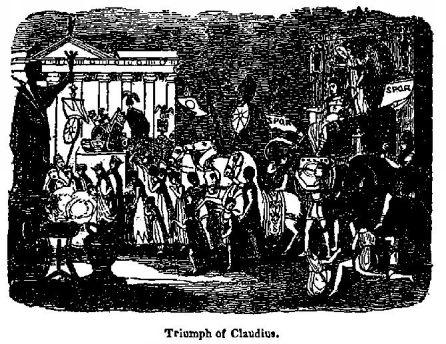
6. He even undertook to gratify the people by foreign[Pg. 287] conquest. The Britons, who had for nearly a hundred years been left in quiet possession of their own island, began to seek the mediation of Rome, to quell their intestine commotions. 7. The principal man who desired to subject his native country to the Roman dominion, was one Ber'icus, who persuaded the emperor to make a descent upon the island, magnifying the advantages that would attend the conquest of it. 8. In pursuance of his advice, therefore, Plau'tius, the prætor, was ordered to go into Gaul, and make preparations for this great expedition. At first, indeed, his soldiers seemed backward to embark, declaring that they were unwilling to make war beyond the limits of the world; for so they judged Britain to be. However, they were at last persuaded to go, and the Britons were several times overthrown.
9. These successes soon after induced Claud'ius to go into Britain in person, under pretence that the natives were still seditious, and had not delivered up some Roman fugitives, who had taken shelter among them. 10. However, this exhibition seemed rather calculated for show than service: the time he continued in Britain, which was in all but sixteen days, was more taken up in receiving homage than extending his conquests. 11. Great rejoicings were made upon his return to Rome: the senate decreed him a splendid triumph; triumphal arches were erected to his honour, and annual games instituted to commemorate his victories. 12. In the mean time the war was vigorously prosecuted by Plau'tius, and his lieutenant Vespasian, who,[Pg. 288] according to Sueto'nius, fought thirty battles, and reduced a part of the island into the form of a Roman province.
13. However, this war broke out afresh under the government of Osto'rius, who succeeded Plau'tius. The Britons, either despising him for want of experience, or hoping to gain advantages over a person newly come to command, rose up in arms, and disclaimed the Roman power. 14. The Ice'ni, who inhabited Suffolk, Norfolk, Cambridge, and Huntingdonshire; the Can'gi, in Wiltshire and Somersetshire; and the Brigan'tes, in Yorkshire, &c. made a powerful resistance, though they were at length overcome; but the Silu'res, or inhabitants of South Wales, under their king Carac'tacus, were the most formidable opponents the Roman generals had ever yet encountered. 15. This brave barbarian not only made a gallant defence, but often claimed a doubtful victory. He, with great conduct, removed the seat of war into the most inaccessible parts of the country, and for nine years kept the Romans in continued alarm.
16. Upon the approach of Osto'rius, however, Carac'tacus, finding himself obliged to come to a decisive engagement, addressed his countrymen with calm resolution, telling them that this battle would either establish their liberty, or confirm their servitude; that they ought to remember the bravery of their ancestors, by whose valour they were delivered from taxes and tribute; and that this was the time to show themselves equal to their progenitors. 17. But nothing that undisciplined valour could perform availed against the conduct of the Roman legions. After an obstinate fight, the Britons were entirely routed: the wife and daughter of Carac'tacus were taken prisoners; and he himself, seeking refuge from Cartisman'dua, queen of the Brigan'tes, was treacherously delivered up to the conquerors. 18. When he was brought to Rome, nothing could exceed the curiosity of the people to behold a man who had, for so many years, braved the power of the empire. Carac'tacus testified no marks of base dejection. When he was led through the streets, and observed the splendor of every object around him—"Alas!" cried he, "how is it possible that people possessed of such magnificence at home, could think of envying Carac'tacus a humble cottage in Britain!" 19. When he was brought before the emperor, while the other prisoners sued for pity with the most abject lamentations, Carac'tacus stood before the tribunal with an intrepid air, and[Pg. 289] though he was willing to accept of pardon, was not mean enough to sue for it. "If," said he, "I had yielded immediately, and without opposing you, neither would my fortune have been remarkable, nor your glory memorable; you could not have been victorious, and I had been forgotten. If now, therefore, you spare my life, I shall continue a perpetual example of your clemency." Clau'dius generously pardoned him, and Osto'rius was decreed a triumph.
20. In the beginning of his reign Clau'dius gave the highest hopes of a happy continuance; but he soon began to lessen his care for the public, and to commit to his favourites all the concerns of the empire. This prince, weak from his infancy, was little able, when called to govern, to act but under the direction of others. 21. One of his chief instructors was his wife Messa'lina: whose name is become a common appellation for women of abandoned character. By her was Clau'dius urged on to commit cruelties, which he considered only as wholesome severities; while her crimes became every day more notorious, and exceeded what had ever been in Rome. For her crimes and enormities, however, she, together with her accomplice Cai'us Sil'ius, suffered that death they both had so justly deserved.
22. Clau'dius afterwards married Agrippi'na, the daughter of his brother German'icus, a woman of a cruel and ambitious spirit, whose only aim being to procure the succession of Nero, her son by a former marriage, she treated Claudius with such haughtiness, that he was heard to declare, when heated with wine, that it was his fate to smart under the disorders of his wives, and to be their executioner. 23. This expression sunk deep in her mind, and engaged all her faculties to prevent the blow; she therefore resolved not to defer a deed which she had meditated long before, which was to poison him. She for some time debated within herself in what quantity the poison should be administered, as she feared that too strong a dose would discover the treachery, while one too weak would fail of its effect. 24. At length she determined upon a poison of singular efficacy to destroy his intellects, and yet not suddenly to terminate his life; it was given among mushrooms, a dish the emperor was particularly fond of. 25. Shortly after he had eaten, he dropped down insensible; but this caused no alarm, as it was usual with him to eat till he had stupified his facilities, and been obliged to be carried from the table to his bed. 26. His constitution, however, seemed[Pg. 290] to overcome the effects of the potion; but Agrippi'na resolving to make sure of him, directed a wretch of a physician, her creature, to introduce a poisoned feather into his throat, under pretence of making him vomit, and thus to dispatch him, which had its intended effect. Thus died Clau'dius the First, the complicated diseases of whose infancy seemed to have affected and perverted all the faculties of his mind. He was succeeded by Nero, the son of Agrippi'na by her first husband. Nero had been adopted by Clau'dius.
Questions for Examination.
1. What happened on the death of Caligula?
2. Who was appointed his successor?
3. What was the character of Claudius?
4. How did he conduct himself?
5. By what farther acts did he distinguish his accession?
6. Did he adopt any warlike measure?
7. By whom was he persuaded to interfere?
8. Who was sent into that country, and what occurred in consequence?
9. What resolution did Claudius form?
10. Did he perform any memorable exploits?
11. Was his return celebrated?
12. Was the war in Britain now at an end?
13. Did this finish the war?
14. Who were the most formidable adversaries of the Romans?
15. How did he distinguish himself?
16. By what means did he strengthen the courage of his troops?
17. Were his efforts successful?
18. What happened on his arrival in Rome?
19. What was his behaviour before the emperor?
20. Did Claudius continue to govern well?
21. Who was the chief instigator of his cruelties?
22. Who was the second wife of Claudius, and what was her conduct towards him?
23. What was the consequence of this unguarded expression?
24. On what did she at length resolve?
25. What effect did it produce?
26. Did he recover? [Pg. 291]
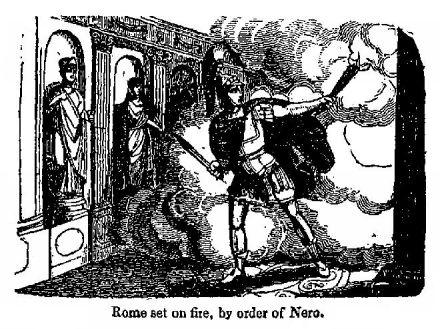
That so, obstructing those that quenched the fire,
He might at once destroy rebellious Rome.—Lee.
1. Nero, though but seventeen years old, began his reign with the general approbation of mankind. He appeared just, liberal, and humane. When a warrant for the execution of a criminal was brought to be signed, he would cry out with compassion, "Would to heaven that I had never learned to write!"
2. But as he increased in years, his native disposition began to show itself. The execution of his mother Agrippi'na was the first alarming instance he gave of his cruelty. After attempting to get her drowned at sea, he ordered her to be put to death in her palace; and coming to gaze upon the dead body, was heard to say, that he had never thought his mother so handsome a woman.
The manner of his attempt to drown her was extremely singular. He caused a vessel to be constructed that, by withdrawing some bolts, would separate in the open sea, and thus give her death the appearance of a shipwreck. Agrippi'na, naturally suspicious, at first refused to go on board; but, lulled into security by the artful blandishments of her son, she embarked. The attempt was made; but Agrippi'na was taken up by some fisher-boats, and conveyed to her own villa. The very great calmness of the sea prevented the[Pg. 292] possibility of its being considered as an accident. Agrippi'na, however, dissembled her suspicions, and informed the emperor of her wonderful escape. Three years after the death of his mother, he murdered his tutor Burrhus, and also his wife Octavia, a young princess of admirable virtue and beauty that he might marry the infamous Poppæ'a.
3. The mounds of virtue being thus broken down, Nero gave a loose to appetites that were not only sordid, but inhuman. There was a sort of odd contrast in his disposition: for while he practised cruelties sufficient to make the mind shudder with horror, he was fond of those amusing arts which soften and refine the heart. He was particularly addicted, even from childhood, to music, and not totally ignorant of poetry; chariot-driving was his favourite pursuit; and all these he frequently exhibited in public.
4. Happy had it been for mankind, had he confined himself to these; and contented with being contemptible, sought not to become formidable also. His cruelties exceeded all his other extravagancies. 5. A great part of the city of Rome was consumed by fire in his time, and to him most historians ascribe the conflagration. It is said that he stood upon a high tower, during the continuance of the flames, enjoying the sight, and singing, in a theatrical manner to his harp, verses upon the burning of Troy. Of the fourteen quarters into which Rome was divided, only four remained entire. None were permitted to lend assistance towards extinguishing the flames; and several persons were seen setting fire to the houses, alleging that they had orders for so doing. 6. However this be, the emperor used every art to throw the odium of so detestable an action from himself, and fix it upon the Christians, who were at that time gaining ground in Rome.
7. Nothing could be more dreadful than the persecution raised against them upon this false accusation. Some were covered with the skins of wild beasts, and, in that disguise, devoured by the dogs; some were crucified, and others burnt alive. "When the day was not sufficient for their tortures, the flames in which, they perished," says Ta'citus, "served to illuminate the night:" while Nero, dressed in the habit of a charioteer, regaled himself with a view of their tortures from his gardens, and entertained the people at one time with their sufferings, at another with the games of the circus. 8. In this persecution St. Paul was beheaded, and St. Peter crucified, with his head downwards; a mode of death he chose, as being more dishonourable than that of his divine master.[Pg. 293] Upon the ruins of the demolished city, Nero founded a palace, which he called his Golden House. It contained within its inclosure, artificial lakes, large wildernesses, spacious parks, gardens, orchards, vineyards, &c. &c. The entrance of the stately edifice was sufficiently lofty to admit a colossal statue of Nero, 120 feet high. The galleries, erected on three rows of tall pillars, were each a mile in length. The palace itself was tiled with gold (probably gilding), the walls covered with the same metal, and richly adorned with precious stones and mother-of-pearl: and the ceiling of one of the banqueting rooms represented the firmament beset with, stars, turning about incessantly night and day, and showering sweet waters on the guests.
9. A conspiracy formed against Nero, by Piso, a man of great power and integrity, which was prematurely discovered, opened a train of suspicions that destroyed many of the principal families in Rome. 10. The two most remarkable personages who fell on this occasion, were Sen'eca, the philosopher, and Lucan the poet, his nephew.
Epicha'ris, a woman of infamous character, who by some means was implicated in the conspiracy, deserves to be mentioned as an instance of female fortitude. She was condemned to the torture, but the united force of racks, stripes and fire, could not extort a word from her. The next day she was conducted in a chair to be tortured afresh, (for her limbs were so mangled and disjointed, that she could not stand,) she hung herself with her girdle to the top of the chair, voluntarily suspending the whole weight of her body to the noose: thus a woman once a slave, cheerfully endured the most exquisite torture, and even death, to save persons she scarcely knew, and from whom she had never received any favours.
Nero, either having real testimony, or else hating him for his virtues, sent a tribune to Sen'eca[24], informing him that he was suspected as an accomplice. The tribune found the philosopher at table with Pauli'na, his wife; and informing him of his business, Sen'eca replied without emotion, that his welfare depended upon no man; that he had never been[Pg. 294]accustomed to indulge the errors of the emperor, and would not do it now. 11. When this answer was brought to Nero, he demanded whether Sen'eca seemed afraid to die; the tribune replying that he did not appear in the least terrified; "Then go to him again," cried the emperor, "and give him my orders to die." Accordingly he sent a centurion to Sen'eca, signifying that it was the emperor's plea sure that he should die. Sen'eca seemed no way discomposed, but displayed the fortitude of conscious integrity. He endeavoured to console his wife, and exhorted her to a life of persevering virtue. 12. She seemed resolved, however, not to survive him, and pressed her request to die with him so earnestly, that Sen'eca, who had long looked upon death as a benefit, at last gave his consent; and the veins of both their arms were opened at the same time. 13. As Sen'eca was old, and much enfeebled by the austerities of his life, the blood flowed but slowly; so that he caused the veins of his legs and thighs to be opened also. His pains were long and violent, but they were not capable of repressing his fortitude or his eloquence. He dictated a discourse to two secretaries, which was read with great avidity after his death, but which has since perished in the lapse of time. 14. His agonies being now drawn out to a great length, he at last demanded poison from his physician; but this also failed of its effect, his body being already exhausted, and incapable of exciting its operation. He was from this carried into a warm bath, which only served to prolong his sufferings; at length, therefore, he was put in a stove, the vapour of which quickly dispatched him. 15. In the mean time his wife, Pauli'na, having fallen into a swoon with the loss of blood, had her arms bound up by her domestics, and by this means survived her husband for some years; but by her conduct during the rest of her life, she seemed never to forget her affection and his example.
16. The death of Lucan was not less remarkable. After he had lost a great quantity of blood from the veins of his arms, perceiving his hands and legs already dead, while the vital parts still continued warm and vigorous, he called to mind the description of his own poem of the Pharsa'lia, of a person dying in similar circumstances, and expired while he was repeating the passage.
17. The death of C. Petro'nius, about this time, is too remarkable to be passed over in silence. This person, whom some historians suppose to be [Pg. 295]the author of the piece entitled T. Petro'nii Arbi'tri Saty'ricon, was an Epicu'rean, both in principle and practice. In a court like that of Nero, he was esteemed for his refinements in luxury, and became the emperor's tutor in this exquisite art. 18. Accused of being privy to Piso's conspiracy, he was committed to prison. Petro'nius, who could not endure the anxiety of suspense, resolved upon putting himself to death, by causing his veins to be opened. 19. In the mean time, he conversed with his friends, not upon maxims of philosophy, or grave subjects, but upon such topics as had amused his gayest revels. He listened while they recited the lightest poems; and by no action, no word, no circumstance, showed the perplexity of a dying person. 20. Shortly after him, Numi'cius Thermus, Bare'a Sora'nus, and Pe'tus Thra'sea, were put to death. The valiant Cor'bulo, who had gained Nero so many victories over the Parthians, followed next. Nor did the empress Poppæ'a herself escape. 21. At length human nature grew weary of bearing her persecutor; and the whole world seemed to rouse, as if by common consent, to rid the earth of a monster.
Questions for Examination.
1. What was Nero's conduct at the commencement of his reign?
2. Did this disposition continue?
3. What was there peculiar in his disposition?
4. Were these his greatest faults?
5. Of what heinous crime is he accused?
6. On whom was the odium of this barbarous action cast?
7. What was the consequence to these unhappy men?
8. What eminent persons suffered on this occasion?
9. Did not these cruelties give birth to conspiracies?
10. What persons of note suffered in consequence?
11. Did this defence save his life?
12. Were his exhortations effectual?
13. Relate the circumstances of Seneca's death?
14. Were not other means resorted to?
15. Did not Paulina survive him?
16. Describe the death of Lucan.
17. What other victim of Nero's cruelty deserves mention?
18. What brought him into danger?
19. How did he meet death?
20. Were not other illustrious persons sacrificed?
21. Were these cruelties committed with impunity?[Pg. 296]
O breath of public praise,
Short-lived and vain; oft gained without desert,
As often lost unmerited: composed
But of extremes—Havard.
1. Ser'vius Galba, at that time governor of Spain, was remarkable for his wisdom in peace, and his courage in war; but as a display of talents under corrupt princes is dangerous, he, for some years, had seemed to court obscurity and an inactive life. 2. Willing, however, to rid his country of the monster that now occupied the throne, he accepted the invitation of Vindex, to march with an army towards Rome. 3. From the moment he declared against Nero, the tyrant considered himself as fallen. He received the account as he was at supper, and instantly struck with terror, overturned the table with his foot, breaking two crystal vases of immense value. He fell into a swoon, and on his recovery tore his clothes and struck his head, crying out, "that he was utterly undone." 4. He now called for the assistance of Locus'ta, a woman famous in the art of poisoning, to furnish him with the means of death; but being prevented in this, and the revolt becoming general, he went in person from house to house; but the doors were shut against him. Being reduced to a state of desperation, he desired that one of his favourite gladiators might dispatch him; but even in this request not one would obey. "Alas," cried he, "have I neither friend nor enemy?" then running desperately forth, he seemed resolved to plunge headlong into the Ti'ber. 5. But his courage failed him; he made a sudden stop, as if willing to re-collect his reason, and asked for some sacred place where he might reassume his courage, and meet death with becoming fortitude. 6. In this distress, Pha'on, one of his freedmen, offered him his country-house, about four miles distant, where he might for some time remain concealed. Nero accepted the offer; and, with his head covered, hiding his face with his handkerchief, he mounted on horseback, attended by four of his domestics, of whom the wretched Sporus was one. 7. His journey, though short, was crowded with adventures. An earthquake gave him the first alarm. The lightning from heaven next flashed in his face. Round him he heard nothing but confused noises from the camp, the cries of the soldiers imprecating a thousand evils upon his head. 8. A traveller, meeting him on the way, cried, "Those men are in pursuit of Nero." Another asked him if there was any news of Nero in the city. His horse taking fright at a dead body that lay near the[Pg. 297] road, he dropped his handkerchief, when a soldier addressing him by name, he quitted his horse, and forsaking the highway, entered a thicket that led towards the back part of Pha'ron's house, making the best of his way among the reeds and brambles with which the place was overgrown. 9. During this interval, the senate, finding the Præto'rian guards had taken part with Galba, declared him emperor, and condemned Nero to die, mo're majo'rum; that is, according to the rigour of the ancient laws. 10. When he was told of the resolution of the senate, he asked what was meant by being punished according to the rigour of the ancient laws? To this it was answered, that the criminal was to be stripped naked, his head fixed in a pillory, and in that posture he was to be scourged to death. 11. Nero was so terrified at this, that he seized two poniards, which he had brought with him: after examining their points, he returned them, however, to their sheaths, pretending that the fatal moment was not yet arrived. 12. He then desired Sporus to begin the lamentations which were used at funerals; he next entreated that one of his attendants would die, to give him courage by his example, and afterwards began to reproach his own cowardice, crying out, "Does this become Nero? Is this trifling well-timed? No!—let me be courageous!" In fact, he had no time to spare; for the soldiers who had been sent in pursuit of him, were just then approaching the house. 13. Upon hearing, therefore, the sound of the horses' feet, he set a dagger to his throat, with which, by the assistance of Epaphrod'itus, his freedman and secretary, he gave himself a mortal wound. 14. However, he was not yet dead when one of the centurions, entering the room and pretending that he came to his relief, attempted to stop the blood with his cloak. But Nero, regarding him with a stern countenance, said, "It is now too late! Is this your fidelity?" Upon which, with his eyes fixed and frightfully staring, he expired; exhibiting, even after death, a ghastly spectacle of innoxious tyranny. 15. He reigned thirteen years, seven months, and twenty-eight days, and died in the thirty-second year of his age.
16. Galba was seventy-two years old when he was declared emperor, and was then in Spain with his legions. He soon found that his being raised to the throne was but an inlet to new disquietudes. 17. He seemed to have three objects in view: to curb the insolence of the soldiers; to punish those vices which had risen to an[Pg. 298] enormous height in the last reign; and to replenish the exchequer, which had been drained by the prodigality of his predecessors. 18. However, permitting himself to be governed by favourites, he at one time showed himself severe and frugal; at another remiss and prodigal; condemning some illustrious persons without any hearing, and pardoning others, though guilty. In consequence of this, seditions were kindled, and factions promoted. 19. Galba was sensible that, besides his age, his want of an heir rendered him less respected: he resolved, therefore, to adopt a person whose virtues might deserve such advancement, and protect his declining age from danger; but his favourites wished to give him an heir of their own choosing; so that there arose a great contention among them upon this occasion. 20. Otho made earnest application for himself, alleging the great services he had done the emperor, as being the first man of note who came to his assistance when he declared against Nero. 21. However, Galba, being fully resolved to consult the public good alone, rejected his suit; and, on a day appointed, ordered Piso Lucia'nus to attend him. The character given by historians of Piso is, that he was every way worthy of the honour designed him. 22. Taking this youth by the hand, Galba adopted him to succeed in the empire, giving him the most wholesome lessons for guiding his future conduct. Piso showed that he was highly deserving this distinction, in all his deportment there appeared such modesty, firmness, and equality of mind as bespoke him rather capable of discharging than ambitious of obtaining his present dignity. 23. But the army and the senate did not seem equally disinterested upon this occasion; they had been so long used to bribery and corruption, that they could now bear no emperor who was not in a capacity of satisfying their avarice. The adoption, therefore, of Piso, was coldly received; for his virtues were no recommendation in a time of universal depravity. 24. Otho, who had long been a favourite of Galba, and hoped to be adopted a successor in the empire, finding himself disappointed, and stimulated by the immense load of debt which he had contracted by his riotous way of living, resolved upon obtaining the empire by force, since he could not do it by peaceable succession. Having corrupted the fidelity of the army, he stole secretly from the emperor while he was sacrificing, and, assembling the soldiers, he,[Pg. 299] in a short speech, urged the cruelties and the avarice of Galba. 25. Finding his invectives received with universal shouts by the army, he entirely threw off the mask, and avowed his intention of dethroning him. The soldiers being ripe for sedition, immediately seconded his views, and taking Otho upon their shoulders, declared him emperor; and to strike the citizens with terror, carried him, with their swords drawn, into the camp.
26. Soon after, finding Galba in some measure deserted by his adherents, the soldiers rushed in upon him, trampling under foot the crowds of people that then filled the forum. 27. Galba seeing them approach, seemed to recollect all his former fortitude; and bending his head forward, bid the assassins strike it off, if it were for the good of the people. 28. The command was quickly obeyed. The soldier who struck it off stuck it upon the point of a lance, and contemptuously carried it round the camp; his body remaining unburied in the streets till it was interred by one of his slaves. His short reign of seven months was as illustrious by his own virtues as it was contaminated by the vices of his favourites, who shared in his downfall.
29. Otho, who was now elected emperor, began his reign by a signal instance of clemency, in pardoning Marius Celsus, who had been highly favoured by Galba; and not content with barely forgiving, he advanced him to the highest honours, asserting that "fidelity deserved every reward."
30. In the mean time, the legions in Lower Germany having been purchased by the large gifts and specious promises of Vitel'lius their general, were at length induced to proclaim him emperor; and, regardless of the senate, they declared that they had an equal right to appoint to that high station, with the cohorts at Rome.
31. Otho departed from Rome with all haste to give Vitel'lius battle. The army of Vitel'lius, which consisted of seventy thousand men, was commanded by his generals Va'lens and Cecin'na, he himself remaining in Gaul, in order to bring up the rest of his forces. Both sides hastened to meet each other with so much animosity and precipitation, that three considerable battles were fought in the space of three days, in all of which Otho and the Romans had the advantage. 32. These successes, however, were but of short continuance, for Va'lens and Cecin'na, who had hitherto acted separately, joining their forces, and strengthening their armies with fresh supplies, resolved to come to[Pg. 300] a general engagement. Otho's forces were partially over thrown at Bedria'cum, a village near Cremo'na, in Lombardy, in Italy; and though he had still numerous armies at his devotion, he killed himself shortly after, having reigned three months and five days, and was succeeded by Vitel'lius.
Questions for Examination.
1. What was the character of Sergius Galba?
2. Did he at length emerge from his obscurity?
3. Was he formidable to Nero?
4. What was the conduct of Nero on this emergency?
5. Did he actually do so?
6. Was his request complied with?
7. What befell him by the way?
8. What farther happened?
9. What occurred in the interval?
10. How did Nero receive this intelligence?
11. Did he resolve to await this terrible punishment?
12. How did he contrive to put off the fatal moment?
13. What at length put an end to this irresolution?
14. Was he dead when the soldiers arrived?
15. How long did he reign?
16. What was the age of Galba on his accession?
17. What were his principal views?
18. Was his conduct regular and consistent?
19. What important measure did he adopt?
20. Who was the chief candidate on the occasion?
21. Was he chosen?
22. Was Piso the chosen successor, and what was his character?
23. Was this adoption generally approved?
24. Did not Otho attempt to set him aside?
25. Was he favourably received?
26. Did Galba suppress this rebellion?
27. What was his behaviour on the occasion?
28. Was this command obeyed, and what treatment did Galba experience?
29. How did Otho commence his reign?
30. Did he reign without a rival?
31. What was the consequence of this rivalship?
32. Was Otho finally successful? [Pg. 301]
Afflicted Israel shall sit weeping down,
Fast by the stream where Babel's waters run;
Their harps upon the neighbouring willows hung.
Nor joyous hymn encouraging their tongue.
Nor cheerful dance their feet; with toil oppressed,
Their wearied limbs aspiring but to rest.—Prior.
1. Vitel'lius was declared emperor by the senate, and received the marks of distinction which were now accustomed to follow the appointments of the strongest side.
2. He had been accustomed from his youth to dissipation and applause. Caligula was pleased with his skill in driving a chariot; Claudius loved him because he was a great gamester; and he gained the favour of Nero by wishing him to sing publicly in the theatre. Upon his arrival at Rome, he entered the city, not as a place he came to govern with justice, but as a town that was become his own by the laws of conquest.
3. Vitel'lius soon gave himself up to all kinds of luxury and profuseness; but gluttony was his favourite vice. His entertainments, seldom indeed at his own cost, were prodigiously expensive. He frequently invited himself to the tables of his subjects; in the same day breakfasting with one, dining with another, and supping with a third. 4. By such vices and by enormous cruelties, he became a burthen to himself, and odious to all mankind. Having become insupportable to the inhabitants of Rome, the legions of the east unanimously resolved to make Vespa'sian emperor.
Vespa'sian was by no means of an illustrious family, his father being only a collector of the tax called quadragesima. Nor was his conduct, previous to his accession to the imperial throne, calculated to do him honour, as he was guilty of the meanest flattery and servility to ingratiate himself with men in power. Yet, as a general, he was indefatigable in his duties, and of unquestionable valour; abstemious in his diet, and plain in his dress. On attaining to the imperial dignity he appears to have laid aside every vice except avarice. His elevation neither induced him to assume arrogant and lofty airs, nor to neglect those friends who had shown[Pg. 302] themselves deserving of his favour.
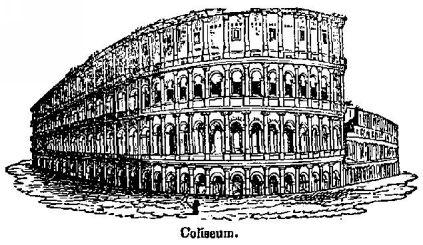
Desirous of convincing the world that he owed his good fortune to merit alone, he disdained to court the soldiers by largesses; in short, he displayed a nobleness of disposition worthy of the most illustrious birth, and befitting the exalted station to which he had arrived. This prince was the founder of the noble amphitheatre, called the Coliseum, which remains to this day. Twelve thousand Jewish captives were employed in its erection, and it was capable of containing 80,000 spectators seated, and 30,000 standing. It is now in ruins.
5. During the preparations against him, Vitel'lius, though buried in sloth and luxury, resolved to make an effort to defend the empire; and his chief commanders, Va'lens and Cecin'na, were ordered to make all possible preparations to resist the invaders. 6. The first army that entered Italy with a hostile intention was under the command of Anto'nius Pri'mus, who was met by Cecin'na, near Cremo'na. A battle was expected to ensue; but a negociation taking place, Cecin'na was prevailed upon to change sides, and declared for Vespa'sian.[25] His army, however, quickly repented of what they had done, and, imprisoning their general, attacked Anto'nius, though without a leader. 7. The engagement continued the whole night; and in the morning, after a short repast, both armies engaged a second time; when the soldiers of Anto'nius saluting the rising sun, according to custom, the Vitel'lians supposed that they had received new reinforcements, and betook themselves to flight, with the loss of thirty thousand men.
8. In the mean time, Vitel'lius made offers to Vespa'sian of resigning the empire in his favour, provided his life were[Pg. 303] spared, and a sufficient revenue allotted for his support. In order to enforce this proposal, he issued from his palace in deep mourning, with all his domestics weeping round him. 9. He then went to offer the sword of justice to Cecil'ius, the consul, which he refusing, the abject emperor prepared to lay down the ensigns of empire in the Temple of Concord; but being interrupted by some who cried out, that he himself was Concord, he resolved, upon so weak an encouragement, still to maintain his power, and immediately prepared for his defence.
10. During this fluctuation of counsels, one Sabi'nus, who had advised Vitel'lius to resign, perceiving his desperate situation, resolved, by a bold step, to favour Vespa'sian; and accordingly seized upon the capitol. But he was premature in his attempt; for the soldiers of Vitel'lius attacked him with great fury; and prevailing by their numbers, soon laid that beautiful building in ashes. 11. During this dreadful conflagration, Vitel'lius was feasting in the palace of Tibe'rius, and beheld all the horrors of the assault with satisfaction. 12. Sabi'nus was taken prisoner, and shortly after executed by the emperor's command. Young Domi'tian, his nephew, who was afterwards emperor, escaped by flight, in the habit of a priest; and the rest, who survived the fire, were put to the sword.
13. But Anto'nius, Vespa'sian's commander, being arrived before the walls of the city, the forces of Vitel'lius resolved upon defending it to the utmost extremity. It was attacked with fury; while the army within, sallying out upon the besiegers, defended it with equal obstinacy. The battle lasted the whole day; the besieged were driven back into the city, and a dreadful slaughter made of them in the streets which they vainly attempted to defend.
14. Vitel'lius was soon found hidden in an obscure corner, whence he was taken by a party of the conquering soldiers. Still, however, desirous of adding a few hours to his miserable life, he begged to be kept in prison till the arrival of Vespa'sian at Rome, pretending that he had secrets of importance to discover. 15. But his entreaties were vain; the soldiers binding his hands behind him, and throwing a halter round his neck, led him along, half naked, into the public forum, loading him with all the bitter reproaches their malice could suggest, or his cruelty might deserve. At length, being come to the place of punishment, they put him to death with blows: and then dragging the dead body[Pg. 304] through the streets with a hook, they threw it, with all possible ignominy, into the river Tiber.
16. Vespa'sian was now declared emperor by the unanimous consent both of the senate and the army; and dignified with all those titles which now followed rather the power than the merit of those who were appointed to govern. 17. Having continued some months at Alexan'dria, in Egypt, where it is said he cured a blind man and a cripple by touching them, he set out for Rome. Giving his son, Ti'tus, the command of the army that was to lay siege to Jerusalem, he himself went forward, and was met many miles from Rome by all the senate, and the inhabitants, who gave the sincerest testimony of their joy, in having an emperor of such great and experienced virtue. 18. Nor did he in the least disappoint their expectations; as he showed himself equally assiduous in rewarding merit and pardoning his adversaries; in reforming the manners of the citizens, and setting them the best example in his own.
19. In the mean time Titus carried on the war against the Jews with vigour. This obstinate and infatuated people had long resolved to resist the Roman power, vainly hoping to find protection from heaven, which their impieties had utterly offended. 20. Their own historian represents them as arrived at the highest pitch of iniquity; while famines, earthquakes, and prodigies, all conspired to forebode their approaching ruin. 21. Nor was it sufficient that heaven and earth seemed combined against them; they had the most bitter dissensions among themselves, and were divided into two parties, who robbed and destroyed each other with impunity: constantly pillaging, yet boasting their zeal for the religion of their ancestors.
22. At the head of one of these parties was an incendiary, whose name was John. This fanatic affected sovereign power, and filled the whole city of Jeru'salem, and all the towns around, with tumult and pillage. In a short time a new faction arose, headed by one Si'mon, who, gathering together multitudes of robbers and murderers who had fled to the mountains, attacked many cities and towns, and reduced all Idume'a under his power. 23. Jeru'salem, at length, became the theatre in which these two demagogues exercised their mutual animosity: John was possessed of the temple, while Si'mon was admitted into the city; both equally enraged against each other; while slaughter and devastation were the consequence of their pretensions. Thus[Pg. 305] did a city formerly celebrated for peace and unity, become the seat of tumult and confusion.
24. In this miserable situation, Ti'tus began his operations within six furlongs of Jeru'salem, during the feast of the passover, when the place was filled with an infinite multitude of people, who had come from all parts to celebrate that great solemnity. 25. The approach of the Romans produced a temporary reconciliation between the contending factions within the city; so that they unanimously resolved to oppose the common enemy, and decide their domestic quarrels at a more convenient season. 26. Their first sally, which was made with much fury and resolution, put the besiegers into great disorder, and obliged them to abandon their camp, and fly to the mountains; however, rallying immediately after, the Jews were forced back into the city, while Ti'tus, in person, showed surprising instances of valour and conduct.
27. The city was strongly fortified with three walls on every side, except where it was fenced by precipices. Ti'tus began by battering down the outward wall, which, after much fatigue and danger, he effected; in the mean time showing the greatest clemency to the Jews, and offering them repeated assurances of pardon. Five days after the commencement of the siege, Ti'tus broke through the second wall; and though driven back by the besieged, he recovered his ground, and made preparations for battering the third wall, which was their last defence. 28. But first he sent Jose'phus, their countryman, into the city, to exhort them to yield; who using all his eloquence to persuade them, was answered only with scoffs and reproaches. 29. The siege was now therefore carried on with greater vigour than before; formidable engines for throwing darts and stones were constructed, and as quickly destroyed by the enemy. At length it was resolved in council to surround the whole city with a trench, and thus prevent all relief and all succours from abroad. 30. This, which was quickly executed, seemed no way to intimidate the Jews. Though famine, and pestilence its necessary attendant, began now to make the most horrid ravages among them, yet this desperate people still resolved to hold out. 31. Ti'tus now cut down all the woods within a considerable distance of the city; and causing more batteries to be raised, he at length beat down the wall, and in five days entered the citadel by force. 32. The Jews, however, continued to deceive themselves with[Pg. 306] absurd expectations, while many false prophets deluded the multitude, by declaring that they should soon have assistance from God. The heat of the battle was now gathered round the inner wall of the temple, while the defendants desperately combatted from the top. 33. Ti'tus was desirous of saving this beautiful structure; but a soldier casting a brand into some adjacent buildings, the fire communicated to the temple; and notwithstanding the utmost endeavours on both sides, the whole edifice was quickly consumed. 34. The sight of the temple in ruins effectually served to damp the ardour of the Jews. They now began to suppose that heaven had forsaken them, while their cries and lamentations echoed from the adjacent mountains. Even those who were almost expiring, lifted up their dying eyes to bewail the loss of their temple, which they valued more than life itself. 35. The most resolute, however, still endeavoured to defend the upper and stronger part of the city, named Sion; but Ti'tus, with his battering engines, soon made himself entire master of the place. 36. John and Simon were taken from the vaults where they had concealed themselves; the former was condemned to perpetual imprisonment, and the latter reserved to grace the conqueror's triumph. The greatest part of the populace were put to the sword; and the city was, after a six month's siege, entirely razed, and its site ploughed up; so that according to our Saviour's prophecy, not one stone remained upon another. Those who perished in this siege amounted to about a million; the captives to almost a hundred thousand.[26]
Questions for Examination.
1. Who succeeded Otho?
2. In what way did he assume the sovereignty?
3. How did he conduct himself in his new station?
4. What were the consequences of this conduct?
5. Did Vitellius tamely submit to his rival?
6. Who first commenced hostilities?
7. What followed?
8. What was the conduct of Vitellius on this occasion?
9. What farther measures did he adopt?
10. Were the friends of Vespasian idle at this juncture?
11. How was Vitellius engaged at the time of this disaster?
12. What became of Sabinus?[Pg. 307]
13. What was the consequence of this success on the part of Vitellius?
14. What became of the fallen emperor?
15. Was his request granted?
16. Did Vespasian quietly succeed?
17. What were his first measures?
18. Were they disappointed in their expectations?
19. What was the state of the Jewish war?
20. What was the state of the Jewish nation?
21. Were they united among themselves?
22. Who were at the head of these factions?
23. What was the chief theatre of their enormities?
24. At what remarkable season did Titus commence his attack?
25. What effect did this attack produce?
26. Did the Jews bravely defend their city?
27. What progress did Titus make in the siege?
28. Did he make no attempt to persuade the Jews to surrender?
29. What measures were then adopted?
30. Did these formidable measures terrify the Jews?
31. By what means did Titus gain the city?
32. Was all opposition now at an end?
33. Was the temple destroyed?
34. What effect did this sad event produce?
35. Were there none who attempted farther resistance?
36. What became of the inhabitants and their chiefs?
This world, 'tis true.
Was made for Cæsar—but for Titus too;
And which more blest? who chain'd his country, say,
Or, he whose virtue sigh'd to lose a day!—Pope.
1. Upon the taking of Jerusalem, the soldiers would have crowned Titus as conqueror; but he modestly refused the honour, alleging, that he was only an instrument in the hand of heaven, that manifestly declared its wrath against the Jews. 2. At Rome, however, all men's mouths were filled with the praises of the conqueror, who had not only showed himself an excellent general, but a courageous combatant. His return, therefore, in triumph, with Vespa'sian his father, was marked with all the magnificence and joy in the power of men to express. All things that were esteemed valuable or beautiful were brought to adorn this great occasion. 3. Among the rich spoils were exposed vast quantities of gold, taken out of the temple; but the Book of the Holy Law was not the least remarkable among the magnificent profusion. 4. This was the first time that ever Rome saw the father and the son triumphant together. A triumphal arch was erected upon this occasion, on which were described the victories of Titus over the Jews; and it remains almost entire to this day.[Pg. 308]
5. Few emperors have received a better character from historians than Vespasian; yet his numerous acts of generosity and magnificence could not preserve his character from the imputation of rapacity and avarice; for it is well known that he descended to some very unusual and dishonourable imposts.
6. Having reigned ten years, beloved by his subjects, and deserving their affection, he was seized with an indisposition at Campa'nia, which he perceived would be fatal. 7. Finding his end approaching, he exerted himself, and cried out, "An emperor ought to die standing;" whereupon, raising himself upon his feet, he expired in the arms of those who sustained him.
8. Titus was joyfully received as emperor, and began his reign with the practice of every virtue that became a sovereign and a man. During the life of his father, there had been many imputations against him both for cruelty, lust, and prodigality; but upon his exaltation to the throne, he seemed to have entirely taken leave of his former vices, and became an example of the greatest moderation and humanity. 9. His first step towards gaining the affections of his subjects, was the moderating of his passions, and bridling his inclinations. 10. He discarded those who had been the ministers of his pleasures, though he had formerly taken great pains in the selection. 11. This moderation, added to his justice and generosity, procured him the love of all good men, and the appellation of the Delight of Mankind; which all his actions seemed calculated to insure.
12. Ti'tus took particular care to punish all informers, false witnesses, and promoters of dissension. Wretches who had their rise in the licentiousness and impunity of former reigns, were now become so numerous, that their crimes called loud for punishment. 13. Of these he daily made public example, condemning them to be scourged in the public streets, dragged through the theatre, and then banished into the uninhabited parts of the empire, or sold as slaves. 14. His courtesy and readiness to do good have been celebrated even by Christian writers; his principal rule being, not to send away a petitioner dissatisfied. One night, recollecting that he had done nothing beneficial to mankind during the day, he cried out, "I have lost a day!" A sentence too remarkable not to be had in remembrance.
15. In the first year of his reign, an eruption of Mount[Pg. 309] Vesu'vius overwhelmed many towns,[27] throwing its ashes into countries more than a hundred miles distant. Upon this memorable occasion, Pliny, the naturalist, lost his life; being impelled by too eager a curiosity to observe the eruption, he was suffocated in the flames. 16. This and other disasters were, in some measure, counterbalanced by the successes in Britain, under Agrico'la. This excellent general, having been sent into Britain towards the latter end of Vespasian's reign, showed himself equally expert in quelling the refractory, and civilizing those who had formerly submitted to the Roman power. 17. The Ordovi'ces, or inhabitants of North Wales, were the first that were subdued. He then made a descent upon the isle of An'glesey, which surrendered at discretion. 18. Having thus rendered himself master of the whole country, he took every method to restore discipline to his whole army, and to introduce politeness among those whom he had conquered. He exhorted them, both by advice and example, to build temples, theatres, and stately houses. He caused the sons of their nobility to be instructed in the liberal arts, and to be taught the Latin language; and induced them to imitate the Roman modes of dress and living. 19. Thus, by degrees, this barbarous people began to assume the luxurious[Pg. 310] manners of their conquerors, and even to outdo them in all the refinements of sensual pleasure. 20. Upon account of the successes in Britain, Titus was saluted Impera'tor[28] for the fifteenth time; but he did not long survive this honour, being seized with a violent fever at a little distance from Rome. He expired shortly after, but not without suspicion of treachery from his brother Domi'tian, who had long wished to govern. He died in the forty-first year of his age, having reigned two years, two months, and twenty days.
21. The beginning of Domi'tian's reign was universally acceptable to the people, as he appeared equally remarkable for his clemency, liberality and justice.[29] 22. But he soon began to show the natural deformity of his mind. Instead of cultivating literature, as his father and brother had done, he neglected all kinds of study, addicting himself wholly to meaner pursuits, particularly archery and gaming. 23. He was so very expert an archer, that he would frequently cause one of his slaves to stand at a great distance, with his hand spread as a mark, and would shoot his arrows with such exactness, as to stick them all between his fingers. 24. He instituted three sorts of contests to be observed every five years, in music, horsemanship and wrestling; but at the same time he banished all philosophers and mathematicians from Rome. 25. No emperor before him entertained the people with such various and expensive shows. During these diversions he distributed great rewards, sitting as president himself, adorned with a purple robe and crown, with the priests of Ju'piter, and the college of Fla'vian priests about him. 26. The meanness of his occupations in solitude, was a just contrast to his exhibitions of public ostentation. He usually spent his hours of retirement in catching flies, and sticking them through with a bodkin; so that one of his servants, being asked if the emperor were alone, answered, that he had not so much as a fly to bear him company. 27. His vices seemed every day to increase, and his ungrateful treatment of Agrico'la afforded a convincing proof of his natural malevolence. 28.[Pg. 311] Domi'tian was always particularly fond of obtaining a military reputation, and therefore felt jealous of it in others. He had marched some time before into Gaul, upon a pretended expedition against the Catti, a people of Germany, and without even seeing the enemy, resolved to have the honour of a triumph upon his return to Rome. For that purpose he purchased a number of slaves, whom he dressed in German habits, and at the head of this miserable procession he entered the city, amid the apparent acclamations and concealed contempt of all his subjects.
Questions for Examination.
1. How did Titus conduct himself after this important conquest?
2. How was he received at Rome?
3. What were the most remarkable among the spoils?
4. What peculiarity attended this triumph?
5. What was the character of Vespasian?
6. How many years did Vespasian reign?
7. Did he not display great resolution at the hour of death?
8. How did Titus commence his reign?
9. By what means did he gain the love of his subjects?
10. What sacrifices did he make for this purpose?
11. Did he succeed in his views?
12. What class of delinquents met his most decided disapprobation?
13. What punishment was inflicted on them?
14. What were his chief virtues?
15. What remarkable event occurred in this reign, and what eminent personage became its victim?
16. By what successes was this disaster counterbalanced?
17. What were his first enterprizes?
18. What methods did he take to civilize the conquered countries?
19. Were his measures successful?
20. Did Titus long enjoy the glory of this conquest?
21. How did Domitian commence his reign?
22. Did he persevere in his meritorious conduct?
23. In what exercise did he excel?
24. Did he encourage the arts and sciences?
25. Was he magnificent in his exhibitions?
26. How did he employ himself in private?
27. Did time render him less vicious?
28. By what means did he attempt to acquire military fame?[Pg. 312]
What wretch would groan
Beneath the galling load of power, or walk
Upon the slippery pavements of the great!—Somerville.
1. The success of Agric'ola in Britain affected Domit'ian, with an extreme degree of envy. This excellent general pursued the advantages which he had already obtained; he subdued the Caledo'nians, and overcame Gal'gacus, the British chief, who commanded an army of thirty thousand men; afterwards sending out a fleet to scour the coast, he discovered Great Britain to be an island. He likewise discovered and subdued the Orkneys; and thus reduced the whole into a civilized province of the Roman empire. 2. When the account of these successes was brought to Domitian, he received it with a seeming pleasure, but real uneasiness. He thought Agric'ola's rising reputation a tacit reproach upon his own inactivity; and instead of attempting to emulate, he resolved to suppress the merits of his services. 3. He ordered him, therefore, external marks of approbation, and took care that triumphal ornaments, statues, and other honours should be decreed him; but at the same time he removed him from his command, under a pretence of appointing him to the government of Syria. 4. By these means Agric'ola surrendered up his province to Sallus'tius Lucul'lus, but soon found that Syria was otherwise disposed of. Upon his return to Rome, which was privately and by night, he was coolly received by the emperor; and dying some time after in retirement, it was generally supposed that his end was hastened by Domi'tian's direction.
5. Domi'tian soon found the want of so experienced a commander, in the many irruptions of the barbarous nations that surrounded the empire. The Sarma'tians in Europe, joined with those of Asia, made a formidable invasion, at once destroying a whole legion, and a general of the Romans. The Da'cians, under the conduct of Dece'balus, their king, made an irruption, and overthrew the Romans in several engagements. 6. At last, however, the barbarians were repelled, partly by force, and partly by the assistance of money, which only served to enable them to make future invasions with greater advantage. 7. But in whatever manner the enemy might have been repelled, Domi'tian was resolved not to lose the honours of a triumph. He returned in great splendour to Rome; and, not contented with thus triumphing twice without a victory, he resolved to take the[Pg. 313] surname of German'icus, for his conquests over a people with whom he never contended.
8. In proportion as the ridicule increased against him, his pride seemed every day to demand greater homage. He would permit his statues to be made only of gold and silver; he assumed to himself divine honours; and ordered that all men should address him by the same appellations which they gave to the Divinity. 9. His cruelty was not inferior to his arrogance; he caused numbers of the most illustrious senators and others to be put to death, upon the most trifling pretences. One Æ'lius La'ma was condemned and executed only for jesting, though there was neither novelty nor poignancy in his humour. Occea'nus was murdered only for celebrating the nativity of O'tho. Pomposia'nus shared the same fate, because it was foretold by an astrologer that he should be emperor. Sallus'tius Lucul'lus his lieutenant in Britain, was destroyed only for having given his name to a new sort of lances of his own invention. Ju'nius Rus'ticus died for publishing a book, in which he commended Thra'sea and Pris'cus, two philosophers, who opposed Vespa'sian's coming to the throne.
10. Lu'cius Anto'nius, governor of Upper Germany, knowing how much the emperor was detested at home, resolved upon striking for the throne; and accordingly assumed the ensigns of imperial dignity. 11. As he was at the head of a formidable army, his success remained a long time doubtful; but a sudden overflow of the Rhine dividing his army, he was set upon at that juncture by Norman'dus, the emperor's general, and totally routed. The news of this victory, we are told, was brought to Rome by supernatural means, on the same day that the battle was fought. 12. Domi'tian's severity was greatly increased by this short-lived success. In order to discover the accomplices of the adverse party, he invented new tortures: sometimes cutting off the hands—at other times thrusting fire into the bodies of those whom he suspected of being his enemies. 13. In the midst of these severities, he aggravated his guilt by hypocrisy—never pronouncing sentence without a preamble full of gentleness and mercy. The night before he crucified the comptroller of his household, he treated him with the most flattering marks of friendship, and ordered him a dish of meat from his own table. He carried Areti'nus Cle'mens with him in his own litter the day he resolved upon his death. 14. He was particularly terrible to the senate and[Pg. 314] nobility, the whole body of whom he frequently threatened to extirpate entirely. At one time he surrounded the senate-house with his troops, to the great consternation of the senators. At another, he resolved to amuse himself with their terrors in a different manner. 15. Having invited them to a public entertainment, he received them all very formally at the entrance of his palace, and conducted them into a spacious hall, hung round with black, and illuminated by a few melancholy lamps, that diffused no more light than was just sufficient to show the horrors of the place. All around were to be seen coffins, with the names of each of the senators written upon them, together with other objects of terror, and instruments of execution. 16. While the company beheld all these preparations with silent agony, several men having their bodies blackened, each with a drawn sword in one hand, and a flaming torch in the other, entered the hall, and danced round them. 17. After some time, when, from the knowledge of Domi'tian's capricious cruelty, the guests expected nothing less than instant death, the doors were set open, and one of the servants came to inform them, that the emperor gave all the company leave to withdraw.
18. His cruelties were rendered still more odious by his avarice. 19. The last part of the tyrant's reign was more insupportable than any of the preceding. Ne'ro exercised his cruelties without being a spectator; but a principal part of the Roman miseries, during his reign, was to behold the stern air and fiery visage of the tyrant, which he had armed against sensibility by continued intemperance, directing the tortures, and maliciously pleased with adding poignance to every agony.
20. But a period was soon to be put to this monster's cruelties. Among the number of those whom he at once caressed and suspected, was his wife, Domi'tia, whom he had taken from Æ'lius La'ma, her former husband. 21. It was the tyrant's method to put down the names of all such as he intended to destroy, in his tablets, which he kept about him with great circumspection. Domi'tia fortunately happening to get a sight of them, was struck at finding her own name in the catalogue of those destined to destruction. 22. She showed the fatal list to Norba'nus and Petro'nius, præfects of the prætorian bands, who found themselves among the number of devoted victims; as likewise to Steph'anus, the comptroller of the household, who came[Pg. 315] into the conspiracy with alacrity. They fixed upon the eighteenth day of September for the completion of their great attempt. 23. Upon the emperor's preparing to go to the bath on the morning of that day, Petro'nius his chamberlain came to inform him that Steph'anus desired to speak upon an affair of the utmost importance. The emperor having given orders that his attendants should retire, Steph'anus entered with his hand in a scarf, which he had worn thus for some days, the better to conceal a dagger, as none were permitted to approach the emperor with arms. 24. He began by giving information of a pretended conspiracy, and exhibited a paper, in which the particulars were specified. While Domi'tian was reading the contents with eager curiosity, Steph'anus drew his dagger and struck him with much violence; but the wound not being mortal, Domi'tian caught hold of the assassin and threw him upon the ground, calling out for assistance. But Parthe'nius, with his freedman, a gladiator, and two subaltern officers, now coming in, they ran furiously upon the emperor and dispatched him: Steph'anus, however, was slain by the guards, but the other conspirators escaped in the tumult.
25. It is rather incredible, what some writers relate concerning Apollo'nius Tyane'us, who was then at Ephesus. This person, whom some call a magician, and some a philosopher, but who more probably was only an impostor, was, just at the minute in which Domi'tian was slain, lecturing in one of the public gardens of the city; but stopping short, on a sudden he cried out, "Courage, Steph'anus, strike the tyrant!" then, after a pause, "Rejoice, my friends, the tyrant dies this day;—this day do I say?—the very moment in which I kept silence he suffered for his crimes! He dies!"
26. Many prodigies are said to have portended his death; and if the Roman historians are to be credited, more preternatural appearances and predictions announced this event, than its importance deserved.[30] The truth seems to be, that a belief in omens and prodigies was again become prevalent, as the people were evidently relapsing into pristine barbarity, ignorance being ever the proper soil for a harvest of imposture. [Pg. 316]
Questions for Examination.
1. What advantages did Agricola gain in Britain?
2. How did Domitian receive the account of Agricola's success?
3. In what way did the emperor treat him?
4. To whom did Agricola surrender up his province?
5. What nations afterwards made irruptions into the Roman provinces?
6. By what means were the barbarians at length repelled?
7. What surname did Domitian assume?
8. To what extravagance did his pride lead him?
9. What trifling pretexts were made use of by Domitian to put to death some of the most illustrious Romans?
10. Who now assumed the ensigns of the imperial dignity?
11. By what general was Lucius Antonius defeated?
12. What new cruelties were resorted to by the emperor?
13. By what hypocritical conduct was he distinguished?
14. To whom was he particularly terrible?
15, 16, 17. What terrific ceremonies did he invent on one occasion?
18. Was the result fatal to them?
19. Did not his cruelties become still more insupportable at the latter part of his reign?
20. Who was among the number that he at the same time caressed and suspected?
21. Whose name did Domitia discover among his list of victims?
22. To whom did she show the fatal list, and what was resolved on?
23. What means were used by Stephanus to assassinate the emperor?
24. Relate the particulars of the assassination.
25. What exclamation is Apollonius Tyaneus said to have made at Ephesus, at the time of Domitian's death?
26. Did not the Romans relapse into their pristine state of barbarity about this period?
FOOTNOTES:
In his sixth consulship Augustus commanded a census to be made, when there was found the astonishing number of 4,060,000 inhabitants in Rome, which was fifty miles in circumference.
M. Primus, while governor of Macedon, had made an irruption into the country of the Odrysians; for this he was prosecuted, and pleaded that it was by the emperor's orders. Augustus denying this, L. Murena put the impudent question to him mentioned in the text.
An island on the coast of Lucania, in Italy; now called Santa Maria.
The date of Augustus's reign is here reckoned from the death of Antony, when he became sole monarch; but if it be reckoned from his first coming into power, soon after the death of Julius Cæsar, it is nearly 56 years. Augustus carried on his wars principally by his lieutenants, but he went personally into Spain and Gaul. His bravery, however, has been greatly called in question, and many flagrant instances of his cowardice recorded. How true they may be is not easy to determine.
The temple of Janus was now shut for the third time since the foundation of the city.
He began his reign, however, with the murder of Agrippa Posthumus, the grandson of Augustus.
Varus had been surprised by the Germans, defeated, and his whole army cut to pieces. Augustus was so grieved at this disgrace and loss, that, for a long time, he wore mourning, and frequently was heard to cry out, in the agony of his grief, "Restore me my legions, Varus."
Germanicus died in the 34th year of his age, and was universally mourned for, not only by the Roman people, but by the princes in alliance with Rome, and even by the proud monarch of Parthia. (Suet. l. 4. c. 5.)
He was found in the morning with his throat cut, and his sword lying by him; but whether this was done by his own hand, or by the orders of Tiberius, is not known. (Tacitus.)
Sejanus, though simply a Roman knight, was descended from an illustrious family, and was, in the very beginning of Tiberius's reign, associated with his father in the command of the prætorian guards. By removing these from their usual quarters in the city, and uniting them in one body in a camp, he laid the foundation of that power, which they afterwards usurped, of disposing of the empire at their pleasure.
To such a pitch of meanness were the Roman senators arrived, that when the emperor's letter arrived, the senators, thinking it contained orders for bestowing on Sejanus the tribunitial power, crowded around him, each striving to be foremost in congratulating him on his new dignity; but they no sooner learned the real contents of the fatal letter than all forsook him; even those who sat near him removed to another part of the house, lest they should be accounted his friends. (Dio.) The populace likewise broke in pieces those very statues which, a few hours before, they had adored.
It has been well said of Tiberius, "This great prince—this sovereign of Rome—with his numerous armies, his prætorian bands, and his unlimited power, was in hourly fear of secret assassins, incessantly prompted by his own apprehensions; with all the eclat of empire, the most miserable being in his dominions. His power, indeed, was unlimited, but so was his misery; the more he made others suffer, the faster he supplied his own torments. Such was his situation and life, and such were the natural consequences of the abuse of power."
He was so named from caliga, a sort of military boot which he usually wore.
A promontory, port, and town in Italy, near Naples.
The Prætorian bands were instituted by Augustus, to guard his person, and maintain his authority. Under bold and warlike emperors, they were kept in tolerable subjection: but when the reins of government were held by feeble hands, they became the disturbers, instead of preservers, of the public peace; and, at length, deposed and set up emperors at their pleasure.
Some still more extraordinary accounts are given of this horse: it is said that he appointed it a house, furniture, and kitchen, in order to treat all its visitors with proper respect. Sometimes he invited Incita'tus to his own table, and presented it with gilt oats, and wine in a golden cup. He would often swear, "by the safety of his horse!" and it is even said that it was his intention to have appointed it to the consul-ship, had not his death prevented it.
One day on visiting the amphitheatre, finding there were no criminals condemned to fight with wild beasts, he ordered numbers of the spectators to be thrown to them, previously causing their tongues to be cut out, that they might not, by their cries, disturb his inhuman diversions.
It is said that the tower which stands at the entry of the port of Bologne, called La tour d'ordre, is that built by Calig'ula on this occasion.
Palatine games were so called from their being celebrated on the Palatine Hill, which was the most considerable of the seven hills on which Rome was built. This was the first hill occupied by Rom'ulus, and where he fixed his residence, and kept his court; as also did Tul'lus, Hostil'ius, Augus'tus, and all the succeeding emperors; and hence it is that the residence of princes is called Palatium or Palace.
He is by some called Am'pronus.
His mother Anto'nia, used to call him a human monster; and his nephew, Calig'ula, when he had butchered many of his kindred, saved him merely for a laughing-stock. The kindest word Agustus gave him was that of Misel'lus, (poor wretch.) This example was followed by others. If he happened to come to table when the guests had taken their places, no one showed him the least civility; and when he slept, as he sometimes did, after meals, they would divert themselves by throwing the stones of fruit at him, or by wakening him with a blow of a rod or whip.
Her'od Agrip'pa was the grandson of Herod the Great; who, at the birth of our Saviour, caused all the infants of Bethlehem to be massacred, in hopes that he would fall in the number. Her'od Agrip'pa to please the Jews, also persecuted the Christians; and put to death St. James the Great.
He put to death Cher'ea and some others of the murderers of his nephew.
Sen'eca, a celebrated philosopher, and a son of Sen'eca the orator, was born at Corduba, in Spain, A.D. 8. This town was also the birthplace of his father. (Strabo and Lucan.) Corduba was founded by the Romans, B.C. 150, and in process of time it became the residence of the Moorish kings, and where they continued till their expulsion into Africa. It was in the vicinity of this city that Cæsar fought his last battle with the sons of Pompey.
Vespasian was at that time conducting the war in Jude'a, in Asia.
The destruction of Jerusalem happened in the year of our Lord 70.
Hercula'neum, Pompe'ii, &c. This eruption happened August 24, A.D. 79. These towns, after having been buried under the lava for more than 1600 years, were discovered in the beginning of the last century: Hercula'neum, in 1713, about 24 feet under ground, by labourers digging a well, and Pompe'ii 40 years after, about 12 feet below the surface; and from the houses and streets which, in a great measure, remain perfect, have been drawn busts, statues, manuscripts, paintings, &c. which contribute much to enlarge our notions concerning the ancients, and develope many classical obscurities. (Mala.) In the year following this dreadful eruption, a fire happened at Rome, which consumed the capitol, the pantheon, the library of Augustus, the theatre of Pompey, and a great many other buildings. In the ruins of Hercula'neum there have lately been found loaves which were baked under the reign of Titus, and which still bear the baker's mark, indicating the quality of the flour, which was probably prescribed by the regulation of the police. There have also been found utensils of bronze, which, instead of being tinned, like ours, are all silvered; the ancients doubtless preferred this method, as more wholesome and more durable. The excavations at Pompe'ii continue to furnish the royal museum at Naples with all kinds of valuable objects: some buildings have lately been discovered at Pompe'ii, remarkable for the richness of their architecture. At Paggo'ia, another town buried by the lava from Vesuvius, some sepulchres have been found, which are stated to be magnificently adorned with sculpture of the finest kind.
Impera'tor, a title of honour among the Romans, conferred on victorious generals by their armies, and afterwards by the senate.
It is a remarkable fact, that the most odious tyrants that ever sat on the Roman throne, commenced their reigns with a display of all the virtues that adorn humanity: on the contrary, Augustus, who was truly the father of his people, began his reign with cruelties that afforded but a melancholy presage of his future administration.
In the reign of Domi'tian, a violent persecution raged against the Christians. During this persecution St. John was confined to the Isle of Patmos, in the Archipelago, where he wrote the Apoc'alypse, or Revelation.
These slaves, whom I have nurtur'd, pamper'd, fed.
And swoln with peace, and gorg'd with plenty, till
They reign themselves—all monarchs in their mansions.
Now swarm forth in rebellion, and demand
His death, who made their lives a jubilee.—Byron.
1. When it was publicly known that Domi'tian[1] was slain, the senate began to load his memory with every reproach. His statues were commanded to be taken down, and a decree was made, that all his inscriptions should be erased, his name struck out of the registers of fame, and his funeral[Pg. 317] obsequies omitted. 2. The people, who now took but little part in the affairs of government, looked on his death with indifference; the soldiers alone, whom he had loaded with favours, and enriched by largesses, sincerely regretted their benefactor.
3. The senate, therefore, resolved to provide a successor before the army could have an opportunity of taking the appointment upon itself, and Cocce'ius Ner'va was chosen to the empire the same day on which the tyrant was slain. 4. He is said to have been of an illustrious family in Spain, and above sixty-five years old when he was called to the throne, an elevation which he owed solely to his virtues, moderation, respect to the laws, and the blameless tenor of his life.
5. The people, long accustomed to tyranny, regarded Nerva's gentle reign with rapture, and even gave to his imbecility (for his humanity was carried too far for justice) the name of benevolence. 6. Upon coming to the throne he solemnly swore, that no senator of Rome should be put to death by his command during his reign, though guilty of the most heinous crimes. 7. This oath he so religiously observed, that when two senators had conspired his death, he used no kind of severity against them; but, sending for them to let them see he was not ignorant of their designs, he carried them with him to the public theatre; there presenting each a dagger, he desired them to strike, assuring them that he should make no resistance. 8. He had so little regard for money, that when one of his subjects found a large treasure, and wrote to the emperor for instructions how to dispose of it, he received for answer, that he might use it; the finder however replying, that it was a fortune too large for a private person to use, Nerva, admiring his honesty, wrote him word that then he might abuse it.[2]
9. A sovereign of such generosity and mildness was not, however, without his enemies. Vigil'ius Ru'fus, who had opposed his accession, was not only pardoned, but made his colleague in the consulship. Calpur'nius Cras'sus also, with some others, formed a conspiracy to destroy him; but Nerva was satisfied with banishing those who were culpable, though the senate were for inflicting more rigorous punishments. 10. But the most dangerous insurrection was[Pg. 318] that of the prætorian bands, who, headed by Caspa'rius Olia'nus, insisted upon revenging the late emperor's death, whose memory was still dear to them, from his frequent liberalities. 11. Nerva, whose kindness to good men rendered him more obnoxious to the vicious, did all in his power to stop the progress of this insurrection; he presented himself to the mutinous soldiers, and laying bare his bosom, desired them to strike there rather than be guilty of so much injustice. 12. The soldiers, however, paid no regard to his remonstrances; but seizing upon Petro'nius and Parthe'nius, slew them in the most ignominious manner. Not content with this, they even compelled the emperor to approve of their sedition, and to make a speech to the people, in which he thanked the cohorts for their fidelity.
13. So disagreeable a constraint upon the emperor's inclinations was in the end attended with the most happy effects, as it caused the adoption of Trajan[3] to succeed him; for, perceiving that in the present turbulent disposition of the times, he stood in need of an assistant in the empire, setting aside all his own relations, he fixed upon Ul'pius Tra'jan, an utter stranger to his family, who was then governor in Upper Germany, as his successor. 14. About three months after this, having put himself into a violent passion with one Reg'ulus, a senator, he was seized with a fever of which he died, after a reign of one year, four months, and nine days.
15. He was the first foreigner that ever reigned in Rome, and justly reputed a prince of great generosity and moderation. He is also celebrated for his wisdom, though with less reason; the greatest instance given of it during his reign, being the choice of his successor.
16. On hearing of the death of Nerva, Trajan prepared to come to Rome from Germany, where he was governor. He received upon his arrival a letter from Plu'tarch, the philosopher, who had the honour of being his master, to the following purport:—"Since your merits and not your importunities, have advanced you to the empire, permit me to congratulate you on your virtues, and my own good fortune. If your future government[Pg. 319] proves answerable to your former worth, I shall be happy; but if you become worse for power, yours will be the danger, and mine the ignominy of your conduct. The errors of the pupil will be charged upon his instructor. Sen'eca is reproached for the enormities of Nero; and Soc'rates and Quintil'ian have not escaped censure for the misconduct of their respective scholars. But you have it in your power to make me the most honoured of men, by continuing what you are. Retain the command of your passions; and make virtue the rule of all your actions. If you follow these instructions, then will I glory in having presumed to give them: if you neglect what I advise, then will this letter be my testimony that you have not erred through the counsel and authority of Plu'tarch." I insert this letter, because it is a striking picture of this great philosopher's manner of addressing the best of princes.
17. This good monarch's application to business, his moderation towards his enemies, his modesty in exaltation, his liberality to the deserving, and his frugal management of the resources of the state, were the subjects of panegyric among his contemporaries, and continue to be the admiration of posterity.
18. The first war he was engaged in after his coming to the throne was with the Da'cians, who, during the reign of Domi'tian, had committed numberless ravages upon the provinces of the empire. To revenge these, he raised a powerful army, and with great expedition marched into those barbarous countries, where he was vigorously opposed by Deceb'alus, the Da'cian king, who for some time withstood his boldest efforts. 19. At length, however, this monarch being constrained to come to a general battle, and no longer able to protract the war, was routed with great slaughter. The Roman soldiers upon this occasion wanting linen to bind up their wounds, the emperor tore his own robes to supply them. 20. This victory compelled the enemy to sue for peace, which they obtained upon very disadvantageous terms; their king coming into the Roman camp, and acknowledging himself a vassal of the Roman empire.
21. Upon Trajan's return, after the usual triumphs and rejoicings, he was surprised with an account that the Da'cians had renewed hostilities. Deceb'alus, their king, was a second time adjudged an enemy to the Roman state, and Tra'jan again entered his dominions. 22. In order to be enabled to invade the enemy's territories at pleasure, he undertook[Pg. 320] a most stupendous work, which was no less than building a bridge across the Dan'ube. 23. This amazing structure, which was built over a deep, broad, and rapid river, consisted of more than twenty-two arches; the ruins, which remain to this day, show modern architects how far they were surpassed by the ancients, both in the greatness and boldness of their designs. 24. Upon finishing this work, Tra'jan continued the war with great vigour, sharing with the meanest of his soldiers the fatigues of the campaign, and continually encouraging them to their duty by his own example. 25. By these means, notwithstanding the country was spacious and uncultivated, and the inhabitants brave and hardy, he subdued the whole, and added the kingdom of Da'cia as a province to the Roman empire. Deceb'alus made some attempts to escape; but being surrounded, he slew himself. 26. These successes seemed to advance the empire to a greater degree of splendor than it had hitherto acquired. Ambassadors came from the interior parts of India, to congratulate Trajan on his successes, and solicit his friendship. On his return, he entered Rome in triumph, and the rejoicings for his victories lasted a hundred and twenty days.
27. Having given peace and prosperity to the empire, he was loved, honoured, and almost adored. He adorned the city with public buildings; he freed it from such men as lived by their vices; he entertained persons of merit with familiarity; and so little did he fear his enemies, that he could scarcely be induced to suppose he had any.
Questions for Examination.
1. How was the account of Domitian's death received?
2. Was he regretted by any description of his subjects?
3. What consequences ensued from this regret?
4. Who was Cocceius Nerva?
5. Was his government acceptable to the people?
6. What afforded a presage of his future mild administration?
7. Did he keep this oath inviolate?
8. Was Nerva avaricious?
9. Was his reign free from disturbances?
10. Were all conspiracies repressed from this time?
11. Did Nerva exert himself to quell it?
12. Were his endeavours successful?
13. What important consequences ensued from these commotions?
14. What occasioned his death?[Pg. 321]
15. What was his character?
16. How did Trajan act on his accession, and what advice did he receive?
17. What sentiments did his subjects entertain of their new emperor?
18. With whom did he commence hostilities?
19. What was the event of the campaign?
20. What was the consequence of this victory?
21. Did peace continue long?
22. What great undertaking did he accomplish in this expedition?
23. Was it a difficult work?
24. What followed the building of the bridge?
25. What was the event of this second campaign?
26. What advantages arose from this conquest?
27. Did Trajan suffer prosperity to make him neglectful of his duties?
With fatal heat impetuous courage glows.—Johnson.
1. It had been happy for Trajan's memory, had he shown equal clemency to all his subjects; but about the ninth year of his reign, he was persuaded to look upon the Christians with a suspicious eye, and great numbers of them were put to death by popular tumults and judicial proceedings. 2. However, the persecution ceased after some time; for the emperor, finding that the Christians were an innocent and inoffensive people, suspended their punishments.
3. During this emperor's reign there was a dreadful insurrection of the Jews in all parts of the empire. This wretched people, still infatuated, and ever expecting some signal deliverance, took the advantage of Tra'jan's expedition to the east, to massacre all the Greeks and Romans whom they could get into their power. 4. This rebellion first began in Cyre'ne, a Roman province in Africa; from thence the flame extended to Egypt, and next to the island of Cyprus. Dreadful were the devastations committed by these infatuated people, and shocking the barbarities exercised on the unoffending inhabitants. 5. Some were sawn asunder, others cast to wild beasts, or made to kill each other, while the most unheard-of torments were invented and exercised on the unhappy victims of their fury. Nay, to such a pitch was their animosity carried, that they actually ate the flesh of their enemies, and even wore their skins. 6. However, these cruelties were of no long duration: the governors of the respective provinces making head against[Pg. 322] their tumultuous fury, caused them to experience the horrors of retaliation, and put them to death, not as human beings, but as outrageous pests of society. In Cy'prus it was made capital for any Jew to set foot on the island.
7. During these bloody transactions, Tra'jan was prosecuting his successes in the east, where he carried the Roman arms farther than they had ever before penetrated; but resolving to visit Rome once more, he found himself too weak to proceed in his usual manner. He therefore determined to return by sea; but on reaching the city of Seleu'cia, he died of an apoplexy, in the sixty-third year of his age, after a reign of nineteen years, six months, and fifteen days.
8. A'drian, the nephew of Trajan, was chosen to succeed him. He began his reign by pursuing a course opposite to that of his predecessor, taking every method of declining war, and promoting the arts of peace. His first care was to make peace with the Par'thians, and to restore Chos'roes, for he was satisfied with preserving the ancient limits of the empire, and seemed no way ambitious of extensive conquest.
9. A'drian was one of the most remarkable of the Roman emperors for the variety of his endowments. He was highly skilled in all the accomplishments both of body and mind. He composed with great beauty, both in prose and verse, he pleaded at the bar, and was one of the best orators of his time. 10. Nor were his virtues fewer than his accomplishments. His moderation and clemency appeared by pardoning the injuries which he had received when he was yet but a private man. One day meeting a person who had formerly been his most inveterate enemy—"My good friend," said he, "you have escaped; for I am made emperor." He was affable to his friends, and gentle to persons of meaner stations; he relieved their wants, and visited them in sickness; it being his constant maxim, that he had been elected emperor, not for his own good, but for the benefit of mankind at large.
11. These virtues were, however, contrasted by vices of considerable magnitude; or rather, he wanted strength of mind to preserve his rectitude of character without deviation.
12. He was scarcely settled on the throne, when several of the northern barbarians began to devastate the frontier provinces of the empire. These hardy nations, who now found the way to conquer by issuing from their forests, and[Pg. 323] then retiring on the approach of a superior force, began to be truly formidable to Rome. 13. A'drian had thoughts of contracting the limits of the empire, by giving up some of the most remote and least defensible provinces; in this, however, he was overruled by friends, who wrongly imagined that an extensive frontier would intimidate an invading enemy. 14. But though he complied with their remonstrances, he broke down the bridge over the Dan'ube, which his predecessor had built, sensible that the same passage which was open to him, was equally convenient to the incursions of his barbarous neighbours.
15. Having staid a long time at Rome, to see that all things were regulated and established for the safety of the public, he prepared to make a progress through his whole empire. 16. It was one of his maxims, that an emperor ought to imitate the sun, which diffuses warmth and vigour over all parts of the earth. He, therefore, took with him a splendid court, and a considerable force, and entered the province of Gaul, where he caused the inhabitants to be numbered. 17. From Gaul he went into Germany, thence to Holland, and afterwards passed over into Britain; where, reforming many abuses, and reconciling the natives to the Romans, he, for the better security of the southern parts of the kingdom, built a wall of wood and earth, extending from the river E'den, in Cumberland, to the Tyne, in Northumberland, to prevent the incursions of the Picts, and other barbarous nations of the north. 18. From Britain, returning through Gaul, he directed his journey to Spain, his native country, where he was received with great joy. 19. Returning to Rome, he continued there for some time, in order to prepare for his journey into the east, which was hastened by a new invasion of the Par'thians. His approach compelling the enemy to peace, he pursued his travels without molestation. He visited the famous city of Athens; there making a considerable stay, he was initiated into the Eleusin'ian mysteries, which were accounted the most sacred in the Pagan mythology, and took upon him the office of archon or chief magistrate. 20. In this place, also, he remitted the severity of the Christian persecution. He was even so far reconciled to their sect, as to think of introducing Christ among the number of the gods. 21. From thence he crossed over into Africa, and spent much time in reforming abuses, regulating the government, deciding controversies, and erecting magnificent buildings. Among the rest, he ordered[Pg. 324] Carthage[4] to be rebuilt, calling it after his own name, Adrian'ople.[5] 22. Again he returned to Rome; travelled a second time into Greece; passed over into Asia Minor; from thence into Syr'ia; gave laws and instructions to all the neighbouring kings; entered Pal'estine, Arabia, and Egypt, where he caused Pompey's tomb, that had been long neglected, and almost covered with sand, to be repaired and beautified. 23. He gave orders for the rebuilding of Jerusalem; which was performed with great expedition by the assistance of the Jews, who now began to conceive hopes of being restored to their long lost kingdom. 24. But these expectations only served to aggravate their calamities: for, being incensed at the privileges which were granted the Pagan worshippers in their new city, they fell upon the Romans and Christians that were dispersed throughout Jude'a, and unmercifully put them all to the sword. 25. A'drian, sending a powerful body of men against them, obtained many signal, though bloody victories, over the insurgents. The war was concluded in two years, by the demolition of above one thousand of their best towns, and the destruction of nearly six hundred thousand men in battle.
26. Having thus effectually quelled this dangerous insurrection, he banished all those who remained in Judea; and by a public decree forbade them to come within view of their native soil. But he was soon after alarmed by a dangerous irruption of the barbarous nations to the northward of the empire; who, entering Me'dia with great fury and passing through Arme'nia, carried their devastations as far as Cappado'cia. Preferring peace, however, upon any terms, to an unprofitable war, A'drian bought them off by large sums of money; so that they returned peaceably into their native wilds, to enjoy their plunder, and to meditate fresh invasions.[Pg. 325]
Questions for Examination.
1. Was Trajan uniformly merciful?
2. Was the persecution of long duration?
3. What remarkable event happened in this reign?
4. Where did the rebellion principally rage?
5. What were these barbarities?
6. Were no steps taken to repress this insurrection?
7. How was Trajan employed at this time, and what was his end?
8. Who succeeded him?
9. What was the character of Adrian?
10. Was he a virtuous character?
11. Were not his virtues counterbalanced?
12. By whom was the empire now invaded?
13. What wise measure did Adrian contemplate?
14. What remarkable edifice did he destroy?
15. Was he attentive to the concerns of the empire?
16. Why did he do this?
17. What places did he next visit?
18. Whither did he next proceed?
19. Mention his further progress, and the incidents that occurred.
20. Was he merciful to the Christians?
21. Whither did he next repair, and how did he employ himself?
22. Proceed in the description of his route.
23. Did he not favour the Jews?
24. Did they profit by this favourable disposition in the emperor?
25. Was this cruelty punished?
26. What followed this dangerous insurrection?
Trajan and he,[6] with the mild sire and son
His son of virtue; eased awhile mankind;
And arts revived beneath their gentle beam.—Thomson.
1. Having spent thirteen years in travelling and reforming the abuses of the empire, A'drian at last resolved to end his fatigues at Rome. 2. Nothing could be more grateful to the people than his resolution of coming to reside for the rest of his days among them; they received him with the loudest demonstrations of joy; and though he now began to grow old and unwieldy, he remitted not the least of his former assiduity and attention to the public welfare. 3. His chief amusement was in conversing with the most celebrated men in every art and science, frequently asserting, that he thought no kind of knowledge inconsiderable, or to be neglected, either in his private or public capacity. 4. He ordered the knights and senators never to appear in public, but in the proper habits of their orders. He forbade masters[Pg. 326] to kill their slaves, as had been before allowed; but ordained that they should be tried by the laws. 5. He still further extended the lenity of the laws to those unhappy men, who had long been thought too mean for justice: if a master was found killed in his house, he would not allow all his slaves to be put to the torture as formerly, but only such as might have perceived and prevented the murder.
6. In such employments he spent the greatest part of his time; but at last finding the duties of his station daily increasing, and his own strength proportionally upon the decline, he resolved on adopting a successor, and accordingly chose Antoni'nus to that important station.
7. While he was thus careful in providing for the future welfare of the state, his bodily infirmities became so insupportable, that he vehemently desired some of his attendants to dispatch him. 8. Antoni'nus, however, would by no means permit any of the domestics to be guilty of so great an impiety, but used all the arts in his power to reconcile the emperor to sustain life. 9. His pain daily increasing, he was frequently heard to cry out, "How miserable a thing it is to seek death, and not to find it!" After enduring some time these excruciating tortures, he at last resolved to observe no regimen, saying, that kings sometimes died merely by the multitude of their physicians. 10. This conduct served to hasten that death he seemed so ardently to desire; and it was probably joy upon its approach which dictated the celebrated stanzas that are so well known;[7] and while repeating which he expired, in the sixty-second year of his age, after a prosperous reign of twenty-one years and eleven months[Pg. 327]
11. Titus Antoni'nus, his successor, was born at Lavin'ium, near Rome, but his ancestors came originally from Nismes, in Gaul. His father was a nobleman, who had enjoyed the highest honours of the empire.
At the time of his succeeding to the throne he was above fifty years old, and had passed through many of the most important offices of the state with great integrity and application. 12. His virtues in private life were no way impaired by his exaltation, as he showed himself one of the most excellent princes for justice, clemency, and moderation; his morals were so pure, that he was usually compared to Numa, and was surnamed the Pious, both for his tenderness to his predecessor A'drian, when dying, and his particular attachment to the religion of his country.
13. He was an eminent rewarder of learned men, to whom he gave large pensions and great honours, collecting them around him from all parts of the world. 14. Among the rest, he sent for Apollo'nius, the famous stoic philosopher, to instruct his adopted son, Mar'cus Aure'lius. Apollo'nius being arrived, the emperor desired his attendance; but the other arrogantly answered, that it was the scholar's duty to wait upon the master, not the master upon the scholar. 15. To this reply, Antoni'nus only returned with a smile, "That it was surprising how Apollo'nius, who made no difficulty of coming from Greece to Rome, should think it hard to walk from one part of Rome to another;" and immediately sent Mar'cus Aure'lius to him.[8] 16. While the good emperor was thus employed in making mankind happy, in directing their conduct by his own example, or reproving their follies by the keenness of rebuke, he was seized with a violent fever, and ordered his friends and principal officers to attend him. 17. In their presence he confirmed the adoption of Mar'cus Aure'lius; then commanding the golden statue of Fortune, which was always in the chamber of the emperors, to be removed to that of his successor, he expired in the seventy-fourth year of his age, after a prosperous reign of twenty-two years and almost eight months.[9][Pg. 328]
18. Mar'cus Aure'lius, though left sole successor to the throne, took Lu'cius Ve'rus as his associate and equal, in governing the state. 19. Aure'lius was the son of An'nius Ve'rus, of an ancient and illustrious family, which claimed its origin from Nu'ma. Lu'cius Ve'rus was the son of Com'modus, who had been adopted by A'drian, but died before he succeeded to the throne. 20. Aure'lius was as remarkable for his virtues and accomplishments, as his partner in the empire was for his ungovernable passions and debauched morals. The one was an example of the greatest goodness and wisdom; the other of ignorance, sloth, and extravagance.
21. The two emperors were scarcely settled on the throne, when the empire was attacked on every side, from the barbarous nations by which it was surrounded. The Cat'ti invaded Germany and Rhœ'tia, ravaging all with fire and sword; but were repelled by Victori'nus. The Britons likewise revolted, but were repressed by Capur'nius. 22. But the Parthians, under their king Volog'esus, made an irruption still more dreadful than either of the former; destroying the Roman legions in Arme'nia; then entering Syria, they drove out the Roman governor, and filled the whole country with terror and confusion. To repel this barbarous eruption, Ve'rus went in person, being accompanied by Aure'lius part of the way.
23. Ve'rus, however, proceeded no farther than An'tioch, and there gave an indulgence to every appetite, rioting in excesses unknown even to the voluptuous Greeks; leaving all the glory of the field to his lieutenants, who were sent to repress the enemy. 24. These, however, fought with great success; for in the four years that the war lasted, the Romans entered far into the Parthian country, and entirely subdued it; but upon their return their army was wasted to less than half its original number by pestilence and famine. 25. This, however, was no impediment to the vanity of Ve'rus, who resolved to enjoy the honours of a triumph, so hardly earned by others. Having appointed a king over the Arme'nians, and finding the Parthians entirely subdued, he assumed the titles of Arme'nius and Parthi'cus; and on his return to Rome, he partook of a triumph with Aure'lius, which was solemnized with great pomp and splendour.
26. While Ve'rus was engaged in this expedition, Aure'lius was sedulously intent upon distributing justice and happiness to his subjects at home. He first applied himself to[Pg. 329] the regulation of public affairs, and to the correcting of such faults as he found in the laws and policy of the state. 27. In this endeavour he showed a singular respect for the senate, often permitting them to determine without appeal; so that the commonwealth seemed in a manner once more revived under his equitable administration. 28. Besides, such was his application to business, that he often employed ten days together on the same subject, maturely considering it on all sides, and seldom departing from the senate-house till the assembly was dismissed by the consul. 29. But he was daily mortified with accounts of the enormities of his colleague; being repeatedly assured of his vanity and extravagance. 30. However, feigning himself ignorant of these excesses, he judged marriage to be the best method of reclaiming him; and, therefore, sent him his daughter Lucil'la, a woman of great beauty, whom Ve'rus married at Antioch. 31. But even this was found ineffectual, for Lucil'la proved of a disposition very unlike her father; and, instead of correcting her husband's extravagances only contributed to inflame them. 32. Aure'lius still hoped that, upon the return of Ve'rus to Rome, his presence would keep him in awe, and that happiness would at length be restored to the state. In this he was also disappointed. His return seemed fatal to the empire; for his army carried back the plague from Par'thia, and disseminated the infection into the provinces through which it passed.
33. Nothing could exceed the miserable state of things upon the return of Ve'rus. In this horrid picture were represented an emperor, unawed by example or the calamities surrounding him, giving way to unheard-of crimes; a raging pestilence spreading terror and desolation through all parts of the western world; earthquakes, famines, inundations, almost unexampled in history; the products of the earth through all Italy devoured by locusts; the barbarous nations around the empire taking advantage of its various calamities, and making their irruptions even into Italy itself. 34. The priests doing all they could to put a stop to the miseries of the state, by attempting to appease the gods, vowing and offering numberless sacrifices; celebrating all the sacred rites that had ever been known in Rome. 35. To crown the whole, these enthusiasts, as if the impending calamities had not been sufficient, ascribed the distresses of the state to the impieties of the Christians. A violent persecution[Pg. 330] ensued in all parts of the empire; and Justin Martyr, Polycarp'us, and a prodigious number of less note, suffered martyrdom.
Questions for Examination.
1. Did Adrian enjoy repose from this time?
2. Was this resolution agreeable to the people?
3. How did he amuse himself?
4. What new edicts did he issue?
5. Did he not ameliorate the condition of slaves?
6. Was he still equal to the fatigues of the empire?
7. Were not his sufferings great?
8. Were his wishes complied with?
9. Were these arts successful?
10. What was the consequence of this conduct?
11. Who was his successor?
12. Did he preserve his virtue on his exaltation?
13. Was he a favourer of learning?
14. What anecdote is related of one of these?
15. What was the emperor's reply?
16. Did he experience a long and prosperous reign?
17. Whom did he appoint as his successor?
18. Was Marcus Aurelius sole emperor?
19. Who were Aurelius and Lucius Verus?
20. Were their characters similar?
21. Was their reign peaceable?
22. Was there not a more formidable invasion still?
23. Did Verus show himself worthy of the trust?
24. Were they successful?
25. Did Verus appear to feel this misfortune?
26. How was Aurelius employed in the mean time?
27. Did he do this solely by his own authority?
28. Was he hasty in his decisions?
29. Was he acquainted with the follies of his colleague?
30. How did he attempt his reformation?
31. Was this effectual?
32. What farther hopes did Aurelius entertain?
33. What was the state of the empire at this period?
34. What were the means made use of to avert these calamities?
35. To whom were they imputed?
And wise Aurelius, in whose well-taught mind,
With boundless power unbounded virtue join'd.
His own strict judge, and patron of mankind.—Pope.
1. In this scene of universal tumult, desolation and distress, there was nothing left but the virtues and the wisdom of one man to restore tranquillity and happiness to the[Pg. 331] empire. 2. Aure'lius began his endeavours by marching against the Marcoman'ni and Qua'di, taking Ve'rus with him, who reluctantly left the sensual delights of Rome for the fatigues of a camp. 3. They came up with the Marcoman'ni near the city of Aquile'ia, and after a furious engagement, routed their whole army; then pursuing them across the Alps, overcame them in several contests; and, at last, entirely defeating them, returned into Italy without any considerable loss.
4. As the winter was far advanced, Ve'rus was determined on going to Rome, in which journey he was seized with an apoplexy that put an end to his life, at the age of thirty-nine, having reigned in conjunction with Aure'lius nine years.
5. Aure'lius, who had hitherto sustained the fatigues of governing, not only an empire, but his colleague, began to act with greater diligence, and more vigour than ever. After thus subduing the Marcoman'ni, he returned to Rome, where he resumed his attempts to benefit mankind by a farther reformation.
6. But his good endeavours were soon interrupted by a renewal of the former wars. In one of the engagements that ensued, he is said to have been miraculously relieved when his army was perishing with thirst, by the prayers of a Christian legion[10] which had been levied in his service; for we are told, that there fell such a shower of rain, as instantly refreshed the fainting army. The soldiers were seen holding their mouths and their helmets towards heaven, to catch the water which came so wonderfully to their relief. 7. The same clouds which served for their rescue, discharged so terrible a storm of hail, accompanied with thunder, against the enemy, as astonished and confused them. By this unlooked-for aid, the Romans, recovering strength and courage, renewed the engagement with fresh vigour, and cut the enemy to pieces. 8. Such are the circumstances of an event, acknowledged by Pagan as well as Christian writers; only with this difference, that the latter ascribe the miracle to their own, the former to the prayers of their emperor. However this be, Aure'lius seemed so sensible of miraculous assistance, that he immediately relaxed the persecution against the Christians, and wrote to the senate in their favour.
9. Soon after this event, Avid'ius Cas'sius, one of the[Pg. 332] generals who had fought with such success against the Parthians, assumed the imperial purple, but was shortly after killed in an engagement. When his head was brought to Aure'lius, he expressed great sorrow, turned his eyes away, and caused it to be honourably interred, complaining that he had been robbed of an opportunity of showing mercy. On being blamed for his too great lenity to the relatives and friends of Cas'sius, he sublimely replied, "We have not lived nor served the gods so ill, as to think that they would favour Cas'sius."
10. He usually called philosophy his mother, in opposition to the court, which he considered as his step-mother. He also frequently said, "the people are happy whose kings are philosophers." He was, independent of his dignity, one of the most considerable men then existing; and, though he had been born in the meanest station, his merits as a writer (for his works remain to this day) would have insured him immortality.
11. Having thus restored prosperity to his subjects, and peace to mankind, news was brought him that the Scyth'ians, and other barbarous nations of the north, were up in arms, and invading the empire. 12. He once more, therefore, resolved to expose his aged person in the defence of his country, and made speedy preparations to oppose them.—He went to the senate, and desired to have money out of the public treasury. He then spent three days in giving the people lectures on the regulation of their lives; and, having finished, departed upon his expedition, amidst the prayers and lamentations of his subjects. Upon going to open his third campaign, he was seized at Vienna with the plague, which stopped his farther progress. Nothing, however, could abate his desire of being beneficial to mankind. 14. His fears for the youth and unpromising disposition of Com'modus, his son and successor, seemed to give him great uneasiness. He therefore addressed his friends and the principal officers that were gathered round his bed, expressing his hope, that as his son was now losing his father, he would find many in them. 15. While thus speaking, he was seized with a weakness which stopped his utterance, and brought on death. He died in the fifty-ninth year of his age, having reigned nineteen years. It seemed as if the glory and prosperity of the empire died with this greatest of the Roman emperors.[Pg. 333]
Questions for Examination.
1. To whom did the Romans look for a restoration of the tranquillity of the empire?
2. Against whom did Aurelius march, and who accompanied him?
3. Where did they come up with the Marcomanni, and what was the result of the engagement?
4. What was the fate of Verus?
5. How did Aurelius act on his return to Rome?
6. What miraculous event was ascribed to the prayers of a Christian legion?
7. How did it operate on the enemy?
8. Did not Aurelius, in consequence, interest himself in favour of the Christians?
9. What reply did Aurelius make to these who blamed him for his lenity to the friends of Cassius?
10. What sayings are recorded of him, and what was his character?
11. What news was brought to Aurelius soon after peace had been restored?
12. In what way did he occupy himself previous to his departure to oppose the enemy?
13. At what place was he seized with the plague?
14. What seemed to give him great uneasiness?
15. How old was Aurelius when he died, and how many years had he reigned?
FOOTNOTES:
Domi'tian was the last of those emperors commonly called the Twelve Cæsars.
Nerva, the most remarkable man in Rome for his virtues, recalled all the Christians who had been banished or had emigrated under the persecution of Domi'tian.
It was customary among the Romans, for a person destitute of a son to adopt one from another family; and the son thus adopted became immediately invested with the same rights and privileges as if he had been born to that station; but he had no longer any claim on the family to which he originally belonged.
Car'thage, the celebrated capital of Africa Pro'pria, was built by the Tyr'ians, under Dido. This city, the mistress of Spain, Si'cily, and Sardin'ia, was long the rival of Rome, till it was totally destroyed by Scip'io the Second, surnamed Africa'nus, B.C. 147. In its height of prosperity, it contained upwards of 700,000 inhabitants.
This must be distinguished from Adrian'ople, the second city of European Turkey, which was founded about A.M. 2782, and repaired by the emperor Adrian, A.D. 122. Hence, its name.
The poet here alludes to Titus, whom he has before been commending; his actions are described in Chap. XXII. Sect X.
These stanzas are—
Animula, vagula, blandula,
Hospes, comesque corporis
Quæ nonc abibis in loca,
Pallidula, rigida, nudula?
Nec, ut soles, dabis jocos.
Thus imitated by Prior:
Poor little pretty fluttering thing,
Must we no longer live together?
And dost thou prune thy trembling wing
To take thy flight thou know'st not whither?
Thy hum'rous vein, thy pleasing folly,
Lie all neglected, all forgot;
And pensive, wav'ring, melancholy,
Thou dread'st and hop'st thou know'st not what
Antoni'nus being made a model of wisdom and virtue, he was as much respected by foreigners as by his own people?
This emperor was remarkably favourable to the Christians, and wrote thus to his governors in Asia:—"If any one shall, for the future, molest the Christians, and accuse them merely on account of their religion, let the person who is arraigned be discharged, though he is found to be a Christian, and the accuser be punished according to the rigour of the law."
Legion, a body of soldiers in the Roman army, consisting of 300 horse and 4000 foot. Figuratively, an army, a military force, or a great number.
O name of country, once how sacred deem'd!
O sad reverse of manners, once esteem'd!
While Rome her ancient majesty maintain'd,
And in his capitol while Jove imperial reign'd.—Horace.
1. The merits of Aurelius procured Commodus an easy accession to the throne.[1] He was acknowledged emperor by the army, by the senate and people, and afterwards by all the provinces.
2. But his whole reign was a tissue of wantonness and folly, cruelty and injustice, rapacity and corruption. So strong a similitude was there between his conduct and that of Domi'tian, that a reader might imagine he was going over the history of the same reign. 3. He spent the day in[Pg. 334] feasting, and the night in the most abominable wickedness. He would sometimes go about the markets in a frolic, with small wares, as a petty chapman; sometimes he affected to be a horse-courser; at other times he drove his own chariot, in a slave's habit. Those he promoted resembled himself, being the companions of his pleasures, or the ministers of his cruelties.
4. If any person desired to be revenged on an enemy, by bargaining with Com'modus for a sum of money, he was permitted to destroy him in any manner he thought proper. He commanded a person to be cast to the wild beasts for reading the life of Calig'ula in Sueto'nius. He ordered another to be thrown into a burning furnace, for accidentally overheating his bath. He would sometimes, when he was in a pleasant humour, cut off men's noses, under pretence of shaving their beards; and yet he was himself so jealous of all mankind, that he thought it necessary to be his own barber.
5. At length, upon the feast of Janus, resolving to fence before the people, as a common gladiator, three of his friends remonstrated with him upon the indecency of such behaviour: these were Læ'tus, his general; Elec'tus, his chamberlain; and Mar'cia, of whom he always appeared excessively fond. 6. Their advice was attended with no other effect than that of exciting him to resolve upon their destruction. 7. It was his method, like that of Domi'tian, to set down the names of all such as he intended to put to death in a roll, which he carefully kept by him. However, at this time, happening to lay the roll on his bed, while he was bathing a another room, it was taken up by a little boy whom he passionately loved. The child, after playing with it some time brought it to Mar'cia, who was instantly alarmed at the contents. 8. She immediately discovered her terror to Læ'tus and Elec'tus, who, perceiving their dangerous situation, instantly resolved upon the tyrant's death. 9. After some deliberation, it was agreed to dispatch him by poison; but this not succeeding, Mar'cia hastily introduced a young man, called Narcis'sus, whom she prevailed upon to assist in strangling the tyrant. Com'modus died in the thirty-first year of his age, after an impious reign of twelve years and nine months.
10. Such were the secrecy and expedition with which Com'modus was assassinated, that few were acquainted with the real circumstances of his[Pg. 335] death. His body was wrapt up as a bale of useless furniture, and carried through the guards, most of whom were either drunk or asleep.
11. Hel'vius Per'tinax, whose virtues and courage rendered him worthy of the most exalted station, and who had passed through many changes of fortune, had been previously fixed upon to succeed him. When, therefore, the conspirators repaired to his house, to salute him emperor, he considered it as a command from the emperor Com'modus for his death. 12. Upon Læ'tus entering his apartment, Per'tinax, without any show of fear, cried out, that for many days he had expected to end his life in that manner, wondering that the emperor had deferred it so long. He was not a little surprised when informed of the real cause of their visit; and being strongly urged to accept of the empire, he at last complied. 13. Being carried to the camp, Per'tinax was proclaimed emperor, and soon after was acknowledged by the senate and citizens. They then pronounced Com'modus a parricide, an enemy to the gods, his country, and all mankind; and commanded that his corpse should rot upon a heap of dirt. 14. In the mean time they saluted Per'tinax as emperor and Cæsar, with numerous acclamations, and cheerfully took the oaths of obedience. The provinces soon after followed the example of Rome; so that he began his reign with universal satisfaction to the whole empire, in the sixty-eighth year of his age.
15. Nothing could exceed the justice and wisdom of this monarch's reign, during the short time it continued. But the prætorian soldiers, whose manners he attempted to reform, having been long corrupted by the indulgence and profusion of their former monarch, began to hate him for his parsimony, and the discipline he had introduced among them. 16. They therefore resolved to dethrone him; and accordingly, in a tumultuous manner, marched through the streets of Rome, entered his palace without opposition, where a Tungrian soldier struck him dead with a blow of his lance. 17. From the number of his adventures he was called the tennis-ball of fortune; and certainly no man ever went through such a variety of situations with so blameless a character. He reigned but three months.
18. The soldiers having committed this outrage, made proclamation, that they would sell the empire to whoever would purchase it at the highest price. 19. In consequence of this proclamation, two bidders[Pg. 336] were found, namely, Sulpicia'nus and Did'ius. The former a consular person, prefect of the city, and son-in-law to the late emperor Per'tinax. The latter a consular person likewise, a great lawyer, and the wealthiest man in the city. 20. Sulpicia'nus had rather promises than treasure to bestow. The offers of Did'ius, who produced immense sums of ready money, prevailed. He was received into the camp, and the soldiers instantly swore to obey him as emperor. 21. Upon being conducted to the senate-house, he addressed the few that were present in a laconic speech, "Fathers, you want an emperor, and I am the fittest person you can choose." The choice of the soldiers was confirmed by the senate, and Did'ius was acknowledged emperor, in the fifty-seventh year of his age. 22. It should seem, by this weak monarch's conduct when seated on the throne, that he thought the government of an empire rather a pleasure than a toil. Instead of attempting to gain the hearts of his subjects, he gave himself up to ease and inactivity, utterly regardless of the duties of his station. He was mild and gentle indeed, neither injuring any, nor expecting to be injured. 23. But that avarice by which he became opulent, still followed him in his exaltation; so that the very soldiers who elected him soon began to detest him, for qualities so opposite to a military character. 24. The people also, against whose consent he was chosen, were not less his enemies. Whenever he issued from his palace, they openly poured forth their imprecations against him, crying out, that he was a thief, and had stolen the empire. 25. Did'ius, however, patiently bore all their reproach, and testified his regard by every kind of submission. 26. Soon after Seve'rus, an African by birth, being proclaimed by his army, began his reign by promising to revenge the death of Per'tinax.
27. Did'ius upon being informed of his approach towards Rome, obtained the consent of the senate to send him ambassadors, offering to make him a partner in the empire. 28. But Seve'rus rejected this offer, conscious of his own strength, and of the weakness of the proposer. The senate appeared to be of the same sentiment; and perceiving the timidity and weakness of their present master, abandoned him. 29. Being called together, as was formerly practised in the times of the commonwealth, by the consuls, they unanimously decreed, that Did'ius should be deprived of the empire, and that Severus should be proclaimed in his stead. They then commanded Did'ius to be slain, and sent messengers[Pg. 337] for this purpose to the palace, who, having found him, with a few friends that still adhered to his interest, they struck off his head.
Questions for Examination.
1. Did Commodus succeed peaceably? 2. Did he imitate his father's virtues? 3. Mention some of his follies? 4. Mention some of his wanton cruelties? 5. Who remonstrated with him on this conduct? 6. What effect did this remonstrance produce? 7. How was this discovered? 8. What was the consequence? 9. How was it affected? 10. Were the circumstances of his death generally known? 11. Who succeeded him? 12. Did Pertinax discover any signs of fear? 13. What ensued on his compliance? 14. Was he acceptable to the Roman people? 15. How did he govern? 16. What was the consequence? 17. By what appellation was he distinguished, and why? 18. How was the imperial purple next disposed of? 19. Who were the candidates? 20. Who was the successful candidate? 21. Was he acknowledged by the senate? 22. What was his conduct as emperor? 23. What gained him the hatred of the soldiers? 24. Was he a favourite of the people? 25. How did Didius bear this? 26. What new competitor for the throne appeared? 27. How did Didius act on this occasion? 28. Was his offer accepted? 29. What was the event?
There's nought so monstrous but the mind of man,
In some conditions, may be brought to approve;
Theft, sacrilege, treason, and parricide,
When flattering opportunity enticed,
And desperation drove, have been committed
By those who once would start to hear them named.—Lillo.
1. Seve'rus having overcome Niger, A.D. 194, and Albinus, A.D. 198, who were his competitors for the empire, assumed the reins of government, uniting great vigour with the most refined policy; yet his African cunning was considered as a singular defect in him. 2. He is celebrated for his wit, learning, and prudence; but execrated for his[Pg. 338] perfidy and cruelty. In short, he seemed equally capable of the greatest acts of virtue, and the most bloody severities. 3. He loaded his soldiers with rewards and honours, giving them such privileges as strengthened his own power, while they destroyed that of the senate; for the soldiers, who had hitherto showed the strongest inclination to an abuse of power, were now made arbiters of the fate of emperors. 4. Being thus secure of his army he resolved to give way to his natural desire of conquest, and to turn his arms against the Parthians, who were then invading the frontiers of the empire. 5. Having, therefore, previously given the government of domestic policy to one Plau'tian, a favourite, to whose daughter he married his son Caracal'la, he set out for the east, and prosecuted the war with his usual expedition and success. 6. He compelled submission from the king of Arme'nia, destroyed several cities of Ara'bia Felix, landed on the Parthian coast, took and plundered the famous city of Ctes'iphon, marched back through Pal'estine and Egypt, and at length returned to Rome in triumph. 7. During this interval, Plau'tian, who was left to direct the affairs of Rome, began to think of aspiring to the empire himself. Upon the emperor's return, he employed a tribune of the prætorian cohorts, of which he was commander, to assassinate him, and his son Caracal'la. 8. The tribune informed Seve'rus of his favourite's treachery. He at first received the intelligence as an improbable story, and as the artifices of one who envied his favourite's fortune. However, he was at last persuaded to permit the tribune to conduct Plau'tian to the emperor's apartments to be a testimony against himself. 9. With this intent the tribune went and amused him with a pretended account of his killing the emperor and his son; desiring him, if he thought fit to see them dead, to go with him to the palace. 10. As Plau'tian ardently desired their death, he readily gave credit to the relation, and, following the tribune, was conducted at midnight into the innermost apartments of the palace. But what must have been his surprise and disappointment, when, instead of finding the emperor lying dead, as he expected, he beheld the room lighted up with torches, and Seve'rus surrounded by his friends, prepared in array to receive him. 11. Being asked by the emperor, with a stern countenance, what had brought him there at that unseasonable time, he ingenuously confessed[Pg. 339] the whole, entreating forgiveness for what he had intended. 12. The emperor seemed inclined to pardon; but Caracal'la, his son, who from the earliest age showed a disposition to cruelty, ran him through the body with his sword. 13. After this, Seve'rus spent a considerable time in visiting some cities in Italy, permitting none of his officers to sell places of trust or dignity, and distributing justice with the strictest impartiality. He then undertook an expedition into Britain, where the Romans were in danger of being destroyed, or compelled to fly the province. After appointing his two sons, Caracal'la and Ge'ta, joint successors in the empire, and taking them with him, he landed in Britain, A.D. 208, to the great terror of such as had drawn down his resentment. 14. Upon his progress into the country, he left his son Ge'ta in the southern part of the province, which had continued in obedience, and marched, with his son Caracal'la, against the Caledo'nians. 15. In this expedition, his army suffered prodigious hardships in pursuing the enemy; they were obliged to hew their way through intricate forests, to drain extensive marshes, and form bridges over rapid rivers; so that he lost fifty thousand men by fatigue and sickness. 16. However, he surmounted these inconveniences with unremitting bravery, and prosecuted his successes with such vigour, that he compelled the enemy to beg for peace; which they did not obtain without the surrender of a considerable part of their country. 17. It was then that, for its better security, he built the famous wall, which still goes by his name, extending from Solway Frith on the west, to the German Ocean on the east. He did not long survive his successes here, but died at York, in the sixty-sixth year of his age, after an active, though cruel reign of about eighteen years.
18. Caracal'la and Ge'ta, his sons, being acknowledged as emperors by the army, began to show a mutual hatred to each other, even before their arrival at Rome. But this opposition was of no long continuance; for Caracal'la, being resolved to govern alone, furiously entered Ge'ta's apartment, and, followed by ruffians, slew him in his mother's arms. 19. Being thus sole emperor, he went on to mark his course with blood. Whatever was done by Domi'tian or Ne'ro, fell short of this monster's barbarities.[2][Pg. 340]
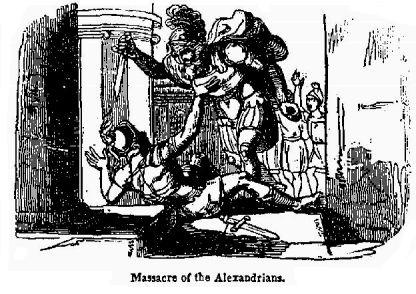
20. His tyrannies at length excited the resentment of Macri'nus, the commander of the forces in Mesopota'mia who employed one Mar'tial, a man of great strength, and a centurion of the guards, to dispatch him. 21. Accordingly, as the emperor was riding out one day, near a little city called Carræ, he happened to withdraw himself privately, upon a natural occasion, with only one page to hold his horse. This was the opportunity Mar'tial had so long and ardently desired: when, running to him hastily, as if he had been called, he stabbed the emperor in the back, and killed him instantly. 22. Having performed this hardy attempt, he, with apparent unconcern, returned to his troop; but, retiring by insensible degrees, he endeavoured to secure himself by flight. His companions, however, soon missing him, and the page giving information of what had been done, he was pursued by the German horse, and cut in pieces.
23. During the reign of this execrable tyrant, which continued six years, the empire was every day declining; the soldiers were entirely masters of every election; and as there were various armies in different parts, so there were as many interests opposed to each other.
24. The soldiers, after remaining without an emperor two days, fixed upon Macri'nus, who took all possible methods to conceal his being privy to Caracal'la's murder. The senate confirmed their choice shortly after; and likewise that of his son, Diadumenia'nus, whom he took as partner in the empire. 25. Macri'nus[Pg. 341] was fifty-three years old when he entered upon the government. He was of obscure parentage; some say by birth a Moor, who, by the mere gradation of office, being made first prefect of the prætorian bands, was now, by treason and accident, called to fill the throne.
26. He was opposed by the intrigues of Mosa, and her grandson Heliogaba'lus; and being conquered by some seditious legions of his own army, he fled to Chalcedon,[3] where those who were sent in pursuit overtook him, and put him to death, together with his son Diadumenia'nus, after a short reign of one year and two months.
27. The senate and citizens of Rome being obliged to submit, as usual, to the appointment of the army, Heliogaba'lus ascended the throne at the age of fourteen. His short life was a mixture of effeminacy, lust, and extravagance. 28. He married six wives in the short space of four years, and divorced them all. He was so fond of the sex, that he carried his mother with him to the senate-house, and demanded that she should always be present when matters of importance were debated. He even went so far as to build a senate-house for women, appointing them suitable orders, habits and distinctions, of which his mother was made president. 29. They met several times; all their debates turned upon the fashions of the day, and the different formalities to be used at giving and receiving visits. To these follies he added cruelty and boundless prodigality; he used to say, that such dishes as were cheaply obtained were scarcely worth eating.
30. However, his soldiers mutinying, as was now usual with them, they followed him to his palace, pursuing him from apartment to apartment, till at last he was found concealed in a closet. Having dragged him from thence through the streets, with the most bitter invectives, and dispatched him, they attempted once more to squeeze his pampered body into a closet; but not easily effecting this, they threw it into the Tiber, with heavy weights, that none might afterwards find it, or give it burial. This was the ignominious death of Heliogaba'lus, in the eighteenth year of his age, after a detestable reign of four years.[Pg. 342]
Questions for Examination.
1. Who succeeded Didius Julianus? 2. What was the character of Severus? 3. By what means did he strengthen his power? 4. What were his first acts? 5. To whom did he commit the government in his absence? 6. What were his exploits? 7. How did Plautian conduct himself in this important post? 8. How was this treachery discovered? 9. How was this effected? 10. Did Plautian fall into the snare? 11. How did he act on the occasion? 12. Was he pardoned? 13. How did Severus next employ himself? 14. What were his first measures in Britain? 15. Was it a difficult campaign? 16. Did he overcome these difficulties? 17. What famous work did he execute, and where did he die? 18. Who succeeded him, and how did the two emperors regard each other? 19. What was the conduct of Caracalla on thus becoming sole emperor? 20. Were these cruelties tamely suffered? 21. How was this effected? 22. Did the assassin escape? 23. What was the state of the empire during this reign? 24. Who succeeded Caracalla? 25. Who was Macrinus? 26. By whom was he opposed, and what was his fate? 27. How did Heliogabalus govern? 28. Give a few instances of his folly? 29. Did they enter into his views, and of what farther follies and vices was he guilty? 30. What was his end?
I know that there are angry spirits
And turbulent mutterers of stifled treason,
Who lurk in narrow places, and walk out
Muffled, to whisper curses in the night;
Disbanded soldiers, discontented ruffians,
And desperate libertines who brawl in taverns.—Byron.
1. Heliogaba'lus was succeeded by Alexander, his cousin-german,[4] who, being declared emperor without opposition, the senate, with their usual adulation, were for conferring new titles upon him; but he modestly declined them all. 2. To the most rigid justice he added the greatest humanity. He loved the good, and was a severe reprover of the lewd and infamous. His accomplishments were equal to his virtues. He was an[Pg. 343] excellent mathematician, geometrician, and musician; he was equally skilful in painting and sculpture; and in poetry few of his time could equal him. In short, such were his talents, and such the solidity of his judgment, that though but sixteen years of age, he was considered equal in wisdom to a sage old man.
3. About the thirteenth year of his reign the Upper Germans, and other northern nations, began to pour down in immense swarms upon the more southern parts of the empire. They passed the Rhine and the Danube with such fury, that all Italy was thrown into the most extreme consternation. 4. The emperor, ever ready to expose his person for the safety of his people, made what levies he could, and went in person to stem the torrent, which he speedily effected. It was in the course of his successes against the enemy that he was cut off by a mutiny among his own soldiers. He died in the twenty-ninth year of his age, after a prosperous reign of thirteen years and nine days.
5. The tumults occasioned by the death of Alexander being appeased, Max'imin, who had been the chief promoter of the sedition, was chosen emperor. 6. This extraordinary man, whose character deserves a particular attention, was born of very obscure parentage, being the son of a poor herdsman of Thrace. He followed his father's humble profession, and had exercised his personal courage against the robbers who infested that part of the country in which he lived. Soon after, his ambition increasing, he left his poor employment and enlisted in the Roman army, where he soon became remarkable for his great strength, discipline, and courage. 7. This gigantic man, we are told, was eight feet and a half high; he had strength corresponding to his size, being not more remarkable for the magnitude than the symmetry of his person. His wife's bracelet usually served him for a thumb ring, and his strength was so great that he was able to draw a carriage which two oxen could not move. He could strike out the teeth of a horse with a blow of his fist, and break its thigh with a kick. 8. His diet was as extraordinary as his endowments: he generally ate forty pounds weight of flesh every day, and drank six gallons of wine, without committing any debauch in either. 9. With a frame so athletic, he was possessed of a mind undaunted in danger, neither fearing nor regarding any man. 10. The first time he was made known to the emperor Seve'rus, was while he was[Pg. 344] celebrating games on the birth day of his son Ge'ta. He overcame sixteen in running, one after the other; he then kept up with the emperor on horseback, and having fatigued him in the course, he was opposed to seven of the most active soldiers, and overcame them with the greatest ease. 11. These extraordinary exploits caused him to be particularly noticed; he had been taken into the emperor's body guard, and by the usual gradation of preferment came to be chief commander. In this situation he had been equally remarkable for his simplicity, discipline, and virtue; but, upon coming to the empire, he was found to be one of the greatest monsters of cruelty that had ever disgraced power; fearful of nothing himself, he seemed to sport with the terrors of all mankind.
12. However, his cruelties did not retard his military operations, which were carried on with a spirit becoming a better monarch. He overthrew the Germans in several battles, wasted all their country with fire and sword for four hundred miles together, and formed a resolution of subduing all the northern nations, as far as the ocean. 13. In these expeditions, in order to attach the soldiers more firmly to him, he increased their pay; and in every duty of the camp he himself took as much pains as the meanest sentinel in his army, showing incredible courage and assiduity. In every engagement, where the conflict was hottest, Max'imin was seen fighting in person, and destroying all before him; for, being bred a barbarian, he considered it his duty to combat as a common soldier, while he commanded as a general.
14. In the mean time his cruelties had so alienated the minds of his subjects, that secret conspiracies were secretly aimed against him. None of them, however, succeeded, till at last his own soldiers, long harassed by famine and fatigue, and hearing of revolts on every side, resolved to terminate their calamities by the tyrant's death. 15. His great strength, and his being always armed, at first deterred them from assassinating him; but at length the soldiers, having made his guards accomplices in their designs, set upon him while he slept at noon in his tent, and without opposition slew both him and his son, whom he had made his partner in the empire. 16. Thus died this most remarkable man, after an usurpation of about three years, in the sixty-fifth year of his age. His assiduity when in a humble station, and his cruelty when in power, serve to evince, that there are some men whose virtues are fitted for[Pg. 345] obscurity, as there are others who only show themselves great when placed in an exalted station.
17. The tyrant being dead, and his body thrown to dogs and birds of prey, Pupie'nus and Balbie'nus, who had usurped the imperial purple, continued for some time emperors, without opposition. 18. But, differing between themselves, the prætorian soldiers, who were the enemies of both, set upon them in their palace, at a time when their guards were amused with seeing the Capit'oline games; and dragging them from the palace towards the camp, slew them both, leaving their dead bodies in the street, as a dreadful instance of unsuccessful ambition.
19. In the midst of this sedition, as the mutineers were proceeding along, they by accident met Gor'dian, the grandson of him who was slain in Africa: him they declared emperor on the spot. 20. This prince was but sixteen years old when he began to reign, but his virtues seemed to compensate for his want of experience. His principal aims were to unite the opposing members of government, and to reconcile the soldiers and citizens to each other. 21. The army, however, began as usual to murmur; and their complaints were artfully fomented by Philip, an Arabian, who was prætorian prefect, and aspired to the sovereignty. Things thus proceeded from bad to worse. 22. Philip was at first made equal to Gor'dian in the command of the empire; shortly after he was invested with the sole power; and at length, finding himself capable of perpetrating his long meditated cruelty, Gor'dian was by his order slain, in the twenty-second year of his age, after a successful reign of nearly six years.
Questions for Examination.
1. Who succeeded Heliogabalus?
2. What was his character?
3. Was his reign peaceable?
4. How did Alexander act on the occasion?
5. Who succeeded Alexander?
6. Who was Maximin?
7. Describe his person.
8. What farther distinguished him?
9. Was his mind proportioned to his body?
10. How did he attract the notice of Severus?
11. By what means did he attain rank in the army?
12. Was he equally a terror to his foreign enemies?[Pg. 346]
13. By what means did he gain the confidence of his soldiers?
14. What effect had his cruelties on the minds of his subjects?
15. How did they accomplish their purpose?
16. How long did he reign, and what inference may be drawn from his conduct?
17. Who next mounted the imperial throne?
18. What was their end?
19. Who succeeded Pupienus and Balbienus?
20. What were the character and views of this prince?
21. Was his administration approved of by all?
22. Did Philip accomplish his ambitious design?
What rein can hold licentious wickedness,
When down the hill he holds his fierce career—Shakspeare.
1. Philip having thus murdered his benefactor, was so fortunate as to be immediately acknowledged emperor by the army. Upon his exaltation he associated his son, a boy of six years of age, as his partner in the empire; and, in order to secure his power at home, made peace with the Persians, and marched his army towards Rome. 2. However, the army revolting in favour of De'cius, his general, and setting violently upon him, one of his sentinels at a blow cut off his head, or rather cleft it asunder, separating the under jaw from the upper. He died in the forty-fifth year of his age, after a short reign of about five years.
3. De'cius was universally acknowledged as his successor. His activity and wisdom seemed, in some measure, to stop the hastening decline of the Roman empire. The senate seemed to think so highly of his merits, that they voted him not inferior to Tra'jan; and indeed he appeared in every instance to consult their dignity, and the welfare of all the inferior ranks of people. 4. But no virtues could now prevent the approaching downfall of the state; the obstinate disputes between the Pagans and the Christians within the empire, and the unceasing irruptions of barbarous nations from without, enfeebled it beyond the power of remedy. 5. He was killed in an ambuscade of the enemy, in the fiftieth year of his age, after a short reign of two years and six months.
6. Gal'lus, who had betrayed the Roman army, had address enough to get himself declared emperor by that part of it which survived the defeat;[Pg. 347] he was forty-five years old when he began to reign, and was descended from an honourable family in Rome. 7. He was the first who bought a dishonourable peace from the enemies of the state, agreeing to pay a considerable annual tribute to the Goths, whom it was his duty to repress. He was regardless of every national calamity, and was lost in debauchery and sensuality. The Pagans were allowed a power of persecuting the Christians through all parts of the state. 8. These calamities were succeeded by a pestilence from heaven, that seemed to have spread over every part of the earth, and continued raging for several years, in an unheard-of manner; as well as by a civil war, which followed shortly after between Gallus and his general Æmilia'nus, who, having gained a victory over the Goths, was proclaimed emperor by his conquering army. 9. Gallus hearing this, soon roused from the intoxications of pleasure, and prepared to oppose his dangerous rival: but both he and his son were slain by Æmilia'nus, in a battle fought in Mossia. His death was merited, and his vices were such as to deserve the detestation of posterity. He died in the forty-seventh year of his age, after an unhappy reign of two years and four months, in which the empire suffered inexpressible calamities.
10. The senate refused to acknowledge the claims of Æmilia'nus; and an army that was stationed near the Alps chose Vale'rian, who was their commander, to succeed to the throne. 11. He set about reforming the state with a spirit that seemed to mark a good and vigorous mind. But reformation was now grown almost impracticable. 12. The Persians under their king Sapor, invading Syr'ia, took the unfortunate Vale'rian prisoner, as he was making preparations to oppose them; and the indignities as well as the cruelties, which were practised upon this unhappy monarch, thus fallen into the hands of his enemies, are almost incredible. 13. Sapor, we are told, used him as a footstool for mounting his horse; he added the bitterness of ridicule to his insults, and usually observed, that an attitude like that to which Vale'rian was reduced, was the best statue that could be erected in honour of his victory. 14. This horrid life of insult and sufferance continued for seven years; and was at length terminated by the cruel Persian commanding his prisoner's eyes to be plucked out, and afterwards causing him to be flayed alive.
15. When Vale'rian was taken prisoner, Galie'nus, his son, promising to revenge the insult, was chosen emperor,[Pg. 348] being then about forty-one years old. However, it was soon discovered that he sought rather the splendours than the toils of empire; for, after having overthrown Ingen'uus, who had assumed the title of emperor, he sat down, as if fatigued with conquest, and gave himself up to ease and luxury. 16. At this time, no less than thirty pretenders were seen contending with each other for the dominion of the state, and adding the calamities of civil war to the rest of the misfortunes of this devoted empire. These are usually mentioned in history by the name of the thirty tyrants. 17. In this general calamity, Galie'nus, though at first seemingly insensible, was at length obliged for his own security to take the field, and led an army to besiege the city of Milan, which had been taken by one of the thirty usurping tyrants. In this expedition he was slain by his own soldiers: Mar'tian, one of his generals, having conspired against him.
18. Fla'vius Clau'dius being nominated to succeed, was joyfully accepted by all orders of the state, and his title confirmed by the senate and the people. 19. He was a man of great valour and conduct, having performed the most excellent services against the Goths, who had long continued to make irruptions into the empire; but, after a great victory over that barbarous people, he was seized with a pestilential fever at Ser'mium in Panno'nia, of which he died, to the great regret of his subjects, and the irreparable loss of the Roman empire.
20. Upon the death of Clau'dius, Aure'lian was acknowledged by all the states of the empire, and assumed the command with a greater share of power than his predecessors had enjoyed for a long time before. 21. This active monarch was of mean and obscure parentage in Da'cia, and about fifty-five years old at the time of his coming to the throne. He had spent the early part of his life in the army, and had risen through all the gradations of military rank. He was of unshaken courage and amazing strength. He, in one engagement, killed forty of the enemy with his own hand; and at different times above nine hundred. In short, his valour and expedition were such, that he was compared to Julius Cæsar; and, in fact, only wanted mildness and clemency to be every way his equal. 22. Among those who were compelled to submit to his power, was the famous Zeno'bia, queen of Palmy'ra. He subdued her country, destroyed her city, and took her[Pg. 349] prisoner. Longi'nus, the celebrated critic, who was secretary to the queen, was by Aure'lian's order put to death. Zeno'bia was reserved to grace his triumph; and afterwards was allotted such lands, and such an income, as served to maintain her in almost her former splendour. 23. But the emperor's severities were at last the cause of his own destruction. Mnes'theus, his principal secretary, having been threatened by him for some fault which he had committed, formed a conspiracy against him, and as the emperor passed, with a small guard, from Ura'clea, in Thrace, towards Byzan'tium, the conspirators set upon him at once and slew him, in the sixtieth year of his age, after a very active reign of almost five years.
24. After some time the senate made choice of Ta'citus, a man of great merit, and no way ambitious of the honours that were offered him, being at that time seventy-five years old. 25. A reign begun with much moderation and justice, only wanted continuance to have made his subjects happy: but after enjoying the empire about six months, he died of a fever in his march to oppose the Persians and Scyth'ians, who had invaded the eastern parts of the empire. 26. During this short period the senate seemed to have possessed a large share of authority, and the histories of the times are liberal of their praises to such emperors as were thus willing to divide their power.
27. Upon the death of Ta'citus, his half-brother took upon himself the title of emperor, in Cile'sia: but being twice defeated by Pro'bus, he killed himself in despair, when the whole army, as if by common consent, cried out that Pro'bus should be emperor. 28. He was then forty-four years old; was born of noble parentage, and bred a soldier. He began early to distinguish himself for his discipline and valour: being frequently the first man that scaled the walls, or that burst into the enemy's camp. He was equally remarkable for single combat, and for having saved the lives of many eminent citizens. Nor were his activity and courage when elected to the empire less apparent than in his private station. 29. Every year now produced new calamities to the state; and fresh irruptions on every side threatened universal desolation. Perhaps at this time no abilities, except those of Pro'bus, were capable of opposing such united invasions. 30. However, in the end, his own mutinous soldiers, taking their opportunity, as he was marching into Greece, seized and slew him, after he had reigned six[Pg. 350] years and four months with general approbation. He was succeeded by Ca'rus.
Questions for Examination.
1. Did Philip succeed without opposition?
2. Was his reign of long duration?
3. What was the character of Decius?
4. Did he restore the empire to its former grandeur?
5. What was his end?
6. Who succeeded him?
7. What was his character?
8. What farther calamities distinguished this reign?
9. What effect had this news on Gallus?
10. Who succeeded Gallus?
11. What were his first acts and their effects?
12. What disaster befel him?
13. How was he treated in captivity?
14. Did he long survive this cruelty?
15. Who succeeded him?
16. Was Galienus the only pretender to the throne?
17. What measures did Galienus adopt on this?
18. Who succeeded Galienus?
19. What were his character and end?
20. Who succeeded Claudius?
21. Who was Aurelian?
22. Over whom did he triumph?
23. What occasioned his destruction?
24. Who succeeded Aurelian?
25. Did he govern well?
26. What distinguished his reign?
27. Who succeeded Tacitus?
28. What were the qualifications of Probus?
29. What was the state of the empire at this time?
30. What was the end of Probus?
Forbid it, gods! when barbarous Scythians come
From their cold north to prop declining Rome.
That I should see her fall, and sit secure at home.—Lucan.
1. Ca'rus, who was prætorian prefect to the deceased emperor, was chosen by the army to succeed him; and he, to strengthen his authority, united his two sons, Cari'nus and Nume'rian, with him in command; the elder of whom was as much sullied by his vices, as the younger was remarkable for his virtues, his modesty, and courage.
2. The next object of Ca'rus was to punish the[Pg. 351] murderers of Pro'bus, and procure public tranquillity. Several nations of the west having revolted, he sent his son Cari'nus against them, and advanced himself against the Sarma'tians, whom he defeated, with the loss of sixteen thousand men killed, and twenty thousand prisoners. Soon after this he entered Persia, and removed to Mesopota'mia. Vera'nes the second, king of Persia, advancing against him, was defeated, and lost Ctes'iphon, his capital. This conquest gained Ca'rus the surname of Per'sieus; but he had not enjoyed it long, when he was struck dead, by lightning, in his tent, with many of his attendants, after a reign of about sixteen months. Upon the death of Ca'rus, the imperial power devolved on his sons Cari'nus and Nume'rian, who reigned jointly. In the first year of their accession, having made peace with the Persians, Cari'nus advanced against Ju'lian, who had caused himself to be proclaimed in Vene'tia,[5] and whom he defeated; when he returned again into Gaul.
3. Cari'nus was at this time in Gaul, but Nume'rian, the younger son, who accompanied his father in his expedition was inconsolable for his death, and brought such a disorder upon his eyes, with weeping, that he was obliged to be carried along with the army, shut up in a close litter. 4. The peculiarity of his situation, after some time, excited the ambition of A'per, his father-in-law, who supposed that he could now, without any great danger, aim at the empire himself. He therefore hired a mercenary villain to murder the emperor in his litter; and, the better to conceal the fact, gave out that he was still alive, but unable to endure the light. 5. The offensive smell, however, of the body, at length discovered the treachery, and excited an universal uproar throughout the whole army. 6. In the midst of this tumult, Diocle'sian, one of the most noted commanders of his time, was chosen emperor, and with his own hand slew A'per, having thus, as it is said, fulfilled a prophecy, that Diocle'sian should be emperor after he had slain a boar.[6]
7. Diocle'sian was a person of mean birth; he received his name from Dio'clea, the town in which he was born, and was about forty years old when he was elected to the empire. He owed his exaltation entirely to his merit; having passed through all the gradations of office with sagacity, courage, and success.[Pg. 352]
8. In his time, the northern hive, as it was called poured down its swarms of barbarians upon the Roman empire. Ever at war with the Romans, they issued forth whenever that army that was to repress their invasions was called away; and upon its return, they as suddenly withdrew into their cold, barren, and inaccessible retreats, which themselves alone could endure. 9. In this manner the Scyth'ians, Goths, Sarma'tians, Ala'ni, Car'sii, and Qua'di, came down in incredible numbers, while every defeat seemed but to increase their strength and perseverance. 10. After gaining many victories over these, and in the midst of his triumphs, Diocle'sian and Maxim'ian, his partners in the empire, surprised the world by resigning their dignities on the same day, and both retiring into private stations. 11. In this manner Diocle'sian lived some time, and at length died either by poison or madness, but by which of them is uncertain. His reign of twenty years was active and useful; and his authority, which was tinctured with severity, was adapted to the depraved state of morals at that time.
12. Upon the resignation of the two emperors, the two Cæsars, whom they had before chosen, were universally acknowledged as their successors, namely, Constan'tius Chlo'rus, so called from the paleness of his complexion, a man virtuous, valiant, and merciful; and Gele'rius, who was brave, but brutal, incontinent and cruel. 13. As there was such a disparity in their tempers, they readily agreed, upon coming into full power, to divide the empire. Constan'tius was appointed to govern the western parts, and died at York, in Britain, A.D. 396, appointing Con'stantine, his son, as his successor. Gale'rius was seized with a very extraordinary disorder, which baffled the skill of his physicians, and carried him off.
14. Con'stantine, afterwards surnamed the Great, had some competitors at first for the throne.—Among the rest was Maxen'tius, who was at that time in possession of Rome, and a stedfast assertor of Paganism. 15. It was in Constantine's march against that usurper, we are told, that he was converted to Christianity, by a very extraordinary appearance. 16. One evening, the army being on its march towards Rome, Constantine was intent on various considerations upon the fate of sublunary things, and the dangers of his approaching expedition. Sensible of his own incapacity to succeed without divine assistance, he employed his meditations upon the opinions[Pg. 353] that were then agitated among mankind, and sent up his ejaculations to heaven to inspire him with wisdom to choose the path he should pursue. As the sun was declining, there suddenly appeared a pillar of light in the heavens, in the fashion of a cross, with this inscription, EN TOTTO NIKA, IN THIS OVERCOME. 17. So extraordinary an appearance did not fail to create astonishment, both in the emperor and his whole army, who reflected on it as their various dispositions led them to believe. Those who were attached to Paganism, prompted by their aruspices, pronounced it to be a most inauspicious omen, portending the most unfortunate events; but it made a different impression on the emperor's mind; who, as the account goes, was farther encouraged by visions the same night. 18. He, therefore, the day following, caused a royal standard to be made, like that which he had seen in the heavens, and commanded it to be carried before him in his wars, as an ensign of victory and celestial protection. After this he consulted with the principal teachers of Christianity, and made a public avowal of that holy religion.
19. Con'stantine having thus attached his soldiers to his interest, who were mostly of the Christian persuasion, lost no time in entering Italy, with ninety thousand foot and eight thousand horse, and soon advanced almost to the very gates of Rome. Maxen'tius advanced from the city with an army of a hundred and seventy thousand foot, and eighteen thousand horse. 20. The engagement was fierce and bloody, till the cavalry of the latter being routed, victory declared upon the side of his opponent, and he himself was drowned in his flight by the breaking down of a bridge, as he attempted to cross the Tiber.
21. In consequence of this victory, Con'stantine entered the city, but disclaimed all the praises which the senate and people were ready to offer; and ascribed his successes to a superior power. He even caused the cross, which he was said to have seen in the heavens, to be placed at the right hand of all his statues, with this inscription: "That under the influence of that Victorious Cross, Con'stantine had delivered the city from the yoke of tyrannical power, and had restored the senate, and people of Rome to their ancient authority." He afterwards ordained that no criminal should, for the future, suffer death upon the cross, which had formerly been the most usual way of punishing slaves convicted of capital offences. 22. Edicts were soon after issued,[Pg. 354] declaring that the Christians should be eased of all their grievances, and received into places of trust and authority.
23. Things continued in this state for some time. Con'tantine contributing every thing in his power to the interest of religion, and the revival of learning, which had long been upon the decline, and was almost wholly extinct in his dominions. 24. But, in the midst of these assiduities, the peace of the empire was again disturbed by the preparations of Maxim'ian, who governed in the east; and who, desirous of a full participation of power, marched against Licin'ius with a very numerous army. 25. In consequence of this step, after many conflicts, a general engagement ensued, in which Maxim'ian suffered a total defeat; many of his troops were cut to pieces, and those that survived submitted to the conqueror. Having, however, escaped the general carnage, he put himself at the head of another army, resolving to try the fortune of the field; but his death prevented the design. 26. As he died by a very extraordinary kind of madness, the Christians, of whom he was the declared enemy, did not fail to ascribe his end to a judgment from heaven. But this was the age in which false opinions and false miracles made up the bulk of every history.
Questions for Examination.
1. Who succeeded Probus?
2. Mention the actions of Carus, and the manner of his death.
3. How were his sons affected by this catastrophe?
4. What was the consequence?
5. How was this atrocious act discovered?
6. Did Aper reap the reward of his treachery?
7. Who was Dioclesian?
8. By whom was the empire now invaded?
9. Were they effectually repelled?
10. What remarkable event now occurred?
11. What was the end of Dioclesian?
12. Who succeeded Dioclesian and Maximian?
13. How did they conduct the administration?
14. Did Constantine succeed without any opposition?
15. Did not a remarkable occurrence happen about this time?
16. Repeat the particulars.
17. What effect had this appearance on the emperor and his men?
18. What orders did he issue in consequence?
19. What was the respective strength of the hostile armies?
20. What was the result of the engagement?
21. What use did Constantine make of his victory?
22. What edicts did he publish on the occasion?
23. How was Constantine employed after this?
24. Did the peace long continue?
25. What was the consequence?
26. To what was his death ascribed?[Pg. 355]
A crown? what is it?
It is to bear the miseries of a people!
To hear their murmurs, feel their discontents,
And sink beneath a load of splendid care!
To have your best success ascribed to Fortune.
And Fortune's failures all ascribed to you!
It is to sit upon a joyless height,
To every blast of changing fate exposed!
Too high for hope! too great for happiness!—H. More.
1. Con'stantine and Licin'ius thus remaining undisputed possessors of, and partners in the empire, all things promised a peaceable continuance of friendship and power. 2. However, it was soon found that the same ambition that aimed after a part, would be content with nothing less than the whole. Pagan writers ascribe the rupture between these two potentates to Con'stantine; while the Christians, on the other hand, impute it wholly to Licin'ius. 3. Both sides exerted all their power to gain the ascendancy; and at the head of very formidable armies came to an engagement near Cy'balis, in Panno'nia. 4. Con'stantine, previous to the battle, in the midst of his Christian bishops, begged the assistance of heaven; while Licin'ius, with equal zeal, called upon the Pagan priests to intercede with the gods in their favour. 5. The success was on the side of truth. Con'stantine, after experiencing an obstinate resistance, became victorious, took the enemy's camp, and after some time compelled Licin'ius to sue for a truce, which was agreed upon. 6. But this was of no long continuance; for, soon after, the war breaking out afresh, the rivals came once more to a general engagement, and it proved decisive. Licin'ius was entirely defeated, and pursued by Con'stantine into Nicome'dia, where he surrendered himself up to the victor; having first obtained an oath that his life should be spared, and that he should be permitted to pass the remainder of his days in retirement. 7. This, however, Con'stantine shortly after broke; for either fearing his designs, or finding him actually engaged in fresh conspiracies, he commanded him to be put to death, together with Mar'tian, his general, who some time before had been created Cæsar.
8. Con'stantine being thus become sole monarch, resolved to establish Christianity on so sure a basis that no new revolution should shake it. He commanded that, in all the provinces of the empire, the orders of the bishops should he implicitly obeyed. He called also a general council, in[Pg. 356] order to repress the heresies that had already crept into the church, particularly that of A'rius. 9. To this council, at which he presided in person, repaired about three hundred and eighteen bishops, besides a multitude of presbyters and deacons; who all, except about seventeen, concurred in condemning the tenets of A'rius, who, with his associates, was banished into a remote part of the empire.
10. Thus he restored universal tranquillity to his dominions, but was not able to ward off calamities of a more domestic nature. As the wretched historians of this period are entirely at variance with each other, it is not easy to explain the motives which induced him to put his wife Faus'ta, and his son Cris'pus, to death.
11. But it is supposed, that all the good he did was not equal to the evil the empire sustained by his transferring the imperial seat from Rome to Byzan'tium, or Constantino'ple, as it was afterwards called. 12. Whatever might have been the reasons which induced him to this undertaking; whether it was because he was offended at some affronts he had received at Rome, or that he supposed Constantino'ple more in the centre of the empire, or that he thought the eastern parts more required his presence, experience has shown that they were all weak and groundless. 13. The empire had long before been in a most declining state: but this, in a great measure, gave precipitation to its downfall. After this, it never resumed its former splendour, but, like a flower transplanted into a foreign clime, languished by degrees, and at length sunk into nothing.
14. At first, his design was to build a city, which he might make the capital of the world: and for this purpose he made choice of a situation at Chal'cedon, in Asia Minor; but we are told that, in laying out the ground plan, an eagle caught up the line, and flew with it over to Byzan'tium, a city which lay on the opposite side of the Bosphorus. 15. Here, therefore, it was thought expedient to fix the seat of empire; and, indeed, nature seemed to have formed it with all the conveniences, and all the beauties which might induce power to make it the seat of residence.
16. It was situated on a plain, that rose gently from the water: it commanded that strait which unites the Mediterranean with the Euxine sea, and was furnished with all the advantages which the most indulgent climate could bestow.
17. The city, therefore, he beautified with the most magnificent edifices; he divided it into fourteen regions; built[Pg. 357] a capitol, an amphitheatre, many churches, and other public works; and having thus rendered it equal to the magnificence of his first idea, he dedicated it in a very solemn manner to the God of martyrs; and in about two years after repaired thither with his whole court.
18. This removal produced no immediate alteration in the government of the empire. The inhabitants of Rome, though with reluctance, submitted to the change; nor was there, for two or three years, any disturbance in the state, until at length the Goths, finding that the Romans had withdrawn all their garrisons along the Danube, renewed their inroads, and ravaged the country with unheard-of cruelty. 19. Con'stantine, however, soon repressed their incursions, and so straitened them, that nearly a hundred thousand of their number perished by cold and hunger.
20. Another great error ascribed to him is, the dividing the empire among his sons. Con'stantine, the emperor's eldest son, commanded in Gaul and the western provinces; Constan'tius, the second, governed Africa and Illyr'icum; and Con'stans, the youngest, ruled in Italy. 21. This division of the empire still further contributed to its downfall; for the united strength of the state being no longer brought to repress invasion, the barbarians fought with superior numbers, and conquered at last, though often defeated. When Con'stantine was above sixty years old, and had reigned about thirty, he found his health decline.
22. His disorder, which was an ague, increasing, he went to Nicome'dia, where, finding himself without hopes of a recovery, he caused himself to be baptised. He soon after received the sacrament, and expired.
Questions for Examination.
1. What was the state of the empire at this period?
2. Was this peace lasting, and by whom was it broken?
3. Was the contest likely to be vigorous?
4. In what way did the two emperors prepare for the conflict?
5. What was the result?
6. Was this truce religiously observed?
7. Did Constantine fulfil his engagement?
8. What was Constantine's resolution on becoming sole monarch, and what steps did he take?
9. By whom was it attended, and what was the result?
10. Was he happy in his domestic relations?[Pg. 358] 11. Was the removal of the seat of the empire beneficial to the state?
12. Were his reasons for doing so well grounded?
13. What was the consequence?
14. What was his original intention, and what induced him to alter it?
15. Was it a Convenient spot?
16. Describe its situation.
17. What alteration did he make, and to whom was it dedicated?
18. What was the immediate effect of this transfer?
19. Were they vigorously opposed?
20. Of what error is Constantine accused besides?
21. What was the consequence of this division?
22. Relate the particulars of his death.
FOOTNOTES:
Com'modus was the first emperor that was born in his father's reign, and the second that succeeded his father in the empire.
Being offended by the Alexan'drians, he commanded them to be put to the sword without distinction of sex, age, or condition; every house was filled with carcases, and the streets were obstructed with dead bodies; this was merely in revenge for some lampoons they had published against him.
A city of Bithyn'ia, in Asia Minor, opposite to Constantinople.
A Term generally applied to the children of brothers or sisters.
Now called Venice.
A'per signifies a boar.
Dr. Goldsmith having concluded his History too abruptly, it has been thought advisable to cancel his last Chapter, and substitute the following brief notice of the events which occurred from the death of Constantine to the final extinction of the Empire of the West.
Talents, angel bright.
If wanting worth, are shining instruments
In false ambition's hands, to finish faults
Illustrious, and give infamy renown.—Young.
1. The character of the prince who removed the seat of empire and made a complete revolution in the civil and religious institutions of his country, is naturally one on which the opinions of historians are divided, according to their sentiments respecting the great changes that he effected. The heathen writers describe him as a monster of tyranny; the Christian fathers are anxious to conceal his faults and exaggerate his virtues, as if the nature of Christianity was in some degree affected by the character of its first and greatest patron. The truth is, that the character of Constantine, like that of other great conquerors, varied with the circumstances of his life. While engaged in the contest for empire, while employed in making unparalleled political changes, he displayed the fortitude of a hero, and wisdom of a legislator; but when complete success reduced him to inactivity, when his vigorous mind was no longer stimulated by fear or hope, prosperity roused all his bad passions by affording an opportunity for their indulgence; and the virtues which had insured[Pg. 359] victory disappeared when there was no longer any stimulus to rouse them into action. The fourteen years of profound peace that preceded the emperor's death, form a period of great external splendour, but of real and rapid decay; the court was distinguished at once by avarice and prodigality; the money raised by heavy taxes, unknown in former ages, was lavished on unworthy favourites or wasted in idle exhibitions of magnificence. 2. A mind relaxed by prosperity is peculiarly open to suspicion; the ears of the monarch were greedily lent to every tale brought to him by malignant spies and informers; such encouragement increased the number of those wretches; every street and almost every house in the capital, contained some one ever on the watch to pick up any unguarded expression which might be distorted into treason or sedition. It was not likely that a monarch who had consented to the murder of his own son, on the most groundless charges, would be more merciful to those who had no natural claims upon his forbearance; execution followed execution with fearful rapidity, until the bonds of society were broken, and every man dreaded his neighbour, lest by misinterpreting a word or look, he should expose him to the indiscriminate cruelty of the sovereign.
3. The example of their father's tyranny produced an effect on the minds of his sons, which no education, however excellent or judicious, could remove. Pious Christian pastors, learned philosophers, and venerable sages of the law, were employed to instruct the three princes, Constanti'ne, Constan'tius, and Con'stans; but the effects of their labours never appeared in the lives of their pupils.
4. For some reasons which it is now impossible to discover, the great Constantine had raised two of his nephews to the rank of princes, and placed them on an equality with his own children. Before the emperor's body was consigned to the tomb, this impolitic arrangement brought destruction on the entire Flavian family. A forged scroll was produced by the bishop of Nicome'dia, purporting to be Constantine's last will, in which he accused his brothers of having given him poison, and besought his sons to avenge his death. 5. Constan'tius eagerly embraced such an opportunity of destroying the objects of his jealousy; his two uncles, seven of his cousins, the patrician Opta'lus, who married the late emperor's sister, and the prefect Abla'vius, whose chief crime was enormous wealth, were subjected to a mock trial, and delivered to the executioner. Of so numerous a family[Pg. 360] Gal'lus and Julian alone were spared; they owed their safety to their concealment, until the rage of the assassins had abated. 6. After this massacre, the three brothers, similar in name, and more alike in crime, proceeded to divide their father's dominions: Constantine took for his share the new capital and the central provinces; Thrace and the East were assigned to Constan'tius; Con'stans received Italy, Africa, and the western Illy'ricum.
7. The weakness produced by this division encouraged the enemies of the Romans, whom the dread of Constantine's power had hitherto kept quiet, to take up arms. Of these the most formidable was Sa'por king of Persia. 8. The abilities of Sapor showed that he merited a throne; he had scarcely arrived at maturity when he led an army against Tha'ir king of Arabia, who had harassed Persia during his minority; the expedition was completely successful. Tha'ir was slain, and the kingdom subdued. The young conqueror did not abuse his victory; he treated the vanquished with such clemency, that the Arabs gave him the title of Doulacnaf or protector of the nation.
9. On the death of Constantine, Sa'por invaded the eastern provinces of the Roman empire; he was vigorously opposed by Constan'tius, and the war was protracted during several years with varying fortune. At the battle of Sin'gara, the Romans surprised the Persian camp, but were in their turn driven from it with great slaughter by the troops which Sapor had rallied. The eldest son of the Persian king was, however, brought off as a prisoner by the Romans, and the barbarous Constan'tius ordered him to be scourged, tortured, and publicly executed. 10. Though Sa'por had been victorious in the field, he failed in his chief design of seizing the Roman fortresses in Mesopota'mia; during twelve years he repeatedly besieged Ni'sibis, which had been long the great eastern bulwark of the empire, but was invariably baffled by the strength of the place, and the valour of the garrison. At length both parties became wearied of a struggle which exhausted their resources, and new enemies appearing, they resolved to conclude a peace. Sa'por returned home to repel an invasion of the Scythians; Constan'tius, by the death of his two brothers, found himself involved in a civil war which required his undivided attention.
11. Constan'tine had scarcely been seated on his throne, when he attempted to wrest from Con'stans some of the[Pg. 361] provinces which had been assigned as his portion. He rashly led his army over the Julian Alps, and devastated the country round Aquile'ia where, falling into an ambuscade, he perished ingloriously. Con'stans seized on the inheritance of the deceased prince, and retained it during ten years, obstinately refusing to give any share to his brother Constan'tius. 12. But the tyranny of Con'stans at last became insupportable. Magnen'tius, an enterprising general, proclaimed himself emperor, and his cause was zealously embraced by the army. Con'stans was totally unprepared for this insurrection; deserted by all except a few favourites, whom dread of the popular hatred they had justly incurred prevented from desertion, he attempted to escape into Spain, but was overtaken at the foot of the Pyrenees, and murdered. 13. The prefectures of Gaul and Italy cheerfully submitted to the usurpation of Magnen'tius; but the legions of Illyr'icum elected their general, Vetra'nio, emperor, and his usurpation was sanctioned by the princess Constanti'na, who, regardless of her brother's rights, placed the diadem upon his head with her own hands. 14. The news of these events hastened the return of Constan'tius to Europe; on his arrival at the capital, he received embassies from the two usurpers, offering terms of accommodation; he rejected the terms of Magnen'tius with disdain, but entered into a negociation with Vetra'nio. The Illyrian leader, though a good general, was a bad politician; he allowed himself to be duped by long discussions, until the greater part of his army had been gained over by Constan'tius; he then consented to a personal interview, and had the mortification to see his soldiers, with one accord, range themselves under the banners of their lawful sovereign. Vetra'nio immediately fell at the feet of Constan'tius, and tendered his homage, which was cheerfully accepted; he was not only pardoned, but rewarded; the city of Pru'sa, in Bythnia, was allotted to him as a residence, and a pension assigned for his support. 15. The war against Magnen'tius was maintained with great obstinacy, but at first with little success; the emperor was confined in his fortified camp, while the troops of the usurper swept the surrounding country, and captured several important posts. Constan'tius was so humbled, that he even proposed a treaty, but the terms on which Magnen'tius insisted were so insulting, that the emperor determined to encounter the hazard of a battle. Scarcely had he formed this resolution, when his army was strengthened by the accession of[Pg. 362] Sylva'nus, a general of some reputation, who, with a large body of cavalry, deserted from the enemy.
16. The decisive battle between the competitors for the empire, was fought under the walls of Mur'sa, a city on the river Drave. Magnen'tius attempted to take the place by storm, but was repulsed; and almost at the same moment, the imperial legions were seen advancing to raise the siege. The army of Magnen'tius consisted of the western legions that had already acquired fame in the wars of Gaul; with battalions of Germans and other barbarous tribes, that had of late years been incorporated with the regular forces. In addition to the imperial guards, Constan'tius had several troops of those oriental archers, whose skill with the bow was so justly celebrated; but far the most formidable part of his army were his mail-clad cuirassiers, whose scaly armour, and ponderous lances, made their charge almost irresistible. The cavalry on the emperor's left wing commenced the engagement, and broke through the Gallic legions in the first charge; the hardy veterans again rallied, were again charged, and again broken; at length, before they could form their lines, the light cavalry of the second rank rode, sword in hand, through the gaps made by the cuirassiers, and completed their destruction. Meantime, the Germans and barbarians stood exposed, with almost naked bodies, to the destructive shafts of the oriental archers; whole troops, stung with anguish and despair, threw themselves into the rapid stream of the Drave, and perished. Ere the sun had set, the army of Magnen'tius was irretrievably ruined; fifty-four thousand of the vanquished were slain, and the loss of the conquerors is said to have been even greater.
17. From this battle the ruin of the Roman empire may be dated; the loss of one hundred thousand of its best and bravest soldiers could not be repaired, and never again did any emperor possess a veteran army equal to that which fell on the fatal plains of Mur'sa. The defeat of Magnen'tius induced the Italian and African provinces to return to their allegiance; the Gauls, wearied out by the exactions which distress forced the usurper to levy, refused to acknowledge his authority, and at length his own soldiers raised the cry of "God save Constan'tius." To avoid the disgrace of a public execution, Magnen'tius committed suicide, and several members of his family imitated his example. The victor punished with relentless severity all who had shared in the guilt of this rebellion; and several who had been compelled[Pg. 363] to join in it by force shared the fate of those by whom it had been planned.
18. The Roman, empire was now once more united under a single monarch; but as that prince was wholly destitute of merit, his victory served only to establish the reign of worthless favourites. Of these the most distinguished was the chamberlain, Euse'bius, whose influence was so great that he was considered the master of the emperor; and to whose instigation many of the crimes committed by Constan'tius must be attributed.
19 Gal'lus and Ju'lian, who had escaped in the general massacre of the Flavian family, were detained as prisoners of state in a strong castle, which had once been the residence of the kings of Cappado'cia. Their education had not been neglected, and they had been assigned a household proportionate to the dignity of their birth. At length the emergencies of the state compelled Constan'tius to nominate an associate in the government of the empire; and Gal'lus now in the twenty-fifth year of his age, was summoned from his retirement, invested with the title of Cæsar, and married to the princess Constan'tina. 20. The latter circumstance proved his ruin; stimulated by the cruel ambition of his wife, he committed deeds of tyranny, which alienated the affections of his subjects, and acts bordering on treason, that roused the jealousy of Constan'tius. He was summoned to appear at the imperial court to explain his conduct, but was seized on his journey, made a close prisoner, and transmitted to Po'la a town in Ist'ria, where he was put to death.
21. Julian, the last remnant of the Flavian family, was, through the powerful intercession of the empress, spared, and permitted to pursue his studies in Athens. In that city, where the Pagan philosophy was still publicly taught, the future emperor imbibed the doctrines of the heathens, and thus acquired the epithet of Apostate, by which he is unenviably known to posterity. Julian was soon recalled from his retirement, and elevated to the station which his unfortunate brother had enjoyed. His investiture with the royal purple took place at Milan, whither Constantius had proceeded to quell a new insurrection in the western provinces.
22. Before the emperor returned to the east, he determined to revisit the ancient capital; and Rome, after an interval of more than thirty years, became for a brief space the residence the sovereign. He signalized his visit by presenting to the city an obelisk, which at a vast expense he procured[Pg. 364] to be transported from Egypt. 23. The renewed efforts of the Persians and other enemies of the empire in the East, recalled Constan'tius to Constantinople, while Julian was employed in driving from Gaul the barbarous tribes by which it had been invaded. The conduct of the young Cæsar, both as a soldier and a statesman, fully proved that literary habits do not disqualify a person from discharging the duties of active life; he subdued the enemies that devastated the country, and forced them to seek refuge in their native forests; he administered the affairs of state with so much wisdom, temperance, and equity, that he acquired the enthusiastic love of his subjects, and richly earned the admiration of posterity. 24. The unexpected glory obtained by Julian, awakened the jealousy of Constan'tius; he sent to demand from him a large body of forces, under the pretence that reinforcements were wanting in the East; but the soldiers refused to march, and Julian, after some affected delays, sanctioned their disobediance. A long negociation, in which there was little sincerity on either side, preceded any hostile step; both at length began to put their armies in motion, but the horrors of civil war were averted by the timely death of Constan'tius, who fell a victim to fever, aggravated by his impatience, at a small village near Tar'sus in Cili'cia.
Questions for Examination.
1. What was the character of Constantine the Great?
2. Did any evil result from the employment of spies?
3. In what manner were the sons of Constantine educated?
4. What conspiracy was formed against part of the imperial family?
5. Did any of the Flavian family escape from the massacre?
6. How was the empire divided between the sons of Constantine?
7. Who was the most formidable enemy of the empire?
8. How did the king of Persia behave in the Arabian war?
9. What were the chief events in the war between Sapor and Constantius? 10. How were Sapor and Constantius forced to make peace?
11. What was the fate of the younger Constantine?
12. By whom was Constans dethroned?
13. What parties embraced the cause of Vetranio?
14. How did Constantius treat the Illyrian general?
15. Was Magnentius deserted by any of his forces?
16. What were the circumstances of the battle of Mursa?
17. What important results were occasioned by this great battle?
18. Who was the prime minister of Constantius?
19. Whom did the emperor select as an associate?[Pg. 365]
20. How was Gallus brought to an untimely end?
21. Where was Julian educated?
22. Did Constantius visit Rome?
23. How did Julian conduct himself in Gaul?
24. What led to the war between Julian and Constantius?
To him, as to the bursting levin,
Brief, bright, resistless course was given,
Till burst the bolt on yonder shore,
Burn'd, blaz'd, destroy'd—and was no more.—Scott.
1. Julian was in his thirty-second year when by the death of his cousin he became undisputed sovereign of the Roman empire; his worst error was his apostacy from Christianity; he hated the religion he had deserted, and laboured strenuously to substitute in its place an idle system which combined the most rational part of the old heathen system with the delusive philosophy of the schools. Vanity was his besetting sin; he chose to be considered a philosopher rather than a sovereign, and to acquire that title he thought fit to reject the decencies of this life, and the best guide to that which is to come. A treatise is extant from Julian's pen, in which he expatiates with singular complacency on the filth of his beard, the length of his nails, and the inky blackness of his hands, as if cleanliness was inconsistent with the philosophic character! In every other respect, the conduct of Julian merits high praise; he was just, merciful, and tolerant; though frequently urged to become a persecutor, he allowed his subjects that freedom of opinion which he claimed for himself, unlike Constan'tius, who, having embraced the Arian heresy, treated his Catholic subjects with the utmost severity. 2. But, though Julian would not inflict punishment for a difference of opinion, he enacted several disqualifying laws, by which he laboured to deprive the Christians of wealth, of knowledge, and of power; he ordered their schools to be closed, and he jealously excluded them from all civil and military offices. 3. To destroy the effects of that prophecy in the Gospel to which Christians may appeal as a standing miracle in proof of revelation,—the condition of the Jews,—Julian determined to rebuild the temple of Jerusalem, and restore the children of Israel to the land of their fathers. Historians worthy of credit inform us, that his plan was defeated by a direct miraculous interposition, and there are few historical facts supported by more decisive testimony; but even if the miracle be denied, the prophecy must be considered as having[Pg. 366] received decisive confirmation, from the acknowledged fact, that the emperor entertained such a design, and was unable to effect its accomplishment.
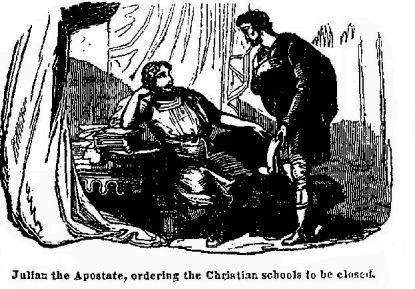
4. The mutual hatred of the Pagans and Christians would probably have rekindled the flames of civil war, had not Julian fallen in an expedition against the Persians. 5. The emperor triumphantly advanced through the dominions of Sa'por as far as the Ti'gris; but the Asiatics, though defeated in the field, adopted means of defence more terrible to an invader than arms. They laid waste the country, destroyed the villages, and burned the crops in the Roman line of march; a burning sun weakened the powers of the western veterans, and when famine was added to the severity of the climate, their sufferings became intolerable. 6. With a heavy heart Julian at last gave orders to commence a retreat, and led his exhausted soldiers back over the desert plains which they had already passed with so much difficulty. The retrograde march was terribly harassed by the light cavalry of the Persians, a species of troops peculiarly fitted for desultory warfare. The difficulties of the Romans increased at every step, and the harassing attacks of their pursuers became more frequent and more formidable; at length, in a skirmish which almost deserved the name of a battle, Julian was mortally wounded, and with his loss the Romans dearly purchased a doubtful victory.
7. In the doubt and dismay which followed the death of Ju'lian, a few voices saluted Jo'vian, the first of the imperial domestics, with the title of emperor, and the army ratified the choice. The new sovereign successfully repelled some fresh attacks of the Persians, but despairing of final success,[Pg. 367] he entered into a treaty with Sa'por, and purchased a peace, or rather a long truce of thirty years, by the cession of several frontier provinces.
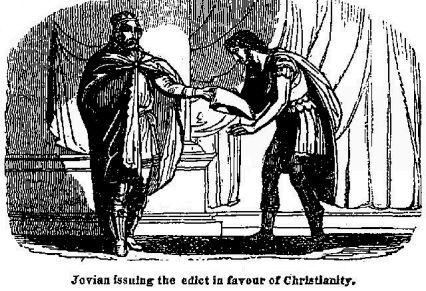
8. The first care of Jo'vian was to fulfil the stipulated articles; the Roman garrisons and colonies so long settled in the frontier towns that they esteemed them as their native soil, were withdrawn; and the Romans beheld with regret the omen of their final destruction in the first dismemberment of the empire. The first edict in the new reign contained a repeal of Julian's disqualifying laws, and a grant of universal toleration. This judicious measure at once showed how ineffectual had been the efforts of the late emperor to revive the fallen spirit of paganism; the temples were immediately deserted, the sacrifices neglected, the priests left alone at their altars; those who, to gratify the former sovereign assumed the dress and title of philosophers, were assailed by such storms of ridicule, that they laid aside the designation, shaved their beards, and were soon undistinguished in the general mass of society. 9. Jo'vian did not long survive this peaceful triumph of Christianity; after a reign of eight months, he was found dead in his bed, having been suffocated by the mephitic vapours which a charcoal fire extracted from the fresh plaster, on the walls of his apartment.
10. During ten days the Roman empire remained without a sovereign, but finally the soldiers elevated to the imperial purple, Valentinian, the son of count Gratian, an officer of distinguished merit. He chose as his associate in the government his brother Valens, whose only claim seems to have rested on fraternal affection; to him he entrusted the rich prefecture of the East, while he himself[Pg. 368] assumed the administration of the western provinces, and fixed the seat of his government at Milan. 11. Though in other respects cruel, Valentinian was remarkable for maintaining a system of religious toleration; but Valens was far from pursuing such a laudable course. He had imbibed the errors of Arius, and bitterly persecuted all who remained faithful to the Catholic doctrines. By this unwise conduct he provoked a formidable rebellion, which was headed by Proco'pius, an able general, whom unjust persecution had stimulated to revolt. 12. The success of the usurper was at first so great, that Va'lens was ready to yield up his throne; but being dissuaded from this inglorious resolution, he entrusted the conduct of the war to the aged prefect Sallust, who had twice refused the imperial diadem. The followers of Proco'pius soon deserted to those leaders whose names were endeared to their recollections by the remembrance of former glories; and the unfortunate leader, forsaken by all, was made prisoner and delivered to the executioner.
13. In the mean time, Valenti'nian was engaged in a desperate warfare with the German and other barbarous nations, who had recovered from the losses which they had suffered under Ju'lian. On every frontier of the western empire hordes of enemies appeared, eager for plunder, regardless of their own lives, and merciless to those of others. 14. The Picts and Scots rushed from the mountains of Caledo'nia upon the colonies of North Britain, and devastated the country with fire and sword, almost to the walls of London. The task of quelling these incursions was entrusted to the gallant Theodo'sius, and the event proved that Valentinian could not have made a better choice. In the course of two campaigns, the invaders were driven back to their forests, and a Roman fleet sweeping the coasts of Britain, made them tremble for the safety of their own retreats.
15. The success of the emperor against the Saxons, the Franks, the Alleman'ni[1], the Qua'di, and other tribes on the Rhine and Danube, was not less conspicuous than that of Theodo'sius in Britain. 16. The Qua'di, humbled by a severe defeat, sent ambassadors to deprecate his displeasure; but while Valenti'nian was angrily upbraiding the deputies for their unprovoked hostility, he ruptured a blood-vessel and died almost instantaneously. He was succeeded by his sons Gra'tian and Valenti'nian II.
17. A much more important change took place in the eastern world; the first admission of the barbarian tribes into[Pg. 369] the empire, which they finally destroyed.
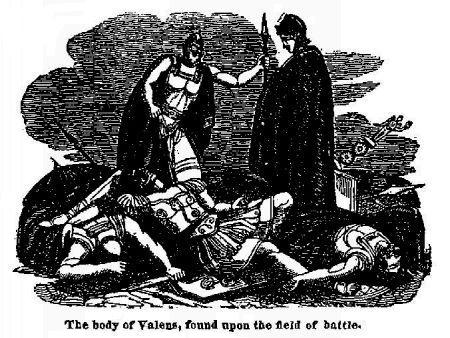
The nation of the Goths had been from remote ages settled on the banks of the Danube, and were by that river divided into two nations, the Ostrogoths on the east, and the Visigoths on the west. They had for many years enjoyed the blessings of profound peace under the government of their king Herman'ric, when they were suddenly alarmed by the appearance of vast hordes of unknown enemies on their northern and eastern frontiers. These were the Huns, a branch of the great Mongolian race, which, from the earliest time, had possessed the vast and wild plains of Tartary. Terrified by the numbers, the strength, the strange features and implacable cruelty of such foes, the Goths deserted their country, almost without attempting opposition, and supplicated the emperor Va'lens to grant them a settlement in the waste lands of Thrace. This request was cheerfully granted, and the eastern empire was supposed to be strengthened by the accession of a million of valiant subjects, bound both by interest and gratitude to protect its frontiers.
18. But the avarice of Va'lens and his ministers defeated these expectations; instead of relieving their new subjects, the Roman governors took advantage of their distress to plunder the remains of their shattered fortunes, and to reduce their children to slavery. Maddened by such oppression, the Goths rose in arms, and spread desolation over the fertile plains of Thrace. Va'lens summoned his nephew, Gratian, to his assistance; but before the emperor of the west arrived, he imprudently engaged the Goths near Adrianople, and with the greater part of his army fell on[Pg. 370] the field. 19. This was the most disastrous defeat which the Romans had sustained for several centuries; and there was reason to dread that it would encourage a revolt of the Gothic slaves in the eastern provinces, which must terminate in the ruin of the empire. To prevent such a catastrophe, the senate of Constantinople ordered a general massacre of these helpless mortals, and their atrocious edict was put into immediate execution. 20. The Goths attempted to besiege both Adrianople and Constantinople, but, ignorant of the art of attacking fortified places, they were easily repelled; but they however succeeded in forcing their way through the Thracian mountains, and spread themselves over the provinces to the west, as far as the Adriatic sea and the confines of Italy. The march of the emperor Gratian had been delayed by the hostility of the Alleman'ni, whom he subdued in two bloody engagements; but as he advanced towards Adrianople, fame brought the news of his uncle's defeat and death, which he found himself unable to revenge.
21. Feeling that the affairs of the East required the direction of a mind more energetic than his own, he determined to invest with the imperial purple, Theodo'sius, the son of that general who had rescued Britain from the barbarians. How great must have been his confidence in the fidelity of his new associate, who had a father's death to revenge; for the elder Theodo'sius, notwithstanding his splendid services, had fallen a victim to the jealous suspicions of the emperor!
22. The reign of Theodo'sius in the East lasted nearly sixteen years, and was marked by a display of unusual vigour and ability. He broke the power of the Goths by many severe defeats, and disunited their leading tribes by crafty negociations. But the continued drain on the population, caused by the late destructive wars, compelled him to recruit his forces among the tribes of the barbarians, and a change was thus made in the character and discipline of the Roman army, which in a later age produced the most calamitous consequences. The exuberant zeal, which led him to persecute the Arians and the pagans, occasioned some terrible convulsions, which distracted the empire, and were not quelled without bloodshed. He, however, preserved the integrity of the empire, and not a province was lost during his administration.
23. The valour which Gratian had displayed in the early part of his life, rendered the indolence and luxury to which he abandoned himself, after the appointment of Theodo'sius,[Pg. 371] more glaring. The general discontent of the army induced Max'imus, the governor of Britain, to raise the standard of revolt, and, passing over to the continent, he was joined by the greater part of the Gallic legions. When this rebellion broke out Gratian was enjoying the sports of the field in the neighbourhood of Paris, and did not discover his danger until it was too late to escape. He attempted to save his life by flight, but was overtaken by the emissaries of the usurper, near Lyons, and assassinated. 24. Theodo'sius was induced to make peace with Max'imus, on condition that the latter should content himself with the prefecture of Gaul, and should not invade the territories of the younger Valentin'ian. 25. Ambition hurried the faithless usurper to his ruin; having by perfidy obtained possession of the passes of the Alps, he led an overwhelming army into Italy, and Valenti'nian, with his mother Justi'na, were scarcely able, by a hasty flight, to escape to the friendly court of Theodo'sius.
26. The emperor of the East readily embraced the cause of the fugitives; the numerous troops of barbarian cavalry which he had taken into pay, enabled him to proceed with a celerity which baffled all calculation. 27. Before Maximus could make any preparations for his reception, Theodosius had completely routed his army, and was already at the gates of Aquilei'a, where the usurper had taken refuge. The garrison, secretly disinclined to the cause of Maximus, made but a faint resistance, the town was taken, and the unfortunate ruler led as a captive into the presence of his conqueror, by whom he was delivered to the executioner.
Theodo'sius, having re-established the authority of the youthful Valentin'ian, returned home. But the emperor of the West did not long enjoy his restored throne; he was murdered by Arbogas'tes, his prime minister, who dreaded that the abilities displayed by the young prince would enable him, when arrived to maturity, to shake off the authority of an unprincipled servant. 28. The assassin was afraid himself to assume the purple, but he procured the election of Euge'nius, a man not wholly unworthy of empire. Theodo'sius was called by these events a second time to Italy; he passed the Alps, but found his further progress impeded by the judicious disposition which Arbogas'tes had made of his forces. Defeated in his first attack, Theodo'sius renewed the engagement on the following day, and being aided by the seasonable revolt of some Italian legions, obtained a[Pg. 372] complete victory. Euge'nius was taken prisoner, and put to death by the soldiers. Arbogas'tes, after wandering some time in the mountains, lost all hope of escape, and terminated his life by suicide.
29. The empire was thus once more reunited under the government of a single sovereign; but he was already stricken by the hand of death. The fatigues of the late campaign proved too much for a constitution already broken by the alternate pleasures of the palace and the toils of the camp; four months after the defeat of Euge'nius, he died at Milan, universally lamented.
Questions for Examination.
1. What was the character of Julian?
2. To what disqualifications did he subject the Christians?
3. How was Julian frustrated in his attempt to weaken the prophetic evidence of Christianity?
4. How was a civil contest between the Pagans and Christians averted?
5. What success had Julian in the Persian invasion?
6. How did Julian die?
7. Who succeeded Julian?
8. What were the most important occurrences in the reign of Jovian?
9. What caused Jovian's death?
10. Who were the successors of Jovian?
11. How did Valens provoke a revolt?
12. By what means was the rebellion of Procopius suppressed?
13. What barbarous nations attacked the Roman empire?
14. In what state was Britain at this period?
15. Over what enemies did the emperor triumph?
16. What occasioned the death of Valentinian?
17. What caused the introduction of the Goths into the Roman empire?
18. How did the imprudence of Valens cause his destruction?
19. What atrocious edict was issued by the senate of Constantinople?
20. How was Gratian prevented from avenging his uncle's death?
21. To whom did Gratian entrust the eastern provinces?
22. How did Theodosius administer the government of the East?
23. By whom was Gratian deposed and slain?
24. On what conditions did Theodosius make peace with Maximus?
25. Were these conditions observed?
26. How did the war between Theodosius and Maximus terminate?
27. Did Valentinian long survive his restoration?
28. How did Theodosius act on the news of Valentinian's murder?
29. What caused the death of Theodosius?[Pg. 373]
FOOTNOTE:
From this powerful tribe Germany is still called, by the French, Allemagne.
With eye of flame, and voice of fear, He comes, the breaker of the spear, The scorner of the shield!—Anon.
1. The memory of their father's virtues protected the feeble youth of Arca'dius and Hono'rius, the sons of Theodo'sius; by the unanimous consent of mankind, they were saluted emperors of the East and West, and between them was made the final and permanent division of the Roman empire. Though both parts were never re-united under a single ruler, they continued for several centuries to be considered as one empire, and this opinion produced important consequences even in a late period of the middle ages. The dominions of Arca'dius extended from the lower Danube to the confines of Ethiopia and Persia; including Thrace, Greece, Asia Minor, Syria, and Egypt. Hono'rius, a youth in his eleventh year, received the nominal sovereignty of Italy, Africa, Gaul, Spain, and Britain, with the provinces of No'ricum, Panno'nia, and Dalma'tia. The great and martial prefecture of Illyr'icum was divided equally between the two princes, the boundary line of whose dominions consequently nearly coincided with that which separates the Austrian states from the Turkish provinces. 2. The Western empire, to the history of which we must now confine ourselves, though equal to the Eastern in extent, wealth, and population, was incomparably weaker, and already appeared rapidly tending to decay. The Caledonians in Britain, and the German tribes on the northern frontiers, harassed the imperial troops by frequent incursions; on the east, the Goths were hourly becoming more formidable, and the African provinces were threatened by the Moors. 3. The internal state of the empire furnished little ground for hope that these various enemies could be subdued; the principle of union no longer existed; the proud title of Roman citizen was an empty name, Rome itself had ceased to be the metropolis, and was now only protected by the memory of her former greatness.
4. Stil'icho, a general of superior abilities, and a statesman of profound wisdom, acted as the guardian of Hono'rius. He was descended from the perfidious race of the Vandals, and unfortunately possessed, in an eminent degree, the cunning,[Pg. 374] treachery, and cruelty that characterised his nation. The administration of the Eastern empire was entrusted by Arca'dius, to Rufi'nus, who possessed all the bad qualities of Stil'icho without his redeeming virtues. The ministers of the two empires hated each other most cordially, and each secretly sought to remove his powerful rival; but the superior craft of Stil'icho, and his great influence over the soldiers, made him conqueror. 5. He was ordered to lead into the East a fair proportion of the army which Theodo'sius had assembled, and in obedience to the requisition, he marched towards Constantinople, at the head of the Gothic legions. The approach of his great rival with a powerful army alarmed the timid Rufi'nus; he obtained a peremptory edict from Arca'dius, commanding Stil'icho to return to Italy, and the promptitude with which the order was obeyed lulled the Eastern minister into fatal negligence. The troops arrived near Constantinople, under the guidance of Gai'nas a Gothic leader, and the emperor, accompanied by his minister, came out to welcome and review the soldiers. As Rufi'nus rode along the ranks, endeavouring to conciliate favour by studied courtesy, the wings gradually advanced, and enclosed the devoted victim within the fatal circle of their arms. Before he was aware of his danger, Gai'nas gave the signal of death; a soldier rushing forward plunged his sword into his breast, and the bleeding corpse fell at the very feet of the alarmed emperor. 6. His mangled body was treated with shocking indignity, and his wife and daughter would have shared his fate, had they not placed themselves under the protection of religion, and sought refuge in the sanctuary.
7. Stil'icho derived no advantage from this crime which he had planned, but not executed; Arca'dius chose for his new minister, Eutro'pius, one of his servants, and Gai'nas declared himself the determined enemy of his former general.
8. The national hatred between the Greeks and the Romans was excited by the rival ministers, and thus at a moment when union alone would delay ruin, the subjects of Arca'dius and Hono'rius were induced to regard each other not only as foreigners, but as enemies. 9. The revolt of Gil'do, in Africa, under the pretence of transferring his allegiance from the Western to the Eastern empire, was sanctioned by the court of Constantinople. Such an event was peculiarly alarming, as Italy at the time imported most of the corn necessary to the subsistence of the people, from the African provinces. The vigour of Stil'icho warded off[Pg. 375] the danger; he sent a small but veteran army into Africa, before which Gildo's hosts of unarmed and undisciplined barbarians fled almost without a blow. The usurper was taken and executed; his partizans were persecuted with merciless impolicy.
10. The Goths, who had remained quiet during the reign of the great Theodo'sius, disdained submission to his unwarlike successors; under the pretence that the subsidy prudently paid them by the late emperor was withheld, they raised the standard of revolt, and chose for their leader Al'aric, the most formidable enemy that the Romans had hitherto encountered. Instead of confining his depredations to the northern provinces, already wasted by frequent incursions, Alaric resolved to invade Greece, where the din of arms had not been heard for centuries. 11. The barbarian encountered little or no resistance, the memorable pass of Thermop'ylæ was abandoned by its garrison; Athens purchased inglorious safety by the sacrifice of the greater part of its wealth; the Corinthian isthmus was undefended, and the Goths ravaged without opposition the entire Peloponne'sus. Unable to protect themselves, the Greeks sought the aid of Stilicho, and that great leader soon sailed to their assistance; he inflicted a severe defeat on the Goths, but neglected to improve his advantages; and before he could retrieve his error, news arrived that the faithless court of Constantinople had concluded a treaty of peace with Al'aric. Stilicho, of course, returned to Italy; while the eastern emperor, with incomprehensible folly, nominated the Gothic leader, master-general of eastern Illyr'icum.
12. Italy soon excited the ambition and cupidity of Alaric; he determined to invade that country, and, after surmounting all impediments, appeared with his forces before the imperial city of Milan. The feeble Hono'rius would have fled with his effeminate court into some remote corner of Gaul, had not the indignant remonstrances of Stil'icho induced him to remain, until he could assemble forces sufficient to protect the empire. For this purpose the brave general hurried into Gaul, assembled the garrisons from the frontier towns, recalled a legion from Britain, and strengthened his forces by taking several German tribes into pay. 13. But before Stil'icho could return, the empire had been brought to the very brink of ruin; Hono'rius, affrighted by the approach of the Goths, fled from Milan to As'ta, and was there closely besieged. When the town was on the point[Pg. 376] of capitulating, the emperor was saved by the opportune arrival of Stil'icho, before whom Alaric retired. He was closely pursued, and the armies of the Romans and barbarians came to an engagement nearly on the same ground where Marius had so many years before defeated the Cimbri. 14. The Goths were completely beaten, and a second victory obtained over them near Vero'na seemed to insure the deliverance of Italy; but Al'aric was still formidable, and the favourable terms granted him by Stil'icho, proved, that in the opinion of that general, the Gothic king, though defeated, was unconquered.
15. The late invasion so alarmed the timid Hono'rius, that he resolved to fix his residence in some remote and strong fortress; and for this purpose he selected Raven'na, an ancient city, but which had not previously obtained notoriety. 16. Before Italy had recovered from the terrors of the Gothic invasion, a new host of barbarians rushed from the shores of the Baltic, bore down before them all opposition in Germany and Gaul; and had passed the Alps, the Po, and the Apennines, ere an army could be assembled to resist them. 17. Radagai'sus, the leader of these hordes, was a more formidable enemy even than Alaric; the Goths had embraced Christianity, and their fierce passions were in some degree moderated by the mild precepts of the gospel; but Radagai'sus was a stranger to any religion but the cruel creed of his fathers, which taught that the favour of the gods could only be propitiated by human sacrifices. 18. The wealthy city of Florence was besieged by the barbarians, but its bishop, St. Ambrose, by his zealous exhortations, and by holding out the hope of divine assistance, prevented the garrison from yielding to despair. Stil'icho a second time earned the title of the deliverer of Italy; Radagai'sus was defeated and slain; but the remains of his forces escaped into Gaul, and spread desolation over that entire province, from which the garrisons had been withdrawn for the defence of Italy. 19. An usurper, named Constantine, about this time appeared in Britain, and soon established his minority both in Gaul and Spain, which had been virtually deserted by the emperor. Al'aric offered his services to repress the rebellion, and to purchase either his assistance or his forbearance, a large subsidy was voted to him by the senate, through the influence of Stil'icho. 20. But the reign of this great man was drawing fast to a close; Olym'pius, a miserable favourite, who owed his first elevation to[Pg. 377] Stil'icho, filled the emperor's mind with suspicion, and a secret resolution to destroy the minister was adopted. 21. By exciting the jealousy of the legions against the auxiliary forces that Stil'icho employed, Olym'pius was enabled to gain the army to his side, and the last great supporter of the Roman name fell by the swords of those soldiers whom he had so often led to victory. His friends, including the best and bravest generals of the army, shared his fate; many of them were racked, to extort from them a confession of a conspiracy which never existed; and their silence under the tortures at once proved their own innocence and that of their leader.
Questions for Examination.
1. What division was made of the Roman empire between the sons of Theodosius?
2. By what enemies was the Western empire assailed?
3. What was the internal condition of the state?
4. To what ministers did the emperors trust the administration?
5. How did Stilicho prevail over Rufinus?
6. What instances of savage cruelty were exhibited by the murderers of Rufinus?
7. Did Stilicho derive any advantage from the death of his rival?
8. What rivalry broke out between the subjects of the eastern and western empire?
9. How did the revolt of Gildo in Africa end?
10. Why did the Goths attack the eastern empire?
11. How did the Gothic invasion of Greece end?
12. Did the western emperor display any courage when Italy was invaded?
13. How was Honorius saved from ruin?
14. Was this defeat destructive of the Gothic power?
15. Where did Honorius fix the seat of his government?
16. What new hordes invaded Italy?
17. Why were the northern barbarians more formidable than the Goths?
18. How was Florence saved?
19. On what occasion was a subsidy voted to Alaric?
20. Who conspired against Stilicho?
21. In what manner was Stilicho slain?
Time's immortal garlands twine
O'er desolation's mournful shrine.
Like youth's embrace around decline.—Malcolm.
1. Al'aric, posted on the confines of Italy, watched the distractions of the peninsula with secret joy; he had been unwisely irritated by the delay of the subsidy which had[Pg. 378] formerly been promised him, and when payment was finally refused, he once more led his followers into Italy.
2. The feeble successors of Stil'icho had made no preparations for resistance; they retired with their master into the fortress of Raven'na, while the Goths, spreading ruin in their march, advanced to the very walls of Rome. Six hundred years had now elapsed since an enemy had appeared to threaten THE ETERNAL CITY; a worse foe than Hannibal was now at their gates, and the citizens were more disabled by luxury from attempting a defence, than their ancestors had been by the carnage of Can'næ.[1] 3. The strength of the walls deterred the Goth from attempting a regular siege, but he subjected the city to a strict blockade. Famine, and its usual attendant, pestilence, soon began to waste the miserable Romans; but even the extreme of misery could not induce them to sally forth, and try their fortune in the field. They purchased the retreat of Al'aric by the sacrifice of their wealth; and the victorious Goth formed his winter quarters in Tuscany, where his army was reinforced by more than forty thousand of his countrymen who had been enslaved by the Romans.
4. The presence of a victorious leader, with one hundred thousand men, in the very centre of Italy, ought to have taught the imperial court at Raven'na prudence and moderation; but such was their incredible folly that they not only violated their engagements with Al'aric, but added personal insult to injury. Rome was once more besieged, and as Al'aric had seized the provisions at Os'tia, on which the citizens depended for subsistence, the Romans were forced to surrender at discretion. 5. At the instigation of the Gothic king, At'talus, the prefect of the city, was invested with the imperial purple, and measures were taken to compel Hono'rius to resign in his favour. But At'talus proved utterly unworthy of a throne, and after a brief reign was publicly degraded; the rest of his life was passed in obscurity under the protection of the Goths. 6. A favourable opportunity of effecting a peace was now offered, but it was again insolently rejected by the wretched Hono'rius, and a herald publicly proclaimed that in consequence of the guilt of Al'aric, he was for ever excluded from the friendship and alliance of the emperor.
7. For the third time Al'aric proceeded to revenge the[Pg. 379] insults of the emperor on the unfortunate city of Rome. The trembling senate made some preparations for defence but they were rendered ineffectual by the treachery of a slave, who betrayed one of the gates to the Gothic legions. That city which had been for ages the mistress of the world, became the prey of ruthless barbarians, who spared, indeed, the churches and sanctuaries, but placed no other bound to their savage passions. For six successive days the Goths revelled in the sack of the city; at the end of that period they followed Al'aric to new conquests and new devastations. 8. The entire south of Italy rapidly followed the fate of the capital, and Al'aric determined to add Sicily to the list of his triumphs. Before, however, his army could pass the Strait, he was seized with an incurable disease, and his premature death protracted for a season the existence of the Western empire.[2] 9. Al'aric was succeeded by his brother Adol'phus, who immediately commenced negociations for a treaty; the peace was cemented by a marriage between the Gothic king and Placid'ia, the sister of the emperor. The army of the invaders evacuated Italy, and Adol'phus, leading his soldiers into Spain, founded the kingdom of the Visigoths. 10. Adolphus did not long survive his triumphs; Placid'ia returned to her brother's court, and was persuaded to bestow her hand on Constan'tius, the general who had suppressed the rebellion of Constan'tine. Britain, Spain, and part of Gaul had been now irrecoverably lost; Constan'tius, whose abilities might have checked the progress of ruin, died, after the birth of his second child; Placid'ia retired to the court of Constantinople, and at length Hono'rius, after a disgraceful reign of twenty-eight years, terminated his wretched life.
11. The next heir to the throne was Valenti'nian, the son of Placid'ia; but John, the late emperor's secretary, took advantage of Placid'ia's absence in the east, to seize[Pg. 380] on the government. The court of Constantinople promptly sent a body of troops against the usurper, and John was surprised and taken prisoner at Raven'na. 12. Valenti'nian III., then in the sixth year of his age, was proclaimed emperor, and the regency entrusted to his mother, Placid'ia. The two best generals of the age, Æ'tius and Bon'iface, were at the head of the army, but, unfortunately, their mutual jealousies led them to involve the empire in civil war.
13. Bon'iface was recalled from the government of Africa through the intrigues of his rival, and when he hesitated to comply, was proclaimed a traitor. Unfortunately the African prefect, unable to depend on his own forces, invited the Vandals to his assistance. Gen'seric, the king of that nation, passed over from Spain, which his barbarous forces had already wasted, and the African provinces were now subjected to the same calamities that afflicted the rest of the empire. 14. Bon'iface became too late sensible of his error; he attempted to check the progress of the Vandals, but was defeated, and Africa finally wrested from the empire. He returned to Italy, and was pardoned by Placid'ia; but the jealous Æ'tius led an army to drive his rival from the court; a battle ensued, in which Æ'tius was defeated; but Bon'iface died in the arms of victory. Placid'ia was at first determined to punish Æ'tius as a rebel; but his power was too formidable, and his abilities too necessary in the new dangers that threatened the empire; he was not only pardoned, but invested with more than his former authority.
15. The hordes of Huns that had seized on the ancient territory of the Goths, had now become united under the ferocious At'tila, whose devastations procured him the formidable name of "The Scourge of God." The Eastern empire, unable to protect itself from his ravages, purchased peace by the payment of a yearly tribute, and he directed his forces against the western provinces, which promised richer plunder. He was instigated also by secret letters from the princess Hono'ria, the sister of the emperor, who solicited a matrimonial alliance with the barbarous chieftain. Æ'tius being supported by the king of the Goths, and some other auxiliary forces, attacked the Huns in the Catalaunian plains, near the modern city of Chalons in France. 16. After a fierce engagement the Huns were routed, and it was not without great difficulty that At'tila effected his retreat. The following year he invaded Italy with more success; peace, however, was purchased by bestowing on him the[Pg. 381] hand of the princess Hono'ria, with an immense dowry. Before the marriage could be consummated, At'tila was found, dead in his bed, having burst a blood-vessel during the night.
17. The brave Æ'tius was badly rewarded by the wretched emperor for his eminent services; Valentinian, yielding to his cowardly suspicions, assassinated the general with his own hand. 18. This crime was followed by an injury to Max'imus, an eminent senator, who, eager for revenge, joined in a conspiracy with the friends of Æ'tius; they attacked the emperor publicly, in the midst of his guards, and slew him.
19. The twenty years which intervened between the assassination of Valentinian, and the final destruction of the Western empire, were nearly one continued series of intestine revolutions. 20. Even in the age of Cicero, when the empire of Rome, seemed likely to last for ever, it was stated by the augurs that the twelve vultures seen by Romulus,[3] represented the twelve centuries assigned for the fatal period of the city. This strange prediction, forgotten in ages of peace and prosperity, was recalled to the minds of men when events, at the close of the twelfth century, showed that the prophecy was about to be accomplished. It is not, of course, our meaning, that the ominous flight of birds, the prophetic interpretation, and its almost literal fulfilment, were any thing more than an accidental coincidence; but, it must be confessed, that it was one of the most remarkable on record.
21. Maximus succeeded to the imperial throne, and found that the first day of his reign was the last of his happiness. On the death of his wife, whose wrongs he had so severely revenged, he endeavoured to compel Eudox'ia, the widow of the murdered emperor, to become his spouse. In her indignation at this insulting proposal, Eudox'ia did not hesitate to apply for aid to Gen'seric, king of those Vandals that had seized Africa; and the barbarian king, glad of such a fair pretence, soon appeared with a powerful fleet in the Tiber. 22. Max'imus was murdered in an insurrection, occasioned by these tidings; and Gen'seric, advancing to Rome, became master of the city, which was, for fourteen days pillaged by the Moors and Vandals. Eudox'ia had reason to lament her imprudent conduct; she was carried off a captive by the ferocious Vandal, along with her two [Pg. 382] daughters, the last of the family of the great Theo'dosius and many thousand Romans were at the same time dragged into slavery.
23. The army in Gaul saluted their general, Avi'tus, emperor, and the Roman senate and people at first acquiesced in the choice. Rut Avi'tus was soon found unfit to hold the reins of power at a time of so much danger and difficulty; the senate, influenced by Ri'cimer, the commander of the barbarian auxiliaries, voted his deposition. He died shortly after, whether by disease or violence is uncertain.
24. The powerful Ri'cimer now placed upon the throne Ju'lian Majo'rian, who united in an eminent degree the qualities of a brave soldier and a wise statesman. The coasts of Italy had long been wasted by Gen'seric, king of the Vandals, and in order to put an end to their incursions, the emperor determined to attack the pirates in Africa, the seat of their power. The judicious preparations which he made were disconcerted by treason; Ri'cimer, who had hoped to rule the empire while Majo'rian enjoyed the empty title of monarch, was disappointed by the abilities which the new emperor displayed. Some of his creatures betrayed the Roman fleet to the torches of the Vandals; and Ri'cimer took advantage of the popular discontent occasioned by this disaster, to procure the dethronement of his former friend. Majo'rian died five years after his deposition, and the humble tomb which covered his remains was consecrated by the respect and gratitude of succeeding generations.
25. Ri'cimer's next choice was more prudent; at his instigation the obsequious senate raised to the throne Lib'ius Sev'erus, of whom history records little more than his elevation, and his death, which occurred in the fifth year after his election. During the nominal reign of Sev'erus and the interregnum that followed, the entire power of the state was possessed by Ri'cimer, whom barbarian descent alone prevented from being acknowledged emperor. He was unable, however, to protect Italy from the devastations of the Vandals; and to obtain the aid of Le'o, the Eastern emperor, he was forced to acknowledge Anthe'mius, who was nominated to the throne of the West by the court of Constantinople.
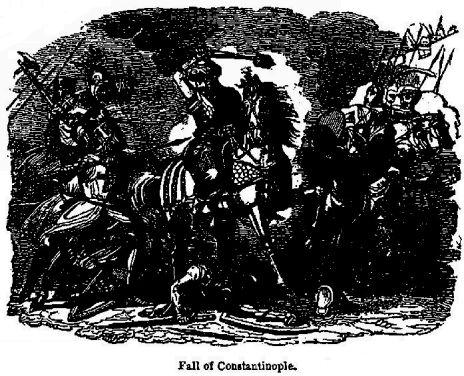
26. The perfidious Ricimer soon became dissatisfied with Anthe'mius, and raised the standard of revolt. Marching to Rome he easily became master of the city, and Anthe'mius[Pg. 383] was slain in the tumult. The unhappy Romans were again subjected to all the miseries that military licentiousness could inflict; for forty days Ricimer exulted in the havoc and ruin of the imperial city; but a disease, occasioned by excessive intemperance, seized on his vitals, and death freed Rome from the tyrant.
27. Olyb'ius, the successor of Anthe'mius, dying after a short reign of three months, Glyce'rius, an obscure soldier, assumed the purple at Raven'na, but was soon dethroned by Ju'lius Ne'pos, whom the court of Constantinople supported. A treaty by which the most faithful provinces of Gaul were yielded to the Visigoths, produced so much popular discontent, that Ores'tes, a general of barbarian auxiliaries, was encouraged to revolt, and Ne'pos, unable to defend the throne, abdicated, and spent the remainder of his unhonoured life in obscurity.
28. Ores'tes placed the crown on the head of his son Rom'ulus Momyl'lus, better known in history by the name of Augus'tulus. He was the last of the emperors; before he had enjoyed his elevation many months, he was dethroned by Odoa'cer, a leader, of the barbarian troops, and banished to a villa that once belonged to the wealthy Lucul'lus, where he was supported by a pension allowed him by the conqueror[4]. 29. Odoa'cer assumed the title of king of Italy, but after a reign of fourteen years,[Pg. 384] he was forced to yield to the superior genius of Theod'oric, king of the Ostrogoths, under whose prudent government Italy enjoyed the blessings of peace and prosperity, to which the country had been long a stranger.
30. Thus finally fell the Roman empire of the west, while that of the east survived a thousand years, notwithstanding its fierce internal dissensions, which alone would have sufficed to destroy any other; and the hosts of barbarians by which it was assailed. The almost impregnable situation of its capital, whose fate usually decides that of such empires, joined to its despotism, which gave unity to the little strength it retained, can alone explain a phenomenon unparalleled in the annals of history. At length, on the 29th of May, 1453, Constantinople was taken by Mohammed the Second, and the government and religion established by the great Constantine, trampled in the dust by the Moslem conquerors.
Questions for Examination.
1. What induced Alaric to invade Italy a second time?
2. Did the emperor and his ministers make adequate preparations for resistance?
3. How was Alaric induced to raise the siege of Rome?
4. Why did Alaric besiege Rome a second time?
5. Whom did the Goths make emperor?
6. What favourable opportunity of making peace did Honorius lose?
7. By what means did the Goths become masters of Rome?
8. Where did Alaric die?
9. What events marked the reign of Adolphus?
10. What remarkable persons died nearly at the same time?
11. What was the fate of the usurper John?
12. To whom was the government entrusted during Valentinian's minority?
13. By whom were the Vandals invited to Africa?
14. What was the fate of Boniface?
15. How were the Huns instigated to invade Italy?
16. Under what circumstances did Attila die?
17. Of what great crimes was Valentinian III. guilty?
18. How was Valentinian slain?
19. 20. What strange prophecy was now about to be fulfilled?
21. What terminated the brief reign of Maximus?
22. Had Eudoxia reason to lament her invitation to the Vandals?
23. Why was the emperor Avitus dethroned?
24. How did Ricimer procure the deposition of Majorian?
25. What changes followed on the death of Majorian?
26. How did Ricimer terminate his destructive career?
27. What changes took place after the death of Arthemius?
28. Who was the last Roman emperor?
29. What kingdoms were founded on the ruins of the western empire?
20. How was the existence of the eastern empire prolonged?[Pg. 385]
FOOTNOTES:
See Chapter xv. Sect. ii.
The ferocious character of the barbarians was displayed in the funeral of their chief. The unhappy captives were compelled to divert the stream of the river Busenti'nus, which washed the walls of Consen'tia, (now Cosenza, in farther Cala'bria, Italy,) in the bed of which the royal sepulchre was formed: with the body were deposited much of the wealth, and many of the trophies obtained at Rome. The river was then permitted to return to its accustomed channel, and the prisoners employed in the work were inhumanly massacred, to conceal the spot in which the deceased hero was entombed. A beautiful poem on this subject, entitled, The Dirge of Alaric the Visigoth, has appeared, which is attributed to the honourable Edward Everett.
See Chapter i.
See Chapter xxvii.
Lo! from the frozen forests of the north,
The sons of slaughter pour in myriads forth!
Who shall awake the mighty? Will thy woe,
City of thrones, disturb the world below?
Call on the dead to hear thee! let thy cries
Summon their shadowy legions to arise,
Array the ghosts of conquerors on thy walls
Barbarians revel in their ancient halls!
And their lost children bend the subject knee,
Amidst the proud tombs and trophies of the free!—Anon.
1. We have already mentioned that the barbarous nations which joined in the destruction of the Roman empire, were invited to come within its precincts through the weakness or folly of successive sovereigns who recruited their armies from those hardy tribes, in preference to their own subjects, enervated by luxury and indolence. The grants of land, and the rich donations by which the emperors endeavoured to secure the fidelity of these dangerous auxiliaries, encouraged them to regard the Roman territories as their prey; and being alternately the objects of lavish extravagance and wanton insult, their power was increased at the same time that their resentment was provoked. 2. Towards the close of the year 406, the Vandals, the Suevi, and the Alans, first sounded the tocsin of invasion, and their example was followed by the Goths, the Burgundians, the Alleman'ni, the Franks, the Huns, the Angli, the Saxons, the Heruli, and the Longobar'di, or Lombards. The chief of these nations, with the exception of the Huns were of German origin. It is not easy in every instance to discover the original seat of these several tribes, and trace their successive migrations, because, being ignorant of letters, they only retained some vague traditions of their wanderings.
THE VANDALS AND ALANS
3. This tribe was, like the Burgundians and Lombards, a branch of the ancient Sue'vi, and inhabited that part of Germany which lies between the Elbe and the Vis'tula. Being joined by some warriors from Scandinavia, they advanced towards the south, and established themselves in that part of Da'cia which included the modern province of Transylva'nia,[Pg. 386] and part of Hungary. Being oppressed in their new settlement by the Goths, they sought the protection of Constantine the Great, and obtained from him a grant of lands in Pannonia, on condition of their rendering military service to the Romans. 4. About the commencement of the fifth century, they were joined by the ALANS, a people originally from mount Cau'casus, and the ancient Scythia: a branch of which having settled in Sarma'tia, near the source of the Borysthenes (Dnieper), had advanced as far as the Danube, and there made a formidable stand against the Romans. In their passage through Germany, the Vandals and Alans were joined by a portion of the Suevi, and the confederate tribes entering Gaul, spread desolation over the entire country.
5. From thence the barbarians passed into Spain and settled in the province, from them named Vandalu'sia, since corrupted to Andalusia. On the invitation of Count Boniface, the Vandals proceeded from Spain to Africa, where they founded a formidable empire. After remaining masters of the western Mediterranean for nearly a century, the eastern emperor Justinian sent a formidable force against them under the command of the celebrated Belisa'rius. This great leader not only destroyed the power of these pirates, but erased the very name of Vandals from the list of nations.
THE GOTHS.
6. The Goths, the most powerful of these destructive nations, are said to have come originally from Scandina'via; but when they first began to attract the notice of historians, we find them settled on the banks of the Danube. Those who inhabited the districts towards the east, and the Euxine sea, between the Ty'ras (Dniester) the Borys'thenes (Dnieper) and the Tan'ais (Don) were called Ostrogoths; the Visigoths extended westwards over ancient Dacia, and the regions between the Ty'ras, the Danube, and the Vistula.
7. Attacked in these vast countries by the Huns, as has been mentioned in a preceding chapter, some were subjugated, and others compelled to abandon their habitations. They obtained settlements from the emperors, but being unwisely provoked to revolt, they became the most formidable enemies of the Romans. After having twice ravaged Italy and plundered Rome, they ended their conquests by establishing themselves in Gaul and Spain.
8. The Spanish monarchy of the Visigoths, which in its flourishing state comprised, besides the entire peninsula,[Pg. 387] the province of Septima'nia (Langucaoc) in Gaul, and Mauritania, Tingeta'na, (north-western Africa) on the opposite coasts of the Mediterranean, lasted from the middle of the fifth to the commencement of the eighth century, when it was overthrown by the Moors. 9. The Thuringians, whom we find established in the heart of Germany, in the middle of the fifth century, appear to have been a branch of the Visigoths.
THE FRANKS.
10. A number of petty German tribes having entered into a confederacy to maintain their mutual independence, took the name of Franks, or Freemen. The tribes which thus associated, principally inhabited the districts lying between the Rhine and the Weser, including the greater part of Holland and Westphalia. 11. In the middle of the third century, they invaded Gaul, but were defeated by Aurelian, who afterwards became emperor. In the fourth, and towards the beginning of the fifth century, they permanently established themselves as a nation, and gave the name of Francia, or France, to the provinces lying between the Rhine, the Weser, the Maine, and the Elbe; but about the sixth century that name was transferred to ancient Gaul, when it was conquered by the Franks.
THE ALLEMANNI.
12. The Alleman'ni were another confederation of German tribes, which took its name from including a great variety of nations. It is scarcely necessary to remark, that the name is compounded of the words all and man which still continue unchanged in our language. Their territories extended between the Danube, the Rhine, and the Maine, and they rendered themselves formidable to the Romans by their frequent inroads into Gaul and Italy during the third and fourth centuries.
THE SAXONS AND ANGLES.
13. The Saxons began to be conspicuous about the close of the second century. They were then settled beyond the Elbe, in modern Holstein; having for their neighbours the ANGLI, or ANGLES, inhabiting Sleswick. These nations were early distinguished as pirates, and their plundering expeditions kept the shores of western Europe in constant alarm. Being invited by the Britons to assist in repelling[Pg. 388] the invasions of the Picts, they subdued the southern part of the island, which has ever since retained the name of England, from its conquerors the An'gli. When the Franks penetrated into Gaul, the Saxons passed the Elbe, and seizing on the vacated territory, gave the name of Saxony to ancient France.
THE HUNS.
14. The Huns were the most ferocious and sanguinary of the barbarians. They seem to have been originally Kalmuck or Mongolian Tartars, and, during the period of their supremacy, seem never to have laid aside the savage customs which they brought from their native deserts. 15. After having expelled the Goths from the banks of the Danube, they fell upon the eastern empire, and compelled the court of Constantinople to pay them tribute. They then, under the guidance of Attila, invaded Italy, and after devastating the peninsula, captured and plundered Rome. After the death of Attila, the Huns were broken up into a number of petty states, which maintained their independence until the close of the eighth century, when they were subdued by Charlemagne.
THE BURGUNDIANS.
16. The Burgundians were originally inhabitants of the countries situated between the Oder and the Vistula. They followed nearly the track of the Visigoths, and at the beginning of the fifth century had established themselves on the Upper Rhine and in Switzerland. On the dissolution of the empire, they seized on that part of Gaul, which from them retains the name of Burgundy.
THE LOMBARDS, THE GEPIDÆ, AND THE AVARS.
17. The Lombards, more properly called Longo-bardi, from the length of their beards, are supposed by some to have been a branch of the Sue'vi, and by others to have migrated from Scandina'via. They joined with the Avars, a fierce Asiatic people, in attacking the Gep'idæ, then in possession of that part of Dacia lying on the left bank of the Danube, but who are supposed to have come thither from some more northern country. The Avars and Lombards triumphed, but the former soon turned their arms against their allies, and compelled them to seek new habitations. 18. About the middle of the sixth century they invaded[Pg. 389] Italy, which the Eastern emperors had just before wrested from the Turks, and made themselves masters of the northern part; which has since borne the name of Lombardy.
THE SLA'VI.
19. These were the last of the barbarian hordes, and are not mentioned by any author before the sixth century. They first appeared in the east of Europe, and spreading themselves over the central provinces, occupied the greater part of the countries that now constitute the dominions of Austria. The Sla'vi warred chiefly against the Eastern empire, and their contest with the Grecian forces on the Danube, in the sixth and seventh centuries, shook the throne of Constantinople. The VENE'DI and the AN'TES were tribes of the Slavi.
THE NORMANS.
20. The piratical inhabitants of Norway and Denmark were called by the Franks, Normans, or, Men of the North; in Ireland they were named Ostmen, or, Men of the East. Their depredations began to attract notice early in the seventh century, but did not become formidable before the ninth: when they obtained possession of that part of France now called Normandy. In the two following centuries they wrested England from the Saxons, and established kingdoms in Sicily and southern Italy.
THE BULGARIANS.
21. The Bulgarians were of Scythian or Tartar origin, and became formidable to the Eastern empire in the latter part of the seventh century. In the beginning of the ninth, Cruni'nus, their king, advanced to the gates of Constantinople; but the city proving too strong, he seized Adrianople, and returned home loaded with booty. The successors of Cruni'nus did not inherit his abilities, and the Bulgarians soon sunk into comparative insignificance.
THE SARACENS MOORS AND TURKS.
22. In concluding this chapter, it may be proper to give some account of the subverters of the Eastern empire, and of their irruption into Europe. The Arabs, called in the middle ages Saracens, are supposed to be descended from Ishmael, the son of Abraham and Hagar. During all the changes of dynasties and empires in the eastern and western[Pg. 390] world, they retained their independence, though almost constantly at war with the surrounding states. "Their hand was against every man, and every man's hand was against them." In the beginning of the seventh century, Mohammed, a native of Mecca, descended from a noble family, laid claim to the title of a prophet, and being aided by a renegade Christian, formed a religious system, which, after encountering great opposition, was finally adopted by the principal tribes of Arabia. The successors of Mohammed, called Caliphs, resolved to propagate the new religion by the sword, and conquered an empire, more extensive than that of the Romans had been. The entire of central and southern Asia, including Persia, India, and the provinces of the Eastern empire owned their sway; northern Africa was soon after subdued, and in the beginning of the eighth century, the Saracenic Moors established their dominion in Spain. 23. It is probable, even, that all Europe would have submitted to their yoke, if the French hero, Charles Martel,[1] had not arrested their victorious career, and defeated their numerous armies on the plains of Poitiers, A.D. 732.[2]
24. The empire of the Caliphs soon declined from its original splendour, and its ruin finally proceeded from the same cause that produced the downfall of Rome, the employment of barbarian mercenaries. The soldiers levied by the Caliphs, were selected from the Tartar tribes that had embraced the religion of Mohammed; they were called Turcomans or Turks, from Turkistan, the proper name of western Tartary. These brave, but ferocious warriors, soon wrested the sceptre from the feeble caliphs, and completed the conquest of western Asia. The crusades for a time delayed the fate of the Greek empire, but finally the Turks crossed the Hellespont, and having taken Constantinople, (A.D. 1453,) established their cruel despotism over the fairest portion of Europe.
Questions for Examination.
1. How were the barbarians first brought into the Roman empire?
2. When did the first great movement of the Northern tribes take place?
3. Where did the Vandals first settle?[Pg. 391]
4. From whence did the Alans come?
5. In what countries did the Vandals establish their power?
6. Where did we first find the Goths settled?
7. To what countries did the Goths remove?
8. How long did the kingdom of the Visigoths continue?
9. What branch of the Goths settled in Germany?
10. From what did the Franks derive their name?
11. Which was the ancient, and which the modern France?
12. What is the history of the Allemanni?
13. In what countries did the Saxons and Angles settle?
14. Whence did the Huns come?
15. How far did their ravages extend?
16. What territory did the Burgundians seize?
17. How did the alliance between the Lombards and Avars injure the former people?
18. Where was the kingdom of the Lombards established?
19. What is told respecting the Slavi?
20. Who were the Normans?
21. What is the history of the Bulgarians?
22. What great conquests were achieved by the Arabs under Mohammed and his successors?
23. By whom was the Saracenic career of victory checked?
24. How was the empire of the Turks established?
FOOTNOTES:
See Taylor's History of France.
Here also the heroic Black Prince took John, king of France, prisoner. See Taylor's France.
Waft, waft, ye winds, his story,
And you, ye oceans, roll,
Till, like a sea of glory,
It spreads from pole to pole.—Heber.
1. Judea became a Roman province some years before the birth of Jesus Christ, and the Jews, who had hitherto been conspicuous for their attachment to their native land, were induced, by the spirit of trade, to spread themselves over the empire. 2. The exclusive nature of their religion kept them in a marked state of separation from their fellow subjects; the worshipper of Osi'ris scrupled not to offer sacrifices to Jupiter; the Persian, the Indian, and the German, bowed before the Roman altars; but the sons of Abraham refused to give the glory of their God to graven images, and were regarded by their idolatrous neighbours at first with surprise, and afterwards with contempt. 3. The appearance of the Messiah in Palestine, and the miraculous circumstances of his life, death, and resurrection, did not fill the world with their fame, because his preaching was principally addressed to his countrymen, the first object of his mission being "the lost sheep of the house of Israel."[Pg. 392]
4. The disciples, after their Divine Master was taken from them, proceeded to fulfil his last commandments, by preaching the gospel "to every nation," and an opportunity of spreading its blessings was afforded by Jewish synagogues having been previously established in most of the great cities through the empire. Independent of the sustaining providence of its Almighty Author, there were many circumstances that facilitated the progress and prepared the way for the final triumph of Christianity. 5. In the first place, Paganism had lost its influence; men secretly laughed at the fabulous legends about Jupiter and Rom'ulus, the sacrifices had become idle forms, and the processions a useless mockery. Philosophers had not scrupled to cover with ridicule the whole system of Heathenism, and there were not a few who professed themselves Atheists. 6. Without some system of religion society cannot exist; for a sanction stronger than human laws is necessary to restrain the violence of passion and ardent desires. The innate feeling that our existence is not dependent on our mortal frame, disposes men to search for some information respecting a future state; the heathen system was at once obscure and absurd; the philosophers avowedly spoke from conjecture; but by the Gospel, "life and immortality were brought to light." 7. The influence of a purer faith was discernible in the lives and actions of the first Christians; they lived in an age of unparalleled iniquity and debauchery, yet they kept themselves "unspotted from the world;" those who were once conspicuous for violence, licentiousness, and crime, became, when they joined the new sect, humble, temperate, chaste, and virtuous; the persons who witnessed such instances of reformation were naturally anxious to learn something of the means by which so great a change had been effected. 8. A fourth cause was, that Christianity offered the blessings of salvation to men of every class; it was its most marked feature, that "to the poor the gospel was preached," and the wretch who dared not come into the pagan temple, because he had no rich offering to lay upon the altar, was ready to obey the call of him who offered pardon and love "without money and without price."
9. In the course of the first century of the Christian era churches were established in the principal cities of the empire, but more especially in Asia Minor; and the progress of Christianity, which had been at first disregarded, began to attract the notice of the ruling powers. Too indolent[Pg. 393] to investigate the claims of Christianity, and by no means pleased with a system which condemned their vices, the Roman rulers viewed the rapid progress of the new religion with undisguised alarm. The union of the sacerdotal and magisterial character in the Roman policy, added personal interest to the motives that urged them to crush this rising sect; and the relentless Ne'ro at length kindled the torch of persecution. 10. But "the blood of the martyrs proved the seed of the Church;" the constancy with which they supported the most inhuman tortures, their devotion and firm reliance on their God in the moments of mortal agony, increased the number of converts to a religion which could work such a moral miracle. Persecution also united the Christians more closely together, and when the reign of terror ended with the death of Nero, it was found that Christianity had derived additional strength from the means taken to insure its destruction.
11. The successive persecutions inflicted by the policy or the bigotry of the following emperors had precisely the same results; and at length the Christians had acquired such strength, that their aid, as a body, became a matter of importance in contests for the empire.
12. The mild administration of Constantino, while he was only prefect of Gaul, the protection which he afforded to the Christians, and the favour that he showed to their religion, induced them to aid him with all their might in his struggle for the throne. Brought thus into contact with the professors of the new doctrine, Constantine was induced to examine the foundations of its high claims—perfect conviction was the result, and on his accession to the imperial purple, the Christian church was legally established. 13. During the reign of the apostate Julian, Christianity was discouraged, but not persecuted; his premature death, however, removed the last impediment to its final triumph, which was consummated in the reign of the great Theodo'sius. 14. Under that emperor the last vestiges of the pagan worship were destroyed, its idols overthrown, its altars demolished, and its temples closed. The world had become ripe for such a revolution, as the temples had been long before almost universally abandoned.
15. Since that period Christianity has prevailed in Europe, and formed the great bond of the social happiness and the great source of the intellectual eminence enjoyed in that quarter of the globe. Let us hope that the exertions now[Pg. 394] made to diffuse its blessings over the benighted portions of the earth will prove successful, and that "peace and happiness, truth and justice, religion and piety" will prevail from pole to pole.
Questions for Examination.
1. What was the state of the Jews at the coming of Christ?
2. How were the Jews preserved separate from other nations?
3. What probable cause may be assigned for the neglect of the Christian miracles?
4. How did the dispersion of the Jews afford an opportunity for the propagation of Christianity?
5. What was the state of paganism when Christianity was first preached?
6. What great mystery is brought to light by the gospel?
7. How did the lives of the first Christians contribute to the rapid progress of Christianity?
8. To what class of people was the gospel more particularly addressed?
9. What induced the rulers of the Roman empire to persecute Christianity?
10. Was Christianity crushed by persecution?
11. What proves the great strength early acquired by Christians?
12. By whom was Christianity legally established?
13. Under whose government did it receive a slight check?
14. When were the last vestiges of paganism abolished?
15. What have been the political effects of the establishment of Christianity?[Pg. 395]
| B.C. | PAGE | ||
| 1230 | (Supposed) Pelasgic migration to Italy, | 14 | |
| 1184 | (Supposed) Arrival of Æneas in Latium, | 19, 63 | |
| 753 | (Supposed) foundation of the city of Rome, | 23, 65 | |
| 750 | Union of the Romans and Sabines, | 69 | |
| 716 | Death of Romulus, | 70 | |
| 714 | Virtuous Administration of Numa, | 71 | |
| 671 | Accession of Tullus Hostilius, | 73 | |
| 665 | Duel between the Horatii and Curiatii—Destruction of Alba, | ib. | |
| 639 | Accession of Ancus Martius, | 75 | |
| 616 | { | —— —— Tarquinius Priscus, | 77 |
| The Augurs acquire importance in the state, | 78 | ||
| 578 | { | Death of Tarquinius Priscus, | 79 |
| Accession of Servius Tullius, | 80 | ||
| The establishment of the Centuries, | 32, 80 | ||
| 534 | { | Murder of Servius Tullius, | 82 |
| Accession of Tarquinius Superbus, | 83 | ||
| Gabii taken by stratagem, | 84 | ||
| 509 | { | Expulsion of Tarquinius Superbus, | 87 |
| Establishment of Consuls, | 88 | ||
| 508 | { | Conspiracy for the restoration of the Tarquinii, | ib. |
| Death of Brutus, | 89 | ||
| 507 | War with Porsenna, | 90 | |
| 498 | Lartius the first Dictator created, | 92 | |
| 493 | { | The Roman populace retire "to Mons Sacer, | 94 |
| Tribunes of the people appointed, | 36, 95 | ||
| 487 | { | Exile of Coriolanus, | 97 |
| Rome besieged by Coriolanus, | 98 | ||
| His retreat and death, | 100 | ||
| 484 | Condemnation and death of Cassius, | ib. | |
| 459 | First Dictatorship of Cincinnatus, | 101 | |
| 457 | Second ditto, | 102 | |
| 454 | The Romans send to Athens for Solon's laws, | 35, 106 | |
| 451 | The laws of the Twelve Tables—The Decemviri, | 107 | |
| 449 | The expulsion of the Decemviri, | 114 | |
| 443 | Military Tribunes chosen instead of Consuls, | 116 | |
| 442 | The Censorship instituted, | ib. | |
| 439 | Mælius murdered by Ahala, | 118 | |
| 406 | The siege of Veii begun, | 119 | |
| 396 | Veii taken by Camillus, | 120 | |
| 391 | The Gauls invade Italy, | 122 | |
| 390 | { | The battle of Allia. Rome sacked by the Gauls, | 124 |
| The Gauls defeated by Camillus, | 127 | ||
| 383 | Manlius put to death on a charge of treason, | 129 | |
| 361 | Curtius devotes himself in the Forum, | 129 | |
| 342 | Beginning of the Samnite war, | 131 | |
| 339 | { | Manlius puts his son to death for disobedience, | 133 |
| Decius devotes himself for his country, | 134 | ||
| 320 | A Roman army forced to surrender to the Samnites in the Caudine Forks, | 136 | |
| 280 | Pyrrhus, king of Epirus, invades Italy, | 137 | |
| 272 | —— finally defeated by Curius Dentatus, | 142 | |
| 270 | Tarentum surrendered to the Romans, | 143 | |
| 264 | Commencement of the first Punic war, | 144 | |
| 260 | The Carthaginian fleet defeated by Duilius, | 145 | |
| 256 | Regulus defeated by Xantippus, | 147 | |
| 252 | Regulus sent to negociate peace. His death, | 149 | |
| 241 | End of the first Punic war, | 150 | |
| 234 | { | The temple of Janus shut, and Rome at peace, for the first time since the death of Numa, | 151 |
| Literature cultivated at Rome, | 152 | ||
| 229 | War with the Illyrians, | ib. | |
| 225 | { | The Gauls invade Italy a second time, | ib. |
| —— are defeated by Marcellus, who gains the spolia opima, | 153 | ||
| 218 | { | The second Punic war begins, | ib. |
| Hannibal invades Italy, | 154 | ||
| Battle of the Ticenus, | 155 | ||
| —— of the Trebia, | ib. | ||
| 217 | —— of the lake Thrasymene, | 156 | |
| 216 | —— of Cannæ, | 158 | |
| 214 | The Romans begin an auxiliary war against Philip of Macedon, | 164 | |
| 212 | Syracuse taken by Marcellus, | 161 | |
| 207 | Asdrubal defeated and slain, | ib. | |
| 202 | Battle of Zama and end of the second Punic war, | 162 | |
| 197 | Philip conquered by the Romans, | 165 | |
| 192 | The Romans wage war against Antiochus, | ib. | |
| 189 | Death of Hannibal, | 166 | |
| 171 | Commencement of the second Macedonian war, | ib. | |
| 168 | Macedon became a Roman province, | 167 | |
| 149 | The third Punic war begins, | ib. | |
| 147 | Carthage destroyed by Scipio, and Corinth by Munimius, | 169 | |
| 132 | Sedition of Tiberius Gracchus, | 170 | |
| 126 | Revolt of the slaves in Sicily, | 172 | |
| 122 | Seditions of Caius Gracchus, | ib. | |
| 121 | Murder of Caius Gracchus. Persecution of the popular party, | 175 | |
| 111 | The Jugurthine war begins, and lasts five years, | 178 | |
| 91 | The social war begins, and lasts three years, | 181 | |
| 89 | The Mithridatic war begins, and lasts twenty-six years, | ib. | |
| 88 | The civil war between Marius and Sylla, | ib. | |
| 86 | { | Cruelties of Marius, | 184 |
| Death of Marius, | 185 | ||
| 82 | Sylla created dictator, | 186 | |
| 78 | Death of Sylla, | 187 | |
| 73 | The insurrection of the slaves under Spartacus note, | ib. | |
| 66 | Mithridates conquered by Pompey, | 189 | |
| 63 | Catiline's conspiracy detected, | 190 | |
| 60 | The first Triumvirate. Cæsar, Pompey, and Crassus, | 193 | |
| 55 | Cæsar invades Britain, | 194 | |
| 53 | Crassus slain in Parthia, | 196 | |
| 50 | Civil war between Cæsar and Pompey, | 197 | |
| 48 | { | The battle of Pharsalia, | 208 |
| Death of Pompey, | 216 | ||
| 47 | Alexandria taken by Cæsar, | 221 | |
| 46 | { | The war in Africa, | 224 |
| Death of Cato, | 225 | ||
| 45 | { | The war in Spain, | 226 |
| The battle of Munda, | 226 | ||
| 44 | Cæsar murdered in the senate house, | 230 | |
| 43 | { | Formation of the second Triumvirate—Antony, Octavius (Augustus) and Lepidus, | 233 |
| The Proscription. The murder of Cicero, | 234 | ||
| 42 | The battle of Philippi, | 239 | |
| 32 | Octavius (Augustus) and Antony prepare for war, | 249 | |
| 31 | The battle of Actium, | 251 | |
| 30 | { | The death of Antony, | 257 |
| Alexandria surrendered, | 258 | ||
| Death of Cleopatra, | 261 | ||
| 27 | The title of Augustus given to Octavius, | 265 | |
| A.D. | |||
| 4 | Birth of JESUS CHRIST (four years before the vulgar era), | 271 | |
| 14 | Death of Augustus, | 270 | |
| 19 | Death of Germanicus by poison, | 274 | |
| 26 | The retreat of Tiberius to Capreæ, | 276 | |
| 31 | Disgrace and downfall of Sejanus, | 277 | |
| 33 | The Crucifixion, | 279 | |
| 37 | The Accession of Caligula, | ib. | |
| 41 | Caligula murdered by Cherea, | 284 | |
| 43 | Claudius invades Britain, | 287 | |
| 51 | Caractacus carried captive to Rome, | 288 | |
| 54 | Nero succeeds Claudius, | 290 | |
| 59 | Nero murders his mother, | 291 | |
| 64 | First general persecution of the Christians, | 292 | |
| 65 | Seneca, Lucan, and others, executed for conspiracy, | 294 | |
| 68 | Suicide of Nero. Accession of Galba, | 297 | |
| 69 | { | Death of Galba, | 299 |
| Defeat and death of Otho, | 300 | ||
| Defeat and death of Vitellius. Accession of Vespasian, | 304 | ||
| 70 | Siege and capture of Jerusalem, | 305 | |
| 79 | { | Death of Vespasian. Accession of Titus, | 308 |
| Eruption of Vesuvius: destruction of Herculaneum, | 309 | ||
| 81 | Death of Titus. Accession of Domitian, | 310 | |
| 88 | The Dacian war, | 312 | |
| 96 | { | Assassination of Domitian, | 315 |
| Accession of Nerva, | 317 | ||
| 98 | Death of Nerva. Accession of Trajan, | 318 | |
| 107 | Third general persecution of the Christians, | 321 | |
| 117 | Death of Trajan. Accession of Adrian, | 322 | |
| 121 | A wall to restrain the incursions of the Picts and Scots erected in Britain by Adrian, | 323 | |
| 131 | Great rebellion of the Jews, | 324 | |
| 136 | Death of Adrian. Accession of Antoninus Pius, | 326, 327 | |
| 161 | Accession of Marcus Aurelius, and Lucius Verus, | 323 | |
| 162 | The Parthian war, | ib. | |
| 169 | The war with the Marcomanni, | 331 | |
| 180 | { | Death of Marcus Aurelius, | 332 |
| Accession of Commodus, | 333 | ||
| 192 | { | Commodus murdered by Marcia and Lætus, | 334 |
| Assassination of Pertinax, | 335 | ||
| 200 | { | Roman empire offered for sale, | ib. |
| Severus subdues the Parthians, | 338 | ||
| 211 | Death of Severus at York. Accession of Caracalla and Geta, | 339 | |
| 217 | Assassination of Caracalla, | 340 | |
| 218 | Accession of Heliogabalus, | 341 | |
| 222 | { | His miserable death, | ib. |
| Accession of Alexander Severus, | 342 | ||
| 235 | Death of Alexander. Maximin elected emperor, | 343 | |
| 236 | Assassination of Maximin, | 344 | |
| 238 | Accession of Gordian, | 345 | |
| 244 | His murder by Philip, | ib. | |
| 248 | Philip killed by his soldiers: succeeded by Decius, | 346 | |
| 251 | Decius slain in an ambuscade: succeeded by Gallus, | ib | |
| 254 | Death of Gallus: a disputed succession, | 347 | |
| 270 | Accession of Aurelian, | 348 | |
| 275 | Brief reign of Tacitus, | 349 | |
| 282 | Assassination of the emperor Probus, | ib. | |
| 284 | Accession of Dioclesian, | 351 | |
| 304 | The reign of Constantius and Galerius, | 352 | |
| 312 | Victory of Constantino over Maxentius, | 353 | |
| 319 | Favour showed to the Christians, | 354 | |
| 324 | Defeat of Licinius, | 355 | |
| 325 | Legal establishment of Christianity, | 355, 393 | |
| 328 | The seat of government removed from Rome to Byzantium, which city from thenceforward takes the name of Constantinople, from the emperor Constantine, | 356 | |
| 337 | { | Death of Constantine, and division of the empire among his sons, | 357 |
| (Destruction of the Flavian Family, | 359 | ||
| 338 | War between Constantius and Sapor, | 360 | |
| 340 | Constantine the younger defeated and slain by his brother Constans, | 361 | |
| 350 | Constans killed by Magnentius, | ib. | |
| 351 | Magnentius totally defeated at the fatal battle of Mursa, | 362 | |
| 354 | Gallas put to death by Constantius, | 363 | |
| 360 | The civil war between Constantius and Julian prevented by the death of the former, | 364 | |
| 362 | Julian's attempt to rebuild the temple of Jerusalem defeated, | 365 | |
| 363 | Death of Julian in the Persian war. Brief reign of Jovian, | 366 | |
| 364 | The empire divided between Valenlinian and Valens, | 367 | |
| 376 | { | The Goths permitted to settle in Thrace, | 369, 386 |
| First appearance of the Huns in Europe, | 369 | ||
| 378 | The emperor Valens defeated by the Goths at Adrianople, | ib. | |
| 379 | Theodosius becomes emperor of the East, | 370 | |
| 388 | The usurper Maximus defeated and slain, | 371 | |
| 392 | Reunion of the Eastern and Western empires, under Theodosius, | 372 | |
| 395 | Death of Theodosius, and final separation of the Eastern and Western empires, | ib. | |
| 398 | Revolt of Gildo in Africa, | 374 | |
| 405 | Stilicho obtains two victories over the Goths, | 375 | |
| 406 | The Vandals and Alans settle in Gaul, | 376, 386 | |
| 408 | Alaric, king of the Goths, besieges Rome, | 378 | |
| 410 | Rome taken and plundered by the Goths, | 379 | |
| 412 | Beginning of the Vandal kingdom in Spain, | 386 | |
| 415 | Commencement of the kingdom of the Visigoths, | 379, 386 | |
| 423 | Death of Honorius. Accession of Valentinian, | 379 | |
| 430 | The Vandals invited to Africa by count Boniface, | 370, 385 | |
| 447 | The Huns under the guidance of Attila, ravage Europe, | 380 | |
| 449 | The Britons, deserted by the Romans, invite the Sarons and Angles to their assistance, | 389 | |
| 455 | Rome taken and plundered by Genseric, the king of the African Vandals, | 381 | |
| 476 | Augustulus, the last emperor of the West deposed, Odoacer takes the title of king of Italy, | 383 | |
| 453 | Subversion of the Eastern empire, | 384, 390 | |

THOMAS, COWPERTHWAIT & CO.,
PUBLISH
IN A SERIES,
ADAPTED TO THE PROGRESSIVELY DEVELOPING CAPACITIES OF YOUTH.
MITCHELL'S PRIMARY GEOGRAPHY.
MITCHELL'S INTERMEDIATE GEOGRAPHY.
MITCHELL'S SCHOOL GEOGRAPHY AND ATLAS.
MITCHELL'S ATLAS OF OUTLINE MAPS.
MITCHELL'S KEY TO THE STUDY OF THE MAPS.
MITCHELL'S ANCIENT GEOGRAPHY AND ATLAS.
MITCHELL'S ANCIENT ATLAS.
MITCHELL'S BIBLICAL AND SABBATH-SCHOOL GEOGRAPHY.
MITCHELL'S HIGH-SCHOOL GEOGRAPHY. (Preparing.)
MITCHELL'S VIEW OF THE HEAVENS.
ONE VOLUME QUARTO, HANDSOMELY ILLUSTRATED. (Preparing.)
There are no works published in this country that are more in demand, or that have a wider circulation than those of Mr. Mitchell. There are upwards of 350,000 copies of his geographical works sold annually, and more than 250 workmen are constantly employed upon them. The arrangements of the publishers are such, that they are enabled to give the most correct and latest geographical discoveries and improvements of any firm in the United States. They publish the only full series of geographics in the country, and having in constant employ a strong geographical force of map engravers, &c., and being very largely engaged in the publication of the various State and other maps, they are enabled to present the school series correct, both in maps and matter, up to the date of publication.
DESCRIPTION OF THE SERIES
SECOND REVISED EDITION.
DESIGNED FOR THE INSTRUCTION OF CHILDREN
IN SCHOOLS AND FAMILIES.
The publishers have embraced the opportunity of a new revision of the work to augment its size, so that the book is now a third larger than any of the preceding editions.
The Maps for the present edition have all been redrawn and re-engraved. They are on a much larger scale, more distinct, and fuller in information than those of the previous editions, or any similar work extant. The true boundaries of all the Western States and Territories are exhibited, California, Utah, &c., and proper attention given to all political changes up to the present time.
MITCHELL'S GEOGRAPHICAL SERIES.
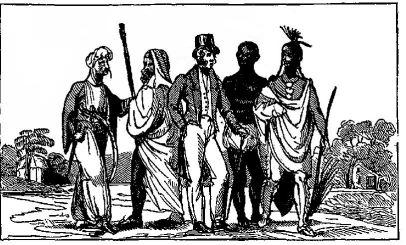
A SYSTEM OF MODERN GEOGRAPHY;
Comprising a Description of the present state of the World, and its five
great Divisions,
AMERICA, EUROPE, ASIA, AFRICA, AND OCEANICA,
WITH THEIR SEVERAL EMPIRES, KINGDOMS, STATES, TERRITORIES, ETC.
ILLUSTRATED BY FORTY MAPS AND NUMEROUS WOOD-CUT ENGRAVINGS.
Designed for the instruction of Youth in Schools and Families.
BY S. AUGUSTUS MITCHELL.
Mitchell's Intermediate Geography, the last published book of the series, has been before the public but a short time, yet it has been extensively introduced and is now largely used in public and private schools throughout the Union. It has been adopted independently, or in connection with other numbers of the series, by the Public School Directors of the cities of
| New York, | Philadelphia, | Baltimore, |
| Washington, | St. Louis, | Albany, |
| Rochester, | Cleveland, | Syracuse, |
| Utica, | Schenectady, | Oswego, &c. &c. |
By numerous county boards in the various States, and a great number of the towns and villages of the whole country.
MITCHELL'S GEOGRAPHICAL SERIES.
This work is designed to occupy a medium place between the Author's Primary, and the well known School Geography and Atlas, of which last book it contains about two-thirds of the amount of matter.
Like the Primary Geography, the Map Questions are upon the same or opposite page to the map itself, so that in no case have the leaves to be turned to find an answer to the question.
Superior excellence is claimed for this book, on account of the natural and progressive order of the lessons,—of the conciseness and truthfulnes of the descriptive matter,—of the number, correctness, and uniform excellence of the Maps,—from the fact that the book is faithfully revised as often as political changes in our own or other countries require it,—that the pronunciations of the difficult geographical names are given,—and finally, on account of the superior mechanical execution of the work.
As a specimen of numerous recommendations the publishers have received, they submit the following:
Copy of a petition of the Public School Teachers of the City of Troy, New York, addressed to the Board of Education of said city.
GENTLEMEN,—Having examined Mitchell's Intermediate and Primary Geographies, and faithfully compared them with Smith's, in regard to accuracy of definitions, reliability of topography, and faithfulness of the descriptive part, we, the undersigned, teachers, are respectively of opinion that the interests of your public schools require that the former geographies be substituted, to be used in our schools in the room of the latter, and we respectfully request that this change may be made.
Signed,
EDWARD WILSON, JR.
HENRY ROBBINS,
HORACE BACON,
P.W. ROBERTSON,
N.H. BENSON,
P.S. CRANDALL,
JNO. PRENTICE,
J.A. PETERS,
ROXANA CARMICHAEL,
RICHARD DAVIDSON.
Principals of the Public Schools of the City of Troy.
HISTORICAL SERIES.
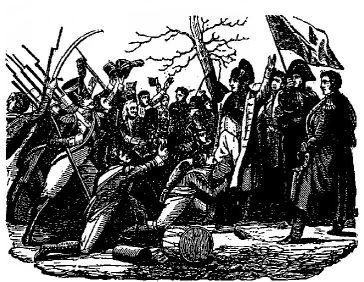
REVISED EDITION.
PINNOCK'S IMPROVED EDITION OF DR. GOLDSMITH'S HISTORY OF ENGLAND,
FROM THE INVASION OF JULIUS CÆSAR
WITH A CONTINUATION TO THE YEAR 1845:
WITH QUESTIONS FOR EXAMINATION AT THE END OF EACH SECTION;
BESIDES A VARIETY OF VALUABLE INFORMATION ADDED THROUGHOUT THE WORK,
Consisting of Tables of Contemporary Sovereigns and eminent Persons, copious Explanatory Notes, Remarks on the Politics, Manners and Literature of the Age, and an Outline of the Constitution.
ILLUSTRATED WITH NUMEROUS ENGRAVINGS.
FORTY-FIFTH AMERICAN, CORRECTED AND REVISED FROM THE THIRTY-FIFTH ENGLISH EDITION.
OF TRINITY COLLEGE, DUBLIN,
Author of a Manual of Ancient and Modern History, &c. &c.
HISTORY OF FRANCE AND NORMANDY, FROM THE EARLIEST TIMES TO
THE REVOLUTION OF 1848,
WITH QUESTIONS FOR EXAMINATION AT THE END OF EACH SECTION,
BY W.C. TAYLOR, LL.D., OF TRINITY COLLEGE, DUBLIN,
Author of a Manual of Ancient and Modern History, &c. &c., and Editor of Pinnock's Improved editions of Goldsmith's Greece, Rome, and England.
ILLUSTRATED WITH NUMEROUS ENGRAVINGS.
FIRST AMERICAN FROM THE THIRD ENGLISH EDITION.
REVISED EDITION,
PINNOCK'S IMPROVED EDITION OF DR. GOLDSMITH'S HISTORY OF ROME,
TO WHICH IS PREFIXED
AN INTRODUCTION TO THE STUDY OF ROMAN HISTORY,
AND A GREAT VARIETY OF INFORMATION THROUGHOUT THE WORK,
ON THE MANNERS, INSTITUTIONS, AND ANTIQUITIES OF THE ROMANS;
WITH QUESTIONS FOR EXAMINATION AT THE END OF EACH SECTION.
TWENTY-FIFTH AMERICAN, FROM THE NINETEENTH LONDON EDITION, IMPROVED
BY W.C. TAYLOR, LL.D.,
WITH NUMEROUS ENGRAVINGS BY ATHERTON AND OTHERS.
REVISED EDITION,
PINNOCK'S IMPROVED EDITION OF DR. GOLDSMITH'S HISTORY OF GREECE,
REVISED, CORRECTED, AND VERY CONSIDERABLY ENLARGED,
BY THE ADDITION OF SEVERAL NEW CHAPTERS, AND NUMEROUS
USEFUL NOTES.
WITH QUESTIONS FOR EXAMINATION AT THE END OF EACH SECTION.
TWENTY-FIFTH AMERICAN, FROM THE NINETEENTH LONDON EDITION, IMPROVED
BY W.C. TAYLOR, LL.D.,
WITH NUMEROUS ENGRAVINGS, BY ATHERTON AND OTHERS.
Pinnock's England, Greece, Rome, and France, have become school classics. In order to make this series more complete, the volumes have been revised by that well-known historian, W.C. Taylor, LL.D., of Trinity College, Dublin.
The popularity of these books is almost without a parallel. Teachers unacquainted with them, will on examination give them a decided preference to any other historical series published.
PINNOCK'S GOLDSMITH'S GREECE, ROME, AND ENGLAND.—The popularity of these histories is almost without a parallel among our school books. Their use is co-extensive with the English language, and their names are familiar to all who have received an English education. But if permitted to remain as they came from the hands of the author, they would soon be antiquated; for not only is the stream of modern history flowing onward, but numerous scholars are constantly making researches into that of ancient times. These works are therefore frequently revised, and thus the labours of successive individuals are added to those of the gifted man who wrote them. The present edition is quite an improvement on the former ones. Several important matters which had before been omitted, have been introduced into the text, numerous notes and several new cuts have been added, and every chapter commences with one or more well selected poetical lines, which express the subject of the chapter, and will assist the memory as well as improve the taste of the student. We feel assured that these additions will increase the reputation which these works have hitherto so deservedly sustained.
I consider Pinnock's edition of Goldsmith's History of England as the best edition of that work which has as yet been published for the use of schools. The tables of contemporary sovereigns and eminent persons, at the end of each chapter, afford the means of many useful remarks and comparisons with the history of other nations. With these views, I cheerfully recommend it as a book well adapted to school purposes.
Having examined Pinnock's improved edition of Dr. Goldsmith's History of Rome, I unhesitatingly say, that the style and elegance of the language, the arrangement of the chapters, and the questions for examination, render it, in my estimation, a most valuable school book:—I therefore most cheerfully recommend it to teachers, and do confidently trust that it will find an extensive introduction into the schools of our country.
A well written and authentic History of France possesses unusual interest at the present time. It becomes especially valuable when, as in the present case, it has been prepared with questions as a text-book for common schools and seminaries, by a scholar so accomplished as Dr. Taylor. The work has passed through three editions in England. The American editor has added one chapter on the late revolutions, bringing the history down to 1848, and has added to its value by illustrations throughout, portraying the costume and the principal events of the reigns of which it treats.
This treatise goes back to the origin of the Celtic race, or the Cimbrians, as the offspring of Gomer, peopling the north and east of Europe on the one hand, and to the descendants of Cush—under the names of Scythians, Tartars, Goths, and Scots, warlike, wandering tribes, on the other, tracing the migrations of the latter till they drove the Celts westward, and the Rhine forms the boundary between the two nations. From the Gauls it goes on to the reign of the Franks, Charlemagne, the Carlovingian race, the history of Normandy, and the history of France from the first crusade through its lines of monarchies and its revolutions, to 1848. The style is clear and forcible, and from the compactness of the work, forming, as it does, a complete chain of events in a most important part of the history of Europe, it will be found interesting and valuable for general readers, or as a text-book in our schools. It is comprised in 444 pages, 12mo., and contains a chronological index and genealogy of the kings of France.
Want of space prevents us from inserting all the recommendations received: we however present the names of the following gentlemen, who have given their recommendations to the Histories:
SIMEON HART, Jr., Farmington, Conn.
REV. D.R. AUSTIN, Principal of Monmouth Academy, Monson, Mass.
T.L. WRIGHT, A.M., Prin. E. Hartford Classical and English School.
REV. N.W. FISKE, A.M., Professor Amherst College, Mass.
E.S. SNELL, A.M., Professor Amherst College, Mass.
REV. S. NORTH, Professor Languages, Hamilton College, N.Y.
W.H. SCRAM, A.M., Prin. Classical and English Academy, Troy, N.Y.
JAMES F. GOULD, Principal of Classical School, Baltimore.
A.B. MYERS, Principal of Whitehall, Academy, New York.
HORACE WEBSTER, Professor Geneva College, N.Y.
W.C. FOWLER, Professor Middlebury College, Vermont.
B.S. NOBLE, Bridgeport, Conn.
REV. S.B. HOWE, Late President of Dickenson College.
B.F. JOSLIN, Professor Union College, N.Y.
End of the Project Gutenberg EBook of Pinnock's Improved Edition of Dr.
Goldsmith's History of Rome, by Oliver Goldsmith

*** END OF THIS PROJECT GUTENBERG EBOOK HISTORY OF ROME ***

***** This file should be named 16387-h.htm or 16387-h.zip *****
This and all associated files of various formats will be found in:
        https://www.gutenberg.org/1/6/3/8/16387/

Produced by Alicia Williams, Jayam Subramanian and the
Online Distributed Proofreading Team at https://www.pgdp.net


Updated editions will replace the previous one--the old editions
will be renamed.

Creating the works from public domain print editions means that no
one owns a United States copyright in these works, so the Foundation
(and you!) can copy and distribute it in the United States without
permission and without paying copyright royalties.  Special rules,
set forth in the General Terms of Use part of this license, apply to
copying and distributing Project Gutenberg-tm electronic works to
protect the PROJECT GUTENBERG-tm concept and trademark.  Project
Gutenberg is a registered trademark, and may not be used if you
charge for the eBooks, unless you receive specific permission.  If you
do not charge anything for copies of this eBook, complying with the
rules is very easy.  You may use this eBook for nearly any purpose
such as creation of derivative works, reports, performances and
research.  They may be modified and printed and given away--you may do
practically ANYTHING with public domain eBooks.  Redistribution is
subject to the trademark license, especially commercial
redistribution.


*** START: FULL LICENSE ***

THE FULL PROJECT GUTENBERG LICENSE
PLEASE READ THIS BEFORE YOU DISTRIBUTE OR USE THIS WORK

To protect the Project Gutenberg-tm mission of promoting the free
distribution of electronic works, by using or distributing this work
(or any other work associated in any way with the phrase "Project
Gutenberg"), you agree to comply with all the terms of the Full Project
Gutenberg-tm License (available with this file or online at
https://gutenberg.org/license).


Section 1.  General Terms of Use and Redistributing Project Gutenberg-tm
electronic works

1.A.  By reading or using any part of this Project Gutenberg-tm
electronic work, you indicate that you have read, understand, agree to
and accept all the terms of this license and intellectual property
(trademark/copyright) agreement.  If you do not agree to abide by all
the terms of this agreement, you must cease using and return or destroy
all copies of Project Gutenberg-tm electronic works in your possession.
If you paid a fee for obtaining a copy of or access to a Project
Gutenberg-tm electronic work and you do not agree to be bound by the
terms of this agreement, you may obtain a refund from the person or
entity to whom you paid the fee as set forth in paragraph 1.E.8.

1.B.  "Project Gutenberg" is a registered trademark.  It may only be
used on or associated in any way with an electronic work by people who
agree to be bound by the terms of this agreement.  There are a few
things that you can do with most Project Gutenberg-tm electronic works
even without complying with the full terms of this agreement.  See
paragraph 1.C below.  There are a lot of things you can do with Project
Gutenberg-tm electronic works if you follow the terms of this agreement
and help preserve free future access to Project Gutenberg-tm electronic
works.  See paragraph 1.E below.

1.C.  The Project Gutenberg Literary Archive Foundation ("the Foundation"
or PGLAF), owns a compilation copyright in the collection of Project
Gutenberg-tm electronic works.  Nearly all the individual works in the
collection are in the public domain in the United States.  If an
individual work is in the public domain in the United States and you are
located in the United States, we do not claim a right to prevent you from
copying, distributing, performing, displaying or creating derivative
works based on the work as long as all references to Project Gutenberg
are removed.  Of course, we hope that you will support the Project
Gutenberg-tm mission of promoting free access to electronic works by
freely sharing Project Gutenberg-tm works in compliance with the terms of
this agreement for keeping the Project Gutenberg-tm name associated with
the work.  You can easily comply with the terms of this agreement by
keeping this work in the same format with its attached full Project
Gutenberg-tm License when you share it without charge with others.

1.D.  The copyright laws of the place where you are located also govern
what you can do with this work.  Copyright laws in most countries are in
a constant state of change.  If you are outside the United States, check
the laws of your country in addition to the terms of this agreement
before downloading, copying, displaying, performing, distributing or
creating derivative works based on this work or any other Project
Gutenberg-tm work.  The Foundation makes no representations concerning
the copyright status of any work in any country outside the United
States.

1.E.  Unless you have removed all references to Project Gutenberg:

1.E.1.  The following sentence, with active links to, or other immediate
access to, the full Project Gutenberg-tm License must appear prominently
whenever any copy of a Project Gutenberg-tm work (any work on which the
phrase "Project Gutenberg" appears, or with which the phrase "Project
Gutenberg" is associated) is accessed, displayed, performed, viewed,
copied or distributed:

This eBook is for the use of anyone anywhere at no cost and with
almost no restrictions whatsoever.  You may copy it, give it away or
re-use it under the terms of the Project Gutenberg License included
with this eBook or online at www.gutenberg.org

1.E.2.  If an individual Project Gutenberg-tm electronic work is derived
from the public domain (does not contain a notice indicating that it is
posted with permission of the copyright holder), the work can be copied
and distributed to anyone in the United States without paying any fees
or charges.  If you are redistributing or providing access to a work
with the phrase "Project Gutenberg" associated with or appearing on the
work, you must comply either with the requirements of paragraphs 1.E.1
through 1.E.7 or obtain permission for the use of the work and the
Project Gutenberg-tm trademark as set forth in paragraphs 1.E.8 or
1.E.9.

1.E.3.  If an individual Project Gutenberg-tm electronic work is posted
with the permission of the copyright holder, your use and distribution
must comply with both paragraphs 1.E.1 through 1.E.7 and any additional
terms imposed by the copyright holder.  Additional terms will be linked
to the Project Gutenberg-tm License for all works posted with the
permission of the copyright holder found at the beginning of this work.

1.E.4.  Do not unlink or detach or remove the full Project Gutenberg-tm
License terms from this work, or any files containing a part of this
work or any other work associated with Project Gutenberg-tm.

1.E.5.  Do not copy, display, perform, distribute or redistribute this
electronic work, or any part of this electronic work, without
prominently displaying the sentence set forth in paragraph 1.E.1 with
active links or immediate access to the full terms of the Project
Gutenberg-tm License.

1.E.6.  You may convert to and distribute this work in any binary,
compressed, marked up, nonproprietary or proprietary form, including any
word processing or hypertext form.  However, if you provide access to or
distribute copies of a Project Gutenberg-tm work in a format other than
"Plain Vanilla ASCII" or other format used in the official version
posted on the official Project Gutenberg-tm web site (www.gutenberg.org),
you must, at no additional cost, fee or expense to the user, provide a
copy, a means of exporting a copy, or a means of obtaining a copy upon
request, of the work in its original "Plain Vanilla ASCII" or other
form.  Any alternate format must include the full Project Gutenberg-tm
License as specified in paragraph 1.E.1.

1.E.7.  Do not charge a fee for access to, viewing, displaying,
performing, copying or distributing any Project Gutenberg-tm works
unless you comply with paragraph 1.E.8 or 1.E.9.

1.E.8.  You may charge a reasonable fee for copies of or providing
access to or distributing Project Gutenberg-tm electronic works provided
that

- You pay a royalty fee of 20% of the gross profits you derive from
     the use of Project Gutenberg-tm works calculated using the method
     you already use to calculate your applicable taxes.  The fee is
     owed to the owner of the Project Gutenberg-tm trademark, but he
     has agreed to donate royalties under this paragraph to the
     Project Gutenberg Literary Archive Foundation.  Royalty payments
     must be paid within 60 days following each date on which you
     prepare (or are legally required to prepare) your periodic tax
     returns.  Royalty payments should be clearly marked as such and
     sent to the Project Gutenberg Literary Archive Foundation at the
     address specified in Section 4, "Information about donations to
     the Project Gutenberg Literary Archive Foundation."

- You provide a full refund of any money paid by a user who notifies
     you in writing (or by e-mail) within 30 days of receipt that s/he
     does not agree to the terms of the full Project Gutenberg-tm
     License.  You must require such a user to return or
     destroy all copies of the works possessed in a physical medium
     and discontinue all use of and all access to other copies of
     Project Gutenberg-tm works.

- You provide, in accordance with paragraph 1.F.3, a full refund of any
     money paid for a work or a replacement copy, if a defect in the
     electronic work is discovered and reported to you within 90 days
     of receipt of the work.

- You comply with all other terms of this agreement for free
     distribution of Project Gutenberg-tm works.

1.E.9.  If you wish to charge a fee or distribute a Project Gutenberg-tm
electronic work or group of works on different terms than are set
forth in this agreement, you must obtain permission in writing from
both the Project Gutenberg Literary Archive Foundation and Michael
Hart, the owner of the Project Gutenberg-tm trademark.  Contact the
Foundation as set forth in Section 3 below.

1.F.

1.F.1.  Project Gutenberg volunteers and employees expend considerable
effort to identify, do copyright research on, transcribe and proofread
public domain works in creating the Project Gutenberg-tm
collection.  Despite these efforts, Project Gutenberg-tm electronic
works, and the medium on which they may be stored, may contain
"Defects," such as, but not limited to, incomplete, inaccurate or
corrupt data, transcription errors, a copyright or other intellectual
property infringement, a defective or damaged disk or other medium, a
computer virus, or computer codes that damage or cannot be read by
your equipment.

1.F.2.  LIMITED WARRANTY, DISCLAIMER OF DAMAGES - Except for the "Right
of Replacement or Refund" described in paragraph 1.F.3, the Project
Gutenberg Literary Archive Foundation, the owner of the Project
Gutenberg-tm trademark, and any other party distributing a Project
Gutenberg-tm electronic work under this agreement, disclaim all
liability to you for damages, costs and expenses, including legal
fees.  YOU AGREE THAT YOU HAVE NO REMEDIES FOR NEGLIGENCE, STRICT
LIABILITY, BREACH OF WARRANTY OR BREACH OF CONTRACT EXCEPT THOSE
PROVIDED IN PARAGRAPH F3.  YOU AGREE THAT THE FOUNDATION, THE
TRADEMARK OWNER, AND ANY DISTRIBUTOR UNDER THIS AGREEMENT WILL NOT BE
LIABLE TO YOU FOR ACTUAL, DIRECT, INDIRECT, CONSEQUENTIAL, PUNITIVE OR
INCIDENTAL DAMAGES EVEN IF YOU GIVE NOTICE OF THE POSSIBILITY OF SUCH
DAMAGE.

1.F.3.  LIMITED RIGHT OF REPLACEMENT OR REFUND - If you discover a
defect in this electronic work within 90 days of receiving it, you can
receive a refund of the money (if any) you paid for it by sending a
written explanation to the person you received the work from.  If you
received the work on a physical medium, you must return the medium with
your written explanation.  The person or entity that provided you with
the defective work may elect to provide a replacement copy in lieu of a
refund.  If you received the work electronically, the person or entity
providing it to you may choose to give you a second opportunity to
receive the work electronically in lieu of a refund.  If the second copy
is also defective, you may demand a refund in writing without further
opportunities to fix the problem.

1.F.4.  Except for the limited right of replacement or refund set forth
in paragraph 1.F.3, this work is provided to you 'AS-IS', WITH NO OTHER
WARRANTIES OF ANY KIND, EXPRESS OR IMPLIED, INCLUDING BUT NOT LIMITED TO
WARRANTIES OF MERCHANTIBILITY OR FITNESS FOR ANY PURPOSE.

1.F.5.  Some states do not allow disclaimers of certain implied
warranties or the exclusion or limitation of certain types of damages.
If any disclaimer or limitation set forth in this agreement violates the
law of the state applicable to this agreement, the agreement shall be
interpreted to make the maximum disclaimer or limitation permitted by
the applicable state law.  The invalidity or unenforceability of any
provision of this agreement shall not void the remaining provisions.

1.F.6.  INDEMNITY - You agree to indemnify and hold the Foundation, the
trademark owner, any agent or employee of the Foundation, anyone
providing copies of Project Gutenberg-tm electronic works in accordance
with this agreement, and any volunteers associated with the production,
promotion and distribution of Project Gutenberg-tm electronic works,
harmless from all liability, costs and expenses, including legal fees,
that arise directly or indirectly from any of the following which you do
or cause to occur: (a) distribution of this or any Project Gutenberg-tm
work, (b) alteration, modification, or additions or deletions to any
Project Gutenberg-tm work, and (c) any Defect you cause.


Section  2.  Information about the Mission of Project Gutenberg-tm

Project Gutenberg-tm is synonymous with the free distribution of
electronic works in formats readable by the widest variety of computers
including obsolete, old, middle-aged and new computers.  It exists
because of the efforts of hundreds of volunteers and donations from
people in all walks of life.

Volunteers and financial support to provide volunteers with the
assistance they need, is critical to reaching Project Gutenberg-tm's
goals and ensuring that the Project Gutenberg-tm collection will
remain freely available for generations to come.  In 2001, the Project
Gutenberg Literary Archive Foundation was created to provide a secure
and permanent future for Project Gutenberg-tm and future generations.
To learn more about the Project Gutenberg Literary Archive Foundation
and how your efforts and donations can help, see Sections 3 and 4
and the Foundation web page at https://www.pglaf.org.


Section 3.  Information about the Project Gutenberg Literary Archive
Foundation

The Project Gutenberg Literary Archive Foundation is a non profit
501(c)(3) educational corporation organized under the laws of the
state of Mississippi and granted tax exempt status by the Internal
Revenue Service.  The Foundation's EIN or federal tax identification
number is 64-6221541.  Its 501(c)(3) letter is posted at
https://pglaf.org/fundraising.  Contributions to the Project Gutenberg
Literary Archive Foundation are tax deductible to the full extent
permitted by U.S. federal laws and your state's laws.

The Foundation's principal office is located at 4557 Melan Dr. S.
Fairbanks, AK, 99712., but its volunteers and employees are scattered
throughout numerous locations.  Its business office is located at
809 North 1500 West, Salt Lake City, UT 84116, (801) 596-1887, email
business@pglaf.org.  Email contact links and up to date contact
information can be found at the Foundation's web site and official
page at https://pglaf.org

For additional contact information:
     Dr. Gregory B. Newby
     Chief Executive and Director
     gbnewby@pglaf.org

Section 4.  Information about Donations to the Project Gutenberg
Literary Archive Foundation

Project Gutenberg-tm depends upon and cannot survive without wide
spread public support and donations to carry out its mission of
increasing the number of public domain and licensed works that can be
freely distributed in machine readable form accessible by the widest
array of equipment including outdated equipment.  Many small donations
($1 to $5,000) are particularly important to maintaining tax exempt
status with the IRS.

The Foundation is committed to complying with the laws regulating
charities and charitable donations in all 50 states of the United
States.  Compliance requirements are not uniform and it takes a
considerable effort, much paperwork and many fees to meet and keep up
with these requirements.  We do not solicit donations in locations
where we have not received written confirmation of compliance.  To
SEND DONATIONS or determine the status of compliance for any
particular state visit https://pglaf.org

While we cannot and do not solicit contributions from states where we
have not met the solicitation requirements, we know of no prohibition
against accepting unsolicited donations from donors in such states who
approach us with offers to donate.

International donations are gratefully accepted, but we cannot make
any statements concerning tax treatment of donations received from
outside the United States.  U.S. laws alone swamp our small staff.

Please check the Project Gutenberg Web pages for current donation
methods and addresses.  Donations are accepted in a number of other
ways including including checks, online payments and credit card
donations.  To donate, please visit: https://pglaf.org/donate


Section 5.  General Information About Project Gutenberg-tm electronic
works.

Professor Michael S. Hart was the originator of the Project Gutenberg-tm
concept of a library of electronic works that could be freely shared
with anyone.  For thirty years, he produced and distributed Project
Gutenberg-tm eBooks with only a loose network of volunteer support.

Project Gutenberg-tm eBooks are often created from several printed
editions, all of which are confirmed as Public Domain in the U.S.
unless a copyright notice is included.  Thus, we do not necessarily
keep eBooks in compliance with any particular paper edition.

Most people start at our Web site which has the main PG search facility:

     https://www.gutenberg.org

This Web site includes information about Project Gutenberg-tm,
including how to make donations to the Project Gutenberg Literary
Archive Foundation, how to help produce our new eBooks, and how to
subscribe to our email newsletter to hear about new eBooks.

*** END: FULL LICENSE ***