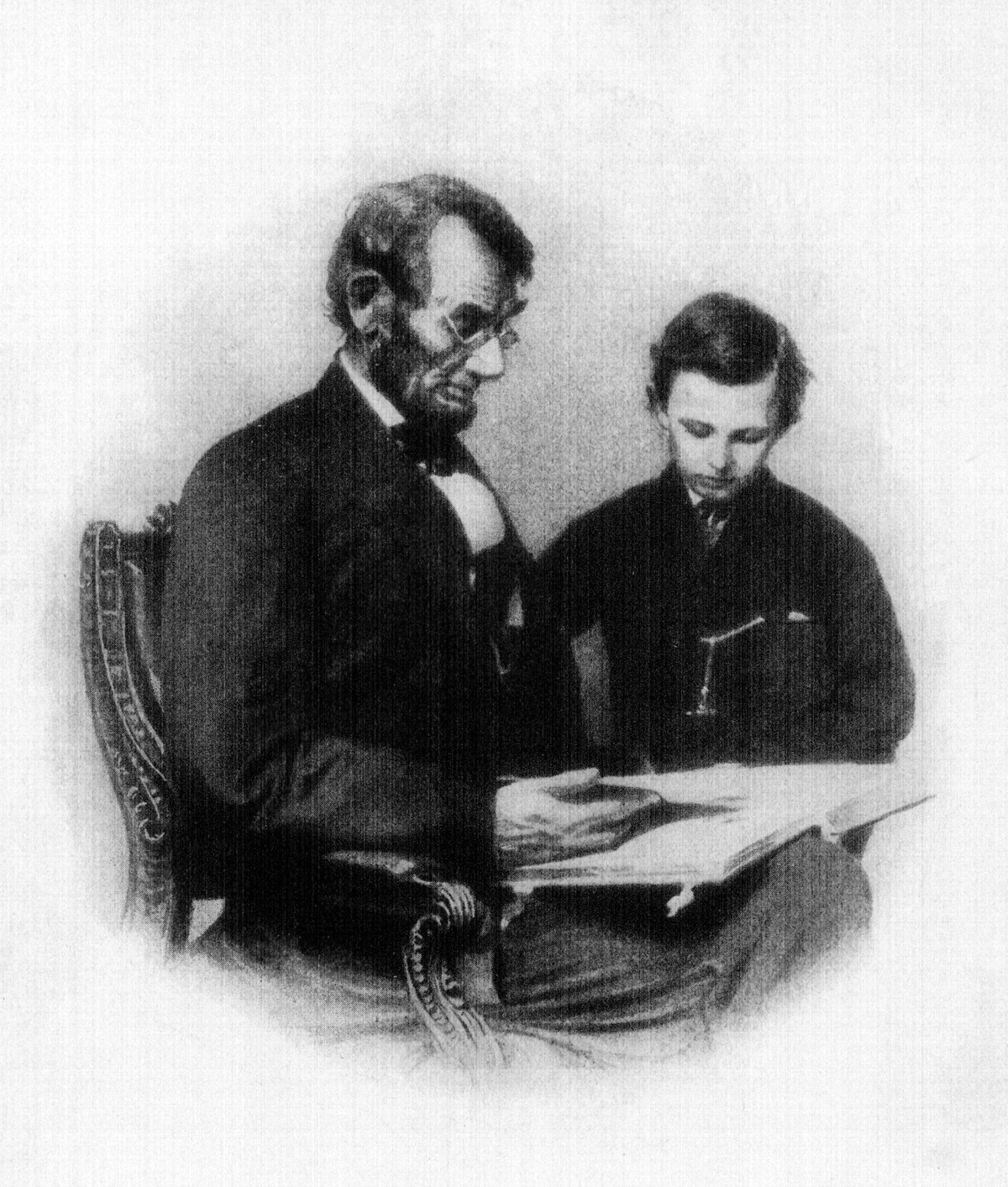
Project Gutenberg's A Short Life of Abraham Lincoln, by John G. Nicolay

This eBook is for the use of anyone anywhere at no cost and with
almost no restrictions whatsoever.  You may copy it, give it away or
re-use it under the terms of the Project Gutenberg License included
with this eBook or online at www.gutenberg.org


Title: A Short Life of Abraham Lincoln
       Condensed from Nicolay & Hay's Abraham Lincoln: A History

Author: John G. Nicolay

Release Date: July 19, 2005 [EBook #16332]

Language: English

Character set encoding: ISO-8859-1

*** START OF THIS PROJECT GUTENBERG EBOOK A SHORT LIFE OF ABRAHAM LINCOLN ***


Produced by Juliet Sutherland, Chuck Greif and the Online
Distributed Proofreading Team at https://www.pgdp.net
Ancestry—Thomas Lincoln and Nancy Hanks—Rock Spring Farm—Lincoln's Birth—Kentucky Schools—The Journey to Indiana—Pigeon Creek Settlement—Indiana Schools—Sally Bush Lincoln—Gentryville—Work and Books—Satires and Sermons—Flatboat Voyage to New Orleans—The Journey to Illinois
Abraham Lincoln, the sixteenth President of the United States, was born in a log cabin in the backwoods of Kentucky on the 12th day of February 1809. His father, Thomas Lincoln, was sixth in direct line of descent from Samuel Lincoln, who emigrated from England to Massachusetts in 1638. Following the prevailing drift of American settlement, these descendants had, during a century and a half, successively moved from Massachusetts to New Jersey, from New Jersey to Pennsylvania, from Pennsylvania to Virginia, and from Virginia to Kentucky; while collateral branches of the family eventually made homes in other parts of the West. In Pennsylvania and Virginia some of them had acquired considerable property and local prominence.
In the year 1780, Abraham Lincoln, the President's grandfather, was able to pay into the public treasury of Virginia "one hundred and sixty pounds, current money," for which he received a warrant, directed to the "Principal Surveyor of any County within the commonwealth of Virginia," to lay off in one or more surveys for Abraham Linkhorn, his heirs or assigns, the quantity of four hundred acres of land. The error in spelling the name was a blunder of the clerk who made out the warrant.
With this warrant and his family of five children—Mordecai, Josiah, Mary, Nancy, and Thomas—he moved to Kentucky, then still a county of Virginia, in 1780, and began opening a farm. Four years later, while at work with his three boys in the edge of his clearing, a party of Indians, concealed in the brush, shot and killed him. Josiah, the second son, ran to a neighboring fort for assistance; Mordecai, the eldest, hurried to the cabin for his gun, leaving Thomas, youngest of the family, a child of six years, by his father. Mordecai had just taken down his rifle from its convenient resting-place over the door of the cabin when, turning, he saw an Indian in his war-paint stooping to seize the child. He took quick aim through a loop-hole, shot, and killed the savage, at which the little boy also ran to the house, and from this citadel Mordecai continued firing at the Indians until Josiah brought help from the fort.
It was doubtless this misfortune which rapidly changed the circumstances of the family.[1] Kentucky was yet a wild, new country. As compared with later periods of emigration, settlement was slow and pioneer life a hard struggle. So it was probably under the stress of poverty, as well as by the marriage of the older children, that the home was gradually broken up, and Thomas Lincoln became "even in childhood ... a wandering laboring boy, and grew up literally without education.... Before he was grown he passed one year as a hired hand with his uncle Isaac on Watauga, a branch of the Holston River." Later, he seems to have undertaken to learn the trade of carpenter in the shop of Joseph Hanks in Elizabethtown.
When Thomas Lincoln was about twenty-eight years old he married Nancy Hanks, a niece of his employer, near Beechland, in Washington County. She was a good-looking young woman of twenty-three, also from Virginia, and so far superior to her husband in education that she could read and write, and taught him how to sign his name. Neither one of the young couple had any money or property; but in those days living was not expensive, and they doubtless considered his trade a sufficient provision for the future. He brought her to a little house in Elizabethtown, where a daughter was born to them the following year.
During the next twelvemonth Thomas Lincoln either grew tired of his carpenter work, or found the wages he was able to earn insufficient to meet his growing household expenses. He therefore bought a little farm on the Big South Fork of Nolin Creek, in what was then Hardin and is now La Rue County, three miles from Hodgensville, and thirteen miles from Elizabethtown. Having no means, he of course bought the place on credit, a transaction not so difficult when we remember that in that early day there was plenty of land to be bought for mere promises to pay; under the disadvantage, however, that farms to be had on these terms were usually of a very poor quality, on which energetic or forehanded men did not care to waste their labor. It was a kind of land generally known in the West as "barrens"—rolling upland, with very thin, unproductive soil. Its momentary usefulness was that it was partly cleared and cultivated, that an indifferent cabin stood on it ready to be occupied, and that it had one specially attractive as well as useful feature—a fine spring of water, prettily situated amid a graceful clump of foliage, because of which the place was called Rock Spring Farm. The change of abode was perhaps in some respects an improvement upon Elizabethtown. To pioneer families in deep poverty, a little farm offered many more resources than a town lot—space, wood, water, greens in the spring, berries in the summer, nuts in the autumn, small game everywhere—and they were fully accustomed to the loss of companionship. On this farm, and in this cabin, the future President of the United States was born, on the 12th of February, 1809, and here the first four years of his childhood were spent.
When Abraham was about four years old the Lincoln home was changed to a much better farm of two hundred and thirty-eight acres on Knob Creek, six miles from Hodgensville, bought by Thomas Lincoln, again on credit, for the promise to pay one hundred and eighteen pounds. A year later he conveyed two hundred acres of it by deed to a new purchaser. In this new home the family spent four years more, and while here Abraham and his sister Sarah began going to A B C schools. Their first teacher was Zachariah Riney, who taught near the Lincoln cabin; the next, Caleb Hazel, at a distance of about four miles.
Thomas Lincoln was evidently one of those easy-going, good-natured men who carry the virtue of contentment to an extreme. He appears never to have exerted himself much beyond the attainment of a necessary subsistence. By a little farming and occasional jobs at his trade, he seems to have supplied his family with food and clothes. There is no record that he made any payment on either of his farms. The fever of westward emigration was in the air, and, listening to glowing accounts of rich lands and newer settlements in Indiana, he had neither valuable possessions nor cheerful associations to restrain the natural impulse of every frontiersman to "move." In this determination his carpenter's skill served him a good purpose, and made the enterprise not only feasible but reasonably cheap. In the fall of 1816 he built himself a small flatboat, which he launched at the mouth of Knob Creek, half a mile from his cabin, on the waters of the Rolling Fork. This stream would float him to Salt River, and Salt River to the Ohio. He also thought to combine a little speculation with his undertaking. Part of his personal property he traded for four hundred gallons of whisky; then, loading the rest on his boat with his carpenter's tools and the whisky, he made the voyage, with the help of the current, down the Rolling Fork to Salt River, down Salt River to the Ohio, and down the Ohio to Thompson's Ferry, in Perry County, on the Indiana shore. The boat capsized once on the way, but he saved most of the cargo.
Sixteen miles out from the river he found a location in the forest which suited him. Since his boat would not float up-stream, he sold it, left his property with a settler, and trudged back home to Kentucky, all the way on foot, to bring his wife and the two children—Sarah, nine years old, and Abraham, seven. Another son had been born to them some years before, but had died when only three days old. This time the trip to Indiana was made with the aid of two horses, used by the wife and children for riding and to carry their little equipage for camping at night by the way. In a straight line, the distance is about fifty miles; but it was probably doubled by the very few roads it was possible to follow.
Having reached the Ohio and crossed to where he had left his goods on the Indiana side, he hired a wagon, which carried them and his family the remaining sixteen miles through the forest to the spot he had chosen, which in due time became the Lincoln farm. It was a piece of heavily timbered land, one and a half miles east of what has since become the village of Gentryville, in Spencer County. The lateness of the autumn compelled him to provide a shelter as quickly as possible, and he built what is known on the frontier as a half-faced camp, about fourteen feet square. This structure differed from a cabin in that it was closed on only three sides, and open to the weather on the fourth. It was usual to build the fire in front of the open side, and the necessity of providing a chimney was thus avoided. He doubtless intended it for a mere temporary shelter, and as such it would have sufficed for good weather in the summer season. But it was a rude provision for the winds and snows of an Indiana winter. It illustrates Thomas Lincoln's want of energy, that the family remained housed in this primitive camp for nearly a whole year. He must, however, not be too hastily blamed for his dilatory improvement. It is not likely that he remained altogether idle. A more substantial cabin was probably begun, and, besides, there was the heavy work of clearing away the timber—that is, cutting down the large trees, chopping them into suitable lengths, and rolling them together into great log-heaps to be burned, or splitting them into rails to fence the small field upon which he managed to raise a patch of corn and other things during the ensuing summer.
Thomas Lincoln's arrival was in the autumn of 1816. That same winter Indiana was admitted to the Union as a State. There were as yet no roads worthy of the name to or from the settlement formed by himself and seven or eight neighbors at various distances. The village of Gentryville was not even begun. There was no sawmill to saw lumber. Breadstuff could be had only by sending young Abraham, on horseback, seven miles, with a bag of corn to be ground on a hand grist-mill. In the course of two or three years a road from Corydon to Evansville was laid out, running past the Lincoln farm; and perhaps two or three years afterward another from Rockport to Bloomington crossing the former. This gave rise to Gentryville. James Gentry entered the land at the cross-roads. Gideon Romine opened a small store, and their joint efforts succeeded in getting a post-office established from which the village gradually grew. For a year after his arrival Thomas Lincoln remained a mere squatter. Then he entered the quarter-section (one hundred and sixty acres) on which he opened his farm, and made some payments on his entry, but only enough in eleven years to obtain a patent for one half of it.
About the time that he moved into his new cabin, relatives and friends followed from Kentucky, and some of them in turn occupied the half-faced camp. In the ensuing autumn much sickness prevailed in the Pigeon Creek settlement. It was thirty miles to the nearest doctor, and several persons died, among them Nancy Hanks Lincoln, the mother of young Abraham. The mechanical skill of Thomas was called upon to make the coffins, the necessary lumber for which had to be cut with a whip-saw.
The death of Mrs. Lincoln was a serious loss to her husband and children. Abraham's sister Sarah was only eleven years old, and the tasks and cares of the little household were altogether too heavy for her years and experience. Nevertheless, they struggled on bravely through the winter and next summer, but in the autumn of 1819 Thomas Lincoln went back to Kentucky and married Sally Bush Johnston, whom he had known and, it is said, courted when she was merely Sally Bush. Johnston, to whom she was married about the time Lincoln married Nancy Hanks, had died, leaving her with three children. She came of a better station in life than Thomas, and is represented as a woman of uncommon energy and thrift, possessing excellent qualities both of head and heart. The household goods which she brought to the Lincoln home in Indiana filled a four-horse wagon. Not only were her own three children well clothed and cared for, but she was able at once to provide little Abraham and Sarah with home comforts to which they had been strangers during the whole of their young lives. Under her example and urging, Thomas at once supplied the yet unfinished cabin with floor, door, and windows, and existence took on a new aspect for all the inmates. Under her management and control, all friction and jealousy was avoided between the two sets of children, and contentment, if not happiness, reigned in the little cabin.
The new stepmother quickly perceived the superior aptitudes and abilities of Abraham. She became very fond of him, and in every way encouraged his marked inclination to study and improve himself. The opportunities for this were meager enough. Mr. Lincoln himself has drawn a vivid outline of the situation:
"It was a wild region, with many bears and other wild animals still in the woods. There I grew up. There were some schools so called, but no qualification was ever required of a teacher beyond readin', writin', and cipherin' to the Rule of Three. If a straggler supposed to understand Latin happened to sojourn in the neighborhood, he was looked upon as a wizard. There was absolutely nothing to excite ambition for education."
As Abraham was only in his eighth year when he left Kentucky, the little beginnings he had learned in the schools kept by Riney and Hazel in that State must have been very slight—probably only his alphabet, or possibly three or four pages of Webster's "Elementary Spelling Book." It is likely that the multiplication table was as yet an unfathomed mystery, and that he could not write or read more than the words he spelled. There is no record at what date he was able again to go to school in Indiana. Some of his schoolmates think it was in his tenth year, or soon after he fell under the care of his stepmother. The school-house was a low cabin of round logs, a mile and a half from the Lincoln home, with split logs or "puncheons" for a floor, split logs roughly leveled with an ax and set up on legs for benches, and a log cut out of one end and the space filled in with squares of greased paper for window panes. The main light in such primitive halls of learning was admitted by the open door. It was a type of school building common in the early West, in which many a statesman gained the first rudiments of knowledge. Very often Webster's "Elementary Spelling Book" was the only text-book. Abraham's first Indiana school was probably held five years before Gentryville was located and a store established there. Until then it was difficult, if not impossible, to obtain books, slates, pencils, pen, ink, and paper, and their use was limited to settlers who had brought them when they came. It is reasonable to infer that the Lincoln family had no such luxuries, and, as the Pigeon Creek settlement numbered only eight or ten families there must have been very few pupils to attend this first school. Nevertheless, it is worthy of special note that even under such difficulties and limitations, the American thirst for education planted a school-house on the very forefront of every settlement.
Abraham's second school in Indiana was held about the time he was fourteen years old, and the third in his seventeenth year. By this time he probably had better teachers and increased facilities, though with the disadvantage of having to walk four or five miles to the school-house. He learned to write, and was provided with pen, ink, and a copy-book, and probably a very limited supply of writing-paper, for facsimiles have been printed of several scraps and fragments upon which he had carefully copied tables, rules, and sums from his arithmetic, such as those of long measure, land measure, and dry measure, and examples in multiplication and compound division. All this indicates that he pursued his studies with a very unusual purpose and determination, not only to understand them at the moment, but to imprint them indelibly upon his memory, and even to regain them in visible form for reference when the school-book might no longer be in his hands or possession.
Mr. Lincoln has himself written that these three different schools were "kept successively by Andrew Crawford, —— Swaney, and Azel W. Dorsey." Other witnesses state the succession somewhat differently. The important fact to be gleaned from what we learn about Mr. Lincoln's schooling is that the instruction given him by these five different teachers—two in Kentucky and three in Indiana, in short sessions of attendance scattered over a period of nine years—made up in all less than a twelvemonth. He said of it in 1860, "Abraham now thinks that the aggregate of all his schooling did not amount to one year." This distribution of the tuition he received was doubtless an advantage. Had it all been given him at his first school in Indiana, it would probably not have carried him half through Webster's "Elementary Spelling Book." The lazy or indifferent pupils who were his schoolmates doubtless forgot what was taught them at one time before they had opportunity at another; but to the exceptional character of Abraham, these widely separated fragments of instruction were precious steps to self-help, of which he made unremitting use.
It is the concurrent testimony of his early companions that he employed all his spare moments in keeping on with some one of his studies. His stepmother says: "Abe read diligently.... He read every book he could lay his hands on; and when he came across a passage that struck him, he would write it down on boards, if he had no paper, and keep it there until he did get paper. Then he would rewrite it, look at it, repeat it. He had a copy-book, a kind of scrap-book, in which he put down all things, and thus preserved them." There is no mention that either he or other pupils had slates and slate-pencils to use at school or at home, but he found a ready substitute in pieces of board. It is stated that he occupied his long evenings at home doing sums on the fire-shovel. Iron fire-shovels were a rarity among pioneers; they used, instead a broad, thin clapboard with one end narrowed to a handle. In cooking by the open fire, this domestic implement was of the first necessity to arrange piles of live coals on the hearth, over which they set their "skillet" and "oven," upon the lids of which live coals were also heaped.
Upon such a wooden shovel Abraham was able to work his sums by the flickering firelight. If he had no pencil, he could use charcoal, and probably did so. When it was covered with figures he would take a drawing-knife, shave it off clean, and begin again. Under these various disadvantages, and by the help of such troublesome expedients, Abraham Lincoln worked his way to so much of an education as placed him far ahead of his schoolmates, and quickly abreast of the acquirements of his various teachers. The field from which he could glean knowledge was very limited, though he diligently borrowed every book in the neighborhood. The list is a short one—"Robinson Crusoe," Aesop's "Fables," Bunyan's "Pilgrim's Progress," Weems's "Life of Washington," and a "History of the United States." When he had exhausted other books, he even resolutely attacked the Revised Statutes of Indiana, which Dave Turnham, the constable, had in daily use and permitted him to come to his house and read.
It needs to be borne in mind that all this effort at self-education extended from first to last over a period of twelve or thirteen years, during which he was also performing hard manual labor, and proves a degree of steady, unflinching perseverance in a line of conduct that brings into strong relief a high aim and the consciousness of abundant intellectual power. He was not permitted to forget that he was on an uphill path, a stern struggle with adversity. The leisure hours which he was able to devote to his reading, his penmanship, and his arithmetic were by no means overabundant. Writing of his father's removal from Kentucky to Indiana, he says:
"He settled in an unbroken forest, and the clearing away of surplus wood was the great task ahead. Abraham, though very young, was large of his age, and had an ax put into his hands at once; and from that till within his twenty-third year he was almost constantly handling that most useful instrument—less, of course, in plowing and harvesting seasons."
John Hanks mentions the character of his work a little more in detail. "He and I worked barefoot, grubbed it, plowed, mowed, and cradled together; plowed corn, gathered it, and shucked corn." The sum of it all is that from his boyhood until after he was of age, most of his time was spent in the hard and varied muscular labor of the farm and the forest, sometimes on his father's place, sometimes as a hired hand for other pioneers. In this very useful but commonplace occupation he had, however, one advantage. He was not only very early in his life a tall, strong country boy, but as he grew up he soon became a tall, strong, sinewy man. He early attained the unusual height of six feet four inches, with arms of proportionate length. This gave him a degree of power and facility as an ax-man which few had or were able to acquire. He was therefore usually able to lead his fellows in efforts of both muscle and mind. He performed the tasks of his daily labor and mastered the lessons of his scanty schooling with an ease and rapidity they were unable to attain.
Twice during his life in Indiana this ordinary routine was somewhat varied. When he was sixteen, while working for a man who lived at the mouth of Anderson's Creek, it was part of his duty to manage a ferry-boat which transported passengers across the Ohio River. It was doubtless this which three years later brought him a new experience, that he himself related in these words:
"When he was nineteen, still residing in Indiana, he made his first trip upon a flatboat to New Orleans. He was a hired hand merely, and he and a son of the owner, without other assistance, made the trip. The nature of part of the 'cargo load,' as it was called, made it necessary for them to linger and trade along the sugar-coast, and one night they were attacked by seven negroes with intent to kill and rob them. They were hurt some in the mêlée, but succeeded in driving the negroes from the boat, and then 'cut cable,' 'weighed anchor,' and left."
This commercial enterprise was set on foot by Mr. Gentry, the founder of Gentryville. The affair shows us that Abraham had gained an enviable standing in the village as a man of honesty, skill, and judgment—one who could be depended on to meet such emergencies as might arise in selling their bacon and other produce to the cotton-planters along the shores of the lower Mississippi.
By this time Abraham's education was well advanced. His handwriting, his arithmetic, and his general intelligence were so good that he had occasionally been employed to help in the Gentryville store, and Gentry thus knew by personal test that he was entirely capable of assisting his son Allen in the trading expedition to New Orleans. For Abraham, on the other hand, it was an event which must have opened up wide vistas of future hope and ambition. Allen Gentry probably was nominal supercargo and steersman, but we may easily surmise that Lincoln, as the "bow oar," carried his full half of general responsibility. For this service the elder Gentry paid him eight dollars a month and his passage home on a steamboat. It was the future President's first eager look into the wide, wide world.
Abraham's devotion to his books and his sums stands forth in more striking light from the fact that his habits differed from those of most frontier boys in one important particular. Almost every youth of the backwoods early became a habitual hunter and superior marksman. The Indiana woods were yet swarming with game, and the larder of every cabin depended largely upon this great storehouse of wild meat.[2] The Pigeon Creek settlement was especially fortunate on this point. There was in the neighborhood of the Lincoln home what was known in the West as a deer-lick—that is, there existed a feeble salt-spring, which impregnated the soil in its vicinity or created little pools of brackish water—and various kinds of animals, particularly deer, resorted there to satisfy their natural craving for salt by drinking from these or licking the moist earth. Hunters took advantage of this habit, and one of their common customs was to watch in the dusk or at night, and secure their approaching prey by an easy shot. Skill with the rifle and success in the chase were points of friendly emulation. In many localities the boy or youth who shot a squirrel in any part of the animal except its head became the butt of the jests of his companions and elders. Yet, under such conditions and opportunities Abraham was neither a hunter nor a marksman. He tells us:
"A few days before the completion of his eighth year, in the absence of his father, a flock of wild turkeys approached the new log cabin, and Abraham, with a rifle gun, standing inside, shot through a crack and killed one of them. He has never since pulled a trigger on any larger game."
The hours which other boys spent in roaming the woods or lying in ambush at the deer-lick, he preferred to devote to his effort at mental improvement. It can hardly be claimed that he did this from calculating ambition. It was a native intellectual thirst, the significance of which he did not himself yet understand. Such exceptional characteristics manifested themselves only in a few matters. In most particulars he grew up as the ordinary backwoods boy develops into the youth and man. As he was subjected to their usual labors, so also he was limited to their usual pastimes and enjoyments.
The varied amusements common to our day were not within their reach. The period of the circus, the political speech, and the itinerant show had not yet come. Schools, as we have seen, and probably meetings or church services, were irregular, to be had only at long intervals. Primitive athletic games and commonplace talk, enlivened by frontier jests and stories, formed the sum of social intercourse when half a dozen or a score of settlers of various ages came together at a house-raising or corn-husking, or when mere chance brought them at the same time to the post-office or the country store. On these occasions, however, Abraham was, according to his age, always able to contribute his full share or more. Most of his natural aptitudes equipped him especially to play his part well. He had quick intelligence, ready sympathy, a cheerful temperament, a kindling humor, a generous and helpful spirit. He was both a ready talker and appreciative listener. By virtue of his tall stature and unusual strength of sinew and muscle, he was from the beginning a leader in all athletic games; by reason of his studious habits and his extraordinarily retentive memory he quickly became the best story-teller among his companions. Even the slight training he gained from his studies greatly quickened his perceptions and broadened and steadied the strong reasoning faculty with which nature had endowed him.
As the years of his youth passed by, his less gifted comrades learned to accept his judgments and to welcome his power to entertain and instruct them. On his own part, he gradually learned to write not merely with the hand, but also with the mind—to think. It was an easy transition for him from remembering the jingle of a commonplace rhyme to the constructing of a doggerel verse, and he did not neglect the opportunity of practising his penmanship in such impromptus. Tradition also relates that he added to his list of stories and jokes humorous imitations from the sermons of eccentric preachers. But tradition has very likely both magnified and distorted these alleged exploits of his satire and mimicry. All that can be said of them is that his youth was marked by intellectual activity far beyond that of his companions.
It is an interesting coincidence that nine days before the birth of Abraham Lincoln Congress passed the act to organize the Territory of Illinois, which his future life and career were destined to render so illustrious. Another interesting coincidence may be found in the fact that in the same year (1818) in which Congress definitely fixed the number of stars and stripes in the national flag, Illinois was admitted as a State to the Union. The Star of Empire was moving westward at an accelerating speed. Alabama was admitted in 1819, Maine in 1820, Missouri in 1821. Little by little the line of frontier settlement was pushing itself toward the Mississippi. No sooner had the pioneer built him a cabin and opened his little farm, than during every summer canvas-covered wagons wound their toilsome way over the new-made roads into the newer wilderness, while his eyes followed them with wistful eagerness. Thomas Lincoln and his Pigeon Creek relatives and neighbors could not forever withstand the contagion of this example, and at length they yielded to the irrepressible longing by a common impulse. Mr. Lincoln writes:
"March 1, 1830, Abraham having just completed his twenty-first year, his father and family, with the families of the two daughters and sons-in-law of his stepmother, left the old homestead in Indiana and came to Illinois. Their mode of conveyance was wagons drawn by ox-teams, and Abraham drove one of the teams. They reached the county of Macon, and stopped there some time within the same month of March. His father and family settled a new place on the north side of the Sangamon River, at the junction of the timber land and prairie, about ten miles westerly from Decatur. Here they built a log cabin, into which they removed, and made sufficient of rails to fence ten acres of ground, fenced and broke the ground, and raised a crop of sown corn upon it the same year.... The sons-in-law were temporarily settled in other places in the county. In the autumn all hands were greatly afflicted with ague and fever, to which they had not been used, and by which they were greatly discouraged, so much so that they determined on leaving the county. They remained, however, through the succeeding winter, which was the winter of the very celebrated 'deep snow' of Illinois."
Flatboat—New Salem—Election Clerk—Store and Mill—Kirkham's "Grammar"—"Sangamo Journal"—The Talisman—Lincoln's Address, March 9, 1832—Black Hawk War—Lincoln Elected Captain—Mustered out May 27, 1832—Reënlisted in Independent Spy Battalion—Finally Mustered out, June 16, 1832—Defeated for the Legislature—Blacksmith or Lawyer?—The Lincoln-Berry Store—Appointed Postmaster, May 7, 1833—National Politics
The life of Abraham Lincoln, or that part of it which will interest readers for all future time, properly begins in March, 1831, after the winter of the "deep snow." According to frontier custom, being then twenty-one years old, he left his father's cabin to make his own fortune in the world. A man named Denton Offutt, one of a class of local traders and speculators usually found about early Western settlements, had probably heard something of young Lincoln's Indiana history, particularly that he had made a voyage on a flatboat from Indiana to New Orleans, and that he was strong, active, honest, and generally, as would be expressed in Western phrase, "a smart young fellow." He was therefore just the sort of man Offutt needed for one of his trading enterprises, and Mr. Lincoln himself relates somewhat in detail how Offutt engaged him and the beginning of the venture:
"Abraham, together with his stepmother's son, John D. Johnston, and John Hanks, yet residing in Macon County, hired themselves to Denton Offutt to take a flatboat from Beardstown, Illinois [on the Illinois River], to New Orleans; and for that purpose were to join him—Offutt—at Springfield, Illinois, so soon as the snow should go off. When it did go off, which was about the first of March, 1831, the county was so flooded as to make traveling by land impracticable, to obviate which difficulty they purchased a large canoe, and came down the Sangamon River in it. This is the time and the manner of Abraham's first entrance into Sangamon County. They found Offutt at Springfield, but learned from him that he had failed in getting a boat at Beardstown. This led to their hiring themselves to him for twelve dollars per month each, and getting the timber out of the trees and building a boat at Old Sangamon town on the Sangamon River, seven miles northwest of Springfield, which boat they took to New Orleans, substantially upon the old contract."
It needs here to be recalled that Lincoln's father was a carpenter, and that Abraham had no doubt acquired considerable skill in the use of tools during his boyhood and a practical knowledge of the construction of flatboats during his previous New Orleans trip, sufficient to enable him with confidence to undertake this task in shipbuilding. From the after history of both Johnston and Hanks, we know that neither of them was gifted with skill or industry, and it becomes clear that Lincoln was from the first leader of the party, master of construction, and captain of the craft.
It took some time to build the boat, and before it was finished the Sangamon River had fallen so that the new craft stuck midway across the dam at Rutledge's Mill, at New Salem, a village of fifteen or twenty houses. The inhabitants came down to the bank, and exhibited great interest in the fate of the boat, which, with its bow in the air and its stern under water, was half bird and half fish, and they probably jestingly inquired of the young captain whether he expected to dive or to fly to New Orleans. He was, however, equal to the occasion. He bored a hole in the bottom of the boat at the bow, and rigged some sort of lever or derrick to lift the stern, so that the water she had taken in behind ran out in front, enabling her to float over the partly submerged dam; and this feat, in turn, caused great wonderment in the crowd at the novel expedient of bailing a boat by boring a hole in her bottom.
This exploit of naval engineering fully established Lincoln's fame at New Salem, and grounded him so firmly in the esteem of his employer Offutt that the latter, already looking forward to his future usefulness, at once engaged him to come back to New Salem, after his New Orleans voyage, to act as his clerk in a store.
Once over the dam and her cargo reloaded, partly there and partly at Beardstown, the boat safely made the remainder of her voyage to New Orleans; and, returning by steamer to St. Louis, Lincoln and Johnston (Hanks had turned back from St. Louis) continued on foot to Illinois, Johnston remaining at the family home, which had meanwhile been removed from Macon to Coles County, and Lincoln going to his employer and friends at New Salem. This was in July or August, 1831. Neither Offutt nor his goods had yet arrived, and during his waiting he had a chance to show the New Salemites another accomplishment. An election was to be held, and one of the clerks was sick and failed to come. Scribes were not plenty on the frontier, and Mentor Graham, the clerk who was present, looking around for a properly qualified colleague, noticed Lincoln, and asked him if he could write, to which he answered, in local idiom, that he "could make a few rabbit tracks," and was thereupon immediately inducted into his first office. He performed his duties not only to the general satisfaction, but so as to interest Graham, who was a schoolmaster, and afterward made himself very useful to Lincoln.
Offutt finally arrived with a miscellaneous lot of goods, which Lincoln opened and put in order in a room that a former New Salem storekeeper was just ready to vacate, and whose remnant stock Offutt also purchased. Trade was evidently not brisk at New Salem, for the commercial zeal of Offutt led him to increase his venture by renting the Rutledge and Cameron mill, on whose historic dam the flatboat had stuck. For a while the charge of the mill was added to Lincoln's duties, until another clerk was engaged to help him. There is likewise good evidence that in addition to his duties at the store and the mill, Lincoln made himself generally useful—that he cut down trees and split rails enough to make a large hog-pen adjoining the mill, a proceeding quite natural when we remember that his hitherto active life and still growing muscles imperatively demanded the exercise which measuring calico or weighing out sugar and coffee failed to supply.
We know from other incidents that he was possessed of ample bodily strength. In frontier life it is not only needed for useful labor of many kinds, but is also called upon to aid in popular amusement. There was a settlement in the neighborhood of New Salem called Clary's Grove, where lived a group of restless, rollicking backwoodsmen with a strong liking for various forms of frontier athletics and rough practical jokes. In the progress of American settlement there has always been a time, whether the frontier was in New England or Pennsylvania or Kentucky, or on the banks of the Mississippi, when the champion wrestler held some fraction of the public consideration accorded to the victor in the Olympic games of Greece. Until Lincoln came, Jack Armstrong was the champion wrestler of Clary's Grove and New Salem, and picturesque stories are told how the neighborhood talk, inflamed by Offutt's fulsome laudation of his clerk, made Jack Armstrong feel that his fame was in danger. Lincoln put off the encounter as long as he could, and when the wrestling match finally came off neither could throw the other. The bystanders became satisfied that they were equally matched in strength and skill, and the cool courage which Lincoln manifested throughout the ordeal prevented the usual close of such incidents with a fight. Instead of becoming chronic enemies and leaders of a neighborhood feud, Lincoln's self-possession and good temper turned the contest into the beginning of a warm and lasting friendship.
If Lincoln's muscles were at times hungry for work, not less so was his mind. He was already instinctively feeling his way to his destiny when, in conversation with Mentor Graham, the schoolmaster, he indicated his desire to use some of his spare moments to increase his education, and confided to him his "notion to study English grammar." It was entirely in the nature of things that Graham should encourage this mental craving, and tell him: "If you expect to go before the public in any capacity, I think it the best thing you can do." Lincoln said that if he had a grammar he would begin at once. Graham was obliged to confess that there was no such book at New Salem, but remembered that there was one at Vaner's, six miles away. Promptly after breakfast the next morning Lincoln walked to Vaner's and procured the precious volume, and, probably with Graham's occasional help, found no great difficulty in mastering its contents. While tradition does not mention any other study begun at that time, we may fairly infer that, slight as may have been Graham's education, he must have had other books from which, together with his friendly advice, Lincoln's intellectual hunger derived further stimulus and nourishment.
In his duties at the store and his work at the mill, in his study of Kirkham's "Grammar," and educational conversations with Mentor Graham, in the somewhat rude but frank and hearty companionship of the citizens of New Salem and the exuberant boys of Clary's Grove, Lincoln's life for the second half of the year 1831 appears not to have been eventful, but was doubtless more comfortable and as interesting as had been his flatboat building and New Orleans voyage during the first half. He was busy in useful labor, and, though he had few chances to pick up scraps of schooling, was beginning to read deeply in that book of human nature, the profound knowledge of which rendered him such immense service in after years.
The restlessness and ambition of the village of New Salem was many times multiplied in the restlessness and ambition of Springfield, fifteen or twenty miles away, which, located approximately near the geographical center of Illinois, was already beginning to crave, if not yet to feel, its future destiny as the capital of the State. In November of the same year that aspiring town produced the first number of its weekly newspaper, the "Sangamo Journal," and in its columns we begin to find recorded historical data. Situated in a region of alternating spaces of prairie and forest, of attractive natural scenery and rich soil, it was nevertheless at a great disadvantage in the means of commercial transportation. Lying sixty miles from Beardstown, the nearest landing on the Illinois River, the peculiarities of soil, climate, and primitive roads rendered travel and land carriage extremely difficult—often entirely impossible—for nearly half of every year. The very first number of the "Sangamo Journal" sounded its strongest note on the then leading tenet of the Whig party—internal improvements by the general government, and active politics to secure them. In later numbers we learn that a regular Eastern mail had not been received for three weeks. The tide of immigration which was pouring into Illinois is illustrated in a tabular statement on the commerce of the Illinois River, showing that the steamboat arrivals at Beardstown had risen from one each in the years 1828 and 1829, and only four in 1830, to thirty-two during the year 1831. This naturally directed the thoughts of travelers and traders to some better means of reaching the river landing than the frozen or muddy roads and impassable creeks and sloughs of winter and spring. The use of the Sangamon River, flowing within five miles of Springfield and emptying itself into the Illinois ten or fifteen miles from Beardstown, seemed for the present the only solution of the problem, and a public meeting was called to discuss the project. The deep snows of the winter of 1830-31 abundantly filled the channels of that stream, and the winter of 1831-32 substantially repeated its swelling floods. Newcomers in that region were therefore warranted in drawing the inference that it might remain navigable for small craft. Public interest on the topic was greatly heightened when one Captain Bogue, commanding a small steamer then at Cincinnati, printed a letter in the "Journal" of January 26, 1832, saying: "I intend to try to ascend the river [Sangamo] immediately on the breaking up of the ice." It was well understood that the chief difficulty would be that the short turns in the channels were liable to be obstructed by a gorge of driftwood and the limbs and trunks of overhanging trees. To provide for this, Captain Bogue's letter added: "I should be met at the mouth of the river by ten or twelve men, having axes with long handles under the direction of some experienced man. I shall deliver freight from St. Louis at the landing on the Sangamo River opposite the town of Springfield for thirty-seven and a half cents per hundred pounds." The "Journal" of February 16 contained an advertisement that the "splendid upper-cabin steamer Talisman" would leave for Springfield, and the paper of March 1 announced her arrival at St. Louis on the 22d of February with a full cargo. In due time the citizen committee appointed by the public meeting met the Talisman at the mouth of the Sangamon, and the "Journal" of March 29 announced with great flourish that the "steamboat Talisman, of one hundred and fifty tons burden, arrived at the Portland landing opposite this town on Saturday last." There was great local rejoicing over this demonstration that the Sangamon was really navigable, and the "Journal" proclaimed with exultation that Springfield "could no longer be considered an inland town."
President Jackson's first term was nearing its close, and the Democratic party was preparing to reëlect him. The Whigs, on their part, had held their first national convention in December, 1831, and nominated Henry Clay to dispute the succession. This nomination, made almost a year in advance of the election, indicates an unusual degree of political activity in the East, and voters in the new State of Illinois were fired with an equal party zeal. During the months of January and February, 1832, no less than six citizens of Sangamon County announced themselves in the "Sangamo Journal" as candidates for the State legislature, the election for which was not to occur until August; and the "Journal" of March 15 printed a long letter, addressed "To the People of Sangamon County," under date of the ninth, signed A. Lincoln, and beginning:
"FELLOW-CITIZENS: Having become a candidate for the honorable office of one of your representatives in the next general assembly of this State, in accordance with an established custom and the principles of true republicanism, it becomes my duty to make known to you, the people whom I propose to represent, my sentiments with regard to local affairs." He then takes up and discusses in an eminently methodical and practical way the absorbing topic of the moment—the Whig doctrine of internal improvements and its local application, the improvement of the Sangamon River. He mentions that meetings have been held to propose the construction of a railroad, and frankly acknowledges that "no other improvement that reason will justify us in hoping for can equal in utility the railroad," but contends that its enormous cost precludes any such hope, and that, therefore, "the improvement of the Sangamon River is an object much better suited to our infant resources." Relating his experience in building and navigating his flatboat, and his observation of the stage of the water since then, he draws the very plausible conclusion that by straightening its channel and clearing away its driftwood the stream can be made navigable "to vessels of from twenty-five to thirty tons burden for at least one half of all common years, and to vessels of much greater burden a part of the time,"
His letter very modestly touches a few other points of needed legislation—a law against usury, laws to promote education, and amendments to estray and road laws. The main interest for us, however, is in the frank avowal of his personal ambition.
"Every man is said to have his peculiar ambition. Whether it be true or not, I can say, for one, that I have no other so great as that of being truly esteemed of my fellow-men by rendering myself worthy of their esteem. How far I shall succeed in gratifying this ambition is yet to be developed. I am young, and unknown to many of you. I was born, and have ever remained, in the most humble walks of life. I have no wealthy or popular relations or friends to recommend me. My case is thrown exclusively upon the independent voters of the country, and if elected they will have conferred a favor upon me for which I shall be unremitting in my labors to compensate. But if the good people in their wisdom shall see fit to keep me in the background, I have been too familiar with disappointments to be very much chagrined."
This written and printed address gives us an accurate measure of the man and the time. When he wrote this document he was twenty-three years old. He had been in the town and county only about nine months of actual time. As Sangamon County covered an estimated area of twenty-one hundred and sixty square miles, he could know but little of either it or its people. How dared a "friendless, uneducated boy, working on a flatboat at twelve dollars a month," with "no wealthy or popular friends to recommend" him, aspire to the honors and responsibilities of a legislator? The only answer is that he was prompted by that intuition of genius, that consciousness of powers which justify their claims by their achievements. When we scan the circumstances more closely, we find distinct evidence of some reason for his confidence. Relatively speaking, he was neither uneducated nor friendless. His acquirements were already far beyond the simple elements of reading, writing, and ciphering. He wrote a good, clear, serviceable hand; he could talk well and reason cogently. The simple, manly style of his printed address fully equals in literary ability that of the average collegian in the twenties. His migration from Indiana to Illinois and his two voyages to New Orleans had given him a glimpse of the outside world. His natural logic readily grasped the significance of the railroad as a new factor in transportation, although the first American locomotive had been built only one year, and ten to fifteen years were yet to elapse before the first railroad train was to run in Illinois.
One other motive probably had its influence. He tells us that Offutt's business was failing, and his quick judgment warned him that he would soon be out of a job as clerk. This, however, could be only a secondary reason for announcing himself as a candidate, for the election was not to occur till August, and even if he were elected there would be neither service nor salary till the coming winter. His venture into politics must therefore be ascribed to the feeling which he so frankly announced in his letter, his ambition to become useful to his fellow-men—the impulse that throughout history has singled out the great leaders of mankind.
In this particular instance a crisis was also at hand, calculated to develop and utilize the impulse. Just about a month after the publication of Lincoln's announcement the "Sangamo Journal" of April 19 printed an official call from Governor Reynolds, directed to General Neale of the Illinois militia, to organize six hundred volunteers of his brigade for military service in a campaign against the Indians under Black Hawk, the war chief of the Sacs, who, in defiance of treaties and promises, had formed a combination with other tribes during the winter, and had now crossed back from the west to the east side of the Mississippi River with the determination to reoccupy their old homes in the Rock River country toward the northern end of the State.
In the memoranda which Mr. Lincoln furnished for a campaign biography, he thus relates what followed the call for troops:
"Abraham joined a volunteer company, and, to his own surprise, was elected captain of it. He says he has not since had any success in life which gave him so much satisfaction. He went to the campaign, served near three months, met the ordinary hardships of such an expedition, but was in no battle." Official documents furnish some further interesting details. As already said, the call was printed in the "Sangamo Journal" of April 19. On April 21 the company was organized at Richland, Sangamon County, and on April 28 was inspected and mustered into service at Beardstown and attached to Colonel Samuel Thompson's regiment, the Fourth Illinois Mounted Volunteers. They marched at once to the hostile frontier. As the campaign shaped itself, it probably became evident to the company that they were not likely to meet any serious fighting, and, not having been enlisted for any stated period, they became clamorous to return home. The governor therefore had them and other companies mustered out of service, at the mouth of Fox River, on May 27. Not, however, wishing to weaken his forces before the arrival of new levies already on the way, he called for volunteers to remain twenty days longer. Lincoln had gone to the frontier to perform real service, not merely to enjoy military rank or reap military glory. On the same day, therefore, on which he was mustered out as captain, he reënlisted, and became Private Lincoln in Captain Iles's company of mounted volunteers, organized apparently principally for scouting service, and sometimes called the Independent Spy Battalion. Among the other officers who imitated this patriotic example were General Whiteside and Major John T. Stuart, Lincoln's later law partner. The Independent Spy Battalion, having faithfully performed its new term of service, was finally mustered out on June 16, 1832. Lincoln and his messmate, George M. Harrison, had the misfortune to have their horses stolen the day before, but Harrison relates:
"I laughed at our fate and he joked at it, and we all started off merrily. The generous men of our company walked and rode by turns with us, and we fared about equal with the rest. But for this generosity our legs would have had to do the better work; for in that day this dreary route furnished no horses to buy or to steal, and, whether on horse or afoot, we always had company, for many of the horses' backs were too sore for riding."
Lincoln must have reached home about August 1, for the election was to occur in the second week of that month, and this left him but ten days in which to push his claims for popular indorsement. His friends, however had been doing manful duty for him during his three months' absence, and he lost nothing in public estimation by his prompt enlistment to defend the frontier. Successive announcements in the "Journal" had by this time swelled the list of candidates to thirteen. But Sangamon County was entitled to only four representatives and when the returns came in Lincoln was among those defeated. Nevertheless, he made a very respectable showing in the race. The list of successful and unsuccessful aspirants and their votes was as follows:
| E.D. Taylor | 1127 |
| John T. Stuart | 991 |
| Achilles Morris | 945 |
| Peter Cartwright | 815 |
Under the plurality rule, these four had been elected. The unsuccessful candidates were:
| A.G. Herndon | 806 |
| W. Carpenter | 774 |
| J. Dawson | 717 |
| A. Lincoln | 657 |
| T.M. Neale | 571 |
| R. Quinton | 485 |
| Z. Peter | 214 |
| E. Robinson | 169 |
| —— Kirkpatrick | 44 |
The returns show that the total vote of the county was about twenty-one hundred and sixty-eight. Comparing this with the vote cast for Lincoln, we see that he received nearly one third of the total county vote, notwithstanding his absence from the canvass, notwithstanding the fact that his acquaintanceship was limited to the neighborhood of New Salem, notwithstanding the sharp competition. Indeed, his talent and fitness for active practical politics were demonstrated beyond question by the result in his home precinct of New Salem, which, though he ran as a Whig, gave two hundred and seventy-seven votes for him and only three against him. Three months later it gave one hundred and eighty-five for the Jackson and only seventy for the Clay electors, proving Lincoln's personal popularity. He remembered for the remainder of his life with great pride that this was the only time he was ever beaten on a direct vote of the people.
The result of the election brought him to one of the serious crises of his life, which he forcibly stated in after years in the following written words:
"He was now without means and out of business, but was anxious to remain with his friends, who had treated him with so much generosity, especially as he had nothing elsewhere to go to. He studied what he should do; thought of learning the blacksmith trade, thought of trying to study law, rather thought he could not succeed at that without a better education."
The perplexing problem between inclination and means to follow it, the struggle between conscious talent and the restraining fetters of poverty, has come to millions of young Americans before and since, but perhaps to none with a sharper trial of spirit or more resolute patience. Before he had definitely resolved upon either career, chance served not to solve, but to postpone his difficulty, and in the end to greatly increase it.
New Salem, which apparently never had any good reason for becoming a town, seems already at that time to have entered on the road to rapid decay. Offutt's speculations had failed, and he had disappeared. The brothers Herndon, who had opened a new store, found business dull and unpromising. Becoming tired of their undertaking, they offered to sell out to Lincoln and Berry on credit, and took their promissory notes in payment. The new partners, in that excess of hope which usually attends all new ventures, also bought two other similar establishments that were in extremity, and for these likewise gave their notes. It is evident that the confidence which Lincoln had inspired while he was a clerk in Offutt's store, and the enthusiastic support he had received as a candidate, were the basis of credit that sustained these several commercial transactions.
It turned out in the long run that Lincoln's credit and the popular confidence that supported it were as valuable both to his creditors and himself as if the sums which stood over his signature had been gold coin in a solvent bank. But this transmutation was not attained until he had passed through a very furnace of financial embarrassment. Berry proved a worthless partner, and the business a sorry failure. Seeing this, Lincoln and Berry sold out again on credit—to the Trent brothers, who soon broke up and ran away. Berry also departed and died, and finally all the notes came back upon Lincoln for payment. He was unable to meet these obligations, but he did the next best thing. He remained, promised to pay when he could, and most of his creditors, maintaining their confidence in his integrity, patiently bided their time, till, in the course of long years, he fully justified it by paying, with interest every cent of what he learned to call, in humorous satire upon his own folly, the "national debt."
With one of them he was not so fortunate. Van Bergen, who bought one of the Lincoln-Berry notes, obtained judgment, and, by peremptory sale, swept away the horse, saddle, and surveying instruments with the daily use of which Lincoln "procured bread and kept body and soul together," to use his own words. But here again Lincoln's recognized honesty was his safety. Out of personal friendship, James Short bought the property and restored it to the young surveyor, giving him time to repay. It was not until his return from Congress, seventeen years after the purchase of the store, that he finally relieved himself of the last instalments of his "national debt." But by these seventeen years of sober industry, rigid economy, and unflinching faith to his obligations he earned the title of "Honest old Abe," which proved of greater service to himself and his country than if he had gained the wealth of Croesus.
Out of this ill-starred commercial speculation, however, Lincoln derived one incidental benefit, and it may be said it became the determining factor in his career. It is evident from his own language that he underwent a severe mental struggle in deciding whether he would become a blacksmith or a lawyer. In taking a middle course, and trying to become a merchant, he probably kept the latter choice strongly in view. It seems well established by local tradition that during the period while the Lincoln-Berry store was running its fore-doomed course from bad to worse, Lincoln employed all the time he could spare from his customers (and he probably had many leisure hours) in reading and study of various kinds. This habit was greatly stimulated and assisted by his being appointed, May 7, 1833, postmaster at New Salem, which office he continued to hold until May 30, 1836, when New Salem partially disappeared and the office was removed to Petersburg. The influences which brought about the selection of Lincoln are not recorded, but it is suggested that he had acted for some time as deputy postmaster under the former incumbent, and thus became the natural successor. Evidently his politics formed no objection, as New Salem precinct had at the August election, when he ran as a Whig, given him its almost solid vote for representative notwithstanding the fact that it was more than two thirds Democratic. The postmastership increased his public consideration and authority, broadened his business experience, and the newspapers he handled provided him an abundance of reading matter on topics of both local and national importance up to the latest dates.
Those were stirring times, even on the frontier. The "Sangamo Journal" of December 30, 1832, printed Jackson's nullification proclamation. The same paper, of March 9, 1833, contained an editorial on Clay's compromise and that of the 16th had a notice of the great nullification debate in Congress. The speeches of Clay, Calhoun, and Webster were published in full during the following month, and Mr. Lincoln could not well help reading them and joining in the feelings and comments they provoked.
While the town of New Salem was locally dying, the county of Sangamon and the State of Illinois were having what is now called a boom. Other wide-awake newspapers, such as the "Missouri Republican" and "Louisville Journal," abounded in notices of the establishment of new stage lines and the general rush of immigration. But the joyous dream of the New Salemites, that the Sangamon River would become a commercial highway, quickly faded. The Talisman was obliged to hurry back down the rapidly falling stream, tearing away a portion of the famous dam to permit her departure. There were rumors that another steamer, the Sylph, would establish regular trips between Springfield and Beardstown, but she never came. The freshets and floods of 1831 and 1832 were succeeded by a series of dry seasons, and the navigation of the Sangamon River was never afterward a telling plank in the county platform of either political party.
Appointed Deputy Surveyor—Elected to Legislature in 1834—Campaign Issues—Begins Study of Law—Internal Improvement System—The Lincoln-Stone Protest—Candidate for Speaker in 1838 and 1840
When Lincoln was appointed postmaster, in May, 1833, the Lincoln-Berry store had not yet completely "winked out," to use his own picturesque phrase. When at length he ceased to be a merchant, he yet remained a government official, a man of consideration and authority, who still had a responsible occupation and definite home, where he could read, write, and study. The proceeds of his office were doubtless very meager, but in that day, when the rate of postage on letters was still twenty-five cents, a little change now and then came into his hands, which, in the scarcity of money prevailing on the frontier, had an importance difficult for us to appreciate. His positions as candidate for the legislature and as postmaster probably had much to do in bringing him another piece of good fortune. In the rapid settlement of Illinois and Sangamon County, and the obtaining titles to farms by purchase or preëmption, as well as in the locating and opening of new roads, the county surveyor had more work on his hands than he could perform throughout a county extending forty miles east and west and fifty north and south, and was compelled to appoint deputies to assist him. The name of the county surveyor was John Calhoun, recognized by all his contemporaries in Sangamon as a man of education and talent and an aspiring Democratic politician. It was not an easy matter for Calhoun to find properly qualified deputies, and when he became acquainted with Lincoln, and learned his attainments and aptitudes, and the estimation in which he was held by the people of New Salem, he wisely concluded to utilize his talents and standing, notwithstanding their difference in politics. The incident is thus recorded by Lincoln:
"The surveyor of Sangamon offered to depute to Abraham that portion of his work which was within his part of the county. He accepted, procured a compass and chain, studied Flint and Gibson a little, and went at it. This procured bread, and kept soul and body together."
Tradition has it that Calhoun not only gave him the appointment, but lent him the book in which to study the art, which he accomplished in a period of six weeks, aided by the schoolmaster, Mentor Graham. The exact period of this increase in knowledge and business capacity is not recorded, but it must have taken place in the summer of 1833, as there exists a certificate of survey in Lincoln's handwriting signed, "J. Calhoun, S.S.C., by A. Lincoln," dated January 14, 1834. Before June of that year he had surveyed and located a public road from "Musick's Ferry on Salt Creek, via New Salem, to the county line in the direction to Jacksonville," twenty-six miles and seventy chains in length, the exact course of which survey, with detailed bearings and distances, was drawn on common white letter-paper pasted in a long slip, to a scale of two inches to the mile, in ordinary yet clear and distinct penmanship. The compensation he received for this service was three dollars per day for five days, and two dollars and fifty cents for making the plat and report.
An advertisement in the "Journal" shows that the regular fees of another deputy were "two dollars per day, or one dollar per lot of eight acres or less, and fifty cents for a single line, with ten cents per mile for traveling."
While this class of work and his post-office, with its emoluments, probably amply supplied his board, lodging and clothing, it left him no surplus with which to pay his debts, for it was in the latter part of that same year (1834) that Van Bergen caused his horse and surveying instruments to be sold under the hammer, as already related. Meanwhile, amid these fluctuations of good and bad luck, Lincoln maintained his equanimity, his steady, persevering industry, and his hopeful ambition and confidence in the future. Through all his misfortunes and his failures, he preserved his self-respect and his determination to succeed.
Two years had nearly elapsed since he was defeated for the legislature, and, having received so flattering a vote on that occasion, it was entirely natural that he should determine to try a second chance. Four new representatives were to be chosen at the August election of 1834, and near the end of April Lincoln published his announcement that he would again be a candidate. He could certainly view his expectations in every way in a more hopeful light. His knowledge had increased, his experience broadened, his acquaintanceship greatly increased. His talents were acknowledged, his ability recognized. He was postmaster and deputy surveyor. He had become a public character whose services were in demand. As compared with the majority of his neighbors, he was a man of learning who had seen the world. Greater, however, than all these advantages, his sympathetic kindness of heart, his sincere, open frankness, his sturdy, unshrinking honesty, and that inborn sense of justice that yielded to no influence, made up a nobility of character and bearing that impressed the rude frontiersmen as much as, if not more quickly and deeply than, it would have done the most polished and erudite society.
Beginning his campaign in April, he had three full months before him for electioneering, and he evidently used the time to good advantage. The pursuit of popularity probably consisted mainly of the same methods that in backwoods districts prevail even to our day: personal visits and solicitations, attendance at various kinds of neighborhood gatherings, such as raisings of new cabins, horse-races, shooting-matches, sales of town lots or of personal property under execution, or whatever occasion served to call a dozen or two of the settlers together. One recorded incident illustrates the practical nature of the politician's art at that day:
"He [Lincoln] came to my house, near Island Grove, during harvest. There were some thirty men in the field. He got his dinner and went out in the field where the men were at work. I gave him an introduction, and the boys said that they could not vote for a man unless he could make a hand. 'Well, boys,' said he, 'if that is all, I am sure of your votes.' He took hold of the cradle, and led the way all the round with perfect ease. The boys were satisfied, and I don't think he lost a vote in the crowd."
Sometimes two or more candidates would meet at such places, and short speeches be called for and given. Altogether, the campaign was livelier than that of two years before. Thirteen candidates were again contesting for the four seats in the legislature, to say nothing of candidates for governor, for Congress, and for the State Senate. The scope of discussion was enlarged and localized. From the published address of an industrious aspirant who received only ninety-two votes, we learn that the issues now were the construction by the general government of a canal from Lake Michigan to the Illinois River, the improvement of the Sangamon River, the location of the State capital at Springfield, a United States bank, a better road law, and amendments to the estray laws.
When the election returns came in Lincoln had reason to be satisfied with the efforts he had made. He received the second highest number of votes in the long list of candidates. Those cast for the representatives chosen stood: Dawson, 1390; Lincoln, 1376; Carpenter 1170; Stuart, 1164. The location of the State capital had also been submitted to popular vote at this election. Springfield, being much nearer the geographical center of the State, was anxious to deprive Vandalia of that honor, and the activity of the Sangamon politicians proved it to be a dangerous rival. In the course of a month the returns from all parts of the State had come in, and showed that Springfield was third in the race.
It must be frankly admitted that Lincoln's success at this juncture was one of the most important events of his life. A second defeat might have discouraged his efforts to lift himself to a professional career, and sent him to the anvil to make horseshoes and to iron wagons for the balance of his days. But this handsome popular indorsement assured his standing and confirmed his credit. With this lift in the clouds of his horizon, he could resolutely carry his burden of debt and hopefully look to wider fields of public usefulness. Already, during the progress of the canvass, he had received cheering encouragement and promise of most valuable help. One of the four successful candidates was John T. Stuart, who had been major of volunteers in the Black Hawk War while Lincoln was captain, and who, together with Lincoln, had reënlisted as a private in the Independent Spy Battalion. There is every likelihood that the two had begun a personal friendship during their military service, which was of course strongly cemented by their being fellow-candidates and both belonging to the Whig party. Mr. Lincoln relates:
"Major John T. Stuart, then in full practice of the law [at Springfield], was also elected. During the canvass, in a private conversation he encouraged Abraham to study law. After the election, he borrowed books of Stuart, took them home with him, and went at it in good earnest. He studied with nobody.... In the autumn of 1836 he obtained a law license, and on April 15, 1837, removed to Springfield and commenced the practice, his old friend Stuart taking him into partnership."
From and after this election in 1834 as a representative, Lincoln was a permanent factor in the politics and the progress of Sangamon County. At a Springfield meeting in the following November to promote common schools, he was appointed one of eleven delegates to attend a convention at Vandalia called to deliberate on that subject. He was reëlected to the legislature in 1836, in 1838, and in 1840, and thus for a period of eight years took a full share in shaping and enacting the public and private laws of Illinois, which in our day has become one of the leading States in the Mississippi valley. Of Lincoln's share in that legislation, it need only be said that it was as intelligent and beneficial to the public interest as that of the best of his colleagues. The most serious error committed by the legislature of Illinois during that period was that it enacted laws setting on foot an extensive system of internal improvements, in the form of railroads and canals, altogether beyond the actual needs of transportation for the then existing population of the State, and the consequent reckless creation of a State debt for money borrowed at extravagant interest and liberal commissions. The State underwent a season of speculative intoxication, in which, by the promised and expected rush of immigration and the swelling currents of its business, its farms were suddenly to become villages, its villages spreading towns, and its towns transformed into great cities, while all its people were to be made rich by the increased value of their land and property. Both parties entered with equal recklessness into this ill-advised internal improvement system, which in the course of about four years brought the State to bankruptcy, with no substantial works to show for the foolishly expended millions.
In voting for these measures, Mr. Lincoln represented the public opinion and wish of his county and the whole State; and while he was as blamable, he was at the same time no more so than the wisest of his colleagues. It must be remembered in extenuation that he was just beginning his parliamentary education. From the very first, however, he seems to have become a force in the legislature, and to have rendered special service to his constituents. It is conceded that the one object which Springfield and the most of Sangamon County had at heart was the removal of the capital from Vandalia to that place. This was accomplished in 1836, and the management of the measure appears to have been intrusted mainly to Mr. Lincoln.
One incident of his legislative career stands out in such prominent relation to the great events of his after life that it deserves special explanation and emphasis. Even at that early date, a quarter of a century before the outbreak of the Civil War, the slavery question was now and then obtruding itself as an irritating and perplexing element into the local legislation of almost every new State. Illinois, though guaranteed its freedom by the Ordinance of 1787, nevertheless underwent a severe political struggle in which, about four years after her admission into the Union, politicians and settlers from the South made a determined effort to change her to a slave State. The legislature of 1822-23, with a two-thirds pro-slavery majority of the State Senate, and a technical, but legally questionable, two-thirds majority in the House, submitted to popular vote an act calling a State convention to change the constitution. It happened, fortunately, that Governor Coles, though a Virginian, was strongly antislavery, and gave the weight of his official influence and his whole four years' salary to counteract the dangerous scheme. From the fact that southern Illinois up to that time was mostly peopled from the slave States, the result was seriously in doubt through an active and exciting campaign, and the convention was finally defeated by a majority of eighteen hundred in a total vote of eleven thousand six hundred and twelve. While this result effectually decided that Illinois would remain a free State, the propagandism and reorganization left a deep and tenacious undercurrent of pro-slavery opinion that for many years manifested itself in vehement and intolerant outcries against "abolitionism," which on one occasion caused the murder of Elijah P. Lovejoy for persisting in his right to print an antislavery newspaper at Alton.
Nearly a year before this tragedy the Illinois legislature had under consideration certain resolutions from the Eastern States on the subject of slavery, and the committee to which they had been referred reported a set of resolves "highly disapproving abolition societies," holding that "the right of property in slaves is secured to the slaveholding States by the Federal Constitution," together with other phraseology calculated on the whole to soothe and comfort pro-slavery sentiment. After much irritating discussion, the committee's resolutions were finally passed, with but Lincoln and five others voting in the negative. No record remains whether or not Lincoln joined in the debate; but, to leave no doubt upon his exact position and feeling, he and his colleague, Dan Stone, caused the following protest to be formally entered on the journals of the House:
"Resolutions upon the subject of domestic slavery having passed both branches of the General Assembly at its present session, the undersigned hereby protest against the passage of the same."
"They believe that the institution of slavery is founded on both injustice and bad policy, but that the promulgation of abolition doctrines tends rather to increase than abate its evils."
"They believe that the Congress of the United States has no power under the Constitution to interfere with the institution of slavery in the different States."
"They believe that the Congress of the United States has the power, under the Constitution, to abolish slavery in the District of Columbia, but that the power ought not to be exercised, unless at the request of the people of the District."
"The difference between these opinions and those contained in the said resolutions is their reasons for entering this protest."
In view of the great scope and quality of Lincoln's public service in after life, it would be a waste of time to trace out in detail his words or his votes upon the multitude of questions on which he acted during this legislative career of eight years. It needs only to be remembered that it formed a varied and thorough school of parliamentary practice and experience that laid the broad foundation of that extraordinary skill and sagacity in statesmanship which he afterward displayed in party controversy and executive direction. The quick proficiency and ready aptitude for leadership evidenced by him in this, as it may be called, his preliminary parliamentary school are strikingly proved by the fact that the Whig members of the Illinois House of Representatives gave him their full party vote for Speaker, both in 1838 and 1840. But being in a minority, they could not, of course, elect him.
Law Practice—Rules for a Lawyer—Law and Politics: Twin Occupations—The Springfield Coterie—Friendly Help—Anne Rutledge—Mary Owens
Lincoln's removal from New Salem to Springfield and his entrance into a law partnership with Major John T. Stuart begin a distinctively new period in his career, From this point we need not trace in detail his progress in his new and this time deliberately chosen vocation. The lawyer who works his way up in professional merit from a five-dollar fee in a suit before a justice of the peace to a five-thousand-dollar fee before the Supreme Court of his State has a long and difficult path to climb. Mr. Lincoln climbed this path for twenty-five years with industry, perseverance, patience—above all, with that sense of moral responsibility that always clearly traced the dividing line between his duty to his client and his duty to society and truth. His unqualified frankness of statement assured him the confidence of judge and jury in every argument. His habit of fully admitting the weak points in his case gained their close attention to its strong ones, and when clients brought him bad cases, his uniform advice was not to begin the suit. Among his miscellaneous writings there exist some fragments of autograph notes, evidently intended for a little lecture or talk to law students which set forth with brevity and force his opinion of what a lawyer ought to be and do. He earnestly commends diligence in study, and, next to diligence, promptness in keeping up his work.
"As a general rule, never take your whole fee in advance," he says, "nor any more than a small retainer. When fully paid beforehand, you are more than a common mortal if you can feel the same interest in the case as if something was still in prospect for you as well as for your client." "Extemporaneous speaking should be practised and cultivated. It is the lawyer's avenue to the public. However able and faithful he may be in other respects, people are slow to bring him business if he cannot make a speech. And yet, there is not a more fatal error to young lawyers than relying too much on speech-making. If any one, upon his rare powers of speaking, shall claim an exemption from the drudgery of the law, his case is a failure in advance. Discourage litigation. Persuade your neighbors to compromise whenever you can. Point out to them how the nominal winner is often a real loser—in fees, expenses, and waste of time. As a peacemaker, the lawyer has a superior opportunity of being a good man. There will still be business enough. Never stir up litigation. A worse man can scarcely be found than one who does this. Who can be more nearly a fiend than he who habitually overhauls the register of deeds in search of defects in titles, whereon to stir up strife and put money in his pocket? A moral tone ought to be infused into the profession which should drive such men out of it." "There is a vague popular belief that lawyers are necessarily dishonest. I say vague because when we consider to what extent confidence and honors are reposed in and conferred upon lawyers by the people, it appears improbable that their impression of dishonesty is very distinct and vivid. Yet the impression is common—almost universal. Let no young man choosing the law for a calling for a moment yield to the popular belief. Resolve to be honest at all events; and if, in your own judgment, you cannot be an honest lawyer, resolve to be honest without being a lawyer. Choose some other occupation, rather than one in the choosing of which you do, in advance, consent to be a knave."
While Lincoln thus became a lawyer, he did not cease to remain a politician. In the early West, law and politics were parallel roads to usefulness as well as distinction. Newspapers had not then reached any considerable circulation. There existed neither fast presses to print them, mail routes to carry them, nor subscribers to read them. Since even the laws had to be newly framed for those new communities, the lawyer became the inevitable political instructor and guide as far as ability and fame extended. His reputation as a lawyer was a twin of his influence as an orator, whether through logic or eloquence. Local conditions fostered, almost necessitated, this double pursuit. Westward emigration was in its full tide, and population was pouring into the great State of Illinois with ever accelerating rapidity. Settlements were spreading, roads were being opened, towns laid out, the larger counties divided and new ones organized, and the enthusiastic visions of coming prosperity threw the State into that fever of speculation which culminated in wholesale internal improvements on borrowed capital and brought collapse, stagnation, and bankruptcy in its inevitable train. As already said, these swift changes required a plentiful supply of new laws, to frame which lawyers were in a large proportion sent to the legislature every two years. These same lawyers also filled the bar and recruited the bench of the new State, and, as they followed the itinerant circuit courts from county to county in their various sections, were called upon in these summer wanderings to explain in public speeches their legislative work of the winter. By a natural connection, this also involved a discussion of national and party issues. It was also during this period that party activity was stimulated by the general adoption of the new system of party caucuses and party conventions to which President Jackson had given the impulse.
In the American system of representative government, elections not only occur with the regularity of clockwork, but pervade the whole organism in every degree of its structure from top to bottom—Federal, State, county, township, and school district. In Illinois, even the State judiciary has at different times been chosen by popular ballot. The function of the politician, therefore, is one of continuous watchfulness and activity, and he must have intimate knowledge of details if he would work out grand results. Activity in politics also produces eager competition and sharp rivalry. In 1839 the seat of government was definitely transferred from Vandalia to Springfield, and there soon gathered at the new State capital a group of young men whose varied ability and future success in public service has rarely been excelled—Douglas, Shields, Calhoun, Stuart, Logan, Baker, Treat, Hardin, Trumbull, McClernand, Browning, McDougall, and others.
His new surroundings greatly stimulated and reinforced Mr. Lincoln's growing experience and spreading acquaintance, giving him a larger share and wider influence in local and State politics. He became a valued and sagacious adviser in party caucuses, and a power in party conventions. Gradually, also, his gifts as an attractive and persuasive campaign speaker were making themselves felt and appreciated.
His removal, in April, 1837, from a village of twenty houses to a "city" of about two thousand inhabitants placed him in striking new relations and necessities as to dress, manners, and society, as well as politics; yet here again, as in the case of his removal from his father's cabin to New Salem six years before, peculiar conditions rendered the transition less abrupt than would at first appear. Springfield, notwithstanding its greater population and prospective dignity as the capital, was in many respects no great improvement on New Salem. It had no public buildings, its streets and sidewalks were unpaved, its stores, in spite of all their flourish of advertisements, were staggering under the hard times of 1837-39, and stagnation of business imposed a rigid economy on all classes. If we may credit tradition, this was one of the most serious crises of Lincoln's life. His intimate friend, William Butler, related to the writer that, having attended a session of the legislature at Vandalia, he and Lincoln returned together at its close to Springfield by the usual mode of horseback travel. At one of their stopping-places over night Lincoln, in one of his gloomy moods, told Butler the story of the almost hopeless prospects which lay immediately before him—that the session was over, his salary all drawn, and his money all spent; that he had no resources and no work; that he did not know where to turn to earn even a week's board. Butler bade him be of good cheer, and, without any formal proposition or agreement, took him and his belongings to his own house and domesticated him there as a permanent guest, with Lincoln's tacit compliance rather than any definite consent. Later Lincoln shared a room and genial companionship, which ripened into closest intimacy, in the store of his friend Joshua F. Speed, all without charge or expense; and these brotherly offerings helped the young lawyer over present necessities which might otherwise have driven him to muscular handiwork at weekly or monthly wages.
From this time onward, in daily conversation, in argument at the bar, in political consultation and discussion, Lincoln's life gradually broadened into contact with the leading professional minds of the growing State of Illinois. The man who could not pay a week's board bill was twice more elected to the legislature, was invited to public banquets and toasted by name, became a popular speaker, moved in the best society of the new capital, and made what was considered a brilliant marriage.
Lincoln's stature and strength, his intelligence and ambition—in short, all the elements which gave him popularity among men in New Salem, rendered him equally attractive to the fair sex of that village. On the other hand, his youth, his frank sincerity, his longing for sympathy and encouragement, made him peculiarly sensitive to the society and influence of women. Soon after coming to New Salem he chanced much in the society of Miss Anne Rutledge, a slender, blue-eyed blonde, nineteen years old, moderately educated, beautiful according to local standards—an altogether lovely, tender-hearted, universally admired, and generally fascinating girl. From the personal descriptions of her which tradition has preserved, the inference is naturally drawn that her temperament and disposition were very much akin to those of Mr. Lincoln himself. It is little wonder, therefore, that he fell in love with her. But two years before she had become engaged to a Mr. McNamar, who had gone to the East to settle certain family affairs, and whose absence became so unaccountably prolonged that Anne finally despaired of his return, and in time betrothed herself to Lincoln. A year or so after this event Anne Rutledge was taken sick and died—the neighbors said of a broken heart, but the doctor called it brain fever, and his science was more likely to be correct than their psychology. Whatever may have been the truth upon this point, the incident threw Lincoln into profound grief, and a period of melancholy so absorbing as to cause his friends apprehension for his own health. Gradually, however, their studied and devoted companionship won him back to cheerfulness, and his second affair of the heart assumed altogether different characteristics, most of which may be gathered from his own letters.
Two years before the death of Anne Rutledge, Mr. Lincoln had seen and made the acquaintance of Miss Mary Owens, who had come to visit her sister Mrs. Able, and had passed about four weeks in New Salem, after which she returned to Kentucky. Three years later, and perhaps a year after Miss Rutledge's death, Mrs. Able, before starting for Kentucky, told Mr. Lincoln probably more in jest than earnest, that she would bring her sister back with her on condition that he would become her—Mrs. Able's—brother-in-law. Lincoln, also probably more in jest than earnest, promptly agreed to the proposition; for he remembered Mary Owens as a tall, handsome, dark-haired girl, with fair skin and large blue eyes, who in conversation could be intellectual and serious as well as jovial and witty, who had a liberal education, and was considered wealthy—one of those well-poised, steady characters who look upon matrimony and life with practical views and social matronly instincts.
The bantering offer was made and accepted in the autumn of 1836, and in the following April Mr. Lincoln removed to Springfield. Before this occurred, however, he was surprised to learn that Mary Owens had actually returned with her sister from Kentucky, and felt that the romantic jest had become a serious and practical question. Their first interview dissipated some of the illusions in which each had indulged. The three years elapsed since they first met had greatly changed her personal appearance. She had become stout; her twenty-eight years (one year more than his) had somewhat hardened the lines of her face. Both in figure and feature she presented a disappointing contrast to the slim and not yet totally forgotten Anne Rutledge.
On her part, it was more than likely that she did not find in him all the attractions her sister had pictured. The speech and manners of the Illinois frontier lacked much of the chivalric attentions and flattering compliments to which the Kentucky beaux were addicted. He was yet a diamond in the rough, and she would not immediately decide till she could better understand his character and prospects, so no formal engagement resulted.
In December, Lincoln went to his legislative duties at Vandalia, and in the following April took up his permanent abode in Springfield. Such a separation was not favorable to rapid courtship, yet they had occasional interviews and exchanged occasional letters. None of hers to him have been preserved, and only three of his to her. From these it appears that they sometimes discussed their affair in a cold, hypothetical way, even down to problems of housekeeping, in the light of mere worldly prudence, much as if they were guardians arranging a mariage de convenance, rather than impulsive and ardent lovers wandering in Arcady. Without Miss Owens's letters it is impossible to know what she may have said to him, but in May, 1837, Lincoln wrote to her:
"I am often thinking of what we said about your coming to live at Springfield. I am afraid you would not be satisfied. There is a great deal of flourishing about in carriages here, which it would be your doom to see without sharing it. You would have to be poor, without the means of hiding your poverty. Do you believe you could bear that patiently? Whatever woman may cast her lot with mine, should any ever do so, it is my intention to do all in my power to make her happy and contented; and there is nothing I can imagine that would make me more unhappy than to fail in the effort. I know I should be much happier with you than the way I am, provided I saw no signs of discontent in you. What you have said to me may have been in the way of jest, or I may have misunderstood it. If so, then let it be forgotten; if otherwise, I much wish you would think seriously before you decide. What I have said I will most positively abide by, provided you wish it. My opinion is that you had better not do it. You have not been accustomed to hardship, and it may be more severe than you now imagine. I know you are capable of thinking correctly on any subject, and if you deliberate maturely upon this before you decide, then I am willing to abide your decision."
Whether, after receiving this, she wrote him the "good long letter" he asked for in the same epistle is not known. Apparently they did not meet again until August, and the interview must have been marked by reserve and coolness on both sides, which left each more uncertain than before; for on the same day Lincoln again wrote her, and, after saying that she might perhaps be mistaken in regard to his real feelings toward her, continued thus:
"I want in all cases to do right, and most particularly so in all cases with women. I want at this particular time, more than anything else, to do right with you; and if I knew it would be doing right, as I rather suspect it would, to let you alone, I would do it. And for the purpose of making the matter as plain as possible, I now say that you can now drop the subject, dismiss your thoughts (if you ever had any) from me forever, and leave this letter unanswered, without calling forth one accusing murmur from me. And I will even go further, and say that if it will add anything to your comfort or peace of mind to do so, it is my sincere wish that you should. Do not understand by this that I wish to cut your acquaintance. I mean no such thing. What I do wish is that our further acquaintance shall depend upon yourself. If such further acquaintance would contribute nothing to your happiness, I am sure it would not to mine. If you feel yourself in any degree bound to me, I am now willing to release you, provided you wish it; while, on the other hand, I am willing and even anxious to bind you faster, if I can be convinced that it will in any considerable degree add to your happiness. This, indeed, is the whole question with me."
All that we know of the sequel is contained in a letter which Lincoln wrote to his friend Mrs. Browning nearly a year later, after Miss Owens had finally returned to Kentucky, in which, without mentioning the lady's name, he gave a seriocomic description of what might be called a courtship to escape matrimony. He dwells on his disappointment at her changed appearance, and continues:
"But what could I do? I had told her sister that I would take her for better or for worse, and I made a point of honor and conscience in all things to stick to my word, especially if others had been induced to act on it, which in this case I had no doubt they had; for I was now fairly convinced that no other man on earth would have her, and hence the conclusion that they were bent on holding me to my bargain. 'Well,' thought I, 'I have said it, and, be the consequences what they may, it shall not be my fault if I fail to do it....' All this while, although I was fixed 'firm as the surge-repelling rock' in my resolution, I found I was continually repenting the rashness which had led me to make it. Through life I have been in no bondage, either real or imaginary, from the thraldom of which I so much desired to be free.... After I had delayed the matter as long as I thought I could in honor do (which, by the way, had brought me round into last fall), I concluded I might as well bring it to a consummation without further delay, and so I mustered my resolution and made the proposal to her direct; but, shocking to relate, she answered, No. At first I supposed she did it through an affectation of modesty, which I thought but ill became her under the peculiar circumstances of her case, but on my renewal of the charge I found she repelled it with greater firmness than before. I tried it again and again, but with the same success, or rather with the same want of success. I finally was forced to give it up, at which I very unexpectedly found myself mortified almost beyond endurance. I was mortified, it seemed to me, in a hundred different ways. My vanity was deeply wounded by the reflection that I had so long been too stupid to discover her intentions, and at the same time never doubting that I understood them perfectly; and also that she, whom I had taught myself to believe nobody else would have, had actually rejected me with all my fancied greatness. And, to cap the whole, I then for the first time began to suspect that I was really a little in love with her."
The serious side of this letter is undoubtedly genuine and candid, while the somewhat over-exaggeration of the comic side points as clearly that he had not fully recovered from the mental suffering he had undergone in the long conflict between doubt and duty. From the beginning, the match-making zeal of the sister had placed the parties in a false position, produced embarrassment, and created distrust. A different beginning might have resulted in a very different outcome, for Lincoln, while objecting to her corpulency, acknowledges that in both feature and intellect she was as attractive as any woman he had ever met; and Miss Owens's letters, written after his death, state that her principal objection lay in the fact that his training had been different from hers, and that "Mr. Lincoln was deficient in those little links which make up the chain of a woman's happiness." She adds: "The last message I ever received from him was about a year after we parted in Illinois. Mrs. Able visited Kentucky, and he said to her in Springfield, 'Tell your sister that I think she was a great fool because she did not stay here and marry me.'" She was even then not quite clear in her own mind but that his words were true.
Springfield Society—Miss Mary Todd—Lincoln's Engagement—His Deep Despondency—Visit to Kentucky—Letters to Speed—The Shields Duel—Marriage—Law Partnership with Logan—Hardin Nominated for Congress, 1843—Baker Nominated for Congress, 1844—Lincoln Nominated and Elected, 1846
The deep impression which the Mary Owens affair made upon Lincoln is further shown by one of the concluding phrases of his letter to Mrs. Browning: "I have now come to the conclusion never again to think of marrying." But it was not long before a reaction set in from this pessimistic mood. The actual transfer of the seat of government from Vandalia to Springfield in 1839 gave the new capital fresh animation. Business revived, public improvements were begun, politics ran high. Already there was a spirit in the air that in the following year culminated in the extraordinary enthusiasm and fervor of the Harrison presidential campaign of 1840, that rollicking and uproarious party carnival of humor and satire, of song and jollification, of hard cider and log cabins. While the State of Illinois was strongly Democratic, Sangamon County was as distinctly Whig, and the local party disputes were hot and aggressive. The Whig delegation of Sangamon in the legislature, popularly called the "Long Nine," because the sum of the stature of its members was fifty-four feet, became noted for its influence in legislation in a body where the majority was against them; and of these Mr. Lincoln was the "tallest" both in person and ability, as was recognized by his twice receiving the minority vote for Speaker of the House.
Society also began organizing itself upon metropolitan rather than provincial assumptions. As yet, however society was liberal. Men of either wealth or position were still too few to fill its ranks. Energy, ambition talent, were necessarily the standard of admission; and Lincoln, though poor as a church mouse, was as welcome as those who could wear ruffled shirts and carry gold watches. The meetings of the legislature at Springfield then first brought together that splendid group of young men of genius whose phenomenal careers and distinguished services have given Illinois fame in the history of the nation. It is a marked peculiarity of the American character that the bitterest foes in party warfare generally meet each other on terms of perfect social courtesy in the drawing-rooms of society; and future presidential candidates, cabinet members, senators, congressmen, jurists, orators, and battle heroes lent the little social reunions of Springfield a zest and exaltation never found—perhaps impossible—amid the heavy, oppressive surroundings of conventional ceremony, gorgeous upholstery, and magnificent decorations.
It was at this period also that Lincoln began to feel and exercise his expanding influence and powers as a writer and speaker. Already, two years earlier, he had written and delivered before the Young Men's Lyceum of Springfield an able address upon "The Perpetuation of Our Political Institutions," strongly enforcing the doctrine of rigid obedience to law. In December, 1839, Douglas, in a heated conversation, challenged the young Whigs present to a political discussion. The challenge was immediately taken up, and the public of Springfield listened with eager interest to several nights of sharp debate between Whig and Democratic champions, in which Lincoln bore a prominent and successful share. In the following summer, Lincoln's name was placed upon the Harrison electoral ticket for Illinois, and he lent all his zeal and eloquence to swell the general popular enthusiasm for "Tippecanoe and Tyler too."
In the midst of this political and social awakening of the new capital and the quickened interest and high hopes of leading citizens gathered there from all parts of the State, there came into the Springfield circles Miss Mary Todd of Kentucky, twenty-one years old, handsome, accomplished, vivacious, witty, a dashing and fascinating figure in dress and conversation, gracious and imperious by turns. She easily singled out and secured the admiration of such of the Springfield beaux as most pleased her somewhat capricious fancy. She was a sister of Mrs. Ninian W. Edwards, whose husband was one of the "Long Nine." This circumstance made Lincoln a frequent visitor at the Edwards house; and, being thus much thrown in her company, he found himself, almost before he knew it, entangled in a new love affair, and in the course of a twelvemonth engaged to marry her.
Much to the surprise of Springfield society, however, the courtship took a sudden turn. Whether it was caprice or jealousy, a new attachment, or mature reflection will always remain a mystery. Every such case is a law unto itself, and neither science nor poetry is ever able to analyze and explain its causes and effects. The conflicting stories then current, and the varying traditions that yet exist, either fail to agree or to fit the sparse facts which came to light. There remains no dispute, however, that the occurrence, whatever shape it took, threw Mr. Lincoln into a deeper despondency than any he had yet experienced, for on January 23, 1841, he wrote to his law partner, John T. Stuart:
"For not giving you a general summary of news you must pardon me; it is not in my power to do so. I am now the most miserable man living. If what I feel were equally distributed to the whole human family, there would not be one cheerful face on earth. Whether I shall ever be better, I cannot tell; I awfully forebode I shall not. To remain as I am is impossible; I must die or be better."
Apparently his engagement to Miss Todd was broken off, but whether that was the result or the cause of his period of gloom seems still a matter of conjecture. His mind was so perturbed that he felt unable to attend the sessions of the legislature of which he was a member; and after its close his intimate friend Joshua F. Speed carried him off for a visit to Kentucky. The change of scene and surroundings proved of great benefit. He returned home about midsummer very much improved, but not yet completely restored to a natural mental equipoise. While on their visit to Kentucky, Speed had likewise fallen in love, and in the following winter had become afflicted with doubts and perplexities akin to those from which Lincoln had suffered. It now became his turn to give sympathy and counsel to his friend, and he did this with a warmth and delicacy born of his own spiritual trials, not yet entirely overmastered. He wrote letter after letter to Speed to convince him that his doubts about not truly loving the woman of his choice were all nonsense.
"Why, Speed, if you did not love her, although you might not wish her death, you would most certainly be resigned to it. Perhaps this point is no longer a question with you, and my pertinacious dwelling upon it is a rude intrusion upon your feelings. If so, you must pardon me. You know the hell I have suffered on that point, and how tender I am upon it.... I am now fully convinced that you love her, as ardently as you are capable of loving.... It is the peculiar misfortune of both you and me to dream dreams of Elysium far exceeding all that anything earthly can realize."
When Lincoln heard that Speed was finally married, he wrote him:
"It cannot be told how it now thrills me with joy to hear you say you are 'far happier than you ever expected to be,' That much, I know, is enough. I know you too well to suppose your expectations were not, at least, sometimes extravagant; and if the reality exceeds them all, I say, Enough, dear Lord. I am not going beyond the truth when I tell you that the short space it took me to read your last letter gave me more pleasure than the total sum of all I have enjoyed since the fatal first of January, 1841. Since then it seems to me I should have been entirely happy, but for the never-absent idea that there is one still unhappy whom I have contributed to make so. That still kills my soul. I cannot but reproach myself for even wishing to be happy while she is otherwise."
It is quite possible that a series of incidents that occurred during the summer in which the above was written had something to do with bringing such a frame of mind to a happier conclusion. James Shields, afterward a general in two wars and a senator from two States, was at that time auditor of Illinois, with his office at Springfield. Shields was an Irishman by birth, and, for an active politician of the Democratic party, had the misfortune to be both sensitive and irascible in party warfare. Shields, together with the Democratic governor and treasurer, issued a circular order forbidding the payment of taxes in the depreciated paper of the Illinois State banks, and the Whigs were endeavoring to make capital by charging that the order was issued for the purpose of bringing enough silver into the treasury to pay the salaries of these officials. Using this as a basis of argument, a couple of clever Springfield society girls wrote and printed in the "Sangamo Journal" a series of humorous letters in country dialect, purporting to come from the "Lost Townships," and signed by "Aunt Rebecca," who called herself a farmer's widow. It is hardly necessary to say that Mary Todd was one of the culprits. The young ladies originated the scheme more to poke fun at the personal weaknesses of Shields than for the sake of party effect, and they embellished their simulated plaint about taxes with an embroidery of fictitious social happenings and personal allusions to the auditor that put the town on a grin and Shields into fury. The fair and mischievous writers found it necessary to consult Lincoln about how they should frame the political features of their attack, and he set them a pattern by writing the first letter of the series himself.
Shields sent a friend to the editor of the "Journal," and demanded the name of the real "Rebecca." The editor, as in duty bound, asked Lincoln what he should do, and was instructed to give Lincoln's name, and not to mention the ladies. Then followed a letter from Shields to Lincoln demanding retraction and apology, Lincoln's reply that he declined to answer under menace, and a challenge from Shields. Thereupon Lincoln instructed his "friend" as follows: If former offensive correspondence were withdrawn and a polite and gentlemanly inquiry made, he was willing to explain that:
"I did write the 'Lost Townships' letter which appeared in the 'Journal' of the 2d instant, but had no participation in any form in any other article alluding to you. I wrote that wholly for political effect; I had no intention of injuring your personal or private character or standing as a man or a gentleman; and I did not then think, and do not now think, that that article could produce or has produced that effect against you, and had I anticipated such an effect I would have forborne to write it. And I will add that your conduct toward me, so far as I know, had always been gentlemanly, and that I had no personal pique against you and no cause for any.... If nothing like this is done, the preliminaries of the fight are to be:
"First. Weapons: Cavalry broadswords of the largest size, precisely equal in all respects, and such as now used by the cavalry company at Jacksonville.
"Second. Position: A plank ten feet long, and from nine to twelve inches broad, to be firmly fixed on edge, on the ground, as the line between us, which neither is to pass his foot over upon forfeit of his life. Next, a line drawn on the ground on either side of said plank and parallel with it, each at the distance of the whole length of the sword and three feet additional from the plank, and the passing of his own such line by either party during the fight shall be deemed a surrender of the contest."
The two seconds met, and, with great unction, pledged "our honor to each other that we would endeavor to settle the matter amicably," but persistently higgled over points till publicity and arrests seemed imminent. Procuring the necessary broadswords, all parties then hurried away to an island in the Mississippi River opposite Alton, where, long before the planks were set on edge or the swords drawn, mutual friends took the case out of the hands of the seconds and declared an adjustment. The terms of the fight as written by Mr. Lincoln show plainly enough that in his judgment it was to be treated as a farce, and would never proceed beyond "preliminaries." There, of course, ensued the usual very bellicose after-discussion in the newspapers, with additional challenges between the seconds about the proper etiquette of such farces, all resulting only in the shedding of much ink and furnishing Springfield with topics of lively conversation for a month. These occurrences, naturally enough, again drew Mr. Lincoln and Miss Todd together in friendly interviews, and Lincoln's letter to Speed detailing the news of the duels contains this significant paragraph:
"But I began this letter not for what I have been writing, but to say something on that subject which you know to be of such infinite solicitude to me. The immense sufferings you endured from the first days of September till the middle of February you never tried to conceal from me, and I well understood. You have now been the husband of a lovely woman nearly eight months. That you are happier now than the day you married her I well know, for without you could not be living. But I have your word for it too, and the returning elasticity of spirits which is manifested in your letters. But I want to ask a close question. 'Are you now in feeling as well as judgment glad that you are married as you are?' From anybody but me this would be an impudent question not to be tolerated, but I know you will pardon it in me. Please answer it quickly, as I am impatient to know."
The answer was evidently satisfactory, for on November 4, 1842, the Rev. Charles Dresser united Abraham Lincoln and Mary Todd in the holy bonds of matrimony.[3]
His marriage to Miss Todd ended all those mental perplexities and periods of despondency from which he had suffered more or less during his several love affairs, extending over nearly a decade. Out of the keen anguish he had endured, he finally gained that perfect mastery over his own spirit which Scripture declares to denote a greatness superior to that of him who takes a city. Few men have ever attained that complete domination of the will over the emotions, of reason over passion, by which he was able in the years to come to meet and solve the tremendous questions destiny had in store for him. His wedding once over, he took up with resolute patience the hard, practical routine of daily life, in which he had already been so severely schooled. Even his sentimental correspondence with his friend Speed lapsed into neglect. He was so poor that he and his bride could not make the contemplated visit to Kentucky they would both have so much enjoyed. His "national debt" of the old New Salem days was not yet fully paid off. "We are not keeping house, but boarding at the Globe tavern," he writes. "Our room ... and boarding only cost us four dollars a week."
His law partnership with Stuart had lasted four years, but was dissolved by reason of Stuart's election to Congress, and a new one was formed with Judge Stephen T. Logan, who had recently resigned from the circuit bench, where he had learned the quality and promise of Lincoln's talents. It was an opportune and important change. Stuart had devoted himself mainly to politics, while with Logan law was the primary object. Under Logan's guidance and encouragement, he took up both the study and practical work of the profession in a more serious spirit. Lincoln's interest in politics, however, was in no way diminished, and, in truth, his limited practice at that date easily afforded him the time necessary for both.
Since 1840 he had declined a reëlection to the legislature, and his ambition had doubtless contributed much to this decision. His late law partner, Stuart, had been three times a candidate for Congress. He was defeated in 1836, but successfully gained his election in 1838 and 1840, his service of two terms extending from December 2, 1839, to March 3, 1843. For some reason, the next election had been postponed from the year 1842 to 1843. It was but natural that Stuart's success should excite a similar desire in Lincoln, who had reached equal party prominence, and rendered even more conspicuous party service. Lincoln had profited greatly by the companionship and friendly emulation of the many talented young politicians of Springfield, but this same condition also increased competition and stimulated rivalry. Not only himself, but both Hardin and Baker desired the nomination, which, as the district then stood, was equivalent to an election.
When the leading Whigs of Sangamon County met, Lincoln was under the impression that it was Baker and not Hardin who was his most dangerous rival, as appears in a letter to Speed of March 24, 1843:
"We had a meeting of the Whigs of the county here on last Monday to appoint delegates to a district convention, and Baker beat me and got the delegation instructed to go for him. The meeting, in spite of my attempt to decline it, appointed me one of the delegates, so that in getting Baker the nomination I shall be fixed a good deal like a fellow who is made groomsman to a man that has cut him out and is marrying his own dear 'gal.'"
The causes that led to his disappointment are set forth more in detail in a letter, two days later, to a friend in the new county of Menard, which now included his old home, New Salem, whose powerful assistance was therefore lost from the party councils of Sangamon. The letter also dwells more particularly on the complicated influences which the practical politician has to reckon with, and shows that even his marriage had been used to turn popular opinion against him.
"It is truly gratifying to me to learn that while the people of Sangamon have cast me off, my old friends of Menard, who have known me longest and best, stick to me. It would astonish, if not amuse, the older citizens to learn that I (a stranger, friendless, uneducated, penniless boy, working on a flatboat at ten dollars per month) have been put down here as the candidate of pride, wealth, and aristocratic family distinction. Yet so, chiefly, it was. There was, too, the strangest combination of church influence against me. Baker is a Campbellite, and therefore, as I suppose, with few exceptions got all that church. My wife has some relations in the Presbyterian churches and some with the Episcopal churches; and therefore, wherever it would tell, I was set down as either the one or the other, while it was everywhere contended that no Christian ought to go for me, because I belonged to no church, was suspected of being a deist, and had talked about fighting a duel. With all these things, Baker of course had nothing to do. Nor do I complain of them. As to his own church going for him, I think that was right enough, and as to the influences I have spoken of in the other, though they were very strong, it would be grossly untrue and unjust to charge that they acted upon them in a body, or were very near so. I only mean that those influences levied a tax of a considerable per cent. upon my strength throughout the religious community."
In the same letter we have a striking illustration of Lincoln's intelligence and skill in the intricate details of political management, together with the high sense of honor and manliness which directed his action in such matters. Speaking of the influences of Menard County, he wrote:
"If she and Mason act circumspectly, they will in the convention be able so far to enforce their rights as to decide absolutely which one of the candidates shall be successful. Let me show the reason of this. Hardin, or some other Morgan candidate, will get Putnam, Marshall, Woodford, Tazewell, and Logan [counties], making sixteen. Then you and Mason, having three, can give the victory to either side. You say you shall instruct your delegates for me, unless I object. I certainly shall not object. That would be too pleasant a compliment for me to tread in the dust. And, besides, if anything should happen (which, however, is not probable) by which Baker should be thrown out of the fight, I would be at liberty to accept the nomination if I could get it. I do, however, feel myself bound not to hinder him in any way from getting the nomination. I should despise myself were I to attempt it. I think, then, it would be proper for your meeting to appoint three delegates, and to instruct them to go for some one as a first choice, some one else as a second, and perhaps some one as a third; and if in those instructions I were named as the first choice it would gratify me very much. If you wish to hold the balance of power, it is important for you to attend to and secure the vote of Mason also."
A few weeks again changed the situation, of which he informed Speed in a letter dated May 18:
"In relation to our Congress matter here, you were right in supposing I would support the nominee. Neither Baker nor I, however, is the man—but Hardin, so far as I can judge from present appearances. We shall have no split or trouble about the matter; all will be harmony."
In the following year (1844) Lincoln was once more compelled to exercise his patience. The Campbellite friends of Baker must have again been very active in behalf of their church favorite; for their influence, added to his dashing politics and eloquent oratory, appears to have secured him the nomination without serious contention, while Lincoln found a partial recompense in being nominated a candidate for presidential elector, which furnished him opportunity for all his party energy and zeal during the spirited but unsuccessful presidential campaign for Henry Clay. He not only made an extensive canvass in Illinois, but also made a number of speeches in the adjoining State of Indiana.
It was probably during that year that a tacit agreement was reached among the Whig leaders in Sangamon County, that each would be satisfied with one term in Congress and would not seek a second nomination. But Hardin was the aspirant from the neighboring county of Morgan, and apparently therefore not included in this arrangement. Already, in the fall of 1845, Lincoln industriously began his appeals and instructions to his friends in the district to secure the succession. Thus he wrote on November 17:
"The paper at Pekin has nominated Hardin for governor, and, commenting on this, the Alton paper indirectly nominated him for Congress. It would give Hardin a great start, and perhaps use me up, if the Whig papers of the district should nominate him for Congress. If your feelings toward me are the same as when I saw you (which I have no reason to doubt), I wish you would let nothing appear in your paper which may operate against me. You understand. Matters stand just as they did when I saw you. Baker is certainly off the track, and I fear Hardin intends to be on it."
But again, as before, the spirit of absolute fairness governed all his movements, and he took special pains to guard against it being "suspected that I was attempting to juggle Hardin out of a nomination for Congress by juggling him into one for governor." "I should be pleased," he wrote again in January, "if I could concur with you in the hope that my name would be the only one presented to the convention; but I cannot. Hardin is a man of desperate energy and perseverance, and one that never backs out; and, I fear, to think otherwise is to be deceived in the character of our adversary. I would rejoice to be spared the labor of a contest, but, 'being in,' I shall go it thoroughly and to the bottom." He then goes on to recount in much detail the chances for and against him in the several counties of the district, and in later letters discusses the system of selecting candidates, where the convention ought to be held, how the delegates should be chosen, the instructions they should receive, and how the places of absent delegates should be filled. He watched his field of operations, planned his strategy, and handled his forces almost with the vigilance of a military commander. As a result, he won both his nomination in May and his election to the Thirtieth Congress in August, 1846.
In that same year the Mexican War broke out. Hardin became colonel of one of the three regiments of Illinois volunteers called for by President Polk, while Baker raised a fourth regiment, which was also accepted. Colonel Hardin was killed in the battle of Buena Vista, and Colonel Baker won great distinction in the fighting near the City of Mexico.
Like Abraham Lincoln, Douglas was also elected to Congress in 1846, where he had already served the two preceding terms. But these redoubtable Illinois champions were not to have a personal tilt in the House of Representatives. Before Congress met, the Illinois legislature elected Douglas to the United States Senate for six years from March 4, 1847.
First Session of the Thirtieth Congress—Mexican War—"Wilmot Proviso"—Campaign of 1848—Letters to Herndon about Young Men in Politics—Speech in Congress on the Mexican War—Second Session of the Thirtieth Congress—Bill to Prohibit Slavery in the District of Columbia—Lincoln's Recommendations of Office-Seekers—Letters to Speed—Commissioner of the General Land Office—Declines Governorship of Oregon
Very few men are fortunate enough to gain distinction during their first term in Congress. The reason is obvious. Legally, a term extends over two years; practically, a session of five or six months during the first, and three months during the second year ordinarily reduce their opportunities more than one half. In those two sessions, even if we presuppose some knowledge of parliamentary law, they must learn the daily routine of business, make the acquaintance of their fellow-members, who already, in the Thirtieth Congress, numbered something over two hundred, study the past and prospective legislation on a multitude of minor national questions entirely new to the new members, and perform the drudgery of haunting the departments in the character of unpaid agent and attorney to attend to the private interests of constituents—a physical task of no small proportions in Lincoln's day, when there was neither street-car nor omnibus in the "city of magnificent distances," as Washington was nicknamed. Add to this that the principal work of preparing legislation is done by the various committees in their committee-rooms, of which the public hears nothing, and that members cannot choose their own time for making speeches; still further, that the management of debate on prepared legislation must necessarily be intrusted to members of long experience as well as talent, and it will be seen that the novice need not expect immediate fame.
It is therefore not to be wondered at that Lincoln's single term in the House of Representatives at Washington added practically nothing to his reputation. He did not attempt to shine forth in debate by either a stinging retort or a witty epigram, or by a sudden burst of inspired eloquence. On the contrary, he took up his task as a quiet but earnest and patient apprentice in the great workshop of national legislation, and performed his share of duty with industry and intelligence, as well as with a modest and appreciative respect for the ability and experience of his seniors.
"As to speech-making," he wrote, "by way of getting the hang of the House, I made a little speech two or three days ago on a post-office question of no general interest. I find speaking here and elsewhere about the same thing. I was about as badly scared, and no worse, as I am when I speak in court. I expect to make one within a week or two in which I hope to succeed well enough to wish you to see it." And again, some weeks later: "I just take my pen to say that Mr. Stephens of Georgia, a little, slim, pale-faced consumptive man with a voice like Logan's, has just concluded the very best speech of an hour's length I ever heard. My old, withered, dry eyes are full of tears yet."
He was appointed the junior Whig member of the Committee on Post-offices and Post-roads, and shared its prosaic but eminently useful labors both in the committee-room and the House debates. His name appears on only one other committee,—that on Expenditures of the War Department,—and he seems to have interested himself in certain amendments of the law relating to bounty lands for soldiers and such minor military topics. He looked carefully after the interests of Illinois in certain grants of land to that State for railroads, but expressed his desire that the government price of the reserved sections should not be increased to actual settlers.
During the first session of the Thirtieth Congress he delivered three set speeches in the House, all of them carefully prepared and fully written out. The first of these, on January 12, 1848, was an elaborate defense of the Whig doctrine summarized in a House resolution passed a week or ten days before, that the Mexican War "had been unnecessarily and unconstitutionally commenced by the President," James K. Polk. The speech is not a mere party diatribe, but a terse historical and legal examination of the origin of the Mexican War. In the after-light of our own times which shines upon these transactions, we may readily admit that Mr. Lincoln and the Whigs had the best of the argument, but it must be quite as readily conceded that they were far behind the President and his defenders in political and party strategy. The former were clearly wasting their time in discussing an abstract question of international law upon conditions existing twenty months before. During those twenty months the American arms had won victory after victory, and planted the American flag on the "halls of the Montezumas." Could even successful argument undo those victories or call back to life the brave American soldiers who had shed their blood to win them?
It may be assumed as an axiom that Providence has never gifted any political party with all of political wisdom or blinded it with all of political folly. Upon the foregoing point of controversy the Whigs were sadly thrown on the defensive, and labored heavily under their already discounted declamation. But instinct rather than sagacity led them to turn their eyes to the future, and successfully upon other points to retrieve their mistake. Within six weeks after Lincoln's speech President Polk sent to the Senate a treaty of peace, under which Mexico ceded to the United States an extent of territory equal in area to Germany, France, and Spain combined, and thereafter the origin of the war was an obsolete question. What should be done with the new territory was now the issue.
This issue embraced the already exciting slavery question, and Mr. Lincoln was doubtless gratified that the Whigs had taken a position upon it so consonant with his own convictions. Already, in the previous Congress, the body of the Whig members had joined a small group of antislavery Democrats in fastening upon an appropriation bill the famous "Wilmot Proviso," that slavery should never exist in territory acquired from Mexico, and the Whigs of the Thirtieth Congress steadily followed the policy of voting for the same restriction in regard to every piece of legislation where it was applicable. Mr. Lincoln often said he had voted forty or fifty times for the Wilmot Proviso in various forms during his single term.
Upon another point he and the other Whigs were equally wise. Repelling the Democratic charge that they were unpatriotic in denouncing the war, they voted in favor of every measure to sustain, supply, and encourage the soldiers in the field. But their most adroit piece of strategy, now that the war was ended, was in their movement to make General Taylor President.
In this movement Mr. Lincoln took a leading and active part. No living American statesman has ever been idolized by his party adherents as was Henry Clay for a whole generation, and Mr. Lincoln fully shared this hero-worship. But his practical campaigning as a candidate for presidential elector in the Harrison campaign of 1840, and the Clay campaign of 1844, in Illinois and the adjoining States, afforded him a basis for sound judgment, and convinced him that the day when Clay could have been elected President was forever passed.
"Mr. Clay's chance for an election is just no chance at all," he wrote on April 30. "He might get New York, and that would have elected in 1844, but it will not now, because he must now, at the least, lose Tennessee which he had then, and in addition the fifteen new votes of Florida, Texas, Iowa, and Wisconsin.... In my judgment, we can elect nobody but General Taylor; and we cannot elect him without a nomination. Therefore don't fail to send a delegate." And again on the same day: "Mr. Clay's letter has not advanced his interests any here. Several who were against Taylor, but not for anybody particularly before, are since taking ground, some for Scott and some for McLean. Who will be nominated neither I nor any one else can tell. Now, let me pray to you in turn. My prayer is that you let nothing discourage or baffle you, but that, in spite of every difficulty, you send us a good Taylor delegate from your circuit. Make Baker, who is now with you, I suppose, help about it. He is a good hand to raise a breeze."
In due time Mr. Lincoln's sagacity and earnestness were both justified; for on June 12 he was able to write to an Illinois friend:
"On my return from Philadelphia, where I had been attending the nomination of 'Old Rough,' I found your letter in a mass of others which had accumulated in my absence. By many, and often, it had been said they would not abide the nomination of Taylor; but since the deed has been done, they are fast falling in, and in my opinion we shall have a most overwhelming, glorious triumph. One unmistakable sign is that all the odds and ends are with us—Barnburners, Native Americans, Tyler men, disappointed office-seeking Locofocos, and the Lord knows what. This is important, if in nothing else, in showing which way the wind blows. Some of the sanguine men have set down all the States as certain for Taylor but Illinois, and it as doubtful. Cannot something be done even in Illinois? Taylor's nomination takes the Locos on the blind side. It turns the war-thunder against them. The war is now to them the gallows of Haman, which they built for us, and on which they are doomed to be hanged themselves."
Nobody understood better than Mr. Lincoln the obvious truth that in politics it does not suffice merely to nominate candidates. Something must also be done to elect them. Two of the letters which he at this time wrote home to his young law partner, William H. Herndon, are especially worth quoting in part, not alone to show his own zeal and industry, but also as a perennial instruction and encouragement to young men who have an ambition to make a name and a place for themselves in American politics:
"Last night I was attending a sort of caucus of the Whig members, held in relation to the coming presidential election. The whole field of the nation was scanned, and all is high hope and confidence.... Now, as to the young men. You must not wait to be brought forward by the older men. For instance, do you suppose that I should ever have got into notice if I had waited to be hunted up and pushed forward by older men? You young men get together and form a 'Rough and Ready Club,' and have regular meetings and speeches.... Let every one play the part he can play best,—some speak, some sing, and all 'holler.' Your meetings will be of evenings; the older men, and the women, will go to hear you; so that it will not only contribute to the election of 'Old Zach,' but will be an interesting pastime, and improving to the intellectual faculties of all engaged."
And in another letter, answering one from Herndon in which that young aspirant complains of having been neglected, he says:
"The subject of that letter is exceedingly painful to me; and I cannot but think there is some mistake in your impression of the motives of the old men. I suppose I am now one of the old men; and I declare, on my veracity, which I think is good with you, that nothing could afford me more satisfaction than to learn that you and others of my young friends at home are doing battle in the contest, and endearing themselves to the people, and taking a stand far above any I have been able to reach in their admiration. I cannot conceive that other old men feel differently. Of course I cannot demonstrate what I say; but I was young once, and I am sure I was never ungenerously thrust back. I hardly know what to say. The way for a young man to rise is to improve himself every way he can, never suspecting that anybody wishes to hinder him. Allow me to assure you that suspicion and jealousy never did help any man in any situation. There may sometimes be ungenerous attempts to keep a young man down; and they will succeed, too, if he allows his mind to be diverted from its true channel to brood over the attempted injury. Cast about, and see if this feeling has not injured every person you have ever known to fall into it."
Mr. Lincoln's interest in this presidential campaign did not expend itself merely in advice to others. We have his own written record that he also took an active part for the election of General Taylor after his nomination, speaking a few times in Maryland near Washington, several times in Massachusetts, and canvassing quite fully his own district in Illinois. Before the session of Congress ended he also delivered two speeches in the House—one on the general subject of internal improvements, and the other the usual political campaign speech which members of Congress are in the habit of making to be printed for home circulation; made up mainly of humorous and satirical criticism, favoring the election of General Taylor, and opposing the election of General Cass, the Democratic candidate. Even this production, however, is lighted up by a passage of impressive earnestness and eloquence, in which he explains and defends the attitude of the Whigs in denouncing the origin of the Mexican War:
"If to say 'the war was unnecessarily and unconstitutionally commenced by the President,' be opposing the war, then the Whigs have very generally opposed it. Whenever they have spoken at all they have said this; and they have said it on what has appeared good reason to them. The marching an army into the midst of a peaceful Mexican settlement, frightening the inhabitants away, leaving their growing crops and other property to destruction, to you may appear a perfectly amiable, peaceful, unprovoking procedure; but it does not appear so to us. So to call such an act, to us appears no other than a naked, impudent absurdity, and we speak of it accordingly. But if, when the war had begun, and had become the cause of the country, the giving of our money and our blood, in common with yours, was support of the war, then it is not true that we have always opposed the war. With few individual exceptions, you have constantly had our votes here for all the necessary supplies. And, more than this, you have had the services, the blood, and the lives of our political brethren in every trial and on every field. The beardless boy and the mature man, the humble and the distinguished—you have had them. Through suffering and death, by disease and in battle, they have endured, and fought and fell with you. Clay and Webster each gave a son, never to be returned. From the State of my own residence, besides other worthy but less known Whig names, we sent Marshall, Morrison, Baker, and Hardin; they all fought and one fell, and in the fall of that one we lost our best Whig man. Nor were the Whigs few in number or laggard in the day of danger. In that fearful, bloody, breathless struggle at Buena Vista, where each man's hard task was to beat back five foes or die himself, of the five high officers who perished, four were Whigs. In speaking of this, I mean no odious comparison between the lion-hearted Whigs and the Democrats who fought there. On other occasions, and among the lower officers and privates on that occasion, I doubt not the proportion was different. I wish to do justice to all. I think of all those brave men as Americans, in whose proud fame, as an American, I, too, have a share. Many of them, Whigs and Democrats, are my constituents and personal friends; and I thank them—more than thank them—one and all, for the high, imperishable honor they have conferred on our common State."
During the second session of the Thirtieth Congress Mr. Lincoln made no long speeches, but in addition to the usual routine work devolved on him by the committee of which he was a member, he busied himself in preparing a special measure which, because of its relation to the great events of his later life, needs to be particularly mentioned. Slavery existed in Maryland and Virginia when these States ceded the territory out of which the District of Columbia was formed. Since, by that cession, this land passed under the exclusive control of the Federal government, the "institution" within this ten miles square could no longer be defended by the plea of State sovereignty, and antislavery sentiment naturally demanded that it should cease. Pro-slavery statesmen, on the other hand, as persistently opposed its removal, partly as a matter of pride and political consistency, partly because it was a convenience to Southern senators and members of Congress, when they came to Washington, to bring their family servants where the local laws afforded them the same security over their black chattels which existed at their homes. Mr. Lincoln, in his Peoria speech in 1854, emphasized the sectional dispute with this vivid touch of local color:
"The South clamored for a more efficient fugitive-slave law. The North clamored for the abolition of a peculiar species of slave trade in the District of Columbia, in connection with which, in view from the windows of the Capitol, a sort of negro livery-stable, where droves of negroes were collected, temporarily kept, and finally taken to Southern markets, precisely like droves of horses, had been openly maintained for fifty years."
Thus the question remained a minor but never ending bone of contention and point of irritation, and excited debate arose in the Thirtieth Congress over a House resolution that the Committee on the Judiciary be instructed to report a bill as soon as practicable prohibiting the slave trade in the District of Columbia. In this situation of affairs, Mr. Lincoln conceived the fond hope that he might be able to present a plan of compromise. He already entertained the idea which in later years during his presidency he urged upon both Congress and the border slave States, that the just and generous mode of getting rid of the barbarous institution of slavery was by a system of compensated emancipation giving freedom to the slave and a money indemnity to the owner. He therefore carefully framed a bill providing for the abolishment of slavery in the District upon the following principal conditions:
First. That the law should be adopted by a popular vote in the District.
Second. A temporary system of apprenticeship and gradual emancipation for children born of slave mothers after January 1, 1850.
Third. The government to pay full cash value for slaves voluntarily manumitted by their owners.
Fourth. Prohibiting bringing slaves into the District, or selling them out of it.
Fifth. Providing that government officers, citizens of slave States, might bring with them and take away again, their slave house-servants.
Sixth. Leaving the existing fugitive-slave law in force.
When Mr. Lincoln presented this amendment to the House, he said that he was authorized to state that of about fifteen of the leading citizens of the District of Columbia, to whom the proposition had been submitted, there was not one who did not approve the adoption of such a proposition. He did not wish to be misunderstood. He did not know whether or not they would vote for this bill on the first Monday in April; but he repeated that out of fifteen persons to whom it had been submitted, he had authority to say that every one of them desired that some proposition like this should pass.
While Mr. Lincoln did not so state to the House, it was well understood in intimate circles that the bill had the approval on the one hand of Mr. Seaton, the conservative mayor of Washington, and on the other hand of Mr. Giddings, the radical antislavery member of the House of Representatives. Notwithstanding the singular merit of the bill in reconciling such extremes of opposing factions in its support, the temper of Congress had already become too hot to accept such a rational and practical solution, and Mr. Lincoln's wise proposition was not allowed to come to a vote.
The triumphant election of General Taylor to the presidency in November, 1848, very soon devolved upon Mr. Lincoln the delicate and difficult duty of making recommendations to the incoming administration of persons suitable to be appointed to fill the various Federal offices in Illinois, as Colonel E.D. Baker and himself were the only Whigs elected to Congress from that State. In performing this duty, one of his leading characteristics, impartial honesty and absolute fairness to political friends and foes alike, stands out with noteworthy clearness. His term ended with General Taylor's inauguration, and he appears to have remained in Washington but a few days thereafter. Before leaving, he wrote to the new Secretary of the Treasury:
"Colonel E.D. Baker and myself are the only Whig members of Congress from Illinois—I of the Thirtieth, and he of the Thirty-first. We have reason to think the Whigs of that State hold us responsible, to some extent, for the appointments which may be made of our citizens. We do not know you personally, and our efforts to see you have, so far, been unavailing. I therefore hope I am not obtrusive in saying in this way, for him and myself, that when a citizen of Illinois is to be appointed, in your department, to an office, either in or out of the State, we most respectfully ask to be heard."
On the following day, March 10, 1849, he addressed to the Secretary of State his first formal recommendation. It is remarkable from the fact that between the two Whig applicants whose papers are transmitted, he says rather less in favor of his own choice than of the opposing claimant.
"SIR: There are several applicants for the office of United States Marshal for the District of Illinois, among the most prominent of whom are Benjamin Bond, Esq., of Carlyle, and —— Thomas, Esq., of Galena. Mr. Bond I know to be personally every way worthy of the office; and he is very numerously and most respectably recommended. His papers I send to you; and I solicit for his claims a full and fair consideration. Having said this much, I add that in my individual judgment the appointment of Mr. Thomas would be the better.
"Your obedient
servant,
"A. LINCOLN"
(Indorsed on Mr. Bond's papers.)
"In this and the accompanying envelop are the recommendations of about two hundred good citizens, of all parts of Illinois, that Benjamin Bond be appointed marshal for that district. They include the names of nearly all our Whigs who now are, or have ever been, members of the State legislature, besides forty-six of the Democratic members of the present legislature, and many other good citizens. I add that from personal knowledge I consider Mr. Bond every way worthy of the office, and qualified to fill it. Holding the individual opinion that the appointment of a different gentleman would be better, I ask especial attention and consideration for his claims, and for the opinions expressed in his favor by those over whom I can claim no superiority."
There were but three other prominent Federal appointments to be made in Mr. Lincoln's congressional district, and he waited until after his return home so that he might be better informed of the local opinion concerning them before making his recommendations. It was nearly a month after he left Washington before he sent his decision to the several departments at Washington. The letter quoted below, relating to one of these appointments, is in substance almost identical with the others, and particularly refrains from expressing any opinion of his own for or against the policy of political removals. He also expressly explains that Colonel Baker, the other Whig representative, claims no voice in the appointment.
"DEAR SIR: I recommend that Walter Davis be appointed Receiver of the Land Office at this place, whenever there shall be a vacancy. I cannot say that Mr. Herndon, the present incumbent, has failed in the proper discharge of any of the duties of the office. He is a very warm partizan, and openly and actively opposed to the election of General Taylor. I also understand that since General Taylor's election he has received a reappointment from Mr. Polk, his old commission not having expired. Whether this is true the records of the department will show. I may add that the Whigs here almost universally desire his removal."
If Mr. Lincoln's presence in Washington during two sessions in Congress did not add materially to either his local or national fame, it was of incalculable benefit in other respects. It afforded him a close inspection of the complex machinery of the Federal government and its relation to that of the States, and enabled him to notice both the easy routine and the occasional friction of their movements. It brought him into contact and, to some degree, intimate companionship with political leaders from all parts of the Union, and gave him the opportunity of joining in the caucus and the national convention that nominated General Taylor for President. It broadened immensely the horizon of his observation, and the sharp personal rivalries he noted at the center of the nation opened to him new lessons in the study of human nature. His quick intelligence acquired knowledge quite as, or even more, rapidly by process of logical intuition than by mere dry, laborious study; and it was the inestimable experience of this single term in the Congress of the United States which prepared him for his coming, yet undreamed-of, responsibilities, as fully as it would have done the ordinary man in a dozen.
Mr. Lincoln had frankly acknowledged to his friend Speed, after his election in 1846, that "being elected to Congress, though I am very grateful to our friends for having done it, has not pleased me as much as I expected." It has already been said that an agreement had been reached among the several Springfield aspirants, that they would limit their ambition to a single term, and take turns in securing and enjoying the coveted distinction; and Mr. Lincoln remained faithful to this agreement. When the time to prepare for the election of 1848 approached, he wrote to his law partner:
"It is very pleasant to learn from you that there are some who desire that I should be reëlected. I most heartily thank them for their kind partiality; and I can say, as Mr. Clay said of the annexation of Texas, that 'personally I would not object' to a reëlection, although I thought at the time, and still think, it would be quite as well for me to return to the law at the end of a single term. I made the declaration that I would not be a candidate again, more from a wish to deal fairly with others, to keep peace among our friends, and to keep the district from going to the enemy, than for any cause personal to myself; so that, if it should so happen that nobody else wishes to be elected, I could not refuse the people the right of sending me again. But to enter myself as a competitor of others, or to authorize any one so to enter me, is what my word and honor forbid."
Judge Stephen T. Logan, his late law partner, was nominated for the place, and heartily supported not only by Mr. Lincoln, but also by the Whigs of the district. By this time, however, the politics of the district had undergone a change by reason of the heavy emigration to Illinois at that period, and Judge Logan was defeated.
Mr. Lincoln's strict and sensitive adherence to his promises now brought him a disappointment which was one of those blessings in disguise so commonly deplored for the time being by the wisest and best. A number of the Western members of Congress had joined in a recommendation to President-elect Taylor to give Colonel E.D. Baker a place in his cabinet, a reward he richly deserved for his talents, his party service, and the military honor he had won in the Mexican War. When this application bore no fruit, the Whigs of Illinois, expecting at least some encouragement from the new administration, laid claim to a bureau appointment, that of Commissioner of the General Land Office, in the new Department of the Interior, recently established.
"I believe that, so far as the Whigs in Congress are concerned," wrote Lincoln to Speed twelve days before Taylor's inauguration, "I could have the General Land Office almost by common consent; but then Sweet and Don Morrison and Browning and Cyrus Edwards all want it, and what is worse, while I think I could easily take it myself, I fear I shall have trouble to get it for any other man in Illinois."
Unselfishly yielding his own chances, he tried to induce the four Illinois candidates to come to a mutual agreement in favor of one of their own number. They were so tardy in settling their differences as to excite his impatience, and he wrote to a Washington friend:
"I learn from Washington that a man by the name of Butterfield will probably be appointed Commissioner of the General Land Office, This ought not to be.... Some kind friends think I ought to be an applicant, but I am for Mr. Edwards. Try to defeat Butterfield, and, in doing so, use Mr. Edwards, J.L.D. Morrison, or myself, whichever you can to best advantage."
As the situation grew persistently worse, Mr. Lincoln at length, about the first of June, himself became a formal applicant. But the delay resulting from his devotion to his friends had dissipated his chances. Butterfield received the appointment, and the defeat was aggravated when, a few months later, his unrelenting spirit of justice and fairness impelled him to write a letter defending Butterfield and the Secretary of the Interior from an attack by one of Lincoln's warm personal but indiscreet friends in the Illinois legislature. It was, however, a fortunate escape. In the four succeeding years Mr. Lincoln qualified himself for better things than the monotonous drudgery of an administrative bureau at Washington. It is probable that this defeat also enabled him more easily to pass by another temptation. The Taylor administration, realizing its ingratitude, at length, in September, offered him the governorship of the recently organized territory of Oregon; but he replied:
"On as much reflection as I have had time to give the subject, I cannot consent to accept it."
Repeal of the Missouri Compromise—State Fair Debate—Peoria Debate—Trumbull Elected—Letter to Robinson—The Know-Nothings—Decatur Meeting—Bloomington Convention—Philadelphia Convention—Lincoln's Vote for Vice-President—Frémont and Dayton—Lincoln's Campaign Speeches—Chicago Banquet Speech
After the expiration of his term in Congress Mr. Lincoln applied himself with unremitting assiduity to the practice of law, which the growth of the State in population, and the widening of his acquaintanceship no less than his own growth in experience and legal acumen, rendered ever more important and absorbing.
"In 1854," he writes, "his profession had almost superseded the thought of politics in his mind, when the repeal of the Missouri Compromise aroused him as he had never been before."
Not alone Mr. Lincoln, but, indeed, the whole nation, was so aroused—the Democratic party, and nearly the entire South, to force the passage of that repeal through Congress, and an alarmed majority, including even a considerable minority of the Democratic party in the North, to resist its passage.
Mr. Lincoln, of course, shared the general indignation of Northern sentiment that the whole of the remaining Louisiana Territory, out of which six States, and the greater part of two more, have since been organized and admitted to the Union, should be opened to the possible extension of slavery. But two points served specially to enlist his energy in the controversy. One was personal, in that Senator Douglas of Illinois, by whom the repeal was championed, and whose influence as a free-State senator and powerful Democratic leader alone made the repeal possible, had been his personal antagonist in Illinois politics for almost twenty years. The other was moral, in that the new question involved the elemental principles of the American government, the fundamental maxim of the Declaration of Independence, that all men are created equal. His intuitive logic needed no demonstration that bank, tariff, internal improvements, the Mexican War, and their related incidents, were questions of passing expediency; but that this sudden reaction, needlessly grafted upon a routine statute to organize a new territory, was the unmistakable herald of a coming struggle which might transform republican institutions.
It was in January, 1854, that the accidents of a Senate debate threw into Congress and upon the country the firebrand of the repeal of the Missouri Compromise. The repeal was not consummated till the month of May; and from May until the autumn elections the flame of acrimonious discussion ran over the whole country like a wild fire. There is no record that Mr. Lincoln took any public part in the discussion until the month of September, but it is very clear that he not only carefully watched its progress, but that he studied its phases of development, its historical origins, and its legal bearings with close industry, and gathered from party literature and legislative documents a harvest of substantial facts and data, rather than the wordy campaign phrases and explosive epithets with which more impulsive students and speakers were content to produce their oratorical effects. Here we may again quote Mr. Lincoln's exact written statement of the manner in which he resumed his political activity:
"In the autumn of that year [1854] he took the stump, with no broader practical aim or object than to secure, if possible, the reëlection of Hon. Richard Yates to Congress. His speeches at once attracted a more marked attention than they had ever before done. As the canvass proceeded he was drawn to different parts of the State, outside of Mr. Yates's district. He did not abandon the law, but gave his attention by turns to that and politics. The State Agricultural Fair was at Springfield that year, and Douglas was announced to speak there."
The new question had created great excitement and uncertainty in Illinois politics, and there were abundant signs that it was beginning to break up the organization of both the Whig and the Democratic parties. This feeling brought together at the State fair an unusual number of local leaders from widely scattered counties, and almost spontaneously a sort of political tournament of speech-making broke out. In this Senator Douglas, doubly conspicuous by his championship of the Nebraska Bill in Congress, was expected to play the leading part, while the opposition, by a common impulse, called upon Lincoln to answer him. Lincoln performed the task with such aptness and force, with such freshness of argument, illustrations from history, and citations from authorities, as secured him a decided oratorical triumph, and lifted him at a single bound to the leadership of the opposition to Douglas's propagandism. Two weeks later, Douglas and Lincoln met at Peoria in a similar debate, and on his return to Springfield Lincoln wrote out and printed his speech in full.
The reader who carefully examines this speech will at once be impressed with the genius which immediately made Mr. Lincoln a power in American politics. His grasp of the subject is so comprehensive, his statement so clear, his reasoning so convincing, his language so strong and eloquent by turns, that the wonderful power he manifested in the discussions and debates of the six succeeding years does not surpass, but only amplifies this, his first examination of the whole brood of questions relating to slavery precipitated upon the country by Douglas's repeal. After a searching history of the Missouri Compromise, he attacks the demoralizing effects and portentous consequences of its repeal.
"This declared indifference," he says, "but, as I must think, covert real zeal for the spread of slavery, I cannot but hate. I hate it because of the monstrous injustice of slavery itself. I hate it because it deprives our republican example of its just influence in the world; enables the enemies of free institutions, with plausibility, to taunt us as hypocrites; causes the real friends of freedom to doubt our sincerity; and especially because it forces so many good men among ourselves into an open war with the very fundamental principles of civil liberty, criticizing the Declaration of Independence, and insisting that there is no right principle of action but self-interest.... Slavery is founded in the selfishness of man's nature—opposition to it in his love of justice. These principles are an eternal antagonism, and when brought into collision so fiercely as slavery extension brings them, shocks and throes and convulsions must ceaselessly follow. Repeal the Missouri Compromise, repeal all compromises, repeal the Declaration of Independence, repeal all past history, you still cannot repeal human nature. It still will be the abundance of man's heart that slavery extension is wrong, and out of the abundance of his heart his mouth will continue to speak."
With argument as impetuous, and logic as inexorable, he disposes of Douglas's plea of popular sovereignty:
"Here, or at Washington, I would not trouble myself with the oyster laws of Virginia, or the cranberry laws of Indiana. The doctrine of self-government is right—absolutely and eternally right—but it has no just application as here attempted. Or perhaps I should rather say, that whether it has such application depends upon whether a negro is not or is a man. If he is not a man, in that case, he who is a man may, as a matter of self-government, do just what he pleases with him. But if the negro is a man, is it not to that extent a total destruction of self-government to say that he too shall not govern himself? When the white man governs himself, that is self-government; but when he governs himself and also governs another man, that is more than self-government—that is despotism.... I particularly object to the new position which the avowed principle of this Nebraska law gives to slavery in the body politic. I object to it because it assumes that there can be moral right in the enslaving of one man by another. I object to it as a dangerous dalliance for a free people—a sad evidence that, feeling prosperity, we forget right; that liberty, as a principle, we have ceased to revere.... Little by little, but steadily as man's march to the grave, we have been giving up the old for the new faith. Near eighty years ago we began by declaring that all men are created equal; but now, from that beginning, we have run down to the other declaration, that for some men to enslave others is a 'sacred right of self-government.' These principles cannot stand together. They are as opposite as God and Mammon."
If one compares the serious tone of this speech with the hard cider and coon-skin buncombe of the Harrison campaign of 1840, and its lofty philosophical thought with the humorous declamation of the Taylor campaign of 1848, the speaker's advance in mental development at once becomes apparent. In this single effort Mr. Lincoln had risen from the class of the politician to the rank of the statesman. There is a well-founded tradition that Douglas, disconcerted and troubled by Lincoln's unexpected manifestation of power in the Springfield and Peoria debates, sought a friendly interview with his opponent, and obtained from him an agreement that neither one of them would make any further speeches before the election.
The local interest in the campaign was greatly heightened by the fact that the term of Douglas's Democratic colleague in the United States Senate was about to expire, and that the State legislature to be elected would have the choosing of his successor. It is not probable that Lincoln built much hope upon this coming political chance, as the Democratic party had been throughout the whole history of the State in decided political control. It turned out, nevertheless, that in the election held on November 7, an opposition majority of members of the legislature was chosen, and Lincoln became, to outward appearances, the most available opposition candidate. But party disintegration had been only partial. Lincoln and his party friends still called themselves Whigs, though they could muster only a minority of the total membership of the legislature. The so-called Anti-Nebraska Democrats, opposing Douglas and his followers, were still too full of traditional party prejudice to help elect a pronounced Whig to the United States Senate, though as strongly "Anti-Nebraska" as themselves. Five of them brought forward, and stubbornly voted for, Lyman Trumbull, an Anti-Nebraska Democrat of ability, who had been chosen representative in Congress from the eighth Illinois District in the recent election. On the ninth ballot it became evident to Lincoln that there was danger of a new Democratic candidate, neutral on the Nebraska question, being chosen. In this contingency, he manifested a personal generosity and political sagacity far above the comprehension of the ordinary smart politician. He advised and prevailed upon his Whig supporters to vote for Trumbull, and thus secure a vote in the United States Senate against slavery extension. He had rightly interpreted both statesmanship and human nature. His personal sacrifice on this occasion contributed essentially to the coming political regeneration of his State; and the five Anti-Nebraska Democrats, who then wrought his defeat, became his most devoted personal followers and efficient allies in his own later political triumph, which adverse currents, however, were still to delay to a tantalizing degree. The circumstances of his defeat at that critical stage of his career must have seemed especially irritating, yet he preserved a most remarkable equanimity of temper. "I regret my defeat moderately," he wrote to a sympathizing friend, "but I am not nervous about it."
We may fairly infer that while Mr. Lincoln was not "nervous," he was nevertheless deeply impressed by the circumstance as an illustration of the grave nature of the pending political controversy. A letter written by him about half a year later to a friend in Kentucky, is full of such serious reflection as to show that the existing political conditions in the United States had engaged his most profound thought and investigation.
"That spirit," he wrote, "which desired the peaceful extinction of slavery has itself become extinct with the occasion and the men of the Revolution. Under the impulse of that occasion, nearly half the States adopted systems of emancipation at once, and it is a significant fact that not a single State has done the like since. So far as peaceful voluntary emancipation is concerned, the condition of the negro slave in America, scarcely less terrible to the contemplation of a free mind, is now as fixed and hopeless of change for the better as that of the lost souls of the finally impenitent. The Autocrat of all the Russias will resign his crown and proclaim his subjects free republicans sooner than will our American masters voluntarily give up their slaves. Our political problem now is, 'Can we as a nation continue together permanently—forever—half slave and half free?' The problem is too mighty for me—may God, in his mercy, superintend the solution."
Not quite three years later Mr. Lincoln made the concluding problem of this letter the text of a famous speech. On the day before his first inauguration as President of the United States, the "Autocrat of all the Russias," Alexander II, by imperial decree emancipated his serfs; while six weeks after the inauguration the "American masters," headed by Jefferson Davis, began the greatest war of modern times to perpetuate and spread the institution of slavery.
The excitement produced by the repeal of the Missouri Compromise in 1854, by the election forays of the Missouri Border Ruffians into Kansas in 1855, and by the succeeding civil strife in 1856 in that Territory, wrought an effective transformation of political parties in the Union, in preparation for the presidential election of that year. This transformation, though not seriously checked, was very considerably complicated by an entirely new faction, or rather by the sudden revival of an old one, which in the past had called itself Native Americanism, and now assumed the name of the American Party, though it was more popularly known by the nickname of "Know-Nothings," because of its secret organization. It professed a certain hostility to foreign-born voters and to the Catholic religion, and demanded a change in the naturalization laws from a five years' to a twenty-one years' preliminary residence. This faction had gained some sporadic successes in Eastern cities, but when its national convention met in February, 1856, to nominate candidates for President and Vice-President, the pending slavery question, that it had hitherto studiously ignored, caused a disruption of its organization; and though the adhering delegates nominated Millard Fillmore for President and A.J. Donelson for Vice-President, who remained in the field and were voted for, to some extent, in the presidential election, the organization was present only as a crippled and disturbing factor, and disappeared totally from politics in the following years.
Both North and South, party lines adjusted themselves defiantly upon the single issue, for or against men and measures representing the extension or restriction of slavery. The Democratic party, though radically changing its constituent elements, retained the party name, and became the party of slavery extension, having forced the repeal and supported the resulting measures; while the Whig party entirely disappeared, its members in the Northern States joining the Anti-Nebraska Democrats in the formation of the new Republican party. Southern Whigs either went boldly into the Democratic camp, or followed for a while the delusive prospects of the Know-Nothings.
This party change went on somewhat slowly in the State of Illinois, because that State extended in territorial length from the latitude of Massachusetts to that of Virginia, and its population contained an equally diverse local sentiment. The northern counties had at once become strongly Anti-Nebraska; the conservative Whig counties of the center inclined to the Know-Nothings; while the Kentuckians and Carolinians, who had settled the southern end, had strong antipathies to what they called abolitionism, and applauded Douglas and repeal.
The agitation, however, swept on, and further hesitation became impossible. Early in 1856 Mr. Lincoln began to take an active part in organizing the Republican party. He attended a small gathering of Anti-Nebraska editors in February, at Decatur, who issued a call for a mass convention which met at Bloomington in May, at which the Republican party of Illinois was formally constituted by an enthusiastic gathering of local leaders who had formerly been bitter antagonists, but who now joined their efforts to resist slavery extension. They formulated an emphatic but not radical platform, and through a committee selected a composite ticket of candidates for State offices, which the convention approved by acclamation. The occasion remains memorable because of the closing address made by Mr. Lincoln in one of his most impressive oratorical moods. So completely were his auditors carried away by the force of his denunciation of existing political evils, and by the eloquence of his appeal for harmony and union to redress them, that neither a verbatim report nor even an authentic abstract was made during its delivery: but the lifting inspiration of its periods will never fade from the memory of those who heard it.
About three weeks later, the first national convention of the Republican party met at Philadelphia, and nominated John C. Frémont of California for President. There was a certain fitness in this selection, from the fact that he had been elected to the United States Senate when California applied for admission as a free State, and that the resistance of the South to her admission had been the entering wedge of the slavery agitation of 1850. This, however, was in reality a minor consideration. It was rather his romantic fame as a daring Rocky Mountain explorer, appealing strongly to popular imagination and sympathy, which gave him prestige as a presidential candidate.
It was at this point that the career of Abraham Lincoln had a narrow and fortunate escape from a premature and fatal prominence. The Illinois Bloomington convention had sent him as a delegate to the Philadelphia convention; and, no doubt very unexpectedly to himself, on the first ballot for a candidate for Vice-President he received one hundred and ten votes against two hundred and fifty-nine votes for William L. Dayton of New Jersey, upon which the choice of Mr. Dayton was at once made unanimous. But the incident proves that Mr. Lincoln was already gaining a national fame among the advanced leaders of political thought. Happily, a mysterious Providence reserved him for larger and nobler uses.
The nominations thus made at Philadelphia completed the array for the presidential battle of 1856. The Democratic national convention had met at Cincinnati on June 2, and nominated James Buchanan for President and John C. Breckinridge for Vice-President. Its work presented two points of noteworthy interest, namely: that the South, in an arrogant pro-slavery dictatorship, relentlessly cast aside the claims of Douglas and Pierce, who had effected the repeal of the Missouri Compromise, and nominated Buchanan, in apparently sure confidence of that super-serviceable zeal in behalf of slavery which he so obediently rendered; also, that in a platform of intolerable length there was such a cunning ambiguity of word and concealment of sense, such a double dealing of phrase and meaning, as to render it possible that the pro-slavery Democrats of the South and some antislavery Democrats of the North might join for the last time to elect a "Northern man with Southern principles."
Again, in this campaign, as in several former presidential elections, Mr. Lincoln was placed upon the electoral ticket of Illinois, and he made over fifty speeches in his own and adjoining States in behalf of Frémont and Dayton. Not one of these speeches was reported in full, but the few fragments which have been preserved show that he occupied no doubtful ground on the pending issues. Already the Democrats were raising the potent alarm cry that the Republican party was sectional, and that its success would dissolve the Union. Mr. Lincoln did not then dream that he would ever have to deal practically with such a contingency, but his mind was very clear as to the method of meeting it. Speaking for the Republican party, he said:
"But the Union in any event will not be dissolved. We don't want to dissolve it, and if you attempt it, we won't let you. With the purse and sword, the army and navy and treasury, in our hands and at our command, you could not do it. This government would be very weak, indeed, if a majority, with a disciplined army and navy and a well-filled treasury, could not preserve itself when attacked by an unarmed, undisciplined, unorganized minority. All this talk about the dissolution of the Union is humbug, nothing but folly. We do not want to dissolve the Union; you shall not."
While the Republican party was much cast down by the election of Buchanan in November, the Democrats found significant cause for apprehension in the unexpected strength with which the Frémont ticket had been supported in the free States. Especially was this true in Illinois, where the adherents of Frémont and Fillmore had formed a fusion, and thereby elected a Republican governor and State officers. One of the strong elements of Mr. Lincoln's leadership was the cheerful hope he was always able to inspire in his followers, and his abiding faith in the correct political instincts of popular majorities. This trait was happily exemplified in a speech he made at a Republican banquet in Chicago about a month after the presidential election. Recalling the pregnant fact that though Buchanan gained a majority of the electoral vote, he was in a minority of about four hundred thousand of the popular vote for President, Mr. Lincoln thus summed up the chances of Republican success in the future:
"Our government rests in public opinion. Whoever can change public opinion, can change the government, practically, just so much. Public opinion on any subject always has a 'central idea,' from which all its minor thoughts radiate. That 'central idea' in our political public opinion at the beginning was, and until recently has continued to be, 'the equality of men.' And although it has always submitted patiently to whatever of inequality there seemed to be as matter of actual necessity, its constant working has been a steady progress towards the practical equality of all men. The late presidential election was a struggle by one party to discard that central idea and to substitute for it the opposite idea that slavery is right in the abstract; the workings of which as a central idea may be the perpetuity of human slavery and its extension to all countries and colors.... All of us who did not vote for Mr. Buchanan, taken together, are a majority of four hundred thousand. But in the late contest we were divided between Frémont and Fillmore. Can we not come together for the future? Let every one who really believes, and is resolved, that free society is not and shall not be a failure, and who can conscientiously declare that in the past contest he has done only what he thought best—let every such one have charity to believe that every other one can say as much. Thus let bygones be bygones; let past differences as nothing be; and with steady eye on the real issue, let us reinaugurate the good old 'central ideas' of the republic. We can do it. The human heart is with us; God is with us. We shall again be able, not to declare that 'all States as States are equal,' nor yet that 'all citizens as citizens are equal,' but to renew the broader, better declaration, including both these and much more, that 'all men are created equal.'"
Buchanan Elected President—The Dred Scott Decision—Douglas's Springfield Speech, 1857—Lincoln's Answering Speech—Criticism of Dred Scott Decision—Kansas Civil War—Buchanan Appoints Walker—Walker's Letter on Kansas—The Lecompton Constitution—Revolt of Douglas
The election of 1856 once more restored the Democratic party to full political control in national affairs. James Buchanan was elected President to succeed Pierce; the Senate continued, as before, to have a decided Democratic majority; and a clear Democratic majority of twenty-five was chosen to the House of Representatives to succeed the heavy opposition majority of the previous Congress.
Though the new House did not organize till a year after it was elected, the certainty of its coming action was sufficient not only to restore, but greatly to accelerate the pro-slavery reaction begun by the repeal of the Missouri Compromise. This impending drift of national policy now received a powerful impetus by an act of the third coördinate branch, the judicial department of the government.
Very unexpectedly to the public at large, the Supreme Court of the United States, a few days after Buchanan's inauguration, announced its judgment in what quickly became famous as the Dred Scott decision. Dred Scott, a negro slave in Missouri, sued for his freedom on the ground that his master had taken him to reside in the State of Illinois and the Territory of Wisconsin, where slavery was prohibited by law. The question had been twice decided by Missouri courts, once for and then against Dred Scott's claim; and now the Supreme Court of the United States, after hearing the case twice elaborately argued by eminent counsel, finally decided that Dred Scott, being a negro, could not become a citizen, and therefore was not entitled to bring suit. This branch, under ordinary precedent, simply threw the case out of court; but in addition, the decision, proceeding with what lawyers call obiter dictum, went on to declare that under the Constitution of the United States neither Congress nor a territorial legislature possessed power to prohibit slavery in Federal Territories.
The whole country immediately flared up with the agitation of the slavery question in this new form. The South defended the decision with heat, the North protested against it with indignation, and the controversy was greatly intensified by a phrase in the opinion of Chief Justice Taney, that at the time of the Declaration of Independence negroes were considered by general public opinion to be so far inferior "that they had no rights which the white man was bound to respect."
This decision of the Supreme Court placed Senator Douglas in a curious dilemma. While it served to indorse and fortify his course in repealing the Missouri Compromise, it, on the other hand, totally negatived his theory by which he had sought to make the repeal palatable, that the people of a Territory, by the exercise of his great principle of popular sovereignty, could decide the slavery question for themselves. But, being a subtle sophist, he sought to maintain a show of consistency by an ingenious evasion. In the month of June following the decision, he made a speech at Springfield, Illinois, in which he tentatively announced what in the next year became widely celebrated as his Freeport doctrine, and was immediately denounced by his political confrères of the South as serious party heterodoxy. First lauding the Supreme Court as "the highest judicial tribunal on earth," and declaring that violent resistance to its decrees must be put down by the strong arm of the government, he went on thus to define a master's right to his slave in Kansas:
"While the right continues in full force under the guarantees of the Constitution, and cannot be divested or alienated by an act of Congress, it necessarily remains a barren and a worthless right unless sustained, protected, and enforced by appropriate police regulations and local legislation prescribing adequate remedies for its violation. These regulations and remedies must necessarily depend entirely upon the will and wishes of the people of the Territory, as they can only be prescribed by the local legislatures. Hence, the great principle of popular sovereignty and self-government is sustained and firmly established by the authority of this decision."
Both the legal and political aspects of the new question immediately engaged the earnest attention of Mr. Lincoln; and his splendid power of analysis set its ominous portent in a strong light. He made a speech in reply to Douglas about two weeks after, subjecting the Dred Scott decision to a searching and eloquent criticism. He said:
"That decision declares two propositions—first, that a negro cannot sue in the United States courts; and secondly, that Congress cannot prohibit slavery in the Territories. It was made by a divided court—dividing differently on the different points. Judge Douglas does not discuss the merits of the decision, and in that respect I shall follow his example, believing I could no more improve on McLean and Curtis than he could on Taney.... We think the Dred Scott decision was erroneous. We know the court that made it has often overruled its own decisions, and we shall do what we can to have it overrule this. We offer no resistance to it.... If this important decision had been made by the unanimous concurrence of the judges, and without any apparent partizan bias, and in accordance with legal public expectation and with the steady practice of the departments throughout our history and had been in no part based on assumed historical facts which are not really true; or if, wanting in some of these, it had been before the court more than once, and had there been affirmed and reaffirmed through a course of years, it then might be, perhaps would be, factious, nay, even revolutionary, not to acquiesce in it as a precedent. But when, as is true, we find it wanting in all these claims to the public confidence, it is not resistance, it is not factious, it is not even disrespectful, to treat it as not having yet quite established a settled doctrine for the country....
"The Chief Justice does not directly assert, but plainly assumes, as a fact, that the public estimate of the black man is more favorable now than it was in the days of the Revolution. This assumption is a mistake. In some trifling particulars the condition of that race has been ameliorated; but as a whole, in this country, the change between then and now is decidedly the other way; and their ultimate destiny has never appeared so hopeless as in the last three or four years. In two of the five States—New Jersey and North Carolina—that then gave the free negro the right of voting, the right has since been taken away; and in the third—New York—it has been greatly abridged; while it has not been extended, so far as I know, to a single additional State, though the number of the States has more than doubled. In those days, as I understand, masters could, at their own pleasure, emancipate their slaves; but since then such legal restraints have been made upon emancipation as to amount almost to prohibition. In those days, legislatures held the unquestioned power to abolish slavery in their respective States, but now it is becoming quite fashionable for State constitutions to withhold that power from the legislatures. In those days, by common consent, the spread of the black man's bondage to the new countries was prohibited, but now Congress decides that it will not continue the prohibition and the Supreme Court decides that it could not if it would. In those days, our Declaration of Independence was held sacred by all, and thought to include all; but now, to aid in making the bondage of the negro universal and eternal, it is assailed and sneered at and construed, and hawked at and torn, till, if its framers could rise from their graves, they could not at all recognize it. All the powers of earth seem rapidly combining against him. Mammon is after him, ambition follows, philosophy follows, and the theology of the day is fast joining the cry. They have him in his prison-house; they have searched his person, and left no prying instrument with him. One after another they have closed the heavy iron doors upon him; and now they have him, as it were, bolted in with a lock of a hundred keys, which can never be unlocked without the concurrence of every key—the keys in the hands of a hundred different men, and they scattered to a hundred different and distant places; and they stand musing as to what invention, in all the dominions of mind and matter, can be produced to make the impossibility of his escape more complete than it is."
There is not room to quote the many other equally forcible points in Mr. Lincoln's speech. Our narrative must proceed to other significant events in the great pro-slavery reaction. Thus far the Kansas experiment had produced nothing but agitation, strife, and bloodshed. First the storm in Congress over repeal; then a mad rush of emigration to occupy the Territory. This was followed by the Border Ruffian invasions, in which Missouri voters elected a bogus territorial legislature, and the bogus legislature enacted a code of bogus laws. In turn, the more rapid emigration from free States filled the Territory with a majority of free-State voters, who quickly organized a compact free-State party, which sent a free-State constitution, known as the Topeka Constitution, to Congress, and applied for admission. This movement proved barren, because the two houses of Congress were divided in sentiment. Meanwhile, President Pierce recognized the bogus laws, and issued proclamations declaring the free-State movement illegal and insurrectionary; and the free-State party had in its turn baffled the enforcement of the bogus laws, partly by concerted action of nonconformity and neglect, partly by open defiance. The whole finally culminated in a chronic border war between Missouri raiders on one hand, and free-State guerrillas on the other; and it became necessary to send Federal troops to check the disorder. These were instructed by Jefferson Davis, then Secretary of War, that "rebellion must be crushed." The future Confederate President little suspected the tremendous prophetic import of his order. The most significant illustration of the underlying spirit of the struggle was that President Pierce had successively appointed three Democratic governors for the Territory, who, starting with pro-slavery bias, all became free-State partizans, and were successively insulted and driven from the Territory by the pro-slavery faction when in manly protest they refused to carry out the behests of the Missouri conspiracy. After a three years' struggle neither faction had been successful, neither party was satisfied; and the administration of Pierce bequeathed to its successor the same old question embittered by rancor and defeat.
President Buchanan began his administration with a boldly announced pro-slavery policy. In his inaugural address he invoked the popular acceptance of the Dred Scott decision, which he already knew was coming; and a few months later declared in a public letter that slavery "exists in Kansas under the Constitution of the United States.... How it ever could have been seriously doubted is a mystery." He chose for the governorship of Kansas, Robert J. Walker, a citizen of Mississippi of national fame and of pronounced pro-slavery views, who accepted his dangerous mission only upon condition that a new constitution, to be formed for that State, must be honestly submitted to the real voters of Kansas for adoption or rejection. President Buchanan and his advisers, as well as Senator Douglas, accepted this condition repeatedly and emphatically. But when the new governor went to the Territory, he soon became convinced, and reported to his chief, that to make a slave State of Kansas was a delusive hope. "Indeed," he wrote, "it is universally admitted here that the only real question is this: whether Kansas shall be a conservative, constitutional, Democratic, and ultimately free State, or whether it shall be a Republican and abolition State."
As a compensation for the disappointment, however, he wrote later direct to the President:
"But we must have a slave State out of the southwestern Indian Territory, and then a calm will follow; Cuba be acquired with the acquiescence of the North; and your administration, having in reality settled the slavery question, be regarded in all time to come as a re-signing and re-sealing of the Constitution.... I shall be pleased soon to hear from you. Cuba! Cuba! (and Porto Rico, if possible) should be the countersign of your administration, and it will close in a blaze of glory."
And the governor was doubtless much gratified to receive the President's unqualified indorsement in reply: "On the question of submitting the constitution to the bona fide resident settlers of Kansas, I am willing to stand or fall."
The sequel to this heroic posturing of the chief magistrate is one of the most humiliating chapters in American politics. Attendant circumstances leave little doubt that a portion of Mr. Buchanan's cabinet, in secret league and correspondence with the pro-slavery Missouri-Kansas cabal, aided and abetted the framing and adoption of what is known to history as the Lecompton Constitution, an organic instrument of a radical pro-slavery type; that its pretended submission to popular vote was under phraseology, and in combination with such gigantic electoral frauds and dictatorial procedure, as to render the whole transaction a mockery of popular government; still worse, that President Buchanan himself, proving too weak in insight and will to detect the intrigue or resist the influence of his malign counselors, abandoned his solemn pledges to Governor Walker, adopted the Lecompton Constitution as an administration measure, and recommended it to Congress in a special message, announcing dogmatically: "Kansas is therefore at this moment as much a slave State as Georgia or South Carolina."
The radical pro-slavery attitude thus assumed by President Buchanan and Southern leaders threw the Democratic party of the free States into serious disarray, while upon Senator Douglas the blow fell with the force of party treachery—almost of personal indignity. The Dred Scott decision had rudely brushed aside his theory of popular sovereignty, and now the Lecompton Constitution proceedings brutally trampled it down in practice. The disaster overtook him, too, at a critical moment. His senatorial term was about to expire; the next Illinois legislature would elect his successor. The prospect was none too bright for him, for at the late presidential election Illinois had chosen Republican State officers. He was compelled either to break his pledges to the Democratic voters of Illinois, or to lead a revolt against President Buchanan and the Democratic leaders in Congress. Party disgrace at Washington, or popular disgrace in Illinois, were the alternatives before him. To lose his reëlection to the Senate would almost certainly end his public career. When, therefore, Congress met in December, 1857, Douglas boldly attacked and denounced the Lecompton Constitution, even before the President had recommended it in his special message.
"Stand by the doctrine," he said, "that leaves the people perfectly free to form and regulate their institutions for themselves, in their own way, and your party will be united and irresistible in power.... If Kansas wants a slave-State constitution, she has a right to it; if she wants a free-State constitution, she has a right to it. It is none of my business which way the slavery clause is decided. I care not whether it is voted down or voted up. Do you suppose, after the pledges of my honor that I would go for that principle and leave the people to vote as they choose, that I would now degrade myself by voting one way if the slavery clause be voted down, and another way if it be voted up? I care not how that vote may stand.... Ignore Lecompton; ignore Topeka; treat both those party movements as irregular and void; pass a fair bill—the one that we framed ourselves when we were acting as a unit; have a fair election—and you will have peace in the Democratic party, and peace throughout the country, in ninety days. The people want a fair vote. They will never be satisfied without it.... But if this constitution is to be forced down our throats in violation of the fundamental principle of free government, under a mode of submission that is a mockery and insult, I will resist it to the last."
Walker, the fourth Democratic governor who had now been sacrificed to the interests of the Kansas pro-slavery cabal, also wrote a sharp letter of resignation denouncing the Lecompton fraud and policy; and such was the indignation aroused in the free States, that although the Senate passed the Lecompton Bill, twenty-two Northern Democrats joining their vote to that of the Republicans, the measure was defeated in the House of Representatives. The President and his Southern partizans bitterly resented this defeat; and the schism between them, on the one hand, and Douglas and his adherents, on the other, became permanent and irreconcilable.
The Senatorial Contest in Illinois—"House Divided against Itself" Speech—The Lincoln-Douglas Debates—The Freeport Doctrine—Douglas Deposed from Chairmanship of Committee on Territories—Benjamin on Douglas—Lincoln's Popular Majority—Douglas Gains Legislature—Greeley, Crittenden, et al.—"The Fight Must Go On"—Douglas's Southern Speeches—Senator Brown's Questions—Lincoln's Warning against Popular Sovereignty—The War of Pamphlets—Lincoln's Ohio Speeches—The John Brown Raid—Lincoln's Comment
The hostility of the Buchanan administration to Douglas for his part in defeating the Lecompton Constitution, and the multiplying chances against him, served only to stimulate his followers in Illinois to greater efforts to secure his reëlection. Precisely the same elements inspired the hope and increased the enthusiasm of the Republicans of the State to accomplish his defeat. For a candidate to oppose the "Little Giant," there could be no rival in the Republican ranks to Abraham Lincoln. He had in 1854 yielded his priority of claim to Trumbull; he alone had successfully encountered Douglas in debate. The political events themselves seemed to have selected and pitted these two champions against each other. Therefore, when the Illinois State convention on June 16, 1858, passed by acclamation a separate resolution, "That Abraham Lincoln is the first and only choice of the Republicans of Illinois for the United States Senate as the successor of Stephen A. Douglas," it only recorded the well-known judgment of the party. After its routine work was finished, the convention adjourned to meet again in the hall of the State House at Springfield at eight o'clock in the evening. At that hour Mr. Lincoln appeared before the assembled delegates and delivered a carefully studied speech, which has become historic. After a few opening sentences, he uttered the following significant prediction:
"'A house divided against itself cannot stand.' I believe this government cannot endure permanently, half slave and half free. I do not expect the Union to be dissolved—I do not expect the house to fall—but I do expect it will cease to be divided. It will become all one thing or all the other. Either the opponents of slavery will arrest the further spread of it, and place it where the public mind shall rest in the belief that it is in course of ultimate extinction; or its advocates will push it forward till it shall become alike lawful in all the States, old as well as new, North as well as South."
Then followed his critical analysis of the legislative objects and consequences of the Nebraska Bill, and the judicial effects and doctrines of the Dred Scott decision, with their attendant and related incidents. The first of these had opened all the national territory to slavery. The second established the constitutional interpretation that neither Congress nor a territorial legislature could exclude slavery from any United States territory. The President had declared Kansas to be already practically a slave State. Douglas had announced that he did not care whether slavery was voted down or voted up. Adding to these many other indications of current politics, Mr. Lincoln proceeded:
"Put this and that together, and we have another nice little niche, which we may, ere long, see filled with another Supreme Court decision declaring that the Constitution of the United States does not permit a State to exclude slavery from its limits.... Such a decision is all that slavery now lacks of being alike lawful in all the States.... We shall lie down pleasantly dreaming that the people of Missouri are on the verge of making their State free, and we shall awake to the reality, instead, that the Supreme Court has made Illinois a slave State."
To avert this danger, Mr. Lincoln declared it was the duty of Republicans to overthrow both Douglas and the Buchanan political dynasty.
"Two years ago the Republicans of the nation mustered over thirteen hundred thousand strong. We did this under the single impulse of resistance to a common danger, with every external circumstance against us. Of strange, discordant, and even hostile elements, we gathered from the four winds, and formed and fought the battle through, under the constant hot fire of a disciplined, proud, and pampered enemy. Did we brave all then to falter now?—now, when that same enemy is wavering, dissevered, and belligerent? The result is not doubtful. We shall not fail—if we stand firm, we shall not fail. Wise counsels may accelerate or mistakes delay it, but, sooner or later, the victory is sure to come."
Lincoln's speech excited the greatest interest everywhere throughout the free States. The grave peril he so clearly pointed out came home to the people of the North almost with the force of a revelation; and thereafter their eyes were fixed upon the Illinois senatorial campaign with undivided attention. Another incident also drew to it the equal notice and interest of the politicians of the slave States.
Within a month from the date of Lincoln's speech, Douglas returned from Washington and began his campaign of active speech-making in Illinois. The fame he had acquired as the champion of the Nebraska Bill, and, more recently, the prominence into which his opposition to the Lecompton fraud had lifted him in Congress, attracted immense crowds to his meetings, and for a few days it seemed as if the mere contagion of popular enthusiasm would submerge all intelligent political discussion. To counteract this, Mr. Lincoln, at the advice of his leading friends, sent him a letter challenging him to joint public debate. Douglas accepted the challenge, but with evident hesitation; and it was arranged that they should jointly address the same meetings at seven towns in the State, on dates extending through August, September, and October. The terms were, that, alternately, one should speak an hour in opening, the other an hour and a half in reply, and the first again have half an hour in closing. This placed the contestants upon an equal footing before their audiences. Douglas's senatorial prestige afforded him no advantage. Face to face with the partizans of both, gathered in immense numbers and alert with critical and jealous watchfulness, there was no evading the square, cold, rigid test of skill in argument and truth in principle. The processions and banners, the music and fireworks, of both parties, were stilled and forgotten while the audience listened with high-strung nerves to the intellectual combat of three hours' duration.
It would be impossible to give the scope and spirit of these famous debates in the space allotted to these pages, but one of the turning-points in the oratorical contest needs particular mention. Northern Illinois, peopled mostly from free States, and southern Illinois, peopled mostly from slave States, were radically opposed in sentiment on the slavery question; even the old Whigs of central Illinois had to a large extent joined the Democratic party, because of their ineradicable prejudice against what they stigmatized as "abolitionism." To take advantage of this prejudice, Douglas, in his opening speech in the first debate at Ottawa in northern Illinois, propounded to Lincoln a series of questions designed to commit him to strong antislavery doctrines. He wanted to know whether Mr. Lincoln stood pledged to the repeal of the fugitive-slave law; against the admission of any more slave States; to the abolition of slavery in the District of Columbia; to the prohibition of the slave trade between different States; to prohibit slavery in all the Territories; to oppose the acquisition of any new territory unless slavery were first prohibited therein.
In their second joint debate at Freeport, Lincoln answered that he was pledged to none of these propositions, except the prohibition of slavery in all Territories of the United States. In turn he propounded four questions to Douglas, the second of which was:
"Can the people of a United States Territory in any lawful way, against the wish of any citizen of the United States, exclude slavery from its limits prior to the formation of a State constitution?"
Mr. Lincoln had long and carefully studied the import and effect of this interrogatory, and nearly a month before, in a private letter, accurately foreshadowed Douglas's course upon it:
"You shall have hard work," he wrote, "to get him directly to the point whether a territorial legislature has or has not the power to exclude slavery. But if you succeed in bringing him to it—though he will be compelled to say it possesses no such power—he will instantly take ground that slavery cannot actually exist in the Territories unless the people desire it and so give it protection by territorial legislation. If this offends the South, he will let it offend them, as at all events he means to hold on to his chances in Illinois."
On the night before the Freeport debate the question had also been considered in a hurried caucus of Lincoln's party friends. They all advised against propounding it, saying, "If you do, you can never be senator." "Gentlemen," replied Lincoln, "I am killing larger game; if Douglas answers, he can never be President, and the battle of 1860 is worth a hundred of this."
As Lincoln had predicted, Douglas had no resource but to repeat the sophism he had hastily invented in his Springfield speech of the previous year.
"It matters not," replied he, "what way the Supreme Court may hereafter decide as to the abstract question whether slavery may or may not go into a Territory under the Constitution, the people have the lawful means to introduce it or exclude it, as they please, for the reason that slavery cannot exist a day or an hour anywhere unless it is supported by local police regulations. Those police regulations can only be established by the local legislature, and if the people are opposed to slavery they will elect representatives to that body who will by unfriendly legislation effectually prevent the introduction of it into their midst. If, on the contrary, they are for it, their legislation will favor its extension. Hence, no matter what the decision of the Supreme Court may be on that abstract question, still the right of the people to make a slave Territory or a free Territory is perfect and complete under the Nebraska Bill."
In the course of the next joint debate at Jonesboro', Mr. Lincoln easily disposed of this sophism by showing: 1. That, practically, slavery had worked its way into Territories without "police regulations" in almost every instance; 2. That United States courts were established to protect and enforce rights under the Constitution; 3. That members of a territorial legislature could not violate their oath to support the Constitution of the United States; and, 4. That in default of legislative support, Congress would be bound to supply it for any right under the Constitution.
The serious aspect of the matter, however, to Douglas was not the criticism of the Republicans, but the view taken by Southern Democratic leaders, of his "Freeport doctrine," or doctrine of "unfriendly legislation." His opposition to the Lecompton Constitution in the Senate, grievous stumbling-block to their schemes as it had proved, might yet be passed over as a reckless breach of party discipline; but this new announcement at Freeport was unpardonable doctrinal heresy, as rank as the abolitionism of Giddings and Lovejoy.
The Freeport joint debate took place August 27, 1858. When Congress convened on the first Monday in December of the same year, one of the first acts of the Democratic senators was to put him under party ban by removing him from the chairmanship of the Committee on Territories, a position he had held for eleven years. In due time, also, the Southern leaders broke up the Charleston convention rather than permit him to be nominated for President; and, three weeks later, Senator Benjamin of Louisiana frankly set forth, in a Senate speech, the light in which they viewed his apostacy:
"We accuse him for this, to wit: that having bargained with us upon a point upon which we were at issue, that it should be considered a judicial point; that he would abide the decision; that he would act under the decision, and consider it a doctrine of the party; that having said that to us here in the Senate, he went home, and, under the stress of a local election, his knees gave way; his whole person trembled. His adversary stood upon principle and was beaten; and, lo! he is the candidate of a mighty party for the presidency of the United States. The senator from Illinois faltered. He got the prize for which he faltered; but, lo! the grand prize of his ambition to-day slips from his grasp, because of his faltering in his former contest, and his success in the canvass for the Senate, purchased for an ignoble price, has cost him the loss of the presidency of the United States."
In addition to the seven joint debates, both Lincoln and Douglas made speeches at separate meetings of their own during almost every day of the three months' campaign, and sometimes two or three speeches a day. At the election which was held on November 2, 1858, a legislature was chosen containing fifty-four Democrats and forty-six Republicans, notwithstanding the fact that the Republicans had a plurality of thirty-eight hundred and twenty-one on the popular vote. But the apportionment was based on the census of 1850, and did not reflect recent changes in political sentiment, which, if fairly represented, would have given them an increased strength of from six to ten members in the legislature. Another circumstance had great influence in causing Lincoln's defeat. Douglas's opposition to the Lecompton Constitution in Congress had won him great sympathy among a few Republican leaders in the Eastern States. It was even whispered that Seward wished Douglas to succeed as a strong rebuke to the Buchanan administration. The most potent expression and influence of this feeling came, however, from another quarter. Senator Crittenden of Kentucky, who, since Clay's death in 1852, was the acknowledged leader of what remained of the Whig party, wrote a letter during the campaign, openly advocating the reëlection of Douglas, and this, doubtless, influenced the vote of all the Illinois Whigs who had not yet formally joined the Republican party. Lincoln's own analysis gives, perhaps, the clearest view of the unusual political conditions:
"Douglas had three or four very distinguished men of the most extreme antislavery views of any men in the Republican party expressing their desire for his reëlection to the Senate last year. That would of itself have seemed to be a little wonderful, but that wonder is heightened when we see that Wise of Virginia, a man exactly opposed to them, a man who believes in the divine right of slavery, was also expressing his desire that Douglas should be reëlected; that another man that may be said to be kindred to Wise, Mr. Breckinridge, the Vice-President, and of your own State, was also agreeing with the antislavery men in the North that Douglas ought to be reëlected. Still to heighten the wonder, a senator from Kentucky, whom I have always loved with an affection as tender and endearing as I have ever loved any man, who was opposed to the antislavery men for reasons which seemed sufficient to him, and equally opposed to Wise and Breckinridge, was writing letters to Illinois to secure the reëlection of Douglas. Now that all these conflicting elements should be brought, while at daggers' points with one another, to support him, is a feat that is worthy for you to note and consider. It is quite probable that each of these classes of men thought by the reëlection of Douglas their peculiar views would gain something; it is probable that the antislavery men thought their views would gain something that Wise and Breckinridge thought so too, as regards their opinions; that Mr. Crittenden thought that his views would gain something, although he was opposed to both these other men. It is probable that each and all of them thought they were using Douglas, and it is yet an unsolved problem whether he was not using them all."
Lincoln, though beaten in his race for the Senate, was by no means dismayed, nor did he lose his faith in the ultimate triumph of the cause he had so ably championed. Writing to a friend, he said:
"You doubtless have seen ere this the result of the election here. Of course I wished, but I did not much expect a better result.... I am glad I made the late race. It gave me a hearing on the great and durable question of the age, which I could have had in no other way; and though I now sink out of view, and shall be forgotten, I believe I have made some marks which will tell for the cause of civil liberty long after I am gone."
And to another:
"Yours of the 13th was received some days ago. The fight must go on. The cause of civil liberty must not be surrendered at the end of one or even one hundred defeats. Douglas had the ingenuity to be supported in the late contest, both as the best means to break down and to uphold the slave interest. No ingenuity can keep these antagonistic elements in harmony long. Another explosion will soon come."
In his "House divided against itself" speech, Lincoln had emphatically cautioned Republicans not to be led on a false trail by the opposition Douglas had made to the Lecompton Constitution; that his temporary quarrel with the Buchanan administration could not be relied upon to help overthrow that pro-slavery dynasty.
"How can he oppose the advances of slavery? He don't care anything about it. His avowed mission is impressing the 'public heart' to care nothing about it.... Whenever, if ever, he and we can come together on principle so that our great cause may have assistance from his great ability, I hope to have interposed no adventitious obstacle. But, clearly, he is not now with us—he does not pretend to be—he does not promise ever to be. Our cause, then, must be intrusted to, and conducted by, its own undoubted friends—those whose hands are free, whose hearts are in the work, who do care for the result."
Since the result of the Illinois senatorial campaign had assured the reëlection of Douglas to the Senate, Lincoln's sage advice acquired a double significance and value. Almost immediately after the close of the campaign Douglas took a trip through the Southern States, and in speeches made by him at Memphis, at New Orleans, and at Baltimore sought to regain the confidence of Southern politicians by taking decidedly advanced ground toward Southern views on the slavery question. On the sugar plantations of Louisiana he said, it was not a question between the white man and the negro, but between the negro and the crocodile. He would say that between the negro and the crocodile, he took the side of the negro; but between the negro and the white man, he would go for the white man. The Almighty had drawn a line on this continent, on the one side of which the soil must be cultivated by slave labor? on the other, by white labor. That line did not run on 36° and 30' [the Missouri Compromise line], for 36° and 30' runs over mountains and through valleys. But this slave line, he said, meanders in the sugar-fields and plantations of the South, and the people living in their different localities and in the Territories must determine for themselves whether their "middle belt" were best adapted to slavery or free labor. He advocated the eventual annexation of Cuba and Central America. Still going a step further, he laid down a far-reaching principle.
"It is a law of humanity," he said, "a law of civilization that whenever a man or a race of men show themselves incapable of managing their own affairs, they must consent to be governed by those who are capable of performing the duty.... In accordance with this principle, I assert that the negro race, under all circumstances, at all times, and in all countries, has shown itself incapable of self-government."
This pro-slavery coquetting, however, availed him nothing, as he felt himself obliged in the same speeches to defend his Freeport doctrine. Having taken his seat in Congress, Senator Brown of Mississippi, toward the close of the short session, catechized him sharply on this point.
"If the territorial legislature refuses to act," he inquired "will you act? If it pass unfriendly acts, will you pass friendly? If it pass laws hostile to slavery, will you annul them, and substitute laws favoring slavery in their stead?"
There was no evading these direct questions, and Douglas answered frankly:
"I tell you, gentlemen of the South, in all candor, I do not believe a Democratic candidate can ever carry any one Democratic State of the North on the platform that it is the duty of the Federal government to force the people of a Territory to have slavery when they do not want it."
An extended discussion between Northern and Southern Democratic senators followed the colloquy, which showed that the Freeport doctrine had opened up an irreparable schism between the Northern and Southern wings of the Democratic party.
In all the speeches made by Douglas during his Southern tour, he continually referred to Mr. Lincoln as the champion of abolitionism, and to his doctrines as the platform of the abolition or Republican party. The practical effect of this course was to extend and prolong the Illinois senatorial campaign of 1858, to expand it to national breadth, and gradually to merge it in the coming presidential campaign. The effect of this was not only to keep before the public the position of Lincoln as the Republican champion of Illinois, but also gradually to lift him into general recognition as a national leader. Throughout the year 1859 politicians and newspapers came to look upon Lincoln as the one antagonist who could at all times be relied on to answer and refute the Douglas arguments. His propositions were so forcible and direct, his phraseology so apt and fresh, that they held the attention and excited comment. A letter written by him in answer to an invitation to attend a celebration of Jefferson's birthday in Boston, contains some notable passages:
"Soberly, it is now no child's play to save the principles of Jefferson from total overthrow in this nation. One would state with great confidence that he could convince any sane child that the simpler propositions of Euclid are true; but, nevertheless, he would fail, utterly, with one who should deny the definitions and axioms. The principles of Jefferson are the definitions and axioms of free society. And yet they are denied and evaded with no small show of success. One dashingly calls them 'glittering generalities.' Another bluntly calls them 'self-evident lies.' And others insidiously argue that they apply to 'superior races.' These expressions, differing in form, are identical in object and effect—the supplanting the principles of free government, and restoring those of classification, caste, and legitimacy. They would delight a convocation of crowned heads plotting against the people. They are the vanguard, the miners and sappers of returning despotism. We must repulse them, or they will subjugate us. This is a world of compensation; and he who would be no slave must consent to have no slave. Those who deny freedom to others deserve it not for themselves, and, under a just God, cannot long retain it."
Douglas's quarrel with the Buchanan administration had led many Republicans to hope that they might be able to utilize his name and his theory of popular sovereignty to aid them in their local campaigns. Lincoln knew from his recent experience the peril of this delusive party strategy, and was constant and earnest in his warnings against adopting it. In a little speech after the Chicago municipal election on March 1, 1859, he said:
"If we, the Republicans of this State, had made Judge Douglas our candidate for the Senate of the United States last year, and had elected him, there would to-day be no Republican party in this Union.... Let the Republican party of Illinois dally with Judge Douglas, let them fall in behind him and make him their candidate, and they do not absorb him—he absorbs them. They would come out at the end all Douglas men, all claimed by him as having indorsed every one of his doctrines upon the great subject with which the whole nation is engaged at this hour—that the question of negro slavery is simply a question of dollars and cents? that the Almighty has drawn a line across the continent, on one side of which labor—the cultivation of the soil—must always be performed by slaves. It would be claimed that we, like him, do not care whether slavery is voted up or voted down. Had we made him our candidate and given him a great majority, we should never have heard an end of declarations by him that we had indorsed all these dogmas."
To a Kansas friend he wrote on May 14, 1859:
"You will probably adopt resolutions in the nature of a platform. I think the only temptation will be to lower the Republican standard in order to gather recruits In my judgment, such a step would be a serious mistake, and open a gap through which more would pass out than pass in. And this would be the same whether the letting down should be in deference to Douglasism, or to the Southern opposition element; either would surrender the object of the Republican organization—the preventing of the spread and nationalization of slavery.... Let a union be attempted on the basis of ignoring the slavery question, and magnifying other questions which the people are just now not caring about, and it will result in gaining no single electoral vote in the South, and losing every one in the North."
To Schuyler Colfax (afterward Vice-President) he said in a letter dated July 6, 1859:
"My main object in such conversation would be to hedge against divisions in the Republican ranks generally and particularly for the contest of 1860. The point of danger is the temptation in different localities to 'platform' for something which will be popular just there, but which, nevertheless, will be a firebrand elsewhere and especially in a national convention. As instances: the movement against foreigners in Massachusetts; in New Hampshire, to make obedience to the fugitive-slave law punishable as a crime; in Ohio, to repeal the fugitive-slave law; and squatter sovereignty, in Kansas. In these things there is explosive matter enough to blow up half a dozen national conventions, if it gets into them; and what gets very rife outside of conventions is very likely to find its way into them."
And again, to another warm friend in Columbus, Ohio, he wrote in a letter dated July 28, 1859:
"There is another thing our friends are doing which gives me some uneasiness. It is their leaning toward 'popular sovereignty.' There are three substantial objections to this. First, no party can command respect which sustains this year what it opposed last. Secondly Douglas (who is the most dangerous enemy of liberty, because the most insidious one) would have little support in the North, and, by consequence, no capital to trade on in the South, if it were not for his friends thus magnifying him and his humbug. But lastly, and chiefly, Douglas's popular sovereignty, accepted by the public mind as a just principle, nationalizes slavery, and revives the African slave-trade inevitably. Taking slaves into new Territories, and buying slaves in Africa, are identical things, identical rights or identical wrongs, and the argument which establishes one will establish the other. Try a thousand years for a sound reason why Congress shall not hinder the people of Kansas from having slaves, and when you have found it, it will be an equally good one why Congress should not hinder the people of Georgia from importing slaves from Africa."
An important election occurred in the State of Ohio in the autumn of 1859, and during the canvass Douglas made two speeches in which, as usual, his pointed attacks were directed against Lincoln by name. Quite naturally, the Ohio Republicans called Lincoln to answer him, and the marked impression created by Lincoln's replies showed itself not alone in their unprecedented circulation in print in newspapers and pamphlets, but also in the decided success which the Ohio Republicans gained at the polls. About the same time, also, Douglas printed a long political essay in "Harper's Magazine," using as a text quotations from Lincoln's "House divided against itself" speech, and Seward's Rochester speech defining the "irrepressible conflict." Attorney-General Black of President Buchanan's cabinet here entered the lists with an anonymously printed pamphlet in pungent criticism of Douglas's "Harper" essay; which again was followed by reply and rejoinder on both sides.
Into this field of overheated political controversy the news of the John Brown raid at Harper's Ferry on Sunday, October 19, fell with startling portent. The scattering and tragic fighting in the streets of the little town on Monday; the dramatic capture of the fanatical leader on Tuesday by a detachment of Federal marines under the command of Robert E. Lee, the famous Confederate general of subsequent years; the undignified haste of his trial and condemnation by the Virginia authorities; the interviews of Governor Wise, Senator Mason, and Representative Vallandigham with the prisoner; his sentence, and execution on the gallows on December 2; and the hysterical laudations of his acts by a few prominent and extreme abolitionists in the East, kept public opinion, both North and South, in an inflamed and feverish state for nearly six weeks.
Mr. Lincoln's habitual freedom from passion, and the steady and common-sense judgment he applied to this exciting event, which threw almost everybody into an extreme of feeling or utterance, are well illustrated by the temperate criticism he made of it a few months later:
"John Brown's effort was peculiar. It was not a slave insurrection. It was an attempt by white men to get up a revolt among slaves, in which the slaves refused to participate. In fact, it was so absurd that the slaves, with all their ignorance, saw plainly enough it could not succeed. That affair, in its philosophy, corresponds with the many attempts, related in history, at the assassination of kings and emperors. An enthusiast broods over the oppression of a people till he fancies himself commissioned by Heaven to liberate them. He ventures the attempt, which ends in little else than his own execution. Orsini's attempt on Louis Napoleon and John Brown's attempt at Harper's Ferry were, in their philosophy, precisely the same. The eagerness to cast blame on old England in the one case, and on New England in the other, does not disprove the sameness of the two things."
Lincoln's Kansas Speeches—The Cooper Institute Speech—New England Speeches—The Democratic Schism—Senator Brown's Resolutions—Jefferson Davis's Resolutions—The Charleston Convention—Majority and Minority Reports—Cotton State Delegations Secede—Charleston Convention Adjourns—Democratic Baltimore Convention Splits—Breckinridge Nominated—Douglas Nominated—Bell Nominated by Union Constitutional Convention—Chicago Convention—Lincoln's Letters to Pickett and Judd—The Pivotal States—Lincoln Nominated
During the month of December, 1859, Mr. Lincoln was invited to the Territory of Kansas, where he made speeches at a number of its new and growing towns. In these speeches he laid special emphasis upon the necessity of maintaining undiminished the vigor of the Republican organization and the high plane of the Republican doctrine.
"We want, and must have," said he, "a national policy as to slavery which deals with it as being a wrong. Whoever would prevent slavery becoming national and perpetual yields all when he yields to a policy which treats it either as being right, or as being a matter of indifference." "To effect our main object we have to employ auxiliary means. We must hold conventions, adopt platforms, select candidates, and carry elections. At every step we must be true to the main purpose. If we adopt a platform falling short of our principle, or elect a man rejecting our principle, we not only take nothing affirmative by our success, but we draw upon us the positive embarrassment of seeming ourselves to have abandoned our principle."
A still more important service, however, in giving the Republican presidential campaign of 1860 precise form and issue was rendered by him during the first three months of the new year. The public mind had become so preoccupied with the dominant subject of national politics, that a committee of enthusiastic young Republicans of New York and Brooklyn arranged a course of public lectures by prominent statesmen and Mr. Lincoln was invited to deliver the third one of the series. The meeting took place in the hall of the Cooper Institute in New York, on the evening of February 27, 1860; and the audience was made up of ladies and gentlemen comprising the leading representatives of the wealth, culture, and influence of the great metropolis.
Mr. Lincoln's name and arguments had filled so large a space in Eastern newspapers, both friendly and hostile, that the listeners before him were intensely curious to see and hear this rising Western politician. The West was even at that late day but imperfectly understood by the East. The poets and editors, the bankers and merchants of New York vaguely remembered having read in their books that it was the home of Daniel Boone and Davy Crockett, the country of bowie-knives and pistols, of steamboat explosions and mobs, of wild speculation and the repudiation of State debts; and these half-forgotten impressions had lately been vividly recalled by a several years' succession of newspaper reports retailing the incidents of Border Ruffian violence and free-State guerrilla reprisals during the civil war in Kansas. What was to be the type, the character, the language of this speaker? How would he impress the great editor Horace Greeley, who sat among the invited guests? David Dudley Field, the great lawyer, who escorted him to the platform; William Cullen Bryant, the great poet, who presided over the meeting?
Judging from after effects, the audience quickly forgot these questioning thoughts. They had but time to note Mr. Lincoln's impressive stature, his strongly marked features, the clear ring of his rather high-pitched voice, and the almost commanding earnestness of his manner. His beginning foreshadowed a dry argument using as a text Douglas's phrase that "our fathers, when they framed the government under which we live, understood this question just as well and even better than we do now," But the concise statements, the strong links of reasoning, and the irresistible conclusions of the argument with which the speaker followed his close historical analysis of how "our fathers" understood "this question," held every listener as though each were individually merged in the speaker's thought and demonstration.
"It is surely safe to assume," said he, with emphasis, "that the thirty-nine framers of the original Constitution and the seventy-six members of the Congress which framed the amendments thereto, taken together, do certainly include those who may be fairly called 'our fathers who framed the government under which we live.' And, so assuming, I defy any man to show that any one of them ever, in his whole life, declared that, in his understanding, any proper division of local from Federal authority, or any part of the Constitution, forbade the Federal government to control as to slavery in the Federal Territories."
With equal skill he next dissected the complaints, the demands, and the threats to dissolve the Union made by the Southern States, pointed out their emptiness, their fallacy, and their injustice, and defined the exact point and center of the agitation.
"Holding, as they do," said he, "that slavery is morally right and socially elevating, they cannot cease to demand a full national recognition of it, as a legal right and a social blessing. Nor can we justifiably withhold this on any ground, save our conviction that slavery is wrong. If slavery is right, all words, acts, laws, and constitutions against it are themselves wrong, and should be silenced and swept away. If it is right, we cannot justly object to its nationality—its universality! If it is wrong, they cannot justly insist upon its extension—its enlargement. All they ask we could readily grant, if we thought slavery right; all we ask they could as readily grant, if they thought it wrong. Their thinking it right, and our thinking it wrong, is the precise fact upon which depends the whole controversy.... Wrong as we think slavery is we can yet afford to let it alone where it is, because that much is due to the necessity arising from its actual presence in the nation; but can we, while our votes will prevent it, allow it to spread into the national Territories, and to overrun us here in the free States? If our sense of duty forbids this, then let us stand by our duty, fearlessly and effectively. Let us be diverted by none of those sophistical contrivances wherewith we are so industriously plied and belabored, contrivances such as groping for some middle ground between the right and the wrong, vain as the search for a man who should be neither a living man nor a dead man; such as a policy of 'don't care,' on a question about which all true men do care; such as Union appeals beseeching true Union men to yield to disunionists; reversing the divine rule, and calling, not the sinners, but the righteous to repentance; such as invocations to Washington, imploring men to unsay what Washington said, and undo what Washington did. Neither let us be slandered from our duty by false accusations against us, nor frightened from it by menaces of destruction to the government nor of dungeons to ourselves. Let us have faith that right makes might, and in that faith let us, to the end, dare to do our duty as we understand it."
The close attention bestowed on its delivery, the hearty applause that greeted its telling points, and the enthusiastic comments of the Republican journals next morning showed that Lincoln's Cooper Institute speech had taken New York by storm. It was printed in full in four of the leading New York dailies, and at once went into large circulation in carefully edited pamphlet editions. From New York, Lincoln made a tour of speech-making through several of the New England States, and was everywhere received with enthusiastic welcome and listened to with an eagerness that bore a marked result in their spring elections. The interest of the factory men who listened to these addresses was equaled, perhaps excelled, by the gratified surprise of college professors when they heard the style and method of a popular Western orator that would bear the test of their professional criticism and compare with the best examples in their standard text-books.
The attitude of the Democratic party in the coming presidential campaign was now also rapidly taking shape. Great curiosity existed whether the radical differences between its Northern and Southern wings could by any possibility be removed or adjusted, whether the adherents of Douglas and those of Buchanan could be brought to join in a common platform and in the support of a single candidate. The Democratic leaders in the Southern States had become more and more out-spoken in their pro-slavery demands. They had advanced step by step from the repeal of the Missouri Compromise in 1854, the attempt to capture Kansas by Missouri invasions in 1855 and 1856, the support of the Dred Scott decision and the Lecompton fraud in 1857, the repudiation of Douglas's Freeport heresy in 1858, to the demand for a congressional slave code for the Territories and the recognition of the doctrine of property in slaves. These last two points they had distinctly formulated in the first session of the Thirty-sixth Congress. On January 18, 1860, Senator Brown of Mississippi introduced into the Senate two resolutions, one asserting the nationality of slavery, the other that, when necessary, Congress should pass laws for its protection in the Territories. On February 2 Jefferson Davis introduced another series of resolutions intended to serve as a basis for the national Democratic platform, the central points of which were that the right to take and hold slaves in the Territories could neither be impaired nor annulled, and that it was the duty of Congress to supply any deficiency of laws for its protection. Perhaps even more significant than these formulated doctrines was the pro-slavery spirit manifested in the congressional debates. Two months were wasted in a parliamentary struggle to prevent the election of the Republican, John Sherman, as Speaker of the House of Representatives, because the Southern members charged that he had recommended an "abolition" book; during which time the most sensational and violent threats of disunion were made in both the House and the Senate, containing repeated declarations that they would never submit to the inauguration of a "Black Republican" President.
When the national Democratic convention met at Charleston, on April 23, 1860, there at once became evident the singular condition that the delegates from the free States were united and enthusiastic in their determination to secure the nomination of Douglas as the Democratic candidate for President, while the delegates from the slave States were equally united and determined upon forcing the acceptance of an extreme pro-slavery platform. All expectations of a compromise, all hope of coming to an understanding by juggling omissions or evasions in their declaration of party principles were quickly dissipated. The platform committee, after three days and nights of fruitless effort, presented two antagonistic reports. The majority report declared that neither Congress nor a territorial legislature could abolish or prohibit slavery in the Territories, and that it was the duty of the Federal government to protect it when necessary. To this doctrine the Northern members could not consent; but they were willing to adopt the ambiguous declaration that property rights in slaves were judicial in their character, and that they would abide the decisions of the Supreme Court on such questions.
The usual expedient of recommitting both reports brought no relief from the deadlock. A second majority and a second minority report exhibited the same irreconcilable divergence in slightly different language, and the words of mutual defiance exchanged in debating the first report rose to a parliamentary storm when the second came under discussion. On the seventh day the convention came to a vote, and, the Northern delegates being in the majority, the minority report was substituted for that of the majority of the committee by one hundred and sixty-five to one hundred and thirty-eight delegates—in other words, the Douglas platform was declared adopted. Upon this the delegates of the cotton States—Alabama, Mississippi, Louisiana, South Carolina, Florida, Texas, and Arkansas—withdrew from the convention. It soon appeared, however, that the Douglas delegates had achieved only a barren victory. Their majority could indeed adopt a platform, but, under the acknowledged two-thirds rule which governs Democratic national conventions, they had not sufficient votes to nominate their candidate. During the fifty-seven ballots taken, the Douglas men could muster only one hundred and fifty-two and one half votes of the two hundred and two necessary to a choice; and to prevent mere slow disintegration the convention adjourned on the tenth day, under a resolution to reassemble in Baltimore on June 18.
Nothing was gained, however, by the delay. In the interim, Jefferson Davis and nineteen other Southern leaders published an address commending the withdrawal of the cotton States delegates, and in a Senate debate Davis laid down the plain proposition, "We want nothing more than a simple declaration that negro slaves are property, and we want the recognition of the obligation of the Federal government to protect that property like all other."
Upon the reassembling of the Charleston convention at Baltimore, it underwent a second disruption on the fifth day; the Northern wing nominated Stephen A. Douglas of Illinois, and the Southern wing John C. Breckinridge of Kentucky as their respective candidates for President. In the meanwhile, also, regular and irregular delegates from some twenty-two States, representing fragments of the old Whig party, had convened at Baltimore on May 9 and nominated John Bell of Tennessee as their candidate for President, upon a platform ignoring the slavery issue and declaring that they would "recognize no other political principle than the Constitution of the country, the union of the States, and the enforcement of the laws."
In the long contest between slavery extension and slavery restriction which was now approaching its culmination the growing demands and increasing bitterness of the pro-slavery party had served in an equal degree to intensify the feelings and stimulate the efforts of the Republican party; and, remembering the encouraging opposition strength which the united vote of Frémont and Fillmore had shown in 1856, they felt encouraged to hope for possible success in 1860, since the Fillmore party had practically disappeared throughout the free States. When, therefore, the Charleston convention was rent asunder and adjourned on May 10 without making a nomination, the possibility of Republican victory seemed to have risen to probability. Such a feeling inspired the eager enthusiasm of the delegates to the Republican national convention which met, according to appointment, at Chicago on May 16.
A large, temporary wooden building, christened "The Wigwam," had been erected in which to hold its sessions, and it was estimated that ten thousand persons were assembled in it to witness the proceedings. William H. Seward of New York was recognized as the leading candidate, but Chase of Ohio, Cameron of Pennsylvania, Bates of Missouri, and several prominent Republicans from other States were known to have active and zealous followers. The name of Abraham Lincoln had also often been mentioned during his growing fame, and, fully a year before, an ardent Republican editor of Illinois had requested permission to announce him in his newspaper. Lincoln, however, discouraged such action at that time, answering him:
"As to the other matter you kindly mention, I must in candor say I do not think myself fit for the presidency. I certainly am flattered and gratified that some partial friends think of me in that connection; but I really think it best for our cause that no concerted effort, such as you suggest, should be made."
He had given an equally positive answer to an eager Ohio friend in the preceding July; but about Christmas 1859, an influential caucus of his strongest Illinois adherents made a personal request that he would permit them to use his name, and he gave his consent, not so much in any hope of becoming the nominee for President, as in possibly reaching the second place on the ticket; or at least of making such a showing of strength before the convention as would aid him in his future senatorial ambition at home, or perhaps carry him into the cabinet of the Republican President, should one succeed. He had not been eager to enter the lists, but once having agreed to do so, it was but natural that he should manifest a becoming interest, subject, however, now as always, to his inflexible rule of fair dealing and honorable faith to all his party friends.
"I do not understand Trumbull and myself to be rivals," he wrote December 9, 1859. "You know I am pledged not to enter a struggle with him for the seat in the Senate now occupied by him; and yet I would rather have a full term in the Senate than in the presidency."
And on February 9 he wrote to the same Illinois friend:
"I am not in a position where it would hurt much for me not to be nominated on the national ticket; but I am where it would hurt some for me not to get the Illinois delegates. What I expected when I wrote the the letter to Messrs. Dole and others is now happening. Your discomfited assailants are most bitter against me; and they will, for revenge upon me, lay to the Bates egg in the South, and to the Seward egg in the North, and go far toward squeezing me out in the middle with nothing. Can you not help me a little in this matter in your end of the vineyard?"
It turned out that the delegates whom the Illinois State convention sent to the national convention at Chicago were men not only of exceptional standing and ability, but filled with the warmest zeal for Mr. Lincoln's success; and they were able at once to impress upon delegates from other States his sterling personal worth and fitness, and his superior availability. It needed but little political arithmetic to work out the sum of existing political chances. It was almost self-evident that in the coming November election victory or defeat would hang upon the result in the four pivotal States of New Jersey, Pennsylvania, Indiana, and Illinois. It was quite certain that no Republican candidate could carry a single one of the fifteen slave States; and equally sure that Breckinridge, on his extreme pro-slavery platform, could not carry a single one of the eighteen free States. But there was a chance that one or more of these four pivotal free States might cast its vote for Douglas and popular sovereignty.
A candidate was needed, therefore, who could successfully cope with Douglas and the Douglas theory; and this ability had been convincingly demonstrated by Lincoln. As a mere personal choice, a majority of the convention would have preferred Seward; but in the four pivotal States there were many voters who believed Seward's antislavery views to be too radical. They shrank apprehensively from the phrase in one of his speeches that "there is a higher law than the Constitution." These pivotal States all lay adjoining slave States, and their public opinion was infected with something of the undefined dread of "abolitionism." When the delegates of the pivotal States were interviewed, they frankly confessed that they could not carry their States for Seward, and that would mean certain defeat if he were the nominee for President. For their voters Lincoln stood on more acceptable ground. His speeches had been more conservative; his local influence in his own State of Illinois was also a factor not to be idly thrown away.
Plain, practical reasoning of this character found ready acceptance among the delegates to the convention. Their eagerness for the success of the cause largely overbalanced their personal preferences for favorite aspirants. When the convention met, the fresh, hearty hopefulness of its members was a most inspiring reflection of the public opinion in the States that sent them. They went at their work with an earnestness which was an encouraging premonition of success, and they felt a gratifying support in the presence of the ten thousand spectators who looked on at their work. Few conventions have ever been pervaded by such a depth of feeling, or exhibited such a reserve of latent enthusiasm. The cheers that greeted the entrance of popular favorites, and the short speeches on preliminary business, ran and rolled through the great audience in successive moving waves of sound that were echoed and reëchoed from side to side of the vast building. Not alone the delegates on the central platform, but the multitude of spectators as well, felt that they were playing a part in a great historical event.
The temporary, and afterward the permanent organization, was finished on the first day, with somewhat less than usual of the wordy and tantalizing small talk which these routine proceedings always call forth. On the second day the platform committee submitted its work, embodying the carefully considered and skilfully framed body of doctrines upon which the Republican party, made up only four years before from such previously heterogeneous and antagonistic political elements was now able to find common and durable ground of agreement. Around its central tenet, which denied "the authority of Congress, of a territorial legislature, or of any individuals, to give legal existence to slavery in any territory of the United States," were grouped vigorous denunciations of the various steps and incidents of the pro-slavery reaction, and its prospective demands; while its positive recommendations embraced the immediate admission of Kansas, free homesteads to actual settlers, river and harbor improvements of a national character, a railroad to the Pacific Ocean, and the maintenance of existing naturalization laws.
The platform was about to be adopted without objection when a flurry of discussion arose over an amendment, proposed by Mr. Giddings of Ohio, to incorporate in it that phrase of the Declaration of Independence which declares the right of all men to life, liberty, and the pursuit of happiness. Impatience was at once manifested lest any change should produce endless delay and dispute. "I believe in the Ten Commandments," commented a member, "but I do not want them in a political platform"; and the proposition was voted down. Upon this the old antislavery veteran felt himself agrieved, and, taking up his hat, marched out of the convention. In the course of an hour's desultory discussion however, a member, with stirring oratorical emphasis, asked whether the convention was prepared to go upon record before the country as voting down the words of the Declaration of Independence—whether the men of 1860, on the free prairies of the West, quailed before repeating the words enunciated by the men of '76 at Philadelphia. In an impulse of patriotic reaction, the amendment was incorporated into the platform, and Mr. Giddings was brought back by his friends, his face beaming with triumph; and the stormy acclaim of the audience manifested the deep feeling which the incident evoked.
On the third day it was certain that balloting would begin, and crowds hurried to the Wigwam in a fever of curiosity. Having grown restless at the indispensable routine preliminaries, when Mr. Evarts nominated William H. Seward of New York for President, they greeted his name with a perfect storm of applause. Then Mr. Judd nominated Abraham Lincoln of Illinois and in the tremendous cheering that broke from the throats of his admirers and followers the former demonstration dwindled to comparative feebleness. Again and again these contests of lungs and enthusiasm were repeated as the choice of New York was seconded by Michigan, and that of Illinois by Indiana.
When other names had been duly presented, the cheering at length subsided, and the chairman announced that balloting would begin. Many spectators had provided themselves with tally-lists, and when the first roll-call was completed were able at once to perceive the drift of popular preference. Cameron, Chase, Bates, McLean, Dayton, and Collamer were indorsed by the substantial votes of their own States; but two names stood out in marked superiority: Seward, who had received one hundred and seventy-three and one half votes, and Lincoln, one hundred and two.
The New York delegation was so thoroughly persuaded of the final success of their candidate that they did not comprehend the significance of this first ballot. Had they reflected that their delegation alone had contributed seventy votes to Seward's total, they would have understood that outside of the Empire State, upon this first showing, Lincoln held their favorite almost an even race. As the second ballot progressed, their anxiety visibly increased. They watched with eagerness as the complimentary votes first cast for State favorites were transferred now to one, now to the other of the recognized leaders in the contest, and their hopes sank when the result of the second ballot was announced: Seward, one hundred and eighty-four and one half, Lincoln, one hundred and eighty-one; and a volume of applause, which was with difficulty checked by the chairman, shook the Wigwam at this announcement.
Then followed a short interval of active caucusing in the various delegations, while excited men went about rapidly interchanging questions, solicitations, and messages between delegations from different States. Neither candidate had yet received a majority of all the votes cast, and the third ballot was begun amid a deep, almost painful suspense, delegates and spectators alike recording each announcement of votes on their tally-sheets with nervous fingers. But the doubt was of short duration. The second ballot had unmistakably pointed out the winning man. Hesitating delegations and fragments from many States steadily swelled the Lincoln column. Long before the secretaries made the official announcement, the totals had been figured up: Lincoln, two hundred and thirty one and one half, Seward, one hundred and eighty. Counting the scattering votes, four hundred and sixty-five ballots had been cast, and two hundred and thirty-three were necessary to a choice. Seward had lost four and one half, Lincoln had gained fifty and one half, and only one and one half votes more were needed to make a nomination.
The Wigwam suddenly became as still as a church, and everybody leaned forward to see whose voice would break the spell. Before the lapse of a minute, David K. Cartter sprang upon his chair and reported a change of four Ohio votes from Chase to Lincoln. Then a teller shouted a name toward the skylight, and the boom of cannon from the roof of the Wigwam announced the nomination and started the cheering of the overjoyed Illinoisans down the long Chicago streets; while in the Wigwam, delegation after delegation changed its vote to the victor amid a tumult of hurrahs. When quiet was somewhat restored, Mr. Evarts, speaking for New York and for Seward, moved to make the nomination unanimous, and Mr. Browning gracefully returned the thanks of Illinois for the honor the convention had conferred upon the State. In the afternoon the convention completed its work by nominating Hannibal Hamlin of Maine for Vice-President; and as the delegates sped homeward in the night trains, they witnessed, in the bonfires and cheering crowds at the stations, that a memorable presidential campaign was already begun.
Candidates and Platforms—The Political Chances—Decatur Lincoln Resolution—John Hanks and the Lincoln Rails—The Rail-Splitter Candidate—The Wide-Awakes—Douglas's Southern Tour—Jefferson Davis's Address—Fusion—Lincoln at the State House—The Election Result
The nomination of Lincoln at Chicago completed the preparations of the different parties of the country for the presidential contest of 1860; and presented the unusual occurrence of an appeal to the voters of the several States by four distinct political organizations. In the order of popular strength which they afterward developed, they were:
1. The Republican party, whose platform declared in substance that slavery was wrong, and that its further extension should be prohibited by Congress. Its candidates were Abraham Lincoln of Illinois for President and Hannibal Hamlin of Maine for Vice-president.
2. The Douglas wing of the Democratic party, which declared indifference whether slavery were right or wrong, extended or prohibited, and proposed to permit the people of a Territory to decide whether they would prevent or establish it. Its candidates were Stephen A. Douglas of Illinois for President, and Herschel V. Johnson of Georgia for Vice-President.
3. The Buchanan wing of the Democratic party, which declared that slavery was right and beneficial, and whose policy was to extend the institution, and create new slave States. Its candidates were John C. Breckinridge of Kentucky for President, and Joseph Lane of Oregon for Vice-President.
4. The Constitutional Union party, which professed to ignore the question of slavery, and declared it would recognize no political principles other than "the Constitution of the country, the union of the States, and the enforcement of the laws." Its candidates were John Bell of Tennessee for President, and Edward Everett of Massachusetts for Vice-President.
In the array of these opposing candidates and their platforms, it could be easily calculated from the very beginning that neither Lincoln nor Douglas had any chance to carry a slave State, nor Breckinridge nor Bell to carry a free State; and that neither Douglas in the free States, nor Bell in either section could obtain electoral votes enough to succeed. Therefore, but two alternatives seemed probable. Either Lincoln would be chosen by electoral votes, or, upon his failure to obtain a sufficient number, the election would be thrown into the House of Representatives, in which case the course of combination, chance, or intrigue could not be foretold. The political situation and its possible results thus involved a degree of uncertainty sufficient to hold out a contingent hope to all the candidates and to inspire the followers of each to active exertion. This hope and inspiration, added to the hot temper which the long discussion of antagonistic principles had engendered, served to infuse into the campaign enthusiasm, earnestness, and even bitterness, according to local conditions in the different sections.
In campaign enthusiasm the Republican party easily took the lead. About a week before his nomination, Mr. Lincoln had been present at the Illinois State convention at Decatur in Coles County, not far from the old Lincoln home, when, at a given signal, there marched into the convention old John Hanks, one of his boyhood companions, and another pioneer, who bore on their shoulders two long fence rails decorated with a banner inscribed: "Two rails from a lot made by Abraham Lincoln and John Hanks in the Sangamon Bottom in the year 1830." They were greeted with a tremendous shout of applause from the whole convention succeeded by a united call for Lincoln, who sat on the platform. The tumult would not subside until he rose to speak, when he said:
"GENTLEMEN: I suppose you want to know something about those things [pointing to old John and the rails]. Well, the truth is, John Hanks and I did make rails in the Sagamon Bottom. I don't know whether we made those rails or not; fact is, I don't think they are a credit to the makers [laughing as he spoke]. But I do know this: I made rails then, and I think I could make better ones than these now."
Still louder cheering followed this short, but effective reply. But the convention was roused to its full warmth of enthusiasm when a resolution was immediately and unanimously adopted declaring that "Abraham Lincoln is the first choice of the Republican party of Illinois for the Presidency," and directing the delegates to the Chicago convention "to use all honorable means to secure his nomination, and to cast the vote of the State as a unit for him."
It was this resolution which the Illinois delegation had so successfully carried out at Chicago. And, besides they had carried with them the two fence rails, and set them up in state at the Lincoln headquarters at their hotel, where enthusiastic lady friends gaily trimmed them with flowers and ribbons and lighted them up with tapers. These slight preliminaries, duly embellished in the newspapers, gave the key to the Republican campaign, which designated Lincoln as the Rail-splitter Candidate, and, added to his common Illinois sobriquet of "Honest Old Abe," furnished both country and city campaign orators a powerfully sympathetic appeal to the rural and laboring element of the United States.
When these homely but picturesque appellations were fortified by the copious pamphlet and newspaper biographies in which people read the story of his humble beginnings, and how he had risen, by dint of simple, earnest work and native genius, through privation and difficulty, first to fame and leadership in his State, and now to fame and leadership in the nation, they grew quickly into symbols of a faith and trust destined to play no small part in a political revolution of which the people at large were not as yet even dreaming.
Another feature of the campaign also quickly developed itself. On the preceding 5th of March, one of Mr. Lincoln's New England speeches had been made at Hartford, Connecticut; and at its close he was escorted to his hotel by a procession of the local Republican club, at the head of which marched a few of its members bearing torches and wearing caps and capes of glazed oilcloth, the primary purpose of which was to shield their clothes from the dripping oil of their torches. Both the simplicity and the efficiency of the uniform caught the popular eye, as did also the name, "Wide-Awakes," applied to them by the "Hartford Courant." The example found quick imitation in Hartford and adjoining towns, and when Mr. Lincoln was made candidate for President, every city, town, and nearly every village in the North, within a brief space, had its organized Wide-Awake club, with their half-military uniform and drill; and these clubs were often, later in the campaign, gathered into imposing torch-light processions, miles in length, on occasions of important party meetings and speech-making. It was the revived spirit of the Harrison campaign of twenty years before; but now, shorn of its fun and frolic, it was strengthened by the power of organization and the tremendous impetus of earnest devotion to a high principle.
It was a noteworthy feature of the campaign that the letters of acceptance of all the candidates, either in distinct words or unmistakable implication, declared devotion to the Union, while at the same time the adherents of each were charging disunion sentiments and intentions upon the other three parties. Douglas himself made a tour of speech-making through the Southern States, in which, while denouncing the political views of both Lincoln and Breckinridge, he nevertheless openly declared, in response to direct questions, that no grievance could justify disunion, and that he was ready "to put the hemp around the neck and hang any man who would raise the arm of resistance to the constituted authorities of the country."
During the early part of the campaign the more extreme Southern fire-eaters abated somewhat of their violent menaces of disunion. Between the Charleston and the Baltimore Democratic conventions an address published by Jefferson Davis and other prominent leaders had explained that the seventeen Democratic States which had voted at Charleston for the seceders' platform could, if united with Pennsylvania alone, elect the Democratic nominees against all opposition. This hope doubtless floated before their eyes like a will-o'-the-wisp until the October elections dispelled all possibility of securing Pennsylvania for Breckinridge. From that time forward there began a renewal of disunion threats, which, by their constant increase throughout the South, prepared the public mind of that section for the coming secession.
As the chances of Republican success gradually grew stronger, an undercurrent of combination developed itself among those politicians of the three opposing parties more devoted to patronage than principle, to bring about the fusion of Lincoln's opponents on some agreed ratio of a division of the spoils. Such a combination made considerable progress in the three Northern States of New York, Pennsylvania, and New Jersey. It appears to have been engineered mainly by the Douglas faction, though, it must be said to his credit, against the open and earnest protest of Douglas himself. But the thrifty plotters cared little for his disapproval.
By the secret manipulations of conventions and committees a fusion electoral ticket was formed in New York, made up of adherents of the three different factions in the following proportion: Douglas, eighteen; Bell, ten; Breckinridge, seven; and the whole opposition vote of the State of New York was cast for this fusion ticket. The same tactics were pursued in Pennsylvania, where, however, the agreement was not so openly avowed. One third of the Pennsylvania fusion electoral candidates were pledged to Douglas; the division of the remaining two thirds between Bell and Breckinridge was not made public. The bulk of the Pennsylvania opposition vote was cast for this fusion ticket, but a respectable percentage refused to be bargained away, and voted directly for Douglas or Bell. In New Jersey a definite agreement was reached by the managers, and an electoral ticket formed, composed of two adherents of Bell, two of Breckinridge, and three of Douglas; and in this State a practical result was effected by the movement. A fraction of the Douglas voters formed a straight electoral ticket, adopting the three Douglas candidates on the fusion ticket, and by this action these three Douglas electors received a majority vote in New Jersey, On the whole, however, the fusion movement proved ineffectual to defeat Lincoln and, indeed, it would not have done so even had the fusion electoral tickets deceived a majority in all three of the above-named States.
The personal habits and surroundings of Mr. Lincoln were varied somewhat, though but slightly, during the whole of this election summer. Naturally, he withdrew at once from active work, leaving his law office and his whole law business to his partner, William H. Herndon; while his friends installed him in the governor's room in the State House at Springfield, which was not otherwise needed during the absence of the legislature. Here he spent the time during the usual business hours of the day, attended only by his private secretary, Mr. Nicolay. Friends and strangers alike were thus able to visit him freely and without ceremony and they availed themselves largely of the opportunity. Few, if any, went away without being favorably impressed by his hearty Western greeting, and the frank sincerity of his manner and conversation, in which, naturally, all subjects of controversy were courteously and instinctively avoided by both the candidate and his visitors.
By none was this free, neighborly intercourse enjoyed more than by the old-time settlers of Sangamon and the adjoining counties, who came to revive the incidents and memories of pioneer days with one who could give them such thorough and appreciative interest and sympathy. He employed no literary bureau, wrote no public letters, made no set or impromptu speeches, except that once or twice during great political meetings at Springfield he uttered a few words of greeting and thanks to passing street processions. All these devices of propagandism he left to the leaders and committees of his adherents in their several States. Even the strictly confidential letters in which he indicated his advice on points in the progress of the campaign did not exceed a dozen in number; and when politicians came to interview him at Springfield, he received them in the privacy of his own home, and generally their presence created little or no public notice. Cautious politician as he was, he did not permit himself to indulge in any over-confidence, but then, as always before, showed unusual skill in estimating political chances. Thus he wrote about a week after the Chicago convention:
"So far as I can learn, the nominations start well everywhere; and, if they get no backset, it would seem as if they are going through."
Again, on July 4:
"Long before this you have learned who was nominated at Chicago. We know not what a day may bring forth, but to-day it looks as if the Chicago ticket will be elected."
And on September 22, to a friend in Oregon:
"No one on this side of the mountains pretends that any ticket can be elected by the people, unless it be ours. Hence, great efforts to combine against us are being made, which, however, as yet have not had much success Besides what we see in the newspapers, I have a good deal of private correspondence; and, without giving details, I will only say it all looks very favorable to our success."
His judgment was abundantly verified at the presidential election, which occurred upon November 6, 1860. Lincoln electors were chosen in every one of the free States except New Jersey, where, as has already been stated, three Douglas electors received majorities because their names were on both the fusion ticket and the straight Douglas ticket; while the other four Republican electors in that State succeeded. Of the slave States, eleven chose Breckinridge electors, three of them Bell electors, and one of them—Missouri—Douglas electors. As provided by law, the electors met in their several States on December 5, to officially cast their votes, and on February 13, 1861, Congress in joint session of the two Houses made the official count as follows: for Lincoln, one hundred and eighty; for Breckinridge, seventy-two; for Bell, thirty-nine; and for Douglas, twelve; giving Lincoln a clear majority of fifty-seven in the whole electoral college. Thereupon Breckinridge, who presided over the joint session, officially declared that Abraham Lincoln was duly elected President of the United States for four years, beginning March 4, 1861.
Lincoln's Cabinet Program—Members from the South—Questions and Answers—Correspondence with Stephens—Action of Congress—Peace Convention—Preparation of the Inaugural—Lincoln's Farewell Address—The Journey to Washington—Lincoln's Midnight Journey
During the long presidential campaign of 1860, between the Chicago convention in the middle of May and the election at the beginning of November, Mr. Lincoln, relieved from all other duties, had watched political developments with very close attention not merely to discern the progress of his own chances, but, doubtless, also, much more seriously to deliberate upon the future in case he should be elected. But it was only when, on the night of November 6, he sat in the telegraph office at Springfield, from which all but himself and the operators were excluded, and read the telegrams as they fell from the wires, that little by little the accumulating Republican majorities reported from all directions convinced him of the certainty of his success; and with that conviction there fell upon him the overwhelming, almost crushing weight of his coming duties and responsibilities. He afterward related that in that supreme hour, grappling resolutely with the mighty problem before him, he practically completed the first essential act of his administration, the selection of his future cabinet—the choice of the men who were to aid him.
From what afterward occurred, we may easily infer the general principle which guided his choice. One of his strongest characteristics, as his speeches abundantly show, was his belief in the power of public opinion, and his respect for the popular will. That was to be found and to be wielded by the leaders of public sentiment In the present instance there were no truer representatives of that will than the men who had been prominently supported by the delegates to the Chicago convention for the presidential nominations. Of these he would take at least three, perhaps four, to compose one half of his cabinet. In selecting Seward, Chase, Bates, and Cameron, he could also satisfy two other points of the representative principle, the claims of locality and the elements of former party divisions now joined in the newly organized Republican party. With Seward from New York, Cameron from Pennsylvania, Chase from Ohio, and himself from Illinois, the four leading free States had each a representative. With Bates from Missouri, the South could not complain of being wholly excluded from the cabinet. New England was properly represented by Vice-President Hamlin. When, after the inauguration, Smith from Indiana Welles from Connecticut, and Blair from Maryland were added to make up the seven cabinet members, the local distribution between East and West, North and South, was in no wise disturbed. It was, indeed, complained that in this arrangement there were four former Democrats, and only three former Whigs; to which Lincoln laughingly replied that he had been a Whig, and would be there to make the number even.
It is not likely that this exact list was in Lincoln's mind on the night of the November election, but only the principal names in it; and much delay and some friction occurred before its completion. The post of Secretary of State was offered to Seward on December 8.
"Rumors have got into the newspapers," wrote Lincoln, "to the effect that the department named above would be tendered you as a compliment, and with the expectation that you would decline it. I beg you to be assured that I have said nothing to justify these rumors. On the contrary, it has been my purpose, from the day of the nomination at Chicago, to assign you, by your leave, this place in the administration."
Seward asked a few days for reflection, and then cordially accepted. Bates was tendered the Attorney-Generalship on December 15, while making a personal visit to Springfield. Word had been meanwhile sent to Smith that he would probably be included. The assignment of places to Chase and Cameron worked less smoothly. Lincoln wrote Cameron a note on January 3, saying he would nominate him for either Secretary of the Treasury or Secretary of War, he had not yet decided which; and on the same day, in an interview with Chase, whom he had invited to Springfield, said to him:
"I have done with you what I would not perhaps have ventured to do with any other man in the country—sent for you to ask whether you will accept the appointment of Secretary of the Treasury, without, however, being exactly prepared to offer it to you."
They discussed the situation very fully, but without reaching a definite conclusion, agreeing to await the advice of friends. Meanwhile, the rumor that Cameron was to go into the cabinet excited such hot opposition that Lincoln felt obliged to recall his tender in a confidential letter; and asked him to write a public letter declining the place. Instead of doing this, Cameron fortified himself with recommendations from prominent Pennsylvanians, and demonstrated that in his own State he had at least three advocates to one opponent.
Pending the delay which this contest consumed, another cabinet complication found its solution. It had been warmly urged by conservatives that, in addition to Bates, another cabinet member should be taken from one of the Southern States. The difficulty of doings this had been clearly foreshadowed by Mr. Lincoln in a little editorial which he wrote for the Springfield "Journal" on December 12:
"First. Is it known that any such gentleman of character would accept a place in the cabinet?
"Second. If yea, on what terms does he surrender to Mr. Lincoln, or Mr. Lincoln to him, on the political differences between them, or do they enter upon the administration in open opposition to each other?"
It was very soon demonstrated that these differences were insurmountable. Through Mr. Seward, who was attending his senatorial duties at Washington, Mr. Lincoln tentatively offered a cabinet appointment successively to Gilmer of North Carolina, Hunt of Louisiana and Scott of Virginia, no one of whom had the courage to accept.
Toward the end of the recent canvass, and still more since the election, Mr. Lincoln had received urgent letters to make some public declaration to reassure and pacify the South, especially the cotton States, which were manifesting a constantly growing spirit of rebellion. Most of such letters remained unanswered, but in a number of strictly confidential replies he explained the reasons for his refusal.
"I appreciate your motive," he wrote October 23, "when you suggest the propriety of my writing for the public something disclaiming all intention to interfere with slaves or slavery in the States: but, in my judgment, it would do no good. I have already done this many, many times; and it is in print, and open to all who will read. Those who will not read or heed what I have already publicly said, would not read or heed a repetition of it. 'If they hear not Moses and the prophets, neither will they be persuaded though one rose from the dead.'"
To the editor of the "Louisville Journal" he wrote October 29:
"For the good men of the South—and I regard the majority of them as such—I have no objection to repeat seventy and seven times. But I have bad men to deal with, both North and South; men who are eager for something new upon which to base new misrepresentations; men who would like to frighten me, or at least to fix upon me the character of timidity and cowardice."
Alexander H. Stephens of Georgia, who afterward became Confederate Vice-President, made a strong speech against secession in that State on November 14; and Mr. Lincoln wrote him a few lines asking for a revised copy of it. In the brief correspondence which ensued, Mr. Lincoln again wrote him under date of December 22:
"I fully appreciate the present peril the country is in, and the weight of responsibility on me. Do the people of the South really entertain fears that a Republican administration would, directly or indirectly, interfere with the slaves, or with them about the slaves? If they do, I wish to assure you, as once a friend, and still, I hope, not an enemy, that there is no cause for such fears. The South would be in no more danger in this respect than it was in the days of Washington. I suppose, however, this does not meet the case. You think slavery is right and ought to be extended, while we think it is wrong and ought to be restricted. That, I suppose, is the rub. It certainly is the only substantial difference between us."
So, also, replying a few days earlier in a long letter to Hon. John A. Gilmer of North Carolina, to whom, as already stated, he offered a cabinet appointment, he said:
"On the territorial question I am inflexible, as you see my position in the book. On that there is a difference between you and us; and it is the only substantial difference. You think slavery is right and ought to be extended; we think it is wrong and ought to be restricted. For this neither has any just occasion to be angry with the other. As to the State laws, mentioned in your sixth question, I really know very little of them. I never have read one. If any of them are in conflict with the fugitive-slave clause, or any other part of the Constitution, I certainly shall be glad of their repeal; but I could hardly be justified, as a citizen of Illinois, or as President of the United States, to recommend the repeal of a statute of Vermont or South Carolina."
Through his intimate correspondence with Mr. Seward and personal friends in Congress, Mr. Lincoln was kept somewhat informed of the hostile temper of the Southern leaders, and that a tremendous pressure was being brought upon that body by timid conservatives and the commercial interests in the North to bring about some kind of compromise which would stay the progress of disunion; and on this point he sent an emphatic monition to Representative Washburne on December 13:
"Your long letter received. Prevent as far as possible any of our friends from demoralizing themselves and their cause by entertaining propositions for compromise of any sort on slavery extension. There is no possible compromise upon it but what puts us under again, and all our work to do over again. Whether it be a Missouri line or Eli Thayer's popular sovereignty, it is all the same. Let either be done, and immediately filibustering and extending slavery recommences. On that point hold firm as a chain of steel."
Between the day when a President is elected by popular vote and that on which he is officially inaugurated there exists an interim of four long months, during which he has no more direct power in the affairs of government than any private citizen. However anxiously Mr. Lincoln might watch the development of public events at Washington and in the cotton States; whatever appeals might come to him through interviews or correspondence, no positive action of any kind was within his power, beyond an occasional word of advice or suggestion. The position of the Republican leaders in Congress was not much better. Until the actual secession of States, and the departure of their representatives, they were in a minority in the Senate; while the so-called South Americans and Anti-Lecompton Democrats held the balance of power in the House. The session was mainly consumed in excited, profitless discussion. Both the Senate and House appointed compromise committees, which met and labored, but could find no common ground of agreement. A peace convention met and deliberated at Washington, with no practical result, except to waste the powder for a salute of one hundred guns over a sham report to which nobody paid the least attention.
Throughout this period Mr. Lincoln was by no means idle. Besides the many difficulties he had to overcome in completing his cabinet, he devoted himself to writing his inaugural address. Withdrawing himself some hours each day from his ordinary receptions, he went to a quiet room on the second floor of the store occupied by his brother-in-law, on the south side of the public square in Springfield, where he could think and write in undisturbed privacy. When, after abundant reflection and revision, he had finished the document, he placed it in the hands of Mr. William H. Bailhache, one of the editors of the "Illinois State Journal," who locked himself and a single compositor into the composing-room of the "Journal." Here, in Mr. Bailhache's presence, it was set up, proof taken and read, and a dozen copies printed; after which the types were again immediately distributed. The alert newspaper correspondents in Springfield, who saw Mr. Lincoln every day as usual, did not obtain the slightest hint of what was going on.
Having completed his arrangements, Mr. Lincoln started on his journey to Washington on February 11, 1861, on a special train, accompanied by Mrs. Lincoln and their three children, his two private secretaries, and a suite of about a dozen personal friends. Mr. Seward had suggested that in view of the feverish condition of public affairs, he should come a week earlier; but Mr. Lincoln allowed himself only time enough comfortably to fill the appointments he had made to visit the capitals and principal cities of the States on his route, in accordance with non-partizan invitations from their legislatures and mayors, which he had accepted. Standing on the front platform of the car, as the conductor was about to pull the bell-rope, Mr. Lincoln made the following brief and pathetic address of farewell to his friends and neighbors of Springfield—the last time his voice was ever to be heard in the city which had been his home for so many years:
"My friends: No one, not in my situation, can appreciate my feeling of sadness at this parting. To this place, and the kindness of these people, I owe everything. Here I have lived a quarter of a century, and have passed from a young to an old man. Here my children have been born, and one is buried. I now leave, not knowing when or whether ever I may return, with a task before me greater than that which rested upon Washington. Without the assistance of that Divine Being who ever attended him, I cannot succeed. With that assistance, I cannot fail. Trusting in Him who can go with me, and remain with you, and be everywhere for good, let us confidently hope that all will yet be well. To His care commending you, as I hope in your prayers you will commend me, I bid you an affectionate farewell."
It was the beginning of a memorable journey. On the whole route from Springfield to Washington, at almost every station, even the smallest, was gathered a crowd of people in hope to catch a glimpse of the face of the President-elect, or, at least, to see the flying train. At the larger stopping-places these gatherings were swelled to thousands, and in the great cities into almost unmanageable assemblages. Everywhere there were vociferous calls for Mr. Lincoln, and, if he showed himself, for a speech. Whenever there was sufficient time, he would step to the rear platform of the car and bow his acknowledgments as the train was moving away, and sometimes utter a few words of thanks and greeting. At the capitals of Indiana, Ohio, New York, New Jersey, and Pennsylvania, as also in the cities of Cincinnati, Cleveland, Buffalo, New York, and Philadelphia, a halt was made for one or two days, and a program was carried out of a formal visit and brief address to each house of the legislature, street processions, large receptions in the evening, and other similar ceremonies; and in each of them there was an unprecedented outpouring of the people to take advantage of every opportunity to see and to hear the future Chief Magistrate of the Union.
Party foes as well as party friends made up these expectant crowds. The public suspense was at a degree of tension which rendered every eye and ear eager to catch even the slightest indication of the thoughts or intentions of the man who was to be the official guide of the nation in a crisis the course and end of which even the wisest dared not predict. In the twenty or thirty brief addresses delivered by Mr. Lincoln on this journey, he observed the utmost caution of utterance and reticence of declaration; yet the shades of meaning in his carefully chosen sentences were enough to show how alive he was to the trials and dangers confronting his administration, and to inspire hope and confidence in his judgment. He repeated that he regarded the public demonstrations not as belonging to himself, but to the high office with which the people had clothed him; and that if he failed, they could four years later substitute a better man in his place; and in his very first address, at Indianapolis, he thus emphasized their reciprocal duties:
"If the union of these States and the liberties of this people shall be lost, it is but little to any one man of fifty-two years of age, but a great deal to the thirty millions of people who inhabit these United States, and to their posterity in all coming time. It is your business to rise up and preserve the Union and liberty for yourselves and not for me.... I appeal to you again to constantly bear in mind that not with politicians, not with Presidents, not with office-seekers, but with you, is the question, Shall the Union and shall the liberties of this country be preserved to the latest generations?"
Many salient and interesting quotations could be made from his other addresses, but a comparatively few sentences will be sufficient to enable the reader to infer what was likely to be his ultimate conclusion and action. In his second speech at Indianapolis he asked the question:
"On what rightful principle may a State, being not more than one-fiftieth part of the nation in soil and population, break up the nation, and then coerce a proportionally larger subdivision of itself in the most arbitrary way?"
At Steubenville:
"If the majority should not rule, who would be the judge? Where is such a judge to be found? We should all be bound by the majority of the American people—if not, then the minority must control. Would that be right?"
At Trenton:
"I shall do all that may be in my power to promote a peaceful settlement of all our difficulties. The man does not live who is more devoted to peace than I am, none who would do more to preserve it, but it may be necessary to put the foot down firmly."
At Harrisburg:
"While I am exceedingly gratified to see the manifestation upon your streets of your military force here, and exceedingly gratified at your promise to use that force upon a proper emergency—while I make these acknowledgments, I desire to repeat, in order to preclude any possible misconstruction, that I do most sincerely hope that we shall have no use for them; that it will never become their duty to shed blood, and most especially never to shed fraternal blood. I promise that so far as I may have wisdom to direct, if so painful a result shall in any wise be brought about, it shall be through no fault of mine."
While Mr. Lincoln was yet at Philadelphia, he was met by Mr. Frederick W. Seward, son of Senator Seward, who brought him an important communication from his father and General Scott at Washington. About the beginning of the year serious apprehension had been felt lest a sudden uprising of the secessionists in Virginia and Maryland might endeavor to gain possession of the national capital. An investigation by a committee of Congress found no active military preparation to exist for such a purpose, but considerable traces of disaffection and local conspiracy in Baltimore; and, to guard against such an outbreak, President Buchanan had permitted his Secretary of War, Mr. Holt, to call General Scott to Washington and charge him with the safety of the city, not only at that moment, but also during the counting of the presidential returns in February, and the coming inauguration of Mr. Lincoln. For this purpose General Scott had concentrated at Washington a few companies from the regular army, and also, in addition, had organized and armed about nine hundred men of the militia of the District of Columbia.
In connection with these precautions, Colonel Stone, who commanded these forces, had kept himself informed about the disaffection in Baltimore, through the agency of the New York police department. The communication brought by young Mr. Seward contained besides notes from his father and General Scott, a short report from Colonel Stone, stating that there had arisen within the past few days imminent danger of violence to and the assassination of Mr. Lincoln in his passage through Baltimore, should the time of that passage be known.
"All risk," he suggested, "might be easily avoided by a change in the traveling arrangements which would bring Mr. Lincoln and a portion of his party through Baltimore by a night train without previous notice."
The seriousness of this information was doubled by the fact that Mr. Lincoln had, that same day, held an interview with a prominent Chicago detective who had been for some weeks employed by the president of the Philadelphia, Wilmington and Baltimore railway to investigate the danger to their property and trains from the Baltimore secessionists. The investigations of this detective, a Mr. Pinkerton, had been carried on without the knowledge of the New York detective, and he reported not identical, but almost similar, conditions of insurrectionary feeling and danger, and recommended the same precaution.
Mr. Lincoln very earnestly debated the situation with his intimate personal friend, Hon. N.B. Judd of Chicago, perhaps the most active and influential member of his suite, who advised him to proceed to Washington that same evening on the eleven-o'clock train. "I cannot go to-night," replied Mr. Lincoln; "I have promised to raise the flag over Independence Hall to-morrow morning, and to visit the legislature at Harrisburg. Beyond that I have no engagements."
The railroad schedule by which Mr. Lincoln had hitherto been traveling included a direct trip from Harrisburg, through Baltimore, to Washington on Saturday, February 23. When the Harrisburg ceremonies had been concluded on the afternoon of the 22d, the danger and the proposed change of program were for the first time fully laid before a confidential meeting of the prominent members of Mr. Lincoln's suite. Reasons were strongly urged both for and against the plan; but Mr. Lincoln finally decided and explained that while he himself was not afraid he would be assassinated, nevertheless, since the possibility of danger had been made known from two entirely independent sources, and officially communicated to him by his future prime minister and the general of the American armies, he was no longer at liberty to disregard it; that it was not the question of his private life, but the regular and orderly transmission of the authority of the government of the United States in the face of threatened revolution, which he had no right to put in the slightest jeopardy. He would, therefore, carry out the plan, the full details of which had been arranged with the railroad officials.
Accordingly, that same evening, he, with a single companion, Colonel W. H. Lamon, took a car from Harrisburg back to Philadelphia, at which place, about midnight, they boarded the through train from New York to Washington, and without recognition or any untoward incident passed quietly through Baltimore, and reached the capital about daylight on the morning of February 23, where they were met by Mr. Seward and Representative Washburne of Illinois, and conducted to Willard's Hotel.
When Mr. Lincoln's departure from Harrisburg became known, a reckless newspaper correspondent telegraphed to New York the ridiculous invention that he traveled disguised in a Scotch cap and long military cloak. There was not one word of truth in the absurd statement. Mr. Lincoln's family and suite proceeded to Washington by the originally arranged train and schedule, and witnessed great crowds in the streets of Baltimore, but encountered neither turbulence nor incivility of any kind. There was now, of course, no occasion for any, since the telegraph had definitely announced that the President-elect was already in Washington.
The Secession Movement—South Carolina Secession—Buchanan's Neglect—Disloyal Cabinet Members—Washington Central Cabal—Anderson's Transfer to Sumter—Star of the West—Montgomery Rebellion—Davis and Stephens—Corner-stone Theory—Lincoln Inaugurated—His Inaugural Address—Lincoln's Cabinet—The Question of Sumter—Seward's Memorandum—Lincoln's Answer—Bombardment of Sumter—Anderson's Capitulation
It is not the province of these chapters to relate in detail the course of the secession movement in the cotton States in the interim which elapsed between the election and inauguration of President Lincoln. Still less can space be given to analyze and set forth the lamentable failure of President Buchanan to employ the executive authority and power of the government to prevent it, or even to hinder its development, by any vigorous opposition or adequate protest. The determination of South Carolina to secede was announced by the governor of that State a month before the presidential election, and on the day before the election he sent the legislature of the State a revolutionary message to formally inaugurate it. From that time forward the whole official machinery of the State not only led, but forced the movement which culminated on December 20 in the ordinance of secession by the South Carolina convention.
This official revolution in South Carolina was quickly imitated by similar official revolutions ending in secession ordinances in the States of Mississippi, on January 9, 1861; Florida, January 10; Alabama, January 11; Georgia, January 19; Louisiana, January 26; and by a still bolder usurpation in Texas, culminating on February 1. From the day of the presidential election all these proceedings were known probably more fully to President Buchanan than to the general public, because many of the actors were his personal and party friends; while almost at their very beginning he became aware that three members of his cabinet were secretly or openly abetting and promoting them by their official influence and power.
Instead of promptly dismissing these unfaithful servants, he retained one of them a month, and the others twice that period, and permitted them so far to influence his official conduct, that in his annual message to Congress he announced the fallacious and paradoxical doctrine that though a State had no right to secede, the Federal government had no right to coerce her to remain in the Union.
Nor could he justify his non-action by the excuse that contumacious speeches and illegal resolves of parliamentary bodies might be tolerated under the American theory of free assemblage and free speech. Almost from the beginning of the secession movement, it was accompanied from time to time by overt acts both of treason and war; notably, by the occupation and seizure by military order and force of the seceding States, of twelve or fifteen harbor forts, one extensive navy-yard, half a dozen arsenals, three mints, four important custom-houses, three revenue cutters, and a variety of miscellaneous Federal property; for all of which insults to the flag, and infractions of the sovereignty of the United States, President Buchanan could recommend no more efficacious remedy or redress than to ask the voters of the country to reverse their decision given at the presidential election, and to appoint a day of fasting and prayer on which to implore the Most High "to remove from our hearts that false pride of opinion which would impel us to persevere in wrong for the sake of consistency."
Nor must mention be omitted of the astounding phenomenon that, encouraged by President Buchanan's doctrine of non-coercion and purpose of non-action, a central cabal of Southern senators and representatives issued from Washington, on December 14, their public proclamation of the duty of secession; their executive committee using one of the rooms of the Capitol building itself as the headquarters of the conspiracy and rebellion they were appointed to lead and direct.
During the month of December, while the active treason of cotton-State officials and the fatal neglect of the Federal executive were in their most damaging and demoralizing stages, an officer of the United States army had the high courage and distinguished honor to give the ever-growing revolution its first effective check. Major Robert Anderson, though a Kentuckian by birth and allied by marriage to a Georgia family, was, late in November, placed in command of the Federal forts in Charleston harbor; and having repeatedly reported that his little garrison of sixty men was insufficient for the defense of Fort Moultrie, and vainly asked for reinforcements which were not sent him, he suddenly and secretly, on the night after Christmas, transferred his command from the insecure position of Moultrie to the strong and unapproachable walls of Fort Sumter, midway in the mouth of Charleston harbor, where he could not be assailed by the raw Charleston militia companies that had for weeks been threatening him with a storming assault. In this stronghold, surrounded on all sides by water, he loyally held possession for the government and sovereignty of the United States.
The surprised and baffled rage of the South Carolina rebels created a crisis at Washington that resulted in the expulsion of the President's treacherous counselors and the reconstruction of Mr. Buchanan's cabinet to unity and loyalty. The new cabinet, though unable to obtain President Buchanan's consent to aggressive measures to reëstablish the Federal authority, was, nevertheless, able to prevent further concessions to the insurrection, and to effect a number of important defensive precautions, among which was the already mentioned concentration of a small military force to protect the national capital.
Meanwhile, the governor of South Carolina had begun the erection of batteries to isolate and besiege Fort Sumter; and the first of these, on a sand-spit of Morris Island commanding the main ship-channel, by a few shots turned back, on January 9, the merchant steamer Star of the West, in which General Scott had attempted to send a reinforcement of two hundred recruits to Major Anderson. Battery building was continued with uninterrupted energy until a triangle of siege works was established on the projecting points of neighboring islands, mounting a total of thirty guns and seventeen mortars, manned and supported by a volunteer force of from four to six thousand men.
Military preparation, though not on so extensive or definite a scale, was also carried on in the other revolted States; and while Mr. Lincoln was making his memorable journey from Springfield to Washington, telegrams were printed in the newspapers, from day to day, showing that their delegates had met at Montgomery, Alabama, formed a provisional congress, and adopted a constitution and government under the title of The Confederate States of America, of which they elected Jefferson Davis of Mississippi President, and Alexander H. Stephens of Georgia Vice-President.
It needs to be constantly borne in mind that the beginning of this vast movement was not a spontaneous revolution, but a chronic conspiracy. "The secession of South Carolina," truly said one of the chief actors, "is not an event of a day. It is not anything produced by Mr. Lincoln's election, or by the non-execution of the fugitive-slave law. It is a matter which has been gathering head for thirty years." The central motive and dominating object of the revolution was frankly avowed by Vice-President Stephens in a speech he made at Savannah a few weeks after his inauguration:
"The prevailing ideas entertained by him [Jefferson] and most of the leading statesmen at the time of the formation of the old Constitution, were that the enslavement of the African was in violation of the laws of nature; that it was wrong in principle, socially, morally, and politically.... Our new government is founded upon exactly the opposite idea; its foundations are laid, its corner-stone rests upon the great truth, that the negro is not equal to the white man; that slavery—subordination to the superior race—is his natural and normal condition. This, our new government, is the first, in the history of the world, based upon this great physical, philosophical, and moral truth."
In the week which elapsed between Mr. Lincoln's arrival in Washington and the day of inauguration, he exchanged the customary visits of ceremony with President Buchanan, his cabinet, the Supreme Court, the two Houses of Congress, and other dignitaries. In his rooms at Willard's Hotel he also held consultations with leading Republicans about the final composition of his cabinet and pressing questions of public policy. Careful preparations had been made for the inauguration, and under the personal eye of General Scott the military force in the city was ready instantly to suppress any attempt to disturb the peace or quiet of the day.
On March 4 the outgoing and incoming Presidents rode side by side in a carriage from the Executive Mansion to the Capitol and back, escorted by an imposing military and civic procession; and an immense throng of spectators heard the new Executive read his inaugural address from the east portico of the Capitol. He stated frankly that a disruption of the Federal Union was being formidably attempted, and discussed dispassionately the theory and illegality of secession. He held that the Union was perpetual; that resolves and ordinances of disunion are legally void; and announced that to the extent of his ability he would faithfully execute the laws of the Union in all the States. The power confided to him would be used to hold, occupy, and possess the property and places belonging to the government, and to collect the duties and imposts. But beyond what might be necessary for these objects there would be no invasion, no using of force against or among the people anywhere. Where hostility to the United States in any interior locality should be so great and universal as to prevent competent resident citizens from holding the Federal offices, there would be no attempt to force obnoxious strangers among them for that object. The mails, unless repelled, would continue to be furnished in all parts of the Union; and this course would be followed until current events and experience should show a change to be necessary. To the South he made an earnest plea against the folly of disunion, and in favor of maintaining peace and fraternal good will; declaring that their property, peace, and personal security were in no danger from a Republican administration.
"One section of our country believes slavery is right and ought to be extended," he said, "while the other believes it is wrong and ought not to be extended; that is the only substantial dispute.... Physically speaking, we cannot separate. We cannot remove our respective sections from each other, nor build an impassable wall between them. A husband and wife may be divorced, and go out of the presence and beyond the reach of each other; but the different parts of our country cannot do this. They cannot but remain face to face, and intercourse, either amicable or hostile, must continue between them. Is it possible, then, to make that intercourse more advantageous or more satisfactory after separation than before? Can aliens make treaties easier than friends can make laws? Can treaties be more faithfully enforced between aliens, than laws can among friends? Suppose you go to war, you cannot fight always; and when, after much loss on both sides and no gain on either, you cease fighting, the identical old questions as to terms of intercourse are again upon you.... In your hands, my dissatisfied fellow-countrymen, and not in mine, is the momentous issue of civil war. The government will not assail you. You can have no conflict without being yourselves the aggressors.... I am loath to close. We are not enemies, but friends. We must not be enemies. Though passion may have strained, it must not break our bonds of affection. The mystic chords of memory, stretching from every battle-field and patriot grave to every living heart and hearthstone all over this broad land, will yet swell the chorus of the Union, when again touched, as surely they will be, by the better angels of our nature."
But the peaceful policy here outlined was already more difficult to follow than Mr. Lincoln was aware. On the morning after inauguration the Secretary of War brought to his notice freshly received letters from Major Anderson, commanding Fort Sumter in Charleston harbor, announcing that in the course of a few weeks the provisions of the garrison would be exhausted, and therefore an evacuation or surrender would become necessary, unless the fort were relieved by supplies or reinforcements; and this information was accompanied by the written opinions of the officers that to relieve the fort would require a well-appointed army of twenty thousand men.
The new President had appointed as his cabinet William H. Seward, Secretary of State; Salmon P. Chase, Secretary of the Treasury; Simon Cameron, Secretary of War; Gideon Welles, Secretary of the Navy; Caleb B. Smith, Secretary of the Interior; Montgomery Blair, Postmaster-General; and Edward Bates, Attorney-General. The President and his official advisers at once called into counsel the highest military and naval officers of the Union to consider the new and pressing emergency revealed by the unexpected news from Sumter. The professional experts were divided in opinion. Relief by a force of twenty thousand men was clearly out of the question. No such Union army existed, nor could one be created within the limit of time. The officers of the navy thought that men and supplies might be thrown into the fort by swift-going vessels, while on the other hand the army officers believed that such an expedition would surely be destroyed by the formidable batteries which the insurgents had erected to close the harbor. In view of all the conditions, Lieutenant-General Scott, general-in-chief of the army, recommended the evacuation of the fort as a military necessity.
President Lincoln thereupon asked the several members of his cabinet the written question: "Assuming it to be possible to now provision Fort Sumter, under all the circumstances is it wise to attempt it?" Only two members replied in the affirmative, while the other five argued against the attempt, holding that the country would recognize that the evacuation of the fort was not an indication of policy, but a necessity created by the neglect of the old administration. Under this advice, the President withheld his decision until he could gather further information.
Meanwhile, three commissioners had arrived from the provisional government at Montgomery, Alabama, under instructions to endeavor to negotiate a de facto and de jure recognition of the independence of the Confederate States. They were promptly informed by Mr. Seward that he could not receive them; that he did not see in the Confederate States a rightful and accomplished revolution and an independent nation; and that he was not at liberty to recognize the commissioners as diplomatic agents, or to hold correspondence with them. Failing in this direct application, they made further efforts through Mr. Justice Campbell of the Supreme Court, as a friendly intermediary, who came to Seward in the guise of a loyal official, though his correspondence with Jefferson Davis soon revealed a treasonable intent; and, replying to Campbell's earnest entreaties that peace should be maintained, Seward informed him confidentially that the military status at Charleston would not be changed without notice to the governor of South Carolina. On March 29 a cabinet meeting for the second time discussed the question of Sumter. Four of the seven members now voted in favor of an attempt to supply the fort with provisions, and the President signed a memorandum order to prepare certain ships for such an expedition, under the command of Captain G.V. Fox.
So far, Mr. Lincoln's new duties as President of the United States had not in any wise put him at a disadvantage with his constitutional advisers. Upon the old question of slavery he was as well informed and had clearer convictions and purposes than either Seward or Chase. And upon the newer question of secession, and the immediate decision about Fort Sumter which it involved, the members of his cabinet were, like himself, compelled to rely on the professional advice of experienced army and navy officers. Since these differed radically in their opinions, the President's own powers of perception and logic were as capable of forming a correct decision as men who had been governors and senators. He had reached at least a partial decision in the memorandum he gave Fox to prepare ships for the Sumter expedition.
It must therefore have been a great surprise to the President when, on April 1, Secretary of State Seward handed him a memorandum setting forth a number of most extraordinary propositions. For a full enumeration of the items the reader must carefully study the entire document, which is printed below in a foot-note;[4] but the principal points for which it had evidently been written and presented can be given in a few sentences.
A month has elapsed, and the administration has neither a domestic nor a foreign policy. The administration must at once adopt and carry out a novel, radical, and aggressive policy. It must cease saying a word about slavery, and raise a great outcry about Union. It must declare war against France and Spain, and combine and organize all the governments of North and South America in a crusade to enforce the Monroe Doctrine. This policy once adopted, it must be the business of some one incessantly to pursue it. "It is not in my especial province," wrote Mr. Seward; "but I neither seek to evade nor assume responsibility." This phrase, which is a key to the whole memorandum, enables the reader easily to translate its meaning into something like the following:
After a month's trial, you, Mr. Lincoln, are a failure as President. The country is in desperate straits, and must use a desperate remedy. That remedy is to submerge the South Carolina insurrection in a continental war. Some new man must take the executive helm, and wield the undivided presidential authority. I should have been nominated at Chicago, and elected in November, but am willing to take your place and perform your duties.
Why William H. Seward, who is fairly entitled to rank as a great statesman, should have written this memorandum and presented it to Mr. Lincoln, has never been explained; nor is it capable of explanation. Its suggestions were so visionary, its reasoning so fallacious, its assumptions so unwarranted, its conclusions so malapropos, that it falls below critical examination. Had Mr. Lincoln been an envious or a resentful man, he could not have wished for a better occasion to put a rival under his feet.
The President doubtless considered the incident one of phenomenal strangeness, but it did not in the least disturb his unselfish judgment or mental equipoise. There was in his answer no trace of excitement or passion. He pointed out in a few sentences of simple, quiet explanation that what the administration had done was exactly a foreign and domestic policy which the Secretary of State himself had concurred in and helped to frame. Only, that Mr. Seward proposed to go further and give up Sumter. Upon the central suggestion that some one mind must direct, Mr. Lincoln wrote with simple dignity:
"If this must be done, I must do it. When a general line of policy is adopted, I apprehend there is no danger of its being changed without good reason, or continuing to be a subject of unnecessary debate; still, upon points arising in its progress I wish, and suppose I am entitled to have, the advice of all the cabinet."
Mr. Lincoln's unselfish magnanimity is the central marvel of the whole affair. His reply ended the argument. Mr. Seward doubtless saw at once how completely he had put himself in the President's power. Apparently, neither of the men ever again alluded to the incident. No other persons except Mr. Seward's son and the President's private secretary ever saw the correspondence, or knew of the occurrence. The President put the papers away in an envelop, and no word of the affair came to the public until a quarter of a century later, when the details were published in Mr. Lincoln's biography. In one mind, at least, there was no further doubt that the cabinet had a master, for only some weeks later Mr. Seward is known to have written: "There is but one vote in the cabinet, and that is cast by the President." This mastery Mr. Lincoln retained with a firm dignity throughout his administration. When, near the close of the war, he sent Mr. Seward to meet the rebel commissioners at the Hampton Roads conference, he finished his short letter of instructions with the imperative sentence: "You will not assume to definitely consummate anything."
From this strange episode our narrative must return to the question of Fort Sumter. On April 4, official notice was sent to Major Anderson of the coming relief, with the instruction to hold out till the eleventh or twelfth if possible; but authorizing him to capitulate whenever it might become necessary to save himself and command. Two days later the President sent a special messenger with written notice to the governor of South Carolina that an attempt would be made to supply Fort Sumter with provisions only; and that if such attempt were not resisted, no further effort would be made to throw in men, arms, or ammunition, without further notice, or unless in case of an attack on the fort.
The building of batteries around Fort Sumter had been begun, under the orders of Governor Pickens, about the first of January, and continued with industry and energy; and about the first of March General Beauregard, an accomplished engineer officer, was sent by the Confederate government to take charge of and complete the works. On April 1 he telegraphed to Montgomery: "Batteries ready to open Wednesday or Thursday. What instructions?"
At this point, the Confederate authorities at Montgomery found themselves face to face with the fatal alternative either to begin war or to allow their rebellion to collapse. Their claim to independence was denied, their commissioners were refused a hearing; yet not an angry word, provoking threat, nor harmful act had come from President Lincoln. He had promised them peace, protection, freedom from irritation; had offered them the benefit of the mails. Even now, all he proposed to do was—not to send guns or ammunition or men to Sumter, but only bread and provisions to Anderson and his soldiers. His prudent policy placed them in the exact attitude described a month earlier in his inaugural; they could have no conflict without being themselves the aggressors. But the rebellion was organized by ambitious men with desperate intentions. A member of the Alabama legislature, present at Montgomery, said to Jefferson Davis and three members of his cabinet: "Gentlemen, unless you sprinkle blood in the face of the people of Alabama, they will be back in the old Union in less than ten days." And the sanguinary advice was adopted. In answer to his question, "What instructions?" Beauregard on April 10 was ordered to demand the evacuation of Fort Sumter, and, in case of refusal, to reduce it.
The demand was presented to Anderson, who replied that he would evacuate the fort by noon of April 15, unless assailed, or unless he received supplies or controlling instructions from his government. This answer being unsatisfactory to Beauregard, he sent Anderson notice that he would open fire on Sumter at 4:20 on the morning of April 12.
Promptly at the hour indicated the bombardment was begun. As has been related, the rebel siege-works were built on the points of the islands forming the harbor, at distances varying from thirteen hundred to twenty-five hundred yards, and numbered nineteen batteries, with an armament of forty-seven guns, supported by a land force of from four to six thousand volunteers. The disproportion between means of attack and defense was enormous. Sumter, though a work three hundred by three hundred and fifty feet in size, with well-constructed walls and casemates of brick, was in very meager preparation for such a conflict. Of its forty-eight available guns, only twenty-one were in the casemates, twenty-seven being on the rampart en barbette. The garrison consisted of nine commissioned officers, sixty-eight non-commissioned officers and privates, eight musicians, and forty-three non-combatant workmen compelled by the besiegers to remain to hasten the consumption of provisions.
Under the fire of the seventeen mortars in the rebel batteries, Anderson could reply only with a vertical fire from the guns of small caliber in his casemates, which was of no effect against the rebel bomb-proofs of sand and roofs of sloping railroad iron; but, refraining from exposing his men to serve his barbette guns, his garrison was also safe in its protecting casemates. It happened, therefore, that although the attack was spirited and the defense resolute, the combat went on for a day and a half without a single casualty. It came to an end on the second day only when the cartridges of the garrison were exhausted, and the red-hot shot from the rebel batteries had set the buildings used as officers' quarters on fire, creating heat and smoke that rendered further defense impossible.
There was also the further discouragement that the expedition of relief which Anderson had been instructed to look for on the eleventh or twelfth, had failed to appear. Several unforeseen contingencies had prevented the assembling of the vessels at the appointed rendezvous outside Charleston harbor, though some of them reached it in time to hear the opening guns of the bombardment. But as accident had deranged and thwarted the plan agreed upon, they could do nothing except impatiently await the issue of the fight.
A little after noon of April 13, when the flagstaff of the fort had been shot away and its guns remained silent, an invitation to capitulate with the honors of war came from General Beauregard, which Anderson accepted; and on the following day, Sunday, April 14, he hauled down his flag with impressive ceremonies, and leaving the fort with his faithful garrison, proceeded in a steamer to New York.
President's Proclamation Calling for Seventy-five Regiments—Responses of the Governors—Maryland and Virginia—The Baltimore Riot—Washington Isolated—Lincoln Takes the Responsibility—Robert E. Lee—Arrival of the New York Seventh—Suspension of Habeas Corpus—The Annapolis Route—Butler in Baltimore—Taney on the Merryman Case—Kentucky—Missouri—Lyon Captures Camp Jackson—Boonville Skirmish—The Missouri Convention—Gamble made Governor—The Border States
The bombardment of Fort Sumter changed the political situation as if by magic. There was no longer room for doubt, hesitation, concession, or compromise. Without awaiting the arrival of the ships that were bringing provisions to Anderson's starving garrison, the hostile Charleston batteries had opened their fire on the fort by the formal order of the Confederate government, and peaceable secession was, without provocation, changed to active war. The rebels gained possession of Charleston harbor; but their mode of obtaining it awakened the patriotism of the American people to a stern determination that the insult to the national authority and flag should be redressed, and the unrighteous experiment of a rival government founded on slavery as its corner-stone should never succeed. Under the conflict thus begun the long-tolerated barbarous institution itself was destined ignobly to perish.
On his journey from Springfield to Washington Mr. Lincoln had said that, devoted as he was to peace, he might find it necessary "to put the foot down firmly." That time had now come. On the morning of April 15, 1861, the leading newspapers of the country printed the President's proclamation reciting that, whereas the laws of the United States were opposed and the execution thereof obstructed in the States of South Carolina, Georgia, Alabama, Florida, Mississippi, Louisiana, and Texas, by combinations too powerful to be suppressed by the ordinary course of judicial proceedings, the militia of the several States of the Union, to the aggregate number of seventy-five thousand, was called forth to suppress said combinations and cause the laws to be duly executed. The orders of the War Department specified that the period of service under this call should be for three months; and to further conform to the provisions of the Act of 1795, under which the call was issued, the President's proclamation also convened the Congress in special session on the coming fourth of July.
Public opinion in the free States, which had been sadly demoralized by the long discussions over slavery, and by the existence of four factions in the late presidential campaign, was instantly crystallized and consolidated by the Sumter bombardment and the President's proclamation into a sentiment of united support to the government for the suppression of the rebellion. The several free-State governors sent loyal and enthusiastic responses to the call for militia, and tendered double the numbers asked for. The people of the slave States which had not yet joined the Montgomery Confederacy—namely, Virginia, North Carolina, Tennessee, Arkansas, Missouri, Kentucky, Maryland, and Delaware—remained, however, more or less divided on the issue as it now presented itself. The governors of the first six of these were already so much engaged in the secret intrigues of the secession movement that they sent the Secretary of War contumacious and insulting replies, and distinct refusals to the President's call for troops. The governor of Delaware answered that there was no organized militia in his State which he had legal authority to command, but that the officers of organized volunteer regiments might at their own option offer their services to the United States; while the governor of Maryland, in complying with the requisition, stipulated that the regiments from his State should not be required to serve outside its limits, except to defend the District of Columbia.
A swift, almost bewildering rush of events, however, quickly compelled most of them to take sides. Secession feeling was rampant in Baltimore; and when the first armed and equipped Northern regiment, the Massachusetts Sixth, passed through that city on the morning of April 19, on its way to Washington, the last four of its companies were assailed by street mobs with missiles and firearms while marching from one depot to the other; and in the running fight which ensued, four of its soldiers were killed and about thirty wounded, while the mob probably lost two or three times as many. This tragedy instantly threw the whole city into a wild frenzy of insurrection. That same afternoon an immense secession meeting in Monument Square listened to a torrent of treasonable protest and denunciation, in which Governor Hicks himself was made momentarily to join. The militia was called out, preparations were made to arm the city, and that night the railroad bridges were burned between Baltimore and the Pennsylvania line to prevent the further transit of Union regiments. The revolutionary furor spread to the country towns, and for a whole week the Union flag practically disappeared from Maryland.
While these events were taking place to the north, equally threatening incidents were occurring to the south of Washington. The State of Virginia had been for many weeks balancing uneasily between loyalty and secession. In the new revolutionary stress her weak remnant of conditional Unionism gave way; and on April 17, two days after the President's call, her State convention secretly passed a secession ordinance, while Governor Letcher ordered a military seizure of the United States navy-yard at Norfolk and the United States armory at Harper's Ferry. Under orders from Washington, both establishments were burned to prevent their falling into insurrectionary hands; but the destruction in each case was only partial, and much valuable war material thus passed to rebel uses.
All these hostile occurrences put the national capital in the greatest danger. For three days it was entirely cut off from communication with the North by either telegraph or mail. Under the orders of General Scott, the city was hastily prepared for a possible siege. The flour at the mills, and other stores of provisions were taken possession of. The Capitol and other public buildings were barricaded, and detachments of troops stationed in them. Business was suspended by a common impulse; streets were almost deserted except by squads of military patrol; shutters of stores, and even many residences, remained unopened throughout the day. The signs were none too reassuring. In addition to the public rumors whispered about by serious faces on the streets, General Scott reported in writing to President Lincoln on the evening of April 22:
"Of rumors, the following are probable, viz.: First, that from fifteen hundred to two thousand troops are at the White House (four miles below Mount Vernon, a narrow point in the Potomac), engaged in erecting a battery; Second, that an equal force is collected or in progress of assemblage on the two sides of the river to attack Fort Washington; and Third, that extra cars went up yesterday to bring down from Harper's Ferry about two thousand other troops to join in a general attack on this capital—that is, on many of its fronts at once. I feel confident that with our present forces we can defend the Capitol, the Arsenal, and all the executive buildings (seven) against ten thousand troops not better than our District volunteers."
Throughout this crisis President Lincoln not only maintained his composure, but promptly assumed the high responsibilities the occasion demanded. On Sunday, April 21, he summoned his cabinet to meet at the Navy Department, and with their unanimous concurrence issued a number of emergency orders relating to the purchase of ships, the transportation of troops and munitions of war, the advance of $2,000,000 of money to a Union Safety Committee in New York, and other military and naval measures, which were despatched in duplicate by private messengers over unusual and circuitous routes. In a message to Congress, in which he afterward explained these extraordinary transactions, he said:
"It became necessary for me to choose whether, using only the existing means, agencies, and processes which Congress had provided, I should let the government fall at once into ruin, or whether, availing myself of the broader powers conferred by the Constitution in cases of insurrection, I would make an effort to save it with all its blessings for the present age and for posterity."
Unwelcome as was the thought of a possible capture of Washington city, President Lincoln's mind was much more disturbed by many suspicious indications of disloyalty in public officials, and especially in officers of the army and navy. Hundreds of clerks of Southern birth employed in the various departments suddenly left their desks and went South. The commandant of the Washington navy-yard and the quartermaster-general of the army resigned their positions to take service under Jefferson Davis. One morning the captain of a light battery on which General Scott had placed special reliance for the defense of Washington came to the President at the White House to asseverate and protest his loyalty and fidelity; and that same night secretly left his post and went to Richmond to become a Confederate officer.
The most prominent case, however, was that of Colonel Robert E. Lee, the officer who captured John Brown at Harper's Ferry, and who afterward became the leader of the Confederate armies. As a lieutenant he had served on the staff of General Scott in the war with Mexico. Personally knowing his ability, Scott recommended him to Lincoln as the most suitable officer to command the Union army about to be assembled under the President's call for seventy-five regiments; and this command was informally tendered him through a friend. Lee, however, declined the offer, explaining that "though opposed to secession, and deprecating war, I could take no part in an invasion of the Southern States." He resigned his commission in a letter written on April 20, and, without waiting for notice of its acceptance, which alone could discharge him from his military obligation, proceeded to Richmond, where he was formally and publicly invested with the command of the Virginia military and naval forces on April 22; while, two days later, the rebel Vice-President, Alexander H. Stephens, and a committee of the Richmond convention signed a formal military league making Virginia an immediate member of the Confederate States, and placing her armies under the command of Jefferson Davis.
The sudden uprising in Maryland and the insurrectionary activity in Virginia had been largely stimulated by the dream of the leading conspirators that their new confederacy would combine all the slave States, and that by the adhesion of both Maryland and Virginia they would fall heir to a ready-made seat of government. While the bombardment of Sumter was in progress, the rebel Secretary of War, announcing the news in a jubilant speech at Montgomery, in the presence of Jefferson Davis and his colleagues, confidently predicted that the rebel flag would before the end of May "float over the dome of the Capitol at Washington." The disloyal demonstrations in Maryland and Virginia rendered such a hope so plausible that Jefferson Davis telegraphed to Governor Letcher at Richmond that he was preparing to send him thirteen regiments, and added: "Sustain Baltimore if practicable. We reinforce you"; while Senator Mason hurried to that city personally to furnish advice and military assistance.
But the flattering expectation was not realized. The requisite preparation and concert of action were both wanting. The Union troops from New York and New England, pouring into Philadelphia, flanked the obstructions of the Baltimore route by devising a new one by way of Chesapeake Bay and Annapolis; and the opportune arrival of the Seventh Regiment of New York in Washington, on April 25, rendered that city entirely safe against surprise or attack, relieved the apprehension of officials and citizens, and renewed its business and public activity. The mob frenzy of Baltimore and the Maryland towns subsided almost as quickly as it had risen. The Union leaders and newspapers asserted themselves, and soon demonstrated their superiority in numbers and activity.
Serious embarrassment had been created by the timidity of Governor Hicks, who, while Baltimore remained under mob terrorism, officially protested against the landing of Union troops at Annapolis; and, still worse, summoned the Maryland legislature to meet on April 26—a step which he had theretofore stubbornly refused to take. This event had become doubly dangerous, because a Baltimore city election held during the same terror week had reinforced the legislature with ten secession members, creating a majority eager to pass a secession ordinance at the first opportunity. The question of either arresting or dispersing the body by military force was one of the problems which the crisis forced upon President Lincoln. On full reflection he decided against either measure.
"I think it would not be justifiable," he wrote to General Scott, "nor efficient for the desired object. First, they have a clearly legal right to assemble; and we cannot know in advance that their action will not be lawful and peaceful. And if we wait until they shall have acted, their arrest or dispersion will not lessen the effect of their action. Secondly, we cannot permanently prevent their action. If we arrest them, we cannot long hold them as prisoners; and, when liberated, they will immediately reassemble and take their action. And precisely the same if we simply disperse them: they will immediately reassemble in some other place. I therefore conclude that it is only left to the commanding general to watch and await their action, which, if it shall be to arm their people against the United States, he is to adopt the most prompt and efficient means to counteract, even if necessary to the bombardment of their cities; and, in the extremest necessity, the suspension of the writ of habeas corpus."
Two days later the President formally authorized General Scott to suspend the writ of habeas corpus along his military lines, or in their vicinity, if resistance should render it necessary. Arrivals of additional troops enabled the General to strengthen his military hold on Annapolis and the railroads; and on May 13 General B.F. Butler, with about one thousand men, moved into Baltimore and established a fortified camp on Federal Hill, the bulk of his force being the Sixth Massachusetts, which had been mobbed in that city on April 19. Already, on the previous day, the bridges and railroad had been repaired, and the regular transit of troops through the city reëstablished.
Under these changing conditions the secession majority of the Maryland legislature did not venture on any official treason. They sent a committee to interview the President, vented their hostility in spiteful reports and remonstrances, and prolonged their session by a recess. Nevertheless, so inveterate was their disloyalty and plotting against the authority of the Union, that four months later it became necessary to place the leaders under arrest, finally to head off their darling project of a Maryland secession ordinance.
One additional incident of this insurrectionary period remains to be noticed. One John Merryman, claiming to be a Confederate lieutenant, was arrested in Baltimore for enlisting men for the rebellion, and Chief Justice Taney of the United States Supreme Court, the famous author of the Dred Scott decision, issued a writ of habeas corpus to obtain his release from Fort McHenry. Under the President's orders, General Cadwalader of course declined to obey the writ. Upon this, the chief justice ordered the general's arrest for contempt, but the officer sent to serve the writ was refused entrance to the fort. In turn, the indignant chief justice, taking counsel of his passion instead of his patriotism, announced dogmatically that "the President, under the Constitution and laws of the United States, cannot suspend the privilege of the writ of habeas corpus, nor authorize any military officer to do so"; and some weeks afterward filed a long written opinion in support of this dictum. It is unnecessary here to quote the opinions of several eminent jurists who successfully refuted his labored argument, nor to repeat the vigorous analysis with which, in his special message to Congress of July 4, President Lincoln vindicated his own authority.
While these events were occurring in Maryland and Virginia, the remaining slave States were gradually taking sides, some for, others against rebellion. Under radical and revolutionary leadership similar to that of the cotton States, the governors and State officials of North Carolina, Tennessee, and Arkansas placed their States in an attitude of insurrection, and before the middle of May practically joined them to the Confederate government by the formalities of military leagues and secession ordinances.
But in the border slave States—that is, those contiguous to the free States—the eventual result was different. In these, though secession intrigue and sympathy were strong, and though their governors and State officials favored the rebellion, the underlying loyalty and Unionism of the people thwarted their revolutionary schemes. This happened even in the northwestern part of Virginia itself. The forty-eight counties of that State lying north of the Alleghanies and adjoining Pennsylvania and Ohio repudiated the action at Richmond, seceded from secession, and established a loyal provisional State government. President Lincoln recognized them and sustained them with military aid; and in due time they became organized and admitted to the Union as the State of West Virginia. In Delaware, though some degree of secession feeling existed, it was too insignificant to produce any noteworthy public demonstration.
In Kentucky the political struggle was deep and prolonged. The governor twice called the legislature together to initiate secession proceedings; but that body refused compliance, and warded off his scheme by voting to maintain the State neutrality. Next, the governor sought to utilize the military organization known as the State Guard to effect his object. The Union leaders offset this movement by enlisting several volunteer Union regiments. At the June election nine Union congressmen were chosen, and only one secessionist; while in August a new legislature was elected with a three-fourths Union majority in each branch. Other secession intrigues proved equally abortive; and when, finally, in September, Confederate armies invaded Kentucky at three different points, the Kentucky legislature invited the Union armies of the West into the State to expel them, and voted to place forty thousand Union volunteers at the service of President Lincoln.
In Missouri the struggle was more fierce, but also more brief. As far back as January, the conspirators had perfected a scheme to obtain possession, through the treachery of the officer in charge, of the important Jefferson Barracks arsenal at St. Louis, with its store of sixty thousand stand of arms and a million and a half cartridges. The project, however, failed. Rumors of the danger came to General Scott, who ordered thither a company of regulars under command of Captain Nathaniel Lyon, an officer not only loyal by nature and habit, but also imbued with strong antislavery convictions. Lyon found valuable support in the watchfulness of a Union Safety Committee composed of leading St. Louis citizens, who secretly organized a number of Union regiments recruited largely from the heavy German population; and from these sources Lyon was enabled to make such a show of available military force as effectively to deter any mere popular uprising to seize the arsenal.
A State convention, elected to pass a secession ordinance, resulted, unexpectedly to the conspirators, in the return of a majority of Union delegates, who voted down the secession program and adjourned to the following December. Thereupon, the secession governor ordered his State militia into temporary camps of instruction, with the idea of taking Missouri out of the Union by a concerted military movement. One of these encampments, established at St. Louis and named Camp Jackson in honor of the governor, furnished such unquestionable evidences of intended treason that Captain Lyon, whom President Lincoln had meanwhile authorized to enlist ten thousand Union volunteers, and, if necessary, to proclaim martial law, made a sudden march upon Camp Jackson with his regulars and six of his newly enlisted regiments, stationed his force in commanding positions around the camp, and demanded its surrender. The demand was complied with after but slight hesitation, and the captured militia regiments were, on the following day, disbanded under parole. Unfortunately, as the prisoners were being marched away a secession mob insulted and attacked some of Lyon's regiments and provoked a return fire, in which about twenty persons, mainly lookers-on, were killed or wounded; and for a day or two the city was thrown into the panic and lawlessness of a reign of terror.
Upon this, the legislature, in session at Jefferson City, the capital of the State, with a three-fourths secession majority, rushed through the forms of legislation a military bill placing the military and financial resources of Missouri under the governor's control. For a month longer various incidents delayed the culmination of the approaching struggle, each side continuing its preparations, and constantly accentuating the rising antagonism. The crisis came when, on June 11, Governor Jackson and Captain Lyon, now made brigadier-general by the President, met in an interview at St. Louis. In this interview the governor demanded that he be permitted to exercise sole military command to maintain the neutrality of Missouri, while Lyon insisted that the Federal military authority must be left in unrestricted control. It being impossible to reach any agreement, Governor Jackson hurried back to his capital, burning railroad bridges behind him as he went, and on the following day, June 12, issued his proclamation calling out fifty thousand State militia, and denouncing the Lincoln administration as "an unconstitutional military despotism."
Lyon was also prepared for this contingency. On the afternoon of June 13, he embarked with a regular battery and several battalions of his Union volunteers on steamboats, moved rapidly up the Missouri River to Jefferson City, drove the governor and the secession legislature into precipitate flight, took possession of the capital, and, continuing his expedition, scattered, after a slight skirmish, a small rebel military force which had hastily collected at Boonville. Rapidly following these events, the loyal members of the Missouri State convention, which had in February refused to pass a secession ordinance, were called together, and passed ordinances under which was constituted a loyal State government that maintained the local civil authority of the United States throughout the greater part of Missouri during the whole of the Civil War, only temporarily interrupted by invasions of transient Confederate armies from Arkansas.
It will be seen from the foregoing outline that the original hope of the Southern leaders to make the Ohio River the northern boundary of their slave empire was not realized. They indeed secured the adhesion of Virginia, North Carolina, Tennessee, and Arkansas, by which the territory of the Confederate States government was enlarged nearly one third and its population and resources nearly doubled. But the northern tier of slave States—Maryland, West Virginia, Kentucky, and Missouri—not only decidedly refused to join the rebellion, but remained true to the Union; and this reduced the contest to a trial of military strength between eleven States with 5,115,790 whites, and 3,508,131 slaves, against twenty-four States with 21,611,422 whites and 342,212 slaves, and at least a proportionate difference in all other resources of war. At the very outset the conditions were prophetic of the result.
Davis's Proclamation for Privateers—Lincoln's Proclamation of Blockade—The Call for Three Years' Volunteers—Southern Military Preparations—Rebel Capital Moved to Richmond—Virginia, North Carolina, Tennessee and Arkansas Admitted to Confederate States—Desertion of Army and Navy Officers—Union Troops Fortify Virginia Shore of the Potomac—Concentration at Harper's Ferry—Concentration at Fortress Monroe and Cairo—English Neutrality—Seward's 21st-of-May Despatch—Lincoln's Corrections—Preliminary Skirmishes—Forward to Richmond—Plan of McDowell's Campaign
From the slower political developments in the border slave States we must return and follow up the primary hostilities of the rebellion. The bombardment of Sumter, President Lincoln's call for troops, the Baltimore riot, the burning of Harper's Ferry armory and Norfolk navy-yard, and the interruption of railroad communication which, for nearly a week, isolated the capital and threatened it with siege and possible capture, fully demonstrated the beginning of serious civil war.
Jefferson Davis's proclamation, on April 17, of intention to issue letters of marque, was met two days later by President Lincoln's counter-proclamation instituting a blockade of the Southern ports, and declaring that privateers would be held amenable to the laws against piracy. His first call for seventy-five thousand three months' militia was dictated as to numbers by the sudden emergency, and as to form and term of service by the provisions of the Act of 1795. It needed only a few days to show that this form of enlistment was both cumbrous and inadequate; and the creation of a more powerful army was almost immediately begun. On May 3 a new proclamation was issued, calling into service 42,034 three years' volunteers, 22,714 enlisted men to add ten regiments to the regular army, and 18,000 seamen for blockade service: a total immediate increase of 82,748, swelling the entire military establishment to an army of 156,861 and a navy of 25,000.
No express authority of law yet existed for these measures; but President Lincoln took the responsibility of ordering them, trusting that Congress would legalize his acts. His confidence was entirely justified. At the special session which met under his proclamation, on the fourth of July, these acts were declared valid, and he was authorized, moreover, to raise an army of a million men and $250,000,000 in money to carry on the war to suppress the rebellion; while other legislation conferred upon him supplementary authority to meet the emergency.
Meanwhile, the first effort of the governors of the loyal States was to furnish their quotas under the first call for militia. This was easy enough as to men. It required only a few days to fill the regiments and forward them to the State capitals and principal cities; but to arm and equip them for the field on the spur of the moment was a difficult task which involved much confusion and delay, even though existing armories and foundries pushed their work to the utmost and new ones were established. Under the militia call, the governors appointed all the officers required by their respective quotas, from company lieutenant to major-general of division; while under the new call for three years' volunteers, their authority was limited to the simple organization of regiments.
In the South, war preparation also immediately became active. All the indications are that up to their attack on Sumter, the Southern leaders hoped to effect separation through concession and compromise by the North. That hope, of course, disappeared with South Carolina's opening guns, and the Confederate government made what haste it could to meet the ordeal it dreaded even while it had provoked it. The rebel Congress was hastily called together, and passed acts recognizing war and regulating privateering; admitting Virginia, North Carolina, Tennessee, and Arkansas to the Confederate States; authorizing a $50,000,000 loan; practically confiscating debts due from Southern to Northern citizens; and removing the seat of government from Montgomery, Alabama, to Richmond, Virginia.
Four different calls for Southern volunteers had been made, aggregating 82,000 men; and Jefferson Davis's message now proposed to further organize and hold in readiness an army of 100,000. The work of erecting forts and batteries for defense was being rapidly pushed at all points: on the Atlantic coast, on the Potomac, and on the Mississippi and other Western streams. For the present the Confederates were well supplied with cannon and small arms from the captured navy-yards at Norfolk and Pensacola and the six or eight arsenals located in the South. The martial spirit of their people was roused to the highest enthusiasm, and there was no lack of volunteers to fill the companies and regiments which the Confederate legislators authorized Davis to accept, either by regular calls on State executives in accordance with, or singly in defiance of, their central dogma of States Rights, as he might prefer.
The secession of the Southern States not only strengthened the rebellion with the arms and supplies stored in the various military and naval depots within their limits, and the fortifications erected for their defense: what was of yet greater help to the revolt, a considerable portion of the officers of the army and navy—perhaps one third—abandoned the allegiance which they had sworn to the United States, and, under the false doctrine of State supremacy taught by Southern leaders, gave their professional skill and experience to the destruction of the government which had educated and honored them. The defection of Robert E. Lee was a conspicuous example, and his loss to the Union and service to the rebel army cannot easily be measured. So, also, were the similar cases of Adjutant-General Cooper and Quartermaster-General Johnston. In gratifying contrast stands the steadfast loyalty and devotion of Lieutenant-General Winfield Scott, who, though he was a Virginian and loved his native State, never wavered an instant in his allegiance to the flag he had heroically followed in the War of 1812, and triumphantly planted over the capital of Mexico in 1847. Though unable to take the field, he as general-in-chief directed the assembling and first movements of the Union troops.
The largest part of the three months' regiments were ordered to Washington city as the most important position in a political, and most exposed in a military point of view. The great machine of war, once started, moved, as it always does, by its own inherent energy from arming to concentration, from concentration to skirmish and battle. It was not long before Washington was a military camp. Gradually the hesitation to "invade" the "sacred soil" of the South faded out under the stern necessity to forestall an invasion of the equally sacred soil of the North; and on May 24 the Union regiments in Washington crossed the Potomac and planted themselves in a great semicircle of formidable earthworks eighteen miles long on the Virginia shore, from Chain Bridge to Hunting Creek, below Alexandria.
Meanwhile, a secondary concentration of force developed itself at Harper's Ferry, forty-nine miles northwest of Washington. When, on April 20, a Union detachment had burned and abandoned the armory at that point, it was at once occupied by a handful of rebel militia; and immediately thereafter Jefferson Davis had hurried his regiments thither to "sustain" or overawe Baltimore; and when that prospect failed, it became a rebel camp of instruction. Afterward, as Major-General Patterson collected his Pennsylvania quota, he turned it toward that point as a probable field of operations. As a mere town, Harper's Ferry was unimportant; but, lying on the Potomac, and being at the head of the great Shenandoah valley, down which not only a good turnpike, but also an effective railroad ran southeastward to the very heart of the Confederacy, it was, and remained through the entire war, a strategical line of the first importance, protected, as the Shenandoah valley was, by the main chain of the Alleghanies on the west and the Blue Ridge on the east.
A part of the eastern quotas had also been hurried to Fortress Monroe, Virginia, lying at the mouth of Chesapeake Bay, which became and continued an important base for naval as well as military operations. In the West, even more important than St. Louis was the little town of Cairo, lying at the extreme southern end of the State of Illinois, at the confluence of the Ohio River with the Mississippi. Commanding, as it did, thousands of miles of river navigation in three different directions, and being also the southernmost point of the earliest military frontier, it had been the first care of General Scott to occupy it; and, indeed, it proved itself to be the military key of the whole Mississippi valley.
It was not an easy thing promptly to develop a military policy for the suppression of the rebellion. The so-called Confederate States of America covered a military field having more than six times the area of Great Britain, with a coast-line of over thirty-five hundred miles, and an interior frontier of over seven thousand miles. Much less was it possible promptly to plan and set on foot concise military campaigns to reduce the insurgent States to allegiance. Even the great military genius of General Scott was unable to do more than suggest a vague outline for the work. The problem was not only too vast, but as yet too indefinite, since the political future of West Virginia, Kentucky, and Missouri still hung in more or less uncertainty.
The passive and negligent attitude which the Buchanan administration had maintained toward the insurrection during the whole three months between the presidential election and Mr. Lincoln's inauguration, gave the rebellion an immense advantage in the courts and cabinets of Europe. Until within three days of the end of Buchanan's term not a word of protest or even explanation was sent to counteract the impression that disunion was likely to become permanent. Indeed, the non-coercion doctrine of Buchanan's message was, in the eyes of European statesmen, equivalent to an acknowledgment of such a result; and the formation of the Confederate government, followed so quickly by the fall of Fort Sumter, seemed to them a practical realization of their forecast. The course of events appeared not merely to fulfil their expectations, but also, in the case of England and France, gratified their eager hopes. To England it promised cheap cotton and free trade with the South. To France it appeared to open the way for colonial ambitions which Napoleon III so soon set on foot on an imperial scale.
Before Charles Francis Adams, whom President Lincoln appointed as the new minister to England, arrived in London and obtained an interview with Lord John Russell, Mr. Seward had already received several items of disagreeable news. One was that, prior to his arrival, the Queen's proclamation of neutrality had been published, practically raising the Confederate States to the rank of a belligerent power, and, before they had a single privateer afloat, giving these an equality in British ports with United States ships of war. Another was that an understanding had been reached between England and France which would lead both governments to take the same course as to recognition, whatever that course might be. Third, that three diplomatic agents of the Confederate States were in London, whom the British minister had not yet seen, but whom he had caused to be informed that he was not unwilling to see unofficially.
Under the irritation produced by this hasty and equivocal action of the British government, Mr. Seward wrote a despatch to Mr. Adams under date of May 21, which, had it been sent in the form of the original draft, would scarcely have failed to lead to war between the two nations. While it justly set forth with emphasis and courage what the government of the United States would endure and what it would not endure from foreign powers during the Southern insurrection, its phraseology, written in a heat of indignation, was so blunt and exasperating as to imply intentional disrespect.
When Mr. Seward read the document to President Lincoln, the latter at once perceived its objectionable tone, and retained it for further reflection. A second reading confirmed his first impression. Thereupon, taking his pen, the frontier lawyer, in a careful revision of the whole despatch, so amended and changed the work of the trained and experienced statesman, as entirely to eliminate its offensive crudeness, and bring it within all the dignity and reserve of the most studied diplomatic courtesy. If, after Mr. Seward's remarkable memorandum of April 1, the Secretary of State had needed any further experience to convince him of the President's mastery in both administrative and diplomatic judgment, this second incident afforded him the full evidence.
No previous President ever had such a sudden increase of official work devolve upon him as President Lincoln during the early months of his administration. The radical change of parties through which he was elected not only literally filled the White House with applicants for office, but practically compelled a wholesale substitution of new appointees for the old, to represent the new thought and will of the nation. The task of selecting these was greatly complicated by the sharp competition between the heterogeneous elements of which the Republican party was composed. This work was not half completed when the Sumter bombardment initiated active rebellion, and precipitated the new difficulty of sifting the loyal from the disloyal, and the yet more pressing labor of scrutinizing the organization of the immense new volunteer army called into service by the proclamation of May 3. Mr. Lincoln used often to say at this period, when besieged by claims to appointment, that he felt like a man letting rooms at one end of his house, while the other end was on fire. In addition to this merely routine work was the much more delicate and serious duty of deciding the hundreds of novel questions affecting the constitutional principles and theories of administration.
The great departments of government, especially those of war and navy, could not immediately expedite either the supervision or clerical details of this sudden expansion, and almost every case of resulting confusion and delay was brought by impatient governors and State officials to the President for complaint and correction. Volunteers were coming rapidly enough to the various rendezvous in the different States, but where were the rations to feed them, money to pay them, tents to shelter them, uniforms to clothe them, rifles to arm them, officers to drill and instruct them, or transportation to carry them? In this carnival of patriotism, this hurly-burly of organization, the weaknesses as well as the virtues of human nature quickly developed themselves, and there was manifest not only the inevitable friction of personal rivalry, but also the disturbing and baneful effects of occasional falsehood and dishonesty, which could not always be immediately traced to the responsible culprit. It happened in many instances that there were alarming discrepancies between the full paper regiments and brigades reported as ready to start from State capitals, and the actual number of recruits that railroad trains brought to the Washington camps; and Mr. Lincoln several times ironically compared the process to that of a man trying to shovel a bushel of fleas across a barn floor.
While the month of May insensibly slipped away amid these preparatory vexations, camps of instruction rapidly grew to small armies at a few principal points, even under such incidental delay and loss; and during June the confronting Union and Confederate forces began to produce the conflicts and casualties of earnest war. As yet they were both few and unimportant: the assassination of Ellsworth when Alexandria was occupied; a slight cavalry skirmish at Fairfax Court House; the rout of a Confederate regiment at Philippi, West Virginia; the blundering leadership through which two Union detachments fired upon each other in the dark at Big Bethel, Virginia; the ambush of a Union railroad train at Vienna Station; and Lyon's skirmish, which scattered the first collection of rebels at Boonville, Missouri. Comparatively speaking all these were trivial in numbers of dead and wounded—the first few drops of blood before the heavy sanguinary showers the future was destined to bring. But the effect upon the public was irritating and painful to a degree entirely out of proportion to their real extent and gravity.
The relative loss and gain in these affairs was not greatly unequal. The victories of Philippi and Boonville easily offset the disasters of Big Bethel and Vienna. But the public mind was not yet schooled to patience and to the fluctuating chances of war. The newspapers demanded prompt progress and ample victory as imperatively as they were wont to demand party triumph in politics or achievement in commercial enterprise. "Forward to Richmond," repeated the "New York Tribune," day after day, and many sheets of lesser note and influence echoed the cry. There seemed, indeed, a certain reason for this clamor, because the period of enlistment of the three months' regiments was already two thirds gone, and they were not yet all armed and equipped for field service.
President Lincoln was fully alive to the need of meeting this popular demand. The special session of Congress was soon to begin, and to it the new administration must look, not only to ratify what had been done, but to authorize a large increase of the military force, and heavy loans for coming expenses of the war. On June 29, therefore, he called his cabinet and principal military officers to a council of war at the Executive Mansion, to discuss a more formidable campaign than had yet been planned. General Scott was opposed to such an undertaking at that time. He preferred waiting until autumn, meanwhile organizing and drilling a large army, with which to move down the Mississippi and end the war with a final battle at New Orleans. Aside from the obvious military objections to this course, such a procrastination, in the present irritation of the public temper, was not to be thought of; and the old general gracefully waived his preference and contributed his best judgment to the perfecting of an immediate campaign into Virginia.
The Confederate forces in Virginia had been gathered by the orders of General Lee into a defensive position at Manassas Junction, where a railroad from Richmond and another from Harper's Ferry come together. Here General Beauregard, who had organized and conducted the Sumter bombardment, had command of a total of about twenty-five thousand men which he was drilling. The Junction was fortified with some slight field-works and fifteen heavy guns, supported by a garrison of two thousand; while the main body was camped in a line of seven miles' length behind Bull Run, a winding, sluggish stream flowing southeasterly toward the Potomac. The distance was about thirty-two miles southwest of Washington. Another Confederate force of about ten thousand, under General J.E. Johnston, was collected at Winchester and Harper's Ferry on the Potomac, to guard the entrance to the Shenandoah valley; and an understanding existed between Johnston and Beauregard, that in case either were attacked, the other would come to his aid by the quick railroad transportation between the two places.
The new Union plan contemplated that Brigadier-General McDowell should march from Washington against Manassas and Bull Run, with a force sufficient to beat Beauregard, while General Patterson, who had concentrated the bulk of the Pennsylvania regiments in the neighborhood of Harper's Ferry, in numbers nearly or quite double that of his antagonist, should move against Johnston, and either fight or hold him so that he could not come to the aid of Beauregard. At the council McDowell emphasized the danger of such a junction; but General Scott assured him: "If Johnston joins Beauregard, he shall have Patterson on his heels." With this understanding, McDowell's movement was ordered to begin on July 9.
Congress—The President's Message—Men and Money Voted—The Contraband—Dennison Appoints McClellan—Rich Mountain—McDowell—Bull Run—Patterson's Failure—McClellan at Washington
While these preparations for a Virginia campaign were going on, another campaign was also slowly shaping itself in Western Virginia; but before either of them reached any decisive results the Thirty-seventh Congress, chosen at the presidential election of 1860, met in special session on the fourth of July, 1861, in pursuance of the President's proclamation of April 15. There being no members present in either branch from the seceded States, the number in each house was reduced nearly one third. A great change in party feeling was also manifest. No more rampant secession speeches were to be heard. Of the rare instances of men who were yet to join the rebellion, ex-Vice-President Breckinridge was the most conspicuous example; and their presence was offset by prominent Southern Unionists like Andrew Johnson of Tennessee, and John J. Crittenden of Kentucky. The heated antagonisms which had divided the previous Congress into four clearly defined factions were so far restrained or obliterated by the events of the past four months, as to leave but a feeble opposition to the Republican majority now dominant in both branches, which was itself rendered moderate and prudent by the new conditions.
The message of President Lincoln was temperate in spirit, but positive and strong in argument. Reciting the secession and rebellion of the Confederate States, and their unprovoked assault on Fort Sumter, he continued:
"Having said to them in the inaugural address, 'You can have no conflict without being yourselves the aggressors,' he took pains not only to keep this declaration good, but also to keep the case so free from the power of ingenious sophistry that the world should not be able to misunderstand it. By the affair at Fort Sumter, with its surrounding circumstances, that point was reached. Then and thereby the assailants of the government began the conflict of arms, without a gun in sight or in expectancy to return their fire, save only the few in the fort sent to that harbor years before for their own protection, and still ready to give that protection in whatever was lawful.... This issue embraces more than the fate of these United States. It presents to the whole family of man the question whether a constitutional republic or democracy—a government of the people by the same people—can or cannot maintain its territorial integrity against its own domestic foes."
With his singular felicity of statement, he analyzed and refuted the sophism that secession was lawful and constitutional.
"This sophism derives much, perhaps the whole, of its currency from the assumption that there is some omnipotent and sacred supremacy pertaining to a State—to each State of our Federal Union. Our States have neither more nor less power than that reserved to them in the Union by the Constitution—no one of them ever having been a State out of the Union.... The States have their status in the Union, and they have no other legal status. If they break from this, they can only do so against law and by revolution. The Union, and not themselves separately, procured their independence and their liberty. By conquest or purchase the Union gave each of them whatever of independence or liberty it has. The Union is older than any of the States, and, in fact, it created them as States. Originally some dependent colonies made the Union, and, in turn, the Union threw off their old dependence for them, and made them States, such as they are. Not one of them ever had a State constitution independent of the Union."
A noteworthy point in the message is President Lincoln's expression of his abiding confidence in the intelligence and virtue of the people of the United States.
"It may be affirmed," said he, "without extravagance that the free institutions we enjoy have developed the powers and improved the condition of our whole people beyond any example in the world. Of this we now have a striking and an impressive illustration. So large an army as the government has now on foot was never before known, without a soldier in it but who has taken his place there of his own free choice. But more than this, there are many single regiments whose members, one and another, possess full practical knowledge of all the arts, sciences, professions and whatever else, whether useful or elegant, is known in the world; and there is scarcely one from which there could not be selected a President, a cabinet a congress, and, perhaps, a court, abundantly competent to administer the government itself.... This is essentially a people's contest. On the side of the Union it is a struggle for maintaining in the world that form and substance of government whose leading object is to elevate the condition of men; to lift artificial weights from all shoulders; to clear the paths of laudable pursuit for all; to afford all an unfettered start, and a fair chance in the race of life.... I am most happy to believe that the plain people understand and appreciate this. It is worthy of note that while in this, the government's hour of trial, large numbers of those in the army and navy who have been favored with the offices have resigned and proved false to the hand which had pampered them, not one common soldier or common sailor is known to have deserted his flag."
Hearty applause greeted that portion of the message which asked for means to make the contest short and decisive; and Congress acted promptly by authorizing a loan of $250,000,000 and an army not to exceed one million men. All of President Lincoln's war measures for which no previous sanction of law existed were duly legalized; additional direct income and tariff taxes were laid; and the Force Bill of 1795, and various other laws relating to conspiracy, piracy, unlawful recruiting, and kindred topics, were amended or passed.
Throughout the whole history of the South, by no means the least of the evils entailed by the institution of slavery was the dread of slave insurrections which haunted every master's household; and this vague terror was at once intensified by the outbreak of civil war. It stands to the lasting credit of the negro race in the United States that the wrongs of their long bondage provoked them to no such crime, and that the Civil War appears not to have even suggested, much less started, any such organization or attempt. But the John Brown raid had indicated some possibility of the kind, and when the Union troops began their movements Generals Butler in Maryland and Patterson in Pennsylvania, moving toward Harper's Ferry, and McClellan in West Virginia, in order to reassure non-combatants, severally issued orders that all attempts at slave insurrection should be suppressed. It was a most pointed and significant warning to the leaders of the rebellion how much more vulnerable the peculiar institution was in war than in peace, and that their ill-considered scheme to protect and perpetuate slavery would prove the most potent engine for its destruction.
The first effect of opening hostilities was to give adventurous or discontented slaves the chance to escape into Union camps, where, even against orders to the contrary, they found practical means of protection or concealment for the sake of the help they could render as cooks, servants, or teamsters, or for the information they could give or obtain, or the invaluable service they could render as guides. Practically, therefore, at the very beginning, the war created a bond of mutual sympathy based on mutual helpfulness, between the Southern negro and the Union volunteer; and as fast as the Union troops advanced, and secession masters fled, more or less slaves found liberation and refuge in the Union camps.
At some points, indeed, this tendency created an embarrassment to Union commanders. A few days after General Butler assumed command of the Union troops at Fortress Monroe, the agent of a rebel master who had fled from the neighborhood came to demand, under the provisions of the fugitive-slave law, three field hands alleged to be in Butler's camp. Butler responded that as Virginia claimed to be a foreign country the fugitive-slave law was clearly inoperative, unless the owner would come and take an oath of allegiance to the United States. In connection with this incident, the newspaper report stated that as the breast works and batteries which had been so rapidly erected for Confederate defense in every direction on the Virginia peninsula were built by enforced negro labor under rigorous military impressment, negroes were manifestly contraband of war under international law. The dictum was so pertinent, and the equity so plain, that, though it was not officially formulated by the general until two months later, it sprang at once into popular acceptance and application; and from that time forward the words "slave" and "negro" were everywhere within the Union lines replaced by the familiar, significant term "contraband."
While Butler's happy designation had a more convincing influence on public thought than a volume of discussion, it did not immediately solve the whole question. Within a few days he reported that he had slave property to the value of $60,000 in his hands, and by the end of July nine hundred "contrabands," men, women, and children, of all ages. What was their legal status, and how should they be disposed of? It was a knotty problem, for upon its solution might depend the sensitive public opinion and balancing, undecided loyalty and political action of the border slave States of Maryland, West Virginia, Kentucky, and Missouri. In solving the problem, President Lincoln kept in mind the philosophic maxim of one of his favorite stories, that when the Western Methodist presiding elder, riding about the circuit during the spring freshets, was importuned by his young companion how they should ever be able to get across the swollen waters of Fox River, which they were approaching, the elder quieted him by saying he had made it the rule of his life never to cross Fox River till he came to it.
The President did not immediately decide, but left it to be treated as a question of camp and local police, in the discretion of each commander. Under this theory, later in the war, some commanders excluded, others admitted such fugitives to their camps; and the curt formula of General Orders, "We have nothing to do with slaves. We are neither negro stealers nor negro catchers," was easily construed by subordinate officers to justify the practice of either course. Inter arma silent leges. For the present, Butler was instructed not to surrender such fugitives, but to employ them in suitable labor, and leave the question of their final disposition for future determination. Congress greatly advanced the problem, soon after the battle of Bull Run, by adopting an amendment which confiscated a rebel master's right to his slave when, by his consent, such slave was employed in service or labor hostile to the United States. The debates exhibited but little spirit of partizanship, even on this feature of the slavery question. The border State members did not attack the justice of such a penalty. They could only urge that it was unconstitutional and inexpedient. On the general policy of the war, both houses, with but few dissenting votes, passed the resolution, offered by Mr. Crittenden, which declared that the war was not waged for oppression or subjugation, or to interfere with the rights or institutions of States, "but to defend and maintain the supremacy of the Constitution, and to preserve the Union with all the dignity, equality, and rights of the several States unimpaired." The special session adjourned on August 6, having in a single month completed and enacted a thorough and comprehensive system of war legislation.
The military events that were transpiring in the meanwhile doubtless had their effect in hastening the decision and shortening the labors of Congress. To command the thirteen regiments of militia furnished by the State of Ohio, Governor Dennison had given a commission of major-general to George B. McClellan, who had been educated at West Point and served with distinction in the Mexican War, and who, through unusual opportunities in travel and special duties in surveys and exploration, had gained acquirements and qualifications that appeared to fit him for a brilliant career. Being but thirty-five years old, and having reached only the grade of captain, he had resigned from the army, and was at the moment serving as president of the Ohio and Mississippi Railroad. General Scott warmly welcomed his appointment to lead the Ohio contingent, and so industriously facilitated his promotion that by the beginning of June McClellan's militia commission as major-general had been changed to a commission for the same grade in the regular army, and he found himself assigned to the command of a military department extending from Western Virginia to Missouri. Though this was a leap in military title, rank, and power which excels the inventions of romance, it was necessitated by the sudden exigencies of army expansion over the vast territory bordering the insurrection, and for a while seemed justified by the hopeful promise indicated in the young officer's zeal and activity.
His instructions made it a part of his duty to encourage and support the Unionists of Western Virginia in their political movement to divide the State and erect a Union commonwealth out of that portion of it lying northwest of the Alleghanies. General Lee, not fully informed of the adverse popular sentiment, sent a few Confederate regiments into that region to gather recruits and hold the important mountain passes. McClellan, in turn, advanced a detachment eastward from Wheeling, to protect the Baltimore and Ohio railroad; and at the beginning of June, an expedition of two regiments, led by Colonel Kelly, made a spirited dash upon Philippi, where, by a complete surprise, he routed and scattered Porterfield's recruiting detachment of one thousand Confederates. Following up this initial success, McClellan threw additional forces across the Ohio, and about a month later had the good fortune, on July 11, by a flank movement under Rosecrans, to drive a regiment of the enemy out of strong intrenchments on Rich Mountain, force the surrender of the retreating garrison on the following day, July 12, and to win a third success on the thirteenth over another flying detachment at Carrick's Ford, one of the crossings of the Cheat River, where the Confederate General Garnett was killed in a skirmish-fire between sharp-shooters.
These incidents, happening on three successive days, and in distance forty miles apart, made a handsome showing for the young department commander when gathered into the single, short telegram in which he reported to Washington that Garnett was killed, his force routed, at least two hundred of the enemy killed, and seven guns and one thousand prisoners taken. "Our success is complete, and secession is killed in this country," concluded the despatch. The result, indeed, largely overshadowed in importance the means which accomplished it. The Union loss was only thirteen killed and forty wounded. In subsequent effect, these two comparatively insignificant skirmishes permanently recovered the State of West Virginia to the Union. The main credit was, of course, due to the steadfast loyalty of the people of that region.
This victory afforded welcome relief to the strained and impatient public opinion of the Northern States, and sharpened the eager expectation of the authorities at Washington of similar results from the projected Virginia campaign. The organization and command of that column were intrusted to Brigadier-General McDowell, advanced to this grade from his previous rank of major. He was forty-two years old, an accomplished West Point graduate, and had won distinction in the Mexican War, though since that time he had been mainly engaged in staff duty. On the morning of July 16, he began his advance from the fortifications of Washington, with a marching column of about twenty-eight thousand men and a total of forty-nine guns, an additional division of about six thousand being left behind to guard his communications. Owing to the rawness of his troops, the first few days' march was necessarily cautious and cumbersome.
The enemy, under Beauregard, had collected about twenty-three thousand men and thirty-five guns, and was posted behind Bull Run. A preliminary engagement occurred on Thursday, July 18, at Blackburn's Ford on that stream, which served to develop the enemy's strong position, but only delayed the advance until the whole of McDowell's force reached Centreville Here McDowell halted, spent Friday and Saturday in reconnoitering, and on Sunday, July 21, began the battle by a circuitous march across Bull Run and attacking the enemy's left flank.
It proved that the plan was correctly chosen, but, by a confusion in the march, the attack, intended for day-break, was delayed until nine o'clock. Nevertheless, the first half of the battle, during the forenoon, was entirely successful, the Union lines steadily driving the enemy southward, and enabling additional Union brigades to join the attacking column by a direct march from Centreville.
At noon, however, the attack came to a halt, partly through the fatigue of the troops, partly because the advancing line, having swept the field for nearly a mile, found itself in a valley, from which further progress had to be made with all the advantage of the ground in favor of the enemy. In the lull of the conflict which for a while ensued, the Confederate commander, with little hope except to mitigate a defeat, hurriedly concentrated his remaining artillery and supporting regiments into a semicircular line of defense at the top of the hill that the Federals would be obliged to mount, and kept them well concealed among the young pines at the edge of the timber, with an open field in their front.
Against this second position of the enemy, comprising twelve regiments, twenty-two guns, and two companies of cavalry, McDowell advanced in the afternoon with an attacking force of fourteen regiments, twenty-four guns, and a single battalion of cavalry, but with all the advantages of position against him. A fluctuating and intermitting attack resulted. The nature of the ground rendered a combined advance impossible. The Union brigades were sent forward and repulsed by piecemeal. A battery was lost by mistaking a Confederate for a Union regiment. Even now the victory seemed to vibrate, when a new flank attack by seven rebel regiments, from an entirely unexpected direction, suddenly impressed the Union troops with the belief that Johnston's army from Harper's Ferry had reached the battle-field; and, demoralized by this belief, the Union commands, by a common impulse, gave up the fight as lost, and half marched, half ran from the field. Before reaching Centreville, the retreat at one point degenerated into a downright panic among army teamsters and a considerable crowd of miscellaneous camp-followers; and here a charge or two by the Confederate cavalry companies captured thirteen Union guns and quite a harvest of army wagons.
When the truth came to be known, it was found that through the want of skill and courage on the part of General Patterson in his operations at Harper's Ferry, General Johnston, with his whole Confederate army, had been allowed to slip away; and so far from coming suddenly into the battle of Bull Run, the bulk of them were already in Beauregard's camps on Saturday, and performed the heaviest part of the fighting in Sunday's conflict.
The sudden cessation of the battle left the Confederates in doubt whether their victory was final, or only a prelude to a fresh Union attack. But as the Union forces not only retreated from the field, but also from Centreville, it took on, in their eyes, the proportions of a great triumph; confirming their expectation of achieving ultimate independence, and, in fact, giving them a standing in the eyes of foreign nations which they had hardly dared hope for so soon. In numbers of killed and wounded, the two armies suffered about equally; and General Johnston writes: "The Confederate army was more disorganized by victory than that of the United States by defeat." Manassas was turned into a fortified camp, but the rebel leaders felt themselves unable to make an aggressive movement during the whole of the following autumn and winter.
The shock of the defeat was deep and painful to the administration and the people of the North. Up to late Sunday afternoon favorable reports had come to Washington from the battle-field, and every one believed in an assured victory. When a telegram came about five o'clock in the afternoon, that the day was lost, and McDowell's army in full retreat through Centreville, General Scott refused to credit the news, so contradictory of everything which had been heard up to that hour. But the intelligence was quickly confirmed. The impulse of retreat once started, McDowell's effort to arrest it at Centreville proved useless. The regiments and brigades not completely disorganized made an unmolested and comparatively orderly march back to the fortifications of Washington, while on the following day a horde of stragglers found their way across the bridges of the Potomac into the city.
President Lincoln received the news quietly and without any visible sign of perturbation or excitement; but he remained awake and in the executive office all of Sunday night, listening to the personal narratives of a number of congressmen and senators who had, with undue curiosity, followed the army and witnessed some of the sounds and sights of the battle. By the dawn of Monday morning the President had substantially made up his judgment of the battle and its probable results, and the action dictated by the untoward event. This was, in brief, that the militia regiments enlisted under the three months' call should be mustered out as soon as practicable; the organization of the new three years' forces be pushed forward both east and west; Manassas and Harper's Ferry and the intermediate lines of communication be seized and held; and a joint movement organized from Cincinnati on East Tennessee, and from Cairo on Memphis.
Meanwhile, General McClellan was ordered from West Virginia to Washington, where he arrived on July 26, and assumed command of the Division of the Potomac, comprising the troops in and around Washington on both sides of the river. He quickly cleared the city of stragglers, and displayed a gratifying activity in beginning the organization of the Army of the Potomac from the new three years' volunteers that were pouring into Washington by every train. He was received by the administration and the army with the warmest friendliness and confidence, and for awhile seemed to reciprocate these feelings with zeal and gratitude.
General Scott's Plans—Criticized as the "Anaconda"—The Three Fields of Conflict—Frémont Appointed Major-General—His Military Failures—Battle of Wilson's Creek—Hunter Ordered to Frémont—Frémont's Proclamation—President Revokes Frémont's Proclamation—Lincoln's Letter to Browning—Surrender of Lexington—Frémont Takes the Field—Cameron's Visit to Frémont—Frémont's Removal
The military genius and experience of General Scott, from the first, pretty correctly divined the grand outline of military operations which would become necessary in reducing the revolted Southern States to renewed allegiance. Long before the battle of Bull Run was planned, he urged that the first seventy-five regiments of three months' militia could not be relied on for extensive campaigns, because their term of service would expire before they could be well organized. His outline suggestion, therefore, was that the new three years' volunteer army be placed in ten or fifteen healthy camps and given at least four months of drill and tactical instruction; and when the navy had, by a rigid blockade, closed all the harbors along the seaboard of the Southern States, the fully prepared army should, by invincible columns, move down the Mississippi River to New Orleans, leaving a strong cordon of military posts behind it to keep open the stream, join hands with the blockade, and thus envelop the principal area of rebellion in a powerful military grasp which would paralyze and effectually kill the insurrection. Even while suggesting this plan, however, the general admitted that the great obstacle to its adoption would be the impatience of the patriotic and loyal Union people and leaders, who would refuse to wait the necessary length of time.
The general was correct in his apprehension. The newspapers criticized his plan in caustic editorials and ridiculous cartoons as "Scott's Anaconda," and public opinion rejected it in an overwhelming demand for a prompt and energetic advance. Scott was correct in military theory, while the people and the administration were right in practice, under existing political conditions. Although Bull Run seemed to justify the general, West Virginia and Missouri vindicated the President and the people.
It can now be seen that still a third element—geography—intervened to give shape and sequence to the main outlines of the Civil War. When, at the beginning of May, General Scott gave his advice, the seat of government of the first seven Confederate States was still at Montgomery, Alabama. By the adhesion of the four interior border States to the insurrection, and the removal of the archives and administration of Jefferson Davis to Richmond, Virginia, toward the end of June, as the capital of the now eleven Confederate States, Washington necessarily became the center of Union attack, and Richmond the center of Confederate defense. From the day when McDowell began his march to Bull Run, to that when Lee evacuated Richmond in his final hopeless flight, the route between these two opposing capitals remained the principal and dominating line of military operations, and the region between Chesapeake Bay and the Potomac River on the east, and the chain of the Alleghanies on the west, the primary field of strategy.
According to geographical features, the second great field of strategy lay between the Alleghany Mountains and the Mississippi River, and the third between the Mississippi River, the Rocky Mountains, and the Rio Grande. Except in Western Virginia, the attitude of neutrality assumed by Kentucky for a considerable time delayed the definition of the military frontier and the beginning of active hostilities in the second field, thus giving greater momentary importance to conditions existing and events transpiring in Missouri, with the city of St. Louis as the principal center of the third great military field.
The same necessity which dictated the promotion of General McClellan at one bound from captain to major-general compelled a similar phenomenal promotion, not alone of officers of the regular army, but also of eminent civilians to high command and military responsibility in the immense volunteer force authorized by Congress. Events, rather than original purpose, had brought McClellan into prominence and ranking duty; but now, by design, the President gave John C. Frémont a commission of major-general, and placed him in command of the third great military field, with headquarters at St. Louis, with the leading idea that he should organize the military strength of the Northwest, first, to hold Missouri to the Union, and, second, by a carefully prepared military expedition open the Mississippi River. By so doing, he would sever the Confederate States, reclaim or conquer the region lying west of the great stream, and thus reduce by more than one half the territorial area of the insurrection. Though he had been an army lieutenant, he had no experience in active war; yet the talent and energy he had displayed in Western military exploration, and the political prominence he had reached as candidate of the Republican party for President in 1856, seemed to fit him preëminently for such a duty.
While most of the volunteers from New England and the Middle States were concentrated at Washington and dependent points, the bulk of the Western regiments was, for the time being, put under the command of Frémont for present and prospective duty. But the high hopes which the administration placed in the general were not realized. The genius which could lead a few dozen or a few hundred Indian scouts and mountain trappers over desert plains and through the fastnesses of the Sierra Nevada, that could defy savage hostilities and outlive starvation amid imprisoning snows, failed signally before the task of animating and combining the patriotic enthusiasm of eight or ten great northwestern States, and organizing and leading an army of one hundred thousand eager volunteers in a comprehensive and decisive campaign to recover a great national highway. From the first, Frémont failed in promptness, in foresight, in intelligent supervision and, above all, in inspiring confidence and attracting assistance and devotion. His military administration created serious extravagance and confusion, and his personal intercourse excited the distrust and resentment of the governors and civilian officials, whose counsel and coöperation were essential to his usefulness and success.
While his resources were limited, and while he fortified St. Louis and reinforced Cairo, a yet more important point needed his attention and help. Lyon, who had followed Governor Jackson and General Price in their flight from Boonville to Springfield in southern Missouri, found his forces diminished beyond his expectation by the expiration of the term of service of his three months' regiments, and began to be threatened by a northward concentration of Confederate detachments from the Arkansas line and the Indian Territory. The neglect of his appeals for help placed him in the situation where he could neither safely remain inactive, nor safely retreat. He therefore took the chances of scattering the enemy before him by a sudden, daring attack with his five thousand effectives, against nearly treble numbers, in the battle of Wilson's Creek, at daylight on August 10. The casualties on the two sides were nearly equal, and the enemy was checked and crippled; but the Union army sustained a fatal loss in the death of General Lyon, who was instantly killed while leading a desperate bayonet charge. His skill and activity had, so far, been the strength of the Union cause in Missouri. The absence of his counsel and personal example rendered a retreat to the railroad terminus at Rolla necessary. This discouraging event turned public criticism sharply upon Frémont. Loath to yield to mere public clamor, and averse to hasty changes in military command, Mr. Lincoln sought to improve the situation by sending General David Hunter to take a place on Frémont's staff.
"General Frémont needs assistance," said his note to Hunter, "which it is difficult to give him. He is losing the confidence of men near him, whose support any man in his position must have to be successful. His cardinal mistake is that he isolates himself, and allows nobody to see him; and by which he does not know what is going on in the very matter he is dealing with. He needs to have by his side a man of large experience. Will you not, for me, take that place? Your rank is one grade too high to be ordered to it; but will you not serve the country and oblige me by taking it voluntarily?"
This note indicates, better than pages of description, the kind, helpful, and forbearing spirit with which the President, through the long four years' war, treated his military commanders and subordinates; and which, in several instances, met such ungenerous return. But even while Mr. Lincoln was attempting to smooth this difficulty, Frémont had already burdened him with two additional embarrassments. One was a perplexing personal quarrel the general had begun with the influential Blair family, represented by Colonel Frank Blair, the indefatigable Unionist leader in Missouri, and Montgomery Blair, the postmaster-general in Lincoln's cabinet, who had hitherto been Frémont's most influential friends and supporters; and, in addition, the father of these, Francis P. Blair, Sr., a veteran politician whose influence dated from Jackson's administration, and through whose assistance Frémont had been nominated as presidential candidate in 1856.
The other embarrassment was of a more serious and far-reaching nature. Conscious that he was losing the esteem and confidence of both civil and military leaders in the West, Frémont's adventurous fancy caught at the idea of rehabilitating himself before the public by a bold political manoeuver. Day by day the relation of slavery to the Civil War was becoming a more troublesome question, and exciting impatient and angry discussion. Without previous consultation with the President or any of his advisers or friends, Frémont, on August 30, wrote and printed, as commander of the Department of the West, a proclamation establishing martial law throughout the State of Missouri, and announcing that:
"All persons who shall be taken with arms in their hands within these lines shall be tried by court-martial, and if found guilty will be shot. The property, real and personal, of all persons in the State of Missouri who shall take up arms against the United States, or who shall be directly proven to have taken an active part with their enemies in the field, is declared to be confiscated to the public use; and their slaves, if any they have, are hereby declared freemen."
The reason given in the proclamation for this drastic and dictatorial measure was to suppress disorder, maintain the public peace, and protect persons and property of loyal citizens—all simple police duties. For issuing his proclamation without consultation with the President, he could offer only the flimsy excuse that it involved two days of time to communicate with Washington, while he well knew that no battle was pending and no invasion in progress. This reckless misuse of power President Lincoln also corrected with his dispassionate prudence and habitual courtesy. He immediately wrote to the general:
"MY DEAR SIR: Two points in your proclamation of August 30 give me some anxiety:
"First. Should you shoot a man, according to the proclamation, the Confederates would very certainly shoot our best men in their hands, in retaliation; and so, man for man, indefinitely. It is, therefore, my order that you allow no man to be shot under the proclamation, without first having my approbation or consent.
"Second. I think there is great danger that the closing paragraph, in relation to the confiscation of property and the liberating slaves of traitorous owners, will alarm our Southern Union friends and turn them against us; perhaps ruin our rather fair prospect for Kentucky. Allow me, therefore, to ask that you will, as of your own motion, modify that paragraph so as to conform to the first and fourth sections of the act of Congress entitled, 'An act to confiscate property used for insurrectionary purposes,' approved August 6, 1861, and a copy of which act I herewith send you.
"This letter is written in a spirit of caution, and not of censure. I send it by a special messenger, in order that it may certainly and speedily reach you."
But the headstrong general was too blind and selfish to accept this mild redress of a fault that would have justified instant displacement from command. He preferred that the President should openly direct him to make the correction. Admitting that he decided in one night upon the measure, he added: "If I were to retract it of my own accord, it would imply that I myself thought it wrong, and that I had acted without the reflection which the gravity of the point demanded." The inference is plain that Frémont was unwilling to lose the influence of his hasty step upon public opinion. But by this course he deliberately placed himself in an attitude of political hostility to the administration.
The incident produced something of the agitation which the general had evidently counted upon. Radical antislavery men throughout the free States applauded his act and condemned the President, and military emancipation at once became a subject of excited discussion. Even strong conservatives were carried away by the feeling that rebels would be but properly punished by the loss of their slaves. To Senator Browning, the President's intimate personal friend, who entertained this feeling, Mr. Lincoln wrote a searching analysis of Frémont's proclamation and its dangers:
"Yours of the seventeenth is just received; and, coming from you, I confess it astonishes me. That you should object to my adhering to a law which you had assisted in making and presenting to me, less than a month before, is odd enough. But this is a very small part. General Frémont's proclamation as to confiscation of property and the liberation of slaves is purely political, and not within the range of military law or necessity. If a commanding general finds a necessity to seize the farm of a private owner, for a pasture, an encampment, or a fortification, he has the right to do so, and to so hold it as long as the necessity lasts; and this is within military law, because within military necessity. But to say the farm shall no longer belong to the owner or his heirs forever, and this as well when the farm is not needed for military purposes as when it is, is purely political, without the savor of military law about it. And the same is true of slaves. If the general needs them he can seize them and use them, but when the need is past, it is not for him to fix their permanent future condition. That must be settled according to laws made by law-makers, and not by military proclamations. The proclamation in the point in question is simply 'dictatorship.' It assumes that the general may do anything he pleases—confiscate the lands and free the slaves of loyal people, as well as of disloyal ones. And going the whole figure, I have no doubt, would be more popular, with some thoughtless people, than that which has been done! But I cannot assume this reckless position, nor allow others to assume it on my responsibility.
"You speak of it as being the only means of saving the government. On the contrary, it is itself the surrender of the government. Can it be pretended that it is any longer the government of the United States—any government of constitution and laws—wherein a general or a president may make permanent rules of property by proclamation? I do not say Congress might not, with propriety, pass a law on the point, just such as General Frémont proclaimed. I do not say I might not, as a member of Congress, vote for it. What I object to is, that I, as President, shall expressly or impliedly seize and exercize the permanent legislative functions of the government.
"So much as to principle. Now as to policy. No doubt the thing was popular in some quarters, and would have been more so if it had been a general declaration of emancipation. The Kentucky legislature would not budge till that proclamation was modified; and General Anderson telegraphed me that on the news of General Frémont having actually issued deeds of manumission, a whole company of our volunteers threw down their arms and disbanded. I was so assured as to think it probable that the very arms we had furnished Kentucky would be turned against us. I think to lose Kentucky is nearly the same as to lose the whole game. Kentucky gone, we cannot hold Missouri, nor, as I think, Maryland. These all against us, and the job on our hands is too large for us. We would as well consent to separation at once, including the surrender of this capital."
If it be objected that the President himself decreed military emancipation a year later, then it must be remembered that Frémont's proclamation differed in many essential particulars from the President's edict of January 1, 1863. By that time, also, the entirely changed conditions justified a complete change of policy; but, above all, the supreme reason of military necessity, upon which alone Mr. Lincoln based the constitutionality of his edict of freedom, was entirely wanting in the case of Frémont.
The harvest of popularity which Frémont evidently hoped to secure by his proclamation was soon blighted by a new military disaster. The Confederate forces which had been united in the battle of Wilson's Creek quickly became disorganized through the disagreement of their leaders and the want of provisions and other military supplies, and mainly returned to Arkansas and the Indian Territory, whence they had come. But General Price, with his Missouri contingent, gradually increased his followers, and as the Union retreat from Springfield to Rolla left the way open, began a northward march through the western part of the State to attack Colonel Mulligan, who, with about twenty-eight hundred Federal troops, intrenched himself at Lexington on the Missouri River. Secession sympathy was strong along the line of his march, and Price gained adherents so rapidly that on September 18 he was able to invest Mulligan's position with a somewhat irregular army numbering about twenty thousand. After a two days' siege, the garrison was compelled to surrender, through the exhaustion of the supply of water in their cisterns. The victory won, Price again immediately retreated southward, losing his army almost as fast as he had collected it, made up, as it was, more in the spirit and quality of a sudden border foray than an organized campaign.
For this new loss, Frémont was subjected to a shower of fierce criticism, which this time he sought to disarm by ostentatious announcements of immediate activity. "I am taking the field myself," he telegraphed, "and hope to destroy the enemy either before or after the junction of forces under McCulloch." Four days after the surrender, the St. Louis newspapers printed his order organizing an army of five divisions. The document made a respectable show of force on paper, claiming an aggregate of nearly thirty-nine thousand. In reality, however, being scattered and totally unprepared for the field, it possessed no such effective strength. For a month longer extravagant newspaper reports stimulated the public with the hope of substantial results from Frémont's intended campaign. Before the end of that time, however, President Lincoln, under growing apprehension, sent Secretary of War Cameron and the adjutant-general of the army to Missouri to make a personal investigation. Reaching Frémont's camp on October 13, they found the movement to be a mere forced, spasmodic display, without substantial strength, transportation, or coherent and feasible plan; and that at least two of the division commanders were without means to execute the orders they had received, and utterly without confidence in their leader, or knowledge of his intentions.
To give Frémont yet another chance, the Secretary of War withheld the President's order to relieve the general from command, which he had brought with him, on Frémont's insistence that a victory was really within his reach. When this hope also proved delusive, and suspicion was aroused that the general might be intending not only to deceive, but to defy the administration, President Lincoln sent the following letter by a special friend to General Curtis, commanding at St. Louis:
"DEAR SIR: On receipt of this, with the accompanying inclosures, you will take safe, certain, and suitable measures to have the inclosure addressed to Major-General Frémont delivered to him with all reasonable dispatch, subject to these conditions only, that if, when General Frémont shall be reached by the messenger—yourself, or any one sent by you—he shall then have, in personal command, fought and won a battle, or shall then be actually in a battle, or shall then be in the immediate presence of the enemy in expectation of a battle, it is not to be delivered, but held for further orders. After, and not till after, the delivery to General Frémont, let the inclosure addressed to General Hunter be delivered to him."
The order of removal was delivered to Frémont on November 2. By that date he had reached Springfield, but had won no victory, fought no battle, and was not in the presence of the enemy. Two of his divisions were not yet even with him. Still laboring under the delusion, perhaps imposed on him by his scouts, his orders stated that the enemy was only a day's march distant, and advancing to attack him. The inclosure mentioned in the President's letter to Curtis was an order to General David Hunter to relieve Frémont. When he arrived and assumed command the scouts he sent forward found no enemy within reach, and no such contingency of battle or hope of victory as had been rumored and assumed.
Frémont's personal conduct in these disagreeable circumstances was entirely commendable. He took leave of the army in a short farewell order, couched in terms of perfect obedience to authority and courtesy to his successor, asking for him the same cordial support he had himself received. Nor did he by word or act justify the suspicions of insubordination for which some of his indiscreet adherents had given cause. Under the instructions President Lincoln had outlined in his order to Hunter, that general gave up the idea of indefinitely pursuing Price, and divided the army into two corps of observation, which were drawn back and posted, for the time being, at the two railroad termini of Rolla and Sedalia, to be recruited and prepared for further service.
Blockade—Hatteras Inlet—Port Royal Captured—The Trent Affair—Lincoln Suggests Arbitration—Seward's Despatch—McClellan at Washington—Army of the Potomac—McClellan's Quarrel with Scott—Retirement of Scott—Lincoln's Memorandum—"All Quiet on the Potomac"—Conditions in Kentucky—Cameron's Visit to Sherman—East Tennessee—Instructions to Buell—Buell's Neglect—Halleck in Missouri
Following the fall of Fort Sumter, the navy of the United States was in no condition to enforce the blockade from Chesapeake Bay to the Rio Grande declared by Lincoln's proclamation of April 19. Of the forty-two vessels then in commission nearly all were on foreign stations. Another serious cause of weakness was that within a few days after the Sumter attack one hundred and twenty-four officers of the navy resigned, or were dismissed for disloyalty, and the number of such was doubled before the fourth of July. Yet by the strenuous efforts of the department in fitting out ships that had been laid up, in completing those under construction, and in extensive purchases and arming of all classes of vessels that could be put to use, from screw and side-wheel merchant steamers to ferry-boats and tugs, a legally effective blockade was established within a period of six months. A considerable number of new war-ships was also immediately placed under construction. The special session of Congress created a commission to study the subject of ironclads, and on its recommendation three experimental vessels of this class were placed under contract. One of these, completed early in the following year, rendered a momentous service, hereafter to be mentioned, and completely revolutionized naval warfare.
Meanwhile, as rapidly as vessels could be gathered and prepared, the Navy Department organized effective expeditions to operate against points on the Atlantic coast. On August 29 a small fleet, under command of Flag Officer Stringham, took possession of Hatteras Inlet, after silencing the forts the insurgents had erected to guard the entrance, and captured twenty-five guns and seven hundred prisoners. This success, achieved without the loss of a man to the Union fleet, was of great importance, opening, as it did, the way for a succession of victories in the interior waters of North Carolina early in the following year.
A more formidable expedition, and still greater success soon followed. Early in November, Captain Du-Pont assembled a fleet of fifty sail, including transports, before Port Royal Sound. Forming a column of nine war-ships with a total of one hundred and twelve guns, the line steamed by the mid-channel between Fort Beauregard to the right, and Fort Walker to the left, the first of twenty and the second of twenty-three guns, each ship delivering its fire as it passed the forts. Turning at the proper point, they again gave broadside after broadside while steaming out, and so repeated their circular movement. The battle was decided when, on the third round, the forts failed to respond to the fire of the ships. When Commander Rodgers carried and planted the Stars and Stripes on the ramparts, he found them utterly deserted, everything having been abandoned by the flying garrisons. Further reconnaissance proved that the panic extended itself over the whole network of sea islands between Charleston and Savannah, permitting the immediate occupation of the entire region, and affording a military base for both the navy and the army of incalculable advantage in the further reduction of the coast.
Another naval exploit, however, almost at the same time, absorbed greater public attention, and for a while created an intense degree of excitement and suspense. Ex-Senators J.M. Mason and John Slidell, having been accredited by the Confederate government as envoys to European courts, had managed to elude the blockade and reach Havana. Captain Charles Wilkes, commanding the San Jacinto, learning that they were to take passage for England on the British mail steamer Trent, intercepted that vessel on November 8 near the coast of Cuba, took the rebel emissaries prisoner by the usual show of force, and brought them to the United States, but allowed the Trent to proceed on her voyage. The incident and alleged insult produced as great excitement in England as in the United States, and the British government began instant and significant preparations for war for what it hastily assumed to be a violation of international law and an outrage on the British flag. Instructions were sent to Lord Lyons, the British minister at Washington, to demand the release of the prisoners and a suitable apology; and, if this demand were not complied with within a single week, to close his legation and return to England.
In the Northern States the capture was greeted with great jubilation. Captain Wilkes was applauded by the press; his act was officially approved by the Secretary of the Navy, and the House of Representatives unanimously passed a resolution thanking him for his "brave, adroit, and patriotic conduct." While the President and cabinet shared the first impulses of rejoicing, second thoughts impressed them with the grave nature of the international question involved, and the serious dilemma of disavowal or war precipitated by the imperative British demand. It was fortunate that Secretary Seward and Lord Lyons were close personal friends, and still more that though British public opinion had strongly favored the rebellion, the Queen of England entertained the kindliest feelings for the American government. Under her direction, Prince Albert instructed the British cabinet to formulate and present the demand in the most courteous diplomatic language, while, on their part, the American President and cabinet discussed the affair in a temper of judicious reserve.
President Lincoln's first desire was to refer the difficulty to friendly arbitration, and his mood is admirably expressed in the autograph experimental draft of a despatch suggesting this course.
"The President is unwilling to believe," he wrote, "that her Majesty's government will press for a categorical answer upon what appears to him to be only a partial record, in the making up of which he has been allowed no part. He is reluctant to volunteer his view of the case, with no assurance that her Majesty's government will consent to hear him; yet this much he directs me to say, that this government has intended no affront to the British flag, or to the British nation; nor has it intended to force into discussion an embarrassing question; all which is evident by the fact hereby asserted, that the act complained of was done by the officer without orders from, or expectation of, the government. But, being done, it was no longer left to us to consider whether we might not, to avoid a controversy, waive an unimportant though a strict right; be cause we, too, as well as Great Britain, have a people justly jealous of their rights, and in whose presence our government could undo the act complained of only upon a fair showing that it was wrong, or at least very questionable. The United States government and people are still willing to make reparation upon such showing.
"Accordingly, I am instructed by the President to inquire whether her Majesty's government will hear the United States upon the matter in question. The President desires, among other things, to bring into view, and have considered, the existing rebellion in the United States; the position Great Britain has assumed, including her Majesty's proclamation in relation thereto; the relation the persons whose seizure is the subject of complaint bore to the United States, and the object of their voyage at the time they were seized; the knowledge which the master of the Trent had of their relation to the United States, and of the object of their voyage, at the time he received them on board for the voyage; the place of the seizure; and the precedents and respective positions assumed in analogous cases between Great Britain and the United States.
"Upon a submission containing the foregoing facts, with those set forth in the before-mentioned despatch to your lordship, together with all other facts which either party may deem material, I am instructed to say the government of the United States will, if agreed to by her Majesty's government, go to such friendly arbitration as is usual among nations, and will abide the award."
The most practised diplomatic pen in Europe could not have written a more dignified, courteous, or succinct presentation of the case; and yet, under the necessities of the moment, it was impossible to adopt this procedure. Upon full discussion, it was decided that war with Great Britain must be avoided, and Mr. Seward wrote a despatch defending the course of Captain Wilkes up to the point where he permitted the Trent to proceed on her voyage. It was his further duty to have brought her before a prize court. Failing in this, he had left the capture incomplete under rules of international law, and the American government had thereby lost the right and the legal evidence to establish the contraband character of the vessel and the persons seized. Under the circumstances, the prisoners were therefore willingly released. Excited American feeling was grievously disappointed at the result; but American good sense readily accommodated itself both to the correctness of the law expounded by the Secretary of State, and to the public policy that averted a great international danger; particularly as this decision forced Great Britain to depart from her own and to adopt the American traditions respecting this class of neutral rights.
It has already been told how Captain George B. McClellan was suddenly raised in rank, at the very outset of the war, first to a major-generalship in the three months' militia, then to the command of the military department of the Ohio; from that to a major-generalship in the regular army; and after his successful campaign in West Virginia was called to Washington and placed in command of the Division of the Potomac, which comprised all the troops in and around Washington, on both sides of the river. Called thus to the capital of the nation to guard it against the results of the disastrous battle of Bull Run, and to organize a new army for extended offensive operations, the surrounding conditions naturally suggested to him that in all likelihood he would play a conspicuous part in the great drama of the Civil War. His ambition rose eagerly to the prospect. On the day on which he assumed command, July 27, he wrote to his wife:
"I find myself in a new and strange position here; President, cabinet, General Scott, and all, deferring to me. By some strange operation of magic I seem to have become the power of the land."
And three days later:
"They give me my way in everything, full swing and unbounded confidence.... Who would have thought, when we were married, that I should so soon be called upon to save my country?"
And still a few days afterward:
"I shall carry this thing en grande, and crush the rebels in one campaign."
From the giddy elevation to which such an imaginary achievement raised his dreams, there was but one higher step, and his colossal egotism immediately mounted to occupy it. On August 9, just two weeks after his arrival in Washington, he wrote:
"I would cheerfully take the dictatorship and agree to lay down my life when the country is saved;" while in the same letter he adds, with the most naïve unconsciousness of his hallucination: "I am not spoiled by my unexpected new position."
Coming to the national capital in the hour of deepest public depression over the Bull Run defeat, McClellan was welcomed by the President, the cabinet, and General Scott with sincere friendship, by Congress with a hopeful eagerness, by the people with enthusiasm, and by Washington society with adulation. Externally he seemed to justify such a greeting. He was young, handsome, accomplished, genial and winning in conversation and manner. He at once manifested great industry and quick decision, and speedily exhibited a degree of ability in army organization which was not equaled by any officer during the Civil War. Under his eye the stream of the new three years' regiments pouring into the city went to their camps, fell into brigades and divisions, were supplied with equipments, horses, and batteries, and underwent the routine of drill, tactics, and reviews, which, without the least apparent noise or friction, in three months made the Army of the Potomac a perfect fighting machine of over one hundred and fifty thousand men and more than two hundred guns.
Recognizing his ability in this work, the government had indeed given him its full confidence, and permitted him to exercise almost unbounded authority; which he fully utilized in favoring his personal friends, and drawing to himself the best resources of the whole country in arms, supplies, and officers of education and experience. For a while his outward demeanor indicated respect and gratitude for the promotion and liberal favors bestowed upon him. But his phenomenal rise was fatal to his usefulness. The dream that he was to be the sole savior of his country, announced confidentially to his wife just two weeks after his arrival in Washington, never again left him so long as he continued in command. Coupled with this dazzling vision, however, was soon developed the tormenting twofold hallucination: first, that everybody was conspiring to thwart him; and, second, that the enemy had from double to quadruple numbers to defeat him.
For the first month he could not sleep for the nightmare that Beauregard's demoralized army had by a sudden bound from Manassas seized the city of Washington. He immediately began a quarrel with General Scott, which, by the first of November, drove the old hero into retirement and out of his pathway. The cabinet members who, wittingly or unwittingly, had encouraged him in this he some weeks later stigmatized as a set of geese. Seeing that President Lincoln was kind and unassuming in discussing military questions, McClellan quickly contracted the habit of expressing contempt for him in his confidential letters; and the feeling rapidly grew until it reached a mark of open disrespect. The same trait manifested itself in his making exclusive confidants of only two or three of his subordinate generals, and ignoring the counsel of all the others; and when, later on, Congress appointed a standing committee of leading senators and representatives to examine into the conduct of the war, he placed himself in a similar attitude respecting their inquiry and advice.
McClellan's activity and judgment as an army organizer naturally created great hopes that he would be equally efficient as a commander in the field. But these hopes were grievously disappointed. To his first great defect of estimating himself as the sole savior of the country, must at once be added the second, of his utter inability to form any reasonable judgment of the strength of the enemy in his front. On September 8, when the Confederate army at Manassas numbered forty-one thousand, he rated it at one hundred and thirty thousand. By the end of October that estimate had risen to one hundred and fifty thousand, to meet which he asked that his own force should be raised to an aggregate of two hundred and forty thousand, with a total of effectives of two hundred and eight thousand, and four hundred and eighty-eight guns. He suggested that to gather this force all other points should be left on the defensive; that the Army of the Potomac held the fate of the country in its hands; that the advance should not be postponed beyond November 25; and that a single will should direct the plan of accomplishing a crushing defeat of the rebel army at Manassas.
On the first of November the President, yielding at last to General Scott's urgent solicitation, issued the orders placing him on the retired list, and in his stead appointing General McClellan to the command of all the armies. The administration indulged the expectation that at last "The Young Napoleon," as the newspapers often called him, would take advantage of the fine autumn weather, and, by a bold move with his single will and his immense force, outnumbering the enemy nearly four to one, would redeem his promise to crush the army at Manassas and "save the country." But the November days came and went, as the October days had come and gone. McClellan and his brilliant staff galloped unceasingly from camp to camp, and review followed review, while autumn imperceptibly gave place to the cold and storms of winter; and still there was no sign of forward movement.
Under his own growing impatience, as well as that of the public, the President, about the first of December, inquired pointedly, in a memorandum suggesting a plan of campaign, how long it would require to actually get in motion. McClellan answered: "By December 15,—probably 25"; and put aside the President's suggestion by explaining: "I have now my mind actively turned toward another plan of campaign that I do not think at all anticipated by the enemy, nor by many of our own people."
December 25 came, as November 25 had come, and still there was no plan, no preparation, no movement. Then McClellan fell seriously ill. By a spontaneous and most natural impulse, the soldiers of the various camps began the erection of huts to shelter them from snow and storm. In a few weeks the Army of the Potomac was practically, if not by order, in winter quarters; and day after day the monotonous telegraphic phrase "All quiet on the Potomac" was read from Northern newspapers in Northern homes, until by mere iteration it degenerated from an expression of deep disappointment to a note of sarcastic criticism.
While so unsatisfactory a condition of affairs existed in the first great military field east of the Alleghanies, the outlook was quite as unpromising both in the second—between the Alleghanies and the Mississippi—and in the third—west of the Mississippi. When the Confederates, about September 1, 1861, invaded Kentucky, they stationed General Pillow at the strongly fortified town of Columbus on the Mississippi River, with about six thousand men; General Buckner at Bowling Green, on the railroad north of Nashville, with five thousand; and General Zollicoffer, with six regiments, in eastern Kentucky, fronting Cumberland Gap. Up to that time there were no Union troops in Kentucky, except a few regiments of Home Guards. Now, however, the State legislature called for active help; and General Anderson, exercising nominal command from Cincinnati, sent Brigadier-General Sherman to Nashville to confront Buckner, and Brigadier-General Thomas to Camp Dick Robinson, to confront Zollicoffer.
Neither side was as yet in a condition of force and preparation to take the aggressive. When, a month later, Anderson, on account of ill health turned over the command to Sherman, the latter had gathered only about eighteen thousand men, and was greatly discouraged by the task of defending three hundred miles of frontier with that small force. In an interview with Secretary of War Cameron, who called upon him on his return from Frémont's camp, about the middle of October, he strongly urged that he needed for immediate defense sixty thousand, and for ultimate offense "two hundred thousand before we were done." "Great God!" exclaimed Cameron, "where are they to come from?" Both Sherman's demand and Cameron's answer were a pertinent comment on McClellan's policy of collecting the whole military strength of the country at Washington to fight the one great battle for which he could never get ready.
Sherman was so distressed by the seeming magnitude of his burden that he soon asked to be relieved; and when Brigadier-General Buell was sent to succeed him in command of that part of Kentucky lying east of the Cumberland River, it was the expectation of the President that he would devote his main attention and energy to the accomplishment of a specific object which Mr. Lincoln had very much at heart.
Ever since the days in June, when President Lincoln had presided over the council of war which discussed and decided upon the Bull Run campaign, he had devoted every spare moment of his time to the study of such military books and leading principles of the art of war as would aid him in solving questions that must necessarily come to himself for final decision. His acute perceptions, retentive memory, and unusual power of logic enabled him to make rapid progress in the acquisition of the fixed and accepted rules on which military writers agree. In this, as in other sciences, the main difficulty, of course, lies in applying fixed theories to variable conditions. When, however, we remember that at the outbreak of hostilities all the great commanders of the Civil War had experience only as captains and lieutenants, it is not strange that in speculative military problems the President's mature reasoning powers should have gained almost as rapidly by observation and criticism as theirs by practice and experiment. The mastery he attained of the difficult art, and how intuitively correct was his grasp of military situations, has been attested since in the enthusiastic admiration of brilliant technical students, amply fitted by training and intellect to express an opinion, whose comment does not fall short of declaring Mr. Lincoln "the ablest strategist of the war."
The President had early discerned what must become the dominating and decisive lines of advance in gaining and holding military control of the Southern States. Only two days after the battle of Bull Run, he had written a memorandum suggesting three principal objects for the army when reorganized: First, to gather a force to menace Richmond; second, a movement from Cincinnati upon Cumberland Gap and East Tennessee; third, an expedition from Cairo against Memphis. In his eyes, the second of these objectives never lost its importance; and it was in fact substantially adopted by indirection and by necessity in the closing periods of the war. The eastern third of the State of Tennessee remained from the first stubbornly and devotedly loyal to the Union. At an election on June 8, 1861, the people of twenty-nine counties, by more than two to one, voted against joining the Confederacy; and the most rigorous military repression by the orders of Jefferson Davis and Governor Harris was necessary to prevent a general uprising against the rebellion.
The sympathy of the President, even more than that of the whole North, went out warmly to these unfortunate Tennesseeans, and he desired to convert their mountain fastnesses into an impregnable patriotic stronghold. Had his advice been followed, it would have completely severed railroad communication, by way of the Shenandoah valley, Knoxville, and Chattanooga, between Virginia and the Gulf States, accomplishing in the winter of 1861 what was not attained until two years later. Mr. Lincoln urged this in a second memorandum, made late in September; and seeing that the principal objection to it lay in the long and difficult line of land transportation, his message to Congress of December 3, 1861, recommended, as a military measure, the construction of a railroad to connect Cincinnati, by way of Lexington, Kentucky, with that mountain region.
A few days after the message, he personally went to the President's room in the Capitol building, and calling around him a number of leading senators and representatives, and pointing out on a map before them the East Tennessee region, said to them in substance:
I am thoroughly convinced that the closing struggle of the war will occur somewhere in this mountain country. By our superior numbers and strength we will everywhere drive the rebel armies back from the level districts lying along the coast, from those lying south of the Ohio River, and from those lying east of the Mississippi River. Yielding to our superior force, they will gradually retreat to the more defensible mountain districts, and make their final stand in that part of the South where the seven States of Virginia, North Carolina, South Carolina, Georgia, Tennessee, Kentucky, and West Virginia come together. The population there is overwhelmingly and devotedly loyal to the Union. The despatches from Brigadier-General Thomas of October 28 and November 5 show that, with four additional good regiments, he is willing to undertake the campaign and is confident he can take immediate possession. Once established, the people will rally to his support, and by building a railroad, over which to forward him regular supplies and needed reinforcements from time to time, we can hold it against all attempts to dislodge us, and at the same time menace the enemy in any one of the States I have named.
While his hearers listened with interest, it was evident that their minds were still full of the prospect of a great battle in Virginia, the capture of Richmond, and an early suppression of the rebellion. Railroad building appeared to them altogether too slow an operation of war. To show how sagacious was the President's advice, we may anticipate by recalling that in the following summer General Buell spent as much time, money, and military strength in his attempted march from Corinth to East Tennessee as would have amply sufficed to build the line from Lexington to Knoxville recommended by Mr. Lincoln—the general's effort resulting only in his being driven back to Louisville; that in 1863, Burnside, under greater difficulties, made the march and successfully held Knoxville, even without a railroad, which Thomas with a few regiments could have accomplished in 1861; and that in the final collapse of the rebellion, in the spring of 1865, the beaten armies of both Johnston and Lee attempted to retreat for a last stand to this same mountain region which Mr. Lincoln pointed out in December, 1861.
Though the President received no encouragement from senators and representatives in his plan to take possession of East Tennessee, that object was specially enjoined in the instructions to General Buell when he was sent to command in Kentucky.
"It so happens that a large majority of the inhabitants of eastern Tennessee are in favor of the Union; it therefore seems proper that you should remain on the defensive on the line from Louisville to Nashville, while you throw the mass of your forces by rapid marches by Cumberland Gap or Walker's Gap on Knoxville, in order to occupy the railroad at that point, and thus enable the loyal citizens of eastern Tennessee to rise, while you at the same time cut off the railway communication between eastern Virginia and the Mississippi."
Three times within the same month McClellan repeated this injunction to Buell with additional emphasis. Senator Andrew Johnson and Representative Horace Maynard telegraphed him from Washington:
"Our people are oppressed and pursued as beasts of the forest; the government must come to their relief."
Buell replied, keeping the word of promise to the ear, but, with his ambition fixed on a different campaign, gradually but doggedly broke it to the hope. When, a month later, he acknowledged that his preparations and intent were to move against Nashville, the President wrote him:
"Of the two, I would rather have a point on the railroad south of Cumberland Gap than Nashville. First, because it cuts a great artery of the enemy's communication which Nashville does not; and, secondly, because it is in the midst of loyal people, who would rally around it, while Nashville is not.... But my distress is that our friends in East Tennessee are being hanged and driven to despair, and even now, I fear, are thinking of taking rebel arms for the sake of personal protection. In this we lose the most valuable stake we have in the South."
McClellan's comment amounted to a severe censure, and this was quickly followed by an almost positive command to "advance on eastern Tennessee at once." Again Buell promised compliance, only, however, again to report in a few weeks his conviction "that an advance into East Tennessee is impracticable at this time on any scale which would be sufficient." It is difficult to speculate upon the advantages lost by this unwillingness of a commander to obey instructions. To say nothing of the strategical value of East Tennessee to the Union, the fidelity of its people is shown in the reports sent to the Confederate government that "the whole country is now in a state of rebellion"; that "civil war has broken out in East Tennessee"; and that "they look for the reëstablishment of the Federal authority in the South with as much confidence as the Jews look for the coming of the Messiah."
Henry W. Halleck, born in 1815, graduated from West Point in 1839, who, after distinguished service in the Mexican war, had been brevetted captain of Engineers, but soon afterward resigned from the army to pursue the practice of law in San Francisco, was, perhaps, the best professionally equipped officer among the number of those called by General Scott in the summer of 1861 to assume important command in the Union army. It is probable that Scott intended he should succeed himself as general-in-chief; but when he reached Washington the autumn was already late, and because of Frémont's conspicuous failure it seemed necessary to send Halleck to the Department of the Missouri, which, as reconstituted, was made to include, in addition to several northwestern States, Missouri and Arkansas, and so much of Kentucky as lay west of the Cumberland River. This change of department lines indicates the beginning of what soon became a dominant feature of military operations; namely, that instead of the vast regions lying west of the Mississippi, the great river itself, and the country lying immediately adjacent to it on either side, became the third principal field of strategy and action, under the necessity of opening and holding it as a great military and commercial highway.
While the intention of the government to open the Mississippi River by a powerful expedition received additional emphasis through Halleck's appointment, that general found no immediate means adequate to the task when he assumed command at St. Louis. Frémont's régime had left the whole department in the most deplorable confusion. Halleck reported that he had no army, but, rather, a military rabble to command and for some weeks devoted himself with energy and success to bringing order out of the chaos left him by his predecessor. A large element of his difficulty lay in the fact that the population of the whole State was tainted with disloyalty to a degree which rendered Missouri less a factor in the larger questions of general army operations, than from the beginning to the end of the war a local district of bitter and relentless factional hatred and guerrilla or, as the term was constantly employed, "bushwhacking" warfare, intensified and kept alive by annual roving Confederate incursions from Arkansas and the Indian Territory in desultory summer campaigns.
Lincoln Directs Coöperation—Halleck and Buell—Ulysses S. Grant—Grant's Demonstration—Victory at Mill River—Fort Henry—Fort Donelson—Buell's Tardiness—Halleck's Activity—Victory of Pea Ridge—Halleck Receives General Command—Pittsburg Landing—Island No. 10—Halleck's Corinth Campaign—Halleck's Mistakes
Toward the end of December, 1861, the prospects of the administration became very gloomy. McClellan had indeed organized a formidable army at Washington, but it had done nothing to efface the memory of the Bull Run defeat. On the contrary, a practical blockade of the Potomac by rebel batteries on the Virginia shore, and another small but irritating defeat at Ball's Bluff, greatly heightened public impatience. The necessary surrender of Mason and Slidell to England was exceedingly unpalatable. Government expenditures had risen to $2,000,000 a day, and a financial crisis was imminent. Buell would not move into East Tennessee, and Halleck seemed powerless in Missouri. Added to this, McClellan's illness completed a stagnation of military affairs both east and west. Congress was clamoring for results, and its joint Committee on the Conduct of the War was pushing a searching inquiry into the causes of previous defeats.
To remove this inertia, President Lincoln directed specific questions to the Western commanders. "Are General Buell and yourself in concert?" he telegraphed Halleck on December 31. And next day he wrote:
"I am very anxious that, in case of General Buell's moving toward Nashville, the enemy shall not be greatly reinforced, and I think there is danger he will be from Columbus. It seems to me that a real or feigned attack on Columbus from up-river at the same time would either prevent this, or compensate for it by throwing Columbus into our hands."
Similar questions also went to Buell, and their replies showed that no concert, arrangement, or plans existed, and that Halleck was not ready to coöperate. The correspondence started by the President's inquiry for the first time clearly brought out an estimate of the Confederate strength opposed to a southward movement in the West. Since the Confederate invasion of Kentucky on September 4, the rebels had so strongly fortified Columbus on the Mississippi River that it came to be called the "Gibraltar of the West," and now had a garrison of twenty thousand to hold it; while General Buckner was supposed to have a force of forty thousand at Bowling Green on the railroad between Louisville and Nashville. For more than a month Buell and Halleck had been aware that a joint river and land expedition southward up the Tennessee or the Cumberland River, which would outflank both positions and cause their evacuation, was practicable with but little opposition. Yet neither Buell nor Halleck had exchanged a word about it, or made the slightest preparation to begin it; each being busy in his own field, and with his own plans. Even now, when the President had started the subject, Halleck replied that it would be bad strategy for himself to move against Columbus, or Buell against Bowling Green; but he had nothing to say about a Tennessee River expedition, or coöperation with Buell to effect it, except by indirectly complaining that to withdraw troops from Missouri would risk the loss of that State.
The President, however, was no longer satisfied with indecision and excuses, and telegraphed to Buell on January 7:
"Please name as early a day as you safely can on or before which you can be ready to move southward in concert with Major-General Halleck. Delay is ruining us, and it is indispensable for me to have something definite. I send a like despatch to Major-General Halleck."
To this Buell made no direct reply, while Halleck answered that he had asked Buell to designate a date for a demonstration, and explained two days later: "I can make, with the gunboats and available troops, a pretty formidable demonstration, but no real attack." In point of fact, Halleck had on the previous day, January 6, written to Brigadier-General U.S. Grant: "I wish you to make a demonstration in force": and he added full details, to which Grant responded on January 8: "Your instructions of the sixth were received this morning, and immediate preparations made for carrying them out"; also adding details on his part.
Ulysses S. Grant was born on April 27, 1822, was graduated from West Point in 1843, and brevetted captain for gallant conduct in the Mexican War; but resigned from the army and was engaged with his father in a leather store at Galena, Illinois, when the Civil War broke out. Employed by the governor of Illinois a few weeks at Springfield to assist in organizing militia regiments under the President's first call, Grant wrote a letter to the War Department at Washington tendering his services, and saying: "I feel myself competent to command a regiment, if the President in his judgment should see fit to intrust one to me." For some reason, never explained, this letter remained unanswered, though the department was then and afterward in constant need of educated and experienced officers. A few weeks later, however, Governor Yates commissioned him colonel of one of the Illinois three years' regiments. From that time until the end of 1861, Grant, by constant and specially meritorious service, rose in rank to brigadier-general and to the command of the important post of Cairo, Illinois, having meanwhile, on November 7, won the battle of Belmont on the Missouri shore opposite Columbus.
The "demonstration'" ordered by Halleck was probably intended only as a passing show of activity; but it was executed by Grant, though under strict orders to "avoid a battle," with a degree of promptness and earnestness that drew after it momentous consequences. He pushed a strong reconnaissance by eight thousand men within a mile or two of Columbus, and sent three gunboats up the Tennessee River, which drew the fire of Fort Henry. The results of the combined expedition convinced Grant that a real movement in that direction was practicable, and he hastened to St. Louis to lay his plan personally before Halleck. At first that general would scarcely listen to it; but, returning to Cairo, Grant urged it again and again, and the rapidly changing military conditions soon caused Halleck to realize its importance.
Within a few days, several items of interesting information reached Halleck: that General Thomas, in eastern Kentucky, had won a victory over the rebel General Zollicoffer, capturing his fortified camp on Cumberland River, annihilating his army of over ten regiments, and fully exposing Cumberland Gap; that the Confederates were about to throw strong reinforcements into Columbus; that seven formidable Union ironclad river gunboats were ready for service; and that a rise of fourteen feet had taken place in the Tennessee River, greatly weakening the rebel batteries on that stream and the Cumberland. The advantages on the one hand, and the dangers on the other, which these reports indicated, moved Halleck to a sudden decision. When Grant, on January 28, telegraphed him: "With permission, I will take Fort Henry on the Tennessee, and establish and hold a large camp there," Halleck responded on the thirtieth: "Make your preparations to take and hold Fort Henry."
It would appear that Grant's preparations were already quite complete when he received written instructions by mail on February 1, for on the next day he started fifteen thousand men on transports, and on February 4 himself followed with seven gunboats under command of Commodore Foote. Two days later, Grant had the satisfaction of sending a double message in return: "Fort Henry is ours.... I shall take and destroy Fort Donelson on the eighth."
Fort Henry had been an easy victory. The rebel commander, convinced that he could not defend the place, had early that morning sent away his garrison of three thousand on a retreat to Fort Donelson, and simply held out during a two hours' bombardment until they could escape capture. To take Fort Donelson was a more serious enterprise. That stronghold, lying twelve miles away on the Cumberland River, was a much larger work, with a garrison of six thousand, and armed with seventeen heavy and forty-eight field guns. If Grant could have marched immediately to an attack of the combined garrisons, there would have been a chance of quick success. But the high water presented unlooked-for obstacles, and nearly a week elapsed before his army began stretching itself cautiously around the three miles of Donelson's intrenchments. During this delay, the conditions became greatly changed. When the Confederate General Albert Sidney Johnston received news that Fort Henry had fallen, he held a council at Bowling Green with his subordinate generals Hardee and Beauregard, and seeing that the Union success would, if not immediately counteracted, render both Nashville and Columbus untenable, resolved, to use his own language, "To defend Nashville at Donelson."
An immediate retreat was begun from Bowling Green to Nashville, and heavy reinforcements were ordered to the garrison of Fort Donelson. It happened, therefore, that when Grant was ready to begin his assault the Confederate garrison with its reinforcements outnumbered his entire army. To increase the discouragement, the attack by gunboats on the Cumberland River on the afternoon of February 14 was repulsed, seriously damaging two of them, and a heavy sortie from the fort threw the right of Grant's investing line into disorder. Fortunately, General Halleck at St. Louis strained all his energies to send reinforcements, and these arrived in time to restore Grant's advantage in numbers.
Serious disagreement among the Confederate commanders also hastened the fall of the place. On February 16, General Buckner, to whom the senior officers had turned over the command, proposed an armistice, and the appointment of commissioners to agree on terms of capitulation. To this Grant responded with a characteristic spirit of determination: "No terms except unconditional and immediate surrender can be accepted. I propose to move immediately upon your works." Buckner complained that the terms were ungenerous and unchivalric, but that necessity compelled him to accept them; and Grant telegraphed Halleck on February 16: "We have taken Fort Donelson, and from twelve to fifteen thousand prisoners." The senior Confederate generals, Pillow and Floyd, and a portion of the garrison had escaped by the Cumberland River during the preceding night.
Since the fall of Fort Henry on February 6, a lively correspondence had been going on, in which General Halleck besought Buell to come with his available forces, assist in capturing Donelson, and command the column up the Cumberland to cut off both Columbus and Nashville. President Lincoln, scanning the news with intense solicitude, and losing no opportunity to urge effective coöperation, telegraphed Halleck:
"You have Fort Donelson safe, unless Grant shall be overwhelmed from outside: to prevent which latter will, I think, require all the vigilance, energy, and skill of yourself and Buell, acting in full coöperation. Columbus will not get at Grant, but the force from Bowling Green will. They hold the railroad from Bowling Green to within a few miles of Fort Donelson, with the bridge at Clarksville undisturbed. It is unsafe to rely that they will not dare to expose Nashville to Buell. A small part of their force can retire slowly toward Nashville, breaking up the railroad as they go, and keep Buell out of that city twenty days. Meantime, Nashville will be abundantly defended by forces from all south and perhaps from here at Manassas. Could not a cavalry force from General Thomas on the upper Cumberland dash across, almost unresisted, and cut the railroad at or near Knoxville, Tennessee? In the midst of a bombardment at Fort Donelson, why could not a gunboat run up and destroy the bridge at Clarksville? Our success or failure at Fort Donelson is vastly important, and I beg you to put your soul in the effort. I send a copy of this to Buell."
This telegram abundantly shows with what minute understanding and accurate judgment the President comprehended military conditions and results in the West. Buell, however, was too intent upon his own separate movement to seize the brilliant opportunity offered him. As he only in a feeble advance followed up the retreating Confederate column from Bowling Green to Nashville, Halleck naturally appropriated to himself the merit of the campaign, and telegraphed to Washington on the day after the surrender:
"Make Buell, Grant, and Pope major-generals of volunteers, and give me command in the West. I ask this in return for Forts Henry and Donelson."
The eagerness of General Halleck for superior command in the West was, to say the least, very pardonable. A vast horizon of possibilities was opening up to his view. Two other campaigns under his direction were exciting his liveliest hopes. Late in December he had collected an army of ten thousand at the railroad terminus at Rolla, Missouri, under command of Brigadier-General Curtis, for the purpose of scattering the rebel forces under General Price at Springfield or driving them out of the State. Despite the hard winter weather, Halleck urged on the movement with almost peremptory orders, and Curtis executed the intentions of his chief with such alacrity that Price was forced into a rapid and damaging retreat from Springfield toward Arkansas. While forcing this enterprise in the southwest, Halleck had also determined on an important campaign in southeast Missouri.
Next to Columbus, which the enemy evacuated on March 2, the strongest Confederate fortifications on the Mississippi River were at Island No. 10, about forty miles farther to the south. To operate against these, he planned an expedition under Brigadier-General Pope to capture the town of New Madrid as a preliminary step. Columbus and Nashville were almost sure to fall as the result of Donelson. If now he could bring his two Missouri campaigns into a combination with two swift and strong Tennessee expeditions, while the enemy was in scattered retreat, he could look forward to the speedy capture of Memphis. But to the realization of such a project, the hesitation and slowness of Buell were a serious hindrance. That general had indeed started a division under Nelson to Grant's assistance, but it was not yet in the Cumberland when Donelson surrendered. Halleck's demand for enlarged power, therefore, became almost imperative. He pleaded earnestly with Buell:
"I have asked the President to make you a major-general. Come down to the Cumberland and take command. The battle of the West is to be fought in that vicinity.... There will be no battle at Nashville." His telegrams to McClellan were more urgent. "Give it [the Western Division] to me, and I will split secession in twain in one month." And again: "I must have command of the armies in the West. Hesitation and delay are losing us the golden opportunity. Lay this before the President and Secretary of War. May I assume the command? Answer quickly."
But McClellan was in no mood to sacrifice the ambition of his intimate friend and favorite, General Buell, and induced the President to withhold his consent; and while the generals were debating by telegraph, Nelson's division of the army of Buell moved up the Cumberland and occupied Nashville under the orders of Grant. Halleck, however, held tenaciously to his views and requests, explaining to McClellan that he himself proposed going to Tennessee:
"That is now the great strategic line of the western campaign, and I am surprised that General Buell should hesitate to reinforce me. He was too late at Fort Donelson.... Believe me, General, you make a serious mistake in having three independent commands in the West. There never will and never can be any coöperation at the critical moment; all military history proves it."
This insistence had greater point because of the news received that Curtis, energetically following Price into Arkansas, had won a great Union victory at Pea Ridge, between March 5 and 8, over the united forces of Price and McCulloch, commanded by Van Dorn. At this juncture, events at Washington, hereafter to be mentioned, caused a reorganization of military commands and President Lincoln's Special War Order No. 3 consolidated the western departments of Hunter, Halleck, and Buell, as far east as Knoxville, Tennessee, under the title of the Department of the Mississippi, and placed General Halleck in command of the whole. Meanwhile, Halleck had ordered the victorious Union army at Fort Donelson to move forward to Savannah on the Tennessee River under the command of Grant; and, now that he had superior command, directed Buell to march all of his forces not required to defend Nashville "as rapidly as possible" to the same point. Halleck was still at St. Louis; and through the indecision of his further orders, through the slowness of Buell's march, and through the unexplained inattention of Grant, the Union armies narrowly escaped a serious disaster, which, however, the determined courage of the troops and subordinate officers turned into a most important victory.
The "golden opportunity" so earnestly pointed out by Halleck, while not entirely lost, was nevertheless seriously diminished by the hesitation and delay of the Union commanders to agree upon some plan of effective coöperation. When, at the fall of Fort Donelson the Confederates retreated from Nashville toward Chattanooga, and from Columbus toward Jackson, a swift advance by the Tennessee River could have kept them separated; but as that open highway was not promptly followed in force, the flying Confederate detachments found abundant leisure to form a junction.
Grant reached Savannah, on the east bank of the Tennessee River, about the middle of March, and in a few days began massing troops at Pittsburg Landing, six miles farther south, on the west bank of the Tennessee; still keeping his headquarters at Savannah, to await the arrival of Buell and his army. During the next two weeks he reported several times that the enemy was concentrating at Corinth, Mississippi, an important railroad crossing twenty miles from Pittsburg Landing, the estimate of their number varying from forty to eighty thousand. All this time his mind was so filled with an eager intention to begin a march upon Corinth, and a confidence that he could win a victory by a prompt attack, that he neglected the essential precaution of providing against an attack by the enemy, which at the same time was occupying the thoughts of the Confederate commander General Johnston.
General Grant was therefore greatly surprised on the morning of April 6, when he proceeded from Savannah to Pittsburg Landing, to learn the cause of a fierce cannonade. He found that the Confederate army, forty thousand strong, was making an unexpected and determined attack in force on the Union camp, whose five divisions numbered a total of about thirty-three thousand. The Union generals had made no provision against such an attack. No intrenchments had been thrown up, no plan or understanding arranged. A few preliminary picket skirmishes had, indeed, put the Union front on the alert, but the commanders of brigades and regiments were not prepared for the impetuous rush with which the three successive Confederate lines began the main battle. On their part, the enemy did not realize their hope of effecting a complete surprise, and the nature of the ground was so characterized by a network of local roads, alternating patches of woods and open fields, miry hollows and abrupt ravines, that the lines of conflict were quickly broken into short, disjointed movements that admitted of little or no combined or systematic direction. The effort of the Union officers was necessarily limited to a continuous resistance to the advance of the enemy, from whatever direction it came; that of the Confederate leaders to the general purpose of forcing the Union lines away from Pittsburg Landing so that they might destroy the Federal transports and thus cut off all means of retreat. In this effort, although during the whole of Sunday, April 6, the Union front had been forced back a mile and a half, the enemy had not entirely succeeded. About sunset, General Beauregard, who, by the death of General Johnston during the afternoon, succeeded to the Confederate command, gave orders to suspend the attack, in the firm expectation however, that he would be able to complete his victory the next morning.
But in this hope he was disappointed. During the day the vanguard of Buell's army had arrived on the opposite bank of the river. Before nightfall one of his brigades was ferried across and deployed in front of the exultant enemy. During the night and early Monday morning three superb divisions of Buell's army, about twenty thousand fresh, well-drilled troops, were advanced to the front under Buell's own direction; and by three o'clock of that day the two wings of the Union army were once more in possession of all the ground that had been lost on the previous day, while the foiled and disorganized Confederates were in full retreat upon Corinth. The severity of the battle may be judged by the losses. In the Union army: killed, 1754; wounded, 8408; missing, 2885. In the Confederate army: killed, 1728; wounded, 8012; missing. 954.
Having comprehended the uncertainty of Buell's successful junction with Grant, Halleck must have received tidings of the final victory at Pittsburg Landing with emotions of deep satisfaction. To this was now joined the further gratifying news that the enemy on that same momentous April 7 had surrendered Island No. 10, together with six or seven thousand Confederate troops, including three general officers, to the combined operations of General Pope and Flag-Officer Foote. Full particulars of these two important victories did not reach Halleck for several days. Following previous suggestions, Pope and Foote promptly moved their gunboats and troops down the river to the next Confederate stronghold, Fort Pillow, where extensive fortifications, aided by an overflow of the adjacent river banks, indicated strong resistance and considerable delay. When all the conditions became more fully known, Halleck at length adopted the resolution, to which he had been strongly leaning for some time, to take the field himself. About April 10 he proceeded from St. Louis to Pittsburg Landing, and on the fifteenth ordered Pope with his army to join him there, which the latter, having his troops already on transports succeeded in accomplishing by April 22. Halleck immediately effected a new organization, combining the armies of the Tennessee, of the Ohio, and of the Mississippi into respectively his right wing, center, and left wing. He assumed command of the whole himself, and nominally made Grant second in command. Practically, however, he left Grant so little authority or work that the latter felt himself slighted, and asked leave to proceed to another field of duty.
It required but a few weeks to demonstrate that however high were Halleck's professional acquirements in other respects, he was totally unfit for a commander in the field. Grant had undoubtedly been careless in not providing against the enemy's attack at Pittsburg Landing. Halleck, on the other extreme, was now doubly over-cautious in his march upon Corinth. From first to last, his campaign resembled a siege. With over one hundred thousand men under his hand, he moved at a snail's pace, building roads and breastworks, and consuming more than a month in advancing a distance of twenty miles; during which period Beauregard managed to collect about fifty thousand effective Confederates and construct defensive fortifications with equal industry around Corinth. When, on May 29, Halleck was within assaulting distance of the rebel intrenchments Beauregard had leisurely removed his sick and wounded, destroyed or carried away his stores, and that night finally evacuated the place, leaving Halleck to reap, practically, a barren victory.
Nor were the general's plans and actions any more fruitful during the following six weeks. He wasted the time and energy of his soldiers multiplying useless fortifications about Corinth. He despatched Buell's wing of the army on a march toward eastern Tennessee but under such instructions and limitations that long before reaching its objective it was met by a Confederate army under General Bragg, and forced into a retrograde movement which carried it back to Louisville. More deplorable, however, than either of these errors of judgment was Halleck's neglect to seize the opportune moment when, by a vigorous movement in coöperation with the brilliant naval victories under Flag-Officer Farragut, commanding a formidable fleet of Union war-ships, he might have completed the over-shadowing military task of opening the Mississippi River.
The Blockade—Hatteras Inlet—Roanoke Island—Fort Pulaski—Merrimac and Monitor—The Cumberland Sunk—The Congress Burned—Battle of the Ironclads—Flag-officer Farragut—Forts Jackson and St. Philip—New Orleans Captured—Farragut at Vicksburg—Farragut's Second Expedition to Vicksburg—Return to New Orleans
In addition to its heavy work of maintaining the Atlantic blockade, the navy of the United States contributed signally toward the suppression of the rebellion by three brilliant victories which it gained during the first half of the year 1862. After careful preparation during several months, a joint expedition under the command of General Ambrose E. Burnside and Flag-Officer Goldsborough, consisting of more than twelve thousand men and twenty ships of war, accompanied by numerous transports, sailed from Fort Monroe on January 11, with the object of occupying the interior waters of the North Carolina coast. Before the larger vessels could effect their entrance through Hatteras Inlet, captured in the previous August, a furious storm set in, which delayed the expedition nearly a month. By February 7, however, that and other serious difficulties were overcome, and on the following day the expedition captured Roanoke Island, and thus completely opened the whole interior water-system of Albemarle and Pamlico sounds to the easy approach of the Union fleet and forces.
From Roanoke Island as a base, minor expeditions within a short period effected the destruction of the not very formidable fleet which the enemy had been able to organize, and the reduction of Fort Macon and the rebel defenses of Elizabeth City, New Berne, and other smaller places. An eventual advance upon Goldsboro' formed part of the original plan; but, before it could be executed, circumstances intervened effectually to thwart that object.
While the gradual occupation of the North Carolina coast was going on, two other expeditions of a similar nature were making steady progress. One of them, under the direction of General Quincy A. Gillmore, carried on a remarkable siege operation against Fort Pulaski, standing on an isolated sea marsh at the mouth of the Savannah River. Here not only the difficulties of approach, but the apparently insurmountable obstacle of making the soft, unctuous mud sustain heavy batteries, was overcome, and the fort compelled to surrender on April 11, after an effective bombardment. The second was an expedition of nineteen ships, which, within a few days during the month of March, without serious resistance, occupied the whole remaining Atlantic coast southward as far as St. Augustine.
When, at the outbreak of the rebellion, the navy-yard at Norfolk, Virginia, had to be abandoned to the enemy, the destruction at that time attempted by Commodore Paulding remained very incomplete. Among the vessels set on fire, the screw-frigate Merrimac, which had been scuttled, was burned only to the water's edge, leaving her hull and machinery entirely uninjured. In due time she was raised by the Confederates, covered with a sloping roof of railroad iron, provided with a huge wedge-shaped prow of cast iron, and armed with a formidable battery of ten guns. Secret information came to the Navy Department of the progress of this work, and such a possibility was kept in mind by the board of officers that decided upon the construction of the three experimental ironclads in September, 1861.
The particular one of these three especially intended for this peculiar emergency was a ship of entirely novel design, made by the celebrated inventor John Ericsson, a Swede by birth, but American by adoption—a man who combined great original genius with long scientific study and experience. His invention may be most quickly described as having a small, very low hull, covered by a much longer and wider flat deck only a foot or two above the water-line, upon which was placed a revolving iron turret twenty feet in diameter, nine feet high, and eight inches thick, on the inside of which were two eleven-inch guns trained side by side and revolving with the turret. This unique naval structure was promptly nicknamed "a cheese-box on a raft," and the designation was not at all inapt. Naval experts at once recognized that her sea-going qualities were bad; but compensation was thought to exist in the belief that her iron turret would resist shot and shell, and that the thin edge of her flat deck would offer only a minimum mark to an enemy's guns: in other words, that she was no cruiser, but would prove a formidable floating battery; and this belief she abundantly justified.
The test of her fighting qualities was attended by what almost suggested a miraculous coincidence. On Saturday, March 8, 1862, about noon, a strange-looking craft resembling a huge turtle was seen coming into Hampton Roads out of the mouth of Elizabeth River, and it quickly became certain that this was the much talked of rebel ironclad Merrimac, or, as the Confederates had renamed her, the Virginia. She steamed rapidly toward Newport News, three miles to the southwest, where the Union ships Congress and Cumberland lay at anchor. These saw the uncouth monster coming and prepared for action. The Minnesota, the St. Lawrence, and the Roanoke, lying at Fortress Monroe also saw her and gave chase, but, the water being low, they all soon grounded. The broadsides of the Congress, as the Merrimac passed her at three hundred yards' distance, seemed to produce absolutely no effect upon her sloping iron roof. Neither did the broadsides of her intended prey, nor the fire of the shore batteries, for even an instant arrest her speed as, rushing on, she struck the Cumberland, and with her iron prow broke a hole as large as a hogshead in her side. Then backing away and hovering over her victim at convenient distance, she raked her decks with shot and shell until, after three quarters of an hour's combat, the Cumberland and her heroic defenders, who had maintained the fight with unyielding stubbornness, went to the bottom in fifty feet of water with colors flying.
Having sunk the Cumberland, the Merrimac next turned her attention to the Congress, which had meanwhile run into shoal water and grounded where the rebel vessel could not follow. But the Merrimac, being herself apparently proof against shot and shell by her iron plating, took up a raking position two cables' length away, and during an hour's firing deliberately reduced the Congress to helplessness and to surrender—her commander being killed and the vessel set on fire. The approach, the manoeuvering, and the two successive combats consumed the afternoon, and toward nightfall the Merrimac and her three small consorts that had taken little part in the action withdrew to the rebel batteries on the Virginia shore: not alone because of the approaching darkness and the fatigue of the crew, but because the rebel ship had really suffered considerable damage in ramming the Cumberland, as well as from one or two chance shots that entered her port-holes.
That same night, while the burning Congress yet lighted up the waters of Hampton Roads, a little ship, as strange-looking and as new to marine warfare as the rebel turtleback herself, arrived by sea in tow from New York, and receiving orders to proceed at once to the scene of conflict, stationed herself near the grounded Minnesota. This was Ericsson's "cheese-box on a raft," named by him the Monitor. The Union officers who had witnessed the day's events with dismay, and were filled with gloomy forebodings for the morrow, while welcoming this providential reinforcement, were by no means reassured. The Monitor was only half the size of her antagonist, and had only two guns to the other's ten. But this very disparity proved an essential advantage. With only ten feet draft to the Merrimac's twenty-two, she not only possessed superior mobility, but might run where the Merrimac could not follow. When, therefore, at eight o'clock on Sunday, March 9, the Merrimac again came into Hampton Roads to complete her victory, Lieutenant John L. Worden, commanding the Monitor, steamed boldly out to meet her.
Then ensued a three hours' naval conflict which held the breathless attention of the active participants and the spectators on ship and shore, and for many weeks excited the wonderment of the reading world. If the Monitor's solid eleven-inch balls bounded without apparent effect from the sloping roof of the Merrimac, so, in turn, the Merrimac's broadsides passed harmlessly over the low deck of the Monitor, or rebounded from the round sides of her iron turret. When the unwieldy rebel turtleback, with her slow, awkward movement, tried to ram the pointed raft that carried the cheese-box, the little vessel, obedient to her rudder, easily glided out of the line of direct impact.
Each ship passed through occasional moments of danger, but the long three hours' encounter ended without other serious damage than an injury to Lieutenant Worden by the explosion of a rebel shell against a crevice of the Monitor's pilot-house through which he was looking, which, temporarily blinding his eye-sight, disabled him from command. At that point the battle ended by mutual consent. The Monitor, unharmed except by a few unimportant dents in her plating, ran into shoal water to permit surgical attendance to her wounded officer. On her part, the Merrimac, abandoning any further molestation of the other ships, steamed away at noon to her retreat in Elizabeth River. The forty-one rounds fired from the Monitor's guns had so far weakened the Merrimac's armor that, added to the injuries of the previous day, it was of the highest prudence to avoid further conflict. A tragic fate soon ended the careers of both vessels. Owing to other military events, the Merrimac was abandoned, burned, and blown up by her officers about two months later; and in the following December, the Monitor foundered in a gale off Cape Hatteras. But the types of these pioneer ironclads, which had demonstrated such unprecedented fighting qualities, were continued. Before the end of the war the Union navy had more than twenty monitors in service; and the structure of the Merrimac was in a number of instances repeated by the Confederates.
The most brilliant of all the exploits of the navy during the year 1862 were those carried on under the command of Flag-Officer David G. Farragut, who, though a born Southerner and residing in Virginia when the rebellion broke out, remained loyal to the government and true to the flag he had served for forty-eight years. Various preparations had been made and various plans discussed for an effective attempt against some prominent point on the Gulf coast. Very naturally, all examinations of the subject inevitably pointed to the opening of the Mississippi as the dominant problem to be solved; and on January 9, Farragut was appointed to the command of the western Gulf blockading squadron, and eleven days thereafter received his confidential instructions to attempt the capture of the city of New Orleans.
Thus far in the war, Farragut had been assigned to no prominent service, but the patience with which he had awaited his opportunity was now more than compensated by the energy and thoroughness with which he superintended the organization of his fleet. By the middle of April he was in the lower Mississippi with seventeen men-of-war and one hundred and seventy-seven guns. With him were Commander David D. Porter, in charge of a mortar flotilla of nineteen schooners and six armed steamships, and General Benjamin F. Butler, at the head of an army contingent of six thousand men, soon to be followed by considerable reinforcements.
The first obstacle to be overcome was the fire from the twin forts Jackson and St. Philip, situated nearly opposite each other at a bend of the Mississippi twenty-five miles above the mouth of the river, while the city of New Orleans itself lies seventy-five miles farther up the stream. These were formidable forts of masonry, with an armament together of over a hundred guns, and garrisons of about six hundred men each. They also had auxiliary defenses: first, of a strong river barrier of log rafts and other obstructions connected by powerful chains, half a mile below the forts; second, of an improvised fleet of sixteen rebel gunboats and a formidable floating battery. None of Farragut's ships were ironclad. He had, from the beginning of the undertaking, maintained the theory that a wooden fleet, properly handled, could successfully pass the batteries of the forts. "I would as soon have a paper ship as an ironclad; only give me men to fight her!" he said. He might not come back; but New Orleans would be won. In his hazardous undertaking his faith was based largely on the skill and courage of his subordinate commanders of ships, and this faith was fully sustained by their gallantry and devotion.
Porter's flotilla of nineteen schooners carrying two mortars each, anchored below the forts, maintained a heavy bombardment for five days, and then Farragut decided to try his ships. On the night of the twentieth the daring work of two gunboats cut an opening through the river barrier through which the vessels might pass; and at two o'clock on the morning of April 24, Farragut gave the signal to advance. The first division of his fleet, eight vessels, led by Captain Bailey, successfully passed the barrier. The second division of nine ships was not quite so fortunate. Three of them failed to pass the barrier, but the others, led by Farragut himself in his flag-ship, the Hartford, followed the advance.
The starlit night was quickly obscured by the smoke of the general cannonade from both ships and forts; but the heavy batteries of the latter had little effect on the passing fleet. Farragut's flag-ship was for a short while in great danger. At a moment when she slightly grounded a huge fire-raft, fully ablaze, was pushed against her by a rebel tug, and the flames caught in the paint on her side, and mounted into her rigging. But this danger had also been provided against, and by heroic efforts the Hartford freed herself from her peril. Immediately above the forts, the fleet of rebel gunboats joined in the battle, which now resolved itself into a series of conflicts between single vessels or small groups. But the stronger and better-armed Union ships quickly destroyed the Confederate flotilla, with the single exception that two of the enemy's gunboats rammed the Varuna from opposite sides and sank her. Aside from this, the Union fleet sustained much miscellaneous damage, but no serious injury in the furious battle of an hour and a half.
With but a short halt at Quarantine, six miles above the forts, Farragut and his thirteen ships of war pushed on rapidly over the seventy-five miles, and on the forenoon of April 25 New Orleans lay helpless under the guns of the Union fleet. The city was promptly evacuated by the Confederate General Lovell. Meanwhile, General Butler was busy moving his transports and troops around outside by sea to Quarantine; and, having occupied that point in force, Forts Jackson and St. Philip capitulated on April 28. This last obstruction removed, Butler, after having garrisoned the forts, brought the bulk of his army up to New Orleans, and on May 1 Farragut turned over to him the formal possession of the city, where Butler continued in command of the Department of the Gulf until the following December.
Farragut immediately despatched an advance section of his fleet up the Mississippi. None of the important cities on its banks below Vicksburg had yet been fortified, and, without serious opposition, they surrendered as the Union ships successively reached them. Farragut himself, following with the remainder of his fleet, arrived at Vicksburg on May 20. This city, by reason of the high bluffs on which it stands, was the most defensible point on the whole length of the great river within the Southern States; but so confidently had the Confederates trusted to the strength of their works at Columbus, Island No. 10, Fort Pillow, and other points, that the fortifications of Vicksburg had thus far received comparatively little attention. The recent Union victories, however, both to the north and south, had awakened them to their danger; and when Lovell evacuated New Orleans, he shipped heavy guns and sent five Confederate regiments to Vicksburg; and during the eight days between their arrival on May 12 and the twentieth, on which day Farragut reached the city, six rebel batteries were put in readiness to fire on his ships.
General Halleck, while pushing his siege works toward Corinth, was notified as early as April 27 that Farragut was coming, and the logic of the situation ought to have induced him to send a coöperating force to Farragut's assistance, or, at the very least, to have matured plans for such coöperation. All the events would have favored an expedition of this kind. When Corinth, at the end of May, fell into Halleck's hands, Forts Pillow and Randolph on the Mississippi River were hastily evacuated by the enemy, and on June 6 the Union flotilla of river gunboats which had rendered such signal service at Henry, Donelson, and Island No. 10, reinforced by a hastily constructed flotilla of heavy river tugs converted into rams, gained another brilliant victory in a most dramatic naval battle at Memphis, during which an opposing Confederate flotilla of similar rams and gunboats was almost completely destroyed, and the immediate evacuation of Memphis by the Confederates thereby forced.
This left Vicksburg as the single barrier to the complete opening of the Mississippi, and that barrier was defended by only six batteries and a garrison of six Confederate regiments at the date of Farragut's arrival before it. But Farragut had with his expedition only two regiments of troops, and the rebel batteries were situated at such an elevation that the guns of the Union fleet could not be raised sufficiently to silence them. Neither help nor promise of help came from Halleck's army, and Farragut could therefore do nothing but turn his vessels down stream and return to New Orleans. There, about June 1, he received news from the Navy Department that the administration was exceedingly anxious to have the Mississippi opened; and this time, taking with him Porter's mortar flotilla and three thousand troops, he again proceeded up the river, and a second time reached Vicksburg on June 25.
The delay, however, had enabled the Confederates greatly to strengthen the fortifications and the garrison of the city. Neither a bombardment from Porter's mortar sloops, nor the running of Farragut's ships past the batteries, where they were joined by the Union gunboat flotilla from above, sufficed to bring the Confederates to a surrender. Farragut estimated that a coöperating land force of twelve to fifteen thousand would have enabled him to take the works; and Halleck, on June 28 and July 3, partially promised early assistance. But on July 14 he reported definitely that it would be impossible for him to render the expected aid. Under these circumstances, the Navy Department ordered Farragut back to New Orleans, lest his ships of deep draft should be detained in the river by the rapidly falling water. The capture of Vicksburg was postponed for a whole year, and the early transfer of Halleck to Washington changed the current of Western campaigns.
McClellan's Illness—Lincoln Consults McDowell and Franklin—President's Plan against Manassas—McClellan's Plan against Richmond—Cameron and Stanton—President's War Order No. 1—Lincoln's Questions to McClellan—News from the West—Death of Willie Lincoln—The Harper's Ferry Fiasco—President's War Order No. 3—The News from Hampton Roads—Manassas Evacuated—Movement to the Peninsular—Yorktown—The Peninsula Campaign—Seven Days' Battles—Retreat to Harrison's Landing
We have seen how the express orders of President Lincoln in the early days of January, 1862, stirred the Western commanders to the beginning of active movements that brought about an important series of victories during the first half of the year. The results of his determination to break a similar military stagnation in the East need now to be related.
The gloomy outlook at the beginning of the year has already been mentioned. Finding on January 10 that General McClellan was still ill and unable to see him, he called Generals McDowell and Franklin into conference with himself, Seward, Chase, and the Assistant Secretary of War; and, explaining to them his dissatisfaction and distress at existing conditions, said to them that "if something were not soon done, the bottom would be out of the whole affair; and if General McClellan did not want to use the army, he would like to borrow it, provided he could see how it could be made to do something."
The two generals, differing on some other points, agreed, however, in a memorandum prepared next day at the President's request, that a direct movement against the Confederate army at Manassas was preferable to a movement by water against Richmond; that preparations for the former could be made in a week, while the latter would require a month or six weeks. Similar discussions were held on the eleventh and twelfth, and finally, on January 13, by which date General McClellan had sufficiently recovered to be present. McClellan took no pains to hide his displeasure at the proceedings, and ventured no explanation when the President asked what and when anything could be done. Chase repeated the direct interrogatory to McClellan himself, inquiring what he intended doing with his army, and when he intended doing it. McClellan stated his unwillingness to develop his plans, but said he would tell them if he was ordered to do so. The President then asked him if he had in his own mind any particular time fixed when a movement could be commenced. McClellan replied that he had. "Then," rejoined the President, "I will adjourn this meeting."
While these conferences were going on, a change occurred in the President's cabinet; Secretary of War Cameron, who had repeatedly expressed a desire to be relieved from the onerous duties of the War Department, was made minister to Russia and Edwin M. Stanton appointed to succeed him. Stanton had been Attorney-General during the last months of President Buchanan's administration, and, though a lifelong Democrat, had freely conferred and coöperated with Republican leaders in the Senate and House of Representatives in thwarting secession schemes. He was a lawyer of ability and experience, and, possessing organizing qualities of a high degree combined with a strong will and great physical endurance, gave his administration of the War Department a record for efficiency which it will be difficult for any future minister to equal; and for which service his few mistakes and subordinate faults of character will be readily forgotten. In his new functions, Stanton enthusiastically seconded the President's efforts to rouse the Army of the Potomac to speedy and vigorous action.
In his famous report, McClellan states that very soon after Stanton became Secretary of War he explained verbally to the latter his plan of a campaign against Richmond by way of the lower Chesapeake Bay, and at Stanton's direction also explained it to the President. It is not strange that neither the President nor the new Secretary approved it. The reasons which then existed against it in theory, and were afterward demonstrated in practice, are altogether too evident. As this first plan was never reduced to writing, it may be fairly inferred that it was one of those mere suggestions which, like all that had gone before, would serve only to postpone action.
The patience of the President was at length so far exhausted that on January 27 he wrote his General War Order No. I, which directed "that the 22d day of February, 1862, be the day for a general movement of all the land and naval forces of the United States against the insurgent forces," and that the Secretaries of War and of the Navy, the general-in-chief, and all other commanders and subordinates of land and naval forces "will severally be held to their strict and full responsibilities for prompt execution of this order." To leave no doubt of his intention that the Army of the Potomac should make a beginning, the President, four days later, issued his Special War Order No. I, directing that after providing safely for the defense of Washington, it should move against the Confederate army at Manassas Junction, on or before the date announced.
As McClellan had been allowed to have his way almost without question for six months past, it was, perhaps, as much through mere habit of opposition as from any intelligent decision in his own mind that he again requested permission to present his objections to the President's plan. Mr. Lincoln, thereupon, to bring the discussion to a practical point, wrote him the following list of queries on February 3:
"MY DEAR SIR: You and I have distinct and different plans for a movement of the Army of the Potomac—yours to be down the Chesapeake, up the Rappahannock to Urbana, and across land to the terminus of the railroad on the York River; mine, to move directly to a point on the railroad southwest of Manassas.
"If you will give me satisfactory answers to the following questions, I shall gladly yield my plan to yours.
"First. Does not your plan involve a greatly larger expenditure of time and money than mine?"
"Second. Wherein is a victory more certain by your plan than mine?"
"Third. Wherein is a victory more valuable by your plan than mine?"
"Fourth. In fact, would it not be less valuable in this, that it would break no great line of the enemy's communications, while mine would?"
"Fifth. In case of disaster, would not a retreat be more difficult by your plan than mine?"
Instead of specifically answering the President's concise interrogatories, McClellan, on the following day, presented to the Secretary of War a long letter, reciting in much detail his statement of what he had done since coming to Washington, and giving a rambling outline of what he thought might be accomplished in the future prosecution of the war. His reasoning in favor of an advance by Chesapeake Bay upon Richmond, instead of against Manassas Junction, rests principally upon the assumption that at Manassas the enemy is prepared to resist, while at Richmond there are no preparations; that to win Manassas would give us only the field of battle and the moral effect of a victory, while to win Richmond would give us the rebel capital with its communications and supplies; that at Manassas we would fight on a field chosen by the enemy, while at Richmond we would fight on one chosen by ourselves. If as a preliminary hypothesis these comparisons looked plausible, succeeding events quickly exposed their fallacy.
The President, in his anxious studies and exhaustive discussion with military experts in the recent conferences, fully comprehended that under McClellan's labored strategical theories lay a fundamental error. It was not the capture of a place, but the destruction of the rebel armies that was needed to subdue the rebellion. But Mr. Lincoln also saw the fearful responsibility he would be taking upon himself if he forced McClellan to fight against his own judgment and protest, even though that judgment was incorrect. The whole subject, therefore, underwent a new and yet more elaborate investigation. The delay which this rendered necessary was soon greatly lengthened by two other causes. It was about this time that the telegraph brought news from the West of the surrender of Fort Henry, February 6, the investment of Fort Donelson on the thirteenth, and its surrender on the sixteenth, incidents which absorbed the constant attention of the President and the Secretary of War. Almost simultaneously, a heavy domestic sorrow fell upon Mr. Lincoln in the serious illness of his son Willie, an interesting and most promising lad of twelve, and his death in the White House on February 20.
When February 22 came, while there was plainly no full compliance with the President's War Order No. I, there was, nevertheless, such promise of a beginning, even at Washington, as justified reasonable expectation. The authorities looked almost hourly for the announcement of two preliminary movements which had been preparing for many days: one, to attack rebel batteries on the Virginia shore of the Potomac; the other to throw bridges—one of pontoons, the second a permanent bridge of canal-boats—across the river at Harper's Ferry, and an advance by Banks's division on Winchester to protect the opening of the Baltimore and Ohio railroad and reëstablish transportation to and from the West over that important route.
On the evening of February 27, Secretary Stanton came to the President, and, after locking the door to prevent interruption, opened and read two despatches from McClellan, who had gone personally to superintend the crossing. The first despatch from the general described the fine spirits of the troops, and the splendid throwing of the pontoon bridge by Captain Duane and his three lieutenants, for whom he at once recommended brevets, and the immediate crossing of eighty-five hundred infantry. This despatch was dated at ten o'clock the previous night. "The next is not so good," remarked the Secretary of War. It stated that the lift lock was too small to permit the canal-boats to enter the river, so that it was impossible to construct the permanent bridge. He would therefore be obliged to fall back upon the safe and slow plan of merely covering the reconstruction of the railroad, which would be tedious and make it impossible to seize Winchester.
"What does this mean?" asked the President, in amazement.
"It means," said the Secretary of War, "that it is a damned fizzle. It means that he doesn't intend to do anything."
The President's indignation was intense; and when, a little later, General Marcy, McClellan's father-in-law and chief of staff, came in, Lincoln's criticism of the affair was in sharper language than was his usual habit.
"Why, in the name of common sense," said he, excitedly, "couldn't the general have known whether canal-boats would go through that lock before he spent a million dollars getting them there? I am almost despairing at these results. Everything seems to fail. The impression is daily gaining ground that the general does not intend to do anything. By a failure like this we lose all the prestige gained by the capture of Fort Donelson."
The prediction of the Secretary of War proved correct. That same night, McClellan revoked Hooker's authority to cross the lower Potomac and demolish the rebel batteries about the Occoquan River. It was doubtless this Harper's Ferry incident which finally convinced the President that he could no longer leave McClellan intrusted with the sole and unrestricted exercise of military affairs. Yet that general had shown such decided ability in certain lines of his profession, and had plainly in so large a degree won the confidence of the Army of the Potomac itself, that he did not wish entirely to lose the benefit of his services. He still hoped that, once actively started in the field, he might yet develop valuable qualities of leadership. He had substantially decided to let him have his own way in his proposed campaign against Richmond by water, and orders to assemble the necessary vessels had been given before the Harper's Ferry failure was known.
Early on the morning of March 8, the President made one more effort to convert McClellan to a direct movement against Manassas, but without success. On the contrary, the general convened twelve of his division commanders in a council, who voted eight to four for the water route. This finally decided the question in the President's mind, but he carefully qualified the decision by two additional war orders of his own, written without consultation. President's General War Order No. 2 directed that the Army of the Potomac should be immediately organized into four army corps, to be respectively commanded by McDowell, Sumner, Heintzelman, and Keyes, and a fifth under Banks. It is noteworthy that the first three of these had always earnestly advocated the Manassas movement. President's General War Order No. 3 directed, in substance: First. An immediate effort to capture the Potomac batteries. Second. That until that was accomplished not more than two army corps should be started on the Chesapeake campaign toward Richmond Third. That any Chesapeake movement should begin in ten days; and—Fourth. That no such movement should be ordered without leaving Washington entirely secure.
Even while the President was completing the drafting and copying of these important orders, events were transpiring which once more put a new face upon the proposed campaign against Richmond. During the forenoon of the next day, March 9, a despatch was received from Fortress Monroe, reporting the appearance of the rebel ironclad Merrimac, and the havoc she had wrought the previous afternoon—the Cumberland sunk, the Congress surrendered and burned, the Minnesota aground and about to be attacked. There was a quick gathering of officials at the Executive Mansion—Secretaries Stanton, Seward, Welles, Generals McClellan, Meigs, Totten, Commodore Smith, and Captain Dahlgren—and a scene of excitement ensued, unequaled by any other in the President's office during the war. Stanton walked up and down like a caged lion, and eager discussion animated cabinet and military officers. Two other despatches soon came, one from the captain of a vessel at Baltimore, who had left Fortress Monroe on the evening of the eighth, and a copy of a telegram to the "New York Tribune," giving more details.
President Lincoln was the coolest man in the whole gathering, carefully analyzing the language of the telegrams, to give their somewhat confused statements intelligible coherence. Wild suggestions flew from speaker to speaker about possible danger to be apprehended from the new marine terror—whether she might not be able to go to New York or Philadelphia and levy tribute, to Baltimore or Annapolis to destroy the transports gathered for McClellan's movement, or even to come up the Potomac and burn Washington; and all sorts of prudential measures and safeguards were proposed.
In the afternoon, however, apprehension was greatly quieted. That very day a cable was laid across the bay, giving direct telegraphic communication with Fortress Monroe, and Captain Fox, who happened to be on the spot, concisely reported at about 4 P.M. the dramatic sequel—the timely arrival of the Monitor, the interesting naval battle between the two ironclads, and that at noon the Merrimac had withdrawn from the conflict, and with her three small consorts steamed back into Elizabeth River.
Scarcely had the excitement over the Monitor and Merrimac news begun to subside, when, on the same afternoon, a new surprise burst upon the military authorities in a report that the whole Confederate army had evacuated its stronghold at Manassas and the batteries on the Potomac, and had retired southward to a new line behind the Rappahannock. General McClellan hastened across the river, and, finding the news to be correct, issued orders during the night for a general movement of the army next morning to the vacated rebel camps. The march was promptly accomplished, notwithstanding the bad roads, and the troops had the meager satisfaction of hoisting the Union flag over the deserted rebel earthworks.
For two weeks the enemy had been preparing for this retreat; and, beginning their evacuation on the seventh, their whole retrograde movement was completed by March 11, by which date they were secure in their new line of defense, "prepared for such an emergency—the south bank of the Rappahannock strengthened by field-works, and provided with a depot of food," writes General Johnston. No further comment is needed to show McClellan's utter incapacity or neglect, than that for full two months he had commanded an army of one hundred and ninety thousand, present for duty, within two days' march of the forty-seven thousand Confederates, present for duty, whom he thus permitted to march away to their new strongholds without a gun fired or even a meditated attack.
General McClellan had not only lost the chance of an easy and brilliant victory near Washington, but also the possibility of his favorite plan to move by water to Urbana on the lower Rappahannock, and from there by a land march via West Point toward Richmond. On that route the enemy was now in his way. He therefore, on March 13, hastily called a council of his corps commanders, who decided that under the new conditions it would be best to proceed by water to Fortress Monroe, and from there move up the Peninsula toward Richmond. To this new plan, adopted in the stress of excitement and haste, the President answered through the Secretary of War on the same day:
"First. Leave such force at Manassas Junction as shall make it entirely certain that the enemy shall not repossess himself of that position and line of communication."
"Second. Leave Washington entirely secure."
"Third. Move the remainder of the force down the Potomac, choosing a new base at Fort Monroe, or anywhere between here and there; or, at all events, move such remainder of the army at once in pursuit of the enemy by some route."
Two days before, the President had also announced a step which he had doubtless had in contemplation for many days, if not many weeks, namely, that—
"Major-General McClellan having personally taken the field at the head of the Army of the Potomac, until otherwise ordered, he is relieved from the command of the other military departments, he retaining command of the Department of the Potomac."
This order of March 11 included also the already mentioned consolidation of the western departments under Halleck; and out of the region lying between Halleck's command and McClellan's command it created the Mountain Department, the command of which he gave to General Frémont, whose reinstatement had been loudly clamored for by many prominent and enthusiastic followers.
As the preparations for a movement by water had been in progress since February 27, there was little delay in starting the Army of the Potomac on its new campaign. The troops began their embarkation on March 17, and by April 5 over one hundred thousand men, with all their material of war, had been transported to Fortress Monroe, where General McClellan himself arrived on the second of the month, and issued orders to begin his march on the fourth.
Unfortunately, right at the outset of this new campaign, General McClellan's incapacity and want of candor once more became sharply evident. In the plan formulated by the four corps commanders, and approved by himself, as well as emphatically repeated by the President's instructions, was the essential requirement that Washington should be left entirely secure. Learning that the general had neglected this positive injunction, the President ordered McDowell's corps to remain for the protection of the capital; and when the general complained of this, Mr. Lincoln wrote him on April 9:
"After you left I ascertained that less than twenty thousand unorganized men, without a single field-battery, were all you designed to be left for the defense of Washington and Manassas Junction; and part of this, even, was to go to General Hooker's old position. General Banks's corps, once designed for Manassas Junction, was divided and tied up on the line of Winchester and Strasburg, and could not leave it without again exposing the upper Potomac and the Baltimore and Ohio railroad. This presented (or would present when McDowell and Sumner should be gone) a great temptation to the enemy to turn back from the Rappahannock and sack Washington. My explicit order that Washington should, by the judgment of all the commanders of corps, be left entirely secure, had been neglected. It was precisely this that drove me to detain McDowell.
"I do not forget that I was satisfied with your arrangement to leave Banks at Manassas Junction; but when that arrangement was broken up and nothing was substituted for it, of course I was not satisfied. I was constrained to substitute something for it myself."
"And now allow me to ask, do you really think I should permit the line from Richmond via Manassas Junction to this city to be entirely open, except what resistance could be presented by less than twenty thousand unorganized troops? This is a question which the country will not allow me to evade...."
"By delay, the enemy will relatively gain upon you—that is, he will gain faster by fortifications and reinforcements than you can by reinforcements alone. And once more let me tell you it is indispensable to you that you strike a blow. I am powerless to help this. You will do me the justice to remember I always insisted that going down the bay in search of a field, instead of fighting at or near Manassas, was only shifting and not surmounting a difficulty; that we would find the same enemy and the same or equal intrenchments at either place. The country will not fail to note—is noting now—that the present hesitation to move upon an intrenched enemy is but the story of Manassas repeated."
General McClellan's expectations in coming to the Peninsula, first, that he would find few or no rebel intrenchments, and, second, that he would be able to make rapid movements, at once signally failed. On the afternoon of the second day's march he came to the first line of the enemy's defenses, heavy fortifications at Yorktown on the York River, and a strong line of intrenchments and dams flooding the Warwick River, extending to an impassable inlet from James River. But the situation was not yet desperate. Magruder, the Confederate commander, had only eleven thousand men to defend Yorktown and the thirteen-mile line of the Warwick. McClellan, on the contrary, had fifty thousand at hand, and as many more within call, with which to break the Confederate line and continue his proposed "rapid movements." But now, without any adequate reconnaissance or other vigorous effort, he at once gave up his thoughts of rapid movement, one of the main advantages he had always claimed for the water route, and adopted the slow expedient of a siege of Yorktown. Not alone was his original plan of campaign demonstrated to be faulty, but by this change in the method of its execution it became fatal.
It would be weary and exasperating to recount in detail the remaining principal episodes of McClellan's operations to gain possession of the Confederate capital. The whole campaign is a record of hesitation, delay, and mistakes in the chief command, brilliantly relieved by the heroic fighting and endurance of the troops and subordinate officers, gathering honor out of defeat, and shedding the luster of renown over a result of barren failure. McClellan wasted a month raising siege-works to bombard Yorktown, when he might have turned the place by two or three days' operations with his superior numbers of four to one. By his failure to give instructions after Yorktown was evacuated, he allowed a single division of his advance-guard to be beaten back at Williamsburg, when thirty thousand of their comrades were within reach, but without orders. He wrote to the President that he would have to fight double numbers intrenched, when his own army was actually twice as strong as that of his antagonist. Placing his army astride the Chickahominy, he afforded that antagonist, General Johnston, the opportunity, at a sudden rise of the river, to fall on one portion of his divided forces at Fair Oaks with overwhelming numbers. Finally, when he was within four miles of Richmond and was attacked by General Lee, he began a retreat to the James River, and after his corps commanders held the attacking enemy at bay by a successful battle on each of six successive days, he day after day gave up each field won or held by the valor and blood of his heroic soldiers. On July 1, the collected Union army made a stand at the battle of Malvern Hill, inflicting a defeat on the enemy which practically shattered the Confederate army, and in the course of a week caused it to retire within the fortifications of Richmond. During all this magnificent fighting, however, McClellan was oppressed by the apprehension of impending defeat; and even after the brilliant victory of Malvern Hill, continued his retreat to Harrison's Landing, where the Union gunboats on the James River assured him of safety and supplies.
It must be borne in mind that this Peninsula campaign, from the landing at Fortress Monroe to the battle at Malvern Hill, occupied three full months, and that during the first half of that period the government, yielding to McClellan's constant faultfinding and clamor for reinforcements, sent him forty thousand additional men; also that in the opinion of competent critics, both Union and Confederate, he had, after the battle of Fair Oaks, and twice during the seven days' battles, a brilliant opportunity to take advantage of Confederate mistakes, and by a vigorous offensive to capture Richmond. But constitutional indecision unfitted him to seize the fleeting chances of war. His hope of victory was always overawed by his fear of defeat. While he commanded during a large part of the campaign double, and always superior, numbers to the enemy, his imagination led him continually to double their strength in his reports. This delusion so wrought upon him that on the night of June 27 he sent the Secretary of War an almost despairing and insubordinate despatch, containing these inexcusable phrases:
"Had I twenty thousand or even ten thousand fresh troops to use to-morrow, I could take Richmond; but I have not a man in reserve, and shall be glad to cover my retreat and save the material and personnel of the army.... If I save this army now, I tell you plainly that I owe no thanks to you or to any other persons in Washington. You have done your best to sacrifice this army."
Under almost any other ruler such language would have been quickly followed by trial and dismissal, if not by much severer punishment. But while Mr. Lincoln was shocked by McClellan's disrespect, he was yet more startled by the implied portent of the despatch. It indicated a loss of confidence and a perturbation of mind which rendered possible even a surrender of the whole army. The President, therefore, with his habitual freedom from passion, merely sent an unmoved and kind reply:
"Save your army at all events. Will send reinforcements as fast as we can. Of course they cannot reach you to-day, to-morrow, or next day. I have not said you were ungenerous for saying you needed reinforcements. I thought you were ungenerous in assuming that I did not send them as fast as I could. I feel any misfortune to you and your army quite as keenly as you feel it yourself. If you have had a drawn battle or a repulse, it is the price we pay for the enemy not being in Washington."
Jackson's Valley Campaign—Lincoln's Visit to Scott—Pope Assigned to Command—Lee's Attack on McClellan—Retreat to Harrison's Landing—Seward Sent to New York—Lincoln's Letter to Seward—Lincoln's Letter to McClellan—Lincoln's Visit to McClellan—Halleck made General-in-Chief—Halleck's Visit to McClellan—Withdrawal from Harrison's Landing—Pope Assumes Command—Second Battle of Bull Run—The Cabinet Protest—McClellan Ordered to Defend Washington—The Maryland Campaign—Battle of Antietam—Lincoln Visits Antietam—Lincoln's Letter to McClellan—McClellan Removed from Command
During the month of May, while General McClellan was slowly working his way across the Chickahominy by bridge-building and intrenching, there occurred the episode of Stonewall Jackson's valley campaign, in which that eccentric and daring Confederate commander made a rapid and victorious march up the Shenandoah valley nearly to Harper's Ferry. Its principal effect upon the Richmond campaign was to turn back McDowell, who had been started on a land march to unite with the right wing of McClellan's army, under instructions, however, always to be in readiness to interpose his force against any attempt of the enemy to march upon Washington. This campaign of Stonewall Jackson's has been much lauded by military writers; but its temporary success resulted from good luck rather than military ability. Rationally considered, it was an imprudent and even reckless adventure that courted and would have resulted in destruction or capture had the junction of forces under McDowell, Shields, and Frémont, ordered by President Lincoln, not been thwarted by the mistake and delay of Frémont. It was an episode that signally demonstrated the wisdom of the President in having retained McDowell's corps for the protection of the national capital.
That, however, was not the only precaution to which the President had devoted his serious attention. During the whole of McClellan's Richmond campaign he had continually borne in mind the possibility of his defeat, and the eventualities it might create. Little by little, that general's hesitation, constant complaints, and exaggerated reports of the enemy's strength changed the President's apprehensions from possibility to probability; and he took prompt measures to be prepared as far as possible, should a new disaster arise. On June 24 he made a hurried visit to the veteran General Scott at West Point, for consultation on the existing military conditions, and on his return to Washington called General Pope from the West, and, by an order dated June 26, specially assigned him to the command of the combined forces under Frémont, Banks, and McDowell, to be called the Army of Virginia, whose duty it should be to guard the Shenandoah valley and Washington city, and, as far as might be, render aid to McClellan's campaign against Richmond.
The very day on which the President made this order proved to be the crisis of McClellan's campaign. That was the day he had fixed upon for a general advance; but so far from realizing this hope, it turned out, also, to be the day on which General Lee began his attack on the Army of the Potomac, which formed the beginning of the seven days' battles, and changed McClellan's intended advance against Richmond to a retreat to the James River. It was after midnight of the next day that McClellan sent Stanton his despairing and insubordinate despatch indicating the possibility of losing his entire army.
Upon the receipt of this alarming piece of news, President Lincoln instantly took additional measures of safety. He sent a telegram to General Burnside in North Carolina to come with all the reinforcements he could spare to McClellan's help. Through the Secretary of War he instructed General Halleck at Corinth to send twenty-five thousand infantry to McClellan by way of Baltimore and Washington. His most important action was to begin the formation of a new army. On the same day he sent Secretary of State Seward to New York with a letter to be confidentially shown to such of the governors of States as could be hurriedly called together, setting forth his view of the present condition of the war, and his own determination in regard to its prosecution. After outlining the reverse at Richmond and the new problems it created, the letter continued:
"What should be done is to hold what we have in the West, open the Mississippi, and take Chattanooga and East Tennessee without more. A reasonable force should in every event be kept about Washington for its protection. Then let the country give us a hundred thousand new troops in the shortest possible time, which, added to McClellan directly or indirectly, will take Richmond without endangering any other place which we now hold, and will substantially end the war. I expect to maintain this contest until successful, or till I die, or am conquered, or my term expires, or Congress or the country forsake me; and I would publicly appeal to the country for this new force were it not that I fear a general panic and stampede would follow, so hard it is to have a thing understood as it really is."
Meanwhile, by the news of the victory of Malvern Hill and the secure position to which McClellan had retired at Harrison's Landing, the President learned that the condition of the Army of the Potomac was not as desperate as at first had seemed. The result of Seward's visit to New York is shown in the President's letter of July 2, answering McClellan's urgent call for heavy reinforcements:
"The idea of sending you fifty thousand, or any other considerable force, promptly, is simply absurd. If, in your frequent mention of responsibility, you have the impression that I blame you for not doing more than you can, please be relieved of such impression. I only beg that in like manner you will not ask impossibilities of me. If you think you are not strong enough to take Richmond just now, I do not ask you to try just now. Save the army, material and personnel, and I will strengthen it for the offensive again as fast as I can. The governors of eighteen States offer me a new levy of three hundred thousand, which I accept."
And in another letter, two days later:
"To reinforce you so as to enable you to resume the offensive within a month, or even six weeks, is impossible.... Under these circumstances, the defensive for the present must be your only care. Save the army—first, where you are, if you can; secondly, by removal, if you must."
To satisfy himself more fully about the actual situation, the President made a visit to Harrison's Landing on July 8 and 9, and held personal interviews with McClellan and his leading generals. While the question of removing the army underwent considerable discussion, the President left it undecided for the present; but on July 11, soon after his return to Washington, he issued an order:
"That Major-General Henry W. Halleck be assigned to command the whole land forces of the United States, as general-in-chief, and that he repair to this capital so soon as he can with safety to the positions and operations within the department now under his charge."
Though General Halleck was loath to leave his command in the West, he made the necessary dispositions there, and in obedience to the President's order reached Washington on July 23, and assumed command of all the armies as general-in-chief. On the day following he proceeded to General McClellan's headquarters at Harrison's Landing, and after two days' consultation reached the same conclusion at which the President had already arrived, that the Army of the Potomac must be withdrawn. McClellan strongly objected to this course. He wished to be reinforced so that he might resume his operations against Richmond. To do this he wanted fifty thousand more men, which number it was impossible to give him, as he had already been pointedly informed by the President. On Halleck's return to Washington, it was, on further consultation, resolved to bring the Army of the Potomac back to Acquia Creek and unite it with the army of Pope.
On July 30, McClellan received a preliminary order to send away his sick, and the withdrawal of his entire force was ordered by telegraph on August 3. With the obstinacy and persistence that characterized his course from first to last, McClellan still protested against the change, and when Halleck in a calm letter answered his objections with both the advantages and the necessity of the order, McClellan's movement of withdrawal was so delayed that fully eleven days of inestimable time were unnecessarily lost, and the army of Pope was thereby put in serious peril.
Meanwhile, under President Lincoln's order of June 26, General Pope had left the West, and about the first of July reached Washington, where for two weeks, in consultation with the President and the Secretary of War, he studied the military situation, and on July 14 assumed command of the Army of Virginia, consisting of the corps of General Frémont, eleven thousand five hundred strong, and that of General Banks, eight thousand strong, in the Shenandoah valley, and the corps of General McDowell, eighteen thousand five hundred strong, with one division at Manassas and the other at Fredericksburg. It is unnecessary to relate in detail the campaign which followed. Pope intelligently and faithfully performed the task imposed on him to concentrate his forces and hold in check the advance of the enemy, which began as soon as the Confederates learned of the evacuation of Harrison's Landing.
When the Army of the Potomac was ordered to be withdrawn it was clearly enough seen that the movement might put the Army of Virginia in jeopardy; but it was hoped that if the transfer to Acquia Creek and Alexandria were made as promptly as the order contemplated, the two armies would be united before the enemy could reach them. McClellan, however, continued day after day to protest against the change, and made his preparations and embarkation with such exasperating slowness as showed that he still hoped to induce the government to change its plans.
Pope, despite the fact that he had managed his retreat with skill and bravery, was attacked by Lee's army, and fought the second battle of Bull Run on August 30, under the disadvantage of having one of McClellan's divisions entirely absent and the other failing to respond to his order to advance to the attack on the first day. McClellan had reached Alexandria on August 24; and notwithstanding telegram after telegram from Halleck, ordering him to push Franklin's division out to Pope's support, excuse and delay seemed to be his only response, ending at last in his direct suggestion that Franklin's division be kept to defend Washington, and Pope be left to "get out of his scrape" as best he might.
McClellan's conduct and language had awakened the indignation of the whole cabinet, roused Stanton to fury, and greatly outraged the feelings of President Lincoln. But even under such irritation the President was, as ever, the very incarnation of cool, dispassionate judgment, allowing nothing but the daily and hourly logic of facts to influence his suggestions or decision. In these moments of crisis and danger he felt more keenly than ever the awful responsibilities of rulership, and that the fate of the nation hung upon his words and acts from hour to hour.
His official counselors, equally patriotic and sincere, were not his equals in calmness of temper. On Friday, August 29, Stanton went to Chase, and after an excited conference drew up a memorandum of protest, to be signed by the members of the cabinet, which drew a gloomy picture of present and apprehended dangers, and recommended the immediate removal of McClellan from command. Chase and Stanton signed the paper, as also did Bates, whom they immediately consulted, and somewhat later Smith added his signature. But when they presented it to Welles, he firmly refused, stating that though he concurred with them in judgment, it would be discourteous and unfriendly to the President to adopt such a course. They did not go to Seward and Blair, apparently believing them to be friendly to McClellan, and therefore probably unwilling to give their assent. The refusal of Mr. Welles to sign had evidently caused a more serious discussion among them about the form and language of the protest; for on Monday, September 1, it was entirely rewritten by Bates, cut down to less than half its original length as drafted by Stanton, and once more signed by the same four members of the cabinet.
Presented for the second time to Mr. Welles, he reiterated his objection, and again refused his signature. Though in the new form it bore the signatures of a majority of the cabinet, the paper was never presented to Mr. Lincoln. The signers may have adopted the feeling of Mr. Welles that it was discourteous; or they may have thought that with only four members of the cabinet for it and three against it, it would be ineffectual; or, more likely than either, the mere progress of events may have brought them to consider it inexpedient.
The defeat of Pope became final and conclusive on the afternoon of August 30, and his telegram announcing it conveyed an intimation that he had lost control of his army. President Lincoln had, therefore, to confront a most serious crisis and danger. Even without having seen the written and signed protest, he was well aware of the feelings of the cabinet against McClellan. With what began to look like a serious conspiracy among McClellan's officers against Pope, with Pope's army in a disorganized retreat upon Washington, with the capital in possible danger of capture by Lee, and with a distracted and half-mutinous cabinet, the President had need of all his caution and all his wisdom. Both his patience and his judgment proved equal to the demand.
On Monday, September 1, repressing every feeling of indignation, and solicitous only to make every expedient contribute to the public safety, he called McClellan from Alexandria to Washington and asked him to use his personal influence with the officers who had been under his command to give a hearty and loyal support to Pope as a personal favor to their former general, and McClellan at once sent a telegram in this spirit.
That afternoon, also, Mr. Lincoln despatched a member of General Halleck's staff to the Virginia side of the Potomac, who reported the disorganization and discouragement among the retreating troops as even more than had been expected. Worse than all, Halleck, the general-in-chief, who was much worn out by the labors of the past few days, seemed either unable or unwilling to act with prompt direction and command equal to the emergency, though still willing to give his advice and suggestion.
Under such conditions, Mr. Lincoln saw that it was necessary for him personally to exercise at the moment his military functions and authority as commander-in-chief of the army and navy. On the morning of September 2, therefore, he gave a verbal order, which during the day was issued in regular form as coming from the general-in-chief, that Major-General McClellan be placed in command of the fortifications around Washington and the troops for the defense of the capital. Mr. Lincoln made no concealment of his belief that McClellan had acted badly toward Pope and really wanted him to fail; "but there is no one in the army who can man these fortifications and lick these troops of ours into shape half as well as he can," he said. "We must use the tools we have; if he cannot fight himself, he excels in making others ready to fight."
It turned out that the second battle of Bull Run had by no means so seriously disorganized the Union army as was reported, and that Washington had been exposed to no real danger. The Confederate army hovered on its front for a day or two, but made neither attack nor demonstration. Instead of this, Lee entered upon a campaign into Maryland, hoping that his presence might stimulate a secession revolt in that State, and possibly create the opportunity successfully to attack Baltimore or Philadelphia.
Pope having been relieved and sent to another department, McClellan soon restored order among the troops, and displayed unwonted energy and vigilance in watching the movements of the enemy, as Lee gradually moved his forces northwestward toward Leesburg, thirty miles from Washington, where he crossed the Potomac and took position at Frederick, ten miles farther away. McClellan gradually followed the movement of the enemy, keeping the Army of the Potomac constantly in a position to protect both Washington and Baltimore against an attack. In this way it happened that without any order or express intention on the part of either the general or the President, McClellan's duty became imperceptibly changed from that of merely defending Washington city to that of an active campaign into Maryland to follow the Confederate army.
This movement into Maryland was begun by both armies about September 4. On the thirteenth of that month McClellan had reached Frederick, while Lee was by that time across the Catoctin range at Boonsboro', but his army was divided. He had sent a large part of it back across the Potomac to capture Harper's Ferry and Martinsburg. On that day there fell into McClellan's hands the copy of an order issued by General Lee three days before, which, as McClellan himself states in his report, fully disclosed Lee's plans. The situation was therefore, as follows: It was splendid September weather, with the roads in fine condition. McClellan commanded a total moving force of more than eighty thousand; Lee, a total moving force of forty thousand. The Confederate army was divided. Each of the separate portions was within twenty miles of the Union columns; and before half-past six on the evening of September 13, McClellan had full knowledge of the enemy's plans.
General Palfrey, an intelligent critic friendly to McClellan, distinctly admits that the Union army, properly commanded, could have absolutely annihilated the Confederate forces. But the result proved quite different. Even such advantages in McClellan's hands failed to rouse him to vigorous and decisive action. As usual, hesitation and tardiness characterized the orders and movements of the Union forces, and during the four days succeeding, Lee had captured Harper's Ferry with eleven thousand prisoners and seventy-three pieces of artillery, reunited his army, and fought the defensive battle of Antietam on September 17, with almost every Confederate soldier engaged, while one third of McClellan's army was not engaged at all and the remainder went into action piecemeal and successively, under such orders that coöperative movement and mutual support were practically impossible. Substantially, it was a drawn battle, with appalling slaughter on both sides.
Even after such a loss of opportunity, there still remained a precious balance of advantage in McClellan's hands. Because of its smaller total numbers, the Confederate army was disproportionately weakened by the losses in battle. The Potomac River was almost immediately behind it, and had McClellan renewed his attack on the morning of the eighteenth, as several of his best officers advised, a decisive victory was yet within his grasp. But with his usual hesitation, notwithstanding the arrival of two divisions of reinforcements, he waited all day to make up his mind. He indeed gave orders to renew the attack at daylight on the nineteenth, but before that time the enemy had retreated across the Potomac, and McClellan telegraphed, apparently with great satisfaction, that Maryland was free and Pennsylvania safe.
The President watched the progress of this campaign with an eagerness born of the lively hope that it might end the war. He sent several telegrams to the startled Pennsylvania authorities to assure them that Philadelphia and Harrisburg were in no danger. He ordered a reinforcement of twenty-one thousand to join McClellan. He sent a prompting telegram to that general: "Please do not let him [the enemy] get off without being hurt." He recognized the battle of Antietam as a substantial, if not a complete victory, and seized the opportunity it afforded him to issue his preliminary proclamation of emancipation on September 22.
For two weeks after the battle of Antietam, General McClellan kept his army camped on various parts of the field, and so far from exhibiting any disposition of advancing against the enemy in the Shenandoah valley, showed constant apprehension lest the enemy might come and attack him. On October 1, the President and several friends made a visit to Antietam, and during the three succeeding days reviewed the troops and went over the various battle-grounds in company with the general. The better insight which the President thus received of the nature and results of the late battle served only to deepen in his mind the conviction he had long entertained—how greatly McClellan's defects overbalanced his merits as a military leader; and his impatience found vent in a phrase of biting irony. In a morning walk with a friend, waving his arm toward the white tents of the great army, he asked: "Do you know what that is?" The friend, not catching the drift of his thought, said, "It is the Army of the Potomac, I suppose." "So it is called," responded the President, in a tone of suppressed indignation, "But that is a mistake. It is only McClellan's body-guard."
At that time General McClellan commanded a total force of one hundred thousand men present for duty under his immediate eye, and seventy-three thousand present for duty under General Banks about Washington. It is, therefore, not to be wondered at that on October 6, the second day after Mr. Lincoln's return to Washington, the following telegram went to the general from Halleck:
"I am instructed to telegraph you as follows: The President directs that you cross the Potomac and give battle to the enemy, or drive him south. Your army must move now while the roads are good. If you cross the river between the enemy and Washington, and cover the latter by your operation, you can be reinforced with thirty thousand men. If you move up the valley of the Shenandoah, not more than twelve thousand or fifteen thousand can be sent to you. The President advises the interior line, between Washington and the enemy, but does not order it. He is very desirous that your army move as soon as possible. You will immediately report what line you adopt, and when you intend to cross the river; also to what point the reinforcements are to be sent. It is necessary that the plan of your operations be positively determined on before orders are given for building bridges and repairing railroads. I am directed to add that the Secretary of War and the general-in-chief fully concur with the President in these instructions."
This express order was reinforced by a long letter from the President, dated October 13, specifically pointing out the decided advantages McClellan possessed over the enemy, and suggesting a plan of campaign even to details, the importance and value of which was self-evident.
"You remember my speaking to you of what I called your over-cautiousness. Are you not over-cautious when you assume that you cannot do what the enemy is constantly doing? Should you not claim to be at least his equal in prowess, and act upon the claim?... Change positions with the enemy, and think you not he would break your communication with Richmond within the next twenty-four hours? You dread his going into Pennsylvania, but if he does so in full force, he gives up his communications to you absolutely, and you have nothing to do but to follow and ruin him. If he does so with less than full force, fall upon and beat what is left behind all the easier. Exclusive of the water-line, you are now nearer Richmond than the enemy is by the route that you can and he must take. Why can you not reach there before him, unless you admit that he is more than your equal on a march? His route is the arc of a circle, while yours is the chord. The roads are as good on yours as on his. You know I desired, but did not order, you to cross the Potomac below instead of above the Shenandoah and Blue Ridge. My idea was that this would at once menace the enemy's communications, which I would seize, if he would permit. If he should move northward I would follow him closely, holding his communications. If he should prevent our seizing his communications and move toward Richmond, I would press closely to him, fight him, if a favorable opportunity should present, and at least try to beat him to Richmond on the inside track. I say 'try'; if we never try we shall never succeed. If he makes a stand at Winchester, moving neither north nor south, I would fight him there, on the idea that if we cannot beat him when he bears the wastage of coming to us, we never can when we bear the wastage of going to him."
But advice, expostulation, argument, orders, were all wasted, now as before, on the unwilling, hesitating general. When he had frittered away another full month in preparation, in slowly crossing the Potomac, and in moving east of the Blue Ridge and massing his army about Warrenton, a short distance south of the battle-field of Bull Run, without a vigorous offensive, or any discernible intention to make one, the President's patience was finally exhausted, and on November 5 he sent him an order removing him from command. And so ended General McClellan's military career.
Cameron's Report—Lincoln's Letter to Bancroft—Annual Message on Slavery—The Delaware Experiment—Joint Resolution on Compensated Abolishment—First Border State Interview—Stevens's Comment—District of Columbia Abolishment—Committee on Abolishment—Hunter's Order Revoked—Antislavery Measures of Congress—Second Border State Interview—Emancipation Proposed and Postponed
The relation of the war to the institution of slavery has been touched upon in describing several incidents which occurred during 1861, namely, the designation of fugitive slaves as "contraband," the Crittenden resolution and the confiscation act of the special session of Congress, the issuing and revocation of Frémont's proclamation, and various orders relating to contrabands in Union camps. The already mentioned resignation of Secretary Cameron had also grown out of a similar question. In the form in which it was first printed, his report as Secretary of War to the annual session of Congress which met on December 3, 1861, announced:
"If it shall be found that the men who have been held by the rebels as slaves are capable of bearing arms and performing efficient military service, it is the right, and may become the duty, of the government to arm and equip them, and employ their services against the rebels, under proper military regulation, discipline, and command."
The President was not prepared to permit a member of his cabinet, without his consent, to commit the administration to so radical a policy at that early date. He caused the advance copies of the document to be recalled and modified to the simple declaration that fugitive and abandoned slaves, being clearly an important military resource, should not be returned to rebel masters, but withheld from the enemy to be disposed of in future as Congress might deem best. Mr. Lincoln saw clearly enough what a serious political rôle the slavery question was likely to play during the continuance of the war. Replying to a letter from the Hon. George Bancroft, in which that accomplished historian predicted that posterity would not be satisfied with the results of the war unless it should effect an increase of the free States, the President wrote:
"The main thought in the closing paragraph of your letter is one which does not escape my attention, and with which I must deal in all due caution, and with the best judgment I can bring to it."
This caution was abundantly manifested in his annual message to Congress of December 3, 1861:
"In considering the policy to be adopted for suppressing the insurrection," he wrote, "I have been anxious and careful that the inevitable conflict for this purpose shall not degenerate into a violent and remorseless revolutionary struggle. I have, therefore, in every case, thought it proper to keep the integrity of the Union prominent as the primary object of the contest on our part, leaving all questions which are not of vital military importance to the more deliberate action of the legislature.... The Union must be preserved; and hence all indispensable means must be employed. We should not be in haste to determine that radical and extreme measures, which may reach the loyal as well as the disloyal, are indispensable."
The most conservative opinion could not take alarm at phraseology so guarded and at the same time so decided; and yet it proved broad enough to include every great exigency which the conflict still had in store.
Mr. Lincoln had indeed already maturely considered and in his own mind adopted a plan of dealing with the slavery question: the simple plan which, while a member of Congress, he had proposed for adoption in the District of Columbia—the plan of voluntary compensated abolishment. At that time local and national prejudice stood in the way of its practicability; but to his logical and reasonable mind it seemed now that the new conditions opened for it a prospect at least of initial success.
In the late presidential election the little State of Delaware had, by a fusion between the Bell and the Lincoln vote, chosen a Union member of Congress, who identified himself in thought and action with the new administration. While Delaware was a slave State, only the merest remnant of the institution existed there—seventeen hundred and ninety-eight slaves all told. Without any public announcement of his purpose, the President now proposed to the political leaders of Delaware, through their representative, a scheme for the gradual emancipation of these seventeen hundred and ninety-eight slaves, on the payment therefore by the United States at the rate of four hundred dollars per slave, in annual instalments during thirty-one years to that State, the sum to be distributed by it to the individual owners. The President believed that if Delaware could be induced to take this step, Maryland might follow, and that these examples would create a sentiment that would lead other States into the same easy and beneficent path. But the ancient prejudice still had its relentless grip upon some of the Delaware law-makers. A majority of the Delaware House indeed voted to entertain the scheme. But five of the nine members of the Delaware Senate, with hot partizan anathemas, scornfully repelled the "abolition bribe," as they called it, and the project withered in the bud.
Mr. Lincoln did not stop at the failure of his Delaware experiment, but at once took an appeal to a broader section of public opinion. On March 6, 1862, he sent a special message to the two houses of Congress recommending the adoption of the following joint resolution:
"Resolved, that the United States ought to coöperate with any State which may adopt gradual abolishment of slavery, giving to such State pecuniary aid, to be used by such State, in its discretion, to compensate for the inconveniences, public and private, produced by such change of system."
"The point is not," said his explanatory message, "that all the States tolerating slavery would very soon, if at all, initiate emancipation; but that while the offer is equally made to all, the more northern shall, by such initiation, make it certain to the more southern that in no event will the former ever join the latter in their proposed Confederacy. I say 'initiation' because, in my judgment, gradual, and not sudden, emancipation is better for all.... Such a proposition on the part of the general government sets up no claim of a right by Federal authority to interfere with slavery within State limits, referring, as it does, the absolute control of the subject in each case to the State and its people immediately interested. It is proposed as a matter of perfectly free choice with them. In the annual message last December I thought fit to say, 'The Union must be preserved; and hence, all indispensable means must be employed.' I said this, not hastily, but deliberately. War has been made, and continues to be, an indispensable means to this end. A practical reacknowledgment of the national authority would render the war unnecessary, and it would at once cease. If, however, resistance continues, the war must also continue; and it is impossible to foresee all the incidents which may attend and all the ruin which may follow it. Such as may seem indispensable, or may obviously promise great efficiency toward ending the struggle, must and will come."
The Republican journals of the North devoted considerable discussion to the President's message and plan, which, in the main, were very favorably received. Objection was made, however, in some quarters that the proposition would be likely to fail on the score of expense, and this objection the President conclusively answered in a private letter to a senator.
"As to the expensiveness of the plan of gradual emancipation, with compensation, proposed in the late message, please allow me one or two brief suggestions. Less than one half-day's cost of this war would pay for all the slaves in Delaware at four hundred dollars per head.... Again, less than eighty-seven days' cost of this war would, at the same price, pay for all in Delaware, Maryland, District of Columbia, Kentucky and Missouri.... Do you doubt that taking the initiatory steps on the part of those States and this District would shorten the war more than eighty-seven days, and thus be an actual saving of expense?"
Four days after transmitting the message the President called together the delegations in Congress from the border slave States, and in a long and earnest personal interview, in which he repeated and enforced the arguments of his message, urged upon them the expediency of adopting his plan, which he assured them he had proposed in the most friendly spirit, and with no intent to injure the interests or wound the sensibilities of the slave States. On the day following this interview the House of Representatives adopted the joint resolution by more than a two-thirds vote; ayes eighty-nine, nays thirty-one. Only a very few of the border State members had the courage to vote in the affirmative. The Senate also passed the joint resolution, by about a similar party division, not quite a month later; the delay occurring through press of business rather than unwillingness.
As yet, however, the scheme was tolerated rather than heartily indorsed by the more radical elements in Congress. Stevens, the cynical Republican leader of the House of Representatives, said:
"I confess I have not been able to see what makes one side so anxious to pass it, or the other side so anxious to defeat it. I think it is about the most diluted milk-and-water-gruel proposition that was ever given to the American nation."
But the bulk of the Republicans, though it proposed no immediate practical legislation, nevertheless voted for it, as a declaration of purpose in harmony with a pending measure, and as being, on the one hand, a tribute to antislavery opinion in the North, and, on the other, an expression of liberality toward the border States. The concurrent measure of practical legislation was a bill for the immediate emancipation of the slaves in the District of Columbia, on the payment to their loyal owners of an average sum of three hundred dollars for each slave, and for the appointment of a commission to assess and award the amount. The bill was introduced early in the session, and its discussion was much stimulated by the President's special message and joint resolution. Like other antislavery measures, it was opposed by the Democrats and supported by the Republicans, with but trifling exceptions; and by the same majority of two thirds was passed by the Senate on April 3, and the House on April 11, and became a law by the President's signature on April 16.
The Republican majority in Congress as well as the President was thus pledged to the policy of compensated abolishment, both by the promise of the joint resolution and the fulfilment carried out in the District bill. If the representatives and senators of the border slave States had shown a willingness to accept the generosity of the government, they could have avoided the pecuniary sacrifice which overtook the slave owners in those States not quite three years later. On April 14, in the House of Representatives, the subject was taken up by Mr. White of Indiana, at whose instance a select committee on emancipation, consisting of nine members, a majority of whom were from border slave States, was appointed; and this committee on July 16 reported a comprehensive bill authorizing the President to give compensation at the rate of three hundred dollars for each slave to any one of the States of Delaware, Maryland, Virginia, Kentucky, Tennessee and Missouri, that might adopt immediate or gradual emancipation. Some subsequent proceedings on this subject occurred in Congress in the case of Missouri; but as to the other States named in the bill, either the neglect or open opposition of their people and representatives and senators prevented any further action from the committee.
Meanwhile a new incident once more brought the question of military emancipation into sharp public discussion. On May 9, General David Hunter, commanding the Department of the South, which consisted mainly of some sixty or seventy miles of the South Carolina coast between North Edisto River and Warsaw Sound, embracing the famous Sea Island cotton region which fell into Union hands by the capture of Port Royal in 1861, issued a military order which declared:
"Slavery and martial law in a free country are altogether incompatible; the persons in these three States—Georgia, Florida, and South Carolina—heretofore held as slaves are therefore declared forever free."
The news of this order, coming by the slow course of ocean mails, greatly surprised Mr. Lincoln, and his first comment upon it was positive and emphatic. "No commanding general shall do such a thing, upon my responsibility, without consulting me," he wrote to Secretary Chase. Three days later, May 19, 1862, he published a proclamation declaring Hunter's order entirely unauthorized and void, and adding:
"I further make known that whether it be competent for me, as commander-in-chief of the army and navy, to declare the slaves of any State or States free, and whether, at any time, in any case, it shall have become a necessity indispensable to the maintenance of the government to exercise such supposed power, are questions which, under my responsibility, I reserve to myself, and which I cannot feel justified in leaving to the decision of commanders in the field. These are totally different questions from those of police regulations in armies and camps."
This distinct reservation of executive power, and equally plain announcement of the contingency which would justify its exercise, was coupled with a renewed recital of his plan and offer of compensated abolishment and reinforced by a powerful appeal to the public opinion of the border slave States.
"I do not argue," continued the proclamation, "I beseech you to make the arguments for yourselves. You cannot, if you would, be blind to the signs of the times. I beg of you a calm and enlarged consideration of them, ranging, if it may be, far above personal and partizan politics. This proposal makes common cause for a common object, casting no reproaches upon any. It acts not the Pharisee. The change it contemplates would come gently as the dews of heaven, not rending or wrecking anything. Will you not embrace it? So much good has not been done, by one effort, in all past time, as in the providence of God it is now your high privilege to do. May the vast future not have to lament that you have neglected it."
This proclamation of President Lincoln's naturally created considerable and very diverse comment, but much less than would have occurred had not military events intervened which served in a great degree to absorb public attention. At the date of the proclamation McClellan, with the Army of the Potomac, was just reaching the Chickahominy in his campaign toward Richmond; Stonewall Jackson was about beginning his startling raid into the Shenandoah valley; and Halleck was pursuing his somewhat leisurely campaign against Corinth. On the day following the proclamation the victorious fleet of Farragut reached Vicksburg in its first ascent of the Mississippi. Congress was busy with the multifarious work that crowded the closing weeks of the long session; and among this congressional work the debates and proceedings upon several measures of positive and immediate antislavery legislation were significant "signs of the times." During the session, and before it ended, acts or amendments were passed prohibiting the army from returning fugitive slaves; recognizing the independence and sovereignty of Haiti and Liberia; providing for carrying into effect the treaty with England to suppress the African slave trade; restoring the Missouri Compromise and extending its provisions to all United States Territories; greatly increasing the scope of the confiscation act in freeing slaves actually employed in hostile military service; and giving the President authority, if not in express terms, at least by easy implication, to organize and arm negro regiments for the war.
But between the President's proclamation and the adjournment of Congress military affairs underwent a most discouraging change. McClellan's advance upon Richmond became a retreat to Harrison's Landing Halleck captured nothing but empty forts at Corinth. Farragut found no coöperation at Vicksburg, and returned to New Orleans, leaving its hostile guns still barring the commerce of the great river. Still worse, the country was plunged into gloomy forebodings by the President's call for three hundred thousand new troops.
About a week before the adjournment of Congress the President again called together the delegations from the border slave States, and read to them, in a carefully prepared paper, a second and most urgent appeal to adopt his plan of compensated abolishment.
"Let the States which are in rebellion see definitely and certainly that in no event will the States you represent ever join their proposed confederacy, and they cannot much longer maintain the contest. But you cannot divest them of their hope to ultimately have you with them so long as you show a determination to perpetuate the institution within your own States. Beat them at elections, as you have overwhelmingly done, and, nothing daunted, they still claim you as their own. You and I know what the lever of their power is. Break that lever before their faces, and they can shake you no more forever.... If the war continues long, as it must if the object be not sooner attained, the institution in your States will be extinguished by mere friction and abrasion—by the mere incidents of the war. It will be gone, and you will have nothing valuable in lieu of it. Much of its value is gone already. How much better for you and for your people to take the step which at once shortens the war and secures substantial compensation for that which is sure to be wholly lost in any other event. How much better to thus save the money which else we sink forever in the war.... Our common country is in great peril, demanding the loftiest views and boldest action to bring it speedy relief. Once relieved, its form of government is saved to the world, its beloved history and cherished memories are vindicated, and its happy future fully assured and rendered inconceivably grand. To you, more than to any others, the privilege is given to assure that happiness and swell that grandeur, and to link your own names therewith forever."
Even while the delegations listened, Mr. Lincoln could see that events had not yet ripened their minds to the acceptance of his proposition. In their written replies, submitted a few days afterward, two thirds of them united in a qualified refusal, which, while recognizing the President's patriotism and reiterating their own loyalty, urged a number of rather unsubstantial excuses. The minority replies promised to submit the proposal fairly to the people of their States, but could of course give no assurance that it would be welcomed by their constituents. The interview itself only served to confirm the President in an alternative course of action upon which his mind had doubtless dwelt for a considerable time with intense solicitude, and which is best presented in the words of his own recital.
"It had got to be," said he, in a conversation with the artist F.B. Carpenter, "midsummer, 1862. Things had gone on from bad to worse, until I felt that we had reached the end of our rope on the plan of operations we had been pursuing; that we had about played our last card, and must change our tactics, or lose the game. I now determined upon the adoption of the emancipation policy; and, without consultation with, or the knowledge of, the cabinet, I prepared the original draft of the proclamation, and after much anxious thought called a cabinet meeting upon the subject.... All were present excepting Mr. Blair, the Postmaster-General, who was absent at the opening of the discussion, but came in subsequently. I said to the cabinet that I had resolved upon this step, and had not called them together to ask their advice, but to lay the subject-matter of a proclamation before them, suggestions as to which would be in order after they had heard it read."
It was on July 22 that the President read to his cabinet the draft of this first emancipation proclamation, which, after a formal warning against continuing the rebellion, was in the following words:
"And I hereby make known that it is my purpose, upon the next meeting of Congress, to again recommend the adoption of a practical measure for tendering pecuniary aid to the free choice or rejection of any and all States which may then be recognizing and practically sustaining the authority of the United States, and which may then have voluntarily adopted, or thereafter may voluntarily adopt, gradual abolishment of slavery within such State or States; that the object is to practically restore, thenceforward to be maintained, the constitutional relation between the general government and each and all the States wherein that relation is now suspended or disturbed; and that for this object the war, as it has been, will be prosecuted. And as a fit and necessary military measure for effecting this object, I, as commander-in-chief of the army and navy of the United States, do order and declare that on the first day of January, in the year of our Lord one thousand eight hundred and sixty-three, all persons held as slaves within any State or States wherein the constitutional authority of the United States shall not then be practically recognized, submitted to, and maintained, shall then, thenceforward, and forever be free."
Mr. Lincoln had given a confidential intimation of this step to Mr. Seward and Mr. Welles on the day following the border State interview, but to all the other members of the cabinet it came as a complete surprise. Blair thought it would cost the administration the fall elections. Chase preferred that emancipation should be proclaimed by commanders in the several military districts. Seward, approving the measure, suggested that it be postponed until it could be given to the country supported by military success, instead of issuing it, as would be the case then, upon the greatest disasters of the war. Mr. Lincoln's recital continues:
"The wisdom of the view of the Secretary of State struck me with very great force. It was an aspect of the case that, in all my thought upon the subject, I had entirely overlooked. The result was that I put the draft of the proclamation aside, as you do your sketch for a picture, waiting for a victory."
Criticism of the President for his Action on Slavery—Lincoln's Letters to Louisiana Friends—Greeley's Open Letter—Mr. Lincoln's Reply—Chicago Clergymen Urge Emancipation—Lincoln's Answer—Lincoln Issues Preliminary Proclamation—President Proposes Constitutional Amendment—Cabinet Considers Final Proclamation—Cabinet Discusses Admission of West Virginia—Lincoln Signs Edict of Freedom—Lincoln's Letter to Hodges
The secrets of the government were so well kept that no hint whatever came to the public that the President had submitted to the cabinet the draft of an emancipation proclamation. Between that date and the battle of the second Bull Run intervened the period of a full month, during which, in the absence of military movements or congressional proceedings to furnish exciting news, both private individuals and public journals turned a new and somewhat vindictive fire of criticism upon the administration. For this they seized upon the ever-ready text of the ubiquitous slavery question. Upon this issue the conservatives protested indignantly that the President had been too fast, while, contrarywise, the radicals clamored loudly that he had been altogether too slow. We have seen how his decision was unalterably taken and his course distinctly marked out, but that he was not yet ready publicly to announce it. Therefore, during this period of waiting for victory, he underwent the difficult task of restraining the impatience of both sides, which he did in very positive language. Thus, under date of July 26, 1862, he wrote to a friend in Louisiana:
"Yours of the sixteenth, by the hand of Governor Shepley, is received. It seems the Union feeling in Louisiana is being crushed out by the course of General Phelps. Please pardon me for believing that is a false pretense. The people of Louisiana—all intelligent people everywhere—know full well that I never had a wish to touch the foundations of their society, or any right of theirs. With perfect knowledge of this, they forced a necessity upon me to send armies among them, and it is their own fault, not mine, that they are annoyed by the presence of General Phelps. They also know the remedy—know how to be cured of General Phelps. Remove the necessity of his presence.... I am a patient man—always willing to forgive on the Christian terms of repentance, and also to give ample time for repentance. Still, I must save this government if possible. What I cannot do, of course I will not do; but it may as well be understood, once for all, that I shall not surrender this game leaving any available card unplayed."
Two days later he answered another Louisiana critic:
"Mr. Durant complains that, in various ways, the relation of master and slave is disturbed by the presence of our army, and he considers it particularly vexatious that this, in part, is done under cover of an act of Congress, while constitutional guarantees are suspended on the plea of military necessity. The truth is that what is done and omitted about slaves is done and omitted on the same military necessity. It is a military necessity to have men and money; and we can get neither in sufficient numbers or amounts if we keep from or drive from our lines slaves coming to them. Mr. Durant cannot be ignorant of the pressure in this direction, nor of my efforts to hold it within bounds till he and such as he shall have time to help themselves.... What would you do in my position? Would you drop the war where it is? Or would you prosecute it in future with elder-stalk squirts charged with rose-water? Would you deal lighter blows rather than heavier ones? Would you give up the contest, leaving any available means unapplied? I am in no boastful mood. I shall not do more than I can, and I shall do all I can, to save the government, which is my sworn duty as well as my personal inclination. I shall do nothing in malice. What I deal with is too vast for malicious dealing."
The President could afford to overlook the misrepresentations and invective of the professedly opposition newspapers, but he had also to meet the over-zeal of influential Republican editors of strong antislavery bias. Horace Greeley printed, in the New York "Tribune" of August 20, a long "open letter" ostentatiously addressed to Mr. Lincoln, full of unjust censure all based on the general accusation that the President and many army officers as well, were neglecting their duty under pro-slavery influences and sentiments. The open letter which Mr. Lincoln wrote in reply is remarkable not alone for the skill with which it separated the true from the false issue of the moment, but also for the equipoise and dignity with which it maintained his authority as moral arbiter between the contending factions.
"EXECUTIVE MANSION,
WASHINGTON,
August 22, 1862.
"HON. HORACE
GREELEY.
"DEAR SIR: I have just read yours of the nineteenth, addressed to myself through the New York 'Tribune.' If there be in it any statements or assumptions of fact which I may know to be erroneous, I do not, now and here, controvert them. If there be in it any inferences which I may believe to be falsely drawn, I do not, now and here, argue against them. If there be perceptible in it an impatient and dictatorial tone, I waive it in deference to an old friend whose heart I have always supposed to be right.
"As to the policy I 'seem to be pursuing,' as you say, I have not meant to leave any one in doubt.
"I would save the Union. I would save it the shortest way under the Constitution. The sooner the national authority can be restored, the nearer the Union will be 'the Union as it was.' If there be those who would not save the Union unless they could at the same time save slavery, I do not agree with them. If there be those who would not save the Union unless they could, at the same time, destroy slavery, I do not agree with them. My paramount object in this struggle is to save the Union, and is not either to save or to destroy slavery. If I could save the Union without freeing any slave, I would do it; and if I could save it by freeing all the slaves, I would do it; and if I could save it by freeing some and leaving others alone, I would also do that. What I do about slavery and the colored race, I do because I believe it helps to save the Union; and what I forbear, I forbear because I do not believe it would help to save the Union. I shall do less whenever I shall believe what I am doing hurts the cause, and I shall do more whenever I shall believe doing more will help the cause. I shall try to correct errors when shown to be errors, and I shall adopt new views so fast as they shall appear to be true views.
"I have here stated my purpose according to my view of official duty; and I intend no modification of my oft-expressed personal wish that all men everywhere could be free.
"Yours,
"A. LINCOLN."
It can hardly be doubted that President Lincoln, when he wrote this letter, intended that it should have a twofold effect upon public opinion: first, that it should curb extreme antislavery sentiment to greater patience; secondly, that it should rouse dogged pro-slavery conservatism, and prepare it for the announcement which he had resolved to make at the first fitting opportunity. At the date of the letter, he very well knew that a serious conflict of arms was soon likely to occur in Virginia; and he had strong reason to hope that the junction of the armies of McClellan and Pope which had been ordered, and was then in progress, could be successfully effected, and would result in a decisive Union victory. This hope, however, was sadly disappointed. The second battle of Bull Run, which occurred one week after the Greeley letter, proved a serious defeat, and necessitated a further postponement of his contemplated action.
As a secondary effect of the new disaster, there came upon him once more an increased pressure to make reprisal upon what was assumed to be the really vulnerable side of the rebellion. On September 13, he was visited by an influential deputation from the religious denominations of Chicago, urging him to issue at once a proclamation of universal emancipation. His reply to them, made in the language of the most perfect courtesy nevertheless has in it a tone of rebuke that indicates the state of irritation and high sensitiveness under which he was living from day to day. In the actual condition of things, he could neither safely satisfy them nor deny them. As any answer he could make would be liable to misconstruction, he devoted the larger part of it to pointing out the unreasonableness of their dogmatic insistence:
"I am approached with the most opposite opinions and advice, and that by religious men, who are equally certain that they represent the divine will. I am sure that either the one or the other class is mistaken in that belief, and perhaps, in some respects, both. I hope it will not be irreverent for me to say that if it is probable that God would reveal his will to others, on a point so connected with my duty, it might be supposed he would reveal it directly to me.... What good would a proclamation of emancipation from me do, especially as we are now situated? I do not want to issue a document that the whole world will see must necessarily be inoperative, like the Pope's bull against the comet.... Understand, I raise no objections against it on legal or constitutional grounds, for, as commander-in-chief of the army and navy in time of war, I suppose I have a right to take any measure which may best subdue the enemy; nor do I urge objections of a moral nature, in view of possible consequences of insurrection and massacre at the South. I view this matter as a practical war measure, to be decided on according to the advantages or disadvantages it may offer to the suppression of the rebellion.... Do not misunderstand me because I have mentioned these objections. They indicate the difficulties that have thus far prevented my action in some such way as you desire. I have not decided against a proclamation of liberty to the slaves, but hold the matter under advisement. And I can assure you that the subject is on my mind, by day and night, more than any other. Whatever shall appear to be God's will, I will do."
Four days after this interview the battle of Antietam was fought, and when, after a few days of uncertainty it was ascertained that it could be reasonably claimed as a Union victory, the President resolved to carry out his long-matured purpose. The diary of Secretary Chase has recorded a very full report of the interesting transaction. On this ever memorable September 22, 1862, after some playful preliminary talk, Mr. Lincoln said to his cabinet:
"GENTLEMEN: I have, as you are aware, thought a great deal about the relation of this war to slavery; and you all remember that, several weeks ago, I read to you an order I had prepared on this subject, which, on account of objections made by some of you, was not issued. Ever since then my mind has been much occupied with this subject, and I have thought, all along, that the time for acting on it might probably come. I think the time has come now. I wish it was a better time. I wish that we were in a better condition. The action of the army against the rebels has not been quite what I should have best liked. But they have been driven out of Maryland, and Pennsylvania is no longer in danger of invasion. When the rebel army was at Frederick, I determined, as soon as it should be driven out of Maryland, to issue a proclamation of emancipation, such as I thought most likely to be useful. I said nothing to any one, but I made the promise to myself and [hesitating a little] to my Maker. The rebel army is now driven out, and I am going to fulfil that promise. I have got you together to hear what I have written down. I do not wish your advice about the main matter, for that I have determined for myself. This I say without intending anything but respect for any one of you. But I already know the views of each on this question. They have been heretofore expressed, and I have considered them as thoroughly and carefully as I can. What I have written is that which my reflections have determined me to say. If there is anything in the expressions I use, or in any minor matter which any one of you thinks had best be changed, I shall be glad to receive the suggestions. One other observation I will make. I know very well that many others might, in this matter as in others, do better than I can; and if I was satisfied that the public confidence was more fully possessed by any one of them than by me, and knew of any constitutional way in which he could be put in my place, he should have it. I would gladly yield it to him. But, though I believe that I have not so much of the confidence of the people as I had some time since, I do not know that, all things considered any other person has more; and, however this may be, there is no way in which I can have any other man put where I am. I am here; I must do the best I can, and bear the responsibility of taking the course which I feel I ought to take."
The members of the cabinet all approved the policy of the measure; Mr. Blair only objecting that he thought the time inopportune, while others suggested some slight amendments. In the new form in which it was printed on the following morning, the document announced a renewal of the plan of compensated abolishment, a continuance of the effort at voluntary colonization, a promise to recommend ultimate compensation to loyal owners, and—
"That on the first day of January, in the year of our Lord one thousand eight hundred and sixty-three, all persons held as slaves within any State, or designated part of a State, the people whereof shall then be in rebellion against the United States, shall be then, thenceforward, and forever free; and the executive government of the United States, including the military and naval authorities thereof, will recognize and maintain the freedom of such persons, and will do no act or acts to repress such persons, or any of them, in any efforts they may make for their actual freedom."
Pursuant to these announcements, the President's annual message of December 1, 1862, recommended to Congress the passage of a joint resolution proposing to the legislatures of the several States a constitutional amendment consisting of three articles, namely: One providing compensation in bonds for every State which should abolish slavery before the year 1900; another securing freedom to all slaves who, during the rebellion, had enjoyed actual freedom by the chances of war—also providing compensation to legal owners; the third authorizing Congress to provide for colonization. The long and practical argument in which he renewed this plan, "not in exclusion of, but additional to, all others for restoring and preserving the national authority throughout the Union," concluded with the following eloquent sentences:
"We can succeed only by concert. It is not, 'Can any of us imagine better?' but, 'Can we all do better?' Object whatsoever is possible, still the question recurs, 'Can we do better?' The dogmas of the quiet past are inadequate to the stormy present. The occasion is piled high with difficulty, and we must rise with the occasion. As our case is new, so we must think anew and act anew. We must disenthrall ourselves, and then we shall save our country.
"Fellow-citizens, we cannot escape history. We, of this Congress and this administration, will be remembered in spite of ourselves. No personal significance, or insignificance, can spare one or another of us. The fiery trial through which we pass will light us down, in honor or dishonor, to the latest generation. We say we are for the Union. The world will not forget that we say this. We know how to save the Union. The world knows we do know how to save it. We—even we here—hold the power and bear the responsibility. In giving freedom to the slave, we assure freedom to the free—honorable alike in what we give and what we preserve. We shall nobly save, or meanly lose, the last, best hope of earth. Other means may succeed, this could not fail. The way is plain, peaceful generous, just—a way which, if followed, the world will forever applaud, and God must forever bless."
But Mr. Lincoln was not encouraged by any response to this earnest appeal, either from Congress or by manifestations of public opinion. Indeed, it may be fairly presumed that he expected none. Perhaps he considered it already a sufficient gain that it was silently accepted as another admonition of the consequences which not he nor his administration, but the Civil War, with its relentless agencies, was rapidly bringing about. He was becoming more and more conscious of the silent influence of his official utterances on public sentiment, if not to convert obstinate opposition, at least to reconcile it to patient submission.
In that faith he steadfastly went on carrying out his well-matured plan, the next important step of which was the fulfilment of the announcements made in the preliminary emancipation proclamation of September 22. On December 30, he presented to each member of his cabinet a copy of the draft he had carefully made of the new and final proclamation to be issued on New Year's day. It will be remembered that as early as July 22, he informed the cabinet that the main question involved he had decided for himself. Now, as twice before it was only upon minor points that he asked their advice and suggestion, for which object he placed these drafts in their hands for verbal and collateral criticism.
In addition to the central point of military emancipation in all the States yet in rebellion, the President's draft for the first time announced his intention to incorporate a portion of the newly liberated slaves into the armies of the Union. This policy had also been under discussion at the first consideration of the subject in July. Mr. Lincoln had then already seriously considered it, but thought it inexpedient and productive of more evil than good at that date. In his judgment, the time had now arrived for energetically adopting it.
On the following day, December 31, the members brought back to the cabinet meeting their several criticisms and suggestions on the draft he had given them. Perhaps the most important one was that earnestly pressed by Secretary Chase, that the new proclamation should make no exceptions of fractional parts of States controlled by the Union armies, as in Louisiana and Virginia, save the forty-eight counties of the latter designated as West Virginia, then in process of formation and admission as a new State; the constitutionality of which, on this same December 31, was elaborately discussed in writing by the members of the cabinet, and affirmatively decided by the President.
On the afternoon of December 31, the cabinet meeting being over, Mr. Lincoln once more carefully rewrote the proclamation, embodying in it the suggestions which had been made as to mere verbal improvements; but he rigidly adhered to his own draft in retaining the exceptions as to fractional parts of States and the forty-eight counties of West Virginia; and also his announcement of intention to enlist the freedmen in military service. Secretary Chase had submitted the form of a closing paragraph. This the President also adopted, but added to it, after the words "warranted by the Constitution," his own important qualifying correction, "upon military necessity."
The full text of the weighty document will be found in a foot-note.[5]
It recited the announcement of the September proclamation; defined its character and authority as a military decree; designated the States and parts of States that day in rebellion against the government; ordered and declared that all persons held as slaves therein "are and henceforward shall be free"; and that such persons of suitable condition would be received into the military service. "And upon this act, sincerely believed to be an act of justice, warranted by the Constitution upon military necessity, I invoke the considerate judgment of mankind, and the gracious favor of Almighty God."
The conclusion of the momentous transaction was as deliberate and simple as had been its various stages of preparation. The morning and midday of January 1, 1863, were occupied by the half-social, half-official ceremonial of the usual New Year's day reception at the Executive Mansion, established by long custom. At about three o'clock in the afternoon, after full three hours of greetings and handshakings, Mr. Lincoln and perhaps a dozen persons assembled in the executive office, and, without any prearranged ceremony the President affixed his signature to the great Edict of Freedom. No better commentary will ever be written upon this far-reaching act than that which he himself embodied in a letter written to a friend a little more than a year later:
"I am naturally antislavery. If slavery is not wrong, nothing is wrong. I cannot remember when I did not so think and feel, and yet I have never understood that the Presidency conferred upon me an unrestricted right to act officially upon this judgment and feeling. It was in the oath I took that I would, to the best of my ability, preserve, protect, and defend the Constitution of the United States. I could not take the office without taking the oath. Nor was it my view that I might take an oath to get power, and break the oath in using the power. I understood, too, that in ordinary civil administration this oath even forbade me to practically indulge my primary abstract judgment on the moral question of slavery. I had publicly declared this many times, and in many ways. And I aver that, to this day, I have done no official act in mere deference to my abstract judgment and feeling on slavery. I did understand, however, that my oath to preserve the Constitution to the best of my ability imposed upon me the duty of preserving, by every indispensable means, that government, that nation, of which that Constitution was the organic law. Was it possible to lose the nation and yet preserve the Constitution? By general law, life and limb must be protected, yet often a limb must be amputated to save a life; but a life is never wisely given to save a limb. I felt that measures otherwise unconstitutional might become lawful by becoming indispensable to the preservation of the Constitution, through the preservation of the nation. Right or wrong, I assumed this ground, and now avow it. I could not feel that, to the best of my ability, I had even tried to preserve the Constitution if, to save slavery or any minor matter, I should permit the wreck of government, country, and Constitution all together. When, early in the war, General Frémont attempted military emancipation, I forbade it, because I did not then think it an indispensable necessity. When, a little later, General Cameron, then Secretary of War, suggested the arming of the blacks, I objected because I did not yet think it an indispensable necessity. When, still later, General Hunter attempted military emancipation, I again forbade it, because I did not yet think the indispensable necessity had come. When in March and May and July, 1862, I made earnest and successive appeals to the border States to favor compensated emancipation, I believed the indispensable necessity for military emancipation and arming the blacks would come unless averted by that measure. They declined the proposition, and I was, in my best judgment, driven to the alternative of either surrendering the Union, and with it the Constitution, or of laying strong hand upon the colored element. I chose the latter."
Negro Soldiers—Fort Pillow—Retaliation—Draft—Northern Democrats—Governor Seymour's Attitude—Draft Riots in New York—Vallandigham—Lincoln on his Authority to Suspend Writ of Habeas Corpus—Knights of the Golden Circle—Jacob Thompson in Canada
On the subject of negro soldiers, as on many other topics, the period of active rebellion and civil war had wrought a profound change in public opinion. From the foundation of the government to the Rebellion, the horrible nightmare of a possible slave insurrection had brooded over the entire South. This feeling naturally had a sympathetic reflection in the North, and at first produced an instinctive shrinking from any thought of placing arms in the hands of the blacks whom the chances of war had given practical or legal freedom. During the year 1862, a few sporadic efforts were made by zealous individuals, under apparently favoring conditions, to begin the formation of colored regiments. The eccentric Senator Lane tried it in Kansas, or, rather, along the Missouri border without success. General Hunter made an experiment in South Carolina, but found the freedmen too unwilling to enlist, and the white officers too prejudiced to instruct them. General Butler, at New Orleans, infused his wonted energy into a similar attempt, with somewhat better results. He found that before the capture of the city, Governor Moore of Louisiana had begun the organization of a regiment of free colored men for local defense. Butler resuscitated this organization for which he thus had the advantage of Confederate example and precedent, and against which the accusation of arming slaves could not be urged. Early in September, Butler reported, with his usual biting sarcasm:
"I shall also have within ten days a regiment, one thousand strong, of native guards (colored), the darkest of whom will be about the complexion of the late Mr. Webster."
All these efforts were made under implied, rather than expressed provisions of law, and encountered more or less embarrassment in obtaining pay and supplies, because they were not distinctly recognized in the army regulations. This could not well be done so long as the President considered the policy premature. His spirit of caution in this regard was set forth by the Secretary of War in a letter of instruction dated July 3, 1862:
"He is of opinion," wrote Mr. Stanton, "that under the laws of Congress, they [the former slaves] cannot be sent back to their masters; that in common humanity they must not be permitted to suffer for want of food, shelter, or other necessaries of life; that to this end they should be provided for by the quartermaster's and commissary's departments, and that those who are capable of labor should be set to work and paid reasonable wages. In directing this to be done, the President does not mean, at present, to settle any general rule in respect to slaves or slavery, but simply to provide for the particular case under the circumstances in which it is now presented."
All this was changed by the final proclamation of emancipation, which authoritatively announced that persons of suitable condition, whom it declared free, would be received into the armed service of the United States. During the next few months, the President wrote several personal letters to General Dix, commanding at Fortress Monroe; to Andrew Johnson, military governor of Tennessee; to General Banks, commanding at New Orleans; and to General Hunter, in the Department of the South, urging their attention to promoting the new policy; and, what was yet more to the purpose, a bureau was created in the War Department having special charge of the duty, and the adjutant-general of the army was personally sent to the Union camps on the Mississippi River to superintend the recruitment and enlistment of the negroes, where, with the hearty coöperation of General Grant and other Union commanders, he met most encouraging and gratifying success.
The Confederate authorities made a great outcry over the new departure. They could not fail to see the immense effect it was destined to have in the severe military struggle, and their prejudice of generations greatly intensified the gloomy apprehensions they no doubt honestly felt. Yet even allowing for this, the exaggerated language in which they described it became absolutely ludicrous. The Confederate War Department early declared Generals Hunter and Phelps to be outlaws, because they were drilling and organizing slaves; and the sensational proclamation issued by Jefferson Davis on December 23, 1862, ordered that Butler and his commissioned officers, "robbers and criminals deserving death, ... be, whenever captured, reserved for execution."
Mr. Lincoln's final emancipation proclamation excited them to a still higher frenzy. The Confederate Senate talked of raising the black flag; Jefferson Davis's message stigmatized it as "the most execrable measure recorded in the history of guilty man"; and a joint resolution of the Confederate Congress prescribed that white officers of negro Union soldiers "shall, if captured, be put to death, or be otherwise punished at the discretion of the court." The general orders of some subordinate Confederate commanders repeated or rivaled such denunciations and threats.
Fortunately, the records of the war are not stained with either excesses by the colored troops or even a single instance of such proclaimed barbarity upon white Union officers; and the visitation of vengeance upon negro soldiers is confined, so far as known, to the single instance of the massacre at Fort Pillow. In that deplorable affair, the Confederate commander reported, by telegraph, that in thirty minutes he stormed a fort manned by seven hundred, and captured the entire garrison killing five hundred and taking one hundred prisoners while he sustained a loss of only twenty killed and sixty wounded. It is unnecessary to explain that the bulk of the slain were colored soldiers. Making due allowance for the heat of battle, history can considerately veil closer scrutiny into the realities wrapped in the exaggerated boast of such a victory.
The Fort Pillow incident, which occurred in the spring of 1864, brought upon President Lincoln the very serious question of enforcing an order of retaliation which had been issued on July 30, 1863, as an answer to the Confederate joint resolution of May 1. Mr. Lincoln's freedom from every trace of passion was as conspicuous in this as in all his official acts. In a little address at Baltimore, while referring to the rumor of the massacre which had just been received, Mr. Lincoln said:
"We do not to-day know that a colored soldier, or white officer commanding colored soldiers, has been massacred by the rebels when made a prisoner. We fear it, believe it, I may say, but we do not know it. To take the life of one of their prisoners on the assumption that they murder ours, when it is short of certainty that they do murder ours, might be too serious, too cruel, a mistake."
When more authentic information arrived, the matter was very earnestly debated by the assembled cabinet; but the discussion only served to bring out in stronger light the inherent dangers of either course. In this nice balancing of weighty reasons, two influences decided the course of the government against retaliation. One was that General Grant was about to begin his memorable campaign against Richmond, and that it would be most impolitic to preface a great battle by the tragic spectacle of a military punishment, however justifiable. The second was the tender-hearted humanity of the ever merciful President. Frederick Douglass has related the answer Mr. Lincoln made to him in a conversation nearly a year earlier:
"I shall never forget the benignant expression of his face, the tearful look of his eye, and the quiver in his voice when he deprecated a resort to retaliatory measures. 'Once begun,' said he, 'I do not know where such a measure would stop.' He said he could not take men out and kill them in cold blood for what was done by others. If he could get hold of the persons who were guilty of killing the colored prisoners in cold blood, the case would be different, but he could not kill the innocent for the guilty."
Amid the sanguinary reports and crowding events that held public attention for a year, from the Wilderness to Appomattox, the Fort Pillow affair was forgotten, not only by the cabinet, but by the country.
The related subjects of emancipation and negro soldiers would doubtless have been discussed with much more passion and friction, had not public thought been largely occupied during the year 1863 by the enactment of the conscription law and the enforcement of the draft. In the hard stress of politics and war during the years 1861 and 1862, the popular enthusiasm with which the free States responded to the President's call to put down the rebellion by force of arms had become measurably exhausted. The heavy military reverses which attended the failure of McClellan's campaign against Richmond, Pope's defeat at the second Bull Run, McClellan's neglect to follow up the drawn battle of Antietam with energetic operations, the gradual change of early Western victories to a cessation of all effort to open the Mississippi, and the scattering of the Western forces to the spiritless routine of repairing and guarding long railroad lines, all operated together practically to stop volunteering and enlistment by the end of 1862.
Thus far, the patriotic record was a glorious one. Almost one hundred thousand three months' militia had shouldered muskets to redress the fall of Fort Sumter; over half a million three years' volunteers promptly enlisted to form the first national army under the laws of Congress passed in August, 1861; nearly half a million more volunteers came forward under the tender of the governors of free States and the President's call of July, 1862, to repair the failure of McClellan's Peninsula campaign. Several minor calls for shorter terms of enlistment, aggregating more than forty thousand, are here omitted for brevity's sake. Had the Western victories continued, had the Mississippi been opened, had the Army of the Potomac been more fortunate, volunteering would doubtless have continued at quite or nearly the same rate. But with success delayed, with campaigns thwarted, with public sentiment despondent, armies ceased to fill. An emergency call for three hundred thousand nine months' men, issued on August 4, 1862, produced a total of only eighty-six thousand eight hundred and sixty; and an attempt to supply these in some of the States by a draft under State laws demonstrated that mere local statutes and machinery for that form of military recruitment were defective and totally inadequate.
With the beginning of the third year of the war, more energetic measures to fill the armies were seen to be necessary; and after very hot and acrimonious debate for about a month, Congress, on March 3, 1863, passed a national conscription law, under which all male citizens between the ages of twenty and forty-five were enrolled to constitute the national forces, and the President was authorized to call them into service by draft as occasion might require. The law authorized the appointment of a provost-marshal-general, and under him a provost-marshal, a commissioner, and a surgeon, to constitute a board of enrollment in each congressional district; who, with necessary deputies, were required to carry out the law by national authority, under the supervision of the provost-marshal-general.
For more than a year past, the Democratic leaders in the Northern States had assumed an attitude of violent partizanship against the administration, their hostility taking mainly the form of stubborn opposition to the antislavery enactments of Congress and the emancipation measures of the President. They charged with loud denunciation that he was converting the maintenance of the Union into a war for abolition, and with this and other clamors had gained considerable successes in the autumn congressional elections of 1862, though not enough to break the Republican majority in the House of Representatives. General McClellan was a Democrat, and, since his removal from command, they proclaimed him a martyr to this policy, and were grooming him to be their coming presidential candidate.
The passage of the conscription law afforded them a new pretext to assail the administration; and Democratic members of both Houses of Congress denounced it with extravagant partizan bitterness as a violation of the Constitution, and subversive of popular liberty. In the mouths of vindictive cross-roads demagogues, and in the columns of irresponsible newspapers that supply the political reading among the more reckless elements of city populations, the extravagant language of Democratic leaders degenerated in many instances into unrestrained abuse and accusation. Yet, considering that this was the first conscription law ever enacted in the United States, considering the multitude of questions and difficulties attending its application, considering that the necessity of its enforcement was, in the nature of things, unwelcome to the friends of the government, and, as naturally, excited all the enmity and cunning of its foes to impede, thwart, and evade it, the law was carried out with a remarkably small proportion of delay, obstruction, or resulting violence.
Among a considerable number of individual violations of the act, in which prompt punishment prevented a repetition, only two prominent incidents arose which had what may be called a national significance. In the State of New York the partial political reaction of 1862 had caused the election of Horatio Seymour, a Democrat, as governor. A man of high character and great ability, he, nevertheless, permitted his partizan feeling to warp and color his executive functions to a dangerous extent. The spirit of his antagonism is shown in a phrase of his fourth-of-July oration:
"The Democratic organization look upon this administration as hostile to their rights and liberties; they look upon their opponents as men who would do them wrong in regard to their most sacred franchises."
Believing—perhaps honestly—the conscription law to be unconstitutional, he endeavored, by protest, argument and administrative non-compliance, to impede its execution on the plea of first demanding a Supreme Court decision as to its legality. To this President Lincoln replied:
"I cannot consent to suspend the draft in New York, as you request, because, among other reasons, time is too important.... I do not object to abide a decision of the United States Supreme Court, or of the judges thereof, on the constitutionality of the draft law. In fact, I should be willing to facilitate the obtaining of it; but I cannot consent to lose the time while it is being obtained. We are contending with an enemy who, as I understand, drives every able-bodied man he can reach into his ranks, very much as a butcher drives bullocks into a slaughter-pen. No time is wasted, no argument is used. This produces an army which will soon turn upon our now victorious soldiers already in the field, if they shall not be sustained by recruits as they should be."
Notwithstanding Governor Seymour's neglect to give the enrolling officers any coöperation, preparations for the draft went on in New York city without prospect of serious disturbance, except the incendiary language of low newspapers and handbills. But scarcely had the wheel begun to turn, and the drawing commenced on July 13, when a sudden riot broke out. First demolishing the enrolling-office, the crowd next attacked an adjoining block of stores, which they plundered and set on fire, refusing to let the firemen put out the flames. From this point the excitement and disorder spread over the city, which for three days was at many points subjected to the uncontrolled fury of the mob. Loud threats to destroy the New York "Tribune" office, which the inmates as vigorously prepared to defend, were made. The most savage brutality was wreaked upon colored people. The fine building of the colored Orphan Asylum, where several hundred children barely found means of escape, was plundered and set on fire. It was notable that foreigners of recent importation were the principal leaders and actors in this lawlessness in which two million dollars worth of property was destroyed, and several hundred persons lost their lives.
The disturbance came to an end on the night of the fourth day, when a small detachment of soldiers met a body of rioters, and firing into them, killed thirteen, and wounded eighteen more. Governor Seymour gave but little help in the disorder, and left a stain on the record of his courage by addressing a portion of the mob as "my friends." The opportune arrival of national troops restored, and thereafter maintained, quiet and safety.
Some temporary disturbance occurred in Boston, but was promptly put down, and loud appeals came from Philadelphia and Chicago to stop the draft. The final effect of the conscription law was not so much to obtain recruits for the service, as to stimulate local effort throughout the country to promote volunteering, whereby the number drafted was either greatly lessened or, in many localities, entirely avoided by filling the State quotas.
The military arrest of Clement L. Vallandigham, a Democratic member of Congress from Ohio, for incendiary language denouncing the draft, also grew to an important incident. Arrested and tried under the orders of General Burnside, a military commission found him guilty of having violated General Order No. 38, by "declaring disloyal sentiments and opinions with the object and purpose of weakening the power of the government in its efforts to suppress an unlawful rebellion"; and sentenced him to military confinement during the war. Judge Leavitt of the United States Circuit Court denied a writ of habeas corpus in the case. President Lincoln regretted the arrest, but felt it imprudent to annul the action of the general and the military tribunal. Conforming to a clause of Burnside's order, he modified the sentence by sending Vallandigham south beyond the Union military lines. The affair created a great sensation, and, in a spirit of party protest, the Ohio Democrats unanimously nominated Vallandigham for governor. Vallandigham went to Richmond, held a conference with the Confederate authorities, and, by way of Bermuda, went to Canada, from whence he issued a political address. The Democrats of both Ohio and New York took up the political and legal discussion with great heat, and sent imposing committees to present long addresses to the President on the affair.
Mr. Lincoln made long written replies to both addresses of which only so much needs quoting here as concisely states his interpretation of his authority to suspend the privilege of the writ of habeas corpus:
"You ask, in substance, whether I really claim that I may override all the guaranteed rights of individuals, on the plea of conserving the public safety—when I may choose to say the public safety requires it. This question, divested of the phraseology calculated to represent me as struggling for an arbitrary personal prerogative, is either simply a question who shall decide or an affirmation that nobody shall decide, what the public safety does require in cases of rebellion or invasion. The Constitution contemplates the question as likely to occur for decision, but it does not expressly declare who is to decide it. By necessary implication, when rebellion or invasion comes, the decision is to be made from time to time; and I think the man whom, for the time, the people have, under the Constitution, made the commander-in-chief of their army and navy, is the man who holds the power and bears the responsibility of making it. If he uses the power justly, the same people will probably justify him; if he abuses it, he is in their hands, to be dealt with by all the modes they have reserved to themselves in the Constitution."
Forcible and convincing as was this legal analysis, a single sympathetic phrase of the President's reply had a much greater popular effect:
"Must I shoot a simple-minded soldier boy who deserts while I must not touch a hair of a wily agitator who induces him to desert?"
The term so accurately described the character of Vallandigham, and the pointed query so touched the hearts of the Union people throughout the land whose favorite "soldier boys" had volunteered to fill the Union armies, that it rendered powerless the crafty criticism of party diatribes. The response of the people of Ohio was emphatic. At the October election Vallandigham was defeated by more than one hundred thousand majority.
In sustaining the arrest of Vallandigham, President Lincoln had acted not only within his constitutional, but also strictly within his legal, authority. In the preceding March, Congress had passed an act legalizing all orders of this character made by the President at any time during the rebellion, and accorded him full indemnity for all searches, seizures, and arrests or imprisonments made under his orders. The act also provided:
"That, during the present rebellion, the President of the United States, whenever in his judgment the public safety may require it, is authorized to suspend the privilege of the writ of habeas corpus in any case, throughout the United States or any part thereof."
About the middle of September, Mr. Lincoln's proclamation formally put the law in force, to obviate any hindering or delaying the prompt execution of the draft law.
Though Vallandigham and the Democrats of his type were unable to prevent or even delay the draft, they yet managed to enlist the sympathies and secure the adhesion of many uneducated and unthinking men by means of secret societies, known as "Knights of the Golden Circle," "The Order of American Knights," "Order of the Star," "Sons of Liberty," and by other equally high-sounding names, which they adopted and discarded in turn, as one after the other was discovered and brought into undesired prominence. The titles and grips and passwords of these secret military organizations, the turgid eloquence of their meetings, and the clandestine drill of their oath-bound members, doubtless exercised quite as much fascination on such followers as their unlawful object of aiding and abetting the Southern cause. The number of men thus enlisted in the work of inducing desertion among Union soldiers, fomenting resistance to the draft, furnishing the Confederates with arms, and conspiring to establish a Northwestern Confederacy in full accord with the South, which formed the ultimate dream of their leaders, is hard to determine. Vallandigham, the real head of the movement, claimed five hundred thousand, and Judge Holt, in an official report, adopted that as being somewhere near the truth, though others counted them at a full million.
The government, cognizant of their existence, and able to produce abundant evidence against the ring-leaders whenever it chose to do so, wisely paid little heed to these dark-lantern proceedings, though, as was perhaps natural, military officers commanding the departments in which they were most numerous were inclined to look upon them more seriously; and Governor Morton of Indiana was much disquieted by their work in his State.
Mr. Lincoln's attitude toward them was one of good-humored contempt. "Nothing can make me believe that one hundred thousand Indiana Democrats are disloyal," he said; and maintained that there was more folly than crime in their acts. Indeed, though prolific enough of oaths and treasonable utterances, these organizations were singularly lacking in energy and initiative. Most of the attempts made against the public peace in the free States and along the northern border came, not from resident conspirators, but from Southern emissaries and their Canadian sympathizers; and even these rarely rose above the level of ordinary arson and highway robbery.
Jacob Thompson, who had been Secretary of the Interior under President Buchanan, was the principal agent of the Confederate government in Canada, where he carried on operations as remarkable for their impracticability as for their malignity. One plan during the summer of 1864 contemplated nothing less than seizing and holding the three great States of Illinois, Indiana, and Ohio, with the aid of disloyal Democrats, whereupon it was supposed Missouri and Kentucky would quickly join them and make an end of the war.
Becoming convinced, when this project fell through, that nothing could be expected from Northern Democrats he placed his reliance on Canadian sympathizers, and turned his attention to liberating the Confederate prisoners confined on Johnson's Island in Sandusky Bay and at Camp Douglas near Chicago. But both these elaborate schemes, which embraced such magnificent details as capturing the war steamer Michigan on Lake Erie, came to naught. Nor did the plans to burn St. Louis and New York, and to destroy steamboats on the Mississippi River, to which he also gave his sanction, succeed much better. A very few men were tried and punished for these and similar crimes, despite the voluble protest of the Confederate government but the injuries he and his agents were able to inflict, like the acts of the Knights of the Golden Circle on the American side of the border, amounted merely to a petty annoyance, and never reached the dignity of real menace to the government.
Burnside—Fredericksburg—A Tangle of Cross-Purposes—Hooker Succeeds Burnside—Lincoln to Hooker—Chancellorsville—Lee's Second Invasion—Lincoln's Criticisms of Hooker's Plans—Hooker Relieved—Meade—Gettysburg—Lee's Retreat—Lincoln's Letter to Meade—Lincoln's Gettysburg Address—Autumn Strategy—The Armies go into Winter Quarters
It was not without well-meditated reasons that Mr. Lincoln had so long kept McClellan in command of the Army of the Potomac. He perfectly understood that general's defects, his want of initiative, his hesitations, his delays, his never-ending complaints. But he had long foreseen the difficulty which would and did immediately arise when, on November 5, 1862, he removed him from command. Whom should he appoint as McClellan's successor? What officer would be willing and competent to play a better part? That important question had also long been considered; several promising generals had been consulted, who, as gracefully as they could, shrank from the responsibility even before it was formally offered them.
The President finally appointed General Ambrose E. Burnside to the command. He was a West Point graduate, thirty-eight years old, of handsome presence, brave and generous to a fault, and McClellan's intimate friend. He had won a favorable reputation in leading the expedition against Roanoke Island and the North Carolina coast; and, called to reinforceMcClellan after the Peninsula disaster, commanded the left wing of the Army of the Potomac at Antietam. He was not covetous of the honor now given him. He had already twice declined it, and only now accepted the command as a duty under the urgent advice of members of his staff. His instincts were better than the judgment of his friends. A few brief weeks sufficed to demonstrate what he had told them—that he "was not competent to command such a large army."
The very beginning of his work proved the truth of his self-criticism. Rejecting all the plans of campaign which were suggested to him, he found himself incapable of forming any very plausible or consistent one of his own. As a first move he concentrated his army opposite the town of Fredericksburg on the lower Rappahannock, but with such delays that General Lee had time to seize and strongly fortify the town and the important adjacent heights on the south bank; and when Burnside's army crossed on December 11, and made its main and direct attack on the formidable and practically impregnable Confederate intrenchments on the thirteenth, a crushing repulse and defeat of the Union forces, with a loss of over ten thousand killed and wounded, was the quick and direful result.
It was in a spirit of stubborn determination rather than clear, calculating courage that he renewed his orders for an attack on the fourteenth; but, dissuaded by his division and corps commanders from the rash experiment, succeeded without further damage in withdrawing his forces on the night of the fifteenth to their old camps north of the river. In manly words his report of the unfortunate battle gave generous praise to his officers and men, and assumed for himself all the responsibility for the attack and its failure. But its secondary consequences soon became irremediable. By that gloomy disaster Burnside almost completely lost the confidence of his officers and men, and rumors soon came to the President that a spirit akin to mutiny pervaded the army. When information came that, on the day after Christmas, Burnside was preparing for a new campaign, the President telegraphed him:
"I have good reason for saying you must not make a general movement of the army without letting me know."
This, naturally, brought Burnside to the President for explanation, and, after a frank and full discussion between them, Mr. Lincoln, on New Year's day, wrote the following letter to General Halleck:
"General Burnside wishes to cross the Rappahannock with his army, but his grand division commanders all oppose the movement. If in such a difficulty as this you do not help, you fail me precisely in the point for which I sought your assistance. You know what General Burnside's plan is, and it is my wish that you go with him to the ground, examine it as far as practicable, confer with the officers, getting their judgment and ascertaining their temper; in a word, gather all the elements for forming a judgment of your own, and then tell General Burnside that you do approve, or that you do not approve, his plan. Your military skill is useless to me if you will not do this."
Halleck's moral and official courage, however, failed the President in this emergency. He declined to give his military opinion, and asked to be relieved from further duties as general-in-chief. This left Mr. Lincoln no option, and still having need of the advice of his general-in-chief on other questions, he indorsed on his own letter, "withdrawn because considered harsh by General Halleck." The complication, however, continued to grow worse, and the correspondence more strained. Burnside declared that the country had lost confidence in both the Secretary of War and the general-in-chief; also, that his own generals were unanimously opposed to again crossing the Rappahannock. Halleck, on the contrary, urged another crossing, but that it must be made on Burnside's own decision, plan, and responsibility. Upon this the President, on January 8, 1863, again wrote Burnside:
"I understand General Halleck has sent you a letter of which this is a copy. I approve this letter. I deplore the want of concurrence with you in opinion by your general officers, but I do not see the remedy. Be cautious, and do not understand that the government or country is driving you. I do not yet see how I could profit by changing the command of the Army of the Potomac; and if I did, I should not wish to do it by accepting the resignation of your commission."
Once more Burnside issued orders against which his generals protested, and which a storm turned into the fruitless and impossible "mud march" before he reached the intended crossings of the Rappahannock. Finally, on January 23, Burnside presented to the President the alternative of either approving an order dismissing about a dozen generals, or accepting his own resignation, and Mr. Lincoln once more had before him the difficult task of finding a new commander for the Army of the Potomac. On January 25, 1863, the President relieved Burnside and assigned Major-General Joseph Hooker to duty as his successor; and in explanation of his action wrote him the following characteristic letter:
"I have placed you at the head of the Army of the Potomac. Of course I have done this upon what appear to me to be sufficient reasons, and yet I think it best for you to know that there are some things in regard to which I am not quite satisfied with you. I believe you to be a brave and skilful soldier, which, of course, I like. I also believe you do not mix politics with your profession, in which you are right. You have confidence in yourself, which is a valuable, if not an indispensable quality. You are ambitious, which, within reasonable bounds, does good rather than harm; but I think that during General Burnside's command of the army you have taken counsel of your ambition and thwarted him as much as you could, in which you did a great wrong to the country, and to a most meritorious and honorable brother officer. I have heard, in such a way as to believe it, of your recently saying that both the army and the government needed a dictator. Of course it was not for this, but in spite of it, that I have given you the command. Only those generals who gain successes can set up dictators. What I now ask of you is military success, and I will risk the dictatorship. The government will support you to the utmost of its ability, which is neither more nor less than it has done and will do for all commanders. I much fear that the spirit which you have aided to infuse into the army, of criticizing their commander and withholding confidence from him, will now turn upon you. I shall assist you as far as I can to put it down. Neither you nor Napoleon, if he were alive again, could get any good out of an army while such a spirit prevails in it; and now beware of rashness. Beware of rashness, but with energy and sleepless vigilance go forward and give us victories."
Perhaps the most remarkable thing in this letter is the evidence it gives how completely the genius of President Lincoln had by this, the middle of his presidential term, risen to the full height of his great national duties and responsibilities. From beginning to end it speaks the language and breathes the spirit of the great ruler, secure in popular confidence and official authority, equal to the great emergencies that successively rose before him. Upon General Hooker its courteous praise and frank rebuke, its generous trust and distinct note of fatherly warning, made a profound impression. He strove worthily to redeem his past indiscretions by devoting himself with great zeal and energy to improving the discipline and morale of his army, recalling its absentees, and restoring its spirit by increased drill and renewed activity. He kept the President well informed of what he was doing, and early in April submitted a plan of campaign on which Mr. Lincoln indorsed, on the eleventh of that month:
"My opinion is that just now, with the enemy directly ahead of us, there is no eligible route for us into Richmond; and consequently a question of preference between the Rappahannock route and the James River route is a contest about nothing. Hence, our prime object is the enemy's army in front of us, and is not with or about Richmond at all, unless it be incidental to the main object."
Having raised his effective force to about one hundred and thirty thousand men, and learning that Lee's army was weakened by detachments to perhaps half that number, Hooker, near the end of the month, prepared and executed a bold movement which for a while was attended with encouraging progress. Sending General Sedgwick with three army corps to make a strong demonstration and crossing below Fredericksburg, Hooker with his remaining four corps made a somewhat long and circuitous march by which he crossed both the Rappahannock and the Rapidan above the town without serious opposition, and on the evening of April 30 had his four corps at Chancellorsville, south of the Rappahannock, from whence he could advance against the rear of the enemy. But his advantage of position was neutralized by the difficulties of the ground. He was in the dense and tangled forest known as the Wilderness, and the decision and energy of his brilliant and successful advance were suddenly succeeded by a spirit of hesitation and delay in which the evident and acknowledged chances of victory were gradually lost. The enemy found time to rally from his surprise and astonishment, to gather a strong line of defense, and finally, to organize a counter flank movement under Stonewall Jackson, which fell upon the rear of the Union right and created a panic in the Eleventh Corps. Sedgwick's force had crossed below and taken Fredericksburg; but the divided Union army could not effect a junction; and the fighting from May 1 to May 4 finally ended by the withdrawal of both sections of the Union army north of the Rappahannock. The losses suffered by the Union and the Confederate forces were about equal, but the prestige of another brilliant victory fell to General Lee, seriously balanced, however, by the death of Stonewall Jackson, who was accidentally killed by the fire of his own men.
In addition to his evident very unusual diminution of vigor and will, Hooker had received a personal injury on the third, which for some hours rendered him incapable of command; and he said in his testimony before the Committee on the Conduct of the War:
"When I returned from Chancellorsville I felt that I had fought no battle; in fact, I had more men than I could use, and I fought no general battle for the reason that I could not get my men in position to do so probably not more than three or three and a half corps on the right were engaged in the fight."
Hooker's defeat at Chancellorsville had not been so great a disaster as that of Burnside at Fredericksburg; and while his influence was greatly impaired, his usefulness did not immediately cease. The President and the Secretary of War still had faith in him. The average opinion of his qualities has been tersely expressed by one of his critics, who wrote: "As an inferior he planned badly and fought well; as a chief he planned well and fought badly." The course of war soon changed, so that he was obliged to follow rather than permitted to lead the developments of a new campaign.
The brilliant victories gained by Lee inspired the Confederate authorities and leaders with a greatly exaggerated hope of the ultimate success of the rebellion. It was during the summer of 1863 that the Confederate armies reached, perhaps, their highest numerical strength and greatest degree of efficiency. Both the long dreamed of possibility of achieving Southern independence and the newly flushed military ardor of officers and men, elated by what seemed to them an unbroken record of successes on the Virginia battle-fields moved General Lee to the bold hazard of a second invasion of the North. Early in June, Hooker gave it as his opinion that Lee intended to move against Washington, and asked whether in that case he should attack the Confederate rear. To this Lincoln answered on the fifth of that month:
"In case you find Lee coming to the north of the Rappahannock, I would by no means cross to the south of it. If he should leave a rear force at Fredericksburg tempting you to fall upon it, it would fight in intrenchments and have you at disadvantage, and so, man for man, worst you at that point, while his main force would in some way be getting an advantage of you northward. In one word, I would not take any risk of being entangled upon the river, like an ox jumped half over a fence and liable to be torn by dogs front and rear, without a fair chance to gore one way or kick the other."
Five days later, Hooker, having become convinced that a large part of Lee's army was in motion toward the Shenandoah valley, proposed the daring plan of a quick and direct march to capture Richmond. But the President immediately telegraphed him a convincing objection:
"If left to me, I would not go south of the Rappahannock upon Lee's moving north of it. If you had Richmond invested to-day, you would not be able to take it in twenty days; meanwhile, your communications, and with them your army, would be ruined. I think Lee's army, and not Richmond, is your true objective point. If he comes toward the upper Potomac, follow on his flank and on his inside track, shortening your lines while he lengthens his. Fight him, too, when opportunity offers. If he stays where he is, fret him and fret him."
The movement northward of Lee's army, effectually masked for some days by frequent cavalry skirmishes, now became evident to the Washington authorities. On June 14, Lincoln telegraphed Hooker:
"So far as we can make out here, the enemy have Milroy surrounded at Winchester, and Tyler at Martinsburg If they could hold out a few days, could you help them? If the head of Lee's army is at Martinsburg, and the tail of it on the plank road between Fredericksburg and Chancellorsville, the animal must be very slim somewhere. Could you not break him?"
While Lee, without halting, crossed the Potomac above Harper's Ferry, and continued his northward march into Maryland and Pennsylvania, Hooker prudently followed on the "inside track" as Mr. Lincoln had suggested, interposing the Union army effectually to guard Washington and Baltimore. But at this point a long-standing irritation and jealousy between Hooker and Halleck became so acute that on the general-in-chief's refusing a comparatively minor request, Hooker asked to be relieved from command. The President, deeming divided counsel at so critical a juncture more hazardous than a change of command, took Hooker at his word, and appointed General George G. Meade as his successor.
Meade had, since Chancellorsville, been as caustic a critic of Hooker as Hooker was of Burnside at and after Fredericksburg. But all spirit of insubordination vanished in the exciting stress of a pursuing campaign and the new and retiring leaders of the Army of the Potomac exchanged compliments in General Orders with high chivalric courtesy, while the army continued its northward march with undiminished ardor and unbroken step. When Meade crossed the Pennsylvania line, Lee was already far ahead, threatening Harrisburg. The Confederate invasion spread terror and loss among farms and villages, and created almost a panic in the great cities. Under the President's call for one hundred thousand six months' militia six of the adjoining States were sending hurried and improvised forces to the banks of the Susquehanna, under the command of General Couch. Lee, finding that stream too well guarded, turned his course directly east, which, with Meade marching to the north, brought the opposing armies into inevitable contact and collision at the town of Gettysburg.
Meade had both expected and carefully prepared to receive the attack and fight a defensive battle on the line of Pipe Creek. But when, on the afternoon of July 1, 1863, the advance detachments of each army met and engaged in a fierce conflict for the possession of the town, Meade, on learning the nature of the fight, and the situation of the ground, instantly decided to accept it, and ordering forward his whole force, made it the principal and most decisive battle-field of the whole war.
The Union troops made a violent and stubborn effort to hold the town of Gettysburg; but the early Confederate arrivals, taking position in a half-circle on the west, north, and east, drove them through and out of it. The seeming reverse proved an advantage. Half a mile to the south it enabled the Union detachments to seize and establish themselves on Cemetery Ridge and Hill. This, with several rocky elevations, and a crest of boulders making a curve to the east at the northern end, was in itself almost a natural fortress, and with the intrenchments thrown up by the expert veterans, soon became nearly impregnable. Beyond a wide valley to the west, and parallel with it, lay Seminary Ridge, on which the Confederate army established itself with equal rapidity. Lee had also hoped to fight a defensive battle; but thus suddenly arrested in his eastward march in a hostile country, could not afford to stand still and wait.
On the morning of July 2, both commanding generals were in the field. After careful studies and consultations Lee ordered an attack on both the extreme right and extreme left of the Union position, meeting some success in the former, but a complete repulse in the latter. That night, Meade's council of war, coinciding with his own judgment, resolved to stand and fight it out; while Lee, against the advice of Longstreet, his ablest general, with equal decision determined to risk the chance of a final and determined attack.
It was Meade who began the conflict at dawn on the morning of July 3, but only long enough to retake and hold the intrenchments on his extreme right, which he had lost the evening before; then for some hours an ominous lull and silence fell over the whole battle-field. But these were hours of stern preparation At midday a furious cannonade began from one hundred and thirty Confederate guns on Seminary Ridge, which was answered with promptness and spirit by about seventy Union guns from the crests and among the boulders of Cemetery Ridge; and the deafening roar of artillery lasted for about an hour, at the end of which time the Union guns ceased firing and were allowed to cool, and to be made ready to meet the assault that was sure to come. There followed a period of waiting almost painful to officers and men, in its intense expectancy; and then across the broad, undulating, and highly cultivated valley swept the long attacking line of seventeen thousand rebel infantry, the very flower of the Confederate army. But it was a hopeless charge. Thinned, almost mowed down by the grape-shot of the Union batteries and the deadly aim of the Union riflemen behind their rocks and intrenchments the Confederate assault wavered, hesitated, struggled on, and finally melted away before the destructive fire. A few rebel battle-flags reached the crest, only, however, to fall, and their bearers and supporters to be made prisoners. The Confederate dream of taking Philadelphia and dictating peace and separation in Independence Hall was over forever.
It is doubtful whether Lee immediately realized the full measure of his defeat, or Meade the magnitude of his victory. The terrible losses of the battle of Gettysburg—over three thousand killed, fourteen thousand wounded, and five thousand captured or missing of the Union army; and twenty-six hundred killed, twelve thousand wounded, and five thousand missing of the Confederates—largely occupied the thoughts and labors of both sides during the national holiday which followed. It was a surprise to Meade that on the morning of July 5 the Confederate army had disappeared, retreating as rapidly as might be to the neighborhood of Harper's Ferry. Unable immediately to cross because the Potomac was swollen by heavy rains, and Meade having followed and arrived in Lee's front on July 10, President Lincoln had the liveliest hopes that Meade would again attack and capture or destroy the Confederate army. Generous praise for his victory, and repeated and urgent suggestions to renew his attack and end the rebellion, had gone to Meade from the President and General Halleck. But Meade hesitated, and his council of war objected; and on the night of July 13 Lee recrossed the Potomac in retreat. When he heard the news, Mr. Lincoln sat down and wrote a letter of criticism and disappointment which reflects the intensity of his feeling at the escape of Lee:
"The case, summarily stated, is this: You fought and beat the enemy at Gettysburg, and, of course, to say the least, his loss was as great as yours. He retreated and you did not, as it seemed to me, pressingly pursue him; but a flood in the river detained him till, by slow degrees, you were again upon him. You had at least twenty thousand veteran troops directly with you, and as many more raw ones within supporting distance, all in addition to those who fought with you at Gettysburg, while it was not possible that he had received a single recruit, and yet you stood and let the flood run down, bridges be built, and the enemy move away at his leisure, without attacking him.... Again, my dear general, I do not believe you appreciate the magnitude of the misfortune involved in Lee's escape. He was within your easy grasp, and to have closed upon him would, in connection with our other late successes, have ended the war. As it is, the war will be prolonged indefinitely. If you could not safely attack Lee last Monday, how can you possibly do so south of the river, when you can take with you very few more than two thirds of the force you then had in hand? It would be unreasonable to expect, and I do not expect [that] you can now effect much. Your golden opportunity is gone, and I am distressed immeasurably because of it."
Clearly as Mr. Lincoln had sketched and deeply as he felt Meade's fault of omission, so quick was the President's spirit of forgiveness, and so thankful was he for the measure of success which had been gained, that he never signed or sent the letter.
Two memorable events are forever linked with the Gettysburg victory: the surrender of Vicksburg to Grant on the same fourth of July, described in the next chapter, and the dedication of the Gettysburg battle-field as a national cemetery for Union soldiers, on November 19, 1863, on which occasion President Lincoln crowned that imposing ceremonial with an address of such literary force, brevity, and beauty, that critics have assigned it a high rank among the world's historic orations. He said:
"Fourscore and seven years ago our fathers brought forth on this continent a new nation, conceived in liberty and dedicated to the proposition that all men are created equal.
"Now we are engaged in a great civil war, testing whether that nation, or any nation so conceived and so dedicated, can long endure. We are met on a great battle-field of that war. We have come to dedicate a portion of that field as a final resting-place for those who here gave their lives that that nation might live. It is altogether fitting and proper that we should do this.
"But, in a larger sense, we cannot dedicate—we cannot consecrate—we cannot hallow—this ground. The brave men, living and dead, who struggled here have consecrated it far above our poor power to add or detract. The world will little note nor long remember what we say here, but it can never forget what they did here. It is for us, the living, rather, to be dedicated here to the unfinished work which they who fought here have thus far so nobly advanced. It is rather for us to be here dedicated to the great task remaining before us—that from these honored dead we take increased devotion to that cause for which they gave the last full measure of devotion; that we here highly resolve that these dead shall not have died in vain; that this nation, under God, shall have a new birth of freedom; and that government of the people, by the people, for the people, shall not perish from the earth."
Having safely crossed the Potomac, the Confederate army continued its retreat without halting to the familiar camps in central Virginia it had so long and valiantly defended. Meade followed with alert but prudent vigilance, but did not again find such chances as he lost on the fourth of July, or while the swollen waters of the Potomac held his enemy as in a trap. During the ensuing autumn months there went on between the opposing generals an unceasing game of strategy, a succession of moves and counter-moves in which the opposing commanders handled their great armies with the same consumate skill with which the expert fencing-master uses his foil, but in which neither could break through the other's guard. Repeated minor encounters took place which, in other wars, would have rated as heavy battles; but the weeks lengthened into months without decisive results, and when the opposing armies finally went into winter quarters in December, 1863, they again confronted each other across the Rapidan in Virginia, not very far south of where they lay in the winter of 1861.
Buell and Bragg—Perryville—Rosecrans and Murfreesboro—Grant's Vicksburg Experiments—Grant's May Battles—Siege and Surrender of Vicksburg—Lincoln to Grant—Rosecrans's March to Chattanooga—Battle of Chickamauga—Grant at Chattanooga—Battle of Chattanooga—Burnside at Knoxville—Burnside Repulses Longstreet
From the Virginia campaigns of 1863 we must return to the Western campaigns of the same year, or, to be more precise, beginning with the middle of 1862. When, in July of that year, Halleck was called to Washington to become general-in-chief, the principal plan he left behind was that Buell, with the bulk of the forces which had captured Corinth, should move from that place eastward to occupy eastern Tennessee. Buell, however, progressed so leisurely that before he reached Chattanooga the Confederate General Bragg, by a swift northward movement, advanced into eastern Kentucky, enacted the farce of appointing a Confederate governor for that State, and so threatened Louisville that Buell was compelled abruptly to abandon his eastward march and, turning to the north, run a neck-and-neck race to save Louisville from rebel occupation. Successful in this, Buell immediately turned and, pursuing the now retreating forces of Bragg, brought them to bay at Perryville, where, on October 8, was fought a considerable battle from which Bragg immediately retreated out of Kentucky.
While on one hand Bragg had suffered defeat, he had on the other caused Buell to give up all idea of moving into East Tennessee, an object on which the President had specially and repeatedly insisted. When Halleck specifically ordered Buell to resume and execute that plan, Buell urged such objections, and intimated such unwillingness, that on October 24, 1862, he was relieved from command, and General Rosecrans was appointed to succeed him. Rosecrans neglected the East Tennessee orders as heedlessly as Buell had done; but, reorganizing the Army of the Cumberland and strengthening his communications, marched against Bragg, who had gone into winter quarters at Murfreesboro. The severe engagement of that name, fought on December 31, 1862, and the three succeeding days of the new year, between forces numbering about forty-three thousand on each side, was tactically a drawn battle, but its results rendered it an important Union victory, compelling Bragg to retreat; though, for reasons which he never satisfactorily explained, Rosecrans failed for six months to follow up his evident advantages.
The transfer of Halleck from the West to Washington in the summer of 1862, left Grant in command of the district of West Tennessee. But Buell's eastward expedition left him so few movable troops that during the summer and most of the autumn he was able to accomplish little except to defend his department by the repulse of the enemy at Iuka in September, and at Corinth early in October, Rosecrans being in local command at both places. It was for these successes that Rosecrans was chosen to succeed Buell.
Grant had doubtless given much of his enforced leisure to studying the great problem of opening the Mississippi, a task which was thus left in his own hands, but for which, as yet, he found neither a theoretical solution, nor possessed an army sufficiently strong to begin practical work. Under the most favorable aspects, it was a formidable undertaking. Union gunboats had full control of the great river from Cairo as far south as Vicksburg; and Farragut's fleet commanded it from New Orleans as far north as Port Hudson. But the intervening link of two hundred miles between these places was in as complete possession of the Confederates, giving the rebellion uninterrupted access to the immense resources in men and supplies of the trans-Mississippi country, and effectually barring the free navigation of the river. Both the cities named were strongly fortified, but Vicksburg, on the east bank, by its natural situation on a bluff two hundred feet high, rising almost out of the stream, was unassailable from the river front. Farragut had, indeed, in midsummer passed up and down before it with little damage from its fire; but, in return, his own guns could no more do harm to its batteries than they could have bombarded a fortress in the clouds.
When, by the middle of November, 1862, Grant was able to reunite sufficient reinforcements, he started on a campaign directly southward toward Jackson, the capital of Mississippi, and sent Sherman, with an expedition from Memphis, down the river to the mouth of the Yazoo, hoping to unite these forces against Vicksburg. But before Grant reached Grenada his railroad communications were cut by a Confederate raid, and his great depot of supplies at Holly Springs captured and burned, leaving him for two weeks without other provisions than such as he could gather by foraging. The costly lesson proved a valuable experience to him, which he soon put to use. Sherman's expedition also met disaster. Landing at Milliken's Bend, on the west bank of the Mississippi, he ventured a daring storming assault from the east bank of the Yazoo at Haines's Bluff, ten miles north of Vicksburg, but met a bloody repulse.
Having abandoned his railroad advance, Grant next joined Sherman at Milliken's Bend in January, 1863, where also Admiral Porter, with a river squadron of seventy vessels, eleven of them ironclads, was added to his force. For the next three months Grant kept his large army and flotilla busy with four different experiments to gain a practicable advance toward Vicksburg, until his fifth highly novel and, to other minds, seemingly reckless and impossible plan secured him a brilliant success and results of immense military advantage. One experiment was to cut a canal across the tongue of land opposite Vicksburg, through which the flotilla might pass out of range of the Vicksburg guns. A second was to force the gunboats and transports up the tortuous and swampy Yazoo to find a landing far north of Haines's Bluff. A third was for the flotilla to enter through Yazoo Pass and Cold Water River, two hundred miles above, and descend the Yazoo to a hoped-for landing. Still a fourth project was to cut a canal into Lake Providence west of the Mississippi, seventy miles above, find a practicable waterway through two hundred miles of bayous and rivers, and establish communication with Banks and Farragut, who were engaged in an effort to capture Port Hudson.
The time, the patience, the infinite labor, and enormous expense of these several projects were utterly wasted. Early in April, Grant began an entirely new plan, which was opposed by all his ablest generals, and, tested by the accepted rules of military science, looked like a headlong venture of rash desperation. During the month of April he caused Admiral Porter to prepare fifteen or twenty vessels—ironclads, steam transports, and provision barges—and run them boldly by night past the Vicksburg and, later, past the Grand Gulf batteries, which the admiral happily accomplished with very little loss. Meanwhile, the general, by a very circuitous route of seventy miles, marched an army of thirty-five thousand down the west bank of the Mississippi and, with Porter's vessels and transports, crossed them to the east side of the river at Bruinsburg. From this point, with an improvised train of country vehicles to carry his ammunition, and living meanwhile entirely upon the country, as he had learned to do in his baffled Grenada expedition, he made one of the most rapid and brilliant campaigns in military history. In the first twenty days of May he marched one hundred and eighty miles, and fought five winning battles—respectively Port Gibson, Raymond, Jackson, Champion's Hill, and Big Black River—in each of which he brought his practically united force against the enemy's separated detachments, capturing altogether eighty-eight guns and over six thousand prisoners, and shutting up the Confederate General Pemberton in Vicksburg. By a rigorous siege of six weeks he then compelled his antagonist to surrender the strongly fortified city with one hundred and seventy-two cannon, and his army of nearly thirty thousand men. On the fourth of July, 1863, the day after Meade's crushing defeat of Lee at Gettysburg, the surrender took place, citizens and Confederate soldiers doubtless rejoicing that the old national holiday gave them escape from their caves and bomb-proofs, and full Yankee rations to still their long-endured hunger.
The splendid victory of Grant brought about a quick and important echo. About the time that the Union army closed around Vicksburg, General Banks, on the lower Mississippi, began a close investment and siege of Port Hudson, which he pushed with determined tenacity. When the rebel garrison heard the artillery salutes which were fired by order of Banks to celebrate the surrender of Vicksburg, and the rebel commander was informed of Pemberton's disaster, he also gave up the defense, and on July 9 surrendered Port Hudson with six thousand prisoners and fifty-one guns.
Great national rejoicing followed this double success of the Union arms on the Mississippi, which, added to Gettysburg, formed the turning tide in the war of the rebellion; and no one was more elated over these Western victories, which fully restored the free navigation of the Mississippi, than President Lincoln. Like that of the whole country, his patience had been severely tried by the long and ineffectual experiments of Grant. But from first to last Mr. Lincoln had given him firm and undeviating confidence and support. He not only gave the general quick promotion, but crowned the official reward with the following generous letter:
"My Dear General: I do not remember that you and I ever met personally. I write this now as a grateful acknowledgment for the almost inestimable service you have done the country. I wish to say a word further. When you first reached the vicinity of Vicksburg, I thought you should do what you finally did—march the troops across the neck, run the batteries with the transports, and thus go below; and I never had any faith, except a general hope that you knew better than I, that the Yazoo Pass expedition and the like could succeed. When you got below and took Port Gibson, Grand Gulf, and vicinity, I thought you should go down the river and join General Banks, and when you turned northward, east of the Big Black, I feared it was a mistake. I now wish to make the personal acknowledgment that you were right and I was wrong."
It has already been mentioned that General Rosecrans after winning the battle of Murfreesboro at the beginning of 1863, remained inactive at that place nearly six months, though, of course, constantly busy recruiting his army, gathering supplies, and warding off several troublesome Confederate cavalry raids. The defeated General Bragg retreated only to Shelbyville, ten miles south of the battle-field he had been obliged to give up, and the military frontier thus divided Tennessee between the contestants. Against repeated prompting and urging from Washington, Rosecrans continued to find real or imaginary excuses for delay until midsummer, when, as if suddenly awaking from a long lethargy, he made a bold advance and, by a nine days' campaign of skilful strategy, forced Bragg into a retreat that stopped only at Chattanooga, south of the Tennessee River, which, with the surrounding mountains, made it the strategical center and military key to the heart of Georgia and the South. This march of Rosecrans, ending the day before the Vicksburg surrender, again gave the Union forces full possession of middle Tennessee down to its southern boundary.
The march completed, and the enemy thus successfully manoeuvered out of the State, Rosecrans once more came to a halt, and made no further movement for six weeks. The President and General Halleck were already out of patience with Rosecrans for his long previous delay. Bragg's retreat to Chattanooga was such a gratifying and encouraging supplement to the victories of Vicksburg and Port Hudson, that they felt the Confederate army should not be allowed to rest, recruit, and fortify the important gateway to the heart of the Southern Confederacy, and early in August sent Rosecrans peremptory orders to advance. This direction seemed the more opportune and necessary, since Burnside had organized a special Union force in eastern Kentucky, and was about starting on a direct campaign into East Tennessee.
Finally, obeying this explicit injunction, Rosecrans took the initiative in the middle of August by a vigorous southward movement. Threatening Chattanooga from the north, he marched instead around the left flank of Bragg's army, boldly crossing the Cumberland Mountains, the Tennessee River, and two mountain ranges beyond. Bragg, seriously alarmed lest Rosecrans should seize the railroad communications behind him, hastily evacuated Chattanooga, but not with the intention of flight, as Rosecrans erroneously believed and reported. When, on September 9, the left of Rosecrans's army marched into Chattanooga without firing a shot, the Union detachments were so widely scattered in separating mountain valleys, in pursuit of Bragg's imaginary retreat, that Bragg believed he saw his chance to crush them in detail before they could unite.
With this resolve, Bragg turned upon his antagonist but his effort at quick concentration was delayed by the natural difficulties of the ground. By September 19, both armies were well gathered on opposite sides of Chickamauga Creek, eight miles southeast of Chattanooga; each commander being as yet, however, little informed of the other's position and strength. Bragg had over seventy-one thousand men; Rosecrans, fifty-seven thousand. The conflict was finally begun, rather by accident than design, and on that day and the twentieth was fought the battle of Chickamauga, one of the severest encounters of the whole war. Developing itself without clear knowledge on either side, it became a moving conflict, Bragg constantly extending his attack toward his right, and Rosecrans meeting the onset with prompt shifting toward his left.
In this changing contest Rosecrans's army underwent an alarming crisis on the second day of the battle. A mistake or miscarriage of orders opened a gap of two brigades in his line, which the enemy quickly found, and through which the Confederate battalions rushed with an energy that swept away the whole Union right in a disorderly retreat. Rosecrans himself was caught in the panic, and, believing the day irretrievably lost, hastened back to Chattanooga to report the disaster and collect what he might of his flying army. The hopeless prospect, however, soon changed. General Thomas, second in command, and originally in charge of the center, had been sent by Rosecrans to the extreme left, and had, while the right was giving way, successfully repulsed the enemy in his front. He had been so fortunate as to secure a strong position on the head of a ridge, around which he gathered such remnants of the beaten detachments as he could collect, amounting to about half the Union army, and here, from two o'clock in the afternoon until dark, he held his semicircular line against repeated assaults of the enemy, with a heroic valor that earned him the sobriquet of "The Rock of Chickamauga." At night, Thomas retired, under orders, to Rossville, half way to Chattanooga.
The President was of course greatly disappointed when Rosecrans telegraphed that he had met a serious disaster, but this disappointment was mitigated by the quickly following news of the magnificent defense and the successful stand made by General Thomas at the close of the battle. Mr. Lincoln immediately wrote in a note to Halleck:
"I think it very important for General Rosecrans to hold his position at or about Chattanooga, because, if held, from that place to Cleveland, both inclusive, it keeps all Tennessee clear of the enemy, and also breaks one of his most important railroad lines.... If he can only maintain this position, without more, this rebellion can only eke out a short and feeble existence, as an animal sometimes may with a thorn in its vitals."
And to Rosecrans he telegraphed directly, bidding him be of good cheer, and adding: "We shall do our utmost to assist you." To this end the administration took instant and energetic measures. On the night of September 23, the President, General Halleck, several members of the cabinet, and leading army and railroad officials met in an improvised council at the War Department, and issued emergency orders under which two army corps from the Army of the Potomac, numbering twenty thousand men in all, with their arms and equipments ready for the field, the whole under command of General Hooker, were transported from their camps on the Rapidan by railway to Nashville and the Tennessee River in the next eight days. Burnside, who had arrived at Knoxville early in September, was urged by repeated messages to join Rosecrans, and other reinforcements were already on the way from Memphis and Vicksburg.
All this help, however, was not instantly available. Before it could arrive Rosecrans felt obliged to draw together within the fortifications of Chattanooga, while Bragg quickly closed about him, and, by practically blockading Rosecrans's river communication, placed him in a state of siege. In a few weeks the limited supplies brought the Union army face to face with famine. It having become evident that Rosecrans was incapable of extricating it from its peril, he was relieved and the command given to Thomas, while the three western departments were consolidated under General Grant, and he was ordered personally to proceed to Chattanooga, which place he reached on October 22.
Before his arrival, General W.F. Smith had devised and prepared an ingenious plan to regain control of river communication. Under the orders of Grant, Smith successfully executed it, and full rations soon restored vigor and confidence to the Union troops. The considerable reinforcements under Hooker and Sherman coming up, put the besieging enemy on the defensive, and active preparations were begun, which resulted in the famous battle and overwhelming Union victory of Chattanooga on November 23, 24, and 25, 1863.
The city of Chattanooga lies on the southeastern bank of the Tennessee River. Back of the city, Chattanooga valley forms a level plain about two miles in width to Missionary Ridge, a narrow mountain range five hundred feet high, generally parallel to the course of the Tennessee, extending far to the southwest. The Confederates had fortified the upper end of Missionary Ridge to a length of five to seven miles opposite the city, lining its long crest with about thirty guns, amply supported by infantry. This formidable barrier was still further strengthened by two lines of rifle-pits, one at the base of Missionary Ridge next to the city, and another with advanced pickets still nearer Chattanooga Northward, the enemy strongly held the end of Missionary Ridge where the railroad tunnel passes through it; southward, they held the yet stronger point of Lookout Mountain, whose rocky base turns the course of the Tennessee River in a short bend to the north.
Grant's plan in rough outline was, that Sherman, with the Army of the Tennessee, should storm the northern end of Missionary Ridge at the railroad tunnel; Hooker, stationed at Wauhatchie, thirteen miles to the southwest with his two corps from the Army of the Potomac, should advance toward the city, storming the point of Lookout Mountain on his way; and Thomas, in the city, attack the direct front of Missionary Ridge. The actual beginning slightly varied this program, with a change of corps and divisions, but the detail is not worth noting.
Beginning on the night of November 23, Sherman crossed his command over the Tennessee, and on the afternoon of the twenty-fourth gained the northern end of Missionary Ridge, driving the enemy before him as far as the railroad tunnel. Here, however, he found a deep gap in the ridge, previously unknown to him, which barred his further progress. That same afternoon Hooker's troops worked their way through mist and fog up the rugged sides of Lookout Mountain, winning the brilliant success which has become famous as the "battle above the clouds." That same afternoon, also, two divisions of the center, under the eyes of Grant and Thomas, pushed forward the Union line about a mile, seizing and fortifying a hill called Orchard Knob, capturing Bragg's first line of rifle-pits and several hundred prisoners.
So far, everything had occurred to inspirit the Union troops and discourage the enemy. But the main incident was yet to come, on the afternoon of November 25. All the forenoon of that day Grant waited eagerly to see Sherman making progress along the north end of Missionary Ridge, not knowing that he had met an impassable valley. Grant's patience was equally tried at hearing no news from Hooker, though that general had successfully reached Missionary Ridge, and was ascending the gap near Rossville.
At three o'clock in the afternoon Grant at length gave Thomas the order to advance. Eleven Union brigades rushed forward with orders to take the enemy's rifle-pits at the base of Missionary Ridge, and then halt to reform. But such was the ease of this first capture, such the eagerness of the men who had been waiting all day for the moment of action, that, after but a slight pause, without orders, and moved by a common impulse, they swept on and up the steep and rocky face of Missionary Ridge, heedless of the enemy's fire from rifle and cannon at the top, until in fifty-five minutes after leaving their positions they almost simultaneously broke over the crest of the ridge in six different places, capturing the batteries and making prisoners of the supporting infantry, who, surprised and bewildered by the daring escalade, made little or no further resistance. Bragg's official report soundly berates the conduct of his men, apparently forgetting the heavy loss they had inflicted on their assailants but regardless of which the Union veterans mounted to victory in an almost miraculous exaltation of patriotic heroism.
Bragg's Confederate army was not only beaten, but hopelessly demoralized by the fiery Union assault, and fled in panic and retreat. Grant kept up a vigorous pursuit to a distance of twenty miles, which he ceased in order to send an immediate strong reinforcement under Sherman to relieve Burnside, besieged by the Confederate General Longstreet at Knoxville. But before this help arrived, Burnside had repulsed Longstreet who, promptly informed of the Chattanooga disaster, retreated in the direction of Virginia. Not being pursued, however, this general again wintered in East Tennessee; and for the same reason, the beaten army of Bragg halted in its retreat from Missionary Ridge at Dalton, where it also went into winter quarters. The battle of Chattanooga had opened the great central gateway to the south, but the rebel army, still determined and formidable, yet lay in its path, only twenty-eight miles away.
Grant Lieutenant-General—Interview with Lincoln—Grant Visits Sherman—Plan of Campaigns—Lincoln to Grant—From the Wilderness to Cold Harbor—The Move to City Point—Siege of Petersburg—Early Menaces Washington—Lincoln under Fire—Sheridan in the Shenandoah Valley
The army rank of lieutenant-general had, before the Civil War, been conferred only twice on American commanders; on Washington, for service in the War of Independence, and on Scott, for his conquest of Mexico. As a reward for the victories of Donelson, Vicksburg, and Chattanooga, Congress passed, and the President signed in February, 1864, an act to revive that grade. Calling Grant to Washington, the President met him for the first time at a public reception at the Executive Mansion on March 8, when the famous general was received with all the manifestations of interest and enthusiasm possible in a social state ceremonial. On the following day, at one o'clock, the general's formal investiture with his new rank and authority took place in the presence of Mr. Lincoln, the cabinet, and a few other officials.
"General Grant," said the President, "the nation's appreciation of what you have done, and its reliance upon you for what remains to do in the existing great struggle, are now presented, with this commission constituting you Lieutenant-General in the Army of the United States. With this high honor devolves upon you, also, a corresponding responsibility. As the country herein trusts you, so, under God, it will sustain you. I scarcely need to add that with what I here speak for the nation, goes my own hearty personal concurrence."
General Grant's reply was modest and also very brief:
"Mr. President, I accept this commission with gratitude for the high honor conferred. With the aid of the noble armies that have fought on so many fields for our common country, it will be my earnest endeavor not to disappoint your expectations. I feel the full weight of the responsibilities now devolving on me; and I know that if they are met, it will be due to those armies, and above all to the favor of that Providence which leads both nations and men."
In the informal conversation which followed, General Grant inquired what special service was expected of him; to which the President replied that the country wanted him to take Richmond; and being asked if he could do so, replied that he could if he had the troops, which he was assured would be furnished him. On the following day, Grant went to the Army of the Potomac, where Meade received him with frank courtesy, generously suggesting that he was ready to yield the command to any one Grant might prefer. Grant, however, informed Meade that he desired to make no change; and, returning to Washington, started west without a moment's loss of time. On March 12, 1864, formal orders of the War Department placed Grant in command of all the armies of the United States, while Halleck, relieved from that duty, was retained at Washington as the President's chief of staff.
Grant frankly confesses in his "Memoirs" that when he started east it was with a firm determination to accept no appointment requiring him to leave the West; but "when I got to Washington and saw the situation, it was plain that here was the point for the commanding general to be." His short visit had removed several false impressions, and future experience was to cure him of many more.
When Grant again met Sherman in the West, he outlined to that general, who had become his most intimate and trusted brother officer, the very simple and definite military policy which was to be followed during the year 1864. There were to be but two leading campaigns. Sherman, starting from Chattanooga, full master of his own movements, was to lead the combined western forces against the Confederate army under Johnston, the successor of Bragg. Grant would personally conduct the campaign in the East against Richmond, or rather against the rebel army under Lee. Meade would be left in immediate command of the Army of the Potomac, to execute the personal daily directions of Grant. The two Confederate armies were eight hundred miles apart, and should either give way, it was to be followed without halt or delay to battle or surrender, to prevent its junction with the other. Scattered as a large portion of the Union forces were in garrisons and detachments at widely separated points, there were, of course, many details to be arranged, and a few expeditions already in progress; but these were of minor importance, and for contributory, rather than main objects, and need not here be described.
Returning promptly to Washington, Grant established his headquarters with the Army of the Potomac, at Culpepper, and for about a month actively pushed his military preparations. He seems at first to have been impressed with a dread that the President might wish to influence or control his plans. But the few interviews between them removed the suspicion which reckless newspaper accusation had raised; and all doubt on this point vanished, when, on the last day of April, Mr. Lincoln sent him the following explicit letter:
"Not expecting to see you again before the spring campaign opens, I wish to express in this way my entire satisfaction with what you have done up to this time, so far as I understand it. The particulars of your plan I neither know nor seek to know. You are vigilant and self-reliant; and, pleased with this, I wish not to obtrude any constraints or restraints upon you. While I am very anxious that any great disaster or capture of our men in great numbers shall be avoided, I know these points are less likely to escape your attention than they would be mine. If there is anything wanting which is within my power to give, do not fail to let me know it. And now, with a brave army and a just cause, may God sustain you."
Grant's immediate reply confessed the groundlessness of his apprehensions:
"From my first entrance into the volunteer service of the country to the present day, I have never had cause of complaint—have never expressed or implied a complaint against the administration, or the Secretary of War, for throwing any embarrassment in the way of my vigorously prosecuting what appeared to me my duty. Indeed, since the promotion which placed me in command of all the armies, and in view of the great responsibility and importance of success, I have been astonished at the readiness with which everything asked for has been yielded, without even an explanation being asked. Should my success be less than I desire and expect, the least I can say is, the fault is not with you."
The Union army under Grant, one hundred and twenty-two thousand strong, on April 30, was encamped north of the Rapidan River. The Confederate army under Lee, numbering sixty-two thousand, lay south of that stream. Nearly three years before, these opposing armies had fought their first battle of Bull Run, only a comparatively short distance north of where they now confronted each other. Campaign and battle between them had surged far to the north and to the south, but neither could as yet claim over the other any considerable gain of ground or of final advantage in the conflict. Broadly speaking, relative advance and retreat, as well as relative loss and gain of battle-fields substantially balanced each other. Severe as had been their struggles in the past, a more arduous trial of strength was before them. Grant had two to one in numbers; Lee the advantage of a defensive campaign. He could retire toward cumulative reserves, and into prepared fortifications; knew almost by heart every road, hill, and forest of Virginia; had for his friendly scout every white inhabitant. Perhaps his greatest element of strength lay in the conscious pride of the Confederate army that through all fluctuations of success and failure, it had for three years effectually barred the way of the Army of the Potomac to Richmond. But to offset this there now menaced it what was before absent in every encounter, the grim, unflinching will of the new Union commander.
General Grant devised no plan of complicated strategy for the problem before him, but proposed to solve it by plain, hard, persistent fighting. He would endeavor to crush the army of Lee before it could reach Richmond or unite with the army of Johnston; or, failing in that, he would shut it up in that stronghold and reduce it by a siege. With this in view, he instructed Meade at the very outset: "Lee's army will be your objective point. Where Lee goes, there you will go, also." Everything being ready, on the night of May 4, Meade threw five bridges across the Rapidan, and before the following night the whole Union army, with its trains, was across the stream moving southward by the left flank, past the right flank of the Confederates.
Sudden as was the advance, it did not escape the vigilant observation of Lee, who instantly threw his force against the flanks of the Union columns, and for two days there raged in that difficult, broken, and tangled region known as the Wilderness, a furious battle of detachments along a line five miles in length. Thickets, swamps, and ravines, rendered intelligent direction and concerted manoeuvering impossible, and furious and bloody as was the conflict, its results were indecisive. No enemy appearing on the seventh, Grant boldly started to Spottsylvania Court House, only, however, to find the Confederates ahead of him; and on the eighth and ninth these turned their position, already strong by nature, into an impregnable intrenched camp. Grant assaulted their works on the tenth, fiercely, but unsuccessfully. There followed one day of inactivity, during which Grant wrote his report, only claiming that after six days of hard fighting and heavy losses "the result up to this time is much in our favor"; but expressing, in the phrase which immediately became celebrated, his firm resolution to "fight it out on this line if it takes all summer."
On May 12, 1864, Grant ordered a yet more determined attack, in which, with fearful carnage on both sides, the Union forces finally stormed the earthworks which have become known as the "bloody angle." But finding that other and more formidable intrenchments still resisted his entrance to the Confederate camp, Grant once more moved by the left flank past his enemy toward Richmond. Lee followed with equal swiftness along the interior lines. Days passed in an intermitting, and about equally matched contest of strategy and fighting. The difference was that Grant was always advancing and Lee always retiring. On May 26, Grant reported to Washington:
"Lee's army is really whipped. The prisoners we now take show it, and the action of his army shows it unmistakably. A battle with them outside of intrenchments cannot be had. Our men feel that they have gained the morale over the enemy, and attack him with confidence. I may be mistaken, but I feel that our success over Lee's army is already assured."
That same night, Grant's advance crossed the Pamunkey River at Hanover Town, and during another week, with a succession of marching, flanking, and fighting. Grant pushed the Union army forward to Cold Harbor. Here Lee's intrenched army was again between him and Richmond, and on June 3, Grant ordered another determined attack in front, to break through that constantly resisting barrier. But a disastrous repulse was the consequence. Its effect upon the campaign is best given in Grant's own letter, written to Washington on June 5:
"My idea from the start has been to beat Lee's army, if possible, north of Richmond; then, after destroying his lines of communication on the north side of the James River, to transfer the army to the south side and besiege Lee in Richmond, or follow him south if he should retreat. I now find, after over thirty days of trial, the enemy deems it of the first importance to run no risks with the armies they now have. They act purely on the defensive behind breastworks, or feebly on the offensive immediately in front of them, and where, in case of repulse, they can instantly retire behind them. Without a greater sacrifice of human life than I am willing to make, all cannot be accomplished that I had designed outside of the city."
During the week succeeding the severe repulse at Cold Harbor, which closed what may be summed up as Grant's campaign against Richmond, he made his preparations to enter upon the second element of his general plan, which may be most distinctively denominated the siege of Petersburg, though, in fuller phraseology, it might be called the siege of Petersburg and Richmond combined. But the amplification is not essential; for though the operation and the siege-works embraced both cities, Petersburg was the vital and vulnerable point. When Petersburg fell, Richmond fell of necessity. The reason was, that Lee's army, inclosed within the combined fortifications, could only be fed by the use of three railroads centering at Petersburg; one from the southeast, one from the south, and one with general access from the southwest. Between these, two plank roads added a partial means of supply. Thus far, Grant's active campaign, though failing to destroy Lee's army, had nevertheless driven it into Richmond, and obviously his next step was either to dislodge it, or compel it to surrender.
Cold Harbor was about ten miles from Richmond, and that city was inclosed on the Washington side by two circles of fortifications devised with the best engineering skill. On June 13, Grant threw forward an army corps across the Chickahominy, deceiving Lee into the belief that he was making a real direct advance upon the city; and so skilfully concealed his intention that by midnight of the sixteenth he had moved the whole Union army with its artillery and trains about twenty miles directly south and across the James River, on a pontoon bridge over two thousand feet long, to City Point. General Butler, with an expedition from Fortress Monroe, moving early in May, had been ordered to capture Petersburg; and though he failed in this, he had nevertheless seized and held City Point, and Grant thus effected an immediate junction with Butler's force of thirty-two thousand. Butler's second attempt to seize Petersburg while Grant was marching to join him also failed, and Grant, unwilling to make any needless sacrifice, now limited his operations to the processes of a regular siege.
This involved a complete change of method. The campaign against Richmond, from the crossing of the Rapidan and battle of the Wilderness, to Cold Harbor, and the change of base to City Point, occupied a period of about six weeks of almost constant swift marching and hard fighting. The siege of Petersburg was destined to involve more than nine months of mingled engineering and fighting. The Confederate army forming the combined garrisons of Richmond and Petersburg numbered about seventy thousand. The army under Grant, though in its six weeks' campaign it had lost over sixty thousand in killed, wounded, and missing, was again raised by the reinforcements sent to it, and by its junction with Butler, to a total of about one hundred and fifty thousand. With this superiority of numbers, Grant pursued the policy of alternately threatening the defenses of Lee, sometimes south, sometimes north of the James River, and at every favorable opportunity pushing his siege-works westward in order to gradually gain and command the three railroads and two plank roads that brought the bulk of absolutely necessary food and supplies to the Confederate armies and the inhabitants of Petersburg and Richmond. It is estimated that this gradual westward extension of Grant's lines, redoubts, and trenches, when added to those threatening Richmond and Petersburg on the east, finally reached a total development of about forty miles. The catastrophe came when Lee's army grew insufficient to man his defensive line along this entire length, and Grant, finding the weakened places, eventually broke through it, compelling the Confederate general and army to evacuate and abandon both cities and seek safety in flight.
The central military drama, the first two distinctive acts of which are outlined above, had during this long period a running accompaniment of constant under-plot and shifting and exciting episodes. The Shenandoah River, rising northwest of Richmond, but flowing in a general northeast course to join the Potomac at Harper's Ferry, gives its name to a valley twenty to thirty miles wide, highly fertile and cultivated, and having throughout its length a fine turnpike, which in ante-railroad days was an active commercial highway between North and South. Bordered on the west by the rugged Alleghany Mountains, and on the east by the single outlying range called the Blue Ridge, it formed a protected military lane or avenue, having vital relation to the strategy of campaigns on the open Atlantic slopes of central Virginia. The Shenandoah valley had thus played a not unimportant part in almost every military operation of the war, from the first battle of Bull Run to the final defense of Richmond.
The plans of General Grant did not neglect so essential a feature of his task. While he was fighting his way toward the Confederate capital, his instructions contemplated the possession and occupation of the Shenandoah valley as part of the system which should isolate and eventually besiege Richmond. But this part of his plan underwent many fluctuations. He had scarcely reached City Point when he became aware that General Lee, equally alive to the advantages of the Shenandoah valley, had dispatched General Early with seventeen thousand men on a flying expedition up that convenient natural sally-port, which was for the moment undefended.
Early made such speed that he crossed the Potomac during the first week of July, made a devastating raid through Maryland and southern Pennsylvania, threatened Baltimore, and turning sharply to the south, was, on the eleventh of the month, actually at the outskirts of Washington city, meditating its assault and capture. Only the opportune arrival of the Sixth Army Corps under General Wright, on the afternoon of that day, sent hurriedly by Grant from City Point, saved the Federal capital from occupation and perhaps destruction by the enemy.
Certain writers have represented the government as panic-stricken during the two days that this menace lasted; but neither Mr. Lincoln, nor Secretary Stanton, nor General Halleck, whom it has been even more the fashion to abuse, lacked coolness or energy in the emergency. Indeed, the President's personal unconcern was such as to give his associates much uneasiness. On the tenth, he rode out as was his usual custom during the summer months, to spend the night at the Soldiers' Home, in the suburbs; but Secretary Stanton, learning that Early was advancing in heavy force, sent after him to compel his return to the city; and twice afterward, intent on watching the fighting which took place near Fort Stevens, he exposed his tall form to the gaze and bullets of the enemy in a manner to call forth earnest remonstrance from those near him.
The succeeding military events in the Shenandoah valley must here be summed up in the brief statement that General Sheridan, being placed in command of the Middle Military Division and given an army of thirty or forty thousand men, finally drove back the Confederate detachments upon Richmond, in a series of brilliant victories, and so devastated the southern end of the valley as to render it untenable for either army; and by the destruction of the James River Canal and the Virginia Central Railroad, succeeded in practically carrying out Grant's intention of effectually closing the avenue of supplies to Richmond from the northwest.
Sherman's Meridian Expedition—Capture of Atlanta—Hood Supersedes Johnston—Hood's Invasion of Tennessee—Franklin and Nashville—Sherman's March to the Sea—Capture of Savannah—Sherman to Lincoln—Lincoln to Sherman—Sherman's March through the Carolinas—The Burning of Charleston and Columbia—Arrival at Goldsboro—Junction with Schofield—Visit to Grant
While Grant was making his marches, fighting his battles, and carrying on his siege operations in Virginia, Sherman in the West was performing the task assigned to him by his chief, to pursue, destroy, or capture the principal western Confederate army, now commanded by General Johnston. The forces which under Bragg had been defeated in the previous autumn at Lookout Mountain and Missionary Ridge, had halted as soon as pursuit ceased, and remained in winter quarters at and about Dalton, only twenty-eight or thirty miles on the railroad southeast of Chattanooga where their new commander, Johnston, had, in the spring of 1864, about sixty-eight thousand men with which to oppose the Union advance.
A few preliminary campaigns and expeditions in the West need not here be detailed, as they were not decisive. One, however, led by Sherman himself from Vicksburg to Meridian, must be mentioned, since, during the month of February, it destroyed about one hundred miles of the several railroads centering at the latter place, and rendered the whole railroad system of Mississippi practically useless to the Confederates, thus contributing essentially to the success of his future operations.
Sherman prepared himself by uniting at Chattanooga the best material of the three Union armies, that of the Cumberland, that of the Tennessee, and that of the Ohio, forming a force of nearly one hundred thousand men with two hundred and fifty-four guns. They were seasoned veterans, whom three years of campaigning had taught how to endure every privation, and avail themselves of every resource. They were provided with every essential supply, but carried with them not a pound of useless baggage or impedimenta that could retard the rapidity of their movements.
Sherman had received no specific instructions from Grant, except to fight the enemy and damage the war resources of the South; but the situation before him clearly indicated the city of Atlanta, Georgia, as his first objective, and as his necessary route, the railroad leading thither from Chattanooga. It was obviously a difficult line of approach, for it traversed a belt of the Alleghanies forty miles in width, and in addition to the natural obstacles they presented, the Confederate commander, anticipating his movement, had prepared elaborate defensive works at the several most available points.
As agreed upon with Grant, Sherman began his march on May 5, 1864, the day following that on which Grant entered upon his Wilderness campaign in Virginia. These pages do not afford space to describe his progress. It is enough to say that with his double numbers he pursued the policy of making strong demonstrations in front, with effective flank movements to threaten the railroad in the Confederate rear, by which means he forced back the enemy successively from point to point, until by the middle of July he was in the vicinity of Atlanta, having during his advance made only one serious front attack, in which he met a costly repulse. His progress was by no means one of mere strategical manoeuver. Sherman says that during the month of May, across nearly one hundred miles of as difficult country as was ever fought over by civilized armies, the fighting was continuous, almost daily, among trees and bushes, on ground where one could rarely see one hundred yards ahead.
However skilful and meritorious may have been the retreat into which Johnston had been forced, it was so unwelcome to the Richmond authorities, and damaging to the Confederate cause, that about the middle of July, Jefferson Davis relieved him, and appointed one of his corps commanders, General J.B. Hood, in his place; whose personal qualities and free criticism of his superior led them to expect a change from a defensive to an aggressive campaign. Responding to this expectation, Hood almost immediately took the offensive, and made vigorous attacks on the Union positions, but met disastrous repulse, and found himself fully occupied in guarding the defenses of Atlanta. For some weeks each army tried ineffectual methods to seize the other's railroad communications. But toward the end of August, Sherman's flank movements gained such a hold of the Macon railroad at Jonesboro, twenty-five miles south of Atlanta, as to endanger Hood's security; and when, in addition, a detachment sent to dislodge Sherman was defeated, Hood had no alternative but to order an evacuation. On September 3, Sherman telegraphed to Washington:
"Atlanta is ours, and fairly won.... Since May 5 we have been in one constant battle or skirmish, and need rest."
The fall of Atlanta was a heavy blow to the Confederates. They had, during the war, transformed it into a city of mills, foundries, and workshops, from which they drew supplies, ammunition, and equipments, and upon which they depended largely for the manufacture and repair of arms. But perhaps even more important than the military damage to the South resulting from its capture, was its effect upon Northern politics. Until then the presidential campaign in progress throughout the free States was thought by many to involve fluctuating chances under the heavy losses and apparently slow progress of both eastern and western armies. But the capture of Atlanta instantly infused new zeal and confidence among the Union voters, and from that time onward, the reëlection of Mr. Lincoln was placed beyond reasonable doubt.
Sherman personally entered the city on September 8, and took prompt measures to turn it into a purely military post. He occupied only the inner line of its formidable defenses, but so strengthened them as to make the place practically impregnable. He proceeded at once to remove all its non-combatant inhabitants with their effects, arranging a truce with Hood under which he furnished transportation to the south for all those whose sympathies were with the Confederate cause, and sent to the north those who preferred that destination. Hood raised a great outcry against what he called such barbarity and cruelty, but Sherman replied that war is war, and if the rebel families wanted peace they and their relatives must stop fighting.
"God will judge us in due time, and he will pronounce whether it be more humane to fight with a town full of women, and the families of a brave people at our back, or to remove them in time to places of safety among their own friends and people."
Up to his occupation of Atlanta, Sherman's further plans had neither been arranged by Grant nor determined by himself, and for a while remained somewhat undecided. For the time being, he was perfectly secure in the new stronghold he had captured and completed. But his supplies depended upon a line of about one hundred and twenty miles of railroad from Atlanta to Chattanooga, and very near one hundred and fifty miles more from Chattanooga to Nashville. Hood, held at bay at Lovejoy's Station, was not strong enough to venture a direct attack or undertake a siege, but chose the more feasible policy of operating systematically against Sherman's long line of communications. In the course of some weeks both sides grew weary of the mere waste of time and military strength consumed in attacking and defending railroad stations, and interrupting and reëstablishing the regularities of provision trains. Toward the end of September, Jefferson Davis visited Hood, and in rearranging some army assignments, united Hood's and an adjoining Confederate department under the command of Beauregard; partly with a view to adding the counsels of the latter to the always energetic and bold, but sometimes rash, military judgment of Hood.
Between these two Hood's eccentric and futile operations against Sherman's communications were gradually shaded off into a plan for a Confederate invasion of Tennessee. Sherman, on his part, finally matured his judgment that instead of losing a thousand men a month merely defending the railroad, without other advantage, he would divide his army, send back a portion of it under the command of General Thomas to defend the State of Tennessee against the impending invasion; and, abandoning the whole line of railroad from Chattanooga to Atlanta, and cutting entirely loose from his base of supplies, march with the remainder to the sea; living upon the country, and "making the interior of Georgia feel the weight of war." Grant did not immediately fall in with Sherman's suggestion; and Sherman prudently waited until the Confederate plan of invading Tennessee became further developed. It turned out as he hoped and expected. Having gradually ceased his raids upon the railroad, Hood, by the end of October, moved westward to Tuscumbia on the Tennessee River, where he gathered an army of about thirty-five thousand, to which a cavalry force under Forrest of ten thousand more was soon added.
Under Beauregard's orders to assume the offensive, he began a rapid march northward, and for a time with a promise of cutting off some advanced Union detachments. We need not follow the fortunes of this campaign further than to state that the Confederate invasion of Tennessee ended in disastrous failure. It was severely checked at the battle of Franklin on November 30; and when, in spite of this reverse, Hood pushed forward and set his army down before Nashville as if for attack or siege, the Union army, concentrated and reinforced to about fifty-five thousand, was ready. A severe storm of rain and sleet held the confronting armies in forced immobility for a week; but on the morning of December 15, 1864, General Thomas moved forward to an attack in which on that and the following day he inflicted so terrible a defeat upon his adversary, that the Confederate army not only retreated in rout and panic, but soon literally went to pieces in disorganization, and disappeared as a military entity from the western conflict.
Long before this, Sherman had started on his famous march to the sea. His explanations to Grant were so convincing, that the general-in-chief, on November 2, telegraphed him: "Go on as you propose." In anticipation of this permission, he had been preparing himself ever since Hood left him a clear path by starting westward on his campaign of invasion. From Atlanta, he sent back his sick and wounded and surplus stores to Chattanooga, withdrew the garrisons, burned the bridges, broke up the railroad, and destroyed the mills, foundries, shops and public buildings in Atlanta. With sixty thousand of his best soldiers, and sixty-five guns, he started on November 15 on his march of three hundred miles to the Atlantic. They carried with them twenty days' supplies of provisions, five days' supply of forage, and two hundred rounds of ammunition, of which each man carried forty rounds.
With perfect confidence in their leader, with perfect trust in each others' valor, endurance and good comradeship, in the fine weather of the Southern autumn, and singing the inspiring melody of "John Brown's Body," Sherman's army began its "marching through Georgia" as gaily as if it were starting on a holiday. And, indeed, it may almost be said such was their experience in comparison with the hardships of war which many of these veterans had seen in their varied campaigning. They marched as nearly as might be in four parallel columns abreast, making an average of about fifteen miles a day. Kilpatrick's admirable cavalry kept their front and flanks free from the improvised militia and irregular troopers of the enemy. Carefully organized foraging parties brought in their daily supply of miscellaneous provisions—corn, meat, poultry, and sweet potatoes, of which the season had yielded an abundant harvest along their route.
The Confederate authorities issued excited proclamations and orders, calling on the people to "fly to arms," and to "assail the invader in front, flank, and rear, by night and by day." But no rising occurred that in any way checked the constant progress of the march. The Southern whites were, of course, silent and sullen, but the negroes received the Yankees with demonstrations of welcome and good will, and in spite of Sherman's efforts, followed in such numbers as to embarrass his progress. As he proceeded, he destroyed the railroads by filling up cuts, burning ties, heating the rails red hot and twisting them around trees and into irreparable spirals. Threatening the principal cities to the right and left, he marched skilfully between and past them.
He reached the outer defenses of Savannah on December 10, easily driving before him about ten thousand of the enemy. On December 13, he stormed Fort McAllister, and communicated with the Union fleet through Ossabaw Sound, reporting to Washington that his march had been most agreeable, that he had not lost a wagon on the trip, that he had utterly destroyed over two hundred miles of rails, and consumed stores and provisions that were essential to Lee's and Hood's armies. With pardonable exultation General Sherman telegraphed to President Lincoln on December 22:
"I beg to present to you as a Christmas gift the city of Savannah, with one hundred and fifty heavy guns and plenty of ammunition. Also about twenty-five thousand bales of cotton."
He had reason to be gratified with the warm acknowledgment which President Lincoln wrote him in the following letter:
"MY DEAR GENERAL SHERMAN: Many, many thanks for your Christmas gift, the capture of Savannah. When you were about leaving Atlanta for the Atlantic coast I was anxious, if not fearful; but feeling that you were the better judge, and remembering that 'nothing risked, nothing gained,' I did not interfere. Now, the undertaking being a success, the honor is all yours, for I believe none of us went farther than to acquiesce. And taking the work of General Thomas into the count, as it should be taken, it is, indeed, a great success. Not only does it afford the obvious and immediate military advantages, but in showing to the world that your army could be divided, putting the stronger part to an important new service, and yet leaving enough to vanquish the old opposing force of the whole—Hood's army—it brings those who sat in darkness to see a great light. But what next? I suppose it will be safe if I leave General Grant and yourself to decide. Please make my grateful acknowledgments to your whole army, officers and men."
It was again General Sherman who planned and decided the next step of the campaign. Grant sent him orders to fortify a strong post, leave his artillery and cavalry, and bring his infantry by sea to unite with the Army of the Potomac before Petersburg. Greatly to Sherman's satisfaction, this order was soon revoked, and he was informed that Grant wished "the whole matter of your future actions should be left entirely to your own discretion." In Sherman's mind, the next steps to be taken were "as clear as daylight." The progress of the war in the West could now be described step by step, and its condition and probable course be estimated with sound judgment. The opening of the Mississippi River in the previous year had cut off from the rebellion the vast resources west of the great river. Sherman's Meridian campaign in February had rendered useless the railroads of the State of Mississippi. The capture of Atlanta and the march to the sea had ruined the railroads of Georgia, cutting off another huge slice of Confederate resources. The battles of Franklin and Nashville had practically annihilated the principal Confederate army in the West. Sherman now proposed to Grant that he would subject the two Carolinas to the same process, by marching his army through the heart of them from Savannah to Raleigh.
"The game is then up with Lee," he confidently added, "unless he comes out of Richmond, avoids you, and fights me, in which case I should reckon on your being on his heels.... If you feel confident that you can whip Lee outside of his intrenchments, I feel equally confident that I can handle him in the open country."
Grant promptly adopted the plan, and by formal orders directed Sherman to execute it. Several minor western expeditions were organized to contribute to its success. The Union fleet on the coast was held in readiness to coöperate as far as possible with Sherman's advance, and to afford him a new base of supply, if, at some suitable point he should desire to establish communications with it. When, in the middle of January, 1865, a naval expedition captured Fort Fisher at the mouth of Cape Fear River, an army corps under General Schofield was brought east from Thomas's Army of the Tennessee, and sent by sea to the North Carolina coast to penetrate into the interior and form a junction with Sherman when he should arrive.
Having had five weeks for rest and preparation, Sherman began the third stage of his campaign on February 1, with a total of sixty thousand men, provisions for twenty days, forage for seven, and a full supply of ammunition for a great battle. This new undertaking proved a task of much greater difficulty and severer hardship than his march to the sea. Instead of the genial autumn weather, the army had now to face the wintry storms that blew in from the neighboring coast. Instead of the dry Georgia uplands, his route lay across a low sandy country cut by rivers with branches at right angles to his line of march, and bordered by broad and miry swamps. But this was an extraordinary army, which faced exposure, labor and peril with a determination akin to contempt. Here were swamps and water-courses to be waded waist deep; endless miles of corduroy road to be laid and relaid as course after course sank into the mud under the heavy army wagons; frequent head-water channels of rivers to be bridged; the lines of railroad along their route to be torn up and rendered incapable of repair; food to be gathered by foraging; keeping up, meanwhile a daily average of ten or twelve miles of marching. Under such conditions, Sherman's army made a mid-winter march of four hundred and twenty-five miles in fifty days, crossing five navigable rivers, occupying three important cities, and rendering the whole railroad system of South Carolina useless to the enemy.
The ten to fifteen thousand Confederates with which General Hardee had evacuated Savannah and retreated to Charleston could, of course, oppose no serious opposition to Sherman's march. On the contrary, when Sherman reached Columbia, the capital of South Carolina, on February 16, Hardee evacuated Charleston, which had been defended for four long years against every attack of a most powerful Union fleet, and where the most ingenious siege-works and desperate storming assault had failed to wrest Fort Wagner from the enemy. But though Charleston fell without a battle, and was occupied by the Union troops on the eighteenth, the destructive hand of war was at last heavily laid upon her. The Confederate government pertinaciously adhered to the policy of burning accumulations of cotton to prevent it falling into Union hands; and the supply gathered in Charleston to be sent abroad by blockade runners, having been set on fire by the evacuating Confederate officials, the flames not only spread to the adjoining buildings, but grew into a great conflagration that left the heart of the city a waste of blackened walls to illustrate the folly of the first secession ordinance. Columbia, the capital, underwent the same fate, to even a broader extent. Here the cotton had been piled in a narrow street, and when the torch was applied by similar Confederate orders, the rising wind easily floated the blazing flakes to the near roofs of buildings. On the night following Sherman's entrance the wind rose to a gale, and neither the efforts of the citizens, nor the ready help of Sherman's soldiers were able to check the destruction. Confederate writers long nursed the accusation that it was the Union army which burned the city as a deliberate act of vengeance. Contrary proof is furnished by the orders of Sherman, leaving for the sufferers a generous supply of food, as well as by the careful investigation by the mixed commission on American and British claims, under the treaty of Washington.
Still pursuing his march, Sherman arrived at Cheraw March 3, and opened communication with General Terry, who had advanced from Fort Fisher to Wilmington. Hitherto, his advance had been practically unopposed. But now he learned that General Johnston had once more been placed in command of the Confederate forces, and was collecting an army near Raleigh, North Carolina. Well knowing the ability of this general, Sherman became more prudent in his movements. But Johnston was able to gather a force of only twenty-five or thirty thousand men, of which the troops Hardee brought from Charleston formed the nucleus; and the two minor engagements on March 16 and 19 did little to impede Sherman's advance to Goldsboro, where he arrived on March 23, forming a junction with the Union army sent by sea under Schofield, that had reached the same point the previous day.
The third giant stride of Sherman's great campaign was thus happily accomplished. His capture of Atlanta, his march to the sea and capture of Savannah, his progress through the Carolinas, and the fall of Charleston, formed an aggregate expedition covering nearly a thousand miles, with military results that rendered rebellion powerless in the central States of the Southern Confederacy. Several Union cavalry raids had accomplished similar destruction of Confederate resources in Alabama and the country bordering on East Tennessee. Military affairs were plainly in a condition which justified Sherman in temporarily devolving his command on General Schofield and hurrying by sea to make a brief visit for urgent consultation with General Grant at his headquarters before Richmond and Petersburg.
Military Governors—Lincoln's Theory of Reconstruction—Congressional Election in Louisiana—Letter to Military Governors—Letter to Shepley—Amnesty Proclamation, December 8, 1863—Instructions to Banks—Banks's Action in Louisiana—Louisiana Abolishes Slavery—Arkansas Abolishes Slavery—Reconstruction in Tennessee—Missouri Emancipation—Lincoln's Letter to Drake—Missouri Abolishes Slavery—Emancipation in Maryland—Maryland Abolishes Slavery
To subdue the Confederate armies and establish order under martial law was not the only task before President Lincoln. As rapidly as rebel States or portions of States were occupied by Federal troops, it became necessary to displace usurping Confederate officials and appoint in their stead loyal State, county, and subordinate officers to restore the administration of local civil law under the authority of the United States. In western Virginia the people had spontaneously effected this reform, first by repudiating the Richmond secession ordinance and organizing a provisional State government, and, second, by adopting a new constitution and obtaining admission to the Union as the new State of West Virginia. In Missouri the State convention which refused to pass a secession ordinance effected the same object by establishing a provisional State government. In both these States the whole process of what in subsequent years was comprehensively designated "reconstruction" was carried on by popular local action, without any Federal initiative or interference other than prompt Federal recognition and substantial military support and protection.
But in other seceded States there was no such groundwork of loyal popular authority upon which to rebuild the structure of civil government. Therefore, when portions of Tennessee, Louisiana, Arkansas, and North Carolina came under Federal control, President Lincoln, during the first half of 1862, appointed military governors to begin the work of temporary civil administration. He had a clear and consistent constitutional theory under which this could be done. In his first inaugural he announced the doctrine that "the union of these States is perpetual" and "unbroken." His special message to Congress on July 4, 1861, added the supplementary declaration that "the States have their status in the Union, and they have no other legal status." The same message contained the further definition:
"The people of Virginia have thus allowed this giant insurrection to make its nest within her borders; and this government has no choice left but to deal with it where it finds it. And it has the less regret, as the loyal citizens have, in due form, claimed its protection. Those loyal citizens this government is bound to recognize and protect, as being Virginia."
The action of Congress entirely conformed to this theory. That body admitted to seats senators and representatives from the provisional State governments of West Virginia and Missouri; and also allowed Senator Andrew Johnson of Tennessee to retain his seat, and admitted Horace Maynard and Andrew J. Clements as representatives from the same State, though since their election Tennessee had undergone the usual secession usurpation, and had as yet organized no loyal provisional government.
The progress of the Union armies was so far checked during the second half of 1862, that Military Governor Phelps, appointed for Arkansas, did not assume his functions; and Military Governor Stanley wielded but slight authority in North Carolina. Senator Andrew Johnson, appointed military governor of Tennessee, established himself at Nashville, the capital, and, though Union control of Tennessee fluctuated greatly, he was able, by appointing loyal State and county officers, to control the administration of civil government in considerable districts, under substantial Federal jurisdiction.
In the State of Louisiana the process of restoring Federal authority was carried on a step farther, owing largely to the fact that the territory occupied by the Union army, though quite limited, comprising only the city of New Orleans and a few adjacent parishes, was more securely held, and its hostile frontier less disturbed. It soon became evident that considerable Union sentiment yet existed in the captured city and surrounding districts, and when some of the loyal citizens began to manifest impatience at the restraints of martial law, President Lincoln in a frank letter pointed the way to a remedy:
"The people of Louisiana," he wrote under date of July 28, 1862, "who wish protection to person and property, have but to reach forth their hands and take it. Let them in good faith reinaugurate the national authority and set up a State government conforming thereto under the Constitution. They know how to do it, and can have the protection of the army while doing it. The army will be withdrawn so soon as such State government can dispense with its presence, and the people of the State can then, upon the old constitutional terms, govern themselves to their own liking."
At about this date there occurred the serious military crisis in Virginia; and the battles of the Peninsula, of the second Bull Run, and of Antietam necessarily compelled the postponement of minor questions. But during this period the President's policy on the slavery question reached its development and solution, and when, on September 22, he issued his preliminary proclamation of emancipation, it also paved the way for a further defining of his policy of reconstruction.
That proclamation announced the penalty of military emancipation against all States in rebellion on the succeeding first day of January; but also provided that if the people thereof were represented in Congress by properly elected members, they should be deemed not in rebellion, and thereby escape the penalty. Wishing now to prove the sincerity of what he said in the Greeley letter, that his paramount object was to save the Union, and not either to save or destroy slavery, he wrote a circular letter to the military governors and commanders in Louisiana, Tennessee, and Arkansas, instructing them to permit and aid the people within the districts held by them to hold elections for members of Congress, and perhaps a legislature, State officers, and United States senators.
"In all available ways," he wrote, "give the people a chance to express their wishes at these elections. Follow forms of law as far as convenient, but at all events get the expression of the largest number of the people possible. All see how such action will connect with and affect the proclamation of September 22. Of course the men elected should be gentlemen of character, willing to swear support to the Constitution as of old, and known to be above reasonable suspicion of duplicity."
But the President wished this to be a real and not a sham proceeding, as he explained a month later in a letter to Governor Shepley:
"We do not particularly need members of Congress from there to enable us to get along with legislation here. What we do want is the conclusive evidence that respectable citizens of Louisiana are willing to be members of Congress and to swear support to the Constitution, and that other respectable citizens there are willing to vote for them and send them. To send a parcel of Northern men here as representatives, elected, as would be understood (and perhaps really so), at the point of the bayonet, would be disgraceful and outrageous; and were I a member of Congress here, I would vote against admitting any such man to a seat."
Thus instructed, Governor Shepley caused an election to be held in the first and second congressional districts of Louisiana on December 3, 1862, at which members of Congress were chosen. No Federal office-holder was a candidate, and about one half the usual vote was polled. The House of Representatives admitted them to seats after full scrutiny, the chairman of the committee declaring this "had every essential of a regular election in a time of most profound peace, with the exception of the fact that the proclamation was issued by the military instead of the civil governor of Louisiana."
Military affairs were of such importance and absorbed so much attention during the year 1863, both at Washington and at the headquarters of the various armies, that the subject of reconstruction was of necessity somewhat neglected. The military governor of Louisiana indeed ordered a registration of loyal voters, about the middle of June, for the purpose of organizing a loyal State government; but its only result was to develop an inevitable antagonism and contest between conservatives who desired that the old constitution of Louisiana prior to the rebellion should be revived, by which the institution of slavery as then existing would be maintained, and the free-State party which demanded that an entirely new constitution be framed and adopted, in which slavery should be summarily abolished. The conservatives asked President Lincoln to adopt their plan. While the President refused this, he in a letter to General Banks dated August 5, 1863, suggested the middle course of gradual emancipation.
"For my own part," he wrote, "I think I shall not, in any event, retract the emancipation proclamation; nor, as Executive, ever return to slavery any person who is freed by the terms of that proclamation, or by any of the acts of Congress. If Louisiana shall send members to Congress, their admission to seats will depend, as you know, upon the respective houses and not upon the President."
"I would be glad for her to make a new constitution recognizing the emancipation proclamation and adopting emancipation in those parts of the State to which the proclamation does not apply. And while she is at it, I think it would not be objectionable for her to adopt some practical system by which the two races could gradually live themselves out of their old relation to each other, and both come out better prepared for the new. Education for young blacks should be included in the plan. After all, the power or element of 'contract' may be sufficient for this probationary period, and by its simplicity and flexibility may be the better."
During the autumn months the President's mind dwelt more and more on the subject of reconstruction, and he matured a general plan which he laid before Congress in his annual message to that body on December 8, 1863. He issued on the same day a proclamation of amnesty, on certain conditions, to all persons in rebellion except certain specified classes, who should take a prescribed oath of allegiance. The proclamation further provided that whenever a number of persons so amnestied in any rebel State, equal to one tenth the vote cast at the presidential election of 1860, should "reëstablish a State government which shall be republican, and in no wise contravening said oath," such would be recognized as the true government of the State. The annual message discussed and advocated the plan at length, but also added: "Saying that reconstruction will be accepted if presented in a specified way, it is not said it will never be accepted in any other way."
This plan of reconstructing what came to be called "ten percent States," met much opposition in Congress, and that body, reversing its action in former instances, long refused admission to members and senators from States similarly organized; but the point needs no further mention here.
A month before the amnesty proclamation the President had written to General Banks, expressing his great disappointment that the reconstruction in Louisiana had been permitted to fall in abeyance by the leading Union officials there, civil and military.
"I do, however," he wrote, "urge both you and them to lose no more time. Governor Shepley has special instructions from the War Department. I wish him—these gentlemen and others coöperating—without waiting for more territory, to go to work and give me a tangible nucleus which the remainder of the State may rally around as fast as it can, and which I can at once recognize and sustain as the true State government."
He urged that such reconstruction should have in view a new free-State constitution, for, said he:
"If a few professedly loyal men shall draw the disloyal about them, and colorably set up a State government repudiating the emancipation proclamation and reëstablishing slavery, I cannot recognize or sustain their work.... I have said, and say again, that if a new State government, acting in harmony with this government and consistently with general freedom, shall think best to adopt a reasonable temporary arrangement in relation to the landless and houseless freed people, I do not object; but my word is out to be for and not against them on the question of their permanent freedom."
General Banks in reply excused his inaction by explaining that the military governor and others had given him to understand that they were exclusively charged with the work of reconstruction in Louisiana. To this the President rejoined under date of December 24, 1863:
"I have all the while intended you to be master, as well in regard to reorganizing a State government for Louisiana as in regard to the military matters of the department, and hence my letters on reconstruction have nearly, if not quite, all been addressed to you. My error has been that it did not occur to me that Governor Shepley or any one else would set up a claim to act independently of you.... I now distinctly tell you that you are master of all, and that I wish you to take the case as you find it, and give us a free-State reorganization of Louisiana in the shortest possible time."
Under this explicit direction of the President, and basing his action on martial law as the fundamental law of the State, the general caused a governor and State officials to be elected on February 22, 1864. To override the jealousy and quarrels of both the conservative and free-State parties, he set out in his proclamation that the officials to be chosen should—
"Until others are appointed by competent authority, constitute the civil government of the State, under the constitution and laws of Louisiana, except so much of the said constitution and laws as recognize, regulate, or relate to slavery; which, being inconsistent with the present condition of public affairs, and plainly inapplicable to any class of persons now existing within its limits, must be suspended, and they are therefore and hereby declared to be inoperative and void."
The newly elected governor was inaugurated on March 4, with imposing public ceremonies, and the President also invested him "with the powers exercised hitherto by the military governor of Louisiana." General Banks further caused delegates to a State convention to be chosen, who, in a session extending from April 6 to July 25, perfected and adopted a new constitution, which was again adopted by popular vote on September 5 following. General Banks reported the constitution to be "one of the best ever penned.... It abolishes slavery in the State, and forbids the legislature to enact any law recognizing property in man. The emancipation is instantaneous and absolute, without condition or compensation, and nearly unanimous."
The State of Arkansas had been forced into rebellion by military terrorism, and remained under Confederate domination only because the Union armies could afford the latent loyal sentiment of the State no effective support until the fall of Vicksburg and the opening of the Mississippi. After that decisive victory, General Steele marched a Union column of about thirteen thousand from Helena to Little Rock, the capital, which surrendered to him on the evening of September 10, 1863. By December, eight regiments of Arkansas citizens had been formed for service in the Union army; and, following the amnesty proclamation of December 8, the reorganization of a loyal State government was speedily brought about, mainly by spontaneous popular action, of course under the direction and with the assistance of General Steele.
In response to a petition, President Lincoln sent General Steele on January 20, 1864, a letter repeating substantially the instructions he had given General Banks for Louisiana. Before these could be carried out, popular action had assembled at Little Rock on January 8, 1864, a formal delegate convention, composed of forty-four delegates who claimed to represent twenty-two out of the fifty-four counties of the State. On January 22 this convention adopted an amended constitution which declared the act of secession null and void, abolished slavery immediately and unconditionally, and wholly repudiated the Confederate debt. The convention appointed a provisional State government, and under its schedule an election was held on March 14, 1864. During the three days on which the polls were kept open, under the orders of General Steele, who by the President's suggestion adopted the convention program, a total vote of 12,179 was cast for the constitution, and only 226 against it; while the provisional governor was also elected for a new term, together with members of Congress and a legislature which in due time chose United States senators. By this time Congress had manifested its opposition to the President's plan, but Mr. Lincoln stood firm, and on June 29 wrote to General Steele:
"I understand that Congress declines to admit to seats the persons sent as senators and representatives from Arkansas. These persons apprehend that in consequence you may not support the new State government there as you otherwise would. My wish is that you give that government and the people there the same support and protection that you would if the members had been admitted, because in no event, nor in any view of the case, can this do any harm, while it will be the best you can do toward suppressing the rebellion."
While Military Governor Andrew Johnson had been the earliest to begin the restoration of loyal Federal authority in the State of Tennessee, the course of campaign and battle in that State delayed its completion to a later period than in the others. The invasion of Tennessee by the Confederate General Bragg in the summer of 1862, and the long delay of the Union General Rosecrans to begin an active campaign against him during the summer of 1863, kept civil reorganization in a very uncertain and chaotic condition. When at length Rosecrans advanced and occupied Chattanooga, President Lincoln deemed it a propitious time to vigorously begin reorganization, and under date of September 11, 1863, he wrote the military governor emphatic suggestions that:
"The reinauguration must not be such as to give control of the State and its representation in Congress to the enemies of the Union, driving its friends there into political exile.... You must have it otherwise. Let the reconstruction be the work of such men only as can be trusted for the Union. Exclude all others; and trust that your government so organized will be recognized here as being the one of republican form to be guaranteed to the State, and to be protected against invasion and domestic violence. It is something on the question of time to remember that it cannot be known who is next to occupy the position I now hold, nor what he will do. I see that you have declared in favor of emancipation in Tennessee, for which, may God bless you. Get emancipation into your new State government—constitution—and there will be no such word as fail for your case."
In another letter of September 19, the President sent the governor specific authority to execute the scheme outlined in his letter of advice; but no substantial success had yet been reached in the process of reconstruction in Tennessee during the year 1864, when the Confederate army under Hood turned northward from Atlanta to begin its third and final invasion of the State. This once more delayed all work of reconstruction until the Confederate army was routed and dispersed by the battle of Nashville on December 15, 1864. Previous popular action had called a State convention, which, taking immediate advantage of the expulsion of the enemy, met in Nashville on January 9, 1865, in which fifty-eight counties and some regiments were represented by about four hundred and sixty-seven delegates. After six days of deliberation the convention adopted a series of amendments to the constitution, the main ordinance of which provided:
"That slavery and involuntary servitude, except as a punishment for crime, whereof the party shall have been duly convicted, are hereby forever abolished and prohibited throughout the State."
These amendments were duly adopted at a popular election held on February 22, and the complete organization of a loyal State government under them followed in due course.
The State of Missouri needed no reconstruction. It has already been said that her local affairs were administered by a provisional State government instituted by the State convention chosen by popular election before rebellion broke out. In this State, therefore, the institution of slavery was suppressed by the direct action of the people, but not without a long and bitter conflict of party factions and military strife. There existed here two hostile currents of public opinion, one, the intolerant pro-slavery prejudices of its rural population; the other, the progressive and liberal spirit dominant in the city of St. Louis, with its heavy German population, which, as far back as 1856, had elected to Congress a candidate who boldly advocated gradual emancipation: St. Louis, with outlying cities and towns, supplying during the whole rebellion the dominating influence that held the State in the Union, and at length transformed her from a slave to a free State.
Missouri suffered severely in the war, but not through important campaigns or great battles. Persistent secession conspiracy, the Kansas episodes of border strife, and secret orders of Confederate agents from Arkansas instigating unlawful warfare, made Missouri a hotbed of guerrilla uprisings and of relentless neighborhood feuds, in which armed partizan conflict often degenerated into shocking barbarity, and the pretense of war into the malicious execution of private vengeance. President Lincoln drew a vivid picture of the chronic disorders in Missouri in reply to complaints demanding the removal of General Schofield from local military command:
"We are in civil war. In such cases there always is a main question; but in this case that question is a perplexing compound—Union and slavery. It thus becomes a question not of two sides merely, but of at least four sides, even among those who are for the Union, saying nothing of those who are against it. Thus, those who are for the Union with, but not without, slavery—those for it without, but not with—those for it with or without, but prefer it with—and those for it with or without, but prefer it without. Among these again is a subdivision of those who are for gradual but not for immediate, and those who are for immediate, but not for gradual extinction of slavery. It is easy to conceive that all these shades of opinion, and even more, may be sincerely entertained by honest and truthful men. Yet, all being for the Union, by reason of these differences each will prefer a different way of sustaining the Union. At once sincerity is questioned, and motives are assailed. Actual war coming, blood grows hot, and blood is spilled. Thought is forced from old channels into confusion. Deception breeds and thrives. Confidence dies and universal suspicion reigns. Each man feels an impulse to kill his neighbor, lest he be first killed by him. Revenge and retaliation follow. And all this, as before said, may be among honest men only. But this is not all. Every foul bird comes abroad and every dirty reptile rises up. These add crime to confusion. Strong measures deemed indispensable, but harsh at best, such men make worse by maladministration. Murders for old grudges, and murders for pelf, proceed under any cloak that will best cover for the occasion. These causes amply account for what has occurred in Missouri, without ascribing it to the weakness or wickedness of any general. The newspaper files, those chroniclers of current events, will show that the evils now complained of were quite as prevalent under Frémont, Hunter, Halleck, and Curtis, as under Schofield.... I do not feel justified to enter upon the broad field you present in regard to the political differences between radicals and conservatives. From time to time I have done and said what appeared to me proper to do and say. The public knows it all. It obliges nobody to follow me, and I trust it obliges me to follow nobody. The radicals and conservatives each agree with me in some things and disagree in others. I could wish both to agree with me in all things; for then they would agree with each other, and would be too strong for any foe from any quarter. They, however, choose to do otherwise, and I do not question their right. I, too, shall do what seems to be my duty. I hold whoever commands in Missouri, or elsewhere, responsible to me, and not to either radicals or conservatives. It is my duty to hear all; but at last I must, within my sphere, judge what to do and what to forbear."
It is some consolation to history, that out of this blood and travail grew the political regeneration of the State. Slavery and emancipation never gave each other a moment's truce. The issue was raised to an acute stage by Frémont's proclamation in August, 1861. Though that ill-advised measure was revoked by President Lincoln, the friction and irritation of war kept it alive, and in the following year a member of the Missouri State convention offered a bill to accept and apply President Lincoln's plan of compensated abolishment. Further effort was made in this direction in Congress, where in January, 1863, the House passed a bill appropriating ten million dollars, and in February, the Senate another bill appropriating fifteen million dollars to aid compensated abolishment in Missouri. But the stubborn opposition of three pro-slavery Missouri members of the House prevented action on the latter bill or any compromise.
The question, however, continually grew among the people of Missouri, and made such advance that parties, accepting the main point as already practically decided at length only divided upon the mode of procedure The conservatives wanted the work to be done by the old State convention, the radicals desired to submit it to a new convention fresh from the people. Legislative agreement having failed, the provisional governor called the old State convention together. The convention leaders who controlled that body inquired of the President whether he would sustain their action. To this he made answer in a letter to Schofield dated June 22, 1863:
"Your despatch, asking in substance whether, in case Missouri shall adopt gradual emancipation, the general government will protect slave-owners in that species of property during the short time it shall be permitted by the State to exist within it, has been received. Desirous as I am that emancipation shall be adopted by Missouri, and believing as I do that gradual can be made better than immediate for both black and white, except when military necessity changes the case, my impulse is to say that such protection would be given. I cannot know exactly what shape an act of emancipation may take. If the period from the initiation to the final end should be comparatively short, and the act should prevent persons being sold during that period into more lasting slavery, the whole would be easier. I do not wish to pledge the general government to the affirmative support of even temporary slavery beyond what can be fairly claimed under the Constitution. I suppose, however, this is not desired, but that it is desired for the military force of the United States, while in Missouri, to not be used in subverting the temporarily reserved legal rights in slaves during the progress of emancipation. This I would desire also."
Proceeding with its work, the old State convention, which had hitherto made a most honorable record, neglected a great opportunity. It indeed adopted an ordinance of gradual emancipation on July 1, 1863, but of such an uncertain and dilatory character, that public opinion in the State promptly rejected it. By the death of the provisional governor on January 31, 1864, the conservative party of Missouri lost its most trusted leader, and thereafter the radicals succeeded to the political power of the State. At the presidential election of 1864, that party chose a new State convention, which met in St. Louis on January 6, 1865, and on the sixth day of its session (January 11) formally adopted an ordinance of immediate emancipation.
Maryland, like Missouri, had no need of reconstruction. Except for the Baltimore riot and the arrest of her secession legislature during the first year of the war, her State government continued its regular functions. But a strong popular undercurrent of virulent secession sympathy among a considerable minority of her inhabitants was only held in check by the military power of the Union, and for two years emancipation found no favor in the public opinion of the State. Her representatives, like those of most other border States, coldly refused President Lincoln's earnest plea to accept compensated abolishment; and a bill in Congress to give Maryland ten million dollars for that object was at once blighted by the declaration of one of her leading representatives that Maryland did not ask for it. Nevertheless, the subject could no more be ignored there than in other States; and after the President's emancipation proclamation an emancipation party developed itself in Maryland.
There was no longer any evading the practical issue, when, by the President's direction, the Secretary of War issued a military order, early in October, 1863, regulating the raising of colored troops in certain border States, which decreed that slaves might be enlisted without consent of their owners, but provided compensation in such cases. At the November election of that year the emancipation party of Maryland elected its ticket by an overwhelming majority, and a legislature that enacted laws under which a State convention was chosen to amend the constitution. Of the delegates elected on April 6, 1864, sixty-one were emancipationists, and only thirty-five opposed.
After two months' debate this convention by nearly two thirds adopted an article:
"That hereafter in this State there shall be neither slavery nor involuntary servitude except in punishment of crime whereof the party shall have been duly convicted; and all persons held to service or labor as slaves are hereby declared free."
The decisive test of a popular vote accepting the amended constitution as a whole, remained, however, yet to be undergone. President Lincoln willingly complied with a request to throw his official voice and influence in favor of the measure, and wrote, on October 10, 1864:
"A convention of Maryland has framed a new constitution for the State; a public meeting is called for this evening at Baltimore to aid in securing its ratification by the people; and you ask a word from me for the occasion. I presume the only feature of the instrument about which there is serious controversy is that which provides for the extinction of slavery. It needs not to be a secret, and I presume it is no secret, that I wish success to this provision. I desire it on every consideration. I wish all men to be free. I wish the material prosperity of the already free, which I feel sure the extinction of slavery would bring. I wish to see in process of disappearing that only thing which ever could bring this nation to civil war. I attempt no argument. Argument upon the question is already exhausted by the abler, better informed, and more immediately interested sons of Maryland herself. I only add that I shall be gratified exceedingly if the good people of the State shall, by their votes, ratify the new constitution."
At the election which was held on October 12 and 13, stubborn Maryland conservatism, whose roots reached far back to the colonial days, made its last desperate stand, and the constitution was ratified by a majority of only three hundred and seventy-five votes out of a total of nearly sixty thousand. But the result was accepted as decisive, and in due time the governor issued his proclamation, declaring the new constitution legally adopted.
Shaping of the Presidential Campaign—Criticisms of Mr. Lincoln—Chase's Presidential Ambitions—The Pomeroy Circular—Cleveland Convention—Attempt to Nominate Grant—Meeting of Baltimore Convention—Lincoln's Letter to Schurz—Platform of Republican Convention—Lincoln Renominated—Refuses to Indicate Preference for Vice-President—Johnson Nominated for Vice-President—Lincoln's Speech to Committee of Notification—Reference to Mexico in his Letter of Acceptance—The French in Mexico
The final shaping of the campaign, the definition of the issues, the wording of the platforms, and selection of the candidates, had grown much more out of national politics than out of mere party combination or personal intrigues. The success of the war, and fate of the Union, of course dominated every other consideration; and next to this the treatment of the slavery question became in a hundred forms almost a direct personal interest. Mere party feeling, which had utterly vanished for a few months in the first grand uprising of the North, had been once more awakened by the first Bull Run defeat, and from that time onward was heard in loud and constant criticism of Mr. Lincoln and the acts of his supporters wherever they touched the institution of slavery. The Democratic party, which had been allied with the Southern politicians in the interests of that institution through so many decades, quite naturally took up its habitual rôle of protest that slavery should receive no hurt or damage from the incidents of war, where, in the border States, it still had constitutional existence among loyal Union men.
On the other hand, among Republicans who had elected Mr. Lincoln, and who, as a partizan duty, indorsed and sustained his measures, Frémont's proclamation of military emancipation in the first year of the war excited the over-hasty zeal of antislavery extremists, and developed a small but very active faction which harshly denounced the President when Mr. Lincoln revoked that premature and ill-considered measure. No matter what the President subsequently did about slavery, the Democratic press and partizans always assailed him for doing too much, while the Frémont press and partizans accused him of doing too little.
Meanwhile, personal considerations were playing their minor, but not unimportant parts. When McClellan was called to Washington, and during all the hopeful promise of the great victories he was expected to win, a few shrewd New York Democratic politicians grouped themselves about him, and put him in training as the future Democratic candidate for President; and the general fell easily into their plans and ambitions. Even after he had demonstrated his military incapacity, when he had reaped defeat instead of victory, and earned humiliation instead of triumph, his partizan adherents clung to the desperate hope that though they could not win applause for him as a conqueror, they might yet create public sympathy in his behalf as a neglected and persecuted genius.
The cabinets of Presidents frequently develop rival presidential aspirants, and that of Mr. Lincoln was no exception. Considering the strong men who composed it, the only wonder is that there was so little friction among them. They disagreed constantly and heartily on minor questions, both with Mr. Lincoln and with each other, but their great devotion to the Union, coupled with his kindly forbearance, and the clear vision which assured him mastery over himself and others, kept peace and even personal affection in his strangely assorted official family.
The man who developed the most serious presidential aspirations was Salmon P. Chase, his Secretary of the Treasury, who listened to and actively encouraged the overtures of a small faction of the Republican party which rallied about him at the end of the year 1863. Pure and disinterested, and devoted with all his energies and powers to the cause of the Union, he was yet singularly ignorant of current public thought, and absolutely incapable of judging men in their true relations He regarded himself as the friend of Mr. Lincoln and made strong protestations to him and to others of this friendship, but he held so poor an opinion of the President's intellect and character, compared with his own, that he could not believe the people blind enough to prefer the President to himself. He imagined that he did not covet advancement, and was anxious only for the public good; yet, in the midst of his enormous labors found time to write letters to every part of the country, protesting his indifference to the presidency, but indicating his willingness to accept it, and painting pictures so dark of the chaotic state of affairs in the government, that the irresistible inference was that only he could save the country. From the beginning Mr. Lincoln had been aware of this quasi-candidacy, which continued all through the winter Indeed, it was impossible to remain unconscious of it, although he discouraged all conversation on the subject, and refused to read letters relating to it. He had his own opinion of the taste and judgment displayed by Mr. Chase in his criticisms of the President and his colleagues in the cabinet, but he took no note of them.
"I have determined," he said, "to shut my eyes, so far as possible, to everything of the sort. Mr. Chase makes a good secretary, and I shall keep him where he is. If he becomes President, all right. I hope we may never have a worse man."
And he went on appointing Mr. Chase's partizans and adherents to places in the government. Although his own renomination was a matter in regard to which he refused to talk much, even with intimate friends, he was perfectly aware of the true drift of things. In capacity of appreciating popular currents Chase was as a child beside him; and he allowed the opposition to himself in his own cabinet to continue, without question or remark, all the more patiently, because he knew how feeble it really was.
The movement in favor of Mr. Chase culminated in the month of February, 1864, in a secret circular signed by Senator Pomeroy of Kansas, and widely circulated through the Union; which criticised Mr. Lincoln's "tendency toward compromises and temporary expedients"; explained that even if his reëlection were desirable, it was practically impossible in the face of the opposition that had developed; and lauded Chase as the statesman best fitted to rescue the country from present perils and guard it against future ills. Of course copies of this circular soon reached the White House, but Mr. Lincoln refused to look at them, and they accumulated unread in the desk of his secretary. Finally, it got into print, whereupon Mr. Chase wrote to the President to assure him he had no knowledge of the letter before seeing it in the papers. To this Mr. Lincoln replied:
"I was not shocked or surprised by the appearance of the letter, because I had had knowledge of Mr. Pomeroy's committee, and of secret issues which I supposed came from it, ... for several weeks. I have known just as little of these things as my friends have allowed me to know.... I fully concur with you that neither of us can be justly held responsible for what our respective friends may do without our instigation or countenance.... Whether you shall remain at the head of the Treasury Department is a question which I will not allow myself to consider from any standpoint other than my judgment of the public service, and, in that view, I do not perceive occasion for a change."
Even before the President wrote this letter, Mr. Chase's candidacy had passed out of sight. In fact, it never really existed save in the imagination of the Secretary of the Treasury and a narrow circle of his adherents. He was by no means the choice of the body of radicals who were discontented with Mr. Lincoln because of his deliberation in dealing with the slavery question, or of those others who thought he was going entirely too fast and too far.
Both these factions, alarmed at the multiplying signs which foretold his triumphant renomination, issued calls for a mass convention of the people, to meet at Cleveland, Ohio, on May 31, a week before the assembling of the Republican national convention at Baltimore, to unite in a last attempt to stem the tide in his favor. Democratic newspapers naturally made much of this, heralding it as a hopeless split in the Republican ranks, and printing fictitious despatches from Cleveland reporting that city thronged with influential and earnest delegates. Far from this being the case, there was no crowd and still less enthusiasm. Up to the very day of its meeting no place was provided for the sessions of the convention, which finally came together in a small hall whose limited capacity proved more than ample for both delegates and spectators. Though organization was delayed nearly two hours in the vain hope that more delegates would arrive, the men who had been counted upon to give character to the gathering remained notably absent. The delegates prudently refrained from counting their meager number, and after preliminaries of a more or less farcical nature, voted for a platform differing little from that afterward adopted at Baltimore, listened to the reading of a vehement letter from Wendell Phillips denouncing Mr. Lincoln's administration and counseling the choice of Frémont for President, nominated that general by acclamation, with General John Cochrane of New York for his running-mate, christened themselves the "Radical Democracy," and adjourned.
The press generally greeted the convention and its work with a chorus of ridicule, though certain Democratic newspapers, from motives harmlessly transparent, gave it solemn and unmeasured praise. General Frémont, taking his candidacy seriously, accepted the nomination, but three months later, finding no response from the public, withdrew from the contest.
At this fore-doomed Cleveland meeting a feeble attempt had been made by the men who considered Mr. Lincoln too radical, to nominate General Grant for President, instead of Frémont; but he had been denounced as a Lincoln hireling, and his name unceremoniously swept aside. During the same week another effort in the same direction was made in New York, though the committee having the matter in charge made no public avowal of its intention beforehand, merely calling a meeting to express the gratitude of the country to the general for his signal services; and even inviting Mr. Lincoln to take part in the proceedings. This he declined to do, but wrote:
"I approve, nevertheless, whatever may tend to strengthen and sustain General Grant and the noble armies now under his direction. My previous high estimate of General Grant has been maintained and heightened by what has occurred in the remarkable campaign he is now conducting, while the magnitude and difficulty of the task before him do not prove less than I expected. He and his brave soldiers are now in the midst of their great trial, and I trust that at your meeting you will so shape your good words that they may turn to men and guns, moving to his and their support."
With such gracious approval of the movement the meeting naturally fell into the hands of the Lincoln men. General Grant neither at this time nor at any other, gave the least countenance to the efforts which were made to array him in political opposition to the President.
These various attempts to discredit the name of Mr. Lincoln and nominate some one else in his place caused hardly a ripple on the great current of public opinion. Death alone could have prevented his choice by the Union convention. So absolute and universal was the tendency that most of the politicians made no effort to direct or guide it; they simply exerted themselves to keep in the van and not be overwhelmed. The convention met on June 7, but irregular nominations of Mr. Lincoln for President had begun as early as January 6, when the first State convention of the year was held in New Hampshire.
From one end of the country to the other such spontaneous nominations had joyously echoed his name. Only in Missouri did it fail of overwhelming adhesion, and even in the Missouri Assembly the resolution in favor of his renomination was laid upon the table by a majority of only eight. The current swept on irresistibly throughout the spring. A few opponents of Mr. Lincoln endeavored to postpone the meeting of the national convention until September, knowing that their only hope lay in some possible accident of the summer. But though supported by so powerful an influence as the New York "Tribune," the National Committee paid no attention to this appeal. Indeed, they might as well have considered the request of a committee of prominent citizens to check an impending thunderstorm.
Mr. Lincoln took no measures whatever to promote his own candidacy. While not assuming airs of reluctance or bashfulness, he discouraged on the part of strangers any suggestion as to his reëlection. Among his friends he made no secret of his readiness to continue the work he was engaged in, if such should be the general wish. "A second term would be a great honor and a great labor, which together, perhaps, I would not decline if tendered," he wrote Elihu B. Washburne. He not only opposed no obstacle to the ambitions of Chase, but received warnings to beware of Grant in the same serene manner, answering tranquilly, "If he takes Richmond, let him have it." And he discouraged office-holders, civil or military, who showed any special zeal in his behalf. To General Schurz, who wrote asking permission to take an active part in the presidential campaign, he replied:
"Allow me to suggest that if you wish to remain in the military service, it is very dangerous for you to get temporarily out of it; because, with a major-general once out, it is next to impossible for even the President to get him in again.... Of course I would be very glad to have your service for the country in the approaching political canvass; but I fear we cannot properly have it without separating you from the military." And in a later letter he added: "I perceive no objection to your making a political speech when you are where one is to be made; but quite surely, speaking in the North and fighting in the South at the same time are not possible; nor could I be justified to detail any officer to the political campaign during its continuance and then return him to the army."
Not only did he firmly take this stand as to his own nomination, but enforced it even more rigidly in cases where he learned that Federal office-holders were working to defeat the return of certain Republican congressmen. In several such instances he wrote instructions of which the following is a type:
"Complaint is made to me that you are using your official power to defeat Judge Kelley's renomination to Congress.... The correct principle, I think, is that all our friends should have absolute freedom of choice among our friends. My wish, therefore, is that you will do just as you think fit with your own suffrage in the case, and not constrain any of your subordinates to do other than as he thinks fit with his."
He made, of course, no long speeches during the campaign, and in his short addresses, at Sanitary Fairs, in response to visiting delegations, or on similar occasions where custom and courtesy decreed that he must say something, preserved his mental balance undisturbed, speaking heartily and to the point, but skilfully avoiding the perils that beset the candidate who talks.
When at last the Republican convention came together on June 7, 1864, it had less to do than any other convention in our political history; for its delegates were bound by a peremptory mandate. It was opened by brief remarks from Senator Morgan of New York, whose significant statement that the convention would fall far short of accomplishing its great mission unless it declared for a Constitutional amendment prohibiting African slavery, was loudly cheered. In their speeches on taking the chair, both the temporary chairman, Rev. Robert J. Breckinridge of Kentucky, and the permanent chairman, William Dennison of Ohio, treated Mr. Lincoln's nomination as a foregone conclusion, and the applause which greeted his name showed that the delegates did not resent this disregard of customary etiquette. There were, in fact, but three tasks before the convention—to settle the status of contesting delegations, to agree upon a platform, and to nominate a candidate for Vice-President.
The platform declared in favor of crushing rebellion and maintaining the integrity of the Union, commending the government's determination to enter into no compromise with the rebels. It applauded President Lincoln's patriotism and fidelity in the discharge of his duties, and stated that only those in harmony with "these resolutions" ought to have a voice in the administration of the government. This, while intended to win support of radicals throughout the Union, was aimed particularly at Postmaster General Blair, who had made many enemies. It approved all acts directed against slavery; declared in favor of a constitutional amendment forever abolishing it; claimed full protection of the laws of war for colored troops; expressed gratitude to the soldiers and sailors of the Union; pronounced in favor of encouraging foreign immigration; of building a Pacific railway; of keeping inviolate the faith of the nation, pledged to redeem the national debt; and vigorously reaffirmed the Monroe Doctrine.
Then came the nominations. The only delay in registering the will of the convention occurred as a consequence of the attempt of members to do it by irregular and summary methods. When Mr. Delano of Ohio made the customary motion to proceed to the nomination, Simon Cameron moved as a substitute the renomination of Lincoln and Hamlin by acclamation. A long wrangle ensued on the motion to lay this substitute on the table, which was finally brought to an end by the cooler heads, who desired that whatever opposition to Mr. Lincoln there might be in the convention should have fullest opportunity of expression. The nominations, therefore, proceeded by call of States in the usual way. The interminable nominating speeches of recent years had not yet come into fashion. B.C. Cook, the chairman of the Illinois delegation, merely said:
"The State of Illinois again presents to the loyal people of this nation for President of the United States, Abraham Lincoln—God bless him!"
Others, who seconded the nomination, were equally brief. Every State gave its undivided vote for Lincoln, with the exception of Missouri, which cast its vote, under positive instructions, as the chairman stated, for Grant. But before the result was announced, John F. Hume of Missouri moved that Mr. Lincoln's nomination be declared unanimous. This could not be done until the result of the balloting was made known—four hundred and eighty-four for Lincoln, twenty-two for Grant. Missouri then changed its vote, and the secretary read the grand total of five hundred and six for Lincoln; the announcement being greeted with a storm of cheering which lasted many minutes.
The principal names mentioned for the vice-presidency were Hannibal Hamlin, the actual incumbent; Andrew Johnson of Tennessee; and Daniel S. Dickinson of New York. Besides these, General L.H. Rousseau had the vote of his own State—Kentucky. The radicals of Missouri favored General B.F. Butler, who had a few scattered votes also from New England. Among the principal candidates, however, the voters were equally enough divided to make the contest exceedingly spirited and interesting.
For several days before the convention met Mr. Lincoln had been besieged by inquiries as to his personal wishes in regard to his associate on the ticket. He had persistently refused to give the slightest intimation of such wish. His private secretary, Mr. Nicolay, who was at Baltimore in attendance at the convention, was well acquainted with this attitude; but at last, over-borne by the solicitations of the chairman of the Illinois delegation, who had been perplexed at the advocacy of Joseph Holt by Leonard Swett, one of the President's most intimate friends, Mr. Nicolay wrote to Mr. Hay, who had been left in charge of the executive office in his absence:
"Cook wants to know, confidentially, whether Swett is all right; whether in urging Holt for Vice-President he reflects the President's wishes; whether the President has any preference, either personal or on the score of policy; or whether he wishes not even to interfere by a confidential intimation.... Please get this information for me, if possible."
The letter was shown to the President, who indorsed upon it:
"Swett is unquestionably all right. Mr. Holt is a good man, but I had not heard or thought of him for V.P. Wish not to interfere about V.P. Cannot interfere about platform. Convention must judge for itself."
This positive and final instruction was sent at once to Mr. Nicolay, and by him communicated to the President's most intimate friends in the convention. It was therefore with minds absolutely untrammeled by even any knowledge of the President's wishes that the convention went about its work of selecting his associate on the ticket. It is altogether probable that the ticket of 1860 would have been nominated without a contest had it not been for the general impression, in and out of the convention, that it would be advisable to select as a candidate for the vice-presidency a war Democrat. Mr. Dickinson, while not putting himself forward as a candidate, had sanctioned the use of his name on the special ground that his candidacy might attract to the support of the Union party many Democrats who would have been unwilling to support a ticket avowedly Republican; but these considerations weighed with still greater force in favor of Mr. Johnson, who was not only a Democrat, but also a citizen of a slave State. The first ballot showed that Mr. Johnson had received two hundred votes, Mr. Hamlin one hundred and fifty, and Mr. Dickinson one hundred and eight; and before the result was announced almost the whole convention turned their votes to Johnson; whereupon his nomination was declared unanimous. The work was so quickly done that Mr. Lincoln received notice of the action of the convention only a few minutes after the telegram announcing his own renomination had reached him.
Replying next day to a committee of notification, he said in part:
"I will neither conceal my gratification nor restrain the expression of my gratitude that the Union people, through their convention, in the continued effort to save and advance the nation, have deemed me not unworthy to remain in my present position. I know no reason to doubt that I shall accept the nomination tendered and yet, perhaps I should not declare definitely before reading and considering what is called the platform. I will say now, however, I approve the declaration in favor of so amending the Constitution as to prohibit slavery throughout the nation. When the people in revolt, with a hundred days of explicit notice that they could within those days resume their allegiance without the overthrow of their institutions, and that they could not resume it afterward, elected to stand out, such amendment to the Constitution as is now proposed became a fitting and necessary conclusion to the final success of the Union cause.... In the joint names of Liberty and Union, let us labor to give it legal form and practical effect."
In his letter of June 29, formally accepting the nomination, the President observed the same wise rule of brevity which he had followed four years before. He made but one specific reference to any subject of discussion. While he accepted the convention's resolution reaffirming the Monroe Doctrine, he gave the convention and the country distinctly to understand that he stood by the action already adopted by himself and the Secretary of State. He said:
"There might be misunderstanding were I not to say that the position of the government in relation to the action of France in Mexico, as assumed through the State Department and approved and indorsed by the convention among the measures and acts of the Executive will be faithfully maintained so long as the state of facts shall leave that position pertinent and applicable."
This resolution, which was, in truth, a more vigorous assertion of the Monroe Doctrine than the author of that famous tenet ever dreamed of making, had been introduced in the convention by the radicals as a covert censure of Mr. Lincoln's attitude toward the French invasion of our sister republic; but through skilful wording of the platform had been turned by his friends into an indorsement of the administration.
And, indeed, this was most just, since from the beginning President Lincoln and Mr. Seward had done all in their power to discourage the presence of foreign troops on Mexican territory. When a joint expedition by England, France, and Spain had been agreed upon to seize certain Mexican ports in default of a money indemnity demanded by those countries for outrages against their subjects, England had invited the United States to be a party to the convention. Instead, Mr. Lincoln and Mr. Seward attempted to aid Mexico with a sufficient sum to meet these demands, and notified Great Britain of their intention to do so, and the motives which prompted them. The friendly assistance came to naught; but as the three powers vigorously disclaimed any designs against Mexico's territory or her form of government, the United States saw no necessity for further action, beyond a clear definition of its own attitude for the benefit of all the parties.
This it continued to repeat after England withdrew from the expedition, and Spain, soon recalling her troops, left Napoleon III to set the Archduke Maximilian on his shadowy throne, and to develop in the heart of America his scheme of an empire friendly to the South. At the moment the government was unable to do more, though recognizing the veiled hostility of Europe which thus manifested itself in a movement on what may be called the right flank of the republic. While giving utterance to no expressions of indignation at the aggressions, or of gratification at disaster which met the aggressor, the President and Mr. Seward continued to assert, at every proper opportunity the adherence of the American government to its traditional policy of discouraging European intervention in the affairs of the New World.
The Bogus Proclamation—The Wade-Davis Manifesto—Resignation of Mr. Chase—Fessenden Succeeds Him—The Greeley Peace Conference—Jaquess-Gilmore Mission—Letter of Raymond—Bad Outlook for the Election—Mr. Lincoln on the Issues of the Campaign —President's Secret Memorandum—Meeting of Democratic National Convention—McClellan Nominated—His Letter of Acceptance—Lincoln Reëlected—His Speech on Night of Election—The Electoral Vote—Annual Message of December 6, 1864—Resignation of McClellan from the Army
The seizure of the New York "Journal of Commerce" and New York "World," in May, 1864, for publishing a forged proclamation calling for four hundred thousand more troops, had caused great excitement among the critics of Mr. Lincoln's administration. The terrible slaughter of Grant's opening campaign against Richmond rendered the country painfully sensitive to such news at the moment; and the forgery, which proved to be the work of two young Bohemians of the press, accomplished its purpose of raising the price of gold, and throwing the Stock Exchange into a temporary fever. Telegraphic announcement of the imposture soon quieted the flurry, and the quick detection of the guilty parties reduced the incident to its true rank; but the fact that the fiery Secretary of War had meanwhile issued orders for the suppression of both newspapers and the arrest of their editors was neither forgiven nor forgotten. The editors were never incarcerated, and the journals resumed publication after an interval of only two days, but the incident was vigorously employed during the entire summer as a means of attack upon the administration.
Violent opposition to Mr. Lincoln came also from those members of both Houses of Congress who disapproved his attitude on reconstruction. Though that part of his message of December 8, 1863, relating to the formation of loyal State governments in districts which had been in rebellion at first received enthusiastic commendation from both conservatives and radicals, it was soon evident that the millennium had not yet arrived, and that in a Congress composed of men of such positive convictions and vehement character, there were many who would not submit permanently to the leadership of any man, least of all to that of one so reasonable, so devoid of malice, as the President.
Henry Winter Davis at once moved that that part of the message be referred to a special committee of which he was chairman, and on February 15 reported a bill whose preamble declared the Confederate States completely out of the Union; prescribing a totally different method of reëstablishing loyal State governments, one of the essentials being the prohibition of slavery. Congress rejected the preamble, but after extensive debate accepted the bill, which breathed the same spirit throughout. The measure was also finally acceded to in the Senate, and came to Mr. Lincoln for signature in the closing hours of the session. He laid it aside and went on with other business, despite the evident anxiety of several friends, who feared his failure to indorse it would lose the Republicans many votes in the Northwest. In stating his attitude to his cabinet he said:
"This bill and the position of these gentlemen seem to me, in asserting that the insurrectionary States are no longer in the Union, to make the fatal admission that States, whenever they please, may of their own motion dissolve their connection with the Union. Now we cannot survive that admission, I am convinced. If that be true, I am not President; these gentlemen are not Congress. I have laboriously endeavored to avoid that question ever since it first began to be mooted, and thus to avoid confusion and disturbance in our own councils. It was to obviate this question that I earnestly favored the movement for an amendment to the Constitution abolishing slavery, which passed the Senate and failed in the House. I thought it much better, if it were possible, to restore the Union without the necessity of a violent quarrel among its friends as to whether certain States have been in or out of the Union during the war—a merely metaphysical question and one unnecessary to be forced into discussion."
But though every member of the cabinet agreed with him, he foresaw the importance of the step he had resolved to take, and its possible disastrous consequences to himself. When some one said that the threats of the radicals were without foundation, and that the people would not bolt their ticket on a question of metaphysics, he answered:
"If they choose to make a point upon this, I do not doubt that they can do harm. They have never been friendly to me. At all events, I must keep some consciousness of being somewhere near right. I must keep some standard or principle fixed within myself."
Convinced, after fullest deliberation, that the bill was too restrictive in its provisions, and yet unwilling to reject whatever of practical good might be accomplished by it, he disregarded precedents, and acting on his lifelong rule of taking the people into his confidence, issued a proclamation on July 8, giving a copy of the bill of Congress, reciting the circumstances under which it was passed, and announcing that while he was unprepared by formal approval of the bill to be inflexibly committed to any single plan of restoration, or to set aside the free-State governments already adopted in Arkansas and Louisiana, or to declare that Congress was competent to decree the abolishment of slavery; yet he was fully satisfied with the plan as one very proper method of reconstruction, and promised executive aid to any State that might see fit to adopt it.
The great mass of Republican voters, who cared little for the "metaphysics" of the case, accepted this proclamation, as they had accepted that issued six months before, as the wisest and most practicable method of handling the question; but among those already hostile to the President, and those whose devotion to the cause of freedom was so ardent as to make them look upon him as lukewarm, the exasperation which was already excited increased. The indignation of Mr. Davis and of Mr. Wade, who had called the bill up in the Senate, at seeing their work thus brought to nothing, could not be restrained; and together they signed and published in the New York "Tribune" of August 5 the most vigorous attack ever directed against the President from his own party; insinuating that only the lowest motives dictated his action, since by refusing to sign the bill he held the electoral votes of the rebel States at his personal dictation; calling his approval of the bill of Congress as a very proper plan for any State choosing to adopt it, a "studied outrage"; and admonishing the people to "consider the remedy of these usurpations, and, having found it," to "fearlessly execute it."
Congress had already repealed the fugitive-slave law, and to the voters at large, who joyfully accepted the emancipation proclamation, it mattered very little whether the "institution" came to its inevitable end, in the fragments of territory where it yet remained, by virtue of congressional act or executive decree. This tempest over the method of reconstruction had, therefore, little bearing on the presidential campaign, and appealed more to individual critics of the President than to the mass of the people.
Mr. Chase entered in his diary: "The President pocketed the great bill.... He did not venture to veto, and so put it in his pocket. It was a condemnation of his amnesty proclamation and of his general policy of reconstruction, rejecting the idea of possible reconstruction with slavery, which neither the President nor his chief advisers have, in my opinion, abandoned." Mr. Chase was no longer one of the chief advisers. After his withdrawal from his hopeless contest for the presidency, his sentiments toward Mr. Lincoln took on a tinge of bitterness which increased until their friendly association in the public service became no longer possible; and on June 30 he sent the President his resignation, which was accepted. There is reason to believe that he did not expect such a prompt severing of their official relations, since more than once, in the months of friction which preceded this culmination, he had used a threat to resign as means to carry some point in controversy.
Mr. Lincoln, on accepting his resignation, sent the name of David Tod of Ohio to the Senate as his successor; but, receiving a telegram from Mr. Tod declining on the plea of ill health, substituted that of William Pitt Fessenden, chairman of the Senate Committee on Finance, whose nomination was instantly confirmed and commanded general approval.
Horace Greeley, editor of the powerful New York "Tribune," had become one of those patriots whose discouragement and discontent led them, during the summer of 1864, to give ready hospitality to any suggestions to end the war. In July he wrote to the President, forwarding the letter of one "Wm. Cornell Jewett of Colorado," which announced the arrival in Canada of two ambassadors from Jefferson Davis with full powers to negotiate a peace. Mr. Greeley urged, in his over-fervid letter of transmittal, that the President make overtures on the following plan of adjustment: First. The Union to be restored and declared perpetual. Second. Slavery to be utterly and forever abolished. Third. A complete amnesty for all political offenses. Fourth. Payment of four hundred million dollars to the slave States, pro rata, for their slaves. Fifth. Slave States to be represented in proportion to their total population. Sixth. A national convention to be called at once.
Though Mr. Lincoln had no faith in Jewett's story, and doubted whether the embassy had any existence, he determined to take immediate action on this proposition. He felt the unreasonableness and injustice of Mr. Greeley's letter, which in effect charged his administration with a cruel disinclination to treat with the rebels, and resolved to convince him at least, and perhaps others, that there was no foundation for these reproaches. So he arranged that the witness of his willingness to listen to any overtures that might come from the South should be Mr. Greeley himself, and answering his letter at once on July 9, said:
"If you can find any person, anywhere, professing to have any proposition of Jefferson Davis in writing, for peace, embracing the restoration of the Union and abandonment of slavery, whatever else it embraces, say to him he may come to me with you, and that if he really brings such proposition he shall at the least have safe conduct with the paper (and without publicity, if he chooses) to the point where you shall have met him. The same if there be two or more persons."
This ready acquiescence evidently surprised and somewhat embarrassed Mr. Greeley, who replied by several letters of different dates, but made no motion to produce his commissioners. At last, on the fifteenth, to end a correspondence which promised to be indefinitely prolonged, the President telegraphed him: "I was not expecting you to send me a letter, but to bring me a man or men." Mr. Greeley then went to Niagara, and wrote from there to the alleged commissioners, Clement C. Clay and James P. Holcombe, offering to conduct them to Washington, but neglecting to mention the two conditions—restoration of the Union and abandonment of slavery—laid down in Mr. Lincoln's note of the ninth and repeated by him on the fifteenth. Even with this great advantage, Clay and Holcombe felt themselves too devoid of credentials to accept Mr. Greeley's offer, but replied that they could easily get credentials, or that other agents could be accredited, if they could be sent to Richmond armed with "the circumstances disclosed in this correspondence."
This, of course, meant that Mr. Lincoln should take the initiative in suing the Richmond authorities for peace on terms proposed by them. The essential impossibility of these terms was not, however, apparent to Mr. Greeley, who sent them on to Washington, soliciting fresh instructions. With unwearied patience, Mr. Lincoln drew up a final paper, "To Whom it may Concern," formally restating his position, and despatched Major Hay with it to Niagara. This ended the conference; the Confederates charging the President through the newspapers with a "sudden and entire change of views"; while Mr. Greeley, being attacked by his colleagues of the press for his action, could defend himself only by implied censure of the President, utterly overlooking the fact that his own original letter had contained the identical propositions Mr. Lincoln insisted upon.
The discussion grew so warm that both he and his assailants at last joined in a request to Mr. Lincoln to permit the publication of the correspondence. This was, of course, an excellent opportunity for the President to vindicate his own proceeding. But he rarely looked at such matters from the point of view of personal advantage, and he feared that the passionate, almost despairing appeals of the most prominent Republican editor of the North for peace at any cost, disclosed in the correspondence, would deepen the gloom in the public mind and have an injurious effect upon the Union cause. The spectacle of the veteran journalist, who was justly regarded as the leading controversial writer on the antislavery side, ready to sacrifice everything for peace, and frantically denouncing the government for refusing to surrender the contest, would have been, in its effect upon public opinion, a disaster equal to the loss of a great battle. He therefore proposed to Mr. Greeley, in case the letters were published, to omit some of the most vehement passages; and took Mr. Greeley's refusal to assent to this as a veto on their publication.
It was characteristic of him that, seeing the temper in which Mr. Greeley regarded the transaction, he dropped the matter and submitted in silence to the misrepresentations to which he was subjected by reason of it. Some thought he erred in giving any hearing to the rebels; some criticized his choice of a commissioner; and the opposition naturally made the most of his conditions of negotiation, and accused him of embarking in a war of extermination in the interests of the negro. Though making no public effort to set himself right, he was keenly alive to their attitude. To a friend he wrote:
"Saying reunion and abandonment of slavery would be considered, if offered, is not saying that nothing else or less would be considered, if offered.... Allow me to remind you that no one, having control of the rebel armies, or, in fact, having any influence whatever in the rebellion, has offered, or intimated, a willingness to a restoration of the Union, in any event, or on any condition whatever.... If Jefferson Davis wishes for himself, or for the benefit of his friends at the North, to know what I would do if he were to offer peace and reunion, saying nothing about slavery, let him try me."
If the result of Mr. Greeley's Niagara efforts left any doubt that peace was at present unattainable, the fact was demonstrated beyond question by the published report of another unofficial and volunteer negotiation which was proceeding at the same time. In May, 1863, James F. Jaquess, D.D., a Methodist clergyman of piety and religious enthusiasm, who had been appointed by Governor Yates colonel of an Illinois regiment, applied for permission to go South, urging that by virtue of his church relations he could, within ninety days, obtain acceptable terms of peace from the Confederates. The military superiors to whom he submitted the request forwarded it to Mr. Lincoln with a favorable indorsement; and the President replied, consenting that they grant him a furlough, if they saw fit, but saying:
"He cannot go with any government authority whatever. This is absolute and imperative."
Eleven days later he was back again within Union lines, claiming to have valuable "unofficial" proposals for peace. President Lincoln paid no attention to his request for an interview, and in course of time he returned to his regiment. Nothing daunted, however, a year later he applied for and received permission to repeat his visit, this time in company with J.R. Gilmore, a lecturer and writer, but, as before, expressly without instruction or authority from Mr. Lincoln. They went to Richmond, and had an extended interview with Mr. Davis, during which they proposed to him a plan of adjustment as visionary as it was unauthorized, its central feature being a general election to be held over the whole country, North and South, within sixty days, on the two propositions,—peace with disunion and Southern independence, or peace with Union, emancipation, no confiscation, and universal amnesty,—the majority vote to decide, and the governments at Washington and Richmond to be finally bound by the decision.
The interview resulted in nothing but a renewed declaration from Mr. Davis that he would fight for separation to the bitter end—a declaration which, on the whole, was of service to the Union cause, since, to a great extent, it stopped the clamor of the peace factionists during the presidential campaign. Not entirely, however. There was still criticism enough to induce Henry J. Raymond, chairman of the executive committee of the Republican party, to write a letter on August 22, suggesting to Mr. Lincoln that he ought to appoint a commission in due form to make proffers of peace to Davis on the sole condition of acknowledging the supremacy of the Constitution; all other questions to be settled in a convention of the people of all the States.
Mr. Lincoln answered this patiently and courteously, framing, to give point to his argument, an experimental draft of instructions with which he proposed, in case such proffers were made, to send Mr. Raymond himself to the rebel authorities. On seeing these in black and white, Raymond, who had come to Washington to urge his project, readily agreed with the President and Secretaries Seward, Stanton, and Fessenden, that to carry it out would be worse than losing the presidential contest: it would be ignominiously surrendering it in advance.
"Nevertheless," wrote an inmate of the White House, "the visit of himself and committee here did great good. They found the President and cabinet much better informed than themselves, and went home encouraged and cheered."
The Democratic managers had called the national convention of their party to meet on the fourth of July, 1864; but after the nomination of Frémont at Cleveland, and of Lincoln at Baltimore, it was thought prudent to postpone it to a later date, in the hope that something in the chapter of accidents might arise to the advantage of the opposition. It appeared for a while as if this manoeuver were to be successful. The military situation was far from satisfactory. The terrible fighting of Grant's army in Virginia had profoundly shocked and depressed the country; and its movement upon Petersburg, so far without decisive results, had contributed little hope or encouragement. The campaign of Sherman in Georgia gave as yet no positive assurance of the brilliant results it afterward attained. The Confederate raid into Maryland and Pennsylvania in July was the cause of great annoyance and exasperation.
This untoward state of things in the field of military operations found its exact counterpart in the political campaign. Several circumstances contributed to divide and discourage the administration party. The resignation of Mr. Chase had seemed to not a few leading Republicans a presage of disintegration in the government. Mr. Greeley's mission at Niagara Falls had unsettled and troubled the minds of many. The Democrats, not having as yet appointed a candidate or formulated a platform, were free to devote all their leisure to attacks upon the administration. The rebel emissaries in Canada, being in thorough concert with the leading peace men of the North, redoubled their efforts to disturb the public tranquility, and not without success. In the midst of these discouraging circumstances the manifesto of Wade and Davis had appeared to add its depressing influence to the general gloom.
Mr. Lincoln realized to the full the tremendous issues of the campaign. Asked in August by a friend who noted his worn looks, if he could not go away for a fortnight's rest, he replied:
"I cannot fly from my thoughts—my solicitude for this great country follows me wherever I go. I do not think it is personal vanity or ambition, though I am not free from these infirmities, but I cannot but feel that the weal or woe of this great nation will be decided in November. There is no program offered by any wing of the Democratic party, but that must result in the permanent destruction of the Union."
"But, Mr. President," his friend objected, "General McClellan is in favor of crushing out this rebellion by force. He will be the Chicago candidate."
"Sir, the slightest knowledge of arithmetic will prove to any man that the rebel armies cannot be destroyed by Democratic strategy. It would sacrifice all the white men of the North to do it. There are now in the service of the United States nearly one hundred and fifty thousand able-bodied colored men, most of them under arms, defending and acquiring Union territory. The Democratic strategy demands that these forces be disbanded, and that the masters be conciliated by restoring them to slavery.... You cannot conciliate the South if you guarantee to them ultimate success; and the experience of the present war proves their successes inevitable if you fling the compulsory labor of millions of black men into their side of the scale.... Abandon all the posts now garrisoned by black men, take one hundred and fifty thousand men from our side and put them in the battle-field or corn-field against us, and we would be compelled to abandon the war in three weeks.... My enemies pretend I am now carrying on this war for the sole purpose of abolition. So long as I am President it shall be carried on for the sole purpose of restoring the Union. But no human power can subdue this rebellion without the use of the emancipation policy and every other policy calculated to weaken the moral and physical forces of the rebellion.... Let my enemies prove to the country that the destruction of slavery is not necessary to a restoration of the Union. I will abide the issue."
The political situation grew still darker. When at last, toward the end of August, the general gloom had enveloped even the President himself, his action was most original and characteristic. Feeling that the campaign was going against him, he made up his mind deliberately as to the course he should pursue, and laid down for himself the action demanded by his conviction of duty. He wrote on August 23 the following memorandum:
"This morning, as for some days past, it seems exceedingly probable that this administration will not be reëlected. Then it will be my duty to so coöperate with the President-elect as to save the Union between the election and the inauguration, as he will have secured his election on such ground that he cannot possibly save it afterwards."
He then folded and pasted the sheet in such manner that its contents could not be read, and as the cabinet came together he handed this paper to each member successively, requesting them to write their names across the back of it. In this peculiar fashion he pledged himself and the administration to accept loyally the anticipated verdict of the people against him, and to do their utmost to save the Union in the brief remainder of his term of office. He gave no intimation to any member of his cabinet of the nature of the paper they had signed until after his reëlection.
The Democratic convention was finally called to meet in Chicago on August 29. Much had been expected by the peace party from the strength and audacity of its adherents in the Northwest; and, indeed, the day of the meeting of the convention was actually the date appointed by rebel emissaries in Canada for an outbreak which should effect that revolution in the northwestern States which had long been their chimerical dream. This scheme of the American Knights, however, was discovered and guarded against through the usual treachery of some of their members; and it is doubtful if the Democrats reaped any real, permanent advantage from the delay of their convention.
On coming together, the only manner in which the peace men and war Democrats could arrive at an agreement was by mutual deception. The war Democrats, led by the delegation from New York, were working for a military candidate; while the peace Democrats, under the leadership of Vallandigham, who had returned from Canada and was allowed to remain at large through the half-contemptuous and half-calculated leniency of the government he defied, bent all their energies to a clear statement of their principles in the platform.
Both got what they desired. General McClellan was nominated on the first ballot, and Vallandigham wrote the only plank worth quoting in the platform. It asserted: "That after four years of failure to restore the Union by the experiment of war, during which ... the Constitution itself has been disregarded in every part," public welfare demands "that immediate efforts be made for a cessation of hostilities." It is altogether probable that this distinct proposition of surrender to the Confederates might have been modified or defeated in full convention if the war Democrats had had the courage of their convictions; but they were so intent upon the nomination of McClellan, that they considered the platform of secondary importance, and the fatal resolutions were adopted without debate.
Mr. Vallandigham, having thus taken possession of the convention, next adopted the candidate, and put the seal of his sinister approval on General McClellan by moving that his nomination be made unanimous, which was done amid great cheering. George H. Pendleton was nominated for Vice-President, and the convention adjourned—not sine die, as is customary, but "subject to be called at any time and place the executive national committee shall designate." The motives of this action were not avowed, but it was taken as a significant warning that the leaders of the Democratic party held themselves ready for any extraordinary measures which the exigencies of the time might provoke or invite.
The New-Yorkers, however, had the last word, for Governor Seymour, in his letter as chairman of the committee to inform McClellan of his nomination, assured him that "those for whom we speak were animated with the most earnest, devoted, and prayerful desire for the salvation of the American Union"; and the general, knowing that the poison of death was in the platform, took occasion in his letter of acceptance to renew his assurances of devotion to the Union, the Constitution, the laws, and the flag of his country. After having thus absolutely repudiated the platform upon which he was nominated, he coolly concluded:
"Believing that the views here expressed are those of the convention and the people you represent, I accept the nomination."
His only possible chance of success lay, of course, in his war record. His position as a candidate on a platform of dishonorable peace would have been no less desperate than ridiculous. But the stars in their courses fought against the Democratic candidates. Even before the convention that nominated them, Farragut had won the splendid victory of Mobile Bay; during the very hours when the streets of Chicago were blazing with Democratic torches, Hood was preparing to evacuate Atlanta; and the same newspaper that printed Vallandigham's peace platform announced Sherman's entrance into the manufacturing metropolis of Georgia. The darkest hour had passed; dawn was at hand, and amid the thanksgivings of a grateful people, and the joyful salutes of great guns, the presidential campaign began.
When the country awoke to the true significance of the Chicago platform, the successes of Sherman excited the enthusiasm of the people, and the Unionists, arousing from their midsummer languor, began to show their confidence in the Republican candidate, the hopelessness of all efforts to undermine him became evident.
The electoral contest began with the picket firing in Vermont and Maine in September, was continued in what might be called the grand guard fighting in October in the great States of Pennsylvania, Ohio, and Indiana, and the final battle took place all along the line on November 8. To Mr. Lincoln this was one of the most solemn days of his life. Assured of his personal success, and made devoutly confident by the military successes of the last few weeks that the day of peace and the reëstablishment of the Union was at hand, he felt no elation, and no sense of triumph over his opponents. The thoughts that filled his mind were expressed in the closing sentences of the little speech he made in response to a group of serenaders that greeted him when, in the early morning hours, he left the War Department, where he had gone on the evening of election to receive the returns:
"I am thankful to God for this approval of the people; but, while deeply grateful for this mark of their confidence in me, if I know my heart, my gratitude is free from any taint of personal triumph. I do not impugn the motives of any one opposed to me. It is no pleasure to me to triumph over any one, but I give thanks to the Almighty for this evidence of the people's resolution to stand by free government and the rights of humanity."
Lincoln and Johnson received a popular majority of 411,281, and two hundred and twelve out of two hundred and thirty-three electoral votes, only those of New Jersey, Delaware, and Kentucky, twenty-one in all, being cast for McClellan. In his annual message to Congress, which met on December 5, President Lincoln gave the best summing up of the results of the election that has ever been written:
"The purpose of the people within the loyal States to maintain the integrity of the Union was never more firm nor more nearly unanimous than now.... No candidate for any office whatever, high or low, has ventured to seek votes on the avowal that he was for giving up the Union. There have been much impugning of motives and much heated controversy as to the proper means and best mode of advancing the Union cause; but on the distinct issue of Union or no Union the politicians have shown their instinctive knowledge that there is no diversity among the people. In affording the people the fair opportunity of showing one to another and to the world this firmness and unanimity of purpose, the election has been of vast value to the national cause."
On the day of election General McClellan resigned his commission in the army, and the place thus made vacant was filled by the appointment of General Philip H. Sheridan, a fit type and illustration of the turn in the tide of affairs, which was to sweep from that time rapidly onward to the great decisive national triumph.
The Thirteenth Amendment—The President's Speech on its Adoption—The Two Constitutional Amendments of Lincoln's Term—Lincoln on Peace and Slavery in his Annual Message of December 6, 1864—Blair's Mexican Project—The Hampton Roads Conference
A joint resolution proposing an amendment to the Constitution prohibiting slavery throughout the United States had passed the Senate on April 8, 1864, but had failed of the necessary two-thirds vote in the House. The two most vital thoughts which animated the Baltimore convention when it met in June had been the renomination of Mr. Lincoln and the success of this constitutional amendment. The first was recognized as a popular decision needing only the formality of an announcement by the convention; and the full emphasis of speech and resolution had therefore been centered on the latter as the dominant and aggressive reform upon which the party would stake its political fortunes in the presidential campaign. Mr. Lincoln had himself suggested to Mr. Morgan the wisdom of sounding that key-note in his opening speech before the convention; and the great victory gained at the polls in November not only demonstrated his sagacity, but enabled him to take up the question with confidence among his recommendations to Congress in the annual message of December 6, 1864. Relating the fate of the measure at the preceding session, he said:
"Without questioning the wisdom or patriotism of those who stood in opposition, I venture to recommend the reconsideration and passage of the measure at the present session. Of course the abstract question is not changed, but an intervening election shows, almost certainly, that the next Congress will pass the measure if this does not. Hence there is only a question of time as to when the proposed amendment will go to the States for their action. And as it is to so go at all events, may we not agree that the sooner the better? It is not claimed that the election has imposed a duty on members to change their views or their votes any further than, as an additional element to be considered, their judgment may be affected by it. It is the voice of the people, now for the first time heard upon the question. In a great national crisis like ours, unanimity of action among those seeking a common end is very desirable—almost indispensable. And yet no approach to such unanimity is attainable unless some deference shall be paid to the will of the majority, simply because it is the will of the majority. In this case the common end is the maintenance of the Union; and among the means to secure that end, such will, through the election, is most clearly declared in favor of such constitutional amendment."
The joint resolution was called up in the House on January 6, 1865, and general discussion followed from time to time, occupying perhaps half the days of that month. As at the previous session, the Republicans all favored, while the Democrats mainly opposed it; but important exceptions among the latter showed what immense gains the proposition had made in popular opinion and in congressional willingness to recognize and embody it. The logic of events had become more powerful than party creed or strategy. For fifteen years the Democratic party had stood as sentinel and bulwark to slavery, and yet, despite its alliance and championship, the "peculiar institution" was being consumed in the fire of war. It had withered in popular elections, been paralyzed by confiscation laws, crushed by executive decrees, trampled upon by marching Union armies. More notable than all, the agony of dissolution had come upon it in its final stronghold—the constitutions of the slave States. Local public opinion had throttled it in West Virginia, in Missouri, in Arkansas, in Louisiana, in Maryland, and the same spirit of change was upon Tennessee, and even showing itself in Kentucky. The Democratic party did not, and could not, shut its eyes to the accomplished facts.
The issue was decided on the afternoon of January 31, 1865. The scene was one of unusual interest. The galleries were filled to overflowing, and members watched the proceedings with unconcealed solicitude. "Up to noon," said a contemporaneous report, "the pro-slavery party are said to have been confident of defeating the amendment; and after that time had passed, one of the most earnest advocates of the measure said: "'Tis the toss of a copper." At four o'clock the House came to a final vote, and the roll-call showed: yeas, one hundred and nineteen; nays, fifty-six; not voting, eight. Scattering murmurs of applause followed affirmative votes from several Democratic members; but when the Speaker finally announced the result, members on the Republican side of the House sprang to their feet, and, regardless of parliamentary rules, applauded with cheers and hand-clappings—an exhibition of enthusiasm quickly echoed by the spectators in the crowded galleries, where waving of hats and handkerchiefs and similar demonstrations of joy lasted for several minutes.
A salute of one hundred guns soon made the occasion the subject of comment and congratulation throughout the city. On the following night a considerable procession marched with music to the Executive Mansion to carry popular greetings to the President. In response to their calls he appeared at a window and made a brief speech, of which only an abstract report was preserved, but which is nevertheless important as showing the searching analysis of cause and effect this question had undergone in his mind, the deep interest he felt in it, and the far-reaching consequences he attached to the measure and its success:
"The occasion was one of congratulation to the country and to the whole world. But there is a task yet before us—to go forward and have consummated by the votes of the States that which Congress had so nobly begun yesterday. He had the honor to inform those present that Illinois had already to-day done the work. Maryland was about half through, but he felt proud that Illinois was a little ahead. He thought this measure was a very fitting, if not an indispensable, adjunct to the winding up of the great difficulty. He wished the reunion of all the States perfected, and so effected as to remove all causes of disturbance in the future; and to attain this end it was necessary that the original disturbing cause should, if possible, be rooted out. He thought all would bear him witness that he had never shrunk from doing all that he could to eradicate slavery, by issuing an emancipation proclamation. But that proclamation falls far short of what the amendment will be when fully consummated. A question might be raised whether the proclamation was legally valid. It might be urged that it only aided those that came into our lines, and that it was inoperative as to those who did not give themselves up; or that it would have no effect upon the children of slaves born hereafter; in fact, it would be urged that it did not meet the evil. But this amendment is a king's cure-all for all the evils. It winds the whole thing up. He would repeat that it was the fitting, if not the indispensable, adjunct to the consummation of the great game we are playing."
Widely divergent views were expressed by able constitutional lawyers as to what would constitute a valid ratification of the Thirteenth Amendment; some contending that ratification by three fourths of the loyal States would be sufficient, others that three fourths of all the States, whether loyal or insurrectionary, was necessary. Mr. Lincoln, in a speech on Louisiana reconstruction, while expressing no opinion against the first proposition, nevertheless declared with great argumentative force that the latter "would be unquestioned and unquestionable"; and this view appears to have governed the action of his successor.
As Mr. Lincoln mentioned with just pride, Illinois was the first State to ratify the amendment. On December 18, 1865, Mr. Seward, who remained as Secretary of State in the cabinet of President Johnson, made official proclamation that the legislatures of twenty-seven States, constituting three fourths of the thirty-six States of the Union, had ratified the amendment, and that it had become valid as a part of the Constitution. Four of the States constituting this number—Virginia, Louisiana, Tennessee, and Arkansas—were those whose reconstruction had been effected under the direction of President Lincoln. Six more States subsequently ratified the amendment, Texas ending the list in February, 1870.
The profound political transformation which the American Republic had undergone can perhaps best be measured by contrasting the two constitutional amendments which Congress made it the duty of the Lincoln administration to submit officially to the States. The first, signed by President Buchanan as one of his last official acts, and accepted and indorsed by Lincoln in his inaugural address, was in these words:
"No amendment shall be made to the Constitution which will authorize or give to Congress the power to abolish or interfere within any State with the domestic institutions thereof, including that of persons held to labor or service by the laws of said State."
Between Lincoln's inauguration and the outbreak of war, the Department of State transmitted this amendment to the several States for their action; and had the South shown a willingness to desist from secession and accept it as a peace offering, there is little doubt that it would have become a part of the Constitution. But the thunder of Beauregard's guns drove away all possibility of such a ratification, and within four years the Lincoln administration sent forth the amendment of 1865, sweeping out of existence by one sentence the institution to which it had in its first proposal offered a virtual claim to perpetual recognition and tolerance. The "new birth of freedom" which Lincoln invoked for the nation in his Gettysburg address, was accomplished.
The closing paragraphs of President Lincoln's message to Congress of December 6, 1864, were devoted to a summing up of the existing situation. The verdict of the ballot-box had not only decided the continuance of a war administration and war policy, but renewed the assurance of a public sentiment to sustain its prosecution. Inspired by this majestic manifestation of the popular will, he was able to speak of the future with hope and confidence. But with characteristic prudence and good taste, he uttered no word of boasting, and indulged in no syllable of acrimony; on the contrary, in terms of fatherly kindness he again offered the rebellious States the generous conditions he had previously tendered them.
"The national resources, then, are unexhausted, and, as we believe, inexhaustible. The public purpose to reëstablish and maintain the national authority is unchanged and, as we believe, unchangeable. The manner of continuing the effort remains to choose. On careful consideration of all the evidence accessible, it seems to me that no attempt at negotiation with the insurgent leader could result in any good. He would accept nothing short of severance of the Union—precisely what we will not and cannot give. His declarations to this effect are explicit and oft-repeated.... What is true, however, of him who heads the insurgent cause is not necessarily true of those who follow. Although he cannot reaccept the Union, they can. Some of them, we know, already desire peace and reunion. The number of such may increase. They can, at any moment, have peace simply by laying down their arms and submitting to the national authority under the Constitution. After so much, the government could not, if it would, maintain war against them. The loyal people would not sustain or allow it. If questions should remain, we would adjust them by the peaceful means of legislation, conference, courts, and votes, operating only in constitutional and lawful channels.... In presenting the abandonment of armed resistance to the national authority, on the part of the insurgents, as the only indispensable condition to ending the war on the part of the government, I retract nothing heretofore said as to slavery. I repeat the declaration made a year ago, that 'While I remain in my present position I shall not attempt to retract or modify the emancipation proclamation, nor shall I return to slavery any person who is free by the terms of that proclamation, or by any of the acts of Congress.' If the people should, by whatever mode or means, make it an executive duty to reënslave such persons, another, and not I, must be their instrument to perform it. In stating a single condition of peace, I mean simply to say that the war will cease on the part of the government whenever it shall have ceased on the part of those who began it." The country was about to enter upon the fifth year of actual war; but all indications were pointing to a speedy collapse of the rebellion. This foreshadowed disaster to the Confederate armies gave rise to another volunteer peace negotiation, which, from the boldness of its animating thought and the prominence of its actors, assumes a special importance. The veteran politician Francis P. Blair, Sr., who, from his long political and personal experience in Washington, knew, perhaps better than almost any one else, the individual characters and tempers of Southern leaders, conceived that the time had come when he might take up the rôle of successful mediator between the North and the South. He gave various hints of his desire to President Lincoln, but received neither encouragement nor opportunity to unfold his plans. "Come to me after Savannah falls," was Lincoln's evasive reply. On the surrender of that city, Mr. Blair hastened to put his design into execution, and with a simple card from Mr. Lincoln, dated December 28, saying, "Allow the bearer, F.P. Blair, Sr., to pass our lines, go south and return," as his only credential, set out for Richmond. From General Grant's camp he forwarded two letters to Jefferson Davis: one, a brief request to be allowed to go to Richmond in search of missing title papers presumably taken from his Maryland home during Early's raid; the other, a longer letter, explaining the real object of his visit, but stating with the utmost candor that he came wholly unaccredited, save for permission to pass the lines, and that he had not offered the suggestions he wished to submit in person to Mr. Davis to any one in authority at Washington.
After some delay, he found himself in Richmond, and was accorded a confidential interview by the rebel President on January 12, 1865, when he unfolded his project, which proved to be nothing less than a proposition that the Union and Confederate armies cease fighting each other and unite to drive the French from Mexico. He supported this daring idea in a paper of some length, pointing out that as slavery, the real cause of the war, was hopelessly doomed, nothing now remained to keep the two sections of the country apart except the possible intervention of foreign soldiery. Hence, all considerations pointed to the wisdom of dislodging the French invaders from American soil, and thus baffling "the designs of Napoleon to subject our Southern people to the 'Latin race.'"
"He who expels the Bonaparte-Hapsburg dynasty from our southern flank," the paper said further, "will ally his name with those of Washington and Jackson as a defender of the liberty of the country. If in delivering Mexico he should model its States in form and principle to adapt them to our Union, and add a new southern constellation to its benignant sky while rounding off our possessions on the continent at the Isthmus, ... he would complete the work of Jefferson, who first set one foot of our colossal government on the Pacific by a stride from the Gulf of Mexico...."
"I then said to him, 'There is my problem, Mr. Davis; do you think it possible to be solved?' After consideration, he said: 'I think so.' I then said, 'You see that I make the great point of this matter that the war is no longer made for slavery, but monarchy. You know that if the war is kept up and the Union kept divided, armies must be kept afoot on both sides, and this state of things has never continued long without resulting in monarchy on one side or the other, and on both generally.' He assented to this."
The substantial accuracy of Mr. Blair's report is confirmed by the memorandum of the same interview which Jefferson Davis wrote at the time. In this conversation, the rebel leader took little pains to disguise his entire willingness to enter upon the wild scheme of military conquest and annexation which could easily be read between the lines of a political crusade to rescue the Monroe Doctrine from its present peril. If Mr. Blair felt elated at having so quickly made a convert of the Confederate President, he was further gratified at discovering yet more favorable symptoms in his official surroundings at Richmond. In the three or four days he spent at the rebel capital he found nearly every prominent personage convinced of the hopeless condition of the rebellion, and even eager to seize upon any contrivance to help them out of their direful prospects.
But the government councils at Washington were not ruled by the spirit of political adventure. Abraham Lincoln had a loftier conception of patriotic duty, and a higher ideal of national ethics. His whole interest in Mr. Blair's mission lay in the rebel despondency it disclosed, and the possibility it showed of bringing the Confederates to an abandonment of their resistance. Mr. Davis had, indeed, given Mr. Blair a letter, to be shown to President Lincoln, stating his willingness, "notwithstanding the rejection of our former offers," to appoint a commissioner to enter into negotiations "with a view to secure peace to the two countries." This was, of course, the old impossible attitude. In reply the President wrote Mr. Blair on January 18 the following note:
"SIR: You having shown me Mr. Davis's letter to you of the twelfth instant, you may say to him that I have constantly been, am now, and shall continue ready to receive any agent whom he, or any other influential person now resisting the national authority, may informally send to me, with the view of securing peace to the people of our one common country."
With this, Mr. Blair returned to Richmond, giving Mr. Davis such excuses as he could hastily frame why the President had rejected his plan for a joint invasion of Mexico. Jefferson Davis therefore had only two alternatives before him—either to repeat his stubborn ultimatum of separation and independence, or frankly to accept Lincoln's ultimatum of reunion. The principal Richmond authorities knew, and some of them admitted, that their Confederacy was nearly in collapse. Lee sent a despatch saying he had not two days' rations for his army. Richmond was already in a panic at rumors of evacuation. Flour was selling at a thousand dollars a barrel in Confederate currency. The recent fall of Fort Fisher had closed the last avenue through which blockade-runners could bring in foreign supplies. Governor Brown of Georgia was refusing to obey orders from Richmond, and characterizing them as "despotic." Under such circumstances a defiant cry of independence would not reassure anybody; nor, on the other hand, was it longer possible to remain silent. Mr. Blair's first visit had created general interest; when he came a second time, wonder and rumor rose to fever heat.
Impelled to take action, Mr. Davis had not the courage to be frank. After consultation with his cabinet, a peace commission of three was appointed, consisting of Alexander H. Stephens, Vice-President; R.M.T. Hunter, senator and ex-Secretary of State; and John A. Campbell, Assistant Secretary of War—all of them convinced that the rebellion was hopeless, but unwilling to admit the logical consequences and necessities. The drafting of instructions for their guidance was a difficult problem, since the explicit condition prescribed by Mr. Lincoln's note was that he would receive only an agent sent him "with the view of securing peace to the people of our one common country." The rebel Secretary of State proposed, in order to make the instructions "as vague and general as possible," the simple direction to confer "upon the subject to which it relates"; but his chief refused the suggestion, and wrote the following instruction, which carried a palpable contradiction on its face:
"In conformity with the letter of Mr. Lincoln, of which the foregoing is a copy, you are requested to proceed to Washington City for informal conference with him upon the issues involved in the existing war, and for the purpose of securing peace to the two countries."
With this the commissioners presented themselves at the Union lines on the evening of January 29, but instead of showing their double-meaning credential, asked admission, "in accordance with an understanding claimed to exist with Lieutenant-General Grant." Mr. Lincoln, being apprised of the application, promptly despatched Major Thomas T. Eckert, of the War Department, with written directions to admit them under safe-conduct, if they would say in writing that they came for the purpose of an informal conference on the basis of his note of January 18 to Mr. Blair. The commissioners having meantime reconsidered the form of their application and addressed a new one to General Grant which met the requirements, were provisionally conveyed to Grant's headquarters; and on January 31 the President commissioned Secretary Seward to meet them, saying in his written instructions:
"You will make known to them that three things are indispensable, to wit: First. The restoration of the national authority throughout all the States. Second. No receding by the Executive of the United States on the slavery question from the position assumed thereon in the late annual message to Congress, and in preceding documents. Third. No cessation of hostilities short of an end of the war, and the disbanding of all forces hostile to the government. You will inform them that all propositions of theirs, not inconsistent with the above, will be considered and passed upon in a spirit of sincere liberality. You will hear all they may choose to say, and report it to me. You will not assume to definitely consummate anything."
Mr. Seward started on the morning of February 1, and simultaneously with his departure the President repeated to General Grant the monition already sent him two days before: "Let nothing which is transpiring change, hinder, or delay your military movements or plans." Major Eckert had arrived while Mr. Seward was yet on the way, and on seeing Jefferson Davis's instructions, promptly notified the commissioners that they could not proceed further without complying strictly with President Lincoln's terms. Thus, at half-past nine on the night of February 1, their mission was practically at an end, though next day they again recanted and accepted the President's conditions in writing. Mr. Lincoln, on reading Major Eckert's report on the morning of February 2, was about to recall Secretary Seward by telegraph, when he was shown a confidential despatch from General Grant to the Secretary of War, stating his belief that the intention of the commissioners was good, and their desire for peace sincere, and regretting that Mr. Lincoln could not have an interview with them. This communication served to change his purpose. Resolving not to neglect the indications of sincerity here described, he telegraphed at once, "Say to the gentlemen I will meet them personally at Fortress Monroe as soon as I can get there," and joined Secretary Seward that same night.
On the morning of February 3, 1865, the rebel commissioners were conducted on board the River Queen, lying at anchor near Fort Monroe, where President Lincoln and Secretary Seward awaited them. It was agreed beforehand that no writing or memorandum should be made at the time, so the record of the interview remains only in the separate accounts which the rebel commissioners wrote out afterward from memory, neither Mr. Seward nor President Lincoln ever having made any report in detail. In a careful analysis of these reports, the first striking feature is the difference of intention between the parties. It is apparent that Mr. Lincoln went honestly and frankly to offer them the best terms he could to, secure peace and reunion, but to abate no jot of official duty or personal dignity; while the main thought of the commissioners was to evade the express condition on which they had been admitted to conference, to seek to postpone the vital issue, and to propose an armistice by debating a mere juggling expedient against which they had in a private agreement with one another already committed themselves.
At the first hint of Blair's Mexican project, however, Mr. Lincoln firmly disclaimed any responsibility for the suggestion, or any intention of adopting it, and during the four hours' talk led the conversation continually back to the original object of the conference. But though he patiently answered the many questions addressed him by the commissioners, as to what would probably be done on various important subjects that must arise at once if the Confederate States consented, carefully discriminating in his answers between what he was authorized under the Constitution to do as Executive, and what would devolve upon coördinate branches of the government, the interview came to nothing. The commissioners returned to Richmond in great disappointment, and communicated the failure of their efforts to Jefferson Davis, whose chagrin was equal to their own. They had all caught eagerly at the hope that this negotiation would somehow extricate them from the dilemmas and dangers of their situation. Davis took the only course open to him after refusing the honorable peace Mr. Lincoln had tendered. He transmitted the commissioners' report to the rebel Congress, with a brief and dry message stating that the enemy refused any terms except those the conqueror might grant; and then arranged as vigorous an effort as circumstances permitted once more to "fire the Southern heart." A public meeting was called, where the speeches, judging from the meager reports printed, were as denunciatory and bellicose as the bitterest Confederate could desire. Davis particularly is represented to have excelled himself in defiant heroics. "Sooner than we should ever be united again," he said, "he would be willing to yield up everything he had on earth—if it were possible, he would sacrifice a thousand lives"; and he further announced his confidence that they would yet "compel the Yankees, in less than twelve months, to petition us for peace on our own terms."
This extravagant rhetoric would seem merely grotesque, were it not embittered by the reflection that it was the signal which carried many additional thousands of brave soldiers to death, in continuing a palpably hopeless military struggle.
Blair—Chase Chief Justice—Speed Succeeds Bates—McCulloch Succeeds Fessenden—Resignation of Mr. Usher—Lincoln's Offer of $400,000,000—The Second Inaugural—Lincoln's Literary Rank—His Last Speech
The principal concession in the Baltimore platform made by the friends of the administration to their opponents, the radicals, was the resolution which called for harmony in the cabinet. The President at first took no notice, either publicly or privately, of this resolution, which was in effect a recommendation that he dismiss those members of his council who were stigmatized as conservatives; and the first cabinet change which actually took place after the adjournment of the convention filled the radical body of his supporters with dismay, since they had looked upon Mr. Chase as their special representative in the government. The publication of the Wade-Davis manifesto still further increased their restlessness, and brought upon Mr. Lincoln a powerful pressure from every quarter to satisfy radical demands by dismissing Montgomery Blair, his Postmaster-General. Mr. Blair had been one of the founders of the Republican party, and in the very forefront of opposition to slavery extension, but had gradually attracted to himself the hostility of all the radical Republicans in the country. The immediate cause of this estrangement was the bitter quarrel that developed between his family and General Frémont in Missouri: a quarrel in which the Blairs were undoubtedly right in the beginning, but which broadened and extended until it landed them finally in the Democratic party.
The President considered the dispute one of form rather than substance, and having a deep regard, not only for the Postmaster-General, but for his brother, General Frank Blair, and for his distinguished father, was most reluctant to take action against him. Even in the bosom of the government, however, a strong hostility to Mr. Blair manifested itself. As long as Chase remained in the cabinet there was smoldering hostility between them, and his attitude toward Seward and Stanton was one of increasing enmity. General Halleck, incensed at some caustic remarks Blair was reported to have made about the defenders of the capital after Early's raid, during which the family estate near Washington had suffered, sent an angry note to the War Department, wishing to know if such "wholesale denouncement" had the President's sanction; adding that either the names of the officers accused should be stricken from the rolls, or the "slanderer dismissed from the cabinet." Mr. Stanton sent the letter to the President without comment. This was too much; and the Secretary received an answer on the very same day, written in Mr. Lincoln's most masterful manner:
"Whether the remarks were really made I do not know, nor do I suppose such knowledge is necessary to a correct response. If they were made, I do not approve them; and yet, under the circumstances, I would not dismiss a member of the cabinet therefore. I do not consider what may have been hastily said in a moment of vexation at so severe a loss is sufficient ground for so grave a step.... I propose continuing to be myself the judge as to when a member of the cabinet shall be dismissed."
Not content with this, the President, when the cabinet came together, read them this impressive little lecture:
"I must myself be the judge how long to retain in and when to remove any of you from his position. It would greatly pain me to discover any of you endeavoring to procure another's removal, or in any way to prejudice him before the public. Such endeavor would be a wrong to me, and, much worse, a wrong to the country. My wish is that on this subject no remark be made nor question asked by any of you, here or elsewhere, now or hereafter."
This is one of the most remarkable speeches ever made by a President. The tone of authority is unmistakable. Washington was never more dignified; Jackson was never more peremptory.
The feeling against Mr. Blair and the pressure upon the President for his removal increased throughout the summer. All through the period of gloom and discouragement he refused to act, even when he believed the verdict of the country likely to go against him, and was assured on every side that such a concession to the radical spirit might be greatly to his advantage. But after the turn had come, and the prospective triumph of the Union cause became evident, he felt that he ought no longer to retain in his cabinet a member who, whatever his personal merits, had lost the confidence of the great body of Republicans; and on September 9 wrote him a kindly note, requesting his resignation.
Mr. Blair accepted his dismissal in a manner to be expected from his manly and generous character, not pretending to be pleased, but assuming that the President had good reason for his action; and, on turning over his office to his successor, ex-Governor William Dennison of Ohio, went at once to Maryland and entered into the campaign, working heartily for Mr. Lincoln's reëlection.
After the death of Judge Taney in October, Mr. Blair for a while indulged the hope that he might be appointed chief justice, a position for which his natural abilities and legal acquirements eminently fitted him. But Mr. Chase was chosen, to the bitter disappointment of Mr. Blair's family, though even this did not shake their steadfast loyalty to the Union cause or their personal friendship for the President. Immediately after his second inauguration, Mr. Lincoln offered Montgomery Blair his choice of the Spanish or the Austrian mission, an offer which he peremptorily though respectfully declined.
The appointment of Mr. Chase as chief justice had probably been decided on in Mr. Lincoln's own mind from the first, though he gave no public intimation of his decision before sending the nomination to the Senate on December 6. Mr. Chase's partizans claimed that the President had already virtually promised him the place; his opponents counted upon the ex-secretary's attitude of criticism to work against his appointment. But Mr. Lincoln sternly checked all presentations of this personal argument; nor were the prayers of those who urged him to overlook the harsh and indecorous things Mr. Chase had said of him at all necessary. To one who spoke in this latter strain the President replied:
"Oh, as to that I care nothing. Of Mr. Chase's ability, and of his soundness on the general issues of the war, there is, of course, no question. I have only one doubt about his appointment. He is a man of unbounded ambition, and has been working all his life to become President. That he can never be; and I fear that if I make him chief justice he will simply become more restless and uneasy and neglect the place in his strife and intrigue to make himself President. If I were sure that he would go on the bench and give up his aspirations, and do nothing but make himself a great judge, I would not hesitate a moment."
He wrote out Mr. Chase's nomination with his own hand, and sent it to the Senate the day after Congress came together. It was confirmed at once, without reference to a committee, and Mr. Chase, on learning of his new dignity, sent the President a cordial note, thanking him for the manner of his appointment, and adding: "I prize your confidence and good will more than any nomination to office." But Mr. Lincoln's fears were better founded than his hopes. Though Mr. Chase took his place on the bench with a conscientious desire to do his whole duty in his great office, he could not dismiss the political affairs of the country from his mind, and still considered himself called upon to counteract the mischievous tendencies of the President toward conciliation and hasty reconstruction.
The reorganization of the cabinet went on by gradual disintegration rather than by any brusque or even voluntary action on the part of Mr. Lincoln. Mr. Bates, the attorney-general, growing weary of the labors of his official position, resigned toward the end of November. Mr. Lincoln, on whom the claim of localities always had great weight, unable to decide upon another Missourian fitted for the place, offered it to Joseph Holt of Kentucky, who declined, and then to James Speed, also a Kentuckian of high professional and social standing, the brother of his early friend Joshua F. Speed. Soon after the opening of the new year, Mr. Fessenden, having been again elected to the Senate from Maine, resigned his office as Secretary of the Treasury. The place thus vacated instantly excited a wide and spirited competition of recommendations. The President wished to appoint Governor Morgan of New York, who declined, and the choice finally fell upon Hugh McCulloch of Indiana, who had made a favorable record as comptroller of the currency. Thus only two of Mr. Lincoln's original cabinet, Mr. Seward and Mr. Welles, were in office at the date of his second inauguration; and still another change was in contemplation. Mr. Usher of Indiana, who had for some time discharged the duties of Secretary of the Interior, desiring, as he said, to relieve the President from any possible embarrassment which might arise from the fact that two of his cabinet were from the same State, sent in his resignation, which Mr. Lincoln indorsed "To take effect May 15, 1865."
The tragic events of the future were mercifully hidden. Mr. Lincoln, looking forward to four years more of personal leadership, was planning yet another generous offer to shorten the period of conflict. His talk with the commissioners at Hampton Roads had probably revealed to him the undercurrent of their hopelessness and anxiety; and he had told them that personally he would be in favor of the government paying a liberal indemnity for the loss of slave property, on absolute cessation of the war and the voluntary abolition of slavery by the Southern States.
This was indeed going to the extreme of magnanimity; but Mr. Lincoln remembered that the rebels, notwithstanding all their offenses and errors, were yet American citizens, members of the same nation, brothers of the same blood. He remembered, too, that the object of the war, equally with peace and freedom, was the maintenance of one government and the perpetuation of one Union. Not only must hostilities cease, but dissension, suspicion, and estrangement be eradicated. Filled with such thoughts and purposes, he spent the day after his return from Hampton Roads in considering and perfecting a new proposal, designed as a peace offering to the States in rebellion. On the evening of February 5, 1865, he called his cabinet together, and read to them the draft of a joint resolution and proclamation embodying this idea, offering the Southern States four hundred million dollars, or a sum equal to the cost of the war for two hundred days, on condition that hostilities cease by the first of April, 1865; to be paid in six per cent. government bonds, pro rata on their slave populations as shown by the census of 1860—one half on April 1, the other half only upon condition that the Thirteenth Amendment be ratified by a requisite number of States before July 1, 1865.
It turned out that he was more humane and liberal than his constitutional advisers. The indorsement in his own handwriting on the manuscript draft records the result of his appeal and suggestion:
"February 5, 1865. To-day, these papers, which explain themselves, were drawn up and submitted to the cabinet, and unanimously disapproved by them.
"A. LINCOLN."
With the words, "You are all opposed to me," sadly uttered, the President folded up the paper and ceased the discussion.
The formal inauguration of Mr. Lincoln for his second presidential term took place at the appointed time, March 4, 1865. There is little variation in the simple but impressive pageantry with which the official ceremony is celebrated. The principal novelty commented upon by the newspapers was the share which the hitherto enslaved race had for the first time in this public and political drama. Civic associations of negro citizens joined in the procession, and a battalion of negro soldiers formed part of the military escort. The weather was sufficiently favorable to allow the ceremonies to take place on the eastern portico of the Capitol, in view of a vast throng of spectators. The central act of the occasion was President Lincoln's second inaugural address, which enriched the political literature of the Union with another masterpiece, and deserves to be quoted in full. He said:
"FELLOW-COUNTRYMEN: At this second appearing to take the oath of the presidential office, there is less occasion for an extended address than there was at the first. Then, a statement, somewhat in detail, of a course to be pursued, seemed fitting and proper. Now, at the expiration of four years, during which public declarations have been constantly called forth on every point and phase of the great contest which still absorbs the attention and engrosses the energies of the nation, little that is new could be presented. The progress of our arms, upon which all else chiefly depends, is as well known to the public as to myself; and it is, I trust, reasonably satisfactory and encouraging to all. With high hope for the future, no prediction in regard to it is ventured.
"On the occasion corresponding to this four years ago, all thoughts were anxiously directed to an impending civil war. All dreaded it—all sought to avert it. While the inaugural address was being delivered from this place, devoted altogether to saving the Union without war, insurgent agents were in the city seeking to destroy it without war—seeking to dissolve the Union, and divide effects, by negotiation. Both parties deprecated war; but one of them would make war rather than let the nation survive; and the other would accept war rather than let it perish. And the war came.
"One eighth of the whole population were colored slaves, not distributed generally over the Union, but localized in the Southern part of it. These slaves constituted a peculiar and powerful interest. All knew that this interest was, somehow, the cause of the war. To strengthen, perpetuate, and extend this interest was the object for which the insurgents would rend the Union, even by war; while the government claimed no right to do more than to restrict the territorial enlargement of it. Neither party expected for the war the magnitude or the duration which it has already attained. Neither anticipated that the cause of the conflict might cease with, or even before, the conflict itself should cease. Each looked for an easier triumph, and a result less fundamental and astounding. Both read the same Bible, and pray to the same God; and each invokes his aid against the other. It may seem strange that any men should dare to ask a just God's assistance in wringing their bread from the sweat of other men's faces; but let us judge not, that we be not judged. The prayers of both could not be answered—that of neither has been answered fully. The Almighty has his own purposes. 'Woe unto the world because of offenses! for it must needs be that offenses come; but woe to that man by whom the offense cometh.' If we shall suppose that American slavery is one of those offenses which, in the providence of God, must needs come, but which, having continued through his appointed time, he now wills to remove, and that he gives to both North and South this terrible war, as the woe due to those by whom the offense came, shall we discern therein any departure from those divine attributes which the believers in a living God always ascribe to him? Fondly do we hope—fervently do we pray—that this mighty scourge of war may speedily pass away. Yet, if God wills that it continue until all the wealth piled by the bondman's two hundred and fifty years of unrequited toil shall be sunk, and until every drop of blood drawn with the lash shall be paid by another drawn with the sword, as was said three thousand years ago, so still it must be said, 'The judgments of the Lord are true and righteous altogether.'
"With malice toward none; with charity for all; with firmness in the right, as God gives us to see the right, let us strive on to finish the work we are in; to bind up the nation's wounds, to care for him who shall have borne the battle, and for his widow, and his orphan—to do all which may achieve and cherish a just and lasting peace among ourselves, and with all nations."
The address being concluded, Chief Justice Chase administered the oath of office; and listeners who heard Abraham Lincoln for the second time repeat, "I do solemnly swear that I will faithfully execute the office of President of the United States, and will, to the best of my ability, preserve, protect, and defend the Constitution of the United States," went from the impressive scene to their several homes with thankfulness and with confidence that the destiny of the country and the liberty of the citizen were in safe keeping. "The fiery trial" through which he had hitherto walked showed him possessed of the capacity, the courage, and the will to keep the promise of his oath.
Among the many criticisms passed by writers and thinkers upon the second inaugural, none will so interest the reader as that of Mr. Lincoln himself, written about ten days after its delivery, in the following letter to a friend:
"DEAR MR. WEED: Every one likes a compliment. Thank you for yours on my little notification speech, and on the recent inaugural address. I expect the latter to wear as well as, perhaps better than, anything I have produced; but I believe it is not immediately popular. Men are not flattered by being shown that there has been a difference of purpose between the Almighty and them. To deny it, however, in this case, is to deny that there is a God governing the world. It is a truth which I thought needed to be told, and, as whatever of humiliation there is in it falls most directly on myself, I thought others might afford for me to tell it."
Nothing would have more amazed Mr. Lincoln than to hear himself called a man of letters; but this age has produced few greater writers. Emerson ranks him with Aesop; Montalembert commends his style as a model for the imitation of princes. It is true that in his writings the range of subjects is not great. He was chiefly concerned with the political problems of the time, and the moral considerations involved in them. But the range of treatment is remarkably wide, running from the wit, the gay humor, the florid eloquence of his stump speeches, to the marvelous sententiousness and brevity of the address at Gettysburg, and the sustained and lofty grandeur of his second inaugural; while many of his phrases have already passed into the daily speech of mankind.
A careful student of Mr. Lincoln's character will find this inaugural address instinct with another meaning, which, very naturally, the President's own comment did not touch. The eternal law of compensation, which it declares and applies to the sin and fall of American slavery, in a diction rivaling the fire and dignity of the old Hebrew prophecies, may, without violent inference, be interpreted to foreshadow an intention to renew at a fitting moment the brotherly goodwill gift to the South which has already been treated of. Such an inference finds strong corroboration in the sentences which closed the last public address he ever made. On Tuesday evening, April 11, a considerable assemblage of citizens of Washington gathered at the Executive Mansion to celebrate the victory of Grant over Lee. The rather long and careful speech which Mr. Lincoln made on that occasion was, however, less about the past than the future. It discussed the subject of reconstruction as illustrated in the case of Louisiana, showing also how that issue was related to the questions of emancipation, the condition of the freedmen, the welfare of the South, and the ratification of the constitutional amendment.
"So new and unprecedented is the whole case," he concluded, "that no exclusive and inflexible plan can safely be prescribed as to details and collaterals. Such exclusive and inflexible plan would surely become a new entanglement. Important principles may and must be inflexible. In the present situation, as the phrase goes, it may be my duty to make some new announcement to the people of the South. I am considering, and shall not fail to act when satisfied that action will be proper."
Can any one doubt that this "new announcement" which was taking shape in his mind would again have embraced and combined justice to the blacks and generosity to the whites of the South, with Union and liberty for the whole country?
Depreciation of Confederate Currency—Rigor of Conscription—Dissatisfaction with the Confederate Government—Lee General-in-Chief—J.E. Johnston Reappointed to Oppose Sherman's March—Value of Slave Property Gone in Richmond—Davis's Recommendation of Emancipation—Benjamin's Last Despatch to Slidell—Condition of the Army when Lee took Command—Lee Attempts Negotiations with Grant—Lincoln's Directions—Lee and Davis Agree upon Line of Retreat—Assault on Fort Stedman—Five Forks—Evacuation of Petersburg—Surrender of Richmond—Pursuit of Lee—Surrender of Lee—Burning of Richmond—Lincoln in Richmond
From the hour of Mr. Lincoln's reëlection the Confederate cause was doomed. The cheering of the troops which greeted the news from the North was heard within the lines at Richmond and at Petersburg; and although the leaders maintained their attitude of defiance, the impression rapidly gained ground among the people that the end was not far off. The stimulus of hope being gone, they began to feel the pinch of increasing want. Their currency had become almost worthless. In October, a dollar in gold was worth thirty-five dollars in Confederate money. With the opening of the new year the price rose to sixty dollars, and, despite the efforts of the Confederate treasury, which would occasionally rush into the market and beat down the price of gold ten or twenty per cent. a day, the currency gradually depreciated until a hundred for one was offered and not taken. It was natural for the citizens of Richmond to think that monstrous prices were being extorted for food, clothing, and supplies, when in fact they were paying no more than was reasonable. To pay a thousand dollars for a barrel of flour was enough to strike a householder with terror but ten dollars is not a famine price. High prices, however, even if paid in dry leaves, are a hardship when dry leaves are not plentiful; and there was scarcity even of Confederate money in the South.
At every advance of Grant's lines a new alarm was manifested in Richmond, the first proof of which was always a fresh rigor in enforcing the conscription laws and the arbitrary orders of the frightened authorities. After the capture of Fort Harrison, north of the James, squads of guards were sent into the streets with directions to arrest every able-bodied man they met. It is said that the medical boards were ordered to exempt no one capable of bearing arms for ten days. Human nature will not endure such a strain as this, and desertion grew too common to punish.
As disaster increased, the Confederate government steadily lost ground in the confidence and respect of the Southern people. Mr. Davis and his councilors were doing their best, but they no longer got any credit for it. From every part of the Confederacy came complaints of what was done, demands for what was impossible to do. Some of the States were in a condition near to counter-revolution. A slow paralysis was benumbing the limbs of the insurrection, and even at the heart its vitality was plainly declining. The Confederate Congress, which had hitherto been the mere register of the President's will, now turned upon him. On January 19 it passed a resolution making Lee general-in-chief of the army. This Mr. Davis might have borne with patience, although it was intended as a notification that his meddling with military affairs must come to an end. But far worse was the bitter necessity put upon him as a sequel to this act, of reappointing General Joseph E. Johnston to the command of the army which was to resist Sherman's victorious march to the north. Mr. Seddon, rebel Secretary of War, thinking his honor impugned by a vote of the Virginia delegation in Congress, resigned. Warnings of serious demoralization came daily from the army, and disaffection was so rife in official circles in Richmond that it was not thought politic to call public attention to it by measures of repression.
It is curious and instructive to note how the act of emancipation had by this time virtually enforced itself in Richmond. The value of slave property was gone. It is true that a slave was still occasionally sold, at a price less than one tenth of what he would have brought before the war, but servants could be hired of their nominal owners for almost nothing—merely enough to keep up a show of vassalage. In effect, any one could hire a negro for his keeping—which was all that anybody in Richmond, black or white, got for his work. Even Mr. Davis had at last become docile to the stern teaching of events. In his message of November he had recommended the employment of forty thousand slaves in the army—not as soldiers, it is true, save in the last extremity—with emancipation to come.
On December 27, Mr. Benjamin wrote his last important instruction to John Slidell, the Confederate commissioner in Europe. It is nothing less than a cry of despair. Complaining bitterly of the attitude of foreign nations while the South is fighting the battles of England and France against the North, he asks: "Are they determined never to recognize the Southern Confederacy until the United States assent to such action on their part?" And with a frantic offer to submit to any terms which Europe might impose as the price of recognition, and a scarcely veiled threat of making peace with the North unless Europe should act speedily, the Confederate Department of State closed its four years of fruitless activity.
Lee assumed command of all the Confederate armies on February 9. His situation was one of unprecedented gloom. The day before he had reported that his troops, who had been in line of battle for two days at Hatcher's Run, exposed to the bad winter weather, had been without meat for three days. A prodigious effort was made, and the danger of starvation for the moment averted, but no permanent improvement resulted. The armies of the Union were closing in from every point of the compass. Grant was every day pushing his formidable left wing nearer the only roads by which Lee could escape; Thomas was threatening the Confederate communications from Tennessee; Sheridan was riding for the last time up the Shenandoah valley to abolish Early; while from the south the redoubtable columns of Sherman were moving northward with the steady pace and irresistible progress of a tragic fate.
A singular and significant attempt at negotiation was made at this time by General Lee. He was so strong in the confidence of the people of the South, and the government at Richmond was so rapidly becoming discredited, that he could doubtless have obtained the popular support and compelled the assent of the Executive to any measures he thought proper for the attainment of peace. From this it was easy for him and for others to come to the wholly erroneous conclusion that General Grant held a similar relation to the government and people of the United States. General Lee seized upon the pretext of a conversation reported to him by General Longstreet as having been held with General E.O.C. Ord under an ordinary flag of truce for the exchange of prisoners, to address a letter to Grant, sanctioned by Mr. Davis, saying he had been informed that General Ord had said General Grant would not decline an interview with a view "to a satisfactory adjustment of the present unhappy difficulties by means of a military convention," provided Lee had authority to act. He therefore proposed to meet General Grant "with the hope that ... it may be found practicable to submit the subjects of controversy ... to a convention of the kind mentioned"; professing himself "authorized to do whatever the result of the proposed interview may render necessary."
Grant at once telegraphed these overtures to Washington. Stanton received the despatch at the Capitol, where the President was, according to his custom, passing the last night of the session of Congress, for the convenience of signing bills. The Secretary handed the telegram to Mr. Lincoln, who read it in silence. He asked no advice or suggestion from any one about him, but, taking up a pen, wrote with his usual slowness and precision a despatch in Stanton's name, which he showed to Seward, and then handed to Stanton to be signed and sent. The language is that of an experienced ruler, perfectly sure of himself and of his duty:
"The President directs me to say that he wishes you to have no conference with General Lee, unless it be for capitulation of General Lee's army, or on some minor or purely military matter. He instructs me to say that you are not to decide, discuss, or confer upon any political questions. Such questions the President holds in his own hands, and will submit them to no military conferences or conventions. Meanwhile, you are to press to the utmost your military advantages."
Grant answered Lee that he had no authority to accede to his proposition, and explained that General Ord's language must have been misunderstood. This closed to the Confederate authorities the last avenue of hope of any compromise by which the alternative of utter defeat or unconditional surrender might be avoided.
Early in March, General Lee visited Richmond for conference with Mr. Davis on the measures to be adopted in the crisis which he saw was imminent. He had never sympathized with the slight Congress had intended to put upon Mr. Davis when it gave him supreme military authority, and continued to the end to treat his President as commander-in-chief of the forces. There is direct contradiction between Mr. Davis and General Lee as to how Davis received this statement of the necessities of the situation. Mr. Davis says he suggested immediate withdrawal from Richmond, but that Lee said his horses were too weak for the roads in their present condition, and that he must wait. General Lee, on the other hand, is quoted as saying that he wished to retire behind the Staunton River, from which point he might have indefinitely protracted the war, but that the President overruled him. Both agreed, however, that sooner or later Richmond must be abandoned, and that the next move should be to Danville.
But before he turned his back forever upon the lines he had so stoutly defended, Lee resolved to dash once more at the toils by which he was surrounded. He placed half his army under the command of General John B. Gordon, with orders to break through the Union lines at Fort Stedman and take possession of the high ground behind them. A month earlier Grant had foreseen some such move on Lee's part, and had ordered General Parke to be prepared to meet an assault on his center, and to have his commanders ready to bring all their resources to bear on the point in danger, adding: "With proper alacrity in this respect I would have no objection to seeing the enemy get through." This characteristic phrase throws the strongest light both on Grant's temperament, and on the mastery of his business at which he had arrived. Under such generalship, an army's lines are a trap into which entrance is suicide.
The assault was made with great spirit at half-past four on the morning of March 25. Its initial success was due to a singular cause. The spot chosen was a favorite point for deserters to pass into the Union lines, which they had of late been doing in large numbers. When Gordon's skirmishers, therefore, came stealing through the darkness, they were mistaken for an unusually large party of deserters, and they over-powered several picket-posts without firing a shot. The storming party, following at once, took the trenches with a rush, and in a few minutes had possession of the main line on the right of the fort, and, next, of the fort itself. It was hard in the semi-darkness to distinguish friends from foes, and for a time General Parke was unable to make headway; but with the growing light his troops advanced from every direction to mend the breach, and, making short work of the Confederate detachments, recaptured the fort, opening a cross-fire of artillery so withering that few of the Confederates could get back to their own lines. This was, moreover, not the only damage the Confederates suffered. Humphreys and Wright, on the Union left, rightly assuming that Parke could take care of himself, instantly searched the lines in their front to see if they had been essentially weakened to support Gordon's attack. They found they had not, but in gaining this knowledge captured the enemy's intrenched picket-lines in front of them, which, being held, gave inestimable advantage to the Union army in the struggle of the next week.
Grant's chief anxiety for some time had been lest Lee should abandon his lines; but though burning to attack, he was delayed by the same bad roads which kept Lee in Richmond, and by another cause. He did not wish to move until Sheridan had completed the work assigned him in the Shenandoah valley and joined either Sherman or the army at Petersburg. On March 24, however, at the very moment Gordon was making his plans for next day's sortie, Grant issued his order for the great movement to the left which was to finish the war. He intended to begin on the twenty-ninth, but Lee's desperate dash of the twenty-fifth convinced him that not a moment was to be lost. Sheridan reached City Point on the twenty-sixth. Sherman came up from North Carolina for a brief visit next day. The President was also there, and an interesting meeting took place between these famous brothers in arms and Mr. Lincoln; after which Sherman went back to Goldsboro, and Grant began pushing his army to the left with even more than his usual iron energy.
It was a great army—the result of all the power and wisdom of the government, all the devotion of the people, all the intelligence and teachableness of the soldiers themselves, and all the ability which a mighty war had developed in the officers. In command of all was Grant, the most extraordinary military temperament this country has ever seen. The numbers of the respective armies in this last grapple have been the occasion of endless controversy. As nearly as can be ascertained, the grand total of all arms on the Union side was 124,700; on the Confederate side, 57,000.
Grant's plan, as announced in his instructions of March 24, was at first to despatch Sheridan to destroy the South Side and Danville railroads, at the same time moving a heavy force to the left to insure the success of this raid, and then to turn Lee's position. But his purpose developed from hour to hour, and before he had been away from his winter headquarters one day, he gave up this comparatively narrow scheme, and adopted the far bolder plan which he carried out to his immortal honor. He ordered Sheridan not to go after the railroads, but to push for the enemy's right rear, writing him: "I now feel like ending the matter.... We will act all together as one army here, until it is seen what can be done with the enemy."
On the thirtieth, Sheridan advanced to Five Forks, where he found a heavy force of the enemy. Lee, justly alarmed by Grant's movements, had despatched a sufficient detachment to hold that important cross-roads, and taken personal command of the remainder on White Oak Ridge. A heavy rain-storm, beginning on the night of the twenty-ninth and continuing more than twenty-four hours, greatly impeded the march of the troops. On the thirty-first, Warren, working his way toward the White Oak road, was attacked by Lee and driven back on the main line, but rallied, and in the afternoon drove the enemy again into his works. Sheridan, opposed by Pickett with a large force of infantry and cavalry, was also forced back, fighting obstinately, as far as Dinwiddie Court House, from which point he hopefully reported his situation to Grant at dark. Grant, more disturbed than Sheridan himself, rained orders and suggestions all night to effect a concentration at daylight on that portion of the enemy in front of Sheridan; but Pickett, finding himself out of position, silently withdrew during the night, and resumed his strongly intrenched post at Five Forks. Here Sheridan followed him on April 1, and repeated the successful tactics of his Shenandoah valley exploits so brilliantly that Lee's right was entirely shattered.
This battle of Five Forks should have ended the war. Lee's right was routed; his line had been stretched westward until it broke; there was no longer any hope of saving Richmond, or even of materially delaying its fall. But Lee apparently thought that even the gain of a day was of value to the Richmond government, and what was left of his Army of Northern Virginia was still so perfect in discipline that it answered with unabated spirit every demand made upon it. Grant, who feared Lee might get away from Petersburg and overwhelm Sheridan on the White Oak road, directed that an assault be made all along the line at four o'clock on the morning of the second. His officers responded with enthusiasm; and Lee, far from dreaming of attacking any one after the stunning blow he had received the day before, made what hasty preparations he could to resist them.
It is painful to record the hard fighting which followed. Wright, in his assault in front of Forts Fisher and Walsh, lost eleven hundred men in fifteen minutes of murderous conflict that made them his own; and other commands fared scarcely better, Union and Confederate troops alike displaying a gallantry distressing to contemplate when one reflects that, the war being already decided, all this heroic blood was shed in vain. The Confederates, from the Appomattox to the Weldon road, fell slowly back to their inner line of works; and Lee, watching the formidable advance before which his weakened troops gave way, sent a message to Richmond announcing his purpose of concentrating on the Danville road, and made preparations for the evacuation which was now the only resort left him.
Some Confederate writers express surprise that General Grant did not attack and destroy Lee's army on April 2; but this is a view, after the fact, easy to express. The troops on the Union left had been on foot for eighteen hours, had fought an important battle, marched and countermarched many miles, and were now confronted by Longstreet's fresh corps behind formidable works, while the attitude of the force under Gordon on the south side of the town was such as to require the close attention of Parke. Grant, anticipating an early retirement of Lee from his citadel, wisely resolved to avoid the waste and bloodshed of an immediate assault on the inner lines of Petersburg. He ordered Sheridan to get upon Lee's line of retreat; sent Humphreys to strengthen him; then, directing a general bombardment for five o'clock next morning, and an assault at six, gave himself and his soldiers a little of the rest they had so richly earned and so seriously needed.
He had telegraphed during the day to President Lincoln, who was still at City Point, the news as it developed from hour to hour. Prisoners he regarded as so much net gain: he was weary of slaughter, and wanted the war ended with as little bloodshed as possible; and it was with delight that he summed up on Sunday afternoon: "The whole captures since the army started out gunning will not amount to less than twelve thousand men, and probably fifty pieces of artillery."
Lee bent all his energies to saving his army and leading it out of its untenable position on the James to a point from which he could effect a junction with Johnston in North Carolina. The place selected for this purpose was Burkeville, at the crossing of the South Side and Danville roads, fifty miles southwest from Richmond, whence a short distance would bring him to Danville, where the desired junction could be made. Even yet he was able to cradle himself in the illusion that it was only a campaign that had failed, and that he might continue the war indefinitely in another field. At nightfall all his preparations were completed, and dismounting at the mouth of the road leading to Amelia Court House, the first point of rendezvous, where he had directed supplies to be sent, he watched his troops file noiselessly by in the darkness. By three o'clock the town was abandoned; at half-past four it was formally surrendered. Meade, reporting the news to Grant, received orders to march his army immediately up the Appomattox; and divining Lee's intentions, Grant also sent word to Sheridan to push with all speed to the Danville road.
Thus flight and pursuit began almost at the same moment. The swift-footed Army of Northern Virginia was racing for its life, and Grant, inspired with more than his habitual tenacity and energy, not only pressed his enemy in the rear, but hung upon his flank, and strained every nerve to get in his front. He did not even allow himself the pleasure of entering Richmond, which surrendered to Weitzel early on the morning of the third.
All that day Lee pushed forward toward Amelia Court House. There was little fighting except among the cavalry. A terrible disappointment awaited Lee on his arrival at Amelia Court House on the fourth. He had ordered supplies to be forwarded there, but his half-starved troops found no food awaiting them, and nearly twenty-four hours were lost in collecting subsistence for men and horses. When he started again on the night of the fifth, the whole pursuing force was south and stretching out to the west of him. Burkeville was in Grant's possession; the way to Danville was barred; the supply of provisions to the south cut off. He was compelled to change his route to the west, and started for Lynchburg, which he was destined never to reach.
It had been the intention to attack Lee at Amelia Court House on the morning of April 6, but learning of his turn to the west, Meade, who was immediately in pursuit, quickly faced his army about and followed. A running fight ensued for fourteen miles, the enemy, with remarkable quickness and dexterity, halting and partly intrenching themselves from time to time, and the national forces driving them out of every position; the Union cavalry, meanwhile, harassing the moving left flank of the Confederates, and working havoc on the trains. They also caused a grievous loss to history by burning Lee's headquarters baggage, with all its wealth of returns and reports. At Sailor's Creek, a rivulet running north into the Appomattox, Ewell's corps was brought to bay, and important fighting occurred; the day's loss to Lee, there and elsewhere, amounting to eight thousand in all, with several of his generals among the prisoners. This day's work was of incalculable value to the national arms. Sheridan's unerring eye appreciated the full importance of it, his hasty report ending with the words: "If the thing is pressed, I think that Lee will surrender." Grant sent the despatch to President Lincoln, who instantly replied:
"Let the thing be pressed."
In fact, after nightfall of the sixth, Lee's army could only flutter like a wounded bird with one wing shattered. There was no longer any possibility of escape; but Lee found it hard to relinquish the illusion of years, and as soon as night came down he again began his weary march westward. A slight success on the next day once more raised his hopes; but his optimism was not shared by his subordinates, and a number of his principal officers, selecting General Pendleton as their spokesman, made known to him on the seventh their belief that further resistance was useless, and advised surrender. Lee told them that they had yet too many men to think of laying down their arms, but in answer to a courteous summons from Grant sent that same day, inquired what terms he would be willing to offer. Without waiting for a reply, he again put his men in motion, and during all of the eighth the chase and pursuit continued through a part of Virginia green with spring, and until then unvisited by hostile armies.
Sheridan, by unheard-of exertions, at last accomplished the important task of placing himself squarely on Lee's line of retreat. About sunset of the eighth, his advance captured Appomattox Station and four trains of provisions. Shortly after, a reconnaissance revealed the fact that Lee's entire army was coming up the road. Though he had nothing but cavalry, Sheridan resolved to hold the inestimable advantage he had gained, and sent a request to Grant to hurry up the required infantry support; saying that if it reached him that night, they "might perhaps finish the job in the morning." He added, with singular prescience, referring to the negotiations which had been opened: "I do not think Lee means to surrender until compelled to do so."
This was strictly true. When Grant replied to Lee's question about terms, saying that the only condition he insisted upon was that the officers and men surrendered should be disqualified from taking up arms again until properly exchanged, Lee disclaimed any intention to surrender his army, but proposed to meet Grant to discuss the restoration of peace. It appears from his own report that even on the night of the eighth he had no intention of giving up the fight. He expected to find only cavalry before him next morning, and thought his remnant of infantry could break through while he himself was amusing Grant with platonic discussions in the rear. But on arriving at the rendezvous he had suggested, he received Grant's courteous but decided refusal to enter into a political negotiation, and also the news that a formidable force of infantry barred the way and covered the adjacent hills and valley. The marching of the Confederate army was over forever, and Lee, suddenly brought to a sense of his real situation, sent orders to cease hostilities, and wrote another note to Grant, asking an interview for the purpose of surrendering his army.
The meeting took place at the house of Wilmer McLean, in the edge of the village of Appomattox, on April 9, 1865. Lee met Grant at the threshold, and ushered him into a small and barely furnished parlor, where were soon assembled the leading officers of the national army. General Lee was accompanied only by his secretary, Colonel Charles Marshall. A short conversation led up to a request from Lee for the terms on which the surrender of his army would be received. Grant briefly stated them, and then wrote them out. Men and officers were to be paroled, and the arms, artillery, and public property turned over to the officer appointed to receive them.
"This," he added, "will not embrace the side-arms of the officers, nor their private horses or baggage. This done, each officer and man will be allowed to return to their homes, not to be disturbed by United States authority so long as they observe their parole and the laws in force where they may reside."
General Grant says in his "Memoirs" that up to the moment when he put pen to paper he had not thought of a word that he should write. The terms he had verbally proposed were soon put in writing, and there he might have stopped. But as he wrote a feeling of sympathy for his gallant antagonist came over him, and he added the extremely liberal terms with which his letter closed. The sight of Lee's fine sword suggested the paragraph allowing officers to retain their side-arms; and he ended with a phrase he evidently had not thought of, and for which he had no authority, which practically pardoned and amnestied every man in Lee's army—a thing he had refused to consider the day before, and which had been expressly forbidden him in the President's order of March 3. Yet so great was the joy over the crowning victory, and so deep the gratitude of the government and people to Grant and his heroic army, that his terms were accepted as he wrote them, and his exercise of the Executive prerogative of pardon entirely overlooked. It must be noticed here, however, that a few days later it led the greatest of Grant's generals into a serious error.
Lee must have read the memorandum with as much surprise as gratification. He suggested and gained another important concession—that those of the cavalry and artillery who owned their own horses should be allowed to take them home to put in their crops; and wrote a brief reply accepting the terms. He then remarked that his army was in a starving condition, and asked Grant to provide them with subsistence and forage; to which he at once assented, inquiring for how many men the rations would be wanted. Lee answered, "About twenty-five thousand"; and orders were given to issue them. The number turned out to be even greater, the paroles signed amounting to twenty-eight thousand two hundred and thirty-one. If we add to this the captures made during the preceding week, and the thousands who deserted the failing cause at every by-road leading to their homes, we see how considerable an army Lee commanded when Grant "started out gunning."
With these brief and simple formalities, one of the most momentous transactions of modern times was concluded. The Union gunners prepared to fire a national salute, but Grant forbade any rejoicing over a fallen enemy, who, he hoped, would be an enemy no longer. The next day he rode to the Confederate lines to make a visit of farewell to General Lee. They parted with courteous good wishes, and Grant, without pausing to look at the city he had taken, or the enormous system of works which had so long held him at bay, hurried away to Washington, intent only upon putting an end to the waste and burden of war.
A very carnival of fire and destruction had attended the flight of the Confederate authorities from Richmond. On Sunday night, April 2, Jefferson Davis, with his cabinet and their more important papers, hurriedly left the doomed city on one of the crowded and overloaded railroad trains. The legislature of Virginia and the governor of the State departed in a canal-boat toward Lynchburg; and every available vehicle was pressed into service by the frantic inhabitants, all anxious to get away before their capital was desecrated by the presence of "Yankee invaders." By the time the military left, early next morning, a conflagration was already under way. The rebel Congress had passed a law ordering government tobacco and other public property to be burned. General Ewell, the military commander, asserts that he took the responsibility of disobeying the law, and that they were not fired by his orders. However that may be, flames broke out in various parts of the city, while a miscellaneous mob, inflamed by excitement and by the alcohol which had run freely in the gutters the night before, rushed from store to store, smashing in the doors and indulging all the wantonness of pillage and greed. Public spirit was paralyzed, and the whole fabric of society seemed crumbling to pieces, when the convicts from the penitentiary, a shouting, leaping crowd of party-colored demons, overcoming their guard, and drunk with liberty, appeared upon the streets, adding their final dramatic horror to the pandemonium.
It is quite probable that the very magnitude and rapidity of the disaster served in a measure to mitigate its evil results. The burning of seven hundred buildings, comprising the entire business portion of Richmond warehouses, manufactories, mills, depots, and stores, all within the brief space of a day, was a visitation so sudden, so unexpected, so stupefying, as to overawe and terrorize even wrong-doers, and made the harvest of plunder so abundant as to serve to scatter the mob and satisfy its rapacity to quick repletion.
Before a new hunger could arise, assistance was at hand. General Weitzel, to whom the city was surrendered, taking up his headquarters in the house lately occupied by Jefferson Davis, promptly set about the work of relief; organizing efficient resistance to the fire, which, up to this time, seems scarcely to have been attempted; issuing rations to the poor, who had been relentlessly exposed to starvation by the action of the rebel Congress; and restoring order and personal authority. That a regiment of black soldiers assisted in this noble work must have seemed to the white inhabitants of Richmond the final drop in their cup of misery.
Into the capital, thus stricken and laid waste, came President Lincoln on the morning of April 4. Never in the history of the world did the head of a mighty nation and the conqueror of a great rebellion enter the captured chief city of the insurgents in such humbleness and simplicity. He had gone two weeks before to City Point for a visit to General Grant, and to his son, Captain Robert Lincoln, who was serving on Grant's staff. Making his home on the steamer which brought him, and enjoying what was probably the most satisfactory relaxation in which he had been able to indulge during his whole presidential service, he had visited the various camps of the great army in company with the general, cheered everywhere by the loving greetings of the soldiers. He had met Sherman when that commander hurried up fresh from his victorious march, and after Grant started on his final pursuit of Lee the President still lingered; and it was at City Point that he received the news of the fall of Richmond.
Between the receipt of this news and the following forenoon, but before any information of the great fire had reached them, a visit was arranged for the President and Rear-Admiral Porter. Ample precautions were taken at the start. The President went in his own steamer, the River Queen, with her escort, the Bat, and a tug used at City Point in landing from the steamer. Admiral Porter went in his flag-ship, the Malvern, and a transport carried a small cavalry escort and ambulances for the party. But the obstructions in the river soon made it impossible to proceed in this fashion. One unforeseen accident after another rendered it necessary to leave behind even the smaller boats, until finally the party went on in Admiral Porter's barge, rowed by twelve sailors, and without escort of any kind. In this manner the President made his advent into Richmond, landing near Libby Prison. As the party stepped ashore they found a guide among the contrabands who quickly crowded the streets, for the possible coming of the President had been circulated through the city. Ten of the sailors, armed with carbines, were formed as a guard, six in front and four in rear, and between them the President, Admiral Porter, and the three officers who accompanied them walked the long distance, perhaps a mile and a half, to the center of the town.
The imagination can easily fill up the picture of a gradually increasing crowd, principally of negroes, following the little group of marines and officers, with the tall form of the President in its center; and, having learned that it was indeed Mr. Lincoln, giving expression to joy and gratitude in the picturesque emotional ejaculations of the colored race. It is easy also to imagine the sharp anxiety of those who had the President's safety in charge during this tiresome and even foolhardy march through a city still in flames, whose white inhabitants were sullenly resentful at best, and whose grief and anger might at any moment culminate against the man they looked upon as the incarnation of their misfortunes. But no accident befell him. Reaching General Weitzel's headquarters, Mr. Lincoln rested in the mansion Jefferson Davis had occupied as President of the Confederacy, and after a day of sight-seeing returned to his steamer and to Washington, to be stricken down by an assassin's bullet, literally "in the house of his friends."
Lincoln's Interviews with Campbell—Withdraws Authority for Meeting of Virginia Legislature—Conference of Davis and Johnston at Greensboro—Johnston Asks for an Armistice—Meeting of Sherman and Johnston—Their Agreement—Rejected at Washington—Surrender of Johnston—Surrender of other Confederate Forces—End of the Rebel Navy—Capture of Jefferson Davis—Surrender of E. Kirby Smith—Number of Confederates Surrendered and Exchanged—Reduction of Federal Army to a Peace Footing—Grand Review of the Army
While in Richmond, Mr. Lincoln had two interviews with John A. Campbell, rebel Secretary of War, who had not accompanied the other fleeing officials, preferring instead to submit to Federal authority. Mr. Campbell had been one of the commissioners at the Hampton Roads conference, and Mr. Lincoln now gave him a written memorandum repeating in substance the terms he had then offered the Confederates. On Campbell's suggestion that the Virginia legislature, if allowed to come together, would at once repeal its ordinance of secession and withdraw all Virginia troops from the field, he also gave permission for its members to assemble for that purpose. But this, being distorted into authority to sit in judgment on the political consequences of the war, was soon withdrawn.
Jefferson Davis and his cabinet proceeded to Danville, where, two days after his arrival, the rebel President made still another effort to fire the Southern heart, announcing, "We have now entered upon a new phase of the struggle. Relieved from the necessity of guarding particular points, our army will be free to move from point to point to strike the enemy in detail far from his base. Let us but will it and we are free"; and declaring in sonorous periods his purpose never to abandon one foot of ground to the invader.
The ink was hardly dry on the document when news came of the surrender of Lee's army, and that the Federal cavalry was pushing southward west of Danville. So the Confederate government again hastily packed its archives and moved to Greensboro, North Carolina, where its headquarters were prudently kept on the train at the depot. Here Mr. Davis sent for Generals Johnston and Beauregard, and a conference took place between them and the members of the fleeing government—a conference not unmixed with embarrassment, since Mr. Davis still "willed" the success of the Confederacy too strongly to see the true hopelessness of the situation, while the generals and most of his cabinet were agreed that their cause was lost. The council of war over, General Johnston returned to his army to begin negotiations with Sherman; and on the following day, April 14, Davis and his party left Greensboro to continue their journey southward.
Sherman had returned to Goldsboro from his visit to City Point, and set himself at once to the reorganization of his army and the replenishment of his stores. He still thought there was a hard campaign with desperate fighting ahead of him. Even on April 6, when he received news of the fall of Richmond and the flight of Lee and the Confederate government, he was unable to understand the full extent of the national triumph. He admired Grant so far as a man might, short of idolatry, yet the long habit of respect for Lee led him to think he would somehow get away and join Johnston in his front with at least a portion of the Army of Northern Virginia. He had already begun his march upon Johnston when he learned of Lee's surrender at Appomattox.
Definitely relieved from apprehension of a junction of the two Confederate armies, he now had no fear except of a flight and dispersal of Johnston's forces into guerrilla bands. If they ran away, he felt he could not catch them; the country was too open. They could scatter and meet again, and so continue a partizan warfare indefinitely. He could not be expected to know that this resolute enemy was sick to the heart of war, and that the desire for more fighting survived only in a group of fugitive politicians flying through the pine forests of the Carolinas from a danger which did not exist.
Entering Raleigh on the morning of the thirteenth, he turned his heads of column southwest, hoping to cut off Johnston's southward march, but made no great haste, thinking Johnston's cavalry superior to his own, and desiring Sheridan to join him before he pushed the Confederates to extremities. While here, however, he received a communication from General Johnston, dated the thirteenth, proposing an armistice to enable the National and Confederate governments to negotiate on equal terms. It had been dictated by Jefferson Davis during the conference at Greensboro, written down by S.R. Mallory, and merely signed by Johnston, and was inadmissible and even offensive in its terms; but Sherman, anxious for peace, and himself incapable of discourtesy to a brave enemy, took no notice of its language, and answered so cordially that the Confederates were probably encouraged to ask for better conditions of surrender than they had expected to receive.
The two great antagonists met on April 17, when Sherman offered Johnston the same terms that had been accorded Lee, and also communicated the news he had that morning received of the murder of Mr. Lincoln. The Confederate general expressed his unfeigned sorrow at this calamity, which smote the South, he said, as deeply as the North; and in this mood of sympathy the discussion began. Johnston asserted that he would not be justified in such a capitulation as Sherman proposed, but suggested that together they might arrange the terms of a permanent peace. This idea pleased Sherman, to whom the prospect of ending the war without shedding another drop of blood was so tempting that he did not sufficiently consider the limits of his authority in the matter. It can be said, moreover, in extenuation of his course, that President Lincoln's despatch to Grant of March 3, which expressly forbade Grant to "decide, discuss, or to confer upon any political question," had never been communicated to Sherman; while the very liberality of Grant's terms led him to believe that he was acting in accordance with the views of the administration.
But the wisdom of Lincoln's peremptory order was completely vindicated. With the best intentions in the world, Sherman, beginning very properly by offering his antagonist the same terms accorded Lee, ended, after two days' negotiation, by making a treaty of peace with the Confederate States, including a preliminary armistice, the disbandment of the Confederate armies, recognition by the United States Executive of the several State governments, reëstablishment of the Federal courts, and a general amnesty. "Not being fully empowered by our respective principals to fulfil these terms," the agreement truthfully concluded, "we individually and officially pledge ourselves to promptly obtain the necessary authority."
The rebel President, with unnecessary formality, required a report from General Breckinridge, his Secretary of War, on the desirability of ratifying this most favorable convention. Scarcely had he given it his indorsement when news came that it had been disapproved at Washington, and that Sherman had been directed to continue his military operations; and the peripatetic government once more took up its southward flight.
The moment General Grant read the agreement he saw it was entirely inadmissible. The new President called his cabinet together, and Mr. Lincoln's instructions of March 3 to Grant were repeated to Sherman—somewhat tardily, it must be confessed—as his rule of action. All this was a matter of course, and General Sherman could not properly, and perhaps would not, have objected to it. But the calm spirit of Lincoln was now absent from the councils of the government; and it was not in Andrew Johnson and Mr. Stanton to pass over a mistake like this, even in the case of one of the most illustrious captains of the age. They ordered Grant to proceed at once to Sherman's headquarters, and to direct operations against the enemy; and, what was worse, Mr. Stanton printed in the newspapers the reasons of the government for disapproving the agreement in terms of sharpest censure of General Sherman. This, when it came to his notice some weeks later, filled him with hot indignation, and, coupled with some orders Halleck, who had been made commander of the armies of the Potomac and the James, issued to Meade, to disregard Sherman's truce and push forward against Johnston, roused him to open defiance of the authorities he thought were persecuting him, and made him declare in a report to Grant, that he would have maintained his truce at any cost of life. Halleck's order, however, had been nullified by Johnston's surrender, and Grant, suggesting that this outburst was uncalled for, offered Sherman the opportunity to correct the statement. This he refused, insisting that his record stand as written, although avowing his readiness to obey all future orders of Grant and the President.
So far as Johnston was concerned, the war was indeed over. He was unable longer to hold his men together. Eight thousand of them left their camps and went home in the week of the truce, many riding away on the artillery horses and train mules. On notice of Federal disapproval of his negotiations with Sherman, he disregarded Jefferson Davis's instructions to disband the infantry and try to escape with the cavalry and light guns, and answered Sherman's summons by inviting another conference, at which, on April 26, he surrendered all the forces in his command on the same terms granted Lee at Appomattox; Sherman supplying, as did Grant, rations for the beaten army. Thirty-seven thousand men and officers were paroled in North Carolina—exclusive, of course, of the thousands who had slipped away to their homes during the suspension of hostilities.
After Appomattox the rebellion fell to pieces all at once. Lee surrendered less than one sixth of the Confederates in arms on April 9. The armies that still remained, though inconsiderable when compared with the mighty host under the national colors, were yet infinitely larger than any Washington ever commanded, and capable of strenuous resistance and of incalculable mischief. But the march of Sherman from Atlanta to the sea, and his northward progress through the Carolinas, had predisposed the great interior region to make an end of strife: a tendency which was greatly promoted by the masterly raid of General J.H. Wilson's cavalry through Alabama, and his defeat of Forrest at Selma. An officer of Taylor's staff came to Canby's headquarters on April 19 to make arrangements for the surrender of all the Confederate forces east of the Mississippi not already paroled by Sherman and Wilson, embracing some forty-two thousand men. The terms were agreed upon and signed on May 4, at the village of Citronelle in Alabama. At the same time and place the Confederate Commodore Farrand surrendered to Rear-Admiral Thatcher all the naval forces Of the Confederacy in the neighborhood of Mobile—a dozen vessels and some hundreds of officers.
The rebel navy had practically ceased to exist some months before. The splendid fight in Mobile Bay on August 5, 1864, between Farragut's fleet and the rebel ram Tennessee, with her three attendant gunboats, and Cushing's daring destruction of the powerful Albemarle in Albemarle Sound on October 27, marked its end in Confederate waters. The duel between the Kearsarge and the Alabama off Cherbourg had already taken place; a few more encounters, at or near foreign ports, furnished occasion for personal bravery and subsequent lively diplomatic correspondence; and rebel vessels, fitted out under the unduly lenient "neutrality" of France and England, continued for a time to work havoc with American shipping in various parts of the world. But these two Union successes, and the final capture of Fort Fisher and of Wilmington early in 1865, which closed the last haven for daring blockade-runners, practically silenced the Confederate navy.
General E. Kirby Smith commanded all the insurgent forces west of the Mississippi. On him the desperate hopes of Mr. Davis and his flying cabinet were fixed, after the successive surrenders of Lee and Johnston had left them no prospect in the east. They imagined they could move westward, gathering up stragglers as they fled, and, crossing the river, join Smith's forces, and there continue the war. But after a time even this hope failed them. Their escort melted away; members of the cabinet dropped off on various pretexts, and Mr. Davis, abandoning the attempt to reach the Mississippi River, turned again toward the east in an effort to gain the Florida coast and escape by means of a sailing vessel to Texas.
The two expeditions sent in pursuit of him by General Wilson did not allow this consummation, which the government at Washington might possibly have viewed with equanimity. His camp near Irwinville, Georgia, was surrounded by Lieutenant-Colonel Pritchard's command at dawn on May 10, and he was captured as he was about to mount horse with a few companions and ride for the coast, leaving his family to follow more slowly. The tradition that he was captured in disguise, having donned female dress in a last desperate attempt to escape, has only this foundation, that Mrs. Davis threw a cloak over her husband's shoulders, and a shawl over his head, on the approach of the Federal soldiers. He was taken to Fortress Monroe, and there kept in confinement for about two years; was arraigned before the United States Circuit Court for the District of Virginia for the crime of treason, and released on bail; and was finally restored to all the duties and privileges of citizenship, except the right to hold office, by President Johnson's proclamation of amnesty of December 25, 1868.
General E. Kirby Smith, on whom Davis's last hopes of success had centered, kept up so threatening an attitude that Sherman was sent from Washington to bring him to reason. But he did not long hold his position of solitary defiance. One more needless skirmish took place near Brazos, Texas, and then Smith followed the example of Taylor and surrendered his entire force, some eighteen thousand, to General Canby, on May 26. One hundred and seventy-five thousand men in all were surrendered by the different Confederate commanders, and there were, in addition to these, about ninety-nine thousand prisoners in national custody during the year. One third of these were exchanged, and two thirds released. This was done as rapidly as possible by successive orders of the War Department, beginning on May 9 and continuing through the summer.
The first object of the government was to stop the waste of war. Recruiting ceased immediately after Lee's surrender, and measures were taken to reduce as promptly as possible the vast military establishment. Every chief of bureau was ordered, on April 28, to proceed at once to the reduction of expenses in his department to a peace footing; and this before Taylor or Smith had surrendered, and while Jefferson Davis was still at large. The army of a million men was brought down, with incredible ease and celerity, to one of twenty-five thousand.
Before the great army melted away into the greater body of citizens, the soldiers enjoyed one final triumph, a march through the capital, undisturbed by death or danger, under the eyes of their highest commanders, military and civilian, and the representatives of the people whose nationality they had saved. Those who witnessed this solemn yet joyous pageant will never forget it, and will pray that their children may never witness anything like it. For two days this formidable host marched the long stretch of Pennsylvania Avenue, starting from the shadow of the dome of the Capitol, and filling that wide thoroughfare to Georgetown with a serried mass, moving with the easy yet rapid pace of veterans in cadence step. As a mere spectacle this march of the mightiest host the continent has ever seen gathered together was grand and imposing; but it was not as a spectacle alone that it affected the beholder most deeply. It was not a mere holiday parade; it was an army of citizens on their way home after a long and terrible war. Their clothes were worn and pierced with bullets; their banners had been torn with shot and shell, and lashed in the winds of a thousand battles; the very drums and fifes had called out the troops to numberless night alarms, and sounded the onset on historic fields. The whole country claimed these heroes as a part of themselves. And now, done with fighting, they were going joyously and peaceably to their homes, to take up again the tasks they had willingly laid down in the hour of their country's peril.
The world had many lessons to learn from this great conflict, which liberated a subject people and changed the tactics of modern warfare; but the greatest lesson it taught the nations of waiting Europe was the conservative power of democracy—that a million men, flushed with victory, and with arms in their hands, could be trusted to disband the moment the need for their services was over, and take up again the soberer labors of peace.
Friends loaded these veterans with flowers as they swung down the Avenue, both men and officers, until some were fairly hidden under their fragrant burden. There was laughter and applause; grotesque figures were not absent as Sherman's legions passed, with their "bummers" and their regimental pets; but with all the shouting and the laughter and the joy of this unprecedented ceremony, there was one sad and dominant thought which could not be driven from the minds of those who saw it—that of the men who were absent, and who had, nevertheless, richly earned the right to be there. The soldiers in their shrunken companies were conscious of the ever-present memories of the brave comrades who had fallen by the way; and in the whole army there was the passionate and unavailing regret for their wise, gentle, and powerful friend, Abraham Lincoln, gone forever from the house by the Avenue, who had called the great host into being, directed the course of the nation during the four years they had been fighting for its preservation, and for whom, more than for any other, this crowning peaceful pageant would have been fraught with deep and happy meaning.
The 14th of April—Celebration at Fort Sumter—Last Cabinet Meeting—Lincoln's Attitude toward Threats of Assassination—Booth's Plot—Ford's Theater—Fate of the Assassins—The Mourning Pageant
Mr. Lincoln had returned to Washington, refreshed by his visit to City Point, and cheered by the unmistakable signs that the war was almost over. With that ever-present sense of responsibility which distinguished him, he gave his thoughts to the momentous question of the restoration of the Union and of harmony between the lately warring sections. His whole heart was now enlisted in the work of "binding up the nation's wounds," and of doing all which might "achieve and cherish a just and lasting peace."
April 14 was a day of deep and tranquil happiness throughout the United States. It was Good Friday, observed by a portion of the people as an occasion of fasting and religious meditation; though even among the most devout the great tidings of the preceding week exerted their joyous influence, and changed this period of traditional mourning into an occasion of general thanksgiving. But though the Misereres turned of themselves to Te Deums, the date was not to lose its awful significance in the calendar: at night it was claimed once more by a world-wide sorrow.
The thanksgiving of the nation found its principal expression at Charleston Harbor, where the flag of the Union received that day a conspicuous reparation on the spot where it had first been outraged. At noon General Robert Anderson raised over Fort Sumter the identical flag lowered and saluted by him four years before; the surrender of Lee giving a more transcendent importance to this ceremony, made stately with orations, music, and military display.
In Washington it was a day of deep peace and thankfulness. Grant had arrived that morning, and, going to the Executive Mansion, had met the cabinet, Friday being their regular day for assembling. He expressed some anxiety as to the news from Sherman which he was expecting hourly. The President answered him in that singular vein of poetic mysticism which, though constantly held in check by his strong common sense, formed such a remarkable element in his character. He assured Grant that the news would come soon and come favorably, for he had last night had his usual dream which preceded great events. He seemed to be, he said, in a singular and indescribable vessel, but always the same, moving with great rapidity toward a dark and indefinite shore; he had had this dream before Antietam, Murfreesboro, Gettysburg, and Vicksburg. The cabinet were greatly impressed by this story; but Grant, most matter-of-fact of created beings, made the characteristic response that "Murfreesboro was no victory, and had no important results." The President did not argue this point with him, but repeated that Sherman would beat or had beaten Johnston; that his dream must relate to that, since he knew of no other important event likely at present to occur.
Questions of trade between the States, and of various phases of reconstruction, occupied the cabinet on this last day of Lincoln's firm and tolerant rule. The President spoke at some length, disclosing his hope that much could be done to reanimate the States and get their governments in successful operation before Congress came together. He was anxious to close the period of strife without over-much discussion. Particularly did he desire to avoid the shedding of blood, or any vindictiveness of punishment. "No one need expect that he would take any part in hanging or killing these men, even the worst of them." "Enough lives have been sacrificed," he exclaimed; "we must extinguish our resentments if we expect harmony and union." He did not wish the autonomy nor the individuality of the States disturbed; and he closed the session by commending the whole subject to the most careful consideration of his advisers. It was, he said, the great question pending—they must now begin to act in the interest of peace. Such were the last words that Lincoln spoke to his cabinet. They dispersed with these sentences of clemency and good will in their ears, never again to meet under his wise and benignant chairmanship. He had told them that morning a strange story, which made some demand upon their faith, but the circumstances under which they were next to come together were beyond the scope of the wildest fancy.
The day was one of unusual enjoyment to Mr. Lincoln. His son Robert had returned from the field with General Grant, and the President spent an hour with the young captain in delighted conversation over the campaign. He denied himself generally to the throng of visitors, admitting only a few friends. In the afternoon he went for a long drive with Mrs. Lincoln. His mood, as it had been all day, was singularly happy and tender. He talked much of the past and future; after four years of trouble and tumult he looked forward to four years of comparative quiet and normal work; after that he expected to go back to Illinois and practise law again. He was never simpler or gentler than on this day of unprecedented triumph; his heart overflowed with sentiments of gratitude to Heaven, which took the shape, usual to generous natures, of love and kindness to all men.
From the very beginning of his presidency, Mr. Lincoln had been constantly subject to the threats of his enemies. His mail was infested with brutal and vulgar menace, and warnings of all sorts came to him from zealous or nervous friends. Most of these communications received no notice. In cases where there seemed a ground for inquiry, it was made, as carefully as possible, by the President's private secretary, or by the War Department; but always without substantial result. Warnings that appeared most definite, when examined, proved too vague and confused for further attention. The President was too intelligent not to know that he was in some danger. Madmen frequently made their way to the very door of the executive office, and sometimes into Mr. Lincoln's presence. But he had himself so sane a mind, and a heart so kindly, even to his enemies, that it was hard for him to believe in political hatred so deadly as to lead to murder.
He knew, indeed, that incitements to murder him were not uncommon in the South, but as is the habit of men constitutionally brave, he considered the possibilities of danger remote, and positively refused to torment himself with precautions for his own safety; summing the matter up by saying that both friends and strangers must have daily access to him; that his life was therefore in reach of any one, sane or mad, who was ready to murder and be hanged for it; and that he could not possibly guard against all danger unless he shut himself up in an iron box, in which condition he could scarcely perform the duties of a President. He therefore went in and out before the people, always unarmed, generally unattended. He received hundreds of visitors in a day, his breast bare to pistol or knife. He walked at midnight, with a single secretary, or alone, from the Executive Mansion to the War Department and back. He rode through the lonely roads of an uninhabited suburb from the White House to the Soldiers' Home in the dusk of the evening, and returned to his work in the morning before the town was astir. He was greatly annoyed when it was decided that there must be a guard at the Executive Mansion, and that a squad of cavalry must accompany him on his daily drive; but he was always reasonable, and yielded to the best judgment of others.
Four years of threats and boastings that were unfounded, and of plots that came to nothing, thus passed away; but precisely at the time when the triumph of the nation seemed assured, and a feeling of peace and security was diffused over the country, one of the conspiracies, apparently no more important than the others, ripened in the sudden heat of hatred and despair. A little band of malignant secessionists, consisting of John Wilkes Booth, an actor of a family of famous players; Lewis Powell, alias Payne, a disbanded rebel soldier from Florida; George Atzerodt, formerly a coachmaker, but more recently a spy and blockade-runner of the Potomac; David E. Herold, a young druggist's clerk; Samuel Arnold and Michael O'Laughlin, Maryland secessionists and Confederate soldiers; and John H. Surratt, had their ordinary rendezvous at the house of Mrs. Mary E. Surratt, the widowed mother of the last named, formerly a woman of some property in Maryland, but reduced by reverses to keeping a small boarding-house in Washington.
Booth was the leader of the little coterie. He was a young man of twenty-six, strikingly handsome, with that ease and grace of manner which came to him of right from his theatrical ancestors. He had played for several seasons with only indifferent success, his value as an actor lying rather in his romantic beauty of person than in any talent or industry he possessed. He was a fanatical secessionist, and had imbibed at Richmond and other Southern cities where he played a furious spirit of partizanship against Lincoln and the Union party. After the reëlection of Mr. Lincoln, he visited Canada, consorted with the rebel emissaries there, and—whether or not at their instigation cannot certainly be said—conceived a scheme to capture the President and take him to Richmond. He passed a great part of the autumn and winter pursuing this fantastic enterprise, seeming to be always well supplied with money; but the winter wore away, and nothing was accomplished. On March 4 he was at the Capitol, and created a disturbance by trying to force his way through the line of policemen who guarded the passage through which the President walked to the east front of the building. His intentions at this time are not known; he afterward said he lost an excellent chance of killing the President that day.
His ascendancy over his fellow-conspirators seems to have been complete. After the surrender of Lee, in an access of malice and rage akin to madness he called them together and assigned each his part in the new crime which had risen in his mind out of the abandoned abduction scheme. This plan was as brief and simple as it was horrible. Powell, alias Payne, the stalwart, brutal, simple-minded boy from Florida, was to murder Seward; Atzerodt, the comic villain of the drama, was assigned to remove Andrew Johnson; Booth reserved for himself the most conspicuous rôle of the tragedy. It was Herold's duty to attend him as page and aid him in his escape. Minor parts were given to stage-carpenters and other hangers-on, who probably did not understand what it all meant. Herold, Atzerodt, and Surratt had previously deposited at a tavern at Surrattsville, Maryland, owned by Mrs. Surratt, but kept by a man named Lloyd, a quantity of arms and materials to be used in the abduction scheme. Mrs. Surratt, being at the tavern on the eleventh, warned Lloyd to have the "shooting-irons" in readiness, and, visiting the place again on the fourteenth, told him they would probably be called for that night.
The preparations for the final blow were made with feverish haste. It was only about noon of the fourteenth that Booth learned that the President was to go to Ford's Theater that night to see the play "Our American Cousin." It has always been a matter of surprise in Europe that he should have been at a place of amusement on Good Friday; but the day was not kept sacred in America, except by the members of certain churches. The President was fond of the theater. It was one of his few means of recreation. Besides, the town was thronged with soldiers and officers, all eager to see him; by appearing in public he would gratify many people whom he could not otherwise meet. Mrs. Lincoln had asked General and Mrs. Grant to accompany her; they had accepted, and the announcement that they would be present had been made in the evening papers; but they changed their plans, and went north by an afternoon train. Mrs. Lincoln then invited in their stead Miss Harris and Major Rathbone, the daughter and the stepson of Senator Ira Harris. Being detained by visitors, the play had made some progress when the President appeared. The band struck up "Hail to the Chief," the actors ceased playing, the audience rose, cheering tumultuously, the President bowed in acknowledgment, and the play went on.
From the moment he learned of the President's intention, Booth's every action was alert and energetic. He and his confederates were seen on horseback in every part of the city. He had a hurried conference with Mrs. Surratt before she started for Lloyd's tavern. He intrusted to an actor named Matthews a carefully prepared statement of his reasons for committing the murder, which he charged him to give to the publisher of the "National Intelligencer," but which Matthews, in the terror and dismay of the night, burned without showing to any one. Booth was perfectly at home in Ford's Theater. Either by himself, or with the aid of friends, he arranged his whole plan of attack and escape during the afternoon. He counted upon address and audacity to gain access to the small passage behind the President's box. Once there, he guarded against interference by an arrangement of a wooden bar to be fastened by a simple mortise in the angle of the wall and the door by which he had entered, so that the door could not be opened from without. He even provided for the contingency of not gaining entrance to the box by boring a hole in its door, through which he might either observe the occupants, or take aim and shoot. He hired at a livery-stable a small, fleet horse.
A few minutes before ten o'clock, leaving his horse at the rear of the theater in charge of a call-boy, he went into a neighboring saloon, took a drink of brandy, and, entering the theater, passed rapidly to the little hallway leading to the President's box. Showing a card to the servant in attendance, he was allowed to enter, closed the door noiselessly, and secured it with the wooden bar he had previously made ready, without disturbing any of the occupants of the box, between whom and himself yet remained the partition and the door through which he had made the hole.
No one, not even the comedian who uttered them, could ever remember the last words of the piece that were spoken that night—the last Abraham Lincoln heard upon earth. The tragedy in the box turned play and players to the most unsubstantial of phantoms. Here were five human beings in a narrow space—the greatest man of his time, in the glory of the most stupendous success of our history; his wife, proud and happy; a pair of betrothed lovers, with all the promise of felicity that youth, social position, and wealth could give them; and this handsome young actor, the pet of his little world. The glitter of fame, happiness, and ease was upon the entire group; yet in an instant everything was to be changed. Quick death was to come to the central figure—the central figure of the century's great and famous men. Over the rest hovered fates from which a mother might pray kindly death to save her children in their infancy. One was to wander with the stain of murder upon his soul, in frightful physical pain, with a price upon his head and the curse of a world upon his name, until he died a dog's death in a burning barn; the wife was to pass the rest of her days in melancholy and madness; and one of the lovers was to slay the other, and end his life a raving maniac.
The murderer seemed to himself to be taking part in a play. Hate and brandy had for weeks kept his brain in a morbid state. Holding a pistol in one hand and a knife in the other, he opened the box door, put the pistol to the President's head, and fired. Major Rathbone sprang to grapple with him, and received a savage knife wound in the arm. Then, rushing forward, Booth placed his hand on the railing of the box and vaulted to the stage. It was a high leap, but nothing to such an athlete. He would have got safely away but for his spur catching in the flag that draped the front of the box. He fell, the torn flag trailing on his spur; but, though the fall had broken his leg, he rose instantly and brandishing his knife and shouting, "Sic Semper Tyrannis!" fled rapidly across the stage and out of sight. Major Rathbone called, "Stop him!" The cry rang out, "He has shot the President!" and from the audience, stupid at first with surprise, and wild afterward with excitement and horror, two or three men jumped upon the stage in pursuit of the assassin. But he ran through the familiar passages, leaped upon his horse, rewarding with a kick and a curse the boy who held him, and escaped into the night.
The President scarcely moved; his head drooped forward slightly, his eyes closed. Major Rathbone, not regarding his own grievous hurt, rushed to the door of the box to summon aid. He found it barred, and some one on the outside beating and clamoring for admittance. It was at once seen that the President's wound was mortal. A large derringer bullet had entered the back of the head, on the left side, and, passing through the brain, lodged just behind the left eye. He was carried to a house across the street, and laid upon a bed in a small room at the rear of the hall on the ground floor. Mrs. Lincoln followed, tenderly cared for by Miss Harris. Rathbone, exhausted by loss of blood, fainted, and was taken home. Messengers were sent for the cabinet, for the surgeon-general, for Dr. Stone, Mr. Lincoln's family physician, and for others whose official or private relations to the President gave them the right to be there. A crowd of people rushed instinctively to the White House, and, bursting through the doors, shouted the dreadful news to Robert Lincoln and Major Hay, who sat together in an upper room. They ran down-stairs, and as they were entering a carriage to drive to Tenth Street, a friend came up and told them that Mr. Seward and most of the cabinet had been murdered. The news seemed so improbable that they hoped it was all untrue; but, on reaching Tenth Street, the excitement and the gathering crowds prepared them for the worst. In a few moments those who had been sent for and many others were assembled in the little chamber where the chief of the state lay in his agony. His son was met at the door by Dr. Stone, who with grave tenderness informed him that there was no hope.
The President had been shot a few minutes after ten. The wound would have brought instant death to most men, but his vital tenacity was remarkable. He was, of course, unconscious from the first moment; but he breathed with slow and regular respiration throughout the night. As the dawn came and the lamplight grew pale, his pulse began to fail; but his face, even then, was scarcely more haggard than those of the sorrowing men around him. His automatic moaning ceased, a look of unspeakable peace came upon his worn features, and at twenty-two minutes after seven he died. Stanton broke the silence by saying:
"Now he belongs to the ages."
Booth had done his work efficiently. His principal subordinate, Payne, had acted with equal audacity and cruelty, but not with equally fatal result. Going to the home of the Secretary of State, who lay ill in bed, he had forced his way to Mr. Seward's room, on the pretext of being a messenger from the physician with a packet of medicine to deliver. The servant at the door tried to prevent him from going up-stairs; the Secretary's son, Frederick W. Seward, hearing the noise, stepped out into the hall to check the intruders. Payne rushed upon him with a pistol which missed fire, then rained blows with it upon his head, and, grappling and struggling, the two came to the Secretary's room and fell together through the door. Frederick Seward soon became unconscious, and remained so for several weeks, being, perhaps, the last man in the civilized world to learn the strange story of the night. The Secretary's daughter and a soldier nurse were in the room. Payne struck them right and left, wounding the nurse with his knife, and then, rushing to the bed, began striking at the throat of the crippled statesman, inflicting three terrible wounds on his neck and cheek. The nurse recovered himself and seized the assassin from behind, while another son, roused by his sister's screams, came into the room and managed at last to force him outside the door—not, however, until he and the nurse had been stabbed repeatedly. Payne broke away at last, and ran down-stairs, seriously wounding an attendant on the way, reached the door unhurt, sprang upon his horse, and rode leisurely away. When surgical aid arrived, the Secretary's house looked like a field hospital. Five of its inmates were bleeding from ghastly wounds, and two of them, among the highest officials of the nation, it was thought might never see the light of another day; though all providentially recovered.
The assassin left behind him his hat, which apparently trivial loss cost him and one of his fellow conspirators their lives. Fearing that the lack of it would arouse suspicion, he abandoned his horse, instead of making good his escape, and hid himself in the woods east of Washington for two days. Driven at last by hunger, he returned to the city and presented himself at Mrs. Surratt's house at the very moment when all its inmates had been arrested and were about to be taken to the office of the provost-marshal. Payne thus fell into the hands of justice, and the utterance of half a dozen words by him and the unhappy woman whose shelter he sought proved the death-warrant of them both.
Booth had been recognized by dozens of people as he stood before the footlights and brandished his dagger; but his swift horse quickly carried him beyond any haphazard pursuit. He crossed the Navy-Yard bridge and rode into Maryland, being joined very soon by Herold. The assassin and his wretched acolyte came at midnight to Mrs. Surratt's tavern, and afterward pushed on through the moonlight to the house of an acquaintance of Booth, a surgeon named Mudd, who set Booth's leg and gave him a room, where he rested until evening, when Mudd sent them on their desolate way south. After parting with him they went to the residence of Samuel Cox near Port Tobacco, and were by him given into the charge of Thomas Jones, a contraband trader between Maryland and Richmond, a man so devoted to the interests of the Confederacy that treason and murder seemed every-day incidents to be accepted as natural and necessary. He kept Booth and Herold in hiding at the peril of his life for a week, feeding and caring for them in the woods near his house, watching for an opportunity to ferry them across the Potomac; doing this while every wood-path was haunted by government detectives, well knowing that death would promptly follow his detection, and that a reward was offered for the capture of his helpless charge that would make a rich man of any one who gave him up.
With such devoted aid Booth might have wandered a long way; but there is no final escape but suicide for an assassin with a broken leg. At each painful move the chances of discovery increased. Jones was able, after repeated failures, to row his fated guests across the Potomac. Arriving on the Virginia side, they lived the lives of hunted animals for two or three days longer, finding to their horror that they were received by the strongest Confederates with more of annoyance than enthusiasm, though none, indeed, offered to betray them. Booth had by this time seen the comments of the newspapers on his work, and bitterer than death or bodily suffering was the blow to his vanity. He confided his feelings of wrong to his diary, comparing himself favorably with Brutus and Tell, and complaining: "I am abandoned, with the curse of Cain upon me, when, if the world knew my heart, that one blow would have made me great."
On the night of April 25, he and Herold were surrounded by a party under Lieutenant E.P. Doherty, as they lay sleeping in a barn belonging to one Garrett, in Caroline County, Virginia, on the road to Bowling Green. When called upon to surrender, Booth refused. A parley took place, after which Doherty told him he would fire the barn. At this Herold came out and surrendered. The barn was fired, and while it was burning, Booth, clearly visible through the cracks in the building, was shot by Boston Corbett, a sergeant of cavalry. He was hit in the back of the neck, not far from the place where he had shot the President, lingered about three hours in great pain, and died at seven in the morning.
The surviving conspirators, with the exception of John H. Surratt, were tried by military commission sitting in Washington in the months of May and June. The charges against them specified that they were "incited and encouraged" to treason and murder by Jefferson Davis and the Confederate emissaries in Canada. This was not proved on the trial; though the evidence bearing on the case showed frequent communications between Canada and Richmond and the Booth coterie in Washington, and some transactions in drafts at the Montreal Bank, where Jacob Thompson and Booth both kept accounts. Mrs. Surratt, Payne, Herold, and Atzerodt were hanged on July 7; Mudd, Arnold, and O'Laughlin were imprisoned for life at the Tortugas, the term being afterward shortened; and Spangler, the scene-shifter at the theater, was sentenced to six years in jail. John H. Surratt escaped to Canada, and from there to England. He wandered over Europe, and finally was detected in Egypt and brought back to Washington in 1867, where his trial lasted two months, and ended in a disagreement of the jury.
Upon the hearts of a people glowing with the joy of victory, the news of the President's assassination fell as a great shock. It was the first time the telegraph had been called upon to spread over the world tidings of such deep and mournful significance. In the stunning effect of the unspeakable calamity the country lost sight of the national success of the past week, and it thus came to pass that there was never any organized expression of the general exultation or rejoicing in the North over the downfall of the rebellion. It was unquestionably best that it should be so; and Lincoln himself would not have had it otherwise. He hated the arrogance of triumph; and even in his cruel death he would have been glad to know that his passage to eternity would prevent too loud an exultation over the vanquished. As it was, the South could take no umbrage at a grief so genuine and so legitimate; the people of that section even shared, to a certain degree, in the lamentations over the bier of one whom in their inmost hearts they knew to have wished them well.
There was one exception to the general grief too remarkable to be passed over in silence. Among the extreme radicals in Congress, Mr. Lincoln's determined clemency and liberality toward the Southern people had made an impression so unfavorable that, though they were naturally shocked at his murder, they did not, among themselves, conceal their gratification that he was no longer in the way. In a political caucus, held a few hours after the President's death, "the feeling was nearly universal," to quote the language of one of their most prominent representatives, "that the accession of Johnson to the presidency would prove a godsend to the country."
In Washington, with this singular exception, the manifestation of public grief was immediate and demonstrative. Within an hour after the body was taken to the White House, the town was shrouded in black. Not only the public buildings, the shops, and the better residences were draped in funeral decorations, but still more touching proof of affection was seen in the poorest class of houses, where laboring men of both colors found means in their penury to afford some scanty show of mourning. The interest and veneration of the people still centered in the White House, where, under a tall catafalque in the East Room, the late chief lay in the majesty of death, and not at the modest tavern on Pennsylvania Avenue, where the new President had his lodging, and where Chief-Justice Chase administered the oath of office to him at eleven o'clock on the morning of April 15.
It was determined that the funeral ceremonies in Washington should be celebrated on Wednesday, April 19, and all the churches throughout the country were invited to join at the same time in appropriate observances. The ceremonies in the East Room were brief and simple—the burial service, a prayer, and a short address; while all the pomp and circumstance which the government could command was employed to give a fitting escort from the White House to the Capitol, where the body of the President was to lie in state. The vast procession moved amid the booming of minute-guns, and the tolling of all the bells in Washington Georgetown, and Alexandria; and to associate the pomp of the day with the greatest work of Lincoln's life, a detachment of colored troops marched at the head of the line.
As soon as it was announced that Mr. Lincoln was to be buried at Springfield, Illinois, every town and city on the route begged that the train might halt within its limits and give its people the opportunity of testifying their grief and reverence. It was finally arranged that the funeral cortege should follow substantially the same route over which he had come in 1861 to take possession of the office to which he had given a new dignity and value for all time. On April 21, accompanied by a guard of honor, and in a train decked with somber trappings, the journey was begun. At Baltimore through which, four years before, it was a question whether the President-elect could pass with safety to his life, the coffin was taken with reverent care to the great dome of the Exchange, where, surrounded with evergreens and lilies, it lay for several hours, the people passing by in mournful throngs. The same demonstration was repeated, gaining continually in intensity of feeling and solemn splendor of display, in every city through which the procession passed. The reception in New York was worthy alike of the great city and of the memory of the man they honored. The body lay in state in the City Hall, and a half-million people passed in deep silence before it. Here General Scott came, pale and feeble, but resolute, to pay his tribute of respect to his departed friend and commander.
The train went up the Hudson River by night, and at every town and village on the way vast waiting crowds were revealed by the fitful glare of torches, and dirges and hymns were sung. As the train passed into Ohio, the crowds increased in density, and the public grief seemed intensified at every step westward. The people of the great central basin were claiming their own. The day spent at Cleveland was unexampled in the depth of emotion it brought to life. Some of the guard of honor have said that it was at this point they began to appreciate the place which Lincoln was to hold in history.
The last stage of this extraordinary progress was completed, and Springfield reached at nine o'clock on the morning of May 3. Nothing had been done or thought of for two weeks in Springfield but the preparations for this day, and they had been made with a thoroughness which surprised the visitors from the East. The body lay in state in the Capitol, which was richly draped from roof to basement in black velvet and silver fringe. Within it was a bower of bloom and fragrance. For twenty-four hours an unbroken stream of people passed through, bidding their friend and neighbor welcome home and farewell; and at ten o'clock on May 4, the coffin lid was closed, and a vast procession moved out to Oak Ridge, where the town had set apart a lovely spot for his grave, and where the dead President was committed to the soil of the State which had so loved and honored him. The ceremonies at the grave were simple and touching. Bishop Simpson delivered a pathetic oration; prayers were offered and hymns were sung; but the weightiest and most eloquent words uttered anywhere that day were those of the second inaugural, which the committee had wisely ordained to be read over his grave, as the friends of Raphael chose the incomparable canvas of the Transfiguration to be the chief ornament of his funeral.
Lincoln's Early Environment—Its Effect on his Character—His Attitude toward Slavery and the Slaveholder—His Schooling in Disappointment—His Seeming Failures—His Real Successes—The Final Trial—His Achievements—His Place in History
A child born to an inheritance of want; a boy growing into a narrow world of ignorance; a youth taking up the burden of coarse manual labor; a man entering on the doubtful struggle of a local backwoods career—these were the beginnings of Abraham Lincoln, if we analyze them under the hard practical cynical philosophy which takes for its motto that "nothing succeeds but success." If, however, we adopt a broader philosophy, and apply the more generous and more universal principle that "everything succeeds which attacks favorable opportunity with fitting endeavor," then we see that it was the strong vitality, the active intelligence, and the indefinable psychological law of moral growth that assimilates the good and rejects the bad, which Nature gave this obscure child, that carried him to the service of mankind and to the admiration of the centuries with the same certainty with which the acorn grows to be the oak.
We see how even the limitations of his environment helped the end. Self-reliance, that most vital characteristic of the pioneer, was his by blood and birth and training; and developed through the privations of his lot and the genius that was in him to the mighty strength needed to guide our great country through the titanic struggle of the Civil War.
The sense of equality was his, also by virtue of his pioneer training—a consciousness fostered by life from childhood to manhood in a state of society where there were neither rich to envy nor poor to despise, where the gifts and hardships of the forest were distributed impartially to each, and where men stood indeed equal before the forces of unsubdued nature.
The same great forces taught liberality, modesty, charity, sympathy—in a word, neighborliness. In that hard life, far removed from the artificial aids and comforts of civilization, where all the wealth of Croesus, had a man possessed it, would not have sufficed to purchase relief from danger, or help in time of need, neighborliness became of prime importance. A good neighbor doubled his safety and his resources, a group of good neighbors increased his comfort and his prospects in a ratio that grew like the cube root. Here was opportunity to practise that virtue that Christ declared to be next to the love of God—the fruitful injunction to "love thy neighbor as thyself."
Here, too, in communities far from the customary restraints of organized law, the common native intelligence of the pioneer was brought face to face with primary and practical questions of natural right. These men not only understood but appreciated the American doctrine of self-government. It was this understanding, this feeling, which taught Lincoln to write: "When the white man governs himself, that is self-government; but when he governs himself and also governs another man, that is more than self-government—that is despotism"; and its philosophic corollary: "He who would be no slave must consent to have no slave."
Abraham Lincoln sprang from exceptional conditions—was in truth, in the language of Lowell, a "new birth of our new soil." But this distinction was not due alone to mere environment. The ordinary man, with ordinary natural gifts, found in Western pioneer communities a development essentially the same as he would have found under colonial Virginia or Puritan New England: a commonplace life, varying only with the changing ideas and customs of time and locality. But for the man with extraordinary powers of body and mind; for the individual gifted by nature with the genius which Abraham Lincoln possessed; the pioneer condition, with its severe training in self-denial, patience, and industry, was favorable to a development of character that helped in a preëminent degree to qualify him for the duties and responsibilities of leadership and government. He escaped the formal conventionalities which beget insincerity and dissimulation. He grew up without being warped by erroneous ideas or false principles; without being dwarfed by vanity, or tempted by self-interest.
Some pioneer communities carried with them the institution of slavery; and in the slave State of Kentucky Lincoln was born. He remained there only a short time, and we have every reason to suppose that wherever he might have grown to maturity his very mental and moral fiber would have spurned the doctrine and practice of human slavery. And yet so subtle is the influence of birth and custom, that we can trace one lasting effect of this early and brief environment. Though he ever hated slavery, he never hated the slaveholder. This ineradicable feeling of pardon and sympathy for Kentucky and the South played no insignificant part in his dealings with grave problems of statesmanship. He struck slavery its death-blow with the hand of war, but he tendered the slaveholder a golden equivalent with the hand of friendship and peace.
His advancement in the astonishing career which carried him from obscurity to world-wide fame; from postmaster of New Salem village to President of the United States; from captain of a backwoods volunteer company to commander-in-chief of the army and navy, was neither sudden, nor accidental, nor easy. He was both ambitious and successful, but his ambition was moderate and his success was slow. And because his success was slow, his ambition never outgrew either his judgment or his powers. From the day when he left the paternal roof and launched his canoe on the head waters of the Sangamon River to begin life on his own account, to the day of his first inauguration, there intervened full thirty years of toil, of study, self-denial, patience; often of effort baffled, of hope deferred; sometimes of bitter disappointment. Given the natural gift of great genius, given the condition of favorable environment, it yet required an average lifetime and faithful unrelaxing effort to transform the raw country stripling into a competent ruler for this great nation.
Almost every success was balanced—sometimes overbalanced by a seeming failure. Reversing the usual promotion, he went into the Black Hawk War a captain and, through no fault of his own, came out a private. He rode to the hostile frontier on horseback, and trudged home on foot. His store "winked out." His surveyor's compass and chain, with which he was earning a scanty living, were sold for debt. He was defeated in his first campaign for the legislature; defeated in his first attempt to be nominated for Congress; defeated in his application to be appointed commissioner of the General Land Office; defeated for the Senate in the Illinois legislature of 1854, when he had forty-five votes to begin with, by Trumbull, who had only five votes to begin with; defeated in the legislature of 1858, by an antiquated apportionment, when his joint debates with Douglas had won him a popular plurality of nearly four thousand in a Democratic State; defeated in the nomination for Vice-President on the Frémont ticket in 1856, when a favorable nod from half a dozen wire-workers would have brought him success.
Failures? Not so. Every seeming defeat was a slow success. His was the growth of the oak, and not of Jonah's gourd. Every scaffolding of temporary elevation he pulled down, every ladder of transient expectation which broke under his feet accumulated his strength, and piled up a solid mound which raised him to wider usefulness and clearer vision. He could not become a master workman until he had served a tedious apprenticeship. It was the quarter of a century of reading thinking, speech-making and legislating which qualified him for selection as the chosen champion of the Illinois Republicans in the great Lincoln-Douglas joint debates of 1858. It was the great intellectual victory won in these debates, plus the title "Honest old Abe," won by truth and manhood among his neighbors during a whole generation, that led the people of the United States to confide to his hands the duties and powers of President.
And when, after thirty years of endeavor, success had beaten down defeat; when Lincoln had been nominated elected, and inaugurated, came the crowning trial of his faith and constancy. When the people, by free and lawful choice, had placed honor and power in his hands; when his signature could convene Congress, approve laws, make ministers, cause ships to sail and armies to move; when he could speak with potential voice to other rulers of other lands, there suddenly came upon the government and the nation the symptoms of a fatal paralysis; honor seemed to dwindle and power to vanish. Was he then, after all, not to be President? Was patriotism dead? Was the Constitution waste paper? Was the Union gone?
The indications were, indeed, ominous. Seven States were in rebellion. There was treason in Congress, treason in the Supreme Court, treason in the army and navy. Confusion and discord rent public opinion. To use Lincoln's own forcible simile, sinners were calling the righteous to repentance. Finally, the flag, insulted on the Star of the West, trailed in capitulation at Sumter and then came the humiliation of the Baltimore riot, and the President practically for a few days a prisoner in the capital of the nation.
But his apprenticeship had been served, and there was no more failure. With faith and justice and generosity he conducted for four long years a civil war whose frontiers stretched from the Potomac to the Rio Grande; whose soldiers numbered a million men on each side; in which, counting skirmishes and battles small and great, was fought an average of two engagements every day; and during which every twenty-four hours saw an expenditure of two millions of money. The labor, the thought, the responsibility, the strain of intellect and anguish of soul that he gave to this great task, who can measure?
The sincerity of the fathers of the Republic was impugned he justified them. The Declaration of Independence was called a "string of glittering generalities" and a "self-evident lie"; he refuted the aspersion. The Constitution was perverted; he corrected the error. The flag was insulted; he redressed the offense. The government was assailed? he restored its authority. Slavery thrust the sword of civil war at the heart of the nation? he crushed slavery, and cemented the purified Union in new and stronger bonds.
And all the while conciliation was as active as vindication was stern. He reasoned and pleaded with the anger of the South; he gave insurrection time to repent; he forbore to execute retaliation; he offered recompense to slaveholders; he pardoned treason.
What but lifetime schooling in disappointment; what but the pioneer's self-reliance and freedom from prejudice; what but the patient faith, the clear perceptions of natural right, the unwarped sympathy and unbounding charity of this man with spirit so humble and soul so great, could have carried him through the labors he wrought to the victory he attained?
As the territory may be said to be its body, and its material activities its blood, so patriotism may be said to be the vital breath of a nation. When patriotism dies, the nation dies, and its resources as well as its territory go to other peoples with stronger vitality.
Patriotism can in no way be more effectively cultivated than by studying and commemorating the achievements and virtues of our great men—the men who have lived and died for the nation, who have advanced its prosperity, increased its power, added to its glory. In our brief history the United States can boast of many great men, and the achievement by its sons of many great deeds; and if we accord the first rank to Washington as founder, so we must unhesitatingly give to Lincoln the second place as preserver and regenerator of American liberty. So far, however from being opposed or subordinated either to the other, the popular heart has already canonized these two as twin heroes in our national pantheon, as twin stars in the firmament of our national fame.
Able, Mrs., sister of Mary Owens, 55, 60
Adams, Charles Francis, member of Congress, United States
minister to England, sent to England, 211
Alabama, State of, admitted as State, 1819, 19
Alabama, the, Confederate cruiser, sunk by the
Kearsarge, 525
Albemarle, the, Confederate ironclad, destruction of,
October 27 1864, 525
Albert, Prince Consort, drafts note to Lord Russell about
Trent affair, 247
Alexander II, Czar of Russia, emancipates Russian serfs,
101
Alexandria, Virginia, occupation of, 214
American Party, principles of, 101,
102;
nominates Millard Fillmore for
President 1856, 102
Anderson, Robert, brevet major-general United States army,
transfers his command to Fort Sumter, 177,
178;
reports condition of Fort Sumter,
182;
notified of coming relief, 188;
defense and surrender of Fort
Sumter, 189, 190;
telegram about Frémont's
proclamation, 240;
sends Sherman to Nashville,
254;
turns over command to Sherman,
254;
raises flag over Fort Sumter,
531
Antietam, Maryland, battle of, September 17 1862, 31
Arkansas, State of, joins Confederacy, 200, 204;
military governor appointed for,
419;
reconstruction in, 426, 427;
slavery abolished in, 427;
slavery in, throttled by public
opinion, 473;
ratifies Thirteenth Amendment,
475
Armies of the United States, enlistment in, since beginning
of the war, 353, 354;
numbers under Grant's command,
March 1865, 507;
reduction of, to peace footing,
527;
grand review of, 527-529
Armstrong, Jack, wrestles with Lincoln, 25
Arnold, Samuel, in conspiracy to assassinate Lincoln,
534;
imprisoned, 544
Atlanta, Georgia, siege of, July 22 to September 1 1864,
407
Atzerodt, George, in conspiracy to assassinate Lincoln,
534;
assigned to murder Andrew Johnson,
535;
deposits arms in tavern at
Surrattsville, 536;
execution of, 544
Bailey, Theodorus, rear-admiral United States navy,
in expedition against New Orleans,
284
Bailhache, William H., prints Lincoln's first inaugural,
168
Baker, Edward D., member of Congress, United States
senator,
brevet major-general United States
Volunteers, at Springfield, Illinois, 52;
nominated for Congress, 73;
in Mexican War, 75
Ball's Bluff, Virginia, battle of, October 21, 1861,
262
Baltimore, Maryland, Massachusetts Sixth mobbed in, 193;
occupied by General Butler,
199;
threatened by Early, 403;
funeral honors to Lincoln in,
546
Bancroft, George, Secretary of the Navy, historian,
minister to Prussia, letter to
Lincoln, 321
Banks, Nathaniel P., Speaker of the House of
Representatives,
major-general United States
Volunteers, in Army of Virginia, 310;
forces under, for defense of
Washington, 317;
operations against Port Hudson,
382;
captures Port Hudson, 383, 384;
reply to Lincoln, 425;
causes election of State officers
in Louisiana, 425, 426;
opinion of new Louisiana
constitution, 426
Barton, William, governor of Delaware,
reply to Lincoln's call for
volunteers, 193
Bates, Edward, member of Congress, Attorney-General,
candidate for presidential
nomination 1860, 144;
vote for, in Chicago convention,
149;
tendered cabinet appointment,
163;
appointed Attorney-General,
182;
signs cabinet protest, 311;
rewrites cabinet protest, 312;
resigns from cabinet, 491
Beauregard, G.T., Confederate general, reduces Fort Sumter,
188 -190;
in command at Manassas Junction,
215;
understanding with Johnston,
216;
battle of Bull Run, July 21 1861,
226-229;
council with Johnston and Hardee,
267;
succeeds to command at Pittsburg
Landing, 273;
losses at Pittsburg Landing,
274;
evacuates Corinth, 275;
united with Hood, 409;
orders Hood to assume offensive,
410;
interview with Davis and Johnston,
520
Bell, John, member of Congress, Secretary of War,
United States senator, nominated
for President 1860, 143;
vote for, 160
Benjamin, Judah P., United States senator,
Confederate Secretary of State,
suggestions about
instructions to peace
commissioners, 482;
last instructions to Slidell,
501, 502
Berry, William F., partner of Lincoln in a store, 35;
death
of, 36
Big Bethel, Virginia, disaster at, 214
Blackburn's Ford, Virginia, engagement at, July 18 1861,
226
Black Hawk, chief of the Sac Indians,
crosses Mississippi into Illinois,
32
Black, Jeremiah S., Attorney-General, Secretary of
State,
war of pamphlets with Douglas,
134
Blair, Francis P., Sr., quarrel with Frémont,
236, 487;
asks permission to go South,
478;
interviews with Jefferson Davis,
479-482;
his Mexican project, 479
Blair, Francis P., Jr., member of Congress
major-general
United States Volunteers quarrel
with Frémont, 236, 487, 488
Blair, Montgomery, Postmaster-General,
appointed Postmaster-General,
182;
quarrel with Frémont,
236, 487, 488;
at cabinet meeting, July 22 1862,
331, 332;
objects to time for issuing
emancipation proclamation, 340;
resolution in Republican platform
aimed at, 446, 487;
relations with members of the
cabinet, 488;
remarks after Early's raid,
488;
retires from cabinet, 489;
works for Lincoln's
reëlection, 489, 490;
wishes to be chief justice,
490;
declines foreign mission, 490
Bogue, Captain Vincent, navigates Sangamon River in
steamer Talisman, 27, 28
Boonville, Missouri, battle of, June 17 1861, 214
Booth, John Wilkes, personal description of, 534, 535;
scheme to abduct Lincoln, 535;
creates disturbance at Lincoln's
second inauguration, 535;
assigns parts in conspiracy to
assassinate Lincoln, 535, 536;
final preparations, 536, 537;
shoots the President, 538;
wounds Major Rathbone
538;
escape of, 539;
flight and capture of, 542, 543;
death of, 543;
account at Montreal Bank, 544
Bragg, Braxton, Confederate general,
forces Buell back to Louisville,
275, 276;
threatens Louisville, 379;
battle of Perryville, 379;
battle of Murfreesboro, 380;
retreat to Chattanooga, 385;
Chattanooga and Chickamauga,
386-392;
retreats to Dalton, 392;
superseded by Johnston, 395;
his invasion delays reconstruction
in Tennessee, 428
Breckinridge, John C., Vice-President, Confederate major-general, and Secretary of War, nominated for
Vice-President 1856, 104;
desires Douglas's reëlection
to United States Senate, 126;
nominated for President 1860,
143;
vote for, 160;
joins the rebellion, 217;
required by Davis to report on
Johnston-Sherman agreement, 523
Breckinridge, Robert J., D.D., LL.D.,
temporary chairman Republican
national convention 1864, 446
Brown, Albert G., member of Congress, United States
senator,
questions Douglas, 129;
demands congressional slave code,
141
Brown, John, raid at Harper's Ferry, trial and execution of,
134
Brown, Joseph E., governor of Georgia, United States
senator,
refuses to obey orders from
Richmond, 481
Browning, Orville H., United States senator, Secretary of
the Interior
under President Johnson, at
Springfield, Illinois, 52;
speech in Chicago convention,
151
Browning, Mrs. O.H., Lincoln's letter to, 58, 59
Bryant, William Cullen, presides over Cooper Institute
meeting, 138
Buchanan, Franklin, captain United States navy, admiral
Confederate navy,
resigns from Washington navy-yard
and joins the Confederacy, 196
Buchanan, James, fifteenth President of the United
States,
nominated for President 1856,
104;
elected President, 105, 108;
announces pro-slavery policy,
114;
appoints Walker governor of Kansas,
114;
reply to Walker's letter, 115;
special message recommending
Lecompton Constitution, 115;
permits Scott to be called to
Washington, 172;
non-action regarding secession,
176, 177;
reconstruction of his cabinet,
178;
rides with Lincoln in inauguration
procession, 180;
non-coercion doctrine of, 210;
signs resolution for constitutional
amendment, 476
Buckner, Simon B., Confederate lieutenant-general,
stationed at Bowling Green,
254;
force of, 263;
surrenders Fort Donelson, 267, 268
Buell, Don Carlos, major-general United States
Volunteers,
succeeds Sherman in Kentucky,
255;
driven back to Louisville 1862,
258;
instructions about East Tennessee,
258, 259;
reluctance to move into East
Tennessee, 260;
reluctance to coöperate with
Halleck, 263, 264,
269;
ordered forward to Savannah,
271;
arrives at Pittsburg Landing,
273;
retreats to Louisville, 275, 276;
battle of Perryville, 379;
relieved from command, 380
Bull Run, Virginia, battle of, July 21 1861, 226-229;
second battle of, August 30 1862,
310, 311
Burnside, Ambrose E., major-general United States
Volunteers,
holds Knoxville 1863, 258;
commands force in Roanoke Island
expedition, 277, 278;
ordered to reinforce McClellan,
307;
orders arrest of Vallandigham,
358;
appointed to command Army of the
Potomac, 363;
previous services, 363, 364;
battle of Fredericksburg, 364, 365;
relieved from command, 366;
ordered to reinforce Rosecrans,
388;
besieged at Knoxville, 391;
repulses Longstreet, 391
Butler, Benjamin F., major-general United States
Volunteers,
member of Congress, occupies
Baltimore, 199;
orders concerning slaves, 220-222;
instructions to, about slaves,
223;
commands land
force in Farragut's expedition
against New Orleans, 283;
in
command at New Orleans, 285;
report about negro soldiers,
348, 349;
proclaimed an outlaw by Jefferson
Davis, 350;
seizes City Point, 401;
receives votes for Vice-President
at Baltimore convention, 448
Butler, William, relates incident about Lincoln, 53
Butterfield, Justin, appointed Commissioner of General Land
Office, 92;
defended by Lincoln from political
attack, 92
Cadwalader, George, major-general United States
Volunteers,
action in Merryman case, 199, 200
Cairo, Illinois, military importance of, 209, 210
Calhoun, John, appoints Lincoln deputy surveyor, 39, 40;
at Springfield, Illinois, 52
Cameron, Simon, United States senator, Secretary of
War,
candidate for presidential
nomination 1860, 144;
vote for, in Chicago convention,
149;
tendered cabinet appointment,
163, 164;
appointed Secretary of War,
182;
brings letters of Anderson to
Lincoln, 182;
visits Frémont, 242;
interview with Sherman, 255;
appointed minister to Russia,
289;
reference to slavery in report to
Congress, 320;
moves renomination of Lincoln and
Hamlin by acclamation, 447
Campbell, John A., justice United States Supreme
Court;
Confederate commissioner;
intermediary of Confederate commissioners, 183;
at Hampton Roads conference,
482-485;
interviews with Lincoln, 519
Canby, E.R.S., brevet major-general United States
army,
receives surrender of Taylor,
525;
receives surrender of E. Kirby
Smith, 526, 527
Carpenter, Frank B., conversation with Lincoln about
emancipation proclamation, 331, 332
Carpenter, W., defeated for Illinois legislature 1832,
34;
elected in 1834, 43
Carrick's Ford, Virginia, battle of, July 13 1861, 225
Cartter, David K., announces change of vote to Lincoln
in Chicago convention, 151
Cartwright, Peter, elected to Illinois legislature in 1832,
34
Chancellorsville, Virginia, battle of, May 1-4 1863,
369
Charleston, South Carolina, capture of, February 18 1865,
415;
burning of, 416
Chase, Salmon P., United States senator, Secretary of the
Treasury,
chief justice United States Supreme
Court,
candidate for presidential
nomination 1860, 144;
vote for, in Chicago convention,
149;
summoned to Springfield, 163;
appointed Secretary of the
Treasury, 182;
questions McClellan at council of
war, 289;
signs cabinet protest, 311;
favors emancipation by military
commanders, 332;
urges that parts of States be not
exempted
in final emancipation proclamation,
343;
submits form of closing paragraph,
344;
presidential aspirations of,
439-441;
letter to Lincoln, 440, 441;
resigns from cabinet, 457;
effect of his resignation on the
political situation, 464;
looked upon by radicals as their
representative in the cabinet, 487;
hostility to Montgomery Blair,
488;
made chief justice, 490, 491;
note of thanks to Lincoln, 491;
opinion of Lincoln, 491;
administers oath of office to
Lincoln at second inauguration, 496;
administers oath of office to
President Johnson, 545
Chattanooga, Tennessee, battle of, November 23-25 1863
389-392
Chickamauga, Tennessee, battle of, September 18-20 1863,
386, 387
Clary's Grove, Illinois, settlement of, 24
Clay, Clement C., Jr., United States senator,
Confederate agent in Canada,
correspondence with Horace Greeley, 459
Clay, Henry, nominated for President, 28
Clements, Andrew J., member of Congress, elected to
Congress, 419
Cleveland, Ohio, funeral honors to Lincoln in, 547
Cochrane, John, member of Congress, brigadier-general United
States
Volunteers, nominated for
Vice-President 1864, 442
Cold Harbor, Virginia, battle of, June 1-12, 1864, 399
Colfax, Schuyler, member of Congress, Vice-President,
letter to, from Lincoln, 132, 133
Collamer, Jacob, member of Congress,
Postmaster-General,
United States senator, vote for, in
Chicago convention, 149
Columbia, South Carolina, capture and burning of, 415, 416
Columbus, Kentucky, evacuation of, 269
Confederate States of America,
formed by seceding States, 178, 179;
"corner-stone" theory, 179;
government of, fires on Fort
Sumter, 189;
joined by North Carolina,
Tennessee, and Arkansas, 200;
strength of, 204;
war measures of, 207;
capital removed to Richmond,
207;
strength of, in the West, 263;
outcry of, against emancipation
proclamation and arming of negroes, 350,
351;
efficiency of armies of, in 1863,
370;
proclamation calling on people to
resist Sherman's march, 411, 412;
nearly in state of collapse,
481;
doomed from the hour of Lincoln's
reëlection, 499;
depreciation of its currency,
499, 500;
conscription laws of, 500;
Confederate Congress makes Lee
general-in-chief, 500;
number of soldiers in final
struggle, 507;
flight of, from Richmond, 515;
collapse of the rebellion, 524-527;
number of troops surrendered,
527
Congress of the United States,
passes act organizing
territory of Illinois, 19;
fixes number of stars and stripes
in the flag, 19;
admits as States Illinois, Alabama,
Maine, and Missouri, 19;
nullification debate in, 38;
Lincoln's service in, 75-90;
Missouri Compromise, 94-96;
Democratic majorities chosen in, in
1856, 108;
agitation over Kansas in, 113;
Senator Brown's resolutions,
141;
official count of electoral votes,
160;
appoints compromise committees,
167;
Buchanan's annual message to,
December 1860, 176, 177;
convened in special session by
President Lincoln, 192;
Lincoln's message to, May 26
1862, 195;
legalizes Lincoln's war measures,
206;
meeting and measures of special
session of
Thirty-seventh Congress, 217-220;
Southern unionists in, 217;
Lincoln's message to, July 4 1861,
218-220;
action on slavery, 223;
special session adjourns, 223;
House passes resolution of thanks
to Captain Wilkes, 246;
friendly to McClellan, 250;
Lincoln's message of December 3
1861, 257, 321,
322;
interview of border State
delegations with Lincoln, 257, 258, 324, 325;
Lincoln's special message, March 6
1862, 323, 324;
passes joint resolution favoring
compensated emancipation, 325;
passes bill for compensated
emancipation in District of Columbia, 325,
336;
House bill to aid emancipation in
Delaware, Maryland,
Virginia, Kentucky, Tennessee and
Missouri, 326;
slavery measures of 1862, 329;
President's second interview with
border slave State delegations, 329-331;
President's annual message,
December 1 1862, 341, 342;
passes national conscription law,
354, 355;
act authorizing the President to
suspend writ of habeas corpus, 359, 360;
confers rank of lieutenant-general
on Grant, 393;
admits representatives and senators
from States with
provisional governments, 419;
President's annual message,
December 8 1863, 424;
reverses former action about
seating members from "ten-per-cent States,"424;
bills to aid compensated
abolishment in Missouri, 432;
opposition to Lincoln in, 454;
action on bill of Henry Winter
Davis, 454;
repeals fugitive-slave law,
457;
confirms Fessenden's nomination,
458;
Lincoln's message of December 5
1864, 470-472;
joint resolution proposing
constitutional amendment to prohibit
slavery throughout United States,
471-476;
the two constitutional amendments
submitted to the States during
Lincoln's term, 475, 476;
Senate confirms Chase's nomination
as chief justice, 491
Congress, the, Union sailing frigate, burned by
Merrimac, 280
Constitutional Union Party, candidates in 1860, 153
Conventions: first national convention of Whig party,
28;
President Jackson gives impetus to
system of, 52;
Illinois State convention nominates
Lincoln for Congress 74, 75;
convention of "Know-Nothing" party
1856, 102;
Bloomington convention, May 1856,
103;
first national convention of
Republican party, June 17 1856, 103;
Democratic national convention,
June 2 1856, 104;
Democratic national convention,
Charleston, April 23 1860, 142;
it adjourns to reassemble at
Baltimore, June 18 1860, 143;
Constitutional Union Convention,
Baltimore, May 9 1860, 143;
Republican national convention,
Chicago, May 16 1860, 144, 147-151;
Decatur, Illinois, State
convention, 154;
Cleveland convention, May 31 1864,
441, 442;
meeting in New York to nominate
Grant, 442, 443;
New Hampshire State convention,
January 6 1864, 443;
Republican national convention,
June 7 1864, 446-449;
Democratic national convention
1864, postponed, 463;
Democratic national convention meets, 466-468;
resolution of Baltimore convention
hostile to Montgomery Blair, 487
Cook, B.C., member of Congress, nominates Lincoln
in Baltimore convention, 447;
seeks to learn Lincoln's wishes
about Vice-Presidency, 448
Cooper, Samuel, Confederate adjutant-general,
joins the Confederacy, 208
Corbett, Boston, sergeant United States army, shoots Booth,
543
Corinth, Mississippi, captured by Halleck, 275
Couch, Darius N., major-general United States
Volunteers,
militia force under, in
Pennsylvania, 372
Cox, Samuel, assists Booth and Herold, 542
Crawford, Andrew, teacher of President Lincoln, 12
Crittenden, John J., Attorney-General, United States
senator,
advocates reëlection of
Douglas to United States Senate, 126;
in Thirty-seventh Congress,
217;
presents resolution, 223
Cumberland, the, Union frigate, sunk by Merrimac,
280
Curtis, Samuel R., member of Congress, major-general
United States Volunteers, sends
order of removal to Frémont, 242,
243;
campaign in Missouri, 269;
victory at Pea Ridge, 271
Cushing, William B., commander United States navy,
destruction of the
Albemarle, 525
Dahlgren, John A., rear-admiral United States navy,
at gathering of officials to
discuss fight between Monitor
and Merrimac, 296
Davis, Henry Winter, member of Congress, bill
prescribing
method of reconstruction, 454;
signs Wade-Davis manifesto,
456
Davis, Jefferson, Secretary of War, United States
senator,
Confederate President, orders
that
"rebellion must be crushed" in
Kansas, 113;
Senate resolutions of, 141;
signs address commending Charleston
disruption, 143;
statement in Senate, 143;
elected President of Confederate
States of America, 179;
telegram
to Governor Letcher, 197;
proclamation offering letters of
marque to privateers, 205;
camp of instruction at Harper's
Ferry, 209;
proclamation of outlawry, 350;
message on emancipation
proclamation, 350, 351;
appoints Hood to succeed Johnston,
407;
visits Hood, and unites commands of
Beauregard and Hood, 409;
interview with Jaquess and Gilmore,
462;
interviews with F.P. Blair, Sr.,
479-481;
gives Blair a letter to show
Lincoln, 481;
appoints peace commission, 482;
instructions to peace
commissioners, 482;
reports Hampton Roads conference to
rebel Congress, 485;
speech at public meeting, 485, 486;
Confederate Congress shows
hostility to, 500, 501;
reappoints J.E. Johnston to resist
Sherman, 501;
recommendations concerning slaves
in rebel army, 501;
sanctions Lee's letter to Grant,
503;
conference with Lee, 504;
flight from Richmond, 515;
proclamation from Danville,
519, 520;
retreat to Greensboro, North
Carolina, 520;
interview with Johnston and
Beauregard, 520;
continues southward, 520;
dictates proposition of armistice
presented by Johnston to Sherman, 521;
requires report from Breckinridge
about Johnston-Sherman agreement, 523;
instructions to Johnston, 524;
attempt to reach E. Kirby Smith,
525, 526;
effort to gain Florida coast,
526;
capture, imprisonment, and release
of, 526
Davis, Mrs. Jefferson, captured with her husband, 526
Dawson, John, defeated for Illinois legislature, 1832, 34;
elected in 1834, 43
Dayton, William L., United States senator minister to
France,
nominated for Vice-President,
104;
vote for, in Chicago convention,
149
Delano, Columbus, member of Congress, Secretary of the
Interior,
in Baltimore convention, 447
Delaware, State of, secession feeling in, 201;
rejects compensated abolishment,
322, 323
Democratic Party, party of slavery extension, 102;
nominates Buchanan and Breckinridge
in 1856, 104;
disturbed by Buchanan's attitude on
slavery, 116;
pro-slavery demands of, 140, 141;
national conventions of 1860,
142-144;
candidates in 1860, 152, 153;
opposition to emancipation measures
and conscription law, 354, 355;
adopts McClellan for presidential
candidate, 355;
interest in Vallandigham, 358;
attitude on slavery, 437, 438, 472, 473;
convention postponed, 463;
national convention 1864, 466-468
Dennison, William, governor of Ohio,
Postmaster-General,
permanent chairman of Republican
national convention 1864, 446;
succeeds Blair as
Postmaster-General, 489, 490
Dickinson, Daniel S., United States senator, candidate
for vice-presidential nomination
1864, 448, 449
Doherty, E.P., lieutenant United States army,
captures Booth and Herold, 543
Donelson, Andrew J., nominated for Vice-President, 102
Dorsey, Azel W., teacher of President Lincoln, 12
Douglas, Stephen A., member of Congress, United States
senator,
at Springfield, Illinois, 52;
challenges young Whigs of
Springfield to debate, 62;
elected to United States Senate,
75;
champions repeal of Missouri
Compromise, 95;
speech at Illinois State fair,
96;
at Peoria, 96;
agreement with Lincoln, 99;
on Dred Scott case, 109, 110;
denounces Lecompton Constitution,
116, 117;
hostility of Buchanan
administration toward, 117;
Lincoln-Douglas joint debate,
121-125;
speeches in the South, 128, 129;
answer to Senator Brown, 129;
references to Lincoln, 130;
Ohio speeches, 133;
"Harper's Magazine" essay, 134;
fight over nomination of, for
President 1860, 142-144;
nominated for President, 143;
speeches during campaign of 1860,
156;
vote for, 160
Douglass, Frederick, conversation with Lincoln, 352
Draft, Congress passes national conscription law, 354;
opposition of Governor Seymour to,
355-357;
riots in New York, 356, 357;
dissatisfaction in other places,
357;
opposition of Vallandigham to,
358
Dred Scott case, decision of Supreme Court in, 108, 109;
protest of North against, 109;
Senator Douglas on, 109, 110
Dresser, Rev. Charles, marries Abraham Lincoln and Mary
Todd, 68, 69
Du-Pont, Samuel F., rear-admiral United States navy,
commands fleet in Port Royal
expedition, 245
Durant, Thomas J., mentioned in letter of Lincoln's,
334, 335
Early, Jubal A., Confederate lieutenant-general,
threatens Washington, 403;
inflicts damage on Blair's estate,
488
Eckert, Thomas T., brevet brigadier-general United States
Volunteers,
sent to meet peace commissioners at
Hampton Roads, 482;
refuses to allow peace
commissioners to proceed, 483
Edwards, Cyrus, desires commissionership of General Land
Office, 92
Edwards, Ninian W., one of "Long Nine," 63
Edwards, Mrs. Ninian W., sister of Mrs. Lincoln, 63
Ellsworth, E.E., colonel United States Volunteers,
assassination of, 214
Emancipation, Lincoln-Stone
protest, 47;
Lincoln's bill for, in District of
Columbia, 86, 87;
Missouri Compromise, 94, 95;
Frémont's proclamation of,
236-238;
discussed in President's message of
December 3 1861, 321, 322;
Lincoln
offers Delaware compensated abolishment, 322, 323;
special message of March 6 1862,
323, 324;
Congress passes bill for, in
District of Columbia, 325, 326;
bill to aid it in border slave
States, 326;
Hunter's order of, 327;
measures in Congress relating to,
328, 329;
Lincoln's second interview with
delegations from border slave States, 329-331;
Lincoln's conversation with
Carpenter about, 331, 332;
first draft of emancipation
proclamation read to cabinet, 331, 332;
President's interview with Chicago
clergymen, 337-339;
Lincoln issues preliminary
emancipation proclamation, 339-341;
annual message of December 1 1862,
341, 342;
President issues final emancipation
proclamation, 342-346;
President's views on, 346, 347;
arming of negro soldiers, 348, 350;
Lincoln's letters to Banks about
emancipation in Louisiana, 423-425;
slavery abolished in Louisiana,
426;
slavery abolished in Arkansas,
427;
slavery abolished in Tennessee,
429;
slavery abolished in Missouri,
432-434;
Maryland refuses offer of
compensated abolishment, 434;
slavery abolished in Maryland,
435, 436;
Republican national platform favors
Constitutional
amendment abolishing slavery,
446;
Constitutional amendment
prohibiting slavery in United States, 471-476;
two Constitutional amendments
affecting slavery offered during
Lincoln's term, 475,476;
Lincoln's draft of joint resolution
offering the South $400,000,000, 493;
Jefferson Davis recommends
employment of negroes in army,
with emancipation to follow,
501.
See Slavery
England, public opinion in, favorable to the South, 211;
excitement in, over Trent
affair, 246;
joint expedition to Mexico,
451;
"neutrality" of, 525
Ericsson, John, inventor of the Monitor, 279
Evarts, William M., Secretary of State, United States
senator,
nominates Seward for President,
149;
moves to make Lincoln's nomination
unanimous, 151
Everett, Edward, member of Congress, minister to
England,
Secretary of State, United States
senator,
candidate for Vice-President 1860,
153
Ewell, Richard S., Confederate lieutenant-general,
in retreat to Appomattox, 511;
statement about burning of
Richmond, 516
Ewing, Thomas, Secretary of the Interior defended by
Lincoln
against political attack, 92
Fair Oaks, Virginia, battle of, 302
Farragut, David G., admiral United States navy,
captures New Orleans and ascends
the Mississippi, 282-287;
ascends Mississippi a second time,
287;
mentioned 328, 329, 381;
operations against Port Hudson,
382;
Mobile Bay, 468, 525
Farrand, Ebenezer, captain Confederate navy, surrender of,
525
Fessenden, William P., United States senator,
Secretary of the Treasury, becomes
Secretary of the Treasury, 458;
agrees with President against
making proffers of peace to Davis, 463;
resigns from cabinet, 491, 492
Field, David Dudley, escorts Lincoln to platform at Cooper
Institute, 138
Fillmore, Millard, thirteenth President of the United
States,
nominated by Know-Nothing party for
President 1856, 102
Five Forks, Virginia, battle of, April 1 1865, 507-509
Floyd, John B., Secretary of War, Confederate
brigadier-general,
escapes from Fort Donelson,
268
Foote, Andrew H., rear-admiral United States navy,
capture of Island No. 10, 274;
proceeds to Fort Pillow, 274
Forrest, Nathan B., Confederate lieutenant-general,
with Hood's army, 410;
defeat of, 525
Fort Donelson, Tennessee, capture of, 266-268
Fort Fisher, North Carolina, capture of, 414, 481, 525
Fort Harrison, Virginia, capture of, 560
Fort Henry, Tennessee, capture of, 266
Fort Jackson, Louisiana, capture of, 282-285
Fort McAllister, Georgia, stormed by Sherman, 412
Fort Pillow, Tennessee, evacuation of, 286;
massacre of negro troops at,
351
Fort Pulaski, Georgia, capture of, 278
Fort Randolph, Tennessee, evacuation of, 286
Fort Stedman, Virginia, assault of, 505, 506
Fort St. Philip, Louisiana, capture of, 282-285
Fort Sumter, South Carolina, occupied by Anderson, 177, 178;
attempt to reinforce
178;
cabinet consultations about,
182-184;
defense and capture of, 189, 190
Fortress Monroe, Virginia, importance of, 209
Fox, Gustavus V., Assistant Secretary of the Navy,
ordered to aid Sumter, 184;
sends the President additional news
about fight between Monitor
and Merrimac, 296, 297
France, public opinion in, favorable to the South, 211;
joint expedition to Mexico,
451;
"neutrality" of, 525
Franklin, Benjamin, on American forests and the spirit
of independence they fostered,
17
Franklin, Tennessee, battle of, November 30 1864, 410
Franklin, W.B., brevet major-general United States
army,
advises movement on Manassas,
289
Fredericksburg, Virginia, battle of, December 13 1862,
364
Frémont, John C., United States senator,
major-general United States army,
nominated for President 1856, 103;
made
major-general, 233;
opportunities and limitations of,
233-235;
criticism of, 235;
quarrel with Blair family, 236, 487;
proclamation freeing slaves,
236, 237, 432;
refuses to revoke proclamation,
238;
removed from command of Western
Department, 241-243;
commands Mountain Department,
299;
ordered to form junction with
McDowell and Shields, 306;
in Army of Virginia, 310;
nominated for President 1864,
442;
withdraws from the contest,
442
Fusion, attempts at, in campaign of 1860, 157, 158
Gamble, Hamilton R., provisional governor of Missouri,
calls State convention together,
433;
death of, 434
Garnett, Robert S., Confederate brigadier-general,
killed at Carrick's Ford, 225
Gentry, Allen, makes flatboat trip with Lincoln, 16
Gentry, James, enters land at Gentryville, 9;
sends Lincoln to New Orleans,
16
Gettysburg, Pennsylvania, battle of, July 1-3 1863, 372-375;
address of Mr. Lincoln at, 376, 377
Giddings, Joshua R., member of Congress approves
Lincoln's bill abolishing slavery
in District of Columbia, 87;
amendment to Chicago platform,
148, 149
Gillmore, Quincy A., brevet major-general United States
army,
siege of Fort Pulaski, 278
Gilmer, John A., member of Congress, tendered cabinet
appointment, 164
Gilmore, J.R., visits Jefferson Davis with Jaquess, 462
Gist, William H., governor of South Carolina, inaugurates
secession, 175
Goldsborough, L.M., rear-admiral United States navy,
commands fleet in Roanoke Island
expedition, 277, 278
Gordon, John B., Confederate lieutenant-general,
United States senator, in assault
of Fort Stedman, 504, 505;
in defense of Petersburg, 509
Graham, Mentor, makes Lincoln election clerk, 23, 24;
advises Lincoln to study grammar,
25;
aids Lincoln to study surveying,
40
Grant, Ulysses S., eighteenth President of the United
States,
general, and general-in-chief
United States army, early life, 264;
letter offering services to War
Department, 264, 265;
commissioned by Governor Yates,
265;
reconnaissance toward Columbus,
265;
urges movement on Fort Henry,
265, 266;
capture of Forts Henry and
Donelson, 266-268;
ordered forward to Savannah,
271;
Pittsburg Landing, 272-274;
asks to be relieved, 275;
co-operates with adjutant-general
of the army in arming negroes, 350;
repulses rebels at Iuka and
Corinth, 380;
Vicksburg campaign, 380-383;
ordered to Chattanooga, 389;
battle of Chattanooga, 390, 391;
pursuit of Bragg, 391, 392;
speech on accepting commission of
lieutenant-general, 394;
visits Army of the Potomac and
starts west, 394;
placed in command of all the
armies, 394;
conference with Sherman, 395;
plan of campaign, 395, 397;
returns to Culpepper, 395;
fear of presidential interference,
395, 396;
letter to Lincoln, 396;
strength and position of his army,
396, 397;
instructions to Meade, 397;
battle of the Wilderness, 398;
Spottsylvania Court House, 398, 399;
report to Washington, 399;
Cold Harbor, 399;
letter to Washington, 399, 400;
siege of Petersburg, 400-402;
sends Wright to Washington,
403;
withholds consent to Sherman's
plan, 410;
gives his consent, 411;
orders to Sherman, 413;
adopts Sherman's plan, 414;
attempt to nominate him for
President 1864, 442, 443;
depressing influence on political
situation of his heavy fighting, 463;
admits peace commissioners to his
headquarters, 483;
despatch to Stanton, 484;
pushing forward, 502;
telegraphs Lee's letter to
Washington, 503;
reply to Lee, 504;
orders to General Parke, 505;
issues orders for the final
movement of the war, 506;
number of men under his command in
final struggle, 507;
his plan, 507;
battle of Five Forks, 507-509;
orders Sheridan to get on Lee's
line of retreat, 509, 510;
sends Humphreys to Sheridan's
assistance, 509;
telegram to Lincoln, 509;
pursuit of Lee, 510-513;
sends Sheridan's despatch to
Lincoln, 511;
correspondence with Lee, 512, 513;
receives Lee's surrender, 513-515;
forbids salute in honor of Lee's
surrender, 515;
visit to Lee, 515;
goes to Washington, 515;
learns terms of agreement between
Sherman and Johnson, 523;
ordered to Sherman's headquarters,
523;
gives Sherman opportunity to modify
his report, 523, 524;
at Lincoln's last cabinet meeting,
531;
invited by Mrs. Lincoln to Ford's
Theater, 536
Grant, Mrs. U.S., invited by Mrs. Lincoln to Ford's Theater,
536
Greeley, Horace, hears Lincoln's Cooper Institute speech,
138;
"open letter" to Lincoln, 335;
Niagara Falls conference, 458-461;
effect of his mission on political
situation, 464
Halleck, Henry Wager, major-general and
general-in-chief
United States army, succeeds
Frémont, 260;
reluctance to coöperate with
Buell, 263, 264;
answers to Lincoln, 263, 264;
instructions to Grant, 264;
orders Grant to take Fort Henry,
266;
sends reinforcements to Grant,
267;
asks for command in the West,
269;
plans expedition under Pope,
270;
message to Buell, 270;
telegrams to McClellan, 270;
appeal to McClellan, 271;
commands Department of the
Mississippi, 271;
orders Pope to join him, 274;
march on
Corinth, 275;
capture of Corinth, 275;
sends Buell to East Tennessee,
275;
ordered to reinforce McClellan,
307;
general-in-chief, 309;
visit to McClellan, 309;
orders Army of Potomac back to
Acquia Creek, 309;
letter to McClellan, 309, 310;
orders McClellan to support Pope,
311;
telegram to McClellan, 317;
mentioned, 328, 329;
asks to be relieved, 365;
quarrel with Hooker, 372;
urges Meade to active pursuit of
Lee, 375;
plans for Western campaign,
379;
urges Buell to move into East
Tennessee, 380;
orders Rosecrans to advance,
385, 386;
at council to consider news of
Chattanooga, 388;
President's chief of staff,
394;
conduct during Early's raid,
403;
note to War Department about Blair,
488;
orders to Meade, 523
Hamlin, Hannibal, United States senator,
Vice-President,
nominated for Vice-President,
151;
Cameron moves his renomination,
447;
candidate for vice-presidential
nomination in 1864, 448, 449
Hanks, John, tells of Lincoln's frontier labors, 15;
flatboat voyage with Lincoln,
22, 23;
at Decatur convention, 154
Hanks, Joseph, teaches Thomas Lincoln carpenter's trade,
5
Hanks, Nancy. See Lincoln, Nancy
Hanks
Hardee, William J., lieutenant-colonel United States
army,
Confederate lieutenant-general,
council with Johnston and Beauregard, 267;
evacuates Savannah and Charleston,
415;
joins Johnston, 416
Hardin, John J., member of Congress, colonel United States
Volunteers,
at Springfield, Illinois, 52;
elected to Congress, 73;
killed in Mexican War, 75
Harper's Ferry, Virginia, John Brown raid at, 134;
burning of armory, 209;
captured by Lee, September 15 1862,
315
Harris, Miss Clara W., attends Ford's Theater with Mrs.
Lincoln, 536;
assists Mrs. Lincoln, 539
Harrison, George M., Lincoln's messmate in Black Hawk War,
33
Hartford, the, Union cruiser, Farragut's flag-ship, 284, 285
Hatteras Inlet, North Carolina, capture of forts at, August
29 1861, 245
Hay, John, assistant private secretary to Lincoln,
brevet colonel and assistant
adjutant-general United States Volunteers,
ambassador to England, Secretary of
State, accompanies
Mr. Lincoln to Washington, 168;
shows Lincoln letter of inquiry
about Vice-Presidency, 448;
mission to Canada, 460;
at Lincoln's death-bed, 540
Hazel, Caleb, teacher of President Lincoln, 6
Herndon, A.G., defeated for Illinois legislature, 1832, 34
Herndon, "Jim" and "Row," sell Lincoln and Berry their
store, 35
Herndon, William H., Lincoln's law partner, 158;
assumes Lincoln's law business
during campaign, 158
Herold, David E., in conspiracy to assassinate Lincoln,
534;
chosen to assist Booth, 536;
deposits arms in tavern at
Surrattsville, 536;
accompanies Booth in his flight,
542, 543;
capture of, 543;
execution of, 544
Hicks, Thomas H., governor of Maryland, United States
senator,
reply to Lincoln's call for
volunteers, 193;
speech at mass-meeting, 193;
protest against landing of troops
at Annapolis, 198;
calls meeting of Maryland
legislature, 198
Holcomb, James P., Confederate agent in Canada,
correspondence with Horace Greeley,
459
Holt, Joseph, Postmaster-General, Secretary of War,
judge-advocate general United
States army, calls Scott to Washington, 172;
report on Knights of the Golden
Circle, 361;
favored by Swett for
Vice-President, 448;
declines attorney-generalship,
491
Hood, John B., Confederate general, succeeds Johnston,
407;
evacuates Atlanta, 407, 468;
truce with Sherman, 408;
placed under command of Beauregard,
409;
moves to Tuscumbia, 410;
Franklin and Nashville, 410;
his movements delay reconstruction
in Tennessee, 429
Hooker, Joseph, brevet major-general United States
army,
succeeds Burnside in command of
Army of the Potomac, 366;
submits plan of campaign to
Lincoln, 368;
battle of Chancellorsville,
369, 370;
criticism of, 370;
foresees Lee's northward campaign,
370;
proposes quick march to capture
Richmond, 371;
follows Lee, 372;
asks to be relieved, 372;
ordered to reinforce Rosecrans,
388;
reaches Chattanooga, 389;
in battle of Chattanooga, 390-391
Hume, John F., moves that Lincoln's nomination be made
unanimous, 447
Humphreys, Andrew A., brevet major-general United States
army,
in recapture of Fort Stedman,
505, 506;
ordered to assist Sheridan,
509
Hunt, Randall, tendered cabinet appointment, 164
Hunter, David, brevet major-general, United States
army,
asked to assist Frémont,
235, 236;
ordered to relieve Frémont,
243;
order of emancipation, 327;
experiment with negro soldiers,
348;
declared an outlaw by Confederate
War Department, 350
Hunter, R.M.T., United States senator, Confederate Secretary
of State,
appointed peace commissioner,
482;
at Hampton Roads conference,
482-485
Iles, Elijah, captain Illinois Volunteers, commands company
in
Black Hawk War, 33
Illinois, State of, organized as Territory, 1809, 19;
admitted as State, 1818, 19;
legislative schemes of internal improvement, 44, 45;
capital
removed to Springfield, 45;
political struggles over slavery, 45, 46;
Lincoln-Douglas senatorial campaign
in, 118-125;
ratifies Thirteenth Amendment,
474, 475
Island No. 10, Tennessee, fortifications at, 269, 270;
surrender of, 274
Jackson, Andrew, seventh President of the United
States,
gives impetus to system of party
caucuses and conventions, 52
Jackson, Claiborne F., governor of Missouri,
attempts to force Missouri
secession, 202-204;
flight to Springfield, Missouri,
234
Jackson, Thomas Jonathan ("Stonewall"), Confederate
lieutenant-general,
Shenandoah valley campaign,
305, 306;
mentioned, 328;
killed at Chancellorsville,
369
Jaquess, James F., D.D., colonel United States
Volunteers,
visits to the South, 461, 462;
interview with Jefferson Davis,
462
Jewett, William Cornell, letter to Greeley, 458
Johnson, Andrew, seventeenth President of the United
States,
in thirty-seventh Congress,
217;
telegram about East Tennessee,
259;
retains seat in Senate, 419;
appointed military governor of
Tennessee, 420;
begins work of reconstruction,
428;
nominated for Vice-President,
448, 449;
popular and electoral votes for,
470;
disapproves Sherman's agreement
with Johnston, 523;
proclamation of amnesty, 526;
plot to murder, 535;
rejoicing of radicals on his
accession to the Presidency, 545;
takes oath of office, 545
Johnson, Herschel V., candidate for Vice-President 1860,
152
Johnston, Albert Sidney, Confederate general,
council with Hardee and Beauregard,
267;
killed at Pittsburg Landing,
273
Johnston, Joseph E., quartermaster-general United States
army,
Confederate general, member of
Congress, joins Confederacy, 196, 208;
understanding with Beauregard,
215, 216;
joins Beauregard at Bull Run,
228;
opinion of battle of Bull Run,
228;
retrograde movement, 297;
defeats McClellan at Fair Oaks,
302;
succeeds Bragg, 395;
strength of, in spring of 1864,
405;
superseded by Hood, 407;
again placed in command, 416, 501;
interview with Davis, 520;
begins negotiations with Sherman,
520;
meetings with Sherman, 521, 522;
agreement between them, 522;
agreement disapproved at
Washington, 523;
surrender of, 524
Johnston, Sarah Bush, marries
Thomas Lincoln, 10;
improves the condition of his
household, 10;
tells of Lincoln's studious habits,
13
Jones, Thomas, assists Booth and Herold, 542, 543
Judd, Norman B., minister to Prussia, member of
Congress,
nominates Lincoln for President
1860, 149;
member of Lincoln's suite, 173
Kansas, State of, slavery struggle in, 113-115;
Lecompton Bill defeated in
Congress, 117
Kearsarge, the, Union cruiser, battle with the
Alabama, 525
Kelly, Benjamin F., brevet major-general United States
Volunteers,
dash upon Philippi, 225
Kentucky, State of, action concerning secession, 201, 204;
legislature asks Anderson for help,
254;
public opinion in, regarding
slavery, 473
Kilpatrick, Judson, brevet major-general United States
army,
minister to Chili, with Sherman on
march to the sea, 411
Kirkpatrick, defeated for Illinois legislature 1832,
34
Knights of Golden Circle, extensive organization of,
360, 361;
plans and failures of, 360-362;
projected revolution in
Northwestern States, 466
Know-Nothing Party, principles of, 101, 102;
nominates Millard Fillmore for
President 1856, 102
Lamon, Ward H., accompanies Lincoln on night journey to
Washington, 174
Lane, Joseph, brevet major-general United States army,
governor,
United States senator candidate for
Vice-President in 1860, 153;
attempt to arm negroes, 348
Leavitt, Humphrey H., member of Congress,
judge United States Circuit
Court,
denies motion for habeas corpus for
Vallandigham, 358
Lecompton Constitution, adopted in Kansas, 115;
defeated in Congress, 117
Lee, Robert E., colonel United States army,
Confederate general, captures John
Brown, 134;
enters service of Confederacy,
196, 197, 208;
concentrates troops at Manassas
Junction, 215;
sends troops into West Virginia,
224;
attacks McClellan near Richmond,
302;
campaign into Maryland, 314;
captures Harper's Ferry, 315;
battle of Antietam, 315;
retreats across the Potomac,
316;
battle of Chancellorsville,
369;
resolves on invasion of the North,
370;
crosses the Potomac, 371, 372;
battle of Gettysburg, 372-374;
retreats across the Potomac,
375, 377;
strength and position of his army,
397;
battle of the Wilderness, 398;
Spottsylvania Court House, 398, 399;
Cold Harbor, 399;
defense of Petersburg, 400-402;
sends Early up the Shenandoah
valley, 403;
despatch about rations for his
army, 481;
made general-in-chief, 500;
assumes command of all the
Confederate armies, 502;
attempt to negotiate with Grant,
502, 503;
conference with Davis, 504;
attempt to break through Grant's
lines, 504-506;
number of men under his command in
final struggle, 507;
takes command in person, 507;
attacks Warren, 507;
battle of Five Forks, 507-509;
makes preparations to evacuate
Petersburg and Richmond, 509;
begins retreat, 510;
surrender of Richmond, 510;
reaches Amelia Court House,
510;
starts toward Lynchburg, 511;
reply to generals advising him to
surrender, 512;
correspondence with Grant, 512, 513;
surrender of, 513-515;
size of army surrendered by,
524
Letcher, John, member of Congress, governor of
Virginia,
orders seizure of government
property, 194
Lincoln, Abraham, sixteenth President of the United States,
born February 12, 1800, 3, 6;
goes to A B C schools, 6;
early schooling in Indiana, 10-13;
home studies and youthful habits, 13-19;
manages ferry-boat, 15;
flatboat trip to New Orleans, 15, 16;
employed in Gentryville store, 16;
no hunter, 17;
kills wild turkey, 17, 18;
emigrates to Illinois, March 1, 1830, 20;
leaves his father's cabin, 21;
engaged by Denton Offutt, 21;
builds flatboat and takes it to New Orleans, 22, 23;
incident at Rutledge's Mill, 22;
returns to New Salem, 23;
election clerk, 23, 24;
clerk in Offutt's store, 24;
wrestles with Jack Armstrong, 25;
candidate for legislature, 1832, 29;
address "To the Voters of Sangamon County," 29, 30;
volunteers for Black Hawk War,
32;
elected captain of volunteer
company, 32;
mustered out and reënlists as
private, 32, 33;
finally mustered out, 33;
returns to New Salem, 33;
defeated for legislature, 33;
enters into partnership with Berry,
35;
sells out to the Trent brothers,
36;
fails, but promises to pay his
debts, 36;
surveying instruments sold for
debt, 36;
"Honest old Abe," 37;
appointed postmaster of New Salem,
37;
made deputy surveyor, 39, 40;
candidate for legislature, 1834, 41, 42;
elected to legislature, 43;
begins study of law, 44;
admitted to practice, 44;
removes to Springfield and forms
law partnership with J.T. Stuart, 44;
reëlected to legislature,
44;
services in legislature, 44-48;
manages removal of State capital to
Springfield, 45;
Lincoln-Stone protest, 47;
vote for, for Speaker of Illinois
House, 48;
his methods in law practice,
49;
notes for law lecture, 49-51;
his growing influence, 52;
guest of William Butler, 53;
intimacy with Joshua F. Speed,
53;
engaged to Anne Rutledge, 54;
her death, 54;
his grief, 55;
courtship of Mary Owens, 55-60;
member of "Long Nine," 61, 62;
debate with Douglas and others, 1839, 62, 63;
meets and becomes engaged to Mary Todd, 63;
engagement broken, 64;
his deep melancholy, 64;
letter to Stuart, 64;
visit to Kentucky, 64;
letters to Speed, 64, 65;
"Lost Townships" letters, 66;
challenged by Shields, 66;
prescribes terms of the duel,
67;
duel prevented, 68;
letter to Speed, 68;
marriage to Mary Todd, November 4, 1842, 68, 69;
children of, 69;
partnership with Stuart dissolved, 69, 70;
law partnership with S.T. Logan, 70;
declines reëlection to legislature, 70;
letter to Speed, 71;
letter to Martin Morris, 71-73;
letter to Speed, 73;
presidential elector, 1844, 73;
letters to B.F. James, 74;
elected to Congress, 1846, 75;
service and speeches in Congress, 76-90;
votes for Wilmot Proviso, 79;
presidential elector in 1840 and 1844, 80;
favors General Taylor for President, 80-83;
letters about Taylor's nomination, 80-82;
letters to Herndon, 81-83;
speeches for Taylor, 83;
bill to prohibit slavery in District of Columbia, 86;
letters recommending office-seekers, 87-89;
letter to W.H. Herndon, 90, 91;
letter to Speed, 91, 92;
letter to Duff Green, 92;
applies for commissionership of General Land Office, 92;
defends Butterfield against political attack, 92;
refuses governorship of Oregon, 93;
indignation at repeal of Missouri Compromise, 94, 95;
advocates reëlection of Richard Yates to Congress, 96;
speech at Illinois State Fair, 96;
debate with Douglas at Peoria, 96-99;
agreement with Douglas, 99;
candidate for United States Senate before Illinois legislature, 1855, 99;
withdraws in favor of Trumbull, 100;
letter to Robertson, 100, 101;
speech at Bloomington convention 1856, 103;
vote for, for Vice-President 1856, 104;
presidential elector 1856, 105;
speeches in campaign of 1856,
105;
speech at Republican banquet in
Chicago, 106, 107;
speech on Dred Scott case, 110-112;
nominated for senator, 118, 119;
"House divided against itself"
speech, 119, 120,
127, 128;
Lincoln-Douglas joint debate,
121-125;
defeated for United States Senate,
125;
analysis of causes which led to his
defeat, 126, 127;
letters to H. Asbury and A.G.
Henry, 127;
letter to A.L. Pierce and others,
130, 131;
speech in Chicago, 131, 132;
letter to M.W. Delahay, 132;
letter to Colfax, 132, 133;
letter to S. Galloway, 133;
Ohio speeches, 133, 134;
criticism of John Brown raid,
134, 135;
speeches in Kansas, 136, 137;
Cooper Institute speech, 137-140;
speeches in New England, 140;
letter to T.J. Pickett, 145;
candidate for presidential
nomination 1860, 145;
letters to N.B. Judd, 145, 146;
nominated for President 1860,
149-151;
speech at Decatur convention,
153, 154;
daily routine during campaign,
158, 159;
letters during campaign, 159;
elected President, 160;
his cabinet program, 161-163;
letter to Seward offering cabinet
appointment, 163;
offers Bates and Cameron cabinet
appointments, 163;
summons Chase to Springfield,
163;
withdraws offer to Cameron,
163;
editorial in Springfield "Journal,"
164;
offers
cabinet appointments to Gilmer, Hunt, and Scott, 164;
letters to W.S. Speer and G.D.
Prentiss, 164, 165;
correspondence with Alexander H.
Stephens, 165, 166;
letter to Gilmer, 166;
letter to Washburne, 166, 167;
writes his inaugural, 167, 168;
journey to Washington, 168-174;
farewell address at Springfield,
169;
speeches on journey to Washington,
169-171;
consultation with Judd, 173;
night journey to Washington,
173, 174;
visits of ceremony, 179, 180;
first inauguration of, 180-182;
inaugural address, 180-182;
calls council to consider question
of Sumter, 182, 183;
signs order for relief of Sumter,
184;
answer to Seward's memorandum of
April 1 1861, 187;
instructions to Seward 1865,
187;
notice to Governor Pickens,
188;
issues call for 75,000 volunteers,
192;
assumes responsibility for war
measures, 195;
opinion against dispersing Maryland
legislature, 198, 199;
authorizes Scott to suspend writ of
habeas corpus, 199;
action in Merryman case, 200;
institutes blockade, 205;
calls for three years' volunteers,
206;
appoints Charles Francis Adams
minister to England, 211;
modifies Seward's despatch of May
21, 212;
his immense duties, 212, 213;
calls council of war, 215;
message to Congress, July 4 1861,
218-220;
postpones decision about slaves,
222, 223;
receives news of defeat at Bull
Run, 229;
letter to Hunter, 235;
letter to Frémont, 237, 238;
letter to Browning, 238-240;
sends Cameron to visit
Frémont, 242;
letter to General Curtis about
Frémont, 242, 243;
draft of despatch about Trent
affair, 247, 248;
welcomes McClellan to Washington,
250;
orders retirement of General Scott,
253;
memorandum to McClellan, 253;
his grasp of military problems,
255, 256;
memorandum after battle of Bull
Run, 256;
interest in East Tennessee,
256, 257;
personally urges on Congress the
construction of railroad
in East Tennessee, 257, 258;
letter to Buell, 258, 259;
telegrams and letters to Buell and
Halleck, 262-264,
268, 269;
places Halleck in command of
Department of the Mississippi, 271;
calls councils of war, 288, 289;
General War Order No. 1, 290;
Special War Order No. 1, 291;
letter to McClellan about plan of
campaign, 291;
interview with Stanton, 293, 294;
interview with McClellan, 295;
President's General War Orders No.
2 and No. 3, 295;
receives news of fight between
Monitor and Merrimac, 296;
relieves McClellan from command of
all troops except
Army of the Potomac, 298;
orders McDowell to protect
Washington, 299;
letter to McClellan, 299, 300;
letter to McClellan, 303, 304;
visit to General Scott, 306;
assigns General Pope to command of
Army of Virginia, 306;
orders Burnside and Halleck to
reinforce McClellan, 307;
letter to governors of free States,
307, 308;
accepts 300,000 new troops,
308;
letters to McClellan, 308;
visit to Harrison's Landing,
308;
appoints Halleck general-in-chief,
309;
his dispassionate calmness in
considering McClellan's conduct, 311;
asks McClellan to use his influence
with Pope's officers, 313;
places McClellan in command of
defenses of Washington, 313;
orders reinforcements to McClellan,
316;
telegram to McClellan, 316;
visit to Antietam, 316, 317;
directions and letter to McClellan,
317-319;
removes him from command, 319;
letter to Bancroft, 321;
reference to slavery in message to
Congress, December 3 1861, 321, 322;
offers Delaware compensated
abolishment, 322, 323;
special message of March 6 1862,
proposing joint
resolution favoring gradual
abolishment, 323, 324;
letter to McDougall, 324;
interview with delegations from
border slave States, 324, 325;
signs bill for compensated
emancipation in District of Columbia, 326;
letter to Chase about Hunter's
order of emancipation, 327;
proclamation revoking Hunter's
order, 327, 328;
second interview with border State
delegations in Congress, 329-331;
conversation with Carpenter about
emancipation, 331, 332;
reads draft of first emancipation
proclamation to cabinet, 331, 332;
tells Seward and Welles of his
purpose to issue
emancipation proclamation, 332;
letter to Reverdy Johnson, 334;
letter to Cuthbert Bullitt,
334, 335;
letter to Horace Greeley, 335-337;
interview with Chicago clergymen,
337-339;
issues preliminary emancipation
proclamation, 339-341;
annual message of December 1 1862,
341, 342;
issues final emancipation
proclamation, January 1 1863, 342-346;
letter to A.G. Hodges, 346, 347;
letters about arming negroes,
350;
speech about Fort Pillow massacre,
351, 352;
interview with Frederick Douglass,
352;
letter to Governor Seymour,
356;
action in case of Vallandigham,
358, 359;
suspends privilege of writ of
habeas corpus, 360;
attitude toward Knights of the
Golden Circle, 361;
appoints Burnside to command Army
of the Potomac, 363;
telegram to Burnside, and letter to
Halleck about Burnside, 365;
letter to Burnside, 366;
relieves Burnside and appoints
Hooker to succeed him, 366;
letter to Hooker, 366-368;
criticism on Hooker's plan of
campaign, 368;
continued belief in Hooker,
370;
instructions to Hooker, 370, 371;
telegrams to Hooker, 371;
appoints Meade to command Army of
the Potomac, 372;
urges Meade to active pursuit of
Lee, 375;
letter to Meade, 375, 376;
Gettysburg address, 376, 377;
letter to Grant, 384, 385;
orders Rosecrans to advance,
385, 386;
note to Halleck, 388;
telegram to Rosecrans, 388;
orders reinforcements to Rosecrans,
388;
signs bill making Grant
lieutenant-general, 393;
address on presenting his
commission, 393, 394;
letter
to Grant, 396;
under fire, 403;
letter to Sherman, 412, 413;
appoints military governors for
Tennessee, Louisiana,
Arkansas, and North Carolina,
419;
his theory of "reconstruction,"
419;
message to Congress, July 4 1861,
419;
letter to Cuthbert Bullitt,
420, 421;
circular letter to military
governors, 421, 422;
letter to Governor Shepley,
422;
letter to General Banks, 423;
references to reconstruction in
message to Congress,
December 8 1863, 424;
amnesty proclamation, December 8
1863, 424;
letter to General Banks, 424, 425;
letters to General Steele, 427, 428;
letters to Johnson, 428, 429;
letter to Drake and others,
430-432;
revokes Frémont's
proclamation freeing slaves, 432;
letter to General Schofield,
433;
directs Stanton to issue order
regulating raising
of colored troops, 434, 435;
letter to H.W. Hoffman, 435, 436;
Democrats and Frémont
Republicans criticize
his action on slavery, 437, 438;
relations with his cabinet,
438, 439;
attitude toward Chase, 439-441, 444;
letter to Chase, 441;
letter to F.A. Conkling and others,
443;
sentiment in favor of his
reëlection, 443, 444;
letter to Washburne about second
term, 444;
letters to General Schurz, 444, 445;
instructions to office-holders,
445;
speeches during campaign, 445;
renominated for President, 447, 448;
refuses to intimate his preference
for Vice-President, 448, 449;
indorsement on Nicolay's letter,
448, 449;
reply to committee of notification,
450;
letter accepting nomination,
450, 451;
his attitude toward the French in
Mexico, 451, 452;
opposition to, in Congress,
454;
on Davis's reconstruction bill,
454-456;
proclamation of July 8 1864,
456;
accepts Chase's resignation,
457;
nominates David Tod to succeed him,
457;
substitutes name of W.P. Fessenden,
457, 458;
correspondence with Greeley,
458-460;
criticized because of Niagara
conference, 460, 461;
draft of letter to C.D. Robinson,
461;
indorsement on Jaquess's
application to go South, 462;
answer to Raymond's proposition,
463;
interview with John T. Mills,
464, 465;
memorandum, August 23 1864,
466;
speech on morning after election,
469, 470;
popular and electoral votes for,
470;
summing up of results of the
election, 470;
suggests key-note of Morgan's
opening speech before Baltimore convention, 471;
message to Congress, December 6
1864, 471, 472,
476-478;
answer to serenade, 474, 475;
opinion on ratification of
Thirteenth Amendment, 475;
two constitutional amendments
offered to the
people during his administration,
476;
gives Blair permission to go South,
478;
letter to Blair in reply to
Jefferson Davis, 481;
sends Major Eckert to meet peace
commissioners, 482;
instructions to Seward, 483;
instructions to Grant, 483;
goes to Fortress Monroe, 484;
conference with peace
commissioners, 484, 485;
pressure upon him to dismiss
Montgomery Blair, 487, 489;
personal regard for the Blairs,
488;
letter to Stanton, 488;
lecture to cabinet, 489;
requests resignation of Blair,
489;
nominates Chase for chief justice,
490, 491;
opinion of Chase, 490, 491;
offers attorney-generalship to Holt
and Speed, 491;
offers cabinet appointment to
Governor Morgan, 492;
appoints Hugh McCulloch Secretary
of the Treasury, 492;
indorsements on Usher's
resignation, 492;
his plans for the future, 492, 493;
submits to cabinet draft of joint
resolution offering
the South $400,000,000, 493;
his second inauguration, 493-496;
the second inaugural, 494-496;
letter to Weed, 497;
his literary rank, 497;
last public address, 498;
despatch to Grant, March 3 1865,
503, 504;
at City Point, 506;
telegraphs Grant, "Let the thing be
pressed," 511;
visit to Richmond, 517, 518;
interviews with John A. Campbell,
519;
gives permission for meeting of
Virginia legislature, 519;
regret of army for, 529;
return to Washington, 530;
last cabinet meeting, 531, 532;
14th of April, 532, 533, 536-540;
danger from assassination, 533, 534;
interest in the theater, 536;
attends Ford's Theater, 536, 537;
death of, 538-540;
his death prevents organized
rejoicing at downfall of rebellion, 544;
mourning for, 544-548;
feeling of radicals at death of,
545;
funeral ceremonies of, in
Washington, 545, 546;
funeral journey to Springfield,
Illinois, 546, 547;
burial at Springfield, 547, 548;
his character and career, 549-555;
his place in history, 555
Lincoln, Abraham, grandfather of the President,
emigrates from Virginia to
Kentucky, 3, 4;
killed by Indians, 4
Lincoln, Edward Baker, son of President Lincoln, birth of,
69;
death of, 69
Lincoln, Isaac, settles on Holston River, 5
Lincoln, Josiah, uncle of the President,
goes to fort for assistance
against Indians, 4
Lincoln, Mary, aunt of the President, 4
Lincoln, Mary Todd, wife of the President, engagement to Lincoln, 63, 64;
writes "Lost Townships" letters, 66;
marriage to Lincoln, November 4, 1842, 68, 69;
children of, 69;
death of, 69;
accompanies Mr. Lincoln to Washington, 168;
drive with her husband, April 14 1865, 532;
invites friends to attend Ford's Theater, 536;
attends theater with her husband, 538;
at Lincoln's death-bed, 539
Lincoln, Mordecai, uncle of the President
defends homestead against Indians, 4;
inherits his father's lands, 4
Lincoln, Nancy, aunt of the President, 4
Lincoln, Nancy Hanks, mother of the President,
marries Thomas Lincoln, June 12, 1806, 5;
teaches her husband to sign his name, 5;
birth of
daughter, 5;
birth of Abraham, son of, 6;
death of, 9
Lincoln, Robert Todd, son of the President,
Secretary of War, minister to
England, birth of, 69;
public services, 69;
accompanies Mr. Lincoln to
Washington, 168;
on Grant's staff, 517;
with his father April 14 1865,
532;
at Lincoln's death-bed, 540
Lincoln, Samuel, ancestor of the President, emigrates to
America, 3
Lincoln, Sarah, sister of the President, born, 5;
goes to school, 6
Lincoln, Sarah Bush Johnston. See Johnston, Sarah Bush
Lincoln, Thomas, father of the President, 3;
narrowly escapes capture by Indians, 4;
learns carpenter's trade, 5;
marries Nancy Hanks, June 12, 1806, 5;
daughter of, born, 5;
removes to Rock Spring Farm, 5, 6;
Abraham, son of, born, 6;
buys farm on Knob Creek, 6;
emigrates to Indiana, 7, 8;
death of his wife, 9;
marries Sally Bush Johnston,
10;
emigrates to Illinois, 20
Lincoln, Thomas, son of President Lincoln, birth of,
69;
death of, 69;
accompanies Mr. Lincoln to
Washington, 168
Lincoln, William Wallace, son of President Lincoln, birth
of, 69;
death of, 69,
293;
accompanies Mr. Lincoln to
Washington, 168
Lloyd, John M., keeps tavern at Surrattsville, Maryland,
536
Logan, Stephen T., at Springfield, Illinois, 52;
law partnership with Lincoln,
70;
defeated for Congress, 91
"Long Nine," a power in Illinois legislature, 61
Longstreet, James, Confederate lieutenant-general,
besieges Burnside at Knoxville,
391;
retreats toward Virginia, 391;
reports conversation with Ord,
503;
in final defense of Richmond,
509
Louisiana, State of, military governor appointed for,
419;
election for members of Congress,
422;
contest over slavery clause in new
constitution, 422, 423;
election of State officers in,
425, 426;
adopts new constitution abolishing
slavery, 426;
slavery in, throttled by public
opinion, 473;
ratifies Thirteenth Amendment,
475
Lovejoy, Elijah P., murder of, 46
Lovell, Mansfield, Confederate major-general,
evacuates New Orleans, 285;
sends men and guns to Vicksburg,
286
Lyon, Nathaniel, brigadier-general United States
Volunteers,
service in Missouri, 202-204;
killed at Wilson's Creek, 234, 235
Lyons, Richard Bickerton Pemell, baron, afterward
earl,
British minister at
Washington,
instructed to demand apology for
Trent affair, 246
McClellan, George B., major-general, general-in-chief,
United States army, orders
concerning slaves, 221;
commissioned by Governor Dennison,
224;
his previous career, 224;
quick promotion of, 224;
successes in western Virginia,
224, 225;
ordered to Washington, 229;
his ambition, 249-251;
organizes Army of the Potomac,
250, 251;
his hallucinations, 251, 252;
quarrel with General Scott,
251, 252;
expresses contempt for the
President, 252;
answer to President's inquiry,
253;
illness of, 253;
instructions to Buell, 258-260;
unwilling to promote Halleck,
270;
attends council of war, 289;
explains plan of campaign to
Stanton, 290;
letter to Stanton, 292;
revokes Hooker's authority to cross
lower Potomac, 294;
council of his officers votes in
favor of water route, 295;
at gathering of officials to
discuss news of fight
between Monitor and
Merrimac, 296;
occupies abandoned rebel position,
297;
calls council of corps commanders,
298;
relieved from command of all troops
save Army of the Potomac, 298;
arrives at Fortress Monroe,
299;
siege of Yorktown, 301;
his incapacity and hallucination,
302-304;
retreat to James River, 302;
letter to Stanton, 303;
protests against withdrawal of Army
of the Potomac, 309;
reaches Alexandria, 311;
suggests leaving Pope to his fate,
311;
telegram to Pope's officers,
313;
in command of defenses of
Washington, 313;
follows Lee into Maryland, 314;
learns Lee's plans, 315;
battle of Antietam, 315;
forces under his command, 317, 318;
removed from command, 319;
mentioned, 328, 329;
adopted by Democrats for
presidential candidate, 355, 438;
nominated for President, 467;
letter of acceptance, 468;
electoral votes for, 470;
resigns from the army, 470
McClernand, John A., member of Congress,
major-general United States
Volunteers at Springfield, Illinois, 52
McCulloch, Ben, Confederate brigadier-general, defeat at Pea
Ridge, 271
McCulloch, Hugh, Secretary of the Treasury,
enters Lincoln's cabinet, 492
McDougall, James A., member of Congress,
United States senator, at
Springfield, Illinois, 52
McDowell, Irvin, brevet major-general United States
army,
fears junction of Johnston and
Beauregard, 216;
advances against Beauregard,
226;
battle of Bull Run, July 21 1861,
226-229;
advises movement on Manassas,
289;
ordered by Lincoln to protect
Washington, 299, 305;
ordered to form junction with
Shields and Frémont, 306;
in Army of Virginia, 310
McLean, John, justice United States Supreme Court,
vote for, in Chicago convention,
149
McNamar, John, engaged to Anne Rutledge, 54
Magoffin, Beriah, governor of Kentucky,
efforts in behalf of secession,
201
Magruder, John B., brevet lieutenant-colonel United States
army,
Confederate major-general, joins the
Confederacy, 196;
opposes McClellan with inferior
numbers, 301
Maine, State of, admitted as State, 1820, 19
Mallory, S.R., United States senator,
Confederate Secretary of the
Navy,
writes proposition of armistice
dictated
by Davis and signed by Johnston,
521
Malvern Hill, Virginia, battle of, July 1 1862, 302
Marcy, R.B., brevet major-general United States army,
McClellan's chief of staff,
294
Marshall, Charles, Confederate colonel,
present at Lee's surrender,
513
Maryland, State of, secession feeling in, 193;
arrest and dispersion of its
legislature, 199;
refuses offer of compensated
abolishment, 434;
emancipation party in, 434;
abolishes slavery, 435, 436;
slavery in, throttled by public
opinion, 473;
ratifies Thirteenth Amendment,
474
Mason, James M., United States senator,
Confederate commissioner to Europe,
interview with John Brown, 134;
goes to Baltimore, 197;
capture of, 246-249
Matthews, J., burns Booth's letter, 537
Maximilian (Ferdinand Maximilian Joseph),
Archduke of Austria and Emperor of
Mexico,
established by Napoleon III in
Mexico, 451
Maynard, Horace, member of Congress,
minister to Turkey, telegram about
East Tennessee, 259;
elected to Congress, 419
Meade, George G., major-general United States army,
succeeds Hooker in command of Army
of the Potomac, 372;
battle of Gettysburg, 372-374;
pursuit of Lee, 375, 377;
offers to give up command of Army
of the Potomac, 394;
continued in command, 395;
reports surrender of Richmond,
510;
ordered to pursue Lee, 510;
pursuit of Lee, 511;
ordered to disregard Sherman's
truce, 523
Meigs, Montgomery C., brevet major-general
and quartermaster-general United
States army,
at gathering of officials to
discuss news of
battle between Monitor and
Merrimac, 296
Memphis, Tennessee, river battle at, 286
Merrimac, the, Confederate ironclad,
battle with Monitor,
278-282
Merryman, John, arrest of, 199
Minnesota, the, Union steam frigate,
in fight between Monitor and
Merrimac, 280
Missouri, State of, admitted as State, 1821, 19;
action concerning secession,
201-204;
provisional State government
established, 418;
struggle over slavery, 430-434;
adopts ordinance of emancipation,
434;
resolution in Assembly favoring
Lincoln's renomination, 444;
votes for Grant in Baltimore
convention, 447;
slavery in, throttled by public
opinion, 473
Missouri Compromise, repeal of, 94,
95
Mobile Bay, Alabama, battle of, August 5 1864, 468, 525
Monitor, the, Union ironclad, battle with Merrimac,
279-282
Montgomery, Alabama, capital of Confederacy removed
from,
to Richmond, 207
Moore, Thomas O., governor of Louisiana,
arms free colored men, 348, 349
Morgan, Edwin D., governor of New York,
United States senator, opens
Republican national convention 1864, 446;
declines cabinet appointment,
492
Morris, Achilles, elected to Illinois legislature in 1832,
34
Morrison, James L.D., desires commissionership
of General Land Office, 92
Mudd, Samuel, assists Booth and Herold, 542;
imprisoned, 544
Mulligan, James A., brevet brigadier-general
United States Volunteers, captured
by Price, 241
Murfreesboro, Tennessee, battle of,
December 31 1862, to January 3
1863, 380
Napoleon III, colonial ambitions of, 211;
establishes Maximilian in Mexico,
451
Nashville, Tennessee, battle of, December 15, 16 1864, 410
Neale, T.M., commands troops in Black Hawk War, 31, 32;
defeated for Illinois legislature, 1832, 34
Negro soldiers, experiments
with, early in the war, 348;
governor of Louisiana arms free
blacks, 348, 349;
reference to, in emancipation
proclamation, 349, 350;
Lincoln's interest in, 350;
attitude of Confederates toward,
350, 351;
massacre of, at Fort Pillow,
351;
President's conversation with
Frederick Douglass
about retaliation, 352;
Stanton's order regulating raising
of, 435;
Republican national platform claims
protection of laws of war for, 446;
take part in second inauguration of
Lincoln, 493, 494;
Jefferson Davis's recommendation
concerning slaves in rebel army, 501;
assist in restoring order in
Richmond, 517;
in Lincoln's funeral procession,
546.
See Slavery and Emancipation
Nelson, William, lieutenant-commander United States
navy,
major-general United States
Volunteers, occupies Nashville, 270
New Orleans, Louisiana, capture of, 283-285;
Confederate negro regiment in,
348, 349;
Union sentiment in, 420
New Salem, Illinois, town of, 22-26
New York City, draft riots in, 356,
357;
funeral honors to Lincoln in,
546, 547
Nicolay, John G., Lincoln's private secretary, 158;
accompanies Mr. Lincoln to
Washington, 168;
in attendance at Baltimore
convention, 448, 449;
letter to Hay, 448
North Carolina, State of, joins Confederacy, 200, 204;
military governor appointed for,
419
Offutt, Denton, engages Lincoln to take flatboat
to New
Orleans, 21;
disappears from New Salem, 35
O'Laughlin, Michael, in conspiracy to assassinate Lincoln,
534;
imprisoned, 544
Ord, Edward O.C., brevet major-general United States
army,
conversation with Longstreet,
503
Owens, Mary S., Lincoln's attentions to, correspondence
with
and proposal of marriage to,
55-60
Palfrey, F.W., Confederate brigadier-general,
statement about strength of Army of
the Potomac, 315
Parke, John G., brevet major-general United States
army,
in recapture of Fort Stedman,
505, 506;
in assault at Petersburg
509
Patterson, Robert, major-general Pennsylvania militia,
turns troops toward Harper's Ferry,
209;
part in campaign against Manassas,
216;
orders concerning slaves, 220, 221;
failure at Harper's Ferry, 228
Paulding, Hiram, rear-admiral United States navy,
burns Norfolk navy-yard, 278
Pea Ridge, Arkansas, battle of, 271
Pemberton, John C., Confederate lieutenant-general,
surrenders Vicksburg, 383
Pendleton, George H., member of Congress minister to
Prussia,
nominated for Vice-President,
467
Pendleton, William N., Confederate brigadier-general,
advises Lee to surrender 512
Perryville, Kentucky, battle of, October 8 1862, 379
Peter, Z., defeated for Illinois legislature, 1832, 34
Petersburg, Virginia, operations against, 400-402, 507-510;
evacuation of, April 2 1865,
510
Phelps, John S., member of Congress, appointed
military
governor of Arkansas, 420
Phelps, J.W., brigadier-general United States
Volunteers,
mentioned in letter of Lincoln,
334;
declared an outlaw by Confederate
War Department, 350
Philippi, West Virginia, battle of, June 3 1861, 214, 225
Phillips, Wendell, letter to Cleveland convention, 442
Pickens, Francis W., member of Congress, minister to
Russia,
governor of South Carolina, fires
on Star of the West, 178
Pickett, George E., Confederate major-general, in battle of
Five Forks, 507, 508
Pierce, Franklin, fourteenth President of the United
States,
recognizes bogus laws in Kansas,
113;
appoints governors for Kansas,
113, 114
Pillow, Gideon J., Confederate major-general,
stationed at Columbus, 254;
escapes from Fort Donelson,
268
Pinkerton, Allen, detective work of, 173
Pittsburg Landing, Tennessee, battle of,
April 6, 7 1862, 272-274
Polk, James K., eleventh President of the United
States,
sends treaty of peace with Mexico
to Senate, 79
Pomeroy, Samuel C., United States senator, secret circular
of, 440
Pope, John, brevet major-general United States army,
sent to New Madrid, 270;
capture of Island No. 10, 274;
proceeds to Fort Pillow, 274;
joins Halleck, 274;
assigned to command Army of
Virginia, 306;
assumes command of Army of Virginia
310;
second battle of Bull Run, 310, 311;
despatch announcing his defeat,
312;
relieved from command of Army of
the Potomac, 314
Porter, David D., admiral United States navy,
commands mortar flotilla in
expedition with Farragut, 282-287;
in second expedition to Vicksburg,
287;
in operations about Vicksburg,
382, 383;
visits Richmond with Lincoln,
517, 518
Porterfield, G.A., Confederate colonel, routed at Philippi,
225
Port Hudson, Louisiana, siege and surrender of, 383, 384
Port Royal, South Carolina, expedition against, 245, 246
Powell, Lewis, alias Lewis Payne, in conspiracy
to assassinate Lincoln, 534;
assigned to murder Seward, 535;
attack upon Seward, 540, 541;
escape and capture of, 541, 542;
execution of, 544
Price, Sterling, Confederate major-general retreat
to Springfield, Missouri, 234;
captures Mulligan, 241;
retreats toward Arkansas, 269;
defeat at Pea Ridge, 271
Pritchard, Benjamin D., brevet brigadier-general
United States Volunteers, captures
Jefferson Davis, 526
Quinton, R., defeated for Illinois legislature 1832,
34
Rathbone, Henry R., brevet colonel United States army,
attends Ford's Theater with Mrs.
Lincoln and Miss Harris, 536;
wounded by Booth, 538, 539
Raymond, Henry J., member of Congress letter to Lincoln,
462, 463;
visits Washington, 463
Reconstruction, in West Virginia and Missouri, 418, 419;
Lincoln's theory of, 419;
in Louisiana, 420-426;
in Arkansas, 426, 427;
in Tennessee, 428, 429;
opposition in Congress to Lincoln's
action concerning, 454;
Henry Winter Davis's bill
prescribing method of, 454;
Lincoln's proclamation of, July 8
1864, 456;
Wade-Davis manifesto, 456, 457
Republican Party, formation of, 102,
103;
nominates Frémont and Dayton
1856, 103, 104;
national convention of 1860,
144-151;
candidates in 1860, 152;
campaign of 1860, 153-160;
Frémont faction denounces
Lincoln's attitude on slavery, 438;
the Chase faction, 439-441;
national
convention of 1864, 446-449;
gloomy prospects of, 462-466: success in elections
of 1864, 469, 470
Retaliation, rebel threats of, 350,
351;
cabinet action on Fort Pillow
massacre, 352;
conversation between Lincoln and
Frederick Douglass about, 352
Reynolds, John, governor of Illinois, issues call
for volunteers for Black Hawk War,
31, 32
Richmond, Virginia, becomes capital of Confederate States,
207;
panic in, at rumors of evacuation,
481;
high prices in, 481;
excitement created by Blair's
visits, 481, 482;
alarm at Grant's advance, 500;
surrender of, April 3 1865,
510;
burning of, 515, 516
Rich Mountain, Virginia, battle of, July 11 1861, 225
Riney, Zachariah, teacher of President Lincoln, 6
Roanoke, the, Union steam frigate, in fight
between Monitor and
Merrimac, 280
Robinson, E., defeated for Illinois legislature, 1832, 34
Rodgers, John, rear-admiral United States navy,
takes part in Port Royal
expedition, 245, 246
Romine, Gideon, merchant at Gentryville, 9
Rosecrans, William S., brevet major-general United States
army,
success at Rich Mountain, 225;
succeeds Buell in Kentucky,
380;
battle of Murfreesboro, 380;
Iuka and Corinth, 380;
drives Bragg to Chattanooga,
385;
Chattanooga and Chickamauga,
386-388;
relieved from command, 388, 389;
dilatory movements delay
reconstruction in Tennessee, 428
Russell, Lord John, British minister for foreign
affairs,
interview with Charles Francis
Adams, 211
Rutledge, Anne, engagement to Lincoln, 54;
death of, 54
Savannah, Georgia, occupied by Sherman, December 21 1864,
412
Schofield, J.M., brevet major-general,
general-in-chief,
United States army, ordered to join
Sherman, 414;
joins Sherman 417
Schurz, Carl, major-general United States Volunteers,
United States senator,
Secretary of the Interior, asks
permission to take part
in presidential campaign, 444
Scott Dred, case of, 108, 109
Scott, Robert E., tendered cabinet appointment 164
Scott, Winfield, lieutenant-general United States
army,
warning to Lincoln about plot in
Baltimore, 172;
charged with safety of Washington,
172;
attempt to reinforce Anderson,
178;
advises evacuation of Sumter,
183;
orders Washington prepared for a
siege, 194;
report to President Lincoln,
194, 195;
offers Lee command of seventy-five
regiments, 196;
orders Lyon to St. Louis, 202;
loyalty of, 208;
occupies Cairo, Illinois, 210;
military problem before, 210;
plan of campaign 215, 216, 231, 232;
refuses to credit news of defeat at
Bull Run, 228, 229;
welcomes McClellan to Washington,
250;
quarrel with McClellan, 251, 252;
retirement of, 251-253;
rank as lieutenant-general,
393;
attends Lincoln's funeral in New
York, 547
Seaton, William W., mayor of Washington approves
Lincoln's bill abolishing slavery
in District of Columbia, 87
Secession, South Carolina, Florida, Mississippi
Alabama,
Georgia, Louisiana, and Texas join
the movement, 175, 176;
action of central cabal, 177;
sentiment in Maryland, 193, 194;
Virginia passes ordinance of,
194;
Tennessee, North Carolina, and
Arkansas join the movement, 200;
sentiment in Delaware, 201;
in Kentucky, 201;
in Missouri, 201-204;
numerical strength of, 204. See Confederate States of
America
Seddon, James A., member of Congress, Confederate
Secretary of War, resignation of,
501
Sedgwick, John, major-general United States
Volunteers,
crosses Rappahannock and takes
Fredericksburg, 368, 369
Seven Days' Battles, 302, 306, 307
Seward, Augustus H., brevet colonel United States
army,
stabbed by Powell, alias
Payne, 541
Seward, Frederick W., Assistant Secretary of State,
visits Lincoln in Philadelphia,
172;
wounded by Powell, alias,
Payne, 540, 541
Seward, William H., United States senator, Secretary of
State,
desires reëlection of Douglas
to United States Senate, 125;
candidate for presidential
nomination 1860, 144;
votes for, in Chicago convention,
149-151;
accepts cabinet appointment,
163;
transmits offers of cabinet
appointments, 164;
suggestions to Lincoln about
journey to Washington, 168;
warning to Lincoln about plot in
Baltimore, 172, 173;
meets Lincoln at railway station in
Washington, 174;
appointed Secretary of State,
182;
reply to Confederate commissioners,
183;
reply to Judge Campbell, 183;
memorandum of April 1 1861,
184-187;
opinion of Lincoln, 187;
despatch of May 21, 211;
friendship for Lord Lyons, 247;
despatch in Trent affair,
249;
at gathering of officials to
discuss news of Monitor
and Merrimac, 296;
goes to New York with President's
letter, 307;
Lincoln tells him of coming
emancipation proclamation, 332;
suggests postponement of
emancipation proclamation, 332;
attitude toward the French in
Mexico, 451, 452;
agrees with President against
making proffers of peace to Davis, 463;
proclaims ratification of
Thirteenth Amendment, 475;
goes to Hampton Roads, 483;
relations with Montgomery Blair,
488;
plot to
murder, 535;
attacked by Powell, alias
Payne, 540, 541
Seymour, Horatio, governor of New York, opposition to the
draft, 355-357;
correspondence with Lincoln,
356;
notifies McClellan of his
nomination, 468
Shepley, G.F., brigadier-general United States
Volunteers,
military governor of Louisiana,
orders election
for members of Congress, 422;
orders registration of loyal
voters, 422, 423
Sheridan, Philip H., lieutenant-general,
general-in-chief,
United States army, operations in
Shenandoah valley, 403, 404;
succeeds McClellan, 470;
in Shenandoah valley, 502;
reaches City Point, 506;
advance to Five Forks, 507;
reports situation to Grant,
507;
battle of Five Forks, 508;
ordered to get on Lee's line of
retreat, 509, 510;
despatch to Grant, 511;
captures Appomattox Station,
512;
despatch to Grant, 512
Sherman, John, member of Congress, Secretary of the
Treasury,
United States senator,
candidate for Speaker of the House
of Representatives, 141
Sherman, William Tecumseh, lieutenant-general,
general-in-chief United States
army, sent to Nashville, 254;
succeeds Anderson, 254;
interview with Cameron, 255;
asks to be relieved, 255;
in operations about Vicksburg,
381, 382;
reaches Chattanooga, 389;
in battle of Chattanooga, 390, 391;
conference with Grant, 395;
master in the West, 395;
Meridian campaign, 405, 406;
concentrates troops at Chattanooga,
406;
march on Atlanta, 408, 468;
truce with Hood, 408;
divides his army, 409;
march to the sea, 410-412;
telegram to President Lincoln,
412;
proposes to march through the
Carolinas, 414;
from Savannah to Goldsboro,
414-417;
visit to Grant, 417;
march northward, 502;
visit to Lincoln and Grant,
506;
admiration for Grant and respect
for Lee, 520;
enters Raleigh, 521;
receives communication from
Johnston, 521;
meetings with Johnston, 521, 522;
agreement between them, 522;
agreement disapproved at
Washington, 523;
report to Grant, 523, 524;
receives Johnston's surrender,
524;
effect of his march through the
South, 524;
sent against E. Kirby Smith,
526;
soldiers of, in grand review,
528
Shields, James, United States senator,
brigadier-general
United States Volunteers, at
Springfield, Illinois, 52;
auditor of Illinois, 65;
challenges Lincoln to a duel,
66-68;
ordered to form junction with
McDowell and Frémont, 306
Short, James, buys Lincoln's surveying instruments
and restores them to him, 36
Simpson, M., Bishop of the Methodist Church,
oration at Lincoln's funeral,
548
Slavery, agitation in
Illinois, 45, 46;
Lincoln-Stone protest, 47;
Lincoln's bill to abolish, in
District of Columbia, 85-87;
repeal of Missouri Compromise,
94, 95;
Peoria debate of Lincoln and
Douglas, 96-98;
Lincoln's Chicago banquet speech,
106, 107;
Dred Scott case, 108-112;
pro-slavery reaction, 113;
slavery agitation in Kansas,
113-117;
Lincoln's "House divided against
itself" speech, 119, 120, 127, 128;
Lincoln-Douglas joint debate,
121-125;
John Brown raid, 134, 135;
Lincoln's speeches in Kansas and
the East, 136-140;
pro-slavery demands of Democratic
leaders, 141, 142;
attitude of political parties upon,
in 1860, 152, 153;
"corner-stone" theory of the
Confederate States, 179;
dream of the conspirators, 197, 204;
dread of slave insurrections in the
South, 220, 221;
action of Union commanders about,
220-223;
Frémont's proclamation,
236-238;
Lincoln to Browning about
Frémont's proclamation, 238-240;
President's interview with border
State delegations, 257, 258, 324, 325;
references to, in Cameron's report,
320;
in Lincoln's message of December 3
1861, 321, 322;
Delaware offered compensated
abolishment, 322, 323;
Lincoln's special message to
Congress, March 6 1862, 323, 324;
President's letter to McDougall,
324;
Congress passes bill for
compensated emancipation
in District of Columbia, 325, 326;
bill in Congress to aid
emancipation in Delaware, Maryland,
Virginia, Kentucky, Tennessee, and
Missouri, 326;
Lincoln revokes Hunter's order,
327, 328;
measures relating to, in Congress
1862, 329;
President's second interview with
border State delegations, 329-331;
Lincoln reads first draft of
emancipation proclamation to cabinet, 331,
332;
President's interview with Chicago
clergymen, 337-339;
President issues preliminary
emancipation proclamation, 339-341;
annual message of December 1 1862,
on, 341, 342;
President issues final emancipation
proclamation, 342-346;
President's views on, 346, 347;
arming of negro soldiers, 348-350;
instructions from War Department
about slaves, 349;
contest over slavery clause in new
Louisiana constitution, 423;
slavery abolished in Louisiana,
426;
abolished in Arkansas, 427;
abolished in Tennessee, 429;
abolished in Missouri, 434;
abolished in Maryland, 435, 436;
attitude of Democratic party on,
437, 438;
Republican national platform favors
constitutional
amendment abolishing, 446;
fugitive-slave law repealed,
457;
constitutional amendment
prohibiting, in United States, 471-476;
public opinion on, in certain
States, 473;
two constitutional amendments
offered during Lincoln's term, 475, 476;
Lincoln's draft of joint resolution
offering South $400,000,000, 493;
decline in value of slave property
in the South, 501;
effect on Lincoln's character,
551.
See Emancipation and Negro
soldiers
Slidell, John, minister to Mexico, United States
senator,
Confederate commissioner to Europe,
capture of, 246-249;
last instructions from Confederate
Secretary of State to, 501, 502
Smith, Caleb B., member of Congress, Secretary of the
Interior,
judge United States District
Court,
appointed Secretary of the
Interior, 182;
signs cabinet protest, 311, 312
Smith, E. Kirby, Confederate general,
commands forces west of the
Mississippi, 525;
surrender of, 526, 527
Smith, Melancton, rear-admiral United States navy,
at gathering of officials to
discuss fight between Monitor
and Merrimac, 296
Smith, William F., brevet major-general United States
army,
service at Chattanooga
389
Spain, joint expedition to Mexico, 451
Spangler, Edward, imprisoned for complicity in Booth's plot,
544
Speed, James, Attorney-General, appointed Attorney-General,
491
Speed, Joshua F., intimacy with Lincoln, 53;
Lincoln's letters to, 64, 65, 68;
marriage, 65
Spottsylvania, Virginia, battle of, May 8-19 1864, 398, 399
Springfield, Illinois, its ambition, 26;
first newspaper, 26;
becomes capital of Illinois,
45, 52;
in 1837-39,
53;
revival of business in, 61;
society in, 62;
Lincoln's speech of farewell at,
169;
funeral honors to Lincoln in,
547, 548
Stanley, Edward, member of Congress, appointed
military
governor of North Carolina,
420
Stanton, Edwin M., Attorney-General, Secretary of War,
succeeds Cameron as Secretary of
War, 289;
his efficiency, 289, 290;
interview with the President,
293, 294;
at gathering of officials to
discuss news of Monitor
and Merrimac, 296;
conveys President's reply to
McClellan's plan of campaign, 298;
indignation at McClellan, 311;
draws up and signs memorandum of
protest against continuing
McClellan in command, 311;
instruction about slaves, 349;
faith in Hooker, 370;
anxiety for Lincoln during Early's
raid, 403;
order regulating raising of colored
troops, 435;
orders suppression of two New York
newspapers and arrest
of their editors, 453, 454;
agrees with President against
making proffers of peace to Davis, 463;
sends Halleck's letter to
President, 488;
shows Lincoln Grant's despatch
transmitting Lee's overtures, 503;
disapproves Sherman's agreement
with Johnston, 523;
at Lincoln's death-bed, 540
Star of the West, merchant vessel, unsuccessful
attempt
to reinforce Fort Sumter, 178
Steele, Frederick, brevet major-general United States
army,
marches from Helena to Little Rock,
Arkansas, 427;
assists reconstruction in Arkansas,
427
Stephens, Alexander H.; member of Congress,
Confederate Vice-President,
correspondence with Lincoln, 165, 166;
elected Vice-President Confederate
States of America, 179;
"corner-stone" theory, 179;
signs military league, 197;
appointed peace commissioner,
482;
at Hampton Roads conference,
482-485
Stevens, Thaddeus, member of Congress, criticism of
joint
resolution offering compensated
emancipation, 325
St. Lawrence, the, in fight between Monitor
and Merrimac, 280
Stone, Charles P., brigadier-general United States
Volunteers,
report about danger to Lincoln in
Baltimore, 172, 173
Stone, Dan, member of Illinois legislature,
protest with Lincoln against
resolutions on slavery, 47
Stone, Dr. Robert K., at Lincoln's death-bed, 539, 540
Stringham, Silas H., rear-admiral United States navy,
commands Hatteras expedition,
245
Stuart, John T., major Illinois Volunteers, member of
Congress,
reënlists as private in Black
Hawk War, 33;
elected to Illinois legislature in
1832, 34;
reëlected in 1834, 43;
encourages Lincoln to study law,
44;
at Springfield, Illinois, 52;
elected to Congress, 69, 70
Surratt, John H., in conspiracy to assassinate Lincoln,
534;
deposits arms in tavern at
Surrattsville, 536;
escape to Canada, subsequent
capture and trial, 544
Surratt, Mrs. Mary E., in conspiracy to assassinate Lincoln,
534;
visits tavern at Surrattsville,
536;
fate of, 541, 542, 544
Swaney, teacher of President Lincoln, 12
Swett, Leonard, favors Holt for Vice-President, 448
Taney, Roger B., chief justice of the Supreme Court
of the United States, opinion in
Dred Scott case, 109;
action in Merryman case, 199, 200;
death of, 490
Taylor, E.D., elected to Illinois legislature in 1832,
34
Taylor, Richard, Confederate lieutenant-general,
surrenders to Canby, 525, 527
Taylor, Zachary, twelfth President of the United
States,
nominated for President, 80, 81;
elected President, 87
Tennessee, the, Confederate ram, in battle of Mobile Bay,
525
Tennessee, State of, joins Confederacy, 200, 204;
military governor appointed for,
419;
secession usurpation in, 420;
delay of reconstruction in,
428;
organization of State government
and abolishment of slavery, 429;
public opinion in, regarding
slavery, 473;
ratifies Thirteenth Amendment,
475
Terry, Alfred H., brevet major-general United States
army,
communicates with Sherman, 416
Texas, State of, ratifies Thirteenth Amendment, 475
Thatcher, Henry K., rear-admiral United States navy,
receives surrender of Farrand,
525
Thirteenth Amendment, joint resolution proposing, 471-475;
ratification of, 475
Thomas, George H., major-general United States army,
ordered to oppose Zollicoffer,
254;
victory over Zollicoffer, 265;
at battle of Chickamauga, 387;
succeeds Rosecrans at Chattanooga,
389;
in battle of Chattanooga, 390, 391;
sent by Sherman to defend
Tennessee, 409;
Franklin and Nashville, 410;
threatens Confederate
communications from Tennessee, 502
Thompson, Jacob, member of Congress, Secretary of the
Interior,
agent of Confederate government in
Canada, 361;
his visionary plans, 361, 362;
account at Montreal Bank, 544
Thompson, Samuel, colonel Illinois Volunteers,
commands regiment in Black Hawk
War, 32
Tod, David, minister to Brazil, governor of Ohio,
declines nomination for Secretary
of the Treasury, 457
Todd, Mary, see Lincoln, Mary Todd
Totten, Joseph G., brevet major-general United States
army,
at gathering of officials to
discuss news of fight of Monitor
and Merrimac, 296
Treat, Samuel H., United States district judge,
at Springfield, Illinois, 52
Trent Brothers, buy store of Lincoln and Berry, 36
Trent, the, British mail-steamer, overhauled
by the San Jacinto, 246
Trumbull, Lyman, member of Congress, United States
senator,
at Springfield, Illinois, 52;
elected to United States Senate, 1855, 100
Turnham, David, lends Lincoln "Revised Statutes of Indiana,"
14
Usher, John P., Secretary of the Treasury, resigns from
cabinet, 492
Vallandigham, Clement L., member of Congress,
interview with John Brown, 134;
arrest and banishment of, 358;
head of Knights of Golden Circle,
etc., 360, 361;
at Democratic national convention,
467, 468
Van Bergen, sues Lincoln for debt, 36,
41
Vandalia, Illinois, removal of State capital from,
to Springfield, 45, 52
Van Dorn, Earl, Confederate major-general, defeat at Pea
Ridge, 271
Varuna, the, sunk in expedition against New Orleans,
285
Vicksburg, Mississippi, fortifications of, 287;
surrender of, July 4 1863, 376, 383;
situation of 381;
operations against, 381-383
Victoria, Queen of Great Britain and Ireland,
proclamation of neutrality,
211;
kindly feelings toward United
States, 247
Vienna Station, ambush at, 214
Virginia, State of, passes ordinance of secession, 194;
in the Confederacy, 204;
ratifies Thirteenth Amendment,
475
Wade, Benjamin F., United States senator,
signs Wade-Davis manifesto,
456
Walker, Leroy Pope, Confederate Secretary of War
and brigadier-general, speech at
Montgomery, 197
Walker, Robert J., United States senator Secretary
of the Treasury, appointed governor
of Kansas, 114;
letter to Buchanan 114, 115;
resigns, 117
Warren, Gouverneur K., brevet major-general United
States army, attacked by Lee,
507
Washburne, Elihu B., member of Congress,
minister to France, meets Lincoln
at railway station in Washington, 174
Washington City, cutoff from the North, 194-197;
communication restored, 197;
fortifications of, 208, 209;
threatened by Early, 403;
grand review of Union army in,
527-529
Washington, George, first President of the United
States,
rank of lieutenant-general,
393;
size of his armies compared with
Lee's, 524;
his place in United States history,
555
Weitzel, Godfrey, brevet major-general United States
army,
receives surrender of Richmond,
510;
sets about work of relief, 516
Welles, Gideon, Secretary of the Navy,
appointed Secretary of the Navy,
182;
approves course of Captain Wilkes,
246;
at gathering of officials to
discuss news of fight
between Monitor and
Merrimac, 296;
refuses to sign cabinet protest,
311, 312;
Lincoln tells him of coming
emancipation proclamation, 332
West Virginia, State of, formation of, 200, 201;
true to the Union, 204;
effect on, of McClellan's campaign,
225;
admission to the Union, 418;
slavery in throttled by public
opinion, 473
Whig Party, first national convention of, 28;
nominates Henry Clay, 28;
convention of 1860, 143, 144
White, Albert S., member of Congress, United States
senator,
judge of District Court of
Indiana,
reports bill to aid emancipation in
Delaware,
Maryland, Virginia, Kentucky,
Tennessee, and Missouri, 326
Whitesides, Samuel, general Illinois Volunteers,
reënlists as private in Black
Hawk War, 33
Wide Awakes, origin and campaign work of, 155, 156
Wilderness, Virginia, battle of, May 5, 6 1864, 398
Wilkes, Charles, rear-admiral United States navy,
capture of the Trent,
246-249
Wilmington, North Carolina, occupation of, February 22 1865,
525
Wilson, James H., brevet major-general United States
army,
cavalry raid, and defeat of
Forrest, 524, 525
Wilson's Creek, Missouri, battle of, August 10 1861,
235
Wise, Henry A., minister to Brazil;
governor of Virginia, Confederate
brigadier-general desires
Douglas's reëlection to United
States Senate, 126;
interview with John Brown, 134
Worden, John L., rear-admiral United States navy,
commands the Monitor,
282
Wright, Horatio G., brevet major-general United States
army,
sent to Washington
403;
in recapture of Fort Stedman,
505, 506;
in assault at Petersburg, 508, 509
Yates, Richard, member of Congress, governor of
Illinois,
United States senator Lincoln
advocates his reëlection, 96;
commissions Grant, 265;
appoints J.F. Jaquess colonel of
volunteer regiment, 461
Yorktown, Virginia, siege of, April 5 to May 3 1862,
301
Zollicoffer, Felix K., member of Congress,
Confederate brigadier-general, in
eastern Kentucky, 254;
defeated by Thomas, 265
[1] By the law of primogeniture, which at that date was still unrepealed in Virginia, the family estate went to Mordecai, the eldest son.
[2] Franklin points out how much this resource of the early Americans contributed to their spirit of independence by saying:
"I can retire cheerfully with my little family into the boundless woods of America, which are sure to afford freedom and subsistence to any man who can bait a hook or pull a trigger."
(See "The Century Magazine," "Franklin as a Diplomatist," October, 1899, p. 888.)
[3] The following children were born of this marriage:
Robert Todd, August 1, 1843; Edward Baker, March 10, 1846; William Wallace, December 21, 1850; Thomas, April 4, 1853.
Edward died in infancy; William in the White House, February 20, 1862; Thomas in Chicago, July 15, 1871; and the mother, Mary Lincoln, in Springfield, July 16, 1882.
Robert, who filled the office of Secretary of War with distinction under the administrations of Presidents Garfield and Arthur, as well William as that of minister to England under the administration of President Harrison, now resides in Chicago, Illinois.
[4] SOME THOUGHTS FOR THE PRESIDENT'S CONSIDERATION. APRIL 1, 1861.
First. We are at the end of a month's administration, and yet without a policy, either domestic or foreign.
Second. This, however, is not culpable, and it has even been unavoidable. The presence of the Senate, with the need to meet applications for patronage, have prevented attention to other and more grave matters.
Third. But further delay to adopt and prosecute our policies for both domestic and foreign affairs would not only bring scandal on the administration, but danger upon the country.
Fourth. To do this we must dismiss the applicants for office. But how? I suggest that we make the local appointments forthwith, leaving foreign or general ones for ulterior and occasional action.
Fifth. The policy at home. I am aware that my views are singular and perhaps not sufficiently explained My system is built upon this idea as a ruling one, namely, that we must
CHANGE THE QUESTION BEFORE THE PUBLIC FROM ONE UPON SLAVERY, OR ABOUT SLAVERY, for a question upon UNION OR DISUNION.
In other words, from what would be regarded as a party question, to one of Patriotism or Union.
The occupation or evacuation of Fort Sumter, although not in fact a slavery or a party question, is so regarded. Witness the temper manifested by the Republicans in the free States, and even by the Union men in the South.
I would therefore terminate it as a safe means for changing the issue. I deem it fortunate that the last administration created the necessity.
For the rest, I would simultaneously defend and reinforce all the ports in the Gulf, and have the navy recalled from foreign stations to be prepared for a blockade. Put the island of Key West under martial law.
This will raise distinctly the question of Union or Disunion. I would maintain every fort and possession in the South.
FOR FOREIGN NATIONS.
I would demand explanations from Spain and France, categorically, at once.
I would seek explanations from Great Britain and Russia, and send agents into Canada, Mexico, and Central America, to rouse a vigorous continental spirit of independence on this continent against European intervention.
And, if satisfactory explanations are not received from Spain and France,
Would convene Congress and declare war against them.
But whatever policy we adopt, there must be an energetic prosecution of it.
For this purpose it must be somebody's business to pursue and direct it incessantly.
Either the President must do it himself, and be all the while active in it, or
Devolve it on some member of his cabinet. Once adopted, debates on it must end, and all agree and abide.
It is not in my especial province.
But I neither seek to evade nor assume responsibility.
BY THE PRESIDENT OF
THE
UNITED STATES OF
AMERICA:
A PROCLAMATION.
Whereas on the twenty-second day of September, in the year of our Lord one thousand eight hundred and sixty-two, a proclamation was issued by the President of the United States, containing, among other things, the following, to wit:
"That on the first day of January in the year of our Lord one thousand eight hundred and sixty-three, all persons held as slaves within any State, or designated part of a State, the people whereof shall then be in rebellion against the United States, shall be then, thenceforward and forever free; and the executive government of the United States, including the military and naval authority thereof, will recognize and maintain the freedom of such persons, and will do no act or acts to repress such persons, or any of them, in any efforts they may make for their actual freedom.
"That the Executive will, on the first day of January aforesaid, by proclamation, designate the States and parts of States, if any, in which the people thereof respectively shall then be in rebellion against the United States; and the fact that any State, or the people thereof, shall on that day be in good faith represented in the Congress of the United States by members chosen thereto at elections wherein a majority of the qualified voters of such State shall have participated, shall, in the absence of strong counter-vailing testimony, be deemed conclusive evidence that such State and the people thereof are not then in rebellion against the United States."
Now, therefore, I, Abraham Lincoln, President of the United States, by virtue of the power in me vested as commander-in-chief of the army and navy of the United States, in time of actual armed rebellion against the authority and government of the United States, and as a fit and necessary war measure for suppressing said rebellion, do, on this first day of January, in the year of our Lord one thousand eight hundred and sixty-three, and in accordance with my purpose so to do, publicly proclaimed for the full period of one hundred days from the day first above mentioned, order and designate as the States and parts of States wherein the people thereof, respectively, are this day in rebellion against the United States, the following, to wit:
Arkansas, Texas, Louisiana (except the parishes of St. Bernard, Plaquemines, Jefferson, St. John, St. Charles, St. James, Ascension, Assumption, Terre Bonne, Lafourche, St. Mary, St. Martin, and Orleans, including the city of New Orleans), Mississippi, Alabama, Florida, Georgia, South Carolina, North Carolina, and Virginia (except the forty-eight counties designated as West Virginia, and also the counties of Berkeley, Accomac, Northampton, Elizabeth City, York, Princess Anne, and Norfolk, including the cities of Norfolk and Portsmouth), and which excepted parts are for the present left precisely as if this proclamation were not issued.
And by virtue of the power and for the purpose aforesaid, I do order and declare that all persons held as slaves within said designated States and parts of States are, and henceforward shall be, free; and that the executive government of the United States, including the military and naval authorities thereof will recognize and maintain the freedom of said persons.
And I hereby enjoin upon the people so declared to be free to abstain from all violence, unless in necessary self-defense; and I recommend to them that, in all cases when allowed, they labor faithfully for reasonable wages.
And I further declare and make known that such persons of suitable condition will be received into the armed service of the United States to garrison forts, positions, stations and other places, and to man vessels of all sorts in said service.
And upon this act, sincerely believed to be an act of justice, warranted by the Constitution upon military necessity, I invoke the considerate judgment of mankind and the gracious favor of Almighty God.
In witness whereof, I have hereunto set my hand, and caused the seal of the United States to be affixed.
Done at the city of Washington, this first day of January, in the year of our Lord one thousand eight hundred and sixty-three, and of the independence of the United States of America the eighty-seventh.
ABRAHAM LINCOLN.
BY THE PRESIDENT: WILLIAM H. SEWARD, Secretary of State.
End of Project Gutenberg's A Short Life of Abraham Lincoln, by John G. Nicolay

*** END OF THIS PROJECT GUTENBERG EBOOK A SHORT LIFE OF ABRAHAM LINCOLN ***

***** This file should be named 16332-h.htm or 16332-h.zip *****
This and all associated files of various formats will be found in:
        https://www.gutenberg.org/1/6/3/3/16332/

Produced by Juliet Sutherland, Chuck Greif and the Online
Distributed Proofreading Team at https://www.pgdp.net


Updated editions will replace the previous one--the old editions
will be renamed.

Creating the works from public domain print editions means that no
one owns a United States copyright in these works, so the Foundation
(and you!) can copy and distribute it in the United States without
permission and without paying copyright royalties.  Special rules,
set forth in the General Terms of Use part of this license, apply to
copying and distributing Project Gutenberg-tm electronic works to
protect the PROJECT GUTENBERG-tm concept and trademark.  Project
Gutenberg is a registered trademark, and may not be used if you
charge for the eBooks, unless you receive specific permission.  If you
do not charge anything for copies of this eBook, complying with the
rules is very easy.  You may use this eBook for nearly any purpose
such as creation of derivative works, reports, performances and
research.  They may be modified and printed and given away--you may do
practically ANYTHING with public domain eBooks.  Redistribution is
subject to the trademark license, especially commercial
redistribution.


*** START: FULL LICENSE ***

THE FULL PROJECT GUTENBERG LICENSE
PLEASE READ THIS BEFORE YOU DISTRIBUTE OR USE THIS WORK

To protect the Project Gutenberg-tm mission of promoting the free
distribution of electronic works, by using or distributing this work
(or any other work associated in any way with the phrase "Project
Gutenberg"), you agree to comply with all the terms of the Full Project
Gutenberg-tm License (available with this file or online at
https://gutenberg.org/license).


Section 1.  General Terms of Use and Redistributing Project Gutenberg-tm
electronic works

1.A.  By reading or using any part of this Project Gutenberg-tm
electronic work, you indicate that you have read, understand, agree to
and accept all the terms of this license and intellectual property
(trademark/copyright) agreement.  If you do not agree to abide by all
the terms of this agreement, you must cease using and return or destroy
all copies of Project Gutenberg-tm electronic works in your possession.
If you paid a fee for obtaining a copy of or access to a Project
Gutenberg-tm electronic work and you do not agree to be bound by the
terms of this agreement, you may obtain a refund from the person or
entity to whom you paid the fee as set forth in paragraph 1.E.8.

1.B.  "Project Gutenberg" is a registered trademark.  It may only be
used on or associated in any way with an electronic work by people who
agree to be bound by the terms of this agreement.  There are a few
things that you can do with most Project Gutenberg-tm electronic works
even without complying with the full terms of this agreement.  See
paragraph 1.C below.  There are a lot of things you can do with Project
Gutenberg-tm electronic works if you follow the terms of this agreement
and help preserve free future access to Project Gutenberg-tm electronic
works.  See paragraph 1.E below.

1.C.  The Project Gutenberg Literary Archive Foundation ("the Foundation"
or PGLAF), owns a compilation copyright in the collection of Project
Gutenberg-tm electronic works.  Nearly all the individual works in the
collection are in the public domain in the United States.  If an
individual work is in the public domain in the United States and you are
located in the United States, we do not claim a right to prevent you from
copying, distributing, performing, displaying or creating derivative
works based on the work as long as all references to Project Gutenberg
are removed.  Of course, we hope that you will support the Project
Gutenberg-tm mission of promoting free access to electronic works by
freely sharing Project Gutenberg-tm works in compliance with the terms of
this agreement for keeping the Project Gutenberg-tm name associated with
the work.  You can easily comply with the terms of this agreement by
keeping this work in the same format with its attached full Project
Gutenberg-tm License when you share it without charge with others.

1.D.  The copyright laws of the place where you are located also govern
what you can do with this work.  Copyright laws in most countries are in
a constant state of change.  If you are outside the United States, check
the laws of your country in addition to the terms of this agreement
before downloading, copying, displaying, performing, distributing or
creating derivative works based on this work or any other Project
Gutenberg-tm work.  The Foundation makes no representations concerning
the copyright status of any work in any country outside the United
States.

1.E.  Unless you have removed all references to Project Gutenberg:

1.E.1.  The following sentence, with active links to, or other immediate
access to, the full Project Gutenberg-tm License must appear prominently
whenever any copy of a Project Gutenberg-tm work (any work on which the
phrase "Project Gutenberg" appears, or with which the phrase "Project
Gutenberg" is associated) is accessed, displayed, performed, viewed,
copied or distributed:

This eBook is for the use of anyone anywhere at no cost and with
almost no restrictions whatsoever.  You may copy it, give it away or
re-use it under the terms of the Project Gutenberg License included
with this eBook or online at www.gutenberg.org

1.E.2.  If an individual Project Gutenberg-tm electronic work is derived
from the public domain (does not contain a notice indicating that it is
posted with permission of the copyright holder), the work can be copied
and distributed to anyone in the United States without paying any fees
or charges.  If you are redistributing or providing access to a work
with the phrase "Project Gutenberg" associated with or appearing on the
work, you must comply either with the requirements of paragraphs 1.E.1
through 1.E.7 or obtain permission for the use of the work and the
Project Gutenberg-tm trademark as set forth in paragraphs 1.E.8 or
1.E.9.

1.E.3.  If an individual Project Gutenberg-tm electronic work is posted
with the permission of the copyright holder, your use and distribution
must comply with both paragraphs 1.E.1 through 1.E.7 and any additional
terms imposed by the copyright holder.  Additional terms will be linked
to the Project Gutenberg-tm License for all works posted with the
permission of the copyright holder found at the beginning of this work.

1.E.4.  Do not unlink or detach or remove the full Project Gutenberg-tm
License terms from this work, or any files containing a part of this
work or any other work associated with Project Gutenberg-tm.

1.E.5.  Do not copy, display, perform, distribute or redistribute this
electronic work, or any part of this electronic work, without
prominently displaying the sentence set forth in paragraph 1.E.1 with
active links or immediate access to the full terms of the Project
Gutenberg-tm License.

1.E.6.  You may convert to and distribute this work in any binary,
compressed, marked up, nonproprietary or proprietary form, including any
word processing or hypertext form.  However, if you provide access to or
distribute copies of a Project Gutenberg-tm work in a format other than
"Plain Vanilla ASCII" or other format used in the official version
posted on the official Project Gutenberg-tm web site (www.gutenberg.org),
you must, at no additional cost, fee or expense to the user, provide a
copy, a means of exporting a copy, or a means of obtaining a copy upon
request, of the work in its original "Plain Vanilla ASCII" or other
form.  Any alternate format must include the full Project Gutenberg-tm
License as specified in paragraph 1.E.1.

1.E.7.  Do not charge a fee for access to, viewing, displaying,
performing, copying or distributing any Project Gutenberg-tm works
unless you comply with paragraph 1.E.8 or 1.E.9.

1.E.8.  You may charge a reasonable fee for copies of or providing
access to or distributing Project Gutenberg-tm electronic works provided
that

- You pay a royalty fee of 20% of the gross profits you derive from
     the use of Project Gutenberg-tm works calculated using the method
     you already use to calculate your applicable taxes.  The fee is
     owed to the owner of the Project Gutenberg-tm trademark, but he
     has agreed to donate royalties under this paragraph to the
     Project Gutenberg Literary Archive Foundation.  Royalty payments
     must be paid within 60 days following each date on which you
     prepare (or are legally required to prepare) your periodic tax
     returns.  Royalty payments should be clearly marked as such and
     sent to the Project Gutenberg Literary Archive Foundation at the
     address specified in Section 4, "Information about donations to
     the Project Gutenberg Literary Archive Foundation."

- You provide a full refund of any money paid by a user who notifies
     you in writing (or by e-mail) within 30 days of receipt that s/he
     does not agree to the terms of the full Project Gutenberg-tm
     License.  You must require such a user to return or
     destroy all copies of the works possessed in a physical medium
     and discontinue all use of and all access to other copies of
     Project Gutenberg-tm works.

- You provide, in accordance with paragraph 1.F.3, a full refund of any
     money paid for a work or a replacement copy, if a defect in the
     electronic work is discovered and reported to you within 90 days
     of receipt of the work.

- You comply with all other terms of this agreement for free
     distribution of Project Gutenberg-tm works.

1.E.9.  If you wish to charge a fee or distribute a Project Gutenberg-tm
electronic work or group of works on different terms than are set
forth in this agreement, you must obtain permission in writing from
both the Project Gutenberg Literary Archive Foundation and Michael
Hart, the owner of the Project Gutenberg-tm trademark.  Contact the
Foundation as set forth in Section 3 below.

1.F.

1.F.1.  Project Gutenberg volunteers and employees expend considerable
effort to identify, do copyright research on, transcribe and proofread
public domain works in creating the Project Gutenberg-tm
collection.  Despite these efforts, Project Gutenberg-tm electronic
works, and the medium on which they may be stored, may contain
"Defects," such as, but not limited to, incomplete, inaccurate or
corrupt data, transcription errors, a copyright or other intellectual
property infringement, a defective or damaged disk or other medium, a
computer virus, or computer codes that damage or cannot be read by
your equipment.

1.F.2.  LIMITED WARRANTY, DISCLAIMER OF DAMAGES - Except for the "Right
of Replacement or Refund" described in paragraph 1.F.3, the Project
Gutenberg Literary Archive Foundation, the owner of the Project
Gutenberg-tm trademark, and any other party distributing a Project
Gutenberg-tm electronic work under this agreement, disclaim all
liability to you for damages, costs and expenses, including legal
fees.  YOU AGREE THAT YOU HAVE NO REMEDIES FOR NEGLIGENCE, STRICT
LIABILITY, BREACH OF WARRANTY OR BREACH OF CONTRACT EXCEPT THOSE
PROVIDED IN PARAGRAPH F3.  YOU AGREE THAT THE FOUNDATION, THE
TRADEMARK OWNER, AND ANY DISTRIBUTOR UNDER THIS AGREEMENT WILL NOT BE
LIABLE TO YOU FOR ACTUAL, DIRECT, INDIRECT, CONSEQUENTIAL, PUNITIVE OR
INCIDENTAL DAMAGES EVEN IF YOU GIVE NOTICE OF THE POSSIBILITY OF SUCH
DAMAGE.

1.F.3.  LIMITED RIGHT OF REPLACEMENT OR REFUND - If you discover a
defect in this electronic work within 90 days of receiving it, you can
receive a refund of the money (if any) you paid for it by sending a
written explanation to the person you received the work from.  If you
received the work on a physical medium, you must return the medium with
your written explanation.  The person or entity that provided you with
the defective work may elect to provide a replacement copy in lieu of a
refund.  If you received the work electronically, the person or entity
providing it to you may choose to give you a second opportunity to
receive the work electronically in lieu of a refund.  If the second copy
is also defective, you may demand a refund in writing without further
opportunities to fix the problem.

1.F.4.  Except for the limited right of replacement or refund set forth
in paragraph 1.F.3, this work is provided to you 'AS-IS', WITH NO OTHER
WARRANTIES OF ANY KIND, EXPRESS OR IMPLIED, INCLUDING BUT NOT LIMITED TO
WARRANTIES OF MERCHANTIBILITY OR FITNESS FOR ANY PURPOSE.

1.F.5.  Some states do not allow disclaimers of certain implied
warranties or the exclusion or limitation of certain types of damages.
If any disclaimer or limitation set forth in this agreement violates the
law of the state applicable to this agreement, the agreement shall be
interpreted to make the maximum disclaimer or limitation permitted by
the applicable state law.  The invalidity or unenforceability of any
provision of this agreement shall not void the remaining provisions.

1.F.6.  INDEMNITY - You agree to indemnify and hold the Foundation, the
trademark owner, any agent or employee of the Foundation, anyone
providing copies of Project Gutenberg-tm electronic works in accordance
with this agreement, and any volunteers associated with the production,
promotion and distribution of Project Gutenberg-tm electronic works,
harmless from all liability, costs and expenses, including legal fees,
that arise directly or indirectly from any of the following which you do
or cause to occur: (a) distribution of this or any Project Gutenberg-tm
work, (b) alteration, modification, or additions or deletions to any
Project Gutenberg-tm work, and (c) any Defect you cause.


Section  2.  Information about the Mission of Project Gutenberg-tm

Project Gutenberg-tm is synonymous with the free distribution of
electronic works in formats readable by the widest variety of computers
including obsolete, old, middle-aged and new computers.  It exists
because of the efforts of hundreds of volunteers and donations from
people in all walks of life.

Volunteers and financial support to provide volunteers with the
assistance they need, is critical to reaching Project Gutenberg-tm's
goals and ensuring that the Project Gutenberg-tm collection will
remain freely available for generations to come.  In 2001, the Project
Gutenberg Literary Archive Foundation was created to provide a secure
and permanent future for Project Gutenberg-tm and future generations.
To learn more about the Project Gutenberg Literary Archive Foundation
and how your efforts and donations can help, see Sections 3 and 4
and the Foundation web page at https://www.pglaf.org.


Section 3.  Information about the Project Gutenberg Literary Archive
Foundation

The Project Gutenberg Literary Archive Foundation is a non profit
501(c)(3) educational corporation organized under the laws of the
state of Mississippi and granted tax exempt status by the Internal
Revenue Service.  The Foundation's EIN or federal tax identification
number is 64-6221541.  Its 501(c)(3) letter is posted at
https://pglaf.org/fundraising.  Contributions to the Project Gutenberg
Literary Archive Foundation are tax deductible to the full extent
permitted by U.S. federal laws and your state's laws.

The Foundation's principal office is located at 4557 Melan Dr. S.
Fairbanks, AK, 99712., but its volunteers and employees are scattered
throughout numerous locations.  Its business office is located at
809 North 1500 West, Salt Lake City, UT 84116, (801) 596-1887, email
business@pglaf.org.  Email contact links and up to date contact
information can be found at the Foundation's web site and official
page at https://pglaf.org

For additional contact information:
     Dr. Gregory B. Newby
     Chief Executive and Director
     gbnewby@pglaf.org

Section 4.  Information about Donations to the Project Gutenberg
Literary Archive Foundation

Project Gutenberg-tm depends upon and cannot survive without wide
spread public support and donations to carry out its mission of
increasing the number of public domain and licensed works that can be
freely distributed in machine readable form accessible by the widest
array of equipment including outdated equipment.  Many small donations
($1 to $5,000) are particularly important to maintaining tax exempt
status with the IRS.

The Foundation is committed to complying with the laws regulating
charities and charitable donations in all 50 states of the United
States.  Compliance requirements are not uniform and it takes a
considerable effort, much paperwork and many fees to meet and keep up
with these requirements.  We do not solicit donations in locations
where we have not received written confirmation of compliance.  To
SEND DONATIONS or determine the status of compliance for any
particular state visit https://pglaf.org

While we cannot and do not solicit contributions from states where we
have not met the solicitation requirements, we know of no prohibition
against accepting unsolicited donations from donors in such states who
approach us with offers to donate.

International donations are gratefully accepted, but we cannot make
any statements concerning tax treatment of donations received from
outside the United States.  U.S. laws alone swamp our small staff.

Please check the Project Gutenberg Web pages for current donation
methods and addresses.  Donations are accepted in a number of other
ways including including checks, online payments and credit card
donations.  To donate, please visit: https://pglaf.org/donate


Section 5.  General Information About Project Gutenberg-tm electronic
works.

Professor Michael S. Hart was the originator of the Project Gutenberg-tm
concept of a library of electronic works that could be freely shared
with anyone.  For thirty years, he produced and distributed Project
Gutenberg-tm eBooks with only a loose network of volunteer support.

Project Gutenberg-tm eBooks are often created from several printed
editions, all of which are confirmed as Public Domain in the U.S.
unless a copyright notice is included.  Thus, we do not necessarily
keep eBooks in compliance with any particular paper edition.

Most people start at our Web site which has the main PG search facility:

     https://www.gutenberg.org

This Web site includes information about Project Gutenberg-tm,
including how to make donations to the Project Gutenberg Literary
Archive Foundation, how to help produce our new eBooks, and how to
subscribe to our email newsletter to hear about new eBooks.

*** END: FULL LICENSE ***