 KIT AND HIS FAVORITE HORSE "APACHE."
This eBook is for the use of anyone anywhere at no cost and with almost no restrictions whatsoever. You may copy it, give it away or re-use it under the terms of the Project Gutenberg License included with this eBook or online at www.gutenberg.org
Title: The Life and Adventures of Kit Carson, the Nestor of the Rocky Mountains, from Facts Narrated by Himself
Author: De Witt C. Peters
Release Date: July 12, 2005 [eBook #16274]
Language: English
Character set encoding: ISO-8859-1
***START OF THE PROJECT GUTENBERG EBOOK THE LIFE AND ADVENTURES OF KIT CARSON, THE NESTOR OF THE ROCKY MOUNTAINS, FROM FACTS NARRATED BY HIMSELF***
W.H. TINSON, STEREOTYPER AND PRINTER,
Rear of 43 & 45 Centre Street, N.Y.
KIT AND HIS FAVORITE HORSE "APACHE."Dear Sir,
You were first among the brave mountaineers to discover and direct the manly energy, extraordinary natural ability, and unyielding courage which have attached to the subject of this volume; and, as among the first Americans who put foot on the Rocky Mountains, you are perhaps best acquainted with the history of the men, who, for fifty years, have lived there. Christopher Carson, after a long life, now crowned with successful and honorable achievements, still looks upon you, sir, as his earliest patron, and places your name on the list of his warmest friends. Through a life of unusual activity and duration, which, reflecting honor and renown upon your name, has given you a distinguished position among your countrymen, you have never been known to forget a duty to your fellow man.
For these considerations, the dedication of this volume to you cannot but appear appropriate. That he may continue to merit a place in your confidence and esteem is the earnest desire of
Sir:
We, the undersigned citizens of the Territory of New Mexico, have been acquainted with Mr. Christopher Carson for a number of years, indeed almost from the time of his first arrival in the country. We have been his companions both in the mountains and as a private citizen. We are also acquainted with the fact that for the past few months, during his leisure hours, he has been engaged dictating his life. This is, to our certain knowledge, the only authentic biography of himself and his travels that has ever been written. We heartily recommend THIS BOOK to the reading community for perusal, as it presents a life out of the usual routine of business, and is checkered with adventures which have tried this bold and daring man. We are cognizant of most of the details of the book, and vouch for their accuracy.
The pages here presented to the public form a book of facts. They unfold for the student, as does no other work yet extant, the great interior wilderness of the territories belonging to the United States. The scenic views, though plainly colored and wrought by the hand of an unpretending artist, inasmuch as they portray a part of the North American continent which is unsurpassed by any other country on the face of the earth, will not fail to interest the American public. In addition to this, the reader is introduced to an intimate acquaintance with the Indian races of the countries which He east and west of the Rocky Mountains. The savage warrior and hunter is presented, stripped of all the decorations with which writers of fiction have dressed him. He is seen in his ferocity and gentleness, in his rascality and nobility, in his boyhood, manhood, and old age, and in his wisdom and ignorance. The attentive reader will learn of his approximations to truth, his bundle of superstitions, his acts at home and on the war path, his success while following the buffalo and engaging the wild Rocky Mountain bear, that terror of the western wilderness. He will also behold him carrying devastation to the homes of the New Mexican settlers, and freely spilling their best blood to satiate a savage revenge. He will see him attacking and massacring parties of the white men traveling across the prairies, and trace him in his savage wars with the early settlers and frontiersmen.
In order to acquire these important data that they might be added to the pages of American history and form a reliable record, it was necessary that some brave, bold and determined man should become an actor on the scenes and among the races described. Such an actor has been, and yet is, Christopher Carson, the Nestor of the [pg 4] Rocky Mountains; and, it is the experience, as well as the acts, of his stirring life, which the following pages present.
In olden times there existed, in the Rocky Mountains, a race familiarly known by the name of "Trappers and Hunters." They are now almost extinct. Their history has not yet been written. Pen paintings, drawn from the imagination, founded upon distant views of their exploits and adventures, have occasionally served, as do legends, to "adorn a tale." The volume now offered to the public, gives their history as related by one whose name as a trapper and hunter of the "Far West," stands second to none; by a man, who, for fifteen years, saw not the face of a white woman, or slept under a roof; who, during those long years, with his rifle alone, killed over two thousand buffalo, between four and five thousand deer, antelope and elk, besides wild game, such as bears, wild turkeys, prairie chickens, etc., etc. in numbers beyond calculation. On account of their originality, daring and interest, the real facts, concerning this race of trappers and hunters, will be handed down to posterity as matters belonging to history.
As is the case with the Indian, the race of the "Simon Pure Trapper" is nearly run. The advance of civilization, keeping up its untiring march to the westward, is daily encroaching upon their wild haunts and bringing the day close at hand when warrior and trapper will depart forever to their "Happy Hunting Grounds."
With the extinction of the great fur companies, the trappers of "Olden Time" disbanded and separated.
The greatest number of these men, to be found at the present day, reside in the Territory of New Mexico; which, in the time of their prosperity, was the country where they located their head quarters. In this Territory, Christopher Carson now resides. His name, in the Rocky Mountains, has been familiarly known for more than a quarter of a century; and, from its association with the names of great explorers and military men, is now spread throughout the civilized world. It has been generally conceded, and the concession has become [pg 5] strengthened by time, that no small share of the benefits derived from these explorations and campaigns, as well as the safety of the commands themselves, was and is due to the sagacity, skill, experience, advice and labor of Christopher Carson. The exploring parties, and expeditions here referred to, are those which he accompanied in the capacity of chief guide and adviser.
His sober habits, strict honor, and great regard for truth, have endeared him to all who can call him friend; and, among such may be enumerated names belonging to some of the most distinguished men whose deeds are recorded on the pages of American history. His past life has been a mystery which this book will unveil. Instead of Kit Carson as by imagination—a bold braggart and reckless, improvident hero of the rifle—he will appear a retired man, and one who is very reserved in his intercourse with others. This fact, alone, will account for the difficulty which has hitherto attended presenting the public with an accurate history of his life.
A few years since, the writer of this work first met Christopher Carson. It needed neither a second introduction, nor the assistance of a friendly panegyric, to enable him to discover in Christopher Carson those traits of manhood, which are esteemed by the great and good to be distinguishing ornaments of character. This acquaintance ripened into a friendship of the purest stamp. Since then, the writer has been the intimate friend and, companion of Christopher Carson, at his home, in the wild scenes of the chase, on the war trail, and upon the field of battle. For a long period, in common with hundreds—and, we might with truth add, thousands, the writer has desired to see Christopher Carson's wonderful career made public for the world of readers; but, while this idea was germinating in his brain, he did not, for an instant, flatter himself that the pleasant task would ever be assigned to him. Finally, however, at the urgent solicitation of many personal friends, Christopher Carson dictated the facts upon which this book is written. They were then placed in the writer's hands, with instructions to add to them such information as had fallen under his [pg 6] observation, during quite extensive travels over a large part of the wide expanse of country, which has been Christopher Carson's theatre for action.
The book is a book of solid truth; therefore, the faults in the style, arrangement and composition, become affairs of minor consideration. For this reason, the writer makes no apologies to embarrass the critics.
Christopher Carson, physically, is small in stature, but of compact frame-work. He has a large and finely developed head, a twinkling grey eye, and hair of a sandy color, which he wears combed back à la Franklin mode. His education having been much neglected in his youth, he is deficient in theoretical learning. By natural abilities, however, he has greatly compensated for this defect. He speaks the French and Spanish languages fluently, besides being a perfect master of several Indian dialects. In Indian customs, their manners, habits and the groundwork of their conduct, no man on the American continent is better skilled.
The writer, while on a foreign tour, once had the opportunity and pleasure of hearing Gordon Cumming and other hunters of less note, discourse on their hunting exploits; furthermore, in our own country, while seated around camp-fires and in log houses, he has listened to the adventures of ancient and modern Nimrods in the chase; besides these facts, he has both seen and read much of hunting exploits; but, no hunter ever filled his fancy so perfectly, as does Christopher Carson, a man who acts and never boasts.
Without further comment, the reader is presented with the work, while the writer cherishes the hope, that the facts, which for the first time are given to the world, will prove to be both interesting and important as jottings of history.
The author begs leave to return to his friend, C. Hatch Smith, A.M., of Brooklyn, New York, his acknowledgment for valuable assistance in revising, correcting and arranging his manuscript.
196 Twenty-third street, New York.
[pg 7]| Carson's Birthplace—His Emigration to Missouri—Early Prospects—Is an Apprentice—Stories of the Rocky Mountains—He Enlists to go there—Adventures on the Prairies—Broaders is Wounded—Carson's Nerve put to the Test—Rude Amputation—Safe Arrival at Santa Fé—Goes to Taos and learns the Spanish Language—Early Vicissitudes—Disappointment and Attempt to return to Missouri—Is employed as an Interpreter, Teamster, etc., | 13 |
| The news of the Defeat of Mr. Young's Trapping Party by the Indians reaches Taos—Young raises a Party to chastise the Indians—Kit Carson becomes a Conspicuous Member of the Expedition—The Indians are found on Salt River—The Fight—Trapping Exploits—A new Country—Trials and Vicissitudes—Sacramento Valley—California and its Roman Catholic Missions in 1829—Another Indian Fight—Sale of Furs—Indian Depredations—Kit Carson and Twelve Trappers engage with the Indians in a Battle—Return to the Camp with recovered Property, | 30 |
| The Return from California to New Mexico—San Fernando and the Peublo of Los Angelos—Description of these Peublos—Passports demanded at Los Angelos—Trouble with the Mexican Authorities—Kit Carson sent on with the Pack Animals—One Trapper shoots another—The Mexicans become frightened—Indians come into Camp with their Weapons concealed—Cool Reception, by Kit Carson—Arrival at Santa Fé and Taos—Money realized soon parted with—Carson joins another Expedition—The Rivers trapped on—Four Men Killed by Blackfeet Indians—Kit Carson joins Gaunt's Party—The Parks—Winter Quarters—Crow Indian Depredations—Kit Carson and his Party in Pursuit—the Fight—Winter on the [pg 8] Arkansas—Another Expedition—Two Deserters—Kit Carson sent in Pursuit—The Fate of the Runaways—Adventures with Indians—Hair-breadth Escape made by Kit Carson, | 42 |
| Kit Carson and two Companions plan a Hunt for themselves—The Great Success met with—Return to Taos—Sale of the Beaver Fur—Kit Carson joins Captain Lee and goes on a Trading Expedition—Winter Quarters—Kit Carson is sent in Pursuit of a Thief—Overtakes and is obliged to shoot the Runaway—Property recovered—The Return to Camp—The Sale of Goods—Kit Carson joins Fitzpatrick and Party—Kit Carson organizes a Hunting Party—His Encounter with two Grizzly Bears—The Summer Rendezvous—Kit Carson joins fifty Trappers and goes to the Country of the Blackfeet Indians—Annoyances received from these Indians—Winter Quarters in 1832—Horses Stolen—Kit Carson and eleven Men in Pursuit—A Parley—A Fight—Kit Carson severely wounded—His great Sufferings and Fortitude—His Convalescence—The Retreat—A New Expedition—A Braggadocio—Kit Carson Fights a Duel and Wounds his man—Duels in the Rocky Mountains in Olden Times, | 68 |
| The Fall Hunt—McCoy of the Hudson's Bay Company organizes a Trapping Party which Kit Carson joins—The Hunt—Scarcity of Beaver on Humboldt River—The Party is divided—Kit Carson with a majority of the Men goes to Fort Hall—Hardships and Privations met with—Buffalo Hunt—All their Animals stolen in the Night by a Party of Blackfeet Indians—Arrival of McCoy from Fort Walla Walla—The Rendezvous—Kit Carson joins a strong Band—The Small Pox among the Blackfeet Indians—The Crow Indians on good terms with the Whites—Intense Cold—Immense Herds of Buffalo—Danger of their goring to death the Horses—The Spring Hunt—The Blackfeet Indian Village overtaken—A desperate Fight with these Indians—The Rendezvous—Sir William Stuart and a favorite Missionary—Kit Carson goes on a Trading Expedition to the Navajoe Indians—The Return—He accepts the post of Hunter of the Trading Post at Brown's Hole, | 106 |
| Bridger and Carson trapping on the Black Hills—The Main Camp—The Rendezvous—Winter Quarters on the Yellow Stone—Carson with forty men in a desperate fight with the Blackfeet Indians—A Council—Sentinel posted—One Thousand Warriors come to punish the Trappers—The War Dance—The Courage of the Savages deserts them—Winter Quarters—The Spring Hunt—Another Fight with the Blackfeet—Continued Annoyances—The Trappers abandon the Country—The Rocky Mountains and Alps compared—Other Trapping Expeditions—Beaver becoming scarce—Prices of Fur reduced—Kit Carson and the Trappers give up their Vocation—The Journey to Bent's Fort—Mitchell the Mountaineer—His Eccentricities, | 127 |
| Kit Carson is employed as Hunter to Bent's Fort—His Career for Eight Years—Messrs. Bent and St. Vrain—The commencement of his Acquaintance with John C. Fremont on a Steamboat—Is employed as a Guide by the Great Explorer—The Journey—Arrival at Fort Laramie—Indian Difficulties—The business of the Expedition completed—Return to Fort Laramie—Kit Carson goes to Taos and is married—He is employed as Hunter to a Train of Wagons bound for the States—Meeting with Captain Cook and four companies of U.S. Dragoons on Walnut Creek—Mexicans in Trouble—Kit Carson carries a Letter for them to Santa Fé—Indians on the Route—His safe Arrival—Amijos' advance Guard massacred by the Texians—The one Survivor—The Retreat—Kit Carson returns to Bent's Fort—His Adventures with the Utahs and narrow escape from Death—The Texians disarmed—The Express Ride performed, | 147 |
| Kit Carson visits Fremont's Camp—Goes on the Second Exploring Expedition—The Necessary Arrangements—Trip to Salt Lake—Explorations there—Carson is dispatched to Fort Hall for Supplies—Their Operations at Salt Lake—The Great Island—The Journey to the Columbia River in Oregon—Incidents on the Route—Tlamath Lake—The Journey to California—The Trials and Privations met with while crossing the Sierra Nevada Mountains—Mr. Preuss is lost but finds the Party again—Arrival at Sutter's Fort in a Destitute Condition—Two of the Party become deranged—The Route on the Return Trip—Mexicans come into their Camp asking Aid and Protection—Indian Depredations—Carson and Godey start on a Daring Adventure—The Pursuit—The Thieves overtaken—These Two White Men attack Thirty Indians—The Victory—Horses retaken—The Return to Camp—One of their Companions killed—The Journey continued—Arrival at Bent's Fort—The "Fourth of July" Dinner, | 178 |
| Kit Carson concludes to become a Farmer—He is joined in the Enterprise by a Friend—They build a Ranche on the Cimeron River—Descriptions of Mexican Customs and Country—Fremont once more at Bent's Fort—Express sent for Kit Carson to join the Expedition as Guide—The Ranche Sold, and the Departure—The Third Expedition and its Explorations—Difficulties with the Mexican-Californians—General Castro's Orders to leave the Country—Determination to Fight—Fremont goes to Lawson's Fort—Fremont and his Men encounter a Thousand Indians—The Battle and the Victory—The news that War had been declared between the United States and Mexico reaches Fremont—Lieutenant Gillespie rescued from the Indians—Three of the party killed in the Night by Indians—The Savages repulsed—The Burial of Comrades, | 232 |
| Fremont en route for California—His men are anxious to punish the Tlamath Indians—Kit Carson, in command of ten Men, is sent on ahead to reconnoitre—He discovers the main Village of these Indians—The Attack and the Victory—Beautiful Lodges—The Trophies mostly destroyed—Fremont saves Kit Carson's Life—The Journey resumed—The Sacramento Valley—An Indian Ambuscade—One Savage defies the Party—Kit Carson shoots him—The Tlamath Indians still on the War Path—Another Lesson given to them—A Thief is shot—Arrival at Lawson's Trading Post—A period of Inactivity—A Detachment sent to capture Sonoma—Prisoners taken—The Mexicans come to punish the Americans—Their Courage deserts them—The Retreat—The Pursuit—Fremont goes to Sutter's Fort and establishes a Military Post—Monterey is taken by the American Squadron—Fremont marches there—Further Operations—The taking of Los Angelos, | 261 |
| Kit Carson is sent Overland as Bearer of Dispatches to Washington—The Preparation and the Start—The Journey—Privations and Sufferings—Meeting with General Kearney—The General takes Carson as his Guide and sends on the Dispatches by Fitzpatrick—The March—Arrival at Warner's Ranche—Mexicans on the Road—Preparations for a Battle—The Battle—Disastrous Consequences—Kit Carson and Lieutenant Beale offer to run the lines of the Mexican Sentinels and carry Information to San Diego of Kearney's critical position—The Daring Undertaking—The Sufferings they encountered—Their Arrival—Reinforcements sent out—Lieutenant Beale is Delirious from the Privations he has undergone—Gen. Kearney and his Command finally reach and join the other American Forces in California, | 274 |
| A Command of Six Hundred Men is sent against Los Angelos—The Mexican Army evacuates the Town—Its Capture—Rumors of an Attack to be made on Fremont's Command—The Mexicans surrender—The Winter Quarters—Kit Carson is ordered to carry Dispatches overland to Washington—Lieutenant Beale accompanies him—A Night Attack made by the Indians—Arrival in the United States—Kit Carson's Introduction to Col. Benton and Mrs. Fremont—Hospitality offered to him at Washington—Kit Carson receives the Appointment of Lieutenant in the Rifle Corps of the U.S. Army from President Polk—He is ordered to carry Dispatches to California—The Journey—A Brush with the Camanche Indians—Arrival at Santa Fé—More trouble with hostile Indians—Arrival at Los Angelos—Dispatches delivered—Kit Carson is assigned to do Duty with the Dragoons—Is ordered to Guard Tajon Pass—The Winter spent there—Is ordered again to carry Dispatches to Washington—The Journey and its Adventures—The return to New Mexico, | 297 |
| Kit Carson at his Home—The Apache Indians become hostile—An Expedition sent against them—It is not successful—Another is organized, with which, Kit Carson goes as Guide—Two Indian Chiefs captured—Other Incidents of the Trip—Colonel Beall attempts to force the Indians to give up Mexican Captives—Two thousand Savages on the Arkansas River—The Visit to them—Kit Carson emigrates and builds a Ranche at Rayado—Description of the Valley—The Massacre of a Santa Fé Merchant—His Wife is made Prisoner—The Expedition sent to rescue her—The Indians overtaken—Bad Counsel and Management—The commanding Officer wounded—Mrs. White's Body found—Severe Snow-storm on the Plains—One Man frozen to Death—Kit Carson returns to Rayado—The occupation of a Farmer resumed—The Apaches steal from the Settlers nearly all their Animals—Kit Carson with thirteen others in the Pursuit—The Surprise—A running Fight—The Animals recovered—A gallant Sergeant and his Fate—Kit Carson and Goodel go on a Trading Expedition to meet California Emigrants at Fort Laramie—Humorous Adventures—The Dangers that beset the Road to New Mexico—Hair-breadth Escape—Arrival at Taos, | 322 |
| Kit Carson reaches Home—Himself and Neighbors robbed by the Apaches—Major Grier goes in Pursuit of, and recaptures the stolen Stock—A Plot organized by White Men to murder two Santa Fé Traders for their Money—The Disclosure—Kit Carson goes to the Rescue of the Traders—The Camp of United States Recruits—Captain Snell with twenty Men joins Kit Carson and they two make the Arrest of Fox—Gratitude expressed by the Traders—Money offered but refused—The Prisoner taken to Taos and incarcerated—Kit Carson receives a magnificent Pair of Revolvers as a Present from the grateful Traders—The return to Rayado—A Trading Expedition to the United States—The return Journey—An Encounter with the Cheyenne Indians—A State of Suspense—The Deliverance from Danger by a Message sent by a Mexican Runner—The arrival at Rayado, | 361 |
| Kit Carson's last Trapping Expedition—He embarks in a Speculation—His Trip to California with a large Flock of Sheep—The Method employed by Mexicans in driving Herds and their Dexterity—Kit Carson goes to San Francisco—Its wonderful Growth—Maxwell joins Kit Carson at Sacramento City—The Lucky Speculation—The Return Trip to New Mexico and its Adventures—The Mormon Delegate to Congress informs Kit Carson of his Appointment as Indian Agent—Kit Carson enters upon the Duties of his Office—Bell's Fight with the Apaches on Red River—Kit Carson's Interview with the same Indian—High-handed Measures on the Part of the Apaches—Davidson's desperate Fight with them—The Soldiers defeated with severe loss—Davidson's Bravery is unjustly questioned—Kit Carson's Opinion of it—The Apaches elated by their Victory—Their Imitations of the Actions of Military Men, | 389 |
| A fresh Campaign set on foot—Col. Cook in Command—Kit Carson goes as Guide—The Apaches and Utahs leagued together—The Roughness of the Country and the Privations to which the Command was exposed—The Indians overhauled—A running Fight—The Advantages gained—The Chase resumed—The Apaches resort to their old Tricks—Col. Cook is obliged to return to Abiquiu—A Utah taken Prisoner through Mistake—Kit Carson goes to Taos and has a Conference with the Chiefs of the Utah Nation—Cook's second Scout—He is caught in a furious Snow-storm and obliged to return to Rio Colorado—Major Brooks and Reinforcements come to the Rescue—Major Brooks on the Lookout, but fails to find the Indians—Carleton's Expedition—Kit Carson goes with it as Guide—The Adventures met with—Kit Carson's Prophecy comes true—The Muache Band of Utahs summoned by Kit Carson to a Grand Council—Troubles brewing among these Indians—The Small Pox carries off their Head Men, | 434 |
| The Commencement of a formidable Indian War—High-handed Measures on the Part of the Indians—The Governor of New Mexico raises five hundred Mexican Volunteers and places them under the Command of Colonel St. Vrain—Colonel Fauntleroy placed in Command of all the Forces—Kit Carson is chosen as Chief Guide—The Campaign commenced—The Trail found—The Indians are met and the first Fight and its Consequences—An Excitement in Camp—The Indians again overtaken—The return to Fort Massachusetts—Intense Cold Weather experienced—The Second Campaign—Colonel Fauntleroy surprises the Main Camp of the Enemy—The War and Scalp Dance broken up—Terrible Slaughter of the Indians—The Great Amount of Plunder taken and destroyed—Another small Party of Indians surprised and routed—St. Vrain equally fortunate in his Campaign—The Indians sue for Peace—The Council held and Treaties signed—Kit Carson opposes the making of them—The poor Protection Indian Treaties usually afford to Settlers—Kit Carson's House at Taos and his Indian Friends—His Attachment for his Family put to the test—Cowardice of a Mexican—Kit Carson's Friends as they look upon him—His influence over Indians—General remarks—Conclusion, | 466 |
Carson's Birthplace—His Emigration to Missouri—Early Prospects—Is an Apprentice—Stories of the Rocky Mountains—He Enlists to go there—Adventures on the Prairies—Broaders is Wounded—Carson's Nerve put to the Test—Rude Amputation—Safe Arrival at Santa Fé—Goes to Taos and learns the Spanish Language—Early Vicissitudes—Disappointment and Attempt to return to Missouri—Is employed as an Interpreter, Teamster, etc.
It is now a well-established fact, that no State in the American Union has given birth to so many distinguished pioneers and explorers of its boundless Territories, as the commonwealth of Kentucky. An Author, whose task is to tell of a Hero, his bravery, endurance, privations, integrity, self-denial and deeds of daring, carries the morale with which to gain at once for these characteristics the assent of the reader, by the simple assertion, "My Hero was born a Kentuckian." Indeed, in America, to be a native of the State of Kentucky, is to inherit all the attributes of a brave man, a safe counsellor and a true friend. It is, at least, certain that this State, whether the fact is due to its inland and salubrious climate, or to its habits of physical training, has added many a Hero unto humanity.
[pg 14]Christopher Carson, by his countrymen familiarly called "Kit Carson," was born in the County of Madison, State of Kentucky, on the 24th day of December, 1809. The Carson family were among the first settlers of Kentucky, and became owners of fine farms. Besides being an industrious and skillful farmer, the father of Kit Carson was a celebrated hunter. When the Indians of Kentucky became quieted down, putting an end to the calls upon his courage and skill as a woodsman, he settled into a simple, respectable farmer. This monotonous life did not suit his disposition; and, as the tide of emigration into the wilds of Missouri was then commencing, where both game and the red man still roamed, he resolved to migrate in that direction. It was only one year after the birth of his son Christopher, that Mr. Carson sold his estate in Kentucky and established himself, with his large family, in that part of the State of Missouri now known as Howard County. At this time Howard County, Missouri, was a wilderness, on the remote American frontier. At his new home, the father was in his element. His reputation of carrying an unerring rifle and always enacting the deeds of a brave man, was not long in following him into this wilderness. Mr. Carson's only assistant, on his first arrival in Howard County, was his eldest son, Moses Carson, who was afterwards settled in the State of California, where he resided twenty-five years before the great California gold discovery was made.
For two or three years after arriving at their new home, the Carson family, with a few neighbors, lived in a picketed log fort; and when they were engaged in [pg 15] agricultural pursuits, working their farms, and so forth, it was necessary to plough, sow and reap under guard, men being stationed at the sides and extremities of their fields to prevent the working party from being surprised and massacred by wild and hostile savages who infested the country. At this time the small pox, that disease which has proved such a terrible scourge to the Indian, had but seldom visited him.1
The incidents which enliven and add interest to the [pg 16] historic page, have proved of spontaneous and vigorous growth in the new settlements of America. Nearly every book which deals with the early planting and progress of the American colonists and pioneers, contains full, and frequently glowing, descriptions of exploits in the forest; strifes of the hunter; fights with the savages; fearful and terrible surprises of lurking warriors, as they arouse the brave settler and his family from their midnight dreams by the wild, death-announcing war-whoop; hair-breadth escapes from the larger kinds of game, boldly bearded in their lair; the manly courage which never yields, but surmounts every obstacle presented by the unbroken and boundless forest; all these are subjects and facts which have already so many counterparts in book-thought, accessible to the general reader, that their details may be safely omitted during the boyhood days of young Carson. It is better, therefore, to pass over the youthful period of his eventful life, until he began to ripen into manhood.
Kit Carson, at fifteen years of age, was no ordinary person. He had at this early age earned, and well earned, a reputation, on the basis of which the prediction was ventured in his behalf, that he would not fail to make and leave a mark upon the hearts of his countrymen. Those who knew him at the age of fifteen, hesitated not to say, "Kit Carson is the boy who will grow into a man of influence and renown."
The chief points of his character which elicited this prediction were thus early clearly marked. Some of his traits were kindness and good qualities of heart, determined perseverance, indomitable will, unflinching courage, [pg 17] great quickness and shrewdness of perception, and promptitude in execution. The predictions uttered by the hardy rangers of the forest concerning a boy like Carson are seldom at fault; and Kit was one who, by many a youthful feat worthy the muscle of riper years, had endeared himself to their honest love. It was among such men and for such reason, that Kit Carson thus early in life had won the influence and rewards of a general favorite.
His frame was slight, below the medium stature, closely knit together, and endowed with extraordinary elasticity. He had, even then, stood the test of much hard usage. What the body lacked in strength was more than compensated for by his indomitable will; consequently, at this early age, he was considered capable of performing a frontier man's work, both in tilling the soil and handling the rifle.
It was at this period of his eventful life that his father, acting partially under the advice of friends, determined that his son Kit should learn a trade. A few miles from Kit's forest home, there lived a Mr. David Workman, a saddler. To him he was apprenticed. With Mr. Workman young Carson remained two years, enjoying both the confidence and respect of his employer; but, mourning over the awl, the hide of new leather, the buckle and strap; for, the glorious shade of the mighty forest; the wild battle with buffalo and bear; the crack of the unerring rifle, pointed at the trembling deer. Saddlery is an honorable employment; but saddlery never made a greater mistake than when it strove to hitch to its traces the bold impulse, the wild yearning, the sinewy muscle [pg 18] of Kit Carson. Harness-making was so irksome to his ardent temperament and brave heart, that he resolved to take advantage of the first favorable opportunity and quit it forever. With him, to resolve has ever been followed by action. During the latter part of his stay with Mr. Workman, many stories of adventures in the Rocky Mountains reached the ear of the youthful Kentuckian in his Missouri home. The almost miraculous hyperbole which flavored the narratives were not long in awakening in his breast a strong desire to share in such stirring events. The venturesome mind at last became inspired. He determined to go; and, giving his restless spirit full sway, in 1826, joined a party bound for his boyish fancy-pictures of the Elysian Fields. The leader of this expedition required no second request from young Carson before enrolling his name on the company-list. The hardy woodsman saw stamped upon the frank and open countenance of the boy who stood before him those sterling qualities which have since made his name a household word. These formed a passport which, on the spot, awakened the respect and unlocked the hearts of those whose companionship he sought.
The work of preparation was now commenced by the different parties to the expedition. All of the arrangements having been finally completed, the bold and hardy band soon started upon their journey. Their route lay over the vast, and then unexplored territory, bounded by the Rocky Mountains on the one side, and the Missouri River on the other. Before them lay, stretched out in almost never-ending space, those great prairies, the half of which are still unknown to the white man. [pg 19] Crossing the plains in 1826 was an entirely different feat from what it is at this day. Where, then, were the published guides? Where were the charts indicating the eligible camping grounds with their springs of pure water? These oases of the American Sahara were not yet acquainted with the white man's foot. The herds of buffaloes, the droves of wild horses, knew not the crack of the white man's rifle. They had fled only at the approach of the native Indian warrior and the yearly fires of the prairie. It was a difficult task to find a man who had gazed on the lofty peaks of the mountain ranges which formed a serpentine division of the vast American Territories, or who had drank the waters at the camping places on the prairies. The traveller at that day was, in every force of meaning which the word extends, literally, an explorer, whose chosen object was the task of a hero. The Indians themselves could give no information of the route beyond the confined limits of their hunting ranges. The path which this pioneer party entered was existent only in the imagination of the book-making geographer, about as accurate and useful from its detail, as the route of Baron Munchausen to the icelands of the North Pole on the back of his eagle. The whole expanse of the rolling prairie, to those brave hearts, was one boundless uncertainty. This language may possibly be pronounced redundant. It may be in phrase; it is not in fact. The carpet-knight, the holiday ranger, the book-worm explorer, knows but little of the herculean work which has furnished for the world a practical knowledge of the western half of the North American continent. We shall see in the progress of this work whether the adventures [pg 20] of Kit Carson entitle him to a place in the heart of the American nation on the same shelf with his compeers.
In that day, the fierce red-man chief scoured the broad prairies, a petty king in his tribe, a ruler of his wild domain. Bold, haughty, cautious, wily, unrelenting, revengeful, he led his impassioned warriors in the chase and to battle. Even to-day, the lurking Indian foeman is no mean adversary to be laughed and brushed out of the way, notwithstanding disease, war, assassination and necessary chastisement have united rapidly to decimate his race, thereby gradually lessening its power. Thirty years ago the rolling plains were alive with them, and their numbers alone made them formidable. It is not strange that the untutored savages of the prairie, like those of their race who hailed with ungovernable curiosity the landing of the Pilgrims on Plymouth Rock, should have been attracted by the wonderful inventions of the white-man intruder. A very short period of time served to turn this ungovernable curiosity into troublesome thieving. Knowing no law but their wild traditionary rules, they wrested from the adventurous pioneer, his rifle, knife, axe, wagon, harness, horse, powder, ball, flint, watch, compass, cooking utensils, and so forth. The result was, sanguinary engagements ensued, which led to bitter hostility between the two races. Doubtless the opinion may be controverted, but it nevertheless shall be hazarded, that, until the weaker party shall be exterminated by the stronger, the wild war-whoop, with its keen-edged knife and death-dealing rifle accompaniments, will continue, from time to time, to palsy the [pg 21] nerve, and arouse the courage of the pioneer white man. The Indian, in his attack, no longer showers cloth-yard arrows upon his foe. He has learned to kill his adversary with the voice of thunder and the unseen bullet.
The bold traveller, whose pathway lies over those great highroads which lead to the Pacific, must still watch for the red man's ambush by day; and, by night, sleep under the protecting vigilance of the faithful, quick-sighted sentinel. The savage never forgives his own or his ancestor's foe. Every generation of them learns from tradition the trials and exploits of its tribe. From earliest boyhood these form the burden of their education in history; and, on performing the feat of courage or strength which admits them to the councils of the braves, their nation's wrongs are uppermost in their thoughts, causing them to thirst for a revenge which sooner or later gives them a grave, making themselves, in turn, an object of revenge.
It has already appeared that when Kit Carson entered upon his first expedition, game was to be had in abundance. His route lay across the western wilds to Santa Fé. All this distance the bulk of provisions, consisting of a small quantity of flour and bacon, had to be transported by himself and his companions. These articles were kept as a reserve, and were looked upon as luxuries; for, that man was estimated to be a very poor shot who could not obtain, with his rifle, all the animal food he required for his individual sustenance. These hunters, however, well understood the laws which govern and the advantages which follow division of labor. Everything was so arranged, both for this and [pg 22] subsequent expeditions, by which a regular hunter was appointed, and each man assigned some particular duty according to his capacity. These appointments were usually made by the leader of the party, whose supervision was acknowledged by general consent on account of his known experience and capability. This plan was the more necessary in order to avoid confusion.
The caravan had hardly launched out on its long and tedious tramp, when an accident occurred which came very near proving serious in its results. For several days the men had been greatly annoyed by wolves who appeared more than usually ravenous and bold.2
In order to frighten the wolves, the teamsters would [pg 23] occasionally shoot them. One of the members of the expedition was obliged to take a fresh rifle from a wagon. In taking the gun out, the hammer of the lock caught against some projecting object, which caused it to be partially set. Having become freed, however, before it was fully set, it came down and fired the gun. The contents of the barrel were sent through the man's arm. No member of the expedition was conversant with surgical knowledge. Here was an occasion to shake the nerves of any feeling man; and, beneath the rough exterior of the western ranger, there runs as deep a stream of true humanity as can be found anywhere on the American continent. Every suggestion was offered and every effort was put forth which heart feeling chained to anxiety and the terrible necessity, could offer. Every remedy which promised a good result was duly weighed; and, if pronounced worthy of trial, it was adopted. The sufferer had kind, though rough nurses; but, the absence of scientific skill, under such emergency, proved a sad want for the unfortunate man. Notwithstanding their united efforts, Broader's arm grew alarmingly worse. It soon became manifest to all that he must part with his arm, or lose his life; perhaps both. At this critical period, a consultation was held, in which the suffering patient joined. Due deliberation was extended to all the symptoms. The giving of advice in such a council by men who could only give judgment from an imaginary stand-point, must strike the heart of true sympathy as having been painful in no ordinary degree. After every possible argument had been offered in favor of saving the arm, the final decision of the [pg 24] council was that it must come off. The next difficulty which presented itself was quite as formidable as the expression of a correct judgment. Who should perform the office of surgeon, was the knotty question? Again the consultations became exciting and intensely painful. The members of the council, however, took it upon themselves to designate the persons, and chose Carson with two others. These immediately set at work to execute their sad but necessary task. The arrangements were all hastily, but carefully made, and the cutting begun. The instruments used were a razor, an old saw; and, to arrest the hemorrhage, the king bolt taken from one of the wagons was heated and applied to serve as an actual cautery. The operation, rudely performed, with rude instruments, by unpractised hands, excited to action only by the spur of absolute necessity, proved, nevertheless, entirely successful. Before the caravan arrived at Santa Fé the patient had so far recovered that he was able to take care of himself.
Besides this unfortunate affair, nothing worthy of note transpired, beyond the general record of their route, during the remainder of their journey. The latter would be too voluminous for the general reader, and has already served its purpose as an assistant to other exploring parties, both from published account and conversational directions. The party entered Santa Fé in the month of November. Very soon after, Kit Carson left his companions and proceeded to Fernandez de Taos, a Mexican town, which lies about eighty miles to the northeast of the capital of New Mexico. During the winter that followed his arrival in the territory of New Mexico, [pg 25] Kit lived with an old mountaineer by the name of Kin Cade, who very kindly offered him a home. It was at this period of his life that he commenced studying the Spanish language. His friend Kin Cade became his assistant in this task. At the same time Kit neglected no opportunity to learn all he could about the Rocky Mountains. He little thought, then, that these earth-formed giants were to become his future home, and so gloriously to herald his name throughout the entire civilized globe.
The pinching effects of want now attacked poor Kit. He could obtain no employment. His expectations in this respect, as well as his earnest efforts, received so little encouragement that he began, finally, to despond. Extreme poverty is a wet damper on the fires of the best genius; but, as was the case with Kit, it does not effectually put it out. Kit saw with sorrow that he must retrace his steps. To obtain means to carry out his ardent desires, in the spring of 1827 he started on a backward trip to Missouri. Every step he took in this direction was accompanied with such displeasure, that had it not been his best and surest policy, he would have mastered any difficulties of another and better course, had such offered. Four hundred and fifty miles from Santa Fé, being about one half the distance across the prairies, had been accomplished by the party Kit had joined for this homeward trip. The fording of the Arkansas River had been reached. Here Kit's party met with some traders bound for New Mexico. They offered him employment, which he gladly accepted; and, in their company, retraced his steps back to Santa Fé But when [pg 26] arrived at Santa Fé, Kit found himself again without money. He was afforded an opportunity to obtain a wardrobe, but to the mountaineer, such property would be entirely a superfluity. He feels nearly independent on the score of clothing, as he considers that he needs but little raiment, and that little he is always proud to owe to his beloved rifle. This brings to his hand buckskins in plenty, and his own ingenuity is the fashion-plate by which they are manufactured into wearable and comfortable vesture. There is one article of clothing, however, for which the frontiersman feels an ardent predilection. It is a woollen shirt. This article, Kit really needed; and, in equal pace with his necessity, ran his anxiety that something should offer by which to obtain one. The reader may smile at this; and, so does Kit at this day, as he recounts the fact in his own inimitable style. But Kit says that to obtain a woollen shirt then, was, to him, no laughing matter. At a moment when he almost despaired of gaining employment, he received an offer to go as a teamster with an expedition bound to El Paso. This opportunity was a chance for success not to be lost, and he closed with the proposition. After faithfully performing his engagement, he, however, returned to Santa Fé, where he made a short stay, and then proceeded to Taos. In this town Kit entered into the service of Mr. Ewing Young, who was a trader and trapper. The reader may prepare again for a smile, as he will now learn that Kit became a cook. Mr. Ewing Young has the satisfaction of boasting that the renowned Kit Carson once performed the responsible and arduous duties of a master cook in the culinary department of his establishment; [pg 27] and that, for these valuable services, labor, care and diligence, he gave to Kit, as a quid pro quo, his board. In this way Kit supported himself in his straitened circumstances until the following spring.
What was the bright thought which made the bold, the ardent, the energetic Kit Carson accept this menial office? Surely the brain metal which was so brightly polished when he set out from Howard county, Missouri, must have been sadly rusted. Not so! The hope which buoyed up his spirits while he attempted to rival French pastry and English beef with American venison and Buffalo meat on the table of Mr. Ewing Young, was that some trapper, or hunter, would come into Taos, their favorite place of resort; and, by being ready for an emergency, he would obtain an opportunity for gaining a permission to join them. His intention was certainly good, but it lacked the bright crown of good intention—success. In the spring of 1828, much chagrined with his, so far, continued bad luck, and no prospect of gaining his object appearing, he again joined a homeward-bound party and with it, sorrowfully, started for Missouri. But, as on the former trip homeward, he met on the route a party bound for Santa Fé. That indomitable ingredient in his composition, an iron will, caused him once more to turn his face westward. He joined this party and returned to Santa Fé, in order again to tempt fortune for an opportunity to reach the Rocky Mountains. But during all these changes and counterchanges Kit had not been idle. He had picked up considerable knowledge, and, to his other stock of accomplishments, had added the ability to speak the Spanish language.
[pg 28]On arriving once more at Santa Fé, he fell in with Col. Tramell, who was at that time a well-known trader. Col Tramell needed a Spanish interpreter. Kit obtained the post, and set out with him for Chihuahua, one of the Mexican States. Here again Kit made a change in his employment. In Chihuahua he fell in with Mr. Robert McKnight. To him he hired out as a teamster, and in this capacity went to the copper mines which are found near to the Rio Gila. Amid the weary necessities of this humble but honorable calling, Kit's heart was constantly alive with ambition to become a hunter and trapper. He knew that he was expert with the rifle, which had been his boyish toy, and felt confident that he could rely upon it as an assistant to gain an honest living. His constant thought at this time was, let him now be engaged in whatever calling chance offered and necessity caused him to accept, the final pursuit of his life would be as a hunter and trapper. Here, then, is presented a fair example of the strife, both inward and outward, through which a young man of courage and ambition must expect to pass before he can win position, influence, and the comforts of life, whatever the scene of his action, or whatever the choice of employment suitable to his talent and genius. Kit Carson was determined, no matter what might be the obstacles which presented themselves, to be a hunter and trapper.
The reader will have made a sad mistake if he has concluded, that during the time which has intervened since Kit started from Missouri, he has been roaming in a country where there was less danger than when he was in the picketed fort with his father. Such a supposition [pg 29] would be greatly at fault. The towns in New Mexico, at this early period, were almost entirely at the mercy of the Indians. The Mexicans were nearly destitute of means to defend themselves. Very few of the Anglo-Saxon race had entered this territory, and those who had were, in turn, exposed to the vacillating wills of the proverbially treacherous Mexicans. A man like Kit Carson, however, born and bred in danger, cared but little about this state of affairs. The dangers did not enter into his calculations of chance to overcome the difficulties which beset the pathway which the alluring hopes of his ambition had marked out. Not long afterward, he left the copper mines, and once more bent his steps to Taos, in company with a small party. At Taos, he found a band of trappers which had been sent out by Mr. Ewing Young. While en route for the river Colorado of the west, in pursuit of game, they had been attacked by a band of Indians. After fighting an entire day, they had been compelled to retreat, and returned to New Mexico.
[pg 30]The news of the Defeat of Mr. Young's Trapping Party by the Indians reaches Taos—Young raises a Party to chastise the Indians—Kit Carson becomes a Conspicuous Member of the Expedition—The Indians are found on Salt River—The Fight—Trapping Exploits—A new Country—Trials and Vicissitudes—Sacramento Valley—California and its Roman Catholic Missions in 1829—Another Indian Fight—Sale of Furs—Indian Depredations—Kit Carson and Twelve Trappers engage with the Indians in a Battle—Return to the Camp with recovered Property.
The news of the attack and defeat of his men by the Indians, was brought to Mr. Ewing Young at Taos by a member of the unfortunate expedition. On learning the causes which brought this unpleasant termination to his enterprise, Mr. Young raised a party of forty men, consisting of Americans, Canadians and Frenchmen, and put himself at its head. Kit Carson was received into the party, and soon became one of its most prominent and efficient aids. Mr. Young's object was two-fold: first, to chastise the Indians; and, second, to make all he could out of the expedition by employing the men in their calling as trappers. Under the Mexican laws, licenses were required from the government to all Mexicans who set out on trapping expeditions. These were not granted to citizens of the United States. This was not the mere will of governmental officials; the Mexican statutory law prohibited the granting of licenses to citizens of the United States. This law was, however, often [pg 31] made a dead letter by Americans; for, they frequently, but stealthily evaded it. In order, therefore, to hoodwink the Mexican authorities, Mr. Young had to resort to various expedients. His preparations were so carefully and secretly made, that the real business he had in contemplation did not transpire, or even a suspicion gain currency as to his intended whereabouts.
In April, 1829, the party set out, eager to bring about results equal to their anticipations. At first, to avoid the curiosity and inquiring disposition of the Mexicans, they traveled northward, as if their destination was into the territory of the United States. Hints had been sufficiently freely bestowed upon the Mexicans to lead them to believe that such was the destination of the party. After journeying fifty miles in this direction, and feeling themselves free from the scrutiny of the Mexican authorities, they changed their course to the southwest, and travelled through the country occupied by the Navajoes, who are an interesting and dangerous race of Indians, even to the trader of this day. On their route, the company passed through Zuni, a Peublo town; thence they traveled to the head of Salt River, one of the tributaries of the Rio Gila. Here they discovered the band of Indians who had attacked and defeated the former party. As soon as the Indians discovered the party of trappers, they became eager for the affray. The usual preliminaries for such fights were, therefore, quickly made on both sides. Young directed the greater part of his men to lie in ambush, for he felt confident that the Indians did not know his strength. The bands of savages who covered the hills round about mistook [pg 32] the halt necessary to complete the ambush for cowardice and fear on the part of the whites. At this their courage arose, to such a degree, that they made a bold charge against, as they supposed, the small party of white men who were visible. They were allowed to advance well into the trap, until, by the position of the trappers in ambush, they came under a cross fire. At the word of command, a general volley was fired into the advance column. Fifteen warriors fell dead, and many others were wounded. The Indians became panic-stricken, and the trappers immediately following up their advantage, advanced from cover. The warriors did not rally for a second attack, but fled in every direction, leaving Young, with his party, masters of the field. Strange as it has ever seemed, to the inquiring mind, in those days and for many succeeding years, companies of white men from fifty to sixty in number could wage successful war against whole tribes of Indians, who could easily muster a thousand fighting men. A reason often given for this is, that the trappers of the western wilds are invariably "dead shots" with the rifle and well versed in Indian strategy. On the other hand, the red men were, comparatively speaking, poorly armed, and could not travel together for any length of time in large parties, because they depended for food chiefly upon hunting. Had there existed no other cause, the means of obtaining provision being limited, must have compelled them to separate. Very frequently whole tribes are reduced to depend upon daily hunts. The bravery of the Indians is of a different stamp from that which is exhibited by the whites, especially where the white man is a Simon-pure [pg 33] western trapper. The white man on the prairie or in the mountains, knows but too well that if attacked by Indians he must conquer or die. It was, and is, seldom that a company out on an expedition has any place of refuge to which it may retreat. Here is the principal reason why the trapper is so seldom defeated. He cannot afford to lose his life to a certainty, and consequently will not allow a defeat.
After this fight, Young's party trapped down the Salt River to San Francisco River, and thence on up to the head of the latter stream. The Indians failed not to hover on their pathway, and to make nightly attacks upon their party. Frequently they would crawl into camp and steal a trap, or kill a mule or a horse, and do whatever other damage they could secretly. At the head of the San Francisco River the company was divided. It was so arranged, that one party was to proceed to the valley of the Sacramento in California. Of this detachment Kit Carson was a member. The other party had orders to return to New Mexico for the purpose of procuring traps to replace those stolen. This latter party was also commissioned to take and dispose of the stock of beaver already on hand. The party bound for California was eighteen in number. Of this party Mr. Young took command. Previous to setting out, a few days were devoted to hunting. They only succeeded, however, in killing three deer. The meat of these animals they prepared to take with them, as they were about to journey into a country never before explored. The skins of the three deer were converted into tanks for carrying water. They had learned from [pg 34] some friendly Indians that the country over which they had to pass en route was destitute of water. The red men told them additionally that the valley (meaning the Sacramento) was beautiful, and that the streams were full of beaver. All of this information the trappers found was true. For four days they travelled over a barren country, where not one drop of water could be found. At each night's camping-place, small allowances of water from the tanks was distributed by the commander to each man and animal. A guard was then stationed over the remainder to prevent any accident from depriving the company of this now precious article of sustenance. At the close of the fourth day, however, they again found water. The instinct exhibited by the pack mules on this occasion was truly remarkable. Long before any member of the party thought that water was so near, the mules, with unerring certainty, had smelt it, and each one, according to his remaining strength, had hurried on to partake of it. The result was, that when the first mule had reached the water, the remainder were scattered along upon the trail for a great distance. The company encamped here, and remained two days to recruit.
The journey was renewed on the third day, the route being still over a similar kind of country, necessitating both man and beast to submit to similar privations as to water. In four days more they came in sight of the great Cañon of the Colorado, which failed not to awaken a thrill of delight in every member of the party. Just before reaching the Cañon they met a party of Mohave Indians, of whom they purchased an old mare. She was [pg 35] killed and eaten by the party with great gusto. The party remained three days on the banks of the Colorado recruiting their strength. While remaining here, another party of Mohave Indians visited them, from whom they procured a small quantity of corn and beans. Leaving the Colorado they recommenced their journey and travelled southwest. In three days they arrived at a stream which rises in the coast range, runs northeast and is lost in the sands of the Great Basin. About two years previous to their arrival here, three trappers by the names of Smith, Sublett, and Jackson, with a large party of men, had a desperate fight in this neighborhood with hostile Indians. They, also, had learned from friendly Indians of the wonders of the Sacramento Valley, and were en route to explore it when attacked. Four only out of their entire company escaped with their lives. These succeeded in making their way to the nearest Mexican settlements, which they reached in a state of complete destitution, after many hardships. Young and his party followed the dry bed of this river for several days before they came to any visible water. It may be interesting to some of our readers to know that there are many of these curious rivers in western America, which, for miles disappear from the surface of the earth, and, probably, run through the quicksand beneath, as they reappear again. The outline of the river usually exists between the place of its disappearance and the place where the water again comes to the surface of the earth. By digging a few feet into the sand within the outline, the water is generally obtained. It takes but a short time, however, for the hole thus made [pg 36] to fill up again. On quitting this river, the party journeyed to the westward, and, in four days, came to the Mission of San Gabriel. Here they found one Roman Catholic priest, fifteen Mexican soldiers, and about one thousand Indians. Belonging to this little colony were eighty thousand head of cattle, fine fields and vineyards. Literally the work and life of the Jewish patriarchs were here being reënacted.
"A shepherd on the mighty plain he watched his roving store."
To the half-starved followers of Mr. Young, this Mission appeared to be a "Paradise of Earth." They remained here, however, but one day. Having nothing else to trade, they parted with their butcher knives, receiving for four of them one fat ox. It would all appear a fabulous tale, were we to incorporate into this narrative a history, or even a slight description of the immensity of the herds of horses and cattle which once roamed over the plains and valleys of California and New Mexico. It is but a few years since, that some wealthy Mexicans owned herds in these parts of America which they numbered by tens of thousands. They were, however, almost valueless for want of a market; and, until the tide of emigration poured in, developing the resources of the country by its demand for provisions and labor, horses and cattle were sold for a mere trifle. In one day's march from San Gabriel, Young and his party arrived at another Roman Catholic Mission, called San Fernando. This establishment was on a much smaller scale than the first. Young and his hardy followers, however, stopping [pg 37] only for a few hours, pushed on for the Sacramento River, which proved to be distant only a few days' march. Their course from San Fernando was northeast. The last part of their journey led through a delightful tract of country, where water, grass and game existed in abundance, seemingly a foretaste of the success which awaited their further advance. Selecting an eligible camping site, Young here rested his party for some time. When they were fully recruited, the party started for the San Joaquin, and commenced trapping down the river. What gave the men great surprise, they discovered unmistakable signs of another trapping party. In a short time it appeared that they were close to a party belonging to the Hudson's Bay Company, commanded by Peter Ogden. Young's men, however, continued setting their traps on the San Joaquin and its tributaries. The two parties were near each other for some time, and as deer, elk, and antelope existed by thousands around them, which it was no trouble to kill in any numbers desirable, they fared well. On again reaching the Sacramento River, the two parties separated. Mr. Ogden, with his party, set out for the Columbia River, while Mr. Young's party encamped where they were, for the remainder of the summer. As the season for trapping had passed, they employed their time in hunting and preparing meat for future necessity.
It was here that Kit Carson soon distinguished himself as a superior hunter, which reputation he has maintained ever since, no matter who have been his antagonists. Not but that Kit may have had his equals; but that it is next to an impossibility to find his superior. At all [pg 38] events, the world has given Kit Carson the title of "Nestor of the Rocky Mountains," for his reputation as a hunter alone; and as his biographer, we take pleasure in recording the facts by which the title has been earned and maintained. Let the reader possess himself of the facts, as they shall appear divested of any and every picture which fancy or partiality may accidentally cause us to paint, and even then Kit Carson will not lose the title. On the contrary, it will become the more indelibly stamped upon his brow.
During the sojourn of the trappers on the Sacramento, an event occurred which exhibited the readiness with which these men responded to calls upon them for aid in a just cause. A few of the Indians belonging to the Mission of the San Rafael, after committing some excesses, deserted from those to whom they had pretended friendship. The priest having charge of the Mission sent a strong force to search for the fugitives. They were found secreted in an Indian village, the inhabitants of which were not on friendly terms with the priest's party. A demand was made that the deserters should be given up, which being refused, a fight ensued, and the priest's party was defeated. Assistance was now asked from the trappers. The request was complied with by Carson and eleven of his companions, who volunteered for the occasion. Thus reinforced, the vanquished party returned and resumed the fight, but with a far different result. The Indian village was captured and one third of its inhabitants killed. The day following a second demand to deliver up the deserters was complied with. Carson and his companions then left the priest's party and rejoined their camp. [pg 39] A short time after this affair had happened, Mr. Young carried the furs he had on hand to the Mission of San Rafael, where he was so fortunate as to find a captain of a trading schooner to whom he succeeded in disposing of the entire stock. With the money accruing from the sale, he purchased horses and then rejoined his company.
A circumstance occurred a few days after Mr. Young's return, which proved to be a good warning to the party for their future vigilance. During one dark night, some Indians, eluding the watch of the sentinels, succeeded in entering the camp and moving off sixty horses. As soon as the robbery was discovered, which had been the more easily accomplished because the trappers, not apprehending danger, had allowed the animals to take care of themselves, Mr. Young directed Kit Carson to take twelve men with the remaining horses, fourteen in number, and pursue the thieves. Carson, in obedience to his orders, immediately started for the Sierra Nevada Mountains, following the trail of the Indians. After travelling one hundred miles he came up with the robbers, and discovered them in the act of feasting upon horse-flesh, six of their own animals having been killed to supply the viands. Doubtless stolen fruit made the feast all the sweeter to the savages, but Kit determined to mingle a little of the bitter as a condiment to the roasted flesh. Gathering his men well together, and approaching very close to the foe without being discovered, he gave the order to charge. His men needed no second command. They fell upon the feasting savages like a thunderbolt, scattering them right and left without mercy. Eight of the warriors were killed in [pg 40] the short conflict which ensued. The remainder were allowed to escape. With some difficulty they next succeeded in recovering all their horses, except the six which had been killed. With their horses, and three children taken prisoners, they returned to camp. It is unnecessary to add that, to men thus isolated in the wilderness, Kit and his party were hailed with joyful greetings when their complete success became known. To them their horses were like the good ship to the hardy sailors on the mighty ocean. The joyful reaction which followed such complete success was in ratio to the fears which the continuing suspense had excited.
Kit Carson, though at that day a youth in years and experience when compared with the other members of the party of which he was then an associate, had risen rapidly in the estimation of all, and had excited the admiration and enlisted in his behalf the confidence of the entire band. When called upon to add his counsel and advice to the general fund of knowledge offered by the trappers concerning any doubtful or difficult enterprise, his masterly foresight and shrewdness, as well as clearness in attending to details, alone gave him willing auditors. But it was the retired manner and modest deportment, which he invariably wore, that won for him the love of his associates. Such characteristics failed not to surprise, in no ordinary degree, those who could boast a long lifetime of experience in Indian countries. Kit Carson's powers of quickly conceiving thoughts, on difficult emergencies, which pointed out the safest and best plans of action, "just the things that ought to be done," and his bravery, which, in his youth, sometimes [pg 41] amounted to rashness, were the component parts of his ability which thus caused his companions to follow his leadership. His courage, promptitude, willingness, self-reliance, caution, sympathy, and care for the wounded, marked him at once as the master-mind and safest counsellor. His first trapping expedition gained him so much credit, that from the time it was concluded, he found no difficulty in joining any band of trappers, no matter how select the party. In this respect the mountaineers resemble sea-faring men, who invariably dislike new and untried hands, because such are so apt to give more trouble than assistance. Green hands, therefore, are treated with indifference when they apply to be admitted as members on a contemplated hunt. The reader will here see one difficulty which had to be overcome by Carson, and which kept him so long in want of employment. From this time Kit carried a rifle and worked from an experience which commanded admiration, respect, and esteem wherever he went, and with whatever party he became connected. Like the great Napoleon, when he joined the army for his first campaign, he was a hero in spite of his youth among men grown grey with experience.
[pg 42]The Return from California to New Mexico—San Fernando and the Peublo of Los Angelos—Description of these Peublos—Passports demanded at Los Angelos—Trouble with the Mexican Authorities—Kit Carson sent on with the Pack Animals One Trapper shoots another—The Mexicans become frightened—Indians come into Camp with their Weapons concealed—Cool Reception by Kit Carson—Arrival at Santa Fé and Taos—Money realized soon parted with—Carson joins another Expedition—The Rivers trapped on—Four Men Killed by Blackfeet Indians—Kit Carson joins Gaunt's Party—The Parks—Winter Quarters—Crow Indian Depredations—Kit Carson and his Party in Pursuit—the Fight—Winter on the Arkansas—Another Expedition—Two Deserters—Kit Carson sent in Pursuit—The Fate of the Runaways—Adventures with Indians—Hair-breadth Escape made by Kit Carson.
In September, Mr. Young, having accomplished all that he had intended, informed his men that he was going to New Mexico. The homeward route was through most of the country over which they had previously traveled. The preparations for the journey having been completed, the party started, touching on the way at the Mission of San Fernando, and thence through to the Peublo of Los Angelos. Scattered over various parts of the dominion of Old Mexico are these Peublos, or Indian villages, called so because they are inhabited by Indians who bear that name. These are the true descendants of the ancient Aztecs, who were once the subjects of the Montezumas. They are usually a quiet and industrious race, and are most devout in their religious worship, according to the principles, forms, and [pg 43] ceremonies of the Roman Catholic Church. They have not failed to inherit the superstition of their forefathers. Not withstanding the changes which time, with its cohorts of emigration, books, religious teachings, association with other races, mechanics, science and art, in greater or less degree, has introduced into their country, and accomplished under their eyes, they still believe that some day their great chief will return to them; accordingly, in each and every one of their towns, they keep a watch-fire burning, in order, on his advent, to let him know where his children live.
At Los Angelos the Mexican authorities came to the trappers and demanded their passports. On finding that such articles of paper authority did not form any part of a trapper's outfit, they determined to arrest them. Fear, however, prevented their determination from assuming any very formidable action. Former experience in a similar matter of official duty had taught those Mexicans that the American trappers were men of a peculiarly resolute nature. Fair and legitimate means were therefore laid aside, and a foul policy adopted. They commenced supplying them with "firewater," thus attacking them in a weak point. When they should become fully inebriated they considered the matter of their arrest both easy and certain.
Mr. Young, seeing the intentions of the authorities, and their underhanded method of carrying them out, determined to thwart them. He directed Carson to take three men, the loose animals and the camp equipage, and move on, with the instructions, that if he did not soon join him, to push on; that if he did not eventually [pg 44] overtake him, to report in New Mexico that the main party had been massacred. Young succeeded in collecting his men as best he could, for they were yet sufficiently sober to retain a little of their reason. The treacherous Mexicans, however, continued annoying the commander of the trappers by gratuitously offering the men all the liquor they desired. One by one, the trappers were allowing themselves to be easily conquered, as the effects of the liquor began to be more active. They would soon have fallen a complete prey to their enemies, had not a most singular circumstance put the Mexicans to flight. One of the trappers, named James Higgins, without any provocation and without any excuse, except that he was intoxicated, shot a man named James Lawrence, inflicting a slight wound. Such conduct so terrified the Mexicans that they took sudden and precipitous leave. This happened, very fortunately, before the party arrived at the mission of San Gabriel, where they would all have been arrested, and perhaps killed, by the Mexicans, aided by parties and reinforcements at the mission.
About dark, Young, by urging his half-drunken men into a forced march, succeeded in overtaking Carson. At the first supply of water, they went into camp. A night of sleep soon set the brains of Young's trappers once more to rights. The next day the party, most of them sufficiently ashamed of their drunken debauch, commenced with vigor the homeward march. They continued nine days almost upon their former track, when outward bound. On the ninth day, they once more stood on the banks of the Colorado River.
While encamped on this stream, a band of five hundred [pg 45] Indians made their appearance and entered the camp. The rascals professed the greatest friendship for the trappers, but their actions not fully measuring their words, the white men looked to Carson for advice. He had discovered that beneath their articles of dress their weapons were very carefully concealed; and from this circumstance it became quite clearly apparent the Indians intended to massacre the entire party. Here Carson's boldness proved, as it had before, and did many a time afterwards, the safety of himself and friends or associates. At the time the Indians entered the camp, Carson, with only a few of the party, occupied it; the rest were out visiting their traps, which it was their general custom to set whenever they arrived at a suitable stream. Kit having thus become satisfied concerning the design of the savages, and feeling that the salvation of the entire party rested upon his courage and wisdom, made up his mind that boldness was the wisest policy he could adopt. He found present among the warriors one who could speak the Spanish language. Through him he ordered the red men "to leave the camp. In the event of their not doing so immediately, he and his friends would, without further parley, commence hostilities, and would be sure each in killing his man, although they might all in the end lose their own lives."
The Indians had been accustomed to act about as they chose with such small parties of Mexicans as they chanced to meet, and consequently were taken completely by surprise at Kit's unusual boldness. Seeing that they would inevitably lose several of their braves [pg 46] if they made any hostile demonstration, they chose the discreet part of best policy, and departed. As a general rule, no matter what the profit or urgent necessity which chance offers, these Indians will not hazard a contest when, to a certainty, they must expect their own killed will equal the number of scalps which they can obtain. This rule, and doubtless some fearfulness on the part of the Indians, saved the lives of the entire band.
As has already appeared, the trappers were on the banks of the Colorado at the time this affair happened. They continued their work on it, descending the south side until they reached tide water, when they changed their camp on to the Gila, and continued trapping up this river as far as the mouth of the San Pedro. Near the outlet of this river, they discovered a large herd of horses and mules; on a closer examination, they found that they were in the possession of a band of Indians who had formerly given them some of their gratuitous hostilities. Not having forgotten their former troubles with these people, they determined to pay them off in their own coin by depriving them of the herd. A short search sufficed to discover the Indian camp. Without waiting an instant, they put their horses to their speed and charged in among the huts. The Indians were so completely taken by surprise, that they became panic-struck and fled in every direction. They, however, rallied somewhat, and a running fight commenced which lasted some time, but which did not change matters in favor of the Indians. The entire herd fell into the possession of the trappers.
On the same evening, after the men had wrapped [pg 47] themselves up in their blankets and laid down for a sleep, and while enjoying their slumbers, a noise reached their ears which sounded very much like distant thunder; but a close application of the sense of hearing showed plainly that an enemy was near at hand. Springing up, with rifle in hand—for generally in the mountains a man's gun rests in the same blanket with himself on all sleeping occasions—they sallied forth to reconnoitre, and discovered a few warriors driving along a band of at least two hundred horses. The trappers comprehended instantly that the warriors had been to the Mexican settlements in Sonora on a thieving expedition, and that the horses had changed hands with only one party to the bargain. The opportunity to instill a lesson on the savage marauders was too good to be lost.
They saluted the thieves with a volley from their rifles, which, with the bullet-whizzing about their heads and bodies, so astonished them, that they seemed almost immediately to forget their stolen property, and to think only of a precipitous flight. In a few moments, the whites found themselves masters of the field, and also of the property. To return the animals to their owners was an impossibility; Mr. Young, therefore, selected as many of the best horses as he needed for himself and men, and game being very scarce, killed two and dried most of the meat for future use, turning the remainder loose. Such either became wild mustangs or fell again into the clutches of the Indians. The company then renewed their trapping, and continued it up the Gila to a point opposite the copper mines of New Mexico. Here they left the river and proceeded to the copper mines, [pg 48] where they found Mr. Robert McKnight engaged in trading with the neighboring Indian tribes. These mines were not then, and ever since have not been, worked. The holes which had many years before been made by the miners—but who they were is unknown—formed a safe hiding-place for their skins. The stock of beaver was therefore placed under the care of Mr. McKnight. Young and his men then renewed their march, and in due time arrived safely at Santa Fé. Here they purchased licenses to trade with the Indians who live about the copper mines. With these licenses as protection papers, they returned to where the skins were concealed. Having once more recovered their fur, they returned with it to Santa Fé. The deserted mines of New Mexico show incontrovertible signs of having been successfully and extensively worked, at some remote period, for various kinds of metals. They have proved a knotty historical problem to many an investigating mind; for their authentic history has fallen, and probably will ever remain in oblivion. It may have been that about a century ago the Spaniards, with Indian assistants, worked them; and the savages becoming hostile to their employers, in some sudden fit of frenzy may have massacred the Spaniards. There is a legendary story circulating, similar to the traditions of the Indians, giving this explanation. The more probable hypothesis, however, is that the Indians themselves, many centuries in the past, were versed to some extent in the art of mining, and carried on the business in these mines; but from indolence or, to them, uselessness of the metals, the work was abandoned, and their descendants failed to obtain [pg 49] the knowledge which their ancestors possessed. These mines, and those which exist nearer to the large towns, will some day render New Mexico a profitable and rich field for the learned antiquary.
The ruse which Mr. Young found absolutely necessary to employ, in order to blind the Mexican authorities, succeeded so well, that when the fur arrived at Santa Fe, every one considered the trappers had made a very good trade. The amount of beaver thus brought in amounted to two thousand pounds. The market price was twelve dollars the pound. The proceeds, therefore, of the entire trip were nearly twenty-four thousand dollars. The division of this handsome sum gave to each man several hundred dollars. It was during the month of April, 1830, that Mr. Young's party again reached the town of Taos. Here they disbanded, having completed their enterprise. Like as Jack, when he returns from his battles with old ocean, having a pocket well lined with hard earnings, fails not to plunge into excess, with the determination to make up for the pleasure lost by years of toil, the brave mountaineers courted merrymaking. From their own accounts, they passed a short time gloriously. This similarity of disposition between trappers and sailors, in regard to pleasure's syren cup and its consequent draft upon their treasures, causing them to forget the risk of life and limb and the expense of their valuable time, is most remarkable. These hardy trappers, like reliable old salts, proved to be as true to the bowl as they had been to their steel; for, most of the party, in a very brief space of time, were penniless and ready to be fitted out for another expedition. [pg 50] Young Kit, at this period of his life, imitated the example set by his elders, for he wished to be considered by them as an equal and a friend. He, however, passed through this terrible ordeal, which most frequently ruins its votary, and eventually came out brighter, clearer and more noble for the conscience-polish which he received. He contracted no bad habits, but learned the usefulness and happiness of resisting temptation, and became so well schooled that he was able, by the caution and advice of wisdom founded on experience, to prevent many a promising and skillful hand from grasping ruin in the same vortex.
The scenes of pleasure lasted until the fall of 1830. Kit then joined his second trapping expedition. This band had been formed for the purpose of trapping the principal streams of the Rocky Mountains. Mr. Fitzpatrick, a trapper well known and respected by the mountaineers, had charge of the party. He was, at that time, well acquainted by experience with the Rocky Mountains, and has, since then, gained an enviable fame as an Indian Agent. The new party travelled North and commenced operations on the Platte River, which they followed down stream to one of its tributaries, the Sweet Water River. From here they worked on until they reached the Green River. Hence they journeyed to Jackson's Hole, which is a fork of the Great Columbia River. After making a short stay at this point they started for the Salmon River. Here they were joined by a band of their own party, who had left Taos some days in advance of the main body, and for whom they were then hunting. The whole party, as now organized, [pg 51] remained where they were throughout the winter of 1830 and 1831, employed in killing only the amount of game necessary for their sustenance. An unfortunate affair here happened to them. Four of their men, while hunting buffalo, were attacked and killed by a party of Blackfeet Indians. No other incident occurred during the winter to change the everyday routine. In April of 1831, they recommenced trapping, shaping their course for Bear River. This is the principal stream that empties into GREAT SALT LAKE. Thence they returned to Green River, where they found some Trappers under the command of Mr. Sinclair, who left New Mexico soon after Mr. Fitzpatrick's party and had wintered on the Bear River. Among many other facts, they learned from this party that Captain Gaunt, who was an old mountaineer well known to most of the whites present, had passed the winter on the Laramie River, and that he was then with his men in the New Park. Kit Carson and four of his companions determined to join him. For this purpose they started, and, after ten days of steady travel, found his party.
There are two of these natural Parks in the Rocky Mountains. To distinguish them they are called the Old Park and the New Park. As their names imply, they are fair natural examples of the manufactured parks of civilization. In some things nature has lavished upon them charms and beauties which no human skill can imitate. These parks are favorite haunts of the deer, antelope and elk, while the streams which run through them are well stocked with otter and beaver. Kit and his companions were graciously received by Gaunt; and, [pg 52] with him they trapped the streams in the vicinity of the New Park and the plains of Laramie to the South fork of the Platte. Having finished here, they left for the Arkansas, remaining there while their captain went to Taos to dispose of their stock of furs and to make such purchases of necessaries as the men required. Gaunt returned after an absence of two months; when, trapping operations were resumed on the Arkansas River, which they trapped until it froze over. The party then went into Winter Quarters.
The business of trapping for beaver is no child's play. A person unaccustomed to it may possibly look upon it as no very difficult task. A single trial is usually sufficient to satisfy the uninitiated on this point; for, the beaver, above all other wild animals of America is endowed with an extraordinary amount of instinct. His handiwork and habits sufficiently attest this.
There are bands of Indians living in the Northwestern part of America who really believe that the beaver has almost as much intelligence as an Indian, holding and maintaining that all the difference that exists between a beaver and an Indian, is, that the latter has been endowed by the Great Spirit with power and capabilities to catch the former. Some of the stories which old mountaineers occasionally inflict upon an inquisitive traveller are somewhat startling; nevertheless, what this amphibious animal really performs is truly astounding, and oftentimes the truth fails to gain credence.
During the winter the trappers had many very pleasant times, for they had little work beyond the task of [pg 53] making themselves comfortable. The snow fell to a great depth, which proved rather hard for their animals. By dint of cutting down cottonwood trees and gathering the bark and branches for fodder, they managed to prevent them from dying of starvation. The buffalo existed about there in great abundance; and, early in the winter, they had taken the precaution to kill and prepare a large supply of this kind of game, while it was in good condition. As the season advanced therefore, the trappers found themselves living quite sumptuously.
In the month of January, the daily routine of their lives was rather unpleasantly disturbed. A party of fifty Crow Indians made an unfriendly visit to their camp on one very dark night. They succeeded in stealing nine of their loose animals, with which they escaped unperceived. Early the next morning, the signs of the Indians were discovered. Kit Carson, with twelve of his companions, immediately saddled their horses and started in pursuit. It was very difficult to follow the trail of the Indians from the fact that many herds of buffalo had crossed and repeatedly recrossed it during the night, making the tracks very indistinct. Having traveled forty miles, their horses, which were very poor in flesh, became fatigued, causing them to think of making a halt. After due consultation, it was agreed that they had best go into camp. With this object in view they traveled towards some timber which was near by. On arriving at the woods, the advance of the party, to their surprise and not less to their satisfaction, discovered the smoke of their enemies' fires. The distance between the [pg 54] parties was inconsiderable; but, in order that their movements might be made unobserved, the trappers retreated to a secluded spot where they awaited the night, judging it best to take the party by surprise. Their first care was to secure and provide for their animals. The second was to prepare their arms. As soon as it would do for them to move, they started, eager for the strife. It was judged best first to make a half circuit and then approach the Indians from the direction they themselves were travelling, as from this source, they wisely judged the red men would be less apprehensive of an attack. Their movements were made slowly and with great care in order not to alarm the savages. Having obtained a position close enough to observe the strength of their enemies, they stopped to reconnoitre. The men then crept for a long distance on their hands and knees until finally they obtained a full view of the Indians, which showed them that the savages had erected two rough forts and that they were now divided into two parties. A dance was in progress in honor of the robbery so recently perpetrated, which proved conclusively, that they were without even a suspicion of danger. Just outside one of the forts, the nine stolen animals were securely tied. This sight did not tend to allay the wrath of the trappers. They resolved that come what might the attempt to regain their property and punish the Indians should be made notwithstanding their strength. To insure success in spite of their weakness, they determined to conceal themselves and wait quietly until the Indians had lain down for sleep. During this time of suspense the trappers were subjected [pg 55] to great suffering for the weather was intensely cold and they possessed but a scanty allowance of clothing fit for such work. But as there is an end to all things, there was an end to the dance and other festivities and the savages sought their rest. At last the time for action arrived. Kit Carson and five of his companions commenced crawling towards the stolen horses, which, on reaching, were easily set free by cutting their halters. They then threw snow-balls at them and by this means drove them away without disturbing the sleeping Indians. The trappers who acted as a reserve party soon after joined Kit and his companions; and, after retreating some distance in order to be out of the hearing of the enemy, they held a council to obtain the views of each member of the party as to their next step. It appeared that a difference of opinion existed; some of the men were in favor of returning, having recovered their property and sustained no damage. The remainder, those who had lost no animals, wanted satisfaction for the trouble and hardship they had undergone while in pursuit of the thieves. Kit Carson and two others composed this latter party and thus were determined to punish the thieves, let the consequences of the attempt be ever so fatal. The more peaceful party, seeing this earnestness, could not do otherwise than lend their aid in the fight and cheerfully did so.
There always existed such a feeling of brotherly love among the old trappers of the Rocky Mountains, that the hour of peril was never the hour for separation or desertion. This instance affords a fair example how the minority could easily rule the majority when the minority [pg 56] held to the side of danger. The whole band were now unanimous in favor of the attack.
Kit Carson, who had from the first acted as captain, ordered three men to take the recovered animals back to where they had secured their saddle horses. Then, with his comrades, he marched directly for the Indian camp. A dog belonging to the enemy first gave the alarm of approaching danger to the Indians; but not until Kit and his party were within a few paces of the first fort. As soon as the occupants of the fort heard the noise they sprang to their feet, and thus became fair marks for the unerring rifles of the trappers. The whites did not throw away a single shot; every ball struck a warrior in some vital spot. Those who survived retreated to the fort occupied by their friends, and, as soon as possible, commenced returning the fire; but without execution, as the trappers, on discharging their first volley, had well concealed themselves behind trees, from whence they were shooting only when sure of an object. It was now nearly daybreak; and as the savages discovered the weakness of the attacking party, they resolved to charge, feeling sure of success. They did so; but the white men, who were expert fighters in this kind of warfare, quietly waited until the Indians were fully exposed. They then fired and killed five warriors. The remainder immediately retreated into the fort.
After considerable deliberation, the Indians decided once more to make a sortie. On they came, and this time with such determination that the trappers could not withstand the assault, but were compelled to retreat. [pg 57] They disputed, however, every inch of ground over which they trod, as they fell back from one tree to another, continually making their bullets tell with terrible effect on their foes. The three men who had been sent back with the horses had joined their comrades soon after they had commenced retreating. They had heard the incessant firing and had become convinced that the fight was hotly contested and that their services were required. On their joining, the whole party resolved to make one more stand, and as soon as the Indians saw this, they wavered and finally drew off. Both sides had now, seemingly, had enough of fighting, and hostilities soon after entirely ceased, the savages marching back and leaving the whites masters of the field. Several of the trappers were slightly, but none dangerously, wounded. The Indians had paid dearly, in numbers killed, for their rascality. Finding the coast clear, Carson and his men set out and soon rejoined their comrades on the Arkansas River. In the Spring, after having cached their fur, the whole band departed for Laramie River on another expedition.
While on the south fork of the Platte, two of the party deserted, taking with them three of their best animals. Suspecting their design, Gaunt sent Kit Carson and another man in pursuit of the fugitives, who had one day the start. As was suspected, the two deserters had gone to the camp where the beaver fur was concealed and buried. They had succeeded in digging it up and stealing about three hundred pounds of this valuable property, belonging to the company in general, share and share alike. Carson and his companion failed [pg 58] entirely in their efforts to find the two men. Doubtless they never lived to enjoy their ill-gotten wealth; for, notwithstanding careful search was made, the men were never heard from afterwards. It is probable that they were killed by Indians, a fate which they, at least, richly merited.
This old camp, the reader will please bear in mind, was on the Arkansas River. Kit Carson and his comrade, after finding that the two deserters had thus succeeded in stealing the fur which had been buried by the company, made every further effort which lay in their power to recover it. As has also been seen, they were unsuccessful. It now remained for them to determine their future course. The country was so infested with hostile Indians that it made their position, thus alone, very precarious. To regain their commander's company was almost impracticable; at least, without a more important object to make the risk necessary, it was a foolhardy attempt. Time in learning the loss was of no great importance either to their leader or their party. Sooner or later this, as a matter of course, would be fully shown. Kit and his comrade, therefore, determined to remain where they were, in the old camp; and, to this end, immediately arranged everything so that they could make a successful defence in case they should be attacked by the savages. They did not dare to venture out far from their fortifications; but, this was no great trial to them, as game existed in great plenty and came very near their fortifications. While one slept, the other stood on guard. It was their intention to await the return of their party; but, at the expiration of one [pg 59] month, they were quite happily relieved from their perilous position. Mr. Blackwell, Mr. Gaunt's partner, arrived from the United States. He was accompanied by fifteen men, and brought with him a complete outfit for the entire band. Kit and his comrade had been expecting and were anxiously looking for this party. They were also made quite happy in obtaining the articles of outfit which would render their wild life more agreeable and easy. Shortly after this arrival, four men from the trapping party came into camp and brought the news as to the whereabouts of Gaunt and his men. They were overjoyed at finding Kit and his comrade, as they said that they had hunted for them in all directions; and, finally had given up all hopes of ever seeing them again. The whole party now began the march to join Gaunt at the Ballo Salado.3
These Springs form the head waters of the south fork of the River Platte. When four days' journey had been accomplished, and while they were partaking of their breakfast in camp, an alarm of Indians was given by one of the men. He had accidentally discovered the red skin rascals as they were prowling about the camp. A rush was instantly made by the trappers, with rifles in hand, to save their horses. Shots were fired and one Indian fell. The rest of the band made off as empty-handed as they came, with one exception. One brave had succeeded in capturing and mounting a horse before the white men could reach him. Notwithstanding he had a dead brother lying on the ground, he appeared to be altogether too polite to make the trappers a longer [pg 60] visit; at least, without a proper introduction. On the contrary, he galloped off; seemingly, quite proud of his trophy. Had it not been that the trappers had taken the precaution to hobble their horses before turning them out to graze, they would have lost them all in this attempted stampede.4
This day the party travelled fifty miles and thought themselves clear of Indians, as there were no visible [pg 61] signs of their presence. The experience of the day, however, had admonished them to be on their guard against surprise. To make things sure as to their animals, they fastened them to stakes driven in the earth, sufficient rope being given them for grazing. The place selected for their camp was a beautiful spot, being on a small stream which empties into the Arkansas, the water of which is sparkling and clear. There are many of these charming little brooks which, emptying into, form this river. To the general traveler, however, they present one great drawback as eligible camping sites. Their banks are usually pretty thickly lined with rattlesnakes. The mountaineer is quite well accustomed and reconciled to this venomous reptile, as they abound in nearly every section of his hunting and trapping grounds. Not so however with the mere visitor of, or casual traveller over, the Western Territories. To them his rattlesnake-ship is a formidable personage.
The rattlesnake rarely moves after sunset. The night air is generally too chilling for him. In the day time they are a noble enemy, always warning their antagonist of their hostile intentions by springing their rattles, thus giving a person warning of his danger. By these two wise provisions of the Creator the power of this otherwise terrible reptile, is so limited or restrained, that the trapper rarely gives him a thought unless he comes in direct contact. Although they are so numerous, it very [pg 62] seldom happens that either the Indian or the trapper is bitten by them.
The party had not been long at rest before their suspicions were aroused that hostile Indians were near them. A faithful dog belonging to the camp kept up a furious barking, much more lustily than when wolves annoyed him. An extra guard was therefore immediately posted, when the remainder of the party lay down; but, not for sleep. They expected at every moment that their services would be needed to defend the camp. Everything however passed as usual during the night; and, with the morning, all suspicion was laid aside. Kit Carson, with three companions, proposed a visit to a fork of a river close by, to look for signs of beaver. They had been informed that these animals were numerous in this particular stream. Carson and the three men had been absent about one hour when the signs of Indians proved to be realities, in the shape of a bold and well-sustained charge upon their camp. The rascals succeeded in running off all of their loose animals.
Four of the men immediately saddled the fleetest of the remaining horses and instantly gave chase. After a quick run they came up with the savages and immediately gave them battle. A sharp skirmish ensued in which one of the warriors was killed, when the remainder fled, leaving the property once more in the hands of its rightful owners. The men however did not come off entirely safe. One of them received a very severe wound; which, eventually, gave him considerable difficulty; but from the effects of which he finally recovered.
[pg 63]Kit and his companions in the mean time, in order to reach their destination, found it necessary, unless they should take a long and circuitous route, to cross one of those lofty peaks for which the Rocky Mountains are so famous. The ascent was however commenced and successfully accomplished; but, not without labor and an occasional resting-place being sought for breathing their animals. In due time, they reached the desired stream; but, the beaver signs did not appear. Finding their errand had proved entirely useless, they started to return into camp. Experience had taught them that the longest way round was, in this case, the quickest way home. Taking therefore a circuitous route, they avoided recrossing the lofty mountain peak already alluded to. As they were riding carelessly homeward, beguiling the time with anecdote and remark upon their future prospects, the scenery around them, with an occasional sight at some kind of game, what should appear ahead of them but four Indian warriors, remarkably well mounted, painted and decked with feathers, showing, conclusively, that they were out upon the war-path. As soon as Kit and his companions saw the warriors, and without one word as to their proper and best action being interchanged, they simultaneously put spurs to their horses and dashed at the Indians in order quickly to bring them within range of their rifles. The pace became a hot one; but, as suddenly as the charge had been commenced, so suddenly the trappers found that they had, this time "caught a Tartar;" for, as they dashed on, sixty warriors, fully armed and splendidly mounted, came into view from beneath a hill where they were awaiting in ambush.
[pg 64]There was but one course for the trappers to take and that was to run the gauntlet, which they did in gallant style, although twenty yards would have frequently measured the distance between them and the hostile savages. The bullets from the rifles of the Indians flew about their ears thick and fast, for a heavy fire was opened upon them, as they passed, and incessantly kept up until they were out of their reach. The trappers did not return a shot. It would not have been according to their custom. There is no one thing Simon-pure trappers consider to be a greater folly than firing their rifles on such an occasion as is here described. There is nothing they so much dread as being left on foot with an empty gun and no time to load, when perhaps a single shot might change defeat into victory; sure captivity into freedom, or a dead companion into a laughing, jolly and lovable help-mate, ready for setting a trap or to engage in the next bloody skirmish. This must inevitably happen if, after the rider has fired, among the score or so of passing bullets, one of them, perchance, took a peculiar fancy for a vital organ of his horse. The mortally wounded animal would make no account of dismounting his master and leaving him to the tender mercies of the refined savages. In every close and unequal contest, such as above detailed, they only think of the surest and speediest method of escape, leaving revenge to be obtained on some more fitting and favorable occasion. For some unaccountable reason the savages did not give chase.
As soon as Carson and his comrades had got out of the reach of the Indians they began to recall the suspicions [pg 65] concerning signs of Indians which their faithful dog had aroused. Fears for the safety of their companions arose accordingly. Therefore, giving spurs to their horses they pushed on with vigor to know the worst. The facts that awaited them at camp concerning the attack by the Indians, stealing and rescue of the horses gave them therefore but little surprise. They had already surmised the reason why the Indians had thus set a trap for them. Having been watching the camp during the night and finding the white men fully on the alert and carefully guarding against any surprise, they had quietly waited until suspicion of their proximity had been entirely laid aside. The departure of Carson and his companions from camp was doubtless seen by the savages and afforded them a clear proof that the white men had forgotten their fears. As Kit's departure with the men weakened the camp party the Indians had gathered together sufficient courage to make a bold charge for the coveted plunder. The final result, however, which led to their losing the stolen property, and the life of one of their braves, had caused them to think of an attack upon Kit's party; thus, obtaining by its massacre, revenge for their dead companion; and, the horses which Kit and his comrades rode would have been a consolation for their failure to retain the horses obtained at the camp. The attack was skillfully planned and would undoubtedly have succeeded, but for the unexpected daring and promptitude displayed by Kit and his comrades. The Indians had not looked for the bold charge upon their advance party; but, on the contrary, they had been prepared for a chase and fight in the opposite direction. [pg 66] Had such a skirmish taken place, nothing beyond an absolute miracle, or change of the laws of nature, could have saved the little band. Kit and his friends had reason, therefore, to be very thankful for their safety. They all felt that they had retained their scalps by a very close shave. To use the expressive language of Carson employed in narrating the event "The red skins made a good attempt but, thank God, failed."
Two of the trappers had received, in this affray, wounds; which proved to be of a serious nature: much more so than they or their companions thought on the first examination given them. In consequence, the whole party was obliged to halt and again go into camp, having accomplished but a very short remove from their savage foes. It became necessary to maintain a strong and careful guard during the succeeding night, notwithstanding the labors of the past day and night had been more than usually arduous. However, they succeeded in passing the night without further molestation. The next morning, it was found necessary to make a litter for one of the wounded men whose condition had grown to be much worse.
The method which the mountaineers adopt for making a litter, they have taken from the Indians, and is as follows. Take two strong poles, six feet of which, at either extremity, is allowed for shafts, or handles, while the patient lies in the intermediate space on a buffalo robe, or strong sacking, which-ever is most convenient. Two mules or horses of the same size are then selected; and, to saddles upon each of the animals, the poles, at their extremities, are fastened. Another and simpler [pg 67] plan, but one not so comfortable to the patient, is to take the two poles as before and attach them strongly to a saddle on but one animal, while the two ends are allowed to drag upon the ground. Directly in the rear of the horse the patient's bed is affixed. If the poles are long they will act as springs, especially when the wood used is of a kind which has considerable elasticity.
Having arranged everything to the satisfaction and comfort of the wounded men, the party commenced their march and in four days reached Gaunt's camp where they rested until the wounded men had nearly recovered. This simple fact shows the careful and sympathizing care which the mountaineers of the west ever exhibit towards each other in distress. It speaks more than would volumes of mere praise, concerning their character for true manhood.
When the wounded men had so far recovered that they could safely proceed, the whole party, now quite strong in its numerical power, as well as skill and mountaineer experience, departed for, and, in due time, arrived at the Old Park. The coveted beaver however were scarce there, for other trappers had preceded them; and, to employ trapping phrase, "had caught all the fur in those streams that could be taken that season." This was an unpleasant condition for their business prospects; but, as the old adage hath it, "what could not be cured was quietly endured." Catching beaver is not always a matter of choice. The beaver themselves have considerable to say on the subject.
[pg 68]Kit Carson and two Companions plan a Hunt for themselves—The Great Success met with—Return to Taos—Sale of the Beaver Fur—Kit Carson joins Captain Lee and goes on a Trading Expedition—Winter Quarters—Kit Carson is sent in Pursuit of a Thief—Overtakes and is obliged to shoot the Runaway—Property recovered—The Return to Camp—The Sale of Goods—Kit Carson joins Fitzpatrick and Party—Kit Carson organizes a Hunting Party—His Encounter with two Grizzly Bears—The Summer Rendezvous—Kit Carson joins fifty Trappers and goes to the Country of the Blackfeet Indians—Annoyances received from these Indians—Winter Quarters in 1832—Horses Stolen—Kit Carson and eleven Men in Pursuit—A Parley—A Fight—Kit Carson severely wounded—His great Sufferings and Fortitude—His Convalescence—The Retreat—A New Expedition—Braggadocio—Kit Carson Fights a Duel and Wounds his man—Duels in the Rocky Mountains in Olden Times.
The fortunes of Gaunt's party in not finding game continued to grow darker and darker as they traveled from stream to stream. The men began to grow disheartened at this succession of failures. Kit Carson, finally, became so tired of going empty handed, that he resolved to try a hunt upon his own account. On stating his intentions to the party, two of his old companions offered to join him. These were gladly accepted by Kit; and, had they not been deterred by the consideration that their dangers would be greatly augmented if they worked with so small a party, others would most willingly have joined his company. With the good wishes, therefore, of Gaunt and his entire band, Kit and his two brave comrades boldly and confidently commenced their march.
[pg 69]The plan Kit adopted was to confine his operations exclusively to the mountain streams and not to venture out upon the Prairie. By taking this course he hoped to avoid much of the danger to be apprehended from Indians.5
For several months they followed the business of trapping without being in any way annoyed by the Indians. Their success was abundant. At the end of the season they had gathered together a splendid stock of beaver fur and began to think of a homeward trip. Having made everything ready, they finally started for Taos. True, their party was small and the risks they ran of attacks from hostile and covetous Indians were imminent; but, fortune, or Providence favored them and there was finally a satisfactory end to their anxieties; for, after a quick march over the plains, they arrived safely at Taos. Beaver fur was, at the time of their arrival, in great demand and prices ruled correspondingly high. Kit and his comrades obtained the benefit of this state of the market and disposed of their fine stock to great advantage.
The money realized, so far as Kit's two comrades were concerned, was soon expended in fleeting pleasures and a new outfit for the next trapping expedition which [pg 70] might offer. Kit's former experience had been sufficient on this score, and he had become impressed with the highly important fact that there existed a much wiser course to be pursued. With his characteristic consistency, Kit acted upon this conviction and wisely saved his hard earnings.
While remaining at Taos, Kit Carson met with Captain Lee, formerly of the United States Army; but, at this time, a partner of Bent and St. Vrain, two names as familiarly known to the mountaineers as the household words of their boyhood days.
Captain Lee was purchasing goods for the purpose of trading with and supplying the trappers. He desired Kit Carson to join in his enterprise and made him an offer which was accepted.
In the latter part of October 1832, with their goods well packed and properly fitted for the rough transportation which they must necessarily be subjected to, they set out to find the trappers. They traveled for some distance on a route well known as the "Old Spanish Trail." This is nothing more than a mule path which leads from New Mexico to California.
Having arrived safely at White River, they continued their march down stream, following the windings of the river until they came to Green River. Green River, they forded and then struck across the country for the Winty River which is a branch of the Green River.
Here they found Mr. Robidoux who had a party of twenty men in his employ and who was engaged both in trapping and trading according as opportunity presented itself. Soon after these parties met, snow began to fall, [pg 71] indicating the approach of the cold season. A mutual understanding having been arrived at, the two parties joined together and began to establish Winter Quarters suitable for the whole.
They selected a site for their permanent camp on the Winty River, at its mouth, where the men made themselves as comfortable as possible under such circumstances. They were provided with skin lodges, so common among the Indians of America, and which according to Kit's mountaineer experience are very comfortable substitutes for houses.
During the winter Mr. Robidoux lost six of his most valuable and high-priced horses, in the following manner. Attached to the camp there was a California Indian who was employed by Mr. Robidoux, a keen and shrewd savage: and one, whose acquaintance with the trappers had enabled him to gain the confidence of Mr. Robidoux. He was also an expert with the rifle and possessed undoubted courage with great bodily strength and activity. These qualifications made him a troublesome customer in a skirmish.
This Indian's education on the score of property rights had not been as well attended to as the methods of attack and defence in the chase and on the war path. By some, not strange, personal argument, he concluded to appropriate the six valuable horses above mentioned, in the law wordy vocabulary of civilization, "to his own, use, benefit and behoof, without asking the consent, good-will, approbation, permission and personal, directions of the said owner, to wit Mr. Robidoux."
As these horses were worth, even at that remote [pg 72] spot on the great American Continent, the just and full sum of two hundred dollars each, making a round sum total of twelve hundred dollars, Mr. Robidoux was not content to pocket the loss; or, much less, to allow the rascal to enjoy ill-gotten wealth on the principle that "stolen fruit is sweet." He determined, if possible to show him that some stolen fruit is bitter.
Knowing Kit Carson's reputation for skill and his fearless disposition, as soon as he had discovered his loss, he came and requested him to pursue the Indian. Kit Carson is a man who never works without orders except when he is leader. He therefore informed Captain Lee of Mr. Robidoux's request and asked permission to serve his friend. This, as a matter of course, was readily granted by Captain Lee; when, Kit instantly made his preparations for the adventure. He was very soon on horseback, well armed and well prepared for hard and close work.
There chanced, near by to the camp, to be an Indian village belonging to the Utah Tribe. The whites were on friendly terms with the inhabitants of this village, which determined Carson to seek out, from among their warriors, one active and intelligent brave, and get him to join in the chase. This was the more easily accomplished as Carson's reputation for skill, courage and experience was already well known in this tribe. He, himself, had made a large circle of acquaintance among the braves, and many of them had become strongly attached to him. Some of these attachments have existed for years and are still maintained; for, a fact well known, the American Indian warrior, as a general [pg 73] rule, is true and unchangeable in his friendships. With this object in view, Carson, putting his horse to his speed, started for the Utah village. On making his errand known to such of the braves as enjoyed his confidence, he found no difficulty in engaging a well-known warrior, and one on whom he knew he could rely, to accompany him. The wily savage was soon ready for the march, when Kit gave the word to start. Both men were splendidly mounted. Their pace was that of no sluggard. The high-conditioned animals which they rode seemed to catch the eager spirit of their masters, and entering into it, bent themselves to their work with determination accordingly. To discover the trail of the deserter and to study its various characteristics, a science of no mean or useless order in the matter of a woodman's education, required the two men to slacken their pace for a short time. The tracks made by the stolen animals, however, were well marked; and, to such practised eyes, afforded a certain indication as to their route. Again putting their horses to their speed, with compressed lips and eyes directed to the trail before them, Carson and the Indian warrior dashed on, feeling confident, that, if the rascal escaped with his ill-gotten booty, the sin would not be laid upon their shoulders. The trail led down the Green River. This fact made Carson conclude that California was the destination aimed at in the deserter's calculations. Kit and his Indian brave had accomplished about one hundred miles, having, not once, lost sight of the trail, when, most unfortunately for Kit, the horse of the Indian was suddenly taken sick and his strength gave out [pg 74] completely. The Indian could go no further except on foot, and this mode of travel he was unwilling to adopt, refusing absolutely Carson's request made to him to do so. This was an unpleasant predicament, especially as the rascal, who formed the chase, was a dangerous antagonist even to an experienced fighter and in an honest cause. Goaded on by the fear of punishment for theft, Carson well knew that he would require all of his own address to purchase success; for, the rascal would not fail to make a most desperate resistance. But Kit Carson's courage arose, as the difficulties of the adventure seemed to multiply. With a farewell word to his Indian companion, he put spurs to his horse and entered boldly upon the trail alone, being determined to run every hazard, which the unhappy accident to the Indian's horse seemed to require at his hands. The spectacle here presented to the reader, is one which exhibits Kit Carson in his true character both as a faithful and earnest friend, and a determined and dangerous adversary. Such is his character. A life of most singular events has never yet found him false to his friend or his manhood. While he is not rash in judgment, he is consummately skillful, quick and brave. Onward he dashed, never for an instant taking his eagle eye from the tracks which formed his compass. Think not that such tracks are easily traced. None but a practised and ready eye can follow them to any advantageous end. To trace them even at a snail's pace, for an unpractised eye, is like the child putting pen and ink to paper through his first copy-book of penmanship. Many and many an awful blot and horribly crooked line will [pg 75] doubtless carry the simile fully and strikingly to the mind. But the result which crowned Kit's effort showed conclusively that, notwithstanding he had followed the trail for over one hundred and thirty miles, he had made no blots or crooked lines. At the distance of thirty miles from the place where he parted with his Indian companion, Kit discovered the chase. His pace now became tremendous. The wily savage had descried him almost at the same instant that he was discovered by Kit, and instantly prepared for a desperate encounter. With this object in view, the savage turned to seek a cover from whence he could fire upon his adversary and reload long before he should himself become exposed to a shot. The rascal's plan was good enough, but he was too slow in its execution to overcome Kit's activity. Kit had unslung his rifle as soon as he saw his enemy. Anticipating the object of the savage, he, instantly, covered him with his rifle. His horse was now at full speed and he was rapidly nearing the Indian. At the moment he discovered that the Indian had reached his cover and before he could take advantage of it, without relaxing his horse's speed, he fired. The ball from Carson's rifle was so well directed that the Indian, as it struck him, gave one bound and then fell dead in his tracks. At the same instant the rascal's rifle went off with a sharp report, sending a bullet whizzing at some distance from the line of Carson's approach. The fact of the Indian's rifle being fired at all is a sufficient explanation of what was his intent, had his career not been so suddenly cut short, thereby preventing its fulfillment.
The words of an old trapper are here very much to [pg 76] the point. The author was, on a fitting occasion, questioning him in regard to Kit Carson's capabilities with the rifle. Said he: "If a man has a serious quarrel with Kit Carson, he had better not let him get the first sight over his rifle; for, if he succeeds in this, his adversary is as good as dead."
An intimate acquaintance and tried friendship with Kit Carson has, since then, repeatedly furnished occasions which have confirmed this trapper's statement; although, in the first instance, a person will find it no easy task to render an altercation necessary, for Kit Carson holds his passions fully under control; and, besides, they are of a very conciliatory type. No man will sooner shun a difficulty when justice, honor and necessity do not warrant strife.
The work of collecting the horses was soon accomplished, when Carson immediately commenced his journey back to the camp. This he reached in safety, after overcoming a few minor difficulties caused by his charge; and, had the satisfaction of returning the six horses to Mr. Robidoux in as good condition as they were the night on which they were stolen; and, also, of informing him that there was one rascal less in the world to prey upon honest people.
This event served to interrupt the monotony and routine of winter camp duty, affording a basis for many a long yarn during the evening hours around the camp fires. These trappers, especially whenever a green-eyed bundle of curiosity chances to seek their company, can spin yarns most wondrous. The habits of the beaver and their remarkable instinct, form a fit subject for their [pg 77] active imagination. It would doubtless add very much to the interest of these pages if we could set down a few of these anecdotes and tales for the general reader; but, the task would be hopeless as to its accomplishment. To give them life and reality, they require all the surroundings of time, place and occasion; there should be the dark night; the wild whistling wind; the shaking tent with its covering of skins; the roasted venison, bear's meat, or horse flesh; the rifles standing in the corners; the lamp of bear's grease; in fine, all the similitude of camp life. Then the wild stories of bear fightings, beaver intelligence, Indian deviltry, and hairbreadth escapes, become intensely real. The auditor hangs upon each word which falls from the lips of the supposed sage orator with eager earnestness, while curiosity never becomes satisfied.
"Ah! Jones, that is a whopper."
"Sure as I live, but the beaver slept every night with the trapper, and in the day time, if he left the tent, the beaver would fall to work and make a dam across the floor of the tent, using the chist, skins, arms and everything."
"Oh! Jones!"
"But, I tell you it is true. Tame a beaver once, and you'll find I'se tellin' a plain statement as true as ever a Padre made."
"Padre! who'd believe a Mexican priest? Mr. Jones, that tame beaver of your'n must have been born in the States, where he hadn't trees and mud to build dams with, and had to resort to furnitur."
"That beaver," responded Jones, "was as near like a human bein' as any man present."
[pg 78]"How do you make that out, Mr. Jones?"
"Why, one day his master died. Well, they tried all they could to console the beaver, but it 'twant no use. He wouldn't be consoled. All he did was to git an ole shoe belonging to his master, an' if he didn't haul that ere shoe around day after day wherever he went. Well, the beaver 'gan to grow thin, and one night they found he was a dyin', jest from starvin' himself to death and a huggin' the ole shoe."
"Oh! Jones," said the greenhorn, "you don't expect I'll swallow all that yarn?"
But Mr. Jones and all of the other trappers present preserved an imperturbable dignity of mien, as if the very reference to the animal mentioned demanded from them all due reverence.
"Well, but that was not doing as a human being would do. I never seen a man carry an old shoe around till he died from starvin'."
"That is neither here nor there," continued Mr. Jones. "It was when the trapper first made the beaver's acquaintance that he showed he knew as much as a human critter. At that time he had one wife and lived with her all alone in a hole, side o' the dam. They had two sons and a darter. The darter the old beaver had married to a fine lookin' young beaver who lived t'other side the dam."
The whistle which the neophyte here gave seemed to give great dissatisfaction to all of the trappers present. One of them quietly asked him—
"Is that the way, youngster, you'se bin eddicated in perliteniss of manners? If it is, I know a beaver who [pg 79] kin larn you sumthin'. In the fust place, if a young beaver ever kums inter the presence of the ole uns, especially if she's, that is the ole uns, a female beaver, the young un 'mediately fetches his right fore paw up to his forehead, jest 'hind the right eyebrow, an' makes a reverintial bow of cerimony in salute. I'se seen that ar' oftener than you've put one leg ahead of t'other yit, young un."
The trappers present all confirmed the truth of this statement by a solemn nod of assent to the query, "Ain't that true, gentlemen?" which, at least, served to prevent unceremonious whistling.
It is thus that we might go on and fill page after page with this picture-talk of the trappers. Some of their yarns are pretty tightly strained, but most of them contain a capital hit and are usually founded on the facts. It is a well authenticated fact that the beaver has but one mate; and, that they live together a loving couple, as if husband and wife. As to their liaisons, coquetry, flirting and so forth, doubtless the society in some parts of the human family will bear a faithful resemblance in these respects also. As an example of industry the world will look in vain for a better one than is afforded by the little beaver of the Western Rivers. Look at them patiently felling the tallest trees; and, so nicely adjusting their fall and calculating their height, that they strike the opposite bank of their stream gaining a fixed and permanent lodgment. It is thus that these wonderful little creatures will often erect dams across wide rivers and effectually stop the rushing torrents.
As has appeared, after collecting the six horses, Kit [pg 80] Carson returned with them safely into camp. A few days subsequent to this occurrence, a band of trappers belonging to another party en route, entered the camp. These men reported that Fitzpatrick and Bridger were encamped on Snake River distant about fifteen days' journey. This was too good news for Captain Lee and Kit to warrant their remaining any longer idle. They doubted not but that they should be able to dispose of their goods to these parties. With this object in view, they prepared for the march and started. Their journey, although perilous and laborious, was successfully accomplished. Messrs. Fitzpatrick and Bridger received and entertained them very hospitably, and purchased their entire stock, paying therefor in beaver fur. Kit Carson then joined Fitzpatrick's band, but remained with it only one month. His reason for separating from it was, that there were too many men congregated together either to accomplish much, or to make the general result profitable in the distribution. He, accordingly, arranged an enterprise upon his own account; and, from his well-established reputation, found more men than he wanted ready to join him. From those who applied, he selected but three. These were men of the best material; and, no man could judge a trapper's qualifications better than Kit Carson.
With his three men he immediately set out for the Laramie River. On this stream and its tributaries, he spent the summer. Perhaps our readers will look for a full description of the course which the American trapper pursues in order to catch beaver. It is very simple in its detail but difficult and tedious in its application. [pg 81] The trap is the common steel trap made in the usual form; if there is any difference, it is larger and more powerful. It is set in the haunts of the beaver with a particular kind of bait6 known chiefly among trappers. It is a singular fact that, frequently, old beavers will be discovered springing the traps, by the aid of a stick. If discovered at his work, he seems to enjoy hugely the vexation of the trappers which they sometimes exhibit. An old trapper, however, especially if he be a Frenchman or Mexican, feels so much pride in the matter, that he will cover up his vexation under assumed politeness, as if the beaver could understand and appreciate his language.
But to escape from these pleasing digressions, Kit Carson and his men concluded their summer's work with unusual success. Their exertions had been crowned with rewards which surpassed their fondest anticipations. As the wintry months were again fast coming on, Kit and his men determined to rejoin Bridger's' command. The return trip, was therefore commenced and duly prosecuted. Late one afternoon, just after the little party had gone into camp, Kit, having lingered somewhat behind, suddenly rode into the camp ground and leaped from his horse, giving it in care of one of the men. With his rifle, he then started in pursuit of game for supper. He walked on about one mile from the camp and there came upon the fresh tracks of some elk. Following up the trail he discovered the game grazing on the side of a hill. In the neighborhood of the animals there were some low and craggy pine trees. Moving [pg 82] along with great care, he finally gained the cover of the trees, which brought him in close proximity to the elk, and within certain range of his rifle. This care was the more necessary as his party had been without meat diet for some time and began to be greatly in need thereof. These ever wary animals saw, or scented him; or, at any rate, became conscious of approaching danger from some cause, before he could reach the spot from which he desired to take his aim. They had commenced moving; and, in another instant, would have bounded away, out of all reach of his rifle. His eye and piece, however, were too quick for them; for, bringing his piece into position and without dwelling upon his aim, he sped a bullet after the largest and the fattest of the noble game before him. He had wisely allowed for the first leap, for his shot caught the nimble animal in mid air and brought him to the earth, writhing in his death agony with a fearful wound through the heart and lungs, from which there was no escape. One quiver ran through the frame of the beautiful animal, when, he breathed his last. The echoing sound of the rifle shot had hardly died away, to which the true hunter ever listens with unfeigned pleasure as the sweetest of music on his ear, whenever he has seen that his game is surely within his grasp, the last faint melody was broken in upon and completely lost in a terrific roar from the woods directly behind him. Instantly turning his head to note the source of this sound, the meaning and cause of which he well knew by his experienced woodman's ear, educated until its nicety was truly wonderful, he saw two huge and terribly angry grizzly bears. As his eye first rested upon [pg 83] these unwelcome guests, they were bounding towards him, their eyes flashing fiery passion, their pearly teeth glittering with eagerness to mangle his flesh, and their monstrous fore-arms, hung with sharp, bony claws, ready and anxious to hug his body in a close and most loving embrace. There was not much time for Kit to scratch his head and cogitate. In fact, one instant spent in thought then would have proved his death warrant without hope of a reprieve. Messrs. Bruin evidently considered their domain most unjustly intruded upon. The gentle elk and deer mayhap were their dancing boys and girls; and, like many a petty king in savage land, they may have dined late and were now enjoying a scenic treat of their ballet troupe. At all events Kit required no second thought to perceive that the monarchs of the American forest were unappeasably angry and were fast nearing him with mighty stride. Dropping his rifle, the little leaden bullet of which would now have been worth to him its weight in gold if it could by some magic wand have been transferred from the heart of the elk back into its breech, he bounded from his position in close imitation of the elk, but with better success. The trees! he hoped and prayed, as he fairly flew over the ground with the bears hot in chase, for one quick grasp at a sturdy sapling. By good fortune, or special Providence, his hope, or prayer, was answered. Grasping a lower limb he swung his body up into the first tier of branches just as passing Bruin brushed against one of his legs. Bears climb trees and Kit Carson was not ignorant of the fact. Instantly drawing his keen-edged hunting knife, he cut away for dear life at a thick short branch. The knife and his [pg 84] energy conquered the cutting just as Messrs. Bruin had gathered themselves up for an ascent, a proceeding on their part to which Mr. Carson would not give assent. Mr. Carson was well acquainted with the Messrs. Bruin's pride in, and extreme consideration for, their noses. A few sharp raps made with the severed branch upon the noses of the ascending bears, while they fairly made them to howl with pain and rage, caused them hastily to beat a retreat. This scene of ascending, getting their noses tickled and again descending howling with pain and rage now kept Mr. Carson and Messrs. Bruin actively busy for some time. The huge monsters and monarchs of the mountains were determined not to give it up so. Such a full and fair chase and to be beaten by a simple white man on their own domain! This evidently galled their sensitive natures. It is true the roaring of the bears in his rear had stimulated Mr. Carson in the race, so much so, that he undoubtedly ran at the top of his speed; and, being naturally, as well as by long practice, very fleet of foot, he had managed to outstrip his pursuers in the race. It is true he had made short work of climbing the tree and here again had very innocently beaten the bears at their own game and one in which they took great pride. It is more than probable that the bears were in too good condition to run well. Had it been early spring time they would doubtless have been much lower in flesh. That was their own fault too; they should have known that racing time cannot be made on high condition. After leaving their hibernating quarters they should have been less given to a sumptuous habit at the table.
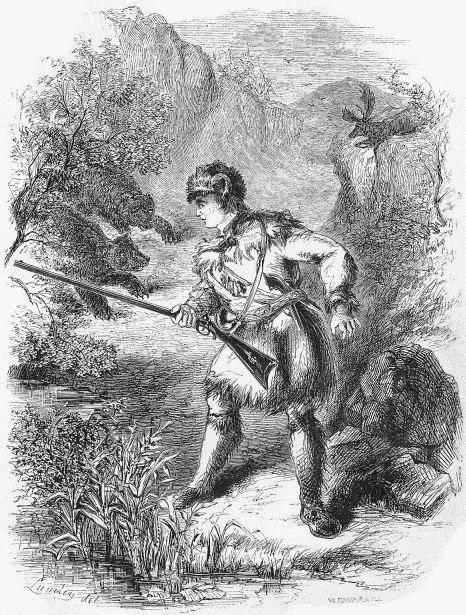
Two huge and terribly angry grizzly bears were bounding towards him, their eyes flashing fiery passion, their pearly teeth glittering with eagerness to mangle his flesh, and their monstrous forearms, hung with sharp, bony claws, ready and anxious to hug his body in a close and most loving embrace.—Page 83.
Affairs were, however, by no manner of means settled. [pg 85] They had the daring trespasser on their domain treed, and almost within their reach; and, indeed, to keep out of the way of their uncomely claws, Kit was obliged to gather himself up in the smallest possible space and cling to the topmost boughs. The bears now allowed themselves a short respite for breathing, during which they gave vent to their wrath by many shrill screeches. Then they renewed their endeavors to force the hunter from his resting place. Mounted on their hind paws they would reach for him; but, the blows with the stick, applied freely to their noses, would make them desist. In vain did they exhaust every means to force the man to descend; he was not to be driven or coaxed. The hard knocks they had sustained upon their noses had now aroused them almost to madness. Together they made one desperate effort to tear Kit from the tree. As in all their previous attempts, they were foiled, and their ardor dampened and cooled by the drumming operations upon their noses, which this time was so freely and strongly applied upon one of them as to make him lachrymate and cry out with pain. One at a time they departed; but, it was not until they had been out of sight and hearing for some time that Kit considered it safe to venture down from the tree; when, he hastened to regain and immediately to reload his rifle.
Thus ended an adventure in which Kit Carson considers that he failed to lose life and limb by the narrowest miss that ever occurred to him. Although he has killed much more than his quantum of this kind of game, and has gained what is a practical advantage to every western hunter, to wit: a knowledge of all their abilities [pg 86] with which they enforce sway, Kit Carson regards this adventure in the light of a warning. It is a warning too which he never allows himself to forget; consequently, whenever he has hunted since, he watches as closely for signs of Mr. Bruin as he does for the game he seeks; it would, therefore, be a difficult matter for the bears again to surprise him. Some of the most desperate battles on record between hunters and wild animals are narrated of encounters with the bear tribe.
Several years ago, a Mexican by the name of Armador Sanchez, still well known in the Rocky Mountains as a brave and skillful hunter, had a fight with a bear which lasted several hours. This terrible battle ended by both the combatants being laid prostrate upon the ground, so completely exhausted as to be utterly unable to reach each other from the want of physical strength. In this condition they spent one night; and, on the following morning, when the brave Mexican hunter had recovered sufficiently to be able to creep to his antagonist, he found him dead. This close conflict grew out of the hunter's noble daring in endeavoring to save the life of a Mexican boy, whom, at the instant the hunter attacked the beast, the bear was about to tear into pieces. At one time the bear had the youth in his terrible clutches in such a manner that it was impossible for him to plant a shot in any vital organ. But nothing daunted, with his rifle and revolver, he lodged several bullets in other parts of the fierce monster. Still the savage animal clung to the unfortunate boy, endeavoring to tear him to pieces, and horribly mangling him in every part of his body. The noble hunter could resist [pg 87] no longer, and dropping his pistols and rifle, he drew his sheath-knife and slung shot, and, after winding his blanket around his left arm to protects it, rushed in and compelled the animal to turn upon him. Wounds were freely given and returned; but, the wary Mexican fought with such dexterity and determination, that the bear finally became so mad with pain and rage that by a tremendous effort, with one blow of his powerful paw, he knocked the brave hunter headlong upon the ground, where he lay some time before recovering his breath. Instead of following up this advantage, the brute, doubtless being deceived because the man did not move, commenced examining and licking his own bleeding wounds. But the brave hunter had now got his spirit so completely up, that he determined to conquer his antagonist or die. Early in the fight, by a blow from his slung-shot, he had succeeded in breaking the bear's lower jaw. This had greatly disabled the animal and undoubtedly was the successful wound which eventually gave Sanchez the victory. When he felt himself sufficiently rested, he renewed the fight; and, by adopting various manœuvres, in which he was greatly assisted by some adjacent trees, succeeded in putting in several telling blows with his knife. Again the animal became aroused to madness unendurable, and, gathering himself up for a final effort, succeeded in planting a terrible blow on the hunter's head, which once more brought him to the ground. From this blow and the previous loss of blood, the brave man fainted entirely away. How long he remained in this state he could not tell; but, on becoming again conscious, he found that the victory was [pg 88] on his side, for the bear had already breathed his last. The poor boy, notwithstanding his wounds, as soon as the battle was decided; and, as he supposed, at the cost of his friend's life, started for a neighboring fort, and, reaching it the following morning, reported the affair. A party of men well armed immediately marched to the rescue. They found the brave hunter in a most pitiful condition, with his flesh terribly mangled, his clothes torn into ribbons, and his back and shoulders one mass of lacerated wounds. His reason had already become unseated. In his native language he would call out to his now visionary foe, "If you are a brave man, come on." Although the most delicate care and assistance was rendered to Sanchez, it was many weeks before he was able to resume his occupation; and, even then, he owed his life to the wonderful recuperative powers of his healthy and iron constitution. Had the fact been otherwise, he could not have survived his injuries. One more brave heart must have yielded its last drop of heroic blood in defence of youthful weakness. This picture, because it does not exaggerate the facts, we leave with regret; for, it is a pleasure to contemplate such nobility of character, whatever be the name which declares the governmental allegiance of the hero.
It is not going beyond the bounds of truth to assert that the grizzly bear of the Rocky Mountains is as formidable an enemy as the hunter is called upon to meet, wherever the hunting-ground and whatever the animal which opponents to our assertion may set up. When caught out on the open prairie, where he can be attacked on horseback and lassoed, the chances are [pg 89] against the bear; but, in a broken country, woe to his assailants, unless life is saved by some trick; or, happy fortune; a lucky shot; a telling blow, like Sanchez's with his slung-shot; or, the fanciful drumming, such as was Kit's, on the noses of his antagonists; or, some other equally singular and unlooked-for expedient. The weight of one of these monsters often runs as high as fifteen hundred pounds; and, their fore paws, which they can manage with the greatest dexterity, frequently measure fourteen inches. The courage, sagacity and skill invariably evinced by this species of bear, when engaged in a fight, is not equaled by any other wild animal on the face of the globe, not excepting the lion.
We take pleasure in here giving further publicity to the careful research and plain truths which have emanated from the pen of that distinguished and successful traveler Dr. Livingston. The new ideas which appear in his pages in regard to the courage of the "King of Beasts," have served, in a measure, to correct the general impression, and to bring down from its high-stilted hyperbole the courage, sagacity and terrible power of the lion, which, he states, are overrated. We do not desire to contradict published statements any farther than our own personal knowledge extends; hence, we give our authority for our statements in regard to the lion, very well satisfied ourself with Dr. Livingstone's love of truth and earnest candor. So much for the lion. Our statements in regard to the Rocky Mountain grizzly bear rest upon our own knowledge and investigation, gathered in his own haunts and on his own wild domain; and, as such, are given upon our own responsibility. Because [pg 90] brave American woodsmen can readily conquer the monarch of the American forest; and because the chicken-hearted Afric son, or dweller, trembles before the steady glare of the Afric King of Beasts, ergo his bearship must in popular opinion, play subordinate to his lionship. For the sake of truth, we should like to see the Spanish arena once open for a fighting encounter between a Rocky Mountain bear and an African lion, full and native grown specimens of each. The bull-fights all good men abhor; but, such a battle would serve to set at rest a fast-growing doubt among naturalists; and, so far, would prove available to science and the cause of truth. We would readily stake a purse on the bear.
With the Indians of the West, who live mostly by hunting, among whom, nine out of ten would, single handed, readily face a score of native lion spearsmen and, we verily believe, put them to flight; a man is considered a great brave who, alone, will undertake to kill a grizzly bear. If he succeeds, which is very rarely the case, his fortune in his tribe is made, once and for all. The reputation he gains will cling to and follow him into his grave and form one of the chief burdens of the tradition which bears his name to posterity. The Indians usually hunt and attack him in large parties; and, when the contest becomes really earnest, it requires a most immoderate amount of yelling, and fierce cry for the onset, to keep their bravery up in fighting trim. The victory is seldom gained without the sacrifice of several lives. The mounted hunter almost invariably finds it a difficult task to bring his charger even within shooting range of this kind of game. On an untrained [pg 91] or young horse the accomplishment of this feat is next to an impossibility; for, instinct seems to teach them the true character of the game even though they approach it for the first time.7
Darkness closed in about Kit Carson before he could reach his camp; and, indeed, the sky was so cloudy that it was with great difficulty he found his way to it. The idea of sending out a pack animal for the elk was out of the question; therefore, the whole party went, supperless, to bed. In the morning they breakfasted upon a beaver found in one of their traps; for, they well knew that, long before daylight, the prowling wolves had feasted upon the elk; hence, they resigned it without a visit. The flavor of the meat of the beaver is not very palatable and the trappers rarely use it; never when they can do better. Not so with its tail. To this they are very partial; and, when properly boiled, it is, indeed, a great delicacy.
Believing that Bridger would visit this place, Kit ordered his men to make a permanent camp. Kit's sagacity was not at fault in this hypothesis; for, in fifteen days, this famous old mountaineer made his appearance accompanied by his whole band. The two parties once more consolidated and started for the summer [pg 92] rendezvous, which was appointed to be held on the Green River.
Upon their arrival at this place, they found congregated, all the principal trappers of the Rocky Mountains. They were divided into two camps, and numbered about two hundred men. The objects which brought them thus together were, the disposal of their fur and the purchase of supplies.
When all the parties had reported their arrival, the trading commenced and was conducted upon a basis which gave general satisfaction. The most exorbitant and fabulous prices ruled for such articles as the mountaineers required. Sugar and coffee brought two dollars the pint; powder, the same; and ordinary blankets were sold at fifteen and twenty-five dollars each.
Coffee, sugar, and even flour, were luxuries not every day indulged in by the hardy mountaineers. They seldom partook of such dainties; not more frequently than two or three times in the year, and then, merely as rare treats. Their standard food was game and wild vegetables when in their season.
This meeting of the trappers continued in progress during two months. It was then dissolved; and, once more the bold mountaineers formed into bands of a size convenient for trapping, and started out to engage in the fall hunt. Kit Carson joined a party of fifty men which was bound for the country occupied by the Blackfeet Indians, and which lies on and adjacent to the head waters of the Missouri River. The party met with very poor success in catching beaver, but had their fill of annoyances from the tribe of savages already referred [pg 93] to. Finally the state of affairs between the trappers and the Indians became so desperate, that a white man could not leave his camp and go a distance of a single mile alone without being fired upon, so completely and untiringly was their camp surrounded and watched by this wily and dangerous tribe of Indians.
This state of affairs led them to the determination to quit the country, as the trapping season was far advanced. With this line of policy they began the march; and, in the month of November, 1832, arrived on the banks of the Big Snake River where they established winter quarters and remained until the subsequent February.
During these winter months, the quiet monotony of their life was unexpectedly broken in upon by a band of their old enemies, the Blackfeet Indians. Taking advantage of an unusually dark night they entered the camp and succeeded in running off eighteen of their horses. In consideration of their leniency displayed towards them when they were engaged trapping in their own country, then merely acting on the defensive, this act on the part of the savages appeared to the trappers to be more than they ought peaceably to bear. Such appeared to be the general opinion, and it was determined that a party should be sent out to recover the property and inflict a chastisement upon the hostile savages which they would not soon forget. Kit Carson with eleven men to accompany him was selected for this delicate but highly important service. Having prepared everything for the route, the party started and after fifty miles of sharp riding through the snow, came up with the savages. The [pg 94] progress of the Indians had been, fortunately, considerably retarded by the necessity of breaking a path through the deep snow, which had but very recently fallen. The trappers instantly made an attempt to recover their animals which were found grazing on the side of a hill, the Indians having previously come to a halt. In doing this, shots were exchanged by both parties without effect. The savages had on snow shoes which gave them considerable advantage over the trappers. After some manœuvering, the Indians asked for a parley which was granted. On these occasions, it is customary for one man from each party to advance to a spot about halfway between the contending parties and there have a talk. The rascals, through their representative, informed the trappers through their representative, that they had supposed that they had been committing a robbery upon the Snake Indians; and, that they did not desire to steal from the white men.
The trappers, believing these tales to be false, considered this a mere ruse on the part of the Indians to make them unwary of passing events. However, they put the very natural query to them, why, if they were so friendly disposed, they did not follow out their usual custom; and, on seeing them approach, lay down their arms and advance to meet their white brothers, so that they might have a smoke together and talk over their difficulties and thus amicably settle matters.
Their replies to this query contained nothing but evasions. Finally, however, it having been mutually agreed upon, both parties disarmed and marched to the place where their representatives were talking. The Calumet [pg 95] was then prepared, lighted and handed around to each person present, it being puffed once or twice by every one of the savages and every one of the whites. The council then commenced. The head men among the savages led off by making several lengthy and unmeaning speeches. In their replies, the trappers came directly to the point, and said they could hear no overtures for peace, until their property was restored to them. The Indians, upon hearing this demand several times repeated, began to presume upon their strength, assuming an overbearing demeanor. After considerable talk among themselves, they sent out and brought in five of the poorest horses, declaring that it was the only number they could return. The trappers, upon hearing this, ran for their arms; when, the Indians instantly started for theirs. The fight was now renewed by both parties. Kit Carson, in the rush made for the rifles, and one of his companions named Markhead, succeeded in getting hold of their weapons first; and consequently, they formed the advance in the return to the contest. They selected for their antagonists, two Indians who were close together; but, who were partially concealed behind separate trees. As Kit was on the point of raising his rifle to fire he saw by a quick side glance at Markhead, that he was working at the lock of his gun without paying attention to his adversary who was aiming at him with, almost, a certainty of killing him. Kit instantly changed the direction of his rifle and fired, sending a bullet through the heart of Markhead's adversary; but, in thus saving the life of his friend, he was obliged, for the instant, to neglect his own adversary. A quick glance [pg 96] showed him the fellow sighting over his rifle and that the mouth of the Indian's gun covered his breast. Upon the instant he endeavored to dodge the bullet, but he was unsuccessful in doing so completely. It struck him in such a way that, first cutting the skin of his neck and glancing, it passed through his left shoulder. The head of the bone, of the arm in the shoulder was shattered; but, fortunately, the main artery of the arm escaped injury. Notwithstanding his wound Kit immediately endeavored to reload his rifle. In this effort he was unsuccessful, for his left arm hung powerless by his side. He was obliged, therefore, to remain a mere spectator during the remainder of the fight; when, being overcome by the loss of blood and the consequent fast increasing weakness, he threw himself upon the ground. The fight continued to be hotly contested by both the trappers and Indians until, gradually, the firing ceased, when the trappers drew off and went into camp. They did not dare to light any fires, as they would inevitably bring the Indians upon them. With nothing but their saddle-blankets to protect them from the bitter cold, even the safe and sound members of the party suffered severely. Kit's condition failed not to arouse the heartfelt sympathy of his friends, for there was not one among them who would not have readily risked life and limb to save Kit's. But his condition was most critical; at the least, he was in a most unenviable condition. His wounds bled profusely, and, the blood, as it oozed out, froze to the rude dressings. This, undoubtedly, in the final result, was beneficial to him, as the cold acted as a partial check upon the hemorrhage. It was, however, none the less painful to endure. He [pg 97] bore his agonizing sufferings without a single murmur, exhibiting in patient fortitude and resignation the same brave spirit and dauntless courage which distinguished him in every action. Not once did a single complaint escape from his lips. Had he received this wound within the pales of civilization with its concomitant constitution, he might never have recovered the use of his arm. In the pure air, and with a constitution in the best possible trim, after all danger from hemorrhage had passed, his chances to recover were favorable; and, finally, resulted in giving him once more, the full use of his arm.
That night the trappers held a council. It was decided, that, although the result of the fight had been that they had given the Indians a sound thrashing, there having been several braves killed while they had suffered only in one wounded, they were, nevertheless, not then strong enough to pursue the savages farther. They adopted therefore the policy of returning to the camp and reporting their progress.
On their arrival, a council was immediately called and their adventures duly rehearsed. The result was that a second party was immediately organized comprising thirty men. Under the command of Bridger, this party followed the trail for some days, but returned to camp without finding the savages. They, after their late engagement, had made their way as fast as possible into distant parts. A short time after this, the weather moderated and it was time for the spring hunt.
This was now commenced and continued quite active for several weeks on the Green and Snake Rivers. The success of the trappers was far beyond their most sanguine [pg 98] expectations. Beaver fur seemed absolutely to rain down upon them. The season having passed, they went into summer rendezvous on the banks of the Green River. This was brought about by the arrival of the traders with their supplies. The whole force of trappers, therefore, again rested until the first week of September; when, they again broke up their camp for the fall hunt.
Some time previous to this last named event Kit Carson, having recovered from the effects of his wounds, was very reluctantly drawn into an "affair of honor." The circumstances of this occurrence we give in detail for two reasons. It was an event in Carson's life, and therefore is required at our hands; but, it serves to exhibit the manner of the duello among these western mountaineers which throws around the circumstance the importance of an example in their manners and customs. By itself, so far as Kit Carson was concerned, it was of very little importance, serving but little, in his opinion, to adorn the story of his life.
Among the men congregated at the rendezvous, there was a Captain Shunan, a powerful Frenchman. The Captain was exceedingly overbearing in his intercourse with all around him. Upon the slightest pretext, he was sure to endeavor to involve some of the trappers in a quarrel. The result was that he was heartily despised by all, although, for the sake of peace, he was allowed to go unmolested. One day his conduct was particularly offensive to the entire command; for, after having had two fist fights with a couple of weak and inoffensive men, he commenced boasting that he could easily flog [pg 99] all the Frenchmen present; and, as to the Americans, he said that "he could cut a stick and switch them." Such actions and manners, at last, attracted Kit Carson's notice and caused him to be greatly annoyed. He thought the matter over and concluded that if Captain Shunan was allowed to gather many more such detestable laurels, he would soon become even more bold and troublesome. As no other member of the company seemed disposed to put a check upon such unmanly behavior, he quietly determined to make the affair his own.
An opportunity soon presented itself. A number of the company had congregated together and were engaged in conversation, when Captain Shunan began anew his bullying language; this time a little more boisterous than usual. Kit Carson advancing into the centre of the company and placing himself in front of the Captain thus addressed him:
"Shunan, before you stands the humblest specimen of an American in this band of trappers, among whom, there are, to my certain knowledge, men who could easily chastise you; but, being peaceably disposed, they keep aloof from you. At any rate, I assume the responsibility of ordering you to cease your threats, or I will be under the necessity of killing you."
To this Captain Shunan did not reply; but, immediately after Kit Carson had closed his remarks, he turned upon his heel and walked directly for his lodge.
Kit Carson was too well versed in trapper rules not to read the meaning of this action. He, therefore, walked [pg 100] off also; but, in the direction of his own lodge. In a brief space of time, both men appeared before the camp, each mounted on their respective horses. The affair had drawn together the whole band, and they were now, quietly, so many witnesses of the facts here recorded.
Captain Shunan was armed with his rifle. Kit Carson had taken merely a single-barrel dragoon pistol which happened to be the first weapon that had fallen in his way, because of his hurry to be on the ground. The two men now rode rapidly towards one another, until their horses' heads almost touched, when both horsemen reined up, and Kit Carson addressed Captain Shunan as follows:
"Am I the person you are looking for?"
Captain Shunan replied, "No!"
It was apparent that this reply of Captain Shunan was a falsehood; for, while giving it utterance, he raised his rifle in the act of shooting, bringing it to his shoulder and covering his antagonist. Before, however, Captain Shunan could discharge his gun, the ball from Kit Carson's pistol shattered his forearm, causing the rifle to tilt upwards, which changed the direction of its contents in such a way that Kit Carson received a wound in his scalp while the powder severely burnt his face.
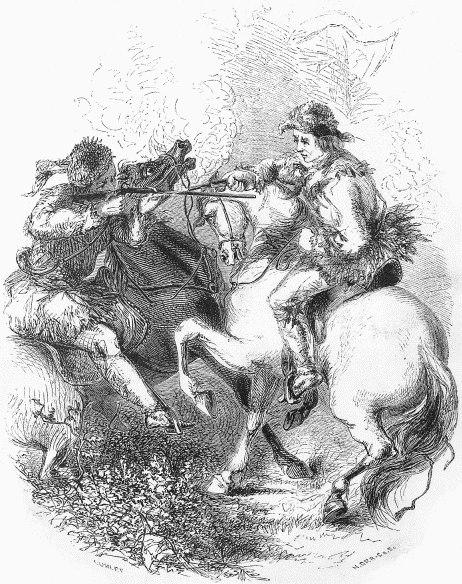
Before, however, Captain Shunan could discharge his gun, the ball from Kit Carson's pistol shattered his forearm.—Page 100.
It was the universal opinion of the spectators of this unhappy scene that both parties fired nearly at the same instant. The facts of the case show very plainly, first, that Captain Shunan's intent was to kill his antagonist. Why did he aim at Kit Carson's breast? Second, that Kit Carson's shot was delivered perhaps a second or two in advance of Captain Shunan's; third, that Kit Carson [pg 101] did not desire to kill his antagonist, but merely to save his own life, by disabling his adversary. The fact that his shot struck first and hit Captain Shunan's right arm is sufficient proof of this. When Kit Carson's well-known and indisputable skill with all kinds of fire-arms is taken into the account; and that, notwithstanding this skill, he hit his adversary in one of only two places (his right or left arms) which would have rendered his aim with the rifle uncertain, the statement that Kit Carson did not intend to kill his adversary becomes an incontrovertible fact. Last, had Kit Carson not gained a second in advance in the firing, he would have lost his own life, inevitably; and, the emphatic "No!" the lie of his antagonist, would have been crowned with success. Such plain deception seldom is allowed to triumph by an all-wise Providence.
In judging Kit Carson in this matter, the reader will commit an ungenerous error if he fails to allow to be placed, in the balance of judgment, the stirring deeds and daily hair-breadth risks Kit Carson, during so many years of his eventful life, was constantly called upon to take a part in and undergo. We take leave of this unfortunate scene in his life, feeling confident a just public opinion will see in it no cause to pluck from the brow of Kit Carson any of the laurels which it has been called upon to place there. As a man of truth, honor, virtue, and reverence for the laws of his country, Kit Carson has few equals and no superior among Americans. It needed not this incident to establish his courage; that had long been proven to be undoubted. Nor did the result elate his feelings in the least. He met his companions [pg 102] without a smile, and invariably expressed his regrets that he felt it to be his duty, for the good order and peace of the camp, to interfere in the matter. On the other hand, when he espoused the cause of the majority in maintaining the right, he was not a man to be easily thwarted. When the affair was ended, Kit was congratulated and received the thanks of nearly every individual present; for, each felt that a load of most vexatious and troublesome responsibility had been taken from his shoulders. The good fellowship immediately introduced into the camp was also a circumstance of mark.
The wounded man was carried to his quarters and every attention shown him in the power of his companions. His punishment had the effect completely to subdue him.
These duels among the old trappers of the Rocky Mountains were not very unfrequent occurrences. Men, situated as they were, beyond the reach of the mighty arm of the law, find it absolutely necessary to legislate for themselves. It is not within our province to advocate either the right or wrong of duelling; for, with the best of reasoning, there will always exist a difference of opinion on the subject. In the case of these mountaineers, when any serious offence was given, the man receiving the injury to body or fame held the right of demanding satisfaction. The interests of the entire band required an immediate settlement of difficulties, so that their future plans could be carried out in concert. In their dealings with each other they were strictly honorable; and when by any mischance a rogue crept into [pg 103] their ranks, if detected in any rascality, he was summarily and severely dealt with. Their duels were serious events; for, oftentimes both men were killed. In fact, the case could hardly be otherwise. They were men of unflinching courage, and their weapons were generally rifles, which, from long practice, they held with a certain and deadly aim. We cannot better close this passage in the life of Kit Carson than to quote the language held in 1846 by the Biographer8 of the great explorer, JOHN CHARLES FREMONT:
"He" (Christopher Carson) "is a remarkably peaceable and quiet man, temperate in his habits, and strictly moral in his deportment. In a letter written from California, in 1847, introducing Carson as the bearer of dispatches to the government, Col. Fremont says: 'with me, Carson and truth mean the same thing. He is always the same—gallant and disinterested.' He is kind-hearted, and averse to all quarrelsome and turbulent scenes, and has never been engaged in any mere personal broils or encounters, except on one single occasion, which he sometimes modestly describes to his friends. The narrative is fully confirmed by an eye-witness, of whose presence at the time he was not aware, and whose account he has probably never seen or heard of. I shall tell the story as it is gathered from them both.9
[pg 104]"In the year 1835, the Rev. Samuel Parker made an exploring and missionary tour, under the auspices of the American Board of Commissioners for Foreign Missions, beyond the Rocky Mountains, and as far as the settlements on the Columbia River. In his printed journal he gives an account of the incident to which I am referring; it occurred on the 12th of August, at a point on the borders of Green River, beyond the South Pass, on the occasion of a 'rendezvous,' that is, on a spot selected for Indians, trappers, and hunters to bring to market their peltries, and obtain supplies from the agents of the Fur Companies. There was a large concourse of savage tribes, and all the various denizens of the wilderness. There were Frenchmen, Spaniards, Dutchmen, Canadians, and Western backwoodsmen. The Rev. Mr. Parker happened to be there, to witness the strange gathering. Of course there were some rude characters, and not a little irregularity and disorder. Conflicts were liable to arise between quarrelsome persons, growing out of the feuds among the tribes, and animosities between the representatives of different nations, all actuated by pride of race or country.
"A hunter, named Shunan, a Frenchman, who was well known by the title of the 'big bully of the mountains,' mounted his horse with a loaded rifle, and dashing defiantly around, challenged any person, of any nationality, to meet him in single combat. He boasted of his exploits, and used the most insulting and irritating language, and was particularly insolent and abusive towards Americans, whom he described as only worth [pg 105] being whipped with switches. Kit Carson was in the crowd, and his patriotic spirit kindled at the taunt. He at once stepped forward and said, 'I am an American, the most trifling one among them, but if you wish to die, I will accept your challenge.' Shunan defied him. Carson at once leaped upon his horse, with a loaded pistol, and both dashed into close conflict. They fired, almost at the same moment, but Carson an instant the quickest. Their horses' heads touched. Shunan's ball just grazed Carson's cheek, near the left eye, and cut off some locks of his hair. Carson's ball entered Shunan's hand, came out at the wrist, and passed through his arm above the elbow. The bully begged his life, and it was spared.
"This put an effectual stop to all such insolent proceedings, and Americans were insulted no longer. Carson is still living, being yet, indeed, in his prime. His faithful commander has recorded his name on the geography of the continent, by calling after him a river and a lake, in the great basin they explored together."
[pg 106]The Fall Hunt—McCoy of the Hudson's Bay Company organizes a Trapping Party which Kit Carson joins—The Hunt—Scarcity of Beaver on Humboldt River—The Party is divided—Kit Carson with a majority of the Men goes to Fort Hall—Hardships and Privations met with—Buffalo Hunt—All their Animals stolen in the Night by a Party of Blackfeet Indians—Arrival of McCoy from Fort Walla Walla—The Rendezvous—Kit Carson joins a strong Band—The Small Pox among the Blackfeet Indians—The Crow Indians on good terms with the Whites—Intense Cold—Immense Herds of Buffalo—Danger of their goring to death the Horses—The Spring Hunt—The Blackfeet Indian Village overtaken—A desperate Fight with these Indians—The Rendezvous—Sir William Stuart and a favorite Missionary—Kit Carson goes on a Trading Expedition to the Navajoe Indians—The Return—He accepts the post of Hunter of the Trading Post at Brown's Hole.
Arrangements for the fall hunt were now in active progress among the trappers. Though the reader may find some similarity of fact and idea as we progress in this part of the Life of Kit Carson, the interest which hangs about it, nevertheless, will not, or should not be dampened, because this pen-painting of his long and active experience is a better and more faithful exhibit of those qualifications, knowledge and skill which afterwards made him, first the guide and then the bosom friend of the illustrious Fremont, than any assertions whether authenticated by published record, whether rested upon statement on knowledge, information and belief of acquaintances and friends, or, whether facts taken from the thousand allusions to his exploits which have from time to time flooded the press of the United States.
[pg 107]The company of trappers which had been so fortunate as to secure the services of Kit Carson, for facts seem now to warrant us in employing this language of just praise, set out for the Yellow Stone River, which stream they safely reached, and on which they set their traps. Dame Fortune here seemed to be in unpleasant mood. Crossing the country from the Yellow Stone to the Big Horn River, they again courted the old lady's smile with stoical patience, but with no better results. They next extended their efforts to the three forks of the Missouri River; also, to the Big Snake River. The fickle old lady proved scornful on all these streams, and finally, on the latter stream and its tributaries they wintered.
In this section of the country they fell in with Mr. Thomas McCoy, a trader who was in the employ of the Hudson's Bay Company. In his trading operations Mr. McCoy had been unsuccessful and had concluded to organize a trapping expedition. The inducements which he held out led Kit Carson and five of his companions to become members of his party. With him they traveled to Mary's River,10 from whence reports had circulated that beaver existed in great abundance. The party struck upon this stream high up and slowly followed it down to where it is lost in the Great Basin. Their success here was not satisfactory; consequently, the party returned to the Big Snake River. By McCoy's direction the party tarried upon this river for some time when it was divided. McCoy and a small escort started for Fort Walla Walla. Kit Carson and the majority of [pg 108] the men took up their line of march for Fort Hall. While en route, the latter division was subjected to the greatest privations imaginable. Among the worst of these was hunger, as their trail led through a barren region of country. For a short time, they managed to subsist upon a small supply of nutritious roots which had been provided in advance. This source finally gave out, when their affairs assumed a most desperate attitude. To keep from starving, they bled their mules and drank the warm red blood with avidity, so acutely had the days of fasting sharpened their appetites. This operation, however could not be repeated without endangering the lives of their animals. These also were on a short allowance of food, for the grass was very poor and scanty. The whole party had become frightfully reduced in strength, and began to think it necessary to kill some of their animals, which at this time they could but ill spare. In this terrible condition they met with a band of Indians who proved to be of a friendly disposition. The party was then only about four days' journey from Fort Hall. Most unhappily, the Indians themselves possessed but a scanty supply of provisions, and no more than their immediate wants required. It was not without considerable manœuvering and talk, during which all the skill and Indian experience possessed by Kit Carson were brought into active requisition, that the savages were prevailed upon to trade with the trappers. By the trade the half famished men obtained a fat horse, which was immediately killed, and on which they regaled with as much relish as the epicure in the settlements enjoys his "joint of roast beef."
[pg 109]To a man not accustomed to this kind of meat, mule flesh and horse flesh would not be likely to prove over tempting or appropriate viands. Let him feel the pangs of hunger very sharply, and his ideas of lusciousness and propriety in respect to food will rapidly change. The civilized world has condemned the practice as belonging to barbarians. A mountaineer, not being quite so fastidious, scouts these ideas, considering them foolish prejudices of people who have never been forced by necessity to test the wisdom of their condemnation. Let the epicurean sages have their choice, eat horse flesh or starve, and, they confidently maintain, horse flesh would gradually grow to be considered a dainty, the rarer over beef, in proportion to its greater cost.
The trappers of the western prairies, who wander thousands of miles over barren as well as fertile lands, where game cannot exist from stern necessity, are compelled to submit to all kinds of vicissitudes; but, with buoyant spirits, they conquer results, which, a faint heart and yielding courage would behold almost in their grasp but fail to reach.
An emergency calls forth skill and great energies; and, in an unexplored country where, as in the case here recorded, everything living suddenly disappears, it is then that the wits of a trapper save his life when an ordinary traveler would lie down and die.
Kit Carson and his men, at last, succeeded in reaching Fort Hall. They were kindly received and amply provided for by the whites who then occupied it as a trading post. Here they rapidly recruited their strength, and in the course of a few days felt able to start out [pg 110] upon a buffalo hunt. Reports had come in that large numbers of buffalo existed in close proximity to the Fort. Kit Carson and his men were not the kind who live upon the bounty of others when game can be had in return for the necessary effort to find. They were also not the men to hoard their stock of provisions whenever they met parties in distress. The first query which different bands of trappers offer to each other on meeting in the wilderness, is, "Does game exist in plenty," or "is game plenty in such and such sections of country?" This takes precedence over the commonplace question, "What's the news?" Oftentimes, when venturing into distant and unexplored districts of territory they were obliged to take their chances of finding sustenance; but, they hardly ever neglected an opportunity to inform themselves on the subject: on the contrary, they often sacrificed both time and profits in order to secure correct details. Any other course would have been fool-hardy rashness, just fit for parties of over-bold inexperience to take the consequences of.
Hunting the buffalo is a manly and interesting sport; and, as Kit Carson on this occasion engaged in it with successful results, it might be interesting to the general reader, and, in this place the unity of the narrative seems to require, a complete and practical description of the manner of taking the buffalo. We have, however deferred this part of our duty to an occasion when Kit Carson had his friend John C. Fremont upon his first buffalo hunt. We shall then permit the bold Explorer to tell the story of a buffalo hunt in our behalf.11
[pg 111]During their sojourn at Fort Hall, the hardy trappers were not idle. Besides the calls upon them by the hunt, they set to work with great industry repairing their saddles, clothing and moccasins. With the aid of a few buck-skins, usually procured from Indians, and a few rude tools, they soon accomplished wonders.
To give the reader an appropriate view of the genius to conquer obstacles displayed by the mountaineers, he must picture one of them just starting upon a long journey over the prairies and through the mountains. His wagon and harness trappings, if he chances to be possessed of worldly effects sufficient to warrant him in purchasing a first-class outfit, present a neat and trim appearance. Follow him to the point of his destination, and there the reader will discover, perhaps, a hundredth part of the original vehicle and trappings. While en route, the bold and self-reliant man has met with a hundred accidents. He has been repeatedly called upon to mend and patch both wagon and harness, besides his own clothing. Though he now presents a dilapidated appearance, he is none the less a man; and, if his name is known as a regular trapper and mountaineer, he is immediately a welcomed and honored guest. If the broadcloth of a prince covered his back, spotless, scientifically shaped and foreign woven, his reception would not be more heartfelt and sincerely cordial. It is amusing to see the raw-hide patches of harness, wagon and clothing, now become dry and hard as oak. To have dispensed with the use of buckskin on his route, would have been like cutting off the right arm of the gallant pioneer. Buckskin and the western wilds of America [pg 112] are almost synonymous terms; at least, the one suggests the other, and therefore they are of the same brotherhood. The traveler in these regions of this day fails not to learn and appreciate its value. It has not only furnished material for clothing, but has been used to repair almost every article in daily use. Even the camp and tea-kettle, as well as the frying, milk and saucepan, bedstead and hammock, chair and table, all have had their buckskin appendage, as fast as any of them have become injured or broken.
Everything being in readiness, Carson set out with his followers for their hunting-grounds. Their pace was one of so much rapidity, that after one day's march they discovered signs of the buffalo. On the following morning immense herds were in sight. A suitable place for a camp was soon selected, and everything which could impede their work well stowed away. The best marksmen were selected for hunters, and the remainder of the party detailed to take care of the meat as fast as the hunters should bring it in. Poles were planted on the open prairies, and from one to the other ropes of hide were stretched. Upon these ropes strips of the buffalo meat were hung for curing, which consists of merely drying it in the sun's rays. After it is sufficiently dried, it is taken down and bound up in bundles. During the time of hunting and curing, the trappers feasted upon the delicacies of the game, which consist of the tongue, liver and peculiar fat which is found along the back of the buffalo. Their past sufferings from hunger had made them so determined in the work of procuring game, that in a few days they possessed meat sufficient [pg 113] to load down all their pack animals. They now thought about returning to Fort Hall. Their pace, however, rendered so by their weighty game, was very slow. Their old enemies, the Blackfeet Indians, had discovered them while engaged in this hunt. They followed them on the march to the Fort, the trappers being wholly unaware of their presence; in fact, the idea of hostile Indians had not troubled their thoughts.
Two or three nights after they arrived at the Fort, taking advantage of a dark evening, the Indians deprived them of all their animals. This was the result of carelessness on the part of one of the men, which, under the circumstances, was excusable. The party had encamped just without the pickets of the Fort, but had taken the precaution to secure their horses and mules while they slept, by placing them in the corral12 belonging to the station. A sentinel was put upon duty over the corral, in order to make everything doubly secure. In the latter part of the night, nearly at daybreak, the sentinel saw two persons advance and deliberately let down the bars leading into the yard and drive out the animals. He mistook these men for two of his companions who were authorized to take the herd out to graze. Concluding, therefore, without going to them, that he was relieved, he sought his resting-place and was soon fast asleep. In the morning, anxious inquiries were made for the horses and mules, when a very short investigation revealed the truth of matters. It was, undoubtedly, very fortunate for the sentinel that he fell into the error alluded to. It was very apparent that the two advanced [pg 114] Indians who let down the bars were backed up by a strong party. The signs of Indians, discovered afterwards, proved this beyond a doubt. Their reserve party were posted where the least resistance on the part of the sentinel would have been followed by his quick and certain death. This successful theft was, no doubt, considered by the Indians a cause for great rejoicing. It may have formed the basis of promoting the brave who planned and directed it, as the animals had been obtained without the loss of a man or even the receiving of a wound. The parties living at the Fort were equally as poorly off for horses and mules as were now the trappers. The same Indians had recently performed the same trick upon them. The loss was most severely felt by the trappers, inasmuch as they had not a single animal left upon which to give chase. Nothing remained for them to enact, except a stoical indifference over their loss and await the return of McCoy, who had agreed, after finishing his business at Fort Walla Walla, to rejoin, them at Fort Hall.
This tribe of Indians, the Blackfeet, whose meddlesome dispositions have so frequently brought them in contact with Kit Carson in such and dissimilar affairs, occupy the country on the Yellow Stone River and about the head waters of the Missouri. There are other tribes in close proximity, the most important of which is the tribe called the Crows. When Kit Carson first entered upon his wild career the Blackfeet Indians numbered nearly thirty thousand souls. They were greatly reduced in numbers within the next six or seven years, between 1832 and 1839. In the last-named year, in consequence [pg 115] of the ravages of the small pox, heretofore alluded to and which prevailed the year previous, they had lost at least fifty per cent. The Indian computations of 1850, according to Brownell, give their numbers at only about thirteen thousand. They are one of the finest races of the American Aborigines. Powerful in frame and development; well trained in horsemanship, although in this they are surpassed by the Camanches; capable of great endurance; and, usually well fitted as to arms, dress, horse trappings, et cætera, they generally prove knotty customers as enemies. We ought not to pass by this notice of the Blackfeet Indians without calling the attention of the inquisitive reader to a remarkable proof which is afforded by the whole intercourse of these western trappers with the Blackfeet Indians, as thus detailed by Kit Carson, of an assertion hazarded some years ago by Charles De Wolf Brownell, in his admirable work upon the Indian races of North and South America. On pages 465-6, Mr. Brownell comes to the defence of the Crow tribe of Indians, which, up to that time, had been characterized as a "lawless, thieving horde of savages." "But," says Mr. Brownell, "those best acquainted with their character and disposition, speak of them as honest and trustworthy." The adventures of Kit Carson among both the Crow and the Blackfeet Indians, we think, demonstrate pretty conclusively which of these contiguous tribes are the horse stealers. The Crows, it will be remembered, are more particularly inhabitants of the mountainous regions. The Blackfeet have ever been their sworn and implacable foes. Their burials of the hatchet have been few and far between, and never in [pg 116] deep soil. It is not, therefore, to be wondered at that the Blackfeet reputation should extend to the Crows; but, although circumstances exist which condemn the latter, they are few in number compared with the sins laid by the traders and trappers at the tent-doors of the former.
After the lapse of one month McCoy made his appearance and, most opportunely, brought an extra supply of animals. The camp was soon struck and the whole band started for the rendezvous, which had been appointed to convene at the mouth of Horse Creek on the Green River. They reached this place after several days of hard travel. As usual, trading operations did not commence until all the regular bands of trappers had arrived and reported. They were then commenced and continued through a period of twenty days. Here Kit Carson left the company under McCoy and joined a company under the management of a Mr. Fontenelle which numbered one hundred men. This party went to and trapped on the Yellow Stone River. On commencing operations the party was divided into fifty trappers and fifty keepers. The duties of the former were to take the beaver and provide game for food. The latter to guard their property and cook. The trappers were now in the midst of their sworn foes, the Blackfeet Indians. They felt themselves sufficiently strong and were desirous to pay off old scores. They therefore trapped where they pleased, being determined to dispute the right of possession to the country if attacked. They were not, however, molested. A good reason appeared for this, soon after, brought by some friendly Indians belonging to the [pg 117] Crow Tribe. They informed the whites that the small pox was making terrible havoc with the Blackfeet Indians. Thousands were dying and fears were entertained that the whole tribe would be cut off. In order to attend to their sick they had secluded themselves. The trapping season being nearly over, as the streams began to freeze, the party commenced looking out for a camping site.
In conjunction with the main body of the Crow nation they proceeded to a well protected valley and erected their lodges, making themselves as comfortable as possible under the circumstances. As the season advanced, the cold became more severe, until at last, it was more intense than ever before experienced by the trappers or Indians. Fuel, however, was abundant, and, excepting the inconvenience of keeping unusually large fires, they suffered but little. Not so with their animals. It was with the greatest difficulty that they preserved them from starvation. By the most unwearied exertions, however, they succeeded in obtaining food enough barely to keep them alive until the weather became more mild and auspicious. At one time the crisis was so imminent, that the trappers were compelled to resort to cottonwood trees, thawing the bark and small branches, after gathering them, by their fires. This bark was torn from the trees in shreds sufficiently small for the animals to masticate. The Indians of the Rocky Mountains, when suffering from hunger, are often driven to the extremity of eating this material. For miles, not unfrequently, the traveler discovers these trees denuded of their bark, after a party has passed through on their way to find the buffalo. [pg 118] The rough, outside cuticle is discarded, and the tender texture, next to the body of the tree, is the part selected for food. It will act in staying the appetite, but cannot, for any great length of time, support life. It is dangerous to allow starving animals to eat freely of it; the trappers, therefore, feed it to them but sparingly.
The intense cold operated to bring upon them another serious annoyance in the shape of immense herds of starving buffalo, which, goaded on by the pangs of hunger, would watch for an opportunity to gore the animals and steal their scanty allowance of provender. It was only by building large fires in the valleys and constantly standing guard that the trappers succeeded in keeping them off.
During the winter, to beguile the time, the whites vied with their Indian allies in many of their sports. As game existed in superabundance, always ready for a loaded rifle, both parties were contented and happy. Time flew away rapidly and soon brought again the sunshine of spring with the buds and blossoms, gay wild flowers, green herbage and forest verdure. For the purpose of procuring supplies, the trappers dispatched two messengers to Fort Laramie. They did not return and were never again heard from. The conclusion which gained belief was, that they had been murdered by the Sioux Indians. The party waited as long as they possibly could for the return of their two companions, but, finally, were compelled to commence the spring hunt without them. They trapped a short time on the Yellow Stone River and then went to the Twenty-Five-Yard River. From thence they proceeded to the head waters [pg 119] of the Missouri, and, on the most northern of its forks, remained some time, meeting with considerable success. Here they obtained news of the Blackfeet Indians, which showed that the ravages of the small pox had been greatly over estimated. They were still nearly as strong, and in character, had not at all become subdued. Upon drawing near to the source of this river, they discovered that the main village of these savages, their old foes, was in close proximity. This was pleasing intelligence to the trappers. They had suffered too many unprovoked insults at their hands not to desire the avenging of their wrongs and to punish them by way of retaliation. During the whole winter, and, in fact, from the time the party was first organized, they had anxiously abided their opportunity to meet and punish the rascally Blackfeet warriors. The old scores, or sores, had been festering too long, and here was a chance to probe them satisfactorily.
The party cautiously followed upon the trail which led to the Indian encampment until within one day's journey of it. Here they came to a halt. Kit Carson, with five men, was sent in advance to reconnoitre. Upon approaching the Indians, the reconnoitering party discovered them busily engaged driving in their animals to saddle and pack, and making such other preparations necessary to the effecting of a hurried decampment. Kit and his companions hastened back and reported the results of their observations. A council was immediately held which decided to send out forty-three picked men to give battle; and, for the commander of this party, Kit Carson was unanimously elected. The [pg 120] fifty-five men left behind under Mr. Fontenelle had the onerous duty of guarding the animals and equipage. It was a part of the programme, also, that the latter force should move on slowly and act as a reserve in case of need.
Kit Carson and his command were in fine spirits and lost no time in overhauling the village. In the first charge they killed ten of the bravest warriors. The savages quickly recovered from this blow and commenced retreating in good order. For three consecutive hours they heroically received a series of these furious and deadly assaults without offering much resistance. At the end of this time the firing of the mountaineers began to slacken, as their ammunition was running low. These experienced and brave, though rascally Indians, soon surmised the cause of this sudden change of affairs. Rallying their forces, they turned upon their assailants in right good earnest and a desperate hand-to-hand engagement ensued. The white men now had an opportunity to use their small arms, which told with such terrible effect upon their foes that they were soon driven back again. They, however, rallied once more and charged so manfully that the trappers were forced to retreat. In this latter engagement a horse belonging to a mountaineer by the name of Cotton, fell, throwing his rider and holding him on the ground by his weight. This happened as he was passing a point of rocks. Six of the warriors, seeing the accident, instantly hurried forward to take Cotton's scalp. But Kit Carson's eagle eye was watching every part of the battle-field and discovered, in time to be of service, the danger to which [pg 121] his friend was exposed. Although some distance off, Kit sprang from his saddle, and, with the leap of an antelope and the rallying cry for his men, was on the ground, ready to make a certain shot. His aim and the crack of his rifle almost belonged to the same instant of time. It was none the less sure. The foremost warrior, a powerful savage, whose fingers evidently itched for the scalp of the mountaineer, fell, shot through the heart. By this time others had followed the bold example of their leader, when the five remaining warriors, seeing the imminent danger which threatened them, turned to run back into their band. But two of them however reached a place of safety. The remainder, caught in their fleet career by the unerring and death-dealing bullets of the mountaineers, measured their lengths upon the battle-ground, stricken with wounds which demanded and received from them their last wild war-whoop.
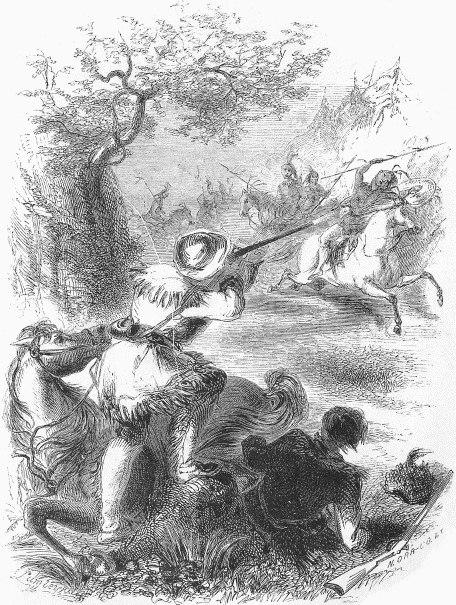
Kit Carson's eagle eye was watching every part of the battle-field and discovered, in time to be of service, the danger to which his friend was exposed. Although some distance off, Kit sprang from his saddle, and, with the leap of an antelope and the rallying cry for his men, was on the ground ready to make a certain shot.—Page 120.
When Kit Carson fired, his horse, being under no restraint, became frightened and dashed away, leaving his brave rider on foot. Kit however instantly comprehended his position. The fallen horseman had succeeded in extricating himself, but not without difficulty, for the ground was very uneven. He had received a few pretty severe contusions, but was, notwithstanding these, worth a dozen Indians yet, and failed not to show the fact. Seeing Cotton thus all right, Kit Carson made his way to one of his companions, and, as the fighting had, apparently by mutual consent, ceased for a few moments, mounted up behind him and thus rejoined the main body of his men. The runaway horse, after quite [pg 122] a chase, was soon captured by a trapper and returned to his captain. A period of inactivity now reigned over the battle-field, each party apparently waiting for the other to again open the ball. During this resting spell, the reserve division of the trappers came in sight, having been anxiously expected for some time. The Indians showed no fear at this addition to the number of their adversaries. On the contrary, being no doubt carried away by their recent success in making a stand, they commenced posting themselves among the rocks about one hundred and fifty yards distant from the position taken up by the trappers. The arrival of the reserve was a great relief to the advance, because, they were tired of fighting without ammunition. Having well filled their ammunition pouches they once more became eager for the affray. Everything being in readiness, with a cheer, they started on foot to attack and dislodge the enemy. In a few moments was commenced the severest skirmish of the day. It became so exciting that frequently a trapper would occupy one side, and a stalwart warrior the other, of some large rock, each intent upon the life of his adversary. In such cases it required the closest watchfulness and the utmost dexterity to kill or dislodge the bold savage. The power of powder in the hands of skillful men soon began to assert its superiority in the battle, and when once the Indians commenced to waver, it was all over with them. Their first wavering soon broke into a complete rout, when they ran for their lives. As they scattered in every direction, the pursuit which followed was short. In this battle the trappers considered that they had thoroughly [pg 123] settled all outstanding accounts with the Blackfeet Indians, for they had killed a large number of their warriors and wounded many more. On their side three men only were killed and a few severely wounded.
Fontenelle and his men camped for a few days in the vicinity of the scene of their late engagement, burying their dead and repairing damages. They then resumed the business of trapping, traversing the Blackfeet country whenever they chose without fear of molestation. The success in their late engagement seemed to follow them in their business, for their stock of fur accumulated rapidly.
While they were encamped upon Green River, an express rider, sent by the traders, came into camp and informed the party that the rendezvous would be held on Mud River. With a large stock of beaver, the party started for that place, arriving in eight days.
Besides the usual traders and trappers, the party met at this rendezvous some missionaries and a distinguished English nobleman, Sir William Stuart. Of this latter gentleman, Kit Carson says: "For the goodness of his heart and numerous rare qualities of mind, he will always be remembered by those of the mountaineers who had the honor of his acquaintance."
Among the missionaries was "Old Father De Smidt," as he afterwards came to be familiarly called. This gentleman is at present well known as being a leading literary and religious man at St. Louis, Missouri. Perhaps there never was a person in the wilds of America who became so universally beloved both by the white and red man. While in the mountains, he acted with [pg 124] untiring zeal for the good of all with whom he came into contact. Wherever duty called him, there he was sure to be found, no matter what the obstacles or dangers spread upon the path. He worked during a long series of years in these dangerous localities, and accomplished much good. When, at last, he returned to civilization, he left an indelible name behind him.
In twenty days after the camp at the rendezvous was formed, it broke up again into small parties. Kit Carson, with seven companions, went to Brown's Hole. This was a trading post. Here they found two traders who were contemplating getting up a business expedition to the Navajoe Indians. This tribe exhibits more traces of white blood than any other of the wild races in North America. They are brave and fond of owning large possessions. These consist chiefly of immense herds of fine horses and sheep. In this respect they are not unlike the ancient inhabitants of the earth, who "watched their roving store" on Syrian soil and the contiguous countries. The parties who desired to trade with them usually carried a stock of trinkets and articles of use, for which they received horses, mules, blankets and lariets.13
Navajoe blankets are very celebrated in the far west of America, and especially in old Mexico, where they are in great demand and command high prices. Many of these articles are really beautiful, and, from their fine texture, together with the great amount of labor spent [pg 125] in their manufacture, are expensive, even when purchased of the Indians. The art of weaving these blankets has been long known to the Navajoe Indians; and, all the female children belonging to the nation are taught the art during their earliest years. It is only after much practice, however, that they become expert.
Kit Carson joined the two traders, whose names were Thompson and Sinclair, and made the trip with them which they had planned. They realized very handsomely from it, bringing back a large drove of very fine mules. The animals were driven to the Fort on the South Fork of the Platte, where they were disposed of at fair prices. Having received his share of the profits, Kit returned again to Brown's Hole. The season was too far gone for him to think of joining another trapping expedition that fall. He therefore began to look about for some suitable employment for the winter. As soon as it became known that his services were open for an engagement, several offers were made him, all of which he rejected. The reader will doubtless see a contrast between the Kit Carson renowned as a trapper and hunter and the Kit Carson who, at Taos, only a few years before, was glad to hire out as a cook, in order to gain his daily sustenance. For some time, strong inducements of high wages had been held out to him by the occupants of the Fort, in order to prevail upon him to accept the responsible and arduous office of Hunter to the Fort. The task of supplying, by the aid of the rifle, all the flesh twenty men would naturally consume during an entire winter, formed the duty required and expected from this officer. The inducements were so tempting, [pg 126] the task so congenial with his feelings, and, withal, the urgent persuasions of the men so pressing, that Kit Carson finally accepted the offer and entered upon his duties. He soon showed the company that he knew his business, and could perform it with an ease and certainty which failed not to elicit universal esteem and commendation. When the time arrived for him to resign the office in the Spring, he left behind him golden opinions of his skill as a marksman.
[pg 127]Bridger and Carson trapping on the Black Hills—The Main Camp—The Rendezvous—Winter Quarters on the Yellow Stone—Carson with forty men in a desperate fight with the Blackfeet Indians—A Council—Sentinel posted—One Thousand Warriors come to punish the Trappers—The War Dance—The Courage of the Savages deserts them—Winter Quarters—The Spring Hunt—Another Fight with the Blackfeet—Continued Annoyances—The Trappers abandon the Country—The Rocky Mountains and Alps compared—Other Trapping Expeditions—Beaver becoming scarce—Prices of Fur reduced—Kit Carson and the Trappers give up their Vocation—The Journey to Bent's Fort—Mitchell the Mountaineer—His Eccentricities.
In the spring, Kit Carson joined Bridger. With four companions they went to the Black Hills to hunt. In the streams adjacent to that country, the beaver existed in large numbers and their success in trapping was excellent.
Soon after arriving, however, the party broke up. Kit Carson and a trapper named Owens made a hunt by themselves and were very fortunate in obtaining a large stock of the fur. After which they joined the main camp of the trappers on Green River. When the summer was pretty well advanced, the camp was broken up and all of its occupants started for the Rendezvous, this year held on the Popoayhi, a branch of the Wind River.
In the fall, most of the trappers went to the country which lies in the immediate neighborhood of the Yellow Stone River. Having trapped all the streams there, they went into winter quarters on that stream.
Nothing was heard of their sworn enemies, the Blackfeet [pg 128] Indians until about the middle of the winter. A party who were out hunting suddenly came upon some signs which, looking suspicious, attracted their attention. To these signs they gave a close investigation, and fully made up their minds that they were close to the stronghold of their foes. Without waiting to follow up the signs they immediately retraced their steps and informed their party in camp of their conviction that trouble was brewing. A command of forty men was instantly detailed to seek out the Indians and give them battle. Kit Carson was once more called upon to lead the brave trappers in this expedition, and everything was left to his direction and good judgment. Soon after commencing their march, the company fell in with a scouting party of the enemy in the vicinity of the spot where the fresh signs had been discovered. To this party the trappers gave chase, wisely concluding they would run for their main body. The result satisfied their anticipations. In a short time they found themselves opposed to a strong band of the Indians, when, a regular fight was instantly commenced. After quite a spirited contest, the Indians gave way and retreated, but in good order, to an island in the Yellow Stone River where they had previously erected strong barricades. Night put a stop to the scenes of the day and further action was deferred until the next morning. As soon as the light would again warrant it, the trappers plunged into the stream and made for the island, being determined to dislodge the Indians. To their great dismay the brave savages had already retreated having quietly given them the slip during the night.
[pg 129]The result of the battle the day before was now made apparent. It was evident that not much powder had been wasted in the action. The snow within the fortification was red with fresh blood, and from the place a bloody trail led to a hole in the ice of the stream where a large number of lifeless bodies had been sunk. There was nothing now to be done except to return to camp. Upon their arrival a council was convened to devise measures and plans for their future conduct. It was quite evident to all that the campaign had but just commenced. It was the general impression that the main village of the Blackfeet tribe had been located within a few miles. When therefore the news of their recent severe loss should be carried there by the survivors in the battle, active measures would be set on foot to seek revenge. It was the decision of the council that the trappers should act chiefly on the defensive. Measures were immediately set on foot to guard against surprise. To make everything doubly secure, none but the most trusty and well-tried men were detailed to perform sentinel duty. Near their camp there was a very lofty hill which commanded a fine view of the surrounding country. Upon this eminence they posted a sentinel throughout the day time. Their arrangements having been all determined upon and plans laid, the execution of them, to men so well skilled in frontier life, occupied but little time. Notwithstanding this celerity in their movements they had been none too quick. Soon after their preparations were fully made, the sentinel on the hill gave his signal indicating the approach of the Indians, showing that their precaution in this respect had [pg 130] been a wise one. The order was immediately given to erect strong breastworks. This task was so successfully accomplished, that, in a few hours, they had prepared a little fortress, which, covered with their unerring rifles, was impregnable against any force the Indians could bring against it. The advance party of the savages soon appeared in sight, but when they discovered the strength of the trappers, they halted and awaited, distant about half a mile from the breastwork, the arrival of the rest of the band. It was three days before the whole force of the Indians had arrived. They mustered about one thousand warriors. It was a sight which few white men of the American nation have looked upon. Arrayed in their fantastic war costume and bedaubed with paint, armed with lances, bows and arrows, rifles, tomahawks, knives, etc., some mounted and some on foot, they presented a wild and fearful scene of barbaric strength and fancy. Soon after their last company had reported, the frightful war-dance, peculiar to the American savages, was enacted in sight of the trappers' position. The battle songs and shouts which accompanied the dance reached the ears of the whites with fearful distinctness. Any other than hearts of oak with courage of steel would have quailed before this terrible display of savage enmity and ferocity. This dance, to men so well skilled in the ways of the Indian warrior, was a sure signal that the next day would be certain to have a fearful history for one party or the other and doubtless for both. The odds, most assuredly, were apparently greatly in favor of the savage host and against the little band of hardy mountaineers.
[pg 131]The following day the expectations of the trappers were realized. The Indians, at the first dawn of day, approached the breastwork, eager for the battle. They were, evidently, very much astonished at beholding the invincibility of the trappers' position. It was what they had not calculated upon and seemed to cast a perfect damper upon their courage. After firing a few shots which did no harm, and seeing that nothing could be accomplished except by a charge, they commenced a retreat. The trappers, though only sixty strong, were filled with disappointment and chagrin at the course taken by their wary foes. They began to shout to their enemies in derisive terms, hoping the taunts would exasperate and draw them into an attack. Nothing, however, would tempt them to face the danger, for they withdrew to a spot about one mile from the little fort and sat down in council. The speeches appeared to be generally opposed to risking an assault; for, after the council was dissolved, the Indians divided into two nearly equal parties and immediately marched off. One band took the direction of the Crow country and the other shaped their course in the direction from whence they came.
The trappers remained at their little fort during the winter and were not again disturbed by the Indians. Early in the following spring, they set their traps on one of the tributaries of the Missouri River and finished the hunt on the head of Lewis' Fork. They then departed for the rendezvous which was held on Green River near the mouth of Horse Creek, remaining there until the month of August and until the meeting was dissolved.
[pg 132]Kit Carson, on the breaking up of the camp at the rendezvous, accompanied by five other trappers, went to Fort Hall and joined a party attached to the "Northwest Fur Company." With this band he trapped to the head of Salmon River. Thence they went to Malade River, trapping down it to where it empties into the Big Snake River. They continued on up this latter river, and then, after trapping on Goose Creek and Raft River, returned to Fort Hall. Their stock of fur was quite extensive on their arrival here and, an opportunity offering to dispose of it, they sold out at a fair valuation. After recruiting their strength at the Fort for one month, Kit Carson, accompanied by most of the trappers, set out to join Bridger, who was still in the country of the Blackfeet Indians. Upon striking the Missouri River, signs of trappers were discovered, indicating that, whoever the party, or parties might be, they were now above the place where Kit and his party then were. With fourteen companions Kit started in advance of the main party to overtake, and report who these men were. Towards evening of the same day, the advance party came up with the trappers and found that they were under the charge of Joseph Gale and in the employ of Captain Wyatt.
Gale informed Carson that his command had recently been engaged in a closely contested fight with the Blackfeet Indians; that several of his party had been wounded, and one, by the name of Richard Owens, was at first thought to be mortally so; but, eventually, he had begun to recover and now was doing well.
Kit and his men remained one night with Gale. On [pg 133] the following day his party commenced setting their traps, intending to proceed up the river at a slow pace in order to allow the main party to overtake them. The men sent out to set their traps had not gone from the camp over two miles before they were fired upon by a party of Blackfeet Indians and compelled to retreat. They did so, succeeding in joining their comrades without the loss of a single man. The pursuit had been close and well sustained by the savages; hence, it became necessary to take instant measures in order to insure the safety of the advance. Kit Carson, who was the commander of the party, after quietly surveying the scene, gave orders for the men, with their animals, to conceal themselves, as best they could in the brush. His orders had been issued but just in time, for the concealment was barely attained, when the Indians were upon them. They were received with a well-directed volley from the rifles of the little party, which brought down several of the fierce assailants. They recoiled and retreated for a moment. The moment was golden to the few white men. Like men who were fighting for their lives but who were cool in danger, they made no mistakes in reloading their rifles. They were but just ready, however, for the second charge. This time the savages came on with unearthly yells and desperate courage, seemingly well satisfied that before them stood the men whose faithful rifle-talk they had heard before. Kit warned his men to keep cool and fire as if shooting game, a warning which was entirely unnecessary, for the result was that the savages were again driven back with a brave bleeding or dying for nearly every shot fired. [pg 134] It was very fortunate that Kit had chosen this position, for the engagement lasted nearly the entire day. The loss on the part of the Indians was very severe. They did everything in their power to force Kit and his party from their cover, but without avail. Every time they attempted to charge into the thicket the same deadly volley was poured in with never-failing aim, which invariably caused the savages to beat a hasty retreat. Before the next attack the trappers were ready for them with reloaded rifles. At last, as if driven to desperation, the Indians set the thicket on fire, hoping to burn out their foes. Most providentially, in this also they were foiled. After consuming the outer shrubbery, the fire died out. This was the last act attempted by the savages. Seeing the ill-success of their effort to dislodge the trappers by fire, they departed. They may have been hurried in this leave-taking somewhat by news brought in by their spies of the near approach of the main body of the trappers, which had arrived at a point about six miles distant from the battle ground. They had been prevented from hearing the reports of fire-arms by adverse winds, and knew nothing of the fight until informed by the trappers engaged in it. When sufficient time had elapsed for the Indians to be well out of sight, Kit Carson and his companions left their cover and soon found their way into the camp of their friends.
Gale was so continually annoyed by these Indians that he joined the other trappers and together they concluded to leave their country. Their combined forces, though able to cope with them so far as defensive measures were [pg 135] necessary, was utterly powerless to overawe them. This made it next to an impossibility for them to continue in their country with a hope of success in business. For the purpose of getting rid of them, they moved off, some distance, to a small creek where beaver were plenty. Trouble followed them, however. The first day of their arrival, one of the party was killed by the Blackfeet Indians within a short distance, only, of the camp. During the remainder of the stay made by the party on this stream, the rascals hovered around and worried them to such a degree that a trapper could not leave the camp without falling into an ambuscade and being forced to fight his way back again.
It became evident to all interested that so long as such a state of affairs existed they could not employ their time with just hope of advantage. After a short council, it was decided to abandon this region of the country and go to the North Fork of the Missouri. They soon accomplished their journey and began the business of trapping. Proceeding up the river, on the fourth day, they came, suddenly, upon a large village of Flathead and Pondrai Indians who were encamped upon its banks. These Indians were friendly to the whites. A chief of the Flatheads and several of his people joined the trappers and went with them to the Big Snake River where they established their winter quarters. The winter passed away so quietly that not a single incident occurred beyond the usual routine which the imagination of the reader can easily supply. It was quite cold that season, and the snow fell to a great depth. Everything however was arranged as best conduced to comfort, and [pg 136] the trappers found a pleasant and congenial exercise in hunting to supply their daily wants.
The winter seasons in the Rocky Mountains are usually fearful and severe. There, snow storms form mountains for themselves, filling up the passes for weeks, even those which are low being impracticable either for man or beast. As a set-off to all this, the scenery is most grand provided the beholder is well housed. If the case is otherwise and he be doomed to combat these terrible storms, his situation is most critical. During the summer months the lofty peaks of this mighty chain of mountains, like those of the Alps, are covered with white caps of snow. As time, the bright sun and the south wind wear out these old-lady head-gearings, no matter what be the part of the year, whether the cold days of January, or the hot days of August, the snow storms are faithful in replenishing them. It affords a contrast of the elements of the grandest conception to stand in the shade of some wavy verdure of the valley wiping off the unbidden perspiration from the brow, and, at the same instant, look upon a darkly threatening storm-cloud powdering the heads of the hoary monster mountains from its freight of flaky snow. So far these American giant mountains are unsurpassed by their Alpine neighbors of Europe. Not so in the glaciers. Throughout the great range, there are none of those beautiful glaciers to be found that can compare with those possessed by their compeers in Europe.
To the traveler whose taste has led him to wander along the "Great back bones," or vertebræ, of the two hemispheres, preparing the mind to draw truthful contrast, [pg 137] his pleasantest reveries will find him drawing comparisons between them. He is never tired, for the subject he cannot exhaust. When, supposing that his conclusions are at last made and that the Alps have won the highest place in favor, some forgotten scene from America will assume the form and shape of a vivid recollection, rife with scenic grandeur and sublimity, restoring the Rocky chain to its counterpoise; then, an hour of peril and fearful toil will come to memory, and, until the same mental process shall bring them again to an equilibrium, the far-famed Alps will descend in the balance. Each have their attractions, each their grandeur, each their sublimity, each their wonderful, awful silence, each their long and glorious landscape views, while, to each, the general contour is the same. In the point of altitude, the Rocky chain, as is well known to science, has the advantage; but, in historical science and lore, the famous Alps stand preeminent. True, it is from ignorance that we are led to concede this, because no man can give to the world the reminiscences of the Rocky Mountains. Their history, since the first red man entered them, must forever rest in oblivion. In scenery these mountains of the Western Continent again carry off the palm; for, they strike the observer as being more bold, wild and picturesque than their formidable rivals. To the foot-worn traveler, who has journeyed thirty or forty days upon the level prairies, seeing nothing to break the monotony of a sea of earth, the dark outlines of the Rocky Mountains, gradually coming into the view, never fail to prove a refreshing sight both to the physical and mental eye. They appear as if descending from the heavens [pg 138] to the surface of the earth, perpendicularly, as though intended to present a perfect barrier over which no living thing should pass. This view never fails to engross the earnest attention of the traveler, and hours of gazing only serve to enwrap the mind in deeper and more fixed contemplation. Is there not here presented a field, such as no other part of this globe can furnish, in which the explorer, the geologist, the botanist may sow and reap a rich harvest for his enterprise? As yet scientific research, on questions concerning the Rocky Mountains, is comparatively speaking, dumb. But science will soon press forward in her heavenly ordained mission, borne upon the shoulders of some youthful hero, and once more the wise book-men of the gown and slipper, who, surrounded with their tomes on tomes of learned digests, are fast approaching the hour when they had better prepare their last wills and testaments, will again be distanced in the race and doomed to argue technicalities. To the hunter, the real lover of and dependent upon the chase, there can be no comparison between the mighty Alps and the huge Rocky Mountain Barrier of the American Prairies. The one is destitute of animal life while the other bears a teeming population of the choicest game known to the swift-leaden messenger of the white man's rifle. He who wishes to behold in the same gaze, beautiful valleys, highly cultivated by a romantic and interesting race, in rich contrast with wonderfully moulded masses of earth and stone, covered with a medley of green foliage and white snow, let him go to the Alps.
In the following spring Kit Carson, accompanied by only one trapper, started out to hunt the streams in [pg 139] the vicinity of Big Snake River. The Utah nation of Indians inhabit this country; and, with them, Kit Carson stood on a friendly footing. The business of trapping was therefore carried on without fear of molestation. The labors of the two were crowned with great success.
Loaded with a full cargo of fur they soon after set out for Robidoux's Fort, which they reached in safety, selling out their stock to good advantage.
Kit Carson made only a short stop at this Fort. As soon as his fur was disposed of, he immediately organized a small party consisting of five trappers and made a journey to Grand River. After thoroughly trapping this river, he established himself at Brown's Hole on Green River for the winter. Early in the spring he returned with the same party to the country of the Utahs and hunted there for some time. He then went to the New Park, where they finished their trapping operations and returned to Robidoux's Fort. Here Kit again found a purchaser for his furs; but, the prices at which he was obliged to sell them, did not at all please him. Within a few years, the value of beaver fur had greatly deteriorated. This was caused by the slow demand which had gradually ruled at the great emporiums of Europe and America. The skill of the manufacturer had substituted a material for the making of hats which, while it was cheaper, pleased the great race of hat-wearers. The beaver itself was becoming scarce, owing to their being so diligently hunted. It was evident to Kit Carson and many of his mountaineer companions that their occupation was gradually becoming less profitable and that it would soon drive them into [pg 140] other employments. Acting upon this impression Kit Carson, accompanied by "Old Bill Williams,"14 William New, Mitchell and Fredericks, a Frenchman, started for Bent's Fort, which was then located on the Arkansas River near a large forest of cotton wood trees, and which is, even at this day, known as the "Big Timbers." The party struck the river at a point about one hundred miles above the Fort, where, in later years, was built a settlement called St. Charles.15
[pg 141]On reaching the river, two of the party, Mitchell and New, concluded to tarry awhile in order to gratify their humor for hunting. But Kit Carson, with the remainder of the mountaineers, continued on their course, and, in three days time, were safely lodged within the walls of the Fort. One week subsequently, Mitchell and New followed their companions to the Fort, but in a sad plight. They had not suspected danger, and, consequently, had failed to guard against it. They had been surrounded by Indians and deprived of everything they possessed except their naked bodies. In this denuded state they arrived at the Fort. They were kindly received and provided for by its noble-hearted proprietors; and, for some time enjoyed a respite from all their troubles.
This mountaineer Mitchell, full of eccentricities of character, has seen the ups and downs of a frontiersman during a long and eventful life. He once joined the Camanche nation and became one of their braves.16
In this capacity he won great renown by the efficient and active part he took in several engagements between [pg 142] the tribe of his adoption and their enemies. His real object in turning Indian was to discover the locality of a gold mine which was said to have an existence in some of the mountains of northern Texas. Having convinced himself that the story of the gold mine, like many of the tales and traditions which gain currency in Indian countries, was entirely without foundation, Mitchell, with some plausible excuse, bid his red friends good bye and sought out his old comrades, the trappers, to whom he ever afterwards proved faithful. About two years since, Mitchell paid a trading visit to the States. On his route, it became necessary that he should pass over the Kansas Territory, just at a time when political difficulties there were exciting the people to the highest pitch of anxiety. The consequence was, that his views upon the all-absorbing questions at issue were frequently asked for by members of both parties. To all these queries he invariably replied, professing his ignorance of everything that appertained thereto. This caused him to be regarded as a dangerous man, and one not to be trusted. He was accordingly treated with indifference and silent reserve. This to a mountaineer, who, during a long period of years, had met every "pale face" as a brother, was insupportable usage. In all haste he finished his business, relinquished his contemplated journey through the States, and started to return to his home in New Mexico. While upon the road, he accidentally fell in with a friend; and, in reply to the question, where have you been? said:
"After a lapse of many years, I thought I should like to see the whites again; so, I was going to the [pg 143] States. But the sample I've seen in Kansas is enough to disgust a man with their character. They do nothing but get up war parties against one another; and, I would much rather be in an Indian country than in civilized Kansas." Mitchell is full of dry humor and commands the faculty of telling a good story, which makes him a pleasant traveling companion.
Since the time when Kit Carson first joined a trapping expedition, up to the time of his arrival at Bent's Fort, a period of eight long years, he had known no rest from arduous toil. Not even when, to the reader, he was apparently idle, buried in the deep snows of the Rocky Mountains and awaiting the return of Spring, has he rested from toil. Even then his daily life has been given up to bodily fatigue and danger, frequently in scenes which, although of thrilling interest, are too lengthy for this narrative. It has been our purpose thus far to present Kit Carson undergoing his novitiate. We regard, and we think a world will eventually regard, this extraordinary man as one raised up by Providence to fulfill a destiny of His all-wise decree. It is premature for us, at this stage of our work, to advance the argument upon which this conclusion, so irresistibly to our mind, is deduced. We have yet before us an array of historical fact and incident to relate, without parallel in the history of nations, and in which Kit Carson plays no insignificant part. For these eight years of stirring practical life, Kit Carson, relying upon his beloved rifle for his sustenance and protection, had penetrated every part of the interior of the North American Continent, [pg 144] setting his traps upon every river of note which rises within this interior, and tracing them from the little springs which originate them to the wide mouths from which they pour their surcharged waters into the mighty viaducts or drains of the vast prairies, and the mighty leviathan ranges of the Rocky Mountains. In this time he had wandered over a wild territory equal in its dimensions to nearly all of the empires, kingdoms and principalities of Europe combined. His journeys, as it has already appeared, were made sometimes on foot and sometimes on horseback. By themselves, his travels will be called no trivial undertakings. Each fresh adventure led him into regions where but seldom, and more frequently never, had a white man trod the soil. He was, therefore, now an explorer in every sense of that distinguishing word, with the single exception that he had not produced the results which the early culture and advantages of a scientific and classical education might have brought about. But the history of the world furnishes few examples, if indeed any, where the physical training, practical skill and knowledge of a country, as possessed by Kit Carson, have been united with scholastic lore. At all events, in the wisdom of that special Providence which was intending the gold mines of California to be consecrated to the advancement of American civilization, with its religious freedom, personal liberties and sacred literature, the novitiate of Kit Carson was decreed to be wholly of a practical nature. But while Kit Carson, with his rifle, was thus reared up in character, courage and experience, the same All-wise hand was directing the pathway of a mind, equal to [pg 145] accomplish His call, through all the labyrinths of Science, History and the Arts, endowing that mind with a keenness of intellectual grasp in strange contrast with the practical skill of its future guide. Those who see no God in nature, no God in events, may batter away at this proposition. The record of Kit Carson's future tasks will prove it to be an invincible stronghold of theory.
Kit Carson's mind had now become well stored with facts and localities which were destined to be made known to the world through his connections with others. It is not detracting from the merits of any one to assert that, without frontiers-men like Kit Carson, the numerous scientific expeditions which have been sent out by the United States Government to explore the far West would have returned but sorry and meagre records for their employers. After reading some of the many printed accounts which parties of a more recent date have gathered from their experience while making their way overland to the Pacific, and also the sad fate of some brave men with noble hearts who have fallen a sacrifice upon the altar of science under the fatal blows of hostile savages, attributable no doubt in some measure to bad advice, we can thus more easily form a correct judgment of the hardships which Kit Carson has been called upon to endure and the wisdom or skill which he has displayed in surmounting every obstacle on his wild and solitary pathway. The hardships which fell to the lot of the "trappers of olden time" also stand out in bolder relief. Out of the whole catalogue of labors, from which man, to gain an honest livelihood has selected, there is [pg 146] not one profession which presents so many formidable obstacles as that under consideration; yet, it was with difficulty that the mountaineers could wean themselves from their calling even when forced by stern necessity.
[pg 147]Kit Carson is employed as Hunter to Bent's Fort—His Career for Eight Years—Messrs. Bent and St. Vrain—The commencement of his Acquaintance with John C. Fremont on a Steamboat—Is employed as a Guide by the Great Explorer—The Journey—Arrival at Fort Laramie—Indian Difficulties—The business of the Expedition completed—Return to Fort Laramie—Kit Carson goes to Taos and is married—He is employed as Hunter to a Train of Wagons bound for the States—Meeting with Captain Cook and four companies of U.S. Dragoons on Walnut Creek—Mexicans in Trouble—Kit Carson carries a Letter for them to Santa Fé—Indians on the Route—His safe Arrival—Amijos' advance Guard massacred by the Texians—The one Survivor—The Retreat—Kit Carson returns to Bent's Fort—His Adventures with the Utahs and narrow escape from Death—The Texians disarmed—The Express Ride performed.
It has already appeared that Kit Carson was now at Bent's Fort. Also, that his occupation as a trapper of beaver had become unprofitable. His services were however immediately put into requisition by Messrs. Bent and St. Vrain, the proprietors of what was called Bent's Fort, which was a trading-post kept by those gentlemen. The position which he accepted was that of Hunter to the Fort. This office he filled from that time with the most undeviating fidelity and promptitude for eight consecutive years. During all of this long period not a single word of disagreement passed between him and his employers, which fact shows better than mere words, that his duty was faithfully and satisfactorily performed. It is but seldom that such a fact can be stated of any employee, no matter what the service. Here, however, was [pg 148] an example in which, the nature of the employment would of itself, at times, present cause for discord, such as scarcity of game, bad luck, and men hungry in consequence. But Kit Carson was too skillful in his profession to allow such reasons to mar his fortunes. With the effort the game always was at hand; for, it was not his custom to return from his hunts empty handed.
Of course Kit Carson's duties were to supply the traders and their men with all the animal food they wanted, an easy task when game was plenty; but, it would often happen that bands of Indians, which were always loitering about the trading post, would precede him in the chase, thereby rendering his labors oftentimes very difficult. From sunrise to sunset and not unfrequently during the night, he wandered over the prairies and mountains within his range in search of food for the maintenance, sometimes of forty men who composed the garrison of the Fort and who were dependent on the skill of their hunter; but, rarely did he fail them. He knew, for hundreds of miles about him, the most eligible places to seek for game. During the eight years referred to, thousands of buffalo, elk, antelope and deer fell at the crack of Kit Carson's rifle. Each day so added to his reputation that it is not to be wondered at, considering the practice of his previous life, that he became unrivalled as a hunter. His name spread rapidly over the Western Continent until, with the rifle, he was the acknowledged "Monarch of the Prairies." The wild Indians, accustomed to measure a man's greatness by the deeds which he is capable of performing with powder and lead, were completely carried away in their admiration of the man. Among [pg 149] the Arrapahoes, Cheyennes, Kiowas and Camanches, Kit Carson was always an honored guest whenever he chose to visit their lodges; and, many a night, while seated at their watch-fires, he has narrated to them the exciting scenes of the day's adventures, to which they have listened with eager attention and unrestrained delight. When arrayed in his rough hunting costume and mounted upon his favorite charger Apache, a splendid animal, Kit Carson was a picture to behold. The buffalo were his favorite game, and well were they worthy of such a noble adversary. In the eyes of a sportsman, the buffalo is a glorious prey. To hunt them is oftentimes attended with great danger; and, while thus engaged, many a skillful man has yielded up his life for his temerity.
The American bison or buffalo seems to demand at our hands a short episode from the narrative of Kit Carson's life. This animal has several traits of character peculiarly his own. If alarmed, he starts off almost instantly and always runs against the wind, his sense of smell appearing to be better than his eyesight. What is a most remarkable fact, a herd of buffalo, when grazing, always post and maintain a line of sentinels to warn the main body of the approach of danger. When a strange object comes within sight or smelling distance, these sentinels immediately give the alarm by tossing up their heads and tails and bellowing furiously. The whole herd instantly heed the warning and are soon in motion. Buffalo run with forelegs stiff, which fact, together with their ugly-looking humps and the lowness of their heads, gives a rocking swing to their gait. If a herd, [pg 150] when in full motion, have to cross a road on which wagons are traveling, they change their course but little; and, it sometimes happens, that large bands will pass within a stone's throw of a caravan. At night they are quite systematic in forming their camps. In the centre are placed the cows and calves; while, to guard against the wolves, large numbers of which always follow them, they station on their outposts, the old bulls. The age to which a buffalo may attain is not known; but, it is certain that they are generally long-lived when not prematurely cut off. When their powers of life begin to fade, they fall an easy prey to the small, carnivorous animals of the plains. The attempt has been made to domesticate and render them useful for agricultural purposes. Hitherto such efforts have invariably failed. When restrained of their freedom, they are reduced to mere objects of curiosity.
In hunting buffalo the most important matter for the attention of the hunter is to provide himself with a suitable horse. The best that can be selected is a trained Mexican or Indian pony. Their familiarity with the game and the prairies, over which the hunter must ride at full speed, renders these horses quite safe. On the other hand a green horse is sure to be terribly frightened when called upon to face these ugly-looking animals, and the rider will find he has his hands full to manage him without thinking of his game. One great danger to be apprehended is the being led into a prairie-dog town. Here a horse needs experience to carry his rider through with safety. Upon reaching the herd, the hunter dashes in at the cows, which, are easily recognized [pg 151] by the fineness of their robes and their smaller forms. The white man hunter, of all weapons, prefers a revolver; but, the red man uses the lance, and bow and arrows, which he handles with remarkable dexterity. The place of election to make the deadly wound is just behind the fore shoulder where the long, shaggy mane of the hump is intersected by the short hair of the body. The death-wound being given, the blood gushes out in torrents and the victim, after a few bounds, falls on her knees with her head bunting into the ground. If, by chance, a vital organ is not reached, the pain of the wound makes the stricken animal desperately courageous. She turns upon her pursuer with terrible earnestness ready to destroy him. It is now that the horse is to be depended upon. If well trained, he will instantly wheel and place himself and rider out of harm's way; but, woe to both horse and hunter if this is not done. The lives of both are in imminent danger. In case the buffalo is killed, the hunter rides up, dismounts and makes his lariet fast to the horns of his game. He next proceeds to cut up the meat and prepare it for his pack animals which he should have near by. By their aid he easily carries it into camp.
It would doubtless afford many a page of exciting interest could we carry the reader through all the varied scenes of the chase in which Kit Carson has been the principal actor. To transmit to our narrative a choice fight with the fierce old grizzly bear; or, perchance, a fine old buffalo bull turning on his destroyer with savage ferocity; or, a wounded panther, with its inevitable accompaniment in the shape of a hand-to-hand encounter [pg 152] for dear life, each of such could not fail in giving interest to the general reader. We are forced, against our own conviction of the duty we owe the public as Kit Carson's chosen Biographer, to pass by all such acts of his personal daring and triumph because of his own unwillingness to relate them for publication. Notwithstanding our urgent requests, backed up by the advice and interference of friends, Kit Carson is inflexibly opposed to relating such acts of himself. He is even more willing to speak of his failures, though such are few, rather than of his victories in the chase. While the description of these adventures could not fail to furnish useful and interesting data, most unfortunately, Kit Carson considers that they are uninteresting minutiæ which have pertained to the every-day business of his life and no persuasion can induce him to enter upon their relation. Not so when he is entertaining some of the brave chiefs of the Indian nations whose friendship he has won by his brave deeds. If they are his guests, or he himself theirs, then their delight to hear kindles a pride in his breast to relate. He knows that he will not, by them, be called a boaster.
Before quitting the mountains, Kit Carson married an Indian girl to whom he was most devotedly attached. By this wife he had one child, a daughter. Soon after the birth of this child, his wife died. His daughter, he watched over with the greatest solicitude. When she reached a suitable age, he sent her to St. Louis for the purpose of giving her the advantages of a liberal education. Indeed most of Kit Carson's hard earnings, gained while he was a hunter on the Arkansas, were devoted to [pg 153] the advancement of his child. On arriving at maturity she married and with her husband settled in California.
The libertine custom of indulging in a plurality of wives, as adopted by many of the mountaineers, never received the sanction, in thought, word or action, of Kit Carson. His moral character may well be held up as an example to men whose pretensions to virtuous life are greater. Although he was continually surrounded by licentiousness he proved true to her who had first gained his affections. For this honoring of virtue he is indebted in a measure to the present sway which he holds over the western Indian races. While their chiefs are seldom men of virtuous act or intent, they are high in their appreciation of, and just in their rewards to those whose lives are patterns of honor and chastity. The Indian woman, concerning whom no truthful tale of dereliction can be told, when she arrives at the requisite age, is invested with great power in her tribe. One of their ancient customs, well authenticated, was to honor the virtuous women of their tribe with sacred titles, investing them, in their blind belief, with power to call down the favor, in behalf of the people, of their Manitou, or Great Spirit. But every woman who aspired to this honor, was required upon a certain day in the year, to run the gauntlet of braves. This was sometimes a terrible scene. All the warriors of the tribe, arrayed in their fiercest war costume and armed at every point with lance, bow and arrow, knife, tomahawk, etc., were drawn up under command of the principal chief, in single line. At the head of this line was placed a kind of chaplet, or crown, the possession of which by any [pg 154] woman was supposed to confer the power of necromancy or magic, rendering her able to heal diseases and to foretell events. The line having been formed, all of the young maidens of the tribe were drawn up in a body at the further extremity and any of them who aspired to the possession of the chaplet was at liberty, having first uncovered her back and breast as far as her waist, to march before the line of warriors within ten paces of their front and, if she lived to reach it, take possession of the crown. On the other hand, it was the duty of any warrior, who knew aught by word or deed against the virtue of the advancing maiden, to kill her upon the spot. If one arrow was shot at her, the whole band instantly poured a flight of arrows into her bare and defenceless bosom until life was extinct. Again, it was the belief of the untutored savage that whatever warrior failed to make his knowledge apparent, if he possessed any, by sending his arrow at the aspirant, would always be an object of revenge by the Great Spirit both here and hereafter; and, that he would always live in the hereafter, in sight of the Happy Hunting Grounds, but never be allowed to enter them. This latter belief made it a rare thing for young girls to brave the attempt; but, sometimes, the candidates were numerous and the horrible butchery of the young girls which took place formed a terrible exposé of their lewdness. To kill an innocent girl was equally a matter which would be forever avenged by the Great Spirit.
The warm friendship which sprang up between Kit Carson and the proprietors of Bent's Fort, under whom he held his situation as Hunter, is a sufficient index of [pg 155] the gentlemanly conduct and amiability of heart evinced towards him on their part. The names of Bent and St. Vrain were known and respected far and near in the mountains, for, in generosity, hospitality and native worth, they were men of perfect model.
Mr. Bent was appointed, by the proper authority, the first Civil Governor of New Mexico, after that large and valuable country was ceded to and came under the jurisdiction of the United States Government. He held this distinguished position however only a short time; for, in the year 1847, he was most foully and treacherously murdered by the Pueblo Indians and Mexicans. A revolution had broken out among this turbulent people, and, in his endeavors to stem it, Governor Bent was frustrated. At last, being driven to his own house, he barricaded the doors and windows. The rascally rioters, after a severe contest, succeeded in breaking open his doors; and, having gained access to their victim, murdered him in cold blood in the midst of his family. The only crime imputed by the mob against this benevolent and just man was, that he was an American. His untimely death, which was mourned by all the Americans who knew him, cast a settled gloom over the community in which he resided. The Mexicans were afterwards very penitent for the share they took in the committal of this black crime. Although several of the guilty party are still living, they have left the country; for, the mountaineers have not forgotten the friend whom they esteemed and respected, and will avenge his death if ever the opportunity offers.
Cerin St. Vrain, the surviving partner of this celebrated trading firm was equally noted. Upon the declaration [pg 156] of war between the United States and Mexico, St. Vrain took an active part on the side of his country, and, from his extensive knowledge of the Mexican character, was enabled to render important services. At the close of the war, he became extensively engaged in mercantile pursuits within the New Territory, and, by his untiring industry amassed a large fortune. He was the first man who discovered and recognized the superior skill of Kit Carson as a hunter; and, for his subsequent success in life, Kit Carson is much indebted to him. St. Vrain is one of the oldest mountaineers now living; and, as such, he is viewed by his old and new associates in the light of a father.
As the reader can now easily compute, sixteen years had elapsed since Kit Carson commenced his exploits in the Rocky Mountains. During this long period, as frequently as once every year, he had sat down to a meal consisting of bread, vegetables, meat, coffee, tea, and sugar. When dining thus sumptuously, he considered himself as greatly favored with luxuries of the rarest grade. Few men can say, with Kit Carson, "During sixteen years, my rifle furnished nearly every particle of food upon which I lived." Fewer can say with equal truth, that "For many consecutive years, I never slept under the roof of a house, or gazed upon the face of a white woman."
It was after such an experience as we have endeavored to paint by the simple tale of his life thus far, that Kit Carson longed, once more, to look upon and mingle with civilized people. For some time before he determined to visit the United States, this desire had taken possession [pg 157] of his mind and had been growing stronger. The traders of the Fort were accustomed, yearly, to send into the States a train of wagons, for the purpose of transporting their goods. The opportunity, therefore, presented for Kit Carson to gratify his wish. In the spring of 1842, one of these caravans started with which Kit Carson traveled as a supernumerary. When it arrived within the boundary lines of the State of Missouri, he parted from his compagnons de voyage and went in quest of his relatives and friends, whom, now, he had not seen for over sixteen years. The scenes of his boyhood days, he found to be magically changed. New faces met him on all sides. The old log-cabin where his father and mother had resided was deserted and its dilapidated walls were crumbling with decay. The once happy inmates were scattered over the face of the earth while many of their voices were hushed in death. Kit Carson felt himself a stranger in a strange land—the strong man wept. His soul could not brook either the change or the ways of the people. While he failed not to receive kindness and hospitality, to which his name alone was a sufficient passport among the noble-hearted Missourians, nevertheless, he had fully allayed his curiosity, and, as soon as possible, bid adieu to these unpleasant recollections. He bent his steps towards St. Louis. In this city he remained ten days; and, as it was the first time since he had reached manhood that he had viewed a town of any magnitude, he was greatly interested. But, ten days of sight-seeing wearied him. He resolved to return to his mountain home where he could breathe the pure air of heaven and where manners and customs conformed to his wild life and were more congenial to his tastes. He engaged [pg 158] passage upon the first steamboat which was bound up the Missouri River.
We cannot resist the impulse which here struggles for utterance. Look upon that little steamboat as it ascends the mighty Missouri bearing in its bosom the man who was destined to point out the hidden paths of the mighty West; to mount and record the height of the loftiest peak of the American monster mountain chain; to unfold the riches of the interior of a great and glorious empire to its possessors, and, finally, to conquer with his good sword, preparing the way for its annexation to his country, the richest soil and fairest land on earth, thus adding one more glorious star to the original thirteen of 1776; a star, too, of the very first magnitude, whose refulgent brightness shines clear, sparkling and pure for the Truth of Sacred Writ and American Liberty. On the deck of that little steamboat, the two men, the one the master mind, the giant intellect, the man of research and scholastic strength, the scientific engineer; the other, than whom his superior as an American mountaineer was not living, stood, uninterested spectators of each other; and, each, unconscious why they had been permitted to enter the same cabin. The Christian student of American history cannot pass by this simple circumstance without seeing Heaven's wisdom in such a coincidence; namely, Kit Carson for the first time in sixteen years bending his steps to his boyhood home just as his sixteen years of mountaineer skill and experience were required by one of the master workmen of American Engineering, about to enter upon the exploration of inland North America.
Kit Carson wandered over the boat, studying its [pg 159] mechanism, admiring the machinery, which, so like a thing of life, subserved the interests of human life; watched with quiet reserve the faces and general appearance of his fellow-passengers; occasionally, modestly addressed an acquaintance, for some present were known to him; and, finally singled out from among the strangers a man on whose face he thought he discovered the marks of true courage, manhood and nobility of character. The impression which Kit Carson had thus received, was nothing fleeting. The eagle eye, the forehead, the form, the movements, the general features, the smile, the quiet dignity of the man, each and all of these attributes of his manhood had been carefully noted by the wary and hardy mountaineer, and had not failed to awaken in his breast a feeling of admiration and respect. While on this boat Kit Carson learned the fact that the man, whom he had thus studied, was Lieutenant John C. Fremont of the U.S. corps of topographical engineers; also, that Lieutenant Fremont had been earnestly seeking Captain Drips, an experienced mountaineer, but, that he had been disappointed in finding him. Upon learning this, Kit Carson fell into a deep reverie which lasted some little time, when, having brought it to a conclusion, he approached Lieutenant Fremont and modestly introducing himself, said:
"Sir! I have been some time in the mountains and think I can guide you to any point there you wish to reach."
Lieutenant Fremont's answer indicated his satisfaction in making the acquaintance which Kit Carson had offered him and that he would make inquiries concerning his [pg 160] capabilities of performing the duty for which he offered himself.
The inquiries which the then lieutenant instituted, or, at least, may be supposed to have instituted, must have been favorable; for, soon afterwards, Kit Carson was engaged by Colonel Fremont to act as guide to his first exploring expedition at a salary of one hundred dollars per month. Upon arriving in Kansas the party prepared for a long and dangerous journey which lay before them. The objects of this expedition was to survey the South Pass, and take the altitude of the highest peaks of the Rocky Mountains, besides gathering all the collateral information which they could. The party had been chiefly collected in St. Louis. It consisted of twenty-two Creole and Canadian voyageurs; Mr. Charles Preuss, a native of Germany, whose education rendered him a master in the art of topographical sketching, and, towards whom, Colonel Fremont has always extended high and just encomium; Henry Brant, a son of Colonel J.H. Brant, of St. Louis, nineteen years of age; young Randolph Benton, a son of Colonel Benton, twelve years of age; Mr. L. Maxwell, a mountaineer engaged as the hunter of the party; and finally, Kit Carson, as guide, making, including the commander of the Expedition, twenty-eight souls. On the 10th day of June, 1842, the party commenced their march. The daily routine usually observed on the march was as follows:
At daybreak the camp was aroused, the animals led out and turned loose to graze; breakfast about six o'clock, immediately after which, the line of march was resumed; [pg 161] at noon there was a halt of one or two hours; the march was then again resumed and kept up until within an hour or so of sunset, when the order was usually given to encamp; the tents were then pitched, horses hobbled and turned loose to graze and the cooks prepared supper. At night all the animals were brought in and picketed, carts set for defence and guard mounted.
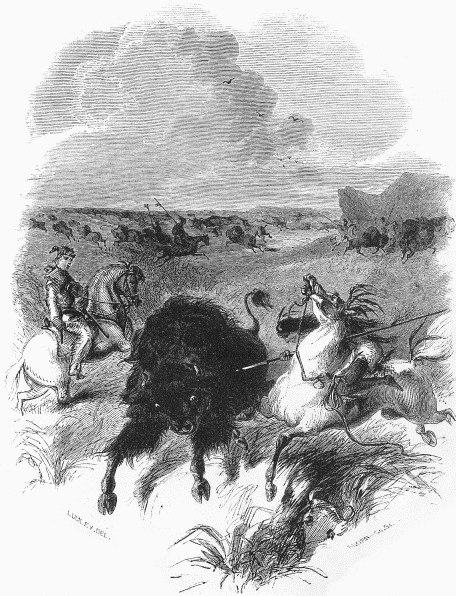 Buffalo Hunt.—Page 161.
The party had only accomplished a few miles of the march when they fell in with the buffalo. Before we pursue the narrative of Kit Carson's life we must redeem our promise and allow Col. Fremont to describe his own impressions in his first Buffalo Hunt, in which Kit Carson and Mr. L. Maxwell were his companions and guides. Col. Fremont says:
"A few miles brought us into the midst of the buffalo, swarming in immense numbers over the plains, where they had left scarcely a blade of grass standing. Mr. Preuss, who was sketching at a little distance in the rear, had at first noted them as large groves of timber. In the sight of such a mass of life, the traveler feels a strange emotion of grandeur. We had heard from a distance a dull and confused murmuring, and, when we came in view of their dark masses, there was not one among us who did not feel his heart beat quicker. It was the early part of the day, when the herds are feeding; and everywhere they were in motion. Here and there a huge old bull was rolling in the grass, and clouds of dust rose in the air from various parts of the bands, each the scene of some obstinate fight. Indians and buffalo make the poetry and life of [pg 162] the prairie, and our camp was full of their exhilaration. In place of the quiet monotony of the march, relieved only by the cracking of the whip, and an 'avance donc! enfant de garce!' shouts and songs resounded from every part of the line, and our evening camp was always the commencement of a feast, which terminated only with our departure on the following morning. At any time of the night might be seen pieces of the most delicate and choicest meat, roasting en appolas, on sticks around the fire, and the guard were never without company. With pleasant weather and no enemy to fear, and abundance of the most excellent meat, and no scarcity of bread or tobacco, they were enjoying the oasis of a voyageur's life. Three cows were killed today. Kit Carson had shot one, and was continuing the chase in the midst of another herd, when his horse fell headlong, but sprang up and joined the flying band. Though considerably hurt, he had the good fortune to break no bones; and Maxwell, who was mounted on a fleet hunter, captured the runaway after a hard chase. He was on the point of shooting him, to avoid the loss of his bridle (a handsomely mounted Spanish one), when he found that his horse was able to come up with him. Animals are frequently lost in this way; and it is necessary to keep close watch over them, in the vicinity of the buffalo, in the midst of which they scour off to the plains, and are rarely retaken. One of our mules took a sudden freak into his head, and joined a neighboring band to-day. As we are not in a condition to lose horses, I sent several men in pursuit, and remained in camp, in the hope of recovering him; but [pg 163] lost the afternoon to no purpose, as we did not see him again. Astronomical observations placed us in longitude 100° 05' 47", latitude 40° 49' 55".
"July 1.—As we were riding quietly along the bank, a grand herd of buffalo, some seven or eight hundred in number, came crowding up from the river, where they had been to drink, and commenced crossing the plain slowly, eating as they went. The wind was favorable; the coolness of the morning invited to exercise; the ground was apparently good, and the distance across the prairie (two or three miles) gave us a fine opportunity to charge them before they could get among the river hills. It was too fine a prospect for a chase to be lost; and, halting for a few moments, the hunters were brought up and saddled, and Kit Carson, Maxwell and I started together. They were now somewhat less than half a mile distant, and we rode easily along until within about three hundred yards, when a sudden agitation, a wavering in the band, and a galloping to and fro of some which were scattered along the skirts, gave us the intimation that we were discovered. We started together at a hand gallop, riding steadily abreast of each other, and here the interest of the chase became so engrossingly intense, that we were sensible to nothing else. We were now closing upon them rapidly, and the front of the mass was already in rapid motion for the hills, and in a few seconds the movement had communicated itself to the whole herd.
"A crowd of bulls, as usual, brought up the rear, and every now and then some of them faced about, and then [pg 164] dashed on after the band a short distance, and turned and looked again, as if more than half inclined to stand and fight. In a few moments, however, during which we had been quickening our pace, the rout was universal, and we were going over the ground like a hurricane. When at about thirty yards, we gave the usual shout (the hunter's battle cry) and broke into the herd. We entered on the side, the mass giving way in every direction in their heedless course. Many of the bulls, less active and less fleet than the cows, paying no attention to the ground, and occupied solely with the hunter were precipitated to the earth with great force, rolling over and over with the violence of the shock, and hardly distinguishable in the dust. We separated on entering, each singling out his game.
"My horse was a trained hunter, famous in the west under the name of Proveau, and, with his eyes flashing, and the foam flying from his mouth, sprang on after the cow like a tiger. In a few moments he brought me alongside of her, and, rising in the stirrups, I fired at the distance of a yard, the ball entering at the termination of the long hair, and passing near the heart. She fell headlong at the report of the gun, and checking my horse, I looked around for my companions. At a little distance, Kit was on the ground, engaged in tying his horse to the horns of a cow which he was preparing to cut up. Among the scattered bands, at some distance below, I caught a glimpse of Maxwell; and while I was looking, a light wreath of white smoke curled away from his gun, from which I was too far to hear the report. Nearer, and [pg 165] between me and the hills, towards which they were directing their course, was the body of the herd, and giving my horse the rein, we dashed after them. A thick cloud of dust hung upon their rear, which filled my mouth and eyes, and nearly smothered me. In the midst of this I could see nothing, and the buffalo were not distinguishable until within thirty feet. They crowded together more densely still as I came upon them, and rushed along in such a compact body, that I could not obtain an entrance—the horse almost leaping upon them. In a few moments the mass divided to the right and left, the horns clattering with a noise heard above everything else, and my horse darted into the opening. Five or six bulls charged on us as we dashed along the line, but were left far behind, and singling out a cow, I gave her my fire, but struck too high. She gave a tremendous leap, and scoured on swifter than before. I reined up my horse, and the band swept on like a torrent, and left the place quiet and clear. Our chase had led us into dangerous ground. A prairie-dog village, so thickly settled that there were three or four holes in every twenty yards square, occupied the whole bottom for nearly two miles in length. Looking around, I saw only one of the hunters, nearly out of sight, and the long dark line of our caravan crawling along, three or four miles distant."
The trail which the party left behind them now forms the emigrant road to California via Fort Laramie, Salt Lake, etc. On reaching Fort Laramie, Fremont found a fearful state of affairs existing among the Sioux Indians [pg 166] through whose country his route lay. An encounter had recently taken place between a war-party belonging to the Sioux nation and a party of trappers and Snake Indians. In the fight the Indians had been worsted and several of their braves killed. To revenge themselves the Sioux chieftains had collected their warriors; and, while the nation was encamped to the number of one thousand lodges, they had gone forth to seek and punish their enemies.
At Fort Laramie the exploring party met several trappers and friendly Indians who used their utmost endeavors to dissuade Colonel Fremont from venturing into such inevitable danger. There was but one opinion expressed, viz.: that, as sure as he entered upon the journey, the entire party would be massacred. To all these admonitions and warnings, Colonel Fremont had but one reply. His government had directed him to perform a certain duty. The obstacles which stood in his way, it was his duty to use every means at his command to surmount; therefore, in obedience to his instructions, he was determined to continue his march. Finally, he said, that he would accomplish the object or die in the attempt, being quite sure that if the expedition failed by being cut to pieces, a terrible retribution would be in store for the perpetrators of the act. Kit Carson, his guide, openly avowed that the future looked dark and gloomy; but, he was delighted to hear this expression from his commander. He now felt that he had a man after his own heart to depend on, and should danger or inevitable death be in store for them he was ready and willing to face either with him. In order to [pg 167] be prepared for the worst, Kit Carson felt it his duty, considering the dangers apprehended, to make his will, thereby showing that if he had to fight he was ready to count it his last battle. Colonel Fremont resumed his journey, and very opportunely arrived at the South Pass of the Rocky Mountains without, in any way, being annoyed with Indians, not even meeting any on the route.
He had now reached the field where his chief labors were to commence. Without loss of time he set earnestly about his work, making and recording such observations as he deemed to be essential and examining and exploring the country. Having finished this part of his labors, the ascent of the highest peak of the mountains was commenced. The length of the journey had jaded the animals. It was very difficult to procure game. The men had undergone such severe hardships that their spirits had become almost worn out. The daily fare now was dried buffalo meat. This was about the consistency of a pine stick; and, in taste, resembled a piece of dried bark. Besides these rather uncomfortable prospects, the expedition stood in constant fear of an attack by the Indians. It was now in the country of the Blackfeet; and, only a short distance from the encampment, at the foot of the mountain, there was one of their forts. In the face of all these obstacles, sufficiently formidable to have deterred most commanders, the mountain party was detailed, being fourteen in number including Fremont. A man named Bernier was left in command of the camp which had been made by felling forest trees in a space about forty feet in diameter, using the trunks to [pg 168] form a breastwork. The camp was thus concealed by the trees and their foliage. It was well calculated for defence, and a few determined men could have maintained it against almost any Indian force.
On the 12th day of August the mountain party left the camp. It was fifteen in number. On the 14th of August some of the party reached an elevation at which the barometer stood 19.401. On the 15th some of the party were sent back. Kit Carson had command of this party. The remainder consisted of Colonel Fremont, Mr. Preuss, Basil Lajeunesse, Clement Lambert, Janesse, and Descoteaux. The day previous Kit Carson had alone climbed one of the highest peaks of the main ridge from which he had a full view of the highest peak, which rose about eight or ten hundred feet above him. The arduous labors of the 14th August had determined the commander to ascend no higher. Instead of carrying out this intention, after Kit Carson with his party had set out, Fremont made one more effort to climb the highest peak and succeeded. His own words in describing this ascent are as follows:
"'At intervals, we reached places where a number of springs gushed from the rocks, and about 1,800 feet above the lakes came to the snow line. From this point our progress was uninterrupted climbing. Hitherto, I had worn a pair of thick moccasins, with soles of parflêche; but here I put on a light thin pair, which I had brought for the purpose, as now the use of our toes became necessary to a further advance. I availed myself of a sort of comb of the mountain, [pg 169] which stood against the wall like a buttress, and which the wind and the solar radiation, joined to the steepness of the smooth rock, had kept almost entirely free from snow. Up this I made my way rapidly. Our cautious method of advancing in the outset had spared my strength; and, with the exception of a slight disposition to headache, I felt no remains of yesterday's illness. In a few minutes we reached a point where the buttress was overhanging, and there was no other way of surmounting the difficulty than by passing around one side of it, which was the face of a vertical precipice of several hundred feet.'
"Parflêche is the name given to buffalo hide. The Indian women prepare it by scraping and drying. It is exceedingly tough and hard, and receives its name from the circumstance that it cannot be pierced by arrows or spears. The entire dress of Fremont and his party, on their ascent to the 'top of America,' consisted of a blue flannel shirt, free and open at the neck, the collar turning down over a black silk handkerchief tied loosely, blue cloth pantaloons, a slouched broad-brimmed hat, and moccasins as above described. It was well adapted to climbing—quite light, and at the same time warm, and every way comfortable.
"'Putting hands and feet in the crevices between the blocks, I succeeded in getting over it, and, when I reached the top, found my companions in a small valley below. Descending to them, we continued climbing, and in a short time reached the crest. I sprang upon the summit, and another step would have precipitated me into an immense snow-field five hundred feet [pg 170] below. To the edge of this field was a sheer icy precipice; and then, with a gradual fall, the field sloped off for about a mile, until it struck the foot of another lower ridge. I stood on a narrow crest, about three feet in width, with an inclination of about 20° N. 51° E. As soon as I had gratified the first feelings of curiosity, I descended, and each man ascended in his turn, for I would only allow one at a time to mount the unstable and precarious slab, which it seemed a breath would hurl into the abyss below. We mounted the barometer in the snow of the summit, and, fixing a ramrod in a crevice, unfurled the national flag, to wave in the breeze where never flag waved before. During our morning's ascent, we met no sign of animal life, except a small bird having the appearance of a sparrow. A stillness the most profound and a terrible solitude forced themselves constantly on the mind as the great features of the place. Here, on the summit, where the stillness was absolute, unbroken by any sound, and the solitude complete, we thought ourselves beyond the region of animated life; but while we were sitting on the rock, a solitary bee (bombus terrestris, the humble bee) came winging his flight from the eastern valley, and lit on the knee of one of the men.
"'Around us, the whole scene had one main striking feature, which was that of terrible convulsion. Parallel to its length, the ridge was split into chasms and fissures, between which rose the thin, lofty walls, terminated with slender minarets and columns, which are correctly represented in the view from the camp on Island Lake. According to the barometer, the little [pg 171] crest of the wall on which we stood was three thousand five hundred and seventy feet above that place, and two thousand seven hundred and eighty above the little lakes at the bottom, immediately at our feet. Our camp at the Two Hills (an astronomical station) bore south 3° east, which, with a bearing afterward obtained from a fixed position, enabled us to locate the peak. The bearing of the Trois Tetons was north 50° west, and the direction of the central ridge of the Wind River Mountains south 39° east. The summit rock was gneiss, succeeded by sienitic gneiss. Sienite and feldspar succeeded in our descent to the snow line, where we found a feldspathic granite. I had remarked that the noise produced by the explosion of our pistols had the usual degree of loudness, but was not in the least prolonged, expiring almost instantaneously. Having now made what observations our means afforded, we proceeded to descend. We had accomplished an object of laudable ambition, and beyond the strict order of our instructions. We had climbed the loftiest peak of the Rocky Mountains, and looked down upon the snow a thousand feet below, and, standing where never human foot had stood before, felt the exultation of first explorers. It was about two o'clock when we left the summit; and when we reached the bottom, the sun had already sunk behind the wall, and the day was drawing to a close. It would have been pleasant to have lingered here and on the summit longer; but we hurried away as rapidly as the ground would permit, for it was an object to regain our party as soon as possible, not knowing what accident the next hour might bring forth.'"
[pg 172]This peak was found, by barometrical observation, to be thirteen thousand five hundred and seventy feet above the waters of the Gulf of Mexico. It bears the name of the Great Explorer, being called Fremont's Peak.
The return trip was now commenced, all of the objects of the expedition having been successfully accomplished. The party again reached Fort Laramie in the month of September, 1842. Kit Carson had served in the double capacity as a hunter and guide. It is sufficient to say of the manner in which he performed his duties that he won the friendship of John C. Fremont, and has ever occupied since then a prominent and permanent place in his esteem. At Laramie, Kit Carson's labors were done. There he bid his commander good bye and set out for New Mexico. Fremont returned to the United States in safety. Thus terminated the first of his great explorations.
Kit Carson's Indian wife had long since been dead. In the month of February, 1843, he married a Mexican lady by the name of Señora Josepha Jarimilla. Of this lady it is sufficient to say that for her many virtues and personal beauty she is justly esteemed by a large circle of acquaintance. By this wife Kit Carson has three children, to whom he is devotedly attached.
In the following April Kit Carson was employed as hunter to accompany Bent and St. Vrain's train of wagons, while on their journey to the United States. On arriving at Walnut Creek, which is about two-thirds of the distance across the Plains from Santa Fé, Kit and his companions came upon the encampment of Captain Cook, belonging to the United States Army—who was in command of four companies [pg 173] of United States Dragoons. Captain Cook informed Carson's party that in his rear was traveling a train of wagons belonging to General Armijo, a wealthy Mexican.
For the purpose of insuring protection to this richly-freighted caravan while passing through an Indian country, the Mexican wagon-master in charge, had hired one hundred men. There were rumors, currently reported at that time and believed, that a large body of Texians were waiting on the road to plunder and murder this wagon party, and thus retaliate the treatment Armijo had been guilty of in the case of the "famous Muir Prisoners;" but, in order that this should not happen in Territory belonging to the United States, the War Department had ordered Captain Cook and the dragoons to guard the property as far as the fording of the Arkansas River, which was then the boundary line between the two countries. The Mexicans had become alarmed for fear they might be attacked on parting with the United States soldiers; so, on meeting with Kit Carson, who was well known to them, they offered three hundred dollars if he would carry a letter to Armijo who was then Governor of New Mexico, and lived at Santa Fé. This letter apprised the General of the danger to which his men and property were exposed and asked for assistance to be immediately sent to them. Carson accepted the offer, and in company with Owens, another mountaineer, he set out on his express ride. In the course of a few days he reached Bent's Fort, where his companion concluded not to go on with him. At the Fort, Kit Carson was informed that the Utah Indians, [pg 174] then hostile, were scattered along his intended route. He was not, however, turned from his duty by this danger, but he resumed his journey immediately. At this last-named place his friend, Mr. Bent, kindly furnished him with a fleet and magnificent horse, which he led, so that, should he find himself in peril, he might mount this fresh animal and make his escape.
By watching for signs and being continually on the alert, Kit Carson discovered the Indians and their village without exposing his own person to view. He immediately secreted himself in an out-of-the-way place and remained until the coming on of darkness; when, he passed safely by the camp of the savages. In the course of a few days he reached Taos and handed his dispatch to the Alcalde of the town to be forwarded to Santa Fé. As had been previously agreed upon, he waited here for an answer with which he was to return. At Taos Carson was informed that Armijo had already sent out one hundred Mexican soldiers to seek his caravan and that the General himself, in command of six hundred more, was soon to follow after. It was afterwards learned that this unfortunate band of one hundred men went as far as the Arkansas River, but could not find any traces of the train of wagons, it not having completed that much of its journey; therefore, they commenced to retrace their steps, but had proceeded only a few miles, when they were suddenly attacked by the Texians, who succeeded in massacring all but one man. This survivor had succeeded in catching, in the heat of the battle, a fully equipped Texan horse which was loose. Mounting him, he made off in the direction of Santa Fé; and, at Cold Springs [pg 175] came upon the camp of Armijo, to whom he reported proceedings. The narration of this sad story so dampened the courage of the General and his men as to cause them to make a precipitous retreat. The spot where this slaughter took place has since gone by the name of the "battle ground" and many are the bleached human bones that are still to be found there.
It was during Carson's stay of four days in Taos, that Armijo and his small army had started out in quest of the enemy; but, before his departure, he had received the letter and directed an answer to be sent, thinking perhaps, that Kit Carson might reach the train even if he himself did not. On the answer coming into Carson's hands, he selected a Mexican boy to accompany him and was quickly on the road again. They had left Taos two days' journey behind them and had reached the River Trinchera (for they were traveling via the Sangero de Christo Pass and Bent's Fort) when they unexpectedly met four Indian warriors. Eat Carson immediately recognized them as hostile Utahs. As yet the red men were some distance off; and, while Kit and his companion stood meditating what was best to be done, the latter spoke and said to the former: "I am a boy and perhaps the Indians will spare my life. At any rate yours is much more valuable than mine, therefore mount the horse you are leading, without delay, and make your escape." Carson at first thought this advice to be good, and was about acting on it, when it struck his equally generous heart, how cowardly such a course would be—to desert a youth who had in the hour of peril so manfully borne himself. Turning to the boy he [pg 176] thanked him and added that "he could not and would not desert him." He said "we must stand our ground together and if we have to die let us take with us each his warrior." While this colloquy was going on, the foremost of the Indians came up. He approached Carson with the air of a man sure of an easy victory, and, with a bland smile, proffered one hand in friendship, while, with the other, he grasped Kit's rifle. A powerful blow from the fist of the latter released his hold and instantly laid him sprawling upon the ground. The other Indians, seeing the fate of their companion, hastened to his rescue. When they reached talking distance, Kit, standing with his rifle brought to his shoulder, informed them that, upon the first hostile demonstration they made, he and his companion would fire. The Indians commenced shaking their priming into the pans of their flint lock guns, and, while doing so, talked loud and threatened to perform a great many things. This was a mere ruse to intimidate Kit and his companion and throw them off their guard. It was, however, well understood and operated to make them only the more vigilant. This endeavor to draw off Kit's attention was continued in various ways, but, finally seeing the determined posture of their opponent, they grew weary of the game, and, at last, departed.
The journey was now resumed. After five days of hard traveling, Kit and his companion entered Bent's Fort, without further molestation. Here Kit Carson learned that the Texians had been caught by Captain Cook and his dragoons in United States Territory, and had been disarmed. This had immediately relieved the conductors [pg 177] of the train from all anxiety. They had, consequently, continued their route, not thinking a stop at Bent's Fort necessary as had been anticipated. Gen. Armijo's letter of instruction was, accordingly, left by Carson with Mr. Bent who promised to forward it to Santa Fé by the first favorable opportunity. To pursue and overtake the wagons would be nothing but labor thrown away. All danger had disappeared.
[pg 178]Kit Carson visits Fremont's Camp—Goes on the Second Exploring Expedition—The Necessary Arrangements—Trip to Salt Lake—Explorations there—Carson is dispatched to Fort Hall for Supplies—Their Operations at Salt Lake—The Great Island—The Journey to the Columbia River in Oregon—Incidents on the Route—Tlamath Lake—The Journey to California—The Trials and Privations met with while crossing the Sierra Nevada Mountains—Mr. Preuss is lost but finds the Party again—Arrival at Sutter's Fort in a Destitute Condition—Two of the Party become deranged—The Route on the Return Trip—Mexicans come into their Camp asking Aid and Protection—Indian Depredations—Carson and Godey start on a Daring Adventure—The Pursuit—The Thieves overtaken—These Two White Men attack Thirty Indians—The Victory—Horses retaken—The Return to Camp—One of their Companions killed—The Journey continued—Arrival at Bent's Fort—The "Fourth of July" Dinner.
A few days before Kit Carson's arrival at Bent's Fort, Col. Fremont had passed by and had informed the Traders there that he was bound on another Exploring Expedition. Having finished up his business with the Mexicans, Kit thought he would like to see his old commander once again. Accordingly, he started on his trail: and, after seventy miles of travel, came up with him. The meeting proved to be mutually agreeable. Although Kit Carson had made this visit solely from his desire to see again his old commander and not with a view of joining his second expedition, Col. Fremont insisted so strongly upon having Kit accompany him that he acquiesced in doing so.
For Col. Fremont, Kit Carson has the greatest admiration. He knows, as well as any man living, his bravery, [pg 179] his talents and the many splendid qualities of his mind and heart. The question will naturally arise, does Kit Carson indorse the political creed upon which Col. Fremont accepted the nomination for the Presidency of the United States? The best answer and the one which is true, will be: Kit Carson considers it one of the highest honors and greatest blessings to be a citizen of the United States. He is willing to incur any danger for his country's good, even if the sacrifice of his life is the alternative. He has spent all his life in the wilds of America where news is always as scarce an article as luxuries of the table and fire-side, and, where the political strifes of factions and parties are not known. The inference will therefore be plainly apparent, that his curiosity does not lead him to examine very attentively the minute workings of political machinery. He is not a man to be swayed by friendship from performing any act which the interests of his country seem to require at his hands. His political bias will, therefore, remain a matter of conjecture until such time, if his life is spared to see it, when New Mexico shall be admitted into the Union as a State. So far, he has never lived where he could exercise the right of franchise. The time must come which shall entitle him to a Presidential vote before he decides what political party shall count him as its supporter.
Soon after Kit Carson was again enrolled under the command of Col. Fremont, he received orders to return to Bent's Fort and purchase some mules of which the party stood in need. Mules are valuable animals in new and mountainous countries. They are often the only beasts of burden which can be successfully used in [pg 180] crossing the wild mountains. Being more sure footed and more able to endure great fatigue than the horse, in such expeditions, they become absolutely necessary. While he was absent on this duty, the expedition journeyed first to Soda Springs and thence on to St. Vrain's Fort, which was located on the South Fork of the Platte. At this point, the expedition was joined by Major Fitzpatrick with a command of forty men which he had enrolled, under orders, to assist in the exploration. When Kit Carson had rejoined the party, the arrangements for the arduous task in view were nearly complete.
Colonel Fremont divided his forces, sending one division, with most of the camp equipage, on the more direct route. This division was placed under the command of Major Fitzpatrick. The other division under the command of Colonel Fremont, consisting of a squad of fifteen men and his guide Kit Carson, struck out up Thompson's Fork. The object of this expedition had in view by the government was, to have Colonel Fremont connect his explorations of the preceding year with the coast surveys of Commander Wilkes on the Pacific. This would give the data for making a correct map of the interior of the wild lands of the continent. From Thompson's Fork Colonel Fremont's division marched to the Cache la Poudre River, and thence to the plains of Laramie until they came to the North Fork of the Platte. This river they crossed below the New Park and bent their way to the sweet water, reaching it at a point about fifteen miles below the Devil's Gate. From this point they traveled almost the same road which is now used by emigrants and which leads to Soda Springs [pg 181] on Beaver River. It had been decided by Fremont to go to the Great Salt Lake and accomplish its exploration. He therefore started for that direction; but, before doing so, ordered Kit Carson to proceed to Fort Hall and obtain such supplies as were required. After procuring these necessities, Kit Carson, with one companion and his pack animals, set out on the return from Fort Hall and eventually found Fremont on the upper end of Salt Lake. From here the party journeyed around to the east side of the lake, a distance of about twenty miles. At this spot they obtained a good view of the lake and its adjacent scenery. Before him, and in bold relief, stood out everything which the explorer desired to examine, even to one of the several islands which are located in the midst of this wonderful collection of saline waters. To this isolated land Fremont was resolved to go. Among the rest of the forethought, supplies, there was an India-rubber boat. This was ordered to be made ready for a trip to the island early the following day. No doubt our readers will be pleased to enjoy Colonel Fremont's account of this lake, its scenery and characteristics. We insert therefore as much thereof as our space will admit. It was the twenty-first day of August 1843 that the little party reached Bear River, which, as has already appeared in another, part of this work, was the principal tributary of the Great Salt Lake. At this point of Colonel Fremont's narrative, he says: "We were now entering a region which, for us, possessed a strange and extraordinary interest. We were upon the waters of the famous lake which forms a salient point among the [pg 182] remarkable geographical features of the country, and around which the vague and superstitious accounts of the trappers had thrown a delightful obscurity, which we anticipated pleasure in dispelling, but which, in the meantime, left a crowded field for the exercise of our imagination.
"In our occasional conversations with the few old hunters who had visited the region, it had been a subject of frequent speculation; and the wonders which they related were not the less agreeable because they were highly exaggerated and impossible.
"Hitherto this lake had been seen only by trappers, who were wandering through the country in search of new beaver streams, caring very little for geography; its islands had never been visited; and none were to be found who had entirely made the circuit of its shores; and no instrumental observations, or geographical survey of any description, had ever been made anywhere in the neighboring region. It was generally supposed that it had no visible outlet; but, among the trappers, including those in my own camp, were many who believed that somewhere on its surface was a terrible whirlpool, through which its waters found their way to the ocean by some subterranean communication. All these things had made a frequent subject of discussion in our desultory conversations around the fires at night; and my own mind had become tolerably well filled with their indefinite pictures, and insensibly colored with their romantic descriptions, which, in the pleasure of excitement, I was well disposed to believe, and half expected to realize.
[pg 183]"'In about six miles' travel from our encampment, we reached one of the points in our journey to which we had always looked forward with great interest—the famous Beer Springs, which, on account of the effervescing gas and acid taste, had received their name from the voyageurs and trappers of the country, who, in the midst of their rude and hard lives, are fond of finding some fancied resemblance to the luxuries they rarely have the good fortune to enjoy.
"'Although somewhat disappointed in the expectations which various descriptions had led me to form of unusual beauty of situation and scenery, I found it altogether a place of very great interest; and a traveler for the first time in a volcanic region remains in a constant excitement, and at every step is arrested by something remarkable and new. There is a confusion of interesting objects gathered together in a small space. Around the place of encampment the Beer Springs were numerous; but, as far as we could ascertain, were entirely confined to that locality in the bottom. In the bed of the river, in front, for a space of several hundred yards, they were very abundant; the effervescing gas rising up and agitating the water in countless bubbling columns. In the vicinity round about were numerous springs of an entirely different and equally marked mineral character. In a rather picturesque spot, about 1,300 yards below our encampment, and immediately on the river bank, is the most remarkable spring of the place. In an opening on the rock, a white column of scattered water is thrown up, in form like a jet-d'eau, to a variable height of about [pg 184] three feet, and, though it is maintained in a constant supply, its greatest height is attained only at regular intervals, according to the action of the force below. It is accompanied by a subterranean noise, which, together with the motion of the water, makes very much the impression of a steamboat in motion; and, without knowing that it had been already previously so called, we gave to it the name of the Steamboat Spring. The rock through which it is forced is slightly raised in a convex manner, and gathered at the opening into an urn-mouthed form, and is evidently formed by continued deposition from the water, and colored bright red by oxide of iron.
"'It is a hot spring, and the water has a pungent and disagreeable metallic taste, leaving a burning effect on the tongue. Within perhaps two yards of the jet d'eau, is a small hole of about an inch in diameter, through which, at regular intervals, escapes a blast of hot air with a light wreath of smoke, accompanied by a regular noise.'
"As they approached the lake, they passed over a country of bold and striking scenery, and through several 'gates,' as they called certain narrow valleys. The 'standing rock' is a huge column, occupying the centre of one of these passes. It fell from a height of perhaps 3,000 feet, and happened to remain in its present upright position.
"At last, on the 6th of September, the object for which their eyes had long been straining was brought to view.
"'Sept. 6.—This time we reached the butte without [pg 185] any difficulty; and, ascending to the summit, immediately at our feet beheld the object of our anxious search, the waters of the Inland Sea, stretching in still and solitary grandeur far beyond the limit of our vision. It was one of the great points of the exploration; and as we looked eagerly over the lake in the first emotions of excited pleasure, I am doubtful if the followers of Balboa felt more enthusiasms, when, from the heights of the Andes, they saw for the first time the great Western Ocean. It was certainly a magnificent object, and a noble terminus to this part of our expedition; and to travelers so long shut up among mountain ranges, a sudden view over the expanse of silent waters had in it something sublime. Several large islands raised their high rocky heads out of the waves; but whether or not they were timbered was still left to our imagination, as the distance was too great to determine if the dark hues upon them were woodland or naked rock. During the day the clouds had been gathering black over the mountains to the westward, and while we were looking a storm burst down with sudden fury upon the lake, and entirely hid the islands from our view.
"'On the edge of the stream a favorable spot was selected in a grove; and felling the timber, we made a strong corral, or horse-pen, for the animals, and a little fort for the people who were to remain. We were now probably in the country of the Utah Indians, though none reside upon the lake. The India-rubber boat was repaired with prepared cloth and gum, and filled with air, in readiness for the next day.
[pg 186]"'The provisions which Carson had brought with him being now exhausted, and our stock reduced to a small quantity of roots, I determined to retain with me only a sufficient number of men for the execution of our design; and accordingly seven were sent back to Fort Hall, under the guidance of François Lajeunesse, who, having been for many years a trapper in the country, was an experienced mountaineer.
"'We formed now but a small family. With Mr. Preuss and myself, Carson, Bernier, and Basil Lajeunesse had been selected for the boat expedition—the first ever attempted on this interior sea; and Badeau, with Derosier, and Jacob (the colored man), were to be left in charge of the camp. We were favored with most delightful weather. To-night there was a brilliant sunset of golden orange and green, which left the western sky clear and beautifully pure; but clouds in the east made me lose an occultation. The summer frogs were singing around us, and the evening was very pleasant, with a temperature of 60°—a night of a more southern autumn. For our supper we had yampah, the most agreeably flavored of the roots, seasoned by a small fat duck, which had come in the way of Jacob's rifle. Around our fire to-night were many speculations on what to-morrow would bring forth; and in our busy conjectures we fancied that we should find every one of the large islands a tangled wilderness of trees and shrubbery, teeming with game of every description that the neighboring region afforded, and which the foot of a white man or Indian had never violated. Frequently, during the day, clouds had [pg 187] rested on the summits of their lofty mountains, and we believed that we should find clear streams and springs of fresh water; and we indulged in anticipations of the luxurious repasts with which we were to indemnify ourselves for past privations. Neither, in our discussions were the whirlpool and other mysterious dangers forgotten, which Indian and hunters' stories attributed to this unexplored lake. The men had discovered that, instead of being strongly sewed (like that of the preceding year, which had so triumphantly rode the cañons of the Upper Great Platte), our present boat was only pasted together in a very insecure manner, the maker having been allowed so little time in the construction that he was obliged to crowd the labor of two months into several days. The insecurity of the boat was sensibly felt by us; and, mingled with the enthusiasm and excitement that we all felt at the prospect of an undertaking which had never before been accomplished, was a certain impression of danger, sufficient to give a serious character to our conversation. The momentary view which had been had of the lake the day before, its great extent and rugged islands, dimly seen amidst the dark waters in the obscurity of the sudden storm, were well calculated to heighten the idea of undefined danger with which the lake was generally associated.
"'Sept. 8.—A calm, clear day, with a sunrise temperature of 41°. In view of our present enterprise, a part of the equipment of the boat had been made to consist of three air-tight bags, about three feet long, and capable each of containing five gallons. These had been [pg 188] filled with water the night before, and were now placed in the boat, with our blankets and instruments, consisting of a sextant, telescope, spy-glass, thermometer, and barometer.
"'In the course of the morning we discovered that two of the cylinders leaked so much as to require one man constantly at the bellows, to keep them sufficiently full of air to support the boat. Although we had made a very early start, we loitered so much on the way—stopping every now and then, and floating silently along, to get a shot at a goose or a duck—that it was late in the day when we reached the outlet. The river here divided into several branches, filled with fluvials, and so very shallow that it was with difficulty we could get the boat along, being obliged to get out and wade. We encamped on a low point among rushes and young willows, where there was a quantity of driftwood, which served for our fires. The evening was mild and clear; we made a pleasant bed of the young willows; and geese and ducks enough had been killed for an abundant supper at night, and for breakfast next morning. The stillness of the night was enlivened by millions of water-fowl.
"'Sept. 9.—The day was clear and calm; the thermometer at sunrise at 49°. As is usual with the trappers on the eve of any enterprise, our people had made dreams, and theirs happened to be a bad one—one which always preceded evil—and consequently they looked very gloomy this morning; but we hurried through our breakfast, in order to make an early start, and have all the day before us for our adventure. The [pg 189] channel in a short distance became so shallow that our navigation was at an end, being merely a sheet of soft mud, with a few inches of water, and sometimes none at all, forming the low-water shore of the lake. All this place was absolutely covered with flocks of screaming plover. We took off our clothes, and, getting over-board, commenced dragging the boat—making, by this operation, a very curious trail, and a very disagreeable smell in stirring up the mud, as we sank above the knee at every step. The water here was still fresh, with only an insipid and disagreeable taste, probably derived from the bed of fetid mud. After proceeding in this way about a mile, we came to a small black ridge on the bottom, beyond which the water became suddenly salt, beginning gradually to deepen, and the bottom was sandy and firm. It was a remarkable division, separating the fresh water of the rivers from the briny water of the lake, which was entirely saturated with common salt. Pushing our little vessel across the narrow boundary, we sprang on board, and at length were afloat on the waters of the unknown sea.
"We did not steer for the mountainous islands, but directed our course towards a lower one, which it had been decided we should first visit, the summit of which was formed like the crater at the upper end of Bear River valley. So long as we could touch the bottom with our paddles, we were very gay; but gradually, as the water deepened, we became more still in our frail batteau of gum cloth distended with air, and with pasted seams. Although the day was very calm, there [pg 190] was a considerable swell on the lake; and there were white patches of foam on the surface, which were slowly moving to the southward, indicating the set of a current in that direction, and recalling the recollection of the whirlpool stories. The water continued to deepen as we advanced; the lake becoming almost transparently clear, of an extremely beautiful bright-green color; and the spray, which was thrown into the boat and over our clothes, was directly converted into a crust of common salt, which covered also our hands and arms. 'Captain,' said Carson, who for some time had been looking suspiciously at some whitening appearances outside the nearest islands 'what are those yonder?—won't you just take a look with the glass?' We ceased paddling for a moment, and found them to be the caps of the waves that were beginning to break under the force of a strong breeze that was coming up the lake. The form of the boat seemed to be an admirable one, and it rode on the waves like a water bird; but, at the same time, it was extremely slow in its progress. When we were a little more than half way across the reach, two of the divisions between the cylinders gave way, and it required the constant use of the bellows to keep in a sufficient quantity of air. For a long time we scarcely seemed to approach our island, but gradually we worked across the rougher sea of the open channel, into the smoother water under the lee of the island, and began to discover that what we took for a long row of pelicans, ranged on the beach, were only low cliffs whitened with salt by the spray of the waves; and about noon we reached the shore, the transparency [pg 191] of the water enabling us to see the bottom at a considerable depth.
"'The cliffs and masses of rock along the shore were whitened by an incrustation of salt where the waves dashed up against them; and the evaporating water, which had been left in holes and hollows on the surface of the rocks, was covered with a crust of salt about one-eighth of an inch in thickness.
"'Carrying with us the barometer and other instruments, in the afternoon we ascended to the highest point of the island—a bare rocky peak, 800 feet above the lake. Standing on the summit, we enjoyed an extended view of the lake, inclosed in a basin of rugged mountains, which sometimes left marshy flats and extensive bottoms between them and the shore, and in other places came directly down into the water with bold and precipitous bluffs.
"'As we looked over the vast expanse of water spread out beneath us, and strained our eyes along the silent shores over which hung so much doubt and uncertainty, and which were so full of interest to us, I could hardly repress the almost irresistible desire to continue our exploration; but the lengthening snow on the mountains was a plain indication of the advancing season, and our frail linen boat appeared so insecure that I was unwilling to trust our lives to the uncertainties of the lake. I therefore unwillingly resolved to terminate our survey here, and remain satisfied for the present with what we had been able to add to the unknown geography of the region. We felt pleasure also in remembering that we were the first who, in the traditionary [pg 192] annals of the country, had visited the islands, and broken, with the cheerful sound of human voices, the long solitude of the place.
"'I accidentally left on the summit the brass cover to the object end of my spy-glass; and as it will probably remain there undisturbed by Indians, it will furnish matter of speculation to some future traveler. In our excursions about the island, we did not meet with any kind of animal; a magpie, and another larger bird, probably attracted by the smoke of our fire, paid us a visit from the shore, and were the only living things seen during our stay. The rock constituting the cliffs along the shore where we were encamped, is a talcous rock, or steatite, with brown spar.
"'At sunset, the temperature was 70°. We had arrived just in time to obtain a meridian altitude of the sun, and other observations were obtained this evening, which place our camp in latitude 41° 10' 42", and longitude 112° 21' 05" from Greenwich. From a discussion of the barometrical observations made during our stay on the shores of the lake, we have adopted 4,200 feet for its elevation above the Gulf of Mexico. In the first disappointment we felt from the dissipation of our dream of the fertile islands, I called this Disappointment Island.
"'Out of the driftwood, we made ourselves pleasant little lodges, open to the water, and, after having kindled large fires to excite the wonder of any straggling savage on the lake shores, lay down, for the first time in a long journey, in perfect security; no one thinking about his arms. The evening was extremely [pg 193] bright and pleasant; but the wind rose during the night, and the waves began to break heavily on the shore, making our island tremble. I had not expected in our inland journey to hear the roar of an ocean surf; and the strangeness of our situation, and the excitement we felt in the associated interests of the place, made this one of the most interesting nights I remember during our long expedition.
"'In the morning, the surf was breaking heavily on the shore, and we were up early. The lake was dark and agitated, and we hurried through our scanty breakfast, and embarked—having first filled one of the buckets with water from the lake, of which it was intended to make salt. The sun had risen by the time we were ready to start; and it was blowing a strong gale of wind, almost directly off the shore, and raising a considerable sea, in which our boat strained very much. It roughened as we got away from the island, and it required all the efforts of the men to make any head against the wind and sea; the gale rising with the sun; and there was danger of being blown into one of the open reaches beyond the island. At the distance of half a mile from the beach, the depth of water was sixteen feet, with a clay bottom; but, as the working of the boat was very severe labor, and during the operation of sounding it was necessary to cease paddling, during which the boat lost considerable way, I was unwilling to discourage the men, and reluctantly gave up my intention of ascertaining the depth, and the character of the bed. There was a general shout in the boat when [pg 194] we found ourselves in one fathom, and we soon after landed.'"
We now resume Kit Carson's narrative. When the Indian-rubber boat was put in order, Colonel Fremont started, taking Carson and three others as companions. (Their names have already appeared.) The distance from the main land to the island is computed to be about three leagues, hence the pull at the oars, for landsmen unaccustomed to such kind of work, was no small task. However a landing upon the island was safely accomplished, the boat made fast and the investigations commenced. After examining most of the island without finding even a spring of water on it, it was determined to ascend the great hill which was the highest elevation on it. The party was not long in reaching the summit, where they found a shelving rock, on which they cut a cross, their names and the date as signs to after visitors, should any such follow in their footsteps, that they had been the first persons who had ever, within the knowledge of man, been on that island.
The day having been far spent in their labors, orders were given to camp on the island for the night. On the morrow they departed for the main land. When they had accomplished about one league, being one-third of the distance, the clouds suddenly gathered and threatened a storm. Just as this danger impended, the air which acted in giving buoyancy to the boat, by some accident, began to escape. A man was immediately stationed at the bellows and it required his constant aid to supply the portion which steadily escaped. Colonel [pg 195] Fremont then ordered the men to pull for their lives and try thus to escape the danger of the impending storm. In this instance, as indeed in every hour of peril, an all-seeing Providence guided them in safety to the shore. Soon after they arrived, the storm came on with such fury that it caused the water of the lake, according to the natural water mark, to rise ten feet in one hour.
The party soon after recommenced their march and proceeded some distance up the Bear River. Crossing it they went to the Malade and thence on until they reached Fort Hall. Here they met with the division under Fitzpatrick and made a short stay.
Once more Colonel Fremont started with his small party in advance of his main body. He marched about eight days' journey ahead, Fitzpatrick following up his trail with the larger division. At this time the expedition was journeying in the direction of the mouth of the Columbia River. In due time they arrived safely at the river Dalles. Here they made another brief halt. Colonel Fremont left Kit Carson in command of this camp, while he, with a small party, proceeded to Vancouver's Island and purchased some provisions. On his return he found that the whole party had become consolidated. The command now journeyed to Tlamath Lake in Oregon Territory. The descriptions of all these journeys have already been given to the public in several forms, all however based upon Colonel Fremont's reports made to the U.S. Government. It would be superfluous, therefore, for us to fill up the pages of the life of Kit Carson with matter already published beyond the occurrences appertaining to him. Having finished the observations upon [pg 196] Tlamath Lake, the expedition started for California. The route led through a barren and desolate country, rendering game scarce. As the command drew near to the Sierra Nevada Mountains, they were found to be entirely covered with deep snow throughout the entire range of vision. At this time the provisions had commenced giving out. Game was so scarce that it could not be depended on. The propositions which presented themselves at this crisis were to cross the mountains or take the fearful chance of starving to death. Crossing the mountains, terrible though the alternative, was the choice of all. It was better than inactivity and certain death. On arriving at the mountains the snow was found to be about six feet deep on a level. The first task was to manufacture snow-shoes for the entire party. By the aid of these foot appendages, an advance party was sent on to explore the route and to determine how far a path would have to be broken for the animals. This party reached a spot from whence they could see their way clear and found that the path for the animals would be three leagues in length. The advance party also saw, in the distance, the green valley of the Sacramento and the coast range of mountains. Kit Carson was the first man to recognize these, to the snow-bound travelers, desirable localities, although it was now seventeen years since he had last gazed upon them. The advance party then returned to their friends in the rear and reported their proceedings. All were delighted on learning that they had one man among them who knew where they were. The business of making the road was very laborious. The snow had to be beaten compact [pg 197] with mallets. It was fifteen days before the party succeeded in reaching, with a few of their animals, a place where the heavy work of the route was ended. During this time, many of their mules had starved to death, and the few remaining were driven to such an extreme by want of food, that they devoured one another's tails, the leather on the pack saddles; and, in fact, they would try to eat everything they could get into their mouths. The sufferings of the men had been as severe as had ever fallen to the lot of any mountaineer present. Their provisions were all used and they were driven to subsist upon the mules as they died from hunger. But, commander and all bore these terrible trials in an exemplary manner.
An incident is related by Colonel Fremont, in which Kit Carson enjoyed a cold-bath, which occurred during this terrible march. "February Twenty-third.—This was our most difficult day; we were forced off the ridges by the quantity of snow among the timber, and obliged to take to the mountain-sides, where, occasionally, rocks and a southern exposure afforded us a chance to scramble along. But these were steep and slippery with snow and ice; and the tough evergreens of the mountain impeded our way, tore our skins, and exhausted our patience. Some of us had the misfortune to wear moccasins with parflêche soles, so slippery that we could not keep our feet, and generally crawled across the snow beds. Axes and mauls were necessary to-day, to make a road through the snow. Going ahead with Carson to reconnoitre the road, we reached in the afternoon the river which made the [pg 198] outlet of the lake. Carson sprang over, clear across a place where the stream was compressed among the rocks, but the parflêche sole of my moccasin glanced from the icy rock, and precipitated me into the river. It was some few seconds before I could recover myself in the current, and Carson thinking me hurt jumped in after me, and we both had an icy bath. We tried to search awhile for my gun, which had been lost in the fall, but the cold drove us out; and, making a large fire on the bank, after we had partially dried ourselves, we went back to meet the camp. We afterwards found that the gun had been slung under the ice which lined the banks of the creek."
It was while undergoing such experience as we have endeavored to narrate that the characters of men show forth in their true light and can be fully analyzed. John C. Fremont never was found wanting in times such as tried men's hearts. He was worthy of the trust reposed in him. His was no ordinary command. The men he had to deal with, in their line, had no superiors on the American Continent; yet, he proved a match for any one of them and gained from them the name of being a good mountaineer, an encomium they are not prone to bestow lightly.
The party now commenced descending the mountains. On reaching the valley beneath, Fremont, taking Kit Carson and six of the men, pushed on in advance, in order to reach Sutter's Fort, where he would be able to purchase provisions. Fitzpatrick was left in charge of the main party, with orders to make easy marches. The [pg 199] second day after this division was made, Mr. Preuss, Fremont's assistant, accidentally got lost. His friends began making search for him. This failing, they traveled on slowly, fired guns and used every means in their power to let their whereabouts be known to him. After wandering about for four days, to the surprise and joy of his companions, he came into camp. During his absence he had subsisted on acorns and roots, and, as a matter of course, was nearly exhausted both in body and mind. Three days after Mr. Preuss was restored to them, Fremont, with the advance party, reached Sutter's Fort. He and his party were very hospitably received. They were entertained with the best the post could furnish, by its kind-hearted proprietor. Never did men more deserve such treatment. The condition of all was about as miserable as it could well be imagined, for men who retained their hold on life.
It was at Sutter's Fort, as most of our readers will remember, that the great gold mines of California first received their kindling spark, the discovery of that precious metal having been made there. While some men were digging a mill-race the alluring deposit first appeared. This event has made the Fort world-renowned.
At the time we describe Fremont on his second expedition, nothing whatever was known of the immense fields of treasure over which he and his men daily walked, although, for many years previous to the discovery being made, the mountaineers had trapped all the rivers in that vicinity, and on their banks had herded their animals for months together. They had drank thousands of times from the pure water as it flowed in the river's channel, [pg 200] and, no doubt, frequently their eyes had penetrated through it until they saw the sand beneath in which, perchance, the sparkling specs may have occasionally allured them sufficiently to recall the proverb that "all is not gold that glitters."
The writer once made inquiry of one of these mountaineers who had spent two summers in the manner narrated above near and at Sutter's Fort some twenty years since. He was asked whether he ever saw there anything in the shape of gold which in any way aroused his suspicions? His reply was: "Never. And had I, it would have been only for a brief space of time, as finally I should have been certain that I was deluded and mistaken, without there had been the Eagle of our country stamped upon it."
Provisions were immediately obtained at the Fort and carried to Fitzpatrick and his party. Great difficulty had now to be encountered to prevent the men from losing their lives by the sudden change from want to comparative luxury. Notwithstanding the utmost care was taken, some of the party lost their reason. The hardships of the journey had proved too much for them. Fitzpatrick and the main body arrived at the Fort in a few days, where they were likewise welcomed by its hospitable and generous proprietor, Captain Sutter. His name in California has ever been but another term for kindness and sympathy for the unfortunate. This expedition, in one respect only, can be called unfortunate. When the terrible sufferings of the commander and his men have been named, the catalogue of misfortune is ended. Its results, grand and glorious, have immortalized the name of [pg 201] every man who assisted, in any way, to accomplish it. "I belonged to the several Exploring Expeditions of John C. Fremont" is the key note to the respect and homage of the American nation; the truth would be equally real, if we add, to the whole civilized world. Every heart which beats with admiration for the heroic, or which is capable of appreciating the rich contributions to the sciences, direct resultants from their terrible sufferings, has thrilled with delight when possessed of the history which records the brilliant achievements of these Exploring Parties.
The band started from the little town of Kansas on the twenty-ninth day of May, 1843. It returned to the United States in August, 1844. After traveling seventeen hundred miles, it reached, September sixth, Salt Lake. On the fourth day of November it reached Fort Vancouver, on the Columbia River. On the sixth day of March, 1844, it reached Sutter's Fort in the destitute condition already explained. The distance from Fort Hall by the route taken is about two thousand miles. The party remained at Sutter's Fort until the twenty-fourth day of March, or as Kit Carson expresses the time from his memory, the expedition remained at this place about one month. At the expiration of this time, the party was sufficiently recruited to be ready for their return journey, which they commenced in April, 1844. Just previous to their taking leave of Mr. Sutter, two of the company became deranged, owing to the privations and fasting to which they had been obliged to submit before being ushered into a land of plenty. They had indulged appetite too freely, and brought on one of those strange [pg 202] revolutions in the brain's action which never fails to excite the pity of friend and foe. The first warning which the party had that one of the men was laboring under a disordered intellect occurred in the following manner. Early in the morning the man suddenly started from his sleep and began to ask his companions where his riding animal was gone. During this time it was by him, but he did not know it. Unknown to the rest of the party he started off soon after in search of his imaginary animal. As soon as his absence became known to Fremont, he surmised the truth and sent persons in all directions to hunt for him. They searched the neighboring country for many miles and made inquiries of all the friendly Indians they chanced upon, but failed to discover him. Several days of delay was caused by this most unhappy circumstance. Finally, it becoming necessary for the party to depart without him, word was left with Mr. Sutter to continue the hunt. He did so most faithfully; and, by his exertions, some time after the party had set out on the return trip, the maniac was found and kept at the Fort until he had entirely recovered. He was then, on the first opportunity, provided with a passage to the United States. Before we follow the party on their homeward-bound tramp, it is proper that the reader should be favored with the estimate and views which the American historian, statesman and scholar, Colonel Benton, has recorded concerning the perils undergone and results accomplished by this expedition. His pen is so graphic and life-like that the reader will doubtless thank us for the extract. Besides presenting a view of the expedition, it will unfold a fact which shows where the [pg 203] origin of the expedition had its conception. We give all he says concerning the expedition.17
"'The government deserves credit for the zeal with which it has pursued geographical discovery.' Such is the remark which a leading paper made upon the discoveries of Fremont, on his return from his second expedition to the great West; and such is the remark which all writers will make upon all his discoveries who write history from public documents and outside views. With all such writers the expeditions of Fremont will be credited to the zeal of the government for the promotion of science, as if the government under which he acted had conceived and planned these expeditions, as Mr. Jefferson did that of Lewis and Clark, and then selected this young officer to carry into effect the instructions delivered to him. How far such history would be true in relation to the first expedition, which terminated in the Rocky Mountains, has been seen in the account which has been given of the origin of that undertaking, and which leaves the government innocent of its conception; and, therefore, not entitled to the credit of its authorship, but only to the merit of permitting it. In the second, and greater expedition, from which great political as well as scientific results have flowed, their merit is still less; for, while equally innocent of its conception, they were not equally passive to its performance—countermanding the expedition after it had begun—and lavishing censure upon the adventurous young explorer for his manner of undertaking it. The fact was, that his first [pg 204] expedition barely finished, Mr. Fremont sought and obtained orders for a second one, and was on the frontier of Missouri with his command when orders arrived at St. Louis to stop him, on the ground that he had made a military equipment which the peaceful nature of his geographical pursuit did not require! as if Indians did not kill and rob scientific men as well as others if not in a condition to defend themselves. The particular point of complaint was that he had taken a small mountain howitzer, in addition to his rifles; and which he was informed, was charged to him, although it had been furnished upon a regular requisition on the commandant of the arsenal at St. Louis, approved by the commander of the military department (Colonel, afterward General Kearney). Mr. Fremont had left St. Louis, and was at the frontier, Mrs. Fremont being requested to examine the letters that came after him, and forward those which he ought to receive. She read the countermanding orders and detained them! and Fremont knew nothing of their existence, until after he had returned from one of the most marvellous and eventful expeditions of modern times—one to which the United States are indebted (among other things) for the present ownership of California, instead of seeing it a British possession. The writer of this View, who was then in St. Louis, approved of the course which his daughter had taken (for she had stopped the orders before he knew it); and he wrote a letter to the department condemning the recall, repulsing the reprimand which had been lavished upon Fremont, and demanding a court-martial for him when [pg 205] he should return. The Secretary of War was then Mr. James Madison Porter, of Pennsylvania; the chief of the topographical corps the same as now (Colonel Abert), himself an office man, surrounded by West Point officers, to whose pursuit of easy service, Fremont's adventurous expeditions was a reproach; and in conformity to whose opinions the secretary seemed to have acted. On Fremont's return, upwards of a year afterwards, Mr. William Wilkins, of Pennsylvania, was Secretary of War, and received the young explorer with all honor and friendship, and obtained for him the brevet of captain from President Tyler. And such is the inside view of this piece of history—very different from what documentary evidence would make it.
"To complete his survey across the continent, on the line of travel between the State of Missouri and the tide-water region of the Columbia, was Fremont's object in this expedition; and it was all that he had obtained orders for doing; but only a small part, and to his mind an insignificant part, of what he proposed doing. People had been to the mouth of the Columbia before, and his ambition was not limited to making tracks where others had made them before him. There was a vast region beyond the Rocky Mountains—the whole western slope of our continent—of which but little was known; and of that little, nothing with the accuracy of science. All that vast region, more than seven hundred miles square—equal to a great kingdom in Europe—was an unknown land—a sealed book, which he longed to open, and to read. Leaving the frontier of Missouri in May, 1843, and often diverging [pg 206] from his route for the sake of expanding his field of observation, he had arrived in the tide-water region of Columbia in the month of November; and had then completed the whole service which his orders embraced. He might then have returned upon his tracks, or been brought home by sea, or hunted the most pleasant path for getting back; and if he had been a routine officer, satisfied with fulfilling an order, he would have done so. Not so the young explorer, who held his diploma from nature, and not from the United States Military Academy. He was at Fort Vancouver, guest of the hospitable Dr. McLaughlin, Governor of the British Hudson Bay Fur Company; and obtained from him all possible information upon his intended line of return—faithfully given, but which proved to be disastrously erroneous in its leading and governing feature. A southeast route to cross the great unknown region diagonally through its heart (making a line from the Lower Columbia to the Upper Colorado of the Gulf of California), was his line of return; twenty-five men (the same who had come with him from the United States) and a hundred horses were his equipment; and the commencement of winter the time of starting—all without a guide, relying upon their guns for support; and, in the last resort, upon their horses—such as should give out! for one that could carry a man, or a pack, could not be spared for food.
"All the maps up to that time had shown this region traversed from east to west—from the base of the Rocky Mountains to the Bay of San Francisco—by a great river called the Buena Ventura: which may be [pg 207] translated, the Good Chance. Governor McLaughlin believed in the existence of this river, and made out a conjectural manuscript map to show its place and course. Fremont believed in it, and his plan was to reach it before the dead of winter, and then hybernate upon it. As a great river he knew that it must have some rich bottoms, covered with wood and grass, where the wild animals would collect and shelter, when the snows and freezing winds drove them from the plains; and with these animals to live on, and grass for the horses, and wood for fires, he expected to avoid suffering, if not to enjoy comfort, during his solitary sojourn in that remote and profound wilderness.
"He proceeded—soon encountered deep snows which impeded progress upon the highlands—descended into a low country to the left (afterwards known to be the Great Basin, from which no water issues to any sea)—skirted an enormous chain of mountain on the right, luminous with glittering white snow—saw strange Indians, who mostly fled—found a desert—no Buena Ventura; and death from cold and famine staring him in the face. The failure to find the river, or tidings of it, and the possibility of its existence seeming to be forbid by the structure of the country, and hybernation in the inhospitable desert being impossible, and the question being that of life and death, some new plan of conduct became indispensable. His celestial observations told him that he was in the latitude of the Bay of San Francisco, and only seventy miles from it. But what miles! up and down that snowy mountain which [pg 208] the Indians told him no men could cross in the winter—which would have snow upon it as deep as the trees, and places where people would slip off and fall half a mile at a time—a fate which actually befell a mule, packed with the precious burden of botanical specimens, collected along a travel of two thousand miles. No reward could induce an Indian to become a guide in the perilous adventure of crossing this mountain. All recoiled and fled from the adventure. It was attempted without a guide—in the dead of winter—accomplished in forty days—the men and surviving horses—a woeful procession, crawling along one by one; skeleton men leading skeleton horses—and arriving at Sutter's Settlement in the beautiful valley of the Sacramento; and where a genial warmth, and budding flowers, and trees in foliage, and grassy ground, and flowing streams, and comfortable food, made a fairy contrast with the famine and freezing they had encountered, and the lofty Sierra Nevada which they had climbed. Here he rested and recruited; and from this point, and by way of Monterey, the first tidings were heard of the party since leaving Fort Vancouver.
"Another long progress to the south, skirting the western base of the Sierra Nevada, made him acquainted with the noble valley of the San Joaquin, counterpart to that of the Sacramento; when crossing through a gap, and turning to the left, he skirted the Great Basin; and by many deviations from the right line home, levied incessant contributions to science from expanded lands, not described before. In this eventful exploration, all the great features of the western [pg 209] slope of our continent were brought to light—the Great Salt Lake, the Utah Lake, the Little Salt Lake; at all which places, then deserts, the Mormons now are; the Sierra Nevada, then solitary in the snow, now crowded with Americans, digging gold from its flanks: the beautiful valleys of the Sacramento and San Joaquin, then alive with wild horses, elk, deer, and wild fowls, now smiling with American cultivation; the Great Basin itself and its contents; the Three Parks; the approximation of the great rivers which, rising together in the central region of the Rocky Mountains, go off east and west, towards the rising and the setting sun—all these, and other strange features of a new region, more Asiatic than American, were brought to light and revealed to public view in the results of this exploration.
"Eleven months he was never out of sight of snow; and sometimes, freezing with cold, would look down upon a sunny valley, warm with genial heat;—sometimes panting with the summer's heat, would look up at the eternal snows which crowned the neighboring mountain. But it was not then that California was secured to the Union—to the greatest power of the New World—to which it of right belonged; but it was the first step towards the acquisition, and the one that led to it. The second expedition led to a third, just in time to snatch the golden California from the hands of the British, ready to clutch it. But of this hereafter. Fremont's second expedition was now over. He had left the United States a fugitive from his government, and returned with a name that went over [pg 210] Europe and America, and with discoveries bearing fruit which the civilized world is now enjoying."
On their homeward-bound journey, the party followed up the valley of the San Joaquin crossing over the Sierra Nevada and coast range of mountains at a point where they join and form a beautiful low pass. They continued on from here close under the coast range until they struck the Spanish Trail. This they followed to the Mohave River. That stream, it will be recollected, was an old friend of Kit Carson's. The reader will recall the many times he had caught beaver out of its waters. They followed the trail up the course of the river to where it leaves it. At this point an event occurred which somewhat retarded their progress, relieving the monotony of the route and somewhat changing their plans.
Soon after the camp had been formed, they were visited by a Mexican man and boy; the one named Andreas Fuentes, the other Pablo Hernandez. They informed Fremont that they belonged to a party of Mexican traders which had come from New Mexico. They said that six of them, including in this number two women who acted as cooks, had been left by their friends in charge of a band of horses. The rest of the party were absent trafficking. The party of six thus left to watch the horses, consisted of Santiago Giacome, Andreas Fuentes and wife, and Pablo Hernandez, together with his father and mother. They were endeavoring to find better grazing for their animals. For this purpose they had penetrated the country as far as they [pg 211] dared; and, at about eighty miles from the camp of Fremont, had resolved to wait for their friends. Fuentes and the boy Pablo were on guard over the animals when their camp was attacked by hostile savages. The attacking band was about thirty in number.
Their principal object was to seize the horses. To effect this the more easily, they saluted the little band with a flight of arrows as they advanced. Fuentes and Pablo now heard Giacome warning them to start the horses and run for it. Both were mounted. They obeyed the directions of Giacome and with the entire band of horses charged boldly into the midst of the Indians regardless of their weapons. The charge succeeded in breaking their line, through which Fuentes and Pablo boldly dashed after their animals. The Indians deferred the chase to attend to a more bloody purpose. Having put sixty miles between them and the site of the attack, they left their horses and started in search of their main body. This search led them into Fremont's camp. Fuentes feared that the worst had overtaken his wife. Pablo already looked upon himself as an orphan boy. He doubted not that the bloody savages had murdered both his father and mother. It was a sad picture to witness their grief. But Kit Carson could not do so unmoved. The heart of such grief has ever awakened his earnest sympathy. His sympathy, too, has never been of a wordy nature. He volunteered to go with Fuentes and make an attempt to deliver the captives, if such they should prove, or to avenge their death, if that became the sad alternative.
Fuentes had left the horses at a spring of water, well [pg 212] known to Carson. There he had found signs of white men which had led him into Fremont's camp. There was no difficulty for Carson to find the spring. The whole company therefore traveled to the spring, which they reached early the next morning, distant about thirty miles from their last camp. The horses were not to be seen. A short examination of signs soon revealed to Carson and Godey that the two Mexicans had been followed by the Indians and that they had come upon the horses shortly after they had left them. Of course therefore they had captured and driven them off.
Carson and Godey were determined to make one effort to punish the rascals. They started, taking Fuentes with them, upon the trail of the Indians. The chase was a severe one, as, in the judgment of the mountaineers, the Indians would not make a short trail after acquiring so much booty. The horse which Fuentes rode, most unfortunately, gave out after a short ride. There was no time to be lost and no means at hand to supply this important deficiency. To turn back to camp would supply it, but that course would also lose them their game. Fuentes, therefore, was requested to return to Fremont's camp, and there await the return of Kit Carson and Godey. These two had been the only men in the entire command who had volunteered in this chase. The loss of Fuentes therefore made their task literally a Don Quixotic adventure. Two men against thirty. But Kit Carson was not the man to turn his back upon an adventure as soon as the difficulties began to present themselves. He well knew that he had one man on whom he could rely. Richard Godey was his tried and trusty [pg 213] friend, his kindred spirit and a noble hearted man. Leaving the Mexican to find his way back to camp, a distance of about twenty miles, they gave him their word that they would finish the business. The following night was very dark, and in order to keep on the right scent Carson and Godey were obliged to lead their horses and frequently to follow the trail by the sense of feeling. It was seldom, however, that they lost the path, and never for more than a few moments at a time. Gradually the signs grew fresher as they advanced, which gave them the assurance that they were rapidly gaining on the pursuit. Finally, they concluded that only a few hours separated them from the savages. Having accomplished a considerable part of their journey during the night, and finding that both themselves and their horses required rest, they concluded to halt. Having unsaddled their animals and turned them out to graze, they wrapped themselves up in their wet blankets and laid down to sleep. The weather, however, was too cold to permit sleeping in comfort without a fire. That they dare not make, fearing it would prove a warning signal to the savages. Having worried through the remainder of this cold and cheerless night, they arose early in the morning and went to the bottom of a deep ravine where they kindled a small fire and succeeded in warming themselves. At daybreak they re-saddled their jaded horses and once more started upon the trail. Just as the sun was rising they discovered the Indians. When first seen they were encamped two miles in advance, and were enjoying a breakfast on horse steaks, having already killed five of the stolen animals. Kit Carson and his friend dismounted, and, [pg 214] concealing their horses near by, held a council of war. They decided to crawl in among the herd of stolen animals which were grazing, without guard, at a short distance from the camp of the savages. Upon reaching the horses, they agreed to be guided by circumstances. First divesting themselves of all useless apparel, they commenced their task. After much cautious labor they gained their point and stood among the animals. As soon, however, as they arrived, one of the young horses of the band became frightened at the grotesque figures cut by the two creeping men and exhibited his fear by snorting and kicking up his heels. This alarmed the remainder of the horses and caused quite a commotion among them, which had the effect to alarm the savages, who sprang for their arms. With a yell, Carson and Godey instantly turned towards the savages. As soon as they were all fairly in view the two white men saw that they had thirty warriors before them to deal with. When they had advanced within rifle range Kit Carson halted and, aiming his rifle at the stoutest looking brave, fired. The fierce savage fell with a cry of anguish. Godey had also halted and fired, but he missed his aim. Instantly reloading, he made the second attempt and this time brought down a warrior. While these events were taking place the red men were running about in great confusion. Occasionally they returned a few arrows, but they all proved but harmless missiles. The fact was the Indians were puzzled what to think of the audacity of the two men. Evidently they considered them to be an advance party of some strong force, acting with a view of decoying them into a close fight. Acting upon this [pg 215] they began to fly in every direction except that from which danger impended. Kit and Godey, as they had calculated, were thus, quite unceremoniously, left masters of the enemy's camp. Besides the recaptured horses, they had two trophies lying upon the ground in the shape of a brace of stalwart warriors. In order to show their companions on their return that they were not given to boasting, they followed the example and practice of the savages and scalped the two Indians. The common expression now in use is that they proceeded to "take the hair" of their victims. The performance of this act was a matter of choice and fell to the lot of Godey, while Kit Carson, with the two rifles, ascended an eminence near at hand for the double purpose of standing guard over his companion and also to reconnoitre. Godey commenced his operations on the savage which he himself had shot. Having finished with him, he started for the other Indian hit by Kit Carson. But this fellow after he had fallen had crawled quite out of view among some rocks. Being only wounded, he raised up and sent an arrow at Godey as he approached which pierced his shirt collar. The Indian had already lost a large amount of blood. His last act so exhausted him that he sank back upon the ground and expired. They next proceeded to collect the horses. Upon counting them they found the number stated by the Mexican to be correct with the exception of five killed by the Indians for their feast. The animals were now driven to the spot where their own horses had been left.. Here they held another council and determined to seek out the fate of the remainder of the Mexican party. They therefore bent [pg 216] their steps towards the late camp of the Mexicans. There they found the bodies of the two men terribly mangled. The savage ferocity of the rascally savages had here had full play as soon as they found that the two who were on guard had broken through their line and escaped with the horses. Their bodies were naked and full of arrows. The women were not to be found. The remains were decently interred by Carson and Godey, and then they set about looking for the women. After a long search they could discover nothing of them, and concluded that they had been reserved for a worse fate. The remains of these two poor captives were afterwards found by some of Fremont's men. The Indians, not satisfied with killing them, had staked their bodies to the ground. Kit Carson and Godey having now accomplished, on this errand of mercy, all that lay in the power of man to do, set out to return and soon rejoined their friends, whom they found anxiously waiting for them. Col. Fremont concludes his account of this affair in the following words:
"Their object accomplished, our men gathered up all the surviving horses, fifteen in number, returned upon their trail, and rejoined us at our camp in the afternoon of the same day. They had rode about one hundred miles in the pursuit and return, and all in thirty hours. The time, place, object, and numbers considered, this expedition of Carson and Godey may be considered among the boldest and most disinterested which the annals of western adventure, so full of daring deeds, can present. Two men, in a savage [pg 217] desert, pursue day and night an unknown body of Indians into the defiles of an unknown mountain—attack them on sight, without counting numbers—and defeat them in an instant—and for what? To punish the robbers of the desert, and to avenge the wrongs of Mexicans whom they did not know. I repeat: it was Carson and Godey who did this—the former an American, born in Kentucky; the latter a Frenchman by descent, born in St. Louis; and both trained to western enterprise from early life."
The stolen property was restored to the Mexicans without one cent being demanded or received by either Carson or Godey.
It was not for the love of Indian fighting as many may suppose, that Kit Carson was moved to take part in such expeditions; but, when the life of a fellow-creature is exposed to Indian barbarities, no living man is more willing, or more capable of rendering a lasting service than Christopher Carson. A name that, wherever it is known, is ranked among the "bravest of the brave."
Soon after the two volunteers came in, Fremont resumed his journey and continued it without anything transpiring to disturb the equanimity of the party until they reached a point on the Virgin River where the Spanish Trail leaves it. It became necessary to change camps here, in order that the animals might take advantage of better grass. As the party were enjoying a day's rest, one of the men, a Canadian by birth, missed his riding mule from the herd. Without informing any of his friends of his intentions, he started out in quest [pg 218] of the animal. His absence, at first, was not noticed; but, soon, inquiries were made for him, and when an unusual length of time had passed without his return, Fremont became anxious for his safety. He directed Kit Carson to take three men and go in search of him. On arriving at their last camp, Kit found a spot where, undoubtedly, the man had fallen from his horse wounded, as, about the place, there were pools of coagulated blood. It was now believed that their companion was dead. Kit immediately ordered the party to search for his body, but they could not find it. They then followed the trail of the Canadian's horse, which it was very evident he had caught and mounted before being shot. It led to where the animal had crossed the river. There, all signs disappeared. After a faithful search for the trail, Kit returned to camp, and informed his commander of the result of his day's work. The next morning the search was renewed by all of the company. They discovered Indian signs, yet could not trace them to where the body was. After looking in every conceivable hiding-place in the neighborhood of the signs, they gave up the hunt. Kit Carson was much affected by the loss of this man. He had been his friend. They had been associated in many trapping expeditions, and knew each other most intimately. He felt assured that, if the Canadian had not been surprised by any enemy in ambuscade, he would have killed one or two Indians before he himself fell; for, besides being a very brave man, he was well versed in Indian mode of warfare, and was considered a fine marksman.
The party now proceeded on their journey, returning [pg 219] to and keeping on the Spanish Trail, which was not left until they reached the "Vega of Santa Clara." There they struck out across the country to the Utah lake, which, after crossing, they left, and went to the Wintry River, and thence to Green River, Brown's Hole, Little Snake River, and so on to the mouth of St. Vrain's Fork. It was here that they traversed the mountains and came upon Laramie River below the New Park. They journeyed through this into the Old Park, and thence traveled to the head waters of the south fork of the Platte. On quitting it, they bent their way to the Arkansas River, coming on to it at a point just below the place where it leaves the Rocky Mountains; and, by keeping on down it, they arrived at Bent's Fort on the 2d of July, 1844. On the following fourth of July Mr. Bent gave a dinner in commemoration of the occasion to Fremont and his party. Although hundreds of miles separated from their countrymen, yet they sat down to as sumptuous a repast as could be furnished in many towns of the States.
The exploring party considered their labors finished at this post, as, in accordance with the tastes of many of the party, they were near enough to civilization. The command was dissolved, and Colonel Fremont proceeded on his route to Washington. Kit Carson, about the same time, started for Taos, where he had been for a long time anxiously expected by his family and friends.
The description which Colonel Fremont has given of the country through which this expedition traveled, seems to be an appropriate and almost a necessary addition [pg 220] to this work. On the 24th day of May the party, on their return, reached the Utah Lake. "Early the next day," says Fremont, "we came in sight of the lake; and, as we descended to the broad bottoms of the Spanish Fork, three horsemen were seen galloping towards us, who proved to be Utah Indians—scouts from a village, which was encamped near the mouth of the river. They were armed with rifles, and their horses were in good condition. We encamped near them, on the Spanish Fork, which is one of the principal tributaries to the lake. Finding the Indians troublesome, and desirous to remain here a day, we removed the next morning further down the lake, and encamped on a fertile bottom near the foot of the same mountainous ridge which borders the Great Salt Lake, and along which we had journeyed the previous September.
"We had now accomplished an object we had in view when leaving the Dalles of the Columbia in November last; we had reached the Utah Lake; but by a route very different from what we had intended, and without sufficient time remaining to make the examinations which were desired. It is a lake of note in this country, under the dominion of the Utahs, who resort to it for fish. Its greatest breadth is about fifteen miles, stretching far to the north, narrowing as it goes, and connecting with the Great Salt Lake.
"In arriving at the Utah Lake, we had completed an immense circuit of twelve degrees diameter north and south, and ten degrees east and west; and found ourselves in May, 1844, on the same sheet of water which [pg 221] we had left in September, 1843. The Utah is the southern limb of the Great Salt Lake; and thus we had seen that remarkable sheet of water both at its northern and southern extremity, and were able to fix its position at these two points. The circuit which we had made, and which had cost us eight months of time, and 3,500 miles of traveling, had given us a view of Oregon and of North California from the Rocky Mountains to the Pacific Ocean, and of the two principal streams which form bays or harbors on the coast of that sea. Having completed this circuit, and being now about to turn the back upon the Pacific slope of our continent, and to recross the Rocky Mountains, it is natural to look back upon our footsteps, and take some brief view of the leading features and general structure of the country we have traversed. These are peculiar and striking, and differ essentially from the Atlantic side of our country. The mountains all are higher, more numerous, and more distinctly defined in their ranges and directions; and, what is so contrary to the natural order of such formations, one of these, ranges, which is near the coast (the Sierra Nevada and the Coast Range), presents higher elevations and peaks than any which are to be found in the Rocky Mountains themselves. In our eight months' circuit, we were never out, of sight of snow; and the Sierra Nevada, where we crossed it, was near 2,000 feet higher than the South Pass in the Rocky Mountains. In height, these mountains greatly exceed those of the Atlantic side, constantly presenting peaks which enter the region of eternal snow; and some of [pg 222] them volcanic, and in a frequent state of activity. They are seen at great distances and guide the traveler in his courses.
"The course and elevation of these ranges give direction to the rivers, and character to the coast. No great river does, or can, take its rise below the Cascade and Sierra Nevada Range; the distance to the sea is too short to admit of it. The rivers of the San Francisco Bay, which are the largest after the Columbia, are local to that bay, and lateral to the coast, having their sources about on a line with the Dalles of the Columbia, and running each in a valley of its own, between the Coast Range and the Cascade and Sierra Nevada Range. The Columbia is the only river which traverses the whole breadth of the country, breaking through all the ranges, and entering the sea. Drawing its waters from a section of ten degrees of latitude in the Rocky Mountains, which are collected into one stream by three main forks (Lewis's, Clark's, and the North Fork), near the centre of the Oregon valley, this great river thence proceeds by a single channel to the sea, while its three forks lead each to a pass in the mountains, which opens the way into the interior of the continent. This fact in relation to the rivers of this region gives an immense value to the Columbia. Its mouth is the only inlet and outlet to and from the sea; its three forks lead to the passes in the mountains; it is, therefore, the only line of communication between the Pacific and the interior of North America; and all operations of war or commerce, of national or social intercourse, must be conducted upon it. This gives it a value beyond estimation, [pg 223] and would involve irreparable injury if lost. In this unity and concentration of its waters, the Pacific side of our continent differs entirely from the Atlantic side, where the waters of the Alleghany Mountains are dispersed into many rivers, having their different entrances into the sea, and opening many lines of communication with the interior."
"The Pacific coast is equally different from that of the Atlantic. The coast of the Atlantic is low and open, indented with numerous bays, sounds, and river estuaries, accessible everywhere, and opening by many channels into the heart of the country. The Pacific coast, on the contrary, is high and compact, with few bays, and but one that opens into the heart of the country. The immediate coast is what the seamen call iron bound. A little within, it is skirted by two successive ranges of mountains, standing as ramparts between the sea and the interior country; and to get through which, there is but one gate, and that narrow and easily defended. This structure of the coast, backed by these two ranges of mountains, with its concentration and unity of waters, gives to the country an immense military strength, and will probably render Oregon the most impregnable country in the world."
"Differing so much from the Atlantic side of our continent in coast, mountains, and rivers, the Pacific side differs from it in another most rare and singular feature—that of the Great interior Basin, of which I have so often spoken, and the whole form and character of which I was so anxious to ascertain. Its existence is vouched for by such of the American traders and hunters [pg 224] as have some knowledge of that region; the structure of the Sierra Nevada range of mountains requires it to be there; and my own observations confirm it. Mr. Joseph Walker, who is so well acquainted in those parts, informed that, from the Great Salt Lake west, there was a succession of lakes and rivers which have no outlet to the sea, nor any connection with the Columbia, or with the Colorado of the Gulf of California. He described some of these lakes as being large, with numerous streams, and even considerable rivers, falling into them. In fact, all concur in the general report of these interior rivers and lakes; and, for want of understanding the force and power of evaporation, which so soon establishes an equilibrium between the loss and supply of waters, the fable of whirlpools and subterraneous outlets has gained belief as the only imaginable way of carrying off the waters which have no visible discharge. The structure of the country would require this formation of interior lakes; for the waters which would collect between the Rocky Mountains and the Sierra Nevada, not being able to cross this formidable barrier, nor to get to the Columbia or the Colorado, must naturally collect into reservoirs, each of which would have its little system of streams and rivers to supply it. This would be the natural effect; and what I saw went to confirm it. The Great Salt Lake is a formation of this kind, and quite a large one; and having many streams, and one considerable river, four or five hundred miles long, falling into it. This lake and river I saw and examined myself; and also saw the Wahsatch and Bear River Mountains which inclose the [pg 225] waters of the lake on the east, and constitute, in that quarter, the rim of the Great Basin. Afterwards, along the eastern base of the Sierra Nevada, where we traveled for forty-two days, I saw the line of lakes and rivers which lie at the foot of that Sierra; and which Sierra is the western rim of the Basin. In going down Lewis's Fork and the main Columbia, I crossed only inferior streams coming in from the left, such as could draw their water from a short distance only; and I often saw the mountains at their heads, white with snow; which, all accounts said, divided the waters of the desert from those of the Columbia, and which could be no other than the range of mountains which form the rim of the Basin on its northern side. And in returning from California along the Spanish trail, as far as the head of the Santa Clara Fork of the Rio Virgen, I crossed only small streams making their way south to the Colorado, or lost in sand—as the Mo-hah-ve; while to the left, lofty mountains, their summits white with snow, were often visible, and which must have turned water to the north as well as to the south, and thus constituted, on this part, the southern rim of the Basin. At the head of the Santa Clara Fork, and in the Vegas de Santa Clara, we crossed the ridge which parted the two systems of waters. We entered the Basin at that point, and have traveled in it ever since, having its southeastern rim (the Wahsatch Mountain) on the right, and crossing the streams which flow down into it. The existence of the Basin is, therefore, an established fact in my mind; its extent and contents are yet to be better ascertained. It cannot [pg 226] be less than four or five hundred miles each way, and must lie principally in the Alta California; the demarcation latitude of 42° probably cutting a segment from the north part of the rim. Of its interior, but little is known. It is called a desert, and, from what I saw of it, sterility may be its prominent characteristic; but where there is so much water there must be some oasis. The great river and the great lake reported may not be equal to the report; but where there is so much snow, there must be streams; and where there is no outlet, there must be lakes to hold the accumulated waters, or sands to swallow them up. In this eastern part of the basin, containing Sevier, Utah, and the Great Salt lakes, and the rivers and creeks falling into them, we know there is good soil and good grass, adapted to civilized settlements. In the western part, on Salmon-trout River, and some other streams, the same remark may be made."
"The contents of this Great Basin are yet to be examined. That it is peopled, we know; but miserably and sparsely. From all that I heard and saw, I should say that humanity here appeared in its lowest form, and in its most elementary state. Dispersed in single families; without fire-arms; eating seeds and insects; digging roots (and hence their name); such is the condition of the greater part. Others are a degree higher, and live in communities upon some lake or river that supplies fish, and from which they repulse the miserable digger. The rabbit is the largest animal known in this desert; its flesh affords a little meat; and their bag-like covering is made of its skins. The wild sage is [pg 227] their only wood, and here it is of extraordinary size—sometimes a foot in diameter, and six or eight feet high. It serves for fuel, for building material, for shelter to the rabbits, and for some sort of covering for the feet and legs in cold weather. Such are the accounts of the inhabitants and productions of the Great Basin; and which, though imperfect, must have some foundation, and excite our desire to know the whole."
"The whole idea of such a desert and such a people, is a novelty in our country, and excites Asiatic, not American ideas. Interior basins, with their own systems of lakes and rivers, and often sterile, are common enough in Asia; people in the elementary state of families, living in deserts, with no other occupation than the mere animal search for food, may still be seen in that ancient quarter of the globe; but in America such things are new and strange, unknown and unsuspected, and discredited when related. But I flatter myself that what is discovered, though not enough to satisfy curiosity, is sufficient to excite it, and that subsequent explorations will complete what has been commenced."
"This account of the Great Basin, it will be remembered, belongs to the Alta California, and has no application to Oregon, whose capabilities may justify a separate remark. Referring to my journal for particular descriptions, and for sectional boundaries between good and bad districts, I can only say, in general and comparative terms, that, in that branch of agriculture which implies the cultivation of grains and staple crops, [pg 228] it would be inferior to the Atlantic States, though many parts are superior for wheat, while in the rearing of flocks and herds it would claim a high place. Its grazing capabilities are great; and even in the indigenous grass now there, an element of individual and national wealth may be found. In fact the valuable grasses begin within one hundred and fifty miles of the Missouri frontier and extend to the Pacific Ocean. East of the Rocky Mountains, it is the short, curly grass, on which the buffalo delight to feed (whence its name of buffalo), and which is still good when dry and apparently dead. West of those mountains it is a larger growth, in clusters, and hence called bunch grass, and which has a second or fall growth. Plains and mountains both exhibit them; and I have seen good pasturage at an elevation of ten thousand feet. In this spontaneous product, the trading or traveling caravans can find subsistence for their animals; and in military operations any number of cavalry may be moved, and any number of cattle may be driven, and thus men and horses be supported on long expeditions, and even in winter in the sheltered situations.
"Commercially, the value of the Oregon country must be great, washed as it is by the North Pacific Ocean, fronting Asia, producing many of the elements of commerce, mild and healthy in its climate, and becoming, as it naturally will, a thoroughfare for the East India and China trade."
Col. Fremont, in this beautiful and instructive passage of descriptive writing, refers to the grass on which the buffalo "delight to feed." It is eminently proper that [pg 229] we should add a few words for general information concerning the grasses of the prairies, as also concerning the timber, flowers, game, face of the country, etc., etc., in which the whole life of Kit Carson has been spent.
On the west side of the Arkansas River, and between that stream and the Rocky Mountains, there are three distinct species of grass found. The first is the short, curly variety, on which the buffalo are said to feed, from which fact it takes its name. The second kind is the Grama grass, which is, I believe, indigenous to only this section of America. Its stalk grows to the height of about one foot. Near its top, it gives off, at right angles, another stem, which is usually from one and a half to three inches in length. From this last-mentioned stem, hang clusters of seeds which are well protected by a suitable covering. It is said, and my own observation confirms the fact, that horses will leave grain, such as corn and oats, to feed on this grass; and its wonderful nutritious properties cannot be denied. Wild oats are often seen in the mountain valleys. Along the low swampy lands which skirt the rivers of the plains, there is yet another species of grass which grows oftentimes several feet high, and has a broad blade, similar almost to that of the flag plant. On approaching the mountains the blue grass is found, which is nearly the same as that usually met with in many of our western States. The bunch grass, as spoken of by Fremont, is not confined to the mountains in New Mexico; it is sometimes met with in the valleys, where it grows to an immense height; but, in the low lands, it is useless, being too tough for animals to masticate. Strangers, when journeying [pg 230] in these parts, often make the mistake of selecting camps in this tall grass, being deceived by its thrifty appearance; but, one night, thus spent, will clearly prove its utter worthlessness.
On the plains there are but few wild flowers; but, as the traveler approaches the mountains, they greet his eyes in extensive beds and of variegated colors. As a grazing country, the Rocky Mountains and their immediate vicinity cannot be surpassed. The timber found there is poor in quality. It comprises pine, cedar, and cotton wood, with here and there patches of small and crooked oak bushes. The rivers in the mountains are formed from melting snows and springs. They come tumbling down through rough gorges and rocky cañons, until they are free in the valleys, where, they form bold and beautiful rivers. The brook trout are the fish which mostly inhabit them, and, a singular fact, in many of these streams this kind of fish treat the presence of a man with perfect indifference, which has led me to believe, that in their primitive state, the "shy trout" fear neither man nor beast. The Indians catch them, and it may be that this fish is first frightened by them. In the Rocky Mountains, south of the head waters of the Arkansas, comparatively speaking, there are but few small birds and squirrels. The raven, the crow, the hawk, the owl, and occasionally the eagle, are seen. Wild geese, ducks, and cranes, are common. Pigeons, including the wild dove, are not often seen. The magpie is found in abundance. Turkeys and grouse are also in abundance. Wild rabbits and a species of hare are also common. Indeed a man can travel for days in the [pg 231] Rocky Mountains and never hear the musical notes of a bird. In these mountains, rattle-snakes are only found in the valleys, where it is warm. In the summer, the deer and elk live in the mountains; but, when cold weather sets in, they are driven out of them by the deep snows. The antelope of the plains seek the mountain valleys during the winter. The buffalo migrate south as the season becomes too severe for them. Sometimes they are caught by the storms, and are obliged to winter also in the mountain valleys. The pine trees of the Rocky Mountains bear a small nut, which is called by the Mexicans piñon, which, when cooked, are quite pleasant to the taste. There are many small salt lakes in the mountains, and many marshes, where the ground is covered white by the salt deposit. The mineral wealth of the Rocky Mountains is very great, and there is no doubt but some day, rich veins of gold, silver, and iron ore will be discovered there. The geological formation of the country is such as to warrant this belief. Nearly every stream carries down in its floods that precious metal, gold; but, in such small quantities, as not to attract the attention of miners. I have found there, on the surface of the earth, small pieces of material resembling stone coal, which have probably been thrown up by some volcanic action. Hot and mineral springs are not unfrequently met with. They are places of frequent resort by the Indians, who use them for medicinal purposes.
[pg 232]Kit Carson concludes to become a Farmer—He is joined in the Enterprise by a Friend—They build a Ranche on the Cimeron River—Descriptions of Mexican Customs and Country—Fremont once more at Bent's Fort—Express sent for Kit Carson to join the Expedition as Guide—The Ranche Sold, and the Departure—The Third Expedition and its Explorations—Difficulties with the Mexican-Californians—General Castro's Orders to leave the Country—Determination to Fight—Fremont goes to Lawson's Fort—Fremont and his Men encounter a Thousand Indians—The Battle and the Victory—The news that War had been declared between the United States and Mexico reaches Fremont—Lieutenant Gillespie rescued from the Indians—Three of the party killed in the Night by Indians—The Savages repulsed—The Burial of Comrades.
In the early spring of 1845, Kit Carson, after weighing the various occupations which presented, decided to become a farmer. One of his mountaineer friends, Mr. Richard Owens, came to the same conclusion. Together they talked over their plans, and concluded that it would be to them, at least, newness of life to be domiciled in their own houses. The two hunters carefully marked out their plans, and then set to work with a will for success to carry them into execution. A very short time enabled them to choose a farming site, because their knowledge of the country enabled them to see all of its desirable localities, as it were at a glance. They decided to purchase a tract of wild land situated on the little Cimeron River, and improve it. Their arrangements were soon made, tools and implements, stock and animals, provisions and necessaries all procured. With [pg 233] the services of some laborers hired by them, they were soon engaged actively preparing their land for the reception of seed. The spot which they selected was forty-five miles east of Taos. They commenced the enterprise by building some small huts. These afforded both themselves and their Mexican laborers a comfortable lodgment. They sowed a considerable quantity of grain, and prepared timber almost sufficient to build good substantial houses. Their vigorously prosecuted labors began to show evident results, and in the prospect, it was clearly apparent that another year would serve to give them profitable reward for their enterprise.
It seems appropriate at this point, that we should enable the reader to look upon and judge of the farming country and habits of New Mexico; their markets, and some of the manners and customs of the people who dwell in cities. The town of Taos affords a fair sample of the markets, and as Kit Carson has many times been exhibited to the reader at that place, it is very proper that we should describe it.
The town of Taos is located in a valley called by the same name. The town consists of a series of villages, which are scattered, and are known to the Mexicans by various names. The main village is called Fernandez de Taos, and is located near the centre of the valley, on a high plateau of ground. The buildings here, as, indeed, in all the towns of New Mexico, are constructed of adobes, and are one story high, with what is usually known as flat roofs. These houses are huddled together without much regard being paid to streets. The main [pg 234] attraction of the town is the plaza, where all the business, such as marketing, etc., is carried on. It is here that the stores are located; and, on a fête day, or in business hours, it is thronged with Mexicans, Americans, and Indians. Among these there is a large per-centage of idlers. The houses are mostly covered with a white material, which is either chalk or lime. The church is the largest building in the town, and is a rough specimen of architecture, which is rudely finished within. It has a flat-sounding bell, propped up in a sort of a belfry. To make a noise on this, a piece of iron, or several stones are used; and, when an attempt at chiming is made, it is very laughable. The figures representing saints, and even the altar, are a strange compound of imitation. On the respective days set apart by the Catholic church for worship, marriages and fête services are carried on with a great attempt at pomp, but, under the circumstances, they leave no lasting impression of grandeur, save on the inhabitants, who have beheld nothing beyond their own country. The dignitary most respected in these towns is the Padre (or Priest), who is looked upon as sacred; and, when so inclined, this class of men have the power of accomplishing much good; but, oftentimes, they pervert this power, setting bad examples in their mode of life, and offering wicked counsel. However, under the management of the present bishop, who is a very exemplary man, these things are being changed. The old Priests of New Mexico were formerly educated in Old Mexico. Their information was very imperfect, and their minds were contracted down to extreme narrowness, from want of observation; hence, they were the means [pg 235] of retarding the natural progress of the people. It cannot be denied but that the Catholic religion has been the pioneer system in the far West, and that, in the hands of good and pure men, it has done much praiseworthy work, and has set an example which other creeds might and ought to follow. The valley of Taos is bounded on all sides by lofty mountains, which are but continuations of the Rocky chain. The boundaries of this valley are very irregular, both in the course they take and in their altitudes. The valley is about thirty miles wide and some fifteen miles long. The ground has the appearance, at first sight, of being a plain; but, on closer observation, it is found to contain many ravines, and to bear the appearance of being undulating. To the west side of it, rolls the Rio Grande, which cuts, for most of the way, through a deep and impassable (for fording purposes) channel. In the valley, there are but few, if any, trees, which fact gives the villages a barren look. The mountains about are covered with timber, which is not generally of the first quality for building purposes. The number of people included within the limits of this valley, it is difficult to estimate; but, about ten thousand would include every living soul. The occupation of the people is farming. Raising horses, cattle and sheep is carried on to a certain extent; but most of the large herds of these animals owned in this town are kept at ranches situated at more distant points, where grass is to be had in abundance, and those retained about the villages are only kept for immediate use. The reason for this is found in the fact that most of this valley is not under cultivation, but is covered with sage bushes. It is around the [pg 236] skirts of the mountains, that the only valuable grass is found. The people, as a general thing, are quite poor, but, as they find a ready market through the military posts for their produce, they manage to realize some money, and thus live quite comfortably, in contrast with their former destitute condition under the government of Old Mexico. Some of the inhabitants might be said to be rich, though but few of this class own ten thousand dollars' worth of property. It is with great labor that the people of Taos bring their crops to perfection, as it is necessary to irrigate the soil, unless the season, which is rarely the fact, is favorable in furnishing rains to them. There are no fences to divide one man's possessions from another's; but, by common law, they furnish shepherds to guard their flocks and cattle and keep them from trespassing. The climate is very severe during the winter season, but in the summer it is delightful. The health of this community is wonderfully good. Indeed, the only severe diseases they have to contend against are brought on by vices. Excluding small pox, and the lesser complaints among young children, no epidemics are known. The country is so elevated and inland, that the air is dry and salubrious, and the "dew point" is rarely reached so as to amount to anything. It may be well to add here, that for the consumptive patient, in the early stages of the disease, there is no such climate in the world to visit, as that of New Mexico; but, as a matter of course, he must vary his location with the changes of temperature, being governed by the seasons. The winter in Taos is too severe for him; then, he must go South, towards, or even to El Paso, where it is congenial [pg 237] to his disease. I prophesy that some day our internal continent will be the "Mecca" for pilgrims with this disease.
The dress of the New Mexican is the same as in Old Mexico. The peasant wears his sombrero and his everlasting blanket, which serves him as a coat, and a covering by night. He rarely has but one suit of clothes, which are put on new and worn until they are of no further use. By amalgamating with the Americans, they are gradually changing their style of dress. The buckskin pants, which were characteristically cut and ornamented, are giving way to the ordinary cloth ones of his white companion. It is so with the blanket, which is being shed for the coat; and, again, this is true with the moccasin, which is being replaced by the leathern shoe. The dress of the female has undergone the same alteration. From almost a state of nudity, they have been raised to a position from which they look upon silk and satin with a "connoisseur's eye." When New Mexico was part and parcel of the domain of Old Mexico, Taos was the seat of much smuggling from the United States, and many an apparent pack of grain drawn into the town has been nothing less than packages of domestic goods, the duties upon which, when introduced in the legal way, were enormous; hence the white men engaged in this business, when successful, met with ample rewards for their labors. The frontiers were like the olden sea coasts. The Mexicans kept out scores of custom-house officers to guard their frontiers, but the shrewd foreigners, many times, were able to escape them; at others, they were so fortunate as to find that a bribe would answer as well. [pg 238] An old trick was to have a double bottom to a wagon, and, in the vacant space thus formed, were stowed valuable shawls and such light articles as would meet a sure and remunerative sale. Sometimes the goods were brought near the frontiers and there hidden in the ground until a favorable opportunity offered to steal them into the country. When there was great danger that these secreted goods would be discovered, the smugglers would so arrange a keg of powder with a loaded pistol pointing at it, with strings running to the shrubbery near by, so as to cause it to explode and kill the searchers should the bushes about be disturbed. One old smuggler once fixed things in this manner, but performed his task too well; for, on going to remove his property, he came very near blowing himself up, as the mine was sprung and he was thrown in the air, but miraculously escaped. Many of the adventures of these men would be interesting; but they are too voluminous to be embodied in our work. The valley of Taos is well watered by mountain streams which flow into the Rio Grande. On one of these creeks and near the mountains, to the east of Fernandez de Taos, is located an Indian Pueblo which is very interesting to the traveler. Its houses are built one on top of another until a sort of pyramid is formed. The people enter their respective domicils through the roofs, which form a kind of steps. At the foot of this queer building there is a church; and around, the scenery is very picturesque, as the whole is bounded on one side by a gap in the mountains, while on the other is the open valley. This band of Indians at first offered great resistance and fought with much [pg 239] bravery against the United States; but now they are counted among its most faithful allies, and are great in their admiration of Kit Carson. The farming utensils of the New Mexicans are rude in the extreme; but the agricultural implements of the Anglo-Saxon are slowly replacing these articles. The old plough, as frequently used at the present time by the New Mexicans, is indeed a curiosity, as it probably was invented in the earliest times. It consists of one piece of timber which is crooked the proper shape by nature; the end of this is sharpened, and on it is fastened a single piece of iron which has an attempt at a sharp point. The force to propel this farming implement is attached in the usual way, with but few modifications. Oxen are always employed in this labor, and their yoke is fastened after the Egyptian fashion, to their horns instead of by bows. In breaking up the hard prairies, this plough had a difficult task to perform and was often broken; but, by the assistance of men employed in clearing obstacles, such as sage bushes, etc., the task was imperfectly gone through with. The Mexican axe is another curious tool, which resembles as much the common pick of our laborers as it does the axe used by American woodsmen. The sickle is used in harvesting to this day in these parts, performing the duties of the scythe, the cradle, etc. The most remarkable sight of all is the Mexican cart, the noise of which, when moving, can, be heard on a still day at a great distance. The wheels of this vehicle are at least one foot thick, and consist of pieces of solid wood which are pegged together and made to approach a circle by the best judgment of the eye, without the aid of [pg 240] measuring. These wheels are very heavy, and when rolling they go by jerks, owing to their want of proportion, etc. The body of the cart, as are all of its parts, is made of soft wood, and seems to be constructed for weight and strength instead of beauty. The whole affair, when complete, is almost a load by itself; hence, it is capable of carrying but a small cargo. The grain that Mexicans of New Mexico grow is corn and wheat, and it is on these crops that they depend for their support. In converting this grain into flour, they either use the old water mill which is very primitive in its construction, or else, when these are not near by, they make use of two stones and grind it by hand. Their common diet is a sort of thick gruel made of corn meal, wheat bread, eggs, peas, beans, pumpkins, which latter articles they roast, and then break holes into them and with a spoon dip out the contents as they are required; and, to finish the catalogue, sometimes meat, game and milk. The fruits found in New Mexico are not various, and are mostly confined to apples, peaches, plums and grapes. These latter are truly superior, and are raised in the greatest abundance in the south of the Territory, where, also, they manufacture a very pleasant red wine, which goes by the name of El Paso Wine. We take the manners and customs of the people of Taos as a good type to judge of the manners and customs of the New Mexicans, for the town is second only in size, in this Territory, to Santa Fé. The inhabitants of New Mexico, notwithstanding their poverty and neglect, owing to their remote locality, are perhaps as happy and contented as any community in the world. They are not over-celebrated [pg 241] for their chastity or virtue; and, to the disgrace of the white man, they have not been assisted by him in these cardinal principles; but, time will work wonders on this score and teach the immorality of such proceedings. Their great source of enjoyment consists in dancing; and hence the fandango is always looked for as a time when dull care will be dispelled. A grand fandango is the event of a New Mexican's life. These affairs are gotten up sometimes for charitable purposes, when the money gathered in the sale of refreshments is distributed to the poor; or else they are started by individuals to make a little money out of. In a town the size of Taos, during the winter season, hardly a night passes by without a dance. Written invitations in Spanish are freely circulated about the town in order to entrap the strangers, while the inhabitants are invited by other means. The music consists of a high-strung violin and a species of guitar. This is perambulated about the town. The players perform light dancing tunes and accompany the music with their voices, making up the words as they go along. This music is learned entirely by ear, and is transmitted from one generation to another through the means of these fandangos. The vocal music is anything but harmonious to the ear, but some of the airs, when played on the instruments, are rather pleasing, and one, on hearing them, finds himself often humming them afterwards. The powers of music are nowhere better illustrated than among these people. Their ready ear quickly catches a new tune, and it is not uncommon to hear, in a Mexican town, a señorita giving vent to a negro melody or a favorite polka which [pg 242] she has heard some American sing or whistle. At Santa Fé there are several noted players on the violin and harp who cannot read a word of music, yet they can play on their respective instruments with taste and skill. A New Mexican female, in preparing herself for these balls, is very particular in making, by the aid of cosmetics, her complexion as light as possible. She first uses a red berry which stains her face almost to the color of brick and renders her excessively ugly; this she leaves on several hours, when it is washed off and chalk is applied so freely as to render it easily perceptible. In her toilet she is also very particular, as far as the exterior is concerned, and in the fandango the stranger's eyes are taken by storm by the gaudy colors he sees rather than the neatness of the dress. The floor of the dancing-room is usually the mother earth, which is frequently sprinkled with water to keep down the dust. The men are in their everyday habiliments, with the addition of any clean thing they may chance to possess; but, usually they are a motley crowd, a glance at whom at first leaves the impression that they are far from being refined. Except when dancing, they cling to their blankets, and at the least pause in the proceedings, they at once draw forth the materials and make their cigarettos. Both men and women indulge in these articles; and oftentimes when the dance is in full blast, the air of the room is densely charged with the smell of the burning punchi, a species of tobacco, making it anything but agreeable. The women are seated on benches along the walls of the building, by themselves, while the men congregate in knots together. On the commencement of a [pg 243] figure, the Mexican selects his partner and notifies her that she is his choice by making a signal to her with his hand, when she takes her position in the dance. The eyes and the latent smile on the face of the "dark eyed señorita" shows she is enjoying herself. The men exhibit their pleasure in a more boisterous manner; that is, by occasionally whooping and cracking jokes. Gambling18 is carried on under the same roof; and in this both men and women join as long as their money lasts. Then they make room for others who are anxious to try their fortunes. This vice is truly of a national character, and so given to it are these people, that they will part with anything to support their appetite. To their credit it can be said, that the New Mexican women indulge but sparingly in alcoholic liquor; but the men are prone to the intoxicating cup. They often anticipate the evil effects of drink, and it is not unfrequent to see a New Mexican assuming the airs of a drunken man after two or three mouthfuls of "aqua-diente." The spirit of the ball is carried on well into the short hours of night, when all parties depart for their homes. Intoxication, that curse to all men, is playing havoc with this innocent amusement of the people, and causing these scenes to terminate in riot, and often bloodshed, especially when the jealousy of the white blood is raised at some imagined insult; and then, as is always the case, the two races come in fierce contact. It is hoped that by the aid of schools and education these things may be ameliorated, but they cannot be cured. The mischief is too deeply rooted.
We have thus endeavored to give the reader a view [pg 244] of the people among whom Kit Carson had determined to become a farmer. But he was not destined to finish and perfect his plans.
Near the conclusion of the second exploring expedition, and at the time when Kit Carson took his departure from the party, Col. Fremont had received a promise from him to the effect that he would join, as guide, any party of discovery, for the further exploration of the Rocky Mountains, which he, Col. Fremont, should command.
During the active duties of a farmer's life, and just as Kit Carson had brought his new enterprise into working order, an expressman from Col. Fremont arrived at his ranche, bearing dispatches to Carson. The purport of these dispatches was to remind Kit Carson of his promise, to inform him of the organization of a third expedition, and to appoint a place where Kit Carson might find his old commander.
The express found Carson in the midst of so many cares and anxieties concerning his new project, that it became a very difficult matter for him to keep his word. But the sacrifice of pecuniary interest was but a slight consideration with Kit, when weighed in the balance against his promise. He knew that his promise had not been either lightly given or received. Col. Fremont, by it, had the first right to his time and energies, and had formed his expectations accordingly; and Kit lost, therefore, no time in making preparations to satisfy these expectations by reporting himself at the appointed place of meeting, ready for the march.
But to effect this was attended with no slight difficulties. [pg 245] Kit Carson had a large sum invested in his improvements, by way of payments for labor, as well as purchases of stock, provision, farming tools, utensils, teams, wagons, seed, and stock in general. The erection of his house, barns, etc., was under an advance which reached far towards completion. But with Kit Carson, his word was worth more than prospective losses which its fulfillment would entail. In company with Mr. Owens, he set himself actively at work to effect a complete sell-out. After a good deal of anxious inquiry, he found a man who was willing to pay one half of the real valuation attached to his property. Notwithstanding this sacrifice, the bargain was closed and the business details completed. In company with Mr. Owens, Kit Carson once more bade his family and friends an affectionate farewell. They took the route for Bent's Fort, and arrived there in the course of a few days. The meeting between Fremont and Carson was mutually satisfactory. With his friend, Mr. Owens, he joined the Third expedition of Col. Fremont, which was the last one which he undertook by authority of the United States government.
A long tramp was before them. The arrangements preparatory were, therefore, made with corresponding care and diligence. The route led up the Arkansas River to the point where that stream leaves the mountains; thence they made a circuit by the Ballo Salado, or Soda Springs, coming back again upon the Arkansas, striking the stream above its great cañon. Thence they journeyed on to the head waters of the river. Here they left the Arkansas River and took a direct route for [pg 246] the Piney River, down which latter stream they traveled to a spot within twenty-five miles of its mouth. From this place they continued their explorations of the country to the head of White River. Following down it, they soon reached the mountains. Crossing them, they proceeded to Prevost's Fork.
At this spot a desperate fight once occurred between a party of trappers and a band of hostile Indians. The trappers were commanded by a man whose name has ever since been applied to the stream. Prevost, although he had a strong party and fought a most desperate battle, nevertheless was outnumbered, outgeneralled, and most completely overpowered. The Indians succeeded in killing the entire party, including himself, with but four exceptions. These four escaped only with the greatest difficulty and prudence. Through them the particulars of the affair became known to the mountaineers.
Col. Fremont (we should before this have mentioned that Fremont had been promoted in the corps of Topographical Engineers from the post of Lieutenant to the rank of Captain by brevet) now examined the country as far as the south side of the Great Salt Lake, passing on his route a smaller body of water, which, for many years, has been known as Little Utah Lake. The command halted at Great Salt Lake a few days to recruit, preparatory to undertaking the further exploration of the lake, together with one of its largest islands, which would be reached by this southern route. The Indians met with on the journey, informed them that on this island there was plenty of fresh water, and game in abundance. On arriving at a suitable place, Col. Fremont [pg 247] pitched his tents for the main camp. On the following morning, taking Kit Carson and a few chosen men, Col. Fremont started to explore the island. The reports of the Indians were proven to be true. In addition to plenty of fresh water and game, they discovered very good timber growing there. The game, which proved to be antelope, was so abundant that they decided to kill from the herds a quantity sufficient for future use. The island was about fifteen miles in length by about five in breadth. From the main land to the island they were able to ride their horses, as the water was not deep. Upon the banks of the lake they found the salt deposit to vary from the thickness of a wafer to the depth of twelve inches.
Having made their observations, the small party returned to the main camp. On the following day the journey was resumed, the route leading around the south side of the lake, until they reached the last fresh water to be found in that direction. Before them lay a wide and unknown desert, over which no white man had ever passed. Kit Carson had been at this spot several times in previous years, and had often heard the oldest trappers speak of the impossibility of crossing it for man or beast. They had always shrunk from a path apparently endless, which offered appearances of neither grass nor water. Colonel Fremont had determined to try the formidable desert, and, if possible, unfold its hidden secrets. His men were equally ambitious with himself, and were ready to second his efforts without fearing the trials or sufferings which the desert route might exact.
Colonel Fremont arranged all of his plans commensurate [pg 248] with the hardships in expectancy. Early the subsequent morning he dispatched Kit Carson, Maxwell and two others as an advance party to break the road and look for a camping site. With his telescope, he then ascended a neighboring mountain to watch the little party of pioneers. In the event that water and grass should be found, Kit Carson's orders were to build a fire, the smoke of which would serve as a signal to Fremont, who would immediately follow up their trail with the whole command.
For sixty miles, Kit Carson with his little party traveled over this level, barren and sandy desert, without coming to a drop of water or a blade of grass. At the end of this distance they reached the mountains, on the west side of the lake, and found both in abundance. The signal of smoke was now made, according to agreement. Even at this long distance Fremont discovered it, and immediately set his party in motion. Kit Carson sent back one of the men to meet the main body, and guide it across the dreary waste. Before the party had accomplished more than half the distance to Kit Carson's advance, night set in, forcing the whole band to encamp without water, grass, or fuel. The camp became more necessary because the darkness was so great that they could not follow the trail in a night march. Early the following day the march was resumed, and a few hours served once more to reunite the command. They had the misfortune, however, to lose a few of their animals. The place which Kit Carson had selected for the camp was, to the weary travelers, in every respect equal to an oasis on the Great Sahara. There is no one thing [pg 249] which a traveler on the plains dreads more than being forced to camp without water and grass.
At this resting-place Colonel Fremont, in order to accomplish as much as possible, divided his forces into two commands. One of them he gave into the charge of Mr. Talbot, his assistant, and appointed for his guide a mountaineer named Walker. To this party Colonel Fremont gave instructions to shape their course for Mary's River; on striking which, they were to follow down the stream to where it is lost in the Great Basin. Colonel Fremont retained with him fifteen men besides his guide. The route which he pursued lay in the country south of Mary's River forming a large tract of land, which it was very desirable that he should explore. After finishing this, he was to join Talbot on the lake which is formed by the widening of the Carson River. The country through which Colonel Fremont traveled, he found to be well furnished with grass, water and wood. It is highly picturesque; but, as its characteristics are so vividly painted in his reports, it is superfluous to add our attempt to the same task. Having arrived at the lake already mentioned, he there awaited the arrival of Talbot. It was three days before the command was again united. They, however, remained together only one night. Early the following morning they separated once more. This time, Talbot's instructions were, to find a certain pass which would bring him out in the vicinity of the Sierra Nevada Mountains, which he was to cross, and then keep on his course for the waters of the San Joaquin. Fremont, with his division, journeyed up the Carson River, and after traversing the [pg 250] Sierra Nevada Mountains, he arrived safe at Sutter's Fort, without meeting with any incidents that were not to be expected on such a trip. Captain Sutter, with his usual urbanity of manner, kindly received them, and supplied their wants. Of him, Fremont purchased forty head of cattle and a few horses, with which he set out to look for Mr. Talbot. In doing so, he traveled up the valley of the San Joaquin, and forded that river at about where it is ushered forth from the mountains. Mr. Talbot was not to be found in this direction, so the party went to Kings River, and journeyed up it to its head waters. It now happened that the cattle belonging to the party began to grow foot-sore and weary from travel over rocky trails and through deep snows. It became evident that the looked-for men were not in that quarter; therefore, Fremont returned to the prairies near by, in the hopes of saving his cattle; but, when he arrived there, he was destitute of these animals, for they had all given out and died. The party had, previous to this misfortune, killed some of the best of the oxen, and prepared the meat to carry along with them; but, in no great quantities, as their riding animals were not strong enough to bear heavy burdens. The command had hardly left the mountains and succeeded in reaching the prairies, before they were obliged to submit to further trials and losses. After going into camp one night, the men, tired and worn out by much labor, had lain down to rest. As a guard had been posted, they gave themselves but little concern about danger. Their sentinels were not on the look-out as sharply as they might have been. The consequence was, that some hostile Indians [pg 251] crept within their lines and killed two mules, which depredation was not discovered until the next morning.
Fremont had no animals remaining in condition to give chase, and therefore had quietly to submit to his loss. He now resolved to give up for the time being his search for Talbot's party and return to Sutter's Fort, where he could reorganize. While on their road to the Fort, the men came suddenly upon a band of the same Indians who had recently annoyed them. These fellows seemed to invite an engagement, and were gratified by Col. Fremont. In the skirmish that ensued, they lost five warriors killed. The rest fled. The party, after undergoing many hardships, finally reached their point of destination. During the latter part of this tramp, game had become so scarce that the men had to shoot whatever came in their way. This time it chanced to be wild horses. When they arrived at the Fort they were on foot, their saddle and pack animals having all given out and broken down. By the kind assistance of Mr. Sutter, they were furnished anew. After recruiting a little their own worn-out bodies, they started on their second trip in quest of their companions. They traversed the coast range and went to San José to see if they could hear anything through the Mexicans and Indians who resided there, concerning the whereabouts of the missing men; as perchance, some of the hunters or traders among these people might, in their travels, have met or heard something of them. On making inquiries at San José, they were informed that the party was encamped at a well known place on the San Joaquin. This piece of intelligence immediately decided Fremont to dispatch Carson [pg 252] and two companions to that section of country, while he and the remainder of the men would remain where they were and await his return. Kit Carson performed his mission with his usual promptness and soon returned with his charge, when the expedition was once more united under one leader. Owing to the great trials and privations recently met with, and the inability to procure at Sutter's Fort all that was wanted in the matter of an outfit, therefore it was determined upon that the party should proceed next to Monterey, where they knew they could purchase the articles that were actually required. While en route, and when within thirty miles of this last-named town, an impertinent order was received from Gen. Castro, the Mexican commander of the territory. The purport of this order was, that Fremont and his party must immediately vacate the country without further notice, or else the gallant general would be obliged to drive them out. It was late in the afternoon when the messenger with this document arrived in Fremont's camp; yet, he found time the same day to pack up and fall back to a place where he could fortify his position, as he felt confident that this was but an empty excuse which the Mexican general had invented to prevent him from penetrating further into the country. The Americans had hardly got things in proper trim before the Mexican general, at the head of several hundred troops, arrived and established his camp and head-quarters within sight of the former, being deluded with the belief that he would easily intimidate the exploring party. The general commenced firing his cannon and making a great uproar. He had all branches of the [pg 253] service with him, including artillery, infantry and cavalry. In the intention of intimidation, however, he was greatly mistaken, though the difference in numbers between the two parties was in itself almost decisive, should they come to a conflict. Yet the Mexicans had but poorly estimated the mettle contained in the American commander and his forty men. They were ready, one and all, to sell their lives dearly in a cause good as that before them. Unshaken in their purpose, the little band of intrepid men remained in their camp for the period of three days. The Americans who were then living at Monterey sent several expressmen to their countrymen, warning them of their danger, as they felt that the Mexicans could, without a doubt, completely annihilate them. Fremont's reply was perfectly characteristic of the man; he said he had done nothing to raise the wrath of the Mexicans, who were now treating him disgracefully. He had come to perform a duty, and could not leave without executing it. In fact, neither himself nor his men would submit to be driven out of the country. At the end of three days, Fremont saw that there was no prospect of Gen. Castro's consummating his threat; and, considering that he had sufficiently shown his willingness to fight if driven to it, he therefore concluded to strike his camp and withdraw to the Sacramento River. The party were not disturbed in their movements, and on reaching this stream they followed it up until they came to Peter Lawson's Trading Post, where Fremont intended, since he could not go to Monterey without being too rash, to purchase the outfit for the homeward-bound trip. The party remained at this post some ten days, during which [pg 254] time some American settlers in the neighborhood came in with the information that one thousand Indian warriors were collecting for the avowed purpose of destroying their ranches, probably at the instigation of the Mexicans. The exploring party, and also five white men from the Post, proffered their services to go to the aid of their countrymen, and shortly afterwards the whole command under Fremont moved forward to meet and measure their strength with the savages. The village of the Indians was in due time found, when the whites commenced the fight by making an attack on it. The battle was for a little while stoutly contested; but finally the red men were completely routed. The number of the killed it was difficult to ascertain; but Carson is of the opinion that this fight had the tendency of fixing on the minds of this tribe the truth of their inability to cope with white men, the convincing evidence of which was that the battle-ground was strewn with their dead. Having more than accomplished his chastisement of the Indians, Fremont with his party returned to Lawson's.
On finishing his purchases, at this post, whose occupants had done their utmost to supply his wants and make his stay agreeable, the explorer once more set his command in motion en route for the Columbia River. He traveled up the Sacramento and passed near the Shasta Buttes,19 and thence on to the Tlamath Lake. While encamped on the head of this collection of water, news came to the party that war had been declared between the United States and Mexico. This intelligence had been sent to Fremont through Lieutenant Gillespie, [pg 255] of the United States marines, who had with him six men as an escort. After traveling three hundred miles over bad trails at a rapid pace, his animals began to succumb to fatigue. The lieutenant saw he would fail to accomplish his ends with the whole party together, therefore he selected two of his most reliable men, mounted them on his fleetest horses, and sent them on ahead to bear the dispatches, while he himself would jog on slowly. The expressmen overhauled the exploring party after several days of hard travel and handed to Fremont the communications. As soon as he had read his letters, Fremont made inquiries in regard to Gillespie, and found that he was in rather a precarious position; for, should the Tlamath Indians take the notion, they would murder him and his men just by the way of pastime. Fremont at once determined to return with all haste and succor Gillespie from the imminent peril that surrounded him. With this purpose in view, he selected ten picked men, leaving orders for the rest of the party to follow on his trail, and set out. He had traveled about sixty miles when he met the officer he was in search of coming on. The meeting was very gratifying to both, but especially so to Fremont, who was fully alive to the dangers through which Gillespie had passed; for, the lieutenant was not sufficiently aware how black-hearted in their villainy and treachery this tribe, through whose country he was passing, were, as he had heretofore never dealt with them. A camp was selected near by, and all hands were not long in being snugly seated in it around a good fire, listening to the important news fresh from the civilized world.
Fremont sat up until about one o'clock reading his letters from the United States. Kit Carson and Owens, wrapped in their saddle blankets, had picked out their beds near the fire, as the night was cold. On concluding the reading of his correspondence, Fremont turned in and was soon sound asleep. All was quiet for awhile, when Kit Carson heard a noise that awaked him; the sound was like the stroke of an axe. Rising to his feet, he discovered Indians in the camp. While in the act of reaching for his rifle, he gave the alarm, to his slumbering companions; but, two of them were already sleeping their last sleep, for the fatal tomahawk had been buried in their brains. One of these victims was the brave Lajeunesse, while the other was a full-blooded Delaware Indian. As Kit Carson left the fire, where he was too conspicuous an object, he saw several warriors approaching towards it. There lay near to it four other Delawares, who, on hearing the alarm, sprang to their feet. One of them by the name of Crane, seized hold of a rifle which, unfortunately, was not his own, and was not loaded. The poor fellow was not aware of this important fact. He kept trying to fire it while he stood erect, and manfully received five arrows, all of which penetrated his left breast, and either one of which was sufficient to cause his death. At last, he fell. On grasping his gun, Kit Carson remembered that the evening before, he had discharged it for the purpose of cleaning it, and while doing so had accidentally broken its cap tube, and consequently he had not reloaded it. As this flashed across his mind, he threw the rifle down and drew from his belt a single-barrelled pistol, with which he made at [pg 257] the warrior who was so safely throwing his arrows into his companion. When sufficiently near, Kit Carson fired, but as the fellow kept dodging about, he only succeeded in cutting the string that held the tomahawk to its red owner's arm. Maxwell now shot at this same brave and hit him in the fleshy part of one leg; and, as he was turning to run, which was the case with most of the Indians by this time, a bullet from the rifle of a mountaineer passed through his heart and arrested his progress. The whites were now fully awakened to their danger, and about ready to commence the fight; but the enemy had scattered. If all the savages had shown the same quickness and coolness as did their foremost warrior, the probability is that the most, if not the whole of the party would have been massacred. As it was, the attack was well planned, but poorly carried out.
The result of the affair was, that Fremont lost three brave men, and had one other wounded slightly. It now became evident that the party had fallen into a snare which was intended for Lieutenant Gillespie and his small force, but the coming up of Fremont had caused the assassins to find they had caught a Tartar.
Fremont and his party apprehended no danger that night; consequently, they did not post a guard, and as the men were very tired they slept very soundly. Before lying down, several of them had fired off their rifles, and, after cleaning them, they had neglected to reload them. This was the first and last time they were guilty of such a mistake while in an Indian country.
Of the three men killed, the one by the name of Lajeunesse [pg 258] was the most regretted, for he had been with Fremont on his previous expeditions, and had won the admiration and confidence of his commander and companions. In a small company of men, such as these expeditions were composed of, where every member becomes intimately known and admired by his companions, the loss of one would be greatly felt; but, when three such were thus suddenly taken, it caused a gloom to be cast over the remainder, not easily to be dispelled. The only consolation left to the living was, that they had been instrumental in saving Lieutenant Gillespie and his four companions; therefore, in sacrificing their comrades, they had saved more lives than had been lost.
There were no more thoughts of sleep in this camp for that eventful night; but instead, the men selected positions behind neighboring trees and fallen logs, and were ready to receive the enemy should they see fit to visit them again.
The Indians, however, as Kit Carson predicted, had come to the wise conclusion not to attempt so unsatisfactory a business as another attack, for the grey light of the following day came without their reappearance. Before the sun had fairly risen, Fremont had broken up this camp, which had become odious to the men from its unpleasant associations. With their packs, and with the bodies of their dead companions, the party started to find their rear guard. They had proceeded about ten miles on their journey, when, by unanimous consent, they resolved to halt and inter the remains, which they had wished to carry until they united their forces, so that all could participate in the funeral rites; but, the woods [pg 259] through which they were traveling were very thick, and already the bodies had become greatly disfigured, on account of their frequently striking against the trees, as they were fastened on the backs of three animals.
Slowly and sadly, in that dense forest, hundreds of miles from their nearest countrymen, was this funeral procession formed. A spot was selected on one side of the main trail, at a distance of about one half mile, where a rude grave was dug, and, wrapped in their blankets, in the same common house, were deposited all that remained of these three brave men. An observer of these obsequies, would have seen the lips of daring men, now and then, giving spasmodic twitchings; eyes swimming in tears, and a silence and solemnity that bespoke the truest kind of grief. Among that party, such a one would have been sure to have marked out the countenance of Kit Carson; for, engraven on it were the throes which were troubling his kind heart on being thus obliged to separate from old friends. Not a man left that grave, but who resolved, secretly and silently, to make these dastardly Indians suffer for the lives they had thus wantonly taken. In fact, they felt it an imperative duty they yet owed to their departed comrades; who, if they but stood in their places, would have sworn to be avenged; hence, the reader must not judge them harshly if they nourished these feelings.
That very day the two parties met and went into camp together. Plans were concocted to chastise the red men soundly. The next day, on quitting this last resting-place, a squad of fifteen men was left concealed in the neighborhood, in order to watch and act against any Indians [pg 260] who, by chance, might be following them from one camp to another, in hopes of finding something. The main command then moved on slowly, and had advanced but a few miles when they were overtaken by their friends, who came up with two scalps. These were the sum total of their morning's work. The two warriors to whom they had belonged were caught following the trail as scouts of their main body. The unerring rifles of the party in ambush had performed their fearful duty.
[pg 261]Fremont en route for California—His men are anxious to punish the Tlamath Indians—Kit Carson, in command of ten Men, is sent on ahead to reconnoitre—He discovers the main Village of these Indians—The Attack and the Victory—Beautiful Lodges—The Trophies mostly destroyed—Fremont saves Kit Carson's Life—The Journey resumed—The Sacramento Valley—An Indian Ambuscade—One Savage defies the Party—Kit Carson shoots him—The Tlamath Indians still on the War Path—Another Lesson given to them—A Thief is shot—Arrival at Lawson's Trading Post—A period of Inactivity—A Detachment sent to capture Sonoma—Prisoners taken—The Mexicans come to punish the Americans—Their Courage deserts them—The Retreat—The Pursuit—Fremont goes to Sutter's Fort and establishes a Military Post—Monterey is taken by the American Squadron—Fremont marches there—Further Operations—The taking of Los Angelos.
The news of war having been declared between the United States and Mexico, determined Fremont to return to California; and, in doing so, he decided to enter that country by a new route of his own selection.
He commenced his journey by traveling around Lake Tlamath, and had not proceeded far in that direction, before he found himself encamped on a small stream which empties into the lake, nearly opposite to the place where his three men were killed. The distance of each day's progress had been carefully reckoned and noted by the party. Upon their minds there was still resting a sadness, which, their leader saw, was only to be effaced by a satisfactory revenge, and that they were eager to obtain it before quitting the country. Perhaps, also, their commanding officer thought it best, while the opportunity [pg 262] offered, for the benefit of his countrymen, whom he felt sure would some day possess this territory, to impress these savages with the power and bravery of the white men. Whatever was the object to be gained, it matters not in relating the particulars. The next morning he sent Kit Carson on ahead, with ten chosen men, giving him orders to the effect that if he discovered a large village of Indians, which was the general surmise, without being himself seen, he was to send back word; when he (Fremont) would hasten on with reinforcements, in order to make the assault. If it should happen that the Indians were the first to be apprised of his near approach, then, without delay, Carson was to engage them as he thought best. Acting under these instructions, Kit Carson, with his detail of men, set out, and fortunately soon found a fresh trail that led directly to where the savages had established their village. This Indian village numbered fifty lodges; and, to each wigwam, the mountaineers estimated three braves, as this is the complement of men who live in one of these huts on the prairies and in the Rocky Mountains; thus making the force of the Indians to be in the neighborhood of one hundred and fifty. From the commotion noticed in the village, it was evident to all present that the tribe had become aware of danger, and that there was no time to be lost in sending back the desired information. Kit Carson, notwithstanding the strength of his enemies, determined to hazard an attack; and, after a brief consultation with his companions, he decided to take advantage of the confusion that was existing among the red men by charging right in among them. If ever there is a time when Indians [pg 263] will stand their ground, it is when defending their families; therefore, on this occasion, the white men were warmly received; but, they fought with such a degree of desperation, as they themselves had never done before. The result was, that the savages became panic stricken, and soon afterwards fled, leaving everything they possessed behind them. The victors, after pursuing the Indians for some distance, and adding a few more to the list of killed, returned to the village, which they found to be rich in booty. The lodges here taken, Kit Carson describes as being the most tasty pieces of handiwork that Indian skill could devise, and surpassed anything of the kind that he had previously looked upon. They were made of the broad leaves of the swamp flag, which were beautifully and intricately woven together. Within the wigwams, the party found a very large amount of fish in different stages of preservation for future use. Wishing to do these people as much harm as possible, and thus be even with them for their recent savage cruelties on their own party, Kit Carson gave the order to collect everything in the lodges and arrange the articles in such manner that fire would either destroy, or completely damage them. Having accomplished this work, the lighted tinder was applied, when the flames leaped high up in the air, forming a fit funeral pyre for their slain companions. Fremont saw the reflection of the fire, and also the smoke, and at once knew that Kit Carson was engaged with the Indians; consequently, he pushed on at a very rapid pace to assist him. He arrived too late for what the men called the sport; but instead, heard the report of his lieutenant and guide, Kit Carson, [pg 264] whose words, to use his (Fremont's) own language, "are synonymous with truth." The gloom which had prevailed over the party, while the men recounted to their friends the details of the fight was temporarily dispelled; and, while thus engaged, the command moved on about two miles from the Indian village. Having here selected a site, they went into camp. After comfortably stowing themselves away in this resting-place, another "war talk" was called, and what was best to be done was canvassed over. After the adjournment of the council, Fremont decided to send back twenty men, under Richard Owens, to the neighborhood of the ruins of the village, there to conceal themselves and await the return of the Indians; who, it was thought, might come back to look after their dead. He did so; and Owens had not been secreted a great while before about fifty savages returned, and, by the moon's light, were quite visible. As had been previously agreed upon, word was sent by a trusty messenger to Fremont, who, with six companions, Kit Carson being of the number, hastened on horseback to join his outpost. For fear of being discovered, Fremont chose a different route from the one taken by Owens, which was quite direct, while that of the former was circuitous. On approaching the smouldering remains of the village, Kit Carson discovered only one Indian wandering about on the ground. As soon almost as he was seen by the party, they made a dash at him. Kit Carson was in the advance, and on arriving within about ten feet of the warrior, he drew up his horse and brought his rifle to his shoulder to fire, but the gun only snapped, and left its owner in a very precarious situation, as the red man [pg 265] had already drawn the string of his bow to plant an arrow in the body of his adversary. A moment more and, in all probability, Kit Carson would have been breathing his last. Fremont saw the danger his friend was in, although Kit had tried to avoid the arrow by throwing himself on one side of his horse. With much forethought, as well as personal exposure, he plunged the rowels of his spurs deep into his riding animal. The noble horse, obeying the impetus thus given by his rider, made a few extra strides, until he reached, knocked down and passed over the Indian, thereby causing his arrow to fly in a different direction from the one intended. Before the savage could regain his feet, a ball from one of the rifles belonging to the party had sent him to his last resting-place. Fremont now learned from Owens, that while the messenger was absent, the rest of the Indians had decamped, and as he had received orders from him to await his coming in case he found the enemy, therefore, he was obliged to let the rascals quietly depart without firing into them, which was much to his own and his men's displeasure.

A moment more and in all probability Kit Carson would have been breathing his last. Fremont saw the danger his friend was in, although Kit had tried to avoid the arrow by throwing himself on one side of his horse.—Page 265.
It was now necessary to return without delay to their own camp, and thus anticipate the movements of the Indians, as they might conclude to make an attack in that quarter; but, on arriving there, they found everything safe; nor were they, during that night, in any way disturbed. Kit Carson was, and is still, very grateful to Fremont for thus interposing between him and almost certain death; for it would have been the work of an instant for the Indian warrior, at ten feet distance, to have sent an arrow into some vital organ. It was [pg 266] such noble generosity, bravery, and disinterested exposure in the hour of peril, in order to serve his men, that strongly cemented Fremont to them. Indeed, in all of his expeditions, he had such command over his employees, that little or no trouble ever occurred among them while on their marches, although they had privations and dangers to undergo that would often try men of the most even temper.
On the day following the one on which his party had encountered and chastised the Tlamath Indians, Fremont started for the Valley of the Sacramento. The expedition was progressing well, and was four days out from this last camp; when, as two of the men, whose names were Maxwell and Archambeau, were out hunting at a distance of about three miles on one side of their friends, they were surprised at seeing one Indian, on foot, approaching towards them.
The hunters, in order to do away with all suspicion, at once halted and laid down their arms, to show the warrior that they were friendly disposed. They thought it was best to have a "talk" with him, and question him in regard to the country they were then in. As he showed no symptoms of fear, but kept coming on, they supposed that he had understood their actions; therefore, they paid but little attention to him, until they saw him stop. Their curiosity was now excited to know his intentions; and, as they watched his movements, they saw him take some young crows from his quiver, and, after untying the string that held them, he concealed them to his satisfaction in the grass, and again moved forward; but, while doing so, he was busy [pg 267] arranging his weapons for immediate use. The white men were not astonished at this, for they concluded that he was only preparing himself against danger. The Indian slowly advanced to a spot that was within fifteen yards of the hunters, when he again stopped, and commenced shooting his arrows at them. At first they dodged about, and made signs for him to desist, as they were friends; but, to their admonitions he paid not the least attention. Several of the missiles had come near causing them bodily injury. After a time, forbearance ceased to be a virtue. Raising his rifle, one of the men fired; when, to use mountaineer parlance, the Indian "went under."
What could have been the foolhardy ideas of this warrior that compelled him to take such a course as he did, not one of the party, when they were informed of the adventure, could conjecture; but, a fact it is, that he lost his life and his scalp by his indiscretion. In due time the command reached the Sacramento River, and were proceeding on the trail down that stream, when they came to a point, not far from a deep cañon, the sides of which were almost perpendicular and composed of cragged rocks. Fremont decided not to pass through this deep gorge, but instead, to travel around it; and he did so by crossing the river. It proved afterwards to be a very fortunate change; for, their old enemies, the Tlamath Indians, had concealed themselves there, thinking, as a matter of course, that the white men would keep the trail. Seeing that the white men were not coming into the ambuscade laid for them, the Indians became so disappointed that they boldly ventured forth [pg 268] from their hiding-places. A few, more daring than the rest, advanced into open ground, when Carson, Godey, and another member of the party, made a dash at them. They all ran except one warrior, and as the charging party were mounted on mules, they made but poor progress in overtaking them. The one Indian who, apparently, had resolved to make war on his own account, concealed himself behind a rock, strung his bow, putting several arrows in his mouth, and thus awaited the advance of his foes. Kit Carson and Godey soon came within shooting distance, when he began to let fly his arrows, and kept it up so briskly, that the men dodged about, without being able to do anything else for some moments. At last, wearying of this dangerous sport, Kit Carson dismounted, and crept around until he obtained a good sight at the Indian; when, he drew up his rifle, fired, and sent a bullet through his heart. From this dead brave, Kit Carson took a beautifully wrought bow and quiver, which still contained a large number of arrows, and which he presented, on rejoining the party, to Lieutenant Gillespie. It is a pity that such a brave man as this savage was, should have met with such an inglorious death; but, it was his own seeking, for he had attacked the wrong persons. Another twenty-four hours now passed by without any further annoyance from the Indians; who, notwithstanding the late forcible instruction they had received, still continued to hover around, and follow after the exploring party. On encamping the next evening, after Kit Carson had killed the Indian, as above described, the party found themselves entirely destitute of anything to [pg 269] eat, although they were very hungry. Game had, all at once, become very scarce, as the hunters whose turn it was to be out that day, had returned unsuccessful. Two more men were then sent out, in hopes that by perseverance they might find something. They had not proceeded far before they discovered an Indian watching their camp, as if awaiting a favorable opportunity to make a descent on the animals. Step (one of these hunters) crept unperceived by the red man until he was within range of his rifle, when he fired, and killed the would-be thief. No other game could be found, so the hunters returned, and the whole party retired to rest supperless, and arose the next morning to fast again. That day, however, they found and killed some game, and for the time being, their appetites were once more appeased. Fremont was now on his way to Peter Lawson's Fort, where he arrived safely, after several days of hard traveling. At this place the party rested for about one week; but the desire to have an active share in the approaching hostilities, caused Fremont to delay no longer than was absolutely necessary; hence, he started and went to a point lower down on the Sacramento, known to the mountaineers under the name of the Buttes. Here, a camp was made, and here Fremont had decided to wait positive orders concerning the war; and, until these instructions should arrive, he employed his men in hunting. After several days spent in this way, he began to weary of inactivity. He thought that, in all probability, war had commenced; and, finally, he decided to take the responsibility of sending a part of his force to surprise Sonoma—a Mexican military post that had but [pg 270] a weak garrison. This the party accomplished to the entire satisfaction of their commander. They captured and made prisoners of war at this fort, one general and two captains, besides taking several cannon and quite a quantity of small arms. It was about this time that news reached Fremont which convinced him that hostilities had already commenced, and that both countries were taking active measures to carry the war on with vigor. He set out immediately, on the receipt of this information, and joined his detail of men at Sonoma. During his stay at this fort, General Castro sent one of his captains, with a large force of Mexicans, from San Francisco, with orders to drive the Americans out of the country. This command came, and accidentally fell upon and butchered two men whom Fremont had sent out as messengers to inform all American settlers that Sonoma had been taken by him, and that thither they could fly for safety. The gallant Mexican captain, on seeing and hearing that Fremont's forces were anxious to meet him, becoming disheartened, began to retreat, and was pursued by the exploring party. For six days they thus followed the retreating enemy, whose courage had evidently deserted them though they had triple the force of their pursuers. So hot was the chase, that the Mexicans deserted many of their animals, which, as a matter of course, fell into the hands of the Americans. Fremont, on finding that he could not overtake the enemy, returned to Sonoma. The captain, with his Mexican command, as was afterwards learned, did not remain at San Francisco. No doubt he did not like to trust himself within reach of Fremont, for he continued his march [pg 271] until he reached the Pueblo of Los Angelos, where he was rejoined by General Castro, who reorganized the forces and assumed the command himself. The exploring party had now become a military expedition, and around this nucleus the Americans, then in California, flocked to pour out their vengeance against their country's foes. Having quite a little army at his disposal, Fremont left a strong detachment at Sonoma, and departed with the rest of his command for Sutter's Fort. On arriving there, he placed the fort under military rule, and left his prisoners, General Vallejos and the two captains, who had been captured at Sonoma. Also an American by the name of Lace, who was a brother-in-law to General Vallejos, and whose predilections appeared to lean in favor of the Mexican side. With all his mountain men, including Kit Carson, Fremont then took up his line of march towards Monterey, for the purpose of attacking and taking possession of the town; but, this movement had been anticipated by Commodore Sloat and the American squadron. Soon after Fremont's arrival at Monterey (where he was very kindly received by the commodore and his officers), Commodore Sloat left the country, and the command devolved upon Commodore Stockton.
A consultation having been held among the officers, it was the prevailing opinion that it would be impossible to overtake and engage the Mexicans by following them up on land; therefore Fremont asked for a ship to take his force to San Diego, where he could obtain animals and march on to Los Angelos. The United States vessel Cyane, under the command of Capt. Dupont, was furnished [pg 272] him for this undertaking by Commodore Stockton. In four days time the party arrived at San Diego, where they landed. They there parted with the ship and the gallant captain, with many pleasant reminiscences of their short voyage. At San Diego, Fremont found himself at the head of about one hundred and fifty men, which was not a very strong force to be in an enemy's country with, especially so far from their homes as they were. However, nearly every man was a veteran in war, and the whole body felt themselves invincible, which was a source of great consolation to their leader. From San Diego, parties of the command were sent to scour the neighboring country, in order to bring in a sufficient number of horses to mount the men. This being accomplished, Fremont set out for Los Angelos, where the Governor and Gen. Castro had a force of seven hundred men at their disposal. These officials, with their soldiers, on learning the near approach of the Americans, broke up and fled, most of them taking the road to Sonora, while the balance scattered, not apparently caring where they went, as long as they did not come in contact with the Americans. Fremont marched within about one league of the town, and encamped to await, as had been previously agreed upon, the arrival of Commodore Stockton, who soon joined him at this place with a party of sailors and marines, "As fine a body of men," says Kit Carson, "as ever I looked upon."
When the two commands had been consolidated, they marched direct for Los Angelos, which they easily captured, as its would-be defenders had some days before [pg 273] deserted it. In this town the command was quartered for some time; but, as it is our intention to follow the career of Kit Carson, who, shortly after their arrival, had been detailed for important duty, which placed him in new scenes; hence, we are necessitated to take leave of affairs as they transpired there, and hereafter revert to them casually as they connect with our narrative.
[pg 274]Kit Carson is sent Overland as Bearer of Dispatches to Washington—The Preparation and the Start—The Journey—Privations and Sufferings—Meeting with General Kearney—The General takes Carson as his Guide and sends on the Dispatches by Fitzpatrick—The March—Arrival at Warner's Ranche—Mexicans on the Road—Preparations for a Battle—The Battle—Disastrous Consequences—Kit Carson and Lieutenant Beale offer to run the lines of the Mexican Sentinels and carry Information to San Diego of Kearney's critical position—The Daring Undertaking—The Sufferings they encountered—Their Arrival—Reinforcements sent out—Lieutenant Beale is Delirious from the Privations he has undergone—Gen. Kearney and his Command finally reach and join the other American Forces in California.
On the 15th day of September, 1846, Kit Carson was placed in the command of fifteen men, with orders to make an overland journey to Washington, as bearer of very important dispatches.
At the time of which we write, there was no steam communication, as now, viâ the two great oceans, consequently, the intercourse between our brave countrymen in California and the government at Washington was attended with extreme difficulty. Fortunately, Fremont had in Kit Carson just the man to make such a journey through an enemy's country.
Kit Carson was instructed to use his utmost endeavors to make the journey in sixty days, which was no small undertaking, when we consider the great distance to be traveled over and the obstacles that lay in his path; he [pg 275] undertook it, however, with a determination not to be easily frustrated.
By judicious management and watchfulness, Kit was making good progress, and had reached a point within two days' travel of the Copper Mines in New Mexico without being in any way annoyed. Here he came into full view of a village of Apache Indians, who were then, as they nearly ever since have been, at war with the Americans. He had been discovered by these Indians, and there was but one true way to act, which was not to show the white feather by attempting to evade them. Fremont's dispatch bearer had not the least idea of that; he was too well schooled in Indian stratagem to be out-manœuvered, so he rode on as if nothing had happened until he came to some timber that lay within one hundred yards of their village, when he halted. At first the Indians were disconcerted at the boldness of the whites, and were showing it by hurrying to and fro, either for the purpose of leaving or to be better prepared to offer fight. On arriving near enough so to do, Kit Carson called to the savages and informed them that his party were friends and wished a parley. To this an assent was given, when Kit made them understand that he and his men were simply travelers, en route for New Mexico; that they carried the olive branch of peace with them, and had come among them bearing it, in the hopes of being able to exchange their fatigued animals for others that were fresh. With this the Indians were satisfied; therefore, Carson chose a camping-ground for himself and men, and selected the site so that they could best contend against the treachery of the red men, should [pg 276] they attempt any. When the camp was arranged, the Indians were allowed to come in; and, soon after, the trading commenced, which proved to be very successful, for the men obtained very good riding animals in place of their old ones. Their intercourse with this band of Apaches closed early the next day, when both parties bid each other good bye on the most friendly terms.
A few days more of travel brought Kit Carson and his men to the first Mexican settlement which then stood in their road. Their arrival in the town happened very opportunely, having for the past few days been suffering severely from hunger. They had started from California with but a small stock of dried meat and corn, not being able conveniently to carry more without impeding their progress; therefore, they were left to depend on their rifles. Game they found to be scarce; and, in a short time, their meat was expended. Being reduced to the corn, they were, as a matter of necessity, very sparing of it. The maize was parched, and for several days they derived their entire subsistence from it; though, on account of the short allowance, they but poorly satiated their appetites. About the time succor appeared to them in the shape of this Mexican town, even the maize was nearly used up. They were delighted to reach a place where they would be able to replenish their provisions. It was well known to their commander that, as a dernier resort, he could kill and live upon his riding animals, but in so doing, he would cripple his means so much, that the business he was on might prove a failure. While so much depended on it, he felt that he ought not to leave any other means untried before resorting to [pg 277] such a procedure. It was true, the Mexicans at that time were at war; but, there were scattered over New Mexico, in almost every town, former friends of Kit Carson, who would, he felt confident, serve him in the hour of trial. At the first ranche they came to, they halted and made a rest of two or three days, while Kit employed himself in purchasing supplies, in which he succeeded beyond even his expectations.
It was while obeying instructions, in traveling as fast as possible, that one day, the sixth of October, 1846, the party discerned something which, at first, looked like a mere speck moving on the prairies. Watching it with intense anxiety, the little speck increased in size until they saw it emerge, as it were, from the apparent junction of the heavens with the earth, and form a visible line; as the front of this column came nearer to view, they discovered that it was a strong detachment of United States troops. The truth was now evident to them all that this was an expedition sent out by government to operate in California. Spurring on their animals, Kit and his men soon met the advance guard of the soldiers and learned that their commander was Gen. Kearney, who was further back in the lines. On coming to the general, Kit Carson reported himself, informed him of the business he was on, and also furnished him with all the intelligence in his power in reference to the disposal of the American forces in California, besides detailing to him what had already been accomplished in that quarter.
After due deliberation, Gen. Kearney determined to send Mr. Fitzpatrick on to Washington with the dispatches [pg 278] and to order Kit Carson to join him as guide. In fulfilling this duty, he well knew that Kit would be invaluable to him. Acting on this decision, he sent for Kit Carson and informed him of what he wished him to do. Kit Carson replied, "As the general thinks best." The fact was, that Kit well knew he could be of great service to the command, and he was too honest not to confess it, though he was now nearly in reach of his happy home and its loved inmates, from whom he had been so long separated and whom he fondly wished to see. In facing about, Kit took upon his shoulders the prospect of encountering fearful dangers; but, he undertook his new duties without allowing a murmur to escape his lips, and without even asking additional pay; though, had he but mentioned it, the general could not have well refused the demand. A noble motive engrossed Kit Carson's mind. He has ever labored to win and wear the confidence and respect of his countrymen, being ambitious to leave a name behind him that shall be an honor to his friends and family.
On the eighteenth day of October, 1846, General Kearney and his command left the Rio Del Norte, in New Mexico. The services of Kit Carson in directing the route, proved the wisdom of General Kearney in making the change in the bearers of dispatches. So true was Kit Carson's guidance, that the command traveled with so much dispatch as to reach Warner's Ranche, in California, on the third day of December following. From this place it took up a line of march for San Diego.
While on their march, news was brought in by their spies that a strong command of Mexican Californians had [pg 279] taken up a position on their route, evidently awaiting their advance with the view of attacking them. This occurred on the sixth day of the same month. General Kearney made no change in his route, but advanced to within fifteen miles of the enemy's encampment. Here he commanded a halt. A reconnoitering party, consisting of fifteen dragoons, commanded by Lieutenant Hammond, was sent on in advance to note the position and force of the enemy. He proceeded upon the duty, but was discovered by the Mexicans. Nevertheless, he fortunately succeeded in making his observations previous to being seen. His report to General Kearney, among other facts, stated that these Mexican soldiers had strongly established themselves in an Indian village.
General Kearney determined, without delay to attack them. Orders were given to resume the march; and, by one o'clock the next morning the American soldiers had fastened all their packs on their mules, and were themselves mounted and ready for the command to move. The order came without delay, and the little army was immediately in motion. Fourteen miles of the space which separated the two parties were passed without interruption. When within one mile of the Mexican position, the advance guard of the Americans suddenly came upon a small advance guard of the Mexicans, who were evidently posted to watch their approach and guard the road. As soon as they were discovered, the trumpets of the dragoons sounded, in quick succession, the orders to trot, and to gallop. The Americans were so prompt in making their charge that they came upon the Mexicans, when a sharp skirmish ensued, in which several of the [pg 280] enemy were killed. The remainder of the outpost were driven in, bearing the news of the attack to their friends. Captain Johnson, Kit Carson and fifteen American soldiers formed the attacking party in this affair. They had been ordered to secure the loose animals belonging to the enemy. In this they failed, the animals being too strongly guarded, and because, upon the first alarm, they were driven out of harm's way.
This attack, however, proved to be the commencement of a serious fight. Seeing that his orders could not be obeyed in regard to the animals of the enemy, Captain Johnson and his party joined a party under Captain Moore. The force of the latter consisted of twenty-five American volunteers from California, who had attached themselves to General Kearney's command since its arrival in the country. Moore's command also comprised parts of two companies of United States dragoons. Captain Moore had been ordered to make an attack on the centre of the enemy, in order to cut their forces in two, and thereby cause confusion in their ranks. As has been stated, Captain Johnson, with his little force, joined Captain Moore in making this attack. While the charge was in progress, and when within one hundred yards of the Mexican camp, Kit Carson's horse, occupying a leading position in the column of attack, accidentally fell, and threw his rider with such force as to break the wood part, or stock, of his rifle into several pieces, rendering it useless. His position, for a short time, was precarious. Being foremost in the charge when the accident happened, the whole troop of horse came galloping over him as he lay upon the ground. His escape was almost [pg 281] a miracle. When the last horseman had passed, Kit arose, and was quite happy to find that he had received only slight contusions, which did not in the least impair his movements or strength of body. Casting a hasty glance over the field, he discovered a dead dragoon, not far distant from the spot where he himself had fallen. Instantly running up to the poor fellow, he relieved him of his gun and cartridge-box. Being once more armed, he rushed forward at the top of his speed and plunged into the thickest of the fight, which was then severely contested. Captain Johnson and several of the more advanced soldiers had been killed by the bullets of the enemy, almost at the same instant that Kit Carson's horse had fallen. It is not at all unlikely, therefore, that the accidental falling of his horse had been the means of saving Kit Carson's life. After a desperate and deadly conflict, Moore and his men dislodged the enemy, causing them to retreat. They were followed by the Americans, but, unfortunately for their complete success, the large majority of the latter were mounted on mules. These, when the firing commenced, became almost unmanageable. But forty of the entire command of General Kearney were mounted on horses, and these were none the best for cavalry purposes, having been but recently broken to the saddle. They had been captured since the arrival of the American forces in the country, from a party of Mexicans, who were en route to Sonora, by Lieutenant Davidson and twenty-five dragoons, assisted by Kit Carson. By the uncontrollable actions of the stubborn mules, Moore's men became greatly separated and could not act in concert. This rendered the pursuit, [pg 282] so far as the enemy was concerned, nearly harmless.
The Mexicans, quickly perceiving the condition of their assailants, and comprehending the chances, which the apparent difficulty gave them, at once rallied and turned on their pursuers. The fight was renewed with most determined courage. The Mexicans fought with a bravery and success which turned the hitherto, comparatively speaking, bloodless victory of the Americans, into a terrible slaughter. Every moment saw some brave dragoon yield up his life to the deadly bullets or blows of the exasperated Mexicans. Out of the forty dragoons who were mounted on horses, thirty-six were either killed or severely wounded. Among the names to be added to the sad list already killed, was Captain Moore, "as brave a man," says Kit Carson, "as ever drew breath in any service." As fast as the scattered American soldiers could reach the scene of carnage, they joined in the battle; but, the Mexicans, elated by their success, fought like demons, and seemed to sweep everything before them.
General Kearney, seeing his officers thus shot down, drawing his sword, placed himself at the head of his remaining forces; and, though severely wounded, he made a desperate attempt to cause the enemy, once more, to retreat. At this crisis of affairs, Lieutenant Davidson arrived on the ground with two mountain howitzers. Before he could get his guns unlimbered and ready to commence firing, nearly every man he had to work them was shot down, being either killed or badly wounded. Following up their success, the Mexicans charged right [pg 283] up to the guns, and, with the lasso, unerring in their hands, captured the horses attached to, and, on the instant, made off with one of the guns. On reaching a distance of three hundred yards, they halted and prepared to turn the fire of the howitzer upon the Americans. From some unaccountable reason, it would not go off. Lieutenant Davidson did his utmost to prevent the loss of this gun, and after several narrow escapes from dangerous lance wounds, as his clothing and saddle sufficiently attested, he was finally stricken down, and nearly gave his life a sacrifice to his heroism.
After being thus badly cut up, and with not more than one or two officers left who had not been either killed or wounded, while the men had been handled with equal severity, the Americans were obliged to take refuge at a point of rocks which chanced to be near where their advance had been defeated. A rally was made at this place. The Mexicans, however, did not venture to attack them. Both sides were apparently weary of fighting for that day. The firing ceased, and soon after, night closed over the scene of the battle field.
These California Mexicans, previous to the war with the United States, were considered by the mountaineers as the bravest Spanish blood in the Mexican provinces. During the war, they proved that they had not been over-estimated, as they met their foes, at the commencement of hostilities, with a determination to win, or sell their lives dearly. The reason of this difference of courage in their favor over their countrymen who inhabited the internal States, is supposed to be owing to [pg 284] their opportunities for intercourse with the bold mariners from different countries who visited them in ships for the purpose of trade. This commerce consisted in the transporting into the country of such articles as arms, ammunition, groceries, and dry goods, for which were bartered, hides, tallow, and furs. The currency of California at that time was hides, which were estimated as so many dollars. The raising of cattle and horses was the leading employment of the people, and occupied most of their time. On the discovery of gold, these affairs underwent a change, and the rapid strides of civilization has left this people far in the minority. The horses of California were celebrated as being larger than the ponies of New Mexico, and also for being much fleeter of foot. The California rider, at that time, was looked upon as being unrivaled by those who had witnessed his performances. However, the intercourse between the two countries was very limited among the Mexicans, and it was difficult to find a New Mexican who had seen the Pacific. Their dialects were also slightly different, as much so as happens in the dependencies of any other country. It was fear of the Indians that put a damper on the travel between these adjoining districts. The society of the man who had had the boldness to make a journey to California from New Mexico was courted, he being considered a renowned traveler. His amusing stories of large ships and the men who managed them, and also, of the great expanse of the ocean, amazed his auditors and made them deeply interested in his conversation and information. It has become a strange sight to look upon whole communities of men, [pg 285] who have only heard of steamboats, telegraphs, railroads and other great improvements and inventions of the age, yet there are thousands of men living in the great interior of the North American continent who have only vague ideas of these things; and many there are, who cannot realize them, but believe that they are fabulous stories, and will meet the narrator of them with equal wonders, which they manufacture to suit the occasion. To give a specimen: we remember one night to have tried to explain these advancements to an old Mexican of some eighty winters, while we were the guest of his house. He listened attentively, but evidently could comprehend but little that we said. We changed the subject, and began to describe to him the great beasts of the forest, such as the lion, the tiger, and the elephant, and soon found that we had struck the theme which pleased him. In reply, he told us that in his younger days he himself was a famous hunter; and that, on one occasion, while on the chase, he met Adam, who, he informed us, was the greatest hunter of his age. We were somewhat surprised to hear this old man thus annihilate time and space, but not more so than when we heard him relate the conversation that passed between himself and Adam. It was both short and sweet. The Mexican demanded of Adam what was the particular game he was seeking in these parts, and the reply was deer. He said that he wished to kill a few choice bucks, in order to get their skins to clothe Eve with, and hence he had come to the Rocky Mountains. The flavor of this yarn was so good, I attempted to try the old man on another adventure, by asking him if he ever, by chance, in his travels, met the Evil One. Immediately, [pg 286] he informed me that at one time, that gentleman lived in a salt marsh, which is to be found in the valley of San Louis. The object of his staying there was to watch a very fine band of horses which he was raising near by. The Indians and Mexicans one day determined to deprive Satan of his stock, and arranged things accordingly; but, on coming upon the horses, they were surprised to find that they could not overtake them, and that the horses ran directly into the swamp and vanished by easily sinking out of sight. While looking for a path that led into this marsh, they were all at once scared nearly out of their senses by seeing the devil raise himself up in the midst of the bog. The sequel was, that the Mexicans and their Indian friends retreated as fast as possible, and never stopped until they had reached a place of safety. My companions became vexed to think any man could perpetrate such a story on travelers, who considered they knew a thing or two, and commenced quizzing the old gentleman by asking him what the Indians knew of Satan; but the old Mexican evaded the answer by taking down the little wooden cross which hung on the wall of the room and expressed the desire to confirm the truth of his story by swearing to it; this, of course, was said to be entirely unnecessary. From it, we had learned the lesson never to try to impress on the minds of the ignorant too weighty matters. This is true with the Indian also; for, he is incredulous of anything beyond the grasp of his own mind; which fact is illustrated by the following incident. An American had some business to transact with a certain band of Indians, who were celebrated as being very treacherous. Being [pg 287] a bold man, he thought he would beard the lions in their den, and accordingly, traveled alone to where the band was located; but, instead of being received with open arms, as he expected, he was made a prisoner, and so held until it could be decided what was to be done with him. At last, a council was formed, before which he was to be tried. The first question asked by the head chief was, "How do your white people get gunpowder?" The reply was instantaneous: "We sow it in a peculiar soil and it grows up like wheat." This was responded to by a grunt from the examiner. A pause ensued, when the chief looked the captive full in the eyes, and thus addressed him: "Know you, young man, that the Great Spirit came into our camp this morning, and after resting a short time he took yonder large hill and placed it on the top of its fellow, and after leaving it there two hours, he returned it to its former site. He then bid his Indian children good bye. Young man, your tongue is split: one fork is for telling lies, and the other is for telling truths." This was enough to convince the white man that he had made a mistake, and, that if he had attempted to presume on too much knowledge, his scalp might soon be dangling on some lodge-pole. The Indians admired the brave and manly course he had pursued in coming to them single-handed, and this, with the importance of the business he came on, saved his life.
The California Mexicans were so remote from their capital, that, although they acknowledged their allegiance to the general government, yet they were accustomed, in many things, to act with great independence. Whenever [pg 288] a governor was sent to them who would not conform to their rules and regulations, or made himself in the least obnoxious, he was immediately placed on board ship, with orders to take himself out of the country as fast as possible, which he never failed to obey, in order to save his life. Attempts were made by the home department to make them suffer for these disobediences of the general laws, but, in all of these contests, the Californians came out victorious, and hence they believed they were beyond the power of being vanquished. They were taught differently by the Americans.
These few cursory remarks will serve to show the reader that General Kearney had no despicable foe to overcome and subdue. His care now was to attend to the wounded. There was no rest for his command that night, as, during the hours of darkness, his men were busy interring their dead and looking after the wants of the sufferers. A sharp look-out, also, was kept on the movements of the enemy, who were continually receiving reinforcements. A council of war was held in the American camp, when Gen. Kearney, after taking the advice of his remaining officers, decided to move on early in the morning, with the hope of meeting reinforcements. He had dispatched three men as bearers of dispatches to Commodore Stockton at San Diego before the battle; but, whether they had been successful, or not, in reaching the commodore, the general did not know. Just before the late fight, they had returned to within sight of their friends, when they were taken prisoners by the Mexicans. The order of the march on the following day was as follows: Kit Carson, with a command of twenty-five [pg 289] men, proceeded in the advance, while the remainder, of the now very much crippled band of soldiers, followed after on the trail made by their guide. Steadily and compactly these brave men moved forward, being continually in expectancy of a charge from the enemy, who would show themselves, from time to time, on the neighboring hills, and then again, for a time, disappear. During the previous day, a Mexican lieutenant had his horse shot from under him and he himself had been taken prisoner. On a favorable opportunity occurring, General Kearney ordered the "halt" to be sounded; when, through a flag of truce, he asked a parley. It being granted, he succeeded in making an exchange of the lieutenant for one of his expressmen. He gained nothing by this, for the man stated that he and his companions had found it impossible to reach their point of destination, and hence they had turned back. The manœuvering on the part of the Mexicans, which we have alluded to as consisting of making temporary stands on the hills, and then changing their positions as the Americans drew near to them, continued for the greater part of the day. Finally, as Gen. Kearney and his men were approaching the water, where they, intended to camp, and were not over five hundred yards from it, down came the Mexicans, divided into two separate commands, for the purpose of making a charge. They were at first warmly received by the Americans, who, after a time, were obliged to give way to superior numbers; but, in doing so, they retreated in good order to a hill about two hundred yards to their left. Here they halted and determined to decide the battle; but the wary Mexicans, on seeing the [pg 290] strength of the position taken by their foes, declined to attack them and drew off to a neighboring height, from which they commenced and maintained a deadly fire on the Americans. Captains Emery and Turner, with all the available dragoons, were sent to dislodge them. This they did in splendid style, after a sharp encounter, and when their companions saw them take possession of this position, General Kearney, with all his wounded and luggage trains, joined them there. Here a permanent resting-place, for the time being, was made. In fact, the men had no other choice, as they were now pretty effectually used up from fighting, severe loss and fatigue. The Americans found on this hill water barely sufficient for their own use, and were obliged to exclude the idea of sharing it with their animals. Although within sight of abundance of this much-needed article, yet they did not dare to drive the latter to it, for they were too weak to defend them from the assaults of the enemy. The situation of Gen. Kearney's force was now critical in the extreme; as, besides the dangers that surrounded him, the men were reduced to living on their mules. That afternoon another council of war was called, at which desperate efforts to be made for immediate relief were discussed. When every spark of hope had almost died within them, and when they were in a dilemma as to what still remained for them to do, Kit Carson was found to act as the reader has previously seen him act to parties almost similarly situated—the right man in the right place. Rising to his feet, he addressed a few simple words to those present, saying that he was willing to make the attempt of creeping through the Mexican lines. [pg 291] Should he succeed, he pledged his word that he could carry information to Commodore Stockton at San Diego, and thus bring them succor. No sooner had he made this proposition than he was seconded by Lieutenant Beale, then of the United States Navy, who, equally as brave and daring as Kit Carson, volunteered his services in the undertaking.
This gentleman, since the time he first turned landsman up to the present date, has been adding fresh laurels to his fame. His recent career in exploring new routes across the great western girdle of prairies and mountains is so well known through his valuable and interesting reports as not to require recapitulation at our hands. His life has been one series of rare adventures; while, to the scientific world, he has proved a valuable acquisition. To the United States Government his services are inestimable; and, as an explorer, he has but few equals.
General Kearney at once accepted the noble and generous offers of these two men, knowing that if he waited until the following day and then attempted to leave the hill, the consequences would be most disastrous; for, in so doing, a sanguinary battle must certainly ensue, with the chances greatly against him. Having made the few preparations necessary, Kit Carson and Lieutenant Beale waited the setting in of night, under the cover of which they had both resolved to succeed in the performance of their mission or die in the attempt. Having got well under way, and while stealthily crawling over the rocks and brush, they found their shoes would often, even with the greatest preventive care being taken, strike against the various impediments to their progress [pg 292] and make sounds which might lead to their detection. To avoid this, they took them off and pushed them under their belts. Slowly, but surely, they evaded the vigilant guard of the Mexican sentinels, who they found to be mounted and three rows deep, evidently being determined not to be eluded. So near would they often come to these Mexican sentinels, that but a few yards would measure the distance between them and their enemies; yet, with brave hearts they crept along over the ground foot by foot; they were almost safe beyond these barriers, when all their hopes came near being dashed to pieces. This alarm was caused by one of the sentinels riding up near to where they were, dismounting from his horse and lighting, by his flint and steel, his cigarretto. On seeing this, Kit Carson, who was just ahead of Lieutenant Beale, pushed back his foot and kicked softly his companion, as a signal for him to lie flat on the ground as he (Carson) was doing. The Mexican was some time, being apparently very much at his leisure, in lighting his cigarretto; and, during these moments of suspense, so quietly did Kit Carson and his companion lie on the ground, that Carson said, and still affirms, that he could distinctly hear Lieutenant Beale's heart pulsate. Who can describe the agony of mind to which these brave hearts were subjected during this severe trial. Everything—the lives of their friends as well as their own—so hung on chance, that they shuddered; not at the thought of dying, but for fear they would fail in accomplishing what was dearer to them than life, the rescue of the brave men whose lives hung on their success. After quite a long time, the Mexican, [pg 293] as if guided by the hand of Providence, mounted his horse and made off in a contrary direction from the one where these bold adventurers were biding their time to accept either good, if possible, or evil, if necessary, from the wheel of fortune. For a distance of about two miles, Kit Carson and Lieutenant Beale thus worked along on their hands and knees. Continually, during this time, Kit Carson's eagle eye was penetrating through the darkness, ever on the alert to discover whatever obstacle that might present itself on which was stamped the least appearance of danger. Having passed the last visible image in the shape of a sentinel and left the lines behind them at a suitable distance, both men regained their feet, and once more breathed freely. Their first thought was to look for their shoes, but, alas, they were gone. In the excitement of the journey, they had not given them a thought since depositing them beneath their belts. Hardly a word had hitherto passed between these two companions in danger, but now they spoke hurriedly and congratulated each other on the success that so far had attended them, and thanked God in their hearts that He had so mercifully aided them. There was no time for delay, as they were by no means yet free from danger, though they thought that the worst was over. Kit Carson was familiar with the country, and well knew the necessity of avoiding, for fear of being discovered, all the well trodden trails and roads which led to San Diego, every one of which was closely watched by the enemy. He chose a circuitous route, over rocks, hills and wild lands. The soil was lined with the prickly pear, the thorns of which were penetrating, at almost every step, [pg 294] deep into their bare feet, which, owing to the darkness and the thickness of the plants, they could not avoid. The town of San Diego was located many miles in a straight line from the point from whence they had started, but, by the round-about route they were obliged to travel, this distance was much lengthened. All the following day they continued their tramp and made as much progress as possible. Their mental excitement kept them in good spirits, though, from previous fatigue, the want of food during this time, and by the rapid pace at which they were traveling, they were putting their physical powers to their full test. Another night closed in around them, yet "ONWARD" was their watchword, for they thought not of rest while those behind them were in such imminent peril. Kit Carson's only compass was his eye, which served him so well that soon the dark outlines of the houses of San Diego could just be discerned. Both men were ready to leap with joy. They were challenged by the American sentinels about the town, and answered in pure English, "Friends," which same English was unmistakable proof to the guard from whence they came. On stating their important business, they were conducted into the presence of Commodore Stockton, to whom they related what we have tried to describe. Commodore Stockton, with his usual promptitude, immediately detailed a command of about one hundred and seventy men to make forced marches in order to reach and relieve their besieged countrymen. With as much dispatch as possible, this force set out, taking with them a piece of heavy ordnance, which, for want of animals, the men themselves were obliged to draw, by attaching ropes to [pg 295] it. Kit Carson did not return with them, for it was considered that he had seen service enough for the present; besides, his feet were badly swollen and inflamed from the rough usage they had recently been obliged to submit to. He graphically described the position of Gen. Kearney, so that the relief party could have no difficulty in finding him. He remained to recruit in San Diego; though, had the commodore expressed the least wish to have Kit Carson return, every man who knows him can bear witness with me that he would have been the last person to object, so long as there was life in his body. Unused then to such hardships and mental excitements on land, as was his more experienced companion, Lieutenant Beale, from the trials of the service performed, became partially deranged; and for treatment, was sent on board the frigate Congress, which ship lay in the harbor, being one of the vessels attached to the commodore's fleet. Two long years elapsed before the gallant lieutenant fully recovered from the effects of this adventure, which, for the bravery and unselfishness evinced in its planning, and the boldness with which it was carried out, without mentioning the good results it produced, was not excelled by any one feat performed during the Mexican War. Better than all, had these two men known previously the poor rewards which were afterwards to be bestowed upon them by their government for this heroic deed, I hesitate not in saying, that it would have had no effect in changing their purpose. The reinforcements sent out to meet General Kearney, by traveling both by day and night, soon reached and released him, without coming in contact with the enemy. They kept [pg 296] a bright look-out and were early apprised, through their spies, of what was transpiring among the Americans; hence, as the naval brigade drew near, they retreated. The road being now clear, General Kearney, with his soldiers and the marines, marched on to San Diego, where his wounded men were comfortably housed and received the attentions of skillful surgeons.
[pg 297]A Command of Six Hundred Men is sent against Los Angelos—The Mexican Army evacuates the Town—Its Capture—Rumors of an Attack to be made on Fremont's Command—The Mexicans surrender—The Winter Quarters—Kit Carson is ordered to carry Dispatches overland to Washington—Lieutenant Beale accompanies him—A Night Attack made by the Indians—Arrival in the United States—Kit Carson's Introduction to Col. Benton and Mrs. Fremont—Hospitality offered to him at Washington—Kit Carson receives the Appointment of Lieutenant in the Rifle Corps of the U.S. Army from President Polk—He is ordered to carry Dispatches to California—The Journey—A Brush with the Camanche Indians—Arrival at Santa Fé—More trouble with hostile Indians—Arrival at Los Angelos—Dispatches delivered—Kit Carson is assigned to do Duty with the Dragoons—Is ordered to Guard Tajon Pass—The Winter spent there—Is ordered again to carry Dispatches to Washington—The Journey and its Adventures—The return to New Mexico.
One month elapsed before the forces of the United States that were concentrated at San Diego were entirely recruited, and in fine trim for taking the field again. At the expiration of this time, a command of six hundred men was detailed for the purpose of capturing Los Angelos. The commanding officers of this force were General Kearney and Commodore Stockton. At Los Angelos was assembled the main strength of the Mexicans then in California; the number of their fighting men was about seven hundred. Towards this town the Americans took up their line of march, and, in the course of a few days, they arrived within fifteen miles of it. The Mexican forces had taken a strong position on a hill, near [pg 298] by where they had pitched their tents and strongly fortified their camp. Between the Americans' and the enemy's camp ran a small river. It was decided to postpone the attack until the following day. Early the next morning, General Kearney ordered two pieces of artillery to be brought to bear upon the Mexican position. The guns were so well and successfully served, that the Mexicans were forced to break up their camp. As soon as this state of things became apparent, General Kearney and Commodore Stockton crossed the river and marched on the town. On entering Los Angelos, they found that it had been evacuated by the Mexicans, and that only a few stragglers remained in or near the place. From some of these they learned that the retreating army had gone to attack Col. Fremont; who, with a force of four hundred Americans collected in Monterey, was also on the march for Los Angelos. It turned out afterwards that the Mexicans succeeded in finding Col. Fremont, but, for unknown reasons, failed to give him battle, as they had boasted they would; but instead, they gave him the preference over the other American commanders by surrendering to him. Col. Fremont continued his journey, and finally reached Los Angelos, where he and all the officers and men heretofore spoken of as engaged in this campaign, rested for the winter, and managed to pass the time very agreeably, considering their remote position. Carson, who had, for a great length of time, been rendering valuable services to Kearney, rejoined Fremont, when that officer arrived in town, and once more enrolled himself on his old commander's muster roll.
[pg 299]We have said that the cold and dreary winter days were passed at Los Angelos as agreeably and happily as the circumstances of the case would permit. This is only true to a certain extent. It was at Los Angelos, and during this winter, that the seeds of discord were first sown between the rival commanders, and the plot carefully laid, which finally led to Colonel Fremont's court martial. Rank, with its green-eyed monster, jealousy, which is ever watching with a restless and caustic determination to snatch from the subaltern his hard-earned laurels, was actively at work during these winter months. By the programme, cut and dried, the ambitious young soldier, who was nobly breasting the conflicts against the enemies of his country, was to be summarily put down, and his career quickly guillotined. These ungenerous plans had their birth and were carefully fostered at Los Angelos; but, the wise decrees of the American people, ever just in the cause of truth, although tardy, came at last to the rescue, and stamped the course with its approval and complete indorsement which had led the bold Explorer to unfurl the standard of his country over the modern El Dorado. In this view the course of the Mexican forces at Los Angelos in surrendering their swords to Colonel Fremont becomes significant. A brave though fallen enemy, seldom fails to admire a heroic, chivalrous and discreet victor. The choice here plainly indicated between Colonel Fremont and General Kearney, we repeat, is sufficiently significant. In Colonel Fremont the fallen chieftains of the brave Californian-Mexicans discerned all the qualities which make up true nobility of character. Many of the [pg 300] men under him were well known to the Mexicans as being upright, honorable and generous. For many years they had lived among them. Hence we discover the reason of their preference in laying down their arms in their presence.
Kit Carson took no active part in these unhappy differences, but, his simple action in leaving General Kearney's command and reenlisting under his old commander shows plainly to a discerning public, that he could not be alienated from his friend by acts of injustice. It also spoke more significantly than words that he adjudged his friend to have performed in behalf of his country, meritorious actions and a great service. Such was Kit Carson's view; and no man was capable of forming a better judgment in the premises than he. As an occupant of an inferior rank, he then kept his counsel to himself; the time has at last arrived when he should fully and appropriately express his opinion, though that opinion he is well aware has been rendered entirely unnecessary by the honorable mention since attached to the name of Fremont by the highest officer in the American service, by the recommendation to the President of the officers of the court to commute the sentence, and by the President of the United States in appointing, unsolicited, the court-martialed Conqueror of California to the high and important trust of commissioner to run the boundary line between the United States and Mexico, and finally, by the spontaneous outburst of enthusiasm which greeted the name of John C. Fremont, from around the firesides of the American people, when his name was placed at the head of one of the great political parties of the nation.
[pg 301]It is not for or against regulations that these remarks are directed. The transactions with which they deal have not been forgotten. They are recorded as historical facts, and, as such, are always open for investigation or deductions. In the month of March, 1847, Kit Carson was ordered to carry important dispatches to the war department at Washington. Lieutenant Beale, who was still a great invalid, was permitted to accompany him. In order to show the regard which Kit Carson entertained for this brave officer, and also to portray to the reader the goodness of heart which has ever been the actuating impulse in all of Kit Carson's actions, we will give his own words in relating this part of his adventures. He says: "Lieutenant Beale went with me as bearer of dispatches intended for the Navy Department. During the first twenty days of our journey, he was so weak that I had to lift him on and off of his riding animal. I did not think for some time that he could live; but, I bestowed as much care and attention on him as any one could have done under the circumstances. Before the fatiguing and dangerous part of our route was passed over, he had so far recovered as to be able to take care of himself. For my attention (which was only my duty) to my friend, I was doubly repaid by the kindness shown to me by his family while I staid in Washington, which was more than I had any reason for expecting, and which will never be forgotten by me." On the river Gila, Kit Carson's party was attacked by Indians during the night, while they were encamped. These savages threw a good round number of arrows into the midst of his men, which, however, [pg 302] did no damage, as, early in the commencement of the assault, he had directed them to hold up before them their pack-saddles, behind which they could pretty securely conceal themselves while lying upon the ground. He also directed the men not to talk, lest they should indicate their positions. It was very dark, and the Indians, from the above precautions being taken, were frustrated in their plans. His men lay very still; and, having previously received the order so to do, they awaited the near approach of the red men, when they were to use their rifles as clubs. The reason which made this latter command best was, because no man could see to shoot; hence, were they to fire at random, they would only expend their ammunition, a loss they were in no situation to sustain. However, the Indians became weary of their shooting after a few hours, and did not hazard a close attack, but went away to parts unknown.
Kit Carson and Lieutenant Beale arrived at Washington in the following June, having accomplished their journey overland, a distance of nearly 4,000 miles, in about three months, a record which shows that they had not been idle while on the route. With the exception of the Indian attack sustained on the Gila, they were not again annoyed by the red men, although, over the vast tract of wild territory which they had traversed, there roam thousands of savages who often, for the slightest pretext, and frequently without any reason whatever, will murder the unsuspecting traveler, as it chances to please them. Hence, to accomplish this journey, it was not only necessary to know the direction to shape their course, but also to be familiar with the haunts and [pg 303] habits of these various tribes, in order to avoid them. All of this knowledge, Kit Carson, the mainspring of this little party, was well possessed of, and, as a matter of business, guided himself and men in a direct and safe course.
The hardships and privations of this trip were trivial affairs when compared to most of Kit Carson's previous adventures, and not considered by him as worthy of mention. Indeed, Kit Carson appears so hardened in all kinds of vicissitudes, that a man, in his eyes, must have stood on the brink of death before he has seen much real suffering; but, probably, if the reader had been one of the members of this party, he would, unless equally experienced in Western frontier life, have considered that he had seen something of the world, and the rough side of it at that.
It requires no small amount of courage and determination to start out with but a handful of men to perform the difficult and dangerous task of threading the American continent from tide to tide, even at the present epoch; but, eleven years ago, there were few men living who had ever performed, or were able to perform the feat at all; much less with the certainty and speed which lay within the power and experience possessed by Kit Carson. In describing these trips, he now speaks of them as lightly as a man would after making a journey of a few hundred miles in a railroad car. He seems to have acted with the idea that this duty was expected of him, and it required but the official orders to send him bounding over the country, without regard to obstacles or dangers. His final object was his destination; [pg 304] which, on reaching, he was ready to quit at a moment's warning, with as much sang froid as a Russian courier possesses when doing his master's bidding. Yet so cautious is he when traveling, that, at first, to a new companion, he often appears to be wanting in courage. Not a bush, a tree, a rock, or any other hiding-place on his path, escapes his notice. Towards the heavens, in search of smoke ascending from, or crows, as they hover about Indian encampments which are deserted, or for ravens, and back again to the earth, on the look-out for moccasin or horse tracks, his eyes are continually turning. There is a nervous action about the man that shows he is ever alive to meet and be ready for any emergency. These traits are sure to instill confidence in his followers.
On starting from Los Angelos, Kit Carson took but a few rations of provisions with him, as he could not burden the few animals he had, too heavily; hence, he was compelled to depend on the rifle and the chances of meeting with game. This, of course, is always an uncertain mode of supporting life, and, consequently, it not unfrequently happened, that the party were out of food and went fasting; yet, not a murmur was heard. On they sped, in the hopes of reaching their homes and firesides, where kind friends were awaiting them, and where their cares and troubles would be buried in the past, and appear like dreams. In the breast of the leader of this expedition, there was throbbing a heart that was anxious to do its duty well, for he was approaching, not his family circle, but instead, the fireside of strangers to whom he was only known by name. [pg 305] Yet, in the common cause of his country's honor, he recognized in every American with whom he came in contact his true friend, and therefore he, also, was very happy as he neared Washington. There he looked confidently forward to hear the words: "Well done thou good and faithful servant." At St. Louis, Kit Carson had the honor of an introduction to the Hon. Thomas H. Benton, who was greatly interested in him, and who kindly invited him to make his house in Washington his home during his stay there. Of this invitation Kit Carson availed himself, and since considers that he was very fortunate in doing so, for the best of everything was heaped upon him, while he enjoyed the satisfaction of meeting and conversing with the great men of his country.
Mrs. John C. Fremont, daughter of Colonel Benton, and wife of the distinguished explorer, was in attendance at the railroad dépôt, when the train of cars in which Kit Carson was traveling arrived in Washington. It was quite late in the evening when he reached the terminus of his journey; yet, notwithstanding this, Kit had hardly landed on the platform of the dépôt, before he was addressed by a lady who said that she knew him from her husband's descriptions of him, and that he must accept the hospitalities of her father's house.
The distinguished father-in-law of John C. Fremont became, from the time of their first meeting in St. Louis, the warm friend and patron of Kit Carson; and, up to the time of his death, he had no cause to change his first impressions of him. There was not a friendly favor within his power which would not have been freely given, had it been asked. It is one thing to make a [pg 306] friend, but another to keep him; and those who knew the true character of Mr. Benton are cognizant of the fact, that he was not easily won; but, when gained, that he was true as steel, as is beautifully illustrated by the able and devoted manner in which he stood by General Andrew Jackson.
It is indeed a valuable possession to know that one has friends who cannot be bought by wealth or other sordid attractions; men, who can discern through the rough garb of the working, as well as thinking man, those noble qualities which place them on a par. This acquisition Kit Carson holds. He easily makes a friend, and never deserts him; hence, those, with whom he comes in contact, who are worthy of this name, are enrolled on his side; and he seldom has occasion to call a man his enemy. Kit Carson was so embarrassed and overcome by the expressions of kindness and hospitality which greeted his first arrival at Washington, that he could hardly essay a reply; and yet, he was almost too happy at the opportunity presented of accepting Mrs. Fremont's invitation. If there was anything wanted to cement Carson more firmly in his friendship and admiration for Colonel Fremont, it was thus to know his accomplished and gifted lady. The situation of Jessie Fremont has often been comparable with that of the noble-hearted Lady Franklin. Again and again has she been compelled to part from her husband when he started out to battle in the cause of science, and, in the words of the poet, she seemingly said:
"Go, wondrous creature! mount where science guides;
Go, measure earth, weigh air, and state the tides."
Kit Carson remained some time in Washington; but had it not been for the many tokens of kindness which he there received, he would have grown weary of the restraints of civilization. As it was, he continually longed to be once more in the mountains and prairies. His desire, in time, was granted; for, having received the appointment of lieutenant in the rifle corps of the United States army from President Polk, he was ordered, as bearer of dispatches, to return across the continent from whence he had but recently come. Lieutenant Beale had intended to return with him, but did not eventually proceed any further than St. Louis. There he became too ill to continue on the journey. After arriving at Fort Leavenworth, Kit Carson was furnished with an escort of fifty men, who were volunteers in the war which was then being carried on against Mexico. With his usual promptness and dispatch, Kit Carson was soon under way crossing the plains. At Leavenworth he had learned that the Camanche Indians were at war with the whites. As he knew them to be a numerous and treacherous tribe, he had taken this strong escort in order to give them battle, if they should be anxious for it. However, he arrived at a place called the "Point of Rocks," which is not far from the Rocky Mountains, and on their east side, without discovering any signs of these Indians. At this place they made their appearance.
The "Point of Rocks" appears to be a favorite place of resort for the Indians of the plains. It is notorious as being one of the most dangerous places for the traveler in all the far West. It is a series of continuous [pg 308] hills, which project out on the prairies in bold relief. They end abruptly in a mass of rocks, out of which gushes a cold and refreshing spring, which is the main attraction about the place. The road winds about near this point, and therefore it is a chosen spot for the Indians to lurk, in order to catch the unwary pilgrim. Several encounters with the savages have taken place here, which has caused it to be pointed out as the scene of bloody tragedies, thereby making it quite historical. The Indians themselves have made this spot the stage on which has been enacted several desperate battles. In making the journey to Santa Fé, when these rocks are passed, the traveler counts his march as being drawn to a close. Government troops, on the look-out for Indians on the plains, rarely fail, when they come from New Mexico, to give this place a visit.
Kit Carson had arrived at the place with his escort, and was about establishing his camp. His men were under orders to keep a vigilant watch for Indians, while Kit Carson's restless eye was searching the country in every direction to discover their signs. About three hundred yards distant he discovered white men, and found there was encamped a company of United States volunteers, under the command of Lieutenant Mulony. With this company was a large train of wagons bound for New Mexico. Kit Carson ordered his men to go into camp. The night passed by without any signs of the Indians; but, early in the morning of the subsequent day, as Lieutenant Mulony's men were leading out their animals to picket them in fresh grass, the savages suddenly made their appearance and began an attack upon the [pg 309] picketing party, capturing all their cattle and twenty-six horses. Mulony's men had left their rifles in camp, and therefore, in order to escape being killed, they retreated to their wagons. The cattle, in the confusion which ensued, turned and came towards Kit Carson's camp. He and his men, who were instantly on the alert, made an unexpected charge upon the Indians and recaptured the oxen. During the skirmish which ensued, two of his men dismounted, in order to be more certain of a deliberate aim, but, in so doing, they accidentally let their own horses go loose, and lost them, as they ran away with those that were being stampeded by the red men.
In this affair three of the volunteers were wounded. With the two horses lost by Kit Carson's men, twenty-eight riding animals, belonging to the United States government, were stolen by this band of Camanches. But, had it not been for Kit Carson and his men, Lieutenant Mulony would have lost his cattle likewise.
Young oxen, when stampeded, are sometimes lost by the Indians. When not killed by wolves they usually join with the herds of buffalo and soon become wild. In this state, they are represented as being quite fleet of foot. More generally, they fall a prey to the wolves, and sometimes, again into the hands of the savages. A party was crossing the plains in the year 1854; the advance of the party sent back word that the first buffalo was in sight. Many amateur hunters eagerly volunteered for the chase, and soon, quite a squad of men were traveling at a good round gallop towards the supposed game. On approaching the game, it was found to be an old lame ox, which had been turned out by some caravan to die. [pg 310] The disappointment which prevailed in this crowd of neophyte hunters, on discovering this mistake, can be better imagined than described. The poor ox, apparently, had no idea of giving up the ghost quite yet. He was in good health and spirits, and showed signs of being pleased to see a white man again. The little birds of the prairies had used him as a perch. This office he appeared quite accustomed to perform, for he did not disturb the flock that was then occupying his back. How he had escaped the wolves is a miracle.
From signs discovered after the Indians had decamped, it became evident that several of the thieves had been mortally wounded; but, being tied on their horses, they were carried out of sight before they died. This is a fair sample of many of the Indian fights which have occurred, and are yet not unfrequent, on the prairies; the object of the savages is to plunder; therefore, an unguarded moment is selected for their attacks. In this instance, by the time the whites had got their firearms and men ready to commence the contest, the Indians had perpetrated their intended assault and were off.
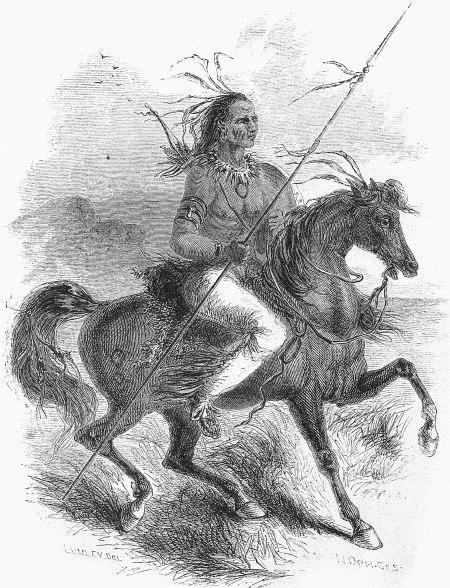 CAMANCHE WARRIOR.
The Camanches are excelled by no men in the world in their horsemanship, not excepting the famous Cossacks of Europe. The level prairies are beautiful fields for them to act on. It is in a skirmish similar to the one we have endeavored to describe, that they put these qualifications to the test. The arena where these scenes are enacted is a very undesirable place for a mere spectator. Kit Carson and party resumed their march the same day, and arrived safely at Santa Fé, without meeting with any other adventures. At this town he left his escort of fifty [pg 311] volunteers, and hired sixteen other men with which to perform the remainder of his journey. This was in obedience to the orders he had received at Fort Leavenworth. Pursuing his route on Muddy Creek, a tributary of Virgin River, he came upon a village of some three hundred Indians, so suddenly, as his route twisted about among the hills, that he had to make a bold matter of it, and go into camp, for the purpose of having a "talk." Kit Carson had learned some time before that these very red men had massacred seven Americans. For this reason he determined not to trust them, even if they professed friendship. The Indians wished to come into his camp, but this privilege he would by no means grant to them. He posted his men and selected a place so that he himself could talk, and at the same time let them see that if the least hostile demonstration was made by their side, it would be answered by a volley of bullets from the rifles of the white men. Kit Carson harangued them and informed them that he knew of the murders they had committed on his people during the past year. He told them that they bore a treacherous character and could not be treated as friends, and wound up his discourse by adding, that he would not allow himself to be deceived, for he knew that their only object in gaining admission into his camp was to repeat their bloody acts. He now gave them a limited period of time in which to be off, at the expiration of which, several lounged about, apparently doubting his words. He now gave the order to fire. In consequence, a few shots were aimed at them, which killed one and wounded three or four others. This had the tendency to hurry the movements of the remainder, [pg 312] who retired from the dangerous proximity to his camp. This was a case which required some nerve and great experience in the commander of the little party. Nothing but the personal courage and promptness of Kit Carson saved his command. The success of fifteen men against three hundred Indians in this manner, is chiefly due to their commander.
The party proceeded on their journey, but soon were troubled for food. Having used up all the game they could find, they were obliged to kill two mules, on which they lived until they arrived at Los Angelos. Kit Carson, finding that the officers to whom he was ordered to deliver his dispatches were at Monterey, journeyed thither, and having reached that town in safety, gave the documents to Col. Mason, then of the First Regiment of United States dragoons, who was in command. Obeying orders, Kit Carson, now an acting lieutenant in the United States army, returned to Los Angelos and was assigned to do duty in the company of United States dragoons commanded by Captain Smith. Kit was allowed little time to recruit, but his restless disposition did not ask, nor his habits require it; consequently, he remained at Los Angelos only a short period. With a command of twenty-five dragoons, he was ordered to proceed to Tajon Pass, the main outlet through which hostile Indians went out of California, bearing the proceeds of their incursions, such as cattle, horses, sheep and captives. Kit Carson's duty in this place was to intercept the Indians and examine their papers and cargoes. He spent the winter in doing much good in this service. In the spring, he was again ordered to proceed overland to [pg 313] Washington, with dispatches. An escort being furnished him, he was soon under way, and had reached Grand River without encountering any serious difficulty. At this place an accident happened to his party while crossing the river on rafts.
During the early part of summer, the fording of streams which have their source in the Rocky Mountains is no safe or easy task. When the sun and the warm south winds begin to melt the immense piles of snow and ice in the mountains, the water comes tumbling down in torrents; and, having overflowed the rivers' banks, floods the adjacent country. By this means, new gullies and ravines are continually forming, which, when the melting process ceases, are converted into dry beds. With this rush of angry water, large rocks and masses of earth are swept from their natural seat, leaving a wreck behind that is fearfully grand to behold. The roaring of these torrents as they come leaping past and over every obstacle, resembles a low, rumbling thunder, which is reechoed through the deep forests and cañons. Sometimes travelers are compelled to wait weeks before these rivers fall sufficiently to allow a safe transit. Heavy rains have the same effect to enlarge them; and, in one instance, a body of soldiers, while crossing the plains, were overtaken by these rains, which fell with such rapidity and in such quantity as to make the level prairies almost one sheet of water, while every ravine was converted into a river, swift and deep. To cross these, the men were obliged to use their best exertions with very poor means to guard against loss; and, even with the best care, one man was drowned, while several [pg 314] mules shared the same fate. In the prospective construction of bridges for highroads and railroad tracks across the continent, in certain seasons of the year, this sudden accumulation and explosion of water may cause trouble by sweeping them suddenly away.
This accident crippled the resources of Kit Carson's party very much and caused them afterwards great suffering. The accident occurred something after the following manner. One division of the men, with their leader as a companion, had constructed a float of logs, on which they had crossed the stream in safety; but the second branch of the party, under charge of Lieutenant Brewerton, then of the United States army, and who was traveling in company with Kit Carson, were not so successful with their raft; for, no sooner did they get it into the swift current than it became unmanageable, and finally precipitated its contents, among which were included several of the men and their luggage, into the water. The wrecked men with great difficulty saved their lives by swimming to the shore from which they had started. The day was far spent and no attempt to succor them could be made that evening; so, in their semi-state of nudity, and without the means of making a fire, they passed a miserably cold night; but, early the next morning, one of their friends recrossed and carried them an axe, by the aid of which a new raft was made, on which they embarked a second time and were soon safe with their companions. Among the very useful articles that were lost by this mishap there were several saddles and six valuable rifles. What made this loss peculiarly unpleasant was, that they could not be replaced [pg 315] until the party could reach the settlements. The owners of the saddles were now in a sad plight; for, neither to the rider or his horse is it a very pleasant prospect to make a long journey without these useful articles. After repairing their damages as best they could, they struck out afresh. Setting aside hunger and the suffering experienced from exposure to cold, they were not again incommoded in any way until they had come to the vicinity of the Mexican towns. Here they met several hundred Utah and Apache Indians. These red skins showed some warlike symptoms which Kit Carson did not in the least fancy; but, to make the best of his situation, he ordered his men to post themselves in a neighboring thicket and be ready to act on the defensive. Kit Carson then informed the Indians that they must keep at a proper distance, or otherwise he would direct his men to fire into them. He told them that if they were disposed to be friendly, which they professed to be, towards the white men, they could show it by leaving and not annoying his party, who, being nearly naked and in a destitute condition, could give them nothing. Evidently the savages saw this was true, and so did not hazard a fight, but departed. Kit Carson traveled that night ten miles further. It was late in the day when he again ventured on the trail, but this distance was all that his animals could accomplish without food and rest, for they were fatigued and poor. His object in thus resuming his march, was to separate himself and men as far as he could from the Indians, fearing that they might change their minds and conclude to attack him. Being too weak, his party was in no condition [pg 316] for an engagement. At the end of this distance he fortunately met with a party of volunteers, who had been out in search of these very savages, in order that they might punish them for some rascality they had been recently guilty of. The next day Kit Carson reached Taos, where he allowed himself a short respite for the purpose of recruiting, and also to have the pleasure of a visit to his family and friends. These were privileges which, during his life in the mountains, had been seldom granted to him, though his feelings of attachment for relatives and intimate acquaintances are not exceeded by those of any living man. Indeed, his love for his children is unbounded. We have several times heard him assert, that if there was any one thing that could make him a coward, it would be the thoughts of his little ones. When his party was sufficiently recruited, Kit Carson left Taos and proceeded to Santa Fé. At this time Colonel Newby, of the Illinois Volunteers, was in command of the United States forces stationed there. This gentleman informed Kit Carson that his appointment as lieutenant, made by President Polk, was not confirmed by the United States Senate. Many of Kit's friends, on hearing this, came to him and advised him not to carry the dispatches any further; but, instead, they counseled him to deliver them to the commanding officer of the post he was at, advising him that he was doing duty as an officer in the army and yet was not recognized by government. The language used by Kit Carson on this occasion, in reply to his friends, is so much to his credit and is so like the man, that every American citizen ought to know it. It was as follows: [pg 317] "I was intrusted with these dispatches, having been chosen in California, from whence I come, as the most competent person to take them through safely. I would try to fulfill this duty even if I knew it would cost me my life. It matters not to me, while I am performing this service for my country, whether I hold the rank of a lieutenant in the United States army, or am known merely as an experienced mountaineer. I have gained some little honor and credit for the manner in which I have always conducted myself when detailed on any special and important business, and I would on no account now wish to forfeit the good opinion formed of me by a majority of my countrymen because the United States Senate did not deem it proper to confer on me an appointment which I never solicited, and one which, had I been confirmed, I would have resigned at the termination of the war."
The reasons why the wishes of the President were not carried out by Congress in this instance, we know not; but, certain it is, that the lucky aspirant who eventually received this office at the hands of the same United States, had no credentials to present that could, as far as merit was concerned, compare with those held by Christopher Carson. It is fair to infer, that Kit Carson had but few friends at court, though it cannot for one moment be supposed that his name was not well known at Washington, when for five long years he had been the right-hand man of John C. Fremont in his explorations. The privates and the hardships which that commander and his guide willingly submitted to during those years, it is impossible to describe through reports. The whole [pg 318] newspaper press of the United States, together with several volumes of well-written books, have attempted it, but all have failed in giving a true picture of the reality. These things availed nothing when brought in contact with political moves; and Kit Carson was doomed to go by the board. He had, however, met, during his eventful life, with too many disappointments to be much chagrined at this, and we find him, soon afterwards, making inquiries in relation to the state of feeling among the Indians who inhabited the country through which he had to pass.
The appointment of civilians to the responsible duties of a command in the United States army has, of late years, become, in many instances, very unfortunate. Perhaps it is this that has taught our legislators a lesson. But there is a truth which lies above this difficulty. The severe ordeal necessary to be gone through with at West Point, in order to make military men of the proper standard, has very naturally raised a jealousy between these two classes of men. This is very healthy for the country, as it stimulates each to noble exertions. In order to make the army less secluded, it is necessary to appoint a certain per-centage of men from the walks of private life, and therefore the most meritorious should be selected. West Point men, as a body, are a great credit to our country; and, as a scientific corps, they cannot be surpassed; but, the fact is incontrovertible, that many, if not most of the leading officers of the United States army, are self-educated, and have risen to their exalted positions by untiring industry and distinguished services. For frontier work, men, to be capable [pg 319] of taking command, are required to have great experience in Indian strategy, and to become accustomed to endure privations and vicissitudes. These cannot be taught by schools or books. For these positions those are best fitted who have been trained to the mountains from earliest boyhood, and where is the man in North America who has battled in this service longer or more successfully than Christopher Carson? But Kit Carson could see no reason why the votes of the United States Senators, refusing to confirm the President's effort to reward him for his services to his country, should cause him for one moment to swerve from his duty. He pocketed at once his disappointment, and went to work. Colonel Newby informed him that the Camanches had of late been very hostile, and that they were then roaming in war parties, numbering from two to three hundred, scattered along the old Santa Fé road, on which their depredations had, so far, been mostly committed. On learning this, Kit Carson determined to make a trail of his own, and endeavor thus to avoid them. He reduced the number of his escort to ten trusty followers. With them, he returned to Taos, and after a halt there of two days, once more was on the march. At first, he traveled to the northward, until he reached a tract of country which these Indians seldom visited; then, changing his route by compass, he struck the Bijoux River, which is a tributary of the Platte River, and followed it down stream. At about twenty-five miles from the mouth of the Bijoux, he quit that stream, and struck out diagonally across the prairies, and soon reached the Platte itself, down which he journeyed to Fort Kearney. Here [pg 320] he again changed his course for the Republican Fork. On leaving this last-named stream, he traveled direct to Fort Leavenworth, finally reaching that post with his men and animals in fine condition, for the journey had been as pleasant as could have been expected. Here he left his escort, and set out alone for Washington. After reaching the land of railroads and steamboats, he was but a few days in bringing the latter part of his journey to an end. Handing his dispatches to the proper authorities, Kit Carson turned right about and made his way to New Mexico, where he arrived in the month of October, 1848.
It will be seen by following on a map the route which Kit Carson planned on this occasion, that it was very circuitous, and led him a great distance out of his way. Indeed he was, at times, far beyond the roaming grounds of the Camanches, but this was necessary. He was not, however, free from danger; but was obliged to be on the lookout for their allies, the Kiowas, who are usually at war whenever the Camanche nation is. His trail led him through a country which is celebrated as abounding in game, and also in being well watered, and last, but not least, the desideratum of finding grass of a good quality, whenever he desired it, was proved a valuable assistant on the march. It may be well to mention here, that one of the most curious of the phenomena of the plains, to the inexperienced traveler, are those mirages which, on every clear day, are sure to meet and delude his eyes. So wonderful are these deceptions, that often the vision leads one to believe he is beholding, in the distance, a beautiful city which is located on the [pg 321] banks of some attractive lake. The outlines of the palaces, spires of cathedrals, and even the lesser buildings themselves, all surrounded with trees, bearing luxuriant and green foliage, together, form an imaginary picture which throws into the background any of the realities which are the work of man. The shading is oftentimes very captivating, and on it the traveler can be entertained for hours, until a change in the rays of light or intervening clouds, or else by approaching the delusion itself, the magic scene fades away. A mirage and a prairie on fire, seen by night, the one a delusion, the other a fearful reality, are two of the grandest sights to be seen in the far West; we might add, on the American continent.
[pg 322]Kit Carson at his Home—The Apache Indians become hostile—An Expedition sent against them—It is not successful—Another is organized, with which, Kit Carson goes as Guide—Two Indian Chiefs captured—Other Incidents of the Trip—Colonel Beall attempts to force the Indians to give up Mexican Captives—Two thousand Savages on the Arkansas River—The Visit to them—Kit Carson emigrates and builds a Ranche at Rayado—Description of the Valley—The Massacre of a Santa Fé Merchant—His Wife is made Prisoner—The Expedition sent to rescue her—The Indians overtaken—Bad Counsel and Management—The commanding Officer wounded—Mrs. White's Body found—Severe Snow Storm on the Plains—One Man frozen to Death—Kit Carson returns to Rayado—The occupation of a Farmer resumed—The Apaches steal from the Settlers nearly all their Animals—Kit Carson with thirteen others in the Pursuit—The Surprise—A running Fight—The Animals recovered—A gallant Sergeant and his Fate—Kit Carson and Goodel go on a Trading Expedition to meet California Emigrants at Fort Laramie—Humorous Adventures—The Dangers that beset the Road to New Mexico—Hair-breadth Escape—Arrival at Taos.
Being comfortably housed in his own pleasant home at Taos, Kit Carson made up his mind to treat himself to a more lengthy stay there than he had for some time enjoyed. While he was quietly enjoying the pleasures of home, active operations were transpiring about him, for the neighboring Indians had dug up the tomahawk and buried the calumet, and were holding in defiance the United States forces, which had been stationed in New Mexico to protect its inhabitants. Colonel Beall was at that time commanding officer of the district, and had established his head-quarters at Taos. The colonel, soon after assuming the command, being a resolute man, [pg 323] saw that there was but one way to deal with these Indians, and that was to bring them to a strict account, and make them amenable for their many crimes. This tribe of Apaches has given the government of the United States almost as much trouble as have the Seminoles in Florida, and I hesitate not in saying, that before they are exterminated, which is the only sure plan of making a peace with them, they will have surpassed their red brethren of the swamps of the South in the number and enormity of their crimes. Before New Mexico came under the jurisdiction of the United States, the Apaches, for many years, had committed all kinds of heinous offences against the Mexicans; and, for a period of ten years after that event, these same savages were continually on the war path, notwithstanding military expeditions, one after another, were organized and sent out against them. Their mountain retreats are almost inaccessible to white men, while the Indians, apparently, play about in them like rabbits. The amount of physical endurance and the length of the journeys these red men can make, appear very astonishing to one not accustomed to them. The Apaches, as an Indian race, are not wanting in bravery, the best evidence of which statement is, that nearly all their warriors die in battle. Their country is the healthiest in America. Besides waging war against the whites and Mexicans, they have their differences to settle with their neighboring tribes, with whom they are punctilious in vindicating their national honor. Colonel Beall commenced his operations against these Indians by dispatching a junior officer, backed by a strong force, with orders to pursue, [pg 324] overtake, and chastise them. This expedition started; but, on coming to the mountains, the guides reported that there was too much snow on them for the command to pass through in safety; so the undertaking was given up, and the men were marched back to Taos.
The most famous war chief of the Apaches, during these troubles, was called by the Mexicans Chico Velasques, and his name, for many years, was a terror to the surrounding country. His savage brutality knew no bounds, and he was truly in his element, only when he was tearing the bloody scalp from his half-lifeless victim. He was the sworn enemy of the Americans and Mexicans, and his hunting-knife was rarely clean of human blood, until his cruel life, by the wise decrees of an all-seeing Providence, was suddenly cut short. He fought against his disease (small pox) with that rashness that had been his ruling spirit through life, and thus ingloriously terminated his days. The pride of this man was to strut through the Mexican towns and gloat over his many crimes. To the gazing crowd, he would point out the trophies of his murders, which he never failed to have about him. To his fringed leggins were attached the phalanges (or finger bones) of those victims whom he had killed with his own hands. On the one side, he proclaimed to his auditors, were the fingers of the Mexicans, while on the other, were the same tokens from the Americans; and it gave him great delight, ironically, to dwell upon the latter name. With whip in hand, he struck out right and left when anything displeased him. He met one day more than his match in the person of the famous Mexican hunter, Armador [pg 325] Sanchez, of whom we have previously spoken. The circumstances of this rencounter were as follows: The bold Indian, with but few followers, was on a visit of pleasure to the Mexican town of Culebro. He had agreed to a temporary peace, to suit his convenience and ends; and, taking advantage of it, he made his appearance in the settlements, to lord it over the peaceable inhabitants. After indulging in a little fire-water, his wicked propensities could be controlled no longer, and broke forth in minor cruelties. At last he found himself in the house belonging to Sanchez, who was quietly conversing with his aged father, for whom he had great veneration, and also with his son. The Indian peremptorily demanded that some whisky should be given him. He was informed by Sanchez that he did not keep the article. A second demand was now made, with the threat that if it was not forthcoming immediately, he would whip the person who refused him. This had the effect of bringing Sanchez to his feet, when the following colloquy, in Spanish, between him and the Indian transpired: "Chico Velasques, you have long been accustomed to treat our people almost as you please. You have robbed and murdered us at your will, notwithstanding we have given you no cause thus to act. Had you asked for bread, I would have given it to you, for the door of my house is always open to the friendly red man; but, as for whisky, you can have none from my hands. Raise that whip but once to strike me, and I will dash your brains out with this mass of lead." Suiting his actions to his words, Sanchez drew forth from the pocket of his hunting-shirt a slung shot that weighed nearly four [pg 326] ounces, which he always carried to dispatch his game with when it was in the last agonies of death. With uplifted hand, the Indian hesitated; for, he knew the character of the man who stood before him, as they had hunted together during many moons gone by, on the same mountains and on the same trail. At last, using his own savage dialect, in order that his words could not be understood by others about him, the savage answered the Mexican hunter by saying, "that by chance they might some day meet again;" a threat which fell harmless at the feet of Sanchez. As he took his departure, the chief added, in Spanish, "I will tell these things to my father,20 Kit Carson," as if further attempting to intimidate the hunter; but Sanchez knew that his own and Carson's opinions were the same in regard to this man; therefore, he smiled at the rascal's knavery. Chico Velasques was followed in his chieftainship by Blanco, who did his utmost to walk in the footsteps of his illustrious predecessor; but, he was not so cunning, and was less successful in his encounters with the Americans and Mexicans, and therefore had not that influence with his tribe which the former possessed. Still, he performed his quantum of mischief, and yet lives to play his part in the great drama of Indian life. An Apache Indian is rather small in stature, but everything about him denotes symmetry and strength. His limbs are almost straight, and their muscles are as hard as iron. The elasticity of his movements, when in the least excited, shows a high degree of physical training. His coal-black eye exhibits an amount of treachery rarely seen elsewhere, proving [pg 327] the truth of the Chinese adage, that "the tongue may deceive, but the eye can never play the rogue."
But to return to the narrative. The commanding officer of the party sent out against these Indians, on arriving again at Taos, reported to Col. Beall that the reason he had returned was because, at the present time, it was impracticable to cross the mountains. That brave and experienced officer replied, "that there was no such word as impracticable in the soldier's vocabulary, and that nothing ought to be impossible for the 1st regiment of United States dragoons to accomplish." Suiting his actions to his words, Col. Beall reorganized the command, took charge of it himself, and employed Kit Carson as his guide. When everything was in proper trim, this expedition set out, and after surmounting many obstacles and privations, finally accomplished the feat of crossing the snow-clad mountains, and after a long and fruitless search for the Indians, the men were obliged to turn about, because their stock of provisions was running low. As the command emerged through the "Sangre de Christo Pass," on their return route, they came suddenly into view of a village of Apaches. As soon as the Indians were discovered the charge was sounded, but the animals of the dragoons were too much jaded to obey the summons with the celerity wished for by their riders; the result was that, besides a considerable amount of plunder, only two persons were taken, but they, fortunately, proved to be no less than two important chiefs. In order to impress these Indians with the fairness and liberality which his government wished to show to the red men, after a long talk, in which the colonel exacted [pg 328] promises of good behavior, he let the prisoners go. They departed, to forget as quickly as possible all their vows and promises; for, seemingly, they will act in no other way than as their own savage instinct teaches. After this affair, Col. Beall made a direct march for Taos, where he remained for some time, attending to the ordinary duties of his garrison.
In the treaty between the United States and New Mexico, entered into at the close of the Mexican War, a clause was inserted binding the former to turn over to the latter all the Mexican captives then held by the Indians who inhabited territory belonging to the first named government. The carrying out of this provision of the treaty involved the United States government in a large and constant bill of expense. This was, undoubtedly, unavoidable, for even had the clause not been inserted in the treaty, the maintenance of about the same frontier military forces would have been necessary. It would have proved a difficult matter to carry out this treaty to the letter.
If it had been so carried out to the letter, the Camanches would have been great sufferers, for at least one third of the blood that now runs in their veins is Mexican. During the last half century, and perhaps longer, they have been accustomed to make annual visits into the Mexican settlements of Old Mexico. The object of these hostile incursions has ever been to load themselves with plunder. They steal all the horses that fall in their way, and also take for captives as many young children as they can lay hands on. The latter are brought up in true Indian style, and, having cast off all remembrance [pg 329] of their former habits and friends, they gradually become the wild men of the plains. The female captives, on arriving at the suitable age, are married to the young warriors of the tribe, and thus the true Indian stock, becoming amalgamated with the Mexico-Spanish blood, is fast becoming degenerated. The reason, therefore, why the fulfillment of this treaty would have militated strongly against the Camanche Indians especially, is clearly apparent.
In the following February, Col. Beall learned that on the Arkansas River there were congregated a large body of Indians, who had quite a number of Mexicans in bondage. He felt it to be his duty to visit these savages and endeavor to have them deliver up all such captives, using peaceable means to accomplish this result in the first instance; and, should they fail, he made up his mind to resort to more forcible and potent arguments. With this determination, and with two companies of dragoons to back him and Kit Carson as his guide, he set out on his mission. In due time he reached the Arkansas, and there found congregated four tribes of Indians who numbered in the vicinity of two thousand souls. Their object in thus coming together was to have a grand council and lay out plans for the future, and also to meet their agent. This agent, who was an experienced mountaineer, informed the colonel that, considering the present state of ill feeling existing among these Indians towards the whites, it would be useless to make the demand for the prisoners; and as to using force, it would almost certainly prove a failure, when such a large number of well armed warriors were arrayed against him. [pg 330] It required a great deal of persuasion to bring the colonel around to this mode of thinking; but, at last he yielded to the advice of his friends and concluded to make no demonstration against the Indians at the present time, concluding, as his anger cooled, that it was the wisest policy to await a more favorable opportunity, when a treaty could be made with them, in which there could be an article inserted that would stipulate for the restoration of the captives.
In parting with these red men without accomplishing the main object for which they came, both officers and men felt that their labors had not been entirely thrown away. Their presence must have left lasting impressions on the minds of the savages, in showing them that they no longer had poorly clad and poorly armed Mexican soldiers to deal with.
On arriving again in Taos, Kit Carson returned to his home to ruminate over what was best for him to take up as a business for the future. He revolved in his thoughts his past career, and, in the end, finished the mental study by resolving to give up his roaming life, as he rightly considered that now was the time, if ever, that he should be making a substantial home for himself and family, before old age crept upon and disabled him from the undertaking. About the time that he was in this frame of mind, his old mountaineer friend, Maxwell, was about going to a pretty little valley called by the Mexicans Rayado. Maxwell proposed to Kit Carson to join him in the enterprise of building a ranche on the site which he had selected. This offer the latter gladly accepted. Rayado would have, long before, been settled [pg 331] by the Mexicans, had they not been deterred by its exposure, and consequent inviting position for Indian depredations. The valley is about fifty miles east from Taos; and, for its scenery, cannot be surpassed by anything of the kind in America. Standing at the head of it on a blunt bluff, you look down and out on the prairies, and nothing can be more enchanting than the view that is thus presented. On each side there are lofty hills, which, when green with grass and foliage, add a magic beauty to the scene. Through the valley, as if it had been intended for its dividing line, runs a broad mountain stream, the banks of which are now metamorphosed into beautiful fields.
We stop here to undeceive the reading public concerning an idea which has gained currency by the extraordinary imaginative writings of novelists. These trashy fictions represent the western plains, or prairies, as flower-beds. In this a great mistake has become prevalent. A traveler often pursues his way over them for many days without seeing anything to interrupt the continuity of green grass except it be the beautiful road over which he is journeying. Near the slopes of the mountains and on the river banks the remark will apply. There, fields of wild flowers are often found growing in great luxuriance.
The settlement was soon after commenced by Kit Carson and Maxwell, and, as now completed, is really a beautiful spot. It is located about midway down the valley. Among its several houses, there are two which are more conspicuous than the rest. In the finest of these two, the owner of which has taken great pains and [pg 332] spent much valuable time with its construction, lives Maxwell, whose honest pride is the being master of a model farm. In the residence next most to be admired in Rayado, Kit Carson sometimes sojourns.
The mansion which belongs to Maxwell would be an ornament to any country. At one time, it was used as a garrison for American troops, and on it, the soldiers made many improvements. It is built one story high, in the shape of a hollow square, and has the size of an ordinary block in a city. Around the whole runs a fine veranda. With its lofty ceilings, large and airy rooms, and its fine yard in the centre of the square, which is well stored with its fowls, pigeons, and other pet animals, with appropriate kennels; with antlers of noble buck and elk; hams of venison, buffalo meat, wild turkeys, etc., and near by a fine vegetable garden; altogether, it presents a picture of sumptuous living rarely seen within the pale of civilization. Maxwell counts his steeds and cattle by hundreds, while his flocks of sheep are enumerated by thousands. Near by stands Kit Carson's ranche, which, though more modest, yet, when the hunter occupies it, in dead game and comfort, it fully rivals its compeer. Around these two hunters live a handful of Mexican friends, who are either engaged in agricultural pursuits for themselves, or else in the employ of the "lords of the manor," Carson and Maxwell.
In this his residence at Rayado, Kit Carson is only kept from spending his whole time by business for which his tastes are more suited. Soon after the commencement of the settlement, and while he was engaged in his vocation as farmer, news reached him that the Apaches [pg 333] had been committing a most wicked murder, the details of which are horrible in the extreme. A merchant by the name of White, who was engaged in business at Santa Fé, had been into the United States for the purpose of purchasing goods. With his train of wagons and his small escort of men, traveled his private carriage, in which there were, as passengers, his accomplished but unfortunate lady and her only child. On arriving at a point where he anticipated no further danger, Mr. White started on ahead of his caravan, in order that he might reach Santa Fé as soon as possible, and thus relieve his family from the privations of camp life. He had proceeded but a few miles when he was attacked by some Indians who had concealed themselves in the rocks on either side of the road. The savages, as the carriage neared their hiding-place, fired with such accuracy of aim that they killed, by their first volley, all of the men who were with the carriage before they were aware of the danger which surrounded them. Mrs. White and her child were reserved for a worse fate. They were carried off into captivity. The child proved to be a source of annoyance to the blood-thirsty savages, and its angel spirit was released from earth by their cruel ferocity. Before the eyes of its captive mother the fatal tomahawk was raised, and by one dastard blow its keen edge was made to mingle with its brains. The horrid work failed not to bring the bitter woes and anguish of despair to the breast of the unhappy mother. It was then thrown into Red River, which was the stream nearest to the scene of the bloody tragedy.
Red River and its great cañon has always been to the [pg 334] Apache Indians a favorite haunt of refuge, either when pursued, or after the committal of some terrible crime. There are several streams in the West called by this name. The one here referred to is the Red River of the plains, and is one of the upper tributaries of the Arkansas River. In olden times it went by the name of the Canadian River. Several sharp conflicts have occurred on this stream between the Apache Indians and parties of United States troops. It has also formed the stage of many an Indian tragedy in conflicts between the mountain Indians and the Indians of the plains. Quite recently, attempts have been made by whites to use its banks for grazing purposes, but every enterprise which has been set on foot to establish ranches in its vicinity, have been warmly contested by the Camanches, who have killed several persons who have dared to essay such attempts.
The intelligence of this terrible butchery having been carried to New Mexico, a command was organized in hot haste, which had for its object the immediate rescue of Mrs. White from her bondage, worse than death. Two men went with this party as guides, named Leroux and Fisher. Watkins Leroux is an old and famous trapper and mountaineer, whose reputation and skill as a guide in the far West, is second only to Kit Carson's. A few of his warm partisans, who are ever very warm in their praise of their friend, at one time considered him superior even to Kit Carson; but, when the skill of the two men came to be tried in the same cause, the palm was yielded to Kit Carson. Leroux has guided several parties over new routes with meritorious success. His [pg 335] knowledge of Indian character is nearly equal to that possessed by Kit Carson, and he is endowed with a wonderful amount of forethought and prudence; but, in an Indian fight, or on any great emergency, his faculties appear to be less active, and his judgment less certain, than those exhibited by the great Nestor of the Rocky Mountains. It is a well well-understood maxim, that there are more or less narrow-minded persons who are ready and eager to pull down any and every rising man; and, for this purpose, such must choose a champion. Kit Carson's association with Colonel Fremont had won him so great renown, as a mountaineer and guide, that an opposition party was formed to detract from his merits and capabilities. Leroux, owing to his popularity, was chosen for the leader of this party, and whenever the name of Kit Carson was mentioned, the friends of Leroux always saw fit to compare the deeds of the two men together. This strife, of course, could not be lasting, and now it is almost forgotten. It is a just tribute of praise due to both of these brave men, to say that they do not sanction, by word or deed, either party to the controversy. They could but appreciate each other, and, as friends, ever felt elated, the one at the success of the other, and vice versâ. They mutually considered that every fresh laurel of glory added a measure-full of honor and renown to their common brotherhood of mountaineers, among whom the good reputation of their cloth was as dear as it was among the knights attached to the orders of chivalry. Their ranches are located in the same valley, and in the same town; where, having lived together as fast friends in life, in all probability they will [pg 336] find their last resting-places in the same graveyard. Few men can say aught against the character of Watkins Leroux, but in this estimate of his actions, we are only reviving what has already been given to the public.
With Leroux and Fisher employed as guides, the expedition for the rescue of Mrs. White set out on its route, and, on its journey, passed by Rayado. Kit Carson immediately proffered his services for the expedition. They were accepted, but, much to the surprise of many of the party, instead of being at once placed in the position which his great experience demanded, he was assigned to an inferior position under the command of Leroux. Kit Carson, however, was too good a soldier to exhibit the conduct which the little buzzing talkers so anxiously looked for from their supposed kindling of his jealousy, and quietly took the post assigned him, eager to lend a helping hand, which might even thus be instrumental in saving a valuable life. It is proper, however, that we should add, that this slight upon his reputation and experience wounded his feelings. But, especially, as the life in jeopardy belonged to a woman, he would not, and did not, think of allowing his actions to partake of his feelings. We have reason to believe that this slight, at least on the part of the commanding officer of the expedition, was not intentional. That gentleman was an honorable man, and would not have committed an act which he considered would have resulted otherwise than for the best; and, in appointing Leroux his chief counsellor, he had selected a good man, but, one whom he afterwards learned, to his sorrow, was every way the subordinate of Kit Carson in managing Indian affairs.
[pg 337]A few years subsequent to the transpiring of this murder and the skirmish which succeeded it, we traveled near to the spot under the same officer who had the command of the above expedition. He reverted to the affair with much feeling, and from his actions and remarks, we could plainly see that his sympathies had been, perhaps, too greatly enlisted in behalf of his unfortunate countrywoman, and that his better judgment had been overcome by giving way to the urgent advice of others. If it had been a battle where either scientific attainments or manly courage could have succeeded, he would, doubtless, have been himself, and carried everything through with success. This is no mere assertion, for his long and well tried military career warrants us in this belief. We have the greatest respect for this gentleman, and consider him a very able man; but, as a biographer, we are called upon to narrate the facts as they come to us. If he had succeeded, everything would have been considered as well done; but he failed, and the cause of his failure is plain.
The party being thus constituted, and no delay having been occasioned by any unforeseen accident, the party arrived in good season at the place where the cold-blooded murder had been consummated. Around the spot, there was strewn, in great confusion, boxes, trunks, pieces of harness, and many other things, which had belonged to the unfortunate party, and which the villains did not fancy and carry away with them. The path taken by these Indians was soon found, and on it, the command traveled in full chase for twelve days, without seeing the outline of a savage. Carson describes this as [pg 338] being the most difficult trail to follow he remembers ever to have undertaken, for the rascally Apaches, on breaking up their camps, would divide into parties of two and three, and then scatter over the vast expanse of the prairies to meet again at some preconcerted place, where they knew water could be had. In several of these camps the pursuers found remnants of dress and other articles, that were known to have belonged to Mrs. White. By these signs, they were led to believe that she still lived. Although these things would be trifles on ordinary occasions, yet, at the present time, they were the cause of stimulating the white men to their utmost exertions; and, as they grew fresher, the excitement among the party increased. At last, the camp, and even the persons of the savages, became visible to the foremost of the pursuers; and, among the first to get a glimpse of them was Kit Carson. At the time the discovery was made, Kit Carson was considerably in advance of most of the men. Turning to those near him, he shouted to have the command come on as fast as possible, for he saw at once that there was no time to be lost in consultation as to the best mode of assaulting the Indians. They, already, were in commotion, and were making hurried preparations to decamp. Riding on at full speed for some distance, Kit Carson again turned his head and saw, to his dismay, that he was not followed; but instead, the command had halted. The cause of this curious order being given, at such a precarious moment, was, as he afterwards learned, brought about by the advice of the chief guide, who told the commanding officer that the Indians wished to [pg 339] have a parley. On seeing what was transpiring behind him, Kit Carson had no alternative but to rein up his horse also; for, to ride on alone into the midst of the savages, would have been unjustifiable rashness, and might, perhaps, have destroyed the plans his superior officers were concocting. So, he stood paralyzed and confounded at the inactivity of his companions. Just about this time, a bullet, fired from the Indian camp, struck the commanding officer in the breast, and bent him forward. Those around him, for a little while, supposed that he had received a mortal wound. Still, he retained his seat in the saddle, but could not speak. Thus again was precious time lost, as the party, during this time, were virtually without a leader, and did not seem to be inclined to make one. Fortunately for this officer, just before he received the shot, he had taken off his thick buckskin gauntlets and crowded them into a breast pocket. The ball had struck this bundle; and, as its force was somewhat expended by the distance it had come, it was unable to more than penetrate the mass and contuse the soft parts of the chest.
This accident assisted in preventing this well known military man from inflicting such a blow on these savages, that they would have been long in recovering from it. He had undoubtedly seen, soon after he had halted, that Kit Carson was right in recommending a charge; for, as quick as he recovered sufficiently from his injury to be able to speak, he commanded the men to make the attack, and leave him to himself. Unfortunately, the time had passed to accomplish the desired effect when this order was given, for, on arriving among the lodges, [pg 340] the men found only one warrior. He, as a matter of course, was slain. The body of Mrs. White was also found in the camp. Life was extinct, though her soul had but just flown to heaven. There was still warmth in the corpse when the men first discovered it. An arrow had pierced her breast. Evidently she had been conscious that friends were near, and was trying to make her escape when the missile of death produced the fatal wound.
Much has been written and said about this sad affair, and much unjust calumny has been heaped upon the head of the leader of the expedition; therefore, the opinion of Kit Carson in reference to the matter may not be out of place; hence, we give it word for word. "I am certain" says Kit Carson, "that if the Indians had been charged immediately on our arrival, Mrs. White would have been saved. At first, the savages were much confused at our approach, and I do not hesitate to say that she saw us as quick as any one of the redskins did, for it undoubtedly was the all absorbing topic of her mind that her rescue would be attempted by her friends and countrymen. On seeing us coming, she had attempted to run towards us, when she was shot down. Had she been liberated, she could not have long survived the brutality, hardships and vicissitudes she had experienced. Words cannot describe the bitter cup that she had been obliged to drink during her captivity. It was the will of Providence that, having suffered like a martyr on earth, she should be taken to himself before we arrived to where her remains lay; upon coming upon which, we shed tears at thus being [pg 341] defeated in what had been our cherished hopes even had it cost some of us our own lives."
By this language it can be readily seen that Kit Carson regretted the failure of this attempt made to rescue Mrs. White as deeply as any one, either in the expedition, or among her friends at the home from which she had so recently, in health and happiness, been torn. "Yet I cannot," says Kit Carson, "blame the commanding officer, or the other guide, for the action they took in the affair. They evidently did as they thought best, but I have no doubt that they now can see, that if my advice had been taken, the life of Mrs. White might have been spared for at least a short period." This expedition was far from being a failure, for the Indians lost all their provisions, camp equipage and a few animals. Many of these savages ran away leaving behind them everything they possessed in the world, except the scanty amount of clothing they had on.
For six miles they were pursued over the level prairies when another brave was killed, several wounded and three children taken prisoners. The horses belonging to the Expedition broke down, one by one, until at last, the chase had to be given over, after which the Indians made short work in getting out of sight. Among the trinkets and baggage found in the captured camp, there was a novel which described Kit Carson as a great hero who was able to slay Indians by scores. This book was shown to Kit and was the first of the kind he had ever seen. After glancing at it he made the remark, "that perhaps Mrs. White, to whom it belonged, knowing he lived not very far off, had prayed to have him make [pg 342] his appearance and assist in freeing her. He wished that it might have been so, but consoled himself by thinking that he had performed his duty." While on their route back to Taos, the command was overtaken by a terrible snow storm which was accompanied by a high wind; as there were no hills to break its force, it amounted almost to a tornado. The snow was driven with such force into the men's faces that they became nearly blind, and were bewildered as to the course they should travel. During its continuance, they wandered about on the prairies. Finally they were so fortunate that at last they reached a clump of timber in the neighborhood of Las Vegas in New Mexico; but, during the tramp, one man had been frozen to death and others had come near to perishing.
After arriving in the settlements; the party learned from some friendly Indians, that the Apaches had suffered severely by being exposed to this same storm, and the report was that many of them had since died in consequence thereof. From this, it would appear as if an all seeing power had protected the whites, while it had dealt out a fearful judgment upon these wicked savages, who have more than vague ideas of the sin of murdering, in cold blood, innocent people, sages and philanthropists far distant and safe in great cities to the contrary notwithstanding. There are no set of men in the world who can draw the line between right and wrong based on its first principle, and taught to them by the great lessons of nature, as can many tribes of Indians. Among themselves, and especially among their individual bands, in regard to all crimes, the Indian has his moral code of [pg 343] laws which, in many respects, is not surpassed by those of his pale-faced brother. They have their civil chief who is responsible for the peace and good order of the camp; and, before him, are tried, by the lawyers of the tribe, all cases worthy of notice. If the parties are found guilty, the offender or offenders are summarily dealt with—therefore, "with his untutored mind," in his intercourse with white men, the Indian is not altogether excusable in committing crime.
There are many people who believe that the Indians, as a race, have been greatly sinned against, and to sustain their views, have called in the assistance of flowery-written romances and the high-sounding language of prose and poetry. Much of this novelty and interest rubs off by coming in contact with the savage as he really exists. Admiration often changes, in this case, into distrust and even enmity. It is natural that this should be so, for mere book-education biases the mind always, either for or against, and therefore, it is not strange that in the far West, we should often meet with men who unhesitatingly declare that the red man, if capable, is unwilling to entertain in his character even one redeeming trait; but, on investigating their individual case, we find that they are but superficial observers who are prone to find fault with everything that does not exactly suit their tastes. It is necessary to spend a whole life with Indians, in order to judge them without prejudice. The Great Spirit has endowed his red children with reason, the same in quality as possessed by any other race, but their habits, mode of life and experience is of such a kind, that, when taken, as a whole, they are truly original. Looking upon this [pg 344] class of people, either in the light of an enthusiast or as a detractor, cannot be otherwise than wrong; for, as is usually the case, the truth lies between the extremes.
To be caught in one of these winter storms on the plains is a very serious affair; and one only needs to have been through a fearful gale on the seas to render him dubious of which to choose. To the faint heart, death seems inevitable in either case; and, to such a one, a choice between a watery grave or a bed of snow, when hunger and cold are his attendants while life is gradually ebbing out, is a question in which the contrast appears small. During many of the winter months, a life on the prairies becomes a necessity to the frontiersman and not a pleasure. The force and power of the winds on the level earth of the far West, are beyond human imagination. The snow storms there, at the proper period of the year, are terrific in their grandeur. The quantity of the snow that falls is not so much a matter of notice as the force with which it comes, being almost blinding in its effects and requiring all the physical powers of both man and beast to meet and contend against it. It but seldom happens, during one of these seasons, that the roads are so blocked up by snow that human ingenuity cannot overcome the obstacle; for the wind drifts the snow, rendering the path clear at intervals which vary in their area. The poor mail parties are the ones who experience this undesirable life; and, in their attempts to make their journeys, they are often driven near to death's door, although every precaution is taken to make the transit safe. The mules of these parties are well protected with india rubber coverings which [pg 345] are lined with blankets, and, so snugly are they made to fit every available part of the animal, that it seems almost impossible for cold to touch them. Corn and fodder, to a limited extent, is transported; but, even with these precautions, the mules now and then succumb to cold. The man covers his body with warm clothing and carries with him furs and robes enough to be seemingly able to defy the storms. He can provide himself only with a scanty amount of fuel, for his means of conveyance are very contracted. When overtaken by the storms, which may last several days, he is rendered almost powerless, and is at the tender mercies of the gale; for he cannot make fires,—and without them he may perish. This is not true of every trip made across the plains during the winter, for, like on the ocean, the passage may be frequently gone through with the encountering of but little real suffering. One thing in favor of making the journey in this season of the year is, the probability of not seeing an Indian. They, usually, during the cold months, stow themselves away in their, comparatively speaking, warm mountain retreats. In crossing the plains, small parties find the item of meeting Indians to be of considerable importance, as, even in the time of peace, they are very exacting and troublesome, demanding that provisions should be given them, by way of toll. To refuse is apt to bring down their ire, when they will usually help themselves to whatever suits their fancy. They are very partial to sugar, which, when they cannot say the word in English, they call "Shoog." If not understood, they make their wants known by the Indian sign of touching with the index finger the tip of [pg 346] the tongue, thereby indicating the sweetness of the article. Many of them come armed with a piece of paper, which testimonial of good behavior they have obtained from their agent or forced from some traveler. As they cannot read, it makes but little difference what is the sense of the writing so long as it is bonâ fide penmanship. I once saw one of these documents which the owner prized very highly, but, had he known the purport of his paper, he would have sighed for the scalp of his kind friend who wrote it. The language was as follows: "Crossing of the Arkansas," etc. "The bearer, Young Antelope, is a good Indian and will not take anything out of his reach. This is to warn traders and travelers to beware of his race, breed, seed, and generation." It was signed evidently with a fictitious name, and answered the purpose for which it was intended, which was, to get rid of an ugly customer and to put strangers on their guard against the man who carried it.
On arriving at Taos, Kit Carson left this party and proceeded to Rayado, where he was, soon after, actively engaged in farming pursuits.
During the subsequent winter, a detachment of ten dragoons under the command of sergeant Holbrook was stationed at Rayado to protect the little settlement. In order that their animals might have the benefit of the good grass which was to be found in the mountains at a place where but little snow fell, the settlers established there a herder's ranche, posting two men there to look after and guard the property. The cold months were passed in peace and quiet, but, in the spring the marauding [pg 347] Apaches came, and, after wounding both of the herders, stole all the gentle animals, including both horses and mules. One of the wounded men made his way to Rayado, notwithstanding his injuries, and gave information of what had happened to himself and companion. On learning these facts, Kit Carson, the dragoons and three of the settlers, immediately proceeded to the ranche. They arrived there just as the shades of night began to fall. Nothing could be attempted until the dawn of another day, consequently, a camp was ordered and duly arranged. As the first faint beam of light gilded anew the mountain tops, the party were up and moving. They soon found the trail made by the thieves and commenced a sharp pursuit. The pace at which they traveled became so rapid, that, at the distance of only twenty-five miles from the spot where they first struck the trail, the Indians were discovered moving on the prairie a long way in advance. There remained nothing but an open chase.
Orders were issued to accelerate even the hitherto rapid march. Each man resumed his exertions to put his horse to his best speed. The chase was growing intensely exciting when four of the animals belonging to the pursuers gave out, completely ridden down. Their riders were the most unhappy of any of the party at this circumstance, for it precluded even the chances of engaging in the expected affray. Leaving the four men behind, the remainder of the party pushed on in the pursuit, and every bound made by their horses brought them nearer to their foes. After several hours of this hard riding, they came near enough to the warriors to [pg 348] count their numbers. Their force consisted of twenty well armed and equipped Indians. They showed no fear of the party pursuing them, but clung to their stolen property with such pertinacity that they allowed themselves to be overtaken. A running fight was immediately commenced which became most exciting, as well as dangerous, to the participants; but, all the more exciting because thus dangerous. The Indians were all skillful horsemen and fought with great dexterity. Their animals being comparatively fresh, in this respect they had the advantage. Notwithstanding this fact, the pursuing party administered to them a severe lesson. Five of the rascally Indians were killed and several wounded, while all of the stolen animals, with the exception of four, were overtaken and recaptured. The whole of this pursuit and the running fight which terminated so successfully was accomplished under the advice of Kit Carson. Each man in the pursuing party felt that the simple fact that Kit Carson's eagle eye and experienced hand watched and guided their movements was a guaranty of certain and ample success. Hence, the labor of the long chase and the demands upon their personal skill, activity and courage made by the necessities of the fight, were all met with that kind of readiness and determination which seldom fails to make the soldier invincible. Every man in that party knew well that an Indian chase with Kit Carson for a leader, meant fight and win success or die.
In referring to this adventure Kit Carson, when speaking of the gallant men who accompanied him, said, "They all proved themselves to be men of the very best material."
[pg 349]Unfortunately, two of this gallant party have since fallen by the hands of these same Apache warriors. One of these was Sergeant Holbrook, a brave man, a skillful soldier and a noble friend. He was one who adorned his profession of arms and who was an honor to the country whose uniform he wore. He was killed at the well known battle of Ceneguilla while bravely fighting against overwhelming odds. This battle was fought in New Mexico in the year 1854. In it, a company of United States dragoons were worsted and cut to pieces by a greatly superior force of these Indians who succeeded in drawing them into an ambuscade.
The other person referred to as having been since killed by this tribe of Apaches was a brave and experienced trapper, well known throughout the range of Indian depredations as a fearless and dangerous adversary. His name was William New. He was literally murdered at Rayado by these Apaches. This occurred only a few months after he had formed one of the party to pursue and recover the animals stolen from their ranche. When he was attacked, New was engaged tilling the soil on his own farm. The rascally Indians surrounded him before he became aware of their presence. Having an empty rifle with him, he succeeded, for some time, in keeping his assailants at bay, by pretending that the piece was loaded and pointing it at the foremost warrior as if he intended to fire it. The savages, however, finally discovered the truth and immediately made a rush upon him. A most desperate fight ensued, for William New, even thus defenceless, was not one who would yield up his life without a struggle. He made [pg 350] almost superhuman efforts to effect his escape, using the rifle as a club; wound after wound was given him in rapid succession in return for the desperate blows which he dealt with the rifle. His efforts, however, proved futile. Gradually the red blood was gathered from his body and drank up by the soil to which he looked for the sustenance of himself and family, until finally, he sank upon the ground fainting from its loss, literally covered from head to foot with frightful wounds. Thus died one more of the sparse race of original mountaineers, now fast passing away, bravely meeting the fate that has hitherto usually awaited this band of fearless men.
We again turn to the adventures of Kit Carson. On the fifth day of May, 1850, accompanied by an old mountaineer named Timothy Goodel, he started with fifty head of mules and horses for Fort Laramie. This fort is distant from Rayado, over five hundred miles. The object which the two men had in view was to trade their animals with the emigrants who were, at that time, thronging the overland route to California. The journey was safely accomplished, Kit Carson and Goodel arriving at the fort, with their animals all in good condition, sometime in the following June. They remained here about one month disposing of their animals at good bargains.
A few rather amusing anecdotes have had their rise connected with this visit which Kit Carson made to Fort Laramie. Among several other incidents the following is somewhat laughable and seems to us worth relating. Among the line of emigrants then on the road, the report was circulated for some distance back that the [pg 351] famous Kit Carson was at the fort. The result was that every man, woman and child, as fast as they arrived at the fort, were eager to gratify their curiosity by a sight of the man whose name and exploits had already been the theme of many a conversation among them. If ever Yankee, or American, (which is the more appropriate term, we will not attempt to decide) inquisitiveness was exhibited, it certainly could be then seen at Fort Laramie. The large majority of those who were thus anxious to see the famous guide, were led astray by the descriptions which they had heard and read, and picked out some powerfully built trader who chanced to present himself, especially if the man was tastefully dressed in a hunting shirt, with buck-skin leggins, and whose appearance indicated ferocity. Of this kind of personages there were quite a number present at the fort. Usually they would accost the man whom they had thus selected. Sometimes, if their address was appropriate and the humor of the person accosted so inclined, they would get put right, but more frequently they were left to enjoy and cherish their mistake, or were made the subject of a joke. Among the rest there came along quite a rough looking individual fresh from the cane-brakes of Arkansas. He, also, was seeking to place his eyes upon Kit Carson. Accidentally, or intentionally, it matters not for the story, he was directed to the place where the bonâ fide Kit Carson stood. His powerful frame and determined looks, as he put his inquiries, made those inquired of, apparently, cautious how they perpetrated a joke upon the Arkansas man. At last, standing face to face with Kit Carson, he thus interrogated him. "I say, stranger, are you Kit [pg 352] Carson?" Being modestly answered in the affirmative, he stood a moment, apparently quite taken aback at beholding the short, compact and mild-looking man that stood before him. Evidently his beau ideal of the great mountaineer did not compare with the man whom he thus faced. This momentary hesitation resulted in the conviction that he was being deceived. The conviction, at last, took form in words. Rolling an immense quid of his beloved Indian weed from one cheek to its brother he said, "Look 'ere stranger, you can't come that over me any how. You ain't the kind of Kit Carson I am looking for."
This was too much for Kit Carson to hear without treating the person addressed to his beau ideal of Kit Carson, so suppressing a laugh, and assuming a very meek expression of countenance, as if he was afraid to impose upon the Arkansas man, he quietly pointed to a powerfully built trader, who chanced to be passing near by, dressed in true prairie style. The Arkansas emigrant followed around after the trader until, seemingly, he was perfectly satisfied, that he had, at last, found the famous person of whom he had heard so many wonderful stories narrated. After gazing at the man for some time, he departed, no doubt with one more perfect description of what sort of personage Kit Carson was.
From the time Kit Carson's name began to be heralded throughout the world up to the present date, impostors have presented themselves in various cities; and, acting on the credulity of the people, they have palmed themselves off as the individual of whom we write; but, from the perusal of this work, it can be seen [pg 353] how seldom the real Kit Carson has enjoyed the luxuries of civilized life. It is in this way, many persons have gathered wrong impressions concerning Kit Carson.
Within the past few years, a stranger one day presented himself in the quiet town of Taos, and, being a fellow of words, he soon let everybody there know his business, both past and present. In one of the principal stores of the town, there happened to be congregated a small party of friends, among whom was Kit Carson. They were talking of the important affairs of their section of country, when this strange individual entered. His familiarity with all things soon gave him an introduction; and, after a short conversation, a wag present was tempted, by the fellow's boasting, to quiz him. Addressing the traveler he asked, "What part of the world, pray sir, do you come from?"
The answer was prompt.
"I kum from the Cheyenne Nation. I've been living with them Injins fur several years. Indeed, I consider myself more of an Injin than a white man."
The conversation then turned upon other matters. The fellow made some remarks which led the party to believe that he was entirely unacquainted with the Cheyenne Indians, or any other Indians. When he was apparently off of his guard, the wag resumed his questioning.
"I presume, stranger, you accompany the Cheyennes when they go out on war parties, as you say that you have turned warrior."
The reply was:
"When they go out 'gainst t'other Injins, I do; but [pg 354] when they hunt white men's hair, I am allowed to stay behind. This was one of the stip'lations when I took a squaw and jined the tribe."
"Oh ho! that is the way you manage!" exclaimed the wag.
"Yes! and I've bin the means of saving some scalps for my race too, fur the Injins believe in me, they do," continued the fellow.
The wag resumed—
"Perhaps, stranger, you have heard of Kit Carson. It is said he is on the prairies somewhere, either dead or alive."
The fellow answered:
"You've got me! Know Kit Carson! I reckon I do. It is strange that you should ask me that, when Kit was the very last man I laid eyes on as I left our tribe."
Here the fellow lowered his voice and said, as if exemplifying sympathy.
"Poor Kit was in a very bad way one hour before we parted. The fact is, you know, he'd bin playin' the papers (meaning gambling) and had lost everything. However, I made him happy by giving him my gun and powder-horn. With them, you know, he will git along anywhere!"
All hands, except Kit Carson, joined in the laugh at the fellow's impudence. Kit Carson's patience was exhausted in listening to the barefaced falsehoods which the man was uttering; so, with some excuse, he left the party. The fellow was unapprised of the farce which he had been acting; and, shortly after, left the town, believing that he had acquitted himself as became a hero.
[pg 355]By way of episode, and while story-telling keeps its hold on our pen, we may as well relate a short anecdote, which, though it does not form any close connection with this part of the narrative, seems to illustrate the practical jokes which are sometimes played off by the western men upon those who have yet to undergo their novitiate.
A German accidentally wandered out to and located himself in company with others on or near the Greenhorn River, which is one of the tributaries of the Arkansas. Their business was trading with the Mormons, many of whom at that time traveled to Salt Lake, by what is known as the Arkansas River route. In so doing, they came near the vicinity of the site selected for trading purposes. In the commencement, the German was very inexperienced in matters that pertained to trading with these emigrants, and, as a matter of course, in an Indian country, met with many singular adventures. It so happened that this man was exceedingly afraid of rattlesnakes, and those he was associated with, by way of amusement, delighted in augmenting his fears by telling him wonderful stories of what feats the reptile had been known to perform. On the first trip which he made to the camp of some Mormons located about nine miles off, his ride took him through a perfect hot-bed of these snakes. Behind his saddle, on the horse's back which he rode, he had tied a bag of rice which he had intended to barter. The German, not being used to riding, was a poor horseman, while unfortunately, his steed was a spirited animal, and at once, on his mounting, started off on a trot. The string of the bag of rice [pg 356] became loosened by the severe jolting, and its contents came tumbling on the ground in great quantities, but afterwards as the stock on hand decreased, this was lessened. The German, who had his hands full to keep his seat in the saddle, heard the rattling noise behind him, but dared not look around, for fear of being thrown off from his horse. He supposed he was chased by a ferocious snake, and, at once, thought only of escape; therefore, seizing the mane of the horse, he gave him the spurs. He was soon going at a flying gait; still, the rattling noise pursued him as the increased speed sent the little grains of rice out of the sack in greater quantities. At last the sound died away, as the cause of the trouble was expended. The frightened rider now considered himself safe, and began to rein in his horse. After a while, he brought him to a stand-still, and turned to look for his retreating enemy, but instead, found the origin and cause of the mischief. His loss was irrecoverable, and he could only laugh at the ridiculous figure he must have cut. This adventure gave his friends much merriment, and served to open his eyes in reference to the much vaunted capabilities of this snake. He has since often told this story of himself, and considers it a capital joke.
The labor of settling up their business at Fort Laramie was soon over, when Kit Carson and Goodel took their departure. Goodel started for California, while Kit Carson commenced his tramp homeward. As a traveling companion, he took with him a Mexican. They pursued their journey quite pleasantly and safely enough, but, on their arrival at the Greenhorn River, the scene of the [pg 357] German's adventure with a rattle-snake, they were obliged to be very wary in their progress, for Kit had learned that the Apache Indians were out on the warpath, and were waylaying the road which, he intended to pursue with the avowed purpose of attacking, plundering and murdering whoever chanced to fall in their savage clutches. Kit Carson, therefore, halted for six days on the banks of the Greenhorn, and spent the time recruiting his animals. While here and thus engaged, a party of white men, whom he found encamped on the same river, formed the subject of his earnest attention. They had come thus far on their route to New Mexico, but, on learning the news of the hostile attitude of the Apache nation, their courage had entirely deserted them. They did not dare venture into New Mexico, and counselled the retracing of their steps. Kit Carson set himself to work, but found he had a difficult task to talk courage into these men. By dint of much argument, he succeeded in persuading one of them to accompany him. On the seventh day, with this one companion—for the Mexican had left him—he broke up his little camp on the Greenhorn, and set out upon his dangerous journey.
By taking a zigzag course, avoiding, in the mountains, all the usually traveled trails, he advanced on his route forty miles without seeing any very fresh Indian signs. As often as the moon was unclouded, the two men embraced the assistance of its pale light to make progress through the dangers that beset them; and, on the days which succeeded this night-work, they would conceal themselves and animals in some out of the way place, where they were not to be easily discovered. Kit Carson [pg 358] had not sufficient confidence in the quickness of perception of his companion to trust him as a sentinel, therefore, he had to take upon himself all of that important duty. While on the lookout, he usually posted himself in the top limbs of a tree and always took care to select one that commanded a good prospect of the surrounding country. After several days passed without having proper rest, Kit, in the monotony of his position as sentinel, would feel sleep stealing over him, until it was difficult to keep longer awake. He would close his eyes and commence to nod, but on these occasions he was sure to be quickly aroused on almost losing his balance, by which, however, he endangered his neck. One day, while thus employed, he was perched in the highest branches of a lofty old cotton-wood on the banks of the River Timchera and not far off from the "Spanish Peaks." Nearly ten hours had passed without anything special having attracted his attention, when, all at once, a band of straggling Apaches came into view not over one half mile distant. A single look was sufficient to convince him that, as yet, neither himself nor his companion had been discovered. No time was to be lost, so Kit, as quickly as possible, descended and ran to where his friend was, and informed him of their danger. The animals were soon saddled, and the two men mounting them, struck out in a direction just the opposite to that in which the Indians were traveling. Fortune favored them, as, soon after they had emerged from the timber into the open prairies, night set in, thus shutting them out from the view of the savages. Profiting by the darkness and the level country which lay before [pg 359] them, they reached, by the rising of the next morning's sun, the Mexican town of Red River, which was sixty-five miles distant from the place they had last started from. All dangers having been now surmounted, they made a sufficient stay at Red River to rest themselves and animals.
On resuming their journey, they jogged along over the now rough trail and, after a ride of thirty miles, came to Taos, where they were once more safe from the perils that had so recently surrounded them, and where they were well provided for by kind friends.
Rio Colorado, or Red River settlement, is, next to Taos, the oldest town in northern New Mexico. It is located on a small stream of the same name, which flows into the Rio Grande. The town itself contains some two or three hundred inhabitants, and occupies rather a pretty site, being built on a high bank, while between it and the river there is a large strip of bottom land, which is under cultivation. The scenery about is picturesque, embracing lofty and bold mountains, beautiful wood-land and open prairies. The external appearance of the village is that of abject poverty; and, on entering it, one readily sees that his eyesight has not deceived him, but that his first impressions are fully realized. It was here that Fremont and his men found a haven of safety after meeting their trying reverses on the fourth exploring expedition. To them, the sight of this town must have been hailed with delight. In Red River there live two old trappers, who have long since been weaned from the habits and manners of civilization. These two men are Canadians, one of them notorious [pg 360] for the "yarns" he can spin; but as they are many of them past belief, they are listened to by the traveler as a help to pass the time while he is obliged to tarry in the place. A young English nobleman who was on a visit of pleasure to the western country, once fell into this man's clutches, and, from the trapper's after boasting, we infer that he (the trapper) more than surpassed himself in story-telling. Among other things, he informed this nobleman that he had once mastered a grizzly bear in a hand-to-hand fight by cramming a stick that was sharpened at both ends into the bear's mouth in such a way that the monster could not close his jaws, because it fastened and kept them open. Being asked by the nobleman how large were the hare in that vicinity of country, his answer was, that he had seen them of such a magnitude that one would be a load for a man, and that when strung across the hunter's shoulder, one part was sure to be dragging on the ground. He then boasted that he had killed a grasshopper that, with his head cut off, weighed six ounces. Notwithstanding his love of talk, this old man had once been a brave and famous hunter; but no confidence could be placed in him, owing to his habituated want of regard for truth and honor; hence, he has long since been excluded from the companionship of the mountaineers. The English gentleman above spoken of was an experienced traveler, and therefore undoubtedly knew how to weigh the truth of his astonishing information.
[pg 361]Kit Carson reaches Home—Himself and Neighbors robbed by the Apaches—Major Grier goes in Pursuit of, and recaptures the stolen Stock—A Plot organized by White Men to murder two Santa Fé Traders for their Money—The Disclosure—Kit Carson goes to the Rescue of the Traders—The Camp of United States Recruits—Captain Ewell with twenty Men joins Kit Carson and they two make the Arrest of Fox—Gratitude expressed by the Traders—Money offered but refused—The Prisoner taken to Taos and incarcerated—Kit Carson receives a magnificent Pair of Revolvers as a Present from the grateful Traders—The return to Rayado—A Trading Expedition to the United States—The return Journey—An Encounter with the Cheyenne Indians—A State of Suspense—The Deliverance from Danger by a Message sent by a Mexican Runner—The arrival at Rayado.
After finishing the pleasant visit which he was thus enabled to make, while recruiting himself among the good people of Taos, Kit Carson bent his way to his home at Rayado. He safely reached there and had but just dismounted at his own door, when he was informed of a recent calamity that had befallen himself and neighbors during his absence. It was the old story, viz. that the Indians had come in and boldly stole all the animals belonging to the settlement—At the time this depredation had been committed, there was a small detachment of United States troops stationed in the place, but the soldiers were too few in number to attempt a rescue of the property from the savages. The latter had visited the little town with a strong force on this occasion; the settlers, therefore, made application to the commanding officer of the territory, who promptly dispatched [pg 362] Major Grier with a command of dragoons to hunt up the guilty parties and punish them. This the major did and was so fortunate as to recover nearly all of the stolen stock which he had the satisfaction of returning to its owners.
Kit Carson remained through the following summer months at his ranche at Rayado, busying himself in efforts to improve his house and lands.
In his employment Kit Carson had several faithful Mexicans. His task was to superintend their labors, which occupied only a part of his time. When anything required it he lent a hand to assist them; but, these men had to be provided with provisions which, to purchase in those distant parts, would have entailed a great item of expense; indeed, more than equal to the profits arising from their labor. Therefore, a certain amount of time had to be set apart for hunting, which kind of employment he truly enjoyed. Mounted on a fine horse, with his faithful gun and dog, early each day, he would start out on the prairies to engage in the chase. In a few hours he would return on foot, with his noble hunter loaded down with choice game. Sometimes it would be antelope or elk; on another occasion, it would consist of black tailed deer, which are celebrated as being the largest and the finest species of venison that roam the forests of any country and are only to be found in the Rocky Mountains; on another, wild-turkeys; and then mountain grouse and prairie chickens helped to complete the load. When thus provided for, it is no wonder that Kit's workmen loved their employment and labored with good will. While thus engaged Kit Carson's [pg 363] weather eye was always open for Indian signs. His horses, cattle and sheep which he had bought since the last depredation were watched with great vigilance, as no one could foretell what the next hour would bring forth. In his mountain home Kit was often visited by Indian friends who came to smoke the pipe of peace with him and enjoy his hospitality. When thus surrounded by rival hunters worthy of his steel, who had sprung up, like oaks of the forest, he felt truly happy. This happiness was greatly enhanced and augmented by the thrifty appearance of everything that pertained to him.
He saw himself in the possession of fine lands, well watered and well timbered. Also plenty which was ready for the plow. It was almost a farm, made to order by the most perfect Workman. The soil, unsurpassed in richness and fertility, was a safe and sure depository for his seeds, telling him, in its silent, but unmistakable language, of the rich harvest in store for him. His stock was the best which heart could wish; and last, but with him not least, he was within a stone's throw of splendid hunting grounds, which, to his unerring rifle, as the reader has already seen, proved as safe an assistant, as would have been a Wall street bank with a large credit side to his account.
We have here a picture of Kit Carson enjoying the rewards of a home congenial to his taste and knowledge of life, while around him are gathered the objects which his manly soul had learned to love and live for. The painting is one which we find beautiful to the sight and which is rich in its lessons of life. But these deductions [pg 364] must be left for the sensitive and honest hearted imagination to draw. It is not fitting to add them to these pages, however truthful they may be, until the last sad rites which are measured out to all, shall have been performed for the brave man of whom we write, and his noble soul shall have winged its flight to the happier hunting grounds of eternity.
The duties of farming and hunting were only once interrupted during the summer which Kit Carson thus enjoyed with his family. The exploit which called him, on this occasion, from his home, was caused by an effort to save the lives of two well known traders. To accomplish this, he assumed the character and duties of a detective police officer. The circumstances of the case were as follows.
An American, by the name of Fox, had organized a party to accompany as a guard over the plains, and, while professedly engaged in this duty, to murder Messrs. Brevoort and Weatherhead, two gentlemen who were traveling into the United States, as the rascal and party supposed, with a large sum of money which they expected to expend in the purchase of goods to be used for trading purposes. Fox played his part so well that when he offered himself and men as an escort, the offer was accepted by the intended and unsuspicious victims, as if it had been a mark of particular favor. Before the route was entered upon, Fox visited Taos for the purpose of enlisting among his band of desperadoes, a fellow who resided in that town. He was a person who bore a very bad character, but for some reason, which has never transpired, he refused to go; yet, proving true [pg 365] as a wicked confidant, he waited until he thought his friend Fox was sufficiently advanced on the road to accomplish his hellish purposes without any chance of his being overtaken and arrested. He then saw fit to divulge the plot.
Every new country is the favorite place of resort for desperadoes and rascals of all grades, who cannot live in their native districts on account of their many crimes.
Until the machinery of law and order begins to work smoothly, these fellows, in their new homes, have every thing their own way unless they go to too great excesses, when their neighbors will rise for their own protection and treat them with summary and severe punishment. Often, by thus making an example of a few, large numbers are prevented from doing further mischief. In the early history of nearly every one of our western territories, escaped convicts, murderers, thieves and the worst sort of humanity, mingled in with good men, have commenced their nefarious practices on a grand scale. These things have brought such sections of our country into bad repute abroad. It needs but time for communities to ferret these human monsters out and visit upon them a just retribution. The inland position of New Mexico and the consequent difficulty of intercourse with the General Government of the United States, made it an inviting place, from time to time, for men of this stamp to visit; but, as they have met on most occasions with a reception from the friends of order, not in the least suited to their tastes, they have almost ceased their coming, thereby showing what a few resolute men can accomplish at the commencement of such trouble. The [pg 366] reforming work of mitigating the evil, which is sure to result among a mixed population under the best regulations, is slowly progressing, and the day is not far distant, when New Mexico, in this respect, will compare favorable with her sister (and older) territories.
The purport of this diabolical plot accidentally came to the ears of an officer in the army, who chanced to be in Taos at the time. This gentleman was one of the first to hear of it, and at once sought Kit Carson; but instead of directly telling him what he had just heard, from some strange reason of his own, he demanded of Kit whether he would be willing to pursue and apprehend Fox for debt. To this proposition Kit Carson replied in the negative.
On hearing Kit's indignant refusal to be employed in such a menial undertaking, the officer concluded to lay the true state of the case before him, who, he naturally enough thought, could, above all others in that territory, devise some plan that would result in rescuing Brevoort and Weatherhead from their impending fate. Here it may be proper for us to add that the officer who had thus indiscreetly acted, must have had previously a very slight acquaintance with Kit Carson, or he would not have selected him as a man ready and anxious for any dirty job which might offer, as it is entirely foreign to his true character. Kit Carson, on being apprised of the facts, became interested, and took the management of the affair, for the most part, into his own hands; and, on investigating it more thoroughly, he came to the conclusion that Fox and his companions contemplated committing the crime on the Cimaron River.
[pg 367]This river is nearly east from Taos; and the point at which Carson anticipated overhauling the party was between two and three hundred miles distant. At this time, the Mountain Indians were unusually hostile; but Kit Carson was always well informed of their movements—as much so as it was in the power of any one to be. With the little command under him he was willing, where so weighty a matter as saving the lives of two of his countrymen demanded his services, to march anywhere—even if he had to contest his way. One hour was sufficient time for him to make ready for the undertaking, but not so with the soldiers. They had to put their horses and themselves in trim, for it might be severe and taxing duty. The route taken by the party was a trail, which leads direct to Rayado, and on which, just before reaching the last-named place, there are many curious piles of stones, which are scattered over the side of a mountain, and have formed a puzzle to many an inquiring mind. By some they are supposed to be Indian graves; but, by others, they are thought to have been made as a sort of landmark by the older inhabitants of the plains, when they started into New Mexico on some marauding incursion. These latter persons believe that the Indians were unacquainted with the country they were invading, and had left these marks to assist them in making their way out again. Most likely the first hypothesis is true, and that the stones were thus heaped up to protect the corpses from being devoured by the wolves. On quitting Rayado Kit Carson struck out on the open prairies.
By making an expeditious march, Kit Carson felt that [pg 368] the traders could yet be saved. His party consisted of ten picked men of the dragoons, and it was splendidly mounted on horses furnished him to assist in the undertaking. The pace which Kit commanded and required was one which would try the nerves and courage of most good horsemen. Onward, over the level prairie, the party galloped—every man feeling proud of the guide, whose spirit they caught and imitated. The second night out from Taos they came upon the camp of a detachment of United States recruits who were under the command of Captain Ewell, and who were bound for New Mexico, where they were to reinforce the regiments of the army which were stationed in that territory.
It is customary to send out, each year, detachments of recruits to the different departments of the West. These men are enlisted and collected at the dépôts within the States; and, whenever a sufficient force is collected to fill up the requisitions, they are dispatched, at the proper seasons, to their respective regiments. Those intended for New Mexico set out during the summer months. They are rarely sent at the same time, or as the same command of men. These recruits are a hard set to manage, especially when traveling through the States, where they are exposed to temptation. On arriving at the commencement of their hardships, on the plains, it is usually found that many have deserted, and also that many might have done so with benefit to the government. Military service with recruits, and the same with old soldiers, are two different things. With the former, officers are [pg 369] obliged to command, threaten and punish, to accomplish in one day, what the latter would perform without much trouble in half the time. Recruits know little or nothing about marching or camp duty; and, in taking care of them, an officer has his hands full. Even the most minute items have to be looked to; for example, they are men rarely used to fire-arms, being, for the most part, foreigners by birth, and are just as apt to load a gun with the ball of the cartridge first down, as with the powder. Old soldiers look upon these new comers as verdant in the extreme, and the pranks they often play upon them are very humorous. With patient discipline, they become serviceable men, and are an honor to the standard which they carry; and, what appears to be the strangest fact of all, frequently the poorest looking recruit may make the best soldier. This is a fair picture of the men Capt. Ewell was commanding.
Kit Carson at once informed the captain of the duty he was on, when that distinguished officer, generously determined to assist in putting a damper on the wicked designs of the wretches. Taking with him twenty men, Captain Ewell joined Kit Carson, and together they proceeded in the pursuit. By using every precaution in their power, and forcing their marches, they entered into the camp of the traders, and arrested Fox before he had time even to suspect the business upon which the party had come. After Fox was secured, Messrs. Weatherhead and Brevoort, were informed of the dangers through which they had passed. These gentlemen, at first were astounded, but they soon became assured of the truth of what they heard. They then selected fifteen men whom [pg 370] they knew to be innocent, and ordered the remainder of their escort, numbering thirty-five souls, to leave their camp instanter, which command was promptly obeyed. To Kit Carson, they offered any sum of money that was in their power to bestow, in return for the invaluable service he had rendered them. Kit Carson replied, "that it was reward sufficient for him to have been instrumental in saving the lives of two worthy citizens, and that he could not think of receiving one cent of money."
A long colloquy was held that night around a good camp fire, that was freely fed with "buffalo chips."21 At midnight, most of the party were asleep, and nothing could then be heard except the barking of wolves and the heavy tread of the guard, as they walked to and fro on their respective beats. On the first appearance of day-light, all hands were up and preparing to strike their tents. Soon after the parties separated, but, before doing so, the traders again expressed their thanks, and then resumed their journey. Fox was first taken to Captain Ewell's camp, then he was turned over to Kit Carson, who conveyed him to Taos, where he was imprisoned for some time; but was finally released, as nothing positive could be proved against him, chiefly because he had committed no overt act, but had only, thus far, engaged in plotting the double murder and robbery. This is always a difficult crime to establish. In this instance, the difficulty was greatly augmented from the fact that the witnesses in the case, as soon as they heard [pg 371] of Fox's capture, scattered and left for parts unknown. He was finally set at liberty.
At that day the keeping of a prisoner in close confinement in New Mexico, or of having him continually under the surveillance of the military was no ordinary, or easy matter. The only places which could be converted into jails, were the common adobe houses of the inhabitants. From these a wide awake and determined prisoner with the free use of his hands, and the assistance of the smallest kind of a tool, as a jack-knife or pair of scissors, could dig out of his dungeon in five or six hours. The large majority of the criminals who were thus incarcerated, managed to effect their escape. In the case of Fox, however, he had a man to deal with who was seldom thwarted in any of his undertakings. With so much convicting evidence of his wicked intentions, and with so much trouble to bring him to trial, it was greatly regretted, that he did not receive a suitable punishment. As soon as he was set free, Fox made his way out of the country; but his further history is not known.
The general impression left upon the minds of the people who were familiar with the minutiæ of this affair was, that Fox was guilty. As he was known to be a finished villain, it was universally believed that, after murdering and plundering the two traders, he intended to grasp the "lion's share," and with his portion, to proceed to Texas, where, as he was there entirely unknown, he hoped to enjoy the rewards of his rascality.
This valuable service rendered to Messrs. Brevoort and Weatherhead, was most gracefully and handsomely rewarded by them. In the course of the following spring, [pg 372] they presented Kit with a pair of magnificent revolvers. Upon the silver mountings, there were engraved a very few, but expressive words, indicating the obligations which the donors considered themselves laboring under towards their deliverer. Such a testimonial to an unselfish heart like that which beats in the breast of Kit Carson, is a prize of greater value than any more substantial gift, which money could purchase. These beautiful weapons, Kit Carson prizes very highly; and, the donors may here learn the fact that, in the hands of their owner, they have since been duly initiated into active service, and found to perform their necessary duties most admirably.
After the task of the arrest of Fox was thus successfully undertaken and consummated, by his being securely lodged in jail and placed under suitable guard, Kit Carson returned to Rayado, where he spent the winter in a very quiet manner. We use the term quiet manner: it should be qualified with the phrase, quiet manner for him. He found plenty of employment in looking after his animals, besides spending a large share of his time in hunting. This, however, although always attended with paying practical results, he did as much for pleasure as from necessity. He always found a large number of hungry mouths ready to relieve him from any superabundance of game; and, as his hospitality to all classes is unbounded, he took especial delight in feeding and liberally bestowing his bounties upon his poor Mexican neighbors, to whom powder and lead were more of a desideratum than to himself, and with whom his experience and skill as a hunter, were a source of support which they could only wish for.
[pg 373]Early the next summer Kit Carson, in charge of a train of wagons belonging to himself and his friend Maxwell, set out for the United States. After an unusually pleasant journey, he reached the Missouri River, and proceeded down it, in a steamboat, to St. Louis. Here he purchased a large stock of goods. With this freight, he returned to Kansas, where he had left his caravan, into which, on his arrival, he transferred his merchandise. He then started on his return trip to New Mexico. In order that his animals might take advantage of the fine grass to be found there, he chose the route, known to all traders on the plains, as well as to the reader, as the road by Bent's Fort. He was progressing on his journey quite happily, when unfortunately, at a point that is located about fifteen miles above the fording of the Arkansas, he fell in with a village of Cheyenne Indians who were just at that time violently hostile towards the whites and were waiting an opportunity to wreak their vengeance on them. This state of feeling had been brought about only a few days previous, and was due to an officer who was attached to a command of recruits that some ten days before Kit Carson's arrival had passed by. He had flogged a warrior for some liberty which the fellow had taken while he was in the camp of the soldiers. These Cheyennes are very fond of dress and show; but, as a body, they are as noble and athletic looking men as tread this earth. Singular though the contrast may appear, a greater set of rascals never went unhung; yet, they are Indians, and, as such, they ought to command sympathy and forbearance.
The young men who belong to the Cheyenne nation, [pg 374] are fond of dress, and when arrayed in full costume one of them is a picture to look upon; when thus gilded no man could be prouder. These Indians wear their hair in a long cue à la Chinese style. They take great pleasure in ornamenting this cue with innumerable pieces of silver, which are made from half dollar pieces, and are beat out in the shape of small shields. With their blue, or red blankets, long ribbons of different colored flannel, fancy leggins and bead decorations, and finally (as I once saw one) with a red cotton umbrella, they represent the very Paris tip of Indian fashion. Their squaws do not possess as regular and fine features as the men; but, this may be said to be true of most of the wild tribes of savages in North America, for it requires an enormous stretch of the imagination to call them handsome, while many of the men are fine looking. Hard work spoils the beauty of the Indian women. To admire an Indian woman one must seclude himself from the society of other females; under such circumstances it may be that a person might be inclined to change his opinion and think the race lovely. The lazy brave considers it beneath his station to work; therefore all camp labor and the packing, saddling and looking after the ponies devolves upon the squaw. When there is a scanty supply of horses, she is obliged to give her lord the preference in taking his ease, and go herself on foot and carry her pappoose. In fact it is lowering to the Indian's pride to do else than hunt and fight. Owing to the scarcity of timber on the western prairies the Indians transport their lodge poles from camp to camp. This is done by attaching them to the sides of the pack animals [pg 375] while the free ends drag on the ground, and in time of war this constitutes one of the signs of the trail by which to follow when in pursuit of them.
The reason why the commanding officer of this party of recruits inflicted the summary punishment referred to, is not known to the writer; but, it surely does appear as if the person who ordered its execution or perhaps courageously performed it himself, might have reflected, that a savage, least of all men, allows a supposed injury done to him or his tribe to pass by unrevenged, and also that it is a matter of perfect indifference to him as to who the victim is, if he only gets the chance to strike a blow on the same nation. This revenge will quench his cruel thirst for blood quite as effectually as if he had the satisfaction of scalping the perpetrator of his real or supposed injury. It is a fact—alas too frequently true—that the parties who are strong in numbers, courage, and equipment, while crossing the plains, are prone to treat, in an overbearing and insolent manner, the bands of Indians with whom they chance to come into contact. For these insults and injuries weaker parties who travel upon the same road are held to a strict and revengeful account by being made to suffer even with their lives, as well as effects. Kit Carson and his small force, unfortunately, or rather, fortunately, so far as Kit himself was concerned, for no man could be better fitted to deal with such a crisis of trouble than he, were the first white men who came along after the flogging of their warrior had wrought up the temper of the Cheyenne nation to a degree which nearly bordered on frenzy.
As soon as the whites were discovered, the Indians [pg 376] went into council evidently to decide on the best mode of attacking and making away with them. Kit Carson, though he did not know that this tribe had declared war, and much less their reasons for so doing, when he first saw them, was not long in coming to a conclusion, from their actions, that there was a screw loose somewhere. He, therefore, began to act with more than usual sagacity and caution. He ordered his men to keep their wagons close together, to have their rifles in good trim and be ready for an instant fight. In this manner, with every man on the watch, he pushed on for a distance of twenty miles. Although he had left the Indians far behind, he did not relax his vigilance, being still impressed with the belief that a storm was brewing. His surmises began to be verified soon after, for the Indians, in parties of two, three, and four, appeared in sight, arrayed and painted in their full war costume. Having approached some of them to within a distance sufficiently near so to do, Kit Carson commenced talking to them in a conciliatory manner. They were inclined to heed his words; and, in order to make it appear that he was not intimidated by their actions, he went into camp, and invited these advance parties of the Indians to come in and have a talk and smoke with him. The savages accepted the invitation and were soon seated in a circle. After the pipe had passed from one to the other, until all present had had a puff or two from it, they began to talk loud among themselves.
At the time we now speak of, several years, as the reader can readily compute, had elapsed since Kit Carson was a hunter at Bent's Fort, and then well known [pg 377] to most of the Cheyenne nation; but, these few years had so altered him, together with his new style of dress, that it is no doubt that, at first, not one of the Indians remembered ever having seen him before.
Kit Carson remained quiet and allowed the Indians to open the talk, as he was watching to find out what had so suddenly aroused their anger, and he well knew, that if they supposed that he and his men did not understand what they were conversing about, they might refer to the cause of the trouble, and thus give him a clue whereby he might take advantage and form a line of conduct. It was clear to his mind that the Indians were resolved to have revenge on his party, and that there was time enough to let himself be known to them, which, in their present excited state, would serve him but little. The Indians had at first conversed in the Sioux tongue. The reason for this was, to conceal their own nationality and thus, if necessary, in the future, they could shield themselves by laying the massacre, which they were about to commit, on the shoulders of that tribe. This is a ruse often employed by the Indians; but, in this case, in their heated state they forgot their native cunning and commenced conversing in the language which was most familiar to them. A Frenchman, called in the mountains Pete, who spoke English fluently and who was with Carson during these trying scenes, informed the writer, on one occasion, that he never fully knew or appreciated Kit Carson until this occurrence. "Why," said he in his enthusiasm, "Kit knew just what was to be done and did it too. With any other man, we [pg 378] would have gone under22 The Indians were more afraid of him than all the rest of us put together. There were red fellows enough there to eat us up, and at one time I could almost feel my hair leaving my head. We had two women traveling with us and their crying made me feel so bad that I was sartin there was no fight in me. Women (he added) are poor plunder to have along when going out on a war party, but Kit talked to them and then to the Indians, and put them both finally on the right trail. Wah!! but them were ticklish times."
As soon as the Indians, in their excitement, began to speak their own language, they became very violent, and so unguarded were they in expressing their individual sentiments that they treated Kit and his party with perfect indifference, and openly, though secretly as they thought, arranged for the massacre.
Little did they imagine that Kit Carson, whom they had at first sight selected as the leader of the company, understood every word that was said. Kit listened attentively to their plans and heard them decide that the time to kill him was, when he again took the pipe to smoke; for, in so doing, he would lay down his weapons. They could be instantly seized, and therefore he would be prevented from doing them any harm. As to the Mexicans who accompanied him, they said they could kill them as easily as they could buffalo. Already enough had passed among the Indians to arouse in Kit Carson's breast the greatest feeling of alarm as to what would be [pg 379] the result of the position in which he was placed. He had with him fifteen men, two only of which number, were men on whom he felt that he could rely. The other members of the party, who counted thirteen in all, were Mexicans of whom he had a poor opinion as to their bravery. Nothing daunted by such an accumulation of unfavorable circumstances, he at once saw that a bold face was to be put on in order to extricate himself from the grasp of the Indians. Springing to his feet with his weapons ready for immediate use, Kit Carson, as he advanced into the centre of the seated warriors, gave directions for his men to be ready to defend their lives. Then, turning to the Indians, who sat rooted to the earth, as it were, with astonishment at the suddenness of such actions and such coolness, he commenced addressing them. He informed them "that they might readily see from the fluency with which he spoke their language, that he had comprehended all that they had been talking about. What puzzled him most, however, was the cause of their wishing to have his scalp. Never," said he, "to his knowledge had he been guilty of any wrong to their tribe; that, on the contrary, there were braves among those present, who, if they turned to their memories, would recognize his face as that of an old friend in years gone by, and who could testify to the many acts of kindness which he had performed in their behalf." He reminded them "how that, even now, he had received them into his camp and treated them with all the hospitality in his power; and yet they persisted in repaying him by taking his life." In the end, he wound up his discourse by giving peremptory [pg 380] orders for them to leave his camp, and should any one refuse, he would be shot. The Indians were completely nonplused, and not feeling inclined to risk a fight without their usual accompaniment of a surprise, after saying something about returning, to which they were answered "that if they did they would be received by a volley of bullets," they departed to join their friends who were in swarms upon the neighboring hills. It is supposed that a grand council was called, in which the proceedings that had transpired in the camp of the white men were fully reported, and perchance, many of the braves, in refreshing their memories, began to recollect some of the daring deeds which Kit Carson had performed when he lived in their country. This, doubtless, led them to the conclusion that they had caught an experienced traveler; for, certain it was, that afterwards their actions became somewhat disconcerted and not so rash as they had been. No sooner had the savages retired from the camp, than Kit Carson ordered his men to harness their animals to the wagons so that they could resume their journey.
As the train moved on, the Indians were once more left behind, although they had, by no means, formed the idea of allowing the white men to depart in peace. They were busy concocting some scheme whereby they could accomplish their ends without loss to themselves. The muleteers, as they walked beside their teams, by order of Kit Carson held in one hand their rifles, while in the other were their whips, which, from time to time, they were obliged to apply freely to their animals in order to keep the caravan in compact order. Mounted on a fine horse, with his rifle and pistols so adjusted that he [pg 381] could lay his hands on them at a moment's notice, Kit Carson rode from one end of the line to the other, inspiring his men with his own courage. He felt that upon him was rested the responsibility of saving the lives of his companions, and that it was to him they all looked to be rescued from the perils that surrounded them. As he rode along, his eyes were busy scanning the prairies in every direction. Now and then he rested from this duty as his mind became somewhat relieved, when he could discover nothing except bands of antelope, or, here and there, a hungry wolf, who, with his white, canine looking teeth, seemingly, spoke volumes of the empty condition of his stomach. For the remainder of that day, the train traveled on in apparent safety. When the shades of evening had fairly set in, a camping-ground was selected on a small stream. The wagons were formed in a circle, in which were huddled the men and animals so that both could be protected by the weapons of the former. Grass was cut with the butcher knives belonging to the members of the party and was laid before the mules. In this dangerous locality, they could not be allowed to procure this food for themselves. As strong a guard as their forces would permit of was posted. The remainder of the party gathered some wood that had floated down the stream from the mountains and was sparingly scattered along the shores of the river near to the camp. This was brought in, when small fires were made over which their frugal meal was prepared, after which the men lay down to rest. Many persons there are who would think that after escaping such perils once, it would take very great inducements [pg 382] to make them thus expose themselves a second time. Nevertheless, there exist in our land hundreds upon hundreds of men who take delight in returning into the midst of these dangers.
A life on the prairies of the "Far West" has its good chances as well as its counter chances, and no man can be happier than the true mountaineer. At first, to one accustomed to luxuries and modern refinement, nothing can be more unpleasant than a journey over the plains; but each day thus spent, hardens the traveler until meals, that a beggar in our towns or cities would hardly deign to touch, are by him eaten with a relish to which he has long been a stranger. It is on these long tramps that the dyspeptic and melancholic man becomes the liveliest of the party; his sociability often increases to such a degree that he soon can spin a yarn in a true Baron Munchausen style.
Eat Carson, as he rode silently along all the following day, had been meditating over the scenes through which he had so recently passed, and also the most practicable means to be employed for the future. When the night had fully set in, without saying one word to the other members of the party, he called to a young Mexican whom he knew to be very fleet of foot and whose powers of endurance were wonderful. On his coming to him he led him one side, when, after he had depicted to the boy their fearful situation in its true colors, he told him that he held the power of saving the lives of the whole party.
The New Mexicans of the north are famous as being very fleet of foot, and the great distance which they can [pg 383] run in a short period of time is astonishing. As a general rule, they are very partial to horses, but, when they have no riding animal, they will start on a journey of hundreds of miles and accomplish it in an incredibly short time. A journey of forty or fifty miles in a day is an ordinary circumstance with them, even when the inducement for making it has in its behalf only a minor consideration. Owing to want of mail routes, it sometimes becomes necessary to dispatch them on express duty, such as carrying one, or several letters to some distant point. Their charge is wrapped up in a handkerchief and tied about their waists to prevent being lost. Then, on a jog trot, they will start out; and over mountains and broken country they will not alter the pace for many consecutive hours, and this for a reward of one or two dollars per diem. It is not uncommon to meet traveling companions where one is on horseback and the other on foot; but notwithstanding, they will keep together for an entire journey, and complete it as quickly as if the horseman had undertaken it alone. When, by chance, they come to and stop at a village where there is a fandango or other festive scene in full blast, they will, notwithstanding their long tramp, join in and dissipate as hard as any member present. Their healthy climate, coarse but plain diet, and the great amount of exercise which they take in the open air, make them capable of a wonderful amount of physical endurance, under which they seem never to grow weary. In this respect, the only successful rivals which they have, are the Indians. This was the kind of material Kit Carson had in the Mexican boy, whom he was now [pg 384] about to part with, having detailed him for a very important duty.
That youth had long been known by and had the full confidence of his employer. He was ready at his bidding to undertake anything. Therefore, on hearing the mission which Kit proposed sending him on, he promised to use every exertion in its accomplishment, and at once set about its execution. Having obtained a few rations of provisions, he soon rejoined Carson. They then proceeded outside of the camp, where he was to receive his final instructions. By the dim light of the moon, Kit pointed in the direction of Rayado, where he was to travel; and, after warning him of the dangerous places that lay in his route, and giving him the message that he was to deliver to the commanding officer at Rayado, he bid him good bye, with the words, "be sure and leave a good many miles between us, by to-morrow's sunrise." The distance to the settlement of Rayado, from Kit Carson's camp, was between two and three hundred miles, yet, this runner was capable of travelling it in as short a period of time, as could any ordinary horse. Kit now returned among his men, not to sleep, but to watch. This he did until the break of the following day, when he summoned all hands to hitch up the teams and proceed. Until twelve o'clock no Indians were visible; but, at about that hour, five of the savages were seen approaching. On they came, and when within speaking distance, Kit Carson ordered them to halt. They obeyed his command. On scanning them closer he bade them come nearer, when, he informed them, "that the night before he had sent an express to Rayado, for the purpose [pg 385] of letting the troops there know of the annoyances their tribe were causing him. Among the soldiers," he said, "he had many friends, who would be certain to come to his relief, and, if they should find that his party was massacred, which he let the Indians know could only be accomplished by his men being overpowered, they would be already informed by whom it was done, and would be sure to visit upon the perpetrators of the crime, a terrible retribution." The Indians said they would look for the moccasin tracks made by the messenger, and thus decide whether that which they had just heard was true, or not. Kit Carson hearing this, at once considered it as the turning point in favor of the safety of his party. The Indians immediately went to look for the trail. Shortly afterwards the entire Indian village passed within sight, and were evidently making the best of their time in seeking some safe hiding-place. The five warriors had, therefore, evidently found the expressman's trail, as they had been informed that they would, and that the boy had proceeded too far on his journey to think of pursuing him. On his way to Rayado, the messenger overtook the detachment of recruits to which was attached the officer who had caused the trouble. To the commander of these men, the young Mexican reported the position, as he left them, of his employer and companions, but that gentleman, for some unaccountable reason, would not then grant the desired aid; therefore, the boy pushed on to Rayado, where he found a warm-hearted and brave soldier in the person of Major Grier, who commanded the post. The major, on hearing the message sent by Kit Carson, immediately [pg 386] ordered Lieutenant R. Johnston, his subaltern officer, to take a squad of dragoons and proceed to the assistance of his countrymen. While on his march, Lieutenant Johnston met with the command of recruits of whom we have before spoken. In the course of the conversation which ensued, Johnston was asked, by the officer in charge of the recruits, what was the service he was engaged on? and, being informed, that gentleman probably gave the subject deeper thought, and it may have occurred to him, and such is the opinion of Kit Carson, that if the affair was properly managed, there might be some glory accruing from it. At any rate, he suddenly changed his mind, and ordered a detail of men to go with the lieutenant. The relief party, as thus reinforced, again started, and found Kit Carson and his train of wagons at a point that is some twenty-five miles below Bent's Fort. Under the escort of the soldiers, Kit and his men travelled in safety to Rayado, where he had the pleasure of thanking Major Grier for his praise worthy and prompt action, in succoring him and a few other American citizens who had thus been exposed to the barbarities of savages, made hostile by the overbearing conduct of a man whose double blunder was shielded by power. Although the fighting qualifications of the soldiers were not called into requisition, yet, they performed a meritorious service by coming. They might have been instrumental in saving lives while protecting commerce, and their frequent visits to remote Indian countries always leaves salutary impressions on the minds of the red men.
Kit Carson's thorough knowledge of Indian character [pg 387] and his established bravery and integrity ought, it appears to us, to have been a sufficient guaranty to this officer, that he was acting in good faith when he asked, through the proper channel, that protection to which he was certainly entitled while pursuing the necessary though hazardous business, connected with the commerce of the plains.
Never, throughout his eventful career, had Kit Carson refused to offer his services in the cause of a countryman who stood in need of them; and now, when the first time came that he felt it necessary to make the call for assistance, he could not understand why two valuable days were allowed to pass, by an officer who could have aided him, without some notice being taken of his urgent requisition. It is true that by some, especially those who are not acquainted with the character of Kit Carson, he is regarded as being ever anxious for an Indian fight; but, had this been the case, he would have long since paid the forfeit with his life. To contradict such a statement, we have but to appeal to the reader of this narrative, and ask him to bear testimony of the marked discretion that has so far coupled itself with Kit Carson's fame. An amusing incident which came under the eye of the writer is to the point.
In the early part of the so-called gold "fever" of California, when parties were organizing in the city of New York, to proceed overland to the Pacific, we chanced to be present at a meeting held by one of the companies. As most of those present were entirely unacquainted with the country to be passed over, and as they were anxious to place themselves in a safe position, [pg 388] some one proposed that Kit Carson should be employed as a guide, provided his services could be had. This was ruled out. The amusing part of this incident consists in the reason which governed this judgment. It was on account of the fear that he might lead them out of their way in order to engage in some bloody Indian fight, it being generally represented and believed that he was sanguinarily inclined. Cheap literature had so ferociously made the man, that he, of all men most experienced, could not be trusted, showing thereby how little had been known of the real Kit Carson.
[pg 389]Kit Carson's last Trapping Expedition—He embarks in a Speculation—His Trip to California with a large Flock of Sheep—The Method employed by Mexicans in driving Herds and their Dexterity—Kit Carson goes to San Francisco—Its wonderful Growth—Maxwell joins Kit Carson at Sacramento City—The Lucky Speculation—The Return Trip to New Mexico and its Adventures—The Mormon Delegate to Congress informs Kit Carson of his Appointment as Indian Agent—Kit Carson enters upon the Duties of his Office—Bell's Fight with the Apaches on Red River—Kit Carson's Interview with the same Indians—High-handed Measures on the Part of the Apaches—Davidson's desperate Fight with them—The Soldiers defeated with severe loss—Davidson's Bravery is unjustly questioned—Kit Carson's Opinion of it—The Apaches elated by their Victory—Their Imitations of the Actions of Military Men.
The expedition into the United States which terminated with the last chapter, proved to be valuable in its results so far as the parties engaged in it were concerned. Kit Carson was once more trying hard to keep quiet in his comfortable home at Rayado. But his restless spirit was not proof against this inactivity. His stay at home therefore was short. The memories of other days came upon him, and he longed once more to enjoy, in company with the "friends of his youth," the scenes, excitements and pleasures of his old life as a trapper. Throughout his eventful life, as the reader has been able clearly to see, Kit Carson seldom spent his time in idle thinking. His thoughts almost invariably take form in actions. This eager longing resulted, therefore, in the forming of a regular trapping expedition after the olden [pg 390] style, shape, etc, which he organized with great care and attention. The members of the party were selected by himself chiefly with great exclusiveness, and numbers who wished to join the party were refused, on account of their inexperience. After a good deal of inquiry, Kit succeeded in collecting eighteen of his old companions. No one among them was not entitled to be called a mountaineer. Kit looked upon this party of men with an eye of real affection. The meeting previous to the start was a scene to behold. Such a greeting of old friends, well tried and true, will not soon be again seen on the American continent. The day when men went trapping was "long time ago." Kit Carson, as he stood among this band of friends, the acknowledged leader of the party, every man of whom he knew would have periled his life for either one of the company, felt that, indeed, the days of his youth had returned unto him.
Everything preliminary was arranged in the most approved style. When all was complete, Kit Carson, mounted on his magnificent charger Apache, riding to the head of the line, gave the order to march. Kit had put it to vote and the result was unanimous, that the expedition should be no boy's play. On the contrary, the boldest and one of the longest of the routes, known to their experienced footsteps, was selected. It comprised many of the mighty rivers of the Rocky Mountains, every one of which was almost a hunting ground by itself. Onward, over the wild and broad plains, this band of stalwart men, brave and kindred spirits, dashed. They soon put many a mile between them and the comfortable firesides at Rayado. But these miles, Kit Carson has [pg 391] often said, were the shortest he ever traveled. The way was beguiled by many a recollection in which every man present could participate with a relish, keen as disuse alone can render the palate of enjoyment. In a short time the well-remembered waters of the South Fork of the River Platte were descried. Their practised eyes soon discovered the oft-noted "signs of the beaver." The camp was formed and the traps set. The beaver, so long left to mind their own business, had increased in great numbers. The hunt proved correspondingly successful. The party continued working down this stream through the plains of Laramie to the New Park; and from thence, on to the Old Park. We cannot follow them through this long and enlivening hunt. They trapped a large number of their old streams until, finally, the expedition was terminated on the Arkansas River. Throughout the whole course the hunt proved to be very successful. With a large stock of furs they returned in safety to Rayado, via the Raton Mountains, which are spurs of the great Rocky chain.
The fact that most of the old trappers had given up their vocation furnishes the reason why the beaver were found, along the entire route, to be so plentiful. We desire that the reader shall paint for himself the enjoyment which these men gathered in this renewal of a pursuit rendered congenial by the experience of long years of activity in following it. It has been our purpose to enable the reader to gather a spark of this same enjoyment by the endeavor to make of him an amateur trapper. He has followed Kit Carson throughout the trapping expeditions of his earlier life. It is to be supposed [pg 392] that with Kit he has acquired some experience. With Kit therefore he shall now receive his final polishing, and if he does not in the end catch a beaver, he shall at least learn how they are caught, and all the necessary minutiæ of toil which he must expect to encounter and undergo.
On striking any river, when on the hunt, the trappers are accustomed to keep a bright lookout for signs, often heretofore referred to. The word "signs" conveys but a vague idea of its all-important meaning, as it was received by the trappers. The news of the presence of "signs" sent a thrill of joy through the hunters of the olden time only equalled on board of whale-ships when the man at the lookout cries "there she blows". It rarely happens that this cunning, amphibious animal can be seen moving free, either on the river banks, or in the water; for nature has given him no powerful weapons with which to defend himself when surprised and attacked; but, what is better, she has endowed him with exceedingly sensitive eyesight and hearing, which enables him to detect the approach of danger in time to escape. The marks, however, which he leaves behind are, for a time, ineffaceable. These were only to be detected and used for his own purposes, by the superior intellect of man. The unequalled industry of gnawing down trees and cutting twigs, peeling off the tender cuticle of the willow bushes, digging away banks, and carrying on their shovel-shaped tails the earth, together with innumerable foot-prints and sometimes dams, were the items which filled up the catalogue of "signs" on which the trappers' vision was regaled after long and dangerous [pg 393] tramps in search of them. These "signs" were not always found together; but instead, they each could exist separately and thus would arouse the hunter's suspicions of the game near by. The little twig, as it floated down the stream, half denuded of its bark, would go unheeded by the casual observer, but, to the experienced trapper, it was a prize to be obtained; for, by its freshness, it indicated to his mind how near he was to the chance of obtaining and adding another pound or so of valuable fur to his stock on hand. To him, this small event, or one like it, as for instance, a fresh footprint, with its neatly defined claw-tracks, as moulded in the moistened earth or sand, was of a greater importance than the wonderful and striking workmanship exhibited in a dam; for, the latter might be old and deserted, whereas, the former was too recent to cause him to be deceived with such a sign; and in such a vicinity, he hesitated not to set his trap.
An idea prevails which ought to be exploded. It is boldly asserted that the beaver builds his dam for the purpose of having a nice swimming pond in the neighborhood of his residence, which is always located in the river's bank. This is not true; for, in every stream which he inhabits, if this was his sole object, he could select many natural places where the water is without a ripple and where it is both deep and broad. The animal has a wiser object in view; and, it consists in providing against the pinching wants of hunger during winter, when nearly everything green has lost its sap and nutrition, and is, as a body, without blood and animation. He therefore chooses a place favorable for obtaining food, [pg 394] and also where his labors will be assisted by natural formations or accidents in the river's course and construction. Having pitched upon the right section to build, he sets to work with his fellows and falls giant trees. In this he again exhibits his wonderful instinct; for, while one party is cutting with their sharp teeth the hard wood of one side of the tree, another division is actively employed on the other side, never forgetting to make, like unto the woodman, the lowest incision on the side the tree is to fall, which, to suit their purposes, is always directly into and across the stream. When a tree is thus fallen, it is attacked in its branches, which are so turned and woven together in the outline of the dam as to catch in their meshes any floating material, or receive the tail-loads of soil and rubbish which they carry to it. Another and another tree are then systematically fallen and arranged as is the first, until the work is finished as completely as if it had been planned and executed by a reasoning mind. The finishing stroke is the transporting of the mud and laying it. In this labor, they show themselves to be excellent masons. They now act in concert. A large gang marches in a line to the bank where they load each other's tails and swim with their cargoes elevated above and free from the water. When they arrive at an unfinished point of the dam they dump the mud and mould it in place. Their houses they have previously built in the river banks. These consist of holes which lead into large and airy subterranean rooms, and which are above the water-mark. In these houses they are said to sleep and live in pairs; and, if we could believe the story of the trapper related many pages back, [pg 395] they imitate human beings in managing their household and in keeping house. The main object they have in staying the progress of the current of the river is to afford a deep place where, having fallen numbers of trees, the deep water will preserve tender and fresh the limbs and shrubs on which to subsist during, not only time present, but also time to come. It is well known that fresh branches of trees and young willows, when placed in water, will keep up partial life for a considerable length of time. On this principle, the beaver acts in submerging his food deep in the water where it will retain its verdure and where the freezing process that is going on at the surface of the river will not bar his efforts in getting at his store of provisions during the winter season. It is said that the beaver goes so far as to bundle up small branches of trees and willows which he stows away in the muddy bottom of the river. The trapper, in his wondrous yarns, insists that there are grades of society among beavers the same as among men; and he will have it that they have their "head chiefs," and that often individuals among them roll in wealth and that they have slaves who stand ready to do their master's bidding at a moment's warning; for instance, to bring them a bundle of green twigs on which to feast. According to their imaginative stories, the life of a beaver cannot be rivaled in happiness; and if we could put full credence in their descriptions of the pastimes of the animal, his palaces and luxuries, we could only compare a beaver to a citizen of Venice in her most palmy days—the difference between the two being, that the former enjoyed himself more in the [pg 396] water than the latter did on it in his favorite gondola.
The beaver, when captured young, can be sufficiently domesticated to make him a pet; but their unattractive form is anything but an ornament to the house. With young children, they are very friendly, though their disposition is amiable to any one. They are very neat in their person and, when moved from their comrades and domiciled with human beings, nothing do they so much like as being allowed the daily privilege of taking a clean bath. When thus engaged, they are a curiosity to look at, as they are very agile and particular in removing every particle of dirt. We remember seeing one of these pets in the Mexican town of Culebro thus enjoying himself. His owner hesitated not in taking the animal to the river, which was close by, and giving him his freedom. On finishing his ablutions the beaver returned to where his owner was standing, without making an effort to escape, and by a look as much as said, "I am ready to return to your home."
The signs having been discovered, the trappers next select a suitable location for a camp, which they soon occupy. After the pack animals are unloaded, a part of the men start out to set the traps, while the remainder busy themselves in looking after their wants and in cooking and guarding their property, etc. The trap is very much like the same instrument used in different sections of the United States for catching foxes, wolves etc, excepting, that it is smaller and perhaps made with more skill. Old trappers were very superstitious in regard to the makers of their traps, for they entertained [pg 397] the idea that much of their good or bad fortune depended on the tools they worked with; hence, they always had their favorite makers, and would pay more for their traps than for those of any other maker. This is true also with their rifles. For many years a rifle was condemned at first sight if it did not have the name of Hawkins23 stamped on it, and it was not uncommon for them, when boasting of the good qualities of their riding animals, if they considered them of the maximum degree of superiority, to style them "regular Hawkins horses", thereby showing how far, in this respect, their predilections grounded their opinions.
The setting of the trap required expertness and experience, or else it availed nothing; for the game to be caught is, as the reader can now readily conceive, very wary and his suspicions of there being anything wrong near at hand, had to be allayed by concealing as much as possible the instrument from view; yet it must not be far from the surface of the water; and then again it had to be firmly fixed in its position, by being made fast to something that was firm so as prevent its being dragged off. The trapper, while thus engaged, is in the water. About his waist there is a strap to which is attached a pouch in which is carried the bait. Everything being arranged, the trap is set and the bait applied, when the man notes the place where he has been at work so as to recognize it again, and then takes his departure to return early the following morning. The beaver, during this interim, is attracted by the peculiar scent of the bait, and, as a reward for his curiosity, [pg 398] he generally is caught by one of his paws and thus falls a prey to the hunter's pleasure. The traps, when visited, are relieved of the contents and then set again. The game is put out of its misery and carried to camp, where it is skinned, and where all of the pelts recently taken are stretched out, dried, cured, and packed in small bales, whenever a sufficient quantity is obtained so to do with it. The trapper, when in full dress for an expedition, and especially after having been on one with its concomitant hair-breadth escapes, Indian and bear fights, etc., cuts, to all appearances, a sorrowful figure. His wardrobe is meagre in the extreme, yet it answers all of his purposes and the man would have no other. When summed up, it would be found to consist usually of two pairs of moccasins, one (or two pair) of buckskin pantaloons, two woollen shirts, a loose, fringed buckskin coat and an old slouched hat (usually made of some kind of skin with the fur on). His baggage, limited to a very small bundle, comprises his blankets, a buffalo robe or two, a spare hide of dressed buckskin, his extra garments above spoken of, and a little tobacco (when it can be had). These, with his camp kettle and outfit of powder, lead, extra traps, scanty allowance of provisions, guns, pistols, horses, bridles,24 saddles, etc. make up his traveling and working kit; it may be only for a few months or it may be for years. With them he was [pg 399] ready to penetrate the loftiest mountains and unexplored regions. This is but a true picture, in a brief space, of the appearance of Kit Carson and the resources of his earlier days, the tools he had to work with, the mode of doing his labor, and the habits of the animal he diligently hunted for several years in order that his fellow man might convert into a luxury the products of his toil; yet had he been allowed the choice, he would not have exchanged situations with the consumer of the commodity. In the company of his boon companions and enjoying the pure mountain air, he had often seen as happy hours as ever fell to the lot of any man. And now he was starting out on probably his last trapping expedition.
The party did not return to their homes until several months had expired, and, as much of the excitement that used to pertain to their former exploits had been worn off from the changes brought about by civilization, they decided that this, as far as they were concerned, should be their last trapping expedition; therefore, this visit to their old haunts was a sort of funeral service performed over their early adventures. On quitting each favorite river, the trappers felt that they were shaking hands with the streams and bidding them, one by one, a final good bye.
Kit Carson, after disposing of his beaver, occupied himself in attending to his ranche, and was thus employed when news was brought to New Mexico of the exorbitant prices which sheep were bringing in California. He made up his mind to embark in a speculation in those animals by collecting a herd and driving it [pg 400] to that territory. He set out for the valley of Rio Abajo, which lies to the south of Santa Fé, and there, to his satisfaction, made his purchases. In company with two friends, after employing a suitable number of shepherds, he commenced his journey and traveled northward to Fort Laramie, where he came to and followed the emigrant road that leads direct into California via Salt Lake, etc. In the month of August, 1853, after meeting with very trifling losses, as he traveled very slowly and understood thoroughly the business he was employed in, Kit Carson with his flock of sixty-five hundred sheep reached the point of his destination in California, where he found no difficulty in disposing of them at the rate of five dollars and fifty cents per head.
The making of these long journeys with such large herds of sheep, over a diversified country, sometimes abounding in water and grass, while on the other hand, and not unfrequently, for many miles, the earth is barren, is a difficult task. When broad, deep and swift rivers are to be forded, it requires dexterity and management to prevent heavy losses.
The trail which Kit Carson followed to Fort Laramie is now a well-beaten path. It runs almost due north from Taos, and abounds, in the proper season, in good grass and water. For about one hundred and twenty miles, it passes through a broken country, but when that distance is accomplished, the traveler is ushered on to the plains and keeps on them for most of the way close under the Rocky Mountains. The scenery on this route is most magnificent, and at times as grand perhaps as can be seen in any part of the world. The distance from [pg 401] Taos, Kit Carson's starting-point, to Laramie River, is counted by hundreds of miles; and in this great tract of country, there live several of the largest and most troublesome tribes of Indians in the far West. The names of these tribes are the Utahs, Apaches, Arrapahoes, Cheyennes and Sioux. A man with a large drove of sheep is so conspicuous an object that he is certain to attract their notice and bring them to him. Kit Carson, however, was well received by them and allowed to pass unmolested. They were pleased to find so formidable an enemy moving boldly into their country and bearing the olive branch of peace. He however forgot not to pay them toll by presenting them with a suitable number of the sheep. In this way he prevented them from being tempted to steal from him. This is a usual custom, and the Indians expect that this sort of attention will be shown them. They do not like, at all seasons of the year, to have these herds pass through their country. Being so large, they eat up much of their grass, which assists greatly to drive away the game. We remember on one occasion that an American, in charge of several thousand sheep, started on a journey from New Mexico to California. Everything went prosperously with the man until he left the Raton Mountains and entered the country inhabited by the Arrapahoes and Cheyennes. At first, he was received in a friendly manner by these Indians; but was commanded by them to rest where he was until they went ahead and killed their annual amount of buffalo. This, the man could not do; for the season was so far advanced that if he delayed, and then attempted to make California, he would be certainly [pg 402] overtaken by snow-storms which would bury him and his property in the mountains. In vain he used his best endeavors to impress this state of affairs on the minds of the Indians. They would not listen to him or sanction his going on, and threatened to punish him if he undertook to disobey them. Bidding defiance to these threats, this man started; but had only proceeded a few miles, when a band of one hundred squaws, mounted on horseback, overtook him and dashed into his herd, and with savage delight put to death one hundred and fifty of the sheep before their owner's eyes and without his being able to stop them. The carcasses of the slaughtered animals were left to rot on the ground, thereby showing that the Indians did not stand in need of food, but that they wished to teach the intruder a lesson which he would be apt to remember. These women had been sent out by their husbands, who no doubt were close by in case their services should be needed, to show to the white man the contempt they had of his power. The result was that the American was obliged to return to New Mexico from whence he came. When he set out again, he chose what is known as the Southern Route, which runs via the Rio Gila and strikes California in its lower section.
In the Rocky Mountains, the Indian women are rather small in stature, but, from their constant exercise they are physically very strong. They are naturally not wanting in modesty; but, being compelled to work and even engage in war, they soon become roughened and hardened. Their dresses consist principally of deer skins, and sometimes they are very tastefully arranged. They [pg 403] give birth to their children with great ease, and, as they have not become martyrs to fashions, or dress, they suffer but little inconvenience from this provision of nature. The children learn, during their earliest years, to look out for themselves, and soon become expert at it. The marriage ceremony amounts to little or nothing, and consists of a mere barter. The warrior is obliged to pay so many horses to the father for the bride. We remember, on one occasion, buying a superior pony from a trader, who said that he had obtained him from his Indian owner with great difficulty. The facts were as follows: This Indian was in love with a young maiden of his tribe. The young girl wished some silver ornaments which the trader had. The only thing the warrior had to exchange for these trinkets, was his prized pony. An old chief stood by with the trader and saw the warrior look and sigh at his horse. The chief gave the trader a wink, and said in a low tone of voice to him: "That man loves his horse and he loves his affianced bride, but the bride elect will conquer. Hold on and he will sacrifice the horse to please the girl. His love for her is the deepest feeling." Sure enough this came true, and we never regretted that it was so. The pony proved a valuable addition to our stock of animals.
Besides the many dangers to his flock which a person runs the risk of, both from the numerous accidents to which it is liable, and the unwelcome visits of the Indians when thus traveling, there are others which may occasionally happen to his own person. He may be, while standing guard, suddenly attacked and bitten by a mad wolf. On this event occurring, he is almost certain [pg 404] to be seized with that terrible, and we might as well add incurable disease, hydrophobia, which renders him a most pitiful object to behold. From a human being so recently respected and beloved by his companions, a person, thus unfortunate, is suddenly changed into an object most dreaded and detested. A party of Mexicans in charge of a large herd of sheep, a few years since, were bound to California. One night a large, ferocious wolf entered the camp, and bit a man in the leg. Symptoms of hydrophobia very soon set in, and in a short time the victim was a confirmed case of the disease. His comrades had no proper means of taking care of and transporting him, as they were hundreds of miles from the nearest house. They were superstitious, and believed that all would die if they kept the man's company any longer; accordingly, they drove a stake in the ground, to which they inhumanly secured him; and, after depositing a small allowance of provisions near by, they left him to die. Human bones were afterwards found near the identical spot where it was said this unfortunate incident happened, which afforded strong circumstantial evidence that the man had eked out a miserable existence soon after he was deserted by his so-called friends, and also, that the truth of this story rested upon strong probability.
When the Americans first obtained possession of New Mexico, sheep could be bought at the rate of twenty-five cents per head. The reason of this was, the want of a market and the ease with which they were raised. Cheapness of labor, also, assisted in reducing their value. The wool of these sheep was rather coarse, resembling [pg 405] hair more than wool. The only use in which it was employed, was for manufacturing blankets, rough carpet, and in filling mattresses. The valley of the Rio Grande is wonderful as a sheep growing country. The mountain districts also cannot be excelled in this respect. Their fitness for grazing is best exemplified by their abounding in the famous Rocky Mountain sheep. In many respects this animal resembles the chamois. They live on the tops of the highest peaks, eat the tenderest grass, and produce the finest flavored mutton in the world. One of their heads, with the horns, often weighs one hundred pounds. To shoot them, requires all of an experienced hunter's skill, and, when he has brought down one of these trophies, he feels he has done more than if he had killed ten deer. The sight of one of these mountain sheep, as perched on a high, rocky peak, is beautiful. The hostile Indians are the main drawback in New Mexico, to the successful raising of sheep.
The usual modus operandi employed by Mexican herders, who cannot be surpassed in their vocation, to which they appear to take intuitively, although many of them serve an apprenticeship at it, which begins with early life and ends only by death, is, to send a youth who leads a goat in advance of the flock. From some strange and unaccountable reason, the sheep will follow after him even to the crossing of rivers whose currents are deep and swift. The shepherds, with their dogs to assist them when necessary, allow the herd to scatter over a space varying in its size, but always allowing sufficient area so that the animals can move on at their ease and at the same time be able to feed. The danger [pg 406] above all others that is to be apprehended and guarded against, while thus travelling, is crowding; for, in this manner, when journeying through deep gorges in the mountains and over the precipitous banks of rivers, hundreds of sheep can be, and not unfrequently are, smothered. When this crowding commences, it is next to impossible to arrest it; a sort of panic prevails over the entire herd, and they rush on, one on top of another, until a mass of dead and dying is thus piled up and a barrier is made; or else, until, as most frequently happens, a bridge of carcasses is formed over which the survivors pass in safety. The Indians who inhabit the country on the various routes to California, have a strong predilection for mutton, which is a fact to bear in mind when migrating with this sort of property. Such accidents as having a few sheep bitten by rattlesnakes, and also a certain percentage becoming foot-sore and breaking down from fatigue, are common to every herd that crosses the Rocky Mountains. Economy in living is the great fundamental principle among the lower classes of the Mexicans; therefore, when a sheep is going to die from fatigue, or any simple disease, natural death is anticipated by the herders with the aid of the hunting-knife, and the meat, being dressed and cooked, is unhesitatingly eaten by them. Next to the Mexican shepherd, his dog, although he is not generally a handsome animal, is found to be ever faithful in guarding the flocks. The greatest enemy to the herds is the wolf; and in keeping them at bay, and preventing their inroads by night, the dog is capable of performing valuable service; hence, no band of sheep should cross the plains and mountains without a full complement [pg 407] of them. It was at one of the frontier towns of California that Kit Carson disposed of his flock. There having heard of the rapid and marvelous growth of San Francisco, he made up his mind to verify these reports with his own eyes, for he was well acquainted with its ancient aspect.
San Francisco had now had since the year 1848 to grow under the impulse of the gold fever. Kit Carson remembered it, a Spanish settlement as it existed in 1845—6—7, then containing not over two hundred inhabitants. In 1847, the first gold discovery was made at Sutter's Fort. In two months thereafter, about $250,000 in gold dust were carried into the town. The next two months $600,000 more. In February, 1849, the population of the town was two thousand. In the six months following, it increased to five thousand. In the early part of the year 1850, the population had increased to nearly twenty thousand. In 1852, according to the census, it was thirty-four thousand eight hundred and seventy. The first settlement made at San Francisco, was commenced in the year 1776. The place was then called Yerba Buena, or Good Herb, from the fact that an herb of that name, which was supposed to have great medicinal value, grew in rich luxuriance over the surrounding country. The houses were at first built of adobes, or sun dried bricks. It is now one of the most important cities on the western continent.
As Kit Carson neared this great emporium of California, possessed of some of the details of its astonishing growth, and remembering it as it existed when its inhabitants could be easily counted in an hour, he was perfectly [pg 408] astonished to behold the great changes which a few short years had produced.
Had it not been for the immovable landmarks about the city and the familiar scenery of the bay, he would have been entirely at a loss in considering that this was the spot, called San Francisco, which he had visited in former years. This metropolis, however, like all others, presented few attractions to Kit Carson's vision, further than its objects of curiosity, which were a source of interest and amusement to him. When he had finished sight seeing he was ready and anxious to be on his way to New Mexico. Previous to his setting out, he went on business to Sacramento City. While there, he received a message from his friend and partner, Maxwell, asking him to wait until the latter could come in with a herd of sheep from Carson River, when they could join forces and return home together.
Kit Carson's stay in California was shortened by the annoyance (as he considered it) of being made a lion. His society was constantly courted by men whom he had never seen; he was passed free on steamboats and to all places of public amusement; and, in fact, the people, in acknowledging his worth, treated him with marked distinction. He was pointed out wherever he went as a man who had done the State great service. This reward of his merit was indeed a just tribute to his worth. Kit felt himself highly honored and favored, but he did not expect or wish such attention. He felt himself to be a humble individual, who had honestly and faithfully performed his duty, as it had been assigned to him, and his modesty would not allow him to ask or be willing to receive [pg 409] any other than the unexpressed opinion of the people. There were some men (there always are such persons in every community) who sought his company expecting to hear him boast of his deeds and proclaim himself a hero such as had never before existed; but, what must have been their surprise on seeing his unassuming bearing, his disregard of notoriety, and his anxiety to escape that popularity which they themselves would have highly prized. Tired, by the anxiety and hard work of bringing his property over a long and dangerous journey to a good market, he had looked for rest and retirement; but instead, he was everywhere sought out and made conspicuous.
And here we pause to speak of the noble qualities of moral character and good judgment evinced by Kit Carson on this occasion of his eventful life. He found himself surrounded with the choice spirits of the new El Dorado; his name a prestige of strength and position, and his society courted by everybody. The siren voice of pleasure failed not to speak in his ear her most flattering invitations. Good-fellowship took him incessantly by the hand, desiring to lead him into the paths of dissipation. But the gay vortex, with all its brilliancy, had no attractions for him; the wine cup, with its sparkling arguments, failed to convince his calm earnestness of character, that his simple habits of life needed remodeling. To the storm, however, he was exposed; but, like a good ship during the gale, he weathered the fierce blast, and finally took his departure from the new city of a day, with his character untarnished, but nevertheless leaving behind him many golden opinions. With a [pg 410] hurried farewell and many kind remembrances of the good people of California, he left their great city to return to a home where he was certain to find a life better suited to his tastes. Money-getting had no charms for him. Had he chosen to accept some of the offers made him while then in San Francisco, he could easily have amassed an immense fortune. But his home had now the greater allurements, and a legitimate business gave him the certainty of comfort. The power merely which wealth assumes, Kit Carson never has desired to grasp.
The time had nearly arrived for the appearance of Maxwell. He finally joined Kit Carson, when the two immediately engaged in the very profitable work of disposing of their sheep. The market proved to be quite active—so much so that they disposed of their entire flock at high cash values without the least difficulty. The speculation thus proved to be highly satisfactory to all concerned. In a monetary point of view, the adventure proved to be the most fortunate in which Kit Carson had been engaged. Heretofore, money had been a second consideration with Kit Carson. He had directed his energies and attention to almost everything, or at least to many things besides its accumulation.
The sums which he had received for the important services rendered both to government officers and private individuals, had been expended on the wants of his family and on his suffering friends and countrymen. A trifling amount had always sufficed to satisfy his own immediate desires. The calls upon his purse, at the end of each year had left, therefore, but little which he could call his own. The snug sum now at his disposal, Kit [pg 411] Carson determined to lay by; and serving as a nucleus, around it, he has since accumulated enough amply to supply those comforts which will tend, in his old age, to make him happy. Maxwell and Carson decided to return to their homes by the southern route which runs through the country on and adjacent to the Rio Gila. Maxwell determined to take a steamer down the coast as far as Los Angelos, distant from San Francisco about three hundred and fifty miles, and used his best endeavors to persuade his friend Kit Carson to accompany him. In this however, he failed. Already one cruise over a part of the ocean route which Maxwell contemplated making, had been made by Kit Carson in 1846, and which had so sickened him of sea life, that he resolved never to travel on salt water again while it was in his power to obtain a mule to assist him in journeying by land. Maxwell, by his water conveyance, reached Los Angelos fifteen days in advance of Kit Carson, and employed himself in making the necessary preparations for their trip to New Mexico. When Kit rejoined his companion, everything was in readiness for them to proceed on their route, and, in a day or so afterwards, they started. Everything favored them until they reached a village belonging to some Pimo Indians, and located on the Rio Gila. Here the grass became suddenly very scarce. They learned from these Indians that the season had been unusually dry, and that, if they attempted to proceed on the regular trail, they would do so at the risk of losing their animals by starvation. While undecided as to which was the best course to pursue, Kit Carson informed the party that he could guide them over [pg 412] a new route which, though difficult and rough to travel, he felt confident would afford sufficient forage to answer all their purposes. At once the men agreed to be governed by their experienced friend's advice, and, having signified to him their willingness to do so, they resumed their march, following up the Rio Gila, until they came to the mouth of the San Pedro, when they struck out up the latter for three days, and then parted with it to risk the chances of reaching, at the end of each day, the small mountain creeks that lay on their contemplated route. After traveling in as direct a course as the nature of the country would admit, they arrived seasonably at the copper mines of New Mexico.
While pursuing this experimental journey, Kit Carson, who was well acquainted with the general outline of the country, but was not equally conversant with it in reference to the certainty of finding eligible camping-sites, where wood, water and grass presented themselves in abundance, was frequently made the subject of a tantalizing joke by the men of the party.
Occasionally his memory would not solve the question, what is the next course? He had neither map, chart, nor compass, and depended entirely upon old landmarks. Occasionally, the resemblance of different mountains, one to another, would serve to embarrass him. For a time, he would become doubtful as to the exact course to pursue. At such moments, the mischievous dispositions of the men would get the better of their judgment, and they would exert their lungs in shouting to him, as he spurred his riding animal to keep out of the sound of their raillery. He was not always successful in this, [pg 413] and occasionally a few sentences reached him like the following:
"Hurrah!"
"I say! are you the famous Kit Carson, who knows this country so well?"
"Are you really a good pilot, or are you lost?"
These and similar expressions saluted Kit's ear—a language to which he had not been heretofore accustomed—as some impediment, such as a fallen tree, a rock, a swamp, or a creek staid, for a brief period, his progress, thus allowing the party to approach within speaking distance. The remarks might have temporarily chafed his spirit; but, he had too much good sense to allow his friends to see that they had gained any advantage over him. He rode boldly on, and answered their raillery with silence. He knew, however, very well, that his turn would come; and, when he had brought them in safety to a spot with which all were familiar, he turned the tables on them by retorting to their questions in a playful manner, which made their future interpretation of his occasional doubts, less sweeping in its conclusions.
Kit succeeded in guiding the party safely to the Copper Mines, from whence their route was plain. From the Copper Mines the party traveled through to the Rio del Norte. This river is 1,800 miles in length and forms the boundary line between Texas and Mexico. It takes its rise in the Rocky Mountains and empties into the Gulf of Mexico. It is navigable for small steamers, sloops and schooners, for a distance of about four hundred and fifty miles from its mouth. About nine hundred miles from its mouth, there is a spot where the river is only about [pg 414] three or four feet deep. Here the Apache and Camanche Indians always cross when on their depredatory tramps into Mexico.
Leaving the Rio Grande or del Norte, the party pursued their homeward route through the settlements of the Rio Abajo and Santa Fé and finally reached Taos on the twenty-third day of December, 1853.
Soon after the party entered the Territory of New Mexico, Kit Carson accidentally met the Mormon delegate to Congress. That person informed Kit Carson that the appointment of an Indian Agent had been conferred upon him.
On learning this piece of intelligence, Kit was much elated. He felt that the office was perfectly suited to his tastes, and he was honestly impressed with the belief that he was capable of performing the duties of this office, and of accomplishing much good. His happiness and pride were heightened by thinking that, finally, his services had met the approbation of his government, the substantial proof of which, was the offering to him of an important trust without solicitation on his part. Immediately on arriving at Taos, he wrote an answer to the authorities at Washington, in which he expressed his willingness to serve the government, and the pleasure he felt in accepting the office; at the same time he sent the necessary bond required of persons who hold this appointment.
Hardly had Kit Carson been ushered into his new duties before the Jiccarilla Apaches, who formed one of the tribes of his agency, began to show new signs of dissatisfaction by committing various kinds of outrages on [pg 415] the property and lives of the citizens of the northern part of New Mexico. To arrest them in their career and make them amenable for the crimes they had already committed, Lieutenant Bell, of the 2d Regiment of United States dragoons, was sent in quest of them. He found them on the Red River, and at once commenced operations against them. At first, these red men were equally ready to break a lance in combat with their foes; but, after the soldiers had made two charges and penetrated through and through their ranks, they were, although in superior numbers, glad to give up the mastership of the field, and run away. In this fight, the Apaches lost, by his being killed, one of their great chiefs, besides many warriors. On the side of the soldiers, two men were killed and several seriously wounded.
A short time after the news of this skirmish had reached Taos, Kit Carson found it necessary, in order to attend to some official business, to proceed to Santa Fé; but, just as he was on the point of setting out, he was informed that a large party of these Jiccarilla Apaches had recently arrived at a place in the mountains only about twenty miles from Taos, and were there encamped. With the view of pacifying them if it was possible, Kit Carson immediately posted thither; and, with no small degree of peril attending his movements—for he went unattended, and among Indians who were at the time very bitter against the whites—he confronted their "head men" in their den. He needed no introduction, for, during many years, he had been well known to them. Therefore he proceeded, at once, to business. After passing through the usual Indian salutations, he commenced [pg 416] by haranguing them, in a style that most pleases their fancy, thereby fixing their attention on what he was saying. Among other things, he forewarned them that the course they were pursuing, if persisted in, would prove the cause of their being exterminated, as their "Great Father," the President, had at his disposal thousands of soldiers to replace those who fell in battle, while, when their warriors were killed, they could not immediately place others in their moccasins. When a warrior was killed, they were compelled to wait until their children grew up. He added, that the "Great Father" loved his red children, and through him, whose servant he was, he wished to give them annuities and otherwise aid them in living at peace. These Indians, on learning that Kit Carson was their agent, expressed great pleasure, and, at his earnest solicitation, came forward and professed friendship. So little reliance, however, was to be placed in this tribe, that Kit Carson doubted their sincerity; although he exacted every pledge which he thought would in the least tend to bind them to their promises, he feared they would not prove true. Having finished his business, Kit bent his way to Santa Fé; but, he had not more than reached there before he heard that the Jiccarillas had already become tired of the restraints which he had placed upon them, and had broken out in open defiance of the authorities. From this time onward, so thick and fast did their wicked crimes increase, that coercive measures became necessary to put them down. This finally resulted, in as sanguinary a battle being fought between a small band of soldiers and this tribe, as was ever recorded. [pg 417] A rapid sketch of it must suffice to illustrate to the reader what kind of a fight this was, and what plucky fellows these Apaches are. Lieutenant J.W. Davidson, with a command of sixty men belonging to F and I companies of the 1st Regiment of United States dragoons, was ordered out to seek and act against these red men. Both the soldiers and their officers were renowned for their bravery and experience in Indian mode of warfare; hence, more than ordinary deeds were expected to be performed by them. The result will show that they did not disappoint any reasonable expectation. Lieutenant Davidson marched to the "Embuda Mountains" (which range lies between fifteen and twenty miles southwest of Taos), as he had been informed by good authority that the Indians were to be found there.
On reaching the mountains he soon came upon the savages and found them fully prepared to meet him. They had selected their ground with great skill. The site which they had chosen was upon a high elevation, and at the first glance, to get at them, appeared to be an impossibility on account of the roughness of the country. If the Indians had hunted over the whole of the Rocky Mountains they could not have hit upon a place that offered them so many advantages for the use to which they intended to put it; but, as the red men had, by great labor, reached the tops of the crags, therefore, the soldiers resolved not to be outdone, even if they had to be the assaulting party.
The strength of the Apaches amounted to eight lodges, or two hundred and forty warriors; and, as they were on foot and without their families, they were entirely [pg 418] unencumbered. Lieutenant Davidson's first manœuvre was to send in advance a small party, whose duty it was to act as spies, while at the same time they endeavoured to engage the Indians in a talk, of which they are usually so fond; but, the courage of the red men was apparently much elevated on seeing the smallness of the whole force sent against them; therefore, they received the advance with such coldness that the latter soon after gladly retreated to their companions, who were halted on the little creek that runs by the foot of the mountains. Lieutenant Davidson now saw that his only course was to commence the attack and trust to fortune and the bravery of his men. Therefore he ordered the gallant fellows to dismount, and after leaving their horses with a small guard, they commenced the work of scrambling up the rocks so that they might get at, and dislodge the enemy. In this they succeeded, notwithstanding they met with a powerful and determined resistance. In the attempt, five soldiers were killed; and when the dragoons had reached the highest eminence of the mountain, they found, to their disappointment, that the Apaches had not taken to flight according to their anticipations, but instead, they were scattering and surrounding them. There being great danger, as already demonstrations were visible in that quarter, that the Indians would capture the horses of the soldiers, therefore Lieutenant Davidson placed himself at the head of his men and led them back to the spot where the animals were congregated. In so doing, he was obliged to fight his way, as every foot of ground he passed over was stoutly contested; but at last he arrived, just in time to save [pg 419] them. The fight then became desultory, but desperate, on the part of the soldiers; for the Indians, by concealing themselves behind rocks, trees and whatever came in their way, were quite secure against injury from the carbines and revolvers of the whites, while, from their side, came a deadly fire that fast diminished the numbers of their adversaries. In vain did the dragoons charge them and cause the foremost of the enemy to retreat to their friends in the rear. Lieutenant Davidson soon found his party so much crippled in strength that he saw he could no longer protect his horses and at the same time carry on the combat against such great odds. When there was little left that he could do except to offer himself and men as targets to be shot at, Lieutenant Davidson reluctantly ordered his men to retreat.
In obeying this command, the soldiers had not more than wheeled about, when down came the foe in full pursuit, making the very air ring with their war-whoops and unearthly shouts. So bold did these Indians become from the victory which they had achieved, that they charged so hotly and so near the soldiers that the latter were compelled, in self-defence, to turn and, in a hand to hand contest, beat them off. After resisting a succession of these assaults, the command finally gained the main road. Upon counting his men, Lieutenant Davidson found that twenty of them were killed and left behind on the battle-field; and that, out of the surviving forty, hardly one man had escaped being wounded, thereby showing, considering the numbers engaged, how bravely the fight had been maintained, and how gallantly [pg 420] each one had endeavored to turn the tide of affairs to a more favorable result.
The course pursued by, and even the bravery of, Lieutenant Davidson in this affair, has been unjustly assailed and questioned by some persons who have probably been misinformed on the subject. Judging from the evidence of his companions, there was not a more courageous man on that ground than the officer in command. Kit Carson refutes the accusation made against his friend in the following strain: "I am intimately acquainted with Lieutenant Davidson and have been in engagements with him where he has taken a prominent part and can testify that he is as brave and discreet as it is possible for a man to be. Nearly every person engaged in and who survived that day's bloody battle has since told me that his commanding officer never once sought shelter, but stood manfully exposed to the aim of the Indians, encouraging his men and apparently entirely unmindful of his own life. It was, however, in the retreat they say that he acted the most gallantly, for, when everything was going badly with the soldiers, he was as cool and collected as if under the guns of his fort. The only anxiety he exhibited was for the safety of his remaining men."
The Indians must have lost many of their warriors in this fight, but the exact number has never been ascertained. The news of the defeat was brought by the retreating soldiers themselves to the town of Taos, where on hearing it, for short time, consternation seized hold of its inhabitants; but slowly they calmed down, and a [pg 421] party, consisting of Americans and Mexicans with wagons, was sent out to bring in the mutilated remains of the fallen. On reaching the field, the dead were found, but they were all mutilated and stripped of all their clothing. The Indians had left nothing which they thought might be turned to the least account. One poor fellow had escaped the rigid scrutiny of the red men by crawling to an obscure place where he had died from his wounds. On his body was found a belt that contained three hundred dollars in gold—his hard earnings that he had been saving up against a day of need. Had the savages known of this money, they would not have left it, for they are quite familiar with the use, if not with the real value of gold. A few days later, the Apaches made their appearance in a small Mexican settlement which was far distant from the scene of their success. They were dressed in portions of the uniforms and accoutrements taken from the dead dragoons; and, as they sauntered about the town, they would salute each other in military style, and otherwise mock the actions of the military men. Calling for a piece of paper, one fellow, with a bit of charcoal, pretended to write on it an order. No doubt, by so doing, he thought he was imitating something of the kind which he had seen done at a military post. After making a few scratches on the paper, he handed it to one of his red companions, and, with a smile on his rough countenance, addressed to him some directions in reference to the document. Although the Mexicans were much amused at these burlesque actions of the Indians, yet they did not dare to show their mirth [pg 422] until the latter had departed and left them in possession of their lives.
The day following the one on which the fight had taken place, Kit Carson returned from Santa Fé and passed near to the spot where the soldiers had been so roughly handled; but he did not see a visage of an Apache. They had, by that time, traveled to the west side of the Rio del Norte. Indeed, he anticipated no danger to himself, as he was well aware, that the safest time to travel through any section of an Indian country, is just after the savages have been guilty of some highhanded act. They are then, instinctively, as some may say, but, as the fact appears to us, by use of their reasoning powers, well aware that active measures will be set on foot to repay them for their rascality.
The trail which, on this occasion, Kit Carson traveled over in coming from Santa Fé, is one of the most interesting routes, in safe times, that the mere traveler can select. It comprises some of the most beautiful scenery in New Mexico. The length of the trail is about seventy-five miles, and so many windings and turns does it make through mountains, forests and gorges, that every hundred yards furnishes a suitable place for an Indian ambuscade. The largest part of the country which lies between Taos and Santa Fé, is mountainous; therefore, this trail is one series of ascents and descents. The greatest pitch is near the scene of the fight in which Lieutenant Davidson and his command were engaged, where the path, in order to avoid an almost perpendicular declivity, makes a zig zag course. To accomplish the ascent [pg 423] of this mountain on a good riding animal, it takes, at least, two hours; therefore, the height of the mountain can be easily imagined by those accustomed to mountain climbing. On reaching some of these immense eminences, the scenery is principally formed by the broken country, studded here and there with mountains, which appear as if in miniature, as well as real. Between are valleys, rivers, creeks, cañons, etc., which render the views truly grand. There is sufficient woodland, plenty of pure air, and different species of game, in great abundance, playing about, and filling up the picture with life. To use the words of romance, this does not fail to make the scenery perfect. The trail runs through hamlets and villages, which come in at the proper distances and form great auxiliaries to the traveler, when fatigued by horseback riding; for, at most of these places, the traveler can find rest for the night, always provided that he be willing to submit to a multitude of inconveniences.
The most desirable place at which to stop, on this trail, is a town nearly midway between Taos and Santa Fé. It is called Rio Arriba. In this village, the traveler can obtain many comforts which are denied him even in the larger towns. At the present time it is a very difficult matter for loaded caravans to pass direct from Santa Fé to Taos; but the United States government has taken the matter in hand and has appropriated large sums of money for making a good road between the two places; therefore, it will not be a long time before the transit will be accomplished with ease and safety. Scattered over the country adjacent to this trail now under consideration, there are many hamlets and villages which are [pg 424] being greatly augmented by new settlers yearly. Many of these have been seldom, if ever, visited by white men, and the minute geography of this tract of country is still in the embryo. Perhaps a new El Dorado is there in store for mankind, and that some day its resources will receive an impetus and be developed by the sudden discovery of valuable mines therein. This is no chimerical illusion; it scarcely rests upon an uncertainty; for, the mineral wealth of New Mexico, we are firmly persuaded, is still in its infancy. To use trapper language, judging from "signs" which exist there in abundance, we shall not be surprised to hear, in time, that this territory has turned out to be a second California. Rumors of gold, and even specimens of the article itself, are frequent in many parts of the country; but the poverty of the inhabitants keeps them from searching as they ought in order to make the discovery. The Americans find a more profitable business in commerce and trade, therefore they but seldom indulge in speculations designed to develop the mineral wealth of the country; but nevertheless, they have faith that gold, in immense quantities, exists there, and believe that, in time, scientific men will disclose the fact and position. We have seen quills full of gold dust which has been collected there, and we are well acquainted with men who have washed out from several streams in the northern part of the Territory, the value of two and a half dollars per diem; but, with the high prices of living, this rate of produce cannot be made to pay unless the work shall be carried on by the assistance of capital.
On this trail to Santa Fé, there are several small Pueblos [pg 425] which are inhabited by the descendants of the ancient Aztecs. These settlements, generally, are quite thrifty, and exhibit many external appearances of comfort. To prepare and cultivate the soil, it takes much labor in irrigating and bestowing other farming operations upon the land in order to bring crops to perfection. Hence these people, like the New Mexicans, can realize from their toil but little beyond their own subsistence. This trail, as it approaches Santa Fé, enters through groves of small pines which are many miles in extent. In such places the ground is sandy and the vegetation poor in the extreme. It has proved an exceedingly difficult problem, for more than one mind, to solve the reason why the capital of the Territory should have been located in such a barren section of the country. Perhaps it was because this was the most central spot that could be selected, although such a reason can hardly be offered in sober earnestness. The most charitable reasoning which we can offer for it, is because the Mexicans knew no better. It is true there are valuable silver mines near by; but this could only cause a town to be raised to suit the miners and not to form the attraction where the élite of New Mexican society should for so many years congregate.
Santa Fé is located on a plateau of ground which is about seven thousand feet above the level of the sea. The town itself contains about five or six thousand inhabitants which includes all races. It is built of adobes, or sun-burnt brick, and occupies both sides of a small stream which is called the Rio Chicito and which flows into the Rio Grande nearly twenty miles from the town. The site of Santa Fé is low when compared with the altitude [pg 426] of the surrounding country, being bounded on nearly all sides by lofty mountains. One of these mountains is quite famous. It is the loftiest of all in that section of country, and is capped during the greater part of the year with snow. As is invariably the case with the large majority of Mexican towns, there is but little regularity in the streets of Santa Fé; but yet, the plaza is easily reached by several avenues. Santa Fé forms the grand commercial emporium of the great interior continent of North America; and its trade diverges to every point of the compass. The extent of this trade can be realized when we assert the fact that with the State of Missouri alone it amounts annually to several millions of dollars. In the south it has overland communication even with the city of Mexico. If the tariff between the two countries could be arranged upon a more equitable footing than it now is, the Mexican trade would swell into an enormous sum. Every acquisition of a new territory in the far west and southwest aids in developing the commerce of Santa Fé; therefore, until steam shall cause a revolution in the course of trade, this town must necessarily increase greatly in importance. The stores in the town are mostly owned, and the mercantile business chiefly carried on, by Americans. These American speculators are celebrated for the daring manner with which they launch out their money upon various enterprises. With them, the greater the risk when their chances appear that the gain will be large, the more eager they are in facing the hazard. They sometimes lose, but oftentimes realize large fortunes. The appearance of these stores is captivating to the fancy, and many of them would be ornaments [pg 427] to any of the larger cities or towns of the east. The most expensive articles of luxury and dress are to be found in them, and in these distant parts, such property commands a price which would startle and quite shake the nerves of a prince; but, when the people can obtain the money, they purchase everything which their fancy dictates. A Santa Fé señorita dashes in her rich silks which have cost hundreds of dollars with as much grace as does one of the Washington or Fifth Avenue belles, clothed in the same luxuriant style. In Santa Fé, we are sorry to say, it requires vice of the worst shade for women to support such a style of living; but the morals of the Mexicans are so loose in all classes, that virtue is boldly parted with by both sexes in a spirit which the triumphs of natural reason alone ought to prevent, and which no lover of humanity can admire or tolerate. Gambling, in this town, has long held its full sway, and many is the victim which this wretched wickedness has prematurely hurried into a vortex, from which there has been no recovery.
The palmy days of gambling, in San Francisco, have been rivaled in the little town of Santa Fé, and the boldness with which the Mexican player will part with his last dollar, shows the hardened state to which the man, and, what is perhaps worse, the woman, have been brought, by years of habitual playing for money. In olden times, the Mexicans used to travel hundreds of miles, and bring their money with them in order to squander it at their favorite game of monte. Not only this fact is true, but men will often sell themselves into the slavery of debt in order to satisfy their craving desire to gamble.
[pg 428]The town of Santa Fé is watered by azequias or small canals, which are used in every section of the Territory, with which to irrigate the soil. Near the town, and on a hill adjoining, stands the ruins of Fort Marcy, which was used by the American Volunteers during the conquest of the country in the year 1846. This fort commands the town; and, for the purpose which governed its building it answered very well. There are several good boarding-houses in Santa Fé, and one hotel, which is well fitted up and well kept. It forms the rendezvous for the whole town. The commanding general of the military department which comprises the Territory of New Mexico, with his staff, makes this town his head-quarters. There is also a garrison of American soldiers stationed in the town. The governor of the territory, the judges, surveyor and all the government officials of any importance, make this place their home. The Territorial buildings, being the halls of legislation, and such other buildings as are necessary for the State and Territorial purposes, both finished and under process of erection, are located in Santa Fé. On one side of the plaza there stands a long, low building known as the Palace. No one, however, would be aware of the fact if not informed of it; for the building has more the appearance of having been intended for a rope-walk than for the assemblage of savants who were to discuss and arrange matters of state and public interest. Notwithstanding the small pretensions in the way of architecture which the Palace presents, nevertheless, within it, there have lived old Mexican governors who ruled their people with a rod of iron, and whose fiery impulses went forth as just [pg 429] and equitable law. These tyrants—for it was very seldom that the poor and ignorant New Mexicans were favored with a good, wise and just governor—governed on the principle of self aggrandizement. Being far separated from their home government, they took care to smother all evil reports, while the good, only, were allowed to circulate; and these, so far as the home government was concerned, solely by their authority, in order to have the desired effect to retain them in office. In this they were usually successful, as they generally retained their lucrative positions until cut off by death, or until they had amassed a fortune which made their tasks burdensome. Many of these men might have been envied by the richest among Americans, so far as wealth is considered. They were so envied by the wealthy men at the capital of the republic. These provinces of Mexico were the Indies where troublesome opponents were to be sent by government, to suck, like leeches, the public treasury, and thus obtain their fill to repletion. When the United States came into possession of the territory of New Mexico, affairs were somewhat tempered to the state of reason and justice; but, a people who had so long been kept down, could not at once appreciate the value of the changes; consequently, they have been slow in elevating their heads to the proper standard of men. The legislature of New Mexico, as it has been recognized under the constitution of the United States, resembles other forms of territorial governments. This statement is true in theory, but not in practice; for it is impossible to collect an uneducated people, unused to self government, and allow them to steer their own bark as law-makers, without [pg 430] observing that they make many openings for serious mistakes to creep in, which are and should be severely criticised. The pioneer laws, as they came from the first New Mexican legislature, were faulty in the extreme. They seemed to point out wickedness as a punishment for wickedness. If we desired to afford our readers a laugh, we should permit them to read many of these laws. The simple perusal of them would cause merriment equal to the most laughable comedy. Had it not been for the few white men, who, from time to time, have found their way into the legislature of New Mexico, the whole body would long since have lost themselves in the depth of learning which their untutored minds had undertaken to engraft upon their statute books. The members of this body, for a long time, turned their attention more to the emoluments which naturally accrued from their position, than to endeavors to steady the helm of government for the good of their country. In order to save their pay, they studied economy, which caused them to make a beggarly appearance, and, in the eyes of the white men, they were often contemptibly mean. Greatly predominating in numbers, the Mexicans of course had no difficulty in ruling the country; and they naturally preferred their own countrymen in filling the law-making department of their government. The consequence was, that they thus obtained a crowd of legislators who could hardly read. By the aid of a few schools, an enlightened press, and the examples of a few worthy Americans, they are gradually mending their ways in this respect; and the time will come in a few years, when the legislature of New Mexico will compare favorably with its sister territories; but this, not until [pg 431] education has made her indelible mark upon the people.
The town of Santa Fé is provided with a Roman Catholic church, which, under the judicious management of the present bishop and clergy, is doing what it can to improve the condition of the Mexican population. Other religious denominations have not yet been fully developed; although the attempt is being made to establish churches of the Protestant faith on a sure and permanent footing; but this, although we regard it as certain, will take time, for the majority of the people lean strongly to the Roman Catholic faith. It is a very singular fact that among a population of seventy thousand souls included in the limits of the Territory of New Mexico, there have been such feeble and vain attempts made by Protestant missionaries to bring the people to their mode of thinking. The task might have been impossible when the country was under the jurisdiction of old Mexico; but, since it has changed masters, this excuse does not hold good. The Mexicans, as a body, learn readily; they easily discern between right and wrong; and, as the field for Christian enterprise to work in is large enough for all sects, it is strange that the Protestant church is not found laboring in the good cause, side by side with its Roman Catholic friend. It is true, there are a few persons struggling on under the auspices of the Protestant church; but they are so few that they are seldom met in the great expanse of the country. Santa Fé has long been celebrated as having a depraved population; but, as honest and honorable men are now working with satisfactory success for a reformation, the day [pg 432] cannot be far distant when this town will redeem itself. It is true that, not many years back, Santa Fé was filled with gamblers and desperadoes of all grades; but, at the present time, law and order is beginning to predominate, and it is to be hoped that the next generation will see a better state of affairs. The vices which have characterized the inhabitants have not been confined, by any means, to the Mexicans; but rather they have been exemplified in those Americans with bad characters, who have, from time to time, crept in among the people. These men, in several instances, have set examples which the most debased Mexican would hesitate to follow.
The appearance of Santa Fé, from an outside view, is anything but striking. Its houses, like most Mexican buildings, are seldom higher than one story, and, with few exceptions, they are entirely wanting in beauty. They are built after what may be styled a Mexican mode of architecture, and consist of a series of rooms which encircle an open square or court, the access to which is through a large portal. These buildings are usually huddled together towards the centre or plaza, while, in the outskirts of the town, they are greatly scattered. The arrangement of the streets appears as if they were mere matters of accident rather than matters of system or intention. The town is ornamented by few, if any, trees, while the general appearance of the adjacent country, as has been seen, is barren. The markets of the town are but sparingly supplied with a variety, and those articles which are the most common, bring, comparatively speaking, good prices. Not many miles from Santa Fé there are famous silver mines, which for many years were [pg 433] worked almost entirely by hand. Within a recent date machinery has been introduced by some enterprising Americans, and the precious silver ore is being brought to light in large quantities. In point of amusement the people still cling to the pleasures of the fandango; and, as this town is much in advance of any other in the Territory, the Santa Fé balls are carried on, sometimes, on quite a grand scale. The majority of them are the places of resort for the free classes of society. The more respectable people seldom attend them, and then only when they are certain that they will find the ceremonies conducted in the spirit which administers really to pleasure and not to excess. The distance from Santa Fé to the Missouri River is in the neighborhood of nine hundred miles. The road, for the first one hundred miles towards the Santa Fé terminus, is rough and hilly; but, after that, it strikes out on the open plains, and is as level as can possibly be for such an immense distance. It is over this beautiful road that we have several times described Kit Carson as he traveled to and from the United States, though, more frequently, as has been seen, he preferred routes of his own selection, which enabled him, with his small escorts, to elude the vigilant watch of hostile Indians. The rich merchandise which finds its market in New Mexico passes over this road; and, during the summer months, the heavily-laden caravans are continually traversing it.
[pg 434]A fresh Campaign set on foot—Col. Cook in Command—Kit Carson goes as Guide—The Apaches and Utahs leagued together—The Roughness of the Country and the Privations to which the Command was exposed—The Indians overhauled—A running Fight—The Advantages gained—The Chase resumed—The Apaches resort to their old Tricks—Col. Cook is obliged to return to Abiquiu—A Utah taken Prisoner through Mistake—Kit Carson goes to Taos and has a Conference with the Chiefs of the Utah Nation—Cook's second Scout—He is caught in a furious Snow-storm and obliged to return to Rio Colorado—Major Brooks and Reinforcements come to the Rescue—Major Brooks on the Lookout, but fails to find the Indians—Carleton's Expedition—Kit Carson goes with it as Guide—The Adventures met with—Kit Carson's Prophecy comes true—The Muache Band of Utahs summoned by Kit Carson to a Grand Council—Troubles brewing among these Indians—The Small Pox carries off their Head Men.
To retrieve the ground lost, and also, to show the Jiccarilla Apaches that their recent victory had tended only to stimulate the movements of the Americans to a display of greater activity and energy, after a brief space of time, a large body of regular troops were made ready to take the field against them. The commander of this expedition was Col. Cook of the 2d Regiment of United States dragoons. That officer chose for his principal guide Kit Carson, whose peace duties as Indian Agent had been abruptly arrested by the warlike attitude of some of his Indians. It was necessary, also, that Kit Carson should be on the ground in case the red men were overtaken, in order to ascertain whether, or no, the Utahs were mixed up with the operations of the Apaches. A large branch of the former tribe were part and parcel of [pg 435] his agency, and the two nations were known to be on very friendly terms with each other; consequently, it was surmised that they might be secretly, and under disguise, acting together in the war.
Col. Cook employed, besides the troops of the line which were under his command, some forty men selected from among the Mexican and Pueblo Indians, whose duties were to act as spies and trailers.
These Pueblos were selected for spies on account of their being familiar with Indian habits and their mode of warfare. They were taken from among the best hunters which the Pueblo villages could furnish. They presented themselves provided with their own horses, rifles, and, in most cases, with their own ammunition, and were supplied only with their rations of food. When it was practicable, they were allowed to kill game; and, being very expert at it, they seldom returned from a hunt open-handed. Their peaceful mode of life prevented them from engaging in any deep league with the hostile Indians; but yet, there is no doubt that when the different tribes were at war with the whites, the Pueblos harbored the warlike Indians and supplied them, in many instances, with such articles as they stood most in need of. Their policy in thus acting might have been to retain the friendship of these Indians and thus prevent their committing any depredations on themselves. The Pueblos may have taken advantage of the state of affairs when war existed, and doubtless frequently did, under disguise of the enemy, become guilty of crimes which could easily have been proven against them. The Mexicans have often tried to criminate the Pueblos for thus [pg 436] acting; but they have proceeded with such bungling policy, that it has seldom happened that anything criminal has been definitely proven against them. If a part of them have thus acted, there is not the least doubt but that the majority are guiltless. They are, as a body, loyal to the government of the United States; but, not so much from love of the Americans as from being shrewd. They know it is for self interest to keep good friends with the strongest power. On these war scouts they rendered valuable service, and in this light, have been long regarded with favor by the whites.
The command of these forty Mexicans and Pueblo Indians was conferred upon James H. Quinn, a well-known and prominent citizen of New Mexico. This gentleman became intimately associated with the Territory of New Mexico soon after that country was annexed to the United States. In politics, military life, farming and mercantile pursuits, he was most actively engaged, and by his talents and industry took a prominent position and became an influential member of society. He had some faults; (who has not?) but his unexpected death came so suddenly upon his friends that they could only think of him for the many good qualities both of his head and heart. Hence, his faults were most willingly passed over in silence.
All things being in readiness, the command entered upon the pursuit of the Indians. They marched from Taos, ten miles north, to a stream called the Arroya Hondo. Thence, following the banks of this stream down through its deep and rocky cañon, they came to the Rio del Norte.
[pg 437]On the first-named stream, there is a small and unattractive settlement, which bears the same name. Several years since, there was a large distillery in full operation at this place. This establishment was owned by an American, and was very extensive. The building was celebrated as being the place where several Americans were slaughtered by the Mexicans during the revolution, in which Governor Bent lost his life, heretofore spoken of. On the plain which is contiguous with the south bank of the Arroya Hondo, there are to be found the remains of a large Aztec town, which was, at some remote period, the largest settlement inhabited by that interesting people to be found in northern New Mexico. At the present day, can be seen the size and almost the number of houses which formed the town—which are very numerous. The building material, as here used by the Aztecs, was small cobble-stones which undoubtedly were mixed with mud and thus formed the structure. Pieces of pottery, flint arrow-points; stone pipe and rude tools have been, from time to time, found on the site of the town, going to prove that the people were not wandering in their habits, but that instead, they occupied their time in farming, raising cattle and mining. The wild Indians may have murdered the inhabitants, and then destroyed the town; or, civil war and pestilence might have caused it to become deserted, when, as a natural result, it fell to decay. The most plausible theory to entertain is the former, as every old Mexican town of the north contains relics which could not have been designed merely in case of an emergency. Not one of these towns in olden times was [pg 438] without a large well, which, in most instances, was bountifully supplied with water. In time of peace, these extensive reservoirs were covered over and concealed from view, and therefore, but few strangers could be made aware of their existence. On the breaking out of war, these wells were thrown open for public use, and, being located in the centre of the towns, the inhabitants escaped that danger in procuring water which necessarily would have surrounded them in case they had been obliged, as they are now, to bring it from the neighboring streams. As time rolled on, and danger was lessened, these wells were almost forgotten, until the timber which covered them rotted and allowed their fragments and the earth to cave in, when the object of the digging these reservoirs became apparent. It is an established fact in history, that the town of Taos once withstood a long and fearful siege, but finally escaped, as did its people, uninjured. The besieging party, in this instance, was composed of the Indians of the plains; they were present to the number of many thousand, and were at last compelled to depart, as is supposed, in consequence of their provisions giving out. Reasoning from analogy, it is no more than proper to suppose, that if the early settlements of the Mexicans were thus annoyed, the case of the Aztecs must have been still harder, and that being overcome by numbers, they were necessitated to succumb; and hence, were swept, by the Indians of the plains, from the face of the earth, leaving but a dim outline of their ancient grandeur.
The party found the stream very much swollen by the melting of the snows in the mountains. When they [pg 439] arrived at its fording-place, notwithstanding a torrent rolled before them, the command was, of a necessity, given to cross. There was no shrinking. Without a single murmur, the entire command set themselves about the perilous task. The bed of the river at this place is rocky and shelving. At low water, these facts offer no great obstacles in crossing. The case is very different when the torrent has reached high-water mark—then, a single step will often plunge horse and rider into the angry waters beyond their depth. Kit Carson boldly took the lead, and before the infantry had all passed, the horses of the dragoons had to be sent back to assist them. To facilitate this fording, Kit Carson crossed and recrossed the stream at least twenty times. No serious accident occurred, although three of the dragoons came near being swept down the current, which, at the time, was very swift and strong. Had they gone below the fording-place, they would most assuredly have been drowned, as the river there takes a fearful leap through a cut in the rocks. Having safely gained the opposite shore, the men found that their labors had but just commenced. In front of them stood a precipice that was, at the least calculation, six hundred feet in height, of solid rock, and almost perpendicular. Up this ascent the command had to mount, by following a zigzag trail. With much trouble and toil, the summit of the height was reached, when they once more commenced their journey over a diversified country, made up of plains and ravines. No grass or water was found until the expedition arrived at a small Mexican town called Sirvilletta. Here an encampment was formed for one night, and here their animals [pg 440] were to have their last rations of corn and forage. The sale of these latter articles proved a windfall to, and made glad the hearts of the inhabitants of the settlement; for the money which they received, in exchange for their produce, was the largest sum they had ever possessed. Thus, in more ways than one, these campaigns in the mountains caused good results.
These settlements on the remote frontiers of the territory of New Mexico are composed of very poor people, who, for many years succeeding their first efforts on establishing their small farms, find great difficulty in doing more than to feed themselves. Their distance from markets such as Taos affords, prevents them from transporting thither more than their small surplus of grain; but, as in this case, on thus finding many hungry horses and mules to feed, their corn-stalks and wheat-straw come into demand, and bring them in a remuneration in ready money, in sums which they have not even dreamed of before. The only difficulty in trading with such people is to fix a fair price on their produce; for they are so fearful of not receiving enough, that they often overshoot the mark, and charge so much as to prevent other expeditions of the same sort from visiting them. With the few dollars in their pockets thus gained from the party, these Mexicans for once felt themselves rich men.
Early on the subsequent day the whole force was again in motion, and continued an active march for two days over a rough country. At last Kit Carson struck the Indian trail. The course was instantly made to suit this trail, when the party marched on two days more [pg 441] at a rapid pace. On the second day's march, the Indians were overhauled. The band of Apaches had been jogging on slowly, and consequently, their animals were in good order. The case was far different with their pursuers; their horses were much used up by overwork and privations. Thus, when their strength was most needed, it was found wanting. The Indians espied the soldiers in time to make good their flight, but not quick enough to save the lives of all their warriors. Several of them were killed and many more were wounded. They also lost a few of their horses, and nearly all their camp equipage. The roughness of the section of the country where they were overtaken, assisted the savages in escaping, notwithstanding every effort was made by the Americans to prevent their leaving so easily. Kit Carson, when describing these events, says: "To Capt. Sykes, who commanded the infantry, is due the greatest amount of praise for the part he acted in our adventures. When his men were almost broken down with sore feet, long and difficult marches, want of provisions, the coldness of the weather, and with their clothing nearly worn out, and when they were on the point of giving up with despair, they were prevented from so doing by witnessing the noble example set them by their captain. He showed them what a soldier's duty really was, and this so touched their pride that they hobbled along as if determined to follow him until death relieved them from their sufferings. Although this officer had a riding animal at his disposal, yet never for once did he mount him; but instead, he lent the horse to some deserving [pg 442] soldier who was on the point of succumbing to overwork. When the Indian village was discovered, he cheered his men from a limping walk into a sort of run, and dashing through a swollen mountain stream, that was nearly up to their arm-pits and full of floating ice, he was, with his company, the foremost in the attack."
Two soldiers of Captain Sykes's company25 were wounded, and one of them afterwards died. The other man was severely injured, but eventually recovered. The Indians, on being routed, were pursued through a deep cañon for about four miles. A few who had been previously wounded were overtaken and slain. Night now came on; therefore, the men had to give up the chase, and on returning to their own encampment they found their friends had located it on the same ground which the Indians had occupied when they were first discovered. The next morning the surviving wounded man, with an escort, was sent back to the nearest military post, so that he could receive proper attention. The pursuit at an early hour was then resumed, by the soldiers' taking the fresh trail of the Indians. Away went both parties through valleys, cañons, and over snow clad mountains, until, in the end, the Americans saw that it was impossible to overtake the red men, who began to break up into squads of two and three and scatter in every direction. During the latter days of the chase, the routes which the Indians traveled were the worst they could select; their object being, entirely to use up the animals of their pursuers, who were thus vigorously [pg 443] driving them from one haunt to another. Very often, at night, the soldiers would find themselves bivouacked but a short distance from the place which they had left on the previous morning; and this happened, when not once during the whole day, had they missed the trail or ceased travelling; but the fact was, that the enemy were so familiar with the country that they made these crooked trails with impunity. Finally, the Indians saw that in this trial of muscles and nerves they gained nothing, and could not thus shake off their pursuers, but that it was necessary for them to try other expedients; therefore, they separated, to meet again at some preconcerted rendezvous. On this occasion, as so often heretofore, the Apaches did not belie the character formed of them by some of our most experienced military men, and of which we have before spoken: viz., that they have no equals for endurance, and such a thing as overtaking them when once put to flight is almost out of the category of the white man's feats.
There being nothing more that could be accomplished by the pursuit, consequently, Col. Cook ordered his men to face about, and they having done so, he made a direct march to Abiquiu, a Mexican village that is located on the Rio Chamo, a tributary of the Rio del Norte. The design he had in going there was to recruit his men and animals. Their sufferings had been severe. Although performing constantly more than double duty, the entire command was put upon half allowance of food, and that little could not be properly cooked. For this reason, the trials and hardships which they experienced were of no ordinary character.
[pg 444]The town of Abiquiu, where Colonel Cook arrived, is about sixty miles northwest from Santa Fé, and a traveler can make a journey through valleys from one town to the other. It stands next to Taos in point of magnitude and importance in the matter of townships in the north of New Mexico. The scenery about this settlement is very attractive, and, as it lies on the borders of the Utah Indian country, it is frequently visited by these Indians. The neighbors of the Utahs, the Navajoes, occasionally make their appearance in the town. The Mexicans of Abiquiu, from their continued intercourse with bands of the Utah Indians, are more or less linked in with them; and, in time of war, the Americans can place but little confidence in the inhabitants of Abiquiu on this account. The grazing and farming facilities of the country adjacent to this town are quite progressive, and were it not for the Indians, its resources would be much more rapidly developed than they now are.
Utah was originally part of the territory of Upper California. The United States came into possession of it by treaty with Mexico in 1848. The population is chiefly Mormon. The new territory, as set off by the United States in 1850, includes an area of one hundred and eighty-seven thousand, nine hundred and twenty-three square miles, or one hundred and twenty millions, two hundred and seventy thousand and seven hundred and twenty acres. Near the eastern base of the Sierra Nevada range there are several lakes which receive the waters of the eastern slope of these leviathan mountains. One of these lakes bears the name of Kit Carson, having been named Carson Lake by Colonel Fremont.
[pg 445]In one respect this country has characteristics seldom met with in any part of the globe. Large numbers of the lakes and rivers have no outlets. Such is the fact in regard to Carson Lake. The only means by which their waters are reduced is by evaporation. The Great Salt Lake of Utah, to the traveler is of great interest. It may well be called the Dead Sea of Utah.
As has been seen, Col. Cook and party were now halted at a Mexican village on the Rio Chama, a tributary of the Rio Grande or del Norte.
The party that had been sent back with the wounded man, while on their journey met and captured an Indian. Supposing him to be an Apache, they deprived him of his horse and arms and otherwise treated him as a prisoner. While they were en route, the Indian made his escape and joined his tribe. This captive they afterwards learned was a Utah, whose tribe had the external appearance of being friendly towards the whites, although there were existing good reasons for doubting their sincerity. Col. Cook, fearing that such treatment might offer the Utahs a plausible excuse for openly declaring war, determined to clear himself of censure by making such reparation as was in his power. Accordingly, he dispatched Kit Carson to the head-quarters of his Agency, in order to settle matters. On reaching Taos, Kit Carson sent an expressman to the Utah village with the request that their chiefs would come and have a talk with him. They obeyed his summons, and when they were seated in Council with their "Father Kit," he explained to them how that the soldiers had taken prisoner their brave through mistake and ignorance. [pg 446] He informed them, that his countrymen did not wish to do their tribe any injury, and he trusted that they would overlook the affair; advising them that the best way to show to the white men that their intentions were honest would be by not rendering aid to the Apaches. He said that he had not sent for them through fear, as their warriors were but a handful when compared to the soldiers of their "Great Father;" but the main object, always to be held in view in their deliberations, was to cultivate friendship, as the country was large enough for both parties to live in. The Indians replied that they were satisfied with the explanation made to them, and declared that their hearts were not in the least inimical towards the whites. On hearing this, Kit Carson restored to them the captured property, and also made to the chiefs themselves a few useful presents.
Col. Cook, after granting a sufficient rest to his men, and after obtaining supplies at Abiquiu, started out again to hunt the Jiccarillas. He was so fortunate soon after as to find a fresh trail, and in hot haste followed it for several days, when, unfortunately, he was caught in a furious snow-storm which obliterated the tracks of the Indians, besides otherwise greatly damaging his resources. The fair prospects of a successful termination to the expedition being so suddenly frustrated, the commander had no other alternative open to him but to return. This he did by going to the Rito Colorado, a small town that lay on his route. Here the command was joined by Major Brooks of the 3d Regiment of U.S. Infantry, who had marched to the relief of Col. Cook [pg 447] with reinforcements. As soon as the necessary preparations were gone through with, another scout was undertaken under charge of this last-named officer, while Col. Cook and his men retired from their active service.
Major Brooks, without much difficulty, struck upon a recent path made by the enemy, and on it, gave them chase. The Indians were making their way to the Utah country, and on arriving there, the plans of the major were completely balked, owing to the great numbers of fresh trails that he discovered in those parts. They were so numerous that they crossed and recrossed one another at all points, and were so similar that his best guides could not distinguish the one made by the Apaches from those belonging to the Utahs. The result was that this command, after being in the field for fifteen days, was compelled to return without accomplishing anything.
These two nations, the Utahs and Apaches, have been so long intimate, that many of their habits and customs are the same, and very often it requires them to speak their respective languages, before they can be recognized; but, usually, the Utahs are cleaner and better dressed than their faithful allies, the Apaches, whom they use, in time of peace and war, as tools.
After allowing sufficient time for the Apaches to collect and reorganize so that they would be more accessible, a third expedition was made ready and placed under the command of Major Carlton of the First Regiment of United States dragoons. Major Carlton employed as his guide, Kit Carson.
This command, at first, traveled to the north one hundred [pg 448] miles, until it reached Fort Massachusetts. Here it halted for one day until the final arrangement could be finished. Major Carlton then divided his party, sending one division, which consisted of his spy company, under Captain Quinn, to examine the country on the west side of the White Mountains, while he took it upon himself to inspect the territory on the east side of the same range.
Captain Quinn followed up the valley of San Luis. When he reached the Mosco Pass, he turned off through it, in order to get into the Wet Mountain Valley, where it had been previously agreed upon that he should meet with and report progress to his commanding officer.
The Mosco Pass is a narrow opening in the White Mountains, which latter is but another name for a branch of the Rocky Chain. This pass has been traversed by Col. St. Vrain, many years ago, with wagons; but, at the present time, such a feat would prove to be an impossibility, as the mountain streams have washed down large rocks and other obstacles, which now present difficulties which simply men and animals cannot overcome. The pass itself is but a few miles in length. It is but a deep cut through very lofty mountains. Its sides are rocky, craggy and very rough, defying, in many places, the most experienced climber to ascend them. It is a favorite route, which the Apaches delight to take when hotly pursued, as it offers them the saving of many miles of difficult and circuitous traveling, when they wish to reach the open prairies.
On reaching the place of rendezvous, Carlton, while in the Sangre de Christo Pass, by the aid of his guide Kit [pg 449] Carson, discovered a trail made by three of the enemy, and on following it up, it was found to join the main path on the Huerfano Creek. On the arrival of Quinn, who had discovered signs which indicated the direction the Indians were taking, a conference was called, when all the old guides and spies of the party agreed in believing they were on the right scent. The skill shown by men accustomed to the business of tracking Indians, either for friendly or warlike purposes, is oftentimes truly wonderful, and especially is it so to a person brought up in a civilized community, only familiar with the reports of such things. The age of the trail, the haunts the red men are bound to, their object in going there, the numbers on the trail, and the tribe, or tribes to which they belong, can, in the majority of cases, be told with the greatest accuracy. It is by philosophizing on minute things, which in ordinary life would be considered mere trifles, and hardly worth a consideration, that this knowledge is arrived at. Thus, it takes but a minimum amount of wisdom to realize that a spear of grass, when trodden upon, is usually crushed to the earth; but, few reflect that the attempt is made by nature to restore the blade to its naturally upright position, and in doing so, requires a certain period of time to accomplish the task. This process, to the trailer, is an index by which he judges the age of the visit made by the Indians, to that section of country. The shape of the sole of the moccasin, or the carvings on arrows when they are found, which not unfrequently happens, and many other like things, are sure signs in guiding the experienced trailer to the particular party he is seeking.
[pg 450]Carleton and his men became flushed with the prospects of success on finding the main trail, and they lost no time in following it up. For six days they made rapid progress, and at the end of that time espied the Indians encamped on "Fisher's Peak" in the Raton Mountains. Although the mountain was none the easiest to climb, yet the soldiers went at its performance with a determination that brought them upon the Indians before they could collect their animals and be off, and the consequence was, that many a brave warrior then and there drew his last breath. However, the most of the Indians ran away, but were pursued and a few were overtaken and shot.
The mountain on which the Apaches were concealed, as described in this adventure with them, is devoid of trees, and hence, is what, in western language is known as a "bald mountain." Its summit contained a dry basin; which, besides the open lookout that the eminence commanded, formed another inducement to these Indians in selecting it for a hiding-place. The route from New Mexico to the United States, which we have before spoken of as the Bent's Fort road, runs through, or rather, close to, the Raton Mountains. On account of its being well timbered, and offering somewhat of a protection, this route is often chosen late in the autumn and early in the spring, as the safest for caravans to travel. As a hunting district it cannot be surpassed, especially in the seasons of the year above mentioned, as the game collects there for shelter from cold and storms.
At night, a squad of men under command of Lieutenant R. Johnston, of the First Regiment of United [pg 451] States Dragoons, secreted themselves in the camp lately occupied by the Indians, in the expectancy that some of them would return to reconnoitre and see what had been done there. Along with this detachment, there was a man belonging to the spy company who could counterfeit the call used by these Indians when they wish to find each other and collect their forces. At about midnight, when all was still, this peculiar-toned whistle was sounded, when lo and behold! two warriors and two squaws came forth and commenced groping about in the darkness. They were fired upon, but as no accurate aim could be taken, only one of the men was mortally wounded. There is no reason to doubt that there were more of these Indians concealed in the neighborhood, but the report of the rifles and the yells of their exposed brothers, caused them to cling to their hiding-places; and, as the shades of night advanced, they thought it was best to be on the move to distant parts. Hence, they escaped. The Apaches, in this affray, parted with forty head of horses and also their scanty allowance of camp equipage; for, by prosecuting the war, they were fast becoming poverty stricken; but, to do them as much harm as possible, all the articles that could be of any service to them were collected and destroyed.
A spectator, not used to seeing Indians in all phases, on beholding these Apaches in their most nourishing condition, would at once decide they had but little else to lose than their bodies, for they usually have but a small quantity of clothing on them; but this is but an instance where human eyes can be easily deluded. As long as he has his rifle with plenty of ammunition, or even when [pg 452] he is reduced to his bow and arrows, the Apache still considers that he is amply provided to carry on war. Least of all the Indians in the far West does this race prepare for the future. When deprived of his horse, which he is ready, at a moment's warning, to convert into food by killing, his spirits are as buoyant as if he was mounted on the fleetest charger. He is equally careless about partaking of his last morsel of nourishment, although his rashness may drive him, and often does, to the alternative of subsisting on roots and bark, or such other articles as may fall in his way.
On the morning of the day that the Apache village was discovered and captured, Kit Carson rode up to his superior officer and said, "Major, if no accident shall happen to prevent us, we are certain to overtake the Indians by two o'clock this afternoon. The signs are becoming so fresh that I feel confident that I will not be mistaken." Carleton replied that if his words came true, he would present him with the finest hat that could be purchased in the United States. Strange as it may appear, the Indians were found at the hour which the guide had predicted. Sometime afterward, as it required quite a length of time to write and have the commission executed, Kit Carson was presented with a superb hat, in which there was a very appropriate inscription—viz.
AT 2 O'CLOCK.KIT CARSON,FROMMAJOR CARLETON. |
This prophecy was not guesswork. On the contrary, it was a matter of calculation, made on the same principle which any experienced workman would adopt, in reference to some undertaking that was within the range of his calling. A few years later, an officer, who had been an eye-witness of this incident, had the opportunity of trying Kit Carson a second time on the same business, but Kit was not mistaken. The Indians were overtaken within five minutes from the time he had foretold they would be.
Major Carleton, having performed all that lay in his power, commenced his homeward-bound march. While en route he traveled by the head waters of the Canadian River and its tributaries, and passed over bold and lofty mountains, and through a picturesque country. Finally he reached Taos. His command was in a very good condition, considering the hardships to which it had been exposed.
Although we say, in common parlance, that this command returned in good condition, yet it must not be presumed by this assertion that they came back making a fine appearance, like that presented by soldiers on a parade. When out on these campaigns, the comfort of the men is considered to be of more importance than either pomp or show; hence, those military trappings which are not particularly essential, are left behind, while there is just enough uniformity of dress remaining, to make them recognizable as soldiers. But little luggage can be transported on these trips, hence, the soldiers are obliged to limit their wants to actual necessity, which seldom amounts to more than the clothes [pg 454] they have on. When about starting out, the soldiers bear the appearance of being ready for hard work; which, after finishing, they are glad to return, even if they present themselves at their quarters in rags. It is wonderful what a change in personal appearance a few weeks can make by traveling in the mountains. The person thus exposed partially conforms to the habits of the wild Indians, both in appearance and mode of life. Such toilet articles as mirrors and razors, with their paraphernalia, are dispensed with, personal beauty being a thing the most to be despised. In lieu thereof, robust health shows itself in the cheek, the eye, and the whole economy of the man. The blood courses through his veins as pure as the water in the mountain streams about him. By this training, the mind becomes clear and well balanced, and the whole system reaches a condition which far surpasses the finest constructed machinery. This happy state of the body does not, however, communicate itself to the fantastical appearance of the soldiers as they come marching along. Were they to enter a town belonging to a civilized community, when arrayed in this mountain costume, they would be at once judged as a band of desperadoes.
On arriving at his home, Kit Carson resumed the duties of his office as Indian Agent, which occupied his time during the remainder of the year. Soon after, another expedition was organized and sent out against the Apaches, but it returned unsuccessful.
We have used this word "organizing," when speaking of the fitting out of various expeditions against the Indians, and it seems proper that here we should give [pg 455] the reader an idea of what kind of preparation is necessary to put one of these commands in proper trim. The company, or companies, of soldiers will be first detailed for the arduous duties of the field to castigate the Indians. This matter is easy to accomplish; but the next thing to be thought of is to take care of these troops, which is not quite so puerile a task. The quartermaster estimates from the number of the soldiers how many mules will be required to transport their luggage, equipments and provisions. This having been determined upon, he collects the animals and has them provided with pack-saddles. The task of shoeing the horses and mules is also no easy matter, for they cannot go until after they have been properly shod. A certain weight of freight is assigned to each pack mule, and a suitable number of men are employed to take care of, load and unload these animals when in camp. When on the march, these men perform duty as drivers, and otherwise look after their charge. Notwithstanding their proverbial obstinacy, these pack mules quickly learn the labor which they have to perform. After finishing their usual day's work, they often exhibit impatience to be relieved of their burdens. In the morning they are correspondingly reluctant about being loaded, and by their hostile demonstrations, they plainly show their unwillingness to engage in further labor. Especially is this true, when, by careless management, their backs have become injured; or when, from the steadiness of pressure from the "dead weight" of their cargoes, the same result has been brought about. The Mexicans understand the art of packing animals to perfection, hence they are preferred [pg 456] before other men to serve in this capacity. It is often a laughable scene to witness a mule who is used to the business, having his load strapped on and otherwise arranged in proper place. The packer, with the lashing rope in hand, and with his foot braced against the side of the animal, by the assistance of a kind of pulley arrangement in the saddle gearing, uses his utmost endeavors to make things as firm as possible. Every effort which he thus put forth, is strenuously and obstinately resisted by a trick which we will call a straining process that is resorted to by the mule. The animal seems to know when his pack is securely and properly adjusted; for, if it is not, he is ready to dump it on the first opportunity occurring. When the mules are loaded, they start out in a drove, but are allowed to select their own path, provided they follow on after the command. It generally happens that one of them is more ambitious than his companions. This one taking the lead, the others resign to him their right to the place, and are content to keep his company at a respectful distance in the rear. One of the duties of the Commissary Department in fitting out such expeditions is, to provide a sufficient quantity of rations for the men, such as beef, bacon, beans, sugar and coffee. These form the reliable subsistence of the soldiers while absent from their posts or the settlements. The estimate is judged of by the number of days which the expedition will require to be absent, in order to perform a certain amount of work. From this result is calculated the weight and number of the rations required, always, when practicable, allowing a small surplus. In this respect old and experienced soldiers [pg 457] are far superior to volunteers. The former will allow of no waste. They are accustomed to be methodic in their modes of life, while the volunteer is usually ignorant of such teaching; hence, he is wanting in making little things go a great way. While out on one of these campaigns, it is often practicable to a certain extent, provided the undertaking is not a hotly contested chase, to drive along beef cattle, which can be killed and used at discretion. Bacon, however, is the soldier's sheet anchor; and, the variety of forms in which he can cook and prepare for eating this article, while in the field, would astonish even a French chef de cuisine. It very frequently happens, however, that in an Indian country, he is not allowed to exercise his talent, for, making large fires might have the effect of apprising the enemy of the near approach of danger. In such a case he is obliged to make his coffee in a tin cup, over a very small fire, the fuel of which consists of a handful of dry twigs, which are carefully and cautiously replenished as the first supply is consumed. This coffee, together with the remains of his last frugal meal, serves to stay his appetite for the time being, nolens volens. The organization is said to be complete and fit for service when the soldiers are judiciously provided with arms, ammunition, and riding horses. When the party consists of mounted men, they also are provided with such other articles as are deemed necessary, which are included, usually, under the heading of an outfit for the especial business in which the soldier is to engage.
In the latter part of the summer, Kit Carson departed from the agency, on a visit to the band of Utahs, one of [pg 458] the tribes who were placed under his special charge. Although, usually, he went to their country several times in a year, yet, more frequently, these Indians came to him in order that they might enjoy the hospitality of his house, and receive from him presents of tobacco and other little commodities which he was always sure to give them—articles which he generally had to pay for himself. In visiting them at their home on this particular occasion, Kit Carson had the double object in view of notifying them of the moon when they must meet the superintendent of the Indian affairs of the territory at Abiquiu, a town adjacent to their hunting-grounds, and one which they often frequented, and also, to inform himself of the schemes which they had on foot and their actual wants, so that he could report to the proper authorities the necessary articles of which they stood most in need. To define the actual wants and requirements of Indians, is a subject which has puzzled many a person who has endeavored thoroughly to investigate their character, and who has understood their mode of life. If the question was left to themselves, it would be readily settled; for, they desire to possess everything which in the least pleases their active fancy; and, so extensive are their demands in this respect, that they know no limit, provided their own inclinations are consulted. By some, it is supposed that the presents of blankets and trinkets which they annually receive from government, are more than sufficient rewards for depriving them of parts of their country. Others there are who charitably add to these things, presents of weapons and ammunition, arguing that thus they can kill their game, and gain their [pg 459] own subsistence without resorting to plunder; but alas! this latter argument is not found, in the majority of instances, to be the peaceful manner in which they employ these gifts. Very often the weapons which they have but recently received, are turned upon their donors with a view of destroying them. The reasoning of the Indian in regard to these presents is perhaps right and just, yet it is by no means pleasing to the exposed frontiersman. The Indian argues that these gifts are but rights which he is forced to receive in lieu of his hunting grounds, with which he is very loath to part, no matter what be the terms or consideration offered. The inference which he draws is, that he can use these presents as he pleases. Money, in the hands of wild Indians, is almost worthless to them, and paying it for their lands by way of annuity, is extreme folly. Some of them in time, as they have become half civilized, begin to appreciate the value of money. Such only, should be allowed to receive or accept it. They sometimes desire it by way of ornament. Then by the usual means of exchanging property, they know how, easily, to obtain it. Every tribe has its own peculiarities in respect to its wants, and the best judge of these is the agent, who should be first chosen for his honor, integrity and skill, and then allowed a large discretion in his decisions.
The distance to be traveled over while on this duty was in the vicinity of two hundred and fifty miles, and was performed, like all of Kit's previous journeys, on horseback. Indeed, there are but few men living or dead, who have ridden in the saddle over as much territory as the man we write of. On his way to the Utah [pg 460] village, Kit accidentally fell in with the Apaches; but as he was constantly on the look out, and therefore first in making the discovery, he lost no time in effecting his escape from them, by changing his course. He thus was able to pass around them in perfect safety. Kit Carson met with no difficulty in finding the Utahs, among whom he spent two days investigating their affairs. Just before parting with them, he left directions for them to be at the council at the time appointed, which was in the new moon of October. Notwithstanding his path was beset with the same perils that existed on his outward journey, yet by careful traveling he surmounted them all, and arrived at his home safe and sound. Little or nothing worth noting transpired until the time arrived for him to set out for Abiquiu, where all parties soon assembled in grand council and proceeded to business. Speeches were made by the superintendent, by Kit Carson, and also by the head chiefs. After these interesting proceedings were gone through with, the annuities, to which the band were entitled according to their treaty, were presented to them, which they received with outward signs of friendship, though the knowing ones who were on the ground could see, lurking beneath that stoic appearance which a savage usually assumes when facing his white brother, that the red men were not entirely satisfied with past events. However, every means had been employed to pacify the band, who, on first coming into the council, had succeeded in showing that they had been greatly outraged and injured, and that they had sufficient cause for resentment. The following circumstances will show the truth of this.
[pg 461]Just previous to the holding of this council, one of the warriors who was much esteemed by his tribe, had been waylaid and murdered by a small party of Mexicans. The only excuse offered by the latter for committing this bloody deed was, that they wished to deprive the warrior of an old coat, which, by some means, had come into his possession.
The killing of a human being to deprive him of a garment which was almost worthless, is perfectly characteristic of the depravity exhibited by the lower classes of Mexicans. It is a singular fact that these people love to steal trifling articles, or, sums of money. We remember two instances where this trait is singularly illustrated. An American, on one occasion, left on a table, in his log house, a large sum of money in gold. He sent a Mexican into this room to bring him something which he wanted, but the man returned saying he could not find it. The American now went himself to look for the article, and, while in the house, recounted his money and found one of the smallest coins missing. He at once called the thief and charged him with the crime. The Mexican knew this American to be very resolute; when, therefore, he heard him threaten him with severe and summary punishment if he did not, at once, produce the money, he knew there was no escape, and accordingly drew from its hiding-place, on his person, the missing coin and restored it to its owner. The American, being used to such every-day occurrences, passed by the affair without further notice. In the other instance an American was traveling and had occasion to stop at a Mexican's house during the night. On going to pay his bill [pg 462] for his lodging in the morning, he noticed that two pieces of his money had been abstracted while he was sleeping. These coins had been taken one from either end of his purse. This was what drew his attention to the fact of his having been robbed. The host was informed of what had happened and at once proceeded to restore the missing money. He called his son to him, a boy twenty years of age, and after threatening a good deal, he made the lad take his choice between owning the theft or submitting to the risk of being discovered by a search of his person for the missing coins. This had the desired effect, and at once the stolen property was returned to its rightful owner.
Both of these facts are simple, and perhaps, uninteresting; but they serve to exhibit a characteristic of the lower classes of Mexicans. Doubtless, such paltry thieving is the result of a want of animal courage, easily discernible by the close observer of the Mexican race. Of course there are many exceptions to this statement.
The white men interested in the council had their hands full in their endeavors to smooth over this affair, for the Indians were much dissatisfied with such treatment. At first they demanded that reparation should be made them by their agents giving them a certain number of horses. The Superintendent explained to them that he had not the power to do this, but he assured them that the murderers should be arrested and dealt with according to law. The Indians willingly received this promise, but seemed to feel, as finally was the fact, that they were doomed to be disappointed as far as the punishment was concerned. It afterwards happened [pg 463] that only one of the murderers was apprehended, and in a very short time after he was locked up as a prisoner, he succeeded in making his escape and was never retaken. This was all that was ever done by those in authority to render the justice that had been agreed upon and which was richly due to the Indians. After quitting the council, and while on their way back to their hunting-ground, the small pox broke out among the red men, and carried off, in its ravages, the leading men of this band of Muache Utahs. On the first appearance of this trouble, the Indians held a council among themselves, and decided that the Superintendent was the cause of the pestilence that had visited them. They, also, decided that he had collected them together in order thus to injure them, and to further his designs he had presented, to each of their distinguished warriors, a blanket-coat. They found that nearly every Indian who had accepted and worn this article, had died.
It so happened that the writer, several years after these events occurred, visited the camp where this pestilence reigned in its full vigor. The site of this camp was very beautiful. Perhaps it was this, aided by other circumstances, which caused the red men to select it as a refuge for their sick. The place is located on the west side of the Valley of San Luis, and is about midway between its upper and lower extremes. Two mountain streams have so joined as to form a peninsula of tableland which is well shaded by cotton-wood trees. This ground, when the writer saw it, was literally strewn with the bleached bones of the Indian victims who had died from the scourge. As we lifted up one skull and [pg 464] another, the thought struck us that, perhaps, we might have touched the bones which once belonged to the famous chief, Chico Velasques, of whom we have before spoken, as it was here that he died. Had we done so knowingly, on account of that man's many cruel deeds, a thrill of horror must have run through our veins. The funeral rites of the dead among the Indians were clearly exemplified here.
Whatever may be these rites observed among the Indians on the west side of the Rocky Mountains, I am satisfied that most of the tribes of Indians on the east side of this same range, use but few, if any, imposing ceremonies in committing the body to the dust. It is very difficult to find the bones of an Indian on the plains, and therefore I believe, and herein I am assisted by the observations of experienced men, that these Indians burn their dead bodies when they can do so, or completely hide them in the mountains by covering them with rocks, so that it is impossible to find them. Such a course would also serve the purpose of preventing the wolves from digging them up. The high-colored novels, referred to heretofore, which have, during the past few years, had for their theme the Indian race, love to dwell on the imposing and affecting spectacle of an Indian burial. When stripped of fancy, the truth is, that beyond the lamenting of a few hysterical squaws and the crackling of the flames of the funeral pile, there is little else done that is noticeable.
But to return to results of the council. The Indians naturally enough, argued and persuaded themselves that these presents were intended as poisonous destroyers, [pg 465] and that they had been steeped in contagion for that end. It wanted but the happening of this affair, or a similar one, to destroy the small amount of confidence which the superintendent had hitherto enjoyed with these savages. While they were secretly preparing for war, they anxiously inquired of the traders who came among them, what was transpiring in regard to the Mexican prisoners who had wantonly murdered their brave. On each separate occasion they were answered with intelligence that did not in the least satisfy them. They, therefore, renewed their energies in order soon to be ready to take the redress in their own hands. Kit Carson apprehended difficulty, even at the council; but, after it broke up, he was early apprised of the trouble which was brewing; and, to prevent any outbreak, he brought all his Indian experience to bear upon the task. In him they said that they knew they had a true friend; but, their nation had received too many wrongs to allow any more to be thrust upon them without showing to the world that they were worthy of the names which their fathers had given to them.
[pg 466]The Commencement of a formidable Indian War—High-handed Measures on the Part of the Indians—The Governor of New Mexico raises five hundred Mexican Volunteers and places them under the Command of Colonel St. Vrain—Colonel Fauntleroy placed in Command of all the Forces—Kit Carson is chosen as Chief Guide—The Campaign commenced—The Trail found—The Indians are met and the first Fight and its Consequences—An Excitement in Camp—The Indians again overtaken—The return to Fort Massachusetts—Intense Cold Weather experienced—The Second Campaign—Colonel Fauntleroy surprises the Main Camp of the Enemy—The War and Scalp Dance broken up—Terrible Slaughter of the Indians—The Great Amount of Plunder taken and destroyed—Another small Party of Indians surprised and routed—St. Vrain equally fortunate in his Campaign—The Indians sue for Peace—The Council held and Treaties signed—Kit Carson opposes the making of them—The poor Protection Indian Treaties usually afford to Settlers—Kit Carson's House at Taos and his Indian Friends—His Attachment for his Family put to the test—Cowardice of a Mexican—Kit Carson's Friends as they look upon him—His influence over Indians—General remarks—Conclusion.
The Muache band of Utahs, under their renowned Chief Blanco, after trading for all the powder and lead which they required, joined the Apaches and commenced the war in earnest. They waylaid and murdered travelers on the roads, attacked towns, killed and made prisoners the people who inhabited them, and became so formidable that for a length of time everything was at their mercy. They lost no opportunity in showing their power and in possessing themselves of the finest herds of horses, mules, cattle and sheep within their reach.
This Chief Blanco is a man who stands in his moccasins about five feet nine inches. He is rather thickset [pg 467] but, to use an Indian phrase, he is straight as an arrow. The chief attraction about this Indian is his head, which is finely developed. His lustrous black eye is filled with animation and shows an active brain, which, unfortunately, is turned to bad account. His forehead is lofty, yet it is symmetrically chiselled, and every feature about his face is as regular as if it had been carved for sculptured perfection. Blanco is a man who, in any sphere of life, would have become most certainly distinguished; and, under the influence of education, he might have risen even to greatness. In his present unreclaimed state, he shows to a disadvantage.
It is within my province fully to attest to the earnestness, the savageness and the brutality with which these Indians commenced this contest. I was then stationed in their country and came very near being one of their first victims. The circumstances of this narrow escape happened as follows. For a considerable length of time the post to which I was then attached, was kept in a constant state of excitement by receiving authentic accounts, daily, of murders and robberies committed by the Indians. While these events were transpiring, the officers and soldiers were anxious to take the field in order that they might punish the perpetrators of the crimes; but, as the force of the Indians was, numerically speaking, very strong, therefore it required, in order to insure success, a well organized command to match them and checkmate their plans at once. It required time and much labor for the officers in charge of the military district to arrange and complete their plans. Every man who left our post ran the risk of losing his life; for, the [pg 468] enemy kept an eye on the road which led away from it to the principal towns of New Mexico, as often there was rich booty, for them to obtain, passing over it. Notwithstanding this critical state of affairs, express duty had to be performed, and it required brave men for the task. There were present, however, those who stood ready to volunteer to execute all express orders. Before proceeding with our own case, we will illustrate these critical times. It was necessary to dispatch an expressman to Fort Union. This post, from Fort Massachusetts, was one hundred and fifty miles distant. The ever faithful Mexican, Armador Sanchez, was then attached to Fort Massachusetts as a hunter and interpreter. On account of extensive experience with the habits and customs of the hostile Indians, Armador was selected to perform this dangerous mission. In his usually quiet manner, this noble hunter soon prepared himself for the undertaking. By using every precaution, he reached his point of destination in safety. Having finished up his business, he instantly began his homeward-bound journey. While on the rough trail which leads from Fort Union to Taos, he came near being surprised and captured by the enemy, under the following circumstances. Armador had selected the night as the safest time to travel; and, as it was quite dark, in order to pick out his way and prevent his growing sleepy by riding, he traveled on foot and led his animal. He had made good progress on his journey when suddenly his hunter-trained ear detected a noise on ahead of him which sounded like the rolling of stones down the side of the hills, over which the trail ran. He stopped and listened more attentively. This time [pg 469] he was certain that he was not deceived, and thought that he could hear voices singing Indian war songs. This was convincing proof to him that danger was near at hand; therefore he turned off from the trail and led his animal as high up the steep hill as he could, where, fortunately, he found sufficient under-brush, aided by the darkness of the night, to conceal himself from view. Hardly had he taken up this position when the noises suddenly became very distinct. The Indians, while following the trail, had made a turn round a bluff and were almost beneath him. Now the hunter felt his situation to be most precarious, for, should his mule bray, as these animals are apt to do when others are approaching, his own life would have to pay the forfeit; but, to prevent this, Armador held the mule's nostrils firmly with his hands and otherwise drew off the animal's attention by various gentle manipulations bestowed upon him. He saw the outlines of the Indians as they passed along in single file beneath him and estimated them to be at least twenty strong. Had these savages known that a victim was so close by, they would have made short work of him; but, before they could have killed him, it is safe to affirm that Armador Sanchez would have had a companion with whom to draw in his last breath. Fortunately affairs took a better turn and the expressman finished his journey without further trouble.
To return to my own case—I was obliged to visit Taos. As an escort, I was allowed one faithful and brave soldier. We traveled together over the first half of our journey, and as we had considered, far the most dangerous part, in [pg 470] perfect safety. At the Mexican town of Costillo, after our day's ride, we rested for the night. Our fears of meeting Indians were now almost dispelled; but still, we took the precaution to question the Mexicans of the town in regard to their knowledge of their whereabouts. In reply we were invariably answered that no fresh signs had been discovered and that intercourse was both safe and free for the remainder of our route. By the first appearance of daylight on the following morning we were up and preparing for our journey, and but a little time elapsed before we were leisurely traveling along on the main road. We had left the town but a few miles behind us when the morning sun began to make its appearance in all his splendor. The country through which we were journeying was prairie land, and was bounded on either side by lofty and picturesque mountains, and the distance of the one range from the other was considerable, but yet could fully be taken in by the eye almost at a single view. As we rode along, we were amusing ourselves admiring the beauty of the morning, and especially directed our attention to the rising of the sun. All at once, just as we had reached a high plateau of land, the soldier made the discovery of a flock of sheep at a great distance off on the prairie. They appeared to be moving under rather suspicious circumstances. We reined up our horses, for the purpose of obtaining a better observation. What puzzled us, was the dim figures of, apparently, mounted men, who were moving at great speed from one point of the band of sheep to another, as if hurrying them along. After taking a [pg 471] searching look, we came to the conclusion that the horsemen which we saw were hostile Indians, as we had not been accustomed to see Mexican herders mounted and acting so strangely.
The herders, near the towns in New Mexico, are usually small boys, who are under the surveillance of one or two men stationed near by. When the Apaches and Utahs steal these herds they always take the young herders along in order to look after the property in their mountain retreats. They rarely mortally injure these boys, for they say that it is against their own interest to do so; but instead, they prefer to save their lives, so that they may be useful in guarding other flocks which, perchance, may fall into their hands. Most of these youthful prisoners in time make their escape; and, after a series of hardships, return safe to their homes. Many Mexicans can give such adventures of their early experience, but scarcely one of them can recall a single kind act shown them by their captors save the mere sparing of their lives.
As we were viewing the herd, we thought that we noticed the figures of the horsemen throwing themselves from one side to the other of their horses, as if very busily employed in frightening the sheep. We now held a council, and decided that our best policy was to quit the main road, as it was crooked, and make a straight march across the prairies for the town of Red River, which was located about twenty miles in our advance. It was our opinion, which afterwards proved to be correct, that, if the Indians were stealing the stock belonging to the town of Costillo, they were also engaged in [pg 472] attacking the place itself. For, while a strong party were engaged in drawing off the attention of the people, another would be driving off the cattle, sheep, etc. To return, therefore, would be almost certain death; so, at a full gallop we commenced our direct course. As the sage bushes were thick and high and the ground much broken by various kind of holes, we soon found that we had our hands full in managing our horses. We had hardly started afresh before our eyes were attracted to one side of us; and in the direction of the Rio del Norte, which runs through the valley, saw, what we at first considered to be, antelope; but which, afterwards, proved to be Indians in pursuit of us. As we watched closely these supposed antelope; we remarked that they kept in Indian file, and that the course they were on would diagonally intercept our own point of the compass. We began now to suspect that the white appearance assumed by these objects was owing to the strong sunlight which dazzled our eyesight, and struck on the dressed side of buffalo robes, and that in these robes were concealed human beings who had formed the determination to have our scalps.
During the cold weather, most of the Indians who dwell in the country adjacent to the Rocky Mountains, and especially those living on the eastern side of them, wear buffalo robes with the fur next to their bodies. These robes serve the double purpose of shirts or coats, and a covering by night. The wearers make them fast around the waist, and, in the heat of the day, they are allowed to fold over and hang down; but, as the cool air of the evening comes on, they are wrapped around [pg 473] the head and body, something after the Spanish fashion of wearing a cloak. The Indians, frequently, for the purpose of decoying their enemies into battle, go out on the prairies, and by turning the fur side of these robes out, and covering their persons, having previously assumed a half bent position, imitate the Simon Pure buffalo while in the act of grazing. In order to keep up the ruse, they move about with a rocking motion. When taken for the buffalo, which frequently happens, they are enabled to gain an advantage in approaching a party or village which they wish to attack. The Cheyenne Indians are very partial to loose sack-coats which are made out of white blankets. To these coats a hood is attached, which is thrown over the head at the wearer's pleasure. In addition to this, during the winter season, they also resort to the buffalo robe. The squaws of the various tribes of Indians on the plains are well versed in the art of tanning and dressing buffalo hides. They frequently ornament them with beads, porcupine quills and rude paintings. In times long since gone by, these robes could be purchased, or rather traded for, at good bargains; but, the unlimited and increasing demand for them has greatly enhanced their value. Now days they bring standard prices.
Being satisfied that the Indians were in pursuit of us, we carefully guided our horses, at the same time using our spurs freely and keeping them at their maximum speed. As the Indians drew nearer, we could see distinctly that they were urging on their animals. Our safety, therefore, depended entirely on outriding them. The race became most exciting, and demanded [pg 474] the greatest caution, for we well knew, that one misstep made by either of our horses, would prove fatal to the rider. We had decided, on commencing the race, that neither of us should fire a shot except as a last resort, and that we should do it only on the principle of man for man. While putting our horses to their speed, our weapons were held in our hands and kept ready for instant service. The most dangerous point was that at which the two trails would inevitably intersect. To gain this place in advance of our savage enemies, all our hopes now centered. For twelve miles we dashed along, laboring under a state of suspense not to be easily forgotten. When, at last, we arrived at the desired point, we were only about two hundred yards in the advance of our savage pursuers; still, we felt that our lives, for the time being, were saved, and accordingly breathed a prayer to the Almighty in thanks for our deliverance thus far. The pace now became tremendous; and here our grain-fed horses proved to be too much (and their powers of endurance were fully put to the test), for the grass-fed ponies of the Indians. After a short run, the savages saw that the advantage belonged to us, consequently soon after they halted. We, however, kept steadily, but with slackened speed, on our course, fearing that some accident might change the happy turn of affairs in their favor. On finding themselves thwarted in their designs, the Indians fired two or three shots at us, but even these final compliments did not, to use nautical phraseology, make us "heave to." We reached the settlement of the Red River in good season, and concluded that we had traveled the distance in about as [pg 475] brief a space of time as it ever had been accomplished either before or since our adventure. Our horses were so used up by this race that we were obliged to exchange them for fresh ones, on which we finished our journey without further annoyance. The Indians, in this incursion stole five thousand sheep, besides other property from the Costillo, and killed two men who were traveling behind us and on the same road. When the bodies of these men were discovered, one of them had a mouthful of bullets, which he had evidently put there in order that he might drop them into his rifle as he should require them, and not be obliged to be delayed in taking them from his ammunition pouch; but, evidently, before he could have used more than one from this supply, he was shot dead.
It cannot be denied but that this outbreak on the part of the Indians, and its subsequent outrages, was the result of mismanagement; and, it is but justice to the reputation of Kit Carson to assert, that it was no fault of his that affairs had terminated so disastrously. He had used every means which human skill could devise to allay the anger of the Indians. Had his superiors in power acted with the same discretion and judgment, in all probability the Utahs might have been kept at peace. It is wonderfully strange that our Government will persist in placing at the head of Indian affairs men who are not practically acquainted with Indian habits, which can only be learned by a long life passed upon the frontiers. If it was a matter where dollars and cents alone were to be estimated, it might be different; but where valuable lives are legitimately [pg 476] exposed, it seems to us morally wrong to give the control of tribes of wild men to politicians, who are liable to make all kinds of mistakes, and in whom the Indians will not repose the least confidence. It is because such appointments are made that, in a great measure, the troubles with these border Indians arise; and many is the section of country in western America, where apparently the reward for taking a white man's scalp is a blazing red or a sky blue blanket, which is paid under the plea of keeping the peace. This, too, when efficient means and decided measures are the only hopes of a lasting peace.
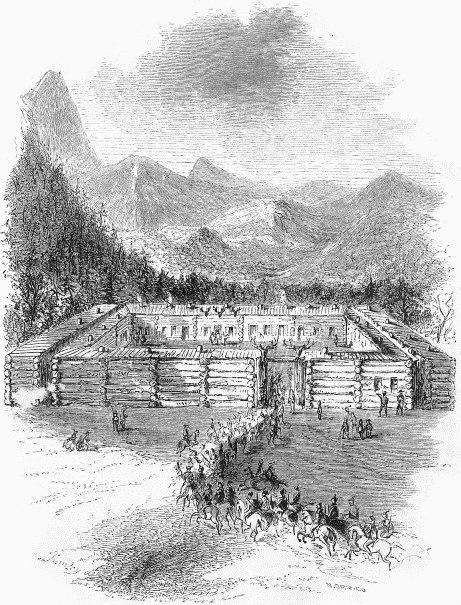 FORT MASSACHUSETTS, NEW MEXICO, IN 1855.
While engaged in our travels through the far West, we remember to have met with an Indian agent who was, both in years and experience, but a mere boy. To him had been intrusted the affairs of a large tribe, notorious in the country where they reside, as being great thieves. These Indians had so little respect for their agent, that they would openly boast of the crimes which they had committed, in his very presence. Not only this, but, on horses stolen from the neighboring settlers, they would ride by him, thus defying his power. The settlers were loud in their complaints against the Government for thus neglecting to protect them, and sending them a block of wood for a king. The young man of whom we speak, bore an exemplary character, but it was plainly and painfully apparent, that he was, in no way whatever, fitted for the office he held, and which he had attained through the influence of powerful political friends. This is but a fair example by which many of the so-called Indian agents may be [pg 477] rated, who are the actual managers of Indian affairs on our frontiers.
The Utahs and the Apaches, having now openly combined, met with such success in their endeavors to attack the whites, that, during the course of a few months, they overran almost the entire northern part of the territory of New Mexico. They utterly defied the power of the American Government; and, whenever the opportunity offered, boasted to the Mexicans "that they no longer stood in fear of the white man." The subsequent cruel and barbarous crimes of which they were guilty, clearly demonstrated that they had become greatly elated by their success. It soon became apparent that, unless checked, they would exterminate the population and burn or otherwise destroy their settlements.
At this time, it was only by running great risk, that the whites could leave their towns and go to the neighboring mountains, for the purpose of obtaining even a little firewood. Working parties were daily surprised and murdered; women and children were carried into bondage, and reserved for a worse fate, and all kinds of business were receiving a check, which was becoming ruinous to the country. It was even greatly feared, that the boldness of the savages would carry them so far as to make them attack Fort Massachusetts. To give them a warm reception, should they dare undertake that enterprise, the post was strengthened, by cutting down and removing everything which might, in the least, tend to aid the Indians, and give them a cover which they so much like when fighting; all the trees and brush about the post were cut away. Breastworks were thrown up on the [pg 478] block-house attached to the fort, so that the soldiers could be well protected in case of emergency. In these, sentinels were posted, and the strength of the guard doubled and greater vigilance exacted. Haystacks were removed to a safe place, for fear they would be fired by the enemy. The sentinels were ordered to cry out every half hour of the night while on their posts, and no man was allowed to approach after the shades of night came on, without giving the countersign. It proved to be well that these precautions were taken; for, on the neighboring mountains, Indian watch-fires were seen nightly; and, on several mornings, Indian moccasin tracks were discovered in close proximity to the fort, showing thereby that the enemy was watching and waiting for a favorable opportunity to strike a sudden and overwhelming blow upon the garrison within. The savages, no doubt, were deterred from making a bold attack by the prompt precautionary measures which had been taken by the commander to anticipate their plans. The wagons belonging to the fort were sent out after wood under a strong escort, and the government herd of beef-cattle, horses and mules, were well protected by the soldiery. On one occasion, through a false alarm of Indians, the whole command of the post, which numbered less than one hundred men, was put in great and sudden commotion. The cause will appear in connection with the following circumstances. The party in charge of the herd had espied a large cavalcade of men and animals approaching them. At the long distance they were off, the strangers resembled Indians. The commander of the party, immediately sent an expressman to the fort to [pg 479] apprise its occupants of the fact. The drums immediately sounded the rally, which caused the men to rush for their arms. They quickly fell into their ranks, and the order was given to march. Headed by a gallant lieutenant, they dashed out of the fort on a fast run, in order to reach and save their property from being captured by the enemy. The soldiers were elated at the prospect of having a brush with the Indians, and, on an open plain, giving them battle, where, notwithstanding the great numbers which would certainly be arrayed against them, they felt that they could soundly chastise them. On reaching the herd, the soldiers scattered, and were soon prepared to commence the skirmish; but, lo! when the strangers drew near enough to be discernible, they were recognized as a large party of Mexicans, under the command of an American. These people had been absent several months on a trading voyage among the Cheyennes and Arrapahoes, and for the purpose of returning home in safety, they had formed themselves into one body. Their dress was similar to that of the Indians, and therefore at the great distance at which they were first discovered, it is not strange that such a mistake had been made, especially during these dangerous times. The reason of the sudden stationing of the soldiers about the herd, the traders easily surmised; hence, on drawing near, they began to cry out that they were friends. No set of men were ever more disappointed than were these soldiers at this unexpected termination of the affair.
Matters eventually arrived at such a crisis that the Governor of the Territory, by and with the advice of the commanding general, felt obliged to issue a proclamation [pg 480] calling upon the people to volunteer for the purpose of defending their lives and property.
The inhabitants of New Mexico promptly responded to this call, by flocking to the places designated for them to organize. Out of the great number who presented themselves and offered their services, there were selected men sufficient to fill six companies, each of which, when fully organized, contained eighty mounted men. They had the power of electing their own officers, by and with the advice and consent of the Governor. These volunteers furnished themselves with riding horses. The pay which they were to receive amounted to about thirty dollars per month, which was considered very liberal, inasmuch as they were provided, in most cases, with arms. Rations were issued out to them the same as to the regular army. The willingness which the Mexicans exhibited on this occasion to volunteer, does them great credit, and clearly proves the fact that they do not always lack in courage, but that they are prompt to defend their homes when properly disciplined and aided with the means necessary to do so.
It is the opinion of many of the most prominent citizens of the Territory of New Mexico, that, if the chastisement of the Indians, when it was required, was left to the people themselves, the general government only supplying them with money and arms, that peace between the two parties would, in a short time, be firmly established on a sure and permanent footing.
In giving currency to such opinions, we risk them, with the knowledge that the previous experiments made on this policy, which have proved unsuccessful in the [pg 481] various older territories belonging to the United States, will be brought to bear as potent arguments against such a course by a large and powerful opposition. But such facts of Indian history are exceptions. Indian history clearly demonstrates the proposition, that well-organized volunteers, under able leaders, have accomplished more in warfare against the savages than regular troops, taking into consideration that the same length of time, which each have been engaged in actual service, has given them equal experience. The cause of this is plain. These two distinct forces are composed, entirely, of different material. The one is made up of frontiersmen who thoroughly understand the effective use of the rifle, and a life in an Indian country, while the regular soldiers have been, for many years back, chiefly foreigners who, as has been heretofore stated, have to be taught these things; and, as it very often happens, they have never seen one of their enemy until sent out in quest of the savages.
As matters usually stand, the Indians are almost the actual, although not the nominal, masters of the country. In short, they commit excesses whenever it suits them, paying no regard to treaties. This has been their habit from time immemorial, and it is found to be a difficult task to break them from it. Their minor crimes are allowed to accumulate, and when, at last, they are actuated by increasing success and consequent boldness, to commit some great and overt act, it is noticed and expeditions are sent out against them. These, usually, fail to punish the really guilty parties, but instead, they recover a small share of the property stolen, and with it [pg 482] the thirst for revenge must be satiated. The officers and soldiers do their utmost to accomplish something more, and readily meet hardships and privations in every shape in order to accomplish the desired end; but, their time is too limited rightly and efficiently to perform the work; for the campaign must be ended, when in reality it has but just commenced. The reason exists in the fact that, those high in authority are liable to be called to an account for spending a dollar too much in a good cause. Perhaps this state of affairs has been brought about by the immense expenses which have attended many of the Indian wars in which the United States government has been engaged, when mismanagement and paltry results have characterized the acts of whole campaigns. This charge cannot, however, reach to the military department in which New Mexico is included, for the leading officers who have, from time to time, been stationed there, have invariably exhibited an unusual amount of discretion and sound judgment, and have set examples of military science, promptitude and skill which it might be well for others to follow.
Under the existing causes for difficulty and peculiarity of circumstances, it is sometimes hazardous to assume the responsibility of punishing the hostile Indians as they deserve.
By punishing the Indians we do not wish to impress the reader with the idea that they must be collected and butchered, like animals, in order to bring them to terms. Milder means serve the same purpose; but, when they dig up the hatchet, battles must be fought in which they ought to be so closely driven as to cause them to see [pg 483] that it is perfect rashness to attack the whites. One victory gained by savages over white men so exhilarates their pride that they forget the past and believe themselves invincible. In these fights, valuable lives are sacrificed, but they are necessary sacrifices for the common good. When one tribe is severely chastised, the surrounding Indians hear of it, and, becoming alarmed, for a time they behave themselves with propriety. This happy state of things will continue until some weak move on the part of government officials counteracts this good influence, when, misconstruing kind acts for fear, the red men at once dig up the tomahawk and boldly march upon the war path, to spill innocent blood. Such results often follow when the power is taken from the experienced military commanders, and vested in the hands of (often the fact) inexperienced superintendents. These men pompously invite the Indians to grand councils, where unmeaning speeches are manufactured to suit the occasion. Usually when thus summoned, the wily savages are delighted to go into council, for, as a rejoinder to the many concessions which are easily obtained from them, and which they are always ready to make after assuming a little coquetry, they receive presents which the superintendent informs them are merely tokens of the high appreciation with which they are regarded by their Great Father at Washington.
It is the opinion of Kit Carson "that the Territory of New Mexico will continue to remain in its present impoverished state during the time that the mountain Indians are allowed to run at large. The only true remedy" (he says) "for this great evil is to compel the [pg 484] savages to form settlements by themselves. Then and there assist and teach them to cultivate the soil. In time they will be able to gain a maintenance independent of the General Government; and, to a certain extent, they will become responsible for their acts."
The people who form the chief population of the territory have so often been deprived of their property that it is not strange that they have become poverty-stricken and indolent. It is enough to strike down the enterprise of any nation to have been so long badly governed, and then, without any resources in the way of arms and ammunition, to be compelled to beat back hostile Indians. Under the provisions of the government of the United States, they are improving, but yet, even now, they have not the protection which they require, and should receive. In their territory it takes a daring man to venture his small capital in raising stock. To be sure, claims are allowed them by Congress for the losses by Indian depredations, but these usually fall into the hands of speculators, and in reality, assist the people to a very trifling extent. It can be said, to their credit, that Mexicans bear reverses of fortune with a nonchalance seldom seen among any other race. Although generally poor they are as happy and joyous as it is possible for human beings to be.
The organization of the Mexican volunteers was made complete by the governor of the Territory, who selected as their leader, Mr. Ceran St. Vrain of Taos. This gentleman, although he had much important business which called his attention elsewhere, immediately expressed his willingness to accept the responsible position which, [pg 485] without solicitation, had been conferred upon him. The commission received by St. Vrain gave him the rank of lieutenant-colonel. Without delay he set about the difficult and important work that lay before him, bringing to bear upon the details, that sound judgment, gentlemanly bearing and ready zeal, which have long characterized the man. He had the good fortune to secure the services of Lieutenant Creigg of the regular army, whom he appointed one of his aids-de-camp. Having completed his staff and other arrangements to place his force upon a military basis, he was ready to take the field.
The appointment of St. Vrain as commander of the Volunteers, was hailed with delight throughout the territory. His great experience in the mountains, his knowledge of the Indian mode of warfare, and the respect which the people he was called to command invariably paid him, seemed to convince every thinking mind that something more than usual was to be accomplished. They felt that the wrongs of their country would now be certainly redressed. The sequel will prove that the people were not doomed to disappointment.
Early in the month of February, 1855, Col. T.T. Fauntleroy of the First Regiment of United States Dragoons arrived in Taos from Fort Union, New Mexico.
Fort Union is the first post met with on entering the Territory of New Mexico from the east. It lies on the Santa Fé road usually traveled by parties when crossing the plains, and is about one hundred miles distant from the capital. The site of this fort, at the first view, is bold and picturesque, as it is located near the west side of a [pg 486] broad valley, which is continuous with the open prairies. The houses composing the fort are built mostly of logs; and, as there are quite a number of them, the post has the appearance of a small settlement. The soil about is sandy, and the place being exposed, it suffers when the high winds spring up. This fort is usually garrisoned by several companies of soldiers.
As it has such free access to the mail communication with the States, it is, comparatively speaking, quite a desirable fort for an officer to be stationed at. The difficulty of procuring fuel for the fort, and also other necessary articles, is the great objection to the present location, but its importance more than counterbalances these; therefore, the post will probably be kept up either where it is, or in the immediate vicinity, for many years to come. Colonel Fauntleroy had received orders from the Department General to proceed to the town of Taos and take command of the entire expedition. The little force had been made as powerful as the resources of the country would permit. The Mexican Volunteers, soon after their enrollment, purchased woolen shirts and felt hats, the color of which, in each company, was similar; this fact, with a little drilling, gave them quite a military appearance. Never were men prouder of the position they now held than the volunteers under consideration; and a more daring and expert band of horsemen has been seldom collected. So pleased were they at being recognized as soldiers, that they could not, when afterwards marching through their own towns, resist the temptation of jocosely taunting their countrymen whom they chanced to meet, for being obliged to till the [pg 487] ground. We have before said that these men were mounted. At first sight it would appear as though they would soon be on foot, for their horses appeared to be in a sad plight for so severe a campaign as that which lay before them. As has often occurred before, looks are frequently deceptive. In this instance, it was found to be the case; for, no sooner did these hardy ponies reach the mountains than their wonderful powers of endurance began to be exemplified. When the noble dragoon horses began to droop from hunger and overwork, these little fellows were fresh and strong as the day they started. The reason of this was that the Mexican horses were well versed in taking care of themselves, and when the snow fell and prevented their having free access to the dry grass beneath, they were not in the least disconcerted; for, with the aid of their fore feet, they readily pawed the snow away and thus obtained full rations; but, their more enlightened rivals did not fully understand this science, and, owing to a want of proper nourishment, their strength would fail gradually until finally they broke down.
The only real inconvenience under which the ponies seemed to labor, arose from tender feet, for, the rocky trails in the mountains rapidly wore away, and broke off their hoofs. This continued, so that at last, reaching the matrix of these horny growths, their feet became very sensitive. Many of the Mexicans had taken the precaution to guard against this, before leaving the towns and military posts which lay on their route. They had obtained horse-shoes, with which they shod the ponies. We remember seeing a large party of them thus engaged as [pg 488] blacksmiths. It was at night; while some held burning torches, others were busy with hammers, stones and hatchets in applying all sorts and sizes of horse and mule shoes, with which they were content, provided they approached the diameters of the hoofs to which they were to be nailed. Strange to say, this rough work answered the purpose, and but few, if any, of the animals so shod, went lame. After the command had got under full headway, if any of these ponies became so tender in their feet as to be able to travel only with great difficulty, their riders resorted to other expedients for relieving them. When practicable, they obtained the fresh hides of the beef cattle as they were killed, and, binding the material around the injured feet, and making it fast about the fetlocks, they allowed it to dry on. In the morning, thus protected, the horse could journey on. It is customary regularly to shoe these ponies only on the fore feet, as the weight of the animal's head and neck, together with that of the rider, comes harder on these hoofs and causes them, when traveling over sharp rocks, to wear away quickly. It seldom happens that the hind feet become tender. The Indians cannot understand the policy of this, and one of them philosophizing on the subject, while visiting the blacksmith's shop attached to a military post, made the remark in Spanish, after apparently having been for some little time engaged in a deep study, "that it was not right." Said he, "The horse, with his eyes, can see where to put his fore feet when traveling over bad places, but he cannot do this with those behind; therefore, you white men ought to put the moccasins there." The Mexicans had so much confidence [pg 489] in the powers of endurance of their ponies while out on this campaign, that they hesitated not to run them on races, whenever circumstances and the site of the camp would permit such pastime. The only training required for these trials of speed, consisted in the rider foregoing the pleasure of riding for a day or two, in order to allow his horse to recruit. As their walking did not in the least interfere with the order of the march, they of course were permitted to race as they pleased, for their services on the march are just as valuable on foot.
Col. Fauntleroy's command, when completed, consisted of four companies of Mexican volunteers, two companies of dragoons, one company of artillery who were performing duty as a rifle corps, and one company of spies. The two remaining companies of volunteers were dispatched to exposed towns on the remote frontiers in order to protect them. The artillery company was the only one on foot; but the soldiers who then composed it were known from actual experiment to be more than a match for the horses in traveling when the party should reach and penetrate the mountains. Col. Fauntleroy engaged the services of Kit Carson as his chief guide, and, having arranged all of his plans necessary for a vigorous campaign, he set out upon its execution.
The command proceeded at first one hundred miles due north to Fort Massachusetts, which was to be their dépôt. Without delay they left this post and proceeded, encountering snow-storms and severe cold weather. The mercury of the thermometer, for most of the time, ranged several degrees below zero. They marched to the Rio Grande del Norte, and thence, on up this river to where [pg 490] it makes its exit through a deep cañon from the mountains. It was, as will be remembered by the reader, on the head-waters of this last-mentioned stream, that Col. Fremont, while engaged in his last great exploring expedition, met with severe reverses, in which several of his men lost their lives from exposure, hunger, etc., while he, and the remainder of his party, barely escaped the same fate.
While passing over this point of his journey, Col. Fauntleroy sent out as an advance party the company of spies. Their duty was to seek for fresh Indian trails. On reaching the mouth of the cañon of this river, the main portion of the soldiers halted for a short time while their trailers penetrated the mountains in search of the much desired Indian signs. During this resting spell, an incident occurred which, for an hour or two, created some little stir and excitement among part of the men present. A large Newfoundland dog belonging to an officer had, accidentally, been allowed to follow the soldiers. By his pranks and his good disposition he had become a general favorite among them. While attempting to drink, this animal lost his foot-hold on the ice and slipped into the swift current of the river, which was partially frozen over. The dog at once attempted to extricate himself, but with all his efforts he could do no more than stem the flood, making no progress against it. His situation was very precarious, for, should his strength begin to give out, he was certain to be carried under the ice and lost. The sympathies of the men were soon well awakened in his behalf, and many plans were devised to rescue him, but they all proved abortive until, at last, a [pg 491] Mexican approached him with a lasso, and after making several vain attempts, succeeded finally in encircling the dog's head with the slip noose. On tightening the rope he found that he had the animal firm, and soon dragged him from his perilous position.
The spies were not long in discovering a trail made by the Indians, to which they led the main portion of the command. This trail had been so frequently used of late by the Indians in driving stolen bands of sheep and cattle over it, that it was now a well-trodden road and therefore there was no difficulty in keeping on it at all hours of the day and night.
Being accustomed to perform his duty carefully, and, at the same time, to use dispatch, the Colonel, in the course of a few days, led his party to the entrance of the Saquachi Pass, which is the great natural opening in the mountains that bound, on the west, the valley of San Luis. As they approached the mouth of the pass, the men were traveling close under the hills, therefore, on coming to it, and in order to follow it up, it was necessary to turn off almost at a right angle. The spies, as was usual when the command was on the march, were considerably in the advance. They had hardly entered the pass and had just reached the summit of a knoll which lay in their path, and which had hitherto prevented their seeing up the valley, when, all at once, the long looked for Indians were presented to their view. They were but a short distance off, and as if surprised at thus so suddenly discovering each other, both parties halted. During this state of suspense, the white men noticed that the Indians were arrayed in their war costume, [pg 492] showing that they were bound on another plundering expedition. Everything went to show that the visit which the white men were making to their mountain haunts was unexpected by the red men.
The Indians quickly recovered from their astonishment and began to form in line of battle by spreading themselves out across the valley. They were evidently emboldened by the small force with which, apparently, they had to contend, and felt certain that a victory would be both easy and sure. Having taken their position, Blanco, their chief, was easily recognized by the red woolen shirt which he wore. He was busy, riding along in front of his warriors, occasionally stopping to give some command. As they were near enough so to do, the Indians opened a warfare of small talk, in the Spanish language. They charged their adversaries with being afraid to advance, or to use their expressive words, the Americans were as cowardly as squaws. To these taunts no reply was made; but to keep up the decoy, the few soldiers who were exposed to view, remained stationary, while word was passed to the rear of what was transpiring in the advance. Thus several minutes passed by; but they were not thrown away. During this time, most of the dragoons and volunteers were relieving themselves of such extra luggage as overcoats, blankets, etc.; saddle girths were tightened and weapons put in order for immediate use. The Indians were finely mounted, and about two hundred and fifty strong; and, as their wild career had gone so long unchecked, their bravery was aroused to its highest pitch. All things being in readiness, the bugles sounded [pg 493] the command to charge, when away dashed the gallant soldiers, eager for the affray, and each trying to be foremost in the fight. As they came bounding over the knoll before spoken of, the Indians began to see the delusion under which they had been laboring, and at once turned to fly, but not in time to escape, for the soldiers were soon among them and with their revolvers and small arms were fast thinning their ranks and sending many a brave to his final home. A running fight ensued, which was continued up the valley for about eight miles, when a majority of the Indians gained the mountains and made good their escape. The chase was a splendid affair to behold, and many feats of horsemanship were performed that would be difficult to excel. Among the foremost in this skirmish was, as the reader might readily imagine, Kit Carson. The pursuit was continued far into the mountains and was only given over when night came on. The soldiers then retired to their reserve-guard, who had established a camp on a small stream which runs through the centre of the pass, where their pack animals and stores could be easily guarded. During this exciting fight, several of the soldiers were slightly wounded. With this exception, the command came out of the skirmish unharmed. On the side of the Indians, affairs in this respect were quite different. Their blood had well sprinkled the battle-ground, and several of their swarthy forms were stretched out at full length, sleeping that sleep that knows no wakening, except it be at the final judgment day. Had it not been that most of the Indians, as is usually the case with them when in action, were tied on their horses, this number [pg 494] would have been augmented. The bloody trails that were afterwards found in the mountains, went to prove that many of the wounds given to the escaped Indians were mortal, and, while their horses were carrying them from the danger, they themselves were sinking from furious hemorrhage. Early in the pursuit, a fine warrior was thrown from his horse. As he had been crippled by a ball, he could not recover himself and make off. For some time he lay alone and neglected, but when the rear guard came along they noticed that he was playing a game by pretending to be dead; but he had closed his eyes too firmly for a man in that condition, and this fact attracted the notice of the passers-by. A Mexican raised his rifle and fired at the brave; but the bullet only served to cause another flesh wound. This so irritated the would-be dead, savage, that, seizing his lance which lay by his side, he attempted to reach and kill his adversary with it; but, others coming up, he was soon dispatched.
While this running fight was in progress, the author met with an adventure which came near costing him his life. It was my duty to follow the charging soldiers in order to be near at hand to render professional services to the wounded, should there be any. I was mounted on a mule, and when the dragoon horses started off, he became frightened and unmanageable. I soon found that this mule lacked the speed of the former animals, hence he was in a short time left far behind, but not until he had fallen and thrown me into a thrifty bed of prickly pears, the thorns of which did not, in the least, save me from being hurt. On regaining my feet, I found that [pg 495] my injuries were but slight, and that I still retained my bridle rein, therefore I quickly regained my seat in the saddle and started on again, remembering the old proverb, which says, "All is fair in war." While riding on, I was joined by a soldier whose horse had broken down in the charge. As we now advanced together, our route led us by some large sand hills, behind which several Indians had sought refuge, when hotly pursued. Seeing that they had been overlooked during the excitement of the moment, they remained quiet until we came along, when they made a dash at us and commenced firing their arrows in fine-style. We returned their volleys with our revolvers, but, whether we produced any result further than preventing their coming too near, it is difficult to say. Several of their arrows came in close proximity to our bodies, and one struck, the soldier's horse in the neck and wounded a main artery, which bled, for a time, furiously. As danger was thick about them, the Indians soon left us to effect their own escape; when, we halted and attended to the wounded horse, whose life we were so fortunate as to save, by putting a ligature about the bleeding vessel.
The night succeeding the day on which this fight occurred, with a single exception, passed by quietly. A soldier, who lay near the centre of the camp, had retired to rest, perhaps impressed with the belief that he and his comrades would be attacked by the Indians before morning; this train of thought had led him into dreams of war, and while reveling in them, he imagined that danger was at hand. Suddenly starting up, and seizing his rifle, he fired at random. His bullet came [pg 496] near striking a Mexican sentinel who was on duty, and who was making his rounds. The sentinel was very naturally startled by this unaccountable noise in the camp, and supposing that the Indians had, unobserved, crept within the lines, he returned the compliment by discharging his piece in the direction of the supposed danger. The report of these firearms had the effect of arousing the entire command. The men were quickly on their feet and ready for active service. In the confusion which ensued, several more rifles were fired, but fortunately no harm was done, and as soon as the cause of the trouble was explained, quietness and order was promptly established.
At the break of day, on the next morning, the soldiers were up and preparing for their march. The Indians had, on this morning, made fires, and even presented themselves to view on the mountains, but they were few in number, and it was well known that this was only a ruse to allure the white men to the wrong trail, while their families should have time to escape in the contrary direction; hence, but little notice was taken of these demonstrations.
Col. Fauntleroy here determined to relieve himself of all drawbacks which should in the least tend to prevent his now giving full chase to the Indians. Accordingly, he left his baggage and provision train under escort of the foot company and quartermaster men, the whole being placed under the command of Lieutenant Lloyd Beall, of the Second Regiment U.S. Artillery, with instructions to meet him at an appointed rendezvous in the Wet Mountain Valley. It required but a [pg 497] short search by his guide, Kit Carson, and his spies, to put him on the right trail taken by the main portion of the enemy. When it was found, the pursuit was resumed and kept up vigorously. Late and early, the soldiers followed on this trail, and although the Indians purposely led them over the worst conceivable routes, yet they gained nothing substantial by it. On one occasion, when the men were pushing on as fast as possible, their advance guard surprised three Indians, one of them a woman, while they were leisurely watering their ponies. These Indians attempted to fly, and succeeded in making a good run for about four miles, but, at the end of that distance, two of them were overtaken. A Mexican, who was mounted on a very swift horse, was the first to come up with the savages. He fired and brought the woman to the ground. Quickly dismounting, he made a trophy of her scalp. The other Indian, being arrested by a slight wound, was made a prisoner. On questioning him, it was found that they all belonged to one family. The man who had made his escape, was the husband of the woman who was killed, while the prisoner was her brother. These Indians had heard nothing of the recent fight in the Saquachi Pass, and, had the soldiers dropped down from the heavens, they could not have been more surprised at thus unceremoniously meeting them. It was very much regretted by those present that this Indian woman had lost her life; but, as she was dressed in the disguise of a man, her sex could not be recognized. There are many of our readers who will perhaps censure this Mexican for his barbarous action of scalping a [pg 498] human being, but it must be remembered that the education of his people is different from our own. The taking of Indian scalps for a long time has been authorized by the Mexican Government, as a means of lessening their savage enemies, and handsome premiums have been offered as an inducement to obtain them. In the case of this Mexican, there were extenuating circumstances which, if they did not warrant such a cruel act, yet they rendered him somewhat excusable. He had recently lost a near and dear relative by the hands of these same Indians, and the appearance of this mangled body was still fresh in his memory, making him to thirst for revenge. It must not be supposed for a moment that the commanding officer of this expedition had sanctioned such a mode of procedure, for, he had no knowledge of the matter until after it had been ended. It was not within his province to preach humanity to a people who had been so greatly outraged by savages. He came to punish and not to intercede for wild men who had long been a terror to the surrounding country, and upon whom, in order to reconcile them, every kind act had been expended in vain.
It may possibly be asked whether or no a man, who has simply lost his scalp, can recover. In reply we can safely say that without any other wound, and under favorable circumstances, with good care the sufferer stands a chance of being restored to health. There was a man who formerly was living and working at his trade as a blacksmith in Santa Fé, who, in a fight with the Camanches while crossing the plains, was wounded by a lance and then scalped. After a long period of suffering [pg 499] this person entirely recovered, although the cicatrix of the wound was ever afterwards a source of annoyance to him, compelling him continually to wear a skull-cap made of oiled silk. The size of the scalp, as usually taken off by the Indians, varies. Sometimes they remove only the back covering of the head. At other times they cut off the whole, running down even with the margin of the ear. When a man has died in a manner which the Indians style as "brave"—that is, desperately fighting for his life, and never for once showing fear, they take two scalps, one from either side of the head. The object of this is, to have scalp dances for each, as they consider such a man as deserving the fate of two ordinary men. These scalps are often stretched, dried, decorated and frequently kept for years as trophies. The more scalps a warrior takes, the greater favorite he becomes with his tribe; and finally, having obtained a given number, he is considered eligible to fill the office of War Chief, provided he has other qualifications, such as the power of quickly conceiving the right plan on which to act in case of emergency. When a party of Indians in the Rocky Mountains have been on a war trail, met the enemy and vanquished them, they appoint a brave who is honored as being the scalp-bearer. This warrior carries a long pole, to which, at suitable distances from each other, the scalps are attached. When the party returns to, and enters their own village, this brave is the observed of all observers. Eagerly, by the old men, women, and children, these bloody trophies are counted, for each of them offers an occasion for rejoicing, to be at separate intervals of time. [pg 500] They are, then, each synonymous with the phrase, a fête day, and the scalp-bearer is looked upon with the same jealous eye which greets the color-bearer of an army after having been engaged in some great battle which has proved successful to his standard. An Indian will not remove, as a general thing, a scalp which contains grey hairs. This he considers to be a business fit only for women. The scalp which is to cause a general jubilee, on an appointed evening, is attached to the top of a long pole, planted in the earth at a suitable place. The warriors who have been instrumental in tearing it from the head of its owner, form a circle around the pole, outside of which are arranged the spectators. By the aid of one drum-stick, the person who has been detailed for this duty, keeps up a beating motion on a sort of kettle-drum, the noise of which serves the purpose of marking time. The voices of the dancers make the music. At first the song is a mere humming sound, but after a time, it grows gradually louder, until the participants in the dance, being excited to the highest attainable pitch with interest in the ceremonies, it becomes terribly hideous. Almost naked, with tomahawk and hunting-knife in hand, the warriors imitate the process of dispatching and tearing off the scalps of their victims. So excited do the dancing savages sometimes become while reveling in these fantastical scenes, that they frequently are aroused to a pitch which borders on frenzy. The spectators of these sights get so deeply interested that it is not an extraordinary matter for them to appear as if almost deranged. Their excitement breaks out into exclamations of encouragement and applause, until at [pg 501] last they can control themselves no longer, and, on their own account, commence making bodily demonstrations of joy by jumping about. The scalp dance may last an entire night, or until, worn down with fatigue, the actors are willing to forego their pleasure and seek rest. The Mexicans on the frontiers have fallen into this Indian custom, and they can go into the spirit of the scalp dance with a relish which fully equals that exhibited by their savage neighbors. This is not true as a general rule; but, very many of their people really enjoy these ceremonies.
 INDIAN WAR DANCE.
Colonel Fauntleroy and his men traveled at such a rapid pace, that, in the course of a very few days, they succeeded in once more overtaking the main village belonging to the enemy. The Indians took refuge in a steep and rocky mountain. A skirmishing fight immediately commenced, which lasted several hours. During this engagement, a large number of the savage warriors were killed, their band completely routed, and the inhabitants of the whole village made to scatter in every direction in order to save their lives. At first the braves attempted to make a stand, but they were driven from rock to rock, until they broke their ranks and fled. It was about the time of this crisis, and when they were most needed, that the dragoon horses began to break down and die.
The word village has many times appeared in our pages, and as it may prove ambiguous to a few of our readers and render them liable to confound its meaning with that of a fixed town, we will here stop and explain its signification when applied to Indians. An Indian [pg 502] village, as understood in border parlance, comprises the lodges, the women, children, old men, and such movable property as Indians may chance to possess. They are usually found in some safe retreat where the old men, women and children stay while the warriors are engaged following the hunt or war path. The word has become more generalized since it was first given to stationary camps of the savages, and may now include any band of Indians traveling with their families and property. The village is the home of the red man, where those persons and things which he most cherishes, he tries to keep intact and sacred from the spoiler's hand. It is also where the Indian allows his love, friendship and all the better feelings of his nature to exhibit themselves. It is where in early youth he has listened to the legends of his tribe, and where he is taught those lessons and forced to endure those trials which are to prepare his heart in seeking out revenge. It is the place where, as he approaches the age of manhood, he takes those steps which are to make for him the reputation of a daring hunter and brave warrior. Here he first learns to shoot his arrows with precision, and to handle the lance with dexterity. His boyish feats in horsemanship, which he daily performs in the village, would be witnessed with astonishment by skillful riders. It is here that he runs to welcome his father when he returns either from the chase or the war path; and, while he listens to the marvellous adventures which his sire has encountered, he secretly wishes himself a man, so that he can emulate his greatness. In fact, the same feelings exist between parent and child with the Indian race, as with those who boast of being more [pg 503] civilized. Youth and the vigor of manhood, are the golden days with the savage. To be doomed to old age, is considered by him to be a punishment. When he is no longer able to hunt and seek out his enemy, he loses his desire to live. His life is then considered an incumbrance to the camp. The old and infirm, therefore, are often willingly deserted, that they may the more quickly die. The village is always under the surveillance of men who are past the middle age, and who no longer can act out the stirring deeds of the warrior. Their experience renders them capable of giving good advice, and attending to the less active affairs of the nation. They hold the power of restraining the rashness and indiscretion of the younger men, therefore they are selected to watch over the property of the tribe, while the strong warriors are seeking to provide the dependent portion of the band with food, or to revenge their real or imaginary wrongs. Order and good fellowship is made to prevail in these villages, somewhat similar to the habits found in civilized communities, for the passions and evil propensities of all men are found to be alike, no matter what differences of education or color exist. We find that the Indian tribes have their wise men, whose voices are heard and heeded on all occasions. When these villages are located, or, to use soldier phrase; when the Indians go into camp, care is taken that each lodge shall be placed where it will not interfere with the common good. The internal economy of these habitations is arranged on a social system which, in many respects, is commendable. When one person is poor, generally speaking, the whole tribe is found to be so. The herds of horses and mules belonging [pg 504] to the tribe, are turned loose in one body as if they were the property of one man. If game exists in plenty and danger is not apprehended, happiness holds complete sway within these Indian homes. The proverbial caution of the red man rarely allows him to be surprised; therefore, even in times of peace, he keeps his fleetest horse tied at the door of his lodge, so that he may make haste and collect his property, and be away before his enemy can harm him. These favorite animals are fed by hand. Before trusting his body in sleep, some warrior, in whom the tribe repose the utmost confidence, must ascend a neighboring eminence, if there chance to be one, and examine the country in search of dangers. Parties are always kept out as spies, and, at the least appearance of suspicious signs, they become easily aroused and vigilant, and if danger really exists, word is immediately sent to their village to be ready to move. This is a homely but literal interpretation of the term Indian village.
The reader has seen that the dragoon horses gave out before the fatigues of the march, while the Mexican ponies performed their tasks so admirably and easily.
This was a painful subject to contemplate and one which no man who loves the noble horse could wish to witness the second time. The dragoon horses, reduced to skeletons from starvation while retaining all their natural spirit, with tottering limbs, faithfully tried to perform the labor which their riders, seemingly, asked of them. Long before the arrival of the time when they could no longer support a burden, the soldiers had humanely relieved them from this work and were assisting [pg 505] them, by all the means in their power, to reach a haven of safety, where food, so essential in restoring their sinking powers of life, existed in abundance. As their little remaining strength was leaving them, they would exhibit the fact by staggering. Finally, breaking down in their hinder legs, they would sink to the ground, but not until they had made the effort to drag themselves along with their fore feet. To relieve them from their agonies and prevent their falling into the hands of the Indians, one by one, they were shot.
When these horses broke down and began to die off, it was decided to be best to return to Fort Massachusetts in order to recruit and also to allow the Indians an opportunity to concentrate their forces, when another effective blow could be struck against them. On his return, Colonel Fauntleroy met, at the designated place, Lieutenant Beall, who had managed the affairs intrusted to him very much to his credit. Having once more consolidated his command, Colonel Fauntleroy retired to Fort Massachusetts, which he made, for a time, his head-quarters.
Kit Carson, the guide of this expedition, when afterwards speaking of it, says, "During the time our forces were in the field they were exposed to the most intense cold weather I ever remember experiencing. We were overtaken by several severe snow-storms which came near completely using us up."
For the success that had so far attended the labors of this body of soldiers, the greatest amount of praise is due to their leader, who set a noble example to his men. During those hours when hardships and trials came [pg 506] thickest upon the command, all eyes were turned to the commander, and, as the result proved, with no lack of confidence. Kit Carson's services were found to be invaluable. His long experience and untiring energy proved to be one of the best anchors of the goodly ship. We should not omit to state, in regard to the severity of the cold, that it was early in the morning, just before the break of day, that the cold was invariably found to be the most intense. During this time, it is the greatest wonder that the Mexicans did not perish, for but few of them had more than one blanket as a covering by night, and the remainder were but very little better provided for. When wood was plenty, and they were allowed so to do, they made large fires and laid down near to them to attempt sleep. After about one hour thus spent, they were routed out by being nearly frozen. Getting into close contact with the fires, they would thaw out and then were ready to make another endeavor to repeat the sleeping operation. In this manner they managed to live through each night, and on the following day they were, apparently, none the worse for wear. A person judging these men as he oftentimes sees them during the summer season, basking in the sunlight on the sunny side of their houses in New Mexico, would not, for an instant, suppose that they could undergo such hardships; and yet, they can do so, as the above example sufficiently proves, without allowing one murmur of complaint to escape their lips. With the regulars, who were amply supplied with blankets and buffalo robes, it would appear that they could have obtained sound sleep. But this too proved to be almost an impossibility. The [pg 507] heat of the man's body, during the early and warmer part of the night, served to melt the icy covering of the mother earth just under him. When the cold increased, this was again frozen, rendering the portion of the body nearest to the ground almost benumbed. By frequently reversing the posture a little, some relief from suffering was obtained, but not sufficient to reach a degree which could be called comfortable, or, in the least, be claimed as desirable. Every member of this expedition can truthfully assert that they have experienced a foretaste of what the first symptoms of freezing to death must be.
Finally, the command reached Fort Massachusetts, where, in ease and plenty, the half starved, half frozen, half used-up men soon forgot all their troubles and privations. A few weeks spent at the fort, acted like a magic charm in recruiting the men and the remaining animals, when they were once more in a fit condition, and, again eager to go on the war path, anxiously desiring to surpass the splendid deeds of their first tramp.
At the permanent camp, which was made near Fort Massachusetts, the Mexican Volunteers, especially, enjoyed themselves hugely. From privations of various kinds, to which they had shown themselves to be well trained, and which consequently affected them but little, they were suddenly placed in a state of comparative comfort and even luxury rarely realized at their own homes. They had not much else to do beyond guarding their animals and attending to such other minor duties as were required by camp duties. Had not their hardy ponies required the rest that was now being given them, these troops would have been kept in more active service; [pg 508] but, as this could not be, they were allowed a respite, which they themselves turned into pleasure. Foot races and various athletic games were concocted and played by them, making the time pass merrily by. Their discipline and respect for their officers had reached a degree seldom, if ever, attained by volunteer soldiers, and which, in many respects, could be imitated with advantage by regular troops.
But the time soon arrived for the march to be resumed.
At a council held among the chief officers, it was decided that the best and surest course to be followed would be to divide the forces and send them out in quest of the Indians, as if they were separate commands. Thus it might happen that being caught between the two, as they were running from danger they would rush into it and receive chastisement sufficient to answer all purposes. Acting on this plan, Colonel St. Vrain, with most of the Volunteers, was ordered to proceed in one direction, while Colonel Fauntleroy, with the main division, started in another; while on his route, Colonel Fauntleroy traveled close in under the mountains, and kept his men as much concealed as possible, making most of his marches by night. He traveled through the Valley of San Luis up to its head.
The Valley of San Luis is about one hundred miles in length. Its greatest width is fifty miles. On either side, it is bounded by snow-capped mountains. The scenery of the valley is very prepossessing, being sure to enchant the eye throughout its entire length. In the south, the valley is continuous with prairie land, which [pg 509] extends down as far as the settlement of Rio Colorado. It is well watered by mountain streams and bears the appearance of being an excellent farming district; but, the probability is, that its climate is too cold for raising crops, and that its true value will be found chiefly to consist in using it for grazing purposes. From time to time, the Indians have reported that it contains gold mines, but there are no authentic proofs that this is a fact.
At one time, the Indians succeeded in making the Mexicans converts to the belief in the existence of these mines, as they showed them specimens of gold which they affirmed to have been taken from them. It was agreed that, for this valuable information, presents, such as blankets, horses, and guns, should be made to those Indians who had openly proclaimed the good news, provided they could conduct the Mexicans to them. A party was formed and started to explore the valley, but, as nothing was afterwards heard of their success, and, as many of them, to all external appearances, were as poor as ever when they returned, it is presumed that they were duped by the Indians. The bottom land of the Rio Grande which skirts the southern border of the valley of San Luis, is, judging from the luxuriant hay crops which it produces, year by year, quite a good farming section; and, no doubt, ere long, the Mexicans will there establish a new settlement and thus practically demonstrate the use to which this beautiful valley can be put.
While passing up the valley of San Luis, Colonel Fauntleroy came to the Punchi Pass. This pass is the [pg 510] main opening through the mountains which bound the valley of San Luis on the north. The pass itself is less than half a mile wide, but yet, it presents some of the grandest scenery human eyes ever beheld. The mountains, on either side, are not so lofty as their compeers close by, but they are rugged and picturesque. Through the pass runs a bold stream, which, at about midway (and at this time) was obstructed by a beaver dam, that was so scientifically constructed as immediately to attract the attention of the entire party. Near to this dam, there is a very large hot spring, which is located close under the base of one of the mountain sides, and which, under the favorable circumstance of a fine day, lends enchantment to the view. The Punchi Pass is but a few miles long and leads into a beautiful little valley, called by the Mexicans after the same name which is given to the pass.
On arriving at the Punchi Pass, Col. Fauntleroy proceeded on through it to the head-waters of the Arkansas river, where, fortunately, a fresh trail made by the Indians was found. This trail was followed with such assiduity and prudence that the camp of some spies belonging to the enemy, and which was in their rear, was passed by the Americans one night without their presence being noticed. Early the ensuing morning (before the break of day), the main village of the Indians was discovered. Its occupants were enjoying a war and scalp dance, and their voices, as engaged in the song which usually accompanies such festivities, could be heard for a distance of at least a mile. Unconscious of danger, they were having a merry time. One can [pg 511] imagine, better than can be described, the scene that followed when three hundred loaded rifles poured their contents into this crowd. Suffice it to say, that among those who survived this terrible retribution, the greatest consternation prevailed; but, as a dernier resort, they began to fly, when they were hotly pursued by the soldiers. Before quitting their late camp, some of the savages had managed to get their own rifles, and with them to fire several shots which did some execution, as two soldiers were killed and two wounded.
Thus it will be seen that the main village of these Apaches and Utahs fell into the hands of the Americans. It proved to be rich in plunder, for it contained all their stock of dried buffalo meat, besides other provisions. Also several cart-loads of robes, saddles, weapons, ropes, skins, blankets, trinkets and camp equipage. Most of this property was collected and destroyed by fire, being of little use to the command, whose means of conveyance was limited to their own actual wants. The number of Indians killed in this surprise has been variously estimated, as has been also the number of the red men on the ground when the carnage commenced; but all agree that this was the severest blow these savages had ever received.
Among the many other objects of curiosity found by the victors, was a "Medicine lodge," which had, from appearance, but recently been in full blast. It was highly (and to Indian eyes it must have been very artistically) decorated, and contained all the emblems and symbols of witchcraft. If sickness was to be frightened away, or even coaxed to dethrone itself from the [pg 512] afflicted, there was sufficient in this temple of the Indian gods, seemingly, to have answered either purpose. Some potentate of the magnitude of a great chief had, evidently, but a few hours since, been its occupant; for, in his hurry to desert the premises, on hearing the music of the white man's rifle, he had forgotten his beautiful head-dress of feathers, and other articles pertaining to his wardrobe, which designated to the captors his high rank. Perhaps, and the surmise may not be far out of the way, this chief was suffering from a gun-shot wound inflicted in a recent fight by his pale-faced enemy, and having received one of their most dangerous potions of lead, he was not anxious for another, and therefore made his escape with the activity of a well man.
In this expedition, a company of artillery,26 who have before been described, doing duty as infantry, performed a feat that will compare well with anything of the same kind on record. These men, under the command of Lieutenant Beall, who shared all the privations of his soldiers, marched on foot through a mixture of mud and snow, nearly ankle deep, over an uneven country, from the Mosco Pass in the Valley of San Luis, to the head-waters of the Arkansas River, a distance which is computed at eighty-five miles, in thirty-six hours, including all their stoppages. This company had been long celebrated as being expert marksmen, therefore, their services were much needed when the Indian village was discovered. Although nearly broken down with fatigue, yet as soon as the electrifying news of the enemy being [pg 513] so near at hand reached them, it seemed to inspire them with new vigor. They dashed ahead, and gallantly led the van in this assault which terminated so favorably to the side of the Americans.
Colonel Fauntleroy was not satisfied with the victory already obtained; but, after having accomplished all that was possible for him in this quarter, and having scattered the Indians to the four winds, he determined to make forced marches in order to surprise another band of them who were supposed to be located in a distant mountain haunt well known to his guide. His object in thus hurrying away from the scenes of his late triumph, was to reach and surprise the Indians before their friends had time to travel to and apprise them of their defeat. In this manœuvre he was also successful. He came upon this second band also before they were aware of their danger. They were routed, and after severe loss were followed far into the mountains. At this camp, Blanco, the celebrated Apache chief, was driven to such close quarters that he evidently began to feel that the safety of his whole tribe stood in jeopardy. He made his appearance on a high point of rocks and asked the white men who occupied the plain beneath for a parley, which was granted him. He said, in the Spanish language, that he and his Indians wished to make peace; that they were tired of fighting. In reply, he was informed that the terms he demanded would be listened to on his coming into the soldiers' camp. He was going on to say that he was afraid to trust himself there, when a bullet was sent whizzing by his head, which caused him to decamp in all haste. It was ascertained, [pg 514] afterwards, that a Mexican, who had great antipathy to this chief, had, unknown to the rest of the party, crept secretly up into the rocks. When he had reached a place where Blanco was within the range of his rifle, he fired; but, as the reader has inferred, he missed an accurate aim.
At this latter camp or village, and near the close of this same day, another incident happened which will long be remembered by those who witnessed it. Two Indians who probably had been absent to some distant section of the country, having no knowledge of the matters which had lately been transpiring, were seen approaching. Gradually, they drew near to a cotton-wood grove of trees in which the soldiers were resting, thinking no doubt, that they were there about to meet their friends. A mountaineer by the name of Stewart, who commanded the Spy company, and another man, one of the Mexican Volunteers, immediately on seeing the Indians, sprang upon the backs of their horses which chanced to be near by, and started out to attack them. Not until these Indians saw the men advancing, were they made aware of their danger; when instantly they turned around their animals, and put them on a keen run for the nearest mountain. They were pursued and the race hotly contested for at least two miles; but, the Indians succeeded in making their escape, although shots were fired at them, and returned by the Indians. In doing so, one of them was obliged to dismount and leave his horse behind him, which fell into the hands of his pursuers.
At the time that the chief Blanco was endeavoring to [pg 515] gain a parley, a stirring scene was being enacted at the soldiers' camp, which was several miles distant. Most of the soldiers had left it and were then out engaged in the business of scouring the country. In the camp there were all the pack animals, provisions, luggage etc., of the command. To guard this property there were only about fifty men left, who, anticipating no danger, were employing themselves in cooking and otherwise providing for the wants of their absent friends against their return. The herd of mules was scattered about, and grazing under the charge of a few herders. Suddenly a band of about one hundred warriors, were discovered coming down the little valley where the camp was located. The alarm was given, when each man seizing his rifle, rushed to place himself in the line of sentinels which were forming around the property. The mules were quickly driven together in a compact body into the centre of the camp. Hardly had this movement been performed, before the red men came galloping by. Seeing the smallness of the force opposed to them, they made two or three attempts at an attack on the weakest points of the lines. They were about to succeed, when a shout went up from the Americans, who descried relief in the shape of the foot company which, having been left behind for one night in order to make easy marches and thus partially rest themselves, was now approaching. The Indians saw the near approach of this powerful reinforcement, and using that discretion which is often the better part of valor, they started off and were soon lost sight of. Had not this reinforcement providentially thus arrived, the Indians would have certainly captured the pack mules belonging to the soldiers, [pg 516] and got away with them. Never was succor hailed with more delight, than on this occasion; for, had the red men succeeded in this endeavor, the benefits of this whole campaign would have been greatly frustrated.
Colonel Fauntleroy, after thoroughly scouring the adjacent country in the hope of meeting with parties of straggling Indians, but, as the result proved, without success, returned to Fort Massachusetts, where he had the satisfaction of learning that Colonel St. Vrain, in his expedition, had caught other bands of these same Indians, and most severely chastised them.
The Fort Massachusetts here referred to has recently been abandoned and another one has been built, distant about six miles from the original site. The name is retained for the new defences, which are located on the river Trinchera. The present location is picturesque, and beautiful in the extreme.
In one of his fights, Col. St. Vrain had overtaken the red men on the prairies, where a running battle ensued, in which the volunteers killed many of the enemy, and made several prisoners. During this skirmish, the Indians tried the ruse of setting fire to the prairie grass, and, as the wind was blowing in the direction from which their foes were coming, they hoped thereby to impede their progress, and thus give themselves time to escape; but the volunteers boldly rode through the flames, and successfully continued the chase.
The time for which the New Mexican volunteers had enlisted, was fast drawing to a close; but, as the hostile Utahs and Apaches were scattered to the four winds, it was thought best not to send out again a regularly appointed [pg 517] force to act against them. Instead, while awaiting the effect of their late telling blows, it was decided to be judicious to keep out, in different directions, small scouting parties, who could better follow the trails of the small parties of fugitive Indians with some prospect of success. It was now the season for the richly laden caravans to arrive on the borders of the territory, and perchance they might fall in with bands of the hostile savages of sufficient strength to cause them trouble; or, it might be, the Indians would combine in sufficient strength, being driven by pressing want, to capture some one of these trains, and thus obtain the material for renewing the contest. In view of these apprehensions, it was decided that the regular troops should go out on the plains, where they could be on hand ready to afford protection in case of need. Major Blake, in command of the dragoons, started out and faithfully performed this mission. After this duty was fully accomplished, he visited the mountains to the northeast of Fort Massachusetts, and then returned to Taos viâ the fort and the intervening Mexican towns.
While intimating the dangers which may befall trains on their journey across the plains, especially in time of Indian war, it may be well to narrate a fatal adventure which once happened to a mail party while traveling this route. Not many miles from Fort Union, and on the plains, there is a clump of hills known as the "Wagon Mound," so called from their resemblance to one of those peculiar wagons which are used to transport valuable freight across the country. It being dangerous times, a party of ten picked men had been sent [pg 518] out to insure the safe transit of the mail. Everything went well with the little band of travelers, and their prospects were becoming bright for making a safe journey, when, suddenly, a large band of hostile Apaches and Utahs hove in sight. The mail party, on making this discovery, immediately halted and prepared for a fight. The Indians very soon granted to them this favor. At first, the attack was sharply maintained, but, at last, fortune favored the whites, for the time being, and they succeeded in repulsing their foes, who retreated out of sight. The mail party, being thus freed from the unpleasant society of the Indians, at once hitched up their teams and proceeded on their route. It was afterwards learned that the Apaches made the first attack, but, they were countenanced by the Utahs, who remained close by. On the return of the unsuccessful war party of Apaches to the Utahs, the latter at once commenced charging them with cowardice, and boasted that they could have done better. The true state of the case was, that the Utahs were using the Apaches as tools by which to gain plunder, crying "go dog," while they themselves were keeping out of harm's way. The anger of the Apaches was fully aroused at these derisive imputations. Under the new impulse, they said to the Utahs, if you will help, we will return and show you whether we are afraid to meet these pale-faces. Another attack having been decided upon, the Indians set out and overtook the mail party once more near to this "Wagon Mound." It was snowing fast at the time, therefore, the white men were comfortably traveling in their vehicles and had their guns protected with suitable coverings to prevent [pg 519] their being injured, for they anticipated no further danger. The curtains of the mail wagons were all fastened down, and there was no look-out kept, for it was considered sufficient to prepare for the furies of the storm. The Indians accordingly approached unperceived and made such a desperate attack that all the white men were quickly killed. Not one, if the boasts of the Indians can be believed, had time to get out from his seat. Several days elapsed and no tidings were heard of the expected mail party; therefore, a body of men started out in quest of the missing men and found them sleeping the last sleep which knows no awakening. The bodies of the dead were decently interred; and, since that day, the "Wagon Mound" is pointed out to the traveler accompanied with a historical account of this awful tragedy.
During the campaign under consideration, several Indian children were captured. These were generally under the age of ten years. They could not stand the kindly-planned treatment which they received while in bondage, for many of them died from over-eating, after having so long been accustomed to Indian frugality. One of the women prisoners taken, openly declared, and there is no reason why she should not be believed, that many of the younger children belonging to her tribe had been strangled by their parents and friends in order to prevent their becoming an inconvenience, and thus prevent their being able to prosecute the war, thereby showing that their hatred of the white man was deeply rooted, and that their anger had been aroused to its highest degree. On the publishing of peace, those Indian children [pg 520] who still lived, were collected, and, through the Indian agents, restored to their relatives and friends. The good effect which the moral of this campaign had on the surrounding Indian nations cannot be denied. They soon became loud in proclaiming their friendships for the Americans. Taking advantage of the now crippled condition of the Utahs and Apaches, their enemies the Arrapahoes and Cheyennes were ready to pounce upon them at a moment's warning. The opportunity did not, however, present itself until long after peace had been established with the white men, when the Utahs and Apaches had been able to recover from their losses and collect again.
War party after war party of Cheyennes and Arrapahoes entered the country of their old enemies the Apaches and Utahs, but returned unable to find them. Yellow Bear, a head war chief of the Arrapahoes, did not accompany his braves on these expeditions, and he would not believe that they could not find either the Apaches or Utahs; therefore, to show his people that there was one warrior living of the olden stamp, he started, accompanied only by his youngest squaw, to meet and fight them. A severe snow-storm compelled this noble chieftain to come into Fort Massachusetts. While he was there the commanding officer of the post endeavored to dissuade him from his rash undertaking. In reply the chief said:
"Captain, my young men are no longer warriors. They have become squaws. I sent them to seek our nation's enemies. They went, discovered their fires and counted their lodges, but were afraid to attack [pg 521] them. I am now on my way to find the Utah village, where I intend, either to smoke the pipe of peace, or offer fight to any three of their chiefs. If they kill me otherwise than fairly, perhaps it will stir up once more the fire in the breast of the warriors of the Arrapahoe nation."
This speech was delivered with so much pathos, and yet with such an oratorical air, that the interpreter was enabled to catch and translate every word of it. Yellow Bear was now informed of the recent campaign against the Utahs and Apaches, but the news made no change in his determination. The advice was words thrown away, as he was found conversant with the whole proceedings of the campaign. We have brought in this incident to show how surrounding tribes are directly affected and personally interested in the results of all military transactions with hostile Indians. As we have taken up for a theme the story of this brave and really noble Indian, it may prove interesting to some of our readers if we complete the picture. Yellow Bear has always been the firm friend of Kit Carson both by word and action. He is the finest specimen of an Indian that the writer ever laid eyes on. He stands in his moccasins over six feet; is straight and symmetrically proportioned. The head, however, is the main attraction of this Indian. Never was a statesman possessed of a better. We once heard him address a large council of his warriors, and, although we could not understand one word he said, yet our attention was fixed on the man, for we never saw either before or since such majestic gestures, mixed with equal grace, in any speaker. It was a master-piece of [pg 522] acting, and from the "humphs," or grunts, ejaculated by his auditors, we were inclined to think that the speech was impressive. There is one great point about this chief which those who are familiar with the Indian race, as they now exist, cannot but admire. He has never been known to beg; rather than do this, we believe, he would actually starve. We will finish this description of Yellow Bear by adding that he finally listened to the advice of the then commanding officer of Fort Massachusetts, and returned to his own nation.
On the final arrival at Taos of the troops engaged in this brilliant Indian campaign against the Utahs and Apaches, they received orders to disband. Those whose calling was arms, returned to their respective military posts, while the New Mexicans scattered to seek their homes, where they were received and justly treated as heroes. Before the forces were dispersed, the Pueblo Indians, who had been employed in the spy companies, gave, with the aid of their friends, by moonlight, a grand war-dance entertainment in the plaza of the town. It proved a fine display of this time-honored Indian custom.
The combined efforts of the two commanders, Colonel Fauntleroy and Lieutenant-Colonel St. Vrain, aided by their followers, among whom Kit Carson played a most conspicuous and important part, had the effect to compel the Indians to send a delegate to Santa Fé, commissioned to sue for peace. Peace was finally granted, which formed a most happy and pleasing termination to this brilliant Indian campaign.
[pg 523]It proved afterwards that a great mistake was made in hastily allowing these Indians to evade the punishment they so richly deserved, and which was being so summarily inflicted, by entertaining so soon conciliatory measures. At the council that was subsequently held, it was found that only a part of the Apaches were present to sanction the proceedings, and that the remainder were still in the mountains and were either hostile or undecided what course they would pursue. Kit Carson, their agent, was at the meeting, and earnestly opposed the policy of making a treaty so long as any portion of the two nations were insubordinate, as it offered a loop hole for those present to creep out whenever they were so inclined. He said, "that now was the time, if ever, when they might, at a small additional expense, and with the prospect of saving many valuable lives, show these Indians that they were dealing with a powerful government." His voice and experience were overruled by the other officials present and the treaty was made. It stipulated that the Indians should receive certain sums annually in case they would settle down and commence farming, and that they should be allowed to select their own locality within certain prescribed limits. The making of such offers to tribes of savages half subdued is absurd. The wisdom of this assertion has since been clearly shown, for hardly one article contained in the treaty there made has been carried out. The actions of those Apaches present at the council were trifling in the extreme, notwithstanding which, they were presented with some cattle. These they objected to receiving on the ground that they were not fat enough to suit [pg 524] their fastidious tastes. They insolently addressed the Government officials in the following strain: "If you do not give us better, we will again take the road where we can have our choice."
The fact was that these half-starved rascals saw that the white men were anxious to make peace, and hence they assumed a haughty air in order to drive a good bargain.
The great results which should have been brought about by the teachings of Colonels Fauntleroy and St. Vrain, by this weak diplomacy, were more or less frustrated. These gentlemen, however, had won great renown. They had the savages driven to such extremes that one more expedition, led by them in person, would have subdued all their obstinacy and made them over anxious for peace. The Indians had been seven times caught, and, on every one of the occasions, they had been greatly worsted. They had lost at least five hundred horses, all their camp equipage, ammunition, provisions, and most of their arms, and were indeed almost at the mercy of the whites. Under these circumstances they should have been shown true magnanimity and greatness, by forcing them into that course which was and is for their own welfare as well as the welfare of the country, and against which, they themselves so blindly contend. Say to an Indian, that ere many years have passed by the buffalo will all be destroyed, and he will answer you "that the 'Great Spirit' rains them down in the mountains for his red children." This is a fair example of the manner in which most of them listen to the voice of reason. It requires practical and active demonstrations [pg 525] by means of rifles and other weapons to teach, them that they will not be permitted to plunder and murder at pleasure. The wrong of this conduct they are as well aware of as their white brethren. It is by rifle arguments that their treaties become worth the value of the paper upon which they are written.
It is a well known fact that people who live in Indian countries prefer to have the red men at war, rather than bound to peace by such slender ties as they are usually called upon to take upon themselves. In the former case, the settler knows what to expect and is always prepared for the worst so far as it lies in his power; but, in the latter position, he is continually exposed to the caprices of a race who are in many respects as changeable as the very air they breathe.
In the old Mexican town of Don Fernandez de Taos, as we have before said, resides at the present time Kit Carson. A stranger entering this town, and especially at a little distance from it, is reminded of a number of brick-kilns just previous to being burnt, and all huddled together without any regard being paid to symmetry. In order to reach the Plaza, which is the main feature of attraction belonging to the town, the traveler is obliged to follow the crooks and turns of several unattractive streets. The home of Kit Carson faces on the west side of this public square. It is a building only one story in height; but, as it extends over a considerable space of ground, it makes up in part this defect, and within, it is surpassed by but few other houses in the country for the degree of comfort which is furnishes to its occupants. On most any fair day, around the doors of this house [pg 526] may be seen many Indians of various tribes who are either waiting for their companions within, or else for the opportunity to present itself so that they themselves can enter.
Business or no business to transact with Kit Carson, they cannot come to town without visiting "Father Kit," and having a smoke and talk with him. Kit Carson enjoys himself in their society, for his heart and hand have long since taught them that, irrespective of the office which he holds towards them, he is their true friend and benefactor. Never is his patience exhausted by their lengthy visits. He listens to their narrations of grievances which they lay freely before him for his counsel, even in matters exclusively personal. Being familiar with all those things which will, in the least, touch their feelings and make them interested, he finds no difficulty in entering into the spirit of their affairs in a manner that exactly suits their tastes. This causes them to look upon him in the same light as they would upon some brave and experienced chief of their own race.
Kit Carson takes every opportunity to warn the Indians against the use of intoxicating drinks, and shows them by his own example, that "fire water" is a dangerous luxury which man does not require and in which he should not indulge. Notwithstanding his best efforts, now and then they get under its influence. On becoming sober, they are so ashamed of their conduct that they often keep clear of their agent until they think he has forgotten the occurrence. Kit Carson, to a certain extent, treats Indians as a wise father does his own children; hence, he has won their respect as well as [pg 527] confidence, which fact has given him more influence over them, than any other man in the country where he lives. When Kit Carson enters the various villages of the Indians under his supervision, he is invariably received with the most marked attention. Having selected the warrior whose guest he intends to be, he accompanies him to his lodge, which is known during his stay as the "soldiers' lodge." He gives himself no concern about his horse, saddle, bridle rifle or any minor thing. The brave whom he has thus honoured, considers that he has assumed the responsibility of a "soldier," and so styles himself. This making of a "soldier" is no every day business with the Indians. It is only when they are visited by some great personage for whom they have the greatest respect, that this ceremony is gone through with. When thus favored, the "soldier," at once, becomes the sworn friend of the white man who occupies his lodge, and will fight and die for him even against his own brethren.
It is the opinion of Kit Carson, that Indians should not be allowed to come, when it pleases them, into the settlements. Every visit which they thus make is detrimental to them in many ways. He thinks that the time thus spent could be better employed in hunting or otherwise providing for the wants of their families. In the towns of the frontiers they do nothing but beg and learn the vices of the white man, which, added to their own, make them as dangerous and wicked as men can be. In lieu thereof, he advises that mission and agency houses should be established in their midst, when supplies should be furnished to them in a time of need. As matters [pg 528] stand now, the Indians, during a severe winter, or from some unforeseen accident, are liable to become suddenly destitute. They are then compelled either to starve or to make inroads upon the property of the settlers on the frontiers. Besides his Indian friends, Kit Carson is surrounded by a host of Mexicans and Americans, to whom he has greatly endeared himself. To his children Kit Carson is a kind and indulgent father, and to best illustrate his self-sacrificing attachment for them, it is only necessary to relate one striking incident of its proof. A few years since, he was returning to Taos from Rayado, whither he had been on a visit in company with his wife, two children, and two servants (a Mexican man and woman). The party had completed the first half of their journey, and were jogging along over a tract of prairie land that was of considerable extent, when suddenly, Kit Carson discovered, far off, a band of about forty Indians. Being so exposed, he at once concluded that he also had been seen, for while he was looking, he thought he could see the speed of their riding animals increase. The glaring rays of the sun impeded his view, so that he could not discern at such a distance, either from their dress or appearance, to what tribe they belonged. He was in a section of country that was frequently visited by the marauding Camanches, and, as their signs had been recently seen in the neighborhood, he made up his mind that it was a band of this tribe that he now saw. No time was to be lost; so, dismounting from the very fleet horse he was riding, he placed in his saddle his wife and eldest child. To the first named he gave directions "to follow on the trail that led to Taos, and let the [pg 529] bridle reins be a little slack, so that the horse would know what was expected of him, when he would travel at the top of his speed. He said that he intended to ride towards the Indians and engage them at first in a parley, and then if necessary offer them a single-handed combat. At any rate, before they could manage to kill him, she would have sufficient time to lessen her danger. As to the remainder of the party he added, there was no alternative but for them to take their chances for life or death." Bidding his wife and boy good bye, with one heart-rending look, he turned to face his apparent doom. As Kit approached the Indians, they began to call out his name. As soon as he heard this, he aroused himself from the agonizing frame of mind he had been laboring under after parting with all that was so dear to him, and as he had thought, for the last time. To his joy, Kit quickly recognized before him, the familiar faces of some of his Indian friends. They had come, as they afterwards informed him, to see him and his helpless charge safely lodged in their home, for they had become aware that he was exposed to great danger. While the friends were talking, some of the Indians began to laugh, which caused Carson to turn his head and look in the direction they were gazing. To his astonishment and disgust, he saw (the truth was too evident to be mistaken) that the cowardly Mexican man had, on his leaving, pulled off from her horse Mrs. Carson and her child, and having mounted the animal himself, was making good his escape. The Indians wished to keep up the ruse, pursue, Attempt to overtake and punish the poltroon; but Kit Carson was too thankful [pg 530] that matters had gone so well; therefore, he said that he felt that he could excuse such dastardly conduct, and requested the Indians to let it pass unnoticed. It is hardly necessary to add that with his faithful body-guard who had come to watch over him from feelings of earnest respect, gratitude and affectionate regard, the agent accomplished the remainder of his journey in perfect safety.
Several years have elapsed, as the reader can easily estimate, since Kit Carson met, while traveling home from one of his expeditions, the Mormon delegate to Congress who had first informed him of his appointment as Indian agent. During this length of time Kit Carson has retained this office and rendered satisfactory service. The tract of country over which the Indians roam who are especially connected with his agency, is about equal in its area, to any one of the larger States in the American Confederacy. The Indians who are under his jurisdiction, are large and powerful bands of the Apaches and Utahs; but, as we have said before, neighboring tribes freely seek his counsel, aid and protectorate power as they may require it, and they all, from habit, consider that they have a claim on his services. To best illustrate this, we have but to cite one instance of which a thousand similar exist. Two Indian women were taken prisoners by the red men of the plains from a band of savages not under the immediate control of Kit Carson, who inhabited a section of New Mexico. These squaws, while captives, were subjected to the severest labor and the most brutal punishment which Indian ingenuity could invent. For one year they submitted without exhibiting any outward symptoms by [pg 531] which their condition could be known; but, at the end of that time, they resolved to escape, even if they were killed in the attempt. Watching a favorable opportunity, they started, and fortunately, so well laid their plans, that, for some time, they were not missed. On their prolonged absence being noticed, a party who were well mounted commenced the pursuit, no doubt believing that, to recapture the runaways would be an easy task. The squaws however eluded these horsemen, and, on foot, made their way to Kit Carson's house at Taos. By him they were hospitably received, entertained and amply provided for. They had traveled on foot for hundreds of miles, and, while en route, had lived on roots and such other food as fell in their way. In their reduced condition, it required kindness, proper diet and rest to resuscitate them. In the comfortable house to which they had come, these things were at hand, and were freely given, without hoping for the rewards which man can give. The pursuers of these unfortunate Indian women followed on their trail, which, with native instinct, the squaws had made as indistinct as possible, until they found themselves at a Mexican settlement, within the boundaries of New Mexico. Here they were informed that their late captives were safe under the protection of Kit Carson. This name acted like magic in settling their future mode of proceedings. They needed nothing more to bid them face about and retrace their steps to their own homes. The squaws, in the household of Kit Carson, rapidly recruited, and when the time came for them to be sent to their own tribe, they went away rejoicing at their good fortune; first in [pg 532] making their escape, and second, because they had been so humanely treated by a man whose name they had often heard, but never before seen. As we have said before and with truth, this is but one example out of thousands which have passed by unheralded since Kit Carson first commenced his official career as Indian agent.
The duties of an agent are not by Kit Carson confined to the mere letter of the law. His is a heart that could not be happy were he not daily doing some equitable and humane act to ameliorate the condition of the Indian race. The strict duties of an Indian agent require that he should receive and disburse certain sums of money in purchasing such minor articles as the tribes over which he is placed may require. He has to give monthly and quarterly reports to the General Government and the superintendent of the Territory he is in, of the condition, crimes, practices, habits, intentions, health, and such other things as pertain to the economy of his charge. How seldom is this knowledge properly attained and how often are these things intrusted to clerks while the principal receives the emoluments of his office! Of the details which make the Indian happy or miserable, he, too frequently, knows but little about, except from routine. The agent, if he be a fit man, and the Indian is by no means slow in forming his estimate of the person he has to deal with, is received into the confidence of the tribes, when, after sufficient trial, he has been proved worthy of their esteem and friendship. When once he has gained a foothold in the affections of the savages, his task assumes the condition [pg 533] of pleasure rather than severe labor; but, if he is ignorant of the minute workings of his business, he is generally imposed upon and always disliked to such a degree that no honorable man would retain such a position longer than to find out his unpopularity and the causes of it. The Indian agent, to perform his duties well, must be continually at his agency house, or among the Indians, in order that he may personally attend to their wants and protect them from the mercenary visits and contact of outside intruders, who are continually watching their opportunity, like hungry wolves, to prey upon and cheat them in every shape and form. In fine, he is to assist the superintendent in managing the entire Indian family. .
The business of Indian agent, which he strictly and conscientiously attends to, keeps Kit Carson employed during the most of his time; yet, as often as once each year, he manages affairs so that he can spend a few weeks in the exciting scenes of the chase. On these excursions, which are eagerly looked forward to by his friends, he is accompanied by the crack shots of the country, including his Indian and Mexican friends. On horseback and on open prairies, Kit Carson is indisputably the greatest hunter in America, if indeed he is not the greatest hunter now living. He has killed, in the brief space of three consecutive hours, with his rifle, twenty-two antelope, at a time when the game was so scarce, that other men who followed the business of hunting under pay, and were no ordinary shots, thought themselves doing well to bring down six of the same animals. [pg 534] It gives the greatest satisfaction to the people of New Mexico that Kit Carson is, from time to time, reinstalled in his office of Indian agent, notwithstanding the other great changes that have been and are continually making in their politics. His fitness for the position which he holds cannot be doubted, when the good already accomplished by his efforts is considered. No one would be so loath to part with his services as the Indians themselves. His influence reaches far beyond his own tribes, and is felt by the Cheyennes, Arrapahoes, and Kiowas, who are fast becoming very chary about visiting, with hostile intentions, the settlements of northern New Mexico.
Kit Carson is still in the full vigor of his manhood, and is capable of undergoing almost any amount of privation and hardship; therefore we infer that to the country he has adopted; he will be spared many years to come, as one of its most valuable citizens. And when the time arrives for his final exit from this stage of life, he will bequeath to his family and friends a spotless character and an enviable reputation.
Footnote 1: (return)This disease has probably been the worst enemy with which the red man of America has had to contend. By terrible experience he has become familiarized with its ravages, and has resorted to the most desperate remedies for its cure. Among many tribes, the afflicted are obliged to form camps by themselves; and, thus left alone, they die by scores. One of their favorite remedies, when the scourge first makes its appearance, is to plunge into the nearest river, by which they think to purify themselves. This course, however, in reality, tends to shorten their existence. When the small pox rages among the Aborigines, a most unenviable position is held by their "Medicine Man." He is obliged to give a strict account of himself; and, if so unfortunate as to lose a chief, or other great personage, is sure to pay the penalty by parting with his own life. The duties of the "Medicine Man" among the Indians are so mixed up with witchcraft and jugglery, so filled with the pretence of savage quackery, so completely rude and unfounded as to principle, that it is impossible to define the practice for any useful end. About five years since, a young gentleman of scientific habits, who was attached to an exploring party, accidentally became separated from his companions. In his wanderings, he fell in with a band of hostile Sioux Indians, who would quickly have dispatched him, had he not succeeded immediately in convincing them of his wonderful powers. It so happened that this gentleman was well informed in the theory of vaccination, and it struck him that by impressing on the savages his skill, he might extricate himself. By the aid of signs, a lancet and some virus, he set himself to work, and soon saw that he had gained a reputation which saved him his scalp. He first vaccinated his own arm, after which all of the Indians present solicited his magic touch, to save them from the loathsome disease. The result was, that he found he had enlisted himself in an active practice. After a few days, the Indians were delighted with the results, and began to look upon their prisoner as possessed of superhuman knowledge. They feared to do him injury, and finally resolved to let him go; of which privilege, it is almost unnecessary to say, he was delighted to avail himself, and was not long in finding his friends.
Footnote 2: (return)There are two species of these animals found on the western prairie. One is small, called the Jackal; the other much larger. The latter, or larger species, are found of various, colors, but more frequently grey. The color, however, varies with the season and often from other causes. Many of their habits are strikingly similar to those of the domestic dog, with the simple difference that the wolf is unreclaimed from his wild state. The connecting link between the prairie wolf and the domestic dog is the cur found among the Indians. The Indian cur, by a casual observer, could be easily mistaken for a prairie wolf. Near the Rocky Mountains, and in them, these animals are found of immense size; but, being cowardly, they are not dangerous. The first night a person sleeps on a prairie is ever afterwards vividly impressed upon his memory. The serenade of the wolves with which he is honored, is apt to be distinctly remembered. It is far from agreeable, and seldom fails to awaken unpleasant forebodings concerning the future; and, the idea that these fellows may be soon clearing his bones, is not very genial to the fancy. To the wolf the graveyard is anything but consecrated ground; and, if a person is very chary of his cadaver, he had better not leave it on the Western Plains. The wolf is quite choice in his viands whenever the opportunity offers, and will, at any time, leave the carcass of an Indian for that of a white man. Old frontiersmen, speaking of the wolves, usually style them as "their dogs;" and, after a night when these animals have kept up an incessant barking, they will express wonder by asking what has been disturbing "their hounds." The flesh of the mountain wolf, when cooked, has something of the smell and taste of mutton, but it is very rank.
Footnote 3: (return)Salt Springs.
Footnote 4: (return)These stampedes are a source of great profit to the Indians of the Plains. It is by this means they deprive the caravans of their animals. The Camanches are particularly expert and daring in this kind of robbery. They even train horses to run from one given point to another in expectancy of caravans. When a camp is made which is nearly in range they turn their trained animals loose, who at once fly across the plain, penetrating and passing through the camp of their victims. All of the picketed animals will endeavor to follow, and usually succeed in following, the trained horses. Such are invariably led into the haunts of the thieves, who easily secure them. Young horses and mules are easily frightened; and, in the havoc which generally ensues, oftentimes great injury is done to the runaways themselves. The sight of a stampede on a grand scale requires steady nerves to witness without tremor; and, woe to the footman who cannot get out of the way when the frightened animals come along. At times, when the herd is very large, the horses scatter over the open country and are irrecoverably lost; and, such as do not become wild, fall a prey to the ravenous wolves. Such, most frequently, is the fate of stampeded horses which have been bred in the States, not being trained by a prairie-life experience to take care of themselves. Instead of bravely stopping and fighting off the wolves, they run. The whole pack are sure to leave the bolder animals and make for the runaways, which they seldom fail to overtake and dispatch. Four years since, one of these stampedes occurred on the Plains of a band of horses, in which there were several hundred valuable animals. It was attended with very heavy loss to the owners. Through the courage and great exertions of those who had the animals in charge, many were recovered, but none without having sustained more or less injury.
A favorite policy of the Indian horse thieves is to creep into camp, cut loose one animal and thoroughly frighten him. This animal seldom fails to frighten the remainder, when away they all go with long ropes and picket pins dangling after them. The latter sometimes act like harpoons, being thrown with such impetus as to strike and instantly kill a valuable steed from among the brother runaways. At other times, the limbs of the running horses get entangled in the ropes, when they are suddenly thrown. Such seldom escape without broken legs or severe contusions, which are often incurable. The necessity of traveling on, at any rate, renders it an impossibility to undertake the cure, when it might be practicable under other circumstances.
Footnote 5: (return)The mountain Indians, during the Summer season generally come down from their secure retreats and are engaged either in hunting buffalo, or marching on the war-path. When they are at peace with the Indians of the Plains, which is rarely the case, they join them, and, together, with their united strength and skill, they make piratical excursions into the Settlements of the Mexicans. While out on this business, they leave their families in some secluded spot for abundant caution, placing them under the guardianship of the old men, assisted by some of the younger members of the tribe.
Footnote 6: (return)Animalium patris testiculum.
Footnote 7: (return)The author once saw thirty brave and determined men in pursuit of an old grizzly bear and her two cubs near the head waters of the Arkansas River. In vain they urged their horses to the chase. Not a single steed in the entire band could be induced to run for the game. The old bear was quite thin and her young nearly half grown and were very fleet of foot. The chase lasted for about three miles, but not a man present was able to obtain a shot, because their riding animals were so completely frightened as to be almost unmanageable; consequently, the bears made good their escape. The last that was seen of them was their dim outlines as they traveled leisurely up a deep ravine.
Footnote 8: (return)Charles Wentworth Upham.
Footnote 9: (return)The reader will easily correct the few discrepancies of facts contained in this statement, by the narrative which is from Carson himself, and given with a view to publication.
Footnote 10: (return)We give the name which was applied to this river at the date of the facts related in the text. It is now called the Humboldt River.
Footnote 11: (return)See page 161.
Footnote 12: (return)Corral, a barnyard.
Footnote 13: (return)A lariet is a beautifully made rope, manufactured from hides and used for picketing horses out upon the prairies. They are worth, in New Mexico, about two dollars each.
Footnote 14: (return)William Williams was a most celebrated character in the Rocky Mountains, where he lived for many years. At one time he was a Methodist preacher in the State of Missouri, which he frequently boasted of in after life. Whenever relating this part of his eventful career, he used to say that he was so well known in his circuit, that the chickens recognized him as he came riding past the farmhouses. The old chanticleers would crow "Here comes Parson Williams! One of us must be made ready for dinner." Upon quitting the States, he traveled extensively among the various tribes of wild Indians throughout the far West and adopted their manners and customs. Whenever he grew weary of one nation he would go to another. To the Missionaries, he was often very useful. He possessed the faculty of easily acquiring languages and could readily translate most of the Bible into several Indian dialects. His own conduct, however, was frequently in strange contrast with the precepts of that Holy Book. He next turns up as a hunter and trapper; when, in this capacity, he became more celebrated for his wild and daring adventures than before he had been for his mild precepts. By many of his companions, he was looked upon as a man who was partially insane. Williams proved to be a perfect enigma and terror to the Mexicans, who thought him possessed of an evil spirit. He once settled for a short time in their midst and became a trader. Soon after he had established himself, he had a quarrel with some of his customers about his charges. He appeared to be instantly disgusted with the Mexicans, for he threw his small stock of goods into the street of the town where he lived, seized his rifle and started again for the mountains. His knowledge of the country over which he had wandered was very extensive; but, when Colonel Fremont put it to the test, he came very near sacrificing his life to his guidance. This was probably owing to the failing of Williams' intellect; for, when he joined the Great Explorer, he was past the meridian of life. After bequeathing his name to several mountains, rivers and passes which were undoubtedly discovered by him, he was slain by the red men while trading with them.
Footnote 15: (return)Five years ago this settlement contained, about thirty inhabitants, mostly Mexicans. It was frequently subjected to various kinds of annoyances from Indians. On one occasion it was attacked by the hostile Utahs and Apaches, who killed and carried off as prisoners a total of sixteen settlers. Among the slain was a Canadian who fought so skillfully and desperately before he was dispatched, that he killed three of his assailants. When his body was found, it was literally pierced through and through with lance and arrow wounds, while the hand, with which he had caught hold of some of these weapons, was nearly cut to pieces. Around his corpse, there were a dozen horses' tails which had been cut from the horses which were owned by the dead warriors, and left there, as a sign of mourning, by the Indians.
Footnote 16: (return)White men have frequently enrolled themselves as warriors among the American Indians; but they have rarely gained the full confidence of the Indians, who, naturally very proud of their birthright, view with a jealous eye all intruders.
Footnote 17: (return)Thirty Years View, vol. ii. chap. 134.
Footnote 18: (return)The game most frequently played is monte.
Footnote 19: (return)[pg 256]Blunt projecting mountains.
Footnote 20: (return)This expression of "father," with these Indians, means their agent.
Footnote 21: (return)Buffalo chips form the principal fuel of the plains. It is dry buffalo manure.
Footnote 22: (return)A trapper phrase for being killed.
Footnote 23: (return)Mr. Hawkins was the owner of a large gun establishment at St. Louis, Mo.
Footnote 24: (return)These saddles and bridles are queer-looking articles; but, for use, they could not be surpassed either for durability or comfort. Their bridle bits are the same as are used by the Mexicans. They are very powerful and intended for managing wild horses and mules, particularly the latter. With one in his mouth, an animal cannot drink or feed. A Mexican only waters his horse twice a day when traveling, viz. morning and night.
Footnote 25: (return)Company D, 2d Regiment U.S. Artillery.
Footnote 26: (return)D Company, 2d Regiment U. S. Artillery.
One handsome 12mo. volume, nearly 400 pages. Price $1.00
I. George Melville and Thomas F. Griswold determine that "Old Sassy" had better look out.
II. Horses versus Thorn-Apple Tree Limbs.
III. "Wait for the Wagon."
IV. The Boyhood Days of George Melville.
V. The Excursion Party for Niagara—Astor House—James Mordaunt—The Plot.
VI. Aurora—Cayuga Lake—The Pic-nic.
VII. Clara Edgemonte's Mistake.
VIII. Melville's and Griswold's Tour—A true Hand and firm Seat always come in Play.
IX. Sunset at Niagara—James Mordaunt's Declaration.
X. The Morning Walk—An Old Friend in Duplicate.
XI. Hon. B.F. Mortimer—H.B. Edgemonte, Esq.,—James Mordaunt, Esq.—Frederick Mortimer—Thomas F. Griswold—George Melville—Mrs. Mortimer—Mrs. Edgemonte—Bell Mortimer—Clara Edgemonte—The Breakfast Party.
XII. Bob Shank—The Fire—The Cave.
XIII. Bell hates the Rain, but finally has no Objection to it—Miss Blackwood's Party.
XIV. Various Things material both to the Story and the Reader—The Catfish Railroad Scheme.
XV. Ahead—Back again.
XVI. Who is Uncle Sam—Syracuse—Camillus—Junction—Auburn—A New York Lawyer obtains a Case (a hard one).
XVII. The Dinner Party at Aurora—The Telegram—Mrs. Tryon's Glance.
XVIII. Broadway, New York—James Mordaunt, Esq., at his Office in Wall street—Is he a Married Man?
XIX. Rev. John Furnace—The Funeral—The Lawsuit—The Catfish Railroad Stock at a Premium.
XX. Arrival of the Liverpool Steamer—New York Firemen—Griswold's Heroism—The Catfish Railroad Stock falling—Trouble.
XXI. Short but Interesting.
XXII. A Sail on Cayuga Lake before Breakfast—Thermometer thirty Degrees below Zero—Two [pg 536] Miles a Minute under a fair Wind—Bell Mortimer takes an Observation—The Surprise not a Surprise—The Race Home—The Ice-Boat too much for the Horses—The Runaway—The Rescue,—Love told without Words—Death cheated, of his Prey.
XXIII. Plans for the Future.
XXIV. Commencement Day at Hamilton College—William Hastings—How a Clerk in New York City may obtain a Partnership.
XXV. A Friend in Need.
XXVI. New York City Corporation Counsel—All Marriage Notices not Agreeable.
XXVII. Sarah E. Graham's call at Mordaunt's Law Office—A Cool Scene—James Mordaunt in trouble.
XXVIII. George Melville under a Cloud.
XXIX. The Metropolis of America never sleeps—Scene in Twenty-Third street late at Night.
XXX. An Arrest—A Promise made, and a Promise given.
XXXI. A Station on the N.Y. Central Railroad—Car Manufactory—Reception of a Convict at the Auburn State Prison—The Model Prison of the United States.
XXXII. More about the Prison.
XXXIII. James Mordaunt, Esq., triumphs.
XXXIV. Mr. M——l, Chief of the New York Police, puts his Private Seal upon a Coffin in Greenwood Cemetery.
XXXV. A Council of War.
XXXVI. A Smash-up in Broadway, N.Y.—The New York Hospital—The New York Press—Sarah E. Graham a Lunatic.
XXXVII. Bell and Charger.
XXXVIII. An Ante-Breakfast Ride—The Homestead of an American Statesman.
XXXIX. Fort-Hill Cemetery—"Who is there to Mourn for Logan?"—How to carry on a Correspondence with a Convict—Distant View of the Auburn State Prison—Bell Mortimer in her Sanctum.
XL. A Change in the progress of Events foreshadowed—Exercise of Wits—The Statesman proves too much for the Lawyer.
XLI. An Alumnus of Hamilton College, nolens volens, becomes a Skillful Mechanic.
XLII. A Ray of Hope.
XLIII. Woman's Rights—The State Lunatic Asylum at Utica, Oneida County, N.Y.
XLIV. The Arrest—Interview with the Governor of the Empire State.
XLV. A Mountain in Massachusetts—The Home of an ex-President of the United States.
XLVI. Another Telegram—Early rising sometimes proves very agreeable.
XLVII. Bell Mortimer makes the Acquaintance of Sarah E. Graham.
XLVIII. The Homestead of an American Mechanic—A Proposition.
XLIX. Trial of the Action "Wilcox against Mordaunt"—Thomas F. Griswold, Esquire, addresses the Jury—The Utica Asylum again—One of the Biters bitten.
L. Death of a New York City Policeman—A Trial, Sentence, and Execution—Ought Governors hold the Pardoning Power?
LI. The Island Martha's Vineyard.
LII. Sunday-school in Prison—The Chaplain and his Convict Congregation—A Convict who had well earned his position reflects—Two Deaths.
LIII. A Wedding—Wedding Tour—Conclusion.
"The language is chaste and dignified, and varies to suit the different circumstances. A high-toned integrity, clear common sense, and a true representation of life in its real and sound aspects, characterize the work."
"One of the best novels of the day."
[pg 537]"A work of much power, possessing vastly more of that reality, which makes the real charm of a romance, than anything which has preceded it this season."
"A well written volume, spicy with interest, and quite above the every day average of the flood of works of fiction."
"We submit the work to the perusal of our readers, as one replete with interest and instruction."
"'GEORGE MELVILLE,' coming just now, will be even more certain of a warm reception than if he only swelled the crowd of claimants for the popular favor."
"The style is dashing, and the scenes and incidents in the highest degree interesting. We commend 'GEORGE MELVILLE' to our readers."
"The main features have evidently been actual occurrences, and are skillfully worked together by a talented writer, who, with an eye to its good moral influence has made a book which is at once pleasing, interesting and exciting."
"A book of great interest and spirit, and one that brings out, in a strong light, some peculiar traits of American character."
"An unusually well-written and interesting book."
"There is a deal of promise in a new novel just out called 'GEORGE MELVILLE.' It is a dashing, clever, well-written story; its characters talk with animation and plenty of animal spirit, and 'the plot converges to an issue' according to the most approved rules. It has the American Stamp, and imitates no transatlantic author—a merit worth noticing."
"Its style is graphic, careless, romping and fanciful, and it is really captivating."
"The style is lively; the dialogues frequent and effective; the graver scenes well drawn and the book wholly what it purports to be—an American Novel, characteristically descriptive of American Life."
[pg 538]"A book that will repay the reader for the time spent in its perusal. A pleasant companion for Saratoga, or the sea-shore."
"Its descriptions and pictures are very graphic."
The following notice from the Toledo Blade, is so just and true that we copy it entire:
"We had almost said, after reading this story, 'The good old days of Cooper have come again.' It is really refreshing, in the midst of so much literary pretension, to meet with something of real merit.
"The conception of the plot is admirable—the characters finely portrayed—the scenery true to nature and the interest maintained throughout. Its life-like pictures, as well as the style of its author must commend it to every one who feels any interest in the revival of a genuine, home-bred American literature. When such tales as this reflecting on our own manners, scenery, morals and laws can be produced, there is little reason that our fiction-writers should be superseded by foreigners. A tale of equal merit with this, so neatly told, so entirely American, has not of late been issued from the press.
"The scenery of Central New York—a sail on the placid waters of Cayuga Lake in summer, and across the ice which covers it in winter—the picturesque views around Auburn and the grand sublimity of Niagara, are alike portrayed in vivid characters.
"Character is as well delineated as scenery. Dark and light shades—gay and corrupt life—vanity, vice and virtue, all perform their appropriate parts, in making up a goodly number of men and women, who once fairly introduced, carry themselves very naturally through plot and counter plot, to the close of a story which aptly illustrates the elements composing American society, in its various phases. There are many such victims as Melville, and many such true hearted girls as Bell Mortimer.
"We do not pretend that the writer has attained perfection. The book has faults—but these may be overcome by a writer of so much real ability, and we hope his pen will not be allowed to remain idle.
"GEORGE MELVILLE is a pleasant story—written in a chaste style with a good moral, and we cheerfully commend it to our readers."
*** Copies sent by mail to any part of the United States, pre-paid, upon receipt of price.
This work comprises the lighter and more sketchy productions of one of the most original and distinguished writers in the country. The "Shells" are symbolical of the various lights and shades of Life—scattered over its surface or lying deep beneath its ocean. They embody a series of writings which may be called
Every one of the series contains a moral which the Christian as well as the man of the world may bring home to his observation or experience. They sound the depths of the heart in the womanly as well as in the manly breast.
Some of these brilliant sketches symbolized in Shells, were originally published in many of the first-class newspaper and periodical press; while others, again, have been republished extensively throughout the country. They are now "gathered" emphatically not only from the "Sea-Shore of Life," by the Author, but from the mass of journals through which they have been scattered broadcast far and wide.
The "Shells" are published in a style which makes them, in their typographical and external dress, equal to their intellectual and moral interest, and renders them one of the most beautiful and appropriate presents that can be selected for the holidays.
| One vol., 12mo., with twenty-one original illustrations, cloth, | $0 75 |
| Cloth, full gilt, | 1 25 |
"There is a tenderness and a pathos, both in the words and the music, so admirably adapted to each other, that it cannot fail to please all who may hear it."
A very inspiriting song, well adapted to the piano. The novelty of the melody has already made it very popular.
A new and very beautiful song. Its tones bring the murmur of the waves to our ears. The imitation of the motion of the sea is admirable.
Either of the above pieces will be sent by mail, post-paid, upon receipt of the price, or all of them on receipt of 75 cents.
***END OF THE PROJECT GUTENBERG EBOOK THE LIFE AND ADVENTURES OF KIT CARSON, THE NESTOR OF THE ROCKY MOUNTAINS, FROM FACTS NARRATED BY HIMSELF***
******* This file should be named 16274-h.txt or 16274-h.zip *******
This and all associated files of various formats will be found in:
https://www.gutenberg.org/1/6/2/7/16274
Updated editions will replace the previous one--the old editions will be renamed.
Creating the works from public domain print editions means that no one owns a United States copyright in these works, so the Foundation (and you!) can copy and distribute it in the United States without permission and without paying copyright royalties. Special rules, set forth in the General Terms of Use part of this license, apply to copying and distributing Project Gutenberg-tm electronic works to protect the PROJECT GUTENBERG-tm concept and trademark. Project Gutenberg is a registered trademark, and may not be used if you charge for the eBooks, unless you receive specific permission. If you do not charge anything for copies of this eBook, complying with the rules is very easy. You may use this eBook for nearly any purpose such as creation of derivative works, reports, performances and research. They may be modified and printed and given away--you may do practically ANYTHING with public domain eBooks. Redistribution is subject to the trademark license, especially commercial redistribution.
*** START: FULL LICENSE ***
THE FULL PROJECT GUTENBERG LICENSE
PLEASE READ THIS BEFORE YOU DISTRIBUTE OR USE THIS WORK
To protect the Project Gutenberg-tm mission of promoting the free
distribution of electronic works, by using or distributing this work
(or any other work associated in any way with the phrase "Project
Gutenberg"), you agree to comply with all the terms of the Full Project
Gutenberg-tm License (available with this file or online at
https://gutenberg.org/license).
Section 1. General Terms of Use and Redistributing Project Gutenberg-tm
electronic works
1.A. By reading or using any part of this Project Gutenberg-tm
electronic work, you indicate that you have read, understand, agree to
and accept all the terms of this license and intellectual property
(trademark/copyright) agreement. If you do not agree to abide by all
the terms of this agreement, you must cease using and return or destroy
all copies of Project Gutenberg-tm electronic works in your possession.
If you paid a fee for obtaining a copy of or access to a Project
Gutenberg-tm electronic work and you do not agree to be bound by the
terms of this agreement, you may obtain a refund from the person or
entity to whom you paid the fee as set forth in paragraph 1.E.8.
1.B. "Project Gutenberg" is a registered trademark. It may only be
used on or associated in any way with an electronic work by people who
agree to be bound by the terms of this agreement. There are a few
things that you can do with most Project Gutenberg-tm electronic works
even without complying with the full terms of this agreement. See
paragraph 1.C below. There are a lot of things you can do with Project
Gutenberg-tm electronic works if you follow the terms of this agreement
and help preserve free future access to Project Gutenberg-tm electronic
works. See paragraph 1.E below.
1.C. The Project Gutenberg Literary Archive Foundation ("the Foundation"
or PGLAF), owns a compilation copyright in the collection of Project
Gutenberg-tm electronic works. Nearly all the individual works in the
collection are in the public domain in the United States. If an
individual work is in the public domain in the United States and you are
located in the United States, we do not claim a right to prevent you from
copying, distributing, performing, displaying or creating derivative
works based on the work as long as all references to Project Gutenberg
are removed. Of course, we hope that you will support the Project
Gutenberg-tm mission of promoting free access to electronic works by
freely sharing Project Gutenberg-tm works in compliance with the terms of
this agreement for keeping the Project Gutenberg-tm name associated with
the work. You can easily comply with the terms of this agreement by
keeping this work in the same format with its attached full Project
Gutenberg-tm License when you share it without charge with others.
1.D. The copyright laws of the place where you are located also govern
what you can do with this work. Copyright laws in most countries are in
a constant state of change. If you are outside the United States, check
the laws of your country in addition to the terms of this agreement
before downloading, copying, displaying, performing, distributing or
creating derivative works based on this work or any other Project
Gutenberg-tm work. The Foundation makes no representations concerning
the copyright status of any work in any country outside the United
States.
1.E. Unless you have removed all references to Project Gutenberg:
1.E.1. The following sentence, with active links to, or other immediate
access to, the full Project Gutenberg-tm License must appear prominently
whenever any copy of a Project Gutenberg-tm work (any work on which the
phrase "Project Gutenberg" appears, or with which the phrase "Project
Gutenberg" is associated) is accessed, displayed, performed, viewed,
copied or distributed:
This eBook is for the use of anyone anywhere at no cost and with
almost no restrictions whatsoever.  You may copy it, give it away or
re-use it under the terms of the Project Gutenberg License included
with this eBook or online at www.gutenberg.org
1.E.2. If an individual Project Gutenberg-tm electronic work is derived
from the public domain (does not contain a notice indicating that it is
posted with permission of the copyright holder), the work can be copied
and distributed to anyone in the United States without paying any fees
or charges. If you are redistributing or providing access to a work
with the phrase "Project Gutenberg" associated with or appearing on the
work, you must comply either with the requirements of paragraphs 1.E.1
through 1.E.7 or obtain permission for the use of the work and the
Project Gutenberg-tm trademark as set forth in paragraphs 1.E.8 or
1.E.9.
1.E.3. If an individual Project Gutenberg-tm electronic work is posted
with the permission of the copyright holder, your use and distribution
must comply with both paragraphs 1.E.1 through 1.E.7 and any additional
terms imposed by the copyright holder. Additional terms will be linked
to the Project Gutenberg-tm License for all works posted with the
permission of the copyright holder found at the beginning of this work.
1.E.4. Do not unlink or detach or remove the full Project Gutenberg-tm
License terms from this work, or any files containing a part of this
work or any other work associated with Project Gutenberg-tm.
1.E.5. Do not copy, display, perform, distribute or redistribute this
electronic work, or any part of this electronic work, without
prominently displaying the sentence set forth in paragraph 1.E.1 with
active links or immediate access to the full terms of the Project
Gutenberg-tm License.
1.E.6. You may convert to and distribute this work in any binary,
compressed, marked up, nonproprietary or proprietary form, including any
word processing or hypertext form. However, if you provide access to or
distribute copies of a Project Gutenberg-tm work in a format other than
"Plain Vanilla ASCII" or other format used in the official version
posted on the official Project Gutenberg-tm web site (www.gutenberg.org),
you must, at no additional cost, fee or expense to the user, provide a
copy, a means of exporting a copy, or a means of obtaining a copy upon
request, of the work in its original "Plain Vanilla ASCII" or other
form. Any alternate format must include the full Project Gutenberg-tm
License as specified in paragraph 1.E.1.
1.E.7. Do not charge a fee for access to, viewing, displaying,
performing, copying or distributing any Project Gutenberg-tm works
unless you comply with paragraph 1.E.8 or 1.E.9.
1.E.8. You may charge a reasonable fee for copies of or providing
access to or distributing Project Gutenberg-tm electronic works provided
that
- You pay a royalty fee of 20% of the gross profits you derive from
the use of Project Gutenberg-tm works calculated using the method
you already use to calculate your applicable taxes. The fee is
owed to the owner of the Project Gutenberg-tm trademark, but he
has agreed to donate royalties under this paragraph to the
Project Gutenberg Literary Archive Foundation. Royalty payments
must be paid within 60 days following each date on which you
prepare (or are legally required to prepare) your periodic tax
returns. Royalty payments should be clearly marked as such and
sent to the Project Gutenberg Literary Archive Foundation at the
address specified in Section 4, "Information about donations to
the Project Gutenberg Literary Archive Foundation."
- You provide a full refund of any money paid by a user who notifies
you in writing (or by e-mail) within 30 days of receipt that s/he
does not agree to the terms of the full Project Gutenberg-tm
License. You must require such a user to return or
destroy all copies of the works possessed in a physical medium
and discontinue all use of and all access to other copies of
Project Gutenberg-tm works.
- You provide, in accordance with paragraph 1.F.3, a full refund of any
money paid for a work or a replacement copy, if a defect in the
electronic work is discovered and reported to you within 90 days
of receipt of the work.
- You comply with all other terms of this agreement for free
distribution of Project Gutenberg-tm works.
1.E.9. If you wish to charge a fee or distribute a Project Gutenberg-tm
electronic work or group of works on different terms than are set
forth in this agreement, you must obtain permission in writing from
both the Project Gutenberg Literary Archive Foundation and Michael
Hart, the owner of the Project Gutenberg-tm trademark. Contact the
Foundation as set forth in Section 3 below.
1.F.
1.F.1. Project Gutenberg volunteers and employees expend considerable
effort to identify, do copyright research on, transcribe and proofread
public domain works in creating the Project Gutenberg-tm
collection. Despite these efforts, Project Gutenberg-tm electronic
works, and the medium on which they may be stored, may contain
"Defects," such as, but not limited to, incomplete, inaccurate or
corrupt data, transcription errors, a copyright or other intellectual
property infringement, a defective or damaged disk or other medium, a
computer virus, or computer codes that damage or cannot be read by
your equipment.
1.F.2. LIMITED WARRANTY, DISCLAIMER OF DAMAGES - Except for the "Right
of Replacement or Refund" described in paragraph 1.F.3, the Project
Gutenberg Literary Archive Foundation, the owner of the Project
Gutenberg-tm trademark, and any other party distributing a Project
Gutenberg-tm electronic work under this agreement, disclaim all
liability to you for damages, costs and expenses, including legal
fees. YOU AGREE THAT YOU HAVE NO REMEDIES FOR NEGLIGENCE, STRICT
LIABILITY, BREACH OF WARRANTY OR BREACH OF CONTRACT EXCEPT THOSE
PROVIDED IN PARAGRAPH F3. YOU AGREE THAT THE FOUNDATION, THE
TRADEMARK OWNER, AND ANY DISTRIBUTOR UNDER THIS AGREEMENT WILL NOT BE
LIABLE TO YOU FOR ACTUAL, DIRECT, INDIRECT, CONSEQUENTIAL, PUNITIVE OR
INCIDENTAL DAMAGES EVEN IF YOU GIVE NOTICE OF THE POSSIBILITY OF SUCH
DAMAGE.
1.F.3. LIMITED RIGHT OF REPLACEMENT OR REFUND - If you discover a
defect in this electronic work within 90 days of receiving it, you can
receive a refund of the money (if any) you paid for it by sending a
written explanation to the person you received the work from. If you
received the work on a physical medium, you must return the medium with
your written explanation. The person or entity that provided you with
the defective work may elect to provide a replacement copy in lieu of a
refund. If you received the work electronically, the person or entity
providing it to you may choose to give you a second opportunity to
receive the work electronically in lieu of a refund. If the second copy
is also defective, you may demand a refund in writing without further
opportunities to fix the problem.
1.F.4. Except for the limited right of replacement or refund set forth
in paragraph 1.F.3, this work is provided to you 'AS-IS,' WITH NO OTHER
WARRANTIES OF ANY KIND, EXPRESS OR IMPLIED, INCLUDING BUT NOT LIMITED TO
WARRANTIES OF MERCHANTIBILITY OR FITNESS FOR ANY PURPOSE.
1.F.5. Some states do not allow disclaimers of certain implied
warranties or the exclusion or limitation of certain types of damages.
If any disclaimer or limitation set forth in this agreement violates the
law of the state applicable to this agreement, the agreement shall be
interpreted to make the maximum disclaimer or limitation permitted by
the applicable state law. The invalidity or unenforceability of any
provision of this agreement shall not void the remaining provisions.
1.F.6. INDEMNITY - You agree to indemnify and hold the Foundation, the
trademark owner, any agent or employee of the Foundation, anyone
providing copies of Project Gutenberg-tm electronic works in accordance
with this agreement, and any volunteers associated with the production,
promotion and distribution of Project Gutenberg-tm electronic works,
harmless from all liability, costs and expenses, including legal fees,
that arise directly or indirectly from any of the following which you do
or cause to occur: (a) distribution of this or any Project Gutenberg-tm
work, (b) alteration, modification, or additions or deletions to any
Project Gutenberg-tm work, and (c) any Defect you cause.
Section 2. Information about the Mission of Project Gutenberg-tm
Project Gutenberg-tm is synonymous with the free distribution of
electronic works in formats readable by the widest variety of computers
including obsolete, old, middle-aged and new computers. It exists
because of the efforts of hundreds of volunteers and donations from
people in all walks of life.
Volunteers and financial support to provide volunteers with the
assistance they need, is critical to reaching Project Gutenberg-tm's
goals and ensuring that the Project Gutenberg-tm collection will
remain freely available for generations to come. In 2001, the Project
Gutenberg Literary Archive Foundation was created to provide a secure
and permanent future for Project Gutenberg-tm and future generations.
To learn more about the Project Gutenberg Literary Archive Foundation
and how your efforts and donations can help, see Sections 3 and 4
and the Foundation web page at https://www.gutenberg.org/fundraising/pglaf.
Section 3. Information about the Project Gutenberg Literary Archive
Foundation
The Project Gutenberg Literary Archive Foundation is a non profit
501(c)(3) educational corporation organized under the laws of the
state of Mississippi and granted tax exempt status by the Internal
Revenue Service. The Foundation's EIN or federal tax identification
number is 64-6221541. Contributions to the Project Gutenberg
Literary Archive Foundation are tax deductible to the full extent
permitted by U.S. federal laws and your state's laws.
The Foundation's principal office is located at 4557 Melan Dr. S.
Fairbanks, AK, 99712., but its volunteers and employees are scattered
throughout numerous locations. Its business office is located at
809 North 1500 West, Salt Lake City, UT 84116, (801) 596-1887, email
business@pglaf.org. Email contact links and up to date contact
information can be found at the Foundation's web site and official
page at https://www.gutenberg.org/about/contact
For additional contact information:
Dr. Gregory B. Newby
Chief Executive and Director
gbnewby@pglaf.org
Section 4. Information about Donations to the Project Gutenberg
Literary Archive Foundation
Project Gutenberg-tm depends upon and cannot survive without wide
spread public support and donations to carry out its mission of
increasing the number of public domain and licensed works that can be
freely distributed in machine readable form accessible by the widest
array of equipment including outdated equipment. Many small donations
($1 to $5,000) are particularly important to maintaining tax exempt
status with the IRS.
The Foundation is committed to complying with the laws regulating
charities and charitable donations in all 50 states of the United
States. Compliance requirements are not uniform and it takes a
considerable effort, much paperwork and many fees to meet and keep up
with these requirements. We do not solicit donations in locations
where we have not received written confirmation of compliance. To
SEND DONATIONS or determine the status of compliance for any
particular state visit https://www.gutenberg.org/fundraising/pglaf
While we cannot and do not solicit contributions from states where we
have not met the solicitation requirements, we know of no prohibition
against accepting unsolicited donations from donors in such states who
approach us with offers to donate.
International donations are gratefully accepted, but we cannot make
any statements concerning tax treatment of donations received from
outside the United States. U.S. laws alone swamp our small staff.
Please check the Project Gutenberg Web pages for current donation
methods and addresses. Donations are accepted in a number of other
ways including including checks, online payments and credit card
donations. To donate, please visit:
https://www.gutenberg.org/fundraising/donate
Section 5. General Information About Project Gutenberg-tm electronic
works.
Professor Michael S. Hart was the originator of the Project Gutenberg-tm
concept of a library of electronic works that could be freely shared
with anyone. For thirty years, he produced and distributed Project
Gutenberg-tm eBooks with only a loose network of volunteer support.
Project Gutenberg-tm eBooks are often created from several printed
editions, all of which are confirmed as Public Domain in the U.S.
unless a copyright notice is included. Thus, we do not necessarily
keep eBooks in compliance with any particular paper edition.
Each eBook is in a subdirectory of the same number as the eBook's
eBook number, often in several formats including plain vanilla ASCII,
compressed (zipped), HTML and others.
Corrected EDITIONS of our eBooks replace the old file and take over
the old filename and etext number. The replaced older file is renamed.
VERSIONS based on separate sources are treated as new eBooks receiving
new filenames and etext numbers.
Most people start at our Web site which has the main PG search facility:
https://www.gutenberg.org
This Web site includes information about Project Gutenberg-tm,
including how to make donations to the Project Gutenberg Literary
Archive Foundation, how to help produce our new eBooks, and how to
subscribe to our email newsletter to hear about new eBooks.
EBooks posted prior to November 2003, with eBook numbers BELOW #10000,
are filed in directories based on their release date. If you want to
download any of these eBooks directly, rather than using the regular
search system you may utilize the following addresses and just
download by the etext year.
https://www.gutenberg.org/dirs/etext06/
(Or /etext 05, 04, 03, 02, 01, 00, 99,
98, 97, 96, 95, 94, 93, 92, 92, 91 or 90)
EBooks posted since November 2003, with etext numbers OVER #10000, are
filed in a different way. The year of a release date is no longer part
of the directory path. The path is based on the etext number (which is
identical to the filename). The path to the file is made up of single
digits corresponding to all but the last digit in the filename. For
example an eBook of filename 10234 would be found at:
https://www.gutenberg.org/dirs/1/0/2/3/10234
or filename 24689 would be found at:
https://www.gutenberg.org/dirs/2/4/6/8/24689
An alternative method of locating eBooks:
https://www.gutenberg.org/dirs/GUTINDEX.ALL
*** END: FULL LICENSE ***