
Footnote 1:(return)The thanks of the Author are due to the Army Council for permission to copy the maps and plans in the Official History of the War, and to L.S. Amery, Esq., for permission to copy the plans in the fifth volume of the Times History of the War.
The author has endeavoured in this Handbook to compile, for the use of students and others, a general account of the various phases of the Boer War of 1899-1902, in which he served for twenty-six months.
With some exceptions, every statement of fact relating to the military operations may be verified in one or more of the following publications—
The "Times" History of the War;
The War Office Official History of the War;
The Minutes of Evidence taken before the Royal Commission of Inquiry into the War.
To the two Histories, which have been but recently completed, the Author is much indebted. Other authorities have, however, been consulted.
The Sketch Maps and Plans of certain areas and battlefields are only intended to give, by means of a few hachures, contours, and form-lines, a general impression of topographical features.
The Author has from time to time in the course of the narrative indicated what he believes to have been the chief causes of the prolongation of the War:—
The inefficacy of modern Tactics as a means of dealing with partisan warfare;
The moral reinforcement derived from a confident belief in the justice of a cause, by which the enemy was continually encouraged to persevere;
The reluctance of the British leaders to fight costly battles;
The constitutional inability of the British Officer to take War seriously;
The waste of British horses due to inexpert Horsemastership.
May, 1910.
History often reproduces without reference to nationality some particular human type or class which becomes active and predominant for a time, and fades away when its task is finished. It is, however, not utterly lost, for the germ of it lies dormant yet ready to re-appear when the exigencies of the moment recall it. The reserve forces of human nature are inexhaustible and inextinguishable.
It is probable that few of the Boers had ever heard of Oliver Cromwell, or that his life and times had ever been studied in the South African Republics, and had influenced the Boer action; yet the affinity of the South African burghers of the XIXth century with the Puritans and the Roundheads of the XVIIth is striking. It was not so much a parallelism of aims and hopes, for the struggle in England was political and not national as in South Africa, as of temperament, character, and method. There was hardly an individuity in the Boers of the War which might not have been found in the followers of Cromwell. Like these they were fanatically but sincerely religious, and their unabashed and fearless adherence to their beliefs and their open observance of the outward forms of religion exposed them to the same cruel and baseless charge of hypocrisy. Just as the aristocratic followers of Charles I had jeered at {2} the Roundheads, so did every thoughtless officer and newspaper correspondent jeer at the psalm-singing and the prayer meetings in the laagers. The Boers had the courage of their religious opinions, and were not ashamed to proclaim them in the face of man. The Bible was the only book they knew, and they guided themselves according to their lights by its precepts. In opposing the English they believed that they were resisting the enemies of the Almighty. Like the Puritans they honestly thought that certain passages in the Holy Scriptures applied to them as the Chosen People, and that they were assured of Divine Protection; and if they erred in their exegesis their delusion at least deserves respect. Yet all the while the Old Testament was the volume they chiefly studied, and if they quoted the New Testament they sometimes modified the context to their own advantage.
Each Puritan movement has derived its strength not so much from its abstract merit as from the intense personal conviction felt by each unit engaged in it, that the righteousness of the cause was unassailable. The Puritan never wavered in philosophic doubt. No misgivings disturbed his soul, and he pursued his object with all the strength of his body.
The Puritan stir in the reign of Charles I was a revival, almost a continuation, of the half political, half religious activity which in the previous century had effected the Reformation. The Boer movement in South Africa, which sprang up after a germination lasting three generations, was brought about by a recrudescence of the spirit which made the Boers of the Netherlands rise against Alva and the Spanish domination in the XVIth century.
In the XVIIth century the Boers of the Netherlands, made a voluntary settlement in South Africa, and there under the Southern Cross they were joined by French Puritans, who had fought under Condé and who left their country after the revocation of the Edict of Nantes, {3} and also by some persecuted sectaries from Piedmont. The two stocks, although one was of Teutonic and the other of Celtic origin, easily came together, and under the pressure of common interests and common dangers were consolidated and vulcanized: and if in the previous generation the English Pilgrim Fathers of the Mayflower had directed their course to the south instead of to the west, and had cast anchor off the shore of that distant region of Good Hope, it is probable that a mighty nation would have been founded in South Africa.
Cromwell as the military leader of the Commonwealth Boers is, at least in England where the military art has not been scientifically studied, one of the suppressed characters of history. His political achievements, as is perhaps natural in a community which courts the voter and despises the soldier, have put out of sight the means by which he mainly won them; namely his genius as a cavalry and partisan commander. An ungainly, narrow-minded, bigoted, bucolic squireen of Huntingdon, lacking in every quality which we are accustomed to associate with a cavalry officer, inaugurated an era in the history of Mounted Troops. His methods are studied on the Continent, and the German Staff has recently discovered that he was the first leader to use cavalry as a screen to hide the movements of the main body. Yet there is no evidence that he ever studied the military art, and he did not become a soldier until he had reached his fourth decade. In the Royalist Army opposed to him were soldiers by profession and experience; officers and men who had been under Gustavus Adolphus in the Thirty Years' War; for in the XVIIth century the services of aliens were in request on the Continent, and at one time no less than eighty-seven senior officers of British nationality were serving in the Swedish Army, then the most renowned in Europe. Yet Cromwell with his "Eastern Association," his Ironsides, his yeomen and raw levies, beat the Royalist Army, officered from the same class which is still believed {4} to possess the monopoly of the aptitude for leading men in war, by exercising the homely qualities of energy, self-control, endurance, and practical common sense applied instantly to the occasion of the moment.
The lessons to be learnt from Cromwell's campaigns have been thus epitomized by General Baden-Powell:—"There is one thing that ought not to escape the attention of students, namely the success that attended Cromwell's method of rallying his troops whenever they got dispersed. When things looked bad, as they did on one or two occasions, when some of his cavalry were defeated and the rest scattered, he never lost heart and his men never lost heart; they knew they had to rally again and attack somewhere else. Very often the enemy were deceived by that, thinking that the Roundheads were scattered and broken up, and took no further notice of him until they suddenly found him attacking from quite a new direction. That was the secret of his success on many occasions, and one that has its lesson to-day, just as it had in those days—that when all seems pretty bad and you are scattered and broken, keep up a good heart and get together again and have another go." With scarcely the change of a word these remarks will account for the prolongation of the war for two years after the occupation of the Boer capitals.
The Boer leaders, like their great prototype Cromwell, owed much of their success to their novel and skilful use of mounted troops. The European conception of the functions of mounted troops had been stereotyped for some time; Cavalry screens an advancing army, prevents the enemy observing its dispositions, acts as its eyes and ears; and so forth. It is true that Great Britain had already for at least a generation employed Mounted Infantry in colonial wars; but the innovation had never been approved of on the Continent, where it was regarded as a cheap and inefficient British substitute for Cavalry.
{5}Yet the famous postscript "unmounted men preferred,"2 which was affixed to the acceptance of the help proffered by the Australian Colonies, shows that at first the power of mounted troops acting not as the eyes and ears of an army, but as a mobile and supple "mailed fist," was not understood. In ten weeks, however, the tune changed, and it was "preference given to mounted contingents."
When the grand operations were over, the enemy's chief towns occupied, and the lines of communication fairly secure, the necessity for mounted troops became still more apparent. The Boers saw that it was useless for them to campaign at large. They took to guerilla, and restricted themselves generally to independent horse raids against which foot troops were powerless. Gradually the proportion of horses to men in the British columns rose, until practically all the combatants were mounted, and at last the Cromwellian principle that the best military weapon is a man on a horse was fully accepted.
The military qualities of the Boers, like those of Cromwell's men, were useful but not showy. They came by instinct and not by acquisition, and they cannot be sufficiently accounted for as the outcome of experience in the pursuit of game on the veld. They were neutralized partially by characteristics the reverse of military. The Boers were not remarkable for personal courage. If there had been in the Boer Army a decoration corresponding to the Victoria Cross it would have been rarely won or at least rarely earned. There is scarcely an instance of an individual feat of arms or act of devotion performed by a Burgher. On the few occasions when the Boers were charged by cavalry they became paralysed with terror. They were incapable of submitting themselves {6} to discipline, and difficult to command in large numbers. They could not be made to understand that prompt action, which possibly might not be the best under the circumstances, was preferable to wasting time in discussing a better with the field cornets. They were subject to panics and, for the time, easily disheartened: and their sense of duty was not conspicuous. The principles of strategy were unknown to them, their tactics were crude, and with the exception of a very few who had fought in 1881, they were without experience of the realities of war.3
If in the month of September, 1899, an impartial military critic in a foreign Ministry of War had been directed to draw up an appreciation of the situation and to forecast the course of the impending struggle, he would probably have expressed himself somewhat as follows:—
"An Army of 100,000 men is the utmost that Great Britain will be able to place in the field in South Africa, for the Indian and Colonial drafts must be provided for, and the Militia and other Auxiliary Forces, which are not of much account, are tethered to the country; but it will be sufficient for the purpose. Although the military system of Great Britain is hopelessly behind the times, she has always done wonders with her boomerangs, bows and arrows, and flint instruments. That Army will be fairly well furnished with modern weapons and equipment, and the excellent personality of the soldier will compensate to a great extent for incapacity in the Staff and superior officers. With this Army she will have to meet a brave but undisciplined opponent whose numbers cannot be estimated. Even if the Free Staters are included it is improbable {7} that more than 100,000 men can be put into the field. These have had no military training, their leaders will be unprofessional officers who will be unable to make good use of the munitions of War which the two Republics have been strangely allowed to import through British ports and to accumulate in large quantities. If the burghers of the Orange Free State throw in their lot with the Transvaalers, which is improbable as they have no quarrel with Great Britain, the numbers opposed to her will certainly be augmented, but the task before her will be greatly simplified. Instead of having to send one portion of her Army by way of Natal to effect a junction in the Transvaal, with the other portion working northwards through Kimberley and Mafeking, a campaign which would involve two long and vulnerable lines of communication, she will be able to strike at once through the heart of the Free State and will advance without much difficulty to Johannesburg and Pretoria. The hardest part of her task will be the passage of the Vaal, where a great battle will be fought, and the capture of Pretoria, which is reported to be well fortified. With Bloemfontein, Johannesburg, Pretoria and the railways in the possession of Great Britain, the opposition will collapse in a very few weeks, for no nation has ever been able to carry on a struggle when its chief towns and means of communication are in the enemy's possession."
This hypothetical appreciation probably represents the general opinion current both at home and abroad during the period immediately preceding the outbreak of the War; but it proved to be mistaken from the first. The Free Staters joined the Transvaalers and the allied forces assumed the offensive over a wide area without delay. Kimberley and Mafeking were threatened on the west, and on the east the Boers poured into Natal, upon which they had for sixty years looked with the aggrieved and greedy eyes of a dog {8} from whom a bone, to which he believes he is entitled, has been recovered.
To Natal, in 1824, had come a handful of British pioneers. From Chaka, the King of the Zulus, they obtained a grant of land upon the coast, and after eleven years they endeavoured without success to induce the British Government to recognize the settlement, which in course of time became the City of Durban, as a Colony to which, in honour of the Princess heiress presumptive to the Throne of Great Britain, they proposed to give the name Victoria; and they were thus the first to associate her with the Empire, which, in spite of reluctant politicians who did their best to restrict it, was destined to expand marvellously during her reign.
The Natal settlement was frowned on by the Imperial Government, who even confiscated a little ship which the pioneers had toilfully fitted out and which was bringing envoys from the King of the Zulus to the King of England, on the plea that it was unregistered and that it came from a foreign port. In 1828 Chaka, who was not unfavourably disposed towards the Durban pioneers, was murdered by his brother Dingaan, who succeeded him as King of the Zulus. It is said that his last words to Dingaan were, "You think that you will rule the land when I am gone, but I see the white men coming, and they will be your masters."
His words were prophetically true, but there were two races of white men hovering over Natal; and the Great King of the Zulus, a tribe held in little account before his time, but which had under his leadership absorbed or exterminated almost every other tribe from Pondoland to Delagoa Bay, was no longer with them to choose between the rivals to his own ends and advantage; and Dingaan inherited the cruelty without the ability or the statecraft of his brother, the Napoleon of South Africa.
Of all the races of Europe the Low Germans of Holland {9} seemed the least likely to contract the migratory habit. The Hollander of the present day, popularly but incorrectly called a Dutchman, is home-staying and home-loving. The compact, well-cared-for, well-ordered homestead, village, and town communities of the Netherlands are inconsistent with a roving disposition, and yet the Hollanders of South Africa furnished the most conspicuous example of Nomadism in modern times.
It may have been that the ordeal of Alva and the subsequent disturbance of the Thirty Years' War had constitutionally unsettled the Hollanders to such a degree that their descendants, emancipated from European ideas, became prone to restlessness, for in a generation or two they began to trek; or perhaps the magic of the spacious veld, with its clear sky and the mountains and flat-topped kopjes sharply defined on the horizon, irresistibly lured them on. In the land they had quitted the air was dense with moisture; scarcely a hill was to be seen; they were hemmed in by sluggish rivers and by the sea, which leaned heavily against the dykes and threw its spray angrily down on to the reclaimed pastures which had been stolen from it.
The original Dutch settlement at the Cape was made by a Company of Amsterdam merchants for the refreshment and refitting of their ships engaged in trade with the East. The Company was a harsh and extortionate master, who paid little attention to the needs and the welfare of the settlement, which was regarded merely as a place of call. The discontented colonists began to leave the seacoast and trekked inwards, where the heavy hands of the cordially detested representatives of the Company could not reach them. Its rule came to an end in 1795, when, at the request of Holland, Great Britain took over the Colony in order to prevent it falling into the hands of France. It was restored at the Peace of Amiens, but in a few years again came into the possession of Great Britain.
{10}The Colonies of the Empire were at that time administered by a Branch of the War Office which regarded the Cape settlement much in the same light as it had been regarded by the Dutch Company, as a necessary but troublesome depôt on the way to the East; and had the Overland Route and the Suez Canal been available a generation earlier it would probably have been abandoned.
The Boers hoped that their new masters, who at least were not an association of Amsterdam merchants absorbed in their ledgers, would treat them with more sympathy and consideration. But the only serious colonial problem with which British politicians had up to that time been called upon to deal was in North America, and they had disastrously failed in their attempt to solve it. They were without experience in the management of white plantations, they shirked the future and looked only to the "ignorant present," and their policy in South Africa was based upon two principles: that on no account must the boundaries of the Empire be enlarged and new responsibilities incurred, and that in all quarrels between white man and black man the presumption was that the white man was in the wrong.
The Great Trek of 1836-7 was brought about by the emancipation of the slaves and by the refusal or inability of the Government to protect the farmers against the raids of the "Kaffir"4 tribes on the border. There is no doubt that enslaved Hottentots, Bushmen, and even Malays who had been with the knowledge of the authorities imported from Madagascar and Malacca, were often ill-treated by individual slave-owners; but the Boers resented the charge of wholesale cruelty which was made against them, and the favour and patronage {11} bestowed upon native tribes. Moreover, although the slave-owners were entitled to compensation for the loss of their helots, the fund was administered in London, with the result that a considerable proportion of the already inadequate sum was retained in the hands of agents.
The object of the Great Trek was deliverance from the harsh and hostile jurisdiction of the British Government, and the setting up of a new and independent Boer community in Natal, which was reported to be a promised land flowing with milk and honey. The Boers proposed to shake themselves free from the Egyptian and to occupy Canaan.
The voortrekkers, among whom was the boy Paul Kruger, slowly passed away towards the north and crossed the Orange River. Moshesh, the chief of the Basutos, watched curiously from his mountains the trains of wagons strung out on the veld, but refrained from molesting the emigrants. Not so Moselekatse,5 a chief who had formerly broken away from Chaka and had set himself up beyond the Vaal, and who subsequently founded the Matabele Kingdom in which he was succeeded by his son Lobengula. He swooped down upon the advanced parties, who defended themselves with success and afterwards chastised him in his own country, in which, hidden from his eyes, lay the gold-bearing reefs of Johannesburg.
Meanwhile the British Government had forged a useless and clumsy weapon for the coercion of its "erring and misguided" subjects. It was held by the lawyers that the trekkers could not at will and by the simple process of migration throw off their allegiance to the Crown of England, and a declaratory Act was passed under which all British subjects south of Latitude 25, whether within or without the colony, could be arrested and punished.
The Boer scouts discovered passes over the Drakensberg {12} which gave them a readier access than they had expected into Natal. It had not recovered from the devastations of Chaka and was thinly inhabited. Settlements were made near the banks of the Tugela, while Piet Retief, after a brief visit to Durban, went on to negotiate with Dingaan at the royal kraal of Umgungundhlovu in Zululand. He was received with some cordiality, but accused of participating in a recent cattle raid. Retief, to show his good faith, offered to catch the robber, a chief named Sikunyela, whose kraal was a hundred miles away. He found Sikunyela, who greatly admired the glistening rings of a pair of handcuffs shown him by the slim Dutchman, and who was even persuaded that they would be a becoming ornament to a native chief. He tried them on, but a more intimate acquaintance with the use of handcuffs induced him to surrender the cattle he had stolen from Dingaan, the King of the Zulus.
Again Retief with a hundred followers waited upon Dingaan at Umgungundhlovu, and after military displays on each side received from him a grant of the same land which Chaka had already given to the British pioneers of Durban. Next day the Boers were received in farewell audience by Dingaan, by whose orders they were treacherously surrounded and led out to the place of execution, a hill of mimosas outside the royal kraal, where they were put to death.
There remained the defenceless plantations on the Tugela. Before the news of the massacre could reach them, and while they were hourly expecting the return of Retief, Dingaan's impis swooped down upon them from Zululand. At the cost of the lives of 600 men, women, and children, the tribes were driven back, and the little town of Weenen, the "place of weeping," remains to mark the spot.
Soon other parties of emigrants came in from beyond the Drakensberg, and in 1838 an expedition under Potgieter failed to punish Dingaan for his treachery. Nor {13} did an attempt to help the emigrants made by the British settlers at Durban meet with success. A small force of Natal natives under an Englishman named Biggar was greatly out-numbered at the mouth of the Tugela and perished almost to a man. Dingaan retaliated by sending an impi to Durban, which he held for a few days; the settlers taking refuge on board a ship in the Bay.
The Boers were disheartened and many of them trekked back to the veld beyond the Drakensberg passes, which is now the Orange River Colony. Their position in face of Dingaan seemed hopeless; but in November, 1838, there came out of the Cape Colony one Pretorius. He had heard of their distress, and he organized a force of 500 men, with whom, on December 16, he successfully encountered Dingaan's army and slew 3,000 of his warriors at the Blood River, an affluent of the Buffalo. Dingaan fled and the column marched on to Umgungundhlovu, where Retief's mouldering body was found on the hill of mimosas, and on it the deed of grant of land at Durban. Pretorius was ambushed by Zulus disguised as cattle, crawling on all fours and wearing ox hides; but he escaped with slight loss, and returned to the Tugela. "Dingaan's Day," December 16, is kept by the Boers as a festival of thanksgiving and rejoicing.
Soon a new complication beset the harassed emigrants. In December, 1838, the British Government, anxious to stop the wars between the Boers and the natives and to exclude the former from the sea, sent one hundred soldiers to Durban and issued a proclamation in which the Boers were declared to be British subjects who had unlawfully occupied Natal, and who were morally responsible for all the blood that had been shed. They protested against the imputation and against the military occupation of Durban, but took no active steps to resent the affront.
When twelve months had passed without hostilities {14} between Boer and native, the British Government withdrew its hundred warriors from Durban and tacitly handed over Natal to the emigrant Boers. Hardly had the little transport Vectis catted her anchor when the Republic of Natalia was proclaimed and its flag run up on the staff of the forsaken British Camp on Durban Bay.
But the dog-in-the-manger policy of neither incorporating Natal in the British Empire nor frankly allowing the Boers to occupy it could not be indefinitely maintained. Each present difficulty wriggled out of made the future more embarrassing. Soon, as might have been anticipated, the Boers were again in trouble with the natives. Panda, the father of Cetchwayo, whose impis forty years after washed their spears in the blood of 800 British soldiers at Isandhlwana, broke away from his brother Dingaan, taking with him into Natal many thousand Zulus who were awaiting an opportunity of shaking themselves free from the tyranny and cruelty of Dingaan. Panda made overtures to the Boers and was gladly received as an ally, and with his help Dingaan was finally crushed and driven into Swaziland, where, in the hands of a hostile tribe, he perished miserably by torture.
The emigrants were now favourably situated in Natal. They had established an equitable if not a legal claim to it; Dingaan was out of the way; and the British Government seemed indisposed to inter-meddle. But the fatal and grotesque alliance with Panda, which culminated in his installation as King of the Zulus by Pretorius in 1840, and which was entirely inconsistent with the attitude hitherto assumed towards the natives, was the undoing of the trekkers of 1836.
Panda's men as native auxiliaries eager to avenge themselves on the common enemy Dingaan were all very well in their way. Most of them, however, belonged to Natal and joined him in the hope of recovering the {15} tribal lands from which they had been evicted by Chaka and to which they had a better right than the trekkers.
The Boers now began to reap the harvest of the Panda alliance. They regarded the new arrivals as intruders, refused to acknowledge their claims, and finally in August, 1841, decreed their expulsion from Natal. The location chosen for their settlement was a district in Pondoland in the possession of a chief under British protection, who already had had occasion to lodge at Capetown a complaint against the Boers.
The British Government now found it necessary to intervene again in Natal. A military occupation was announced by proclamation in December, 1841, and 240 men, under the command of an infantry captain named Smith, were sent up to Durban to give effect to it.
When Smith, after a difficult march along the coast, reached his destination on May 4, 1842, he pitched his camp on the flat which forms the base of one of the promontories enclosing the Bay. He at once lowered the Republican flag flying over the block-house at the Point, and soon found that 1,500 Boers were occupying Congella on the shore of the Bay. An attempt to surprise them by night failed disastrously; Smith's force was reduced to half its strength, and the block-house was captured by Pretorius.
Smith was now besieged in his camp, and the nearest help that could come to him was at Grahamstown, five hundred miles away. Thither a gallant civilian named King, who was one of the pioneers, rode in ten days; and on June 25, when the little garrison was in extremity, it was relieved by sea. Pretorius withdrew into the interior, and the Volksraad at Pietermaritzburg, the capital of the Republic of Natalia, voted the submission of the Boers. Pending a final settlement it was allowed to remain in authority over the settlers, but the district around Durban Bay was at once taken over as British territory. In May, 1843, a year after the landing of {16} Smith, the Republic of Natalia passed away and Natal was proclaimed a British Colony.
The final settlement did not come for some time. The Volksraad was abolished, but the claims of the Boers to the lands upon which they had squatted were liberally considered. They were, however, dissatisfied because the rights of Panda's men were also regarded, and many trekked away across the Drakensberg. Those who remained protested that their lives and property were insecure in the presence of the natives, and Pretorius was deputed to go and lay their grievances before the British Governor at the Cape.
The ill success of his mission provoked him to reprisals, and he proceeded to stir up trouble in the Orange River Sovereignty, which had recently been formally proclaimed British Territory. If not actively loyal it was peaceably disposed until the arrival of Pretorius, who soon drove out the British Resident and the little garrison of Bloemfontein and set them on the run as far as Colesberg in the Cape Colony. He was defeated at Boomplatz in August, 1848, by Sir Harry Smith, a veteran of the Peninsular War, and British authority was for a time reestablished over the Sovereignty. The Colonial Office soon however tired of the new possession and gladly scuttled out in 1854 in order to avoid the task of reaping the harvest of a clumsy and grotesque policy, which it had formulated a few years before, of hemming in the voortrekkers, who had settled north of the Orange River, with a barrier of native states set up for the purpose on the east and west; and which now threatened to involve it in a quarrel which naturally arose between Moshesh, the Basuto chief, and the emigrants whom he had been appointed to restrain.
Pretorius retired across the Vaal where he joined Potgieter, who, after the failure of his attack on Dingaan in 1838, had gone into Moselekatse's country and had driven him beyond the Limpopo. A Republic was set up beyond the Vaal which the British Government {17} recognized as independent in the Zand River Convention of 1852.
Such is in brief the story of the Boers' claim to Natal. They considered it to be their lawful heritage out of which they had been jockeyed, and in October, 1899, they seemed to have a chance of recovering it. They boasted that they would not only win back Pietermaritzburg, which was named after two leaders of the Great Trek, Pieter Retief and Gert Maritz, but that they would establish themselves on the shores of the Indian Ocean. It was not the vainglorious gasconade of a swashbuckler. Four months after October 11, 1899, when the Boer ultimatum expired, the British Army was still engaged in endeavouring to drive out the Boers from British territory, and hardly a rifle had been discharged in the enemy's country.
Napoleon was in the habit of impressing upon his officers the necessity of studying past campaigns, both modern and ancient; but those who anticipated confidently that the Boer War would soon be brought to a successful close by the British Army were led into their error by the history of past campaigns. There was, however, one campaign, the War of Independence in North America, which the discerning might have recognized as an analogous struggle; but it was overlooked, and the history of the great European conflicts was established as the leading authority. The occupation of the populous places and the control of the means of access to them, which seemed to present few difficulties, meant the end of the war and the subsequent negotiations as to the amount of the indemnity or other penalty to be paid by the defeated.
But not only were the necessary preliminary successes deferred far beyond the expected time of their accomplishment—Bloemfontein was not occupied until five months, nor Pretoria until eight months had rolled by since that October dawn when the Boers crossed the frontier into Natal—but the prospect of the end of {18} the War soon began to recede into the perspective of infinity: and even now, after an interval of some years since the peace of Vereeniging, when, like the proportions of some huge edifice which can be truly comprehended only by the observer who views it from a distance, the various incidents and phases of the War begin to assume their relative importance, the difficulty of discovering some guiding principle which shall reconcile the Great Boer War with other wars is as great as ever.
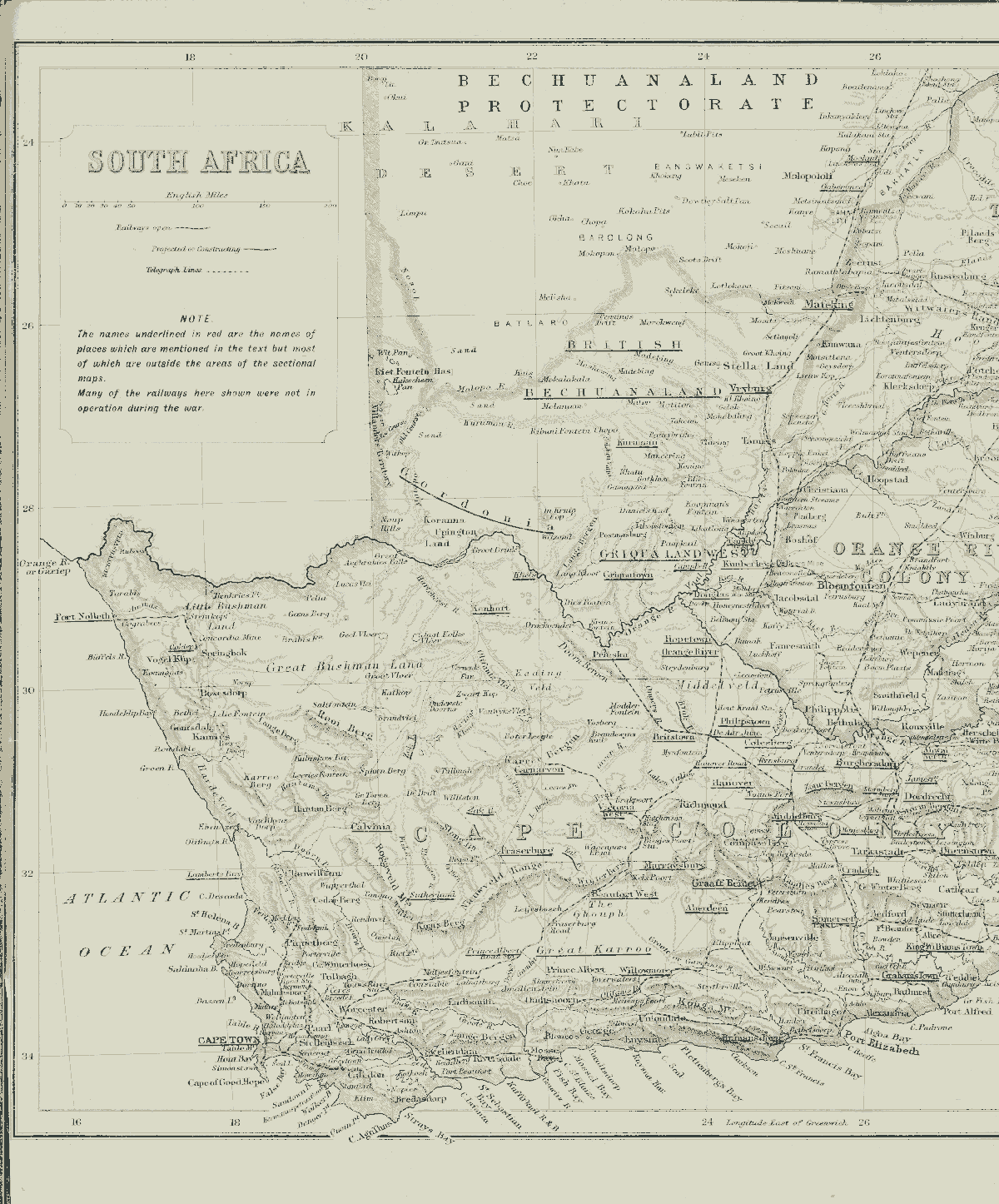
Sometimes a cause can be found a posteriori by groping in the dim and deceptive light cast by an effect: or a process of exhaustion and elimination may be set up in which the qualities common to each side are cancelled and the result attributed to the credit balance which will appear under one of the accounts. We saw for some months a gallant and well equipped if somewhat amorphous British Army impotently endeavouring, though in superior numbers, to make headway against an aggregation of Boer commandos, and checked at various points on an arc drawn wholly in British territory and extending in a circuit of over 500 miles from Ladysmith in Northern Natal through Stormberg and Colesberg to Kimberley and Mafeking; and at each extremity of the arc was a besieged city. Was the military art as taught in Europe founded upon error, or had the British Army been negligently instructed in it?
Yet no European troops had had so much recent experience of active service. We had lately fought in the Soudan, in East and West Africa, in Burmah and on the North-West frontier of India; there was in fact hardly a year in the preceding decade in which the portals of the temple of a British Janus would have been closed. Moreover, our fighting had not been against trained soldiers, but against enemies who like the Boers were undisciplined, collectively if not individually brave men patriotically defending their own country. We therefore entered the arena with experience which no other European Army possessed.
{19}Many hard things have been said of Patriotism.6 Dr. Johnson's definition is well known, and more recently it has been styled the sublimest form of Selfishness. These, however, are not definitions but rather criticisms of certain phases of Patriotism, which is closely allied to Family Affection and, like that sentiment, originates in the helplessness and the egotism of the Individual.
The weak infant clings to his mother for sustenance, comfort and protection, and the tender care which is bestowed upon him while his body and his mind are developing fosters the notion of the subjective importance of the human unit. Human nature is so constituted that the Individual is disposed to over-estimate his own consequence and to regard his own surroundings as superior to the surroundings of all other persons, and therefore more worthy of recognition, encouragement, and admiration. As the Child grows in years this sentiment is gradually and unconsciously modified, but it is never wholly eradicated. The inward emotion aroused in his heart by parental solicitude becomes partially altruistic and outward and is transmuted into Gratitude and Love.
The Child emerges into Youth and thence into Manhood, and the area of his immediate environment is enlarged. He needs further succour and assistance, and the Family Community to which he belongs and which nurtured and watched over his early years can no longer supply his requirements. He is in want of new fellowships and must strengthen himself by joining various bodies and associations. With these he incorporates himself more or less and his friendly attitude towards them for his own good is a development of the primitive Family Affection. In the case of a class, a social, or professional community the sentiment is termed Esprit de Corps;7 {20} in view of recognized civil institutions by which he perceives that he benefits, it is Loyalty; while with respect to the Fatherland it is Patriotism, which denotes the adherence of the helpless individual Ego to the Supreme Community. Patriotism, like Family Affection, is a growth and culture of the idea of Self. It is the expression of the Individual's thanks for the support, countenance, protection, and other moral and material advantages claimed by him from the Supreme Community, to which in return he readily attorns with respect and admiration. He is, however, patriotic because with unconscious egotism he regards his Country as part of himself rather than himself as part of his Country. Even the act of a man who sacrifices his life for the good of his country may not be wholly unselfish, for some natures are so constituted that they can discount the future and be gratified by the prospective award of posthumous honour. There can, however, be no doubt that Patriotism, though possibly of not very noble origin, is a sentiment beneficial both to the community and the individual, and is therefore worthy of encouragement. Happily, those cold heights of philosophy on which every man is loved as a brother and every nationality held in equal honour and esteem are unattainable by human nature; for without the stimulus of Patriotism National Life would be impracticable.8 {21} It's chief defect is that like most of the emotions it is sometimes hasty and unreasoning.
Such, it is believed, is briefly the history of Patriotism, and the theory is supported by the fact that the British soldier is not patriotic by nature. It is not his fault. The class from which he is usually drawn has unhappily less reason for respecting and admiring the Supreme Community than any other class, for it participates fully in the distresses and meagerly in the successes and good fortune of the Nation, from which, though not actually unpatriotic, it stands sullenly aloof. It can hardly be denied that the power and prosperity of Great Britain have favourably affected the position of the upper and middle classes to a greater degree than they have ameliorated the condition of the lower classes, and it is therefore not surprising that the latter seem to take little or no pride in their nationality, and sometimes even act perversely in opposition to its interests.
The private soldier has never been taught to think about his country. The education which he may have received at the Board School is not calculated to arouse in him a feeling of national pride which is non-existent in his home life. The display of the National Flag, which flutters over so many distant lands, is discouraged in the primary schools of Great Britain as tending to "flag-worship." In the United States, on the other hand, the Stars and Stripes are hoisted in every school yard. No systematic effort is made to interest the children of the operative classes in Greater Britain. India and the Colonies are facts in geography troublesome to learn and easy to forget. The history of the British Empire is sterilized before it is imparted to them. They are not taught to realize that the happiness and prosperity of a large proportion of the inhabitants of the world are dependent upon the moods of the population of a small group of islands in the Atlantic Ocean, and that in the ballot-boxes of Great Britain are cast the fortunes of many millions of their fellow-creatures.
{22}Foreigners have remarked that the minstrelsy of Great Britain is singularly devoid of patriotic songs. The British soldier has no "Star-Spangled Banner" or "Wacht am Rhein" to sing on the line of march or in the bivouac, but only the last comic or sentimental ditty which he may have heard at the Garrison Music Hall before embarking on active service. The National Anthem is not a patriotic song but a prayer for Divine Protection for the Sovereign, to which have been appended some inappropriate stanzas now rarely heard; while "Rule, Britannia!" might have been composed for the gasconading swashbuckler of an extravaganza.
It would therefore be surprising if the recruit joined the Army with a highly pitched conception of the work he has undertaken. Destitution; or trouble about a woman, or with his own people, or with the police; or the mysterious magnetism of an adventurous life rather than the desire to serve his country, has induced him to enlist. An existing or prospective War always keeps the recruiting sergeant busy, but the object of a War is a matter of indifference to the recruit. Most of our wars have been waged for political reasons which he cannot understand. Apart from the difficulties of language and of unaccustomed environments, he would as readily serve in any other Army in which the pay was as liberal and the restraint of discipline not more irksome. How is it, then, that lacking the stimulus of Patriotism through no fault of his own and being, in fact, a mercenary, he becomes an excellent soldier; perhaps, next to the Turk, the best in Europe?
The answer seems to be that he soon acquires a high sense of Duty. Duty may be defined as the necessity to do something for one's own or for the general good which is not naturally pleasurable or agreeable or instinctively desired. In the trite proverb it is contrasted with and takes precedence of Pleasure. As a motive for action it stands on a higher plane than Patriotism.
{23}The alchemic process by which the indifferent, unemotional, and sometimes unintelligent recruit is transmuted into the precious metal of the soldier who wins battles seems to be somewhat as follows: Of his own volition he has taken on a certain job and his dogged pride or obstinacy will not allow him to be beaten by it, however little enthusiasm it may arouse in him and however distasteful it may be to him at first. He offers no "ca' canny" service, but plods on and does his best in his own way. The lack of the enthusiastic temperament does not seriously retard the progress of his military education, and without much ado he becomes a stolid dependable unit of the Army. He is not carried away by success nor unduly depressed by failure. His instincts tell him that they are the accidents of Duty.
It has been noticed that the word Glory and its derivatives9 rarely appear in the accounts of the action of the British Army on service, except in a War Correspondent's letter or telegram. No reference is made in reports, orders or despatches to the so-called "glorious" incidents of a soldier's life in time of war. He is commended for his endurance, his tenacity and his matter-of-fact acceptance of the vicissitudes of war as "part of the day's work." The truest Glory is the conscientious performance of Duty.
If through the incompetence or neglect of his leaders he is called upon to sacrifice himself, he sacrifices himself without a murmur. If he is compelled to keep himself alive on scanty rations of horseflesh and to wet his parched lips with the trickle of a dwindled and tainted spruit, he believes that his officers have done their best for him. He is ordered to fall in upon the deck of a burning troopship and to stand at attention while Death inspects the ranks. He is besieged in a hill fort on the Indian frontier by a horde of fanatics eager to kill or to mutilate him. He lies wounded on the field of battle from which, after an indecisive engagement, each combatant {24} has retired; and there, scorched by the mid-day sun and starved by the cold of the night, and perhaps also in danger of being burnt alive by a veld fire, he waits without water for the armistice which shall bring up the ambulances. He returns to his own land where he soon finds that he is not of much account. After a great war there may be a period of evanescent patronage; or a deed of Dargai, Rorke's Drift, or Balaklava may have temporarily thrilled the audience into Music Hall enthusiasm; but he is not greatly impressed, and stoically reflects that like the battle, the starvation, and the Field Hospital it is "all in the day's work" and will soon pass away.
There has probably never been a struggle in which the private soldier more fully earned the gratitude of his country than in the South African War. The most unfriendly critics in the foreign staff offices have paid tribute to the excellence of the British soldier: sometimes, however, sneering at him as a mercenary, whom, by a curious perversion of the probabilities, they profess to think unlikely to be as efficient as their own conscripts who are forced into military service; but they never hold him responsible for the ill-success of the war. Throughout their criticisms there lurks a feeling of pained astonishment that the British "mercenary" proves himself to be as good or even a better soldier than the continental conscript, coupled with a comfortable conviction that Discipline is not well maintained in the British Army.
The final cause of Discipline is the efficient use of arms on the field of battle. Discipline is the result of an irksome educational process by which a man is taught to submit his wishes, his instincts, and, to a great extent, his personal liberty to the control of one who may be his inferior morally, mentally, and physically. It has also been cynically defined as the art of making a man more afraid of his own officers than of the enemy. Its function seems to be the formation of certain military qualities which Patriotism and the Sense of Duty are by themselves {25} believed incapable of creating. It has always been considered an essential part of a soldier's training; but this view, though probably correct, is not confirmed by the South African War, in which an undisciplined force held its own for some years against greatly superior numbers of disciplined men.
The ideal Army, patriotic, full of the sense of Duty, and perfect in discipline, would be invincible; but such an Army has never yet been seen. A deficiency of one or two of these qualities may be made up for by a fuller measure of the others. The history of each war will seem to indicate for a time the proportions in which the qualities should be blended, which is the essential, and whether any one of them can be omitted; but the inferences thus drawn from one war will probably be found misleading in the next war.
The inference to be drawn from the South African War seems to be that the value of those military qualities which are created by Discipline and training has been over-rated, and that a passionate bigoted belief in the justice of a cause is a more potent factor in the making of a soldier. Even if every allowance be made for the strategical advantages possessed by the Boers, of fighting in their own land on interior lines in a sparsely populated country peculiarly adopted for guerilla, it is difficult to account for their success if the tests by which the efficiency of a European army is measured are applied to them. It may be that war has hitherto been regarded too exclusively as a statical and dynamical problem and that the moral element has been overlooked. It certainly was overlooked in South Africa; for the war which Lord Roberts in October, 1900, believed was practically at an end had in fact then run little more than one-third of its course.
{26}The astonishment, distress, chagrin and bewilderment caused by want of success, "regrettable incidents," and disasters, sometimes found consolation during the South African War in the foolish remark—The Germans would have done no better. What the German Army, which had not been actively employed for twenty-eight years, might have accomplished under the same conditions is a matter for sterile speculation which has little bearing on the case. But the German Army certainly had not been accustomed to look upon War as a branch of Sport or Athletics.
Owing in all probability to the happy fact in History that England has not been invaded and over-run by a foreign army since the time of William the Conqueror—an episode which had in the end an excellent influence on the national life—she has never taken the military art seriously. She alone, thanks to the protection of Providence, has never been compelled to fight on her own fields for her existence as a nation; she alone knows nothing even by tradition handed down from distant generations of the appearance of an alien soldier on her shores.10 Some of her wars, as for example the successful struggle by which the Napoleonic domination was broken up, have been fought for the purpose of safe-guarding her independence, but they were not popular with the people at large, whose short sight did not permit them to see that a defensive war may have to be fought beyond the seas; and they had little or no effect in evoking a patriotic military spirit. Napoleon's gibe that the English were a nation of shopkeepers was not unasked for, and is still seasonable.
On the other hand there are hundreds of thousands of persons on the Continent of Europe who have seen, or who are the near descendants of those who have {27} seen, their fatherland ravaged; their homes destroyed; their relations, friends, and neighbours slaughtered in the defence; the tree of the national life maimed; and the full cup of the horrors of war drained to its dregs.
To them the prospect of an invasion is not a remote contingency to be considered and provided for at leisure after academical discussion, but a real and instant danger from which only universal service, to which fortunately for themselves they submit without much demur, as it could not be enforced upon a reluctant community, can preserve them.
The possibility of invasion is the dominant anxiety of the land-frontier nations.11 Across the frontier they can see the conscripts drilling who almost at a moment's notice may be marching in to attack them. Their armies are not sent on interesting little expeditions to restrain a too-militant tribe of hill-men or to patrol the distant marches of a magnificent Empire, but must stand at attention generation after generation, year after year, maintaining the featureless routine of military life. None of the Romance of War that falls to the lot of the British soldier—the service among strange Easterns in Asia, the building up of a new imperial province in South Africa, the constant change of scene along the posts which form a girdle round the world from Hongkong to Jamaica—falls also to the lot of the continental conscript, for whom there is only the dull waiting for the critical moment.
The land-frontier nations alone are aware of the reality of the Terror of War; it is a Thing overshadowing and, apart from every other thing in their world, which must not, cannot be expelled from their thoughts. The objects that meet the eye on all sides speak of War; the railway vehicles marked with the number of men and horses conveyable, the noble war memorials, the {28} officers constantly in uniform, the crowds of soldiers in the streets, the military bearing and precision of even the civilian servants of the State; while upon the ears falls the sound, which is in most cases a lingering echo of the roar of war, of alien tongues spoken within the frontier, or of the tongue of the Fatherland spoken in exile without it.
On the other hand, Peace is believed to be permanently settled upon the shore of the silver streak which encloses the British Isles. The war monuments are scanty and not a few of them are grotesque; the soldier and his work are thrust into the background, and his uniform is so often a hindrance to him that on certain occasions he is permitted to appear in plain clothes, that is to disguise himself as a civilian; and this concession is officially termed a "privilege." The red tunic of the soldier, like the red rays of the spectrum which cannot be brought into focus with the other colours, fails to make a sharp impression upon the British retina, but projects an ill-defined image seen through a medium of doubt and indifference.
The nation looks upon the Army much as the individual looks upon the Policeman, as a necessary institution, but one rather to be avoided and kept in its place when its services are not actually in requisition. Little interest is taken in its difficulties, its merits, and its opportunities. It is regarded not as an indispensable protection, but rather as an expensive result of possessions in all parts of the world, and when the peace of these is in danger of being broken, the cry too often belated goes up: Send for the Soldiers. Probably nothing less than an actual landing of foreign troops or the scare of it so tremendous as to drive the nation into the opposite and equally dangerous extreme of consternation and panic will be necessary to shake its belief, that the white cliffs of Albion are immune to an invasion in force.
The nightmare of Militarism by which so many worthy persons are fanatically obsessed obscures the dangers {29} against which Militarism is an insurance. Now Militarism is not in itself a desirable thing, and the developments and accidents of it upon the Continent of Europe are often not only irksome and absurd but also irreconcilable with the existence of a healthy feeling of self-respect in the non-military sections of the community, who are taught to regard themselves as an inferior caste; but with all its shortcomings it promotes the moral as well as the physical strength of a nation. It calls up some of the nobler qualities of human nature; self-control, self-reliance, endurance, and altruism or the devotion of Self to the good of the community; and not the least of its merits is that it corrects and restrains the dreary materialism of the Labour and Socialist movements.
The shy and distant bearing of the British nation and its persistent refusal to regard the Army as part of itself, in conjunction with the growing national passion for Sport and Athletics, fostered the idea that War itself must be a branch of them. From time immemorial the military had been eyed with suspicion by the country, which professed to believe that its liberties were in greater danger from its own soldiers than from the soldiers of a foreign power, and which for a long time withheld from its rulers the right of having a standing army. Gradually and with great reluctance it was convinced of the necessity of a permanent force, not so much for home defence as for the performance of the police duties of an Empire. As the Empire grew year by year, these duties became more onerous and responsible, but the Army itself was not taken seriously. It was confessedly too weak to engage in a European campaign, and the Navy was considered to be sufficient to protect the country against invasion.
The duties of the Army abroad were generally interesting and exciting but they did not call for the exercise of the military art with great precision, as the opponents which it was called upon to face were rarely experts, {30} and there was a comfortable belief that the bravery and endurance of the British soldier would outweigh deficiencies in other military qualities.12
The War-as-a-Sport idea was also encouraged by the opinion still stoutly held by many persons that a good sportsman is necessarily a good soldier, and that the qualities which ensure success in Athletics or Sport make also for success in War: but this is true of certain of them only. In so far as Athletics and Sport tend to manliness, self-reliance, good comradeship, endurance of bodily hardship, and contempt of danger, they are no doubt an excellent preparatory school for War. But there is one quality without the possession of which no man is held to be a good sportsman, and that is the acceptance of defeat or non-success with equanimity and good-humour as "part of the game." Without this quality Athletics and Sport would, in fact, become impossible.
In the soldier, however, this temperament is a dangerous gift. It led to reverses, captures, loss of convoys and other "regrettable incidents" being regarded with stoical composure as "part of the game"; and the victims were condoled with on their "shocking bad luck." It would have been difficult to discern from the bearing and demeanour of the typical officer whether he was at the moment a prisoner of war in the Model School at Pretoria, or had just taken part in the magnificent cavalry charge by which Kimberley was relieved. The former plight did not greatly depress him, nor did the latter phase of military life greatly elate him. It is probable that the War would have been brought to a successful close at a much earlier date if throughout the British Army and especially among the officers {31} hearty disgust and indignation at the failures of the first few months had taken the place of a light-hearted accommodation to circumstances. The companions of Ulysses may
With a frolic welcome take
The thunder and the sunshine,
but it is not War.
The British officer played at war in South Africa much in the same way that he hunted or played cricket or polo at home. He enjoyed the sport and the game, did his best for his own side, and rejoiced if he was successful, but was not greatly disturbed when he lost. A dictum attributed to the Duke of Wellington says that the Battle of Waterloo was won upon the Playing Fields at Eton. It would not be so very far from the truth to say that the guns at Sannah's Post were captured on the polo-ground at Hurlingham; that Magersfontein was lost at Lord's; that Spionkop was evacuated at Sandown; and that the war lingered on for thirty-two months in the Quorn and Pytchley coverts.
The sporting view of War was recognized and confirmed in Army Orders and official reports, in which the words "bag," "drive," "stop," and some other sporting terms not infrequently appeared. No one would reasonably object to the judicious and illuminating use of metaphor, but there are metaphors which impair the dignity of a cause and degrade it in the eyes of those whose duty is to maintain that cause. When the advance of a British Division at a critical period in the operations is frivolously termed a "drive," and when the men extended at ten paces' interval over a wide front are called "beaters," it is natural that the leaders should look upon their work as analogous to the duties of a gamekeeper; and when an artillery officer is instructed to "pitch his shells well up," he is encouraged to regard failure as no worse than the loss of a cricket-match.
It was at least to be expected that in the use, care, {32} and management of horses upon which the success of a campaign, in which mounted men formed an unusually large proportion of the troops engaged, so much depended, the sporting instincts of the British officer would have made him particularly efficient; yet the evidence given by General officers before the Royal Commission showed that it was otherwise. They are practically unanimous in the opinion that all branches of the mounted troops were inefficient, except the artillery, whose work so far as horses are concerned is akin to that of the skilful but unsporting farm teamster or wagoner.
A nation greatly addicted to Sport, Games, and Athletics is a nation lacking in that earnestness of moral purpose which should be its chief strength for War. Amusements are regarded not as "recreation" or means of refreshing and re-invigorating the mind and body for the duties of life by a temporary change of occupation, but as the main objective of existence.
A retrospect into history will show that the most efficient armies were those in which the sporting instinct was non-existent. The armies which in modern times have most satisfactorily performed the duties for which armies are raised were those of Gustavus Adolphus, Napoleon, Moltke, and Oyama. Each of these was the most perfect military instrument of its day, and their exploits have never been surpassed. Yet neither the Swedes, the French, the Germans, nor the Japanese were addicted to Athletics or Sport. Their manly instincts were exercised, to the great advantage of their countries, in skill at arms and in the Military Art.13
{33}The cult of Sport and Athletics sets up false ideals and lowers the intellectual standard. Thousands of loafers, idlers, and work skirkers live upon the anticipations or recollections of out-door sports when not actually present at them, and are ready to spend their last shilling at the turnstile of the ground on which a handful of football gladiators are at play: and are more exasperated by the defeat of the team which they patronise in a Cup Tie match than they would be by the loss of a battle by the British Army. There is this to be said for the working classes, that in youth, if not longer, they in general endure a hard and strenuous life, and at least in their school years they cannot indulge a passion for amusement; whereas the class from which the officers of the British Army are drawn is encouraged on the other hand to indulge it from childhood. Owing to the prominence given in the Public Schools and Universities to games and athletics and to the esteem in which proficiency in these is held, youths of the upper middle and upper classes are dumped upon the world not humbly but arrogantly ignorant of almost everything necessary to qualify them to take their proper place in the community. They have subsisted in a rarefied intellectual atmosphere, and to fit themselves for any profession for which they may have an inclination they have to be forced or "crammed" in a saturated atmosphere by which they are congested. The result is that "young officers now join the service with a very fair idea of cricket and football, bridge, and even motor-driving; but with no education in patriotism; no real acquaintance with the history or geography of their own or other countries; unable to write English concisely, or even grammatically;14 unaccustomed {34} to read general information for themselves other than under the headings of the Daily Mail; unable to talk a foreign language; and with no knowledge of the sciences which are of military use."15 To this may be added the fact that these young dullards, the supply of whom is dwindling, are, on joining the service, encouraged and accepted rather with reference to their sporting and social qualities than to their military capacity.
England, as a sporting, athletic, and game-loving nation, has of late years suffered many rebuffs. By the United States she has been taught the scientific method of riding racehorses, and also of sailing yachts; she has been defeated in polo by a Transatlantic team; her selected representative horsemen are unsuccessful in the International Military Tournaments; she cannot defeat Australia on the cricket field; a Belgian crew holds its own at Henley. If these rebuffs tend to abate the mania for watching the performances of a handsome but not particularly intelligent quadruped, and for studying the various methods of imparting motion to a Ball and to show the vanity of the passion for sports and games when indulged to excess, they will have served their purpose. The nation, disgusted at its want of success in its favourite pursuits, may perhaps turn its manhood to the noblest pursuit of all, the defence of the Fatherland; and then it will not be the betting and football news that has to be blacked out {35} of the daily papers in the free libraries, but the bi-weekly military gazettes, the reports from the military stations and the Special Correspondents' letters from Salisbury Plain during the manoeuvres.
Footnote 2:(return)In justice to the War Office it should be stated that this was inserted at the instance of Sir Redvers Buller, who believed that he would be able to raise in South Africa a sufficient force of mounted troops.
Footnote 3:(return)B. Viljoen in his "Reminiscences of the Anglo-Boer War" frequently complains of the insubordination, the malingering, and the cowardice of his followers, and of the incompetence of his superior officers.
Footnote 4:(return)"Kaffir" is an Arabic word meaning one who does not believe in the religion of Mahomet. It was introduced into South Africa by the Portuguese and subsequently applied to the tribes living on the N.E. of the Cape Colony.
Footnote 5:(return)Zilikat's Nek in the Magaliesberg is named after him.
Footnote 6:(return)In its crudest and least admirable form Patriotism may be expressed in the terms of an equation—
One Englishman=Two Aliens.
Footnote 7:(return)Esprit de Corps in the British Army is the predilection of the individual for the unit in which he is serving. It creates a healthy rivalry which, on the whole, makes for efficiency; but its effects are sometimes unfortunate. A distinguished regiment was accused of misbehaviour in one of the battles of the advance on Bloemfontein. The charge was unfounded, but some of its hasty partisans, with the idea of removing the reproach as far as possible from Self and forgetful that the honour of the British Army is not contained in water-tight compartments, endeavoured to transfer the imputation to another regiment in the same brigade.
Footnote 8:(return)The citizens of a Republic are usually more patriotic than the subjects of a Monarchy. This may be accounted for by the fact that a Republic is usually a new nation or a nation that has made a fresh start and has not had time to get tired of itself.
Footnote 9:(return)Lord Roberts once used the word "glorious."
Footnote 10:(return)Except the French raid at Fishguard in 1797.
Footnote 11:(return)The Franco-German War cost France £600,000,000 exclusive of the loss from suspension of business and commerce.
Footnote 12:(return)The attaché of a Great Power noticed in the South African War an aversion to the tedious duties of outposts and reconnaissance, and he remarks that "it is often openly stated by British officers that it is better to get now and then into a really tight place by the neglect of these duties than to have to endure the constant irksomeness which they entail."
Footnote 13:(return)Apart from the question of the relative importance of the two services, it can hardly be denied that the British Naval Officer is an asset more valuable to his country than his brother in the Army. The social side of his character may be more rugged and less acceptable, but as a rule he has had neither the time nor the inclination to fritter away his manhood in sporting pursuits which do not make for proficiency in his profession, and he therefore excels in it; in spite of trying conditions which do not exist in any other calling, for with some rhetorical exaggeration it may be said that in the lower ranks he is an abject slave, in the higher an irresponsible despot.
Footnote 14:(return)To the various courses, ranging from Balloons to Economics, which are open to British Officers, might be added a course in English Grammar and Composition, for the instruction of staff officers and others who may have to formulate battle orders and despatch important telegrams on active service. The art of composing a clear, terse, and unambiguous order or telegraphic message is not studied in the Army. Not a few telegrams of vital importance in the South African War were composed by impressionist staff officers who lightly assumed that what was present in their own minds must necessarily also be present in the mind of the recipient. The author particularly remembers a certain telegram from a staff officer of a column, in which it was impossible to discover from the context whether the word "they" in the concluding paragraph referred to British Columns or to Boer Commandos previously mentioned.
Footnote 15:(return){36}Major-General Baden-Powell, in Cavalry Journal, April.
The northern section of Natal before the war16 roughly assumed the shape of a wedge driven in between the Transvaal and the Orange Free State. The Drakensberg Range on the one side and the Buffalo River on the other formed the cleaving surfaces, Majuba and Laing's Nek were the cutting edge, and the base was the Tugela River.
In mechanics a wedge is an instrument which can be usefully employed only under favourable circumstances. It has many disadvantages. It is easily jammed. The driving power at the base must be considerable; much of the force is absorbed by the friction on the surfaces; the progress made is very slow; and if the surfaces encounter a more tenacious material they will be perforated. A wedge is intended chiefly for cleavage and disruption when less clumsy methods are not at hand.
The defects of a wedge as a mechanical power at once became apparent to the British force which occupied Natal when war became inevitable. The cutting edge was inaccessible and liable to injury which could not be easily repaired; much trouble was anticipated from the presence of Boer commandos in contact with the surfaces; the base did not appear to be sufficiently well designed to receive the impact of the propelling force; and there were grave doubts as to the soundness {37} of the material of which an important section of the wedge, namely Ladysmith, was constructed.
It was therefore proposed by the military authorities that the Natal wedge should not be used as an instrument in the war. To this the civil government at Pietermaritzburg strongly objected on account of the evil moral effect which the abandonment of a considerable proportion of the Colony to the enemy would exercise upon the general situation in South Africa, and of the loss of prestige which the evacuation would entail in the minds of the natives, who numbered three-quarters of a million. Under pressure from the Colonial Office, and against its own judgment, the Army of Natal set itself to work upon the Wedge.
The mistake soon became manifest, although the artisans did their best. The Wedge was not an effective instrument; its cutting edge was never in operation; and in a very few weeks it was hewn into a mangled, cumbrous and irregular mass, which could neither be advanced nor withdrawn and which for nearly five months led a precarious and unhappy existence. Its distress necessitated the recasting of the plan of the South African campaign and a pernicious "moral effect" was not avoided. One British Army besieged in an open town surrounded by heights, while another was lying impotent upon the banks of the Tugela, eighteen miles distant, was the result of a few weeks' work with the Natal Wedge, which had been forced by the civilian strategists into the reluctant hands of the troops.17
When Sir George White arrived in Natal on October 7 he found Sir W. Tenn Symons carrying out the wedge policy of the Colonial Government. Part of the latter's force was at Ladysmith and part was protecting the collieries in the Dundee district. It was his intention to advance northwards to Newcastle as soon as he was {38} reinforced by the contingent on its way from India, the full strength of which had not arrived at Durban. The position at Dundee was strategically defective, as it was exposed to a raid from the Transvaal border only twelve miles distant, and it was actually further from the Orange Free State than Ladysmith. Its defects as a tactical position were still more obvious as it was commanded by hills.
Such, in a few words, was the situation with which White was called upon to deal. He had two courses before turn; he could accommodate himself to it or he could endeavour to modify it. He attempted the latter, and failing he recurred to the former. He saw at once the insecurity of Symons' detached force, but being unable to convince the Natal Government of the necessity of withdrawing it he reluctantly allowed it to remain.
Soon the Boer plan of campaign, which aimed at the isolation of the British Troops in the wedge, began to unroll itself. Fourteen thousand Transvaalers under Joubert, who had first tested the cutting edge by sending a coal truck through the tunnel at Laing's Nek and who suspected an ambush when he found it clear, were moving south on Newcastle, while six thousand Free Staters under Martin Prinsloo were pouring through the Drakensberg passes west of Ladysmith. The Natal Government now began to feel uneasy about the safety of the colonial capital and even of Durban; and informed White that undue importance had been attached to the occupation of Dundee and that its retention was no longer desirable. Thus in little more than a week White's original objection was reconsidered and upheld. But again he allowed his better judgment to be over-borne. Symons, whom he instructed to withdraw southwards unless he felt his position to be absolutely secure, was at his own urgent request allowed to remain. Next day, October 19, Elandslaagte, on the railway between Ladysmith and Dundee, was occupied by a Boer commando, and it was reported that 4,000 burghers {39} were ready to cross the Buffalo River at Jager's Drift during the night.
Symons' camp was pitched about a mile west of Dundee which lay between it and Talana and Lennox Hills, which commanded the town from the east. Some hours before sunrise on October 20 a British picket on Talana was attacked. The incident was reported to Head Quarters, where it was not deemed to be of much importance and the routine duties of the morning were not interrupted. The artillery horses had been taken down as usual to water, and some companies had even fallen in for skirmishing drill, when the curtain of the morning mist upon the higher ground was raised to the first scene in the Natal drama. The eastward hills, looming up darkly into the brightening sky, were seen to be occupied in force by the enemy under L. Meyer, and soon his shells were falling among the tents.
The troops in camp, though taken by surprise, pulled themselves together with admirable promptitude. The Boer guns were soon silenced, the figures of men silhouetted along the sky line vanished, and the infantry was ordered out to clear the hill. It was a formidable and dangerous task, but it was facilitated by some of the features of the ground. There was a dry river bed in which the troops could be formed up for attack, and, half a mile beyond, a farmhouse and a plantation afforded some cover; while a donga on the left at right angles to the river bed apparently offered a covered way up the hill to the crest. In the plantation occurred the first calamity of the war. Symons, who had come up impatiently from the lower ground to hurry up the assault, which he thought was being unnecessarily delayed, was mortally wounded. Three days later he paid with his life for his adherence to a forward policy in tactics as well as in strategy; and the command devolved upon Yule.
The donga on the left was found to be useless, as it led nowhere; and the advance was made directly from {40} the plantation towards a wall running along the foot of the hill. Here a long halt was made in order to reorganize the attack, and when the word was given the men pressed forward and threw-themselves upon the rough front of the acclivity after a rush across an open slope. The crest was attained and carried without much difficulty; for all but a few stalwarts had quitted it when they saw the British bayonets pricking upwards towards their hold.
It seemed now that the victory was won, but an unfortunate mistake postponed it. The two field batteries on the plain, which had ceased fire before the final infantry rush, changed position and came under a heavy fire from the Boers who were still in possession of a section of the Talana ridge. The light was bad and the guns re-opened upon the crest line in the belief that the whole of it was still occupied by the enemy. The practice was excellent, and in a brief space both sides were driven off the hill by the shrapnel. A subsequent attempt to take it was successful. The result of the battle, which lasted from sunrise until 2 p.m., might have been reversed but for the inaction of the main Boer force posted on Lennox Hill under L. Meyer, and of another force on Impati under Erasmus, who, though he could hear the noise of battle pealing through the mist which lay upon the hill, abstained from intervening.
The whole Boer force was now in full retreat along the line by which it had advanced so silently the night before, and Yule ordered the two field batteries up to the nek between Talana and Lennox to pound the retreating burghers as they slowly trekked towards the Buffalo River; but again an unfortunate misapprehension intervened. The officer in command, being under the impression that an armistice asked for by Meyer two hours before had been granted, refrained from opening fire and the Boers escaped untouched. A serious misadventure marred the success of the day. {41} The 18th Hussars, who at the commencement of the action received orders to hold themselves in readiness to advance when occasion offers, soon appeared to the restless general to be losing their opportunity, and were hustled into activity. They charged in various directions and even made some prisoners; but one squadron lost its way and was captured in an attempt to ride round Impati by a detachment of Erasmus' force at a farm where it had taken refuge.
The fight for Talana Hill encouraged each belligerent. In England it was received as an indication of the early and successful termination of the struggle. The Boers regarded it as a reconnaissance in force from which they had returned with slight loss, and they could boast that they had reaped the first fruits of the harvest of war; a squadron of British cavalry which, with the commanding officer of the regiment, was at once dispatched into captivity at Pretoria, where its arrival was accepted as a proof of a great Boer victory in Natal.
Talana Hill regarded as an isolated event in the Natal campaign was a distinctly successful encounter, the credit of which is due entirely to the infantry engaged in it. Twice the artillery blundered, and the cavalry was inoperative. The extent of the loss suffered by the Natal Field Force in the death of Symons must always be a matter for speculation. But it is at least probable that if he had survived to take part in the subsequent operations, his ardent, impetuous, Prince Rupert like temperament would have beneficially impregnated with greater audacity the stolid and ponderous tactics and strategy of the Natal campaign.
The unreality of the Talana Hill victory soon became apparent. The threat of Erasmus sitting on Impati still impended, and Yule moved his camp next day to a site which he believed to be out of range. But in the meantime Erasmus awoke from his trance and, on the afternoon of October 21, opened fire with a six-inch {42} gun,18 and again Yule was compelled to shift his camp. He had already asked for reinforcements, but White was unable to spare them, and recommended him to fall back upon Ladysmith. Next day Yule was encouraged by the news of a British success at Elandslaagte; and with the object of intercepting the Boers who were reported to be retreating on Newcastle, he endeavoured to seize Glencoe, but Erasmus on Impati forbade the movement.
Shortly before midnight on October 19, Kock, a Free Stater who commanded a force chiefly composed of foreign auxiliaries and who was working southwards from Newcastle, sent on an advanced party to swoop down upon the railway between Ladysmith and Glencoe, and Elandslaagte station was seized. Early next morning Kock came in with his main body. White at first made no serious attempt to clear the line beyond sending out a reconnoitring force which he soon recalled, as he was reluctant to employ troops away from the immediate neighbourhood of Ladysmith, which had been already threatened on the N.W. by Free State commandos.
The news however of Yule's success at Talana changed the situation and seemed to justify a more forward policy; and early in the morning of October 21 French was sent out to re-occupy Elandslaagte and repair the line. Although he succeeded in driving the enemy out of the railway station and in holding it for a very brief period, he found himself outclassed in artillery and too weak to stand up to the Boers, and withdrew a few miles southward; at the same time asking White to reinforce him. It was reported that Kock expected shortly to be reinforced.
The main Boer position was on the northern limb of a horseshoe arrangement of kopjes which develops close to the railway station and swings round southwards and westwards, at an elevation generally about 300 {43} feet above the normal level of the ground. Two posts were also held north of the railway. The southern limb of the horseshoe was lightly held, and against it French, without waiting for the arrival of all his reinforcements, moved with his mounted troops, and easily cleared it. Here he was joined by the Manchester Regiment, one of the battalions of the brigade of infantry sent out by White under the command of Ian Hamilton, and established himself on the left flank of the Boer position on the two kopjes on the northern limb of the horseshoe.
The other two battalions, the Devonshire Regiment and the Gordon Highlanders, simultaneously came into position, the former for a frontal attack, and the latter as a reserve acting in the interval between the Manchesters and the Devons; while the artillery advanced between the two limbs and shelled the enemy's position on the kopjes. The artillery preparation enjoined by the regulations had, however, to be curtailed owing to the approach of night, but not before the two Boer guns on the southern kopje were silenced; and then the main attack was delivered.
The Boers on the kopjes were reinforced by a body of German auxiliaries under Schiel, who had been driven out of a position north of the railway by the cavalry acting on the left and who circled round to the main position, but the reinforcement did not avail them. Hardly pressed on their left, they were unable to withstand the frontal charge of the Devons led by Hamilton in person. The guns were captured and the position occupied at sunset. By this time most of the Boers were in retreat and their tracks were made devious by the cavalry, which so long as light remained harried them hither and thither.
Suddenly a white flag was seen fluttering near the laager between the kopjes. There is no reason to believe that it was treacherously raised, but it compelled Hamilton to order the Cease Fire. Yet at once half a hundred Boers started up and rushed as a forlorn hope upon {44} the crest: a remnant of stalwarts, who even succeeded in firing a round or two from the guns which had just been taken from them. There was a moment or two of doubt and bewilderment, but Hamilton with the help of a few junior officers rallied the waverers, and earned the Victoria Cross, which on account of his high military rank was withheld from him; the guns were recovered, the laager rushed, and the tactical victory was complete.
Elandslaagte was as unreal a victory as Talana. The troops had not rested many hours in their bivouacs on the ridge before they received orders to return without delay to Ladysmith, which was still threatened from the west by the Free State commandos; and by noon on October 22 not only had Elandslaagte been hurriedly evacuated, but stores, ammunition and even some prisoners had been left behind in the scuttle. Next day it passed without effort into the possession of a small body of Free Staters, who were astonished to find it abandoned.
Meanwhile Yule after the failure of his movement on Glencoe found his position insecure and reluctantly resolved to retire on Ladysmith, although it entailed leaving not only his supplies and ammunition but also his wounded behind him. The victory of Talana had indeed been won but the victors were exhausted by it and unfit to stand up to Erasmus on Impati. It became necessary for Yule to disappear immediately and stealthily.
On October 23 soon after midnight the maimed and harassed force slipped quietly away and trudged wearily to the south. When the mist rolling aside next morning disclosed the evacuation the Transvaalers on Impati occupied the town almost simultaneously with the reoccupation of Elandslaagte by their allies the Free Staters; and thus the battlefields of two British victories were redeemed by the defeated. It is no reproach to Yule that military necessity compelled him to leave behind {45} the wounded of Talana Hill. The death of Symons on October 23 was a pathetic episode of the Natal Campaign. He passed away of his mortal wound while the Boers were looting the camp in which he was lying and wondering, in the rare intervals of conscious thought, why the troops whom he had led so gallantly had been taken from him; and for half a year his grave lay lonely in the enemy's country before another British soldier could stand beside it.
The retreat of Yule's force was effected without more trouble than that which was caused by the nature of the country and the alternations of the climate. Van Tonder's Pass—a difficult defile which would have been impassable under opposition—was crossed, and a sudden spate on the Waschbank river only temporarily checked the retirement. A column was sent out from Ladysmith by White to check the Free Staters who had re-occupied Elandslaagte and to prevent them falling on Yule, and on October 24 they were engaged with success at Rietfontein. The sound of the artillery in this action was audible to Yule on the Waschbank, but he was unable to account for it.
On the afternoon of October 25 Yule was within one day's march of Ladysmith. He proposed to halt for the night; but suddenly a patrol from a column sent out by White to help him in appeared, and he received orders to press forward to Ladysmith.
The exhausted men resumed their march, and the misery of that night's journey was probably never exceeded during any subsequent movement in the war. Sodden, hungry, weary, disheartened; men and transport animals inextricably intermingled; the column plodded onwards in the rain and the night. A halt at daylight next morning brought in some of the stragglers and gave a little rest to those who were still in the ranks; and by mid-day the men of Talana Hill had trudged into Ladysmith.
The urgency of the immediate resumption of the {46} march had arisen from White's anxiety for the safety of Yule's force. Rietfontein had indeed, like Talana and Elandslaagte, been a tactically successful engagement and had similarly been followed by a retreat; but Yule was exposed to an attack by Erasmus, to whom he had given the slip at Dundee during the night of October 22 and who was known to be endeavouring to overtake him. Erasmus was believed to be acting from the direction of Elandslaagte; but fortunately for Yule his movements were not judiciously directed and his information was imperfect.
All the detached members of the Natal Wedge had now been driven in and the reconnaissances sent out by White on October 27 and the following days showed that the Boers had lost no time in pressing on to Ladysmith. The Transvaalers were apparently in force N.E. of the town on a section of the arc in which Lombard's Kop, Long Hill, and Pepworth Hill were the chief physical features; the Free Staters were approaching from the N.W. and a small force of them under A.P. Cronje was already in touch with the Transvaalers; their main body, however, seemed to be making for the Tugela in order to isolate Ladysmith from the south. On October 29 White assumed the offensive with the greater part of his command, and endeavoured to cut through the still unconsolidated investing line and to thwart the co-operation of the allies.
The general idea was that an infantry brigade, supported on its right flank by cavalry acting towards Lombard's Kop, should attack the enemy, who was presumed to be in force on Long Hill and Pepworth Hill. On the left flank of the attack a column would endeavour to pass through the Boer line, and having seized Nicholson's Nek due north of Ladysmith would either close it against the retreating enemy or hold it as a post through which a mounted force could debouch in pursuit on to the more practicable ground beyond.
Some difficulty in drawing and loading up ammunition {47} delayed the start of the column, which under the command of Carleton was to secure the left flank of the operations; and fearing that daylight on October 30 would find his vulnerable force still on the march he determined soon after midnight to halt short of Nicholson's Nek, from which he was then two miles distant. He had succeeded in passing through the enemy's picket line, and was perhaps not justified in discontinuing his advance, although his instructions were to take Nicholson's Nek only "if possible." But an error of judgment made by a commanding officer on a dark night in a strange country acting under instructions which left him a free hand must not be judged severely, and had it not been for a disaster which could not be foreseen, he would probably have been commended for his prudence.
Kainguba Hill, which rises on the left of the road to Nicholson's Nek, seemed to offer a suitable stage on the journey and towards it the column was diverted. While the men were climbing the steep and stony hillside a panic suddenly seized the transport mules. It may have been a spontaneous emotion, or it may have originated in an alarm raised by the Boers who were holding the crest. The animals stampeded down the slope, and carrying with them not only the reserve ammunition but also the signalling equipment, the water carts, and the component parts of the mountain artillery, charged through the rear of the column. The timely exertions of the officers checked the general scare that was imminent; and with the exception of a few score of infantry men and gunners the column reached the summit before daybreak, having lost almost everything needed for a successful occupation of it.
Misfortune continued relentlessly to pursue the column. A position was taken up on the hill on the supposition that it could only be attacked from the south, but at daylight C. de Wet, who here came upon the stage which afterwards he often filled so effectively, {48} threatened it from the north with a Free State commando. A gesture made by an officer in order to attract attention was interpreted as a signal to retire; another officer thinking that his company was left alone on the summit, though it was in fact within seventy yards of an occupied sangar, raised the white flag; and almost at the same moment a bugle sounded the Cease Fire. Neither the white flag nor the bugle call was authorized by Carleton; but a glance at the situation showed him that they could not be repudiated and after a gallant struggle to maintain an indefensible position he surrendered. Nearly a thousand men were led away into captivity.
The main infantry attack was made by a force of five battalions with six field batteries under the command of Grimwood. He marched out of Ladysmith soon after midnight, but had not covered half the distance to the point of attack when an unfortunate incident deprived him of all his artillery and of two of his battalions. The guns marching in the centre of the column and acting under orders which were not communicated to Grimwood, diverged to the right and were followed by the two battalions in rear; and the absence of nearly half the force was not discovered by him until daybreak, and after he had taken up the position assigned south of Long Hill. Daybreak also revealed the fact that Long Hill which was assumed to be the Boer left was not occupied, and that Long Tom from Impati had been emplaced on Pepworth Hill. The cavalry brigade under French upon whom Grimwood relied to protect his right flank was two miles away in his rear; and finding himself attacked on that flank instead of from the front he was compelled to swing round and almost reverse his front. Thus far the general scheme of attack had signally failed. Carleton on the left had not reached Nicholson's Nek and was in trouble; Grimwood with nearly half of his command gone astray, and having discovered that the enemy's left was not on {49} Long Hill but on Lombard's Kop, had to improvise a scheme of his own; while French instead of conforming to Grimwood was compelling Grimwood to conform to him. At 8 a.m. Grimwood was suffering severely from artillery fire, and French whose cavalry now prolonged Grimwood's line southwards was with difficulty holding his own. The enemy, whom the general idea destined to be outflanked and rolled up towards the north and pursued by mounted troops issuing from Nicholson's Nek, was instead attacking vigorously from Lombard's Kop on the east and seemed likely to outflank White; the infantry reserves under Ian Hamilton were almost expended; and the British artillery was unable to silence the Boer guns.
All through the forenoon Ladysmith and the little garrison left behind for its defence was the target of Long Tom on Pepworth Hill. The fugitives from Kainguba brought in disheartening reports and the Boers seemed to be threatening from the north. W. Knox, a Horse Artillery officer who had been left in command, anticipated an attack which he had little chance of meeting successfully with the scanty force at his disposal and sent an urgent message to White, who at noon ordered the battle to be broken off and the troops to retire to Ladysmith.
The retreat was effected in confusion. Grimwood's force was the first to be withdrawn and was saved from disaster by the gallant stand made by two field batteries as it crossed the level ground. The cavalry scampered home in Grimwood's track. A dramatic episode brought the battle of Lombard's Kop to a close. Just as the baffled troops were entering Ladysmith a battery of naval guns, which had arrived from Durban that morning and had gone immediately into action, succeeded in silencing Long Tom and some other guns on Pepworth Hill, nearly four miles distant. In the evening Joubert sent in a flag of truce to White to announce Carleton's surrender.
{50}The Natal Wedge disappeared in the smoke of the battle of Lombard's Kop and was never again heard of as an instrument in the Natal campaign. The Boers filled the gaps in the investing line without difficulty, and on November 2 the Siege of Ladysmith began. The last man to leave the town was French, who went forth to win honour on distant fields.
Footnote 16:(return)In 1902 the Vryheid and Utrecht districts of the Transvaal were annexed to Natal and the wedge disappeared.
Footnote 17:(return)They were indeed authorized as early as October 18 to throw it aside but by that time they were committed to its use.
Footnote 18:(return)"Long Tom," which was afterwards sent to Ladysmith and subsequently to bombard Rhodes in Kimberley.

The arrival of Sir Redvers Buller at Cape Town on October 31, 1899, the morrow of the battle of Lombard's Kop, encouraged the despondent at home and in Cape Colony.19 Twenty years previously he had distinguished himself in the command of a Boer contingent which served with the British Army during the Zulu campaign; and it was doubtless from the experience then gained that he formed the opinion that the war which he was now called upon to direct, could be brought to a successful conclusion only "by the actual conquest of every man in the field: a task doubly difficult owing to the extreme mobility of the enemy."
In his first telegram to Lord Lansdowne he described the situation as one of "extreme gravity."
White, with five-sixths of the British Troops in South Africa, was shut up in Ladysmith; a month at least must elapse before the Expeditionary Force, which the British Government had on September 22 decided to send out, would be able to take the field; Mafeking was besieged; the diamond men of Kimberley, like a passionate child interned in a dark room, were screaming for release; Sir Alfred Milner was pleading that the defence of the Cape Peninsula, an area of a few thousand square miles as far removed from the front as Marseilles {52} is from Berlin, must be first attended to; President Steyn had overcome his scruples and was sending Free State commandos across the Orange River into the Cape Colony at Bethulie and Norval's Pont; the disaffected colonials were restive; and the fall of Ladysmith, which seemed probable, would lay Natal open from the Tugela to the Indian Ocean.
It was a dismal outlook; but Buller, after a few days' review of the situation, was able to report that in his opinion the opposition would probably collapse when Kimberley and Ladysmith were relieved. His optimism at Capetown was destined soon to be superseded by pessimism on the Tugela. He compared himself to a man who, having a busy day before him, has overslept himself. The original plan of campaign, a march on Pretoria through the Free State, had necessarily to be postponed; and the important railway junctions at Naauwpoort and Stormberg were too weakly held and too liable to investment by the Free State commandos which had crossed the Orange to justify their retention, and the little garrisons were withdrawn. To Gatacre and French, who had just escaped from Ladysmith, was assigned the duty of holding the centre, while Lord Methuen advanced to the relief of Kimberley.
It was, however, the situation in Natal which gave the most anxiety to Buller. The Free State commandos which had been seen passing Ladysmith shortly before the investment were now at Colenso, having driven back to Estcourt the small British force which was all that was left to stem the tide of an invasion. The Free Staters, fortunately, were not active and delayed to avail themselves of the opportunity. When at length, after eleven days of inertia, L. Botha persuaded Joubert to undertake an offensive movement south of the Tugela, it had passed away, as Estcourt had in the meantime been reinforced by troops from England under the command of Hildyard.
Encouraged by the capture of an armoured train at {53} Chieveley, Joubert advanced south in two bodies, one on each side of Estcourt, and seized the railway at Highlands, thus cutting off Hildyard's communication with Pietermaritzburg; and Hildyard having no cavalry was unable to touch him. The raid, which for a time seemed dangerous, was however soon checked by troops coming up from the south under Barton, and Joubert found himself pressed between two forces each as strong as his own. After an action at Willow Grange, which each side claimed as a victory, Joubert, fearing lest he should be cut off, retired unpursued, against the wishes of the more pushful and energetic Botha, who was in favour of an advance on Pietermaritzburg.
The alarms and excursions of October and November were the cause of the dissolution of a military apparatus which had been put together at home with much care and thought, and which had never yet been seen in warfare. Its designers and constructors were proud of it and they looked forward with confidence to its successful working. The apparatus was the British Army Corps. It was taken to pieces as soon as it reached South Africa; but fortunately the ties, ligaments, and braces which held it together yielded to slight pressure and little difficulty was experienced in resolving it into its constituent elements. The more important of these were despatched to Natal and the rest were distributed over the western and central commands.
Buller, perhaps leaving the pessimistic atmosphere of Capetown with relief, went by sea to Durban, the defence of which was entrusted to the Royal Navy, and reached Pietermaritzburg on November 25. By this time the situation had improved all along the line, and it seemed that it might still be possible to resume the original plan of a central advance on Bloemfontein and Pretoria as soon as Ladysmith was relieved. The Boer raid towards southern Natal which caused so much consternation had been easily foiled and British troops were now at Frere.
{54}Buller, soon after his arrival in Natal, found himself in command of a force of 19,000 men with whom to tackle about 21,000 Boers under the command of L. Botha. Joubert was invalided after the unsuccessful Estcourt raid, and the change was, from the enemy's point of view, for the better. The new Head Commandant was a more strenuous and active leader than his predecessor.
Little was known of the topography of the country in which Buller was about to operate. It had never been systematically surveyed, and the existing maps had been constructed for agricultural rather than for campaigning purposes, and could not be trusted. The Tugela formed the ditch of a natural fortress covering Ladysmith. On its left bank rose an almost continuous ridge or rampart from which the easy open ground on the right bank could be watched for miles, and reconnaissances kept at a distance.
Reconnaissances were, however, not needed to prove to Buller that Colenso, where the railway passed up into the Tugela ridge, was immune to a frontal attack, and that Ladysmith must be relieved by a turning movement. Two alternatives offered themselves. The advance might be made through Weenen and across the Tugela some distance below Colenso, and thence to Elandslaagte, where the Boer line of communication with the Transvaal might be cut; but to Ladysmith this was a circuitous route. It also would necessitate the traversing of a rough bush country, into which Buller was reluctant to throw raw troops just off the transports who had not yet heard the sounds of war.
He therefore decided upon a westerly flank march by way of Potgieter's Drift, twenty miles west of Colenso; and once on the left bank of the Tugela he would be within a day's march of Ladysmith and the railway into the Free State. White was heliographically consulted, and all the arrangements for an advance on December 11 were made. The force had even been set in motion {55} when certain disturbing news came out of the west. Gatacre had suffered a reverse at Stormberg, and simultaneously Methuen had been roughly handled at Magersfontein, and was unable to continue his march on Kimberley.
The strategic timidity of Buller and his curious habit of allowing himself to be influenced by psychological probabilities were at once apparent. The anticipated moral effect of these successes upon the enemy swayed him back to the plan which a day or two previously he had rejected as impracticable. The plan of a flank march by way of Potgieter's Drift was thrown aside. It might have been justifiable in the presence of a dispirited enemy; but now the burghers on the Tugela had been suddenly encouraged by news of victories won on two widely separated scenes of action and were no doubt anxious to rival the exploits of their comrades far away.20 The flank march would expose the army to the danger of being cut off by a quickened and revived foe, and Buller determined not to run the risk. On December 12 he ordered an advance on Colenso.
The course of the war in the western and central scenes of action up to the time of the two defeats which caused Buller to revise the plan of campaign for Natal must now be traced.
The force of nearly 10,000 men under Lord Methuen detailed by Buller for the relief of Kimberley, advanced from De Aar and Orange River Bridge along the railway. At Belmont a body of Free Staters under Jacob Prinsloo was found strongly posted on the heights east of the line, and although reinforced by Delarey from Kimberley, it was unable to hold to its positions, and was compelled to retreat eastwards on November 23.
Prinsloo withdrew with his Free Staters across the border, but was persuaded by Delarey, who had fallen {56} back on Graspan about eight miles N.E. of Belmont, to rejoin him; and a favourable position was occupied on a group of kopjes astride the railway, where on November 25 another battle was fought, in which the Naval Brigade suffered a loss of nearly half its strength. The enemy, though driven back, retreated in good order, as at Belmont two days previously, there being no cavalry available for effective pursuit. Methuen pushed on to Witkoplaagte.
The Boers were greatly discouraged by Belmont and Graspan, where, as at Talana and Elandslaagte, they had been ejected from strong kopje positions chosen by themselves. The moral was not lost upon Delarey, who determined to try whether a better stand could not be made in a river position, and selected the junction of the Modder and the Riet for the experiment. His idea was not so much to dispute the passage of the river as to use the deep channels as covered ways and as natural trenches from which the plain could be grazed by rifle fire. The Modder after approaching the Riet changes its direction abruptly three tunes above the junction, enclosing a diamond-shaped area which provided the Boers with a ready-made perimeter camp.
Methuen, thinking that the enemy would as before select the good kopje position which offered itself on Spytfontein halfway to Kimberley, determined to diverge from the railway with the greater part of his army and circling through Jacobsdaal, Brown's Drift and Abon's Dam to attack Spytfontein in flank, where he had little doubt that he would find the Boers in position; but Modder River, which he was inclined to believe was only held as an advanced post, must first be taken. Delarey had been joined by P. Cronje, who unperceived by Methuen's cavalry came in with a body of Transvaalers from Mafeking, and was in occupation of the loop between the rivers.
At sunrise on November 28 Methuen advanced from his camp at Witkoplaagte six miles south of the river. {57} The fight began under misapprehensions on each side. Methuen believed that only the river bank above the railway bridge was held in force; while he was credited by his opponents with the intention of crossing the Riet River by Bosnian's Drift of which he did not know the existence.
Everything promised well for Delarey and Cronje, but they made little use of their opportunities. Methuen fought in the dark, and whenever the Fog of War lifted, found that the situation had changed. He attacked the Modder as the opening move of his flank march on a mythical position on Spytfontein and suddenly discovered before him, not a mere advanced post to be checked or masked, but an enemy holding a well-entrenched and defended front several miles in length. The maps at his disposal did not shew the extraordinary windings of the two rivers over part of the area on which he was engaged, and some of the reaches were only discovered when they tripped up the advancing troops. The result of a hard day's work, in which Methuen was wounded, was the capture of Rosmead, a village on the right bank below the railway bridge. The troops of the right attack did not succeed in crossing the river, and an attempt to work up the right bank from Rosmead failed. What effect the battle would have upon the situation, and whether on the whole it had been a success for Methuen, were not apparent at nightfall. The question was answered next morning when it was found that the Boers had retired to Jacobsdaal. Next day the British troops took up a position north of the river.
So far, the Kimberley relief force had done its work well. The obstacles in its way at Belmont, Graspan, and Modder River had been thrust aside, and it was now within two easy marches of its destination. It seemed therefore that in three days at the most, allowing one day for another battle, it would be reported to Buller as having finished its task: and had the necessity {58} been urgent the relief could no doubt have been effected within that time. Kimberley, however, appeared able to take care of itself for a few weeks, and Methuen halted for twelve days at Modder River in order to receive supplies and reinforcements, and to strengthen his slender and vulnerable line of communication with the south. He still believed that the Boers would make their next stand at Spytfontein.
The Boers remained but a few days at Jacobsdaal. After a council of war at which Cronje declared himself in favour of remaining there as a menace to the British line of communication which would attract Methuen to the town, a movement which Methuen himself had had in mind; while Delarey advocated the taking up of a position between the Modder River and Kimberley; the plan of the latter was adopted and the Boer forces trekked northwards to Spytfontein. They found, however, that between Spytfontein and the river, the Magersfontein group of kopjes would afford excellent positions to Methuen from which Spytfontein could be attacked.
During Methuen's halt at Modder River Delarey and Cronje received considerable reinforcements. From Natal, from the Basuto border, and from Kimberley, commandos were summoned to Spytfontein. That position was, however, for the reason just stated, insecure; and on the December 4 the Magersfontein position was taken up and prepared for defence by Delarey. A low arc stretching from the position towards the Modder was discovered, from which a flanking fire could be poured in upon a frontal attack.
With an unerring instinct which was more useful to him than most of the knowledge he could have acquired in a European Staff College, and with an originality which if it had been displayed by a young British officer in an examination for promotion would probably have injured that officer's prospects, Delarey dug his trenches not at the foot of the hill but in sinuous lines some little way in advance of it, by which he gained the power of {59} meeting an attack with grazing or skimming fire, and which also removed the firing line from physical features on which the British guns could be laid. It is said that he manned the works on the slope with burghers firing black powder so as to draw the enemy's fire away from the trenches in which only smokeless powder was used.

Methuen obtained little information during his halt at Modder River. The country was so much intersected by the wire fences of the farms that cavalry scouting was difficult. He decided to make a direct frontal attack upon Magersfontein on December 11 after a bombardment on the previous evening; and here, as at Colenso, the text-book preliminary shrapnel practice put the enemy on the alert and did no harm. It greatly encouraged the burghers in their trenches. Only three men were touched by the projectiles hurled by the naval, howitzer, field, and horse batteries; and an impending infantry advance was clearly indicated. To the Highland Brigade under Wauchope, who had joined the command since the Modder River battle, was entrusted the execution of the night attack. He does not appear to have altogether approved of Methuen's scheme; but with the same dogged valour which he displayed many years before when he threw himself upon the {60} Gladstonian political Magersfontein in Midlothian, he incorporated himself in it.
At 1 a.m. on December 12 in a storm of rain and thunder the Brigade in mass of quarter-columns marched out of its bivouac, guided by a staff officer's compass which the lightning and the rain soon made unreliable. The objective point was the southern edge of the Magersfontein Ridge, about three miles distant. The progress made over the rough and encumbered veld was slow, and it was difficult to judge in the darkness how much ground had really been covered. Wauchope either underestimated the distance made good or, as is more probable, did not expect to find the enemy entrenched in advance of the foot of the hill, and the error cost him his life and the lives of many other gallant Highlanders. Afraid lest dawn should find his Brigade too far away from the position to rush it, he hesitated to deploy, and when at last he was about to give the order, a further delay was caused by a line of thorn bushes. The Brigade passed through or avoided the obstruction and was at the halt on the point of changing formation when the Boers in the advanced trenches, which had been so stealthily excavated that no one in the British Army seems to have been aware of their existence, received the alarm and opened fire. Possibly the situation might have been saved if an order to charge had been given at once, and the Highlanders had heard the skirl of the pipes; but Wauchope had at the first shot rushed forward impetuously towards the flashing Mausers. With his life he measured the unknown distance to the trenches, and at the supreme moment his Highlanders lost their leader and knew not whom to follow.
The sudden stroke of the impact falling upon men of dissimilar temperament reacted on them diversely. The majority absorbed it by throwing themselves upon the ground on which they stood; others recoiled mechanically upon the companies in rear; while to not a few it was a stimulus which projected them into the jaws of {61} death gaping before them in the dim light. A mixed body, hardly exceeding the strength of three companies, pushed on in obedience to the last words that fell from Wauchope's lips, to reinforce the right; and succeeded in wriggling round the eastward flank of the enemy's advanced trenches and in shattering a foreign contingent in the Boer service which was holding the gap of level ground between the low arc and the Magersfontein Ridge. The little force of progressives came under the fire of the British guns which opened upon the ridge at daybreak, but a remnant under Wilson drove a keen-edged but slender wedge into the curve of the Boer position, and was favourably placed to storm the ridge. A few score of Highlanders were now fingering the key with which it seemed possible to unlock the sluice gates and allow the flood waters of war to overwhelm the foe. But War is a game of chance. The key was snatched away and the issue of the day reversed by a man who had lost his way.
In the absence of Delarey, who was absent at Kimberley, P. Cronje was in chief command of the Boer forces. His Head-Quarters were at Brown's Drift on the Modder, six miles from the key of the position on Magersfontein. The sound of the bombardment notified him that an infantry attack was imminent, and he hurried off to make the final arrangements for meeting it. These he seems to have completed to his satisfaction, and he rested for an hour or two, rising soon after midnight. In the darkness and rain he lost his way on the unfamiliar ground. But chance found him at daybreak close to the gap which Wilson's little band of Highlanders had hewn in his line, and their promising advance was effectually repressed, as they were simultaneously fired on by Cronje's escort on their front and by a commando which had come up on their right rear.
Daylight found the shattered and dismembered Highland Brigade lying in patches upon the veld, with their leader dead before their eyes; themselves unable to {62} advance or retreat, conspicuous, hungry, thirsty, and soon to be scorched by the midsummer sun at the zenith; and there they lay for eight hours. Only the shells of the artillery, which from daylight onwards played upon the trenches and partially mastered the fire from them, saved the Highland Brigade from destruction.
The Guards' Brigade under Colvile was in the first instance detailed as the reserve of the Highland Brigade, but the repulse of the latter and the probability that it would sooner or later be compelled to retreat gave the former a definite objective, the low arc held by the left of the Boer line. In marching on this the wire fence which was the boundary between British territory and the Orange Free State was crossed, and the Guards' Brigade had the honour of being the first body of troops to go into action in the enemy's country. Colvile held his own, but although he was unable to occupy the arc he screened the right flank of the Highlanders. On their left a weak Brigade under Pole-Carew was drawn up astride the railway, and thus apparently the firing line, which had been so hardly pressed during so many weary hours, was secure on either flank. But Pole-Carew was paralysed by the variety of the duties which had been assigned to him, and was unable to operate offensively on the enemy's right. His original orders were to act as camp guard and to demonstrate northwards in support of the Highland Brigade; and subsequently he seems to have been instructed to hold himself in readiness to cross over to support the Guards' attack on the enemy's left, with the result that his Brigade was never seriously engaged.
The interval between the Highlanders' right facing the trenches and the Guards' left had never been effectively closed and early in the afternoon the Boers renewed their attacks upon it, and threatened to enfilade the line. Hughes-Hallett, who after the death of Wauchope succeeded to the command of the Highland Brigade and to whom Methuen had sent orders to hold on until {63} nightfall, asked Colvile in vain to support him and at last was compelled to throw back his right. Methuen's orders were unfortunately known only to Hughes-Hallett and the movement was interpreted as an order from the brigadier for a general retirement. The wave of retreat beginning on the right passed rapidly down the line, and soon all but a few score of men who held on gallantly as long as there was light were streaming back in confusion to the field batteries in rear. Even the shelter of the guns did not wholly avail them for protection, for they were shelled while rallying by the Boer guns which had been strangely silent during the battle; and the retreat was continued to the bivouac ground which so many more of them, now lying on the veld, had quitted seventeen hours before. The battle was lost.
It is probable that if the work had been more evenly distributed the result might have been, at least, less disastrous. An intolerable strain was put upon one Brigade which it was unable to bear. The Highlanders were blundered into action, then abandoned to their fate for many hours, and finally withdrawn by a misunderstanding. The inequality of the tasks set to the various columns is strikingly shown in the return of casualties. To the total of 948 killed and wounded the Highland Brigade contributed no less than 752. Two of its battalions lost 37 per cent of their strength; while the losses of the Division were but 7 per cent.
Methuen's expectations that as at Modder River after the fight of November 28 so also at Magersfontein the Boers would evacuate their positions during the night were not realized. Next day he retired to the Modder River Camp, where he received orders from Buller either to attack Cronje again or to fall back upon the Orange River; but at the instance of Forestier-Walker, who was in command of the Lines of Communication, the orders were cancelled and Methuen was allowed to remain.
{64}Magersfontein of itself would probably have sufficed to disarrange the plans of Duller in Natal, but coming a few hours after a serious rebuff in the centre, of which the story must now be told, it loomed fearfully on his near horizon. Soon after he landed at Capetown he ordered the weak and vulnerable detachments at Naauwpoort and Stormberg to be withdrawn to De Aar and Queenstown. The movement opened to the enemy the gates of access to a district in the Cape Colony teeming with Dutch disaffection. The Free Staters, however, did not avail themselves of the opportunity with alacrity, as they were more or less committed to defensive action within their own territory; and a fortnight elapsed before Colesberg was occupied by a force under the command of a Transvaaler named Schoeman, who on November 1 had crossed the Orange River at Norval's Pont. A few days later the Colesberg district was formally annexed by proclamation to the Orange Free State and the transfer of allegiance was enthusiastically approved by a public meeting held at Colesberg on November 14. This action not only brought the inhabitants under the commando law of the adjacent Republic by which a form of conscription was enforced, but also overcame the scruples of the Free Staters who could still maintain that they were only engaged in defending their own territory. Simultaneously Du Plooy with a commando which had crossed at Bethulie annexed the Burghersdorp district; while Olivier with a force mainly composed of colonial rebels took over on behalf of the Free State all that remained of the border districts of Cape Colony as far as Basutoland. By the end of November the easy process of annexation by proclamation had augmented the territory of the Orange Free State by about 7,000 square miles; and then almost as an afterthought the burghers occupied the important strategic post of Stormberg Junction.
To meet and if possible to thrust back these intrusions French was sent to the Naauwpoort and Gatacre to the {65} Stormberg district. Buller soon found it necessary to order Naauwpoort to be re-occupied, as that town would have afforded a useful base to the enemy from which the main line of railway could be raided in the neighbourhood of De Aar. French arrived at Naauwpoort on November 20 and was for some weeks engaged in protecting the lines and in checking rebellion.
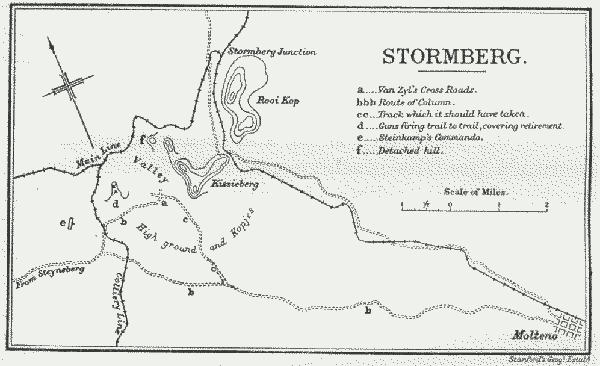
The little force of half a battalion of infantry which evacuated Stormberg withdrew to Queenstown, where Gatacre arrived on November 18. He intended to march on Stormberg as soon as he had collected a sufficient force; his own Division, which he had brought out from England, having been diverted to Natal. He soon advanced to Putterskraal near Sterkstroom and about thirty miles from Stormberg, the occupation of which by the enemy on November 25 prevented co-operation between him and French at Naauwpoort.
Meanwhile rebellion was spreading, and owing to the dilatory proclamation of Martial Law by the Cape Government, always reluctant to take action which might wound the susceptibilities of the Dutch population, it had assumed a formidable aspect. Buller was uneasy, and although at first he had cautioned Gatacre to be careful he now suggested his closing with the enemy.
{66}On December 7, by which time considerable reinforcements had come in, Gatacre felt himself strong enough to tackle Olivier at Stormberg. His plan was to take his column by train as far as Molteno, whence a night march of about eight miles would bring it into position for attacking the Boer laager. The use of the railway would not only enable him to strike more suddenly and with a greater chance of taking Olivier by surprise but would also economise the strength of his force, a portion of which having left the transports only a few days previously was not yet in hard condition. The force with which he proposed to take Stormberg amounted to 2,600 men, who detrained at Molteno soon after sunset on December 9. Gatacre calculated that after a march of about six hours he would be able to rush the position before dawn.
The Boers, to the number of 1,700 men, were in occupation of the Kissieberg ridge, and of a nek which runs westward from its southern end towards a higher hill overhanging Stormberg Junction called Rooi Kop. Gatacre had originally intended to attack the Boer position frontally, but the reports which he received on arrival at Molteno determined him to turn it. The change of plan was not made known to all the troops, with the result that the ambulance and ammunition wagons left the town by the Stormberg road instead of by the Steynsburg road, along which the rest of the column was marching to the new objective. No trustworthy maps were available, and the enterprise was dependent for its success upon the knowledge and fidelity of a sergeant of police and a few native constables who acted as guides and who professed to know "every inch of the way."
Soon after midnight, however, Gatacre's suspicions were aroused by the sudden appearance of a railway which ought not to have been there, and it was discovered that the guides had a mile or two back missed a path on which the column should have diverged to {67} the right. They assured him, however, that they had chosen a better road and that he was now less than 3,000 yards from the Boer position. He therefore halted the column for an hour's rest, and hoped for the best.
When the march was resumed another railway was almost immediately encountered. It was in fact the colliery line which had been crossed before the halt and which here curves almost to the extent of a semicircle; but Gatacre believed that he had come upon the main line to Steynsburg and judged that he was now N.W. of the Boer position; while many of the officers in the rear of the column, unaware of the change of plan, imagined that they were approaching it from the S.E. along the Stormberg road originally selected for the advance on which the ambulance and ammunition wagons had already gone astray.
The direction of the march was now almost reversed, owing to Gatacre's misapprehension of his position; and at dawn the column unknown to itself reached certain cross roads on Van Zyl's farm which had been fixed upon as the point from which the attack should be delivered; but the locality was not recognized by the staff, and the guides, who seem to have misunderstood the object of the march, conducted the column still deeper into the valley beneath the Kissieberg ridge.
Suddenly a shot from the heights startled the errant and plodding column. The Boers had indeed been taken by surprise, but were at once on the alert and the crest line was soon occupied. The column marching in fours halted and turned to the right and, except the leading companies of Irish Rifles, which were formed to the front in order to seize a detached hill at the end of the ridge, sprang up the slope, but were soon baffled by the irregular tiers of krantzes or rock walls on the hill side. The artillery diverged to the left, losing one gun in the donga which ran down the valley, and took post on the detached hill from which the Kissieberg ridge could be shelled. The companies of Irish Rifles, {68} after seizing this hill, passed along the nek which joined it to the ridge and almost won the crest line.
Meanwhile the Northumberland Fusiliers and the remaining companies of the Irish Rifles found the task of mounting the encumbered slope beyond their powers, and were soon ordered to fall back into the valley. The artillery noticed the movement, and in order to cover the retreat opened upon Kissieberg; not perceiving in the eastern dazzle of the sun about to rise above the sky line that some of the infantry who had not heard the order to retire were still clinging to the darkened westward hillside, and these were shelled by their own guns.
Gatacre, confident of an easy success, had thrown all his infantry into the firing line, and had no reserves to fall back upon to support the companies of the Irish Rifles which were still holding their own on the left flank of the attack. As soon as the troops had crossed the valley to reform on the opposite ridge a new entanglement beset them.
A commando under E.R. Grobler and Steenkamp, chiefly composed of rebels, which had been sent by Olivier on the previous day to stir up trouble in the district, was halted for the night a few miles out on the Steynsburg road. The sound of the firing quickly called it to attention, and a position which seriously threatened Gatacre's line of retreat was quickly seized. The commando, however, was handled with little judgment or energy, and was soon checked by the field guns which had been withdrawn from the detached hill near the Kissieberg ridge to cover the retreat of the infantry; and which at one time were firing trail to trail, some still engaging Olivier on Kissieberg while others were shelling Grobler.
The raid on Stormberg had manifestly failed and Gatacre ordered a retreat to Molteno. Thither the weary, dispirited column trudged all through the forenoon of December 10. A gun was abandoned on the way, {69} and even the wagon in which the breech block had been secreted fell also into the enemy's hands. But this was a comparatively insignificant loss. It was soon discovered that nearly a third of the infantry was absent. When the troops were withdrawn from the attack on Kissieberg not a few of them remained in the donga or under the krantzes on the hill side, while others appear to have held on to the ridge. By some extraordinary neglect or default nearly 600 men were left to their fate. No one seems to have missed them at the time and they were made prisoners of war without an effort to extricate them.
In less than two hours all the fighting except the little affair with Grobler was over. On neither side were the casualties of killed and wounded heavy. No British officer was killed and of the eight who were wounded four had been struck by shells not fired by the enemy.
Stonmberg on December 10, followed by Magersfontein on December 13, brought about Colenso on December 15. The latter was Buller's attempt to retrieve the former mishaps.
A naturally strong position on the left bank of the Tugela had by the efforts of the Boers during the previous three weeks been almost perfectly secured. They showed, however, some hesitation with regard to Hlangwhane, a detached hill on the right bank from which the Tugela line could be enfiladed. It was a somewhat precarious position as it was accessible from the left bank only by two bridle drifts. It had been originally held by the Boers, but the garrison was withdrawn when Barton's Brigade appeared at Chieveley; and now all Botha's persistence, and even a reference to Kruger and Joubert at Pretoria, were required to induce the burghers to re-occupy it on December 15. From the south Hlangwhane, though separated from the Colenso kopjes by the river, appears to be an integral continuation of them.
{70}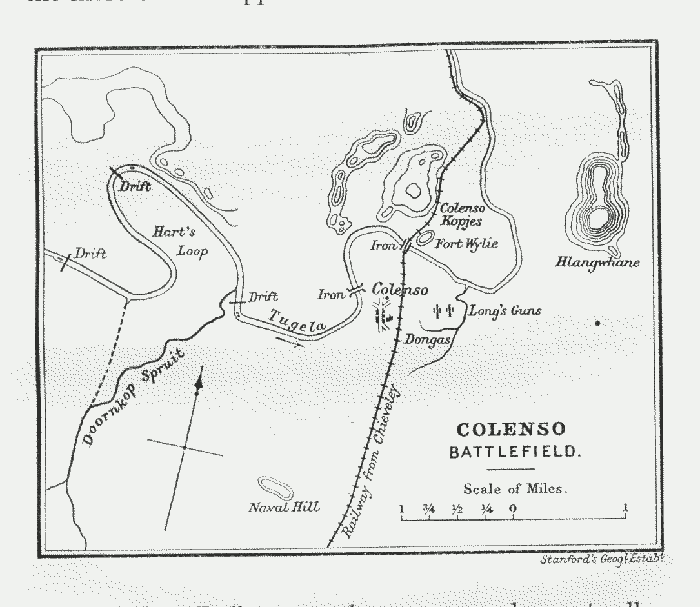
The enemy's general idea was a defensive occupation of the Colenso position, although Botha, with characteristic spirit, proposed to send a commando across the river to face the British on the open. The initiative, always a disadvantage when attacking an enemy strongly posted and entrenched, was thus imposed upon Buller. It was not doubted that he would be compelled to make a frontal attack on Colenso and in this the Boers showed the more correct appreciation of the situation. Botha hoped to lure Buller on and was prepared even to allow him to cross the river; and having crushed him to act upon the British flanks, an operation which the wide extension of Botha's front from Hlangwhane to Robinson's farm, a distance of seven miles, gave him a good chance of being able to carry out. If necessary, reinforcements could be drawn from the investing circle around Ladysmith, which seemed to be detaining more burghers than were necessary for the maintenance of the siege.
{71}Buller proclaimed his intention of attacking Botha by a preliminary bombardment of the Colenso kopjes on December 13 and 14; but the burghers lay low and gave so little indication of their presence that it almost seemed that they had abandoned the line of the Tugela. The British Army was encamped near Chieveley four miles south of Colenso.
On the evening of December 14 the scheme of attack was delivered to the Brigadiers. The leading idea of it was a frontal attack to be delivered from the village of Colenso, where the Tugela is crossed by an iron railway bridge as well as by an iron wagon bridge. The latter had been left intact by the enemy, possibly in order to entice the British troops across the river. Buller appears to have been unaware how far the Boer trenches extended towards the west, and to have assumed that only the kopjes immediately opposite Colenso were occupied. Hildyard's Brigade was ordered to march in the direction of the "iron bridge,"21 to cross at that point, and then to "seize the kopjes north of the iron bridge." The attack on the enemy's right, which was believed to be weak, was assigned to Hart's Irish Brigade. He was instructed to cross the Tugela at a bridle drift about two miles west of Colenso and work down the left bank towards the occupied kopjes. Two infantry Brigades were retained as reserves to be used when required; and the mounted Brigade was ordered to move towards Hlangwhane and occupy it, if possible, and cover the right flank; but the weakness of the Boer position on that hill, which was cut off by the river {72} from the main line of defence, does not seem to have been realized. A few batteries were sent with Hart, but the bulk of the artillery was ordered east of the railway to support Hildyard.
Buller's scheme has been severely criticized ever since its failure, but Clery who was in nominal command of the Natal force, and in whose name the battle orders were issued, as well as the other general officers, acquiesced in it. But in fact hardly any scheme could have been devised more likely to play into Botha's hands. Buller hoped to get a footing on the left bank and Botha hoped that he would succeed in doing so. Botha's special idea was to allure the troops of the frontal attack to his own side, where he could easily pound them from his kopjes and carry out his general idea of netting the British flanks.
Buller had not then been in action with the Boers and he probably underrated their tactical capacity; but already he seems to have contemplated the possibility of the loss of Ladysmith, for in his despatch of December 13 to Lord Lansdowne, in which he justified his sudden change of the plan of campaign, he said that "it would be better to lose Ladysmith than to leave Natal open to the enemy."
Nor did the Boers enter into the contest with much confidence. They had not yet tried Buller's mettle and his name was to them a tradition of courage handed down from the Zulu war, in which some of the older burghers now opposing him on the Tugela had served under him. The curious omission to inform White in Ladysmith that an attack on Colenso was to be made on December 15 may have arisen from Buller's doubts as to its issue, or from reluctance to heliograph a message in a cipher of which the enemy might have the key.
The story of the Battle of Colenso is mainly the narrative of the action of two important components of the Army of Natal. Each of these was led by a dangerously {73} brave man, whose impetuosity crippled the tactical scheme and whose method of working his command was, at least, unusual. If in Hart and Long, who commanded the Artillery, the quality of personal courage had been less prominent it is probable that Colenso would not have filled up the cup of Stormberg and Magersfontein in that dark midsummer December week.
The naval guns on the west of the railway had the honour of opening the battle, and shelled Fort Wyllie for some time without eliciting any response. Long joined Hildyard with another naval battery and two field batteries. He was not only an impetuous man but he also belonged to the short range school of artillerists;22 and he soon outpaced his infantry escort and came into action with his field batteries in the open a little in advance of a shallow intersecting donga, and within 1,100 yards of the Boer entrenchments across the river. The naval battery had been compelled by the flight of the Kaffir ox drivers to outspan astride a deeper donga about a quarter of a mile in rear, to which Long had sent back his gun teams. A terrific rifle and shrapnel fire, which the infantry escort which soon came up was powerless to subdue, was now opened upon the guns, and for an hour the batteries were beaten on until the casualties left but four men to each gun, and ammunition was running short. Long, who was one of the first to be wounded, withdrew the dwindled gun detachments to the shallow donga and sent back for a fresh supply of ammunition, intending to resume fire as soon as the general attack developed.
All the while the batteries had been unsupported except by the escorting companies, which were not under Long's orders, and no attempt was made by Hildyard's or Barton's brigade in rear to relieve or divert the pressure on the guns, which had succeeded in silencing {74} temporarily some of the Boer artillery and in checking the rifle fire.
Earlier in the action Buller had been informed that the guns were "all right and comfortable," but later reports gave him the impression that this cheery optimism was delusive, and that owing to loss of men and exhaustion of ammunition the artillery told off to support Hildyard was now permanently out of action. The rest of the artillery was engaged in assisting Hart, who was in trouble, and Buller came to the conclusion that the attack on the Colenso kopjes must be withdrawn.
Hart's Brigade was ordered to march "towards the Bridle Drift at the junction of the Doornkop Spruit and the Tugela, and to cross at that point." Here was yet another ambiguity. As there were two "Iron Bridges" so also were there two "Bridle Drifts," one on each side of the isthmus of the river loop, and yet another at the head of it. The West Drift was unfordable on the morning of December 15, and a hasty sketch which had probably been filled in from hearsay evidence and which was Hart's only map, showed the Doornkop Spruit as entering the Tugela below that Drift instead of just above the East Drift.23 The sketch also duplicated the loop.
In dense formation, although the enemy was reported to be in force on his front, Hart crossed the Doornkop Spruit without recognizing it and advanced to the West Drift guided by a Kaffir who lived close by. The native seems either to have had misgivings as to the fordability of the Drift or to have been carelessly instructed, for as the column approached the river he pointed to a Drift which was not the East Drift, but the Drift at the head of the loop near his own {75} kraal; and Hart was induced to change direction and lead the Brigade into the loop.
At 6 a.m. against the orders of Botha, who wished to lure on his foe, the Boer guns commanding Hart's loop suddenly opened on the dense battalions, and the trenches on the left bank took up the firing. The Kaffir guide disappeared in terror. But Hart still believed that there was a drift to be found somewhere or other and pushed his Brigade, like a shoal of herrings driven into a purse net, up the loop; and some companies even reached the kraal near the head of it. Without artillery—for Hart had not brought up the field batteries assigned to him—and exposed to a concentrated fire from front, left, and right, the unhappy Irish Brigade, which suffered 400 casualties in less than three quarters of an hour, was helpless. Hart began to deploy, but Buller who from Naval Gun Hill was watching, possibly with astonishment, the entanglement in the loop ordered him to withdraw, at the same time sending two battalions to dig him out of his hole. It was not an easy task and it was made more difficult by the gallant reluctance of the Irishmen to retreat before the enemy. Thus Hart and Long, the former with his Hibernian zeal to move in the line of the greatest resistance, the latter with his rash generalization that entrenched Boers could be coerced as if they were Omdurman dervishes in the open, brought about the reverse at Colenso.
By this time it was evident to Buller that his scheme must fail. He had already arranged the extrication of Hart and now the extrication of Long called for immediate action. He therefore rode across to the deep donga east of the railway; on his way informing Hildyard, whose brigade was awaiting an opportunity to carry out its orders, that the attack was abandoned and that the brigade must cover the withdrawal of the field batteries. He ordered the naval battery to retire, and sent back the ammunition wagons, which after long {76} delay were on their way to the field guns: and acknowledged that he was baffled.
Hildyard occupied Colenso but was unable to prevent the Boers re-opening fire from Fort Wyllie on the desolate batteries lying on the veld. No troops could move across the open; and only individual efforts could now save the guns. Not a few officers and men offered for the forlorn hope, and at the first attempt two guns were rescued. A later attempt was not successful, and at 11 a.m. Buller ordered a general retirement and the abandonment of the guns. The main naval battery remained in position west of the railway for some hours, and in its presence the Boers were afraid to cross the river and take possession of the derelict but not disabled guns; which were not captured until all the British troops had left the field except a few gunners and infantry details who had taken refuge in the deep donga and whom the order to retreat had not reached; and these were made prisoners of war.
The mounted Brigade under Lord Dundonald acting on the right flank with orders to take Hlangwhane, if possible, was too weak to support the main attack effectively. Assistance was refused at first by Barton and afterwards by Buller, who thought that Hlangwhane would be of little use to him without the possession of the Colenso kopjes; yet these could have been enfiladed from it. As the Brigade retired it passed within striking distance of the field guns and their captors; but nothing could be done as ambulances and groups of prisoners were bemingled in the throng. Dundonald seems to have been alone in his recognition of the value of the Hlangwhane position.
A retirement to Chieveley and Frere completed the triad of December disasters. Buller, of whom so much was expected, had failed in his first attempt to measure swords with the burghers. His 19,000 men and forty-two guns fighting for six hours inflicted on the enemy a loss of less than two score. His casualties exceeded {77} 1,100, he lost ten guns, and he then returned to the place from which he came. He thought that he had fought a battle, but in reality he had only made a reconnaissance in force, a dangerous operation only justifiable by urgent necessity.24
Possibly if Buller, who was practically without a staff, had allowed a freer hand to Clery, that authority on Minor Tactics might have done better. It has been said that the defeat was due to insufficient reconnaissance; and this is to a certain extent true, for a more accurate knowledge of the terrain and the dispositions of the enemy would have clearly demonstrated the hopelessness of a frontal attack on the Colenso Kopjes, and the attempt would never have been made. Again, as at Magersfontein four days before, a considerable portion of the troops was not seriously engaged; and the total casualties in eight battalions were but 120.
The loss of the guns is the chief fact in the story of Colenso. What were Buller's intentions with regard to the Naval battery and the two Field batteries which he sent to "a point from which they could prepare the crossing for Hildyard's Brigade," and how did Long understand and carry out his orders.
The battle orders had been orally anticipated by Buller, who before they were issued, explained his intentions personally to Long: and, as often happens in conferences, the impression retained by one conferent differed from that intended to be conveyed by the other. Long believed that he was instructed to shell the Kopjes and entrenched positions behind Fort Wyllie, which he did not at first know was held by the enemy, and he opened at a range of a mile; and Buller's statement that he was ordered to open fire with the long-range naval guns only, the position not being within reach of the field batteries, is contradicted; while Buller complained that Long had taken up a position within {78} 1,200 yards of a fortified hill and less than a quarter of a mile from cover occupied by the enemy. There is, indeed, a small area of low trees and scrub near the right bank of the Tugela a few hundred yards on the right front of the line of guns, but there is no evidence that the Boers had ever crossed the river to hold it.
When the field guns, after firing nearly 100 rounds each, became silent, Buller, who was already perturbed by Hart's discomfiture, jumped to the conclusion that they were exterminated, and that it would be useless to proceed with the attack without them; but the gunners were only waiting for more ammunition. Not until the following day did he know that men enough to fight the guns were still untouched. If the whole of his force had been seriously engaged he would perhaps have been justified in his decision not to hold on to Colenso with exhausted and parched troops in the burning heat of the South African midsummer in the hope of rescuing the guns at night; but several battalions had been doing little more than watching the fight during the morning, and he might have left them on the field; and it is clear from a telegram sent by Botha early in the afternoon that if the Naval battery had remained with an effective infantry support no attempt would have been made by the Boers to cross the river, and that the guns would not have been lost.
The repulse at Colenso staggered Buller's humanity. He was a brave man on the right of whose many war medals hung the Victoria Cross which he had won not far away from the field on which he was now fighting; but he was lacking in bull-dog tenacity, and in the ascetic temperament which is quickened rather than disheartened by failure. He returned to his tent, wrung his hands, and announced to those whom it might concern that all was lost. In the telegram in which he reported his defeat to Lord Lansdowne and of which the frankness, the candour, and the copious yet not egotistical use of the first personal pronoun {79} were in curious contrast to the formal and sterilized paragraphs of an official account, he confessed that with the force at his disposal he had little hope of relieving Ladysmith and he proposed that he should let it go. He ordered the staff to select a defensive line eastward from Estcourt which his army might occupy until the end of the hot season.
His message to White in Ladysmith was still more pessimistic, and with an intention that was chivalrous but was not war he "spatchcocked"25 into it a suggestion that White should surrender, and even indicated how the gain to the enemy could be minimised. The magnanimity of Buller was manifest: he desired to give White the opportunity of surrendering without incurring the full responsibility for the act, but the lack of military instinct in Buller's mind was likewise manifest. To this message, which was suspected in Ladysmith to have originated in the Boer laagers, White replied that he had no intention of surrendering.
Nor did Buller's pessimism turn the Home Government from its purpose. He was ordered to hold on, and on December 17 Lord Roberts accepted the chief command in South Africa. In announcing the appointment, the War Office explained that Buller was superseded because it was advisable to relieve him of responsibility for the operations outside Natal, which he could not effectively control from his detached position on the right flank. The Vth Division under Sir C. Warren which had been ordered at his request a month before, and which he found was available for service on the Natal side, was on the point of landing in South Africa; the VIth Division was embarking at home; the components of a VIIth Division were being assembled, and he became less despondent.
The War Office thought that the Magersfontein mishap called for the supersession of Methuen, and when Warren {80} reached Capetown with the Vth Division he found orders from home directing him to assume command of the force at Modder River. It would probably have been better for Buller if he had freely acquiesced in the idea of Pall Mall and had allowed Warren, but not necessarily the Vth Division, to operate in a country with which he had become acquainted twenty years before in the Bechuanaland Expedition, but he could not foresee Spion Kop; and Warren while moving towards the Orange was suddenly recalled to Capetown and ordered to reinforce the Army of Natal with the Vth Division; and Methuen was allowed to retain his command at Modder River.
The transfer of the Vth Division to Natal was undoubtedly called for; but the position in the districts of Cape Colony bordering on the Free State was alarming. A belt extending from Barkly East near the Basuto border westwards and northwards as far as the Molopo River, and interrupted only near the Orange and Modder Rivers, had been annexed by the Boers and was more or less effectively occupied by them; and had they acted with enterprise and concurrence during the period of Lord Roberts' journey from England, the task before the new Commander-in-Chief would have been still more formidable. In rear of French and Gatacre was an indefinite area through which ran the British lines of communication, and which, if not indeed actually under arms, was ready to spring up whenever a favourable opportunity presented itself.
Of the four Generals set to stem the tide of war until the arrival of Lord Roberts, French alone did not restrict himself to restraining its flow. A policy of "worry without risk" had been recommended to him by Buller, and he carried it out with good effect. He thrust Schoeman out of Arundel and Rensburg, and occupied a commanding position outside Colesberg, which he maintained until he was summoned on January 29 to confer with Lord Roberts at Capetown, where he was {81} confidentially informed of the plan of campaign. Clements, who a few weeks before had reinforced him with a brigade of the recently landed VIth Division under Kelly-Kenny, took over the command of the troops before Colesberg. But the force which he had to his hand had been considerably reduced by the withdrawal of the cavalry and nearly half the infantry to serve elsewhere, while Schoeman and Delarey, who had come from Magersfontein, had been strongly reinforced.
The Boers doubted not that the positions taken up by Gatacre and French indicated that the impending advance of the British Army into the Free State would be by way of Bethulie and Norval's Pont, and were accordingly disposing all their available men, one commando even being sent to Colesberg from Natal; but fortunately they were at first unaware that Clements had been almost simultaneously weakened. He soon found that he was not strong enough to hold on to the Colesberg positions and on February 14 retired to Arundel; losing on the way two companies of infantry which had been mislaid and forgotten and which after a gallant running fight of three miles were captured.
But now ominous reports of Lord Roberts' movements in the West began to come in, and the Boers realized that they had misinterpreted the signs which had been so ostentatiously displayed. They hesitated and wavered, and on February 20 hurried away from Colesberg to succour Cronje and the threatened capital of the Free State.
Footnote 19:(return)Buller aroused a "now-we-shan't-be-long" feeling. He would certainly be in Pretoria by Christmas. It is said that a large number of plum-puddings intended for the soldiers' dinners on December 25 were addressed to Pretoria "to await arrival," by their good friends at home.
Footnote 20:(return)The history of the war showed, however, that generally the Boers fought more strenuously and effectively when the tide was against them than when it was flowing with them.
Footnote 21:(return)The two chief authorities on the events of the day are not in agreement as to which of the iron bridges was meant; and in the absence of information of what was in the mind of the staff officer who drew up the battle orders the question cannot be answered. The context and certain expressions in other paragraphs seem to show that the railway bridge was indicated. It was, indeed, broken but there were drifts used by the natives above and below it. Probably the river had not been carefully reconnoitred and the two bridges were confused, or one only was believed to exist.
Footnote 22:(return)At the battle of Omdurman he had put short range principles successfully into practice against dervishes.
Footnote 23:(return)The mistake in Hart's map is shown by a broken line in the sketch map. It is, curiously enough, reproduced in the Colenso map not only of the Times History, but also of the German Official Report on the War.
Footnote 24:(return)See Combined Training, 1905, p. 109.
Footnote 25:(return){82}Sic in his speech of October 10, 1901, but he probably meant "sandwiched."
More than thirty years before the outbreak of the Second Boer War a Dutch child in the Hopetown District of Cape Colony found, while playing carelessly near the left bank of the Orange, a pretty pebble that was destined to mould the History of South Africa.
He took the bagatelle home to his father's farm, where a neighbour, one Van Niekirk, saw it and was struck by its brilliancy. It chanced that the Irishman O'Reilly was passing that way and to him it was entrusted to take to Colesberg for expert opinion upon its value. Here certain Jews declared that it was but a white topaz not worth one shilling and it was disdainfully cast out into the road, from which it was with difficulty recovered by O'Reilly, whose belief in it though shaken was not wholly abandoned. Through a mutual friend, Lorenzo Boyes, Acting Civil Commissioner of the District, the pebble came to the notice of an expert mineralogist named Atherstone at Grahamstown, but it was held so lightly in esteem by the sender that it reached Atherstone as an enclosure in an ordinary unregistered letter. Atherstone examined it, and when it had not only spoilt all the jeweller's files in the town but had also passed an examination by polarized light, pronounced that it was a diamond worth £500. His certificate to its character, which had been so ignorantly disparaged, was the origin of the Diamond industry of South Africa. Another diamond was soon picked up near Hopetown which without difficulty or misadventure rose to its own plane in mineralogy. Its career was short and its destiny {83} happy. It was purchased by the first Earl of Dudley for the adornment of his second wife.
When it was noised abroad with the customary exaggeration that the monopoly of Golconda and the Brazils was at an end and that diamonds grew wild on the South African veld, a wide extent of country was explored and the precious crystallized carbon was found in districts separated by many hundreds of miles. In certain places, one of which became known as the town of Kimberley, it was ascertained to recur in a constant proportion of the contents of the "pipes" or volcanic tubes which rose through the surface strata.
The pioneers of Kimberley took possession of the diamondiferous grounds without ascertaining to whom they belonged, and when their value became positive the question of ownership arose. The boundaries of the districts administered by the Cape Colony, the Orange Free State, and the Transvaal respectively were, as regards territory, supposed to be of little account, vague, ill-defined, and unsurveyed; and the districts themselves were occupied by native tribes of nomad habits. About the middle of the XIXth century a Hottentot chief named Waterboer came up out of the West and squatted in the districts lying between the Orange and the Vaal. His rights, such as they were, were assumed or acquired by the Cape Government, which soon became involved in controversy with the Orange Free State as to their extent and nature. Finally the British Empire secured a good title to the estate by the payment of £90,000. But the Orange Free State not unnaturally, when the value of the Diamond Fields increased day by day, soon began to think that it had parted with a profitable possession for an inadequate return. The feeling rankled; and the confident expectation of recovering Kimberley sold for a song tempted Bloemfontein into the fatal alliance with Pretoria.
In 1871 a sickly youth named Cecil Rhodes came {84} from England to South Africa in search of health, which after a short sojourn in Natal he found at Kimberley. The prospects of the place favourably impressed him, and he soon laid in it the foundations of his fortune; but six years later the future of Kimberley was still precarious and the discovery of gold in a remote district of the Transvaal sucked thither the greater proportion of the citizens, who, however, found that they had not bettered themselves by the change and returned to the pipes: and soon nearly a hundred companies, syndicates, and private adventurers were groping for diamonds over an area of less than two hundred acres. The waste of energy was manifest to Rhodes, who in 1888 completed, with the help of the Rothschilds, the task upon which he had been engaged for some years, the amalgamation of the conflicting and overlapping diamond interests under the name of the De Beers Consolidated Mines. It was soon found that the new industry was insufficiently protected by the existing criminal law and a new felony was created by the Illicit Diamond Buying Act.
It has been for several centuries the practice of Great Britain to entrust to private companies the imperial responsibilities which she is reluctant to assume and to let out to contractors, who can be repudiated if they fail and expropriated if they succeed, the job of expanding an Empire. Of this policy the most prominent instance is the East India Company, a commercial venture which obtained from Queen Elizabeth a charter empowering it to trade with the East and which, though connected with Great Britain only by the slender thread of an ocean track of 12,000 miles, maintained itself for two centuries and a half with ever increasing territory and authority until it became a great military Empire. Other examples of lower degree are the Hudson's Bay Company and the Borneo Company. The De Beers Company provided out of its abundance large sums for exploration and settlement in South Africa and for {85} the furtherance of the Imperial idea, and it is said that Rhodes spent the whole of one night in arguing with some of the materialistic magnates of Kimberley, before he could induce them to consent to the employment of the resources of the Company in the advancement of his schemes of Empire. He found, however, that these could not be satisfactorily promoted by a Company whose primary interests were commercial rather than imperial; and in 1888 he obtained a charter for the British South Africa Company, an offshoot of the De Beers Company, formed for the purpose of extending the British Empire towards the Equator.
The question of the defences of Kimberley engaged the attention of the De Beers Company some years before the outbreak of the war. Its vulnerability to attack from the Orange Free State, the border of which ran close to the town, was obvious; and in 1896 a depot of arms and ammunition was formed. A military plan of the place was sent to the Imperial authorities and a defence force was also organized. This, however, had in 1899 ceased to exist owing chiefly to the action of Mr. Schreiner, at that time the Premier of the Cape Colony, who in June refused, with complacent optimism, to furnish it with arms, saying that, "there is no reason for apprehending that Kimberley is in danger of attack," and that "the fears of the citizens are groundless and their anticipations without foundation." A battery of artillery was, however, surreptitiously brought up from King Williamstown.
The policy of Schreiner during the months preceding the war is obscure. While refusing help to Kimberley he was allowing munitions of war, which were way billed as pianos and hardware, to pass through the Cape Colony to the Transvaal and the Orange Free State. He does not appear to have been actively disloyal to the Imperial Government and in his own way he probably did his best to keep the peace. His mind was cast in a mould which is not uncommon in the British Empire {86} but which is rarely found outside it. He was more anxious to stand well with its enemies, and like the Unjust Steward to have a claim to a place in their houses, if they were successful, than to work for its security. It was with great difficulty that Sir A. Milner as late as September 18 obtained his consent to the dispatch of a few regulars to Kimberley to form the backbone of a defensive force. He seems to have retained almost to the end, in spite of all indications to the contrary, the belief that the war would be averted or at least that the Orange Free State would not join in it. Yet in this he erred in good company. Mr. Balfour said that if on September 28 he had been asked whether war with the Orange Free State was a probable contingency he would have replied that war with Switzerland was one equally probable; and Lord Lansdowne declined before September 23 to discuss with Lord Roberts the question of operations in the Free State. Buller, with surer insight, had foreseen the alliance as far back as 1881.
The War Office, however, was to a certain extent on the alert and distrusted the optimism of Schreiner and of a high military official who had been for some years in South Africa. Officers were sent to Kimberley to organize a scheme of defence, but having regard to the susceptibility of the Capetown Government it was done secretly and confidentially and Schreiner was outwitted. By October 7 the town, which was under the command of Colonel Kekewich, was secure against a coup de main though not against a vigorous and sustained siege. Little more than an eighth of the garrison was composed of regular troops; the artillery was out of date; rifles and ammunition were deficient. On October 13 Rhodes threw himself into Kimberley and became for better or worse a power in the town. As soon as the siege began the relative value of the chief products of the mines was inverted: water, the most generous gift of nature and hitherto an embarrassment {87} in the workings, became for the time being more valuable than the diamonds.
On October 12 the curtain of the great drama was raised and the first scene presented. It showed the capture of an armoured train on the railway between Kimberley and Mafeking. Kimberley under any circumstances was a prize worth winning. But Kimberley taken with Rhodes as a prisoner of war, the man who had curbed and checked on every side the expansion of the Republics, who had taken Matabeleland on the north and Bechuanaland on the west into the fold of the British Empire, would be more than a prize, would be a triumph. Rhodes metaphorically in chains, and actually paraded as a captive in the streets of Bloemfontein and Pretoria was an alluring prospect.
Great, however, as were the advantages to be gained by the early capture of Kimberley, the object was not pursued with energy and determination. When the siege began on November 6 the situation was in favour of the attack. The Boers were in possession of the railway from Orange River Station to Mafeking: Kimberley was ill-supplied with the munitions and weapons of war and was defended by a force mainly composed of irregulars; it was encumbered with a large native population; and the civil and military authorities were not working in harmony.
The defence throughout was more active than the attack. Reconnaissances and raids against the enemy's positions were made with effect; and the bombardment which followed a rejected summons to surrender did little harm. Communication with the outer world was not seriously impeded. Cattle grazed almost with impunity inside the line of investment and several thousands of the natives escaped.
But the difficulties of Kekewich, who had been in command since September 20, were not confined to those created by the military situation. He was thrown into close association with the man who was one of the {88} indirect causes of the war, and who had little confidence in military men, or sympathy with their ideas and methods. Rhodes had come into his own Kimberley and for the first time he was not master in it. He found himself a sterilized dictator acting in an atmosphere too tenuous to support his vitality but sufficient to preserve it from extinction. He was subject to the authority of the military commandant, a galling position for a distinguished statesman who had not a high opinion of the professional capacity of the British officer. From the age of eighteen he had been his own master except during the intervals which he had spared from South Africa and spent at Oxford, when he was temporarily subject to the lax discipline of a University. While his contemporaries were amusing themselves at college, or performing routine duties in the Army or the Civil Service, or preparing to enter a profession, Rhodes was spending the critical years of his life in outlining the future and scheming for a South African Empire to be erected on the foundation of the Kimberley Mines.
It was inevitable from the nature of the case and from his intimate concern in the fortunes of Kimberley that he could not see South African affairs at large in their true perspective. The sparkle of his diamonds made him curiously colour-blind and out of this defect in his mental vision sprang the mischief. Kimberley, for the time being at least, stood so closely in the foreground that other objects were thrown out of focus. Nor did the disturbing influence of the glare and halation of Kimberley only affect the vision of the diamond men within the town. It closed the eyes of the besiegers without it to a great strategical opportunity which soon passed away.
The figure of Rhodes in Kimberley was the magnet which attracted and detained commandos which could have been more usefully employed elsewhere, and his presence, so far as it had this effect, was of great service to the perilously weak British force during the first {89} few weeks of the war. If the commandos squatting before Kimberley had instead been sent to raid southwards towards the Karroo, and to inflame the Dutch districts in the Cape Colony, they would have met with little resistance, and advancing with daily increasing numbers would have had little difficulty in planting themselves firmly in the heart of the enemy's country. For the moment the war in the west was waged not against Great Britain but against the Man of Kimberley.
The diamond men, with Rhodes at their head, forgetting that the object of the war was the redress of the Outlanders' wrongs in the Transvaal, began to bellow for relief even before the Boers had completed the investment of the town. Telegrams couched in extravagant and almost hysterical language and betraying the egotism and the want of self-control of the senders were repeatedly despatched. One of these, in which on October 19 the De Beers directors asked for information as to the plans of the military authorities at Capetown, "so as to enable us to take our own steps in case relief is refused," was thought not unnaturally by Buller to hint at surrender; and although this was not the intention of the senders it is probable that they did not regret the interpretation that was put upon it.
Fortunately, however, Kekewich was a cool-headed man who did not suffer himself to be hustled. While preserving amicable personal relations with Rhodes, he was careful to let Capetown know that the situation in Kimberley was by no means desperate and that it would be able to hold out for several weeks.
The impetuous and childish letters and telegrams sent out by the diamond men induced Buller, who said afterwards that "although I had every confidence in Colonel Kekewich's military capacity I did not trust the other powers within the city," to send Lord Methuen northwards on November 10 with instructions to help Kimberley by removing unnecessary non-combatants and natives, and "to let the people understand that {90} you have not come to undertake its defence, but to afford it better means of maintaining its defence."
The news of Methuen's approach did not allay the excitement of the townsmen. His movement was not an essential part of the general plan of campaign but only a raid in force with the object of putting men and supplies into Kimberley and enable it to hold on until pressure elsewhere upon the Boers should raise the siege automatically.
The dignity and the self-respect of the diamond men was affronted. Like the Syrian captain Naaman, when offered relief of his leprosy by the prophet Elisha, they resented the simple process by which their own relief was to be effected. They had looked to an Army Corps at least marching on Kimberley with all the pomp of war and speedily enabling it to resume its normal occupation of diamond grubbing; and now they found that the town was not considered of much account in the scheme of the military, who regarded it as a mere besieged place of little strategical importance; which, after some assistance, was to be left dependent for its safety upon its own exertions while the main army advanced through the Free State.
On December 4 Kekewich was instructed to make arrangements for the deportation of a large proportion of the white and coloured population, Methuen hinting that Rhodes himself might be included. Although Rhodes had a few weeks before complained of the difficulties caused by the presence of non-combatants and had even endeavoured to send them away, he now vehemently opposed their removal. His reasons for so doing are not very clear, but they appear to be part of the systematic obstruction which he offered to every proposition of the military authorities which tended to restrict the output of diamonds. His objections were transmitted to Buller, who speedily put the question in its proper light by telegraphing to Kekewich that "what we have to do is to keep the Union Jack flying {91} over South Africa without favour to any particular set of capitalists," and Methuen met his protest with the answer that "Rhodes has no voice in the matter." After the defeat at Magersfontein the plan of deportation had necessarily to be given up.
In his own proper sphere of a civilian working with civilians Rhodes was usefully active and his services were great. He employed the persons thrown out of work by the closing of the mines in labour for the general benefit of the town, and did much to relieve the distress among the poorer inhabitants.
The manufacture of a heavy gun, to which the name of Long Cecil was given, in the De Beers engineering establishment, was soon countered by the Boers, who brought into action a gun throwing a much heavier shell which had been disabled by the Naval Battery at Ladysmith, repaired at Pretoria, and was now mounted before Kimberley. The appearance of Long Tom, supervening on a reduction on the daily rations, caused a panic among the civilians. On February 9 Rhodes threatened to call a public meeting to consider the situation unless he was informed of the plans for the relief of the town: but Kekewich was authorized by Lord Roberts not only to forbid the holding of the meeting, but even if necessary to arrest Rhodes. A private meeting was then held at which a remonstrance was drawn up for transmission to Lord Roberts through Kekewich; and for the second time a communication from the Kimberley men was interpreted as a threat to surrender. It was probably sent with that intent in order to elicit information as to Lord Roberts' plans.
Kekewich meanwhile was finding his position almost intolerable, and his representations convinced Lord Roberts of the necessity of raising the siege of Rhodes without delay and at any cost. It was effected on February 15 by French's brilliant cavalry movement; but at the cost of the convoy of 170 wagons which were snapped up by De Wet at Waterval Drift, and of an {92} Army compelled to march and to fight for nearly four weeks on reduced rations. But the harvesting of the crop of diamonds was resumed, and as far as Kimberley was concerned the war was at an end.
Although the siege lasted for more than three months the casualties were few, only 40 persons being killed and 123 wounded by acts of war. The privations suffered by the inhabitants, especially during the last few weeks, were no doubt great, but certainly not greater than the privations which unhappily are endured by the unemployed in Great Britain during a hard winter. The siege was conducted without much vigour and determination, and the most important operation on the side of the defence was a sortie on November 29 after the news had come in of Methuen's approach.
The relief of Kimberley closed the public career of the most conspicuous figure in the British Empire; and with great dignity and self-restraint, which might well have been imitated by other persons whose conduct during the war was impugned, Rhodes refrained from publishing a Kimberley book.
If the Siege of Kimberley brought out the weak side of his character, his egotism and impatience, his lack of power to adapt himself even temporarily to unaccustomed conditions, it will be remembered that these defects were inherent and that his marvellous success in life had accentuated them. The acts of a public man are so variously regarded by his opponents and his admirers, are seen by them in such different lights, that there can rarely be any general agreement on the question of the ratio between his merits and his failings; but the chief phases of his life afford the raw material out of which each man for himself can form an estimate of his character.
Like many men who have afterwards become famous in the secular world, Cecil Rhodes was intended for the Church. His health suffered from the rigours of the East Anglian climate and he was sent out to South {93} Africa. His brother's farm in Natal, to which he was consigned, he found derelict on his arrival, but he was soon growing cotton on it, against the advice of the local experts, but with eventual success. At the age of 18 he was prospecting for diamonds at Kimberley, and forming the opinion during a visit to the Transvaal that an insufficient proportion of the South African Continent belonged to the British Empire. In 1872, being then 19 years of age, he went to Oxford, but in a few months his health broke down and another voyage to the Cape became necessary. In 1876 he returned to the University and remained there for two years when South Africa recalled him. As soon as he could be spared he went back to his college and, eight years after matriculation, completed his undergraduate course. It was a high compliment to the value of a Pass Degree at Oxford, where, however, he formed the opinion, which was not publicly divulged until his will was opened twenty-one years later, that Oxford Dons were "children in finance."
His election to the Cape Parliament in 1881 as Member for Kimberley placed him in a favourable position to advance his schemes for the northward extension of the British Empire. When the trespasses and encroachments of the Transvaal Boers beyond the limits assigned to them under the Convention of 1884 made it advisable to incorporate Bechuanaland he was unable to persuade the Cape Government to undertake that responsibility, but with the assistance of Sir Hercules Robinson and the support of Mr. Chamberlain he induced the Imperial Government to take action. President Kruger had connived at the establishment on native territory under British protection of two little republics of raiders, to which the names of Goshen and Stellaland were assigned; and a costly expedition under Sir C. Warren was needed to bring him to his senses. In 1885 Bechuanaland became an integral part of the British Empire.
In 1888 he again opened the flood gates of Imperialism, {94} and secured by means of a treaty with Lobengula the reversion of the native territory north of the Transvaal, at which two European nations were nibbling, and which in his honour received the name of Rhodesia.
He became Premier of the Cape Colony in 1890 by the help of the Dutch vote and from that time gradually sank from the zenith of his success. His good fortune left him when he attained his ambition. The Jameson Raid, for which he was not personally, though he confessed himself morally, responsible, ended his political career. His last good service to the Empire was given during the Matabele rising. He accompanied the troops sent to suppress the rebellion; and when the operations seemed likely to be indefinitely prolonged, he brought it to an end by going fearlessly and almost unattended among the natives, whose confidence he won by meeting them trustfully in council and listening to their grievances.
His physical vitality, always inadequate, was seriously impaired by the strain of the siege. He never fully recovered his strength and he died on March 26, 1902, two months before the Second Boer war was brought to a close by the Vereeniging Treaty.
He was a rich but honest man, and the great wealth which he amassed never led him to attach undue importance to the possession of it. He valued it not for his own advantage, but for its help in advancing his political and imperial schemes. He employed it creditably and without ostentation, and spent none of it in social display in London. By his will he left the greater portion of it to the University of Oxford for the establishment of an amiable if somewhat quixotic system of bringing the various branches of the Anglo-Saxon race into association at a centre of learning and athletics, where they were to be leavened by a Teutonic admixture.
The vision of posthumous reputation allured him, and he delighted in the hope that the name of his own {95} Rhodesia, like the cities which still bear the name of Alexander, would be on the lips of men of generations as far distant from his own as his own was from the days of the Great Macedonian.
He presented a pair of sculptured lions to President Kruger. Almost on the eve of the war he asserted confidently that Kruger would not fight. It is probable that this was not his belief, but that it was said in order to provoke the President into rejecting the overtures of the British Government, and to make inevitable the war which he foresaw was the only way of settling the South African question.
Not a few incidents in his life are difficult to explain. The donation of £10,000 to the funds of the Parnellite Party by an ardent English Imperialist who had never expressed any particular enthusiasm for Home Rule may have been a douceur to prevent the Irish members from attacking him in the British Parliament. He had not forgotten that Parnell inaugurated the policy of obstruction carried to the length of all-night sittings upon the occasion of the discussion of a Cape Colonial question in the House of Commons. Possibly Rhodes was a Home Ruler not in spite of his Imperialism but because of it. Home rule was necessary to it. The function of the Imperial Parliament was the general control of the affairs of the Empire, leaving local politics to be dealt with by local legislatures.
{96}The strong and dominant personality of Cecil Rhodes came to the front at a time when the British Empire was beginning to show signs of lassitude and appeared to be growing tired of itself. Patriotism was being slowly transmuted into a limp and sickly cosmopolitan altruism. He checked this decadence, at least for the time being, but passed away before he was able to subdue it.
{97}The lassitude induced by the battle of Colenso affected each combatant on the Tugela. The Boers put the finishing touches to their works on the left bank, and at their leisure continued the position across the river eastwards from Hlangwhane. They did not seem to have been withdrawn in force26 to assist the besiegers of Ladysmith in the great assault on Wagon Hill and Caesar's Camp on January 6, for a demonstration ordered by Buller at White's request during the crisis showed that the Tugela front was as strongly held as ever.
On January 8, Buller, whose Head Quarters were at Frere, was reinforced by the Vth Division under Warren, and he now resumed his original plan, out of which he had been scared by Magersfontein, of advancing on Ladysmith by way of Potgieter's Drift, rejecting an alternative plan proposed by Warren, which differed little from that by which the relief of Ladysmith was effected six weeks later, of a direct advance by way of Hlangwhane and Pieter's Hill. Between Buller's army and Ladysmith lay not only the tortuous and difficult Tugela, but also a barrier of heights and ridges through which there were but four or five possible ways of access, one of which had already been tried without success, to the beleaguered city lying on a plain considerably above the level of the open ground on the right bank of the Tugela.
{98}Buller, having selected the route which seemed at the time to be the line of least resistance, began on January 9 to transfer the bulk of his force from Frere to Springfield, a distance of sixteen miles, but owing to difficulties of transport and the necessity of accumulating a large stock of supplies at the new base, it was six days before the concentration was effected. One brigade was left at Chieveley to watch the Boer front at Colenso.
In Orders issued at Frere on January 9, Buller announced that he "proposed to effect the passage of the Tugela in the neighbourhood of Potgieter's Drift, with a view to the relief of Ladysmith." His scheme was based upon imperfect information and misleading maps, and was in fact not so much a surprise flank attack, as all his movements had to be made in full view of the enemy, as an attack from a position higher up the river that must be frontal, because the enemy would have ample time to make it so: and herein lay its weakness. When, however, he personally surveyed the situation from Mount Alice, which overlooks Potgieter's Drift, the aspect of the curving amphitheatre showed the danger of attempting to force the river at that point. On the N.E. was Vaalkrantz and Doornkop, and the high ridge of Brakfontein, which the enemy had already begun to entrench, and over which passed the road by which he proposed to reach Ladysmith, everywhere commanded by the heights, filled the quadrant towards Spion Kop on the N.W.
On January 13, Buller reported to the War Office that, having found the Potgieter's Drift scheme impracticable, he proposed as "the only possible chance for Ladysmith" to send Warren across at Trickhardt's Drift, five miles higher up the river. The new scheme was based upon a theory which had been evolved out of the experiences of autumn manoeuvre battles collated on the office desks of Pall Mall, that the easiest method of defeating the enemy with a small casualty list was {99} to contain his front and attack one or both of his flanks; and General Officers had come to regard this as the regulation opening to which they were bound to conform.
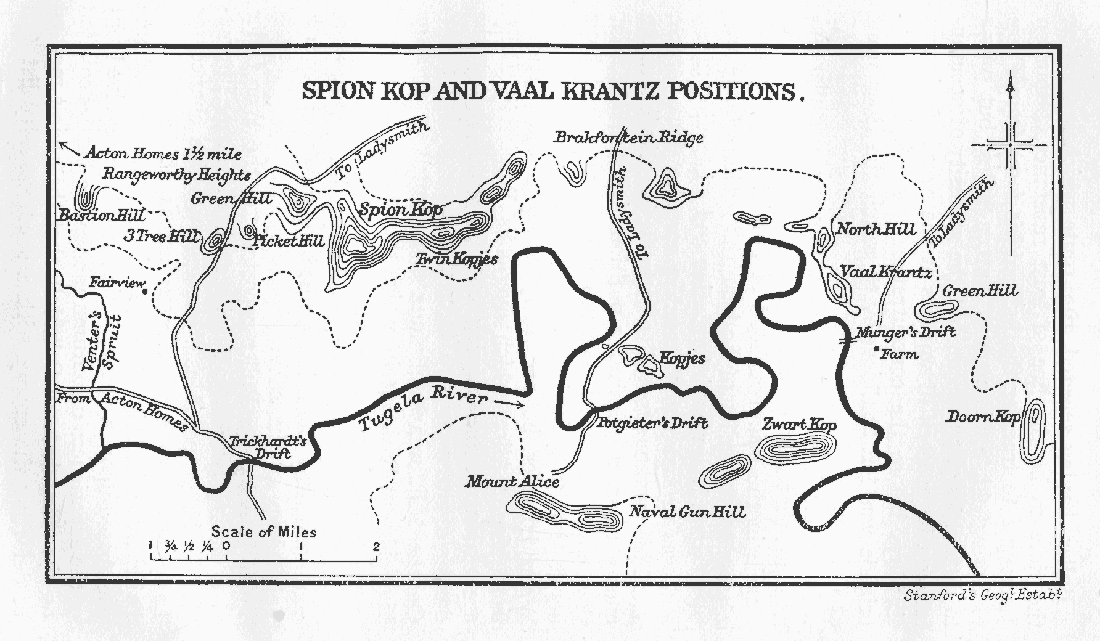
Buller divided his force into two unequal portions. Warren with the stronger portion was to attack the Boer right which Buller believed to be weak, while Lyttelton with the remainder demonstrated at Potgieter's Drift. To himself Buller reserved the part of the Chorus in a Greek play, taking a general interest in the action, yet not personally concerned in it; and in that capacity he issued a stirring appeal to the relieving force.
On January 15 "secret instructions" were given to Warren. He was recommended, after crossing the Tugela at Trickhardt's Drift, to proceed west of Spion Kop, and to pivot his right and swing round on to the open plain in rear of the Boer position facing Potgieter's Drift.
Warren, who was not of opinion that the Boer right was weak, marched out of Springfield on the evening of January 16. Lyttelton had already started, and during the night occupied a position on the north side of the river near Potgieter's Drift.
The task before Warren was hard. In order to carry out Buller's plan he must cross an unbridged river and struggle through a country of which little was known. Next day two bridges were thrown over the Tugela above Trickhardt's Drift, which recent rains had made dangerous, and Hart's and Woodgate's Brigades were transferred to the left bank to cover the crossing: but it was not until sunset on January 18 that the entire force with its tedious transport was established on the north side of the river.
The mounted troops under Dundonald were sent out at mid-day to reconnoitre towards the N.W. and in the course of the afternoon his advanced squadrons came upon a Boer commando which was easily dealt with, but before the issue was decided, he had reported that he was engaged near Acton Holmes, and asked for {100} help. Warren assumed that the mounted troops, which he had sent out to reconnoitre, had wilfully and prematurely forced on an action, and were now in trouble; and it was not until the next morning, after an infantry brigade had been moved out to support them, that Warren heard from Dundonald, whose previous messages had not clearly described the situation, that he was able to take care of himself. Dundonald had at first expected that the main body would follow him, and his reports seem to show that he had hoped to induce Warren to move towards Acton Holmes. He was rebuked for assuming, not unnaturally, that the objective of the operations was Ladysmith, and instructed that the objective was a junction with the other portion of Buller's force. He was summoned to Warren's headquarters and ordered to abstain from further attempts to ride round the enemy's right. Thus, as before at Hlangwhane, a promising cavalry movement by Dundonald was thrown away.
The deliberate march of the British Army from Frere and the delay at the Drifts gave the Boers ample time to prepare for the attack. On January 19, on which day Warren moved to Venter's Spruit three miles from Trickhardt's Drift, they were in occupation of the whole line from Vaalkrantz to the Rangeworthy Heights. Fourie was in command of the left, Schalk Burger of the centre, which included the important features of Green Hill, Spion Kop, and the Twin Peaks; and L. Botha of the right, in which was Bastion Hill.
There were two roads by which Warren could advance; one running by Fairview northwards from Trickhardt's Drift between Green Hill and Three Tree Hill, and the other eight miles longer by Acton Holmes. The length of the latter and a report from White that several commandos were on their way to Acton Holmes from Ladysmith, led Warren to adopt the former route.
He informed Buller of his decision, adding that certain "special arrangements" which he had made {101} would oblige him to remain near Trickhardt's Drift, and that he must therefore have further supplies. The "special arrangements" were in fact the steps which every general would take before attacking a strong position not immediately accessible; namely to acquire ground from which it could be threatened and shelled. Clery was ordered to direct the operation, which Warren believed would entail "comparatively little loss of life."
Early on January 20 Clery with one brigade and artillery advanced up the re-entrant which springs from the river towards the east end of the Rangeworthy Heights, and posted his guns half way up the valley on Three Tree Hill. Hart, with a brigade of five battalions, was sent to occupy the irregular southern crest of the heights running from Three Tree Hill towards Bastion Hill. He drove the Boers out of their advanced trenches, but found that the northern and higher crest to which they had retired, could only be won by a frontal advance across open ground. He and his brave Irishmen were as ready as ever to push on in the line of the greatest resistance, but he was ordered by Clery to forbear. Meanwhile Dundonald, not deterred by the damping of his trek on the 18th, and while obeying an order from Warren to come to heel, seized Bastion Hill, thereby securing Hart's left flank on the crest. So far as they went, the operations of January 20 were successful. Warren's pivot movement was in train, the whole of his force was now threatening the Boer right which was widely extended but deficient in depth; and the day's casualties were few. Following the example of Buller, who delegated his authority to Warren, the latter entrusted the conduct of the day's operations to Clery, who in succession ordered the chief movement to be carried out by Hart. Next day the mounted troops on Bastion Hill were relieved by infantry.
Buller was aware that the Ladysmith garrison, weakened by sickness and privation, could give him little or {102} no help; but at least during the earlier phase of the Trickhardt's Drift operations he was confident. On January 17 he told White that "somehow he thought he was going to be successful this time," and that he hoped to be within touch of Ladysmith in six days. His Head Quarters were at Spearman's Camp, a few miles south of Mount Alice, whence he rode over daily to note and criticize the tactics.
It now occurred to Warren that he might have been mistaken as to the significance of the position occupied by the enemy on the Rangeworthy Heights, and that it might be in reality a screen to hide a trek of the Free Staters back to their own country; and on this supposition, which was founded upon reports that the Siege of Ladysmith had been raised and that some wagons had been seen on trek westwards towards the Drakensberg passes, he applied for reinforcements to enable him to block the way.
Buller sent him Talbot Coke's brigade with some howitzers; and came over to consult with him on January 22. The situation was not satisfactory. Time was being wasted, Warren's "special arrangements" had done little, and now he had a new idea. Buller still advocated an attack on the enemy's right, while Warren wished to persevere with his advance by the Fairview Road; but he pointed out that Spion Kop, which his reading of the "secret instructions" had led him to regard as out of bounds, must first be taken. No definite action seems to have been decided on, and Warren was left to act within certain limits on his own responsibility. Finally, with the approval of the four infantry generals, he resolved to seize Spion Kop that night. The attack, however, was postponed until the following night, to give time for the position to be reconnoitred.
Spion Kop is a ridge of which the chief features are a pair of high peaks joined by a nek to a plateau, from which a spur, ending in a kopje called Conical Hill, {103} juts out at right angles to the nek, which becomes a spur of the plateau at a Little Knoll east of the summit. Its tactical importance was derived from its height, as the summit, though not the peaks, is higher than any of the ground held by the enemy; and from its position, as it was on the obtuse angle formed by the meeting of Botha's line on the Boer right with Schalk Burger's on the centre, and enfiladed each of them. It was accessible from the British front by a slope which rises from the lower ground to another spur running S.W. from the plateau.
On the morning of January 23, Buller saw Warren, and again pressed him to make an attack on the Boer right; but finding that the orders for the assault on Spion Kop had already been issued, he refrained from vetoing it. He threatened, however, that if immediate action in some direction were not taken, Warren's force would be withdrawn to the south of the Tugela.
On the previous day Warren, betraying the Engineer officer unused to handling large bodies of men, and unfamiliar with the military unities, rearranged his command with a straight edge, and distributed it in one way for tactical, and in another for administrative purposes. All the troops lying west of an imaginary line became the left attack under Clery, while those east of it became the right attack. The latter, under Talbot Coke, were ordered to seize the Spion Kop position by night, and entrench it before daybreak, the actual assault being made by Woodgate with two battalions, some mounted infantry on foot, and a few Engineers. At sunset on January 23, the curtain fell upon the first act of the Tragedy of Spion Kop.
On the night of the January 23 Spion Kop was held as an observation post by a party of seventy burghers. When Buller first appeared at Potgieter's Drift, it was on the right of the Boer line, but now it was only the right of the centre under Schalk Burger. Little was known of its features and tactical value, beyond the {104} information obtainable by a telescopic reconnaissance. It was a prominent object in the Boer position, and it seemed to be within the grasp of a night adventure. Woodgate left his rendezvous at 9 p.m., but it is doubtful whether he would have reached the summit before daybreak but for Thorneycroft, who was in command of the mounted infantry which bore his name, and who had before nightfall picked out and noted the recognizable objects on the slope. A staff officer from Head Quarters, who accompanied the column to direct the march, had had no opportunity of making himself acquainted with the way of access to Spion Kop, and Thorneycroft was ordered to act as guide.

The summit, but fortunately little more than the summit, was veiled in mist, and the crest was reached. Bayonets were fixed before the Boer picket was alarmed and opened fire, but the ammunition was spent without effect, as Thorneycroft's men had by order thrown themselves on the ground as soon as they were discovered. A charge into the mist drove back the picket and scared the main body off the summit. Thus before dawn on {105} January 24, Warren was in possession of the hill which was believed to be the key of the Boer position, and the chief obstacle in the way of his advance seemed to be thrust aside: but the mist on Spion Kop was the forecast of the Fog of War which was soon to envelope him.
Woodgate, having the men, the tools and the ground, at once began impulsively to dig, without endeavouring to inform himself of the features of the position he had so easily won. A sort of a trench had been scratched on the summit by the weary men, when the mist rolling away for a little while disclosed the startling topography of the position. The surface of the plateau sloped gently at first, and then abruptly fell away, and the trench was found to be of little use. The enemy could approach on dead ground to within two hundred yards of it. Woodgate, seeing that the real defensible line was not the highest part of the summit, but the edge lower down, where the steep descent began, sent working parties to the front, but they at once came under fire. Soon the mist again enveloped the hill, and having disposed his force, he reported to Warren that he had established himself on Spion Kop.
The Boer outpost which had been driven from the summit belonged to Schalk Burger's command. With Botha's co-operation a storming force was soon brought together, and almost every point from which Spion Kop could be brought under fire was seized, even the Little Knoll near the summit, which enfiladed the main trench. Joubert telegraphed from Ladysmith that the position must be re-captured, and Kruger at Pretoria asked what was being done to win it back.
Little did Woodgate's force realize what the morning mist was hiding. Soon after 8 a.m. the sun dissolved the veil, and the storm burst. From the right the men in the trench and lower crest were enfiladed by the Little Knoll and the Twin Peaks; on their front and left they were rained on by bullet and shrapnel from Conical Hill, Green Hill, and beyond; with such effect {106} that the lower crest had to be temporarily abandoned. Woodgate was soon mortally wounded and the command devolved upon Crofton. Spion Kop was the first position of great tactical importance won by the British Army on the Tugela, and the Boers were determined to recover it.
The naval guns posted on Mount Alice and at Potgieter's Drift opened fire not only on the Little Knoll near the Spion Kop plateau and on the Twin Peaks, but were also pitching their shells over the summit on to the Boer positions supposed to be in line with it, and a field battery on Three Tree Hill shelled the open ground on which the enemy was advancing.
Heliograms and flag messages from Spion Kop, orally handed in and incorrectly transmitted by scared signallers, bewildered the recipients and increased the density of the Fog of War upon the Tugela. To Lyttelton was flashed an appeal for help without a signature. A message sent by Crofton soon after he assumed command, in which he reported Woodgate's death and said that reinforcements were urgently required, was transmuted into a despairing cry which made Warren think that he had lost his head, and which led to his supersession. Warren replied that there must be no surrender, and that Coke was on his way up with reinforcements.
Warren and Lyttelton, as well as the Umpire in Chief, Buller, were too far away to be able to appreciate the situation on Spion Kop, or to know how much or how little of the ridge was in possession of the British troops. Lyttelton's naval guns, playing upon the Little Knoll, were twice silenced by a message from Warren, who was under the impression that the whole of the ridge from the Twin Peaks to the main position on Spion Kop was held. A demonstration made earlier in the day by Lyttelton towards Brakfontein was checked by Buller, who was unwilling to engage the enemy in that direction.
The Boers, a small party of whom before Woodgate's death had climbed the dead ground, and had come {107} within fifty yards of the main trench, again attained the outer crest, and a counter attack led by Thorneycroft in person partially failed, and although the verge was not wholly abandoned, only the main trench filled with dead, wounded, and unwounded men parched with thirst, remained for effective resistance. Woodgate had already paid the penalty for the hasty and fatal act of squatting down in an indefensible position, and lay among the other victims strewn upon the plateau; but the British soldier is not easily discouraged by the errors of his leaders. The cry "nous sommes trahis" is never heard from his lips, and when called upon on active service,
To live laborious days and shun delights,
he rarely fails to do his duty.
At mid-day the situation on Spion Kop was hazardous but not hopeless. Reinforcements had arrived and were quickly absorbed in the works which they quickened with patches of new vigour, but the terrible hail of bullet and shrapnel was not abated. No definite orders had been given to Clery, who was on the southern crest of the Rangeworthy Heights, except that he was to "use his discretion about opening fire against the enemy to his front, with a view to creating a diversion," a discretion which he exercised by doing nothing.
Shortly before noon a step was taken by Buller, who was four miles away on Mount Alice, which enlarged the area of the Fog of War and brought Spion Kop within its chilling grasp. Thorneycroft was ordered to take command on the summit with the local rank of Brigadier-General, although there were several officers present senior to him: but many hours elapsed before the appointment was made known to all of those whom it most concerned. Coke, who was now on the S.W. spur, was unaware of it, and without communicating with Thorneycroft, sent at 12.50 p.m. to Warren a message which was not delivered till 2.20 p.m., that as the summit was crowded and the defence was maintaining {108} itself, he had stopped further reinforcements.
Almost simultaneously with the despatch of this not unfavourable report, and long before it was received by Warren, two companies posted in a detached trench on the right threw up their hands, but not before they had lost all their officers. Out of the crest line sprang the Boers, who having made them prisoners, endeavoured to impose the surrender upon the men in the main trench.27 Thorneycroft saw that if these wavered, as they seemed inclined to do, all was lost; and rallying the details within reach, he succeeded in thrusting back the intruders, who, however, had already sent their prisoners below the hill. His prompt action stayed the wave of doubt which threatened to flood the position, and compelled it to break before it could do much harm.
At 3.50 p.m. Coke, who was still on the S.W. spur, and therefore not in direct touch with Thorneycroft, informed Warren that the enemy was being gradually cleared from the summit, and that he had been reinforced with the Scottish Rifles from Potgieter's Drift by Lyttelton, whom Warren, after receiving Crofton's mis-transmitted message, had ordered to co-operate. He had already forwarded a letter written at 2.30 p.m. by Thorneycroft, stating that the force on Spion Kop was being badly punished by artillery, was in want of water, and was insufficient to hold the position. To this letter he had added a note of his own which showed that he did not attach much importance to it, saying that he had ordered more troops on to the plateau, where "we appear to be holding our own." This letter, with Coke's covering note, did not reach Warren until after he had received Coke's message sent nearly an hour later, and he assumed that the latter indicated the existing hopeful situation with which he had to deal. Of the physical features of the Spion Kop position he knew little more than {109} what his telescope told him, and he read optimistically the meagre, inconsistent, and misleading reports which reached him occasionally from the summit. He hoped during the night to place some naval guns on the plateau: he was informed that an accessible spring of water had been discovered: reinforcements were at hand: there was nothing more to be done.
Lyttelton, when ordered to "assist from his side," acted with intelligence and discernment. Noticing that Spion Kop, whither he had already dispatched the Scottish Rifles, was full of men, he sent the King's Royal Rifles towards the flanking position on the Twin Peaks, and the battalion supported by the naval guns, and ignoring messages of recall prompted by Buller, who was watching the advance with anxiety, worked its way up and expelled a Transvaal contingent and a small body commanded by an Irish renegade, all of whom were hurled by the impact into a flight of eight miles. The position was at once entrenched and at 5 p.m. the right flank of Spion Kop was secured, but only for a time. Again, as after Lord Dundonald's movement on Acton Holmes, a promising enterprise was thrown away. Buller had from the first disapproved of Lyttelton's action, which still more widely distributed his already scattered command. He was too far away to see its bearing upon the situation, and now ordered him to recall the King's Royal Rifles, who after sunset were withdrawn from the position, which they had so gallantly captured in spite of warnings signalled from Spion Kop that it was strongly held by the enemy.
On Spion Kop the Fog of War hung more densely than ever. Coke, who was lame and unable to move freely about the position, believed that Hill, who had come up with a reinforcement soon after noon, and who was next in seniority to Crofton, was in command on the summit. He thought that Crofton had been wounded, and neither saw Thorneycroft nor knew until the following day that Warren had given him the {110} local rank of Brigadier-General at Buller's suggestion. Thorneycroft was a junior major in the Army, having the local rank of Lieutenant-Colonel: and with two colonels senior to him present as well as a major-general, he was doubtful as to his status. No instructions reached him from Coke; he was unaware that the Twin Peaks had been taken by one of Lyttelton's battalions, and he was without means of signalling to Warren. He had no information of the measures which were being taken, such as the dispatch of guns, to make the retention of Spion Kop possible.
The men on the summit were utterly exhausted by fatigue, hunger, thirst, want of sleep, and exposure to the summer sun beating down upon the rocky surface, and their ammunition was running short. At 5.50 p.m. Coke reported "that the situation is extremely critical" and that the men "would not stand another day's shelling," but it was two hours before the message reached Warren. He ordered Coke to come down to consult him. Coke endeavoured to obtain permission by flash signal to stay where he was, but no oil could be obtained for the lamp, so regarding the order as imperative, he quitted Spion Kop at 9.30 p.m., leaving, as he thought, Hill in command. For four hours he strayed in the Fog of War before he found Warren's Head Quarters, which had come under shell fire, and which, unknown to him, had been moved from their original position.
Between 8 and 9, Warren received a letter written at 6.30 p.m. by Thorneycroft, who reported that the enemy's shell fire rendered the permanent occupation of Spion Kop impossible, and asked for instructions.
Coke's departure left the position without a clearly recognized commander, although he had done little more than attend to and distribute the supports and reinforcements on the S.W. spur. After the dispatch of Thorneycroft's letter at 6.30 p.m., the situation grew more hopeless every minute. The enemy's artillery was out of reach, the nature of the ground and the want of tools {111} made it impossible to cut properly designed trenches, rations and water were exhausted, and nothing was known of assistance to be brought up during the night except that a mountain battery, which would be of little use against the enemy's guns, was at the foot of the slope.
For these reasons Thorneycroft justified in his official report his decision to retire from Spion Kop. With the acquiescence of all the senior officers, except Hill, who could not be found, he ordered a withdrawal at 10 p.m. The alternative seemed to be a Majuba surrender next morning. At 10.30 p.m. as the troops were beginning to move off the hill, he received a letter from Warren, asking for his views on the situation, and as to the measures to be adopted. It was now unnecessary to give these, and he sent a brief reply that he was obliged to abandon Spion Kop as the position was untenable.
The retirement was not made without protests from Hill and from Coke's staff officer who was still on the plateau. The former, eleven hours after Thorneycroft's appointment as Brigadier-General, believed, as he had every right to do, that he was in command, and halted the men; the latter sent round a memorandum to the commanding officers, asserting that there was no authority for the withdrawal. But the force of Thorneycroft's local rank prevailed, and the retreat was not stayed. Near the foot of the slope he found the mountain battery, and met a fatigue party on its way to prepare emplacements for two naval guns which were coming up, and received a message from Warren urging him to hold on to the position. It was too late. Ordering back the party and the battery, he went on to report himself to Warren, and arrived at Head Quarters almost simultaneously with Coke.
The Boers meanwhile were greatly discouraged by their expulsion from the Twin Peaks, and their failure to occupy the main position on Spion Kop. The guns which had tormented Thorneycroft for so many hours, {112} and which were the chief cause of his retirement, were withdrawn, and Schalk Burger's commandos oozed away towards Ladysmith. But there was, however, a stalwart and not inconsiderable remnant of burghers who responded to Botha's expostulations, and stood fast as a forlorn hope determined to win back Spion Kop and the Twin Peaks. Their constancy was rewarded, and when at sunrise on January 25 they once more climbed the hill, they found to their astonishment and relief that it was still held—by more than 300 bodies of their fallen foes.
Such in brief is the tale of Spion Kop so far as it can be disentangled from the accumulation of messages, orders, reports, dispatches, and personal accounts, which obscure the subject. Many of these are inconsistent, not a few contradictory, and sufficient evidence might be found to support plausibly half a dozen conflicting theories of the cause of the disaster, and as many variants of the narrative.
At 2 a.m. Warren heard from Thorneycroft's lips—the latter's written message sent off at 10.30 p.m. on the previous evening not having reached him—of the evacuation of Spion Kop. At sunrise he was joined by Buller, who viewed the situation in a spirit of philosophic detachment. He had never cordially approved of the Spion Kop adventure, and was not surprised to hear that it had failed. Warren was inclined to persevere, but Buller decided to retire south of the Tugela and assumed the direct command of the Army, which on January 27 was once more drawn up on the right bank after an absence of ten days; with most of its superior officers discredited, with Ladysmith unrelieved, and the nation at home aghast at the disaster.
The lonely figure of Thorneycroft, the only man of action on the summit energizing and quickening the defence, stands out prominently in the confusion, gloom, and half lights of Spion Kop. Buller's impulsive intervention made him responsible for the position, and he {113} tried to do his best. If the final act was an error of judgment, there is little doubt that but for Thorneycroft, the Boers would have rushed the plateau on the afternoon of January 24. He received no effective support from Clery and little from Warren, and was out of touch with Coke and the Colonels. His uncertainty as to his authority caused him to refrain from exercising it fully until the last moment. For the pain which the decision to withdraw must have given him, he deserves much sympathy. But although it was approved of by Buller, who probably felt bound to support his nominee, it was at least premature. He might reasonably have expected that an effort would be made during the night to relieve him, and might have postponed it for a few hours. It is unjust to judge a man in the light of eventualities which he could not reasonably be expected to foresee, but subsequent accounts from the Boer side show that the attack would not have been renewed the next morning if the enemy had found the Twin Peaks, for the evacuation of which Buller and not Thorneycroft was responsible, and Spion Kop still occupied.
Not only the inconvenience, but also the danger of suddenly conferred local rank were illustrated on January 24. Buller, hastily concluding from a garbled message that Crofton was incompetent, asked Warren to put Thorneycroft in charge. Thorneycroft heard of his appointment orally through an officer who had chanced to be at the signalling station, and the written message which never reached him was, it is said, picked up next day by a Boer! If the exigencies of war should ever require the sudden promotion of a junior officer to a position of great responsibility, it should not take effect until all concerned are notified. The defence of Spion Kop was, during the greater part of the day, conducted by a syndicate of officers acting severally.
The curtain had fallen, the drama was over, and the critics took up their pens. With Thorneycroft's report {114} on the retirement from Spion Kop began a controversy which lasted for more than two years. Warren enclosed it in his own report to Buller, with the suggestion that a Court of Enquiry should be held to investigate the circumstances of the unauthorized withdrawal, and in succession each grade of the military hierarchy passed censure on the grades below. In Buller's covering despatch of January 31 with which he forwarded to the War Office, through Lord Roberts, Warren's Spion Kop report, he commented very unfavourably on Warren's arrangements and disposition of troops; and said that Thorneycroft had "exercised a wise discretion, and that no investigation was necessary": while to Warren's general report on the whole operations of January 17-27, he attached a memorandum to the Secretary of State for War, "not necessarily for publication," in which he not only blamed himself for not having taken command on the 19th, when he saw "that things were not going well," but also said that he could "never employ Warren again in an independent command"; as his slowness had allowed the enemy to concentrate and to increase the force opposed to him more than twenty-fold.
With this accumulation of censure Lord Roberts dealt in his despatch to Lord Lansdowne of February 13, written at a drift on the Riet River during the advance on Kimberley. The Commander-in-Chief confirmed all the censures passed by his subordinates and added some of his own. Buller was rebuked for not having intervened when he saw that a most important enterprise was not being "conducted in the manner which in his opinion would lead to the attainment of the object in view with the least possible loss of life on our side"; Warren was reproved because he did not visit Spion Kop during the crisis, and had instead ordered Coke to come to him; and while Thorneycroft's gallantry and exertions, without which the troops would probably have been driven off the hill during the day, were acknowledged, his action in ordering the retirement without endeavouring to communicate with Coke or Warren {115} was pronounced to be a "wholly inexcusable assumption of responsibility and authority."
Never before had such an inconvenient batch of despatches been laid upon the desks of Pall Mall. To publish them and to proclaim to the world that the Natal Generals, when they were beaten by the enemy, had began to fight among themselves, was impossible. If they were withheld from publication, many awkward questions would be asked. The War Office temporized, and endeavoured to steer a middle course. Would Buller kindly substitute a simple narrative for his despatch? This Buller refused to do, and in April, 1900, the War Office published the despatches, imperfectly sterilized. As they now appeared, they were neither a simple narrative, nor a full revelation. Lord Roberts' criticisms on Buller were cut out. The memorandum, "not necessarily for publication," in which Buller reflected severely on Warren's incapacity was withheld. Only the censure passed upon Thorneycroft was allowed to appear. The junior officer was made the scapegoat of his superiors' mistakes. Of all the officers concerned, he alone had failed. The War Office had taken a politic but not straightforward course. The blame must be laid upon some one, and if it were laid upon Thorneycroft alone it would affect public opinion less mischievously.
It soon became suspected, however, that certain things were being kept back, and the controversy dragged on for two years; Buller to the end maintaining that as he was not present at, nor in command of, the Spion Kop operations, it was not incumbent on him to write a simple narrative of them; and that his duty was to write a critical account of the affair, such as would be sent in by an Umpire in Chief during peace manoeuvres.
Not until April, 1902, did the Epilogue of the Tragedy of Errors appear. The despatches, with the memorandum "not necessarily for publication," were published in full, as well as the "Secret Orders" given to Warren at Springfield, which were its Prologue.
Footnote 26:(return)A detachment numbering about 600 only was sent.
Footnote 27:(return){116}In the Fog of War some of the British soldiers thought that the Boers were coming up to surrender themselves, and acted in this belief for a brief period.
By a process of elimination Buller hoped in time to find the road to Ladysmith. He had tried in succession, but without success, Colenso, Potgieter's Drift, and Trickhardt's Drift. He now informed White that he intended to make another attempt, but Lord Roberts advised him to postpone it until his own advance should draw off the Free Staters and weaken the barrier on the line of the Tugela.
The situation in the besieged town was growing worse every day, but a proposal made by White as well as by the War Office that the garrison should endeavour to break out, was not sanctioned by Lord Roberts. White also was opposed to Buller's making another attempt to cross the Tugela, as he considered that the force would be more usefully employed in preventing the enemy from concentrating on Ladysmith.
Buller's new plan was an advance by way of Vaalkrantz. Here the river winds in two salient loops towards the north, with a re-entrant loop between them, and there is a slight break in the heights on the left bank. The Brakfontein ridge slopes down towards Vaalkrantz Hill, between which and Green Hill there is a dip through which a road passes on to the open ground towards Ladysmith, eleven miles distant.
Buller proposed to occupy the ridge of Vaalkrantz with artillery, and after a feint attack on the Boer position on Brakfontein, to push through under cover of {117} the guns. It was believed that the enemy's extreme left lay on Vaalkrantz, which was commanded by Mount Alice and Zwart Kop. Lord Roberts when informed of the project was not hopeful of its success, but did not veto it, although he thought that Buller would be better advised to abstain from offensive tactics.
The feint attack on Brakfontein was to be made by seven Field Batteries and a Brigade of Infantry, and was to be continued long enough to convince the enemy that it was "meant". It was then to be withdrawn and the real attack set in motion. The advance of the feint would be covered by heavy guns posted on Mount Alice, and concealed batteries on Zwart Kop would open on Vaalkrantz in support of the real attack.
The bulk of the infantry was posted in the east loop, so as to appear ready to cross the river and support the feint attack between the loops. As soon as the guns had driven the enemy into their trenches on Brakfontein, a pontoon bridge was to be thrown across the river south of Hunger's Drift, and the guns on Zwart Kop were to open on Vaalkrantz, and when this had been sufficiently bombarded, it would be carried by the infantry, and guns would be brought up to enfilade the Boer line; while the cavalry "when feasible" would push through under the ridge and threaten it from the rear.
It was a pretty tactical scheme, with much of the War-Game about it, and it depended for its success upon the practicability of using Vaalkrantz as an artillery position, and upon the correctness of the assumption that the enemy was not in force eastward of it.
Buller was not successful in placing his guns on Zwart Kop unnoticed by the enemy, who was warned in time. After Spion Kop, Botha went to Pretoria, and Schalk Burger took furlough. B. Viljoen was now in command. He saw the danger and applied to Joubert at Ladysmith for help, who thought he was over-anxious {118} but sent him a heavy gun. Little however would have been done but for the intervention of the two civilian Presidents. Steyn appealed to Kruger who, having tried without success to induce Joubert to take command on the Upper Tugela, fell in with Steyn's suggestion that Martin Prinsloo, a Free Stater, should go there; and Botha was ordered back from Pretoria. Prinsloo took command of the Brakfontein position, Viljoen remaining on Vaalkrantz.
At sunrise on February 5 began Buller's third attempt to relieve Ladysmith. Wynne, who had succeeded Woodgate in command of the 11th Brigade, advanced in two lines up the slope towards Brakfontein, supported by the fire of forty-four guns. Nearly six hours passed before any reply was vouchsafed by the enemy. At mid-day some guns on Wynne's left front opened on the batteries, but not a shot was fired by the Boers in the trenches.
Already one field battery had been detached from the left of the line of guns, the first movement in the real attack, and had taken up a position to cover the pontoon troop which was throwing a bridge across the Tugela near Hunger's Drift. At noon the completion of the bridge was signalled to the feint attack. The batteries fronting the Brakfontein ridge were withdrawn, and Wynne's brigade which, having been marched up the slope, was now marched down again, came under a heavy but almost innocuous infantry fire, which at last broke out on Brakfontein.
To the Boers it appeared that another attack, determined while it lasted, but devoid of backbone, had been kept at bay. The guns on Zwart Kop opened on Vaalkrantz as soon as the detached battery was seen to be in motion; and the other batteries came into action as they arrived from the Brakfontein demonstration. There was some annoyance from casual rifle fire and a Maxim posted on the heights S.E. of the loop, but it did not seriously interfere with the work of the bridge-builders.
{119}The rules of the game were strictly obeyed, and there was "a thorough preparation by artillery" before the infantry was allowed to advance. The movement was delayed until half a hundred guns were playing upon Vaalkrantz and the chance of a celer et audax exploit was lost. At 2 p.m. Lyttelton with two battalions of the 4th Brigade was permitted to cross the pontoon and with these he worked up under the protection of the left bank, and emerging upon Munger's Farm, rose thence to the southern edge of Vaalkrantz, and took hold of the ridge. Here he was joined by a battalion of Hildyard's Brigade, whose original orders to occupy Green Hill were cancelled, and later on by the remaining battalions of his own brigade; which Buller, wavering for a time, had held back, as the pontoon and the open ground were under fire from the right flank. At 4 p.m. Lyttelton was established on the main hill of Vaalkrantz, and during the night the position was entrenched. The occupation, however, brought two facts to light. Half a mile to the north of the main hill was another hill, only a few feet lower, unapproachable and in the enemy's possession; and it was not practicable, as Buller had hoped, to bring up artillery on to the position seized by Lyttelton.
At daylight on February 6, the situation was favourable to the Boers. Botha had arrived and had taken over the command from Prinsloo. The heavy gun sent from Ladysmith had been mounted on Doom Kop, which was now held by reinforcements under L. Meyer; other good positions east of Vaalkrantz had been strengthened; and some of the guns on the Brakfontein position had been moved round. Vaalkrantz standing between Doorn Kop and the Twin Peaks, was shelled simultaneously from the left front, and the right rear, as well as from Green Hill;28 it seemed as if Spion Kop were about to be repeated.
{120}Buller opened on Green Hill with artillery, and on the hill north of the main hill of Vaalkrantz, in the hope of making the North Hill assailable. In view of a retirement, a pontoon bridge was, at Lyttelton's request, thrown across the river under the main ridge. He discouraged a proposal made by Buller to attack the North Hill by a force creeping along the foot of the westward slope of Vaalkrantz, covered by fire from the ridge.
Buller was now stalemated. The artillery fire had not cleared the way to the North Hill, and Lyttelton was unable to move on it, but he said that he could hold on for the rest of the day if no more artillery were brought to bear on him from the S.E.
Finally Buller determined to shift the responsibility. He reported the capture of Vaalkrantz to Lord Roberts, and in effect asked what he should do with the white elephant. To carry out his plan would "cost from 2,000 to 3,000 men," and he was "not confident of success." Was Ladysmith worth it? Yes, replied Lord Roberts without hesitation, Ladysmith was worth it and it must be done.
In the evening Lyttelton, having thwarted an attempt by the enemy to recover Vaalkrantz, was relieved by Hildyard. On the following afternoon, Buller, in spite of Lord Roberts' message, made up his mind to withdraw. Further reconnaissances had shown that the North Hill, even if taken, could hardly be held. A council of war was summoned, at which, as might have been anticipated, Hart alone was for persevering, and at which Warren again put forward the scheme rejected by Buller at Frere, but now gladly adopted by him, of advancing on Ladysmith by way of Hlangwhane.
Orders were issued for the withdrawal of the force from Vaalkrantz during the night. It was skilfully carried out, and Buller was once more ferrying his men across the Tugela, having for the third time failed to reach Ladysmith.
{121}On February 8 the Army was retracing its steps on the road by which four weeks before it had marched from Springfield to Potgieter's Drift; and on the 11th it was concentrated at Chieveley, from which eight weeks before it had been thrown at the Colenso heights. All the Tugela operations had been conducted in a rarified medium. Want of determination, want of system, the absence of maps, the lack of a sufficient staff, were responsible for two months of misadventure. Buller, like the Boers, was easily discouraged by failure, but unlike them was unable to quicken himself readily for a renewed effort. He lost confidence in himself, and then in his subordinates. Like a nervous child, he opened the door of a dark chamber, but was afraid to enter. The terror of the unknown drove him back in a panic. When his plans, which were usually well thought out, miscarried, he became peevish, and scarcely made an attempt to reconstruct them. Only an Army of which the backbone was the stolid, unimaginative Englishman of the lower classes, and which believed that its leader was doing his best, could have remained undemoralized by the campaign on the Tugela.
Buller possessed one quality which to a great extent outweighed his shortcomings as a military commander: namely the power of inspiring confidence. His men believed in him, and would do anything for him. They liked him for his bluff, John-Bullish, and rampant manner. The enlisted man is a curious differentiation from the class to which he belongs. His democratic instincts become less acute when he shoulders the Lee-Metford, and he readily accommodates himself to the will of a benevolent despot of robust appearance, and blunt and somewhat contemptuous address; whom in fact he prefers to the ascetic, dispassionate General Officer of quiet habit and speech.
The criticisms passed upon Buller were far more friendly in the men's than in the officers' bivouacs. Possibly the men's opinions, as being the more natural {122} and spontaneous, were also the more correct. The enemy conducted the war upon principles which were strange to the British Army, and to which it had to adapt itself painfully; and the men seem to have recognized sooner than the professors the difficulties of the situation, and to have been less intolerant of ill-success.
Few general officers have ever revealed in their official communications more of the workings and the moods of their minds than did Buller in Natal. His telegrams and despatches always reflected the thoughts of the moment. After the Colenso fight, he candidly referred to it as my "unfortunate undertaking of to-day." Six days before the Vaalkrantz affair he told Lord Roberts that "this time I feel fairly confident of success"; and on the eve of the attack he said that "while I have every hope of success, I am not quite certain of it."
After the retirement, it was, "wherever I turn I come upon the enemy in superior force to my own." He subjected his personal and individual ideas and feelings to no restraint, and they incontinently leavened all his messages which were now confident, now diffident, and now querulous, and which read as if they were quotations from his private diary. From Vaalkrantz he heliographed to White that the enemy was too strong for him, and that the "Bulwana big gun is here"; and could White suggest anything better than an advance by way of Hlangwhane? In his telegrams from Chieveley to Lord Roberts, he complained of want of support, and of the feebleness of the resistance made by the Ladysmith garrison, which he professed to believe did not detain more than 2,000 men. Yet in recording his weakness, it must in justice be said that he gained and never lost the confidence of the rank and file of the relieving force, and that under any other leader it would probably have succumbed to its misfortunes.
On February 12 the re-concentration of Buller's Army at Chieveley was complete. The enemy's front had been greatly strengthened since the attack on {123} Colenso. The Boers saw what Buller could not be persuaded to believe, that Hlangwhane was the key of the position, and extended their line thence in a curve through Green Hill and Monte Cristo, with a detached post outside it on Cingolo. These four hills and the ground between them Buller proposed to occupy, and then pass between Cingolo and Monte Cristo to a drift of the Tugela N.E. of Monte Cristo, cross the river and advance by the Klip Riyer on Bulwana. The two "iron bridges" at Colenso were impassable, but the Boers had thrown a bridge across near Naval Hill by which, and also by a ferry higher up, communication was kept up with their left flank.
The initial movement on February 12 was made appropriately enough by Dundonald, who two months before had seen the value of the Hlangwhane position, and who now perhaps as he marched out, realized the truth of the proverb tout vient à ce qui sait attendre. He occupied Hussar Hill temporarily as a reconnaissance to give Buller an opportunity of surveying the ground over which he was about to operate. The Intelligence officers reported that the enemy was strongly posted at several points within the area and unmasked some of his slim tricks. In order to conceal the line of the trenches, the excavated earth was piled up some distance towards the front, and tents not intended for occupation were pitched to divert fire from the positions in which he lay. The war-craft which comes by instinct to nationalities not in an advanced state of civilization and leading simple lives face to face with wild animals and native tribes, and which the conventionally trained European soldier only learns by experience, strengthened the Boer commandos without an augmentation of individuals liable to be killed or wounded. The veld trenches which kept Methuen at arm's length at Magersfontein and the Boer devices on the Tugela seem to show that War is not a Science, but an Art, easily acquired by unprofessional soldiers.
{124}On February 14 the movement began and a front at Hussar Hill was taken up, but owing to the heat and the scarcity of water, little was done during the next two days, except a bombardment of the Boer trenches and gun positions. The advance of the relieving force has been likened to the deliberate progression of a steam roller.
Clery having been invalided, the IInd Division was temporarily under the command of Lyttelton, whose orders for February 17 were to move upon Cingolo Nek and Green Hill. Dundonald was instructed to work in rear of the infantry and outflank any detachment of the enemy that might appear on the Nek. But Dundonald was not a military pedant devoid of initiative and tied to the letter of his instructions, and when the difficulties of the ground broke the touch between him and Lyttelton he was perhaps not sorry to find himself disengaged; and when he saw that the Boers were entrenched on Cingolo Ridge, he attacked instead of outflanking it.
While the commando on the ridge was occupied with the infantry, it was suddenly surprised from the flank by Dundonald's men, and was driven out of the trenches. Meanwhile one of Lyttelton's battalions, which in ignorance of Dundonald's movement, had been sent to clear Cingolo of some Boers who were firing on the advance and checking it, found when it reached the ridge that it had been forestalled in the capture.
When Lyttelton became aware that the enemy had been expelled, he proposed to avail himself of the success without delay, and push on to the Nek and Monte Cristo, while Warren's Vth Division attacked Green Hill; but Buller objected to an advance which could not be completed before nightfall. Lyttelton bivouacked S.W. of the ridge and Dundonald on the detached hill at its northern end. During the night, field guns were brought up the slopes and with much difficulty emplaced in a position from which shell fire could be directed on Monte Cristo.
{125}If the movement of the day was not remarkable for speed and enterprise, it was at least directed with skill and without excessive caution; and Dundonald showed that his military spirit had not been chilled by previous rebuffs, one of them administered almost on the spot where he was now in activity.
At daylight on February 18, the movement was resumed, the immediate objective being the capture of Monte Cristo and Green Hill. One brigade was sent through the Nek on to the eastward slopes of Monte Cristo, while the other attacked the hill from the south. With the help of the ever-ready Dundonald the IInd Division established itself on the main hill of the ridge early in the afternoon. The Fusilier Brigade of the Vth Division was meanwhile acting in support; and advancing as soon as Monte Cristo was seen to be occupied, easily took hold of Green Hill. The enemy was now expelled from all the positions commanding the proposed line of advance over the Nek, and was retreating westward towards the positions near the right bank of the Tugela, but no attempt was made to pursue him. The motto of Buller's Army was festina lente and its track towards Ladysmith was in zigzag.
On the following day Hlangwhane was occupied by the British troops, and before noon on February 20, all the Boers had withdrawn to the left bank of the Tugela, and Buller was favourably placed for the advance by way of the Klip River on Bulwana. A reconnaissance, however, caused him to change his mind and to resume the movement at an acute angle by doubling back towards Hlangwhane and crossing the river by a pontoon bridge west of the hill.
His new plan was to capture a position between the Onderbroek and Langewacht Spruits, which appeared from a distance to be one hill, but which in reality was two, Wynne's Hill and Horseshoe Hill, which were separated by a donga. On the morning of February 21 he signalled his intentions to White, saying that he {126} thought he had "only a rearguard before him"29 and that he hoped to be in Ladysmith next day.
After the capture of Monte Cristo and the Hlangwhane position, some of the commandos seem to have trekked away towards the north, and even Botha for a time appears to have lost heart and to have suggested to Joubert that the siege of Ladysmith should be raised. The Boer leaders had already, like King Arthur,
Heard the steps of Modred in the west,
and their army in Natal had been weakened, before Buller's final advance, by the departure of commandos going to succour their brethren not only on the Modder, but also in the Cape Colony.
The situation on the Tugela was reported to Pretoria almost simultaneously with the news that Cronje was hemmed in at Paardeberg. But owing it may be to the distance which intervened between Kruger and the scene of action, the dour old voortrekker of Colesberg would not hear of any voluntary retirement before the enemy who had driven him out of the Cape Colony sixty years before. He sent an appeal to the Boers of the Tugela which, in an intense human document, displayed his steadfast and touching faith, and which might have been addressed by his prototype Cromwell to the Ironsides.
He rebuked the burghers for their cowardice, which he attributed to the waning of their trust in the power of the Almighty to help them in their distress, and with many instances and quotations from Holy Writ, he adjured them to stand fast in faith. He was confident that the cause which he in all sincerity believed to be the cause of the Church of Christ would prevail in the end, and justifiably encouraged by successes in the field against superior numbers he exhorted the commandos to endure without flinching the purification by fire. Kruger's passionate appeal availed, and the {127} waverers returned to their posts. The incident disclosed the power of the factor of moral force, wherein the Boer strength lay; and it will in a great measure account for the prolongation of the war. When their cause seemed hopeless, they comforted themselves with the honest and irradicable belief that its righteousness was the assurance of final success. Though most of their leaders were incompetent, though they themselves were easily discouraged; disobeyed orders; often malingered and mutinied; quitted the field with their wagons which they were reluctant to abandon, under such frivolous pretexts that the verlafpest or leave-plague became a bye-word; though time after time their power of resistance seemed to be exhausted; though in their thousands they were distributed over the British Empire as prisoners of war; though their confident expectation of European intervention was not realized; though they were always greatly outnumbered; they continued stubbornly to defy for the space of two years and seven months the most numerous and the most efficient Army which has ever left the shores of Great Britain, until at last they were worn down by mechanical friction and attrition, and not by the stroke of war. When the Boers were driven out of the Hlangwhane positions, they took up a new position facing S.E. on the left bank of the Tugela. Their right was near the head of Hart's loop, and their centre came within a few hundred yards of the river at Wynne's Hill, whence the line was carried on towards Pieter's Hill.
At noon on February 21 Buller began once more to send his men across the Tugela, intending to content himself that day with establishing his force "comfortably" on the position north of the railway bridge enclosed by the bend of the river, which was now free of the enemy. He ordered Talbot Coke with the 10th Brigade of Warren's Division to pass over the Colenso Kopjes on to the open ground beyond, from which the Onderbroek valley could be enfiladed by artillery. He had {128} received information that the enemy were there in force, and in the belief that "what Boers there were, were hiding in that kloof," he changed his plan of moving northwards at once on Wynne's Hill.
On February 21 Coke advanced in three lines, but soon after he had cleared the hilly ground, his scouting line came under fire from the Grobelaar slopes, and his right flank was also involved from the direction of Wynne's Hill. His Brigade was pinned to the ground by rifle and shell fire until nightfall, when it was retired to the Colenso Kopjes, where Wynne's Brigade of Warren's Division had arrived during the afternoon.

The route march to Ladysmith was checked. Instead of a mere rearguard to be driven in, as Buller had fondly believed, a strongly posted line, extending nearly four miles S.W. from Wynne's Hill, had to be attacked. The enemy had been so much encouraged by the failure of Coke's movement, that Botha telegraphed to Kruger that he had hopes of a "great reverse."
Warren thought that it would be necessary to diverge from the advance and take the Grobelaar slopes, and White reported that Boer reinforcements were coming in {129} from the north. Towards evening on February 21, it seemed not unlikely that another Colenso, Spion Kop, or Vaalkrantz would soon be debited to Buller. The line of approach to Ladysmith was held by the enemy, and the British Army of relief, the greater part of which had crossed to the left bank of the Tugela, was entangled in the Colenso Kopjes, and the river loop.
Warren's general idea for the 22nd, of which Buller approved, was to attack Wynne's Hill with the 11th Brigade, leaving Horseshoe Hill to be dealt with by the artillery. Although the Boers on the Grobelaar slopes had been well pounded for some hours by the field batteries, Wynne considered that it would be unsafe to advance unless these slopes were actually taken, but he was overruled. He had also been promised support on his left rear, but only two of the battalions detailed for the purpose were at hand and these were fully occupied in offering a front to the Boers on Grobelaar, while the movement was in progress; and he advanced against the enemy's centre unsupported except by the long range fire of a brigade on Naval Hill across the river.
He had expected that the promised supports would secure his left flank by seizing Horseshoe Hill, and in default he was compelled to detach a portion of his own scanty force against it. At sunset the cutting edge of the advancing wedge was touching the enemy, but was unable to break into him, and Briton and Boer were face to face on Wynne's Hill and on Horseshoe Hill.
Reinforcements were brought up and defences were constructed during the night, while the Boers continually fired upon the confused units labouring in the darkness. The enemy had an entrenched position on Hart's Hill which enfiladed Wynne's Hill, and which Warren had not been able to take, as Buller hoped, with the 11th Brigade.
Next morning the 5th Brigade under Hart, which was in reserve near the river loop, was sent against {130} Hart's Hill. He advanced, wherever possible, under cover of the steep left bank of the river along a trail so narrow that the men were compelled often to move in single file; and at one place, where the Langewacht Spruit enters the Tugela, it was necessary to make a detour and cross the spruit by the railway bridge, and to quit the dead ground and emerge on to a defile under heavy fire. The advance of the Brigade was retarded by the stringing out of the battalions, and from time to time Hart's Hill was shelled without seriously harming the enemy, who as usual was not posted on the apparent crest, but some distance in rear of it.
Two battalions of the 4th Brigade, which had been lent to Hart, were so far behind that as only two or three hours of daylight remained, he decided to attack without them. For impetuous gallantry the advance of the Irish regiments was not surpassed by any other exploit in the War. Working up on difficult ground to the sound of the Regimental calls, and then almost brought to a standstill by the barbed wire fences of the railway, which became a trap of death, they rushed the slope, pushing the enemy's outposts before them, and won the crest: and then in the failing light which compelled the supporting artillery to discontinue the bombardment and relieve the enemy from the pressure of shrapnel, they saw the Boer positions still above them. The crest was false.
It was a cruel disappointment to brave men who had struggled so well, but they did not flinch. A charge was made across the plateau, but it soon was withered by fire and few of the men reached the Boer trenches. Two more battalions of the 4th Brigade arrived at dawn, but the reinforcement came too late. The troops were reorganized, as far as possible, on the slope leading down from the crest, but were eventually compelled to retire across the railway to the lower ground by flanking fire, which Hart succeeded in silencing, and was able to reoccupy the dead ground below the false crest with fresh troops.
{131}The failure of the attack did not deter Buller from pursuing his plan, and on February 24 he proposed to renew it and to operate against Railway Hill, which stands fourth in the line of hills running in a N.E. direction from Horseshoe Hill to Pieter's Hill; but by Hart's suggestion the movement was postponed, and in the end, abandoned. The greater part of his Brigade was dangerously and densely posted on the lower ground, and when during the night a surprise party of Boers opened fire, there was some fear of a general panic. The situation was precarious. The Boer line had not been pierced: on each side it outflanked Buller and fronted the Tugela loops in which the greater portion of his force was huddled. It was fortunate for him that DeWet had gone to the Modder.
On the night of February 24 began the third movement in zigzag. The general direction of the first was N.E.; of the second W.S.W.; of the third East. It was discovered that there was a path by which troops could pass east of Naval Hill down to the right bank out of the enemy's reach, and that they could cross the Tugela by pontoon. Buller then determined to transfer the bulk of his force back to the Hlangwhane side of the river over the pontoon bridge by which he had crossed to the left bank three days before. The plan involved not only the concentration of a clubbed and unwieldy force on the right bank, but also the necessity of keeping it there until the passage of the last detail allowed the pontoon bridge to be taken up and moved to the new place of crossing, three miles below.
An armistice, restricted to the arena of the recent fighting, was granted by the Boers on February 25, for the purpose of bringing away the wounded and burying the dead; and during the barter of news on the very narrow strip which separated the British fallen from the enemy's positions, the burghers refused to believe that Cronje was surrounded at Paardeberg, and retorted that {132} Lord Roberts had lost all his transport and supplies at Waterval Drift, and was helpless.
The cessation of the music of war during the armistice dismayed the garrison of Ladysmith, which feared that it must indicate another failure; for owing to spies and the leakage of plans, Buller was afraid of informing White fully of his position and intentions, and during the final advance he usually restricted himself in his heliograms to the expression of his hopes or to the reasons for their non-fulfilment.
On the enemy's side, in spite of a strong line held in sufficient numbers, the moral position was weak. Botha, who commanded the Boer right, distrusted Meyer, who was in charge of the threatened left. The war-sick burghers skulked in their laagers, and it is said that even necessary movements within the line were not ordered, from a fear lest the burgher, when once on his feet, would march in the direction which soonest took him out of his enemy's reach. To Botha, Buller's retirement across the Tugela came as a gleam of hope. If it did not signify a retreat, as he suggested to Joubert, it at least indicated that the attack on the line of hills would not be immediately renewed.
On February 26, the preparations for the fifth attempt to relieve Ladysmith were completed. Horse, Field, Howitzer, Mountain, and Naval Guns, to the number of nearly three score and ten, were in position on the northern features of Hlangwhane, Naval Hill and Fuzzy Hill, and also on Clump Hill, N.W. of Monte Cristo. The relieving force was arranged in two commands; the troops west of the Langewacht Spruit being placed under Lyttelton, the rest being assigned to Warren. On Hlangwhane was Barton with the 6th Fusilier Brigade; and W. Kitchener, now in command of the 11th Brigade, was also on the right bank. On the left bank near Hart's Hill were Norcott and Hart with the 4th and 5th Brigades. Under Lyttelton was the 2nd Brigade, the 10th Brigade, though in his section, being placed under Warren's orders.
{133}On the previous day, a mounted brigade had been sent to the east to deal with an expedition under Erasmus against the British lines of communication south of Colenso. He led it timidly, and it was easily checked, and the brigade was brought back to the river.
Buller's scheme for the operations of February 27, was an attack on Pieter's Hill by Barton, followed in succession by attacks on Railway Hill by Kitchener, and on Hart's Hill by Norcott, supported by artillery fire from the positions on the right bank. By the evening of February 26 the troops for the main attack had recrossed the Tugela, and the pontoon bridge west of Hlangwhane could now be removed. Early in the forenoon of February 27, it was thrown over the river S.E. of Hart's Hill, where the left bank afforded a covered way of approach to Pieter's Hill, and the fourth and final member of the zigzag advance was traced, on this occasion towards the north. For the seventh time Buller ferried the Tugela with his men, who impelled alternately by the impulse of his initiative and by the resilience of the enemy, had been tossed like a tennis ball from bank to bank at Trickhardt's Drift, Vaalkrantz, and Hlangwhane, yet whom nothing could dishearten. As they heard the news of Cronje's surrender at Paardeberg, they were crossing the newly placed pontoon bridge, and on it they set up a signpost bearing the legend "To Ladysmith."
Barton led the way across the bridge, then turning to the right, crept down the left bank of the river for two miles, and mounted the slopes of Pieter's Hill, when he became aware of the great strength of the Boer position. It was hedged in by a river, a wooded donga, and a valley; along its westward face ran a line of kopjes, ending in a detached rocky hill; and it was supported by fire from Railway Hill. The nearer kopjes were carried without much difficulty, but a sweeping movement to clear the plateau as with the swing of a scythe, was checked by heavy fire from the east, and failed to {134} gather in the rocky hill which commanded the outlying kopjes, and which the enemy succeeded in reinforcing during the fight, and in holding for several hours.
Until the development of the attack on Railway Hill by Kitchener, Barton's Fusiliers were able to do little more than maintain themselves, as their reserves had been absorbed and their ammunition was running short. A final attempt was made, with partial success, at the close of the day, to occupy the rocky hill, but at the cost of many casualties. The enemy was not entirely expelled, but those who remained disappeared during the night.
Kitchener followed in Barton's track as far as the gorge which separates Pieter's from Railway Hill. In spite of the Boer rifles and of the shrapnel of the British gunners on the right bank playing upon the Hill, whose attention was eventually drawn to the situation by the bold advance of two companies to a position from which they could be seen and recognized through the gunners' telescopes, the eastward edge of Railway Hill was won. But a portion of Kitchener's command in rear was magnetically attracted away from the direction of the advance by a flanking fire from Hart's Hill and, by diverging towards it, broke the continuity of the line facing the position entrenched by the Boers. Kitchener was, however, able to fill the gap, and he expelled the burghers, most of whom fled before the charge got home; and Railway Hill was won.
Norcott's Brigade was nearer to its objective than either of the brigades which had preceded it, as it was lying south of Hart's Hill between the railway and the river; and although deprived of a considerable portion of his command by a demand for help which purported to have come from Railway Hill, he finished his task in three hours. He toiled up the dead ground to the apparent crest of Hart's Hill, and then came face to face with the higher position, which three days before had so cruelly baffled the Irish Brigade. But the Boers {135} were not now in a mood to stay. The shrapnel from the right bank, which they had not to meet when Hart charged across from the crest in the failing light, was now hailing on them. All but a few stalwarts took to flight, and Hart's Hill was taken before sunset on February 27.
The capture of the hills supervening on the bad news from Paardeberg shattered the Boer Armies in Natal. Botha's left had been defeated; and although his right had not been seriously attacked by Lyttelton, but only prevented from effectively reinforcing the hill positions, it fell away towards the north. He was not able to stay the general retreat, but he hoped at least to join Joubert and cover it with the aid of the besieging force. Joubert, however, had already raised the Siege and was retreating towards Elandslaagte.
Next morning Barton on Pieter's Hill vainly appealed for permission to press forward, but Buller would only put the two mounted Brigades under Dundonald and Burn-Murdoch on to the enemy's trail. Dundonald made for Ladysmith, and Burn-Murdoch was instructed to act on the right front towards Bulwana, but was soon called upon to assist Dundonald in driving in a Boer rearguard. He then resumed his advance, and from the east covered Dundonald, who being fired on from Bulwana thought it advisable to send his Brigade to a safer position in rear, and having done so, rode on at the head of a body of colonial troops, and as the sun was setting on February 28, marched into Ladysmith and ended the four months' Siege. It was a fitting exploit to be performed by the grandson of that Lord Cochrane who at Aix Roads nearly a century before had similarly chafed and strained at the leash of a superior officer's reluctance.30 Burn-Murdoch came into action with a {136} rearguard covering Bulwana, which was evacuated during the night. He bivouacked near the Klip River, and next morning proposed to pursue the enemy, but Buller whistled him to heel. The relieving force advanced with deliberation, and on March 3, entered Ladysmith, and unravelled the Natal entanglement which at one time seemed likely to wreck the South African Campaign.
The flight of the Boers continued for three days. Ladysmith, which lay directly in the line of the retreat, divided it into two streams, one of which flowed towards the Drakensberg, while the other went in the direction of Elandslaagte and Glencoe, some of the fugitives not outspanning until they reached Newcastle. So great was the demoralization that Kruger hurried down from Pretoria to Glencoe in the hope of staying it. He succeeded in persuading the burghers to hold the line of the Biggarsberg, but was almost immediately summoned away to the arena in the west; and only a few hours after he was upbraiding the fugitives from Ladysmith and the Tugela for their irresolution and want of faith, the fugitives of the Modder were streaming past him at Poplar Grove.
Buller has been severely criticized for allowing the Boers to retreat unpursued, taking with them all but two of their guns. Assuming however that his appreciation of the situation was correct, he probably acted wisely. He thought that his first duty was to put food into Ladysmith. All his guns, except one Field Battery at Colenso and one Horse Artillery Battery with Burn-Murdoch, as well as all his supply and regimental transport, were still on the right bank of the Tugela, for the crossing of which he had but one pontoon bridge. He therefore decided that the wagons must have precedence, and that the army must wait.
He was misled by his recollections and by his experience of the Parthian tactics of the burghers whom he commanded during the Zulu War of 1879, and from {137} whom he says he learnt "all that he knew" about rearguards. He believed "that an attempt to force a Boer rearguard is merely a waste of men." Yet only a week had passed since he told White that he thought there was "only a rearguard" between him and Ladysmith.
Thus in the glamour of an ancient rearguard reputation the enemy disappeared.
Footnote 28:(return)Not the Green Hill near Spion Kop. There were several Green Hills on the left bank of the Tugela.
Footnote 29:(return)White, however, said that he saw no signs of a general retreat.
Footnote 30:(return){138}The Cochrane daring and resourcefulness were not confined to the men of the clan. During the Jacobite troubles Grizel Cochrane, when her father was sentenced to death for treason, turned highway-woman, and held up the coach which was bringing his death warrant from London, and abstracted it from the mail-bag.
Eighty-seven years before the outbreak of the South African War, the British Army was besieging the city of Badajoz, in Spain. When it was taken by assault, a Spanish matron and her sister were molested and came for protection to the British Camp, where they were received by Harry Smith, a young Captain in the 95th Regiment, who when the Peninsular War was over, married the girl fugitive, Juana Maria de los Dolores de Leon.
After a distinguished military career in the East Indies and elsewhere, Sir Harry Smith went out to South Africa in 1848 as Governor of the Cape Colony, and its dependencies; and in that year he proclaimed the country between the Orange and the Vaal to be British Territory.
The Boers of the Great Trek resented the annexation, and one Pretorius took the field, but was beaten on August 29 at the battle of Boomplatz by Smith, who had under his command six companies of infantry and two squadrons of cavalry; a force which strangely contrasts with the masses of soldiery opposed to Pretorius' successors, Joubert, Botha, Cronje, De Wet, and Delarey.
Harrismith, in the Free State, was named after him; his services in the Sikh War were commemorated by an Aliwal on the Orange; while upon a new township in Natal, she who was once Donna Juana Maria de los Dolores de Leon of Badajoz on the Guadiana, bestowed the commonplace designation for which she had exchanged her retinue of tuneful Spanish, and it was called Ladysmith.
{139}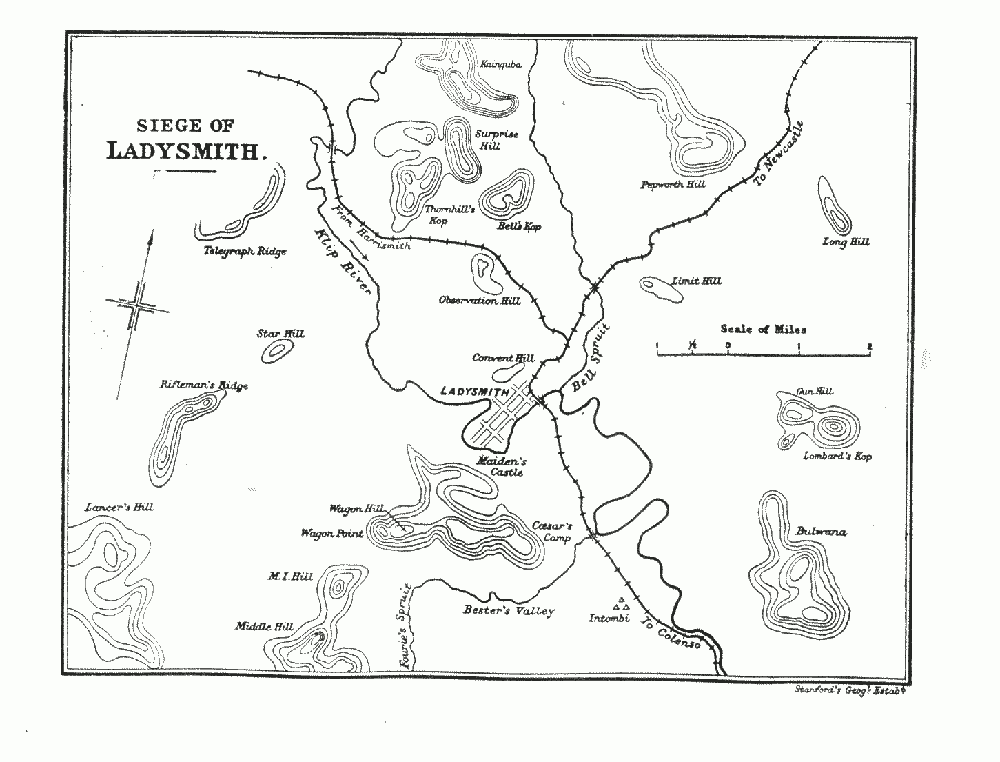
After fifty years of obscurity, Ladysmith suddenly became the pivot upon which the fortunes of the British Empire were poised. Its loss, at least during the early weeks of the siege, would not only have thrown a British Army into captivity, but would have left an encouraged and very mobile enemy, replenished with the spoils of war, free to march irresistibly towards the sea.
In November, Buller was prepared, if Ladysmith should fall, to abandon the whole of Natal except Durban. He had private information that, if the Boers reached the coast, a certain European power would intervene. There was also the fear that another reverse would call out the disaffected Dutch in the Cape Colony, and the danger lest the British nation, treacherously harassed by the cries of the disaffected at home, who sympathize with the misfortunes of every nation but their own, would again write off South Africa as a bad debt, and offer peace on ignominious terms. In India the news of the capture of White, a former Commander in Chief, and of his removal as a prisoner of war, would have seriously, if not fatally, impaired the British raj.
At a later period, when the reinforcements had arrived and the plan of campaign had been altered to suit the situation in Natal, the loss of Ladysmith would not have so vitally affected the position in South Africa; and, in fact, Buller on December 16, authorized White to surrender.
On November 1, the commanders of the allied forces, Joubert and A.P. Cronje, decided to invest and bombard Ladysmith, confidently expecting that the only obstacle in the way of the procession to the sea would soon be removed by the fall of the intimidated town. They were even urged by some of the subordinate leaders, who, as a rule, were never so venturesome as when there was no immediate prospect of meeting the enemy, to mask White and march at once upon Durban, but Joubert would only sanction a minor effort in that direction which was postponed until it was too late to be effective.
{141}The last man to leave Ladysmith was French. He was ordered to Capetown to meet Buller, who was persuaded by his report on the situation that White's force was insufficient to keep Natal from being overrun, and that the worst might be feared. The escape of French, by a margin of a few minutes only, made him available for employment in an arena more suited to his capacity than a besieged town; and his subsequent good work in the Cape Colony, south of the Orange River, and during the advance on Kimberley and Bloemfontein, showed how ill the fortune of war served the Boers, when they just failed to capture the train which was taking out of their clutches the soldier who was to relieve Kimberley and head off Cronje at Paardeberg before the relief of Ladysmith was effected.
White has been blamed for keeping the whole of his strong force of cavalry in Ladysmith. He had with him four regiments of regular cavalry besides five irregular colonial corps. For the space of three months the action of the British Army was hampered by the absence of the mounted troops interned in Ladysmith and engaged in garrison duties, until at last the horses were either killed for food, or, when forage was exhausted, turned out on the bare veld under the enemy's fire, to support themselves as they could. White justified, or it may be, excused, his retention of the cavalry, by its mobility, which virtually increased the effective strength of the garrison, and enabled him to reinforce rapidly any threatened section of the defence, as for example, during the attack on Caesar's Camp. It is no doubt arguable that cavalry was more useful within the lines of investment than it would have been, if squandered over the whole area of the concurrent operations elsewhere; and if so, the limits of its tactical employment have been considerably extended.31
{142}White's force, which numbered about 13,000 men, occupied a perimeter of fourteen miles on the hills and kopjes nearest to the town, and was enveloped by an outer perimeter of thirty six miles held by 23,000 Boers. The positions N.E. of the Klip River were occupied by the Transvaalers, and the opposite semi-circle by the Free Staters.
On November 2, began the bombardment, which the enemy fondly hoped would bring White on his knees within a week; the first death casualty during the siege being a naval officer who had reached Ladysmith only a few hours before the investment with a re-inforcement of long-range naval guns from the fleet; and during the next two days it was continued from Pepworth, Bulwana, and elsewhere, with such effect as to induce White to ask, at the instigation of the civilian authorities, permission to send away the women, children, and other non-combatants. This somewhat naive request was naturally disallowed by Joubert, who, however, consented to the formation of a neutral camp for them and the sick and wounded at Intombi, within the area of the siege, and dependent for its supplies and maintenance upon the resources of the garrison. Joubert put into Ladysmith 200 derelict Indian coolies from the Natal collieries, an act which was perhaps justified by the code of war, which sanctions the employment of any means by which the difficulties of a besieged town can be increased; but a subsequent attempt made by Schalk Burger during Joubert's advance on the raid towards the south, to saddle White with the Indian refugees from the Transvaal was successfully resisted.
On November 9, the enemy was foiled in an attack on Observation Hill and Wagon Hill which were not then held in force, and for eight weeks the siege was carried on with so little vigour, and confronted with so much skill, that the British casualties in killed and wounded during that period numbered less than 250. When the Boers found that the walls of Ladysmith did not at once {143} fall to the sound of the artillery, they began with equal confidence to rely upon the indirect casualties caused by sickness and privation, and awaited the result without impatience in their laagers. During the last fortnight of November a strong column under Joubert was detached to raid into Southern Natal. It was prudently but not enterprisingly led, did little harm, and returned with slight loss.
Meanwhile the enemy's artillery had been considerably re-inforced, and the British gun ammunition was beginning to run short. The capture of a large herd of cattle by the Boers, who neatly drew the animals away from the town by exploding shells behind them, entailed a reduced meat ration. In order to co-operate with the relieving force under Clery, who at the end of November was within signalling distance, White exercised a part of the garrison as a striking column, which, when the time came, he proposed to take out under his own command, and to clear the line of approach from the South.
Three weeks after the abortive attack of November 9, Joubert returned from his expedition to Estcourt. A council of war was held, and an assault on the Platrand32 was determined on for the 30th. On the previous evening the commandos detailed as covering parties on the left flank went into position on Rifleman's Ridge, and awaited the main attack. Meanwhile much had happened in the laagers. The decisions of the Boer Krijgsraad seem to have been subject to confirmation by a minor convention composed of the subordinate officers. These took counsel during the night, and resolved that "the plan was too dangerous to attempt." When the covering parties opened fire at dawn there was no assaulting column to cover.
The activity during December was confined to the defence. On the night of the 7th a raid on Gun Hill, an underfeature of Lombard's Kop, silenced—at least in Natal—two heavy guns which were worrying the {144} garrison. By the rules of the game the pieces were injured beyond repair by the gun-cotton charges which the sappers had fired in the breeches and muzzles; but the heavier gun was removed to Pretoria, where it was made serviceable. It was eventually sent to Kimberley, and its arrival greatly alarmed the timid and irresolute diamond men, whose life was easy and almost luxurious when compared with the privations which the steadfast garrison of Ladysmith endured for four months. On the same night Limit Hill, which the enemy seized a few days after the investment, was recovered.
A heavy gun was emplaced by the Boers to the front of the northward section of the defence, on a hill in the angle between the Bell Spruit and the railway to Harrismith. The approach to it was commanded by Bell's Kopje and Thornhill's Kopje, but a Battalion of Rifles under Metcalfe wriggled in between them at midnight on December 11, without alarming the enemy, and almost reached the crest of the eminence which was thereafter known as Surprise Hill, before the Boers opened fire. The assaulters encircled the emplacement, but could not find the gun. In a little time it was discovered outside the work, and disabled, but not permanently. The Boers on the flanking kopjes were now on the alert; and the battalion as it withdrew down the slope met in the darkness a small but determined detachment which had formed up athwart the line of retirement. The obstacle was rushed with the bayonet, and the expedition returned to Ladysmith with a loss exceeding 12 per cent of its strength.
The gun raids were almost the only offensive action taken by the defence during the siege, and though successful as far as they went, they did not greatly reduce the strength of the enemy's artillery and were not continued. He had still more than a score of pieces with which he daily bombarded the town; but no attempt to assault it by a moving force was made for some weeks. His confidence in the final issue was unimpaired; he {145} had but to squat in his trenches worrying the garrison with shell fire, and the inevitable surrender must come.
His complacent view of the situation was manifested by his use of the besieging force as a depot which was from time to time called upon to furnish drafts for service elsewhere. Joubert's absence on the raid towards the south did not sensibly diminish the retaining power of the attack, and although the loss of several thousand Free State burghers who were transferred to Cronje's command on the Modder or to Delarey's at Colesberg was in part made up by a reinforcement of Transvaalers, the force sitting round Ladysmith had to assist in the defence of the line of the Tugela against Duller; yet, albeit weakened by that necessity, it was still able without much effort to pin White down to the banks of the Klip River. The inactivity of the garrison, as well as the daily increasing hospital camp at Intombi under the shadow of Bulwana and the mournful processions to the cemetery hard by, showed that sickness, the waning physical and moral strength of those who were still on duty, and the expenditure of stores, supplies, and ammunition, were slowly impairing White's power of resistance; and that the numbers of the besieging force, which later on Buller believed did not exceed 2,000 men, could be safely reduced.
The Boers believed that "their strength was to sit still," and they were not far wrong. Early in the New Year, however, external pressure emanating from Pretoria and Bloemfontein was brought to bear upon Joubert, and he sanctioned another assault on the Platrand, which was from the first considered to be the key to Ladysmith. It is a series of plateaux, about two miles long and varying in breadth from half a mile to a few hundred yards. Its chief features are Caesar's Camp and Wagon Hill. A mile north of the centre of the position is Maiden's Castle. The contours on Caesar's Camp and Wagon Hill are pinched in in three places and divide the Platrand into four positions of unequal {146} area, the smallest being Wagon Point, an underfeature on the extreme right of Wagon Hill. The latter is joined by a nek to Caesar's Camp, the plan of which owing to the contraction of the contours somewhat resembles the outline of a dumb-bell. The highest point of the position is a knoll on Wagon Hill, and the front slopes southwards down to Bester's Valley and Fourie's Spruit. On each flank were hills occupied by the enemy's artillery.
The strength of the assaulting column as detailed was composed of approximately equal numbers of Free Staters and Transvaalers and amounted to upwards of 4,000 burghers. To the former Wagon Hill was assigned as their objective, to the latter Caesar's Camp, which was held in greater strength. Early on the morning of January 6, the sentry of the picket posted on the nek between Wagon Hill and Wagon Point, became aware of movement on the slope and gave the alarm. Soon after, a party of Engineers and Infantry preparing gun positions on Wagon Point in view of a contemplated operation in support of Buller's expected advance by way of Potgieter's Drift, were fired on at short range by a body of Free Staters, who had succeeded in climbing to the nek, and who then threatened a redoubt in the western shoulder of the knoll on Wagon Hill, which commanded Wagon Point. The first rush was checked by the Natal Volunteers, who opened with a Hotchkiss gun from the knoll at a range of less than 100 yards, and threw the leading ranks of the enemy into confusion. The working parties were thus given time to take up their rifles, and to organize themselves more effectively for defence.
A counter-attack was made from the adjacent post on the eastern shoulder, but it failed to dislodge the enemy, a small party of whom diverged towards their left, and circled round Wagon Point to the rear of the position between Wagon Hill and Maiden's Castle. Here they lighted upon the heavy gun at the foot of the {147} northward slope for which an emplacement had just been made on Wagon Point, and although the gun was successfully defended by the escort, the insecurity of the Platrand position was shown by the attempt.
While the Free Staters were assaulting Wagon Hill and Wagon Point, the Transvaalers obtained a footing on the edge of the Caesar's Camp position; but their supports failed them. A considerable proportion of the burghers detailed for the attack on Caesar's Camp, most of them Transvaalers, again either refused, as on November 9, to take part in it, or shirked during the advance. But at dawn, after a struggle in the dark at such close quarters that the face of each combatant was often for the first time revealed by the flash of his adversary's rifle, the enemy had his finger on the key to Ladysmith; and was clinging, like swallows on the eaves, to the whole length of the Platrand from Wagon Point along a sinuous contour line which curved round the eastern shoulder of Caesar's Camp, and awaiting the supporting bombardment which, as soon as there was light enough for the alignment of the sights, would be opened upon the position from the flanking guns on Bulwana and Rifleman's Ridge, and from Middle Hill on the front.
The normal garrison of the Platrand, which, since the attack on November 9 had been entirely included in the perimeter of the defence, numbered not more than about 1,000 men, but it was under the command of Ian Hamilton.
When the firing began he was in his bivouac near Caesar's Camp. He quickly collected what troops he could lay his hands on, and went to Wagon Hill, where he found the situation so serious that he asked White to re-inforce him. At daybreak the Boer artillery opened upon the position, and it is probable that it would have been lost, but for the action of two field batteries which, at a critical moment, came out of Ladysmith and diverged so as to protect each flank.
{148}Already on the Wagon Point flank, the enemy had worked round and had threatened the heavy gun, and on the other flank he was holding the eastern shoulder of Caesar's Camp. Wagon Point was saved from a turning movement by one battery, while the other, though itself under artillery fire from Bulwana, opened on the Boers clinging on to the eastern shoulder, and by checking the advance of their supports, caused them to withdraw the hook with which they were grappling that flank. But more than this the British guns could not do, and the Boers holding on to the front crest could not be touched by shrapnel, and were maintaining themselves against the defenders of Caesar's Camp; while a combat of even greater intensity was being waged on Wagon Hill.
Here an attempt made by a few companies of Highlanders to outflank the Boer line on the crest by working round the shoulder of Wagon Point, had failed, as the men were exposed to an irresistible fire as they turned the corner. On Wagon Hill the enemy was holding on to the front of the redoubt on the knoll and each attempt to dislodge him was unsuccessful.
Towards noon there was a lull in the storm. After nine hours' fighting, the combatants were face to face on the plateau and the advantage lay apparently with the attacking Boers, who, in spite of the strong re-inforcements which had been sent up by White, were still clinging to the southern crest of Caesar's Camp, and who on their left had won a footing close to the knoll on Wagon Hill, and were effectively checking the details on Wagon Point. White having used up all the infantry which he could safely spare from the other positions on the perimeter, now sent the cavalry to the rescue.
The pause in the fight, which seems to have been occasioned by the exhaustion and discouragement of the enemy, and which, perforce, had to be acquiesced in by the defence, led White to report to Buller soon after noon, that the Boers had been beaten off for the time {149} being, but that a renewal of the attack was probable. It came at the moment when he was sending the despatch from his Head Quarters on Convent Hill, and when Ian Hamilton was preparing a counter-attack round the shoulder of Wagon Point. A small body of Free Staters rushed the summit of Wagon Point, and by their impact drove many of the defenders down the reverse slope. But those who remained were resolute. After a hand to hand fight between Boer commandants and British officers around the emplacement which had been prepared for the heavy gun, the position was recovered and a reinforcement of dismounted Hussars came up in time to secure it.
On Wagon Hill also the struggle was renewed, and here also the defence was strengthened by some dismounted cavalry which had been waiting in support in rear of Caesar's Camp. It was evident that if the enemy were not dislodged from Wagon Hill during daylight, he would be able to establish himself irremovably after dark, when all the waverers would come up under the protection of the night. At 3 in the afternoon White reported to Buller that the attack had been renewed and that he was "very hard pressed." He called the Devons to his aid from their post on the northern section of the perimeter, and in a storm of rain and thunder, themselves a resistless tempest, they cleared Wagon Hill with magazine and bayonet.
On Caesar's Camp the enemy had already wavered, and the crest was in possession of the defence; and now all along the line from Wagon Point to the eastern shoulder the Boers were scuttling down the slopes toward the flooded dongas below under a hail of rifle fire. The battle, which had begun soon after midnight, was continued until near sunset and resulted in the discomfiture of the only serious attempt made by the Boers to capture Ladysmith by offensive action. The success was due primarily to the determination of an enfeebled garrison, which had already undergone a siege of nine weeks; and {150} secondarily to the tactical mistakes of the enemy, who had allowed troops to concentrate upon the Platrand which should have been contained and pinned to their posts at other sections of the perimeter of defence. Not a few of the commandos detailed for the assault on the Platrand flinched, yet it almost succeeded; and if these had been distributed to positions elsewhere, they would not have incurred great danger, and their presence would probably have prevented the transfer of the Devons and of the mounted troops to Wagon Hill at the critical moment.
The battle casualties of January 6 outnumbered in the proportion of 6 to 4 the entire losses due to the acts of the enemy during the whole four months' investment before and after that date. Twice Wagon Point was occupied only by the wounded and the dead. Much of the fighting was either hand to hand or at such short range that the effect of the bullet could be almost read in the expression on the face of the stricken opponent; now of anguish, despair, or hatred, now of a gentle sinking to sleep after toil. The homely name of Wagon Hill, far away from the fatherland under the southern sun, will abide for all time in the chronicles of the deeds of the British private soldier. It was his own battle, by which he saved Ladysmith. Next day a message from home reached White.
"Heartily congratulate you and all under your command for your brilliant success. Greatly admire conduct of Devonshire Regiment." The Sender was Queen Victoria.
The failure of the attack on the Platrand deterred the Boers from further attempts to break into Ladysmith, which was left like Paris thirty years before to "stew in its own juice." An ingenious but impracticable method of bringing the place to its senses by damming the Klip River below the town in the hope of isolating it by flood was put in hand, and some alarm was created, but the loyal stream refused to rise. The garrison was {151} too much weakened by disease and famine to be able to assist effectively Buller's promised advance by way of Potgieter's Drift, and in fact he never came near enough to Ladysmith to make co-operation possible. A mobile column was for the second time organized by White, but it is doubtful whether it could have taken the field.
Perhaps some poet of a future generation may follow the example of the Homeric syndicate and select the Siege of Ladysmith as the theme of a great Epic, romantically but unhistorically interwoven with the legend of Juana Maria of Badajoz. On the Boer side the struggle was carried on with much of the simplicity of Homeric times and the Siege of Troy. The debates in the war councils; the doubts of the subordinate commanders; the devices and stratagems, such as the attempt to dam the Klip River, and the proposal to disguise an assaulting commando in the helmets and accoutrements of the slain opponents; the abstinence of some of the leaders from the fray; the single combats on Wagon Point; the democratic organization of the Boer forces; the difficulty of keeping the burghers to their duty when the attraction of a domestic and pastoral life presented themselves in an alluring form; were not of these days nor even of the Puritan period, but belonged to a remoter age when every man was a soldier or a shepherd according to the exigences of the moment. Many a Boer leader, like Ajax, defied the lightning—when it was not playing directly upon him. Not one of them comes prominently into the foreground in the great South African siege.
De Wet's brief service in Natal came to an end before the investment, and in the light of his exploits elsewhere, it is interesting to speculate upon what might have happened if he had been in command of the attack on January 6. In all probability it would have succeeded. The Boers rarely failed when commanded by a resolute leader who knew his own mind and was {152} able to impose his own will upon them. In isolated enterprises daringly conducted, they were usually efficient, and sometimes irresistible, but like most primitive communities in which the military instinct is individual rather than collective, they were incapable of forming themselves into a coherent and unified Army for action in mass. De Wet, in his Three Years' War, protests against the British theory that the burghers were only fit to engage in guerilla, which, possibly from ignorance of the meaning of the word, he seems to regard as an unworthy term of reproach; but the theory was in reality a grudging recognition of a suppressed factor in the problem of the war which the professors had overlooked. His own exploits go far to prove its soundness.
Like mariners adrift upon the ocean in an open boat, their food and their water dwindling hour by hour, who eagerly watch a white topsail or a faint wreath of smoke which seems for a time to be approaching, yet soon sinks beneath the horizon and leaves them alone upon the waste; the garrison of Ladysmith was cruelly tantalized by Buller's fitful appearances on the Tugela. Again and again the boom of his guns growing clearer and clearer and his heliographs sparkling more distinctly deluded the defenders with the hope that the day of their deliverance was at hand. During the Spion Kop affair, the confidence was so great that for a day or two full rations were issued. The summit could be seen crowded with people on January 25 who surely must be Buller's men. Not so; they were the Boers who, to their astonishment, had found the summit unoccupied, and were burying the dead and collecting the wounded. The roar of war died away; was heard again from Vaalkrantz, soon to sink into silence on February 7, when Buller announced that the enemy was too strong for him. It was renewed at Hlangwhane, Monte Cristo, and Pieter's Hill, but former disappointments had made the garrison insensible to hope and it {153} fell upon apathetic ears. When at last Dundonald's little band was seen approaching, the chilled and dazed soldiers of the garrison could scarcely realize that they were saved.
After January 6 the increasing sickness and the deficiency of food became the chief facts of the Siege. More than three-score horses were sacrificed daily to provide a meat ration for the garrison. The men slaked their thirst with the turbid water of the Klip River, and munched a makeshift biscuit made of Indian corn and starch. "Chevril" soup and potted horse were luxuries. At Intombi nearly 2,000 sick and wounded were lying without hospital diet or comforts.
On January 27 the situation was so grave that White, when he heard from Buller that the attempt on Spion Kop had failed, proposed as a last and desperate resource, but one which, at least, would not involve the moral effect of a surrender, to abandon Ladysmith, his sick and wounded, and his heavy guns, and with about 7,000 men and 36 field guns to endeavour to join Buller. Even if another Buller failure did not sooner doom the garrison he could only hold out until the end of February.
With this proposal Buller temporized and communicated it to Lord Roberts, who sent an encouraging message to White, in which he asked the garrison to accept his congratulations for its heroic defence and expressed his regret at the delay of the relief and his hope that the term would not be the limit of possible endurance; though he fully expected that his own operations in the Free State would before its expiration relieve the pressure on Ladysmith. Buller doubted Lord Roberts' forecast and preferred to "play his hand alone," and nothing came of the proposed break out of Ladysmith. White in his acknowledgment of Lord Roberts' message said that by sacrificing most of his horses, he could hold out for six weeks.
There was good reason to believe that by this time {154} the besieging force numbered not more than 4,000 men, who, however, could be reinforced in a few hours from the 16,000 burghers standing up to Buller on the Tugela. The enfeebled garrison was, however, not in a condition to act against the attenuated cordon from which a constant bombardment was maintained. As the month of February wore on, the news of Lord Roberts' entry into the Orange Free State infused more hope into the garrison than the too familiar sound of Buller once more in action on the Tugela, and so little was expected of Buller that the lull in the fire during the Sunday armistice on February 25 was interpreted as another repulse; and the rations which had been increased, when a message came that he would be in Ladysmith on February 22—which he soon found was a too confident expectation—were again reduced. The darkness before the dawn was very black. The news of Paardeberg reached Ladysmith on the afternoon of the 27th; towards sunset next day Dundonald marched in. White endeavoured to organize a column to pursue the commandos retreating before Buller, but found that the toll of war had been paid so heavily by the Natal Field Force that little more than the strength of one company in each battalion was fit for service.
Not the least of the trials undergone by the Ladysmith staff were the heliograms from the Tugela and the constant surprises of the déchiffrage. Sometimes pessimistic, sometimes the reverse and frequently trivial, there was scarcely an occasion on which they were helpful. The troubles of the relieving force figured largely in them.
The sequel to the Colenso disaster was a suggestion that White after burning his ciphers33—a precaution which he naturally would take—and firing away his ammunition, should negotiate with the enemy for the {155} surrender of the town. To this White made the manly and dignified reply that there was no thought of surrender; and to his own men he issued a soldier-like order of the day, in which he told them that they must not expect relief as early as had been anticipated, and expressed his confidence that the defence would be continued in the same spirited manner in which it had hitherto been conducted; and dutifully he applied himself to his task.
A few days later he was bidden by Buller to "boil all his water." From Potgieter's Drift, Buller heliographed that "somehow he thought he was going to be successful this time"; that it was "quite pleasant to see how keen the men were"; that he hoped to be "knocking at Lancer's Hill" in six days' time; but after Spion Kop it was, "we had awful luck on the 25th."
Footnote 31:(return)As the officer in command of the Naval Brigade neatly put it: "the proof of the pudding is in the eating. The cavalry soldiers did excellent service in the lines—and we ate their horses."
Footnote 32:(return)The Boer name for Caesar's Camp—Wagon Hill Position.
Footnote 33:(return){156}This instruction was not included in the original heliogram, but was annexed to it as an afterthought in a supplementary message.
On January 10, 1900, Lord Roberts reached Capetown in the Dunottar Castle, the ship which ten weeks previously had brought Buller to South Africa, and resumed the task which he was not allowed to finish in 1881. The terms of peace imposed upon the British Government by the Boers after Majuba Hill resulted in an armistice of eighteen years, and he was still the soldier to whom the nation instinctively turned when it was again in trouble in South Africa.
With one unimportant exception all his war experience had been gained in India or near its frontiers; but India is a spacious arena where spacious ideas can be freely developed. His mind had not been scored into grooves by years of desk duties in Pall Mall, or subjected to the necessity of accommodating itself to obsolete methods and House of Commons' views. The Indian Army, of which he obtained the command after serving in it in each commissioned rank, more closely approaches in its training, organization, and readiness for active service, the military standard set up by the chief continental nations, than the British Army; of which a distinguished German officer said at the time of the Boer War that it was meant for detachment warfare only and not to win great battles.
With Lord Roberts came, as Chief of the Staff, Lord Kitchener of Khartoum, a hard and ready man who for fifteen years had been scouring the Nile. All his war service had been in Egypt, where recently he had not only smashed the dervishes and secured the Soudan, {157} but by his diplomatic tact in the Fashoda affair had relaxed the tension of a dangerous international situation. He belonged to the Royal Engineers, who are, like the Army Service Corps, a semi-combatant body engaged in technical duties that do not offer much opportunity of gaining experience in the art of war or of practice in handling troops, but who have, nevertheless, given to the nation not a few soldiers of distinction. It was, perhaps, for this reason that Lord Roberts generally employed Lord Kitchener as an expert military foreman, entrusted with the supervision of the work of others.
The situation in South Africa at the time of Lord Roberts' arrival was as follows:—
Methuen was established at Modder River; Mafeking and Kimberley were holding out, and the latter at least seemed to be in no immediate danger; French was in a good position before Colesberg; Gatacre was maintaining himself without difficulty at Sterkstroom; the garrison at Ladysmith, after sixteen hours' fighting, had recently warded off a determined attack; the disaffected districts in the Cape Colony had not risen; and the despondent Buller, quickened by reinforcements and stimulated by the approach of the Dunottar Castle, was about to make another attempt to relieve Ladysmith.
Schemes for a South African campaign had been for some time under consideration by the War Office, but as the attitude of the Free State could not be forecasted, they were more or less provisional. As late as the end of September the Premier and the War Minister scouted the idea of war with the Free State, and the official plan of a central advance on Bloemfontein by way of Bethulie and Norval's Pont, which held good until some little time after Lord Roberts' arrival, must therefore have been subterraneously drawn up without their knowledge. It was no doubt an excellent solution of a strategical problem studied by men in an {158} office with a map of South Africa before them which showed several lines of communication converging on the Orange River; and Buller was about to carry it out when he was called aside to Natal.
Lord Roberts had, however, two years before drawn up a scheme for an advance on the Transvaal by way of the Kimberley line as far as Mafeking and thence across country to Pretoria, and before leaving England he modified it so as to adapt it to action in the Free State. He proposed to leave the Kimberley line at some point between the Orange River and the Modder River, and to march in a S.E. direction on the Bloemfontein line. He was a firm believer in the indirect results of military movements, and he expected that his arrival at Springfontein or Edenburg and the menace to the Free State capital "must draw the Free Staters back from Kimberley and Natal," and that the occupation of it "would render the Boer positions south of the Orange River untenable." The official plan of an advance from the centre would force back the Free Staters engaged in the Cape Colony, and instead of isolating them would enable them to reinforce Cronje.
After his arrival at Capetown, circumstances however compelled Lord Roberts to modify his plan of campaign. The news of the Spion Kop affair, anxiety on account of Kimberley, the presence of Cronje at Magersfontein and other considerations, determined him to march through the Free State by a more northerly route which would enable him to relieve Kimberley en passant and to give battle to Cronje.
The secret of the plan, which was known only to Lord Roberts' personal staff, was well kept, and operations were continued without reference to it. The earlier orders issued by him seemed to indicate that the central advance was still to be carried out. The VIth Division under Kelly-Kenny was sent to Naauwpoort; French was instructed to make a demonstration against Norval's {159} Pont; and Methuen was warned that it might be necessary to withdraw part of the Modder River force.
The Boers, who had captured at Dundee some intelligence papers which disclosed the original plan of campaign, were now more than ever convinced that the British Army must advance by way of Norval's Pont and Bethulie, and did not discover their error until it was too late to rectify it.34 When Lord Roberts had made all his preparations, which involved the entire reorganization of the transport, and the raising of a considerable force of mounted troops, for his march of 100 miles across the veld eastward from the railway, the secret was disclosed to Kelly-Kenny and French on February 1. This plan of a flank march had also suggested itself to Buller, who proposed it in a memorandum which Lord Roberts found on his arrival in Capetown; but as Buller's scheme included the construction of a railway across the veld, and limited the advance of the Army to the rate at which the line could be pushed forward, it did not fall in with Lord Roberts' ideas.
Meanwhile Cronje was not perturbed by the reports of troops coming up the Western line, and was confident that they only indicated a renewed but isolated attack on Magersfontein. He had no doubt that if necessary he could always fall back upon Kimberley and retreat towards the Transvaal; and the demonstrations made by Methuen westwards in the direction of Koedoesberg Drift served the double purpose of warning a disaffected region and of diverting Cronje's attention from the flank on which he was to be attacked and which he believed to be secure.
The two months following the arrival of Lord Roberts in South Africa were the only brilliant period of a dreary war which lasted nearly three years, and will perhaps {160} save it from being quoted in military history as the most sluggish campaign of recent times. In each of the two objects of strategy, namely to avoid fighting the enemy on ground of his own choosing, and to compel him to fight under unfavourable conditions, Lord Roberts was extraordinarily successful. There was a light touch, an ingenuity, in his swift and silent strategy which contrasted strongly with the heavy and dull methods which had hitherto controlled the action. While Buller was talking about his tedious railway across the veld, and Milner at Capetown was dismalling the situation and discouraging the advance, Lord Roberts had in effect entered the capital of the Free State and seemed to have completed half his task. The Boers were hypnotized and deceived not only by signs from which they drew wrong inferences, but also by bogus orders which it was arranged should come under their notice and which were simultaneously cancelled in cipher: and when too late they awoke from the bewilderment, they began to scuttle to and fro like rabbits in a warren. There is good reason to believe that if the strategic ability of Lord Roberts could have been united in one mind to the determination of Lord Kitchener the war would have been over in a year.
On February 8 Lord Roberts arrived at Modder River, where he found bad news awaiting him. Buller had failed at Vaalkrantz, and the diamond men of Kimberley were threatening to capitulate. By February 13 30,000 combatants, some of whom in order to preserve the illusion had been kept in the centre until the last moment, were in readiness at various points between the Orange and the Modder. The immediate problem before Lord Roberts was the relief of Kimberley in combination with the cornering of Cronje. In the background was the Natal trouble. Buller was again helplessly wringing his hands and reaching round to find excuses for his misadventures. Lord Roberts wisely left him alone and went on with his own work. {161} He saw what Buller refused to see, that the Tugela could be crossed at Magersfontein and Ladysmith relieved at a drift of the Modder River.
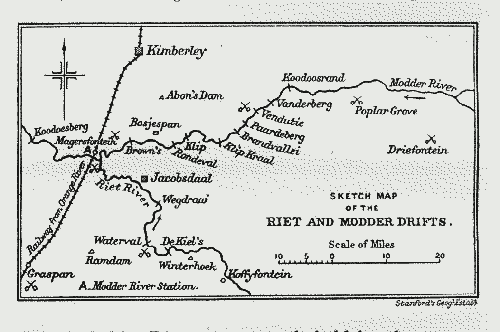
On February 11 Lord Roberts set his army in motion; and the operations of the next few days may be summarised with sufficient accuracy as a cavalry raid northwards, but avoiding Cronje's left flank at Brown's Drift, to relieve Kimberley; combined with an infantry advance to cut him off. It was not possible to make the initial movements in the direction of the eventual advance, as the Magersfontein-Brown's Drift quadrant N.E. of Modder River was strongly held by the enemy, and disallowed a cavalry advance from below the junction of the Riet and the Modder in the direction of Kimberley except by a westerly detour which could not be accommodated to the general scheme. In order to strike the practicable drifts on the two rivers above their confluence, it was necessary for the advance to be made along the curve of a parabola which issued from Modder River Station in a S.E. direction, and in a sixty-mile circuit crossed the rivers and finally approached Kimberley, only twenty miles distant from the starting point, almost in the opposite direction.
{162}At midday on February 11 the Cavalry Division under French reached Ramdam, a farm east of Graspan and fronting the drifts of the Riet, where the Army was being concentrated for the advance. Some hours elapsed before Cronje became aware that French had trekked away to the S.E., and to his slow and sullen spirit the movement did not appear to have much significance. He was persuaded that the British never trusted themselves much more than a day's march away from a railway. It was only a demonstration, a reconnaissance. He did, however, take certain precautions which, if they had been devised with a true appreciation of the situation and intelligently carried out, might have seriously checked French.
He assumed that the initial direction of French's march would be continued indefinitely towards Koffyfontein, possibly even that it was a retirement from the Modder River position caused by bad news from the centre, and he sent a commando of observation, under C. de Wet, up the right bank of the Riet. The most adroit and skilful movement of the war had now begun without Cronje's comprehending its object.
But French did not complete his first day's work very auspiciously. His supply column was far behind when he reached Ramdam, and owing to a misunderstanding Hannay's Brigade of Mounted Infantry from Orange River, which was instructed to join him, did not turn up: conflicting orders had resulted as usual, ordre, contr'ordre, désordre. French, however, felt himself strong enough to continue his march without Hannay, who, on his delayed march to Ramdam, engaged a detached body of Boers and thereby strengthened the enemy's conviction that Koffyfontein was the objective.
As French approached the river, Waterval Drift, the lower of the two drifts across the Riet, was found to be occupied by De Wet, and the Division was diverted to De Kiel's Drift, which was reached without much difficulty at midday, February 12. On the right bank were {163} the commando of the Jacobsdaal garrison under Lubbe, and the commando under De Wet and A.P.J. Cronje which had been sent to observe the cavalry movement; about 1,000 men in all. But De Wet could not get the Koffyfontein idea out of his head, and its influence removed many obstructions from the path of the advance. He boldly rode across French's front at De Kiel's Drift, and made S.E. for Winterhoek, closely followed by A.P.J. Cronje; and all French's horses could not find out where they had gone. Next day it was given out in Divisional Orders that the commandos had gone to the Modder River, and four weeks passed by before the Army ceased to suffer from the error.
There was still "one more river to cross" before the diamond men of Kimberley could be relieved; and ere the thirst of the South African summer could be slaked on the banks of the Modder, a tract of twenty-five miles of veld, in which the absence of any homestead having "fontein" for its suffix declared the scarcity of water, must be traversed under the sun.
In the forenoon of February 13 the Cavalry Division started northwards from De Kiel's Drift; and at last De Wet, who, unknown to French, was watching the trek from its right flank, partially relieved himself of the Koffyfontein idea. The effort weakened him, and he displayed none of that readiness of resource and promptitude of action with which he subsequently worried the British Army for the space of two years. He withdrew his own commando towards Koffyfontein, and having ordered Lubbe to follow French, reported to Cronje at Magersfontein that the cavalry was making for the Modder.
French's objective points were now Rondeval and Klip River Drifts on the Modder, but in order to deceive Lubbe, who was hanging on to his right flank, and to elbow him away from the drifts, French changed direction with two brigades and headed for Klip Kraal Drift, some eight miles above Klip Drift, reverting {164} suddenly to his original line as soon as the river came in sight. The drifts were held by small parties of the enemy, who offered no resistance, and on the evening of February 13 the Division took possession of the kopjes on the north bank.
The occupation of the drifts was soon made known to Cronje, but the news revealed little to his dull and uninstructed nature, permeated with the idea that a British force and a railway were indissoluble entities. Though his communications eastward were now seriously threatened, it did not occur to him that there might be an alternative to fighting him out of Magersfontein, namely manoeuvring him out of it; and he persuaded himself that French's movement was a trap to entice him away pending an attack on Magersfontein from the south, and he was probably unaware that the relief of Kimberley was an urgent matter. He moved his own camp from Brown's Drift to a less exposed position at Bosjespan, and while retaining his hold on Magersfontein with his main body, sent out two commandos to watch French, and these accidentally occupied a line through which the cavalry must pass on its way to Kimberley.
The arrival of the VIth Division on the morning of February 15 set French free to resume his march on Kimberley. The two commandos had on the previous day joined hands with Lubbe, who, after he was pushed out of French's way, crossed the Modder at Klip Kraal Drift and worked round to a position north of Klip Drift. The relieving force was now obstructed in the line of its advance by ridges on its right and left fronts and by the nek connecting them, all occupied by the enemy; while on its left flank was Cronje's new camp at Bosjespan, of the existence of which it was unaware. The situation seemed awkward, as the only way out of it was the shallow valley leading up to the nek, and exposed to a converging fire from the ridges on which two guns were posted.
{165}But French was not long in doubt, and like a bridge player who in order to win the game is sometimes compelled to assume the position of certain cards, with rare intuition correctly assumed that the nek was weakly held. Like a ship going down the ways to the water, the Division was launched to the front; cleaving the opposing waves and gaining momentum as it advanced, then righting itself, rose to the slope of the nek and carried it with resistless energy.
After a short midday halt at Abon's Dam, French raised the siege of Kimberley before sunset; the besiegers under Ferreira did not wait to be attacked, but withdrew towards Boshof.
The relief of Kimberley was perhaps the most brilliant feat of arms in the campaign. It was well-conceived and, considered by itself alone, well carried out, but the merit of it has been obscured by the fact that it cost less than half a hundred human casualties. When, on the morning of February 15, the VIth Division took over the outposts, and the Cavalry Division fell in on the banks of the Modder, there was the terrain of a Balaklava charge before it.
It may well be doubted whether the price paid for the relief of the diamond men was not too high. Uninstructed public opinion at home called for the movement, and forced Lord Roberts' hand, but it was never an imperative military necessity. The horse casualties,35 due to want of water, forced marches, and ignorance of horsemastership on the part of all ranks, who were inclined to regard cavalry work in the light of a steeplechase, were so heavy that when on February 17 French, after an attempt on the previous day to pursue a body of retreating Boers with his exhausted horses, {166} was suddenly called upon to march thirty miles to head off Cronje, he could in all his Division mount less than the strength of two regiments. Nor was this all, for the rush to Kimberley was the indirect cause of the loss of the supply column at Waterval Drift on February 15; and thus in a few hours the mounted force and the supply column and transport which Lord Roberts and his staff had assembled with so much difficulty were, the former partially and the latter entirely, sacrificed.
The VIth, VIIth, and IXth Infantry Divisions, under Kelly-Kenny, Tucker, and Colvile respectively, were withdrawn from Modder River and the stations south of it, and concentrated at Ramdam on February 11 and the two following days. Owing to the steepness of its banks the Riet River could only be crossed at Waterval and De Kiel's Drifts, and on these the Army converged, and trickled through them like the sands in the neck of an hour-glass. Men, horses, guns, supply and ammunition wagons were slowly and painfully transferred to the right bank, and the VIth Division, which followed the cavalry to De Kiel's Drift, though the first infantry to get through by more than twenty-four hours, was delayed by the block of transport and lost its start in the race to the Modder River.
Meanwhile to Waterval Drift came Kelly-Kenny and Colvile in succession, and were soon pushed on to Wegdraai Drift, to which Tucker also hastened as soon as he could shake himself clear of De Kiel's Drift. The latter was now out of the running, for although Kelly-Kenny had already had a nine hours' march from Waterval Drift beginning soon after midnight, by 5 in the afternoon of February 14 the VIth Division was ready to resume its march to support French at Klip Drift, some hours before Tucker came in. Kitchener had been ordered by Lord Roberts to attach himself to the VIth Division as assessor to Kelly-Kenny, and marched out with it.
When Colvile, whose division was detailed as a reserve, {167} arrived at Waterval Drift, he found the passage congested by transport of all kinds; and although after half a day's delay he was able to proceed to Wegdraai Drift, a large convoy on which the Army depended for the greater part of its supplies for the march to Bloemfontein, had to be left behind. A small escort remained with it, the wagons were laagered, and the oxen outspanned and sent out upon the veld to graze. No danger was anticipated.
De Wet had not been lurking on the banks of the Riet for nothing. Hitherto he had not greatly distinguished himself. On the outbreak of the war he and his three sons were commandeered as private burghers, and when he reached the Natal border he was appointed vice-commandant. He served under A.P. Cronje and witnessed Carleton's surrender at Nicholson's Nek. In December he joined P. Cronje at Magersfontein, and was sent early in February to Koedoesberg Drift to check the British demonstrations on the Riet below Modder River Station, and later on to observe French. It is probable that the military deficiencies of his leaders made him sullen. Erasmus at Dundee stood idly in the background while Symons and Yule were on the slopes of Talana Hill, and Cronje was deaf to his remonstrances against a mere passive defence on the Modder River and the presence of women and children in the laager.
But De Wet with a free hand quickly recovered himself when the fortune of war threw him a casual chance after French had despatched him in imagination to a destination where he could do no harm. The convoy was ordered to follow Colvile to Wegdraai at 5 p.m. on February 15, and at 8 that morning, while the oxen were still grazing on the veld, De Wet, who was hovering near Winterhoek, swooped down upon the laager. The slender escort made a good resistance and the attack was reported to Lord Roberts at Wegdraai, who at first sent back a battalion with a battery and some {168} mounted infantry, and when these were found insufficient the rest of the 14th Brigade were despatched under Tucker to endeavour to extricate the convoy. But when Tucker reached the Drift at sunset he found himself unable to bring it away. Most of the oxen had disappeared and De Wet had been reinforced. Lord Roberts was unwilling to delay his advance, and finding that the supplies were not absolutely indispensable to the success of his march, at midnight ordered Tucker to abandon the convoy and to return to Wegdraai. Next morning De Wet took possession of 176 wagon loads of supplies and 500 slaughter oxen—his first exploit in the war.
On February 16 Lord Roberts moved his Head Quarters to Jacobsdaal. It was his intention to advance on Kimberley and to make that town the base of his operations in the direction of Bloemfontein, when suddenly his plans were disarranged by an unexpected event. Cronje, who for two months had held stubbornly to Magersfontein, was reported to be trekking to the east. French's relief of Kimberley, the presence of an infantry division at Klip Drift, and the occupation of Jacobsdaal, were facts which even his obstinacy could not disregard. Like a wild creature startled in the night by a veld fire and suddenly dazzled by the glare, he rushed blindly towards the flames which were soon to consume him. Almost any direction but that which he took, the line of the Modder River, would have given him a better chance of escape. French's maimed cavalry could not have stopped him if he had retreated on either side of Kimberley, and even a withdrawal westward down the right bank of the Riet would have probably saved him. Methuen at Modder River took twelve hours to discover that Magersfontein had been abandoned at midnight on February 15.
On the morning of the 16th Kelly-Kenny sent out from Klip Drift a force under C. Knox to cover the advance of the rest of the VIth Division on Kimberley. {169} Soon a long column of dust was observed in the distance beyond the ridge on the right, and a closer examination showed that it was caused by Cronje's wagons. The discovery came not altogether as a surprise, for Boers had been noticed crossing the front on the previous day, and as what was now seen proved to be the rear of a column, the trek must have been some hours in progress.
Kelly-Kenny at once abandoned his march on Kimberley and faced eastwards. It was found that the enemy had taken up a rearguard position on the southern end of the ridge. The northern end was soon seized by mounted infantry, but an attempt in interpose between the river and the Boer position failed. The ridge was cleared at 9 a.m. by a frontal attack, but not before Cronje's convoy had retired without molestation to Klip Kraal, where a second rearguard position was taken up on either side of Klip Kraal Drift.
On the assumption that Cronje was endeavouring to effect a retreat on Bloemfontein, it was necessary to confine him to the right bank of the Modder. He was already in possession of Klip Kraal Drift, and although he could hardly hope to pass his wagons across it in sight of an active enemy, it was not his only chance. Within ten miles of his laager were Brandvallei, Paardeberg, and Vendutie Drifts, each of which would give him access to the southern bank.
The task before the pursuing army was therefore to drive in his rearguards from their successive positions and prevent him getting comfortably away to secure a passage across the river. At nightfall on February 16 it seemed likely that he would succeed. His convoy in the main laager at Klip Kraal had had twelve hours' rest, and his rearguard had maintained itself on the second position; in spite of a frontal attack on the right bank, and of a flank attack on the left bank made by a battery and a force of mounted infantry which had crossed the semicircle formed by a northward bend of the river between Klip Drift and Klip Kraal Drift. {170} The guns even succeeded in throwing a few shells into the laager, but ran short of ammunition. Kitchener, who remained with Kelly-Kenny as military assessor, had early in the day advocated a raid up the river in order to head off Cronje at Paardeberg Drift, but the exhaustion of the troops prevented the enterprise.
Next day the chase began in earnest—to borrow for the occasion, as was done so frequently during the war, a metaphor from the sporting world—but only a few of the hounds were on the spot, and the rest of the pack were at Kimberley and Jacobsdaal.
When the report of Cronje's retreat from Magersfontein, which Lord Roberts received soon after he reached Jacobsdaal, was confirmed by a message from Kitchener, he ordered French, who at that time was engaged with the enemy some miles north of Kimberley and endeavouring to capture the Long Tom whose recent arrival from Ladysmith viâ Pretoria had scared the Kimberley civilians into a threat of surrender, to hurry eastward and endeavour to place himself between Cronje and Bloemfontein; but owing to a break in the field telegraph cable the message was delayed. Kelly-Kenny was at the same time instructed to carry on the pursuit.
But the situation had not yet clearly disclosed itself, and Lord Roberts did not abandon his intention of sending Colvile's and Tucker's Divisions towards Kimberley; and their orders to march on the lower drifts of the Modder held good. Cronje's retreat in an unexpected direction was hard to explain. Was he going to meet the reinforcements which Buller had just reported were on their way from Natal? De Wet had just shown that there was a vigorous and enterprising body of the enemy ready to raid the railway south of Kimberley, and it was possible that he might have been reinforced from Colesberg.
Towards evening, however, a second message came {171} from Kitchener at Klip Drift. He summarised the situation on the Modder, which he was unable to control with the troops at his disposal, and said that he was asking French to proceed to Koodoos Drift to check Cronje from the east. Lord Roberts was not the man to adhere stolidly to his own plan when a better one was laid before him. The orders to the Divisions were cancelled, and before midnight on February 16 Colvile was marching out to join Kelly-Kenny in the chase. Tucker, whose Division had hardly recovered from the Waterval Drift affair, remained at Jacobsdaal.
After sunset Cronje broke up his camp at Klip Kraal Drift and trekked along the right bank. At midnight he passed half of his transport over to the left bank at Paardeberg Drift, himself going on to Vendutie Drift, where the remainder, with the women and children against whose presence in camp De Wet had vainly protested, joined him next morning.
So far he had done well, and even when his rearguard at Paardeberg was fired on by an advanced brigade of mounted infantry which had been pushed on by Kitchener, he did not lose confidence; although he was surprised that the British, "who could not march," had overtaken him.
To De Wet and especially to Ferreira, whom he knew to be not far off, he looked for help, and even without them he believed that he would be able to cross Vendutie Drift.
Ferreira was indeed not far off, but an obstacle suddenly sprang up between him and Cronje, and the aspect of it was so alarming that he withdrew in the opposite direction. The obstacle was French's attenuated Cavalry Division which, in obedience to Kitchener's summons, had left Kimberley before sunrise that morning, and after a march of twenty-six miles had reached the spot indicated by Kitchener for the heading of Cronje. As the Boer wagons were about to cross Vendutie Drift the shells of French's Horse Artillery began to fall {172} upon them. The convoy was thrown into confusion, the oxen stampeded, Cronje was entangled and bewildered, and but for the gallant exertions of some foreign officers in the service of the Boers a fatal panic might have ensued. The advance guard under De Beer was reinforced from the main laager, and a demonstration made against the left flank of the cavalry; and although French held on, his position remained insecure and even precarious until the arrival of the infantry on the following morning. With a handful of tired, hungry, and unsupported horsemen he not only frightened Ferreira, whose force outnumbered his own, off the field, but also paralysed and prepared for destruction the army which had beaten Methuen and had held Magersfontein for two months.
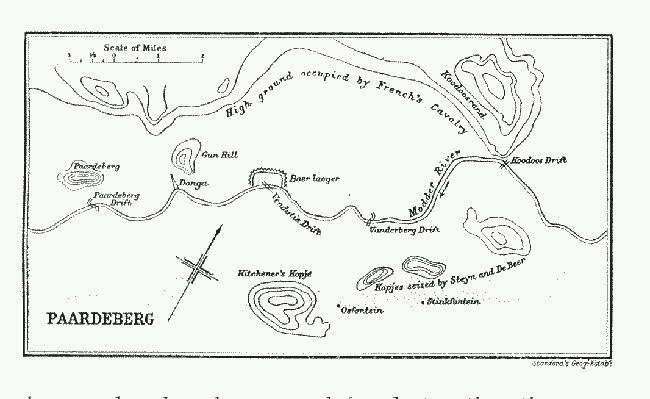
Next day, February 18, at 3 a.m. began the ten days' operations to which the name of the Battle of Paardeberg has been somewhat inaccurately given. Paardeberg is a prominent hill on the right bank of the Modder, four miles W.S.W. of the battle centre, Cronje's laager at Vendutie Drift, and lies on the extreme edge of the elliptical arena on which the battle was fought. It seems to have been chosen as the official word because the hill was the only distinctive physical feature shown {173} on the banks of the river in the incomplete surveys of the time, and because the alternative would have been Stinkfontein, a farm near the field of battle. The Battle of Vendutie Drift would have been a more correct term.
The Modder forms the major axis of the ellipse, which it enters near Koodoos Drift and leaves at Paardeberg Drift, and like most South African rivers runs in a deep channel between banks intersected by the tributary dongas which the rains have scored in the soft soil, and which afford almost the only shelter from artillery fire. The whole area is commanded by the surrounding kopjes and ridges.
Cronje, though urged to break out of his laager on the night of February 17, refused to move. It is probable that he might have effected his escape if he had abandoned his transport. An active force led by a determined man could have wriggled out under cover of the night, and joined one or other of the commandos which were known to be hovering. Cronje was in communication with Ferreira; he had sent to Bloemfontein for help; and De Wet was known to be on his way from Koffyfontein. But instead of making an effort to save himself he fatally trusted to relief from outside. He did not realize that Vendutie Drift was not a Magersfontein which he could hold indefinitely, or that during the last few weeks the British Army had been greatly increased. One result of his obstinacy was the desertion of several hundred Free Staters, who had not served very willingly under the leadership of a Transvaaler. Most of them returned to their homes.
In the absence of the Commander-in-Chief, who was detained at Jacobsdaal by illness, Kelly-Kenny was the senior officer present with the force on the Modder River; but for some reason which may have formed itself in Lord Roberts' mind when they were fellow-passengers on the Dunottar Castle, he was not entrusted with the management of the battle. Kitchener had {174} marched several hours with the VIth Division on February 14 before Kelly-Kenny was aware of his presence; and as Chief of the Staff in direct communication with Head Quarters, he had much to say at Klip Drift. At Paardeberg the status of Kelly-Kenny became still more anomalous, Kitchener, though junior not only to him but also to two other generals present, being empowered by Lord Roberts to issue orders in his name so that there might be "no delay such as references to and fro would entail." The difficulty of the situation was increased by the fact that Kitchener was practically without a staff.
The reason which induced Cronje to remain in his laager, namely the expected arrival of help from outside, also determined Kitchener to attack it without delay. He confidently expected to carry it in less than four hours, but Cronje held out for nine days.
Kitchener's plan might have been foreseen by any officer who had been present at manoeuvres: a preliminary bombardment of the laager, followed by a holding frontal attack, in combination with rolling-up flank attacks. The strength of Cronje's position was supposed to be the laager itself, whereas it was rather the river banks and tributary dongas which he had occupied.
The frontal display was assigned to a portion of the VIth Division; the Mounted Infantry under Hannay supported by an infantry brigade were to work round upstream and fall upon Cronje's left flank; while the IXth Division attacked his right flank from the west.
Kitchener, who had come on with Hannay in advance of the VIth Division, began to issue his orders before he had seen the commanding officers of the troops which were to carry them out. Hannay, who was at hand, was despatched to his place in the east from which he never returned. Kelly-Kenny's ambiguous and humiliating position; Kitchener's impatience and impetuosity; his lack of a staff to carry out his plan; his omission {175} to explain it to the divisional and brigade commanders; and his habit of "short-circuiting" orders to subordinates while their superior officers stood passively in the background, made unity of action impossible and February 18 a day of misunderstanding and ill-success. The battle was fought by a Board of Directors, who, in the unavoidable absence of their Chairman, were dominated by a headstrong General Manager, who was doubtful of their capacity to carry on the business.
Kelly-Kenny and Colvile, whose Divisions came in during the night, had begun to put their troops in motion before Kitchener's plan was made known to them, and throughout the day the difficulty of co-ordinating the whole force to it was increased by the incorrect transmission or apprehension of oral orders. Kelly-Kenny proposed a preliminary investment of Cronje, but Kitchener would not consent to any postponement of his attack, for which no operation orders were issued. In a few hours, however, the soundness of Kelly-Kenny's judgment was shown; the attack became an investment, which was prolonged many days by the moral and physical exhaustion of the troops, who after forced marches by day and night on scanty rations were hustled without method into a costly battle.
By 8 a.m. Kitchener was able to report to Head Quarters that Cronje was hemmed in. The cavalry had occupied the ground in rear of the laager, and he "thought that it must be a case of complete surrender." The troops were now set to the assault, and were quickened by an encouraging message from Lord Roberts. But they were almost immediately in trouble. Hannay had placed himself into position for the flank attack from the east, and his battery had already opened fire on the laager, when the guns themselves were shelled. A commando with two guns, under Steyn of Bethlehem, had arrived from Natal, and unobserved had seized a ridge between Stinkfontein and the Modder, which Hannay was about to cross; and although the Boer guns {176} were silenced and the commando compelled to retire, the diversion seriously disarranged the scheme of assault.
Stephenson's Brigade of the VIth Division, when on its way to cross to the right bank at Paardeberg Drift under instructions from Kelly-Kenny, had been recalled by Kitchener, whose orders were so vaguely expressed, that while the Brigadier believed that he was to act in the frontal attack from the south with the other brigade of the Division, he was really intended by the Chief of the Staff to support Hannay's flank movement. He was now compelled to change front to meet Steyn's threat, and Hannay's attack was postponed. Stephenson was then ordered to resume his advance, but apparently still in ignorance that he was expected to act in co-operation with the mounted infantry, he so disposed his troops that he gave little support to Hannay, who early in the afternoon reported to Kitchener that he was too weak to advance with the flank attack. A peremptory message was returned, in which he was ordered "to rush the laager at all costs," even without Stephenson's support. Some of the words of the order seemed to reflect upon his determination, so he obeyed it literally and immediately. At the head of as many men as he could bring to him on the spot, he charged towards the laager, and when his horse was killed under him he marched on foot to meet his death.
As soon as it was seen that Hannay had thrown himself away, Stephenson was ordered to renew the flank attack. With a portion of his troops and some mounted infantry, he crossed to the right bank at Vanderberg's Drift, and formed to the left. A small body of Hannay's force had won a position near the Boer entrenchments, and it is probable that Stephenson's assault would have succeeded but for a curious accident, which could not have been foreseen, and by which he was deprived of part of his firing line when it was most needed. The setting sun suddenly appeared from beneath a bank of clouds in the west, directly in line with the objective, {177} and the dazzle of the light blotted out the laager, at the same time illuminating the target on which the Boers were firing. A further advance was impracticable, and the troops, which had already fixed bayonets for the assault, were withdrawn when within 500 yards of the enemy's position. Thus the second attempt to get at the laager from the east failed, but Stephenson's action was not entirely without a result, as he was able to put his men into entrenchments, where they remained during the night.
Meanwhile, Colvile was pushing upstream from the west. On that side the Boers had an advanced position in a big donga, which runs into the right bank, about two miles below the laager, and upon which a few companies of the Highland Brigade, having waded the river, had already made a gallant but unsuccessful attack. Colvile, under orders from Kitchener, placed himself astride the river, sending the Brigade under Smith-Dorrien across to the north bank, while the Highland Brigade acted on the left of the frontal attack; and when Gun Hill, which outflanked the donga, was occupied, Kitchener ordered an assault on the donga, to be carried out simultaneously with Hannay's attack on the left flank. The order, however, was not communicated to Smith-Dorrien on Gun Hill, and he was not aware of it until he saw some troops of his own Division, supported by a few companies sent across by Kitchener from the left bank, charging across the open. In a few minutes, the gradual retardation of the rush, and then its extinction under a heavy fire, showed that the attempt had failed. It is said that Smith-Dorrien had been so imperfectly made acquainted with Kitchener's plan, that he was under the impression that he had been sent to the north bank to prevent the Boers breaking out of the laager, and not to attack them upstream.
The frontal attack was initiated by Kelly-Kenny with the 13th Brigade under C. Knox, the 18th Brigade having been detached to support Hannay's flank attack. {178} The main body of the Boers was north of the river, but strong detachments held the left-bank dongas. Colvile was dealing with a demonstration against Paardeberg Drift when an oral message from Kitchener reached him, which he interpreted as an order to go to Knox's assistance with his Division, which was thus withdrawn from the flank and lent to the frontal attack. He was doubtfully carrying out what he believed to be his instructions when an order reached him to send the 19th Brigade, under Smith-Dorrien, across the river. A few companies of his Highland Brigade succeeded in establishing themselves on the right bank, and Knox drove the enemy out of the left-bank dongas, but was forbidden by Kelly-Kenny to cross the river, as the enemy was too strongly posted. The frontal attack was spent, but the troops remained on their ground until the approach of night released them.
Two miles S.E. of Vendutie Drift, a hill, to which the name of Kitchener's Kopje was afterwards given, rises out of the veld. In the tactics of the assault on the laager, it was not a position of much importance, but in the Paardeberg drama it was a striking scene. The detachment of infantry which Kelly-Kenny sent early in the day to occupy it had been withdrawn without his knowledge by some wandering staff officer, who thought he had found a better use for the little garrison, and replaced by a few mounted men. These, while watching the progress of the fight, and perhaps regretting that they were not taking a more active part in it, were suddenly called upon to defend themselves.
De Wet, with two guns and 600 men, had arrived from Koffyfontein at the opportune moment of the crisis of the flank attacks. He soon carried the kopje, and when at 4.30 p.m. he opened fire, the shells which he pitched into the VIth Division baggage and artillery were the first intimation of his intervention received by the Head Quarter Staff, absorbed in their attack on the laager; and for the second time the troops were called away from {179} the work in hand, to deal with an unexpected attack from the rear, and the dwindling hope of carrying Cronje's position before nightfall passed away.
If, on the British side at Paardeberg, the commanders were not at their best when acting in partibus beyond the personal control of Lord Roberts, on the other hand De Wet's release from immediate subordination to Cronje seemed to make him a more dangerous foe. His capture of the convoy at Waterval Drift on February 15 was followed in three days by a daring raid on a British army with a handful of men. It was an impudent and haphazard enterprise, which would hardly have been attempted if he had been in possession of fuller information, but it was justified by its success. De Wet had been reinforced at Koffyfontein, and if he had brought all the commandos at his disposal with him to Paardeberg Cronje would probably have been relieved. But he had not clearly discerned the strategy of Lord Roberts, whose presence at Jacobsdaal deceived him, and instead of striking with all his strength in one direction, he weakened his force by expeditions eastward towards Edenburg and westward towards Belmont.
His appreciation of the tactical situation at Paardeberg, based on the rumours which drifted into Koffyfontein, was imperfect, and when he came within sight of the Modder, and saw the British Army before him, he must have regretted that he had not entirely abandoned the idea that the advance would be made by way of Koffyfontein. But the time and the place could not have been better arranged. The British Army was preoccupied with Cronje; and Kitchener's Kopje in De Wet's hands gave a strong flank protection to Steyn, and later on to De Beer, who, when driven out of his position north of Koodoos Drift by a resuscitated cavalry brigade under Gordon, crossed to the kopjes south of the river. Neither Steyn nor De Beer had been effectually checked, and they were hovering for a chance to swoop down.
{180}At nightfall the situation was as follows:—
The laager was holding out, and the chief result of the day's work was a contraction of the line held by the Boers on the river; an attempt by Kelly-Kenny to recapture Kitchener's Kopje had failed; fully one quarter of the perimeter commanding Vendutie Drift was in the possession of the enemy; the troops were exhausted and the casualties exceeded 1,200.36
It does not necessarily follow from the failure of a tactical scheme that it was unsuited to the occasion; but the failure of February 18 was due to one of three causes: to the defects of the scheme, to the mode of its execution, or to the Boer external attacks. It was not a scheme which either Kelly-Kenny or Colvile would have devised if left to himself, and it is very doubtful whether Kitchener had Lord Roberts' direct authority for it. But assuming that it offered a better chance of crippling the enemy at large than the alternative of an investment, it was so hastily devised and so clumsily pursued that it became hourly more difficult to carry through, until it was finally subverted by De Wet. Many of the commanding officers had as little knowledge of Kitchener's purpose as the pawns which are moved by the hands of the chess player.
The conclusion seems to be that but for De Wet's intrusion the brute force of the investors might possibly have prevailed. But the final cause of the failure was Lord Roberts' error of judgment in putting Kitchener into virtual command of the Vendutie Drift force, thereby superseding senior officers of greater tactical ability. The complications arising out of brevet rank and local rank, grades peculiar to the British Army,37 were already sufficiently disturbing, and yet Kitchener was irregularly {181} advanced by a few words in a private letter from Lord Roberts to Kelly-Kenny.
In his report on the day's work to Lord Roberts at Jacobsdaal, Kitchener could only say that he hoped to do something more definite on the morrow. Lord Roberts at once ordered him to be reinforced, and being now convalescent set out for Paardeberg, where he arrived during the forenoon of February 19.
It is significant that Lord Roberts did not renew the assault on the laager, and confined himself to operations against Kitchener's Kopje, thus reverting to the scheme of investment proposed by Kelly-Kenny on the previous day. The burghers evacuated the big donga during the night.
Lord Roberts was, from motives of humanity as well as from lack of hospital accommodation, reluctant to inflict another loss of 8 per cent, upon his troops. The inability to deal with a further accumulation of wounded was perhaps a justification of his decision, but his hesitancy to fight costly battles, which was characteristic of many general and field officers of undoubted personal courage, is not so easy to excuse. Even on the score of humanity, it is better to fight one decisive action in which the casualties amount to 20 per cent., than to obtain the same result by fighting three actions in each of which the casualties amount to 8 per cent. The aggregate of human suffering caused to each side by the war would have been less if the struggle had been fought out more relentlessly, and without so much regard to the expenditure of life. There seems to have been a theory that a percentage of casualties which exceeded ten would demoralize the troops, although it had often been greatly exceeded in the battles of former campaigns. In some of the operation orders subsequently issued, the reservation, "if this be possible without undue loss," appeared.
The presence of De Wet on Kitchener's Kopje gave Cronje a moral support which was not of much use to {182} him. According to De Wet's account, he considered it a point of honour to remain with the women, children, and wagons in the laager, which every hour was growing more unfit for occupation.
The ejectment of De Wet, to be followed by an advance on Bloemfontein by French's cavalry, was substituted by Lord Roberts for the assault on the laager, which was to be left to starve itself out. But the removal of De Wet from the kopje, which he had stolen from his opponents, was not an easy task, and for three nights and two days the Ajax of the Boers defied the lightnings which played upon the hill. On the 19th, a body of cavalry was brought round from the north, but was found unequal to the task. Towards evening an infantry brigade was thrown at the kopje, but after it had obtained some success, and had partially entrenched itself on the slopes, it was withdrawn by Lord Roberts. No action was taken on the following day, but on the 21st a cavalry attack forced De Wet out of his hold; but though squeezed like a sponge between the fingers, his commando was incompressible, and oozed away towards the east; no effective pursuit being possible, owing to the condition of the horses. Meanwhile the investment continued, but the scarcity of ammunition restrained the activity of the bombardment. An offer made by Lord Roberts to take away the piteous women and children, praying for peace in their time, was rejected by Cronje.
The departure of De Wet, who picked up De Beer and Steyn on his way, enabled the gap in the circle of investment to be filled in, and the agony of the laager was drawn out for six days. Nothing but a strenuous attack from outside the circle could save it. De Wet indeed, who had trekked in the direction of Poplar Grove, and who had received reinforcements from Colesberg and Natal, which placed 5,000 burghers under his orders, made an unsuccessful attempt to recover the kopje and retreated hastily, though a gallant remnant of eighty-seven burghers under Theunissen held on, and were not {183} made prisoners until a brigade had been launched against them. An envoy was sent by De Wet into the laager to urge Cronje to break out. A half-hearted consent was given, but at the appointed time the river was in flood and the attempt was postponed.
The exhaustion of the cavalry, and the report of the arrival of reinforcements at Poplar Grove, compelled Lord Roberts to abandon his plan of sending on French to Bloemfontein; but as he confidently looked to an early occupation of the Free State capital, he detached Kitchener to Naauwpoort with instructions to see to the opening up of the railway from the south, upon which the Army would depend for its supplies as soon as it reached Bloemfontein. He was, perhaps, glad of an excuse to employ his Chief of the Staff elsewhere for a time, for although the Divisional Commanders had loyally accepted the situation, he could not but feel that they had not been quite fairly treated, and that the Kitchener dictatorship had not been a success.
The end came on February 27. Soon after sunrise on the anniversary of Majuba Hill the white flag was raised in the laager. During the last five days, Tucker, who with a portion of his Division had been ordered up from Jacobsdaal when the news of the investment reached Lord Roberts, closed gradually in on the west, and Stephenson on the east; and on the 26th the laager was severely bombarded by four newly arrived howitzers. The final stroke was delivered by two companies of the Royal Canadians, who, disregarding a false order to retire, held on, and by daybreak had entrenched themselves within 100 yards of the flanking trench of the laager; and though this feat was not the direct cause of the surrender, which had been decided on the previous evening, it was not the less meritorious. Cronje in vain endeavoured to persuade the burghers to postpone the surrender over Majuba Day. In a few hours 4,000 men, the majority of whom were Transvaalers, were under guard as prisoners of war, and Cronje was on his way {184} to St. Helena, there to commune with the Shade of Napoleon.
It is said that when Kruger heard of the capitulation of Vendutie Drift he exclaimed, "The real war will now begin." To the British public, the surrender of Cronje, followed in a few hours by the relief of Ladysmith, seemed to prove that the real war had now ended.
On the following day Lord Roberts transferred the bulk of the Army to a fresh camping ground at Osfontein, and remained there for seven days. The halt was rendered necessary by the exhaustion of the cavalry and artillery horses, on whom the greater stress of the advance had fallen, and whose rations had been docked even more than those of their riders; and it gave Lord Roberts an opportunity of drawing supplies for the advance from the Kimberley line, from which he was about to sever himself. The halt also enabled the Army of the Modder to pull itself together for a fresh effort, after a fortnight of harassing marches and weary investment work on stinted rations.
What might almost be called a Select Committee of the House of Lords met at Kimberley on March 1. Lord Roberts rode over from Osfontein to consult Lord Methuen, and they were joined by Lord Kitchener, who returned from his brief visit of inspection to Naauwpoort and De Aar.
Mafeking was in greater embarrassment than ever had come upon Kimberley, and there was trouble in the spacious area of Cape Colony lying west of the Capetown-Kimberley railway. Lord Roberts' hopes that a force raised locally in Kimberley might be available for the relief of Mafeking were disappointed; and after his return to Osfontein with Kitchener, he instructed Methuen to see to it with a Yeomanry brigade, which would be sent to him. To check the risings in Cape Colony, which for the time being were confined to the Prieska district, Kitchener had already sent out flying columns from De Aar.
{185}The tenacity and resolution of De Wet were never more conspicuous than during the disheartening days which followed his retirement from Kitchener's Kopje. Neither Cronje's surrender, nor the news of the relief of Ladysmith and of the British working steadily towards the Orange River bridges, nor the despondency of his own men, diverted him from his purpose of interposing between Lord Roberts and the Free State capital. President Steyn came over from Bloemfontein to stimulate the discouraged, and President Kruger was brought round from Joubert's Head Quarters in Natal, where he had been successful in persuading the burghers dismayed by the relief of Ladysmith to hold on to the Biggarsberg positions. After a conference with Steyn, he went on to Poplar Grove, arriving there in time to hear the opening shots of the battle of March 7.
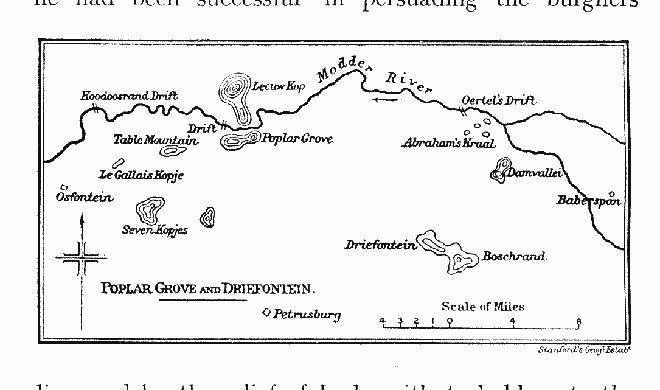
De Wet's force at Poplar Grove was at first sufficient for the occupation of a position on the left bank of the Modder only, but subsequent reinforcements brought it up to a number which was estimated by the British Intelligence not to exceed 14,000 and which was probably much less. The position was then prolonged across the river, the front being divided into two unequal portions by the Drift at Poplar Grove.
To drive away De Wet, and to entangle him as Cronje {186} had been fatally entangled in the Drifts of the Modder River, and cut off his retreat to Bloemfontein, was the tactical scheme of Lord Roberts, who had twice as many men, and at least five times as many guns, as his opponent.
In his method of communicating his plan to the officers concerned Lord Roberts made an innovation. Instead of issuing written Battle Orders he read a memorandum at a council of war, and afterwards circulated copies of it. Thus he was able to explain the situation and expound his plan in greater detail than is possible in the bald and sterilized paragraphs of Orders; but he omitted to give in it definite times at which certain movements were to be begun, or to be completed, and the oral instructions on these points given subsequently were not clearly understood.
In brief, Lord Roberts' plan for Poplar Grove was as follows. When French's cavalry had made a wide circuit of seventeen miles south of the Modder, out of reach of De Wet's left flank, and had placed itself in rear of the Boer position, the VIth Division was to make a flank attack on the Boer left on the Seven Kopjes, and endeavour to roll it up towards the river, by way of Table Mountain. The enemy's centre was to be threatened by the VIIth Division along the line of the Modder, and his right on the north bank of the river by the IXth Division. With his great superiority in men and guns, Lord Roberts might reasonably expect to capture the whole Boer force, although he had no longer a Cronje but a De Wet to deal with.
The day's operations began at 3 a.m., when the cavalry marched out of Osfontein; but soon the absence of precise staff arrangements gave trouble. The VIth Division, which was ordered to follow French, who it was understood would leave camp at 2 a.m., was headed off by the cavalry, and had to be halted until he was clear of the infantry front. Neither Kelly-Kenny nor French seems to have mastered the scheme of attack. {187} At daylight, when the cavalry should have been well in rear of the Boer position, it was in fact not far from the VIth Division, about two miles south of the Boer left flank on Seven Kopjes and in full view of the enemy.
As soon as the Boers perceived that an enveloping movement was in train, they withdrew towards the river, and French reported that he had turned their left flank, and was in pursuit, and that Seven Kopjes was open to Kelly-Kenny's advance. The part assigned to him in the morning's work was, however, the cutting off of the enemy's retreat, and he nullified the tactical scheme by showing himself prematurely.
His next message to Lord Roberts, who was watching the battle from Le Gallais Kopje, announced that he was shelling the wagons in retreat, but that he could not get at them, as they were protected by flanking positions on neighbouring kopjes. It was now evident that French instead of cutting off the enemy was only pursuing him without much success.
The VIth Division advanced with great deliberation. Kelly-Kenny reported to Head Quarters that Seven Kopjes had been reoccupied, and that a detached hill to the east seemed to be strongly held, which was not the impression given by French's message less than an hour previously. However, Kelly-Kenny occupied Seven Kopjes without opposition, and it is said that the infantry on the south bank were never in touch with the enemy. On the north bank the IXth Division slowly, but without much difficulty, pushed back the Boer right and captured a gun on Leeuw Kop, the solitary trophy of the day.
Finally, the Divisions converged on Poplar Grove, but De Wet had shaken himself free without the loss of a single burgher taken prisoner, and with almost his full complement of wagons. He retired along the Modder towards Abraham's Kraal, keeping French at arm's length with his rearguards. He owed his escape to the {188} hesitancy of his opponents and his own mobility. The details of the fight show that some of the commanders waited upon one another like Lord Chatham and Sir Richard Strachan at Walcheren. Again the British cavalry was ineffective for pursuit.
It was not known at the time that had Lord Roberts' scheme been successful in its entirety, a capture would have been made that might have brought the war to a sudden close. President Kruger was present during the greater part of the battle, and with bitter chagrin saw the burghers streaming past him in retreat.
Whether the battle of Poplar Grove is to be considered a success or not depends upon the view which is taken of its actual and potential results. Lord Roberts did not capture another Boer army, as he fully expected to do, but he expelled it from a good position, and put it on the run; and the British Army was one stage nearer to Bloemfontein.
Next day Kitchener was again, in his capacity of military foreman, sent away to superintend the carrying out of the arrangements he had already made for dealing with the disaffected Prieska district. His disengagement from Lord Roberts removed for the time a potential cause of failure, namely, the uncertainty, to which perhaps the escape of De Wet at Poplar Grove may be due, whether a battle was to be fought with the Commander-in-Chiefs rapier or with the Chief-of-the-Staff's bludgeon.
De Wet, undaunted by his defeat and by the defection of a large number of his men, who disappeared after Poplar Grove, summoned a Krijgsraad, which authorized further resistance. A position threatening the left flank of the advance on Bloemfontein was taken up on the kopjes near Abraham's Kraal.
Reinforcements of "Zarps" from the Transvaal, and of contingents under Delarey and P. de Wet, came in, and a force of about 5,000 men was rallied, to make one more rearguard stand against Lord Roberts. In {189} the absence of C. de Wet, who had been called away to Bloemfontein, Delarey was in command.
Lord Roberts' scheme for the advance on Bloemfontein was based on reports that the Boers would take up a strong position a few miles N.W. of the capital. He divided his force into three columns, each having a cavalry brigade attached to it, which, marching by different routes to a point south of the city, would cut the railway and turn the Boer flank. On March 10 the advance began, French being in command of the left column, which alone was seriously engaged during the march.
The position taken up by the Boers at Abraham's Kraal at first only included a group of kopjes near the river, and another group at Damvallei, but eventually it was extended further south to Driefontein and Boschrand, in order to command another road to Bloemfontein.
In accordance with Lord Roberts' instructions, and to the great disappointment of Delarey, who hoped to commit the left column to a frontal attack on the Abraham's Kraal and Damvallei Kopjes, which lay on the direct road to Baberspan, where it was due to bivouac that night, French avoided them, and changed direction towards Driefontein and Boschrand. Delarey, finding that he was not to be attacked on his right, reinforced Driefontein Hill, which, as it happened, had just been evacuated by De Wet, who had returned from Bloemfontein. The occupation of a detached spur of the Boschrand by a chance body of mounted infantry from the centre column, and a threatening movement of that column's cavalry brigade, had drawn him away from Driefontein on to the crest of the Boschrand. French's change of direction caused the march of his column to converge upon that of the centre column, and he was now crossing the front of a sinuous line of ten miles occupied by the enemy, and extending from the Boschrand, through Driefontein, Damvallei, and the {190} Abraham's Kraal Kopjes to Oertel's Drift on the Modder. The right of the line had already diverted French from his march on the appointed bivouac, which he now proposed to reach by turning the left.
Suddenly Delarey opened fire from Driefontein on the cavalry, and the advance of the infantry had to be delayed while the situation was examined. The result of the reconnaissance determined Kelly-Kenny, who was in command of the left column's infantry, to attack the minor features of Delarey's position. He was unable to communicate with French, but the latter, as soon as he saw that Kelly-Kenny had achieved his object, ordered a turning movement by the cavalry.
The cavalry of the centre column, which earlier in the day had been informed that French was not in need of its assistance, co-operated imperfectly. The afternoon was wearing away, and Kelly-Kenny, while waiting impatiently for the turning movement to take effect, received a message from Lord Roberts, instructing him to push on, as it was believed that the enemy's position was not held in great strength.
Kelly-Kenny, for the first time able to fight a battle in his own way, now set himself to clear the enemy out of the Driefontein ridge. Reinforcements were ordered up to him from the centre column, but he won his victory without their aid, and after a struggle which lasted till sunset, Delarey was expelled from Driefontein. The Boers were still in occupation of the other positions on the line, but De Wet, although strongly urged by Delarey to hold on, found it advisable to withdraw from them. The burghers drifted away in the darkness, after the exhausted cavalry had made a formal attempt at pursuit.
Two of the field guns which had been taken three months before at Colenso fought on the Boer side at the Battle of Driefontein, which though but a passing incident in the war, has been favoured by the German critics with their cordial approval. "Driefontein was fought substantially on the principles evolved by the {191} experiences of the campaign of 1870-1871." Kelly-Kenny's wilful and successful "use of deep formations, limited front, and of a wasting fire to obtain ascendancy before crushing the enemy with a simultaneous charge" is considered to uphold the correctness of the German theory of attack, which thirty years of new conditions of warfare have not modified.38
Next day the advance on Bloemfontein was resumed, and French's column was merged in the centre column under Lord Roberts. The column under Tucker was marching on the Free State capital by way of Petrusburg, twenty miles to the south, as there was a possibility that some of the commandos in retreat from beyond the Orange might be approaching. De Wet did his best to organize a final stand N.W. of the city, but it was soon evident that Lord Roberts' movements could not be checked, and President Steyn fled to Kroonstad.
The cavalry was pushed on, and on the afternoon of March 12 the railway was cut at Ferreira's Siding, a few miles south of Bloemfontein. Some resistance was offered at a ridge commanding the approach to the capital, but the defenders withdrew during the night. Soon after midnight, a small party of pioneers, under Hunter-Weston of the Royal Engineers, started to circle eastwards round the city, and having with much difficulty in the darkness found the railway on the north side, destroyed a culvert on the line and thereby entrapped a considerable amount of rolling stock.
Next morning Lord Roberts came to the line, and at midday the municipality and leading citizens of Bloemfontein waited on him at Ferreira's Siding, and tendered the submission of the city. It was a notable episode in the military history of Great Britain, and there was a touch of a vanished mediaevalism in the ceremony.
{192}The march from Ramdam to Bloemfontein restored the British Army in the eyes of the nation. It was no longer a machine which constantly broke down whenever stress was laid upon it, but was working quietly and on the whole successfully. It had acquired confidence in itself, and the infantry especially had done well during the month's advance. Notwithstanding long marches, which in the end were equally fatiguing whether made by day or by night, on restricted rations in a trying climate, the proportion of men who fell out was small.
The cavalry did not greatly distinguish itself. Two brilliant exploits, the rush from Klip Drift to Kimberley, and the heading off of Cronje at Vendutie Drift, practically exhausted it. Its reconnaissance work during the advance was poorly executed, and after each fight came the same report, that the horses were unable to pursue the retiring burghers. Overloading, indifferent march discipline and horsemastership, night marches without previously watering and feeding the horses, reduced Lord Roberts' mounted troops to but a fraction of their nominal strength; and raised a question whether French, whose military capacity was undeniable, might not be more usefully employed in infantry operations.
There is more than a substratum of truth in the remark once made by a caustic foreign critic, that an Englishman talks more and knows less about horses and their management than any other man.
Footnote 34:(return)In the Egyptian War of 1882 Arabi was similarly misled by Sir Garnet Wolseley, who making as if to land his Army near Aboukir Bay, suddenly took it into the Suez Canal, and threw it ashore at Ismailia.
Footnote 35:(return)350,000 horses were used up during the campaign, in other words, the war strength of one cavalry regiment every other day. The removal of a cavalry officer from his command after the battle of Graspan, because he could not do with exhausted horses what was expected of him by an infantry officer, will perhaps account for a considerable portion of the wastage.
Footnote 36:(return)It is stated on the authority of the United States Military attaché that Kitchener said next day that if he had known the power of the Mauser behind entrenchments, he would not have attempted to assault the laager.
Footnote 37:(return)They were originally granted as a counterpoise to the irregularities of the system of promotion by purchase.
Footnote 38:(return){193}See Colonel du Cane's translation of Vol. II. of the German Official Account, p. 52.
The occupation of Bloemfontein by the British Army in March, 1900, ushered in the second or guerilla period of the war. Hitherto the struggle had been mainly, though not entirely, maintained against considerable bodies of Boers, who though widely dispersed acted more or less under a common direction; but after the capture of the Free State capital, a system of partisan and irregular warfare was adopted by the enemy.
The change was not suddenly effected. It was an instinctive, almost an imperceptible, development rendered necessary by circumstances. The reverses on the Modder, the failure at Ladysmith, the ill success which attended the attempts to raise the fiery cross in the northern districts of Cape Colony, indicated to the burghers the cause of the instability of their military machine. They discovered, in time, that its centre of gravity was too highly pitched and must be brought nearer the earth. For five months the war had been carried on under the orders of a federal syndicate composed of the two Presidents sitting with casual military assessors, scarcely one of whom was a strategist or capable of viewing the Boer cause synoptically. Cronje was gone into captivity; Joubert was suspected to be half-hearted; and Botha, who had begun so well in Natal, was a disappointment.
The Boers recognized that the British strategy had been astonishingly successful, and that they could not hope to compete with it. But they believed, not without justification, that in minor tactics and the {194} smaller operations of war they were the equals of their enemy and in war-craft his superior. The power of a slender, well-led, and resolute force was shown at Nicholson's Nek, Waterval Drift, and elsewhere, and it began to dawn upon their lethargic minds that the individual efforts of handy commandos acting to a great extent independently offered them the best chance of resisting the invader.39 The new method was almost immediately put on trial and, with certain notable exceptions, continued throughout the war, which mainly by its use was prolonged for twenty-six months against an enemy daily increasing in numbers. Not that the Boers were not at first greatly discouraged by the victories on the Modder, which admitted Lord Roberts to Bloemfontein, and by the tranquillity which suddenly brooded upon the arena of war. Even the Prieska rebellion, from which so much was hoped owing to its proximity to the line of communication with Capetown, was dying away under the vigorous hands of Kitchener, who had been detached from Head Quarters to deal with it.
Many of the burghers availed themselves of a proclamation issued by Lord Roberts on March 15, under which, after taking an oath of neutrality, they were allowed to return to their farms, and there remain during good behaviour. Others took furlough, with or without permission, or fled to Kroonstad. When Joubert remonstrated with De Wet for acquiescing in the exodus, the latter replied that he could not help it. The burghers were not accustomed to discipline and could not be coerced, but they would return with renewed courage by and by.
The demoralization was, however, confined to the burghers who had been fighting on the Modder River. The commandos which had been opposed to Gatacre, Clements, and Brabant in the Cape Colony retired across {195} the Orange in good order under Olivier, Lemmer, and E.R. Grobler; and although encumbered by lengthy trains of ox-wagons, marched up the right bank of the Caledon along the Basuto Border, and established themselves with a strength of 6,000 burghers on Lord Roberts' right flank near Ladybrand and Clocolan: a daring exploit which was justified by its success, as the left flank throughout the trek was exposed to a raid from Bloemfontein or Edenburg. A mounted force 1,800 strong under French was indeed sent eastward to show the flag, detach the waverers, and if possible, intercept the retreat; but the information at Head Quarters was imperfect and the strength of the commandos was greatly underestimated. It was assumed that they had been subject to the disintegration which obliterated the Modder River commandos; but a small reconnoitring column, detached under Pilcher by French from Thabanchu, found itself in presence of a force which outnumbered it thirty times, and was recalled.
The presence of a considerable body of the enemy organized on the flank, the necessity of accumulating a large stock of supplies and stores, and a serious epidemic of fever among the troops, postponed the advance on the Transvaal many weeks beyond the end of March, when Lord Roberts had hoped to set out for the north. The apparent pacification of the country and the alacrity displayed by the burghers in submitting to the generous conditions of the proclamation of neutrality, had encouraged him in the belief that prompt action before the enemy had time to take breath would finally crush the dwindling opposition; but he soon became aware that it was but a lull in the storm, of which the mutterings were almost immediately renewed.
Pole-Carew, who shortly after the occupation was sent south with a brigade to establish touch with Gatacre and Clements and open up the railway, heard of the Boer movement along the Basuto Border and at once {196} reported it to Lord Roberts, whom he rejoined at Bloemfontein on March 17. Before the end of the month the line was cleared and trains were passing to and fro between Capetown and the capital of the Free State, which had lately been renamed the Orange River Colony. From that time forward the enemy succeeded on one occasion only, and then but for a few hours, in cutting the Springfontein-Bloemfontein railway; and the hazardous advance along the Modder River, which involved the possibility of the Army being left in the air at Bloemfontein, was fully justified.
The Boers, who were supposed to be hypnotized, soon began to show signs of returning animation. At a Krijgsraad which assembled at Kroonstad on March 17, and at which Steyn and Kruger were present, plans for the renewal of the struggle were discussed and measures for enforcing discipline on the burghers were taken. Steyn professed to have information that a Russian advance on India was imminent. The idea of resistance en masse was abandoned, and a policy of flying columns unencumbered with wagons and acting aggressively against the British lines of communication was adopted. It was hoped that a timely demonstration would lure the enemy out of his hold, and that a little encouragement would revive the Prieska rebellion. The determination to continue hostilities in which even Joubert, who after the fall of Ladysmith joined the commandos operating in the Free State, acquiesced, was a proof of the courage and the steady patriotism of the Boer leaders, and the events of the next two years justified their resolution. Joubert, who had attended the Krijgsraad in feeble health, died a few days after its adjournment, and L. Botha was appointed to the thankless office of Commandant-General.
The only direction from which Bloemfontein appeared to be vulnerable was the north, which also was the direction in which Lord Roberts hoped soon to be leading his troops. At a distance of a day's march from the {197} capital, the railway to Pretoria crosses the Modder at Glen, and again the river which had recently figured so prominently in the campaign came upon the stage of war, and not as a last appearance. The railway bridge had been destroyed by the Boers, who thus excluded themselves from action on the left bank. A considerable force was sent out from Bloemfontein to hold the position while the bridge was being rebuilt, and to keep at arm's length the enemy skirmishing on the right bank. It was soon found necessary to hold a more advanced post at Karee Siding, north of Glen, and a force which seems out of proportion to the resistance which, according to the ideas then prevalent at Head Quarters, might be expected, was assembled at Glen on March 28. The VIIth Division under Tucker was brought up from Bloemfontein, and French was recalled from Thabanchu to lead the cavalry. With him, in command of the mounted infantry, was Le Gallais, a remarkable association of two soldiers whose names, though in different languages, were identical. Bloemfontein was denuded of cavalry, but the combined strength of the two cavalry brigades was much under 1,000. The force under Tucker and French, which judging from its strength Lord Roberts seems to have detailed rather as the advanced guard of an immediate march on Pretoria than as the minimum with which the opposition could be safely encountered, numbered about 9,000 men with thirty guns. At Karee Siding were 3,500 burghers under T. Smuts, who had come up to carry out the Krijgsraad idea of enticing the British out of Bloemfontein.
Next day a battle of the usual type was fought. The mounted troops worked upon the flanks of the enemy, who was posted on a line of kopjes on each side of the railway, while the infantry attacked frontally with success and drove back the burghers, who retired in good order towards Brandfort unmolested by the cavalry, which was as before too much exhausted for effective {198} pursuit. Thus, at a cost of less than 200 casualties, Lord Roberts made good the first stage on the road to the north.
Soon after his entry into Bloemfontein Lord Roberts sent out a small mounted column under Amphlett to Sannah's Post, where the water which supplied the capital was drawn from the Modder River. This had been cut off by the enemy, and the Army was dependent upon the disused and tainted wells within the city. The Boer commandos, which under the command of Olivier had retreated from the Cape Colony to Ladybrand and Clocolan, now began to threaten Broadwood, who, when French was sent to Glen, succeeded to the command of the mounted column. Broadwood was compelled to retire from Thabanchu on March 30. Early on the following morning he bivouacked at the Waterworks, whither his convoy under Pilcher had already preceded him; and simultaneously the IXth Division under Colvile and a brigade of Mounted Infantry under Martyr were ordered out from Bloemfontein to help him in.
Meanwhile De Wet at Brandfort was watching his opportunity of working at the task assigned to him under the Krijgsraad scheme, of attacking the British lines of communication. His anticipation that the burghers would return with renewed vigour from the furlough which they had granted to themselves proved to be accurate. While Smuts was standing up to Tucker and French at Karee Siding, 1,600 men with five field guns under C. De Wet, whose second in command was his brother Piet, were circling to the Waterworks. The initial direction of the march was N.E., in order to conceal the real objective of the raid even from his own men. His intention was to seize Amphlett at the Waterworks, and there lie in wait for Broadwood's convoy. Before reaching his destination he handed over two-thirds of his force to his brother, who early in the morning took up a position on the right bank {199} of the Modder east and north of the Waterworks, while he himself went to the Wagon Drift on the Korn Spruit, where the bed is deep enough to afford perfect concealment to a large body of men in ambush. He occupied it at 4 a.m. on March 31.
A farmer, brought in by a patrol from Amphlett's post, reported to the officer in command of the connecting post at Boesman's Kop that the enemy had been seen; but the officer did not pay much attention to the report, though he communicated it to the connecting post at Springfield in the direction of Bloemfontein; at the same time sending back the patrol to Amphlett at the Waterworks with a reinforcement of his own men. The patrol was fired on while attempting to return to the Waterworks, and retired to Boesman's Kop.
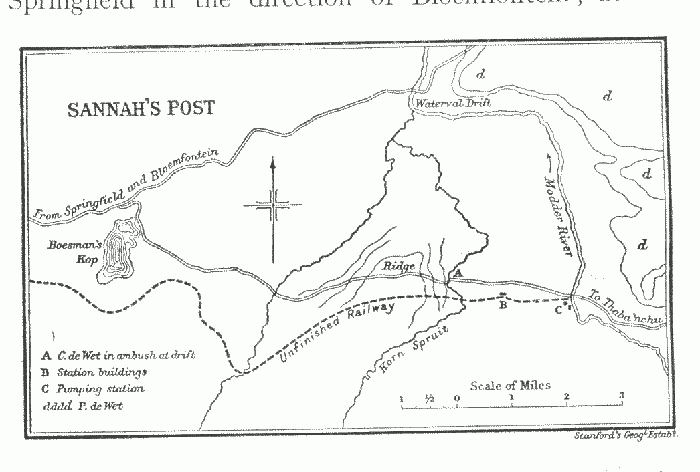
Broadwood, whose column had already been in bivouac near the Waterworks for some hours with the convoy which had preceded it, was at sunrise shelled by Piet De Wet, of whose presence on the right bank of the Modder he had only a few minutes previously been made aware, and in the belief that his front was clear, he at once determined to take up a position on Boesman's Kop.
{200}Rarely had two leaders about to meet in battle been more strangely deceived by the Fog of War. C. De Wet, although cut off from his guns and the main body of his command by an unfordable river, was confident in his lurking place in the Korn Spruit that he could easily repeat his exploit of February 15 and annex another British convoy; yet he suddenly discovered that he had to deal not with a mere escort, but with a strong mounted force and two batteries of Horse Artillery, and he was equal to the occasion.
Broadwood, equally confident that the whole force of the enemy was on his flank on the right bank of the Modder, marched heedlessly into the ambush which De Wet had laid for him in the Korn Spruit, on the direct line between two adjacent British posts, and which neither of them had discovered, although the usual patrols had been sent out. When the patrol from the Waterworks to Boesman's Kop did not return in due course on the morning of March 31, its absence seems to have caused no anxiety to Amphlett.
Broadwood, groping in the Fog of War, believed that the force on his flank was Olivier's, who had driven him out of Thabanchu, and who now, as he thought, had overtaken him. The possibility of a raid from the north did not occur to him. He pressed on towards Boesman's Kop and carelessly approached the sunken and treacherous cutting through which the Korn Spruit trickles to the Modder, between banks of even height which almost up to the brink make no perceptible break in the surface of the veld. His ground scouts and advanced guard were Cape carts full of refugees followed by the wagons of his convoy. Next in succession came U Battery of Horse Artillery with its mounted escort of colonial troops.
Preceded by the Cape carts, which De Wet, in order to disarm suspicion, allowed to cross to the left bank, the column lumbered down the slope into the spruit and was quickly sucked into the trap. In silence broken {201} only by the rumble of the wheels and the Kaffir cries of the drivers, and unseen by the gunners close behind the leading wagons were seized by quiet, determined burghers and placed under guard. The approach to the drift was soon blocked, and in the heart of the entanglement was U Battery. When it reached the incline, men sprang up out of the spruit and lined the bank, and without firing a shot made prisoners of the gunners, who, jammed by the transport, could neither fight nor retire, and were easily taken from their teams and guns, and conducted by their captors down to the bed of the spruit. Only the Major commanding the Battery and the Serjeant-Major got away. Q Battery and its mounted escort narrowly escaped being drawn into the ambush, but were warned in time and galloped back to the railway station buildings.
Up to that moment not a shot had been fired, but as Q Battery wheeled the Boers lining the bank opened upon it, and in the scrimmage another gun was lost.
The derelict and riderless teams of U Battery at the spruit were shot down by the Boers to prevent the escape of the guns, but not before one gallant team had wrenched its gun out of the enemy's grasp and had broken away. The Boers were now in possession of five guns of U Battery and of one gun of Q Battery. The spruit was shelled with little effect by Q Battery, which unlimbered near the station buildings. Only a plunging fire could have harmed the enemy hidden in it.
It is hard to say whether De Wet or Broadwood was in the greater danger at 9 a.m. on March 31. The former had, it is true, just obtained a dramatic and most encouraging success. He laid a trap for a convoy and found himself in action with a force numerically equal to his own. He had made many prisoners, and almost without striking a blow had captured not only Broadwood's convoy but also six of Broadwood's guns. His force, however, was divided. The portion of it {202} under his own command could not be effectively supported by his brother's command, and was confined in a spruit out of which he could not move, and which was commanded in rear by higher ground.
Broadwood had been outwitted by De Wet and very roughly handled. With a crippled and maimed force he was lying between the jaws of a vice which might at any moment close and crush him. The loss of the convoy was, from a tactical point of view, not an unmixed evil, as he gained thereby greater freedom of action, but the loss of half his guns was for the time being irremediable. The careless and haphazard scouting from the Waterworks and Boesman's Kop, in which he complacently trusted, had lured him on.40 When it was reported to him that the spruit was in possession of the enemy, he could scarcely believe it possible. Whether he or the officers in command of the artillery and the mounted escort were responsible for the extraordinary omission to send out ground scouts in advance of the column is not known, but the guns and wagons would not have been lost had this simple and customary precaution been taken.
Broadwood, who had no information that Colvile and Martyr were approaching from the west, and that the latter was actually at Boesman's Kop, acted in the belief that he would have to deal with the situation unaided. He ordered the mounted infantry under Alderson to hold P. De Wet's force on the Modder, while the cavalry, supported by fire from Q Battery at the station buildings and working south and west of the Korn Spruit Drift, endeavoured to turn C. De Wet's precarious position. Neither of these operations was successful. Alderson could barely hold his own; the turning movement, although aided by a few companies of Martyr's force, was frustrated by small parties of {203} marksmen whom C. De Wet had posted on the ridge in rear; and Q Battery was losing heavily.
At 10 a.m. Broadwood ordered a general retirement. No attempt seems to have been made to communicate with him by heliograph, and he was still unaware that Martyr had been on Boesman's Kop for three hours, and was actually assisting in the turning movement; and that Colvile was hurrying forward to the sound of the firing with the IXth Division. As the battle had begun in the Fog of War, so also therein did it end.
With the utmost difficulty Q Battery, which had been fighting in the open until only Phipps-Hornby and less than a dozen gunners were left to work five guns, was withdrawn. The enemy's fire was so heavy that the teams could not be brought up to the guns, four of which were run back by hand to the station buildings, which afforded some cover. The fifth gun was abandoned, but by the heroic efforts of Phipps-Hornby and a handful of gunners and volunteers from the mounted infantry escort, four guns were brought away.
Meanwhile Alderson was fighting a rearguard action against P. De Wet, to cover the retirement of the guns, and when this was effected, he followed them, closely pursued as far as the Korn Spruit by P. De Wet's burghers, who crossed the Modder at the Waterworks. Before noon the remains of Broadwood's column were formed up near Boesman's Kop. He had lost seven41 guns, seventy-three wagons and nearly a third of his strength in killed, wounded, and prisoners.
Broadwood's withdrawal gave C. De Wet the opportunity which he could hardly have dared hope would ever be offered to him. He was reinforced by his brother, and at once drew his spoils out of the spruit and easily got away with them to the right bank of the Modder, where at noon he met the advanced guard of {204} Olivier's force. Although he was in presence not only of Broadwood's force, but also almost in touch with a division of infantry and a brigade of mounted infantry his movements were so little impeded that he was able to bring two of the captured guns back to the left bank, and to bring them into action against a detachment of mounted infantry which was holding Waterval Drift.
Martyr reached Boesman's Kop at 7 a.m., where in the course of the morning he was joined by Colvile, whose Division was also on its way to Waterval Drift. Broadwood, who was about two miles away, was ordered by Colvile to come to him, but he refused to leave his command so long as there was any chance of recovering the guns. He technically committed a breach of discipline, but Lord Roberts subsequently approved of his action. He requested Colvile to advance against the spruit, but the message was not delivered; and Colvile said that it would not have modified his dispositions. He had already refused to listen to the obvious suggestion made by his staff that he should go to Broadwood, who after waiting for two hours in the expectation that something would be done by the infantry division, gave up hope and retired towards Springfield.
Colvile's appreciation of the situation was that it would have been useless to pursue De Wet's mounted troops with infantry. He therefore carried out the letter of his instructions from Lord Roberts, and, seeing that Broadwood's column was apparently safe, went on towards Waterval Drift: whither also Martyr had already sent the greater portion of the mounted infantry. Thus the brothers De Wet gained not only an actual, but also a moral success of the greatest importance to their cause, and took away the prizes they had so unexpectedly won, under the eyes of a strong British force helplessly watching the commandos trailing away across the veld.
Waterval Drift had been indicated to Colvile and {205} Martyr as their objective by Lord Roberts, and they considered that it was their duty to make for it. They did not, however, recognize that instructions must be read in the light of the information at the disposal of the superior officer at the moment of issue, and they adhered to them pedantically.42 Lord Roberts could not have anticipated Broadwood's plight when he ordered Colvile and Martyr to Waterval Drift.
Meanwhile, the news of the disaster had reached Bloemfontein. French's attenuated cavalry brigade, still panting with the fatigue of the Karee Siding affair, was ordered out, and Colvile was instructed to endeavour to make a turning movement, and with French's assistance to act on the Boer line of retreat. By sunset Colvile, after some opposition, was in possession of the Waterval Drift; the enemy having despatched the prisoners, the loot, and the captured guns to the north, was still in occupation of the Waterworks; Broadwood's mangled column was on its way back to Bloemfontein; and French was expected to appear upon the stage at sunrise next morning. The approach of the cavalry, which had picked up Broadwood at Springfield, was delayed by a report, which proved to be unfounded, that a body of the enemy was on the right flank marching on Bloemfontein, and French did not come into touch with Colvile until nearly midday on April 1. After reconnoitring the Waterworks and the Boer positions on the right bank of the Modder, Colvile came to the conclusion that he was not strong enough to attack them. Next day all the troops were ordered by Lord Roberts to fall back upon Bloemfontein.
Broadwood was not wholly, not even mainly, responsible for the Sannah's Post disaster. He was unable {206} to retrace that unlucky first false step when, rashly assuming that the ground had been properly reconnoitred and patrolled, he pushed into the angle between the Modder and its tributary; and there can be no excuse for the negligence which tossed the convoy and the guns into the abyss. But he received neither support nor information until it was too late. No serious attempt was made to let him know that a strong force was on its way from Bloemfontein. Martyr failed to report himself, and Colvile was content to be an interested spectator of the closing scene of the drama. Each leader assumed that the moves of the Kriegspiel had been correctly played and that there was nothing more to be done.
After the occupation of Bloemfontein, the columns operating south of the Orange River were drawn into the Free State. Clements crossed at Norval's Pont, and Gatacre at Bethulie on March 15; Brabant, who commanded the colonial troops of the latter's Division, having reached Aliwal North four days previously. Clements' force advanced in a peaceful procession through the districts west of the railway, meeting with no opposition, and receiving what, under the circumstances, was almost a welcome from the inhabitants. Early in April he joined Lord Roberts at Bloemfontein.
Not so with Gatacre and Brabant, who were soon seriously involved. Lord Roberts' view of the situation, which although mistaken was not unwarranted, was that the majority of the Boers were inclined to submit, and would do so but for the malign influence of a small belligerent party; and in order to encourage the waverers to assert themselves, and to give protection to them when they took the oath of neutrality and returned to their homes, he sent out flying columns in various directions to register names, take over arms, and make known the conditions on which surrenders would be accepted.
The story of the Thabanchu column has already been {207} told. Other columns were detached from Gatacre's and Brabant's commands, and Smithfield, Wepener, and Dewetsdorp, and smaller towns were occupied. Lord Roberts' orders for the occupation of Dewetsdorp were conditional on Gatacre's having enough troops for the purpose at his disposal. So little was it expected that the columns would meet with serious resistance that they were unaccompanied by guns, and all Gatacre's artillery was sent to Bloemfontein.
De Wet, a soldier possessed of more power of initiative than many of his opponents, took "upon himself the responsibility of varying the instructions" he had received from the Kroonstad Krijgsraad. The chance of snapping up isolated garrisons allured him from the less brilliant but more practically useful work of hacking at the railway upon which Lord Roberts depended for his communications, and his wonderful and unexpected success at Sannah's Post encouraged him to persevere. He became aware that small columns were scouring the country, administering lightly taken oaths and giving receipts for arms handed in by burghers who protested that they were "sick of the war"; and he determined to deal promptly with these ominous signs.
Between Sannah's Post and Reddersburg he in one day persuaded more than a hundred sworn burghers to break their oaths of neutrality and join him. Whether the energy and resource which he displayed would not have been more profitably expended in a vigorous effort to shrivel up the line between Bloemfontein and the Orange is a matter for speculation. Kruger watched his proceedings with misgiving, and proposed that he should retire northwards, as soon as he had cut the railway, or even without doing so.
Korn Spruit opened Lord Roberts' eyes. He became alarmed for the safety of the railway, and ordered Gatacre to evacuate Dewetsdorp and to concentrate the weak pacificatory columns wandering helplessly {208} over the country. The column of 550 men without guns, sent by Gatacre to garrison Dewetsdorp, had not been there many hours before it was ordered to retire on Reddersburg, and at daybreak on April 2 was again on the march, and soon De Wet was in touch with it. On the following morning he was close to it. In his own account of the affair he says that there was a sort of a race, which was won by the British column, for a ridge near Reddersburg, named Mostert's Hoek. He had with him 2,000 men with four guns, but an invitation to surrender was promptly declined by the defenders, who all that day were beaten on by bullet and by shell. After sunset the last drop of water was served out. Next morning De Wet rushed the western spur of the ridge, which now became untenable, and at 9 a.m. on April 4 the column surrendered and was swept into his net.
Another hour of resistance would probably have saved it. On the previous evening Gatacre and Lord Roberts received the news that it was in trouble, and a relieving force was hurriedly collected at Bethany from Springfontein and Bloemfontein, and sent out under Gatacre's command. His scouts heard the last shot fired, and the silence which followed seemed to show that all was over. When reports of the surrender reached him near Reddersburg, and before De Wet, only six miles away, had cleared out of Mostert's Hoek, he abandoned the attempt; although some of his advanced mounted troops did indeed come into touch with the rearguard of De Wet hurrying away with his prisoners.
Next day he was recalled to Bloemfontein by Lord Roberts, who held him responsible for the disaster. He had occupied Dewetsdorp, an exposed and isolated position, with an inadequate force, although expressly instructed to leave it alone if he had not sufficient troops for the purpose. Mostert's Hoek supervening on Stormberg ended the career of a most gallant, energetic, {209} and enthusiastic soldier. Bic peccare in bello non licet. He was removed from his command and sent back to England.
After leaving Sannah's Post, De Wet seems to have recognized that he was not exactly carrying out the Krijgsraad policy, for he informed Steyn that he was going to Dewetsdorp to "collect the burghers and to obtain dynamite for our operations" against the railway between Bloemfontein and Bethany. Next day he heard that the British had occupied Dewetsdorp, and soon after that the garrison was retiring on Reddersburg, and the attack on the line, which perhaps he never seriously intended to make, was indefinitely postponed.
For as soon as he had disposed of the prisoners of Mostert's Hoek, he cast his eye round the horizon and descried two other isolated garrisons, at Smithfield and Wepener. Against the former he sent one of his lieutenants, who, however, found the little town evacuated, while he himself made for Wepener, and longing to teach a lesson to Brabant's loyal colonials, sat down before it on April 9 with ten guns and 6,000 men. In the course of the northward advance from the Orange it had been occupied by a detachment from Brabant's force, which was increased by subsequent reinforcements to a strength of nearly 1,900 men under Dalgety, of whom little more than 100 were regular troops, with seven guns. The town itself was not held, but a circular position outside it with a perimeter of seven miles was taken up on the right bank of the Caledon.
De Wet maintained the siege for sixteen days. The failure of an attempt by night on April 10 to storm a post on the southern section of the perimeter deterred the Boers, as at Ladysmith after the abortive attack on Caesar's Camp two months before, from further offensive action; but the position was vigorously bombarded from time to time, and an almost unceasing hail of Mauser bullets fell upon it. De Wet did his best {210} to add Wepener to the scalps of Sannah's Post and Mostert's Hoek; but when two columns detailed for the relief by Lord Roberts under the command of Brabant and Hart, who had come round from Natal with his brigade, reached Wepener from Aliwal North on April 25, they found that the siege had been raised, and that De Wet had trekked away to the north.
At Waterval Drift, Kitchener's Kopje, Sannah's Post, and Mostert's Hoek, De Wet showed himself to be a daring and successful partisan leader. He was instinctively drawn towards helpless or unwary detachments. He played his own hand without reference to his partner's, and seemed to be incapable of co-operating in a general scheme of strategy. Perhaps he had not much confidence in those who directed the campaign of defence. He did not act in accordance with the instructions he had received from the Krijgsraad; but who could find fault with a leader who was ever sending in batches of prisoners of war? Many critics say that he was wanting in the true military instinct and spirit, and that he lost the greatest opportunity in his career when he allowed himself to be attracted away from the British lines of communication by the feeble, peregrinating columns. He says that his reason, or it may be his excuse, for not raiding vigorously towards the south, instead of sitting down before Wepener, was the fear lest the Transvaalers should think that the Free Staters had abandoned them to their fate. If his action is open to criticism when judged by the generally accepted principles of warfare, it should be remembered that these are framed from experience only, and are subject to accommodation. By all the rules of the game, the Boers must have been beaten in six months: yet when, after the occupation of Bloemfontein, the cause seemed to be hopeless, the De Wet revival prolonged the contest for two years and more. It is almost certain that, but for De Wet, the war would have been brought to a close in 1900. One man only, and he was {211} Napoleon, added a greater sum to the British National Debt.
The fortune which proverbially attends the bold never deserted him. To the Boer forces at large he was what the pirate adventurers and buccaneers of the Elizabethan period, and the privateersmen of the eighteenth century, were to the National Navy. He sailed where he would under letters of marque from the Presidents. He is the most interesting and the most original personage of the South African War: and when its history is mellowed by time, and its epic is written by some Walter Scott or Homer of the future, De Wet will be the central figure, and his exploits will be sung.
Five years later, having thrown aside his sword, he became a controller of ploughshares as Minister of Agriculture in the Government of the Orange River Colony, and the father-in-law of a British officer who had fought against him.
Footnote 39:(return)At the Krijgsraad at Kroonstad Delarey maintained that the commandos were too large and must be subdivided.
Footnote 40:(return)The scouting of the British Army in South Africa has been compared to a housemaid searching for an escape of gas with a lighted candle.
Footnote 41:(return)A The gun of U Battery, which had broken away at the Drift, was recovered.
Footnote 42:(return){212}In the official handbook on Combined Training issued after the war, it was expressly laid down that "officers, must take upon themselves, whenever it may be necessary, the responsibility of departing from or varying the orders they may have received." This responsibility had been laid by Napoleon upon his officers nearly a century before. Seep. 251.
Mafeking is a dull, unimportant town in the veld with a history that attracted the Boers to it.
They considered that, like Natal and Kimberley, it did not rightfully belong to Great Britain. They were a community of trekking and centrifugal atoms, especially in the direction of territories in the possession of native tribes, and their own country, though sparsely inhabited, was not spacious enough for them. The bucolic ambition of the Boer, which is to dwell in a house from which he cannot see the smoke of his nearest neighbour's chimney, can be satisfied in a flat country only when the house stands in the midst of a farm many thousand morgen in extent.
For a generation or two before the war, the Transvaalers had been encroaching upon Bechuanaland. A Baralong chief named Montsioa was dispossessed of Mafeking and could obtain no redress from the British Government, which at that time was in an intermediate frame of mind, and did not necessarily act on the assumption that in every dispute between white man and native the latter was in the right.
Thus encouraged, the Transvaalers annexed Bechuanaland in 1868, but three years later it was taken away from them under the Keate award, in an arbitration to determine the respective rights of Boer and native over the debateable territory.
After the war of 1881, the Transvaalers supposed that the British Government would be unlikely to assert itself, and two little impudent republics of {213} adventurers were set up in territory which the award had declared to be within the British sphere of influence. Montsioa fought for his rights, but the British Government lay torpid for some time. Finally it was goaded into action by a proclamation issued by Kruger annexing the territory to the Transvaal. He soon found it advisable to cancel the proclamation, and in 1885 the Republics of Goshen at Mafeking and of Stellaland at Vryburg were effaced by an expedition led by Sir Charles Warren. Bechuanaland was again annexed by proclamation, but on this occasion to the British Empire.
The resentment of the Transvaalers against Mafeking, which originated in the conviction that they had been wrongfully deprived of it, was aggravated by the fact that it was the starting place of the Jameson Raid.
On October 13 nearly 7,000 burghers, with six guns, under P. Cronje, sat down before it. He expected to have little difficulty in recovering it. Appearances were encouraging; the town was open and defenceless, and he was probably aware that it was held by a weak garrison. Why the British should have occupied such an out-of-the-way place as part of their plan of campaign, he could not understand, but there it was, inviting attack.
Of the half-hearted measures taken by the War and Colonial Offices in 1899, when a war with the Transvaal seemed to be more probable every day, one of the most intelligent was the commissioning of R. Baden-Powell, who had formerly served in Bechuanaland and had recently commanded the 5th Dragoon Guards, to "organize the defence of the Bechuanaland and Rhodesia frontiers." It would neither involve a great expenditure of money, nor be likely to wound the susceptibilities of the Transvaalers, who might be provoked by more vigorous and minatory measures: and thus little harm would be done if after all it were found to be an unnecessary precaution.
For these reasons it commended itself to Pall Mall, {214} but its chief merit was that it sent to South Africa a capable, versatile and zealous soldier, whose mind did not run in the grooves. Yet if Baden-Powell had been sent to Kimberley instead of to Mafeking, Kimberley would probably have fallen—after an outbreak of civil war within the lines between him and Rhodes. It would have been impossible to insulate the personal electricity with which each of them was so highly charged, and short circuiting must have occurred.
The object of the contemplated display upon the Bechuanaland and Rhodesia frontiers was twofold. They ran through the indefinite border belt which separated black from white territory, and activity on them would not only be witnessed by the tribes and exert an impressive influence on the native mind, but would also draw away the Boers and prevent them concentrating their forces. The central position of Mafeking on the Western line, and the stores and supplies which had been collected in the town, attracted Baden-Powell to it. It was singularly ill-adapted to hold defensively against an active enemy.
In spite of recruiting difficulties raised by the Facing-both-Ways Ministry at Capetown, which in a less tolerant and philosophic age would at once have been swept away by a storm of indignation, he raised two irregular regiments: the Rhodesian Regiment, which was sent into Rhodesia under Plumer, and the Protectorate Regiment under Hore.
The Cape Ministry did what it could to prevent the Protectorate Regiment going to Mafeking, and the corps was in fact mustered outside the Cape Colony, and only entered the town a few days before war was declared. As at Kimberley, so also at Mafeking, the Schreiner sect set itself placidly to thwart the gentle and tentative early efforts of the British Government to deal with the situation.
When P. Cronje appeared before Mafeking, Baden-Powell had a force of less than 1,200 men, none of whom {215} were regular soldiers and less than half of whom were efficiently armed, with which to sustain the siege of an open town by 7,000 Boers. He had also four small field guns of obsolete pattern, to which were added later on a home-made howitzer and an ancient man-of-war's smoothbore, which had left the foundry during the Napoleonic wars. In its youth it had probably fought the French through a porthole, and now having in the interval trekked across the South African veld into the possession of a native tribe, was discovered in a Baralong kraal, restored to active service, and, mounted on a Dutch wagon, aided in the defence of a little settlement 400 miles away from the sound of the sea.
In one respect only Baden-Powell had the advantage over Kekewich at Kimberley. His burden was not increased by discord within the lines. The civilians behaved with exemplary composure and put themselves unreservedly into his hands.
An archaic but effective simplicity characterized the methods of the defence. Baden-Powell eked out his slender stock of men and instruments with tricks and devices that might have been employed at the siege of Troy, but which none the less deceived and confounded the slow-witted besiegers, whom he scandalized with gibes and taunting messages. When asked to surrender to avoid further bloodshed, he replied that the only blood hitherto shed was the blood of a chicken in a compound; and on another occasion he reproved Cronje for inactivity. Many of the incidents read like passages from the Iliad. The besiegers were allured into determined attacks upon dummy trenches; deceived by bogus orders shouted for their information through a megaphone; alarmed by the sudden appearance of cavalry within the lines, for did they not see the glint of lances? The lances were weapons that had been forged in the railway workshops, and carried round, as it were in a parade before the footlights {216} by a body of supers making a gallant show upon the stage.
What should be done in a besieged place with such an embarrassing asset as ten tons of dynamite? Buller would have handed them over to his second in command for disposal, and then if any accident occurred would have disclaimed responsibility for it. Gatacre would have taken the chances, but would not have hesitated to pitch his tent if necessary beside them. Colvile would have searched his orders for instructions. Baden-Powell, not being able to rid himself of the explosive by firing it, arranged that it should be fired by the enemy. He loaded it on railway trucks, which he propelled a few miles out of the town and then abandoned. There was no Laocoon to warn the Boers, and they rushed at what they thought was an armoured train in trouble. In the skirmish the dynamite exploded, and although no one was hurt the enemy was terribly scared, and the resisting powers of the garrison virtually augmented.
Baden-Powell thoroughly understood the Boer temperament. Many generations' isolation from the progressive European world had rendered it peculiarly liable to be ensnared by simple expedients. It was not wanting in "slimness," but it was the "slimness" or cunning of a primitive race, and was easily gulled by wiles that might have been employed against a tribe of Red Indians. Baden-Powell alone of all the British leaders was aware of this, and he owed much of his success to the knowledge. With but one man to defend each ten yards of his perimeter of seven miles he hypnotized Cronje, a dull man bewildered by a resourceful. His versatility instantly found a way out of each difficulty that beset him. Before he sent out a party detailed for a night attack that might easily go astray, he bethought himself of the device by which a ship is often guided into her haven, and hung up two lamps in the town as leading lights across the veld.
Cronje soon found that Mafeking was not an easy {217} prey. Although in all probability he might at any time have overwhelmed it by sheer weight of numbers, he refrained from making the attempt. It hit out so vigorously and was believed to be so well protected by mines that he requisitioned a big gun from Pretoria, which was mounted south of the town and came into action on October 23. With a weapon throwing a shell more than three times heavier than all the shells that could be fired in salvo by the artillery of the defence, there was no doubt in his mind that the place must fall before the end of the month.
The arrival of the gun quickened the attack for a time. The native location S.W. of the town was made the object of a feint on October 25 to be immediately followed by a real attack elsewhere, but the Baralongs, who had been armed, resisted so stoutly that the operation failed. By the beginning of November the Boers had been cleared out of a newly made advanced trench on the east side; and Cannon Kopje on the south, the possession of which by them would have made a considerable section of the defence works and perhaps even the town itself untenable, was held under a converging fire of artillery by fifty troopers of the British South African Police against a thousand Boers.
Five weeks of Baden-Powell were enough for Cronje, who on November 19 trekked away to the south, leaving Snyman and 3,000 burghers to continue the siege. His self-esteem had been wounded because the walls had not immediately fallen to the sound of the big gun, and by Baden-Powell's refusal to take a serious view of the situation in the frequent communications that passed between them. It may be said that Cronje was "chaffed" away from Mafeking; the gibes put him out of conceit with himself, and instead of stimulating him into activity only made him more dull-spirited than he was by nature. He had none of the instinctive military genius which showed itself so notably in most of his colleagues, who, having turned their ploughshares into swords at a {218} moment's notice, were generally more than a match for the professional soldiers against whom they were pitted. He had the misfortune of meeting almost the only British leader then in South Africa capable of instinctively assessing him on the spot at his true valuation; and like a timid poker-player with a good hand, he allowed himself to be bluffed by the flourishes of his opponent. He held good cards, but he feebly threw them down. At Magersfontein he played his hand with skill, but lost the deciding game at Paardeberg.
Baden-Powell was too zealous a soldier to conform to the schism that the operations of war were akin to athletics or sport. Externally his predilections were for the drama. He was a competent actor and manager, and he rejoiced in Mafeking as in a stage play.
Many of his devices were as unsubstantial as stage scenery; the besiegers were the villains of the piece who would meet with their deserts before the curtain fell; there was comic by-play in his ways of beguiling the tedium and the lassitude of the siege, in the bantering messages he sent out to the besiegers, and now and then even in his garrison orders. The little garrison was permeated by the exosmose action of his cheery optimism and humour during seven weary months of waiting; and while it might seem to some that he was treating the serious situation with unbecoming levity, he wisely kept the tragedy of it, of which he was fully conscious, in the background.
His methods were so far successful that in a few weeks he had driven away two-thirds of the force originally opposed to him, and had firmly gripped the place. The enemy's superiority in artillery was neutralized by the construction of underground shelters and warrens in which the women and children took refuge during the daytime, leaving an apparently deserted town to be bombarded. Thus Baden-Powell was relieved from the moral pressure which a large number of casualties among them would have caused; and the garrison suffered but {219} little in the redoubts and trenches. Supplies were plentiful and the water supply secure.
What Cronje had failed to do, Snyman could hardly be expected to accomplish with a considerably reduced force, and the attack became more faint-hearted. He carried out the Cronje policy of comfortable, lethargic squatting, doubting not that the place must fall into his hands sooner or later. Friends and relations tripped over from Johannesburg to admire and encourage his brave burghers at their posts, and some were even allowed as a treat to fire a shot at the Khakis.
No serious operation occurred until the end of the year. On the morrow of Christmas Day, Baden-Powell made an unsuccessful attempt to carry a fort on Game Tree Hill, which commanded the approach to the town from the north. He was unaware of its strength, and the casualties amounted to nearly one-fifth of the force engaged, a loss which he could ill afford; but early in January he compelled the big gun, which could neither face the shells of his little battery of 7-pounders nor the rifles of his marksmen, to withdraw to a more distant emplacement east of the town. Towards the end of the month an encouraging message was received from Lord Roberts at Capetown.
The Boer line of circumvallation was in plan an irregular hexagon, of which the north-east face was pushed inwards and a re-entrant angle formed at the Brickfields; where a fort was built nearer to the town than any other post of the attack, and the operations during February and March were mainly a struggle for the possession of it. After several weeks of sapping and counter sapping, the Boers, though supported by the fire of the big gun in its new emplacement, were expelled from the Brickfields on March 23.
April was marked by the final withdrawal of the big gun, which, after a heavy bombardment on the 11th, was sent away to Pretoria; and by the appearance of young Eloff, fresh from the capital, with instructions to do {220} what he could to stimulate the attack, for once in a way, into real activity. More than a fortnight elapsed before he succeeded. Snyman gave him little encouragement, but could not oppose a mandate from Kruger, Eloff's grandfather.
The Molopo River, after passing south of the town, runs through the only weak place in the defence, the native location, which during the first few days of the siege had been attacked without result by Cronje. Westward of it the steep banks of the river afford a covered way of access to the thickly clustered huts lying within the perimeter of the defence, which Eloff saw might be turned if he got a footing among them.
Early in the morning of May 12 a heavy fire was opened upon the town from the east, but was soon discontinued; and then an alarm came from the S.W. It was Eloff, who, with 300 burghers, had wriggled up the river bed through the outposts and had set fire to the native huts: a signal for the reinforcements which Snyman had promised in writing. It also warned the garrison. The natives were too much terrified to offer resistance, and Eloff, leaving the greater part of his force to hold the location, advanced upon the town. The police building in the open was surrounded and the detachment holding it taken prisoners. A pause was now made to allow the promised reinforcements to come up.
Eloff's gallant thrust gave the garrison the opportunity for which it had long been hoping. The troops of the western section of the defence closed in and were manoeuvred by Baden-Powell through the telephone. The door by which Eloff came in was shut, not only to a retreat but also to the reinforcements which timidly knocked at it; the burghers holding the location were overpowered, and Eloff's party was penned up in the police building with its prisoners, whose condition was suddenly dramatically reversed. Eloff, seeing that Snyman had failed him, surrendered to the men he had {221} captured a few hours before, within the walls of the prison in which he had confined them.
The ordeal of Mafeking soon came to an end. On May 15 it was reported that the relief column under Mahon, who on that day joined Plumer at Massibi on the Molopo twenty miles from Mafeking, was approaching. The combined forces, though vigorously opposed by Delarey, whom L. Botha had sent when the news of the advance reached him, entered the town on May 17 and ended a siege of 213 days.
Mafeking, the last and most instructive of the sieges, proved that there was hardly any disparity of numbers or preponderance of available military resources that could not be neutralized by good leadership opposed to bad. Baden-Powell had not only detained a considerable Boer force on the edge of the storm, but with a body of irregular troops had beaten the men of Magersfontein, Colenso, and Spion Kop.
The relief of Mafeking, however, did not vitally affect the general situation. The capture of the town during Lord Robert's advance would no doubt have caused annoyance and trouble, but if necessary it could have been retaken without much difficulty. Nor would its fall have greatly benefited the enemy, who probably would have been tempted by the success to hold an unsound position and detain in it commandos urgently required elsewhere.
Kimberley, Mafeking, and Wepener, more than the operations at large, demonstrated the anomalous character of the war. Hitherto, invaders had been accustomed to besiege the invaded, in South Africa the invaded besieged the invaders. Such a reversal of the order of things military had rarely before occurred. The sieges of the Peninsular War are not an exception, for Wellington was from a military, though not from a political point of view, as much an invader as the lieutenants of Napoleon.
Baden-Powell is a suppressed personality whose merit {222} was not fully recognized. With scarcely an exception, no individual leader was more self-reliant, or handled imperfect tools with greater skill. For seven months he kept the flag flying over the lonely Baralong kraal in the veld. His unconventional even theatrical methods were not to the taste of his serious superiors, who underestimated his success. His only reward was the Companionship of the Bath, which was also bestowed upon the militia colonels, most of whom, from no fault or no want of zeal on their part, but from lack of opportunity, never met the enemy except in some casual paltry skirmish.
The junction of the two columns advancing to the relief of Mafeking—Plumer's from the north and Mahon's from the south—was effected at the right moment, for it is doubtful whether either of them acting alone would have been able to deal with Delarey.
Plumer with the Rhodesian Regiment had been trekking here and there and skirmishing with the enemy for seven months. On the eve of the war he was sent by Baden-Powell to Tuli, a village in Rhodesia not far from the right bank of the Limpopo, which is the northern boundary of the Transvaal. His instructions were "to defend the border, to attract the enemy away towards the north, and then in due time to co-operate with the British force," which it was expected would soon be invading the Transvaal from the south, and also to overawe the doubtful native tribes between Tuli and Mafeking, a distance of 500 miles; and he had under his immediate command at Tuli one irregular regiment 500 strong.
He remained for some weeks seeing to the drifts, which were now in his possession and now in that of the enemy. A Boer raid into Rhodesia on November 2 forced the outlying detachments back upon Tuli, which was seriously threatened by some commandos under F.A. Grobler of Marico. The Government of Pretoria, however, growing anxious at the presence of British {223} troops elsewhere, vetoed a promising enterprise and recalled him. The raid of November 2 was answered a few weeks later by Plumer, who, finding the drifts unoccupied, reconnoitred thirty miles towards the south. Nearly six months elapsed before another British soldier set foot in the Transvaal. A subsequent reconnaissance again found no trace of the enemy on the left bank of the Limpopo, and showed that it was unnecessary for him to remain on the river. He had the advantage of being cut off from communication with superior officers ignorant of local conditions, and was able to act freely upon his own responsibility.
He soon heard news which clearly indicated the way he should go. The railway from Buluwayo to Mafeking was held as far as possible towards the south by patrols of police under Nicholson, and the Rhodesian Volunteers under Holdsworth were also on the line. In the gap between the railhead and Mafeking, a Boer commando, said to have been detached from Mafeking by Cronje, was at Sekwani on the N.W. border of the Transvaal and within striking distance of the Western line. It was face to face with the border tribes and was soon in trouble with them. Although they were not allowed to attack Sekwani independently, they were permitted to co-operate as non-combatants in an attack which Holdsworth was about to make on it, but only on the condition that they did not cross the Transvaal border. This was a refinement of policy which they could hardly be expected to understand, and they precipitated Holdsworth's action by attacking the Boer laager, which lay but a mile or two across the border, on their own account, and the operation had therefore to be abandoned. To avenge this native attack, in which several burghers had been killed, reinforcements were brought over by the Boers from the Pietersburg line, and Holdsworth's position at Mochudi on the Western line, whither he had retired after the Sekwani failure, was endangered.
This was the news which reached Plumer at the end {224} of the year. His original instructions were obsolescent and he readily adapted himself to the altered situation. He saw that it was more important to clear the railway north of Mafeking than to remain where he was on the chance of a Boer invasion of Rhodesia, of which his reconnaissances south of the Limpopo saw no sign. The nearest station on the Western line was Palapye, and on December 27 he set out on his midsummer march of 170 miles to it. Within a fortnight, his little force of irregulars, which three months before had been sent out into the South African wilderness to perform duties that might have engrossed a division, passed away from Tuli beyond the Limpopo on to the visible stage of war near Mochudi.
In the middle of January, 1900, he reached Gaberones. On his left flank Sekwani was still occupied by the enemy, though in reduced numbers; in front of him the Boers were not only strongly posted on the railway at Crocodile Pools, but able to draw upon Mafeking for reinforcements, by the help of which they successfully resisted an attack on February 11. Plumer's force, though augmented by detachments he had picked up on the line, was unequal to the task of advancing along it. He therefore decided to diverge from the railway and advance by way of Kanya, a native town lying twenty miles west of the line.
On March 6 he reached Lobatsi, where he was forty-five miles from Mafeking. He found, however, that it was an awkward place to defend and soon quitted it, as Baden-Powell seemed to be in no immediate need, and was in fact averse to Plumer's small force throwing itself upon the besiegers. With the greater part of his command, the rest being sent back to hold the railway at Crocodile Pools, he withdrew to the base which he had established at Kanya; afterwards advancing to Sefetili, thirty miles from Mafeking, where he awaited the approach of Mahon's relieving column from the south. Baden-Powell, rejoicing in his siege, was not anxious {225} that the game which he was playing so well should be brought to a premature conclusion, and was more afraid for Plumer than for himself.
Plumer filled in his two months at Kanya and Sefetili by occasional raids in the direction of Mafeking and by an expedition towards Zeerust. The column in the south, of whose movements many false reports reached him from time to time, seemed to be tarrying by the way, and it was not until May 12 that he received a message from Lord Roberts that it was nearing its destination.
For some weeks after his entry into Bloemfontein, Lord Roberts was unable to arrange for the direct relief of Mafeking by a column specially detailed for the purpose. He had originally intended that this should be done by Methuen, but subsequently ordered him to operate in the Free State on the left flank of the advance on the Transvaal. He hoped to apply his favourite method of an automatic relief, brought about by external pressure elsewhere. At the end of April, however, when it had become an urgent matter, he ordered Hunter, who had recently arrived at Kimberley from Natal, to send out a mounted force under Mahon, following it himself with the rest of the Xth Division.
He left Kimberley on May 3, and on the following day Mahon set out from Barkly West on his 230 miles' march to Mafeking. Mahon advanced wide of the railway up the Hart's River, which joins the Vaal at Barkly West, his right flank being covered by Hunter, who kept close to the Vaal. Mahon met with no serious resistance until he had covered 200 miles of his journey, when he found a force which had been sent down from Mafeking across his path, and which diverted him to Massibi; where he joined Plumer on May 15.
The advance of the main and less mobile body under Hunter was aided by demonstrations made by Methuen from Boshof. With three columns claiming their attention the bewildered Boers were unable to do more than {226} offer a stout but ineffectual resistance to Hunter on the Vaal on May 5. Two days later he occupied Fourteen Streams and restored the railway communication across the Vaal, having during his halt taken possession of Christiana, a village in the Transvaal a few miles up the river. It was now no longer necessary for him to hurry after Mahon, and his advance northwards was made at leisure. Early in June he occupied Lichtenburg, where Mahon rejoined him.
Mafeking as well as Kimberley were now in the hands of Lord Roberts, but the Western line joining them to Capetown was not yet secure. The districts of Cape Colony west of De Aar and Hopetown were remote and backward, and sparsely inhabited by discontented and unprosperous Dutch farmers. Nearly a year before, while the Cape Government was placidly blinking under the shadow of Table Mountain and only taking action that thwarted the attempts of the Imperial Government to prepare for war, and like the unjust steward intriguing for reception in Boer houses if the Empire should fail, arms had been sent into these districts by the Boers of the Republics, and courses of instruction in the use of them were actually being held.
To stir up the discontented and set the veld on fire, a party of Transvaalers swooped down from Vryburg before the war was many days old. Rebel commandos were raised, and most of the districts lying between the Orange and the Molopo were involved, some of them being annexed by proclamation to the Republics. For several months the trouble was confined to the right bank of the Orange, but during February it passed over to the left bank.
In pursuance of his policy of striking swiftly and strongly at the centres of population, and not from neglect, Lord Roberts had left the rebellious and disaffected districts more or less to themselves, in the belief that indirect action would retrieve the situation and that his advance would take the heart out of the rebels {227} and deter them from crossing the river; and for some months there had been no British troops south of the Orange except at De Aar and Hopetown.
Now, however, the railway, which until his arrival at Bloemfontein was his only line of communication, was threatened. The Prieska and Herbert districts on the left bank of the Orange, and even the remote Gordonia district lying in the angle between the Orange and the Molopo, which was too far away to be included in the first batch of proclamations, were annexed by the Boers. There was much danger of the advancing army not only finding its communications broken, but also a formidable rebellion springing up behind it.
The troops on the line were insufficient to deal with the situation, and Lord Roberts was obliged to draw upon Clements, who was acting in the other disturbed districts of the Cape Colony south of the Free State. Lord Kitchener, who chanced to be passing through De Aar on his way back from Naauwpoort, where he had been sent to look after the central advance, made arrangements for the Prieska operations and rejoined Lord Roberts at Kimberley; but his presence was soon required again at De Aar. Three columns had started westward from the line, but the centre column, which was composed of the troops withdrawn from Clement's command, met with opposition in the Prieska district, and was compelled to retire on March 6. When the news reached Lord Roberts he sent Kitchener to take charge of the operations, which from that time was successful. The rebellion south of the Orange was suppressed; the leaders disappeared; and by the end of the month Kitchener was free to return to Head Quarters at Bloemfontein.
Not many weeks, however, elapsed before there was trouble in Griqualand, a considerable portion of which was in the hands of rebel descendants of the burghers of the Great Trek, who were joined by rebels expelled from the districts south of the Orange during the late {228} operations. A column had been sent out against them from Kimberley by Methuen in March, but Lord Roberts disapproved of the expedition and it was recalled. At the request of Sir A. Milner, who from the first had been of the opinion that the British hold on South Africa was in greater danger from rebellion in the Colony than from the commandos of the two Republics, Lord Roberts consented to send a force into Griqualand under the command of Warren, who was brought round from Natal, and returned to the country through which he had worked in the Bechuanaland Expedition of 1885. In the middle of May, Warren set out from Belmont. The only regular troops in his column were a few Irish mounted infantry. Douglas was easily taken on May 21, and on his way to Campbell he was compelled by supply and transport difficulties to halt at Faber's Put, where at dawn on May 30 he was surprised by the rebels, who, knowing that they had not to face regular troops, anticipated an easy victory. They succeeded in almost surrounding the camp before the alarm was given, but after a brief struggle were driven off.
Early in June Campbell and Griquatown were occupied; and on the 24th Kuruman, which had been in the hands of the rebels for nearly six months, was recovered. Near Khies, lower down the Orange, the force which had been left to watch the banks after the suppression of the Prieska rebellion, some of the fugitives from which had returned to the river under the leadership of a Jew, attacked and carried their laager. This and the Faber's Put affair were the only serious fights in the clearing of the Colony north of the Orange.
Thus by the end of June Lord Roberts had secured the railway from Mafeking and Kimberley to the south.
{229}The agile mind of Lord Roberts rather than the heavy hand of his Chief of the Staff is discernible in the method of the advance on the Transvaal.
There were two courses open to the British Army. It might have deliberately pulverized and extinguished each atom of opposition within reach in the Free State, and have taken no step to the front until the rear and the flanks were absolutely and finally clear of the enemy; or it might have advanced boldly towards the Transvaal with the ordinary precautions for the protection of the lines of communication and of the flanks.
Lord Roberts adopted the latter course. He had tried it with success in the Afghan War twenty years before, when he marched even more "in the air" from Kabul to Kandahar. The tedious process of "steam-rollering" the Free State was not to his taste, nor would the expectant British public at home have understood it; and it would have been severely criticized by the military experts. It would have concentrated before him north of the Vaal all the Boer forces which could not be crushed on the spot, and have left the resources of the Transvaal for some time untouched: free communication with the outer world by way of the neutral port of Lorenzo Marques, the treasury of the Johannesburg gold mines upon which the enemy could draw, and the railway and mining workshops in which munitions of war could be manufactured.
Lord Roberts therefore determined upon a swift {230} advance from Bloemfontein. He was confident that the occupation of places would bring the war to an end without an excessive loss of life; and he would probably have been right if he had been engaged in a European war. He did not see, however, that the Boers derived little or no strength from their towns, which were rather a source of weakness; they were men of the veld and the veld was their strength.
De Wet's guerilla advanced Chermside to the command of the IIIrd Division, in place of Gatacre sent home. A new Division, numbered the VIIIth, under a new commander, Sir Leslie Rundle, a general with an Egyptian reputation, was assembled south of Bloemfontein in April.
The siege of Wepener called for activity from Bloemfontein as well as from the Orange, and Lord Roberts sent Rundle to Dewetsdorp, where his presence would, it was hoped, not only draw the Boers away from Wepener, but deny them a retreat to the north. Pole-Carew with the XIth Division and French followed Rundle, but De Wet abandoned the siege on the approach of Hart and Brabant from the south, and his brother P. De Wet scuttled away from Dewetsdorp on the approach of Rundle; and the commandos ran the gauntlet successfully. Their hereditary trekking instincts told them when to move and how to move, and their mobility had not at that period been recognized by the British Staff. Wepener was indeed relieved, though not from Bloemfontein, but the subsequent divagations of the Boers baffled three British divisions which were endeavouring to squeeze them northwards and head them off. A strong rearguard was left by the Boers at Houtnek, ten miles north of Thabanchu.
Lord Roberts' position at Bloemfontein, and on the line of communication, had never been seriously endangered. The brilliant affairs of Sannah's Post and Mostert's Hoek were no doubt annoying to the British Army and encouraging to the enemy. At home the importance {231} of them was greatly exaggerated. If the advance on the Transvaal was delayed by them and the subsequent operations arising out of the siege of Wepener, more time was given to prepare for it; and the British Army was usefully informed of a fact which hitherto had hardly been suspected, namely, that the enemy derived much of his power from mobility, resourcefulness, and aptitude for guerilla.
Lord Roberts' plan for the movement on the Transvaal was an advance in line, on a front which extended from Ladysmith to Kimberley. It soon became an echelon owing to the slow movements of Buller in Natal. In the centre at Bloemfontein were the troops under the immediate orders of the Commander-in-Chief; on the left at Kimberley were Methuen, and Hunter with the Xth Division which had been brought round from Ladysmith. Between the centre and the right the intervention of Basutoland and the Drakensberg prevented the effective co-operation of the Natal Army with Lord Roberts; and a portion of the interval was occupied by the enemy.
The centre columns under Lord Roberts were about 43,000 strong. Hunter and Methuen in the west had each under his command about 10,000 troops, while Buller's force, which was much nearer to the Transvaal objective than the centre, and which was still lingering on the banks of the Klip River two months after the relief of Ladysmith, numbered about 45,000. Ian Hamilton, who had done so well in the Elandslaagte and Caesar's Camp affairs, was not allowed to waste himself in the Natal lethargy. He was recalled from Ladysmith, and after taking part from the Bloemfontein side in the Wepener operations, was given command of a column which was sent on, a few days before the general movement, in the direction of Winburg to protect the right flank of the central advance and to fend off from it the hovering Boer commandos which had been pressed northwards by the April operations. He started from Thabanchu on April 30 and was soon {232} in action with the Boer force a Houtnek under P. Botha. The battle lasted until nightfall and was renewed next day, when, with the help of reinforcements from French and Colvile, Ian Hamilton forced the Boers to retire on Clocolan.
Meanwhile there was energy on the left. Methuen had been for some time in occupation of the Boshof district, where he was in a position to threaten Kroonstad as well as the commandos at the Vaal bridge at Fourteen Streams between Kimberley and Mafeking. The relief of the latter was to be undertaken by a flying column under Mahon supported by Hunter's division. On May 3 Lord Roberts left Bloemfontein for the north. Kelly-Kenny's Division remained in charge of the Free State capital, while Chermside's policed the railway and the country in rear. Rundle at Thabanchu was instructed to prevent the enemy from regaining a footing in the districts east and south of Bloemfontein, and Methuen to push on towards the left bank of the Vaal beyond Hoopstad. No definite orders were sent to Buller, but for two months there had been a constant interchange of suggestions, counter-suggestions, plans, and projects for co-ordinate action.
Lord Roberts' objective was now Pretoria. The country in front of him was not difficult and he had a railway behind him. The line of communication with the south was fairly safe, and it was estimated that not more than 12,000 Boers with twenty-eight guns, under Delarey and L. Botha, who had been brought round from Natal to take chief command during the crisis, barred the way into the Transvaal; not including the loosely associated commandos operating on the right flank under the general control of De Wet, the Prince Rupert of the Boer War.
The nearest Boer post was at Brandfort, a few miles north of Karee Siding. On the right was the Winburg intervening column, 14,000 strong, under Ian Hamilton, who dragged in his train a weak supporting Division {233} under Colvile, his superior officer in an anomalous position obliged to conform to his movements, and without authority to direct them. Brandfort was occupied that evening by Lord Roberts at the cost of six men killed. Vet River, the next obstacle, was secured on May 5, and crossed on the following day by the greater part of the main column. Ian Hamilton went into bivouac eight miles north of Winburg, which was occupied by his henchman Colvile.
Up to this time, Lord Roberts was acting without the cavalry under French, who since the Sannah's Post affair had been working in the Thabanchu district, and who joined the main column on May 9. Though his horses were not in good condition, his arrival increased the power of the centre to strike rapidly at the next obstacles, the Zand River and the town of Kroonstad forty miles beyond, which was now the seat of the Free State Government. The drifts on a section of the river nearly twenty miles in length were seized, the most easterly being taken by Ian Hamilton, who had gradually converged on the centre column and was now on the right of the line. Next day the passage of the river was effected; but Lord Roberts' hope of getting round and grappling each flank of the enemy, who numbered about 3,000 Transvaalers and 5,000 Free Staters, was not realized, and Botha withdrew without serious loss. That night the Army went into bivouac astride the railway between Zand River and Kroonstad.
On the left was the cavalry under French, who next morning raided northwards; but although he was unable, owing to the opposition of a force which came out of Kroonstad, to reach the railway north of the town, a small party of pioneers whom he had sent on succeeded during the night in blowing up the line at America Siding within a few yards of the high-road by which the enemy was retreating. This daring exploit, which although it had not much effect on the situation was not the less meritorious, was carried out by Hunter-Weston, {234} who, just two months previously, had similarly cut the line north of Bloemfontein. The Boers had taken up a position at Boschrand to defend Kroonstad on the south, but French's turning movement scared them, and the position as well as the town was abandoned, in spite of efforts made by Steyn and Botha to arrest the flight. The seat of Government was transferred to Lindley.
The Zand River affair was an incident in the advance rather than a battle. Lord Roberts suffered but 115 casualties. Its effect on the enemy was chiefly moral. The Transvaalers, whose country had not yet heard the sounds of war, were alarmed, but the Free Staters were dismayed. The ties of race and kindred had engulfed them in a war which was not for their own cause, and the brunt of which they had borne for ten weeks. They thought that they had done all that could be expected of them and that the Transvaal must now look after itself. From that time there was no organized co-operation between the allies.
On May 12 Lord Roberts entered Kroonstad. In his advance, averaging thirteen miles per day, he had outstripped the reconstruction of the railway, of which almost every bridge and culvert had been blown up by the retreating Boers, and many miles of the permanent way had been destroyed. A halt was therefore necessary until the railhead could be brought nearer, and to give the Army an opportunity of pulling itself together, which was especially required by the cavalry. Little more than one-half of the 6,000 horses with which French marched out of Bloemfontein on May 6 were fit for service at Kroonstad seven days later.
Ian Hamilton was sent out in chase of the flitting Free State Government. He found it not at Lindley, nor at Heilbron, for it had trekked away to Frankfort. Between Lindley and Heilbron he was attacked in rear by a body of Boers, who emerged from the presumed vacuum behind him, but they were beaten off.
{235}The bulk of the enemy's force which had evacuated Kroonstad, was now in the triangle formed by the railway, the Vaal and the Rhenoster. On its left flank was Ian Hamilton; and French was ordered out to hook the right flank, a repetition of the movement which had failed at Zand River. On May 22 Lord Roberts left Kroonstad.
The enemy, however, again evaded the net. Reconnaissances by French on May 23 showed that Botha had been frightened by the appearance of Ian Hamilton at Heilbron, and had crossed into the Transvaal. The discovery necessitated the recasting of Lord Roberts' plan, and brought about an interesting and entirely successful strategic movement. It was evident from Botha's dispositions that he expected Ian Hamilton to march straight to his front and endeavour to cross the Vaal above the railway bridge at Vereeniging. The difficult drifts and country below it were considered to be a sufficient protection, and were not strongly held by Botha, who on this occasion was completely out-generalled by his opponent.
Lord Roberts ordered Ian Hamilton to march from the right flank to the left, across the front of the main Army, and then in conjunction with French to wheel round to Meyerton on the line between Johannesburg and Vereeniging. On the evening of May 26 he entered the Transvaal at Wonderwater Drift. But Ian Hamilton's column had not the honour of being the first troops of the main body to enter the Transvaal, for he found the cavalry in front of him. French,43 who had been sent out from Kroonstad on May 20, reached the Vaal at Paris on the 24th, and at once threw part of his force into the Transvaal, the rest crossing higher up at Old Viljoen's Drift. He thus fittingly celebrated the last birthday festival of Queen Victoria, which was {236} also appropriately honoured by a proclamation issued on the same day by Lord Roberts, by which the Orange Free State was annexed to the dominions of Her Majesty under the designation of the Orange River Colony—a suitable birthday offering from a distinguished soldier to his Sovereign.
The main body of the Army with the Commander-in-Chief at its head entered the Transvaal at Viljoen's Drift on May 27, and, like the pioneer columns of French and Ian Hamilton, met with no opposition. It was of good augury for the speedy subjugation of the South African Republic. The expected firm stand of the enemy along the right bank of the Vaal, where the great battle of the war was to be fought, was not made. Vereeniging and subsequently Meyerton were abandoned in spite of all Botha's efforts to keep his burghers' faces to the front. He held a strong line enclosing Vereeniging and the drifts and extending from near Heidelberg to Potchefstroom, but it impotently watched the British troops crossing the river. Some opposition was indeed offered to French when he was a day's march from the drift by which he had crossed into the Transvaal, but the bulk of the commandos fell away to the north and took up positions between Johannesburg and Krugersdorp. By arrangement between the Governments, none of the Free Staters accompanied Botha into the Transvaal; but he was in communication with De Wet at Frankfort, and was urging him to act against the railway in the Free State. He must have regretted that the strong hand and will of the man of Waterval Drift, Kitchener's Kopje, Sannah's Post, and Mostert's Hoek, were not with him on the right bank of the Vaal to animate the shrinking burghers of the South African Republic.
The immediate purpose of Lord Roberts was now the capture of Johannesburg, the relations of some of whose inhabitants towards Pretoria had brought on, not only the Jameson raid, but also the war. Although {237} it was not defended by permanent military works, the burghers had taken up a position before it which might be very hard to capture, and there was another and greater cause for anxiety. The task before Lord Roberts may be likened to an attack on a ship manned by pirates, who threaten to fire the magazine as soon as a hand is laid upon the bulwarks. It was seriously proposed by certain persons in authority under Kruger, that on the appearance of the British Army before the city, the mines in which so many millions of British capital were invested should be wrecked; and it is probable that the threat would have been carried out with official sanction if Botha had not set his face resolutely against such a piratical act.
Lord Roberts proposed to effect the capture of Johannesburg by surrounding it. While with the main body of his Army he occupied Elandsfontein on the east, French and Ian Hamilton, the pioneers of the advance from Bloemfontein, would deal with the enemy posted south of the city and then establish themselves, the former near Klipfontein, north of it, and the latter near Florida, west of it. The right and the most vulnerable part of the Boer line was posted on Doornkop near the scene of the surrender of Jameson, the enthusiast, who, a few years before, had endeavoured with a few hundred adventurers and soldiers of fortune to solve the South African question which Great Britain was now tackling with a quarter of a million of trained soldiers.
On May 29 Ian Hamilton attacked the Doornkop position and won it after some hard infantry fighting; French, reinforced by the loan of Hamilton's mounted troops, having thrown a grappling iron round it, thereby rendering it untenable. At nightfall the two leaders were firmly planted west of the city. The movement deceived the enemy, to whom the advance of the main body under Lord Roberts on Elandsfontein came as an unwelcome surprise, though Botha had to some extent prepared for it. The detachments posted by him at {238} various places east of the city offered no effectual resistance, and Lord Roberts went into bivouac that night at Elandsfontein. Johannesburg was entrapped between him on the east, and French and Hamilton on the north and west.
On May 30 the city agreed not unwillingly to surrender, but having regard to the presence in it of splinters of the lately shattered commandos, to the probability of street fighting, and to the risk of injury to the mines, Lord Roberts consented to postpone his formal entry until the following day; by which time the judicious action of the representatives of the Boer Government had averted the impending danger, and the troops took peaceful possession of Johannesburg.
In spite of disquieting news from the Free State, Lord Roberts remained firm in his purpose of advancing on Pretoria without delay. Not only was it the head quarters of Krugerism, but also the place in which the Boer harvest of war—more than 4,000 British prisoners, some of whom had been in captivity since the day of Talana Hill—was garnered.
On June 3 the advance on Pretoria, which it was hoped would be the last important movement of the war, was resumed; Wavell, with a brigade of Tucker's Division, being left behind as Bank Guard over the treasure in the mines. Botha had retired on the capital, but no one knew whether he would endeavour to defend it, or whether the vaunted forts would imperiously address the invader. In view of possible eventualities, however, a siege train, in which were included two 9.45" howitzers which had been hastily acquired in Austria, was taken up to answer Forts Schanzkop, Klapperkop, Wonderboom, and Daspoort if they should speak.
Throughout the month of May there had been alarms and excursions in the capital of the South African Republic. The sound of the plon-plon of the British Army was daily growing more distinct. The house of Ucalegon was on fire. The Volksraad met on May 7, and after {239} a session of three days handed over the situation to the wavering executive Government, which had already made arrangements for an eastward retirement. Kruger, fearing lest his retreat by the Delagoa Bay railway should be cut off, slipped away to Machadodorp on May 29; the forts were emptied and abandoned, and Botha was bidden to do the best he could with the remnants of the Transvaal forces. On June 3 he took up a position on a ridge a few miles south of the city and prepared for the worst.
French, on the left front of the advance, was ambushed in a defile by a commando which had come up out of the west, but cleared himself with slight loss. The forts were dumb. Only the ridges between the city and Six-Mile Spruit were found to be held. The southern ridge was taken, and when the northern ridge was turned by Ian Hamilton, who was recalled from acting at large in support of French, the Boers retired. French passed through Zilikat's Nek and marched on Pretoria north of the Magaliesberg. On June 5 the capital of the South African Republic surrendered to Lord Roberts.
The Boers streamed away towards the east. An attempt made a few days before to cut the Delagoa Bay railway failed, not, however, through the fault of Hunter-Weston, who led the enterprise. The force given to him was insufficient for the purpose, and he was unable to repeat the exploits of Bloemfontein and Kroonstad.
The prisoners of war, whom to the number of 3,000 the Boers had not been able to drag away with them in their hurried flight, and who were in confinement at Waterval twelve miles north of the city, were brilliantly liberated on June 4 by some squadrons of cavalry; which not only ran the gauntlet of the Wonderboom defile, but passed through the Boer posts at the further Poort and snatched away the prize from under the eyes of Delarey, who was covering Waterval with 2,000 burghers and some guns.
On the day of Lord Robert's entry into Pretoria, {240} Buller was still in Natal. They had started simultaneously, and in thirty-four days the main body had marched 300 miles, but the tardigrade Natal Army was now on Lord Roberts' right rear. It had been his hope that Buller would advance step by step with him, and having reached the Transvaal, would strike northwards and establish himself on the Delagoa Bay railway and deny it to Kruger. At Kroonstad, Lord Roberts, seeing that he could not expect assistance from Buller, contemplated detaching Ian Hamilton and sending him into the Eastern Transvaal, but the fear of unduly weakening the main body in view of probable opposition at the Vaal, Johannesburg, and Pretoria, caused him to give up the project. As events turned out, it would in all probability have been successful.
Pretoria was in the hands of the British Army, Kruger was in flight, the war was over said the experts. Without having fought a single action that could be termed a battle, and at a cost of less than 500 casualties, of which but sixty-one men were killed, Lord Roberts had passed from Bloemfontein and had seized the perverse city in which most of the South African troubles of the past twenty-five years had been brewed. The Free State, though kicking, was apparently helpless. There were, however, not a few observers on the spot to whom the easy success and the few casualties were of ominous import. A change in the method of the opposition to be offered in the future to the invader was indicated. The Boers were discovering that they were incapable of waging systematic warfare and were on the point of resorting to guerilla, for which they, as well as the arena, were by nature particularly well adapted.
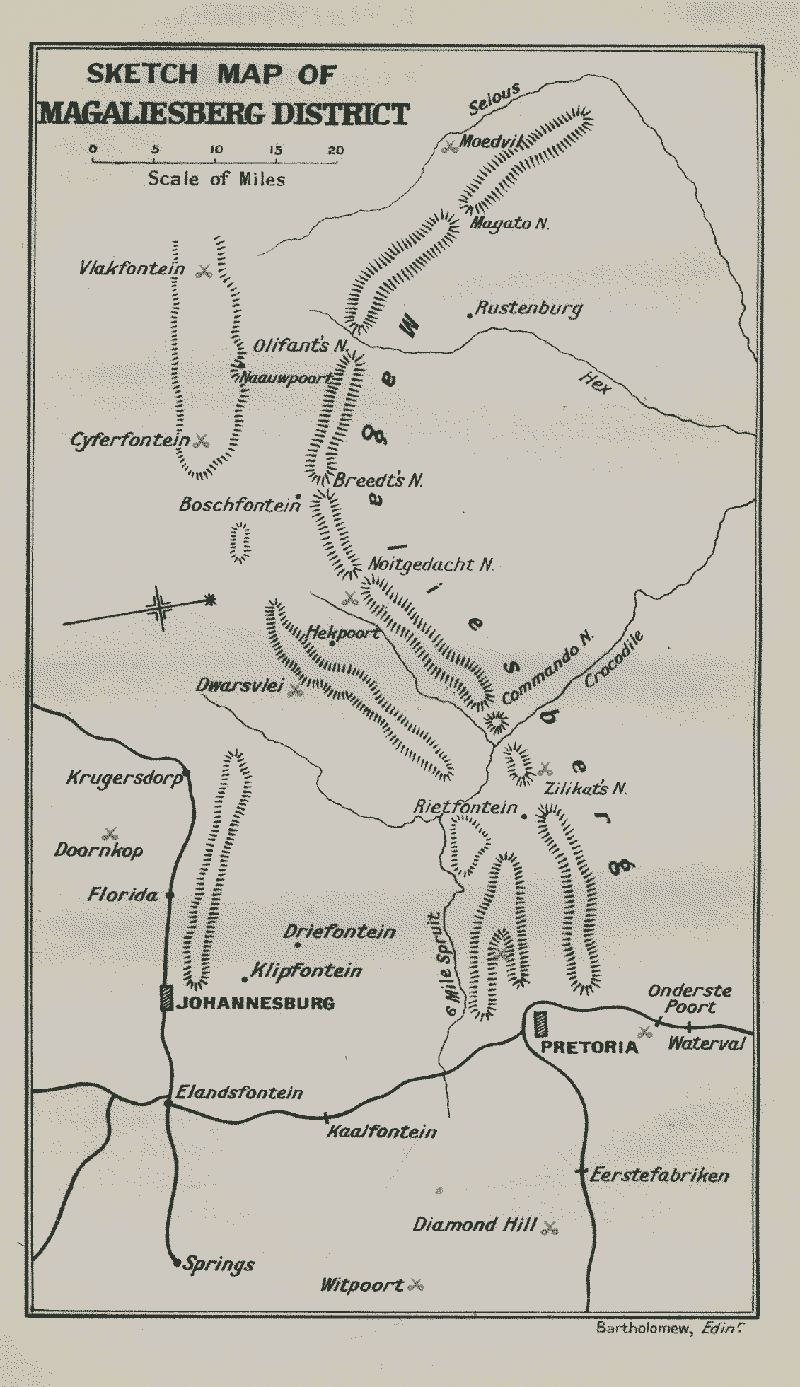
On the Boer side there was a transitory interval of weakness. Even before Lord Roberts' occupation of Pretoria Kruger wrote doubtfully to Steyn; and after it Botha was inclined to negotiate with the invader. He was with his commandos at Hatherley, a few miles east of Pretoria. A Council of War was held in the {241} office of a Russian Jew, who was a distiller of whisky. The leaders complained that they had been deserted by Kruger, who had slunk away with the civil government and all the money he could lay his hands on, and the general opinion was in favour of abandoning the struggle. A meeting between Lord Roberts and Botha was even arranged, when suddenly De Wet intervened. The news of his successful raids on the line of communication in the Free State relaxed the tension of the minds of the despondent commandants. Easily disheartened and easily reassured, they leapt in an instant from one psychological pole to the other. Botha announced that he was ready to meet Lord Roberts, not only in conference, but in battle. The negotiations were, however, not definitely broken off until after the Battle of Diamond Hill.
Lord Roberts had sent Kitchener with a column to see to the trouble in the Free State, and could not put more than about 16,000 men into the field against Botha, who, with 6,000 men, had taken up a strong position astride the Delagoa Bay railway sixteen miles east of Pretoria. His centre was at Pienaar's Poort, where the railway passes through a defile, and his front, which his former experience of Lord Roberts' tactics led him to extend greatly, was nearly twenty-five miles in length, and ran along an irregular chain of hills, kopjes, and ridges. Facing the Diamond Hill and Donkerhoek range, south of the centre, is another range of heights through which the two poorts Tyger and Zwavel pass, and which circles round the source of Pienaar's River towards the Diamond Hill range. North of the centre runs a broken range ending abruptly at the Kameelfontein ridge, which overlooks the broad Kameelfontein valley leading to the Krokodil Spruit; and across the valley rises the Boekenhoutskloof ridge, a detached feature with triangular contours, which, being somewhat in advance, commands the approaches to Kameelfontein ridge, where the Boer right flank under Delarey was posted.
{242}The left flank was on Mors Kop and curved round indefinitely to Kameelzyn Kraal with detached posts in the direction of Tygerpoort. The centre north and south of Pienaar's Poort was the strongest section of the line, and for this reason and for another it was held by comparatively small numbers. Botha was an acute observer and had learnt the moves of the British autumn manoeuvre opening, a holding attack on the centre not intended to be pushed home in order to eke out paucity of numbers operating on a wide front. Lord Roberts, in spite of his superiority of strength, could not hope to inflict a decisive defeat upon Botha's well-posted commandos, but only to remove them out of striking distance of Pretoria, and he was successful.
The earlier movements of the attack on June 11 were in the nature of a reconnaissance in force, as it was uncertain how far to the north and south the Boer front extended. The usual tactics were adopted. French with the 1st and 4th Cavalry Brigades under Porter and Dickson was to work round the enemy's right flank and to endeavour to circle round it to the railway; a demonstrating attack on the centre would be made by Pole-Carew; while Ian Hamilton acted against the left flank.
French approached the Kameelfontein valley and won a footing on Boekenhontskloof ridge, which the Boers were only now moving out to occupy, with his left. His right soon came under heavy fire from Krokodil Spruit Hill on the Kameelfontein ridge, but he succeeded in seizing Louwbaken, which he held tenaciously in spite of Delarey's attempts to work round it and of the shells of a heavy gun posted six miles away near Edendale. Meanwhile his left had been struggling for several hours on the Boekenhoutskloof ridge, which it eventually cleared, and was then able to support the right, which was still clinging desperately to Louwbaken. Throughout the afternoon the Boers continued their attacks on French, but were unable to shift him. At nightfall he {244} found that instead of turning the enemy's right, he had only plastered himself against it. He had already reported the situation to Lord Roberts, who authorized him to withdraw if necessary, at the same time cautioning him "not to risk too many casualties."
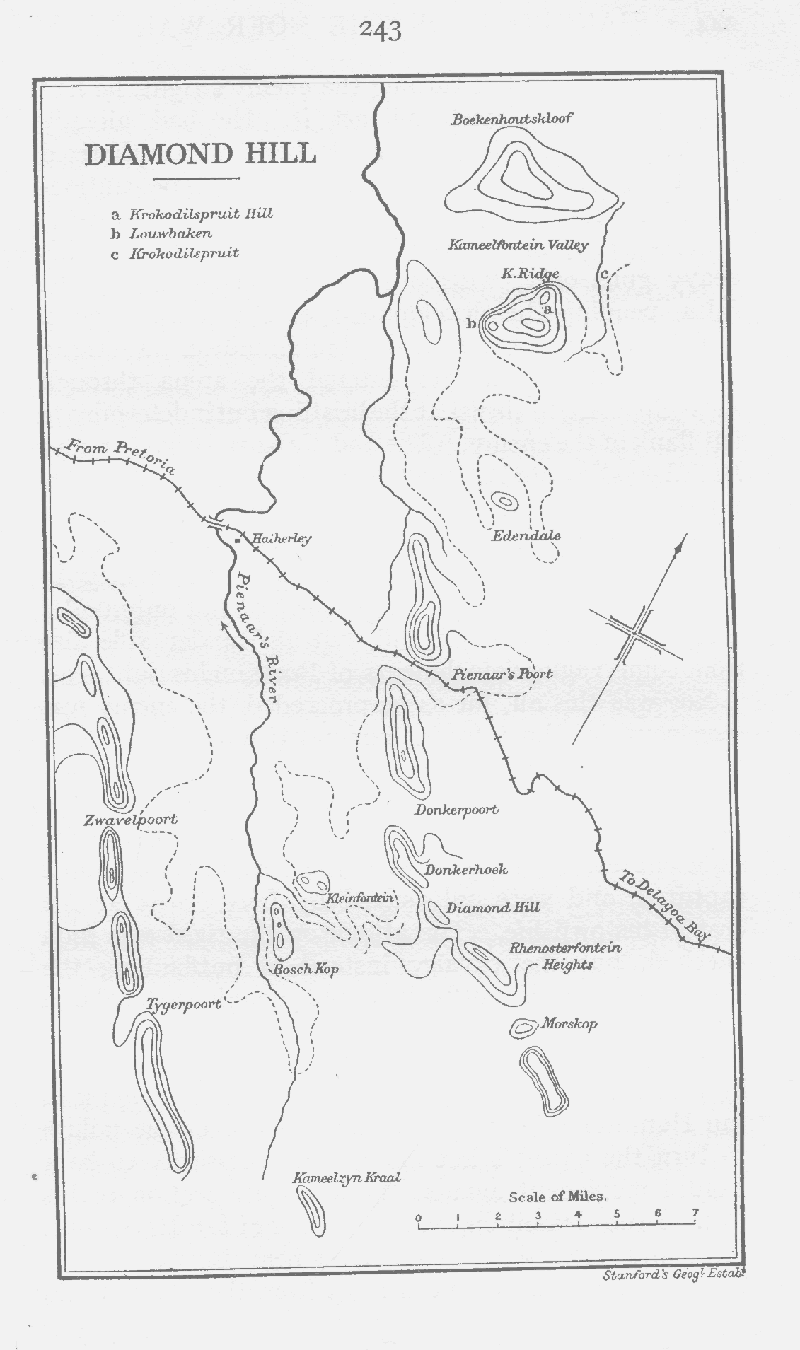
Pole-Carew, in the centre, was in action with his heavy guns only, "demonstrating" according to the rules, pending the development of the flank attacks.
The force on the right under Ian Hamilton was strong in mounted troops. He entered the arena through Zwavelpoort, and thrust at the bristling but indeterminate left flank of the enemy. The 2nd Cavalry Brigade under Broadwood evicted a small body of Boers from Tygerpoort, and when the 3rd Brigade under Gordon came up to hold the position until the arrival of an infantry regiment, Broadwood advanced across the valley in the direction of Mors Kop, and soon was not only under shell fire from Diamond Hill, but also under rifle fire from some vague detachments of Boers on his right rear.
Nor was this all, for as he proceeded, the enemy was seen pouncing down from Diamond Hill on to the Kleinfontein ridge upon the line of his advance, and simultaneously he was fired on from the right. Two horse artillery guns, which had been sent out, with an insufficient escort, to deal with the swoop, were almost captured, and were only saved by Lord Airlie at the cost of his own life. The attack on the right was soon checked, but the cavalry instead of outflanking the enemy was itself outflanked and unable to make a further advance.
Gordon had now come away from Tygerpoort, and, in touch with Broadwood, screened the right flank of Ian Hamilton's infantry attack; which after the failure to turn the enemy's left flank, had necessarily to be a frontal movement against the strongest section of his line. Bruce Hamilton, with a brigade of Ian Hamilton's command, crossed Pienaar's River near Boschkop and expelled the Boer advanced front from the Kleinfontein {245} ridge. Ian Hamilton was now face to face with Diamond Hill, but the afternoon was too far spent for further action.
The general idea for the right attack on the following day was a movement by Bruce Hamilton, reinforced by the Brigade of Guards from Pole-Carew's command in the centre. Diamond Hill was taken without much difficulty early in the afternoon, and the Donkerhoek plateau was cleared. A gap was now made in the Boer line, the commandos driven off making for the Donkerpoort ridge on the one side, or the Rhenosterfontein heights on the other. From three positions a double rain of bullets poured upon Bruce Hamilton on the plateau, until the heights were reached by De Lisle's mounted infantry from Broadwood's brigade. Bruce Hamilton's right flank was thus relieved, but between him and the enemy clustering on the ridge intervened the impassable ravine of the Donkerpoort. Night was approaching and nothing more could be done.
On the left, French held his own but no more during the day, and Pole-Carew in the centre had no opportunity of going into action. The capture of the Rhenosterfontein heights occurred at an opportune moment and perhaps averted a disaster. At Delarey's request Botha was on the point of sending reinforcements to the Boer right to enable it to drive away French and fall upon the weak British centre, when De Lisle's success vitally changed the situation.
Next morning, June 13, the British Army found that it had won a victory without knowing it. The Boers had faded away during the night and had abandoned the strongest position which they had ever held in the Free State or the Transvaal. French and Ian Hamilton went in pursuit with no results. Delarey succeeded in circling round towards the Western Transvaal, Botha retired to the east. The casualties on the British side were 176; the Boers professed to have lost but four burghers killed and twenty wounded.
{246}Lord Kitchener was away in the Free State, and the battle was fought under the usual restrictive conditions, that no operation likely to entail serious loss of life was to be undertaken: and the enemy found that the ordeal of combat was not very dreadful.
With the occupation of Pretoria, which was not virtually effected until Botha's retreat from Diamond Hill, the ranging phase of Lord Roberts' campaign was nearly at an end. At the two capitals and at other towns already occupied, he had places of arms, from which without wide divagations of large bodies of troops, he could hope soon to control and eventually to dominate the Republics.
To see to the long and lonely furrow which he had ploughed across the veld from the Orange to the Magaliesberg, and to prevent its being obliterated by the wayward and shifting sand of the desert, was the present task before him.
Footnote 43:(return){247}Plumer raided across the Limpopo into the Transvaal as far back as December, 1899, and Hunter occupied Christiana on May 15.
The Orange River Colony did not receive its incorporation into the British Empire with a display of gratitude for the honour conferred upon it.
The urgent message sent by Botha to De Wet on May 27 after the British Army had crossed into the Transvaal was hardly necessary to incite that free lance into action after his own heart, and he at once quitted Frankfort for Lindley.
When Lord Roberts entered the Transvaal he left behind him a considerable force to teach the New Colony its duties. Besides the stationary troops at Bloemfontein and on the railway, the VIIIth and Colonial Divisions under Rundle and Brabant were at Senekal and Ficksburg; Colvile with the IXth Division, who had been taken off Ian Hamilton's lead and allowed to run alone, was near Lindley; and Methuen had come into Kroonstad from Bothaville, the line of his march, which was originally towards the Transvaal, having been changed by orders from Lord Roberts.
Such were the forces against which De Wet was ready to fling himself. Early in June he was faced by another opponent. Lord Kitchener had come down from the Transvaal with a strong column.
Lord Roberts, on leaving Bloemfontein for the north, instructed Rundle to "exercise a vigilant control east of the railway." In co-operation with Brabant, he worked up through the fertile district along the Basuto {248} border, slowly but steadily; his immediate object being to prevent the enemy breaking back towards the south. No serious opposition was encountered, and by the middle of the month the Divisions had advanced to Clocolan and Winburg, where Rundle came in touch with the IXth Division.
Colvile received orders to advance to Lindley and Heilbron. He was instructed to reach Heilbron with the Highland Brigade on May 29, and was informed that a force of Yeomanry under Spragge would on May 23 join him at Ventersburg, which he would pass through on his march.
Spragge was unable to be at Ventersburg on the date fixed and was ordered on to Kroonstad, where he received telegraphic instructions to join Colvile at Lindley on May 26 at the latest. It has never been ascertained by whom this fatal message was despatched. No British staff officer has ever acknowledged himself the sender of it, and it has been suggested that it was sent by a Boer sympathizer who was better informed of Colvile's movements than the Intelligence Staff.
Colvile believed that his presence at Heilbron on May 29 was imperatively required in connexion with the advance, and, although very weak in mounted troops, he pushed on from Ventersburg without waiting for Spragge. On May 26 he reached Lindley after some resistance outside the town, and next day resumed his march to Heilbron, which, though checked on the way, he reached on the appointed day.
Meanwhile, Spragge was doing his best to deliver himself to the IXth Division, to which he was waybilled. He moved a few miles out of Kroonstad on May 25, and next evening was in bivouac within eighteen miles of Lindley. Next day he resumed his march on the town, about the same time that Colvile was quitting it for Heilbron. The two commanders were in entire ignorance of each other's movements.
At midday, Spragge reconnoitred the town, and {249} finding it occupied, withdrew to a position outside. Although Colvile had quitted it but a few hours previously, and although the dust of his column could still be seen on the Heilbron road, a commando under Michael Prinsloo, which he had driven out, had promptly returned; and some burghers who had surrendered to Spragge on May 26, and who, having given up their rifles, had been "allowed to return to their farms," went to Lindley instead and gave warning of the approach of the Yeomanry.
Spragge counted on being able to draw rations at Lindley when he joined Colvile, and marched out of Kroonstad with two days' rations only, and these, although eked out by a capture of sheep on the way, were almost exhausted. There were three courses open to him: to retire to Kroonstad, to follow Colvile, or to remain where he was. He chose the last.
He took up, and did his best to make defensible, a plateau and kopje position two miles N.W. of the town. He had 500 men, but no guns, and he reported the situation to Colvile, who was eighteen miles away when he received the message next morning; and to Rundle, who was at Senekal. Colvile answered his appeal for assistance with a refusal, but suggested a retirement on Kroonstad; but the message did not reach Spragge. Rundle was too far away to help Spragge directly, but made a movement towards Bethlehem, which he hoped would draw the enemy away from Lindley.
On May 28 the Boers took up positions which practically surrounded Spragge, but he held his own that day and the next; and although the enemy was reinforced on the 29th, he was not so closely invested that he could not have broken out. Firing was heard in the S.E., and Spragge, believing that it was Rundle in action, endeavoured without success to communicate with him.
So long as the investing force was without guns, {250} Spragge was confident of being able to hold on. But on May 30 a further reinforcement came in. Martin Prinsloo joined his brother with three guns and a strong commando. The Prinsloos, who were acting under the orders of De Wet, had originally been detailed to look after Colvile, but were drawn away by the attraction of an easier prey at Lindley.
On May 30 a kopje on the west, from which the Boers were sniping into the position, was captured by Spragge, but soon fell again into the hands of the burghers. It was recovered next morning, but pressure elsewhere squeezed it finally out of the grasp of the re-captors. The Boers had brought their guns into action. The key of Spragge's position was two kopjes on the S.E. of the defence. The outer kopje was rushed by the enemy, the detachment occupying it being driven back towards the inner kopje. A panic-stricken non-commissioned officer in the connecting post between them raised the white flag without authority, and, it is said, was immediately shot for having done so. The officer in command on the inner kopje considered that he was bound by the act and recognized it, and only hastened the inevitable end. There was a last wriggle or two, and then Spragge, who was surrounded by 2,000 Boers with artillery, gave in.
Nearly 500 yeomen were added to the panel of British prisoners of war by the hawk-like swoop of De Wet and the brothers Prinsloo almost under the eyes of three Divisions of the British Army. For not only were Colvile and Rundle aware of Spragge's predicament, but as soon as it was reported to Lord Roberts, Methuen was ordered to the rescue.
Methuen, who only arrived at Kroonstad from the west on May 28, was already on the move to help Colvile, from whom a disquieting message had been received at Head Quarters. Colvile's safe arrival at Heilbron next day rendered assistance unnecessary, and Methuen, under instructions from Lord Roberts, turned {251} towards Lindley. He was, however, too late, for as he approached the town the news of Spragge's surrender reached him on June 1. He ran into the rear of the Boers hurrying away with their prey, and even intercepted two guns and some wagons, but was unable to retain them.
The Lindley affair sent Colvile back to England in the wake of Gatacre. The responsibility of the surrender was fixed upon him and he was deprived of his command. He had no doubt been in a false position during the first fortnight of the advance from Bloemfontein when he was kept trailing behind a junior officer, and this slight perhaps affected his judgment, but he was constitutionally incapable of viewing a situation synoptically and perspectively. As at Sannah's Post, so again at Lindley the halation of a word or two in his orders fogged the image on his retina. He doggedly stared at the words Heilbron, May 29, as if the whole issue of the campaign depended upon them. There was nothing in the context to show that they were more than the details of an itinerary which he was expected to follow if circumstances permitted. He was urgently in need of the very mounted troops with which he made no effort to put himself in touch. Bis peccare in bello non licet. Lord Roberts could forgive once, but Colvile was superseded for having twice shown a "want of military capacity and initiative."44
Yet the disaster was not due to his default alone, although the contributory defaults of others were rightly not permitted to excuse him. He had good reason to think that a well-mounted force would be able to take care of itself, and to believe that proper staff arrangements had been made for Spragge's march; but in each of these warrantable assumptions he was {252} wrong. Lindley was the first of a series of disasters which seemed to show that Lord Roberts had pushed on too hastily.
Rundle's endeavour to help Spragge by a demonstration in the direction of Bethlehem soon came to an end. It is said that a telegram in which he announced the movement to Brabant fell into the hands of the Boers, who promptly utilized the information. On May 29 he was seriously checked at the Biddulphsberg, where they had taken up a position. He failed in an attack on what he believed was the Boers' flank but which was in reality their front. During the engagement he received a telegram from Head Quarters, dated three days previously, ordering him to join Brabant in the Ficksburg district, and he withdrew from the action, having suffered 186 casualties, some of which were caused by a fire which broke out in the long grass through which he had advanced, and in which helpless wounded men were lying. A brigade of Tucker's Division under Clements took his place at Senekal.
De Wet now set himself in person to execute the task entrusted to him by Botha of getting behind the British force in the Transvaal and breaking or interrupting the line of communication in the Free State. He had not long to wait for opportunities. He left Frankfort with 800 men, and on June 2 placed himself in observation near Heilbron, where Colvile was awaiting a supply column from the railway at Roodeval. The convoy was harassed from the first by mischances. Against Colvile's orders it was despatched with but a small escort and without guns. When he heard that sufficient protection could not be given, he counter-ordered the convoy, but the message did not arrive until after it had started.
On the second day of the march a body of the enemy was found blocking the road at Zwavel Kranz between Heilbron and Heilbron Road Station. It was De Wet waiting for the convoy.
{253}The news of its plight reached Heilbron Road Station,45 and a relieving column was sent out, which came within four miles of Zwavel Kranz. No firing, however, was heard, and the officer in command, hastily concluding that all was well, returned to the railway without finding the convoy, which next morning surrendered, the victim of easy-going indifference and neglect.
So far De Wet had done well, but he was only beginning his work. The railway between Bloemfontein and Vereeniging was weakly held by regiments of militia threaded like beads on a string in posts along the line. At Roodeval supplies and stores in large quantities, urgently needed by the Army in the Transvaal, were waiting until the bridge over the Rhenoster River, which had been destroyed by the Boers retreating before Lord Roberts, could be rebuilt. There was scarcely a post that did not beckon to De Wet to come to it.
He was within reach of the railway at three vulnerable points, and he divided the force to attack them simultaneously; himself taking command of the raid on Roodeval, which was held by casual details of departmental troops stiffened by a detachment of militia. Thus an important link in the chain was unable to bear a comparatively slight tension. No one was recognized as being definitely responsible for the railway north of Bloemfontein. The charge of it had been given to an officer who, unknown to the staff, was at the time in hospital and unable to take over his command; detachments were moved promiscuously by orders which came now from Pretoria and now from Bloemfontein; and in the chaos De Wet wriggled in between Colvile and Methuen.
On June 7 Heilbron Road Station, Rhenoster River Bridge, and Roodeval were captured in succession. At the Bridge the Derbyshire Militia fought gallantly for several hours, but were overpowered in a hopeless position, and soon afterwards Roodeval and its accumulated {254} booty fell into the hands of De Wet,46 who on that day severed Bloemfontein from Pretoria for a week and added nearly 500 men to the muster-roll of his prisoners of war.
It was evident to Lord Roberts that things had taken a serious turn, and that his position in the Transvaal was unsound. In framing his plans for the advance from Bloemfontein, he had naturally expected that the Natal railway would be available as an alternative line of communication soon after he entered the Transvaal; but the movements of Buller were deliberate, and nearly a third of it was still in the enemy's hands. It is probable that Lord Roberts would have been less disinclined to the "steam-rollering" policy if he could have foreseen that on the day he entered Pretoria the Natal Army would be still south of Laing's Nek.
As a preliminary measure pending, the elaboration of a definite scheme to put the Free State in order, Kitchener, who was always held in readiness with steam up to proceed to districts in difficulties and hustle local commandants and their staffs, was sent across the Vaal with a column; and Methuen's Division was set in motion.
On the Bloemfontein side, Kelly-Kenny took temporary charge of all the troops south of Kroonstad, whither a brigade under C. Knox was sent to protect the stores and supplies; and Winburg was strengthened. While C. De Wet was engaged upon his own work his brother P. De Wet, whom he threatened to shoot if he gave in, was discussing terms of surrender with Methuen at Lindley, but as in the contemporaneous negotiations between C. Botha and Buller at Laing's Nek, and between L. Botha and Lord Roberts in the Transvaal, no terms of settlement were arranged; and Methuen quitted a pacificatory colloquy with one brother to encounter the other in arms, and joined Kitchener at Heilbron Road Station on June 10.
{255}De Wet was elbowed away westwards from the railway, but he soon circled back, recrossing it at Lieuw Spruit between Rhenoster River Bridge and Heilbron Road Station, where he not only took fifty prisoners, but almost captured Kitchener, who chanced to be passing through at the time.
It is interesting to speculate briefly on the effect which such a notable capture might have had upon the general situation. The Boers themselves would hardly have realized its importance. They were unaware of the position held by Kitchener in the British Army, and his name was unfamiliar to them. He had been here and there like many another commander whom they had met in the field. Still, they had never yet captured an unwounded general officer, and they would no doubt have made a great effort to prevent his services being again available against them.47 It is, however, unlikely that De Wet would have been able to retain his prisoner for more than a few weeks at most. But no one can say what De Wet could not do. At home it is probable that a disastrous reaction would have followed the news of the railway broken, of Lord Roberts insolated in the Transvaal, and of Lord Kitchener of Khartoum a prisoner of war and possibly a hostage. It is very doubtful whether the nation, entangled by fresh difficulties and deafened by pro-Boer yells growing shriller and shriller every hour, would have remained firm of purpose. It is hardly too much to say that June 12, 1900, was one of the most critical dates in the history of the war.
During the next fortnight, attacks on a convoy for Colvile at Heilbron, on the railway a few miles north of Kroonstad, a threat on Lindley which almost became a siege, and a raid on Virginia Siding by a commando {256} under Roux, which sprang out of the Senekal district, maintained the mutiny, and again showed that however tightly the Boers might seem to be grasped in the hand, some of them were sure to wriggle through the fingers.
It was soon apparent that the Free State would not be brought into subjection by haphazard divagations of brigades and columns; and about the middle of June Lord Roberts planned a systematic and simple campaign. The towns and strategical points were to be strongly held while flying columns shepherded De Wet and his commandos and endeavoured to enfold them. Buller, who arrived at Standerton on June 23, would bar the way should they attempt to retreat into the Transvaal, and a retreat southwards would throw them on to Rundle and Brabant. The four flying columns were based on the line of garrisons which extended from Heidelberg in the Transvaal to Winburg and Senekal in the Free State.
The command of the Heidelberg column, which was strong in mounted troops, was given to Ian Hamilton, but an accident compelled him to hand it over to Hunter, who had come up into the Transvaal after the relief of Mafeking. The Heilbron column was the Highland Brigade of the late IXth Division, which was broken up when Colvile returned to England. At Rhenoster River was Methuen to prevent a break out towards the west. When the Winburg district was cleared by a strong column under Clements, who, a few weeks before, had relieved Rundle at Senekal, he would advance on Bethlehem, Paget at Lindley co-operating with him. As soon as Hunter, who was put in general charge of all the troops engaged, entered the Free State, Macdonald was ordered to join him with the Highland Brigade. Methuen's force at Rhenoster River was soon found to be unnecessary, as the enemy was retreating in the opposite direction, and it was sent into the Transvaal.
At the end of June the columns began to move. Each of them was, as it were, the head of a spear prodding {257} the mob of commandos towards the pen which had been assigned to them. With them, union was not strength, but weakness: the more they were agglomerated the less were they to be feared.

Clements herded Roux, whose commando was the only body known to be at large, towards the kraal, and advanced with Paget to Bethlehem, which was occupied on July 7. The Boers opposed with delaying actions only, capturing but being unable to retain two of Paget's guns, and outside Bethlehem they brought into action and lost a field gun which had been taken from Gatacre at Stormberg, and which now, after half a year's exile in partibus inimicorum, was restored to the British Service. Two days after Clement's entry into Bethlehem, he was joined by Hunter, who had crossed the Vaal on June 29 and had picked up Macdonald at Frankfort.
The Brandwater Basin, into which the Boers had retreated from Bethlehem, taking with them Steyn and the Free State Government, which was set up at Fouriesburg, is a semicircle formed by the Witteberg and Roodeberg at the head-waters of two tributaries of the {258} Caledon, the Little Caledon and the Brandwater; the Caledon being the diameter and the mountains the circumference of the area. The river section of the perimeter lies on the Basuto border, and the mountain section is wild and difficult, there being but four wagon roads into it in nearly seventy-five miles: at Commando, Slabbert's, Retief's, and Naauwpoort Neks. The passes at Witnek, Nelspoort, and the Golden Gate are scarcely better than rough bridle-paths.
The strength of the enemy holding the Basin and the Neks was about 7,000. The Boers had indeed established themselves in an apparently strong defensive position, but they had not been there many days before they began to ask each other what was the good of it to them. They had taken it up against the advice of De Wet, who saw that it was playing the game of Lord Roberts. They had deprived themselves of their mobility and were confined in a house of detention, where they could do no mischief except to each other. They realized too late that De Wet was right. The commandants were at variance and there was indiscipline in the laagers.
De Wet saw that the Brandwater Basin was no place for him. He was beating his wings in a vacuum, and he resolved to get out of it as soon as possible. After a Council of War orders to decamp were issued. The general idea was that a column under De Wet should break out through Slabbert's Nek and make for Kroonstad, and that Roux should take out another column and march on Bloemfontein, a portion of the force being left behind to guard the passes.
On the night of July 15 De Wet, accompanied by Steyn, who went out to establish yet another seat of government, pulled his column, which included 2,600 burghers and 460 vehicles and was nearly three miles long, out of the Basin through Slabbert's Nek. He met with no opposition, and successfully carried out the first episode of the programme.
Hunter at Bethlehem was standing sentry over the {259} northward passes, but want of supplies and deficiency of ammunition prevented him advancing at once on the Basin: and of the range before him he had no accurate maps and knew less about its topography than an astronomer knows of the Mountains of the Moon. While formulating a scheme for blocking the passes, De Wet's sudden outbreak took him by surprise, and he was unable to head the Free State leader, who passed northwards between Bethlehem and Senekal, pursued by Broadwood's cavalry. The hounds were on the scent of the first De Wet hunt.
Rundle, who for two months had been painfully, but not with unnecessary deliberation, pushing his force up the right bank of the Caledon, was at first ordered by Hunter to watch Slabbert's Nek, but on a report that the Boers were about to come out through Commando Nek, he was sent back. The movement, though justified on the assumption that the report, which came on good authority, was correct, was unfortunate, as it left the key of the gate at Slabbert's Nek in the enemy's hands, and allowed De Wet to escape.
De Wet had assigned to himself the initial movement of the withdrawal, and left the rest of the programme to develop itself without him. Roux was put in charge of the Brandwater Basin. De Wet was an unpopular leader. His attempts to leaven the commandos with a little of the military spirit were resented. He had from the first, with only partial success, set his face against the incumbrance of wagons which marched with every commando. On the way to Sannah's Post he had cashiered a commandant named Vilonel for disobeying his orders with regard to transport. His nomination of Roux did not give satisfaction. The partisans of other leaders protested, and it was determined to settle by election the question of the Chief Command. In the meantime, the management was in the hands of a triumvirate composed of Roux, Olivier, and Martin Prinsloo.
{260}In the chaos, the commandos which De Wet had arranged should break out remained in the trap and simplified Hunter's task. In succession, Retief's Nek, Slabbert's Nek, and Commando Nek were taken, the latter by Rundle, who on July 28 joined Hunter at Fouriesburg. Witnek had been abandoned by the Boers, who now had only Naauwpoort Nek and the scarcely practicable Golden Gate open to them.
The Nek was closed by Hunter on July 27, and a position outside the Golden Gate, but not the Gate itself, was occupied. The greater part of the Boer force was now practically sealed up in the Basin.
A Council of War was held to elect a new chief commandant. Had the vote been taken ten days earlier the situation might possibly have been saved, but the belated proceedings which displayed the weakness of a democratically organized army, and which, in the absence of representatives of the commandos not on the spot, were of doubtful validity, only added to the existing confusion. Prinsloo, however, seems to have been informally chosen.
His first act was to endeavour to obtain an armistice from Hunter, who naturally refused it. A few hours later Prinsloo agreed to surrender, and on July 30 the main body of the Boers in the Basin laid down their arms at Slapkranz. Roux, the rival candidate for the Chief Command, protested against the surrender, not only to Prinsloo, but also in person to Hunter, to whom he pleaded, that as Prinsloo had not been duly elected, the act was unauthorized and therefore was not binding on him. Hunter refused to listen to such quibbles. On several occasions during the war the Boers had profited by the honourable reluctance of the British commanders to repudiate an unauthorized raising of the white flag, lest they should be accused of having laid a trap to lure on the enemy. Hunter rightly held that Roux's plea for local option was inadmissible, and that the surrender must apply to the whole force. Roux then yielded.
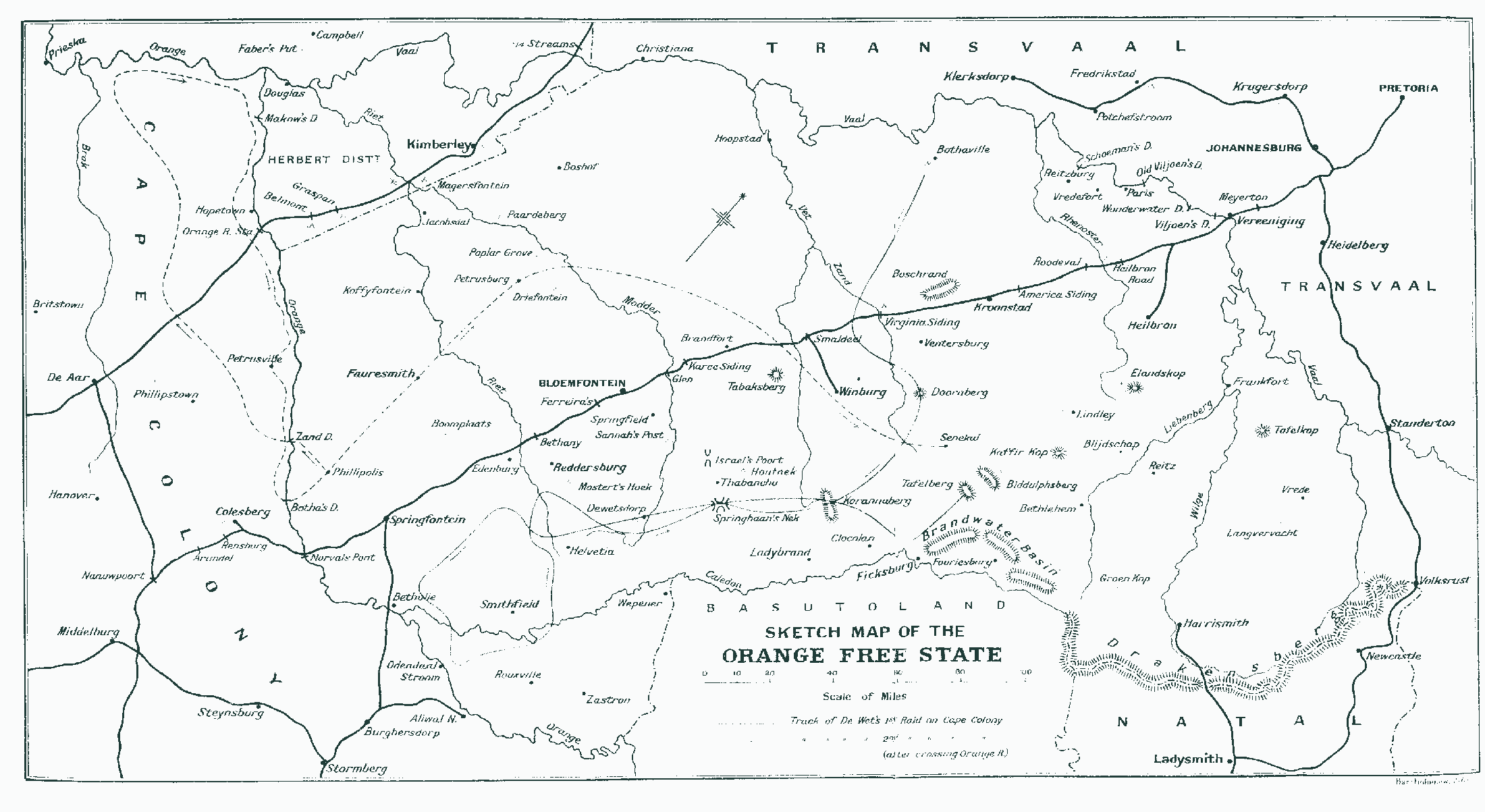
A large number of burghers, however, as soon as they heard that Prinsloo had agreed to surrender, hurried away under Haasbroek, and scraped through the Golden Gate and joined Olivier and Hattingh outside the Basin. They were successful in evading the capitulation, for Olivier, when informed of it officially under a flag of truce, also declined to be bound by Prinsloo's act, and Hunter was unable to insist upon it. He trekked away towards Harrismith unmolested by the troops watching the Golden Gate, and he baffled for four weeks the columns sent in pursuit by Hunter, who, however, prevented him joining De Wet. He was taken prisoner near Winburg on August 27.
The tangible result of the Brandwater Basin operations was the capture of more than 4,000 Boers and of three guns, two of which had been lost at Sannah's Post. The mountains in which the burghers had taken refuge became a prison, from which they were taken when Hunter came on circuit for the gaol delivery, and on conviction they were sent beyond the seas.
Yet subsequent events showed that Lord Roberts would have made a good bargain if he could have exchanged all the burghers and the guns, and all the loot of horses, cattle, and sheep, for one man who had slipped through Slabbert's Nek on July 15, 1900.
Footnote 44:(return)Napoleon said that "a military order must not be passively obeyed except when it is given by a superior who is on the spot at the moment the order is given, knows the state of things, and can hear objections and give full explanations to the officer charged with executing the order."
Footnote 45:(return)Also called Vredefort Road Station.
Footnote 46:(return)660,000 rounds of Lee-Metford ammunition were buried by him for future use.
Footnote 47:(return){262}In the Russian War the Japanese gave orders that a Russian admiral, who was a wounded prisoner of war on board a Japanese torpedo boat, was to be shot if any attempt was made by the Russians to capture it.
Lord Roberts had almost as much difficulty in bringing Buller out of Ladysmith as he had had in putting him into it. The relieved garrison, wasted and enfeebled by the rigours of the siege, was unfit to take the field, but there does not seem to have been any good reason why the relieving force, or at least a portion of it, should not have been pushed forward boldly without delay. The inaction invited the retreating enemy to halt and occupy the Biggarsberg Range; only a few days after Buller had informed Lord Roberts that he did not expect that any stand would be made south of Laing's Nek. Buller did indeed propose on March 3 to advance on Northern Natal, as well as to attack the Drakensberg passes leading into the Free State; but Lord Roberts thought the scheme premature and ordered him to remain on the defensive, to police the country adjacent to the Harrismith railway with the greater part of his available force, and to send one division round by way of East London to join the central advance under Gatacre. Warren's Division therefore left Ladysmith on March 6. White, to whom Lord Roberts had intended to give a command in the Free State, was compelled by ill health to return to England. The order to "remain strictly on the defensive" was afterwards not unreasonably quoted by Buller in justification of two months of inaction, which, however, Lord Roberts ascribed to other causes, as he had agreed to subsequent proposals made by Buller for offensive action.
{263}The Boers on the Biggarsberg at first numbered about 15,000, but by the end of March many commandos had been attracted away by Lord Roberts' advance to more strenuous fields. Some time passed without any definite action having been agreed upon between Lord Roberts and Buller. The latter objected to almost every proposal made by the former, and sometimes even on reconsideration criticized his own proposals. He was allowed to recall the Vth Division, which after a brief absence rejoined his command; but even with it he protested against an advance on Van Reenen's Pass, which he had himself proposed and which he was instructed to make at the beginning of April, because Lord Roberts would consent to the employment of one division only in it. Lord Roberts did not insist on the movement, as Buller now said that it would endanger not only his own force, but also Natal; and finding that Buller had far more troops than he could usefully employ, ordered him to send the Xth Division under Hunter round to Kimberley. Even after its departure Buller outnumbered the enemy by more than five to one.
He was still haunted by the troubles of the Tugela, and was unable to nerve himself for the risks that every leader must run. The Boers bewildered him. He could plan no scheme without a conviction that somehow their "knavish tricks" would frustrate it, and his inactivity made him more prone than ever to brood over possible mischances. He remained in Ladysmith because it was the only course open to him after he had by a process of elimination considered and rejected all the alternatives. Each of them had its disadvantages and its dangers, therefore it were better to stay where he was. During a critical period the Natal Army was of as little use to Lord Roberts as were the Spanish contingents to Wellington in the Peninsula; and its laggard action retarded the progress of the war. Lord Roberts laid his plans for the advance on the assumption that it would be in operation on his right flank when he {264} reached Pretoria, and if L. Botha had found it pressing on him when he was playing at peace-making in June, instead of engaged in equally fruitless negotiations with his brother 180 miles away at Laing's Nek, it is improbable that he would have continued the struggle.
On May 2 Lord Roberts informed Buller that he was ready to start from Bloemfontein, and that he expected the Natal Army to co-operate with him by attacking the Boers on the Biggarsberg, and then advancing towards the Transvaal. For this movement Buller considered that his force, which consisted of three divisions of infantry and three brigades of mounted troops, in all about 45,000 men, was insufficient; but he proceeded to carry it out. The Boers were in occupation of the whole line of the Biggarsberg from Helpmakaar westwards, and commanded the roads as well as the railway running through the range.
Buller on this occasion determined rightly upon a turning movement. All his previous attacks had either been frontal or had been made so by the enemy. His plan was to move eastwards with the IInd Division under Clery, while the Vth Division under Hildyard, who succeeded Warren when the latter was called away to Bechuanaland, advanced up the railway against the Boer centre. The IVth Division under Lyttelton, composed of the infantry which had been in Ladysmith during the siege, was kept in reserve pending the development of the turning movement, which began on May 11, and was skilfully conducted by Buller and was entirely successful. Places and rivers which had not been named in the chronicle of the war since October of the previous year now emerged from their obscurity. Elandslaagte became the fulcrum of an aggressive operation. Sunday's River and the Waschbank River after an interval of seven months were again crossed by British troops, not, like Yule's force, in hasty retreat, but in confident advance.
The Boers prepared for, and fully expected, a direct {265} advance on Beith by way of Van Tender's Pass, but Buller made for the extreme flank of the range near Helpmakaar, which they held but lightly. It was rendered untenable on May 13, and after dark they retired on Beith, setting fire to the veld to mask the movement and hinder pursuit. At dawn Dundonald pushed on through the flames and smoke with his mounted infantry, but was checked by a body of Irish traitors who were acting as rearguard to their flying employers, and was unable to come up with the burghers. On the following night his patrols reported that Dundee was clear, and Buller occupied the town and reached Newcastle on May 18. The success of the turning movement was due in a great measure to a small force under Bethune, which had been lying for some months lower down the Tugela, and which Buller called up to threaten Helpmakaar from the south while he advanced from the west. It had been originally detached to protect his right flank during the advance on Ladysmith, and after long inaction as a watching force was restored to the strenuous campaign.
Of the rest of Buller's troops, one portion only, namely Hildyard's Division, was actively engaged in the movement. Its menace to the Boer centre near Glencoe, through which passed the railway to the north, attracted commandos away from the enemy's left flank at Helpmakaar and facilitated the turning movement. Lyttelton's Division and two cavalry brigades, which although Buller had informed Lord Roberts that he "was short of his proper strength" for the advance he had left behind near Ladysmith, took no part in it; and the absence of the cavalry allowed the enemy to retreat without molestation. The advance of Hildyard's Division was retarded, not by opposition, but by the duty which fell upon it of repairing the railway along which it advanced, and it did not reach Newcastle until May 27. On the 23rd Lytteltonand most of the cavalry were ordered up from Ladysmith.
{266}As soon as Buller reached Newcastle he sent on Dundonald to reconnoitre the Laing's Nek position. On the west it was flanked by Majuba Hill, on the east by Pougwana, and was found to be strongly held. He therefore decided to make no further advance until he had concentrated his force at Newcastle. The cutting edge of the reconstructed Natal wedge had not as yet sufficient substance behind it to warrant its being put into operation. Pending the assembly of the Army Buller prodded across the Buffalo at Vryheid and Utrecht in order to safeguard his right flank. The expedition against the former town was ambushed and compelled to retire; while the two strong columns which were sent against Utrecht were hardly more successful. The town did indeed profess to surrender, but no garrison was left to enforce the submission, and on the withdrawal of the troops the Boers hovering in the hills returned like birds who have been temporarily scared out of their nests.
By the end of May, Buller's Army was concentrated in the northern corner of Natal. Towering over his left front was the Drakensberg Range through which Botha's Pass runs into the Orange Free State; on his right front was the Buffalo River with a difficult country beyond; and on his front was Majuba of ill-omened memory and Laing's Nek, over which the road to Volksrust and the Transvaal passed.
Buller remained at Newcastle for eighteen days, of which three were an armistice during negotiations for surrender with C. Botha, who was unable to accept the terms offered. On June 5 the advance was resumed, Laing's Nek being the immediate objective. At first Buller proposed to attack it directly, but soon after reaching Newcastle he found that the enemy was unassailably established on the position, and that it must be turned either from the east or from the west. The former movement would involve a wider detour through difficult country to the line of advance which would {267} be taken up after the Transvaal was entered, and the western movement through Botha's Pass was therefore selected. Lord Roberts had for some time been in favour of it, but he had intended that it should be more than a mere turning operation. His advance from Bloemfontein had driven many of the commandos into the N.E. corner of the Free State, and he asked Buller to cross the Drakensberg and take them in rear by passing into the Transvaal by way of Vrede; but Buller could not be persuaded to remove himself so far from the railway. He had already missed an opportunity of co-operating with the main advance by a westward movement from Ladysmith to Van Reenen's Pass along the railway to Harrismith, where the presence of a division of the Natal Army would have been of the greatest use. The relations between Lord Roberts and Buller during the Natal campaign were rather those of leaders commanding the armies of allied nations than of superior officer and subordinate.
Thus the westward movement, instead of being a helpful operation at large in support of the main advance, was whittled down to the turning of Laing's Nek. Between Botha's Pass and Laing's Nek the dominant contours roughly assume the outline of a sickle and its handle, the Pass being at the end of the handle and the Nek near the point of the blade. Within the curve of the blade stands the high Inkwelo Mountain facing Majuba Hill, and at the upper end of the handle is a mountain of less elevation called Inkweloane. The Ingogo River, which rises near the Pass, is flanked on its right bank by Van Wyk's Hill, which commands the eastern approach to the Pass, and on its left bank by Spitz Kop, a detached hill of the main range.
Inkwelo had been held for some days by a portion of Clery's Division. The Boers occupied Spitz Kop and the ridge from Inkweloane to the Pass and a short section beyond it, but their line was thin. The Vryheid and Utrecht affairs had deceived them into the belief {268} that an eastward turning movement was in contemplation. On June 6 Van Wyk's Hill was occupied by Hildyard and held against the enemy on Spitz Kop, who attempted to dislodge him; and by the following morning artillery had been brought up, and the Pass and the enemy's position on the adjacent crestline were commanded. These on June 8 were carried by an infantry movement in echelon with loss of two men killed. Spitz Kop offered no resistance. A fusillade broke out on Inkweloane, but Dundonald's brigade soon quenched it by a determined ascent up alpine slopes to the crestline As at Helpmakaar the enemy set fire to the grass and passed away behind a veil of smoke.
The capture of Botha's Pass was an affair which did credit to Buller. It showed that since Colenso he had learnt how to use artillery, and his disposition of his guns was admirable. They rendered the enemy's position untenable and left little but hard climbing to the infantry. It can hardly be termed a battle, it was rather an autumn manoeuvre engagement, conducted on Lord Roberts' principles. A very important position was won and the enemy driven back with scarcely the shedding of a drop of blood on either side. Hildyard was in executive charge of the operations.
Thus, after eight months' fighting, the main body of the Natal Army was at last in bivouac in the enemy's country. Buller had taken Botha's Pass with three infantry and two cavalry brigades; and with these he made for his next objective, the town of Volksrust in the Transvaal, a few miles north of Laing's Nek, which Clery at Ingogo was watching from the south. Lyttelton was posted on the left bank of the Buffalo watching the right flank of the advance.
Buller's operations in the Free State lasted two days only. On June 10 he engaged a small body of the retreating enemy and entered the Transvaal. In front of him was the Versamelberg, a spur of the Drakensberg, over which the road from Vrede to Volksrust passes at {269} Alleman's Nek, where 2,000 Boers with four guns had taken up a very strong position. The road rises to the Nek between heights, and the initial movements of the attack had to be made across two miles of open veld. The burghers had not had the time, or did not think it necessary, to strengthen the position artificially, but they were observed throwing up some entrenchments when Buller approached.
His bivouac on June 10 was at the Gansvlei Spruit on the Transvaal-Free State border, and next day at dawn he resumed his march on Volksrust. No serious opposition was encountered until early in the afternoon, when Dundonald, who was operating on the right front, came under artillery fire from the Nek. The infantry, whose left flank was watched by Brocklehurst with a cavalry brigade, was then ordered to advance, the objective of the 2nd Brigade under E. Hamilton being the ridge on the left of the Nek, and that of the 10th Brigade under Talbot Coke the ridges on the right of it, the 11th Brigade under Wynne being kept in reserve.
The advance was made under a heavy and worrying but not very effective fire from each section of the ridge. The key of the position proved to be a conical hill on the right of the road at the entrance to the Nek. The Dorsets of Coke's brigade gallantly climbed the slopes, and aided by artillery fire carried it with the bayonet. The fight, however, was far from ended. The Boers beyond remained until the shells which had been pouring on the conical hill followed them to the crestline. Then again the Dorsets threw themselves upon the enemy, and by sunset the heights on the right of the Nek were in possession of Coke. Almost simultaneously E. Hamilton established himself on the left of it. The resistance offered to Dundonald on the right flank was more effective; and as between him and his immediate opponents the day waned upon an uncertain issue. He had driven them out of successive positions though not actually off the ridge; but the occupation of the Nek made {270} further opposition useless and they withdrew during the night.
The capture of Alleman's Nek rendered Laing's Nek untenable, and Clery closing up from Ingogo next day found it abandoned. The enemy had evacuated the whole of the Majuba-Laing's Nek-Pougwana position, leaving scarcely so much as a wagon behind him, and was retreating northwards. The westward turning movement was tactically a success but strategically a failure. With three brigades of mounted troops under his orders, including some regiments of regular cavalry which were lying idle at Ladysmith and elsewhere, Buller made no attempt to cut off the retreating Boers. A daring raid, such as had been twice made by French on the Modder four months before, concurrently with the Botha's Pass operations would have had a good chance of crushing C. Botha; and Brockleburst's cavalry, which during the attack on the Nek was working somewhat widely on the left flank, might well have been sent to bar the way. The ponderous movements of Buller were in strange contrast to the activity of his ally Lord Roberts. The Natal Army made its way through the country like an elephant trampling through a sugar-cane plantation.
On June 13 Buller entered Volksrust and next day established his Head Quarters at Laing's Nek. Wakkerstroom, a town which threatened his right flank, surrendered pro formâ to Lyttelton on June 13, and again to Hildyard four days later; and no doubt would have been equally ready to accommodate itself to the wishes of any other column sent to it, but after each surrender it reasserted itself, and Buller was obliged to leave it in charge of the commandos.
With the occupation of Laing's Nek the Natal campaign, which had lasted eight months, came to an end, and Buller, having left a strong force under Lyttelton in charge of Natal, passed up the railway to Heidelberg; where on July 4 he for the first time came into physical {271} touch with the main Army under Lord Roberts. By a curious coincidence he here met Hart's Brigade of the Xth Division, which had left his command three months previously at Ladysmith, and which had in the meantime marched up from Kimberley.
Lord Roberts' plan for the Natal Army was that it should march across the veld to the Delagoa Bay railway and co-operate in his movement to clear the Eastern Transvaal. The Brandwater Basin surrender relieved the railway in Natal from immediate danger and allowed the ample force holding it to be reduced. At the end of July Buller was instructed to lead 11,000 of his men across a sparsely populated country where no railway was. It was for him a novel phase of warfare. Hitherto he had hardly dared trust himself out of sight of a culvert. But he was a man from whom the terror of the unknown very soon passed away when he had no choice but to face it. In Natal he would have stood aghast at a suggestion that he should cut away his moorings and be wafted by the winds of war for ten days or more across a strange ocean. If hitherto he had been nec celer nec audax now he became at least audax. Lord Roberts had imbued him with the progressive spirit. He raised no difficulties of his own, and he encountered those arising out of the situation resolutely and successfully. His army was strung out upon the railway from Ladysmith to Heidelberg; his transport was still organized regimentally, a system which had hampered Lord Roberts' movements and was soon abolished in the main body; and oxen, mules, and wagons were scarce. For infantry he chose the IVth Division under Lyttelton, and for cavalry the brigades under Brocklehurst and Dundonald.
On August 7 Buller's column quitted the Natal line;48 its destination being Belfast on the Delagoa Bay line, along which Lord Roberts was now advancing.
{272}Its progress may be compared to the course of a steamer across an unquiet ocean. The waves raised by a fresh gale on the starboard bow were cleft by the stem, only to reunite behind the churn of the propeller. They were powerless to abridge the day's run by many miles, but they could still swing forwards to the shore. On one occasion the ship was slowed down to a standstill by a fog.
The waves were the commandos of the district, most of which had retired under C. Botha from the Laing's Nek positions. Buller had not much difficulty in dealing with them as obstructions to his advance, and in succession he occupied Amersfort, Ermelo, and Carolina; but they soon returned to their stations. His own inclinations would probably have persuaded him to halt and smash them, but he was marching against time between two widely separated bases. Near Carolina on August 14 he came in touch with French, who was acting with Lord Roberts' eastward movement from Pretoria, and from that date the operations of the Natal Army were merged in those of the main Army, and came under the immediate direction of the Commander-in-Chief.
A scheme proposed by French and sanctioned in substance by Lord Roberts, for an immediate cavalry turning movement round the left flank of the enemy, who was strongly posted astride the railway near Belfast; in conjunction with a central infantry advance to be made by Buller and Pole-Carew, whose Division was within reach, was discountenanced by Buller, and a simple frontal movement was substituted for it. Its practicability was doubtful owing to the marshy character of the ground.
On August 25 Buller, French, and Pole-Carew entered Belfast, where they were joined by Lord Roberts.
Footnote 48:(return){273}i.e. the section of the railway from Johannesburg to Natal which is in the Transvaal.
The course of the war north of the Vaal after the battle of Diamond Hill up to the date of Lord Roberts' arrival at Belfast seven weeks later was tortuous and difficult. The main Army changed front as soon as Pretoria was reached and faced to the east in the direction of the retreating Transvaal Government. Its line of communication became a prolongation of its front; its left flank towards the north was open; and on its rear was the unsubdued country west of the capital in the direction of Mafeking and Vryburg.
Through this district, which is intersected by ranges running generally east and west, and which contains some towns of importance, the troops set free by the relief of Mafeking advanced in two columns towards Pretoria and Johannesburg. The southern column was Hunter's Xth Division, which after easily occupying Potchefstroom and Krugersdorp, passed through Johannesburg, and on Hunter's being sent into the Free State was broken up at Heidelberg. The northern column, under Baden-Powell, occupied Rustenburg and met with little opposition during the month of June. It was intended by Lord Roberts, if all went well, that this column should eventually take up a position on the Pietersburg railway, north of Pretoria, which was unprotected in that direction.
The inactivity of the Boers seemed to show that they had really lost heart, and that an awakening such as that {274} which came a few weeks after the entry into Bloemfontein was improbable. Earlier in the month of June there had been negotiations for peace, not only between subordinate leaders in the Free State and Natal, but also between the two Commanders-in-Chief in Pretoria; and although they were broken off, the fact that they had occurred made the silence more significant and gave hope that the enemy was reconsidering his position.
The illusion was soon dispelled. Whether owing to the natural resilience of the Boer character after a brief phase of doubt, or to the news of De Wet's successful attacks on the railway in the Free State, the smouldering fires broke out anew early in July. Delarey, who had checked French at Diamond Hill, came out of the east to quicken the west; the baffled burghers of Snyman, released from the siege of Mafeking, were trickling vaguely into the district; a force under Grobler of Waterberg was reported north of Pretoria; an incursion was made across the Vaal from the Free State; and commandos appeared south of the Magaliesberg near Olifant's Nek and Commando Nek, thus threatening the movements of Baden-Powell, who was operating north of the range and who had occupied Commando Nek and the adjacent Zilikat's Nek on July 2, leaving only a small force at Rustenburg. Five days later the Boers failed in an attempt to recapture the town, which was saved by a detachment of the Rhodesian Field Force.
This force, which was under the command of Sir F. Carrington, was composed mainly of mounted contingents from the Colonies. It had been raised a few months before at the instance of the British South Africa Company to hold the northern frontier of the Transvaal, which after Plumer's departure for the south was unguarded, and to deny Rhodesia to the Boers should they attempt to break out northwards. It was from the first under a sort of dual control which militated against its efficiency. The Company made the {275} arrangements for its enrolment and equipment, while the War Office provided the staff. It was in difficulties from the first. By a somewhat strained interpretation of a treaty between Great Britain and Portugal, and after some weeks of diplomatic discussion and in spite of a protest naturally made by the Transvaal Government, the Rhodesian Field Force was permitted to land on Portuguese territory at Beira in April and to move up country. Its advance was further delayed by a break of gauge on the railway between Beira and Buluwayo; it was pulled hither and thither, and was never able to co-operate effectively with the general operations. It was moved in driblets, and some details did not reach Buluwayo until September. A portion of it came along the Western line, and Rustenburg was saved by the Imperial Bushmen. At the end of the year it was disbanded.
On July 11 three blows were struck by the Boers with success. The attempt on Rustenburg drew back Baden-Powell, whose place at Zilikat's and Commando Neks was taken by a regiment of regular cavalry which happened to be passing that way. As it was required elsewhere, a body of infantry was sent out from Pretoria to take over the Neks, and on the night of July 10 Zilikat's Nek was held by three companies and a squadron. Next day, after a struggle which lasted throughout the day, it was captured by Delarey, and two guns and nearly 200 prisoners of war fell into his hands. The disaster, the first of its kind in the Transvaal, was due to two causes. The British force actually at the Nek was insufficient to hold it; and the main body of the cavalry stood aloof. The latter was no doubt in a dubious position. It was under orders, which were brought by the infantry relief, to meet Smith-Dorrien nearly twenty-five miles away on July 11; and when the enemy was seen occupying a strong position on the Nek, it assumed that assistance would be of no avail, and beyond a short artillery bombardment nothing was {276} done. Even the squadron holding Commando Nek was ordered to retire at midday. A relieving force was sent out from Pretoria, but it arrived too late to avert the disaster.
The cavalry thus delayed was intended to reinforce a column under Smith-Dorrien, who had come up into the Transvaal with Ian Hamilton's column, and who was marching from Krugersdorp to take off the pressure from the south on Baden-Powell at Rustenburg; Olifant's Nek, over which the road to the town passed, being in the possession of the Boers. On July 11, when Smith-Dorrien had marched about ten miles from his starting point, he met a commando at Dwarsvlei, which was so well handled that not only was he compelled to retire on Krugersdorp, but also had much difficulty in bringing away his guns. The failure was chiefly due to the non-appearance of the cavalry, without which he did not feel himself justified in standing up to the enemy.
On the same day another cavalry regiment was in trouble. Onderste Poort, a few miles north of Pretoria, was attacked by Grobler of Waterberg, and while reinforcements were on their way he drove back still nearer to the capital the force which was holding the outpost, and forced one troop to surrender.
The situation was alarming. The districts west and south-west of the capital were infested by energetic commandos which had thwarted all Baden-Powell's and Smith-Dorrien's efforts to suppress them, and Grobler was threatening Pretoria from the north. There were indications that the enemy's plan was to transfer the opposition from the east to the west; and if so, then Lord Roberts' force, whose front after Diamond Hill faced eastwards, would have to conform to the movement. A few weeks previously it had been weakened by the departure of Hunter's strong column for the Free State, and now Lord Roberts was compelled to redress the balance by calling up Methuen's Division {277} from Lindley to Krugersdorp, where it arrived on July 18. French was ordered to operate north of Pretoria with cavalry, and a column under Ian Hamilton49 was also sent up.
Methuen marched at once on Rustenburg, and cleared Olifant's Nek on July 21. The scheme of shutting up the Boers in it failed, as Baden-Powell was unable to close the northern exit, and they escaped with slight loss.
At the beginning of August the situation was, if anything, worse. The events which succeeded the occupation of Bloemfontein were repeating themselves in the Western Transvaal. Methuen had been recalled from the Rustenburg expedition to deal with an outbreak on the line from Johannesburg to Klerksdorp, which fell into the hands of the enemy; 5,000 Boers were reported to be on or near the Magaliesberg; a small British force was besieged in Brakfontein, west of Rustenburg, on the road to Mafeking; De Wet was at large in the Free State, and it seemed probable that he would come up into the Transvaal and add to the trouble.
At the end of July Ian Hamilton's force was diverted from its movement towards the north and ordered westward to relieve and bring away Baden-Powell; and Carrington was instructed to co-operate from Mafeking. Lord Roberts had decided to abandon Rustenburg and Olifant's Nek and the greater part of the Magaliesberg. These detached positions detained more troops than he could spare50 and were difficult to supply. Ian Hamilton's trek lasted only a few days. He recaptured Zilikat's Nek, and on August 5 brought away Baden-Powell, who left Rustenburg most unwillingly and who was ready to sustain another siege in it. Lord Roberts, however, would not heed his repeated protests, and the {278} only section of the Magaliesberg held after the withdrawal from Rustenburg was that lying between Pretoria and Zilikat's and Commando Neks. Rustenburg and Olifant's Nek had called for the diversion of three columns in succession: Smith-Dorrien's, which did not reach them, and then Methuen's and Ian Hamilton's; and the abandonment of them was imperative. From the west Carrington made an attempt to relieve Brakfontein on August 5, but was compelled by the presence of the enemy in superior force to return to Mafeking. The relief was effected ten days later, not from the west, but by Lord Kitchener with a column that had been engaged in the pursuit of De Wet.
Suddenly all the operations were deranged by the news that De Wet had crossed the Vaal at Schoeman's Drift on August 6, and the greater part of the British Army in the Transvaal was either directly or indirectly turned on to the pursuit of one man; Lord Kitchener, as usual when energy and pushing power rather than tactical skill were looked for, being placed in general charge of the operations. The two most determined and unfaltering men in South Africa were now pitted against one another.
De Wet's escape from the Brandwater Basin on July 15 was soon discovered and he was unable to get a good start. Broadwood's and Little's mounted brigades were sent after him, now and then taking long shots at him or worrying his rearguard. His object was to conduct Steyn and the Free State Government officials into the Transvaal, where they could co-operate with Kruger. He chose the route which appeared to him, and rightly so, to be the line of least resistance, namely, towards the Vaal Drifts near Potchefstroom; instead of making for the upper reaches of the river, on the other side of which Buller was established on the Natal railway.
It was soon found impossible to overtake him, even with mounted troops. The only course was to shepherd him into a fold from which he could not escape. The {279} tracery on the map of his movements and of those of his chief scout Theron, intersected by the reticulations of the pursuing columns, resembles a spider's web in disorder.
Finally he was hemmed in on the left bank of the Vaal near Reitzburg. On the right bank Methuen, supported by Smith-Dorrien, was watching the drifts. He did his best, but his force was insufficient for the purpose, and on August 6 De Wet, with it is said no less than 400 wagons, entered the Transvaal at Schoeman's Drift, the greater part of Methuen's force having been sent to hold a drift lower down. Methuen doubled back and fell upon the Boer rearguard, which, though driven out of successive positions, maintained itself long enough to allow the main body to escape unscathed.
De Wet's subsequent movements greatly puzzled his pursuers. He divided his column into two portions which did not always march in the same direction, and it was therefore difficult to discern the ruling movement of his trek. At one time it appeared that he was about to re-cross into the Free State, and the plans for the northward pursuit were temporarily suspended; to be resumed when he had received an allowance of one day's start. It is probable that his original intention had been to return to his own country as soon as he had put Steyn and the officials into the Transvaal, leaving them with an escort to find their own way to Kruger, and that he was prevented by the appearance of a strong column under Kitchener on the left bank. As a Free Stater, moreover, he would be disinclined to give his services to the Transvaal.
Kitchener crossed the Vaal on August 8, and hung to De Wet's right rear, Methuen hanging on to the left rear; but neither was able to do more than clutch vainly at the skirts of the elusive column. In front of De Wet, Smith-Dorrien was holding the Klerksdorp railway, but again he misled his pursuers, and instead of trekking north after he had crossed the Gatsrand, a movement {280} which Smith-Dorrien anticipated and provided for, he changed direction, and on August 11 passed over the railway at a section which had been left unoccupied on Smith-Dorrien's right flank.
Lord Roberts saw that Methuen's and Kitchener's pursuit would probably fail, and that De Wet would reach the Magaliesberg. Ian Hamilton was instructed to prevent him crossing it, and on August 11 he was specifically ordered to occupy Olifant's Nek. Commando Nek was held by Baden-Powell. There was a third pass, the Magato Nek, a few miles west of Rustenburg, for which De Wet was apparently making, and which seemed to be his only possible way of escape, as it was confidently assumed that the other passes were held by British troops. It was, therefore, only necessary to head him from Magato Nek, and this was done by Methuen. But the movement threw De Wet towards Olifant's Nek, which to his great astonishment was not occupied, and through which he passed with Steyn on August 14 and shook off his pursuers. Ian Hamilton had not been made to understand that the actual closing of Olifant's Nek was an urgent matter; and he, in fact, informed Lord Roberts that he did not propose to do so except indirectly by a movement which would command the approach to it.
In this, the first of the De Wet hunts, nearly 30,000 British troops were directly or indirectly engaged in heading or pursuing over an area of 7,000 square miles. Nine columns blindly zigzagged and divagated to false scents and imperfect information in chase of one man encumbered with a civil government on the run and several hundred wagons. Again and again the fowler's net was cast upon the migrant, who always wriggled through the meshes. In one month he trekked 270 miles from the Brandwater Basin to the north of the Magaliesberg, with British troops continuously to his flanks, his front, and his rear.
It would have been regarded as the most notable {281} personal exploit of the war if De Wet had not himself twice repeated it under circumstances of even greater difficulty. It must be acknowledged that his daring and resolution deserved success. He did not attain it by the means of followers eager to serve a trusted and beloved leader, for they by no means rose to him. When he reached the Vaal he was careful to throw the burghers' wagons across the river first of all, knowing that their unwillingness to leave the Free State would be overcome by their greater reluctance to sever themselves from their oxen and stuff. He owed his success mainly to the power of a strong will to make weaker wills work for it; and in a less degree to the accuracy of the information which Theron, his chief scout, obtained for him.
It is at least doubtful whether Lord Roberts did not take De Wet too seriously. Was the capture of a guerilla leader worth the withdrawal of so many British troops from the main operations, and would not the sounder strategy have been to ignore him? If he had been severely let alone, he would hardly have done more than that which he did with the strength of an Army Corps against him, and his prestige with his own people would not have been so surely set up.
The escape of De Wet was an incident of war, which, having regard to all the circumstances of the campaign, could not be made impossible. Columns working independently under directions from Head Quarters cannot be made aware of all that each has or has not done, and must take many things for granted; and the information of the enemy's movements which reaches them from the same source must often be received too late for effective action. If Lord Roberts had listened to Baden-Powell's protest against the evacuation of Rustenburg and Olifant's Nek, De Wet would probably have followed Cronje to St. Helena; but that does not prove that the policy of withdrawing from remote and exposed positions was unsound. All that can be said against it {282} is that it chanced to be carried out a few days too soon.
Steyn and the officials left for Machadodorp. De Wet felt that his own country had a claim upon his services, and desired to return to it without delay. He divided his force, leaving the greater part under Steenekamp north of the Magaliesberg, himself going south with a small commando. The division materially aided his return, for it was not known for certain at Head Quarters with which portion he was marching. While he was in imagination being chased north of Pretoria, he was in fact scaling a rough mountain path, for all the passes had been closed, near Commando Nek, and looking down from the heights upon a British force by which he was not discovered. On August 21, after an absence of sixteen days, he recrossed the Vaal, and entered the Free State. The net result of all the labour, all the efforts, and all the consequent distress and exhaustion to which the British troops had willingly subjected themselves, was to re-establish De Wet as a greater power for mischief than ever.
The Free Staters under Steenekamp joined Grobler of Waterberg, but the combination was hustled to the north out of striking distance of Pretoria by Baden-Powell, whose purely military service in South Africa ceased soon after. He had been selected to raise and to command the South African Constabulary, a semi-military body, which it was hoped the approaching end of the war would ere long permit to take over some of the duties of the troops.
For some weeks after the escape of De Wet the various columns operating north and west of Pretoria were engaged in patrolling the country. They nowhere encountered serious resistance, but Delarey was neither taken nor crippled.
While these events were occurring in Lord Roberts' rear, he was advancing eastwards from Pretoria. The battle of Diamond Hill was followed by a brief period of quietude in the east as well as the west. The objective {283} of the British Army was the railway from Pretoria to Komati Poort, on which the Transvaal Government, covered by Botha at Balmoral, was now dwelling at Machadodorp. The movements of Lord Roberts were for some time controlled by the situation in the Free State and the Western Transvaal, which called more pressingly for attention than the eastward advance.
Early in July a column under Hutton was sent out to feel towards Botha's left. As he was opposed and made little progress, Lord Roberts a few days later reinforced him with French and a cavalry brigade, and on July 11 the combined columns thrust back the Boers from their positions at Witpoort, a few miles south of Diamond Hill. Botha had arranged with the commandants on the other side of Pretoria for concurrent attacks on the British forces in the vicinity of the capital, and his own was the only operation that was foiled on July 11. French's success, however, could not be followed up. He proposed to raid the railway near Balmoral, but Lord Roberts had been made anxious for the safety of Pretoria by the news of the affairs of Zilikat's Nek and Onderste Poort, and recalled him. Hutton was ordered to remain where he was, about twenty-five miles south-east of the capital, with a reduced force.
There were indications that an attack not only on Pretoria but also on Johannesburg was contemplated by the enemy, in collusion with plots for risings against the British which were hatching in each city. It was no time yet for an eastward advance. The successes north and west of Pretoria stimulated Botha to attack what he supposed would strategically now be the most vulnerable section of the perimeter of defence, namely, the section facing him. If it had not been weakened by the withdrawal of troops to the west, troops would probably have been withdrawn from the west to meet him, and the task of Delarey thereby lightened. Either alternative would forward his policy.
East of Pretoria Pole-Carew with the XIth Division {284} was in touch with Hutton. Botha recalled Grobler of Waterberg from the north, and on July 16 threw himself upon Pole-Carew and Hutton, near Witpoort. The brunt of the attack fell upon the latter, who, though at first pressed back and outflanked on his right, recovered himself and forced the enemy to retire. His immediate opponent was B. Viljoen, a leader who showed great military capacity in his management of the action. Against the XIth Division Botha demonstrated only. The chief incident of the affair was the holding of an outflanked and commanded kopje position by a few companies of the Royal Irish Fusiliers for six hours.
The scheme for the eastward advance, which Lord Roberts did not feel himself justified in initiating until after the affair of July 16, was that French should rejoin Hutton and take charge of the right; with Ian Hamilton, brought down from his northward demonstration against Grobler, on the extreme left north of the railway, while Pole-Carew advanced with Lord Roberts centrally along it.
The advance began on July 23. French, with the natural spirit of a cavalry officer, chafed at being restricted to the slower progress of Pole-Carew's infantry and proposed to push forward boldly and cut the railway east of Middelburg, but Lord Roberts was reluctant to part with the only cavalry he had, and vetoed the movement. Botha was soon frightened out of Balmoral, which had been his Head Quarters since the battle of Diamond Hill, and which was entered by Lord Roberts on July 25. Two days later French rode into Middelburg.
The eastward advance had now gained possession of eighty miles of the Delagoa Bay railway, but the De Wet trouble and the disturbed state of the Western Transvaal made the continuation of the movement unsafe, and Lord Roberts called a halt. It was also advisable to wait until supplies had been collected at Middelburg, and until Buller, who was coming up from the south, was in a position to co-operate. Lord Roberts {285} returned to Pretoria, leaving French in charge. Ian Hamilton, the emergency man, was sent to the west to deal with Delarey and De Wet. Towards the end of August Pole-Carew advanced to near Belfast, where he hoped soon to report himself to Buller.
Nearly three months had now elapsed since the battle of Diamond Hill. The progress of the Transvaal campaign was not very apparent, but it was real. Botha had been driven back along the Delagoa Bay railway, and neither the outbreaks in the Western Transvaal nor the meteoric incursion of De Wet had availed him. Nothing that had occurred elsewhere weakened the western advance to an extent that gave him an opportunity of effectively withstanding it. Buller was approaching, and Lord Roberts was no longer dependent upon one line of communication. The fugitive Free State Government had been driven into asylum with the fugitive Transvaal Government. No commandos were at large which could seriously threaten Bloemfontein, Johannesburg, or Pretoria; and the only organized body which the enemy could bring into the field was confronted by a British Army and had the barrier of the Portuguese frontier behind it. There was good hope that in a few weeks the already undermined fabric of Boerdom would totter to the ground, and that the worst that could happen was that some of the fragments might not fall clear of the British troops.
The arrival of Buller's force from the south gave Lord Roberts, who returned from Pretoria on August 25, the reinforcement justifying the resumption of the eastward advance. He found the troops unfavourably placed for immediate action. Botha was posted on each side of the railway near Belfast; the junction of his right with his left, which had different fronts, forming an obtuse salient angle. The greater part of the British force was south of the line and prevented by the nature of the ground from undertaking an enveloping movement on the enemy's left. Buller had kept the {286} cavalry to heel, and it was lying compressed between him and Pole-Carew, who was entrenched round Belfast.
Lord Roberts' first act was to distribute over a wider front the conglomeration of troops, which were hampering each other's movements. French with his own cavalry, but without Buller's, was sent north of the line to face Botha's right flank and to clear Pole-Carew's left flank, while Buller worked up from the south towards the line.
The movement began on August 26, and by the afternoon French, having made a wide detour, had established himself north of Belfast; thus enabling Pole-Carew to leave the town and extend his division in front of the enemy's right. Buller's movement was at first directly northwards, on account of the soft ground. His march, like that of Pole-Carew on the other flank, was across the enemy's front, but neither of them was seriously checked and the casualties were few.
Buller had proposed to move eastward in the direction of Dalmanutha as soon as the ground permitted, but a cavalry reconnaissance discovered the enemy posted at Bergendal, close to the railway. The position was, in fact, the point of the obtuse angle formed by the two sections of the Boer front, one of which faced S.W. towards Buller, and the other west, towards Pole-Carew; and if it could be carried not only would Botha's line be broken, but Buller would be in a good position to deal with a retreat from either section,
The battle of Bergendal on August 27 was mainly a struggle between less than fourscore Transvaal Police and two battalions and forty guns of Buller's Division. The "Zarps" held a rocky ridge at the end of a spur, where they were bombarded for three hours, yet when the infantry advanced it was met with a vigorous rifle fire, which was continued almost without intermission until at last the kopje was carried by assault. The defence of the kopje was one of the most conspicuous feats of the war on the Boer side, and it is noteworthy {287} that it was made by a body of regularly disciplined men. Owing partly no doubt to the difficulty of reinforcing such an isolated position, no effective support was given by Botha to the gallant little band, neither did he trouble Buller seriously with artillery fire; and the commandos east and north of the Zarps' kopje did little. He does not seem to have recognized that Bergendal was not a mere strong post, but the key of an unsound position which should at all hazards have been safeguarded. This Buller saw at once, and he moved so as to meet with the least interference from the enemy, who, having two fronts, could not act solidly upon either of them.
The capture of Bergendal dissolved the Boer position. The commandos facing Buller were driven off; and the right, which had been opposing French and Pole-Carew so feebly that neither of them suffered a single casualty, fell away. Buller went in pursuit, but was unable to worry the retreat. Some commandos withdrew eastwards along the line, others broke off towards Lydenburg and Barberton. The Boer Governments retired from Machadodorp to Nelspruit. Buller crossed the railway, and on August 29 Helvetia was taken. Next day the British prisoners of war, whom the Boers had brought away in the scuttle from Pretoria when Lord Roberts entered the city, were released at Noitgedacht by their captors, who were no longer in a position to detain them.
Botha had indeed been forced into retreat, but not cut off, and he escaped with all his guns and his losses were comparatively slight. His burghers were, as usual after a lost battle, demoralized and disheartened for the time being, but not, as was thought by the British Army, scared by their reverses into abject impotence. From the time of the occupation of Bloemfontein guerilla had been gradually taking the place of organized warfare, of which Bergendal was the last act, and which the burghers saw that they could not hope to wage successfully. {288} The history of the previous seven months showed what could be won by guerilla, and what could be lost by pretending to be an Army. The fact that they were no longer able to act as a coherent military body did not permanently discourage them, and the struggle had not yet run more than one-third of its weary course.
It was, however, the general belief not only in Great Britain but also in the Army in South Africa, that the Boers had kicked their last kick at Bergendal. There might be a final wriggle or two; but the end was in sight, and before the first anniversary of the declaration of war, peace would again reign in the land. These not ill-founded hopes justified Lord Roberts' Proclamation of September 1, by which the Transvaal was formally incorporated in the British Empire.
To prevent the enemy escaping to the north or to the south, and to impale him upon the stakes of the Portuguese frontier, Lord Roberts pushed forward three columns; one under Pole-Carew to follow the railway towards Komati Poort, another under French to march towards Barberton, and a third under Buller to occupy the Lydenburg district; to which Botha had gone after the battle of Bergendal, and which if held by him would leave in the possession of the Boers the best line of retreat from the railway to the northern Transvaal.
Ian Hamilton, on his return from the west after the escape of De Wet, was lent to Buller for a few days. The occupation of Lydenburg on September 7, and of Spitz Kop four days later, drove Botha back to the line at Nelspruit. Buller's operations were carried out with success in a country more difficult than any that had yet been entered by the British Army in South Africa. South of the railway, French spread the net, casting it from Carolina to Barberton, which he entered on September 13, and where he not only captured a considerable amount of rolling stock and supplies which the Boers had shoved into the little branch line, but also released a final remnant of about a hundred British {289} prisoners of war, most of whom were officers. He had advanced through a country almost as difficult as that in which Buller was engaged, and although the commandos opposing him had at first been drawn away to the south by the report that he was making for Ermelo, they returned in time to offer some resistance east of Carolina; but he entered Barberton without the discharge of a rifle. Botha had sounded the Cease Fire.
The Boers had found it necessary to consider the situation seriously. They had been driven into a relatively minute area, which was morally congested with a pair of Presidents and their parasites, remnants of Government offices, superfluous commandants, and commandos some of which were eager and some of which were not eager to continue the struggle; and physically by the accumulation of stores, supplies, guns, ammunition, and rolling stock which had been rammed down into the last section of the Delagoa Bay railway.
Kruger was induced to lighten the ship which he had so signally failed to keep on her course. He left Nelspruit on September 11 for Lorenzo Marques, where he was taken under the protection of the Portuguese Government, and where he remained until the eve of the first anniversary of the opening scene of the drama, the battle of Talana Hill. On October 19 another nation offered him asylum, and he sailed for Marseilles in the Guelderland, a cruiser of the Dutch Navy; thus symbolically repatriating the French and Dutch emigrants who had quitted Europe for South Africa in the seventeenth century.
The positions of Buller on the north of the railway, of French at Barberton, and of Pole-Carew ready to advance centrally, made immediate action imperative; but Botha was hampered by the presence of not a few unwilling and unmounted commandos. These he sent under Koetzee to Komati Poort and left to arrange their own destiny; and with the rest, which numbered 4,000 burghers, he broke away in two directions, himself with {290} B. Viljoen leading the northward trek, while T. Smuts endeavoured to escape southward into Swaziland.
Thus when Pole-Carew, who had been joined by Ian Hamilton and whose advance had been delayed to allow French and Buller to get into position on his flanks, reached Komati Poort on September 24, he found himself hitting at vacancy with the wreckage of two lost republics around him, derelict railway stock, disabled guns, abandoned ammunition, and burning stores. Koetzee's men had disappeared, most of them into Portuguese territory, which they had been partly persuaded and partly compelled to enter by the Portuguese authorities, who, although they had regarded the Boer cause with a more than benevolent neutrality during the earlier stages of the war, now saw that a fight near the frontier would be a most embarrassing episode; and, while offering an asylum to the fugitives, threatened to allow Lord Roberts to land troops at Lorenzo Marques if it were not accepted. On the 28th Pole-Carew was engaged not in battle with the Boers, but in celebrating the birthday of the King of Portugal, a singular interlude between the acts of the war drama.
Botha in making for the north hoped to establish his remnant and cultivate the germs somewhere in the Leydsdorp or Pietersburg districts, which were the only portions of the Transvaal not occupied by British troops. Lord Roberts' expectations that they would be denied to the enemy by the Rhodesian Field Force under Carrington were not fulfilled, and he could not spare any of his own troops to occupy them.
Botha, preceded by a few days by Steyn, left the Delagoa Bay line on September 17, and succeeded in scraping past Buller without serious excoriation, but he was compelled to send the greater part of his force under B. Viljoen by a circuitous route through the unhealthy lower veld.
The enemy was now to all appearances chased to the ends of the earth, but throughout October and {291} November roving bodies worried the railway and detained a considerable British force upon it.
Commandos that could not be accounted for by the British Intelligence Staff seemed to spring out of the ground. Trains were de-railed, raids and counter-raids north and south were the order of the day. Lydenburg was prowled upon. Botha and Viljoen, stirred by Steyn, hovered in the north, and Viljoen went south to co-ordinate the several activities. On November 19 he effected a temporary success at Balmoral, capturing a small post and cutting the railway, but it served him little and he soon retired.
Of the force engaged in the Komati Poort advance, the Guards' Brigade, which the hopeful situation would soon, it was thought, allow to be sent home, as well as French's cavalry and other troops, had been withdrawn; and a column under Paget which was operating west of Pretoria had to be called up to expel Viljoen from a position which he afterwards took up twenty miles north of the railway at Rhenosterkop. The affair was the only serious action during October and November.
French did not advance beyond Barberton. Early in October he was ordered to clear the country lying between the Natal and the Delagoa Bay railways. At first opposed by Smuts and subsequently impeded by bad weather, transport difficulties, and constant sniping, his movement resembled a retreat rather than a voluntary advance, and it was so regarded by the commandos. When he reached Heidelberg on October 26, he had lost half his oxen and a third of his wagons.
After the conclusion of the Komati Poort operations Buller returned to England. No general officer serving in South Africa was regarded by the non-commissioned officers and men under his command with greater affection and admiration. The Natal Army was held together in spite of disasters and failures by the personality of its leader. He had made not a few mistakes, but they never lost him the confidence of his troops, who, when he {292} left their camp at Lydenburg, said farewell to him with an extraordinary demonstration of genuine regret.
At the end of November the command of the British Forces in South Africa was taken over by Lord Kitchener from Lord Roberts, who sailed for England in the belief that the war was practically over. He had completed the task which he had set himself when he landed at Capetown ten months before. At that time hardly even a scout had quitted British territory; now almost every mile of railway and every considerable town of the two republics, except Pietersburg, was in the possession of the British Army; the Boer Governments had been expelled; Natal was free; organized resistance had ceased; the remnants of a baffled and bewildered enemy were prowling aimlessly in small bodies. All the precedents indicated a speedy termination of the War.
When Lord Roberts left the shadow of Table Mountain the last word in Strategy and Tactics had been spoken, and the war gradually became a problem in Mechanics. His strategy was freely criticized at first, but it proved to be sound; and the only fault that could be found with his tactics was that like a skilful chess player he always endeavoured to defeat his opponent with the least possible loss on either side.
The organization of a European Army had been found inefficient for dealing with Boer guerilla. The Army Corps fell to pieces as soon as it landed in South Africa; and as time went on the Divisions, the Brigades, and even many of the regimental units were one by one liquidated and re-shuffled into columns.51
Lord Kitchener, who had been General Manager to Lord Roberts, was admirably qualified to succeed him, and to deal with a situation which seemed to call for the exercise of a strong will and of the power of organization rather than for the display of purely professional {293} qualities, in which he was somewhat deficient. It is doubtful whether he would have commanded a large army successfully on the field of battle, but no better man could have been chosen to control the vast area over which the British Forces were distributed.
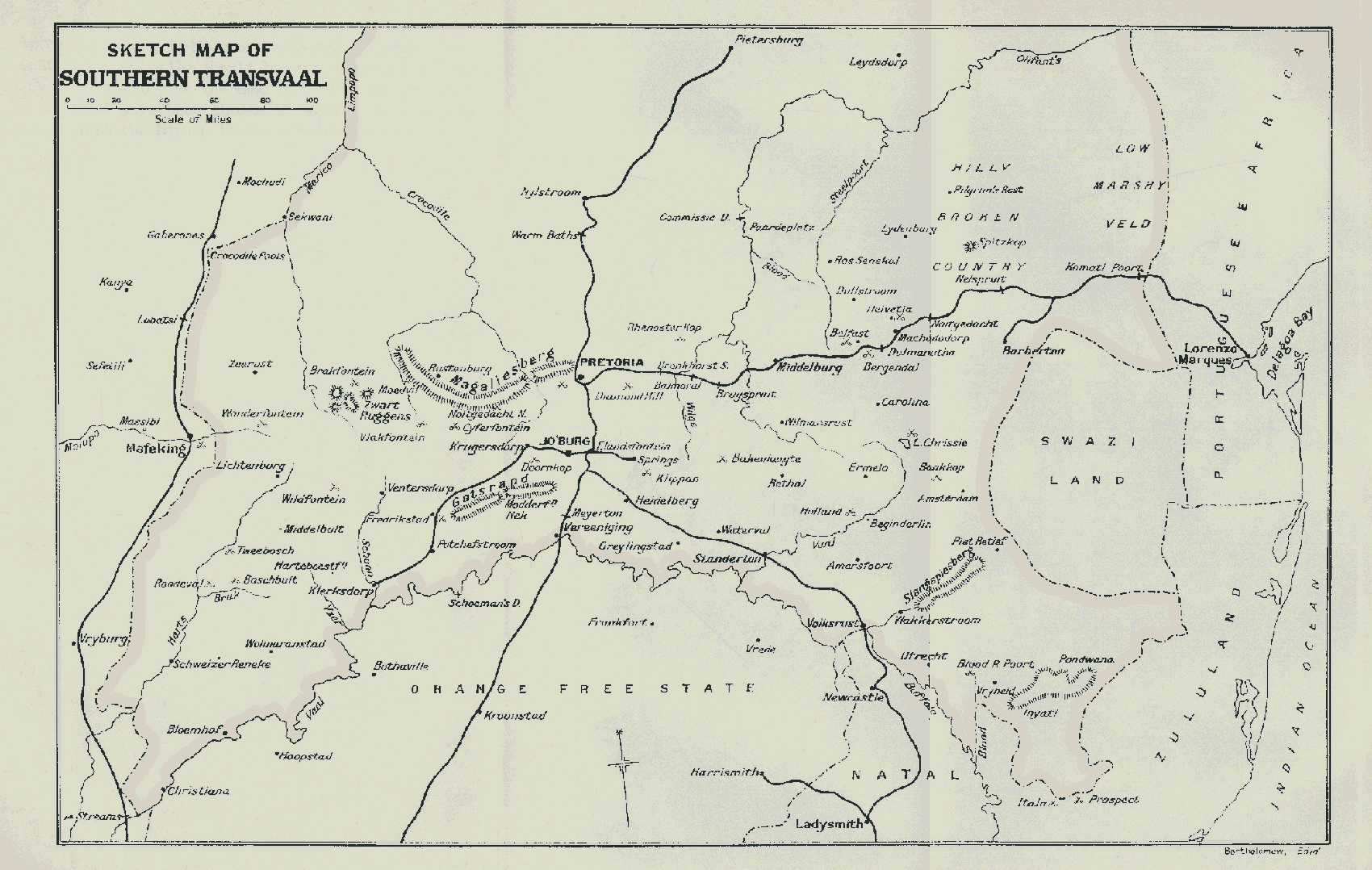
Footnote 49:(return)Not the column with which he had come up to Pretoria with Lord Roberts, and which after his accident had been taken over by Hunter, but a newly-constituted column.
Footnote 50:(return)Lord Roberts said that if he had been free to send Ian Hamilton into the Free State instead of to Rustenburg, De Wet must have been surrounded.
Footnote 51:(return){294}After June, 1901, the classification of the South African Army in Divisions and Brigades disappeared from the Army List.
In October, 1900, De Wet, with 1,000 men, again crossed into the Transvaal at Schoeman's Drift. His movement, which was preceded by constant raids on the railway throughout September, was not altogether voluntary, but was rather a withdrawal from columns pressing on him in the Free State.52 Barton, who with the Fusilier Brigade had been sent down by Lord Roberts to meet him, took up a position at Fredrikstad, where he was surrounded by De Wet and Liebenberg on October 24. The situation was now so serious that Lord Roberts ordered a brigade under Knox to come up to Barton's assistance from the Free State, but it was not required, as the arrival of a column from the north broke the cordon, and De Wet returned to the Free State.
The new De Wet hunt was soon in cry. When Knox was set on the trail, he was in the Free State and De Wet was in the Transvaal. Two days later the positions were reversed, for they had crossed the river in opposite directions. The situation now developed itself favourably for De Wet's methods. For a purely military operation he had never shown much aptitude. He had failed against Barton at Fredrikstad, but he was not discouraged by the repulse, which he unjustly attributed to want of co-operation on the part of Liebenberg. {295} He had put the Vaal between himself and Knox, who was on the right bank blindly nosing the drifts. He knew from recent experience that his pursuers, with their imperfect methods of acquiring information, would hunt by sight and not by scent, and he had the mobility of a hare as well as the instinct of a fox. He lay perdu for some days near the left bank of the Vaal, while a net with spacious meshes was being cast to ensnare him. Again he crossed and re-crossed the river in order to bring Steyn away from Ventersdorp, whom two months previously he had conducted into the Transvaal, and who had in the meantime worked round the British Army to Machadodorp and back; and who after conferences with Kruger and L. Botha, now returned with him unscathed into their own land with schemes for the future.
Pom-pom batteries and mounted infantry, the latest fashions of war, were sent after him by Knox. On November 6 he was surprised in laager near Bothaville, but escaped with Steyn and the greater portion of his command on the first alarm. The gallant Le Gallais was killed and the laager itself captured after a stout resistance some hours later, and with it all De Wet's field guns, wagons, a considerable quantity of ammunition and horse equipment, and more than 100 prisoners of war.
Most men would have succumbed to the disaster, but it only spurred De Wet. He had signally failed in his late attempt on the Transvaal, and he had just lost almost everything at Bothaville, but he resolved to make a raid in the opposite direction on the northern districts of Cape Colony. To reach his new objective, he must traverse the whole length of the Free State, which, having been in the occupation of the British Army for several months, should have offered the line of greatest resistance to his movement.
The Brandwater Basin disaster of July 30 had, however, by no means crushed Free State Boerdom, which, {296} after having been heavily hurled to the ground, where it lay for a time apparently unconscious, began to show signs of returning animation, and in a few weeks was again on its legs; thanks to the restoratives freely administered by De Wet on his return from his first incursion into the Transvaal. Into each district he sent irreconcilable men after his own heart to stimulate the wavering and animate the discouraged; and barely a month elapsed before the burghers were besieging Ladybrand, which, however, they failed to take, and were hacking at the railway into the Transvaal. In October every village in the S.W. district of the Orange River Colony in the possession of a British garrison was attacked, all but one of them without success.
Lord Roberts had already taken measures to curb the new activities. His plan was to occupy certain places strongly as bases from which mobile columns could constantly move to and fro, eating up the intervening country and rendering it incapable of supporting the enemy. Its operation was mainly confined to the northern districts of the Free State, in which lay the centre of disturbance, and the troops engaged could not be readily employed outside them. It was so far successful, in that it drove De Wet into the Transvaal in October, but it failed to restrain his subsequent movements. It probably was the best that could have been devised for dealing with local guerilla, but its action being centrifugal and not circumferential, it was powerless to deal with a meteoric raid of well-mounted men. Although the British troops greatly outnumbered the Boers, yet in practice only the mounted details, which included no regular cavalry and were relatively weak, were directly effective against the enemy, and the movements of the divagating columns were sluggish.
When De Wet left Bothaville on November 6, his arm was, metaphorically speaking, in a sling, and he was footsore; but ten days later he had brought together {297} in the Doornberg a force of 1,500 men, with whom he proposed to cut his way into the Cape Colony. His movement south may be compared to that of a small swift steamer endeavouring to escape from a blockaded seaport. Ahead of him and on each beam were the slow-moving vessels of the blockading squadron, most of them hull down and with banked fires.
He made at once for the scene of his April successes, the country lying between Bloemfontein and the Basuto border. The chief obstacles in his way were a line of posts running eastwards from Bloemfontein, and the town of Dewetsdorp, which was held by 500 British troops. The latter he might have avoided had he chosen to do so, but he seems to have been attracted to it because it was the home of his childhood, which it was incumbent upon him to redeem from bondage.
The phenomenon of a Boer column marching through the heart of a country supposed to be effectively in the possession of the British Army was again witnessed. To borrow another metaphor, this time from Astronomy, De Wet throughout the greater part of his career was a telescopic star, invisible to the naked eye. General Officers and column commanders helplessly watched his course through the telescopes of the Intelligence Staff, and seemed to have as little power of influencing it as an observer at Greenwich has of changing the orbit of a planet. The astronomer can at least forecast with certainty the path which it will follow in the heavens, but there were no observations available from which the course of De Wet could be predicted for more than a few hours. He seemed to defy the laws of gravitation.
On November 16, he easily rushed the Bloemfontein-Thabanchu line of posts at Springhaan's Nek, and three days later invested Dewetsdorp. Meanwhile the alarm had been given. Knox's force, which had been sent after him into the Transvaal, was now sent after him to Bloemfontein, and mobile columns were detailed. Dewetsdorp was doomed from the first unless {298} assistance arrived from outside. The position could not be held effectively by a small force, One by one the scattered posts fell into the hands of De Wet, but the defence was maintained until the 23rd, when the white flag was hoisted. On the previous day two relieving columns had started from Edenburg, but they were checked near Dewetsdorp on the 24th by De Wet, who shook himself free of them and was soon on his way to the south with 500 prisoners of war; and Knox with a third relieving column was marching from Edenburg.
Thus almost within sight of Sannah's Post and Mostert's Hoek and after six months of apparently successful activity by the British Army, De Wet snatched away another garrison. After a repulse at Fredrikstad, soon followed by a severe mauling at Bothaville, from which he broke out as a fugitive, he placidly and confidently trekked southwards unopposed for 150 miles, magnetically attracting to himself a force sufficient to blot out Dewetsdorp in the presence of a bewildered enemy, who, though in overwhelming numbers, was feebly strung out in lengths without breadth. The British Army had still to learn, not only in the Free State, but also elsewhere, the elemental fact in geometry that neither one straight line nor two, nor under certain conditions even three, can enclose an area.
It was evident that De Wet was making for the Cape Colony, the disaffected northern districts of which were again giving cause for anxiety, and which at all hazards he must be prevented from entering. Lord Kitchener came down from the Transvaal to direct the operations; the Brigade of Guards on its way to Capetown and home, was de-trained to hold the line of the Orange; Knox's columns hurried forward. De Wet, after a slight encounter with Knox, who was marching south, turned adroitly to the west and did not resume the original direction of his march until he had put a considerable distance between himself and the columns, which were "running heel" and pursuing him almost in {299} the opposite direction. Near Bethulie he was reinforced by Hertzog and other leaders, but by this time he had been headed by Knox at Bethulie and was compelled to draw off eastwards into the angle between the Orange and the Caledon. He left Hertzog with instructions to make his way across the river west of Norval's Pont, intending to cross with his own force higher up. He was, however, prevented by the forces of nature from carrying out the raid which the British military forces would probably have been unable to prohibit. Heavy rains had fallen in the Basuto Mountains, and the sudden rise of the Caledon and the Orange to flood level obliterated most of the drifts and entrapped him between them. He made one dash for the Orange at Odendaal, but found the drift in the possession of the enemy.
De Wet now saw that he was not destined to enter the Cape Colony on this occasion, and that he would have much difficulty in saving himself. On December 6 he determined to retreat by the way he came. He did not, however, wholly abandon the scheme of a Cape Colony raid, for he detached Kritzinger and Scheepers with instructions to hover and watch their opportunity of breaking into it. The opportune falling of the Caledon opened to him a postern towards the north, and on December 7 he crossed the river and made for Helvetia, where again he was entangled. The line of least resistance seemed to run westwards towards the railway, and he put himself upon it, soon to find that Kitchener's dispositions had obstructed it. He doubled back, and trailing Knox after him in a night march, shook himself free. Knox, confident that the Bloemfontein-Ladybrand line of posts would be an effectual barrier to De Wet's retreat, had waited to pull his straggling columns together. De Wet, reinforced by a commando under Michael Prinsloo, who had been with him in his first Transvaal incursion when Steyn was put over the border, rushed at the blockhouse line and again cut it at Springhaan's Nek, for although it had {300} been attended to recently, there was an aneurism in it which yielded at the critical moment, and on December 14 De Wet passed freely through the lesion. He arrived by way of Ficksburg at Tafelberg, S.E. of Senekal, on December 25.
The failure of the raid was almost as disconcerting to the British plan of campaign as its success would have been. It showed that the troops were unable to prevent a mobile and well-led commando from traversing the Free State from end to end; it put new spirit into the burghers, and destroyed the hopes of peace which the operations of Lord Roberts in the Transvaal had kindled. De Wet was still at large, and although he had not accomplished all that he intended, he had good reason to be satisfied, and was stimulated for fresh efforts. He could boast that he was beaten not by columns but by two rivers in spate. His movements were so little obstructed that after reaching the Senekal district he was able to pay a flying visit to the railway at Roodeval, where he recovered the Lee-Metford ammunition which he had buried in June, and with which he hoped soon to have an opportunity of charging the rifles captured at Dewetsdorp.
When De Wet, Hertzog, and Kritzinger parted company near the Orange early in December, their tracks formed the letter Y inverted. De Wet marched along the stem towards the N.E.; Kritzinger struck in the direction of the midland districts of the Cape Colony; Hertzog made for the west. Martial law was at last proclaimed in the Colony, the greater part of which was, in spite of innumerable columns slipped at them, traversed by Hertzog and Kritzinger. The former, after an adventurous march of over 400 miles, reached Lambert's Bay on the shore of the Atlantic, and gave to most of his men their first sight of the sea; and to all of them a unique experience in the war, for they were shelled by a British cruiser at anchor in the haven.53
{301}While Hertzog was watching the setting of the sun upon an Atlantic horizon, Kritzinger was at Willowmore, almost within sight of the Indian Ocean, having in spite of all the columns pushed his way from Rouxville down into the S.E. districts of the Cape Colony. Neither Kritzinger nor Hertzog, however, effected much by their raids except to show in the Colony what De Wet had already shown in the Transvaal and the Free State, the impotence of even the best-laid schemes of pursuit, and they returned towards the centre in February. De Wet and Hertzog had between them in the course of a few months succeeded in ploughing, through the heart of the country occupied by the British Army, a lonely furrow which stretched from the northward slopes of the Magaliesberg in the Transvaal through the Free State to a haven on the South Atlantic Ocean.
Meanwhile De Wet was waiting until the moment should come for him to take part in the wide-reaching plan of campaign which had been devised by the Boer Governments. They saw the uselessness of attempting to withstand the British forces in the Republics, and they determined to bring the war back into the Cape Colony and Natal. The general idea was that L. Botha should march on Pietermaritzburg from the Eastern Transvaal, while De Wet followed Hertzog and Kritzinger across the Orange, and then, having effected a {302} junction with them, should advance on Capetown. The scheme was not so extravagant and quixotic as it might appear to be, as recent events had shown the difficulty of restraining the movements of a Boer leader of dash and enterprise; and there was no reason why De Wet should not be as successful in eluding pursuit in the future as he had been in the past.
Again the Doornberg, although within sight of the railway between Bloemfontein and Kroonstad, was available as a meeting place. Here on November 16, 1900, he had assembled his burghers for his first attempt on the Cape Colony; and here on January 25, 1901, he brought them together for his second. Steyn was with him, and all the available Free State commandants with more than 2,000 men mustered on the mountain unmolested. His intentions were not unknown to the British Intelligence Staff, and when he quitted the rendezvous he had a column under B. Hamilton on his right rear and a column under C. Knox on his left front.
The situation was not novel, and he dealt with it with his customary good luck and success. He passed across Knox's front, who fortunately for him had been ordered not to act before Hamilton came up, and reached the Tabaksberg, between Winburg and Brandfort, next day. On the following morning he shook off an attack made by a portion of Knox's column, and went for the Bloemfontein Thabanchu line of posts, which he had already twice cut. Hamilton, distanced in the chase, had been put on the railway and sent to Bloemfontein to strengthen the line, but he arrived too late to prevent De Wet crossing it on January 30 at Israel's Poort. The sorely-tried pale had again failed.54
{303}De Wet, having shaken off the columns which had been pursuing him from the Doornberg, had now a free course of 100 miles to the next obstacle, the Orange. It was evident that the speed of the columns must be increased and Knox was put upon the railway for the first time and Hamilton for the second and dispatched to Bethulie. The energy of a considerable portion of the British Army was devoted to an attempt to make the barrier of the Orange impassable.
North of the river was De Wet; south of it Hertzog and Kritzinger were waiting for him. There was every reason to fear that should he succeed in joining either of them, the smouldering embers of rebellion would again break out in the Cape Colony. Troops were hurried by train from the Transvaal, from Kimberley, and from Capetown. Lyttelton was brought down from the Delagoa Bay line to Naauwpoort to take general charge of the operations, and to build as rapidly as possible a wall that could not be scaled or breached.
For some reason which is not apparent De Wet, although he had an open country in front of him in which not a single British column was operating, moved slowly, and thereby gave more time for the carrying out of Lyttelton's arrangements. Possibly he may have been delayed by trouble with his Free State commandos, some of which a few days later refused to cross with him into the Colony. On January 31 he passed through Dewetsdorp, gratified no doubt to find that since his capture of it in November his enemies had not ventured to set foot again in it. At that time he had not made up his mind whether to cross the Orange east or west of Norval's Pont. If the former, he would soon be able to join Kritzinger, who after the Willowmore raid had returned to the Zuurberg, between Stormberg and Naauwpoort; if the latter, he would be able to call up Hertzog, who had returned from the shores of the Atlantic and was hovering in the Carnarvon district west of De Aar.
{304}De Wet had from time to time to time been in communication with Kritzinger and Hertzog during their raids. His advanced patrols soon discovered that the section of the Orange lying eastward of Norval's Pont was very strongly held. The dispositions of Lyttelton's troops seem to have been made on the assumption that De Wet would endeavour to join Kritzinger, who was little more than one day's march from the left bank, rather than Hertzog, who was 150 miles away. The river section westward of Norval's Pont was therefore held lightly by a line of outposts at the drifts, thrown out from the main barrier based on Naauwpoort, nearly forty miles south of the river. Of this De Wet was at the time unaware. His information was that the eastward section was impassable. The westward section might possibly not be so, and he determined to make for it.
He spread a report that he intended to cross the river at Odendaalstroom or Aliwal North, and paused to allow it time to reach the ears of Knox, who seems to have given some credence to it. A column was sent out to reconnoitre in the direction of Smithfield. When half-way between that town and Dewetsdorp, De Wet suddenly changed direction and made for Phillipolis, detaching a portion of his force under Froeneman, who on February 5 captured and burnt a train a few miles south of Edenburg and crossed the railway. On the following night, De Wet crossed it with the main body near Springfontein, while Knox was hunting for him near Bethulie.
It was now evident that De Wet's objective was the Zand Drift on the Orange west of Phillipolis. He had had a long start, and the nearest troops available for the pursuit of him were the columns of Knox and Hamilton at Bethulie. Here the river bends round to the south, forming an arc through Norval's Pont towards Zand Drift; and the columns therefore crossed to the right bank and marched eighty miles along the chord, only to find when they reached the Drift on {305} February 12 that De Wet had two days previously crossed by it into the Cape Colony.
The operations of the next sixteen days were confined to a comparatively small rectangle of about 6,000 square miles lying on the left bank of the Orange, which bounded it from Norval's Pont to Douglas and thence to near Prieska. The S.E. side and half the S.W. side, namely from Norval's Pont to Naauwpoort and thence to De Aar, were formed by the railways, the remaining portion of the S.W. side being the river Brak, which flows into the Orange a few miles above Prieska.
Owing to a sudden flood, which delayed Knox for two days, he was unable to follow De Wet across Zand Drift, but Plumer started from Naauwpoort with two columns, and on February 12 came in touch with De Wet and compelled him to change his course. Two days later De Wet crossed the railway between De Aar and Hopetown, after a rearguard action with Plumer, into whose hands fell next morning the transport which De Wet had been compelled by bad weather to leave behind him.
De Wet now proposed to fetch a compass towards Prieska, where he hoped to effect a junction with Hertzog, but the driving power of the raid was slowly exhausting itself. The motive energy was stored up in accumulators, and when these were discharged in succession, there was no means of re-charging them. Hertzog and Kritzinger, who had been relied on for this purpose, were not at hand; more than a third of the force with which De Wet had originally left the Doornberg had declined to leave the Free State; and the transport had been lost.
Plumer also was exhausted and unable to continue the pursuit, but fortunately Knox was close behind him. He doubled back towards Hopetown for supplies, leaving Knox to follow the trail. De Wet was now driven into the western corner of the rectangle where {306} the Brak falls into the Orange, and where he found himself in a dilemma similar to that which in his first raid had cornered him between the Orange and the Caledon. The Brak was in spate, and he could not cross it to Prieska. All hope of joining Hertzog and of a successful raid into the Cape Colony was at an end; there was nothing to be done but make the best of his way back to the Free State. He reversed his course and made for the confluence of the Orange and the Vaal. His change of direction was not known to Knox, who, assuming that De Wet must have crossed the Brak, which fell as suddenly as it had risen, threw his columns across it and trekked for twenty miles towards the S.W. Hertzog was reported to be a day's march higher up the Brak.
Up to this time the whole of the stress of the pursuit had fallen upon Knox and Plumer. As soon as the news of De Wet's entry into the Cape Colony reached Lord Kitchener, he hurried down from the Transvaal to De Aar to superintend the casting of the nets. His first dispositions were made with the object of preventing De Wet and Hertzog breaking away into the districts lying west of the railway to Capetown, and an ingenious and elaborate scheme of columns springing out from the line in succession from the north, was arranged. It was not, however, put into action, for Knox and Plumer had headed back De Wet, and for the time being had prevented a junction between him and Hertzog. It was no longer a case of a stern chase, but of the fencing in of a comparatively limited area, into which more than a dozen columns were thrown, and which by February 24 was reduced to the district bounded on three sides by the railways and on the fourth by the Orange.
When on February 21 Plumer was able to resume the pursuit, Knox having discovered his mistake was recrossing the Brak, and De Wet on the left bank of the Orange was unsuccessfully searching for practicable {307} drifts. He succeeded, however, in transferring a few of his men to the right bank in a boat at Makow's Drift, but was overtaken by Plumer before he could complete the movement, and forced to hurry on towards Hopetown. In the course of one week he had marched in the direction of almost every point in the compass, and was now heading E.S.E.
When within fifteen miles of Hopetown he lost two guns, and on the same day ran up against a new obstacle, a column under Paris, which had come down from Kimberley and which had extended itself westward from Hopetown. He succeeded in wriggling through the line without detection during the night; while Paris, unaware of what had occurred and thinking that De Wet was still in front of him, pushed on next morning and came into action, not with De Wet, but with Plumer, who was pursuing De Wet in the opposite direction. On February 24 De Wet crossed the railway eastwards a few miles south of Orange River Station.
As soon as Hertzog in the Carnarvon district heard of the approach of De Wet he trekked up towards the Brak to meet him, having first detached a portion of his command under Brand to make a circuit through Britstown. Brand was followed by B. Hamilton, who had been set on to his trail, but regained touch with his leader on February 20, when the news came that De Wet was in difficulties and that the raid must be abandoned.
Hertzog and Brand joined forces across the river and trekked to the east, having thrown Plumer off the scent for a day. On February 25 Hertzog crossed the railway. Three Boer leaders were now groping for each other in the Fog of War: De Wet, Hertzog, and Fourie, who had been left behind to do what he could to extricate the transport which De Wet had been compelled to abandon when he crossed the railway westwards on February 16, and who had been lost sight of by the British columns. The forces of gravitation are, however, {308} irresistible, and as Hertzog and Brand could not be long kept apart, so also De Wet, Hertzog, and Fourie soon came together.
De Wet trekked along the left bank of the Orange for nearly sixty miles, but found every drift impassable. On February 26 he reached Zand Drift. A fortnight previously a sudden flood had checked his pursuers, now another flood was checking his retreat from them at the same spot, and he was hemmed in by a swollen river and a dozen active columns. Most men would have yielded to the situation, but his tenacity of purpose never faltered. Early on the morning of February 27 Hertzog, who had picked up Fourie a few hours before, joined him.
After crossing the railway Hertzog made for Petrusville, where he heard that De Wet had passed through the town on his way south, and followed him. About twenty miles away on Hertzog's right flank a column under Hickman was marching on Zand Drift, and had it not been suddenly diverted northwards by orders from Lyttelton, it must have forestalled him at the Drift, as it was working on interior lines. The change of direction was made before Hertzog's presence in the vicinity became known to Hickman, who on sighting a Boer column on February 26 again changed direction to pursue it. A second column was soon descried, and later in the day, about the time that De Wet reached the Drift, a considerable Boer force was sighted. It was composed of the two columns already seen under Hertzog and Brand, reinforced by Fourie, who had emerged from the Fog. Hickman's pursuit failed to prevent the three commandants joining De Wet at the Drift during the night.
The disjecta membra of the raid were now assembled, but the task of the British columns was, apparently, greatly facilitated. Instead of having to chase evasive and elusive commandos now in this direction and now in that, the leaders had but to pin De Wet down to the {309} left bank of the Orange at Zand Drift and to leave him to gaze longingly at the further shore. Nothing could now save him but a sudden fall of the swollen river. Before De Wet's arrival at Zand Drift Lyttelton had put troops in motion, some of them from considerable distances, to enclose the area, but of the columns detailed three only had come up. Hickman was on the spot, Crabbe from Hopetown was in touch with him, and Byng, who had been hurried up from Victoria West, was at hand. None of the other columns were in position, owing mainly to delays on the railway. Thus the only effective force for the capture of De Wet was the three columns with Hickman, who was out of communication with Lyttelton.
The troops had been disposed with the object of driving De Wet back into the Free State rather than of capturing him, and they were unable to concentrate themselves upon him. Norval's Pont, from which the line of the Orange might, perhaps, have been blocked in the direction of Zand Drift, was unoccupied. On February 27 Hickman pushed De Wet away from the Drift. Two columns were behind the Boer leader, but in front of him was a weak and thinly extended force under Byng, which De Wet cut through without difficulty, and next morning reached Botha's Drift. It was fordable, and after eighteen days' absence he re-entered his own country. He had not succeeded in raiding very far into the Cape Colony, but he had baffled and outwitted the most strenuous military effort of the war.
Plumer, who had been ordered round from Orange River Station to Colesberg, arrived there too late. He was immediately sent on to continue the pursuit in the Free State in co-operation with a column under Bethune, which marched directly across the veld to Fauresmith. Bethune was soon compelled to fall out, but Plumer held on for five days more without, however, lessening the distance between him and his quarry. On March 11, after a trek of more than 800 miles, De Wet, {310} having dismissed on his way up most of the commandos to their several districts, entered Senekal with Steyn, and returned to within a few miles of the Doornberg place of assembly which they had quitted forty-four days before.
The lessons to be derived from the history of the three De Wet hunts are mainly of a moral character, and have only an indirect bearing upon the principles which guide the conduct of military operations in general. No such episodes could ever occur in a European War. Yet the Power which holds Hindustan cannot afford to forget them. Who can say that in the not distant future, which all the signs of the times seem to show will be marked by turbulence and disorder in India, a De Wet may not come forth out of the thousands of Sikhs, Ghoorkas, Pathans and Rajputs who have learnt the Art of War in the Native Army? The arena of the struggle, with its long lines of communication, all its chief towns held by British troops and its vast plains inhabited by a disaffected population, would be strikingly similar to that on which the Boer War was fought.
Footnote 52:(return)De Wet says that he went at the request of Liebenberg, who was in charge of the commandos operating between the Vaal and the Magaliesberg, and who had previously been engaged in the Bechuanaland rebellion.
Footnote 53:(return)Twenty-three centuries previously, a Greek Army, after a march of many weeks, reached the sea. The emotion of the men at the sight has been thus described by their leader in a well-known passage which Hertzog might well have in substance incorporated in his reports to De Wet: "No sooner had the men in front caught sight of the sea than a great cry arose, and Xenophon with the rearguard, catching the sound of it, conjectured that another set of enemies must surely be attacking the front. But as the shout became louder and nearer, and those who from time to time came up began racing at the top of their speed towards the shouters and the shouting continually recommenced with yet greater volume as the numbers increased, Xenophon settled in his mind that something extraordinary must have happened, and mounted his horse and taking with him Lycius and the cavalry, galloped on. And presently they could hear the soldiers shouting and passing on the joyful word [Greek: Thalatta, Thalatta]"—Anabasis, IV, 7.
Footnote 54:(return){311}De Wet ascribes his success to a feint which he made in the direction of Springhaan's Nek, and which he asserts threw the columns off the scent; but it is improbable that the feint had anything to do with it. At the time of De Wet's crossing at Israel's Poort Hamilton had only reached Sannah's Post, nor was Knox marching on the Nek.
The nation at home, which at the close of 1900 was confidently expecting the end of the war at an early date, was not long obsessed by its optimism. Efforts not less vigorous than patriotic were made not only by Great Britain, but also by the Colonies and South African Loyalists, to give Lord Kitchener the troops he needed.
At the end of May, 1901, he had at his disposal a force which, including all classes of irregulars, semi-combatants, and non-combatants, was not less than 230,000; of whom more than one-third were mounted. The rule hitherto observed, that the native races were to be employed in servile capacities only, was relaxed, and in certain cases natives were allowed to carry arms when acting as scouts or patrols.
It is impossible to ascertain with any degree of accuracy either the actual or the potential strength of the enemy at this period. It has been estimated that, excluding the burghers actually on commando, there were less than 30,000 Boers able to take up arms if inclined to do so; but this number must only be regarded as the maximum strength of a possible and to a great extent an unreliable reserve upon which the commandos in action, at no given moment much exceeding 12,000 burghers, could draw to supply the wastage of war.
The war now entered fully into its "blockhouse and {312} drive" phase. The use of these expedients in combination was, it is believed, new to military history. The principle of the blockhouse had already been tentatively adopted in South Africa without much success, notably between Bloemfontein and Thabanchu, where a line of posts was established which on three occasions was cut by De Wet.55 The chief defect of the blockhouse is its vulnerability to shell fire; but by this time the Boer artillery was a negligible quantity. Its adoption on a large scale dates from the time of Lord Kitchener's taking over the command. The expedient was, in the first instance, applied to the railways as a protection against the raids to which they were subject; and after July, 1901, it was extended to the open veld. Subsidiary lines of blockhouses, which in general jutted out at right angles to the railways and in most cases ran along the cross-veld roads changing direction as circumstances required, were built. They acted as fences to obstruct or to deflect the movements of the enemy and enclosed areas greatly differing in size.
The longest blockhouse line, which was, however, not completed until a few weeks before the end of the war, extended from Victoria Road Station to Lambert's Bay on the Atlantic, a distance of 300 miles. In the vicinity of Johannesburg, and in the Central districts of the Orange River Colony west of the railway, cordons of posts manned by the South African Constabulary took the place of blockhouse lines. These posts, which were established at wider intervals apart than the blockhouses, were intended to act as bases for minor clearing operations. They offered little or no obstruction to a Boer commando on trek. The blockhouse lines were resolutely extended by Lord Kitchener in every direction; and by the end of the war there was scarcely a district in the spacious area of hostilities that was not {313} impaled upon them or helplessly clutched in their fatal grasp.
The "Drive" as a military weapon is as old as the time of Darius. The first use of it in South Africa, on a large scale, was French's movement through the Eastern Transvaal in February, 1901.56 The "Drive" has been criticized as an awkward attempt to perform, with one and the same force, two distinct operations of war; namely, the coercion of the non-military population and the defeat of the enemy's troops. The dual task deprives the force set to it of mobility and power of initiative.
As a detail of abstract and orthodox military criticism the objection is sound; but it ignores the special local circumstances of the case. In the vast area on which the British Army was operating it was not possible to separate the two objectives. Moreover, the purely military resources of the enemy were waning; and the contest was resolving itself into an effort to put pressure on the country at large, rather than to smash the dwindling, evasive, and centrifugal commandos in the field. French's "drive," from a military point of view, was not a success; but it at least frightened Botha and the Transvaal Government. In May, 1901, there was a conference near Ermelo at which it was resolved that overtures should be made to Lord Kitchener; and but for Steyn, who was communicated with in the Orange River Colony, and who had had no experience of the "drive," it is probable that negotiations for peace would have ensued. On the other hand, the "drive" has been approved as a method of warfare particularly adapted for use by an army deficient in mobility and incapable of acquiring accurate intelligence of the enemy.
During the two months preceding Lord Roberts' departure from South Africa at the end of November, 1900, no events of great military importance occurred {314} in the Transvaal, except De Wet's Fredrikstad raid. The opposition had, to all appearance, dissolved into impalpable matter. Here and there some Boer atoms coalesced and were not pulverized; but for many weeks there was little in the general situation to disturb the optimistic belief, which was held not only by the people at home but also by the Army in the field, that the end was not far off.
Botha and Steyn reached Pietersburg in September, where they were joined by B. Viljoen, who arrived a few weeks later after a circuitous journey from Komati Poort through the low veld. An important detail of Lord Roberts' plan of campaign had not been carried out. He had hoped that the Northern Transvaal would be denied to the Boers by Carrington, who failed to carry out his part of the programme. Thus Pietersburg was a fairly secure eyrie in which plans could be devised and from which a swoop could be made either east or west of Pretoria.
Botha and Steyn soon came to the conclusion that the situation, though serious, was by no means hopeless. Certain events of October and November were encouraging. They not unnaturally argued that the withdrawal of their two chief opponents, Lord Roberts and Sir Redvers Buller, indicated infirmity of purpose on the part of the British Government. The idea was mistaken, as the recall of these leaders, or at least of one of them, was due to the fact that the British Government was of opinion that the war was practically over. Again, they were relieved of the inconvenient and harassing presence of Kruger, the dour, reactionary old farmer, who had brought on the war and had now left his country to its fate; who had learnt nothing and forgotten nothing since he had set out on the Great Trek of 1836; and whose mind ran in a channel so shallow that it could almost be heard rippling over the stones. Also, it is probable that they had information that the majority of the men of the Colonial and Irregular Corps, {315} whose term of service of one year would shortly expire, or had already expired, were declining to re-enlist—yet another sign of infirmity of purpose. Moreover, the Boer agents in Europe no doubt reported that all the regular infantry and its reserves in Great Britain had been exhausted.
In November, 1900, the new plan of campaign was drawn up. L. Botha was to invade Natal, after a raid into the Cape Colony by De Wet, for whom Kritzinger and Hertzog would prepare the way and lay out the dâk. Steyn hurried southwards with the scheme, and was picked up at Ventersdorp by De Wet. Botha went to the high veld between the Natal Railway and the Delagoa Bay Railway, leaving B. Viljoen north of the latter railway. Beyers was ordered to join Delarey, who after the battle of Diamond Hill went into his own country near the Magaliesberg and was now lurking in the Zwartruggens.
French, after his unhappy cross-veld march to Heidelberg, was placed in charge of the Johannesburg district. His passage had not overawed the local commandos, which, like the armed men from the teeth of Cadmus, soon sprang up out of the ground; and two attempts made by Smith-Dorrien to coerce them failed. Hildyard, after the departure of Buller and the dissolution of the Natal Army, was placed in charge of an extensive district which included not only Natal but also the S.E. corner of the Transvaal. Clery went home in October, 1900, and was succeeded in the charge of the Natal Railway in the Transvaal by Wynne. Lyttelton, with his Head Quarters at Middelburg, was posted on the Delagoa Bay Railway.
Methuen alone of all the British leaders had an opportunity during this period of acting against definite objectives. Early in September he quitted Mafeking and zigzagged in the western districts. After a minor affair at Lichtenburg he was called south, and with the help of Settle, who sallied from Vryburg, relieved Schweizer {316} Reneke. His next efforts were not so successful. A march to Rustenburg, with a view of intercepting the wandering President of the Free State, brought him to his destination early in October, only to find that Steyn was gone; and subsequently he was unable to tackle Delarey effectively in the Zwartruggens, a difficult district lying a day's march west of the Magaliesberg. When he reached Zeerust a considerable portion of his command was withdrawn under C. Douglas to reinforce French, and the end of November found him again at Mafeking, too weak to work outside his own district.
The Magaliesberg was patrolled by Clements and Broadwood, who made some captures. Clements also was called on to furnish troops for French, who lay at Johannesburg, having under his command several mobile columns as well as the garrisons on the Klerksdorp railway and elsewhere.
Paget, who since August had been operating north of Pretoria, made an attempt in the direction of Rustenburg to cut off Steyn, but was no more successful than Methuen. His next divagation was to Eerstefabriken, a few miles east of Pretoria, whence he was ordered away to see to B. Viljoen, who was harassing the Delagoa Bay Railway, and whom, without assistance from Lyttelton, he shifted from a strong position at Rhenoster Kop in an affair which has been termed the last orthodox pitched battle of the campaign.
Such, in brief, was the position in the Transvaal when Lord Kitchener, after a flying visit to Bloemfontein for the purpose of co-ordinating the activities against De Wet, returned to Pretoria on December 11, 1900. It would have offered greater difficulties to a man who was a soldier first and an organizer afterwards than it did to the successor of Lord Roberts. It may be likened to an archipelago in a stormy sea infested by pirates who, though powerless to take possession of any of the islands, made communication between them always dangerous and sometimes impossible.
{317}Lord Kitchener's coming difficulties were heralded less than a week after the departure of Lord Roberts by the loss of a large convoy which was proceeding to Rustenburg, and for which Delarey, who was always to be found where weak detachments came his way, was waiting. Ten days later Clements suffered a disaster. He was based on Krugersdorp, but his command had been weakened and his transport was deficient. He received orders to act in the Hekpoort Valley, while Broadwood acted north of the Magaliesberg. When he reached Noitgedacht Nek he found Delarey a few miles away. At his urgent request a small portion of the troops which had been taken from him was restored, with a few wagons; but they left Krugersdorp too late to be of service.
Clements was under the impression that he had only Delarey to deal with, and was unaware that Beyers was on his way to carry out the orders he had received from Botha. The withdrawal of Paget to Eerstefabriken cleared his front, and he marched on to the Magaliesberg. His movements were not unnoticed by the Intelligence, which, however, failed to notify them to Clements, who on December 11 was in presence of two Boer leaders, whose united forces were twice as strong as his own. Unknown to him they had met at Boschfontein near the southern approach to Breedt's Nek; for when a commando was reported to be at hand, he did not doubt that it was Delarey's force only.
Noitgedacht was tactically an unsound position which Clements, assuming that his right was safe, had taken up in order to maintain heliographic communication with Broadwood on the other side of the Magaliesberg. The range rises more than a thousand feet above the camp selected by Clements and is accessible only by a rough track. The ground on either side of the Nek was occupied by pickets posted there mainly for signalling purposes. These posts, however, were helpless if attacked, as they were not only widely scattered, but could not be reinforced {318} from the main body in the valley below. Thus they were little or no protection to the camp.
In the direction from which an attack might be expected Clements' camp, which lay at the foot of the Nek, was protected by a low ridge jutting out from the main range and ending in a detached kopje. This ridge was held by mounted infantry. Another detached kopje, called Yeomanry Hill, was occupied towards the S.E.
Delarey's general idea for the day's operation was simple: an advance by himself along the low ground upon the camp, coincident with an advance by Beyers on the other side of the range. Shortly before sunrise on December 13 Delarey endeavoured to rush the mounted infantry posts on the ridge, which in anticipation of an attack had been strengthened on the previous evening. Their vigorous resistance foiled the enterprise and Delarey was driven off.
Soon, however, the sound of firing on the heights showed that the Northumberland Fusilier posts on each side of the Nek were in action. They had been attacked by Beyers, but fortunately not as had been intended by Delarey simultaneously with his own attack upon the ridge; otherwise it is probable that it would have been successful. After a desperate struggle, in which the Fusiliers lost heavily, they were overpowered, and Beyers was in possession of the high ground overlooking the camp. An attempt made by Clements to recover the Nek failed. Beyers' burghers came plunging down like a cascade and broke upon the camp itself.
Clements anticipated that Delarey would soon return to the charge and ordered a retirement, which was effected under cover of the artillery and a rearguard of mounted infantry. Shortly before noon he formed up on Yeomanry Hill. Delarey renewed his attack, but met with such sturdy resistance that his men could not be induced to push it home. In the course of the afternoon Clements withdrew towards Rietfontein, having lost in killed, wounded and prisoners more than two-thirds of his {319} 1,500 men. An orderly retreat was effected, and the column, which had been surprised by Beyers and had seen its camp in the possession of the enemy, brought away, in the presence of superior numbers, all its ten guns.
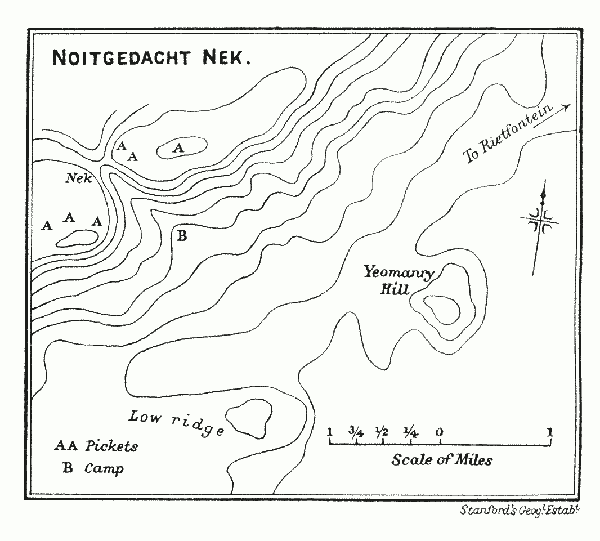
Broadwood on the other side of the range, to communicate with whom Clements had taken up an unsound position at Noitgedacht Nek, lost touch with him, and like many a British officer before him in South Africa, was groping in the Fog of War. Two days previously he had heard that Beyers was approaching, and he knew that Delarey was not far off; yet in his ignorance of the situation he allowed Beyers to wriggle in between him and Clements and to meet Delarey. At the time when Clements was defending himself against the combined attack of the two Boer leaders, Broadwood was seven miles away, placidly patching a field telegraph cable; {320} and when at noon he discovered that Clements was in action he made no attempt to create a diversion.
It would be inequitable to surcharge the Noitgedacht misadventure and other "regrettable incidents" to any individual: they should rather be surcharged, not to this or that responsible commander, but to irresponsible Human Nature. The British Army was, to a great extent, stale and veld-sick. It was informed that the war would soon be over, and it had become slack and careless. Convoys were sent afield with insufficient escorts to run the gauntlet of ever watchful and alert Boer commandants; Intelligence news qualified by the reports of untrustworthy native spies was transmitted circumferentially from column to column, with the result that the leader to whom it was of the most importance was sometimes the last to receive it; the scouting and patrol work was casual and rash. It is, however, but just to say that when the occasion called for it, the fighting qualities of the British soldier showed no signs of deterioration.
The Boers, after their habit, were content with the tactical victory at Noitgedacht and refrained from endeavouring to improve upon it. French and Clements took the field without delay, and although they failed in their plan to pin Delarey and Beyers on to the wall of the Magaliesberg, the Boer leaders were compelled to separate. Their brilliant and brief co-operation did much to awake the British nation out of its torpor. There was no longer any talk of reducing the Army of occupation by one-half at the end of the year, and still more during the New Year; or of quenching the smouldering embers of the war with Baden-Powell's new South African Constabulary.
Late in December the pursuit of Delarey, who had retired from Noitgedacht towards the S.W., was resumed. At Ventersdorp he and his 700 men, after eluding a ponderous force of nearly 6,000 men with 40 guns, doubled back; and soon the same columns unsuccessfully encountered {321} him at Cyferfontein, where he ambushed a mounted detachment and then disappeared.
Beyers, who went into the west after he was wrenched apart from Delarey, soon reappeared upon the stage in the Hekpoort Valley with 1,200 men. His position was precarious. In front of him was Paget, who had been sent round to intercept him; while pressing on his heels was a newly-formed mounted force under Babington, 2,000 strong. He extricated himself cleverly by brushing past Paget and advancing boldly in what was apparently the line of greatest resistance.
No one but a Boer leader with a supreme contempt for his enemy would have thought of placing himself within striking distance of Pretoria and Johannesburg. Yet on January 11, 1901, he audaciously laagered within a few miles of Johannesburg, unknown to the garrison. Next day he crossed the railway at Kaalfontein, half-way between the two cities, and disappeared in the Eastern Transvaal. That at this stage of the war it was possible for 1,200 men to cut the railway, and with scarcely the loss of a man to cross it, with guns and a long train of wagons, midway between the two chief cities of the Transvaal, showed how much still remained to be done.
The disturbances in the Orange River Colony brought about certain changes and redistributions in the Transvaal commands, by which leaders were, as in the circuits of Wesleyan ministers, removed from spheres familiar to them. Clements went to Pretoria in succession to Tucker, who was sent to Bloemfontein; E. Knox, who, fifteen months previously, had been in command of the squadrons of the 18th Hussars which were not made prisoners of war at Talana, took command of the column of Broadwood, who was sent across the Vaal; Cunningham succeeded Clements in the Magaliesberg district; Hart quitted Klerksdorp for the Orange River Colony; and French went away into the west.
On the Boer side a new name which was destined often {322} to be on men's lips emerged from the crowd in January, 1901. A young lawyer named J.C. Smuts, who had received his legal education in England, and whom Delarey entrusted with a command, soon showed, and not for the first time, that a shrewd, resourceful, energetic and determined civilian was, at least in guerilla, more than a match for highly trained British officers.
A movement towards the south by Cunningham, with a view of checking Delarey, soon brought Cunningham into trouble. After crossing the Magaliesberg he was entangled by the Transvaal leader, and had to be extricated by Babington before he could proceed to his destination at Krugersdorp.
Smuts, the new leader, went to the Gatsrand. His first exploit was to snap up a weak and isolated British detachment at Modderfontein Nek, and to establish his own commando on the position. When Cunningham reached Krugersdorp he received orders to tackle Smuts. On February 2, having an overwhelming superiority in guns and a considerable advantage in numbers, he attacked Smuts; but the apprentice tactician had little difficulty in meeting the regulation frontal holding attack combined with a turning movement, and Cunningham withdrew.
In the Western Transvaal there were now three Boer leaders to be dealt with: Smuts in the Gatsrand, Delarey in the Zwartruggens, and Kemp. The latter had come down from the north with Beyers and had been with him when the line was crossed at Kaalfontein. He had lately returned to his own district of Krugersdorp. With Botha threatening in the east and De Wet raiding in the south, few troops could be spared to help the columns on the spot; but two additional columns, under the command of Shekleton and Benson, and composed mainly of details, were assembled by Lord Kitchener. One of these went astray, but the other joined Cunningham and advanced against Smuts in the Gatsrand, only to find that he had escaped at first towards the south, and {323} had then changed direction and had vanished in the N.W.
Methuen, who towards the end of November, 1900, had gone south from Mafeking in order to deal with apprehended trouble in Griqualand West, pushed up from the S.W. corner of the Transvaal and on February 18, 1901, came upon Delarey, who had escaped from Babington and had reinforced a gathering of weak commandos near Hartebeestfontein. Although outnumbered by more than 4 to 3, Methuen without much difficulty compelled Delarey to withdraw, and went on to Klerksdorp. Smuts reappeared and with Delarey made off to the N.W., the sanctuary to which each of them had in turn repaired. Methuen was sent south to Hoopstad in the Orange River Colony. He had hardly started when news came in that an isolated garrison seventy miles away in the N.W. was threatened.
Delarey had a definite objective in view when he disappeared, his native town of Lichtenburg. The place was one of many for which Methuen, with an attenuated force, was responsible; and now he had been called away to a town in trouble in the opposite direction. Two columns nearer at hand were called upon to relieve Lichtenburg, but in the meantime it had relieved itself; for although Delarey succeeded in winning a footing within it, the obstinate resistance which he encountered disheartened him, and he withdrew on March 4 after twenty-four hours' fighting.
The next three weeks were occupied in the pursuit of Delarey by two columns under Shekleton and Babington, at first in directions which he had not taken. They started westward from Ventersdorp, not conceiving it possible that, after the repulse at Lichtenburg, he would have the audacity to throw himself across their left front in an attempt to reach Klerksdorp. When the news that he had actually done so reached them they changed direction southwards, Delarey opening outwards to let them pass through towards Wolmaranstad, {324} whither the Intelligence had in imagination waybilled him. The British columns, unaware that he was on either side of them, and still under the impression that he was on their front towards the south, passed on and halted at Hartebeestfontein, when a reconnoitring party sent out northwards discovered that he was in rear of the columns.
The reconnoitring party had much difficulty in saving itself, as it was charged by mounted Boers in mass, a tactical movement which hitherto had not been tried by the enemy. Babington at once reversed the line of his march, and on March 24 came up with Delarey at Wildfontein, midway between Ventersdorp and Lichtenburg. Delarey was moving heavily and was compelled to jettison his guns and his transport. These were picked up by Babington, who, however, was not able to continue the pursuit and returned to Ventersdorp.
The loss did not disconcert Delarey. He retired with Kemp to a position close to his lair in the Zwartruggens, where, however, he did not long remain. At the same time, he sent Smuts to the Hartebeestfontein district, out of which he had just been driven. The audacity of the act was justified, for Smuts maintained himself against Babington during the whole of April.
Early in May a determined effort was made to clear the district. Methuen after he had relieved Hoopstad was recalled to Mafeking, and then went to Lichtenburg. The British force on the Magaliesberg, commanded first by Clements, then by Cunningham, and now by Dixon, was ordered to operate from the north, while a strong column under Ingouville-Williams was prepared at Klerksdorp. Thus each angle of the disturbed area was held by troops ready to converge; and within it were Babington's columns. Delarey was believed to be at Hartebeestfontein; but neither he nor any other Boers could be found there when the troops entered it on May 6. The Boer leaders had, as usual, adopted their {325} usual strategy of spreading false reports, and of dispersing their commandos as soon as they were hard pressed. On the British side the subsequent operations were conducted without method. The columns, having effected little, were recalled to their bases; and the middle of May, 1901, saw Delarey, Kemp, and J.C. Smuts still at large.
The first offensive action taken by Botha after he came down from Pietersburg in November, 1900, was against Hildyard's posts in the angle adjoining Natal. His movements against the garrisons of Vryheid and other places in December failed, and he returned to the Central Transvaal in order to co-operate with B. Viljoen in worrying the Delagoa Bay Railway, on which Lyttelton's57 force was strung out. Viljoen had already made a daring and successful raid on Helvetia, from which he brought away not only prisoners of war but also a heavy gun; although the town was by no means isolated, being one of a line of posts running from Belfast and Machadodorp to Lydenburg.
The exploit encouraged Botha to plan a general attack, in co-operation with Viljoen, on a section of the railway each side of Belfast. It was made on January 7, 1901. The chief effort was against Belfast, where Smith-Dorrien was in command of a garrison too weak for effective resistance. Viljoen advancing from the north met with some preliminary success, but a fog prevented co-operation between him and Botha and the attack failed. The attacks on the other posts on the railway were repelled without much difficulty. The recrudescence of Botha, the intrusion of Beyers from the west, the hovering presence of Viljoen north of the Delagoa Bay Railway, and the rumour that an invasion {326} of Natal was in contemplation to synchronize with raids beyond the Orange by De Wet, Kritzinger, and Hertzog, determined Lord Kitchener to try to sweep up and reduce the Eastern Transvaal.
A force of five columns under the command of French was assembled a few miles east of the Elandsfontein-Pretoria Railway and began its advance on January 28. The general idea was that it should gradually extend its front, like the cone of dispersion of a shrapnel shell, between the diverging Natal and Delagoa Bay Railways, and then sweep eastward towards the Swaziland and Zululand borders; upon which Botha's commandos, if not already crushed by an enveloping movement on Ermelo, would be finally impaled. To assist French when he had traversed about one-half of the area, three columns were detailed to march southwards from the Delagoa Bay Railway on Ermelo. One of these columns was, however, sent away at the last moment under Paget to take part in the operations against De Wet in the Cape Colony. The combined strength of the seven columns against Botha was about 20,000 men, the majority of the combatants being mounted. A break back by Beyers and Kemp, who rejoined Delarey, was the opening incident of French's advance.
The first objective of French's movement was the town of Ermelo, where Botha was acting as a sort of rearguard to cover the retreat of the fugitive burghers, who with their families and their stuff were endeavouring to escape from the Khakis. His contemplated attack on Natal was, at least for the time being, impracticable; and he set himself to the task of inflicting what damage he could on the threatening columns. He ascertained that Smith-Dorrien's column was approaching Lake Chrissie on February 5, and that the other column operating from the Delagoa Bay Railway under W. Campbell, was too far away to give it effectual support. The gap left by the withdrawal of Paget had not been filled up.
When Smith-Dorrien reached the Lake, Botha had {327} already started to meet him. Early in the morning of February 6 the British Camp was attacked, but although the attempt was furthered by a stampede of Smith-Dorrien's horses, Botha failed. He was compelled to draw off, but with the greater portion of his burghers wriggled round to the rear of the columns.58 Thus when French reached Ermelo he found that he had nothing to strike at. The Boer commandos had passed away. After a short halt he changed direction half right, and projected his front on to a cross-veld line reaching from the Swaziland border to Amersfort; then bringing round his right he formed up his seven columns on February 18 along the Swaziland border, with an eastward front of nearly forty miles extending southwards from Amsterdam. Dartnell was on the right of the line and Smith-Dorrien on the left.
Most of the fugitive commandos had, however, retired into the S.E. corner of the Transvaal; a movement which Hildyard, who was in charge of the district as well as of the whole of Natal, was not strong enough to check. French was now based on Natal for supplies, and arrangements had been made that two large convoys should be sent to him by way of Utrecht. Bad roads, bad weather, and submerged drifts impeded the progress of the painful trains, the first of which did not reach him until March 2, ten days after it was due. Meanwhile he subsisted on dwindled rations and on what he could pick up on the veld.
When, owing to a change in the routes by which he was supplied, French was able towards the end of March to operate actively, he endeavoured to isolate the S.E. corner of the Transvaal by disposing his force in two lines. One line ran from Piet Retief to Vryheid and acted as the driving force, and the other ran from Piet Retief along the Swaziland border and acted as the {328} stopping force. Within the angle enclosed by these lines were commandos under Grobler of Vryheid, Emmett, and other leaders; but all of them wriggled out with insignificant losses. The line along the Swaziland border was rendered immobile by difficulties of supply, and the driving line was exhausted. The closing incident of French's ten weeks' campaign, the chief harvest of which was the capture, surrender, wounding, or killing of 1,300 Boers, the seizure of a considerable amount of ammunition, and the taking of eleven guns, was the return of Smith-Dorrien to the Delagoa Bay Railway in the middle of April.
Botha's projected invasion of Natal had indeed been frustrated and postponed, but he and all the other Boer leaders had escaped, unscathed and undismayed. French's ponderous columns had trudged painfully across the veld from Springs almost into Zululand, and had left things much as they were at the beginning of February.
During the early months of the year 1901 Viljoen for the most part contented himself with frequent attacks on the Delagoa Bay Railway, and a vigorous effort to restrain his activity was not practicable. In March Lord Kitchener formulated a plan for the subjugation of the Northern Transvaal. His plan was to send a column with secrecy and dispatch to Pietersburg, which would be occupied as a base from which the column would work southwards along the line of the Olifant's River, in co-operation with columns acting northwards from the Delagoa Bay Railway.
The force selected to proceed to Pietersburg was Plumer's Australian column, which sixteen days after it desisted from the chase of De Wet in the Orange River Colony was marching northwards out of Pretoria. Plumer entered Pietersburg on April 8 without opposition, Beyers, who had been falling back before him from Warmbaths, having evacuated the town. Plumer halted for a few days in order to secure the railway and {329} to make arrangements for carrying out his orders to hold the line of the Olifant's River. Before the end of the month he was in possession of all the drifts from Commissie Drift downwards, and denied them to Viljoen.
The country in which Viljoen was acting is hilly and intricate, and Lord Kitchener, by borrowing Sir Bindon Blood from the Indian Government, an officer of great experience in frontier guerilla, paid Viljoen and the Boer commandos the compliment of crediting them with the military qualities of the dangerous, predatory, and enterprising hill tribes of the underfeatures of the Himalayas. To Blood were given six columns which were to work from Lydenburg and the Delagoa Bay Railway.
Viljoen was near Ros Senekal. He had three lines of retreat, northward or southward along the Steelpoort River, or down the Blood River. Blood's columns were disposed with the object of closing these exits. The Transvaal Government, which for some months had been sojourning in security at Paardeplatz, fled and joined Botha near Ermelo; but Viljoen stood fast.
The total force under Blood exceeded 10,000 men. Three columns under Beatson, Benson, and Pulteney, who had joined from Vryheid where he had been serving under French's command, advanced northwards from the Delagoa Bay Railway. On their right front they were supported by three columns acting from Lydenburg, under Park, W. Douglas, and W. Kitchener. Douglas was the only leader destined to encounter Viljoen, who on April 10 struck at him near Dullstroom, but was handsomely beaten and compelled to return to the place from which he came. He was hedged in on all sides; mutiny and disaffection were rife among his burghers; and he saw that there was nothing to be done but make his escape as best he could.
He was headed off by Benson in an attempt to get away up the Steelpoort Valley, where next day 100 Boers gave themselves up to Blood. He next tried the {330} Blood River, and passing down the valley crossed the Olifant on April 22, almost within sight of Beatson, who was watching the drifts. A few days later he crossed the railway and joined Botha at Ermelo. Early in May the active operations north of the Delagoa Bay Railway ceased. As in French's campaign, so also in Blood's, the results were chiefly negative. A glut of live stock was rounded up, a considerable amount of ammunition and all the guns known to be in the district were taken, and 1,100 Boers either surrendered or were made prisoners. The columns were withdrawn, as troops were in request in the districts lately driven by French; and Plumer, who had had no opportunity of engaging actively in the movement, was recalled. He was succeeded at Pietersburg by Grenfell.
At the end of May Dixon set out westwards from Naauwpoort in the Magaliesberg district on a raiding expedition. He trekked for three days and then ran unexpectedly into a Boer column at Vlakfontein. He was attacked through a veil of smoke from a grass fire which the slim enemy had lit to windward. In spite of this disadvantage he held his own and compelled the Boers to retire, but soon, however, found it advisable to retire himself and returned to Naauwpoort.
The column which had engaged Dixon was under the command of Kemp, whom the Intelligence had after the Hartebeestfontein operations despatched in imagination with Delarey to the south, where they were reported to be concentrating. Kemp, however, had returned to the Zwartruggens. After the Vlakfontein affair he found columns approaching him from all sides and dissolved his command. Delarey had gone south, and was now in the Orange River Colony.
The northward retreat of De Wet through the Orange River Colony in March, 1901, drew in its trail a host of British columns, which plodded sturdily across the veld with scanty results. He endeavoured to systematize {331} guerilla by parcelling out the late Free State into districts under commandants acting locally: Lord Kitchener retorted by parcelling it out into a smaller number of districts, each district being in charge of a general officer armed with columns with which to worry the local commandants. Many divagations ensued; few profitable results were attained.
Of these divagations the most conspicuous was a visit paid by Rundle to the Brandwater Basin, wherein the enemy was reported to be once more concentrated. There were, in fact, less than 1,000 burghers within the Basin, but these pressed severely on him when, at the end of May, he made his exit through the Golden Gate with one prisoner of war.
Exigencies elsewhere compelled Lord Kitchener to allow the Cape Colony, to a great extent, to take care of itself. Some troops were sent down, but they were insufficient to control the disaffection which was active in the midland districts. Kritzinger remained in the Cape Colony; paying, however, a brief visit to the Orange River Colony in April.
Early in June Delarey, De Wet, and Steyn met at Reitz, for the purpose of considering a communication lately received from the Transvaal Government, suggesting that overtures should be made to Lord Kitchener. To this Steyn had already returned an unfavourable answer; but he distrusted the wavering and wandering Transvaal Government, and he was desirous of obtaining the support of Delarey, whom he knew to be the most stalwart and implacable of the Transvaal leaders. It was arranged that Steyn, Delarey, and De Wet should go north and meet Botha at Ermelo.
Meanwhile Elliott, who was in charge of one of the districts parcelled out by Lord Kitchener in the Orange River Colony, was engaged in a drive from Vrede to Kroonstad. On June 6 he sent on a weak column under Sladen to capture a Boer convoy near Reitz. It was taken without trouble, but the news soon reached {332} the triumvirate in camp not far off and they determined to make an effort to recapture it. A small commando was quickly mustered and Delarey and De Wet attacked Sladen, who after several hours' hard fighting was relieved by another column from Elliott's force. The prize was retained, but Delarey and De Wet got away. They waited until Elliott had passed by, and then made for the north with Steyn, crossing into the Transvaal near Standerton.
Meanwhile the Transvaal Government which they had gone to meet had been again sent on its journeyings. The effects of French's drive had soon passed away, and Lord Kitchener found it necessary to resume active operations in the Eastern Transvaal, the chief object of which was the capture of the Transvaal Government. It was hustled out of the Ermelo district and pushed down towards Piet Retief, from which it returned to Ermelo in the middle of June. Its drooping spirits were revived by an affair at Wilmansrust, where a wandering Australian column was overwhelmed by a commando under Muller which was lurking in the district. On June 20 Steyn, Delarey, and De Wet met the Transvaal Government in a Council of War near Standerton.
The allies at once determined to continue the war. Lord Kitchener had permitted a communication to be sent to ex-President Kruger asking his advice. Kruger's reply, as might have been anticipated, was in favour of continuing the war. In his comfortable sanctuary in Holland he had nothing to lose by urging those whom he had left behind to carry on the struggle. In view of the tentacles with which Great Britain was grasping South Africa and of the general situation, the decision of the Council of War was a morally courageous act. There was in it, moreover, a special as well as a general idea. Particular attention was to be given to the cultivation of the numerous germs of mischief in the Cape Colony, and this part of the plan was entrusted to the brilliant young lawyer, J.C. Smuts, who returned with Delarey to the Western Transvaal.
{333}An almost complete reconstruction of the Free State Government was rendered necessary by an episode which occurred soon after Steyn's return to his own country. When he and his colleagues crossed the Vaal they found Elliott again engaged on a drive. On the night of July 10 they were surprised at Reitz by Broadwood, who had joined Elliott's command, and all except Steyn were captured. De Wet was away, otherwise it is improbable that a man of such infinity of resource and strength of will would have allowed his friends to be taken tamely in their slumbers.
The task set to Smuts was, to all appearance, impossible of fulfilment. Not only had he to collect a sufficient force in the Gatsrand under the eyes of British columns, but he had also to conduct it through the whole length of the Orange River Colony, and run the gauntlet of Elliott, C. Knox, Rundle, and Bruce Hamilton. By the middle of July he had recruited 340 burghers, who travelled south in four parties with British columns at their heels and mustered near Hoopstad on August 1.
Here they entered the precincts of the area into which Lord Kitchener was endeavouring in one grand drive to sweep the Boer remnants of the S.W. Transvaal and the Orange River Colony. Elliott was wheeling round from Reitz through Vredefort and Klerksdorp and advancing on the line of the Modder River, behind which stood Bruce Hamilton.59 A considerable amount of transport and live stock was taken; also 500 Boers, among whom Smuts and his commando were not.
He had succeeded on August 3 in wriggling by night through Elliott's driving line and was now in rear of it. He now divided his force into two commandos, one of which, under Van der Venter, made for the south by way of Brandfort. With the other he boldly trailed behind Elliott and followed him to the Bloemfontein-Jacobsdal {334} line of Constabulary posts, through which he passed without injury. He then found himself entangled in Bruce Hamilton's columns, and although he succeeded in reaching Springfontein, he was soon forced to retreat nearly seventy miles in the direction of Bloemfontein. Nothing daunted, he made another dash for the south, and having evaded two pursuing columns entered Zastron on August 27, where he found Van der Venter waiting for him. His daring and adventurous ride ranks as one of the most notable personal exploits of the war. He had not only cut Elliott's line from front to rear, but had afterwards enfranchised himself amid the swarm of Bruce Hamilton's columns. The lawyer Smuts was the De Wet of the Transvaal.
Kritzinger after fifteen weeks' activity in the Cape Colony had returned to Zastron a few days before Smuts' arrival. His incursion into the Colony in May occurred at an opportune moment, for the local rebels were being severely worried. He made at first for the Zuurberg, but being soon expelled from it and from the adjacent mountainous district north of Sterkstroom, circled back to the Orange and snapped up Jamestown. He now flung his grenades on all sides. One rebel leader reached the Transkei districts; others prowled between Graaff Reinet and the Capetown Railway. Kritzinger himself captured a small British detachment near Maraisburg.
As in February when Lyttelton was brought down, so again in July the situation in the Cape Colony was sufficiently serious to call for outside assistance. French was sent down from the Transvaal; Lord Kitchener himself came to Middelburg. The measures concerted between them, a series of northward drives by the operation of which the rebels would be plastered against the railways, which were rapidly blockhoused for the purpose, met with indifferent success. The disaffected midland districts were swept, but the leaders escaped. Kritzinger crossed the Orange in August, and at Zastron {335} awaited the arrival of J.C. Smuts with new schemes for mischief.
The presence of these leaders attracted columns from several quarters and they were betimes theoretically surrounded. Kritzinger, however, refused to consider himself surrounded and even worked freely in co-operation with Brand: nor had J.C. Smuts any intention of resigning his commission. He crossed the Orange on September 3. A fortnight later, Kritzinger and Brand parted company. Kritzinger marched on the Orange, and near a drift of that river pounced upon and overwhelmed a weak detail of the force under Hart, who was acting as warden of the Cape Colony marches. Brand made for the Bloemfontein-Thabanchu line of posts, which was the sport of every Boer leader who chose to hack at it, and which recently had scarcely impeded the progress of Van der Venter to the south for an hour. On September 19, near Sannah's Post, he ambushed and destroyed a party of mounted infantry engaged in raiding a farm. Two guns and nearly 100 prisoners of war were taken by Brand.
Smuts' arrival in the Cape Colony, like Kritzinger's four months before, stimulated a waning cause. Lotter, who had escaped French's drives, had just been taken; the other rebel leaders were isolated and comparatively innocuous. Fresh hopes were kindled, activities were renewed, when it was noised among the rebel bands that Smuts the Transvaaler had swooped down like an eagle from the north.
These hopes were not delusive. Smuts made for the south, pursued by some of French's columns. Near Tarkastad on September 17 he ambushed and overwhelmed a detachment of regular cavalry and won a footing in the midlands, where rebellion again raised its head from the ground.
Smuts noticed and encouraged the promising movement and returned to the Zuurberg, out of which, however, he was soon hustled. He went away to join a rebel {336} leader named Scheepers, who had been working freely 200 miles away to the S.W. in the districts bordering the sea. Scheepers, however, was taken prisoner near Prince Albert Road Station on the Capetown Railway before Smuts reached him; but Smuts continued his movement. Smuts had entrusted the inflammatory work in the midlands to local leaders before he left the district, and now set himself to trespass beyond the furthest point reached by Scheepers, and to make a bold entry into the extreme S.W. corner of the Cape Colony. Early in November he penetrated into the Ceres district, where he was less than 100 miles in a direct line from Capetown. He had brilliantly performed the task set to him by Botha and Steyn at Standerton in June. He had been in contact with and had evaded the majority of the units of Lord Kitchener's widely disseminated army at one time or another during his ride of 1,100 miles, and in fourteen weeks had passed from the Gatsrand in the Transvaal to within a few days' march of Capetown.
Meanwhile Lord Kitchener was doing his best to deal with the accruing winter discontent. He had a plan of his own; and he was also furnished with a plan that had been drawn up by the civilian authorities in Downing Street and South Africa, who thought that the walls of Jericho would fall to the sound of a Proclamation. In August, 1901, a legal document was served on the Boers, much in the same way that a writ is served upon a debtor. In it they were declared to be helpless and incapable of carrying on the struggle, and their leaders were threatened with perpetual banishment. It had little effect on the enemy, except to brace him up for further efforts; and Lord Kitchener, it is believed, had no faith in it.
Lord Kitchener's plan was the extension across the veld of the system of blockhouse lines which at first ran only along the railways, and the formation of pens or enclaves into which the attenuated roving bands of Boers were to be herded and dealt with severally and {337} severely. The work of extension was taken in hand in July, 1901. The Boers in the veld watched it with the detachment and unconcern of a wild bird on the branches looking down upon the fowler laying his snares in the field below.
Another drive by Elliott during August and September, this time through the eastern districts of the Orange River Colony, affected little. Kritzinger remained in his corner between the Orange and the Caledon and could not be extracted from it; De Wet was still at large. In the Transvaal the leaders were marking time. Viljoen after the Standerton conference withdrew beyond the Delagoa Bay Railway, but was soon driven out of the mountains. He lost heart, handed over his command to Muller, and went down to the low veld adjoining the Pietersburg Railway.
In the Western Transvaal Delarey and Kemp were alert. Kemp in the Zwartruggens foiled an attempt to cast a net around him, and in conjunction with Delarey attacked Methuen on the Marico River without success on September 5. A pale of blockhouses denied them access to the "protected area."60 Muller effected a trifling success in the middle north. Beyers in the Pietersburg district was unable to prevent Grenfell reaching a point but sixty miles from the Limpopo and there making prisoners of a local commando.
No organized attempt was made to disturb Botha in the Ermelo district. A column under Benson did indeed set out from the Delagoa Bay Railway in August, but it was recalled by the alarm of a Boer raid on the line at Bronkhorst Spruit. Benson subsequently did useful raiding work in the Carolina district, but was not strong enough to tackle Botha.
Botha had never abandoned the scheme of an invasion {338} of Natal which was drawn up at the end of 1900. His first attempt to carry it out was frustrated by French, but it was uppermost in his mind during the winter of 1901. Early in September he left the Ermelo district, in which Lord Kitchener had never been able to operate effectively, and made for Piet Retief with 1,000 men. Columns, faint yet pursuing, started from each railway, and ignorant of his movements trudged wearily across the veld to the S.E. Botha, after passing through the defile between the Swaziland border and the Slangapiesberg, turned to the south, his ultimate objective being Dundee. In the corner abutting on Zululand were commandos under Emmett and Grobler of Vryheid.
Lyttelton on his return from leave took over the Natal command from Hildyard. He disposed his columns as best he could, having regard to the contradictory reports which reached him of Botha's movements and intentions. The first encounter occurred on September 17 at Blood River Poort. A mounted column under Gough and Stewart had been sent out from Dundee across the Buffalo to bring away a convoy from Vryheid. Gough soon came into touch with a body of the enemy. It was, he thought, only a local commando, and when he saw it off-saddle he left Stewart in support and went out to surprise it. The nature of the ground prevented a complete surprise, but he partially effected it, only to be surprised himself by the sudden charge of Botha's main body, which was supposed to be a day's march distant. After a brief combat, in which Stewart was unable to intervene, Gough lost the whole of his command of nearly 300 men in killed, wounded, and prisoners, as well as three guns. Stewart escaped to the Buffalo.
The crick-crack of Botha's Mausers at Blood River Poort echoed throughout South Africa. Troops from all quarters were hurried to the spot; search parties discovered some columns under W. Kitchener which had lost themselves on the high veld; and so rarified was the military atmosphere, that not only columns but {339} even general officers were scarce. Bruce Hamilton and Clements were brought in.
Botha seems to have regarded his success as unreal. He hesitated to follow it up, and soon the Buffalo in flood effectually barred the way to Dundee. He now proposed to enter Natal through Zululand, below the junction of the Tugela and the Buffalo. On the point of the angle which, at that time, the Transvaal thrust into Zululand were two British posts, Forts Prospect and Itala. Botha was beginning to be doubtful about the eventual success of his Natal raid, but thought that as he was on the spot he might as well be doing something. He therefore ordered these posts to be taken, entrusting to his brother C. Botha the attack on Itala, and to Emmett and Grobler the attack on Prospect. The failure of each attack with considerable loss on September 26 made Botha reconsider his position. There was no more thought of another campaign on the Tugela, and he determined to retire.
Lyttelton's dispositions continued for some days to be directed against the Natal raid upon which Botha was supposed to be still engaged, and the discovery that he had abandoned it was not made until October 1. His capture did not seem to be a very difficult task, as his only way of escape was the Piet Retief defile by which he had entered the district three weeks before.
There was, however, an intermediate barrier, the irregular Pondwana range lying eastward of Vryheid, where he might be arrested. Lyttelton's plan was that Clements and B. Hamilton should press towards this barrier from the S.W., while W. Kitchener acted as a stop on the north side of it. The range is pierced by several neks, at one of which, lying between the main heights and the Inyati spur, Botha was checked by Kitchener on October 2. He then made a cast eastward to another nek and by abandoning his transport succeeded three nights later in getting round Kitchener's left. He easily kept Kitchener off in a rearguard action {340} and made for Piet Retief. Neither Clements nor B. Hamilton was ever in the running, and Kitchener was hampered by the necessity of watching several neks along a front of twenty miles.
There was, however, one more barrier for Botha to cross or to turn, the Slangapiesberg between Wakkerstroom and Piet Retief; but it scarcely delayed him for an hour. Except one column, which was covering the building of a blockhouse line and which he evaded without difficulty, there was nothing to oppose him. When a column under Plumer came upon the scene he had passed away on October 11 through Piet Retief towards Ermelo. His movements had bewildered his opponents, who intent on frustrating a raid on Natal, had omitted to bar and bolt the door by which he had entered. His capture would, in all probability, have ended the war.
When Botha left for the south he instructed B. Viljoen to carry on for him; but when he joined the itinerant Transvaal Government at Amsterdam he was disappointed to find that little or nothing had been done in his absence, thanks chiefly to the mobile energy of Benson, who hovered like a hawk over the terrorized laagers. Moreover, the pale of Constabulary posts which formed the eastward section of the great ring fence enclosing the "protected area" had been advanced. It now ran from Greylingstad to Wilge River Station on the Delagoa Bay Railway, and encroached upon the area in which Botha could act with reasonable hope of success.
The return of Botha, however, infused some spirit into the hustled commandos of the high veld, and he gladly accepted a suggestion that Benson should be attacked. The Ermelo and Carolina men who had accompanied him to Natal returned to find that their districts had been roughly handled by Benson and were eager for reprisals. On October 25 Botha narrowly escaped capture by two columns which had been sent after him from Standerton.
{341}Benson left Middelburg, the base to which he returned from time to time, on October 20, with a column 1,600 strong, to renew his operations on the high veld. When he reached the Bethal district he noticed ominous signs of the revived spirit. He was hampered with a considerable transport, his supplies were dwindling, and he did not think himself justified in risking an encounter. He therefore decided to return to the Delagoa Bay Railway. H. Grobler of Bethal, who had suggested to Botha the attack on Benson, was in the vicinity with 700 burghers, and Botha himself was again in the field.
Benson began to retire before sunrise on October 30. Bad weather and Grobler pressing in rear worried the forenoon march, and ere the midday halt had been called Botha came up with 500 men after a forced march. While the convoy was being parked at Bakenlaagte, the pressure on the rearguard increased, and it was forced back to a ridge about two miles S.E. of the park. Benson came up and ordered a second retirement of the rearguard to a position, to which the name of Gun Hill has been given, nearer the park, and posted two field guns on the hill.
Botha soon occupied the ridge, and then charged Gun Hill with his main body under Grobler, at the same time sending parties to attack the flanking posts. Two detachments of British infantry stranded between the ridge and the hill were overwhelmed by the charge. Most of the mounted sections got away to the hill, hotly pursued by the Boers, who leaving their horses at the foot, at once began to climb the slope. They clutched each shoulder of the hill, swarmed up the front, and soon silenced the guns. An attempt to bring up the teams from the reverse slope failed.
In less than half an hour Grobler had won Gun Hill with a loss of 100 men. Benson was mortally wounded. The flanking posts were too much engaged in defending themselves to be able to assist the defenders of Gun Hill. An attempt to intervene made by a few companies on {342} the march to the camp where the convoy was parked was unsuccessful. The Boers, as usual, were satisfied with a casual tactical success, and made no effort to follow it up strategically. They were soon driven off Gun Hill by shell fire from the camp, but after nightfall returned to bring away the guns. In the British casualties were 120 prisoners of war. Wools-Sampson, who succeeded Benson in command, maintained himself for two days, and was then relieved by columns from the south. He returned to the Delagoa Bay Railway.
The exigences of the military situation called for the withdrawal of most of the troops operating against Kemp and Delarey in the Western Transvaal; and by the middle of September, 1901, these leaders had practically but one column to evade, namely the force formerly commanded by Dixon and now by Kekewich. He left Naauwpoort on September 13, and after some preliminary work on the Magaliesberg passed through Magato Nek, and with a force of less than 1,000 men advanced into the Zwartruggens, a wild, difficult, and confusing district admirably adapted to Boer guerilla.
On September 29 Kekewich took up a position at Moedvil near the right bank of the Selous River. He was compelled to place all his westward outposts, except one double picket, on the right bank, as the veld on the left bank was bushy and rose gradually from the river and would have absorbed more men than he could spare for outpost duty.
Delarey was accurately informed of Kekewich's movements, and it is said had actually reconnoitred the camp unobserved a few hours after Kekewich's arrival. He quickly formulated his plan of attack, in which he seems to have followed, on a smaller scale, the familiar tactics of the British leaders whom he had met in battle, notably at Diamond Hill, but with a certain innovation of his own.
He divided his force into four columns, two of which {343} were told off to grapple Kekewich's flanks and command his line of retreat, and two to make a frontal but not merely holding attack on his centre. Early in the morning of September 30 Delarey put his columns in motion. He started with certain points in his favour. All Kekewich's outposts save one were on the right bank and in the vicinity of the camp, and in fact Delarey took him by surprise. The movements of the Boer columns were, however, not well co-ordinated. The flanking columns were not in position when the centre columns, which do not seem to have been challenged by the post on the left bank, reached the river and concealed themselves in the deep bed. This might not have marred the success of Delarey's plan if the columns in the river-bed had not been discovered by a patrol which gave the alarm and brought them prematurely into action.
The situation now resolved itself into an attempt to storm the position. The centre columns sprang out of the river while it was still dark, mounted the steep bank and opened fire up the slope on to the camp on the skyline above. A stampede of the horses ensued, but a resolute front was quickly formed and the attack was checked. An alarm that the enemy was threatening the rear of the camp was proved to be unfounded by a scratch gathering of details which was hastily mustered; it then wheeled round, and picking up reinforcements on the way charged the Boer left at the river. The charge was irresistible, and the sun had hardly risen when Delarey's whole line fell away.
No limit can be assigned to the British soldier's power of resistance when he finds himself in a tight place, but it would probably have gone hard with him if Delarey's tactical scheme had been accurately carried out, and if the flanking columns, one of which was under the command of Kemp, had been further in advance when the centre columns were discovered. A panic among the horses which threw the camp into confusion, supervening on an unexpected attack while the dawn had scarcely {344} shown above the Magaliesberg, was soon followed by a cry that the position had been turned. Yet at that critical moment of the dark hours, when animal courage is supposed to be at its lowest ebb, Kekewich's men never wavered, and although they were only called upon to deal with a blundered manoeuvre, yet it exacted from them a toll in casualties of nearly one fourth of their strength. Kekewich was wounded, and the loss of horses and transport pinned him to the ground until he was relieved by a column from the south, which had marched to the sound of the battle.
A few days later Kekewich went to Rustenburg, out of which he again sallied forth on October 13 into the Zwartruggens in search of Delarey. Methuen had already left Mafeking on the same errand. On October 24 Delarey fell in with one of Methuen's columns on its way to Zeerust. The column, which was impeded by wagons slowly progressing along a bad road in a defile, was pounced upon unexpectedly and hewn in twain; but if, as usual, the scouting was poor the defence was excellent. After a struggle which lasted two hours Delarey was driven off, the severed portions of the column were re-united, and not one of the seven guns was lost.
By the end of 1901 all the precedents of European warfare had been discredited. Tactics and strategy, as practised by the experts, had done their best, and were now in bankruptcy. The war had drifted into its final mechanical phase: the coercion of brute force by brute force of higher potential. It was now mainly a question of putting as many men as possible on horseback to ride down the enemy. Field guns not being needed, the Royal Artillery was formed into a corps of Mounted Rifles.
Ian Hamilton, who had gone home with Lord Roberts, returned to South Africa a year later as Chief of the Staff to Lord Kitchener.
Footnote 55:(return)These posts, however, were small entrenched forts at considerable distances apart for the protection of the road to Basutoland, rather than blockhouses.
Footnote 56:(return)See p. 326.
Footnote 57:(return)Lyttelton went to the Cape Colony in February, 1901, to direct the operations against De Wet, and was subsequently sent into the Orange River Colony. After a few months' leave he returned to South Africa in September and took over Hildyard's command in Natal.
Footnote 58:(return)He was next heard of at the abortive peace conference held at Middelburg, where he met Lord Kitchener at the end of February.
Footnote 59:(return)Bruce Hamilton succeeded Lyttelton in the Orange River Colony when the latter went home on leave.
Footnote 60:(return){345}The "protected area" was a district round Pretoria and Johannesburg which was enclosed by a ring of blockhouses and Constabulary posts in August, 1901.
The year 1901 was drawing to its close, and the three chief Boer leaders were still at large. Delarey was lurking in the difficult kloofs of the Western Transvaal; Botha was on watch in the high veld of the Eastern Transvaal, just outside the "protected area"; and De Wet was awaiting his opportunity in the N.E. of the Orange River Colony.
De Wet, who had been lying low for some months, was roused by a certain communication from Botha as well as by action taken against him by Lord Kitchener. A carefully devised and accurately carried out centripetal drive of fourteen columns converging, like meridian lines on the Pole, on a certain point ten miles N.E. of Reitz, was abortive. When the columns reached it on November 12 they found that the enemy had wriggled through the intervals, leaving scarcely a burgher at the place of meeting; and while they were blankly staring at each other, De Wet at Blijdschap, only twenty miles away, was in conference with Steyn and discussing with him a suggestion made by Botha that peace negotiations with Lord Kitchener should be opened.
To this an answer similar to that which had been given to Botha in May was returned. De Wet and Steyn scouted the idea of reconciliation with the enemy. A Council of War was summoned and a concentration of {346} burghers ordered. By the end of November De Wet had collected at Blijdschap a force of 1,000 men undetected by Elliott's columns, which, having taken part in the centripetal failure, were again on the move after a brief rest at Harrismith. Elliott, while on the march to Kroonstad, actually brushed past De Wet.
A column under Rimington then came upon the scene. He had heard of the Council of War from a captured Boer, who probably with intent refrained from reporting the concentration. Thus when Rimington expected that the easy task before him was the capture of De Wet and Steyn and the units of a Council of War, he suddenly found himself opposed by a considerable force, a detachment of which passed by him and attacked his train in rear. After an encounter in which a gallant young cavalry subaltern,61 who but a few weeks before had joined the Inniskilling Dragoons from the Militia, laid down his life for his country, Rimington extricated his convoy, but refrained from attacking De Wet's main body, which was reported to be strong.
Each side thereupon withdrew, Rimington to Heilbron and De Wet to Lindley, from which he found it advisable to retire on coming into contact with a column forming part of another Elliott drive, the second of the series, suggested by Rimington on his return to Heilbron. De Wet then trekked towards Bethlehem, halting at Kaffir Kop, where, nine days later, he foiled a third Elliott drive by promptly dispersing his burghers, who soon reassembled on a range of hills beyond Bethlehem.
Elliott's units then returned to their respective bases to refit. A column under Dartnell at Bethlehem, which had recently been reinforced from Rundle's command by a strong detachment under Barrington Campbell, was on the point of returning to Harrismith, when it was informed that De Wet's re-united commandos were lying in wait at a spruit about twenty miles out on the {347} road to Harrismith. Dartnell marched on and maintained himself without much difficulty when he arrived at the spruit. Campbell came up, and De Wet's commandos withdrew without orders; but no attempt was made to convert their retirement into a rout. Dartnell continued his march to Harrismith.
After the affair at the spruit De Wet again dispersed his burghers, with orders to hold themselves in readiness to muster at short notice. He had not long to wait before he saw another opportunity of employing them.
A small force, less than 1,000 strong, was covering, half-way between Harrismith and Bethlehem, the construction of the main blockhouse line to Kroonstad, under the personal superintendence of Rundle. The force was broken up into three detachments, which were too far apart to render each other effective support in case of a sudden attack.
The strongest detachment, consisting, however, entirely of Yeomanry, was posted on Groen Kop, three miles distant from Rundle's Head Quarters. The position is fairly strong, and resembles a wedge lying on the veld, with a gentle ascent from the east to a plateau to which the normal level rises steeply on three sides. A mile or two to the S.E. it is commanded by a higher eminence, from which a party of Boers had already been expelled. It was not, however, occupied, and De Wet promptly made use of it as an observation post, for which it was admirably adapted, as it looks down into the British position on Groen Kop. Moreover, the customary movements for protection, such as the relief of outposts, were carried out with such extraordinary laxity and neglect that De Wet was soon able to acquaint himself with almost every detail of the defence. Even the emplacements of a field gun and a pom-pom were disclosed by shots casually fired for range-finding purposes.
On Christmas Eve De Wet saw that he had before {348} him a prey that would fall into his hands as easily as Sannah's Post or Waterval Drift, and he resolved to clutch it at once. His burghers, though dispersed, were within call, and a force of over 1,000 was quickly assembled. With unerring instinct he selected the steep N.W. corner of the Groen Kop wedge as the point of attack, reasoning that the defenders would think themselves adequately protected in that direction by the nature of the ground. On Christmas morning, soon after midnight, over 1,000 Boers were in position under the broad end of the wedge. They were not discovered, as no patrols had been sent to watch the ground beneath, and the sentries on the crest gave no sign.
The pioneers of the storming party attained the crest at 2 a.m.; and not until then was the alarm given to the dormant camp. The position, after a struggle which lasted but an hour and a quarter, was captured by De Wet, who, ere the midsummer sun had risen, was hurrying away with British prisoners of war, guns and wagons, which neglect of the ordinary precautions by a body of unprofessional troops had delivered into his hands.
At Rundle's Head Quarters, only three miles away, the sound of the firing had attracted attention, and a weak body of Mounted Infantry, the only mounted force at his disposal, was sent out to see what was the matter. It was unable to intervene with effect, and returned to report the situation.
The remaining detachment of Rundle's force, consisting of two companies of slow-moving Infantry only, was still further from his Head Quarters; but thirteen miles away in the direction of Harrismith lay a force of Colonial Horse. When a telegram from Rundle to summon them to the rescue miscarried, his staff-officer galloped away in the dawn and put them on the trail of De Wet; but he had had a long start and escaped into the hills near Bethlehem. Here he remained for a few hours, and then went towards Reitz.
{349}During a temporary absence for the purpose of conferring with Steyn he left his commandos in charge of Michael Prinsloo, who on December 28 was engaged in a rearguard action with Elliott, who was conducting yet another drive and whom he easily evaded.
On the last day of the year De Wet disbanded his commandos a few miles from the spot on which he had assembled them at the end of November. In the interval he had evaded all the Elliott drives; he had captured a strong British post; he had marched without damage along the sides of a triangle on which lay the towns of Reitz, Lindley, and Bethlehem, each of which was from time to time in the possession of his enemy; and had never been more than thirty miles distant from the central point of the triangle. The captured guns were sent away beyond the Wilge River under Mears.
No blame can be imputed to Rundle for the unsatisfactory issue of the operations. He had little reason to suspect that any considerable force of the enemy was in his vicinity. He was engaged in mechanical work, the laying out of a blockhouse line. It was the immediate task before him, and to the best of his ability he used the untrustworthy and meagre instruments at hand. It would, however, have been more in accordance with military principles if he had employed his mounted troops in duties more suited to their arm, instead of holding with them the infantry position of Groen Kop.
Only a few days before, a similar misadventure had attended the construction of the Heilbron-Vrede blockhouse line. Rimington and Damant had hardly returned to Heilbron after Elliott's third drive when they were ordered out beyond Frankfort, to the assistance of the blockhouse builders, who were being worried by a commando under Wessels, which De Wet had sent out after the Council of War. Near the Wilge River they acted on a front too extended; and a portion of Damant's force was deceived by the slim tricks of a party {350} of Boers working in cavalry formations and many of them dressed in khaki uniforms. In order to keep up the illusion they fired at detached parties of their own side, and in the end Damant was overwhelmed on a hill, with a loss of nearly 90 per cent. of casualties, before the rest of his command came up and drove away the assailants. Rimington was too far away either to prevent or to retrieve the disaster.
When the "drives" were renewed in the northeastern districts of the Orange River Colony at the end of January, 1902, the experience of the last few months had shown that they must be conducted on new methods. Hitherto the typical "drive" had been a net or nets cast too often hastily and at random, the meshes of which were large, irregular, and easily cut. The new "drive" was a bar of steel pushed steadily forward by simultaneous action throughout its length, and with its ends resting on the two completed blockhouse lines running eastward from Heilbron and Kroonstad.
The Drive, Mark II, was inaugurated on February 3. De Wet, who on January 10 had had a hurried interview with Steyn near Reitz, was lying at Elandskop between Heilbron and Reitz, and again concentrating his scattered burghers and planning an escape with them to the south across the Kroonstad-Bethlehem blockhouse line. Mears, on his way to rejoin De Wet, ran into a column under Byng, to whom he lost the guns captured by De Wet at Groen Kop.
On February 5 a force of 9,000 men under Elliott, Rawlinson, Byng, and Rimington formed up on a line stretching from Frankfort to Kaffir Kop. The composition of this force showed the altered conditions of warfare. It included very few field guns, but no less than 2,200 horse and field gunners acting as Mounted Riflemen.
Next day the first impulse was given to the Bar, the blockhouse lines north and south, as well as the {351} railway, having been strengthened. The whereabouts of De Wet were approximately known.
The first drive of the new pattern lasted three days, the columns reaching the railway on February 8. It was so far effective that none of the enemy broke back through the advancing line, which was vigorously maintained in continuity of pickets by night and of scouts by day; but De Wet was not on the roll of nearly 300 Boer casualties. Although hampered with live stock from which his followers refused to be parted, and in spite of two hovering columns which were acting in support of the southern blockhouse line, he not only broke through it owing to its want of vigilance, but even succeeded in dragging the cattle across it after him. He then retired as usual to the Doornberg. Other parties of Boers broke through the northern blockhouse line; and thus the first of the new drives ended with poor results. As soon as the trouble was over De Wet with his followers again crossed the southern blockhouse line and quietly returned to Elandskop, where he dispersed them.
A second drive to sweep those districts which had not been touched by the first drive was soon put in hand. It was to be performed in two movements by two sets of columns. A force under the Driver-in-Chief Elliott starting eastwards from Kroonstad and the Doornberg would advance in line, resting its right first on Lindley and then on Harrismith, in the vicinity of which it was proposed that it should meet the other set of columns, under Rawlinson, Byng, and Rimington. These, starting on an extended front which ran from near Johannesburg to within a few miles of Heilbron with their centre astride the Vaal and their right touching the Natal Railway, would advance S.E. to near Vrede; then wheeling to the right march southwards with their left on the Drakensberg; finally, in conjunction with Elliott, pushing the fugitives on to the eastern section of the Harrismith blockhouse line. The operation {352} may be likened to the sweep of two brooms, one acting with a semicircular and the other with a forward movement.
It was begun by Elliott, who started on February 13, and after an abortive attempt to snap up De Wet reached Wilge River on February 22 and awaited the arrival of the other columns; his left being near Tafelkop.
Rawlinson and Byng meanwhile were advancing. On February 19 they wheeled to the right and with their centre near Vrede were now wholly within the Orange River Colony. The two forces were now disposed at right angles to each other, one of the lines containing the angle being the Wilge River, which Elliott was unable to hold in sufficient strength as his front was widely extended. In the vicinity of Harrismith the southern blockhouse line was reinforced by Brook, who succeeded Rundle in the command of the district.
The northern blockhouse line was unable to stem the tide of fugitives flying before Rawlinson and Byng, whose columns were now strung out on a much wider front than that on which they had begun their march. The advance of Elliott had also driven various Boer details into the right angle, in which were now conglomerated not only combatants, but women, children, stock, and transport. Included among the fugitives from Elliott were De Wet and Steyn, who had again come together. With Elliott at their heels, their only chance of escape was to break through the attenuated line of Rawlinson's columns. De Wet's good fortune did not fail him, and with Steyn and a few hundred burghers he severed it at Langverwacht at midnight on February 23 and was again at large. The remnant of the commandos was left behind within the pale with their women, children, cattle, and stuff; and these, augmented by the Harrismith commando, were the prisoners of Elliott and Rawlinson when the drive, in which 30,000 British troops were directly or indirectly engaged, completed its task.
{353}Yet another drive, the third of the new series, ensued. It had, of course, for its objective the capture of De Wet, as well as the "tidying up" of the district, in which certain commandos, which had not been netted in former drives, still lurked. It was composed, like the second drive, of two sets of converging columns and traversed the terrain of the first drive.
It happened that the point of convergence lay near the spot, not far from Reitz, where De Wet and Steyn were in hiding. The propinquity of the columns drove them out of their retreat, and taking a circuitous route past Heilbron and thence along the left bank of the Vaal they crossed the river near Commando Drift, and on March 17 joined Delarey near Wolmaranstad in the Transvaal. Little was done after the junction of the two sets of columns, and they returned to the railway on March 11, with a stray commando in front of them, which easily rushed the blockhouse line near Heilbron. A portion of the troops was hastily withdrawn to deal with the crisis in the Transvaal.
Hardly had the dust raised by the trampling of the third drive settled down upon the veld when the fourth drive was in progress, and 14,000 men on a front which stretched from one blockhouse line to the other were plodding eastward to the Drakensberg. It was held up for a time by two rivers in spate, the Wilge and the Liebenberg's, and when released it trudged on to the mountain range, where on April 5 its components were dissolved, having disposed of less than 100 of the enemy.
Yet one more drive, the fifth and last of the series, was called for. Early in May Bruce Hamilton swooped down from the Eastern Transvaal upon the harassed land, and in co-operation with Elliott worried it for the space of ten days. Many small parties of Boers broke through—the last wriggle in the Orange River Colony.
{354}The episode of Bakenlaagte called for vigorous measures to be taken against Botha and the men of the high veld in the Eastern Transvaal; and in November, 1901, a second and revised edition of French's programme at the beginning of the year was issued.
The new campaign was placed in charge of Bruce Hamilton, and the general idea, at least in its earlier movement, was the same as that furnished to French, namely the outward sweep of columns having for its object the rounding-up, pursuit towards the Swaziland border, and capture of the various guerilla commandos, which with the Transvaal Government in their midst haunted the Ermelo and Bethal districts.
Bruce Hamilton, with 15,000 men in twelve columns, either under his immediate command or co-operating with him, started on November 16, his immediate objective being the same as French's ten months before, namely, Botha on the high veld. He advanced the Constabulary posts fifteen miles, so that the line now ran between Brugspruit and Waterval; and proceeded to carry out a movement on Ermelo, in which he was supported on either flank by columns acting from the Natal and Delagoa Bay Railways. Botha, however, had had warning of his approach, and having conducted the Transvaal Government out of the area of immediate danger and dispatched it to its old seat at Paardeplatz, returned to deal with Bruce Hamilton, who, on reaching Ermelo on December 3, found, as French had found in February, that he had nothing to strike at. The Transvaal Government had vanished, and Botha and his chief lieutenant, P. Viljoen, instead of being on the run towards Swaziland, had broken back and were now behind him.
In order to deal with them, a pause in the operations became necessary. A series of night raids was instituted. In the first of these Botha, who was lying twenty miles {355} west of Ermelo, was nearly taken. He succeeded in escaping towards the S.E., but was headed by a column under Pulteney operating from Wakkerstroom and was forced towards the upper waters of the Vaal. The raid upon P. Viljoen in the Bethal district was so far successful that in it 200 of his burghers were made prisoners, and one of the guns taken at Bakenlaagte was recovered: while he himself not only escaped, but succeeded in putting 300 of his followers under J. Prinsloo across the recently established Brugspruit-Waterval line of Constabulary posts and in planting them in the "protected area" as seeds of future mischief.
Bruce Hamilton now resumed the general operation eastwards with fair success. Botha at Beginderlyn was faced by the columns supporting the right flank of the advance, and had the Ermelo-Standerton blockhouse line behind him. One of his lieutenants named Britz went out and ambushed a night raid sent out from the line on December 19 at Holland, making nearly 100 prisoners; and a few days later he squeezed through an enveloping movement in which he lost somewhat heavily, but he eventually succeeded in rejoining Botha.
It was now necessary to drive on to Bruce Hamilton a compact little force of over 800 burghers, which on New Year's Day, 1902, Botha had under his command; and this task devolved upon Plumer and the other column commanders operating from the S.E. corner of the Transvaal. Botha was engaged at Bankkop, between Ermelo and Amsterdam, by a strong scouting party acting in advance of the main columns, which he was on the point of overwhelming when it was reinforced. He escaped without difficulty, taking with him eighty prisoners. The plan of throwing him into Bruce Hamilton's arms had failed.
Bruce Hamilton returned to Ermelo, and late in January again swept the country, with scanty results. His operations had been successful to the extent that they finally denied the high veld to Botha, who in February {356} withdrew to the Vryheid district, and secreted himself among the mountains. Bruce Hamilton was sent after him and hunted him for a month. His next appearance was neither as a prisoner of war nor as an opponent in battle, but as the representative of his country on the way to attend the Peace Conference which assembled at Pretoria on April 12.
P. Viljoen, as soon as Bruce Hamilton was out of the way, discussed the situation with his followers. It was decided that he should take action in what was apparently the direction of greatest risk. With 400 men he burst through the line of Constabulary posts, and on January 24 joined J. Prinsloo in the Wilge River Valley, within the so-called "protected area." Prinsloo, even before Viljoen's arrival, had maintained himself without difficulty; and for some weeks after February 24, when an unsuccessful effort was made at Klippan to crush them, they were practically left to roam as they willed, no British troops being available to deal with them effectively.
In the N.E. Transvaal B. Viljoen and Muller had been quiescent throughout the summer. The former lay usually at Pilgrim's Rest; the latter haunted the hilly country west and S.W. of Lydenburg; neither leader being able to get much work out of passive and spiritless followers. When Schalk Burger, the Acting President of the Transvaal, and the rest of the Government were driven across the Delagoa Bay Railway by Bruce Hamilton in December, Park, who was in command of the solitary British force north of the line, aided by a column from Belfast, made an unsuccessful attempt to capture the wandering Government.
B. Viljoen was anxious for its safety and persuaded it to take refuge with him at Pilgrim's Rest. It started on the journey with him; but fortunately its courage failed it, and Viljoen was left to return alone and to be taken prisoner near Lydenburg on January 25. Troops were slipped at it but were evaded; and it withdrew to the {357} west across the Olifant's River. It maintained itself until March 12, when by leave of Lord Kitchener it passed through Balmoral into conference with Steyn and the remnants of the Orange Free State Government at Kroonstad and thence to Klerksdorp.
In the "protected area" P. Viljoen had perforce to be left unmolested until the end of March, when the conclusion of the third drive in the Orange River Colony set some troops free for work elsewhere. His commandos, about 800 strong, were discovered in laager twenty miles east of Springs by a cavalry column under Lawley during a night raid on April 1. After a temporary panic they not only rallied, but drove away the attacking force and pursued it until restrained by the intervention of another portion of Lawley's command which had remained in camp. The incident called for strenuous measures. During the last three weeks of April the whole district was driven by Bruce Hamilton; at first from north to south starting from the vicinity of Carolina, then by a counter march from south to north through the "protected area," the latter movement being repeated in the reverse direction. P. Viljoen was not found in the wilderness, while his colleague Alberts escaped with 500 burghers into the Orange River Colony, whither he was followed by Bruce Hamilton.
Meanwhile in the Western Transvaal Delarey had remained undisturbed save by the building of blockhouse lines. The situation elsewhere had not suffered active measures to be taken in the district controlled by him, which extended from the corner between the Vaal and the Western Railway almost to the Magaliesberg, and for which on the British side Methuen and Kekewich were the commanders chiefly responsible. During the earlier summer months some small incidents {358} occurred which were usually favourable to the British cause.
In February, however, the tide of fortune turned. Delarey came down from the north, apparently to watch his chance of intervening on behalf of De Wet in the Orange River Colony, and heard from Liebenberg that a convoy was on its way from Wolmaranstad to Klerksdorp. On February 25 the convoy, which was escorted by 700 men and two guns, was near Yzer Spruit within a day's march of its destination, when it was ambushed in the dawn and captured by Delarey, Kemp, and Liebenberg, who thus easily obtained what they were most in need of, namely transport animals, guns, and ammunition to the amount of half a million rounds.62 The capture was effected within hearing not only of Klerksdorp, but also of a small column on the march from Klerksdorp to Hartebeestfontein. Kekewich, who was near Klerksdorp, then left for Wolmaranstad and sent a column under Grenfell in pursuit of Delarey; but the column failed to find Delarey.
Methuen at Vryburg promptly set himself to work, with such tools as he could lay his hands on, to avenge the disaster. He put together a column of which about one-third was regular infantry with four field guns, and the remainder samples of almost every irregular corps that had been raised during the previous twelve months; and he set out at the head of it to intercept Delarey, who was reported to be making for the Marico River. He ordered Kekewich to co-operate with him from Klerksdorp.
Grenfell's column was accordingly ordered to meet Methuen at Roirantjesfontein seventeen miles south of Lichtenburg. He arrived there on March 7; Methuen, who was delayed by the difficulty of finding water, having reached Tweebosch on the previous day.
{359}It was now incumbent on Delarey, who was marching up from the south with 1,100 burghers, to attack either Methuen or Grenfell before they could join hands. He chose the former's heterogeneous host as the easier prey, and fell first upon his rearguard soon after he left Tweebosch at dawn on March 7, and then upon his right flank. The mounted troops, which were promptly disposed as a screen, failed ignominiously, the greater part of them leaving the field in disorder. The regular infantry stood fast with the guns, but were soon overwhelmed. Grenfell was unable to intervene, but he strengthened Lichtenburg in case Delarey should come that way. Delarey, however, went to the south to meet De Wet and Steyn, whom he cheered with the news of the capture of four British field guns and of 600 prisoners of war, among whom was Methuen, severely wounded. Steyn remained with Delarey; De Wet returned to the Orange River Colony.
Yzer Spruit and Tweebosch introduced the Drive into the Western Transvaal. Troops from all quarters reinforced Kekewich at Klerksdorp, and soon a force 14,000 strong was assembled there and elsewhere. The difficulty of the task before it was enhanced by the absence of a network of blockhouse lines, which had only been laid out along the Schoon Spruit and thence to Lichtenburg and Mafeking, and also along the Vaal.
The troops had to begin operations from a faulty strategical base, as they were aligned along or near the Schoon Spruit blockhouse line, and between the Boers and that line. To drive Delarey on to it, they must rapidly place themselves west of him; and this could be done only by a night march of mounted men darting through his commandos and then pressing him on to the Schoon Spruit in the opposite direction.
The operation, which was of spirited and ingenious conception, was carried out on March 23. In proportion to the effort—the force engaged in it numbered 11,000 mounted men—the results were paltry. A few {360} score prisoners and three guns were taken. As in the earlier drives in the Orange River Colony, the meshes of the net were spacious and fragile. Delarey, Kemp, and Steyn escaped; and even Liebenberg, when about to suffer the peine forte et dure upon the Schoon Spruit blockhouse line, found a discontinuity through which he wriggled at midnight. Delarey mustered his burghers to the number of over 2,000 on the Hart's River.
To deal with the embarrassing situation the British columns were again marched to the west, with instructions to form a line of three entrenched camps distant one or two days' march from the Schoon Spruit.
The centre column under the command of W. Kitchener having reached its destination, made a reconnaissance in force still further to the west on March 31. Cookson, who was in charge of the expedition, at the end of a march of thirty-five miles, during which he had pushed back small parties of the enemy, halted at Boschbult, where two farms lay on the banks of the Brak River.
Cookson soon found himself in presence of 2,500 Boers with four field guns, his own strength being 1,800 with the same number of guns. The position was a bad one as the ground rose on each side of the river; the bush offered cover to the attack, and the only cover available to the defence was the almost dry bed of the river. He threw out screens and proceeded to entrench and form a laager; while the screens faced in the open the fire of the enemy under cover in the bush on the high ground. Liebenberg made one attempt from the south to charge the main position, but was driven back by the southern screen which had been brought into the river bank; and after a second unsuccessful attempt, this time from the east, withdrew to the high ground on the north.
When the work at the laager at the farms, which was impeded by artillery fire from the S.W., was sufficiently advanced, the northern screen was withdrawn. Some {361} confusion ensued, as the Boers in the bush immediately fell upon it, but their attempt to get at the main position on the river, though supported by artillery, failed. It never attained the crisis of an assault; and late in the afternoon it was called off by Delarey, who arrived from his Head Quarters near Hart's River.
Meanwhile the sound of the action had reached the ears of W. Kitchener, who twenty miles away was laying out his entrenched camp. He hurried to the rescue, but the cessation of the firing and the reports of stragglers led him to the conclusion that Cookson had been annihilated. He reported to that effect to his brother, Lord Kitchener, and returned to camp. Next day he again went out, and found to his satisfaction that Cookson was still a military asset.
Kekewich, meanwhile, was searching for Delarey elsewhere. He had bespoken at Head Quarters W. Kitchener's co-operation in the quest and was relying on it; but a column commander on trek in partibus Boerum is hard to find, and no instructions reached Kitchener.
The need of a General Manager on the spot to co-ordinate the activities of the syndicate of column commanders who had so signally failed to bring Delarey to book was now manifest; and Ian Hamilton, who had greatly distinguished himself in two of the early combats of the war, was now chosen to bring it to an end. On April 8 he joined Kekewich at Middelbult.
Ian Hamilton quickly formulated a plan of using the three columns, 11,000 strong, of Kekewich, W. Kitchener and Rawlinson, who had lately been in pursuit of De Wet in the Orange River Colony, as a scythe to sweep over the country with a swing at first grazing Hart's River, then the Vaal, and finally coming to rest at Klerksdorp. Only four days were allotted to the movement, which began on April 10 and called for a daily march of more than forty miles. Delarey had been summoned to take part in the negotiations for peace, and Kemp {362} was in charge of the Boer commandos, which numbered about 2,600 burghers.
It happened that Kekewich, whose force was detailed as the right of the advance, bore too much to the left on the first day's march, and found himself in rear of Rawlinson. Kemp was observing the movement, and assumed that he had located the British right, whereas Kekewich had partly regained his position by moving towards Roodeval, where Kemp was hovering for a chance to fall on the rear or the flank of Ian Hamilton's columns.
Kekewich reached Roodeval early on April 11, and at once pressed forward to Hart's River. His advanced guard almost immediately discovered a large body of mounted men on the left front, who, until they opened fire, were by some strange misconception taken to be a portion of Rawlinson's column. They were in fact more than a thousand Boers under Potgieter, who as soon as he had disposed of the advanced guard, made for the main body, which was not yet formed up, and by which Potgieter's men were again mistaken for a portion of Rawlinson's column. The error was discovered, but not too late. The Boer attack, which for sheer reckless bravery could hardly be surpassed, and which has been compared to the Dervish charge at Omdurman, was made in the open against a considerable force, was repelled; and Potgieter fell dead at the head of his commandos. Rawlinson hurried up to the sound of the firing and drove away the enemy, who retired, but not in disorder, to the south. A remnant, however, broke back and even sniped the main body. In less than three hours after the first shot had been fired by Potgieter, Kekewich and Rawlinson started in pursuit. Kemp, however, saved himself, and escaped with what was, under the circumstances, the inconsiderable loss of the two field guns which Delarey had taken from Methuen at Tweebosch.
The two Hamiltons rang down the curtain of the War {363} Tragedy. While Bruce Hamilton was driving for the last time through the Orange River Colony, Ian Hamilton with Kekewich, W. Kitchener, and Rawlinson, assisted by a column from the Vaal under Rochfort, began a westward drive in the Transvaal, with 17,000 men. Kemp followed the usual practice of Boer commandants when hard pressed by the enemy, and scattered his commandos; thus when Ian Hamilton's 17,000 crossed the border and reached the Western Railway on May 11, they found less than 400 Boers, among whom Kemp was not, impaled upon the barrier of blockhouses and armoured trains.
During the early part of the summer of 1901-2 the Cape Colony was, comparatively speaking, quiet, though dormantly rebellious. Little positive progress was made, either by French or by the inflammatory elements opposed to him, of which the leader was J.C. Smuts. These were for the most part acting in a spacious and inaccessible area, which included the districts of Kenhart, Carnarvon, Sutherland, Fraserburg, and Calvinia. A blockhouse line, which when completed would stretch from Victoria West to Lambert's Bay, was in course of construction through these districts.
In December Kritzinger headed a raid from the Orange River Colony; but although he was soon captured near Hanover, the greater portion of his followers escaped to the south and infested the districts of Cradock and Somerset East. Stephenson was put in immediate charge of the operations against Smuts, who had established himself on the Zak River between Kenhart and Calvinia, and who in January moved eastward. It was a false move, because it brought him into the Fraserburg district, and made him more accessible to the columns opposed to him. It was made apparently with the intention of breaking across the railway in the vicinity of Beaufort West.
{364}The operations against Smuts, the flank bases of which, Beaufort West and Lambert's Bay, were over 300 miles apart, attained only negative success. A large convoy drawn by donkeys fell into the hands of the rebels between Beaufort West and Fraserburg, and a smaller convoy in the Sutherland district.
French now took in hand the Drive, the last weapon left in the British Armoury, which his colleagues in the Transvaal and the Orange River Colony had been wielding for some months. It was brandished northwards from Beaufort West on February 17; but it only dispersed without destroying the rebels, most of whom had retired to the north and N.W. Not a few scraped round the right flank of the drive, crossed the railway, and plunged into the Graaff Reinet and Aberdeen districts, where they were joined by a band under Fouché, which had been lurking and conniving far away to the N.E. between Dortrecht and Aliwal North.
Smuts withdrew to the N.W. and laid siege to Ookiep, which was relieved on May 3 by an expedition sent from Capetown through Port Nolloth; Smuts having in the meantime retired in order to attend the Peace Conference. He had done his best to carry out the instructions given to him by the Boer Council of War held in June, 1901, to foment a general insurrection in the Cape Colony, but he had failed.
Footnote 61:(return)L.M.O. Requiescat in pace.
Footnote 62:(return){365}It is not easy to understand why an empty convoy on the march, not from, but to a base of supplies, should have taken over 700 rounds per man.
Nearly two years had passed by since the negotiations for peace between Lord Roberts and L. Botha and between Sir Redvers Buller and C. Botha had fallen through shortly before the battle of Diamond Hill. In February, 1901, another conference for peace was held at Middelburg in the Transvaal between Lord Kitchener and L. Botha, who after parleying for a fortnight, abruptly broke off the negotiations. If, as seems probable, he was led to adopt that course by the news of the escape of De Wet from the Cape Colony, a historical parallel may be found in the sudden dissolution of the Congress of Vienna, when the courier brought the news of Napoleon's escape from Elba.
In January, 1902, an offer made by the Government of the Netherlands to mediate between the combatants was declined by the British Government. The incident of the offer was, however, communicated to the Transvaal Government, which was then lying north of Balmoral, and which asked for and received permission to discuss proposals for peace with the Free State Government at Kroonstad. Schalk Burger, the Acting President of the Transvaal, arrived at Kroonstad on March 22. Steyn, who was with Delarey, was sent for; De Wet was searched for, and for the first time found; and the allied Governments, the chief members of which were, on the one side, Schalk Burger and Delarey, and on the other De Wet and Steyn, met in conference on April 9 at {366} Klerksdorp, which was, at Steyn's suggestion, chosen as a more convenient place of meeting than Kroonstad.
It was soon decided to open negotiations with Lord Kitchener, at whose invitation the Governments proceeded to Pretoria, where they met him and Lord Milner. The Boer proposals, which postulated the continued independent existence of the two shattered Republics, were rejected; it seemed that the war must be fought to a still bitterer end. Finally, it was agreed that the negotiations should be adjourned for a month, in order to allow the feelings of the burghers at large to be ascertained, and reported at a Convention to be held at Vereeniging on May 15. In the meantime the military operations were to be continued, subject to the permission to be given to the Boer leaders to go freely among and consult their people.
When the Convention assembled it was found that while the Transvaal was generally in favour of submission, the Orange River Colony was still implacable. A compromise was effected between them, and the heads of a treaty, of which the chief clause ensured a qualified independence to the late Republics, under the guise of British Protectorates, were drawn up by J.C. Smuts, who had come from Ookiep to resume his former profession and to act as legal adviser to his colleagues. It was submitted to Lord Kitchener at Pretoria, who, as the delegates might have foreseen, refused to consider it and handed to their counsel Smuts a document, in which the Boer leaders were required, on their own behalf as well as on their followers' behalf, to acknowledge themselves as British subjects.
The negotiations at Pretoria were conducted by a deputation from the Vereeniging Convention: Delarey, Botha, Smuts, De Wet, and Hertzog. These did their best, and even obtained some verbal changes of phraseology which made Lord Kitchener's terms less unpalatable. The question of British nationality was waived for the moment to allow of the other stipulations of the {367} document being discussed; and the general subject was referred to a minor convention consisting of Lord Milner and his legal adviser on one side, and of Smuts and Hertzog on the other.
A proposal for a final settlement was drawn up, which, with certain alterations insisted on by the Colonial Office, was presented by Lord Kitchener as his ultimatum, to be accepted within three days by the Vereeniging Convention. Botha and his colleagues returned to Vereeniging and laid it before the delegates. Steyn refused to entertain it and immediately resigned his titular office of President of the Orange Free State; De Wet, implacable almost to the last, protested against its terms. The hopelessness of the Boer cause in South Africa was, however, manifest. Even De Wet yielded, and voted with the majority in favour of accepting the British terms of peace.
On May 31, 1902, the Treaty of Vereeniging brought to an end the War of 960 days.
FINIS
CAVALRY.
DIVISION—French.
BRIGADES.
1 Babington, Porter, Gordon
1 (Natal) Burn-Murdoch
2 Broadwood
2 (Natal) Brocklehurst
3 Gordon, Little
3 (Mounted Brigade, Natal) Dundonald
4 Dickson
MOUNTED INFANTRY BRIGADES——Alderson, Le Gallais, Martyr, Ridley, Hutton
INFANTRY.
DIVISIONS.
I Methuen
II Clery, Lyttelton, Clery
III Gatacre, Chermside
IV White (troops in Ladysmith), Lyttelton
V Warren, Hildyard
VI Kelly-Kenny
VII Tucker
VIII Rundle
IX Colvile
X Hunter
XI Pole-Carew
Colonial: Brabant
BRIGADES.
1 (Guards) Cplvile, Pole-Carew, Inigo Jones
2 Hildyard, E. Hamilton
3 (Highland) Wauchope, MacDonald
4 Lyttelton, Norcott, Cooper
5 (Irish) Hart
6 (Fusilier) Barton
7 I. Hamilton, W. Kitchener
8 Howard
9 Featherstonehaugh, Pole-Carew, C. Douglas
10 Talbot Coke
11 (Lancashire) Woodgate, Wynne, W. Kitchener, Wynne
12 Clements
13 C. Knox
14 Chermside, Maxwell
15 Wavell
16 B. Campbell
17 Boyes
18 Stephenson
19 Smith Dorrien
20 Paget
21 B. Hamilton
22 Allen
23 W. Knox
(It has not been thought necessary to include in the Index names of towns or of physical features which constantly occur in, or are not material to the narrative; and incidental or unimportant references and allusions have also been generally omitted.)
Abon's Dam, 56, 165
Abraham's Kraal, 187-190
Acton Holmes, 99, 100
Airlie, Lieutenant-Colonel the Earl of, 244
Alberts, 357
Alderson, Brigadier-General E.A.H., 202,
203
America Siding, 233
Amersfort, 272
Amphlett, Major C.G., 198-200
Babington, Major-General J.M., 321-324
Baden-Powell, Major-General R.S.S., 4,
34, 213-222, 224, 273-277, 280-282, 320
Bakenlaagte, 341
Balmoral, 283, 284,
291
Bankkop, 355
Barberton, 289
Barton, Major-General G. 53, 69, 73, 76, 132-135, 294
Bastion Hill, 100, 101
Battles, Sieges and Engagements, chief—
Alleman's Nek, 269, 270
Belmont, 55
Bergendal, 286-288
Botha's Pass, 268
Caesar's Camp, 141, 143, 145-149
Colenso, 69-78
Dewetsdorp, 297, 298
Diamond Hill, 241-245
Doornkop (Transvaal), 237
Driefontein, 189-191
Elandslaagte, 42-44
Graspan, 56
Kimberley, 87-92
Ladysmith, 140-155
Lindley, 247-252
Lombard's Kop, 49-50
Mafeking, 212-221
Magersfontein, 58-63
Modder River, 56-57
Paardeberg, 172-183
Pieter's Hill, 133-135
Poplar Grove, 185-188
Rhenoster Kop, 316
Rietfontein, 45
Sannah's Post, 198-206
Six Mile Spruit, 239
Spion Kop, 102-115
Stormberg, 65-69
Talana, 39-41
Vaalkrantz, 116-120
Wepener, 209, 210
Zand River, 233
Beatson, Brigadier-General S.B., 329
Belfast, 272, 285,
286, 325
Bell's Kopje and Spruit, 144
Benson, Colonel G.E., 322, 329, 337, 340-342
Bethlehem, 249, 252,
256-258
Bethune, Colonel E.C., 265, 309
Beyers, General C., 315, 317-322, 325, 326, 328, 337
Biddulphsberg, 252
Blijdschap, 345, 346
Bloemfontein, surrender of, 191
Blood, Lieutenant—General Sir B., 329,
330
Blood River Poort, 338
Boekenhoutskloof Ridge, 241, 242
Boesman's Kop, 199-204
Boschbult, 360
Boschrand (Driefontein), 189
Boschrand (Kroonstad), 234
Bosjespan, 164
Botha, General C., 254, 264, 266, 270, 272, 339, 365
Botha, General L., 52-54, 70, 75, 78, 100, 112, 117-119, 126, 128, 132, 193, 196, 232-242, 245-247, 254, 264, 283-291, 314, 315, 322, 325-327, 337-341, 345, 354, 355, 365-367
Botha, P., 232
Bothaville, 295, 296,
298
Brabant, Brigadier—General Sir E.Y., 194, 206, 207, 209, 210, 230, 247, 252, 256
Brakfontein (Natal), 97, 106, 116-119
Brakfontein (Transvaal), 277, 278
Brak River (Cape Colony), 305-307
Brak River (Transvaal), 360
Brand, 307, 308,
335
Brandfort, 197, 198,
232, 233
Brandwater Basin, 257-261, 271, 278, 280, 295, 331
Britz, 355
Broadwood, Brigadier-General R.G., 198-205,
244, 245, 259, 278, 316, 317, 319, 321, 333
Brocklehurst, Major-General J.F., 269-271
Brook, Major-General E.S., 352
Buller, General Sir Redvers, 51, 53-55, 69-79, 86, 89, 90, 96-103, 107, 112-127, 131-133, 136, 140, 152-155, 231, 240, 254, 256, 262-272, 284-291, 365
Bulwana, 122, 123,
125, 135, 136, 142, 145, 147, 148
Burger, Schalk, Acting President of the Transvaal, 100, 103, 105, 112, 117, 142, 356, 365
Burn-Murdoch, Brigadier-General J.F., 135,
136
Byng, Colonel the Hon. J.H.G., 350-352
Campbell, Colonel W.P., 326
Campbell, Major-General B., 346, 347
Carleton, Lieutenant-Colonel F.R.C., 47-49
Carolina, 272
Carrington, Lieutenant-General Sir F., 274,
277, 278, 290, 314
Chermside, Lieutenant-General Sir H., 230,
232
Chieveley, 53, 76,
97, 121
Chrissie, Lake, 326
Christiana, 226, 235
Cingolo, 123, 124
Clements, Major-General R.A.P., 81, 194, 195, 206, 227, 252, 256, 257, 316-321, 324, 339, 340
Clery, Lieutenant-General Sir C.F., 72,
77, 101, 103, 107, 113, 124, 143, 264, 267, 268, 270, 315
Clump Hill, 132
Coke, Major-General J. Talbot, 102, 103, 106-111, 113, 114, 127, 128, 269
Colenso Kopjes, 127-129
Colesberg, 64, 80,
81, 145, 157, 309
Colvile, Lieutenant-General Sir H.E., 62,
63, 166, 167, 170, 171, 175, 177, 178, 180, 198, 202-206, 216, 232, 233, 247-253, 255, 256
Conical Hill, 102, 105
Cookson, Colonel G.A., 360, 361
Council of War, see Krijgsraad
Crabbe, Lieutenant-Colonel Eyre, 309
Crofton, Colonel M., 106, 108, 109, 113
Cronje, General A.P., 46, 140, 167
Cronje, General A.P.J., 163
Cronje, General P., 56-58, 61, 63, 81, 126, 131, 133, 141, 145, 158-164, 166-175, 179, 181-185, 192, 193, 213-217, 219, 220, 223, 281
Cunningham, Brigadier-General G.G., 321,
322, 324
Cyferfontein, 321
Dalgety, Colonel E.H., 209
Damant, Lieutenant-Colonel J.H., 349,
350
Damvallei, 189
Dartnell, Brigadier-General Sir J., 327,
346, 347
De Beer, 172, 179,
182
Delarey, General, 55-58, 61, 81, 189, 190, 194, 221, 232, 239, 241, 242, 245, 274, 275, 282, 283, 315-326, 330, 332, 337, 342-345, 353, 357-362, 365, 366
De Lisle, Colonel H. de B., 245
De Wet, General C., 47, 151, 152, 162, 163, 167, 168, 170, 171, 173, 178-182, 185-191, 198, 200-204, 207-211, 232, 241, 247, 252-256, 258, 259, 274, 278-282, 294-310, 322, 330, 332, 337, 345-353, 358, 359, 365-367
De Wet, General P., 188, 198, 199, 202-204, 230, 254
Dickson, Major-General J.B., 242
Dixon, Brigadier-General H.G., 324, 330, 342
Donkerhoek Range, 241, 245
Donkerpoort, 245
Doornberg, 297, 302,
303, 305, 310, 351
Doornkop Natal, 97, 119
Doornkop Spruit, 74
Douglas, Lieutenant-Colonel W., 329
Douglas, Major-General C.W., 316
Drifts—
Bosman's, 57
Botha's, 309
Brandvallei, 169
Bridle, 74
Brown's, 56, 61, 161, 164
Commando, 353
Commissie, 329
De Kiel's, 162, 163, 166
East, 74
Jager's, 39
Klip, 163, 164, 166, 168, 169, 171, 174, 192
Klip Kraal, 163, 164, 169, 171
Koedoesberg, 159, 167
Koodoos, 171, 173, 179
Makow's, 307
Munger's, 117, 118
Oertel's, 190
Old Viljoen's, 235
Paardeberg, 169-171, 173, 176, 178
Potgieter's, 54, 55, 96, 97, 99, 103, 106, 108, 116, 121, 146, 151
Rondeval, 163
Schoeman's, 278, 279, 294
Trickhardt's, 97, 99-102
Vanderberg's, 176
Vendutie, 169, 171-173, 178, 180, 184, 192
Viljoen's, 236
Waterval (near Koffyfontein), 91,
132, 162, 166, 167, 171, 179
Waterval (near Sannah's Post), 204, 205
Wegdraai, 166, 167
West, 74
Wonderwater, 235
Zand, 304, 305, 308, 309
Du Cane, Lieutenant-Colonel H.J., 191
Dullstroom, 329
Dundee, 37, 39
Dundonald, Major-General the Earl of, 76,
99-101, 109, 123-125, 135, 153, 154, 265, 266, 268, 269, 271
Du Plooy, 64
Dwarsvlei, 276
Elandsfontein, 237
Elandskop, 350, 351
Elliott, Major-General E. Locke, 331-334,
337, 346, 349-353
Eloff, 219, 220
Emmett, 328, 338,
339
Ermelo, 272, 326,
327, 330, 332, 354
Erasmus, 40-42
Estcourt, 52, 53,
79
Faber's Put, 228
Fairview, 100, 102
Ferreira, 165, 172,
173
Florida, 237
Forestier-Walker, Lieutenant-General Sir F., 63
Fort Itala, 339
Fort Prospect, 339
Fort Wyllie, 73, 76,
77
Fouché, 364
Fourie, 100, 307,
308
Frankfort, 234
Fredrikstad, 294, 298
French, Lieutenant-General Sir J.D., 48-50,
52, 64, 65, 80, 91, 141, 157-159, 162-168, 171, 172, 182, 183, 186, 187, 189-192, 195, 197, 198, 205, 230, 232-239, 242, 245, 272, 277, 283-291, 313, 315, 320, 321, 326-328, 334, 364
Frere, 53, 76, 96
Froeneman, 304
Fuzzy Hill, 132
Gansvlei Spruit, 269
Gatacre, Lieutenant-General Sir W., 52,
55, 64-68, 80, 81, 157, 194, 195, 206-208, 216, 230, 251, 257, 262
Gatsrand, 279, 322,
333, 336
Glencoe, 42, 44,
136
Gordon, Brigadier-General J.R.P., 179,
244
Gough, Major H. de la P., 338
Green Hill (near Colenso), 123-125
Green Hill (near Spion Kop), 100, 105
Green Hill (near Vaalkrantz), 116, 119, 120
Grenfell, Lieutenant-Colonel H.M., 330,
337, 358, 359
Grimwood, Colonel G.G., 48, 49
Grobelaar Slopes, 128, 129
Grobler, E.R., 68, 69,
195
Grobler, F.A. (Marico), 222
Grobler, H. (Bethal), 341
Grobler of Vryheid, 328, 338, 339
Grobler of Waterberg, 274, 276, 282, 284
Groen Kop, 347-350
Gun Hill (Bakenlaagte), 341
Gun Hill (near Ladysmith), 143
Gun Hill (near Paardeberg), 177
Haasbroek, 261
Hamilton, Lieutenant-General Sir Ian, 43,
44, 49, 147, 149, 231-240, 242-245, 247, 256, 276-278, 280, 284, 285, 288, 290, 344, 361-363
Hamilton, Major-General Bruce, 244, 245, 302-304, 307, 333, 334, 339, 353-357, 363
Hamilton, Brigadier-General E., 269
Hannay, Colonel O.E., 162, 174-177
Hartebeestfontein, 323, 324, 330, 358
Hart, Major-General A.F. 71-75, 78, 99, 101, 120, 129-132, 135, 210, 230, 321, 335
Hart's Hill, 129, 130, 132-135
Hart's Loop, 127
Hattingh, 261
Heilbron Road Station, 253
Hekpoort Valley, 317, 321
Helvetia (Transvaal), 287, 325
Hertzog, General, 299-301, 303-308, 315, 326, 366, 367
Hickman, Colonel T.E., 308, 309
Highlands, 53
Hildyard, Lieutenant-General Sir H., 52,
53, 71-73, 75, 76, 120, 264, 265, 268, 270, 315, 325, 327, 338
Hill, Colonel A.W., 109-111
Hlangwhane, 69-71, 76,
96, 120, 122, 123, 125-127, 131-133
Holdsworth, Lieutenant-Colonel G.L., 223
Holland, 355
Hoopstad, 323, 324
Hore, Lieutenant-Colonel C.O., 214
Horseshoe Hill, 125, 129, 131
Houtnek, 230, 232
Hughes-Hallett, Colonel J.W., 62, 63
Hunter, Lieutenant-General Sir A., 225,
226, 231, 232, 256-261
Hunter-Weston, Lieutenant-Colonel A.G., 191,
234, 239
Hussar Hill, 123, 124
Hutton, Major-General Sir E., 283, 284
Impati, 40-42
Ingouville-Williams, Lieutenant-Colonel E.C., 324
Inkwelo, 267
Inkweloane, 267, 268
Jacobsdaal, 56-58, 163, 168, 170, 171, 173, 179, 181, 183
Johannesburg, Surrender of, 239
Joubert, General P., 38, 49, 53, 54, 69, 105, 117, 118, 135, 140, 142, 143, 145, 185, 193, 194, 196
Kaalfontein, 321, 322
Kaffir Kop, 346, 350
Kainguba Hill (Nicholson's Nek), 47, 49
Kameelfontein Ridge and Valley, 241,
242
Kanya, 224
Karee Siding, 197, 198, 205, 232
Kekewich, Colonel R.G., 86, 87, 89-91, 215, 342-344, 357-359, 361-363
Kelly-Kenny, Lieutenant-General T., 81,
158, 159, 166, 168-171, 173-178, 180, 181, 186, 187, 190, 232, 254
Kemp, 322, 324-326,
330, 337, 342, 343, 358, 360-363
Kissieberg, 66-69
Kitchener, General Lord, 156, 160, 166, 170, 171, 173-178, 180, 181, 183, 184, 188, 194, 227, 229, 241, 246, 247, 254, 255, 278-280, 292, 298, 299, 306, 312, 316, 326, 328, 331-334, 336, 345, 365-367
Kitchener, Major-General W., 132-134,
329, 338, 339, 360, 361, 363
Kitchener's Kopje, 178-182, 185
Kleinfontein Ridge, 244
Klipfontein, 237
Klippan, 356
Klip River, 123, 125,
150
Knox, Colonel E.C., 321
Knox, Major-General C., 168, 177, 254, 294, 295, 297-299, 302-306, 333
Knox, Major-General W., 49
Kock, 42
Koetzee, 289, 290
Koffyfontein, 162, 179
Korn Spruit, 199, 200, 202, 203, 207
Krijgsraad,
143, 188, 194, 196-198, 207, 209, 210, 240, 258, 260, 332, 345, 346, 349, 364
Kritzinger, 299-301, 303-305, 315, 326, 331, 334, 335, 337, 363
Krokodil Spruit and Hill, 241, 242
Kroonstad, 191, 234,
247-250, 258,
357, 365
Kruger, President Paul, 11, 69, 95, 105, 118, 126, 128, 136, 184, 185, 188, 196, 207, 213, 220, 239-241, 289, 295, 314, 332
Lancer's Hill, 155
Langewacht Spruit, 125, 130, 132
Langvervacht, 352
Lawley, Lieutenant-Colonel the Hon. R., 357
Le Gallais Kopje, 187
Le Gallais, Lieutenant-Colonel P.W., 197,
295
Lemmer, 195
Lennox Hill, 39, 40
Lichtenburg, 226, 315, 323
Liebenberg, 294, 358,
361
Liebenberg's River, 353
Lieuw Kop, 187
Lieuw Spruit, 255
Limit Hill, 144
Little Knoll, 105, 106
Little, Colonel M.O., 278
Long, Colonel C.J., 73, 75, 77
Long Hill, 46, 48,
49
Lotter, 335
Louwbaken, 242
Lubbe, 163, 164
Lydenburg, 288
Lyttelton, Lieutenant-General the Hon. N.G., 99, 106, 108, 109, 119, 120, 124, 135, 264, 265, 268, 270, 271, 303, 308, 309, 315, 316, 325, 333, 334, 338, 339
MacDonald, Major-General Sir H.A., 256,
257
Machadodorp, 239, 282, 283, 287, 295
Mahon, Brigadier-General B.T., 221, 222, 224-226, 232
Maiden's Castle, 145, 146
Majuba Hill, 36, 266,
267
Martyr, Lieutenant-Colonel C., 198, 202-206
Mears, 349, 350
Metcalfe, Colonel C.T.E., 144
Methuen, Lieutenant-General Lord, 52,
55-59, 62, 63, 79, 80, 89-92, 123, 157, 159, 168, 172, 184, 225, 228, 231, 232, 247, 250, 253, 254, 256, 276-280, 315, 323, 324, 337, 344, 357-359, 362
Meyer, L., 39, 40
Meyerton, 235, 236
Middle Hill, 147
Milner, Lord, 51, 86,
160, 228, 367
Moedvil, 342
Monte Cristo, 123-126
Mors Kop, 242, 244
Mostert's Hoek, 208
Mount Alice, 97, 102,
106, 107
Muller, 332, 337,
356
Naval Gun Hill, 75
Naval Hill, 123, 129,
131, 132
Neks
Breedt's, 317
Cingolo, 125
Commando (Orange River Colony), 258-260
Commando (Transvaal), 274-276,
278, 280, 282
Laing's, 36, 38, 254, 262, 264, 266-268, 270, 272
Magato, 280, 342
Modderfontein, 322
Naauwpoort, 258, 260
Nicholson's, 46-49, 167
Noitgedacht, 317-320
Olifant's, 274, 276-278, 280, 281
Retiefs, 258, 260
Slabbert's, 258-261
Springhaan's, 297, 299, 302
Zilikat's 11, 239, 274, 275, 277, 278, 283
Nelspruit, 287, 289
Nicholson, Colonel J.S., 223
Noitgedacht (Delagoa Bay Railway), 287
Norcott, Colonel C.H.B., 132, 133
Observation Hill, 142
Olivier, General J.H., 64, 66, 68, 195, 198, 200, 259, 261
Onderbroek, 125, 127
Onderste Poort, 276, 283
Ookiep, 364, 366
Orange Free State, Annexation of, 236
Osfontein, 184, 186
Paget, Major-General A.H., 256, 257, 291, 316, 317, 321, 326
Paris, Major A., 307
Park, Colonel C.W., 329, 356
Penn-Symons, Major-General Sir W., 37,
39, 41, 45
Pepworth Hill, 46, 48,
49, 142
Phipps Hornby, Lieutenant-Colonel E.J., 203
Pienaar's Poort and River, 241, 242, 244
Pietersburg, 292, 314, 328
Pilcher, Lieutenant-Colonel T.D., 195,
198
Pilgrim's Rest, 356
Platrand, 143, 145,
147, 150
Plumer, Brigadier-General H.C.O., 214,
221-225, 274,
305-307, 309,
328, 330, 340, 355
Pole-Carew, Lieutenant-General Sir R., 62,
195, 230, 242, 244, 245, 272, 283-290
Porter, Colonel N.C., 242
Potgieter, F., 362
Potgieter, H., 16
Pretoria, surrender of, 239
Prieska, 184, 194,
196, 227, 305, 306
Prinsloo, Jacob, 55, 355, 356
Prinsloo, Martin, 38, 118, 119, 250, 259-261
Prinsloo, Michael, 249, 250, 299, 349
"Protected Area," 337, 340, 345, 355, 357
Pulteney, Colonel W.P., 329, 355
Railway Hill, 131, 133, 134
Ramdam, 162, 166
Rangeworthy Heights, 100-102, 107
Rawlinson, Colonel Sir H., 350-352, 361-363
Reddersburg, 207-209
Reitz, 333
Rhenosterfontein Heights, 245
Rhenoster River Bridge, 253
Rhodes, Right Hon. Cecil, 83-95, 214
Rifleman's Ridge, 143, 147
Rimington, Colonel M.F., 346, 349, 351
Roberts, Field-Marshal Lord, 79, 114, 120, 132, 153, 154, 156, 158, 160, 161, 167, 168, 170, 171, 173, 179, 181, 183, 184, 186, 189, 191, 194, 195, 219, 226, 228, 229, 231, 232, 234, 236, 239, 241, 246, 254, 256, 262, 264, 271-273, 280-282, 284, 286, 288, 292, 296, 313, 314, 365
Rochfort, Colonel A.N., 363
Roirantjesfontein, 358
Roodeval (Orange River Colony), 252,
253, 300
Roodeval (Transvaal), 362
Rooi Kop, 66
Rosmead (on Riet River), 57
Roux, General P.H., 256-260
Rundle, Lieutenant-General Sir Leslie, 230,
232, 247-250,
252, 256, 259, 260, 331, 333, 347-349, 352
Rustenburg, 273-278, 281, 316, 317, 344
Scheepers, 299, 336
Schiel, 43
Schoeman, 64, 80,
81
Schoon Spruit, 359
Schweizer Reneke, 315
Sefetili, 224
Settle, Major-General Sir H., 315
Seven Kopjes, 186, 187
Shekleton, Lieutenant-Colonel H.P., 322,
323
Sladen, Lieutenant-Colonel J.F.R., 331,
332
Slapkranz, 260
Smith-Dorrien, Major-General H.L., 177,
178, 275, 276, 278-280, 315, 325-328
Smuts, General J.C., 322, 324, 325, 332-336, 363, 364, 366
Smuts, General T., 197, 198, 290, 291
Snyman, General, 217, 219, 220
Spitz Kop (Natal), 267, 268
Spitz Kop (Transvaal), 288
Spragge, Lieutenant-Colonel B.E., 248-252
Spytfontein, 56-58
Steenekamp (of Heilbron), 282
Steenkamp, L.P., 68
Stephenson, Major-General T.E., 176,
177, 183, 363
Stewart, Lieutenant-Colonel H.K., 338
Steyn, Commandant, of Bethlehem, 175,
176, 179, 182
Steyn, M. President, Orange Free State, 52,
118, 185, 191, 196, 257, 258, 278-280, 282, 290, 291, 295, 302, 310, 313-316, 331-333, 345, 346, 350, 352, 353, 357, 359, 360, 365-367
Stinkfontein, 173, 175
Surprise Hill, 144
Table Mountain (on Modder), 186
Theron, 279, 281
Theunissen, 182
Thorneycroft, Colonel A.W., 104, 107-115
Thornhill's Kopje, 144
Three Tree Hill, 100, 101, 106
Transvaal, Annexation of, 288
Tucker, Lieutenant-General Sir C., 166,
168, 171, 191, 197, 198, 321
Tweebosch, 358, 359
Twin Peaks, 100, 105,
106, 109-112,
119
Tygerpoort, 241, 242,
244
Van der Venter, 333-335
Van Reenen's Pass, 263, 267
Van Tender's Pass, 45, 265
Van Wyk's Hill, 267, 268
Van Zyl's Farm, 67
Venter's Spruit, 100
Vereeniging, 235, 236, 366, 367
Viljoen, General B., 6, 117, 118, 284, 290, 291, 315, 316, 325, 328, 329, 340, 356
Viljoen, P., 354-357
Virginia Siding, 255
Vlakfontein, 330
Volksrust, 266, 268-270
Vryheid, 266, 325
Wagon Hill and Point, 142-151
Wakkerstroom, 270
Warren, Lieutenant-General Sir C., 79,
80, 93, 96, 97, 99-103, 105-115, 120, 128, 129, 132, 213, 228, 264
Waterval (near Pretoria), 239
Waterworks, 198-200, 202, 203, 205
Wauchope, Major-General A.G., 59-62
Wavell, Major-General A.G., 238
Wessels, 349
White, Lieutenant-General Sir George, 37,
38, 42, 43, 45, 46, 49, 51, 72, 79, 96, 100, 102, 116, 122, 125, 126, 128, 132, 137, 140-143, 147-151, 153-155, 263
Wildfontein, 324
Willow Grange, 53
Willowmore, 301
Wilge River (Orange River Colony), 349,
352, 353
Wilge River (Transvaal), 356