The Project Gutenberg EBook of T. De Witt Talmage
by T. De Witt Talmage
Mrs. T. De Witt Talmage

This eBook is for the use of anyone anywhere at no cost and with
almost no restrictions whatsoever.  You may copy it, give it away or
re-use it under the terms of the Project Gutenberg License included
with this eBook or online at www.gutenberg.org


Title: T. De Witt Talmage
       As I Knew Him

Author: T. De Witt Talmage
Mrs. T. De Witt Talmage

Release Date: April 23, 2005 [EBook #15693]

Language: English

Character set encoding: ISO-8859-1

*** START OF THIS PROJECT GUTENBERG EBOOK T. DE WITT TALMAGE ***


Produced by David Newman, Melissa Er-Raqabi, Jeannie Howse and the
Online Distributed Proofreading Team at https://www.pgdp.net
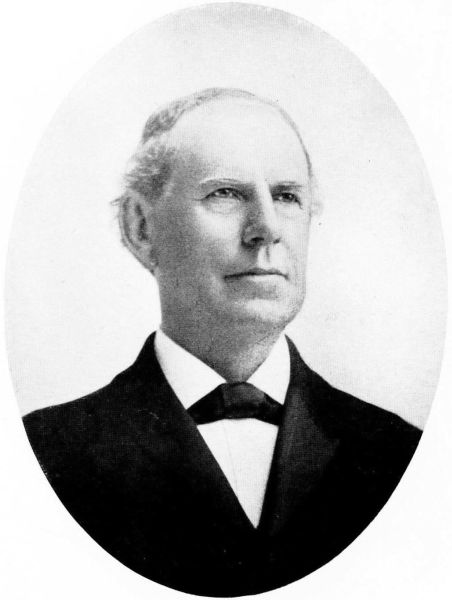
The Rev. T. De Witt Talmage, D.D.
The Rev. T. De Witt Talmage, D.D.
David And Catherine Talmage—parents Of Dr. T. De Witt Talmage
Dr. Talmage In His First Church, Belleville, New Jersey
Dr. Talmage As Chaplain Of The Thirteenth Regiment Of New York
The First Presbyterian Church, Washington, D.C.
I write this story of my life, first of all for my children. How much would I now give for a full account of my father's life written by his own hand! That which merely goes from lip to ear is apt to be soon forgotten. The generations move on so rapidly that events become confused. I said to my son, "Do you remember that time in Philadelphia, during the war, when I received a telegram saying several hundred wounded soldiers would arrive next day, and we suddenly extemporised a hospital and all turned in to the help of the suffering soldiers?" My son's reply was, "My memory of that occurrence is not very distinct, as it took place six years before I was born." The fact is that we think our children know many things concerning which they know nothing at all.
But, outside my own family, I am sure that there are many who would like to read about what I have been doing, thinking, enjoying, and hoping all these years; for through the publication of my entire Sermons, as has again and again been demonstrated, I have been brought into contact with the minds of more people, and for a longer time, than most men. This I mean not in boast, but as a reason for thinking that this autobiography may have some attention outside of my own circle, and I mention it also in gratitude to God, Who has for so long a time given me this unlimited and almost miraculous opportunity.
Each life is different from every other life. God never repeats Himself, and He never intended two men to be alike, or two women to be alike, or two children to be alike. This infinite variety of character and experience makes the story of any life interesting, if that story be clearly and accurately told.
I am now in the full play of my faculties, and without any apprehension of early departure, not having had any portents, nor seen the moon over my left shoulder, nor had a salt-cellar upset, nor seen a bat fly into the window, nor heard a cricket chirp from the hearth, nor been one of thirteen persons at a table. But my common sense, and the family record, and the almanac tell me it must be "towards evening."
Our family Bible, in the record just between the Old and the New Testaments, has this entry: "Thomas DeWitt, Born January 7, 1832." I was the youngest of a family of twelve children, all of whom lived to grow up except the first, and she was an invalid child.
I was the child of old age. My nativity, I am told, was not heartily welcomed, for the family was already within one of a dozen, and the means of support were not superabundant. I arrived at Middlebrook, New Jersey, while my father kept the toll-gate, at which business the older children helped him, but I was too small to be of service. I have no memory of residence there, except the day of departure, and that only emphasised by the fact that we left an old cat which had purred her way into my affections, and separation from her was my first sorrow, so far as I can remember.
In that home at Middlebrook, and in the few years after, I went through the entire curriculum of infantile ailments. The first of these was scarlet fever, which so nearly consummated its fell work on me that I was given up by the doctors as doomed to die, and, according to custom in those times in such a case, my grave clothes were completed, the neighbours gathering for that purpose. During those early years I took such a large share of epidemics that I have never been sick since with anything worthy of being called illness. I never knew or heard of anyone who has had such remarkable and unvarying health as I have had, and I mention it with gratitude to God, in whose "hand our breath is, and all our ways."
The "grippe," as it is called, touched me at Vienna when on my way from the Holy Land, but I felt it only half a day, and never again since.
I often wonder what has become of our old cradle in which all of us children were rocked! We were a large family, and that old cradle was going a good many years. I remember just how it looked. It was old-fashioned and had no tapestry. Its two sides and canopy were of plain wood, but there was a great deal of sound sleeping in that cradle, and many aches and pains were soothed in it. Most vividly I remember that the rockers, which came out from under the cradle, were on the top and side very smooth, so smooth that they actually glistened. But it went right on and rocked for Phoebe the first, and for DeWitt the last.
There were no lords or baronets or princes in our ancestral line. None wore stars, cockade, or crest. There was once a family coat-of-arms, but we were none of us wise enough to tell its meaning. Do our best, we cannot find anything about our forerunners except that they behaved well, came over from Wales or Holland a good while ago, and died when their time came. Some of them may have had fine equipages and postilions, but the most of them were sure only of footmen. My father started in life belonging to the aristocracy of hard knuckles and homespun, but had this high honour that no one could despise: he was the son of a father who loved God and kept His commandments. Two eyes, two hands, and two feet were the capital my father started with.
Benignity, kindness, keen humour, broad common sense and industry characterised my mother. The Reverend Dr. Chambers was for many years her pastor. He had fifty years of pastorate service, in Somerville, N.J., and the Collegiate Church, New York. He said, in an address at the dedication of the Brooklyn Tabernacle, that my mother was the most consecrated Christian person he had ever known. My mother worked very hard, and when we would come in and sit down at the table at noon, I remember how she used to look. There were beads of perspiration along the line of her grey hair, and sometimes she would sit down at the table, and put her head against her wrinkled hand and say, "Well, the fact is, I'm too tired to eat."
My father was a religious, hard-working, honest man. Every day began and closed with family worship, led by my father, or, in case of his absence, by Mother. That which was evidently uppermost in the minds of my parents, and that which was the most pervading principle in their lives, was the Christian religion. The family Bible held a perfect fascination for me, not a page that was not discoloured either with time or tears. My parents read out of it as long as I can remember. When my brother Van Nest died in a foreign land, and the news came to our country home, that night they read the eternal consolations out of the old book. When my brother David died that book comforted the old people in their trouble. My father in mid-life, fifteen years an invalid, out of that book read of the ravens that fed Elijah all through the hard struggle for bread. When my mother died that book illumined the dark valley. In the years that followed of loneliness, it comforted my father with the thought of reunion, which took place afterward in Heaven.
To the wonderful conversion of my grandfather and grandmother, in those grand old days of our declaration of independence, I trace the whole purpose, trend, and energies of my life. I have told the story of the conversion of my grandfather and grandmother before. I repeat it here, for my children.
My grandfather and grandmother went from Somerville to Baskenridge to attend revival meetings under the ministry of Dr. Finney. They were so impressed with the meetings that when they came back to Somerville they were seized upon by a great desire for the salvation of their children. That evening the children were going off for a gay party, and my grandmother said to the children, "When you get all ready for the entertainment, come into my room; I have something very important to tell you." After they were all ready they came into my grandmother's room, and she said to them, "Go and have a good time, but while you are gone I want you to know I am praying for you and will do nothing but pray for you until you get back." They did not enjoy the entertainment much because they thought all the time of the fact that Mother was praying for them. The evening passed. The next day my grandparents heard sobbing and crying in the daughter's room, and they went in and found her praying for the salvation of God, and her daughter Phoebe said, "I wish you would go to the barn and to the waggon-house for Jehiel and David (the brothers) are under powerful conviction of sin." My grandparent went to the barn, and Jehiel, who afterward became a useful minister of the Gospel, was imploring the mercy of Christ; and then, having first knelt with him and commended his soul to Christ, they went to the waggon-house, and there was David crying for the salvation of his soul—David, who afterward became my father. David could not keep the story to himself, and he crossed the fields to a farmhouse and told one to whom he had been affianced the story of his own salvation, and she yielded her heart to God. The story of the converted household went all through the neighbourhood. In a few weeks two hundred souls stood up in the plain meeting house at Somerville to profess faith in Christ, among them David and Catherine, afterward my parents.
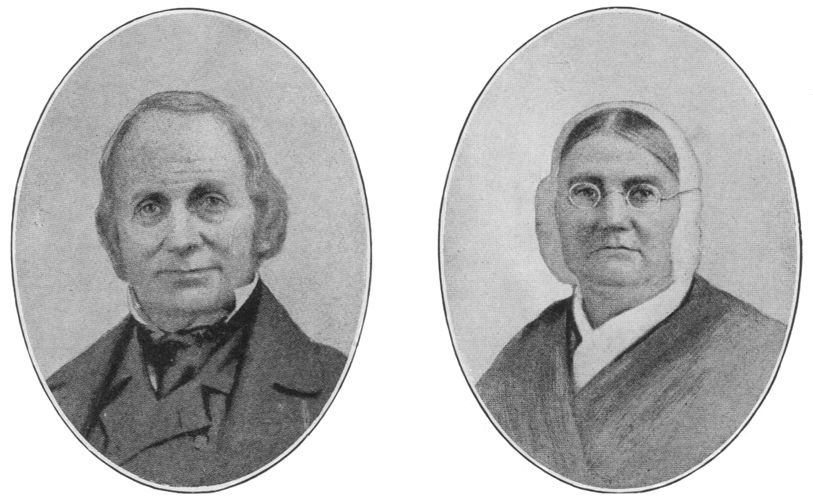 | |
| David Talmage | Catherine Talmage |
| (The Parents of Dr. T. DeWitt Talmage) | |
My mother, impressed with that, in after life, when she had a large family of children gathered around her, made a covenant with three neighbours, three mothers. They would meet once a week to pray for the salvation of their children until all their children were converted—this incident was not known until after my mother's death, the covenant then being revealed by one of the survivors. We used to say: "Mother, where are you going?" and she would say, "I am just going out a little while; going over to the neighbours." They kept on in that covenant until all their families were brought into the kingdom of God, myself the last, and I trace that line of results back to that evening when my grandmother commended our family to Christ, the tide of influence going on until this hour, and it will never cease.
My mother died in her seventy-sixth year. Through a long life of vicissitude she lived harmlessly and usefully, and came to her end in peace. We had often heard her, when leading family prayers in the absence of my father, say, "O Lord, I ask not for my children wealth or honour, but I do ask that they all may be the subjects of Thy converting grace." Her eleven children brought into the kingdom of God, she had but one more wish, and that was that she might see her long-absent missionary son, and when the ship from China anchored in New York harbour, and the long-absent one passed over the threshold of his paternal home, she said, "Lord, now lettest Thou Thy servant depart in peace, for mine eyes have seen Thy salvation." The prayer was soon answered.
My father, as long as I can remember, was an elder in churches. He conducted prayer-meetings in the country, when he was sometimes the only man to take part, giving out a hymn and leading the singing; then reading the Scriptures and offering prayer; then giving out another hymn and leading in that; and then praying again; and so continuing the meeting for the usual length of time, and with no lack of interest.
When the church choir would break down, everybody looked around to see if he were not ready with "Woodstock," "Mount Pisgah" or "Uxbridge." And when all his familiar tunes failed to express the joy of his soul, he would take up his own pen, draw five long lines across the sheet, put in the notes, and then to the tune he called "Bound Brook," begin to sing:
He knew about all the cheerful tunes that were ever printed in old "New Brunswick Collection," and the "Shunway," and the sweetest melodies that Thomas Hastings ever composed. He took the pitch of sacred song on Sabbath morning, and kept it through all the week.
My father was the only person whom I ever knew without any element of fear. I do not believe he understood the sensation.
Seated in a waggon one day during a runaway that every moment threatened our demolition, he was perfectly calm. He turned around to me, a boy of seven years, and said, "DeWitt, what are you crying about? I guess we can ride as fast as they can run."
There was one scene I remember, that showed his poise and courage as nothing else could. He was Sheriff of Somerset County, N.J., and we lived in the court house, attached to which was the County Jail. During my father's absence one day a prisoner got playing the maniac, dashing things to pieces, vociferating horribly, and flourishing a knife with which he had threatened to carve any one who came near the wicket of his prison, Constables were called in to quell this real or dramatised maniac, but they fell back in terror from the door of the prison. Their show of firearms made no impression upon the demented wretch. After awhile my father returned and was told of the trouble, and indeed he heard it before he reached home. The whole family implored him not to go near the man who was cursing, and armed with a knife. But father could not be deterred. He did not stand outside the door and at a safe distance, but took the key and opened the door, and without any weapon of defence came upon the man, thundering at him, "Sit down and give me that knife!" The tragedy was ended. I never remember to have heard him make a gloomy remark. This was not because he had no perception of the pollutions of society. I once said to my father, "Are people so much worse now than they used to-be?" He made no answer for a minute, for the old people do not like to confess much to the boys. But after awhile his eye twinkled and he said: "Well, DeWitt, the fact is that people were never any better than they ought to be."
Ours was an industrious home. I was brought up to regard laziness as an abominable disease. Though we were some years of age before we heard the trill of a piano, we knew well all about the song of "The Spinning-Wheel."
Through how many thrilling scenes my father had passed! He stood, at Morristown, in the choir that chanted when George Washington was buried; talked with young men whose fathers he had held on his knee; watched the progress of John Adams's administration; denounced, at the time, Aaron Burr's infamy; heard the guns that celebrated the New Orleans victory; voted against Jackson, but lived long enough to wish we had another just like him; remembered when the first steamer struck the North river with its wheel-buckets; was startled by the birth of telegraphy; saw the United States grow from a speck on the world's map till all nations dip their flag at our passing merchantmen. He was born while the Revolutionary cannon were coming home from Yorktown, and lived to hear the tramp of troops returning from the war of the great Rebellion. He lived to speak the names of eighty children, grand-children and great-grand-children. He died just three years from the day when my mother sped on.
When my father lay dying the old country minister said to him, "Mr. Talmage, how do you feel now as you are about to pass the Jordan of death?" He replied—and it was the last thing he ever said—"I feel well; I feel very well; all is well"—lifting his hand in a benediction, a speechless benediction, which I pray God may go down through all the generations—"It is well!"
Four of his sons became ministers of the Gospel: Reverend James R. Talmage, D.D., who was preaching before I was born, and who died in 1879; Reverend John Van Nest Talmage, D.D., who spent his life as a missionary in China, and died in the summer of 1892; Reverend Goyn Talmage, D.D., who after doing a great work for God, died in 1891. But all my brothers and sisters were decidedly Christian, lived usefully and died peacefully.
I rejoice to remember that though my father lived in a plain house the most of his days, he died in a mansion provided by the filial piety of his son who had achieved a fortune.
The house at Gateville, near Bound Brook, in which I was born, has gone down. Not one stone has been left upon another. I one day picked up a fragment of the chimney, or wall, and carried it home. But the home that I associate with my childhood was about three miles from Somerville, N.J. The house, the waggon-shed, the barn, are now just as I remember them from childhood days. It was called "Uncle John's Place" from the fact that my mother's uncle, John Van Nest, owned it, and from him my father rented it "on shares." Here I rode the horse to brook. Here I hunted for and captured Easter eggs. Here the natural world made its deepest impression on me. Here I learned some of the fatigues and hardships of the farmer's life—not as I felt them, but as my father and mother endured them. Here my brother Daniel brought home his bride. From here I went to the country school. Here in the evening the family were gathered, mother knitting or sewing, father vehemently talking politics or religion with some neighbour not right on the subject of the tariff, or baptism, and the rest of us reading or listening. All the group are gone except my sister Catherine and myself.
My childhood, as I look back upon it, is to me a mystery. While I always possessed a keen sense of the ludicrous, and a hearty appreciation of fun of all sorts, there was a sedate side of my nature that demonstrated itself to the older members of the family, and of which they often spoke. For half days, or whole days, at a time I remember sitting on a small footstool beside an ordinary chair on which lay open "Scott's Commentaries on the Bible." I not only read the Scriptures out of this book, but long discourses of Thomas Scott, and passages adjoining. I could not have understood much of these profound and elaborate commentaries. They were not written or printed for children, but they had for my childish mind a fascination that kept me from play, and from the ordinary occupations of persons of my years.
So, also, it was with the religious literature of the old-fashioned kind, with which some of the tables of my father's house were piled. Indeed, when afterwards I was living at my brothers' house, he a clergyman, I read through and through and through the four or five volumes of Dwight's "Theology," which must have been a wading-in far beyond my depth. I think if I had not possessed an unusual resiliency of temperament, the reading and thinking so much of things pertaining to the soul and a future state would have made me morbid and unnatural. This tendency to read and think in sacred directions was not a case of early piety. I do not know what it was. I suppose in all natures there are things inexplicable. How strange is the phenomenon of childhood days to an old man!
How well I remember Sanderson's stage coach, running from New Brunswick to Easton, as he drove through Somerville, New Jersey, turning up to the post-office and dropping the mail-bags with ten letters and two or three newspapers! On the box Sanderson himself, six feet two inches, and well proportioned, long lash-whip in one hand, the reins of six horses in the other, the "leaders" lathered along the lines of the traces, foam dripping from the bits! It was the event of the day when the stage came. It was our highest ambition to become a stage-driver. Some of the boys climbed on the great leathern boot of the stage, and those of us who could not get on shouted "Cut behind!" I saw the old stage-driver not long ago, and I expressed to him my surprise that one around whose head I had seen a halo of glory in my boyhood time was only a man like the rest of us. Between Sanderson's stage-coach and a Chicago express train, what a difference!
And I shall always marvel at our family doctor. Dear old Dr. Skillman! My father's doctor, my mother's doctor, in the village home! He carried all the confidences of all the families for ten miles around. We all felt better as soon as we saw him enter the house. His face pronounced a beatitude before he said a word. He welcomed all of us children into life, and he closed the old people's eyes.
When moving out of a house I have always been in the habit, after everything was gone, of going into each room and bidding it a mute farewell. There are the rooms named after the different members of the family. I suppose it is so in all households. It was so in mine; we named the rooms after the persons who occupied them. I moved from the house of my boyhood with a sort of mute affection for its remembrances that are most vivid in its hours of crisis and meditation. Through all the years that have intervened there is no holier sanctuary to me than the memory of my mother's vacant chair. I remember it well. It made a creaking noise as it moved. It was just high enough to allow us children to put our heads into her lap. That was the bank where we deposited all our hurts and worries.
Some time ago, in an express train, I shot past that old homestead. I looked out of the window and tried to peer through the darkness. While I was doing so, one of my old schoolmates, whom I had not seen for many years, tapped me on the shoulder, and said: "DeWitt, I see you are looking out at the scenes of your boyhood."
"Oh, yes," I replied, "I was looking out at the old place where my mother lived and died."
I pass over the boyhood days and the country school. The first real breath of life is in young manhood, when, with the strength of the unknown, he dares to choose a career. I first studied for the law, at the New York University.
New York in 1850 was a small place compared to the New York of to-day, but it had all the effervescence and glitter of the entire country even then. I shall never forget the excitement when on September 1st, 1850, Jenny Lind landed from the steamer "Atlantic." Not merely because of her reputation as a singer, but because of her fame for generosity and kindness were the people aroused to welcome her. The first $10,000 she earned in America she devoted to charity, and in all the cities of America she poured forth her benefactions. Castle Garden was then the great concert hall of New York, and I shall never forget the night of her first appearance. I was a college boy, and Jenny Lind was the first great singer I ever heard. There were certain cadences in her voice that overwhelmed the audience with emotion. I remember a clergyman sitting near me who was so overcome that he was obliged to leave the auditorium. The school of suffering and sorrow had done as much for her voice as the Academy of Stockholm.
The woman who had her in charge when a child used to lock her in a room when she went off to the daily work. There by the hour Jenny would sit at the window, her only amusement singing, while she stroked her cat on her lap. But sitting there by the window her voice fell on a listener in the street. The listener called a music master to stand by the same window, and he was fascinated and amazed, and took the child to the director of the Royal Opera, asking for her the advantages of musical education, and the director roughly said: "What shall we do with that ugly thing? See what feet she has. And, then, her face; she will never be presentable. No, we can't take her. Away with her!" But God had decreed for this child of nature a grand career, and all those sorrows were woven into her faculty of song. She never could have been what she became, royally arrayed on the platforms of Berlin and Vienna and Paris and London and New York, had she not first been the poor girl in the garret at Stockholm. She had been perfected through suffering. That she was genuinely Christian I prove not more from her charities than from these words which she wrote in an album during her triumphal American tour:
There never was anyone who could equal Jenny Lind in the warble. Some said it was like a lark, but she surpassed the lark. Oh, what a warble! I hear it yet. All who heard it thirty-five years ago are hearing it yet.
I should probably have been a lawyer, except for the prayers of my mother and father that I should preach the Gospel. Later, I entered the New Brunswick Theological Seminary. Why I ever thought of any other work in the world than that which I have done, is another mystery of my youth. Everything in my heredity and in my heart indicated my career as a preacher. And yet, in the days of my infancy I was carried by Christian parents to the house of God, and consecrated in baptism to the Father, and the Son, and the Holy Ghost; but that did not save me. In after time I was taught to kneel at the Christian family altar with father and mother and brothers and sisters. In after time I read Doddridge's "Rise and Progress," and Baxter's "Call to the Unconverted," and all the religious books around my father's household; but that did not save me. But one day the voice of Christ came into my heart saying, "Repent, repent; believe, believe," and I accepted the offer of mercy.
It happened this way: Truman Osborne, one of the evangelists who went through this country some years ago, had a wonderful art in the right direction. He came to my father's house one day, and while we were all seated in the room, he said: "Mr. Talmage, are all your children Christians?" Father said: "Yes, all but De Witt." Then Truman Osborne looked down into the fireplace, and began to tell a story of a storm that came on the mountains, and all the sheep were in the fold; but there was one lamb outside that perished in the storm. Had he looked me in the eye, I should have been angered when he told me that story; but he looked into the fireplace, and it was so pathetically and beautifully done that I never found any peace until I was inside the fold, where the other sheep are.
When I was a lad a book came out entitled "Dow Junior's Patent Sermons"; it made a great stir, a very wide laugh all over the country, that book did. It was a caricature of the Christian ministry and of the Word of God and of the Day of Judgment. Oh, we had a great laugh! The commentary on the whole thing is that the author of that book died in poverty, shame, debauchery, kicked out of society.
I have no doubt that derision kept many people out of the ark. The world laughed to see a man go in, and said, "Here is a man starting for the ark. Why, there will be no deluge. If there is one, that miserable ship will not weather it. Aha! going into the ark! Well, that is too good to keep. Here, fellows, have you heard the news? This man is going into the ark." Under this artillery of scorn the man's good resolution perished.
I was the youngest of a large family of children. My parents were neither rich nor poor; four of the sons wanted collegiate education, and four obtained it, but not without great home-struggle. The day I left our country home to look after myself we rode across the country, and my father was driving. He began to tell how good the Lord had been to him, in sickness and in health, and when times of hardship came how Providence had always provided the means of livelihood for the large household; and he wound up by saying, "De Witt, I have always found it safe to trust the Lord." I have felt the mighty impetus of that lesson in the farm waggon. It has been fulfilled in my own life and in the lives of many consecrated men and women I have known.
In the minister's house where I prepared for college there worked a man by the name of Peter Croy. He could neither read nor write, but he was a man of God. Often theologians would stop in the house—grave theologians—and at family prayer Peter Croy would be called upon to lead; and all those wise men sat around, wonder-struck at his religious efficiency.
In the church at Somerville, New Jersey, where I was afterwards pastor, John Vredenburgh preached for a great many years. He felt that his ministry was a failure, and others felt so, although he was a faithful minister preaching the Gospel all the time. He died, and died amid some discouragements, and went home to God; for no one ever doubted that John Vredenburgh was a good Christian minister. A little while after his death there came a great awakening in Somerville, and one Sabbath two hundred souls stood up at the Christian altar espousing the cause of Christ, among them my own father and mother. And what was peculiar in regard to nearly all of those two hundred souls was that they dated their religious impressions from the ministry of John Vredenburgh.
I had no more confidence in my own powers when I was studying for the ministry than John Vredenburgh. I was often very discouraged. "DeWitt," said a man to me as we were walking the fields at the time I was in the theological school, "DeWitt, if you don't change your style of thought and expression, you will never get a call to any church in Christendom as long as you live." "Well," I replied, "if I cannot preach the Gospel in America, then I will go to heathen lands and preach it." I thought I might be useful on heathen ground, if I could ever learn the language of the Chinese, about which I had many forebodings. The foreign tongue became to me more and more an obstacle and a horror, until I resolved if I could get an invitation to preach in the English language, I would accept it. So one day, finding Rev. Dr. Van Vranken, one of our theological professors (blessed be his memory), sauntering in the campus of Rutgers College, I asked him, with much trepidation, if he would by letter introduce me to some officer of the Reformed Church at Belleville, N.J., the pulpit of which was then vacant. With an outburst of heartiness he replied: "Come right into my house, and I will give you the letter now." It was a most generous introduction of me to Dr. Samuel Ward, a venerable elder of the Belleville church. I sent the letter to the elder, and within a week received an invitation to occupy the vacant pulpit.
I had been skirmishing here and there as a preacher, now in the basement of churches at week-night religious meetings, and now in school-houses on Sunday afternoons, and here and there in pulpits with brave pastors who dared risk having an inexperienced theological student preach to their people.
But the first sermon with any considerable responsibility resting upon it was the sermon preached as a candidate for a pastoral call in the Reformed Church at Belleville, N.J. I was about to graduate from the New Brunswick Theological Seminary, and wanted a Gospel field in which to work. I had already written to my brother John, a missionary at Amoy, China, telling him that I expected to come out there.
I was met by Dr. Ward at Newark, New Jersey, and taken to his house. Sabbath morning came. With one of my two sermons, which made up my entire stock of pulpit resources, I tremblingly entered the pulpit of that brown stone village church, which stands in my memory as one of the most sacred places of all the earth, where I formed associations which I expect to resume in Heaven.
The sermon was fully written, and was on the weird battle between the Gideonites and Midianites, my text being in Judges vii. 20, 21: "The three companies blew the trumpets, and brake the pitchers, and held the lamps in their left hands, and the trumpets in their right hands to blow withal; and they cried, The sword of the Lord, and of Gideon. And they stood every man in his place round about the camp; and all the host ran, and cried, and fled." A brave text, but a very timid man to handle it. I did not feel at all that hour either like blowing Gideon's trumpet, or holding up the Gospel lamp; but if I had, like any of the Gideonites, held a pitcher, I think I would have dropped it and broken that lamp. I felt as the moment approached for delivering my sermon more like the Midianites, who, according to my text, "ran, and cried, and fled." I had placed the manuscript of my sermon on the pulpit sofa beside where I sat. Looking around to put my hand on the manuscript, lo! it was gone. But where had it gone? My excitement knew no bound. Within three minutes of the greatest ordeal of my life, and the sermon on which so much depended mysteriously vanished! How much disquietude and catastrophe were crowded into those three minutes it would be impossible to depict. Then I noticed for the first time that between the upper and lower parts of the sofa there was an opening about the width of three finger-breadths, and I immediately suspected that through that opening the manuscript of my sermon had disappeared. But how could I recover it, and in so short a time? I bent over and reached under as far as I could. But the sofa was low, and I could not touch the lost discourse. The congregation were singing the last verse of the hymn, and I was reduced to a desperate effort. I got down on my hands and knees, and then down flat, and crawled under the sofa and clutched the prize. Fortunately, the pulpit front was wide, and hid the sprawling attitude I was compelled to take. When I arose to preach a moment after, the fugitive manuscript before me on the Bible, it is easy to understand why I felt more like the Midianites than I did like Gideon.
This and other mishaps with manuscripts helped me after a while to strike for entire emancipation from such bondage, and for about a quarter of a century I have preached without notes—only a sketch of the sermon pinned in my Bible, and that sketch seldom referred to.
When I entered the ministry I looked very pale for years, for four or five years, many times I was asked if I had consumption; and, passing through the room, I would sometimes hear people sigh and say, "A-ah! not long for this world!" I resolved in those times that I never, in any conversation, would say anything depressing, and by the help of God I have kept the resolution.
The day for my final examination for a licence to preach the Gospel for ordination by the laying on of hands, and for installation as pastor for the Reformed Church of Belleville, N.J., had arrived. The examination as to my qualifications was to take place in the morning, and if the way proved clear, the ordination and installation were to be solemnised in the afternoon of the same day. The embarrassing thought was that members of the congregation were to be present in the morning, as well as the afternoon. If I made a mistake or failure under the severe scrutiny of the Ecclesiastical Court, I would ever after be at a great disadvantage in preaching to those good people.
It so happened, however, that the Classis, as the body of clergy were called, was made up mostly of genial, consecrated persons, and no honest young man would suffer anything at their hands. Although I was exceedingly nervous, and did not do myself justice, and no doubt appeared to know less than I really did know, all went well until a clergyman, to whom I shall give the fictitious name of "Dr. Hardman," took me in hand. This "Dr. Hardman" had a dislike for me. He had once wanted me to do something for him and take his advice in matters of a pastoral settlement, which I had, for good reasons, declined to take. I will not go further into the reasons of this man's antipathy, lest someone should know whom I mean. One thing was certain to all present, and that was his wish to defeat my installation as pastor of that church, or make it to me a disagreeable experience.
As soon as he opened upon me a fire of interrogations, what little spirit I had in me dropped. In the agitation I could not answer the simplest questions. But he assailed me with puzzlers. He wanted to know, among other things, if Christ's atonement availed for other worlds; to which I replied that I did not know, as I had never studied theology in any world but this. He hooked me with the horns of a dilemma. A Turkish bath, with the thermometer up to 113, is cool compared to the perspiration into which he threw me. At this point Rev. James W. Scott, D.D. (that was his real name, and not fictitious) arose. Dr. Scott was a Scotchman of about 65 years of age. He had been a classmate of the remarkable Scottish poet, Robert Pollock. The Doctor was pastor of a church at Newark, N.J. He was the impersonation of kindness, and generosity, and helpfulness. The Gospel shone from every feature. I never saw him under any circumstances without a smile on his face. He had been on the Mount of Transfiguration, and the glory had never left his countenance.
I calculate the value of the soul by its capacity for happiness. How much joy it can get in this world—out of friendships, out of books, out of clouds, out of the sea, out of flowers, out of ten thousand things! Yet all the joy it has here does not test its capacity.
As Dr. Scott rose that day he said, "Mr. President, I think this examination has gone on long enough, and I move it be stopped, and that the examination be pronounced satisfactory, and that this young man be licensed to preach the Gospel, and that this afternoon we proceed to his ordination and installation." The motion was put and carried, and I was released from a Protestant purgatory.
But the work was not yet done. By rule of that excellent denomination, of which I was then a member, the call of a church must be read and approved before it can be lawfully accepted. The call from that dear old church at Belleville was read, and in it I was provided with a month's summer vacation. Dr. Hardman rose, and said that he thought that a month was too long a vacation, and he proposed two weeks. Then Dr. Scott arose and said, if any change were made he would have the vacation six weeks; "For," said he, "that young man does not look very strong physically, and I believe he should have a good long rest every summer." But the call was left as it originally read, promising me a month of recuperation each year.
At the close of that meeting of Classis, Dr. Scott came up to me, took my right hand in both his hands, and said, "I congratulate you on the opportunity that opens here. Do your best, and God will see you through; and if some Saturday night you find yourself short of a sermon, send down to Newark, only three miles, and I will come up and preach for you." Can anyone imagine the difference of my appreciation of Dr. Hardman and Dr. Scott?
Only a few weeks passed on, and the crisis that Dr. Scott foresaw in my history occurred, and Saturday night saw me short of a sermon. So I sent a messenger to Dr. Scott. He said to the messenger, "I am very tired; have been holding a long series of special services in my church, but that young Talmage must be helped, and I will preach for him to-morrow night." He arrived in time, and preached a glowing and rousing sermon on the text, "Have ye received the Holy Ghost?" As I sat behind him in the pulpit and looked upon him I thought, "What a magnificent soul you are! Tired out with your own work, and yet come up here to help a young man to whom you are under no obligation!" Well, that was the last sermon he ever preached. The very next Saturday he dropped dead in his house. Outside of his own family no one was more broken-hearted at his obsequies than myself, to whom he had, until the meeting of Classis, been a total stranger.
I stood at his funeral in the crowd beside a poor woman with a faded shawl and worn-out hat, who was struggling up to get one look at the dear old face in the coffin. She was being crowded back. I said, "Follow me, and you shall see him." So I pushed the way up for her as well as myself, and when we got up to the silent form she burst out crying, and said, "That is the last friend I had in the world."
Dr. Hardman lived on. He lived to write a letter when I was called to Syracuse, N.Y., a letter telling a prominent officer of the Syracuse Church that I would never do at all for their pastor. He lived on until I was called to Philadelphia, and wrote a letter to a prominent officer in the Philadelphia Church telling them not to call me. Years ago he went to his rest. But the two men will always stand in my memory as opposites in character. The one taught me a lesson never to be forgotten about how to treat a young man, and the other a lesson about how not to treat a young man. Dr. Scott and Dr. Hardman, the antipodes!
So my first settlement as pastor was in the village of Belleville, N.J. My salary was eight hundred dollars and a parsonage. The amount seemed enormous to me. I said to myself: "What! all this for one year?" I was afraid of getting worldly under so much prosperity! I resolved to invite all the congregation to my house in groups of twenty-five each. We [A] began, and as they were the best congregation in all the world, and we felt nothing was too good for them, we piled all the luxuries on the table. I never completed the undertaking. At the end of six months I was in financial despair. I found that we not only had not the surplus of luxuries, but we had a struggle to get the necessaries.
Although the first call I ever had was to Piermont, N.Y., my first real work began in the Reformed Church of Belleville, N.J. I preached at Piermont in the morning, and at the Congregational meeting held in the afternoon of the same day it was resolved to invite me to become pastor. But for the very high hill on which the parsonage was situated I should probably have accepted. I was delighted with the congregation, and with the grand scenery of that region.
I was ordained to the Gospel Ministry and installed as pastor July 29th, 1856, my brother Goyn preaching the sermon from the text, First Corinthians iii. 12, 13. Reverend Dr. Benjamin C. Taylor, the oldest minister present, offered the ordaining prayer, and about twenty hands were laid upon my head. All these facts are obtained from a memorandum made by a hand that long since forgot its cunning and kindness. The three years passed in Belleville were years of hard work. The hardest work in a clergyman's lifetime is during the first three years. No other occupation or profession puts such strain upon one's nerves and brain. Two sermons and a lecture per week are an appalling demand to make upon a young man. Most of the ministers never get over that first three years. They leave upon one's digestion or nervous system a mark that nothing but death can remove. It is not only the amount of mental product required of a young minister, but the draft upon his sympathies and the novelty of all that he undertakes; his first sermon; his first baptism; his first communion season; his first pastoral visitation; his first wedding; his first funeral.
My first baptism was of Lily Webster, a black-eyed baby, who grew up to be as beautiful a woman as she was a child.
I baptised her. Rev. Dr. John Dowling, of the Baptist Church, New York, preached for me and my church his great sermon on, "I saw a great multitude which no man could number, of all nations, and kindreds, and people, and tongues, clothed in white robes." In my verdancy I feared that the Doctor, who did not believe in the baptism of infants, might take it for a personal affront that I had chosen that evening for this my first baptism.
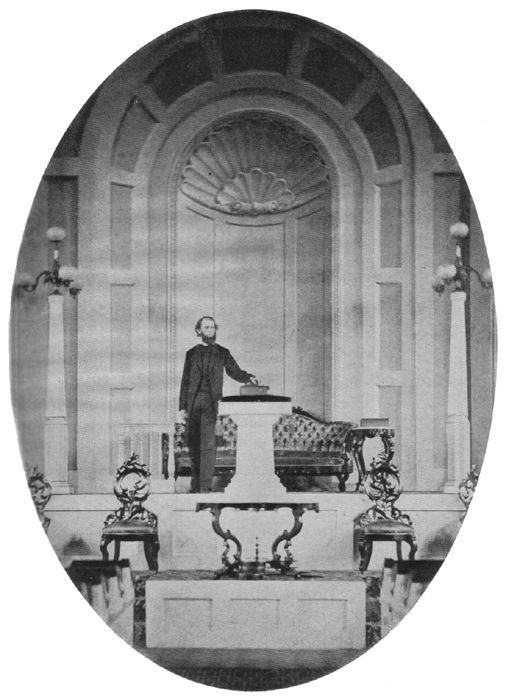
T. DeWitt Talmage in his First Church, Belleville, New Jersey
Sometimes at the baptism of children, while I have held up one hand in prayer, I have held up the other in amazement that the parents should have weighted the babe with such a dissonant and repulsive nomenclature. I have not so much wondered that some children should cry out at the Christening font, as that others with such smiling faces should take a title that will be the burden of their lifetime. It is no excuse because they are Scriptural names to call a child Jehoiakim, or Tiglath Pileser. I baptised one by the name of Bathsheba. Why, under all the circumambient heaven, any parent should want to give a child the name of that loose creature of Scripture times, I cannot imagine. I have often felt at the baptismal altar when names were announced somewhat like saying, as did the Rev. Dr. Richards, of Morristown, New Jersey, when a child was handed to him for baptism, and the names given, "Hadn't you better call it something else?"
On this occasion I had adopted the theory, which I long since abandoned, that an officiating clergyman at baptism should take the child in his arms. Now, there are many ministers who do not know how to hold a baby, and they frighten the child and increase the anxiety of the mother, and may create a riot all along the line if there be other infants waiting for the ceremony.
After reading the somewhat prolonged liturgy of the dear old Reformed Church, I came down from the pulpit and took the child in my arms. She was, however, far more composed than myself, and made no resistance; but the overpowering sensation attached to the first application of the holy chrism is a vivid and everlasting memory.
Then, the first pastoral visitation! With me it was at the house of a man suffering from dropsy in the leg. He unbandaged the limb and insisted upon my looking at the fearful malady. I never could with any composure look at pain, and the last profession in all the world suited to me would have been surgery. After praying with the man and offering him Scriptural condolence, I started for home.
My wife met me with anxious countenance, and said, "How did you get hurt, and what is the matter?" The sight of the lame leg had made my leg lame, and unconsciously I was limping on the way home.
But I had quite another experience with a parishioner. He was a queer man, and in bad odour in the community. Some time previously his wife had died, and although a man of plenty of means, in order to economise on funeral expenses, he had wheeled his wife to the grave on a wheelbarrow. This economy of his had not led the village to any higher appreciation of the man's character. Having been told of his inexpensive eccentricities, I was ready for him when one morning he called at the parsonage. As he entered he began by saying: "I came in to say that I don't like you." "Well," I said, "that is a strange coincidence, for I cannot bear the sight of you. I hear that you are the meanest man in town, and that your neighbours despise you. I hear that you wheeled your wife on a wheelbarrow to the graveyard." To say the least, our conversation that day was unique and spirited, and it led to his becoming a most ardent friend and admirer. I have had multitudes of friends, but I have found in my own experience that God so arranged it that the greatest opportunities of usefulness that have been opened before me were opened by enemies. And when, years ago, they conspired against me, their assault opened all Christendom to me as a field in which to preach the Gospel. So you may harness your antagonists to your best interests and compel them to draw you on to better work. He allowed me to officiate at his second marriage, did this mine enemy. All the town was awake that night. They had somehow heard that this economist at obsequies was to be remarried. Well, I was inside his house trying, under adverse circumstances, to make the twain one flesh. There were outside demonstrations most extraordinary, and all in consideration of what the bridegroom had been to that community. Horns, trumpets, accordions, fiddles, fire-crackers, tin pans, howls, screeches, huzzas, halloos, missiles striking the front door, and bedlam let loose! Matters grew worse as the night advanced, until the town authorities read the Riot Act, and caused the only cannon belonging to the village to be hauled out on the street and loaded, threatening death to the mob if they did not disperse. Glad am I to say that it was only a farce, and no tragedy. My mode of first meeting this queer man was a case in which it is best to fight fire with fire. I remember also the first funeral. It nearly killed me. A splendid young man skating on the Passaic River in front of my house had broken through the ice, and his body after many hours had been grappled from the water and taken home to his distracted parents. To be the chief consoler in such a calamity was something for which I felt completely incompetent. When in the old but beautiful church the silent form of the young man whom we all loved rested beneath the pulpit, it was a pull upon my emotions I shall never forget. On the way to the grave, in the same carriage with the eminent Reverend Dr. Fish, who helped in the services, I said, "This is awful. One more funeral like this will be the end of us." He replied, "You will learn after awhile to be calm under such circumstances. You cannot console others unless you preserve your own equipoise."
Those years at Belleville were to me memorable. No vacation, but three times a day I took a row on the river. Those old families in my congregation I can never forget—the Van Rensselaers, the Stevenses, the Wards. These families took us under their wing. At Mr. Van Rensselaer's we dined every Monday. It had been the habit of my predecessors in the pulpit. Grand old family! Their name not more a synonym for wealth than for piety. Mrs. Van Rensselaer was one of the saints clear up in the heaven of one's appreciation.
Wm. Stevens was an embodiment of generosity. He could not pray in public, or make a speech; but he could give money, and when he had plenty of it he gave in large sums, and when monetary disaster came, his grief was that he had nothing to give. I saw him go right through all the perturbations of business life. He was faithful to God. I saw him one day worth hundreds of thousands of dollars. I saw him the next day and he was not worth a farthing. Stevens! How plainly he comes before me as I think of the night in 1857 after the New York banks had gone down, and he had lost everything except his faith in God, and he was at the prayer meeting to lead the singing as usual! And, not noticing that from the fatigues of that awful financial panic he had fallen asleep, I arose and gave out the hymn, "My drowsy powers, why sleep ye so?" His wife wakened him, and he started the hymn at too high a pitch, and stopped, saying, "That is too high"; then started it at too low a pitch, and stopped, saying, "That is too low." It is the only mistake I ever heard him make. But the only wonder is that amid the circumstances of broken fortunes he could sing at all.
Dr. Samuel Ward! He was the angel of health for the neighbourhood. Before anyone else was up any morning, passing along his house you would see him in his office reading. He presided at the first nativity in my household. He it was that met me at the railroad station when I went to preach my first sermon as candidate, at Belleville. He medicated for many years nearly all the wounds for body and mind in that region. An elder in the Church, he could administer to the soul as well as to the perishable nature of his patients.
And the Duncans! Broad Scotch as they were in speech! I was so much with them that I got unconsciously some of the Scottish brogue in my own utterance. William, cautious and prudent; John, bold and venturesome—both so high in my affections! Among the first ones that I ask for in Heaven will be John and William Duncan.
Gasherie De Witt! He embodied a large part of the enterprise and enthusiasm of the place. He had his head full of railroads long before the first spike was driven for an iron pathway to the village. We were much together and ardently attached; went fishing together on long summer days, he catching the fish, and I watching the process. When we dedicated the first Brooklyn Tabernacle, he was present, and gave the money for building a baptistry in the pulpit, and gave besides $100 for his wife and each one of his children. When we parted from each other at Oxford, England, he to go to Geneva, Switzerland, to die, and I to come back to America, much of sweet acquaintanceship and complete confidence ended for this world, only to be taken up under celestial auspices.
But time and space would fail to tell of the noble men and women that stood around me in those early years of my ministry. They are all gone, and their personality makes up a large part of my anticipation of the world to come.
[A] While at Belleville Dr. Talmage married Miss Mary Avery, of Brooklyn, N.Y., by whom he had two children—a son, Thomas De Witt, and a daughter, Jessie. Mrs. Talmage was accidentally drowned in the Schuylkill River while Dr. Talmage was pastor of the Second Reformed Church of Philadelphia.
My first sermons were to me the most tremendous endeavours of my life, because I felt the awful responsibility of standing in a pulpit, knowing that a great many people would be influenced by what I said concerning God, or the soul, or the great future.
When I first began to preach, I was very cautious lest I should be misrepresented, and guarded the subject on all sides. I got beyond that point. I found that I got on better when, without regard to consequences, I threw myself upon the hearts and consciences of my hearers.
In those early days of my pastoral experience I saw how men reason themselves into scepticism. I knew what it was to have a hundred nights poured into one hour.
I remember one infidel book in the possession of my student companion. He said, "DeWitt, would you like to read that book?" "Well," said I, "I would like to look at it." I read it a little while. I said to him, "I dare not read that book; you had better destroy it. I give you my advice, you had better destroy it. I dare not read that book. I have read enough of it." "Oh," he said, "haven't you a stronger mind than that? Can't you read a book you don't exactly believe, and not be affected by it?" I said, "You had better destroy it." He kept it. He read it until he gave up the Bible; his belief in the existence of a God, his good morals; until body, mind and soul were ruined—and he went into the insane asylum. I read too much of it. I read about fifteen or twenty pages of it. I wish I had never read it. It never did me any good; it did me harm. I have often struggled with what I read in that book. I rejected it, I denounced it, I cast it out with infinite scorn, I hated it; yet sometimes its caricature of good and its eulogium of evil have troubled me.
With supreme gratitude, therefore, I remember the wonderful impression made upon me, when I was a young man, of the presence of a consecrated human being in the pulpit.
It was a Sabbath evening in spring at "The Trinity Methodist Church," Jersey City. Rev. William P. Corbit, the pastor of that church, in compliment to my relatives, who attended upon his services, invited me to preach for him. I had only a few months before entered the Gospel ministry, and had come in from my village settlement to occupy a place in the pulpit of the great Methodist orator. In much trepidation on my part I entered the church with Mr. Corbit, and sat trembling in the corner of the "sacred desk," waiting for the moment to begin the service. A crowded audience had assembled to hear the pastor of that church preach, and the disappointment I was about to create added to my embarrassment.
The service opened, and the time came to offer the prayer before sermon. I turned to Mr. Corbit and said, "I wish you would lead in prayer." He replied, "No! sharpen your own knife!" The whole occasion was to me memorable for its agitations. But there began an acquaintanceship that became more and more endearing and ardent as the years went by. After he ceased, through the coming on of the infirmities of age, to occupy a pulpit of his own, he frequented my church on the Sabbaths, and our prayer-meetings during the week. He was the most powerful exhorter I ever heard. Whatever might be the intensity of interest in a revival service, he would in a ten minute address augment it. I never heard him deliver a sermon except on two occasions, and those during my boyhood; but they made lasting impressions upon me. I do not remember the texts or the ideas, but they demonstrated the tremendous reality of spiritual and eternal things, and showed possibilities in religious address that I had never known or imagined.
He was so unique in manners, in pulpit oratory, and in the entire type of his nature, that no one will ever be able to describe what he was. Those who saw and heard him the last ten or fifteen years of his decadence can have no idea of his former power as a preacher of the Gospel.
There he is, as I first saw him! Eye like a hawk's. Hair long and straight as a Chippewa Indian's. He was not straight as an arrow, for that suggests something too fragile and short, but more like a column—not only straight, but tall and majestic, and capable of holding any weight, and without fatigue or exertion. When he put his foot down, either literally of figuratively, it was down. Vacillation, or fear, or incertitude, or indecision, were strangers to whom he would never be introduced. When he entered a room you were, to use a New Testament phrase, "exceedingly filled with his company."
He was as affectionate as a woman to those whom he liked, and cold as Greenland to those whose principles were an affront. He was not only a mighty speaker, but a mighty listener. I do not know how any man could speak upon any important theme, standing in his presence, without being set on fire by his alert sympathy.
But he has vanished from mortal sight. What the resurrection will do for him I cannot say. If those who have only ordinary stature and unimpressive physique in this world are at the last to have bodies resplendent and of supernal potency, what will the unusual corporiety of William P. Corbit become? In his case the resurrection will have unusual material to start with. If a sculptor can mould a handsome form out of clay, what can he not put out of Parian marble? If the blast of the trumpet which wakes the dead rouses life-long invalidism and emaciation into athletic celestialism, what will be the transfiguration when the sound of final reanimation touches the ear of those sleeping giants among the trees and fountains of Greenwood?
Good-bye, great and good and splendid soul! Good-bye, till we meet again! I will look around for you as soon as I come, if through the pardoning grace of Christ I am so happy as to reach the place of your destination. Meet me at the gate of the city; or under the tree of life on the bank of the river; or just inside of the door of the House of Many Mansions; or in the hall of the Temple which has no need of stellar or lunar or solar illumination, "For the Lamb is the Light thereof."
After three years of grace and happiness at Belleville I accepted a call to a church in Syracuse. My pastorate there, in the very midst of its most uplifting crisis, was interrupted, as I believe, by Divine orders. The ordeal of deciding anything important in my life has always been a desperate period of anxiety. I never have really decided for myself. God has told me what to do. The first great crisis of this sort came to me in Syracuse. While living there I received a pastoral call from the Second Reformed Church of Philadelphia. Six weeks of agony followed.
I was about 30 years of age. The thick shock of hair with which I had been supplied, in those six weeks was thinned out to its present scarcity. My church in Syracuse was made up of as delightful people as ever came together; but I felt that the climate of Philadelphia would be better adapted to my health, and so I was very anxious to go. But a recent revival in my Syracuse Church, and a movement at that time on foot for extensive repairs of our building, made the question of my leaving for another pastorate very doubtful. Six weeks of sleeplessness followed. Every morning I combed out handfuls of hair as the result of the nervous agitation. Then I decided to stay, and never expected to leave those kind parishioners of Syracuse.
A year afterward the call from Philadelphia was repeated, and all the circumstances having changed, I went. But I learned, during those six weeks of uncertainty about going from Syracuse to Philadelphia, a lesson I shall never forget, and a lesson that might be useful to others in like crisis: namely, that it is one's duty to stay where you are until God makes it evident that you should move.
In all my life I never had one streak of good luck. But I have had a good God watching and guiding me.
While I was living in Syracuse I delivered my first lecture. It was a literary lecture. My ideas of a literary lecture are very much changed from what they used to be. I used to think that a lecture ought to be something very profound. I began with three or four lectures of that kind in stock. My first lecture audience was in a patient community of the town of Hudson, N.Y. All my addresses previously had been literary. I had made speeches on literature and patriotism, and sometimes filled the gaps when in lecture courses speakers announced failed to arrive.
But the first paid lecture was at Hudson. The fifty dollars which I received for it seemed immense. Indeed it was the extreme price paid anyone in those days. It was some years later in life that I got into the lecturing field. It was always, however, subordinate to my chief work of preaching the Gospel.
Syracuse in 1859 was the West. I felt there all the influences that are now western. Now there is no West left. They have chased it into the Pacific Ocean.
In 1862 I accepted a call to the Second Reformed Church of Philadelphia.
What remembrances come to me, looking backward to this period of our terrific national carnalism! I shall never forget the first time I ever saw Abraham Lincoln. We followed into his room, at the White House, a committee that had come to Washington to tell the President how to conduct the war. The saddest-looking man I ever saw was Abraham Lincoln. He had a far-away look while he stood listening to an address being made to him by one of the committee, as though beyond and far and wide he could see the battlefields and hospitals and conflagrations of national bereavement. One of our party asked for his autograph; he cheerfully gave it, asking, "Is that all I can do for you?" He was at that time the most abused man in America.
I remember the alarm in Philadelphia when General Lee's army invaded Pennsylvania. Merchants sent their goods quietly to New York. Residents hid their valuables. A request for arms was made at the arsenals, and military companies were organised. Preachers appealed to the men in their congregations, organised companies, engaged a drill sergeant, and carried on daily drills in the yards adjoining their churches.
In the regiment I joined for a short time there were many clergymen. It was the most awkward squad of men ever got together. We drilled a week or two, and then disbanded. Whether General Lee heard of the formation of our regiment or not I cannot say, but he immediately retreated across the Potomac.
There were in Philadelphia and its vicinity many camps of prisoners of war, hospitals for the sick and wounded. Waggon trains of supplies for the soldiers were constantly passing through the streets. I was privileged to be of some service in the field to the Christian Commission. With Dr. Brainerd and Samuel B. Falls I often performed some duty at the Cooper shop; while with George H. Stuart and George T. Merigens I invited other cities to make appeals for money to forward the great work of the Secretary and Christian Commissions. In our churches we were constantly busy getting up entertainments and fairs to help those rendered destitute by the loss of fathers and brothers in the field.
Just before the battle of Gettysburg a long procession of clergymen, headed by Dr. Brainerd, marched to Fairmount Park with spades over their shoulders to throw up entrenchments. The victory of the Federal troops at Vicksburg and Gettysburg rendered those earthworks unnecessary.
A distinguished gentleman of the Civil War told me that Abraham Lincoln proposed to avoid our civil conflict by purchasing the slaves of the South and setting them free. He calculated what would be a reasonable price for them, and when the number of millions of dollars that would be required for such a purpose was announced the proposition was scouted, and the North would not have made the offer, and the South would not have accepted it, if made.
"But," said my military friend, "the war went on, and just the number of million dollars that Mr. Lincoln calculated would have been enough to make a reasonable purchase of all the slaves were spent in war, besides all the precious lives that were hurled away in 250 battles."
There ought to be some other way for men to settle their controversies without wholesale butchering.
It was due partly to the national gloom that overspread the people during the Civil War that I took to the lecture platform actively. I entered fully into the lecturing field when I went to Philadelphia, where DeWitt Moore, officer in my church and a most intimate friend, asked me to lecture for the benefit of a Ball Club to which he belonged. That lecture in a hall in Locust Street, Philadelphia, opened the way for more than I could do as lecturer.
I have always made such engagements subordinate to my chief work of preaching the Gospel. Excepting two long journeys a year, causing each an absence of two Sundays, I have taken no lecturing engagements, except one a week, generally Thursdays. Lecturing has saved my life and prolonged my work. It has taken me from an ever-ringing door-bell, and freshened me for work, railroad travelling being to me a recuperation.
I have lectured in nearly all the cities of the United States, Canada, England, Ireland and Scotland, and in most of them many times. The prices paid me have seemed too large, but my arrangements have generally been made through bureaus, and almost invariably local committees have cleared money. The lecture platform seemed to me to offer greater opportunity for usefulness. Things that could not be said in the pulpit, but which ought to be said, may be said on the lyceum platform. And there was so much that had to be said then, to encourage, to cheer, to brighten, to illumine the sorrow and bereavement. From the first I regarded my lecture tours as an annex to my church. The lecture platform has been to me a pastoral visitation. It has given me an opportunity of meeting hundreds of thousands of people to whom, through the press, I have for many years administered the Gospel.
People have often asked me how much money I received for my lectures. The amounts have been a great surprise to me, often.
For many years I have been paid from $400 to $1,000 a lecture. The longer the journey the bigger the fee usually. The average remuneration was about $500 a night. In Cleveland and in Cincinnati I received $750. In Chicago, $1,000. Later I was offered $6,000 for six lectures in Chicago, to be delivered one a month, during the World's Fair, but I declined them.
My expenses in many directions have been enormous, and without a large income for lectures I could not have done many things which I felt it important to do. I have always been under obligation to the press. Sometimes it has not intended to help me, but it has, being hard pressed for news.
During the Civil War, when news was sufficiently exciting for the most ambitious journalist, they used to come to my church for a copy of my Sermons. News in those days was pretty accurate, but it sometimes went wrong.
On a Sabbath night, at the close of a preaching service in Philadelphia, a reporter of one of the prominent newspapers came into my study adjoining the pulpit and asked of me a sketch of the sermon just delivered, as he had been sent to take it, but had been unavoidably detained. His mind did not seem to be very clear, but I dictated to him about a column of my sermon. He had during the afternoon or evening been attending a meeting of the Christian Commission for raising funds for the hospitals, and ex-Governor Pollock had been making a speech. The reporter had that speech of the ex-Governor of Pennsylvania in his hand, and had the sketch of my sermon in the same bundle of reportorial notes. He opened the door to depart and said, "Good evening," and I responded, "Good evening." The way out from my study to the street was through a dark alley across which a pump handle projected to an unreasonable extent. "Look out for that pump handle," I said, "or you may get hurt." But the warning did not come soon enough. I heard the collision and then a hard fall, and a rustle of papers, and a scramble, and then some words of objurgation at the sudden overthrow.
There was no portable light that I could take to his assistance. Beside that, I was as much upset with cruel laughter as the reporter had been by the pump handle. In this state of helplessness I shut the door. But the next morning newspaper proved how utter had been the discomfiture and demoralisation of my journalistic friend. He put my sermon under the name of ex-Governor Pollock at the meeting of the Christian Commission, and he made my discourse begin with the words, "When I was Governor of Pennsylvania."
Never since John Gutenberg invented the art of printing was there such a riot of types or such mixing up of occasions. Philadelphia went into a brown study as to what it all meant, and the more the people read of ex-Governor Pollock's speech and of my sermon of the night before, the more they were stunned by the stroke of that pump handle.
But it was soon forgotten—everything is. The memory of man is poor. All the talk about the country never forgetting those who fought for it is an untruth. It does forget. Picture how veterans of the war sometimes had to turn the hand-organs on the streets of Philadelphia to get a living for their families! How ruthlessly many of them have been turned out of office that some bloat of a politician might take their place! The fact is, there is not a man or woman under thirty years of age, who, born before the war, has any full appreciation of the four years martyrdom of 1861 to 1865, inclusive. I can scarcely remember, and yet I still feel the pressure of domestic calamity that overshadowed the nation then.
Since things have been hardened, as was the guardsman in the Crimean War who heartlessly wrote home to his mother: "I do not want to see any more crying letters come to the Crimea from you. Those I have received I have put into my rifle, after loading it, and have fired them at the Russians, because you appear to have a strong dislike of them. If you had seen as many killed as I have you would not have as many weak ideas as you now have."
After the War came a period of great national rejoicing. I shall never forget, in the summer of 1869, a great national peace jubilee was held in Boston, and DeWitt Moore, an elder of my church, had been honoured by the selection of some of his music to be rendered on that occasion. I accompanied him to the jubilee. Forty thousand people sat and stood in the great Colosseum erected for that purpose. Thousands of wind and stringed instruments; twelve thousand trained voices! The masterpieces of all ages rendered, hour after hour, and day after day—Handel's "Judas Maccabæus," Spohr's "Last Judgment," Beethoven's "Mount of Olives," Haydn's "Creation," Mendelssohn's "Elijah," Meyerbeer's "Coronation March," rolling on and up in surges that billowed against the heavens! The mighty cadences within were accompanied on the outside by the ringing of the bells of the city, and cannon on the common, in exact time with the music, discharged by electricity, thundering their awful bars of a harmony that astounded all nations. Sometimes I bowed my head and wept. Sometimes I stood up in the enchantment, and sometimes the effect was so overpowering I felt I could not endure it.
When all the voices were in full chorus, and all the batons in full wave, and all the orchestra in full triumph, and a hundred anvils under mighty hammers were in full clang, and all the towers of the city rolled in their majestic sweetness, and the whole building quaked with the boom of thirty cannon, Parepa Rosa, with a voice that will never again be equalled on earth until the archangelic voice proclaims that time shall be no longer, rose above all other sounds in her rendering of our national air, the "Star Spangled Banner." It was too much for a mortal, and quite enough for an immortal, to hear: and while some fainted, one womanly spirit, released under its power, sped away to be with God. It was a marvel of human emotion in patriotic frenzy.
Immediately following the Civil War there was a great wave of intemperance, and bribery swept over our land. The temptation to intemperance in public places grew more and more terrific. Of the men who were prominent in political circles but few died respectably. The majority among them died of delirium tremens. The doctor usually fixed up the case for the newspapers, and in his report to them it was usually gout, or rheumatism, or obstruction of the liver, or exhaustion from patriotic services—but we all knew it was whiskey. That which smote the villain in the dark alley smote down the great orator and the great legislator. The one you wrapped in a rough cloth, and pushed into a rough coffin, and carried out in a box waggon, and let him down into a pauper's grave, without a prayer or a benediction. Around the other gathered the pomp of the land; and lordly men walked with uncovered heads beside the hearse tossing with plumes on the way to a grave to be adorned with a white marble shaft, all four sides covered with eulogium. The one man was killed by logwood rum at two cents a glass, the other by a beverage three dollars a bottle. I write both their epitaphs. I write the one epitaph with my lead pencil on the shingle over the pauper's grave; I write the other epitaph with a chisel, cutting on the white marble of the senator: "Slain by strong drink." The time came when dissipation was no longer a hindrance to office in this country. Did we not at one time have a Secretary of the United States carried home dead drunk? Did we not have a Vice-President sworn in so intoxicated the whole land hid its head in shame? Judges and jurors and attorneys sometimes tried important cases by day, and by night caroused together in iniquity.
During the war whiskey had done its share in disgracing manhood. What was it that defeated the armies sometimes in the late war? Drunkenness in the saddle! What mean those graves on the heights of Fredericksburg? As you go to Richmond you see them. Drunkenness in the saddle. In place of the bloodshed of war, came the deformations of character, libertinism!
Again and again it was demonstrated that impurity walked under the chandeliers of the mansion, and dozed on damask upholstery. In Albany, in Harrisburg, in Trenton, in Washington, intemperance was rife in public places.
The two political parties remained silent on the question. Hand in hand with intemperance went the crime of bribery by money—by proffered office.
For many years after the war had been almost forgotten, in many of the legislatures it was impossible to get a bill through unless it had financial consideration.
The question was asked softly, sometimes very softly, in regard to a bill: "Is there any money in it?" And the lobbies of the Legislatures and the National Capitol were crowded with railroad men and manufacturers and contractors. The iniquity became so great that sometimes reformers and philanthropists have been laughed out of Harrisburg, and Albany, and Trenton, and Washington, because they came empty-handed. "You vote for this bill, and I'll vote for that bill." "You favour that monopoly of a moneyed institution, and I'll favour the other monopoly of another institution." And here is a bill that is going to be very hard to get through the Legislature, and some friends met together at a midnight banquet, and while intoxicated promised to vote the same way. Here are $5,000 for prudent distribution in this direction, and here are $1,000 for prudent distribution in that direction. Now, we are within four votes of having enough. $5,000 to that intelligent member from Westchester, and $2,000 to that stupid member from Ulster, and now we are within two votes of having it. Give $500 to this member, who will be sick and stay at home, and $300 to this member, who will go to see his great-aunt languishing in her last sickness. The day has come for the passing of the bill. The Speaker's gavel strikes. "Senators, are you ready for the question? All in favour of voting away these thousands of millions of dollars will say, 'Ay.'" "Ay! Ay! Ay! Ay!" "The Ays have it." It was a merciful thing that all this corruption went on under a republican form of government. Any other style of government would have been consumed by it long ago. There were enough national swindles enacted in this country after the war—yes, thirty years afterwards—to swamp three monarchies.
The Democratic party filled its cup of iniquity as it went out of power, before the war. Then the Republican party came along and it filled its cup of iniquity a little sooner; and there they lie, the Democratic party and the Republican party, side by side, great loathsome carcasses of iniquity, each one worse than the other.
These are reminiscences of more than thirty years ago, and yet it seems that I have never ceased to fight the same sort of human temptations and frailties to this very day.
I spent seven of the most delightful years of my life in Philadelphia. What wonderful Gospel men were round me in the City of Brotherly Love at this time—such men as Rev. Alfred Barnes, Rev. Dr. Boardman, Rev. Dr. Berg, Rev. Charles Wadsworth, and many others equally distinguished. I should probably never have left Philadelphia except that I was afraid I would get too lazy. Being naturally indolent I wanted to get somewhere where I would be compelled to work. I have sometimes felt that I was naturally the laziest man ever born. I am afraid of indolence—as afraid of indolence as any reformed inebriate is afraid of the wine cup. He knows if he shall take one glass he will be flung back into inebriety. I am afraid, if I should take one long pull of nothing to do, I should stop forever.
My church in Philadelphia was a large one, and it was crowded with lovely people. All that a congregation could do for a pastor's happiness they were doing, and always had done.
We ministers living in Philadelphia at this time may have felt the need for combating indolence, for we had a ministerial ball club, and twice a week the clergymen of all denominations went out to the suburbs of the city and played baseball. We went back to our pulpits, spirits lightened, theology improved, and able to do better service for the cause of God than we could have done without that healthful shaking up.
The reason so many ministers think everything is going to ruin is because their circulation is lethargic, or their lungs are in need of inflection by outdoor exercise. I have often wished since that this splendid idea among the ministers in Philadelphia could have been emulated elsewhere. Every big city should have its ministerial ball club. We want this glorious game rescued from the roughs and put into the hands of those who will employ it in recuperation.
My life in Philadelphia was so busy that I must have had very little time for keeping any record or note-books. Most of my warmest and life-long friendships were made in Philadelphia, however, and in the retrospect of the years since I left there I have sometimes wondered how I ever found courage to say good-bye.
I was amazed and gratified one day at receiving a call from four of the most prominent churches at that time in America: Calvary Church of Chicago, the Union Church of Boston, the First Presbyterian Church of San Francisco, and the Central Church of Brooklyn. These invitations all came simultaneously in February, 1869. The committees from these various churches called upon me at my house in Philadelphia. It was a period of anxious uncertainty with me. One morning, I remember, a committee from Chicago was in one room, a committee from Brooklyn in another room of my house, and a committee from my Philadelphia church in another room. My wife[B] passed from room to room entertaining them to keep the three committees from meeting. It would have been unpleasant for them to meet.
At this point my Syracuse remembrance of perplexity returned, and I resolved to stay in Philadelphia unless God made it very plain that I was to go and where I was to go. An engagement to speak that night in Harrisburg, Pennsylvania, took me to the depot. I got on the train, my mind full of the arguments of the three committees, and all a bewilderment. I stretched myself out upon the seats for a sound sleep, saying, "Lord, what wilt Thou have me to do? Make it plain to me when I wake up." When I awoke I was entering Harrisburg, and as plainly as though the voice had been audible God said to me, "Go to Brooklyn." I went, and never have doubted that I did right to go. It is always best to stay where you are until God gives you marching orders, and then move on.
I succeeded the Rev. J.E. Rockwell in the Brooklyn Church, who resigned only a month or so before I accepted the call. Mr. Charles Cravat Converse, LL.D., an elder of the Church, presented the call to me, being appointed to do so by the Board of Trustees and the Session, after I had been unanimously elected by the congregation at a special meeting for that purpose held on February 16, 1869. The salary fixed was $7,000, payable monthly.
In looking over an old note-book I carried in that year I find, under date of March 22, 1869, the word "installed" written in my own handwriting. It was written in pencil after the service of installation held in the church that Monday evening. The event is recorded in the minutes of the regular meetings of the church as follows:
"Monday evening, March 22, the Rev. T. DeWitt Talmage having been received as a member of the Presbytery of Nassau, was this evening installed pastor of this church. The Rev. C.S. Pomeroy preached the sermon and proposed the constitutional questions. Rev. Mr. Oakley delivered the charge to the pastor, and Rev. Henry Van Dyke, D.D., delivered the charge to the people; and the services were closed with the benediction by the pastor, and a cordial shaking of hands by the people with their new pastor."
The old church stood on Schemerhorn Street, between Nevins and Power Streets. It was a much smaller church community than the one I had left in Philadelphia, but there was a glorious opportunity for work in it. I remember hearing a minister of a small congregation complain to a minister of a large congregation about the sparseness of attendance at his church. "Oh," said the one of large audience, "my son, you will find in the day of judgment that you had quite enough people for whom to be held accountable."
My church in Brooklyn prospered. In about three months from the date of my installation it was too small to hold the people who came there to worship. This came about, not through any special demonstration of my own superior gifts, but by the help of God and the persecution of others.
During my pastorate in Brooklyn a certain group of preachers began to slander me and to say all manner of lies about me; I suppose because they were jealous of my success. These calumnies were published in every important newspaper in the country. The result was that the New York correspondents of the leading papers in the chief cities of the United States came to my church on Sundays, expecting I would make counter attacks, which would be good news. I never said a word in reply, with the exception of a single paragraph.
The correspondents were after news, and, failing to get the sensational charges, they took down the sermons and sent them to the newspaper.
Many times have I been maligned and my work misrepresented; but all such falsehood and persecution have turned out for my advantage and enlarged my work.
Whoever did escape it?
I was one summer in the pulpit of John Wesley, in London—a pulpit where he stood one day and said: "I have been charged with all the crimes in the calendar except one—that of drunkenness," and his wife arose in the audience and said: "You know you were drunk last night."
I saw in a foreign journal a report of one of George Whitefield's sermons—a sermon preached a hundred and twenty or thirty years ago. It seemed that the reporter stood to take the sermon, and his chief idea was to caricature it, and these are some of the reportorial interlinings of the sermon of George Whitefield. After calling him by a nickname indicative of a physical defect in the eye, it goes on to say: "Here the preacher clasps his chin on the pulpit cushion. Here he elevates his voice. Here he lowers his voice. Holds his arms extended. Bawls aloud. Stands trembling. Makes a frightful face. Turns up the whites of his eyes. Clasps his hands behind him. Clasps his arms around him, and hugs himself. Roars aloud. Holloas. Jumps. Cries. Changes from crying. Holloas and jumps again."
One would have thought that if any man ought to have been free from persecution it was George Whitefield, bringing great masses of the people into the kingdom of God, wearing himself out for Christ's sake: and yet the learned Dr. Johnson called him a mountebank. Robert Hall preached about the glories of heaven as no uninspired man ever preached about them, and it was said when he preached about heaven his face shone like an angel's, and yet good Christian John Foster writes of Robert Hall, saying: "Robert Hall is a mere actor, and when he talks about heaven the smile on his face is the reflection of his own vanity." John Wesley stirred all England with reform, and yet he was caricatured by all the small wits of his day. He was pictorialised, history says, on the board fences of London, and everywhere he was the target for the punsters; yet John Wesley stands to-day before all Christendom, his name mighty. I have preached a Gospel that is not only appropriate to the home circle, but is appropriate to Wall Street, to Broadway, to Fulton Street, to Montague Street, to Atlantic Street, to every street—not only a religion that is good for half past ten o'clock Sunday morning, but good for half past ten o'clock any morning. This was one of the considerations in my work as a preacher of the Gospel that extended its usefulness. A practical religion is what we all need. In my previous work at Belleville, N.J., and in Syracuse, I had absorbed other considerations of necessity in the business of uniting the human character with the church character.
Although the Central Presbyterian Church in Brooklyn of which I was pastor was one of the largest buildings in that city then, it did not represent my ideal of a church.
I learned in my village pastorates that the Church ought to be a great home circle of fathers, mothers, brothers, and sisters. That would be a very strange home circle where the brothers and sisters did not know each other, and where the parents were characterised by frigidity and heartlessness. The Church must be a great family group—the pulpit the fireplace, the people all gathered around it. I think we sometimes can tell the people to stay out by our church architecture. People come in and find things angular and cold and stiff, and they go away never again to come; when the church ought to be a great home circle.
I knew a minister of religion who had his fourth settlement. His first two churches became extinct as a result of his ministry, the third church was hopelessly crippled, and the fourth was saved simply by the fact that he departed this life. On the other hand, I have seen pastorates which continued year after year, all the time strengthening, and I have heard of instances where the pastoral relation continued twenty years, thirty years, forty years, and all the time the confidence and the love were on the increase. So it was with the pastorate of old Dr. Spencer, so it was with the pastorate of old Dr. Gardiner Spring, so it was with the pastorate of a great many of those old ministers of Jesus Christ, of whom the world was not worthy.
I saw an opportunity to establish in Brooklyn just such a church as I had in my mind's eye—a Tabernacle, where all the people who wanted to hear the Gospel preached could come in and be comfortable. I projected, designed, and successfully established the Brooklyn Tabernacle within a little over a year after preaching my first sermon in Brooklyn. The church seated 3,500 people, and yet we were compelled to use the old church to take care of all our active Christian work besides.
The first Brooklyn Tabernacle was, I believe, the most buoyant expression of my work that I ever enjoyed. It drew upon all my energies and resources, and as the sacred walls grew up towards the skies, I prayed God that I might have the strength and spiritual energy to grow with it.
Prayer always meets the emergency, no matter how difficult it may be.
That was the substantial backing of the first Brooklyn Tabernacle—prayer. Prayer furnished the means as well as the faith that was behind them. I was merely the promoter, the agent, of a company organised in Heaven to perpetuate the Gospel of Christ. It was considered a great thing to have done, and many were the reasons whispered by the worldly and the envious and the orthodox, for its success. Some said it was due to magnetism.
As a cord or rope can bind bodies together, there may be an invisible cord binding souls. A magnetic man throws it over others as a hunter throws a lasso. Some men are surcharged with this influence, and have employed it for patriotism and Christianity and elevated purposes.
It is always a surprise to a great majority of people how churches are built, how money for which the world has so many other uses can be obtained to build churches. There are names of men and women whom I have only to mention and they suggest at once not only great wealth, but religion, generosity, philanthropy, such as Amos Laurence, James Lennox, Peter Cooper, William E. Dodge, Miss Wolfe, Mrs. William Astor. A good moral character can be accompanied by affluent circumstances.
In the '70's and '80's in Brooklyn and in New York there were merchants who had prospered, but by Christian methods—merchants who took their religion into everyday life. I became accustomed, Sabbath after Sabbath, to stand before an audience of bargain-makers. Men in all occupations—yet the vast majority of them, I am very well aware, were engaged from Monday morning to Saturday night in the store. In many of the families of my congregations across the breakfast table and the tea table were discussed questions of loss and gain. "What is the value of this? What is the value of that?" They would not think of giving something of greater value for that which is of lesser value. They would not think of selling that which cost ten dollars for five dollars. If they had a property that was worth $15,000, they would not sell it for $4,000. All were intelligent in matters of bargain-making.
But these were not the sort of men who made generous investments for God's House. There was one that sort, however, among my earliest remembrances, Arthur Tappen. There were many differences of opinion about his politics, but no one who ever knew Arthur Tappen, and knew him well, doubted his being an earnest Christian. Arthur Tappen was derided in his day because he established that system by which we come to find out the commercial standing of business men. He started that entire system, was derided for it then; I knew him well, in moral character A1. Monday mornings he invited to a room in the top of his storehouse in New York the clerks of his establishment. He would ask them about their worldly interests and their spiritual interests, then giving out a hymn and leading in prayer he would give them a few words of good advice, asking them what church they attended on the Sabbath, what the text was, whether they had any especial troubles of their own.
Arthur Tappen, I have never heard his eulogy pronounced. I pronounce it now. There were other merchants just as good—William E. Dodge in the iron business, Moses H. Grinnell in the shipping business, Peter Cooper in the glue business, and scores of men just as good as they were.
I began my work of enlarging and improving the Brooklyn Church almost the week following my installation. My first vacation, a month, began on June 25, 1869, the trustees of the church having signified and ordered repairs, alterations and improvements at a meeting held that day, and further suspending Sabbath services for four weeks. I spent part of my vacation at East Hampton, L.I., going from there for two or three short lecturing trips. I find that I can never rest over two weeks. More than that wearies me. Of all the places I have ever known East Hampton is the best place for quiet and recuperation.
I became acquainted with it through my brother-in-law, Rev. S.L. Mershon. His first pastorate was at the Presbyterian Church in East Hampton, where, as a young man, I preached some of my first sermons. East Hampton is always home to me. When a boy in grammar-school and college I used to visit my brother-in-law and his wife, my sister Mary. Later in life I established a summer home there myself. I particularly recall one incident of this month's vacation that has affected my whole life. One day while resting at Sharon Springs, New York, walking in the Park of that place, I found myself asking the question: "I wonder if there is any special mission for me to execute in this world? If there is, may God show it to me!"
There soon came upon me a great desire to preach the Gospel through the secular printing-press. I realised that the vast majority of people, even in Christian lands, never enter a church, and that it would be an opportunity of usefulness infinite if that door of publication were opened. And so I recorded that prayer in a blank book, and offered the prayer day in and day out until the answer came, though in a way different from that which I had expected, for it came through the misrepresentation and persecution of enemies; and I have to record it for the encouragement of all ministers of the Gospel who are misrepresented, that if the misrepresentation be virulent enough and bitter enough and continuous enough, there is nothing that so widens one's field of usefulness as hostile attack, if you are really doing the Lord's work. The bigger the lie told about me the bigger the demand to see and hear what I really was doing. From one stage of sermonic publication to another the work has gone on, until week by week, and for about twenty-three years, I have had the world for my audience as no man ever had. The syndicates inform me that my sermons go now to about twenty-five millions of people in all lands. I mention this not in vain boast, but as a testimony to the fact that God answers prayer. Would God I had better occupied the field and been more consecrated to the work!
The following summer, or rather early spring, I requested an extension of my vacation time, in order to carry out a plan to visit the "Old World." As the trustees of the church considered that the trip might be of value to the church as well as to myself, I was given "leave of absence from pastoral duties" for three months' duty from June 18, 1870. All that I could do had been done in the plans in constructing the new Tabernacle. I could do nothing by staying at home.
I have crossed the Atlantic so often that the recollections of this first trip to Europe are, at this writing, merely general. I think the most terrific impression I received was my first sight of the ocean the morning after we sailed, the most instructive were the ruins of church and abbey and palaces. I walked up and down the stairs of Holyrood Palace, once upon a time considered one of the wonders of the world, and I marvelled that so little was left of such a wonderful place. Ruins should be rebuilt.
The most spiritual impression I received was from the music of church organs in the old world.
I stopped one nightfall at Freyburg, Switzerland, to hear the organ of world-wide celebrity in that place. I went into the cathedral at nightfall. All the accessories were favourable. There was only one light in all the cathedral, and that a faint taper on the altar. I looked up into the venerable arches and saw the shadows of centuries; and when the organ awoke the cathedral awoke, and all the arches seemed to lift and quiver as the music came under them. That instrument did not seem to be made out of wood and metal, but out of human hearts, so wonderfully did it pulsate with every emotion; now laughing like a child, now sobbing like a tempest. At one moment the music would die away until you could hear the cricket chirp outside the wall, and then it would roll up until it seemed as if the surge of the sea and the crash of an avalanche had struck the organ-pipes at the same moment. At one time that night it seemed as if a squadron of saddened spirits going up from earth had met a squadron of descending angels whose glory beat back the woe.
In Edinburgh I met Dr. John Brown, author of the celebrated "Rab and his Friends." That one treatise gave him immortality and fame, and yet he was taken at his own request to the insane asylum and died insane.
"What are you writing now, Dr. Brown?" I said to him in his study in Edinburgh.
"Oh, nothing," he replied, "I never could write. I shall never try again."
I saw on his face and heard in his voice that melancholy that so often unhorsed him.
I went to Paris for the first time in this summer of 1870. It was during the Franco-German war. I stood studying the exquisite sculpturing of the gate of the Tuileries. Lost in admiration of the wonderful art of that gate I knew not that I was exciting suspicion. Lowering my eyes to the crowds of people I found myself being closely inspected by government officials, who from my complexion judged me to be a German, and that for some belligerent purpose I might be examining the gates of the palace. My explanations in very poor French did not satisfy them, and they followed me long distances until I reached my hotel, and were not satisfied until from my landlord they found that I was only an inoffensive American. Inoffensive Americans were quite as welcome in Europe in 1870 as they are now. I was not curious of the signs I found anywhere about me of aristocratic grandeur, of the deference paid to lineage and ancient family name. I know in America some people look back on the family line, and they are proud to see that they are descended from the Puritans or the Huguenots, and they rejoice in that as though their ancestors had accomplished a great thing to repudiate a Catholic aristocracy.
I look back on my family line, and I see there such a mingling and mixture of the blood of all nationalities that I feel akin to all the world. I returned from my first visit to Europe more thankful than ever for the mercy of having been born in America. The trip did me immeasurable good. It strengthened my faith in the breadth and simplicity of a broadminded religion. We must take care how we extend our invitation to the Church, that it be understandable to everyone. People don't want the scientific study of religion.
On Sunday morning, September 25, 1870, the new Tabernacle erected on Schemerhorn Street was dedicated to the worship of Almighty God. It was to my mind a common-sense church, as I had planned it to be. In many of our churches we want more light, more room, more ventilation, more comfort. Vast sums of money are expended on ecclesiastical structures, and men sit down in them, and you ask a man how he likes the church: he says, "I like it very well, but I can't hear." The voice of the preacher dashes against the pillars. Men sit down under the shadows of the Gothic arches and shiver, and feel they must be getting religion, or something else, they feel so uncomfortable.
We want more common sense in the rearing of churches. There is no excuse for lack of light when the heavens are full of it, no excuse for lack of fresh air when the world swims in it. It ought to be an expression, not only of our spiritual happiness, but of our physical comfort, when we say: "How amiable are Thy tabernacles, O Lord God of Hosts! A day in Thy courts is better than a thousand."
My dedication sermon was from Luke xiv. 23, "And the Lord said unto the servants, go out into the highways and hedges, and compel them to come in that my house may be filled." The Rev. T.G. Butter, D.D., offered the dedicatory prayer. Other clergymen, whose names I do not recall, were present and assisted at the services. The congregation in attendance was very large, and at the close of the services a subscription and collection were taken up amounting to $13,000, towards defraying the expenses and cost of the church.
In less than a year later the congregation had grown so large and the attendance of strangers so pressing that the new church was enlarged again, and on September 10, 1871, the Tabernacle was rededicated with impressive services. The sermon was preached by my friend the Rev. Stephen H. Tyng, D.D. He was a great worker, and suffered, as many of us in the pulpit do, from insomnia. He was the consecrated champion of everything good, a constant sufferer from the lash of active work. He often told me that the only encouragement he had to think he would sleep at night was the fact that he had not slept the night before. Insomnia may be only a big word for those who do not understand its effect. It has stimulated intellectuality, and exhausted it. One of the greatest English clergymen had a gas jet on each side of his bed, so that he might read at nights when he could not sleep. Horace Greeley told me he had not had a sound sleep in fifteen years. Charles Dickens understood London by night better than any other writer, because not being able to sleep he spent that time in exploring the city.
I preached at the evening service from the text in Luke xvi. 5: "How much owest thou unto my Lord?" It was a wonderful day for us all. Enough money was taken in by collections and subscriptions at the morning and evening services to pay the floating debt of the church. We received that one day $21,000.
I quote the following resolution made at a meeting in my study the next Thursday evening of the Session, from the records of the Tabernacle:
"In regard to the payment of the floating debt of this church and congregation, the Session adopted the following resolution, viz.:—
"In view of the manifest instance that God has heard the supplications of this people regarding the floating debt of the Church, and so directed their hearts as to accomplish the object, it is therefore resolved that we set apart next Wednesday evening as a special season of religious thanksgiving to God for his great goodness to us as a Church, in granting unto us this deliverance."
I reverently and solemnly believe the new Tabernacle was built by prayer.
My congregation with great munificence provided for all my wants, and so I can speak without any embarrassment on the subject while I denounce the niggardliness of many of the churches of Jesus Christ, keeping some men, who are very apostles for piety and consecration, in circumstances where they are always apologetic, and have not that courage which they would have could they stand in the presence of people whom they knew were faithful in the discharge of their financial duties to the Christian Church. Alas, for those men of whom the world is not worthy! In the United States to-day the salary of ministers averages less than six hundred dollars, and when you consider that some of the salaries are very large, see to what straits many of God's noblest servants are this day reduced! A live church will look after all its financial interests and be as prompt in the meeting of those obligations as any bank in any city.
My church in Brooklyn prospered because it was a soul-saving church. It has always been the ambition of my own church that it should be a soul-saving church. Pardon for all sin! Comfort for all trouble! Eternal life for all the dead!
Moral conditions in the cities of New York and Brooklyn were deplorably bad during the first few years I went there to preach. There was an onslaught of bad literature and stage immorality. For instance, there was a lady who came forth as an authoress under the assumed name of George Sand. She smoked cigars. She dressed like a man. She wrote in style ardent and eloquent, mighty in its gloom, terrible in its unchastity, vivid in its portraiture, damnable in its influence, putting forth an evil which has never relaxed, but has hundreds of copyists. Yet so much worse were many French books that came to America than anything George Sand ever wrote, that if she were alive now she might be thought almost a reformer. What an importation of unclean theatrical stuff was brought to our shores at that time! And yet professors of religion patronised such things. I remember particularly the arrival of a foreign actress of base morals. She came intending to make a tour of the States, but the remaining decency of our cities rose up and cancelled her contracts, and drove her back from the American stage, a woman fit for neither continent. I hope I was instrumental to some degree in her banishment. We were crude in our morals then. I hope we are not merely civilised in them to-day. I hope we understand how to live better than we did then.
Scarcely a year after the final dedication of our Tabernacle in 1871 it was completely burned, just before a morning Sabbath service in December, 1872.
I remember that Sabbath morning. I was coming to the church, when I saw the smoke against the sky. I was living in an outlying section of the city. I had been absent for three weeks, and, as I saw that smoke, I said to my wife: "I should not wonder if that is the Tabernacle"; at the same time, this was said in pleasantry and not in earnest. As we came on nearer where the church stood, I said quite seriously: "I shouldn't wonder if it is the Tabernacle."
When I came within a few blocks, and I saw a good many people in distress running across the street, I said: "It is the Tabernacle"; and when we stood together in front of the burning house of God, it was an awfully sad time. We had stood together through all the crises of suffering, and we must needs build a church in the very hardest of times.
To put up a structure in those days, and so large a structure and so firm a structure as we needed, was a very great demand upon our energies. The fact that we had to make that struggle in the worst financial period was doubly hard.
It was a merciful providence that none of the congregation was in the church at the time. It was an appalling situation. In spite of the best efforts of the fire department, the building was in ruins in a few hours. My congregation was in despair, but, in the face of trial, God has always given me all but superhuman strength. In a thousand ways I had been blessed; the Gospel I had preached could not stop then, I knew, and while my people were completely discouraged I immediately planned for a newer, larger, more complete Tabernacle. We needed more room for the increasing attendance, and I realised that opportunity again was mine.
We continued our services in the Academy of Music, in Brooklyn, while the new Tabernacle was being built. Not for a minute did I relax my energies to keep up the work of a practical religion. There were 300,000 people in Brooklyn who had never heard the Gospel preached, an army worthy of Christian interest. There was room for these 300,000 people in the churches of the city.
There was plenty of room in heaven for them.
An ingenious statistician, taking the statement made in Revelation xxi. that the heavenly Jerusalem was measured and found to be twelve thousand furlongs, and that the length and height and breadth of it are equal, says that would make heaven in size nine hundred and forty-eight sextillion, nine hundred and eighty-eight quintillion cubic feet; and then reserving a certain portion for the court of heaven and the streets, and estimating that the world may last a hundred thousand years, he ciphers out that there are over five trillion rooms, each room seventeen feet long, sixteen feet wide, fifteen feet high. But I have no faith in the accuracy of that calculation. He makes the rooms too small. From all I can read the rooms will be palatial, and those who have not had enough room in this world will have plenty of room at the last. The fact is that most people in this world are crowded, and though out on a vast prairie or in a mountain district people may have more room than they want, in most cases it is house built close to house, and the streets are crowded, and the cradle is crowded by other cradles, and the graves crowded in the cemetery by other graves; and one of the richest luxuries of many people in getting out of this world will be the gaining of unhindered and uncramped room. And I should not wonder if, instead of the room that the statistician ciphered out as only seventeen feet by sixteen, it should be larger than any of the rooms at Berlin, St. James, or Winter Palace.
So we built an exceedingly large church. The new Tabernacle seated comfortably 5,000 people. It was open on February 22, 1874, for worship, and completed a few months later.
[B] In 1863, Dr. Talmage married his second wife, Miss Susan C. Whittemore, of Greenport, N.Y. They had five children: May, Edith, Frank, Maud, and Daisy.
Without boast it may be said that I was among those men who with eager and persistent vigilance made the heart of Brooklyn feel the Christian purpose of the pulpit, and the utility of religion in everyday life. The fifteen years following the dedication of the new Tabernacle in 1872 mark the most active milestone of my career as a preacher.
A minister's recollections are confined to his interpretation of the life about him; the men he knows, the events he sees, the good and the bad of his environment and his period become the loose leaves that litter his study table.
I was in the prime of life, just forty years of age. From my private note-books and other sources I begin recollections of the most significant years in Brooklyn, preceding the local elections in 1877. New York and Brooklyn were playmates then, seeming rivals, but by predestined fate bound to grow closer together. I said then that we need not wait for the three bridges which would certainly bind them together. The ferry-boat then touching either side was only the thump of one great municipal heart. It was plain to me that this greater Metropolis, standing at the gate of this continent, would have to decide the moral and political destinies of the whole country.
Prior to the November Elections in 1877, the only cheering phase of politics in Brooklyn and New York was that there were no lower political depths to reach.
There was in New York at that time political infamy greater than the height of Trinity Church steeple, more stupendous in finance than the $10,000,000 spent in building their new Court House. It was a fact that the most notorious gambler in the United States was to get the nomination for the high office of State Senator. Both Democrats and Republicans struggled for his election—John Morrisey, hailed as a reformer! On behalf of all the respectable homes of Brooklyn and New York I protested against his election. He had been indicted for burglary, indicted for assault and battery with intent to kill, indicted eighteen times for maintaining gambling places in different parts of the country. He almost made gambling respectable. Tweed trafficked in contracts, Morrisey in the bodies and souls of young men. The District Attorney of New York advocated him, and prominent Democrats talked themselves hoarse for him. This nomination was a determined effort of the slums of New York to get representation in the State Government. It was argued that he had reformed. The police of New York knew better.
In Brooklyn the highest local offices in 1877, those of the Collector, Police Commissioners, Fire Commission, Treasurer, and the City Works Commissioners, were under the control of one Patrick Shannon, owner of two gin mills. Wearing the mask of reformers the most astute and villainous politicians piloted themselves into power. They were all elected, and it was necessary. It was necessary that New York should elect the foremost gambler of the United States for State Senator, before the people of New York could realise the depths of degradation to which the politics of that time could sink. If Tweed had stolen only half as much as he did, investigation and discovery and reform would have been impossible. The re-election of Morrisey was necessary. He was elected not by the vote of his old partisans alone, but by Republicans. Hamilton Fish, General Grant's secretary, voted for him. Peter Cooper, the friend of education and the founder of a great institute, voted for him. The brown-stone-fronts voted for him. The Fifth Avenue equipage voted for him. Murray Hill voted for him. Meanwhile gambling was made honourable. And so the law-breaker became the law-maker.
Among a large and genteel community in Brooklyn there was a feeling that they were independent of politics. No one can be so. It was felt in the home and in the business offices. It was an influence that poisoned all the foundations of public and private virtue in Brooklyn and New York. The conditions of municipal immorality and wickedness were the worst at this time that ever confronted the pulpits of the City of Churches, as Brooklyn was called.
There was one bright spot in the dark horizon of life around me then, however, which I greeted with much pleasure and amusement.
In the early part of November, 1877, President Hayes offered to Colonel Robert Ingersoll the appointment of Minister to Germany. The President was a Methodist, and perhaps he thought that was a grand solution of Ingersollism. It was a mirthful event of the hour—the joke of the administration. Germany was the birthplace of what was then modern infidelity, Colonel Ingersoll had been filling the land with belated infidelism.
On the stage of the Academy of Music in Brooklyn he had attacked the memory of Tom Paine, assaulted the character of Rev. Dr. Prime, one of my neighbours, the Nestor of religious journalism, and on that same stage expressed his opinion that God was a great Ghost. This action of President Hayes kept me smiling for a week—I appreciated the joke among others.
During this month the American Stage suffered the loss of three celebrities: Edwin Adams, George L. Fox, and E.L. Davenport. While the Theatre never interested me, and I never entered one, I cannot criticise the dead. Four years before in the Tabernacle I preached a sermon against the Theatre. I saw there these men, sitting in pews in front of me, and that was the only time. They were taking notes of my discourse, to which they made public replies on the stage of the Chestnut Street Theatre, Philadelphia, and on other stages at the close of their performances. Whatever they may have said of me, I stood uncovered in the presence of the dead, while the curtain of the great future went up on them. My sympathy was with the destitute households left behind. Public benefits relieved this. I would to God clergymen were as liberal to the families of deceased clergymen as play-actors to the families of dead play-actors. What a toilsome life, the play-actor's! On the 25th of March, 1833, Edmund Kean, sick and exhausted, trembled on to the English stage for the last time, when he acted in the character of Othello. The audience rose and cheered, and the waving of hats and handkerchiefs was bewildering, and when he came to the expression, "Farewell! Othello's occupation's gone!" his chin fell on his breast, and he turned to his son and said: "O God, I am dying! speak to them Charles," and the audience in sympathy cried, "Take him off! take him off!" and he was carried away to die. Poor Edmund Kean! When Schiller, the famous comedian, was tormented with toothache, some one offered to draw the tooth. "No," said he, "but on the 10th of June, when the house closes, you may draw the tooth, for then I shall have nothing to eat with it." The impersonation of character is often the means of destroying health. Molière, the comedian, acted the sick man until it proved fatal to him. Madame Clarion accounts for her premature old age by the fact that she had been obliged so often on the stage to enact the griefs and distresses of others. Mr. Bond threw so much earnestness into the tragedy of "Zarah," that he fainted and died. The life of the actor and actress is wearing and full of privation and annoyance, as is any life that depends upon the whims of the public for success.
One of the events in Church matters, towards the close of this year, was a pastoral letter of the Episcopal Bishops against Church fairs. So many churches were holding fairs then, they were a recognised social attribute of the Church family. This letter aroused the question as to whether it was right or wrong to have Church fairs, and the newspapers became very fretful about it. I defended the Church fairs, because I felt that if they were conducted on Christian principles they were the means of an universal sociality and spiritual strength. So far as I had been acquainted with them, they had made the Church purer, better. Some fairs may end in a fight; they are badly managed, perhaps. A Church fair, officered by Christian women, held within Christian hours, conducted on Christian plans, I approved, the pastoral letter of the Episcopal Bishops notwithstanding.
Just when we were in the midst of this religious tempest of small finances, the will of Commodore Cornelius Vanderbilt came up in the court for discussion. The whole world was anxious then to know if the Vanderbilt will could be broken. After battling half a century with diseases enough to kill ten men, Mr. Vanderbilt died, an octogenarian, leaving over $100,000,000—$95,000,000 to his eldest son—$5,000,000 to his wife, and the remainder to his other children and relations, with here and there a slight recognition of some humane or religious institution. I said then that the will could not be broken, because $95,000,000 in this country seemed too mighty for $5,000,000. It was a strange will, and if Mr. Vanderbilt had been his own executor of it, without lawyers' interference, I believe it would have been different. It suggests a comparison with George Peabody, who executed the distribution of his property without legal talent. Peabody gave $250,000 for a library in his own town in Massachusetts, and in his will left $10,000 to the Baltimore Institute, $20,000 to the poor of London, $10,000 to Harvard, $150,000 to Yale, $50,000 to Salem, Massachusetts, and $3,000,000 to the education of the people of the South in this country. No wonder he refused a baronetcy which the Queen of England offered him, he was a king—the king of human benefaction. That Vanderbilt will was the seven days wonder of its time.
It made way only for the President's message issued the first week in December, 1877. It was, in fact, Mr. Hayes's repudiation of a dishonest measure prepared by members of Congress to pay off our national debt in silver instead of in gold as had been promised.
The newspapers received the President's message with indifferent opinion. "It is disappointing," said one. "As a piece of composition it is terse and well written," said another. "The President used a good many big words to say very little," said another. "President Hayes will secure a respectful hearing by the ability and character of this document," said another. "Leaving out his bragging over his policy of pacification and concerning things he claims to have done, the space remaining will be very small," said another.
But all who read the message carefully realised that in it the President promised the people to put an end to the dishonour of thieving politics. There was something in the air in Washington that seemed to afflict the men who went there with moral distemper. I was told that Coates Ames was almost a Christian in Massachusetts, while in Washington, from his house, was born that monster—The Credit Mobilier. Congressmen who in their own homes would insist upon paying their private obligations, dollar for dollar, forgot this standard of business honour when they advocated a swindling policy for the Government of the United States. In its day of trouble the Government was glad to promise gold to the people who had confidence in them, and just as gladly the Government proposed to swindle them by a silver falsehood in 1877. But the Nation was just recovering from a four years' drunk; Mr. Hayes undertook to steady us, during the aftereffects of our war-spree. Why should we neglect to pay in full the price of our four years' unrighteousness? As a nation we had so often been relieved from financial depression up to that time, but, we were just entering a period of unlicensed ethics, not merely in public life, but in all our private standards of morality.
It seems to me, as I recall the character of Brooklyn life at this time, there never was a period in its history when it was so intolerably wicked. And yet, we had 276 churches. One night about Christmas time, in 1877, Brooklyn Heights was startled by a pistol shot that set everyone in New York and Brooklyn to moralising. It was the Johnson tragedy. A young husband shot his young wife, with intent to kill. She was seriously wounded. He went to prison. There was a child, and for the sake of that child, who is now probably grown up, I will not relate the details. In all my experience of life I have heard many stories of domestic failure, but there are always two sides. Those who moralised about it said, "That's what comes of marrying too young!" Others, moralising too, said, "That's what comes of not controlling one's temper." Who does control his temper, always?
To my mind the chief lesson was in the fact that the young men of Brooklyn had taken too much of a notion to carry firearms. There was a puppyism sprang up in Brooklyn that felt they couldn't live unless they were armed. Young boys went about their daily occupations armed to the teeth, as if Fulton Street were an ambush for Indians. I mention this, because it was a singular phase of the social restlessness and tremor of the times.
In commercial evolution there was the same indistinctness of standards. The case of Dr. Lambert—the Life Insurance fraud—had no sooner been disposed of, and Lambert sent to Sing-Sing, than the sudden failure of Bonner & Co., brokers in Wall Street, presented us with the problem of business "rehypothecation."
In my opinion a man has as much right to fail in business as he has to get sick and die. In most cases it is more honourable to fail than to go on. Every insolvent is not necessarily a scoundrel. The greatest crime is to fail rich. John Bonner & Co., as brokers, had loaned money on deposited collaterals, and then borrowed still larger sums on the same collaterals. Their creditors were duped to the extent of from one to three millions of dollars. It was the first crime of "rehypothecation." It was not a Wall Street theft; it was a new use for an almost unknown word in Noah Webster's dictionary. It was a new word in the rogue's vocabulary. It was one of the first attempts made, in my knowledge, to soften the aspect of crime by baptising it in that way. Crime in this country will always be excused in proportion to how great it is. But even in the face of Wall Street tricksters there were signs that the days were gone when the Jay Goulds and the Jim Fisks could hold the nation at their mercy.
The comedy of life is sometimes quite as instructive as a tragedy. There was a flagrant disposition in America, in the late 'seventies, to display family affairs in the newspapers. It became an epidemic of notoriety. What a delicious literature it was! The private affairs of the household printed by the million copies. Chief among these novelettes of family life was the Hicks-Lord case. The world was informed one morning in February, 1878, that a Mr. Lord, a millionaire, had united his fortune with a Mrs. Hicks. The children of the former were offended at the second marriage of the latter, more especially so as the new reunion might change the direction of the property. The father was accused of being insane by his children, and incapable of managing his own affairs. The Courts were invoked. One thing was made plain to all the world, though, that Mr. Lord at eighty knew more than his children did at thirty or forty. The happy pair were compelled to remain in long seclusion because of murderous threats against them, the children having proposed a corpse instead of a bride. The absorbing question of weeks, "Where is Mr. Lord?" was answered. He was in the newspapers—and the children? they were across the old man's knee, where they belonged. Mr. Lord was right. Mrs. Hicks was right. It was nobody's business but their own. Brooklyn and New York were exceeding busy-bodies in the late 'seventies. It was a relief to turn one's back upon them occasionally, in the pulpit, and search the furthest horizon of Europe.
Scarcely had Victor Emmanuel been entombed when on Feb. 7th a tired old man, eighty-four years of age, died in the Vatican, Pius IX., a kind and forgiving man. His trust was not wholly in the crucifix, but something beyond the crucifix; and yet, how small a man is when measured by the length of his coffin! Events in Europe marshalled themselves into a formula of new problems at the beginning of 1878. The complete defeat of Turkey by the Russians left England and the United States—allies in the great causes of civilisation and Christianity—aghast. It was the most intense political movement in Europe of my lifetime. I was glad the Turkish Empire had perished, but I had no admiration then for Russia, once one of the world's greatest oppressors.
My deepest sympathies at that time were with England. When England is humiliated the Christian standards of the world are humiliated. Her throne during Queen Victoria's reign was the purest throne in all the world. Remember the girl Victoria, kneeling with her ecclesiastical adviser in prayer the night before her coronation, making religious vows, not one of which were broken. I urged then that all our American churches throughout the land unite with the cathedrals and churches in England in shouting "God Save the Queen." England held the balance of the world's power for Christianity in this crisis abroad.
About this time, in February, 1878, Senator Pierce presented a Bill before the Legislature in Albany for a new city charter for Brooklyn. In its reform movement it meant that in three years at the most Brooklyn and New York would be legally married. Instead of Brooklyn being depressed by New York, New York was to be elevated by Brooklyn. Already we felt at that time, in the light of Senator Pierce's efforts, that Brooklyn would become a reformed New York; it would be—New York with its cares set aside, New York with its arms folded at rest, New York playing with the children, New York at the tea table, New York gone to prayer-meeting. Nine-tenths of the Brooklynites then were spending their days in New York, and their nights in Brooklyn. In the year 1877, 80,000,000 of people crossed the Brooklyn ferries. Paris is France, London is England, why not New York the United States?
The new charter recommended by Senator Pierce urged other reforms in a local government that was too costly by far. Under right administration who could tell what our beloved city is to be? Prospect Park, the geographical centre, a beautiful picture set in a great frame of architectural affluence. The boulevards reaching to the sea, their sides lined the whole distance with luxurious homes and academies of art. Our united city a hundred Brightons in one, and the inland populations coming down here to summer and battle in the surf. The great American London built by a continent on which all the people are free; her vast populations redeemed; her churches thronged with worshipful auditories! Before that time we may have fallen asleep amid the long grass of the valleys, but our children will enjoy the brightness and the honour of residence in the great Christian city of the continent and of the world.
It was this era of optimism in the civic life of Brooklyn that helped to defeat the Lafayette Avenue railroad.
It was a scheme of New York speculators to deface one of the finest avenues in Brooklyn. The most profitable business activity in this country is to invest other people's money. It seemed to me that the Lafayette railroad deal was only a sort of blackmailing institution to compel the property holders to pay for the discontinuance of the enterprise, or the company would sell out to some other company; and as the original company paid nothing all they get is clear gain; and whether the railroad is built or not, the people for years, all along the beautiful route, would be kept in suspense. There was no more need of a car track along Lafayette avenue than there was need of one from the top of Trinity Church steeple to the moon! The greater facility of travel, the greater prosperity! But I am opposed to all railroads, the depot for which is an unprincipled speculator's pocket.
It was only a few weeks later that I had to condemn a much greater matter, a national event.
On March 1, 1878, the Silver Bill was passed in Washington, notwithstanding the President's veto. The House passed it by a vote of 196 against 73, and the Senate agreed with a vote of 46 against 10. It would be asking too much to expect anyone to believe that the 196 men in Congress were bought up. So far as I knew the men, they were as honest on one side of the vote as on the other. Senator Conkling, that giant of integrity, opposed it. Alexander H. Stephens voted for it. I talked with Mr. Stephens about it, and he said to me at the time, "Unless the Silver Bill pass, in the next six months there will not be two hundred business houses in New York able to stand." Still, the Silver Bill seemed like the first step towards repudiation of our national obligation, but I believe that at least 190 out of those 196 men who voted for it would have sacrificed their lives rather than repudiate our national debt.
I had an opportunity to comprehend the political explosion of the passage of this Bill all over the country, for it so happened I made a lecturing trip through the South and South-west during the month of March, 1878.
There is one word that described the whole feeling in the South at this time, and that was "hope." The most cheerful city, I found, was New Orleans. She was rejoicing in the release from years of unrighteous government. Just how the State of Louisiana had been badgered, and her every idea of self-government insulted, can be appreciated only by those who come face to face with the facts. While some of the best patriots of the North went down with the right motives to mingle in the reconstruction of the State governments of the South, many of these pilgrimists were the cast-off and thieving politicians of the North, who, after being stoned out of Northern waters, crawled up on the beach at the South to sun themselves. The Southern States had enough dishonest men of their own without any importation. The day of trouble passed. Louisiana and South Carolina for the most part are free. Governor Nichols of the one, and Governor Wade Hampton of the other, had the confidence of the great masses of the people.
It was my opinion then that the largest fortunes were yet to be made in the South, because there was more room to make them there. During my two weeks in the South, at that time, mingling with all classes of people, I never heard an unkind word against the North, and that only a little over ten years since the close of the war. Congressional politicians were still enlarging upon the belligerency of the South, but they had personal designs at President making. There was no more use for Federal military in New Orleans than there was need of them in Brooklyn. I was the guest in New Orleans of the Hon. E.J. Ellis, many years in Congress, and I had a taste of real Southern hospitality. It was everywhere. The spirit of fraternity was in the South long before it reached the North. Up to this time I had echoed Horace Greeley's advice, "Go West." For years afterwards I changed it. In my advice to young men I said to all, "Go South."
In the spring of 1878, however, things in Brooklyn began to look more promising for young men and young women. I remember after closely examining Mayor Howell's report and the Police Commissioner's report I was much pleased. Mayor Howell was one of the most courteous and genial men I ever knew, and Superintendent Campbell was a good police officer. These two men, by their individual interest in Brooklyn reforms, had gained the confidence of our tax-payers and our philanthropists. The police force was too small for a city of 5,000,000 people. The taxes were not big enough to afford an adequate equipment. There was a constant depreciation of our police and excise officials in the churches. City officials should not be caricatured—they should be respected, or dismissed. It was about this time a mounted police department was started in Brooklyn, and though small it was needed. What the miscreant community of Brooklyn most needed at this time was not sermons or lessons in the common schools, but a police club—and they got it.
There was a political avarice in Brooklyn in the management of our public taxes which handicapped the local government. For a long while I had been thinking about some way of presenting this sin to my people, when one day a woman, Barbara Allen by name, dropping in fatal illness, was picked up at the Fulton Ferry House, and died in the ambulance. On her arm was a basket of cold victuals she had lugged from house to house. In the rags of her clothing were found deposit slips in the savings banks of Brooklyn—for $20,000. The case was unique at that time, because in those days great wealth was unknown, even in New York, and the houses in Brooklyn were homes—not museums. Twenty thousand dollars was a fortune. It was a precedent that established miserliness as an actual sin, a dissipation just as deadly as that of the spendthrift. It was a tragic scene from the drama of life, and its surprise was avarice. The whole country read about Barbara Allen, and wondered what new strange disease this was that could scourge a human soul with a madness for accumulating money without spending it. The people of the United States suffered from quite a different idea of money. They were just beginning to feel the great American fever for spending more of it than they could get. This was a serious phase of social conditions then, and I remember how keenly I felt the menace of it at the time. Those who couldn't get enough to spend became envious, jealous, hateful of those who could and these envious ones were the American masses.
In the spring of 1878, in May, there was a tiger sprang out of this jungle of discontent, and, crouching, threatened to spring upon American Society.
It was—Communism. Its theory was that what could not be obtained lawfully, under the pressure of circumstances, you could take anyhow. Communism meant no individual rights in property. If wages were not adequate to the luxurious appetite, then the wage-earner claimed the right to knock his employer down and take what he wanted. "Bread or blood" was the motto. It all came from across the Atlantic, and it spread rapidly. In Brooklyn, New York, Chicago, St. Louis, it was evident that Communism was organising, that its executive desperadoes met in rooms, formed lodges, invented grips and pass-words.
In the eighth ward of New York an organisation was unearthed at this time, consisting of 800 men, all armed with muskets and revolvers. These organisations described themselves as working-men's parties, and so tried to ally themselves with the interests of trade unions.
Twenty American newspapers advocated this shocking creed. Tens of thousands adopted this theory. I said then, in response to the opinion that Communism was impossible in this country, that there were just as many cut-throats along the East River and the Hudson as there were along the Seine or the Thames. There was only one thing that prevented revolution in our cities in this memorable spring of 1878, and that was the police and the military guard.
Through dissatisfaction about wages, or from any cause, men have a right to stop work, and to stop in bands and bodies until their labour shall be appreciated; but when by violence, as in the summer of 1877, they compel others to stop, or hinder substitutes from taking the places, then the act is Communistic, and ought to be riven of the lightnings of public condemnation. What was the matter in Pittsburg that summer? What fired the long line of cars that made night hideous? What lifted the wild howl in Chicago? Why, coming toward that city, were we obliged to dismount from the cars and take carriages through the back streets? Why, when one night the Michigan Central train left Chicago, were there but three passengers on board a train of eight cars? What forced three rail trains from the tracks and shot down engineers with their hands on the valves? Communism. For hundreds of miles along the track leading from the great West I saw stretched out and coiled up the great reptile which, after crushing the free locomotive of passengers and trade, would have twisted itself around our republican institutions, and left them in strangulation and blood along the pathway of nations. The governors of States and the President of the United States did well in planting the loaded cannon at the head of streets blocked up by desperadoes. I felt the inspiration of giving warning, and I did.
But the summer came, August came, and after a lecture tour through the far West I was amazed and delighted to find there a tremendous harvest in the grain fields. I had seen immense crops there about to start on their way to the Eastern sea-boundary of our continent. I saw then that our prosperity as a nation would depend upon our agriculture. It didn't make any difference what the Greenback party, or the Republican and Democratic parties, or the Communists were croaking about; the immense harvests of the West indicated that nothing was the matter. What we needed in the fall of 1878 was some cheerful talk.
During this summer two of the world's celebrities died: Charles Mathews, the famous comedian, and the great American poet, William Cullen Bryant. Charles Mathews was an illustrious actor. He was born to make the world laugh, but he had a sad life of struggle.
While Charles Mathews was performing in London before immense audiences, one day a worn-out and gloomy man came into a doctor's shop, saying, "Doctor, what can you do for me?" The doctor examined his case and said, "My advice is that you go and see Charles Mathews." "Alas! Alas!" said the man, "I myself am Charles Mathews."
In the loss of William Cullen Bryant I felt it as a personal bereavement of a close friend. Nowhere have I seen the following incident of his life recorded, an incident which I still remember as one of the great events in my life.
In the days of my boyhood I attended a meeting at Tripler Hall, held as a memorial of Fenimore Cooper, who at that time had just died. Washington Irving stepped out on the speaker's platform first, trembling, and in evident misery. After stammering and blushing and bowing, he completely broke down in his effort to make a speech, and briefly introduced the presiding officer of the meeting, Daniel Webster. Rising like a huge mountain from a plain this great orator introduced another orator—the orator of the day—William Cullen Bryant. In that memorable oration, lasting an hour and a half, the speaker told lovingly the story of the life and death of the author of "Leather Stocking" and "The Last of the Mohicans."
George W. Bethune followed him, thundering out in that marvellous flow of ideas, with an eloquence that made him the pulpit orator of his generation in the South. Bryant's hair was then just touched with grey. The last time I saw him was in my house on Oxford Street, two years ago, in a company of literary people. I said: "Mr. Bryant, will you read for us 'Thanatopsis'?" He blushed like a girl, and put his hands over his face and said: "I would rather read anything than my own production; but if it will give you pleasure I will do anything you say." Then at 82 years of age, and without spectacles, he stood up and with most pathetic tenderness read the famous poem of his boyhood days, and from a score of lips burst forth the exclamation, "What a wonderful old man!" What made all the land and all the world feel so badly when William Cullen Bryant was laid down at Roslyn? Because he was a great poet who had died? No; there have been greater poets. Because he was so able an editor? No; there have been abler editors. Because he was so very old? No; some have attained more years. It was because a spotless and noble character irradiated all he wrote and said and did.
These great men of America, how much they were to me, in their example of doing and living!
Probably there are many still living who remember what a disorderly place Brooklyn once was. Gangs of loafers hung around our street corners, insulting and threatening men and women. Carriages were held up in the streets, the occupants robbed, and the vehicles stolen. Kidnapping was known. Behind all this outrage of civil rights was political outrage. The politicians were afraid to offend the criminals, because they might need their votes in future elections. They were immune, because they were useful material in case of a new governor or President. It was a reign of terror that spread also in other large cities. The farmers of Ohio and Pennsylvania were threatened if they did not stop buying labour-saving machinery. They were not the threats of the working-man, but of the lazy, criminal loafers of the country. It is worth mentioning, because it was a convulsion of an American period, a national growing pain, which I then saw and talked about. The nation was under the cloud of political ambition and office-seeking that unsettled business conditions. Every one was occupied in President-making, although we were two years from the Presidential election. There was plenty of money, but people held on to it.
The yellow fever scourge came down upon the South during the late summer of 1878, and softened the hearts of some. There was some money contributed from the North, but not as much as there ought to have been. In the Brooklyn Tabernacle we did the best we could; New York city had been ravaged by yellow fever in 1832, the year I was born, but the memory of that horror was not keen enough to influence the collection plate. What with this suffering of our neighbours in the South, and the troubles of political jealousies local and national, there were cares enough for our church to consider. Still, the summer of 1878 was almost through, and many predictions of disaster had failed. We had been threatened with general riots. It was predicted that on June 27 all the cars and railroad stations would be burned, because of a general strike order. We were threatened with a fruit famine. It was said that the Maryland and New Jersey peach crop was a failure. I never saw or ate so many peaches any summer before.
Then there was the Patten investigation committee, determined to send Mr. Tilden down to Washington to drive the President out of the White House. None of these things happened, yet it is interesting to recall this phase of American nerves in 1878.
There was one event that aroused my disgust, however, much more than the croakers had done—Ben Butler was nominated for Governor of Massachusetts. That was when politics touched bottom. There was no lower depths of infamy for them to reach. Ben Butler was the chief demagogue of the land. The Republican party was to be congratulated that it got rid of him. His election was a cross put upon the State of Massachusetts for something it had done we knew not of. Fortunately there were men like Roscoe Conkling in politics to counterbalance other kinds.
Backed up by unscrupulous politicians, the equally irresponsible railroad promoter began his invasion of city streets with his noisy scheme. I opposed him, but the problem of transportation then was not as it is now. Just as the year 1879 had begun, a gigantic political promoting scheme for an elevated railroad in Brooklyn was attempted. From Boston came the promoters with a proposition to build the road, without paying a cent of indemnity to property holders. I suggested that an appeal be made to Brooklynites to subscribe to a company for the agricultural improvements of Boston Common. It was a parallel absurdity. Mayor Howell, of Brooklyn, courageously opposed an elevated road franchise, unless property holders were paid according to the damage to the property. This was one of many inspired grafts of political Brooklyn, years ago.
A great event in the world was the announcement in November, 1878, that Professor Thomas Edison had applied for a patent for the discovery of the incandescent electric light. He harnessed the flame of a thunderbolt to fit in a candlestick. I hope he made millions of dollars out of it. In direct contradiction to this progress in daily life there came, at the same time, from the Philadelphia clergy a protest against printing their sermons in the secular press. It was an injustice to them, they declared, because the sermons were not always fully reported. I did not share these opinions. If a minister's gospel is not fit for fifty thousand people, then it is not fit for the few hundred members of his congregation. My own sermons were being published in the secular press then, as they had been when I was in Philadelphia.
Almost at the close of the year 1878 the loss of the S.S. "Pomerania," in collision in the English Channel, was a disaster of the sea that I denounced as nothing short of murder. It was shown at the trial that there was no fog at the time, that the two vessels saw each other for ten minutes before the collision. If such gross negligence as this was possible, I advised those people who bought a ticket for Europe on the White Star, the Cunard, the Hamburg, or other steamship lines, to secure at the same time a ticket for Heaven. What a difference in the ocean ferry-boat of to-day!
Scarcely had the submarine telegraph closed this chapter of sea horror than it clicked the information that the beautiful Princess Alice had died in Germany. Only a few days later, in America, we were in mood of mourning for Bayard Taylor, our Minister Plenipotentiary to Germany. In the death of Princess Alice we felt chiefly a sympathy for Queen Victoria, who had not then, and never did, overcome her grief at the loss of Prince Albert. In the decease of Bayard Taylor we remembered with pride that he was a self-made gentleman of a school for which there is no known system of education. Regarded as a dreamy, unpractical boy, nothing much was ever expected of him. When he was seventeen he set type in a printing office in Westchester. It was Bayard Taylor who exploded the idea that only the rich could afford to go to Europe, when on less than a thousand dollars he spent two years amid the palaces and temples, telling of his adventures in a way that contributed classic literature to our book-shelves. He worked hard—wrote thirty-five books. There is genius in hard work alone. I have often thought that women pursue more of it than men. They work night and day, year in and year out, from kitchen to parlour, from parlour to kitchen.
There was some strong legislative effort made in our country about this time to exclude the Chinese. I opposed this legislation with all the voice and ability I had, because I felt not merely the injustice of such contradiction of all our national institutions, but I saw its political folly. I saw that the nation that would be the most friendly to China, and could get on the inside track of her commerce, would be the first nation of the world. The legislature seemed particularly angry with the Chinese immigrants in this country because they would not allow themselves to be buried here. They were angry with the Chinese then because they would not intermarry. They were angry with the Chinese because they invested their money in China. They did not think they were handsome enough for this country. We even wanted a monopoly of good looks in those days.
I was particularly friendly to the Chinese. My brother, John Van Nest Talmage, devoted his life to them. I believed, as my brother did, that they were a great nation.
When he went, my last brother went. Stunned was I until I staggered through the corridors of the hotel in London, England, when the news came that John was dead. If I should say all that I felt I would declare that since Paul the Apostle to the Gentiles a more faithful or consecrated man has not lifted his voice in the dark places of heathenism. I said it while he was alive, and might as well say it now that he is dead. He was the hero of our family. He did not go to China to spend his days because no one in America wanted to hear him preach. At the time of his first going to China he had a call to succeed in Brooklyn, N.Y., the Rev. Dr. Broadhead, the Chrysostom of the American pulpit, a call at a large salary; and there would have been nothing impossible to my brother in the way of religious work or Christian achievement had he tarried in his native land. But nothing could detain him from the work to which God called him long before he became a Christian.
My reason for writing that anomalous statement is that, when a small boy in Sabbath-school, he read a library book, "The Life of Henry Martin." He said to my mother, "I am going to be a missionary." The remark at the time made no special impression. Years after that passed on before his conversion; but when the grace of God appeared to him, and he had entered his studies for the Gospel ministry, he said one day, "Mother, do you remember that years ago I said, 'I am going to be a missionary'?" She replied, "Yes, I remember it." "Well," said he, "I am going to keep my promise." How well he kept it millions of souls on earth and in Heaven have long since heard. When the roll of martyrs is called before the throne, the name of John Van Nest Talmage will be called. He worked himself to death in the cause of the world's evangelisation. His heart, his brain, his hand, his voice, his muscles, his nerves could do no more. He sleeps in the cemetery of Somerville, N.J., so near his father and mother that he will face them when he arises in the resurrection of the just, and, amid a crowd of his kindred now sleeping on the right of them and on the left of them, will feel the thrill of the trumpet that wakes the dead.
You could get nothing from my brother at all. Ask him a question to evoke what he had done for God and the Church, and his lips were as tightly shut as though they had never been opened. Indeed, his reticence was at times something remarkable. I took him to see President Grant at Long Branch, and though they had both been great warriors, the one fighting the battles of the Lord and the other the battles of his country, they had little to say, and there was, I thought, at the time, more silence crowded together than I ever noticed in the same amount of space before.
But the story of my brother's work has already been told in the Heavens by those who, through his instrumentality, have already reached the City of Raptures. However, his chief work is yet to come. We get our chronology so twisted that we come to believe that the white marble of the tomb is the milestone at which the good man stops, when it is only a milestone on a journey, the most of the miles of which are yet to be travelled. The Chinese Dictionary which my brother prepared during more than two decades of study; the religious literature he transferred from English into Chinese; the hymns he wrote for others to sing, although he himself could not sing at all (he and I monopolising the musical incapacity of a family in which all the rest could sing well); the missionary stations he planted; the life he lived, will widen out and deepen and intensify through all time and all eternity.
Never in the character of a Chinaman was there the trait of commercial fraud that assailed our American cities in 1879. It got into our food finally—the very bread we ate was proven to be an adulteration of impure stuff. What an extravagance of imagination had crept into our daily life! We pretended even to eat what we knew we were not eating. Except for the reminder which old books written in byegone simpler days gave us, we should have insisted that the world should believe us if we said black was white. Still, among us there were some who were genuine, but they seemed to be passing away. It was in this year that the oldest author in America died, Richard Henry Dana. He was born in 1788, when literature in this country was just beginning. His death stirred the tenderest emotions. Authorship was a new thing in America when Mr. Dana began to write, and it required endurance and persistence. The atmosphere was chilling to literature then, there was little applause for poetic or literary skill. There were no encouragements when Washington Irving wrote as "Knickerbocker," when Richard Henry Dana wrote "The Buccaneer," "The Idle Man," and "The Dying Raven." There was something cracking in his wit, exalted in his culture. He was so gentle in his conversation, so pure in his life, it was hard to spare him. He seemed like a man who had never been forced into the battle of the world, he was so unscarred and hallowed.
It was just about this time that our Tabernacle in Brooklyn became the storm centre of a law-suit which threatened to undermine us. It was based upon a theory, a technicality of law, which declared that the subscriptions of married women were not legal subscriptions. Our attorneys were Mr. Freeman and Judge Tenney. Theirs was a battle for God and the Church. There were only two sides to the case. Those against the Church and those with the Church. In the preceding eight years, whether against fire or against foe, the Tabernacle had risen to a higher plane of useful Christian work. I was not alarmed. During the two weeks of persecution, the days were to me days of the most complete peace I had felt since I entered the Christian life. Again and again I remember remarking in my home, to my family, what a supernatural peace was upon me. My faith was in God, who managed my life and the affairs of the Church. My work was still before me, there was too much to be done in the Tabernacle yet. The disapproval of our methods before the Brooklyn Presbytery was formulated in a series of charges against the pastor. I was told my enthusiasm was sinful, that it was unorthodox for me to be so. My utterances were described as inaccurate. My editorial work was offensively criticised. The Presbytery listened patiently, and after a careful consideration dismissed the charges. Once more the unjust oppression of enemies had seemed to extend the strength and scope of the Gospel. A few days later my congregation presented me with a token of confidence in their pastor. I was so happy at the time that I was ready to shake hands even with the reporters who had abused me. How kind they were, how well they understood me, how magnificently they took care of me, my people of the Brooklyn Tabernacle!
In the spring of 1879 I made a Gospel tour of England, Ireland, and Scotland. On a previous visit I had given a series of private lectures, under the management of Major Pond, and I had been more or less criticised for the amount of money charged the people to hear me. As I had nothing whatever to do with the prices of tickets to my lectures, which went to the managers who arranged the tour, this was something beyond my control. My personal arrangement with Major Pond was for a certain fixed sum. They said in Europe that I charged too much to be heard, that as a preacher of the Gospel I should have been more moderate. If the management had been my own I should not have been so greedy.
Because of this recollection and the regret it gave me, I decided to make another tour at my own expense, and preach without price in all the places I had previously visited as a lecturer. It was the most exhausting, exciting, remarkable demonstration of religious enthusiasm I have ever witnessed. It was an evangelistic yearning that could not be repeated in another life-time.
The entire summer was a round of Gospel meetings, overflow meetings, open-air meetings, a succession of scenes of blessing. From the time I arrived in Liverpool, where that same night I addressed two large assemblages, till I got through after a monster gathering at Edinburgh, I missed but three Gospel appointments, and those because I was too tired to stand up. I preached ninety-eight times in ninety-three days.
With nothing but Gospel themes I confronted multitudes. A collection was always taken up at these gatherings for the benefit of local charities, feeble churches, orphan asylums and other institutions. My services were gratuitous.
It was the most wonderful summer of evangelical work I was ever privileged to enjoy. There must have been much praying for me and my welfare, or no mortal could have got through with the work. In every city I went to, messages were passed into my ears for families in America. The collection taken for the benefit of the Y.M.C.A. at Leeds was about $6,000. During this visit I preached in Scenery Chapel, London, in the pulpit where such consecrated souls as Rowland Hill and Newman Hall and James Sherman had preached. I visited the "Red Horse Hotel," of Stratford-on-Avon, where the chair and table used by Washington Irving were as interesting to me as anything in Shakespeare's cottage. The church where the poet is buried is over seven hundred years old.
The most interesting place around London to me is in Chelsea, where, on a narrow street, I entered the house of Thomas Carlyle. This great author was away from London at the time. Entering a narrow hall, on the left is the literary workshop, where some of the strongest thunderbolts of the world's literature have been forged. In the room, which has two front windows shaded from the prying street by two little red calico curtains, is a lounge that looks as though it had been made by an author unaccustomed to saw or hammer. On the wall were a few woodcuts in plain frames or pinned on the wall. Here was a photograph of Carlyle, taken one day, as a member of his family told me, when he had a violent toothache and could attend to nothing else, and yet posterity regards it as a favourite picture. There are only three copies of this photograph in existence. One was given to Carlyle, the other was kept by the photographer, and the third belongs to me. In long rough shelves was the library of the renowned thinker. The books were well worn with reading. Many of them were books I never heard of. American literature was almost ignored; they were chiefly books written by Germans. There was an absence of theological books, excepting those of Thomas Chalmers, whose genius he worshipped. The carpets were old and worn and faded. He wished them to be so, as a perpetual protest against the world's sham. It did not appeal to me as a place of inspiration for a writer.
I returned to America impressed with the over-crowding of the British Isles, and the unsettled regions of our own country.
"Tell the United States we want to send her five million population this year, and five million population next year," said a prominent Englishman to me. I urged a mutual arrangement between the two governments, to people the West with these populations. Great Britain was the workshop of the world; we needed workers. The trouble in the United States at this time was that when there was one garment needed there were three people anxious to manufacture it, and five people anxious to sell it. We needed to evoke more harvests and fruits to feed the populations of the world, and more flax and wool for the clothing. The cities in England are so close together that there is a cloud from smokestacks the length and width of the island. The Canon of York Minster showed me how the stone of that great cathedral was crumbling under the chemical corrosion of the atmosphere, wafted from neighbouring factories.
America was not yet discovered then. Those who had gone West twenty years back, in 1859, were, in 1879, the leading men of Chicago, and Omaha, and Denver, and Minneapolis, and Dubuque. When I left, England was still suffering from the effects of the long-continued panic in America.
Brooklyn had improved; still, we were threatened with a tremendous influx of people. The new bridge at Fulton Ferry across the East River would soon be opened. It looked as though there was to be another bridge at South Ferry, and another at Peck Slip Ferry. Montauk Point was to be purchased by some enterprising Americans, and a railroad was to connect it with Brooklyn. Steamers from Europe were to find wharfage in some of the bays of Long Island, and the passage across the Atlantic reduced to six days! Passengers six days out of Queenstown would pass into Brooklyn. This was the Brooklyn to be, as was seen in its prospectus, its evolution in 1879-80.
Our local elections had resulted in a better local government. With the exception of an unsuccessful attempt by the Board of Canvassers to deprive Frederick A. Schroeder of his seat in the Senate, because some of the voters had left out the middle initial in his name in their ballots, all was better with us politically than it had been. To the credit of our local press, the two political rivals, the Brooklyn Eagle and the Times, united in their efforts to support Senator Schroeder's claim.
There was one man in Brooklyn at this time who was much abused and caricatured for doing a great work—Professor Bergh, the deliverer of dumb animals. He was constantly in the courts in defence of a lame horse or a stray cat. I supported and encouraged him. I always hoped that he would induce legislation that would give the poor car-horses of Brooklyn more oats, and fewer passengers to haul in one car. He was one of the first men to fight earnestly against vivisection—which was a great work.
Just after we had settled down to a more comfortable and hopeful state of mind Mr. Thomas Kinsella, one of our prominent citizens, startled us by showing us, in a published interview, how little we had any right to feel that way. He told us that our Brooklyn debt was $17,000,000, with a tax area of only three million and a half acres. It was disturbing. But we had prospects, energies. We had to depend in this predicament upon the quickened prosperity of our property holders, upon future examiners to be scrupulous at the ballot box, on the increase of our population, which would help to carry our burdens, and on the revenue from our great bridge. These were local affairs of interest to us all, but in December, 1879, we had a more serious problem of our own to consider. This concerned the future of the new Tabernacle.
In consequence of perpetual and long-continued outrages committed by neighbouring clergymen against the peace of our church, the Board of Trustees of the Tabernacle addressed a letter to the congregation suggesting our withdrawal from the denomination. I regretted this, because I felt that the time would soon come when all denominations should be helpful to each other. There would be enough people in Brooklyn, I was sure, when all the churches could be crowded. I positively refused to believe the things that my fellow ministers said about me, or to notice them. I was perfectly satisfied with the Christian outlook of our church. I urged the same spirit of calm upon my church neighbours, by example and precept. It was a long while before they realised the value of this advice. In the spring of 1879 my friend Dr. Crosby, pastor of the Second Presbyterian Church at the corner of Clinton and Fulton Streets, was undergoing an ecclesiastical trial, and an enterprising newsboy invaded the steps of the church, as the most interested market for the sale of the last news about the trial. He was ignominiously pushed off the church steps by the church officers. I was indignant about it. (I saw it from a distance, as I was coming down the street.) I thought it was a row between Brooklyn ministers, however, and turned the corner to avoid such a shocking sight. My suspicions were not groundless, because there was even then anything but brotherly love between some of the churches there.
A synodical trial by the Synod of Long Island was finally held at Jamaica, L.I., to ascertain if there was not some way of inducing church harmony in Brooklyn. After several days at Jamaica, in which the ministers of Long Island took us ministers of Brooklyn across their knees and applied the ecclesiastical slipper, we were sent home with a benediction. A lot of us went down there looking hungry, and they sent us back all fed up. Even some of the church elders were hungry and came back to Brooklyn strengthened.
It looked for awhile after this as though all clerical antagonisms in Brooklyn would expire. I even foresaw a time coming when Brothers Speare, Van Dyke, Crosby and Talmage would sing Moody and Sankey hymns together out of the same hymn-book.
The year 1880 began with an outbreak in Maine, a sort of miniature revolution, caused by a political appointment of my friend Governor Garcelon contrary to the opinions of the people of his State. Garcelon I knew personally, and regarded him as a man of honour and pure political motives, whether he did his duty or not; whatever he did he believed was the right and conscientious thing to do. The election had gone against the Democrats. In a neat address Mr. Lincoln Robinson, Democrat, handed over the keys of New York State to Mr. Carroll, the Republican Governor. Antagonists though they had been at the ballot-box, the surrender was conducted with a dignity that I trust will always surround the gubernatorial chair of the State of New York, once graced by such men as DeWitt Clinton, Silas Wright, William H. Seward, and John A. Dix.
In January, 1880, Frank Leslie, the pioneer of pictorial journalism in America, died. I met him only once, when he took me through his immense establishment. I was impressed with him then, as a man of much elegance of manner and suavity of feeling. He was very much beloved by his employees, which, in those days of discord between capital and labour, was a distinction.
The arrival of Mr. Parnell in New York was an event of the period. We knew he was an orator, and we were anxious to hear him. There was some uncertainty as to whether he came to America to obtain bayonets to stick the English with, or whether he came for bread for the starving in Ireland. We did not understand the political problem between England and Ireland so well—but we did understand the meaning of a loaf of bread. Mr. Parnell was welcome.
The failure of the harvest crops in Europe made the question of the hour at the beginning of 1880—bread. The grain speculator appeared, with his greedy web spun around the world. Europe was short 200,000,000 bushels of wheat. The American speculator cornered the market, stacked the warehouses, and demanded fifty cents a bushel. Europe was compelled to retaliate, by purchasing grain in Russia, British India, New Zealand, South America, and Australia. In one week the markets of the American North-west purchased over 15,000,000 bushels, of which only 4,000,000 bushels were exported. Meanwhile the cry of the world's hunger grew louder, and the bolts on the grain cribs were locked tighter than ever. American finances could have been straightened out on this one product, except for the American speculator, who demanded more for it than it was worth. The United States had a surplus of 18,000,000 bushels of grain for export, in 1880. But the kings of the wheat market said to Europe, "Bow down before us, and starve."
Suddenly we in America were surprised to learn that flour in London was two dollars cheaper a barrel than it was in New York. Our grain blockade of the world was reacting upon us. Lying idle at the wharves of New York and Brooklyn were 102 ships, 439 barques, 87 brigs, 178 schooners, and 47 steamers. Six or seven hundred of these vessels were waiting for cargoes. The gates of our harbour were closed in the grip of the grain gambler. The thrift of the speculator was the menace of our national prosperity. The octopus of speculative ugliness was growing to its full size, and threatened to smother us utterly. There was a "corner" on everything.
We were busy trying to pick out our next President. There was great agitation over the Republican candidates: Grant, Blaine, Cameron, Conkling, Sherman. Greatness in a man is sometimes a hindrance to the Presidency. Such was the case with Daniel Webster, Henry Clay, Thomas H. Benton, and William C. Preston. We were only on the edge of the whirlpool of a presidential election. In England the election storm was just beginning. The first thunderbolt was the sudden dissolution of Parliament by Lord Beaconsfield. The two mightiest men in England then were antagonists, Disraeli and Gladstone.
What a magnificent body of men are those Members of Parliament. They meet and go about without the ostentation of some of our men in Congress. Men of great position in England are born to it; they are not so afraid of losing it as our celebrated Republicans and Democrats. Even the man who comes up into political power from the masses in England is more likely to hold his position than if he had triumphed in American politics.
In the spring and summer of 1880 I took a long and exhaustive trip across our continent, and completely lost the common dread of emigration that was then being talked about. There was room enough for fifty new nations between Omaha and Cheyenne, room for more still between Cheyenne and Ogden, from Salt Lake City to Sacramento.
An unpretentious youth, Carey by name, whom I had known in Philadelphia, went West in '67. I found him in Cheyenne a leading citizen. He had been District Attorney, then judge of one of the courts, owned a city block, a cattle ranch, and was worth about $500,000. There wasn't room enough for him in Philadelphia. Senator Hill of Colorado told me, while in Denver, about a man who came out there from the East to be a miner. He began digging under a tree because it was shady. People passed by and laughed at him. He kept on digging. After a while he sent a waggon load of the dust to be assayed, and there was $9,000 worth of metal in it. He retired with a fortune.
A man with $3,000 and good health could have gone West in 1880, invested it in cattle, and made a fortune. San Francisco was only forty-five years old then, Denver thirty-five, Leadville sixteen, Kansas City thirty-five. They looked a hundred at least. Leadville was then a place of palatial hotels, elegant churches, boulevards and streets. The West was just aching to show how fast it could build cities. Leadville was the most lied about. It was reported that I explored Leadville till long after midnight, looking at its wickedness. I didn't. All the exploring I did in Leadville was in about six minutes, from the wide open doors of the gambling houses on two of the main streets; but the next day it was telegraphed all over the United States. There were more telephones in Leadville in 1880 than in any other city in the United States, to its population. Some of the best people of Brooklyn and New York lived there. The newspaper correspondents lost money in the gambling houses there, and so they didn't like Leadville, and told the world it was a bad place, which was a misrepresentation. It is a well known law of human nature that a man usually hates a place where he did not behave well. I found perfect order there, to my surprise. There was a vigilance committee in Leadville composed of bankers and merchants. It was their business to give a too cumbrous law a boost. The week before I got to Leadville this committee hanged two men. The next day eighty scoundrels took the hint and left Leadville. A great institution was the vigilance committee of those early Western days. They saved San Francisco, and Cheyenne, and Leadville. I wish they had been in Brooklyn when I was there. The West was not slow to assimilate the elegancies of life either. There were beautiful picture galleries in Omaha, and Denver, and Sacramento, and San Francisco. There was more elaboration and advancement of dress in the West than there was in the East in 1880. The cravats of the young men in Cheyenne were quite as surprising, and the young ladies of Cheyenne went down the street with the elbow wabble, then fashionable in New York. San Francisco was Chicago intensified, and yet then it was a mere boy of a city, living in a garden of Eden, called California. On my return came Mr. Garfield's election. It was quietly and peaceably effected, but there followed that exposure of political outrages concerning his election, the Morey forgeries. I hoped then that this villainy would split the Republican and Democratic parties into new fields, that it would spilt the North and the South into a different sectional feeling. I hoped that there would be a complete upheaval, a renewed and cleaner political system as a consequence. But the reform movement is always slower than any other.
I remember the harsh things that were said in our denomination of Lucretia Mott, the quakeress, the reformer, the world-renowned woman preacher of the day. She was well nigh as old as the nation, eighty-eight years old, when she died. Her voice has never died in the plain meeting-houses of this country and England. I don't know that she was always right, but she always meant to be right. In Philadelphia, where she preached, I lived among people for years who could not mention her name without tears of gratitude for what she had done for them. There was great opposition to her because she was the first woman preacher, but all who heard her speak knew she had a divine right of utterance.
In November, 1880, Disraeli's great novel, "Endymion" was published by an American firm, Appleton & Co., a London publisher paying the author the largest cash price ever paid for a manuscript up to that time—$50,000. Noah Webster made that much in royalties on his spelling book, but less on one of the greatest works given to the human race, his dictionary. There was a great literary impulse in American life, inspired by such American publishing houses as Appleton's, the Harper Bros., the Dodds, the Randolphs, and the Scribners. It was the brightest moment in American literature; far brighter than the day Victor Hugo, in youth, long anxious to enter the French Academy, applied to Callard for his vote. He pretended never to have heard of him. "Will you accept a copy of my books?" asked Victor Hugo. "No thank you," replied the other; "I never read new books." Riley offered to sell his "Universal Philosophy" for $500. The offer was refused. Great and wise authors have often been without food and shelter. Sometimes governments helped them, as when President Pierce appointed Nathaniel Hawthorne to office, and Locke was made Commissioner of Appeals, and Steele State Commissioner of Stamps by the British Government. Oliver Goldsmith said: "I have been years struggling with a wretched being, with all that contempt which indigence brings with it, with all those strong passions which make contempt insupportable." Mr. Payne, the author of "Home, Sweet Home," had no home, and was inspired to the writing of his immortal song by a walk through the streets one slushy night, and hearing music and laughter inside a comfortable dwelling. The world-renowned Sheridan said: "Mrs. Sheridan and I were often obliged to keep writing for our daily shoulder of mutton; otherwise we should have had no dinner." Mitford, while he was writing his most celebrated book, lived in the fields, making his bed of grass and nettles, while two-pennyworth of bread and cheese with an onion was his daily food. I know of no more refreshing reading than the books of William Hazlitt. I take down from my shelf one of his many volumes, and I know not when to stop reading. So fresh and yet so old! But through all the volumes there comes a melancholy, accounted for by the fact that he had an awful struggle for bread. On his dying couch he had a friend write for him the following letter to Francis Jeffrey:—
"Dear Sir,—I am at the last gasp. Please send me a hundred pounds.—Yours truly,
"William Hazlitt."
The money arrived the day after his death. Poor fellow! I wish he had during his lifetime some of the tens of thousands of dollars that have since been paid in purchase of his books. He said on one occasion to a friend: "I have carried a volcano in my bosom up and down Paternoster Row for a good two hours and a half. Can you lend me a shilling? I have been without food these two days." My readers, to-day the struggle of a good many literary people goes on. To be editor of a newspaper as I have been, and see the number of unavailable manuscripts that come in, crying out for five dollars, or anything to appease hunger and pay rent and get fuel! Oh, it is heartbreaking! After you have given all the money you can spare you will come out of your editorial rooms crying.
Disraeli was seventy-five when "Endymion" was published. Disraeli's "Endymion" came at a time when books in America were greater than they ever were before or have been since. A flood of magazines came afterwards, and swamped them. Before this time new books were rarely made. Rich men began to endow them. It was a glorious way of spending money. Men sometimes give their money away because they have to give it up anyhow. Such men rarely give it to book-building.
In January, 1881, Mr. George L. Seavey, a prominent Brooklyn man at that time, gave $50,000 to the library of the Historical Society of New York. Attending a reception one night in Brooklyn, I was shown his check, made out for that purpose. It was a great gift, one of the first given for the intellectual food of future bookworms.
Most of the rich men of this time were devoting their means to making Senators. The legislatures were manufacturing a new brand, and turning them out made to order. Many of us were surprised at how little timber, and what poor quality, was needed to make a Senator in 1881. The nation used to make them out of stout, tall oaks. Many of those new ones were made of willow, and others out of crooked sticks. In most cases the strong men defeated each other, and weak substitutes were put in. The forthcoming Congress was to be one of commonplace men. The strong men had to stay at home, and the accidents took their places in the government. Still there were leaders, North and South.
My old friend Senator Brown of Georgia was one of the leaders of the South. He spoke vehemently in Congress in the cause of education. Only a few months before he had given, out of his private purse, forty thousand dollars to a Baptist college. He was a man who talked and urged a hearty union of feeling between the North and the South. He always hoped to abolish sectional feeling by one grand movement for the financial, educational, and moral welfare of the Nation. It was my urgent wish that President Garfield should invite Senator Brown to a place in his Cabinet, although the Senator would probably have refused the honour, for there was no better place to serve the American people than in the American Senate.
During the first week in February, 1881, the world hovered over the death-bed of Thomas Carlyle. He was the great enemy of all sorts of cant, philosophical or religious. He was for half a century the great literary iconoclast. Daily bulletins of the sick-bed were published world-wide. There was no easy chair in his study, no soft divans. It was just a place to work, and to stay at work. I once saw a private letter, written by Carlyle to Thomas Chalmers. The first part of it was devoted to a eulogy of Chalmers, the latter part descriptive of his own religious doubts. He never wrote anything finer. It was beautiful, grand, glorious, melancholy.
Thomas Carlyle started with the idea that the intellect was all, the body nothing but an adjunct, an appendage. He would spur the intellect to costly energies, and send the body supperless to bed. After years of doubts and fears I learned that towards the end he returned to the simplicities of the Gospel.
While this great thinker of the whole of life was sinking into his last earthly sleep, the men in the parliament of his nation were squabbling about future ambitions. Thirty-five Irish members were forcibly ejected. Neither Beaconsfield nor Gladstone could solve the Irish question. Nor do I believe it will ever be solved to the satisfaction of Ireland. But a greater calamity than those came upon us; in the summer of this year President Garfield was assassinated in Washington.
On July 2, 1881, an attempt was made to assassinate President Garfield, at the Pennsylvania Station, Washington, where he was about to board a train. I heard the news first on the railroad train at Williamstown, Mass., where the President was expected in three or four days.
"Absurd, impossible," I said. Why should anyone want to kill him? He had nothing but that which he had earned with his own brain and hand. He had fought his own way up from country home to college hall, and from college hall to the House of Representatives, and from House of Representatives to the Senate Chamber, and from the Senate Chamber to the Presidential chair. Why should anyone want to kill him? He was not a despot who had been treading on the rights of the people. There was nothing of the Nero or the Robespierre in him. He had wronged no man. He was free and happy himself, and wanted all the world free and happy. Why should anyone want to kill him? He had a family to shepherd and educate, a noble wife and a group of little children leaning on his arm and holding his hand, and who needed him for many years to come.
Only a few days before, I had paid him a visit. He was a bitter antagonist of Mormonism, and I was in deep sympathy with his Christian endeavours in this respect. I never saw a more anxious or perturbed countenance than James A. Garfield's, the last time I met him. It seemed a great relief to him to turn to talk to my child, who was with me. He had suffered enough abuse in his political campaign to suffice for one lifetime. He was then facing three or four years of insult and contumely greater than any that had been heaped upon his predecessors. He had proposed greater reforms, and by so much he was threatened to endure worse outrages. His term of office was just six months, but he accomplished what forty years of his predecessors had failed to do—the complete and eternal pacification of the North and the South. There were more public meetings of sympathy for him, at this time, in the South than there were in the North. His death-bed in eight weeks did more for the sisterhood of States than if he had lived eight years—two terms of the Presidency. His cabinet followed the reform spirit of his leadership. Postmaster General James made his department illustrious by spreading consternation among the scoundrels of the Star Route, saving the country millions of dollars. Secretary Windom wrought what the bankers and merchants called a financial miracle. Robert Lincoln, the son of another martyred President, was Secretary of War.
Guiteau was no more crazy than thousands of other place-hunters. He had been refused an office, and he was full of unmingled and burning revenge. There was nothing else the matter with him. It was just this: "You haven't given me what I want; now I'll kill you." For months after each presidential inauguration the hotels of Washington are roosts for these buzzards. They are the crawling vermin of this nation. Guiteau was no rarity. There were hundreds of Guiteaus in Washington after the inauguration, except that they had not the courage to shoot. I saw them some two months or six weeks after. They were mad enough to do it. I saw it in their eyes.
They killed two other Presidents, William Henry Harrison and Zachary Taylor. I know the physicians called the disease congestion of the lungs or liver, but the plain truth was that they were worried to death; they were trampled out of life by place-hunters. Three Presidents sacrificed to this one demon are enough. I urged Congress at the next session to start a work of presidential emancipation. Four Presidents have recommended civil service reform, and it has amounted to little or nothing. But this assassination I hoped would compel speedy and decisive action.
James A. Garfield was prepared for eternity. He often preached the Gospel. "I heard him preach, he preached for me in my pulpit," a minister told me. He preached once in Wall Street to an excited throng, after Lincoln was shot. He preached to the wounded soldiers at Chickamauga. He preached in the United States Senate, in speeches of great nobility. When a college boy, camped on the mountains, he read the Scriptures aloud to his companions. After he was shot, he declared that he trusted all in the Lord's hand—was ready to live or die.
"If the President die, what of his successor?" was the great question of the hour. I did not know Mr. Arthur at that time, but I prophesied that Mr. Garfield's policies would be carried out by his successor.
I consider President Garfield was a man with the most brilliant mind who ever occupied the White House. He had strong health, a splendid physique, a fine intellect. If Guiteau's bullet had killed the President instantly, there would have been a revolution in this country.
He lingered amid the prayers of the nation, surrounded by seven of the greatest surgeons and physicians of the hour. Then he passed on. His son was preparing a scrap-book of all the kind things that had been said about his father, to show him when he recovered. That was a tender forethought of one who knew how unjustly he had suffered the slanders of his enemies. There was much talk about presidential inability, and in the midst of this public bickering Chester A. Arthur became president. He took office, amid severe criticism. I urged the appointment of Frederick T. Frelinghuysen to the President's Cabinet, feeling that. Mr. Arthur would have in this distinguished son of New Jersey, a devout, evangelical, Christian adviser. In October I paid a visit, to Mr. Garfield's home in Mentor, Ohio. On the hat-rack in the hall was his hat, where he had left it, when the previous March he left for his inauguration in Washington. I left that bereaved household with a feeling that a full explanation of this event must be adjourned to the next state of my existence.
The new President was gradually becoming, on all sides, the bright hope of our national future. In after years I learned to know him and admire him.
In the period of transition that followed the President's assassination we lost other good men.
We lost Senator Burnside of Rhode Island, at one time commander of the Army of the Potomac, and three times Governor of his State. I met him at a reception given in the home of my friend Judge Hilton, in Woodlawn, at Saratoga Springs. He had an imperial presence, coupled with the utterance of a child. The Senator stood for purity in politics. No one ever bought him, or tried to buy him. He held no stock in the Credit Mobilier. He shook hands with none of the schemes that appealed to Congress to fleece the people. He died towards the close of 1881.
A man of greater celebrity, of an entirely different quality, who had passed on, was about this time to be honoured with an effigy in Westminster Abbey—Dean Stanley. I still remember keenly the afternoon I met him in the Deanery adjoining the abbey. There was not much of the physical in his appearance. His mind and soul seemed to have more than a fair share of his physical territory. He had only just enough body to detain the soul awhile on earth.
And then we lost Samuel B. Stewart. The most of Brooklyn knew him—the best part of Brooklyn knew him. I knew him long before I ever came to Brooklyn. He taught me to read in the village school. His parents and mine were buried in the same place. A few weeks later, the Rev. Dr. Bellows of New York went. I do not believe that the great work done by this good man was ever written. It was during that long agony when the war hospitals were crowded with the sick, the wounded, and the dying. He enlisted his voice and his pen and his fortune to alleviate their suffering. I was on the field as a chaplain for a very little while, and a little while looking after the sick in Philadelphia, and I noticed that the Sanitary Commission, of which Dr. Bellows was the presiding spirit, was constantly busy with ambulances, cordials, nurses, necessaries and supplies. Many a dying soldier was helped by the mercy of this good man's energies, and many a farewell message was forwarded home. The civilians who served the humanitarian causes of the war, like Dr. Bellows, have not received the recognition they should. Only the military men have been honoured with public office.
The chief menace of the first year of President Arthur's administration was the danger of a policy to interfere in foreign affairs, and the danger of extravagance in Washington, due to innumerable appropriation bills. There was a war between Chili and Peru, and the United States Government offered to mediate for Chili. It was a pitiable interference with private rights, and I regretted this indication of an unnecessary foreign policy in this country. In addition to this, there were enough appropriation bills in Washington to swamp the nation financially. I had stood for so many years in places where I could see clearly the ungodly affairs of political life in my own country, that the progress of politics became to me a hopeless thing.
The political nominations of 1882 involved no great principles. In New York State this was significant, because it brought before the nation Mr. Grover Cleveland as a candidate for Governor against Mr. Folger. The general opinion of these two men in the unbiassed public mind was excellent. They were men of talent and integrity. They were not merely actors in the political play. I have buried professional politicians, and the most of them made a very bad funeral for a Christian minister to speak at. I always wanted, at such a time, an Episcopal prayer book, which is made for all eases, and may not be taken either as invidious or too assuring.
There was another contest, non-political, that interested the nation in 1882. It was the Sullivan-Ryan prize-fight. I had no great objection to find with it, as did so many other ministers. It suggested a far better symbol of arbitration between two differing opinions than war. If Mr. Disraeli had gone out and met a distinguished Zulu on the field of English battle, and fought their national troubles out, as Sullivan and Ryan did, what a saving of life and money! How many lives could have been saved if Napoleon and Wellington, or Moltke and McMahon had emulated the spirit of the Sullivan-Ryan prize fight! I saw no reasonable cause why the law should interfere between two men who desired to pound one another in public; I stood alone almost among my brethren in this conclusion.
The persecution of the Jews in Russia, which came to us at this time with all its details of cruelty and horror, was the beginning of an important chapter in American history. Dr. Adler, in London, had appealed for a million pounds to transport the Jews who were driven out of Russia to the United States. It seemed more important that civilisation should unite in an effort to secure protection for them in their own homes, than compel them to obey the will of Russia. This was no Christian remedy. We might as well abuse the Jews in America, and then take up a collection to send them to England or Australia. The Jews were entitled to their own rights of property and personal liberty and religion, whether they lived in New York, or Brooklyn, or London, or Paris, or Warsaw, or Moscow, or St. Petersburg. And yet we were constantly hearing of the friendly feeling between Russia and the United States.
In after years I was privileged personally to address the Czar and his family, in a private audience, and questions of the Russian problem were discussed; but the Jews flocked to America, and we welcomed them, and they learned to be Americans very rapidly. Their immigration to this country was a matter of religious conscience, in which Russia had no interest.
A man's religious convictions are most important. I remember in October, 1882, what criticism and abuse there was of my friend Henry Ward Beecher, when he decided to resign from the religious associations of which he was a member. I was asked by members of the press to give my opinion, but I was out when they called. Mr. Beecher was right. He was a man of courage and of heart. I shall never forget the encouragement and goodwill he extended to me, when I first came to Brooklyn in 1869 and took charge of a broken-down church. Mr. Beecher did just as I would have done under the same circumstances. I could not nor would stay in the denomination to which I belonged any longer than it would take me to write my resignation, if I disbelieved its doctrines. Mr. Beecher's theology was very different from mine, but he did not differ from me in the Christian life, any more than I differed from him. He never interfered with me, nor I with him. Every little while some of the ministers of America were attacked by a sort of Beecher-phobia, and they foamed at the mouth over something that the pastor of Plymouth Church said. People who have small congregations are apt to dislike a preacher who has a full church. For thirteen years, or more, Beecher's church and mine never collided. He had more people than he knew what to do with, and so had I. I belonged to the company of the orthodox, but if I thought that orthodoxy demanded that I must go and break other people's heads I would not remain orthodox five minutes. Brooklyn was called the city of churches, but it could also be called the city of short pastorates. Many of the churches, during fifteen years of my pastorate, had two, three, and four pastors. Dr. Scudder came and went; so did Dr. Patten, Dr. Frazer, Dr. Buckley, Dr. Mitchell, Dr. Reid, Dr. Steele, Dr. Gallagher, and a score of others. The Methodist Church was once famous for keeping a minister only three or four years, but it is no longer peculiar in this respect. Mr. Beecher had been pastor for thirty-six years in Brooklyn when, in the summer of 1883, he celebrated the anniversary of his seventieth birthday.
Every now and then, for many years, there was an investigation of some sort in Brooklyn. Our bridge was a favourite target of investigation. "Where has the money for this great enterprise been expended?" was the common question. I defended the trustees, because people did not realise the emergencies that arose as the work progressed and entailed greater expenditures. Originally, when projected, it was to cost $7,000,000, but there was to be only one waggon road. It was resolved later to enlarge the structure and build two waggon roads, and a place for trains, freight, and passenger cars. Those enlarged plans were all to the ultimate advantage of the growth of Brooklyn. It was at first intended to make the approaches of the bridge in trestle work, then plans were changed and they were built of granite. The cable, which was originally to be made of iron, was changed to steel. For three years these cables were the line on which the passengers on ferry-boats hung their jokes about swindling and political bribery. No investigation was able to shake my respect for the integrity of Mr. Stranahan, one of the bridge trustees. He did as much for Brooklyn as any man in it. He was the promoter of Prospect Park, designed and planned from his head and heart. With all the powers at my disposal I defended the bridge trustee.
There was an attempt in New York, towards the close of 1882, to present the Passion Play on the stage of a theatre. A licence was applied for. The artist, no matter how high in his profession, who would dare to appear in the character of the Divine Person, was fit only for the Tombs prison or Sing-Sing. I had no objection to any man attempting the role of Judas Iscariot. That was entirely within the limitations of stage art. Seth Low was Mayor of Brooklyn, and Mr. Grace was Mayor of New York—a Protestant and a Catholic—and yet they were of one opinion on this proposed blasphemy.
I think everyone in America realised that the Democratic victory in the election of Grover Cleveland, by a majority of 190,000 votes, as Governor of New York, was a presidential prophecy. The contest for President came up, seriously, in the spring of 1883, and the same headlines appeared in the political caucus. Among the candidates was Benjamin F. Butler, Governor of Massachusetts. I believed then there was not a better man in the United States for President than Chester A. Arthur. I believed that his faithfulness and dignity in office should be honoured with the nomination. There was some surprise occasioned when Harvard refused to confer an LL.D. on Governor Butler, a rebuke that no previous Governor of Massachusetts had suffered. After all, the country was chiefly impressed in this event with the fact that an LL.D., or a D.D., or an F.R.S., did not make the man. Americans were becoming very good readers of character; they could see at a glance the difference between right and wrong, but they were tolerant of both. Much more so than I was. There was one great fault in American character that the whole world admired; it was our love of hero-worship. A great man was the man who did great things, no matter what that man might stand for in religion or in morals.
There was Gambetta, whose friendship for America had won the admiration of our country. I myself admired his eloquence, his patriotism, his courage in office as Prime Minister of France; but his dying words rolled like a wintry sea over all nations, "I am lost!" Gambetta was an atheist, a man whose public indignities to womanhood were demonstrated from Paris to Berlin. Gambetta's patriotism for France could never atone for his atheism, and his infamy towards women. His death, in the dawn of 1883, was a page in the world's history turned down at the corner.
What an important year it was to be for us! In the spring of 1883 the Brooklyn bridge was opened, and our church was within fifteen or twenty minutes of the hotel centre of New York. I said then that many of us would see the population of Brooklyn quadrupled and sextupled. In many respects, up to this time, Brooklyn had been treated as a suburb of New York, a dormitory for tired Wall Streeters. With the completion of the bridge came new plans for rapid transit, for the widening of our streets, for the advancement of our municipal interests. A consolidation of Brooklyn and New York was then under discussion. It was a bad look-out for office-holders, but a good one for tax-payers. At least that was the prospect, but I never will see much encouragement in American politics.
The success of Grover Cleveland and his big majority, as Governor, led both wings of the Democratic party to promise us the millennium. Even the Republicans were full of national optimism, going over to the Democrats to help the jubilee of reform. Four months later, although we were told that Mr. Cleveland was to be President, he could not get his own legislature to ratify his nomination. His hands were tied, and his idolaters were only waiting for his term of office to expire. The politicians lied about him. Because as Governor of New York he could not give all the office-seekers places, he was, in a few months, executed by his political friends, and the millennium was postponed that politics might have time to find someone else to be lifted up—and in turn hurled into oblivion.
That the politics of our country might serve a wider purpose, a great agitation among the newspapers began. The price of the great dailies came down from four to three cents, and from three to two cents. In a week it looked as though they would all be down to one cent. I expected to see them delivered free, with a bonus given for the favour of taking them at all. It was not a pleasant outlook, this deluge of printed matter, cheapened in every way, by cheaper labour, cheaper substance, and cheaper grammar. It was a plan that enlarged the scope of influence over what was arrogantly claimed as editorial territory—public opinion. Public opinion is sound enough, so long as it is not taken too seriously in the newspapers.
The difference between a man as his antagonists depict him, and as he really is in his own character, may be as wide as the ocean. I was particularly impressed with this fact when I met the Rev. Dr. Ewer of New York, who had been accused of being disputatious and arrogant. Truth was, he was a master in the art of religious defence, wielding a scimitar of sharp edge. I never met a man with more of the childlike, the affable, and the self-sacrificing qualities than Dr. Ewer had.
He was an honest man in the highest sense, with a never-varying purity of purpose. Dr. Ewer died in the fall of 1883.
I began to feel that in the local management of our own big city there was an uplift, when two such sterling young men as James W. Ridgeway, and Joseph C. Hendrix, were nominated for District Attorney. They were merely technical opponents, but were united in the cause of reform and honest administration against our criminal population. We were fortunate in the degree of promise there was, in having a choice of such competent nominees. But it was a period of historical jubilee in our country, this fall of 1883.
We were celebrating centennials everywhere, even at Harvard. It seemed to be about a hundred years back since anything worth while had really happened in America. Since 1870 there had been a round of centennials. It was a good thing in the busy glorification of a brilliant present, and a glorious future, that we rehearsed the struggle and hardships by which we had arrived to this great inheritance of blessing and prosperity.
"The United States Government is a bubble-bursting nationality," said Lord John Russell, but every year since has disproved the accuracy of this jeer. Even our elections disproved it. Candidates for the Presidency are pushed out of sight by a sudden wave of split tickets. In the elections of 1883, in Ohio ten candidates were obliterated; in Pennsylvania five were buried and fifteen resurrected. In Indiana, the record of names in United States political quicksands is too long too consider, the new candidates that sprang up being still larger in numbers. And yet only six men in any generation become President. Out of five thousand men, who consider themselves competent to be captains, only six are crowned with their ambition. And these six are not generally the men who had any prospect of becoming the people's choice. The two political chiefs in convention, failing on the thirtieth ballot to get the nomination, some less conspicuous man is chosen as a compromise. Political ambition seems to me a poor business. There are men more worthy of national praise than the successful politicians; men like Isaac Hull; men whose generous gifts and Christian careers perpetuate the magnificent purposes of our lives. Isaac Hull was a Quaker—one of the best in that sect. I lived among quakers for seven years in Philadelphia, and I loved them. Mr. Hull illustrated in his life the principles of his sect, characterised by integrity of finance and of soul. He rose to the front rank of public-spirited men, from the humble duties of a farmer's boy. He was one of the most important members of the Society of Friends, and I valued the privilege of his friendship more than that of any celebrity I ever knew. He lived for the profit in standards rather than for wealth, and he passed on to a wider circle of friends beyond.
I have a little list of men who about this time passed away amid many antagonisms—men who were misunderstood while they lived. I knew their worth. There was John McKean, the District Attorney of New York, who died in 1883, when criticism against him, of lawyers and judges, was most bitter and cruel. A brilliant lawyer, he was accused of non-performance of duty; but he died, knowing nothing of the delays complained of. He was blamed for what he could not help. Some stroke of ill-health; some untoward worldly [Transcriber's Note: original says "wordly"] circumstances, or something in domestic conditions will often disqualify a man for service; and yet he is blamed for idleness, for having possessions when the finances are cramped, for temper when the nerves have given out, for misanthropy when he has had enough to disgust him for ever with the human race. After we have exhausted the vocabulary of our abuse, such men die, and there is no reparation we can make. In spite of the abuse John McKean received, the courts adjourned in honour of his death—but that was a belated honour. McKean was one of the kindest of men; he was merciful and brave.
There was Henry Villard, whose bankruptcy of fortune killed him. He was compelled to resign the presidency of the Northern Pacific Railroad Company, to resign his fortune, to resign all but his integrity. That he kept, though every dollar had gone. Only two years before his financial collapse he was worth $30,000,000. In putting the great Northern Pacific Railroad through he swamped everything he had. All through Minnesota and the North-west I heard his praises. He was a man of great heart and unbounded generosity, on which fed innumerable human leeches, enough of them to drain the life of any fortune that was ever made. On a magnificent train he once took, free of charge, to the Yellowstone Park, a party of men, who denounced him because, while he provided them with every luxury, they could not each have a separate drawing-room car to themselves. I don't believe since the world began there went through this country so many titled nonentities as travelled then, free of cost, on the generous bounty of Mr. Villard. The most of these people went home to the other side of the sea, and wrote magazine articles on the conditions of American society, while Mr. Villard went into bankruptcy. It was the last straw that broke the camel's back. It would not be so bad if riches only had wings with which to fly away; but they have claws with which they give a parting clutch that sometimes clips a man's reason, or crushes his heart. It is the claw of riches we must look out for.
Then there was Wendell Phillips! Not a man in this country was more admired and more hated than he was. Many a time, addressing a big audience, he would divide them into two parts—those who got up to leave with indignation, and those who remained to frown. He was often, during a lecture, bombarded with bricks and bad eggs. But he liked it. He could endure anything in an audience but silence, and he always had a secure following of admirers.
He told me once that in some of the back country towns of Pennsylvania it nearly killed him to lecture. "I go on for an hour," he told me, "without hearing one response, and I have no way of knowing whether the people are instructed, pleased, or outraged."
He enjoyed the tempestuous life. His other life was home. It was dominant in his appreciation. He owed much of his courage to that home. Lecturing in Boston once, during most agitated times, he received this note from his wife: "No shilly-shallying, Wendell, in the presence of this great public outrage." Many men in public life owe their strength to this reservoir of power at home.
The last fifteen years of his life were devoted to the domestic invalidism of his home. Some men thought this was unjustifiable. But what exhaustion of home life had been given to establish his public career! A popular subscription was started to raise a monument in Boston to Wendell Phillips. I recommended that it should be built within sight of the monument erected to Daniel Webster. If there were ever two men who during their life had an appalling antagonism, they were Daniel Webster and Wendell Phillips. I hoped at that time their statues would be erected facing each other. Wendell Phillips was fortunate in his domestic tower of strength; still, I have known men whose domestic lives were painful in the extreme, and yet they arose above this deficiency to great personal prominence.
What is good for one man is not good for another. It is the same with State rights as it is with private rights. In '83-'84, the whole country was agitated about the questions of tariff reform and free trade. Tariff reform for Pennsylvania, free trade for Kentucky. New England and the North-west had interests that would always be divergent. It was absurd to try and persuade the American people that what was good for one State was good for another State. Common intelligence showed how false this theory was. Until by some great change the manufacturing interests of the country should become national interests, co-operation and compromise in inter-state commerce was necessary. No one section of the country could have its own way. The most successful candidate for the Presidency at this time seemed to be the man who could most bewilder the public mind on these questions. Blessed in politics is the political fog!
The most significantly hopeful fact to me was that the three prominent candidates for Speakership at the close of 1883—Mr. Carlisle, Mr. Randall, and Mr. Cox—never had wine on their tables. We were, moreover, getting away from the old order of things, when senators were conspicuous in gambling houses. The world was advancing in a spiritual transit of events towards the close. It was time that it gave way to something even better. It had treated me gloriously, and I had no fault to find with it, but I had seen so many millions in hunger and pain, and wretchedness and woe that I felt this world needed either to be fixed up or destroyed.
The world had had a hard time for six thousand years, and, as the new year of 1884 approached, there were indications that our planet was getting restless. There were earthquakes, great storms, great drought. It may last until some of my descendants shall head their letters with January 1, 15,000, A.D.; but I doubt it.
I reached the fiftieth year of my life in December, 1883. In my long residence in Brooklyn I had found it to be the healthiest city in the world. It had always been a good place to live in—plenty of fresh air blowing up from the sea—plenty of water rolling down through our reservoirs—the Sabbaths too quiet to attract ruffianism.
Of all the men I have seen and heard and known, there were but a few deep friendships that I depended upon. In February, 1884, I lost one of these by the decease of Thomas Kinsella, a Brooklyn man of public affairs, of singular patriotism and local pride.
Years ago, when I was roughly set upon by ecclesiastical assailants, he gave one wide swing of his editorial scimitar, which helped much in their ultimate annihilation. My acquaintance with him was slight at the time, and I did not ask him to help me. I can more easily forget a wrong done to me than I can forget a kindness. He was charitable to many who never knew of it. By reason of my profession, there came to me many stories of distress and want, and it was always Mr. Kinsella's hand that was open to befriend the suffering. Bitter in his editorial antagonisms, he was wide in his charities. One did not have to knock at many iron gates to reach his sympathies.
Mr. Kinsella died of overwork, from the toil of years that taxed his strength. None but those who have been behind the scenes can appreciate the energies that are required in making up a great daily newspaper. Its demands for "copy" come with such regularity. Newspaper writers must produce just so much, whether they feel like it or not. There is no newspaper vacation. So the commanders-in-chief of the great dailies often die of overwork. Henry J. Raymond died that way, Samuel Bowles, Horace Greeley. Once in a while there are surviving veterans like Thurlow Weed, or Erastus Brooks, or James Watson Webb—but they shifted the most of the burden on others as they grew old. Success in any calling means drudgery, sacrifice, push, and tug, but especially so in the ranks of the newspaper armies.
A great many of us, however, about this time, survived a worse fate, though how we did it is still a mystery of the period. We discovered, in the spring of 1884, that we had been eating and drinking things not to be mentioned. Honest old-fashioned butter had melted and run out of the world. Instead of it we had trichinosis in all styles served up morning and evening—all the evils of the food creation set before us in raw shape, or done up in puddings, pies, and gravies. The average hotel hash was innocent merriment compared to our adulterated butter. The candies, which we bought for our children, under chemical analysis, were found to be crystallised disease. Lozenges were of red lead. Coffees and teas were so adulterated that we felt like Charles Lamb, who, in a similar predicament, said, "If this be coffee, give me tea; and if it be tea, give me coffee." Even our medicines were so craftily adulterated that they were sure to kill. There was alum in our bread, chalk in our milk, glass in our sugar, Venetian red in our cocoa, and heaven knows what in the syrup.
Too much politics in our food threatened to demoralise our large cities. The same thing had happened in London, in 1868. We survived it, kept on preaching against it, and giving money to prosecute the guilty. It was an age of pursuit; ministers pursuing ministers, lawyers pursuing lawyers, doctors, merchants, even Arctic explorers pursuing one another, the North Pole a jealous centre of interest. Everything is frozen in the Arctic region save the jealousies of the Arctic explorers. Even the North Pole men were like others. This we discovered in 1884, when, in Washington, the post-mortem trial of DeLong and his men was in progress. There was nothing to be gained by the controversy. There were no laurels to be awarded by this investigation, because the men whose fame was most involved were dead. It was a quarrel, and the "Jeannette" was the graveyard in which it took place. It was disgraceful.
Jealousy is the rage of a man, also of a woman.
It was evident, in the progress of this one-sided trial, that our legislature needed to have their corridors, their stairways, and their rooms cleaned of lobbyists.
At the State Capital in Albany, one bright spring morning in the same year, the legislature rose and shook itself, and the Sergeant-at-Arms was instructed to drive the squad of lobbyists out of the building. He did it so well that he scarcely gave them time to get their canes or their hats. Some of the lowest men in New York and Brooklyn were among them. That was a spring cleaning worth while. But it was only a little corner of the political arena that was unclean.
I remember how eagerly, when I went to Canada in April, the reporters kept asking me who would be the next President. It would have been such an easy thing to answer if I had only known who the man was. In this dilemma I suggested some of our best presidential timber in Brooklyn as suitable candidates. These were General Slocum, General Woodford, General Tracey, Mayor Low, Judge Pratt, Judge Tierney, Mr. Stranahan, and Judge Neilson. Some of these men had been seriously mentioned for the office. Honourable mention was all they got, however. They were too unpretentious for the role. It was the beginning of a mud-slinging campaign. New York versus New York—Brooklyn versus Brooklyn.
I long ago came to the conclusion that the real heroes of the world were on the sea. The ambitions of men crowded together on land were incontestably disgusting. On the vast, restless deep men stand alone, in brave conflict with constant danger. I was always deeply impressed by the character of men, as revealed in disasters of the sea. There were many of them during my life-time. The bigger the ships grew, the more dangerous became ocean travel. Our improvements seemed to add to the humour of grim old Neptune. In 1884 the ocean was becoming a great turnpike road, and people were required by law to keep to the right or to the left. A population of a million sailors was on the sea at all times. Some of the ships were too busy to stop to save human lives, as was the case in the disaster of the "Florida." In distress, her captain hailed "The City of Rome," a monster of the deep. But "The City of Rome" had no time to stop, and passed on by. The lifeboats of the "Florida" were useless shells, utterly unseaworthy. The "Florida" was unfit for service. John Bayne, the engineer, was the hero who lost his life to save others. But this was becoming a common story of the sea; for when the "Schiller" went down, Captain Thomas gave his life for others. When the "Central-America" sank, President Arthur's father-in-law perished in the same way. Every shipwreck I have known seems lighted up with some marvellous deed of heroism in man.
In 1884 there was a failure in Wall Street for eight or ten million dollars, and hundreds went down during this shipwreck. By heroism and courage alone were they able to outlive it. To whom did all this money belong? To those who were drowned in the storm of financial sea. But it was only a Wall Street flurry; it did not affect the national ship as it would have done twenty years before. The time had passed when Wall Street could jeopardise the commerce of the country. Twenty years before, such a calamity in three days' time would have left all the business of the nation in the dust. It would have crashed down all the banks, the insurance companies, the stock-houses. New York, Boston, Philadelphia, San Francisco, New Orleans—from coast to coast, everything would have tumbled down.
The principal lesson derived from this panic was to keep excitable men out of Wall Street. While the romance of a failure for hundreds of thousands of dollars is more appealing than a failure for a small sum, the greater the deficit the greater the responsibility. Ferdinand Ward was in this Wall Street crash of 1883. The roseate glasses of wealth through which he saw the world had made him also see millions in every direction. George L. Seney lost his bank and railroad stock in this failure, but he had given hundreds of thousands to the cause of education, North and South. Some people regretted that he had not kept his fortune to help him out of his trouble. I believe there were thousands of good people all over the country who prayed that this philanthropist might be restored to wealth. There was one man in Wall Street at this time who I said could not fail. He was Mr. A.S. Hatch, President of the New York Stock Exchange. He had given large sums of money to Christian work, and was personally an active church member.
That which I hear about men who are unfortunate makes no impression on me. There is always a great jubilee over the downfall of a financier. I like to put the best phase possible upon a man's misfortune. No one begrudged the wealth of the rich men of the past.
The world was becoming too compressed, it was said; there was not room enough to get away from your troubles. All the better. It was getting to a compactness that could be easily poked up and divinely appropriated. A new cable was landed at Rockport, Mass., that was to bring the world into closer reunion of messages. We were to have cheaper cable service under the management of the Commercial Cable Company. Simultaneously with this information, the s.s. "America" made the astounding record of a trip from shore to shore of the Atlantic, in six days fourteen hours and eighteen minutes. It was a startling symbol of future wonders. I promised then to exchange pulpits with any church in England once a month. It seemed a possibility, as proposed in Mr. Corbin's scheme of harbours at Montauk Point. There were pauses in the breathless speed we were just beginning at this time. We paused to say farewell to the good men whom we were passing by. They were not spectacular. Some of them will no doubt be unknown to the reader.
A gentle old man, his face illumined always by a radiant smile, fell behind. He was Bishop Simpson. We paused to bid him farewell. In 1863, walking the streets of Philadelphia one night with an army surgeon, we passed the Academy of Music in that city, where a meeting was being held on behalf of the Christian Commission, the object of which was to take care of wounded soldiers. As we stood at the back of the stage listening, the meeting seemed to be very dull. A speaker was introduced. His voice was thin, his manner unimpressive. My friend said, "Let's go," but I replied, "Wait until we see what there is in him." Suddenly, he grew upon us. The address became adorned with a pathos, a sublimity, and an enthusiasm that overwhelmed the audience. When the speaker sat down, I inquired who he was.
"That is Bishop Simpson," said my informant. In later years, I learned that the Bishop's address that night was the great hour of his life. His reputation became national. He was one of the few old men who knew how to treat young men. He used no gestures on the platform, no climaxes, no dramatic effects of voice, yet he was eloquent beyond description. His earnestness broke over and broke through all rules of rhetoric. He made his audiences think and feel as he did himself. That, I believe, is the best of a man's inner salvation.
In the autumn of the same year we paused to close the chapters of Jerry McCauley's life, a man who had risen from the depths of crime and sin—a different sort of man from Bishop Simpson. He was born in the home of a counterfeiter. He became a thief, an outlaw. By an influence that many consider obsolete and old-fashioned, he became converted, and was recognised by the best men and women in New York and Brooklyn. I knew McCauley. I stood with him on the steps of his mission in Water Street. He was a river thief changed into an angel. It was supernatural, a miracle. McCauley gave twelve years to his mission work. Two years before his death he changed his quarters, converting a dive into a House of God. What an imbecile city government refused to touch was surrendered to hosannas and doxologies. The story of Jerry McCauley's missionary work in the heart of a wicked section of New York was called romantic. I attest that I am just as keenly sensitive to the beauty of romance as any human being, but there was a great deal that was called romantic in American life in 1884-1885 that was not so. Romance became a roseate mist, through which old and young saw the obligations of life but dimly.
A strange romance of marriage became epidemic in America at this time. European ethics were being imported, and the romance of European liberty swept over us. A parental despotism was responsible. The newspapers of the summer of 1884 were full of elopements. They were long exciting chapters of domestic calamity. My sympathies were with the young fellow of seven hundred dollars income, married to a millionaire fool who continually informed him how much better her position was before she left home; the honeymoon a bliss of six months, and all the rest of his life a profound wish that he had never been born; his only redress the divorce court or the almshouse. The poetry of these elopements was false, the prose that came after was the truth. Marriage is an old-fashioned business, and that wedding procession lasts longest that starts not down the ladder out of the back window, but from the front door with a benediction.
But, morally and politically, we were in a riot of opinion against which I constantly protested. Politically, we were without morals.
The opposing Presidential candidates in 1884 were Grover Cleveland and James G. Blaine. It was the wonder of the world that the American people did not make Mr. Blaine President. There was a world-wide amazement also at the abuse which preceded Mr. Cleveland's election. The whole thing was a spectacle of the ignorance of men about great men. All sorts of defamatory reports were spread abroad about them. Men of mind are also men of temperament. There are two men in every one man, and for this reason Mr. Blaine was the most misunderstood of great men. To the end of his brilliant life calumny pursued him. There were all sorts of reports about him.
One series of reports said that Mr. Blaine was almost unable to walk; that he was too sick to be seen; that death was for him close at hand, and his obituaries were in type in many of the printing offices.
The other series of reports said that Mr. Blaine was vigorous; went up the front steps of his house at a bound; was doing more work than ever, and was rollicking with mirth. The baleful story was ascribed to his enemies, who wanted the great man out of the world. The reassuring story was ascribed to his friends, who wanted to keep him in the ranks of Presidential possibilities.
The fact is that both reports were true. There were two Mr. Blaines, as there are two of every mercurial temperament. Of the phlegmatic, slow-pulsed man there is only one. You see him once and you see him as he always is. Not so with the nervous organisation. He has as many moods as the weather, as many changes as the sky. He is bright or dull, serene or tempestuous, cold or hot, up or down, January or August, day or night, Arctic or tropical. At Washington, in 1889, I saw the two Blaines within two hours. I called with my son to see the great Secretary of State at his office, and although it was his day for seeing foreign diplomats, he received us with great cordiality. His face was an illumination; his voice resonant; his manner animated; he was full of gesticulation. He walked up and down the room describing things under discussion; fire in his eye, spring in his step. Although about fifty-nine years of age, he looked forty-five, and strong enough to wrestle with two or three ordinary men. He had enough vitality for an athlete.
We parted. My son and I went down the street, made two or three other calls, and on the way noticed a carriage passing with two or three people in it. My attention was startled by the appearance in that carriage of what seemed a case of extreme invalidism. The man seemed somewhat bolstered up. My sympathies were immediately aroused, and I said to my son, "Look at that sick man riding yonder." When the carriage came nearer to us, my son said, "That is Mr. Blaine." Looking closely at the carriage I found that this was so. He had in two hours swung from vigour to exhaustion, from the look of a man good for twenty years of successful work to a man who seemed to be taking his last ride. He simply looked as he felt on both occasions. We had seen the two Blaines.
How much more just we would be in our judgment of men if we realised that a man may be honestly two different men, and how this theory would explain that which in every man of high organisation seems sometimes to be contradictory! Aye, within five minutes some of us with mercurial natures can remember to have been two entirely different men in two entirely different worlds. Something said to us cheering or depressing; some tidings announced, glad or sad; some great kindness done for us, or some meanness practised on us have changed the zone, the pulsation, the physiognomy, the physical, the mental, the spiritual condition, and we become no more what we were than summer is winter, or midnoon is midnight, or frosts are flowers.
The air was full of political clamour and strife in the election of 1884. Never in this country was there a greater temptation to political fraud, because, after four month's battle, the counting of the ballots revealed almost a tie. I urged self-control among men who were angry and men who were bitter. The enemies of Mr. Blaine were not necessarily the friends of Mr. Cleveland. The enemies of Mr. Cleveland were bitter, but they were afraid of Mr. Blaine; for he was a giant intellectually, practically, physically, and he stood in the centre of a national arena of politics, prepared to meet all challenge. Mr. Cleveland never really opposed him. He faced him on party issues, not as an individual antagonist. The excitement was intense during the suspense that followed the counting of the ballots, and Mr. Cleveland went into the White House amidst a roar of public opinion so confused and so vicious that there was no certainty of ultimate order in the country. In after years I enjoyed his confidence and friendship, and I learned to appreciate the stability and reserve of his nature. In a Milestone beyond this, I have recalled a conversation I had with him at the White House, and recorded my impressions of him. Above the clamour of these troublesome times, I raised my voice and said that in the distant years to come the electors of New York, Alabama, and Maine, and California, would march together down Pennsylvania Avenue in Washington for the discharge of the great duties of the Electoral College.
The storm passed, and the Democrats were in power. It was the calm that follows an electrical disturbance. The paroxysm of filth and moral death was over.
Mr. Vanderbilt, converted into a philanthropist, gave five hundred thousand dollars to a medical institute, and the world began to see new possibilities in great fortunes. That a railroad king could also be a Christian king was a hopeful tendency of the times. These were the acts that tended to smother the activities of Communism in America.
In the previous four years the curious astronomer had discovered the evolution of a new world in the sky, and so while on earth there were convulsions, in the skies there were new beauties born. With the rising sun of the year 1885, one of our great and good men of Brooklyn saw it with failing eyesight. Doctor Noah Hunt Schenck, pastor of St. Ann's Episcopal Church, was stricken. For fifteen years he had blessed our city with his benediction. The beautiful cathedral which grew to its proportions of grandeur under Doctor Schenck's pastorate, stood as a monument to him.
A few weeks later Schuyler Colfax, speaker of the House of Representatives, passed on. In the vortex of political feeling his integrity was attacked but I never believed a word of the accusations. Ten millions of people hoped for his election as President. He was my personal friend. When the scandal of his life was most violent, he explained it all away satisfactorily in my own house. This explanation was a confidence that I cannot break, but it made me ever afterwards a loyal friend to his memory. He was one of those upon whom was placed the burden of living down a calumny, and when he died Congress adjourned in his honour. Members of the legislature in his own country gathered about his obsequies. I have known many men in public life, but a more lovable man than Schuyler Colfax I never knew. The generous words he spoke of me on the last Sabbath of his life I shall never forget. The perpetual smile on his face was meanly caricatured, and yet it was his benediction upon a world unworthy of him.
In 1885, from far away over the sea came muffled thunder tones of war and rebellion. The deadly nightshade was indigenous to our times. The dynamite outrages at Westminster Hall and the House of Commons were explosions we in America heard faintly. Their importance was exaggerated. A hundred years back, the kings of England, of France, of Russia who died in their beds were rare. The violent incidents of life were less conspicuous as the years went on. What riots Philadelphia had seen during the old firemen's battle in the streets! And those theatrical riots in New York, when the military was called out, and had to fire into the mob, because the friends of Macready and Forrest could not agree as to which was the better actor!
An alarming number of disputes came up at this time over wills. The Orphan Courts were over-worked with these cases. I suggested a rule for all wills: one-third at least to the wife, and let the children share alike. When a child receives more than a wife, the family is askew. A man's wife should be first in every ambition, in every provision. One-third to the wife is none too much. The worst family feuds proceed from inequality of inheritance.
This question of rights under testamentary gifts of the rich was not so important, however, as the alarming growth in our big cities of the problem of the poor. The tenement house became a menace to cleanliness. Never before were there so many people living in unswept, unaired tenements. Stairs below stairs, stairs above stairs, where all the laws of health were violated. The Sanitary Protective League was organised to alleviate these conditions. Asiatic cholera was striding over Europe, and the tenement house of America was a resting place for it here.
After a lecturing trip in the spring of 1885 through Ohio, Indiana, Michigan, Illinois, and Wisconsin, I returned to Brooklyn, delighted with the confidence with which the people looked forward to the first Cleveland administration. On the day that $50,000,000 was voted for the River and Harbour Bill, both parties sharing in the spoils, American politics touched bottom. There were symptoms of recuperation in Mr. Cleveland's initiative. Belligerency was abandoned as a hopeless campaign.
The graceful courtesy with which President Arthur bowed himself out of the White House was unparalleled. Never in my memory was a sceptre so gracefully relinquished. Nothing in his three-and-a-half years of office did him more credit. I think we never had a better President than Mr. Arthur. He was fortunate in having in his Cabinet as chief adviser Mr. Frederick T. Frelinghuysen.
My office as a minister compelled me to see, first and foremost, the righteous uplift of the events as I passed along with them. These were not always the most conspicuous elements of public interest, but they comprised the things and the people I saw.
I recall, for instance, chief amongst the incidents of Mr. Cleveland's administration, that the oath of office was administered upon his mother's Bible. Many people regarded this as mere sentimentality. To me it meant more than words could express. The best of Bibles is the mother's. It meant that the man who chose to be sworn in on such a book had a grateful remembrance. It was as though he had said, "If it had not been for her, this honour would never have come to me." For all there is of actual solemnity in the usual form of taking an oath, people might just as well be sworn in on a city directory or an old almanac. But, as I said then, I say now—make way for an administration that starts from the worn and faded covers of a Bible presented by a mother's hand at parting.
Mr. Blaine's visit to the White House to congratulate the victor, his cordial reception there, and his long stay, was another bright side of the election contest. There must have been a good deal of lying about these two men when they were wrestling for the honours, for if all that was said had been true the scene of hearty salutation between them would not only have been unfit, but impossible.
All this optimism of outlook helped to defeat the animosity of the previous campaign. A crowning influence upon the national confusion of standards was the final unanimous vote in Congress in favour of putting General Grant on the retired list, with a suitable provision for his livelihood, in view of a malady that had come upon him. It had been a long, angry, bitter debate, but the generous quality of American sympathy prevailed. Men who fought on the other side and men who had opposed his Presidential policy united to alleviate his sickness, the pulsations of which the nation was counting. President Arthur's last act was to recommend General Grant's relief, and almost the first act of Mr. Cleveland's administration was to ratify it. Republics are not ungrateful. The American Republic subscribed about $400,000 for the relief of Mrs. Garfield; voted pensions for Mrs. Polk and Mrs. Tyler; some years ago subscribed $250,000 for General Grant, and increased it by vote of Congress in 1885. The Conqueror on the pale horse had already taken many prisoners among the surviving heroes of the war. It was fitting that he should make his coming upon the great leader of the Union Army as gentle as the south wind.
There was a surplus of men fit for official position in America when the hour of our new appointments arrived. There were hundreds of men competent to become ministers to England, to France, to Germany, to Russia; as competent as James Russell Lowell or Mr. Phelps. This was all due to the affluence of American institutions, that spread the benefits of education broadcast. I remember when Daniel Webster died, people said, "We shall have no one now to expound the constitution," but the chief expositions of the constitution have been written and uttered since then. There were pigmies in the old days, too. I had a friend who, as a stenographer some years ago, made a fortune by knocking bad grammar out of the speeches of Congressmen and Senators, who were illiterate. They said to him haughtily, "Stenographer, here are a couple of hundred dollars; fix up that speech I made this morning, and see that it gets into the Congressional Record all right. If you can't fix it up, write another."
In 1885, there were plenty of women, too, who understood politics. There were mean and silly women, of course, but there was a new race springing up of grand, splendid, competent women, with a knowledge of affairs. The appointment of Mr. Cox as Minister to Turkey was a compliment to American literature. In consequence of a picturesque description he gave of some closing day in a foreign country, he was facetiously nicknamed "Sunset Cox." I rechristened him "Sunrise Cox." When President Tyler appointed Washington Irving as Minister to Spain, he set an example for all time. Men of letters put their blood into their inkstands, but the sacrifice is poorly recognised.
Some of us were faintly urging world-wide peace, but around the night sky of 1885 was the glare of many camp fires. Never were there so many wars on the calendar at the same time. The Soudan war, the threat of a Russo-English war and of a Franco-Chinese war, the South-American war, the Colombian war—all the nations restless and arming. The scarlet rash of international hatred spread over the earth, and there were many predictions. I said then it was comparatively easy to foretell the issue of these wars—excepting one. I believed that the Revolutionist of Panama would be beaten; the half-breed overcome by the Canadian; that France would humble China, but that the Central American war would go on, and stop, and go on again, and stop again, until, discovering some Washington or Hamilton or Jefferson of its own, it would establish a United States of South America corresponding with the United States of North America. The Soudan war would cease when the English Government abandoned the attempt to fix up in Egypt things unfixable. But what would be the result of the outbreak between England and Russia was the war problem of the world. The real question at issue was whether Europe should be dominated by the lion or the bear.
In the United States we had no internal frictions which threatened us so much as rum and gambling. In Brooklyn we never ceased bombarding these rebellious agents of war on the character of young men. Coney Island was once a beautiful place, but in the five years since that time, when it was a garden by the sea, the races at Brighton Beach and Sheepshead Bay had been established. In New York and Brooklyn pool rooms were open for betting on these races. In ten years' time I predicted that no decent man or woman would be able to visit Coney Island. The evil was stupendous, and the subject of Coney Island could no longer be neglected in the pulpit.
Betting was a new-fashioned sort of vice in America in 1885; it was just becoming a licensed relaxation for young boys. As the years went on, it has grown to great distinction in all forms of American life, but it was yet only at its starting point in this year. Looking over an address I made on this subject, I find this statement:
"What a spectacle when, at Saratoga, or at Long Branch, or at Brighton Beach, the horses stop, and in a flash $50,000 or $100,000 change hands—multitudes ruined by losses, others, ruined by winnings." Many years afterwards the money involved in racing was in the millions; but in 1885, $100,000 was still a good bit. There were three kinds of betting at the horse races then—by auction pools, by French mutuals, and by what is called bookmaking—all of these methods controlled "for a consideration." The pool seller deducted three or five per cent. from the winning bet (incidentally "ringing up" more tickets than were sold on the winning horse), while the bookmaker, for special inducement, would scratch any horse in the race. The jockey also, for a consideration, would slacken speed to allow a prearranged winner to walk in, while the judges on the stand turned their backs.
It was just a swindling trust. And yet, these race tracks on a fine afternoon were crowded with intelligent men of good standing in the community, and frequently the parasols of the ladies gave colour and brilliancy to the scene. Our most beautiful watering places were all but destroyed by the race tracks. To stop all this was like turning back the ocean tides, so regular became the habit of gambling, of betting, of being legally swindled in America. No one was interested in the evils of life. We were on the frontier of a greater America, a greater waste of money, a greater paradise of pleasure.
Some notice was taken of General Grant's malady, mysteriously pronounced incurable. The bulletins informed us that his life might last a week, a day, an hour—and still the famous old warrior kept getting better. One moment Grant was dying, the next he was dining heartily at his own dinner table. This was one of the mysteries of the period. Personally, I believe the prayers of the Church kept him alive.
In April, 1885, the huge pedestal for the wonderful statue of Liberty, presented to us by the citizens of France, was started. That which Congress had ignored, and the philanthropists of America had neglected, the masses were doing by their modest subscription—a dollar from the men, ten cents from the children. All Europe wrapped in war cloud made the magnificence and splendour of our enlightened liberty greater than ever. It was time that the gates of the sea, the front door of America, should be made more attractive. Castle Garden was a gloomy corridor through which to arrive. I urged that the harbour fortresses should be terraced with flowers, fitting the approach to the forehead of this continent that Bartholdi was to illumine with his Coronet of Flame.
The Bartholdi statue, as we read and heard, and talked about it, became an inspired impulse to fine art in America. In the right hand of the statue was to be a torch; in the left hand, a scroll representing the law. What a fine conception of true liberty! It was my hope then that fifty years after the statue had been placed on its pedestal the foreign ships passing Bedloe's Island, by that allegory, should ever understand that in this country it is liberty according to law. Life, as we should live it, is strong, according to our obedience of its statutes.
In my boyhood this was impressed upon me by association and example. When in May, 1885, Frederick T. Frelinghuysen, ex-Secretary of State, died, I was forcibly reminded of this fact. I grew up in a neighbourhood where the name of Frelinghuysen was a synonym for purity of character and integrity. There were Dominie Frelinghuysen, General John Frelinghuysen, Senator Theodore Frelinghuysen—and Frederick Frelinghuysen, the father of "Fred," as he was always called in his home state. When I was a boy, "Fred" Frelinghuysen practised in the old Somerville Courthouse in New Jersey, and I used to crowd in and listen to his eloquence, and wonder how he could have composure enough to face so many people. He was the king of the New Jersey bar. Never once in his whole lifetime was his name associated with a moral disaster of any kind. Amid the pomp and temptations of Washington he remained a consistent Christian. All the Feloniousness were alike—grandfather, grandson, and uncle. On one side of the sea was the Prime Minister of England, Gladstone; on the other side was Secretary of State Frelinghuysen; two men whom I associate in mutual friendship and esteem.
Towards the end of June, 1885, we were tremendously excited. All one day long the cheek of New York was flushed with excitement over the arrival of the Bartholdi statue. Bunting and banners canopied the harbour, fluttered up and down the streets, while minute guns boomed, and bands of music paraded. We had miraculously escaped the national disgrace of not having a place to put it on when it arrived. It was a gift that meant European and American fraternity. The $100,000 contributed by the masses for the pedestal on Bedloe's Island was an estimate of American gratitude and courtesy to France. The statue itself would stand for ages as the high-water mark of civilisation. From its top we expected to see the bright tinge of the dawn of universal peace.
As time kept whispering its hastening call into my ear I grew more and more vigorous in my outlook. I was given strength to hurry faster myself, with a certain energy to climb higher up, where the view was wider, bigger, clearer. As I moved upward I had but one fear, and that was of looking backward. A minister, entrusted with the charge of souls, cannot afford to retrace his steps. He must go on, and up, to the top of his abilities, of his spiritual purposes.
In the midst of a glorious summer, I refused to see the long shadows of departing day; in the midst of a snow deep winter, I declined to slip and slide as I went on. So it happened that a great many gathered about me in the tabernacle, because they felt that I was passing on, and they wanted to see how fast I could go. I aimed always for a higher place and the way to get up to it, and I took them along with me, always a little further, week by week.
The pessimists came to me and said that the world would soon have a surplus of educated men, that the colleges were turning out many nerveless and useless youngsters, that education seemed to be one of the follies of 1885. The fact was we were getting to be far superior to what we had been. The speeches at the commencement classes were much better than those we had made in our boyhood. We had dropped the old harangues about Greece and Rome. We were talking about the present. The sylphs and naiads and dryads had already gone out of business. College education had been revolutionised. Students were not stuffed to the Adam's apple with Latin and Greek. The graduates were improved in physique. A great advance was reached when male and female students were placed in the same institutions, side by side. God put the two sexes together in Eden, He put them beside each other in the family. Why not in the college?
There were those who seemed to regard woman as a Divine afterthought. Judging by the fashion plates of olden times, in other centuries, the grand-daughters were far superior to the grand-mothers, and the fuss they used to make a hundred years ago over a very good woman showed me that the feminine excellence, so rare then, was more common than it used to be. At the beginning of the nineteenth century a woman was considered well educated if she could do a sum in rule of three. Look at the books in all departments that are under the arms of the school miss now. I believe in equal education for men and women to fulfil the destiny of this land.
For all women who were then entering the battle of life, I saw that the time was coming when they would not only get as much salary as men, but for certain employments they would receive higher wages. It would not come to them through a spirit of gallantry, but through the woman's finer natural taste, greater grace of manner, and keener perceptions. For these virtues she would be worth ten per cent. more to her employer than a man. But she would get it by earning it, not by asking for it.
In the summer of 1885 I made another trip to Europe. The day I reached Charing Cross station in London the exposures of vice in the Pall Mall Gazette were just issued. The paper had not been out half an hour. Mr. Stead, the editor, was later put on trial for startling Europe and America in his crusade against crime. There were the same conditions in America, in Upper Broadway, and other big thoroughfares in New York, by night, as there were in London. I believe the greatest safety against vice is newspaper chastisement of dishonour and crime. I urged that some paper in America should attack the social evil, as the Pall Mall Gazette had done. A hundred thousand people, with banners and music, gathered in Hyde Park in London, to express their approval of the reformation started by Mr. Stead, and there were a million people in America who would have backed up the same moral heroism. If my voice were loud enough to be heard from Penobscot to the Rio Grande, I would cry out "Flirtation is damnation." The vast majority of those who make everlasting shipwreck carry that kind of sail. The pirates of death attack that kind of craft.
My mail bag was a mirror that reflected all sides of the world, and much that it showed me was pitifully sordid and reckless. Most of the letters I answered, others I destroyed.
The following one I saved, for obvious reasons. It was signed, "One of the Congregation":
"Dear Sir,—I do not believe much that you preach, but I am certain that you believe it all. To be a Christian I must believe the Bible. To be truthful, I do not believe it. I go to hear you preach because you preach the Bible as I was taught it in my youth, by a father, who, like yourself, believed what in the capacity of a preacher he proclaimed. For thirty-five years I have been anxious to walk in the path my mother is treading—a simple faith. I have lived to see my children's children, and the distance that lies between me and my real estate in the graveyard, cannot be very great. At my age, it would be worse than folly to argue, simply to confound or dispute merely for the love of arguing. My steps are already tottering, and I am lost in the wilderness. I pray because I am afraid not to pray. What can I do that I have not done, so that I can see clearly?"
All my sympathies were excited by this letter, because I had been in that quagmire myself. A student of Doctor Witherspoon once came to him and said, "I believe everything is imaginary! I myself am only an imaginary being." The Doctor said to him, "Go down and hit your head against the college door, and if you are imaginary and the door imaginary, it won't hurt you."
A celebrated theological professor at Princeton was asked this, by a sceptic:—
"You say, train up a child in the way he should go, and when he is old he will not depart from it. How do you account for the fact that your son is such a dissipated fellow?"
The doctor replied, "The promise is, that when he is old, he will not depart from it. My son is not old enough yet." He grew old, and his faith returned. The Rev. Doctor Hall made the statement that he discovered in the biographies of one hundred clergymen that they all had sons who were clergymen, all piously inclined. There is no safe way to discuss religion, save from the heart; it evaporates when you dare to analyse its sacred element.
I received multitudes of letters written by anxious parents about sons who had just come to the city—letters without end, asking aid for worthy individuals and institutions, which I could not meet even if I had an income of $500,000 per annum—letters from men who told me that unless I sent them $25 by return mail they would jump into the East River—letters from people a thousand miles away, saying if they couldn't raise $1,500 to pay off a mortgage they would be sold out, and wouldn't I send it to them—letters of good advice, telling me how to preach, and the poorer the syntax and the etymology the more insistent the command. Many encouraging letters were a great help to me. Some letters of a spiritual beauty and power were magnificent tokens of a preacher's work. Most of these letters were lacking in one thing—Christian confidence. And yet, what noble examples there were of this quality in the world.
What an example was exhibited to all, when, on October 8, 1885, the organ at Westminster Abbey uttered its deep notes of mourning, at the funeral of Lord Shaftesbury, in England. It is well to remember such noblemen as he was. The chair at Exeter Hall, where he so often presided, should be always associated with him. His last public act, at 84 years of age, was to go forth in great feebleness and make an earnest protest against the infamies exposed by Mr. Stead in London. In that dying speech he called upon Parliament to defend the purity of the city. As far back as 1840, his voice in Parliament rang out against the oppression of factory workers, and he succeeded in securing better legislation for them. He worked and contributed for the ragged schools of England, by which over 200,000 poor children of London were redeemed. He was President of Bible and Missionary Societies, and was for thirty years President of the Young Men's Christian Association. I never forgave Lord Macaulay for saying he hoped that the "praying of Exeter Hall would soon come to an end." On his 80th birthday, a holiday was declared in honour of Lord Shaftesbury, and vast multitudes kept it. From the Lord Mayor himself to the girls of the Water Cress and Flower Mission, all offered him their congratulations. Alfred Tennyson, the Poet Laureate, wrote him, "Allow me to assure you in plain prose, how cordially I join with those who honour the Earl of Shaftesbury as a friend of the poor." And, how modest was the Earl's reply.
He said: "You have heard that which has been said in my honour. Let me remark with the deepest sincerity—ascribe it not, I beseech you, to cant and hypocrisy—that if these statements are partially true, it must be because power has been given me from above. It was not in me to do these things."
How constantly through my life have I heard the same testimony of the power that answers prayer. I believed it, and I said it repeatedly, that the reason American politics had become the most corrupt element of our nation was because we had ignored the power of prayer. History everywhere confesses its force. The Huguenots took possession of the Carolinas in the name of God. William Penn settled Pennsylvania in the name of God. The Pilgrim Fathers settled New England in the name of God. Preceding the first gun of Bunker Hill, at the voice of prayer, all heads uncovered. In the war of 1812 an officer came to General Andrew Jackson and said, "There is an unusual noise in the camp; it ought to be stopped." The General asked what this noise was. He was told it was the voice of prayer.
"God forbid that prayer and praise should be an unusual noise in the camp," said General Jackson. "You had better go and join them."
There was prayer at Valley Forge, at Monmouth, at Atlanta, at South Mountain, at Gettysburg. But the infamy of politics was broad and wide, and universal. Even the record of Andrew Johnson, our seventeenth President, was exhumed. He was charged with conspiracy against the United States Government. Because he came from a border State, where loyalty was more difficult than in the Northern States, he was accused of making a nefarious attack against our Government. I did not accept these charges. They were freighted with political purpose. I said then, in order to prove General Grant a good man, it was not necessary to try and prove that Johnson was a bad one. The President from Tennessee left no sons to vindicate his name. I never saw President Johnson but once, but I refused to believe these attacks upon him. They were an unwarranted persecution of the sacred memory of the dead. No man who has been eminently useful has escaped being eminently cursed.
At our local elections in Brooklyn, in the autumn of 1885, three candidates for mayor were nominated. They were all exceptionally good men. Two of them were personal friends of mine, General Catlin and Dr. Funk. Catlin had twice been brevetted for gallantry in the Civil War, and Dr. Funk was on the prohibition ticket, because he had represented prohibition all his life. Mr. Woodward, the third candidate, I did not know, but he was a strict Methodist, and that was recommendation enough. But there were pleasanter matters to think about than politics.
In November of this year, there appeared, at the Horticultural Hall in New York, a wonderful floral stranger from China—the chrysanthemum. Thousands of people paid to go and see these constellations of beauty. It was a new plant to us then, and we went mad about it in true American fashion. To walk among these flowers was like crossing a corner of heaven. It became a mania of the times, almost like the tulip mania of Holland in the 17th century. People who had voted that the Chinese must go, voted that the Chinese chrysanthemum could stay. The rose was forgotten for the time being, and the violets, and the carnations, and the lily of the valley. In America we were still the children of the world, delighted with everything that was new and beautiful.
In Europe, the war dance of nations continued. In the twenty-two years preceding the year 1820 Christendom had paid ten billions of dollars for battles. The exorbitant taxes of Great Britain and the United States were results of war. There was a great wave of Gospel effort in America to counteract the European war fever. It permeated the legislature in Albany. One morning some members of the New York legislature inaugurated a prayer meeting in the room of the Court of Appeals, and that meeting, which began with six people, at the fifth session overflowed the room. Think of a Gospel Revival in the Albany Legislature! Yet why not just such meetings at all State Capitals, in this land of the Pilgrim Fathers, of the Huguenots, of the Dutch reformers, of the Hungarian exiles?
Occasionally, we were inspired by the record of honest political officials. My friend Thomas A. Hendricks died when he was Vice-president of the United States Government. He was an honest official, and yet he was charged with being a coward, a hypocrite, a traitor. He was a great soul. He withstood all the temptations of Washington in which so many men are lost. I met him first on a lecturing tour in the West. As I stepped on to the platform, I said, "Where is Governor Hendricks?" With a warmth and cordiality that came from the character of a man who loved all things that were true, he stood up, and instead of shaking hands, put both his arms around my shoulders, saying heartily, "Here I am." I went on with my lecture with a certain pleasure in the feeling that we understood each other. Years after, I met him in his rooms in Washington, at the close of the first session as presiding officer of the Senate, and I loved him more and more. Many did not realise his brilliancy, because he had such poise of character, such even methods. The trouble has been, with so many men of great talent in Washington, that they stumble in a mire of dissipation. Mr. Hendricks never got aboard that railroad train so popular with political aspirants. The Dead River Grand Trunk Railroad is said to have for its stations Tippleton, Quarrelville, Guzzler's Junction, Debauch Siding, Dismal Swamp, Black Tunnel, Murderer's Gulch, Hangman's Hollow, and the terminal known as Perdition.
Mr. Hendricks met one as a man ought always to meet men, without any airs of superiority, or without any appearance of being bored. A coal heaver would get from him as polite a bow as a chief justice. He kept his patience when he was being lied about. Speeches were put in his mouth which he never made, interviews were written, the language of which he never used. The newspapers that had lied about him, when he lived, turned hypocrites, and put their pages in mourning rules when he died. There were some men appointed to attend his memorial services in Indianapolis on November 30, 1885, whom I advised to stay away, and to employ their hours in reviewing those old campaign speeches, in which they had tried to make a scoundrel out of this man. They were not among those who could make a dead saint of him. Mr. Hendricks was a Christian, which made him invulnerable to violent attack. For many years he was a Presbyterian, afterwards he became associated with the Episcopal Church. His life began as a farmer's boy at Shelbyville, his hands on the plough. He was a man who hated show, a man whose counsel in Church affairs was often sought. Men go through life, usually, with so many unconsidered ideals in its course, so many big moments in their lives that the world has never understood.
I remember I was in one of the western cities when the telegram announcing the death of Cornelius Vanderbilt came, and the appalling anxiety on all sides, for two days, was something unique in our national history. It was an event that proved more than anything in my lifetime the financial convalescence of the nation. When it was found that no financial crash followed the departure of the wealthiest man in America, all sensible people agreed that our recuperating prosperity as a nation was built on a rock. It had been a fictitious state of things before this. It was an event, which, years before, would have closed one half of the banks, and suspended hundreds of business firms. The passing of $200,000,000 from one hand to another, at an earlier period in our history would have shaken the continent with panic and disaster.
In watching where this $200,000,000 went to, we lost sight of the million dollars bequeathed by Mr. Vanderbilt to charity. Its destiny is worth recalling. $100,000 went to the Home and Foreign Missionary Society; $100,000 to a hospital; $100,000 to the Young Men's Christian Association; $50,000 to the General Theological Seminary; $50,000 for Bibles and Prayer-Books; $50,000 to the Home for Incurables; $50,000 to the missionary societies for seamen; $50,000 to the Home for Intemperates; $50,000 to the Missionary Society of New York; $50,000 to the Museum of Art; $50,000 to the Museum of Natural History; and $100,000 to the Moravian Church. While the world at large was curious about the money Mr. Vanderbilt did not give to charity, I celebrate his memory for this one consecrated million.
He was a railroad king, and they were not popular with the masses in 1885-6. And yet, the Grand Central Depot in New York and the Union Depot in Philadelphia, were the palaces where railroad enterprise admitted the public to the crowning luxury of the age. Men of ordinary means, of ordinary ability, could not have achieved these things. And yet it was necessary to keep armed men in the cemetery to protect Mr. Vanderbilt's remains. This sort of thing had happened before. Winter quarters were built near his tomb, for the shelter of a special constabulary. Since A.T. Stewart's death, there had been no certainty as to where his remains were. Abraham Lincoln's sepulchre was violated. Only a week before Mr. Vanderbilt's death, the Phelps family vault at Binghamton, New York, was broken into. Pinkerton detectives surrounded Mr. Vanderbilt's body on Staten Island. Wickedness was abroad in all directions, and there were but fifteen years of the nineteenth century left in which to redeem the past.
In the summer of 1886, Doctor Pasteur's inoculations against hydrophobia, and Doctor Ferron's experiments with cholera, following many years after Doctor Jenner's inoculations against small-pox, were only segments of the circle which promised an ultimate cure for all the diseases flesh is heir to. Miracles were amongst us again. I had much more interest in these medical discoveries than I had in inventions, locomotive or bellicose. We required no inventions to take us faster than the limited express trains. We needed no brighter light than Edison's. A new realm was opening for the doctors. Simultaneously, with the gleam of hope for a longer life, there appeared in Brooklyn an impudent demand, made by a combination of men known as the Brewers' Association. They wanted more room for their beer. The mayor was asked to appoint a certain excise commissioner who was in favour of more beer gardens than we already had. They wanted to rule the city from their beer kegs. In my opinion, a beer garden is worse than a liquor saloon, because there were thousands of men and women who would enter a beer garden who would not enter a saloon. The beer gardens merely prepare new victims for the eventual sacrifice of alcoholism. Brooklyn was in danger of becoming a city of beer gardens, rather than a city of churches.
On January 24, 1886, the seventeenth year of my pastorate of the Brooklyn Tabernacle was celebrated. It was an hour for practical proof to my church that the people of Brooklyn approved of our work. By the number of pews taken, and by the amount of premiums paid in, I told them they would decide whether we were to stand still, to go backward, or to go ahead. We were, at this time, unable to accommodate the audiences that attended both Sabbath services. The lighting, the warming, the artistic equipment, all the immense expenses of the church, required a small fortune to maintain them. We had more friends than the Tabernacle had ever had before. At no time during my seventeen years' residence in Brooklyn had there been so much religious prosperity there. The memberships of all churches were advancing. It was a gratifying year in the progress of the Gospel in Brooklyn. It had been achieved by constant fighting, under the spur of sound yet inspired convictions. How close the events of secular prominence were to the religious spirit, some of the ministers in Brooklyn had managed to impress upon the people. It was a course that I pursued almost from my first pastoral call, for I firmly believed that no event in the world was ever conceived that did not in some degree symbolise the purpose of human salvation.
When Mr. Parnell returned to England, I expected, from what I had seen and what I knew of him, that his indomitable force would accomplish a crisis for the cause of Ireland. My opinion always was that England and Ireland would each be better without the other. Mr. Parnell's triumph on his return in January, 1886, seemed complete. He discharged the Cabinet in England, as he had discharged a previous Cabinet, and he had much to do with the appointment of their successors. I did not expect that he would hold the sceptre, but it was clear that he was holding it then like a true king of Ireland.
There was a storm came upon the giant cedars of American life about this time, which spread disaster upon our national strength. It was a storm that prostrated the Cedars of Lebanon.
Secretary Frelinghuysen, Vice-president Hendricks, ex-Governor Seymour, General Hancock, and John B. Gough were the victims. It was a cataclysm of fatality that impressed its sadness on the nation. The three mightiest agencies for public benefit are the printing press, the pulpit, and the platform. The decease of John B. Gough left the platforms of America without any orator as great as he had been. For thirty-five years his theme was temperance, and he died when the fight against liquor was hottest. He had a rare gift as a speaker. His influence with an audience was unlike that of any other of his contemporaries. He shortened the distance between a smile and a tear in oratory. He was one of the first, if not the first, American speaker who introduced dramatic skill in his speeches. He ransacked and taxed all the realm of wit and drama for his work. His was a magic from the heart. Dramatic power had so often been used for the degradation of society that speakers heretofore had assumed a strict reserve toward it. The theatre had claimed the drama, and the platform had ignored it. But Mr. Gough, in his great work of reform and relief, encouraged the disheartened, lifted the fallen, adopting the elements of drama in his appeals. He called for laughter from an audience, and it came; or, if he called for tears, they came as gently as the dew upon a meadow's grass at dawn. Mr. Gough was the pioneer in platform effectiveness, the first orator to study the alchemy of human emotions, that he might stir them first, and mix them as he judged wisely. So many people spoke of the drama as though it was something built up outside of ourselves, as if it were necessary for us to attune our hearts to correspond with the human inventions of the dramatists. The drama, if it be true drama, is an echo from something divinely implanted. While some conscienceless people take this dramatic element and prostitute it in low play-houses, John B. Gough raised it to the glorious uses of setting forth the hideousness of vice and the splendour of virtue in the salvation of multitudes of inebriates. The dramatic poets of Europe have merely dramatised what was in the world's heart; Mr. Gough interpreted the more sacred dramatic elements of the human heart. He abolished the old way of doing things on the platform, the didactic and the humdrum. He harnessed the dramatic element to religion. He lighted new fires of divine passion in our pulpits.
The new confidence that this wonderful Cedar of Lebanon put into the work of contemporary Christian labourers in the vineyard of sacred meaning is our eternal inheritance of his spirit. He left us his confidence.
When you destroy the confidence of man in man, you destroy society. The prevailing idea in American life was of a different character. National and civic affairs were full of plans to pull down, to make room for new builders. That was the trouble. There were more builders than there was space or need to build. A little repairing of old standards would have been better than tearing those we still remembered to pieces, merely to give others something to do.
All this led to the betrayal of man by man—to bribery. It was not of much use for the pulpit to point it out. Men adopted bribery as a means to business activity. It was of no use to recall the brilliant moments of character in history, men would not read them. Their ancestry was a back number, the deeds of their ancestors mere old-fashioned narrowness of business. What if a member of the American Congress, Joseph Reed, during the American Revolution did refuse the 10,000 guineas offered by the foreign commissioners to betray the colonies? What if he did say "Gentlemen, I am a very poor man, but tell your King he is not rich enough to buy me"? The more fool he, not to appreciate his opportunities, not to take advantage of the momentary enterprise of his betters! A bribe offered became a compliment, and a bribe negotiated was a good day's work. I had not much faith in the people who went about bragging how much they could get if they sold out. I refused to believe the sentiment of men who declared that every man had his price.
Old-fashioned honesty was not the cure either, because old-fashioned honesty, according to history, was not wholly disinterested. There never was a monopoly of righteousness in the world, though there was a coin of fair exchange between men who were intelligent enough to perceive its values, in which there was no alloy of bribery. Bribery was written, however, all over the first chapters of English, Irish, French, German, and American politics; but it was high time that, in America, we had a Court House or a City Hall, or a jail, or a post office, or a railroad, that did not involve a political job. At some time in their lives, every man and woman may be tempted to do wrong for compensation. It may be a bribe of position that is offered instead of money; but it was easy to foresee, in 1886, that there was a time coming when the most secret transaction of private and public life would come up for public scrutiny. Those of us who gave this warning were under suspicion of being harmless lunatics.
Necessarily, the dishonest transactions of the bosses led to discontent among the labouring classes, and a railroad strike came, and went, in the winter of 1886. Its successful adjustment was a credit to capital and labour, to our police competency, and to general municipal common-sense. In Chicago and St. Louis, this strike lasted several days; in Brooklyn, it was settled in a few hours. The deliverance left us facing the problem whether the differences between capital and labour in America would ever be settled. I was convinced that it could never be accomplished by the law of supply and demand, although we were constantly told so. It was a law that had done nothing to settle the feuds of past ages. The fact was that supply and demand had gone into partnership, proposing to swindle the earth. It is a diabolic law which will have to stand aside for a greater law of love, of co-operation, and of kindness. The establishment of a labour exchange, in Brooklyn in 1886, where labourers and capitalists could meet and prepare their plans, was a step in that direction.
I said to a very wealthy man, who employed thousands of men in his establishments in different cities:
"Have you had many strikes?"
"Never had a strike; I never will have one," he said.
"How do you avoid them?" I asked.
"When prices go up or down, I call my men together in all my establishments. In ease of increased prosperity I range them around me in the warehouses at the noon hour, and I say, 'Boys, I am making money, more than usual, and I feel that you ought to share my success; I shall add five, or ten, or twenty per cent. to your wages.' Times change. I must sell my goods at a low price, or not sell them at all. Then I say to them, 'Boys, I am losing money, and I must either stop altogether or run on half-time, or do with less hands. I thought I would call you together and ask your advice.' There may be a halt for a minute or two, and then one of the men will step up and say, 'Boss, you have been good to us; we have got to sympathise with you. I don't know how the others feel, but I propose we take off 20 per cent. from our wages, and when times get better, you can raise us,' and the rest agree."
That was the law of kindness.
Many of the best friends I had were American capitalists, and I said to them always, "You share with your employees in your prosperity, and they will share with you in your adversity."
The rich man of America was not in need of conversion, for, in 1886, he had not become a monopolist as yet. He had accumulated fortunes by industry and hard work, and he was an energetic builder of national enterprise and civic pride, but his coffers were being drained by an increasing social extravagance that was beyond the requirements of happiness of home.
Society life in the big cities of America in 1886 had become a strange nightmare of extravagance and late hours. It was developing a queer race of people. Temporarily, the Lenten season stopped the rustle and flash of toilettes, chained the dancers, and put away the tempting chalice of social excitement. When Lent came in the society of the big cities of America was an exhausted multitude. It seemed to me as though two or three winters of germans and cotillions would be enough to ruin the best of health. The victims of these strange exhaustions were countless. No man or woman could endure the wear and tear of social life in America without sickness and depletion of health. The demands were at war with the natural laws of the human race.
Even the hour set for the average assembling of a "society event" in 1886 was an outrage. Once it was eight o'clock at night, soon it was adjourned to nine-thirty, and then to ten, and there were threats that it would soon be eleven. A gentleman wrote me this way for advice about his social burden:
"What shall I do? We have many friends, and I am invited out perpetually. I am on a salary in a large business house in New York. I am obliged to arise in the morning at seven o'clock, but I cannot get home from those parties till one in the morning. The late supper and the excitement leave me sleepless. I must either give up society or give up business, which is my living. My wife is not willing that I should give up society, because she is very popular. My health is breaking down. What shall I do?"
It was not the idle class that wasted their nights at these parties; it was the business men dragged into the fashions and foibles of the idle, which made that strange and unique thing we call society in America.
I should have replied to that man that his wife was a fool. If she were willing to sacrifice his health, and with it her support, for the greeting and applause of these midnight functions, I pitied him. Let him lose his health, his business, and his home, and no one would want to invite him anywhere. All the diamond-backed terrapins at fifty dollars a dozen which he might be invited to enjoy after that would do him no harm. Society would drop him so suddenly that it would knock the breath out of him. The recipe for a man in this predicament, a man tired of life, and who desired to get out of it without the reputation of a suicide, was very simple. He only had to take chicken salad regularly at midnight, in large quantities, and to wash it down with bumpers of wine, reaching his pillow about 2 a.m. If the third winter of this did not bring his obituary, it would be because that man was proof against that which had slain a host larger than any other that fell on any battle-field of the ages. The Scandinavian warriors believed that in the next world they would sit in the Hall of Odin, and drink wine from the skulls of their enemies. But society, by its requirements of late hours and conviviality, demanded that a man should drink out of his own skull, having rendered it brainless first. I had great admiration for the suavities and graces of life, but it is beyond any human capacity to endure what society imposes upon many in America. Drinking other people's health to the disadvantage of one's own health is a poor courtesy at best. Our entertainments grew more and more extravagant, more and more demoralising. I wondered if our society was not swinging around to become akin to the worst days of Roman society. The princely banquet-rooms of the Romans had revolving ceilings representing the firmament; fictitious clouds rained perfumed essences upon the guests, who were seated on gold benches, at tables made of ivory and tortoise-shell. Each course of food, as it was brought into the banquet room, was preceded by flutes and trumpets. There was no wise man or woman to stand up from the elaborate banquet tables of American society at this time and cry "Halt!" It might have been done in Washington, or in New York, or in Brooklyn, but it was not.
The way American society was moving in 1886 was the way to death. The great majority, the major key in the weird symphony of American life, was not of society.
We had no masses really, although we borrowed the term from Europe and used it busily to describe our working people, who were massive enough as a body of men, but they were not the masses. Neither were they the mob, which was a term some were fond of using in describing the destruction of property on railroads in the spring of 1886. The labouring men had nothing to do with these injuries. They were done by the desperadoes who lurked in all big cities. I made a Western trip during this strike, and I found the labouring men quiet, peaceful, but idle. The depôts were filled with them, the streets were filled with them, but they were in suspense, and it lasted twenty-five days. Then followed the darkness and squalor—less bread, less comfort, less civilisation of heart and mind. It was hard on the women and children. Senator Manderson, the son of my old friend in Philadelphia, introduced a bill into the United States Senate for the arbitration of strikes. It proposed a national board of mediation between capital and labour.
Jay Gould was the most abused of men just then. He was denounced by both contestants in this American conflict most uselessly. The knights of Labour came in for an equal amount of abuse. We were excited and could not reason. The men had just as much right to band together for mutual benefit as Jay Gould had a right to get rich. It was believed by many that Mr. Gould made his fortune out of the labouring classes. Mr. Gould made it out of the capitalists. His regular diet was a capitalist per diem, not a poor man—capitalist stewed, broiled, roasted, panned, fricaseed, devilled, on the half shell. He was personally, as I knew him, a man of such kindness that he would not hurt a fly, but he played ten pins on Wall Street. A great many adventurers went there to play with him, and if their ball rolled down the side of the financial alley while he made a ten strike or two or three spares, the fellows who were beaten howled. That was about all there really was in the denunciation of Jay Gould.
I couldn't help thinking sometimes, when the United States seemed to change its smile of prosperity to a sudden smile of anger or petulance, that we were a spoiled nation, too much pampered by divine blessings. If we had not been our own rulers, but had been ruled—what would America have been then? We were like Ireland crying for liberty and abusing liberty the more we got of it.
Mr. Gladstone's policy of Home Rule for Ireland, announced in April, 1886, proposed an Irish Parliament and the Viceroy. It should remain, however, a part of England. I fully believed then that Ireland would have Home Rule some day, and in another century I believed that Ireland would stand to England as the United States stands to England, a friendly and neighbouring power. I believed that Ireland would some day write her own Declaration of Independence. Liberty, the fundamental instinct of the most primitive living thing, would be the world's everlasting conflict.
Our exclusion of the Chinese, which came up in the spring of 1886, when an Ambassador from China was roughly handled in San Francisco, was a disgrace to our own instincts of liberty. A great many people did not want them because they did not like the way they dressed. They objected to the Chinaman's queue. George Washington wore one, so did Benjamin Franklin and John Hancock. The Chinese dress was not worse than some American clothes I have seen. Some may remember the crinoline monstrosities of '65, as I do—the coal-scuttle bonnets, the silver knee-buckles! The headgear of the fair sex has never ceased to be a mystery and a shock during all my lifetime. I remember being asked by a lady-reporter in Brooklyn if I thought ladies should remove their hats in the theatre, and I told her to tell them to keep them on, because in obstructing the stage they were accomplishing something worth while. Any fine afternoon the spring fashions of 1886, displayed in Madison Square between two and four o'clock, were absurdities of costume that eclipsed anything then worn by the Chinese.
The Joss House of the Chinese was entitled to as much respect in the United States, under the constitution, as the Roman Catholic church, or the Quaker Meeting house, or any other religious temple. A new path was made for the Chinese into America via Mexico, when 600,000 were to be imported for work on Mexican territory. In the discussion it aroused it was urged that Mexico ought to be blocked because the Chinese would not spend their money in America. In one year, in San Francisco, the Chinese paid $2,400,000 in rent for residences and warehouses. Our higher civilisation was already threatened with that style of man who spends three times more money than he makes, and yet we did not want the thrifty unassuming religious Chinaman to counteract our mania for extravagance. This entire agitation emanated from corrupt politics. The Republican and Democratic parties both wanted the electoral votes of California in the forthcoming Presidential election, and, in order to get that vote, it was necessary to oppose the Chinese. Whenever these Asiatic men obtain equal suffrage in America the Republican party will fondle them, and the Democrats will try to prove that they always had a deep affection for them, and some of the political bosses will go around with an opium pipe sticking out of their pockets and their hair coiled into a suggestion of a queue.
The ship of state was in an awful mess. No sooner was the good man in power than politics struggled to pull him down to make room for the knaves. When Thomas Jefferson was inaugurated, the Sentinel of Boston wrote the obituary of the American nation. I quote it as a literary scrap of the past:
"Monumental Inscription—expired yesterday, regretted by all good men, The Federal Administration Of The Government Of The United States, aged 12 years. This Monumental Inscription to the virtues and the services of the deceased is raised by the Sentinel of Boston."
It might have been a recent editorial. Van Buren was always cartooned as a fox or a rat. Horace Greeley told me once that he had not had a sound sleep for fifteen years, and he was finally put to death by American politics. The cartoons of Mr. Blaine and Mr. Cleveland during their election battle, as compared to those of fifty years before, were seraphic as the themes of Raphael. It was not necessary to go so far back for precedent. The game had not changed. The building of our new Raymond Street jail in Brooklyn, in 1886, was a game which the politicians played, called "money, money, who has got the money?" Suddenly there was an arraignment in the courts. Mr. Jaehne was incarcerated in Sing Sing for bribery. Twenty-five New York aldermen were accused. Nineteen of them were saloon keepers. There was a fearful indifference to the illiteracy of our leaders in 1886. It threatened the national intelligence of the future.
In the rhapsody of May, however, in the resurrection of the superlative beauties of spring, we forgot our human deficiencies. In the first week of lilacs, the Americanised flower of Persia, we aspired to the breadth and height and the heaven of our gardens. The generous lilac, like a great purple sea of loveliness, swept over us in the full tide of spring. It was the forerunner of joy; joy of fish in the brooks, of insects in the air, of cattle in the fields, of wings to the sky. Sunshine, shaken from the sacred robes of God! Spring, the spiritual essence of heaven and physical beauty come to earth in many forms—in the rose, in the hawthorn white and scarlet, in the passion flower. In this season of transition we hear the murmurings of heaven. There were spring poets in 1886, as there had been in all ages.
Love and marriage came over the country like a divine opiate, inspired, I believe, by that love story in the White House, which culminated on June 2, 1886, in the wedding of Mr. and Mrs. Cleveland. Never in my knowledge were there so many weddings all over the United States as during the week when this official wedding took place in the White House. The representatives of the foreign Governments in Washington were not invited to Mr. Cleveland's wedding. We all hoped that they would not make such fools of themselves as to protest—but they did. They were displeased at the President's omission to invite them. It was always a wish of Mr. Cleveland's to separate the happiness of his private life from that of his public career, so as to protect Mrs. Cleveland from the glare to which he himself was exposed. His wedding was an intimate, private matter to him, and if there is any time in a man's life when he ought to do as he pleases it is when he gets married. It was a remarkable wedding in some respects, remarkable for its love story, for its distinguished character, its American privacy, its independent spirit. The whole country was rapturously happy over it. The foreign ministers who growled might have benefited by the example of Americanism in the affair. Even the reporters, none of whom were invited, were happy over it, and gave a more vivid account of the joyous scene than they could have given had they been present.
The difference in the ages of the President and his beautiful bride was widely discussed. Into the garland of bridal roses let no one ever twist a sprig of night-shade. If 49 would marry 22, if summer is fascinated with spring, whose business is it but their own? Both May and August are old enough to take care of themselves, and their marriage is the most noteworthy moment of their too short season of life. Some day her voice is silenced, and the end of the world has come for him—the morning dead, the night dead, the air dead, the world dead. For his sake, for her sake, do not spoil their radiance with an impious regret. They will endure the thorns of life when they are stronger in each other's love.
That June wedding at the White House was the nucleus of happiness, from which grew a great wave of matrimony. The speed of God's will was increasing in America. Most of the things managed by divine instinct are characterised by speed—rapid currents, swift lightnings, swift coming and going of lives. In the old-fashioned days a man got a notion that there was sanctity in tardiness. It was a great mistake. In America we had arrived at that state of mind when we wanted everything fast—first and fast. Fast horses, fast boats, fast runners are all good things for the human race.
The great yacht races of September 7, 1886, in which the "May Flower" distanced the "Galatea" by two miles and a half, was a spanking race. Our sporting blood was roused to fighting pitch, and we became more active in every way of outdoor sports. Lawn tennis tournaments were epidemic all over the country. There were good and bad effects from all of them. Those romping sports developed a much finer physical condition in our American women. Lawn tennis and croquet were hardening and beautifying the race. From the English and German women we adopted athletics for our own women. Our girls began to travel more frequently in Europe. It looked as though many of the young ladies who prided themselves upon their bewitching languors and fashionable dreaminess, would be neglected by young men in favour of the more athletic types. It had been decided, in the social channels of our life, that doll babies were not of much use in the struggle, that women must have the capacity and the strength to sweep out a room without fainting; that to make an eatable loaf of bread was more important than the satin cheek or the colour of hair that one strong fever could uproot. I was accused of being ambitious that Americans should have a race of Amazons. I was not. I did want them to have bodies to fit their great souls. What I did wish to avoid, in this natural transition, was a misdirected use of its advantages. There is dissipation in outdoor life, as well as indoors, and this was to be deplored. I wanted everything American to come out ahead.
In science we were still far behind. The Charleston earthquake in September, 1886, proved this. Our philosophers were disgusted that the ministers and churches down there devoted their time to praying and moralising about the earthquake, when only natural phenomena were the cause. Science had no information or comfort to give, however. The only thing the scientist did was to predict a great tidal wave which would come and destroy all that was left of the previous calamity. Science lied again. The tidal wave did not come; the September rains stopped, and Charleston began to rebuild. That is one of the wonderful things about America; we are not only able to restore our damages, but we have a mania for rebuilding. Our chief fault lies in the fact that we rebuild for profit rather than for beauty of character or moral strength.
There had been a time during my pastorate when Brooklyn promised to be the greatest watering place in America. We were in a fair way of becoming the summer capital of the United States. It was destroyed by the loafers and the dissoluteness of Coney Island. In the autumn of 1886, Brooklyn was more indignant than I had ever seen it before, and I knew it intimately for a quarter of a century. Our trade was damaged, our residences were depreciated, because the gamblers and liquor dealers were in power. Part of the summer people were too busy looking for a sea serpent reported to be in the East River or up the Hudson to observe that a Dragon of Evil was twining about the neck and waist and body of the two great cities by the sea.
In contrast to all this political treachery in the North there developed a peculiar symbol of political sincerity in Tennesee. Two brothers, Robert and Alfred Taylor, were running for Governor of that State—one on the Republican and the other on the Democratic ticket. At night they occupied the same room together. On the same platform they uttered sentiments directly opposite in meaning. And yet, Robert said to a crowd about to hoot his brother Alfred, "When you insult my brother you insult me." This was a symbol of political decency that we needed. One of the great wants of the world, however, was a better example in "high life." We were shocked by the moral downfall of Sir Charles Dilke in England, by the dissolute conduct of an American official in Mexico, by the dissipations of a Senator who attempted to address the United States Senate in a state of intoxication.
Mr. Cleveland's frequent exercise of the President's right of veto was a hopeful policy in national affairs. The habit of voting away thousands of dollars of other people's money in Congress needed a check. The popular means of accomplishing this out of the national treasury was in bills introduced by Congressmen for public buildings. Each Congressman wanted to favour the other. The President's veto was the only cure. This prodigality of the National Legislature grew out of an enormous surplus in the Treasury. It was too great a temptation to the law-makers. $70,000,000 in a pile added to a reserve of $100,000,000 was an infamous lure. I urged that this money should be turned back to the people to whom it belonged. The Government had no more right to it than I had to five dollars of overpay, and yet, by over-taxation, the Government had done the same sort of thing. This money did not belong to the Government, but to the people from whom they had taken it. From private sources in Washington I learned that officials were overwhelmed with demands for pensions from first-class loafers who had never been of any service to their country before or since the war. They were too lazy or cranky to work for themselves. Grover Cleveland vetoed them by the hundred. We needed the veto power in America as much as the Roman Government had required it in their tribunes. Poland had recognised it. The Kings of Norway, Sweden, and the Netherlands had used it. With the exception of two states in the Union, all the American Governors had the privilege. Because a railroad company buys up a majority of the legislature there is no reason why a Governor should sign the charter. There was no reason why the President should make appointments upon indiscriminate claims because the ante-room of the White House was filled with applicants, as they were in Cleveland's first administration. My sympathies were with the grand army men against these pretenders.
What a waste of money it seemed to me there was in keeping up useless American embassies abroad. They had been established when it took six weeks to go to Liverpool and six months to China, so that it was necessary to have representation at the foreign courts. As far back as 1866 it was only half an hour from Washington to London, to Berlin, to Madrid. I have seen no crisis in any of these foreign cities which made our ambassadors a necessity there. International business could be managed by the State Department. The foreign embassy was merely a good excuse to get rid of some competent rival for the Presidency. The cable was enough Minister Plenipotentiary for the United States, and always should be. I regarded it as humiliating to the constitution of the United States that we should be complimenting foreign despotism in this way.
The war rage of Europe was destined to make a market for our bread stuff in 1886, but at the cost of further suffering and disaster. I have no sentimentality about the conflicts of life, because the Bible is a history of battles and hand to hand struggles, but war is no longer needed in the world. War is a system of political greed where men are hired at starvation wages to kill each other. Could there be anything more savage? It is the inoffensive who are killed, while the principals in the quarrel sit snugly at home on throne chairs.
A private letter, I think it was, written during the Crimean war by a sailor to his wife, describing his sensations after having killed a man for the first time, is a unique demonstration of the psychology of the soldier's fate.
The letter said:—
"We were ordered to fire, and I took steady aim and fired on my man at a distance of sixty yards. He dropped like a stone, at the same instant a broadside from the ship scattered among the trees, and the enemy vanished, we could scarcely tell how. I felt as though I must go up to the man I had fired upon to see if he were dead or alive. I found him quite still, and I was more afraid of him when I saw him lying so than when he stood facing me a few minutes before. It is a strange feeling that comes over you all at once when you have killed a man. He had unfastened his jacket, and was pressing his hand against his chest where the wound was. He breathed hard, and the blood poured from the wound and his mouth at every breath. His face was white as death, and his eyes looked big and bright as he turned them staring up at me. I shall never forget it. He was a fine young fellow, not over five and twenty. I knelt beside him and I felt as though my heart would burst. He had an English face and did not look like my enemy. If my life could have saved his I would have given it. I held his head on my knee and he tried to speak, but his voice was gone. I could not understand a word that he said. I am not ashamed to say that I was worse than he, for he never shed a tear and I did. I was wondering how I could bear to leave him to die alone, when he had some sort of convulsions, then his head rolled over and with a sigh he was gone. I laid his head gently on the grass and left him. It seemed so strange when I looked at him for the last time. I somehow thought of everything I had ever read about the Turks and the Russians, and the rest of them, but all that seemed so far off, and the dead man so near."
This was the secret tragedy of the common fraternity of manhood driven by custom into a sham battle of death. The European war of 1886 was a conflict of Slav and Teuton. France will never forgive Germany for taking Alsace and Lorraine. It was a surrender to Germany of what in the United States would be equal to the surrender of Philadelphia and Boston, with vast harvest fields in addition. France wanted to blot out Sedan. England desired to keep out of the fight upon a naval report that she was unprepared for war. The Danes were ready for insurrection against their own Government. Only 3,000 miles of Atlantic Ocean and great wisdom of Washington kept us out of the fight. The world's statesmanship at this time was the greatest it had ever known. There was enough of it in St. Petersburg, Berlin, Rome, Paris, and London to have achieved a great progress for peace by arbitration and treaty, but there was no precedent by which to judge the effect of such a plan. The nations had never before had such vast populations to change into armies. The temptations of war were irresistible.
In America, remotely luxurious in our own prosperity from the rest of the world, we became self-absorbed. The fashions, designed and inspired in Europe, became the chief element of attraction among the ladies. It was particularly noticeable in the autumn of 1886 for the brilliancy and grandeur of bird feathers. The taxidermist's art was adapted to women's gowns and hats to a degree that amazed the country. A precious group of French actresses, some of them divorced two or three times, with a system of morals entirely independent of the ten commandments, were responsible for this outbreak of bird millinery in America. From one village alone 70,000 birds were sent to New York for feminine adornment.
The whole sky full of birds was swept into the millinery shops. A three months foraging trip in South Carolina furnished 11,000 birds for the market of feathers. One sportsman supplied 10,000 aigrettes. The music of the heavens was being destroyed. Paris was supplied by contracts made in New York. In one month a million bobolinks were killed near Philadelphia. Species of birds became extinct. In February of this year I saw in one establishment 2,000,000 bird skins. One auction room alone, in three months, sold 3,000,000 East India bird skins, and 1,000,000 West India and Brazilian feathers.
A newspaper description of a lady's hat in 1886 was to me savage in the extreme. I quote one of many:
"She had a whole nest of sparkling, scintillating birds in her hat, which would have puzzled an ornithologist to classify."
Here is another one I quote:
"Her gown of unrelieved black was looped up with blackbirds and a winged creature so dusky that it could have been intended for nothing but a crow reposed among the strands of her hair."
Public sentiment in American womanhood eventually rescued the songsters of the world—in part, at any rate. The heavenly orchestra, with its exquisite prelude of dawn and its tremulous evensong, was spared.
Many years ago Thomas Carlyle described us as "forty million Americans, mostly fools." He declared we would flounder on the ballot-box, and that the right of suffrage would be the ruin of this Government. The "forty million of fools" had done tolerably well for the small amount of brain Carlyle permitted them.
Better and better did America become to me as the years went by. I never wanted to live anywhere else. Many believed that Christ was about to return to His reign on earth, and I felt confident that if such a divine descent could be, it would come from American skies. I did not believe that Christ would descend from European skies, amidst alien thrones. I foresaw the time when the Democracy of Americans would be lifted so that the President's chair could be set aside as a relic; when penitentiaries would be broken-down ruins; almshouses forsaken, because all would be rich, and hospitals abandoned, because all would be well.
If Christ were really coming, as many believed, the moment of earthly paradise was at hand.
The balance of power in Brooklyn and New York during my lifetime had always been with the pulpit. I was in my fifty-fourth year, and had shared honours with the most devout and fearless ministers of the Gospel so long that when two monster receptions were proposed, in celebration of the services of Rev. Henry Ward Beecher and Rev. R.S. Storrs, D.D., I became almost wickedly proud of the privileges of my associations. These two eminent men were in the seventies. Dr. Storrs had been installed pastor of the Church of Pilgrims in 1846; Mr. Beecher pastor of Plymouth Church in 1847. They were both stalwart in body then, both New Englanders, both Congregationalists, mighty men, genial as a morning in June. Both world-renowned, but different. Different in stature, in temperament, in theology. They had reached the fortieth year of pastoral service. No movement for the welfare of Brooklyn in all these years was without the benediction of their names.
The pulpit had accomplished wonders. In Brooklyn alone look at the pulpit-builders. There were Rev. George W. Bethune of the Dutch Reformed Church, Rev. Dr. Samuel H. Cox, Rev. W. Ichabod Spencer, Rev. Dr. Samuel Thayer Speer of the Presbyterian Church, Dr. John Summerfield and Dr. Kennedy of the Methodist Church, Rev. Dr. Stone and Rev. Dr. Vinton of the Episcopal Church—all denominations pouring their elements of divine splendour upon the community. Who can estimate the power which emanated from the pulpits of Dr. McElroy, or Dr. DeWitt, or Dr. Spring, or Dr. Krebs? Their work will go on in New York though their churches be demolished. Large-hearted men were these pulpit apostles, apart from the clerical obligations of their denominations. No proverb in the world is so abused as the one which declares that the children of ministers never turn out well. They hold the highest places in the nation. Grover Cleveland was the son of a Presbyterian clergyman, Governor Pattison of Pennsylvania, Governor Taylor of Tennessee, were sons of Methodist preachers. In congressional and legislative halls they are scattered everywhere.
Of all the metaphysical discourses that Mr. Beecher delivered, none are so well remembered as those giving his illustrations of life, his anecdotes. Much of his pulpit utterance was devoted to telling what things were like. So the Sermon on the Mount was written, full of similitudes. Like a man who built his house on a rock, like a candle in a candle-stick, like a hen gathering her chickens under her wing, like a net, like salt, like a city on a hill. And you hear the song birds, and you smell the flowers. Mr. Beecher's grandest effects were wrought by his illustrations, and he ransacked the universe for them. We need in our pulpits just such irresistible illustrations, just such holy vivacity. His was a victory of similitudes.
Towards the end of November, 1886, one of the most distinguished sons of a Baptist preacher, Chester A. Arthur, died. He had arisen to the highest point of national honour, and preserved the simplicities of true character. When I was lecturing in Lexington, Kentucky, one summer, I remember with what cordiality he accosted me in a crowd.
"Are you here?" he said; "why, it makes me feel very much at home."
Mr. Arthur aged fifteen years in the brief span of his administration. He was very tired. Almost his last words were, "Life is not worth living." Our public men need sympathy, not criticism. Macaulay, after all his brilliant career in Parliament, after being world-renowned among all who could admire fine writing, wrote this:
"Every friendship which a man may have becomes precarious as soon as he engages in politics."
Political life is a graveyard of broken hearts. Daniel Webster died of a broken heart at Marshfield. Under the highest monument in Kentucky lies Henry Clay, dead of a broken heart. So died Henry Wilson, at Natick, Mass.; William H. Seward at Auburn, N.Y.; Salmon P. Chase, in Cincinnati. So died Chester A. Arthur, honoured, but worried.
The election of Abram S. Hewitt as mayor of New York in 1886 restored the confidence of the best people. Behind him was a record absolutely beyond criticism, before him a great Christian opportunity. We made the mistake, however, of ignoring the great influence upon our civic prosperity of the business impulse of the West. We in New York and Brooklyn were a self-satisfied community, unmindful of our dependence upon the rest of the American continent. My Western trips were my recreation. An occasional lecture tour accomplished for me what yachting or baseball does for others. My congregation understood this, and never complained of my absence. They realised that all things for me turned into sermons. No man sufficiently appreciates his home unless sometimes he goes away from it. It made me realise what a number of splendid men and women there were in the world Man as a whole is a great success; woman, taking her all in all, is a great achievement, and the reason children die is because they are too lovely to stay out of paradise.
Three weeks in the West brought me back to Brooklyn supremely optimistic. There was more business in the markets than men could attend to. Times had changed. In Cincinnati once I was perplexed by the difference in clock time. They have city time and railroad time there. I asked a gentleman about it.
"Tell me, how many kinds of time have you here?" I asked. "Three kinds," he replied, "city time, railroad time, and hard time."
There was no "hard time" at the close of 1886. The small rate of interest we had been compelled to take for money had been a good thing. It had enlivened investments in building factories and starting great enterprises. The 2 per cent. per month interest was dead. The fact that a few small fish dared to swim through Wall Street, only to be gobbled up, did not stop the rising tide of national welfare. We were going ahead, gaining, profiting even by the lives of those who were leaving us behind.
The loss of the Rev. J. Hyatt Smith restored the symbol and triumph of self-sacrifice. In the most exact sense of the word he was a genius. He wasted no time in his study that he could devote to others, he was always busy raising money to pay house rent for some poor woman, exhausting his energies in trying to keep people out of trouble, answering the call of every school, of every reformatory, every philanthropic institution. Had he given more time to study, he would hardly have had an equal in the American pulpit. He depended always upon the inspiration of the moment. Sometimes he failed on this account. I have heard him when he had the pathos of a Summerfield, the wit of a Sidney Smith, and the wondrous thundering phraseology of a Thomas Carlyle. He had been everywhere, seen everything, experienced great variety of gladness, grief, and betrayal. If you had lost a child, he was the first man at your side to console you. If you had a great joy, his was the first telegram to congratulate you. For two years he was in Congress. His Sundays in Washington were spent preaching in pulpits of all denominations. The first time I ever saw him was when he came to my house in Philadelphia, ringing the door bell, that he might assuage a great sorrow that had come to me. He was always in the shadowed home. How much the world owes to such a nature is beyond the world's gift to return. His wit was of the kind that, like the dew, refreshes. He never laughed at anything but that which ought to be laughed at. He never dealt in innuendoes that tipped both ways. We were old friends of many vicissitudes. Together we wept and laughed and planned. He had such subtle ways of encouragement—as when he told me that he had read a lecture of mine to his dying daughter, and described how it had comforted her. His was a life of profound self-sacrifice, but "weeping may endure for a night, but joy cometh in the morning."
The new year of 1887 began with a controversy that filled the air with unpleasant confusion. A small river of ink was poured upon it, a vast amount of talk was made about it. A priest in the Roman Catholic Church, Father McGlynn, was arraigned by Archbishop Corrigan for putting his hand in the hot water of politics. In various ways I was asked my opinion of it all. My most decided opinion was that outsiders had better keep their hands out of the trouble. The interference of people outside of a church with its internal affairs only makes things worse. The policy of any church is best known by its own members. The controversy was not a matter into which I could consistently enter.
The earth began its new year in hard luck. The earthquake in Constantinople, in February, was only one of a series of similar shakes elsewhere. The scientists were always giving us a lot of trouble. Electric showers in the sun disturbed our climate. Comets had been shooting about the sky with enough fire in their tails to obliterate us. Caracas was shaken, Lisbon buried, Java very badly cracked. It is a shaky, rheumatic, epileptic old world, and in one of its stupendous convulsions it will die. It's a poor place in which to make permanent investments. It was quite as insecure in its human standards as in its scientific incompetence.
Our laws were moral earthquakes that destroyed our standards. We were opposed to sneak thieves, but we admired the two million dollar rascals. Why not a tax of five or ten thousand dollars to license the business of theft, so that we might put an end to the small scoundrels who had genius enough only to steal door mats, or postage stamps, or chocolate drops, and confine the business to genteel robbery? A robber paying a privilege of ten thousand dollars would then be able legally to abscond with fifty thousand dollars from a bank; or, by watering the stock of a railroad, he would be entitled to steal two hundred thousand dollars at a clip. The thief's licence ought to be high, because he would so soon make it up.
A licence on blasphemy might have been equally advantageous. It could be made high enough so that we could sweep aside all those who swear on a small scale, those who never get beyond "By George!" "My stars!" or "Darn it!" Then, again, the only way to put an end to murder in America is by high licenced murderers. Put a few men in to manage the business of murder. The common assassins who do their work with car hooks, dull knives or Paris green, should be abolished by law. Let the few experts do it who can accomplish murder without pain: by chloroform or bulldog revolvers. Give these men all the business. The licence in these cases should be twenty thousand dollars, because the perquisites in gold watches, money safes, and plethoric pocket-books would soon offset the licence.
High licences in rum-selling had always been urged, and always resulted in dead failures; therefore the whole method of legal restraint in crime can be dismissed with irony. The overcrowding in the East was crushing our ethical and practical ambition. That is why the trains going westward were so crowded that there was hardly room enough to stand in them. We were restoring ourselves in Kansas and Missouri. After lecturing, in the spring of 1887, in fifteen Western cities, including Chicago, St. Louis, and westward to the extreme boundaries of Kansas, I returned a Westerner to convert the Easterner. In the West they called this prosperity a boom, but I never liked the word, for a boom having swung one way is sure to swing the other. It was a revival of enterprise which, starting in Birmingham, Ala., advanced through Tennessee, and spread to Kansas, Nebraska, Missouri. My forecast at this time was that the men who went West then would be the successes in the next twenty years. The centre of American population, which two years before had been a little west of Cincinnati, had moved to Kansas, the heart of the continent. The national Capital should have been midway between the Atlantic and the Pacific, in which case the great white buildings in Washington could have been turned into art academies, and museums and libraries.
Prohibition in Kansas and Iowa was making honest men. I did not see an intoxicated man in either of these States. All the young men in Kansas and Iowa were either prohibitionists or loafers. The West had lost the song plaintive and adopted the song jubilant.
In the spring of this year, 1887, Brooklyn was examined by an investigating committee. Even when Mayor Low was in power, three years before, the city was denounced by Democratic critics, so Mayor Whitney, of course, was the victim of Republican critics. The whole thing was mere partisan hypocrisy. If anyone asked me whether I was a Republican or a Democrat, I told them that I had tried both, and got out of them both. I hope always to vote, but the title of the ticket at the top will not influence me. Outside of heaven Brooklyn was the quietest place on Sunday. The Packer and the Polytechnic institutes took care of our boys and girls. Our judiciary at this time included remarkable men: Judge Neilson, Judge Gilbert, and Judge Reynolds. We had enough surplus doctors to endow a medical college for fifty other cities.
It looked as though our grandchildren would be very happy. We were only in the early morning of development. The cities would be multiplied a hundredfold, and yet we were groaning because a few politicians were conducting an investigation for lack of something better to do. From time immemorial we had prayed for the President and Congress, but I never heard of any prayers for the State Legislatures, and they needed them most of all. They brought about the groans of the nation, and we were constantly in complaint of them. I remember a great mass meeting in the Academy of Music in Brooklyn, at which I was present, to protest against the passage of the Gambling Pool Bill, as it was called. I was accused of being over-confident because I said the State Senate would not pass it without a public hearing. A public hearing was given, however, and my faith in the legislators of the State increased. We ministers of Brooklyn had to do a good deal of work outside of our pulpits, outside of our churches, on the street and in the crowds.
When the Ives Gambling Pool Bill was passed I urged that the Legislature should adjourn. The race track men went to Albany and triumphed. Brooklyn was disgraced before the world by our race tracks at Coney Island, which were a public shame!
All the money in the world, however, was not abused. Philanthropists were helping the Church. Miss Wolfe bequeathed a million dollars to evangelisation in New York; Mr. Depau, of Illinois, bequeathed five million dollars to religion, and the remaining three million of his fortune only to his family. There were others—Cyrus McCormick, James Lenox, Mr. Slater, Asa D. Packer. They, with others, were men of great deeds. We were just about ready to appreciate these progressive events.
In the summer of 1887 I urged a great World's Fair, because I thought it was due in our country, to the inventors, the artists, the industries of America. How to set the idea of a World's Fair agoing? It only needed enthusiasm among the prominent merchants and the rich men. All great things first start in one brain, in one heart. I proposed that a World's Fair should be held in the great acreage between Prospect Park and the sea.
In 1853 there was a World's Fair in New York. In the same year the dismemberment of the Republic was expected, and a book of several volumes was advertised in London, entitled "History of the Federal Government from the Foundation to the Dissipation of the United States." Only one volume was ever published. The other volumes were never printed. What a difference in New York city then, when it opened its Crystal Palace, and thirty-four years later—in 1887! That Crystal Palace was the beginning of World's Fairs in this country.
In the presence of the epauleted representatives of foreign nations, before a vast multitude, Franklin Pierce, President of the United States, declared it open, and as he did so Julien, the inspired musical leader of his day, raised his baton for an orchestra of three thousand instruments, while thousands of trained voices sang "God Save the Queen," "The Marseillaise," "Bonnie Doon," "The Harp that once through Tara's Halls," and "Hail Columbia." What that Crystal Palace, opened in New York in 1853, did for art, for science, for civilisation, is beyond record. The generation that built it has for the most part vanished but future generations will be inspired by them.
The summer of 1887 opened the baseball season of America, and I deplored an element of roughness and loaferism that attached itself to the greatest game of our country. One of the national events of this season of that year was a proposal to remove the battle-flag of the late war. Good sense prevailed, and the controversy was satisfactorily settled; otherwise the whole country would have been aflame. It was not merely an agitation over a few bits of bunting. The most arousing, thrilling, blood-stirring thing on earth is a battle-flag. Better let the old battle-flags of our three wars hang where they are. Only one circumstance could disturb them, and that would be the invasion of a foreign power and the downfall of the Republic. The strongest passions of men are those of patriotism.
The best things that a man does in the world usually take a lifetime to make. A career is a life job, and no one is sure whether it was worthy or not till it is over. I except doctors from this rule, of whom Homer says:—
Some may remember the stalwart figure of Dr. Joseph Hutchinson, one of the best American surgeons. For some years, in the streets of Brooklyn, he was a familiar and impressive figure on horseback. He rode superbly, and it was his custom to make his calls in that way. He died in this year. Daniel Curry was another significant, superior man of a different sort, who also died in the summer of 1887. He was an editor and writer of the Methodist Church. At his death he told one thing that will go into the classics of the Church; and five hundred years beyond, when evangelists quote the last words of this inspired man, they will recall the dying vision that came to Daniel Curry. He saw himself in the final judgment before the throne, and knew not what to do on account of his sins. He felt that he was lost, when suddenly Christ saw him and said, "I will answer for Daniel Curry." In this world of vast population it is wonderful to find only a few men who have helped to carry the burden of others with distinction for themselves. Most of us are driven.
In the two years and a half that our Democratic party had been in power, our taxes had paid in a surplus to the United States treasury of $125,000,000. The whole country was groaning under an infamous taxation. Most of it was spent by the Republican party, three or four years before, to improve navigation on rivers with about two feet of water in them in the winter, and dry in summer. In the State of Virginia I saw one of these dry creeks that was to be improved. Taxation caused the war of the Revolution. It had become a grinding wheel of government that rolled over all our public interests. Politicians were afraid to touch the subject for fear they might offend their party. I touch upon it here because those who live after me may understand, by their own experience, the infamy of political piracy practised in the name of government taxation.
We had our school for scandal in America over-developed. A certain amount of exposure is good for the soul, but our newspaper headlines over-reached this ideal purpose. They cultivated liars and encouraged their lies. The peculiarity of lies is their great longevity. They are a productive species and would have overwhelmed the country and destroyed George Washington except for his hatchet. Once born, the lie may live twenty, thirty, or forty years. At the end of a man's life sometimes it is healthier than he ever was. Lies have attacked every occupant of the White House, have irritated every man since Adam, and every good woman since Eve. Today the lie is after your neighbour; to-morrow it is after you. It travels so fast that a million people can see it the next morning. It listens at keyholes, it can hear whispers: it has one ear to the East, the other to the West. An old-fashioned tea-table is its jubilee, and a political campaign is its heaven. Avoid it you may not, but meet it with calmness and without fear. It is always an outrage, a persecution.
Nothing more offensive to public sentiment could have occurred than the attempt made in New York in the autumn of 1887 to hinder the appointment of a new pastor of Trinity Church, on the plea that he came from a foreign country, and therefore was an ally to foreign labour. It was an outrage on religion, on the Church, on common sense. As a nation, however, we were safe. There was not another place in the world where its chief ruler could travel five thousand miles, for three weeks, unprotected by bayonets, as Mr. Cleveland did on his Presidential tour of the country. It was a universal huzzah, from Mugwumps, Republicans, and Democrats. We were a safe nation because we destroyed Communism.
The execution of the anarchists in Chicago, in November, 1887, was a disgusting exhibition of the gallows. It took ten minutes for some of them to die by strangulation. Nothing could have been more barbaric than this method of hanging human life. I was among the first to publicly propose execution by electricity. Mr. Edison, upon a request from the government, could easily have arranged it. I was particularly horrified with the blunders of the hangman's methods, because I was in a friend's office in New York, when the telegraph wires gave instantaneous reports of the executions in Chicago. I made notes of these flashes of death.
"Now the prisoners leave the cells," said the wire; "now they are ascending the stairs"; "now the rope is being adjusted"; "now the cap is being drawn"; "now they fall." Had I been there I would probably have felt thankful that I was brought up to obey the law, and could understand the majesty of restraining powers. One of these men was naturally kind and generous, I was told, but was embittered by one who had robbed him of everything; and so he became an enemy to all mankind. One of them got his antipathy for all prosperous people from the fact that his father was a profligate nobleman, and his mother a poor, maltreated, peasant woman. The impulse of anarchy starts high up in society. Chief among our blessings was an American instinct for lawfulness in the midst of lawless temptation. We were often reminded of this supreme advantage as we saw passing into shadowland the robed figure of an upright man.
The death of Judge Greenwood of Brooklyn, in November, 1887, was a reminder of such matters. He had seen the nineteenth century in its youth and in its old age. From first to last, he had been on the right side of all its questions of public welfare. We could, appropriately, hang his portrait in our court rooms and city halls. The artist's brush would be tame indeed compared with the living, glowing, beaming face of dear old Judge Greenwood in the portrait gallery of my recollections.
The national event of this autumn was President Cleveland's message to Congress, which put squarely before us the matter of our having a protective tariff. It was the great question of our national problem, and called for oratory and statesmanship to answer it. The whole of Europe was interested in the subject. I advocated free trade as the best understanding of international trading, because I had talked with the leaders of political thought in Europe, and I understood both sides, as far as my capacity could compass them. In America we were frequently compared to the citizens of the French Republic because of our nervous force, our restlessness, but we were more patient. In 1887, the resignation of President Grévy in France re-established this fact. Though an American President becomes offensive to the people, we wait patiently till his four years are out, even if we are not very quiet about it. We are safest when we keep our hands off the Constitution. The demonstration in Paris emphasised our Republican wisdom. Public service is an altar of sacrifice for all who worship there.
The death of Daniel Manning, ex-Secretary of the Treasury, in December, 1887, was another proof of this. He fell prostrate on the steps of his office, in a sickness that no medical aid could relieve. Four years before no one realised the strength that was in him. He threw body and soul into the whirlpool of his work, and was left in the rapids of celebrity. In the closing notes of 1887, I find recorded the death of Mrs. William Astor. What a sublime lifetime of charity and kindness was hers! Mrs. Astor's will read like a poem. It had a beauty and a pathos, and a power entirely independent of rhythmical cadence. The document was published to the world on a cold December morning, with its bequests of hundreds of thousands of dollars to the poor and needy, the invalids and the churches. It put a warm glow over the tired and grizzled face of the old year. It was a benediction upon the coming years.
It seems to me that the constructive age of man begins when he has passed fifty. Not until then can he be a master builder. As I sped past the fifty-fifth milestone life itself became better, broader, fuller. My plans were wider, the distances I wanted to go stretched before me, beyond the normal strength of an average lifetime. This I knew, but still I pressed on, indifferent of the speed or strain. There were indications that my strength had not been dissipated, that the years were merely notches that had not cut deep, that had scarcely scarred the surface of the trunk. The soul, the mind, the zest of doing—all were keen and eager.
The conservation of the soul is not so profound a matter as it is described. It consists in a guardianship of the gateways through which impressions enter, or pass by; it consists in protecting one's inner self from wasteful associations.
The influence of what we read is of chief importance to character. At the beginning of 1888 I received innumerable requests from people all over New York and Brooklyn for advice on the subject of reading. In the deluge of books that were beginning to sweep over us many readers were drowned. The question of what to read was being discussed everywhere.
I opposed the majority of novels because they were made chiefly to set forth desperate love scrapes. Much reading of love stories makes one soft, insipid, absent-minded, and useless. Affections in life usually work out very differently. The lady does not always break into tears, nor faint, nor do the parents always oppose the situation, so that a romantic elopement is possible. Excessive reading of these stories makes fools of men and women. Neither is it advisable to read a book because someone else likes it. It is not necessary to waste time on Shakespeare if you have no taste for poetry or drama merely because so many others like them; nor to pass a long time with Sir William Hamilton when metaphysics are not to your taste. When you read a book by the page, every few minutes looking ahead to see how many chapters there are before the book will be finished, you had better stop reading it. There was even a fashion in books that was absurd. People were bored to death by literature in the fashion.
For a while we had a Tupper epidemic, and everyone grew busy writing blank verse—very blank. Then came an epidemic of Carlyle, and everyone wrote turgid, involved, twisted and breakneck sentences, each noun with as many verbs as Brigham Young had wives. Then followed a romantic craze, and everyone struggled to combine religion and romance, with frequent punches at religion, and we prided ourselves on being sceptical and independent in our literary tastes. My advice was simply to make up one's mind what to read, and then read it. Life is short, and books are many. Instead of making your mind a garret crowded with rubbish, make it a parlour, substantially furnished, beautifully arranged, in which you would not be ashamed to have the whole world enter.
There was so much in the world to provoke the soul, and yet all persecution is a blessing in some way. The so-called modern literature, towards the close of the nineteenth century, was becoming more and more the illegitimate offspring of immaturity in thought and feeling. We were the slaves of our newspapers; each morning a library was thrown on our doorstep. But what a jumbled, inconsequent, muddled-up library! It was the best that could be made in such a hurry, and it satisfied most of us, though I believe there were conservative people who opened it only to read the marriage and the death notices. The latter came along fast enough.
In January, 1888, that well-known American jurist and illustrious Brooklynite, Judge Joseph Neilson, died. He was an old friend of mine, of everyone who came upon his horizon. For a long while he was an invalid, but he kept this knowledge from the world, because he wanted no public demonstration. The last four years of his life he was confined to his room, where he sat all the while calm, uncomplaining, interested in all the affairs of the world, after a life of active work in it. He belonged to that breed which has developed the brain and brawn of American character—the Scotch-Irish. If Christianity had been a fallacy, Judge Neilson would have been just the man to expose it. He who on the judicial bench sat in solemn poise of spirit, while the ablest jurists and advocates of the century were before him to be prompted, corrected, or denied, was not the man to be overcome by a religion of sophistry or mere pretence. Chief Justice Salmon P. Chase said that he had studied the Christian religion as he had studied a law case, and concluded that it was divine. Judge Neilson's decisions will be quoted in court rooms as long as Justice holds its balance. The supremacy of a useful life never leaves the earth—its influence remains behind.
The whole world, it seemed to me, was being spiritualised by the influences of those whose great moments on earth had planted tangible and material benefits, years after they themselves were invisible. It was an elemental fact in the death chamber of Mr. Roswell, the great botanist, in England; in the relieved anxieties in Berlin; in the jubilation in Dublin; by the gathering of noblemen in St. Petersburg; and in the dawn of this new year. I could see a tendency in European affairs to the unification of nations.
The German and the French languages had been struggling for the supremacy of Europe. As I foresaw events then, the two would first conquer Europe, and the stronger of the two would swallow the other. Then the English language would devour that, and the world would have but one language. Over a million people had already began the study of Volapük, a new language composed of all languages. This was an indication of world nationalisation. Congresses of nations, meeting for various purposes, were establishing brotherhood. It looked as though those who were telling us again in 1888 that the second coming of Christ was at hand were right. The divine significance of things was greater than it had ever been.
There was some bigotry in religious affairs, of course. In our religion we were as far from unity of feeling then as we had ever been. The Presbyterian bigot could be recognised by his armful of Westminster catechisms. The Methodist bigot could be easily identified by his declaration that unless a man had been converted by sitting on the anxious seat he was not eligible. The way to the church militant, according to this bigot, was from the anxious seat, one of which he always carried with him. The Episcopal bigot struggled under a great load of liturgies. Without this man's prayer-books no one could be saved, he said. The Baptist bigot was bent double with the burden of his baptistry.
"It does not seem as if some of you had been properly washed," he said, "and I shall proceed to put under the water all those who have neglected their ablutions." Religion was being served in a kind of ecclesiastical hash that, naturally enough, created controversy, as very properly it should. In spite of these things, however, some creed of religious faith, whichever it might be, was universally needed. I hope for a church unity in the future. When all the branches in each denomination have united, then the great denominations nearest akin will unite, and this absorption will go on until there will be one great millennial Church, divided only for geographical convenience into sections as of old, when it was the Church of Laodicea, the Church of Philadelphia, the Church of Thyatira. In the event of this religious evolution then there will be the Church of America, the Church of Europe, the Church of Asia, the Church of Africa, and the Church of Australia.
We are all builders, bigots, or master mechanics of the divine will.
The number of men who built Brooklyn, and who have gone into eternal industry, were increasing. One day I paused a moment on the Brooklyn Bridge to read on a stone the names of those who had influenced the building of that span of steel, the wonder of the century. They were the absent ones: The president, Mr. Murphy, absent; the vice-president, Mr. Kingsley, absent; the treasurer, Mr. Prentice, absent; the engineer, Mr. Roebling, absent. Our useful citizens were going or gone. A few days after this Alfred S. Barnes departed. He has not disappeared, nor will until our Historical Hall, our Academy of Music, and Mercantile Library, our great asylums of mercy, and churches of all denominations shall have crumbled. His name has been a bulwark of credit in the financial affairs over which he presided. He was a director of many universities. What reinforcement to the benevolence of the day his patronage was! I enjoyed a warm personal friendship with him for many years, and my gratitude and admiration were unbounded. He was a man of strict integrity in business circles, the highest type of a practical Christian gentleman. Unlike so many successful business men, he maintained an unusual simplicity of character. He declined the Mayoralty and Congressional honours that he might pursue the ways of peace.
The great black-winged angel was being desperately beaten back, however, by the rising generation of doctors, young, hearty, industrious, ambitious graduates of the American universities. How bitterly vaccination was fought even by ministers of the Gospel. Small wits caricatured it, but what a world-wide human benediction it proved. I remember being in Edinburgh a few weeks after the death of Sir James Y. Simpson, and his photograph was in every shop window, in honour of the man who first used chloroform as an anæsthetic. In former days they tried to dull pain by using the hasheesh of the Arabs. Dr. Simpson's wet sponge was a blessing put into the hands of the surgeon. The millennium for the souls of men will be when the doctors have discovered the millennium for their bodies.
Dr. Bush used to say in his valedictory address to the students of the medical college, "Young gentlemen, you have two pockets: a large pocket and a small pocket. The large pocket is for your annoyances and your insults, the small pocket for your fees."
In March, 1888, we lost a man who bestowed a new dispensation upon the dumb animals that bear our burdens—Henry Bergh. Abused and ridiculed most of his life, he established a great work for the good men and women of the ensuing centuries to carry out. Long may his name live in our consecrated memory. In the same month, from Washington to Toledo, the long funeral train of Chief Justice White steamed across country, passing multitudes of uncovered heads bowed in sorrowing respect, while across the sea men honoured his distinguished memory.
What a splendid inheritance for those of us who must pass out of the multitude without much ado, if we are not remembered among the bores of life. There were bores in the pulpit who made their congregations dread Sundays; made them wish that Sunday would come only once a month. At one time an original Frenchman actually tried having a Sunday only once every ten days. A minister should have a conference with his people before he preaches, otherwise how can he tell what medicine to give them? He must feel the spiritual pulse. Every man is a walking eternity in himself, but he will never qualify if he insists on being a bore, even if he have to face sensational newspaper stories about himself.
I never replied to any such tales except once, and that once came about in the spring of 1888. I regarded it as a joke. Some one reported that one evening, at a little gathering in my house, there were four kinds of wine served. I was much interviewed on the subject. I announced in my church that the report was false, that we had no wine. I did not take the matter as one of offence. If I had been as great a master of invective and satire as Roscoe Conkling I might have said more. In the spring of this year he died. The whole country watched anxiously the news bulletins of his death. He died a lawyer. About Conkling as a politician I have nothing to say. There is no need to enter that field of enraged controversy. As a lawyer he was brilliant, severely logical, if he chose to be, uproarious with mirth if he thought it appropriate. He was an optimist. He was on board the "Bothnia" when she broke her shaft at sea, and much anxiety was felt for him. I sailed a week later on the "Umbria," and overtaking the "Bothnia," the two ships went into harbour together. Meeting Mr. Conkling the next morning, in the North-Western Hotel, at Liverpool, I asked him if he had not been worried.
"Oh, no," he said; "I was sure that good fortune would bring us through all right."
He was the only lawyer I ever knew who could afford to turn away from a seat on the bench of the Supreme Court of the United States. He had never known misfortune. Had he ever been compelled to pass through hardships he would have been President in 1878. Because of certain peculiarities, known to himself, as well as to others, he turned aside from politics. Although neither Mr. Conkling nor Mr. Blaine could have been President while both lived, good people of all parties hoped for Mr. Conkling's recovery.
The national respect shown at the death-bed of the lawyer revealed the progress of our times. Lawyers, for many years in the past, had been ostracised. They were once forbidden entrance to Parliament. Dr. Johnson wrote the following epitaph, which is obvious enough:—
The longer I live the more I think of mercy. Fifty-six years of age and I had not the slightest suspicion that I was getting old. It was like a crisp, exquisitely still autumn day. I felt the strength and buoyancy of all the days I had lived merging themselves into a joyous anticipation of years and years to come. For a long while I had cherished the dream that I might some day visit the Holy Land, to see with my own eyes the sky, the fields, the rocks, and the sacred background of the Divine Tragedy. The tangible plans were made, and I was preparing to sail in October, 1889. I felt like a man on the eve of a new career. The fruition of the years past was about to be a great harvest of successful work. I speak of it without reserve, as we offer prayers of gratitude for great mercies.
Everything before me seemed finer than anything I had ever known. Few men at my age were so blessed with the vigour of health, with the elixir of youth. To the world at large I was indebted for its appreciation, its praise sometimes, its interest always. My study in Brooklyn was a room that had become a picturesque starting point for the imagination of kindly newspaper men. They were leading me into a new element of celebrity.
One morning, in my house in Brooklyn, I was asked by a newspaper in New York if it might send a reporter to spend the day with me there. I had no objection. The reporter came after breakfast. Breakfast was an awkward meal for the newspaper profession, otherwise we should have had it together. I made no preparation, set no scene, gave the incident no thought, but spent the day in the usual routine of a pastor's duty. It is an incident that puts a side-light on my official duties as a minister in his home, and for that reason I refer to it in detail. Some of the descriptions made by the reporter were accurate, and illustrative of my home life.
My mail was heavy, and my first duty was always to take it under my arm to my workshop on the second floor of my home in South Oxford Street. In doing this I was closely followed by the reporter. My study was a place of many windows, and on this morning in the first week of 1888 it was flooded with sunshine, or as the reporter, with technical skill, described it, "A mellow light." The sun is always "mellow" in a room whenever I have read about it in a newspaper. The reporter found my study "an unattractive room," because it lacked the signs of "luxury" or even "comfort." As I was erroneously regarded as a clerical Croesus at this time the reporter's disappointment was excusable. The Gobelin tapestries, the Raphael paintings, the Turkish divans, and the gold and silver trappings of a throne room were missing in my study. The reporter found the floor distressingly "hard, but polished wood." The walls were painfully plain—"all white." My table, which the reporter kindly signified as a "big one," was drawn up to a large window. Of course, like all tables of the kind, it was "littered." I never read of a library table in a newspaper that was not "littered." The reporter spied everything upon it at once, "letters, newspapers, books, pens, ink bottles, pencils, and writing-paper." All of which, of course, indicated intellectual supremacy to the reporter. The chair at my table was "stiff backed," and, amazing fact, it was "without a cushion." In front of the chair, but on the table, the reporter discovered an "open book," which he concluded "showed that the great preacher had been hurriedly called away." In every respect it was a "typical literary man's den." Glancing shrewdly around, the reporter discovered "bookshelves around the walls, books piled in corners, and even in the middle of the room." Also a newspaper file was noticed, and—careless creature that I am—"there were even bundles of old letters tied with strings thrown carelessly about." The reporter then said:—
"He told me this was his workshop, and looked me in the face with a merry twinkle in his eye to see whether I was surprised or pleased."
Then I asked the reporter to "sit down," which he promptly did. I was closely watched to see how I opened my mail. Nothing startling happened. I just opened "letter after letter." Some I laid aside for my secretary, others I actually attended to myself.
A letter from a young lady in Georgia, asking me to send her what I consider the most important word in my vocabulary, I answered immediately. The ever-watchful reporter observes that to do this "I pick up a pen and write on the margin of the girl's letter the word 'helpfulness.'" Then I sign it and stick it in an envelope. Then I "dash off the address." Obviously I am not at all original at home. I replied to a letter from the president of a theological seminary, asking me to speak to his young men. I like young men so I agree to do so if I can. I "startle" the reporter finally, by a sudden burst of unexpected hilarity over a letter from a man in Pennsylvania who wants me to send him a cheque by return mail for one hundred thousand dollars, on a sure thing investment. The reporter says:—
"I am startled by a shrill peal of laughter, and the great preacher leans back in his chair and shakes his sides."
The reporter looks over my shoulder and sees other letters.
"A young minister writes to say that his congregation is leaving him. How shall he get his people back? An old sailor scrawls on a piece of yellow paper that he is bound for the China seas and he wants a copy of each of Dr. Talmage's sermons sent to his old wife in New Bedford, Mass., while he is gone. Here is a letter in a schoolgirl's hand. She has had a quarrel with her first lover and he has left her in a huff. How can she get him back? Another letter is from the senior member of one of the biggest commercial houses in Brooklyn. It is brief, but it gives the good doctor pleasure. The writer tells him how thoroughly he enjoyed the sermon last Sunday. The next letter is from the driver of a horse car. He has been discharged. His children go to Dr. Talmage's Sunday School. Is that not enough to show that the father is reliable and steady, and will not the preacher go at once to the superintendent of the car line and have him reinstated. Here is a perfumed note from a young mother who wants her child baptised. There are invitations to go here and there, and to speak in various cities. Young men write for advice: One with the commercial instinct strongly developed, wants to know if the ministry pays? Still another letter is from a patent medicine house, asking if the preacher will not write an endorsement of a new cure for rheumatism. Other writers take the preacher to task for some utterance in the pulpit that did not please them. Either he was too lenient or too severe. A young man wants to get married and writes to know what it will cost to tie the knot. A New York actress, who has been an attendant for several Sundays at the Tabernacle, writes to say that she is so well pleased with the sermons that she would be glad if she could come earlier on Sunday morning, but she is so tired when Saturday night comes that she can't get up early. Would it be asking too much to have a seat reserved for her until she arrived!"
A maid in a "white cap" comes to the door and informs me that a "roomful of people" are waiting to see me downstairs. It is the usual routine of my morning's work, when I receive all who come to me for advice and consolation. The reporter regards it, however, as an event, and writes about it in this way:—
"Visitors to the Talmage mansion are ushered through a broad hall into the great preacher's back parlour. They begin to arrive frequently before breakfast, and the bell rings till long after the house is closed for the night. There are men and women of all races, some richly dressed, some fashionably, some very poorly. Many of them had never spoken a word to Dr. Talmage before. They think that Talmage has only to strike the rock to bring forth a stream of shining coins. He steps into their midst pleasantly.
"'Well, young man,' he says to a youth of seventeen, who stands before him. He offers the boy his hand and shakes it heartily.
"'I don't suppose you know me,' says the lad, 'but I'm in your Sunday School. Mother thinks I should go to work and I have come to you for advice.'
"Then follows in whispers a brief conversation about the boy himself, his parents, his education and mode of life.
"'Now,' says the preacher, leading him by the hand to the door, 'get a letter from your mother, and also one from your Sunday School teacher, and one from your Day School teacher, and bring them to me. If they are satisfactory I will give you a letter to a warm friend of mine who is one of the largest dry goods merchants in New York. If you are able, bright, and honest he will employ you. If you are faithful you may some day be a member of the firm. All the world is before you, lad. Be honest, have courage. Roll up your sleeves and go to work and you will succeed. Goodbye!' and the door closes.
"The next caller is an old woman who wants the popular pastor to get her husband work in the Navy Yard. No sooner is she disposed of, with a word of comfort, than a spruce-looking young man steps forward. He is a book agent, and his glib tongue runs so fast that the preacher subscribes for his book without looking at it. As the agent retires a shy young girl comes forward and asks for the preacher's autograph. It is given cheerfully. Two old ladies of bustling activity have come to ask for advice about opening a soup kitchen for the poor. A middle-aged man pours out a sad story of woe. He is a hard-working carpenter. His only daughter is inclined to be wayward. Would Dr. Talmage come round and talk to her?
"Finally, all the callers have been heard except one young man who sits in a corner of the room toying with his hat. He has waited patiently so that he might have the preacher all alone. He rises as Dr. Talmage walks over to him.
"'I am in no hurry,' he says. 'I'll wait if you want to speak to—to—to that man over there,' pointing to me.
"'No,' is the reply. 'We are going out together soon. What can I do for you?'
"'Well I can call again if you are too busy to talk to me now?'
"'No, I am not too busy. Speak up. I can give you ten minutes.'
"'But I want a long talk,' persists the visitor.
"'I'd like to oblige you,' says the preacher, 'but I'm very busy to-day.'
"'I'll come to-morrow.'
"'No; I shall be busy to-morrow also.'
"'And to-night, too?'
"'Yes; my time is engaged for the entire week.'
"'Well, then,' says the young man, in a stammering way; 'I want your advice. I'm employed in a big house in New York and I am getting a fair salary. I have been offered a position in a rival house. Would it be right and honourable for me to leave? I am to get a little more salary. I must give my answer by to-morrow. I must make some excuse for leaving. I've thought it all over and don't know what to say. My present employers have treated me well. I want your advice.'
"The good preacher protests that it is a delicate question to put to a stranger, even if that stranger happens to be a minister.
"'Is the firm a good one? Are you treated well? Haven't you a fair chance? Aren't they honourable men?'
"The answer to all these questions was in the affirmative.
"'But you could tell me whether it would be right for me to do it, and—and—if I could get a letter of recommendation from you it would help me.'
"'Why don't you ask your mother or father for advice?'
"'They are dead.'
"'Was your mother a Christian?'
"'Yes.'
"'Then get down on your knees here and lift your face to heaven. Ask your angel mother if you would be doing right.'
"The young man's eyes fall to the floor. He toys nervously with his hat and backs out of the hall to the door. As he turns the knob he holds out his right-hand to the preacher and whispers:
"'I thank you for your advice. I'll not leave my present employer.'
"Now the great preacher hastily puts on a thick overcoat and, taking a heavy walking-stick in hand, says: 'We'll go now.' He calls a cheery 'goodbye' to Mrs. Talmage and closes the big door behind him. The air is crispy and invigorating. Once in the street the preacher throws back his shoulders until his form is as straight as that of an Indian. His blue eyes look out from behind a pair of shaggy eyebrows. They snap and sparkle like a schoolboy's. The face denotes health and strength. The preacher is fond of walking and strides along with giant steps. The colour quickly mounts to his cheeks and reveals a face free from lines and full of health and manly vigour. He has noted the direction that he is to take carefully. As he walks along the street he is noticed by everybody. His figure is a familiar one in the streets of Brooklyn. Nearly everybody bows to him. He has a hearty 'How are you to-day?' for all.
"Our direction lies in a thickly-populated section, not many blocks from the water front. It is in the tenement district where dozens of families are huddled together in one house. We pause in front of a rickety building and stop an urchin in the hallway, who replies to the question that we are in the right house. Then the good Doctor pulls out of his pocket the letter he received some hours ago from the grief-stricken young mother whose baby was ill and who asked for aid.
"Up flight after flight of stairs we go; two storeys, three, four, five. As we reach the landing, a tidy young woman appears. She is holding her face in her hands and sobbing to break her heart.
"'Oh, I knew you would come,' she says, as the tears roll down her cheeks; 'I used to go to your church, and I know how deeply your sermons touched me. Oh! That was long ago. It was before I knew John, and before our baby came.'
"Here the speaker broke down completely.
"'But it's all over now,' she began again.
"'John has ill-used me, and beaten me, and forced me to support him in drunkenness. I could stand all that for my baby's sake.'
"She had sunk to the floor on her knees. She was pouring out her soul in agony of grief.
"'Oh! my baby, my baby!' she cried piteously. 'Why were you taken? Oh, the blow is too much! I can't stand it. Merciful Father, have I not suffered enough?'
"She fell in a heap on the floor. The heavy breathing and sobbing continued. We looked into the little room. It was scrupulously clean, but barren of furniture and even the rudest comforts of a home. The window curtains are pulled down, but a ray of bright sunlight shoots in and lying on the apology for a bed is a babe. Its eyes are closed. Its face is as white as alabaster. The little thin hands are folded across its tiny breast. Its sufferings are over.
"The Angel of Death had touched its forehead with its icy finger and its spirit had flown to the clouds.
"The end had come before the preacher could offer aid.
"What a scene it was!
"Here, in one of the biggest cities in the world, an innocent child had died of hunger, and because its mother was too poor to pay for medical attendance.
"A word or two was whispered in the mother's ear and we pass down the creaking stairs to the street. The sun is shining brightly. A half-dozen romping children are on their way home to lunch. The business of the great city is moving briskly. It is Christmas week and the air is redolent with the suggestions of good things to come and visions of Kriss Kringle. Truck drivers are whipping their horses and swearing at others in their way. An organ-grinder is playing 'Sweet violets' on a neighbouring corner. Everyone in the streets is of smiling face and happy."
The picture is not mine, nor could I have drawn one of myself, but it is a sketch illustrating the almost daily experiences of a "popular" minister, as I was called. It was estimated that my weekly sermons, in all parts of the world, reached 180,000,000 people every Monday morning—the year 1888. This was gratifying to a man who, in his student days, had been told that he would never be fit to preach the Gospel in any American pulpit. I thanked God for the great opportunity of His blessings.
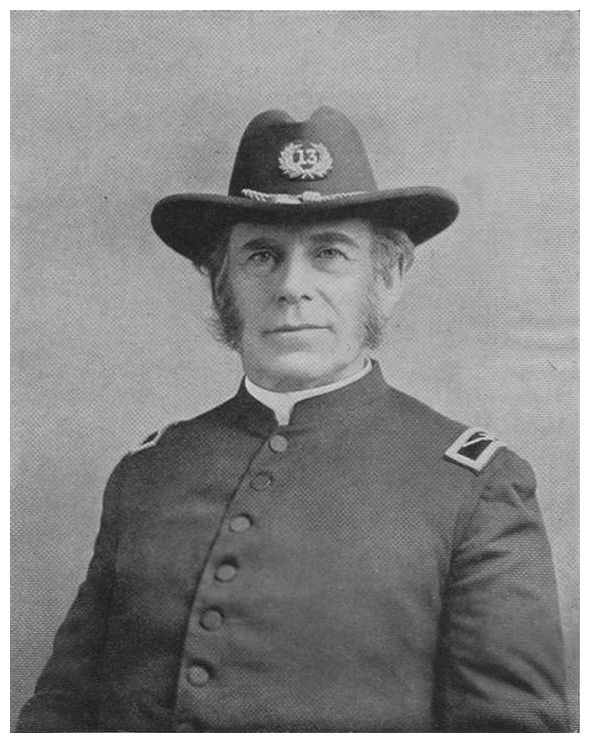
Dr. Talmage As Chaplain Of The Thirteenth Regiment.
In the spring of 1888 I received the honour of being made chaplain of the "Old Thirteenth" Regiment of the National Guard, with a commission as captain, to succeed my old friend and fellow-worker, Henry Ward Beecher, who had died. Although I was a very busy man I accepted it, because I had always felt it my duty to be a part of any public-spirited enterprise. On March 7th, 1888, before a vast assembly, the oath was administered by Colonel Austen, and I received my commission. Memories of my actual, though brief, sight of war, at Sharpsburg and Hagerstown, where the hospitals were filled with wounded soldiers, mingled faintly with the actual scene of peace and plenty around me at that moment. We needed no epaulet then but the shoulder that is muscular, and we needed no commanding officer but the steadiness of our own nerves. The Thirteenth Regiment was at the height of its prosperity then; our band, under the leadership of Fred Inness, was the best in the city. I remembered it well because, in the parade on Decoration Day, I was on horseback riding a somewhat unmusical horse. It was comforting, if not strictly true, to read in the newspaper the following day that "Doctor Talmage rides his horse with dash and skill."
The association of ideas in American life is a wonderful mixture of the appropriate and the inappropriate. Because my church was crowded, because I lived in a comfortable house, because I could become, on occasions, a preacher on horseback, I was rated as a millionaire clergyman. It was amusing to read about, but difficult to live up to. There were many calculations in the newspapers as to my income. Some of the more moderate figures were correct. My salary was $12,000 as pastor of the Tabernacle, I have made over $20,000 a year from my lectures. From the publication of my sermons my income was equal to my salary. I received $5,000 a year as editor of a popular monthly; I sometimes wrote an article that paid me $150 or more, and a single marriage fee was often as high as $250. There were some royalties on my books.
We lived well, dressed comfortably; but there were many demands on me then, as on all public men, and I needed all I could earn. I carried a life insurance of $75,000. All this was a long way from being a Croesus of the clergy, however. I mention these figures and facts because they stimulate to me, as I hope they will to others, the possibilities of temporal welfare in a minister's life, provided he works hard and is faithful to the tremendous trusts of his calling.
A man's industry is the whole of that man, just as his laziness is the end of him. I always believed heartily, profoundly, in the equality of a man's salvation with a man's self-respect in temporal affairs. I am sure that whoever keeps the books in Heaven credits the account of a new arrival with the exact amount of salvation he or she has achieved, making a due allowance for the amounts earned and paid over to the causes of charity, kindliness, and mercy.
I always believed in the business and the religious method of the Salvation Army, because it was an effort to discipline salvation on a working basis. When the Salvation Army first began its meetings in Brooklyn its members were hooted and insulted in the streets to an extent that rendered their meetings almost impossible. I was requested to present a petition to Mayor Whitney asking protection for them in the streets of the city. People residing near the Salvation headquarters were in constant danger of annoyance from the mobs that gathered about them. It was the fault of the Brooklyn ruffianism. I demanded that the Salvation Army be permitted to hold meetings and march in processions unmolested. No one was ever killed by a street hosannah, no one was ever hurt by hearing a hallelujah. The more inspiring the music the more virile the optimism we can show, the more good we can do each other in the climb to Paradise. A minister's duty in his own community, and in all other communities in which he may find himself, is to make the great men of his time understand him and like him.
A minister who could adapt himself to the lights and shadows of human character in men of prominence enjoyed many opportunities that were enlightening. One met them, these men of many talents, at their best at dinners and banquets. It was then they were in their splendour.
Those dinners at the Press Club in 1888, what treat they were! In the days of John A. Cockerill, the handsome, dashing "Colonel," as he was called, of Mayor Grant the suave, Chauncey M. Depew the wit, of Charles Emory Smith the conservative journalist, of Henry George the Socialist, Moses P. Handy the "Major," of Roswell P. Flower, of Judge Henry Hilton, of General Felix Agnus—and of Hermann, the original, the great, the magic wonder-maker of the times. They were the leading spirits of an army of bright men who pushed the world upside down, or rolled it over and over, or made it stand still, according to how they felt. Mingling with these arbiters of our fate were all sorts and conditions of men. At one of these dinners I remember seeing Inspector Byrnes, the Sherlock Holmes of American crime, Colonel Ochiltree, the red savage, Steven Fiske, Samuel Carpenter, Judge David McAdam, John W. Keller, Judge Gedney, "Pat" Gilmore, Rufus Hatch, General Horatio C. King, Frank B. Thurber, J. Amory Knox, E.B. Harper, W.J. Arkell, Dr. Nagle, the poet Geogheghan, Doc White, and Joseph Howard, jun. They were the old guard of the land of Bohemia, where a minister's voice sounded good to them if it was a voice without cant or religious hypocrisy. I remember a letter sent by President Harrison to one of these dinners, in which, after acknowledging the receipt of an invitation to attend, he regretted being unable to be present at "so attractive an event."
Among the men whom I first met at this time, and who made an impression of lasting respect upon me, was Henry Cabot Lodge. He was the guest of General Stewart L. Woodford, at a breakfast given in his honour in the spring of 1888 at the Hamilton Club. General Woodford invited me, among others, to meet him. We all came—Mr. Benjamin A. Stillman, Mr. J.S.T. Stranahan, Mr. Theodore Roosevelt, Judge C.R. Pratt, ex-Mayor Schroeder, Mr. John Winslow, president of the New England Society, Mr. George M. Olcott, Mr. William Copeland Wallace, Colonel Albert P. Lamb, Mr. Charles A. Moore, Mr. William B. Williams, Mr. Ethan Allen Doty, Mr. James S. Case, Mr. T.L. Woodruff. It was a social innovation then to arrange a gathering of this sort at 11 a.m. and call it a breakfast. It came from England. Mr. Lodge was only in town on a visit for a few days, chiefly, I think, to attend the annual dinner of the "Sunrise Sons," as the members of the New England society were called. As I read these names again, how big some of them look now, in the world's note-book of celebrities. Some of them were just beginning to learn the pleasant taste of ambitious careers. Most of them had discovered that ambition was the gift of hard work. There is more health in work than in any medicine I ever heard of.
Work is the only thing that keeps people alive. Whatever posterity may proclaim for me, I always had the reputation of being a worker. Perhaps for this reason I became the object of a microscopic investigation before the people in 1888. It was the first time in my life that any notable attention had been taken of me in my own country, that was not a personal notoriety over some conflict of the hour. Whenever the American newspaper begins to describe your home life with an air of analysis that is not libellous you are among the famous. It took me a little while to understand this. A man's private life is of such indifferent character to himself, unless he be an official representative of the people, that I never quite appreciated the importance given to mine, at this time, in Brooklyn. Chiefly because I had made money as a writer, my fellow-citizens were curious to know how, in the clerical profession, it could be made. Articles appeared constantly in the newspapers with headlines like these—"Dr. Talmage at Home," "In a Clergyman's Study," "Dr. Talmage's Wealth," "Talmage Interviewed." Nearly all of them began with the American view point uppermost, in this fashion:
"The American preacher lives in a luxurious home."
"His income, from all sources, exceeds that of the President of the United States."
"The impression is everywhere that Dr. Talmage is very rich."
I regretted this because there is a notion that a minister of the Gospel cannot accumulate money for himself, that he should not do so if he could, that his duty consists in collecting money for his church, his parish, his mission—for anything and everyone but his own temporal prosperity. I had done this all my life. I can solemnly say that I never sought the financial success which in some measure came to me. I regarded the money which I received for my work as pastor of the Tabernacle, or from other sources as an earning capacity that is due to every working man. I was able to do more work than some, because the motives of my whole life have insisted that I work hard. The impetus of my strength was not abnormal, it was merely the daily requirement of my health that I work as hard as I knew how as long as I could. Restlessness was an element of life with me. I could not keep still any length of time. My mind had acquired the habit of ideas, and my hands were always full of unfinished labours.
I remember trying once to sit still at a concert of Gilmore's band, at Manhattan Beach. After hearing one selection I found myself unable to listen any farther—I could not sit quiet for longer. I rarely allowed myself more than five minutes for shaving, no matter whether the razor were sharp or blunt. They used to tell me that I wore a black bow tie till it was not fit to wear. On the trains I slept a great deal. Sleep is the great storage battery of life. Four days of the week I was on the train. I rose every morning at six. The first thing I did was to glance over the morning newspaper, to catch in this whispering gallery of the world the life of a new day. First the cable news, then the editorials, then the news about ourselves. I received the principal newspapers of almost every big city in the morning mail I enjoyed the caricatures of myself, they made me laugh. If a man poked fun at me with true wit I was his friend. They were clever fellows those newspaper humorists. I consider walking a very important exercise—not merely a stroll, but a good long walk. Often I used to go from the Grand Central Depot in New York to my home in Brooklyn. There and back was my usual promenade. Seven miles should be an average walk for a man past fifty every day. I have made fifteen and twenty miles without fatigue. I always dined in the middle of the day. Contrary to "Combes' Physiology," I always took a nap after dinner. In my boyhood days this was a book that opposed the habit. Combes said that he thought it very injurious to sleep after dinner, but I saw the cow lie down after eating, and the horse, and it seemed to me that Combes was wrong. A morning bath is absolutely indispensable. When I was in college there were no luxurious hot and cold bath rooms. I often had to break the ice in my pitcher to get at the water.
These were the habits of my life, formed in my youth, and as they grew upon me they were the sinews that kept me young in the heart and brain and muscle. My voice rarely, if ever, failed me entirely. In 1888, to my surprise and delight, my western trips had become ovations that no human being could fail to enjoy. In St. Paul, Duluth, Minneapolis, the crowds in and about the churches where I preached were estimated to be over twenty thousand. It was a joy to live realising the service one could be to others. This year of 1888 was to be a climax to so many aspirations of my life that I am forced to record it as one of the most important of all my working years. No event of any consequence in the country, social or political, or disastrous, happened, that my name was not available to the ethical phase of its development. Newspaper squibs of all sorts reflect this fact in some way. Here is one that illustrates my meaning:
"ONLY TALMAGE!
"The weary husband was lounging in the old armchair reading before the fire after the day's work. Suddenly he brought down his hand vigorously upon his knee, exclaiming, 'That's so! That's so!' A minute after, he cried again, 'Well, I should say.' Then later, 'Good for you; hit them right and left.' Soon he stretched himself out at full length in the chair, let his right hand, holding the paper, drop nearly to the floor, threw up his left and laughed aloud until the rafters rang. His anxious wife inquired, 'What is it so funny, John?'
"He made no reply, but lifted the paper again, straightened himself up, and went on reading. Very quiet he now grew by degrees. Then slyly he slipped his left hand around and drew out his handkerchief, wiped his brow and lips by way of excuse and gave his eyelids a passing dash. The very next moment he pressed the handkerchief to his eyes and let the paper drop to the floor, saying, 'Well, that's wonderful.' 'What is it, John?' his good wife inquired again. 'Oh! It's only Talmage!'"
My contemporaries in Brooklyn celebrity at this time were unusual men. Some of them were dear friends, some of them close friends, some of them advisers or champions, guardians of my peace—all of them friends.
About this time I visited Johnstown, shortly after the flood. My heart was weary with the scenes of desolation about me. It did not seem possible that the hospitable city of Johnstown I had known in other days could be so tumbled down by disaster. Where I had once seen the street, equal in style to Euclid Avenue in Cleveland, I found a long ridge of sand strewn with planks and driftwood. By a wave from twelve to twenty feet high, 800 houses were crushed, twenty-eight huge locomotives from the round house were destroyed, hundreds of people dead and dying in its anger. Two thousand dead were found, 2,000 missing, was the record the day I was there. The place became used to death. It was not a sensation to the survivors to see it about them. I saw a human body taken out of the ruins as if it had been a stick of wood. No crowd gathered about it. Some workmen a hundred feet away did not stop their work to see. The devastation was far worse than was ever told. The worst part of it could not even be seen. The heart-wreck was the unseen tragedy of this unfortunate American city. From Brooklyn I helped to send temporary relief. With a wooden box in my hand I, with others, collected from the bounty of that vast meeting in the Academy of Music. The exact amount paid over by our relief committee in all was $95,905. There was no end to the demand upon one's energy in all directions.
I was called upon in September, 1888, to lay the corner stone of the First Presbyterian Church at Far-Rockaway, and amid the imposing ceremonies I predicted the great future of Long Island. It seemed to me that Long Island would some day be the London of America, filled with the most prominent churches of the country.
While in the plans of others I was an impulse at least towards success, in my own plans, how often I have been scourged and beaten to earth. As it had been before, so it was in this zenith of my personal progress. To my amazement, chagrin and despair, on the morning of October 13, 1889, our beautiful church was again burned to the ground.
For fifteen years, to a large part of the public, I had been an experiment in church affairs. In 1889 I had caught up with the world and the things I had been doing and thinking and hoping became suitable for the world. In the retrospect of those things I had left behind what gratitude I felt for their strife and struggle! A minister of the Gospel is not only a sentinel of divine orders, he must also have deep convictions of his authority to resist attack in his own way, by his own force, with his own strength and faith. When, on June 3, 1873, I laid the corner-stone of the new tabernacle, I dedicated the sacred building as a stronghold against rationalism and humanitarianism. I knew then that this statement was regarded as questionable orthodoxy, and I myself had become the curious symbol of a new religion. Still I pursued my course, an independent sentry on the outskirts of the old religious camping-ground, but inspired with the converting grace I had received in my boyhood, my duty was clearly not so much a duty of regulations as it was a conception, a sympathy, a command to the Christian needs of the human race.
When the first Tabernacle was consumed by fire my utterances were criticised and my enthusiasm to rebuild it was misconstrued. My convictions then were the same, they have always been the same. To me it seemed that God's most vehement utterances had been in flames of fire. The most tremendous lesson He ever gave to New York was in the conflagration of 1835; to Chicago in the conflagration of 1871; to Boston in the conflagration of 1872; to my own congregation in the fiery downfall of the Tabernacle. Some saw in the flames that roared through its organ pipes a requiem, nothing but unmitigated disaster, while others of us heard the voice of God, as from Heaven, sounding through the crackling thunder of that awful day, saying, "He shall baptise you with the Holy Ghost and with Fire!"
It was a very different state of public feeling which met the disaster that came to the Tabernacle on that early Sabbath morning of October 18, 1889. I had a congregation of millions all over the world to appeal to. I stood before them, accredited in the religious course I had pursued, approved as a minister of the Gospel, upheld as a man and a preacher. The hand of Providence is always a mysterious grasp of life that confuses and dismays, but it always rebuilds, restores, and prophesies.
The second Tabernacle was destroyed during a terrific thunderstorm. It was crumpled and torn by the winds and the flames of heaven. I watched the fire from the cupola of my house in silent abnegation. The history of the Brooklyn Tabernacle had been strange and peculiar all the way through. Things that seemed to be against us always turned out finally for us. Our brightest and best days always follow disaster. Our enlargements of the building had never met our needs. Our plans had pleased the people, but we needed improvements. In this spirit I accepted the situation, and the Board of Trustees sustained me. Our insurance on the church building was over $120,000. I made an appeal to the people of Brooklyn and to the thousands of readers my sermons had gained, for the sum of $100,000. It would be much easier to accomplish, I felt, than it had been before.
At my house in Brooklyn, on the evening of the day of the fire, the following resolutions were passed by the Board of Trustees:—
"Resolved—that we bow in humble submission to the Providence which this morning removed our beloved Church, and while we cannot fully understand the meaning of that Providence we have faith that there is kindness as well as severity in the stroke.
"Resolved:—That if God and the people help us we will proceed at once to rebuild, and that we rear a larger structure to meet the demands of our congregation, the locality and style of the building to be indicated by the amount of contributions made."
A committee was immediately formed to select a temporary place of worship, and the Academy of Music was selected, because of its size and location.
I was asked for a statement to the people through the press. From a scrap-book I copy this statement:—
"To the People—
"By sudden calamity we are without a church. The building associated with so much that is dear to us is in ashes. In behalf of my stricken congregation I make appeal for help. Our church has never confined its work to this locality. Our church has never been sufficient either in size or appointments for the people who came. We want to build something worthy of our city and worthy of the cause of God.
"We want $100,000, which, added to the insurance, will build what is needed. I make appeal to all our friends throughout Christendom, to all denominations, to all creeds and to those of no creed at all, to come to our rescue. I ask all readers of my sermons the world over to contribute as far as their means will allow. What we do as a Church depends upon the immediate response made to this call. I was on the eve of departure for a brief visit to the Holy Land that I might be better prepared for my work here, but that visit must be postponed. I cannot leave until something is done to decide our future.
"May the God who has our destiny as individuals and as churches in His hand appear for our deliverance!
"Responses to this appeal to the people may be sent to me in Brooklyn, and I will with my own hand acknowledge the receipt thereof.
"T. DeWitt Talmage."
I had planned to sail for the Holy Land on October 30, but the disaster that had come upon us seemed to make it impossible. I had almost given it up. There followed such an universal response to my appeal, such a remarkable current of sympathy, however, that completely overwhelmed me, so that by the grace of God I was able to sail. To the trustees of the Tabernacle much of this was due. They were the men who stood by me, my friends, my advisers. I record their names as the Christian guardians of my destiny through danger and through safety. They were Dr. Harrison A. Tucker, John Wood, Alexander McLean, E.H. Lawrence, and Charles Darling. In a note-book I find recorded also the names of some of the first subscribers to the new Tabernacle. They were the real builders. Wechsler and Abraham were among the first to contribute $100, "Texas Siftings" through J. Amory Knox sent $25, and "Judge" forwarded a cheque for the same amount, with the declaration that all other periodicals in the United States ought to go and do likewise. A.E. Coates sent $200, E.M. Knox $200, A.J. Nutting $100, Benjamin L. Fairchild $100, Joseph E. Carson $100, Haviland and Sons $25, Francis H. Stuart, M.D., $25, Giles F. Bushnell $25, and Pauline E. Martin $25.
Even the small children, the poor, the aged, sent in their dollars. About one thousand dollars was contributed the first day. Everything was done by the trustees and the people, to expedite the plans of the New Tabernacle so that in two weeks from the date of the fire I broke ground for what was to be the largest church in the world of a Protestant denomination, on the corner of Clinton and Greene Avenues. That afternoon of October 28, 1889, when I stood in the enclosure arranged for me, and consecrated the ground to the word of God, was another moment of supreme joy to me. It was said that those who witnessed the ceremony were impressed with the importance of it in the course of my own life and in the history of Christianity. To me it was akin to those pregnant hours of my life through which I had passed in great exaltation of spiritual fervour.
My words of consecration were brief, as follows:
"May the Lord God of Abraham, and Isaac, and Jacob, and Joshua, and Paul, and John Knox, and John Wesley, and Hugh Latimer, and Bishop McIlvaine take possession of this ground and all that shall be built upon it."
Before me was a vision of that church, its Gothic arches, its splendour of stained-glass windows, its spires and gables, and, as I saw this our third Tabernacle rise up before me, I prayed that its windows might look out into the next world as well as this. I was glad that I had waited to turn that bit of God-like earth on the old Marshall homestead in Brooklyn, for it filled my heart with a spiritual promise and potency that was an invisible cord binding me during my pilgrimage to Jordan with my congregation which I had left behind.
With Mrs. Talmage and my daughter, May Talmage, I sailed on the "City of Paris," on October 30, 1889, to complete the plan I had dreamed of for years. I had been reverently anxious to actually see the places associated with our Lord's life and death. I wanted to see Bethlehem and Nazareth, and Jerusalem and Calvary, so intimately connected with the ministry of our Saviour. I had arranged to write a Life of Christ, and this trip was imperative. In that book is the complete record of this journey, therefore I feel that other things that have not been told deserve the space here that would otherwise belong to my recollections of the Holy Land. It was reported that while in Jerusalem I made an effort to purchase Calvary and the tomb of our Saviour, so as to present it to the Christian Church at large. I was so impressed with the fact that part of this sacred ground was being used as a Mohammedan cemetery that I was inspired to buy it in token of respect to all Christendom. Of course this led to much criticism, but that has never stopped my convictions. I was away for two months, returning in February, 1890.
During my absence our Sunday services were conducted by the most talented preachers we could secure. With the exception of a few days' influenza while I was in Paris, in January, just prior to my return, the trip was a glorious success. According to the editorial opinion of one newspaper I had "discovered a new Adam that was to prove a puissant ally in his future struggles with the old Adam." This was not meant to be friendly, but I prefer to believe that it was so after all. In England I was promised, if I would take up a month's preaching tour there, that the English people would subscribe five thousand pounds to the new Tabernacle. These and other invitations were tempting, but I could not alter my itinerary.
While in England I received an invitation from Mr. Gladstone to visit him at Hawarden. He wired me, "pray come to Hawarden to-morrow," and on January 24, 1890, I paid my visit. I was staying at the Grand Hotel in London when the telegram was handed to me. With the rest of the world, at that time, I regarded Mr. Gladstone as the most wonderful man of the century.
He came into the room at Hawarden where I was waiting for him, an alert, eager, kindly man. He was not the grand old man in spirit, whatever he may have been in age. He was lithe of body, his step was elastic. He held out both his hands in a cordial welcome. He spoke first of the wide publication of my sermons in England, and questioned me about them. In a few minutes he proposed a walk, and calling his dog we started out for what was in fact a run over his estate. Gladstone was the only man I ever met who walked fast enough for me. Over the hills, through his magnificent park, everywhere he pointed out the stumps of trees which he had cut down. Once a guest of his, an English lord, had died emulating Gladstone's strenuous custom. He showed me the place.
"No man who has heart disease ought to use the axe," he said; "that very stump is the place where my friend used it, and died."
He rallied the American tendency to exaggerate things in a story he told with great glee, about a fabulous tree in California, where two men cutting at it on opposite sides for many days were entirely oblivious of each other's presence. Each one believed himself to be a lone woodsman in the forest until, after a long time, they met with surprise at the heart of the tree. American stories seemed to tickle him immensely. He told another kindred one of a fish in American lakes, so large that when it was taken out of the water the lake was perceptibly lowered. He grew buoyant, breezy, fanciful in the brisk winter air. Like his dog, he was tingling with life. He liked to throw sticks for him, to see him jump and run.
"Look at that dog's eyes, isn't he a fine fellow?" he kept asking. His knowledge of the trees on his estate was historical. He knew their lineage and characteristics from the date of their sapling age, four or five hundred years before. The old and decrepit aristocrats of his forest were tenderly bandaged, their arms in splints.
"Look at that sycamore," he said; "did you find in the Holy Land any more thrifty than that? You know sometimes I am described as destroying my trees. I only destroy the bad to help the good. Since I have thrown my park open to visitors the privilege has never been abused."
We drifted upon all subjects, rational, political, religious, ethical.
"Divorce in your country, is it not a menace?" he asked.
"The great danger is re-marriage. It should be forbidden for divorced persons. I understand that in your State of South Carolina there is no divorce. I believe that is the right idea. If re-marriage were impossible then divorce would be impossible," he replied to his own question.
Gladstone's religious instinct was prophetic in its grasp. His intellectual approval of religious intention was the test of his faith. He applied to the exaltations of Christianity the reason of human fact. I was forcibly impressed with this when he told me of an incident in his boyhood.
"I read something in 'Augustine' when I was a boy," he said, "which struck me then with great force. I still feel it to-day. It was the passage which says, 'When the human race rebelled against God, the lower nature of man as a consequence rebelled against the higher nature.'"
I asked him then if the years had strengthened or weakened his Christian faith. We were racing up hill. He stopped suddenly on the hillside and regarded me with a searching earnestness, a solemnity that made me quake. Then he spoke slowly, more seriously:
"Dr. Talmage, my only hope for the world is in the bringing of the human mind into contact with divine revelation. Nearly all the men at the top in our country are believers in the Christian religion. The four leading physicians of England are devout Christian men. I, myself, have been in the Cabinet forty-seven years, and during all that time I have been associated with sixty of the chief intellects of the century. I can think of but five of those sixty who did not profess the Christian religion, but those five men respected it. We may talk about questions of the day here and there, but there is only one question, and that is how to apply the Gospel to all circumstances and conditions. It can and will correct all that is wrong. Have you, in America, any of the terrible agnosticism that we have in Europe? I am glad none of my children are afflicted with it."
I asked him if he did not believe that many people had no religion in their heads, but a good religion in their hearts.
"I have no doubt of it, and I can give you an illustration," he said.
"Yesterday, Lord Napier was buried in St. Paul's Cathedral. After the war in Africa Lord Napier was here for a few days, at the invitation of Mrs. Gladstone and myself, and we walked as we are walking now. He told me this story. I cannot remember his exact words. He said that just when the troops were about to leave Africa there was a soldier with a broken leg. He was too sick to take along, but to leave him behind seemed barbaric. Lord Napier ordered him to be carried, but he soon became too ill to go any further. Lord Napier went to a native woman well known in that country for her kindness, and asked her to take care of the soldier. To ensure his care she was offered a good sum of money. I remember her reply as Lord Napier repeated it to me. 'No, I will not take care of this wounded soldier for the money you offer me,' she said; 'I have no need of the money. My father and mother have a comfortable tent, and I have a good tent; why should I take the money? If you will leave him here I will take care of him for the sake of the love of God.'"
Gladstone was in the thick of political scrimmage over Home Rule, and he talked about it with me.
"It seems the dispensation of God that I should be in the battle," he said; "but it is not to my taste. I never had any option in the matter. I dislike contests, but I could not decline this controversy without disgrace. When Ireland showed herself ready to adopt a righteous constitution, and do her full duty, I hesitated not an hour."
Two nights before, at a speech in Chester, Mr. Gladstone had declared that the increase of the American navy would necessitate the increase of the British navy. I rallied him about this statement, and he said, "Oh! Americans like to hear the plain truth. The fact is, the tie between the two nations is growing closer every year."
It was a bitter cold day and yet Mr. Gladstone wore only a very light cape, reaching scarcely to his knees.
"I need nothing more on me," he said; "I must have my legs free."
After luncheon he took me into his library, a wonderful place, a treasure-house in itself, a bookman's palace. The books had been arranged and catalogued according to a system of his own invention. He showed many presents of American books and pictures sent to him.
"Outside of America there is no one who is bound to love it more than I do," he said, "you see, I am almost surrounded by the evidences of American kindnesses." He gave me some books and pamphlets about himself, and his own Greek translation of "Jesus, Lover of my Soul." Mrs. Gladstone had been obliged to leave before we returned from our walk. Mr. Gladstone took me into a room, however, and showed me a beautiful sculptured portrait of her, made when she was twenty-two.
"She is only two years younger than I am, but in complete health and vigour," he said proudly.
He came out upon the steps to bid me good-bye. Bareheaded, his white hair flowing in the wind, he stood in the cold and I begged him to go in. I expressed a wish that he might come to America.
"I am too old now," he said, wistfully, I thought.
"Is it the Atlantic you object to?" I asked.
"Oh! I am not afraid of the ocean," he said, as though there were perhaps some other reason.
"Tell your country I watch every turn of its history with a heart of innermost admiration," he called after me. I carried Gladstone's message at once, going straight from Hawarden to America, as I had intended when leaving London.
I was prepared for a reception in Brooklyn on my return, but I never dreamed it would be the ovation it was. It becomes difficult to write of these personal courtesies, as I find them increasing in the progress of my life from now on. I trust the casual reader will not construe anything in these pages into a boastful desire to spread myself in too large letters in print.
When I entered the Thirteenth Regiment Armoury on the evening of February 7, 1890, it was packed from top to floor. It was a large building with its three acres of drill floor and its half mile of galleries. There were over seven thousand people there, so the newspapers estimated. Against the east wall was the speaker's platform, and over it in big letters of fire burned the word "Welcome."
On the stage, when I arrived at eight o'clock, were Mayor Chapin, Colonel Austen, General Alfred C. Barnes, the Rev. J. Benson Hamilton, Judge Clement, Mr. Andrew McLean, the Rev. Leon Harrison, ex-Mayor Whitney, the Hon. David A. Boody, U.S. Marshal Stafford, Judge Courtney, Postmaster Hendrix, John Y. Culver, Mark D. Wilber, Commissioner George V. Brower, the Rev. E.P. Terhune, General Horatio C. King, William E. Robinson and several others.
The Trustees of the Tabernacle, like a guard of honour, came in with me, and as we made our way through the crowds to the stage, the long-continued cheering and applause were deafening. The band, assisted by the cornetist, Peter Ali, played "Home, Sweet Home." For a few minutes I was very busy shaking hands.
The most inspiring moment of these preliminaries was the approach of the most distinguished man in that vast assembly, General William T. Sherman. He marched to the platform under military escort, while the band played "Marching through Georgia." Everyone stood up in deference to the old warrior, handkerchiefs were waved, hats flew up in the air, everyone was so proud of him, so pleased to see him! Mayor Chapin introduced the General, and as he stood patiently waiting for the audience to regain its self-control, the band played "Auld Lang Syne." Then in the presence of that great crowd he gave me a soldier's welcome. I remember one sentence uttered by Sherman that night that revealed the character of the great fighter when he said, "The same God that appeared at Nazareth is here to-night."
But nothing on that auspicious evening was so great to me as when Sherman spoke what he described as the soldier's welcome:
"How are you, old fellow, glad to see you!" he said.
The building of the new Tabernacle, my third effort to establish an independent church in Brooklyn, went on rapidly. We were planning then to open it in September, 1891. The church building alone was to cost $150,000. Its architectural beauty was in accord with the elegance of its fashionable neighbourhood on "The Hill," as that residential part of Brooklyn was always described.
"The Hill" was unique. When people in Brooklyn became tired of the rush and bustle of life they returned to Clinton Avenue. It was an idyllic village in the heart of the city. The front yards were as large as farms. New Yorkers described this locality as "Sleepy Hollow." On this account, during my absence, there had developed in the neighbourhood some opposition to the building of the new Tabernacle there. Some of the residents were afraid it would disturb the quiet of the neighbourhood. They opposed it as they would a base ball park, or a circus. They were afraid the organ would annoy the sparrows. The opposition went so far that a subscription paper was passed around to induce us to go away. As much as $15,000 was raised to persuade us. These objections, however, were confined to a few people, the majority realising the adornment the new church would be to the neighbourhood. When I returned I found that this opposing sentiment had described us as "the Tabernacle Rabble." I was in splendid health and spirits however, and refused to be downcast.
During my absence our pews had been rented, realising $18,000. The largest portion of these pews were rented by letter, and the balance at a public meeting held in Temple Israel. The second gallery of the church was free. The highest price paid in the rental for one pew for a year was $75, the lowest was $20. In the interval, pending the completion of the church, pew holders were given tickets for reserved seats in the Academy of Music, where our Sunday services were held. There were 1,500 free seats in the second gallery of the new Tabernacle.
It was a great joy to find that the enterprise I had inaugurated before sailing for the Holy Land had made such good progress. But we were always fortunate.
I recall that my congregation was surprised one morning to learn that Emma Abbott, the beautiful American singer, had left a bequest of $5,000 to the Brooklyn Tabernacle. I was not surprised. I had received a private note from her once expressing her kindly feeling toward our Church and promising, in the event of her decease, to leave some remembrance to us. She always had a presentiment that her life was to be short, and this always had a very depressing effect upon her. Her grief for her husband's death hastened her own. She loved him with all her heart. She was a good woman. Mr. Beecher was a kind and loyal friend to her in her obscurer days. In those days Mr. Beecher brought her over from New York and put her in care of a Mrs. Bird in Brooklyn. Until she went abroad she was helped in her musical education by these friends. She attended Mr. Beecher's prayer meetings regularly. Everyone who met her felt that she was a noble-hearted woman of pure character and sweet soul.
On February 9, 1890, I preached my first sermon since my return from the Holy Land in the Academy of Music. It was expected that I would preach about the country of sacred memories that I had visited, but I was impressed with what I had found on my return in religious history of a more modern purpose. They had been fixing up the creeds while I was abroad, tracing the footsteps of divine law, and I felt the importance of this fact. So I chose the text in Joshua vi. 23, "And the young men that were spies went in and brought out Rahab, and her father and her mother, and her brethren, and all that she had."
I did not read the newspapers while I was away so I was not familiar with all the discussion. I understood, however, that they were revising the creed. You might as well try to patch up your grandfather's overcoat. It will be much better to get a new one. The recent sessions of the Presbytery had been divided into two parties. One was in favour of patching up the old overcoat, the other in favour of a new one. Dr. Briggs had pointed out the torn places—at least five of them. He had revealed it, shabby and somewhat threadbare. Presbyterians had practically discarded the garment. Why should they want to flaunt any of its shreds? So I agreed with Dr. Briggs, that we had better get a new one.
The laying of the corner stone of the new Tabernacle took place on the afternoon of February 11, 1890. It was a modest ceremony because it was considered wise to defer the festivities for the dedication services that were to occur in the church itself in the spring. The two tin boxes placed in the corner stone contained the records of the church organisation from 1854 to 1873, a copy of the Bible, coins of 1873, newspaper accounts of the dedication of the old Tabernacle, copies of the Brooklyn and New York newspapers, photographs of the trustees, a 25-cent gold piece from the Philadelphia mint with the Lord's Prayer engraved on one side, drawing and plans of the new Tabernacle, and some Colonial money dated 1759, 1771, 1773, 1774. During my trip in the Holy Land I had secured two stones, one from Mount Calvary and one from Mount Sinai, which were to be placed in the Tabernacle later.
The "Tabernacle Rabble," as the Philistines of Clinton Avenue called us, continued to meet in the Academy of Music with renewed vigour. My own duties became more exacting because of the additional work I had undertaken, of an editorial nature, on two periodicals.
Of course my critics were always with me. What man or thing on earth is without these stimulants of one's energy. They were fair and unfair. I did not care so much for my serious critics as my humorous ones. Solemnity when sustained by malice or bigotry is a bore. Some call it hypocrisy, but that is too clever for the tiresome critic. Frequently, in my scrap book, I kept the funny comments about myself.
Here is one from the "Chicago American," published in 1890:—
My critics were particularly wrought up again on my return from Palestine over my finances. What a crime it was, they said, for a minister to be a millionaire! Had I really been one how much more I could have helped some of them along. Finally the subject became most wearisome, and I gave out some actual facts. From this data it was revealed that I was worth about $200,000, considerably short of one million. In actual cash it was finally declared that I was only worth $100,000. My house in Brooklyn, which I bought shortly after my pastorate began there, cost $35,000. I paid $5,000 cash, and obtained easy terms on a mortgage for the balance. It was worth $60,000 in 1890. My country residence at East Hampton was estimated to be worth $20,000. I owned a few lots on the old Coney Island road. My investments of any surplus funds I had were in 5 per cent. mortgages. I had as much as $80,000 invested in this way since I had begun these operations in 1882. Most of the mortgages were on private residences. I mention these facts that there may be no jealous feeling against me among other millionaires. Because of my reputation for wealth I was sometimes included among New York's fashionable clergymen. I deny that I was ever any such thing, and I almost believe such a thing never was, but I find, in my scrapbook, a contemporaneous list of them.
Dr. Morgan Dix, of Trinity Church, with a salary of $15,000, heads the list, Dr. Brown of St. Thomas' Church, received the same amount; so did Dr. Huntington of Grace Church, and Dr. Greer of St. Bartholomew's. The Bishop of the diocese received no more. Dr. Rainsford of St. George's Church received $10,000, and like Dr. Greer, possessing a private fortune, he turned his salary over to the church. The clergymen of the Methodist Episcopal churches were not so rich. The Bishop of New York received only $5,000. The pastor of St. Paul's, on Fourth Avenue, received the same amount, so did the pastor of the Madison Avenue Church.
The Presbyterian pulpits were filled with some of the ablest preachers in New York. Dr. John Hall of the Fifth Avenue Church received the salary of $30,000, Dr. Paxton $10,000, Dr. Parkhurst and Dr. C.C. Thompson $8,000 respectively. Dr. Robert Collyer of the Park Avenue Unitarian Church, received $10,000, and Dr. William M. Taylor of the Broadway Tabernacle the same amount.
I was included among these "men of fashion," much to my surprise. This fact, forced upon me by contemporary opinion, did not have anything to do with what happened in the spring of 1891, though it was applied in that way. My congregation were not told about it until it was too late to interfere. This I thought wise because there might have been some opposition to my course. I kept it a secret because it was not a matter I could discuss with any dignity. Then, too, I realised that it was going to affect the entire brotherhood of newspaper artists, especially the cartoonists. I shuddered when I thought of the embarrassment this act of mine would cause the country editor with only one Talmage woodcut of many years in his art department. So I did it quietly, without consultation.
In the spring of 1891 I shaved my whiskers.
On April 26, 1891, the new Tabernacle was opened. There were three dedication services and thousands of people came. I was fifty-nine years of age. Up to this time everything had been extraordinary in its conflict, its warnings. I found myself, after over thirty years of service to the Gospel, pastor of the biggest Protestant church in the world. It seems to me there were more men of indomitable success during my career in America than at any other time. There were so many self-made men, so many who compelled the world to listen, and feel and do as they believed—men of remarkable energy, of prophetic genius.
Everywhere in England I had been asked about Cyrus W. Field. He was the hero of the nineteenth century. In his days of sickness and trouble the world remembered him. Of all the population of the earth he was the one man who believed that a wire could be strung across the Atlantic. It took him twelve years of incessant toil and fifty voyages across the Atlantic. I remember well, in 1857, when the cable broke, how everyone joined in the great chorus of "I told you so." There was a great jubilee in that choral society of wise know-nothings. Thirty times the grapnel searched the bottom of the sea and finally caught the broken cable, and the pluck and ingenuity of Cyrus W. Field was celebrated. Ocean cablegrams had ceased to be a curiosity, but some of us remember the day when they were. I kept a memorandum of the two first messages across the Atlantic that passed between Queen Victoria and President Buchanan in the summer of 1858.
From England, in the Queen's name, came this:
"To the President of the United States, Washington—
"The Queen desires to congratulate the President upon the successful completion of this great international work, in which the Queen has taken the deepest interest. The Queen is convinced that the President will join with her in fervently hoping that the electric cable which now connects Great Britain with the United States will prove an additional link between the nations whose friendship is founded upon their common interest and reciprocal esteem. The Queen has much pleasure in thus communicating with the President and renewing to him her wishes for the prosperity of the United States."
The President's answering cable was as follows:
"To Her Majesty Victoria, Queen of Great Britain—
"The President cordially reciprocates the congratulations of Her Majesty the Queen on the success of the great international enterprise accomplished by the science, skill, and indomitable energy of the two countries. It is a triumph more glorious than was ever won by any conquest on the field of battle. May the Atlantic telegraph, under the blessing of Heaven, prove to be a bond of perpetual peace and friendship between the kindred nations and an instrument designed by Divine Providence to diffuse religion, civilisation, liberty and law throughout the world. In this view will not all nations of Christendom spontaneously unite in the declaration that it shall be forever neutral, and that its communications shall be held sacred in passing to their destination, even in the midst of hostilities.
"James Buchanan."
It is interesting to compare the elemental quality, the inner character of these national flashes of feeling, that came so comparatively soon after the days of the revolution in America. It was a sort of prose poetry of the new century. This recollection came back to me, on my return from Europe, upon the opening of the new Tabernacle, a symbol of the eternal human progress of the world. Materially and spiritually we were striving ahead, men of affairs, men of religion, philosophers, scientists, and poets.
I was present in 1891 at the celebration of Whittier's eighty-fourth birthday. He was on the bright side of eighty then. The schools celebrated the day, so should the churches have done, for he was a Christian poet.
John Greenleaf Whittier was a Quaker. That means that he was a genial, kind, good man—a simple man. I spent an afternoon with him once in a barn. We were summering in the mountains near by. We found ourselves in the barn, where we stretched out on the hay. The world had not spoiled the simplicity of his nature. It was an afternoon of pastoral peace, with one who had written himself into the heart of a nation. How much I learned from that man's childlikeness and simplicity!
If he had lived to be a hundred he would still have remained young. The long flight of years had not tired his spirit, for wherever the English language is spoken he will always live. He was born in Christmas week, a spirit in human shape, come to earth to keep it forever young. He was the bell-ringer of all youthful ages. And yet he remembered also those who for any reason could not join in the merriment of the holidays. To those I recommend Whittier's poem, in which he celebrates the rescue of two Quakers who had been fined £10 for attending church instead of going to a Quaker Meeting House, and not being able to pay the fine were first imprisoned and then sold as slaves, but no ship master consenting to carry them into slavery they were liberated. The closing stanza of this poem is worth remembering:—
The new Tabernacle more than met our expectations. From the day we opened it, it was a great blessing. It seated 6,000 persons, and when crowded held 7,000. There was still some debt on the building, for the entire enterprise had cost us about $400,000. There were regrets expressed that we did not follow the elaborate custom of some fashionable churches in these days and introduce into our services operatic music. I preferred the simple form of sacred music—a cornet and organ. Everybody should get his call from God, and do his work in his own way. I never had any sympathy with dogmatics. There is no church on earth in which there is more freedom of utterance than in the Presbyterian church.
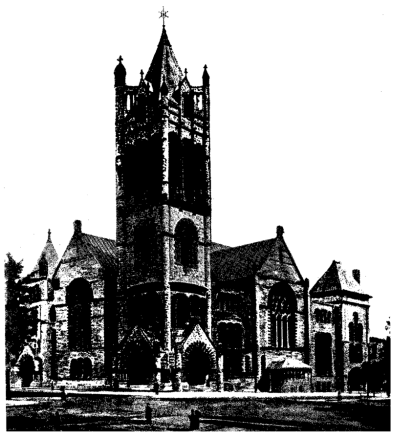
The Third Brooklyn Tabernacle.
We were in the midst of a religious conflict on many sacred questions in 1892. There came upon us a plague called Higher Criticism. My idea of it was that Higher Criticism meant lower religion. The Bible seemed to me entirely satisfactory. The chief hindrance to the Gospel was this everlasting picking at the Bible by people who pretended to be its friends, but who themselves had never been converted. The Higher Criticism was only a flurry. The world started as a garden and it will close as a garden. That there may be no false impression of the sublime destiny of the world as I see it, let me add that it is not a garden of idleness and pleasure, but a vineyard in which all must labour from early morning till the glory of sundown wraps us in its revival robes of golden splendour.
What a changing, hurrying world of desperate means it is. What a mirage of towering ambition is the whole of life! I have so often wondered why men, great men of heart and brain, should ever die out, though they pass on to live forever under brighter skies.
In January, 1892, Congressman William E. Robinson was buried from our church, and in February of the same month Spurgeon died in England. Though men may live at swords' points with each other they die in peace. This last forgetfulness is some of the beautiful moss that grows on the ruins of poor human nature.
Congressman Robinson was among the gifted men of his time. His friends were giants, his work was constructive, his pen an instrument of literary force. He landed in America with less than a sovereign in his pocket, and achieved prominence in national and State affairs. I knew him well and respected him.
There is an affinity of souls on earth and doubtless in heaven. We seek those who are our kindred souls when we reach there. In this respect I always feel a sense of gratitude, of cheerfulness for those who have passed on. My old friend, Charles H. Spurgeon, in February, 1892, made his last journey; and I am sure that the first whom he picked out in heaven were the souls of Jonathan Edwards and John Calvin—two men of tremendous evangelism. I first met Spurgeon in London in 1872.
"I read your sermons," I said to him first.
"Everybody reads yours," he replied.
Spurgeon made a long battle against disease; the last few months in agony. His name is on the honour roll of the world's history, but for many years he was caricatured and assailed. He kept a scrap-book of the printed blasphemy against him. The first picture I ever saw of him represented him as sliding down the railing of his pulpit in the presence of his congregation, to show how easy it was to go to hell, and then climbing up on the opposite railing to show how difficult it was to get to heaven. Most people at the time actually believed that he had done this.
In this same month Dr. Mackenzie, the famous physician, died, and my old friend, the Rev. Dr. Hanna of Belfast, the leading Protestant minister of Ireland. Out of the darkness into the light; out of the struggle into victory; out of earth into Heaven!
There was always mercy on earth, however, for those who remained. Mercy! The biggest word in the human language! I remember how it impressed me, when, at the invitation of Dr. Leslie Keeley, the inventor of the "Gold Cure" for drunkenness, I visited his institution at Dwight, Ill. It was a new thing then and a most merciful miracle of the age. It settled no question, perhaps, but intensified the blessings of reformed thought.
There were questions that could not be solved, however, questions of industrial moment that we almost despaired of. The tariff was one of them. I felt convinced that the tariff question would never be settled. The grandchildren of every generation will always be discussing it, and thresh out the same old straw which the Democrats and Republicans were discussing before them. When I was a boy only eight years old the tariff was discussed just as warmly as it will ever be. Like my friend Henry Watterson, of Kentucky, I was a Free Trader. Politics were so mixed up it was difficult to see ahead. Cleveland was after Hill and Hill was after Cleveland; that alone was clear to everybody.
For my own satisfaction, in the spring of 1892, I went to see what Washington was really doing, thinking, living. It had improved morally and politically, its streets were still the trail of the mighty. A great change had taken place there.
A higher type of men had taken possession of our national halls. Duelling, once common, was entirely abolished, and a Senator who would challenge a fellow-member to fight would make himself a laughing-stock. No more clubbing of Senators on account of opposite opinions! Mr. Covode of Pennsylvania, no longer brandished a weapon over the head of Mr. Barksdale of Mississippi. Grow and Keitt no more took each other by the throat. Griswold no more pounded Lyon, Lyon snatching the tongs and striking back until the two members in a scuffle rolled on the floor of the great American Congress. One of the Senators of twenty-five years ago died in Flatbush Hospital, idiotic from his dissipations. One member of Congress I saw years ago seated drunk on the curbstone in Philadelphia, his wife trying to coax him home. A Senator from New York many years ago on a cold day was picked out of the Potomac, into which he had dropped through his intoxication, the only time that he ever came so near losing his life by too much cold water. Talk not about the good old days, for the new days in Washington were far better. There was John Sherman of the Senate, a moral, high-minded, patriotic and talented man. I said to him as I looked up into his face: "How tall are you?" and his answer was, "Six feet one inch and a half;" and I thought to myself "You are a tall man every way, with mental stature over-towering like the physical." There was Senator Daniel of Virginia, magnetic to the last degree, and when he spoke all were thrilled while they listened. Fifteen years ago, at Lynchburg, Va., I said to him: "The next time I see you, I will see you in the United States Senate." "No, no," he replied, "I am not on the winning side. I am too positive in my opinions." I greeted him amid the marble walls of the Senate with the words "Didn't I tell you so?" "Yes," he said, "I remember your prophecy." There also were Senators Colquitt and Gordon of Georgia, at home whether in secular or religious assemblages, pronounced Christian gentlemen, and both of them tremendous in utterance. There was Senator Carey of Wyoming, who was a boy in my church debating society at Philadelphia, his speech at eighteen years demonstrating that nothing in the way of grand achievement would be impossible. There was Senator Manderson of Nebraska, his father and mother among my chief supporters in Philadelphia, the Senator walking about as though he cared nothing about the bullets which he had carried ever since the war, of which he was one of the heroes. Brooklyn was proud of her Congressmen. I heard our representative, Mr. Coombs, speak, and whether his hearers agreed or disagreed with his sentiments on the tariff question, all realised that he knew what he was talking about, and his easy delivery and point-blank manner of statement were impressive. So, also, at the White House, whether people liked the Administration or disliked it, all reasonable persons agreed that good morals presided over the nation, and that well-worn jest about the big hat of the grandfather, President William Henry Harrison, being too ample for the grandson, President Benjamin Harrison, was a witticism that would soon be folded up and put out of sight. Anybody who had carefully read the 120 addresses delivered by President Benjamin Harrison on his tour across the continent knew that he had three times the brain ever shown by his grandfather. Great men, I noticed at Washington, were great only a little while. The men I saw there in high places fifteen years ago had nearly all gone. One venerable man, seated in the Senate near the Vice-President's chair, had been there since he was introduced as a page at 10 years of age by Daniel Webster. But a few years change the most of the occupants of high positions. How rapidly the wheel turns. Call the roll of Jefferson's Cabinet? Dead! Call the roll of Madison's Cabinet? Dead! Call the roll of Monroe's Cabinet? Dead! Call the roll of Pierce's Cabinet? Dead! Call the roll of Abraham Lincoln's Cabinet? Dead! The Congressional burying ground in the city of Washington had then 170 cenotaphs raised in honour of members.
While I was in Chicago, in the spring of 1892, there came about an almost national discussion as to whether the World's Fair should be kept open on Sunday. Nearly all the ministers foresaw empty churches if the fair were kept open.
In spite of the personal malice against me of one of the great editors of New York, the people did not seem to lose their confidence in the Christian spirit. Both Dr. Parkhurst and myself were the targets of this brilliant man's sarcasm and satire at this time, but neither of us were demoralised or injured in the course of our separate ways of duty.
In the summer of 1892 the working plans of what the newspapers generously called my vacation took me to Europe on a tour of Great Britain and Ireland, including a visit to Russia, to await the arrival of a ship-load of food sent by the religious weekly of which I was editor. Some criticism was made of the way I worked instead of rested in vacation time.
Someone asked me if I believed in dreams. I said, no; I believed in sleep, but not in dreams. The Lord, in olden times, revealed Himself in dreams, but I do not think He does so often now. When I was at school we parsed from "Young's Night Thoughts," but I had no very pleasant memories of that book. I had noticed that dreamers are often the prey of consumption. It seems to have a fondness for exquisite natures—dreamy, spiritual, a foe of the finest part of the human family. There was Henry Kirke White, the author of that famous hymn, "When Marshalled on the Nightly Plains," who, dying of consumption, wrote it with two feet in the grave, and recited it with power when he could not move from his chair.
We sailed on the "New York," June 15, 1892, for Europe. This preaching tour in England was urged upon me by ties of friendship, made years before, by the increased audiences I had already gained through my public sermons, and of my own hearty desire to see them all face to face. My first sermon in London was given on June 25, 1892, in the City Temple, by invitation of that great English preacher, Dr. Joseph Parker. When my sermon was over, Dr. Parker said to his congregation:—
"I thank God for Dr. Talmage's life and ministry, and I despise the man who cannot appreciate his services to Christianity. May he preach in this pulpit again!"
On leaving his church I was obliged to address the crowd outside from my carriage. Nothing can be so gratifying to a preacher as the faith of the people he addresses in his faith. In England the religious spirit is deeply rooted. I could not help feeling, as I saw that surging mass of men and women outside the City Temple in London after the service, how earnest they all were in their exertions to hear the Gospel. In my own country I had been used to crowds that were more curious in their attitude, less reverent of the occasion. Dr. Parker's description of the sermon after it was over expressed the effect of my Gospel message upon that crowd in England.
He said: "That is the most sublime, pathetic and impressive appeal we ever listened to. It has kindled the fire of enthusiasm in our souls that will burn on for ever. It has unfolded possibilities of the pulpit never before reached. It has stirred all hearts with the holiest ambition."
So should every sermon, preached in every place in the world on every Sunday in the world, be a message from God and His angels!
The sustaining enthusiasm of my friend, Dr. Parker, and his people at the City Temple, preceded me everywhere in England, and established a series of experiences in my evangelical work that surprised and enthralled me.
In Nottingham I was told that Albert Hall, where I preached, could not hold over 3,000 people. That number of tickets for my sermon were distributed from the different pulpits in the city, but hundreds were disappointed and waited for me outside afterwards. This was no personal tribute to me, but to the English people, to whom my Gospel message was of serious import. The text I used most during this preaching tour was from Daniel xi. 2: "The people that do know their God shall be strong and do exploits." It applied to the people of Great Britain and they responded and understood.
In a more concrete fashion I was privileged to witness also the tremendous influence of religious feeling in England at the banquet tendered by the Lord Mayor at the Mansion House on July 3, 1892, to the Archbishops and Bishops of England. The Archbishop of Canterbury, the Bishop of London, and the diocesan bishops were present. The Lord Mayor, in his address, said that the association between the Church and the Corporation of London had been close, long, and continuous. In that year, he said, the Church had spent on buildings and restorations thirty-five million pounds; on home missions, seven and a half millions; on foreign missions, ten millions; on elementary education, twenty-one millions; and in charity, six millions. What a stupendous evidence of the religious spirit in England! A toast was proposed to the "Ministers of other Denominations," which included the Rev. Dr. Newman Hall and myself of America, among other foreign guests. To this I responded.
Before leaving for Russia I met a part of the American colony in London at a reception given by Mr. Lincoln, our Minister to England. We gathered to celebrate the Fourth of July. Mrs. Mackey, Mrs. Paran Stevens, Mrs. Bradley Martin, and Mrs. Bonynge received among others. Phillips Brooks and myself were among the clerical contingent, with such Americans abroad as Colonel Tom Ochiltree, Buffalo Bill, General and Mrs. Williams, A.M. Palmer, Mrs. New, the Consul-General's wife, Mr. and Mrs. John Collins, Senators Farwell and McDonald.
While travelling in England I saw John Ruskin. This fact contains more happiness to me than I can easily make people understand. I wanted to see him more than any other man, crowned or uncrowned. When I was in England at other times Mr. Ruskin was always absent or sick, but this time I found him. I was visiting the Lake district of England, and one afternoon I took a drive that will be for ever memorable. I said, "Drive out to Mr. Ruskin's place," which was some eight miles away. The landlord from whom I got the conveyance said, "You will not be able to see Mr. Ruskin. No one sees him or has seen him for years." Well, I have a way of keeping on when I start. After an hour and a half of a delightful ride we entered the gates of Mr. Ruskin's home. The door of the vine-covered, picturesque house was open, and I stood in the hall-way. Handing my card to a servant I said, "I wish to see Mr. Ruskin." The reply was, "Mr. Ruskin is not in, and he never sees anyone." Disappointed, I turned back, took the carriage and went down the road. I said to the driver, "Do you know Mr. Ruskin when you see him?" "Yes," said he; "but I have not seen him for years." We rode on a few moments, then the driver cried out to me, "There he comes now." In a minute we had arrived at where Mr. Ruskin was walking toward us. I alighted, and he greeted me with a quiet manner and a genial smile. He looked like a great man worn out; beard full and tangled; soft hat drawn down over his forehead; signs of physical weakness with determination not to show it. His valet walked beside him ready to help or direct his steps. He deprecated any remarks appreciatory of his wonderful services. He had the appearance of one whose work is completely done, and is waiting for the time to start homeward. He was in appearance more like myself than any person I ever saw, and if I should live to be his age the likeness will be complete.
I did not think then that Mr. Ruskin would ever write another paragraph. He would continue to saunter along the English lane very slowly, his valet by his side, for a year or two, and then fold his hands for his last sleep. Then the whole world would speak words of gratitude and praise which it had denied him all through the years in which he was laboriously writing "Modern Painters," "The Seven Lamps of Architecture," "The Stones of Venice," and "Ethics of the Dust." We cannot imagine what the world's literature would have been if Thomas Carlyle and John Ruskin had never entered it. I shall never forget how in the early years of my ministry I picked up in Wynkoop's store, in Syracuse, for the first time, one of Ruskin's works. I read that book under the trees, because it was the best place to read it. Ruskin was the first great interpreter of the language of leaves, of clouds, of rivers, of lakes, of seas.
In July, 1892,1 went to Russia. It was summer in the land of snow and ice, so that we saw it in the glow of sunny days, in the long gold-tipped twilights of balmy air. In America we still regarded Russia as a land of cruel mystery and imperial oppression. There was as much ignorance about the Russians, their Government, their country, as there was about the Fiji Islands. Americans had been taught that Siberia was Russia, that Russia and Siberia were the same, one vast infinite waste of misery and cruelty. Granted that I went to Russia on an errand of mercy, and as a representative of the most powerful nation in the world, nevertheless I contend that the Russian people and their Government were hugely misrepresented. There was no need for the Emperor of Russia to give audience to so humble a representative as a minister of the Gospel unless he had been sincerely touched by the evidence of American generosity and mercy for his starving peasants in Central Russia. His courtesy and reception of me was a complete contradiction of his reported arrogance and hard-heartedness. There was no need for the Town Council of St. Petersburg to honour myself and my party with receptions and dinners, and there was no reason for the enthusiasm and cheers of the Russian people in the streets unless they were intensely kind and enthusiastic in nature. When the famine conditions occurred in the ten provinces of Russia a relief committee was formed in St. Petersburg, with the Grand Duke himself at the head of it, and such men as Count Tolstoi and Count Bobrinsky in active assistance. America answered the appeal for food, but their was sincere sympathy and compassion for their compatriots in the imperial circles of Russia.
In the famine districts, which were vast enough to hold several nations, a drought that had lasted for six consecutive years had devastated the country. According to the estimate of the Russian Famine Relief Committee we saved the lives of 125,000 Russians.
As at the hunger relief stations the bread was handed out—for it was made into loaves and distributed—many people would halt before taking it and religiously cross themselves and utter a prayer for the donors. Some of them would come staggering back and say:—
"Please tell us who sent this bread to us?" And when told it came from America, they would say: "What part of America? Please give us the names of those who sent it."
My visit to the Czar of Russia, Alexander III., was made at the Imperial Palace. I was ushered into a small, very plain apartment, in which I found the Emperor seated alone, quietly engaged with his official cares. He immediately arose, extended his hand with hearty cordiality, and said in the purest English, as he himself placed a chair for me beside his table, "Doctor Talmage, I am very happy to meet you."
This was the beginning of a long conversation during which the Emperor manifested both the liveliest interest and thorough familiarity with American politics, and, after a lengthy discussion of everything American, the Emperor said, "Dr. Talmage, you must see my eldest son, Nicholas," with which he touched a bell, calling his aide-de-camp, who promptly summoned the Grand Duke Nicholas, who appeared with the youngest daughter of the Emperor skipping along behind him—a plump, bright little girl of probably eight or nine years. She jumped upon the Emperor's lap and threw her arms about his neck. When she had been introduced to me she gave "The American gentleman" the keenest scrutiny of which her sparkling eyes were capable. The Grand Duke was a fine young man, of about twenty-five years of age, tall, of athletic build, graceful carriage, and noticeably amiable features. On being introduced to me the Grand Duke extended his hand and said, "Dr. Talmage, I am also glad to meet you, for we all feel that we have become acquainted with you through your sermons, in which we have found much interest and religious edification."
Noticing the magnificent physique of both father and son, I asked the Emperor, when the conversation turned incidentally upon matters of health, what he did to maintain such fine strength in the midst of all the cares of State. He replied, "Doctor, the secret of my strength is in my physical exercise. This I never fail to take regularly and freely every day before I enter upon any of the work of my official duties, and to it I attribute the excellent health which I enjoy."
The Emperor insisted that I should see the Empress and the rest of the Imperial Family, and we proceeded to another equally plain, unpretentious apartment where, with her daughters, we found the Empress. After a long conversation, and just as I was leaving, I asked the Emperor whether there was much discontent among the nobility as a result of the emancipation among the serfs, and he replied, "Yes, all the trouble with my empire arises from the turbulence and discontent of the nobility. The people are perfectly quiet and contented."
A reference was made to the possibility of war, and I remember the fear with which the Empress entered into the talk just then, saying "We all dread war. With our modern equipments it could be nothing short of massacre, and from that we hope we may be preserved."
My presentation at Peterhoff Palace to Alexander III. and the royal family of Russia was entirely an unexpected event in my itinerary. It was in the nature of a compliment to my mission, to the American people who have contributed so much to the distress in Russia, and to the Christian Church for which this "hardhearted, cruel Czar" had so much respect and so much interest. It was said that in common with all Americans I expected to find the Emperor attired in some bomb-proof regalia. Perhaps I was impressed with the Czar's indifference and fearlessness. Someone said to me that no doubt he was quite used to the thought of assassination. I discovered, in a long conversation that I had with him, that he was ready to die, and when a man is ready why should he be afraid?
The most significant and important outcome of this presentation to the Czar was his pledge to my countrymen that Russia would always remember the generosity of the American people in their future relations. Everywhere in St. Petersburg and Moscow, the Russian and American flags were displayed together on the public buildings, so that I look back upon this occasion with a pardonable impression of its international importance. There was a suggestion of this feeling in an address presented to us by the City Council of St. Petersburg, in which a graceful remembrance was made of that occasion in 1868, when a special embassy from the United States, with Mr. G.V. Fox, a Cabinet officer, at its head, visited St. Petersburg and expressed sympathy for Russia and its Sovereign.
Returning from Russia, I continued my preaching tour in England, preaching to immense crowds, estimated in the English newspapers to be from fifteen to twenty thousand people, in the large cities. In Birmingham the crowd followed me into the hotel, where it was necessary to lock the doors to keep them out. What incalculable kindness I received in England! I remember a farewell banquet given me at the Crystal Palace by twenty Nonconformists, at which I was presented with a gold watch from my English friends; and a scene in Swansea, when, after my sermon, they sang Welsh hymns to me in their native language.
Some people wonder how I have kept in such good humour with the world when I have been at times violently assailed or grossly misrepresented. It was because the kindnesses towards me have predominated. For the past thirty or forty years the mercies have carried the day. If I went to the depot there was a carriage to meet me. If I tarried at the hotel some one mysteriously paid the bill. If I were attacked in newspaper or church court there were always those willing to take up for me the cudgels. If I were falsified the lie somehow turned out to my advantage. My enemies have helped me quite as much as my friends. If I preached or lectured I always had a crowd. If I had a boil it was almost always in a comfortable place. If my church burned down I got a better one. I offered a manuscript to a magazine, hoping to get for it forty dollars, which I much needed at the time. The manuscript was courteously returned as not being available; but that article for which I could not get forty dollars has since, in other uses, brought me forty thousand dollars. The caricaturists have sent multitudes of people to hear me preach and lecture. I have had antagonists; but if any man of my day has had more warm personal friends I do not know his name.
I had only one fault to find with the world in my sixty years of travel over it and that was it had treated me too well. In the ordinary course of events, and by the law of the Psalmist, I still had ten more years before me; but, according to my own calculations, life stretched brilliantly ahead of me as far as heart and mind could wish. There were many things to take into consideration. There was the purpose of the future, its obligations, its opportunities to adjust. My whole life had been a series of questions. My course had been the issue of problems, a choice of many ways.
Shortly after the dawn of 1893 the financial difficulties in which the New Tabernacle had been reared confronted us. It had arisen from the ashes of its predecessor by sheer force of energy and pluck. It had taken a vast amount of negotiation. A loan of $125,000, made to us by Russell Sage, payable in one year at 6 per cent., was one of the means employed. This loan was arranged by Mr. A.L. Soulard, the president of the German-American Title and Guarantee Company. Mr. Sage was a friend of mine, of my church, and that was some inducement. The loan was made upon the guarantee of the Title Company. It was reported to me that Mr. Sage had said at this time:—
"It all depends upon whether Dr. Talmage lives or not. If he should happen to die the Brooklyn Tabernacle wouldn't be worth much."
The German-American Title and Guarantee Company then secured an insurance on my life for $25,000 and insisted that the Board of Trustees of the church give their individual bonds for the fulfillment of the mortgage. The trustees were W.D. Mead, F.H. Branch, John Wood, C.S. Darling, F.M. Lawrence, and James B. Ferguson. In this way Mr. Sage satisfied both his religious sympathies and his business nature. For more reasons than one, therefore, I kept myself in perfect health. This was only one of the incidents involved in the building of the New Tabernacle. For two years I had donated my salary of $12,000 a year to the church, and had worked hard incessantly to infuse it with life and success. This information may serve to contradict some scattered impressions made by our friendly critics, that my personal aim in life was mercenary and selfish. My income from my lectures, and the earnings from my books and published sermons, were sufficient for all my needs.
During the year 1893 I did my best to stem the tide of debt and embarrassment in which the business elements of the church was involved. I find an entry in my accounts of a check dated March 27, 1893, in Brooklyn, for $10,000, which I donated to the Brooklyn Tabernacle Emergency Fund. There is a spiritual warning in almost every practical event of our lives, and it seemed that in that year, so discomforting to the New Tabernacle, there was a spiritual warning to me which grew into a certainty of feeling that my work called me elsewhere. I said nothing of this to anyone, but quietly thought the situation over without haste or undue prejudice. My Gospel field was a big one. The whole world accepted the Gospel as I preached it, and I concluded that it did not make much difference where the pulpit was in which I preached.
After a full year's consideration of the entire outlook, in January, 1894, I announced my resignation as pastor of the Tabernacle, to take effect in the spring of that year. I gave no other cause than that I felt that I had been in one place long enough. An attempt was made by the Press to interpret my action into a private difference of opinion with the trustees of the church—but this was not true. All sorts of plans were proposed for raising the required sum of our expensive church management, in which I concurred and laboured heartily. It was said that I resigned because the trustees were about to decide in favour of charging a nominal fee of ten cents to attend our services. I made no objection to this. My resignation was a surprise to the congregation because I had not indicated my plans or intimated to them my own private expectations of the remaining years of my life.
On Sunday, January 22, 1894, among the usual church announcements made from the pulpit, I read the following statement, which I had written on a slip of paper:—
"This coming spring I will have been pastor of this church twenty-five years—a quarter of a century—long enough for any minister to preach in one place. At that anniversary I will resign this pulpit, and it will be occupied by such person as you may select.
"Though the work has been arduous, because of the unparalleled necessity of building three great churches, two of them destroyed by fire, the field has been delightful and blessed by God. No other congregation has ever been called to build three churches, and I hope no other pastor will ever be called to such an undertaking.
"My plans after resignation have not been developed, but I shall preach both by voice and newspaper press, as long as my life and health are continued.
"From first to last we have been a united people, and my fervent thanks are to all the Boards of Trustees and Elders, whether of the present or past, and to all the congregation, and to New York and Brooklyn.
"I have no vocabulary intense enough to express my gratitude to the newspaper press of these cities for the generous manner in which they have treated me and augmented my work for this quarter of a century.
"After such a long pastorate it is a painful thing to break the ties of affection, but I hope our friendship will be renewed in Heaven."
There was a sorrowful silence when I stopped reading, which made me realise that I had tasted another bitter draft of life in the prospect of farewell between pastor and flock. I left the church alone and went quietly to my study where I closed the door to all inquirers.
If my decision had been made upon any other ground than those of spiritual obligation to the purpose of my whole life I should have said so. My decision had been made because I had been thinking of my share in the evangelism of the world, and how mercifully I had been spared and instructed and forwarded in my Gospel mission. I wanted a more neighbourly relation with the human race than the prescribed limitations of a single pulpit.
In February, 1893, I lost an evangelical neighbour of many years—Bishop Brooks. He was a giant, but he died. My mind goes back to the time when Bishop Brooks and myself were neighbours in Philadelphia. He had already achieved a great reputation as a pulpit orator in 1870. The first time I saw him was on a stormy night as he walked majestically up the aisle of the church to which I administered. He had come to hear his neighbour, as afterward I often went to hear him. What a great and genial soul he was! He was a man that people in the streets stopped to look at, and strangers would say as he passed, "I wonder who that man is?" Of unusual height and stature, with a face beaming in kindness, once seeing him he was always remembered, but the pulpit was his throne. With a velocity of utterance that was the despair of the swiftest stenographers, he poured forth his impassioned soul, making every theme he touched luminous and radiant.
Putting no emphasis on the mere technicalities of religion, he made his pulpit flame with its power. He was the special inspiration of young men, and the disheartened took courage under the touch of his words and rose up healed. It will take all time and all eternity to tell the results of his Christian utterances. There were some who thought that there was here and there an unsafe spot in his theology. As for ourselves we never found anything in the man or in his utterances that we did not like.
Although fully realising that I was approaching a crisis of some sort in my own career, it was with definite thankfulness for the mercies that had upheld me so long that I forged ahead. My state of mind at this time was peaceful and contented. I find in a note-book of this period of my life the following entry, which betrays the trend of my heart and mind during the last milestone of my ministry in Brooklyn:
"Here I am in Madison, Wisconsin, July 23, 1893. I have been attending Monona Lake Chautauqua, lecturing yesterday, preaching this morning. This Sabbath afternoon I have been thinking of the goodness of God to me. It began many years before I was born; for as far back as I can find anything concerning my ancestry, both on my father's and mother's sides, they were virtuous and Christian people. Who shall estimate the value of such a pedigree? The old cradle, as I remember it, was made out of plain boards, but it was a Christian cradle. God has been good in letting us be born in a fair climate, neither in the rigours of frigidity nor in the scorching air of tropical regions. Fortunate was I in being started in a home neither rich nor poor, so that I had the temptations of neither luxury nor poverty. Fortunate in good health—sixty years of it. I say sixty rather than sixty-one, for I believe the first year or two of my life compassed all styles of infantile ailments, from mumps to scarlet fever.
"A quarter of a century ago, looking at a pile of manuscript sermons, I said again and again to my wife: 'Those sermons were not made only for the people who have already heard them. They must have a wider field.' The prophecy came true, and every one of those sermons through the press has come to the attention of at least twenty-five million people. I have no reason to be morose or splenetic. 'Goodness and mercy have followed me all the days of my life.' Here I am at 61 years of age without an ache, a pain, or a physical infirmity. Now closing a preaching and lecturing tour from Georgia to Minnesota and Wisconsin, I am to-morrow morning to start for my residence at the seaside where my family are awaiting me, and notwithstanding all the journeying and addressing of great audiences, and shaking hands with thousands of people, after a couple of days' rest will be no more weary than when I left home. 'Bless the Lord, O my soul!'"
My ordinary mode of passing vacations has been to go to East Hampton, Long Island, and thence to go out for two or three preaching and lecturing excursions to points all the way between New York and San Francisco, or from Texas to Maine. I find that I cannot rest more than two weeks at a time. More than that wearies me. Of all the places I have ever known East Hampton is the best place for quiet and recuperation.
I became acquainted with it through my brother-in-law, Rev. S.L. Mershon. The Presbyterian church here was his first pastoral settlement. When a boy in grammar school and college I visited him and his wife, my sister Mary. The place is gradually submitting to modern notions, but East Hampton, whether in its antiquated shape or epauletted and frilled and decorated by the hand of modern enterprise, has always been to me a semi-Paradise.
As I approach it my pulse is slackened and a delicious somnolence comes over me. I dream out the work for another year.
My most useful sermons have been born here. My most successful books were planned here. In this place, between the hours of somnolence, there come hours of illumination and ecstasy. It seems far off from the heated and busy world. East Hampton has been a great blessing to my family. It has been a mercy to have them here, free from all summer heats. When nearly grown, the place is not lively enough for them, but an occasional diversion to White Sulphur, or Alum Springs, or a summer in Europe, has given them abundant opportunity. All my children have been with us in Europe, except my departed son, DeWitt, who was at a most important period in school at the time of our going, or he would have been with us on one of our foreign tours.
I have crossed the ocean twelve times, that is six each way, and like it less and less. It is to me a stomachic horror. But the frequent visits have given educational opportunity to my children. Foreign travel, and lecturing and preaching excursions in our own country have been to me a stimulus, while East Hampton has been to me a sedative and anodyne. For this beautiful medicament I am profoundly thankful.
But I am writing this in the new house that we have builded in place of our old one. It is far more beautiful and convenient and valuable than the old one, but I doubt if it will be any more useful. And a railroad has been laid out, and before summer is passed the shriek of a locomotive will awaken all the Rip Van Winkles that have been slumbering here since before the first almanac was printed.
The task of remembering the best of one's life is a pleasant one. Under date of December 20, 1893, I find another recollection in my note-book that is worth amplifying.
"This morning, passing through Frankfort, Kentucky, on my way from Lexington, at the close of a preaching and lecturing tour of nearly three weeks, I am reminded of a most royal visit that I had here at Frankfort as the guest of Governor Blackburn, at the gubernatorial mansion about ten years ago.
"I had made an engagement to preach twice at High Bridge, Ky., a famous camp meeting. Governor Blackburn telegraphed me to Brooklyn asking when and where I would enter Kentucky, as he wished to meet me on the border of the State and conduct me to the High Bridge services. We met at Cincinnati. Crossing the Ohio River, we found the Governor's especial car with its luxurious appointments and group of servants to spread the table and wait on every want. The Governor, a most fascinating and splendid man, with a warmth of cordiality that glows in me every time I recall his memory, entertained me with the story of his life which had been a romance of mercy in the healing art, he having been elected to his high office in appreciation of his heroic services as physician in time of yellow fever.
"At Lexington a brusque man got on our car, and we entered with him into vigorous conversation. I did not hear his name on introduction, and I felt rather sorry that the Governor should have invited him into our charming seclusion. But the stranger became such an entertainer as a colloquialist, and demonstrated such extraordinary intellectuality, I began to wonder who he was, and I addressed him, saying, "Sir, I did not hear your name when you were introduced." He replied, 'My name is Beck—Senator Beck.' Then and there began one of the most entertaining friendships of my life. Great Scotch soul! Beck came a poor boy from Scotland to America, hired himself out for farm work in Kentucky, discovered to his employer a fondness for reading, was offered free access to his employer's large library, and marched right up into education and the legal profession and the Senate of the United States."
That day we got out of the train at High Bridge. My sermon was on "The Divinity of the Scriptures." Directly in front of me, and with most intense look, whether of disapprobation or approval I knew not, sat the Senator. On the train back to Lexington, where he took me in his carriage on a long ride amid the scenes of Clayiana, he told me the sermon had re-established his faith in Christianity, for he had been brought up to believe the Bible as most of the people in Scotland believe it. But I did not know all that transpired that day at High Bridge until after the Senator was dead, and I was in Lexington, and visited his grave at the cemetery where he sleeps amid the mighty Kentuckians who have adorned their State.
On this last visit that I speak of, a young man connected with the Phoenix Hotel, Lexington, where Senator Beck lived much of the time, and where he entertained me, told me that on the morning of the day that Senator Beck went with me to High Bridge he had been standing in that hotel among a group of men who were assailing Christianity, and expressing surprise that Senator Beck was going to High Bridge to hear a sermon. When we got to the hotel that afternoon the same group of men were standing together, and were waiting to hear the Senator's report of the service, and hoping to get something to the disadvantage of religion. My informant heard them say to him, "Well, how was it?" The Senator replied, "Doctor Talmage proved the truth of the Bible as by a mathematical demonstration. Now talk to me no more on that subject."
On Sunday morning I returned to High Bridge for another preaching service. Governor Blackburn again took us in his especial car. The word "immensity" may give adequate idea of the audience present. Then the Governor insisted that I go with him to Frankfort and spend a few days. They were memorable days to me. At breakfast, lunch and dinner the prominent people of Kentucky were invited to meet me. Mrs. Blackburn took me to preach to her Bible Class in the State Prison. I think there were about 800 convicts in that class. Paul would have called her "The elect lady," "Thoroughly furnished unto all good works." Heaven only can tell the story of her usefulness. What days and nights they were at the Governor's Mansion. No one will ever understand the heartiness and generosity and warmth of Kentucky hospitality until he experiences it.
President Arthur was coming through Lexington on his way to open an Exposition at Louisville. Governor Blackburn was to go to Lexington to receive him and make a speech. The Governor read me the speech in the State House before leaving Frankfort, and asked for my criticism. It was an excellent speech about which I made only one criticism, and that concerning a sentence in which he praised the beautiful women and the fine horses of Kentucky. I suggested that he put the human and the equine subjects of his admiration in different sentences, and this suggestion he adopted.
We started for Lexington and arrived at the hotel. Soon the throngs in the streets showed that the President of the United States was coming. The President was escorted into the parlour to receive the address of welcome, and seeing me in the throng, he exclaimed, "Dr. Talmage! Are you here? It makes me feel at home to see you." The Governor put on his spectacles and began to read his speech, but the light was poor, and he halted once or twice for a word, when I was tempted to prompt him, for I remembered his speech better than he did himself.
That day I bade good-bye to Governor Blackburn, and I saw him two or three times after that, once in my church in Brooklyn and once in Louisville lecture hall, where he stood at the door to welcome me as I came in from New Orleans on a belated train at half-past nine o'clock at night when I ought to have begun my lecture at 8 o'clock; and the last time I saw him he was sick and in sad decadence and near the terminus of an eventful life. One of my brightest anticipations of Heaven is that of seeing my illustrious Kentucky friend.
That experience at Frankfort was one of the many courtesies I have received from all the leading men of all the States. I have known many of the Governors, and Legislatures, when I have looked in upon them, have adjourned to give me reception, a speech has always been called for, and then a general hand-shaking has followed. It was markedly so with the Legislatures of Ohio and Missouri. At Jefferson City, the capital of Missouri, both Houses of Legislature adjourned and met together in the Assembly Room, which was the larger place, and then the Governor introduced me for an address.
It is a satisfaction to be kindly treated by the prominent characters of your own time. I confess to a feeling of pleasure when General Grant, at the Memorial Services at Greenwood—I think the last public meeting he ever attended, and where I delivered the Memorial Address on Decoration Day—said that he had read with interest everything that appeared connected with my name. President Arthur, at the White House one day, told me the same thing.
Whenever by the mysterious laws of destiny I found myself in the cave of the winds of displeasure, there always came to me encouraging echoes from somewhere. I find among my papers at this time a telegram from the Russian Ambassador in Washington, which illustrates this idea.
This message read as follows:—
"Washington, D.C., May 20, 1893.
"To Rev. T. DeWitt Talmage, Bible House, New York.
"I would be very glad to see you on the 27th of May in Philadelphia on board the Russian flagship 'Dimitry Donskoy' at eleven o'clock, to tender to you in presence of our brilliant sailors and on Russian soil, a souvenir His Majesty the Emperor ordered me to give in his name to the American gentleman who visited Russia during the trying year 1892.
"Cantacuzene."
Gladly I obeyed this request, and was presented, amid imperial ceremonies, with a magnificent solid gold tea service from the Emperor Alexander III. These were the sort of appreciative incidents so often happening in my life that infused my work with encouragements.
The months preceding the close of my ministry in Brooklyn developed a remarkable interest shown among those to whom my name had become a symbol of the Gospel message. There was a universal, world-wide recognition of my work. Many regretted my decision to leave the Brooklyn Tabernacle, some doubted that I actually intended to do so, others foretold a more brilliant future for me in the open trail of Gospel service they expected me to follow.
All this enthusiasm expressed by my friends of the world culminated in a celebration festival given in honour of the twenty-fifth anniversary of my pastorate in Brooklyn. The movement spread all over the country and to Europe. It was decided to make the occasion a sort of International reception, to be held in the Tabernacle on May 10 and 11, 1894.
I had made my plans for a wide glimpse of the earth and the people on it who knew me, but whom I had never seen. I had made preparations to start on May 14, and the dates set for this jubilee were arranged on the eve of my farewell. I was about to make a complete circuit of the globe, and whatever my friends expected me to do otherwise I approached this occasion with a very definite conclusion that it would be my farewell to Brooklyn.
I recall this event in my life with keen contrasts of feeling, for it is mingled in my heart with swift impressions of extraordinary joy and tragic import. All of it was God's will—the blessing and the chastening.
The church had been decorated with the stars and stripes, with gold and purple. In front of the great organ, under a huge picture of the pastor, was the motto that briefly described my evangelical career:—
"Tabernacle his pulpit; the world his audience."
The reception began at eight o'clock in the evening with a selection on the great organ, by Henry Eyre Brown, our organist, of an original composition written by him and called, in compliment to the occasion, "The Talmage Silver Anniversary March." On the speaker's platform with me were Mayor Schieren, of Brooklyn, Mr. Barnard Peters, Rev. Father Sylvester Malone, Rev. Dr. John F. Carson, ex-Mayor David A. Boody, Rev. Dr. Gregg, Rabbi F. De Sol Mendes, Rev. Dr. Louis Albert Banks, Hon. John Winslow, Rev. Spencer F. Roche, and Rev. A.C. Dixon—an undenominational gathering of good men. There is, perhaps, no better way to record my own impressions of this event than to quote the words with which I replied to the complimentary speeches of this oration. They recall, more closely and positively, the sensibilities, the emotions, and the inspiration of that hour:
"Dear Mr. Mayor, and friends before me, and friends behind me, and friends all around me, and friends hovering over me, and friends in this room, and the adjoining rooms, and friends indoors and outdoors—forever photographed upon my mind and heart is this scene of May 10, 1894. The lights, the flags, the decorations, the flowers, the music, the illumined faces will remain with me while earthly life lasts, and be a cause of thanksgiving after I have passed into the Great Beyond. Two feelings dominate me to-night—gratitude and unworthiness; gratitude first to God, and next, to all who have complimented me.
"My twenty-five years in Brooklyn have been happy years—hard work, of course. This is the fourth church in which I have preached since coming to Brooklyn, and how much of the difficult work of church building that implies you can appreciate. This church had its mother and its grandmother, and its great-grandmother. I could not tell the story of disasters without telling the story of heroes and heroines, and around me in all these years have stood men and women of whom the world was not worthy. But for the most part the twenty-five years have been to me a great happiness. With all good people here present the wonder is, although they may not express it, 'What will be the effect upon the pastor of this church; of all this scene?' Only one effect, I assure you, and that an inspiration for better work for God and humanity. And the question is already absorbing my entire nature, 'What can I do to repay Brooklyn for this great uprising?' Here is my hand and heart for a campaign of harder work for God and righteousness than I have ever yet accomplished. I have been told that sometimes in the Alps there are great avalanches called down by a shepherd's voice. The pure white snows pile up higher and higher like a great white throne, mountains of snow on mountains of snow, and all this is so delicately and evenly poised that the touch of a hand or the vibration of air caused by the human voice will send down the avalanche into the valleys with all-compassing and overwhelming power. Well, to-night I think that the heavens above us are full of pure white blessings, mountains of mercy on mountains of mercy, and it will not take much to bring down the avalanche of benediction, and so I put up my right hand to reach it and lift my voice, to start it. And now let the avalanche of blessing come upon your bodies, your minds, your souls, your homes, your churches, and your city. Blessed be the Lord God of Israel from everlasting to everlasting, and let the whole earth be filled with His glory! Amen and Amen!"
On the next day, May 11, the reception was continued. Among the speakers was the Hon. William M. Evarts, ex-Secretary of State, who, though advanced in years, honoured us with his presence and an address. Senator Walsh, of Georgia, spoke for the South; ex-Congressman Joseph C. Hendrix of Brooklyn, Rev. Charles L. Thompson, Murat Halstead, Rev. Dr. I.J. Lansing, General Tracey, were among the other speakers of the evening.
From St. Petersburg came a cable, signed by Count Bobrinsky, saying:—"Heartfelt congratulations from remembering friends."
Messages from Senator John Sherman, from Governor McKinley (before he became President), from Mr. Gladstone, from Rev. Joseph Parker, and among others from London, the following cable, which I shall always prize among the greatest testimonials of the broad Gospel purpose in England—
"Cordial congratulations; grateful acknowledgment of splendid services in ministry during last twenty-five years. Warm wishes for future prosperity.
Appreciation, good cheer, encouragement swept around and about me, as I was to start on what Dr. Gregg described as "A walk among the people of my congregation" around the world.
The following Sunday, May 13, 1894, just after the morning service, the Tabernacle was burned to the ground.
Among the mysteries that are in every man's life, more or less influencing his course, is the mystery of disaster that comes upon him noiselessly, suddenly, horribly. The destruction of the New Tabernacle by a fire which started in the organ loft was one of these mysteries that will never be revealed this side of eternity. The destruction of any church, no matter how large or how popular, does not destroy our faith in God. Great as the disaster had been, much greater was the mercy of Divine mystery that prevented a worse calamity in the loss of human life. The fire was discovered just after the morning service, and everyone had left the building but myself, Mrs. Talmage, the organist, and one or two personal friends. We were standing in the centre aisle of the church when a puff of smoke suddenly came out of the space behind the organ. In less than fifteen minutes from that discovery the huge pipe organ was a raging furnace, and I personally narrowly escaped the falling debris by the rear door of my church study. The flags and decoration which had been put up for the jubilee celebration had not been moved, and they whetted the appetite of the flames. It was all significant to me of one thing chiefly, that at some points of my life I had been given no choice. At these places of surprise in my life there was never any doubt about what I had to do. God's way is very clear and visible when the Divine purpose is intended for you.
I had delivered that morning my farewell sermon before departing on a long journey around the world. My prayer, in which the silent sympathy of a vast congregation joined me, had invoked the Divine protection and blessing upon us, upon all who were present at that time, upon all who had participated in the great jubilee service of the preceding week. On the tablets of memory I had recalled all the kindnesses that had been shown our church by other churches and other pastors on that occasion. The general feeling of my prayer had been an outpouring of heartfelt gratitude for myself and my flock. As I have said before, God speaks loudest in the thunder of our experiences. There were several narrow escapes, for the fire spread with great rapidity, but, fortunately, all escaped from the doomed building in time. Mr. Frederick W. Lawrence and Mr. T.E. Matthews, both of them trustees of the church, were exposed to serious danger and their escape was providential. Mr. Lawrence crept out on his hands and knees to the open air, and Mr. Matthews was almost suffocated when he reached the street.
The flames spread rapidly in the neighbourhood and destroyed the Hotel Regent, adjoining the church. At my home that day there were many messages of sympathy and condolence brought to me, and neighbouring churches sent committees to tender the use of their pulpits. In the afternoon the Tabernacle trustees met at my house and submitted the following letter, which was adopted:—
"Dear Dr. Talmage.—With saddened hearts, but undismayed, and with faith in God unshaken and undisturbed, the trustees of the Brooklyn Tabernacle have unanimously resolved to rebuild the Tabernacle. We find that after paying the present indebtedness there will be nothing left to begin with.
"But if we can feel assured that our dear pastor will continue to break the bread of life to us and to the great multitudes that are accustomed to throng the Tabernacle, we are willing to undertake the work, firmly believing that we can safely count upon the blessing of God and the practical sympathy of all Christian people.
"Will you kindly give us the encouragement of your promise to serve the Tabernacle as its pastor, if we will dedicate a new building free from debt, to the honour, the glory, and the service of God?
"Trustees Of The Tabernacle."
On reading this letter, or rather hearing it read to me, in the impulse of gratitude I replied in like sympathy. I thanked them, and remembering that I had buried their dead, baptised their children and married the young, my heart was with them. I sincerely felt then, and perhaps I always did feel, that I would rather serve them than any other people on the face of the earth. It was my conclusion that if the trustees could fulfil the conditions they had mentioned, of building a new Tabernacle, free of debt, I would remain their pastor.
My date for beginning my journey around the world had been May 14, the day following the disaster. Before leaving, however, I dictated the following communication to my friends and the friends of my ministry everywhere:—
"Our church has again been halted by a sword of flame. The destruction of the first Brooklyn Tabernacle was a mystery. The destruction of the second a greater—profound. The third calamity we adjourn to the Judgment Day for explanation. The home of a vast multitude of souls, it has become a heap of ashes. Whether it will ever rise again is a prophecy we will not undertake. God rules and reigns and makes no mistake. He has His way with churches as with individuals. One thing is certain: the pastor of the Brooklyn Tabernacle will continue to preach as long as life and health last. We have no anxieties about a place to preach in. But woe is unto us if we preach not the Gospel! We ask for the prayers of all good people for the pastor and people of the Brooklyn Tabernacle.
"T. DeWitt Talmage."
At half past nine o'clock on the night of May 14, 1894, I descended the front steps of my home in Brooklyn, N.Y. The sensation of leaving for a journey around the world was not all bright anticipation. The miles to be travelled were numerous, the seas to be crossed treacherous, the solemnities outnumbered the expectations. My family accompanied me to the railroad train, and my thought was should we ever meet again? The climatic changes, the ships, the shoals, the hurricanes, the bridges, the cars, the epidemics, the possibilities hinder any positiveness of prophecy. I remembered the consoling remark at my reception a few evenings ago, made by the Hon. William M. Evarts.
He said: "Dr. Talmage ought to realise that if he goes around the world he will come out at the same place he started."
The timbers of our destroyed church were still smoking when I left home. Three great churches had been consumed. Why this series of huge calamities I knew not. Had I not made all the arrangements for departure, and been assured by the trustees of my church that they would take all further responsibilities upon themselves, I would have postponed my intended tour or adjourned it for ever; but all whom I consulted told me that now was the time to go, so I turned my face towards the Golden Gate.
In a book called "The Earth Girdled," I have published all the facts of this journey. It contains so completely the daily record of my trip that there is no necessity to repeat any of its contents in these pages.
I returned to the United States in the autumn of 1894 and entered actively into a campaign of preaching wherever a pulpit was available. Of course there was much curiosity and interest to know how I was going to pursue my Gospel work, having resigned my pastorate in Brooklyn. On Sunday, January 6, 1895, I commenced a series of afternoon Gospel meetings in the Academy of Music, New York, every Sunday. Because the pastors of other churches had written me that an afternoon service was the only one that would not interfere with their regular services, I selected that time, otherwise I would much have preferred the morning or the evening. I decided to go to New York because for many years friends over there had been begging me to come. I regarded it as absurd and improbable to expect the people of Brooklyn to build a fourth Tabernacle, so I went in the direction that I felt would give me the largest opportunity in the world.
I continued to reside in Brooklyn pending future plans. I liked Brooklyn immensely—not only the people of my own former parish, but prominent people of all churches and denominations there are my warm personal friends. Any particular church in which I preached thereafter was only the candlestick. In different parts of the world my sermons were published in more than ten million copies every week. How many readers saw them no one can say positively. Those sermons came back to me in book form in almost every language of Europe.
My arrangements at the Academy of Music were not the final plans for my Gospel work. I expected, however, to gather from these Gospel meetings sufficient guidance to decide my field of work for the rest of my life. I felt then that I was yet to do my best work free from all hindrances. I looked forward to fully twenty years of good hard work before me.
Over nine churches in my own country, and several in England, had made very enthusiastic offers to me to accept a permanent pastoral obligation. For some reason or other I became more and more convinced, however, that the divine intention in my life from this time on would be different from any previous plan. The only reason that I declined to accept these offers was because there was enough work for me to do outside a permanent pulpit.
My literary work became extensive in its demand upon my time, and my weekly sermons were like a sacred obligation that I could not forego. I never found any difficulty in finding a pulpit from which to preach every Sunday of my life. There were some ministers who preferred to sandwich me in between regular hours of worship, if possible, so as to maintain the even course of their way and avoid the crowds. I never could avoid them and I never wanted to. I was never nervous, as many people are, of a crowded place—of a panic.
The sudden excitement to which we give the name of "panic" is almost always senseless and without foundation, whether this panic be a wild rush in the money market or the stampede of an audience down the aisles and out of the windows. My advice to my family when they are in a congregation of people suddenly seized upon by a determination to get out right away, and to get out regardless as to whether others are able to get out, is to sit quiet on the supposition that nothing has happened, or is going to happen.
I have been in a large number of panics, and in all the cases nothing occurred except a demonstration of frenzy. One night in the Academy of Music, Brooklyn, while my congregation were worshipping there, at the time we were rebuilding one of our churches, there occurred a wild panic. There was a sound that gave the impression that the galleries were giving way under the immense throngs of people. I had been preaching about ten minutes when at the alarming sound aforesaid, the whole audience rose to their feet except those who fainted. Hundreds of voices were in full shriek. Before me I saw strong men swoon. The organist fled the platform. In an avalanche people went down the stairs. A young man left his hat and overcoat and sweetheart, and took a leap for life, and it is doubtful whether he ever found his hat or coat, although, I suppose, he did recover his sweetheart. Terrorisation reigned. I shouted at the top of my voice, "Sit down!" but it was a cricket addressing a cyclone. Had it not been that the audience for the most part were so completely packed in, there must have been a great loss of life in the struggle. Hoping to calm the multitude I began to sing the long meter doxology, but struck it at such a high pitch that by the time I came to the second line I broke down. I then called to a gentleman in the orchestra whom I knew could sing well: "Thompson, can't you sing better than that?" whereupon he started the doxology again. By the time we came to the second line scores of voices had joined, and by the time we came to the third line hundreds of voices enlisted, and the last line marshalled thousands. Before the last line was reached I cried out, "As I was saying when you interrupted me," and then went on with my sermon. The cause of the panic was the sliding of the snow from one part of the roof of the Academy to another part. That was all. But no one who was present that night will ever forget the horrors of the scene.
On the following Wednesday I was in the large upper room of the college at Lewisburg, Pa.; I was about to address the students. No more people could get into this room, which was on the second or third storey. The President of the college was introducing me when some inflammable Christmas greens, which had some six months before been wound around a pillar in the centre of the room, took fire, and from floor to ceiling there was a pillar of flame. Instantly the place was turned from a jolly commencement scene, in which beauty and learning and congratulation commingled, into a raving bedlam of fright and uproar. The panic of the previous Sunday night in the Academy of Music, Brooklyn, had schooled me for the occasion, and I saw at a glance that when the Christmas greens were through burning all would be well.
One of the professors said to me, "You seem to be the only composed person present." I replied, "Yes, I got prepared for this by something which I saw last Sunday in Brooklyn."
So I give my advice: On occasions of panic, sit still; in 999 cases out of a thousand there is nothing the matter.
I was not released from my pastorate of the Brooklyn Tabernacle by the Brooklyn Presbytery until December, 1894, after my return from abroad. Some explanation was demanded of me by members of the Presbytery for my decision to relinquish my pastorate, and I read the following statement which I had carefully prepared. It concerns these pages because it is explanatory of the causes which carried me over many crossroads, encountered everywhere in my life:
"To the Brooklyn Presbytery—
"Dear Brethren,—After much prayer and solemn consideration I apply for the dissolution of the pastoral relation existing between the Brooklyn Tabernacle and myself. I have only one reason for asking this. As you all know, we have, during my pastorate, built three large churches and they have been destroyed. If I remain pastor we must undertake the superhuman work of building a fourth church. I do not feel it my duty to lead in such an undertaking. The plain providential indications are that my work in the Brooklyn Tabernacle is concluded. Let me say, however, to the Presbytery, that I do not intend to go into idleness, but into other service quite as arduous as that in which I have been engaged. Expecting that my request will be granted I take this opportunity of expressing my love for all the brethren in the Presbytery with whom I have been so long and so pleasantly associated, and to pray for them and the churches they represent the best blessings that God can bestow.—Yours in the Gospel,
"T. DeWitt Talmage."
The following resolution was then offered by the Presbytery as follows:
"Resolved—That the Presbytery, while yielding to Dr. Talmage's earnest petition for the dissolution of the relationship existing between the Brooklyn Tabernacle and himself, expresses its deep regret at the necessity for such action, and wishes Dr. Talmage abundant success in any field in which in the providence of God he may be called to labour. Presbytery also expresses its profound sympathy with the members of the Tabernacle Church in the loss of their honoured and loving pastor, and cordially commends them to go forward in all the work of the church."
In October, 1895, I accepted the call of the First Presbyterian Church in Washington. My work was to be an association with the Rev. Dr. Byron W. Sunderland, the President's pastor. It was Dr. Sunderland's desire that I should do this, and although there had been some intention in Dr. Sunderland's mind to resign his pastorate on account of ill-health I advocated a joint pastorate. There were invitations from all parts of the world for me to preach at this time. I had calls from churches in Melbourne, Australia; Toronto, Canada; San Francisco, California; Louisville, Kentucky; Chicago, Illinois; New York City; Brooklyn, N.Y. London had pledged me a larger edifice than Spurgeon's Tabernacle. All these cities, in fact, promised to build big churches for me if I would go there to preach.
The call which came to me from Washington was as follows:
"Rev. Dr. T. DeWitt Talmage—
"The congregation of the First Presbyterian Church, of Washington, D.C., being on sufficient grounds well satisfied of the ministerial qualifications of you, the Rev. Dr. T. DeWitt Talmage, and having good hopes from our knowledge of your past eminent labours that your ministrations in the Gospel will be profitable to our spiritual interests, do earnestly, unanimously, harmoniously and heartily, not one voice dissenting, call and desire you to undertake the office of co-pastor in said congregation, promising you in the discharge of your duty all proper support, encouragement and obedience in the Lord. And that you may be free from worldly cares and avocations, considering your well and wide-known ability and generosity, we do not assume to specify any definite sum of money for your recompense, but we do hereby promise, pledge and oblige ourselves, to pay to you such sums of money and at such times as shall be mutually satisfactory during the time of your being and remaining in the relation to said church to which we do hereby call you."
On September 23, 1895, accompanying this call, I received the following dispatch from Dr. Sunderland:
"T.D.W. Talmage, 1, South Oxford Street.
"Meeting unanimous and enthusiastic. Call extended, rising vote, all on their feet in a flash. Call mailed special delivery.
"B. Sunderland."
On September 26, 1895, I accepted the call in the following letter:
"The call signed by the elders, deacons, trustees, and members of the congregation of the First Presbyterian Church of Washington is before me. The statement contained in that call that you 'do earnestly, unanimously, harmoniously and heartily, not one voice dissenting,' desire me to become co-pastor in your great and historical church has distinctly impressed me. With the same heartiness I now declare my acceptance of the call. All of my energies of body, mind, and soul shall be enlisted in your Christian service. I will preach my first sermon Sabbath evening, October 27."
Washington was always a beautiful city to me, the climate in winter is delightful. President Cleveland was a personal friend, as were many of the public men, and I regarded my call to Washington as a national opportunity. It had been my custom in the past, when I was very tired from overwork, to visit Washington for two or three days, stopping at one of the hotels, to get a thorough rest. For a long time I was really undecided what to do, I had so many invitations to take up my home and life work in different cities. While preaching was to be the main work for the rest of my life, my arrangements were so understood by my church in Washington that I could continue my lecture engagements.
I delivered a farewell sermon before leaving for Washington, at the Lafayette Avenue Presbyterian Church, in Brooklyn, before an audience of five thousand people. My text was 2 Samuel xii. 23: "I shall go to Him."
I still recall the occasion as one of deep feeling—a difficult hour of self-control. I could not stop the flow of tears that came with the closing paragraph. The words are merely the outward sign of my inner feelings:
"Farewell, dear friends. I could wish that in this last interview I might find you all the sons and daughters of the Mighty. Why not cross the line this hour, out of the world into the kingdom of God? I have lived in peace with all of you. There is not among all the hundreds of thousands of people of this city one person with whom I could not shake hands heartily and wish him all the happiness for this world and the next. If I have wronged anyone let him appear at the close of this service, and I will ask his forgiveness before I go. Will it not be glorious to meet again in our Father's house, where the word goodbye shall never be spoken? How much we shall then have to talk over of earthly vicissitudes! Farewell! A hearty, loving, hopeful, Christian farewell!"
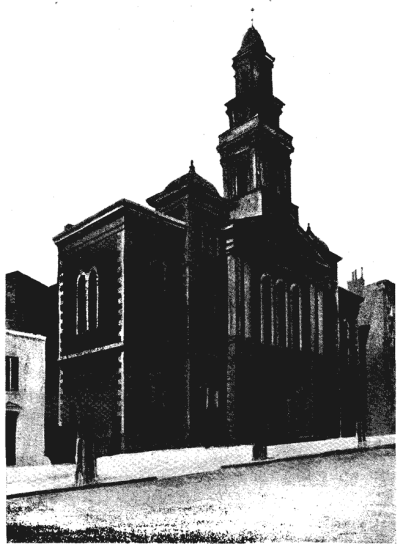
The First Presbyterian Church Of Washington Dr. Talmage's Last Charge.
I was installed in the First Presbyterian Church in Washington on October 23, 1895. My first sermon in the new pulpit in Washington was preached to a crowded church, with an overflow of over three thousand persons in the street outside. The text of my sermon was, "All Heaven is looking on."
In a few days, by exchange of my Brooklyn property, I had obtained the house 1402 Massachusetts Avenue, in Washington, for my home. It had at one time been the Spanish Legation, and was in a delightful part of the city. Shortly after my arrival in Washington I received my first introduction at the White House, with my daughters, to Mrs. Cleveland. Our reception was cordial and gracious in the extreme. I had engaged a suite of rooms at the Arlington Hotel for a year. We remained there till our lease was up before entering our new home. There was a desire among members of the congregation of the First Presbyterian Church to have me preach at the morning as well as the evening services. With three ministers attached to one church there was some difficulty in the arrangement of the sermons. Eventually it was decided that I should preach morning and evening.
In 1896 I made an extensive lecturing tour, in which I discussed my impressions of the world trip I had recently made.
The world was getting better in spite of contrasting opinions from men who had thought about it. God never launched a failure.
In 1897 I made an appeal for aid for the famine in India. I always believed it was possible to evangelise India.
My life in Washington was not different from its former course. I had known many prominent people of this country, and some of the great men of other lands.
I had known all the Presidents of the United States since Buchanan. I had known Mr. Gladstone, all the more prominent men in the bishoprics, and in high commercial, financial and religious position. I had been presented to royalty in more than one country.
Legislatures in the North and South have adjourned to give me reception. The Earl of Kintore, a Scottish peer, entertained us at his house in London in 1879. I found his family delightful Christian people, and the Countess and their daughters are very lovely. The Earl presided at two of my meetings. He took me to see some of his midnight charities—one of them called the "House of Lords" and the other the "House of Commons," both of them asylums for old and helpless men. We parted about two o'clock in the morning in the streets of London. As we bade each other good-bye he said, "Send me a stick of American wood and I will send you a stick." His arrived in America, and is now in my possession, a shepherd's crook; but before the cane I purchased for him reached Scotland the good Earl had departed this life. I was not surprised to hear of his decease. I said to my wife in London, "We will never see the Earl again in this world. He is ripe for Heaven, and will soon be taken." He attended the House of Lords during the week, and almost every Sabbath preached in some chapel or church.
I shall not forget the exciting night I met him. I was getting out of a carriage at the door of a church in London where I was to lecture when a ruffian struck at me, crying, "He that believeth not shall be damned." The scoundrel's blow would have demolished me but for the fact that a bystander put out his arm and arrested the blow. From that scene I was ushered into the ante-room of the church where the Earl of Kintore was awaiting my arrival. From that hour we formed a friendship. He had been a continuous reader of my sermons, and that fact made an introduction easy. I have from him five or six letters.
Lord and Lady Aberdeen had us at their house in London in the summer of 1892. Most gracious and delightful people they are. I was to speak at Haddo House, their estate in Scotland, at a great philanthropic meeting, but I was detained in St. Petersburg, Russia, by an invitation of the Emperor, and could not get to Scotland in time. Glad am I that the Earl is coming to Canada to be Governor-General. He and the Countess will do Canada a mighty good. They are on the side of God, and righteousness, and the Church. Since his appointment—for he intimated at Aberdeen, Scotland, when he called upon me, that he was to have an important appointment—I have had opportunity to say plauditory things of them in vast assemblages in Ottawa, Montreal, Toronto, London and Grimsby Park.
In a scrap book in which I put down, hurriedly, perhaps, but accurately, my impressions of various visits to the White House during my four years pastorate in Washington, I find some notes that may be interesting. I transmit them to the printed page exactly as I find them written on paper:
"May 1, 1896. Had a long talk this afternoon with Mrs. Cleveland at Woodley. I always knew she was very attractive, but never knew how wide her information was on all subjects. She had her three children brought in, and the two elder ones sang Easter songs for me. Mrs. Cleveland impresses me as a consecrated Christian mother. She passes much of her time with her children, and seems more interested in her family than in anything else. The first lady of the land, she is universally admired. I took tea with her and we talked over many subjects. She told me that she had joined the church at fourteen years of age. Only two joined the church that day, a man of eighty years old and herself. She was baptised then, not having been baptised in infancy. She said she was glad she had not been baptised before because she preferred to remember her baptism.
"She said she did not like the great crowds attending the church then, because she did not like to be stared at as the President's wife. But I told her she would get used to that after a while. She said she did not mind being stared at on secular occasions, but objected to it at religious service. She said she had long ago ceased taking the Holy Communion at our church because of the fact that spectators on that day seemed peculiarly anxious to see how she looked at the Communion.
"My first meeting with Mrs. Cleveland was just after her marriage. She was at the depot, in her carriage, to see Miss Rose Cleveland, the President's sister, off on the train. Dr. Sunderland introduced me at that time, when I was just visiting Washington. Mrs. Cleveland invited me to take a seat in her carriage. I accepted the invitation, and we sat there some time talking about various things. I saw, as everyone sees who converses with her, that she is a very attractive person, though brilliantly attired, unaffected in her manner as any mountain lass.
"March 3, 1897. Made my last call this afternoon on Mrs. Cleveland. Found her amid a group of distinguished ladies, and unhappy at the thought of leaving the White House, which had been her home off and on for nearly eight years. Her children have already gone to Princeton, which is to be her new home. She is the same beautiful, unaffected, and intelligent woman that she has always been since I formed her acquaintance. She is an inspiration to anyone who preaches, because she is such an intense listener. Her going from our church here will be a great loss. It is wonderful that a woman so much applauded and admired should not have been somewhat spoiled. More complimentary things have been said of her than of any living woman. She invited me to her home in Princeton, but I do not expect ever to get there. Our pleasant acquaintance seems to have come to an end. Washington society will miss this queen of amiability and loveliness.
"February 4, 1897. Had one of my talks with President Cleveland.
"As I congratulated him on his coming relief from the duties of his absorbing office, he said:
"'Yes! I am glad of it; but there are so many things I wanted to accomplish which have not been accomplished.'
"Then he went into extended remarks about the failure of the Senate to ratify the Arbitration plan. He said that there had been much work and anxiety in that movement that had never come to the surface; how they had waited for cablegrams, and how at the same time, although he had not expressed it, he had a presentiment that through the inaction of the Senate the splendid plan for the pacification of the world's controversies would be a failure.
"He dwelt much upon the Cuban embroglio, and said that he had told the Committee on Foreign Relations that if they waited until spring they had better declare war, but that he would never be responsible for such a calamity.
"He said that he had chosen Princeton for his residence because he would find there less social obligation and less demand upon his financial resources than in a larger place. He said that in all matters of national as well as individual importance it was a consolation to him to know that there was an overwhelming Providence. When I congratulated him upon his continuous good health, notwithstanding the strain upon him for the eight years of his past and present administration, he said:
"'Yes! I am a wonder to myself. The gout that used to distract me is almost cured, and I am in better health than when I entered office.'
"He accounted for his good health by the fact that he had occasionally taken an outing of a few days on hunting expeditions.
"I said to him, 'Yes! You cannot think of matters of State while out shooting ducks.'
"He answered:
"'No, I cannot, except when the hunting is poor and the ducks do not appear.'
"May 21, 1896. This morning when I entered President Cleveland's room at the White House, he said: 'Good morning, I have been thinking of you this morning.'
"The fact is he had under consideration the recall of a minister plenipotentiary from a European Government. I had an opportunity of saying something about a gentleman who was proposed as a substitute for the foreign embassy, and the President said my conversation with him had given him a new idea about the whole affair, and I think it kept the President from making a mistake that might have involved our Government in some entanglement with another nation.
"The President read me a long letter that he had received on the subject. I felt that my call had been providential, although I went to see him merely to say good-bye before he went away on his usual summer trip to Gray Gables, Buzzards Bay, Massachusetts.
"The President is in excellent health although he says he much needs an outing. He is very fond of his children, and seemed delighted to hear of the good time I had with them at Woodley. When I told how Ruth and Esther sang for me he said he could not stand hearing them sing, as it was so touching it made him cry. I told him how the baby, Marian, looked at me very soberly and scrutinisingly as long as I held her in my arms, but when I handed her to her mother, the baby, feeling herself very safe, put out her hands to me and wanted to play. But what a season of work and anxiety it had been to the President, important question after question to be settled.
"March 1, 1897. I have this afternoon made my last call on President Cleveland. With Dr. Sunderland and the officers of our church I went to the White House to bid our retiring President goodbye. Notwithstanding appointments he had made, Thurber, his private secretary, informed us that the President could not see us because of a sudden attack of rheumatism. But after Thurber had gone into the President's room, he returned saying that the President would see Dr. Sunderland and myself. Indeed, afterwards, he saw all our church officers. But he could not move from his chair. His doctor had told him that if he put his foot to the floor he would not be able to attend the inauguration of Major McKinley on the following Thursday.
"After Dr. Sunderland and the officers of the church had shaken hands for departure, the President said to me:
"'Doctor, remain, I want to see you.'
"The door closed, he asked me if I had followed the Chinese Immigration Bill that was then under consideration. We discussed it fully. The President read to me the veto which he was writing. He stated to me his objection to the bill. Our conversation was intimate, but somewhat saddened by the thought that perhaps we might not meet again. With an invitation to come and see him at Princeton, we parted.
"During a conversation of an earlier period at the White House, I congratulated the President upon his improved appearance since returning from one of his hunting expeditions.
"'Oh! Yes!' he said, 'I cannot get daily exercise in Washington. It is impossible, so I am compelled to take these occasional outings. I approach the city on my return with a feeling that work must be pulled down over me, like a nightcap,' and as he said this he made the motion as of someone putting on a cap over his head.
"I congratulated him on the effect of his proclamation on the Monroe Doctrine as it would set a precedent, and really meant peace. He agreed with me, saying:
"'Yes, but they blame me very much for the excitement I have caused in business circles, and the failures consequent. But no one failed who was doing a legitimate business, only those collapsed who were engaged in unwarranted speculations. I wish more of those people would fail.'
"'Mr. President,' I said, 'I do not want to pry into State secrets, but I would like to know how many ducks you did shoot?' He laughed, and said, 'Eleven. The papers said thirteen. Indeed, the country papers before I began to shoot said I had shot a hundred and twenty.' I spoke of the brightness and beauty of his children again. I remarked that the youngest one, then four months old, had the intelligence of a child a year old, and the President said:
"'Yes, she is a great pleasure to us, and seems to know everything.'
"March 3, 1896. Started from Washington for the great Home Missionary meeting to be held in Carnegie Hall, New York, President Cleveland to preside. We left on the eleven o'clock train, by Pennsylvania railroad. I did not go to the President's private car until we had been some distance on our way, although he told me when I went in that he had looked for me at the depot, that I might as well have been in his car all the way. No one was with him except Mrs. Cleveland and his private secretary, Mr. Thurber, who is also one of my church. We had an uninterrupted conversation. The servants and guards were at the front end of the car, and we were at the rear.
"I asked the President if he found it possible to throw off the cares of office for a while. He laughed, and said:
"'They call a trip of this kind a vacation;' then with a countenance of sudden gravity he added: 'We no sooner get through one great question than another comes.' It made me think of the tension on the President's mind at that time. There was the Venezuelan question. There were suggestions of war with England, and then there was the Cuban matter with suggestions of war with Spain, and all the time the overshadowing financial questions.
"During our conversation the President referred to the conditions ever and anon inflicted upon him by newspaper misrepresentations, particularly those of inebriety, of domestic quarrels, of turning Mrs. Cleveland out of doors at night so that she had to flee for refuge to the house of Dr. Sunderland, my pastoral associate, passing the night there; and then the reports that his children were deaf and dumb, or imbecile, when he knew I had seen them and considered them the brightest and healthiest children I had known.
"All these attacks and falsehoods concerning the President and his family I saw hurt him as deeply as they would any of us, but he is in a position which does not allow him to make reply. I assured him that he was only in the line of misrepresentation that had assailed all the Presidents, George Washington more violently than himself, and that the words cynicism, jealousy, political hatred, and diabolism in general would account for all. I do think, however, that the factories of scandal had been particularly busy with our beloved President. They were running on extra time.
"If I were asked who among the mighty men at Washington has most impressed me with elements of power I would say Grover Cleveland.
"June 25, 1896. It seems now that Major McKinley, of Canton, Ohio, will be elected President of the United States. I was in Canton about three weeks ago and called at Major McKinley's house. He was just starting from his home to call on me. He presided at the first lecture I delivered at Canton in 1871. On my recent visit he recalled all the circumstances of that lecture, remembering that he went to my room afterwards in the hotel, and had a long talk with me, which he said made a deep impression upon him.
"My visit at Canton three weeks ago was to lecture. Major McKinley attended and came upon the platform afterwards to congratulate me. He is a Christian man and as genial and lovable a man as I ever met."
"September 21, 1897. Had a most delightful interview with President McKinley in the White House.
"I congratulated him on the peaceful opening of his administration. He said:
"'Yes! I hope it is not the calm before a storm.'
"He said that during the last six weeks at least a half million of people had passed before him, and they all gave signs of their encouragement. Especially, he said, the women and children looked and acted as though they expected better times.
"The President looked uncommonly well. I told him that during the past summer I had travelled in many of the states, and that from the people everywhere I gathered hopeful feelings. I told him that they were expecting great prosperity would come to the country through his administration."
Of course these are merely scraps torn from old note-books, but I cannot help commending the value of first impressions, of the first-hand reports, which are made in this way. There is in the unadorned picture of any incident in the past a sort of hallowed character that no ornate frame can improve.
So the pages of these recollections are but a string of impressions torn from old note-books and diaries.
From scrap books and other sources, some other person may set up the last milestones of my journey through life, and think other things of enough importance to add to the furlongs I have already travelled; and I give permission to add that biography to this autobiography.

The wishes of Doctor Talmage reign paramount with me; otherwise I should not dare to add these imperfect memoirs to the finished and eloquent, yet simple, narration of his life-work which has just charmed the reader from his own graphic pen. Dr. Talmage did not consider his autobiography of vital importance to posterity; his chief concern was for his sermons and other voluminous writings. The intimate things of his life he held too sacred for public view, and he shrank from any intrusion thereupon. His autobiography, therefore, was a concession to his family, his friends, and an admiring public.
So many people all over the world have paid homage to his personality, and to his remarkable influence, that it seemed evident not only to us but to many others, that his own recollections would give abiding pleasure. I remember when we were travelling to Washington after our marriage, many men of prominence, who were on the Congressional Limited, said to Dr. Talmage: "Doctor, why don't you write your memoirs? They would be especially interesting because you have bridged two centuries in your life." Then, turning to me, they urged me to use my influence over him. Later on I did so, placing over his desk as a reminder, in big letters, the one word—"Autobiography."
His celebrity was something so unique, and so widespread, that it is difficult to write of it under the spell which still surrounds his memory. Many still remember seeing and feeling almost with awe the tremendous grasp of success which Dr. Talmage had all his life. A reminiscence of my girlhood will be pardoned: My father was his great admirer many years before I ever met the Doctor. Whenever I went with my father from my home in Pittsburg on a visit to New York, I was taken over to Brooklyn every Sunday morning, unwillingly I must confess, to hear Dr. Talmage. At that time there were other things which I found more pleasant, for I had many young friends to visit and to entertain. However, my father's wishes were always uppermost with me, and his admiration of the great preacher inspired me also with reverence. The Doctor soon became one of the great men of my life.
Dr. Talmage was among the builders of his century—a watchman of his period. He was a man of philanthropy and enterprise. His popularity was world-wide; his extraordinary power was exerted over people of all classes and conditions of life. His broad human intellectuality, his constant good humour, his indomitable energy, threw a glamour about him. His happy laughter, which attested the deep peace of his heart, rang everywhere, through his home, in social meetings with his friends, in casual encounters even with strangers.
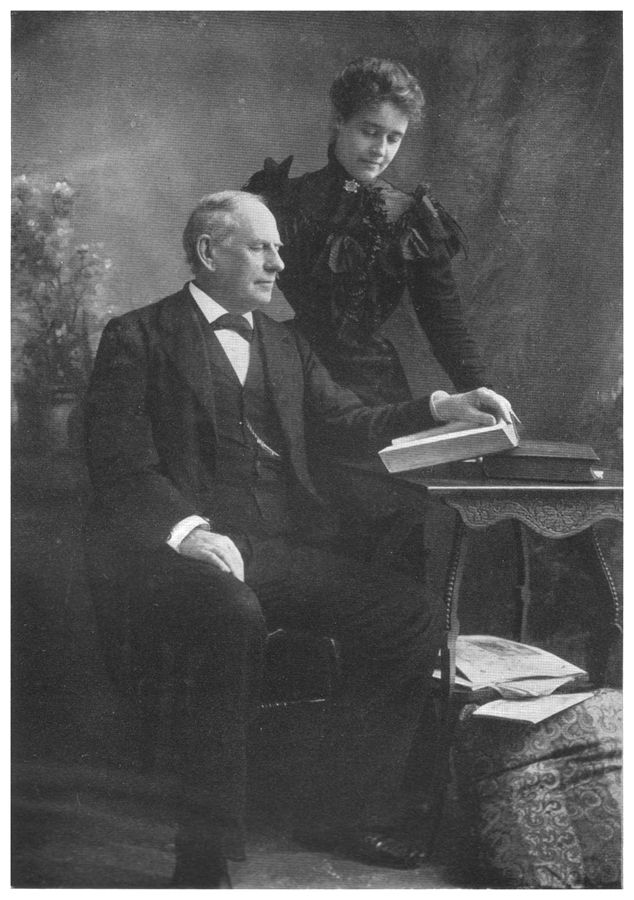
Dr. And Mrs. T. De Witt Talmage.
No one who ever knew the Doctor thought of him as an old man. He himself almost believed that he would live for ever. "Barring an accident," he often said, "I shall live for ever." The frankness and buoyancy of his spirit were like youth: were the enchantment of his personality. Even to-day, when memories begin to grow cold in the shadow of his tomb, I am constantly reminded by those who remember him of the strange magical eternity that was in him. He had been so active and busy through all the years of his life, keeping pace with each one in its seemingly increasing speed, that his heart remained ever young, living in the glory of things that were present, searching with eager vigour the horizon of the future.
Wherever I am, whether in this country or in Europe, but especially in England, Dr. Talmage's name still brings me remembrance of his distinguished career from the men of prominence who knew him. They come to me and tell me about him with unabated affection for his memory. He attracted people by a kind of magnetism, and held them afterwards with ties of deep friendship and respect. The standards of his youth were the standards of his whole life.
My appreciation of Dr. Talmage in these printed pages may not be wholly in harmony with his ideas of the privacy of his home life; but it is difficult to think of him at all in any mood less intimately reverent.
As I look over the scrapbook, my scrapbook (as he and I always called it), I feel the reserve about it that he himself did. My share in the Doctor's life, however, belongs to these last years of his distinguished career, and I am a contributor by special privilege.
I met him first at East Hampton, Long Island, in the summer of 1896, when I was visiting friends. The other day, while in reminiscent struggle with my scrapbook, I was visited by an old friend of Dr. Talmage, who recalled the following incident:
"It was Dr. Talmage's custom," he said, "to take long drives out into the country round about Washington. Sometimes he sent for me to drive with him. One afternoon I received a specially urgent call to be sure and drive with him that day, because he had something of great importance to discuss with me. On our way back, towards evening, I asked him what it was. He said, 'I work hard, very hard. Sometimes I come back to my home tired, very tired—lonely. I open my door and the house is dark, silent. The young folks are out somewhere and there is no one to talk to.' Then he became silent himself. I said to him: 'Have you any one in mind whom you would like to talk to?' 'I have,' he said positively. 'If so,' I said, 'go to her at once and tell her so.' 'I will,' he replied briskly—and the next night he went to Pittsburg."
We were married in January, 1898.
The first reception given in our home on Massachusetts Avenue was in the nature of a greeting between the Doctor's friends and myself. His own interest in the social side of things in Washington was an agreeable interruption rather than a part of his own activities. His friends were men and women from every highway and byway of the world. My father, a man of unusual intellectual breadth and heart, had been my companion of many years, so that I was, to some degree, accustomed to mature conceptions of people and affairs. But the busy whirl in the life of a celebrity was entirely new.
It was soon quite evident that Dr. Talmage relied upon me for the discretionary duties of a man besieged by all sorts of demands. From the first I feared that Dr. Talmage was over-taxing his strength, undiminished though it was at a time when most men begin to relinquish their burdens. Therefore, I entered eagerly into my new duties of relieving the strain he himself did not realise.
His was a full and ample life devoted to the gospel of cheerfulness; and to me, I think, was given the best part of it—the autumn. When I knew him he had already impressed the wide world of his hearers with his striking originality of thought and style. He had already established a form of preaching that was known by his name—Talmagic. Its character was the man himself, broad, brilliant, picturesque, keen with divine and human facts, told simply, always with an uplift of spiritual beauty.
In March, 1898, Dr. Talmage was called West for lecture engagements, and I went with him. What strange and delightful events that spring tour brought into my life! The Doctor lectured every night in what was to me some new and undiscovered country. We were always going to an hotel, to a train, to an opera house, to another hotel, another train, another opera house. Our experiences were not less exciting than the trials of one-night stands. I had never travelled before without a civilised quota of trunks; but the Doctor would have been overwhelmed with them in the rush to keep his engagements. So we had to be content with our bags. When we were not studying time tables the Doctor was striding across the land, his Bible under his arm, myself in gasping haste at his side. What primitive hotels we encountered; what antiquated trains we had to take! Frequently a milk train was the only means of reaching our destination, and, alas! a milk train always leaves at the trying hour of 4 a.m. Once we had to ride on a special engine; and frequently the caboose of a freight train served our desperate purpose. I began to understand something of the loneliness of the Doctor's life in experiences like these.
I insisted upon sitting in the front row at every one of Dr. Talmage's lectures, which I soon knew by heart. He used to laugh when I would repeat certain parts of them to him.
Then he would beg me to stay away that I might not be bored by listening to the same thing over again. I would not have missed one of his lectures for the world. These were the great moments of his life; the combined resources of his character came to the surface whenever he went into the pulpit or on to the platform. These were the moments that inspired his life, that gave it an ever-increasing vigour of human and divine perception. The enthusiasm of his reception by the crowds in these theatres keyed me up so that each new audience was a new pleasure. There were no preliminaries to his lectures. Frequently he had time only to drop his hat and step on to the stage as he had come from the train. After every lecture it was his custom to shake hands with hundreds of people who came up to the platform. This was very exhausting, but these were to him the moments of fruition—the spiritual harvest of the Christian seeds he had scattered over the earth. They were wonderful scenes, dramatic in their earnestness, remarkable in the evidence they brought out of his universal influence upon the hearts of men and women. Everywhere the same testimony prevailed:
"You saved my father, God bless you!" "You saved my brother, thank God!" "You made a good woman of me!" "You gave me my first start in life!" In these words they told him their gratitude, as they grasped his hand.
On these occasions the Doctor's face was wonderful to see as, with the silent pressure of his hand, he looked into the eyes that were filled with tears. Sometimes people would come to me and whisper the same truths about him, and when I would tell him, his answer was characteristic: "Eleanor, this is what gives me strength. It is worth living to hear people tell me these things."
Dr. Talmage's instincts were big, evangelical impulses. I often used to urge him to relinquish his pastorate; but he would reply that after all the Church was his candlestick; that he must have a place to hold his candle while he preached to a world of all nations. Yet he often said he would rather have been an unfettered evangelist, bent on saving the world, than the pastor of any one flock or church. To preach to the people was the breath of his life. It was the restless energy of his soul that kept him for ever young. He would put all his strength into every sermon he preached, and every lecture he delivered.
Dr. Talmage had absolutely no personal vanity. He was a man absorbed in ideas, indifferent to appearances. He lived in the opportunities of his heart and mind to help others; although he had been one of the most tried of men, he had never spared himself to help others. He never lost faith in anyone. There were many shrewd enough to realise this characteristic in him, who would put a finger on his heart and draw out of him all he had to give.
On one occasion we were travelling through Iowa, when a big snow storm made it evident that we could not make connections to meet an engagement he had made to lecture that evening in Marietta, Ohio. He had just said to me that after all he was glad, because he was very tired and needed the rest. Will Carleton was on the same train, bound for Zanesville, Ohio, to give a lecture that night. He was very much afraid that he, too, would miss his engagement. He asked the Doctor to telegraph to the railroad officials to hold the limited at Chicago Junction, which the Doctor did. The result was that we were whisked in a carriage across Chicago and whirled on a special car to the junction, where the limited was held for us, much to the disgust of the other passengers.
He saw the mercy of God in every calamity, the beauty of faith in Him in every mood of earth or sky. One spring day we were sitting in the room of a friend's house. There were flowers in the room, and Dr. Talmage loved these children of nature. He always said that flowers were appropriate for all occasions. Some one said to him, "Doctor, how have you kept your faith in people, your sweet interpretation of human nature, in spite of the injustice you have sometimes been shown?" Looking at a great bunch of sweet peas on the table, he said: "Many years ago I learned not to care what the world said of me so long as I myself knew I was right and fair, and how can one help but believe when the good God above us makes such beautiful things as these flowers?"
His creed, as I learned it, was perfect faith, and the universal commands of human nature to live and let live. Although I was destined to share less than five years of his life, there was in the whole of it no chapter or incident with which he did not acquaint me. He was not a man of theory. No one could live near him without awe of his genius.
We returned to Washington after this spring lecturing tour, where the Doctor resumed his preaching twice on Sunday, and his mid-week lecture, till June. Then, according to Dr. Talmage's custom, we went to Saratoga for a few weeks before the crowds came for the season. The Doctor found the Saratoga Springs beneficial and made it a rule to go there for a time each summer. On July 3, 1898, we started for the Pacific coast on what Dr. Talmage called a summer vacation. On his desk there was always a great number of invitations to preach and lecture awaiting his acknowledgment or refusal. The greatest problem of the last years of his life was how to find time for all the things he was asked to do and wanted to do. In vain I tried to make him conform to the usual plans of a summer outing. He asked me if he might take a "few lectures" on our route to California, and he did, but he always managed to slip in a few extra ones without my knowledge. When I would protest about these additional engagements he would say that the people wanted to hear him, that they were new people he had never seen, which meant more to him than anything else; then, of course, I had to yield my judgment.
It had been Dr. Talmage's original plan to go to Europe during this first summer of our marriage, but the outbreak of the Spanish war made him afraid he might not be able to get back in time for his church work in October. Although ostensibly this was a vacation trip, it was so only in the spirit and gaiety of the Doctor's moods. Three times a week Dr. Talmage lectured, and preached once, sometimes twice, every Sunday. From Cincinnati westward to Denver, we zigzagged over the country, keeping in constant pursuit of the Doctor's engagements. No argument on our part could alter these working plans which my husband had made before we left Washington. He was so happy, however, in the midst of his energies, that we forgot the exertion of his labours.
The three places where, by agreeable lapses, Dr. Talmage really enjoyed a rest, were Colorado Springs, the Yellowstone Park, and Coronado Beach in California. Aside from these points, we were travelling incessantly in the Doctor's reflected glory, which was our vacation, but by no means his. While at Colorado Springs, where we stayed two weeks, Dr. Talmage preached once, and once in Denver, but he did not lecture.
In Salt Lake City the Doctor preached in the Tabernacle, the throne room of polygamy, that he had so often attacked in previous years. That was a remarkable feature of these last milestones of his life, that all conflicts were forgotten in a universal acknowledgment of his evangelism. His grasp of every subject was always close to the hearts of others, and it was instinctive, not studied.
During our visit in the West, he talked much of the effect of the Spanish war, regarding our victory in Cuba and the Philippines as an advance to civilisation.
We entered the Yellowstone Park at Minado and drove through the geyser country. We stopped at Dwelly's, a little log-cabin famous to all travellers, just before entering the park. On leaving there, we had been told that there were occasional hold-ups of parties travelling in private vehicles, as we were. The following day, while passing along a lonely road, a man suddenly leaped from the bushes and seized the bridles of the horses. The Doctor appeared to be terribly frightened, and we were all very much excited when we saw that the driver had missed his aim when he fired at the bandit. The robber was of the appearance approved in dime novels; he wore a sacking over his head with eye-holes cut in it through which he could see, and looked in all other respects a disreputable cut-throat. Just as we were about to surrender our jewels and money, Dr. Talmage confessed that he had arranged the hold-up for our benefit, and that it was a practical joke of his. He was always full of mischief, and took delight in surprising people.
On Sunday Dr. Talmage preached in the parlours of the Fountain Hotel. The rooms were crowded with the soldiers who were stationed in the park. The Doctor's sermon was on garrison duty; he said afterwards that he found it extremely difficult to talk there because the rooms were small, and the people were too close to him. We paid a visit to Mr. Henderson, who was an official of the Yellowstone Park at that time, and whose brother was Speaker of the House in Washington. He begged Dr. Talmage to use his influence with members of Congress to oppose a project which had been started, to build a trolley line through the Yellowstone Park. The Doctor promised to do so, and I think the trolley line has not been built. We left the Yellowstone Park, at Cinabar, and went direct to Seattle. During our stay in Seattle the whole town was excited one morning by the arrival of a ship from the Klondike, that region of golden romance and painful reality. The Doctor and I went down to the wharf to see the great ship disembark these gold-diggers; but for several hours the four hundred passengers had been detained on board because $24,000 in gold dust, carried by two miners, had been stolen; and though a search had been instituted, to which everyone had been compelled to submit, no clue to the thief had been found. Dr. Talmage was profoundly impressed by the misfortune of these two men, who after months of exposure and fatigue were now obliged to walk ashore penniless. A number of these four hundred passengers had brought back an aggregate of about $4,000,000 from the Klondike; but many among them had brought back only disappointment, and their haggard faces were pitiful to see; indeed, the Doctor told me that out of the thousands who went fortune hunting to Alaska, only about 3 per cent. came back richer than when they started.
In the early part of September Dr. Talmage lectured in San Francisco on International Policies. His admiration of the Czar's manifesto for disarmament of the nations was unbounded, and he emphasised it whenever he appeared in public. He prophesied the millennium as if he looked forward to personal experiences of it; this came from his remarkable confidence in the life forces nature had given him. At Coronado Beach we determined upon a rest for two weeks; but the Doctor could in no wise be induced to forego his lecture at San Diego. A pleasant visit to Los Angeles was followed by a delightful sojourn of a few days at Santa Barbara, the floral paradise of the Golden Coast; here the Doctor was met at the station by carriages, and we were literally smothered in flowers; even our rooms in the hotel were banked high with roses. In the afternoon we accepted an invitation to drive through Santa Barbara, hoping against hope that we might do so inconspicuously. But the same flower-laden carriages came for us, and we were driven through the city like a miniature flower parade. Much to the Doctor's regret he was followed about like a circus; but his courtesy never failed.
On our route East we again stopped in San Francisco. An announcement had been made that Dr. Talmage would preach for the Sunday evening service at Calvary Presbyterian Church, on the corner of Powell and Geary Streets. Never had I seen such a crowd before. As we made our way to the church, we found the adjoining streets packed so solidly with people that we had to call a policeman to make an opening for us. Once inside, we saw the church rapidly filling, till at last, as a means of protection, the doors were locked against the surging crowd. But Dr. Talmage had scarcely begun his sermon when the doors were literally broken down by the crowd outside. Quick to see the danger the Doctor sent out word to the people that he would speak in Union Square immediately after the church service. This had the desired effect, and the great crowd waited patiently for him a block away till nine o'clock. It was rather a raw evening because of a fog that had come up from the sea, and for this reason the Doctor asked permission to keep his hat on while he talked from the band stand. It was the first time I ever heard him speak out of doors, and I was amazed to hear how clearly every word travelled, and with what precision his voice carried the exact effect. It was a coincidence that the theme of his sermon should have been, "There is plenty of room in Heaven."
The tremendous enthusiasm, the almost worshipful interest with which he was received, could easily have spoiled any man, but with Dr. Talmage such an ovation as we had witnessed seemed only to intensify the simplicity of his character. He lost his identity in the elements of inspiration, and when he had finished preaching it was not to himself but to the power that had been given him, he gave all the credit of his influence. He was always simple, direct, unpretentious.
During a short stay in Chicago Dr. Talmage preached in his son's church, and then hurried home to begin his duties in his own church. Duty was the Doctor's master key; with it he locked himself away from the mediocre, and unlocked his way to ultimate freedom of religious impulse. For a long while he had formed a habit of preaching without recompense, as he would have desired to do all his life, because he felt that the power of preaching was a gift from God, a trust to be transmitted without cost to the people. He never missed preaching on Sunday, paying his own expenses to whatever pulpit he was invited to occupy. There were so many invitations that he was usually able to choose. It was this conviction that led to his ultimate resignation from his church in Washington, that he might be free to expound the Scriptures wherever he was.
He was always so happy it was hard to believe that he was overworking; yet I feared his labour of love would end in exhaustion and possible illness. Everything in the world was beautiful to him, and yet beauty was not a matter of externals with him. It radiated from him, even when it was not about him. Especially was this noticeable when we were away together on one of his short lecturing trips. At these times we were quite alone, and then, without interruptions, in the sequestered domain of some country hotel he would admit me into the wonderland of his inner hopes, his plans for the future, his ideas of life and people and happiness. Once we were staying in one of these country hotels obviously pretentious, but very uncomfortable—the sort of hotel where the walls of the room oppress you, and the furniture astonishes you, and there are no private baths. He sat down in the largest chair, literally beaming with delight.
"Isn't it beautiful?" he said; "now I take my home with me; before I used to be so much alone. Now I have someone to talk to."
There was nothing comparative in his happiness; everything was made perfect for him by the simplicity of his appreciation. I used to look forward to these trips as one might look forward to an excursion into some new and unexpected transport of existence, for he always had new wonders of heart and mind to reveal in these obscure byways we explored together. They were all too short, and yet too full for time to record them in a diary. These were the hours that one puts away in the secret chamber of unwritten and untold feeling. I turn again to the pages of our scrap book, as one turns to the dictionary, for reserve of language.
In November of 1898 I find there a clipping that reminds me of the day Dr. Talmage and I spent at the home of Senator Faulkner, in Martinsburg, West Virginia. The Anglo-American Commission was in session in Washington then, and during the following winter. The Joint High Commission was the official title, and we were invited by Senator Faulkner with these men to get a glimpse of that rare Americanism known the world over as Southern hospitality. The foreign members of the Commission were Lord Herschel, Sir Wilfred Laurier, Sir Louis Davis, and Sir Richard Cartwright. Our host was one of the Americans on the Commission.
We left Washington about noon, lunched on the train, and reached the old ancestral home in a snow storm. All of the available carriages and carry-alls were at our disposal, however, and we were quickly driven to the warm fireside of a true Southerner, who, more than any other kind of man, knows how to brand the word "Home" upon your memory. We dined with true Southern sumptuousness. Never shall I forget the resigned and comfortable expression of that little roast pig as it was laid before us. To the Englishmen it was a rare chance to understand the cordial relations between England and America, in an atmosphere of Colonial splendour. The house itself has not undergone any change since it was built; it stands a complete example of an old ancestral estate. As we were leaving, our host insisted that no friend should leave his house without tasting the best egg-nog ever made in Virginia. The doctor and I drove to the station in a carriage with Lord Herschel. He was a man of great reserve and high breeding. On the way he showed us a letter that he had just received from his daughter, a little girl in England, telling him to be sure and come home for the Christmas holidays, and not to let those rich Americans keep him away.
This was the beginning of a series of dinners given by members of the Joint High Commission in Washington during the winter, to which we were often invited. A few months later Lord Herschel died in Washington. Dr. Talmage was almost the last man to see him alive. He called at his hotel to invite him to stay at his house, but he was then too ill to be moved.
During the early Fall of 1898 the Doctor lectured at Annapolis. It was his first visit to the old historic town, and he was received with all the honour of the place. We were the guests of Governor Lowndes at the executive mansion, where we were entertained in the evening at dinner. Just before the Christmas holidays, Dr. Talmage made a short lecturing trip into Canada, and I went with him; it was my privilege to accompany him everywhere, even for a brief journey of a day.
In Montreal, while sitting in a box with some Canadian friends, during one of the Doctor's lectures, they told me how deep was the affection and regard for him in England.
"Wait till you see how the English people receive him," they said; "you will be surprised at the hold that he has on them over there." The following year I went to England with him, and experienced with pride and pleasure the truth of what they had said.
The end of our first year together seemed to be only the prelude to a long lifetime of companionship and happiness, without age, without sorrow, without discord.
In his study no wasted hours ever entered. With the exception of the stenographer and his immediate family no one was admitted there. It was his eventful laboratory where he conceived the greatest sermons of his period. I merely quote the opinions of others, far more important than my own, when I say this. It is a sort of haunted room to-day which I enter not with any fear, but I can never stay in it very long. It has no ghostly associations, it is too full of vital memories for that; but it is a room that mystifies and silences me, not with mere regrets, for that is sorrow, and there is nothing sad about the place to me. I can scarcely convey the impression; it is as though I expected to see him come in at the door at any moment and hear him call my name. The room is empty, but it makes me feel that he has only just stepped out for a little while. The study is at the top of the house, a long, wide, high-ceilinged room with many windows, from which the tops of trees sway gently in the breeze against the sky above and beyond. I spent a great deal of time with him in it. Sometimes he would talk with me there about the themes of his sermons which were always drawn from some need in modern life.
With the Bible open before him he would seek for a text.
"After forty years of preaching about all the wonders of this great Book," he would say, "I am often puzzled where to choose the text most fitting to my sermon."
His habits were methodical in the extreme; his time punctually divided by a fixed system of invaluable character. His inspirations were part of his eternal spirit, but he lived face to face with time, obedient to the law of its precision. I think of him always as of one whose genius was unknown to himself.
We could always tell the time of day by the Doctor's habits. They were as regular as a clock that never varies. At 7.30 to the second he was at the breakfast table. It was exactly one o'clock when he sat down to dinner. At 6.30 his supper was before him. Some of our household would have preferred dining in the evening, but in that case the Doctor would have dined alone, which was out of the question.
Every day of his life, excepting Friday, Saturday and Sunday, the Doctor walked five miles. In bad weather he went out muffled and booted like a sailor on a stormy sea. His favourite walk was always from our house to the Capitol, around the Library of Congress and back. He never varied this walk for he had no bump of locality, and he was afraid of losing his way. If he strayed from the beaten path into any one of the beautiful squares in Washington he was sure to have to ask a policeman how to get home.
Fridays and Saturdays Dr. Talmage spent entirely in his study, dictating his sermons. How many miles he walked these days he himself never knew, but all day long he tramped back and forth the length of his study, composing and expounding in a loud voice the sermon of the week. He could be heard all over the house. We had a new servant once who came rushing downstairs to my room one morning in great fear.
"Mrs. Talmage, ma'am, there is a crazy man in that room on the top floor," she cried. She had not seen nor heard the Doctor, and did not know that that room was his study. On these weekend days we always drove after dark. An open carriage was at the door by 8 o'clock, and no matter what the weather might be we had our drive. In the dead of winter, wrapped in furs and rugs, we have driven in an open carriage just as if it were summer. Usually we went up on Capitol Hill because the Doctor was fond of the view from that height.
My share in the Doctor's labours were those of a watchful companion, who appreciated his genius, but could give it no greater light than sympathy and admiration. Occasionally he would ask me to select the hymns for the services, and this I did as well as I could. Sunday was the great day of the week to me. It has never been the same since the Doctor died. Our friendships were always mutual, and we shared them with equal pleasure. The Doctor's friendship with President McKinley was an intimate mutual association that ended only with the great national disaster of the President's assassination. Very often, we walked over in the morning to the White House to call on the President for an informal chat. A little school friend, who was visiting my daughter that winter, told my husband how anxious she was to see a President.
"Come on with me, I will show you a real President," said Dr. Talmage one morning, and over we went to the White House. While we were talking with the President, Mrs. McKinley came in from a drive and sent word that she wished to see us.
"I want to show you the President's library and bedroom," she said, "that you may see how a President lives." Then she took us upstairs and showed us their home.
While we did not keep open house, there was always someone dropping in to take dinner or supper informally, and I was somewhat surprised when Dr. Talmage told me one day that he thought we ought to give some sort of entertainment in return for our social obligations. It was not quite like him to remember or think of such things. On January 23, 1899, we gave an evening reception, to which over 300 people came. It was the first social affair of consequence the Doctor had ever given in his house in Washington.
My husband's memory for names was so uncertain that when he introduced me to people he tactfully mumbled. On this occasion Senator Gorman very kindly stood near me to identify the people for me. I remember a very dapper, very little man in evening clothes, who was passed on to me by the Doctor, with the usual unintelligible introduction, and I had just begun to make myself agreeable when, pointing to a medal on his coat, the little man said:
"I am the only woman in the United States who has been honoured with one of these medals."
I was very much mystified and looked up helplessly at Senator Gorman, who relieved me at once by saying, "Mrs. Talmage, this is the celebrated Dr. Mary Walker, of whom you have heard so often."
It was difficult for Dr. Talmage to assimilate the social obligations of life with the broader demands of his life mission, which seemed to constantly extend and increase in scope into the far distances of the world. More and more evident it became that the candlestick of his religious doctrine could no longer be maintained in one church, or in one pulpit. The necessity of breaking engagements out of town so as to be in Washington every Sunday became irksome to him. He felt that he could do better in the purposes of his usefulness as a preacher if he were to bear the candle of his Gospel in a candlestick he could carry everywhere himself. I confess that I was not sorry when he reached this decision and submitted his resignation to the First Presbyterian Church in the spring of 1899, after our return from a short vacation in Florida.
On our trip South I remember Admiral Schley was on the train with us part of the way. The Admiral told the Doctor the whole story of the Santiago victory, and commented upon the official investigation of the affair. My husband was very fond of him, and his comment was summed up in his reassuring answer to the Admiral—"But you were there."
It was during our stay in Florida that Dr. Talmage and Joseph Jefferson, the actor, renewed their acquaintance. The Doctor never saw him act because he had made it a rule after he entered the ministry in his youth never to go to the theatre to see a play. In crossing the ocean he had frequently appeared with stage celebrities, at the usual entertainments given on board ship for the benefit of seamen, and in this way had made some friends among actors. He was particularly fond of Madame Modjeska, whom he had met on the steamer, and whose character and spirit he greatly admired.
Jefferson was a great fisherman, and most of his day was spent on the water or on the pier. There we used to meet him, and he and Dr. Talmage would exchange reminiscences, serious and ludicrous. One of the Doctor's favourite stories was an account of a terrific fight he saw in India, between a mongoose and a cobra. Mr. Jefferson also had a story, a sort of parody of this, which described a man in delirium tremens watching in imaginary terror a similar fight. Years before this, when the Doctor had delivered his famous sermon in Brooklyn against the stage, Jefferson was among the actors who went to hear him. Recalling this incident, Mr. Jefferson said:—
"When I entered that church to hear your sermon, Doctor, I hated you. When I left the church, I loved you." He talked very little of the theatre, and seemed to regard his stage career with less importance than he did his love of painting. He never grew tired of this subject.
When we were leaving Palm Beach, Mr. Jefferson said to me, "I know Dr. Talmage won't come and see me act, but when I am in Washington I will send you a box, and I hope the Doctor will let you come."
Dr. Talmage's resignation from his church in Washington took place in March, 1899. I quote his address to the Presbytery because it was a momentous event occurring in the gloaming of what seemed to us all, then, the prime of his life:
"March 3, 1899.
"To the Session of the First Presbyterian Church of Washington.
"Dear Friends—
"The increasing demands made upon me by religious journalism, and the continuous calls for more general work in the cities, have of late years caused frequent interruption of my pastoral work. It is not right that this condition of affairs should further continue. Besides that, it is desirable that I have more opportunity to meet face to face, in religious assemblies, those in this country and in other countries to whom I have, through the kindness of the printing press, been permitted to preach week by week, and without the exception of a week, for about thirty years. Therefore, though very reluctantly, I have concluded, after serving you nearly four years in the pastoral relation, to send this letter of resignation....
"T. DeWitt Talmage."
I had rather expected that the Doctor's release from his church would have had the desired effect of reducing his labours, but he never accomplished less than the allotment of his utmost strength. Rest was a problem he never solved, and he did not know what it meant. My life had not been idle by any means, but it seemed to me that the Doctor's working hours were without end. When I told him this, he would say:—
"Why, Eleanor, I am not working hard at all now. This is very tame compared to what I have done in the years gone by."
His weekly sermon was always put in the mail on Saturday night, as also his weekly editorials. Sunday the sermon was preached, and on Monday morning the syndicate of newspapers in this country printed it. He made always two copies of his sermon. One he sent to his editorial offices in New York, the other was delivered to the Washington Post. I was told a little while ago that a prominent preacher called on the editor of this newspaper and asked him to publish one of his own sermons. This was refused, even when the aforesaid preacher offered to pay for the privilege.
"But you print Talmage's sermons!" said the preacher.
"We do," replied the editor, "because we find that our readers demand them. We tried to do without them, but we could not."
Dr. Talmage's acquaintance with men of national reputation was very wide, but he never seemed to consider their friendship greater than any others. He was a great hero worshipper himself, always impressed by a man who had done something in the world. There was a great deal of praise being bestowed about this time on Mr. Carnegie's library gifts. Dr. Talmage admired the Scottish-American immensely, having formed his acquaintance while crossing the ocean. Five or six years later, during the winter of 1899, the Doctor met him in one of the rooms of the White House. He tells this anecdote in his own words, as follows:—
"I was glad I was present that day, when Mr. Andrew Carnegie decided upon the gift of a library to the city of Washington. I was in one of the rooms of the White House talking with Governor Lowndes, of Maryland, and Mr. B.H. Warner, of Washington, who was especially interested in city libraries. Mr. Carnegie entered at the opposite end of the room. We greeted each other with heartiness, not having met since we crossed the ocean together some time before. I asked Mr. Carnegie to permit me to introduce him to some friends. After each introduction the conversation immediately turned upon libraries, as Mr. Carnegie was then constantly presenting them in this and other lands. Before the conversation ended that day, Mr. Carnegie offered $250,000 for a Washington library. I have always felt very happy at having had anything to do with that interview, which resulted so gloriously."
Dr. Talmage's opinions upon the aftermath of the Spanish war were widely quoted at this time.
"The fact is this war ought never to have occurred," he said. "We have had the greatest naval officer of this century, Admiral Schley, assailed for disobeying orders, and General Shatter denounced for being too fat and wanting to retreat, and General Wheeler attacked because of something else. We are all tired of this investigating business. I never knew a man in Church or State to move for an investigating committee who was not himself somewhat of a hypocrite. The question is what to do with the bad job we have on hand. I say, educate and evangelise those islands."
As he wrote he usually talked, and these words are recollections of the subjects he talked over with me in his quieter study hours. They were virile talks, abreast of the century hurrying to its close, full of cheerfulness, faith, and courage for the future.
He was particularly distressed and moved by the death of Chief Justice Field, in April, 1899. It was his custom to read his sermons to me in his study before preaching. He chose for his sermon on April 16, the decease of the great jurist, and his text was Zachariah xi, 2: "Howl fir tree, for the cedar has fallen." Many no doubt remember this sermon, but no one can realise the depths of feeling with which the Doctor read it to me in the secret corner of his workroom at home. But his heart was in every sermon. He said when he resigned from his church:—
"The preaching of the Gospel has always been my chosen work, I believe I was called to it, and I shall never abandon it."
During this season in Washington we gave a few formal dinners. My husband wished it, and he was a cheerful, magnetic host, though he accepted few invitations to dinner himself. No wine was served at these dinners, and yet they were by no means dull or tiresome. Our guests were men of ideas, men like Justice Brewer, Speaker Reed, Senator Burrows, Justice Harlan, Vice-President Fairbanks, Governor Stone, and Senators who have since become members of the old guard. It was said in Washington at the time that Dr. Talmage's dinner parties were delightful, because they were ostensible opportunities to hear men talk who had something to say. The Doctor was liberal-minded about everything, but his standards of conduct were the laws of his life that no one could jeopardise or deny.
A very prominent society woman came to Dr. Talmage one day to ask the favour that he preach a temperance sermon for the benefit of Sir Wilfrid Laurier, whom she wanted to interest in temperance legislation. She promised to bring him to the Doctor's church for that purpose.
"Madame, I shall be very glad to have Sir Wilfrid Laurier attend my church," said the Doctor, "but I never preach at anybody. Your request is something I cannot agree to." The lady was a personal friend, and she persisted. Finally the Doctor said to her:
"Mrs. G——, my wife and I are invited to meet Sir Wilfrid Laurier at a dinner in your house next week. Will you omit the wines at that dinner?" The lady admitted that that would be impossible.
"Then you see, Madame, how difficult it would be for me to alter my principles as a preacher." In May, 1899, Dr. Talmage and I left Washington and went to East Hampton—alone. Contrary to his usual custom of closing his summer home between seasons, the Doctor had allowed a minister and his family to live there for three months. Diphtheria had developed in the family during that time and the Doctor ordered everything in the house to be burned, and the walls scraped. So the whole house had to be refurnished, and the Doctor and I together selected the furniture. It was a joyous time, it was like redecorating our lives with a new charm and sentiment that was intimately beautiful and refreshing. I remember the tenderness with which the Doctor showed me a place on the door of the barn where his son DeWitt, who died, had carved his initials. He would never allow that spot to be touched, it was sacred to the memory of what was perhaps the most absorbing affection of his life. He always called East Hampton his earthly paradise, which to him meant a busy Utopia. He was very fond of the sea bathing, and his chief recreation was running on the beach. He was 65 years old, yet he could run like a young man. These few weeks were a memorable vacation.
In June, Dr. Talmage made an engagement to attend the 60th commencement exercises of the Erskine Theological College in Due West, South Carolina. This is the place where secession was first planned, as it is also the oldest Presbyterian centre in the United States. We were the guests of Dr. Grier, the president of the college. It was known that Rev. David P. Pressly, Presbyterian patriarch and graduate of this college, had been my father's pastor in Pittsburg, and this association added some interest to my presence in Due West with the Doctor. The Rev. E.P. Lindsay, my brother's pastor in Pittsburg, had also been born there, and his mother, when I met her in 1899, was still a vigorous Secessionist. Her greatest disappointment was the fact that her son had abandoned the sentiments of Secession and had gone to preach in a Northern church. She told us that she had once hidden Jefferson Davis in her house for three days. Due West was a quiet little village inhabited by some rich people who lived comfortably on their plantations. The graduating class of the college were entertained at dinner by Dr. Grier and the Doctor. There was a great deal of comment upon the physical vigour and strength of Dr. Talmage's address, most of which reached me. A gentleman who was present was reminded of the remarkable energy of the Rev. Dr. Pressly, who preached for over fifty years, and was married three times. When asked about his health, Dr. Pressly always throughout his life made the same reply, "Never better; never better." After he had won his third wife, however, he used to reply to this question with greater enthusiasm than before, saying, "Better than ever; better than ever." Another resident of Due West, who had heard both the Booths in their prime, said, "Talmage has more dramatic power than I ever saw in Booth." This visit to Due West will always remain in my memory as full of sunshine and warmth as the days were themselves.
We returned to East Hampton for a few days, and on July 4, 1899, the Doctor delivered an oration to an immense crowd in the auditorium at Ocean Grove. This was the beginning of a summer tour of Chautauquas, first in Michigan, then up the lakes near Mackinaw Island, and later to Jamestown, New York.
In the Fall of 1899 we made a trip South, including Nashville, Memphis, Chattanooga, Birmingham, and New Orleans. One remarkable feature of Dr. Talmage's public life was the way in which he was sought as the man of useful opinions upon subjects that were not related to the pulpit. He was always being interviewed upon political and local issues, and his views were scattered broadcast, as if he were himself an official of national affairs. He never failed to be ahead of the hour. He regarded the affairs of men as the basis of his evangelical purpose. The Spanish war ended, and his views were sought about the future policy in the East. The Boer war came, and his opinions of that issue were published. Nothing moved in or out of the world of import, during these last milestones of his life, that he was not asked about its coming and its going. His readiness to penetrate the course of events, to wrap them in the sacred veil of his own philosophy and spiritual fabric, combined to make him one of the foremost living characters of his time.
Dr. Talmage was the most eager human being I ever knew, eager to see, to feel the heart of all humanity. I remember we arrived in Birmingham, Alabama, the day following the disaster that visited that city after the great cyclone. The first thing the Doctor did on our arrival was to get a carriage and drive through those sections of the city that had suffered the most. It was a gruesome sight, with so many bodies lying about the streets awaiting burial. But that was his grasp of life, his indomitable energy, always alert to see and hear the laws of nature at close range.
We were entertained a great deal through the South, where I believe my husband had the warmest friends and a more cordial appreciation than in any other part of the country. There was no lack of excitement in this life that I was leading at the elbow of the great preacher, and sometimes he would ask me if the big crowds did not tire me. To him they were the habit of his daily life, a natural consequence of his industry. However, I think he always found me equal to them, always happy to be near him where I could see and hear all.
In October of this year we returned to Washington, when the Pan-Presbyterian Council was in session, and we entertained them at a reception in our house till late in the evening. The International Union of Women's Foreign Missionary Societies of the Presbyterian and Reformed Churches were also meeting in Washington at this time, and they came. At one of the meetings of the Council Dr. Talmage invited them all to his house from the platform in his characteristic way.
"Come all," he said, "and bring your wives with you. God gave Eve to Adam so that when he lost Paradise he might be able to stand it. She was taken out of man's side that she might be near the door of his heart, and have easy access to his pockets. Therefore, come, bringing the ladies with you. My wife and I shall not be entertaining angels unawares, but knowing it all the while. To have so much piety and brain under one roof at once, even for an hour or two, will be a benediction to us all the rest of our lives. I believe in the communion of saints as much as I believe in the life everlasting."
In November, 1899, Dr. Talmage installed the Rev. Donald McLeod as succeeding pastor of the First Presbyterian Church in Washington, and delivered the installation address, the subject of which was, "Invitation to Outsiders." There had been some effort to inspire the people of Washington to build an independent Tabernacle for the Doctor after his resignation, but he himself was not in sympathy with the movement because of the additional labour and strain it would have put upon him.
As the winter grew into long, gray days, we were already planning a trip to Europe for the following year of 1900, and we were anticipating this event with eager expectancy as the time grew near.
So much has been written about Dr. Talmage the world over, that I am tempted to tell those things about him that have not been written, but it is difficult to do. He stood always before the people a sort of radiant mystery to them. He was never really understood by those whom he most influenced. A writer in an English newspaper has given the best description of his appearance in 1900 I ever saw. It is so much better than any I could make that I quote it, regretting that I do not know the author's name:—
"A big man, erect and masterful in spite of advancing years, with an expressive and mobile mouth that seems ever smiling, and with great and speaking eyes which proclaim the fervent soul beneath."
This portrait is very true, with a suggestion of his nature that makes it a faithful transcript of his presence. It is a picture of him at 66 years of age. His strength overwhelmed people, and yet he was very simple, easily affected by the misfortunes of others, direct in all his impressions; but no one could take him by surprise, because his faith in the eternal redemption of all trials was beyond the ways of the world. His optimism was simple Christianity. He always said he believed there was as great a number out of the Church as there was in it that followed the teaching of Christianity. He was among the believers, with his utmost energy alert to save and comfort the unbelievers. He believed in everything and everyone. The ingenuousness of his nature was childlike in its unchallenged faith and its tender instincts. His unworldliness was almost legendary in its belief of human nature. I remember he was asked once whether he believed in Santa Claus, and in his own beautiful imagery he said:
"I believe in Santa Claus. Haven't I listened when I was a boy and almost heard those bells on the reindeer; haven't I seen the marks in the snow where the sleigh stopped at the door and old Santa jumped out? I believed in him then and I believe in him now—believe that children should be allowed to believe in the beautiful mythical tale. It never hurt anyone, and I think one of the saddest memories of my childhood is of a day when an older brother told me there was no Santa Claus. I didn't believe him at first, and afterwards when I saw those delightful mysterious bundles being sneaked into the house, way down deep in my heart I believed that Santa Claus as well as my father and mother had something to do with it."
In the last years of his life music became the greatest pleasure to Dr. Talmage. An accumulation of work made it necessary for me to engage a secretary. We were fortunate in securing a young lady who was an exquisite pianist. In the evening she would play Liszt's rhapsodies for the Doctor, who enjoyed the Hungarian composer most of all. He said to me once that he felt as if music in his study, when he was at work, would be a great inspiration. So my Christmas present to him that year was a musical box, which he kept in his study.
The three months preceding our trip to Europe were spent in the usual busy turmoil of social and public life. In truth we were very full of our plans for the European tour, which was to be devoted to preaching by Dr. Talmage, and to show me the places he had seen and people he had met on previous visits. There was something significant in the welcome and the ovations which my husband received over there. Neither the Doctor nor myself ever dreamed that it would be his farewell visit. And yet it seems to me now that he was received everywhere in Europe as if they expected it to be his last.
I must confess that we looked forward to our jaunt across the water so eagerly that the events of the preceding months did not seem very important. With Dr. Talmage I went on his usual lecture trip West, stopping in Chicago, where the Doctor preached in his son's church. Everywhere we were invited to be the guests of some prominent resident of the town we were in. It had been so with Dr. Talmage for years. He always refused, however, because he felt that his time was too imperative a taskmaster. For thirty years he had never visited anyone over night, until he went to my brother's house in Pittsburg. But we were constantly meeting old friends of his, friends of many years, in every stopping place of our journeys. I remember particularly one of these characteristic meetings which took place in New York, where the Doctor, had gone to preach one Sunday. We had just entered the Waldorf Hotel, where we were stopping, when a little man stepped up to the Doctor and began picking money off his coat. He seemed to find it all over him. Dr. Talmage laughed, and introduced me to Marshall P. Wilder.
"Dr. Talmage started me in life," said Mr. Wilder, and proceeded to tell me how the Doctor had filled him with optimism and success. He was always doing this, gripping young men by the shoulders and shaking them into healthful life. And then men of political or national prominence were always seeking him out, to gain a little dynamic energy and balance from the Doctor's storehouse of experience and philosophy. He was a giant of helpfulness and inspiration, to everyone who came into contact with him.
In January we dined with Governor Stone at the executive mansion in Harrisburg, where Dr. Talmage went to preach, and on our return from Europe Governor Stone insisted upon giving us a great reception and welcome. Of course, those years were stirring and enjoyable, and never to be forgotten. The reflected glory is a personal pleasure after all.
In April, 1900, we sailed on the "Kaiser Wilhelm der Grosse" bound for London. The two points of interest the Doctor insisted upon making in Europe were the North Cape, to see the Midnight Sun, and the Passion Play at Ober-Ammergau. Hundreds of invitations had been sent to him to preach abroad, many of which he accepted, but he could not be persuaded to lecture.
There was never a jollier, more electric companion de voyage than Dr. Talmage during the whole of his trip. He was the life of the party, which included his daughter, Miss Maud Talmage, and my daughter, Miss Rebekah Collier.
On a very stormy Sunday, on board ship going over, Dr. Talmage preached, holding on to a pillar in the cabin. There were some who wondered how he escaped the tortures of mal-de-mer, from which he had always suffered. It was a family secret. Once, when crossing with Mrs. Vanderbilt, she had given Dr. Talmage an opium plaster, which was absolute proof against the disagreeable consequences of ocean travel. With the aid of this plaster the Doctor's poise was perfect. Disembarking at Southampton we did not reach London until 3 a.m., going to the hotel somewhat the worse for wear. Temporarily we stopped at the Langham, moving later to the Metropole. Before lunch the same day the Doctor drove to Westminster Abbey to see the grave of Gladstone. It was his first thought, his first duty. It had been his custom for many years to visit the graves of his friends whenever he could be near them. It was a characteristic impulse of Dr. Talmage's to follow to the edge of eternity those whom he had known and liked. When he was asked in England what he had come to do there, he said:
"I am visiting Europe with the hope of reviving old friendships and stimulating those who have helped me in the old gospel of kindness."
His range of vision was always from the Gospel point of view, not necessarily denominational. I remember he was asked, while in England, if there was an organisation in America akin to the Evangelical Council of Free Churches, and he said, while there was no such body, "there was a common platform in the United States upon almost every subject."
The principal topic in England then was the Boer War, which aroused so much hostility in our country. The Doctor's sympathies were with the Boers, but he tactfully evaded any public expression of them in England, although he was interviewed widely on the subject. He never believed in rumours that were current, that the United States would interfere in the Transvaal, and prophesied that the American Government would not do so—"remembering their common origin."
"The great need in America," he said, "is of accurate information about the Transvaal affairs. A great many Democratic politicians are trying to make Presidential capital out of the Boer disturbances, but it is doubtful how far these politicians will be permitted to dictate the policy of even their own party."
I remember the candidature for President of Admiral Dewey was discussed with Dr. Talmage, who had no very emphatic views about the matter, except to declare Admiral Dewey's tremendous popularity, and to acknowledge his support by the good Democrats of the country. The Doctor was convinced however that Mr. McKinley would be the next President at this time.
The first service in England which Dr. Talmage conducted was in Cavendish Chapel at Manchester. The next was at Albert Hall in Nottingham, under the auspices of the Y.M.C.A. He was described in the Nottingham newspapers as the "most alive man in the United States." A great crowd filled the hall at Nottingham, and as usual he was compelled to hold an open-air meeting afterwards. The first lecture he ever delivered in England was given in this place twenty-one years before.
Nothing interfered with the routine of the Doctor's habits of industry during all this European trip. He had taken over with him the proofs of about 20 volumes of his selected sermons for correction, and all his spare moments were spent in perfecting and revising these books for the printer. His sermons were the only monument he wished to leave to posterity. It has caused me the deepest regret that these books have not been perpetuated as he so earnestly wished. In addition to this work he wrote his weekly sermon for the syndicate, employing stenographers wherever he might be in Europe two days every week for that purpose. And yet he never lost interest in the opportunities of travel, eagerly planning trips to the old historic places near by.
Near Nottingham is the famous Byron country which Dr. Talmage had never found time to visit when he was in Europe before. We were told, at the hotel in Nottingham, that no visitors were allowed inside Newstead Abbey, so that when we ordered a carriage to drive there the hotel people shrugged their shoulders at what they regarded as our American irreverence. The rain was coming down in torrents when we started, the Doctor more than ever determined to overthrow British custom in his quiet, positive way. Through slush and mud, under dripping trees, across country landscapes veiled in the tender mist of clouds, we finally arrived at the Abbey. The huge outer gates were open, but the driver, with proper British respect for the law, stopped his horses. The Doctor leaned his head out of the carriage window and told him to drive into the grounds. Obediently he did so, and at last we reached the great heavy doors of the entrance. Dr. Talmage jumped out and boldly rang the bell. A sentry appeared to inform us that no one was allowed inside the Abbey.
"But we have come all the way from America to see this place," the Doctor urged. The sentry, with wooden militarism, was adamant.
"Is there no one inside in authority?" the Doctor finally asked. Then the housekeeper was called. She told us that the Abbey belonged to an Army officer and his wife, that her master was away at the war in South Africa where his wife had gone with him, and that her orders were imperative.
"Look here, just let us see the lower floor," said Dr. Talmage; "we have come all the way from New York to see this place," and he slipped two sovereigns into her hand. Still she was unmoved. My daughter, who was then about 14, was visibly disappointed. England was to her hallowed ground, and she was keenly anxious to walk in the footsteps of all its romance, which she had eagerly absorbed in history. Turning to the Doctor, she said, almost tearfully:
"Why, Doctor Talmage, how can they refuse you?"
The housekeeper caught the name.
"Who did you say this was?" she asked.
"Doctor Talmage," said my daughter.
"Dr. Talmage, I was just reading the sermon you preached on Sunday in the Nottingham newspaper, I am sure if my mistress were at home she would be glad to receive you. Come in, come in!"
So we saw Newstead Abbey. The housekeeper insisted that we should stay to tea, and made us enter our names in the visitors' book, and asked the Doctor to write his name on a card, saying, "I will send this to my mistress in South Africa."
In the effort to remember many of the details of our stay in England and Scotland, I find it necessary to take refuge for information in my daughter's diary. It amused Dr. Talmage very much as he read it page by page. I find this entry made in Manchester, where she was not well enough to attend church:—
"Sunday, A.M.—Doctor Talmage preached and I was disappointed that I could not go. The people went wild about the Doctor, and he had to make an address after church out-of-doors for those who could not get inside. Several policemen stood around the church door to keep away the crowd. I saw the High Sheriff driving home from church. He was inside a coach that looked as though it had been drawn out of a fairy tale—a huge coach painted red and gold, with crowns or something like them at each of the four corners. Two footmen dressed in George III. liveries were hanging behind by ribbons, and two on the box, all wearing powdered wigs. To be sure, I didn't see much of the Sheriff, but then the coach was the real show after all."
Many of the details of the side trips which we made through England and Scotland have escaped my memory. In looking over my daughter's diary I find them amplified in the manner of girlhood, now lightly touched with fancy, now solemn with historical responsibility, now charmed with the glamour of romance. Dr. Talmage thought so well of them that they will serve to show the trail of his footsteps through the gateways of ancestral England.
We went to Haddon Hall with Dr. Wrench, physician to the Duke of Devonshire. We drove from Bakewell. In this part of my daughter's diary I read:—
"It was a most beautiful drive. Derbyshire is called the Switzerland of England. The hills were quite high and beautifully wooded, and our drive lay along the river's edge—a brook we would call it in the States, but it is a river here—and winds in and out and through the fields and around the foot of the highest hill of all, called the Peak of Derbyshire. We passed picturesque little farmhouses, built of square blocks of rough, grey stone covered with ivy. We drove between hawthorn hedges, through beautiful green fields and orchards. From the midst of a little forest of grand old trees we caught sight of the highest tower of the castle, then we crossed over a little stone bridge and passed through the gates. Another short drive across the meadow and we stopped at the foot of a little hill, looking up at Haddon Hall.
"We walked up to the castle and stood before the great iron-studded oak door, which has been there since the days of Queen Elizabeth. It had not been opened for years, but a smaller one had been cut in it through which visitors passed. For over 200 years no one had lived in the castle. It was built by the Normans and given by William the Conqueror to one of his Norman Barons. Finally by marriage it became the property of Sir George Vernon, who had two daughters, famous for their beauty. Margaret Vernon married a Stanley, and on the night of the wedding Dorothy Vernon eloped with Mr. John Manners. The story is very romantic. The ballroom from which Dorothy stole away when the wedding party was at its height is still just as it was then, excepting for the furniture. From the windows you can see the little stone bridge where Manners waited for her with the horses. Haddon Hall became the property of Dorothy Manners and has remained in the hands of the Rutland family, being now owned by the Duke of Rutland.
"That is the romance of Haddon Hall, but one could make up a hundred to oneself when one walks through the different rooms. What a queer feeling it gives me to go through the old doorways, to stop and look through the queer little windows, and on the courtyard, wondering who used, long ago, to look out of the same windows. I wonder what they saw going on in the courtyard?
"We climbed to the top of the highest tower. The stairway wound upward with stone steps about three feet high cut out of the wall. At intervals we found little square rooms, very possibly where the men at arms slept. What a view at the top! The towers and roofs and courtyards of the castle lay before us. All around us the lovely English country, and as far as the eye could see, hills, woodland, and the winding river. It was glorious. Maud and I danced a two-step in the ballroom.
"If stones could only talk! Well, if they could I should want a long confab with each one in the old courtyard of Haddon Hall. Who can tell, William the Conqueror himself may have stepped on some of them."
We drove from Haddon Hall to the Peacock Inn for luncheon, going over to Chatsworth for the afternoon. Again I turn a few leaves of the diary:
"Chatsworth is one of the homes of the Duke of Devonshire. The park is fourteen miles across and I don't know how big it is, but Dr. Wrench told me the number of acres, and I think it was three or four thousand. We drove five miles through the park before reaching the gates of Chatsworth—shall I call it house or castle? I have pictures of it, and it is a good thing for I could not describe it. Dr. Wrench, being the Duke's physician, was able to take us through the private rooms. On entering the Hall, a broad marble staircase leads to the corridors above, from which others branch out through different parts of the house. We walked miles, it seems, until we got to the Duke's private library. When you are once in the room the doors are shut. You cannot tell how you got in or how you will get out. On every wall the bookcases are built in and there is not an opening of any kind; not a break in the rows and rows of books. The explanation is simply this: the doors themselves are made to look like book shelves, painted on.
"Chatsworth is so large that were I living there I should want a Cook's guide every time I moved. One picture gallery is full of sketches by Hogarth, and pictures of almost every old master you ever heard of, and some you never heard of. Opening out of this gallery are great glass doors leading into halls into which the different bedrooms open. In one bedroom the walls and ceiling were covered with oil paintings, not hanging but literally painted on them. The bed was a huge four-poster. The curtains were of heavy brocaded satin. The windows looked out on terraces, garden and fountains. I like this room best of all. We were taken through the state apartments where I saw on a throne a huge chair of state on a platform, with canopy over it, with the Duke's crest in gold woven upon it. In one of the drawing-rooms we saw a life-size portrait of Henry VIII., a real true one painted from life, and one of Philip II. of Spain, and of Charles V., and of Anne of Austria. The Duke had sent special word from London to have the fountains in the park play for us, and we watched them from the window. They are beautiful. Such nice shower baths for the marble statues on the terrace!
"The Prince of Wales has often visited Chatsworth, and a funny story was told about one of his visits. It was after dinner and the drawing-room was full of people. Whenever Royalty is present it is expected that the men will wear all their decorations. Well, the Earl of Something-or-other had forgotten one of his, and someone reported this fact to the Prince who sent for the culprit to be brought before him. At the time the Prince was seated on one of the huge lounges, on which only a giant could sit and keep his feet on the floor. The Prince was sitting far back and his feet stuck straight out in the air. When the guilty man was brought up to be reprimanded the attitude of the Prince was far from dignified. His Royal Highness was not really angry, but he told the poor Earl of Something-or-other that he must write out the oath of the Order that he had forgotten to wear. It was a long oath and the Earl's memory was not so long."
We went from Nottingham to Glasgow. The date, I find, is May 1, 1900. It was always Dr. Talmage's custom to visit the cemetery first, so we drove out to the grave of John Knox. In Glasgow the Doctor preached at the Cowcaddens Free Church to the usual crowded congregation, and he was compelled to address an overflow meeting from the steps of the church after the regular service. The best part of Dr. Talmage's holiday moods, which were as scarce as he could make them because of the amount of work he was always doing, were filled with the delight of watching the eager interest in sightseeing of the two girls, Miss Maud Talmage and my daughter. In Glasgow we encountered the usual wet weather of the proverbial Scottish quality, and it was Saturday of the week before we ventured out to see the Lakes. My daughter naively confesses the situation to her journal as follows:—
"This A.M.—Got up at the usual starting hour, 7 o'clock, and as it looked only dark we decided to go. At breakfast it started to rain again and Mamma and the Doctor began to back out, but Maud and I talked to some advantage. We argued that if we were going to sit around waiting for a fair day in this country we might just as well give up seeing anything more interesting than hotel parlours and dining-rooms.
"We started, and just as a 'send off' the old sky opened and let down a deluge of water. It rained all the time we were on Loch Lomond, but that didn't prevent us from being up on deck on the boat. From under umbrellas we saw the most beautiful scenery in Scotland. Part of this trip was made by coach, always in the pouring rain. We drove on and on through the hills, seeing nothing but sheep, sheep, sheep. Doctor Talmage asked the driver what kind of vegetables they raised in the mountains and the driver replied—'mutton.' We had luncheon at a very pretty little hotel on Loch Katrine, and here boarded a little steamer launch, 'Rob Roy,' for a beautiful sail. I never, no matter where I travel, expect to look upon a lake more beautiful. The mountains give wildness and romance to the calm and quiet of the lake, and the island. Maud read aloud to us parts of 'The Lady of the Lake' as we sat out on deck."
In Edinburgh Dr. Talmage preached his well-known sermon upon unrequited services, at the request of Lord Kintore, the son of the Earl of Kintore, who had suggested the theme to him some years before. In fact the Doctor wrote this sermon by special suggestion of the Earl of Kintore.
Incidents great and small were such a large part of the eventful trip to Europe that it is difficult to make those omissions which the disinterested reader might wish. The Doctor, like ourselves, saw with the same rose-coloured glasses that we did. We were very pleasantly entertained in Edinburgh by Lord Kintore and others, but the most interesting dinner party I think was when we were the guests of Sir Herbert Simpson, brother of the celebrated Sir James Y. Simpson, the man who discovered the uses of chloroform as an anæsthetic. We dined in the very room where the discovery was first tested. When Dr. Simpson had decided upon a final experiment of the effects of chloroform as an anæsthetic, he invited three or four of his colleagues and friends to share the test with him. They met in the very room where we dined with Sir Herbert Simpson and his family. The story goes that when everything had been prepared for the evening's work, Dr. Simpson informed "Sandy," an old servant, that he must not be disturbed under any circumstances, telling him not to venture inside the door himself until 5 a.m. Then, if no one had left the room, he was to enter. "Sandy" obeyed these instructions to the letter, and came into the room at 5 in the morning. He was very much shocked to find his master and the others under the table in a stupor. "I never thought my master would come to this," said Sandy. He was still in the employ of the family, being a very old man.
Dr. Talmage's engagements took him from Edinburgh to Liverpool, where he preached. It was while there that we made a visit to Hawarden to see Mrs. Gladstone. The Doctor had been to Hawarden before as the guest of Mr. Gladstone, and was disappointed to find that Mrs. Gladstone was too ill to be seen by anyone. We were entertained, however, by Mrs. Herbert Gladstone. I remember how much the Doctor was moved when he saw in the hall at Hawarden a bundle of walking sticks and three or four hats hanging on the hat-rack, as Mr. Gladstone had left them when he died.
From Liverpool we went to Sheffield, where Dr. Talmage preached to an immense congregation. It was in May, the time when all England is flower-laden, when the air is as sweet as perfume and the whole countryside is as fascinating as a garden. It was the coaching season, too, and the Doctor entered into the spirit of these beautiful days very happily. We took a ten days' trip from Leamington after leaving Sheffield, coaching through the exquisite scenery around about Warwick, Kenilworth, and the Shakespeare country in Stratford-on-Avon. Most of these reminiscences are full of incidents too intimate for public interest. Like a dream that lifts one from prosaic life into the places of precious remembrance I recall these long, happy days in the glorious sunset of his life.
We returned to London in time for the Doctor's first preaching engagement there on May 28, 1900. The London newspapers described him as "The American Spurgeon."
"And now before the services opened at St. James' Hall a congregation of 3,000 people waited to hear Dr. Talmage," says a London newspaper. Then it goes on to say further:—
"Dr. Talmage, who has preached from pulpits all over the world, may be described as an 'American Spurgeon.' None of our great English speakers is less of an orator. Dr. Talmage is a great speaker, but his power as an orator is not by any means that of a Gladstone or a Bright. It lies more in the matter than in the manner, in his wonderful imagery, the vividness with which he conjures up a picture before the congregation. He is a great artist in words. Dr. Talmage affects nothing; he is naturalness itself in the pulpit, and the manner of his speech suggests that he is angry with his subject. The sermon on this occasion lent itself well to a master of metaphor such as Dr. Talmage, it being a review of the last great battle of the world, when the forces of right and wrong should meet for the final mastery."
Dr. Talmage rarely preached this sermon because it was a great tax on his memory. It included a suggestion of all the great battles of the earth, a vivid description of the armies of the world marching forward in the eternal human struggle of right against wrong until they were masked for the last great battle of all, when "Satan would take the field in person, in whose make-up nothing bad was left out, nothing good was put in."
It is very remarkable to see the universal acknowledgments of the Doctor's genius in England, one of the London newspapers going so far as to describe him in its headlines as "America's Apostle." Nothing I could write about him could be more in eulogy, more in sympathy in comprehension of his brilliant sacred message to the world. England proclaimed him as he was, with deep sincerity and reverence.
His favourite sermon, and it was mine also, was upon the theme of unrequited services, the text being from I Samuel xxx. 24, "But as his part is that goeth down to the battle, so shall his part be that tarrieth by the stuff." It was in this sermon that Dr. Talmage made reference to Florence Nightingale, in the following words:—
"Women, your reward in the eternal world will be as great as that of Florence Nightingale, the Lady of the Lamp." While in London he preached this sermon, and the following day to our surprise the Doctor received the following note at his hotel:—
"June 3, 1900.
"10, South Street,
"Park Lane.
"Dear Sir—
"I could gladly see you to-morrow (Monday) at 5.—Yours faithfully,
"Florence Nightingale.
"T. DeWitt Talmage, of America."
I have carefully kept the letter in my autograph album.
Dr. Talmage and I called at the appointed time. It was a beautiful summer day and we found the celebrated woman lying on a couch in a room at the top of the house, the windows of which looked out on Hyde Park. She was dressed all in white. Her face was exquisitely spiritual, calm, sweet with the youth of a soul that knew no age. She had never known that she had been called 'The Lady of the Lamp' by the soldiers of the Crimea till she read of it in the Doctor's sermon. She was curious to be told all about it. In conversation with the Doctor she made many inquiries about America and the Spanish war, making notes on a pad of what he said. The Doctor told her that she looked like a woman who had never known the ordinary conflicts of life, as though she had always been supremely happy and calm in her soul. I remember she replied that she had never known a day's real happiness till she began her work as a nurse on the battlefield.
"I was not always happy," she said; "I had my idle hours when I was a girl." I may not remember her exact words, but this is the sense of them. She was past 82 years of age at the time.
Enjoying the intervals of sight-seeing, such as the Tower, the Museum, Westminster Abbey, and the usual wonders of historical London, we remained in town several weeks. I remember a visit which Mr. Choate, the American Ambassador, made us with a view to extending any courtesy he could for the Doctor while we were in England. I told him that I was more anxious to see the British Parliament in session than anything else.
"I should think, as Dr. Talmage has with him a letter from the President of the United States, this request could be arranged," I said.
Mr. Choate gracefully replied that Dr. Talmage required no introduction anywhere, not even from the President, and arranged to have the Charge d'Affaires, Mr. White, who was later Ambassador to France, take us over to the Houses of Parliament, where we were permitted a glimpse of the Members at work from the cage enclosure reserved for lady visitors.
The Doctor's friends in England did their best to make us feel at home in London. We were dined and lunched, and driven about whenever Dr. Talmage could spare time from his work. Sir Alfred Newton, the Lord Mayor, and Lady Newton gave us a luncheon at the Mansion House on June 5, 1900. I remember the date because it was an epoch in the history of England. During the luncheon the news reached the Lord Mayor of the capture of Pretoria. He ordered a huge banner to be hung from the Mansion House on which were the words—
"THE BRITISH FLAG FLIES AT PRETORIA."
This was the first intimation of the event given to Londoners in that part of the city. Side by side with it another banner proclaimed the National prayer, "God Save the Queen," in big red letters on the white background. A scene of wild enthusiasm and excitement followed. Every Englishman in that part of London, I believe, began to shout and cheer at the top of his lungs. An immense crowd gathered in the adjoining streets around the Mansion House. The morning war news had only indicated a prolonged struggle, so that the capture of Pretoria was a great and joyous surprise to the British heart. Suddenly all hats were off, and the crowds in the streets sang the National Anthem. There were loud calls for the Lord Mayor to make a speech. We watched it all from the windows in the parlour of the Mansion House, at the corner of Queen Victoria Street. Dr. Talmage was as wildly enthusiastic as any Englishman, cheering and waving his arm from the open windows in hearty accord with the crowd below. There was no sleep for anyone in London that night. Around our hotel, the blowing of horns and cheering lasted till the small hours of the morning. It seemed very much like the excitement in America after the capture of the Spanish Fleet.
We left London finally with many regrets, having enjoyed the hospitality of what is to me the most attractive country in the world to visit. We went direct to Paris to attend the opening ceremonies of the Paris Exposition of 1900. It seems like a very old story to tell anything to-day of this event, and to Dr. Talmage it was chiefly a repetition of the many Fairs he had seen in his life, but he found time to write a description of it at the time, which recalls his impressions. He regarded it as "An Object Lesson of Peace and a Tableau of the Millennium."
His defence of General Peck, the American Commissioner-General, who was criticised by the American exhibitors, was made at length. He considered these criticisms unjust, and said so. During our stay in Paris Dr. Talmage preached at the American churches.
Fearing that it would be difficult to secure rooms in Paris during the Exposition, the Doctor had written from Washington during the winter and engaged them at the hotel which a few years before had been one of the best in Paris. Many changes had occurred since he had last been abroad, however, and we found that the hotel where we had engaged rooms was far from being suitable for us. The mistake caused some amusement among our American friends, who were surprised to find Dr. Talmage living in the midst of a Parisian gaiety entirely too promiscuous for his calling. We soon moved away from this zone of oriental music and splendour to a quieter and more remote hotel in the Rue Castiglione.
Dr. Talmage was restless, however, to reach the North Cape in the best season to see the Midnight Sun in its glory, and we only remained in Paris a few days, going from there to the Hague, Amsterdam, and thence to Copenhagen in Denmark. In all the cities abroad we were always the guests of the American Embassy one evening during our stay, and this frequently led to private dinner parties with some of the prominent residents, which the Doctor greatly enjoyed, because it gave him an opportunity to know the foreign people in their homes. I remember one of these invitations particularly because as we drove into the grounds of our host's home he ordered the American flag to be hoisted as we entered. The garden was beautiful with a profusion of yellow blossoms, a national flower in Denmark known as "Golden Rain." We admired them so much that our host wanted to present me with sprigs of the trees to plant in our home at East Hampton. Dr. Talmage said he was sure that they would not grow out there so near the sea. Remembering Judge Collier's grounds in Pittsburg, where every sort of flower grows, I suggested that they would thrive there. Our host took my father-in-law's address, and to-day this "Golden Rain" of Denmark is growing beautifully in his garden in Pittsburg.
We saw and explored Copenhagen thoroughly. The King of Denmark was absent from the capital, but we stood in front of his palace with the usual interest of visitors, little expecting to be entertained there, as afterwards we were. It all came as a surprise.
We were on our way to the station to leave Copenhagen, when Mr. Swenson, the American Minister, overtook us and informed us that the Crown Prince and Princess desired to receive Dr. Talmage and his family at the summer palace. Though it may be at the risk of lèse majesté to say it, some persuasion was necessary to induce the Doctor to remain over. Our trunks were already at the station and Dr. Talmage was anxious to get up to the North Cape. However, the American Minister finally prevailed upon the Doctor to consider the importance of a request from royalty, and we went back to the hotel into the same rooms we had just left.
Our presentation took place the next day at the summer palace, which is five miles from Copenhagen. It was the most informally delightful meeting. The formalities of royalty that are sometimes made to appear so overwhelming to the ordinary individual, were so gracefully interwoven by the Crown Prince and the Princess with cordiality and courtesy, that we were as perfectly at ease, as if there had been crowns hovering over our own heads. The royal children were all present, too, and we talked and walked and laughed together like a family party. The Crown Princess said to me, "Come, let me show you my garden," and we strolled in the beautiful grounds. The Crown Prince said, "Come, let me show you my den," and there gave us the autographs of himself and the Princess. We left regretfully. As we drove away the royal party were gathered at the front windows of the palace waving their handkerchiefs to us in graceful adieus. I remember my little daughter was very much surprised with the simplicity of the whole affair, saying to me as we drove away, "Why, it was just like visiting Grandpa's home."
On our way to Tröndhjem from Copenhagen we stayed over a few days at Christiania, where we were the guests of Nansen, the Arctic explorer. His home, which stood out near the water's edge, was like a bungalow made of pine logs. There were no carpets on the floors, which were covered with the skins of animals he had himself killed. Trophies of all sorts were in evidence. It was a very memorable afternoon with the simple, brave, scientific Nansen.
At Tröndhjem we took the steamer "Köng Harald" for the North Cape. A party of American friends had just returned from there with the most lugubrious story about the bad weather and their utter failure to see the sun. As it was pouring rain when we started, it would not have taken much persuasion to induce us to give it all up. But we had started with a purpose, and silently but firmly we went on with it. Dr. Talmage never turned back at any cross road in his whole life. In a few hours after leaving Tröndhjem we were in the raw, cold Arctic temperature where a new order of existence begins.
We lose all sense of ordinary time, for our watches indicate midnight, and there is no darkness. The over-hanging clouds draw slowly apart, and the most brilliant, dazzling midnight sun covers the waters and sets the sky on fire. It neither rises from the horizon or sinks into it. It stays perfectly, immovably still. After a while it rises very slowly. The meals on board are as irregular as the time; they are served according to the adaptability of one's appetite to the strangeness of the new element of constant daytime. We scarcely want to sleep, or know when to do so. Fortunately our furs are handy, for there is snow and ice on the wild, barren rocks on either side of us.
On July 1, at 8 p.m., we sighted this northernmost land, the Cape, and were immediately induced to indulge in cod fishing from the decks of our steamer. It is the custom, and the cod seem to accept the situation with perverse indiscretion, for many of them are caught. Our lines and bait are provided by sailors. Dinner is again delayed to enable us to indulge in this sport, but we don't mind because we have lost all the habitual tendencies of our previous normal state.
At 10 p.m., in a bright daylight, the small boats full of passengers begin to leave the steamer for the shore. In about fifteen minutes we are landed at the base of that towering Cape. There are some who doubt the wisdom of Dr. Talmage's attempting to climb at his age. He has no doubts, however, and no one expresses them to him. He is among the first to take the staff, handed to him as to all of us, and starts up at his usual brisk, striding gait. It is a test of lungs and heart, of skill and nerve to climb the North Cape, and let no one attempt it who is unfitted for the task. Steep almost as the side of a house, rocky as an unused pathway, it is a feat to accomplish. We were the first party of the season to go up, and the paths had not been entirely cleared of snow, which was two and three feet deep in places, the path itself sometimes a narrow ledge over a precipice. A rope guard was the only barrier between us and a slippery catastrophe. Every ten or fifteen minutes we sat down to get our breath. It took us two hours to reach the top. It was a few minutes after midnight when the sun came out gloriously.
Coming down was much more perilous, but we got back in safety to the "Köng Harald" at 2 a.m. On our way down to Tröndhjem we celebrated the Fourth of July on board. The captain decorated the ship for the occasion and we all tried to sing "The Star Spangled Banner," but we could not remember the words, much to our mutual surprise and finally we compromised by singing "America," and, worst of all, "Yankee Doodle." Dr. Talmage made a very happy address, and we came into port finally, pledged to learn the words of "The Star Spangled Banner" before the year was up.
In our haste to reach the North Cape we had passed hurriedly through Sweden, so, on our return we went from Tröndhjem to Stockholm, where we arrived on July 7, 1900.
When in London Dr. Talmage had accepted an invitation to preach in the largest church in Sweden, with some misgiving, because, as he himself said when asked to do this, "Shall I have an audience?" Of course the Doctor did not speak the Swedish language. Dr. Talmage had been told in England that his name was known through all Sweden, which was a fact fully sustained by a publisher in Stockholm who came to the hotel one afternoon and brought copies of ten of the Doctor's books translated into Swedish. This insured a cordial greeting for the Doctor, but how was he to make himself understood?
The Immanuel Church in Stockholm, one of the largest I ever saw, with two galleries and three aisles, was filled to its capacity. Dr. Talmage was to preach through an interpreter, himself a foremost preacher in his own country. The Doctor had preached through interpreters three times in his life; once when a theological student addressing a congregation of American Indians, once in a church in Hawaii, and once in Ceylon through an interpreter standing on each side of him, one to translate into Cingalese, and the other to translate into Hindustan. No one who was present at that morning Sabbath service on July 8, 1900, will forget the strange impressions that translated sermon preached by Dr. Talmage made upon everyone. Sentence by sentence the brilliant interpreter repeated the Doctor's words in the Swedish language, while the congregation in eager silence studied Dr. Talmage's face while listening to the translation of his ideas.
"Whether I did them any good or not they did me good," said the Doctor after the service.
While in Stockholm we dined with Mr. Wyndham, Secretary of the American Legation, and were shown through the private rooms of the royal palace, of which my daughter took snapshots with surreptitious skill. The Queen was a great invalid and scarcely ever saw anyone, but while driving to her summer palace we caught a glimpse of her being lifted from her little horse, on which she had been riding, seated in a sort of armchair saddle. With a groom to lead the horse Her Majesty took the air every day in this way. She was a very frail little woman.
From Stockholm we started by steamer for St. Petersburg, but the crowd was so great that we found our staterooms impossible, and we disembarked at Alba, the first capital in Finland. We were curious to see the new capital, Helsingfors, and stopped over a day or two there. From Helsingfors we went by rail to the Russian capital.
Dr. Talmage had been in Russia years before, on the occasion of his presentation of a shipload of flour from the American people to the famine sufferers. At that time he had been presented to Emperor Alexander III., as well as the Dowager Empress. It was his intention to pay his respects again to the new Emperor, whose father he had known, so that we looked forward to our stay in St. Petersburg as eventful. The Crown Prince of Denmark had urged the Doctor to see his brother-in-law, the Czar, while in St. Petersburg, and we learned later that he had written a letter to the Court concerning our coming to St. Petersburg.
On July 23, 1900, we received the following note from Dr. Pierce, the American Charge d'Affaires in St. Petersburg:—
"July 23, 1900.
"Embassy of the United States, St. Petersburg.
"Dear Dr. Talmage—
"I take much pleasure in informing you that you and Mrs. Talmage and your daughters will be received by Their Majesties the Emperor and Empress on Wednesday next, at 21/2 p.m.
"Yours very sincerely,
"Herbert H.D. Pierce.
"P.S.—I will let you know the details later."
Mr. Pierce called in full court dress and informed Dr. Talmage that it would be necessary for him to appear in like regalia. As the Doctor was not accustomed to wearing swords, or cocked hats, or brass buttons on his coat, he received these instructions with some distress of mind. Later, we received from the Grand Master of Ceremonies of the Russian Court a formal invitation to be presented at Peterhof, the summer palace.
On Wednesday, July 25, 1900, I find this irreverent entry in my American girl's diary:—
"I can't think of any words sufficiently high sounding with which to begin the report of this day, so shall simply write about breakfast first, and gradually lead up to the great event. In spite of the coming honour and the present excitement we all ate a hearty breakfast."
"As our train was to leave for Peterhof about noon we spent the morning dressing.
"After all," writes my irreverent daughter in her diary, "dressing for royalty is not more important than dressing for a dance or dinner. It can't last for much over an hour. When we had everything on we sat opposite each other as stiff as pokers—waiting."
My daughter took a snapshot picture of us while waiting. Mrs. Pierce had kindly given us some instructions about curtseying and backing away from royalty, a ceremony which neither the Czar nor the Czarina imposed upon us, however. The trip to Peterhof was made on one of the Imperial cars. The distance by rail from St. Petersburg was only half-an-hour. A gentleman from the American Embassy rode with us. We were met at the station by footmen in royal livery and conducted to a carriage with the Imperial coat-of-arms upon it. Sentinels in grey coats saluted us.
We were driven first to the Palace of Peterhof, where more footmen in gold lace, and two other officials in gorgeous uniform, conducted us inside, through a corridor, past a row of bowing servants, into a dining-room where the table was set for luncheon, with gold and silver plates, cut glass and rare china. A more exquisite table setting I never saw. Three dressing-rooms opened off this big room, and these we promptly appropriated.
The luncheon was perfect, though we would have enjoyed it better after the strain of our presentation had been over. The four different kinds of wine were not very liberally patronised by any of our party. After luncheon we were driven through the royal park which was literally filled with mounted Cossacks on guard everywhere, to the abode of the Emperor. Through another double line of liveried servants we were ushered into a small room where the Master of Ceremonies and a lady-in-waiting greeted us. We waited about five minutes when an officer came to the Doctor and took him to see the Emperor. A little later we were ushered into another room into the presence of the Empress of Russia. She came forward very graciously with outstretched hands to meet us. The Czarina is the most beautiful woman I ever saw, aristocratic, simple, extremely sensitive. She was dressed in a black silk gown with white polka dots. Slightly taller than the Czar, the Empress was most affable, girlish in her manner. As she talked the colour came and went on her pale, fair cheeks, and she gave me the impression of being a very sensitive, reserved, exquisitely rare nature. Her smile had a charming yet half melancholy radiance. We all sat down and talked. I remember the little shiver with which the Empress spoke of a race in the Orient whom she disliked.
"They would stab you in the back," she said, her voice fading almost to a whisper. She looked to be about twenty-eight years old. Once when we thought it was time to go, and had started to make our adieus, the Czarina kept on talking, urging us to stay. She talked of America chiefly, and told us how enthusiastic her cousin was who had just returned from there. When, finally, we did leave we were spared the dreaded ceremony of backing out of the room, for the Empress walked with us to the door, and shook hands in true democratic American fashion.
Dr. Talmage's interview with the Czar was quite as cordial. The Emperor expressed his faith in the results of the Peace movement at the Hague, for he was himself at peace with all the world. During the interview the Doctor was asked many questions by the Emperor about the heroes of the Spanish war, especially concerning Admiral Dewey. His Majesty laughed heartily at the Doctor's story of a battle in which the only loss of life was a mule.
"How many important things have happened since we met," the Czar said to the Doctor; "I was twenty-four when you were here before, now I am thirty-two. My father is gone. My mother has passed through three great sorrows since you were here—the loss of my father, of my brother, and during this last year of her own mother, the Queen of Denmark. She wishes to see you in her own palace."
The Czar is about five feet ten in height, is very fair, with blue eyes, and seemed full of kindness and good cheer.
As we were leaving, word came from the Dowager Empress that she would see us, and we drove a mile or two further through the royal park to her palace. She greeted Dr. Talmage with both hands outstretched, like an old friend. Though much smaller in stature than the Empress of Russia, the Dowager Empress was quite as impressive and stately. She was dressed in mourning. Her room was like a corner in Paradise set apart from the grim arrogance of Imperial Russia. It was filled with exquisite paintings, sweet with a profusion of flowers and plants. She seemed genuinely happy to see the Doctor, and her eyes filled with tears when he spoke of the late Emperor, her husband. At her neck she was wearing a miniature portrait of him set in diamonds. Very simply she took it off to show to us, saying, "This is the best picture ever taken of my husband. It is such a pleasure to see you, Dr. Talmage, I heard of your being in Europe from my brother in Denmark."
The Dowager Empress was full of remembrances of the Doctor's previous visit to Russia, eight years before.
"How did you like the tea service which my husband sent you?" she asked Dr. Talmage; "I selected it myself. It is exactly like a set we use ourselves."
The informal charm of the Empress's manner was most friendly and kind.
"Do you remember the handful of flowers I picked for you, and asked you to send them to your family?" she said.
"You stood here, my husband there, and I with my smaller children stood here. How well I remember that day; but, oh, what changes!"
The Dowager Empress invited us to come to her palace next day and meet the Queen of Greece, her niece by marriage, and her sister-in-law who was visiting Russia just then, but we were obliged to decline because of previous plans. Very graciously she wrote her autograph for us and promised to send me her photograph, which later on I received. We were driven back to the station in the Imperial carriage, where a representative of the American Embassy met us and rode back to St. Petersburg with us.
So ended a day of absorbing interest such as I shall never experience again. There is a touch of humour always to the most important events in life. I shall never forget Dr. Talmage's real distress when he found that the sword which he had borrowed from Mr. Pierce, the Charge d'Affaires of the American Embassy, had become slightly bent in the course of its royal adventure. I can see his look of anxiety as he tried to straighten it out, and was afraid he couldn't. He always abhorred borrowed things and hardly ever took them. Fortunately, the sword was not seriously damaged.
Our objective point after leaving Russia was Ober-Ammergau, where Dr. Talmage wanted to witness the Passion Play. We travelled in that direction by easy stages, going from St. Petersburg first to Moscow, where we paid a visit to Tolstoi's house. From Moscow we went to Warsaw, and thence to Berlin. The Doctor seemed to have abandoned himself completely to the lure of sightseeing by this time. Churches, picture galleries, museums were our daily diet. While in Berlin we returned from a drive one day to the hotel and found ourselves the objects of unusual solicitude and attention from the hotel proprietor and his servants. With many obsequious bows we were informed that the Russian Ambassador had called upon us in our absence, and had informed the hotel people that he had a special package from the Czar to deliver to me. He left word that he would be at the hotel at 2 p.m. the following day to carry out his Imperial Master's instructions. At the time appointed the next day the Russian Ambassador called and formally presented to me, in the name of the Emperor, a package that had been sent by special messenger. I immediately opened it and found a handsome Russian leather case. I opened that, and inside found the autographs of the Emperor and Empress of Russia, written on separate sheets of their royal note paper.
We had a very good time in Berlin. The presence of Sousa and his band there gave it an American flavour that was very delightful. The Doctor's interest was really centred in visiting the little town of Württemberg, famous for its Luther history. Dr. Dickey, Pastor of the American Church in Berlin, became our guide on the day we visited the haunts of Luther. One day we went through the Kaiser's Palace at Potsdam, where my daughter managed to use her kodak with good effect.
From Berlin we went to Vienna, and thence to Munich, arriving at the little village of Ober-Ammergau on August 25, 1900.
Dr. Talmage's impressions of the Passion Play, which he wrote at Ober-Ammergau on this occasion, were never published in this country, and I herewith include them in these last milestones of his life.
About fifteen years ago the good people of America were shocked at the proposition to put on the theatrical stage of New York the Passion Play, or a dramatic representation of the sufferings of Christ. It was to be an imitation of that which had been every ten years, since 1634, enacted in Ober-Ammergau, Germany. Every religious newspaper and most of the secular journals, and all the pulpits, denounced the proposition. It would be an outrage, a sacrilege, a blasphemy. I thought so then; I think so now. The attempt of ordinary play actors amid worldly surroundings, and before gay assemblages, to portray the sufferings of Christ and His assassination would have been a horrible indecency that would have defied the heavens and invoked a plague worse than that for the turning back of which the Passion Play at Ober-Ammergau was established. We might have suggested for such a scene a Judas, or a Caiaphas, or a Pilate, or a Herod. But who would have been the Christ?
The Continental protest which did not allow the curtain of that exhibition to be hoisted was right, and if a similar attempt should ever be made in America I hope it may be as vehemently defeated. But as certain individuals may have an especial mission which other individuals are not caused to exercise, so neighbourhoods and provinces and countries may have a call peculiar to themselves.
Whether the German village of Ober-Ammergau which I have just been visiting, may have such an especial ordination, I leave others to judge after they have taken into consideration all the circumstances. The Passion Play, as it was proposed for the theatrical stage in New York, would have been as different from the Passion Play as we saw it at Ober-Ammergau a few days ago as midnight is different from mid-noon.
Ober-Ammergau is a picture-frame of hills.
The mountains look down upon the village, and the village looks up to the mountains. The river Ammer, running through the village, has not recovered from its race down the steeps, and has not been able to moderate its pace. Like an arrow, it shoots past. Through exaltations and depressions of the rail train, and on ascending and descending grades, we arrived at the place of which we had heard and read so much. The morning was as glorious as any other morning that was let down out of the heavens. Though many thousands of people from many quarters of the earth had lodged that night in Ober-Ammergau, the place at dawn was as silent as a hunter's cabin in any of the mountains of Bavaria. The Ammergauers are a quiet people. They speak in low tones, and are themselves masters of the art of silence. Their step, as well as their voice, is quiet. Reverence and courtesy are among their characteristics. Though merry enough, and far from being dolorous, I think the most of them feel themselves called to a solemn duty, that in some later time they will be called to take part in absorbing solemnities, for about 700 performers appear in the wonderful performance; there are only about 1,400 inhabitants.
While the morning is still morning, soon after 7 o'clock, hundreds and thousands of people, nearly all on foot, are moving in one direction, so that you do not have to ask for the place of mighty convocation. Through fourteen large double doors the audience enter. Everything in the immense building is so plain that nothing could be plainer, and the seats are cushionless, a fact which becomes thoroughly pronounced after you have for eight hours, with only brief intermissions, been seated on them.
All is expectancy!
The signal gun outside the building sounds startlingly. We are not about to witness an experiment, but to look upon something which has been in preparation and gathering force for two hundred and sixty-six years. It was put upon the stage not for financial gain but as a prayer to God for the removal of a Destroying Angel which had with his wings swept to death other villages, and was then destroying Ober-Ammergau. It was a dying convulsion in which Widowhood and Orphanage and Childlessness vowed that if the Lord should drive back that Angel of Death, then every ten years they would in the most realistic and overwhelming manner show the world what Christ had done to save it.
They would reproduce His groan. They would show the blood-tipped spear. They would depict the demoniac grin of ecclesiastics who gladly heard perjurers testify against the best Friend the world ever had, but who declined to hear anything in His defence. They would reproduce the spectacle of silence amid wrong; a silence with not a word of protest, or vindication, or beseechment; a silence that was louder than the thunder that broke from the heavens that day when at 12 o'clock at noon was as dark as 12 o'clock at night.
Poets have been busy for many years putting the Passion Play into rhythm. The Bavarian Government had omitted from it everything frivolous. The chorus would be that of drilled choirs. Men and women who had never been out of the sight of the mountains which guarded their homes would do with religious themes what the David Garricks and the Macreadys and the Ristoris and the Charlotte Cushmans did with secular themes. On a stage as unpretentious as foot ever trod there would be an impersonation that would move the world. The greatest tragedy of all times would find fit tragedian. We were not there that August morning to see an extemporised performance. As long ago as last December the programme for this stupendous rendering was all made out. No man or woman who had the least thing objectionable in character or reputation might take part.
The Passion Council, made up of the pastor of the village church and six devout members, together with the Mayor and ten councillors selected for their moral worth, assembled. After special Divine service, in which heaven's direction was sought, the vote was taken, and the following persons were appointed to appear in the more important parts of the Passion Play: Rochus Lang, Herod; John Zwink, Judas; Andreas Braun, Joseph of Arimathea; Bertha Wolf, Magdalen; Sebastian Baur, Pilate; Peter Rendi, John; William Rutz, Nicodemus; Thomas Rendi, Peter; Anna Flunger, Mary; Anton Lang, Christ.
The music began its triumphant roll, and the curtains were divided and pulled back to the sides of the stage. Lest we repeat the only error in the sacred drama, that of prolixity, we will not give in minutiæ what we saw and heard. The full text of the play is translated and published by my friend, the Reverend Doctor Dickey, pastor of the American Church of Berlin, and takes up 169 pages, mostly in fine print.
I only describe what most impressed me.
There is a throng of people of all classes in the streets of Jerusalem, by look and gesture indicating that something wonderful is advancing. Acclamations fill the air. The crowd parts enough to allow Christ to pass, seated on the side of a colt, which was led by the John whom Jesus especially loved. The Saviour's hands are spread above the throng in benediction, while He looks upon them with a kindness and sympathy that win the love of the excited multitude. Arriving at the door of the Temple, Jesus dismounts and, walking over the palm branches and garments which are strewn and unrolled in His way, He enters the Temple, and finds that parts of that sacred structure are turned into a marketplace, with cages of birds and small droves of lambs and heifers which the dealers would sell to those who wanted to make a "live offering" in the Temple. Indignation gathers on the countenance of Christ where gentleness had reigned. He denounces these merchants, who stood there over-reaching in their bargains and exorbitantly outrageous in their charges. The doors of the cages holding the pigeons are opened, and in their escape they fly over the stage and over the audience. The table on which the exchangers had been gathering unreasonable percentage was thrown down, and the coin rattled over the floor, and the place was cleared of the dishonest invaders, who go forth to plot the ruin and the death of Him who had so suddenly expelled them.
The most impressive character in all the sacred drama is Christ.
The impersonator, Anton Lang, seems by nature far better fitted for this part than was his predecessor, Josef Mayr, who took that part in 1870, 1880, and 1890. Mayr is very tall, brawny, athletic. His hair was black in those days, and his countenance now is severe. He must have done it well, but I can hardly imagine him impersonating gentleness and complete submission to abuse. But Anton Lang, with his blonde complexion, his light hair, blue eyes and delicate mouth, his exquisiteness of form and quietness of manner, is just like what Raphael and many of the old masters present. When we talked with Anton Lang in private he looked exactly as he looked in the Passion Play. This is his first year in the Christ character, and his success is beyond criticism. In his trade as a carver of wood he has so much to do in imitating the human countenance that he understands the full power of expression. The way he listens to the unjust charges in the court room, his bearing when the ruffians bind him, and his manner when, by a hand, thick-gloved so as not to get hurt, a crown of thorns was put upon his brow, and the officers with long bands of wood press it down upon the head of the sufferer, all show that he has a talent to depict infinite agony.
No more powerful acting was ever seen on the stage than that of John Zwink, the Judas. In repose there is no honester face in Ober-Ammergau than his. Twenty years ago he appeared in the Passion Play as St. John; one would suppose that he would do best in a representation of geniality and mildness. But in the character of Judas he represents, in every wrinkle of his face, and in every curl of his hair, and in every glare of his eye, and in every knuckle of his hand with which he clutches the money bag, hypocrisy and avarice and hate and low strategy and diabolism. The quickness with which he grabs the bribe for the betrayal of the Lord, the villainous leer at the Master while seated at the holy supper, show him to be capable of any wickedness. What a spectacle when the traitorous lips are pressed against the pure cheek of the Immaculate One, the disgusting smack desecrating the holy symbol of love.
But after Judas has done his deadly work then there comes upon him a remorse and terror such as you have never seen depicted unless you have witnessed the Passion Play at the foot of the Bavarian mountains. His start at imaginary sounds, his alarm at a creaking door, his fear at nothing, the grinding teeth and the clenched fist indicative of mental torture, the dishevelled hair, the beating of his breast with his hands, the foaming mouth, the implication, the shriek, the madness, the flying here and there in the one attempt to get rid of himself, the horror increased at his every appearance, whether in company or alone, regarded in contrast with the dagger scene of "Macbeth" makes the latter mere child's play. That day, John Zwink, in the character of Judas, preached fifty sermons on the ghastliness of betrayal. The fire-smart of ill-gotten gain, the iron-beaked vulture of an aroused conscience; all the bloodhounds of despair seemed tearing him. Then, when he can endure the anguish no longer, he loosens the long girdle from his waist and addresses that girdle as a snake, crying out:—
"Ha! Come, thou serpent, entwine my neck and strangle the betrayer," and hastily ties it about his neck and tightens it, then rushes up to the branch of a tree for suicide, and the curtain closes before the 4,000 breathless auditors.
Do I approve of the Passion Play at Ober-Ammergau?
My only answer is that I was never so impressed in all my life with the greatness of the price that was paid for the redemption of the human race. The suffering depicted was so awful that I cannot now understand how I could have endured looking upon its portrayal. It is amazing that thousands in the audience did not faint into a swoon as complete as that of the soldiers who fell on the stage at the Lord's reanimation from Joseph's mausoleum.
Imagine what it would be to see a soldier seemingly thrust a spear into the Saviour's side, and to see the crimson rush from the laceration.
Would I see it acted again? No. I would not risk my nerves again under the strain of such a horror. One dreams of it nights after.
When Christ carrying His cross falls under it, and you see Him on His hands and knees, His forehead ensanguined with the twisted brambles, and Veronica comes to Him offering a handkerchief to wipe away the tears, and sweat and blood, your own forehead becomes beaded with perspiration. As the tragedy moves on, solemnity is added to solemnity. Not so much as a smile in the eight hours, except the slight snicker of some fool, such as is sure to be found in all audiences, when the cock crew twice after Peter had denied him thrice.
What may seem strange to some, I was as much impressed with Christ's mental agony as with his physical pangs. Oh! what a scene when in Gethsemane He groaned over the sins of the world for which He was making expiation, until the angelic throngs of heaven were so stirred by His impassioned utterance that one of their white-winged number came out and down to comfort the Angel of the New Covenant!
Some of the tableaux or living pictures between the acts of this drama were graphic and thrilling, such as Adam and Eve expelled from arborescence into homelessness; Joseph, because of his picturesque attire sold into serfdom, from which he mounts to the Prime Minister's chair; the palace gates shut against Queen Vashti because she declines to be immodest; manna snowing down into the hands of the hungry Israelites; grapes of Eshcol so enormous that one cluster is carried by two men on a staff between them; Naboth stoned to death because Ahab wants his vineyard; blind Samson between the pillars of the Temple of Dagon, making very destructive sport for his enemies. These tableaux are chiefly intended as a breathing spell between the acts of the drama. The music rendered requires seven basses and seven tenors, ten sopranos and ten contraltos. Edward Lang has worked thirty years educating the musical talent of the village. The Passion Play itself is beyond criticism, though it would have been mightier if two hours less in its performance. The subtraction would be an addition.
The drama progresses from the entering into Jerusalem to the condemnation by the Sanhedrim, showing all the world that crime may be committed according to law as certainly as crime against the law.
Oh, the hard-visaged tribunal; countenances as hard as the spears, as hard as the spikes, as hard as the rocks under which the Master was buried! Who can hear the metallic voice of that Caiaphas without thinking of some church court that condemned a man better than themselves? Caiaphas is as hateful as Judas. Blessed is that denomination of religionists which has not more than one Caiaphas!
On goes the scene till we reach the goodby of Mary and Christ at Bethany. Who will ever forget that woman's cry, or the face from which suffering has dried the last tear? Who would have thought that Anna Flunger, the maiden of twenty-five years, could have transformed her fair and happy face into such concentration of gloom and grief and woe? Mary must have known that the goodbye at Bethany was final, and that the embrace of that Mother and Son was their last earthly embrace. It was the saddest parting since the earth was made, never to be equalled while the earth stands.
What groups of sympathetic women trying to comfort her, as only women can comfort!
On goes the sacred drama till we come to the foot-washing. A few days before, while we were in Vienna, we had explained to us the annual ceremony of foot washing by the Emperor of Austria. It always takes place at the close of Lent. Twelve very old people are selected from the poorest of the poor. They are brought to the palace. At the last foot-washing the youngest of the twelve was 86 years of age, and the oldest 92. The Imperial family and all those in high places gather for this ceremony. An officer precedes the Emperor with a basin of water. For many days the old people have been preparing for the scene. The Emperor goes down on one knee before each one of these venerable people, puts water on the arch of the foot and then wipes it with a towel. When this is done a rich provision of food and drink is put before each one of the old people, but immediately removed before anything is tasted. Then the food and the cups and the knives and the forks are put in twelve sacks and each one has his portion allotted him. The old people come to the foot-washing in the Emperor's carriage and return in the same way, and they never forget the honour and splendour of that occasion.
Oh, the contrast between that foot-washing amid pomp and brilliant ceremony and the imitated foot-washing of our Lord at Ober-Ammergau. Before each one of the twelve Apostles Christ comes down so slowly that a sigh of emotion passes through the great throng of spectators. Christ even washes the feet of Judas. Was there in all time or eternity past, or will there be in all time or eternity to come, such a scene of self-abnegation? The Lord of heaven and earth stooping to such a service which must have astounded the heavens more than its dramatisation overpowered us! What a stunning rebuke to the pride and arrogance and personal ambition of all ages!
The Hand of God on Human Foot in Ablution!
No wonder the quick-tempered Peter thought it incongruous, and forbade its taking place, crying out: "Thou shalt never wash my feet!" But the Lord broke him down until Peter vehemently asked that his head and his hands be washed as well as his feet.
During eight hours on that stage it seems as though we were watching a battle between the demons of the Pit and the seraphs of Light, and the demons triumph. Eight hours telling a sadness, with every moment worse than its predecessor. All the world against Him, and hardly any let up so that we feel like leaving our place and rushing for the stage and giving congratulations with both hands to Simon of Cyrene as he lightens the Cross from the shoulder of the sufferer, and to Nicodemus who voted an emphatic "No" at the condemnation, and to Joseph of Arimathea who asks the honour of being undertaker at the obsequies.
Scene after scene, act after act, until at the scourging every stroke fetches the blood; and the purple mantle is put upon Him in derision, and they slap His face and they push Him off the stool upon which He sits, laughing at His fall. On, until from behind the curtain you hear the thumping of the hammers on the spikes; on, until hanging between two bandits, He pledges Paradise within twenty-four hours to the one, and commits His own broken-hearted mother to John, asking him to take care of her in her old age; and His complaint of thirst brings a sponge moistened with sour wine on the end of a staff; and blasphemy has hurled at Him its last curse, and malice has uttered concerning Him its last lie, and contempt has spit upon Him its last foam, and the resources of perdition are exhausted, and from the shuddering form and white lips comes the exclamation, "It is finished!"
At that moment there resounded across the river Ammer and through the village of Ober-Ammergau a crash that was responded to by the echoes of the Bavarian mountains. The rocks tumbled back off the stage, and the heavens roared and the graves of the dead were wrecked, and it seemed as if the earth itself had foundered in its voyage through the sky. The great audience almost leaped to its feet at the sound of that tempest and earthquake.
Look! the ruffians are tossing dice for the ownership of the Master's coat. The darkness thickens. Night, blackening night. Hark! The wolves are howling for the corpse of the slain Lord. Then, with more pathos and tenderness than can be seen in Rubens' picture, "Descent from the Cross," in the cathedral at Antwerp, is the dead Christ lowered, and there rises the wailing of crushed motherhood, and with solemn tread the mutilated body is sepulchred. But soon the door of the mausoleum falls and forth comes the Christ and, standing on the shoulder of Mount Olivet, He is ready for ascension. Then the "Hallelujah Chorus" from the 700 voices before and behind the scenes closes the most wonderful tragedy ever enacted.
As we rose for departure we felt like saying with the blind preacher, whom William Wirt, the orator of Virginia, heard concluding his sermon to a backwoods congregation:
"Socrates died like a philosopher, but Jesus died like a God!"
I have been asked whether this play would ever be successfully introduced into America or England. I think there is some danger that it may be secularised and turned into a mercenary institution. Instead of the long ride by carriages over rough mountain roads for days and days, as formerly was necessary in order to reach Ober-Ammergau, there are now two trains a day which land tourists for the Passion Play, and among them may appear some American theatrical manager who, finding that John Zwink of Ober-Ammergau impersonates the spirit of grab and cheat and insincerity better than any one who treads the American stage, and only received for his wonderful histrionic ability what equals forty-five pounds sterling for ten years, may offer him five times as much compensation for one night. If avarice could clutch Judas with such a relentless grasp at the offer of thirty pieces of silver, what might be the proportionate temptation of a thousand pieces of gold!
The impression made upon Dr. Talmage by the Passion Play was stirring and reverent. He described it as one of the most tremendous and fearful experiences of his life.
"I have seen it once, but I would not see it again," he said, "I would not dare risk my nerves to such an awful, harrowing ordeal. Accustomed as I am to think almost constantly on all that the Bible means, the Passion Play was an unfolding, a new and thrilling interpretation, a revelation. I never before realised the capabilities of the Bible for dramatic representation."
We went from Ober-Ammergau to that modern Eden for the overwrought nerves of kings and commoners—Baden-baden, where we spent ten days. At the end of this time we returned to Paris to enjoy the Exposition at our leisure. Paris is always a place of brightness and pleasure. King Leopold of Belgium was among the distinguished guests of the French capital, whom we saw one day while driving in the Bois. We made visits to Versailles and the palace of Fontainebleau. The Doctor enjoyed these trips into the country, and always manged to make his arrangements so that he could go with us. From Paris we went to London for a farewell visit. Dr. Talmage had promised to preach in John Wesley's chapel in the City Road, known as "The Cathedral of Methodism."
On Sunday, September 30, 1900, the crowd was so great that had come to hear Dr. Talmage that a cordon of police was necessary to guard the big iron gates after the church was filled. The text of his sermon that day was significant. It may have been a conception of his own life work—its text. It was taken from a passage in the eleventh chapter of Daniel:—
"The people that do know their God shall be strong and do exploits."
It is difficult to conceive of the enthusiasm that Dr. Talmage aroused everywhere the immense crowds that gathered to see and hear him. During our stay in London this time, after a preaching service in a church in Piccadilly, the wheels of our carriage were seized and we were like a small island in a black sea of restless men and women. The driver couldn't move. The Doctor took it with great delight and stood up in the carriage, making an address. From where he was standing he could not see the police charging the crowd to scatter them. When he did, he realised that he was aiding in obstructing the best regulated thoroughfare in London. Stopping his address, he said, "We must recognise the authority of the law," and sat down. It was said that Dr. Talmage was the only man who had ever stopped the traffic in Piccadilly.
From London Dr. Talmage and I went together for a short visit to the Isle of Wight, and later to Swansea where he preached; we left the girls with Lady Lyle, at Sir John Lyle's house in London.
It had become customary whenever the Doctor made an address to ask me to sit on the platform, and in this way I became equal to looking a big audience in the face, but one day the Doctor over-estimated my talents. He came in with more than his usual whir, and said to me:
"Eleanor, I have been asked if you won't dedicate a new building at the Wood Green Wesleyan Church in North London. I said I thought you would, and accepted for you. Won't you please do this for me?"
There was no denying him, and I consented, provided he would help me with the address. He did, and on the appointed day when we drove out to the place I had the notes of my speech held tightly crumpled in my glove. There was the usual crowd that had turned out to hear Dr. Talmage who was to preach afterwards, and I was genuinely frightened. I remember as we climbed the steps to the speaker's platform, the Doctor whispered to me, "Courage, Eleanor, what other women have done you can do." I almost lost my equilibrium when I was presented with a silver trowel as a souvenir of the event. There was nothing about a silver trowel in my notes. However, the event passed off without any calamity but it was my first and last appearance in public.
As the time approached for us to return to America the Doctor looked forward to the day of sailing. It had all been a wonderful experience even to him who had for so many years been in the glare of public life. He had reached the highest mark of public favour as a man, and as a preacher was the most celebrated of his time. I wonder now, as I realise the strain of work he was under, that he gave me so little cause for anxiety considering his years. He was a marvel of health and strength. There may have been days when his genius burned more dimly than others, and often I would ask him if the zest of his work was as great if he was a bit tired, hoping that he would yield a little to the trend of the years, but he was as strong and buoyant in his energies as if each day were a new beginning. His enjoyment of life was inspiring, his hold upon the beauty of it never relaxed.
From London we went to Belfast, on a very stormy day. Dr. Talmage was advised to wait a while, but he had no fear of anything. That crossing of the Irish Channel was the worst sea trip I ever had. We arrived in Belfast battered and ill from the stormy passage, all but the Doctor, who went stoically ahead with his engagements with undiminished vigour. Going up in the elevator of the hotel one day, we met Mrs. Langtry. Dr. Talmage had crossed the ocean with her.
"Won't you come and see my play to-night?" she asked him.
"I am very sorry, Madame, but I am speaking myself to-night," said the Doctor courteously. He told me afterwards how fortunate he felt it to be that he was able to make a real excuse. Invitations to the theatre always embarrassed him.
From Belfast we went to Cork for a few days, making a trip to the Killarney lakes before sailing from Queenstown on October 18, 1900, on the "Oceanic."
"Isn't it good to be going back to America, back to that beautiful city of Washington," said the Doctor, the moment we got on board.
Whatever he was doing, whichever way he was going, he was always in pursuit of the joy of living. Although the greatest year of my life was drawing to a close, it all seemed then like an achievement rather than a farewell, like the beginning of a perfect happiness, the end of which was in remote perspective.
There was no warning of the divine purpose; there was no pause of weakness or illness in his life to foreshadow his approaching end. Until the last sunset hours of his useful days he always seemed to me a man of iron. He had stood in the midst of crowds a towering figure; but away from them his life had been a studied annihilation, an existence of hidden sacrifice to his great work. He used to say to me: "Eleanor, I have lived among crowds, and yet I have been much of the time quite alone." But alone or in company his mind was ever active, his great heart ever intent on his apostolate of sunshine and help towards his fellow-men. And the good things he said were not alone the utterances of his public career; they came bubbling forth as from a spring during the course of his daily life, in his home and among his friends, even with little children. Books have been written styled, "Conversations of Eminent Men"; and I have often thought had his ordinary conversations been reported, or, better, could the colossal crowds who admired him have been, as we, his privileged listeners, they would have been no less charmed with his brilliant talk than with the public displays of eloquence with which they were so captivated.
Immediately after his return from Europe in the autumn of 1900, Dr. Talmage took up his work with renewed vigour and enthusiasm. He stepped back into his study as if a new career of preaching awaited him. Never, indeed, had a Sunday passed, since our union, on which he had not given his divine message from the pulpit; never had he missed a full, arduous, wearisome day's work in his Master's vineyard. But I think Dr. Talmage now wrote and preached more industriously and vigorously than I had ever seen him before. His work had become so important an element in the character of American life, and in the estimate of the American people—I might add, in that of many foreign peoples, too—that his consciousness of it seemed to double and treble his powers; he was carried along on a great wave of enthusiasm; and in the joy of it all, we, with the thousands who bowed before his influence, looked naturally for a great many years of a life of such wide-spread usefulness. Over him had come a new magic of autumnal youth and strength that touched the inspirations of his mind and increased the optimism of his heart. No one could have suspected that the golden bowl was so soon to be broken; that the pitcher, still so full of the refreshing draughts of wisdom, was about to be crushed at the fountain. But so it was to be.
Invigorated by his delightful foreign trip, Dr. Talmage now resumed his labours with happy heart and effervescing zeal. He used to say: "I don't care how old a man gets to be, he never ought to be over eighteen years of age." And he seemed now to be a living realisation of his words. He had given up his regular pastorate at the First Presbyterian Church in Washington, that he might devote himself to broader responsibilities, which seemed to have fallen upon him because of his world-wide reputation. I cannot forbear quoting here—as it reveals so much the character of the man—a portion of his farewell letter, the mode he took of giving his parting salutation:
"The world is full of farewells, and one of the hardest words to utter is goodby. What glorious Sabbaths we have had together! What holy communions! What thronged assemblages! Forever and forever we will remember them.... And now in parting I thank you for your kindness to me and mine. I have been permitted, Sabbath by Sabbath, to confront, with the tremendous truths of the Gospel, as genial and lovely, and cultivated and noble people as I ever knew, and it is a sadness to part with them.... May the richest blessing of God abide with you! May your sons and daughters be the sons and daughters of the Lord Almighty! And may we all meet in the heavenly realms to recount the divine mercies which have accompanied us all the way, and to celebrate, world without end, the grace that enabled us to conquer! And now I give you a tender, a hearty, a loving, a Christian goodby.
"T. DeWitt Talmage."
Apart from his active literary and editorial work, he was now to devote himself to sermons and lectures which should have for audience the whole country. As a consequence, on re-entering his study after his long absence, he found accumulated on his desk an immense number of invitations to preach, applications from all parts of the land. He smiled, and expressed more than once his conviction that God's Providence had marked out his way for him, and here was direct proof of His divine call and His fatherly love.
At a monster meeting in New York this year Dr. Talmage revived national interest in his presence and his Gospel. Ten thousand people crowded to the Academy of Music to hear his words of encouragement and hope. It was the twentieth anniversary of the Bowery Mission, of which Dr. Talmage was one of the founders. "This century," he said in part, "is to witness a great revival of religion. Cities are to be redeemed. Official authority can do much, but nothing can take the place of the Gospel of God.... No man goes deliberately into sin; he gets aboard the great accommodation train of Temptation, assured that it will stop at the depot of Prudence, or anywhere else he desires, to let him off. The conductor cries: 'All aboard' and off he goes. The train goes faster and faster, and presently he wants to get off. 'Stop'! he calls to the conductor; but that official cries back: 'This is the fast express and does not stop until it reaches the Grand Central Station of Smashupton.'" The sinner can be raised up, he insists. "The Bible says God will forgive 490 times. At your first cry He will bend down from his throne to the depths of your degradation. Put your face to the sunrise."
Faith in God was his armour; his shield was hope; his amulet was charity. He harnessed the events of the world to his chariot of inspiration, and sped on his way as in earlier years. He had become a foremost preacher of the Gospel because he preached under the spell of evangelical impulse, under the control of that remarkable faith which comes with the transformation of all converted men or women. The stillness of the vast crowds that stood about the church doors when he addressed them briefly in the open air after services was a tribute to the spell he cast over them by the miracle of that converting grace. He was quite unconscious of the attention he attracted outside the pulpit, on the street, in the trains. His celebrity was not the consequence of his endeavours to obtain it, nor was it won, as some declared, by studied dramatic effects; it was the result of his moments of inspiration, combined with continual and almost superhuman mental labour—labour that was a fountain of perennial delight to him, but none the less labour.
If "Genius is infinite patience," as a French writer said, Dr. Talmage possessed it in an eminent degree. Every sermon he ever wrote was an output of his full energies, his whole heart and mind; and while dictating his sermons in his study, he preached them before an imaginary audience, so earnest was his desire to reach the hearts of his hearers and produce upon them a lasting influence. His sermons were born not of the crowd, but for the crowd, in deep religious fervour and conviction. His lectures, incisive and far-reaching as they were in their conceptions and in their moral and social effects, were not so impressive as his sermons, with their undertone of divine inspiration.
In accord with an invitation sent to us in Paris, from the Governor of Pennsylvania, we went to Harrisburg as the guests at the Executive Mansion, where a dinner and reception were given Dr. Talmage in honour of his return from abroad. During this dinner, the Rev. Dr. John Wesley Hill, then pastor of the church in Harrisburg in which Dr. Talmage preached, told us of a rare autograph letter of Lincoln, which he owned. It was his wish that Dr. Talmage should have it in his house, where he thought more people would see it. The next day, Dr. Hill sent this letter to us:—
"Gentlemen,—In response to your address, allow me to attest the accuracy of its historical statements; indorse the sentiments it expresses; and thank you, in the nation's name, for the sure promise it gives.
"Nobly sustained as the government has been by all the churches, I would utter nothing which might, in the least, appear invidious against any. Yet, without this, it may fairly be said that the Methodist Episcopal Church, not less devoted than the best, is, by its greater numbers, the most important of all. It, is no fault in others that the Methodist Church sends more soldiers to the field, more nurses to the hospitals, and more prayers to Heaven than any. God bless the Methodist Church—bless all the churches—and blessed be God, Who, in this our great trial, giveth us the churches.
"A. Lincoln.
"May 18th, 1864."
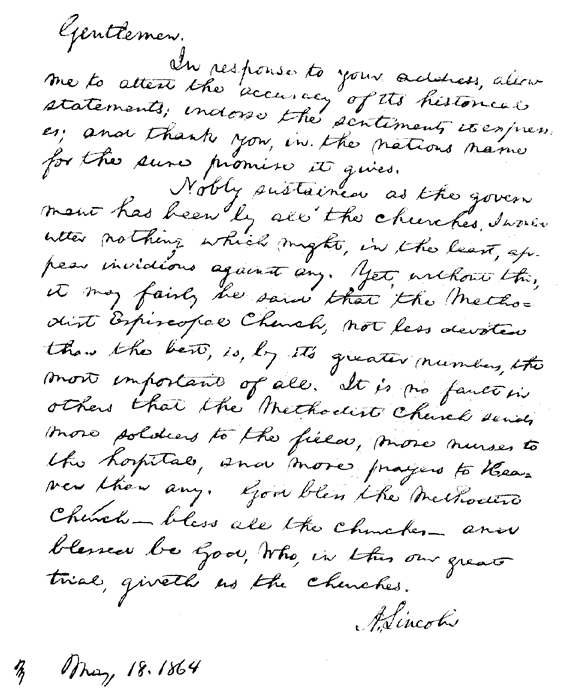
Facsimile Of President Lincoln's Letter
A great welcome was given Dr. Talmage in Brooklyn, in November, 1900, when he preached in the Central Presbyterian Church there. It was the Doctor's second appearance in a Brooklyn church after the burning of the Tabernacle in 1894.
It was urged in the newspapers that he might return to his old home. The invitation was tempting, judging by the thousands who crowded that Sunday to hear him. In my scrapbook I read of this occasion:
"Women fainted, children were half-crushed, gowns were torn and strong men grew red in the face as they buffeted the crowds that had gathered to greet the Rev. T. DeWitt Talmage at the Central Presbyterian Church in Brooklyn."
In the autumn of 1900, an anniversary of East Hampton, N.Y., was held, and the Doctor entered energetically and happily into the celebration, preaching in the little village church which had echoed to his voice in the early days of his ministry. It was a far call backward over nearly five decades of his teeming life. And he, whose magic style, whether of word or pen, had enchanted millions over the broad world—how well he remembered the fears and misgivings that had accompanied those first efforts, with the warning of his late professors ringing in his ears: "You must change your style, otherwise no pulpit will ever be open to you."
Now he could look back over more than a quarter of a century during which his sermons had been published weekly; through syndicates they had been given to the world in 3,600 different papers, and reached, it was estimated, 30,000,000 people in the United States and other countries. They were translated into most European and even into Asiatic languages. His collected discourses were already printed in twenty volumes, while material remained for almost as many more. His style, too, in spite of his "original eccentricities," had attracted hundreds of thousands of readers to his books on miscellaneous subjects—all written with a moral purpose. Among a score of them I might mention: From Manger to Throne; The Pathway of Life; Crumbs Swept Up; Every-day Religion; The Marriage Ring; Woman: her Powers and Privileges.
Dr. Talmage edited several papers beginning with The Christian at Work; afterwards he took charge, successively, of the Advance, Frank Leslie's Sunday Magazine, and finally The Christian Herald, of which he continued to be chief editor till the end of his life. He spoke and wrote earnestly of the civilising and educational power of the press, and felt that in availing himself of it and thereby furnishing lessons of righteousness and good cheer to millions, he was multiplying beyond measure his short span of life and putting years into hours. He said: "My lecture tours seem but hand-shaking with the vast throngs whom I have been enabled to preach to through the press."
His editorials were often wrought out in the highest style of literary art. I am pleased to give the following estimate from an author who knew him well: "As an editorial writer, Dr. Talmage was versatile and prolific, and his weekly contributions on an immense variety of topics would fill many volumes. His writing was as entertaining and pungent as his preaching, and full of brilliant eccentricities—'Talmagisms,' as they were called. He coined new words and invented new phrases. If the topic was to his liking, the pen raced to keep time with the thought.... Still, with all this haste, nothing could exceed the scrupulous care he took with his finished manuscript. He once wired from Cincinnati to his publisher in New York instructions to change a comma in his current sermon to a semicolon. He had detected the error while reading proof on the train."
Dr. Talmage's personal mail was thought to be the largest of any man in the country, outside of some of the public officers. Thousands, men and women, appealed to him for advice in spiritual things, revealing to him intimate family affairs, laying their hearts bare before him as before a trusted physician of the soul. I have seen him moved to the depths of his nature by some of these white missives bearing news of conversion to faith in Christ wrought by his sermons; of families rent asunder united through his words of love and broadmindedness; of mothers whose broken hearts he had healed by leading back the prodigal son; of prisoners whose hope in life and trust in a loving Father had been awakened by a casual reading of some of his comforting paragraphs.
The life of Dr. Talmage was by no means the luxurious one of the man of wealth and ease it was sometimes represented to be. He could not endure that men should have this aspect of him. He was a plain man in his tastes and his habits; the impression that he was ambitious for wealth, I know, was a false one. I do not believe he ever knew the value of money. The possession of it gave him little gratification except for its use in helping to carry on the great work he had in hand; and, indeed, he never knew how little or how much he had. He never would own horses lest he should give people reason to accuse him of being arrogantly rich. We drove a great deal, but he always insisted on hiring his carriages. If he accepted remuneration for his brain and heart labour, Scripture tells us, "The labourer is worthy of his hire." He was foremost in helping in any time of public calamity, not only in our own country but more than once in foreign lands. And when volumes of his sermons were pirated over the country, and he was urged to take legal steps to stop the injustice, he said: "Let them alone; the sermons will go farther and do more good."
Dr. Talmage's opinions were sought eagerly, and upon all subjects of social, political, or international interest. He was a student of men, and kept ever in close touch with the progress of events. A voluminous and rapid reader, he was quick to grasp the aim and significance of what he read and apply it to his purpose. His library in Washington contained a large and valuable collection of classics, ancient and modern; and his East Hampton library was almost a duplicate of this. He never travelled very far without a trunkful of books. I remember, in the first year of our marriage, his interest in some books I had brought from my home that were new to him. Many of them he had not had time to read, so, in the evenings, I used to read them aloud to him. Tolstoi's works were his first choice; together we read a life of the great Russian, which the Doctor enjoyed immensely.
The Bible was ever held by Dr. Talmage in extreme reverence, which grew with his continual study and meditation of the sacred pages. He repudiated the "higher criticism" with a vehemence that caused him to be sharply assailed by modern critics—pronounced infidels or of infidel proclivities—who called him a "bibliolater." He asserted and reasserted his belief in its divine inspiration: "The Bible is right in its authenticity, right in its style, right in its doctrine, and right in its effects. There is less evidence that Shakespeare wrote 'Hamlet,' that Milton wrote 'Paradise Lost,' or that Tennyson wrote 'The Charge of the Light Brigade,' than that the Bible is God's Word, written under inspiration by evangelists and prophets. It has stood the bombardment of ages, but with the result of more and more proof of its being a book divinely written and protected." "Science and Revelation are the bass and soprano of the same tune," he said. He defied the attempts of the loud-mouthed orators to destroy belief in the Bible. "I compare such men as Ingersoll, in their attacks on the Bible, to a grasshopper upon a railway-line with the express coming thundering along."
His living portraits of Jesus, the Saviour of men, his studies of that divine life, of the words, the actions of the Son of God, especially of His sufferings and death, merging into the glory of His resurrection and ascension, are all well known to those who were of his wide audience. The sweetness, gentleness, and sympathy of the Saviour were favourite themes with him. In a sermon on tears, he says: "Jesus had enough trials to make him sympathetic with all sorrowful souls. The shortest verse in the Bible tells the story: 'Jesus wept.' The scar on the back of either hand, the scar in the arch of either foot, the row of scars along the line of the hair, will keep all Heaven thinking. Oh, that Great Weeper is the One to silence all earthly trouble, to wipe all the stains of earthly grief. Gentle! Why, His step is softer than the step of the dew. It will not be a tyrant bidding you hush your crying. It will be a Father who will take you on His left arm, His face beaming into yours, while with the soft tips of the fingers of the right hand He shall wipe away all tears from your eyes." And here is a word of appeal to those gone astray: "The great heart of Christ aches to have you come in; and Jesus this moment looks into your eyes and says: 'Other sheep I have that are not of this fold.'"
Dr. Talmage was at times acutely sensitive to the thrusts of sharp criticism dealt to him through envy or misunderstanding of his motives. A great writer has said somewhere: "Accusations make wounds and leave scars"; but even the scars were soon worn off his outraged feelings by the remembrance of his divine Master's gentleness and forgiveness. How often have I seen the mandate, "Love your enemies; do good to them that hate you," verified in Dr. Talmage. He could not bear detraction or uncharitableness. His heart was so broad and loving that he seemed to have room in it for the whole world; and his greeting of strangers on an Australian platform, amid the heathers of Scotland, or in the Golden Gate of California, was so free and cordial that each one might have thought himself a dear friend of the Doctor, and he would have been right in thinking so. Again, his sense of humour was so great that he could laugh and "poke fun" at his critics with such ease and good humour that their arrows passed harmlessly over his head. "Men have a right to their opinions," he would genially say. "There are twenty tall pippin trees in the orchard to one crab apple tree. There are a million clover blooms to one thistle in the meadow."
His will power was extraordinary; it was endowed with a persistence that overcame every obstacle of his life; there was an air of supreme confidence, of overwhelming vitality, about his every act. Nothing seemed to me more wonderful in him than this; and it entered into all his actions, from those that were important and far-reaching in their consequences to the workings of his daily life in the home. Though his way through these last milestones, during which I travelled with him, was chiefly through the triumphal archways he had raised for himself upon the foundations of his work, there were indications that their cornerstone was the will power of his nature.
Many incidents of the years before I knew him justify this opinion. One in particular illustrates the extraordinary perseverance of Dr. Talmage's character. When his son DeWitt was a boy, in a sudden mood of adventure one day, he enlisted in the United States Navy. Shortly afterwards he regretted having done so. Some one went to his father and told him that the boy was on board a warship at Hampton Roads, homesick and miserable. Dr. Talmage went directly to Washington, straight into the office of Mr. Thompson, the Secretary of the Navy. "I am Dr. Talmage," he said promptly; "my son has enlisted in the Navy and is on a ship near Norfolk. I want to go to him and bring him home. He is homesick. Will you write me an order for his release?" The Secretary replied that it had become an impression among rich men's sons that they could take an oath of service to the U.S. Government, and break it as soon as their fathers were ready, through the influence of wealth, to secure their release. He was opposed to such an idea, he said; and, therefore, though he was very sorry, he could not grant Dr. Talmage's request. The Doctor immediately took a chair in the office, and said firmly: "I shall not leave this office, Mr. Secretary, until you write out an order releasing my son."
The hour for luncheon came. The Secretary invited the Doctor to lunch with him. "I shall not leave this office, Mr. Secretary, until I get that order," was the Doctor's reply. The Secretary of the Navy left the office; after an absence of an hour and a half, he returned and found Dr. Talmage still sitting in the same place. The afternoon passed. Dinner time came round. "Dr. Talmage, will you not honour me by coming up to my house to dine, and staying with us over night?" asked the Secretary. "I shall not leave this office until you write out that order releasing my son, Mr. Secretary," was the calm, persistent reply. The Secretary departed. The building was empty, save for a watchman, to whom the Secretary said in passing, "There is a gentleman in my room. When he wishes to leave let him out of the building."
About nine o'clock at night the Secretary became anxious. Telephones were not common then, so he went down to the office to investigate; and sitting there in the place where he had been all day was Dr. Talmage. The order was written that night. This incident was told me by a friend of the Doctor's. There can be no doubt that Dr. Talmage was justified in this demand of paternal love and sympathy, since numbers of such concessions had been made by the Secretary and his predecessors. His daring and his pertinacity were overwhelming forces of his genius.
In the winter months of this year I enjoyed another lecturing tour with him through Canada and the West. The lecture bureau that arranged his tours must have counted on his herculean strength, for frequently he had to travel twenty-four hours at a stretch to keep his engagements. Occasionally he was paid in cash at the end of the lecture an amount fixed by the lecture bureau. I have seen him with perhaps $2,000 in bills and gold stuffed away carelessly in his pocket, as if money were merely some curious specimen of no special value. Sometimes he would receive his fee in a cheque, and, as happened once in a small Western town, he would have very little money with him. I remember an occasion of this kind, because it was amusing. The cheque had been given the Doctor as usual at the end of his lecture. It was about eleven at night, and we were compelled to take a midnight train out to reach his next place of engagement. At the hotel where we stayed they did not have money enough to cash the cheque. We walked up the street to the other hotel, but found there an equal lack of the circulating medium. It was a bitter cold night.
"Here we are out in the world without a roof over our heads, Eleanor," said the Doctor, merrily. "What a cold world it is to the unfortunate." Finally Dr. Talmage went to the ticket office of the railroad and explained the situation to the young man in charge. "I can't give you tickets, but I will buy them for you, and you can send me the money," the clerk said promptly. As we had an all-day ride before us and a drawing room to secure, the amount was not inconsiderable. I think it was on this trip that William Jennings Bryan got on the train and enlivened the journey for us. The stories he and the Doctor hammered out of the long hours of travel were entertaining. We exchanged invitations to the dining car so as not to stop the flow of conversation between Mr. Bryan and the Doctor. We would invite him to lunch, and Mr. Bryan would ask us to dinner, or vice versâ, so that the social amenities were delightfully extended to keep us in mutual enjoyment of the trip. Dr. Talmage and myself agreed that Mr. Bryan's success on the platform was much enhanced by his wonderful voice. The Doctor said he had never heard so exquisite a speaking voice in a man as Mr. Bryan's. He always spoke in eloquent support of the masses, denouncing the trusts with vehemence.
Travelling was always a kind of luxury to me, when we were not obliged to stop over at some wretched hotel. The Pullman cars were palatial in comfort compared to the hotels we had to enter. But Dr. Talmage was always satisfied; no hotel, however poor, could alter the cheerfulness of his temperament.
In January, 1901, Queen Victoria died, and Dr. Talmage's eulogy went far and wide. I quote again from my scrap-book a part of his comment on this world event:
"While Queen Victoria has been the friend of all art, all literature, all science, all invention, all reform, her reign will be most remembered for all time, all eternity, as the reign of Christianity. Beginning with that scene at 5 o'clock in the morning in Kensington Palace, where she asked the Archbishop of Canterbury to pray for her, and they knelt down imploring Divine guidance until her last hour, not only in the sublime liturgy of her established Church, but on all occasions, she has directly or indirectly declared: 'I believe in God, the Father Almighty, Maker of Heaven and Earth, and in Jesus Christ, His only begotten Son.'
"The Queen's book, so much criticised at the time of its appearance, some saying that it was skilfully done, and some saying that the private affairs of a household ought not to have been exposed, was nevertheless a book of rare usefulness, from the fact that it showed that God was acknowledged in all her life, and that 'Rock of Ages' was not an unusual song at Windsor Castle.
"I believe that no throne since the throne of David and the throne of Hezekiah and the throne of Esther, has been in such constant touch with the throne of heaven as the throne of Victoria. Sixty-three years of womanhood enthroned!"
In March of 1901 Dr. Talmage inaugurated a series of Twentieth Century Revival Meetings in the Academy of Music, in New York. It was a great Gospel campaign in which thousands were powerfully impressed for life. The Doctor seemed to have made a new start in a defined evangelical plan of saving the world. Indeed, to save was his great watchword, to save sinners, but most of all to save men from becoming sinners. One of his famous themes—and thousands remember his burning words—was "The Three Greatest Things to Do—Save a Man, Save a Woman, Save a Child." There was a certain anxiety in my mind about Dr. Talmage in this sixty-eighth year of his life, and I used to tell him that he had reached the top of all religious obligations as he himself felt them, that there was nothing greater for him to do, and that he might now move with softer measure to the inspired impulses of his life. But he never delayed, he never tarried, he never waited. He marched eagerly ahead, as if the milestones of his life stretched many years beyond.
Our social life in Washington was subservient to Dr. Talmage's reign of preaching. We never accepted invitations without the privilege of qualifying our acceptance, making them subject to the Doctor's religious duties. The privilege was gracefully acknowledged by all our friends. We were away from Washington, too, a great deal. In the spring of this year, 1901, the Doctor made a lecturing tour through the South, that was full of oratorical triumphs for him, but no less marked by delightful social incidents. There was a series of dinners and receptions in his honour that I shall never forget, in those beautiful homes of Mississippi, Alabama, and Tennessee. Because of his Gospel pilgrimage of many years in these places, Dr. Talmage had grown to be a household god among them.
When winter had shed his garland of snow over nature, or when we were knee deep in summer's verdure and flowers, East Hampton was the Doctor's headquarters. From there we made our summer trips. It was after a short season at East Hampton in the summer of 1901, that the Doctor went to Ocean Grove, where he delivered a Fourth of July oration, the enormous auditorium being crowded to its utmost capacity. A few days later we went to Buffalo, where, in a large tent standing in the Exposition ground, Dr. Talmage lectured, his powerful voice triumphing over the fireworks that, from a place near by, went booming up through the heavens. After a series of Chautauqua lectures through Michigan and Wisconsin, the Doctor finished his course at Lake Port, Maryland, near picturesque Deer Park. These are merely casual recollections, too brief to serve otherwise than as evidence of Dr. Talmage's tremendous industry and energy.
In September, 1901, came the assassination of President McKinley. Dr. Talmage had an engagement to preach at Ocean Grove the day following the disaster. On our arrival at the West End Hotel, Long Branch, the Doctor went in to register while we remained in the carriage at the door. Suddenly he came out, and I could see that he was very much agitated. He had just received the news of the tragedy.
"I cannot preach to-morrow," he said. "This is too horrible. McKinley has been shot. What shall I do?" And he stood there utterly stunned; unable to think. "Well, we will stop at the hotel to-night, at any rate," I said, "let us go in."
Later the Doctor tried to explain to those in charge at Ocean Grove that he could not preach, but they prevailed upon him to deliver the sermon he had with him, which he did, prefacing it with appropriate remarks about the national disaster of the hour.
The following telegram was immediately sent to the Chief of the Nation, cut off so ruthlessly in his career of honour and usefulness:—
"Long Branch, September 6th.
"President McKinley, Buffalo, N.Y.
"The Nation is in prayer for your recovery. You will be nearer and dearer to the people than ever before after you have passed this crisis. Mrs. Talmage joins me in sympathy.
"T. DeWitt Talmage."
After the death of the President the Doctor preached his sermon "Our Dead President" for the first time in the little church at East Hampton, where it had been written in his study. In October the Doctor was called upon to preach at the obsequies of the Rev. Dr. Sunderland, for many years pastor of the First Presbyterian Church in Washington. What a long season of obsequies Dr. Talmage solemnised! And yet, with what supreme optimism he defied the unseen arrow in his own life that came to pierce him with such suddenness in April, 1902.
The Doctor had been a good traveller, and he was fond of travelling; but, toward the end of his life, there were moments when he felt its fatiguing influences. He never complained or appeared apprehensive, but I remember the first time he showed any weariness of spirit. I almost recall his words: "I have written so much about everything, that now it becomes difficult for me to write. I am tired." It frightened me to hear him say this, he was so wonderful in endurance and strength; and I could not shake off the effect that this first sign of his declining years made upon me. He was then sixty-nine years old, and the last of the twelve children, save his sister.
The last sermon he ever wrote was preached in February, 1902. The text of this was from Psalms xxxiii. 2: "Sing unto Him with the Psaltery, and an instrument of ten strings." This was David's harp of gratitude and praise. After some introductory paragraphs on the harp, its age, the varieties of this "most consecrated of all instruments," its "tenderness," its place in "the richest symbolism of the Holy Scriptures," he writes: "David's harp had ten strings, and, when his great soul was afire with the theme, his sympathetic voice, accompanied by exquisite vibrations of the chords, must have been overpowering.... The simple fact is that the most of us, if we praise the Lord at all, play upon one string or two strings, or three strings, when we ought to take a harp fully chorded, and with glad fingers sweep all the strings. Instead of being grateful for here and there a blessing we happen to think of, we ought to rehearse all our blessings, and obey the injunction of my text to sing unto Him with an instrument of ten strings." "Have you ever thanked God for delightsome food?" he asks; and for sight for "the eye, the window of our immortal nature, the gate through which all colours march, the picture gallery of the soul?" He enumerates other blessings—hearing, sleep, the gift of reason, the beauties of nature, friends. "I now come," he continues, "to the tenth and last. I mention it last that it may be more memorable—heavenly anticipation. By the grace of God we are going to move into a place so much better than this, that on arriving we will wonder that we were for so many years so loath to make the transfer. After we have seen Christ face to face, and rejoiced over our departed kindred, there are some mighty spirits we will want to meet soon after we pass through the gates." As his graphic pen depicts the scene—the meeting with David and the great ones of Scripture, "the heroes and heroines who gave their lives for the truth, the Gospel proclaimers, the great Christian poets, all the departed Christian men and women of whatever age or nation"—he seems to have already a foretaste of the wonderful vision so soon to open to his eyes. "Now," he concludes, "take down your harp of ten strings and sweep all the chords. Let us make less complaint and offer more thanks; render less dirge and more cantata. Take paper and pen and write in long columns your blessings.... Set your misfortunes to music, as David opened his dark sayings on a harp.... Blessing, and honour and glory and power be unto Him that sitteth upon the throne and unto the Lamb for ever. Amen!"
I recall that when Dr. Talmage first read this sermon to me in his study, he said: "That is the best I can do; I shall never write a better sermon." I have been told that when a man says he has reached the topmost effort of his abilities, it presages his end, and the march of events seemed to verify the axiom.
Dr. Talmage's last journey came about through the invitation of the Mexican minister in Washington. The latter met Dr. Talmage at dinner, and on hearing that he had never preached in Mexico he urged him to go there. When the Doctor's plans had all been made, some friends tried to dissuade him from going, secretly fearing, perhaps, the tax it would be on his strength. Yet there was no evidence at this time to support their fears, and the Doctor himself would have been the last to listen to any warning. He was very busy during the few days that preceded our departure from Washington in attending the meetings of the Committee of distinguished clergymen who were in session to revise the creed of the Presbyterian Church.
The day before we left for Mexico, the Doctor told me he desired to entertain these gentlemen, as had been his custom during all important gatherings of representative churchmen who visited Washington. He was in great spirits. His ideas of a social affair were definite and generous, as we discovered that day, much to our amusement.
"Eleanor," he said, "I feel as though I would like to have these gentlemen to luncheon at my house to-morrow. Can you arrange it? I could not possibly leave Washington without showing them some special courtesy. Now, I want a real meal, something to sit down to. None of your floating oysters, or little daubs of meat in pastry, but real food, whole turkeys, four or five of them—a substantial meal." The Doctor's respect for chicken patties, creamed oysters, and the usual buffet reception luncheon, was clearly not very great.
The luncheon was given at 1.30 on the day appointed; the distinguished guests all came, two by two, into our house. A few weeks later, they came again in a body, two by two, into the house of mourning.
Besides the visiting clergy, Dr. Talmage had also invited for this luncheon other representative men of Washington. It was the last social gathering which the Doctor ever attended in his own home, and perhaps for that reason becomes a significant event in my memory. After the rest had departed, Dr. Henry Van Dyke remained for an hour or two to talk with my husband in his study. Dr. Talmage so often referred to the great pleasure this long interview had given him, that I am sure it was one of the supreme enjoyments of his last spiritual milestone.
The night before we left Washington an incident occurred that directly concerns these pages. We had gone down into the basement of the house to look for some papers the Doctor kept there in the safe, and in taking them out he picked up the manuscript of his autobiography. As we went upstairs I said to the Doctor, "What a pity that you have not completed it entirely."
The Doctor replied, "All the obscure part of my life is written here, and a great part of the rest of it. When I return from Mexico I will finish it. If anything should happen, however, it can be completed from scrapbooks and other data."
We went into his study and the Doctor had just begun to read it to me when we were interrupted by a call from Senator Hanna. Dr. Talmage particularly admired Senator Hanna, and, as they were great friends, the autobiography was forgotten for the rest of the evening. Knowing that the Doctor was about to leave Washington the Senator had come to wish him goodby, and to urge him to visit his brother at Thomasville, Georgia, where we were to stop on our way to Mexico. I remember Senator Hanna said to the Doctor, "You will find the place very pretty; we own a good deal of property there, so much so that it could easily be called Hannaville." The next morning we started for the City of Mexico, going direct to Charleston, where the Doctor preached. He was entertained a good deal there, and we witnessed the opening of the Charleston Exposition.
From Charleston we went to Thomasville, Georgia, where we spent a week, during which time the Doctor preached and lectured twice at nearby places. It was here that we met the first accident of our journey. Just as we were steaming into Thomasville we ran into a train ahead, and there was some loss of life and great damage. Fortunately we were in the last Pullman car of the train. I have always believed that the shock of this accident was the beginning of the end for Dr. Talmage. He showed no fear, and he gave every assistance possible to others; but, in the tension of the moment, in his own self-restraint for the sake of others, I think that he overtaxed his strength more than he realised. I never wanted to see a train again, and begged the Doctor to let us remain in Thomasville the rest of our lives. The next morning, however, Dr. Talmage started out on a preaching engagement in the neighbourhood by train, but we remained behind. Our stay in Thomasville was made very enjoyable by the relatives of Senator Hanna, whose beautiful estates were a series of landscape pictures I shall always remember. Although the Doctor was obliged to be away on lecturing engagements three times during the week he enjoyed the drives about Thomasville with us while he was there. Our destination after leaving Thomasville was New Orleans, where Dr. Talmage was received as if he had been a national character. He was welcomed by a distinguished deputation with the utmost cordiality. The Christian Herald said of this occasion: "When he went on the following Sunday to the First Presbyterian Church he found a great multitude assembled, the large building densely packed within and a much vaster gathering out of doors unable to obtain admittance. Thousands went away disappointed. He spoke with even more than usual force and conviction." Never were we more royally entertained or fêted than we were here. From New Orleans we went to San Antonio, where we stopped off for two or three days' sight-seeing. The Doctor was urged to preach and lecture while he was there; but he excused himself on the ground of a previous engagement, promising, however, to lecture in San Antonio on his return trip to Washington.
On our way from San Antonio to the City of Mexico our train ran into one of the sand-storms, for which the Mexican country is famous at certain times of the year; and we were at a standstill on a side track at a small station for twenty-four hours. The food was execrable, the wind and sand were choking, and the whole experience trying in the extreme. We were warned against thieves of the neighbourhood, and, during the night we were locked in the cars to ensure the safety of our belongings. In spite of these precautions a shawl which the Doctor valued, because it had been presented to him by the citizens of Melbourne, Australia, was stolen during the night through an open window. They were not bashful those thieves of the sandstorm. From a private car attached to the rear of our train they stole a refrigerator bodily off the platform.
The Doctor had long been suffering from his throat, and all these annoyances had the effect of increasing the painful symptoms to such a degree that when we finally got into the city of Mexico on Saturday, March 1st, it was necessary to call a physician. Dr. Talmage had brought with him a number of letters of introduction from Washington to people in the City of Mexico, but the Mexican minister had written ahead of us, and on the day we arrived people left their cards and extended invitations that promised to keep us socially busy every day of our week's visit.
The Doctor was ailing a little, I thought, but not seriously. He had a slight cold. Although he had planned to preach only in the Presbyterian Church a week from our arrival, the people of the other Protestant denominations urged him with such importunity that he agreed to preach for them on the first Sunday, the day after our arrival. This was an unexpected strain on Dr. Talmage after a very trying journey; but he never could refuse to preach, no matter how great his fatigue. On the following Tuesday a luncheon was given Dr. Talmage by General Porfirio Diaz, the President of the Mexican Republic, at his palace in Chapultepec. The Doctor enjoyed a long audience with the aged statesman, during which the mutual interests and prospects of the two countries were freely discussed, President Diaz manifesting himself, as always, a friend and admirer of our government and people. During the afternoon a cold wind had come up, and the drive home increased the Doctor's indisposition, so that he was obliged to confine himself to his room. Still he was up and about, and we felt no alarm whatever. On Thursday night, he complained of a pain at the base of his brain, and at about four in the morning I was awakened by him:—
"Eleanor," he said, "I seem to be very ill; I believe I am dying." The shock was very great, it was such a rare thing for him to be ill. We sent for the best American physician in the city of Mexico, Dr. Shields, who diagnosed the Doctor's case as grippe. He at once allayed my fears, assuring me that it would not be serious.
Dr. Talmage had promised to lecture on Friday, March 7th, and we had some trouble to prevent him from keeping this engagement. Dr. Shields insisted that Dr. Talmage should not leave his room, declaring that the exertion would be too much for him. Not until Dr. Shields had assured Dr. Talmage that the people could be notified by special handbills and the newspapers would he consent to break the engagement.
On Friday night Dr. Talmage grew worse; and finally he asked to be taken home, personally making arrangements with Dr. Shields to travel with us as far as the Mexican border, as my knowledge of Spanish was very limited. Eventually it became necessary for Dr. Shields to go all the way with us. In the great sorrow that the people of Mexico felt over the sudden illness of Dr. Talmage, their regret at his cancelled engagements was swallowed up, and there was one great wave of sympathy which touched us not a little.
The journey to Washington was a painful one. Dr. Talmage kept growing worse. All day long he lay on the couch before me in our drawing-room on the train, saying nothing—under the constant care of the physician. Telegrams and letters followed the patient all the way from Mexico to the Capital city. At every station silent, awe-stricken crowds were gathered to question of the state of the beloved sufferer. In New Orleans we had to stay over a day, so as to secure accommodation on the train to Washington. While there many messages of condolence were left at the hotel, a party of ladies calling especially to thank me for the "great care I was taking of their Dr. Talmage."
On our route to the national city, I remember the Doctor drew me down beside him to speak to me. He was then extremely weak and his voice was very low: "Eleanor, I believe this is death," he said.
The long journey, in which years seemed compressed into days, at last came to a close. The train pulled up in Washington, and our own physician, Dr. Magruder, met us at the station. Dr. Talmage was borne into his home in a chair, and upstairs into his bedroom, where already the angel of death had entered to welcome and guard him, though, alas! we knew it not, and still hoped against hope. Occasional rallies took place; but evidences of cerebral inflammation appeared, and the patient sank into a state of unconsciousness, which was only a prelude to death. Bulletins were given to the public daily by the attending physicians; and if aught could have assuaged the anguish of such moments it would have been the universal interest and sympathy shown from all parts of the world.
Readers will pardon me if I reproduce from The Christian Herald a record of the last scene. It is hard "to take down the folded shadows of our bereavement" and hold it even to the gaze of friends.
"After a painful illness, lasting several weeks, America's best-beloved preacher, the Reverend Thomas DeWitt Talmage, passed from earth to the life above, on April 12th, 1902. Ever since his return from Mexico, where he was prostrated by a sudden attack which rapidly assumed the form of cerebral congestion, he had lain in the sick chamber of his Washington home, surrounded by his family and cared for by the most skilful physicians. Each day brought its alternate hopes and fears. Much of the time was passed in unconsciousness; but there were intervals when, even amid his sufferings, he could speak to and recognise those around him. No murmur or complaint came from his lips; he bore his suffering bravely, sustained by a Higher Power. The message had come which sooner or later comes to all, and the aged servant of God was ready to go; he had been ready all his life.
"Occasional rallies took place, raising hopes which were quickly abandoned. From April 5th to April 12th these rallies occurred at frequent intervals, always followed by a condition of increased depression, more or less augmented fever and partial unconsciousness. On Saturday, April 12th, a great change became apparent. For many hours the patient had been unconscious. As the day wore on, it became evident that he could not live through another night. All of Dr. Talmage's family—his wife, his son, the Rev. Frank DeWitt Talmage, of Chicago; Mrs. Warren G. Smith and Mrs. Daniel Mangam, of Brooklyn; Mrs. Allen E. Donnan, of Richmond; and Mrs. Clarence Wycoff and Miss Talmage, were gathered in the chamber of death. Dr. G.L. Magruder, the principal physician, was also in attendance at the last. At 9.25 o'clock p.m., the soul took flight from the inanimate clay, and the spirit of the world's greatest preacher was released."
The Rev. T. Chalmers Easton, an old and valued friend of Dr. Talmage, was in frequent attendance upon him, and never ceased his ministrations until the eyes of the beloved one were closed in death. A brief excerpt from his address at the Memorial Service of the Rev. T. DeWitt Talmage held at the Eastern Presbyterian Church, Washington, may not be unacceptable to the reader:
"A truly great man or eloquent orator does not die—
"What shall we say of the prince in Israel who has left us? Can we compress the ocean into a dewdrop? No more is it possible to condense into one brief hour what is due to the memory of our beloved and illustrious friend. His moral courage was only equalled by his giant frame and physical strength. He was made of the very stuff that martyrs are made of: one of the most remarkable individualities of our time. A man of no negative qualities, aggressive and positive.
"His whole soul was full of convictions of right and duty. A firm friend, a man of ready recognition, a human magnet in his focalising power. He was true in every deed, and never needed a veil to be drawn.... If, as his personal friend for more than twenty years, I should attempt to open up the treasures of his real greatness, where shall we find more of those sterling virtues that poets have sung, artists portrayed, and historians commended? He was truly a great man—a man of God!
"The last years of his life were full of happiness in the living companionship of her who so sadly mourns his departure. He frequently spoke to me of the great inspiration brought into these years by her ceaseless devotion to all his plans and work, making what was burdensome in his accumulating literary duties a pleasure.... The last fond look of recognition was given to his beloved wife, and the last word that fell from his lips, when far down in the valley, was the sweetest music to his ears—'Eleanor.'
"It was said once by an eminent writer that when Abraham Lincoln, the forest-born liberator, entered Heaven, he threw down at God's throne three million yokes as the trophies of his great act of emancipation; as great as that was, I think it was small, indeed, compared with the tens of thousands of souls Talmage redeemed from the yokes of sin and shame by the glorious Gospel preached with such fervour and power of the Holy Ghost. What a mighty army stood ready to greet him at the gates of the heavenly city as the warrior passed in to be crowned by his Sovereign and King!"
The funeral services were held at the Church of the Covenant, Washington, on April 15th. The ceremony began at 5 p.m., with the "Dead March from Saul," and lasted considerably over an hour. The coffin rested immediately in front of the pulpit, and over it was a massive bed of violets. On a silver plate was the inscription:
THOMAS DEWITT TALMAGE,
JANUARY 7TH, 1832-APRIL 12TH, 1902
The floral offerings were numerous, including a wreath of white roses and lilies of the valley sent by President and Mrs. Roosevelt. The officiating clergymen were the Rev. Dr. T.S. Hamlin, pastor of the Church; the Rev. Dr. T. Chalmers Easton, of Washington; and the Rev. Drs. S.J. Nicols, and James Demarest, of Brooklyn. A male quartette sang: "Lead, Kindly Light," a favourite hymn of Dr. Talmage; "Beyond the Smiling and the Weeping"; and "It is well with my Soul." The addresses of the Reverend Doctors were eulogistic of the dead preacher, of whom they had been intimate friends for more than a quarter of a century. The body lay in state four hours, during which thousands passed in review around it.
At midnight the remains of Dr. Talmage were conveyed by private train to Brooklyn, where the burial took place in Greenwood Cemetery. The funeral cortége arrived about ten o'clock in the morning; hundreds were already in the cemetery, waiting to behold the last rites paid to one they revered and loved. The Episcopal burial service was read by the Rev. Dr. Howard Suydam, an old friend and classmate of Dr. Talmage, who made a brief address, and concluded the simple ceremonies by the recital of the Lord's Prayer.
Tributes were paid to the illustrious dead all over the civilised world, and in many languages; while thousands of letters of condolence and telegrams assured the family in those days of affliction that human hearts were throbbing with ours and fain would comfort us. One wrote feelingly:
"When Dr. Talmage described the Heavenly Jerusalem, he seemed to feel all the ecstatic fervour of a Bernard of Cluny, writing:
And it seems to me that I cannot better close this altogether unworthy sketch of Dr. Talmage than by offering the reader as a parting remembrance, in its simple beauty, his "Celestial Dream":
"One night, lying on my lounge when very tired, my children all around me in full romp and hilarity and laughter, half awake and half asleep, I dreamed this dream: I was in a far country. It was not in Persia, although more than oriental luxuries crowned the cities. It was not the tropics, although more than tropical fruitfulness filled the gardens. It was not Italy, although more than Italian softness filled the air. And I wandered around looking for thorns and nettles, but I found that none of them grew there; and I saw the sun rise and watched to see it set, but it set not. And I saw people in holiday attire, and I said, 'When will they put off all this, and put on workman's garb, and again delve in the mine or swelter at the forge?' But they never put off the holiday attire.
"And I wandered in the suburbs of the city to find the place where the dead sleep, and I looked all along the line of the beautiful hills, the place where the dead might most blissfully sleep, and I saw towers and castles, but not a mausoleum or a monument or a white slab was to be seen. And I went into the chapel of the great town, and I said: 'Where do the poor worship, and where are the benches on which they sit?' And the answer was made me, 'We have no poor in this country.'
"And then I wandered out to find the hovels of the destitute, and I found mansions of amber and ivory and gold; but not a tear could I see, not a sigh could I hear; and I was bewildered, and I sat down under the branches of a great tree, and I said, 'Where am I, and whence comes all this scene?' And then out from among the leaves and up the flowery paths and across the bright streams, there came a beautiful group thronging all about me, and as I saw them come I thought I knew their step, and as they shouted I thought I knew their voices, but they were so gloriously arrayed in apparel such as I had never before witnessed, that I bowed as stranger to stranger. But when again they clapped their hands and shouted 'Welcome! Welcome!' the mystery all vanished, and I found that time had gone and eternity had come, and we were all together again in our new home in Heaven.
"And I looked around, and I said, 'Are we all here?' And the voices of many generations responded, 'All here!' And while tears of gladness were raining down our cheeks, and the branches of the Lebanon cedars were clapping their hands, and the towers of the great city were chiming their welcome, we all together began to leap and shout and sing, 'Home, home, home, home!'"
Garden City Press Limited, Printers, Letchworth, Herts.
End of the Project Gutenberg EBook of T. De Witt Talmage
by T. De Witt Talmage
Mrs. T. De Witt Talmage

*** END OF THIS PROJECT GUTENBERG EBOOK T. DE WITT TALMAGE ***

***** This file should be named 15693-h.htm or 15693-h.zip *****
This and all associated files of various formats will be found in:
        https://www.gutenberg.org/1/5/6/9/15693/

Produced by David Newman, Melissa Er-Raqabi, Jeannie Howse and the
Online Distributed Proofreading Team at https://www.pgdp.net


Updated editions will replace the previous one--the old editions
will be renamed.

Creating the works from public domain print editions means that no
one owns a United States copyright in these works, so the Foundation
(and you!) can copy and distribute it in the United States without
permission and without paying copyright royalties.  Special rules,
set forth in the General Terms of Use part of this license, apply to
copying and distributing Project Gutenberg-tm electronic works to
protect the PROJECT GUTENBERG-tm concept and trademark.  Project
Gutenberg is a registered trademark, and may not be used if you
charge for the eBooks, unless you receive specific permission.  If you
do not charge anything for copies of this eBook, complying with the
rules is very easy.  You may use this eBook for nearly any purpose
such as creation of derivative works, reports, performances and
research.  They may be modified and printed and given away--you may do
practically ANYTHING with public domain eBooks.  Redistribution is
subject to the trademark license, especially commercial
redistribution.


*** START: FULL LICENSE ***

THE FULL PROJECT GUTENBERG LICENSE
PLEASE READ THIS BEFORE YOU DISTRIBUTE OR USE THIS WORK

To protect the Project Gutenberg-tm mission of promoting the free
distribution of electronic works, by using or distributing this work
(or any other work associated in any way with the phrase "Project
Gutenberg"), you agree to comply with all the terms of the Full Project
Gutenberg-tm License (available with this file or online at
https://gutenberg.org/license).


Section 1.  General Terms of Use and Redistributing Project Gutenberg-tm
electronic works

1.A.  By reading or using any part of this Project Gutenberg-tm
electronic work, you indicate that you have read, understand, agree to
and accept all the terms of this license and intellectual property
(trademark/copyright) agreement.  If you do not agree to abide by all
the terms of this agreement, you must cease using and return or destroy
all copies of Project Gutenberg-tm electronic works in your possession.
If you paid a fee for obtaining a copy of or access to a Project
Gutenberg-tm electronic work and you do not agree to be bound by the
terms of this agreement, you may obtain a refund from the person or
entity to whom you paid the fee as set forth in paragraph 1.E.8.

1.B.  "Project Gutenberg" is a registered trademark.  It may only be
used on or associated in any way with an electronic work by people who
agree to be bound by the terms of this agreement.  There are a few
things that you can do with most Project Gutenberg-tm electronic works
even without complying with the full terms of this agreement.  See
paragraph 1.C below.  There are a lot of things you can do with Project
Gutenberg-tm electronic works if you follow the terms of this agreement
and help preserve free future access to Project Gutenberg-tm electronic
works.  See paragraph 1.E below.

1.C.  The Project Gutenberg Literary Archive Foundation ("the Foundation"
or PGLAF), owns a compilation copyright in the collection of Project
Gutenberg-tm electronic works.  Nearly all the individual works in the
collection are in the public domain in the United States.  If an
individual work is in the public domain in the United States and you are
located in the United States, we do not claim a right to prevent you from
copying, distributing, performing, displaying or creating derivative
works based on the work as long as all references to Project Gutenberg
are removed.  Of course, we hope that you will support the Project
Gutenberg-tm mission of promoting free access to electronic works by
freely sharing Project Gutenberg-tm works in compliance with the terms of
this agreement for keeping the Project Gutenberg-tm name associated with
the work.  You can easily comply with the terms of this agreement by
keeping this work in the same format with its attached full Project
Gutenberg-tm License when you share it without charge with others.

1.D.  The copyright laws of the place where you are located also govern
what you can do with this work.  Copyright laws in most countries are in
a constant state of change.  If you are outside the United States, check
the laws of your country in addition to the terms of this agreement
before downloading, copying, displaying, performing, distributing or
creating derivative works based on this work or any other Project
Gutenberg-tm work.  The Foundation makes no representations concerning
the copyright status of any work in any country outside the United
States.

1.E.  Unless you have removed all references to Project Gutenberg:

1.E.1.  The following sentence, with active links to, or other immediate
access to, the full Project Gutenberg-tm License must appear prominently
whenever any copy of a Project Gutenberg-tm work (any work on which the
phrase "Project Gutenberg" appears, or with which the phrase "Project
Gutenberg" is associated) is accessed, displayed, performed, viewed,
copied or distributed:

This eBook is for the use of anyone anywhere at no cost and with
almost no restrictions whatsoever.  You may copy it, give it away or
re-use it under the terms of the Project Gutenberg License included
with this eBook or online at www.gutenberg.org

1.E.2.  If an individual Project Gutenberg-tm electronic work is derived
from the public domain (does not contain a notice indicating that it is
posted with permission of the copyright holder), the work can be copied
and distributed to anyone in the United States without paying any fees
or charges.  If you are redistributing or providing access to a work
with the phrase "Project Gutenberg" associated with or appearing on the
work, you must comply either with the requirements of paragraphs 1.E.1
through 1.E.7 or obtain permission for the use of the work and the
Project Gutenberg-tm trademark as set forth in paragraphs 1.E.8 or
1.E.9.

1.E.3.  If an individual Project Gutenberg-tm electronic work is posted
with the permission of the copyright holder, your use and distribution
must comply with both paragraphs 1.E.1 through 1.E.7 and any additional
terms imposed by the copyright holder.  Additional terms will be linked
to the Project Gutenberg-tm License for all works posted with the
permission of the copyright holder found at the beginning of this work.

1.E.4.  Do not unlink or detach or remove the full Project Gutenberg-tm
License terms from this work, or any files containing a part of this
work or any other work associated with Project Gutenberg-tm.

1.E.5.  Do not copy, display, perform, distribute or redistribute this
electronic work, or any part of this electronic work, without
prominently displaying the sentence set forth in paragraph 1.E.1 with
active links or immediate access to the full terms of the Project
Gutenberg-tm License.

1.E.6.  You may convert to and distribute this work in any binary,
compressed, marked up, nonproprietary or proprietary form, including any
word processing or hypertext form.  However, if you provide access to or
distribute copies of a Project Gutenberg-tm work in a format other than
"Plain Vanilla ASCII" or other format used in the official version
posted on the official Project Gutenberg-tm web site (www.gutenberg.org),
you must, at no additional cost, fee or expense to the user, provide a
copy, a means of exporting a copy, or a means of obtaining a copy upon
request, of the work in its original "Plain Vanilla ASCII" or other
form.  Any alternate format must include the full Project Gutenberg-tm
License as specified in paragraph 1.E.1.

1.E.7.  Do not charge a fee for access to, viewing, displaying,
performing, copying or distributing any Project Gutenberg-tm works
unless you comply with paragraph 1.E.8 or 1.E.9.

1.E.8.  You may charge a reasonable fee for copies of or providing
access to or distributing Project Gutenberg-tm electronic works provided
that

- You pay a royalty fee of 20% of the gross profits you derive from
     the use of Project Gutenberg-tm works calculated using the method
     you already use to calculate your applicable taxes.  The fee is
     owed to the owner of the Project Gutenberg-tm trademark, but he
     has agreed to donate royalties under this paragraph to the
     Project Gutenberg Literary Archive Foundation.  Royalty payments
     must be paid within 60 days following each date on which you
     prepare (or are legally required to prepare) your periodic tax
     returns.  Royalty payments should be clearly marked as such and
     sent to the Project Gutenberg Literary Archive Foundation at the
     address specified in Section 4, "Information about donations to
     the Project Gutenberg Literary Archive Foundation."

- You provide a full refund of any money paid by a user who notifies
     you in writing (or by e-mail) within 30 days of receipt that s/he
     does not agree to the terms of the full Project Gutenberg-tm
     License.  You must require such a user to return or
     destroy all copies of the works possessed in a physical medium
     and discontinue all use of and all access to other copies of
     Project Gutenberg-tm works.

- You provide, in accordance with paragraph 1.F.3, a full refund of any
     money paid for a work or a replacement copy, if a defect in the
     electronic work is discovered and reported to you within 90 days
     of receipt of the work.

- You comply with all other terms of this agreement for free
     distribution of Project Gutenberg-tm works.

1.E.9.  If you wish to charge a fee or distribute a Project Gutenberg-tm
electronic work or group of works on different terms than are set
forth in this agreement, you must obtain permission in writing from
both the Project Gutenberg Literary Archive Foundation and Michael
Hart, the owner of the Project Gutenberg-tm trademark.  Contact the
Foundation as set forth in Section 3 below.

1.F.

1.F.1.  Project Gutenberg volunteers and employees expend considerable
effort to identify, do copyright research on, transcribe and proofread
public domain works in creating the Project Gutenberg-tm
collection.  Despite these efforts, Project Gutenberg-tm electronic
works, and the medium on which they may be stored, may contain
"Defects," such as, but not limited to, incomplete, inaccurate or
corrupt data, transcription errors, a copyright or other intellectual
property infringement, a defective or damaged disk or other medium, a
computer virus, or computer codes that damage or cannot be read by
your equipment.

1.F.2.  LIMITED WARRANTY, DISCLAIMER OF DAMAGES - Except for the "Right
of Replacement or Refund" described in paragraph 1.F.3, the Project
Gutenberg Literary Archive Foundation, the owner of the Project
Gutenberg-tm trademark, and any other party distributing a Project
Gutenberg-tm electronic work under this agreement, disclaim all
liability to you for damages, costs and expenses, including legal
fees.  YOU AGREE THAT YOU HAVE NO REMEDIES FOR NEGLIGENCE, STRICT
LIABILITY, BREACH OF WARRANTY OR BREACH OF CONTRACT EXCEPT THOSE
PROVIDED IN PARAGRAPH F3.  YOU AGREE THAT THE FOUNDATION, THE
TRADEMARK OWNER, AND ANY DISTRIBUTOR UNDER THIS AGREEMENT WILL NOT BE
LIABLE TO YOU FOR ACTUAL, DIRECT, INDIRECT, CONSEQUENTIAL, PUNITIVE OR
INCIDENTAL DAMAGES EVEN IF YOU GIVE NOTICE OF THE POSSIBILITY OF SUCH
DAMAGE.

1.F.3.  LIMITED RIGHT OF REPLACEMENT OR REFUND - If you discover a
defect in this electronic work within 90 days of receiving it, you can
receive a refund of the money (if any) you paid for it by sending a
written explanation to the person you received the work from.  If you
received the work on a physical medium, you must return the medium with
your written explanation.  The person or entity that provided you with
the defective work may elect to provide a replacement copy in lieu of a
refund.  If you received the work electronically, the person or entity
providing it to you may choose to give you a second opportunity to
receive the work electronically in lieu of a refund.  If the second copy
is also defective, you may demand a refund in writing without further
opportunities to fix the problem.

1.F.4.  Except for the limited right of replacement or refund set forth
in paragraph 1.F.3, this work is provided to you 'AS-IS' WITH NO OTHER
WARRANTIES OF ANY KIND, EXPRESS OR IMPLIED, INCLUDING BUT NOT LIMITED TO
WARRANTIES OF MERCHANTIBILITY OR FITNESS FOR ANY PURPOSE.

1.F.5.  Some states do not allow disclaimers of certain implied
warranties or the exclusion or limitation of certain types of damages.
If any disclaimer or limitation set forth in this agreement violates the
law of the state applicable to this agreement, the agreement shall be
interpreted to make the maximum disclaimer or limitation permitted by
the applicable state law.  The invalidity or unenforceability of any
provision of this agreement shall not void the remaining provisions.

1.F.6.  INDEMNITY - You agree to indemnify and hold the Foundation, the
trademark owner, any agent or employee of the Foundation, anyone
providing copies of Project Gutenberg-tm electronic works in accordance
with this agreement, and any volunteers associated with the production,
promotion and distribution of Project Gutenberg-tm electronic works,
harmless from all liability, costs and expenses, including legal fees,
that arise directly or indirectly from any of the following which you do
or cause to occur: (a) distribution of this or any Project Gutenberg-tm
work, (b) alteration, modification, or additions or deletions to any
Project Gutenberg-tm work, and (c) any Defect you cause.


Section  2.  Information about the Mission of Project Gutenberg-tm

Project Gutenberg-tm is synonymous with the free distribution of
electronic works in formats readable by the widest variety of computers
including obsolete, old, middle-aged and new computers.  It exists
because of the efforts of hundreds of volunteers and donations from
people in all walks of life.

Volunteers and financial support to provide volunteers with the
assistance they need, is critical to reaching Project Gutenberg-tm's
goals and ensuring that the Project Gutenberg-tm collection will
remain freely available for generations to come.  In 2001, the Project
Gutenberg Literary Archive Foundation was created to provide a secure
and permanent future for Project Gutenberg-tm and future generations.
To learn more about the Project Gutenberg Literary Archive Foundation
and how your efforts and donations can help, see Sections 3 and 4
and the Foundation web page at https://www.pglaf.org.


Section 3.  Information about the Project Gutenberg Literary Archive
Foundation

The Project Gutenberg Literary Archive Foundation is a non profit
501(c)(3) educational corporation organized under the laws of the
state of Mississippi and granted tax exempt status by the Internal
Revenue Service.  The Foundation's EIN or federal tax identification
number is 64-6221541.  Its 501(c)(3) letter is posted at
https://pglaf.org/fundraising.  Contributions to the Project Gutenberg
Literary Archive Foundation are tax deductible to the full extent
permitted by U.S. federal laws and your state's laws.

The Foundation's principal office is located at 4557 Melan Dr. S.
Fairbanks, AK, 99712., but its volunteers and employees are scattered
throughout numerous locations.  Its business office is located at
809 North 1500 West, Salt Lake City, UT 84116, (801) 596-1887, email
business@pglaf.org.  Email contact links and up to date contact
information can be found at the Foundation's web site and official
page at https://pglaf.org

For additional contact information:
     Dr. Gregory B. Newby
     Chief Executive and Director
     gbnewby@pglaf.org


Section 4.  Information about Donations to the Project Gutenberg
Literary Archive Foundation

Project Gutenberg-tm depends upon and cannot survive without wide
spread public support and donations to carry out its mission of
increasing the number of public domain and licensed works that can be
freely distributed in machine readable form accessible by the widest
array of equipment including outdated equipment.  Many small donations
($1 to $5,000) are particularly important to maintaining tax exempt
status with the IRS.

The Foundation is committed to complying with the laws regulating
charities and charitable donations in all 50 states of the United
States.  Compliance requirements are not uniform and it takes a
considerable effort, much paperwork and many fees to meet and keep up
with these requirements.  We do not solicit donations in locations
where we have not received written confirmation of compliance.  To
SEND DONATIONS or determine the status of compliance for any
particular state visit https://pglaf.org

While we cannot and do not solicit contributions from states where we
have not met the solicitation requirements, we know of no prohibition
against accepting unsolicited donations from donors in such states who
approach us with offers to donate.

International donations are gratefully accepted, but we cannot make
any statements concerning tax treatment of donations received from
outside the United States.  U.S. laws alone swamp our small staff.

Please check the Project Gutenberg Web pages for current donation
methods and addresses.  Donations are accepted in a number of other
ways including including checks, online payments and credit card
donations.  To donate, please visit: https://pglaf.org/donate


Section 5.  General Information About Project Gutenberg-tm electronic
works.

Professor Michael S. Hart was the originator of the Project Gutenberg-tm
concept of a library of electronic works that could be freely shared
with anyone.  For thirty years, he produced and distributed Project
Gutenberg-tm eBooks with only a loose network of volunteer support.


Project Gutenberg-tm eBooks are often created from several printed
editions, all of which are confirmed as Public Domain in the U.S.
unless a copyright notice is included.  Thus, we do not necessarily
keep eBooks in compliance with any particular paper edition.


Most people start at our Web site which has the main PG search facility:

     https://www.gutenberg.org

This Web site includes information about Project Gutenberg-tm,
including how to make donations to the Project Gutenberg Literary
Archive Foundation, how to help produce our new eBooks, and how to
subscribe to our email newsletter to hear about new eBooks.