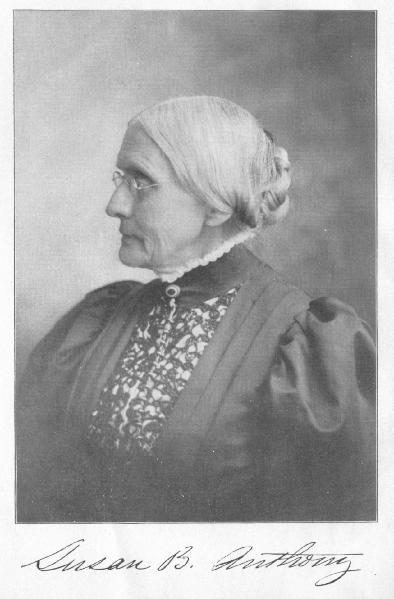
Susan B. Anthony
The Project Gutenberg EBook of The Life and Work of Susan B. Anthony
(Volume 1 of 2), by Ida Husted Harper

This eBook is for the use of anyone anywhere at no cost and with
almost no restrictions whatsoever.  You may copy it, give it away or
re-use it under the terms of the Project Gutenberg License included
with this eBook or online at www.gutenberg.org


Title: The Life and Work of Susan B. Anthony (Volume 1 of 2)
       Including Public Addresses, Her Own Letters and Many From Her
              Contemporaries During Fifty Years


Author: Ida Husted Harper

Release Date: March 1, 2005 [EBook #15220]

Language: English

Character set encoding: ISO-8859-1

*** START OF THIS PROJECT GUTENBERG EBOOK SUSAN B. ANTHONY ***


Produced by Jonathan Ingram, Leonard Johnson and the PG Online
Distributed Proofreading Team at https://www.pgdp.net.
A biography written during the lifetime of the subject is unusual, but to the friends of Miss Anthony it seemed especially desirable because the reform in which she and her contemporaries have been engaged has not been given a deserved place in the pages of history, and the accounts must be gleaned very largely from unpublished records and personal recollections. The wisdom of this course often has been apparent in the preparation of these volumes. In recalling how many times an entirely different interpretation of letters, scenes and actions would have been made from that which Miss Anthony declared to be the true one, the author must confess that hereafter all biographies will be read by her with a certain amount of skepticism—a doubt whether the historian has drawn correct conclusions from apparent premises, and a disbelief that one individual can state accurately the motives which influenced another.
Most persons who have attained sufficient prominence to make a record of their lives valuable are too busy to prepare an autobiography, but there is only one other way to go down to posterity correctly represented, and that is to have some one else write the history while the hero still lives. If we admit this self-evident proposition, then the question is presented, should it be published during his lifetime? A reason analogous to that which justifies the writing, demands also the publication, in order that denials or attacks may be met by the person who, above all others, is best qualified to defend the original statement. It seems a pity, too, that he should be deprived of knowing what the press and the people think of the story of his life, since there is no assurance that he will meet the book-reviewers in the next world.
These volumes may claim the merit of truthfully describing the principal events of Miss Anthony's life and presenting her opinions on the various matters considered. She has objected to the eulogies, but the writer holds that, as these are not the expressions of a partial biographer but the spontaneous tributes of individuals and newspapers, no rule of good taste is violated in giving them a place. It is only justice that, since the abuse and ridicule of early years are fully depicted, esteem and praise should have equal prominence; and surely every one will read with pleasure the proof that the world's scorn and repudiation have been changed to respect and approval. Many letters of women have been used to disprove the assertion so often made, that women themselves do not properly estimate the labors of Miss Anthony in their behalf. It can not be expected that the masses should understand or appreciate her work, but the written evidence herein submitted will demonstrate that the women of each decade most prominent in intellectual ability, in philanthropy, in reform, those who represent the intelligence and progress of the age, have granted to it the most cordial and thorough recognition.
There has not been the slightest attempt at rhetorical display, but only an endeavor to tell in plain, simple language the story of the life and work of one who was born into the simplicity and straightforwardness of the Society of Friends and never departed from them. The constant aim has been to condense, but it has not been an easy task to crowd into limited space the history of nearly eighty busy, eventful years, comprising a revolution in social and legal customs. If the reader discover some things omitted which to him seem vital, or others mentioned which appear unimportant, it is hoped he will attribute them to an error of judgment rather than to an intention to minimize or magnify unduly any person or action.
The fact should be kept in mind that this is not a history of woman suffrage, except in so far as Miss Anthony herself has been directly connected with it. A number of women have made valuable contributions to this movement whose lives have not come in contact with hers, therefore they have not been mentioned in these pages, which have been devoted almost exclusively to her personal labors and associations. Many of those even who have been her warm and faithful friends have had to be omitted for want of space. No one can know the regret this has caused, or the conscientious effort which has been made to render exact justice to Miss Anthony's co-workers. It was so difficult for her to select the few pictures for which room could be spared that she was strongly tempted to exclude all. Personal controversies have been omitted, in the belief that nothing could be gained which would justify handing them down to future generations. Where differences have existed in regard to matters of a public nature, only so much of them has been given as might serve for an object lesson on future occasions.
In preparing these volumes over 20,000 letters have been read and, whenever possible, some of them used to tell the story, especially those written by Miss Anthony herself, as her own language seemed preferable to that of any other, but only a comparatively small number of the latter could be obtained. She kept copies of a few important official letters, and friends in various parts of the country kindly sent those in their possession. Every letter quoted in these volumes was copied from the original, hence there can be no question of authenticity. The autographs reproduced in fac-simile were clipped from letters written to Miss Anthony. Her diaries of over fifty years have furnished an invaluable record. The strict financial accounts of all moneys received and spent, frequently have supplied a date or incident when every other source had failed. A mine of information was found in her full set of scrap-books, beginning with 1850; the History of Woman Suffrage; almost complete files of Garrison's Liberator, the Anti-Slavery Standard, and woman's rights papers—Lily, Una, Revolution, Ballot-Box, Woman's Journal, Woman's Tribune. The reader easily can perceive the difficulty of condensation, with Miss Anthony's own history so closely interwoven with the periods and the objects represented by all these authorities.
The intent of this work has been to trace briefly the evolution of a life and a condition. The transition of the young Quaker girl, afraid of the sound of her own voice, into the reformer, orator and statesman, is no more wonderful than the change in the status of woman, effected so largely through her exertions. At the beginning she was a chattel in the eye of the law; shut out from all advantages of higher education and opportunities in the industrial world; an utter dependent on man; occupying a subordinate position in the church; restrained to the narrowest limits along social lines; an absolute nonentity in politics. Today American women are envied by those of all other nations, and stand comparatively free individuals, with the exception of political disabilities.
During the fifty years which have wrought this revolution, just one woman in all the world has given every day of her time, every dollar of her money, every power of her being, to secure this result. She was impelled to this work by no personal grievance, but solely through a deep sense of the injustice which, on every side, she saw perpetrated against her sex, and which she determined to combat. Never for one short hour has the cause of woman been forgotten or put aside for any other object. Never a single tie has been formed, either of affection or business, which would interfere with this supreme purpose. Never a speech has been given, a trip taken, a visit made, a letter written, in all this half-century, that has not been done directly in the interest of this one object. There has been no thought of personal comfort, advancement or glory; the self-abnegation, the self-sacrifice, have been absolute—they have been unparalleled.
There has been no desire to emphasize the hardships and unpleasant features, but only to picture in the fewest possible words the many consecutive years of unremitting toil, begun amidst conditions which now seem almost incredible, and continued with sublime courage in the face of calumny and persecution such as can not be imagined by the women of today. Nothing has been concealed or mitigated. In those years of constant aggression, when every step was an experiment, there must have been mistakes, but the story would be incomplete if they were left untold. No effort has been made to portray a perfect character, but only that of a woman who dared take the blows and bear the scorn that other women might be free. Future generations will read these pages through tears, and will wonder what manner of people those were who not only permitted this woman to labor for humanity fifty years, almost unaided, but also compelled her to beg or earn the money with which to carry on her work. If certain opinions shall be found herein which the world is not ready to accept, let it be remembered that, as Miss Anthony was in advance of public sentiment in the past, she may be equally so in the present, and that the radicalism which we reject today may be the conservatism at which we will wonder tomorrow.
Those who follow the story of this life will confirm the assertion that every girl who now enjoys a college education; every woman who has the chance of earning an honest living in whatever sphere she chooses; every wife who is protected by law in the possession of her person and her property; every mother who is blessed with the custody and control of her own children—owes these sacred privileges to Susan B. Anthony beyond all others. This biography goes to the public with the earnest hope that it may carry to every man a conviction of his imperative duty to secure for women the same freedom which he himself enjoys; and that it may impress upon every woman a solemn obligation to complete the great work of this noble pioneer.
CHAPTER I.
ANCESTRY, HOME AND CHILDHOOD. (1550-1826.), 1-15
Berkshire Hills; noted persons born there; Anthony and Read genealogy; military record; religious beliefs; education; marriage of father and mother of Susan B. Anthony; her birth and childhood; characteristics of mother; first factory built.
CHAPTER II
GIRLHOOD AND SCHOOL LIFE. (1826-1838.), 17-31
Removal to Battenville, N.Y.; manufacturing business; temperance and labor questions; new house; Susan's factory experience; Quaker discipline; the home school; first teaching; boarding-school life; Susan's letters and journals.
CHAPTER III.
FINANCIAL CRASH—THE TEACHER. (1838-1845.), 33-46
The panic; father's letters; teaching at Union Village; the home sacrificed; life at Center Falls; more Quaker discipline; teaching at New Rochelle; Miss Anthony's letters on slavery, temperance, medical practice, Van Buren, etc.; teaching at Center Falls, Cambridge and Fort Edward; proposals of marriage; removal to Rochester, N. Y.
CHAPTER IV.
THE FARM HOME—END OP TEACHING. (1845-1850.), 47-55
Journey to Rochester; the farm home and life; teaching in Canajoharie; a devotee of fashion; death of Cousin Margaret; weary of the school-room; early temperance work; first public address; return home; end of teaching.
CHAPTER V.
ENTRANCE INTO PUBLIC LIFE. (1850-1852.), 57-80
Conditions leading to a public career; her home the center of reformers; temperance festival; first meeting with the Fosters, Mrs. Stanton, Mrs. Bloomer, Lucy Stone, Wm. Lloyd Garrison, Horace Greeley; women silenced in men's temperance meeting at Albany, hold one of their own; advice from Greeley and Mrs. Stanton; first Woman's State Temperance Convention; men's State Temperance Convention in Syracuse rejects women delegates; Rev. Samuel J. May and Rev. Luther Lee stand by the women; Miss Anthony as temperance agent; her appeal to women; attends her first Woman's Rights Convention at Syracuse; criticises decollete dress; letters and speeches of Stanton, Mayo, Stone, Brown, Nichols, Rose, Gage, Gerrit Smith, etc.; Bible controversy; vicious comment of Syracuse Star, N.Y. Herald, Rev. Byron Sunderland, etc.; platform of Human Rights.
CHAPTER VI.
TEMPERANCE AND TEACHERS' CONVENTIONS. (1852-1853.), 81-105
Women's first appearance before Albany Legislature; Miss Anthony, Rev. Antoinette Brown and Mrs. Bloomer speak in New York and Brooklyn by invitation of S.P. Townsend and make tour of State; attack of Utica Telegraph; phrenological chart; visit at Greeley's; women insulted and rejected at temperance meeting in Brick Church, New York; abusive speeches of Wood, Chambers, Barstow and others; Greeley's defense; attack of N.Y. Commercial-Advertiser, Sun, Organ and Courier; first annual meeting Women's State Temperance Society; letters from Gerrit Smith and Neal Dow; right of Divorce; men control meeting; Mrs. Stanton and Miss Anthony withdraw from Society; Samuel F. Gary declines to attend Temperance Convention; characteristic advice from Greeley; Miss Anthony attends State Teachers' Convention and raises a commotion; Professor Davies' speech; disgraceful scene at World's Temperance Convention in New York; Woman's Rights Convention mobbed; Cleveland Convention; Miss Anthony and Rev. W.H. Channing call Woman's Rights Convention in Rochester.
CHAPTER VII.
PETITIONS—BLOOMERS—LECTURES. (1854.), 107-122
Development of character; securing petitions for better laws; Woman's Rights Convention at Albany; ridiculous report of Representative Burnett; Miss Anthony's speech; canvassing the State and raising the funds; history of the Bloomer Costume, with interesting letters; lecture trip to Washington; opinions on slavery; hard experiences; conventions at Saratoga and Philadelphia; preparing to canvass New York State.
CHAPTER VIII.
FIRST COUNTY CANVASS—THE WATER CURE. (1855.), 123-136
Winter canvass of New York; extract from Rondout Courier; letter from Greeley on Woman Suffrage; another proposal; applying the "water cure;" hot meal for husbands, cold bite for wives; marriages of Lucy Stone and Antoinette Brown; speaking at birthplace; Saratoga Convention; goes to Worcester Hydropathic Institute; her letters from Boston and Worcester; first Republican meeting; treatment at "water cure;" letter from Dr. Rogers on marriage; takes out life insurance.
CHAPTER IX.
ADVANCE ALONG ALL LINES. (1856.), 137-148
Invited to act as agent for American Anti-Slavery Society; second canvass of New York; her letters describing hardships of journey, position of wives, etc.; Senator Foote's insolent report on petitions; advice to a wife; preparing speech on Co-Education; its reception in Troy; letter from Mary L. Booth on injustice to women teachers; meeting at Saratoga; the raid at Osawatomie; letter to brother Merritt regarding it; pathetic letter from Mary L. Booth; Greeley provoked; Gerrit Smith on woman's dress; New York Convention; words of confidence from Anti-Slavery Committee.
CHAPTER X.
CAMPAIGNING WITH THE GARRISONIANS. (1857-1858.), 149-166
Political conditions; Miss Anthony's band of speakers; Abolition meetings; Remond's speech; letter from Garrison; notes of her speeches; Maria Weston Chapman; lecture trip to Maine; stormy State Teachers' Convention at Binghamton; Mrs. Stanton's comment; letter of Miss Anthony on family affection: the "raspberry experiment;" the "good old times;" "health food cranks;" New York Convention in hands of mob; stirring up teachers at Lockport; mass meeting at Rochester in opposition to capital punishment; gift of Francis Jackson.
CHAPTER XI.
CONDITIONS PRIOR TO THE WAR. (1859.), 167-184
Scheme for Free Church; letter from Geo. Wm. Curtis on Woman's Rights; Miss Anthony's letters on pecuniary independence, denial of human rights, woman's individuality; criticism of Curtis; six weeks' legislative work in Albany; convention in New York under difficulties; extract from Tribune; Memorial to Legislatures; lecturing at New York watering places; journey on boat to Poughkeepsie; anecdote of waiter at hotel; incident of Quaker meeting in Easton; married women too busy to help in fall canvass; letter of Rev. Thomas K. Beecher; incident at Gerrit Smith's—the Solitude of Self; John Brown meeting; letters regarding it from Pillsbury and Mrs. Stanton; Hovey Legacy; correspondence with Judge Ormond, of Alabama; "We are your enemies!"
CHAPTER XII.
RIFT IN COMMON LAW—DIVORCE QUESTION. (1860.), 185-205
Early Woman's Rights meetings not Suffrage conventions; Legal Status of Woman outlined by David Dudley Field; Miss Anthony and Mrs. Stanton as co-workers and writers; Tilton's description of the two; before the N.Y. Legislature; Married Woman's Property Law; woman's debt to Susan B. Anthony; Emerson on Lyceum Bureau; letters from Mary S. Anthony on injustice to school-teachers; Beecher's lecture on Woman's Rights; convention at Cooper Institute; Mrs. Stanton on Divorce; Phillips' objections; Mrs. Dall's proper convention in Boston; battle renewed at Progressive Friends' meeting; Miss Anthony's home duties; letter from her birthplace; Anti-Slavery depository at Albany; Agricultural address at Dundee; Miss Anthony's defiance of the law giving child to father.
CHAPTER XIII.
MOB EXPERIENCE—CIVIL WAR. (1861-1862.), 207-224
Difference between Republicans and Abolitionists; Miss Anthony arranges series of Garrisonian meetings; mobbed in every city from Buffalo to Albany; Mayor Thacher preserves the peace at State capital; last Woman's Rights Convention before the War; Miss Anthony's views on motherhood; Phillips declares for War; letters on this subject from Beriah Green and Miss Anthony; opinion on "Adam Bede;" letter on Rosa Bonheur and Harriet Hosmer; N.Y. Legislature repeals laws recently enacted for women; letters from Anna Dickinson and Greeley on the War; Miss Anthony's opinion of private schools; attends her last Teacher's Convention; in the Anti-Slavery lecture field; death of father.
CHAPTER XIV.
WOMEN'S NATIONAL LOYAL LEAGUE. (1863-1864.), 225-240
Disbelief that the War would lead to Woman Suffrage; letters from Tilton on Proclamation and Henry B. Stanton on condition of country; Miss Anthony and Mrs. Stanton issue appeal to women to form National Loyal League; organization in Church of the Puritans; Miss Anthony's speech; they prepare eloquent Address to President Lincoln; headquarters opened in Cooper Institute; petitions and letters sent out by Miss Anthony; description of draft riots; letters regarding her father and the sale of the home; lively note from Tilton; raising money for League; almost 400,000 names secured; Sumner presents petitions in Senate; letter from Sumner; merry letter from Phillips; first anniversary of the League; Amendment XIII submitted by Congress; closing of League headquarters; failure of the government to recognize its distinguished women.
CHAPTER XV.
MALE IN THE FEDERAL CONSTITUTION. (1865.), 241-253
Death of niece Ann Eliza McLean; letters on the loss of loved ones; trip to Kansas; work among refugees and in brother's newspaper office; appeals to return to the East; letters on division in Anti-Slavery Society; Ottumwa speech on Reconstruction; an unpleasant night; address to colored people at Leavenworth; Republicans object to a mention of Woman Suffrage; Miss Anthony learns of motion for Amendment to Federal Constitution to disfranchise on account of Sex, and immediately starts eastward; confers with Mrs. Stanton and they issue appeal to women of country to protest against proposed Fourteenth Amendment; Miss Anthony holds meetings at Concord, Westchester and many other places; N.Y. Independent supports women's demands.
CHAPTER XVI.
THE NEGRO'S HOUR. (1866.), 255-270
Reconstruction period; Anti-Slavery Society declines coalition with Woman's Rights Society; Miss Anthony and Mrs. Stanton issue strong call for the reassembling in New York of Woman's Rights forces; Robert Purvis and Anna Dickinson approve; convention meets in Dr. Cheever's church; Miss Anthony and Mrs. Stanton present ringing Address to Congress; Miss Anthony's speech for union of the two organizations; Equal Rights Association formed; controversy of Phillips, Tilton, Anthony, Stanton in Standard office; Standard's offer of space rejected; Miss Anthony's speech at Equal Rights meeting in Albany; abusive article from N.Y. World; mass meetings held and petitions circulated to have women included in Fourteenth Amendment; Republicans refuse to recognize their claims; Democrats favor them to defeat the negroes; Miss Anthony complains of Standard's treatment; words from friends and foes.
CHAPTER XVII.
CAMPAIGNS IN NEW YORK AND KANSAS. (1867.), 271-294
Canvass of New York to secure Woman Suffrage Amendment to new State Constitution; scurrilous comment of Buffalo Commercial; praise of Troy Times; Miss Anthony rebukes selfish woman; always assumes the drudgery; Beecher can not work in organizations; Lucy Stone's letters from Kansas on action of Republicans; Beecher's speech in New York on Woman Suffrage; Miss Anthony and Mrs. Stanton prepare Memorial to Congress; Miss Anthony and Greeley break lances at Albany; Curtis stands by the women; Mrs. Greeley's petition used to checkmate her husband; Anna Dickinson's indignation; Kansas Republican Committee fights Woman Suffrage; Miss Anthony and Mrs. Stanton go to Kansas; hardships of the campaign; Mrs. Starrett's description of Miss Anthony; negroes oppose woman suffrage; George Francis Train comes to the rescue; Suffrage Amendment defeated; Leavenworth Commercial pays tribute; Miss Anthony, Mrs. Stanton and Mr. Train make lecture tour from Omaha to Boston; persecution by former friends.
CHAPTER XVIII.
ESTABLISHING THE REVOLUTION. (1868.), 295-311
Mr. Train and David M. Melliss furnish funds for starting Woman Suffrage newspaper, The Revolution; comments of press; Mr. Train in Dublin jail; Mrs. Stanton defends The Revolution; how women were sacrificed; bright description of paper and editors; Equal Rights Association divided between claims of woman and negro; Miss Anthony and Mrs. Stanton delegates to Democratic National Convention at Tammany Hall; their reception; Miss Anthony represents Workingwomen's Association at National Labor Congress in New York; her suffrage resolution rejected; her advice to women typesetters; sad case of Hester Vaughan; S. C. Pomeroy and George W. Julian present Woman Suffrage Amendments in Senate and House of Representatives.
CHAPTER XIX.
AMENDMENT XV—FOUNDING OF NATIONAL SOCIETY. (1869.), 313-336
First National Convention in Washington; colored men object to Woman Suffrage; first hearing before Congressional Committee; descriptive letter from Grace Greenwood; Miss Anthony arraigns Republicans at Chicago; Mrs. Livermore's tribute to Miss Anthony; speech at N.Y. Press Club on woman's "proposing;" Fifteenth Amendment submitted; criticism by The Revolution; Train withdraws from paper; Woman's Bureau; letters from Mrs. Livermore, Anna Dickinson, Gail Hamilton; stormy session of Equal Rights Association; Miss Anthony's speech against Amendment XV; William Winter defends her; discussion of "free love" resolution; Equal Rights platform too broad; founding of National Woman Suffrage Association; forming of American Woman Suffrage Association; Miss Anthony secures testimonial for Mrs. Rose; conventions at Saratoga and Newport; Miss Anthony protests against paying taxes; Mr. and Mrs. Minor claim woman's right to vote under Fourteenth Amendment; Miss Anthony speaks at Dayton, O., on laws for married women; Mrs. Hooker's description of her; Miss Anthony's speech at Hartford Convention; anecdote of Beecher; Mrs. Hooker's account; letters from Dr. Kate Jackson and Sarah Pugh; division in suffrage ranks.
CHAPTER XX.
FIFTIETH BIRTHDAY—END OF EQUAL RIGHTS SOCIETY. (1870.), 337-350
Washington Convention; Miss Anthony's speech on striking "male" from District of Columbia Bill; descriptions by Mrs. Fannie Howland, Hearth and Home, Mrs. Hooker, Mary Clemmer; Fiftieth Birthday celebration and comments of N.Y. Press; Phoebe Gary's poem; Miss Anthony's letter to mother; begins with Lyceum Bureau; Robert G. Ingersoll comes to her assistance; attack by Detroit Free Press; tribute of Chicago Legal News; efforts to unite the two National Suffrage organizations; Union Suffrage Society formed; end of Equal Rights Association.
CHAPTER XXI.
END OF REVOLUTION—STATUS OF WOMAN SUFFRAGE. (1870.), 351-370
McFarland-Richardson trial; letter from Catharine Beecher on Divorce; financial struggle; touching letters; Mrs. Hooker offers to help; Alice and Phoebe Gary; prospectus of The Revolution; giving up of the paper; Miss Anthony's letter regarding it; in the lecture field; the little Professor; Miss Anthony's strong summing-up of the Status of Woman Suffrage; rejected by National Labor Congress in Philadelphia; attack of Utica Herald; Second Decade Meeting in New York; Mrs. Davis' History of the Movement for Twenty Years; death of nephew Thomas King McLean; meeting with Phillips.
CHAPTER XXII.
MRS. HOOKER'S CONVENTION—THE LECTURE FIELD. (1871.), 371-385
Mrs. Hooker undertakes Washington Convention; amusing letters from Anthony, Stanton, Hooker, Wright; first appearance of Mrs. Woodhull; accounts by Philadelphia Press, Washington Daily Patriot and National Republican; resolution by Miss Anthony claiming right to vote under Fourteenth Amendment; Declaration signed by 80,000 women; Catharine Beecher and Mrs. Woodhull; Mrs. Stanton rebukes men who object to Mrs. Woodhull; hard life of a lecturer; Mrs. Griffing, Mrs. Stanton, Mrs. Hooker on political party attitude; Phoebe Couzins pleads for the National Association; Mrs. Woodhull at New York May Anniversary; charge of "free love" refuted; forcible letter from Miss Anthony declaring for one Moral Standard.
CHAPTER XXIII.
FIRST TRIP TO THE PACIFIC COAST. (1871.), 387-408
Miss Anthony and Mrs. Stanton cross the continent; newspaper comment; Miss Anthony's letters from Salt Lake City; hostile treatment by San Francisco press; description of trip to Yosemite; journey by boat to Oregon; her letters on lecture experiences in Oregon and Washington; ridicule of Portland Bulletin; misrepresentation of Territorial Despatch; "cards" in papers of British Columbia; account of stage ride back to San Francisco; banquet at Grand Hotel; journey eastward with Sargent family; snowbound among the Rockies.
CHAPTER XXIV.
REPUBLICAN SPLINTER—MISS ANTHONY VOTES. (1872.), 409-429
National Convention declares women enfranchised under Fourteenth and Fifteenth Amendments; Miss Anthony sustains this position before Senate Judiciary Committee; friends in Rochester present testimonial; she reads in Woodhull and Claflin's Weekly call to form New Party under auspices of National Suffrage Association; her indignant remonstrance; hastens to New York and prevents coalition; Liberal Republican Convention at Cincinnati refuses to adopt Suffrage resolution; Miss Anthony's comment; Republican Convention at Philadelphia makes first mention of Woman; Mr. Blackwell's and Miss Anthony's letters regarding this; Democratic Convention at Baltimore ignores Woman; Hon. John Cochran tells how not to do it; Miss Anthony and Mrs. Gage urge women to support Republican ticket; Miss Anthony states her Political Position; her delight and Mrs. Stanton's doubts; letter from Henry Wilson; Republican Committee summons her to Washington; she arranges series of Republican rallies; sustains party only on Suffrage plank; Miss Anthony Votes; newspaper comment; she is arrested; examination before U.S. Commissioner; Judge Henry R. Selden and Hon. John Van Voorhis undertake her case; Rochester Express defends her; letter on case from Benjamin F. Butler.
CHAPTER XXV.
TRIAL FOR VOTING UNDER FOURTEENTH AMENDMENT. (1873.), 431-448
Miss Anthony's speech at Washington Convention; she appears before U.S. District-Judge at Albany and bail is increased to $1,000; addresses State Constitutional Commission; indicted by grand jury; becomes unconscious on lecture platform at Ft. Wayne; votes again; call for Twenty-fifth Suffrage Anniversary; Miss Anthony delivers her great Constitutional Argument in twenty-nine post office districts in Monroe Co.; District-Attorney moves her trial to another county; she speaks at twenty-one places and Mrs. Gage at sixteen in that county; Rochester Union and Advertiser condemns her; trial opens at Canandaigua; masterly argument of Judge Selden; Justice Ward Hunt delivers Written Opinion without leaving bench; declines to submit case to Jury or to allow it to be polled; refuses new trial; spirited encounter between Miss Anthony and Judge; newspaper comment; trial of Inspectors; Judge refuses to allow Counsel to address Jury; opinion of Mr. Van Voorhis; contributions sent to Miss Anthony by friends; death of sister Guelma McLean; Miss Anthony's letter of grief to mother; generous gift of Anson Lapham.
CHAPTER XXVI.
NO CONSTITUTIONAL RIGHT TO JURY OR FRANCHISE. (1874.), 449-465
Appeal to Congress to remit fine and declare Right to Trial by Jury; report from House Committee for and against, by Butler and Tremaine; from Senate Committee for and against, by Carpenter and Edmunds; pardon of Inspectors by President Grant; Supreme Court decision in suit of Virginia L. Minor against Inspectors for refusing her vote; Representative Butler and Senator Lapham on Woman Suffrage; President Grant's opinion; letter of Judge A.G. Riddle on chief obstacles; death of Sumner; Miss Anthony's speech and letter on Women's Temperance Crusade; lying telegram and N.Y. Herald's truthful report of convention; letter by Miss Anthony, "honesty best policy;" suffrage campaign in Michigan; Beecher-Tilton case.
CHAPTER XXVII.
REVOLUTION DEBT PAID—WOMEN'S FOURTH OF JULY. (1875-1876.), 467-482
Miss Anthony's annual struggle to hold Washington Convention; speech in Chicago on Social Purity; comment of St. Louis Democrat and other papers; hard lecture tour in Iowa; shooting of brother Daniel R.; Revolution debt paid; commendation of press; Centennial Resolutions at Washington Convention; establishing Centennial headquarters at Philadelphia; Republicans again recognize Woman in National platform; Miss Anthony and others present Woman's Declaration of Independence at Centennial celebration; eloquent description; History of Woman Suffrage begun; writes articles for Johnson's Encyclopedia.
CHAPTER XXVIII.
COLORADO CAMPAIGN—POLITICAL ATTITUDE. (1877-1878.), 483-498
Advocates of Woman Suffrage compelled to return to former policy of demanding Sixteenth Amendment to Federal Constitution; letters from Garrison and Phillips on this subject; descriptions by Mary Clemmer and Washington papers of presenting Suffrage petitions in Congress; Lyceum Bureau circular with comment of Forney; death of sister Hannah Mosher; friendship of Miss Anthony and Mrs. Stanton; tribute of Annie McDowell; campaigning in Colorado; speaking in saloons; writing "Homes of Single Women" in Denver; prayer-meeting in Capitol at Washington; Miss Anthony urged not to miss another National Convention; Thirtieth Suffrage Anniversary at Rochester; letter from J.H. Hayford relative to Woman Suffrage in Wyoming; Miss Anthony defines her attitude in regard to Political Parties.
CHAPTER XXIX.
CONGRESSIONAL COMMITTEE REPORTS—COMMENT. (1879-1880.), 499-513
Vigorous resolutions at National Convention; Senator Morton's position on Woman Suffrage; Senator Wadleigh scored by Mary Clemmer; first favorable Senate Committee report; advance in public sentiment; extracts from Indiana papers; bitter attacks of Richmond (Ky.) Herald and Grand Rapids (Mich.) Times; interview in Chicago Tribune on Woman's need of ballot for Temperance legislation; convention in St. Louis and Miss Anthony's response to floral offering; death of Wm. Lloyd Garrison; desire for a woman's paper; new workers; Washington Convention; hospitality of Riggs House; death of mother.
Among the Berkshire Hills of Massachusetts is a very beautiful place in which to be born. It is famed in song and story for the loveliness of its scenery and the purity of its air. It has no lofty peaks, no great canyons, no mighty rivers, but it is diversified in the most picturesque manner by the long line of Green Mountains, whose lower ranges bear the musical name of "Berkshire Hills;" by rushing streams tumbling through rocky gorges and making up in impetuosity what they lack in size; by noble forests, gently undulating meadows, quaint farmhouses, old bridges and bits of roadway which are a never-ending delight to the artist. Writers, too, have found inspiration here and many exquisite descriptions in prose and verse commemorate the beauties of this region.
Catharine Maria Sedgwick, the first woman in America to make a literary reputation on two continents, was born at Stockbridge, and her stories and sketches were located here. That old seat of learning, Williams College, is situated among these foothills. In his summer home at Pittsfield, Longfellow wrote "The Old Clock on the Stairs"; at Stockbridge, Hawthorne builded his "House of the Seven Gables"; and Lydia Sigourney poetically told of "Stockbridge Bowl" with "Its foot of stone and rim of green." It was at Lenox that Henry Ward Beecher created "Norwood" and "Star Papers." Here Charlotte Cushman and Fanny Kemble came for many summers to rest and find new life. Harriet Hosmer had her first dreams of fame at the Sedgwick school. The Goodale sisters, Elaine and 002 Dora, were born upon one of these mountainsides and both embalmed its memory in their poems. Dora lovingly sings:
Dear Berkshire, dear birthplace, the hills are thy towers,
Those lofty fringed summits of granite and pine;
No valley's green lap is so spangled with flowers,
No stream of the wildwood so crystal as thine.
Say where do the March winds such treasures uncover,
Such maple and arrowwood burn in the fall,
As up the blue peaks where the thunder-gods hover
In cloud-curtained Berkshire who cradled us all?
Henry Ward Beecher said:
This county of valleys, lakes and mountains is yet to be as celebrated as the lake district of England and the hill country of Palestine.... Here is such a valley as the ocean would be if, when its waves were running tumultuous and high, it were suddenly transformed and solidified.... The endless variety never ceases to astonish and please.... It is indeed like some choice companion, of rich heart and genial imagination, never twice alike in mood, in conversation, in radiant sobriety or half-bright sadness; bold, tender, deep, various.
One has but to come into the midst of these hills to fall a victim to their fascination, while to those who were born among them there is no spot on earth so beautiful or so beloved. They have sent forth generations of men and women, whose fame is as imperishable as the marble and granite which form their everlasting foundations. Among the noted men who have gone out from the Berkshire region are William Cullen Bryant, Cyrus W. Field and brothers, Jonathan Edwards, Mark and Albert Hopkins, Senator Henry L. Dawes, Governor Edwin D. Morgan, of New York, George F. Root, the musical composer, Governor George N. Briggs, of Massachusetts, Governor and Senator Francis E. Warren, of Wyoming, the Deweys, the Barnards, a list too long for quoting. Oliver Wendell Holmes, whose grandfather was a Berkshire man, wrote:
Berkshire has produced a race which, for independent thought, daring schemes and achievements that have had world-wide consequences, has not been surpassed. We claim, also, that more of those first things that draw the chariot of progress forward so that people can see that it has moved, have been planned and executed by the inhabitants of the 950 square miles that constitute 003 the territory of Berkshire than can be credited to any other tract of equal extent in the United States.
Of late years the world of wealth and fashion has invaded the Berkshire country and there are no more magnificent summer homes than those of Lenox, Stockbridge, Great Barrington and the neighboring towns.
The first of the Anthony family of whom there is any record was William, born in Cologne, Germany, who came to England during the reign of Edward the Sixth and was made Chief Graver of the Royal Mint and Master of the Scales, holding this office through the reigns of Edward and Mary and part of that of Elizabeth. His crest and coat of arms are entered in the royal enumeration. His son Derrick was the father of Dr. Francis Anthony, born in London, 1550. According to the Biographia Britannica, he was graduated at Cambridge with the degree of Master of Arts and became a learned physician and chemist. Although a man of high character and generous impulses, he was intolerant of restraint and in continual conflict with the College of Physicians. He died in his seventy-fourth year, and was buried in the church of St. Bartholomew the Great, where his handsome monument still remains. He left a daughter and two sons, both of the latter distinguished physicians. From John, the elder, sprung the American branch of the family. His son, John, Jr., born in Hempstead, England, sailed to America in the ship Hercules, from that port, April 16, 1634, when he was twenty-seven years old. He settled in Portsmouth, R.I., and became a land-owner, an innkeeper and an office-holder. His five children who survived infancy left forty-three children. One of these forty-three, Abraham, had thirteen children, and his son William fourteen, his son, William, Jr., four, his son David nine.
It was just before the beginning of the Revolution that this David Anthony, with his wife, Judith Hicks, moved from Dartmouth, Mass., to Berkshire and settled near Adams at the foot of Greylock, the highest peak in the mountain range. This was considered the extreme West, as little was known of all that lay beyond. They brought two children with them 004 and seven more were born here in the shadow of the mountains. Humphrey, the second son, born at Dartmouth, February 2, 1770, married Hannah Lapham, who was born near Adams (then called East Hoosac), November 11, 1773; and here, also, January 27, 1794, was born the first of their nine children, Daniel, father of Susan B. Anthony.
On the maternal side the grandfather, Daniel Read, was born at Rehobeth, Mass., and said to be a lineal descendant and entitled to the coat of arms of Sir Brianus de Rede, A.D. 1075; but he had too much of the sturdy New England spirit to feel any special interest in the pomp and pride of heraldry, and the family tree he prized most was found in the grand old grove which shaded his own dooryard. Susannah Richardson, his wife, was born at Scituate, Mass., and her family were among the most wealthy and respected of that locality during the eighteenth century. Both Reads and Richardsons removed to Cheshire, Mass., before 1770, and Daniel and Susannah were married there. It was but a few months after this marriage when the first gun was fired at Lexington and the whole country was ablaze with excitement. At the close of the sermon, on a bright spring morning, the old minister, his voice trembling with patriotic fervor, asked every man who was ready to enlist in the Continental army to stand forth, and Daniel Read was the first to step out into the aisle of the little meeting-house. Leaving the girl-bride he entered the service and soon became conspicuous for his bravery. He was one of the memorable expedition against Quebec under Arnold, in 1775, and of the party commanded by Ethan Allen at the capture of Ticonderoga. He was among that brave band from Cheshire (Stafford's Hill) who fought under Colonel Stafford at Bennington. On the 19th of October, 1780, he took part in the fatal fight of Stone Arabia, under Col. John Brown, and served with honor throughout the war. It was several years after peace had been declared and he had returned home and settled down to the quiet life of a New England farmer that, December 2, 1793, was born Lucy, the mother of Susan B. Anthony.
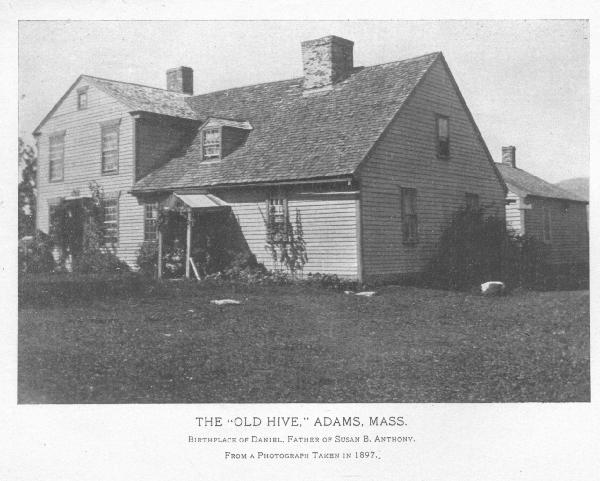
THE "OLD HIVE," ADAMS, MASS.
Daniel Read was a member of the Massachusetts Legislature 005 in 1814 and was elected to various public offices. He was a Whig in politics and adhered always to staunch republican principles, but rose above partisanship and was universally respected. Daniel and Susannah were thrifty New England Puritans, leading members of the Baptist denomination and parishioners of the widely known Elder Leland. The cooking for Sunday always was done on Saturday, and the greater part of every Sunday, regardless of weather, was spent at church. They and their children sat through a service of two hours in the morning, ate a generous lunch at the noon intermission, and were ready for another two hours' sermon in the afternoon, through all the heat of summer and the terrible cold of New England winter.
Susannah Read remained always a devout and consistent Baptist, but Daniel became, in later years, a thorough Universalist. Murray, the founder of this church in England, had come to the Colonies before the Revolutionary War, and by the close of the century the Universalists were organized as a sect, holding general conventions and sending itinerants among the people in the villages and country. Some of these doubtless had penetrated to Adams and converted Daniel Read, who was always liberal in his belief. He was an inveterate reader and pored over a vast amount of theological discussion which attracted so much attention in his day. The family moved from Cheshire to a suburb of Adams called Bowen's Corners. Near their house was the tavern, its proprietor known to all the people roundabout as "Uncle Sam" Bowen. He and Daniel Read never wearied in setting forth the merits of "free salvation." They were the only two persons in all that section of the country who did not believe in a literal hell. It was the common sentiment then that only those disbelieved in endless punishment who had reason to be afraid of it, and, since both these men were exemplary in every other respect, it was impossible for their friends to understand their aberration. Susannah Read, in the language of that time, "wore the skin off her knees," praying night and day that God would bring her husband back into the fold, but her prayers never were 006 answered. Every Sunday regularly he accompanied her to church, and faithfully contributed to the support of the preacher, but he died, at the ripe old age of eighty-four, firm in his Universalist faith.
Susannah was the care-taker of the family and looked after the farm, inheriting the Richardson energy and thrift. Daniel was genial, good-natured and very intelligent, but his health being impaired from army service, he was willing she should take the lead in business matters. The farm was one of only a hundred acres, but was carefully and economically managed and, at their death, the Reads left about $10,000, which was then considered a snug little fortune. Lucy, one of seven children, was born into a home of peace and comfort and had a happy and uneventful childhood. She attended the district school, was a fair writer and speller and, like her father very fond of reading. She learned to cook and sew, make butter and cheese, spin and weave, and was very domestic in all her tastes. The Reads and Anthonys were near neighbors, and although differing widely in religious belief, a subject of much prominence in those days, they were on terms of intimate friendship even before the ties were made still closer by marriage between the two families.
Both Anthonys and Laphams were Quakers as far back as the sect was in existence. Both were families of wealth and influence, and when Humphrey and Hannah were married she received from her parents a house and thirty acres of land, which were entailed on her children. Silver spoons are still in the family, which were part of her dowry more than a century ago. Hannah Lapham Anthony was a most saintly woman and, because of her beautiful religious character was made an elder and given an exalted position on the "high seat."[1]
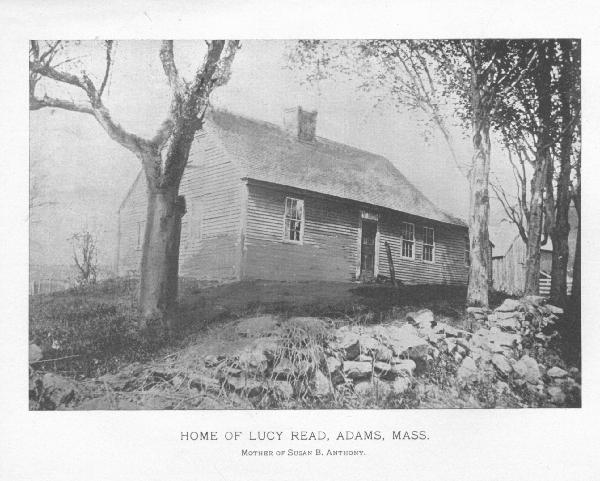
HOME OF LUCY READ, ADAMS, MASS.
She was a very handsome brunette and was noted for the beauty and elegance of her Quaker attire, her bonnets always being made in New York. Humphrey never attained the "high seat;" he was too worldly. His ambition was constantly to add more to his broad acres, to take a bigger drove 007 of cattle to Boston than any of his neighbors, and to get a higher price for his own than any other Berkshire cheese would bring. He had a number of farms and a hundred cows, while his wife made the best cheese and was the finest housekeeper in all that part of the country. The fame of her coffee and biscuits, apple dumplings and chicken dinners, spread far and wide. Their kitchen was forty feet long. One end was used for the dining-room, with the table seating twenty persons, and in the other were the sink and the "penstock," which brought water from a clear, cold spring high up in the mountains. Here also were the huge fire-place, the big brick oven and the large pantry. Then there were the spacious "keeping" or sitting-room, with the mother's bedroom opening out of it, the great weaving-room with its wheels and loom, and two bed-rooms for the "help" down stairs, while above were the children's sleeping-rooms. Opening out of the kitchen was a room containing the cheese press and the big "arch" kettle, and near by was a two-story building where the cheese was stored. Up in the grove was the saw-mill, and at the foot of the hill was the blacksmith shop, where nails were made, horses shod, wagons and farm implements mended and, later, scythes manufactured. On all the farms were fine orchards of apples, plums, pears, cherries and quinces, among which stood long rows of beehives with their wealth of honey.
Here Daniel, father of Susan B. Anthony, grew to manhood in the midst of comfort and abundance and in an atmosphere of harmony and love. The Anthonys were broad and liberal in religious ideas, and in 1826, when bitter dissensions regarding the divinity of Christ arose among the Quakers, they followed Elias Hicks and were henceforth known as "Hicksite Friends." This controversy divided many families, and on account of it the orthodox brother, Elihu Anthony, insisted on removing their aged father to his home in Saratoga, N.Y., to the great grief of Humphrey, who claimed that the old gentleman was too childish to know whether he was orthodox or Hicksite and ought not to be taken to "a new country" in his declining years Hannah Anthony 008 was ambitious for her children and insisted that they should be placed where they might have better educational facilities than in the little school at home. Humphrey thought the boys could manage a farm and the girls weave good cloth and make fine cheese without a boarding-school education. He finally yielded, however, and Daniel and two daughters were sent to the "Nine Partners," that famous Quaker boarding-school in Dutchess county, N.Y. At the end of a year, Daniel, who was about nineteen, had made such rapid progress that he was appointed teacher. The quaint certificate given him by his associate teachers is still in existence and reads:
This may apprize the friends & relatives of D. Anthony, that, during his residence with us, he has been an affectionate consort, excellent, consistant in the School, of steady deportment and conversation, being an example for us to follow when we are separated. We sincerely wish his preservation in all things laudable and believe we can with propriety hereunto set our names.
Elihu Marshall, Charles Clement, John Taber, Stephen Willitz, Henry Cox, Frederick A. Underhill, William Seamen.
There is a still more highly valued testimonial from the principal, the noble and dignified Richard F. Mott, who was held in loving reverence by all the distinguished Quaker families that confided their sons and daughters to his wise and tender care:
Daniel Anthony has been an assistant here & we can aprise his friends that he has faithfully discharged his duty in that particular, has been a very agreeable companion & his conduct remarkably correct & exemplary, which, joined to his pleasant & obliging disposition, has gained him our esteem & affection.
We sincerely wish his prosperity, spiritually & temporally, & shall gratefully remember him and his services.
On behalf of the sitting-room circle, R.F. MOTT.
Boarding School, 4 M., 1 D., 1814.
The profession of teacher did not appeal to hard-headed Humphrey Anthony, and when Daniel came back with his brain full of ambitious projects and with a thorough distaste for farming, and his sisters, with many airs and graces and a feeling of superiority over the girls in the neighborhood, Father Anthony declared that no more children of his should 009 go away to boarding-school. The fact that young Daniel was skilled in mechanics and mathematics, able to superintend intelligently all the work on the farm and to make a finer scythe than any man in the shop, did not modify the father's opinion. When John, the next boy, was old enough and the mother began to urge that he be sent to school, the father offered him his choice to go or to stay at home and work that year for $100. This was a large sum for those days, it out-weighed the mother's arguments, John remained at home and regretted it all the rest of his life.
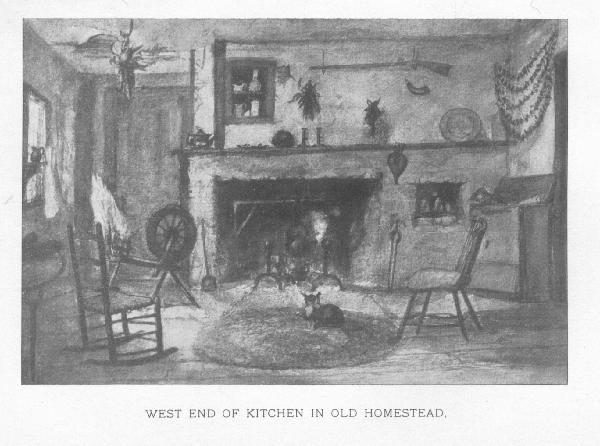
WEST END OF KITCHEN IN OLD HOMESTEAD.
The Anthony and Read farms were adjoining a mile east of Adams, and lay upon the first level or "bench" of the Green mountains. From their door-yards the ascent of the mountains began, and only the Hoosac in a deep ravine separated them from the base of "Old Greylock." The crops were raised on the "intervale" and the cattle pastured on the mountain side. Adams was then a sleepy New England village, and the Hoosac was a lovely stream, whose waters were used for the flocks and for the grist and saw-mills; but in later years the village became a manufacturing center and the banks of the pretty river were lined for miles with great factories.
In early times wealthy Quakers had a school in their home or door-yard for their own children. Those of the neighborhood were allowed to attend at a certain price, and in this way undesirable pupils could be kept out. At the Anthony residence this little school-house stood beneath a great weeping willow beside the front gate, and among the pupils was Lucy Read. She was the playmate of the sisters, and young Dan was the torment of their lives, jumping out at them from unexpected corners, eavesdropping to learn their little secrets and harassing them in ways common to boys of all generations, and she never hesitated to inform him that he was "the hatefullest fellow she ever knew." When Daniel returned from boarding-school with all the prestige of several years' absence, and was made master of the little home-school, one of his pupils was this same Lucy Read, now a tall, beautiful girl with glossy brown hair, large blue eyes and a fine complexion, the belle of 010 the neighborhood. The inevitable happened, childish feuds were forgotten, and teacher and pupil decided to become husband and wife. Then arose a formidable difficulty. The Anthonys were Quakers, the Reads were Baptists, and a Quaker was not permitted to "marry out of meeting." Love laughed at rules and restrictions eighty years ago, just as it does to-day, and Daniel refused to let the Society come between him and the woman of his choice, but Lucy had many misgivings. Thanks to her father's ideas she had been brought up in a most liberal manner, allowed to attend parties, dance and wear pretty clothes to her heart's content, and it was a serious question with her whether she could give up all these and adopt the plain and severe habits of the Quakers. She had a marvelous voice, and, as she sang over her spinning-wheel, often wished that she might "go into a ten-acre lot with the bars down" so that she could let her voice out to its full capacity. The Quakers did not approve of singing, and that pleasure also would have to be relinquished. That the husband could give up his religious forms and accept those of the wife never had been imagined.
Love finally triumphed, and the young couple were married July 13, 1817. A few nights before the wedding Lucy went to a party and danced till four o'clock in the morning, while Friend Daniel sat bolt upright against the wall and counted the days which should usher in a new dispensation. A committee was sent at once to deal with Daniel, and Lucy always declared he told them he "was sorry he married her," but he would say, "No, my dear, I said I was sorry that in order to marry the woman I loved best, I had to violate a rule of the religious society I revered most." The matter was carefully talked over by the elders, and as he had said he was sorry he had to violate the rule, and as the family was one of much influence, and as he was their most highly educated and cultivated member, it was unanimously decided not to turn him out of meeting.[2] Lucy learned to love the Friends' religion 011 and often said she was a much more consistent Quaker than her husband, but she never became a member of the Society, declaring she was "not good enough." She did not use the "plain language," though she always insisted that her husband should do so in addressing her; nor did she adopt the Quaker costume, but she dressed simply and wore little "cottage" straw bonnets with strings tied demurely under her chin and later had them made of handsome shirred silk, the full white cap-ruche showing inside. She sang no more except lullabies to the babies when they came, and then the Quaker relatives would laugh and ask her why she did it. Her long married life was very happy, notwithstanding its many hardships, and she never regretted accepting her Quaker lover.
The previous summer Daniel had helped his father prepare the lumber and build a large two-story addition to his house, and in return he gave to his son the lumber for a new home, on a beautiful tract of ground presented to the young couple by Father Read adjoining his own. While this was being built they lived at the Read homestead, and the loom was kept busy preparing the housekeeping outfit. In those days this was made of linen, bleached and spun and woven by the women of the household. Cotton was just coming into use, and Lucy Anthony was considered very fortunate because she could have a few sheets and pillow-cases which were half cotton.
The manufacture of cotton becoming a prominent industry in New England at this time, the alert mind of Daniel Anthony conceived the idea of building a factory and using the waters of Tophet brook and of a rapid little stream which flowed through the Read farm. This was done, and proved a success from the beginning. A document is still in existence by which "D. Read agrees to let D. Anthony have as much water from the brook on his farm as will run through a hole six inches in diameter." This was conveyed by an aqueduct, made from hollow logs, to the factory where it turned the over-shot wheel and furnished power to the twenty-six looms. The factory hands for the most part came down from the Green 012 mountain regions, glad of an opportunity never before enjoyed of earning wages and supporting themselves. They were girls of respectability, and, as was the custom then, boarded with the families of the mill-owners. Those of the Anthony factory were divided between the wife and Hannah Anthony Hoxie, a married sister. Lucy Anthony soon became acquainted with the stern realities of life. Her third baby was born when the first was three years and two months old. That summer she boarded eleven factory hands, who roomed in her house, and she did all the cooking, washing and ironing, with no help except that of a thirteen-year-old girl, who went to school and did "chores" night and morning. The cooking for the family of sixteen was done on the hearth in front of the fire-place and in a big brick oven at the side. Daniel Anthony was a generous man, loved his wife and was well able to hire help, but such a thing was not thought of at that time. No matter how heavy the work, the woman of the household was expected to do it, and probably would have been the first to resent the idea that assistance was needed.
During the first seventeen years of this marriage eight children were born. One died at birth and one at the age of two years. The eldest, born July 1, 1818, was named for the wife of William Penn, who married a member of the Anthony family, Gulielma Penn, which was contracted to Guelma. Susan was the second child, born February 15, 1820, and named for an aunt, Susan Anthony Brownell. She herself adopted the initial "B" when older, but never claimed or liked the full name.[3]
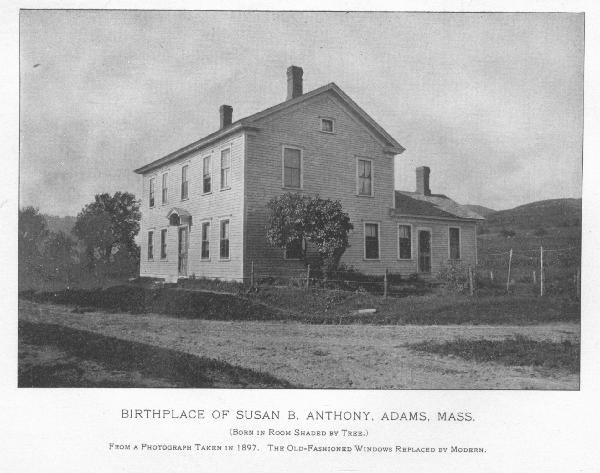
BIRTHPLACE OF SUSAN B. ANTHONY, ADAMS, MASS. (BORN IN ROOM SHADED BY TREE.)
Lucy Read Anthony was of a very timid and reticent disposition and painfully modest and shrinking. Before the birth of every child she was overwhelmed with embarrassment and humiliation, secluded herself from the outside world and would 013 not speak of the expected little one even to her mother. That mother would assist her overburdened daughter by making the necessary garments, take them to her home and lay them carefully away in a drawer, but no word of acknowledgment ever passed between them. This was characteristic of those olden times, when there were seldom any confidences between mothers and daughters in regard to the deepest and most sacred concerns of life, which were looked upon as subjects to be rigidly tabooed. Susan came into the world in a cold, dreary season. The event was looked forward to with dread by the mother, but when the little one arrived she received a warm and loving welcome. She was born into a staid and quiet but very comfortable home, where great respect and affection existed between father and mother.
William Cullen Bryant, whose birth-place was but twenty miles distant, wrote of this immediate locality:
I stand upon my native hills again,
Broad, round and green, that in the summer sky,
With garniture of waving grass and grain,
Orchards and beechen forests, basking lie;
While deep the sunless glens are scooped between,
Where brawl o'er shallow beds the streams unseen.
Each night in early childhood she watched the sun set behind the great dome of "Old Greylock," that noble mountain-peak so famed in the literature of Berkshire, from whose lofty summit one looks across four States. "It lifts its head like a glorified martyr," said Beecher, and Julia Taft Bayne wrote:
Come here where Greylock rolls
Itself toward heaven; in these deep silences,
World-worn and fretted souls,
Bathe and be clean.
To the child's idea its top was very close against the sky, and its memory and inspiration remained with her through life.
Susan was very intelligent and precocious. At the age of three she was sent to the grandmother's to remain during the advent of the fourth baby at home, and while there was taught 014 to spell and read. Her memory was phenomenal, and she had an insatiable ambition, especially for learning the things considered beyond a girl's capacity.
The mother was most charitable, always finding time amidst her own family cares to go among the sick and poor of the neighborhood. One of Susan's childish grievances, which she always remembered, was that the "Sunday-go-to-meeting" dresses of the three little Anthony girls were lent to the children of a poor family to wear at the funeral of their mother, while she and her sisters had to wear their old ones. She thought these were good enough to lend. She had no toys or dolls except of home manufacture, but her rag baby and set of broken dishes afforded just as much happiness as children nowadays get from a roomful of imported playthings.
To go to school the children had to pass Grandmother Read's, and they were always careful to start early enough to stop there for a fresh cheese curd and a drink of "coffee," made by browning crusts of rye and Indian bread, pouring hot water over them and sweetening with maple sugar. Then in the evening they would stop again for some of the left-over, cold boiled dinner, which was served on a great pewter platter, a big piece of pork or beef in the center and, piled all round, potatoes, cabbage, turnips, beets, carrots, etc. The story runs that, when the mother remonstrated with the children for bothering the grandmother for what they could have at home, Susan replied, "Why, grandma's potato peelings are better than your boiled dinners." The Anthonys and Reads used white flour and real coffee on state occasions, but very few families could afford such luxuries.
One of the recollections of Grandmother Anthony's house is of the little closet under the parlor stairs, where was set the tub of maple sugar, and, while the elders were chatting over neighborhood affairs, the children would gather like bees around this tub and have a feast. Always when they left, they were loaded down with apples, doughnuts, caraway cakes and other toothsome things which little ones love. Along the edges of the pantry shelves hung rows of shining pewter 015 porringers, and the pride of the children's lives was to eat "cider toast" out of them. This was made by toasting a big loaf of brown bread before the fire, peeling off the outside, toasting it again, and finally pouring over these crusts hot sweetened water and cider. The dish, however, which was relished above all others was "hasty pudding," cooked slowly for hours, then heaped upon a platter in a great cone, the center scooped out and filled with sweet, fresh butter and honey or maple syrup.
In those days every sideboard was liberally supplied with rum, brandy and gin, and every man drank more or less, even the elders and preachers. When the farmers came down the mountain road with their loads of wood or lumber, they always stopped at Grandfather Read's for a slice of bread and cheese and a drink of hard cider, but the elders and preachers were regaled with something stronger. This was the custom, and criticism would have been considered fanatical.
The little factory nourished and produced many yards of excellent cotton cloth. A store was opened in one corner of the house to supply the wants of the employes and neighbors, and the Anthonys enjoyed a plenty and prosperity somewhat unusual where small incomes and close economy were the rule.
By 1826, Daniel Anthony had become so well-known for business management that he received an offer from Judge John McLean, of Battenville, Washington county, N.Y., who already had built a factory there, to go into cotton manufacturing on an extensive scale, the judge to furnish capital, Mr. Anthony executive ability. There was much opposition from the two older families to having their children go so far away (forty-four miles) and Lucy Anthony's heart was almost broken at the thought of leaving her aged father and mother, but Daniel was too good a financier to lose such an opportunity. So on a warm, bright July morning the goods were started and the judge and his grandson, Aaron McLean, came with a big green wagon and two fine horses to take the family to Battenville. Young Aaron little thought as he lifted the eight-year-old Guelma into the wagon that he was taking with him his future wife. The new home was in a pretty village nestled among the hills on the Battenkill. The first year the Anthonys lived in part of Judge McLean's house, where were two slaves not yet manumitted, and the children saw negroes for the first time and were dreadfully frightened. Afterwards the family moved into an old but comfortable story-and-a-half house where they remained several years.
Meanwhile a great deal of expensive machinery had been put into the factory and a large brick store erected. For a long time Daniel Anthony had been very much interested in the temperance cause. At Adams he had sold liquor, like 018 every other merchant, but when a man was found by the roadside frozen to death with an empty jug which told the story, although Mr. Anthony had not sold him the rum, he resolved, as this was only one of many distressing cases, to sell no more. He was the first in that locality to put intoxicating liquors out of his store.
He had not thought to discuss this question with Judge McLean when their contract was made, and had gone to Troy and selected goods for the store. The judge looked on while they were being unloaded and finally asked, "Why, Anthony, where are the rum barrels?" "There aren't any," he answered. "You don't expect to keep store without rum, do you? If you don't 'treat,' nobody will trade with you," said the judge. "Well, then I'll close the store," was the reply. It was opened; the farmers would come in, look around, peer behind the counter, finally go down cellar and make a search, and then declare they would not trade at a temperance store; but, as they found here the best goods and lowest prices, with square dealing, they could not afford to go elsewhere and the store soon enjoyed a large business.
When it was decided to build a number of tenement houses, the judge said, "The men will not come to the 'raising' unless they can have their gin." "Then the houses will not be raised," replied Mr. Anthony, and sent out the invitations. His wife made great quantities of lemonade, "training-day" gingerbread, doughnuts and the best of tea and coffee. Everybody came, things went off finely, not an accident during the day and all went home sober, having learned, for the first time, that there could be a house-raising without liquor.
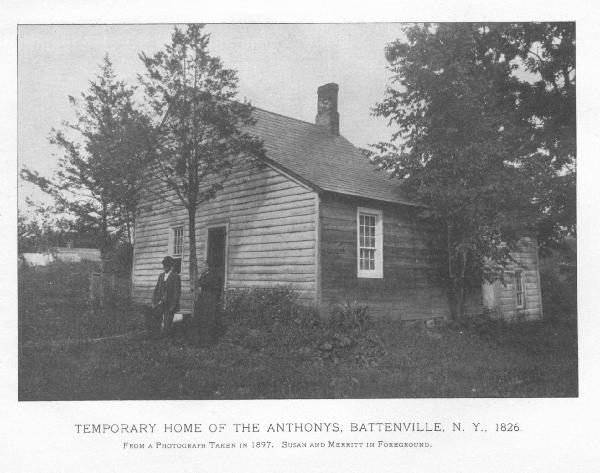
TEMPORARY HOME OF THE ANTHONYS, BATTENVILLE, N.Y., 1826 FROM A PHOTOGRAPH TAKEN IN 1897. SUSAN AND MERRITT IN FOREGROUND.
But the battle had to be fought continually. A saw-mill and a grist-mill were built and no man was employed who drank to excess. The tavern keeper, who had expected to reap a rich harvest from the factory, was very indignant at the temperance regulations. He put every temptation in the way of the mill-hands, but Daniel Anthony remained firm. Among his papers are found several letters of repentance and pledges from his men who had fallen from grace and wanted 019 another trial. He organized a temperance society, composed almost entirely of his men and women employes. The pledge, as was the custom, required "total abstinence from distilled liquor," but allowed wine and cider. He also established an evening school for them, many never having had any chance for an education, and it became unpopular not to attend. This was in session also a few hours on Sunday. It was taught by Mr. Anthony himself or his own family teacher without expense to the pupils. Everything about the factory was conducted with perfect system and order. Each man had a little garden around his house. Mr. Anthony looked upon his employes as his family and their mental and moral culture as a duty. Even thus early he was so strong an opponent of slavery that he made every effort to get cotton for his mills which was not produced by slave labor.
The only persons ever allowed to smoke or drink intoxicants in the Anthony home were Quaker preachers. The house was half-way between Danby, Vt., and Easton, N.Y., where the Quarterly Meetings were held and the preachers and elders stopped there on their way. In a closet under the stairs were a case of clay pipes, a paper of tobacco and demijohns of excellent gin and brandy, from which the "high seat" brothers were permitted to help themselves. It is not surprising to find in the annals that a dozen or more would drop in to get one of Mrs. Anthony's good dinners and the refreshments above mentioned.
In the spring of 1832 a brick-kiln was burned in preparation for the new house. Mrs. Anthony boarded ten or twelve brick-makers and some of the factory hands, with no help but that of her daughters Guelma, Susan and Hannah, aged fourteen, twelve and ten. When the new baby came, these three little girls did all the work, cooking the food and carrying it four or five steps up from the kitchen to the mother's room to let her see if it were nicely prepared and if the dinner-pails for the men were properly packed.
Soon after this, Mr. Anthony remarked that one of the "spoolers" was ill and there was no one to do her work. Susan 020 and Hannah had spent many hours watching the factory girls, and at once raised a clamor to take the place of the sick "spooler." The mother objected, but the father, who always encouraged his children in their independent ideas, interceded and finally they were allowed to draw straws to decide which should go, the winner to divide her wages with the loser. The lot fell to Susan, who worked faithfully every day for two weeks and received full wages, $3. Hannah, with her $1.50, bought a green bead bag, then considered the crowning glory of a girl's wardrobe. Susan purchased half a dozen pale-blue coffee cups and saucers, which she had heard her mother wish for, and presented them to her with a happy heart.
The next summer the house was built, the finest in that part of the country, a two-and-a-half-story brick with fifteen rooms and all the conveniences then known. Quakers never celebrate Christmas, but the Anthonys, having lived now for seven years in a Presbyterian neighborhood, decided to give the children a Christmas party in the new home. The walls had a beautiful hard finish, the woodwork was tinted light green and the new flag-bottomed chairs were painted black. Between the rough boots of the country youths and the chairs pushed or tipped against the wall, both woodwork and plastering were almost ruined, and the new house carried a lasting reminder of the festivities.
About this time Daniel Anthony was again brought under Quaker criticism. On one of his journeys to New York he had bought a camlet cloak with a big cape, as affording the best protection for the long, cold rides he had to take. The Friends declared this to be "out of plainness" and insisted that he leave off the cape and cease wearing a brightly colored handkerchief about his neck and ears. Daniel, who was beginning to be rather restive under these restraints, refused to comply, but, as he was a valuable member, it was finally decided here also to condone his offense.
Through all those years Lucy Anthony went to Quaker meeting with her husband. After public services were over, 021 however, and the shutters pulled up between the men's and the women's sides of the house for business meeting, she was rigidly barred out. She would take her children and walk about in the grave-yard outside while she waited for Daniel, but, as the graves were all in a row without even a headstone to distinguish them, this was not a very interesting pastime and the wait was long and tedious. When the little girls went with the father they also were shut out of the executive session where such momentous questions were discussed as, "Are Friends careful to keep themselves and their children from attending places of diversion?" "Are Friends careful to refrain from tale-bearing and detraction?" "Are Friends careful to send their children to school, and all children in their employ?"
One cold day, the mother being detained at home, ten-year-old Susan received permission to go with her father. When the business meeting began, she curled up quietly in a corner by the stove, thinking to escape detection, but was spied out by one of the elders, a woman with green spectacles, who tip-toed down from the "high seat" and said, "Is thee a member?" "No, but my father is," replied Susan. "That will not do, thee will have to go out." "My mother told me to stay in." "Thy mother doesn't manage things here." "But my father told me to stay in." "Neither thy father nor thy mother can say what thee shall do here; thee will have to go out;" and taking the child by the arm she led her into the cold vestibule. After remaining there until almost frozen, Susan decided to go to the nearest neighbor's. When she opened the gate a big dog sprung fiercely upon her. Her screams brought out the family and she was taken into the house, where it was found the only injury was a large piece bitten out of the new Scotch plaid cloak which she had gone to meeting on purpose to exhibit. The affair created considerable excitement, Mr. and Mrs. Anthony were very indignant, and it ended in the father's making a "request" that his children be made members of the Society, which was done.
Daniel Anthony was by nature a broad, progressive man, 022 and his family were not brought up according to the strictest and narrowest requirements of Quaker doctrine; while his wife, remembering the liberal teachings of her Universalist father and her own girlish love of youthful pastimes, went still further in making life pleasant for the children. Through her influence the daughters secured many a pretty article of wearing apparel, and, when there was a party whose hours were later than the father approved, the mother managed to have them spend the night with girls in the neighborhood.
When the family first moved to Battenville the children went to the little old-fashioned district school taught by a man in winter and a woman in summer. None of the men could teach Susan "long division" or understand why a girl should insist upon learning it. One of the women maintained discipline by means of her corset-board used as a ferule. As soon as Mr. Anthony finished the brick store he set apart one room upstairs for a private school, employed the best teachers to be had and admitted only such children as he wished to associate with his own. When the new house was built a large room was devoted to school purposes. This was the first in that neighborhood to have a separate seat for each pupil, and, although only a stool without a back, it was a vast improvement on the long bench running around the wall, the same height for big and little. The girls were taught sewing as carefully as reading and spelling, and Susan was noted for her skill with the needle. A sampler is still in existence which she made at the age of eleven, a fine specimen of needle-work with the family record surrounded by a wreath of strawberries all carefully wrought in crewels. There is also a bedquilt, the pieces sewed together with the fine "over-and-over" stitch, and there are ruffles hemmed with stitches so tiny they scarcely can be distinguished. An early teacher was a cousin, Nancy Howe,[4] who was followed by another cousin, Sarah Anthony, 023 a graduate of Rensselaer Quaker boarding-school. Among the teachers was Mary Perkins, just graduated from Miss Grant's seminary at Ipswich, Mass., and a pupil of Mary Lyon, founder of Mt. Holyoke. She was their first fashionably educated teacher and taught them to recite poems in concert, introduced school books with pictures, little black illustrations of Old Dog Tray, Mary and Her Lamb, etc., and gave them their first idea of calisthenics. She loved music, and wished to attend the village singing-school. Lucy Anthony sympathized with this desire and interceded for her, but Daniel decided it would be setting a bad example to the children and they would be wanting to sing.[5]
Into this commodious home Lucy Anthony brought her aged father and mother, and carefully tended them until the death of both within the same year, aged eighty-four. In May, 1834, came the first great sorrow, the death of little Eliza, aged two years, and the mother was heart-broken. Her life was centered in her children, and she could not be reconciled to giving up even one. After her own death, nearly fifty years later, in her box of most sacredly guarded keepsakes, was found a little faded pink dress of the dear child's which many times had been moistened with the mother's tears.
The children continued to attend this private school, and as Guelma and Susan reached the age of fifteen, each in turn was installed as teacher in summer when there were only young pupils. The factory now was at the height of prosperity; there was only one larger in all that part of the country, and Daniel Anthony was looked upon as a wealthy man. He was much criticised for allowing his daughters to teach, as in those days no woman worked for wages except from pressing necessity; but he was far enough in advance of his time to believe that every girl should be trained to self-support. In 1837, writing 024 to Guelma at boarding-school, he urges her to accept the offer of the principal to remain through the winter as an assistant:
I am fully of the belief that shouldst thou never teach school a single day afterwards, thou wouldst ever feel to justify thy course.... Thou wouldst seem to me to be laying the foundation for thy far greater usefulness. Thy remaining through the winter, must, however, be left solely to thyself, as it would be of little avail for thee to stay and not be contented. Thy home, Guelma, is just the same as when thou left it, and shouldst thou decide to spend the winter months away, we will try to keep it the same until thy return in the spring. Let me know if thou canst be content to remain away a few months longer from thy mother's kitchen.
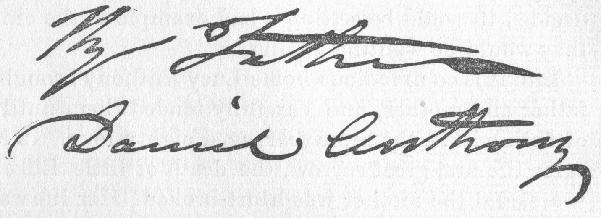
Daniel Anthony
In the winter of 1837, at the age of seventeen, Susan taught in the family of Doris and Huldah Deliverge, at Easton, a few miles from Battenville, for $1 a week and board. The next summer she taught a district school at the neighboring village, Reid's Corners, for $1.50 a week and "boarded round," and proud was she to earn what was then considered excellent wages for a woman. In the fall she joined Guelma at boarding-school. The little circular, yellow with age, reads:
DEBORAH MOULSON, having obtained an agreeable location in the pleasant village of Hamilton, in the vicinity of Philadelphia, intends, with the assistance of competent Teachers, to open immediately a Seminary for Females....
Terms, $125 per annum, for boarding and tuition....
The inculcation of the principles of Humility, Morality and a love of Virtue, will receive particular attention.
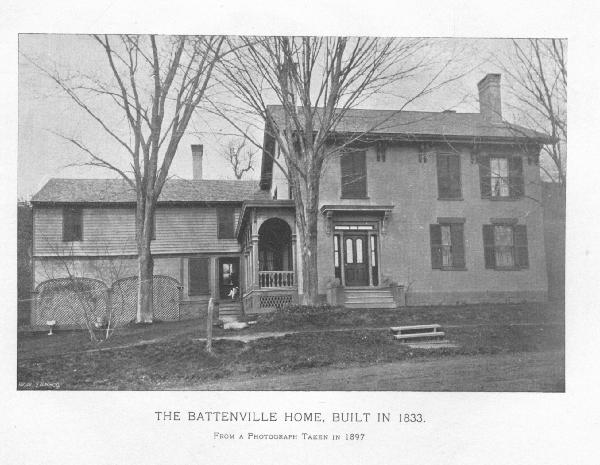
THE BATTENVILLE HOME, BUILT IN 1833. FROM A PHOTOGRAPH TAKEN IN 1897
This was Susan's first long absence from home, and her letters and journals give a good idea of the thoughts and feelings of a girl at boarding-school in those days. She developed then the "letter-writing habit," which has clung to her through life. The letters of that time were laborious affairs, often 025 consuming days in the writing, commencing even to children, "Respected Daughter," or "Son," and rarely exceeding one or two pages. They were written with a quill pen on foolscap paper, and almost wholly devoted to the weather and the sickness in the family. The amount of the latter would be appalling to modern households. The women's letters were written in infinitesimal characters, it being considered unladylike to write a large hand. The Anthonys were exceptional letter-writers. It cost eighteen cents to send a letter, but Daniel Anthony was postmaster at Battenville, and his family had free use of the mails. If he had had postage to pay on all of homesick Susan's epistles it would have cost him a good round sum. The rules of the school required these to be written on the slate, submitted to the teacher and then carefully copied by the pupil, so it is not unusual to find that a letter was five or six days in preparation. For the same reason it is impossible to tell how much sincerity there is in the frequent references to the "dear teacher" and the "most excellent school." The "stilted" style of Susan's letters is most amusing.[6] A few extracts will illustrate:
I regret that Brothers and Sisters have not the privilege of attending a school better adapted to their improvement, both in Science and Morality; surely a District School (unless they have recently reformed) is not an appropriate place for the cultivation of the latter, although in the former they may make some partial progress. Deborah has not determined to relinquish this school, although she has not yet ascertained whether the income from it will be equal to the expenditures; but if it should continue I shall have a wish for Hannah and Mary to attend; as I think another one can not be named so agreeable on all accounts as is Deborah Moulson's at Hamilton.
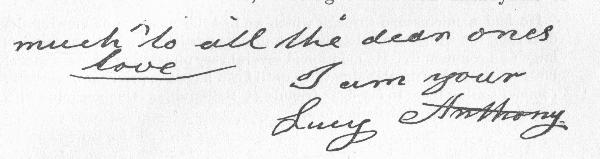
Lucy Anthony
One may imagine that Susan got several credit marks when her teacher corrected this on the slate. The lecturer on philosophy and science came up from Philadelphia, and Susan tells her parents that "he is quite an interesting man," and that "his lecture on Philosophy was far more entertaining than I had dared to anticipate." Of the science lecture she says:
He had a microscope through which we had the pleasure of viewing the dust from the wings of a butterfly, each minute particle of which appeared as large as a common fly. He mentioned several very interesting circumstances; but I must defer particularizing them until I can have the privilege of verbally communicating them to my dear friends at Battenville. Guelma joins with me in wishing love distributed to all.
Again she writes:
Beloved Parents: The second Seventh day of my short stay in Hamilton arrives and finds me scarcely capable of informing you how the intervening moments have been employed; but I hope they have not passed without some improvement. Indeed, we should all improve, perceptibly too, were we to attend to the instructions which are here given, for the advancement both of moral and literary pursuits. May I improve in both; but it is far easier for us to perceive where others should reform, than to observe and correct our own imperfections, while perhaps our failings are completely disgusting in the sight of others. I find it very difficult leaving off old habits so as to have a vacuum for the formation of those which are new and more advantageous.
My letter will be short this week and I can assign no other cause than that my ideas do not freely flow. The difference in weather is quite material between this and our northern clime. Snow commenced falling about 12 o'clock to-day and continued till evening; but, Father, it was not such a storm as the one in which we travelled during the second day of our journey to the beautiful and sequestered shades of Hamilton. The cause of my neglecting to write last week was not the absence of this mind from home, but that it is obliged to occupy every moment in studies.
A fire in Philadelphia gives her an opportunity for this bit of description:
I was requested, 5th day evening last, about 7 o'clock, by one of the scholars, to step out and view the Aurora Borealis, which she said was extremely brilliant and beautiful. When there I looked towards the north, but discovered no light, and then to the zenith, which was indeed very magnificent; "but," said I, "that does not look like the Aurora, it is more like the light from a fire," and upon investigation we found it so to be. The 027 light appeared in the east, we walked in that direction, when we beheld the flames bursting forth in stupendous grandeur. Not a bell was heard, all was calm, with the exception of the minds of some of the scholars whose parents resided in the city. The scene indeed would have been to the eye extremely pleasing, were it not for the reflection that some of our fellow-beings were about being deprived of a home, and perhaps lives also. We learned a few minutes after witnessing this phenomena that the fire was occasioned by the conflagration of a large board yard near Market Street Bridge.
After many affectionate messages, she says:
I have not had but one real homesick fit and that was one week from the night Father left us. I felt then as if I were taking leave of him again; in fact the tears have come into my eyes as I write that last sentence; but do not suppose I carry a gloomy countenance all the time, far be it from that, yet oft I think seriously of home and the endearing ties which bind us together. Father, we will look at the sentiments, and not the Orthography and Grammar of thy letters, in which I did discover some errors.
She frequently admits that her sister admonishes her, "Susan, thee writes too much; thee should learn to be concise," but she delights in letter-writing and says:
Most of the girls are taking a walk this First day afternoon, but I did not feel like enjoying myself by accompanying them as well as in holding sweet communion in writing with those inestimable friends I so dearly love, and arranging those thoughts in a manner congenial to our feelings.... The query naturally arises, at least to the thoughtful mind, How has our time since the last Annual revolution of the Earth been employed? Have our minds become improved from passing occurences, or do they remain in that dormant-like state which so often degrades the human soul?
She comes down from her lofty heights far enough to add, "It would have afforded us the greatest pleasure imaginable to have dined on that Goose in company with you on New Year's day." It is Susan's diary, however, which affords the most satisfactory glimpses of her true character, serious, devotional, deeply conscientious and strong in affection:
Five weeks have been spent in Hamilton and to what purpose? Has my mind advanced either in Virtue or Literature? I fear that every moment has not been profitably spent. O, may this careless mind be more watchful in the future! O, may the many warnings which we every day receive, tend to make me more attentive to what is right!
We were cautioned by our dear Teacher to-day to beware of self-esteem and of all signs that would indicate an untruth. We were referred to the condition of Ananias and Sapphira, who intended to deceive the Apostle. Would that I were wholly free from that same Evil Spirit which tempted those persons in ancient times. The Spirit of Truth must have dominion in the mind in order to attain a state of happiness.
Resolves and resolves fill up my time. I resolve at night to do better on the morrow, and when the morrow comes and I mingle with my companions all the resolutions are obliterated.... In the afternoon of Seventh day Deborah accompanied the scholars to Town and visited the Academy of Arts and Sciences; beautiful indeed was the sight. Nature, how bounteous and varied are thy works! On beholding the splendid scene I was ready to exclaim, "O, Miracle of Miracles," with the celebrated Naturalist when speaking of the metamorphoses of insects.
Her eyes troubled her then, as all through life, and in grieving over it she says: "Often does their non-conformance mortify this frail heart when attempting to read in class.... I arose at half-past five this morning. [January 15.] I find it so much more advantageous." But the next day she sleeps till half-past six and laments the fact.
Received a severe reproof from Deborah this evening on account of the listlessness which prevailed in the school, also the immorality of some of the pupils' minds. O, that I could feel perfectly clear of all the deviations which have been enumerated. O, Morality, that I could say I possessed thy charms! O, the happiness of an innocent mind, would that I could say mine was so, but it is too far from it. I think so much of my resolutions to do better that even my dreams are filled with these desires.
The sin thus bitterly bewailed consisted in neglecting to use "thee" and "thou" in addressing her schoolmates. She would wake up in the night and mourn over it. One would judge from Deborah's continual lectures that the school was made up of a lot of desperately wicked girls sent her to be reformed, instead of a band of demure and saintly little Quaker maidens. On the 31st Susan writes:
Our class has not recited in Philosophy, Chemistry or Physiology, nor have we read, since the 20th of this month, for the reason of there being such a departure among the scholars from the paths of rectitude.
Later she records that a new teacher has arrived "to relieve Deborah of some of her bodily labors," that "he is a stern-looking man," and that she was "somewhat mortified that she could not give him the desired definition of compendiums."
The woman who sells molasses candy has been here, but when she leaves she does not carry the confusion with her which she causes.... Deborah requested eight of us larger girls to remain last evening, for the purpose of reproving us. The cause was the levity and mirthfulness which were displayed on Third day of the week previous. She compared us to Judas Iscariot, who betrayed his master with a kiss. She said there were those amongst us who would surely have to suffer deep affliction for not attending to the manifestations of truth within.—I have been guilty of much levity and nonsensical conversation and have also permitted thoughts to occupy my mind which should have been far distant, but I do not consider myself as having committed any wilful offence. Perhaps the reason I can not see my own defects is because my heart is hardened. O, may it become more and more refined until nothing shall remain but perfect purity.
2nd mo. 11th day.—First day evening Deborah came down and sat with us. In a few moments she called for her Bible, and in a short time she read, "Jesus wept;" and then, after a long pause, she said, "There are those present who, if they do not attend to what has been said to them, will have their strings shortened, even as short as this verse." This she said after having inquired on what subject Abraham Loire preached in the morning and none of us was able to tell.
2nd mo. 12th day.—Deborah came down in the afternoon to examine our writing. She looked at M.'s and gave her a severe reproof; she then looked at C.'s and said nothing. I, thinking I had improved very much, offered mine for her to examine. She took it and pointed out some of the best words as those which were not well written, and then she asked me the rule for dotting an i, and I acknowledged that I did not know. She then said it was no wonder she had undergone so much distress in mind and body, and that her time had been devoted to us in vain. This was like an Electrical shock to me. I rushed upstairs to my room where, without restraint, I could give vent to my tears. She said the same as that I had been the cause of the great obstruction in the school. If I am such a vile sinner, I would that I might feel it myself. Indeed I do consider myself such a bad creature that I can not see any who seems worse.—And we had a new scholar to witness this scene!
Think of causing all this anguish and humiliation to a young girl because she did not know the rule for dotting an i!
2nd mo. 15th day.—This day I call myself eighteen. It seems impossible that I can be so old, and even at this age I find myself possessed of no more 030 knowledge than I ought to have had at twelve. Dr. Allen, a Phrenologist, gave us a short lecture this morning and examined a few heads, mine among them. He described only the good organs and said nothing of the bad. I should like to know the whole truth.
Susan relates with a good deal of satisfaction that she has written a letter to a schoolmate at home, without putting it on the slate for the teacher to see. A few days later Deborah sends for her. She "went down with cheerfulness," but what was her astonishment to see Deborah with the intercepted letter open in her hand! Susan closes her account of the interview by saying, "Little did I think, when I was writing that letter, that I was committing such an enormous crime."
Learning that a young friend had married a widower with six children, she comments in her diary, "I should think any female would rather live and die an old maid." She has a cold and cough for which Deborah gives her a "Carthartick," followed by some "Laudanum in a silver spoon." "The beautiful spring weather," she says, "inhales me with fresh vigor." She sees some spiderwebs in the schoolroom and, her domestic habits asserting themselves, gets a broom and mounts the desks to sweep them down, "little thinking of the mortification and tears it was to occasion." Finally she steps upon Deborah's desk and breaks the hinges on the lid. That personage is informed by an assistant teacher and arrives on the scene:
"Deborah, I have broken your desk." She appeared not to notice me, walked over, examined the desk and asked the teacher who broke it. "What! Susan Anthony step on my desk! I would not have set a child upon it," she said, and much more which I can not write. "How came you to step on it?" she asked, but I was too full to speak and rushed from the room in tears. That evening, after we read in the Testament, she said that where there was no desire for moral improvement there would be no improvement in reading. There was one by the side of her who had not desired moral improvement and had made no advancement in Literature.
This deliberate cruelty to one whose heart was bursting with sorrow and regret! "Never will this day be forgotten," says the diary. In speaking of this incident Miss Anthony said: "Not once, in all the sixty years that have passed, has the 031 thought of that day come to my mind without making me turn cold and sick at heart."
On one occasion when a composition had been severely criticised, Susan blazed forth the inquiry why she always was censured and her sister praised. "Because," was the reply, "thy sister Guelma does the best she is capable of, but thou dost not. Thou hast greater abilities and I demand of thee the best of thy capacity." Throughout this little record are continual expressions of the pain of separation from the dear home, of keen disappointment if the expected letter fails to come, and most affectionate references to the beloved parents, brothers and sisters. Even the austere Deborah is mentioned always with respect and kindness for, notwithstanding her frequent censure, she inspired the girls with love and reverence.
Subsequent events show that this lady was failing rapidly with consumption. Among the old letters, one from an assistant teacher to Daniel Anthony, dated 1839, a year after Susan left school, says: "The tender chord that so long confined our beloved Deborah to this world was broken on the 25th day of the 4th month, and we trust her happy spirit took its flight to realms of eternal felicity." Deborah Moulson was a cultured and estimable woman, but she represented the spirit of that age toward childhood, one of chilling severity and constant repression, when reproof was as liberally administered as praise was conscientiously withheld.
[4] Sixty-five years later, this cousin, Nancy Howe Clark, aged eighty-seven, wrote Miss Anthony:
"The year I spent at your father's was the happiest of my whole long life. How well I remember the sweet voices saying 'Cousin Nancy,' and the affectionate way in which I was received by your dear father and mother. It had never been my fortune before to live in a household with an educated man at its head, and I felt a little shy of your father but soon found there was no occasion. Although it was a period of great financial depression, he always found time to be social and kindly in his family. He seemed to have an eye for everything, his business, the school and every good work. I considered your father and mother a model husband and wife and found it hard to leave such a loving home."
The prosperous days of the Anthonys were drawing to a close. All manufacturing industries of the country were in a ruinous state. The unsound condition of the banks with their depreciated and fluctuating currency had created financial chaos. Overproduction of cotton goods on a credit basis, inordinate speculation, reduction of duties on importations, produced the inevitable result, and the commercial world began to totter on its foundations. The final ruin is foreshadowed in the letters of Daniel Anthony. In one to his brother September 2, 1837, he says:
I am going next week on a tour of the eastern cities and when I return shall be prepared to face the situation. My goods at present will not sell for the actual cost of manufacturing. Van Buren's message has just made its appearance. It is opposed to banks and may operate unfavorably to business, but how it can be worse I don't know.
He writes from Washington to his wife, September 11:
I arrived last evening—came in R. Road cars from Baltimore, 39 miles, in two hours, over a barren and almost uncultivated tract of country. The public buildings and one street called Pennsylvania Avenue are all that are worth mention in this place.... As a specimen of some of the big finery in the town, I will name one room in Martin's [Van Buren's] house, 90 ft. by 42, the furniture of which cost $22,000.... Our Congressmen are some like other folks, they look out first for themselves. They have spent most of this day in debating whether they shall be paid in specie.... There are Black Folks in abundance here, but they don't act as if they were even under the pressure of hard times, much less the cruelties that we hear of slaves having to bear.
From New York he writes his brother:
Such times in everything that pertains to business never were known in this land before. To-day I have passed through Pine street and have not seen one single box or bale of goods of any kind whatever. Last year at this time a person could scarcely go through the street without clambering over goods of all descriptions. A truck cart loaded with merchandise is now a rare object. A bale of goods can not be sold at any price. The countenances of all our best business men are stretched out in a perpendicular direction and when the times will let them come back into human shape not even the wisest pretend to guess. Those that are out of all speculative and ever-changing business may consider themselves in a Paradismal state.
In the spring of 1838 he writes to Guelma and Susan, at that time twenty and eighteen years of age, to know if they feel that they possibly can go alone from Philadelphia to New York, where he will join them and bring them home; but evidently they decide they can not, for Susan's journal speaks of "the happy moment when they run to the gate to meet him." On the journey he tells them that his business is ruined, they can not return to school and will have to give up their beautiful and beloved new home. In recalling those times Miss Anthony says that never in all her long life did she see such agony as her father passed through during the dreadful days which followed. All that he had accumulated in a lifetime of hard work and careful planning was swept away, and there was scarcely a spot of solid ground upon which he could plant his feet to begin the struggle once more.
In her diary, speaking of an aunt who sympathizes with them and says it will be hard to give up going with the people they have been accustomed to, Susan observes, "I do not think that losing our property will cause us ever to mingle with low company." She is now somewhat uncertain about taking up teaching permanently, fearing she will "lose the habit of using the plain language;" but May 22, 1838, she writes at Union Village, now Greenwich:
On last evening, which was First day, I again left my home to mingle with strangers, which seems to be my sad lot. Separation was rendered more trying on account of the embarrassing condition of our business affairs. I found my school small and quite disorderly. O, may my patience hold out to persevere without intermission.
In the summer of 1838 the factory, store, home and much of the furniture had to be given up to the creditors. Not an article was spared from the inventory. All the mother's wedding presents, the furniture and the silver spoons given her by her parents, the wearing apparel of the family, even the flour, tea, coffee and sugar, the children's school books, the Bible and the dictionary, were carefully noted. On this list, still in existence, are "underclothes of wife and daughters," "spectacles of Mr. and Mrs. Anthony," "pocket-knives of boys," "scraps of old iron"—and the law took all except the bare necessities. In this hour of extremity the guardian angel appeared in the person of Joshua Read, a brother of Mrs. Anthony, from Palatine Bridge, N.Y., who bid in all which the family desired to keep and restored to them their possessions, making himself their lenient creditor.
The winter of 1839 Susan attended the home school, taught by Daniel Wright, a fine scholar and remarkably successful teacher. This ended her school days, and in her journal she says: "I probably shall never go to school again, and all the advancement which I hereafter make must be by my own exertions."
In March, 1839, the family moved to Hardscrabble, a small village two miles further down the Battenkill. They went on a cold, blustering day, and one may imagine the feelings of Daniel and Lucy Anthony and their older children as they turned away from their big factory, their handsome home and the friends they had learned to love. Mrs. Anthony's heart was overflowing with sorrow, for in less than five years she had lost by death her little daughter, her father and mother, and now was swept away her home hallowed by their beloved memories.
In his prosperous days Daniel Anthony had built a satinet factory and a grist-mill at Hardscrabble and, although these were mortgaged heavily, he hoped to weather the financial storm and through them to build up again his fallen fortunes. The family were soon comfortably established in a large house which had been a hotel or tavern in the days when lumber 036 was cut in the Green mountains and floated down the river, an immense building, sixty feet square, with wide hall and broad piazza. They did not keep a hotel, but people were in the habit of stopping here, as it was a half-way house to Troy, and they found themselves obliged to entertain a number of travelers.
Those were busy days for the family. Susan's journal contains many entries such as, "Did a large washing to-day.... Spent to-day at the spinning-wheel.... Baked 21 loaves of bread.... Wove three yards of carpet yesterday.... Got my quilt out of the frame last 5th day.... The new saw-mill has just been raised; we had 20 men to supper on 6th day, and 12 on 7th day." But there were quilting-bees and apple-parings and sleighing parties and many good times, for the elastic temperament of youth rallies quickly from grief and misfortune. Susan went to Presbyterian church one Sunday, and the gray-robed Quaker thus writes:
To see them partake of the Lord's supper, as they call it, was indeed a solemn sight, but the dress of the communicants bespeaks nothing but vanity of heart—curls, bows and artificials displayed in profusion about most of them. They say they can dress in the fashion without fixing their hearts on their costume, but surely if their hearts were not vain and worldly, their dress would not be.
The attic in this old house was finished off for a ball-room; it was said that great numbers of junk bottles had been laid under the floor to give especially nice tone to the fiddles. The young people of the village came to Daniel Anthony for permission to hold their dancing-school here but, with true Quaker spirit, he refused. Finally the committee came again and said: "You have taught us that we must not drink or go about places where liquor is sold. The only other dancing-hall in town is in a disreputable tavern, and if we can not come here we shall be obliged to go there." So Mr. Anthony called a council of his wife and elder daughters. The mother, remembering her own youth and also having a tender solicitude for the moral welfare of the young people, advised that they should have the hall. Mr. Anthony at last agreed on 037 condition that his own daughters should not dance. So they came, and Susan, Guelma and Hannah sat against the wall and watched, longing to join them but never doing it. They danced every two weeks all winter; Mrs. Anthony gave them some simple refreshments, they went home early, there was no drinking and all was orderly and pleasant.
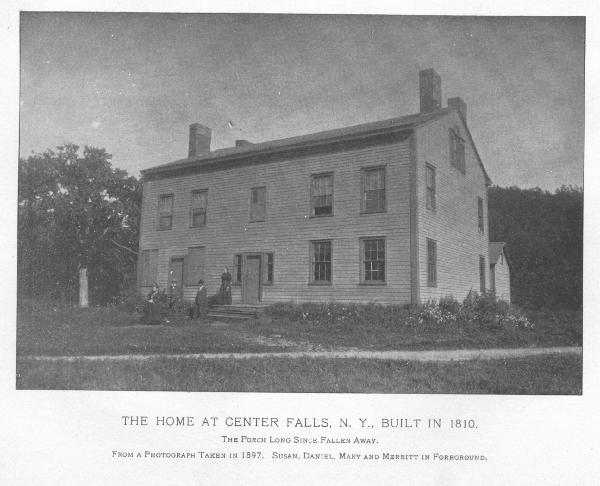
THE HOME AT CENTER FALLS, N. Y., BUILT IN 1810. THE PORCH LONG SINCE FALLEN AWAY. FROM A PHOTOGRAPH TAKEN IN 1897. SUSAN, DANIEL, MARY, AND MERRITT IN FOREGROUND.
The Quakers at once had Daniel Anthony up before the committee, there was a long discussion, and finally they read him out of meeting "because he kept a place of amusement in his house." Reuben Baker, one of the old Quakers, said: "It is with great sorrow we have to disown friend Anthony, for he has been one of the most exemplary members in the Society, but we can not condone such an offense as allowing a dancing-school in his house."
Mr. Anthony felt this very keenly. He said: "For one of the best acts of my life I have been turned out of the best religious society in the world;" but he had kept his wife, his cloak and his ideas of right, and was justified by his conscience. He continued to attend Quaker meeting but grew more liberal with every passing year and, long before his death, had lost every vestige of bigotry and believed in complete personal, mental and spiritual freedom. In early life he had steadfastly refused to pay the United States taxes because he would not give tribute to a government which believed in war. When the collector came he would lay down his purse, saying, "I shall not voluntarily pay these taxes; if thee wants to rifle my pocket-book, thee can do so." But he lived to do all in his power to support the Union in its struggle for the abolition of slavery and, although too old to go to the front himself, his two sons enlisted at the very beginning of the war.
Mr. Anthony had the name Hardscrabble changed to Center Falls, and was made postmaster. Susan and Hannah secured schools, and Daniel R., then not sixteen, went into the mill with his father. Susan had several schools offered her and finally accepted one at New Rochelle. She went down the Hudson by the steamboat American Eagle, her father going with her as far as Troy. She speaks in her journal of several 038 Louisiana slaveholders being on board, the discussion which took place in the evening and her horror at hearing them uphold the institution of slavery. The pages of this little book show that this question and those of religion and temperance were the principal subjects of conversation in these days. One entry reads: "Spent the evening at Mr. Burdick's and had a good visit with them, our chief topic being the future state." Then she comments: "Be the future what it may, our happiness in the present is far more complete if we live an upright life." From the time she was seventeen is constantly expressed a detestation of slavery and intemperance. Her life from the beginning seems to have had a serious purpose. When asked, during the writing of this biography, why her journals were not full of "beaux," as most girls' were, she replied: "There were plenty of them, but I never could bring myself to put anything about them on paper." There are many references to their calling, escorting her to parties, etc., but scarcely any expression of her sentiments toward them. One, of whom she says: "He is a most noble-hearted fellow; I have respected him highly since our first acquaintance," goes to see a rival, and she writes: "He is at ——'s this evening. O, may he know that in me he has found a spirit congenial with his own, and not suffer the glare of beauty to attract both eye and heart."
Again she says: "Last night I dreamed of being married, queerly enough, too, for it seemed as if I had married a Presbyterian priest, whom I never before had seen. I thought I repented thoroughly before the day had passed and my mind was much troubled." This modest Quaker maiden writes of receiving a newspaper from a young man: "Its contents were none of the most polite; a piece of poetry on Love and one called 'Ridin' on a Rail,' and numerous little stories and things equally as bad. What he means I can not tell, but silence will be the best rebuke." Another who comes a-wooing she describes as "a real soft-headed old bachelor," and remarks: "These old bachelors are perfect nuisances to society." A friend marries a man of rather feeble intellect, and she 039 comments: "Tis strange, 'tis passing strange, that a girl possessed of common sense should be willing to marry a lunatic—but so it is."
Miss Anthony went to New Rochelle as assistant in Eunice Kenyon's boarding-school, but the principal being ill most of the time, she has to take entire charge, and the responsibility seems to weigh heavily on the nineteen-year-old girl. She speaks also of watching night after night, with only such rest as she gets lying on the floor. She gives some idea of the medical treatment of those days: "The Doctor came and gave her a dose of calomel and bled her freely, telling me not to faint as I held the bowl. Her arm commenced bleeding in the night and she lost so much blood she fainted. Next day the Doctor came, applied a blister and gave her another dose of calomel."
She meets some colored girls from the school at Oneida and writes home: "A strict Presbyterian school it is, but they eat, walk and associate with the white people. O, what a happy state of things is this, to see these poor, degraded sons of Afric privileged to walk by our side." On Sunday she hears Stephen Archer, the great Quaker preacher, who was at the head of a large Friends' boarding-school at Tarrytown, and says:
He is a much younger man than I expected to see, and wears a sweet smile on his face.... The people about here are anti-Abolitionist and anti-everything else that's good. The Friends raised quite a fuss about a colored man sitting in the meeting-house, and some left on account of it. The man was rich, well-dressed and very polite, but still the pretended meek followers of Christ could not worship their God and have this sable companion with them. What a lack of Christianity is this! There are three colored girls here who have been in the habit of attending Friends' meeting where they have lived, but here they are not allowed to sit even on the back seat. One long-faced elder dusted off a seat in the gallery and told them to sit there. Their father was freed by his master and left $60,000, and these girls are educated and refined.
Aaron McLean, who is soon to marry her sister Guelma, writes in answer to this: "I am glad to hear that the people where your lot is cast for the present are sensible and reasonable on that exciting subject. I entreat you to be prudent in 040 your remarks and not attempt to 'niggerize' the good old Friends about you. Above all, let them know that you are about the only Abolitionist in this vicinity." This severe letter does not seem to have affected her very deeply for, on the next day after receiving it, she writes her parents: "Since school to-day I have had the unspeakable satisfaction of visiting four colored people and drinking tea with them. Their name is Turpin, and Theodore Wright of New York is their stepfather. To show this kind of people respect in this heathen land affords me a double pleasure." Mr. McLean evidently did not believe in woman preachers, for the radical Susan writes him:
I attended Rose street meeting in New York and heard the strongest sermon on "The Vices of the City," that has been preached in that house very lately. It was from Rachel Barker, of Dutchess county. I guess if you could hear her you would believe in a woman's preaching. What an absurd notion that women have not intellectual and moral faculties sufficient for anything but domestic concerns!
She does not hesitate to write to an uncle, Albert Dickinson, and reprove him for drinking ale and wine at Yearly Meeting time. It seems that then, as now, girls had a habit of writing on the first page of a sheet, next on the third, then vertically on a page, etc. Uncle Albert retorts:
Thy aunt Ann Eliza says to tell thee we are temperate drinkers and hope to remain so. We should think from the shape of thy letter that thou thyself hadst had a good horn from the contents of the cider barrel, a part being written one side up and a part the other way, and it would need some one in nearly the same predicament to keep track of it. We hope thy cranium will get straightened when the answer to this is penned, so that we may follow thy varied thoughts with less trouble. A little advice perhaps would be good on both sides, and they that give should be willing to receive. See to it that thou payest me down for this.
This letter also gives an insight into the medical practice of the good old times. A niece, Cynthia, is being treated for the dropsy by "drinking copiously of a decoction made by charring wormwood in a close vessel and putting the ashes into brandy, and every night being subjected to a heavy sweat." It recommends plenty of blue pills and boneset for 041 the ague. Later, Susan writes of a friend who is "under the care of both Botanical and Apothecary doctors." For hardening of wax in the ear she sends an infallible prescription: "Moisten salt with vinegar and drop it in the ear every night for six weeks; said to be a certain cure."
The staid and puritanical young woman is much disturbed at the enthusiastic reception given President Van Buren at New Rochelle, and writes home:
We had quite a noise last Fifth day on the occasion of Martin's passing through this village. A band of splendid music was sent for from the city, and large crowds of people called to look at him as if he were a puppet show. Really one would have thought an angelic being had descended from heaven, to have heard and seen the commotion. The whole village was in an uproar. Here was a mother after her children to go and gaze upon the great man, and there was a teacher rushing with one child by the hand and half a dozen running after. Where was I? Why I, by mustering a little self-government, concluded to remain at home and suffer the President to pass along in peace. He was to dine at Washington Irving's, at Tarrytown, and then proceed to the Capitol.
Her extreme animosity is explained in a subsequent letter to Aaron McLean:
I regret to hear that the people of Battenville are possessed of so little sound sense as to go 20 miles to shake hands with the President at Saratoga Springs; merely to look at a human being who is possessed of nothing more than ordinary men and therefore should not be worshipped more than any mortal being, nor even so much as many in the humble walks of life who are devoted to their God. Let us look at his behavior and scan its effects on society. One day while in New York was spent in riding through the streets preceded by an extravagant number of military men and musicians, who were kept in exercise on that and succeeding days of the week until all were completely exhausted. On the next day, while he and his party were revelling in their tents on luxuries and the all-debasing Wine, many poor, dear children were crying for food and for water to allay their thirst. On Friday evening he attended Park Theater and on Monday Bowery Theater. Yes, he who is called by the majority as most capable of ruling this republic, may be seen in the Theater encouraging one of the most heinous crimes or practices with which our country is disgraced.[7] Yes, and afterwards we find him rioting at the Wine Table, the whole livelong night. Is it to be wondered that there are such vast numbers of our population who are the votaries of Vice and Dissipation? No, certainly not, and I do not believe there ever will be less of this wickedness while a man practising these abominable vices (in what is called a gentlemanly manner) is suffered to sit at the head of our Government.
The future orator and reformer is plainly foreshadowed in this burst of indignation, to which Mr. McLean replies in part:
I was agreeably disappointed in Van Buren's personal appearance. From what I had heard of him as a little, smooth, intriguing arch-magician, I expected his looks would bear that out but it was far to the contrary. He is quite old and gray, very grave and careworn. His dress was perfectly plain, not the least sign of jewelry save his watch seal which was solid gold. I saw him drink no wine, although there was plenty about him, nor did your father and mother who saw him dine at the United States Hotel. If you do not like him because he tastes wine, how can you like Henry Clay who drinks it freely? Mr. Webster drinks wine also. At a Whig festival got up in Boston in his honor, at which he and 1,200 other Whigs were present, there were drunk 2,300 bottles of champagne, two bottles to each man. Mr. Clay attended balls at the Springs. He had a slave with him to wait on him and hand him water to clear out his throat while he was speaking; and this while he was preaching liberty and declaring what a fine thing this freedom is!
While at New Rochelle Susan becomes greatly interested in the culture of silk-worms, upon which the principal was experimenting. She writes home full descriptions and urges them to ascertain if black mulberry trees grow about there; she herself knew of one. She insists that the sisters can teach school and take care of the silk-worms at the same time, but evidently receives no encouragement as no more is heard of the project. She retains the keenest interest in every detail of the life at home. She sends some cherry stones to be planted because the cherries were the largest and best she ever ate. A box of shells is carefully gathered for brother Merritt, and sent with a grass linen handkerchief for sister Mary. She sends back her mother's shawl for fear she may need it more than herself. In the currant season she writes that nothing in the world would taste so good as one of mother's currant pies. She urges them to send her part of the family sewing to do outside of school hours. She frequently walks down to Long Island sound, a mile and a half away, and says at one time:
The sun was passing toward the western horizon, and all seemed calm and tranquil save the restless wash of the waves against the beach. A gentle breeze from the water refreshed our tired bodies. To one unaccustomed to such scenes it was like a glimpse into another world. In the distance one could see the villages of Long Island, but I could think only of that village called home, and I longed every moment to be there.
Her school commenced May 23 and closed September 6, a term of fifteen weeks, for which she received $30, and she expresses her grief that, after having paid for necessary clothes and incidentals, she has only enough left to take her home. She reaches Center Falls in time to assist in the final preparations for the wedding, on September 19, 1839, of her sister Guelma to Aaron McLean, a prosperous merchant at Battenville.
Susan's next school was in her home district at Center Falls, where she was very successful. One incident is on record in regard to the "bully" of the school. After having tried every persuasive method at her command to compel obedience, she proceeded to use the rod. He fought viciously, but she finally flogged him into complete submission and never had any further trouble with him or the other boys. She was, however, very tender-hearted toward children and animals.
Among the outings enjoyed by the young people were excursions to neighboring villages. There were no railroads, but every young man owned his horse and buggy, and in pleasant weather a procession of twenty vehicles often might be seen, each containing a happy couple on their way to a supper and dance. On one occasion, according to the little diary, the night was so dark they did not dare risk the ten-mile drive home, as much of the road lay beside the river, so they continued the festivities till daylight. Once a party went to Saratoga Springs, and, to Miss Anthony's grief, her favorite young man invited another girl, and she had a long, dreary drive trying to be agreeable to one while her thought was with another. To add to the unpleasantness her escort took this opportunity to ask her to give up teaching and preside over a home for him.
One winter was spent with relatives at Danby, Vt., and here, with the assistance of a cousin, Moses Vail, who was a teacher, she made a thorough study of algebra. Later, when visiting her irrepressible brother-in-law, Aaron McLean, she made some especially nice cream biscuits for supper, and he said, "I'd rather see a woman make such biscuits as these than 044 solve the knottiest problem in algebra." "There is no reason why she should not be able to do both," was the reply. There are many references in the old letters to "Susan's tip-top dinners."
She taught one summer in Cambridge, and then, for two years, in the home of Lansing G. Taylor, at Fort Edward. Mrs. Taylor was the daughter of Judge Halsey Wing. The journals of that date either were abandoned or have been lost in the half century since then, and there is but one letter in existence written during this very pleasant period. In it, July 11, 1844, she says:
As the week draws toward its close my mind travels to the dear home roof. It seems to fly far hence to that loved father and mingle with his spirit while he is wandering in the wilds of Virginia, and it raises to the throne of grace an ardent wish for his safe return. Oh, that he may make no change of land except for the better! Then do my thoughts rest with my dear mother, toiling unremittingly through the long day and at eve, seated in her arm-chair, wrapt in solemn stillness, and later reclining on her lonely pillow. How often, when I am enjoying the sweet hour of twilight, do I think of the sadness that has so long o'ershadowed her brow, and ardently entreat the God of love and mercy to give her that peace which is found only in a resignation to his just and holy will. How numerous are our favors! We have a comfortable subsistence and health to relish it; but, more than this, we, as a family, are bound together by the strongest ties of affection that seem daily to grow stronger....
I arose this morning at half-past four. Two ladies from Albany are visiting here, the beautiful Abigail Mott, a Friend and a thorough-going Abolitionist and reformer, and Mrs. Worthington, a strict Methodist. Mr. Taylor took eight of us to the Whig convention at Sandy Hill yesterday, and I attended my first political meeting. I enjoyed every moment of it.
She also relates how Miss Mott would come to her room and expound to her most beautifully the doctrine of Unitarianism, and then Mrs. Worthington would come and pray with her long and earnestly to counteract the pernicious effect of Miss Mott's heresies. While she was accustomed to the liberal theology of the Hicksite Quakers, this was the first time she ever had heard the more scholarly interpretation of the Unitarian church.
From 1840 to 1845 Susan and Hannah taught almost continuously, receiving only $2 or $2.50 a week and board, but 045 living with most rigid economy and giving the father all they could spare to help pay interest on the mortgage which rested on factory, mills and home. He gave his notes for every dollar and, years afterwards, when prosperity came, paid all of them with scrupulous exactness. It was in these early days of teaching that Miss Anthony saw with indignation the injustice practiced towards women. Repeatedly she would take a school which a male teacher had been obliged to give up because of inefficiency and, although she made a thorough success, would receive only one-fourth of his salary. It was the custom everywhere to pay men four times the wages of women for exactly the same amount of work, often not so well done.
Mr. Anthony went into his mills and performed the manual labor. In partnership with Dr. Hiram Corliss he employed a number of men to cut timber, going into the woods in the depths of winter personally to superintend them. His wife would cook great quantities of provisions, bake bread and cake, pork and beans, boil hams and roast chickens, and go to the logging camp with him for a week at a time, and she used to say that notwithstanding all the labor and anxiety of those days they were among the happiest recollections of her life.
At home the loom and spinning-wheel were never idle. The mill-hands were boarded, transient travelers cared for, and every possible effort made to enable the father to secure another foothold, but all in vain. The manufacturing business was dead, there was no building to call for lumber, people had no money, and, after a desperate struggle of five years, the end came and all was lost. Mr. Anthony then spent months in looking for a suitable location to begin life anew. He went to Virginia and to Michigan, but found nothing that suited him. He and his wife made a trip through New York, visiting a number of relatives on the way, and were persuaded to examine a farm for sale near Rochester. It proved to be more satisfactory than anything they had seen, and they decided to take it. Joshua Read who, during all these years, had carefully protected the portion which his sister, Mrs. Anthony, 046 had inherited from their father, took this to make the first payment on the farm.[8] They then returned to Center Falls and began preparations for what in those times was a long journey.
One warm day in the summer of 1845, several Quaker elders had stopped to dine at the Anthony home on their way to Quarterly Meeting. Hannah and Susan were in the large, cool parlor working on the wonderful quilt which was to be a part of Hannah's wedding outfit, when one of the elders, a wealthy widower from Vermont, asked Susan to get him a drink. He followed her out to the well and there made her an offer of marriage, which she promptly refused. He pictured his many acres, his fine home, his sixty cows, told her how much she looked like his first wife, begged her to take time to consider and he would stop on his way back to get her answer. She assured him that it would be entirely unnecessary, as she was going with her father and mother to their new home and did not want to marry. He could scarcely understand a woman who did not desire matrimony, but was finally persuaded to gather up his slighted affections and go on to Quarterly Meeting.
On September 4, Hannah was married to Eugene Mosher, a merchant at Easton. Daniel R. was now clerking at Lenox, Mass., so there were only Susan, Mary and Merritt to go with the father and mother. All the relatives bade them good-by as if forever, and the leave-taking was very sorrowful, for it was the first permanent separation of the family.
On November 7, 1845, the parents and three children took the stage for Troy, and from there went by railroad to Palatine Bridge for a short visit to Joshua Read. The journey from here to Rochester was made by canal on a "line boat" instead of a "packet," because it was cheaper and because they wanted to be with their household goods. At Utica they found two cousins, Nancy and Melintha Howe, waiting for the packet to go west, but when they saw their relatives they gladly boarded the line boat. Mrs. Anthony did the cooking for the entire party, in the spotless little kitchen on the boat, and the young people, at least, had a merry journey.
The family arrived in Rochester late in the afternoon of November 14. They landed at Fitzhugh street and went to the National Hotel. The father had just ten dollars, and it was out of the question to remain there over night; so he took the old gray horse and the wagon off the boat, with a few necessary articles, and with his family started for the farm, three miles west of the city. The day was cold and cheerless, the roads were very muddy, and by the time they reached their destination it was quite dark. An old man and his daughter had been left in charge and had nothing in the way of food but cornmeal and milk. Mrs. Anthony made a kettle of mush which her husband pronounced "good enough for the queen." The only bed was occupied by Mr. and Mrs. Anthony, and the rest slept on the floor. Next day the household goods were brought from the city and all were soon busy putting the new home in order. That was a long and lonesome winter. The 048 closest neighbors were the DeGarmos, and there were a number of other Quaker families in the city. These called at once and performed every friendly office in their power, but the hearts of the exiles were very sad and home-sick. The cause of human freedom was then uppermost in many minds, and the Anthonys found here congenial spirits in their strong anti-slavery convictions, and numerous little "abolition" meetings were held during that winter at their home and in those of their new friends.
When spring opened, the surroundings began to assume a more cheerful aspect. The farm was a very pretty one of thirty-two acres. The house stood on an elevation, the long walk that led up to it was lined on both sides with pinks, there were many roses and other flowers in the yard, and great numbers of peach, cherry and quince trees and currant and goose-berry bushes. The scenery was peaceful and pleasant, but they missed the rugged hills and dashing, picturesque streams of their eastern home. Back of the house were the barn, carriage-house and a small blacksmith shop. Mrs. Anthony used to say that her happiest hours were spent on Sunday mornings, when her husband would heat the little forge and mend the kitchen and farm utensils, while she sat knitting and talking with him, Quakers making no difference between Sunday and other days of the week. He had learned this kind of work in boyhood on his father's farm and always enjoyed the relaxation it afforded from the cares and worries which crowded upon him in later years.
Mr. Anthony put into his farm the energy and determination characteristic of the man. He rose early; he ploughed and sowed and reaped; he planted peach and apple orchards, and improved the property in many ways, but it was unprofitable work. It seemed very small to him after the broad acres of his early home, and he was accustomed to refer to it as his "sixpenny farm." His life had been too large and too much among men of the great business world to make it possible for him to be content with the existence of a farmer. While he retained his farm home, he very soon went into business in 049 Rochester, connecting himself with the New York Life Insurance Company, then just coming into prominence, and used to say he made money enough out of that to afford the luxury of keeping the farm. He was very successful, and continued with this company the remainder of his life.
On April 25, 1846, Miss Anthony received this invitation:
At a meeting of the Trustees of the Canajoharie Academy held this day, it was unanimously Resolved to offer you the Female Department upon the terms which have heretofore been offered to the teachers of that department, viz:—the tuition money of the female department less 12-1/2 per cent., the teachers collecting their tuition bills. Should these terms meet your views, please favor us with an answer by return mail. The next term commences on the first Monday of May proximo.
We are Very Respectfully Yours,
JOSHUA READ, LIVINGSTON SPEAKER, GEORGE G. JOHNSON.
Miss Anthony accepted in a carefully worded and finely written letter, and arrived at the home of her uncle Joshua Saturday morning, May 2. He had lived many years at Palatine Bridge, just across the river, was school trustee, bank director, one of the owners of the turnpike, the toll bridge and the stage line, and also kept a hotel. His two daughters were well married, and Miss Anthony boarded with them during all of her three years' teaching in Canajoharie. She found her uncle very ill and being treated by the doctor "with calomel, opium and morphine." In a conversation he told her that "her success would depend largely upon thinking that she knew it all." Although there was now no postmaster in the family, letter postage had been reduced to five cents, and a voluminous correspondence is in existence covering the period from 1846 to 1849. The school commenced with forty boys and twenty-five girls, and the tuition was $5 per annum. The principal was Daniel B. Hagar, a man whom Miss Anthony always loved to remember, highly educated, a gentleman in deportment, kind, thoughtful, and always ready to help and encourage the young teacher.[9] 050
Here Miss Anthony was for the first time entirely away from Quaker surroundings and influences, and her letters soon show the effects of environment. The "first month, second day," expressions are dropped and the "plain language" is wholly abandoned. She has more money now than ever before and is at liberty to use it for her own pleasure. A love of handsome clothes begins to develop. "I have a new pearl straw gypsy hat," she writes, "trimmed in white ribbon with fringe on one edge and a pink satin stripe on the other, with a few white roses and green leaves for inside trimming." The beaux hover around; a certain "Dominie," a widower with several children, is very attentive; another widower, a lawyer, visits the school so often as to set all the gossips in a flutter; a third is described as "very handsome, sleek as a ribbon and the most splendid black hair I ever looked at." She takes many drives with still another, "through a delightful country variegated with hill and valley, past fields of newly-mown grass, splendid forests and gently winding rivulets, with here and there a large patch of yellow pond lilies." In writing to a relative she urges her to break herself of "the miserable habit of borrowing trouble, which saps all the sweets of life." At another time she writes: "I have made up my mind that we can expect only a certain amount of comfort wherever we may be, and that it is the disposition of a person, more than the surroundings, that creates happiness."
Her first quarterly examination, to be held in the presence of principal, trustees and parents, is a cause of great anxiety. She writes that her nerves were on fire and the blood was ready to burst from her face, and she slept none the night previous. She wore a new muslin gown, plaid in purple, white, blue and brown, two puffs around the skirt and on the sleeves at shoulders and wrists, white linen undersleeves and collarette; new blue prunella gaiters with patent-leather heels and tips; her cousin's watch with a gold chain and pencil. Her abundant hair was braided in four long braids, which cousin Margaret sewed together and wound around a big shell comb. Everybody said, "The schoolmarm looks beautiful," and 051 "many fears were expressed lest some one should be so smitten that the school would be deprived of a teacher." The pupils acquitted themselves with flying colors, and the teacher then went to spend her vacation with her married sisters at Easton and Battenville. They had "long talks and good laughs and cries together," but she writes her parents that if they will make one visit to this old home they will go back to Rochester thoroughly satisfied with the new one.
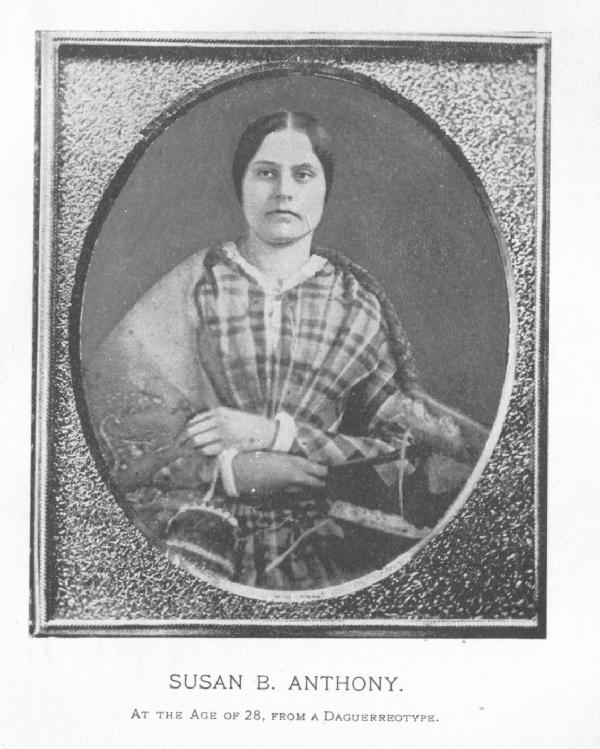
SUSAN B. ANTHONY. AT THE AGE OF 28, FROM A DAGUERREOTYPE.
For the winter she buys a broche shawl for $22.50, a gray fox muff for $8, a $5.50 white ribbed-silk hat, "which makes the villagers stare," and a plum-colored merino dress at $2 a yard, "which everybody admits to be the sweetest thing entirely;" and she wonders if her sisters "do not feel rather sad because they are married and can not have nice clothes." Miss Anthony may be said to have been at this time at the height of her fashionable career.
In the spring her pupils give an "exhibition" which far surpasses anything ever before seen in Canajoharie. She writes: "Can you begin to imagine my excitement? The nights seemed lengthened into days; the hopes, the fears that filled my mind are indescribable. Who ever thought that Susan Anthony could get up such an affair? I am sure I never did, but here I was; it was sink or swim, I made a bold effort and won the victory."[10]
In June she attends her first circus, "Sands, Lent & Co., Proprietors." About this time she writes of being invited to a military ball and says: "My fancy for attending dances is fully satiated. I certainly shall not attend another unless I can have a total abstinence man to accompany me, and not one whose highest delight is to make a fool of himself." She says in this letter: "The town election has just been held and the good people elected a distiller for supervisor and a rumseller for justice of the peace."
In 1848 she shows the first signs of growing tired of teaching and wonders if she is to follow it for a lifetime. She says: "I don't know whether I am weary of well-doing, but oh, if 052 I could only unstring my bow for a few short months, I think I could take up my work with renewed vigor." She is very homesick, after the two years' absence, and so makes a visit to Rochester in August. For this she gets "a drab silk bonnet shirred inside with pink, and her blue lawn and her brown silk made over, half low-necked." She has "a beautiful green delaine and a black braise [barége] which are very becoming." She wants a fancy hat, a $15 pin and $30 mantilla, every one of which she resolves to deny herself, but afterwards writes: "There is not a mantilla in town like mine."
In March, 1849, her beloved cousin Margaret, with whom she has been living for the past two years, gives birth to a child and she remains with her through the ordeal. In a letter to her mother immediately afterwards, she expresses the opinion that there are some drawbacks to marriage which make a woman quite content to remain single. She quotes a little bit of domestic life: "Joseph had a headache the other day and Margaret remarked that she had had one for weeks. 'Oh,' said the husband, 'mine is the real headache, genuine pain, yours is a sort of natural consequence.'" For seven weeks she is at Margaret's bedside every moment when out of school, and also superintends the house and looks after the children. There are a nurse and a girl in the kitchen, but the invalid will eat no food which Cousin Susan does not prepare; there is no touch so light and gentle as hers; her very presence gives rest and strength. At the end of this time Margaret dies, leaving four little children. Susan's grief is as intense as if she had lost a sister, and she decides to remain no longer in Canajoharie. She writes: "I seem to shrink from my daily tasks; energy and stimulus are wanting; I have no courage. A great weariness has come over me." In all the letters of the past ten years there has not been one note of discontent or discouragement, but now she is growing tired of the treadmill. At this time the California fever was at its height, hundreds of young men were starting westward, and she writes: "Oh, if I were but a man so that I could go!" 053
Soon after coming to Canajoharie Miss Anthony joined the society of the Daughters of Temperance and was made secretary. Her heart and soul were enlisted in this cause. She realized the immense task to be accomplished, and, even then, saw dimly the power that women might wield if they were properly organized and given full authority and sanction to work. As yet no women had spoken in public on this question, and they had just begun to organize societies among themselves, called Daughters' Unions, which were a sort of annex to the men's organizations, but they were strongly opposed by most women as being unladylike and entirely out of woman's sphere.
On March 1, 1849, the Daughters of Temperance gave a supper, to which were invited the people of the village, and the address of the evening was made by Miss Anthony. She thus describes the occasion in a letter:
I was escorted into the hall by the Committee where were assembled about 200 people. The room was beautifully festooned with cedar and red flannel. On the south side was printed in large capitals of evergreen the name of "Susan B. Anthony!" I hardly knew how to conduct myself amidst so much kindly regard. They had an elegant supper. On the top of one pyramid loaf cake was a beautiful bouquet, which was handed to the gentleman who escorted me (Charlie Webster) and by him presented to me.
The paper is interesting as the first platform utterance of a woman destined to become one of the noted speakers of the century. While it gives no especial promise of the oratorical ability which later developed, it illustrates the courage of the woman who dared read an address in public, when to do so provoked the severest criticism. The following extracts are taken verbatim from the original MS.:
Welcome, Gentlemen and Ladies, to this, our Hall of Temperance. We feel that the cause we have espoused is a common cause, in which you, with us, are deeply interested. We would that some means were devised, by which our Brothers and Sons shall no longer be allured from the right by the corrupting influence of the fashionable sippings of wine and brandy, those sure destroyers of Mental and Moral Worth, and by which our Sisters and Daughters shall no longer be exposed to the vile arts of the gentlemanly-appearing, gallant, but really half-inebriated seducer. Our motive is to ask of you counsel in the formation, and co-operation in the carrying-out of plans which may produce a radical change in our Moral Atmosphere.... 054
But to the question, what good our Union has done? Though our Order has been strongly opposed by ladies professing a desire to see the Moral condition of our race elevated, and though we still behold some of our thoughtless female friends whirling in the giddy dance, with intoxicated partners at their side and, more than this, see them accompany their reeling companions to some secluded nook and there quaff with them from that Virtue-destroying cup, yet may we not hope that an influence, though now unseen, unfelt, has gone forth, which shall tell upon the future, which shall convince us that our weekly resort to these meetings has not been in vain, and which shall cause the friends of humanity to admire and respect—nay, venerate—this now-despised little band of Daughters of Temperance?...
We count it no waste of time to go forth through our streets, thus proclaiming our desire for the advancement of our great cause. You, with us, no doubt, feel that Intemperance is the blighting mildew of all our social connections; you would be most happy to speed on the time when no Wife shall watch with trembling heart and tearful eye the slow, but sure descent of her idolized Companion down to the loathsome haunts of drunkenness; you would hasten the day when no Mother shall have to mourn over a darling son as she sees him launch his bark on the circling waves of the mighty whirlpool.
How is this great change to be wrought, who are to urge on this vast work of reform? Shall it not be women, who are most aggrieved by the foul destroyer's inroads? Most certainly. Then arises the question, how are we to accomplish the end desired? I answer, not by confining our influence to our own home circle, not by centering all our benevolent feelings upon our own kindred, not by caring naught for the culture of any minds, save those of our own darlings. No, no; the gratification of the selfish impulses alone, can never produce a desirable change in the Moral aspect of Society....
It is generally conceded that it is our sex that fashions the Social and Moral State of Society. We do not presume that females possess unbounded power in abolishing the evil customs of the day; but we do believe that were they en masse to discountenance the use of wine and brandy as beverages at both their public and private parties, not one of the opposite Sex, who has any claim to the title of gentleman, would so insult them as to come into their presence after having quaffed of that foul destroyer of all true delicacy and refinement.
I am not aware that we have any inebriate females among us, but have we not those, who are fallen from Virtue, and who claim our efforts for their reform, equally with the inebriate? And while we feel it our duty to extend the hand of sympathy and love to those who are wanderers from the path of Temperance, should we not also be zealous in reclaiming those poor, deluded ones, who have been robbed of their most precious Gem, Virtue, and whom we blush to think belong to our Sex?
Now, Ladies, all we would do is to do all in our power, both individually and collectively, to harmonize and happify our Social system. We ask of you candidly and seriously to investigate the Matter, and decide for yourselves whether the object of our Union be not on the side of right, and if it be, then one and all, for the sake of erring humanity, come forward and speed on the 055 right. If you come to the conclusion that the end we wish to attain is right, but are not satisfied with the plan adopted, then I ask of you to devise means by which this great good may be more speedily accomplished, and you shall find us ready with both heart and hand to co-operate with you. In my humble opinion, all that is needed to produce a complete Temperance and Social reform in this age of Moral Suasion, is for our Sex to cast their United influences into the balance.
Ladies! there is no Neutral position for us to assume. If we sustain not this noble enterprise, both by precept and example, then is our influence on the side of Intemperance. If we say we love the Cause, and then sit down at our ease, surely does our action speak the lie. And now permit me once more to beg of you to lend your aid to this great Cause, the Cause of God and all Mankind.
The next day on the streets, so the letters say, everybody was exclaiming, "Miss Anthony is the smartest woman who ever has been in Canajoharie." Soon afterwards the school closed and, after spending the summer visiting eastern relatives and friends, Miss Anthony returned to Rochester in the autumn of 1849. The thing she remembers most vividly is how she reveled in fruit. All the young orchards her father had planted were now bearing, including a thousand peach trees, and for the first time in her life she had all the peaches she wanted, and "lived on them for a month."
The years of 1850 and 1851 Daniel Anthony conducted his insurance business in Syracuse and Susan remained at home, taking entire charge of the farm, superintending the planting of the crops, the harvesting and the selling. She also did most of the housework, as her mother was in delicate health, her sister was teaching school and both brothers were away. In the winter of 1852, she went into a school in Rochester as supply for three months. She found, however, that her taste for teaching was entirely gone, her work was without inspiration, her interest and sympathy had become enlisted in other things. She longed to take an active part in the two great reforms of temperance and anti-slavery, which now were absorbing public attention; she could not endure the narrow and confining life of the school-room, and so, in the spring, she abandoned teaching forever, after an experience of fifteen years.
Ill the conditions were such as to make it most natural for Miss Anthony, when she reached the age of maturity, to adopt a public career and go actively into reform work, and especially to enter upon that contest to secure equal rights for those of her own sex, which she was to wage unceasingly for half a century. Her father's mother and sister were "high seat" Quakers, the latter a famous preacher. Her mother's cousin, Betsey Dunnell White, of Stafford's Hill, was noted as the only woman in that locality who could "talk politics," and the men used to come from far and near to get her opinion on the political situation. She was brought up in a society which recognizes the equality of the sexes and encourages women in public speaking. In her own home the father believed in giving sons and daughters the same advantages, and in preparing the latter as well as the former for self-support. The daughters were taught business principles, and invested with responsibility at an early age. Two of them married, and the third was of a quiet and retiring disposition; but in Susan he saw ability of a high order and that same courage, persistence and aggressiveness which entered into his own character, enabling him to make his way in the business world and rally from his losses and defeats. He encouraged her desire to go into the reforms which were demanding attention, gave her financial backing when necessary, moral support upon all occasions, and was ever her most interested friend and faithful ally. She received also the sympathy and assistance of her mother, who, 058 no matter how heavy the domestic burdens, or how precarious her own health, was never willing that she should take any time from her public work to give to the duties of home, although she frequently insisted upon doing so.
During Miss Anthony's stay at Canajoharie she went often to Albany and there made the intimate acquaintance of Abigail Mott and her sister Lydia, whose names are now a blessed memory with the leaders of the abolition movement that still remain. Their modest home was a rallying center for the reformers of the day, and here Miss Anthony met many of the noted men and women with whom she was to become so closely associated in the future. She reached home in 1849 to find a hot-bed of discussion and fermentation. The first rift had been made in the old common law, which for centuries had held women in its iron grasp, by the passage, in April, 1848, of the Property Bill allowing a married woman to hold real estate in her own name in New York. Previous to this time all the property which a woman owned at marriage and all she might receive by gift or inheritance passed into the possession of the husband; the rents and profits belonged to him, and he could sell it during his lifetime or dispose of it by will at his death except her life interest in one-third of the real estate. The more thoughtful among women were beginning to ask why other unjust laws should not also be repealed, and the whole question of the rights of woman was thus opened.
In 1848, Spiritualism may be said to have had its birth, and the remarkable manifestations of the Fox sisters brought numbers of people to Rochester, where they had-removed as soon as they began to be widely known. This form of religious belief soon acquired a large following, causing much controversy and great excitement.
The Society of Friends had divided on the slavery issue and Miss Anthony found her family attending the Unitarian church, which soon afterwards called William Henry Channing to its pulpit. Both he and Samuel J. May, the father of Unitarianism in Syracuse, became her steadfast friends and 059 never-failing support in all the great work which was developed in later years.
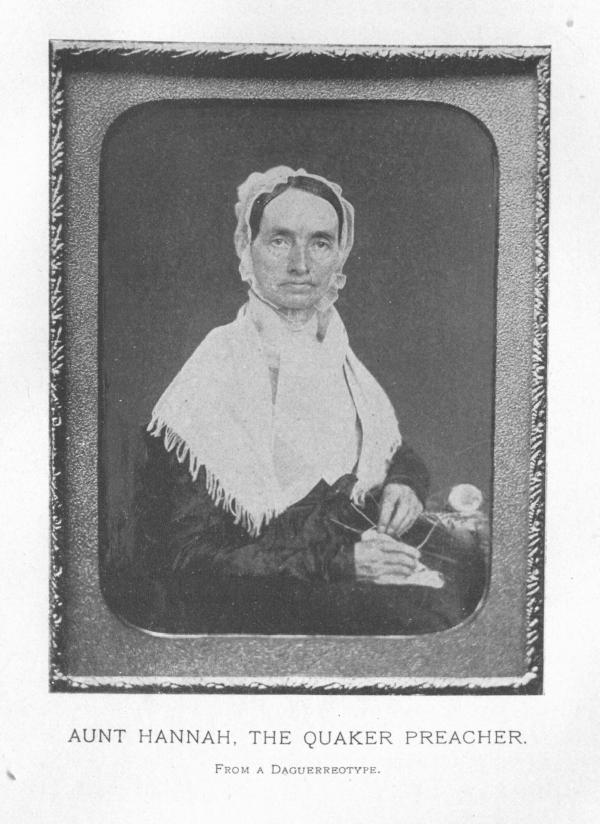
AUNT HANNAH, THE QUAKER PREACHER. FROM A DAGUERREOTYPE.
In July, 1848, the first Woman's Rights Convention had been held in Seneca Falls and adjourned to meet in Rochester August 2. Miss Anthony's father, mother and sister Mary had attended and signed the declaration demanding equal rights for women, and she found them enthusiastic upon this subject and also over Mrs. Stanton, Lucretia Mott and other prominent women who had taken part. Her cousin, Sarah Anthony Burtis, had acted as secretary of the convention.
In 1849 Mrs. Mott published her admirable Discourse on Woman in answer to a lyceum lecture by Richard H. Dana ridiculing the idea of civil and political rights for women. In 1847 Frederick Douglass had brought his family to Rochester and established his paper, the North Star. As soon as Miss Anthony reached home she was taken by her father to call on Douglass, and this was the beginning of another friendship which was to last a lifetime.
The year 1849 saw the whole country in a state of great unrest and excitement. Eighty thousand men had gone to California in search of gold. Telegraphs and railroads were being rapidly constructed, thus bringing widely separated localities into close communication. The unsettled condition of Europe and the famine in Ireland had turned toward America that tremendous tide of immigration which this year had risen to 300,000. The admission of Texas into the Union had precipitated the full force of the slavery question. Old parties were disintegrating and sectional lines becoming closely drawn. New territories were knocking at the door of the Union and the whole nation was in a ferment as to whether they should be slave or free. Threats of secession were heard in both the North and the South. A spirit of compromise finally prevailed and deferred the crisis for a decade, but the agitation and unrest continued to increase. The Abolitionists were still a handful of radicals, repudiated alike by the Free Soil Whigs and Free Soil Democrats. Slavery, as an institution, had not 060 yet become a political issue, but only its extension into the territories.
Such, in brief, was the situation at the beginning of 1850. It was a period of grave apprehension on the part of older men and women, of intense aggressiveness with the younger, who were eager for action. It is not surprising then that an educated, self-reliant, public-spirited woman who had just reached thirty should chafe against the narrow limits of a school-room and rebel at giving her time and strength to the teaching of children, when all her mind and heart were drawn toward the great issues then filling the press and the platform and even finding their way into the pulpit. Miss Anthony's whole soul soon became absorbed in the thought, "What service can I render humanity; what can I do to help right the wrongs of society?" At this time the one and only field of public work into which women had dared venture, except in a few isolated cases, was that of temperance. Miss Anthony had brought her credentials from the Daughters' Union at Canajoharie and presented them at once to the society in Rochester; they were gladly accepted and she soon became a leader. In these days John B. Gough was delivering his magnificent lectures throughout the country, and Philip S. White, of South Carolina, was winning fame as a temperance orator.
The year 1850 was for her one of transition. A new world opened out before her. The Anthony homestead was a favorite meeting place for liberal-spirited men and women. On Sunday especially, when the father could be at home, the house was filled and fifteen or twenty people used to gather around the hospitable board. Susan always superintended these Sunday dinners, and was divided between her anxiety to sustain her reputation as a superior cook and her desire not to lose a word of the conversation in the parlor. Garrison, Pillsbury, Phillips, Channing and other great reformers visited at this home, and many a Sunday the big wagon would be sent to the city for Frederick Douglass and his family to come out and spend the day. Here were gathered many times the Posts, Hallowells, DeGarmos, Willises, Burtises, Kedzies, Fishes, Curtises, 061 Stebbins, Asa Anthonys, all Quakers who had left the society on account of their anti-slavery principles and were leaders in the abolition and woman's rights movements. Every one of these Sunday meetings was equal to a convention. The leading events of the day were discussed in no uncertain tones. All were Garrisonians and believed in "immediate and unconditional emancipation." In 1850 the Fugitive Slave Law was passed and all the resources of the federal government were employed for its enforcement. Its provisions exasperated the Abolitionists to the highest degree. The house of Isaac and Amy Post was the rendezvous for runaway slaves, and each of these families that gathered on Sunday at the Anthony farm could have told where might be found at least one station on the "underground railroad."
Miss Anthony read with deep interest the reports of the woman's rights convention held at Worcester, Mass., October, 1850, which were published in the New York Tribune.[11] She sympathized fully with the demand for equal rights for women, but was not yet quite convinced that these included the suffrage. This, no doubt, was largely because Quaker men did not vote, thinking it wrong to support a government which believed in war. Even so progressive and public-spirited a man as Daniel Anthony, much as he was interested in all national affairs, never voted until 1860, when he became convinced it was only by force of arms that the question of slavery could be settled.
In 1851, the License Law having been arbitrarily repealed a few years before, there was practically no regulation of the liquor business, nor was there any such public sentiment against intemperance as exists at the present day. Drunkenness was not looked upon as an especial disgrace and there had been little agitation of the question. The wife of a drunkard was completely at his mercy. He had the entire custody of the children, full control of anything she might earn, and the law did not recognize drunkenness as a cause for 062 divorce. Although woman was the greatest sufferer, she had not yet learned that she had even the poor right of protest. Oppressed by the weight of the injustice and tyranny of ages, she knew nothing except to suffer in silence; and so degraded was she by generations of slavish submission, that she possessed not even the moral courage to stand by those of her own sex who dared rebel and demand a new dispensation.
The old Washingtonian Society of the first half of the nineteenth century, composed entirely of men, because reformed drunkards only could belong to it, was succeeded by the Sons of Temperance, and these had permitted the organization of subordinate lodges called Daughters of Temperance, which, as subsequent events will show, were entitled to no official recognition. It was in one of these, the only organized bodies of women known at this time,[12] that Miss Anthony first displayed that executive ability which was destined to make her famous. During 1851 she was very active in temperance work and organized a number of societies in surrounding towns. She instituted in Rochester a series of suppers and festivals to raise the funds which she at once saw were necessary before any efficient work could be done. An old invitation to one of these, dated February 21, 1851, and signed by Susan B. Anthony, chairman, reads: "The entertainment is intended to be of such a character as will meet the approbation of the wise and good; Supper, Songs, Toasts, Sentiments and short speeches will be the order of-the evening; $1 will admit a gentleman and a lady" A newpaper account says:
The five long tables were loaded with a rich variety of provisions, tastefully decorated and arranged. Mayor Samuel Richardson presided at the supper table. After the repast was over, Miss Susan B. Anthony, Directress of the Festival and President of the Association, introduced these highly creditable sentiments, which were greatly applauded by the assemblage:
"The Women of Rochester—Powerful to fashion the customs of society, may they not fail to exercise that power for the speedy and total banishment of all that intoxicates from our domestic and social circles, and thus speed on the day when no young man, be he ever so genteelly dressed or of ever so 063 noble, origin, who pollutes his lips with the touch of the drunkard's cup, shall presume to seek the favor of any of our precious daughters.
"Our Cause—May each succeeding day add to its glory and every hour give fresh impetus to its progress...."
Many other toasts were proposed which space forbids quoting, but the following by one of the gentlemen deserves a place:
The Daughters—Our characters they elevate,
Our manners they refine;
Without them we'd degenerate
To the level of the swine.
It is curious how willing men have been, through all the centuries, to admit that only the influence of women saves them from being brutes and how anxious to confine that influence to the narrowest possible limits.

Abby K. Foster
In the winter of 1851 Miss Anthony attended an anti-slavery meeting in Rochester, conducted by Stephen and Abby Kelly Foster. This was her first acquaintance with Mrs. Foster, who had been the most persecuted of all the women taking part in the anti-slavery struggle. She had been ridiculed, denounced and mobbed for years; and, for listening to her on Sunday, men and women had been expelled from church. Her strong and heroic spirit struck an answering spark in Miss Anthony's breast. She accompanied the Fosters for a week on their tour of meetings in adjoining counties, and was urged by them to go actively into this reform.
The following May she went to the Anti-Slavery Anniversary in Syracuse. This convention had been driven out of New York by Rynders' mob in 1850 and did not dare go back. On the way home she stopped at Seneca Falls, the guest of Mrs. Amelia Bloomer, to hear again Wm. Lloyd Garrison and George Thompson, the distinguished Abolitionist from England, who had stirred her nature to its depths. Here was fulfilled her long-cherished desire of seeing Elizabeth Cady 064 Stanton. Their meeting is best described in that lady's own words: "Walking home with the speakers, who were my guests, we met Mrs. Bloomer with Miss Anthony on the corner of the street waiting to greet us. There she stood with her good, earnest face and genial smile, dressed in gray delaine, hat and all the same color relieved with pale-blue ribbons, the perfection of neatness and sobriety. I liked her thoroughly from the beginning." Both Mrs. Stanton and Mrs. Bloomer on this occasion wore what is known as the Bloomer costume. In the summer Miss Anthony went to Seneca Falls to a meeting of those interested in founding the People's College. Horace Greeley, Lucy Stone and herself were entertained by Mrs. Stanton. The three women were determined it should be opened to girls as well as boys. Mr. Greeley begged them not to agitate the question, assuring them that he would have the constitution and by-laws so framed as to admit women on the same terms as men, and he did as he promised, making a spirited fight. Before the college was fairly started, however, it was merged into Cornell University.
This was Miss Anthony's first meeting with Lucy Stone and may be called the commencement of her life-long friendship with Mrs. Stanton. These women who sat at the dinner-table that day were destined to be recorded in history for all time as the three central figures in the great movement for equal rights. There certainly was nothing formidable in the appearance of the trio: Miss Anthony a quiet, dignified Quaker girl; Mrs. Stanton a plump, jolly, youthful matron, scarcely five feet high; and Lucy Stone a petite, soft-voiced young woman who seemed better fitted for caresses than for the hard buffetings of the world.
Miss Anthony's public life may be said to have fairly begun in 1852. The Sons of Temperance had announced a mass meeting of all the divisions in the state, to be held at Albany, and had invited the Daughters to send delegates. The Rochester union appointed Susan B. Anthony. Her credentials, with those of the other women delegates, were accepted and seats given them in the convention, but when Miss Anthony rose to 065 speak to a motion she was informed by the presiding officer that "the sisters were not invited there to speak but to listen and learn." She and three or four other ladies at once left the hall. The rest of the women had not the courage to follow, but called them "bold, meddlesome disturbers," and remained to bask in the approving smiles of the Sons. They sought advice of Lydia Mott, who said the proper thing was to hold a meeting of their own; so they secured the lecture-room of the Hudson street Presbyterian church, and then went to the office of the Evening Journal, edited by Thurlow Weed, to talk the situation over with him. He told them they had done exactly right, and in his paper that evening he announced their meeting and related their treatment by the men.
The night was cold and snowy. The little room was dark, the stove smoked and the pipe fell down during the exercises, but the women were sustained by their indignation and sense of justice and would not allow themselves to be discouraged. Rev. Samuel J. May, who was in the city attending the "Jerry Rescue" trials, seeing the notice of their meeting, came to offer his assistance, accompanied by David Wright, husband of Martha C. Wright and brother-in-law of Lucretia Mott. These two, with a reporter, were the only men present at this little assemblage of women who had decided that they could do something better for the cause of temperance than being seen and not heard.
Mr. May opened the meeting with prayer, and then showed them how to organize. Mary C. Vaughn, of Oswego, was made president; Miss Anthony, secretary; Lydia Mott, chairman of the business committee. Mrs. Vaughn gave an address. A letter had been received from Mrs. Stanton so radical that most of the ladies objected to having it read, but Miss Anthony took the responsibility. She read, also, letters from Clarina Howard Nichols and Amelia Bloomer, which had been intended for the Sons' meeting. Mrs. Lydia F. Fowler, who happened to be lecturing in Albany, spoke briefly, and Mr. May paid high tribute to the valuable work of women in temperance 066 and anti-slavery, declaring their influence as indispensable to the state and the church as to the home. Miss Anthony then said their treatment showed that the time had come for women to have an organization of their own; and the final outcome was the appointment of a committee, with herself as chairman, to call a Woman's State Temperance Convention.
She at once wrote to all parts of the State urging the unions to send delegates, and received many encouraging replies. Horace Greeley wrote as follows:
I heartily approve the call of the Woman's Temperance Convention, and hope it may result in good. To this end I would venture to suggest:
1st. Hold an informal and private meeting before you attempt to meet in public. There select your officers, your business committees, etc., so that there shall be no jarring when you assemble in public.
2d. Have your addresses and resolves carefully prepared beforehand. Make them very short and pointed. Have them in type so that they may appear promptly and simultaneously in the daily papers. If you will send us a copy of them the night before we will endeavor to print them with our proceedings of the meeting received by telegraph.
3d. Be sure that your strongest thinkers speak and that the weaker forbear, and that extraneous matters, so far as possible, are let alone.
It will be seen that by adopting these shrewd political methods there would not be much left for the convention proper to do except listen to the speeches, but it would be hard to compress into smaller space more sensible advice. Mrs. Nichols wrote her: "It is most invigorating to watch the development of a woman in the work for humanity: first, anxious for the cause and depressed with a sense of her own inability; next, partial success of timid efforts creating a hope; next, a faith; and then the fruition of complete self-devotion. Such will be your history." From Mrs. Stanton came cheering words: "I will gladly do all in my power to help you. Come and stay with me and I will write the best lecture I can for you. I have no doubt a little practice will make you an admirable speaker. Dress loosely, take a great deal of exercise, be particular about your diet and sleep enough. The body has great influence upon the mind. In your meetings, if attacked, be cool and good-natured, for if you are simple and truth-loving no 067 sophistry can confound you. As for my own address, if I am to be president it ought perhaps to be sent out with the stamp of the convention, but as anything from my pen is necessarily radical no one may wish to share with me the odium of what I may choose to say. If so, I am ready to stand alone. I never write to please any one. If I do please I am happy, but to proclaim my highest convictions of truth is always my sole object."
After weeks of hard work, writing countless letters, taking numerous trips to various towns, and making almost without assistance all the necessary arrangements, the convention assembled in Corinthian Hall, Rochester, April 20, 1852. The morning audience was composed entirely of women, 500 being in attendance. Miss Anthony opened the meeting, read the call, which had been widely circulated, and in a clear, forcible manner set forth the object of the convention. The call urged the women to "meet together for devising such associated action as shall be necessary for the protection of their interests and of society at large, too long invaded and destroyed by legalized intemperance." It was signed by Daniel Anthony, William R. Hallowell and a number of well-known men and women, many of whom were present and took part in the discussions. Letters were read from distinguished persons and strong resolutions adopted, among them one thanking the New York Tribune for the kindness with which it had uniformly sustained women in their efforts for temperance. Elizabeth Cady Stanton was elected president; Mrs. Gerrit Smith, Mrs. E.C. Delavan, Antoinette L. Brown and nine others, vice-presidents; Susan B. Anthony and Amelia Bloomer, secretaries. In accepting the presidency, Mrs. Stanton made a powerful speech, certain parts of which acted as a bombshell not only at this meeting, but in press, pulpit and society. The two points which aroused most antagonism were:
1st. Let no woman remain in the relation of wife with a confirmed drunkard. Let no drunkard be the father of her children.... Let us petition our State government so to modify the laws affecting marriage and the custody of children, that the drunkard shall have no claims on wife or child.
2d. Inasmuch as charity begins at home, let us withdraw our mite from all associations for sending the Gospel to the heathen across the ocean, for the 068 education of young men for the ministry, for the building up of a theological aristocracy and gorgeous temples to the unknown God, and devote ourselves to the poor and suffering around us. Let us feed and clothe the hungry and naked, gather children into schools and provide reading-rooms and decent homes for young men and women thrown alone upon the world. Good schools and homes, where the young could ever be surrounded by an atmosphere of purity and virtue, would do much more to prevent immorality and crime in our cities than all the churches in the land could ever possibly do toward the regeneration of the multitude sunk in poverty, ignorance and vice.
The effect of such declarations on the conservatism of half a century ago hardly can be pictured. At this time the principal outlet for women's activities was through foreign missionary work, and even in this they were allowed no official responsibility. None of the many charitable organizations which are now almost wholly in the hands of women were in existence. In scarcely one State was drunkenness recognized as cause for divorce, and yet when Mrs. Stanton made these demands, the women throughout the country joined with the men in denouncing them. Only a few of the broader and more progressive, who were ahead of their age, sustained her. Among these were Miss Anthony, Ernestine L. Rose, Lucretia Mott, Lucy Stone, Frances D. Gage and Martha C. Wright.
After six enthusiastic sessions and the forming of a strong organization, the convention adjourned. Thus the first Woman's State Temperance Society ever formed was due almost entirely to Susan B. Anthony, because of her courage in demanding independent action and her successful efforts in calling the convention which inaugurated it. The executive committee met in May and appointed her State agent, "with full power and authority to organize auxiliary societies, collect moneys, issue certificates of membership and do all things which she may judge necessary and expedient to promote the purposes for which our society has been organized."
The Men's State Temperance Society had issued an official call for a convention to be held at Syracuse in June, containing these words: "Temperance societies of every name are invited to send delegates." Acting upon this invitation, the executive committee of the Woman's State Temperance Society 069 appointed Gerrit Smith, Susan B. Anthony and Amelia Bloomer as delegates. Mr. Smith was not able to attend and, after their experience at Albany, there were serious doubts in the minds of the women whether they would be received. They were much encouraged, however, by the receipt of a letter from Rev. Samuel J. May, written June 14, saying: "The local committee are now in session. I have just read your letter to them, and every member has expressed himself in favor of receiving the delegates of the Woman's State Temperance Society, just as the delegates of any other society, and allowing them to take their own course, speak or not speak, as they choose."
Miss Anthony and Mrs. Bloomer went to Syracuse, and on the morning of the convention received a call from Mr. May. He came to inform them that their arrival had caused great excitement among the clergy, who comprised a large portion of the delegates and threatened to withdraw if the women were admitted. Their action had alarmed the other delegates, who feared a disturbance in the convention, and they had requested Mr. May, as probably having the most influence, to call upon the ladies and urge them not to ask for recognition. When they told him they should go to the meeting and present their credentials, he expressed great satisfaction and said that was just the decision he had hoped they would make. They quietly entered the hall and took seats with other ladies at one side of the platform. Immediately Rev. Mandeville, of Albany, turned his chair around with back to the audience and, facing them, attempted to stare them out of countenance. William H. Burleigh, secretary, read the annual report, which closed, "We hail the formation of the Woman's State Temperance Society as a valuable auxiliary." This precipitated the discussion. Rev. Mandeville sprung to his feet and moved to strike out the last sentence. His speech was filled with such venom and vulgarity as the foulest-mouthed politician would hesitate to utter. He denounced the Woman's State Temperance Society and all women publicly engaged in temperance work, declared the women delegates to be "a hybrid species, half 070 man and half woman, belonging to neither sex," and announced finally that if this sentence were not struck out he would dissolve his connection with the society.
A heated debate followed. Mr. Havens, of New York, offered an amendment recognizing "the right of women to work in their proper sphere—the domestic circle." Rev. May, of the Unitarian church, Rev. Luther Lee, of the Wesleyan Methodist, Hon. A.N. Cole, a leading Whig politician, and several others, defended the rights of the women in the most eloquent manner, but were howled down. Miss Anthony made only one attempt to speak and that was to remind them that over 100,000 of the signers to a petition for a Maine Law, the previous winter, were women, but her voice was drowned by Rev. Fowler, of Utica, shouting, "Order! Order!" Herman Camp, of Trumansburg, the president, ruled that she was not a delegate and had no right to speak. Amid great confusion the question was put to vote and the decision of the chair sustained. As no delegates had yet been accredited, everybody in the house was allowed to vote, but the secretary, J.T. Hazen, announced that he did not count the votes of the women!
Rev. Luther Lee at once offered his church to the ladies for an evening meeting. They had a crowded house, fine speeches and good music, while the convention was practically deserted, not over fifty being present. After a masterly speech by Mr. May and stirring remarks from Mr. Lee, Mrs. Bloomer and others, Miss Anthony made the address of the evening, which she had prepared for the men's convention, a strong plea for the right of women to work and speak for temperance. Soon afterwards she wrote her father: "I feel there is a great work to be done which none but women can do. How I wish I could be daily associated with those whose ideas are in advance of my own, it would enable me to develop so much faster;" and then, notwithstanding all her rebuffs, she signed herself, "Yours cheerily."
The anti-slavery convention this year was held in Rochester, and Miss Anthony had as a guest her dear friend, Lydia Mott, 071 and again met Garrison, Phillips, May, the Fosters, Pillsbury, Henry C. Wright and others of that glorious band who together had received the baptism of fire. Although intensely interested in the anti-slavery question she did not dare think she had the ability to take up that work, but she did resolve to give all her time and energy to the temperance cause. The summer of 1852 was spent in traveling throughout the State with Mrs. Vaughn, Mrs. Attilia Albro and Miss Emily Clark. They canvassed thirty counties, organizing societies and securing 28,000 signatures to a petition for the Maine Law. Miss Anthony sent out a strong appeal, saying:
Women, and mothers in particular, should feel it their right and duty to extend their influence beyond the circumference of the home circle, and to say what circumstances shall surround children when they go forth from under the watchful guardianship of the mother's love; for certain it is that, if the customs and laws of society remain corrupt as they now are, the best and wisest of the mother's teachings will soon be counteracted....
Woman has so long been accustomed to non-intervention with law-making, so long considered it man's business to regulate the liquor traffic, that it is with much cautiousness she receives the new doctrine which we preach; the doctrine that it is her right and duty to speak out against the traffic and all men and institutions that in any way sanction, sustain or countenance it; and, since she can not vote, to duly instruct her husband, son, father or brother how she would have him vote, and, if he longer continue to mis-represent her, take the right to march to the ballot-box and deposit a vote indicative of her highest ideas of practical temperance.
It will be seen by this that already she had taken her stand on the right of woman to the franchise.
While at Elmira she happened into a teachers' convention and heard Charles Anthony, of the Albany academy, a distant relative, make an address on "The Divine Ordinance of Corporal Punishment." It was a severe and cruel justification of the unlimited use of the rod, but, although more than three-fourths of the teachers present were women, not a word was uttered in protest. Throughout the proceedings not a woman's voice was heard, none was appointed on committees or voted on any question, and they were as completely ignored as so many outsiders. Miss Anthony made up her mind that here also was a work to be done, and that henceforth she would 072 attend the State teachers' conventions every year and demand for women all the privileges now monopolized by men.
On September 8, 1852, she went to her first Woman's Rights Convention, which was held at Syracuse. She had read with avidity the accounts of the Ohio, Massachusetts, Indiana and Pennsylvania conventions, but this was her first opportunity of attending one. At the preliminary meeting, held the night before, she was made a member of the nominating committee with Paulina Wright Davis, of Providence, R.I., chairman. Mrs. Davis had come with the determination of putting in as president her dear friend Elizabeth Oakes Smith, a fashionable literary woman of Boston. Both attended the meeting and the convention in short-sleeved, low-necked white dresses, one with a pink, the other with a blue embroidered wool delaine sack with wide, flowing sleeves, which left both neck and arms exposed. At the committee meeting next morning, Quaker James Mott nominated Mrs. Smith for president, but Quaker Susan B. Anthony spoke out boldly and said that nobody who dressed as she did could represent the earnest, solid, hard-working women of the country for whom they were making the demand for equal rights. Mr. Mott said they must not expect all women to dress as plainly as the Friends; but she held her ground, and as all the committee agreed with her, though no one else had had the courage to speak, Mrs. Smith's name was voted down. This is but one instance of hundreds where Miss Anthony alone dared say what others only dared think, and thus through all the years made herself the target for criticism, blame and abuse. Others escaped through their cowardice; she suffered through her bravery.
Lucretia Mott was made president, and the Syracuse Standard said: "It was a singular spectacle to see this Quaker matron presiding over a convention with an ease, grace and dignity that might be envied by the most experienced legislator in the country."[13] Susan B. Anthony and Martha C. Wright were the secretaries. Delegates were present from Canada and eight 073 different States. Letters were received from Angelina Grimké Weld, William Henry Channing and others; Horace Greeley sent much good advice; Garrison wrote: "You have as noble an object in view, aye and as Christian a one too, as ever was advocated beneath the sun. Heaven bless all your proceedings." Rev. A.D. Mayo said in a long letter:
I have never questioned what I believed to be the central principle of the reform in which you are engaged. I believe that every mature soul is responsible directly to God, not only for its faith and opinions, but for its details of life. The assertion that woman is responsible to man for her belief or conduct, in any other sense than man is responsible to woman, I reject, not as a believer in any theory of "woman's rights," but as a believer in that religion which knows neither male nor female in its imperative demand upon the individual conscience.
George W. Johnson, of Buffalo, chairman of the State committee of the Liberty party, sent $10 and these vigorous sentiments: "Woman has, equally with man, the inalienable right to education, suffrage, office, property, professions, titles and honors—to life, liberty and the pursuit of happiness. False to our sex, as well as her own, and false to herself and her God, is the woman who approves, or who submits without resistance or protest, to the social and political wrongs imposed upon her in common with her sex throughout the world." Mrs. Stanton's letter, read with hearty approval by Miss Anthony, raised the usual breeze in the convention. She suggested three points:
Should not all women, living in States where they have the right to hold property, refuse to pay taxes so long as they are unrepresented in the government?... Man has pre-empted the most profitable branches of industry, and we demand a place at his side; to this end we need the same advantages of education, and we therefore claim that the best colleges of the country be opened to us.... In her present ignorance, woman's religion, instead of making her noble and free, by the wrong application of great principles of right and justice, has made her bondage but more certain and lasting, her degradation more helpless and complete.
In the course of her argument Lucy Stone said:
The claims we make at these conventions are self-evident truths. The second resolution affirms the right of human beings to their persons and earnings. Is 074 not that self-evident? Yet the common law, which regulates the relation of husband and wife, and is modified only in a few instances by the statutes, gives the "custody" of the wife's person to the husband, so that he has a right to her even against herself. It gives him her earnings, no matter with what weariness they have been acquired, or how greatly she may need them for herself or her children. It gives him a right to her personal property, which he may will entirely away from her, also the use of her real estate, and in some of the States married women, insane persons and idiots are ranked together as not fit to make a will; so that she is left with only one right, which she enjoys in common with the pauper, the right of maintenance. Indeed, when she has taken the sacred marriage vows, her legal existence ceases. And what is our position politically? The foreigner, the negro, the drunkard, all are entrusted with the ballot, all placed by men politically higher than their own mothers, wives, sisters and daughters! The woman who, seeing this, dares not maintain her rights is the one to hang her head and blush. We ask only for justice and equal rights—the right to vote, the right to our own earnings, equality before the law; these are the Gibraltar of our cause.
Rev. Antoinette Brown, the first woman ever ordained to preach, declared:
Man can not represent woman. They differ in their nature and relations. The law is wholly masculine; it is created and executed by man. The framers of all legal compacts are restricted to the masculine standpoint of observation, to the thoughts, feelings and biases of man. The law then can give us no representation as women, and therefore no impartial justice, even if the law-makers were honestly intent upon this, for we can be represented only by our peers.... When woman is tried for crime, her jury, her judges, her advocates, all are men; and yet there may have been temptations and various palliating circumstances connected with her peculiar nature as woman, such as man can not appreciate. Common justice demands that a part of the law-makers and law-executors should be of her own sex. In questions of marriage and divorce, affecting interests dearer than life, both parties in the compact are entitled to an equal voice.
Mrs. Nichols said in discussing the laws:
If a wife is compelled to get a divorce on account of the infidelity of the husband, she forfeits all right to the property which they have earned together, while the husband, who is the offender, still retains the sole possession and control of the estate. She, the innocent party, goes out childless and portionless by decree of law, and he, the criminal, retains the home and children by favor of the game law. A drunkard takes his wife's clothing to pay his rum bills, and the court declares that the action is legal because the wife belongs to the husband.
Hon. Gerrit Smith here made his first appearance upon the woman suffrage platform, although he had written many letters expressing sympathy and encouragement, and made a grand argument for woman's equality. He closed by saying: "All rights are held by a precarious tenure if this one right to the ballot be denied. When women are the constituents of men who make and administer the laws they will pay due consideration to woman's interests, and not before. The right of suffrage is the great right that guarantees all others." Here also was the first public appearance of Matilda Joslyn Gage, the youngest woman taking part in the convention, who read an excellent paper urging that daughters should be educated with sons, taught self-reliance and permitted some independent means of self-support. A fine address also was made by Paulina Wright Davis, who had managed and presided over the two conventions held in 1850 and 1851 at Worcester, Mass.[14]
The queen of the platform at this time was Ernestine L. Rose, a Jewess who had fled from Poland to escape religious persecution. She was beautiful and cultured, of liberal views and great oratorical powers. Her lectures on "The Science of Government" had attracted wide attention. Naturally, she took a prominent part in the early woman's rights meetings. On this occasion she presented and eloquently advocated the following resolution:
We ask for our rights not as a gift of charity, but as an act of justice; for it is in accordance with the principles of republicanism that, as woman has to pay taxes to maintain government, she has a right to participate in the formation 076 and administration of it; that as she is amenable to the laws of her country, she is entitled to a voice in their enactment and to all the protective advantages they can bestow; that as she is as liable as man to all the vicissitudes of life, she ought to enjoy the same social rights and privileges. Any difference, therefore, in political, civil and social rights, on account of sex, is in direct violation of the principles of justice and humanity, and as such ought to be held up to the contempt and derision of every lover of human freedom.
During the debate Rev. Junius Hatch, a Congregational minister from Massachusetts, made a speech so coarse and vulgar that the president called him to order. As he paid no attention to her, the men in the audience choked him off with cries of "Sit down! Shut up!" His idea of woman's modesty was that she should cast her eyes down when meeting men, drop her veil when walking up the aisle of a church and keep her place at home. Miss Anthony arose and stated that Mr. Hatch himself was one of the young ministers who had been educated through the efforts of women, and she had always noticed those were the ones most anxious for women to keep silence in the churches. This finished Mr. Hatch.
A young teacher by the name of Brigham also attempted to define the spheres of Mrs. Mott, Mrs. Stanton[15] and the other great advocates of woman's freedom and declared: "Women ought to be keepers at home and mind domestic concerns; he had no doubt the true object of this meeting was not so much to acquire any real or supposed rights as to make the speakers and actors conspicuous; he wished to urge upon them to claim nothing masculine for women, for even in animals the spheres were different. He had no objections to woman's voice being heard, but let her seek out the breathing-holes of perdition to do her work." Mr. Brigham was badly worsted in the argument which followed, and at the next session he sent in a protest, declaring he had not had "justice." He evidently did not see the satire of this complaint, since he himself had been loudest in his refusal to do justice to woman.
A heated discussion was called out by a resolution offered by Rev. Antoinette L. Brown declaring that "the Bible recognizes 077 the rights, privileges and duties of woman as a public teacher, as in every way equal with those of man; that it enjoins upon her no subjection that is not enjoined upon him; and that it truly and practically recognizes neither male nor female in Christ Jesus." Mrs. Rose closed the discussion by saying:
I can not object to any one's interpreting the Bible as he or she thinks best; but I do object that such interpretation go forth as the doctrine of this convention, because it is a mere interpretation and not even the authority of the Book; it is the view of Miss Brown only, which is as good as that of any other minister, but that is all. For my part I reject both interpretations. Here we claim human rights and freedom, based upon the laws of humanity, and we require no written authority from Moses or Paul, because those laws and our claim are prior even to these two great men.
Miss Brown's resolution was not adopted. Susan B. Anthony spoke briefly but earnestly in behalf of the People's College and also of the Woman's State Temperance Society, for which she asked their endorsement. She then read the resolutions sent by Mrs. Stanton, all but one of which were adopted. The Syracuse Journal commented: "Miss Anthony has a capital voice and deserves to be made clerk of the Assembly." The Syracuse Standard said of this convention: "It was attended by not less than 2,000 persons. The discussions were characterized by a degree of ability that would do credit to any deliberative body." The Journal said: "No person can deny that there was a greater amount of talent in the woman's rights convention than has characterized any public gathering in this city during the last ten years, if ever before. The appearance of all the ladies was modest and unassuming, though prompt, energetic and confident. Business was brought forward, calmly deliberated upon and discussed with unanimity and in a spirit becoming true women, which would add an unknown dignity to the transactions of public associations of the 'lords.'" The Syracuse Star, however, took a different view:
The women of the Tomfoolery Convention, now being held in this city, talk as fluently of the Bible and God's teachings in their speeches as if they 078 could draw an argument from inspiration in maintenance of their woman's rights stuff.... The poor creatures who take part in the silly rant of "brawling women" and Aunt Nancy men are most of them "ismizers" of the rankest stamp, Abolitionists of the most frantic and contemptible kind and Christian (?) sympathizers with such heretics as Wm. Lloyd Garrison, Parker Pillsbury, O.C. Burleigh and S.S. Foster. These men are all woman's righters and preachers of such damnable doctrines and accursed heresies as would make demons of the pit shudder to hear. We have selected a few appropriate passages from God's Bible for the consideration of the infuriated gang at the convention.
The New York Herald, under the elder Bennett, which from the beginning of the demand had been the inveterate foe of equal rights for women, contained the following editorial, September 12, 1852:
The farce at Syracuse has been played out. We publish today the last act, in which it will be seen that the authority of the Bible, as a perfect rule of faith and practice for human beings, was voted down, and what are called the laws of nature set up instead of the Christian code. We have also a practical exhibition of the consequences that flow from woman leaving her true sphere, where she wields all her influence, and coming into public to discuss morals and politics with men. The scene in which Rev. Mr. Hatch violated the decorum of his cloth and was coarsely offensive to such ladies present as had not lost that modest "feminine element" on which he dwelt so forcibly, is the natural result of the conduct of the women themselves who, in the first place, invited discussion about sexes, and, in the second place, so broadly defined the difference between the male and the female as to be suggestive of anything but purity to the audience. The women of the convention have no right to complain, but for the sake of his clerical character, if no other motive influenced him, he ought not have followed so bad an example. His speech was sound and his argument conclusive, but his form of words was not in the best taste. The female orators were the aggressors, but to use his own language he ought not to have measured swords with a woman, especially when he regarded her ideas and expressions as bordering upon the obscene. But all this is the natural result of woman placing herself in a false position. As Rev. Mr. Hatch observed, if she ran with horses she must expect to be betted upon. The whole tendency of these conventions is by no means to increase the influence of woman, to elevate her condition or to command the respect of the other sex....
How did woman first become subject to man, as she now is all over the world? By her nature, her sex, just as the negro is and always will be to the end of time, inferior to the white race and, therefore, doomed to subjection; but she is happier than she would be in any other condition, just because it is the law of her nature....
What do the leaders of the woman's rights convention want? They want to vote and to hustle with the rowdies at the polls. They want to be members 079 of Congress, and in the heat of debate subject themselves to coarse jests and indecent language like that of Rev. Mr. Hatch. They want to fill all other posts which men are ambitious to occupy, to be lawyers, doctors, captains of vessels and generals in the field. How funny it would sound in the newspapers that Lucy Stone, pleading a cause, took suddenly ill in the pains of parturition and perhaps gave birth to a fine bouncing boy in court! Or that Rev. Antoinette Brown was arrested in the pulpit in the middle of her sermon from the same cause, and presented a "pledge" to her husband and the congregation; or that Dr. Harriot K. Hunt, while attending a gentleman patient for a fit of the gout or fistula in ano found it necessary to send for a doctor, there and then, and to be delivered of a man or woman child—perhaps twins.[16] A similar event might happen on the floor of Congress, in a storm at sea or in the raging tempest of battle, and then what is to become of the woman legislator?
For months after this convention the discussions and controversies were kept up through press and pulpit. The clergymen in Syracuse and surrounding towns rang the changes on the cry of "infidel" as the surest way of neutralizing its influence. Rev. Byron Sunderland, a Congregational minister of Syracuse and afterwards chaplain of the United States Senate, preached a sermon on the "Bloomer Convention." Rev. Ashley, of St. Paul's Episcopal Church, Syracuse, also preached a sermon against equality for woman, which was put into pamphlet form and scattered throughout the State. It called forth many protests, some from the women of his own church. The clergymen selected the Star, the most disreputable paper in the city, for the publication of their articles. Rev. Sunderland was ably answered by Matilda Joslyn Gage over the signature of "M." and replied in the Star: "If the author should turn out to be a man, I should have no objection to point out his inaccuracies through your columns, but if the writer is a lady, why, really, I don't know what I shall do. If I thought she would consent to a personal interview, I should like to see her." Some man, signing himself "A Reader," having criticised him in a perfectly respectful manner for making the above distinction, the reverend gentleman replied to him through the Star: "His impertinence is quite characteristic. He probably knows as much about the Bible 080 as a wild ass' colt, and is requested at this time to keep a proper distance. When a body is trying to find out and pay attention to a lady, it is not good manners for 'A Reader' to be thrust in between us." In all the speeches and articles in favor of woman's rights there was not one which was not modest, temperate and dignified. Almost without exception those in opposition were vulgar, intemperate and abusive.
No more brilliant galaxy of men and women ever assembled than at this Syracuse convention, and the great question of the rights of woman was discussed from every conceivable standpoint. Hundreds equally able have been held during the last half century, and these extensive quotations have been made simply to show that fifty years ago the whole broad platform of human rights was as clearly defined by the leading thinkers, and in as logical, comprehensive and dignified a manner, as it is today. There was as much opposition among the masses of both men and women against all that they advocated as exists today against their demand for the ballot, perhaps more; yet the close of the century finds practically all granted except the ballot; the full right to speak in public; nearly the same educational and industrial opportunities; in many States almost equal legal rights, and not one State now wholly under the English common law, which everywhere prevailed at that time. The prejudice against all these innovations is rapidly disappearing but it still lingers in regard to the yielding of the suffrage, except in the four States where this also has been given. In not one instance have these concessions been made in response to the "voice of the people," but only because of the continued agitation and unceasing efforts of a few of the more advanced and progressive thinkers of each generation.
Miss Anthony came away from the Syracuse convention thoroughly convinced that the right which woman needed above every other, the one indeed which would secure to her all others, was the right of suffrage. She saw that it was by the ballot men emphasized their opinions and enforced their demands; she realized that without it women exercised small influence upon law-makers and had no power to reward friends or punish enemies. A sense of the terrible helplessness of being utterly without representation came upon her with crushing force. The first great cause of the injustice which pressed upon women from every point was clearly revealed to her and she understood, as never before, that any class which is compelled to be legislated for by another class always must be at a disadvantage. She went home with these thoughts burning in her soul, and again took up her work for temperance, but much of her enthusiasm was gone. She felt that she was dealing with effects only and was shut out from all influence over causes. She still was loyal to her State society but the desire was growing strong for a larger field.
In January, 1853, she arranged for a meeting to be held in Albany to secure a hearing before the Legislature and present petitions for a Maine Law. Lucy Stone, whom she urged to make an address, wrote: "I can't in conscience speak in favor of the Maine Law. It does not seem to me to be based upon sound philosophy. Such a law will not amount to much so long as there is not a temperance public sentiment behind 082 it. God bless your earnest and faithful spirit, Susan. I am glad the temperance cause has so devoted and judicious a friend." She then invited Rev. Antoinette Brown, who gave several reasons why she did not think best to deliver the address and concluded: "But there is a better way; you yourself must come to the rescue. You will read the appeal, you can fit the address to it and you will do it grandly. Don't hesitate but, in the name of everything noble, go forward and you shall have our warmest sympathy."
It was very hard to coax Miss Anthony into a speech in those days and she finally persuaded the Reverend Antoinette to make the address. There was a mass-meeting of all the temperance organizations in the State at Albany, January 21, and as the women made no attempt to take part in the men's meetings there was no disturbance. History is silent as to what the men did at that time, but the women held crowded sessions in the Baptist church, and in the Assembly chamber at night, Miss Anthony presiding, and a number of fine addresses were made. The rules were suspended one morning and the ladies invited to the speaker's desk. Mrs. Vaughn read Mrs. Stanton's eloquent appeal praying the Legislature to do one of two things: either give women a vote on this great evil of intemperance, or else truly represent them by enacting a Prohibitory Law. It was accompanied by the petition of 28,000 names which had been collected by a few women at immense labor and expense during the past year.
This was the first time in the history of New York that a body of women had appeared before the Legislature, and in their innocence they had full confidence that their request would be granted in a very short time.[17] While they were still in Albany their petition was discussed and a young member made a long speech against it, declared that women were "out of their sphere" circulating petitions and coming before the Legislature, and closed by saying, "Who are these asking 083 for a Maine Law? Nobody but women and children!" Miss Anthony then and there made a solemn resolve that it should be her life work to make a woman's name on a petition worth as much as a man's.
S.P. Townsend, who had made a fortune in the manufacture of sarsaparilla, happening to be at the Capitol, called upon the ladies and invited them to come to New York and hold a meeting, offering to advertise and entertain them. Miss Anthony, Mrs. Bloomer and Miss Brown accepted his invitation and were entertained at his elegant home, and also by Professor and Mrs. L.N. Fowler. He engaged Metropolitan Hall (where Jenny Lind sang) for February 7, and the ladies spoke to an audience of 3,000 at twenty-five cents admission. Mrs. Fowler presided, and on the platform were Horace Greeley, who made a strong address, Mrs. Greeley, Abby Hopper Gibbons and others. The Tribune and Post were very complimentary, saying it was the first time a woman had spoken within those walls and the meeting would compare favorably with any ever held in the building. After it was over Mr. Townsend divided the net proceeds among the three women. He also arranged for them to speak in Broadway Tabernacle and in Brooklyn Academy of Music, each of which was crowded to its capacity.
During March and April they made a successful tour of the principal cities in the State, Miss Anthony assuming the management and financial responsibility. They went to Sing Sing, Poughkeepsie, Hudson, Troy, Utica, Syracuse, Rochester, Buffalo and other places, greeted everywhere with large and attentive audiences attracted by the unusual spectacle of women speaking in public. They lectured chiefly on temperance, but asked incidentally for equal civil and political rights. While they received from most of the papers respectful treatment, they were sometimes viciously assailed. The Utica Evening Telegraph gave the following false and malicious report:
Miss SUSAN B. ANTHONY AND REV. A.L. BROWN ON THE STUMP.—Mechanics' Hall was tolerably well filled last evening by persons wishing to hear the 084 above-named ladies "spout" about temperance. Seven-eighths of the audience was composed of women, and there was noticeable an absence of all rank, fashion and wealth. The ladies proper of Utica don't seem desirous of giving countenance to the silly vagaries disseminated by these strong-minded women. We conceived a very unfavorable opinion of this Miss Anthony when she performed in this city on a former occasion, but we confess that, after listening attentively to her discourse last evening, we were inexpressibly disgusted with the impudence and impiety evinced in her lecture. Personally repulsive, she seems to be laboring under feelings of strong hatred towards male men, the effect, we presume, of jealousy and neglect. She spent some hour or so to show the evils endured by the mothers, wives and daughters of drunkards. She gravely announced that the evil is a great one, and that no remedy might hopefully be asked from licentious statesmen nor from ministers of the gospel, who are always well fed and clothed and don't care for oppressed women. Prominent among the remedies which she suggested for the evils which she alleges to exist, are complete enfranchisement of women, allowing them the run of the legislative halls, ballot-box, etc. With a degree of impiety which was both startling and disgusting, this shrewish maiden counseled the numerous wives and mothers present to separate from their husbands whenever they became intemperate, and particularly not to allow the said husbands to add another child to the family (probably no married advocate of woman's rights would have made this remark). Think of such advice given in public by one who claims to be a maiden lady!
Miss Anthony may be a very respectable lady, but such conversation is certainly not calculated to enhance public regard for her.... She announced quite confidently that wives don't de facto love their husbands if they are dissipated. Everyday observation proves the utter falsity of this statement, and if there is one characteristic of the sex which more than another elevates and ennobles it, it is the persistency and intensity of woman's love for man. But what does Miss Anthony know of the thousand delights of married life; of the sweet stream of affection, of the golden ray of love which beams ever through life's ills? Bah! Of a like disgusting character was her advice to mothers about not using stimulants, even when prescribed by physicians, for the benefit of the young. What in the name of crying babies does Miss Anthony know about such matters?
In our humble judgment, it is by no means complimentary to wives and mothers to be found present at such discourses, encouraging such untruthful and pernicious advice. If Miss Anthony's ideas were practically applied in the relations of life, women would sink from the social elevation they now hold and become the mere appendages of men. Miss Anthony concluded with a flourish of trumpets, that the woman's rights question could not be put down, that women's souls were beginning to expand, etc., after which she gathered her short skirts about her tight pants, sat down and wiped her spectacles.
A letter written to Miss Anthony by her father during this tour shows that even thus early he recognized the utter inability 085 of women to effect great reforms without a vote: "I see notices of your meetings in multitudes of papers, all, with a few exceptions, in a rejoicing mood that woman at last has taken hold in earnest to aid in the reformation of the mighty evils of the day. Yet with all this 'rejoicing' probably not one of these papers would advocate placing the ballot in the hands of woman as the easiest, quickest and most efficient way of enabling her to secure not only this but other reforms. They are willing she should talk and pray and 'flock by herself in conventions and tramp up and down the State, footsore and weary, gathering petitions to be spurned by legislatures, but not willing to invest her with the only power that would do speedy and efficient work."
At this time interest in the study of phrenology was at its height and while Miss Anthony was in New York she had an examination made of her head by Nelson Sizer (with Fowler & Wells) who, blindfolded, gave the following character sketch:
You have a finely organized constitution and a good degree of compactness and power. There is such a balance between the brain and the body that you are enabled to sustain mental effort with less exhaustion than most persons. You have an intensity of emotion and thought which makes your mind terse, sharp, spicy and clear. You always work with a will, a purpose and a straightforwardness of mental action. You seldom accomplish ends by indirect means or circuitous routes, but unfurl your banner, take your position and give fair warning of the course you intend to pursue. You are not naturally fond of combat, but when once fairly enlisted in a cause that has the sanction of your conscience and intellect, your firmness and ambition are such, combined with thoroughness and efficiency of disposition, that all you are in energy and talent is enlisted and concentrated in the one end in view.
You are watchful but not timid, careful to have everything right and safe before you embark; but when times of difficulty and danger arrive, you meet them with coolness and intrepidity. You have more of the spirit of acquisition than of economy; you would rather make new things than patch the old. Your continuity is not large enough. You find it at times difficult to bring the whole strength of your mind to bear upon a subject and hold it there patiently in writing or speaking. You are apt to seize upon fugitive thoughts and wander, unless it be a subject on which you have so drilled your intellect as to become master of it.
You have a full development of the social group. I judge that in the main you have your father's character and talents and your mother's temperament. You have the spirit of her nature, but the framework in the main is 086 like the father. You have large benevolence, not only in the direction of sympathy but of gratitude. You have frankness of character, even to sharpness, and you are obliged to bridle your tongue lest you speak more than is meet. You have mechanical ingenuity, the planning talent, and the minds of others are apt to be used as instruments to accomplish your objects. For instance, if you were a lawyer, you would arrange the testimony and the mode of argument in such a way that the best final result would be achieved. You judge correctly of the fitness and propriety, as well as of the power, of the means you have to be employed. You would plan a thing better than you could use the tools to make it. Your reasoning organs are gaining upon your perceptions. At fifteen your mind was devoted to facts and phenomena; of late years you have been thinking of principles and ideas. You are a keen critic, especially if you can put wit as a cracker on your whip; you can make people feel little and mean if they are so, and when you are vexed can say very sharp things.
You are a good judge of character. You have a full development of language devoted rather to accuracy and definiteness of meaning than volubility; and yet I doubt not you talk fast when excited—that belongs to your temperament. Your intellect is active and your mind more naturally runs in the channel of intellect than of feeling. It seeks an intellectual development rather than to be developed through the affections merely. You have fair veneration and spirituality but are nothing remarkable in these respects. Your chief religious elements are conscience and benevolence; these are your working religious organs, and a religion that does not gratify them is to you "as sounding brass and a tinkling cymbal."
Those who know Miss Anthony intimately will readily testify to the accuracy of this analysis. It seems remarkable in view of the fact that the examiner was in utter ignorance of the subject, and that, even if he had known her name, she had not, at the age of thirty-three, developed the characteristics which are now so familiar to the general public.
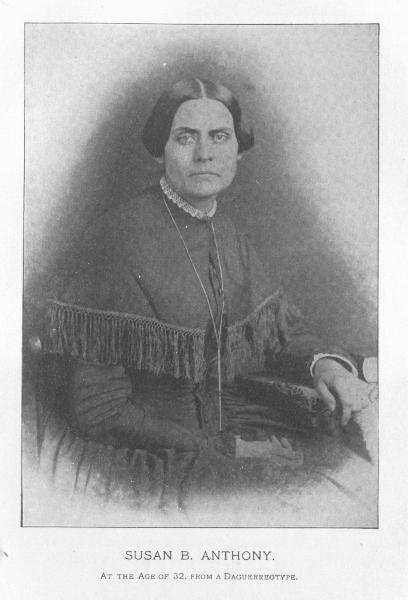
SUSAN B. ANTHONY. AT THE AGE OF 32, FROM A DAGUERREOTYPE.
On this trip Miss Anthony was invited to spend an evening with Mr. and Mrs. Greeley and met for the first time Charles A. Dana, Alice and Phoebe Gary, Elizabeth F. Ellet, with a number of other literary men and women of New York. Mr. Greeley himself opened the door for them and sent them hunting through the house for a place to lay their wraps. After awhile Mrs. Greeley came down stairs with a baby in her arms. She had put her apron over its face and would not let the visitors look at it "because their magnetism might affect it unfavorably." During the evening she rang a bell and a man-servant came in. After a few words with her he retired 087 and presently brought in a big dish of cake, one of cheese and a pile of plates, set them on the table and went out. There was a long pause and Mr. Greeley said, "Well, mother, shall I serve the cake?" "Yes, if you want to." So he went over to the table, took a piece of cake and one of cheese in his fingers, putting them on a plate and carrying to each, until all were served. The guests nibbled at them as best they could and after a long time the man brought in a pitcher of lemonade and some glasses and left the room. Mr. Greeley again asked, "Well, mother, shall I serve the lemonade?" "Yes, if you want to," she replied, so he filled the glasses, carried to each separately, and then gathered them up one at a time, instead of all together on a waiter. Both Mr. and Mrs. Greeley were thoroughly cordial and hospitable, both intellectually great, but utterly without social graces. Yet the conversation at their receptions was so brilliant that the most elegantly served refreshments would have been an unwelcome interruption.
At another time, when Miss Anthony was visiting them, she asked Mrs. Greeley if she would marry the same man again if she were single. "Yes," said she, "if I wanted a worthy father for my children, but for personal comfort I should prefer one who did not put his feet where I fell over them every time I went into the room, who knew how to eat, when to go to bed and how to wear his clothes."
A World's Temperance Convention had been called to meet in New York September 6 and 7, 1853, and a preliminary meeting was held May 12 in Dr. Spring's old Brick Church on Franklin Square, where the Times building now stands. The call invited "all friends of temperance" to be present. After attending the Anti-Slavery Anniversary in New York, Miss Anthony and Emily Clark went as representatives of the New York Woman's Temperance Society, and Abby Kelly Foster and Lucy Stone were sent from Massachusetts. The meeting was organized with Hon. A.C. Barstow, mayor of Providence, chairman; Rev. R.C. Crampton, of New York, and Rev. George Duffield, of Pennsylvania, secretaries. It was opened with prayer, asking God's blessing on the proceedings about 088 to take place. A motion was made that all the gentlemen present be admitted as delegates. Dr. Trail, of New York City, moved that the word "ladies" be inserted, as there were delegates present from the Woman's State Temperance Society. The motion was carried, their credentials received, and every man and woman present became members of the convention. A business committee of one from each State was appointed and a motion was made that Susan B. Anthony, secretary of the Woman's Temperance Society, be added to the committee. This opened the battle with the opposition and one angry and abusive speech followed another. Abby Kelly Foster, the eloquent anti-slavery orator, tried to speak, but shouts of "order" drowned her voice and, after holding her position for ten minutes, she finally was howled down.
Almost the entire convention was composed of ministers of the Gospel. Hon. Bradford R. Wood, of Albany, moved that, as there was a party present determined to introduce the question of woman's rights and run it into the ground, the convention adjourn sine die. He finally was persuaded to withdraw this and substitute a motion that a committee be appointed to decide who were members of the convention, although this had been settled at the opening of the meeting by the accepting of credentials. This committee consisted of Mr. Wood, Rev. John Chambers, a Presbyterian clergyman of Philadelphia, and Rev. Condit, of New Jersey. They were out fifteen minutes and reported that, as in their opinion the call for this meeting was not intended to include female delegates, and custom had not sanctioned the public action of women in similar situations, their credentials should be rejected. And this after they already had been accepted!
Rev. Thomas Wentworth Higginson, pastor of the Unitarian church in Worcester, Mass., at once resigned from the business committee and withdrew from the meeting, as did also the women delegates and such gentlemen, including several ministers, as thought the ladies had been unjustly treated. They met at Dr. Trail's office and decided to call a Whole World's Temperance Convention which should not exclude one-half the 089 world, and that the half which was doing the most effective work for temperance.
After they left the Brick Church meeting there were many speeches made condemning the action of women in taking public part in any reforms, led by Rev. Fowler, of Utica, Rev. Hewitt, of Bridgeport, Conn., and Rev. Chambers. The last said he rejoiced that the women were gone, as they were "now rid of the scum of the convention." Mayor Barstow, who had threatened to resign rather than put the motion that Miss Anthony should be on the business committee, made a speech which the press declared too indecent to be reported. It must be remembered that this entire discussion was founded on the mere proposal to place Miss Anthony on a committee of a temperance meeting. Horace Greeley handled these men without gloves in an article in the Tribune beginning:
Rev. John! We have allowed you to be heard at full length; now you and your set will be silent and hear us. Very palpably your palaver about Mr. Higginson's motion is a dodge, a quirk, a most contemptible quibble, reluctant as we are to speak thus irreverently of the solemn utterances of a Doctor of Divinity. Right well do you know, reverend sir, that the particular form or time or fashion in which the question came up is utterly immaterial, and you interpose it only to throw dust in the eyes of the public. Suppose a woman had been nominated at the right time and in the right way, according to your understanding of punctilios, wouldn't the same resistance have been made and the same row got up? You know right well that there would. Then what is all your pettifogging about technicalities worth? The only question that anybody cares a button about is this, "Shall woman be allowed to participate in your World's Temperance Convention on a footing of perfect equality with man?" If yea, the whole dispute turns on nothing, and isn't worth six lines in the Tribune. But if it was and is the purpose of those for whom you pettifog to keep woman off the platform of that convention and deny her any part in its proceedings except as a spectator, what does all your talk about Higginson's untimeliness and the committee's amount to? Why not treat the subject with some show of honesty?
The women and their friends held a grand rally in the Broadway Tabernacle the second day afterwards. Every foot of sitting and standing room was crowded, although there was an admission fee of a shilling. Miss Anthony presided and there was the strongest enthusiasm, but perfect order was 090 maintained. The following comment was made by the New York Commercial-Advertiser:
THE BATTLE OF THE SEXES.—On Saturday evening the Broadway Tabernacle reverberated with the shrill, defiant notes of Miss Lucy Stone and her "sisters," who have thrown down the gauntlet to the male friends of temperance and declared not literally "war to the knife" but conflict with tongues.... Henceforth the women's rights ladies—including among them the misses, Lucy herself, Emily Clark, Susan B. Anthony, Antoinette Brown, some Harriets and Angelinas, Melissas and Hannahs, with a Fanny too (and more's the pity for it is a sweet name) and sundry matrons whose names are household words in newspapers—are to be in open hostility to the regularly constituted temperance agencies, under cover of association with whom they have contrived to augment their notoriety. The delegates at the Brick Church, who took the responsibility of knocking off these parasites, deserve the thanks of the temperance friends the Union through.... Such associations would mar any cause. Left to themselves such women must fall into contempt; they have used the temperance cause for a support long enough, and we are glad that the seeming alliance has been thus formally disowned by the temperance delegates.
The New York Sun, Moses Beach, editor, said:
The quiet duties of daughter, wife or mother are not congenial to those hermaphrodite spirits who thirst to win the title of champion of one sex and victor over the other. What is the love and submission of one manly heart to the woman whose ambition it is to sway the minds of multitudes as did a Demosthenes or a Cicero? What are the tender affections and childish prattle of the family circle, to women whose ears itch for the loud laugh and boisterous cheer of the public assembly?...
Could a Christian man, cherishing a high regard for woman and for the proprieties of life feel that he was promoting woman's interests and the cause of temperance by being introduced to a temperance meeting by Miss Susan B. Anthony, her ungainly form rigged out in bloomer costume and provoking the thoughtless to laughter and ridicule by her very motions upon the platform? Would he feel that he was honoring the women of his country by accepting as their representatives women whom they must and do despise? Will any pretend to say that women, whose tongues have dishonored their God and their Savior, while uttering praise of infidels and infidel theories, are worthy to receive the suffrages of their Christian sisters?...
We were much pleased with the remark made a few days since by one of the most distinguished as well as refined and polished men of the day on this very subject: "What are the rights which women seek, and have not?" said he; and answering his own question, he replied, "The right to do wrong! that alone is denied to them—that is the only right appropriated exclusively by men, and surely no true woman would seek to divide or participate in such a right."
The Organ, the New York temperance paper, had this to say:
The harmony and pleasantness of the meeting were disturbed by an evidently preconcerted irruption of certain women, who have succeeded beyond doubt in acquiring notoriety, however much they may have failed in winning respect. The notorious Abby Kelly, the Miss Stone whose crusade against the Christian doctrine on the subject of marriage has shocked the better portion of society, and several other women in pantaloons were present insisting upon their right to share in the deliberations of the convention.
We wish our friends abroad to understand that the breeze got up here is nothing but an attempt to ride the woman's rights theory into respectability on the back of Temperance. And what absurd, infidel and licentious follies are not packed up under the general head of woman's rights, it would puzzle any one to say. While, however, we approve the act excluding the women at the Brick Church, we feel bound to say that we regretted what seemed to us an unnecessary acerbity on the part of some of the gentlemen opposing them. What a load of extraneous, foolish and crooked people and things the temperance cause has been burdened with during the years of its progress! To our mind this conspiracy of women to crush the cause by making it the bearer of their woman's rights absurdities, is the saddest of all the phenomena of the reform.
The New York Courier, James Watson Webb, editor, gave its readers the following Sunday article:
Anniversary week has the effect of bringing to New York many strange specimens of humanity, masculine and feminine. Antiquated and very homely females made themselves ridiculous by parading the streets in company with hen-pecked husbands, attenuated vegetarians, intemperate Abolitionists and sucking clergymen, who are afraid to say "no" to a strong-minded woman for fear of infringing upon her rights. Shameless as these females—we suppose they were females—looked, we should really have thought they would have blushed as they walked the streets to hear the half-suppressed laughter of their own sex and the remarks of men and boys. The Bloomers figured extensively in the anti-slavery amalgamation convention, and were rather looked up to, but their intemperate ideas would not be tolerated in the temperance meeting at the Brick Chapel....
A scene of the utmost confusion prevailed and there was a perfect warfare of tongues; but, singular to say, the women were compelled to hold their tongues and depart, followed by a number of male Betties and subdued husbands, wearing the apparel of manhood, but in reality emasculated by strong-minded women....
So the Bloomers put their credentials in their breeches pockets and assembled at Dr. Trail's Cold Water Institute, where the men and Bloomers all took a bath and a drink together.
These sentiments were echoed by the newspapers, great and small, of the entire country. Not a word in regard to "women's rights" had been uttered at the Brick Church meeting except the right to have their credentials from regularly-organized temperance societies accepted, and the same privileges as other delegates granted. The continual reference to the "warfare of tongues" is rather amusing in face of the fact that no woman was allowed to speak and the talking was entirely monopolized by men. Is it a matter of surprise that only a very limited number of women had the courage to ally themselves with a movement which called down upon them and their families such an avalanche of ridicule and condemnation?
Miss Anthony, on reaching home, immediately began active preparations for the first annual meeting of the Woman's State Temperance Society, which was to be held in Rochester. As usual she wrote hundreds of letters, raised the money, printed and circulated the call, looked after the advertising, engaged the speakers and took the whole responsibility. The convention assembled in Corinthian Hall, June 1, 1853, with a large attendance. Elizabeth Cady Stanton, the president, after stating that the society had over 2,000 members, and was in a most flourishing condition, said:
It has been objected that we do not confine ourselves to the subject of temperance, but talk too much about woman's rights, divorce and the church.... We have been obliged to preach woman's rights because many, instead of listening to what we had to say on temperance, have questioned the right of woman to speak on any subject. In courts of justice and legislative assemblies, if the right of any person to be there is questioned, all business waits until that point is settled. Now, it is not settled in the minds of the masses that woman has any right to stand on an even pedestal with man, look him in the face as an equal and rebuke the sins of her day and generation. Let it be clearly understood then that we are a Woman's Rights Society; that we believe it is woman's duty to speak whenever she feels the impression to do so; that it is her right to be present in all the councils of Church and State.
Continuing, she took firm ground in favor of the right of a woman to be divorced from an habitual drunkard, a position which brought upon her a storm of censure from press, pulpit 093 and society. She was strongly supported, however, by the most prominent women of the day and received many letters of approval, among them one from Lucy Stone, saying: "On the divorce question, I am on your side, for the reason that drunkenness so depraves a man's system that he is not fit to be a father." Gerrit Smith wrote to the convention:
I know not why it is not as much the duty of your sex as of mine to establish newspapers, write books and hold public meetings for the promotion of the cause of temperance. The current idea that modesty should hold women back from such services is nonsense and wickedness. Female modesty! female delicacy! I would that I might never again hear such phrases. There is but one standard of modesty and delicacy for both men and women; and so long as different standards are tolerated, both sexes will be perverse and corrupt.... The Quakers are the best people I have ever known, the most serious and chaste and yet the most brave and resisting; but there are no other people who are so little concerned lest women get out of their sphere. None make so little difference between man and woman. Others appear to think that the happiness and safety of the world consist in magnifying the difference. But when reason and religion shall rule, there will be no difference between man and woman, in respect to the intellect, the heart or the manners.
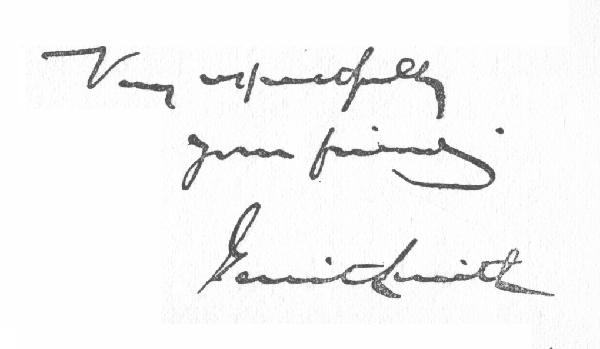
Gerrit Smith
A stirring letter was sent by Neal Dow, expressing his great pleasure that women were taking active and decided measures for the suppression of intemperance, and closing: "It is absurd, therefore, to argue that the community has no power to control this great evil; that any citizen has the right to inflict it upon society, or that society should hesitate to exercise its right and power of self-protection against it."
Many other letters were read from friends, among them Abby Kelly Foster, who said to Miss Anthony: "So far as separate organizations for women's action in the temperance cause are concerned, I consider you the center and soul, without whom nothing could have been done heretofore and I doubt whether anything would be done now." Strong addresses were made by Rev. Channing, Frederick Douglass, Lucy Stone, Mrs. Nichols, Antoinette Brown, Mrs. Bloomer and others. 094
When this association was formed a clause was placed in the constitution allowing men to become members and to speak in all meetings but making them ineligible to office. There were two reasons for this: it was desired to throw the full responsibility on woman, compelling her to learn to preside and to think, speak and act for herself, which she never would do if men were present to perform these duties for her; and it was feared that, on account of long habit, men would soon take matters into their own hands and gain control of the society, possibly to the extent of forbidding women to speak at the meetings. Many of the ladies, however, objected to this clause, among them Antoinette Brown, who refused to join the society on account of it. So, yielding to the pressure, Mrs. Stanton, on this first anniversary, said "as this seemed to many a violation of men's rights, and as the women had now learned to stand alone, it might perhaps be safe to admit men to all the privileges of the society, hoping, however, that they would modestly permit woman to continue the work she had so successfully begun."
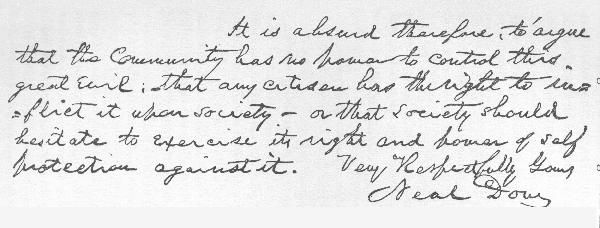
Neal Dow
Miss Anthony, chairman of the committee on revising the 095 constitution, brought in a report in favor of admitting the men, which was vigorously discussed. Before the close of this meeting the serious mistake of such action was apparent. The men present monopolized the floor, tried to have the name changed to the People's League, insisted that the society should have nothing to do with any phase of woman's rights, and showed their hand so plainly that Miss Anthony at once took the alarm and in an indignant speech declared the men were trying to drive the women from their own society.
There was a strong undercurrent of opposition to Mrs. Stanton on account of her radical views in regard to equal rights, divorce for drunkenness and the subjection of woman to Bible authority, but those opposing her being wholly inexperienced did not know how to prevent her re-election. As the majority of the men, for obvious reasons, agreed with them in wishing to get rid of Mrs. Stanton, they proceeded to teach them political tactics, got out a printed opposition ticket and defeated her for president by three votes. She was chosen vice-president but emphatically declined. Miss Anthony was almost unanimously re-elected secretary but refused to serve, stating that "the vote showed they would not accept the principle of woman's rights and, as she believed thoroughly in standing for the equality of woman, she could not act as officer of such a society; besides, Mrs. Vaughn, the newly elected president, had openly declared that 'principle must sometimes be sacrificed to expediency.' She herself would never admit this; her doctrine was, 'Do right, and leave the consequences with God.'" Frederick Douglass and a number of others urged her in the most earnest manner to remain, paying high tribute to her services and pointing out how much they were needed, but in vain.
Miss Anthony and Mrs. Stanton at once severed all connection with the organization they had founded; it passed into the hands of a body of conservative women, who believed they could accomplish by prayer what these two knew never could be done except through legislation with a constituency of women behind it. The society had a precarious existence of 096 one or two years and finally went to pieces. There was not another strong, concerted movement of women in the cause of temperance for twenty years.[18] Miss Anthony, although a total abstainer all her life, was never again connected with a temperance organization. She has steadfastly held to the opinion that the vital work for women is to secure for themselves the ballot which, above all other agencies, will make them an effective power for dealing not only with this but with all moral questions.
Relieved from her onerous duties in connection with the State society, she at once set about working up the Whole World's Temperance Convention in New York, for which she felt a personal responsibility. Many of those who had seceded from the Brick Church meeting, including Mr. Higginson himself, were beginning to doubt the propriety of holding a separate convention. Miss Anthony was strongly in favor of it and wrote Lucy Stone:
We have not the slightest reason for supposing that we shall be received at the World's Convention to be held September 5. The same men that controlled the Brick Church meeting are to be the leading spirits there. Not one of them, so far as I can learn, has expressed a regret that the women-delegates were excluded last May; how then can we entertain a hope that they will act differently in September? We may pretend to go in good faith but there will be no faith in us. If it is not too late I beg of you to see that the call is issued and for the very day that the Old Fogies hold their convention.
Lucy Stone agreed with her and, through their efforts, the committee were persuaded to send out the call. It was decided, however, to hold the meeting September 1 and 2, just before the other, and then, while the great crowds from all parts of the country were in the city, to have a regular Woman's Rights Convention on the same date as that of Rev. John Chambers et al. Miss Anthony received many cordial replies to her numerous letters, and some not so cordial. Samuel F. Gary wrote in his characteristic style: "You ask whether I will speak at a Whole World's Temperance Convention to be held in New York during the World's Fair. You 097 will have observed that my humble name is signed to a call for such a convention at that time and place, together with Chancellor Walworth's and others of like distinction. Providence favoring, it is my purpose to participate in the deliberations of that meeting and I see no sufficient reason for another convention having the same object in view." Possibly if Mr. Gary and "others of like distinction" had been refused permission to speak a word or even to serve on a committee, they might have been able to see "sufficient reason for another convention." Horace Greeley sent the following:
I may not be able to write you a long letter, as you request, but I will give you a little confidential advice. All I know on temperance (pretty nearly) I put into a tract which was long ago printed at the Organ office.... Now, as to tracts: Make it your first rule to Be Thorough. Most of our temperance tracts are too short and flimsy and not calculated to convince reasoning beings. Let each tract take up some one aspect of the question and exhaust it, none of your fly-away five or six pages but from twelve to thirty-two, the whole case presented in all its aspects and proved up. Nothing less than this will do much good.
Now as to church matters: The short and safe way is simply to set them aside. If those who have outgrown the church do not introduce the subject by treading on the old lady's corns, they can effectually resist all interposition of shibboleths by the followers of Pusey in all sects. Do not make the reform movement a pretext for assaulting the church. In short, the whole question with regard to the woman's movement is best solved by those engaged in it going quietly and effectively on with their work. That will soonest stop the mouths of gainsayers. "It does move, though," is the true answer to all cavils.
I can't be at your convention, and Mrs. Greeley is overwhelmed with moving and babies.
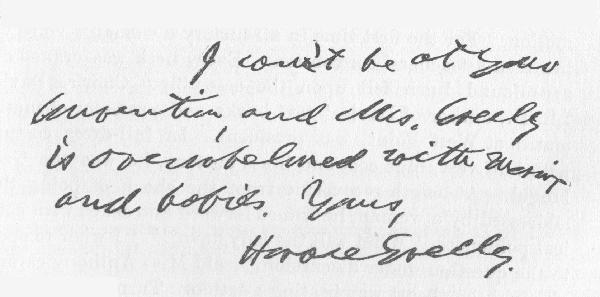
Horace Greeley
While Miss Anthony was thus engaged, the State Teachers' Convention was held in Corinthian Hall, Rochester, August 3, 1853, and true to her resolve made the year previous she put aside everything else in order to attend. According to the rules any one paying a dollar was entitled to all the rights and privileges of the convention; so she paid her dollar and took her seat. There were over 500 teachers in attendance, two-thirds at least being women. For two entire days Miss Anthony sat there, and during that time not a woman spoke; in all the deliberations there was not the slightest recognition of their presence, and they did not vote on any question, though all had paid the fee and were members of the association. In a letter describing the occasion Miss Anthony said: "My heart was filled with grief and indignation thus to seethe minority, simply because they were men, presuming that in them was vested all wisdom and knowledge; that they needed no aid, no counsel from the majority. And what was most humiliating of all was to look into the faces of those women and see that by far the larger proportion were perfectly satisfied with the position assigned them."
Toward the close of the second day's session the subject under discussion was, "Why the profession of teacher is not as much respected as that of lawyer, doctor or minister?" After listening for several hours, Miss Anthony felt that the decisive moment had come and, rising in her seat, she said, "Mr. President." A bombshell would not have created greater commotion. For the first time in all history a woman's voice was heard in a teachers' convention. Every neck was craned and a profound hush fell upon the assembly. Charles Davies, LL. D., author of Davies' text books and professor of mathematics at West Point, was president. In full-dress costume with buff vest, blue coat and brass buttons, he was the Great Mogul. At length recovering from the shock of being thus addressed by a woman, he leaned forward and asked with satirical politeness, "What will the lady have?" "I wish to speak to the question under discussion," said Miss Anthony calmly, although her heart was beating a tattoo. Turning to the few 099 rows of men in front of him, for the women occupied the back seats, he inquired, "What is the pleasure of the convention?" "I move she shall be heard," said one man; this was seconded by another, and thus was precipitated a debate which lasted half an hour, although she had precisely the same right to speak as any man who was taking part in the discussion.
She stood during all this time, fearing to lose the floor if she sat down. At last a vote was taken, men only voting, and it was carried in the affirmative by a small majority. Miss Anthony then said: "It seems to me you fail to comprehend the cause of the disrespect of which you complain. Do you not see that so long as society says woman has not brains enough to be a doctor, lawyer or minister, but has plenty to be a teacher, every man of you who condescends to teach, tacitly admits before all Israel and the sun that he has no more brains than a woman?"—and sat down. She had intended to draw the conclusion that the only way to place teaching upon a level with other professions was either to admit woman to them or exclude her from teaching, but her trembling limbs would sustain her no longer.
The convention soon adjourned for the day and, as Miss Anthony went out of the hall, many of the women drew away from her and said audibly: "Did you ever see such a disgraceful performance?" "I never was so ashamed of my sex." But a few of them gathered about her and said: "You have taught us our lesson and hereafter we propose to make ourselves heard."
The next day, at the opening of the morning session, President Davies, who had evidently spent the night in preparing the greatest effort of his life, arose in all his majesty and was delivered of the following:
I have been asked why no provisions have been made for female lecturers before this association and why ladies are not appointed on committees. I will answer: "Behold this beautiful hall! Mark well the pilaster, its pedestal, its shaft, its rich entablature, the crowning glory of this superb architecture, the different parts, each in its appropriate place, contributing to the strength, beauty and symmetry of the whole! Could I aid in bringing down this splendid entablature from its proud elevation and trailing it in the dust and dirt that surround the pedestal? No, never!"
To quote further from Miss Anthony's letter: "Many of the ladies readjusted their ribbons and laces and looked at each other as much as to say, 'Beautiful, perfectly beautiful!' But a few there were whose faces spoke scorn and utter contempt, and whose flashing eyes said: 'Such flattery as this adds insult to injury upon those of us who, equally qualified with men, are toiling side by side with them for one-half the salary. And this solely because of our sex!'"
The women had no desire to pull down the building, entablature and all, about the head of the magnificent Davies, but some of them were aroused to the injustice with which they had so long been treated. To the astonishment of the professor and his following, these resolutions were presented by Mrs. Northrop, a teacher in the Rochester schools:
Resolved, That this association recognizes the right of female teachers to share in all the privileges and deliberations of this body.
Resolved, That female teachers do not receive an adequate and sufficient compensation, and that, as salaries should be regulated only according to the amount of labor performed, this association will endeavor by judicious and efficient action to remove this existing evil.
An attempt was made to smother them, and when Mrs. Northrop asked why they had not been read, the president blandly replied that he regretted they could not be reached but other order of business preceded them. Mrs. Northrop, having found her voice, proceeded to speak strongly on the discrimination made against women in the matter of salaries, and was ably supported by her sister, Mrs. J.R. Vosburg. J. D. Fanning, of New York, recording secretary, asked that the resolutions be read, which was done. Miss Anthony then made a forcible speech in their favor and they were passed unanimously, to the utter amazement and discomfiture of President Davies.
She went home well satisfied with her work, and completed preparations for the Whole World's Temperance Convention, which was held in New York, September 1 and 2. Her zeal is amusingly illustrated by her proposal to invite Victor Hugo and Harriet Martineau to speak. It was a splendid assemblage, 101 addressed by the leading men and women of the day, the large hall packed at every session, the audience sitting hour after hour, orderly but full of earnestness and enthusiasm. The New York Tribune said of it: "This has been the most spirited and able meeting on behalf of temperance that ever was held."
The men's convention has a different record. New York, in the month of September, 1853, was in a whirlwind of excitement. The first World's Fair of the United States was in progress and people had gathered from all parts of this and other countries. In order to reach these crowds, many conventions had been called to meet in this city, among them the two Temperance, the Anti-Slavery and the Woman's Rights. The Whole World's Temperance and the Anti-Slavery closed just in time for the opening of the World's Temperance and the Woman's Rights meetings. Rev. Antoinette Brown was appointed a delegate from two different societies to the World's Temperance Convention and, although they had every reason to believe that no woman would be received, it was decided to make the attempt in order to show their willingness to co-operate with the men's associations in temperance work.
Wendell Phillips accompanied her to Metropolitan Hall, where she handed her credentials to the secretary and, after they were passed upon, the president, Neal Dow, informed her that she was a member of the convention. Later, when she arose to speak to a motion, he invited her to the platform and then pandemonium broke loose. There were cries of "order," "order," hisses, shouts of "she shall not speak," and above all the voice of Rev. John Chambers, who, pointing his finger at her, cried over and over, "Shame on the woman!" Miss Brown stood an hour and a half on the platform, in the midst of this bedlam, not because she was anxious to speak, but to establish the principle that an accredited delegate to a world's convention should not be denied the right of speech on account of sex; but she was finally compelled to leave the hall.
Win. Lloyd Garrison said: "I have seen many tumultuous meetings in my day, but on no occasion have I ever seen anything 102 more disgraceful to our common humanity." Samuel F. Gary led in the opposition to Miss Brown, offering a resolution that "women be not allowed to speak," and afterwards declaring in his paper that he did it "because she tried to force the question of woman's rights upon the convention." To this Rev. William Henry Channing replied in a public address: "If any man says that, he lies. She stood there simply asking her privilege as a delegate." The New York Tribune said: "This convention has completed three of its four business sessions and the results may be summed up as follows: First day—Crowding a woman off the platform; second day—Gagging her; third day—Voting that she shall stay gagged. Having thus disposed of the main question, we presume the incidentals will be finished this morning."
This was not an exaggerated statement, as practically nothing was done during the three days of the convention except to fight over the question of allowing Miss Brown, an accepted delegate, an ordained minister, a young, beautiful and modest woman, to stand upon their platform and speak on the subject of temperance. Miss Anthony was a witness to these proceedings, her Quaker blood rose to the boiling point and she registered anew a solemn vow within herself that she never would relax her efforts for one single day, if it took a lifetime, until woman had the right of speech on every platform in the land.
The mob which had begun with the anti-slavery and gathered strength at the temperance meeting, now turned its attention to the Woman's Rights Convention in Broadway Tabernacle. The president was that lovely Quaker, Lucretia Mott, and the speakers were among the greatest men and women in the nation: Wm. Lloyd Garrison, Wendell Phillips, Rev. Channing, Rev. John Pierpont, Mrs. Rose, Lucy Stone, Frances D. Gage, Miss Brown, Mrs. Nichols. In Miss Anthony's address she reviewed the action of the recent teachers' convention at Rochester and closed by saying: "A woman principal in that city receives $250, while a man principal, doing exactly the same work, receives $650. In this State there are 11,000 teachers and of these four-fifths are women. By the reports it will 103 be seen that of the annual State fund of $800,000, two-thirds are paid to men and one-third to women; that is to say, two-thirds are paid to one-fifth of the laborers, and the other four-fifths are paid with the remaining one-third of the fund!" This was the first appearance of Madame Mathilde Anneke, a highly-educated German of noble family, a political exile from Hungary, and a friend of Kossuth. That wonderful colored woman, Sojourner Truth, also was present.
The resolutions were, in effect, that "each human being should be the judge of his or her sphere and that human rights should be recognized." There never were, there never will be, grander speeches than those which were made on this occasion, and yet the entire convention was in the hands of a mob. The women, as well as the men, were greeted with cries of "shut up," "sit down," "get out," "bow-wow," "go it, Susan," and their voices drowned with hisses and cat-calls. The uproar was indescribable, with shouting, yelling, screaming, bellowing, stamping and every species of noise that could be made. Horace Greeley went down among the crowd and tried to quiet them. The police were appealed to in vain, and the meeting finally closed in the midst of tumult and confusion. The Tribune under the management of Greeley, and the Evening Post under that of William Cullen Bryant, condemned the rioters with the greatest severity, but the other leading dailies of New York sustained the mob spirit and made the ladies a target for ridicule and condemnation.
After leaving New York, Miss Anthony went to the Fourth National Woman's Rights Convention at Cleveland, O., which was one of the largest and most enthusiastic that had been held. It was attended by many noted people, among them Hon. Joshua R. Giddings, always a consistent advocate of woman's rights, and the proceedings were marked with perfect order and propriety. Miss Anthony was continued at the head of the finance committee, as it was found that no one could raise so much money. The three weeks following she traveled through the southern counties in New York and spoke in a number of villages. A year before she had gone 104 over the same ground and organized woman's temperance societies. She found that, with the exception of one at Elmira, none of these was in existence. The explanation in every instance was that they had no money to secure lecturers, or to do any practical work and, as all the members were wives and housekeepers, they were not in a position to earn any. Miss Anthony makes this entry in her journal:
Thus as I passed from town to town was I made to feel the great evil of woman's utter dependence on man for the necessary means to aid reform movements. I never before took in so fully the grand idea of pecuniary independence. Woman must have a purse of her own, and how can this be so long as the law denies to the wife all right to both the individual and the joint earnings? Reflections like these convince me that there is no true freedom for woman without the possession of equal property rights, and that these can be obtained only through legislation. If this is so, then the sooner the demand is made, the sooner it will be granted. It must be done by petition, and this, too, of the very next legislature. How can the work be started? We must hold a convention and adopt some plan of united action.
With her, to think was always to act. She reached Rochester on the morning of election day, and went at once to the home of William and Mary Hallowell, that home whose doors never were closed to her, where for more than fifty years she was welcome day or night, where she always turned for advice, assistance and sympathy and ever found them in the fullest measure. She explained to them her idea of calling a meeting in Rochester for the specific purpose of starting a petition for more extended property rights to women. They encouraged the project, and she then turned toward her other Mecca, the home of Maria G. Porter. Three of the Porter sisters kept a private school in this city for thirty years, while the eldest, Maria, made a home for them and also took a select class of boarders. This was a literary center, she often invited Miss Anthony to meet her distinguished guests, and ever encouraged and sustained her public work. Mr. Channing was boarding here, and when Miss Anthony unfolded her plan, he exclaimed, "Capital! Capital!" and at once prepared an eloquent call for the convention. This meant for her the writing of letters to scores of influential people asking their signatures, 105 which were almost invariably given, and was followed by all the drudgery necessary for every meeting of this kind.
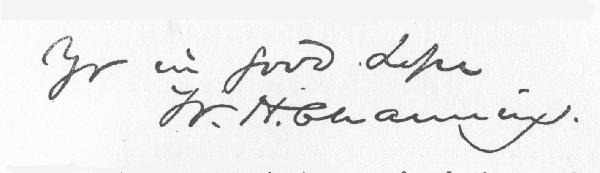
W.H. Channing
The convention opened Nov. 30 at Corinthian Hall, Rev. May presiding and Rev. Channing the leading spirit. Two forms of the petition were adopted, one for the just and equal rights of women in regard to wages and children; the other for the right of suffrage. Miss Anthony was appointed one of the lecturers, and also put in charge of the petitions. Sixty women began circulating these, and she herself canvassed her own city, lectured in a number of towns, and at the same time made arrangements for a State suffrage convention to be held in Albany February 14 and 15. At this time Parker Pillsbury wrote to Lydia Mott:
Is there work down among you for Susan to do? Any shirt-making, cooking, clerking, preaching or teaching, indeed any honest work, just to keep her out of idleness! She seems strangely unemployed—almost expiring for something to do, and I could not resist the inclination to appeal to you, as a person of particular leisure, that an effort be made in her behalf. At present she has only the Anti-Slavery cause for New York, the "Woman's Rights Movement" for the world, the Sunday evening lectures for Rochester and other lecturing of her own from Lake Erie to the "Old Man of Franconia mountains;" private cares and home affairs and the various et ceteras of womanity. These are about all so far as appears, to occupy her seven days of twenty-four hours each, as the weeks rain down to her from Eternal Skies. Do pity and procure work for her if it be possible!
Considerable space has been given to detailed accounts of these early conventions to illustrate the prejudice which existed against woman's speaking in public, and the martyrdom suffered by the pioneers to secure the right of free speech for succeeding generations. From this time until the merging of all questions into the Civil War, such conventions were held every year, producing a great revolution of sentiment in the direction of an enlarged sphere for woman's activities and a modification of the legal and religious restraints that so long had held her in bondage. They have been fully described also in order to indicate some of the causes which operated in the development of the mind and character of Susan B. Anthony, transforming her by degrees from a, quiet, domestic Quaker maiden to a strong, courageous, uncompromising advocate of absolute equality of rights for woman. Brought into close association with the most advanced men and women of the age, seeing on every hand the injustice perpetrated against her sex and hearing the magnificent appeals for the liberty of every human being, her soul could not fail to respond; and having passed the age when women are apt to consecrate themselves to love and marriage, it was most natural that she should dedicate her services to the struggle for the freedom of woman. She did not realize then that this would reach through fifty years of exacting and unending toil, but even had she done so, who can doubt that she freely would have given up her life to the work? 108
In the ten weeks before the State convention at Albany, 6,000 names were secured for the petition that married women should be entitled to the wages they earned and to the equal guardianship of their children, and 4,000 asking for the suffrage. Miss Anthony herself trudged from house to house during that stormy winter, many of the women slamming the door in her face with the statement that they "had all the rights they wanted;" although at this time an employer was bound by law to pay the wife's wages to the husband, and the father had the power to apprentice young children without the mother's consent, and even to dispose of them by will at his death. One minister, in Rochester, after looking her over carefully, said: "Miss Anthony, you are too fine a physical specimen of woman to be doing such work as this. You ought to marry and have children." Ignoring the insult, she replied in a dignified manner: "I think it a much wiser thing to secure for the thousands of mothers in this State the legal control of the children they now have, than to bring others into the world who would not belong to me after they were born."
The State convention met in Association Hall, Albany, February 14, 1854. Elizabeth Cady Stanton, president, delivered a magnificent address which Miss Anthony had printed and laid upon the desk of every member of the Legislature; she also circulated 50,000 of these pamphlets throughout the State. The convention had been called for two days, but so great was the interest aroused and so popular were the speakers in attendance that evening meetings were held for two weeks; the questions under consideration were taken up by the newspapers of Albany and the discussion spread through the press of the State, finding able defenders as well as bitter opponents. A peculiar illustration of the uncertain disposition of an audience was here given. While in other places women had been prevented from speaking, now they would not hear any but women, and whenever Mr. Channing or Mr. May attempted to speak he was at once cried down in a good-natured but effective manner. The women were greatly distressed at this, 109 as these men had been their strongest allies, their leaders, their educators; but their appeals to the audience to listen to masculine eloquence were made in vain.
The petitions with their 10,000 names were presented in the Assembly, and strongly advocated by Mr. Peters, and Mr. D. P. Wood, of Onondaga county, but vehemently opposed by Mr. Burnett, of Essex. In his speech against the petition asking only that married women might possess their own wages and have equal guardianship of their children, he said:
I hope before even this motion is put, gentlemen will be allowed to reflect upon the important question whether these individuals deserve any consideration at the hands of the Legislature. Whatever may be their pretensions or their sincerity, they do not appear satisfied with having unsexed themselves, but they desire to unsex every female in the land and to set the whole community ablaze with unhallowed fire. I trust, sir, the House may deliberate before we suffer them to cast their firebrand into our midst. True, as yet, there is nothing officially before us, but it is well known that the object of these unsexed women is to overthrow the most sacred of our institutions, to set at defiance the divine law which declares man and wife to be one, and establish on its ruins what will be in fact and in principle but a species of legalized adultery.
It is, therefore, a matter of duty, a duty to ourselves, to our consciences, to our constituents and to God, who is the source of all law and of all obligations, to reflect long and deliberately before we shall even seem to countenance a movement so unholy as this. Are we, sir, to give the least countenance to claims so preposterous, disgraceful and criminal as are embodied in this address? Are we to put the stamp of truth upon the libel here set forth, that men and women in the matrimonial relation are to be equal? We know that God created man as the representative of the race; that after his creation, his Creator took from his side the material for woman's creation; and that, by the institution of matrimony, woman was restored to the side of man, and they became one flesh and one being, he the head....
But we are now asked to have the ordinance of matrimony based on jealousy and distrust; and, as in Italy, so in this country, should this mischievous scheme be carried out to its legitimate results, we, instead of reposing safe confidence against assaults upon our honor in the love and affection of our wives, shall find ourselves obliged to close the approaches to those assaults by the padlock.
The petitions were referred to a select committee of the Senate and the Assembly, which Miss Anthony addressed. The Albany Argus reported her speech as follows:
Miss Anthony said that she appeared on behalf of the signers of the petitions 110 and tendered to the Legislature thanks for the courteous manner in which they had been received. They asked that husband and wife should be tenants in common of property, but with a partition upon the death of one; that a wife should be competent to discharge trusts and powers, the same as a single woman; that the statute in respect to married women's property should be made effectual, and the wife's property descend as though she had been unmarried; that married women should be entitled to execute letters testamentary and of administration; that they should have power to make contracts and transact business; that they should be entitled to their own earnings, subject to their proportionate liability for support of children; that post nuptial acquisitions should belong equally to husband and wife; that married women should stand on the same footing with single as parties or witnesses in legal proceedings; that they should be equal guardians of their minor children; that the homestead should be inviolable and inalienable for widows and their children; that laws in relation to divorce should be revised, and habitual drunkenness be made cause of absolute divorce; that the preference of males in descent of real estate should be abolished; that women should exercise the right of suffrage, be eligible to all offices, occupations and professions, entitled to act as jurors, eligible to employment in public offices; that a law should be passed extending the masculine designation in all statutes to females.
The committee, James L. Angle, of Monroe county, chairman, presented a dignified and respectful report, denying the petition for suffrage but recommending that the laws be so changed as to allow the wife to collect and control her own earnings if the family were neglected by the husband, and to require the written consent of the mother to the apprenticeship of her children. The Legislature, however, refused to pass such a bill, as did all succeeding Legislatures until 1860.
There was nothing but to go to work again, for Miss Anthony and her co-laborers were determined not to relax their efforts until the obnoxious laws against women were repealed. It was at this rallying of the forces and renewing of the attack that Mr. Channing declared Miss Anthony to be "the Napoleon of the movement," a title so appropriate that it has clung to her to the present day. She had now thoroughly systematized the work in New York and was appointed general agent. It was decided to hold a series of conventions throughout the state for the purpose of rolling up mammoth petitions to present to the Legislature every session until they should be granted. Two strong appeals, one written by Mrs. Stanton and one by Mr. Channing, were widely circulated and a large 111 corps of able speakers was engaged. All this work the State committee assigned to Miss Anthony, but did not provide her with one dollar to pay expenses.
For many years thereafter she canvassed the State annually; held meetings, organized societies and secured thousands of signatures, without any guaranteed fund. Not only did she give all her time and perform far greater labor than any other person engaged in this movement, but she also took the whole financial responsibility. The anxiety of this hardly can be imagined, but she was seldom discouraged, never daunted. Her father had repaid the few hundred dollars she had loaned him from her slender earnings as teacher in the days of his adversity, and these she used freely without expectation of replacing them. She never hesitated because she had not money but went boldly forward, trusting to collections and contributions to pay expenses. Sometimes she came out even, sometimes behind. In the latter case she sent at once to her father who supplied the necessary funds, which were repaid when there was a surplus. Had she waited to have the money in hand, had she feared to take the chances, her work never would have been done; and unless some one else had been developed who could and would assume the risk and manage the business part of the State campaigns, the progress of woman, slow as it has been, would have been still longer delayed. The one ruling characteristic of her life ever has been courage, moral and physical. There never have been hardships which she feared to endure, never scorn, ridicule or abuse which she did not dare face. While she might have risen to a high position and commanded a large salary as teacher, or have lived at home in restful comfort, she voluntarily chose the hardest field of work the world offered, one shadowed with obloquy, holding out no prospect of money or fame and no hope of success except through long and bitter conflict.
Soon after the Albany convention Lucy Stone wrote: "God bless you, Susan dear, for the brave heart that will work on even in the midst of discouragement and lack of helpers. Everywhere I am telling people what your State is doing, and 112 it is worth a great deal to the cause. The example of positive action is what we need.... Does not Channing deserve the blessing of all the race for his fidelity to the cause of women? I believe he understands better than any others, unless it be Higginson and Phillips, just what we need. Give my love and best wishes to the household of faith." Channing, when she wanted him to preside at a meeting, answered facetiously: "Napoleon will not be surprised that a corporal of an awkward squad hesitates to appear in command where the general-in-chief is present."
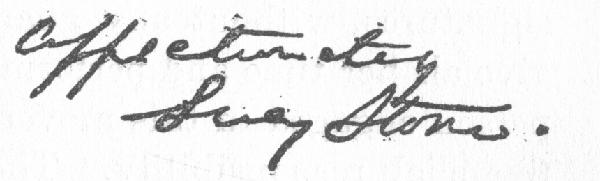
Lucy Stone
It was at the close of this Albany convention that Miss Anthony decided to abandon the Bloomer costume. The subject had been occupying her sleeping and waking hours for some time, and it was only after a long and agonizing struggle that she persuaded herself to take the step. In order to show how very serious a question this had been with the women, it will be necessary to go into a somewhat detailed account of this first movement toward dress reform.
The costume consisted of a short skirt and a pair of Turkish trousers gathered at the ankle or hanging straight, and was made of ordinary dress materials. It was first introduced at the various "water cures" to relieve sick and delicate women, often rendered so by their unhealthful mode of dress, and was strongly recommended in the "water cure" journals. When women began to go into public work, they could not fail to recognize the disadvantages of the unyielding corsets, heavy, quilted and stiffly-starched petticoats, five or six worn at one time to hold out the long, voluminous dress skirts; and to feel that to be consistent they must give freedom to the body. The proprietors of the "water cures" were, for the most part, in touch with all reform movements and their hospitality was freely extended to those engaged in them. In this way the women had an opportunity to see the comfort which the patients enjoyed in their loose, short garments, and began to ask why they also should not adopt what seemed to them a rational dress. 113
Hon. Gerrit Smith, of Peterboro, N.Y., the wealthy and influential reformer and philanthropist, became an earnest advocate of this costume, and his daughter, Elizabeth Smith Miller, a beautiful and fashionable woman, was the first to put it on. In Washington she wore it, made of the most elegant materials, during all her father's term in Congress. She was soon followed by his cousin, Elizabeth Cady Stanton, and with this social sanction it was adopted in 1851 and '52 by a small number, including Lucy Stone, Amelia Bloomer, Dr. Harriet Austin, Celia Burleigh, Charlotte Wilbour, the Grimké sisters, probably less than one hundred in the whole country. In order to be entirely relieved from the care of personal adornment, they also cut off their hair. Miss Anthony was the very last to adopt the style. In May, 1852, she wrote Lucy Stone that Mrs. Stanton had offered to make her a present of the costume, but she would not wear it. In December she wrote again, dating her letter from Mrs. Stanton's nursery, "Well, at last I am in short skirt and trousers!" At this time she also sacrificed her abundant brown tresses.
The world was not ready for this innovation. There were no gymnasiums or bicycles to plead for the appropriateness of the costume and it was worn chiefly by women who preached doctrines for which the public was no better prepared than for dress reform. The outcry against it extended from one end of the country to the other; the press howled in derision, the pulpit hurled its anathemas and the rabble took up the refrain. On the streets of the larger cities the women were followed by mobs of men and boys, who jeered and yelled and did not hesitate to express their disapproval by throwing sticks and stones and giving three cheers and a tiger ending in the loudest of groans.[19] Sometimes these demonstrations became so violent 114 that the women were obliged to seek refuge in a store and, after the mob had grown tired of waiting and dispersed, they would slip out of the back door and find their way home through the alleys. Their husbands and children refused to be seen with them in public, and they were wholly ostracized by other women. Mrs. Bloomer was at this time publishing a paper called the Lily, which was the organ for the reforms of the day. Its columns were freely used to advocate the short dress, the paper thus became the target of attack and, because the costume had no distinctive name, it was christened with that of the editor, much to her grief. Later a substitute for the trousers was adopted, consisting of high shoes with buttoned gaiters fitting in the tops and extending up over the leg, and an effort was made to change the name to the "American costume," but the people would not have it and "Bloomer" it will remain for all time. An extract from one of her unpublished letters will show how all the women felt on this subject. After protesting against connecting it with the question of woman's rights, she says:
It is only one of our rights to dress comfortably. Many have put on the short dress who have never taken any part in the woman's rights movement and who have no idea they are going to be any less womanly by such a change. I feel no more like a man now than I did in long skirts, unless it be that enjoying more freedom and cutting off the fetters is to be like a man. I suppose in that respect we are more mannish, for we know that in dress, as in all things else, we have been and are slaves, while man in dress and all things else is free. I admit that we have "got on the pantaloons," but I deny that putting them on is going to make us any the less womanly or any the more masculine and immodest. On the contrary, I feel that if all of us were less slaves to fashion we would be nobler women, for both our bodies and minds are now rendered weak and useless from the unhealthy and barbarous style of dress adopted, and from the time and thought bestowed in making it attractive. A change is demanded and if I have been the means of calling the attention of the public to it and of leading only a few to disregard old customs and for once to think and act for themselves, I shall not trouble myself about the false imputations that may be cast upon me.

Amelia Bloomer
Mrs. Bloomer wore the costume eight years, but very few held out one-fourth of that time. With the exception of Gerrit 115 Smith, all the prominent men, Garrison, Phillips, Channing, May, were bitterly opposed to the short dress and tried to dissuade the women from wearing it by every argument in their power. The costume, however, was adopted as a matter of principle, and for it they suffered a martyrdom which would have made burning at the stake seem comfortable. It requires far more heroism to bear jibes and jeers for one's personal appearance than for one's opinions. No pen can describe what these women endured for the two or three years in which they tried to establish this principle, through such sacrifices as only a woman can understand. So long as they were upheld by the belief that they were giving strength to the cause they loved, they bravely submitted to the persecution, but when they realized that they were injuring instead of helping it, endurance reached its limit. Mrs. Stanton was the first to capitulate, and as she had tried to induce the others to wear the costume so she endeavored to persuade them to abandon it. She wrote to Miss Anthony and Lucy Stone: "I know what you must suffer in consenting to bow again to the tyranny of fashion, but I know also what you suffer among fashionable people in wearing the short dress; and so, not for the sake of the cause, nor for any sake but your own, take it off! We put it on for greater freedom, but what is physical freedom compared with mental bondage?" In agony of spirit as to whether the cause was helped or hindered by wearing it, and ready to put aside all personal feeling in the matter, Miss Anthony appealed to Lucy Stone, who answered:
Now, Susan, it is all fudge for anybody to pretend that a cause which deserves to live is impeded by the length of your skirt. I know, from having tried through half the Union, that audiences listen and assent just as well to one who speaks truth in a short as in a long dress; but I am annoyed to death by people who recognize me by my clothes, and when I travel get a seat by me and bore me for a whole day with the stupidest stuff in the world. Then again, when I go to each new city a horde of boys pursue me and destroy all comfort. I have bought a nice new dress, which I have had a month, and it is not made because I can't decide whether to make it long or short. Not that I think any cause will suffer, but simply to save myself a great deal of annoyance and not feel when I am a guest in a family that they are mortified if other persons happen to come in. I was at Lucretia Mott's a few weeks 116 ago, and her daughters took up a regular labor with me to make me abandon the dress. They said they would not go in the street with me, and when Grace Greenwood called and others like her, I think it would have been a real relief to them if I had not been there. James and Lucretia defended me bravely.
This was received by Miss Anthony while at the Albany convention, and she wrote:
Your letter caused a bursting of the floods, long pent up, and after a good cry I went straight to Mrs. Stanton and read it to her. She has had a most bitter experience in the short dress, and says she now feels a mental freedom among her friends that she has not known for two years past. If Lucy Stone, with all her power of eloquence, her loveliness of character, who wins all that hear the sound of her voice, can not bear the martyrdom of the dress, who can? Mrs. Stanton's parting words were, "Let the hem out of your dress to-day, before to-morrow night's meeting." I have not obeyed her but have been in the streets and printing offices all day long, had rude, vulgar men stare me out of countenance and heard them say as I opened the door, "There comes my Bloomer!" O, hated name! I have been compelled to attend to all the business here, as at Rochester. There every one knew me, knew my father and brother, and treated me accordingly, but here I am known only as one of the women who ape men—coarse brutal men! Oh, I can not, can not bear it any longer.
To this Lucy Stone replied:
I am sure you are all worn out or you would not feel so intensely about the dress. I never shed a tear over it in my life or came within a thousand ages of martyrdom on account of it; and to be compelled to travel in rain and snow, mud and dirt, in a long dress would cost me more in every respect than the short dress ever did. I don't think I can abandon it, but I will have two skirts. I have this feeling: Women are in bondage; their clothes are a great hindrance to their engaging in any business which will make them pecuniarily independent, and since the soul of womanhood never can be queenly and noble so long as it must beg bread for its body, is it not better, even at the expense of a vast deal of annoyance, that they whose lives deserve respect and are greater than their garments should give an example by which woman may more easily work out her own emancipation?... It is a part of the "mint, anise and cumin," and the weightier matters of justice and truth occupy my thoughts more.
She did abandon the costume, however, before the year was ended, as did most of the others. The establishment of gymnasiums and the encouragement of athletic sports among women eventually made a short dress an acknowledged necessity, 117 and the advent of the bicycle so thoroughly swept away the old prejudice that the word "Bloomers" no longer strikes terror to the heart, nor does the wearing of a short skirt ostracise a woman and destroy her good works. Miss Anthony wore hers a little over a year. It was not very different from the bicycle dress of the present day, the skirt reaching almost to the shoe tops and made of satin or heavy merino, and yet for years afterwards she was described as attending meetings in "the regulation bombazine Bloomers," and it was impossible to convince people to the contrary until they had seen her with their own eyes. She herself said in regard to it: "I felt the need of some such garments because I was obliged to be out every day in all kinds of weather, and also because I saw women ruined in health by tight lacing and the weight of their clothing; and I hoped to help establish the principle of rational dress. I found it a physical comfort but a mental crucifixion. It was an intellectual slavery; one never could get rid of thinking of herself, and the important thing is to forget self. The attention of my audience was fixed upon my clothes instead of my words. I learned the lesson then that to be successful a person must attempt but one reform. By urging two, both are injured, as the average mind can grasp and assimilate but one idea at a time. I have felt ever since that experience that if I wished my hearers to consider the suffrage question I must not present the temperance, the religious, the dress, or any other besides, but must confine myself to suffrage." With the exception of that one year, Miss Anthony always has been particular to follow, in a modified and conservative form, the prevailing styles, and has fought strenuously the repeated efforts to graft any kind of dress reform on the suffrage movement.
In March, 1854, after getting back into long skirts, Miss Anthony decided to go to Washington with Mrs. Rose, and see how the propaganda of equal rights would be received at the capital of the nation. This was her first visit to that city and she enjoyed it, but the meetings were not a financial success. Great prejudice existed against Mrs. Rose on account 118 of her alleged infidelity, there was no interest in the question of woman's rights, and Washington was not a good field for lectures of any sort, Congress furnishing all the oratory for which the public cared. The papers were kind about publishing notices, but with the exception of the Star, gave no reports. Chaplain Milburn refused to let them have the Representative chamber for a Sunday lecture, "because Mrs. Rose was not a member of any church." Miss Anthony replied that "our country stood for religious as well as civil liberty." He acknowledged the truth of this but still refused the use of the room. Then they applied to Professor Henry for permission to speak in the hall of the Smithsonian Institute, and he told them that "it was necessary to avoid the discussion of any exciting questions there, and it would disturb the harmony of feeling for a woman to speak, so he hoped they would not ask permission of the board of regents." They had several good audiences, however, while in the city, made many warm friends and were handsomely entertained at the home of Gerrit Smith, then in Congress.
They went to Alexandria and to Baltimore, where they had much better houses, but everywhere were warned not to touch on the question of slavery. Miss Anthony was terribly disgusted with the general shiftlessness she saw about the hotels and boarding-houses, and was in a state of pent-up indignation to see on every hand the evils of slavery and not be allowed to lift her voice against them, but later writes in her journal: "This noon I ate my dinner without once asking myself, 'Are these human beings who minister to my wants slaves who can be bought and sold?' Yes, even I am growing accustomed to slavery; so much so that I cease to think of its accursed influence and calmly eat from the hands of the bondman without being mindful that he is such. O, Slavery, hateful thing that thou art thus to blunt the keen edge of conscience!" The landlord failing to have her called in time for the train, she complains:
There is no promptness, no order, no system down here. The institution of slavery is as ruinous to the white man as to the black.... Three northern servants, engineered by a Yankee boarding-house keeper, would do 119 more work than a dozen of these slaves. The free blacks, who receive wages, do no more than the others. Such is the effect of slavery upon labor. I can understand why northern men make the most exacting overseers; they require an amount of work from the slave equal to what they would from the paid white laborer of the north.
From Baltimore Miss Anthony went to Philadelphia, where she found herself among friends, and as wherever two or three were gathered together in those days they always decided to hold a woman's rights meeting, James Mott sallied forth to arrange for one in the Quaker city, and she comments in her diary: "O, how good it seems to have some one take the burden off my shoulders!" They visited, made excursions, attended anti-slavery meetings and also spiritual seances, which were then attracting great attention. Of the many discussions which arose as to existence or non-existence after death, she writes: "The negative had reason on their side; not an argument could one of us bring, except an intuitive feeling that we should not cease to exist. If it be true that we die like the flower, what a delusion has the race suffered, what a vain dream is life!"
Miss Anthony went from here to New York, Brooklyn and Albany, and then to her old home at Battenville, stopping with relatives and friends at each place and speaking in the interest of the petitions. An example of the courage required to go into a strange town and arrange for a meeting may be given by an extract from one of many similar letters:
I speak in this village to-morrow night; had written a gentleman but he was away, so I had all the work to do myself. I first called on the Methodist minister to get his church. I stated my business and he asked: "What are you driving at? Do you want to vote and be President?" I answered that I did not personally aspire to the presidency, but when the nation decided a woman was most competent for that office, I would be willing she should fill it. "Well," said he, "if the Bible teaches anything, it is that women should be quiet keepers at home and not go gadding round the country;" and much more. In all my traveling, in short or long skirts, I have never been treated so contemptuously, so insultingly, as by this same wretch of a minister. He is void of the first spark of reverence for humanity, therefore must be equally so for God. Just now his pious church bell is ringing for prayer-meeting; I have half a mind to go, to see if he warns his flock to beware of my heresies. From him I went to the Wesleyan Methodist minister, and what a contrast! He thought I wanted the church for to-night and said: "We have our 120 prayer-meeting, but will adjourn it for you." This kindness made me so weak, the tears came in spite of me, and I explained the rowdy treatment of the other minister. I have had a varied experience ever since I left Easton. Verily, I am embarked in an unpopular cause and must be content to row up stream.
In May she went to the great Anti-Slavery Anniversary in New York. In August she attended the State Teachers' Convention at Oswego. Victor M. Rice, of Buffalo, was president and accorded her every courtesy and encouragement. The question of woman's right to speak had been settled at the Rochester convention the previous year and never again was disputed, so she turned her attention to the right of women to hold office in the association and to fill the position of principal in the public schools, which called forth vigorous discussion. She secured the election of a woman as one of the vice-presidents. The Oswego press declared: "Miss Anthony made the speech of the convention; in grace of oratory and in spirit and style of thought it fully vindicated her claim to woman's right to speak in public. Her arguments were good, her speaking talents of the first order, and we hope that when men answer such pleas as she made, they will do it in a manly and generous spirit."
She saw at this time that a Temperance and also an Anti-Nebraska Convention were to be held this month at Saratoga Springs, and at once conceived the idea of calling a woman's rights meeting for the same week. The time was short but she wrote urgent letters to Lucy Stone, Antoinette Brown, Ernestine Rose and Lucretia Mott. At the appointed time, every one failed to come. Each, supposing all the rest would be there, had allowed some other duty to keep her away. The meeting had been advertised and Miss Anthony was in despair. Judge William Hay, of Saratoga, always her faithful friend, had made the arrangements and he encouraged her to go ahead. In those days she had no faith in herself as a speaker. She was accustomed to raise the money, marshal the forces, then take the onerous position of secretary and let the orators come in and carry off all the glory. She spoke only when there was nobody else who could or would do so. In the present emergency she could utilize her one written speech and 121 she was fortunate enough to find at the hotel Matilda Joslyn Gage and Sarah Pellet, a graduate of Oberlin, who consented to help her out. St. Nicholas Hall was crowded at both sessions. Twenty-five cents admission was charged, many tracts were sold, she paid all expenses, gave each of her speakers $10 and had a small balance left. She needed it, for while at Saratoga her purse had been stolen with $15, all she possessed.
In 1854 the Missouri Compromise had been repealed, trouble in Kansas had reached its height, the Know Nothing party was at its zenith, the Whigs were demoralized and the Free Soilers were gaining the ascendency. This anti-Nebraska meeting at Saratoga may be said to have witnessed the birth of the Republican party. It possessed an additional interest for Miss Anthony, who attended all its sessions, from the fact that her brother, Daniel R., made on this occasion his first political speech. He had just returned from Kansas and could describe from personal observation the outrages perpetrated in that unhappy territory. After leaving Saratoga, Miss Anthony spoke in many places on the way to Rochester, among them Canajoharie, the scene of her last teaching. Her experience here is described in a letter home:
The trustees of the Methodist church said I could have it for my meeting, but the minister protested and put the key into his saintly pocket. Brown Stafford said to him, "Keep that key, if you dare! I guess Uncle Read and Uncle John Stafford and I have done enough to build and sustain that church to warrant us in having our say about it full as much as you, sir;" and he was compelled to give up the key. Uncle Read went to aunt and said: "I have not thought of going to an evening meeting in a long time, but I will go tonight if it kills me." So they went, also the very best of the folks from both sides of the river, and I seldom have spoken better. Uncle seemed very much pleased, and when Aunt Mary and the trustees urged me to take the school again, he said: "No, some one ought to go around and set the people thinking about the laws and it is Susan's work to do this."
Miss Anthony reached home, October 1, after seven months' constant travel and hard work, and on the 17th went to the National Woman's Rights Convention at Philadelphia and gave the report for New York. It was through her determined efforts, overcoming the objection that she was an atheist and declaring that every religion or none should have an equal right on their platform, that Mrs. Rose was made president. She 122 met here for the first time Anna and Adeline Thomson, Sarah Pugh and Mary Grew, and was the guest of James and Lucretia Mott, who entertained twenty-four visitors in their hospitable house during all the convention. This is the quaint invitation sent her by Mrs. Mott: "It will give us pleasure to have thy company at 338 Arch street, where we hope thou wilt make thy home. We shall of course be crowded, but we expect thee and shall prepare accordingly. We think such as thyself, devoted to good causes, should not have to seek a home." Wm. Lloyd Garrison sat at her right hand at table and Miss Anthony at her left. At the conclusion of each meal she had brought in to her a little cedar tub filled with hot water and washed the silver, glass and fine china, Miss Anthony drying them with the whitest of towels, while the brilliant conversation at the table went on uninterrupted.
At the close of 1854, Miss Anthony decided to make a thorough canvass of every county in New York in the interest of the petitions to the Legislature, a thing no woman ever had dreamed of doing. Most of the papers responded cordially to her request that they publish her notices. Mr. Greeley wrote: "I have your letter and your programme, friend Susan. I will publish the latter in all our editions, but return your dollars. To charge you full price would be too hard and I prefer not to take anything." As she had not a dollar of surplus left from her year's work she went in debt, with her father as security, for the hand-bills which she had printed to announce her meetings. These were folded and addressed by her brother Merritt and a young relative, Mary Luther, his future wife, and under the direction of her father were sent two weeks in advance to sheriff and postmaster, accompanied by a letter from Miss Anthony requesting that they be put up in a conspicuous place. She then wrote Wendell Phillips asking if any funds were available from the Philadelphia convention, and he replied "no," but sent a personal check for $50. With this money in her pocket, and without the promise of another dollar, she started out alone, at the beginning of winter, to canvass the great State of New York.
[19] At the top of their voices they shouted such doggerel as this:
"Heigh ho,
Thro' sleet and snow,
Mrs. Bloomer's all the go.
Twenty tailors take the stitches,
Plenty of women wear the breeches,
Heigh ho,
Carrion crow!"
And this:
"Gibbery, gibbery gab,
The women had a confab
And demanded the rights
To wear the tights.
Gibbery, gibbery gab."
Miss Anthony left home on Christmas Day, 1854, and held her first meeting at Mayville, Chautauqua Co., the afternoon and evening of the 26th. On her expense account is the item: "56 cents for four pounds of candles to light the courthouse." The weather was cold and damp and the audiences small, although people were present from eight towns, attracted by curiosity to hear a woman. At the evening session a "York shilling" admittance fee was charged. At Sherman, the next evening, there was a large audience and the diary says: "I never saw more enthusiasm on the subject; even the orthodox churches vied with each other as to which should open its doors."
The plan adopted was to hold these meetings every other day, allowing for the journey from place to place; but whenever distances would permit, one was held on the intervening day. Occasionally Miss Anthony had the assistance of another speaker, but more than half the meetings were conducted with the little local help she could secure. In the afternoon she would read half of her one and only speech and try to form a society, but there was scarcely a woman to be found who would accept the presidency. In the evening she would read the other half, sell as many tracts as possible and secure names to the petitions. In almost every instance she found the sheriff had put up her posters, inserted notices in the papers, had them read in the churches and prepared the courthouse for her. From 124 only one of the sixty counties did she receive an insulting reply to her letters, and this was from Schoharie. The postmasters also pasted her hand-bills in a conspicuous place, and they were a source of much amusement and comment. Most of the towns never had been visited by a woman speaker, and wagon-loads of people would come from miles around to see the novelty. The audiences were cold but respectful and, as a rule, she was treated decently by the county papers. Occasionally a smart editor would get off the joke about her relationship to Mark Antony, which even then had become threadbare, and invariably the articles would begin, "While we do not agree with the theories which the lady advocates." Most of them, however, paid high tribute to her ability as a speaker and to the clearness, logic and force of her arguments. A quotation from the Rondout Courier will illustrate:
At the appointed hour a lady, unattended and unheralded, quietly glided in and ascended the platform. She was as easy and self-possessed as a lady should always be when performing a plain duty, even under 600 curious eyes. Her situation would have been trying to a non-self-reliant woman, for there was no volunteer co-operator. The custodian of the hall, with his stereotyped stupidity, had dumped some tracts and papers on the platform. The unfriended Miss Anthony gathered them up composedly, placed them on a table disposedly, put her decorous shawl on one chair and a very exemplary bonnet on another, sat a moment, smoothed her hair discreetly, and then deliberately walked to the table and addressed the audience. She wore a becoming black silk dress, gracefully draped and made with a basque waist. She appears to be somewhere about the confines of the fourth luster in age, of pleasing rather than pretty features, decidedly expressive countenance, rich brown hair very effectively and not at all elaborately arranged, neither too tall nor too short, too plump nor too thin—in brief one of those juste milieu persons, the perfection of common sense physically exhibited. Miss Anthony's oratory is in keeping with all her belongings, her voice well modulated and musical, her enunciation distinct, her style earnest and impressive, her language pure and unexaggerated.
Judging from other friendly notices this must be an accurate description of Miss Anthony at the age of thirty-five. The experiment of a woman on the platform was too new, however, and the doctrines she advocated too unpopular for it to be possible that she should receive fair treatment generally, and there were few papers which described her in as unprejudiced 125 a manner as the one quoted. A letter from her father during this trip said: "Would it not be wise to preserve the many and amusing observations by the different papers, that years hence, in your more solitary moments, you and maybe your children can look over the views of both the friends and opponents of the cause?" This was the beginning of the scrap books carefully kept up for nearly half a century.
The journal for that year gives a detailed account of the hardships of this winter, one of the coldest and snowiest on record. Many towns were off the railroad and could be reached only by sleigh. After a long ride she would be put for the night into a room without a fire, and in the morning would have to break the ice in the pitcher to take that sponge bath from head to foot which she never omitted. All that she hoped from a financial standpoint was to pay the expenses of the trip, and had she desired fame or honor, she would not have sought it in these remote villages. The diary relates:
At Olean, not a church or schoolhouse could be obtained for the lecture and it would have had to be abandoned had not the landlord, Mr. Comstock, given the use of his dining-room....
At Angelica, nine towns represented; crowded house, courtroom carpeted with sawdust. A young Methodist minister gave his name for the petition, but one of his wealthy parishioners told him he should leave the church unless it was withdrawn....
At Corning, none of the ministers would give the notice of our meeting, which so incensed some of the men that they went to the printing office, struck off handbills and had boys standing at the door of the churches as the people passed out. Who was responsible for the Sabbath breaking?...
At Elmira, took tea at Mrs. Holbrook's with Rev. Thomas K. Beecher. His theology, as set forth that evening, is a dark and hopeless one. He sees no hope for the progress of the race, does not believe that education even will improve the species. I find great apathy wherever the clergy are opposed to the advancement of women.
In February Miss Anthony suspended her canvass long enough to go to Albany to the State convention and present the petitions. In response to her request to be present Horace Greeley wrote: "You know already that I am thoroughly committed to the principle that woman shall decide for herself whether she shall have a voice and vote in legislation or shall 126 continue to be represented and legislated for exclusively by man. My own judgment is that woman's presence in the arena of politics would be useful and beneficent but I do not assume to judge for her. She must consider, determine and act for herself. Moreover, when she shall in earnest have resolved that her own welfare and that of the race will be promoted by her claiming a voice in the direction of civil government, as I think she ultimately will do, then the day of her emancipation will be very near. That day, I will hope yet to see."
Her mission accomplished, Miss Anthony plunged again into the ice and snow of northern New York. At Albany a wealthy and cultured Quaker gentleman had been an attentive and interested listener, and when she took the stage a few days later at Lake George, she found not only that he was to be her fellow-passenger, but that he had a thick plank heated, which he asked permission to place under her feet. Whenever the stage stopped he had it re-heated, and in many ways added to the comfort of her journey. At the close of the next meeting to her surprise she found his fine sleigh waiting filled with robes and drawn by two spirited gray horses, and he himself drove her to his own beautiful home presided over by a sister, where she spent Sunday. In this same luxurious conveyance she was taken to several towns and, during one of these trips, was urged in the most earnest manner to give up the hard life she was leading and accept the ease and protection he could offer. But her heart made no response to this appeal while it did urge her strongly to continue in her chosen work.
All through the Schroon Lake country the snow was over the fences and the weather bitterly cold. At Plattsburg, Miss Anthony was a guest at Judge Watson's. Before leaving Rochester she had had a pair of high boots made to protect her from the deep snows, which were so much heavier than she was accustomed to that they almost ruined her feet. She was at that time an ardent convert to the "water cure" theories and, after suffering tortures from one foot especially, she came home from the afternoon meeting, put it under the "penstock" 127 in the kitchen and let the cold water run over it till it was perfectly numb, then Crapped it up in flannels. That evening it did not hurt her a particle, and concluding that what was good for one foot must be good for two, she put both under the "penstock" till they were almost congealed. In the morning she scarcely could get out of bed, all the pain having settled in her back, but in spite of protests from the family she resumed her journey. All the way to Malone, she had to hold fast to the seat in front of her to relieve as much as possible the motion of the cars. She managed to conduct her afternoon and evening meetings, and then went on to Ogdensburg, where she stopped with a cousin. The next morning she hardly could move and the women of the family had to help her make her toilet. Nothing they could say would persuade her to remain; she was advertised to speak at Canton and proposed to do it if she were alive, so she was carried out, put into a sleigh and driven seventeen miles actually doubled up with her head on her knees. She finished the two meetings and then resolved on heroic measures. Arising at 4 A.M. she rode in a stage to within ten miles of Watertown, took the cars to that city and went to a hotel. Here she ordered the chambermaid to bring several buckets of ice water into her room and, sitting down in a tub, she had them poured on her back, then wrapping up in hot blankets went to bed. The next morning she was apparently well and held her meetings.
At Auburn, Mrs. Stanton came over from Seneca Falls to assist and they were entertained by Martha C. Wright. As a usual thing Miss Anthony stopped at a hotel but after the first session some one in her audience would be so pleased with her that she was sure to be invited into a comfortable home for the rest of her stay. One cold spring day she was to speak at Riverhead, L.I. Reaching the courthouse, at 1 o'clock, she found it swept and garnished and a good fire but not a person in sight except the janitor; so she sat down and waited and finally one man after another dropped in, until there were perhaps a dozen. Not at all discouraged, she began her speech. Presently the door opened a little and she saw a woman's bonnet 128 peep in but it was quickly withdrawn. This was repeated a number of times but not one ventured in. Whether each woman saw her own husband and was afraid to enter, or whether she did not dare face the other women's husbands, there was not one in the audience. The men heard her through, bought her tracts and signed the petition. Having decided there was nothing dangerous about her, they came back in the evening, bringing their wives and neighbors.
She closed her campaign May 1, having made a thorough canvass of fifty-four counties, during which she sold 20,000 pamphlets. The total receipts for the four months were $2,367, and the expenses were $2,291, leaving a balance of $76. Out of this she sent Mr. Phillips the $50 he had advanced, but he returned it saying he thought she had earned it.
The diary relates that it was the common practice in those days for the husband, upon coming to an eating station, to go in and get a hot dinner, while the wife sat in the car and ate a cold lunch. It tells of an old farmer who came with his wife to her lecture and went into the dining-room for the best meal the tavern afforded, while the wife sat in the parlor and nibbled a little food she had brought with her. Miss Anthony and her companions were the only women who dared go out when the train stopped, to walk up and down for air and exercise, and they were considered very bold for so doing.
In 1855, to Miss Anthony's great regret, Lucy Stone and Antoinette Brown were married. Both were very active in the reforms of the day, and there was such a dearth of effective workers she felt that they could ill be spared. Their semi-apologetic letters and her half-sorrowful, half-indignant remonstrances are both amusing and pathetic. They assure her that marriage will make no difference with their work, that it will only give them more power and earnestness. She knew from observation that the married woman who attempts to do public work must neglect either it or home duties, and that the advent of children necessarily must compel the mother to withdraw practically from outside occupation. She was not opposed to 129 marriage per se, but she felt that such women as Lucy Stone and Antoinette Brown might make a sacrifice and consecrate themselves to the great needs of the world which were demanding the services of the ablest women.
In May Miss Anthony went as usual to the Anti-Slavery Anniversary. In regard to this her father wrote: "Were I in your place I should like to attend these anniversaries. The women are soon to have their rights and should there be any slavery left in the world after they are liberated, it should be your business to help clear it out." Very few of those who were actively engaged in the effort to secure equal rights for women had the slightest conception of the half century and more of long and steady work before them. To their minds the demand seemed so evident, so just and so forcible, that prejudice and opposition must yield in a short time and the foundation principles of the government be established in fact as well as in theory.
From New York she went to her birthplace, Adams, Mass., and spoke in the Baptist church. Just as she began, to her amazement, her Quaker grandfather eighty-five years old came up the aisle and sat down on the pulpit steps. While he had been very anxious that she should speak and that her lecture should be well advertised she had not expected him to be present, as he was not in the habit of entering an orthodox church. She stopped at once, gave him her hand and assisted him to a seat in the pulpit, where he listened with deep interest. When she finished he said: "Well, Susan, that is a smart talk thee has given us tonight."
After Miss Anthony returned home, outraged nature asserted itself and at every moment the pain in her back was excruciating. She went to a doctor for the first time in her life and was given a fly-blister and some drugs to put in whiskey. The last two she threw away but applied the blister, which only increased her misery. She suffered terribly all summer but was busy every moment writing a new speech and sending out scores of letters for a second woman's rights convention which 130 had been called to meet at Saratoga in August. Most of the replies were favorable. T.W. Higginson wrote: "With great pleasure will I come to Saratoga Springs on August 15 and 16. It is a capital idea to have a convention there, coax in some curious fashionables and perhaps make those who come to scoff, remain to pray." Lucretia Mott sent a letter full of good cheer. From Mrs. Stanton, overwhelmed with the cares of many little children, came this pathetic message: "I can not go. I have so many drawbacks to all my efforts for women that every step is one of warfare, but there is a good time coming and I am strong and happy in hope. I long to see you, dear Susan, and hear of your wanderings."
Paulina Wright Davis said, in discussing the convention; "I get almost discouraged with women. They will work for men, but a woman must ride in triumph over everything before they will give her a word of aid or cheer; they are ready enough to take advantage of every step gained, but not ready to help further steps. When will they be truer and nobler? Not in our day, but we must work on for future generations." Lucy Stone, enjoying her honeymoon at the Blackwell home near Cincinnati, wrote in a playful mood: "When, after reading your letter, I asked my husband if I might go to Saratoga, only think of it! He did not give me permission, but told me to ask Lucy Stone. I can't get him to govern me at all.... The Washington Union, noticing our marriage, said: 'We understand that Mr. Blackwell, who last fall assaulted a southern lady and stole her slave, has lately married Miss Lucy Stone. Justice, though sometimes tardy, never fails to overtake her victim.' They evidently think him well punished. With the old love and good will I am now and ever,
LUCY STONE (only)."
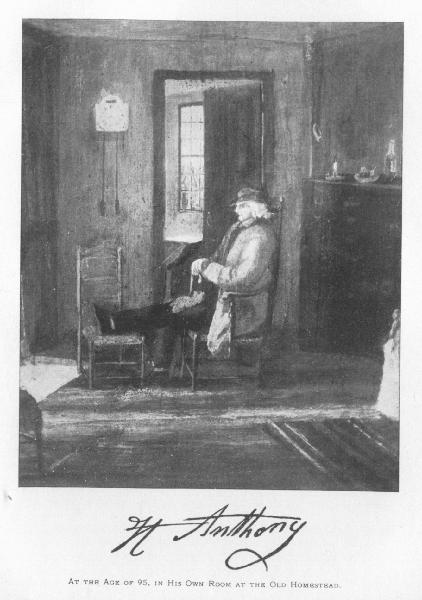
H Anthony
On the way to Saratoga Miss Anthony stopped at Utica for the State Teachers' Convention and was appointed to read a paper at the next annual meeting on "Educating the Sexes Together." This action showed considerable advance in sentiment during the two years since this same body at Rochester debated for half an hour whether a woman should be allowed 131 to speak to a motion. She called the Woman's Rights Convention to order in Saratoga, August 15, 1855, and Martha C. Wright was made president. The brilliant array of speakers addressed cultured audiences gathered from all parts of the country at this fashionable resort. The newspapers were very complimentary; the Whig, however, declared, "The business of the convention was to advocate woman's right to do wrong." It was here that Mary L. Booth, afterwards for many years editor of Harper's Bazar, made her first public appearance, acting as secretary.
She decided to go for a while to the Worcester Hydropathic Institute conducted by her cousin, Dr. Seth Rogers, and she found here complete change and comparative rest, although occupying a great deal of her time in sending out tracts and petitions. Her account-books show the purchase of 600 one-cent stamps, each of which meant the addressing of an envelope with her own hand, and her letters to her father are full of directions for printing circulars, etc. She was, however, enabled to take some recreation, a thing almost unknown in her busy life. On September 18 she attended the Massachusetts Woman's Rights Convention, and wrote home:
I went into Boston with Lucy Stone and stopped at Francis Jackson's, where we found Antoinette Brown and Ellen Blackwell, a pleasant company in that most hospitable home. As this was my first visit to Boston, Mr. Jackson took us to see the sights; and then we dined with his daughter, Eliza J. Eddy, returning in the afternoon. In the evening, we attended a reception at Garrison's, where we met several of the literati, and were most heartily welcomed by Mrs. Garrison, a noble, self-sacrificing woman, loving and loved, surrounded with healthy, happy children in that model home. Mr. Garrison was omnipresent, now talking with and introducing guests, now soothing some child to sleep, and now, with his wife, looking after the refreshments. There we met Caroline H. Dall, Elizabeth Peabody, Mrs. McCready, the Shakespearian reader, Caroline M. Severance, Dr. Harriot K. Hunt, Charles F. Hovey, Wendell Phillips, Sarah Pugh and others. Having worshipped these distinguished people afar off, it was a great satisfaction to meet them face to face.
Saturday morning, with Mr. and Mrs. Garrison and Sarah Pugh, I visited Mount Auburn. What a magnificent resting-place! We could not find Margaret Fuller's monument, which I regretted. I spent Sunday with Charles Lenox Remond at Salem, and we drove to Lynn with his matchless steeds to hear Theodore Parker preach a sermon which filled our souls. We discussed 132 its excellence at James Buffum's where we all dined. Monday Mr. Garrison escorted me to Charlestown; we stood on the very spot where Warren fell and mounted the interminable staircase to the top of Bunker Hill Monument. Then we called on Theodore Parker; found him up three nights of stairs in his library which covers that whole floor of his house; the room is lined with books to the very top—16,000 volumes—and there at a large table in the center of the apartment sat the great man himself. It really seemed audacious in me to be ushered into such a presence and on such a commonplace errand as to ask him to come to Rochester to speak in a course of lectures I am planning, but he received me with such kindness and simplicity that the awe I felt on entering was soon dissipated. I then called on Wendell Phillips in his sanctum for the same purpose. I have invited Ralph Waldo Emerson by letter and all three have promised to come. In the evening with Mr. Jackson's son James, Ellen Blackwell and I went to see Hamlet. In spite of my Quaker training, I find I enjoy all these worldly amusements intensely.
Returning to Worcester, I attended the Anti-Slavery Bazaar. I suppose there were many beautiful things exhibited, but I was so absorbed in the conversation of Mr. Higginson, Samuel May, Jr., Sarah Earle, cousin Seth Rogers and Stephen and Abby Foster, that I really forgot to take a survey of the tables. The next day Charles F. Hovey drove with me out to the home of the Fosters where we had a pleasant call.[20]
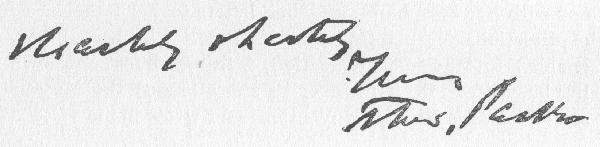
Theodore Parker
Miss Anthony visited a baby show but she considered it "a sad exhibition, unless it may be the crude and rude beginning of arousing an interest in the laws which govern the production of strong, healthy, beautiful children." She heard Mr. Higginson preach every Sunday, and of one sermon on the "Secret Springs of True Greatness" she writes home:
The minister read from the Book of Esdras in the Apocrypha. It is astonishing that such a beautiful and forcible exemplification of the governing principle of life should have been cast aside as doubtful by those who presumed to sit in judgment upon the revealed will of the Almighty. That they did fail to perceive in this the divine stamp, proves all the more conclusively to me that we, who have the experience of all past generations to enlighten our understanding and deepen our convictions, are infinitely more competent 133 to discern between the good and evil in that wonderful book than were any king-appointed councils of olden times.
During Mr. Higginson's absence his place was filled by Rev. David A. Wasson, who was temporarily a resident of the "water cure." His sermons and his daily companionship were a revelation to Miss Anthony of a higher intellectual and spiritual life than she had known before, and she records in her diary: "It is plain to me now that it is not sitting under preaching that I dislike, but the fact that most of it is not of a stamp that my soul can respond to." While in Worcester she went to her first Republican meeting and heard John P. Hale. Her cousin escorted her to a seat on the platform and Mr. Hale gave her a cordial welcome. She was the only woman present, although several peeped in at the door but had not the courage to enter. She also heard Henry Wilson, Charles Sumner and Anson Burlingame, and writes: "Had the accident of birth given me place among the aristocracy of sex, I doubt not I should be an active, zealous advocate of Republicanism; unless, perchance, I had received that higher, holier light which would have lifted me to the sublime height where now stand Garrison, Phillips and all that small but noble band whose motto is 'No Union with Slaveholders.'"
She was at this time becoming deeply interested in politics but had not dreamed that she herself ever would enter the ranks of political speakers. In October she complains of her restlessness and her anxiety to go home, but she is not strong and knows it would be impossible to keep up the treatment there, so she says: "Because of this, and because of my great desire to be able to do what now seems my life work, I have decided to stay awhile longer." But in this same letter she adds: "If Merritt is sick and needs me I will go to him at once. My waking and sleeping thoughts are with him." This young brother had insisted upon going West to seek his fortune and was taken ill in Iowa. At one time when he asked for some money he had saved, and his father, thinking he was too young to be trusted, did not let him have it, Miss Anthony wrote: "It is too bad to treat him like a child. Let 134 him make a blunder even; it will do much more to develop him than the judgment of father, mother and all the brothers and sisters. He ought to have the privilege, since it is clearly his right, to invest his money exactly as he pleases and I hope he will yet be trusted at least with his own funds."
To a woman who is publishing a paper and complains that her efforts are neither helped nor appreciated, she replies: "Every individual woman who launches into a work hitherto monopolized by men, must stand or fall in her own strength or weakness. Whatever we manufacture we must study to make it for the interest of the community to purchase. If we fail in this, we must improve the work.... Each of us individually has her own duties to perform and each of us alone must work out her life problem."
In October the National Woman's Rights Convention was held in Cincinnati but she was unable to attend. It was the only one she missed from 1852 until the breaking out of the war, when they were abandoned for a number of years, and she felt so distressed that she wrote to Rochester and persuaded her sister Mary to get leave of absence from school and go in her place. We know she has a very pretty bonnet this fall, for she says: "It is trimmed with dark green ribbon, striped with black and white, and for face trimming, lace and cherry and green flowers with the least speck of blue." She grieves because her married sisters never have time to write her, and says:
But so it is; every wife and mother must devote herself wholly to home duties, washing and cleaning, baking and mending—these are the must be's; the culture of the soul, the enlargement of the faculties, the thought of anything or anybody beyond the home and family are the may be's. When society is rightly organized, the wife and mother will have time, wish and will to grow intellectually, and will know that the limits of her sphere, the extent of her duties, are prescribed only by the measure of her ability.
Her daily treatment at the "water cure" is thus described: "First thing in the morning, dripping sheet; pack at 10 o'clock for forty-five minutes, come out of that and take a shower, followed by a sitz bath, with a pail of water at 75° 135 poured over the shoulders, after which dry sheet and then, brisk exercise. At 4 P.M. the programme repeated, and then again at 9 P.M. My day is so cut up with four baths, four dressings and undressings, four exercisings, one drive and three eatings, that I do not have time to put two thoughts together." Miss Anthony recovered her health, either as a result of the treatment or of the rest and the long rides which she took daily with her cousin as he made his round of visits. While he was indoors she sat in the chaise enjoying the sunshine and fresh air and reading some interesting book. The journal shows that during the fall she read Sartor Resartus, Consuelo, bits from Gerald Massey, Villette, Gaskell's Life of Charlotte Bronte, Corinne, and a number of other works. Dr. Rogers, the intimate friend of Thoreau and Emerson, was a cultured gentleman, liberal in his views, strong in his opinions, yet tender, sympathetic and companionable. Many of his beautiful letters to Miss Anthony have been preserved. In speaking of political cowardice and corruption, he says: "Were it not for the thunder and lightning of the Garrisonians to purify the moral atmosphere, we would all sink into perdition together." His love of liberty is thus expressed:
I believe in the absolute freedom of every human being so long as the rights of others are left undisturbed. Conformity too often cuts down our stature and makes us Lilliputians, no longer units but unities. Help me to stand alone and I will help you to right the universe. Better, a thousand times better, that societies, friendships even, never were formed, that we all were Robinson Crusoes, than that the terrible tragedy of soul-annihilation through conformity be so conspicuous in the drama of human life. How many wives do you see who are not acting this tragedy? How many husbands who do not applaud? Hence degeneracy after marriage, more directly of the wife than the husband, but too often of both.
As soon as Miss Anthony reached home, the last of November, she began preparing for another winter campaign in the interest of the petitions, and also for a course of lectures to be given in Rochester by the prominent men of the day. Lucy Stone wrote her at this time: "Your letter full of plans reaches me here. I wish I lived near enough to catch some of your magnetism. For the first time in my life I feel, day 136 after day, completely discouraged. When my Harry sent your letter to me he said, 'Susan wants you to write a tract, and I say, Amen.' When I go home I will see whether I have any faith in nay power to do it.... Susan, don't you lecture this winter on pain of my everlasting displeasure. I am going to retire from the field; and if you go to work too soon and kill yourself, the two wheelhorses will be gone and then the chariot will stop."
Arguments were of no avail, however, when the field was waiting and the workers few, and while Miss Anthony was ever ready to excuse others, she never spared herself. She decided before starting to take out a policy in the New York Life Insurance Company. The medical certificate given on December 18, 1855, by Dr. Edward M. Moore, the leading surgeon of western New York, read as follows: "Height, 5 ft. 5 in.; figure, full; chest measure 38 in.; weight, 156 lbs.; complexion, fair; habits, healthy and active; nervous affections, none; character of respiration, clear, resonant, murmur perfect; heart, normal in rhythm and valvular sound; pulse 66 per minute; disease, none. The life is a very good one." And so it has proved to be, as she has paid her premiums for over forty years.[21]
Just before she was ready to start on her long lecture tour in the interest of educational, civil and political rights for women, she received a letter, which was an entire surprise and added a new feature to the work to which she was devoting her time and energy.
[21] The president of the company, John A. McCall, in a personal letter, written December 21, 1897, just forty-two years afterwards, says: "That you may be spared for many, many years to your numerous friends and admirers is the wish of this company and its officials."
The letter which Miss Anthony received with so much pleased surprise was from Samuel May, Jr., cousin of Rev. S.J. May. He was secretary of the American Anti-Slavery Society, which had its headquarters in Boston; Wm. Lloyd Garrison was its president, and among its officers were Wendell Phillips, Francis Jackson, Charles Hovey, Stephen and Abby Kelly Foster, Parker Pillsbury, Maria Weston Chapman, the most distinguished Abolitionists of the day. This letter read:
The executive committee of the American Anti-Slavery Society desire to engage you as an agent, for such time between now and the first of May next as you may be able to give. Will you let us know what your engagements are, and, if you can enter into this agency, when you will be ready to commence? The committee passed no vote as to compensation. We would like to be informed what would be acceptable. It is quite probable that your field of service at first would be western and central New York. An early answer will much oblige.
A previous chapter has told how Miss Anthony longed to take part in anti-slavery work, and behold here was the coveted opportunity! And then to have such a recognition of her ability by this body of men and women, who represented the brains and conscience of this period of reforms, was the highest compliment she could receive. The salary, even though small, would relieve her from the pressing anxiety of making each day's work pay its own expenses, and while she should be laboring in a reform in which she was greatly interested, she could at the same time even more effectually advance the cause which lay nearest to her heart. But the woman's 138 rights meetings already announced by posters, what should be done in regard to them? She finally decided to hold them during January with Frances D. Gage, initiate her and then leave her to fill the remainder of the winter's engagements. So she accepted Mr. May's offer and at his request planned a route and arranged meetings for a number of speakers. Stephen S. Foster wrote, "I shall give myself entirely into your power, only stipulating for the liberty of speech."
Stephen S. Foster
Miss Anthony started with Mrs. Gage January 4, 1856. As many of their meetings were off the railroad, there was a hard siege ahead of them. The diary says: "January 8: Terribly cold and windy; only a dozen people in the hall; had a social chat with them and returned to our hotel. Lost more here at Dansville than we gained at Mount Morris. So goes the world.... January 9: Mercury 12° below zero but we took a sleigh for Nunda. Trains all blocked by snow and no mail for several days, yet we had a full house and good meeting." Extracts from one or two letters written home will give some idea of this perilous journey:
HALL'S CORNERS, January 11, 8-1/2 o'clock.
Just emerged from a long line of snowdrifts and stepped at this little country tavern, supped and am now roasting over a hot stove. Oh, oh, what an experience! No trains running and we have had a thirty-six mile ride in a sleigh. Once we seemed lost in a drift full fifteen feet deep. The driver went on ahead to a house, and there we sat shivering. When he returned we found he had gone over a fence into a field, so we had to dismount and plough through the snow after the sleigh; then we reseated ourselves, but oh, the poor horses!...
WENDTE'S STATION, January 14, 12-1/2 o'clock P. M.
Well, well, good folks at home, these surely are the times that try women's souls. After writing you last, the snows fell and the winds blew and the cars failed to go and come at their appointed hours. We could have reached Warsaw if the omnibus had had the energy to come for us. The train, however, got no farther than Warsaw, where it stuck in a snowdrift eleven feet deep and a hundred long, but we might have kept that engagement at least. Friday 139 morning we went to the station; no trains and no hope of any, but a man said he could get us to Attica in time for an evening meeting, so we agreed to pay him $5. He had a noble pair of greys and we floundered through the deepest snowbanks I ever saw, but at 7 o'clock were still fourteen miles from Attica.
We stopped at a little tavern where the landlady was not yet twenty and had a baby fifteen months old. Her supper dishes were not washed and her baby was crying, but she was equal to the occasion. She rocked the little thing to sleep, washed the dishes and got our supper; beautiful white bread, butter, cheese, pickles, apple and mince pie, and excellent peach preserves. She gave us her warm bedroom to sleep in, and on a row of pegs hung the loveliest embroidered petticoats and baby clothes, all the work of that young woman's fingers, while on a rack was her ironing perfectly done, wrought undersleeves, baby dresses, embroidered underwear, etc. She prepared a 6 o'clock breakfast for us, fried pork, mashed potatoes, mince pie, and for me, at my especial request, a plate of delicious baked sweet apples and a pitcher of rich milk. Now for the moral of this story: When we came to pay our bill, the dolt of a husband took the money and put it in his pocket. He had not lifted a hand to lighten that woman's burdens, but had sat and talked with the men in the bar room, not even caring for the baby, yet the law gives him the right to every dollar she earns, and when she needs two cents to buy a darning needle she has to ask him and explain what she wants it for.
Here where I am writing is a similar case. The baby is very sick with the whooping cough; the wife has dinner to get for all the boarders, and no help; husband standing around with his hands in his pockets. She begs him to hold the baby for just ten minutes, but before the time is up he hands it back to her, saying, "Here, take this child, I'm tired." Yet when we left he was on hand to receive the money and we had to give it to him. We paid a man a dollar to take us to the station, and saw the train pull out while we were stuck in a snowdrift ten feet deep, with a dozen men trying to shovel a path for us; so we had to come back. In spite of this terrible weather, people drive eight and ten miles to our meetings.
On January 20, Mrs. Gage was called home by illness in her family, leaving Miss Anthony to finish the campaign alone. This destroyed all plans for her work with the anti-slavery committee, as no inducement could have been offered which would cause her to abandon these woman's rights meetings after having advertised them. She requested Mr. May to release her and he did so, stipulating however that she should inform him as soon as she was at liberty. She begged various speakers to assist her but received no favorable replies. Lucy Stone wrote, "I wish you had a good husband; it is a great blessing." Her intense desire for help may be judged by a letter to Martha 140 C. Wright in regard to a meeting which had been announced for Auburn: "Mrs. Gage has gone; now, dear Mrs. Wright, won't you give an address? Be brave and make this beginning. You can speak so much better, so much more wisely, so much more everything than I can; do rejoice my heart by consenting. I wish I could see you tonight; I'm sure I could prevail upon you. Yours beseechingly." She got no aid from any quarter, and went on alone through the dreary winter. To those who were to advertise her meetings she said: "I should like a particular effort made to call out the teachers, seamstresses and wage-earning women generally. It is for them rather than for the wives and daughters of the rich that I labor."
In February she returned to Rochester to look after Mr. Garrison's lecture and entertained him at her home. As it had been decided not to hold a convention at Albany she took this opportunity to go there and present the petitions to the Legislature. They were referred to the Senate Judiciary Committee, Samuel G. Foote, chairman. Mr. Foote was a lawyer, prominent in society, the father of daughters, and yet reported as follows on the petition asking that a woman might control her wages and have the custody of her children:
The committee is composed of married and single gentlemen. The bachelors, with becoming diffidence, have left the subject pretty much to the married gentlemen. They have considered it with the aid of the light they have before them and the experience married life has given them. Thus aided, they are enabled to state that the ladies always have the best place and choicest titbit at the table. They have the best seat in the cars, carriages and sleighs; the warmest place in winter and the coolest in summer. They have their choice on which side of the bed they will lie, front or back. A lady's dress costs three times as much as that of a gentleman; and at the present time, with the prevailing fashion, one lady occupies three times as much space in the world as a gentleman. It has thus appeared to the married gentlemen of your committee, being a majority (the bachelors being silent for the reason mentioned, and also probably for the further reason that they are still suitors for the favors of the gentler sex) that if there is any inequality or oppression in the case, the gentlemen are the sufferers. They, however, have presented no petitions for redress, having doubtless made up their minds to yield to an inevitable destiny.
On the whole, the committee have concluded to recommend no measure, 141 except that they have observed several instances in which husband and wife have both signed the same petition. In such case, they would recommend the parties to apply for a law authorizing them to change dresses, so that the husband may wear petticoats, and the wife breeches, and thus indicate to their neighbors and the public the true relation in which they stand to each other.
The Albany Register said "this report was received with roars of laughter." Judge Hay, Lydia Mott and a number of Miss Anthony's friends wrote her not to be discouraged at this insult, but it may be imagined that she took up the work again with a heart filled with resentment and indignation. She had many peculiar experiences during her travels and had to listen to many a chapter of family history which was far from harmonious. On one occasion a friend was pouring into her ears an account of the utter uncongeniality between herself and husband, largely because he was wholly unappreciative of her higher thoughts and feelings. As an example she related that when they visited Niagara Falls and her soul was soaring into the seventh heaven of glory, majesty and sublimity, he exclaimed, "What a magnificent water power this would be, if utilized;" and that he did it on purpose to shock her sensibilities. Miss Anthony finally said: "Now, my dear, the trouble is you fail to recognize that your husband is so constituted that he sees the practical while you feel only the sentimental. He does not jar your feelings any more by his matter-of-fact comments than you jar his by flying off into the realms of poetry on every slight provocation." She then recalled a number of similar instances which the wife had detailed as illustrating the husband's cruelty, impressing upon her that they were born with different temperaments and neither had any right to condemn the other. At the end of this conversation, the woman, weeping, put her arms around Miss Anthony and said: "You have taught me to understand my husband better and love and respect him more than I had learned to do in all my long years of living with him."
In March Garrison wrote, thanking her and her family for their generous hospitality, concluding, "Nowhere do I visit with more real satisfaction." He told her that he had had to 142 give up his lecture engagements on account of the heavy snows, but she had gone straight through with hers. She now closed her series of meetings and went home to arrange for Theodore Parker's lecture. Antoinette Brown Blackwell wrote her: "I hear a certain bachelor making a number of inquiries about Susan B. Anthony. This means that we shall look for another wedding in our sisternity before the year ends. Get a good husband, that's all, dear."
On Miss Anthony's return from the May anti-slavery meeting in New York, she received a reminder from the president of the State Teachers' Association that she would be expected to read her paper on "Co-Education" before that body in August. This recollection had been keeping her awake nights for some time. It had been an easy thing to present a resolution or make a five-minute speech, but it was quite another to write an hour's lecture to be delivered before a most critical audience. As was always her custom in such a dilemma, she turned to Mrs. Stanton, who responded:
Your servant is not dead but liveth. Imagine me, day in and day out, watching, bathing, dressing, nursing and promenading the precious contents of a little crib in the corner of my room. I pace up and down these two chambers of mine like a caged lioness, longing to bring nursing and housekeeping cares to a close. Come here and I will do what I can to help you with your address, if you will hold the baby and make the puddings. Let Antoinette and Lucy rest in peace and quietness thinking great thoughts. It is not well to be in the excitement of public life all the time, so do not keep stirring them up or mourning over their repose. You, too, must rest, Susan; let the world alone awhile. We can not bring about a moral revolution in a day or a year. Now that I have two daughters, I feel fresh strength to work for women. It is not in vain that in myself I feel all the wearisome care to which woman even in her best estate is subject.
Together they ground out the address, taking turns at writing and baby tending, and then she went home. It seemed to her that in order to prove the absolute equality of woman with man she ought to present this as an oration instead of reading it as an essay; so she labored many weary hours to commit it to memory, pacing from one end of the house to the other, and when these confines became too small rushing out into the orchard, but all in vain. It was utterly impossible 143 for her, then or ever, to memorize the exact words of anything.
The lecture, occupying an entire evening, was given before a large audience in Rand's Hall, Troy, and cordially received. At its close Mr. L. Hazeltine of New York, president of the association, took Miss Anthony by the hand, saying: "Madam, that was a splendid production and well delivered. I could not have asked for a single thing different either in matter or manner; but I would rather have followed my wife or daughter to Greenwood cemetery than to have had her stand here before this promiscuous audience and deliver that address." Superintendent Randall, of the city schools of New York, over-hearing the conversation, said: "Father Hazeltine, I fully agree with the first part of your remark but dissent entirely from the latter. I should be proud if I had a wife or daughter capable of either writing or reading that paper as Miss Anthony has done." She was invited by the Massachusetts teachers who were present to come to their State convention at Springfield and give the address, which she did. It was afterwards delivered at a number of teachers' institutes. Mary L. Booth had written her:
I am glad that you will represent us at the Troy gathering. You will bear with you the gratitude of very many teachers whose hearts are swelling with repressed indignation at the injustice which you expose, but who have not grown strong enough yet to give open utterance to words which would jeopardize the positions on which they depend for support. There is not a female principal in Brooklyn or New York whose salary exceeds the half of that of the male principals. Each female principal and assistant is required to attend the normal school under penalty of loss of position, while male teachers are excused from such attendance. There are plenty of indignation meetings among us.
In August Miss Anthony planned a meeting at Saratoga and, as on a previous occasion, every speaker failed her, nor could she find among the visitors one who could help her out. As she was not in the habit of giving up what she undertook, she went through the meeting alone, making the speeches herself. Her 144 faithful friend Judge Hay[22] came to her rescue with a donation of $20 and she was just able to pay expenses.
The public was not in a mood for woman's conventions. The presidential campaign was at its height, with three tickets in the field, and the troubles in Kansas were approaching a crisis. In September came the news of the raid at Osawatomie and that thirty out of the fifty settlers had been killed by the "border ruffians." This brought especial gloom to the Anthony homestead, as the dispatches also stated that the night before the encounter, John Brown had slept in the cabin of the young son Merritt, and for weeks they were unable to learn whether he were among the thirty who died or the twenty who lived. At last the welcome letters came which related how the coffee was just ready to be put on the table in the cabin when the sound of firing was heard, and how without waiting to drink it, John Brown and his little band rushed to the conflict. The old hero gave strict orders to Merritt not to leave the house, as he had been very ill, but as soon as they were out of sight he seized his gun, staggered down to the bank of the Marais du Cygne and was soon in the thick of the fight. When it was over he crawled on his hands and knees back to his cabin, where he lay ill for weeks, entirely alone and uncared for. A letter from Miss Anthony to this brother shows the tender, domestic side of her nature, which the public is seldom permitted to see:
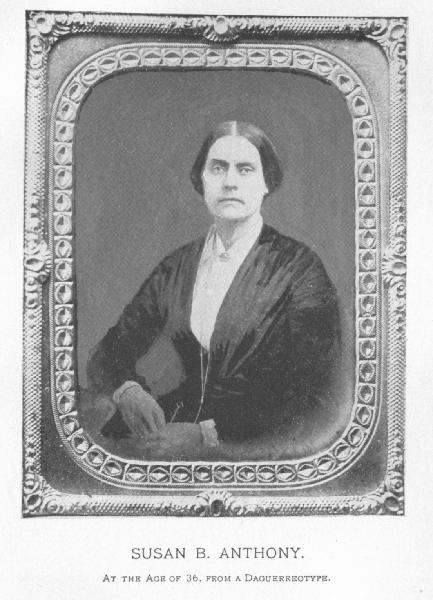
SUSAN B. ANTHONY.
How much rather would I have you at my side tonight than to think of your daring and enduring greater hardships even than our Revolutionary heroes. Words can not tell how often we think of you or how sadly we feel that the terrible crime of this nation against humanity is being avenged on the 145 heads of our sons and brothers.... Wednesday night, Mr. Mowry, who was in the battle, arrived in town. Like wild fire the news flew. D.R. was in pursuit of him when father reached his office. He thought you were not hurt. Mother said that night, "I can go to sleep now there is a hope that Merritt still lives;" but father said: "I suppose I shall sleep when nature is tired out, but the hope that my son has survived brings little solace to my soul while the cause of all this terrible wrong remains untouched."...
Your fish pole never caught so luscious a basketful as it has this afternoon. I made a march through the peach orchard with pole in hand to fish down the soft Early Crawfords that had escaped even the keen eyes of father and mother when they made their last detour. As the pole reached to the top-most bough and down dropped the big, fat, golden, red-cheeked Crawfords, thought went away to the owner of the rod, how he in days gone by planted these little trees, pruned them and nursed them and now we were enjoying the fruits of his labor, while he, the dear boy, was away in the prairie wilds of Kansas. I thought of many things as I walked between the rows to spy out every ambushed, not enemy but friend of the palate. With the haul made I filled the china fruit dish and then hallooed for Mary L. and Ann Eliza to see what I had found, and down they came for a feast. I shall send Aaron and Guelma the nicest ones and how I wish my dearest brother could have some to cool his fevered throat.
Evening.—Father brings the Democrat giving a list of killed, wounded and missing, and the name of our Merritt is not therein, but oh! the slain are sons, brothers and husbands of others as dearly loved and sadly mourned.
Later.—Your letter is in to-day's Democrat, and the Evening Advertiser says there is "another letter from our dear brother in this morning's Shrieker for Freedom." The tirade is headed "Bleeding Kansas." The Advertiser, Union and American all ridicule the reports from Kansas, and even say your letters are gotten up in the Democrat office for political effect. I tell you, Merritt, we have "border ruffians" here at home—a little more refined in their way of outraging and torturing the lovers of freedom, but no less fiendish.
Miss Anthony was busy through September and October securing speakers for the national convention. She still believed that her chief strength lay in her executive ability. Having written Lucy Stone that she could not and would not speak, the latter answered: "Why do you say the people won't listen to you, when you know you never made a speech that was not attentively heard? All you need is to cultivate your power of expression. Subjects are so clear to you that you can soon make them as clear to others." In response to an invitation to the Hutchinson family to sing at the convention, Asa wrote: "The time is coming, I hope, 146 when we can do something for the glorious cause which you are so nobly advocating." John added: "It would rejoice my heart to be at the convention and help along, with the one talent God has given me, the greatest reform ever attempted by lovers of the human race." Miss Anthony asked Mary L. Booth, at that time just beginning to attract attention by her fine translations, to speak at the coming convention and received this touching response:
The hope of yet aiding the cause is the polar star which guides all my efforts. If it were possible I would do this directly, but the fashion of the times has made me a dependant and home aid would scarcely be extended to me in this. I am trying to make myself independent. Fortune now promises favorable things. If I succeed, count on me. All that I can do, I will, to rescue my sex from the fetters which have chafed me so bitterly, from the evils of the giant system which makes woman everywhere a satellite. I have drank of the cup which is offered as the wine of woman's life, and have found the draught frothy and unsatisfactory. Now am I willing, if successful, to give all to purchase her a purer aliment. I have faith enough in the cause to move mountains, but if I speak at present I forfeit all claims on my home forever.
Lucy Stone when appealed to with the intimation that she was losing interest in the work, replied: "Now that I occupy a legal position in which I can not even draw in my own name the money I have earned or give a valid receipt for it when it is drawn or make any contract, but am rated with fools, minors and madmen, and can not sign a legal document without being examined separately to see if it is by my own free will, and even the right to my own name questioned, do you think that, in the grip of such pincers, I am likely to grow remiss?... I am not at all sanguine of the success of the convention. However much I hope, or try to hope, the old doubt comes back. My only trust is in your great, indomitable perseverance and your power of work."
That the answers were not always favorable and that the women constantly found themselves between two fires, the following letters will show. Horace Greeley, who heretofore had been so friendly, wrote:
The only reason why I can not publish your notices in our news columns is that my political antagonists take advantage of such publications to make the 147 Tribune responsible for the anti-Bible, anti-Union, etc., doctrines, which your conventions generally put forth. I do not desire to interfere with your "free speech." I desire only to secure for myself the liberty of treating public questions in accordance with my own convictions, and not being made responsible for the adverse convictions of others. I can not, therefore, print this programme without being held responsible for it. If you advertise it, that is not in my department, nor under my control.[23]
From Gerrit Smith came these emphatic opinions:
You invite me to attend the woman's convention in New York. It will not be in my power to do so. You suggest that I write a letter in case I can not attend, but so peculiar and offensive are my views of the remedy for woman's wrongs, that a letter inculcating them would not be well received. Hence, I must not write it. I believe that poverty is the great curse of woman, and that she is powerless to assert her rights, because she is poor. Woman must go to work to get rid of her poverty, but that she can not do in her present disabling dress, and she seems determined not to cast it aside. She is unwilling to sacrifice grace and fashion, even to gain her rights; albeit, too, that this grace is an absurd conventionalism and that this fashion is infinite folly. Were woman to adopt a rational dress, a dress that would not hinder her from any employment, how quickly would she rise from her present degrading dependence on man! How quickly would the marriage contract be modified and made to recognize the equal rights of the parties to it! And how quickly would she gain access to the ballot-box.
Thus one man refused to assist the cause because its advocates were too radical, and another because they were not radical enough; or, in other words, each wanted the women to be and to do according to his own ideas.
The Seventh National Woman's Rights Convention met in the Broadway Tabernacle, New York, November 25 and 26. Lucy Stone presided and Wendell Phillips was one of the prominent speakers. The election was over, the mob spirit temporarily quieted, and the convention was not disturbed except when certain of the men attempted to make long speeches or introduce politics. The audience had come to hear women 148 plead their own cause and insisted that this should be the program.
In this fall of 1856 Miss Anthony renewed her engagement with the anti-slavery committee, writing Mr. May: "I shall be very glad if I am able to render even the most humble service to this cause. Heaven knows there is need of earnest, effective radical workers. The heart sickens over the delusions of the recent campaign and turns achingly to the unconsidered whole question." The committee answered: "We put all New York into your control and want your name to all letters and your hand in all arrangements. We like your form of posters; by all means let 'No Union with Slaveholders' be conspicuous upon them." An extract from a letter received from Mr. May, the secretary, dated October 22, shows the estimate placed upon her services by the committee:
The Anti-Slavery Society wants you in the field. I really think the efficiency and success of our operations in New York this winter will depend more on your personal attendance and direction than upon that of any other of our workers. We need your earnestness, your practical talent, your energy and perseverance to make these conventions successful. The public mind will be sore this winter, disappointment awaits vast numbers, dismay will overtake many. We want your cheerfulness, your spirit—in short, yourself.
[22] In 1854 Judge William Hay brought out a new edition of his romance, Isabel D'Avalos, the Maid of Seville, with a sequel, The Siege of Granada, dedicated as follows:
In a letter to her he said: "I have placed in my will a bequest to you, the only person to whose care I would willingly entrust them, that at my death the manuscripts and plates of this work are to be your absolute property. I sincerely desire and faintly hope that you may derive some pecuniary benefit from them."
One scarcely could imagine a more unfavorable time than the winter of 1857 for a campaign under the Garrisonian banner of "No Union with Slaveholders." The anti-slavery forces were divided among themselves, but were slowly crystallizing into the Republican party. The triumph of the Democrats over Republicans, Know Nothings and Whigs at the recent presidential election had warned these diverse elements that it was only by uniting that they could hope to prevent the further extension of slavery. The "Dred Scott decision" by the Supreme Court of the United States, declaring "slaves to be not persons but property" and the Missouri Compromise to be unconstitutional and void, had roused a whirlwind of indignation throughout the Northern States. Those who were seeking to prevent the extension of slavery into the Territories were stigmatized by their opponents as traitors defying the Constitution. While this supported the claim of the Garrisonians that the Constitution did sanction slavery and protect the slaveholder, yet the majority of the anti-slavery people were not ready to accept the doctrine of "immediate and unconditional emancipation, even at the cost of a dissolution of the Union." The Republicans had polled so large a vote as to indicate that further extension of slavery could be prevented through that organization, and they were excessively hostile toward any element which threatened to antagonize or weaken it. Thus into whatever town Miss Anthony took her little 150 band, the backbone of the Garrison party, they had to encounter not only the hatred of the pro-slavery people, but also the enmity of this new and rapidly increasing Republican element, which at this time did not stand for the abolition of slavery, but simply for no further extension.
The first year of Mr. Buchanan's administration was marked by a severe and widespread financial stringency. A decade of unparalleled prosperity, with its resultant speculation and expansion of business, was followed by heavy losses, failures and panic. The whole year of 1857 was one continued struggle and vain effort to ward off the impending crisis. To make the situation still more trying the winter was one of great severity, so it is not surprising, accustomed though she was to hardships and disappointments, that Miss Anthony should have found this series of meetings the most disheartening experience of her life. She engaged Stephen and Abby Foster, Parker Pillsbury, Aaron M. Powell, Benjamin and Elizabeth Jones, Charles Remond and his sister Sarah, the last two educated and refined colored people; marked out routes, planned the meetings, kept three companies of speakers constantly employed, and spared herself no labor, no exposure, no annoyance. She found that envy, jealousy and other disagreeable traits were not confined to one sex, but that it required quite as much tact and judgment to deal with men as with women. She had the usual experience of a manager, speakers complaining of their routes, refusing to go where sent, falling ill at the most critical times, and continual fault-finding from the people who stayed at home and did nothing.
She had been working for the public long enough to expect all this, but was distressed beyond measure because she could not make the meetings pay for themselves. For reasons already mentioned the audiences were small and collections still smaller. At her woman's rights lectures she had encountered indifference and ridicule; now she was met with open hostility. In every town a few friends rallied around and extended hospitality and support, but the ordeal was of that kind which leaves ineffaceable marks on the soul. For all this she 151 was paid $10 a week and expenses; not through any desire to be unjust, but because the committee were having a hard struggle to secure the necessary funds to carry on their vast work. Her last woman's rights campaign had left her in debt and she could not provide herself with a new wardrobe for this tour, but records in her diary at the beginning of winter: "A double-faced merino, which I bought at Canajoharie ten years ago, I have had colored dark green and a skirt made of it. I bought some green cloth to match for a basque, and it makes a handsome suit. With my Siberian squirrel cape I shall be very comfortable."
Lucy Stone wrote: "I know how you feel with all the burden of these conventions and it is not just that you should bear it. There is not a man in the whole anti-slavery ranks who could do it. I wish I could help you but I can not. You are one of those who are sufficient unto themselves and I thank God every day for you. Antoinette can not come because she is so busy with that baby!" From Mr. May came these comforting words: "We sympathize in all your trials and hope that fairer skies will be over your head before long. Garrison says, 'Give my love to Susan, and tell her I will do for her what I would hardly do for anybody else.' I hope from that he means to attend your Rochester and Syracuse conventions.... You must be dictator to all the agents in New York; when you say, 'Go,' they must go, or 'Come,' they must come, or 'Do this,' they must do it. I see no other way of getting along, and I am sure to your gentle and wholesome rule they will cheerfully defer. God bless you all; and if you don't get pay in money from your audiences, you will have the satisfaction of knowing you have given them the hard, solid truth as they never had it before."
These meetings often took the form of debates between the speakers and the audience, and frequently lasted till midnight. Of one place Miss Anthony says in her diary, "All rich farmers, living in princely style, but no moral backbone;" at another time: "I spoke for an hour, but my heart fails me. Can it be that my stammering tongue ever will be loosed? I 152 am more and more dissatisfied with my efforts." The diary shows that they had many delightful visits among friends and many good times sandwiched between the disagreeable features of their trip, and that everywhere they roused the community to the highest pitch on the slavery question. She gives a description of one of these gatherings at Easton:
That Sunday meeting was the most impressive I ever attended. Aaron and I had spoken, Charles Remond followed, picturing the contumely and opprobrium everywhere heaped upon the black man and all identified with him, the ostracism from social circles, etc. At the climax he exclaimed: "I have a fond and loving mother, as true and noble a woman as God ever made; but whenever she thinks of her absent son, it is that he is an outcast." He sank into his seat, overwhelmed with emotion, and wept like a child. In a moment, while sitting, he said: "Some may call this weak, but I should feel myself the less a man, if tears did not flow at a thought like that." The whole audience was in sympathy with him, all hearts were melted and many were sobbing. When sufficiently composed he rose and related, in a subdued and most impressive manner, his experience at the last village we visited where not one roof could be found to shelter him because he had a black face. At the close of his speech several men came up, handed us money and left the house because they could not bear any more, while others crowded around and assured him that their doors were open to him and his sister.
From the home of her dear friend Elizabeth Powell,[24] where she had gone for a few days' rest, she writes: "At Poughkeepsie, Parker Pillsbury spoke grandly for freedom. I never heard from the lips of man such deep thoughts and burning words. In the ages to come, the prophecies of these noble men and women will be read with the same wonder and veneration as those of Isaiah and Jeremiah inspire today. Now while the people worship the prophets of that time, they stone those of their own." Mr. Garrison wrote her:
I seize a moment to thank you for your letter giving an account of your anti-slavery meetings and those of the Friends of Progress. I am highly gratified to learn that the latter followed the example of the Progressive Friends at Longwood in favor of a dissolution of our blood-stained American Union. I meant to have sent to you in season some resolutions or "testimony" on the subject, but circumstances prevented. I felt perfectly satisfied however that all would go right with you and Aaron and Oliver Johnson present to enforce the true doctrine. You must have had a soul-refreshing time, even though there appear to have been present what Emerson calls 153 "The fleas of the convention."... On Wednesday, there was a great popular demonstration here to inaugurate the statue of Warren. Think of Mason, of Virginia, the author of the Fugitive Slave Bill, being one of the speakers on Bunker Hill!

Wm. Lloyd Garrison
On this great tour Miss Anthony became so thoroughly aroused that she could no longer confine herself to written addresses, which seemed cold and formal and utterly unresponsive to the inspiration of the moment. She threw them aside and used them thereafter only on rare occasions. Her speeches from that time were made from notes or headings and among those used during the winter of 1857 are the following:
Object of meeting; to consider the fact of 4,000,000 slaves in a Christian and republican government.... Everybody is anti-slavery, ministers and brethren. There are sympathy, talk, prayers and resolutions in ecclesiastical and political assemblies. Emerson says "Good thoughts are no better than good dreams, unless they be executed;" so anti-slavery prayers, resolutions and speeches avail nothing without action.... Our mission is to deepen sympathy and convert it into right action; to show that the men and women of the North are slave-holders, those of the South slave-owners. The guilt rests on the North equally with the South, therefore our work is to rouse the sleeping consciences of the North.... No one is ignorant now. You recognize the facts which we present. We ask you to feel as if you, yourselves, were the slaves. The politician talks of slavery as he does of United States banks, tariff or any other commercial question. We demand the abolition of slavery because the slave is a human being, and because man should not hold property in his fellowman. The politician demands it because its existence produces poverty and discord in the nation and imposes taxes on free labor for its support, since the government is dominated by southern rule.... We preach revolution; the politicians reform. We say disobey every unjust law; the politician says obey them, and meanwhile labor constitutionally for repeal.
Accompaning these notes are many special incidents illustrating the evils of slavery. With Miss Anthony's strong, rich voice, her powerful command of language and her intensity of feeling in regard to her subject, it may be imagined that her speeches were eloquent appeals and roused to action both her friends and her enemies. Some meetings were successful 154 financially, others failures, and her report to the committee in the spring showed that she lacked $1,000 of having paid the total expenses, including salaries of speakers. A few of the committee were inclined to the opinion that meetings should not have been held in places where they would not pay, but that noble woman, Maria Weston Chapman, said: "My friends, if all you say is true, regarding this young woman's business enterprise, practical sagacity and platform ability, I think $1,000 expended in her education and development for this work is one of the best investments that possibly could have been made." At the unanimous request of the committee Miss Anthony remained in office and during the year canvassed the entire state with her speakers. Mr. May wrote: "We cheerfully pay your expenses and want to keep you at the head of the work."
M.W. Chapman
In March she was invited to go to Bangor, Me., and speak on woman's rights, in a course which included Henry Wilson, Gough, Phillips, Beecher and other notables. For this she was paid $50 and expenses, the first large sum she had received for a lecture, and it gave her much hope and courage. While in Maine she spoke a number of times, going from point to point in sleigh or wagon through snow, slush and mud. The press was very complimentary.[25] 155
In August Miss Anthony attended the State Teachers' Convention at Binghamton, and here created another commotion by introducing the following:
Resolved, That the exclusion of colored youth from our public schools, academies, colleges and universities is the result of a wicked prejudice.
Resolved, That the expulsion of Miss Latimer from the normal school at Albany, when after six months of successful scholarship it was discovered that colored blood coursed in her veins, was mean and cruel.
Resolved, That a flagrant outrage was perpetrated against the teachers and pupils of the colored schools of New York City, in that no provision was made for their attendance at the free concerts given to the public schools.
Resolved, That the recent exclusion of the graduates of the colored normal school of New York City, from the public diploma presentation at the Academy of Music, was a gross insult to their scholarship and their womanhood.
Resolved, That all proscription from educational advantages and honors, on account of color, is in perfect harmony with the infamous decision of Judge Taney—"that black men have no rights which white men are bound to respect."
After considerable uproar these were referred to a select committee on which were placed two ladies, Mary L. Booth and Julia A. Wilbur, both strong supporters of Miss Anthony. The committee brought in a majority report in favor of the resolutions but this make-shift minority report was adopted: "In our opinion the colored children of the State should enjoy equal advantages of education with the white." Miss Anthony then proceeded to throw another bomb by presenting this resolution:
Since the true and harmonious development of the race demands that the sexes be associated together in every department of life; therefore
Resolved, That it is the duty of all our schools, colleges and universities to open their doors to woman and to give her equal and identical educational advantages side by side with her brother man.
This opened the flood gates. Motions to lay on the table, to refer to a committee, etc., were voted down. A few strong speeches were made in favor, but most of them were in opposition and very bitter, insisting that "it was sought to uproot the theory and practice of the whole world." The antique Professor Davies was in his element. He declared: "Here is an attempt to introduce a vast social evil. I have been trying 156 for four years,[i.e. ever since Miss Anthony's first appearance at a teachers' convention] to escape this question, but if it has to come, let it be boldly met and disposed of. I am opposed to anything that has a tendency to impair the sensitive delicacy and purity of the female character or to remove the restraints of life. These resolutions are the first step in the school which seeks to abolish marriage, and behind this picture I see a monster of social deformity."
Another speaker, whose name is lost in oblivion, said in tones which would melt a heart of stone: "Shall an oak and a rose tree receive the same culture? Better to us is the clear, steady, softened, silvery moonlight of woman's quiet, unobtrusive influence, than the flashes of electricity showing that the true balance of nature is destroyed. Aye, better a thousand times is it than the glimmering ignus fatuus rising from decayed hopes and leading the deluded follower to those horrible quagmires of social existence—amalgamation and Mormonism."
Prof. John W. Buckley, of Brooklyn, opposed the resolution in coarse and abusive language. State Superintendent of Public Instruction Henry H. Van Dyck demolished its last hope when he demanded with outstretched arm and pointed finger: "Do you mean to say you want the boys and girls to room side by side in dormitories? To educate them together can have but one result!"
The Binghamton Daily Republican said: "Miss Anthony vindicated her resolutions with eloquence, force, spirit and dignity, and showed herself a match, at least, in debate for any member of the convention. She was equal if not identical. Whatever may be thought of her notions or sense of propriety in her bold and conspicuous position, personally, intellectually and socially speaking, there can be but one opinion as to her superior energy, ability and moral courage; and she may well be regarded as an evangel and heroine by her own sex."
The woman who advocated co-education in those days was indeed in a "bold and conspicuous position." The resolutions were lost by a large majority. Even if every man present had 157 voted against them, there were enough women to have carried them had they voted in the affirmative. The Republican said: "If the lady members had voted so as to be heard we know not what would have been the result; but their voices, to say the least, have not been ordained by the Creator to be equal or identical with man's, and are drowned by his louder sounds." Mrs. Stanton's opinion can best be learned by an extract from a letter:
I see by the papers that you have once more stirred that pool of intellectual stagnation, the educational convention. What an infernal set of fools those schoolmarms must be! Well, if in order to please men they wish to live on air, let them. The sooner the present generation of women dies out, the better. We have idiots enough in the world now without such women propagating any more.... The New York Times was really quite complimentary. Mr. Stanton brought every item he could find about you. "Well, my dear," he would say, "another notice of Susan. You stir up Susan, and she stirs the world." I was glad you went to torment those devils. I guess they will begin to think their time has come. I glory in your perseverance. O, Susan, I will do anything to help you on. You and I have a prospect of a good long life. We shall not be in our prime before fifty, and after that we shall be good for twenty years at least. If we do not make old Davies shake in his boots or turn in his grave, I am mistaken.
The proceedings of the convention were published in full in the New York Tribune, and Miss Anthony received letters of commendation from Judge William Hay, Charles L. Reason, superintendent of the New York city colored schools, and many others. William Marvin, of Binghamton, wrote: "The sympathy of the people here, during the teachers' association, was decidedly with you. A vote from the audience would have carried any one of your resolutions."
In the autumn the anti-slavery meetings were resumed, and Miss Anthony was unsparing of herself and everybody else. Parker Pillsbury complained: "What a task-mistress our general agent is proving herself. I expect as soon as women get command, an end will have come to all our peace. We shall yet have societies for the protection of men's rights, in the cause of which many of us will have to be martyrs." Her brother, Daniel R., was sending frequent letters from Kansas containing graphic descriptions of the terrible condition of 158 affairs in that unhappy territory, and scathing denunciations of the treachery of northern "dough faces," thus fanning the fires of patriotism that glowed in her breast and filling her with renewed zeal for the cause to which she was giving her time and strength. During these days she wrote a cherished sister:
Though words of love are seldom written or spoken by one of us to the other, there must ever remain the abiding faith that the heart still beats true and fond. Our family is now so widely separated that our enjoyment must consist in soul communing. Indeed, I almost believe in the power of affection to draw unto itself the yearning heart of the absent one. What the modern Spiritualist tells of feeling the presence of departed friends and enjoying their loving ministrations, I sometimes imagine to be true, not of the spirits of those gone hence, but of those still in the body who are separated from us. I often pass blessed moments in these sweet, silent communings.... Every day brings to me new conceptions of life and its duties, and it is my constant desire that I may be strong and fearless, baring my arm to the encounter and pressing cheerfully forward, though the way is rough and thorny.
I have just returned from the hardest three weeks' tour of anti-slavery meetings I have had yet, so cold and disheartening. The masses seem devoid of conscience and looking only for some new expedient to accomplish the desired good; but in every town there are some true spirits who walk in God's sunlight and do what is right, trusting results to the great Immutable Law.... I wish all the dear ones would write me more often. Though I am sure of their affection, yet when the soul is burdened and one is surrounded by strangers, a letter from a loved one brings healing to the spirit, and I need it more than I can tell.
There is scarcely a letter to her own family, in the large number preserved, which does not express a longing for love and sympathy, a craving that no public career, no devotion to any cause, however absorbing, ever eradicates from the human soul.
Although so fully occupied, Miss Anthony did not neglect the beloved cause of woman. This year, however, when she attempted to arrange for the annual convention, she found to her dismay that every one of the speakers whom she always depended upon was unable to be present because of maternal duties. Some were anticipating an event, others had very young infants, and the older women were kept at home by expected or recently arrived grandchildren. She was used to overcoming obstacles, but the conditions on this occasion were 159 too much for her and, with feelings which can not well be put into language, she was obliged to give up the national convention, the only one omitted from 1850 to 1861.
Amidst the hard work and many disappointments of the year, there is one gleam of humor in what was known to the family as "Susan's raspberry experiment." During her wanderings she visited her friend Sarah Hallock who had made a great success of raspberry culture, selling 40,000 baskets during the season, and she did not see why she could not do quite as well. She unfolded her plan to her father, who supported her in that as in everything and gave her as much ground as she desired. While at home for a short time she had this underdrained and prepared, $100 worth of raspberry plants set out and staked; then went away and left the family to look after them. The father was in the city all day attending to business, the sister Mary teaching school, the mother was not well and there was no one else but the hired man, who knew nothing about the culture of raspberries and was otherwise occupied; so the bushes took their chances.
The fame of the experiment, however, spread far and wide, the newspapers announced that Miss Anthony had bought a large farm and stocked it with raspberries; that she had abandoned the platform and taken up fruit culture. She received scores of letters asking information as to the best plants and most successful methods, others begging her not to give up public work, and many from friends who had no end of fun at her expense. The bushes grew and bore fruit enough to give the family a number of delicious meals. Then a very cold winter followed and there was no one to care for the tender plants. In December came a letter from the irrepressible brother-in-law, Aaron McLean: "As to your raspberry 'spec,' I regret to tell you it has 'gone up.' The poor, little, helpless things expired of a bad cold about two weeks since. Do you remember that text of Scripture, which says, 'She who by the plow would thrive, herself must either hold or drive'? It has cost you $200 to learn the truth of it." Her sister Mary wrote: "I hope, Susan, when you get a husband and 160 children, you will treat them better than you did your raspberry plants, and not leave them to their fate at the beginning of winter."
It was a deep regret to Miss Anthony that she could not give the necessary time and care to make this experiment a success, as she was anxious to encourage women to go into the pursuit of agriculture, horticulture, floriculture, anything which would take them out of doors. In a letter to Mr. Higginson she says: "The salvation of the race depends, in a great measure, upon rescuing women from their hothouse existence. Whether in kitchen, nursery or parlor, all alike are shut away from God's sunshine. Why did not your Caroline Plummer, of Salem, why do not all of our wealthy women leave money for industrial and agricultural schools for girls, instead of ever and always providing for boys alone?" This is one of the many instances where Miss Anthony foreshadowed reforms and improvements which have been fulfilled in the present generation.
In 1858 is presented same routine of unremitting work which characterized so many previous years. The winter was given up to anti-slavery meetings with their attendant hardships. Miss Anthony has great scorn for those who talk regretfully of the "good old days." She thinks one lecture season under the conditions which then existed would be an effectual cure to any longing for them one might have. The conveniences of modern life, bathrooms with plenty of hot water, toiletrooms, steam-heated houses, gas and hundreds of comforts so common at the present time that one scarcely can realize they have not always existed, were comparatively unknown. One of the greatest trials these travellers had to endure was the wretched cooking which was the rule and not exception among our much-praised foremothers. In one of the old diaries is this single ejaculation, "O, the crimes that are committed in the kitchens of this land!" In those days the housewife could not step around the corner and buy for two cents a cake of yeast which insured good bread, but the process of yeast-making was long and difficult and not well 161 understood by the average housekeeper, so a substitute was found in "salt risings," and a heavy indigestible mass generally resulted. White flour was little used and was of a poor quality. Baking powder was unknown and all forms of cakes and warm bread were made with sour milk and soda, easily ruined by too much or too little of the latter. In no particular did the table compare favorably with that of modern families.
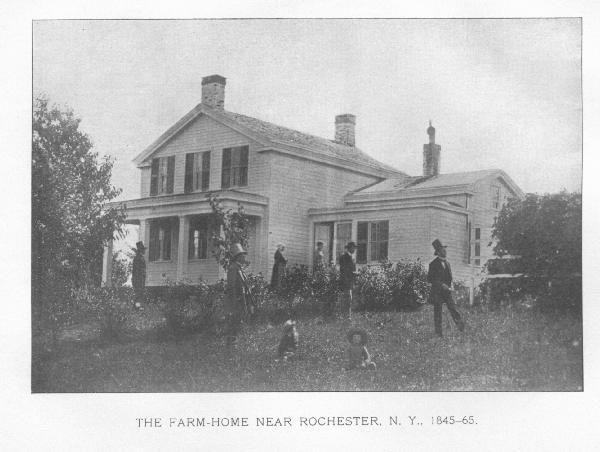
THE FARM-HOME NEAR ROCHESTER, N.Y., 1845-65.
The anti-slavery and woman's rights lecturers always accepted private hospitality when offered, for reasons of economy and, as many of the people who favored these reforms were seeking light in other directions also, they were very apt to find themselves the guests of "cranks" upon the food question and were thus made the subject of most of the experiments in vogue at that period. On one occasion Miss Anthony, Aaron Powell and Oliver Johnson were entertained by prominent and well-to-do people in a town near New York, who had not a mouthful for any of the three meals except nuts, apples and coarse bran stirred in water and baked. At the end of one day the men ignominiously fled and left her to stay over Sunday and hold the Monday meeting. She lived through it but on Tuesday started for New York and never stopped till she reached Delmonico's, where she revelled in a porterhouse steak and a pot of coffee.
During these winter meetings all of the men broke down physically and their letters were filled with complaints of their heads, their backs, their lungs, their throats and their eyes. Garrison wrote at one time: "I hope to be present at the meeting but I can not foresee what will be my spinal condition at that time, and I could not think of appearing as a 'Garrisonian Abolitionist' without a backbone." Miss Anthony never lost a day or missed an engagement, although it may be imagined that she had many hours of weariness when she would have been glad to drop the burden for a while. On March 17 she writes: "How happy I am to lay my head on my own home pillow once more after a long four months, scarcely stopping a second night under one roof." Mr. May 162 wrote in behalf of the committee: "We rejoice with you in the success of your meetings and in all your hopes for the upspringing of the good seed sown by the faithful joint labors of you and your gallant little band. We have made the following a committee of arrangements for the annual meeting: Garrison, Phillips, Quincy, Johnson and Susan B. Anthony."
So she at once girded on her armor and began to prepare for the May anniversary and, being determined the National Woman's Rights Convention should not be omitted this year, she conducted also an extensive correspondence in regard to that. Referring to all this drudgery Lucy Stone urged: "Don't do it; quit common work such as a common worker could do; and don't mourn over us and our babies. We are growing workers. I know you are tired with your four months' work, but it is not half so hard as taking care of a child night and day. I shall not assume any responsibility for another convention till I have had my ten daughters." But Miss Anthony knew that this "common work," this hiring halls, raising money and advertising meetings was just what nobody else could or would do. She understood also that while the other women were at home "growing workers," somebody must be in the field looking after the harvest.
Abby Hutchinson, the only sister in the famous family of singers, wrote from their Jersey home, Dawnwood: "I want so much to help you; I have longed to do some good with my voice but public life wears me out very fast." Nevertheless she came and sang for them. Mrs. Stanton and Mrs. Brown Blackwell brought new babies into the world a few weeks before the convention, to Miss Anthony's usual discomfiture. She wrote to the latter: "Mrs. Stanton sends her love to you and says if you are going to have a large family, go right on and finish up as she has done. She has only devoted eighteen years out of the very heart of her existence to this great work. But I say, stop now."
The convention in Mozart Hall followed close upon the Anti-Slavery Anniversary, Miss Anthony presided and there were the usual distinguished speakers, Phillips, Pillsbury, Garrison, 163 Douglass, Higginson, Lucretia Mott, Mrs. Gage, Mrs. Rose, and, for the first time, George William Curtis spoke on the woman's rights platform. Notwithstanding this array of talent, the convention through all its six sessions was threatened with a mob, encouraged by the Herald and other New York papers. The disturbance at times was so great the speakers could not be heard, even Curtis was greeted with hisses and groans, but Miss Anthony stood at the helm unterrified through all and did not leave her post until the last feature of the program was completed and the convention adjourned. She was growing accustomed to mobs.
In August, 1858, she attended the teachers' convention at Lockport. The sensational feature of this meeting was the reading by Professor Davies of the first cablegram from England, a message from the Queen to the President. The press reports show that she took a prominent part in the proceedings and possibly merited the name which some one gave her of "the thorn in the side of the convention." These annual gatherings were very largely in the nature of mutual admiration societies among the men, who consumed much of the time in complimenting each other and the rest of it in long-winded orations. During this one Miss Anthony arose and said that, as all members had the same right to speak, she would suggest that speeches should be limited so as to give each a chance. She made some of the men furious by stating that they spoke so low they could not be heard.
At another time she suggested that, as there were only a few hours left for the business of the convention, they should not be frittered away in trifling discussions, saying, "if she were a man she would be ashamed to consume the time in telling how much she loved women and in fulsome flattery of other men." She moved also that they set aside the proposed discussion on "The Effects of High Intellectual Culture on the Efficiency and Respectability of Manual Labor," and take up pressing questions. When one man was indulging in a lot of the senseless twaddle about his wife which many of them are fond of 164 introducing in their speeches, she called him to order saying that the kind of a wife he had, had nothing to do with the subject. She introduced again the resolution demanding equal pay for equal work without regard to sex. A friend wrote of this occasion: "She arraigned those assembled teachers for their misdemeanors as she would a class of schoolboys, in perfect unconsciousness that she was doing anything unusual. We women never can be sufficiently thankful to her for taking the hard blows and still harder criticisms, while we reaped the benefits."
The press reports said: "Miss Anthony has gained in the estimation of the teachers' convention, and is now listened to with great attention." She gave her lecture on "Co-Education" to a crowded house of Lockport's prominent citizens, introduced by President George L. Farnham, of Syracuse, always her friend in those troublous days. By this time more than a score of the eminent educators of the day had become her steadfast friends, and they welcomed her to these conventions, aiding her efforts in every possible manner. Rev. Samuel J. May, who had delivered an address, upon his return home wrote: "You are a great girl, and I wish there were thousands more in the world like you. Some foolish old conventionalisms would be utterly routed, and the legal and social disabilities of women would not long be what they are." Miss Anthony herself, writing to Antoinette Blackwell, said: "I wish I had time to tell you of my Lockport experience; it was rich. I never felt so cool and self-possessed among the plannings and plottings of the few old fogies, and they never appeared so frantic with rage. They evidently felt that their reign of terror is about ended."
October, 1858, brought another crucial occasion. In Rochester, a young man, Ira Stout, had been condemned to be hung for murder. A number of persons strongly opposed to capital punishment believed this a suitable time to make a demonstration. It was not that they doubted the guilt of Stout, but they were opposed to the principle of what they termed judicial 165 murder. As the Anthonys and many of the leading Quaker families, Frederick Douglass and a number of Abolitionists shared in this opinion, it was not surprising that Miss Anthony undertook to get up the meeting. In a cold rain she made the round of the orthodox ministers but none would sign the call. The Universalist minister, Rev. J.H. Tuttle, agreed to be present and speak. She secured thirty or forty signatures, engaged the city hall and advertised extensively. The feeling against Stout was very strong and there was a determination among certain members of the community that this meeting should not be held. Huge placards were posted throughout the city, urging all opposed to the sentiments of the call to be out in force, a virtual invitation to the mob.
When the evening arrived, October 7, the hall was filled with a crowd of nearly 2,000, a large portion of whom only needed the word to break into a riot. Miss Anthony called the assemblage to order and Frederick Douglass was made chairman, but when he attempted to speak, his voice was drowned with groans and yells. Aaron M. Powell, William C. Bloss and others tried to make themselves heard but the mob had full sway. Miss Anthony was greeted with a perfect storm of hisses. Finally the demonstrations became so threatening that she and the other speakers were hurried out of the hall by a rear door, the meeting was broken up and the janitor turned out the lights. No attempt was made by the mayor or police to quell the disturbance and mob law reigned supreme.
The brightest ray of sunshine in the closing days of 1858 was the following letter from Mr. Phillips: "I have had given me $5,000 for the woman's rights cause; to procure tracts on that subject, publish and circulate them, pay for lectures and secure such other agitation of the question as we deem fit and best to obtain equal civil and political position for women. The name of the giver of this generous fund I am not allowed to tell you. The only condition of the gift is that it is to remain in my keeping. You, Lucy Stone and myself are a committee of trustees to spend it wisely and 166 efficiently." The donor proved to be Francis Jackson, the staunch friend of the emancipation of woman as well as the negro.
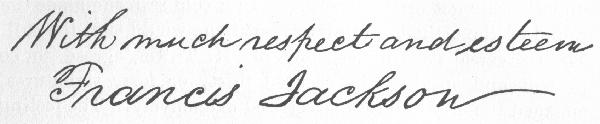
Francis Jackson
[25] The Bangor Jeffersonian said: "Miss Anthony is far from being an impracticable enthusiast. Dignity, conscientiousness and regard for the highest welfare of her sex, are the impressions which one receives of her. Doubtless all (if any there were) who went to scoff, remained to pray for the success of the doctrine she advocated. Personally she is good-looking, of symmetrical figure and modest and ladylike demeanor."
The Bangor Whig was equally favorable. The Ellsworth American said: "Her enunciation is very clear and remarkably distinct, yet there is nothing in it of the unfeminine character and tone which people had been led to expect from the usual criticisms of the press. The lecture itself, as an intellectual effort, was satisfactory as well to those who dissented as to those who sympathized with its positions and arguments. It was fruitful in ideas and suggestions and we doubt not many a woman, and man too, went home that night, with the germ of more active ideas in their heads than had gathered there for a twelvemonth before."
Among Miss Anthony's many schemes for regenerating the world was one to have a Free church in Rochester, after the manner of Theodore Parker's in Boston, similar to an ethical society, where no doctrines should be preached and all should be welcome, contributing what they chose. This was in her mind for years, and at the beginning of 1859 she engaged Corinthian Hall for Sunday evenings, her good friend, William A. Reynolds, as usual making her a reduced rate; and here Antoinette Brown Blackwell and Parker Pillsbury each preached for a month. She tried to engage Mrs. Stanton for a year and also Aaron M. Powell, but the financial support was too uncertain and the project had to be abandoned. All her life, however, Miss Anthony cherished the hope of seeing this Free church established and sustained. She arranged a series of lectures for this winter. George William Curtis accepted her invitation in this characteristic letter:
I think of no title for your course, but why have any? Why not say simply, "A Course of Independent Lectures?" To call them woman's rights would damn them in advance, so strong is prejudice. The only one I have at all suited to your purpose is "Fair Play for Women."[26] I hate the words "woman's rights," nor do they properly describe my treatment of the question which, in my mind, is not one of sex but of humanity. My lecture is a plea for the recognition of the equal humanity of women and an assertion that 168 they have rights not as women but as human beings. In respect to terms, I leave it with you. I usually receive $50, but you will understand that I should prefer to pay the expenses myself rather than that you or any one interested should expend a penny; so if you can not justly give me anything, I shall be content.
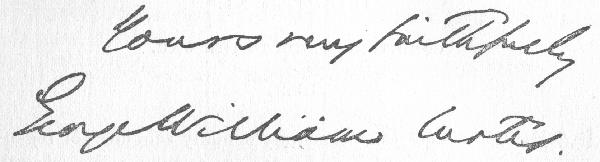
George William Curtis
Miss Anthony always came out of these lecture courses in debt, but she would call upon her friends or borrow from sister or father enough to make up the deficit, and replace the loan out of her scanty earnings. She persisted in having them to educate the public on the progressive questions of the day. At this time the long, severe mental and physical strain of years began to be felt in her one weak spot, and the old trouble with her back asserted itself. From every quarter came urgent appeals for her assistance. At first she answered: "If New York calls a constitutional convention for next spring, this will be a capital winter to strike heavy blows for freedom and equality such as we shall not have for a long time to come. I am ready just as soon as the armies can be marshaled and equipped." But later she wrote:
It is being forced upon me that nature orders me to stay quietly at home this winter and it may be that it is to enable me to get a greater literary culture than I possibly could, amidst the hurry and bustle of continual meetings. Somehow I can not philosophize away a shrinking from going into active work. I can not get up a particle of enthusiasm or faith in the success, either financial or spiritual, of another series of conventions. For the past five years I have gone through this routine and something within me keeps praying to be spared from more of it. There has been such a surfeit of lecturing, the people are tired of it. Then I never was so poor in purse and I fear to end another campaign with a heavy debt to still further encroach upon my small savings. I can not bear to make myself dependent upon relatives for the food I eat and the clothes I wear; I never have done it and hope I may never have to. Perhaps I may feel a renewed faith in myself and my work but the past years have brought me so much isolation and spiritual loneliness, although in the midst of crowds, that I confess to a longing to stay for awhile among my own people.
The commands of the physician were imperative that she should avoid all fatigue and nervous excitement, but her pen was not idle, and the time which she hoped to devote to the reading of many books was occupied in sending out letters, petitions, appeals and the various documents necessary to keep the work going. In answer to an invitation from the Friends of Human Progress she wrote:
To be esteemed worthy to speak for woman, for the slave, for humanity, is ever grateful to me, and I regret that I can not be with you at your annual gathering to get for myself a fresh baptism, a new and deeper faith. I would exhort all women to be discontented with their present condition and to assert their individuality of thought, word and action by the energetic doing of noble deeds. Idle wishes, vain repinings, loud-sounding declamations never can bring freedom to any human soul. What woman most needs is a true appreciation of her womanhood, a self-respect which shall scorn to eat the bread of dependence. Whoever consents to live by "the sweat of the brow" of another human being inevitably humiliates and degrades herself.... No genuine equality, no real freedom, no true manhood or womanhood can exist on any foundation save that of pecuniary independence. As a right over a man's subsistence is a power over his moral being, so a right over a woman's subsistence enslaves her will, degrades her pride and vitiates her whole moral nature.
To her brother Daniel R., in Kansas, who was somewhat skeptical on the woman question, she sent this strong letter:
Even the smallest human right denied, is large. The fact that the ruling class withhold this right is prima facie evidence that they deem it of importance for good or for evil. In either case, therefore, the human being is outraged. It, perchance, may matter but little whether Kansas be governed by a constitution made by her bona fide settlers or by people of another State or by Congress; but for Kansas to be denied the right to make her own constitution and laws is an outrage not to be tolerated. So the constitution and laws of a State and nation may be just as considerate of woman's needs and wants as if framed by herself, yet for man to deny her the right to a voice in making and administering them, is paralleled only by the Lecompton usurpation. For any human being or class of human beings, whether black, white, male or female, tamely to submit to the denial of their right to self-government shows that the instinct of liberty has been blotted out.
You blunder on this question of woman's rights just where thousands of others do. You believe woman unlike man in her nature; that conditions of life which any man of spirit would sooner die than accept are not only endurable to woman but are needful to her fullest enjoyment. Make her position in church, State, marriage, your own; everywhere your equality ignored, 170 everywhere made to feel another empowered by law and time-honored custom to prescribe the privileges to be enjoyed and the duties to be discharged by you; and then if you can imagine yourself to be content and happy, judge your mother and sisters and all women to be.
It was not because the three-penny tax on tea was so exorbitant that our Revolutionary fathers fought and died, but to establish the principle that such taxation was unjust. It is the same with this woman's revolution; though every law were as just to woman as to man, the principle that one class may usurp the power to legislate for another is unjust, and all who are now in the struggle from love of principle would still work on until the establishment of the grand and immutable truth, "All governments derive their just powers from the consent of the governed."
She wrote Lydia Mott: "The new encyclopedia is just out and I notice in regard to Antoinette Brown Blackwell that it gives a full description of her work up to the time of her marriage, then says: 'She married Samuel Blackwell and lives near New York.' Not a word of the splendid work she has done on the platform and in the pulpit since. Thus does every married woman sink her individuality." This brought from Lydia a spirited answer:
For my part, when you speak of the individuality of one who is truly married being inevitably lost, I think you mistake. If there ever was any individuality it will remain. I don't believe it is necessary for development that the individual must always force itself upon us. We naturally fall into the habits and frequently the train of thought of those we love and I like the expression "we" rather than "I." I never feel that my interests and actions can be independent of the dear ones with whom I am surrounded. Even the one who seems to be most absorbed may, in reality, possess the strongest soul. This standing alone is not natural and therefore can not be right. I am sure one of these days you will view this matter from a different standpoint.
Miss Anthony so far yielded as to reply: "Institutions, among them marriage, are justly chargeable with many social and individual ills but, after all, the whole man or woman will rise above them. I am sure my 'true woman' never will be crushed or dwarfed by them. Woman must take to her soul a purpose and then make circumstances conform to this purpose, instead of forever singing the refrain, 'if and if and if!'" But later when one woman failed to keep a lecture engagement because her husband wanted her to go somewhere 171 with him, and another because her husband was not willing she should leave home, she again poured out her sorrows to her friend:
There is not one woman left who may be relied on, all have "first to please their husband," after which there is but little time or energy left to spend in any other direction. I am not complaining or despairing, but facts are stern realities. The twain become one flesh, the woman, "we"; henceforth she has no separate work, and how soon the last standing monuments (yourself and myself, Lydia), will lay down the individual "shovel and de hoe" and with proper zeal and spirit grasp those of some masculine hand, the mercies and the spirits only know. I declare to you that I distrust the power of any woman, even of myself, to withstand the mighty matrimonial maelstrom!
But how did I get into this dissertation? If to you it seems morbid, pardon the pen-wandering. In the depths of my soul there is a continual denial of the self-annihilating spiritual or legal union of two human beings. Such union, in the very nature of things, must bring an end to the free action of one or the other, and it matters not to the individual whose freedom has thus departed whether it be the gentle rule of love or the iron hand of law which blotted out from the immortal being the individual soul-stamp of the Good Father. How I do wish those who know something of the real social needs of our age would rescue this greatest, deepest, highest question from the present unphilosophical, unspiritual discussers.
As might be expected, the legacy of $5,000 brought not only a flood of requests from all parts of the country, but some division of opinion among those who had it in control. Miss Anthony would use all of it in the work of propaganda, lectures, conventions, tracts and newspaper articles. Lucy Stone wished to use part in suits to prove the unconstitutionality of the law which taxes women and refuses them representation. Antoinette Blackwell wanted a portion to establish a church where she could spread the doctrine of woman's rights along with the gospel. Most of the women lecturers and some of the men wished to be engaged immediately at a fixed salary. Miss Anthony writes for advice to Phillips, who replies: "Go ahead with your New York plan as sketched to me. I am willing to risk spending $1,000 on it. Never apologize as if you troubled me; it is my business as much as yours, and I am only sorry to be of so little help." Brief records in the little diary say: 172
Sister Mary and I passed New Year's Day, 1859, most quietly and happily in the dear farm-home. Mother is in the East with sister Hannah, and father dined in the city with sister Guelma, who sent us a plate of her excellent turkey.... In the afternoon Mary and I drove to Frederick Douglass' and had a nice visit; stayed to tea and listened to a part of his new lecture on "Self-Made Men."... Father and Mary gone to their work in the city, and I am writing on my lecture "The True Woman." Ground out four commercial-note pages in five mortal hours, but they are strong.... Ten degrees below zero. Mother home; no writing today; all talk about the eastern folks.... Antoinette Blackwell preached here yesterday, and we have had a good visit together today. Just helped two fugitive slaves, perhaps genuine and perhaps not.... Went to the city to hear A.A. Willit's lecture on "A Plea for Home." Gives woman a place only in domestic life—sad failure.... Twenty letters written and mailed today. Took tea with the Hallowells. Am glad to learn that the money forwarded to the Anti-Slavery Bazar and lost was sent by a man instead of a woman.... Heard Bayard Taylor on "Life in Lapland." Hundreds could not gain admittance. Curtis lectured on "Fair Play for Women"; great success, but I feel that he has not yet been tried by fire. Afterwards visited with Curtis and Taylor, and Mr. Curtis said: "Rather than have a radical thinker like Mrs. Rose at your suffrage conventions, you would better give them up. With such speakers as Beecher, Phillips, Theodore Parker, Chapin, Tilton and myself advocating woman's cause, it can not fail."
E.H. Chapin
Miss Anthony did not hesitate to criticise even Mr. Curtis, writing him in reference to his great lecture, "Democracy and Education": "When all the different classes of industrial claimants for a voice in the government were enumerated, there was not one which could be interpreted to represent womanhood. Hence only the few who know that with George William Curtis, the words 'man,' 'people,' 'citizens,' are not, as with the vast majority of lecturers, mere glittering generalities, can understand that his grand principles of democracy are intended to be applied to woman equally with man. I listen for the unthinking masses and pray that every earnest, manly spirit shall help make women free." In reply Mr. Curtis closed a long and cordial letter by saying: "Believe me that I have thought of the point you make but the greater statement must inevitably include the less." She 173 scribbled a comment on the back of this for her own satisfaction: "Men still the greater, women the less."
The last of January Miss Anthony went to Albany to attend the anti-slavery convention and remained six weeks during the legislative session to work in the interest of the women's petitions and the Personal Liberty Bill. This was a season of great enjoyment for her, notwithstanding much tramping about in the rain and snow and many discouraging experiences with the Legislature. She writes a friend: "Well, I am a member of the lobby but lacking the two most essential requisites, for I neither accept money nor have I any to pay out. Dr. Cheever speaks tonight in the Assembly chamber on 'The Guilt of the Slave Traffic and of the Legislation by which it is Supported.' I have been going about all day to collect enough to defray his expenses."
Phillips, Garrison, Pillsbury and all the host were at the convention. They dined in Lydia Mott's simple little home and had a merry time. Between the meetings the party visited the Legislature, Geological Hall, Palmer's studio and other places of interest and managed to get a bit of holiday recreation. Miss Anthony stayed with her friend Miss Mott, visited Rev. Mayo, called often on Thurlow Weed, went to Troy to hear Beecher lecture on "The Burdens of Society," to Hudson to hear Phillips on "Toussaint L'Ouverture" and, whenever she could spare a day from her work with the Legislature, held woman's rights meetings in neighboring towns; thus every hour was filled to overflowing.
In March she finished her lecture, "The True Woman," and plunged into the preparations for the approaching woman's rights convention. She also indulged the love for gardening which her busy life so seldom permitted and, judging from her diary, must have given the hired men more attention than they ever received before or afterwards:
Uncovered the strawberry and raspberry beds.... Worked with Simon building frames for the grape vines in the peach orchards.... Set out eighteen English black currants, twenty-two English gooseberries and Muscadine grape vines, also Lawton blackberries.... Worked in the 174 garden all day, then went to the city to hear Dr. Cheever; few there, but grand lecture. How he unmasked the church hypocrites!... Wrote reports of the lecture for Standard and Liberator, and helped father plan the new kitchen.... Finished setting out the apple trees and the 600 blackberry bushes, then took the 6 o'clock train for Seneca Falls. Hot and dusty, and I am very, very tired.
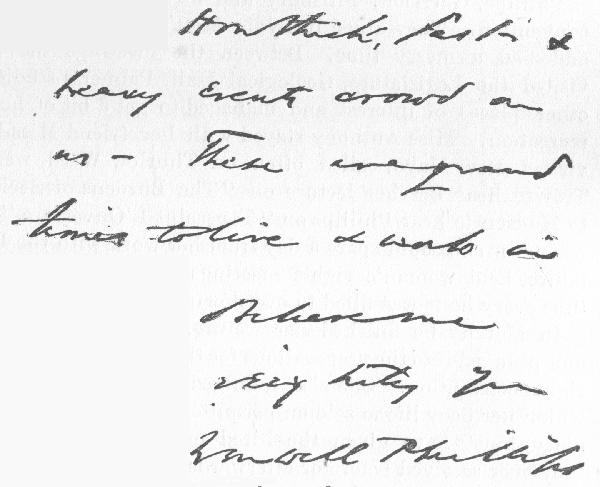
Wendell Phillips
She spoke in various towns all the way to New York where she arrived in time to attend the Anti-Slavery Anniversary and make final arrangements for the convention in Mozart Hall, May 12. She had written asking Lucretia Mott to preside, who answered, "I am sure there needs not a better presiding officer than thyself," but agreed to come. When the hour arrived the hall was so packed that it was impossible for Mrs. Mott to reach the platform and Miss Anthony was obliged to open the meeting. This convention, like several which preceded it, was greatly disturbed by noise and interruptions from the audience, until finally it was turned over to Wendell Phillips who "knew better than any one else how to play with and lash a mob and thrust what he wished to say into their long ears." At the end of his speech Miss Anthony immediately adjourned the convention, to prevent violent demonstrations. The Tribune said:
The woman's rights meeting last night was well calculated to advance the cause that the reformers met to plead. The speakers were comparatively so 175 temperate, while sundry voters were so intemperate in demonstrating their folly, rudeness, ignorance and indecency, that almost any cause which the one pleaded and the other objected to would be likely to find favor with order-loving people. The presence of a single policeman might have preserved perfect order, saved the reputation of our city before crowds of strangers and given hundreds an opportunity to hear. Of course it being a meeting that women were to address, as "women have no rights in public which men are bound to maintain," there was no policeman present.
The disturbances at these conventions were not so much because the mob objected to the doctrine of woman's rights as that they were addressed by the leading anti-slavery speakers and therefore had to bear the odium attached to that hated cause.
A strong memorial, asking for equal social, civil and political rights for women and based on the guarantees of the Declaration of Independence, was prepared by a committee consisting of Miss Anthony, Mr. Phillips and seven others, to be presented to every legislature in the Union. By the time the legislatures met in 1860, political affairs had reached a crisis and the country was in a state of unrest and excitement which made it impossible to secure consideration for this or any other question outside the vital issues that were pressing, although it was presented in several States.
Miss Anthony and Mrs. Stanton wrote an eloquent appeal to be circulated with the petitions to rouse public sentiment. Armed with this the former began correspondence with speakers in reference to a summer and fall campaign of the state. The diary shows that she actually found time to attend a picnic, but as she was called upon for a speech while there the day was not wholly wasted. There are also references to "moonlight rides," and one entry records: "Mr. —— walked home with me; marvelously attentive. What a pity such powers of intellect should lack the moral spine!"
Out of the Francis Jackson fund Mr. Phillips sent Miss Anthony $1,500 for her extensive campaign. She engaged speakers to come into New York in different months, and July 13 opened the series with Antoinette Blackwell at Niagara Falls. From here they made the round of the watering places, 176 Avon, Clifton, Trenton Falls, Sharon, Saratoga, Ballston Spa and Lake George, where persons of wealth and prominence were gathered from all parts of the Union. In some places they spoke in a grove to thousands of people; at others in hotel parlors, and everywhere met a friendly spirit and respectful treatment.
Miss Anthony did not forget to go to Poughkeepsie this summer, and stir up the teachers at their annual meeting. Antoinette Blackwell says of this trip: "I shall always recollect our journey on the boat with two or three dozen teachers, and your walking the deck with one and another, talking about women and their rights, in school and out of school, in the most matter-of-fact way, although it was plainly evident that most of them would sooner have listened to a discussion on the rights of the Hottentots." The teacher who was her chief support at these conventions was Helen Philleo.[27] There were very few of them in those days who had the courage to help fight this battle for their own interests. At the last session she announced a woman's rights meeting and many remained to attend it.
After the summer resorts were closed the meetings were continued in the principal towns. Mrs. Blackwell thus describes an incident in the Fort William Henry hotel: "I remember a rich scene at the breakfast table. Aaron Powell was with us and the colored waiter pointedly offered him the bill of fare. Miss Anthony glanced at it and began to give her order, not to Powell in ladylike modesty, but promptly and energetically to the waiter. He turned a grandiloquent, deaf ear; Powell fidgeted and studied his newspaper; she persisted, determined that no man should come between her and her own order for coffee, cornbread and beefsteak. 'What do I understand is the full order, sir, for your party?' demanded the waiter, doggedly 177 and suggestively. Powell tried to repeat her wishes, but stumbled and stammered and grew red in the face. I put in a working oar to cover the undercurrent of laughter, while she, coolly unconscious of everything except that there was no occasion for a 'middleman,' since she was entirely competent to look after her own breakfast, repeated her order, and the waiter, looking intensely disgusted, concluded to bring something, right or wrong."
While at Easton among her old friends Miss Anthony attended Quaker meeting and the spirit moved her to speak very forcibly, as she relates in a letter: "A young Quaker preacher from Virginia, who happened to be there, said: 'Christ was no agitator, but a peacemaker; George Fox was no agitator; the Friends at the South follow these examples and are never disturbed by fanaticism.' This was more than I could bear; I sprung to my feet and quoted: 'I came into the world not to bring peace but a sword.... Woe unto you, scribes and Pharisees, hypocrites that devour widow's houses!' Read the New Testament, and say if Christ was not an agitator. Who is this among us crying 'peace, peace, when there is no peace?'—and sat down." It is a matter of regret that she did not tell what became of the gentleman from Virginia.
Miss Anthony writes to Mary Hallowell, during these days: "I am more tired than ever before and know that I am draining the millpond too low each day to be filled quite up during the night, but I am having fine audiences of thinking men and women. Oh, if we could but make our meetings ring like those of the anti-slavery people, wouldn't the world hear us? But to do that we must have souls baptized into the work and consecrated to it."
Mrs. Blackwell's domestic affairs will not permit any further lecturing and Miss Anthony says in a letter to her: "O, dear, dear, how I do wish you could have kept on with me. I can't tell you how utterly awful is the suspense these other women keep me in: first, they can't, then they can, then they won't unless things are so and so; and when I think everything 178 is settled, it all has to be gone over again. The fact is I am not fit to deal with anybody who is not terribly in earnest." To this she replies: "Dear child, I'm sorry I can not help you, but pity a poor married woman and forgive. The ordeal that I have been going through, four sewingwomen each giving about two days, no end of little garments to alter and to make, with a husband whose clothes as well as himself have been neglected for three months, the garden to be covered up from the frost, shrubs to transplant, winter provisions to lay in and only one good-natured, stupid servant to help with all. This, Susan, is 'woman's sphere.'"
As Miss Anthony never approved of a woman's neglecting her household for any purpose, she urged no more but sought elsewhere for assistance. There was not one unmarried woman except herself in all the corps of available speakers and, while some of them could make a trip of a few weeks, not one could be depended on for steady work. In October she secured Mrs. Tracy Cutler for awhile, and later Frances D. Gage, J. Elizabeth Jones and Lucy N. Coleman, but was obliged to hold many meetings alone. These were continued at intervals through the fall of 1859 and the winter and spring of 1860, and numerous pages of foolscap are still in existence containing a carefully kept account of the expenses. Each meeting was made partly to pay for itself, the lecturers received $12 a week, Miss Anthony herself taking only this sum, and it may be believed that no more extended and effective propaganda work ever was accomplished with the same amount of money. While this was being done, she also assisted Clarina Howard Nichols and Susan E. Wattles to plan an important campaign in Kansas with money furnished from the Jackson fund.
She received the following characteristic letter from Rev. Thomas K. Beecher when she asked for the use of his church in Elmira: "I will answer for myself and afterwards append the decision of the trustees. Anybody with good moral character and clean feet is welcome to use our meeting house, if they like, but were I you I should prefer Holden's Hall. But, 179 lastly, I should shrink from holding such a meeting. I fear that you will come to pain of disappointment when your enthusiasm is chilled and bruised against the stone walls of Elmira apathy. More people will attend at Holden's Hall than at church. So speaks in brief, yours with hearty respect."
Mrs. Blackwell writes her teasingly about what she calls her obtuseness, going straight ahead with her work, never knowing when she was snubbed or defeated, giving the undiluted doctrine to people without ever perceiving their frantic efforts to escape, and ignoring all the humorous features of the campaigns. Miss Anthony retorts: "You might give some of the funny things at your own expense, but tell just as many as you please at mine. You see I have always gone with such a blind rush that I never had time to see the ridiculous, and blessed for me and my work and my happiness that I did not." Another invariable habit was never to notice complaints written to her. She always answered the business points but entirely ignored complainings, charges against other people and all extraneous matters.
She relates a significant incident which occurred during this summer campaign when she and Antoinette Blackwell spent a Sunday at Gerrit Smith's. He had established at Peterboro and was maintaining at his own expense a Free church. Mrs. Blackwell, under the influence of Theodore Parker, Chapin and other liberal thinkers, had become very broad in her doctrines, and was greatly pleased at an opportunity to preach for Mr. Smith, thinking to find perfect appreciation and sympathy. After church Miss Anthony went to her room and found her weeping bitterly, but she begged to be left to herself. When more composed she sent for her and told how in the midst of her sermon, when she felt herself surpassing anything she ever had done, she heard a gentle snore, and looking down beheld Mr. Smith sound asleep! She was terribly disappointed and now had made up her mind there was but one thing for the human soul, and that was to live absolutely within itself. There is no friend, no relative, who can enter into the depths 180 of another individuality. A husband and wife may be very happy together; in all the little occurrences which really make up the sum of everyday life, they may be perfectly congenial; but there will be times when each will feel the other separated by an immeasurable distance. Henceforth she would enjoy what solace there was in her religious faith for herself but would expect no other soul to share it with her. "This was to me a wonderful revelation," said Miss Anthony, "and I realized, as never before, that in our most sacred hours we dwell indeed in a world of solitude."
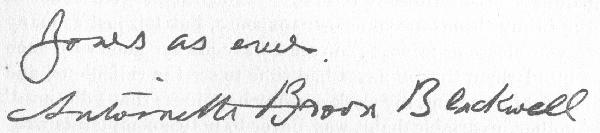
Antoinette Brown Blackwell
On December 2, 1859, occurred that terrible tragedy in the country's history, the execution of John Brown for the raid on the United States arsenal at Harper's Ferry. The nation was shaken as by a great earthquake. Its dreadful import was realized perhaps by none so strikingly as by that little band of Abolitionists who never had wavered in their belief that slavery must ultimately disrupt the Union. When the country was paralyzed with horror and uncertainty, they alone dared call public meetings of mourning and indignation. It was natural that in Rochester they should turn to Susan B. Anthony for leadership. Without a moment's hesitation for fear of consequences she engaged Corinthian Hall and set about arranging a meeting for the evening of that day. Parker Pillsbury wrote:
Can you not make this gathering one of a popular character? What I mean is will not some sturdy Republican or Gerrit Smith man preside, another act as secretary and several make addresses? Only we must not lose the control. I do not believe that any observance of the day will be instituted outside our ranks. I am without tidings from the "seat of war" since Tuesday evening; and do not know what we shall hear next. My voice is against any attempt 181 at rescue. It would inevitably, I fear, lead to bloodshed which could not compensate nor be compensated. If the people dare murder their victim, as they are determined to do, and in the name of law, he dares and is prepared to die and the moral effect of the execution will be without a parallel since the scenes on Calvary eighteen hundred years ago, and the halter that day sanctified shall be the cord to draw millions to salvation.
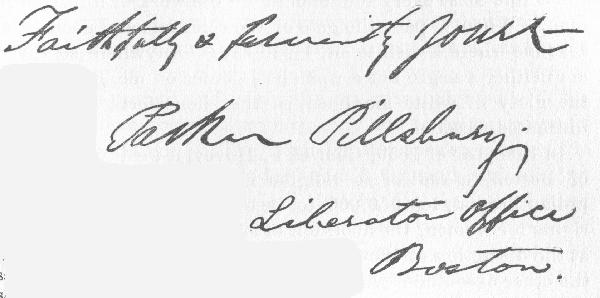
Parker Pillsbury
Miss Anthony found that beyond the little band of Abolitionists not a person dared give her any assistance. Her diary says: "Not one man of prominence in religion or politics will publicly identify himself with the John Brown meeting." She went from door to door selling tickets and collecting money. Samuel D. Porter, a prominent member of the Liberty party, assisted her, as did that circle of staunch Quaker friends who never failed her in any undertaking; Frederick Douglass had been obliged to flee to England. An admission fee of fifty cents kept out the rabble, and not more than 300 were present. The masses of the people, even those in full sympathy, were afraid to attend. Rev. Abram Pryn, a Free church minister, made a fine address, and Parker Pillsbury spoke as never before. Mr. Porter said: "This was the only occasion that ever matched Pillsbury's adjectives." Miss Anthony presided and there was no disturbance. The surplus receipts were sent to John Brown's family.
Mrs. Stanton wrote shortly afterwards, urging her to come to Seneca Falls: "Indeed it would do me great good to see some reformers just now. The death of my father, the worse than death of my dear cousin Gerrit,[28] the martyrdom of that great and glorious John Brown, all conspire to make me regret 182 more than ever my dwarfed and perverted womanhood. In times like these every soul should do the work of a fullgrown man. When I pass the gate of the celestials and good Peter asks me where I wish to sit, I will say: 'Anywhere so that I am neither a negro nor a woman. Confer on me, great angel, the glory of white manhood, so that henceforth I may feel unlimited freedom.'"
In this year of 1859, Charles F. Hovey, a wealthy merchant of Boston, a radical in religion and a noted reformer and philanthropist, left $50,000 to be expended in securing equal rights for women, the abolition of slavery, and other reforms, at the discretion of Wendell Phillips, Wm. Lloyd Garrison and the other executors. As slavery was abolished four years later, a considerable portion of this was used for the cause of woman.
Early in December the anti-slavery committee insisted that Miss Anthony should resume the management of their conventions, as they wished to hold a series throughout the large cities of the State and had been unable to find any one who could so successfully conduct them. Abby Kelly Foster, though often critical and censorious, wrote her regarding one of her speeches: "It is a timely, noble, clear-sighted and fearless vindication of our platform. I want to say how delighted both Stephen and myself are to see that you, though much younger than some others in the anti-slavery school, have been able to appreciate so entirely the genius of our enterprise." The distinguished George B. Cheever, of the Church of the Puritans in New York, one of the few orthodox clergymen who stood with the Abolitionists in those early days, wrote Miss Anthony: "May God be with you and guide and bless you in your efforts. That is the strength we all need and must have if we accomplish anything good and permanent in this terrible conflict."
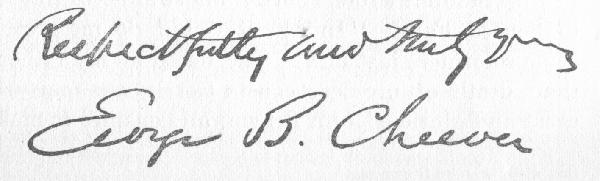
George B. Cheever
A single instance will show how closely the question of woman's rights was connected with that of anti-slavery in the popular mind. When Miss Anthony and Mrs. Blackwell were at Fort William Henry, at the head of Lake George, they spoke one evening in the hotel parlors. There were a number of southerners present and many of them were delighted with the meeting, whose doctrines were entirely new to them, and made liberal contributions. The next day the speakers left in the stage with one of these, Judge John J. Ormond and his two daughters, of Tuscaloosa, Ala. He told Miss Anthony he had been instrumental in securing many laws favorable to women in that state and it would be a pleasure to him to see that their memorial was presented to the Alabama Legislature. When she reached home she sent it to him with the following letter:
Enclosed is a copy of our woman's rights memorial. Will you give me a full report of the action taken upon it?... I hope you and your daughters arrived home safe. Say to the elder I shall be most happy to hear from her when she shall have fairly inaugurated some noble life work. I trust each will take to her soul a strong purpose and that on her tombstone shall be engraved her own name and her own noble deeds instead of merely the daughter of Judge Ormond, or the relict of some Honorable or D. D. When true womanhood shall be attained it will be spoken of and remembered for itself alone. My kindest regards to them, accompanied with the most earnest desire that they shall make truth and freedom the polar star of their lives.
To this Judge Ormond made cordial reply, October 17, 1859:
DEAR MADAM: I have the honor to acknowledge the receipt of your letter of the 2d inst., with the papers enclosed. The petition to the Legislature will be presented by the senator from this county and I will apprise you of the action had upon it. My daughters are obliged to you for the interest you take in them. To a certain extent I agree with you as to the duties of woman. I am greatly in favor of her elevation to her proper sphere as the equal of man as to her civil rights, the security of her person, the right to her property and, where there is a separation after marriage, her equal right with the father to the custody and education of the children. All this as a legislator I have endeavored to accomplish, making large innovations upon the ancient common law. If I differ from you as to her political rights, it is because I think that, from political as well as moral considerations, she is unfit for, indeed incapacitated from, the performance of most of the duties which are now performed by men as members of the body politic; but there are many avocations and professions now exclusively occupied by men which women are as well, 184 perhaps better fitted to fill. I hope these will soon be thrown open to an active competition of both sexes.
Then came the raid on Harper's Ferry and all its terrible consequences, and in December Judge Ormond wrote again:
MADAM: In redemption of my promise to tell you the fate of the woman's rights petition to our Legislature, I have the honor to inform you that it was virtually rejected, being laid on the table. I interested a distinguished member of our Senate in its presentation and, in addition, wrote a letter which under ordinary circumstances would have insured its respectful consideration. But after your petition was forwarded came the treasonable and murderous invasion of John Brown. The atrocity of this act, countenanced as it manifestly was by a great party at the North, has extinguished our last spark of fraternal feeling. Whilst we are all living under a Constitution which secures to us our right to our slaves, the results of which are in truth more beneficial to the whole North, and especially to the New England States, than to us, you are secretly plotting murderous inroads into our peaceful country and endeavoring to incite our slaves to cut the throats of our wives and children. Can you believe that this state of things can last? We now look upon you as our worst enemies and are ready to separate from you. Measures are in progress as far as practicable to establish non-intercourse with you and to proscribe all articles of northern manufacture or origin, including New England teachers. We can live without you; it remains to be seen how you will get along without us. You will probably find that fanaticism is not an element of national wealth or conducive to the happiness or comfort of the people.
In conclusion, let me assure you this is written more in sorrow than in anger. I am not a politician and have always been a strenuous friend of the Union. I am now in favor of a separation, unless you immediately retrace your steps and give the necessary guarantees by the passage of appropriate laws that you will faithfully abide by the compromises of the Constitution, by which alone the slaveholding States can with honor or safety remain in the Union. But that this will be done, I have very little hope, as "madness seems to rule the hour;" and as you have thus constituted yourselves our enemies, you must not be surprised at finding that we are yours.
During the first decade of its history the movement toward securing a larger liberty for women was known by the comprehensive term "woman's rights." At its inception, under the English common law which everywhere prevailed, woman was legally a part of man's belongings, one of his chattels. Restrained by custom from speaking in public or expressing herself through the newspapers, she had been silent under the oppression of ages. When at length she found her voice there were so many wrongs to be righted that she scarcely knew which first should receive attention. Those early meetings could not be called woman suffrage conventions, for many who advocated all the other reforms which they considered either disbelieved in or were indifferent to the franchise. It was only the Anthonys, Stantons, Stones, Roses, Garrisons, Phillips of this great movement for woman's liberty who were philosophical enough to see that the right of suffrage was the underlying principle of the whole question; so it was not for many years, not until practically all other demands had been granted, that they were finally resolved into a suffrage organization, pure and simple. At the beginning of 1860 the laws relating to women, as briefly stated by the great jurist, David Dudley Field, were as follows:
The elective franchise is confined entirely to men. A married woman can not sue for her services, as all she earns legally belongs to the husband, whereas his earnings belong to himself, and the wife legally has no interest 186 in them. Where children have property and both parents are living, the father is the guardian. In case of the wife's death without a will, the husband is entitled to all her personal property and to a life interest in the whole of her real estate to the entire exclusion of the children, even though this property may have come to her through a former husband and the children of that marriage still be living. If the husband die without a will, the widow is entitled to one-third of the personal property and to a life interest in one-third only of the real estate. In case a wife be personally injured, either in reputation by slander, or in body by accident, compensation must be recovered in the joint name of herself and her husband, and when recovered it belongs to him. On the other hand, the wife has no legal claim in a similar case in regard to the husband. The father may by deed or will appoint a guardian for the minor children, who may thus be taken entirely away from the jurisdiction of the mother at his death. Where both parents are dead, the children shall be given to the nearest of kin and, as between relatives of the same degree of consanguinity, males shall be preferred. No married woman can act as administrator in any case.
One can not but ask why, under such laws, women ever would marry, but in those days virtually all occupations were closed to them and the vast majority were compelled to marry for support. In the few cases where women had their own means, they married because of the public sentiment which considered it a serious reproach to remain a spinster and rigorously forbade to her all the pleasures and independence that are freely accorded to the unmarried woman of today. And they married because it is natural for women to marry, and all laws and all customs, all restrictions and all freedom, never will circumvent nature.
On February 3 and 4, 1860, the State Woman's Rights Convention was held at Albany in Association Hall, an interesting and successful meeting. At its close, in a letter to Mrs. Wright, Miss Anthony said: "Mr. Anson Bingham, chairman of the judiciary committee, will bring in a radical report in favor of all our claims, but previous to doing so he wishes our strongest arguments made before the committee and says Mrs. Stanton must come. I wish you would slip over there and make her feel that the salvation of the Empire State, at least of the women in it, depends upon her bending all her powers to move the hearts of our law-givers at this time. I should go there myself this very night but I must watch and encourage friends 187 here." Mrs. Stanton replied to her urgent appeal: "I am willing to do the appointed work at Albany. If Napoleon says cross the Alps, they are crossed. You must come here and start me on the right train of thought, as your practical knowledge of just what is wanted is everything in getting up the right document."
The readers of history never will be able to separate Miss Anthony's addresses from Mrs. Stanton's; they themselves scarcely could do it. Some of the strongest ever written by either were prepared without the assistance of the other, but most of their resolutions, memorials and speeches were the joint work of both. Miss Anthony always said, "Mrs. Stanton is my sentence maker, my pen artist." No one can excel Miss Anthony in logic of thought or vigor of expression; no one is so thoroughly supplied with facts, statistics and arguments, but she finds it difficult and distasteful to put them into written form. When, however, some one else has taken her wonderful stock of material and reduced it to shape, she is a perfect critic. Her ear is as carefully attuned to the correct balance of words as that of a skilled musician to harmony in music. She will detect instantly a weak spot in a sentence or a paragraph and never fail to suggest the exact word or phrase needed to give it poise and strength.
Mrs. Stanton had a large house and a constantly increasing family, making it exceedingly difficult to find time for literary work; so when a state paper was to be written, Miss Anthony would go to Seneca Falls. After the children were in bed, the two women would sit up far into the night arranging material and planning their work. The next day Mrs. Stanton would seek the quietest spot in the house and begin writing, while Miss Anthony would give the children their breakfast, start the older ones to school, make the dessert for dinner and trundle the babies up and down the walk, rushing in occasionally to help the writer out of a vortex. Many an article which will be read with delight by future generations was thus prepared. 188 Mrs. Stanton describes these occasions in her charming Reminiscences:
It was mid such exhilarating scenes that Miss Anthony and I wrote addresses for temperance, anti-slavery, educational and woman's rights conventions. Here we forged resolutions, protests, appeals, petitions, agricultural reports and constitutional arguments, for we made it a matter of conscience to accept every invitation to speak on every question, in order to maintain woman's right to do so. It is often said by those who know Miss Anthony best, that she has been my good angel, always pushing and guiding me to work. With the cares of a large family, perhaps I might in time, like too many women, have become wholly absorbed in a narrow selfishness, had not my friend been continually exploring new fields for missionary labors. Her description of a body of men on any platform, complacently deciding questions in which women had an equal interest without an equal voice, readily roused me to a determination to throw a fire-brand in the midst of their assembly.
Thus, whenever I saw that stately Quaker girl coming across my lawn I knew that some happy convocation of the sons of Adam were to be set by the ears with our appeals or resolutions. The little portmanteau stuffed with facts was opened and there we had what Rev. John Smith and Hon. Richard Roe had said, false interpretation of Bible texts, statistics of women robbed of their property, shut out of some college, half-paid for their work, reports of some disgraceful trial—injustice enough to turn any woman's thoughts from stockings and puddings. Then we would get out our pens and write articles for papers, a petition to the Legislature, letters to the faithful here and there, stir up the women in Ohio, Pennsylvania or Massachusetts, call on the Lily, the Una, the Liberator, the Standard, to remember our wrongs. We never met without issuing a pronunciamento on some question.
In thought and sympathy we were one, and in the division of labor we exactly complemented each other. In writing we did better work together than either could do alone. While she is slow and analytical in composition, I am rapid and synthetic. I am the better writer, she the better critic. She supplied the facts and statistics, I the philosophy and rhetoric, and together we made arguments which have stood unshaken by the storms of nearly fifty long years.[29]
In 1878 Theodore Tilton gave this graphic description: "These two women, sitting together in their parlors, have for the last thirty years been diligent forgers of all manner of projectiles, from fireworks to thunderbolts, and have hurled them with unexpected explosion into the midst of all manner of educational, 189 reformatory, religious and political assemblies, sometimes to the pleasant surprise and half welcome of the members; more often to the bewilderment and prostration of numerous victims; and in a few signal instances, to the gnashing of angry men's teeth. I know of no two more pertinacious incendiaries in the whole country; nor will they themselves deny the charge. In fact, this noise-making twain are the two sticks of a drum for keeping up what Daniel Webster called 'the rub-a-dub of agitation.'"
On March 19, 1860, Mrs. Stanton presented her address to a joint session of the Legislature at Albany, occupying the speaker's desk and facing as magnificent an audience as ever assembled in the old Capitol. It was a grand plea for a repeal of the unjust and oppressive laws relating to women, and it was universally said that its eloquence could not have been surpassed by any man in the United States. A bill was then in the hands of the judiciary committee, simply an amendment of the Property Law of 1848, to which Andrew J. Colvin objected as not liberal enough. Miss Anthony gave him a very radical bill just introduced into the Massachusetts Legislature, which he examined carefully, adding several clauses to make it still broader. It was accepted by the committee, composed of Messrs. Hammond, Ramsey and Colvin, reported to the Senate and passed by that body in February. It was concurred in by the Assembly the day following Mrs. Stanton's speech, and signed by Governor Edwin D. Morgan.[30] This new law declared in brief:
Any property, real and personal, which any married woman now owns, or which may come to her by descent, etc., shall be her sole and separate property, not subject to control or interference by her husband.
Any married woman may bargain, sell, etc., carry on any trade or perform any services on her own account, and her earnings shall be her sole and separate property and may be used or invested by her in her own name. 190
A married woman may buy, sell, make contracts, etc., and if the husband has willfully abandoned her, or is an habitual drunkard, or insane, or a convict, his consent shall not be necessary.
A married woman may sue and be sued, bringing action in her own name for damages and the money recovered shall be her sole property.
Every married woman shall be joint guardian of her children with her husband, with equal powers, etc., regarding them.
At the decease of the husband the wife shall have the same property rights as the husband would have at her death.
This remarkable action, which might be termed almost a legal revolution, was the result of nearly ten years of laborious and persistent effort on the part of a little handful of women who, by constant agitation through conventions, meetings and petitions, had created a public sentiment which stood back of the Legislature and gave it sanction to do this act of justice. While all these women worked earnestly and conscientiously to bring about this great reform, there was but one, during the entire period, who gave practically every month of every year to this purpose, and that one was Susan B. Anthony. In storm and sunshine, in heat and cold, in seasons of encouragement and in times of doubt, criticism and contumely, she never faltered, never stopped. Going with her petition from door to door, only to have them shut in her face by the women she was trying to help; subjecting herself to the jeers and insults of men whom she need never have met except for this mission; held up by the press to the censure and ridicule of thousands who never had seen or heard her; misrepresented and abused above all other women because she stood in the front of the battle and offered herself a vicarious sacrifice—can the women of New York, can the women of the nation, ever be sufficiently grateful to this one who, willingly and unflinchingly, did the hardest pioneer work ever performed by mortal?
Miss Anthony divided the winter of 1860 between the anti-slavery and the woman's cause. As she had very little on hand (!) she arranged another course of lectures for Rochester, inviting A.D. Mayo, Ralph Waldo Emerson, Thomas 191 Starr King and others. These speakers were in the employ of the lyceum bureau, but were so restricted by it that they could give their great reform, lectures only under private management. At the close of Emerson's he said to Miss Anthony that he had been instrumental in establishing the lyceum for the purpose of securing a freedom of speech not permitted in the churches, but he believed that now he would have to do as much to break it up, because of its conservatism, and organize some new scheme which would permit men and women to utter their highest thought. She was in the habit of arranging many of her woman's rights meetings in different towns when Phillips or others were to be there for a lyceum lecture, thus securing them for a speech the following afternoon.
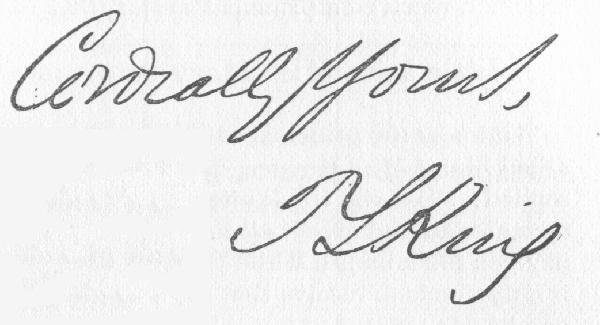
T.S. King
A letter received this winter from her sister Mary is interesting as showing that the belief in equal rights for women was quite as strong in other members of the family. She had been requested by the board of education to fill the place of one of the principals who was ill, and gives the following account:
I was willing to do the best I could to help out, so the next morning, with fear and trembling, I faced the 150 young men and women, many of whom, like their fathers and mothers before them, felt that no woman had the ability to occupy such a place. All went well until it was noised about that I should expect as much salary as had been paid the principal. To establish such a precedent would never do, so a man from a neighboring town was sent for post-haste, but the moment he began his administration the boys rebelled. After slates and books had been thrown from the window and I had been obliged to guard him from their snowballs on his way home, he decided teaching, in that place at least, was not his "sphere" and refused to return.
Next morning the committee asked me to resume the management. I answered: "No person can fill the place of a long-tried teacher, but I in a measure succeeded—yet not one of you would entertain the idea of paying me as much as the principal. You sent to another town for a man, who has made an absolute failure, and yet you do not hesitate to pay him the full salary for the time he was here. If you will be as just to me, I will resume the work and do my best—on any other conditions I must decline." They 192 agreed to the proposition, I finished the term and for the first time on record a woman received a principal's salary!
A little later Miss Mary continues the story:
You know the principal of Number Ten has been ill nearly two months. I asked him if Miss Hayden, who took his place, was to receive his salary. He replied: "Do you think after the money has been audited to me, I ought to turn around and give it all to her?" Said I: "If the board are willing to pay you $72 a month while you are sick and pay her the same, all right; but if only one is to receive that salary, I say, and most emphatically, she is the one." He wanted to know if I was not aware that mine was the only case where such a thing had been done in Rochester. I told him I was heartily glad I had been the means of having justice done for once, and was really in hopes other women teachers would follow my example and suffer themselves no longer to be duped.
Miss Hayden however was obliged to accept $25 a month for doing exactly the work for which the man received $72 during all his illness. To keep her from making trouble, the board gave her a small present with the understanding that it was not to be considered as salary. A short time afterwards Miss Mary wrote again: "A woman teacher on a salary of $20 a month has just been ill for a week and another was employed to take her place; when she recovered, she was obliged to have the supply teacher's salary deducted from her own. So I posted down to the superintendent's office and had another decidedly plain talk. He owned that it was unjust but said there was no help for it."
In the winter of 1860, Henry Ward Beecher delivered his great woman's rights speech at Cooper Institute, New York. At that time his name was a power in the whole world and his masterly exposition of the rights of women is still used as one of the best suffrage leaflets. Miss Anthony tells in her diary of meeting Tilton and of his amusing account of the struggle they had to get this speech published in the Independent. Her little visits to New York and Boston always inspired her with fresh courage, for here she would meet Theodore Parker, Frothingham, Cheever, Chapin, Beecher, Greeley, Phillips, Garrison, the great spirits of that age, and all in perfect sympathy with what she represented. 193
The Tenth National Woman's Rights Convention assembled in Cooper Institute, May 10, 1860. Miss Anthony called it to order and read a full and interesting report of the work and progress of the past year. The usual eloquent speeches were made by Phillips, Mrs. Rose, Rev. Beriah Green, Mary Grew, Rev. Samuel Longfellow, brother of the poet, and others. The warmest gratitude was expressed "toward Susan B. Anthony, through whose untiring exertions and executive ability the recent laws for women were secured." A hearty laugh was enjoyed at the expense of the man who shouted from the audience, "She'd a great deal better have been at home taking care of her husband and children." The proceedings were pleasant and harmonious, but next morning the whole atmosphere was changed and Elizabeth Cady Stanton did it with a little set of resolutions declaring that, under certain conditions, divorce was justifiable. She supported them by an address which for logic of argument, force of expression and beauty of diction never has been, never can be surpassed. No such thoughts ever before had been put into words. She spoke on that day for all the women of the world, for the wives of the present and future generations. The audience sat breathless and, at the close of the following peroration, burst into long-continued applause:
We can not take our gauge of womanhood from the past but from the solemn convictions of our own souls, in the higher development of the race. No parchments, however venerable with the mold of ages, no human institutions, can bound the immortal wants of the royal sons and daughters of the great I Am—rightful heirs of the joys of time and joint heirs of the glories of eternity. If in marriage either party claim the right to stand supreme, to woman, the mother of the race, belongs the scepter and the crown. Her life is one long sacrifice for man. You tell us that among all womankind there is no Moses, Christ or Paul—no Michael Angelo, Beethoven or Shakespeare—no Columbus or Galileo—no Locke or Bacon. Behold those mighty minds so grand, so comprehensive—they themselves are our great works! Into you, O sons of earth, goes all of us that is immortal. In you center our very life, our hopes, our intensest love. For you we gladly pour out our heart's blood and die, knowing that from our suffering comes forth a new and more glorious resurrection of thought and life.
This speech set the convention on fire. Antoinette Blackwell 194 spoke strongly in opposition, Mrs. Rose eloquently in favor. Mr. Phillips was not satisfied even with the motion to lay the resolutions on the table but moved to expunge them from the journal of the convention, which, he said, had nothing to do with laws except those that rested unequally upon women and the laws of divorce did not. It seems incredible that Mr. Phillips could have taken this position, when by the law the wife had no legal claim upon either property or children in case of divorce, and, even though the innocent party, must go forth into the world homeless and childless; in the majority of States she could not sue for divorce in her own name nor could she claim enough of the community property to pay the costs of the suit. Miss Anthony said:
I hope Mr. Phillips will withdraw his motion. It would be contrary to all parliamentary usage that when the speeches which advocated them are published in the proceedings, the resolutions should not be. I wholly dissent from the point that this question does not belong on our platform. Marriage has ever been a one-sided contract, resting most unequally upon the sexes. Woman never has been consulted; her wish never has been taken into consideration as regards the terms of the marriage compact. By law, public sentiment and religion, woman never has been thought of other than as a piece of property to be disposed of at the will and pleasure of man. This very hour, by our statute books, by our so-called enlightened Christian civilization, she has no voice whatever in saying what shall be the basis of this relation. She must accept marriage as man proffers it, or not at all.
And then again, on Mr. Phillips' own ground, the discussion is perfectly in order, since nearly all the wrongs of which we complain grow out of the inequality, the injustice of the marriage laws, that rob the wife of the right to herself and her children and make her the slave of the man she marries. I hope, therefore, the resolutions will be allowed to go out to the public, that there may be a fair report of the ideas which actually have been presented here and that they may not be left to the mercy of the press.
Abby Hopper Gibbons supported Mr. Phillips, but Mr. Garrison favored the publication of the resolutions. The motion to expunge them from the minutes was lost.
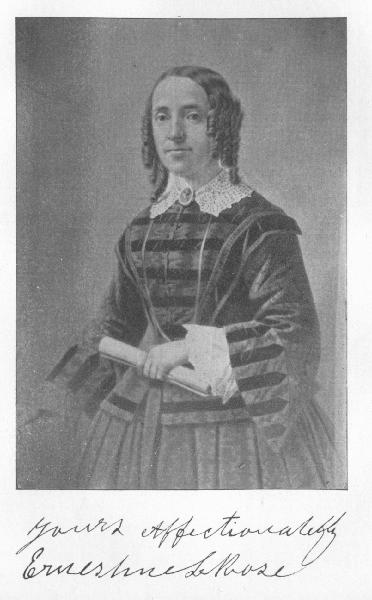
Ernestine L. Rose
This discussion stirred the country from center to circumference, and all the prominent newspapers had editorials favoring one side or the other. It produced the first unpleasantness in the ranks of those who had stood together for the past decade. Greeley launched thunderbolts against the right of divorce under any circumstances, and Mrs. Stanton 195 replied to him in his own paper. Lucy Stone, who just before the convention had written to Mrs. Stanton, "That is a great, grand question, may God touch your lips," now took sides with Phillips. To Mrs. Stanton and Miss Anthony came letters from far and wide, both approving and condemning. Mrs. William H. Seward and her sister, Mrs. Worden, wrote that it not only was a germane question to be discussed at the convention but that there could be no such thing as equal rights with the existing conditions of marriage and divorce. From Lucretia Mott came the encouraging words: "I was rejoiced to have such a defense of the resolutions as yours. I have the fullest confidence in the united judgment of Elizabeth Stanton and Susan Anthony and I am glad they are so vigorous in the work." Parker Pillsbury sent a breezy note: "What a pretty kettle of hot water you tumbled into at New York! Your marriage and divorce speeches and resolutions you must have learned in the school of a Wollstonecraft or a Sophie Arnaut. You broke the very heart of the portly Evening Post and nearly drove the Tribune to the grave."
For the censure of the world at large they did not care, but Phillips' defection almost broke their hearts. He was their ideal of the brave and the true and always before they had had his approval and assistance in every undertaking. Miss Anthony wrote Mrs. Stanton: "It is not for you or for me, any more than for Mr. Phillips, to dictate our platform; that must be fixed by the majority. He is evidently greatly distressed. I find my only comfort in that glorious thought of Theodore Parker: 'All this is but the noise and dust of the wagon bringing the harvest home.' These things must be, and happy are they who see clearly to the end." And to her friend Amy Post: "It is wonderful what letters of approval we are receiving, some of them from the noblest women of the State, not connected in any way with our great movement but sympathizing fully with our position on the question of divorce. I only regret that history may not see Wendell Phillips first and grandest in the recognition of this great truth; but he is a man and can not put himself in the position of a wife, can not 196 feel what she does under the present marriage code. And yet in his relations to his own wife he is the embodiment of chivalry, tenderness and love."
In a letter to Miss Anthony, Mrs. Stanton said: "We are right. My reason, my experience, my soul proclaim it. Our religion, laws, customs, all are founded on the idea that woman was made for man. I am a woman, and I can feel in every nerve where my deepest wrongs are hidden. The men know we have struck a blow at their greatest stronghold. Come what will, my whole soul rejoices in the truth I have uttered. One word of thanks from a suffering woman outweighs with me the howls of Christendom."
Notwithstanding all that had passed, Miss Anthony wrote Mr. Phillips for money from the Hovey fund to publish the report of the convention containing these very resolutions, and he sent it accompanied with a cordial letter. With his generous disposition he soon recognized the fact that it was eminently proper to agitate this question of divorce, in order to make it possible for a woman to secure release from a habitual drunkard, or a husband who treated her with personal violence or willfully abandoned her, and to have some claim on their property and a right to their children, if she were the innocent party. Before three months he wrote Miss Anthony, "Go ahead, you are doing grandly," and he spoke many times afterwards on their platform. During the height of this discussion Miss Anthony was in Albany and Rev. Mayo, thinking to annihilate her, said: "You are not married, you have no business to be discussing marriage." "Well, Mr. Mayo," she replied, "you are not a slave, suppose you quit lecturing on slavery."
As a result of this agitation a little clique of women in Boston, led by Caroline H. Dall, announced that they would hold a convention which should not be open to free discussion but should be "limited to the subjects of Education, Vocation and Civil Position." They drew to themselves a small body of conservatives and it was thought might start a new movement, but the meeting had no permanent results. Parker Pillsbury 197 said of it: "With the exception of Phillips, no soul kindled with volcanic fire was permitted a solitary spark. O, such a meeting! Beautiful as parlor theatricals, but as a bold shriek for freedom or a protest against tyrant laws, not a sparrow on the housetop could have been more harmless." Miss Anthony wrote at this time: "Cautious, careful people, always casting about to preserve their reputation and social standing, never can bring about a reform. Those who are really in earnest must be willing to be anything or nothing in the world's estimation, and publicly and privately, in season and out, avow their sympathy with despised and persecuted ideas and their advocates, and bear the consequences."
In June she and Mrs. Stanton went to a large meeting of Progressive Friends at Waterloo, where the latter read this same speech on divorce and then, to quote Miss Anthony's own words, "As usual when she had fired her gun she went home and left me to finish the battle." In this case it lasted several days, but Mrs. Stanton knew she could count upon her friend to defend her to the last ditch. Miss Anthony was always on the skirmish line. She would interview the married women who could not leave home and children, get their approval of her plans and then go to the front. Once or twice a year she would gather her hosts for a big battle, but the rest of the time she did picket duty, acted as scout and penetrated alone the enemy's country. Between meetings she would find her way home, make over her old dresses and on rare occasions get a new one. This she called "looking after the externals." Then, as her mother was an invalid, she would clean the house from top to bottom and do a vast amount of necessary work.
In her diary are many such entries as these: "Washed all the shutters. Took up the carpet this morning.... Whitewashed the kitchen today.... Helped the girl wash this morning; in the afternoon ironed six shirts, and started for New York at 4 o'clock. Was a little bit tired." At one time, with the help of a seamstress, she made fourteen shirts, stitching by hand all the collars, bosoms and wristbands, 198 and, as this woman had worked in the Troy laundry, she taught Miss Anthony to clear-starch and iron them. Each summer she managed to be home long enough to assist with the canning, pickling and preserving. The little journal gives the best glimpses of her daily life, usually only a hasty scrawl of a few lines but containing many flashes of humor and wisdom. Thus the records run:
Crowded house at Port Byron. I tried to say a few words at opening, but soon curled up like a sensitive plant. It is a terrible martyrdom for me to speak.... Very many Abolitionists have yet to learn the A B C of woman's rights.... The Boston Congregationalist has a scurrilous article. Shall write the editor.... It is discouraging that no man does right for right's sake, but everything to serve party.... I find such comfort in Aurora Leigh when I am sorely pressed.... Heard Stephen A. Douglas today; a low spectacle for both eye and ear.... Gave my lecture on "The True Woman" at Penn Yan teachers' institute. Some strange gentleman present supported my plea for physical culture for girls.... Had a talk with Frederick Douglass. He seems to have no faith in simple and abstract right.... Lost patience this morning over a lamp and suffered vastly therefor. Why can I not learn self-control?... Company came and found me out in the garden picking peas and blackberries—and hoopless.... A fine-looking young colored man on train presented me with a bouquet. Can't tell whether he knew me or only felt my sympathy.... Am reading Buckle's History of Civilization and Darwin's Descent of Man. Have finished his Origin of Species. Pillsbury has just given me Emerson's poems....
Miss Anthony did not fail to put aside everything long enough to attend the State Teachers' Convention at Syracuse. The right of women to take part had now become so well established that it needed no further defense, but she still fought for equal pay for equal services, and equal advantages of education for colored children, and each year found her views gaining a stronger support from both men and women. After this convention she continued her meetings, anti-slavery and woman's rights, and during the summer visited again her birthplace at Adams, Mass., writing home:
Found grandfather working in the oat field, just think of it, ninety-and-a-half years old! But in honor of my arrival he remained home and visited all the afternoon. How hard the women here work, and how destitute they are of all the conveniences. It is perfectly barbarous when they have plenty of money. I borrowed a calico dress and sunbonnet and with the cousins 199 climbed to the very top of Old Greylock. Later I visited the "Daniel House," as grandfather calls our old home. I rambled through the orchard, but the spice-apple tree is dead and the little tree in the corner that we children loved so well. I visited the old spring up in the pasture, and thought how many times the tired feet of mother and grandmother had trod those paths—and the little brook runs over the stones as merry and beautiful as ever.
From here she went to Boston to attend a meeting of the Hovey fund committee and urged them to establish a "depository" at Albany with Lydia Mott in charge, which was done. This depot of supplies of literature, etc., for the anti-slavery cause, and central meeting place for its friends, was continued throughout the war. The Mott sisters, cousins of James, lovely and cultured Quaker women, had a little home in Maiden Lane and kept a gentlemen's furnishing store, making by hand the ruffled shirtbosoms and other fine linen. As their home had been so long the center for the reformers of the day, the committee were glad to put Lydia in charge of this depository, at a small salary, and she conducted an extensive correspondence for them during several years. Miss Anthony stayed with her till everything was arranged and in good running order. In July she had received the following invitation:
By a unanimous vote of the Union Agricultural Society of Dundee a resolution was passed to tender you an invitation to deliver the annual address at our next fair. We know it is a departure from established usage, but your experience as one of a brave band of radical reformers will have taught you that only by gradual steps and continued efforts can the prejudices of custom be overcome and the rights of humanity maintained. Woman's rights are coming to be respected more and more every year, and we hope you will aid us in demonstrating that a woman can deliver as profitable an address at an agricultural fair as can a lord of creation....
Yours respectfully, WILLIAM HOUSE, Secretary, per D. S. BRUNER.
To refuse such an opportunity was not to be thought of, so she accepted, and then wrote Mrs. Stanton, who answered: "Come on and we will grind out the speech. I shall expect to get the inspiration, thoughts and facts from you, and will agree to dress all the children you bring."
She found a cordial welcome when she reached Dundee, October 17. It rained so hard her address was deferred till 200 the next day, as it had to be delivered out of doors, so she visited the "art" and "culinary" departments of the fair, and records in her diary: "I have just put an extra paragraph in my speech on bedquilts and bad cooking." Her stage was a big lumber wagon, and her desk the melodeon of James G. Clark, the noted singer and Abolitionist, who held an umbrella over her head to keep off the rain. The diary says: "More than 2,000 feet were planted in the mud, but I had a grand listening to the very end." The speech was a great success and was published in full in the Dundee Record, occupying the entire front page. It was a fine exposition of modern methods of farming and a strong plea for beautifying the home, giving the children books and music and making life so pleasant they would not want to leave the country for the city. These ideas at that time were new and attracted much attention and favorable comment. This was the first instance of a woman's making an address on such an occasion.
At the close of 1860 an incident occurred which attracted wide attention and strikingly illustrated Miss Anthony's unflinching courage and firm persistence when she felt she was right. One evening in December she was in Albany at the depository with Lydia Mott when a lady, heavily veiled, entered and in a long, confidential talk told her story, which in brief was as follows: She was the sister of a United States senator and of a prominent lawyer, and in her younger days was principal of the academy and had written several books. She married a distinguished member of the Massachusetts Senate and they had three children. Having discovered that her husband was unfaithful to her and confronted him with the proofs, he was furious and threw her down stairs, and thereafter was very abusive. When she threatened to expose him, he had her shut up in an insane asylum, a very easy thing for husbands to do in those days. She was there a year and a half, but at length, through a writ of habeas corpus, was released and taken to the home of her brother. Naturally she longed to see her children and the husband permitted the son to visit her a few weeks. When she had to give him up she 201 begged for the thirteen-year-old daughter, who was allowed to remain for two weeks, and then the father demanded her return. The mother pleaded for longer time but was refused. She prayed her brother to interfere but he answered: "It is of no use for you to say another word. The child belongs by law to the father and it is your place to submit. If you make any more trouble about it we'll send you back to the asylum."
Then in her desperation she took the child and fled from the house, finding refuge with a Quaker family, where she stayed until she learned that her hiding-place was discovered, and now as a last resort she came to these women. They assured the unhappy mother that they would help her and, upon making careful inquiry among her friends, found that, while all believed her sane, no one was willing to take her part because of the prominence of her brothers and husband. Finally it was decided that Miss Anthony should go with the mother and child to New York and put them in a safe place, so they were directed to disguise themselves and be at the train on Christmas afternoon. Miss Anthony went on board and soon saw a woman in an old shawl, dilapidated bonnet and green goggles, accompanied by a poorly dressed child, and she knew that so far all was well, but she found the woman in a terrible state of nervousness. She had met her brother coming out of another car where he had just placed his young son to return to boarding-school, after a happy vacation at home, while his sister with her child was fleeing like a criminal; but fortunately he had not recognized her.
Miss Anthony and her charges reached New York at 10 o'clock at night and went through snow and slush to a hotel but were refused admittance because it did not take women "unaccompanied by a gentleman." They made their weary way to another, only to be met with a similar refusal. Finally she thought of an acquaintance who had had a wretched experience with a bad husband and was now divorced, and she felt that sympathy would certainly impel this woman to give them shelter. When they reached the house they found her keeping boarders and she said all would leave if they learned 202 she was "harboring a runaway wife." It was then midnight. They went in the cold arid darkness to a hotel on Broadway, but here the excuse was made that the house was full. Miss Anthony's patience had reached its limit and she declared: "I know that is not so. You can give us a place to sleep or we will sit in this office all night." The clerk threatened to call the police. "Very well," was the reply, "we will sit here till they come and take us to the station." At last he gave them a room without a fire, and there, cold, wet and exhausted, they remained till morning. Then they started out again on foot, as they had not enough money left to hire a carriage.
They went to Mrs. Rose but she could not accommodate them; then to Abby Hopper Gibbons, who sent them to Elizabeth F. Ellet, saying if they could not find quarters to come back and she would care for them. Mrs. Ellet was not at home. All day they went from place to place but no one was willing to accept the responsibility of sheltering them, and at night, utterly worn out, they returned to Mrs. Gibbons. She promised to keep the mother and child until other arrangements could be effected, and Miss Anthony left them there and took the 10 o'clock train back to Albany. She arrived toward morning, tired out in mind and body, but soon was made comfortable by the ministrations of her faithful friend Lydia.
Abby Hopper Gibbons
It was not long before the family became convinced that Miss Anthony knew the whereabouts of mother and child and then began a siege of persecution. She had at this time commenced that never-to-be-forgotten series of anti-slavery conventions which were mobbed in every town from Buffalo to 203 Albany. In the midst of all this excitement and danger, she was constantly receiving threats from the brothers that they would have her arrested on the platform. They said she had broken the laws and they would make her pay the penalty; that their sister was an "ugly" woman and nobody could live with her. To this she replied: "I have heard there was Indian blood in your family; perhaps your sister has got a little of it as well as yourselves. I think you would not allow your children to be taken away from you, law or no law. There is no reason or justice in a woman's submitting to such outrages, and I propose to defy the law and you also."
If she had been harassed only by these men, it would have caused her no especial worry, but letters and telegrams from friends poured in urging her to reveal the hiding-place and, most surprising of all, both Garrison and Phillips wrote that she had abducted a man's child and must surrender it! Mr. Phillips remonstrated: "Let us urge you, therefore, at once to advise and insist upon this woman's returning to her relatives. Garrison concurs with me fully and earnestly in this opinion, thinking that our movement's repute for good sense should not be compromised by any such mistake." In a letter from Mr. Garrison covering six pages of foolscap, he argued: "Our identification with the woman's rights movement and the anti-slavery cause is such that we ought not unnecessarily involve them in any hasty and ill-judged, no matter how well-meant, efforts of our own. We, at least, owe to them this—that if for any act of ours we are dragged before courts we ought to be able to show that we acted discreetly as well as with good intentions." Both men spoke kindly and affectionately but they were unable to view the question from a mother's or even from a woman's standpoint. Miss Anthony replied to them:
I can not give you a satisfactory statement on paper, but I feel the strongest assurance that all I have done is wholly right. Had I turned my back upon her I should have scorned myself. In all those hours of aid and sympathy for that outraged woman I remembered only that I was a human being. That 204 I should stop to ask if my act would injure the reputation of any movement never crossed my mind, nor will I now allow such a fear to stifle my sympathies or tempt me to expose her to the cruel, inhuman treatment of her own household. Trust me that as I ignore all law to help the slave, so will I ignore it all to protect an enslaved woman.
At the anti-slavery convention in Albany Mr. Garrison pleaded with her to give up the child and insisted that she was entirely in the wrong. He said: "Don't you know the law of Massachusetts gives the father the entire guardianship and control of the children?" "Yes, I know it," she replied, "and does not the law of the United States give the slaveholder the ownership of the slave? And don't you break it every time you help a slave to Canada?" "Yes, I do." "Well, the law which gives the father the sole ownership of the children is just as wicked and I'll break it just as quickly. You would die before you would deliver a slave to his master, and I will die before I will give up that child to its father." It was impossible for even such great men as Garrison and Phillips to feel for a wronged and outraged woman as they could for a wronged and outraged black man. Miss Anthony wrote at this time: "Only to think that in this great trial I should be hounded by the two men whom I adore and reverence above all others!" Through all this ordeal her father sustained her position, saying: "My child, I think you have done absolutely right, but don't put a word on paper or make a statement to any one that you are not prepared to face in court. Legally you are wrong, but morally you are right, and I will stand by you."
Mrs. Elizabeth F. Ellet, author of Women of the Revolution and other works, cared for and protected the unfortunates, obtained sewing for the mother and helped her to live in peaceful seclusion for a year. She was placed in the family of a physician who watched her closely and testified, as did all connected with her, that she was perfectly sane. According to her letters still in existence, the husband took possession of her funds in bank, drew all the money due to her from her publishers and forbade them to pay her any more from the 205 sale of her books, as he had a legal right to do. In this extremity one of the brothers sent her some money through Miss Mott, who stood as firm as Miss Anthony in the face of threat and persecution. At length, feeling safe, the mother let the little girl go to Sunday-school alone and at the door of the church she was suddenly snatched up, put into a close carriage and in a few hours placed in possession of the father. The mother and her friends made every effort to secure the child, but the law was on the side of the father and they never succeeded.
The beginning of 1861 found the country in a state approaching demoralization. Lincoln had received a majority of the electoral vote but far from a majority of the popular vote. The victory was so narrow that the Republicans did not feel themselves strong enough for aggressive action, and the party was composed of a number of diverse elements not yet sufficiently united to agree upon a distinctive policy. Its one cohesive force was the principle of no further extension of slavery, but there was no thought among its leaders of any interference with this institution in the States where it already existed. They accepted the interpretation of the Constitution which declared that it sanctioned and protected slavery, but were determined that the Territories should be admitted into the Union as free States. While many of them were in favor of emancipation, they expected that in some way this question would be settled without recourse to extreme measures, and they feared the effect, not only on the South but on the North, of the forcible language and radical demands of the Abolitionists.
The latter were roused to desperation. Never for an instant did they accept the doctrine that the North should be satisfied merely by the prevention of any further spread of slavery; they believed the system should be exterminated root and branch. They were angered at the reserved and dispassionate language of Lincoln and alarmed at the threats of the secession 208 of the South, which must result either in putting it forever beyond the power of the government to interfere with slavery, or in terrorizing it into making such concessions as would enable the slave power to intrench itself still more strongly under the protection of the Constitution.
At this critical moment, therefore, the Abolitionists put forth every effort to rouse public sentiment to the impending dangers. They gathered their forces and sent them throughout New England, New York and the Western States, bearing upon their banners the watchwords, "No Compromise with Slaveholders. Immediate and Unconditional Emancipation." One detachment, under the intrepid leadership of Susan B. Anthony, arranged a series of meetings for New York in the winter of 1861. This party was composed of Elizabeth Cady Stanton, Rev. Samuel J. May, Rev. Beriah Green, Aaron M. Powell and Stephen S. Foster; but one after another gave out and went home, while Miss Anthony still remained at the helm. The series began at Buffalo, January 3, in St. James Hall. The mob was ready for them and, led by ex-Justice George Hinson and Birdseye Wilcox, hissed, hooted, yelled and stamped, making it utterly impossible for the speakers to be heard. Prominent among the disturbers were young Horatio Seymour and a son of ex-President Fillmore. The police refused to obey the orders of a Republican mayor and joined in the efforts of the mob, which held carnival two entire days, finally crowding upon the platform and taking possession; and in the midst of the melee the gas was turned off. Miss Anthony stood her ground, however, until lights were brought in, and then herself declared the meeting adjourned.
In towns where there were not enough people to create a disturbance, the meetings passed off quietly, but they were mobbed and broken up in every city from Buffalo to Albany. Democratic officials encouraged the mob spirit and where Republicans might have wished to oppose it, they were too cowardly to do so. The meetings were advertised for three days in Rochester, beginning January 12, and, as the newspapers occupied many columns with a discussion as to whether they would be 209 broken up here as elsewhere, the opposition was thoroughly aroused and the turbulent elements had time to become fully organized. The board of aldermen were called together to consider whether means could not be found to prevent Mr. Reynolds allowing the use of Corinthian Hall, which had been rented for the occasion, and whether it would not be wise to issue an order forbidding the owner of any public building to let it to the Abolitionists; but finally adjourned without action.
The mob, under the lead of Constable Richard L. Swift, fully answered all expectations. As Miss Anthony stepped forward to open the meeting, she was greeted with a broadside of hisses and ironical applause. When Mrs. Stanton began her address her voice was drowned in jeers and groans and, although she persevered for some time, she was unable to complete a single sentence. Rev. May attempted to speak and was met by yells, and stamping of feet. A Southerner in the audience rose and said: "Well, I may as well go back to Kentucky, for this is ahead of any demonstration against free speech I ever saw in the South;" but he was stopped by cries of, "Put him out!" The men kept on their hats, smoked pipes and cigars, stamped, bellowed, swore, and bedlam reigned. The acting mayor, sheriff and chief of police were present, but not an arrest was made. Mrs. Stanton finally left the platform, but Miss Anthony courageously maintained her position until the chief of police mounted the rostrum and declared the meeting adjourned. Even then the rioters refused to go out of the hall, and the speakers were obliged to leave under protection of the police amid the hooting and howling of the rabble. All wanted to give up the rest of the meetings, but Miss Anthony declared they had a right to speak and it was the business of the authorities to protect them, and persisted in finishing the series as advertised. On Sunday the only place where they were allowed to hold services was in Zion's colored church. The house was filled, morning and evening, and they were left in peace. 210
At Port Byron the meeting was broken up by the throwing of cayenne pepper on the stove. When the speakers reached Utica, where Mechanics' Hall had been engaged, they learned that the board of directors had met and decided it should not be used, in direct violation of the contract with Miss Anthony, who had spent $60 on the meeting. They found the doors locked and a large crowd on the outside. The mayor was among them and begged her not to attempt to hold a meeting. In reply she demanded that the doors be opened. He refused but offered to escort her to a place of safety. She answered: "I am not afraid. It is you who are the coward. If you have the power to protect me in person, you have also the power to protect me in the right of free speech. I scorn your assistance." She declined his proffered arm, but he persisted in escorting her through the mob. As no hall could be had they held their meeting at the residence of her host, James C. DeLong, and formed an anti-slavery organization. The instigator of the opposition in Utica was ex-Governor Horatio Seymour. Of the meeting at Rome, Miss Anthony wrote:
Last evening there was a furious organized mob. I stood at the foot of the stairs to take the admission fee. Some thirty or forty had properly paid and passed up when a great uproar in the street told of times coming. It proved to be a closely packed gang of forty or fifty rowdies, who stamped and yelled and never halted for me. I said, "Ten cents, sir," to the leader, but he brushed me aside, big cloak, furs and all, as if I had been a mosquito, and cried, "Come on, boys!" They rushed to the platform, where were Foster and Powell who had not yet commenced speaking, seated themselves at the table, drew out packs of cards, sang the Star-Spangled Banner and hurrahed and hooted. After some thirty or forty minutes, Mr. Foster and Aaron came down and I accompanied them back to Stanwix Hotel, where the gang made desperate efforts to get through the entrance room in pursuit of the "damned Abolitionists." The Republican paper called us pestiferous fanatics and infidels, and advised every decent man to stay away. Were the Republicans true at this crisis, we not only should be heard quietly, as in past years, but should have far larger audiences; and yet a hundred unmolested conventions would not have made us a tithe of the sympathizers this one diabolical mob has done.
Mr. May was in favor of giving up the conventions and was especially anxious that one should not be attempted in Syracuse, which city, he said, had always maintained freedom of 211 speech and he did not want the record broken; but still, if they insisted upon coming he would do all in his power to help them. Miss Anthony was firm, replying: "If Syracuse is capable of maintaining free speech the record will not be broken; if it is not capable, it has no right to the reputation." Convention Hall was engaged and Mr. May and Mr. C.D.B. Mills lent every possible assistance, but the Abolitionists encountered here the worst opposition of all. The hall was filled with a howling, drunken, infuriated crowd, headed by Ezra Downer, a liquor dealer, and Luke McKenna, a pro-slavery Democrat. Even Mr. May, who was venerated by all Syracuse, was not allowed to speak. Rotten eggs were thrown, benches broken, and knives and pistols gleamed in every direction. The few ladies present were hurried out of the room, and Miss Anthony faced that raging audience, the only woman there. The Republican chief of police refused to make any effort toward keeping order. The mob crowded upon the platform and took possession of the meeting, and Miss Anthony and her little band were forced out of the hall. They repaired to the residence of Dr. R.W. and Mrs. Hannah Fuller Pease, which was crowded with friends of the cause. That evening the rioters dragged through the streets hideous effigies of Susan B. Anthony and Rev. S.J. May, and burned them in the public square.
Not at all daunted or discouraged, Miss Anthony took her speakers forthwith into the very heart of the enemy's country, the capital of the State. Albany had at that time a Democratic mayor, George H. Thacher. As soon as the papers announced the coming of the Abolitionists, over a hundred prominent citizens addressed a petition to the mayor to forbid their meeting for fear of the same riotous demonstrations which had disgraced the other cities. He replied at considerable length, saying that he had taken an oath to support the Constitutions of the United States and the State of New York, that both guaranteed the right of free speech to all citizens, and while he was mayor he intended to protect them in that right.
On the day of the convention he called at the Delevan 212 House for Miss Anthony and Mrs. Stan ton, now reinforced by Lucretia Mott, Martha C. Wright, Gerrit Smith and Frederick Douglass, and accompanied them to Association Hall. They found it packed to the doors. The mayor went on the platform and announced that he had placed policemen in various parts of the hall in citizens' clothes, and that whoever made the least disturbance would be at once arrested. Then he laid a revolver across his knees, and there he sat during the morning, afternoon and evening sessions. Several times the mob broke forth, and each time arrests were promptly made. Toward the close of the evening he said to Miss Anthony: "If you insist upon holding your meetings tomorrow, I shall still protect you, but it will be a difficult thing to hold this rabble in check much longer. If you will adjourn at the close of this session I shall consider it a personal favor." Of course she willingly acceded to his request. He accompanied the ladies to their hotel, the mob following all the way.
This closed the series of conventions. With a Republican mayor in every other city, there had been no attempt at official protection; and yet it may be remembered, in extenuation, that it is always easier for the party out of power than for the one in power to stand for principle; the former has nothing to lose. The Republicans at this time were panic-stricken and staggering under the weight of responsibility suddenly laid upon them; and the Abolitionists, by their radical demands and scathing criticism, were adding to their difficulties. There can be no justification, however, for any official who is too cowardly or too dishonest to fulfill the duties of his office.
Immediately upon the close of this anti-slavery meeting, the State Woman's Rights Convention was held in Albany, February 7 and 8. Mr. Garrison, Mrs. Rose, Lucretia Mott and many of the old brilliant galaxy were among the speakers. They little thought that this was the last convention they would hold for five years, that a long and terrible war would cast its shadow over every household before they met again, that differences would arise in their own ranks, and that never more would they come together in the old, fraternal spirit that 213 had bound them so closely and given them strength to bear the innumerable hardships which so largely had been their portion.
After the Albany meeting, Miss Anthony at once began preparations for the National Woman's Rights Convention in New York in May. The date was set, the Tabernacle secured and many of the speakers engaged, but in the meantime the affairs of the nation had become more and more complicated; the threatened secession of the Southern States had been accomplished; the long-expected, long-dreaded crisis seemed close at hand; the people were uncertain and bewildered in the presence of the dreadful catastrophe. All thought, all interest, all action were centered in the new President. The whole nation was breathlessly awaiting the declaration of Lincoln's policy. To call any kind of meeting which had an object other than that relating to the preservation of the Union seemed almost a sacrilege. Letters poured in upon Miss Anthony urging her to relinquish all idea of a convention, but she never had learned to give up. Even after the fall of Sumter and the President's call for troops, the letters were still insisting that she declare the meeting postponed; but it was not until the abandonment of the Anti-Slavery Anniversary, which always took place the same week, and until she found there were absolutely no speakers to be had, that she finally yielded.
About this time she takes care of a sister with a baby, and writes Mrs. Stanton: "O this babydom, what a constant, never-ending, all-consuming strain! We should never ask anything else of the woman who has to endure it. I realize more and more that rearing children should be looked upon as a profession which, like any other, must be made the primary work of those engaged in it. It can not be properly done if other aims and duties are pressing upon the mother." And yet so great was her spirit of self-sacrifice that in this same letter she offers to take entire charge of Mrs. Stanton's seven children while she makes a three months' trip abroad. At a later date, when caring for a young niece, she says: "The dear little 214 Lucy engrosses most of my time and thoughts. A child one loves is a constant benediction to the soul, whether or not it helps to the accomplishment of great intellectual feats."
The watchword of the Abolitionists ever had been "Peace." Under the leadership of Garrison, their policy had been one of non-resistance. When war actually was precipitated, when the South had fired upon the stars and stripes and the tread of marching feet resounded through every northern city, they were amazed and bewildered. Instinctively they turned to their great leaders for guidance. In Music Hall, Boston, April 21, 1861, to an audience of over 4,000, Wendell Phillips made that masterly address, justifying "this last appeal to the God of Battles," and declaring for War. It was one of the matchless speeches of all history, and touched the keynote which soon swelled into a grand refrain from ocean to ocean. But even then there were those who waited for the declaration of Garrison, the great pioneer of Abolitionism. A letter written by Rev. Beriah Green to Miss Anthony, May 22, expresses the sentiment which pervaded the minds of many Abolitionists at this period:
I looked forward to the Anti-Slavery Anniversary with the keenest pleasure and hope. I should see luminous faces; I should bear the voice of wisdom; I should gather strength and courage and return to my task-garden refreshed and quickened. But when I read the official notice in the Standard and Liberator of the grounds on which the meeting was given up, "that nothing should be done at this solemn crisis needlessly to check or divert the mighty current of popular feeling which is now sweeping southward with the strength and impetuosity of a thousand Niagaras," I was surprised and puzzled. I have read Phillips' War Speech, marked the tenor and spirit of the Liberator, seen the stars and stripes paraded in the Standard, perused James Freeman Clarke's sermon, and I feel more desolate and solitary than ever. Mrs. Stanton, too, is for War for the Union, and I say to myself: "How will Susan Anthony and Parker Pillsbury and all the other old comrades be affected by these signs of the times?"
Miss Anthony replied in the same strain:
A feeling of sadness, almost of suffocation, has been mine ever since the first announcement that the anti-slavery meeting was postponed. I can not welcome the demon of expediency or consent to be an abettor, by silence any more than by word or act, of wicked means to accomplish an end, not even 215 for the sake of emancipating the slaves. I have tried hard to persuade myself that I alone remained mad, while all the rest had become sane, because I have insisted that it is our duty to bear not only our usual testimony but one even louder and more earnest than ever before.... The Abolitionists, for once, seem to have come to an agreement with all the world that they are out of time and place, hence should hold their peace and spare their rebukes and anathemas. Our position to me seems most humiliating, simply that of the politicians, one of expediency not principle. I have not yet seen one good reason for the abandonment of all our meetings, and am more and more ashamed and sad that even the little Apostolic number have yielded to the world's motto—"the end justifies the means."
As the long, hard winter's work had left her very tired she gladly turned to that haven of refuge, the farm-home. The father, who was willing always to put the control of affairs into her capable hands, took this opportunity to make a long-desired trip to Kansas, going the first of May and returning in September. She assumed the entire management of the farm, put in the crops, watched over, harvested and sold them; assisted her mother with the housework and the family sewing and, by way of variety, pieced a silk quilt and wove twenty yards of rag carpet in the old loom. She found time, more-over, to go to the Progressive Friends' meeting at Junius and to attend the State Teachers' Convention at Watertown. She also managed a large anti-slavery Fourth of July meeting at Gregory's grove, near Rochester, securing a number of distinguished speakers. In writing her, relative to this meeting, Frederick Douglass said: "I rejoice not in the death of any one, yet I can not but feel that, in the death of Stephen A. Douglas, a most dangerous person has been removed. No man of his time has done more than he to intensify hatred of the negro and to demoralize northern sentiment. Since Henry Clay he has been the King of Compromise. Yours for the freedom of man and of woman always."
Frederick Douglass
From her diary may be obtained an idea of the busy life 216 which only allowed the briefest entries, but these show her restlessness and dissatisfaction:
Tried to interest myself in a sewing society; but little intelligence among them.... Attended Progressive Friends' meeting; too much namby-pamby-ism.... Went to colored church to hear Douglass. He seems without solid basis. Speaks only popular truths.... Quilted all day, but sewing seems to be no longer my calling.... I stained and varnished the library bookcase today, and superintended the plowing of the orchard.... The last load of hay is in the barn; all in capital order. Fitted out a fugitive slave for Canada with the help of Harriet Tubman.... The teachers' convention was small and dull. The woman's committee failed to report. I am mortified to death for them.... Washed every window in the house today. Put a quilted petticoat in the frame. Commenced Mrs. Browning's Portuguese Sonnets. Have just finished Casa Guidi Windows, a grand poem and so fitting to our terrible struggle.... I wish the government would move quickly, proclaim freedom to every slave and call on every able-bodied negro to enlist in the Union army. How not to do it seems the whole study at Washington. Good, stiff-backed Union Democrats would dare to move; they would have nothing to lose and all to gain for their party. The present incumbents have all to lose; hence dare not avow any policy, but only wait. To forever blot out slavery is the only possible compensation for this merciless war.
All through the chroniclings of the monotonous daily life is the cry: "The all-alone feeling will creep over me. It is such a fast after the feast of great presences to which I have been so long accustomed." During these days she reads Adam Bede, and thus writes Mrs. Stanton:
I finished Adam Bede yesterday noon. I can not throw off the palsied oppression of its finale to poor, poor Hetty—and Arthur almost equally commands my sympathy. He no more desired to wrong her or cause her one hour of sorrow than did Adam, but the impulse of his nature brooked no restraint. Should public sentiment tolerate such a consummation of love—or passion, if it were not love? (But I believe it was, only the impassable barrier of caste forbade its public avowal.) If such a birth could be left free from odium and scorn, contempt and pity from the world, it would be a thousand times more holy, more happy, than many of those in legal marriage. It will not do for me to read romances; they are too real to shake off. What is the irresistible power so terrifically pictured in both Hetty and Arthur, which led them on to the very ill they most would shun?
To crown the result I went to the colored church to hear Sallie Holley, but she did not come. Mrs. Coleman was in the pulpit and read a poem of Gerald Massey on Peace, spoke a few minutes and said she saw Miss Anthony present and hoped she'd occupy the time. Then rang round the house the 217 appalling cry of "Miss Anthony." There was no escape, and I staggered up and stammered out a few words and sat down—dead, killed—thoroughly enraged that I had not spent the forenoon in making myself ready at least to read something, instead of poring over Adam Bede.
To this Mrs. Stanton replies: "You speak of the effect of Adam Bede on you. It moved me deeply, and The Mill on the Floss is another agony. Such books as these explain why the 'marriage question' is all-absorbing. O, Susan, are you ever coming to visit me again? It would be like a new life to spend a day with you. How I shudder when I think of our awful experience with those mobs last winter, and yet even now I long for action." Miss Anthony was equally restive in her own seclusion which, although by no means an idle one, had shut her from the great outside world that at this hour seemed to cry aloud for the best service of every man and woman. In January, 1862, she went to Mrs. Stanton's and together they prepared an address for the State Anti-Slavery Convention to be held at Albany, February 7 and 8, and here in the society of Garrison and Phillips, she received fresh inspiration. Soon after reaching home, at Phillips' request, she arranged a lecture for him in Rochester. After paying all expenses, she sent him a check—there is no record of its size—but he returned a portion, saying:
DEAR SUSAN: Thank you, but you are too generous. I can't take such an awful big lion's share, even to satisfy your modesty. Put the enclosed, with my thanks, into your own pocket, as a slight compensation for all your trouble. Remember and pay my successor not one cent more than you can afford.... I had to charter a locomotive all to myself to get back from Oswego in time for Rondout. Riding in the darkness with the engineer through the snow gave me time to think of the pleasant group and supper I missed the night before at the Hallowells. Kind regards to them. Tell Mrs. Hallowell her lunch tasted good about midnight, as I entered Syracuse.
Miss Anthony managed the usual series of lectures this winter. When she sent Mr. Tilton his check he returned this rollicking answer:
DEAR S.B.A.: I received your letter and its enclosure, which latter has already vanished like April snow, to pay the debts of the subscriber.... Our morning ride with our good friend Frederick gives me pleasure whenever 218 I think of it. Those pictures of Mount Hope and the waterfall were better than any in the Academy of Design. As to yourself, I have had some talk with Rev. Oliver Johnson about your "sphere," and we both agree that you are defrauding some honest man of his just due. I recommend that you form an acquaintance, with a view to prospective results for life, with some well-settled, Old-School Presbyterian clergyman, and send me some of the cake.
Theodore Tilton
In 1862, as the previous year, Miss Anthony was determined to hold a National Woman's Rights Convention in New York, but her efforts met with no favorable response and so, for the second time, she was obliged to give up the annual protest which seemed to her a sacred duty. She did not then acknowledge, nor has she ever admitted, that there is any question of more vital importance than that relating to the freedom of woman. Defeated here she decided to start out again in the anti-slavery lecture field, since, as she wrote her friend Lydia: "It is so easy to feel your power for public work slipping away if you allow yourself to remain too long snuggled in the Abrahamic bosom of home. It requires great will-force to resurrect one's soul." In her tour she visited Adams, accompanied by her loved niece, Ann Eliza McLean, and wrote back an amusing account of how she lectured the male relatives for requiring their women folks to use worn-out cook-stoves, broken kitchen utensils and all sorts of inconvenient things in the household. While there she went with a large party of relatives over the mountains to see the wonderful Hoosac Tunnel, now well under way. One day she spoke to an audience on the very top of the Green mountains. On this 219 trip, having for a rarity a little leisure, she visited the art galleries of New York and wrote:
My very heart of hearts has been made to rejoice in the work of two of earth's noblest women—Harriet Hosmer and Rosa Bonheur. Twice have I visited the Academy of Design and there have I sat in silent, reverential awe, with eyes intent upon the marble face of Harriet Hosmer's Beatrice Cenci. I have no power to express my hope, my joy, my renewed faith in womanhood. In the accomplishment of that grand work of the sculptor's chisel, making that cold marble breathe and pulsate, Harriet Hosmer has done more to ennoble and elevate woman than she possibly could have done by mere words, it matters not how Godlike; though I would not ignore true words, for it is these which rouse to action the latent powers of the Harriet Hosmers.... Even the rude and uncultivated seem awed into silence when they come into the presence of that sleeping, but speaking purity. Rosa Bonheur is the first woman who has dared venture into the field of animal painting, and her work not only surpasses anything ever done by a woman, but is a bold and successful step beyond all other artists. Mark another significant fact: The three greatest productions of art during the past three years are by women—Elizabeth Barrett Browning's Aurora Leigh, Rosa Bonheur's Horse Fair and Harriet Hosmer's Beatrice Cenci—and these triumphs are in three of its most difficult and exalted departments.
In April she took Mrs. Stanton's four boys from Seneca Falls to New York, and cared for them while the family were removing to that city. In May she attended the New York Anniversary and the New England convention in Boston, and on the Fourth of July the celebration at Framingham, and during this time gave many addresses on anti-slavery. When in Boston she had a delightful visit with the Garrisons, and called on Mrs. Phillips with Mrs. Garrison, one of the few persons admitted to the invalid's seclusion.
While all the women were giving themselves, body and soul, to the great work of the war, the New York Legislature, April 10, 1862, finding them off guard, very quietly amended the law of 1860 and took away from mothers the lately-acquired right to the equal guardianship of their children. They also repealed the law which secured to the widow the control of the property for the care of minor children. Thus at one blow were swept away the results of nearly a decade of hard work on the part of women, and wives and mothers were left in almost the same position as under the old common law. Had 220 one woman been a member of the Legislature, such an act never would have been possible; but the little band who for ten years had watched and toiled to protect the interests of their sex, were in the sanitary commission, the hospitals, at the front, on the platform in the interest of the Union, or at home doing the work of those who had gone into the army, and this was their reward! Miss Anthony's anger and sorrow were intense when she heard of the repeal of the laws which she had spent seven long years to obtain, tramping through cold and heat to roll up petitions and traversing the whole State of New York in the dead of winter to create public sentiment in their favor. In her anguish she wrote Lydia Mott:
Your startling letter is before me. I knew some weeks ago that abominable thing was on the calendar, with some six or eight hundred bills before it, and hence felt sure it would not come up this winter, and that in the meantime we should sound the alarm. Well, well; while the old guard sleep the "young devils" are wide awake, and we deserve to suffer for our confidence in "man's sense of justice;" but nothing short of this could rouse our women again to action. All our reformers seem suddenly to have grown politic. All alike say: "Have no conventions at this crisis; wait until the war excitement abates;" which is to say: "Ask our opponents if they think we had better speak, or rather if they do not think we had better remain silent." I am sick at heart, but I can not carry the world against the wish and will of our best friends. What can we do now when even the motion to retain the mother's joint guardianship is voted down? Twenty thousand petitions rolled up for that—a hard year's work—the law secured—the echoes of our words of gratitude in the Capitol scarcely died away, and now all is lost!
This year began the acquaintance with Anna Dickinson, whose letters are as refreshing as a breeze from the ocean:
The sunniest of sunny mornings to you, how are you today? Well and happy, I hope. To tell the truth I want to see you very much indeed, to hold your hand in mine, to hear your voice, in a word, I want you—I can't have you? Well, I will at least put down a little fragment of my foolish self and send it to look up at you.... I work closely and happily at my preparations for next winter—no, for the future—nine hours a day, generally; but I never felt better, exercise morning and evening, and never touch book or paper after gaslight this warm weather; so all those talks of yours were not thrown away upon me.
What think you of the "signs of the times?" I am sad always, under all my folly;—this cruel tide of war, sweeping off the fresh, young, brave life 221 to be dashed out utterly or thrown back shattered and ruined! I know we all have been implicated in the "great wrong," yet I think the comparatively innocent suffer today more than the guilty. And the result—will the people save the country they love so well, or will the rulers dig the nation's grave?
Will you not write to me, please, soon? I want to see a touch of you very much.
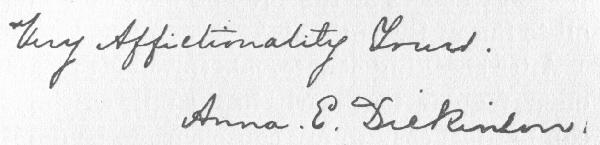
Anna E. Dickinson
Early in September Greeley writes her: "I still keep at work with the President in various ways and believe you will yet hear him proclaim universal freedom. Keep this letter and judge me by the event."
Miss Anthony thus lectures Mrs. Stanton because she has a teacher and educates her children at home: "I am still of the opinion that whatever the short-comings of the public schools your children would be vastly more profited in them, side by side with the very multitude with whom they must mingle as soon as school days are over. Any and every private education is a blunder, it seems to me. I believe those persons stronger and nobler who have from childhood breasted the commonalty. If children have not the innate strength to resist evil, keeping them apart from what they must inevitably one day meet, only increases their incompetency."
In the summer of 1862 Miss Anthony attended her last State Teachers' Convention, which was held in Rochester, where she began her labors in this direction. In 1853 she had forced this body to grant her a share in their deliberations, the first time a woman's voice had been heard. For ten years she never had missed an annual meeting, keeping up her membership dues and allowing no engagement to interfere. Year after year she had followed them up, insisting that in the conventions women teachers should hold offices, serve on committees and exercise free speech; demanding that they should be eligible to all positions in the schools with equal pay for equal work; and compelling a general recognition of their rights. All 222 these points, with the exception of equal pay, had now been gained and there was much improvement in salaries.
Her mission here being ended, she turned her attention to other fields; but for the privileges which are enjoyed by the women teachers of the present day, they are indebted first of all to Susan B. Anthony.[31]
After speaking at intervals through the summer, she started on a regular tour early in the fall, writing Lydia Mott: "I can not feel easy in my conscience to be dumb in an hour like this. I am speaking now extempore and more to my satisfaction than ever before. I am amazed at myself, but I could not do it if any of our other speakers were listening to me. I am entirely off old anti-slavery grounds and on the new ones thrown up by the war. What a stay, counsel and comfort you have been to me, dear Lydia, ever since that eventful little temperance meeting in that cold, smoky chapel in 1852. How you have compelled me to feel myself competent to go forward when trembling with doubt and distrust. I never can express the magnitude of my indebtedness to you."
A letter from Abby Kelly Foster at this time said: "I am especially gratified to know that you have entered the field in earnest as your own speaker, which you ought to have done years ago instead of always pushing others to the front and taking the drudgery yourself." Miss Anthony was very successful, each day gaining more courage. Her sole theme was "Emancipation the Duty-of the Government." A prominent citizen of Schuyler county wrote her after she had spoken at Mecklinburg: "There is not a man among all the political speakers who can make that duty as plain as you have done." Her whole heart was in the work and she was constantly inspired by the thought that the day of deliverance for the slave was approaching.
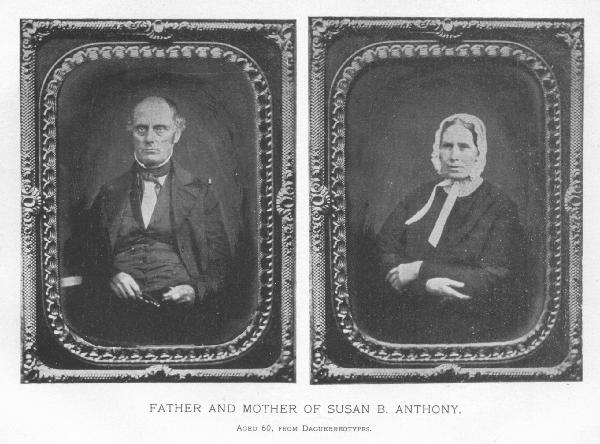
FATHER AND MOTHER OF SUSAN B. ANTHONY.
At the height of her enthusiasm came the heaviest blow it would have been possible for her to receive. She had come home for a few days, and the Sunday morning after election 223 was sitting with her father talking over the political situation. They had been reading the Liberator and the Anti-Slavery Standard and were discussing the probable effect of Lincoln's proclamation, when suddenly he was stricken with acute neuralgia of the stomach. He had not had a day's illness in forty years and had not the slightest premonition of this attack. He lingered in great suffering for two weeks and died on November 25, 1862.
No words can express the terrible bereavement of his family. He had been to them a tower of strength. From childhood his sons and daughters had carried to him every grief and perplexity and there never had been a matter concerning them too trivial to receive his careful attention. In manhood and womanhood they still had turned to him above all others for advice and comfort, even the grandchildren receiving always the same loving care. Between husband and wife there ever had been the deepest, truest affection. He was far ahead of his time in his recognition of the rights of women. Years before he had written to a brother: "Take your family into your confidence and give your wife the purse." He was never willing to enter into any pleasure which his wife did not share. They tell of him that once the daughters persuaded him to remain in town on a stormy evening and go to the Hutchinson concert. As they were driving home he said: "Never again ask me to do such a thing; I suffered more in thinking of your mother at home alone than any enjoyment could possibly compensate." A short time before his death he and his wife went to Ontario Beach one afternoon and did not return till 10 o'clock. When asked by the daughters what detained them, the mother answered that they had a fish supper and then strolled on the beach by moonlight; and on their laughing at her and saying she was worse than the girls, she replied: "Your father is more of a lover today than he was the first year of our marriage."
He was a broad, humane, great-hearted man, always mindful of the rights of others, always standing for liberty to every human being. Public-spirited, benevolent and genial in disposition, 224 his loss was widely mourned. The family's devoted friend, Rev. Samuel J. May, conducted the funeral services, at which Frederick Douglass and several prominent Abolitionists paid affectionate tribute, expressing "profound reverence for Mr. Anthony's character as a man, a friend and a citizen." Many letters of sympathy were received by Miss Anthony, but nothing brought consolation to her heart; her best and strongest friend was gone. Parker Pillsbury expressed her sorrow when he wrote: "You must be stricken sore indeed in the loss of your constant helper in the great mission to which you are devoted, your counselor, your consoler, your all that man could be, besides the endearing relation of father. What or who can supply the loss?"
There had not been a day in her life which had not felt his presence. She went forth to every duty sustained by his cheery and brave encouragement. With her father's support she could face the opposition and calumny of the world, and when these became too great she had but to turn again to him for the fullest sympathy and appreciation. He had inspired all she had done and with his wise advice and financial aid had assisted in the doing. When he passed away she felt the foundations taken from beneath her feet. For a little while she was stunned and helpless, and then the old strength came slowly back. The same spiritual force that had upheld her so many years still spoke to her soul and bade her once more take up life's duties.
It was with a sore and heavy heart that Miss Anthony again turned to her public work, but she was impelled by the thought that it would have been her father's earnest wish, and also by the feeling that work alone could give relief to the sorrow which overwhelmed her. She was bitterly disappointed that the "old guard" persisted in putting the question of the rights of women in the background, thus losing the vantage points gained by years of agitation. She alone, of all who had labored so earnestly for this sacred cause, was not misled by the sophistry that the work which women were doing for the Union would compel a universal recognition of their demands when the war was ended. Subsequent events showed the correctness of her judgment in maintaining that the close of the war would precipitate upon the country such an avalanche of questions for settlement that the claims of women would receive even less consideration than heretofore had been accorded. Next to this cause, however, that of the slaves appealed to her most strongly and she willingly continued her labors for them, trusting that the day might come when Garrison, Phillips, Greeley and the other great spirits would redeem their pledges and unite their strength in securing justice for women.
On January 11, 1863, Miss Anthony received this letter from Theodore Tilton: "Well, what have you to say to the proclamation? Even if not all one could wish, it is too much not to be thankful for. It makes the remainder of slavery too valueless and precarious to be worth keeping. The millenium 226 is on the way. Three cheers for God!... I had the pleasure of dining yesterday with Wendell Phillips in New York. Shall I tell you a secret? I happened to allude to one Susan Anthony. 'Yes,' said he, 'one of the salt of the earth.'" On the 16th came this from Henry B. Stanton: "I date from the federal capital. Since I arrived here I have been more gloomy than ever. The country is rapidly going to destruction. The army is almost in a state of mutiny for want of its pay and for lack of a leader. Nothing can carry the North through but the Southern negroes, and nobody can marshal them into the struggle except the Abolitionists. The country was never so badly off as at this moment. Such men as Lovejoy, Hale and the like have pretty much given up the struggle in despair. You have no idea how dark the cloud is which hangs over us.... We must not lay the flattering unction to our souls that the proclamation will be of any use if we are beaten and have a dissolution of the Union. Here then is work for you. Susan, put on your armor and go forth!"
From many prominent men and women came the same cry, and so she did gird on her armor and go forth. The latter part of February she took up her abode with Mrs. Stanton in New York. Herculean efforts were being made at this time by the Republicans, under the leadership of Charles Sumner, to secure congressional action in regard to emancipation. A widespread fear existed that the President's proclamation might not prove sufficient, that some way of overriding it might be found, and there was much anxiety to secure such an expression of public sentiment as would justify Congress in submitting an amendment to the United States Constitution which should forever abolish slavery. This could best be done through petitions, and here Miss Anthony recognized her work. An eloquent appeal was sent out, enclosing the following:
CALL FOR A MEETING OF THE LOYAL WOMEN OF THE NATION.
In this crisis it is the duty of every citizen to consider the peculiar blessings of a republican form of government, and decide what sacrifices of wealth 227 and life are demanded for its defense and preservation.... No mere party or sectional cry, no technicalities of constitutional or military law, no methods of craft or policy, can touch the heart of a nation in the midst of revolution. A grand idea of freedom or justice is needful to kindle and sustain the fires of a high enthusiasm.
At this hour the best word and work of every man and woman are imperatively demanded. To man, by common consent, are assigned the forum, camp and field. What is woman's legitimate work and how she may best accomplish it is worthy our earnest counsel one with another.... Woman is equally interested and responsible with man in the final settlement of this problem of self-government; therefore let none stand idle spectators now. When every hour is big with destiny and each delay but complicates our difficulties, it is high time for the daughters of the Revolution in solemn council to unseal the last will and testament of the fathers, lay hold of their birthright of freedom and keep it a sacred trust for all coming generations.
To this end we ask the loyal women of the nation to meet in the Church of the Puritans, New York, on Thursday, the 14th of May next. Let the women of every State be largely represented both in person and by letter.
On behalf of the Woman's Central Committee,
ELIZABETH CADY STANTON, SUSAN B. ANTHONY.
An immense audience, mostly women, assembled in Dr. Cheever's famous church. Miss Anthony called the convention to order and nominated Lucy Stone for president. Stirring addresses were made by Mrs. Stanton and the veteran anti-slavery speaker, Angelina Grimké Weld, while the Hutchinson family with their songs added inspiration to the occasion. Miss Anthony presented a series of patriotic resolutions with the following spirited address:
There is great fear expressed on all sides lest this shall be made a war for the negro. I am willing that it shall be. It is a war which was begun to found an empire upon slavery, and shame on us if we do not make it one to establish the freedom of the negro—against whom the whole nation, North and South, East and West, in one mighty conspiracy, has combined from the beginning. Instead of suppressing the real cause of the war, it should have been proclaimed not only by the people but by the President, Congress, Cabinet and every military commander. Instead of President Lincoln's waiting two long years before calling to the aid of the government the millions of allies whom we have had within the territory of rebeldom, it should have been the first decree he sent forth. By all the laws of common sense—to say nothing of laws military or civil—if the President, as commander-in-chief of the army and navy, could have devised any possible means whereby he might hope to suppress the rebellion without the sacrifice of the life of one loyal citizen, without the sacrifice of one dollar of the loyal North, it was clearly his duty to have done so. Every interest of the insurgents, every dollar of their 228 property, every institution, every life in every rebel State even, if necessary, should have been sacrificed, before one dollar or one man should have been drawn from the free States. How much more then was it the President's duty to confer freedom on the millions of slaves, transform them into an army for the Union, cripple the rebellion and establish justice, the only sure foundation of peace. I therefore hail the day when the government shall recognize that this is a war for freedom.
We talk about returning to "the Union as it was" and "the Constitution as it is"—about "restoring our country to peace and prosperity—to the blessed conditions which existed before the war!" I ask you what sort of peace, what sort of prosperity, have we had? Since the first slave ship sailed up the James river with its human cargo and there, on the soil of the Old Dominion, it was sold to the highest bidder, we have had nothing but war. When that pirate captain landed on the shores of Africa and there kidnapped the first stalwart negro and fastened the first manacle, the struggle between that captain and that negro was the commencement of the terrible war in the midst of which we are today. Between the slave and the master there has been war, and war only. This is but a new form of it. No, no; we ask for no return to the old conditions. We ask for something better. We want a Union which is a Union in fact, a Union in spirit, not a sham. By the Constitution as it is, the North has stood pledged to protect slavery in the States where it existed. We have been bound, in case of insurrections, to go to the aid, not of those struggling for liberty but of the oppressors. It was politicians who made this pledge at the beginning, and who have renewed it from year to year. These same men have had control of the churches, the Sabbath-schools and all religious institutions, and the women have been a party in complicity with slavery. They have made the large majority in all the churches throughout the country and have, without protest, fellowshipped the slaveholder as a Christian; accepted proslavery preaching from their pulpits; suffered the words "slavery a crime" to be expurgated from all the lessons taught their children, in defiance of the Golden Rule, "Do unto others as you would that others should do unto you." They have meekly accepted whatever morals and religion the selfish interest of politics and trade dictated.
Woman must now assume her God-given responsibilities and make herself what she is clearly designed to be, the educator of the race. Let her no longer be the mere reflector, the echo of the worldly pride and ambition of man. Had the women of the North studied to know and to teach their sons the law of justice to the black man, they would not now be called upon to offer the loved of their households to the bloody Moloch of war. Women of the North, I ask you to rise up with earnest, honest purpose and go forward in the way of right, fearlessly, as independent human beings, responsible to God alone for the discharge of every duty. Forget conventionalisms; forget what the world will say, whether you are in your place or out of it; think your best thoughts, speak your best words, do your best works, looking to your own consciences for approval.
The fourth resolution, asking equal rights for women as well 229 as negroes, was seriously objected to by several who insisted that they did not want political rights. Lucy Stone, Mrs. Weld, Mrs. Rose and Mrs. Coleman made strong speeches in its favor, and Miss Anthony said:
This resolution merely makes the assertion that in a genuine republic, every citizen must have the right of representation. You remember the maxim "Governments derive their just powers from the consent of the governed." This is the fundamental principle of democracy, and before our government can be placed on a lasting foundation, the civil and political rights of every citizen must be practically established. This is the meaning of the resolution. It is a philosophical statement, made not because women suffer, not because slaves suffer, not because of any individual rights or wrongs—but as a simple declaration of the fundamental truth of democracy proclaimed by our Revolutionary fathers. I hope the discussion will no longer be continued as to the comparative rights or wrongs of one class or another. This is the question before us: Is it possible that peace and union shall be established in this country, is it possible for this government to be a true democracy, a genuine republic, while one-sixth or one-half of the people are disfranchised?
The resolution was adopted by a large majority. A business meeting was held in the afternoon to decide upon the practical work, and again the room was crowded. Miss Anthony was in the chair. There were women of all ages, classes and conditions, and the assembly was pervaded with deep and solemn feeling. The following was unanimously adopted: "We, loyal women of the nation, assembled in convention this 14th day of May, 1863, hereby pledge ourselves one to another in a Loyal League, to give support to the government in so far as it makes a war for freedom." Mrs. Stanton was elected president and Miss Anthony secretary of the permanent organization. A great meeting was held in Cooper Institute in the evening. An eloquent address to President Lincoln, read by Miss Anthony, was adopted and sent to him.[32] Powerful speeches were made by Ernestine L. Rose and Rev. Antoinette Blackwell, a patriotic address to the soldiers was adopted, and the convention closed amid great enthusiasm.
At subsequent meetings it was decided to confine the work of the League to the one object of securing signatures to petitions 230 to the Senate and House of Representatives, praying for an act emancipating all persons of African descent held in involuntary servitude. They set their standard at a million names. Their scheme received the commendation of the entire anti-slavery press, and of prominent men and women in all parts of the country. The first of June headquarters were opened in Room 20, Cooper Institute, and the great work was begun. Miss Anthony prepared and sent out thousands of petitions accompanied by this letter:
THE WOMEN'S NATIONAL LOYAL LEAGUE TO THE WOMEN OF THE REPUBLIC: We ask you to sign and circulate this petition for the entire abolition of slavery. Remember the President's proclamation reaches only the slaves of rebels. The jails of loyal Kentucky are today filled with Georgia, Mississippi and Alabama slaves, advertised to be sold for their jail fees "according to law," precisely as before the war! While slavery exists anywhere there can be freedom nowhere. There must be a law abolishing slavery. We have undertaken to canvass the nation for freedom. Women, you can not vote or fight for your country. Your only way to be a power in the government is through the exercise of this one, sacred, constitutional "right of petition;" and we ask you to use it now to the utmost. Go to the rich, the poor, the high, the low, the soldier, the civilian, the white, the black—gather up the names of all who hate slavery, all who love liberty, and would have it the law of the land, and lay them at the feet of Congress, your silent but potent vote for human freedom guarded by law....
Every day and every hour were given to the Loyal League. All through the hot summer Miss Anthony remained at her post in Cooper Institute, scattering her letters far and wide, pushing into the field every woman who was willing to work, sending out lecturers to stir up the people, directing affairs with the sagacity of an experienced general, sparing no one who could be pressed into service, and herself least of all. On July 15, during the New York Draft Riots, she writes home: "These are terrible times. The Colored Orphan Asylum which was burned was but one block from Mrs. Stanton's, and all of us left the house on Monday night. Yesterday when I started for Cooper Institute I found the cars and stages had been stopped by the mob and I could not get to the office. I took the ferry and went to Flushing to stay with my cousin, but 231 found it in force there. We all arose and dressed in the middle of the night, but it was finally gotten under control."
Miss Anthony had many heartaches during these trying times and longed more and more for that strength which had been taken from her forever. Writing to her mother of her brother Daniel R.'s election as mayor of Leavenworth, Kan., she says: "O, how has our dear father's face flitted before me as I have thought what his happiness would have been over this honor. Last night when my head was on my pillow, I seemed to be in the old carriage jogging homeward with him, while he happily recounted D.R.'s qualifications for this high post and accepted his election as the triumph of the opposition to rebels and slaveholders. Every day I appreciate more fully father's desire for justice to every human being, the lowest and blackest as well as the highest and whitest, and my constant prayer is to be a worthy daughter."
On the anniversary of his death she writes again to her mother: "It has seemed to me last night and today that I must fly to you and with you sit down in the quiet. It is torture here with not one who knew or cared for the loved one. It is sacrilege to speak his name or tell my grief to those who knew him not. O, how my soul reaches out in yearning to his dear spirit! Does he see me, will he, can he, come to me in my calm, still moments and gently minister and lift me up into nobler living and working?"
In a letter to her, relative to the sale of the home, the mother uses these touching words: "If it had been my heart that had ceased to beat, all might have gone on as before, but now all must go astray. I know I ought to get rid of this care, and Mary and I should not try to live here alone, but every foot of ground is sacred to me, and I love every article bought by the dear father of my children." On this subject Miss Anthony writes to her sister Mary:
Your letter sent a pang to my very heart's core that the dear old home, so full of the memory of our father, must be given up. I do wish it could be best to keep it, and yet I do not think he will be less with us away from that loved spot, for my experience in the past months disproves such feeling. Every 232 place, every movement, almost, suggests him. Last evening, I strolled west on Forty-fifth street to the Hudson river, a mile or more. There was newly-sawed lumber there and the smell carried me back, back to the old sawmill and childhood's days. I looked at the beautiful river and the schooners with their sails spread to the breeze. I felt alone, but my mind traversed the entire round of the loved ones. I doubt if there be any mortal who clings to loves with greater tenacity than do I. To see mother without father in the old home, to feel the loneliness of her spirit, and all of us bereft of the joy of looking into the loved face, listening to the loved tones, waiting for his sanction or rejection—O, how I could see and feel it all!
The rest of us have our work to engross us and other objects to center our affections upon, but mother now lives in her children, and I often feel as if we did too little to lighten her heart and cheer her path. Never was there a mother who came nearer to knowing nothing save her own household, her husband and children, whether high in the world's esteem or crucified, the same still with her through all. If we sometimes give her occasion to feel that we prized father more than her, it was she who taught us ever to hold him thus above all others. Our high respect and deep love for him, our perfect trust in him, we owe to mother's precepts and vastly more to her example. And, by and by, when we have to reckon her among the invisible, we shall live in remembrance of her wise counsel, tender watching, self-sacrifice and devotion not second to that we now cherish for the memory of our father—nay, it will even transcend that in measure, as a mother's constant and ever-present love and care for her children are beyond those of a father.
A bit of mirth comes into the somber atmosphere with a note from Theodore Tilton:
To SUSAN B. ANTHONY, ADJUTANT-GENERAL—Since of late you have been bold in expressing your opinion that the draft should be strenuously enforced and that the broken ranks of our brave armies should be supplied with new men, it will serve to show you how great the difference is between those who say and those who do, if I inform you—as in duty bound I do hereby—that I know a little lady only half your size who doubles your zeal in all these respects and who, without waiting for your tardy example, presented on her own account to the government on Thursday last a new man, weighing nine pounds, to be enrolled among the infantry of the United States.
Miss Anthony undertook the great work of this National Loyal League without the guarantee from any source of a single dollar. The expenses were very heavy; office rent, clerk hire, printing bills, postage, etc., brought them up to over $5,000, but as usual she was fertile in resources for raising money. All who signed the petition were requested to give a cent and in this way about $3,000 were realized. A few 233 contributions came in, but the demands were infinite for every dollar which patriotic citizens could spare, and the league felt desirous of paying its own way. To assist in this, she arranged a course of lectures at Cooper Institute. Among those who responded to her call were Hon. William D. Kelley, Edwin P. Whipple, Theodore D. Weld, Rev. Stephen H. Tyng, Frederick Douglass, Wendell Phillips, George William Curtis, Frances D. Gage and several others. Most of these donated their services and others reduced their price. Letters of commendation were received from editors, ministers, senators and generals. George Thompson, the British Abolitionist and ex-member of Parliament, gave hearty sympathy and co-operation.
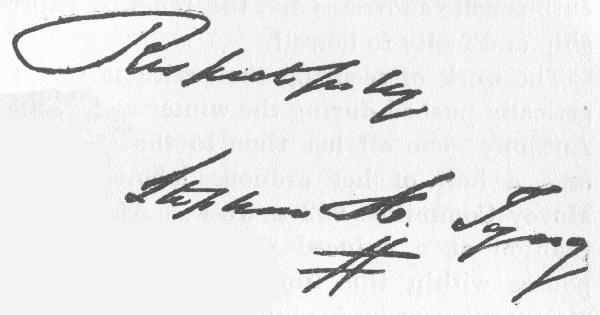
Stephen H. Tyng
Benjamin F. Wade wrote: "You may count upon any aid which I am competent to bestow to forward the object of your league. As a member of Congress, you shall have my best endeavors for your success, for a cause more honorable to human nature or one that promised more benefit to the world, never called forth the efforts of the patriot or philanthropist." From Major-General Rosecrans came the message: "The cause in which you are engaged is sacred, and would ennoble mean and sanctify common things. You have my best wishes for continued success in your good work."
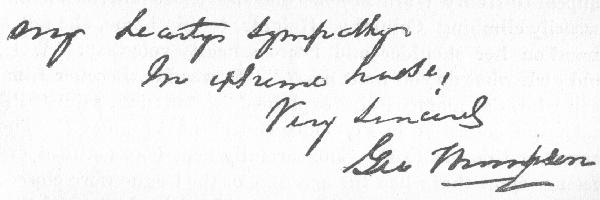
Geo Thompson
In December, 1863, Miss Anthony went to Philadelphia to attend the great meeting which celebrated the thirtieth anniversary of the founding of the American Anti-Slavery Society, and was strengthened and encouraged by the lofty and enthusiastic addresses and the renewed expressions of friendship and fealty to herself.
The work of securing the petitions was rapidly and energetically pushed during the winter and spring of 1864. Miss Anthony gave all her time to the office.[33] During the year and a half of her arduous labors, she received from the Hovey Committee $12 a week. As she boarded with Mrs. Stanton at a reduced price she managed to keep her expenses within this limit. She writes home: "I go to a restaurant near by for lunch every noon. I take always strawberries with two tea-rusks. Today I said, 'All this lacks is a glass of milk from my mother's cellar,' and the girl replied, 'We have very nice Westchester county milk.' So tomorrow I shall add that to my bill of fare. My lunch costs, berries, five cents, rusks five, and tomorrow the milk will be three." There is reason to believe, however, that she often would have been glad to afford a second dish of strawberries.
The Hovey Committee sent $155, Gerrit Smith $200, Schieffelin Brothers, Druggists, $100, and Jessie Benton Fremont, $50. In her great need of funds, Miss Anthony decided to appeal to Henry Ward Beecher and she relates how, as she was wearily climbing Columbia Heights to his home, she felt a hand on her shoulder and heard a hearty voice say: "Well, old girl, what do you want now?" It was Mr. Beecher himself who, the moment she explained her mission, said: "I'll take up a collection in Plymouth church next Sunday." The result of this was $200. The carefully kept books still in existence show that when the accounts of the league were closed, there was a deficit of $4.72 to settle all indebtedness, and this Miss Anthony paid out of her own pocket! 235
In January the brother Daniel R. came East for his beautiful young bride, and the mother from her quiet farm-nook sends her petition to New York. She can not manage the "infare" unless Susan comes home and helps. So she drops the affairs of government long enough to skim across the State and lend a hand in preparing for this interesting event, and then back again to her incessant drudgery, made doubly hard by financial anxiety.
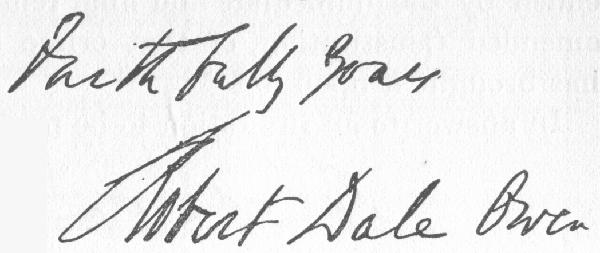
Robert Dale Owen
During all this work of the Loyal League, Miss Anthony found her strongest and staunchest support in Robert Dale Owen, who was then in New York by appointment of President Lincoln as chairman of the Freedman's Inquiry Commission. She was also in constant communication with Senator Charles Sumner, who was most anxious that the work should be hastened. The blank petitions were sent in great sacks to him at Washington, and distributed under his "frank" to all parts of the Union. On February 9, 1864, he presented in the Senate the first installment. The petitions from each State were tied by themselves in a large bundle and endorsed with the number of signatures. Two able-bodied negroes carried them into the Senate chamber, and Mr. Sumner presented them, saying in part:
These petitions are signed by 100,000 men and women, who unite in this unparalleled number to support their prayer. They are from all parts of the country and from every condition of life.... They ask nothing less than universal emancipation, and this they ask directly at the hands of Congress. It is not for me to assign reasons which the army of petitioners has forborne to assign; but I may not improperly add that, naturally and obviously, they all feel in their hearts, what reason and knowledge confirm, not only that slavery is the guilty origin of the rebellion, but that its influence everywhere, even outside the rebel States, has been hostile to the Union, always impairing loyalty and sometimes openly menacing the national government. The petitioners know well that to save the country from peril, especially to save the national life, there is no power in the ample arsenal of self-defense which Congress may not grasp; for to Congress under the Constitution, belongs the 236 prerogative of the Roman Dictator to see that the republic receives no detriment. Therefore to Congress these petitioners now appeal.
After an earnest discussion by the Senate the petition was referred to the Select Committee on Slavery and Freedom, whose chairman was Thomas D. Eliot, of Massachusetts. Immediately afterwards several thousand more blank petitions were sent out, accompanied by a second appeal which closed: "Shall we not all join in one loud, earnest, effectual prayer to Congress, which will swell on its ear like the voice of many waters, that this bloody, desolating war shall be arrested and ended by the immediate and final removal by statute law and amended Constitution, of that crime and curse which alone has brought it upon us?"
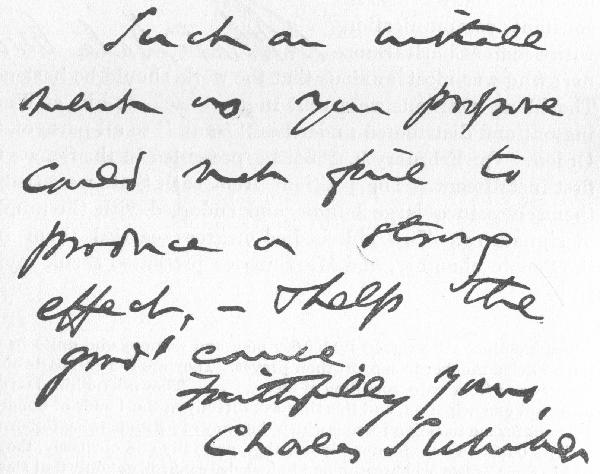
Charles Sumner
In answer to an invitation to be present at the first anniversary of the Women's National Loyal League, Senator Sumner wrote:
I can not be with you for my post of duty is here. I am grateful to your association for what you have done to arouse the country to insist on the extinction of slavery. Now is the time to strike and no effort should be 237 spared. The good work must be finished, and to my mind nothing seems to be done, while anything remains to be done. There is one point to which attention must be directed. No effort should be spared to castigate and blast the whole idea of property in man, which is the corner-stone of the rebel pretension and the constant assumption of the partisans of slavery, or of its lukewarm opponents. Let this idea be trampled out and there will be no sympathy with the rebellion, and there will be no such abomination as slave-hunting, which is beyond question the most execrable feature of slavery itself.
As Miss Anthony herself had asked so many favors of Wendell Phillips, she thought it would be a good idea to have Mrs. Stanton invite him to make an address at this anniversary; but he was not in the least deceived, as his reply shows:
DEAR MRS. STANTON: Your S.B.A. thinks she is very cunning. As if I did not see a huge pussy under that meal! She has been so modest, humble, ashamed, reluctant, apologetic, contrite, self-accusing whenever the last ten years she has asked me to do anything, go anywhere, speak on any topic! Now she makes you pull the chestnuts out of the fire and thinks I do not see her waiting behind. Ah, the hand is the hand of Esau, the voice is the voice of Jacob, wicked, sly, skulking, mystifying Jacob. Why don't "secretaries" write the official letters? How much they leave the "president" to do! Naughty idlers, those secretaries! Well, let me thank Miss Secretary Anthony for her gentle consideration; then let me say I'll try to speak, as you say, fifteen minutes.... Remember me defiantly to S.B.A.
In the midst of all this correspondence came a letter from a sweetheart of her girlhood, now a prominent officeholder in Ohio, stating that he was a widower but would not long remain one if his old friend would take pity upon him. It is sincerely to be hoped that the secretary of the Loyal League found time at least to have one of her clerks answer this epistle.
The meeting was held in the Church of the Puritans, May 12, 1864, and soul-stirring speeches were made by Phillips, Mrs. Rose, Lucretia Mott, George Thompson, Mrs. Stanton and Miss Anthony. The report of the executive committee showed that a debt of $5,000, including $1,000 for postage alone, had been paid; that 25,000 blank petitions had been sent out; that the league now numbered 5,000 members, and that branch Loyal Leagues had been formed in many cities. Strong resolutions were adopted demanding not only emancipation but enfranchisement for the negroes. The entire proceedings 238 of the convention illustrated how thoroughly the leading women of the country understood the political situation, how broad and comprehensive was their grasp of public affairs, and with what a patriotic and self-sacrificing spirit they performed their part of the duties imposed by the great Civil War.
By August, 1864, the signatures to the petitions had reached almost 400,000. Again and again Charles Sumner and Henry Wilson had written Miss Anthony that these petitions formed the bulwark of their demand for congressional action to abolish slavery. Public sentiment on this point had now become emphatic, the Senate had passed the bill for the prohibition of slavery, and the intention of the House of Representatives was so apparent that it did not seem necessary to continue the petitions. The headquarters in Cooper Institute were closed, and the magnificent work, which from this center had radiated throughout the country, found its reward in the proposition by Congress, on February 1, 1865, for Amendment XIII to the Federal Constitution:
Neither slavery nor involuntary servitude, except as a punishment for crime, whereof the party shall have been duly convicted, shall exist in the United States, or any place subject to their jurisdiction.
The faithful, untiring, persistent chief of this Women's National Loyal League was Susan B. Anthony, whose only material reminder of that great achievement for the freedom of the slave is the arm-chair in which, for the past thirty-five years, she has sat and conducted her vast correspondence in the interest of liberty for the half of humanity still in bondage; yet in the blessed thought that her efforts were an important factor in securing freedom for millions of her fellow-creatures, she has been rewarded a thousandfold. But what words can express her sense of humiliation when, at the close of this long conflict, the government which she had served so faithfully still held her unworthy a voice in its councils, while it recognized as the political superiors of all the noble women of the nation, the negro men just emerged from slavery 239 and not only totally illiterate but also densely ignorant of every public question?

Elizabeth Blackwell
There never can be an adequate portrayal of the services rendered by the women of this country during the Civil War, but none will deny that, according to their opportunities, they were as faithful and self-sacrificing as were the men. A comparison of values is impossible, but women's labors supplemented those of men, and together they wrought out the freedom of the slave and the salvation of the Union. Among the great body of women, a few stand out in immortal light. The plan of the vital campaign of the Tennessee, one of the great strategic movements of history, was made by Anna Ella Carroll. The work of Dorothea Dix, government superintendent of women nurses, with its onerous and important duties, needs no eulogy. Dr. Elizabeth Blackwell, fresh from England and an intimacy with Florence Nightingale, originated the Sanitary Commission. No name is held in more profound reverence than that of Clara Barton, for her matchless services upon the battlefield among the dead and dying. To Josephine S. Griffing belongs the full credit of founding the Freedmen's Bureau, which played so valuable a part in the help and protection of the newly emancipated negroes. Who of all the public speakers rendered greater aid to the Union than the inspired Anna Dickinson? Yet not one of these ever received the slightest official recognition from the government. In the cases of Miss Carroll, Dr. Blackwell and Mrs. Griffing, the honors and the profits all were absorbed by men. Neither Dorothea Dix nor Clara Barton ever asked for a pension. All of these women at the close of the war appealed for the right of suffrage, a voice in the affairs of government; but such appeals were and still are treated with contemptuous denial. The situation was thus eloquently summed up by that woman statesman, Elizabeth Cady Stanton:
The lessons of the war were not lost on the women of this nation; through 240 varied forms of suffering and humiliation, they learned that they had an equal interest with men in the administration of the government, alike enjoying its blessings or enduring its miseries. When in the enfranchisement of the black men they saw another ignorant class of voters placed above their heads, and beheld the danger of a distinctively "male" government, forever involving the nations of the earth in war and violence; and demanded for the protection of themselves and children, that woman's voice should be heard and her opinions in public affairs be expressed by the ballot, they were coolly told that the black man had earned the right to vote, that he had fought and bled and died for his country.
[33] She was assisted from time to time by Mrs. Stanton, Lucy Stone, Charlotte B. Wilbour, Dr. Clemence S. Lozier, Mary F. Gilbert, Frances V. Hallock, Mattie Griffith (Brown), Rebecca Shepard (Putnam), and Frances M. Russell, all donating their services. The bookkeeper and the clerks were paid small salaries from the office receipts.
Soon after closing the league headquarters, Miss Anthony went to Auburn to attend the wedding of Wm. Lloyd Garrison, Jr., and Ellen, daughter of her dear friend Martha C. Wright and niece of Lucretia Mott, a union of two families very acceptable to the friends of both. From this scene of festivity she returned home to meet a fresh sorrow in the sudden death, almost at the hour of her arrival, of Ann Eliza, daughter of her eldest sister Guelma and Aaron McLean, the best beloved of all her nieces. She was twenty-three years old, beautiful and talented, a good musician and an artist of fine promise. In her Miss Anthony had centered many hopes and ambitions, and the letters show that she was always planning and working for her future as she would have done for that of a cherished daughter. She was laid to rest on the silver wedding anniversary of her parents. Miss Anthony writes: "She had ceased to be a child and had become the fullgrown woman, my companion and friend. I loved her merry laugh, her bright, joyous presence, and yet my loss is so small compared to the awful void in her mother's life that I scarcely dare mention it."
Months afterwards she wrote her sister Hannah: "Today I made a pilgrimage to Mount Hope. The last rays of red, gold and purple fringed the horizon and shone serenely on the mounds above our dear father and Ann Eliza. What a contrast in my feelings; for the one a subdued sorrow at the sudden ending of a life full-ripened, only that we would have 242 basked in its sunshine a little longer; for the other a keen anguish over the untimely cutting off in the dawn of existence, with the hopes and longings but just beginning to take form, the real purpose of life yet dimly developed, a great nature but half revealed. The faith that she and all our loved and gone are graduated into a higher school of growth and progress is the only consolation for death."
At another time she wrote her brother: "This new and sorrowful reminder of the brittleness of life's threads should soften all our expressions to each other in our home circles and open our lips to speak only words of tenderness and approbation. We are so wont to utter criticisms and to keep silence about the things we approve. I wish we might be as faithful in expressing our likes as our dislikes, and not leave our loved ones to take it for granted that their good acts are noted and appreciated and vastly outnumber those we criticise. The sum of home happiness would be greatly multiplied if all families would conscientiously follow this method."
There were urgent appeals in these days from the lately-married brother and his wife for sister Susan to come to Kansas and, as no public work seemed to be pressing, she started the latter part of January, 1865. She stopped in Chicago to visit her uncle Albert Dickinson, was detained a week by heavy storms, and reached Leavenworth the last day of the month. Of her journey she wrote home:
I paid a dollar for a ride across the Mississippi on the ice. When we reached Missouri all was devastation. I asked the conductor if there were not a sleeper and he replied, "Our sleeping cars are in the ditch." Scarcely a train had been over the road in weeks without being thrown off the track. We were nineteen hours going the 200 miles from Quincy to St. Joe. Twelve miles out from the latter we had to wait for the train ahead of us to get back on the rails. I was desperate. Any decent farmer's pigpen would be as clean as that car. There were five or six families, each with half a dozen children, moving to Kansas and Nebraska, who had been shut up there for days. A hovel stood up the bank a little way and several of the men went there and washed their faces. After watching them enjoy this luxury for a while I finally rushed up myself and asked the woman in charge if she would sell me a cup of coffee. She grunted out yes, after some hesitation, and while she was making it, I washed my face and hands. When she handed me my 243 drink she said, "This is no rye; it is real coffee." And so it was and I enjoyed it, brass spoon, thick, dingy, cracked cup and all.
This was Miss Anthony's first visit to Kansas and she found much to interest her in Leavenworth—caravans of emigrants long trains of supplies for the army, troops from the barracks crowds of colored refugees, the many features of frontier life so totally different from all she had seen and known in her eastern home. The prominence of her brother brought many distinguished visitors to his house, she enjoyed the long carriage drives and the days were filled with pleasant duties, so that she writes, "I am afraid I shall get into the business of being comfortable." On her birthday, February 15, the diary shows that she wagered a pair of gloves with the family physician that it would not rain before morning, and on the 16th is recorded: "The bell rang early this morning and a boy left a box containing a pair of gloves with the compliments of the doctor." In March one entry reads: "The new seamstress starts in pretty well but she can not sew nicely enough for the little clothes. We shall have to make those ourselves."
This life of ease proved to be of short duration. Her brother was renominated for mayor and plunged at once into the thick of a political campaign, while Miss Anthony went to the office to help manage his newspaper, limited only by his injunction "not to have it all woman's rights and negro suffrage." The labor, however, which she most enjoyed was among the colored refugees. Soon after the slaves were set free they flocked to Kansas in large numbers, and what should be done with this great body of uneducated, untrained and irresponsible people was a perplexing question. She went into the day schools, Sunday-schools, charitable societies and all organizations for their relief and improvement. The journal shows that four or five days or evenings every week were given to this work and that she formed an equal rights league among them. A colored printer was put into the composing-room, and at once the entire force went on strike. The diary declares "it is a burning, blistering shame," and relates her attempts to secure other work for him. She met at this time Hiram Revels, a colored 244 Methodist preacher, afterwards United States senator from Mississippi.
During these months she was in constant receipt of letters pressing her to return to the East. Phillips said: "Come back, there is work for you here." From Lydia Mott came the pathetic cry: "Our old fraternity is no more; we are divided, bodily and spiritually, and I seem to grow more isolated every day." Pillsbury wrote: "We do not know much now about one another. We called a meeting of the Hovey Committee and only Whipple and I were present. Why have you deserted the field of action at a time like this, at an hour unparalleled in almost twenty centuries? If you watch our papers you must have observed that with you gone, our forces are scattered until I can almost truly say with him of old, 'I only am left.' It is not for me to decide your field of labor. Kansas needed John Brown and may need you. It is no doubt missionary ground and, wherever you are, I know you will not be idle; but New York is to revise her constitution next year and, if you are absent, who is to make the plea for woman?" Mrs. Stanton insisted that she should not remain buried in Kansas and concluded a long letter:
I hope in a short time to be comfortably located in a new house where we will have a room ready for you when you come East. I long to put my arms around you once more and hear you scold me for my sins and short-comings. Your abuse is sweeter to me than anybody else's praise for, in spite of your severity, your faith and confidence shine through all. O, Susan, you are very dear to me. I should miss you more than any other living being from this earth. You are intertwined with much of my happy and eventful past, and all my future plans are based on you as a coadjutor. Yes, our work is one, we are one in aim and sympathy and we should be together. Come home.
Miss Anthony's own heart yearned to return, but the workers were so few in Kansas and so many in the Eastern States. that she scarcely knew where the call of duty was strongest. At the close of the war her mind grasped at once the full import of the momentous questions which would demand settlement and she felt the necessity of placing herself in touch with those who would be most powerful in moulding public sentiment. The threatened division in the Abolitionist ranks and the 245 reported determination of Mr. Garrison to disband the Anti-Slavery Society, filled her with dismay and she sent back the strongest protests she could put into words:
How can any one hold that Congress has no right to demand negro suffrage in the returning rebel States because it is not already established in all the loyal ones? What would have been said of Abolitionists ten or twenty years ago, had they preached to the people that Congress had no right to vote against admitting a new State with slavery, because it was not already abolished in all the old States? It is perfectly astounding, this seeming eagerness of so many of our old friends to cover up and apologize for the glaring hate toward the equal recognition of the manhood of the black race. Well, you will be in New York to witness, perhaps, the disbanding of the Anti-Slavery Society—and I shall be away out here, waiting anxiously to catch the first glimpse of the spirit of the meeting. But Phillips will be glorious and genial to the end. All through this struggle he has stood up against the tide, one of the few to hold the nation to its vital work—its one necessity, moral as military—absolute justice and equality for the black man. I wish every ear in this country might listen to his word.
A letter from Mr. Phillips said: "Thank you for your kind note. I see you understand the lay of the land and no words are necessary between you and me. Your points we have talked over. If Garrison should resign, we incline to Purvis for president for many, many reasons. We (Hovey Committee) shall aid in keeping our Standard floating till the enemy comes down." All the letters received by Miss Anthony during May and June were filled with the story of the dissension in the Anti-Slavery Society.
It is not a part of this work to go into the merits of that discussion. In brief, Mr. Garrison and his followers believed that, with the ratification of the Thirteenth Amendment, slavery was forever abolished in the United States and there was no further need of the Anti-Slavery Society which he himself had founded. Phillips and his following held that "no emancipation can be effectual and no freedom real, unless the negro has the ballot and the States are prohibited from enacting laws making any distinction among their citizens on Account of race or color." There were minor differences of opinion respecting men and measures, but the above are the fundamental points which led to the first breach that had occurred 246 for a quarter of a century in the ranks of the great anti-slavery leaders, who had borne a persecution never equalled in the history of our country. It resulted, at the May Anniversary in New York, in Garrison's declining a re-election to the presidency of the society, which he had held for thirty-two years, and in the election of Phillips.
Those most intimately connected with Miss Anthony sustained the position of Mr. Phillips—Mrs. Stanton, Parker Pillsbury, Robert Purvis, Charles Remond, Stephen Foster, Lucretia and Lydia Mott, Anna Dickinson, Sarah Pugh—and she herself was his staunchest defender. Believing as strongly as she did that the suffrage is the very foundation of liberty, that without it there can be no real freedom for either man or woman, she could not have done otherwise, and yet, so great was her reverence and affection for Mr. Garrison, it was with the keenest regret she found herself no longer able to follow him. She writes: "I am glad I was spared from witnessing that closing scene. It will be hard beyond expression to leave him out of our councils, but he never will be out of our sympathies. I hope you will refrain from all personalities. Pro-slavery signs are too apparent and too dangerous at this hour for us to stop for personal adjustments. To go forward with the great work pressing upon the society, without turning to the right or the left, is the one wise course."
Parker Pillsbury was made editor of the Standard in place of Oliver Johnson, and was assisted by George W. Smalley, who had married an adopted daughter of Wendell Phillips. Mr. Pillsbury wrote Miss Anthony soon after the anniversary:
We could not see how the colored race were to be risked, shut up in the States with their old masters, whom they had helped to conquer and out of whose defeat their freedom had come; so we voted to keep the machinery in gear until better assurances were given of a free future than we yet possess. We have offended some by our course. I am sorry, but it was Mr. Garrison who taught me to be true to myself. To my mind, suffrage for the negro is now what immediate emancipation was thirty years ago. If we emancipate from slavery and leave the European doctrine of serfdom extant, even in the mildest form, then the colored race, or we, or perhaps both, have another war in store. And so my work is not done till the last black man can declare in the full face of the world, "I am a man and a brother."
In June, as the expected little stranger had arrived safe, Miss Anthony accepted an invitation to deliver the Fourth of July address at Ottumwa, and then went through her inevitable agony whenever she had a speech to prepare. She took the stage for Topeka, finding among her fellow-passengers her relative, Major Scott Anthony, with Mr. Butterfield of the Overland Dispatch, and the long, hot, dusty ride was enlivened by an animated discussion of the political questions of the day. During this drive over the unbroken prairies, she made the prediction that, given a few decades of thrift, they would be dotted with farms, orchards and villages and the State would be a paradise.
Miss Anthony was among the first of the Abolitionists to declare that the negroes must have the suffrage, one of the most unpopular ideas ever broached, and she writes: "As fearless, radical and independent as my brother is, he will not allow my opinions on this subject to go into his paper." At Topeka she spoke to a large audience in the Methodist church on this question. In order to reach Ottumwa she had to ride 125 miles by stage in the heat of July, and her expenses were considerable. No price had been guaranteed for her address, but she learned to her surprise that she was expected to make it a gratuitous offering, as was the custom on account of the poverty of the people. They came from miles around and were enthusiastic over her speech on "President Johnson's Mississippi Reconstruction Proclamation." The Republicans insisted that she should put her notes in shape for publication, but urged her to leave out the paragraph on woman suffrage.[34]
The other speakers were Sidney Clark, M.C., and a professor from Lawrence University. They were entertained by a prominent official who had just built a new house, the upper story of which was unfinished. It was divided into three rooms by hanging up army blankets, and each of the orators was assigned to one of these apartments. Miss Anthony was so exhausted from the long stage-ride, the speaking and the heat, that she scarcely could get ready for bed, but no sooner 248 had she touched the pillow than she was assailed by a species of animals noted for the welcome they extended to travellers in the early history of Kansas. Her dilemma was excruciating. Should she lie still and be eaten alive, or should she get up, strike a light and probably rouse the honorable gentlemen on the other side of the army blankets? A few minutes decided the question; she slipped out of bed, lighted her tallow dip and reconnoitered. Then she blew out her light, and sat by the window till morning.
She spoke at Lawrence in the Unitarian and the Congregational churches, and August 1, the thirty-first anniversary of England's emancipation of the slaves in the West Indies, she addressed an immense audience in a grove near Leavenworth. She discussed the changed condition of the colored people and their new rights and duties, and called their attention to the fact that not one of the prominent politicians advertised was there; pointed out that if they possessed the ballot and could vote these men into or out of office, all would be eager for an opportunity to address them; and then drew a parallel between their political condition and that of women. At this time she received a second intimation of what was to come, when prominent Republicans called upon her and insisted that hereafter she should not bring the question of woman's rights into her speeches on behalf of the negro.
A few days afterwards Miss Anthony was seated in her brother's office reading the papers when she learned to her amazement that several resolutions had been offered in the House of Representatives sanctioning disfranchisement on account of sex. Up to this time the Constitution of the United States never had been desecrated by the word "male," and she saw instantly that such action would create a more formidable barrier than any now existing against the enfranchisement of women. She hesitated no longer but started immediately on her homeward journey, stopping in Atchison, where she was the guest of ex-Mayor Crowell. Senator Pomeroy called, accompanied her to church and arranged for her to address the colored people next day. She lectured also in St. Joseph, Mo. At 249 Chillicothe one of the editors sent word that if she would not "lash" him he would print her handbills free of charge. Here she addressed a great crowd of colored people in a tobacco factory. At Macon City she spoke to them in an abandoned barracks, and slept in a slab house. Her night's experience at Ottumwa was repeated here, except that the army of invaders were fleas. The next day she was invited to the Methodist minister's home and his church placed at her disposal, where she addressed a large white audience. Of her speech in St. Louis she wrote:
Sunday afternoon I spoke to the colored people in an old slave church in which priests used to preach "Servants, obey your masters;" and in which slaves never dared breathe aloud their hearts' deepest prayer for freedom. The church was built by actual slaves with money they earned working odd hours allowed them by their masters. The greatest danger for these people now lies in being duped by the priests and Levites who used to pass them by on the other side but who, now that they have become popular prey, wildly run to and fro to do them good—that is, get their money and give themselves easy, fat posts as superintendents, missionaries, teachers, etc. The country is full of these soul-sharks, men who haven't had brains enough to find pulpits or places in the free States.
As Miss Anthony took the train for Chicago, a woman-thief picked her pocket but she caught her and, without any appeal to the police, compelled her to deliver up the stolen goods. At Chicago she lectured several times, visited the Freedmen's Commission, heard General Howard, called on General Sherman, went to the board of trade, where she was greatly shocked at the roaring of the "bulls and bears," and had pleasant visits with relatives in the city and adjacent towns, speaking at a number of these places. She lectured at Battle Creek and Ann Arbor, arriving at Rochester September 23. Pausing only for a brief visit, she went on to New York to fulfill the purpose which brought her eastward. She stopped at Auburn to counsel with Mrs. Wright and Mrs. Worden, but found both very dubious about reviving interest in woman's rights at this critical moment. After a night of mapping out the campaign with Mrs. Stanton, she started out bright and early the next morning on that mission which she was to follow faithfully and 250 steadfastly, without cessation or turning aside, for the next thirty years—to compel the Constitution of the United States to recognize the political rights of woman! The days were spent in hunting up old friends and supporters of the years before the war and enlisting their sympathies in the great work now at hand; and the evenings were occupied with Mrs. Stanton in preparing an appeal and a form of petition praying Congress to confer the suffrage on women.[35] This was the first demand ever made for Congressional action on this question. The Fourteenth Amendment, as proposed, contained in Section 2, to which the women objected, the word "male" three times, and read as follows:
Representatives shall be apportioned among the several States according to their respective numbers, counting the whole number of persons in each State, excluding Indians not taxed. But when the right to vote at any election for the choice of electors for president and vice-president of the United States, representatives in Congress, the executive and judicial officers of a State, or the members of the legislature thereof, is denied to any of the male inhabitants of such state, being twenty-one years of age, and citizens of the United States, or in any way abridged, except for participation in rebellion or other crime, the basis of representation therein shall be reduced in the proportion which the number of such male citizens shall bear to the whole number of male citizens twenty-one years of age in such State.
If it had been adopted without this word "male," all women would have been virtually enfranchised, as men would have let women vote rather than have them counted out of the basis of representation. Thaddeus Stevens made a vigorous attempt to have women included in the provisions of this amendment.
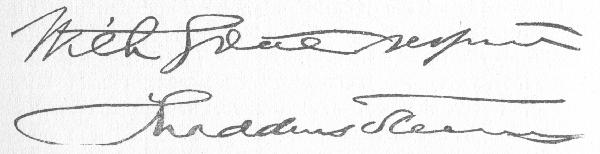
Thaddeus Stevens
A letter written by Mrs. Stanton to Martha Wright is a sample of hundreds which were sent to friends in all parts of the country:
I enclose you the proof of the memorial which Susan and I have just been getting up for Congress. I have been writing to Mr. Garrison to make some mention of us, "the only disfranchised class now remaining," in his last Liberator. It is fitting that we should be recognized in his valedictory. We have now boosted the negro over our own heads, and we had better begin to remember that self-preservation is the first law of nature. Will you see if you can get our petition in your city and county papers? Sign it yourself and send it to your representatives in Senate and Congress, and then try to galvanize the women of your district into life. Some say: "Be still; wait; this is the negro's hour." We believe this is the hour for everybody to do the best thing for reconstruction.
Miss Anthony found the leaders among the men so absorbed with their interest in the male negro that they had given little thought to the suffrage as related to women; but the Hovey Committee appropriated $500 to begin the petition work. She went to Concord and held a parlor meeting attended by Emerson, Alcott, Sanborn and other sages of that intellectual center, stating what the women desired to accomplish. After she finished, Emerson was appealed to for an opinion but said: "Ask my wife. I can philosophize, but I always look to her to decide for me in practical matters." Mrs. Emerson replied without hesitation that she fully agreed with Miss Anthony in regard to the necessity for petitioning Congress at once to enfranchise women, either before this great body of negroes was invested with the ballot or at the same time. Mr. Emerson and the other gentlemen then assured her of their sympathy and support.
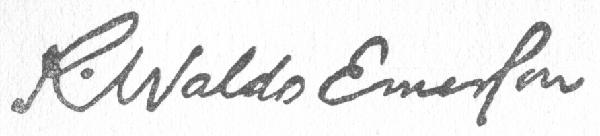
R. Waldo Emerson
She presented her claims at the annual anti-slavery meeting in Westchester and at many other gatherings. She went also to Philadelphia to visit James and Lucretia Mott and interest Mary Grew and Sarah Pugh and all the friends in that locality; then back to New York with tireless energy and unflagging zeal. She wrote articles for the Anti-Slavery Standard, sent out petitions and left no stone unturned to accomplish 252 her purpose. The diary shows the days to have been well filled:
Went to Tilton's office to express regrets at not being able to attend their tin wedding. He read us his editorial on Seward and Beecher. Splendid!... Went to hear Beecher, morning and evening. There is no one like him.... Spent the day at Mrs. Tilton's and went with her to Mrs. Bowen's.... Listened to O.B. Frothingham, "Justice the Mother of Wisdom."... Put some new buttons on my cloak. This is its third winter.... Excellent audience in Friends' meeting house, at Milton-on-the-Hudson. Visited the grave of Eliza W. Farnham.... Went over to New Jersey to confer with Lucy Stone and Antoinette Blackwell.... Called at Dr. Cheever's, and also had an interview with Robert Dale Owen.... Went to Worcester to see Abby Kelly Foster and from there to Boston.... Found Dr. Harriot K. Hunt ready for woman suffrage work. Took dinner at Garrison's. Saw Whipple and May, then went to Wendell Phillips'.... Spent the day with Caroline M. Severance, at West Newton. She is earnest in the cause of women.... Returned to New York and commenced work in earnest. Spent nearly all the Christmas holidays addressing and sending off petitions.
Henry Ward Beecher and Theodore Tilton entered heartily into the plans of Miss Anthony and Mrs. Stanton. Mr. Tilton proposed that they should form a National Equal Rights Association, demanding suffrage for negroes and for women, that Mr. Phillips should be its president, the Anti-Slavery Standard its official organ; and Mr. Beecher agreed to lecture in behalf of this new movement. Mr. Tilton came out with a strong editorial in the Independent, advocating suffrage for women and paying a beautiful tribute to the efficient services in the past of those who were now demanding recognition of their political rights:
A LAW AGAINST WOMEN.—The spider-crab walks backward. Borrowing this creature's mossy legs, two or three gentlemen in Washington are seeking to fix these upon the Federal Constitution, to make that instrument walk backward in like style. For instance, the Constitution has never laid any legal disabilities upon woman. Whatever denials of rights it formerly made to our slaves, it denied nothing to our wives and daughters. The legal rights of an American woman—for instance, her right to her own property, as against a squandering husband; or her right to her own children as against a malicious father—have grown, year by year, into a more generous and just statement in American laws. This beautiful result is owing in great measure to the persistent efforts of many noble women who, for years past, both publicly and 253 privately, by pen and speech, have appealed to legislative committees and to the whole community for an enlargement of the legal and civil status of their fellow-countrywomen. Signal, honorable and beneficent have been the works and words of Lucretia Mott, Lydia Maria Child, Paulina Wright Davis, Abby Kelly Foster, Frances D. Gage, Lucy Stone, Caroline H. Ball, Antoinette Blackwell, Susan B. Anthony, Elizabeth Cady Stanton and many others. Not in all the land lives a poor woman or a widow who does not owe some portion of her present safety under the law to the brave exertions of these faithful laborers.
All forward-looking minds know that, sooner or later, the chief public question in this country will be woman's claim to the ballot. The Federal Constitution, as it now stands, leaves this question an open one for the several States to settle as they choose. Two bills, however, now lie before Congress proposing to array the fundamental law of the land against the multitude of American women by ordaining a denial of the political rights of a whole sex. To this injustice we object totally! Such an amendment is a snap judgment before discussion; it is an obstacle to future progress; it is a gratuitous bruise inflicted on the most tender and humane sentiment that has ever entered into American politics. If the present Congress is not called to legislate for the rights of women, let it not legislate against them. Americans now live who shall not go down into the grave till they have left behind them a republican government; and no republic is republican that denies to half its citizens those rights which the Declaration of Independence and a true Christian democracy make equal to all. Meanwhile, let us break the legs of the spider-crab.
[35] As the question of suffrage is now agitating the public mind, it is the hour for woman to make her demand. Propositions already have been made on the floor of Congress to so amend the Constitution as to exclude women from a voice in the government. As this would be to turn the wheels of legislation backward, let the women of the nation now unitedly protest against such a desecration of the Constitution, and petition for that right which is at the foundation of all government, the right of representation. Send your petition when signed to your representative in Congress, at your earliest convenience.
ELIZABETH CADY STANTON, SUSAN B. ANTHONY, LUCY STONE.
The reconstruction period of our government was no less trying a time than the four years of warfare which preceded it. The Union had been preserved but the disorganization of the Southern States was complete. Lincoln, whose cool judgment, restraining wisdom and remarkable genius for understanding and persuading men never had been more needed, was dead by the hand of an assassin. In his place was a man, rash, headlong, aggressive, stubborn, distrusted by the party which had placed him in power. This chief executive had to deal not only with the great, perplexing questions which always follow upon the close of a war, but with these rendered still more difficult by the great mass of bewildered and helpless negroes, ignorant of how to care for themselves, with no further claims upon their former owners, and yet destined to live among them. The immense Republican majority in Congress found itself opposed by a President, southern in birth and sympathy and an uncompromising believer in State Rights.
The southern legislatures, while accepting the Thirteenth Amendment, which prohibited slavery, passed various laws whose effect could not be other than to keep the negro in a condition of "involuntary servitude." To the South these measures seemed to be demanded by ordinary prudence to retain at least temporary control of a race unfitted for a wise use of liberty; to the North they appeared a determination to evade the 256 provisions of the Thirteenth Amendment, and Congress decided upon more radical measures. One wing of the old Abolitionists, under the leadership of Phillips, had steadfastly insisted that there could be no real freedom without the ballot. Several attempts had been made to secure congressional action for the enfranchisement of the negro, which the majority of Republicans had now come to see was essential for his protection, and these resulted finally in the submission of the Fourteenth Amendment. Charles Sumner stated that he covered nineteen pages of foolscap in his effort so to formulate it as to omit the word "male" and, at the same time, secure the ballot for the negro.
When Miss Anthony and Mrs. Stanton sounded the alarm, the old leaders in the movement for woman's rights came at once to their aid, but they were soon to meet with an unexpected and serious disappointment. In January Miss Anthony went to the anti-slavery meeting at Boston, full of the new idea of consolidating the old Anti-Slavery and the Woman's Rights Societies under one name, that of the Equal Rights Association. She was warmly supported by Tilton, Lucy Stone, Powell and others, but to their amazement they found Mr. Phillips very cool and discouraging. He said this could be done only by amending the constitution of the Anti-Slavery Society, which required three months' notice. Still they did not dream of his opposing the proposition and so deputized Mr. Powell to give the formal notice, in order that it might be acted upon at the coming May Anniversary. On the way back the New York delegation discussed this new plan enthusiastically, and Miss Anthony wrote home that there was a strong wish in the society to widen its object so as to include universal suffrage, believing this to be the case. The necessary steps at once were taken for calling a national woman's rights meeting to convene in New York the same week as the Anti-Slavery Anniversary, and the following call was issued setting forth its principal objects:
Those who tell us the republican idea is a failure, do not see the deep gulf between our broad theory and our partial legislation; do not see that our government 257 for the last century has been but a repetition of the old experiments of class and caste. Hence the failure is not in the principle, but in the lack of virtue on our part to apply it. The question now is, have we the wisdom and conscience, from the present upheavings of our political system to reconstruct a government on the one enduring basis which never yet has been tried—Equal Rights to All?
From the proposed class legislation in Congress, it is evident we have not yet learned wisdom from the experience of the past; for, while our representatives at Washington are discussing the right of suffrage for the black man as the only protection to life, liberty and happiness, they deny that "necessity of citizenship" to woman, by proposing to introduce the word "male" into the Federal Constitution. In securing suffrage but to another shade of manhood, while disfranchising 15,000,000 women, we come not one line nearer the republican idea. Can a ballot in the hand of woman and dignity on her brow, more unsex her than do a scepter and a crown? Shall an American Congress pay less honor to the daughter of a President than a British Parliament to the daughter of a King? Should not our petitions command as respectful a hearing in a republican Senate as a speech of Victoria in the House of Lords? Do we not claim that here all men and women are nobles—all heirs apparent to the throne? The fact that this backward legislation has roused so little thought or protest from the women of the country but proves what some of our ablest thinkers already have declared, that the greatest barrier to a government of equality is the aristocracy of its women; for while woman holds an ideal position above man and the work of life, poorly imitating the pomp, heraldry and distinction of an effete European civilization, we as a nation never can realize the divine idea of equality.
To build a true republic, the church and the home must undergo the same upheavings we now see in the state; for while our egotism, selfishness, luxury and ease are baptized in the name of Him whose life was a sacrifice, while at the family altar we are taught to worship wealth, power and position, rather than humanity, it is vain to talk of a republican government. The fair fruits of liberty, equality and fraternity must be blighted in the bud till cherished in the heart of woman. At this hour the nation needs the highest thought and inspiration of a true womanhood infused into every vein and artery of its life; and woman needs a broader, deeper education such as a pure religion and lofty patriotism alone can give. From the baptism of this second Revolution should she not rise up with new strength and dignity, clothed in all those "rights, privileges and immunities" which shall best enable her to fulfill her highest duties to humanity, her country, her family and herself?
On behalf of the National Woman's Rights Central Committee,
ELIZABETH CADY STANTON, President; SUSAN B. ANTHONY, Secretary.
Letters both encouraging and discouraging were received. Robert Purvis, one of the most elegant and scholarly colored men our country has known, whose father was a Scotchman 258 and mother a West Indian with no slave blood, sent this noble response: "....I can not agree that this or any hour is 'especially the negro's.' I am an anti-slavery man because I hate tyranny and in my nature revolt against oppression, whatever its form or character. As an Abolitionist, therefore, I am for the equal rights movement, and as one of the confessedly oppressed race, how could I be otherwise? With what grace could I ask the women of this country to labor for my enfranchisement, and at the same time be unwilling to put forth a hand to remove the tyranny, in some respects greater, to which they are subjected? Again wishing you a successful meeting, I am very gratefully yours."
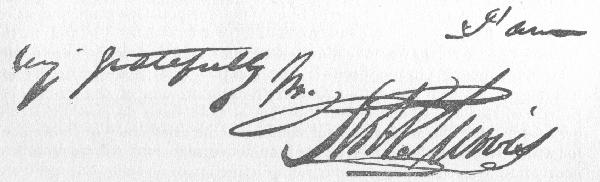
Robert Purvis
Anna Dickinson, who had come upon the scene of action since the last woman's rights convention five years before, wrote Miss Anthony that she should be present but was not sure that she was yet ready to speak: "I'm a great deal of a Quaker—I don't like to take up any work till I feel called to it. My personal interest is perhaps stronger in that of which thee writes me than in any other, but my hands are so full just now. I see what I shall do in the future, and I hope the near future. Wait for me a little—forbear, and I honestly believe I'll do thee some good and faithful service; I don't mean wait for me, but be patient with me. I write this out of my large love for and confidence in thee. I will talk to thee more of it by end of the month when I see thee in Boston and put my mite in thy hands; till then believe me, dear friend, affectionately and truly thine."
At the business meeting of the anti-slavery convention the proposition was made by the National Woman's Rights Committee that, as all there was left for the society to do was to 259 secure suffrage for the negro, and as the woman's society also was working for universal suffrage, they should merge the two into one, and in that way the same conventions, appeals, petitions, etc., would answer for both. To this Mr. Phillips vigorously objected because the necessary three months' notice had not been given! As Mr. Powell had been delegated the previous January to give this, there could be no other conclusion than that he had refrained from doing so. There was considerable discussion on the question but, as president of the Anti-Slavery Society, Mr. Phillips' influence was supreme and the coalition was declined.
The Woman's Rights Convention met in Dr. Cheever's church, May 10, 1866, with a large audience present. It was their first meeting since before the war, and while it had many elements of gladness, yet it was not unmixed with sorrow. Mr. Garrison was absent, the first rift had been made in the love and gratitude in which for many years Mr. Phillips had been held, and a vague feeling of distrust and alarm was beginning to creep over the women, lest, after all these years of patient work, they were again to be sacrificed.
Miss Anthony presented a ringing set of resolutions, and splendid addresses were given by Mrs. Stanton, Theodore Tilton and Henry Ward Beecher. Mr. Phillips then made a long and eloquent speech which was rapturously received by the audience, but which filled the leaders with sadness, because of the skillful evasion of the disputed question which they never had expected from this staunch friend. Miss Anthony read an address to Congress[36] which was adopted with unanimous approval. At the close of the convention a business session was held, at which she offered a resolution declaring that, since by the act of emancipation and the Civil Rights Bill, the negro and woman now had the same civil and political status, alike needing only the ballot, therefore the time had come for an organization which should demand universal suffrage; and that hereafter their society should be known as the American 260 Equal Rights Association. She supported this by an able speech in which she said:
For twenty years we have pressed the claims of woman to the right of representation in the government. Each successive year after 1848, conventions were held in different States, until the beginning of the war. Up to this hour we have looked only to State action for the recognition of our rights; but now, by the results of the war, the whole question of suffrage reverts back to the United States Constitution. The duty of Congress at this moment is to declare what shall be the basis of representation in a republican form of government. There is, there can be, but one true basis, viz.: that taxation and representation must be inseparable; hence our demand must now go beyond woman—it must extend to the farthest limit of the principle of the "consent of the governed," as the only authorized or just government. We therefore wish to broaden our woman's rights platform and make it in name what it ever has been in spirit, a human rights platform. As women we can no longer claim for ourselves what we do not for others, nor can we work in two separate movements to get the ballot for the two disfranchised classes, negroes and women, since to do so must be at double cost of time, energy and money.... Therefore, that we may henceforth concentrate all our forces for the practical application of our one grand, distinctive, national idea—universal suffrage—I hope we will unanimously adopt the resolution before us, thus resolving ourselves into the American Equal Eights Association.
Notwithstanding the rebuff they had received from the Anti-Slavery Society, this resolution was unanimously adopted and the Woman's Rights Society which had existed practically for sixteen years was merged into the American Equal Rights Association to work for universal suffrage. A constitution was adopted and officers chosen.[37] Mrs. Stanton thus describes the last moments of the convention: "As Lucretia Mott uttered her few parting words of benediction, the fading sunlight through the stained windows falling upon her pure face, a celestial glory seemed about her, a sweet and peaceful influence 261 pervaded every heart, and all responded to Theodore Tilton when he said this closing meeting was one of the most beautiful, delightful and memorable which any of its participants ever enjoyed."
A short time thereafter Miss Anthony, Mrs. Stanton, Mr. Phillips and Mr. Tilton were in the Standard office discussing the work. Mr. Phillips argued that the time was ripe for striking the word "white" out of the New York constitution, at its coming convention, but not for striking out "male." Mr. Tilton supported him, in direct contradiction to all he had so warmly advocated only a few weeks before, and said what the women should do was to canvass the State with speeches and petitions for the enfranchisement of the negro, leaving that of the women to come afterward, presumably twenty years later, when there would be another revision of the constitution. Mrs. Stanton, entirely overcome by the eloquence of these two gifted men, acquiesced in all they said; but Miss Anthony, who never could be swerved from her standard by any sophistry or blandishments, was highly indignant and declared that she would sooner cut off her right hand than ask the ballot for the black man and not for woman. After Phillips had left, she overheard Tilton say to Mrs. Stanton, "What does ail Susan? She acts like one possessed." Mrs. Stanton replied, "I can not imagine; I never before saw her so unreasonable and absolutely rude."
She was obliged to leave immediately to keep an engagement, but as soon as she was at liberty went straight to Mrs. Stanton's home, and found her walking up and down the long parlors, wringing her hands. She threw her arms around Miss Anthony, exclaiming: "I never was so glad to see you. Do tell me what is the matter with me? I feel as if I had been scourged from the crown of my head to the soles of my feet!" They sat down together and went over the whole conversation, and she then saw and felt most keenly the insult and degradation concealed in the proposition of the two men, and agreed with Miss Anthony that she would sacrifice her life before she would accept it. 262
This incident illustrates one marked difference in these two women, each so strong in her own characteristics. Mrs. Stanton in the presence of brilliant intellect and elegant culture at times would seem to be entirely psychologized, even though the arguments used were in direct conflict with her own instincts and judgment. On the contrary, no eloquence, no persuasiveness of manner, no magnetic power could induce Miss Anthony for one moment to abandon her convictions of truth and justice. Mrs. Stanton's disposition was one of extreme suavity which loved to please, while Miss Anthony's nature was rugged, unflinching and stern in upholding the right without regard to expediency.
On May 31 both the Anti-Slavery Society and the Equal Rights Association held large meetings in Boston. The latter, in conformity with its new name, announced that "any member of the audience, man or woman, was entitled to speak on the topics under debate and would be made welcome." This had been the rule always in the old woman's rights conventions, but it was reaffirmed now in order to show the broad and catholic spirit of the new organization. At this Boston meeting Anna Dickinson made her first speech for the rights of woman. It was one of those bursts of inspiration which no pen can reproduce, and was received by the audience with cheer upon cheer. She gave $100 to the cause, assuring them of her services henceforth, and Miss Anthony wrote of her, "She is sound to the heart's core."
The great work of rolling up petitions, not only to Congress but to the New York Constitutional Convention, was then commenced. The executive board of the Standard offered to lease to the Equal Rights Association office-room and a certain amount of space in the paper. These, however, were put at such a price and placed under such restrictions as it was thought unwise to accept. All the matter submitted would be subject to "editorial revision," even though the association paid for the space, and as Mr. Pillsbury had resigned the editorship and Mr. Powell had taken it, they decided they could not trust the "editorial revision." The women had done so 263 vast an amount of gratuitous work for the Standard in past years, that they felt themselves entitled to more liberal treatment. The editor had written, only a short time before, of the excellent service Miss Anthony had rendered in straightening out the accounts. She also had secured numerous subscribers, sending in as many as thirty at a time from some of her meetings.
For the purpose of arousing public interest in the approaching New York Constitutional Convention, an equal rights meeting was held at Albany, in Tweddle Hall, November 21. To make this a success Miss Anthony spent many weeks of hard work. The diary notes that, among other things, she directed and sent out 1200 complimentary tickets.[38] At this Albany convention political differences began to appear. Mrs. Stanton complimented the Democrats for the assistance they had rendered; Frederick Douglass objected to their receiving any credit, branding their advocacy as a trick of the enemy, and there were frequent sharp encounters. Miss Anthony made an extended speech, of which there is but this newspaper report:
She referred to the assertion of Horace Greeley, that while women had the abstract right to suffrage the great majority of them did not wish it. So they told us when we said the negro ought to be free; he did not wish it; he was contented and happy. As we replied relative to the negro, so do we regarding women. If they do not desire the right to vote, it is an evidence of the depth to which they have been degraded by its deprivation. A woman clerk, in the New York Mercantile Library, told her that during the war the salaries of the male clerks all had been raised, but not those of the women, and a man's, who held an inferior position, had been increased to $300 more than her own. The clerk said that if she had been a voter she did not believe such injustice would have been perpetrated. In Rochester the salaries of the male teachers in the public schools were raised $100 per annum while the small salaries of the women were still further reduced. In Auburn $200 additional compensation was voted to the male teachers and $25 to the women, 264 who thereupon held a meeting and passed an ironical resolution thanking the board for their liberal allowance. The board then required them to sign a paper saying they did not intend an insult, and those who did not make such recantation were discharged. The speaker then referred to the power of the ballot. No politician dared oppose the eight-hour agitation, because the workingman held the franchise. Give the workingwoman a vote and she, too, can protect herself.
A form of petition was approved asking that women might be members of the coming Constitutional Convention and vote on the new constitution. Respectful reports were made by the New York papers with the exception of the World, which said in a long and abusive article:
Altogether the ablest, most dignified and best-balanced man in the body is Frederick Douglass, and there is a deep feeling for him for United States senator in spite of the drift of the convention, which is evidently in favor of Susan B. Anthony; notwithstanding which Elizabeth Cady Stanton is likewise a candidate with considerable strength, favoring as she does the Copperheads, the Democratic party and other dead and buried remains of alleged disloyalty. Susan is lean, cadaverous and intellectual, with the proportions of a file and the voice of a hurdy-gurdy. She is the favorite of the convention. Mrs. Stanton is of intellectual stock, impressive in manner and disposed to henpeck the convention which of course calls out resistance and much cackling.... Susan has a controlling advantage over her in the fact that she is unencumbered with a husband. As male members of Congress rarely have wives in Washington, so female members will be expected to be without husbands at the capital....
Parker Pillsbury, one of the notabilities of the body, is a good-looking white man naturally, but has a cowed and sneakish expression stealing over him, as though he regretted he had not been born a nigger or one of these females.... Lucy Stone, the president of the convention, is what the law terms a "spinster." She is a sad old girl, presides with timidity and hesitation, is wheezy and nasal in her pronunciation and wholly without dignity or command.... Mummified and fossilated females, void of domestic duties, habits and natural affections; crack-brained, rheumatic, dyspeptic, henpecked men, vainly striving to achieve the liberty of opening their heads in presence of their wives; self-educated, oily-faced, insolent, gabbling negroes, and Theodore Tilton, make up the less than a hundred members of this caravan, called, by themselves, the American Equal Rights Association.
On December 6 and 7 a mass meeting was held in Cooper Institute, Miss Anthony presiding. There were the usual effective speeches and large and appreciative audiences present at every session. From New York the speakers went at once to Rochester and held a two days' convention there. The forces 265 then divided and, under the management of Miss Anthony, held meetings in a large number of the towns of western and central New York, to arouse public sentiment in favor of giving women a representation at the Constitutional Convention.
Meanwhile the petitions asking Congress to include women in the proposed Fourteenth Amendment were rapidly pushed, and as soon as ten or twelve thousand names were secured they were sent at once to Washington, as the resolution was then under discussion. And here came the revelation which had been for some time foreshadowed—the Republicans refused to champion this cause! From the founding of the Anti-Slavery Society in 1833, women had been always its most loyal supporters, bearing their share of the odium and persecution of early days. When the Republican party was formed, the leading women of the country had allied themselves with it and given faithful service during the long, dark years which followed. All the Abolitionists and prominent Republicans had upheld the principle of equal rights to all, and now, when the test came, they refused to recognize the claims of woman! Some of the senators and representatives declined to present the petitions sent from their own districts; others offered them merely as petitions for "universal suffrage," carefully omitting the word "woman" and trusting that it would be inferred they meant suffrage for the negro men.
Even Charles Sumner, who so many times had acknowledged his indebtedness to Miss Anthony, Mrs. Stanton and the other women who were now asking for their rights, presented a petition from Massachusetts, headed by Lydia Maria Child, with the declaration that he did it under protest and that it was "most inopportune." Mrs. Child was the first and one of the ablest editors of the Anti-Slavery Standard, and had battled long and earnestly for the freedom of the slave at the cost of her literary popularity; but now when she asked that she might receive the rights of citizenship at least at the same time they were conferred upon the freedman, her plea was declared "most inopportune."
The Democrats in Congress, who never had favored or assisted 266 in any way the so-called woman's rights doctrines, seized upon this opportunity to harass the Republicans and defeat negro suffrage. They not only presented the women's petitions but made long and eloquent speeches in their favor, using with telling force against the Republicans their own oft-repeated arguments for equal rights to all. In the midst of this agitation, the District of Columbia Suffrage Bill being under discussion, Edgar Cowan, a Pennsylvania Democrat, moved to strike out the word "male," and thus precipitated a debate which occupied three entire days in the Senate. Among the Republicans Benjamin F. Wade and B. Gratz Brown made splendid arguments for woman suffrage and announced their votes in favor of the measure. Senator Wilson, from Massachusetts, declared himself ready at any and all times to vote for a separate bill enfranchising women, but opposed to connecting it with negro suffrage. The vote in the Senate to strike the word "male" from the proposed bill resulted: yeas, 9; nays, 47; in the House, yeas, 49; nays, 74—68 not voting. A number of members in both Houses who believed in woman suffrage voted "no" because they preferred to sacrifice the women rather than the negroes.[39]

B.F. Wade
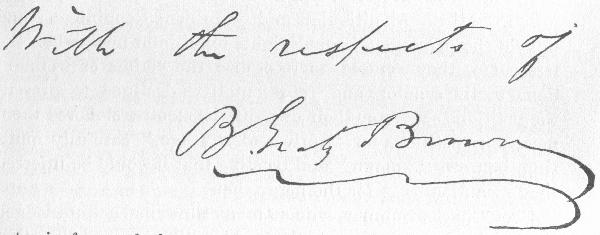
B. Gratz Brown
The Republican press was equally hostile to the proposition to enfranchise women. Mr. Greeley, who in times past had 267 been so staunch a supporter of woman's rights, now said in the New York Tribune:
A CRY FROM THE FEMALES,—.... Our heart warms with pity towards these unfortunate creatures. We fancy that we can see them, deserted of men, and bereft of those rich enjoyments and exalted privileges which belong to women, languishing their unhappy lives away in a mournful singleness, from which they can escape by no art in the construction of waterfalls or the employment of cotton-padding. Talk of a true woman needing the ballot as an accessory of power, when she rules the world by a glance of her eye! There was sound philosophy in the remark of an Eastern monarch, that his wife was sovereign of the empire, because she ruled his little ones and his little ones ruled him. The sure panacea for such ills as the Massachusetts petitioners complain of, is a wicker-work cradle and a dimple-cheeked baby.
The New York Post, which under Mr. Bryant's editorship had favored the enfranchisement of women, also took ground against it now, and this was the attitude of Republican papers in all parts of the country. The Democratic press was opposed, except when it could make capital against the Republicans by espousing it.
In November Miss Anthony went to a great anti-slavery meeting in Philadelphia. Between the two sessions, Lucretia Mott invited about twenty of the leading men and women to lunch with her. At her request Miss Anthony acted as spokesman and, in behalf of the women, begged Mr. Phillips to reconsider his position and make the woman's and the negro's cause identical, but here, in the presence of the women who had stood shoulder to shoulder with him in all his hard-fought battles of the last twenty years, he again refused, declaring that their time had not yet come. Miss Anthony sent the most impassioned appeals to the Joint Committee of Fifteen, with Thaddeus Stevens as chairman, which had charge of the congressional policy on reconstruction, urging that if they could not report favorably on the petitions, at least they would not interpose any new barrier against woman's right to the ballot; but, although Mr. Stevens had ever been friendly to the claims of women, he refused to recognize them now. Everywhere they were met by the cry, "This is the negro's hour!"
It was a long time before the women could believe that the 268 Republicans and Abolitionists, who had advocated their cause for years, would forsake them at this critical moment. The letters written during this period showed the agony of spirit they endured as they beheld one after another repudiating their demands and setting them aside in favor of the negro. Not only did the men thus abandon the cause of equal rights but, by their specious arguments, they persuaded many of the women that it was their duty to sacrifice their own claims and devote themselves to securing suffrage for the colored men. This indignant letter from Mrs. Stanton to one of the "old guard," who at first declined to circulate petitions, will serve as an example of many which were sent to the women:
I have just read your letter, and it would have been a wet blanket to Susan and me were we not sure that we are right. With three bills before Congress to exclude us from all hope of representation in the future, I thank God that two women of the nation felt the insult and decided to rouse the rest to use the only right we have in the government—the right of petition. If the petition goes with our names alone, ours be the glory, and the disgrace to all the rest! We have sent out 1,000 franked by Representative James Brooks, of the New York Express, and if they come back to us empty, Susan and I will sign all of them, that every Democratic member may have one to shame those hypocritical Republicans. When your granddaughters hear that against such insults you made no protest, they will blush for their ancestry.
This letter from Lucretia Mott shows that some men remained true to the woman's cause: "My husband and myself cordially hail this movement. The negro's hour came with his emancipation from cruel bondage. He now has advocates not a few for his right to the ballot. Intelligent as these are, they must see that this right can not be consistently withheld from women. We pledge $50 toward the necessary funds." At this time Miss Anthony in a strong and earnest letter showed the injustice of the Standard's behavior:
How I do wish the good old Standard would preach the whole gospel of the whole loaf of republicanism; but I am sorry to say the present indications are that it will extend even less favor to us than ever before. I gather this from Mr. Powell's announcement to me last week that henceforth, if I were not going to give my personal efforts to the Standard, he should not publish notices of our meetings except at "full advertising rates." I was not a little startled but answered: "Of course I shall say the Standard is the truest and 269 best paper for negro suffrage; but I can not say that it is so for woman suffrage." He said he saw this and hereafter we must pay for all notices.
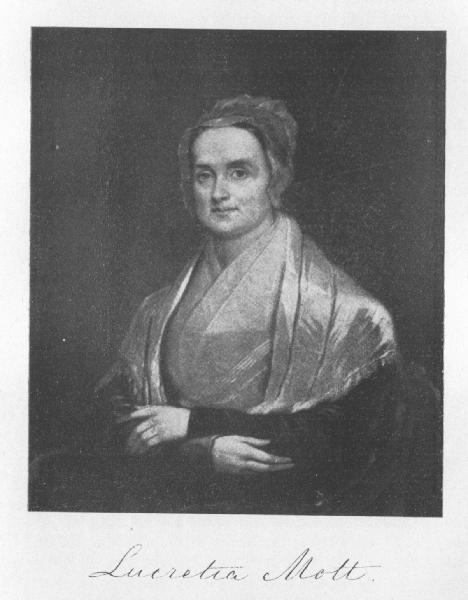
Lucretia Mott
Now, I do complain of this and with just cause, so long as $2,000 of the sainted Hovey's money are sunk annually in the struggle to keep the Standard afloat, while Mr. Hovey's will expressly says: "In case chattel slavery should be abolished before the expenditure of the full amount, the residue shall be applied toward securing woman's rights," etc. Mr. Pillsbury told the Hovey Committee last winter, after abolition was proclaimed, that he could not in conscience accept his salary from them as editor of the Standard for another year unless it should advocate woman's claims equally with those of the negro.
In her diary she writes: "Even Charles Sumner bends to the spirit of compromise and presents a constitutional amendment which concedes the right to disfranchise law-abiding, tax-paying citizens." Robert Purvis again expressed his cordial sympathy: "I am heartily with you in the view 'that the reconstruction of the Union is a work of greater importance than the restoration of the rebel States;' and that it should be in accordance with the true republican idea of the personal rights of all our citizens, without regard to sex or color. If the settlement of this question upon the comprehensive basis of equal rights and impartial justice to all should require the postponement of the enfranchisement of the colored man, I am willing for the delay, though it should take a decade of years to 'fight it out on that line.'" Mr. Purvis frequently said in the debates of those days that he would rather his son never should be enfranchised than that his daughter never should be, as she bore the double disability of sex and color and, by every principle of justice, should be the first to be protected.
As the struggle for the enfranchisement of the negro grew more intense, and the entire burden of it fell upon the Republican party, its members became more and more insistent that the women should not jeopardize the claims of the colored man by pressing their own. Miss Anthony, Mrs. Stanton and a few others of the stronger and more independent women declared they would not suffer in silence the injustice and insult of having this great body of ignorant men granted the political rights which were denied intelligent women; nor 270 would they submit without protest to having a million ballots added to the mass which already were sure to be cast against the enfranchisement of women if ever the question came to a popular vote. As a result of their stand for justice, they found themselves utterly deserted by all the great leaders with whom they had labored so earnestly and harmoniously for many years—Garrison, Phillips, Greeley, Curtis, Tilton, Higginson, Douglass, Gerrit Smith. Of all the old Abolitionists only four—Samuel J. May, Robert Purvis, Parker Pillsbury and Stephen S. Foster—remained loyal to their standard. There was not one of the men repudiating them who did not believe thoroughly in the principle of woman's full right to the ballot. The women simply were sacrificed to political expediency; set aside without a moment's hesitation in obedience to the party shibboleth. "This is the negro's hour!"
[37] 'WHEREAS, by the war, society is once more resolved into its original elements, and in the reconstruction of our government we again stand face to face with the broad question of natural rights, all associations based on special claims for special classes are too narrow and partial for the hour; therefore, from the baptism of a second Revolution, purified and exalted by suffering, seeing with a holier vision that the peace, prosperity and perpetuity of the republic rest on Equal Rights to All, we, today assembled in our Eleventh National Woman's Rights Convention, bury the woman in the citizen, and our organization in that of the American Equal Rights Association.
President, Lucretia Mott; vice-presidents, Elizabeth Cady Stanton, Theodore Tilton, Frederick Douglass, Josephine S. Griffing, Frances D. Gage, Robert Purvis, Martha C. Wright, Rebecca W. Mott; corresponding secretaries, Susan B. Anthony, Caroline M. Severance, Mattie Griffith; treasurer, Ludlow Patton; recording secretary, Henry B. Blackwell.
The first three months of 1867 were spent by Miss Anthony and a corps of speakers in a series of conventions throughout the State of New York in order to secure for women a representation in the Constitutional Convention. The history of these was that of many which had preceded them, large crowds and much enthusiasm in some places, small audiences and chilling receptions at others. The press comments were generally fair, but occasionally there was a weak attempt at wit or satire. For instance, the editor of the Buffalo Commercial thus replied through his columns to a polite note from Miss Anthony enclosing an advertisement of the convention and requesting that the blank space left be filled with the names of places where tickets usually were sold, the bill to be sent to her:
By reference to the notice which we publish elsewhere, it will be seen that we have complied with the request of Susan, except in giving the names of places where tickets are to be had. "The bars of the principal hotels" suggested itself; but then it occurred to us that perhaps some of our strong-minded female fellow-citizens might not like to go to these places for cards of admission. Then we thought of inserting "for freight or passage apply to the captain on board;" but we did not know whether Susan or Elizabeth was captain, and a row might have resulted, in which case the former would probably become "black-eyed Susan." We finally concluded not to meddle with the matter but to let Susan and Elizabeth do as the man insisted upon doing who enacted the part of the king in the play, and who profanely declared that as he was king, he would die just where he d—— pleased. The girls can sell tickets just where "they've a mind ter." We may not be able to give the proposed meeting "frequent editorial notice;" still the probabilities are that we shall allude to it if we live and do well, and we shan't charge Susan a cent 272 for our services. We would not have it said, nor would we have you, "O Susan, Susan, lovely dear," imagine that we are ag'in "the one true basis of a genuine republic."
And yet, after all this, the freedom-loving General Rufus Saxton had the courage to preside at the meeting and introduce the speakers. He subsequently wrote: "I pray that God will bless your noble work and that, sooner than you think, woman shall be admitted to her proper place, where God intended she should be, and to exclude her from which must, like any other great wrong, bring misery and sorrow." The Troy Times said:
The last time we heard Miss Anthony speak was in 1861, shortly after the election of Lincoln when, it will be remembered, she was mobbed from city to city. Since then time and the various undertakings in which she has engaged have apparently had no effect upon her, unless to render her more eloquent and more sanguine of the ultimate righting of all wrongs, and to inspire additional enthusiasm for a cause to which she has clung with a perseverance deserving admiration. She is very choice in the selection of words and phrases, speaks in an earnest, attractive monotone, and really made one of the most eloquent and sensible speeches for female suffrage to which we ever listened.
At Fairfield, Herkimer Co., Miss Anthony spoke in the presence of a large number of students from the academy and, at the close of her address, there were vigorous calls for the wife of the principal, who was known to be opposed to any phase of so-called woman's rights. She finally responded and, in the course of her remarks, said that when she was a teacher she used to believe that women should receive the same salary as men, but since she had married and realized the responsibilities of a man of family, she had been converted to the belief that men should receive more than women. Miss Anthony at once retorted: "It would seem then, that so long as you were earning your own living you wanted a good salary, but so soon as you give your services to a husband, you want him to receive the value of both your work and his own, regardless of those women who still have to support themselves and very often a family." The fact that the lady was 273 her hostess did not save her from this merited rebuke, which was heartily appreciated and enjoyed by the students.
In these tours the burden of the preliminary arrangements always was assumed by Miss Anthony. When Mrs. Stanton and she reached a place where a meeting was to be held, the former would go at once to bed, while the latter rushed to the newspaper offices to look after the advertising, then to the hall to see that all was in readiness, and usually conducted the afternoon session alone. In the evening Mrs. Stanton would appear, rested and radiant, and read a carefully written address, while Miss Anthony, exhausted and having had no time to prepare a speech, would make a few impromptu remarks as best she could. Then the papers would comment on the difference between the beautiful and amiable Mrs. Stanton and the aggressive and jaded Miss Anthony, and attribute it to the fact that one was a wife and the other a spinster.[40]
At Albany Miss Anthony arranged with Charles J. Folger, chairman of the Senate Judiciary Committee, for an address by Mrs. Stanton, which was given January 13, 1867, before the joint committees, in the Assembly chamber, crowded with men and women. She based her claim on the assumption that when a new constitution is demanded, the State is resolved into its original elements and all the people have a right to a voice in its reconstruction, supporting her position by an imposing array of legal authorities. Of the discussion by the legislators, which followed the address, Mr. Pillsbury wrote to the Hallowells: "Their arguments against universal suffrage Susan could have extinguished with her thimble."
While Miss Anthony was in Albany she learned that a member from New York City had presented a bill to license houses of ill-repute, and she protested to Judge Folger. He told her 274 that this was a subject which could not be publicly discussed, especially by women. She replied that if there were any attempt to pass the bill she would arouse the women and it should be discussed from one end of the State to the other. The bill never was taken up.
In answer to an invitation to be present at Albany, Mr. Beecher sent his regrets as follows:
I should certainly come and contribute my share of influence if I were not tied hand and foot. I am to preside and speak on Wednesday night in my own church; on Thursday I preside and introduce a lecturer at the Academy of Music, in Brooklyn; on Friday, at Cooper Institute, I have a speech to make for the starving people of the South; and on Saturday, at the same place, a speech for the Cretans. These are but the punctuations of my main business, which, just now, is to write a novel for Bonner, at which I am working every forenoon. I have also a matter of two sermons every week to prepare. I write these details, because our friend Studwell intimates to me that you feel I do not care to be identified with this movement in such a way as to take the unpopularity of the women chiefly engaged in it. I should be unwilling to have you think so. I have never belonged even to an anti-slavery society, Christian or heathen. I am willing to take my stand with anybody on great issues or objects, but in regard to the organizations and instruments by which to attain the end, I have always let others work their way and I mine. I think there is a touch of wildness in my blood (some of my ancestors must have nursed an Indian breast) which is impatient of the harness and so I have always worked on my own hook. I am surprised to see how rapidly the thoughts of intelligent men and women are ameliorating on this question. It needs only that women should have a conscience educated to this duty of suffrage, and it will be yielded.
Early in March the Legislature of Kansas submitted two amendments, one enfranchising the negroes and one the women. State Senator Samuel N. Wood wrote Miss Anthony that an equal rights convention had been called to meet in Topeka, April 2, and urged her to send out the strongest speakers to canvass the State in behalf of the woman suffrage amendment. This was the first time the enfranchisement of women ever had been presented for a popular vote and its advocates were most anxious that it should be carried. Neither Miss Anthony nor Mrs. Stanton could go to Kansas at this time, so they appealed to Lucy Stone, begging her to make the campaign. Since her marriage, twelve years before, she had 275 been practically out of public work, insisting that she had lost her power for speaking. Miss Anthony assured her that if she would take the platform it would come back to her, and Mr. Blackwell joined in the entreaty. He gave up his business position to accompany his wife and they made a thorough canvass of that State during April and May. Mr. Phillips was unwilling that any money from the Jackson fund should be used for this purpose, as he did not want the question agitated at this time, but as Miss Anthony and Lucy Stone constituted a majority of the committee, they appropriated $1,500 for it. Even thus early in the contest the Republican managers began to show their hand. Lucy Stone wrote from Atchison May 9:
I should be glad to be with you tomorrow at the equal rights convention in New York and to know this minute whether Phillips has consented to take the high ground which sound policy, as well as justice and statesmanship require. Just now there is a plot here to get the Republican party to drop the word "male," and canvass only for the word "white." A call has been signed by the chairman of the Republican State Central Committee, for a meeting at Topeka on the 15th, to pledge the party to that single issue. As soon as we saw it and the change of tone in some of the papers, we sent letters to all those whom we had found true, urging them to be at Topeka and vote for both words. Till this action of the Republicans is settled, we can affirm nothing. Everywhere we go, we have the largest and most enthusiastic meetings and any one of our audiences would give a majority for women; but the negroes are all against us. These men ought not to be allowed to vote before we do because they will be so much more dead weight to lift.
Again she wrote of the situation in Kansas:
The Tribune and Independent alone, if they would urge universal suffrage as they do negro suffrage, could carry this whole nation upon the only just plane of equal human rights. What a power to hold and not use!.... They must take it up. I shall see them the very first thing when I get home. At your meeting next Monday evening, I think you should insist that all of the Hovey fund used for the Standard and anti-slavery purposes since slavery was abolished, must be returned with interest to the three causes which by the express terms of the will were to receive all of the fund when slavery should be ended. I trust you will not fail to rebuke the cowardly use of the terms "universal," "impartial" and "equal," applied to hide a dark skin and an unpopular client.... I hope not a man will be asked to speak at the convention. If they volunteer, very well, but I have been for the last time on my knees to Phillips, Higginson or any of them. If they help now, they should ask us and not we them.
On May 9 and 10 the Equal Rights Association held its first anniversary in New York, at the Church of the Puritans. Cordial and encouraging letters were received from Lydia Maria Child, Anna Dickinson, Clara Barton, Mary A. Livermore and many other distinguished women. While there were the usual number of able speeches, the strongest discussion was on the following resolution, offered by Miss Anthony: "The proposal to reconstruct our government on the basis of manhood suffrage, which emanated from the Republican party and has received the recent sanction of the American Anti-Slavery Society, is but a continuation of the old system of class and caste legislation, always cruel and proscriptive in itself and ending, in all ages, in national degradation and revolution." Henry Ward Beecher spoke eloquently in its favor, saying in part:
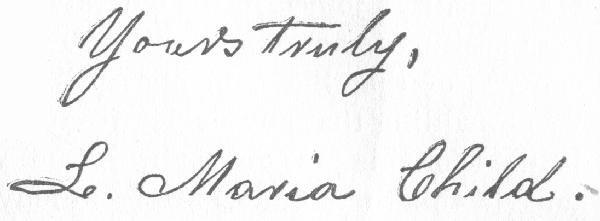
L. Maria Child.
I am not a farmer, but I know that spring comes but once in the year. When the furrow is open is the time to put in your seed, if you would gather a harvest in its season. Now, when the red-hot plowshare of war has opened a furrow in this nation, is the time to put in the seed. If any say to me, "Why will you agitate the woman question when it is the hour for the black man?" I answer, it is the hour for every man and every woman, black or white. The bees go out in the morning to gather the honey from the morning-glories. They take it when they are open, for by 10 o'clock they are shut, never to open again. When the public mind is open, if you have anything to say, say it. If you have any radical principles to urge, any higher wisdom to make known, don't wait until quiet times come, until the public mind shuts up altogether.
We are in the favored hour; and if you have great principles to make known, this is the time to advocate them. I therefore say whatever truth is to be known for the next fifty years in this nation, let it be spoken now—let it be enforced now. The truth that I have to urge is not that women have the right of suffrage—not that Chinamen or Irishmen have that right—not that native born Yankees have it—but that suffrage is the inherent right of mankind.... I do not put back for a single day the black man's enfranchisement. I ask not that he should wait. I demand that this work should be done, not upon the ground that it is politically expedient now to enfranchise black men; but I propose that you take expediency out of the way, and put a principle which is more enduring in the place of it—manhood and womanhood suffrage for all. That is the question. You may just as well meet it 277 now as at any other time. You will never have so favorable an occasion, so sympathetic a heart, never a public reason so willing to be convinced as today.... I believe it is just as easy to carry the enfranchisement of all as of any one class, and easier than to carry it class after class.
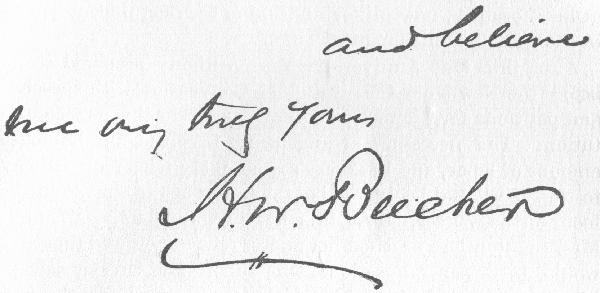
H. W. Beecher
The resolution was adopted unanimously, as was also a memorial to Congress, written by Miss Anthony and Mrs. Stanton, asking most earnestly that the negro should be enfranchised, but just as earnestly that the suffrage should be conferred on woman at the same time. The leading thought was expressed in these beautiful words:
We believe that humanity is one in all those intellectual, moral and spiritual attributes out of which grow human responsibilities. The Scripture declaration is, "So God created man in his own image, male and female created he them," and all divine legislation throughout the realm of nature recognizes the perfect equality of the two conditions; for male and female are but different conditions. Neither color nor sex is ever discharged from obedience to law, natural or moral, written or unwritten. The commandments thou shalt not steal, or kill, or commit adultery, recognize no sex; and hence we believe that all human legislation which is at variance with the divine code, is essentially unrighteous and unjust....
Women and colored men are loyal, liberty-loving citizens, and we can not believe that sex or complexion should be any ground for civil or political degradation. Against such outrage on the very name of a republic we do and ever must protest; and is not our protest against this tyranny of "taxation without representation" as just as that thundered from Bunker Hill, when our Revolutionary fathers fired the shot which shook the world?... We respectfully and earnestly pray that, in restoring the foundations of our nationality, all discriminations on account of sex or race may be removed; and that our government may be republican in fact as well as form; A GOVERNMENT BY THE PEOPLE, AND THE WHOLE PEOPLE; FOR THE PEOPLE, AND THE WHOLE PEOPLE.
This was the last convention ever held in the old historic Church of the Puritans. It soon passed into other hands, and where once sparkled and scintillated flashes of repartee and gems of oratory, now glitter and shine the magnificent jewels in the great establishment of Tiffany.
After this May Anniversary Miss Anthony prepared to go before the New York Constitutional Convention with speeches and petitions for the recognition of women in the new constitution. The necessary arrangements involved an immense amount of labor, and her diary says: "My trips from Albany to New York and back are like the flying of the shuttle in the loom of the weaver." At this hearing, June 27, 1867, after Mrs. Stanton had finished her address she announced that they would answer any questions, whereupon Mr. Greeley said in his drawling monotone: "Miss Anthony, you know the ballot and the bullet go together. If you vote, are you ready to fight?" Instantly she retorted: "Yes, Mr. Greeley, just as you fought in the late war—at the point of a goose-quill!" After the merriment had subsided, he continued: "When should this inalienable right of suffrage commence for young men and foreigners? Have we the right to say when it shall begin?" Miss Anthony replied: "My right as a human being is as good as that of any other human being. If you have a right to vote at twenty-one, then I have. All we ask is that you shall take down the bars and let the women and the negroes in, then we will settle all these matters." The Tribune report said this was received with "loud and prolonged applause."
Miss Anthony continued with great vivacity: "Can you show me any class possessed of the franchise which is shut out of schools or degraded in the labor market, or any class but women and negroes denied any privilege they show themselves possessed of capacity to attain? Since you refuse to grant woman's demand, tell her the reason why. Men sell their votes; but did any one ever hear of their selling their right to vote? We demand that you shall recognize woman's capacity to vote." The newspaper account ended: "She closed by demanding 279 the right to vote for women as an inalienable one, and predicted that from its exercise would follow the happiest results to man, to woman, to the country, to the world at large; and took her seat amidst warm expressions of approval." In writing to her mother of this occasion she said:
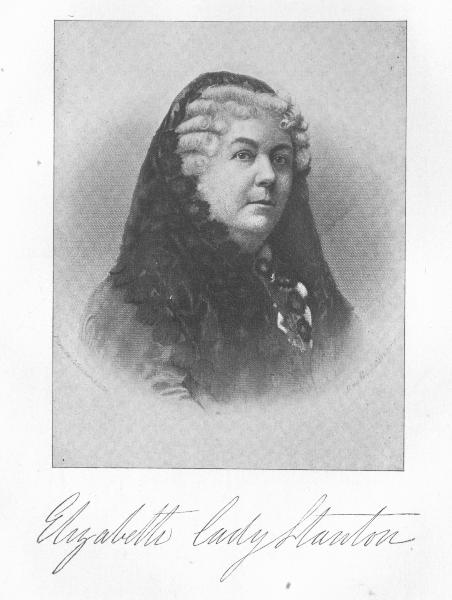
Elizabeth Cady Stanton
We had to rush up by Wednesday night's boat, without any preparation, and passed the ordeal last night, members asking questions and stating objections. At the close the cheerful face and cordial hand of our good Mr. Reynolds were presented to me. Mr. Ely also came up to be introduced, saying he knew my father and brother well, but had never had the pleasure of my acquaintance. Ah, when my "wild heresies" become "fashionable orhodoxies," won't my acquaintance be a pleasure to other Rochester people, too? George William Curtis was delighted—said the impression made upon the members was vastly beyond anything he had imagined possible. It is always a great comfort to feel that we have not distressed our cultured friends.
Mrs. Stanton is going to slip out to Johnstown to spend Sunday with her mother. How I wish I could slip out to Rochester to sit a few hours in my mother's delightful east chamber, but I must hie me back to New York by tonight's boat instead.
In a letter from George William Curtis, he declared: "You may count upon me not to be silent when, whether by my action or another's, this question comes before the convention." Petitions were presented by various members, signed by 28,000 men and women, asking that the constitution be so amended as to secure the right of suffrage to the women of New York. One of these was headed by Margaret Livingston Cady, mother of Mrs. Stanton, one by Gerrit Smith, one by Henry Ward Beecher, and all contained many influential names. Mr. Greeley was chairman of the committee on suffrage and, as Miss Anthony and Mrs. Stanton knew he would seize upon this occasion to repeat his hackneyed remark, "The best women I know do not want to vote," they wrote Mrs. Greeley to roll up a big petition in Westchester. So she got out her old chaise and, with her daughter Ida, drove over the county, collecting signatures. After all the others had been presented, Mr. Curtis arose and said: "Mr. Chairman, I hold in my hand a petition signed by Mrs. Horace Greeley and 300 other women of Westchester asking that the word 'male' be stricken from the constitution." As Mr. Greeley was about to 280 make an adverse report, his anger and embarrassment, as well as the amusement of the audience, may be imagined.[41]
A magnificent argument in behalf of the petitions was made by Mr. Curtis, and the discussion lasted several days; but the committee handed in an adverse report, which was sustained by a large majority of the convention. When this result was announced, Anna Dickinson wrote Miss Anthony:
My blood boiled, my nerves thrilled, as I read from day to day the reports of the convention debate. Reasons urged for the enfranchisement of paupers, of idiots, of the ignorant, the degraded, the infamous—none for women! The exquisite care with which men guard their own rights in the most vulnerable of their sex—the silence, the scorn, the ridicule with which they pass by or allude to our claims—great God! it is too much for endurance and patience. Daily I pray for a tongue of flame and inspired lips to awaken the sleeping, arouse the careless, shake to trembling and overthrow the insolence of opposition.... After men and women have alike borne the burden and heat of battle, to mark the absolute silence with which these men regard the rights of half the race, while they squabble and wrangle, debate and contend, for exact justice to the poorest and meanest man—to mark this spectacle is to be filled with alternate pity and disgust.
Naturally the women felt highly indignant at the treatment they had received, especially from the Republican party, which was so deeply indebted for their services and from which they had every reason to expect recognition and support, and they did not hesitate freely to express themselves. Soon after their defeat at Albany Mr. Curtis wrote: "I beg you and your friends to understand that the real support of this measure, the support from conviction, comes from men who believe in Republican principles, and not from the Democracy as such." While 281 a close analysis might prove the truth of this assertion, the women were not able to find comfort in the fact. As a party, the Republicans were opposed to their claims, and with the immense majority of its members completely under the domination of party, the result could be nothing but defeat. Not only was this the case, but the leaders, who dictated its policy and directed its action, although avowed believers in the political rights of women, did not hesitate to sacrifice them for the success of the party.
Lucy Stone and her husband had returned from Kansas the last of May, reporting a good prospect for carrying the woman suffrage amendment; but the Republicans there soon became frightened lest the one enfranchising the negro should be lost and, in order to lighten their ship, decided to throw the women overboard. Although the proposition had been submitted by a Republican legislature and signed by a Republican governor, the Republican State Committee resolved to remain "neutral," and then sent out speakers who, with the sanction of the committee, bitterly assailed this amendment and those advocating it. Prominent among these were P.B. Plumb, I.S. Kalloch, Judge T.C. Sears and C.V. Eskridge. The Democratic State Convention vigorously denounced the amendment. The State Temperance Society endorsed it, and this aroused the active enmity of the Germans. Eastern politicians warned those of Kansas not to imperil the negro's chance by taking up the woman question. Mr. Greeley, who at the beginning of the campaign warmly espoused woman suffrage in Kansas,[42] soured by his experience in the New York Constitutional Convention, withdrew the support of the Tribune and threw his influence against the amendment. Even the Independent, under the editorship of Tilton, was so dominated by party that, notwithstanding the appeals of the 282 women, it had not one word of endorsement. There was scarcely a Republican home in that State which did not take one or the other of these papers, looking upon its utterances as inspired, and their influence was so great that their support alone could have carried the amendment.
Such was the situation when Miss Anthony started with Mrs. Stanton for Kansas, hoping to turn the tide. She learned, however, to her great disappointment, that no more money was available from the Jackson or the Hovey fund. The proposed campaign would call for so large an amount that any other woman would have given up in despair. Even the stock of literature had been exhausted and there was nothing left in the way of tracts or pamphlets. Undaunted, she set forth under a blazing July sun and tramped up and down Broadway soliciting advertisements for the fly-leaves of the new literature she meant to have printed.[43] She then visited various friends who were interested in the woman's cause, and received such sums as they could spare, but their number was not large and the demands were numerous. She also sent out many appealing letters, like this to her friend Mrs. Wright:
Mrs. Stanton and I start for Kansas Wednesday evening, stopping at Rochester just to look at my mother and my dear sister, sick so long, and I devoting scarce an hour to her the whole year. How will the gods make up my record on home affections?
You see our little trust fund—$1,800—of Jackson money is wrenched from us. The Hovey Committee gave us our last dollar in May, to balance last year's work, and I am responsible for stereotyping and printing the tracts, for the New York office expenses, and for Mrs. Stanton and myself in Kansas, in all not less than $2,000. Not one of the friends wants the Kansas work to go undone, and to do it, both tracts and lecturers must be sent out. We need money as never before. I have to take from my lean hundreds, that never dreamed of reaching thousands, to pay our travelling expenses. It takes $50 each for bare railroad tickets. We are advertised to speak every day—Sundays not excepted—from September 2, one week from today, to November 6. What an awful undertaking it looks to me, for I know Kansas possibilities in fare, lodging and travelling. I never was so nearly driven to desperation—so much waiting to be done, and not a penny but in hope and trust. Oh, if 283 somebody else could go and I stay here, I could raise the money; but there is no one and I must go. We must not lose Kansas now, at least not from lack of work done according to our best ability.
Miss Anthony and Mrs. Stanton left New York August 28, 1867. It was necessary then to change cars several times to reach Atchison, their first appointment, and the trains being late they missed connections and were finally stranded at Macon City over Sunday. They found that while Mr. Wood had made out a very elaborate plan for their meetings and had posters printed for each place, these still remained piled up in the printing office. After making a two weeks' tour of the principal towns with Mrs. Stanton, Miss Anthony saw that an entire new program was necessary, that the meetings must be better advertised and there must be a central distributing point for tracts, etc., so she stationed herself at Lawrence. Senators Pomeroy and Ross gave the full use of their "franking" privilege and the former contributed $50 besides.
The Republicans called a mass meeting at Lawrence, September 5, of citizens from all parts of the State, "for consultation concerning the best method for defeating the proposition to strike the word 'male' from the Constitution of Kansas, and for arranging a canvass of the State in opposition to this amendment." A newspaper account said:
On motion of Judge G. W. Smith, Messrs. T. C. Sears, Rev. S. E. McBurney and C. V. Eskridge were appointed a committee on resolutions, and reported the following, which were unanimously adopted:
Resolved, That we recognize the doctrine of manhood suffrage as a principle of the Republican party, supported by reason, experience and justice.
Resolved, That we are unqualifiedly opposed to the dogma of "Female Suffrage," and while we do not recognize it as a party question, the attempt of certain persons within the State, and from without it, to enforce it upon the people of the State, demands the unqualified opposition of every citizen who respects the laws of society and the well-being and good name of our young commonwealth.
On motion, the executive committee were instructed to open a campaign based upon the foregoing resolutions; and an Anti-Female Suffrage Committee appointed of one member from each county.
At the beginning of the campaign, Republican leaders and newspapers were in favor of woman suffrage, but when it was 284 feared that its advocacy would hazard the chances of negro suffrage, they repudiated the amendment. While it was by no means certain that all women when enfranchised would vote the Republican ticket, there was no doubt whatever that the negroes would, and so it was party expediency to sacrifice the women. Notwithstanding the opposition of both Republican and Democratic politicians, the woman suffrage advocates had large and friendly audiences and the amendment would have been carried beyond a doubt, if it had had the continued sanction of Republican leaders. In October, stung by the reproaches of the women, a number of influential Republicans from different parts of the country[44] sent out an appeal which was published in the newspapers of Kansas, but this was wholly offset by the active opposition of the State Committee.
The hardships of a campaign in the early days of Kansas scarcely can be described. Much of the travelling had to be done in wagons, fording streams, crossing the treeless prairies, losing the faintly outlined road in the darkness of night, sleeping in cabins, drinking poor water and subsisting on bacon, soda-raised bread, canned meats and vegetables, dried fruits and coffee without cream or milk, sweetened with sorghum. The nights offered the greatest trial, owing to a species of insect supposed to breed in the cotton wood trees. In one of her letters home Miss Anthony says: "It is now 10 A. M. and Mrs. Stanton is trying to sleep, as we have not slept a wink for several nights, but even in broad daylight our tormentors are so active that it is impossible. We find them in our bonnets, and this morning I think we picked a thousand out of the ruffles of our dresses. I can assure you that my avoirdupois is being rapidly reduced. It is a nightly battle with the infernals.... Twenty-five years hence it will be delightful to live in this beautiful State, but now, alas, its women 285 especially see hard times, and there is no poetry in their lives." She was not given to complaining but again she writes:
It is enough to exhaust the patience of Job, the slip-shod way in which telegraph, express and postoffices are managed here. It is almost impossible to arrange for halls or to get literature delivered at the point where it is sent. We speak in school houses, barns, sawmills, log cabins with boards for seats and lanterns hung around for lights, but people come twenty miles to hear us. The opposition follow close upon our track, but they make converts for us. The fact is that most of them are notoriously wanting in right action toward women. Their objections are as low and scurrilous as they used to be in the East fifteen or twenty years ago. There is a perfect greed for our tracts, and the friends say they do more missionary work than we ourselves. If our suffrage advocates only would go into the new settlements at the very beginning, they could mould public sentiment, but they wait until the comforts of life are attainable and then find the ground occupied by the enemy.
Of course they were guests in some beautiful homes, free from all discomforts, but these were the exceptions. A striking instance of the first reception usually accorded the two ladies is given by Mrs. Starrett, in her Kansas chapter in the History of Woman Suffrage:
All were prepared beforehand to do Mrs. Stanton homage for her talents and fame, but many persons who had formed their ideas of Miss Anthony from the unfriendly remarks in opposition papers had conceived a prejudice against her. Perhaps I can not better illustrate how she everywhere overcame and dispelled this prejudice than by relating my own experience. A convention was called at Lawrence, and the friends of woman suffrage were asked to entertain strangers who might come from abroad. Ex-Governor Robinson asked me to entertain Mrs. Stanton. We had all things in readiness when I received a note stating that she had found relatives in town with whom she would stop, and Miss Anthony would come instead. I hastily put on bonnet and shawl, saying, "I won't have her and I am going to tell Governor Robinson so."
At the gate I met a dignified Quaker-looking lady with a small satchel and a black and white shawl on her arm. Offering her hand she said, "I am Miss Anthony, and I have been sent to you for entertainment during the convention."... Half disarmed by her genial manner and frank, kindly face, I led the way into the house and said I would have her stay to tea and then we would see what farther arrangements could be made. While I was looking after things she gained the affections of the babies; and seeing the door of my sister's sick-room open, she went in and in a short time had so won the heart and soothed instead of exciting the nervous sufferer, entertaining her with accounts of the outside world, that by the time tea was over I was ready to do anything if Miss Anthony would only stay with 286 us. And stay she did for over six weeks, and we parted from her as from a beloved and helpful friend. I found afterwards that in the same way she made the most ardent friends wherever she became personally known.
The physical discomforts could have been borne without a murmur, but it was the treachery of friends, both East and West, which brought the discouragement and heart-sickness. One of the active opponents who canvassed the State was Charles Langston, the negro orator, whose brother John M. had met with much kindness from Miss Anthony and her family before the war. When one considers how these women had spent the best part of their lives in working for the freedom of the negro, their humiliation can be imagined at seeing educated colored men laboring with might and main to prevent white women from obtaining the same privileges which they were asking for themselves. It was a bitter dose and one which women have been compelled to take in every State where a campaign for woman suffrage has been made.
The Hutchinsons—John, his son Henry and lovely daughter Viola—were giving a series of concerts, travelling in a handsome carriage drawn by a span of white horses. As they had one vacant seat, they were carrying Rev. Olympia Brown, a talented Universalist minister from Massachusetts, who had been canvassing the State for several months, and she spoke for suffrage while they sang for both the negro and woman. Hon. Charles Robinson, the first Free State governor of Kansas, volunteered to take Mrs. Stanton in his carriage and pay all expenses. Their hard trip killed a pair of mules and a pair of Indian ponies. Miss Anthony directed affairs from her post at Lawrence and made herculean efforts to raise money for the campaign, which thus far was dependent on the collections at the meetings. There was scarcely a hope of victory.
On the 7th of October came a telegram from George Francis Train, who was then at Omaha, largely interested in the Union Pacific railroad. He had been invited by the secretary and other members of the St. Louis Suffrage Association to go to Kansas and help in the woman's campaign. Accordingly he telegraphed that if the committee wanted him he was ready, 287 would pay his own expenses and win every Democratic vote. Miss Anthony never had seen Mr. Train; she merely knew of him as very wealthy and eccentric. The Republicans not only had forsaken the women but were waging open war upon them. The sole hope of carrying the amendment was by adding enough Democratic votes to those of Republicans who would not obey their party orders to vote against it. Every member of the woman suffrage committee who could be communicated with—Rev. and Mrs. Starrett, Rev. John S. Brown and daughter Sarah, Judge Thatcher and others—said that Mr. Train was an eloquent speaker and advised that he be invited, so the following telegram was sent: "Come to Kansas and stump the State for equal rights and woman suffrage. The people want you, the women want you. S. N. Wood, M. W. Reynolds, Charles Robinson, Mrs. J. H. Lane, E. Cady Stanton, Susan B. Anthony."
Mr. Train accepted and Miss Anthony at once began laying out a route for him and telegraphed: "Begin at Leavenworth Monday, October 21. Yes, with your help we shall triumph. All shall be ready for you." If she had had any political experience, she would have made his appointments along the railroad, whose employes were largely Irish, with whom he was very popular on account of his Fenian affiliations; but in her ignorance, she arranged for most of the meetings in small towns off the railroads, where the inhabitants were chiefly Republicans.
Mark W. Reynolds, editor of the Democratic paper at Lawrence, agreed to accompany him; but when the time arrived, although Mr. Reynolds had joined in the telegram of invitation, he took to the woods, going on a buffalo hunt without any excuse or explanation. Mr. Train made his first speech at Leavenworth, Mayor John A. Halderman presiding, Colonel D. R. Anthony, Rev. William Starrett and other Republicans on the platform. Laing's Hall was packed with Irishmen and when he first mentioned woman suffrage all of them hissed, but after he pointed out the absurdity of letting the negroes vote and shutting out their own mothers and wives, the tide 288 turned and they cheered for the women. The next meeting was at Lawrence, and here Mr. Train objected decidedly to the route marked out, saying it was too rough a trip for any man, and as Mr. Reynolds had deserted him he was for giving up the tour. Not so Miss Anthony; she said: "Your offer and his were accepted in good faith. The engagements have been made and hand-bills sent to every post-office within fifty miles of the towns where meetings are to be held. The next announcement is for Olathe tomorrow night. I shall take Mr. Reynolds' place. At one o'clock I shall send a carriage to your hotel. You can do as you please about going. If you decline I shall go there and to all the other meetings alone." He replied: "Miss Anthony, you know how to make a man feel ashamed."
The next day when the carriage came to the Starretts, for Miss Anthony, Mr. Train was in it and, with her heart in her throat, she took her seat beside him. The situation was entirely unforeseen and decidedly embarrassing, but she never turned back, never allowed any earthly obstacle to stand in her way. There was a crowded house at Olathe and when the meeting closed two young men announced that they had been sent to take Mr. Reynolds and Mr. Train to Paola, and they would have to leave at 4 A. M. Miss Anthony was the guest of Rev. and Mrs. J. C. Beach. Next morning they started on time in a pouring rain, stopping at a little wayside inn for breakfast at six. The meeting was at eleven, in the Methodist church.
After it was over the county superintendent of schools, Mr. Bannister, took them to Ottawa in a lumber wagon. The steady rain had put the roads in a fearful condition and by the time they reached the river bottoms it was very dark and pouring in torrents. The driver lost his way and brought them up against a brush fence. Mr. Train jumped out of the vehicle, took off his coat so that his white shirtsleeves would show and thus guided the team back to the road; then he and the county superintendent took turns walking in front of the horses. The river finally was crossed and they reached Ottawa at 9 o'clock. Mr. Train 289 was very fastidious and, no matter how late the hour, never would appear in public before he had changed his gray travelling suit for full dress costume with white vest and lavender kid gloves, declaring that he would not insult any audience by shabby clothes. This evening he made no exception and so, while he went to the hotel, Miss Anthony, wet, hungry and exhausted, made her way straight to the hall to see what had become of their audience.
She found that it had been taken in charge by General Blunt, one of the Republican campaign orators, and as she entered, he was making a violent attack on woman suffrage. Her arrival was not noticed and she concluded to sit quietly down in a corner and let matters take their course. A stairway led from some lower region up to the platform and, just as the speaker was declaring, "This man Train is an infernal traitor and a vile copperhead," Mr. Train appeared at the top of the stairs. The audience broke into a roar, and in a few moments he had the general under a scathing fire.
From Ottawa they travelled, still in a lumber wagon, to Mound City and then to Fort Scott, where they had an immense audience. After the meeting Train went to the newspaper office and wrote out his speech, which filled two pages of the Monitor, and Miss Anthony and the friends spent all of Sunday in wrapping and mailing these papers. From here they drove to Humboldt in a mail wagon, stopping for dinner at a little "half-way house," a cabin with no floor. Miss Anthony retains a lively recollection of this place, for the hostess brought a platter of fried pork, swimming in grease, and in her haste emptied the contents the whole length of her light gray travelling dress. They found many people ill, and Mr. Train always prescribed not a drop of green tea, not a mouthful of pork, though that was the only meat they could get, plenty of fruit, though there was none to be had in Kansas, and a thorough bath every morning, although there was not enough water to wash the dishes. During this trip he stopped at hotels, but Miss Anthony usually was invited to stay with 290 families who were either her personal friends or warm advocates of the cause she represented.
So on they went, to Leroy, Burlington, Emporia, Junction City. It was 9 o'clock when they reached the last and, as usual, Miss Anthony had to make her speech without change of dress, and a half hour later Mr. Train stepped on the platform, refreshed and resplendent. His first words were: "When Miss Anthony gets back to New York she is going to start a woman suffrage paper. Its name is to be The Revolution; its motto, 'Men, their rights, and nothing more; women, their rights, and nothing less.' This paper is to be a weekly, price $2 per year; its editors, Elizabeth Cady Stanton and Parker Pillsbury; its proprietor, Susan B. Anthony. Let everybody subscribe for it!" Miss Anthony was dumbfounded. During the long journey that day, he had asked her why the equal rights people did not have a paper and she had replied that it was not for lack of brains but want of money. "Will not Greeley and Beecher and Phillips and Tilton advance the money?" "No, they say this is the negro's hour and no time to advocate woman suffrage." "Well," said he, "I will give you the money." She had not taken him seriously and was amazed when he made this public statement, announcing name, price, editors, motto and everything complete.

Geo. Francis Train
They spoke at Topeka and Wyandotte and reached Leavenworth the Sunday previous to election. Mr. Train spent the evening at Colonel Anthony's, entertaining them in his inimitable manner till midnight, and after he left the colonel declared that "he knew more about more things than any man living." Governor Robinson and Mrs. Stanton were to close the campaign in this city the day before election, and the meeting had been thoroughly advertised, but at the last moment they telegraphed that they would be unable to arrive till evening, so it was decided that Mr. Train should remain at Leavenworth to speak in the afternoon, and Miss Anthony 291 should keep the engagement at Atchison, announcing Mr. Train for the evening. This she did, but at night, when a great crowd had assembled, a telegram brought word that the cars were off the track and he could not reach that city. There was nothing for her to do but make a short speech and adjourn the meeting.
Mr. Train had promised Miss Anthony that he really would advance the money to start a paper and, in addition, had proposed to defray all the expenses of Mrs. Stanton and herself if they would join him in a lecture tour of the principal cities on the way eastward. It was essential, therefore, for her to have a talk with him before she could make a definite statement to Mrs. Stanton, and her only chance for this was to cross the Missouri river and wait for the belated train from Leavenworth. She found the ferryboats had stopped running for the night, but George Martin, chairman of the suffrage committee of Atchison, offered to take her across in a skiff. Undaunted, she seated herself therein and in the dense darkness was safely landed on the opposite shore. Here she boarded the cars and went to St. Joseph where she met Mr. Train, made the necessary arrangements and returned to Leavenworth by the first train.
On election day the Hutchinsons, Miss Anthony and Mrs. Stanton, in open carriages, visited all the polling-places in Leavenworth, where the two ladies spoke and the Hutchinsons sang. Both amendments were overwhelmingly defeated, that for negro suffrage receiving 10,843 votes, and that for woman suffrage 9,070, out of a total of about 30,000. These 9,000 votes were the first ever cast in the United States for the enfranchisement of women. How many of them were Republican and how many Democratic, and how much influence Mr. Train may have had one way or another, never can be known; but it is a significant fact that Douglas county, the most radical Republican district, gave the largest vote against woman suffrage, and Leavenworth, the strongest Democratic county, gave the largest majority in its favor. 292
The Commercial, the Democratic paper of this city, said:
When we consider the many obstacles thrown in the way of the advocates of this measure, the indifference with which the masses look upon anything new in government and their indisposition to change, the degree of success of these advocates is not only remarkable, but one of which they have a just right to feel proud. To these two ladies, Susan B. Anthony and Elizabeth Cady Stanton, to their indomitable will and courage, to their eloquence and energy, is due much of the merit of the work performed in the State.... While in the recent election these ladies were not successful to the full extent of their wishes, they have the consciousness of knowing that their work has been commensurate with the combined efforts of party organization, congressmen, senators, press and ministers to enfranchise the negro, and that the people of Kansas are not more averse to giving the franchise to woman than to the black man.
During the campaign the usual order was for Miss Anthony to speak the first half hour, making a clear, concise, strong argument for suffrage as the right of an American citizen, pleading for the negro as well as for the women, and urging men to vote for both amendments. She then was followed by Mr. Train, who insisted that it would be one of the grossest outrages to give suffrage to the black man and not to the white woman, and pleaded earnestly that the women of Kansas should be enfranchised. In this he was sincere, as he believed thoroughly that women ought to have the ballot. He was an inimitable mimic and was unsparing in his ridicule of those Republicans who had battled so valiantly for equal rights but now demanded that American women should stand back quietly and approvingly and see the negro fully invested with the powers denied to themselves. He had a remarkable memory, an unequalled quickness of repartee, a peculiar gift of improvising epigrams and, while erratic, was a brilliant and entertaining speaker. He was at this time about thirty-five, nearly six feet tall, a handsome brunette, with curling hair and flashing dark eyes, the picture of vigorous health. He was exquisitely neat in person and irreproachable in habits, and had a fine courtliness of bearing toward women which suggested the old-school gentleman. Miss Anthony often said that all the severe criticisms made upon him for years had not 293 been able to impair the respect with which he inspired her during that most trying campaign. Mrs. Stanton, essentially an aristocrat and severe in her judgment of men and manners, spoke most highly of Mr. Train in her Reminiscences.
Some of the friends in Kansas were opposed to the contemplated lecture tour, and letters were received from the East urging that it be abandoned. Mrs. Stanton was accustomed to defer to Miss Anthony in such matters.[45] The latter felt that they had been deserted by their old friends and supporters and the breach was too wide to be soon healed. Here was a man of wealth and high personal character, who offered to arrange a lecture tour of the principal cities of the country, pay all expenses and at the end of the journey furnish capital for a paper. It seemed to her she could best serve the cause she placed above all else by accepting the offer, and she did so.
As time was limited, Miss Anthony had to make arrangements for hall, etc., by telegraph, which cost Mr. Train $100. The series commenced in Omaha, November 19, and continued in Chicago, Springfield. St. Louis, Louisville, Cincinnati, Cleveland, Buffalo, Rochester, Syracuse, Albany, Springfield (Mass.), Worcester, Boston and Hartford, ending with a great meeting in Steinway Hall, New York, December 14. Mr. Train engaged the most elegant suites of rooms in the best hotels for the ladies, secured the finest halls, and this was remembered as the only luxurious suffrage tour they ever had made. There was a railway wreck between Louisville and Cincinnati, and he chartered a special train in order that they might keep their engagement at the latter place. This trip cost him $3,000.
Where heretofore the Democratic papers had been abusive and some, at least, of the Republican papers complimentary, the tone was now completely reversed. Because they had affiliated with Mr. Train, the former had nothing but praise, and for 294 the same reason the latter were unsparing in their denunciations, and were bitterly indignant at the women for accepting from Mr. Train and other Democrats the help which they themselves had positively refused. They insisted that the Democrats only used woman suffrage as a club to beat negro suffrage, which doubtless was true of many, but Miss Anthony and Mrs. Stanton claimed the right to accept proffered aid without looking behind it for the motive. The opposition, however, did not arise alone from the press and the politicians. From the leading advocates of suffrage came a vehement protest against any partnership with George Francis Train. The old associates wrote scores of letters expressing their personal allegiance, but refusing to attend the meetings and repudiating the connection of Mr. Train with the woman suffrage movement. Miss Anthony was made to realize to the fullest extent the feeling which had been aroused, but the last entry in the diary says: "The year goes out, and never did one depart that had been so filled with earnest and effective work; 9,000 votes for woman in Kansas, and a newspaper started! The Revolution is going to be work, work and more work. The old out and the new in!"
[41] His intense feeling on the matter is thus described in the History of Woman Suffrage:
"A few weeks after this he met Mrs. Stanton and Miss Anthony at one of Alice Cary's Sunday evening receptions. As he approached, both arose and with extended hands exclaimed most cordially, 'Good evening, Mr. Greeley.' But his hands hung limp by his side, as he said in measured tones: 'You two ladies are the most maneuvering politicians in the State of New York. I saw in the manner my wife's petition was presented, that Mr. Curtis was acting under instructions, and I saw the reporters prick up their ears.' Turning to Mrs. Stanton, he asked, 'You are so tenacious about your own name, why did you not inscribe my wife's maiden name, Mary Cheney Greeley, on her petition?' 'Because,' she replied, 'I wanted all the world to know that it was the wife of Horace Greeley who protested against her husband's report.' 'Well,' said he, 'I understand the animus of that whole proceeding, and I have given positive instructions that no word of praise shall ever again be awarded you in the Tribune, and that if your name is ever necessarily mentioned, it shall be as Mrs. Henry B. Stanton!' And so it has been to this day."
The first entry in the diary of 1868, January 1, reads: "All the old friends, with scarce an exception, are sure we are wrong. Only time can tell, but I believe we are right and hence bound to succeed." Immediately after the meeting at Steinway Hall, Mr. Train had brought with him to call on Miss Anthony, David M. Melliss, financial editor of the New York World, and they entered into an agreement by which the two men were to supply the funds for publishing a paper until it was on a paying basis. It was to be conducted by Miss Anthony and Mrs. Stanton in the interests of women, and Mr. Train and Mr. Melliss were to use such space as they desired for expressing their financial and other opinions. The first number was issued January 8, a handsome quarto of sixteen pages.
Ten thousand copies were printed and, under the congressional frank of Representative James Brooks, of New York, were sent to all parts of the country. The advent of this element in the newspaper world created a sensation such as scarcely ever has been equalled by any publication. From hundreds of clippings a few characteristic examples are selected. The New York Sunday Times said:
THE LADIES MILITANT.—It is out at last. If the women as a body have not succeeded in getting up a revolution, Susan B. Anthony, as their representative, has. Her Revolution was issued last Thursday as a sort of New Year's gift to what she considered a yearning public, and it is said to be "charged to the muzzle with literary nitre-glycerine." If Mrs. Stanton would 296 attend a little more to her domestic duties and a little less to those of the great public, perhaps she would exalt her sex quite as much as she does by Quixotically fighting windmills in their gratuitous behalf, and she might possibly set a notable example of domestic felicity. No married woman can convert herself into a feminine Knight of the Rueful Visage and ride about the country attempting to redress imaginary wrongs without leaving her own household in a neglected condition that must be an eloquent witness against her. As for the spinsters, we have always said that every woman has a natural and inalienable right to a good husband and a pretty baby. When, by proper "agitation," she has secured this right, she best honors herself and her sex by leaving public affairs behind her, and endeavoring to show how happy she can make the little world of which she has just become the brilliant center.
The New York Independent, the great organ of the Congregationalists, had this breezy editorial:
The Revolution is the martial name of a bristling and defiant new weekly journal, the first number of which has just been laid on our table. When we mention that it is edited by Mr. Parker Pillsbury and Mrs. Elizabeth Cady Stanton, all the world will immediately know what to expect from it. Those two writers can never be accused of having nothing to say, or of backwardness in saying it. Each has separately long maintained a striking individuality of tongue and pen. Working together, they will produce a canvas of the Rembrandt school—Mrs. Stanton painting the high lights and Mr. Pillsbury the deep darks. In fact, the new journal's real editors are Hope and Despair. Beaumont and Fletcher were intellectually something alike; but Mrs. Stanton and Mr. Pillsbury are totally different. The lady is a gay Greek, come forth from Athens; the gentleman is a sombre Hebrew, bound back to Jerusalem. We know of no two more striking, original, and piquant writers. What keen criticisms, what knife-blade repartees, what lacerating sarcasms we shall expect from the one! What solemn, reverberating, sanguinary damnations we shall hear from the other!
Conspicuous among the new journal's contributors is that great traveller, hotel-builder, epigrammatist and kite-flyer, Mr. George Francis Train. So The Revolution, from the start, will arouse, thrill, edify, amuse, vex and nonplus its friends. But it will compel attention; it will conquer a hearing. Its business management is in the good hands of Miss Susan B. Anthony, who has long been known as one of the most indefatigable, honest, obstinate, faithful, cross-grained and noble-minded of the famous women of America. It only remains to add that, as "the price of liberty is eternal vigilance," so the price of The Revolution is two dollars a year.
The Cincinnati Enquirer in a complimentary notice said: "Mrs. Elizabeth Cady Stanton's Revolution grows with each additional number more spicy, readable and revolutionary. It hits right and left, from the shoulder and overhand, at 297 every body and thing that opposes the granting of suffrage to females as well as males. The Revolution is mourning over no lost cause, but is aggressive, bold and determined to win one dear to its heart." New York's society paper, the Home Journal, commented: "The Revolution is plucky, keen and wide awake, and although some of its ways are not at all to our taste, we are glad to recognize in it the inspiration of the noblest aims, and the sagacity and talent to accomplish what it desires. It is on the right track, whether it has taken the right train or not;" while the Chicago Workingman's Advocate declared: "We have no doubt it will prove an able ally of the labor reform movement." The Boston Commonwealth observed approvingly: "It is edited by Mrs. E.C. Stanton and Parker Pillsbury, whose names are guarantees of ability and character. Their effusions are able, pertinent and courageous."
To quote from Mrs. Stanton: "Radical and defiant in tone, it awoke friends and foes alike to action. Some denounced it, some ridiculed it, but all read it. It needed just such clarion notes, sounded forth long and loud each week, to rouse the friends of the movement from the apathy into which they had fallen after the war." Miss Anthony went to Washington to introduce the paper and returned with a list of distinguished subscribers, including President Johnson himself! The following from Mrs. Stanton will show how criticising letters usually were answered:
I know that you would feel that we were right if I could talk with you. If George Francis Train had done for the negro all that he has done for woman the last three months, the Abolitionists would enshrine him as a saint. The attacks on Susan and me by a few persons have been petty and narrow, but we are right and this nine days' wonder will soon settle itself. Of course, people turn up the whites of their eyes, but time will bring them all down again. We have reason to congratulate ourselves that we have shocked more friends of the cause into life than we ever dreamed we had—persons who never gave a cent or said a word for our movement are the most concerned lest Susan and I should injure it. Mr. Train has some extravagances and idiosyncrasies, but he is willing to devote his energies to our cause when no other man is, and we should be foolish not to accept his aid. To think of Boston women holding a festival to aid the Anti-Slavery Standard, while their own petitions are ignored in the Senate of the United States! Women have 298 been degraded so long they have lost all self-respect. If we love the black man as well as ourselves we shall fulfill the Bible injunction. The anti-slavery requirement to love him better is a little too much for human nature.
A few members of the executive board of the Equal Rights Association made a strong attempt to prevent the editors of The Revolution from occupying the room at No. 37 Park Row, used for their headquarters. Miss Anthony soon showed, however, that she had made herself personally responsible for the rent, that while she was overwhelmed with the work of the Kansas campaign letters were continually sent her asking if she could not somehow get the money to pay it, and that as soon as she returned, she borrowed $100 on her own note and paid it in full. So she held possession and the committee, after voting itself out at one session, voted itself back at the next, and finally abandoned the room.
On the very day the first copy of The Revolution appeared, Mr. Train announced that he was going to England immediately. Miss Anthony says in her diary: "My heart sank within me; only our first number issued and our strongest helper and inspirer to leave us! This is but another discipline to teach us that we must stand on our own feet." Mr. Train gave her $600 and assured her that he had arranged with Mr. Melliss to supply all necessary funds during his short absence, but she felt herself invested with a heavy responsibility. A few days later Mrs. Stanton said in a letter to a friend:
Our paper has a monied basis of $50,000 and men who understand business to push it. Train is engaging writers and getting subscribers in Europe. It will improve in every way when we are thoroughly started. Just now we are fighting for our life among reformers; they pitch into us without mercy. We are trying to make the Democrats take up our question, for that is the only way to move the Republicans. Subscribers come in rapidly, beyond our most sanguine expectations. The press in the main is cordial, but looks askance at a political paper edited by a woman. If we had started a "Lily" or a "Rosebud" and remained in the region of sentiment, we should have been eulogized to the skies, but here is something dangerous.
Instead of Mr. Train's securing writers and subscribers in Europe, he was arrested for complicity with the Fenians the moment he made his first speech, and spent the year in a Dublin 299 jail. He wrote that the finding of fifty copies of The Revolution in his possession was an additional reason for his arrest, as the officials did not stop to read a word, the name was sufficient. While Mr. Train continued his contributions to the paper during his residence in jail, he was not able to meet his financial obligations to it. Mr. Melliss made heroic efforts to pay in his quota, but the days were full of anxiety for everybody connected with The Revolution. Miss Anthony was used to such care. She had been the financial burden-bearer of every reform with which she had been connected, but to this crushing weight was added such a persecution as she never had experienced before, even in the days of pro-slavery mobs. Then the attacks had been made by open and avowed enemies, and she had had a host of staunch supporters to share them and give her courage; now her persecutors were in ambush and were those who had been her nearest and dearest friends; and now she was alone except for Mrs. Stanton and Mr. Pillsbury. Even they were labored with, and besought to renounce one who seemed to have complete mastery over them and was leading them to destruction, but nothing could shake their allegiance. The excuse for this persecution was that the Equal Rights Association was injured by the publication of The Revolution.
That there should be a paper published in the interest of the rights of women had been the dream of the advocates for many years. Antoinette Blackwell had written Miss Anthony several years before: "I wish we had the contemplated paper for Mrs. Stanton's especial benefit. I am afraid it will be too late for her when we get it fairly established, which does not promise to be very soon. Lucy believes her own talents lie in other directions, and gives no approval to the plan for herself." Lucy Stone had written: "We must have a paper and dear, brave, sensible Mrs. Stanton must be the editor." And at another time: "I feel very proud of Mrs. Stanton, she is so strong and noble. When we have a new paper she must be the editor."
Mrs. Stanton, with her house and her large family, had no 300 desire for this position. Miss Anthony herself was not a writer, and many times of late years had agitated the question of raising money to have Lucy Stone and her husband at the head of a paper, they having now signified their willingness to hold such a place. The founding of The Revolution was totally unexpected and its editors accepted it only because of the great need of a medium through which the cause of woman might be thoroughly advocated. There was not the slightest desire to enter into rivalry with anybody or to antagonize the Republicans. If the latter had been willing to furnish the money to start a paper, or had allowed space in their own publications, the favor would have been most gladly accepted. Had the members of the Equal Rights Association raised a fund to establish an organ, so much the better, but although the subject had been talked of for years, the capital had not been forthcoming. There was no attempt to make the association responsible for the opinions of The Revolution, as this letter from Mrs. Stanton indicates:
Susan and I, though members of the Equal Rights Association, do many things outside that body for which no one is responsible. The idea of starting a paper under its auspices, or as an organ for it, never entered our minds. We went to Kansas as individuals; personal friends outside that association gave us money to go and contributed the funds to start a paper. We object to that resolution of censure, first, because we were outside its province; second, because it was an outrage to repudiate Susan and me, who have labored without cessation for twenty years and had just returned from a hard three months' campaign. For any one to question our devotion to this cause is to us amazing. The treatment of us by Abolitionists also is enough to try the souls of better saints than we. The secret of all this furor is Republican spite. They want to stave off our question until after the presidential campaign. They can keep all the women still but Susan and me. They can't control us, therefore the united effort of Republicans, Abolitionists and certain women to crush us and our paper.
In showing how the women were sacrificed, The Revolution said:
Charles Sumner, Horace Greeley, Gerrit Smith and Wendell Phillips, with one consent, bid the women of the nation stand aside and behold the salvation of the negro. Wendell Phillips says, "One idea for a generation," to come up in the order of their importance. First negro suffrage, then temperance, 301 then the eight-hour movement, then woman suffrage. Three generations hence, woman suffrage will be in order! What an insult to the women who have labored thirty years for the emancipation of the slave, now when he is their political equal, to propose to lift him above their heads. Gerrit Smith, forgetting that our great American idea is "individual rights," on which Abolitionists have ever based their strongest arguments for emancipation, says: "This is the time to settle the rights of races; unless we do justice to the negro we shall bring down on ourselves another bloody revolution, another four years' war, but we have nothing to fear from woman, she will not avenge herself!" Woman not avenge herself? Look at your asylums for the deaf, the dumb, the blind, the insane, and there behold the results of this wholesale desecration of the mothers of the race! Woman not avenge herself? Go into the streets of your cities at the midnight hour, and there behold those whom God meant to be queens in the moral universe giving your sons their first lessons in infamy and vice. No, you can not wrong the humblest of God's creatures without making discord and confusion in the whole social system.
In regard to the bitter persecution waged upon the two women, Ellen Wright Garrison said in a letter to Miss Anthony: "This sitting in judgment upon those whose views differ from our own, pouring vials of wrath on their heads and calling in the outside and prejudiced public to help condemn, is unwise and un-Christian." Her mother, Martha Wright, who at first was inclined to blame, wrote in the spring of 1868: "As regards the paper, its vigorous pages are what we need. I regret the idiosyncrasies of Mr. Train, as they give occasion to the sons and daughters of the Philistines to rejoice, and the children of the uncircumcised only wanted a good excuse to triumph. Shall you be at the May meeting? I will not be there under any circumstances without you and Susan and our good friend Parker; so whatever may become of Mr. Train or of the paper, count me now and ever as your true and unswerving friend."
The following graphic description, by the correspondent, Nellie Hutchinson, was published in the Cincinnati Commercial:
There's a peculiarly resplendent sign at the head of the third flight of stairs, and obeying its directions I march into the north corridor and enter The Revolution office. Nothing so very terrible after all. The first face that salutes my vision is a youthful one—fresh, smiling, bright-eyed, auburn-crowned. It belongs to one of the employes of the establishment, and its owner conducts 302 me to a comfortable sofa, then trips lightly through a little door opposite to inform Miss Anthony of my presence.
I glance about me. What editorial bliss is this! Actually a neat carpet on the floor, a substantial round table covered by a pretty cloth, engravings and photographs hung thickly over the clear white walls. Here is Lucretia Mott's saintly face, beautiful with eternal youth; there Mary Wollstonecraft looking into futurity with earnest eyes. In an arched recess are shelves containing books and piles of pamphlets, speeches and essays of Stuart Mill, Wendell Phillips, Higginson, Curtis. Two screens extend across the front of the room, inclosing a little space around the two large windows which give light, air and glimpses of City Hall park. Glancing around the corner we see editor Pillsbury seated at his desk by the further window. Opposite is another desk covered with brown wrappers and mailing books. Close against the screen stands yet another, at which sits the bookkeeper, an energetic young woman who ably manages all the business affairs of The Revolution. There's an atmosphere of womanly purity and delicacy about the place; everything is refreshingly neat and clean, and suggestive of reform.
Ah! here comes Susan—the determined—the invincible, the Susan who is possibly destined to be Vice-President or Secretary of State some of these days! What a delicious thought! I tremble as she steps rapidly toward me and I perceive in her hand a most statesmanlike roll of MSS. The eyes scan me coolly and interrogatively but the pleasant voice gives me a yet pleasanter greeting. There's something very attractive, even fascinating in that voice—a faint echo of the alto vibration—the tone of power. Her smile is very sweet and genial, and lights up the pale, worn face rarely. She talks awhile in her kindly, incisive way. "We're not foolishly or blindly aggressive," says she, tersely; "we don't lead a fight against the true and noble institutions of the world. We only seek to substitute for various barbarian ideas, those of a higher civilization—to develop a race of earnest, thoughtful, conscientious women." And I thought as I remembered various newspaper attacks, that here was not much to object to. The world is the better for thee, Susan.
She rises; "Come, let me introduce you to Mrs. Stanton." And we walk into the inner sanctum, a tiny bit of a room, nicely carpeted, one-windowed and furnished with two desks, two chairs, a little table—and the senior editor, Mrs. Stanton. The short, substantial figure, with its handsome black dress and silver crown of curls, is sufficiently interesting. The fresh, girlish complexion, the laughing blue eyes and jolly voice are yet more so. Beside her stands her sixteen-year-old daughter, who is as plump, as jolly, as laughing-eyed as her mother. We study Cady Stanton's handsome face as she talks on rapidly and facetiously. Nothing little or mean in that face; no line of distrust or irony; neither are there wrinkles of care—life has been pleasant to this woman.
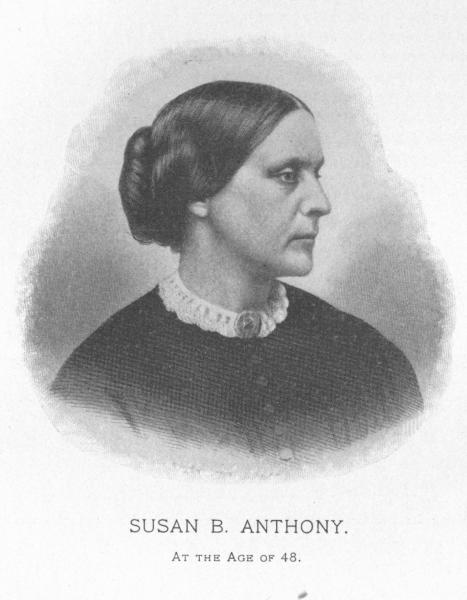
SUSAN B. ANTHONY.
We hear a bustle in the outer room—rapid voices and laughing questions—then the door is suddenly thrown open and in steps a young Aurora, habited in a fur-trimmed cloak, with a jaunty black velvet cap and snowy feather set upon her dark clustering curls. What sprite is this, whose eyes flash and sparkle with a thousand happy thoughts, whose dimples and rosy lips and 303 white teeth make so charming a picture? "My dear Anna," says Susan, starting up, and there's a shower of kisses. Then follows an introduction to Anna Dickinson. As we clasp hands for a moment, I look into the great gray eyes that have flashed with indignation and grown moist with pity before thousands of audiences. They are radiant with mirth now, beaming as a child's, and with graceful abandon she throws herself into a chair and begins a ripple of gay talk. The two pretty assistants come in and look at her with loving eyes; we all cluster around while she wittily recounts her recent lecturing experience. As the little lady keeps up her merry talk, I think over these three representative women. The white-haired, comely matron sitting there hand-in-hand with her daughter, intellectual, large-hearted, high-souled—a mother of men; the grave, energetic old maid—an executive power; the glorious girl, who, without a thought of self, demands in eloquent tones justice and liberty for all, and prophesies like an oracle of old.
May we not hope that America's coming woman will combine these salient qualities, and with all the powers of mind, soul and heart vivified and developed in a liberal atmosphere, prove herself the noblest creature in the world? And so I leave them there—the pleasant group—faithful in their work, happy in their hopes.
On May 14, 1868, the American Equal Rights Association held its second anniversary in Cooper Institute. Mrs. Stanton, who had a wholesome dread of anything disagreeable, was determined not to go, but Miss Anthony declared that to stay away would be showing the "white feather" and that, as their enemies had been many weeks working up a sentiment against them, their presence would prove they had nothing to fear. When the convention assembled, Lucretia Mott, the president, being absent on account of the recent death of her husband, Colonel Higginson said to Miss Anthony: "Now we want everything pleasant and peaceable here, do we not?" "Certainly," she replied. "Well then, we must have Lucy Stone open this meeting." "Why so," asked Miss Anthony, "when Mrs. Stanton is first vice-president? It would be not only an insult to her but a direct violation of parliamentary usage. I shall never consent to it." Finding that, nevertheless, there was a scheme to carry out this plan, she put Mrs. Stanton on the alert and, as the officers filed on the platform, gave her a gentle push to the front, whereupon she opened the convention with the utmost suavity.
It was here that these pioneers of the movement for woman 304 suffrage had the humiliation of hearing Frederick Douglass announce that it was women's duty to take a back seat and wait till the negro was enfranchised before they put in their claim. Rev. Olympia Brown and Lucy Stone both declared the Republican party false to its principles unless it protected women as well as colored men in their right to vote, and in his report on the Kansas campaign, Mr. Blackwell, after speaking of the splendid work of Lucy Stone, Miss Anthony, Mrs. Stanton and Miss Brown, said: "Their eloquence and determination gave great promise of success; but, in an inopportune moment, Horace Greeley and others saw fit in the Constitutional Convention to report adversely to woman suffrage in New York, which influenced the sentiment in the younger western State and its enterprise was crushed. Even the Republicans in Kansas set their faces against the extension of suffrage to women."
Throughout the entire convention there was much resentment on the part of the women at the manner in which they had been abandoned in favor of the negro. During the same week, at the anti-slavery meeting in Steinway Hall, Anna Dickinson, in the midst of an impassioned speech, declared: "The position of the black woman today is no better than before her emancipation from slavery. She has simply changed masters from a white owner to a black husband in many cases." She demanded freedom and franchise for woman as for man, irrespective of color; and, while giving Mr. Phillips credit for his years of service in the cause of woman, took occasion to enter her protest against the tenor of a portion of his morning address—in effect, that woman's rights must be set aside until the rights of the black man were fully secured.
As there was so much cavilling and faultfinding on the part of many of the Equal Rights Association at every forward and radical step taken by Miss Anthony and Mrs. Stanton, they formed an independent committee of themselves, Elizabeth Smith Miller, daughter of Gerrit Smith, Mrs. Horace Greeley and Abby Hopper Gibbons, daughter of Isaac T. Hopper, the noted Abolitionist, and wife of a prominent banker. These 305 ladies sent a memorial to the Republican National Convention, which met in Chicago and nominated General Grant, but it never saw the light after reaching there. Snubbed on every hand by the Republicans, they determined to appeal to the Democrats. On June 27 Miss Anthony and Mrs. Stanton attended a mass convention addressed by Governor Seymour, calling out the following editorial from the New York Sun:
The fact that Mrs. Elizabeth Cady Stanton and Miss Susan B. Anthony were the only ladies admitted upon the platform at Cooper Institute, may be regarded as not only committing them to Governor Seymour's views, but as committing the approaching Democratic convention, in whose behalf he spoke, to the doctrine of woman suffrage. Therefore, whether Miss Anthony is received as a delegate to the July convention, it is clear that female suffrage must be incorporated among the planks of the national Democratic platform; and if Governor Seymour, who is a remarkably fine-looking man, is nominated, he will receive the undivided support of the women of the North, which will more than compensate for the loss of the negro vote of the South.
At the meeting of the Equal Rights Committee, held in New York, a half-sarcastic resolution was offered by Theodore Tilton and adopted by the committee declaring that as "Miss Susan B. Anthony, through various published writings in The Revolution, had given the world to understand that the hope of the woman's rights cause rests more largely with the Democratic party than with any other portion of the people; therefore she be requested to attend the approaching National Democratic Convention in New York for the purpose of fulfilling this cheerful hope by securing in the Democratic platform a recognition of woman's right to the elective franchise."
Miss Anthony ignored the sarcasm, and with Mrs. Stanton at once prepared a memorial.[46] The convention met and dedicated Tammany Hall on July 4, 1868. This was the first time since the war that the southern Democrats had joined with the northern 306 in national convention and, conservative as they naturally were and separated as they had been from all the woman's rights agitation which had kept the North stirred up for the past decade, one can imagine their amazement when Miss Anthony, Mrs. Stanton and a few other ladies walked into the great hall and occupied reserved seats at the left of the platform. Their memorial was sent to the president, Horatio Seymour, and by him handed to the secretary, who read it amid jeers and laughter. It was then referred to the resolution committee where it slept the sleep of death. The special correspondent of the Chicago Republican thus describes the scene when the memorial was presented:
Susan B. Anthony appeared to the convention like Minerva, goddess of wisdom. Her advent was with thunders, not of applause, but of the scorn of a degenerate masculinity. The great Horatio said, with infinite condescension, that he held in his hand a memorial of the women of the United States. The name of Miss Anthony was greeted with a yell such as a Milton might imagine to rise from a conclave of the damned. "She asked to plead the cause of her sex; to demand the enfranchisement of the women of America—the only class of citizens not represented in the government, the only class without a vote, and their only disability, the insurmountable one of sex." As these last significant words, with more than significant accent and modulation, came from the lips of the knightly, the courtly Horatio, a bestial roar of laughter, swelling now into an almost Niagara chorus, now subsiding into comparative silence, and again without further provocation rising into infernal sublimity, shook the roof of Tammany. Sex—the sex of women—was the subject of this infernal scorn; and the great Democratic gathering, with yells and shrieks and demoniac, deafening howls, consigned the memorial of Susan B. Anthony to the committee on resolutions.
The World, the Herald, the Democratic press generally, spoke of this incident in satirical and half-contemptuous tones, and the few papers which treated it seriously declared in effect that, if they had to take the "nigger," they might as well add woman to the unpalatable dose. A petition from the Workingmen's Association to this same convention, demanding a "greenback plank" in the platform, was received with great respect and the plank put in as requested—offering the very strongest object lesson of the superiority of an enfranchised over a disfranchised class. It was not that the convention 307 had more respect for the workingman, per se, but they feared his vote and so adopted the greenback plank in order to placate him, and then nominated for President the most ultra of gold bond-paying advocates.
The Revolution took up with great earnestness the cause of workingwomen, investigated their condition and published many articles in regard to it. A meeting was called at the office of The Revolution and a Workingwoman's Association formed, with officers chosen from the various occupations represented, which ranged from typesetters to ragpickers. In September the National Labor Union Congress was held in Germania Hall, New York, and Miss Anthony was selected to represent this association. Mr. J. C. C. Whaley, a master workman from the great iron mills of Philadelphia, presided and she was cordially received. A committee on female labor was formed with her as chairman, and reported a strong set of resolutions, urging the organization of women's trades unions, demanding an eight-hour law and equal pay in all positions, and pledging support to secure the ballot for women.
After an extended discussion the words "to secure the ballot" were stricken out, and a resolution adopted that "by accepting Miss Anthony as a delegate, the Labor Congress did not commit itself to her position on female suffrage." Here was this great body of men, honestly anxious to do something to ameliorate the condition of workingwomen, and yet denying to them the ballot, the strongest weapon which the workingman possessed for his own protection; unable to see that by placing it in the hands of women, they would not only give to them immense power but would double the strength of all labor organizations.
Miss Anthony gave a large amount of time to the cause of workingwomen, taught them how to organize among themselves, stirred up the newspapers to speak in their behalf, and interested in them many prominent women and also "Sorosis," that famous club, which had just been formed. In addressing women typesetters she said: "The four things indispensable to a compositor are quickness of movement, good spelling, 308 correct punctuation and brains enough to take in the idea of the article to be set up. Therefore, let no young woman think of learning the trade unless she possesses these requisites. Without them there will be only hard work and small pay. Make up your minds to take the 'lean' with the 'fat,' and be early and late at the case precisely as men are. I do not demand equal pay for any women save those who do equal work in value. Scorn to be coddled by your employers; make them understand that you are in their service as workers, not as women."
The diary says in October, "Blue days these." Mr. Train was still in the Dublin jail. Mr. Melliss was doing his part manfully, subscribers were constantly coming in, but no paper can be sustained by its subscription-list. Miss Anthony wrote hundreds of letters in its interests, and walked many a weary mile and had many an unpleasant experience soliciting advertisements, but the Republicans were hostile and the Democrats had no use for The Revolution. Invariably the more liberal-minded men would say: "We advertise in the Tribune and Independent, and your paper will reach few homes where one or the other is not taken;" which was true. All the business and financial management devolved upon Miss Anthony, and she was untrained in this department. She labored all the day and late into the night over these details, longing to be in the field and pushing the cause by means of the platform, as she had been accustomed to do, and yet feeling that through the paper she could reach a larger audience. Her diary shows that, notwithstanding past differences, she still visited at Phillips', Garrison's, Greeley's and very often at Tilton's. In August she tells of attending the funeral of the baby in the family of the last, the departure from the usual customs, the house filled with sunshine, the mother dressed in white, and the inspired words of Mr. Beecher.
She is invited to Flushing, Owego and various places to address teachers' institutes and occasionally to give a lyceum lecture and, regardless of all fatigue, goes wherever a few dollars may be gathered. Mrs. Stanton finishes her new home at 309 Tenafly, N. J., and Miss Anthony enjoys slipping over there for a quiet Sunday. Mrs. Stanton did most of her editorial work at home and Mr. Pillsbury stayed in the office.
The last battle for 1868 was made in what was known as the Hester Vaughan case. When Anna Dickinson lectured in New York before the Workingwoman's Association she told the story of Hester Vaughan: A respectable English girl, twenty years old, married and came to Philadelphia only to find that the husband had another wife. She then secured employment at housework and was seduced by a man who deserted her as soon as he knew she was to become a mother. She wandered about the streets and finally, in the dead of winter, after being alone and in labor three days, her child was born in a garret and she lay on the floor twenty-four hours without fire or food. When discovered the child was dead and the mother had nearly perished. Circumstances indicated that she might have killed the child. Four days after its birth, she was taken to prison, where she was kept for five months, then tried, found guilty and sentenced to be hanged. She had now been in jail ten months.
The Revolution and the Workingwoman's Association, headed by Miss Anthony, took up the case, not so much because of the individual as to call attention to the wrongs constantly perpetrated against woman. They created such a public sentiment that a great meeting was held in Cooper Institute, where Horace Greeley presided and a number of well-known men and women took part, including Mrs. Stanton, Mrs. Rose, Dr. Lozier and Eleanor Kirk.[47] Speaking briefly but to the point Miss Anthony submitted resolutions demanding that women should be tried by a jury of their peers, have a voice in making the laws and electing the officers who execute them; and declaring for the abolition of capital punishment. These were adopted with enthusiasm and the meeting, by unanimous vote, asked the governor of Pennsylvania for an unconditional 310 pardon for the girl, while over $300 were subscribed for her benefit. Through Miss Anthony arrangements were made for Mrs. Stanton and Elizabeth Smith Miller to carry to Governor Geary a memorial from the Workingwoman's Association in behalf of Hester Vaughan. During their interview the governor declared emphatically that justice never would be done in such cases until women were in the jury-box. These efforts, supplemented by others afterwards made in Philadelphia, resulted in his granting the pardon, and the girl was assisted back to her home in England.
Although The Revolution suffered the anxieties inseparable from the launching of a new paper, it found much reason for encouragement. A number of prominent men and newspapers, during the year, had come out boldly in favor of woman suffrage and there seemed to be a considerable public sentiment drifting in that direction; but there were signs even more hopeful than these. Immediately upon the assembling of Congress, in December, 1868, Senator S. C. Pomeroy, of Kansas, presented a resolution as an amendment to the Federal Constitution providing that "the basis of suffrage in the United States shall be that of citizenship; and all native or naturalized citizens shall enjoy the same rights and privileges of the elective franchise; but each State shall determine by law the age," etc.
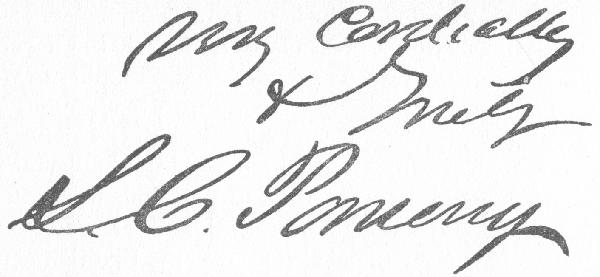
S.C. Pomeroy
A few days later George W. Julian, of Indiana, offered a similar amendment in the House of Representatives, as follows: "The right of suffrage in the United States shall be based upon citizenship, and shall be regulated by Congress; and all citizens of the United States, whether native or naturalized, shall enjoy 311 this right equally, without any distinction or discrimination whatever founded on sex."

Geo W. Julian
The last of December Senator Henry Wilson, of Massachusetts, and Mr. Julian introduced bills to enfranchise women in the District of Columbia, the latter including also the women in the Territories. A review of the situation in The Revolution of December 31, said:
In our political opinions, we have been grossly misunderstood and misrepresented. There never was a time, even in the re-election of Lincoln, when to differ from the leading party was considered more inane and treasonable. Because we made a higher demand than either Republicans or Abolitionists, they in self-defense revenged themselves by calling us Democrats; just as the church at the time of its apathy on the slavery question revenged the goadings of Abolitionists by calling them "infidels." If claiming the right of suffrage for every citizen, male and female, black and white, a platform far above that occupied by Republicans or Abolitionists today, is to be a Democrat, then we glory in the name, but we have not so understood the policy of modern Democracy. Though The Revolution and its founders may have been open to criticism in many respects, all admit that we have galvanized the people into life and slumbering friends to action on this question.
Notwithstanding the protests and petitions of the women, the Fourteenth Amendment had been formally declared ratified July 28, 1868, the word "male" being thereby three times branded on the Constitution. In the resolutions of Senator Pomeroy and Mr. Julian, however, they found new hope and fresh courage. They had learned that the Federal Constitution could be so amended as to enfranchise a million men who but yesterday were plantation slaves. Here, then, was the power which must be invoked for the enfranchisement of women. From the office of The Revolution went out thousands of petitions to the women of the country to be circulated in the interests of an amendment to regulate the suffrage without making distinctions of sex. It was decided that a convention should be held in Washington in order to meet the legislators on their own ground. A suffrage association had been formed in that city with Josephine S. Griffing, founder of the Freedmen's Bureau, president; Hamilton Willcox, secretary. This was the first ever held in the capital, and it brought many new and valuable workers into the field. Clara Barton here made her first appearance at a woman suffrage meeting, and was a true and consistent advocate of the principle from that day forward.
The venerable Lucretia Mott presided, and Senator Pomeroy opened the convention with an eloquent speech, January 19, 1869. A feature of this occasion was the appearance of several 314 young colored orators, speaking in opposition to suffrage for women and denouncing them for jeopardizing the black man's claim to the ballot by insisting upon their own. One of them, George Downing, standing by the side of Lucretia Mott, declared that God intended the male should dominate the female everywhere! Another was a son of Robert Purvis, who was earnestly and publicly rebuked by his father. Edward M. Davis, son-in-law of Lucretia Mott, also condemned the women for their temerity and severely criticised the resolutions, which demanded the same political rights for women as for negro men.
Miss Anthony called on Senator Harlan, of Iowa, chairman of the District committee, who readily granted the women a hearing which took place January 26, when she and Mrs. Stanton gave their arguments. This was the first congressional hearing ever granted to present the question of woman suffrage. An appeal was sent to Congress praying that women should be recognized in the next amendment. In her letter to the Philadelphia Press, Grace Greenwood thus described the leading spirits of the convention:
Near Lucretia Mott sat her sister, Martha Wright, a woman of strong, constant character and rare intellectual culture; Mrs. Cady Stanton, of impressive and beautiful appearance, in the rich prime of an active, generous and healthful life; Miss Susan B. Anthony, looking all she is, a keen, energetic, uncompromising, unconquerable, passionately earnest woman; Clara Barton, whose name is dear to soldiers and blessed in thousands of homes to which the soldiers shall return no more—a brave, benignant-looking woman....
Miss Anthony followed in a strain not only cheerful, but exultant—reviewing the advance of the cause from its first despised beginning to its present position, where, she alleged, it commanded the attention of the world. She spoke in her usual pungent, vehement style, hitting the nail on the head every time, and driving it in up to the head. Indeed, it seems to me, that while Lucretia Mott may be said to be the soul of this movement, and Mrs. Stanton the mind, the "swift, keen intelligence," Miss Anthony, alert, aggressive and indefatigable, is its nervous energy—its propulsive force....
To see the three chief figures of this great movement sitting upon a stage in joint council, like the three Fates of a new dispensation—dignity and the ever-acceptable grace of scholarly earnestness, intelligence and beneficence making them prominent—is assurance that the women of our country, bereft 315 of defenders or injured by false ones, have advocates equal to the great demands of their cause.
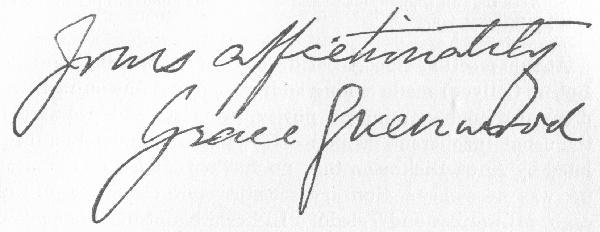
Grace Greenwood
Immediately after this convention, Miss Anthony and Mrs. Stanton, by invitation of a number of State suffrage committees, made a tour of Chicago, Springfield, Bloomington, Galena, St. Louis, Madison, Milwaukee and Toledo, speaking to large audiences. At St. Louis they were met by a delegation of ladies and escorted to the Southern Hotel, and then invited by the president of the State association, Mrs. Virginia L. Minor, to visit various points of interest in the city. At Springfield, Ill., the lieutenant-governor presided over their convention, and Governor Palmer and many members of the legislature were in the audience. With the Chicago delegation, Mrs. Livermore, Judge Waite, Judge Bradwell, Mrs. Myra Bradwell, editor of the Legal News, and others, they addressed the legislature. At Chicago, in Crosby Music Hall, the meeting was decidedly aggressive. Miss Anthony's resolutions stirred up the politicians, but she defended them bravely, according to report:
She stood outside of any party which threw itself across the path of complete suffrage to woman, and therefore she stood outside of the Republican party, where all her male relatives and friends were to be found. Republican leaders had told them to wait; that the movement was inopportune; but all the time had continued to put up bars and barriers against its future success. No woman should belong at present to either party; she should simply stand for suffrage.... She protested against any Republicans saying that Mrs. Stanton or herself had laid a straw in the way of the negro. Because they insisted that the rights of women ought to have equal prominence with the rights of black men, it was 316 assumed that they opposed the enfranchisement of the negro. She repelled the assumption. She arraigned the entire Republican party because they refused to see that all women, black and white, were as much in political servitude as the black men.
At this meeting Robert Laird Collyer (not the distinguished Robert Collyer) made a long address against the enfranchisement of women, mixing up purity, propriety and pedestals in the usual incoherent fashion. He was so completely annihilated by Anna Dickinson that no further defense of the measure was necessary. Suffrage societies were organized in Chicago, Milwaukee and Toledo. In her account of this convention, Mrs. Livermore wrote of Miss Anthony:
She is entirely unlike Mrs. Stanton, notwithstanding the twain have been fast friends and diligent co-laborers for a quarter of a century.... Miss Anthony is a woman whom no one can know thoroughly without respect. Entirely honest, fearfully in earnest, energetic, self-sacrificing, kind-hearted, scorning difficulties of whatever magnitude, and rigidly sensible, she is the warm friend of the poor, oppressed, homeless and friendless of her own sex. Her labors in their behalf are tireless and judicious. You think her plain until she smiles, and then the worn face lights up so pleasantly and benignly that you forget to criticise and your heart warms towards her. Knowing her great goodness, and how she has devoted her life to hard, unpaid work for the negro slave and for woman, we can never read jibes and jeers at her expense without a twinge of pain. Let the press laugh at her as it may, she is a mighty power among both men and women, and those who really love as well as respect her are a host.
In this winter of 1869 the Press Club of New York made the startling innovation of giving a dinner to which ladies were invited. Among the guests were Phoebe and Alice Gary, Mary L. Booth, Elizabeth Oakes Smith, Olive Logan, Mary Kyle Dallas and Miss Anthony. J. W. Simonton, of the Associated Press, was toast-master. Not having had the slightest intimation that she was expected to speak, Miss Anthony was called upon to respond to the question, "Why don't the women propose?" Without a moment's hesitation she arose and said: "Under present conditions, it would require a good deal of assurance for a woman to say to a man, 'Please, sir, will you support me for the rest of my life?' When all avocations are open to woman and she has an opportunity to 317 acquire a competence, she will then be in a position where it will not be humiliating for her to ask the man she loves to share her prosperity. Instead of requesting him to provide food, raiment and shelter for her, she can invite him into her home, contribute her share to the partnership and not be an utter dependent. There will be also another advantage in this arrangement—if he prove unworthy she can ask him to walk out." It will be seen by this original and daring reply that Miss Anthony could not attend a dinner party even without creating a sensation.
The passage of the Thirteenth Amendment abolishing slavery, and the Fourteenth establishing the citizenship of the negro, did not prove sufficient to protect him in his right of suffrage and, although Sumner and other Republican leaders contended that another amendment was not necessary for this, the majority of the party did not share this opinion and it became evident that one would have to be added.[48] Those proposed by Pomeroy and Julian securing universal suffrage were brushed aside without debate, and the following was submitted by Congress to the State legislatures, February 27, 1869:
The right of citizens of the United States to vote shall not be denied or abridged by the United States, or by any State, on account of race, color or previous condition of servitude.
Amendment XIV had settled the status of citizenship. "All persons born or naturalized in the United States, and subject to the jurisdiction thereof, are citizens of the United States and of the State wherein they reside." Now came the next measure to protect the citizen's right to vote, which proposed to guard against any discrimination on account of race, of color, of previous condition, but by the omission of the one word "sex," all women still were left disfranchised. At this time the leading Republicans believed in universal suffrage. Garrison, Phillips, Greeley, Sumner, Tilton, Wilson, Wade, 318 Stevens, Brown, Julian and many others had publicly declared their belief in the right of woman to the ballot, but now driven by party necessity, they repudiated their principles, and deferred the day of her freedom for generations. Yet it was not forgotten still carefully to include her in the basis of representation, fully to make her amenable to the laws, and strictly to hold her to her share of taxation. In reference to this The Revolution said:
The proposed amendment for "manhood suffrage" not only rouses woman's prejudices against the negro, but on the other hand his contempt and hostility toward her.... Just as the Democratic cry of a "white man's government" created the antagonism between the Irishman and the negro, which culminated in the New York riots of 1863, so the Republican cry of "manhood suffrage" creates an antagonism between black men and all women, which will culminate in fearful outrages on womanhood, especially in the Southern States. While we fully appreciate the philosophy that every extension of rights prepares the way for greater freedom to new classes and hastens the day of liberty to all, we at the same time see that the immediate effect of class enfranchisement is greater tyranny and abuse of those who have no voice in the government. Had Irishmen been disfranchised in this country, they would have made common cause with the negro in fighting for his rights, but when exalted above him, they proved his worst enemies. The negro will be the victim for generations to come, of the prejudice engendered by making this a white man's government. While the enfranchisement of each new class of white men was a step toward his ultimate freedom, it increased his degradation in the transition period, and he touched the depths when all men but himself were crowned with citizenship.
Just so with woman, while the enfranchisement of all men hastens the day for justice to her, it makes her degradation more complete in the transition state. It is to escape the added tyranny, persecutions, insults, horrors which will surely be visited upon her in the establishment of an aristocracy of sex in this republic, that we raise our indignant protest against this wholesale desecration of woman in the pending amendment, and earnestly pray the rulers of this nation to consider the degradation of disfranchisement. Our Republican leaders see that it is a protection and defense for the black man, giving him new dignity and self-respect, and making his rights more sacred in the eyes of his enemies. It is mockery to tell woman she is excluded from all political privileges on the ground of respect; since the laws and constitutions for her, in common with all disfranchised classes, harmonize with the degradation of the position.
In their protest against this discrimination and their insistence that the word "sex" should be included in the Fifteenth Amendment, Miss Anthony and Mrs. Stanton stood practically 319 alone. Most of the other women allowed themselves to be persuaded by the politicians that it was their duty to step aside and wait till the negro was invested with this highest attribute of citizenship.
In the first issue of The Revolution for 1869 appeared this letter from George Francis Train, who had just been released from the Dublin jail and had returned to America:
....I knew the load I had to carry in the woman question, but you did not know the load you had to carry in Train. When the poor man's horse fell and broke his leg, the crowd sympathized. "How much you pity?" asked the Frenchman; "I pity man $20." I saw that the theoretical breeching had broken in Kansas, and with voice, with pen, with time and, what none of your old friends did, with purse, I threw myself into the battle.
With your remarkable industry and extraordinary executive ability you have astonished all by your success. You remember I begged you never to stop to defend me but to push on to victory. Now both parties are neck and neck to see who shall lead the army of in-coming negro voters. Woman already begins to creep. Soon she will walk and legislate. No sneers, no low jokes, no obscene remarks are now bandied about. The iceberg of prejudice is moving down the Gulf Stream of a wider liberty and will melt away with the bigotry of ages. The ball is rolling down the hill. You no longer need my services. The Revolution is a power. Would it not be more so without Train? Had you not better omit my name in 1869? Would it not bring you more subscribers, and better assist the noble cause of reform? Although the Garrisonians have so ungenerously attacked me, perhaps they will do as much for you as I have. If so, tell them, confidentially, the thousands I have devoted to the cause, and guarantee the haters of Train that his name shall not appear in The Revolution after January 1. I can not better show my unselfishness than by asking you to forget my honest exertions for equal rights and equal pay for women, and to shut me out of The Revolution in future, in order to bring in again "the apostates."
Although Mr. Train continued to supply funds and to send an occasional letter for a few months longer, his active connection with the paper ceased after its first year. In the issue of May 1 it contained the following editorial comment:
Our readers will find Mr. Train's valedictory in another column. Feeling that he has been a source of grief to our numerous friends and, through their constant complaints, an annoyance to us, he magnanimously retires. He has always said that as soon as we were safely launched on the tempestuous sea of journalism, he should leave us "to row our own boat." Our partnership dissolves today. Now we shall look for a harvest of new subscribers, as many have written and said to us again and again, if you will only drop Train, we 320 will send you patrons by the hundred. We hope the fact that Train has dropped us will not vitiate these promises. Our generous friend starts for California on May 7, in the first train over the Pacific road. He takes with him the sincere thanks of those who know what he has done in the cause of woman, and of those who appreciate what a power The Revolution has already been in rousing public thought to the importance of her speedy enfranchisement.
The heading of the financial department and the column of Wall street gossip, which had given so much offense, were removed, and the paper became purely an advocate of the rights of humanity in general and women in particular. Up to this time the editorial rooms had been in the fourth story of the New York World building, and the paper was printed on the fifth floor of another several blocks away, with no elevator in either. Miss Anthony made the trip from one to the other and climbed the seven flights of stairs half a dozen times a day for sixteen months. In 1869, Mrs. Elizabeth B. Phelps, a wealthy and practical philanthropist of New York City, purchased a large and elegant house on East Twenty-third street, near the Academy of Design, which she dedicated as the "Woman's Bureau." She proposed to rent the rooms wholly for women's clubs and societies and for enterprises conducted by women. The first floor was taken by The Revolution. The handsome and spacious parlors above were to be used for receptions, readings, concerts, etc., and it was Mrs. Phelps' intention to make the Bureau a center, not only for the women of New York, but for all those who might visit the city.
Notwithstanding all that had passed, Miss Anthony did not abate her labors for the Equal Rights Association and she worked unceasingly for the success of the approaching May Anniversary in New York, securing, among other advantages, half fare on all the railroads for delegates. Hundreds of letters were sent out from The Revolution office to distinguished people in all parts of the country and cordial answers were received, showing that the hostility against the paper and its editors was principally confined to a very small area. A private letter from Mrs. Stanton says: "We have written 321 every one of the old friends, ignoring the past and urging them to come. We do so much desire to sink all petty considerations in the one united effort to secure woman suffrage. Though many unkind acts and words have been administered to us, which we have returned with sarcasm and ridicule, there are really only kind feelings in our souls for all the noble men and women who have fought for freedom during the last thirty years."
Under date of April 4, Mary A. Livermore wrote Miss Anthony, asking if she could secure a pass for her over the Erie road, and saying: "I have written to the New England friends to let bygones be bygones and come to the May meeting. It seems to me personal feelings should be laid aside and women should all pull together." After telling of the excellent prospects of her own suffrage paper, the Agitator, just started in Chicago, she continues: "It seems as if everybody who does not like The Revolution is bound to take the Agitator, which is very well, since they are detachments of the same corps. We must keep up a good understanding and work together. If you want to let people know there is no rivalry between us, you can announce that I am to send your paper fortnightly letters from the West detailing the progress of affairs here."
A cheery letter from Anna Dickinson says: "Work has run in easy grooves this winter—not that the travel has not often been exhausting and the roads wearisome; but that every one in this western world is ablaze with the grand question. Thank God, and hurrah! I feel in both moods. I hope you and that adorable cherub, E.C.S., are well, and that everything is flourishing as it should flourish with two such saints. As for me, the finger of care touches lightly; furthermore I am in a doubly delectable condition by reason of having my face set towards home, and beyond home is a vista of my Susan's countenance. Please, my dear, can't you meet this sinner at Cortlandt street, and then the sinner and the saint will have all the afternoon together somewhere, and that seems almost too good to be true?" 322
This was the beginning of a correspondence with Gail Hamilton, who wrote: "I regret to say that I can neither honor nor shame your anniversary with my presence. I have been out on a sixteen-months' cruise, fighting single handed for equal rights, and am now hauled up in dock for repairs. But you, I am sure, will be glad to know that, though much battered and tempest-tossed, I came into port with all sail set and every rag of bunting waving victory. This is a private note to you, and as you are but a landsman yourself, you will never know if my ropes are not knotted sailor-fashion."
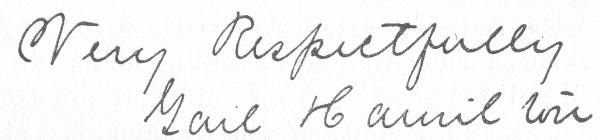
Gail Hamilton
The third aniversary of the Equal Rights Association opened at Steinway Hall, May 12, 1869, Mrs. Stanton presiding, and proved to be the most stormy and unsatisfactory meeting ever held. The usual brilliant galaxy of speakers was present, besides a number of prominent men and women who were just beginning to be heard on the woman suffrage platform. Among these were Olive Logan, Phoebe Couzins, Madam D'Hericourt, a French physician and writer, Rev. Phoebe A. Hanaford, Rev. O.B. Frothingham, Hon. Henry Wilson, Rev. Gilbert Haven and others. There were also more delegates from the West, headed by Mrs. Livermore, than had been present at any previous meeting. The usual number of fine addresses were made and all promised fair, but Stephen S. Foster soon disturbed the harmony by suggesting that it was time for Miss Anthony and Mrs. Stanton to withdraw from the association, as they had repudiated its principles and the Massachusetts society could no longer co-operate with 323 them. This called forth indignant speeches from all parts of the house, and he was soon silenced.[49]
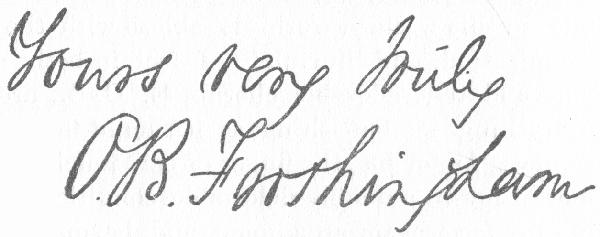
O.B. Frothingham
Frederick Douglass and several other men attempted to force the adoption of a resolution that "we gratefully welcome' the pending Fifteenth Amendment prohibiting disfranchisement on account of race and earnestly solicit the State legislatures to pass it without delay." Miss Anthony declared indignantly that she protested against this amendment because it did not mean equal rights; it put 2,000,000 colored men in the position of tyrants over 2,000,000 colored women, who until now had been at least the equals of the men at their side. She continued:
The question of precedence has no place on an equal rights platform. The only reason it ever forced itself here was because certain persons insisted that woman must stand back and wait until another class should be enfranchised. In answer we say: "If you will not give the whole loaf of justice to the entire people, if you are determined to extend the suffrage piece by piece, then give it first to women, to the most intelligent and capable of them at least. I remember a long discussion with Tilton and Phillips on this very question, when we were about to carry our petitions to the New York Constitutional Convention. Mr. Tilton said that we should urge the amendment to strike out the word 'white,'" and added: "The question of striking out the word 'male' we, as an equal rights association, shall of course present as an intellectual theory, but not as a practical thing to be accomplished at this convention." Mr. Phillips also emphasized this point; but I repudiated this downright insolence, when for fifteen years I had canvassed the entire State, county by county, with petition in hand asking for woman suffrage! To think that those two men, among the most progressive of the nation, should 324 dare look me in the face and speak of this great principle for which I had toiled, as a mere intellectual theory!
If Mr. Douglass had noticed who applauded when he said "black men first and white women afterwards," he would have seen that it was only the men. When he tells us that the case of black men is so perilous, I tell him that even outraged as they are by the hateful prejudice against color, he himself would not today exchange his sex and color with Elizabeth Cady Stanton.
Mr. Douglass—"Will you allow me a question?"
Miss Anthony—"Yes, anything for a fight today."
Mr. Douglass—"I want to inquire whether granting to woman the right of suffrage will change anything in respect to the nature of our sexes."
Miss Anthony—"It will change the nature of one thing very much, and that is the dependent condition of woman. It will place her where she can earn her own bread, so that she may go out into the world an equal competitor in the struggle for life; so that she shall not be compelled to take such positions as men choose to accord and then accept such pay as men please to give.... It is not a question of precedence between women and black men; the business of this association is to demand for every man, black or white, and every woman, black or white, that they shall be enfranchised and admitted into the body politic with equal rights and privileges."
As everybody in the hall was allowed to vote there was no difficulty in securing the desired endorsement of an amendment to enfranchise negro men and make them the political superiors of all women. There never had been a convention so dominated by men. Although the audience refused to listen to most of them and drowned their voices by expressions of disapproval and calls for the women speakers, they practically wrested the control of the meeting from the hands of the women and managed it to suit themselves.
This was Mrs. Livermore's first appearance at one of these anniversaries and she created a commotion by introducing this resolution: "While we recognize the disabilities which legal marriage imposes upon woman as wife and mother, and while we pledge ourselves to seek their removal by putting her 325 on equal terms with man, we abhorrently repudiate 'free loveism' as horrible and mischievous to society, and disown any sympathy with it." It was the first time the subject had been brought before a woman's rights convention and its introduction was indignantly resented by the "old guard." Lucy Stone exclaimed: "I feel it is a mortal shame to give any foundation for the implication that we favor 'free loveism.' I am ashamed that the question should be raised here. There should be nothing at all said about it. Do not let us, for the sake of our own self-respect, allow it to be hinted that we helped to forge a shadow of a chain which comes in the name of 'free love.' I am unwilling that it should be suggested that this great, sacred cause of ours means anything but what we have said it does. If any one says to us, 'Oh, I know what you mean, you mean free love by this agitation,' let the lie stick in his throat."
Mrs. Rose followed with a strong protest, saying: "I think it strange that the question of 'free love' should have been brought upon this platform. I object to Mrs. Livermore's resolution, not on account of its principles, but on account of its pleading guilty. When a man tries to convince me that he is not a thief, then I take care of my coppers. If we pass this resolution that we are not 'free lovers,' people will say, 'It is true that you are, for you try to hide it.' Lucretia Mott's name has been mentioned as a friend of 'free love,' but I hurl back the lie into the faces of those who uttered it. We have been thirty years in this city before the public, and it is an insult to all the women who have labored in this cause; it is an insult to the thousands and tens of thousands of men and women who have listened to us in our conventions, to say at this late hour, 'We are not free lovers.'"
The charge of "free love" was vigorously repudiated by Miss Anthony also, who closed the discussion by asserting: "This howl comes from the men who know that when women get their rights they will be able to live honestly and not be compelled to sell themselves for bread, either in or out of marriage. There are very few women in the world who would 326 enter into this relationship with drunkards and libertines provided they could get their subsistence in any other way. We can not be frightened from our purpose, the public mind can not long be prejudiced by this 'free love' cry of our enemies." Olive Logan poured oil upon the troubled waters in a graceful speech, and the subject was dropped.
At each recurring anniversary the conviction had been growing that the term "equal rights" was too comprehensive, permitting entirely too much latitude as to speakers and subjects. Ever themselves having been repressed and silenced, when at last women made a platform on which they had a right to stand, they declared first of all for "free speech." They would not refuse to any human being what so long had been denied to them and, as a result, fanatics, visionaries and advocates of all reforms flocked to this platform, delighted to find such audiences. According to the tenets of the association, all speakers must have equal rights on their platform and there was no escape. Sometimes it was nothing more harmful than a man with a map to explain how the national debt could be paid without money, or a woman with a system of celestial kites by which she proposed to communicate with the other world. Occasionally the advocates of various political theories would secure possession, consuming the time and diverting attention from the main issue. At the convention just closed, the hobby-riders were present in greater force than ever before and it seemed imperative that some means should be adopted to shut them out thereafter. It was proposed to change the name to Woman Suffrage Association, which would bar all discussion of a miscellaneous character. There was a strong objection to this, however, because such action required three months' notice.
At the close of the convention a reception was held at the Woman's Bureau, Saturday evening, May 15, 1869, and attended by women from nineteen States who had come as representatives to the Equal Rights Association.[50] At their 327 earnest request, it was decided to form a new organization to be called the National Woman Suffrage Association, whose especial object should be a Sixteenth Amendment to the Federal Constitution, securing the ballot to the women of the nation on equal terms with men. A convention of officially appointed delegates was at that time impracticable, as there were but few local suffrage societies and still fewer State organizations. It was thought that although it might not be formed by delegates elected for this specific object, it would be sufficient for working purposes until the next spring when, the required three months' notice having been given, a permanent organization might be effected. Accordingly, a constitution was adopted and officers elected.[51] The following week at Cooper Institute Anna Dickinson made her great speech for the rights of women, entitled "Nothing Unreasonable," to inaugurate the new National Woman Suffrage Association, and before an immense audience she pleaded for woman with the same beauty and eloquence as in days past she had pictured the wrongs of the slave and urged his emancipation.
The association was organized May 15, and on the 17th Mrs. Livermore wrote Miss Anthony from Boston: "I hope you are rested somewhat. I am very sorry for you, that you are carrying such heavy burdens. If you and I lived in the same city, I would relieve you of some of them, for I believe we might work together, with perhaps an occasional collision. Now I want you to answer these two questions: 1st.—Did you do anything in the way of organizing at the Saturday evening reunion, and if so, what? That Equal Rights Association 328 is an awful humbug. I would not have come on to the anniversary, nor would any of us, if we had known what it was. We supposed we were coming to a woman suffrage convention. 2d.—If Mrs. Stanton will not go West to a series of meetings this fall and winter, would you dare undertake it with me alone? We must have strong people of established reputations. 'Only the Stanton, the Anthony, and the Livermore,' that is what the Chicago Tribune says...." Later, while still in Boston, she wrote again:
You are mistaken in thinking I exhorted the formation of a national suffrage association the Saturday night after the New York convention; I only advised talking it up. All agreed that it ought to be formed but that a preliminary call should be issued first. I am for a national organization with Mrs. Stanton, president, and with you as one of the executive committee, but I want it arrived at compatibly with parliamentary rules.... And now having asserted myself, let me say that I sympathize more with your energy and earnestness which lead you to override forms and rules than I do with the awfully proper and correct spirit that waits till everybody consents before it does anything. I have no doubt but we all shall join the National Association, each State by its elected members, when we hold our great Western Woman Suffrage Convention in Chicago next fall. Mrs. Stanton and you must both be present; we probably shall all vote together then to go into the National Association. Remember you are to make that series of conventions with me. I am depending on you.
The next November, in answer to a circular signed by Lucy Stone, Julia Ward Howe, Caroline M. Severance, T.W. Higginson and George H. Vibbert, a call was issued resulting in a convention at Cleveland, O., to form another national suffrage association on the following basis of representation: "The delegates appointed by existing State organizations shall be admitted, provided their number does not exceed, in each case, that of the congressional delegation of the State. Should it fall short of that number, additional delegates may be admitted from local organizations, or from no organization whatever, provided the applicants be actual residents of the State they claim to represent." The American Suffrage Association was thus formed, with twenty-one States represented; Henry Ward Beecher, president; Henry B. Blackwell, Amanda Way, 329 recording secretaries; Lucy Stone, chairman executive committee.
In the midst of her exacting duties and many annoyances, Miss Anthony found time to write numerous letters and obtain a testimonial for Ernestine L. Rose, who was about to return with her husband to England, after having given many years of valuable service to the women of America. She secured a handsome sum of money and a number of presents for her, and Mrs. Rose went on board ship laden with flowers and very happy and grateful. Miss Anthony wrote to Lucretia Mott: "Was it not a little funny that this unsentimental personage should have suggested the thing and stirred so many to do the sentimental, and yet could not even take the time to go to the wharf and say good-by? I spent Sunday evening with her and it is a great comfort to me that I helped others contribute to her pleasure." On the back of this letter, which was sent to her sister, Martha Wright, Mrs. Mott penned: "Think of the complaints made of Susan when she does so much and puts others up to doing, and always keeps herself in the background."
In the summer of 1869, under the auspices of the National Association, large and successful conventions were held at Saratoga and Newport in the height of the season. Of the former The Revolution said: "That a woman suffrage convention should have been allowed to organize in the parlors of Congress Hall, that those parlors should have been filled to their utmost capacity by the habitual guests of the place, that such men as ex-President Fillmore, Thurlow Weed, George Opdyke and any number of clergymen from different parts of the country, should have been interested lookers-on, are significant facts which may well carry dismay to the enemies of the cause. That the whole convention was conducted by women in a dignified, orderly and business-like manner, is a strong intimation that in spite of all which has been said to the contrary, women are capable of learning how to manage public affairs."
The following comment was made by Mrs. Stanton on the 330 Newport convention: "So, obeying orders, we sailed across the Sound one bright moonlight night with a gay party of the 'disfranchised,' and found ourselves quartered on the enemy the next morning as the sun rose in all its resplendent glory. Although trunk after trunk—not of gossamers, laces and flowers, but of suffrage ammunition, speeches, petitions, resolutions, tracts, and folios of The Revolution—had been slowly carried up the winding stairs of the Atlantic, the brave men and fair women, who had tripped the light fantastic toe until the midnight hour, slept heedlessly on, wholly unaware that twelve apartments were already filled with the strong-minded invaders.... The audience throughout the convention was large, fashionable and as enthusiastic as the state of the weather would permit."
The Fourth of July was celebrated by the association in a beautiful grove in Westchester county, Miss Anthony, Mrs. Stanton, Judge E.D. Culver and others making addresses. Weekly meetings of as many of its members as were in New York were held at the Woman's Bureau, a large number of practical questions relating to women were brought forward, and there was constant agitation and discussion. A note from the tax collector called forth this indignant answer from Miss Anthony:
I have your polite note informing me that as publisher of The Revolution, I am indebted to the United States in the sum of $14.10 for the tax on monthly sales of that journal. Enclosed you will find the amount, but you will please understand that I pay it under protest. The Revolution, you are aware, is a journal the main object of which is to apply to these degenerate times the great principle for which our ancestors fought, that taxation and representation should go together. I am not represented in the United States government, and yet it taxes me; and it taxes me, too, for publishing a paper the chief purpose of which is to rebuke the glaring inconsistency between its professions and its practices. Under the circumstances, the federal government ought to be ashamed to exact this tax of me....
On September 10 Miss Anthony attended the Great Western Woman Suffrage Convention at Chicago, where she spoke several times and was cordially received. She was the guest of Mrs. Kate N. Doggett, founder of the Fortnightly Club. From here she 331 went to the St. Louis convention, October 6 and 7, which was especially distinguished because of the resolutions presented by Francis Minor, a prominent lawyer of that city, with an argument to prove that, under the Fourteenth Amendment, women already had a legal right to vote. These were supported by his wife, Virginia L. Minor, in a strong speech. They were the first thus to interpret this amendment. Ten thousand extra copies of The Revolution containing the resolutions and this speech were published, laid on the desk of every member of Congress, sent to the leading newspapers and circulated throughout the country. For a number of years the National Suffrage Association held to this construction of the amendment, until it was decided to the contrary by the Supreme Court of the United States.
Conventions were held in Cincinnati and Dayton, O. At the latter Miss Anthony gave a scathing review of the laws affecting married women, the control which they allowed the husband over the wife, children and property, making, however, no attack upon men but only upon laws. Each of the other speakers, all of whom were married, in turn took up the cudgel, and proceeded to tell how good her own husband was, and to say that if Miss Anthony only had a good husband she never would have made that speech, but each admitted that the men were better than the laws. In her closing remarks Miss Anthony used their own testimony against them and created great merriment in the audience. Whenever she commented on existing conditions or on general principles, individual men and women were sure to rush into the fray, making a personal application and waxing highly indignant. The Dayton Herald said of her evening address: "She made a clear, logical and lawyerlike argument, in sprightly language, that women being persons are citizens, and as citizens, voters. We think that none who examine her authorities and line of discussion can avoid her conclusions, and we are certain that many of the ablest jurists of the land have the honor (logically and legally) to coincide in her argument."
In 1869 Mrs. Isabella Beecher Hooker came actively into the 332 suffrage work and proved a valuable ally. She had been much prejudiced against Miss Anthony and Mrs. Stanton by newspaper reports and by the misrepresentations of some of her acquaintances, and in order to overcome this feeling Paulina Wright Davis arranged that the three should visit her for several days at her home in Providence, R.I., saying in her invitation: "I once had a prejudice against Susan B. Anthony but am ashamed of it. I investigated carefully every charge made against her, and I now know her to be honest, honorable, generous and above all petty spites and jealousies." Mrs. Hooker was so delightfully disappointed in the two ladies that she became at once and forever their staunchest friend and advocate. To Caroline M. Severance she wrote:
I have studied Miss Anthony day and night for nearly a week, and I have taken the testimony of those who have known her intimately for twenty years, and all are united in this resume of her character: She is a woman of incorruptible integrity and the thought of guile has no place in her heart. In unselfishness and benevolence she has scarcely an equal, and her energy and executive ability are bounded only by her physical power, which is something immense. Sometimes she fails in judgment, according to the standard of others, but in right intentions never, nor in faithfulness to her friends. I confess that after studying her carefully for days, and under the shadow of ——'s letters against her, and after attending a two-days' convention in Newport engineered by her in her own fashion, I am obliged to accept the most favorable interpretation of her which prevails generally, rather than that of Boston. Mrs. Stanton, too, is a magnificent woman, and the truest, womanliest one of us all. I have spent three days in her company, in the most intense, heart-searching debate I ever undertook in my life. I have handled what seemed to me to be her errors without gloves, and the result is that I love her as well as I do Miss Anthony. I hand in my allegiance to both as the leaders and representatives of the great movement.
Mrs. Hooker set about arranging a mass convention at her home in Hartford, Conn., and upon Miss Anthony's expressing some doubt as to being present, she wrote: "Here I am at work on a convention intended chiefly to honor Miss Anthony and Mrs. Stanton, and behold the Quakeress says maybe she can not come! I won't have the meeting if you are going to flunk. It has been a real consolation to me in this wearisome business to think you would for once be relieved 333 from all responsibility and come as orator and guest. Don't fail me."
The convention, which closed October 29, was a great success and a State society was formed with a distinguished list of officers. The Hartford Post gave considerable space to Miss Anthony's address, saying:
Miss Anthony is a resolute, substantial woman of forty or fifty, exhibiting no signs of age or weariness. Her hair is dark, her head well formed, her face has an expression of masculine strength. If she were a man you would guess that she was a schoolmaster, or a quiet clergyman, or perhaps a business man and deacon. She pays no special attention to feminine graces, but is not ungraceful or unwomanly. In speaking her manner is self-possessed without ranting or unpleasant demonstrations, her tones slightly monotonous. Long experience has taught her a candid, kindly, sensible way of presenting her views, which wins the good will of her hearers whether they accept them or not. She said in part:
"How different is this from the assemblages that used to greet us who twenty years ago commenced to agitate the enfranchisement of woman. We begin to see the time, which we shall gladly welcome, when we shall not be needed at the front of the battle. Of late years, the country has been occupied in discussing the claim of man to hold property in his fellow-man, and has decided the question in the negative. Still another form of slavery remains to be disposed of; the old idea yet prevails that woman is owned and possessed by man, to be clothed and fed and cared for by his generosity. All the wrongs, arrogances and antagonisms of modern society grow out of this false condition of the relations between man and woman. The present agitation rises from a demand of the soul of woman for the right to own and possess herself. It is said that as a rule man does sufficiently provide for woman, and that she ought to remain content. The great facts of the world are at war with this assumption.
"For example, I see in the New York Herald 1,200 advertisements of people wanting work. Upon examination, 500 of them come from women and 300 more are from boarding-house keepers; and we may therefore say that eight of the twelve hundred advertisements are from women compelled to rely upon their own energies to gain their food and clothing. Every morning from 6 to 7 o'clock you may see on the Bowery and other great north and south avenues of New York, troops of young girls and women, with careworn or crime-stained faces, carrying their poor lunch half-concealed beneath a scanty shawl. If the facts were in accordance with the common theory, we should not see these myriads of women thus thrust out to get their living. Society must either provide great establishments maintained by taxation to care for women, or else the doors of all trades and callings must be thrown wide open to them.... This woman's movement promises an entire change of the conditions of wages and support. The status of woman can not be materially changed while the subsistence question remains as at present."
Miss Anthony was entertained at the home of Governor Jewell, afterwards Postmaster-General. One morning she went over to Mrs. Hooker's and found all her guests at the breakfast table, Henry Ward Beecher, Wm. Lloyd Garrison, Mrs. Severance, Mrs. Davis and others. She received a hearty welcome and Mrs. Hooker insisted she should sit down and have a cup of tea or coffee. Mr. Beecher joined in the entreaty, saying: "Now, Miss Anthony, you know you have to make a big speech today. When I want to be very effective and make people cry, I drink a cup of tea before speaking; when I want to be very clever and make them laugh, I drink coffee; but when I want them to cry half the time and laugh the other half, I take a cup of each."
In a letter to Miss Anthony after she returned home Mrs. Hooker said: "I am astonished at the praise I receive for my part in the convention, and humbled too, for I realize how worthy of all these pleasant and commendatory words you and others have been all these years, and what have you received—or rather what have you not received? Thank God, that is all over now and you are to have blue sky and clear sailing. It must be through suffering we enter the gates of peace." But the peace was a long way off and the hardest struggle was yet to come! A little later Mrs. Hooker wrote to a friend:
I can't tell you how my heart swells—but there is present within me one undercurrent of feeling that will come to the surface ever and anon, viz., the wonderful dignity, strength and purity of the early workers in this reform. I can't wait for history to do them justice; I want to make history today, and so far as in me lies I will do it. I have come in at the death and get a large share of the glory, and lo, here are these, a great company, who have been in the field for thirty years, and a whole generation has passed them by unrecognized. Every one here says, "Our noble friend Susan has carried the day right over the heads of all of us." Said one of our editors, Charles Dudley Warner, a man of finest taste and culture, when he had been praising the dignity and power of the whole platform: "Susan Anthony is my favorite. She was the only woman there who never once thought of herself. You could see in her every motion and in her very silence that the cause was all she cared for, self was utterly forgotten."
He had indeed struck the key note to Miss Anthony's strongest characteristic, utter forgetfulness of self, total 335 self-abnegation, self-sacrifice without a consciousness that it was such. Mrs. Hooker's statement that she "had come in at the death" shows the strong faith of most of these early workers that it would be only a brief time until the rights they claimed would be recognized and granted; but she herself has labored faithfully yet another thirty years without breaking down the Chinese Wall of opposition.
One object of Mrs. Hooker in calling this Hartford convention was to see if she could not bring together what were now becoming known as "the New York and Boston wings of the suffrage party," but she comments: "We have decided to give up our attempts at reconciliation; we have neither time nor strength to spare, and if we had, they would probably fail."
In December Miss Anthony went to the Dansville Sanitarium for a few days and after her return, Dr. Kate Jackson, so widely known and loved, wrote her: "Since your visit here, through which I obtained somewhat of an insight into your struggles and labors, I have been in special sympathy with you. I do admire the liberal and comprehensive spirit which you and Mrs. Stanton show in allowing both sides of a question to be fairly discussed in your paper, and in giving any woman who does good work for her race in any field the credit for it, even though she may not exactly agree with you on all points. The spirit of exclusiveness is not calculated to push any reform among the masses.... Our house and hearts are always open to you. I want to send you something more than good wishes and so enclose a little New Year's gift to you, with my love and earnest prayers for your success."
The lovely Quaker, Sarah Pugh, wrote from Philadelphia:
Dear Susan: Not "Dear Madam," or "Respected Friend," according to our stately fashion, for my heart yearns too warmly toward thee and thy work for such formality. Would it were in my power to help thee more in thy onward way, for it must be onward even though opponents fill it with stumbling-blocks. Lucretia Mott is firm in her adherence to New York—not but that she can work, if the way offers, in all organizations which labor for the same end. My opinion of The Revolution may be expressed in what was said of another paper: "It fights no sham battles with enemies already 336 defeated. It is true, good men and women not a few stumble at it, object to it and in some cases antagonize it, but nobody despises it. An affectation of contempt is not contempt."
Scores of similar letters were received from the early workers in the cause. It is unnecessary to enter further into a discussion of this division in the ranks of the advocates of woman suffrage. The conscientious historian must perform some unpleasant duties, hence it could not be passed without notice. The mass of correspondence on this question has been carefully sifted and that which would give pain to others, even though it would magnify the subject of this work, has been rigorously excluded. Most of the writers and those whom they criticised have ended their labors and passed from the scene of action. No good can be accomplished, either to the individuals or to the reform, by inflicting these personalities upon future generations. Among earnest, forceful, aggressive leaders of any great movement, there must arise controversies because of these strong characteristics, but the chief interest of mankind lies not in the individuals but in the results which they were able to accomplish. A comparison of the position of woman today with that which she occupied at the beginning of the agitation in her behalf, fifty years ago, offers more eloquent testimony to the efforts of those heroic pioneers than could be put into words by the most gifted pen.
[49] In reference to this unwarranted attack, the noted writer, William Winter, said in the New York Tribune:
"Noble, virtuous, honorable women are a country's greatest wealth, and when, from petty envy or jealousy, any one attempts with private innuendoes or public assaults to blacken a fair name which has long stood before the nation representing a principle, it is an injury not only to the individual but to the moral sense of the nation, and all true people are interested in maintaining its integrity and power. Susan B. Anthony has stood before this nation twenty years, earnestly devoted to every good work. As a teacher in the schools of New York for fifteen years, she bears from superintendents the highest testimonials to her faithfulness and ability. Her noble labors in the temperance cause are known throughout the State, and in association with the true men and women who fought the anti-slavery battle, she was equally faithful and earnest, finishing her work by getting up a petition for the black man's freedom of 400,000 names—the largest ever presented in Congress. For woman's enfranchisement her labors have been unremitting and unwearied for the last eighteen years. She is a frank, generous, self-sacrificing woman, of a kind, tender nature, firm principle, great executive ability, and in every relation of life true as the needle to the pole. Her motto has ever been, 'Let the weal and the woe of humanity be everything to me; their praise and their blame of no effect.'"
[51] President, Elizabeth Cady Stanton. Vice-presidents, Elizabeth B. Phelps, N.Y.; Anna Dickinson, Penn.; Kate N. Doggett, Ill.; Madame Anneke, Wis.; Lucy Elmes, Conn.; Mattie Griffith Brown, Mass.; Mrs. Nicholas Smith, Kan.; Lucy A. Snow, Maine; Elizabeth B. Schenck, Cal.; Josephine S. Griffing, D.C.; Paulina Wright Davis, R.I.; Mary Foote Henderson, Phoebe W. Cousins, Mo. Corresponding secretaries, Laura Curtis Bullard, Ida Greeley, Adelaide Hallock. Recording secretaries, Abby Burton Crosby, Sarah E. Fuller. Treasurer, Elizabeth Smith Miller. Executive committee, Ernestine L. Rose, Charlotte B. Wilbour, Mathilda F. Wendt, Mary F. Gilbert, Susan B. Anthony. Advisory counsel, Matilda Joslyn Gage, N.Y.; Mrs. Francis Minor, Mo.; Adeline Thomson, Penn,; Mrs. M.B. Longley, Ohio; Mrs. J.P. Root, Kan.; Lilie Peckham, Wis.
Conventions and conventions for fifty years, without a break, planned and managed by one woman—was there ever a similar record? The year 1870 opened with the Second National Woman Suffrage Convention, in Lincoln Hall, Washington, D. C., January 19. It had been advertised for two days, but the interest was so great that it was continued through the third day and evening. Mrs. Stanton was in the chair and the papers united in praising the beauty, dignity and elegant attire of the women on the platform. A long table at the Arlington Hotel was reserved for them, and Miss Anthony relates that as they were all going into the dining-room one day, Jessie Benton Fremont beckoned to her and when she went over to the table where the general and she were sitting, she said in her bright, pretty way: "Now tell me, did you hunt the country over and pick out a score of the most beautiful women you could find to melt the hearts of our congressmen?"
Letters of warm approval were read from John Stuart Mill and Helen Taylor, of England; Professor Homer B. Sprague, of Cornell University; Bishop Simpson, of the Methodist church; Senator Matthew H. Carpenter, and many other distinguished persons. A number of senators and representatives addressed the meetings, as did also Hon. A.G. Riddle, of the District of Columbia, Rev. Samuel J. May, Charlotte B. Wilbour, Isabella Beecher Hooker, and the usual corps of well-known suffrage speakers. Jennie Collins, the Lowell factory 338 girl, electrified the audience by discussing the great question from the standpoint of the workingwomen. All the New York dailies sent women reporters, a comparatively new feature at conventions.
A hearing was arranged before the joint committees for the District of Columbia, and a number of the ladies made short addresses. Mrs. Stanton based her remarks on the unanswerable argument of Francis Minor at the St. Louis convention a few months before, the first assertion of woman's right to vote under the Fourteenth Amendment. Miss Anthony said:
We are here for the express purpose of urging you to present in your respective bodies, a bill to strike the word "male" from the District of Columbia Suffrage Act and thereby enfranchise the women of the District. We ask that the experiment of woman suffrage shall be made here, under the eye of Congress, as was that of negro suffrage. Indeed, the District has ever been the experimental ground of each step toward freedom. The auction-block was here first banished, slavery here first abolished, the freedmen here first enfranchised; and we now ask that women here shall be first admitted to the ballot. There was great fear and trepidation all over the country as to the results of negro suffrage, and you deemed it right and safe to inaugurate the experiment here; and you all remember that three days' discussion in 1866 on Senator Cowan's proposition to strike out the word "male." Well do I recollect with what anxious hope we watched the daily reports of that debate, and how we longed that Congress might then declare for the establishment in this District of a real republic. But conscience or courage or something was wanting, and women were bidden still to wait.
When, on that March day of 1867, the negroes of the District first voted, the success of that election inspired Congress with confidence to pass the proposition for the Fifteenth Amendment, and the different States to ratify it, until it has become a fixed fact that black men all over the nation not only may vote but sit in legislative assemblies and constitutional conventions. We now ask Congress to do the same for women. We ask you to enfranchise the women of the District this very winter, so that next March they may go to the ballot-box, and all the people of this nation may see that it is possible for women to vote and the republic yet stand. There is no reason, no argument, nothing but prejudice, against our demand; and there is no way to break down this prejudice but to make the experiment. Therefore, we most earnestly urge it, in full faith that so soon as Congress and the people shall have witnessed its beneficial results, they will go forward with a Sixteenth Amendment which shall prohibit any State from disfranchising any of its citizens on account of sex.
A letter from Mrs. Fannie Howland in the Hartford Courant thus describes the hearing: 339
Senator Hannibal Hamlin, chairman, presented to them successively the gentlemen of the committee, who took their seats around a long table. Mrs. Stanton stood at one end, serene and dignified. Behind her sat a large semicircle of ladies, and close about her a group of her companions, who would have been remarkable anywhere for the intellectual refinement and elevated expression of their earnest faces. Opposite sat Charles Sumner, looking fatigued and worn, but listening with alert attention. So these two veterans in the cause of freedom were fitly and suggestively brought face to face.
The scene was impressive. It was simple, grand, historic. Women have often appeared in history—noble, brilliant, heroic women; but woman collectively, impersonally, today asks recognition in the commonwealth—not in virtue of hereditary noblesse—not for any excellence or achievement of individuals, but on the one ground of her possessing the same rights, interests and responsibilities as man. There was nothing in this gathering at the Capitol to touch the imagination with illusion, no ball-room splendor of light, fragrance and jewels, none of those graceful enchantments by which women have been content to reign through brief dynasties of beauty and briefer fealties of homage. The cool light of a winter morning, the bare walls of a committee room, the plain costumes of everyday use, held the mind strictly to the actual facts which gave that group of representative men and women its moral significance, its severe but picturesque unity. Some future artist, looking back for a memorable illustration of this period, will put this new "Declaration of Independence" upon canvas, and will ransack the land for portraits of those ladies who spoke for their countrywomen at the Capitol, and of those senators and representatives who gave them audience. Mrs. Stanton was followed by Miss Anthony, morally as inevitable and impersonal as a Greek chorus, but physically and intellectually individual, intense, original, full of humor and good nature.
The Hearth and Home, in Photographs of our Agitators, thus depicts Miss Anthony on this occasion:
She is the Bismarck; she plans the campaigns, provides the munitions of war, organizes the raw recruits, sets the squadrons in the field. Indeed, in presence of a timid lieutenant, she sometimes heads the charge; but she is most effective as the directing generalissimo. Miss Anthony is a quick, bright, nervous, alert woman of fifty or so—not at all inclined to embonpoint—sharp-eyed, even behind her spectacles. She presides over the treasury, she cuts the Gordian knots, and when the uncontrollables get by the ears at the conventions, she is the one who straightway drags them asunder and turns chaos to order again. In every dilemma, she is unanimously summoned. As a speaker, she is angular and rigid, but trenchant, incisive, cutting through to the heart of whatever topic she touches.
Mrs. Hooker wrote: "There were congratulations without stint; but Sumner, grandest of all, approaching us said in a deep voice, really full of emotion: 'I have been in this place, 340 ladies, for twenty years; I have followed or led in every movement toward liberty and enfranchisement; but this meeting exceeds in interest anything I ever have witnessed.'" In her weekly letter to the Independent, Mary Clemmer wrote of this convention:
I am glad to say that it was not mongrel—in part a dramatic reading, in part a concert, and in part an organ advertisement; but wholly a convention whose leaders, in dignity and intellect, were fully the peers of the men whose councils they besieged and arraigned. There was Mrs. Stanton—smiling, serene, and motherly—just the woman whose hand laid upon a young man's arm, whose voice speaking to him, could do so much to hold him back from evil. There was Susan Anthony—anxious, earnest and importunate, sarcastic, funny and unconventional as ever. Among all the company, "Susan" is the most violently and the most unjustly abused. To be sure, she can be very provocative of such speech. She sometimes has a lawless way of talking and acting, which men think wonderfully fascinating in a belle, but utterly unforgivable in a plain, middle-aged woman. Moreover, "Susan's" utter abnegation to her cause, her passion for it, sometimes carries her on to "ways and means" not altogether tenable—in fine, she will offend your taste and mine; but this is only the outside and a very small side of Susan Anthony. A man, and more than a man—a woman who can deny herself, ignore herself, for a principle, for what she believes to be the truth, whether we believe it or not, is at least entitled to our respect.
Susan B. Anthony has a strong, earnest and loving nature; her devotion to her sex is an utterly absorbing and absolute passion. Born and nurtured a Quaker, she transgresses no prejudice, even of education, when she stands forth everywhere and in all places the unflinching, unwearied, never-to-be-put-down champion of woman. In the better age, when the woman of the future shall be man's equal in law, in education, in labor, in labor's rewards; when time shall have softened the asperities of the present, and the crudeness of the personal shall be buried forever in the grave, Susan B. Anthony will live as one of the truest friends that woman ever had.

Mary Clemmer
Sarah Pugh wrote Miss Anthony to stop over in Philadelphia and visit Mrs. Mott and herself on her way home from Washington, adding, "We are true to you." In accepting the invitation, Miss Anthony said: "I pray every day to keep broad and generous towards all who scatter and divide, and hope I may hold out to the end. The movement can not be damaged, though some particular schemes may, by any ill-judged action. The wheels are secure on the iron rails, and 341 no 'National' or 'American'—no New York or Boston—assumption or antagonism can block them. Individuals may jump on or off, yet the train is stopped thereby but for a moment."
A letter to her from the California association declares: "We will split into a thousand pieces before we will prove false to you, who have so long borne the heat and burden of the day." The heat and burden had indeed been great, and one less strong in body and less heroic in soul would have sunk under them. Although she was still weighed down by the terrible financial struggle of The Revolution, the storm of opposition which it had aroused was passing away and the old friends and many new ones were flocking around the intrepid standard bearer, whom neither fear nor favor could induce to swerve from the straight line marked out by her own convictions and conscience. Miss Anthony would soon complete a half-century, and her friends resolved to commemorate it in a worthy manner. Handsomely engraved cards were sent out, reading:
The ladies of the Woman's Bureau invite you to a reception on Tuesday evening, February 15, 1870, to celebrate the Fiftieth Birthday of Susan B. Anthony. On this occasion her friends will be afforded an opportunity to testify their appreciation of her twenty years' service in behalf of woman. ELIZABETH B. PHELPS, ANNA B. DARLING, CHARLOTTE B. WILBOUR.
There had been hard work to persuade Miss Anthony to accept this testimonial, but she was very happy that evening when the spacious parlors were crowded with the leading men and women of the day. Although her opinions and methods had been many times attacked by the newspapers, they now united in cordial congratulations. The New York World, in a long account, thus described the affair:
A large number of friends and admirers of the private virtues and public services of Miss Anthony assembled at the Woman's Bureau in Twenty-third street last evening to congratulate the lady upon this auspicious anniversary, and to wish her the customary "many happy returns of the day." The parlors were dazzling with light, the atmosphere laden with perfume, the walls covered with beautiful works of art, and the sweet sounds of women's laughter and silvery voices filled the apartments. Miss Susan B. Anthony stood at the entrance of the front parlor to receive her numerous friends. She 342 wore a dress of rich shot silk, dark red and black, cut square in front, with a stomacher of white lace and a pretty little cameo brooch. All female vanities she rigorously discarded—no hoop, train, bustle, panier, chignon, powder, paint, rouge, patches, no nonsense of any sort. From her kindly eyes and from her gentle lips, there beamed the sweetest smiles to all those loving friends who, admiring her really admirable efforts in the cause of human freedom, her undaunted heroism amid a dark and gloomy warfare, were glad to press her hand and show their appreciation of her character and achievements.
Every daily paper in the city had some pleasant comment, while scores of loving and appreciative letters were received. Accompanying these were many beautiful gifts and also checks to the amount of $1,000.[52]
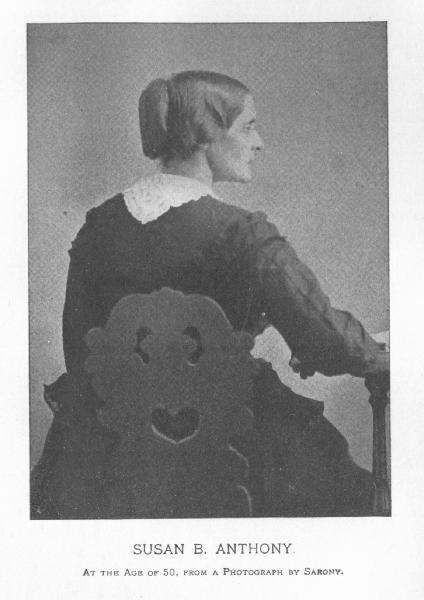
SUSAN B. ANTHONY
After the guests had assembled, Isabella Beecher Hooker announced that Anna T. Randall would read a poem written for the occasion by Phoebe Gary.[53] She was followed by Mrs. Hooker, who read some delightfully humorous verses from her husband, John Hooker, dedicated to Miss Anthony. There were more poetical tributes, recitations by Sarah Fisher Ames and other well-known elocutionists, and then a call for the recipient of all these honors. Miss Anthony stepped forward, completely overwhelmed and, after stammering her thanks for the unexpected ovation of the evening, said in a voice which 343 broke in spite of her self-control: "If this were an assembled mob opposing the rights of women I should know what to say. I never made a speech except to rouse people to action. My work is that of subsoil plowing.... I ask you tonight, as your best testimony to my services, on this, the twentieth anniversary of my public work, to join me in making a demand on Congress for a Sixteenth Amendment giving women the right to vote, and then to go with me before the several legislatures to secure its ratification; and when the Secretary of State proclaims that that amendment has been ratified by twenty-eight States, then Susan B. Anthony will stop work—but not before."
When all was over, before she slept, Miss Anthony wrote this characteristically tender little note to the one who never was absent from her mind:
MY DEAR MOTHER: It really seems tonight as if I were parting with something dear—saying good-by to somebody I loved. In the last few hours I have lived over nearly all of life's struggles, and the most painful is the memory of my mother's long and weary efforts to get her six children up into womanhood and manhood. My thought centers on your struggle especially because of the proof-reading of Alice Gary's story this week. I can see the old home—the brick-makers—the dinner-pails—the sick mother—the few years of more fear than hope in the new house, and the hard years since. And yet with it all, I know there was an undercurrent of joy and love which makes the summing-up vastly in their favor. How I wish you and Mary and Hannah and Guelma could have been here—and yet it is nothing—and yet it is much.
My constantly recurring thought and prayer now are that the coming fraction of the century, whether it be small or large, may witness nothing less worthy in my life than has the half just closed—that no word or act of mine may lessen its weight in the scale of truth and right.
Then there is the bare mention of a luncheon a few days before with Alice and Phoebe Cary, Mrs. Stanton and Mrs. Hooker. What a treat would have been a résumé of the conversation of that gifted quintette of women!
Mrs. Stanton was ill and could not attend the reception, which was a great disappointment to Miss Anthony. They had shared so much trouble that she felt most anxious they should share this one great pleasure. In the diary at midnight 344 is recorded: "Fiftieth birthday! One half-century done, one score years of it hard labor for bettering humanity—temperance—emancipation—enfranchisement—oh, such a struggle! Terribly stormy night, but a goodly company and many, many splendid tributes to my work. Really, if I had been dead and these the last words, neither press nor friends could have been more generous and appreciative."
This beautiful anniversary was a sweet oasis in the severe monotony of a life which had been filled always with hard work, criticism and misrepresentation, although it was only a public expression of the numerous and strong friendships which had been many times manifested in private. The birthday celebration served also to disprove the oft-repeated assertion that all women conceal their age, but though Miss Anthony made this frank avowal of her fifty years, there was scarcely a newspaper which did not introduce its comments with the usual silly and threadbare remarks.
After the people began to recover in a social, intellectual and financial way from the effects of the Civil War, the lyceum bureau became a marked feature in literary life. The principal bureaus were in New York, Boston and Chicago. Their managers engaged the best speakers and each season marked out a route, made the appointments, advertised extensively and sent them throughout the country. They paid excellent prices, assuming all responsibility, and engagements with them were considered very desirable. Under the management of the New York bureau, Mrs. Stanton began a tour in November, 1869. Miss Anthony at this time, while well-known from one end of the country to the other, had not gained a reputation as a platform orator. She thoroughly distrusted her own power to make a sustained speech of an entire evening, and at all conventions had placed others on the program for the principal addresses, presided herself, if necessary, and kept everything in motion.
By the winter of 1870, however, the bureau began to receive applications from all parts of the United States for lectures from her, and Mrs. Stanton being ill for a month, Miss Anthony 345 went as her substitute. She proved so acceptable that in February, March and April she was engaged by the bureau for many places in Pennsylvania, Ohio, Indiana, Illinois and Michigan, and received a considerable sum for her services, besides securing a number of subscribers and some liberal donations for The Revolution. In her journal she speaks of the good audiences, the enthusiasm and the many prominent callers at most of the places. At Mattoon she had a day and a night with Anna Dickinson and wrote: "I found her the most weary and worn I had ever seen her, and desperately tired of the lecture field. Her devotion to me is marvelous. She is like my loving and loved child."
At Peoria, the editor of the Democratic paper stated that the laws of Illinois were better for women than for men. Colonel Robert G. Ingersoll, whom she never had seen, was in the audience, and sent a note to the president of the meeting, asking that Miss Anthony should not answer the editor but give him that privilege. He then took up the laws, one after another, and, illustrating by cases in his own practice, showed in his eloquent manner how cruelly unjust they were to women and proved how necessary it was that women should have a voice in making them. He also offered the following resolution, which was unanimously adopted: "We pledge ourselves, irrespective of party, to use all honorable means to make the women of America the equals of men before the law."
In Detroit Rev. Justin Fulton occupied one evening in opposition to woman suffrage, and Miss Anthony replied to him the next. An audience of a thousand gathered in Young Men's Hall at each meeting. The Free Press had a most scurrilous review of the debate in which it said:
The speakeress rattled on in this strain until a late hour, saying nothing new, nothing noble, not a word that would give one maid or mother a purer or better thought. She drew no pictures of love in the household—she did not seem to think that man and wife could even stay under the same roof. She was not content that any woman should be a bashful, modest woman, but wanted them to be like her, to think as she thought.... People went there to see Susan B. Anthony, who has achieved an evanescent reputation by her strenuous endeavors to defy nature. Not one woman in a hundred cares to 346 vote, cares aught for the ballot, would take it with the degrading influences it would surely bring.... Old, angular, sticking to black stockings, wearing spectacles, a voice highly suggestive of midnight Caudleism at poor Anthony, if he ever comes around, though he never will. If all woman's righters look like that, the theory will lose ground like a darkey going through a cornfield in a light night. If she had come out and plainly said, "See here, ladies, see me, I am the result of twenty years of constant howling at man's tyranny," there would never have been another "howl" uttered in Detroit. Or, if she had plainly said, in so many words, "I am going to lecture on bosh, for the sake of that almighty half-dollar per head—take it as bosh," people would have admired her candor, though forming the same conclusions without her assistance....
Myra Bradwell, the able editor of the Chicago Legal News, paid the following tribute: "Miss Anthony is terribly in earnest on this suffrage question. We fully agree with her that the great battle-ground in the first instance should be in Congress.... She is now fifty, and the best years of her life have been devoted solely to the cause of woman. She has never turned aside from this object but has always been in the field, defending her principles against all assaults with an ability which has not only won the admiration of her friends but the respect of her enemies."
She made many new acquaintances on this tour, and one entry in the diary is: "Quite a novel feature this—to have people quarrel as to who shall have the pleasure of entertaining me as their guest!" She returned to New York on Saturday, April 30, and on Sunday the diary says: "Spent the day at Mrs. Tilton's and heard Beecher preach a splendid sermon on 'Visiting the Sins of the Parents on the Children.'"
Various friends of the woman suffrage cause had decided that something must be done to unite the two national organizations. An editorial in the Independent to this effect was followed by a call for a conference to meet at the Fifth Avenue Hotel, April 6, signed by Theodore Tilton, Phoebe Cary, Rev. John Chadwick and a number of others. The meeting was duly held, and the venerable Lucretia Mott, who now rarely left home, came all the way from Philadelphia to use her influence toward a reconciliation. Miss Anthony and Mrs. Stanton were lecturing in the West and the former telegraphed: "The 347 entire West demands united national organization for the Sixteenth Amendment, this very congressional session, and so does Susan B. Anthony." Mrs. Stanton wrote to the conference: "I will do all I can for union. If I am a stumbling-block I will gladly resign my office. Having fought the world twenty years, I do not now wish to turn and fight those who have so long stood together through evil and good report. I should be glad to have all united, with Mr. Beecher or Lucretia Mott for our general.... I am willing to work with any and all or to get out of the way entirely, that there may be an organization which shall be respectable at home and abroad."
The representatives of the American Association insisted that they had offered the olive branch at the time of their organization and it had been refused. This olive branch had been a suggestion that the National Association should consider itself a local society and become auxiliary to the American. After a protracted but fruitless discussion of over four hours, they withdrew from the room, declining to accept or to suggest any overtures. The proposition made by the callers of the conference was that the two associations should merge into one, with a new constitution embodying the best features of both, and with a board of officers elected from the two existing organizations. Even the friendly offices of Lucretia Mott, which never before were disregarded, failed to effect a union, and the many letters from mutual friends were equally ineffective. In her regular letter to The Revolution Miss Anthony said:
There is but one feeling all through this glorious West, and that is that it is a sin to have a divided front at this auspicious moment. Since my last I have had splendid meetings in Quincy, Farmington, Elwood, Mendota, Peru, La-Salle, Batavia, Peoria and Champaign in Illinois, and in Sturgis and Jonesvine, Michigan. I can tell you with emphasis that the fields are white unto harvest—waiting, waiting only the reapers. And it is a shame—it is a crime—for any of the old or new public workers to halt by the way to pluck the motes out of their neighbors' eyes. Not one of us but has blundered; yet if only we are in earnest, each will forgive, in the faith that the others, like herself, mean right. How any one can stand in the way of a united national organization at an hour like this, is wholly inexplicable.
Just before the May Anniversary Mrs. Stanton published the following card in The Revolution: "It is a great thing for those who have been prominent in any movement to know when their special work is done, and when the posts they hold can be more ably filled by others. Having, in my own judgment, reached that time, at the present anniversary of our association I must forbid the use of my name for president or any other official position in any organization whatsoever."
The anniversary had been advertised for Irving Hall, but when it was found that colored people would not be admitted to that building, it was changed to Apollo Hall, and opened May 10 with Mrs. Stanton presiding. At the business meeting in the afternoon, with representatives present from nineteen States, the proposition of the conference committee was considered. According to the report in The Revolution there was much feeling on the part of the younger women against any organization which did not have Miss Anthony and Mrs. Stanton at the head, but at their earnest request, made in the interest of harmony, it was finally voted to accept the name Union Woman Suffrage Society, and Mr. Tilton for president.
On May 14, 1870, the Saturday after the suffrage convention, a number of the old Equal Rights Association came together at a called meeting in New York, which is thus described in The Revolution of May 19:
One of the most interesting as well as important events of the past week, was the transfer of the American Equal Rights Association to the new Union Woman Suffrage Society. This was done on Saturday in the spacious parlors of Mrs. Margaret E. Winchester in Gramercy Place, Mrs. Stanton occupying the chair in the absence of the president, Lucretia Mott. Henry B. Blackweil presented this resolution:
"WHEREAS, The American Equal Rights Association was organized in 1866 in order to secure equal rights to all American citizens, especially the right of suffrage, irrespective of race, color, or sex; and, whereas, Political distinctions of race are now abolished by the ratification of the Fourteenth and Fifteenth Amendments; and whereas, Arrangements have been made by the formation of woman suffrage associations for the advocacy of the legal and political rights of women as a separate question; and, whereas, An unnecessary multiplication of agencies for the accomplishment of a common object should always be avoided; therefore 349
"Resolved, That we hereby declare the American Equal Eights Association dissolved and adjourned sine die."
Parker Pillsbury offered the following as a substitute:
"WHEREAS, At a meeting of the executive committee held in Brooklyn, March 3, 1870, it was voted, on motion of Oliver Johnson, that 'it is inexpedient to hold any public anniversary of the American Equal Rights Association, and that in our judgment it is expedient to dissolve said body; but as we have no authority to effect such dissolution, an informal business meeting of the association be held in New York, during the coming anniversary week, to consider and act upon this subject; and on motion of Lucy Stone, it was voted that this business meeting be held on Saturday, May 14, 1870, at 10 A.M., at the home of Mrs. Margaret E. Winchester;' therefore
"Resolved, That instead of terminating our existence as an association, we do hereby transfer it, together with all its books, records, reports or whatsoever appertains to it, and unite it with the Union Woman Suffrage Society, organized in New York, May 10, 1870."
A long and earnest discussion succeeded.... At last, after two hours, the vote was reached by the previous question, with this result:
For dissolution, Lucy Stone, Henry B. Blackwell—2. For transfer, Elizabeth Cady Stanton, Parker Pillsbury, Susan B. Anthony, Theodore Tilton, Paulina Wright Davis, Phoebe W. Couzins, Edwin A. Studwell, Mrs. Studwell, Mrs. John J. Merritt, Mrs. Robert Dale Owen, Margaret E. Winchester, Dr. Clemence S. Lozier, Charlotte B. Wilbour, Eleanor Kirk, Jennie Collins, Elizabeth B. Phelps, Miss Chichester, Mrs. S.B. Morse—18.
Thus ended the existence of the American Equal Rights Association, formed in May, 1866, for the purpose of securing to negroes and women the rights of citizenship. These having been obtained for the negro men, women were left the only class denied equality, and the question therefore became simply one of woman's rights.
At the first anniversary of the American Woman Suffrage Association, the next November, which also was held in Cleveland, this letter was presented:
FRIENDS AND CO-WORKERS: We, the undersigned, a committee appointed by the Union Woman Suffrage Society in New York, May, 1870, to confer with you on the subject of merging the two organizations into one, respectfully announce:
1st. That in our judgment no difference exists between the objects and methods of the two societies, nor any good reason for keeping them apart. 2d. That the society we represent has invested us with full power to arrange with you a union of both under a single constitution and executive. 3d. That we ask you to appoint a committee of equal number and authority with our own, to consummate if possible this happy result. 350
Yours, in the common cause of woman's enfranchisement, Isabella Beecher Hooker, Samuel J. May, Charlotte B. Wilbour, Josephine S. Griffing, Laura Curtis Bullard, Gerrit Smith, Sarah Pugh, Frederick Douglass, Mattie Griffith Brown, James W. Stillman—Theodore Tilton, ex officio.
The acceptance of this proposition was strongly urged by Judge Bradwell, of Chicago, and the committee on resolutions recommended "the appointment of a committee of conference, of like number with the one appointed by the Union Suffrage Society with a view to the union of both organizations." After a spirited discussion, this resolution was rejected. The National Association, having exhausted all efforts for reconciliation and union, never thereafter made further overtures. Two distinct organizations were maintained, and there were no more attempts at union for twenty years.
We touch our caps, and place to night
The victor's wreath upon her.
The woman who outranks us all
In courage and in honor.
While others in domestic broils
Have proved by word and carriage,
That one of the United States
Is not the state of marriage,
She, caring not for loss of men,
Nor for the world's confusion,
Hap carried on a civil war
And made a "Revolution."
True, other women have been brave,
When banded or hus-banded,
But she has bravely fought her way
Alone and single-handed.
And think of her unselfish life,
Her generous disposition,
Who never made a lasting prop
Out of a proposition.
She might have chose an honored name,
and none had scorned or hissed it;
Have written Mrs. Jones or Smith,
But, strange to say, she Missed it.
For fifty years to come may she
Grow rich and ripe and mellow,
Be quoted even above "par,"
"Or any other fellow;"
And spread the truth from pole to pole,
and keep her light a-burning
Before she cuts her stick to go
To where there's no returning.
Because her motto grand hath been
The rights of every human
And first and last, and right or wrong,
She takes the part of woman.
"A perfect woman, nobly planned,"
To aid, not to amuse one:
Take her for all in all, we ne'er
Shall see the match of Susan.
Immediately after the Suffrage Anniversary in May, 1870, Miss Anthony and Mrs. Stanton decided to call a mass meeting of women to discuss the questions involved in the McFarland-Richardson trial, which had set the country ablaze with excitement. The case in brief was that McFarland was a drunken, improvident husband, and his wife, Abby Sage, was compelled to be the breadwinner for the family, first as an actress and later as a public reader. She was a woman of education, refinement and marked ability, and enjoyed an intimate friendship with some of the best families of New York. Boarding in the same house with her was Albert D. Richardson, a prominent newspaper man, a stockholder in the Tribune and a special favorite of Mr. Greeley. He befriended Mrs. McFarland, protected her against the brutality of her husband and learned to love her. It was understood among their mutual friends that when she was legally free they would be married. She secured her divorce; and a few days later McFarland walked into the Tribune office, shot and fatally wounded Richardson. Some hours before he died, Mrs. McFarland was married to him, Revs. Henry Ward Beecher and O.B. Frothingham officiating, in the presence of Mr. Greeley and several other distinguished persons. McFarland was tried, acquitted on the ground of insanity, given the custody of their little son and allowed to go free.
Press and pulpit were rent with discussions and, although 352 the general verdict was that if McFarland were insane he should be placed under restraint and not permitted to retain the child, Mrs. Richardson was persecuted in the most cruel and unmerciful manner. The women of New York especially felt indignant at the result of the trial. Miss Anthony offered to take the responsibility of a public demonstration, with Mrs. Stanton to make the address. She sent out 3,000 handsome invitations to the leading women of the city. Before the meeting a number of cautionary letters were received, of which this from Miss Catharine Beecher will serve as a sample:
I am anxious for your own sake and for the sake of "our good cause," that you should manage wisely your very difficult task. There is a widespread combination undermining the family state, and we need to protect all the customs as well as the laws that tend to sustain it. In doing this, we need to discriminate between what is in bad taste and evil in its tendencies, and what is in direct violation of a moral law. The custom that requires a man to wait a year after the death of one wife before he takes another, it is usually in bad taste and inexpedient to violate, but there are cases in which such violation is demanded and is lawful.
But the law of marriage demanding that in no case a man shall seek another wife while his first one lives is always imperative. Then the question of divorce arises, and here the Lord of morality and religion, who sees the end from the beginning, has decided that only one crime can justify it. A woman may separate from her husband for abuse or drunkenness and not violate this law, but neither party can marry again without practically saying, "I do not recognize Jesus Christ as the true teacher of morals and religion." If Mrs. McFarland were sure she could prove adultery, she was morally free to marry again; but could she be justified on any other ground without denying the authority of the Lord Jesus Christ? Is not here a point where you need to be very cautious and guarded?
I hope to have the pleasure of meeting you on Tuesday at Apollo Hall. Very truly and affectionately your friend.
The following account is taken from The Revolution:
On May 17, long before the hour appointed, Apollo Hall was filled. Ministers had preached and editors written their ambiguous views on the justice of the McFarland verdict. Reporters had interviewed the murderer and described (probably from imagination) the conduct and statements of Mrs. Richardson. John Graham had informed a gaping public what should be and what was the opinion of every decent woman in New York in regard to the guilt of this heart-broken widow, thus making it extremely difficult to feel the actual state of the public pulse on this all-important subject. Mrs. Stanton's lecture clearly expressed the convictions of the intelligent and 353 right-minded. Never before in the annals of metropolitan history had there been such an assemblage of women, and it was an equally noticeable fact that they were the earnest, deep-thinking women of the times.[54]
Miss Anthony and Mrs. Stanton were greeted with the heartiest applause, and as soon as silence was obtained, the former said it was the first time in her life that she had addressed a public audience composed exclusively of women, and it was natural that she should feel somewhat embarrassed under circumstances so peculiar. This quaint observation brought down the house. After a few more of her downright and invigorating remarks, she introduced Mrs. Stanton, who was robed in quiet black, with an elegant lace shawl over her shoulders and her beautiful white hair modestly ornamented with a ribbon. Her appearance was very motherly and winning. Great applause followed her address, and as she took her seat Celia Burleigh read the resolutions adopted on Monday by Sorosis, which were heartily reaffirmed by all present. After remarks by Miss Anthony, Jenny June Croly, Mrs. Robert Dale Owen, Eleanor Kirk and others, a petition to Governor Hoffman, asking that McFarland be placed in an insane asylum, was enthusiastically endorsed.
So great was the desire that a similar meeting was held in Brooklyn. These assemblies threw the newspaper's into convulsions of horror that modest and shrinking women should dare discuss such questions, advocate the same moral standard for both sexes, criticise judge, jury and laws, and demand a different kind of justice from that which men were in the habit of dealing out. Miss Anthony and Mrs. Stanton came in for their usual lion's share of censure, but they had so long offered themselves as a vicarious sacrifice that they had learned to take criticism and abuse philosophically. For weeks afterwards, however, they received letters from unhappy wives in all parts of the country, thanking them for their attitude in this affair, and pouring out the story of their own wretchedness.
Miss Anthony had little time to think about either the reproof or the approval, for the next day after this meeting saw the beginning of one of the most sorrowful tragedies in her 354 life—the giving up of The Revolution! The favorable financial auspices under which it was launched have been described, and an imperfect idea given of the storm of opposition it encountered because of the alliance with Mr. Train. He put into the paper about $3,000 and severed his connection with it after sixteen months. Mr. Melliss continued his assistance for nearly the same length of time, contributing altogether $7,000. He was its staunch supporter as long as his means would allow, but at length became apprehensive that it never would reach a paying basis and, as he was not a man of wealth, felt unable to advance more money.
From a pecuniary point of view things looked very dark for The Revolution. Every newspaper, in its early days, swallows up money like a bottomless well. The Revolution had started on an expensive basis; its office rent was $1,300 per annum; it was printed on the best of paper, which at that time was very costly; typesetting commanded the highest prices. Partly as a matter of pride and partly for the interest of the paper, Miss Anthony was not willing to reduce expenses. At the end of the first year The Revolution had 2,000, and at the end of the second year 3,000 bona fide, paying subscribers, but these could not sustain it without plenty of advertising, and advertisers never lavish money on a reform paper. Mr. Pillsbury's valuable services were given at a minimum price, Mrs. Stanton received no salary and Miss Anthony drew out only what she was compelled to use for her actual expenses. She was exhausted in mind and body from the long and relentless persecution of those who once had been her co-workers, but to the world she showed still the old indomitable spirit. Her letters to friends and relatives at this time, appealing for funds to carry on the paper, are heart-breaking. A dearly loved Quaker cousin, Anson Lapham, of Skaneateles, loaned her at different times $4,000. To him she wrote:
My paper must not, shall not go down. I am sure you believe in me, in my honesty of purpose, and also in the grand work which The Revolution seeks to do, and therefore you will not allow me to ask you in vain to come to the rescue. Yesterday's mail brought forty-three subscribers from 355 Illinois and twenty from California. We only need time to win financial success. I know you will save me from giving the world a chance to say, "There is a woman's rights failure; even the best of women can't manage business." If I could only die, and thereby fail honorably, I would say "amen," but to live and fail—it would be too terrible to bear.
To Francis G. Shaw, of Staten Island, who sent $100, she wrote: "I wonder why it is that I must forever feel compelled to take the rough things of the world. Why can't I excuse myself from the overpowering and disagreeable struggles? I can not tell, but after such a day as yesterday, my heart fails me—almost. Then I remember that the promise is to those only who hold out to the end—and nerve myself to go forward. I am grateful nowadays for every kind word and every dollar." On the back is inscribed: "My pride would not let me send this, and I substituted merely a cordial note of thanks." Her letters home during this dark period are too sacred to be given to the public. The mother and sisters were distressed beyond expression at the merciless criticism and censure with which she had been assailed, and begged her to withdraw from it all to the seclusion of her own pleasant home, but when she persisted in standing by her ship, they aided her with every means in their power. Her sister Mary loaned her the few thousands she had been able to save by many years' hard work in the schoolroom, and the mother contributed from her small estate.
Her brother Daniel R., a practical newspaper man, assured her that he was ready at any time to be one of a stock company to support the paper, but that it was useless to sink any more money in the shape of individual subscriptions. He urged her to cut down expenses, make it a semi-monthly or monthly if necessary, but not to go any more deeply in debt, saying: "I know how earnest you are, but you stand alone. Very few think with you, and they are not willing to risk a dollar. You have put in your all and all you can borrow, and all is swallowed up. You are making no provision for the future, and you wrong yourself by so doing. No one will thank you hereafter. Although you are now fifty years old and have 356 worked like a slave all your life, you have not a dollar to show for it. This is not right. Do make a change." Her sister Mary spent all her vacation in New York one hot summer looking after the business of the paper, while Miss Anthony went out lecturing and getting subscribers. After returning home she wrote:
You can not begin to know how you have changed, and many times every day the tears would fill my eyes if I allowed myself a moment to reflect upon it. I beg of you for your own sake and for ours, do not persevere in this work unless people will aid you enough to do credit to yourself as you always have done. Make a plain statement to your friends, and if they will not come to your rescue, go down as gracefully as possible and with far less indebtedness than you will have three months from now. It is very sad for all of us to feel that you are working so hard and being so misunderstood, and we constantly fear that, in some of your hurried business transactions, your enemies will delight to pick you up and make you still more trouble.
At this time, in a letter to Martha C. Wright, Mr. Pillsbury said: "Susan works like a whole plantation of slaves, and her example is scourge enough to keep me tugging also." With her rare optimism, Miss Anthony never gives up hoping, and on January 1, 1870, writes to Sarah Pugh: "The year opens splendidly. December brought the largest number of subscriptions of any month since we began, and yesterday the largest of any day. So the little 'rebel Revolution' doesn't feel anything but the happiest sort of a New Year."
A movement was begun for forming a stock company of several wealthy women, on a basis of $50,000, to relieve Miss Anthony of all financial responsibility, making her simply the business manager. Paulina Wright Davis already had given $500, and January 1, 1870, her name appeared as corresponding editor. Isabella Beecher Hooker took the liveliest interest in the paper and was very anxious that it should be continued. She devised various schemes for this purpose and finally decided that her sister, Harriet Beecher Stowe, and herself would give The Revolution their personal influence and that of their large circle of friends, by putting their names on the staff of editors. Early in December, 1869, she sent the following: 357
We will give our names as corresponding editors for your paper for one year and agree to furnish at least six articles apiece and also to secure an original article from some friend every other week during the year. We agree to do this without promised compensation, but on the condition that you will change the name of the paper to The True Republic, or something equally satisfactory to us; and that you will pay us equally for this service according to your ability, you yourself being sole judge of that.
H.B. STOWE, I.B. HOOKER.
This was written while they were in New York City, and on her way home Mrs. Hooker wrote, while on board the train, an enthusiastic letter regarding details of the work, ending, after she arrived: "I give you my hand upon it. I have read the above to my two Mentors, and they approve in the main." In a few days, she said in a long letter:
I wish Mrs. Stanton's "editorial welcome" to us might be in the dignified style of her best essays or speeches, not in the least gossipy or familiar, but stately and full of womanly presence. She ought to have a copy of Mrs. Stowe's editorial the moment it is written, for approval and suggestion. If Mr. Pillsbury would stay for a month or two and initiate Phoebe Cary, and we all work well as we mean to, I think she might get on.... I shall go to the Washington convention to work, not to speak. Tilton should be secured by all means—his wife, too. Our parlor needs her demure, motherly, angelic sweetness, as much as our platform needs him. These little, quiet, domestic women are trump cards, nowadays. I wish we had a whole pack of them.... Mr. Burton will hunt up a capital motto or heading, and he will write, I am sure. Mrs. Jewell met me in the street and said, "Is it true that you and Mrs. Stowe are going to help The Revolution?" I told her what we proposed and she was much delighted.
In reply to a letter asking her opinion, Mrs. Stanton wrote: "As for changing the name of The Revolution, I should consider it a great mistake. We are thoroughly advertised under the present title. There is no other like it, never was, and never will be. The establishing of woman on her rightful throne is the greatest of revolutions. It is no child's play. You and I know the conflict of the last twenty years; the ridicule, persecution, denunciation, detraction, the unmixed bitterness of our cup for the last two, when even friends have crucified us. We have so much hope and pluck that none but the Good Father knows how we have suffered. A journal 358 called 'The Rose-bud' might answer for those who come with kid gloves and perfumes to lay immortelle wreaths on the monuments which in sweat and tears we have hewn and built; but for us, and that great blacksmith of ours who forges such red-hot thunderbolts for Pharisees, hypocrites and sinners, there is no name but The Revolution."
Miss Anthony consulted many newspaper men and all advised against the proposed change, saying that experience had shown this to be fatal to a paper. Acting upon this advice, and also upon her own strong convictions, she decided to retain the original title. Meanwhile, tremendous pressure had been brought to bear upon Mrs. Hooker and Mrs. Stowe not to identify themselves with The Revolution. After Mrs. Stowe's salutatory had been prepared, Mrs. Hooker wrote as follows:
I think the name should not be changed. If you change it in deference to our wishes and against good advice, it would lay an obligation on us that we could ill endure. Already I was feeling uneasy under the thought, and Mrs. Stowe actually said to me that she should prefer greatly to write as contributor and would do just as much work as if called editor. She settled down on consenting to be corresponding editor; and Mrs. Davis and I will be assistant editors. I will write for The Revolution and work for it just as hard as I can, sending out a circular through Connecticut asking contributions to it.
Later—Since reading Mrs. Stanton on the Richardson-McFarland case, I feel disinclined to be associated with her in editorial work. I want to say this very gently; but I have no time for circumlocution....
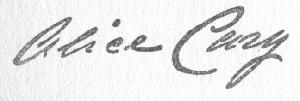
Alice Cary
The promised contributions did not materialize, and The Revolution received no aid of any description. The struggle was bravely continued throughout the first five months of 1870. The Cary sisters were devoted friends of Miss Anthony and deeply interested in the paper, and some of their sweetest poems had appeared in its columns. Their beautiful home was just three blocks below The Revolution office, and she spent many hours with them. These frequent calls, breakfasts and luncheons were much more delightful to her than their Sunday evening receptions, although at those were gathered the writers, artists, musicians, reformers and politicians of New York, besides eminent persons who happened to 359 be in the city. It was a literary center which never has been equalled since those lovely and cultured sisters passed away. In her lecture on "Homes of Single Women," Miss Anthony thus describes one of her visits:
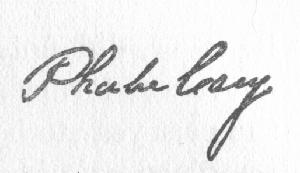
Phoebe Cary
I shall never forget the December Sunday morning when a note came from Phoebe asking, "Will you come round and sit with Alice while I go to church?" Of course I was only too glad to go; and it was there in the cheery sick-room, as I sat on a cushion at the feet of this lovely, large-souled, clear-brained woman, that she told me how ever and anon in the years gone by, as she was writing her stories for bread and shelter, her pen would run off into facts and philosophies of woman's servitude that she knew would ruin her book with the publishers, but which, for her own satisfaction, she had carefully treasured, chapter by chapter, as her heart had thus overflowed. "I am now," she said, "financially free, where I could write my deepest and best thought for woman, and now I must die. O, how much of my life I have been compelled to write what men would buy, not what my heart most longed to say, and what a clog to my spirit it has been."
As she sat there, reading from those chapters, her sweet face, her lustrous eyes, her musical voice all aglow as with a live coal from off the altar, I said: "Alice, I must have that story for The Revolution!" "But I may never be able to finish it," she objected. "We'll trust to Providence for that," I replied; and the last five months of The Revolution carried The Born Thrall to thousands of responsive hearts. But, alas, nature gave way and she was never well enough to put the finishing touches to those terribly true-to-life pictures of the pioneer wife and mother.
The poetry for The Revolution was selected by Mrs. Tilton, who had rare literary taste and discrimination. The exquisite child articles, entitled "Dot and I" and signed Faith Rochester, were written by Francis E. Russell. It had a corps of foreign correspondents, among them the English philanthropist, Rebecca Moore. The distinguished list of contributors and the broad scope of The Revolution may be judged from its prospectus for 1870.[55] The chances of its paying expenses, 360 however, did not increase, and the hoped-for stock company never was formed. Mr. Pillsbury had been most anxious for the past year to be released from his editorial duties, and had remained only because he could not bear to desert the paper in its distress. Mrs. Stanton, engaged in the lecture field, had sent only an occasional article, and now declined to continue her services longer without a salary. One person who stood by Miss Anthony unflinchingly through all this trying period was the publisher, R.J. Johnston, who never once failed in prompt and efficient service, and gave the most conscientious care to the make-up of the paper. Although her indebtedness to him finally reached the thousands, he remained faithful up to the printing of the very last number, and his was the first debt she paid out of the proceeds of her lyceum lectures.
When Mrs. Phelps had opened the Woman's Bureau and invited The Revolution to take an office therein, Miss Anthony had warned her that it might keep other organizations of women away; but she was willing to take the risk. It resulted as prophesied. Not even the strong-minded Sorosis would have its clubrooms there, nor would any other society of women, and after a year's experiment, she gave up her project, rented the building to a private family and The Revolution moved to No. 27 Chatham street. The generous Anna Dickinson, because of her friendship for Miss Anthony, presented Mrs. Phelps with $1,000, as a recompense for any loss she might have sustained through The Revolution. Mrs. Phelps being very ill that winter, added a codicil to her will giving 361 Miss Anthony $1,000 to show that she had only the kindest feelings for her.
At the beginning of 1870, a stock company was formed and the Woman's Journal established in Boston. Mrs. Livermore merged her Chicago paper, the Agitator, into this new enterprise (as she had proposed to do into The Revolution the year previous) removed to Boston and became editor-in-chief; Lucy Stone was made assistant editor and H.B. Blackwell business manager. This paper secured the patronage of all those believers in the rights of women who were not willing to accept the bold, fearless and radical utterances of The Revolution. The latter had exhausted the finances of its friends and had no further resources. The strain upon Miss Anthony, who alone was carrying the whole burden, was terrible beyond description. Never was there a longer, harder, more persistent struggle against the malice of enemies, the urgent advice of friends, against all hope, than was made by this heroic woman. As the inevitable end approached she wrote of it to Mrs. Stanton, who answered: "Make any arrangement you can to roll that awful load off your shoulders. If Anna Dickinson will be sole editor, I say, glory to God! Leave me to my individual work, the quiet of my home for the summer and the lyceum for the winter.... Tell our glorious little Anna if she only will nail her colors to that mast and make the dear old proprietor free once more, I will sing her praises to the end of time."
Anna Dickinson very wisely concluded that she was not suited for an editor. Laura Curtis Bullard was much interested in reform work, possessed of literary ability and very desirous of securing The Revolution. Theodore Tilton, who was editing the New York Independent and the Brooklyn Daily Union, promised to assist her in managing the paper. Miss Anthony at last agreed to let her have it, and on May 22, 1870, the formal transfer was made. She received the nominal sum of one dollar, and assumed personally the entire indebtedness. She had this dollar alone to show for two and a half years of as hard work as ever was performed by mortal, besides all the money she had earned and begged which had 362 gone directly into the paper. During that time $25,000 had been expended, and the present indebtedness amounted to $10,000 more.
Miss Anthony could not view this giving up of The Revolution so philosophically as did Mrs. Stanton; she was of very different temperament. Into this paper she had put her ambition, her hope, her reputation. The stronger the opposition, the firmer was her determination not to yield, nor was it a relief to be rid of it. She would have counted no cost too great, no work too hard, no sacrifice too heavy, could she but have continued the publication. Not only was it a terrible blow to her pride, but it wrung her heart. She could bear the triumph of her enemies far better than she could the giving up of the means by which she had expected to accomplish a great and permanent good for women and for all humanity. On the evening of the day when the paper passed out of her hands forever, she wrote in her diary, "It was like signing my own death-warrant;" and in a letter to a friend she said, "I feel a great, calm sadness like that of a mother binding out a dear child that she could not support." To the public she kept the same brave, unruffled exterior, but in a private letter, written a short time afterwards, is told in a few sentences a story which makes the heart ache:
My financial recklessness has been much talked of. Let me tell you in what this recklessness consists: When there was need of greater outlay, I never thought of curtailing the amount of work to lessen the amount of cash demanded, but always doubled and quadrupled the efforts to raise the necessary sum; rushing for contributions to every one who had professed love or interest for the cause. If it were 20,000 tracts for Kansas, the thought never entered my head to stint the number—only to tramp up and down Broadway for advertisements to pay for them. If to meet expenses of The Revolution, it was not to pinch clerks or printers, but to make a foray upon some money-king. None but the Good Father can ever begin to know the terrible struggle of those years. I am not complaining, for mine is but the fate of almost every originator or pioneer who ever has opened up a way. I have the joy of knowing that I showed it to be possible to publish an out-and-out woman's paper, and taught other, women to enter in and reap where I had sown.
Heavy debts are still due, every dollar of which I intend to pay, and I am tugging away, lecturing amid these burning suns, for no other reason than to keep pulling down, hundred by hundred, that tremendous pile. I sanguinely 363 hope to cancel this debt in two years of hard work, and cheerfully look forward to the turning of every possible dollar into that channel. If you today should ask me to choose between the possession of $25,000 and the immense work accomplished by my Revolution during the time in which I sank that amount, I should choose the work done—not the cash in hand. So, you see, I don't groan or murmur—not a bit of it; but for the good name of humanity, I would have liked to see the moneyed men and women rally around the seed-sowers.
Parker Pillsbury wrote her after he returned home: "No one could do better than you have done. If any complain, ask them what they did to help you carry the paper. I am glad you are relieved of a load too heavy for you to bear. Worry yourself no more. Work of course you will, but let there be no further anxiety and nervousness. Suffrage is growing with the oaks. The whirling spheres will usher in the day of its triumph at just the right time, but your full meed of praise will have to be sung over your grave."
The motto of The Revolution, "The True Republic—Men, their rights and nothing more; women, their rights, and nothing less," was succeeded by "What God hath joined together, let no man put asunder." It was transformed into a literary and society journal, established in elegant headquarters at Brooklyn, inaugurated with a fashionable reception, and conducted by Mrs. Bullard for eighteen months, when she tired of it, or her father tired of advancing money, and it passed into other hands.
When Miss Anthony had her accounts audited by an expert, he stated that The Revolution was in a better financial condition than was the New York Independent at the end of its first five years. She had just begun to realize her power as a lyceum lecturer and was in constant demand at large prices. The last two months before giving up the paper, she sent in from her lectures, above all her expenses, $1,300. She always felt that, with this source of revenue, she could have sustained and in time put it on a paying basis, as her subscription list was rapidly increasing, she had learned the newspaper business, and The Revolution was gaining the confidence of the public. But the experience came too late and she was driven to the 364 wall—not a single friend would longer give her money, assistance or encouragement to continue the paper. To this day, she will take up the bound volumes with caressing fingers, touch them with pathetic tenderness, and pore over their pages with loving reverence, as one reads old letters when the hands which penned them are still forever.
Miss Anthony did not waste a single day in mourning over her great disappointment. In fact, between May 18, when she agreed to give up The Revolution, and May 22, when the transfer actually was made, she went to Hornellsville and lectured, receiving $150 for that one evening. There are not many instances on record where a woman starts out alone to earn the money with which to pay a debt of $10,000. Very few of the advocates of woman suffrage contributed a dollar toward the payment of this debt, which had nothing in it of a personal nature but had been made entirely in the effort to advance the cause. Miss Anthony worked unceasingly through winter's cold and summer's heat, lecturing sometimes under private auspices, sometimes under those of a bureau, and herself arranging for unengaged nights. As she had all her expenses to pay and continued to contribute from her own pocket whenever funds were needed for suffrage work, it was six years before "she could look the whole world in the face for she owed not any man."
She started at once on a western tour, lecturing through Ohio, Kansas and Illinois, speaking in the Methodist church at Evanston, June 3, 1870. Dr. E.O. Haven, president of the university, (afterwards Bishop) in presenting her endorsed woman suffrage. At Bloomington she held a debate with a young professor from the State Normal School. The manager asked if she would take $100 instead of half the receipts, as agreed on. She replied that if the prospects were so good as to warrant him in making this offer, she was just Yankee enough to take her chances. This was a shrewd decision, as her half amounted to $250. The professor opposed the enfranchisement of women because they could not fight. As is the case invariably with men who make this objection, he was a very 365 diminutive specimen, and Miss Anthony could not resist observing as she commenced her speech: "The professor talks about the physical disabilities of women; why, I could take him in my arms and lift him on and off this platform as easily as a mother would her baby!" Of course this put the audience in a fine humor.
In every place she was entertained by representative people and received many social courtesies. She returned to Rochester July 27, spent just twelve hours at home, then hastened eastward, travelling by night in order to reach the Saratoga convention on the 28th. This was held under the auspices of the New York State Association, and managed by the secretary, Matilda Joslyn Gage. Miss Anthony was paid $100, for the first time in the history of conventions. Mrs. Gage wrote: "She is heavily burdened with debt, no one has made so great sacrifices all these years, and she deserves the money." During the summer she sent to a friend in England this summing up of the condition of the suffrage movement in the United States:
The secret of the present inaction is that all our best suffrage men are in the Republican party and must keep in line with its interests, make no demands beyond its possibilities, its safety, its sure success. Hence, just now, while that party is trembling lest it should fall into the minority, and thus give place to the Democracy in 1872, it dares not espouse woman suffrage. So our friends quietly drop our demand on Congress for a Sixteenth Amendment, since to press that body to a vote would compel the Republican members to show their hands; and if those who have in private spoken for woman suffrage should not make a false public record, the number in favor would commit the majority of their party to our question; and by so doing give its opponents fresh opportunity to appeal to the ignorant masses, which must inevitably throw it out of power. The extension of the ballot to woman is a question of intelligence and culture, and is sure to have enrolled against it every narrow, prejudiced, small-brained man in all classes. This being the state of things, our movement is at a dead-lock. Practical action, political action, therefore, is almost hopeless until after the presidential election of 1872; and after that for still another four years, unless the Republican party should be defeated and the Democracy come into power.
Just as soon as the Republicans are out of power, they will betake themselves to the study of principles and begin to preach and promise. Hence I devoutly pray without ceasing for the overthrow of that purse-proud, corrupt, cowardly party; not that I expect from the Democracy anything 366 better than their antecedents promise, but that I know such chastisement, such retirement, is the only means by which conscience and courage can be injected into the heads and hearts of the Republicans, the only way to make them see the political necessity of enfranchising the women of the country, and thereby securing their gratitude and through it their vote to place and hold that party in power.
Then as to our woman suffrage organizations: There are first, the Cleveland movement with all the strategy and maneuvering of its semi-Republican managers, assented to and accepted by the women in their train; then the Fifth Avenue Union Committee affair, which seems not less likely to be under Republican man-power. With Mrs. Stanton's utter refusal to stand at the helm of the National, and our merging it into the Union Society, and with my transferring The Revolution to the new company—we, E.C.S. and S.B.A., have let slip from our hands all control of organizations and newspapers; thus leaving them, I fear, to drift together into the management of mere politicians. All are lulled into the strictest propriety of expression, according to the gospel of St. Republican. And unless that saint shall enact some new and more blasphemous law against woman, which shall wake our confiding sisterhood into a sense of their befoolment, you will neither see nor hear a word from suffrage society or paper which will be in the slightest out of line with the plan and policy of the dominant party. Nothing less atrocious to woman than was the Fugitive Slave Law to the negro, can possibly sting the women of this country into a knowledge of their real subserviency, and out of their sickening sycophancy to the Republican politicians associated with them.
So while I do not pray for anybody or any party to commit outrages, still I do pray, and that earnestly and constantly, for some terrific shock to startle the women of this nation into a self-respect which will compel them to see the abject degradation of their present position; which will force them to break their yoke of bondage, and give them faith in themselves; which will make them proclaim their allegiance to woman first; which will enable them to see that man can no more feel, speak or act for woman than could the old slaveholder for his slave. The fact is, women are in chains, and their servitude is all the more debasing because they do not realize it. O, to compel them to see and feel, and to give them the courage and conscience to speak and act for their own freedom, though they face the scorn and contempt of all the world for doing it!
Not another woman possessed this strong grasp of the whole situation, this deep comprehension of the abject condition of women, the more hopeless because of their own failure to feel or resent it.
During the summer Miss Anthony attended the National Labor Congress in Philadelphia. A great strike of bookbinders had been in progress in New York and she had advised the women to take the vacant places. They were denied admission 367 to all labor unions and their only chance of securing work was when the men and their employers disagreed. This gave a pretext for those who were opposed to a representation of women in labor conventions, and a bitter fight was made upon accepting her as a delegate. Charges of every description were preferred against her which she refuted in a spirited manner, but her credentials were finally rejected. The newspapers took up the fight on both sides, the opposition to Miss Anthony being led by the New York Star, always abusive where the question of woman's rights was concerned. During this controversy the Utica Herald contained a disgraceful editorial, saying:
Who does not feel sympathy for Susan Anthony? She has striven long and earnestly to become a man. She has met with some rebuffs, but has never succumbed. She has never done any good in the world, but then she doesn't think so. She is sweet in the eyes of her own mirror, but her advanced age and maiden name deny that she has been so in the eyes of others. Boldly she marched, and well, into the presence of 200 horrid male delegates of the Labor Congress, and took somebody's seat.... Susan felt very much like a grizzly bear unable to get at its tormentor. She had gone to the length of her chain and couldn't get her claws into any one's hair. She could only sit and glare.
At length Susan's case came up for consideration, and the congress committed the crowning act of rashness and, without a thought of the consequences, made an everlasting enemy of Susan Anthony by ruling her out of the convention as a delegate. This was the unkindest cut of all. "A lone, lorn old critter," with whom everything "goes contrairie," was denied the solace of being counted the one-two-hundreth part of a man by a labor convention! We may well believe that Susan wept with sorrow at the blindness of man, and our sympathy if not our tears is freely offered. But so goes the world. This is not the first time that "man's inhumanity to woman" has made Miss Anthony mourn and, as it is not her first rebuff, we counsel her to seek admission again to the ranks of her sex, and cease to cast reproach upon it by struggling to be a man.
When some of the women remonstrated, the editor replied that he had not supposed there was one woman in Utica who believed in equal rights.
Paulina Wright Davis had been actively arranging for a great convention in New York to celebrate the twentieth anniversary of the first woman's rights convention in Massachusetts, 368 which was held at Worcester, in October, 1850. That one had been managed almost wholly by Mrs. Davis and she had presided over its deliberations, therefore it seemed proper for her to be the central figure in celebrating its second decade. The New England suffrage people declined to take part in this meeting and, for some reason, Mr. Tilton's Union Society was decidedly averse to it. Mrs. Davis finally became ill from anxiety and overwork and joined her entreaties to Mrs. Stanton's that Miss Anthony should drop her lectures and come to New York; so she started for that city September 30, determined that Mrs. Davis' scheme should not be a failure. The entries in her journal give some idea of her energetic and unwearied action:
As soon as I reached New York I went to Dr. Lozier's for lunch, then to see Mrs. Phelps. All in despair about the decade meeting. Went at once to consult Alice and Phoebe Cary; from them to Mrs. Winchester, found her just home from Europe; then to Julia Brown Bemis, and thence to Murray street to see Mr. Studwell; then to Tenafly on the evening train.... Back to New York the next morning, to Tilton's, to Curtis', to Mrs. Wilbour's, and then to Providence to see Mrs. Davis. Beached there late at night, woke her up and we talked till morning. She was terribly distressed at the thought of giving up the decade and in the morning I telegraphed to New York that it must go on.... Went there by first train, had all the newspaper notices of its abandonment countermanded and new ones put in, and an item sent out by Associated Press. Too late for last train to Tenafly and had to hire a carriage to take me there.
Her time was then divided between working on speeches with Mrs. Stanton and rushing over to New York to prepare for this meeting. On October 19 she writes: "Ground out the resolutions, and took the afternoon train for the city. Met Martha Wright and Mrs. Davis at the St. James Hotel."
There was a great reception the next afternoon in the hotel parlors, and the convention met at Apollo Hall, October 21, the whole of the arrangements having been made in three weeks. Mrs. Davis presided, everybody had been brought into line and it was a notable gathering. Cordial and approving letters to Mrs. Davis were read from Jacob Bright, Canon Kingsley, Frances Power Cobbe, Emily Faithfull, Mary Somerville, 369 Emelie J. Meriman (afterwards the wife of Père Hyacinthe), and other distinguished foreigners. Miss Anthony spoke strongly against their identifying themselves with either of the parties until it had declared for woman suffrage, urging them to accept every possible help from both but to form no alliance, as had been proposed. The feature of the occasion was "The History of the Woman's Rights Movement for Twenty Years," carefully prepared by Mrs. Davis.[56] In addition to this valuable work, she contributed $300 to the expenses of the meeting. It was an unqualified success and her letters were full of warmest gratitude to Miss Anthony.
In November the latter resumed her lecturing tour which was arranged by Elizabeth Brown, who had been her head clerk in The Revolution office. The first of December she attended the Northwestern Woman Suffrage Convention at Detroit. Here she received a telegram to hasten home and arrived just in time to stand by the death-bed of a dear nephew, Thomas King McLean, twenty-one years old, brother of the beloved Ann Eliza who had died a few years before, and only son of her sister Guelma. He was a senior of brilliant promise in Rochester University. His death was a heavy blow to all the family and one from which his mother never recovered.
With her debts pressing upon her and an array of lecture engagements ahead, Miss Anthony could neither pause to indulge her own grief nor to console and sympathize with the loved ones. The very night of the funeral she again set forth. By the New Year she had lessened her debt $1,600. This trip extended through New York and Pennsylvania, to 370 Washington and into Virginia. Of the last she writes: "A great work to be done here but the lectures can not possibly be made to pay expenses." In Philadelphia she spoke in the Star course, was the guest of Anna Dickinson and was introduced to her audience by Lucretia Mott, then seventy-seven years old. The diary relates that Mrs. Mott came next morning before 8 o'clock to give her $20, saying it was very little but would show her confidence and affection. The lecture given on this tour was entitled "The False Theory" and was highly commended by the press. It never was written and probably never twice delivered in the same words, Miss Anthony always depending largely upon the inspiration of the occasion.
The middle of December she slipped back to Rochester to see her bereaved sister, and speaks of their receiving a letter of sympathy from Rev. J.K. McLean, which, she says, "is the first philosophical word that has been spoken." While at home she was invited to the Hallowells' to see Wendell Phillips, their first meeting since their sad difference of opinion concerning the Fourteenth Amendment. They had a cordial interview and she went with him to his lecture in the evening. The entry in the journal that night closes with the underscored sentence, "Phillips is matchless."
[55] The demands for woman everywhere today are for a wider range of employment, higher wages, thorough mental and physical education, and an equal right before the law in all those relations which grow out of the marriage state. While we yield to none in the earnestness of our advocacy of these claims, we make a broader demand for the enfranchisement of woman, as the only way in which all her just rights can be permanently secured. By discussing, as we shall incidentally, leading questions of political and social importance, we hope to educate women for an intelligent judgment upon public affairs, and for a faithful expression of that judgment at the polls.
As masculine ideas have ruled the race for six thousand years, we especially desire that The Revolution shall be the mouth piece of women, to give the world the feminine thought in politics, religion and social life; so that ultimately in the union of both we may find the truth in all things. On the idea taught by the creeds, codes and customs of the world, that woman was made for man, we declare war to the death, and proclaim the higher truth that, like man, she was created by God for individual moral responsibility and progress here and forever.
Our principal contributors this year are: Anna Dickinson, Isabella Beecher Hooker, Harriet Beecher Stowe, Alice and Phoebe Cary, Olive Logan, Mary Clemmer, Mrs. Theodore Tilton, Matilda Joslyn Gage, Phoebe Couzins, Elizabeth Boynton and others; and foreign, Rebecca Moore, Lydia E. Becker and Madame Marie Goeg.
The Revolution is an independent journal, bound to no party or sect, and those who write for our columns are responsible only for what appears under their own names. Hence, if old Abolitionists and Slaveholders, Republicans and Democrats, Presbyterians and Universalists, Catholics and Protestants find themselves side by side in writing on the question, of woman suffrage, they must pardon each other's differences on all other points, trusting that by giving their own views strongly and grandly, they will overshadow the errors by their side.
A large correspondence was conducted in regard to the Third National Convention, which was to be held in Washington in January, 1871. Isabella Beecher Hooker, who had all the zeal of a new convert, created some amusement among the old workers by offering to relieve them of the entire management of the convention, intimating that she would avoid the mistakes they had made and put the suffrage work on a more aristocratic basis. To Mrs. Stanton she wrote:
I have proposed taking the Washington convention into my own hands, expenses and all; arranging program, and presiding or securing help in that direction, if I should need it. I shall hope to get Robert Collyer, and a good many who might not care to speak for "the Union" but would speak for me. I should want from you a pure suffrage argument, much like that you made before the committee at Washington last winter. I know you are tired of this branch, but you are fitted to do a great work still in that direction.... Won't you promise to come to my convention, without charge save travelling expenses, provided I have one? I am waiting to hear from Susan, Mrs. Pomeroy and you, and then shall get Tilton's approval and the withdrawal of the society from the work, if they have undertaken it, and go ahead.
Mrs. Stanton consented gladly and wrote the other friends to do likewise, saying: "I should like to have Susan for president, as she has worked and toiled as no other woman has, but if we think best not to blow her horn, then let us exalt Mrs. Hooker, who thinks she could manage the cause more discreetly, more genteelly than we do. I am ready to rest and see the salvation of the Lord." On their rounds the 372 letters came to Martha Wright, the gentle Quaker, who commented with the fine irony of which she was master: "It strikes me favorably. It would be a fine thing for Mrs. Hooker to preside over the Washington convention, while her sister, Catharine Beecher, was inveighing against suffrage, for the benefit of Mrs. Dahlgren and others. Perhaps she is right in thinking that Robert Collyer and a good many others who would not care to speak for 'the Union,' would speak for her—I for one would be glad to have her try it! If 'Captain Susan' would consent to be placed at the head of the association, there could not be a more suitable and just appointment."
Mrs. Stanton wrote that her lecture engagements would not permit her to go to Washington and she would send $100 instead. Mrs. Hooker replied:
Your offer just suits me, and of myself I should accept $100 with thankfulness, and excuse you, as you desire, but Susan looked disgusted and said, "She must appear before the Congressional committees, at any rate." I had not thought of that, but of course, if you were in Washington, it would be absurd not to be on our platform; and so I don't know what to say. You will talk more forcibly than any one else, and in committee you are invaluable. Still, I want your money, and I could do without you on the platform.... I fully expect, to accomplish far more by a convention devoted to the purely political aspect of the woman question, than by a woman's rights convention, however well-managed; and this, because the time has come for this practical work—discussion has prepared the way, now we must have the thing, the vote itself. It just occurs to me that you might write an argument for the committee, which I would read, but of course your presence is most desirable, and I incline to have you on hand for this last, great effort; for it does seem to me that we need not have another convention in Washington, but only a select committee to work privately every winter, and send for speakers, etc., when the committees are ready to grant hearings.
It is the part of wisdom to suppress Mrs. Stanton's reply to this, but she sent it to Martha Wright, who answered her:
You can imagine what success Mrs. Hooker will have with those wily politicians. She thinks they will come serenely from their seats to the lobby, when she tries "all the means known to an honest woman." I fear the means known to the other sort would meet a readier response. I forget which of the senators it was, last winter, who said rudely to Mrs. Davis and Mrs. Griffing, "You just call us out because you like to."... Mrs. Hooker will find it no easy matter to hook them on to her platform, but she will be wiser after trying. She is mistaken in considering the cause so nearly won, 373 but it would be as impossible for her to realize the situation as it was for Rev. Thomas Beecher to be convinced that Mr. Smith saw more clearly than he. "Do you mean," said this potentate, "to bring down the whole Beecher family on your head?" "No," was the reply, "do you mean to bring the whole Smith family on to yours?"
The following circular letter was sent to Curtis, Phillips and other prominent men:
A convention has been announced at Washington, for January 11 and 12, to push the Sixteenth Amendment. The management is solely in my hands, and I alone assume the financial responsibility. I go to Washington January 1 to spend some days enlisting members of Congress in this purely political question, and securing short speeches from them on our platform. I have neither State nor national society behind me, but am attempting to carry on a convention with this single aim—to awaken Congress and, through it, the country, to the fact that a Sixteenth Amendment is needed, in order to carry out the principles of the Declaration of Independence; and that we women are tired of petitioning, and would fain begin to vote without delay. Will you speak for me in the day or the evening, and much oblige your sincere friend, ISABELLA B. HOOKER.
Evidently they would not speak, even "for me," and Mrs. Hooker sends around this note of explanation to the "old guard:" "I know of no gentlemen outside of members of Congress, that can help us at all, who can come. Beecher, Collyer, Curtis and Phillips are all unable. If you think of any one else it would be worth while to invite, please write me at once. I have such a strong determination that members shall understand how much we are in earnest at this time, and how we won't wait any longer, that it does seem to me they will take up a burden of speech themselves, and work also. Mr. Sewall, of Boston, writes me that he will urge Mr. Sumner, as I requested, and other members, but thinks they can not need it."
Miss Anthony, however, declined to be snubbed, subdued or displaced, and wrote to Mrs. Stanton in the following vigorous style:
Mrs. Hooker's attitude is not in the least surprising. She is precisely like every new convert in every reform. I have no doubt but each of the Apostles in turn, as he came into the ranks, believed he could improve upon Christ's methods. I know every new one thought so of Garrison's and Phillips'. The 374 only thing surprising in this case is that you, the pioneer, should drop, and say to each of these converts: "Yes, you may manage. I grant your knowledge, judgment, taste, culture, are all superior to mine. I resign the good old craft to you altogether." To my mind there never was such suicidal letting go as has been yours these last two years.
But I am now teetotally discouraged, and shall make no more attempts to hold you up to what I know is not only the best for our cause, but equally so for yourself, from the moral standpoint if not the financial. O, how I have agonized over my utter failure to make you feel and see the importance of standing fast and holding the helm of our good ship to the end of the storm. Mr. Greeley's "On to Richmond" backdown was not more sad to me, not half so sad. How you can excuse yourself, is more than I can understand.
Mrs. Stanton commented to Mrs. Wright: "For your instruction in the ways of the world, I send you Susan's letter. You see I am between two fires all the time. Some are determined to throw me overboard, and she is equally determined that I shall stand at the masthead, no matter how pitiless the storm."
Mrs. Hooker found hers was a greater task than she had anticipated and finally wrote Miss Anthony: "God knows, and you ought to know, that any one who undertakes a convention has put self-seeking one side and is nearer to being a martyr, stake, fagots and all, than any of us care to be unless called by duty with a loud and unmistakable call. I shirked the labor last year and pitied you because so much fell upon you, and out of pure love to you and to the cause determined this time to take all I could on my own shoulders, but you must come and help out."
Mrs. Stanton still persisted in her determination not to go to this convention but Miss Anthony cancelled eight or ten lecture engagements, at from $50 to $75 each, in order to be present in person and see that the affair was properly managed. Mrs. Hooker, however, was fully equal to the occasion, her convention was a marked success and she proved to be one of the most valuable acquisitions to the ranks of workers for woman suffrage. She soon learned that the opposition to be overcome was far greater than she had imagined, and after nearly thirty years' effort, not even in her own State have women been able to secure their enfranchisement. It seems, however, a bit of 375 poetic justice that this convention, which was to lift the movement for woman suffrage to a higher plane than it ever before had occupied, should have been the first to invite to its platform Victoria C. Woodhull, whose advent precipitated a storm of criticism compared to which all those that had gone before were as a summer shower to a Missouri cyclone.
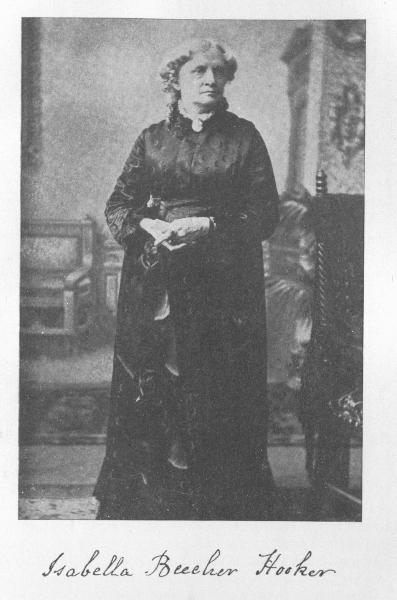
Isabella Beecher Hooker
On December 21, 1870, Mrs. Woodhull had gone to Washington with a memorial praying Congress to enact such laws as were necessary for enabling women to exercise the right to vote vested in them by the Fourteenth Amendment to the Constitution of the United States. This was presented in the Senate by Harris, of Louisiana, and in the House by Julian, of Indiana, referred to the judiciary committees and ordered printed. She had taken this action without consulting any of the suffrage leaders and they were as much astonished to hear of it as were the rest of the world. When they arrived at the capital another surprise awaited them. On taking up the papers they learned that Mrs. Woodhull was to address the judiciary committee of the House of Representatives the very morning their convention was to open. Miss Anthony hastened to confer with Mrs. Hooker, who was a guest at the home of Senator Pomeroy, and to urge that they should be present at this hearing and learn what Mrs. Woodhull proposed to do. Mrs. Hooker emphatically declined, but the senator said: "This is not politics. Men never could work in a political party if they stopped to investigate each member's antecedents and associates. If you are going into a fight, you must accept every help that offers."
Finally they postponed the opening of their convention till afternoon and, on the morning of January 11, Miss Anthony, Mrs. Hooker, Paulina Wright Davis and Hon. A. G. Riddle appeared in the judiciary committee room. None of them had met Mrs. Woodhull, whom they found to be a beautiful woman, refined in appearance and plainly dressed. She read her argument in a clear, musical voice with a modest and engaging manner, captivating not only the men but the ladies, who invited her to come to their convention and repeat it. Mrs. 376 Hooker and Judge Riddle also addressed the committee and Miss Anthony closed the proceedings with a short speech, thus reported by the Philadelphia Press:
She said few women had persecuted Congress as she had done, and she was glad that new, fresh voices were heard today. "But, gentlemen," she continued, "I entreat you to bring this matter before the House. You let our petition, presented by Mr. Julian last winter, come to its death. I ask you to grant our appeal so that I can lay off my armor, for I am tired of fighting. The old Constitution did not disfranchise women, and we begged you not to put the word 'male' into the Fourteenth Amendment. I wish, General Butler, you would say contraband for us. But, gentlemen, bring in a report of some kind, either for or against; don't let the matter die in committee. Make it imperative that every man in the House shall show whether he is for or against it." Mrs. Hooker caught the refrain as Miss Anthony sat down, and said: "Pledge yourselves that we shall have a hearing before Congress."
The Daily Patriot, of Washington, gave this account of the opening of the convention:
About 3 o'clock the principal actors came upon the stage in Lincoln Hall. In the center of the front row was Paulina Wright Davis, a stately, dignified lady with a full suit of frosted hair. On her right was Isabella Beecher Hooker, the ruling genius of the assembly, of commanding voice and look, and evidently at home on the rostrum. On the left was Josephine S. Griffing, of this city, wearing the calm, imperturbable expression which is so eminently her characteristic. Further on was Susan B. Anthony, "the hero of a hundred fights," but still as eager for the fray as when she first enlisted under the banner of woman's rights.... Then came the two New York sensations, Woodhull and Claflin, both in dark dresses, with blue neckties, short, curly brown hair, and nobby Alpine hats, the very picture of the advanced ideas they are advocating. All were fresh from the scene of their contest in the Capitol, wreathed with smiles, flushed with victory, and evidently determined to let the world know that the goal of their ambition was nearly reached; that Congress had virtually surrendered at discretion, and hereafter they were to be considered part and parcel of that great body denominated American citizens.
Mrs. Hooker introduced Victoria Woodhull, saying it was her first attempt at public speaking, but her heart was so in the movement that she was determined to try. She advanced to the front of the platform, but was so nervous that she required the assuring arm of the president and her kindly voice to give her courage to proceed. When she did, it was with a perceptible tremor in her tones. After an apology, she read her memorial, which had been presented to the judiciary committee, reported the result of her interview with them, and said she had the assurance that it would be favorably reported, and that the heart of every man in Congress was in the 377 movement. Thus ended the first effort of the great Wall street broker as a public speaker.
She was followed by Josephine S. Griffing, Lillie Devereux Blake, Frederick Douglass and others. Judge Riddle made the address of the evening. Senator Nye, of Nevada, presided over one evening session; Senator Warner, of Alabama, over one; and Senator Wilson, of Massachusetts, over another. The correspondent of the Philadelphia Press wrote: "Mrs. Woodhull sat sphynx-like during the convention. General Grant himself might learn a lesson of silence from the pale, sad face of this unflinching woman. No chance to send an arrow through the opening seams of her mail.... She reminds one of the forces in nature behind the storm, or of a small splinter of the indestructible; and if her veins were opened they would be found to contain ice." The National Republican thus describes one session:
The attendance yesterday morning clearly demonstrated that the woman's movement has received an immense addition in numbers, quality and earnestness.... Miss Anthony, with her face all aglow, her eyes sparkling with indignation, said that a petition against suffrage had been presented in the Senate by Mr. Edmunds, signed by Mrs. General Sherman, Mrs. Admiral Dahlgren and others. She was glad the enemies of the movement at last had shown themselves. They were women who never knew a want, and had no feeling for those who were less fortunate. They had boasted that if necessary they could get one thousand more signatures of the best women in the land to their petition. What are a thousand names, and who are the best women in the land? In answer to the one thousand the advocates of suffrage could bring tens, aye, hundreds of thousands of women who desire the ballot for self-protection. The fight had now commenced in earnest, and it would not be ended until every woman in this broad land was vested with the full rights of citizenship.
The tenor of all the speeches was the right of women to vote under the recently adopted Fourteenth Amendment. There was an absence of the usual long series of resolutions, and all were concentrated in the following, presented by Miss Anthony:
Whereas, The Fourteenth Article of the Constitution of the United States declares that all persons born or naturalized in the United States are citizens thereof, and of the State wherein they reside, and as such entitled to the unabridged 378 exercise of the privileges and immunities of citizens, among which are the rights of the elective franchise; therefore
Resolved, That the Congress of the United States be earnestly requested to pass an act declaratory of the true extent and meaning of the said Fourteenth Article.
Resolved, That it is the duty of American women in the several States to apply for registration at the proper times and places, and in all cases when they fail to secure it to see that suits be instituted in the courts having jurisdiction, and that their right to the franchise shall secure general and judicial recognition.
In presenting the resolutions she said that if Congress failed to do what was asked, and if the courts decided that "persons" are not citizens, then the women had another resource; they could go back to first principles and push the Sixteenth Amendment. A national woman suffrage and educational committee of six was formed, herself among the number; and a large book was opened containing a "Declaration and Pledge of Women of the United States," written by Mrs. Hooker, asserting their belief in their right to the suffrage and their desire to use it. This was signed within a few months by 80,000 women and presented to Congress. The following spring large numbers attempted to vote in various parts of the country.
The advent of Mrs. Woodhull on the woman suffrage platform created a wide-spread commotion. The old cry of "free love" was redoubled, the enemies exulted loud and long, the friends censured and protested. Regarding this matter, Mrs. Hooker wrote:
My sister Catharine says she is convinced now that I am right and that Mrs. Woodhull is a pure woman, holding a wrong social theory, and ought to be treated with kindness if we wish to win her to the truth. Catharine wanted me to write her a letter of introduction, so that when she went to New York she could make her acquaintance and try to convince her that she is in error in regard to her views on marriage. I gave her the letter and she is in New York now. When she sees her she will be just as much in love with her as the rest of us. Imagine the Dahlgren coterie when they get Catharine to Washington to fight suffrage and find her visiting Victoria and proclaiming her sweetness and excellence.
The rest of the story is told in a subsequent letter: "Sister 379 Catharine returned last night. She saw Victoria and, attacking her on the marriage question, got such a black eye as filled her with horror and amazement. I had to laugh inwardly at her relation of the interview and am now waiting for her to cool down!"
The men especially were exercised over the new convert to suffrage and flooded the ladies with letters of protest. To one of these Mrs. Stanton replied:
In regard to the gossip about Mrs. Woodhull I have one answer to give to all my gentlemen friends: When the men who make laws for us in Washington can stand forth and declare themselves pure and unspotted from all the sins mentioned in the Decalogue, then we will demand that every woman who makes a constitutional argument on our platform shall be as chaste as Diana. If our good men will only trouble themselves as much about the virtue of their own sex as they do about ours, if they will make one moral code for both men and women, we shall have a nobler type of manhood and womanhood in the next generation than the world has yet seen.
We have had women enough sacrificed to this sentimental, hypocritical prating about purity. This is one of man's most effective engines for our division and subjugation. He creates the public sentiment, builds the gallows, and then makes us hangmen for our sex. Women have crucified the Mary Wollstonecrafts, the Fanny Wrights, the George Sands, the Fanny Kembles, of all ages; and now men mock us with the fact, and say we are ever cruel to each other. Let us end this ignoble record and henceforth stand by womanhood. If Victoria Woodhull must be crucified, let men drive the spikes and plait the crown of thorns.

Lucinda Hinsdale Stone
Immediately after the Washington convention, Miss Anthony went to fill a lecture engagement at Kalamazoo, the arrangements made by her friend, the widely-known and revered Lucinda H. Stone. She spoke also at Grand Rapids and other points in Michigan. At Chicago she was fortunate enough to have a day with Mrs. Stanton, also on a lecturing tour, and then took the train for Leavenworth. At Kansas City the papers said she made "the success of the lecture season." She spoke in Leavenworth, Lawrence, Topeka, Paola, Olathe and other places throughout the State. Although it was very cold and the half-frozen mud knee deep, she usually 380 had good audiences. At Lincoln, Neb., she was entertained at the home of Governor Butler and introduced by him at her lecture. At Omaha her share of the receipts was $100. At Council Bluffs she was the guest of her old fellow-worker, Amelia Bloomer. Cedar Rapids and Des Moines gave packed houses. She lectured in a number of Illinois towns, taking trains at midnight and at daybreak; and, waiting four hours at one little station, the diary says she was so thoroughly worn-out she was compelled to lie down on the dirty floor. On the homeward route she spoke at Antioch College, and was the guest of President Hosmer's family. According to the infallible little journal: "The president said he had listened to all the woman suffrage lecturers in the field, but tonight, for the first time, he had heard an argument; a compliment above all others, coming from an aged and conservative minister."
She spoke also at Wilberforce University, at Dayton, Springfield, Crestline, and in Columbus before the two Houses of the Legislature. At Salem she ran across Parker Pillsbury, who was lecturing there. When she took the train at Columbus "there sat Mrs. Stanton, fast asleep, her gray curls sticking out." Then again into Michigan she went, speaking at Jackson, Lansing, Ann Arbor and other cities. Mrs. Stanton had preceded her and it was many times said that her lecture needed Miss Anthony's to make it complete. Then to Chicago, where she spoke at a suffrage matinee in Farwell Hall and at the Cook county annual suffrage convention, and dined at Robert Collyer's; back to Iowa, speaking at Burlington, Davenport, Mount Pleasant and Ottumwa; over into Nebraska once more, from there returning to Illinois; into Indiana, thence to Milwaukee and points in Wisconsin; and once more to Chicago, where, as was often the case, she was the guest of Mr. and Mrs. Fernando Jones; from here across to Painesville and other towns in northern Ohio; then on to numerous places in western New York, and finally home to Rochester, April 25, having slept scarcely two nights in the same bed for over three months.
Such is the hard life of the public lecturer, the most exhausting 381 and exacting which man or woman can experience. During all this long trip Miss Anthony had met everywhere a cordial welcome and had been entertained in scores of delightful homes. Her speech on this tour was entitled "The New Situation," and was a clear and comprehensive argument to prove that the Fourteenth Amendment gave women the right to vote. Although composed largely of legal and constitutional references, it was not written but drawn from the storehouse of her wonderful memory, aided only by a few notes.
At the close of the Washington convention the advocates of woman suffrage honestly believed that the battle was almost won. They felt sure Congress would pass the enabling act, permitting them to exercise the right that they claimed to be conferred by the Fourteenth Amendment, in which claim they were sustained by some of the best constitutional lawyers in the country. The agricultural committee room in the Capitol was placed at the disposal of the national woman suffrage committee, who put Josephine S. Griffing in charge. The latter part of January she wrote:
Our room is thronged. Yesterday and today no less than twelve wives of members of Congress were here and large numbers of the aristocratic women of Washington. Blanche Butler Ames assures me that all her sympathies are with us. President Grant's sister, Mrs. Cramer, has been here and given her name, saying that Mrs. Grant sent her regards and sympathized with our movement, and that she had refused from principle to sign Mrs. Sherman's protest.... The daily press is on its knees and is publishing long editorials in our favor. You ask if this is a Republican dodge. I do not know. I feel as Douglass did, ready to welcome the bolt from heaven or hell that shivers the chains. If the Republicans hope to save their lives by our enfranchisement, let them live.
Mrs. Hooker wrote from Washington: "Everything conspires to bring about the early confirmation of our hopes. Republicans are discovering that without this new, live issue, they are dead, and once more party necessity is to be God's opportunity. Let us, who know so many good men and true who are in this party, be thankful that through it, rather than through the Democratic, deliverance is to come, for to owe 382 gratitude to a pro-slavery party would nearly choke my thanksgiving."
To this Mrs. Stanton replied: "That is not the point, but which party, as a party, has the best record on our question. For four years I have chafed under the Republican maneuvering to keep us still. Let me call your attention to my speech on the Fifteenth Amendment, in which I said 'this is a new stab at womanhood, to result in deeper degradation to her than she has ever known before.'... Sometimes I exclaim in agony, 'Can nothing raise the self-respect of women?' I despise the Republican party for the political serfdom we suffer today, under the heel of every foreign lord and lackey who treads our soil. If all of you have turned to such idols, I will go alone to Jerusalem."
When the judiciary committee made its adverse report[57] which was merely that Congress had not the power to act, most of the friends were not discouraged but believed another committee would decide differently. Mrs. Hooker, however, was at the boiling point of indignation over the report and reversed her decision in regard to the Republican party, writing: "Thank God! that party is dead; every one here knows it, feels it, and is waiting to see what will take its place. A great labor and woman suffrage party is ready to spring into life, and a hundred aristocratic Democrats are pledged to the work. You can have no conception of the new conditions unless you are here in the midst of things and read the telegrams from all parts of the country. Early next winter we shall be declared voting citizens." She then quotes a number of prominent Democratic politicians whom she has interviewed and who have given her reason for having faith in that party. But many of the women were fooled then by both political parties, just as they have continued to be up to the present time.
A letter from Phoebe Couzins expressed the sentiment of 383 numbers which were received this spring: "We made a grand mistake in giving up the National. If you and Mrs. Stanton think best, as your fingers are on the pulse of the people, let us resolve the Union Society into the National Association. So say Mr. and Mrs. Minor, but whatever is done, the two grand women who have the qualifications for leadership must be at the head; the cause will languish until you are back in your old places."
The suffrage anniversary was held in Apollo Hall, New York, May 11 and 12, 1871. Mrs. Griffing read an able report on the work at Washington the previous winter. There were strong objections by a number of ladies to sitting on the platform with Mrs. Woodhull, but Mrs. Stanton said she should be sandwiched between Lucretia Mott and herself and that surely would give her sufficient respectability. She made a fine constitutional argument, to which the most captious could not object. The excitement created by her appearance at the Washington meeting was mild compared to that in New York City where she was becoming so well-known. The great dailies headed all reports, "The Woodhull Convention." The injustice and vindictiveness of the Tribune, that paper which once had been the champion of woman's cause, were especially hard to bear. It rang the changes upon the term "free love," insisted that, because the women allowed Mrs. Woodhull to stand upon their platform and advocate suffrage, they thereby indorsed all her ideas on social questions, and by every possible means it cast odium on the convention.
There is no doubt that the advocates of "free love," in its usually accepted sense, did endeavor to insinuate themselves among the suffrage women and make this movement responsible for their social doctrines, but every great reform has to suffer from similar parasites. The lives of Miss Anthony, Mrs. Mott, Mrs. Stanton, Mrs. Hooker, Mrs. Davis, and of all the old and tried leaders in this cause, form the strongest testimony of their utter repudiation of any such heresy. It was impossible, however, for the world in general to understand their broad ground that it was their business to accept valuable 384 services without inquiring into the private life of the persons who offered them. If this were a mistake, these pioneers, who fought single-handed such a battle as the women of later days can not comprehend, had to learn the fact by experience.
The notorious Stephen Pearl Andrews prepared a set of involved and intricate resolutions which were read by Paulina Wright Davis, the chairman, without any thought of their possessing a deeper meaning than appeared on the surface, but they fell flat on the convention, and were neither discussed nor voted upon. The papers got possession of them, nevertheless, declared that they were adopted as part of the platform, read "free love" between the lines, and used them as the basis of many ponderous and prophetic editorials.
A national committee was formed of one woman from each State, with Mrs. Stanton as chairman, of which the New York Standard, edited by John Russell Young, said: "Miss Susan B. Anthony holds a modest position, but we can well believe that in any movement for the enfranchisement of women, like MacGregor, wherever she sits will be the head of the table." The New York Democrat commented: "She deals with facts, not theories, but just gets hold of one nail after another and drives it home.... Her words were to the point, as they always are, and abounded in telling hits in every direction." Even the Tribune was generous enough to say: "The ranks of the agitators with whom Captain Anthony is identified contain no one more indiscreet, more reckless or more honest. We have no sort of sympathy with the object to which the fair captain is now devoting her life; but we know no person before the country more single-minded, sincere and unselfish and, for these reasons, more honestly entitled to the regard of a public which will always appreciate upright intentions and disinterested devotion."
In the closing days of May, she wrote to her old paper, The Revolution:
Your "Stand by the Cause," this week, is the timely word to the friends of woman suffrage. The present howl is an old trick of the arch-fiend to divert public thought from the main question, viz: woman's equal freedom 385 and equal power to make and control her own conditions in the state, in the church and, most of all, in the home.
Though the ballot is the open sesame to equal rights, there is a fundamental law which can not be violated with impunity between woman and man, any more than between man and man; a law stated a hundred years ago by Alexander Hamilton: "Give to a man a right over my subsistence, and he has power over my whole moral being." Woman's subsistence is in the hands of man, and most arbitrarily and unjustly does he exercise his consequent power, making two moral codes: one for himself, with largest latitude—swearing, chewing, smoking, drinking, gambling, libertinism, all winked at—cash and brains giving him a free pass everywhere; another quite unlike this for woman—she must be immaculate. One hair's breadth deviation, even the touch of the hem of the garment of an accused sister, dooms her to the world's scorn. Man demands that his wife shall be above suspicion. Woman must accept her husband as he is, for she is powerless so long as she eats the bread of dependence. Were man today dependent upon woman for his subsistence, I have no doubt he would very soon find himself compelled to square his life to an entirely new code, not a whit less severe than that to which he now holds her. In moral rectitude, we would not have woman less but man more.
It is to put an end to such heresies as the following, from the Rochester Democrat, that all women should most earnestly labor. That paper begs us not to forget, "that what may be pardonable in a man, speaking of evils generally, may and perhaps ought to be unpardonable in one of the presumably better sex; because there can not and must not be perfect equality between men and women when the disposition to do wrong is under discussion. Women are permitted to be as much better than men as they choose; but there ought to be no law, on or oft the statute books, recognizing their social and political right to be worse or even as bad as men; and it is shameful that intelligent women should claim such a right, or even dare to mention it at all." No human being or class of human beings would venture to talk thus to equals. It is only because women are dependent on men that such cowardly impudence can be dished out to them day after day by puny legislators and editors, themselves often reeking in social corruption which should banish them forever from the presence of womanhood. Yours for an even-handed scale in morals as well as politics, SUSAN B. ANTHONY.
At the close of the New York convention Miss Anthony, Rev. Olympia Brown and Josephine S. Griffing went with Mrs. Hooker to Hartford for a short visit, which it may be imagined was one protracted "business session." Then Miss Anthony hastened to her own home to prepare for a long journey, as she and Mrs. Stanton had decided to make a lecture tour through California. She left Rochester the last day of May, and met Mrs. Stanton in Chicago where a reception was given them by the suffrage club, in its elegant new headquarters. They spoke in a number of cities en route and attended numerous handsome receptions held in their honor. At Denver they were entertained by Governor and Mrs. McCook. Their audiences were large and enthusiastic, the press respectful and often cordial and appreciative.[58] At Laramie City they were 388 accompanied to the station by a hundred women whom Mrs. Stanton addressed from the platform. A letter written by Miss Anthony during the journey contains these beautiful paragraphs:
We have a drawing-room all to ourselves, and here we are just as cozy and happy as lovers. We look at the prairie schooners slowly moving along with ox-teams, or notice the one lone cabin-light on the endless plains, and Mrs. Stanton will say: "In all that there is real bliss, if only the two are perfect equals, two loving people, neither assuming to control the other." Yes, after all, life is about one and the same thing, whether in the prairie schooner and sod cabin, or the Fifth Avenue palace. Love for and faith in each other alone can make either a heaven, and without these any home is a hell. It is not the outside things which make life, but the inner, the spirit of love which casteth out all devils and bringeth in all angels.
Ever since 4 o'clock this morning we have been moving over the soil that is really the land of the free and the home of the brave—Wyoming, the Territory in which women are the recognized political equals of men. Women here can say: "What a magnificent country is ours, where every class and caste, color and sex, may find equal freedom, and every woman sit under her own vine and fig tree." What a blessed attainment at last; and that it should be here among these everlasting mountains, midway between the Atlantic and Pacific, seems significant of the true growth of the individual—the center pure, the heart-beats free and equal.
At Salt Lake City they were the guests of Mr. and Mrs. W.S. Godbe, and were presented to their audience by Mayor Wells, who afterward took them to call on his five wives. The second evening they were introduced by Bishop Orson Pratt. From here Miss Anthony writes to The Revolution:
If I were a believer in special providences, I should say that our being in Salt Lake City at the dedication of the New Liberal Institute was one. On Sunday morning, July 2, this beautiful hall of the Liberal party—Apostate party, the Saints call it—was well filled. The services consisted of invocations, hymns and brief addresses. Messrs. Godbe, Harrison, Lyman and Lawrence seem to be the advance-guard—the high priests of the new order—and as they sang their songs of freedom, poured out their rejoicings over their 389 emancipation from the Theocracy of Brigham, and told of the beatitudes of soul-to-soul communion with the All-Father, my heart was steeped in deepest sympathy with the women around me and, rising at an opportune pause, I asked if a woman and a stranger might be permitted to say a word. At once the entire circle of men on the platform arose and beckoned me forward; and, with a Quaker inspiration not to be repeated, much less put on paper, I asked those men, bubbling over with the divine spirit of freedom for themselves, if they had thought whether the women of their households were today rejoicing in like manner? I can not tell what I said—only this I know, that young and beautiful, old and wrinkled women alike wept, and men said, "I wanted to get out of doors where I could shout."
The transition of this people into the new life is complicated—is heartrending. Remember that when these men began their rebellion against Brigham, it was simply a protest against his tyranny—his exorbitant tithing system—a mere refusal to render tribute unto him; not at all a disavowal of the Morman religion or of polygamy. But as bond after bond has burst, this last, strongest and tightest one of plurality of wives is beginning to snap asunder. To illustrate: One man, a noble, loving, beautiful spirit—nothing of the tyrant, nothing of the sensualist—with four lovely wives, three of whom I have seen, and in the homes of two of whom I have broken bread, with thirteen loved and loving children—wakes up to the new idea. Four women's hearts breaking, three sets of children who must leave their father that the one-wife system may be realized! I can assure you my heart aches for the man, the women and the children, and cries, "God help them, one and all."
Where the man is a brutal tyrant, the problem is comparatively easy. What we have tried to do is to show them that the principle of the subjection of woman to man is the point of attack; and that woman's work in monogamy and polygamy is one and the same—that of planting her feet on the ground of self-support. The saddest feature here is that there really is nothing by which these women can earn an independent livelihood for themselves and their children, no manufacturing establishments, no free schools to teach. Women here, as everywhere, must be able to live honestly and honorably without the aid of men, before it can be possible to save the masses of them from entering into polygamy or prostitution, legal or illegal. Whichever way I turn, whatever phase of social life presents itself, the same conclusion comes: "Independent bread alone can redeem woman from her curse of subjection to man."
I attended the Liberals' Fourth of July celebration. Their beautiful hall was packed; their souls were on fire with their new freedom. Never since the first reading of the Declaration of Independence in 1776, were its great truths responded to with such real and deep feeling as on this occasion. I did not intrude myself on them again—but my soul, too, was on fire for freedom for my sex, as was that of every wife and daughter in that assembly. But these men have yet to learn to loose the bonds of power over the women by their side, precisely as have the men in the States and the world over.
Here is missionary work—not for any "thus saith the Lord" canting priests or echoing priestesses by divine right, but for great, Godlike, humanitarian men and women, who "feel for those in bonds as bound with them." No 390 Phariseeism, no shudders of Puritanic horror, no standing afar off; but a simple, loving, fraternal clasp of hands with these struggling women, and an earnest work with them—not to ameliorate but to abolish the whole system of woman's subjection to man in both polygamy and monogamy.
In a letter home she says:
Our afternoon meeting of women alone was a sad spectacle. There was scarcely a sunny, joyous countenance in the whole 300, but a vast number of deep-lined, careworn, long-suffering faces—more so, even, than those of our own pioneer farmers' and settlers' wives, as I have many times looked into them. Their life of dependence on men is even more dreadful than that of monogamy, for here it is two, six, a dozen women and their great broods of children each and all dependent on the one man. Think of fifteen, twenty, thirty pairs of shoes at one strike, or as many hats and dresses!...
But when I look back into the States, what sorrow, what broken hearts are there because of husbands taking to themselves new friendships, just as really wives as are these, and the legal wife feeling even more wronged and neglected. I have not the least doubt but the suffering there equals that here—the difference is that here it is a religious duty for the man to commit the crime against the first wife, and for her to accept the new-comer into the family with a cheerful face; while there the wrong is done against law and public sentiment. But even the most devoted Mormon women say it takes a great deal of grace to accept the other wives, and be just as happy when the husband devotes himself to any of them as to herself, yet the faithful Saint attains to such angelic heights and finds her glory and the Lord's in so doing. The system of the subjection of woman here finds its limit, and she touches the lowest depths of her degradation.
The empire totters and Brigham feels the ground sliding from under his feet. These men will be very likely to try the "variety" plan of Stephen Pearl Andrews, but the women will hate that even worse than polygamy. One man came to me relating a new vision, direct from Christ himself, to that effect, and I said: "Away with your man-visions! Women propose to reject them all, and begin to dream dreams for themselves."
While at Salt Lake they received complimentary passes to California and throughout that State, from Governor Leland Stanford, always a helpful friend to woman suffrage. They reached San Francisco July 9, and took rooms at the Grand Hotel, at that time the best in the city. Their coming had been heralded by the press and they experienced the royal California welcome, receiving flowers, fruit, calls and invitations in abundance. Mrs. Stanton made her first speech in Platt's Hall to an audience of 1,200; all seemed delighted and the papers were very complimentary. At that time the whole coast was much excited over the murder of A.P. Crittenden 391 by Laura D. Fair, and the entire weight of opinion was against her. Miss Anthony and Mrs. Stanton, always ready to defend their sex, determined to hear the story from her own lips, hoping for the sake of womanhood to learn some mitigating circumstances. The afternoon papers came out with an attack upon them for making this visit to the jail, and in the evening at Miss Anthony's first lecture there was an immense audience, including many friends of Crittenden, determined that there should be no justification of the woman who killed him.
Miss Anthony made a strong speech on "The Power of the Ballot," which was well received until she came to the peroration. Her purpose had been to prove false the theory that all women are supported and protected by men. She had demonstrated clearly the fact that in the life of nearly every woman there came a time when she must rely on herself alone. She asserted that while she might grant, for the sake of the argument, that every man protected his own wife and daughter, his own mother and sister, the columns of the daily papers gave ample evidence that man did not protect woman as woman. She gave sundry facts to illustrate this point, among them the experience of Sister Irene, who had established a foundling hospital in New York two years before, and at the close of the first year reported 1,300 little waifs laid in the basket at the door. These figures, she said, proved that there were at least 1,300 women in that city who had not been protected by men. She continued impressively: "If all men had protected all women as they would have their own wives and daughters protected, you would have no Laura Fair in your jail tonight."
Then burst forth a tremendous hissing, seemingly from every part of the house! She had heard that sound in the old anti-slavery days and quietly stood until there came a lull, when she repeated the sentence. Again came a storm of hisses, but this time they were mingled with cheers. Again she waited for a pause, and then made the same assertion for the third time. Her courage challenged the admiration of the audience, which broke out into a roar of applause, and she closed by saying: 392 "I declare to you that woman must not depend upon the protection of man, but must be taught to protect herself, and there I take my stand."
The next morning, however, she was denounced by the city papers as having vindicated the murder and justified the life which Mrs. Fair had led! Those who had not heard the lecture believed these reports, and other papers in the State took up the cry. Even the press of New York and other eastern cities joined in the chorus, but the latter was much more severe on Mrs. Stanton, who in newspaper interviews did not hesitate to declare her sympathy for Mrs. Fair; and yet for some reason, perhaps because Miss Anthony had dared refer boldly to crime in high places in San Francisco, the batteries there were turned wholly upon her. In her diary she says: "Never in all my hard experience have I been under such fire." So terrific was the onslaught that no one could come to her rescue with a public explanation or defense. Miss Anthony had cut San Francisco in a sore spot and it did not propose to give her another chance to use the scalpel. She attempted to speak in adjacent towns but her journal says: "The shadow of the newspapers hung over me." At length she resolved to cancel all her lecture engagements and wait quietly until the storm passed over and the public mind grew calm. She writes in her diary, a week later: "Some friends called but the clouds over me are so heavy I could not greet them as I would have liked. I never before was so cut down." She tells the story to her sister Mary, who replies:
I am so sorry for you. It will spoil your pleasure, and then I think of that load of debt which you hoped to lighten, yet I should have felt ashamed of you if you had failed to say a word in behalf of that wretched woman. I am sick of one-sided justice; for the same crime, men glorified and women gibbeted. If your words for Mrs. Fair have made your trip a failure, so let it be—it is no disgrace to you. It is scandalous the way the papers talk of you, but stick to what you feel to be right and let the world wag.
On July 22, Miss Anthony and Mrs. Stanton started for the Yosemite Valley, a harder trip in those days even than now. It is best described in her own words:
Mrs. Stanton, writing to The Revolution, and S.B.A., scribbling home, are 393 thirty miles out of the wonderful valley of the Yosemite.... We shall have compassed the Calaveras Big Trees and the Yosemite Valley in twelve days out from Stockton, where we expect to arrive August 2. Mrs. Stanton is to speak there Thursday night and I at San Jose, where I shall learn whether the press has forgiven me. We both lecture the rest of the week, and Sunday get into San Francisco, speak at different points the 7th and 8th, and on the 9th go to the Geysers and stay two nights; then out again and on with meetings almost every night till the end of the month. We shall visit lakes Donner and Tahoe and some other points of interest as they come in our reach. Mr. Hutchings would not take a penny for our three days' sojourn in the valley, horses and all, so our trip is much less expensive than we had anticipated.
With our private carriage we drove three miles nearer the top of the mountain than the stage passengers go. Mrs. Stanton and I each had a pair of linen bloomers which we donned last Thursday morning at Crane's Flats, and we arrived at the brow of the mountain at 9 o'clock. Our horses were fitted out with men's saddles, and Mrs. Stanton, perfectly confident that she would have no trouble, while I was all doubts as to my success, insisted that I should put my foot over the saddle first, which I did by a terrible effort. Then came her turn, but she was so fat and her pony so broad that her leg wouldn't go over into the stirrup nor around the horn of a sidesaddle, so after trying several different saddles she commenced the walk down hill with her guide leading her horse, and commanded me to ride on with the other. By this time the sun was pouring down and my horse was slowly fastening one foot after another in the rocks and earth and thus carefully easing me down the steeps, while my guide baited me on by saying, "You are doing nicely, that is the worst place on the trail," when the fact was it hardly began to match what was coming.
At half-past two we reached Hutchings', and a more used-up mortal than I could not well exist, save poor Mrs. Stanton, four hours behind in the broiling sun, fairly sliding down the mountain. I had Mr. Hutchings fit out my guide with lunch and tea, and send him right back to her. About six she arrived, pretty nearly jelly. We both had a hot bath and she went supperless to bed, but I took my rations. Presently John K. McLean and party, of Oakland, came in. They had scaled Glacier Point that day and were about as tired and fagged as we. The next day Mrs. Stanton kept her bed till nearly noon; but I was up and on my horse at eight and off with the McLean party for the Nevada and Vernal Falls....
Saturday morning, with Stephen M. Cunningham for my guide, I went up the Mariposa trail seven miles to Artist's Point, and there under a big pine tree, on a rock jutting out over the valley, sat and gazed at the wondrous walls with their peaks and spires and domes. I could take in not only the whole circuit of the mountain tops but the valley enshrined below, with the beautiful Merced river meandering over its pebbly bed among the grass and shrubs and towering pines. We reached the hotel at 7 P.M.—tired—tired. Not a muscle, not one inch of flesh from my heels to my hands that was not sore and lame, but I took a good rub-off with the powerful camphor from the 394 bottle mother so carefully filled for me, and went to bed with orders for my horse at 6 A.M.
Sunday morning's devotion for Minister McLean and the Rochester strong-minded was to ride two and a half miles to Mirror lake, and there wait and watch the coming of the sun over the rocky spires, reflected in the placid water. Such a glory mortal never beheld elsewhere. The lake was smooth as finest glass; the lofty granite peaks with their trees and shrubs were reflected more perfectly than costliest mirror ever sent back the face of most beautiful woman, and as the sun slowly emerged from behind a point of rock, the thinnest, flakiest white clouds approached or hung round it, and the reflection shaded them with the most delicate, yet most perfect and richest hues of the rainbow. And while we watched and worshipped we trembled lest some rude fish or bubble should break our mirror and forever shatter the picture seemingly wrought for our special eyes that Sunday morning. Then and there, in that holy hour, I thought of you, dear mother, in the body, and of dear father in the beyond, with eyes unsealed, and of Ann Eliza and Thomas King. I talked to John of them and wondered if they too sat not with us in that holy of holies not made with hands. O, how nothing seemed man-made temples, creeds and codes!
At San Jose Miss Anthony was the guest of Rev. and Mrs. Charles G. Ames. Her audience was small but appreciative, and the Mercury, edited by J.J. Owen, said: "After all the mean notices by certain of the daily papers in San Francisco, her hearers were astonished at the masterly character of her address. She held her audience delighted for an hour and forty minutes." From here she went to the Geysers, riding on the front seat with driver Foss, and she says in her diary: "On the way out he explained to me the philosophy of fast driving down the steep mountain sides; and on the way back he unfolded to me the sad story of his life."
Miss Anthony spoke at a number of small towns but it did not seem advisable for her to try again in San Francisco, so she devoted herself to contributing in every possible way to the success of Mrs. Stanton's lectures. On August 22 the latter completed her tour and left for the East, but Miss Anthony decided to accept the numerous calls to go up into Oregon and Washington Territory. She went to Oakland for a brief visit with Mrs. Randall, the Mary Perkins who used to teach in her childhood's home more than thirty years before, and her diary says: "They are glad to see me and we have enjoyed talking over old times. They are wholly oblivious to our reform 395 agitation and I am glad to get out of it for a while." But a few days later she called on the Curtis family, who were interested in reforms, and wrote: "I got back into my own world again and the springs of thought and conversation were quickly loosened. It is marvelous how far apart the two worlds are." She started on the ship Idaho for Portland, August 25. The sea was very rough, they were seven days making the trip and, judging from the almost illegible entries in the diary, it was not a pleasant one:
1st day.—I feel forlorn enough thus left alone on the ocean but I am in for it and bound to go through.... Before 6 o'clock my time came and old ocean received my first contribution.
2d day.—Strong gale and rough sea. Tried to dress—no use—back to my berth and there I lay all day. Everybody groaning, babies crying, mothers scolding, the men making quite as much fuss as the women.
3d day.—Tried to get up but in vain. In the afternoon staggered up on deck—men stretched out on all sides looking as wretched as I felt—glad to get back to bed. Captain sent some frizzled ham and hard tack, with his compliments. Sea growing heavier all the time.
4th day.—Terribly rough all night. Could not sleep for the thought that every swell might end the ship's struggles. Felt much nearer to the dear ones who have crossed the great river than to those on this side. Out of sight of land all day and ship making only two and a half miles an hour.
5th day.—The same pitching down into the ocean's depths, the same unbounded waste of surging waters, but a slight lessening of the sea-sickness.
6th day.—Quite steady this morning. Went on deck and met several pleasant people. Took my spirit-lamp and treated the captain's table to some delicious tea.
7th day.—First word this morning, "bar in sight." The shores look beautiful. All faces are bright and cheery and many appear not seen before. I felt well enough to discuss the woman question with several of the passengers. Arrived at Portland at 10 P.M., glad indeed to touch foot on land again.
In the first letter home she says:
Abigail Scott Duniway, editor of the New Northwest, was my first caller this morning. I like her appearance and she will be business manager of my lectures. The second caller was Mr. Murphy, city editor of the Herald, and the third Rev. T.L. Eliot, of the Unitarian church, son of Rev. William Eliot, of St. Louis. I am to take tea at his house next Monday. I am not to speak until Wednesday, and thus give myself time to get my head straightened and, I hope, my line of argument. Mrs. Duniway thinks I will find two months of profitable work in Oregon and Washington Territory, but I hardly believe it possible. If meetings pay so as to give me hope of adding to my 396 $350 in the San Francisco Bank (my share of the profits on Mrs. Stanton's and my lectures, which we divided evenly), making it reach $2,000 or even $1,000 by December first, I shall plod away.
I miss Mrs. Stanton, still I can not but enjoy the feeling that the people call on me, and the fact that I have an opportunity to sharpen my wits a little by answering questions and doing the chatting, instead of merely sitting a lay figure and listening to the brilliant scintillations as they emanate from her never-exhausted magazine. There is no alternative—whoever goes into a parlor or before an audience with that woman does it at the cost of a fearful overshadowing, a price which I have paid for the last ten years, and that cheerfully, because I felt that our cause was most profited by her being seen and heard, and my best work was making the way clear for her.
Miss Anthony could not entirely recover from the disappointment of her reception in San Francisco, but a letter written to Mrs. Stanton, just before her first lecture in Oregon, shows no regrets but a wish that she had put the case even more strongly:
I am awaiting my Wednesday night execution with fear and trembling such as I never before dreamed of, but to the rack I must go, though another San Francisco torture be in store for me.... The real fact is we ought to be ashamed of ourselves that we failed to say the whole truth and illustrate it too by the one terrible example in their jail. That would have caused not me alone but both of us to be hissed out of the hall and hooted out of that Godless city—Godless in its treading of womanhood under its heel. I assure you, as I rolled on the ocean last week feeling that the very next strain might swamp the ship, and thinking over all my sins of omission and commission, there was nothing undone which haunted me like that failure to speak the word at San Francisco over again and more fully. I would rather today have the satisfaction of having said the true and needful thing on Laura Fair and the social evil, with the hisses and hoots of San Francisco and the entire nation around me, than all that you or I could possibly experience from their united eulogies with that one word unsaid. To my mind the failure to put our heads together and work up that lecture grows every day a greater blunder, if nothing more. It was like going down into South Carolina and failing to illustrate human oppression by negro slavery. I hope you are not haunted with it as I am. God helping me, I will yet ease my spirit of the load.
After this lecture she wrote again:
The first fire is passed. I send you the Bulletin and Oregonian notices. I have not seen the Democratic paper—the Herald—but am told it says Miss Anthony failed to interest her audience. Not a person stirred save when I made them laugh. But tomorrow night's audience will tell the people's estimate. My speech then will be on the Fourteenth and Fifteenth Amendments. Last 397 night I made the San Francisco speech, but was not nearly so free and easy in the brain-working; still I got my points clearly stated. The wet blanket is now somewhat off. I hope to present the fact of our right to vote under these amendments with a great deal more freedom. If I am able to do so, I shall talk to women alone Saturday afternoon on the social evil; then, if interest warrants, answer objections Monday evening, and close here. I have contracted for one-half the gross receipts of evening and the entire receipts of afternoon lectures.
I want to tell you that with my gray silk I wore a pink bow at my throat and a narrow pink ribbon in my hair! Mrs. Duniway is delighted, so you see my tide is turning a little from that terrible, killing experience. You never received such wholesale praise—I never such wholesale censure. But enough; it is a comfort to get a little outside assurance again.
Miss Anthony met with a friendly reception from the press of Oregon. She was extensively interviewed by the leading papers and reported in a complimentary manner. The Oregonian thus closed a column account: "The audience, which listened attentively and with evident deep interest to this address, was large and chiefly composed of the intelligent portion of our citizens. Miss Anthony talked clearly, more concisely than the average speaker, kept the thread of her logic well in hand and, it must be confessed, made a strong argument, though we can hardly admit that it was conclusive. She is a fluent speaker and well sustains the cause she advocates." The Herald said in a lengthy interview: "Her conversation is fluent and concise, each word expressing its full complement of meaning. Her system of argument is logical and, in contradistinction to the sex in general, she does not depend on mere assertions but gives proofs to carry conviction."[59]
The Bulletin thus began a fine report: "As a speaker she has the happy faculty of presenting her subject in a clear 398 and convincing manner. Her style is forcible and argumentative. She contents herself with facts—presenting them in plain language, resting her case upon these, unaided by sophistry and the blinding influence of oratory." This paper, however, was very severe upon her doctrines, declaring editorially that they were "mischievous, revolutionary and impracticable, and would result in anarchy in homes and chaos in society." Mrs. Duniway's paper, the New Northwest, said: "Miss Anthony is a stirring and vigorous worker, a profound and logical speaker, has a truly wonderful influence over her audiences and produces conviction wherever she goes.... She has a peculiarly happy manner of using the right word in the right place, never hesitates in her language, and is evidently as brimful of argument at the close of her lectures as at their beginning. She has awakened the dormant feelings of duty and true womanhood in many a woman's heart in Portland, and scores of ladies in our community who never before gave the question a moment's consideration are now eager for the ballot."
From Portland Miss Anthony wrote to The Revolution:
There is something lovely in this Oregon climate beyond any I have yet known on either side the Rocky mountains. It is neither too hot nor too cold, but a delightful medium which I enjoy as I sit this second September Sunday in my room at the St. Charles Hotel, with its windows opening upon the broad and beautiful Willamette. I am surprised at the size of this city, and the evidences of business and solid wealth all about....
John Chinaman too is here, cooking, washing and ironing, quiet and meek-looking as in San Francisco. The Republicans of this coast, like the Democrats, talk and resolve against him for political effect, merely to cater to the ignorant voters of their party. They say he can not be naturalized on account of some stipulation in the old treaty with China, when they know or ought to know that the Fourteenth and Fifteenth Amendments have as effectually blotted the word "white" out of all United States treaties and naturalization laws, as out of all the State and Territorial constitutions and statutes. Their pretence that the Chinaman may not become a citizen of the United States, precisely the same as an African, German or Irishman, is matched only by their denial of citizenship to the women of the entire nation. Under the old regime it was the negro with whom we had to make common cause in our demand for the practical recognition of our right to representation. In snatching the black man from our side, the Republicans, out of pure sympathy doubtless, lest we should be without any "male" compeer in our degradation, 399 leave the innocent Chinaman to comfort and console us. Are we not most unreasonable in our dissatisfaction with the company our fathers and brothers constitutionally rank with us—idiots, lunatics, convicts, Chinamen?
While sailing up the Columbia, Mrs. Duniway wrote Mrs. Stan ton: "Miss Anthony has been holding large meetings in Portland, Salem and Oregon City, and has conquered the press and brought the whole fraternity to terms. She has also succeeded in holding important and successful meetings at The Dalles, and is now returning with me from a series of lectures in Walla Walla. We find the people everywhere enthusiastic and delighted. Her fund of logic, fact and fun seems inexhaustible. She speaks three and four consecutive evenings in one place, and each time increases the interest. We are all justly proud of her."
At Walla Walla the church doors were closed to her but she spoke in the schoolhouse. At Salem all the judges of the supreme court were in her audience and afterward called on her. She had good houses everywhere but money was hard to get, and she speaks in her letters of being almost frantic lest she may not be able to meet her notes on January first, "the one cherished dream of this year's work."
In a letter from Olympia describing the journey she said: "Here I am, October 22, at the head of Puget Sound. This was my route—Portland, down the Willamette river twelve miles to the Columbia; then down that river one hundred miles to the mouth of the Cowlitz, Monticello; then ninety miles stage-ride, full sixty of it over the roughest kind of corduroy. Twenty-five miles to Pumphrey's Hotel, arriving at 6 p.m.; supper and bed; called up at 2 o'clock, and off again at 2:30—perfectly dark—lantern on each side of coach—fourteen miles to breakfast at 7, horses walked every step of the way; eighteen more, walk and corduroy, to dinner; then thirty miles of splendid road, and arrival here at 5:30 p.m." At Seattle, November 4, she wrote home:
For the first time I have seen the glory of the sunrise upon the entire Coast Range. The whole western horizon was one fiery glow on mountain tops, all cragged and jagged from two miles in height down to the line of perpetual 400 snow. It has been very tantalizing to be on this wonderful Puget Sound these ten days, and never see the clouds and fogs lift themselves long enough to give a vision of the majestic mountains on either side. My one hope now is that they may rise on both sides at the same time; but the rainy season has fairly set in. It has rained part of every twenty-four hours since we reached Olympia ten days ago. The grass and shrubbery are as green and delightful as with us in June, and roses and other flowers are blooming all fragrant and fresh. The forests are evergreen—mainly firs and cedars—and on the streets here are maple and other deciduous trees. The feeling of the air is like that during the September equinoctial storm. The sound, from twenty to forty miles wide, with inlets and harbors extending full two or three miles into the land, is the most beautiful sheet of water I ever have seen.
I go to Port Madison this afternoon, and on Monday to Port Gamble; back to Olympia for the Territorial Convention Wednesday; then down to Portland and thence southward. I have traveled 1,800 miles in fifty-six days, spoken forty-two nights and many days, and I am tired, tired. Lots of good missionary work, but not a great deal of money.
The last letter from Portland, November 16, said:
The mortal agony of speaking again in Portland is over, but the hurt of it stings yet. I never was dragged before an audience so utterly without thought or word as last night and, had there been any way of escape, would have taken wings or, what I felt more like, have sunk through the floor. It was the strangest and most unaccountable condition, but nothing save bare, bald points stared me in the face. Must stop; here is card of Herald reporter.
Before the reporter left, some ladies called, among them Mrs. Harriet W. Williams, at whose house we all used to stop in Buffalo, in the olden days of temperance work. She is like a mother to me. Mrs. Eliot, wife of the Unitarian minister, also came. They formed a suffrage society here Tuesday with some of the best women as officers. What is more and most of all I received a letter from a gentleman, enclosing testimonials from half a dozen of the prominent men of the city, asking an interview looking to marriage! I also received a serenade from a millionaire at Olympia. If any of the girls want a rich widower or an equally rich bachelor, here is decidedly the place to get an offer of one. But tell brother Aaron I expect to survive them all and reach home before the New Year, as single-handed and penniless as usual.[60]
Miss Anthony was invited to address the legislature while at Olympia. Notwithstanding her extreme need of money she donated the proceeds of one lecture to the sufferers by the Chicago fire. Usually she had good audiences but occasionally would fall into the hands of persons obnoxious to the community and the meeting would be a failure. She writes in her diary, "It seems impossible to escape being sacrificed by somebody." The press of Washington was for the most part very favorable. The Olympia Standard said: "We had formed a high opinion of the ability of the lady and her remarkable talent as a public speaker, and our expectations have been more than realized. She presents her arguments in graceful and elegant language, her illustrations are ample and well chosen, and the hearer is irresistibly drawn to her conclusions.... There is no gainsaying the sound logic of her arguments. They appeal to a sense of right and justice which ought not longer be denied." There was sometimes, however, a discordant note, as may be shown by the following from the Territorial Despatch, of Seattle, edited by Beriah Brown:
It is a mistake to call Miss Anthony a reformer, or the movement in which she is engaged a reform; she is a revolutionist, aiming at nothing less than the breaking up of the very foundations of society, and the overthrow of every social institution organized for the protection of the sanctity of the altar, the family circle and the legitimacy of our offspring, recognizing no religion but self-worship, no God but human reason, no motive to human action but lust. Many, undoubtedly, will object that we state the case too strongly; but if they will dispassionately examine the facts and compare them with the character of the leaders and the inevitable tendency of their teachings, they must be convinced that the apparently innocent measure of woman suffrage as a remedy for woman's wrongs in over-crowded populations, is but a pretext or entering wedge by which to open Pandora's box and let loose upon society a pestilential brood to destroy all that is pure and beautiful in human nature, and all that has been achieved by organized associations in religion, morality and refinement; that the whole plan is coarse, sensual and agrarian, the worst phase of French infidelity and communism....
She did not directly and positively broach the licentious social theories which she is known to entertain, because she well knew that they would shock the sensibilities of her audience, but confined her discourse to the one subject of woman suffrage as a means to attain equality of competitive labor. This portion of her lecture we have not time to discuss. Our sole purpose 402 now is to enter our protest against the inculcation of doctrines which we believe are calculated to degrade and debauch society by demolishing the dividing lines between virtue and vice. It is true that Miss Anthony did not openly advocate "free love" and a disregard of the sanctity of the marriage relation, but she did worse—under the guise of defending women against manifest wrongs, she attempts to instil into their minds an utter disregard for all that is right and conservative in the present order of society.
Apparently Mr. Brown did not approve of woman suffrage. According to his own statement Miss Anthony confined her entire discourse to the one point of competitive labor. The editorial was founded wholly upon his own depraved imagination.
Miss Anthony went into British Columbia and spoke several times at Victoria. The doctrine of equal rights was entirely new in that city and on the first evening there was not a woman in the hall. At no succeeding lecture were twenty women present, although there were fair audiences of men. The press was respectful in its treatment of speaker and speeches, but some of the "cards" which were sent to the papers were amusing, to say the least.[61]
The journal depicts the hardships of a new country, the poor hotels, the long stage-rides, the inconvenient hours, etc. At one place, where there was an appalling prospect of spending 403 Sunday in the wretched excuse for a hotel, a lady came and took her to a fine, new home and Miss Anthony was delighted; but when the husband appeared he announced that he "did not keep a tavern," and so, after her evening lecture, she returned to her former quarters, the wife not daring to remonstrate. After meeting one woman who had had six husbands, and at least a dozen whose husbands had deserted them and married other women without the formality of a divorce, she writes in her journal, "Marriage seems to be anything but an indissoluble contract out here on the coast." Meanwhile she had received urgent invitations from California once more to try her fortune in that State. After lecturing to crowded houses at Oregon City, Eugene and other points, she continued southward, her rough experience on shipboard deciding her to go by stage. From Roseburg she wrote her mother, November 24:
I am now over one hundred miles on my stage-route south, and horrible indeed are the roads—miles and miles of corduroy and then twenty miles of "Joe Lane black mud," as they call it, because old Joseph Lane settled right here in the midst of it. It is heavy clay without a particle of loam and rolls up on the wheels until rim, spokes and hub are one solid circle. The wheels cease to turn and actually slide over the ground, and then driver and men passengers jump out and with chisels and shingles cut the clay off the wheels.
How my thought does turn homeward, mother. I wanted always to be at home every recurring birthday of yours so long as you remained this side with us. I can not this year, but in spirit I shall be with you all that day, as I am so very, very often on every other day.
The courtesy of a seat outside with the driver was usually extended to her and she picked up much information in regard to the people and customs, some of it perhaps not wholly reliable. On this journey she encountered a drenching rain and heavy snow, and finally was driven inside. When they stopped for the night she had a little, cold bedroom, sometimes next to the bar-room, where the carousing kept her awake all night. She wrote home from Yreka, November 28:
Last evening I lectured in the courthouse to a splendid audience, and speak again this afternoon at 2 o'clock to answer objections. Several lawyers 404 threaten to be on hand and force me to the wall on legal points, but we shall see. Then at four I am to drive with Mrs. Jerome Churchill, and at seven board the stage again for Red Bluff, 125 miles, riding steadily all tonight and the next day and night. It is snowing here and southward, which delays us more and more every day.
I rode three miles yesterday for a full view of Mount Shasta, but the summit was hidden by a dense fog, and I saw only one of its side-points called the crater; so all hope of seeing this lofty snow-peak is over, unless it should clear off and I see it by moonlight as I go out tonight. This long stage route is a new and interesting experience to me, and I am so glad I returned this way. The first day, in spite of the corduroy ruckabuck jouncing, I felt a sort of halo of joy hovering around me. It was indescribable; it was like a benediction of "well done, decided right."
From the diary:
Snow storm today but a fine moonlight view of Mount Shasta at night. Rode all night in the stage, splendid sunrise view of Castle Rock. Today through Sacramento canyon, fine day and grand scenery. Supped at 9 P.M. and then nine of us were packed into a short wagon and did not arrive at Red Bluff till 3 A.M.... No arrangements had been made for my lecture. Sheriff refused to let me have the courthouse. Secured the schoolhouse, but no fire and small audience after all my hard trip to get here. Called at 2:30 A.M. to take the stage again.... Reached Chico at last. Mr. Allen, agent of General Bidwell, met me, and such a good cup of coffee and cosy, comfortable time as his wife Emma gave me! Good audience, although heavy storm.... At Marysville spoke in the theater to a small but select audience. Expenses $20 over receipts. The fates are opposed to my financial success, and the interest is piling up on my debts.... Mrs. Laura de Force Gordon and a dozen other ladies met me at Sacramento, and she and I went on to San Francisco where I found thirty letters awaiting me at the Grand Hotel.
The flurry of prejudice against Miss Anthony had died out and she accepted an invitation for a public address signed by a number of influential citizens. She spoke several times to good audiences and was fairly treated by the press, but she was too frank and outspoken to be very popular, especially at that time. The people were greatly stirred up over what was known as the Holland Social Evil Bill, which was under consideration by the board of supervisors and had roused public opinion to white heat, both in favor and in opposition. Miss Anthony naturally made a fight against it, calling a meeting of women only and explaining to them, point by point, its vicious propositions. This provoked both favorable and adverse 405 criticism by the press. At Mayfield she was a guest at the handsome home of Judge and Mrs. Sarah Wallis. Mrs. Knox, Mrs. Watson, Mrs. McKee and a big omnibus load drove up from San Jose, seventeen miles. She spoke at a number of neighboring towns and the sympathizers with the cause she represented were delighted with her masterly efforts, but she felt everywhere the need of a good manager to make her lectures a financial success. On December 15 her friends in San Francisco tendered her a reception and banquet at the Grand Hotel. All the newspapers in the city gave complimentary accounts, of which the following from the Chronicle will serve as a specimen:
The friends of Miss Susan B. Anthony, to the number of about fifty, comprising the more prominent leaders of the suffrage movement, assembled in the parlors of the Grand Hotel last evening. After an hour spent in social conversation and the interchange of congratulations upon the bright prospects of the cause they represent, the guests were ushered into the spacious dining-hall, where a bountiful collation had been spread....
Miss Anthony said: "....I go from you freighted with a burden of love and gratitude, and no greetings have been more precious than those of working men and women. Tonight when the woman who earns her livelihood by selling flowers through the hotel came to the door of the parlor and, presenting me with the beautiful bouquet which I hold in my hand, asked, 'Will you accept this because you have spoken so nobly for us poor workingwomen?' it brought tears to my eyes, unused to weeping. I felt a thrill of gratitude that I had been permitted to prosecute this work. We who are seated around this board may have all the rights we need; we are not working for ourselves, but for those now suffering around us. For them, our sisters, and for future generations must we labor...."
She took her seat amid warm applause. A number of brief, pithy speeches were made and all dispersed with a hearty Godspeed to the talented lady in whose behalf they had assembled.
Laura de Force Gordon had arranged a number of lectures for Miss Anthony on the route eastward. At Nevada City she was the guest of A. A. Sargent, the newly elected United States senator, and his wife, both earnest friends of woman suffrage.[62] The 406 rainy season had set in and the diary says: "These storms which bring new life and hope to farmers and miners, mean empty benches for me." The mud, snow and wind in Nevada were terrible. At Virginia City, where she lectured, she was snowed in for several days and finally left in a six-horse sleigh, in the midst of a blinding storm, on Christmas Day.
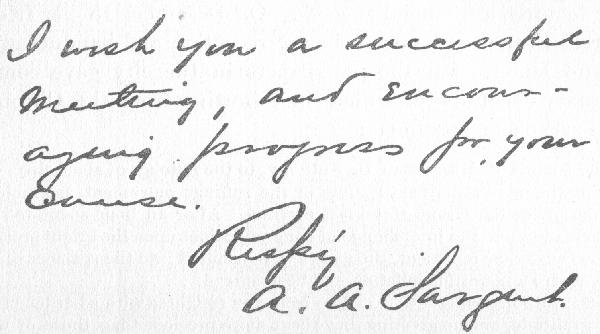
A. A. Sargent.
She arrived at Reno to find that the Sargents, whom she expected to join on their way to Washington, had passed through a day or two before but, as they were delayed by snowdrifts, she overtook them at Ogden, and enjoyed the privileges of their luxurious staterooms until they reached Chicago. It happened most fortunately that the Sargents were supplied with inexhaustible hampers of provisions, for the trip from Ogden to Chicago occupied twelve days. Senator Mitchell and family, of Oregon, and several other friends were on the train, but with all the pleasant companionship and all the entertainment which could be devised, the journey was long and tedious. The ever-faithful diary contains a brief record of each day:
December 28.—The western-bound train arrived at noon, eight days from Omaha, a happy set of people to be so far along on their journey. We left Ogden at 3 p. M., three packed sleeping-cars. All went smoothly to Bitter Creek, then we waited three or four hours for an extra engine to take us up the grade.
December 29.—Starting and backing, then starting and backing again. Prospect very discouraging. Mr. Sargent makes the tea, unpacks the hampers and serves as general steward, but draws the line at washing the dishes. We 407 women-folks take that as our part. Delayed all night at Percy. Here overtook the passenger train which left Ogden last Monday.
December 30.—Detained all day and all night at Medicine Bow. Four passenger trains packed into two, and long freight trains passed us in the night.
December 31.—Left Medicine Bow at noon, went through deep snow cuts ten miles in length. One heavy passenger and two long freight trains in front of us. Reached Laramie at 10 P.M. Thus closes 1871, a year full of hard work, six months east, six months west of the Rocky mountains; 171 lectures, 13,000 miles of travel; gross receipts $4,318, paid on debts, $2,271. Nothing ahead but to plod on.
A few blank pages in an old account-book tell the rest of the story:
January 1, 1872.—Laramie City. On Pullman car "America," Union Pacific R.R. Lay here all night and breakfasted at railway hotel. J.H. Hayford, editor Laramie Sentinel, told us of the bill to repeal the woman suffrage law in Wyoming. The law had been passed by a Democratic legislature as a jest, but five Democrats voted for repeal and four Republicans against it, in one house, and in the other, three Republicans voted against and every Democrat for the repeal. Governor Campbell, a Republican, vetoed this repeal bill and woman suffrage still stands, as a Territorial legislature can not pass a bill over the governor's veto.... Here we are at noon, stuck in a snowdrift five miles west of Sherman, on a steep grade, with one hundred men shovelling in front of us. Dined, Mr. Sargent officiating, on roast turkey, jelly, bread and butter, spice cake and excellent tea. At dark, wind and snow blowing terrifically, but a bright sky.
January 2.—Still stationary. The railroad company has supplied the passengers with dried fish and crackers. Mrs. Sargent and I have made tea and carried it throughout the train to the nursing mothers. It is the best we can do. Five days out from Ogden! This is indeed a fearful ordeal, fastened here in a snowbank, midway of the continent at the top of the Rocky mountains. They are melting snow for the boilers and for drinking water. A train loaded with coal is behind us, so there is no danger of our suffering from cold. Mr. Sargent, Mr. Mitchell and Major Elliott walked to Sherman and an old man drove them back at dusk with two ponies. The train had moved up to Dale creek bridge and drawn into a long snow-shed. Here, we remained all night and, with the rarified air and the smoke from the engine, were almost suffocated, while the wind blew so furiously we could not venture to open the doors.
January 3.—Bright sunshine and perfectly calm. Ernest and Norman Melliss, sons of David M. Melliss, of New York City, came into our car from the other train, which is twelve days from Ogden. How they do revive The Revolution experiences, Train and the Wall street gossip! Stood still in the snow-shed till noon and reached Sherman about 6 P.M. Mr. Sargent had brought some potatoes which we roasted on top of the stove and they proved a delicious addition to our meal. In the car "Sacramento" we had a mock 408 trial, Judge Mitchell presiding and the jury composed of women. He wrote out a verdict, which the women insisted on bringing in, not because they agreed with it but because they wanted to please him and the other men, but I rebelled and hung the jury!
January 4.—Morning found us still at Sherman and we did not move till 1 P.M. There is another train ahead of us, and here we are, four passenger trains pushing on for Cheyenne. The people from the different ones visit among each other. Half-way to Granite Canyon the snowplow got off the track and one wheel broke, so a dead standstill for hours. Reached Granite Canyon at dark, a whole day getting there from Sherman, and remained over night.
January 5.—Bright and beautiful. Reached Cheyenne at 11:30 A.M. Little George Sargent coaxed his papa to let him walk over the bridge to the town and fell through and broke his arm. Mrs. Sargent, after holding him till the bone was set, fainted. Afterwards I called on Mrs. Amalia Post. It was at her house the Cheyenne women met and went in a body to Governor Campbell's residence in 1869, and announced their intention of staying till he signed the woman suffrage bill, which he did without further delay. Met the governor and several other notables. At 1:30 P.M. our train was off at first-class speed, and oh, what joy in every face!
January 6.—Arrived at Omaha at 3 P.M. Found letter from brother D.R., enclosing pass to Leavenworth and saying he had passes for me from there to Chicago and eastward. If I go to L. I shall miss the Washington convention, where I am so badly needed. If it had not been for this vexatious delay I could have had a day or two there and several more at Rochester. Now I must push straight on. It is my hard fate always to sacrifice affection and pleasure to duty and work.
January 7.—All the baggage had to be rechecked at Omaha and when I insisted upon attending to my own, because I had found that the only safe way, Mr. Sargent looked so offended that I at once handed over my checks.
January 8.—Arrived at Chicago at 3 A.M. Went at once to my aunt Ann Eliza Dickinson's and visited with her till 7 o'clock, had breakfast and went to Fort Wayne depot where, as I feared, I found one of my checks called for the wrong piece of baggage; so I took one trunk, left the baggage-master to hunt up the other, and started straight for Washington on a train without a sleeper.
January 9.—Passed Pittsburg at 2 A.M. Breakfasted at Altoona on top of the Alleghanies; scenery most beautiful, but not on so grand a scale as among the Rockies.
This is the last entry. It is hardly necessary to add that Miss Anthony reached Washington in time for the opening of the convention on the morning of January 10. To the question whether she were not very tired, she replied: "Why, what would make me tired? I haven't been doing anything, for two weeks!"
[58] Miss Anthony's lecture was a decided success, judged either by the number and intelligence of those present or the able manner in which she discussed the salient points pertaining to woman suffrage. She displayed an ability, conciseness and force that must have carried conviction to every impartial listener.... Her visit here has done more to advance the cause of woman suffrage than can now be fully appreciated. She has sown the germ of a movement which can not fail to inoculate our people with a belief in the justice of her cause and the injustice of longer depriving the more intelligent, purer and consequently better portion of our inhabitants of that greatest of boons, the ballot.—Sioux City Daily Times.
Miss Anthony's lecture was full of good, sound common sense, and an opponent of woman suffrage said it was the best speech he ever heard on the subject. Wyoming was highly complimented as being the first Territory to recognize the equality of woman, and pronounced as much ahead of her eastern sisters in civilization as she is higher in altitude. The lecture abounded with gems of wit, humor and pathos, and the audience would willingly have listened another hour.—Cheyenne Tribune.
The press sneers at Miss Anthony, men tell her she is out of her proper sphere, people call her a scold, good women call her masculine, a monstrosity in petticoats; but if one-half of her sex possessed one-half of her acquirements, her intellectual culture, her self-reliance and independence of character, the world would be the better for it.—Denver News.
A large and attentive audience filled the Denver theater last night to hear Miss Susan B. Anthony, champion of the "new departure in politics," called the woman suffrage movement. The fact that there was not sitting room for all who came is evidence of deep interest in the subject, or great curiosity to hear the lady speak.... It is impossible to give an outline of her speech. It was a string of strong arguments put in a straightforward, clear and vigorous way, eliciting favor and inviting the attention of the audience throughout. The lecture was suggestive, and of the kind that sets people to thinking.—Denver Tribune.
[59] Notwithstanding this tribute, the Herald printed a long string of verses with this introduction: "We trust our readers will not miss the perusal of this piece of rhythmical irony. It is certainly one of the happiest hits we have seen for many a day. No one can mistake the allusion to the 'Old Gal.' who has been so recently among us 'tooting her horn.'"
"Along the city's thoroughfare,
A grim Old Gal with manly air
Strode amidst the noisy crowd,
Tooting her horn both shrill and loud;
Till e'en above the city's roar,
Above its din and discord, o'er
All, was heard, 'Ye tyrants, fear!
The dawn of freedom's drawing near—
Woman's Rights and Suffrage.'
"A meek old man, in accents wild,
Cried,'Sal! turn back and nurse our child!'
She bent on him a withering look,
Her bony fist at him she shook.
And screeched, 'Ye brute! ye think I'm flat
To mend your clo'es and nurse your brat?
Nurse it yourself; I'll change the plan,
When I am made a congressman—
Woman's Rights and Suffrage,'" etc.
[61] Two examples will suffice:
"EDITOR COLONIST: I have read with a feeling of thankfulness the letter of 'A Male Biped,' in this day's Colonist. The writer deserves the thanks of every good woman in the land for the bold and able manner in which he has administered a shaking to a shrewish old mischief-maker who, having failed to secure a husband herself, is tramping the continent to make her more fortunate sisters miserable by creating dissensions in their households. O, why do not some of our divines or lawyers upset this woman's sophistries, and convince even her that woman's true sphere is in 'submitting herself to her husband,' and religiously fulfilling the marriage vows the wise organizers of society have prescribed?
A WIFE AND A MOTHER."
"MR. EDITOR: America, the home of many humbugs, which produced Brigham Young, Barnum, Home, the medium, and many others, has, it appears, another human curiosity in Miss Anthony. This specimen from over the way comes amongst us, and because our ladies fail to recognize or encourage her in her vagaries, she gets very rabid and snarls and snaps at the 'women of Victoria who had so sunk their womanhood that they were happy even in their degradation.' The degradation referred to is that of whipping, which this female firebrand appears to believe is the rule hers. Surely the complete immunity from castigation of such a noxious creature as Miss Anthony is sufficient answer to this libel. Men in British Columbia no more countenance bad husbands than do the women a quack apostle in petticoats. They look upon such persons as sexual mistakes, like the two-headed lady or the four-legged baby, and as safe guides on social questions as George Francis Train is in politics.
AN INSULTED HUSBAND."
And yet during the few days she was in Victoria no leas than half a dozen women came to her to protest against the law which allowed the husband to whip his wife.
The leading women in the movement for suffrage, supported by some of the ablest constitutional lawyers in the country, continued to claim the right to vote under the following:
FOURTEENTH AMENDMENT, JULY 28, 1868.
SECTION 1. All persons born or naturalized in the United States and subject to the jurisdiction thereof, are citizens of the United States and of the State wherein they reside. No State shall make or enforce any law which shall abridge the privileges or immunities of citizens of the United States; nor shall any State deprive any person of life, liberty, or property, without due process of law, nor deny to any person within its jurisdiction the equal protection of the laws.
FIFTEENTH AMENDMENT, MARCH 30, 1870.
SECTION 1. The right of citizens of the United States to vote shall not be denied or abridged by the United States, or by any State, on account of race, color, or previous condition of servitude.
Many of the Republican leaders admitted that these amendments might be construed to include women, but were silenced by the cry of "party expediency." The fear of defeating the attempt to enfranchise the colored male citizen made them refuse to add the word "sex" to the Fifteenth Amendment, which would have placed this question beyond debate and put an end to the agitation that has continued for thirty years. The women insisted that the exigency which compelled the ratification of the Fifteenth Amendment by the various State legislatures was strong enough to carry it, even with the word 410 "sex" included. Having failed to gain this point, the National Association determined to maintain the position that women were already enfranchised, and embodied it in the call for the Washington convention of 1872: "All those interested in woman's enfranchisement are invited to consider the 'new departure'—women already citizens, and their rights as such secured by the Fourteenth and Fifteenth Amendments of the Federal Constitution."
The same position was re-asserted in the resolutions adopted at that meeting, which declared that "while the Constitution of the United States leaves the qualifications of electors to the various States, it nowhere gives them the right to deprive any citizen of the elective franchise which is possessed by any other citizen; the right to regulate not including the right to prohibit the franchise;" that "those provisions of the several State constitutions which exclude women from the franchise on account of sex, are violative alike of the letter and spirit of the Federal Constitution;" and that "as the Fourteenth and Fifteenth Amendments to the Constitution have established the right of women to the elective franchise, we demand of the present Congress a declaratory act which shall secure us at once in the exercise of this right."
Miss Anthony and other leaders officially asked the privilege of addressing the Senate and House upon this momentous question. This was refused, as contrary to precedent, but a hearing was granted before the Senate Judiciary Committee,[63] Friday morning, January 12. Not only the committee room but the corridors were crowded. Mrs. Stanton and Mrs. Hooker spoke grandly,[64] and as usual Miss Anthony was chosen to clinch the argument, which she did as follows:
You already have had logic and Constitution; I shall refer, therefore, to existing facts. Prior to the war the plan of extending suffrage was by State action, and it was our boast that the National Constitution did not contain a word which could be construed into a barrier against woman's right to vote. But at the close of the war Congress lifted the question of suffrage for men above 411 State power, and by the amendments prohibited the deprivation of suffrage to any citizen by any State. When the Fourteenth Amendment was first proposed in Congress, we rushed to you with petitions praying you not to insert the word "male" in the second clause. Our best friends on the floor of Congress said to us: "The insertion of that word puts up no new barrier against woman; therefore do not embarrass us but wait until we get the negro question settled." So the Fourteenth Amendment with the word "male" was adopted.
Then, when the Fifteenth was presented without the word "sex," we again petitioned and protested, and again our friends declared that the absence of that word was no hindrance to us, and again begged us to wait until they had finished the work of the war. "After we have enfranchised the negro we will take up your case." Have they done as they promised? When we come asking protection under the new guarantees of the Constitution, the same men say to us that our only plan is to wait the action of Congress and State legislatures in the adoption of a Sixteenth Amendment which shall make null and void the word "male" in the Fourteenth, and supply the want of the word "sex" in the Fifteenth. Such tantalizing treatment imposed upon yourselves or any class of men would have caused rebellion and in the end a bloody revolution. It is only the close relations existing between the sexes which have prevented any such result from this injustice to women.
Gentlemen, I should be sure of your decision could you but realize the fact that we, who have been battling for our rights now more than twenty years, feel precisely as you would under such circumstances. One of the most ardent lovers of freedom (Senator Sumner) said to me two winters ago, after our hearing before the committee of the District: "I never realized before that you or any woman could feel the disgrace, the degradation of disfranchisement precisely as I should if my fellow-citizens had conspired to deprive me of my right to vote." Although I am a Quaker and take no oath, yet I have made a most solemn "affirmation" that I will never again beg my rights, but will come to Congress each year and demand the recognition of them under the guarantees of the National Constitution.
What we ask of the Republican party is simply to take down its own bars. The facts in Wyoming show how it is that a Republican party can exist in that Territory. Before women voted, there was never a Republican elected to office; after their enfranchisement, the first election sent one Republican to Congress and seven to the Territorial Legislature. Thus the nucleus of a Republican party there was formed through the enfranchisement of women. The Democrats, seeing this, are now determined to disfranchise them. Can you Republicans so utterly stultify yourselves, can you so entirely work against yourselves, as to refuse us a declaratory law? We pray you to report immediately, as Mrs. Hooker has said, "favorably, if you can; adversely, if you must." We can wait no longer.
The committee reported adversely on the question of woman's right to vote under the Fourteenth and Fifteenth Amendments. 412
At the close of the convention, Miss Anthony hastened to her home in Rochester, which she had not seen since her departure to California eight months before. Soon after her arrival she was invited to meet a number of her acquaintances at the home of her dear friend, Amy Post, and give them an account of her experiences on the Pacific slope. At its conclusion she was surprised by the presentation of a purse containing $50, with a touching address by Mrs. Post asking her to accept it as a testimonial of the appreciation in which her friends and neighbors held her work for woman and humanity. At the same time she received a gift of money from Sarah Pugh, in an envelope marked, "For thine own dear self." In her acknowledgment she says:
The tears started when I read your sweet letter. Were it not for the loving sympathy and confidence of the little handful of ever-faithful such as you, my spirit, I fear, would have fainted long ago. There are yourself, dear Lucretia and her equally dear sister, Martha, who never fail to know just the moment when my purse is drained to the bottom and to drop the needed dollar into it. It is really wonderful how I have been carried through all these years financially. I often feel that Elijah's being fed by the ravens was no more miraculous than my being furnished with the means to do the great work which has been for the past twenty years continuously presenting itself—yes, presenting itself, for it has always come to me. My thought has been to escape the hardships but they come ever and always, and so I try to accept the situation and work my way through as best I can.
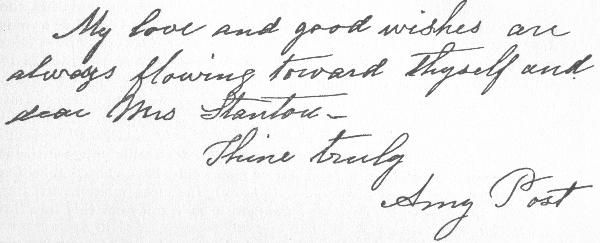
Amy Post
She was soon off again, lecturing in various cities and towns, going as far west as Nebraska. Early in April, while waiting at a little railroad station in Illinois, a gentleman came in 413 and handed her a copy of Woodhull and Claflin's Weekly containing this double-leaded announcement:
The undersigned citizens of the United States, responding to the invitation of the National Woman Suffrage Association, propose to hold a convention at Steinway Hall, in the city of New York, the 9th and 10th of May. We believe the time has come for the formation of a new political party whose principles shall meet the issues of the hour and represent equal rights for all. As women of the country are to take part for the first time in political action, we propose that the initiative steps in the convention shall be taken by them.... This convention will declare the platform of the People's party, and consider the nomination of candidates for President and Vice-President of the United States, who shall be the best possible exponents of political and industrial reform....
ELIZABETH CADY STANTON, SUSAN E. ANTHONY, ISABELLA B. HOOKER, MATILDA JOSLYN GAGE.
It was followed by the call of Mrs. Woodhull and others for a delegate convention to form a new party. Miss Anthony was thunderstruck. Not only had she no knowledge of this action, but she was thoroughly opposed both to the forming of a new party and to the National Association's having any share in such a proceeding. She immediately telegraphed an order to have her name removed from the call, and wrote back indignant letters of protest against involving the association in such an affair. A month prior to this, on March 13, she had written Mrs. Stanton and Mrs. Hooker from Leavenworth:
We have no element out of which to make a political party, because there is not a man who would vote a woman suffrage ticket if thereby he endangered his Republican, Democratic, Workingmen's or Temperance party, and all our time and words in that direction are simply thrown away. My name must not be used to call any such meeting. I will do all I can to support either of the leading parties which may adopt a woman suffrage plank or nominee; but no one of them wants to do anything for us, while each would like to use us....
I tell you I feel utterly disheartened—not that our cause is going to die or be defeated, but as to my place and work. Mrs. Woodhull has the advantage of us because she has the newspaper, and she persistently means to run our craft into her port and none other. If she were influenced by women spirits, either in the body or out of it, in the direction she steers, I might consent to be a mere sail-hoister for her; but as it is, she is wholly owned and dominated by men spirits and I spurn the control of the whole lot of them, just precisely the same when reflected through her woman's tongue and pen as if they spoke directly for themselves.
After sending this letter she had supposed the question settled until she saw this notice, hence her anger and dismay can be imagined.
The regular anniversary meeting of the National Association was to begin in New York on May 9, and on the 6th Miss Anthony reached the city to prevent, if possible, the threatened coalition with the proposed new party. She engaged the parlors of the Westmoreland Hotel for headquarters and then hastened over to Tenafly to get Mrs. Stanton. As soon as the suffrage committee opened its business session, Mrs. Woodhull and her friends appeared by previous arrangement made during Miss Anthony's absence in the West, and announced that they would hold joint sessions with the suffrage convention the next two days at Steinway Hall. It was only by Miss Anthony's firm stand and indomitable will that this was averted, and that the set of resolutions which they brought, cut and dried, was defeated in the committee. She positively refused to allow them the use of Steinway Hall, which had been rented in her name, and at length they were compelled to give up the game and engage Apollo Hall for their "new party" convention. Mrs. Stanton and Mrs. Hooker called her narrow, bigoted and headstrong, but the proceedings of the "people's convention" next day, which nominated Mrs. Woodhull for President, showed how suicidal it would have been to have had it under the auspices of the National Suffrage Association.
The forces of the latter, however, were greatly demoralized, the attendance at the convention was small, and Mrs. Stanton refused to serve longer as president. Miss Anthony was elected in her stead and, just as she was about to adjourn the first evening session, to her amazement Mrs. Woodhull came gliding in from the side of the platform and moved that "this convention adjourn to meet tomorrow morning at Apollo Hall!" An ally in the audience seconded the motion, Miss Anthony refused to put it, an appeal was made from the decision of the chair, Mrs. Woodhull herself put the motion and it was carried overwhelmingly. Miss Anthony declared the whole proceeding out of order, as the one making the motion, 415 the second, and the vast majority of those voting were not members of the association. She adjourned the convention to meet in the same place the next morning and, as Mrs. Woodhull persisted in talking, ordered the janitor to turn off the gas.
The next day, almost without assistance and deserted by those who should have stood by her, she went through with the remaining three sessions and brought the convention to a close. In her diary that evening is written: "A sad day for me; all came near being lost. Our ship was so nearly stranded by leaving the helm to others, that we rescued it only by a hair's breadth." She stopped at Lydia Mott's and then at Martha Wright's for comfort and sympathy, finding them in abundant measure, and reached home strengthened and refreshed, ready again to take up the work.
At the request of many suffrage advocates, Miss Anthony and Laura De Force Gordon went to the National Liberal Convention, at Cincinnati, May 2, 1872, with a resolution asking that as liberal Republicans they should hold fast to the principles of the Declaration of Independence and recognize the right of women to the franchise. The ladies were politely treated and invited to seats on the platform, but were not allowed to appear before the committee and no attention was paid to their resolution. They expected no favors from the presiding officer, Carl Schurz, the foreign born, always a bitter opponent of woman suffrage, but they had hoped for assistance from B. Gratz Brown, George W. Julian, Theodore Tilton and other leading spirits of the meeting, who had been open and avowed friends; but it was the old, old story—political exigency required that women must be sacrificed, and this so-called Liberal convention was no more liberal on this subject than all which had preceded it. Miss Anthony is quoted in an interview as saying:
You see our cause is just where the anti-slavery cause was for a long time. It had plenty of friends and supporters three years out of four, but every fourth year, when a President was to be elected, it was lost sight of; then the nation was to be saved and the slave must be sacrificed. So it is with us 416 women. Politicians are willing to use us at their gatherings to fill empty seats, to wave our handkerchiefs and clap our hands when they say smart things; but when we ask to be allowed to help them in any substantial way, by assisting them to choose the best men for our law-makers and rulers, they push us aside and tell us not to bother them.
On June 7 Miss Anthony and other prominent suffrage leaders attended the National Republican Convention, at Philadelphia, which adopted the following compromise:
The Republican party is mindful of its obligations to the loyal women of America for their noble devotion to the cause of freedom; their admission to wider fields of usefulness is received with satisfaction; and the honest demands of any class of citizens for equal rights should be treated with respectful consideration.
At the close of this meeting, the faithful Sarah Pugh slipped $20 into Miss Anthony's hand, telling her to go and confer with Mrs. Stanton. She did so and they prepared a strong letter for the New York World, calling upon the Democrats at Baltimore to adopt a woman suffrage plank if they did not wish to compel the women of the country to work for the success of the Republican ticket. Immediately after the Philadelphia convention, Henry B. Blackwell, editor of the Woman's Journal, wrote Miss Anthony:
I have given my views to Mrs. Stanton as to the wisdom of concentrating the woman suffragists in support of the Republican candidates and platform. I think if this is done earnestly, heartily and unselfishly, upon the ground of anti-slavery principle and of progressive tendencies, a strong and general reaction will set in and that, instead of "recognition," as in 1872, we shall have endorsement and victory in 1876.... I believe you love the cause better than yourself. I hope that you will see the wisdom of accepting the resolution in the friendly, generous spirit of the convention and, by accepting it, making it mean what we desire it should, which we can do if we will.
To this she replied on June 14:
Your note is here. My view of our true position is to hold ourselves as a balance of power, "to give aid and comfort," as the Springfield Republican says, to the party which shall inscribe on its banners "Freedom to Woman." If I am a Republican or Liberal or Democrat per se and work for the party right or wrong, then I make of myself and my co-workers no added power for or against the one which adopts or rejects our claim for recognition.
I do not expect any man to see and act with me here, but I do not understand 417 how any woman can do otherwise than refuse to accept any party which ignores her sex. I will not work with a party today on the war issues or because it was true to them in the olden time; but I will work with the one which accepts the living, vital issue of today—freedom to woman—and I scarcely have a hope that Baltimore will step ahead of Philadelphia in her platform. Grant's recognition of citizens' rights evidently means to include women, and Wilson's letter openly and boldly declares the new mission of Republicanism. I, therefore, now expect to take the field—the stump, if you please to call it so—for the Republican party, but not because of any of its nineteen planks save the fourteenth, which makes mention of woman, although faintly. It is "the promise of things not seen," hence I shall clutch it as the drowning man the floating straw, and cling to it until something stronger and surer shall present itself. It is a great step to get this first recognition; it carries the discussion of our question legitimately into every school district and every ward meeting of the presidential canvass. It is what my soul has waited for these seven years. From this we shall go rapidly onward.
Miss Anthony and Mrs. Hooker attended the National Democratic Convention at Baltimore, July 9. The latter some time before had repudiated her life-long allegiance to the Republican party, because of its treatment of woman's claims, and had declared her belief that their only chance was with the Democrats. The Baltimore Sun thus describes an interview in the corridor between the Hon. James R. Doolittle, president of the convention, and Miss Anthony and Mrs. Hooker: "Mr. Doolittle's erect and commanding figure was set off to great advantage by his elegantly-fitting dress-coat; Mrs. Hooker, tall and erect as the lord of creation she was bearding, with her abundant tresses of beautiful gray and her intellectual, sparkling eyes; Miss Anthony, the peer of both in height, with her gold spectacles set forward on a nose which would have delighted Napoleon; the two ladies attired in rich black silk—the attention of the few who lingered was at once attracted to the picture." But Mr. Doolittle justified his name, as far as extending any assistance was concerned, and the ladies had not even seats on the platform.
As an example of the way in which the politicians tried not to do it and yet seem to sufficiently to secure such small influence as the women might possess, may be quoted a letter from 418 Hon. John Cochran, of New York City, to Mrs. Stanton, his cousin: "I think Baltimore should speak on the subject. I am sorry Cincinnati did not. Any baby could say that fourteenth formula in the Philadelphia platform; but I would say something more if I said anything at all. Come, see if you can rig up this shaky plank and give something not quite suffrage, but so like it that all the female Sampsons will vote that it is good." The Baltimore convention, however, could not be induced to adopt even a rickety plank which might fool the women. Miss Anthony writes in her diary: "The Democrats have swallowed Cincinnati, hoofs, horns and all. No hope for women here."
While the Republican plank was unsatisfactory, it was the first time Woman ever had been mentioned in a national platform and so many glittering hopes were held out by the Republican leaders that the officers of the National Association felt justified in giving their influence to this party. They were the more willing to do this as General Grant, the nominee, had been the first President to appoint women postmasters and was known to be friendly to their claim for equal opportunities, and as Henry Wilson, candidate for Vice-President, was an avowed advocate of woman suffrage. Therefore, Miss Anthony, president, and Matilda Joslyn Gage, chairman of the executive committee, on July 19 sent out a ringing address which began:
Women of the United States, the hour for political action has come. For the first time in the history of our country, woman has been recognized in the platform of a large and dominant party. Philadelphia has spoken and woman is no longer ignored. She is now officially recognized as a part of the body politic.... We are told that the plank does not say much, that in fact it is only a "splinter;" and our Liberal friends warn us not to rely upon it as a promise of the ballot to women. What it is, we know even better than others. We recognize its meagerness; we see in it the timidity of politicians; but beyond and through all, we see a promise of the future. It is the thin side of the entering wedge which shall break woman's slavery in pieces and make us at last a nation truly free—a nation in which the caste of sex shall fall down by the caste of color, and humanity alone be the criterion of all human rights. The Republican has been the party of ideas; of progress. Under its leadership, the nation came safely through the fiery ordeal of the rebellion; under it slavery was destroyed; under it manhood 419 suffrage was established. The women of the country have long looked to it in hope, and not in vain; for today we are launched by it into the political arena, and the Republican party must hereafter fight our battles for us. This great, this progressive party, having taken the initiative step, will never go back on its record.
In July Miss Anthony, continuing the correspondence with Mr. Blackwell, wrote:
Letters are pouring in upon me because of my announcement that I shall work for the Republican party, second only in numbers and regret to those of 1868—because of my accepting Train's words, works and cash, given me to push on the cause of woman suffrage as best I knew. It is marvelous that the friends can not see what a gain it is to have the question of woman's claims introduced into politics. It is the hour I have longed and worked for with might and main because I have seen that so soon as we could get this, the editors and orators of both parties must of necessity discuss the subject pro and con, and of course the party which introduced it favorably into politics, must be the one to give the reasons for so doing.
As I endured the growling when I was charged with giving too much "aid and comfort" to the Democracy, because I thanked them for what they did to agitate our demand in Congress and out, I think I shall be equal to the fire now for affiliating with the Republicans. You did me the grossest injustice in the Woman's Journal, when you called me a "woman suffrage Democrat," just as gross as the Liberals will be likely to do, when they shall call me a "woman suffrage Republican." I belong to neither party, and approve of one or the other only as it shall speak and work for the enfranchisement of woman. Had Cincinnati declared for woman, and Philadelphia not, I should have worked with might and main for the Liberals. All I know or care of parties now and until women are free, is "woman and her disfranchised—crucified!"
It is most touching to observe Miss Anthony's joy over this quasi-recognition on the part of Republicans, the more especially at the beginning of the campaign. In her journal of July 26 she says: "It is so strange that all can not see the immense gain to us to have the party in power commit itself to a respectful treatment of our claims. Already the tone of the entire Republican press is elevated. It is wonderful to see the change. None but the Liberals deride us now, and Theodore Tilton stands at their head in light and scurrilous treatment." To her old friend Mrs. Bloomer, she sent this rallying cry: "Ho for the battle now! The lines are clearly drawn.... Slight as is the Republicans' mention of our claim in their 420 plank, it surely is vastly more and better than the disrespect of no mention at all by the Democrats, coupled with the fact that their nominee, Mr. Greeley, is an out-and-out opponent of our movement, and does not now refrain from saying to earnest suffrage women that he 'neither desires our help nor believes we are capable of giving any.'"
To Mrs. Stanton she wrote: "The Democrats have now abandoned their old dogmas and accepted those of the Republicans, while the latter have stepped up higher to labor reform and woman suffrage. Forney's editorial in the Philadelphia Press of July 11 states positively that the woman suffrage cause is espoused by the Republican party. I tell you the Fort Sumter gun of our war is fired, and we will go on to victory almost without a repulse from this date." But Mrs. Stanton could not share in her optimism, and replied: "I do not feel jubilant over the situation; in fact I never was so blue in my life. You and Mr. Blackwell write most enthusiastically, and I try to feel so and to see that the 'Philadelphia splinter' is something. Between nothing and that, there is no choice, and we must accept it. With my natural pride of character, it makes me feel intensely bitter to have my rights discussed by popinjay priests and politicians, to have woman's work in church and State decided by striplings of twenty-one, and the press of the country in a broad grin because, forsooth, some American matrons choose to attend a political convention. Now do I know how Robert Purvis feels when these 'white mules' turn round their long left ears at him. But let the Democrats and Liberals do what they may, the cat will mew, the dog will have his day. Dear friend, you ask me what I see. I am under a cloud and see nothing."
Under date of August 19, Henry Wilson wrote Miss Anthony: "Your cheerful and cheering note came to me in Indiana. In great haste I can only say that I like its spirit, believe in its doctrines, and will call the attention of the Republican committees, both national and New York, to your suggestions, and trust and believe that much good may result from carrying into effect its suggestions." 421
On July 16 Miss Anthony had received a telegram from Washington to come at once for a conference with the Republican committee. Her sister and mother were very ill and she would not leave them, even for such a summons. On the 24th another telegram came, but it was not until the 29th that she felt safe in leaving the invalids. When she reached Washington, the chairman of the committee said: "At the time we sent our first telegram we were panic-stricken and had you come then, you might have had what you pleased to carry out your plan of work among the women; but now the crisis has passed and we feel confident of success; nevertheless, we will be glad of your co-operation." He gave her a check of $500, to which the New York committee added $500 more, to hold meetings in that State.
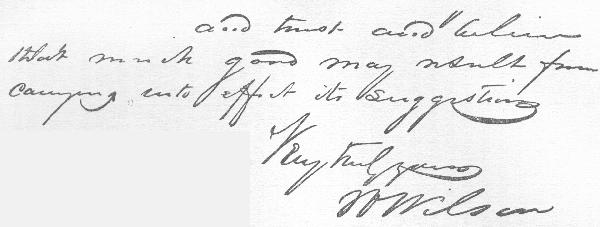
Henry Wilson
The same change of feeling was noticeable in the press. Immediately after the Baltimore convention, when it looked as if Greeley might be elected, the Republican newspapers were filled with appeals to the women, and the plank was magnified to suit any interpretation they might choose, but as the campaign progressed and the danger passed, it was almost wholly ignored by both press and platform. The Republicans did, however, employ a number 422 of women speakers during the campaign, but Miss Anthony received no money except this $1,000, all of which she expended in public meetings. The first was at Rochester, September 20, and, the daily papers said, "far surpassed any rally held during the season." Mayor Carter Wilder presided, and the speakers were Mrs. Stanton, Mrs. Gage and Rev. Olympia Brown. The series closed with a tremendous meeting at Cooper Institute, Hon. Luther R. Marsh presiding, and Peter Cooper, Edmund Yates and a number of other prominent men on the stage. Henry Ward Beecher had agreed to preside and to speak at this meeting, but at the last moment was called away.
Miss Anthony was considerably at variance with some of the Republican politicians, however, because she and her associates, through all the campaign, persisted in speaking on the woman's plank in the platform and advocating equal suffrage, instead of ignoring these points, as the men speakers did, and making the fight on the other issues of the party. Her position is best stated in one of her own letters to Mrs. Stanton early in the autumn:
If you are ready to go forth into this canvass saying that you endorse the party on any other point or for any other cause than that of its recognition of woman's claim to vote, I am not and I shall not thus go. To the contrary, I shall work for the Republican party and call on all women to join me, precisely as we thanked the Democrats of Wyoming and Kansas, and Hon. James Brooks and Senator Cowan, viz: for what that party has done and promises to do for woman, nothing more, nothing less.
Then again, I shall not join with the Republicans in hounding Greeley and the Liberals with all the old war anathemas of the Democracy. Greeley and all the Liberals are just as good and true Republicans as ever; and the fact that old pro-slavery men propose to vote for him no more makes him pro-slavery than the drunkards' or rum-sellers' vote for him makes him a friend and advocate of the liquor traffic. My sense of justice and truth is outraged by the Harpers' cartoons of Greeley and the general falsifying tone of the Republican press. It is not fair for us to join in the cry that everybody who is opposed to the present administration is either a Democrat or an apostate.
I shall try to be "careful and not captious," as you suggest, but more than all, I shall try not to run myself or my cause into the slough of political schemes or schemers. And I pray you, be prudent and conscientious, and do not surrender one iota of true principle or of our philosophy of reform to aid mere Republican partisanship.
Miss Anthony never has abandoned this position and the leading advocates of woman suffrage stand with her squarely upon the ground that no party, whatever its principles, shall have their sanction and advocacy until it shall make an unequivocal declaration in favor of the enfranchisement of women and support this by means of the party press and platform.
There was a desire on the part of many women to test the right to vote which they claimed was conferred on them by the Fourteenth Amendment, and in 1872 a number in different places attempted to cast their ballots at the November election. A few were accepted by the inspectors, but most of them were refused. On Friday morning, November 1, Miss Anthony read, at the head of the editorial columns of the Rochester Democrat and Chronicle, the following strong plea:
Now register! Today and tomorrow are the only remaining opportunities. If you were not permitted to vote, you would fight for the right, undergo all privations for it, face death for it. You have it now at the cost of five minutes' time to be spent in seeking your place of registration and having your name entered. And yet, on election day, less than a week hence, hundreds of you are likely to lose your votes because you have not thought it worth while to give the five minutes. Today and tomorrow are your only opportunities. Register now!
There was nothing to indicate that this appeal was made to men only, it said plainly that suffrage was a right for which one would fight and face death, and that it could be had at the cost of five minutes' time. She was a loyal American citizen, had just conducted a political campaign, was thoroughly conversant with the issues and vitally interested in the results of the election, and certainly competent to vote. She summoned her three faithful sisters and going to the registry office of the Eighth ward (in a barber's shop) they asked to be registered. There was some hesitation, but Miss Anthony read the Fourteenth Amendment and the article in the State constitution in regard to taking the oath, which made no sex-qualification, and at length their names were duly entered by the inspectors, Beverly W. Jones and Edwin F. Marsh, Republicans; William B. Hall, Democrat, objecting. Miss Anthony then called 424 upon several other women in her ward, urging them to follow her example, and in all fifteen registered. The evening papers noted this fact and the next day enough women in other wards followed their example to bring the number up to fifty.
The Rochester Express and the Democrat and Chronicle (Republican) noted the circumstance, expressing no opinion, but the Union and Advertiser (Democratic) denounced the proceeding and declared that "if the votes of these women were received the inspectors should be prosecuted to the full extent of the law." This attack was kept up till the day of election, November 5, with the result of so terrorizing the inspectors that all refused to accept the votes of the women who had registered except those in the Eighth ward where the ballots of the fifteen[65] were received.
In a letter to Mrs. Stanton, Miss Anthony says: "Well, I have been and gone and done it, positively voted this morning at 7 o'clock, and swore my vote in at that. Not a jeer, not a rude word, not a disrespectful look has met one woman. Now if all our suffrage women would work to this end of enforcing the constitutional supremacy of National over State law, what strides we might make from now on; but oh, I'm so tired! I've been on the go constantly for five days, but to good purpose, so all right. I hope you too voted."
The news of the acceptance of these votes was sent by the Associated Press to all parts of the country and created great interest and excitement. There was scarcely a newspaper in the United States which did not contain from one to a dozen editorial comments. Some of these were flippant or abusive, most of them non-committal but respectful, and many earnest, dignified and commendatory;[66] a few, notably the New York Graphic, contained outrageous cartoons. 425
Immediately after registering Miss Anthony had gone to a number of the leading lawyers in Rochester for advice as to her right to vote on the following Tuesday, but none of them would consider her case. Finally she entered the office of Henry R. Selden, a leading member of the bar and formerly judge of the court of appeals. He listened to her attentively, took the mass of documents which she had brought with her—Benjamin F. Butler's minority report, Francis Minor's resolutions, Judge Riddle's speech made in Washington in a similar case the year previous, various Supreme Court decisions, an incontrovertible array of argument—and told her he would give her an answer on Monday. She called then and he said: "My brother Samuel and I have spent an entire day in examining these papers and we believe that your claim to a right to vote under the Fourteenth Amendment is valid. I will protect you in that right to the best of my ability."
Armed with this authority she cast her vote the next day, and advised the other women to do the same. As the inspectors 426 hesitated to receive the votes, Miss Anthony assured them that should they be prosecuted she herself would bear all the expenses of the suit. They had been advised not to register the women by Silas J. Wagner, Republican supervisor. All three of the inspectors and also a bystander declared under oath that Daniel J. Warner, the Democratic supervisor, had advised them to register the names of the women; but on election day this same man attempted to challenge their votes. This, however, already had been done by one Sylvester Lewis, who testified later that he acted for the Democratic central committee. The general belief that these ladies voted the Republican ticket may have influenced this action.
About two weeks after election, Monday, November 18, Miss Anthony received a call from Deputy United States Marshal E.J. Keeney who, amid many blushes and much hesitation and stammering, announced that it was his unpleasant duty to arrest her. "Is this your usual method of serving a warrant?" she calmly inquired. The marshal, thus encouraged, produced the necessary legal document.[67] As she wished to make some change in her dress, he told her she could come down alone to the commissioner's office, but she refused to take herself to court, so he waited until she was ready and then declined her suggestion that he put handcuffs on her. She had intended to have suit brought against those inspectors who refused to register the women, but it never had occurred to her that those who voted would themselves be arrested.
Under date of November 27, Judge Selden wrote her: "I suppose the commissioner will, as a matter of course, hold you for trial at the circuit court, whatever your rights may be in the matter. In my opinion, the idea that you can be charged with a crime on account of voting, or offering to vote, when you honestly believed yourself entitled to vote, is simply 427 preposterous, whether your belief were right or wrong. However, the learned gentlemen engaged in this movement seem to suppose they can make a crime out of your honest deposit of your ballot, and perhaps they can find a respectable court or jury that will be of their opinion. If they do so I shall be greatly disappointed."
Miss Anthony and the fourteen other ladies who voted, went before U. S. Commissioner Storrs, U. S. District-Attorney Crowley and Assistant U. S. District-Attorney Pond, and were ordered to appear for examination Friday, November 29. Following is a portion of the examination of Miss Anthony by the commissioner:
Previous to voting at the 1st district poll in the Eighth ward, did you take the advice of counsel upon your voting?—Yes, sir.—Who was it you talked with?—Judge Henry E. Selden.—What did he advise you in reference to your legal right to vote?—He said it was the only way to find out what the law was upon the subject—to bring it to a test case.—Did he advise you to offer your vote?—Yes, sir.—State whether or not, prior to such advice, you had retained Mr. Selden. No, sir.—Have you anything further to say upon Judge Selden's advice?—I think it was sound.—Did he give you an opinion upon the subject?—He was like the rest of you lawyers—he had not studied the question.—What did he advise you?—He left me with this opinion: That he was a conscientious man; that he would thoroughly study the subject of woman's right to vote and decide according to the law.—Did you have any doubt yourself of your right to vote?—Not a particle.
Cross-examination—Would you not have made the same efforts to vote that you did, if you had not consulted with Judge Selden?—Yes, sir.—Were you influenced in the matter by his advice at all?—No, sir.—You went into this matter for the purpose of testing the question?—Yes, sir; I had been resolved for three years to vote at the first election when I had been at home for thirty days before.
It is an incident worthy of note that this examination took place and the commissioner's decision was rendered in the same dingy little room where, in the olden days, fugitive slaves were examined and returned to their masters. While the attorneys were endeavoring to agree upon a date for the hearing of arguments, Miss Anthony remarked that she should be engaged lecturing in central Ohio until December 10. "But you are supposed to be in custody all this time," said the district-attorney. "Oh, is that so? I had forgotten all about that," 428 she replied. That night she wrote in her diary: "A hard day and a sad anniversary! Ten years ago our dear father was laid to rest. This evening at 7 o'clock my old friend Horace Greeley died. A giant intellect suddenly gone out!"
The second hearing took place December 23 in the common council chamber, in the presence of a large audience which included many ladies, the newspapers stating that it had rather the appearance of a social gathering than an arraignment of criminals. Of those on trial one paper said: "The majority of these law-breakers were elderly, matronly-looking women with thoughtful faces, just the sort one would like to see in charge of one's sick-room, considerate, patient, kindly."
At Judge Selden's request, Hon. John Van Voorhis, one of the ablest lawyers in Rochester, had been associated with himself for the defense. Both made strong, logical arguments, and Miss Anthony herself spoke most earnestly in behalf of the three inspectors, who also had been arrested. The commissioner held all of them guilty, fixed their bail at $500 each, and gave them until the following Monday to furnish it. All did so except Miss Anthony, who refused to give bail and applied for a writ of habeas corpus from U. S. District-Judge N. K. Hall. The Rochester Express, which stood nobly by her through this ordeal, said editorially:
Miss Anthony had a loftier end in view than the making of a sensation when she registered her name and cast her vote. The act was in harmony with a life steadily consecrated to a high purpose from which she has never wavered, though she has met a storm of invective, personal taunt and false accusation, more than enough to justify any person less courageous than she in giving up a warfare securing her only ingratitude and abuse. But Miss Anthony has no morbid sentiment in her nature. There is at least one woman in the land—and we believe there are a good many more—who does not whine others into helping her over a hard spot, or even plead for help, but bravely helps herself and puts her hand to the plough without turning back. Those who are now regarding her as practically condemned to State prison or the payment of a fine of $500, need not waste their sympathy, for she would suffer either penalty with heroic cheerfulness if thereby she might help bring about the day when the principle "no taxation without representation" meant something more than it does. In writing lately to a friend, she thus expressed herself:
"Yes, I hope you will be present at the examination, to witness the grave 429 spectacle of fifteen native born citizens, of sound mind and not convicted of any crime, arraigned in the United States criminal courts to answer for the offense of illegal voting, when the United States Constitution, the supreme law of this land, says, 'All persons born or naturalized in the United States ... are citizens; no State shall deny or abridge the privileges or immunities of citizens;' and 'The right of citizens to vote shall not be denied.' The one question to be settled is, are personal freedom and personal representation inherent rights and privileges under democratic-republican institutions, or are they things of legislation, precisely as under old monarchical governments, to be given and taken at the option of a ruling class or of a majority vote? If the former, then is our country free indeed; if the latter, then is our country a despotism, and we women its victims!"
Under date of December 12, Benjamin F. Butler, then a member of Congress, wrote Miss Anthony regarding her case:
I do not believe anybody in Congress doubts that the Constitution authorizes the right of women to vote, precisely as it authorizes trial by jury and many other like rights guaranteed to citizens. But the difficulty is, the courts long since decided that the constitutional provisions do not act upon the citizens, except as guarantees, ex proprio vigore, and in order to give practical force to them there must be legislation. As, for example, in trial by jury, a man can invoke the Constitution to prevent his being tried, in a proper case, by any other tribunal than a jury; but if there is no legislation, congressional or other, to give him a trial by jury, I think, under the decisions, it would be very difficult to see how it might be done. Therefore, the point is for the friends of woman suffrage to get congressional legislation.
Benjamin F. Butler
The results of the trial showed that General Butler was right in thinking that further legislation would be required to enable women to vote under the Constitution of the United States. It proved also that a judge could set aside the right of a citizen to a trial by jury, supposed to be guaranteed by every safeguard which could be thrown around it by this same Constitution.
[66] When a jurist as eminent as Judge Henry R. Selden testifies that he told Miss Anthony before election that she had a right to vote, and this after a careful examination of the question, the whole subject assumes new importance.... How grateful to Judge Selden must all the suffragists be! He has struck the strongest and most promising blow in their behalf that has yet been given. Dred Scott was the pivot on which the Constitution turned before the war. Miss Anthony seems likely to occupy a similar position now.—New York Commercial Advertiser.
The arrest of the fifteen women of Rochester, and the imprisonment of the renowned Miss Susan B. Anthony, for voting at the November election, afford a curious illustration of the extent to which the United States government is stretching its hand in these matters. If these women violated any law at all by voting, it was clearly a statute of the State of New York, and that State might safely be left to vindicate the majesty of its own laws. It is only by an over-strained stretch of the Fourteenth and Fifteenth Amendments that the national government can force its long finger into the Rochester case at all.—New York Sun.
Whatever may be said of Susan B. Anthony, there is no doubt but she has kept the public mind of the country agitated upon the woman's rights question as few others, male or female, could have done. She has displayed very superior judgment and has seldom been led into acts of even seeming impropriety. She has won the respect of all classes by her ability, her consistency and her spotless character, and she today stands far in advance of all her co-workers in the estimation of the people. The fact that she voted at Rochester at the presidential election has created no little commotion on the part of the press, but if women are to become voters, who but the one who has taken the lead in the advocacy of that right should be among the first to cast the vote?—Toledo Blade.
We pause in the midst of our pressing duties to admire the zeal and courage which find in the course of these ladies a challenge to battle, while evils a thousandfold worse, such as bribery, etc., are permitted to pass unnoticed.... The ladies who voted in this city on the 5th of this month did so from the conviction that they had a constitutional right to the ballot. In that they may or may not have been mistaken, but they certainly can not be justly classed with the ordinary illegal voter and repeater. The latter always vote for a pecuniary consideration, knowingly and intentionally violating our laws to get gain. The former voted for a principle and to assert what, they esteem a right. The attempt by insinuation to class them among the ordinary illegal voters will react upon its movers.—Rochester Evening Express.
In the midst of these harassing circumstances Miss Anthony made the usual preparations for holding the annual woman suffrage convention in Washington, January 16 and 17, 1873, and presided over its deliberations. In her opening speech she said:
There are three methods of extending suffrage to new classes. The first is for the legislatures of the several States to submit the question to those already voters. Before the war this was the only way thought of, and during all those years we petitioned the legislatures to submit an amendment striking the word "male" from the suffrage clause of the State constitutions. The second method is for Congress to submit to the several legislatures a proposition for a Sixteenth Amendment which shall prohibit the States from depriving women citizens of their right to vote. The third plan is for women to take their right under the Fourteenth Amendment of the National Constitution, which declares that all persons are citizens, and no State shall deny or abridge the privileges or immunities of citizens.
Again, there are two ways of securing the right of suffrage under the Constitution as it is, one by a declaratory act of Congress instructing the officers of election to receive the votes of women; the other by bringing suits before the courts, as women already have done, in order to secure a judicial decision on the broad interpretation of the Constitution that all persons are citizens, and all citizens voters. The vaults in yonder Capitol hold the petitions of 100,000 women for a declaratory act, and the calendars of our courts show that many are already testing their right to vote under the Fourteenth Amendment. I stand here under indictment for having exercised my right as a citizen to vote at the last election; and by a fiction of the law, I am now in custody and not a free person on this platform.
Among the forcible resolutions adopted were one asserting "that States may regulate all local questions of property, 432 taxation, etc., but the inalienable personal rights of citizenship must be declared by the Constitution, interpreted by the Supreme Court, protected by Congress, and enforced by the arm of the Executive;" and another declaring "that the criminal prosecution of Susan B. Anthony by the United States, for the alleged crime of exercising the citizen's right of suffrage, is an act of arbitrary and unconstitutional authority and a blow at the liberties of every citizen of this nation." Mrs. Gage, Mrs. Stanton, Mrs. Blake, Mrs. Belva A. Lockwood, Rev. Olympia Brown and others made ringing speeches on the right of women to vote under the Fourteenth Amendment, defended the course of Miss Anthony and denounced her arrest. This was the tenor of all the addresses. She was unanimously elected president for the ensuing year, notwithstanding prison walls loomed up before her; and then she hastened back to prepare for her legal battle.
Miss Anthony met her counsel at Albany, and on January 21 Judge Selden made a masterly argument before U.S. District-Judge N.K. Hall, in support of her demand for a writ of habeas corpus, and asked the discharge of the prisoner on the grounds: 1st, That in the act complained of she discharged a duty or, at all events, exercised a right, instead of committing a crime; that she had a constitutional and lawful right to offer her ballot and to have it received and counted; that she, as well as her brothers, was entitled to express her choice as to the persons who should make, and those who should execute the laws, inasmuch as she, as well as they, would be bound to observe them. 2d, That, if she had not that right, she in good faith believed that she had it and, therefore, her act lacked the indispensable ingredient of all crime, a corrupt intention.
The judge denied the writ and increased her bail to $1,000. From the first Miss Anthony had been determined not to recognize the right of the courts to interfere with her exercise of the franchise, and again she refused to give bail, insisting that rather than do this she preferred to go to jail. Judge Selden, however, in kindness of heart, said there were times when a 433 client must be guided by advice of her counsel, and himself went on her bond. As she came out of the courtroom she met her other lawyer, Mr. Van Voorhis, and told him what had been done. He exclaimed, "You have lost your chance to get your case before the Supreme Court by writ of habeas corpus!" In her ignorance of legal forms she had not understood this, and at once she rushed back and tried to have the bond cancelled, but, to her bitter disappointment, this was impossible. When she demanded of Judge Selden, "Did you not know that you had estopped me from carrying my case to the Supreme Court?" he replied with his old-time courtesy, "Yes, but I could not see a lady I respected put in jail."
The following day, January 22, the commission then in session at Albany for the purpose of revising the State Constitution was addressed by Miss Anthony on woman's right to vote under the Constitution of the United States. Her attorneys, Selden and Van Voorhis, were present and, when she finished, the former said to her, "If I had heard this address first I could have made a far better argument before Judge Hall." Immediately following the judge's decision, Miss Anthony was indicted by the grand jury.[68]
During this winter she attended the Ohio and Illinois Suffrage conventions, and in a number of cities in these States and in Indiana made her great constitutional argument on the right of women to vote under the Fourteenth Amendment. Every newspaper in the country took up the points involved and the interest and agitation were wide-spread. She spoke at Ft. Wayne on February 25, an intensely cold night. Above her was an open scuttle, from which a stream of air poured 434 down upon her head, and when half through her lecture she suddenly became unconscious. She was the guest of Mrs. Mary Hamilton Williams, and was taken at once to her home where she received every possible kindness and attention. As soon as she recovered consciousness she begged that steps be taken immediately to keep the occurrence from the Associated Press, as she feared that, on account of her mother's extremely delicate health, the shock and anxiety would prove fatal. Three nights later, although not wholly recovered, she spoke to a large audience at Marion, Ind.; the diary says, "going on the platform with fear and trembling."
She returned home, and on March 4 cast her ballot at the city election without any protest. Only two other ladies could be induced to vote, Mrs. Mary Pulver and Mrs. Mary S. Hebard. All of the others who had voted in the fall were thoroughly frightened, and their husbands and other male relatives were even more panic-stricken.
In the midst of her own perplexities Miss Anthony did not forget to issue the call[69] for the May Anniversary in New York, where she made an address, detailing the incidents of her arrest and defending her rights as a citizen. All the speeches and letters of the convention were deeply sympathetic, and among the resolutions bearing on this question was one stating that since the underlying principle of our government is equality of political rights, therefore "the trial of Susan B. 435 Anthony, though ostensibly involving only the political status of woman, in reality questions the right of every man to share in the government; that it is not Susan B. Anthony or the women of the republic who alone are on trial today, but it is the government of the United States, and that as the decision is rendered for or against the political rights of citizenship, so will the men of America find themselves free or enslaved."
A reception was given by Dr. Clemence Lozier, founder of the Woman's Homeopathic College of New York, who was always Miss Anthony's faithful and devoted friend, never shaken in her trust by any storm that raged. During the darkest days of her paper, The Revolution, when the generosity of all others had been exhausted, Dr. Lozier gave her $50 every Saturday for many weeks and helped her by so much to bear the weight of the financial burden. For more than a quarter of a century her hospitable doors were always ajar for her, and it was to be expected that, at this crucial moment, she would again express her loyalty.
Miss Anthony's trial was set for the term of court beginning May 13, and she decided to make a canvass of Monroe county, not to argue her own case but in order that the people might be educated upon the constitutional points involved. Commencing March 11, she spoke in twenty-nine of the post-office districts. Being informed that District-Attorney Crowley threatened to move her trial into another county because she would prejudice the jury, she notified him she would see that that county also was thoroughly canvassed, and asked him if she were prejudicing a jury by reading and explaining the Constitution of the United States.
The speech delivered by Miss Anthony during these weeks was a masterpiece of clear, strong, logical argument in defense of woman's right to the ballot which never has been equalled.[70] Her audiences were large and attentive and public sentiment was thoroughly aroused. One of the papers gives this description: "Miss Anthony was fashionably dressed in black silk with demi-train, basque with flowing sleeves, heavily trimmed 436 in black lace; ruffled white lace undersleeves and a broad, graceful lace collar; with a gold neck chain and pendant. Her abundant hair was brushed back and bound in a knot after the fashion of our grandmothers."
When the time for trial came, true to his promise, District-Attorney Crowley obtained an order removing the cause to the U.S. Circuit Court which was held at Canandaigua. This left just twenty-two days and, calling to her aid Matilda Joslyn Gage, Miss Anthony spoke in twenty-one places on the question, "Is it a crime for a United States citizen to vote?" and Mrs. Gage in sixteen on "The United States on trial, not Susan B. Anthony." Their last meeting was held in Canandaigua the evening before the trial, and resolutions against this injustice toward woman were heartily endorsed by the audience. The Rochester Union and Advertiser condemned her in unmeasured terms, having editorials similar to this:
SUSAN B. ANTHONY AS A CORRUPTIONIST.—We give in another column today, from a legal friend, a communication which shows very clearly that Miss Anthony is engaged in a work that will be likely to bring her to grief. It is nothing more nor less than an attempt to corrupt the source of that justice under law which flows from trial by jury. Miss Anthony's case has passed from its gayest to its gravest character. United States courts are not stages for the enactment of comedy or farce, and the promptness and decision of their judges in sentencing to prison culprits convicted before them show that they are no respecters of persons.
Many influential newspapers, however, spoke in the highest terms of her courage and ability and the justice of her cause.[71]
The trial[72] opened the afternoon of June 17, at the lovely village of Canandaigua, Associate-Justice Ward Hunt on the bench, U.S. District-Attorney Richard Crowley prosecuting, Hon. Henry R. Selden and John Van Voorhis, Esq., defending. Miss Anthony, most of the ladies who had voted with her, and also Mrs. Gage, were seated within the bar. On the right sat the jury. The courtroom was crowded, many prominent men being present, among them ex-President Fillmore. Judge 437 Hall, of Buffalo, was an interested spectator and Miss Anthony's counsel endeavored to have him try the case with Judge Hunt in order that, if necessary, it might go to the Supreme Court, which was not possible with only one judge, but he refused.
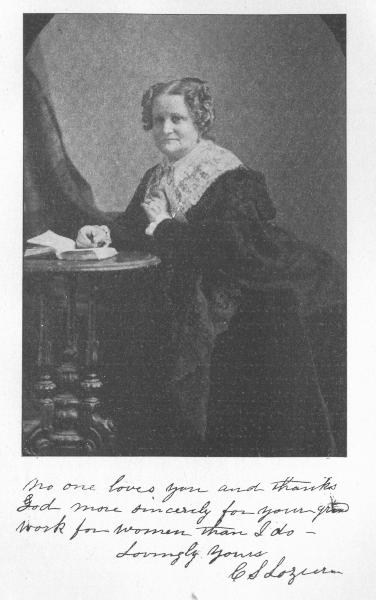
C S Lozier
It was conceded that Miss Anthony was a woman and that she voted on November 5, 1872. Judge Selden, for the second time in all his practice, offered himself as a witness, and testified that he advised her to vote, believing that the laws and Constitution of the United States gave her full authority. He then proposed to call Miss Anthony to testify as to the intention or belief under which she voted, but the Court held she was not competent as a witness in her own behalf. After making this decision, the Court then admitted all the testimony, as reported, which she gave on the preliminary examination before the commissioner, in spite of her counsel's protest against accepting the version which that officer took of her evidence. The prosecution simply alleged the fact of her having voted. Mr. Selden then addressed the judge and jury in a masterly argument of over three hours' duration, beginning:
The defendant is indicted under the 19th Section of the Act of Congress of May 31, 1870 (16th St. at L., 144), for "voting without having a lawful right to vote." The words of the statute, so far as they are material in this case, are as follows:
"If at any election for representative or delegate in the Congress of the United States, any person shall knowingly ... vote without having a lawful right to vote ... every such person shall be deemed guilty of a crime ... and on conviction thereof shall be punished by a fine not exceeding $500, or by imprisonment for a term not exceeding three years, or by both, in the discretion of the Court, and shall pay the costs of prosecution."
The only alleged ground of illegality of the defendant's vote is that she is a woman. If the same act had been done by her brother under the same circumstances, the act would have been not only innocent but honorable and laudable; but having been done by a woman it is said to be a crime. The crime therefore consists not in the act done but in the simple fact that the person doing it was a woman and not a man. I believe this is the first instance in which a woman has been arraigned in a criminal court merely on account of her sex....
Women have the same interest that men have in the establishment and 438 maintenance of good government; they are to the same extent as men bound to obey the laws; they suffer to the same extent by bad laws, and profit to the same extent by good laws; and upon principles of equal justice, as it would seem, should be allowed, equally with men, to express their preference in the choice of law-makers and rulers. But however that may be, no greater absurdity, to use no harsher term, could be presented, than that of rewarding men and punishing women for the same act, without giving to women any voice in the question which should he rewarded and which punished.
I am aware, however, that we are here to be governed by the Constitution and laws as they are, and that if the defendant has been guilty of violating the law, she must submit to the penalty, however unjust or absurd the law may be. But courts are not required to so interpret laws or constitutions as to produce either absurdity or injustice, so long as they are open to a more reasonable interpretation. This must be my excuse for what I design to say in regard to the propriety of female suffrage, because with that propriety established there is very little difficulty in finding sufficient warrant in the Constitution for its exercise. This case, in its legal aspects, presents three questions which I propose to discuss.
1. Was the defendant legally entitled to vote at the election in question?
2. If she was not entitled to vote but believed that she was, and voted in good faith in that belief, did such voting constitute a crime under the statute before referred to?
3. Did the defendant vote in good faith in that belief?
He argued the case from a legal, constitutional and moral standpoint and concluded:
One other matter will close what I have to say. Miss Anthony believed, and was advised, that she had a right to vote. She may also have been advised, as was clearly the fact, that the question as to her right could not be brought before the courts for trial without her voting or offering to vote, and if either was criminal, the one was as much so as the other. Therefore she stands now arraigned as a criminal, for taking the only step by which it was possible to bring the great constitutional question as to her right before the tribunals of the country for adjudication. If for thus acting, in the most perfect good faith, with motives as pure and impulses as noble as any which can find place in your honor's breast in the administration of justice, she is by the laws of her country to be condemned as a criminal, she must abide the consequences. Her condemnation, however, under such circumstances, would only add another most weighty reason to those which I have already advanced, to show that women need the aid of the ballot for their protection.
The district-attorney followed with a two hours' speech. Then Judge Hunt, without leaving the bench, delivered a written opinion[73] to the effect that the Fourteenth Amendment, 439 under which Miss Anthony claimed the authority to vote, "was a protection, not to all our rights, but to our rights as citizens of the United States only; that is, the rights existing or belonging to that condition or capacity." At its conclusion he directed the jury to bring in a verdict of guilty.
Miss Anthony's counsel insisted that the Court had no power to make such a direction in a criminal case and demanded that the jury be permitted to bring in its own verdict. The judge made no reply except to order the clerk to take the verdict. Mr. Selden demanded that the jury be polled. Judge Hunt refused, and at once discharged the jury without allowing them any consultation or asking if they agreed upon a verdict. Not one of them had spoken a word. After being discharged, the jurymen talked freely and several declared they should have brought in a verdict of "not guilty."
The next day Judge Selden argued the motion for a new trial on seven exceptions, but this was denied by Judge Hunt. The following scene then took place in the courtroom:
Judge Hunt.—(Ordering the defendant to stand up). Has the prisoner anything to say why sentence shall not be pronounced?
Miss Anthony.—Yes, your honor, I have many things to say; for in your ordered verdict of guilty you have trampled under foot every vital principle of our government. My natural rights, my civil rights, my political rights, my judicial rights, are all alike ignored. Robbed of the fundamental privilege of citizenship, I am degraded from the status of a citizen to that of a subject; and not only myself individually but all of my sex are, by your honor's verdict, doomed to political subjection under this so-called republican form of government.
Judge Hunt.—The Court can not listen to a rehearsal of argument which the prisoner's counsel has already consumed three hours in presenting.
Miss Anthony.—May it please your honor, I am not arguing the question, but simply stating the reasons why sentence can not, in justice, be pronounced against me. Your denial of my citizen's right to vote, is the denial of my right of consent as one of the governed, the denial of my right of representation as one of the taxed, the denial of my right to a trial by a jury of my peers as an offender against law; therefore, the denial of my sacred right to life, liberty, property and—
Judge Hunt.—The Court can not allow the prisoner to go on.
Miss Anthony.—But your honor will not deny me this one and only poor privilege of protest against this high-handed outrage upon my citizen's rights. May it please the Court to remember that, since the day of my arrest last 440 November, this is the first time that either myself or any person of my disfranchised class has been allowed a word of defense before judge or jury—
Judge Hunt.—The prisoner must sit down—the Court can not allow it.
Miss Anthony.—Of all my prosecutors, from the corner grocery politician who entered the complaint, to the United States marshal, commissioner, district-attorney, district-judge, your honor on the bench—not one is my peer, but each and all are my political sovereigns; and had your honor submitted my case to the jury, as was clearly your duty, even then I should have had just cause of protest, for not one of those men was my peer; but, native or foreign born, white or black, rich or poor, educated or ignorant, sober or drunk, each and every man of them was my political superior; hence, in no sense, my peer. Under such circumstances a commoner of England, tried before a jury of lords, would have far less cause to complain than have I, a woman, tried before a jury of men. Even my counsel, Hon. Henry R. Selden, who has argued my cause so ably, so earnestly, so unanswerably before your honor, is my political sovereign. Precisely as no disfranchised person is entitled to sit upon a jury, and no woman is entitled to the franchise, so none but a regularly admitted lawyer is allowed to practice in the courts, and no woman can gain admission to the bar—hence, jury, judge, counsel, all must be of the superior class.
Judge Hunt.—The Court must insist—the prisoner has been tried according to the established forms of law.
Miss Anthony.—Yes, your honor, but by forms of law all made by men, interpreted by men, administered by men, in favor of men and against women; and hence your honor's ordered verdict of guilty, against a United States citizen for the exercise of the "citizen's right to vote," simply because that citizen was a woman and not a man. But yesterday, the same man-made forms of law declared it a crime punishable with $1,000 fine and six months' imprisonment to give a cup of cold water, a crust of bread or a night's shelter to a panting fugitive tracking his way to Canada; and every man or woman in whose veins coursed a drop of human sympathy violated that wicked law, reckless of consequences, and was justified in so doing. As then the slaves who got their freedom had to take it over or under or through the unjust forms of law, precisely so now must women take it to get their right to a voice in this government; and I have taken mine, and mean to take it at every opportunity.
Judge Hunt.—The Court orders the prisoner to sit down. It will not allow another word.
Miss Anthony.—When I was brought before your honor for trial, I hoped for a broad and liberal interpretation of the Constitution and its recent amendments, which should declare all United States citizens under its protecting aegis—which should declare equality of rights the national guarantee to all persons born or naturalized in the United States. But failing to get this justice—failing, even, to get a trial by a jury not of my peers—I ask not leniency at your hands but rather the full rigor of the law.
Judge Hunt—The Court must insist—[Here the prisoner sat down.] The prisoner will stand up. [Here Miss Anthony rose again.] The sentence of the Court is that you pay a fine of $100 and the costs of the prosecution. 441 Miss Anthony.—May it please your honor, I will never pay a dollar of your unjust penalty. All the stock in trade I possess is a debt of $10,000, incurred by publishing my paper—The Revolution—the sole object of which was to educate all women to do precisely as I have done, rebel against your man-made, unjust, unconstitutional forms of law, which tax, fine, imprison and hang women, while denying them the right of representation in the government; and I will work on with might and main to pay every dollar of that honest debt, but not a penny shall go to this unjust claim. And I shall earnestly and persistently continue to urge all women to the practical recognition of the old Revolutionary maxim, "Resistance to tyranny is obedience to God."
Judge Hunt.—Madam, the Court will not order you to stand committed until the fine is paid.
Thus ended the great trial, "The United States of America vs. Susan B. Anthony." From this date the question of woman suffrage was lifted from one of grievances into one of Constitutional Law.
This was Judge Hunt's first criminal case after his elevation to the Supreme Bench of the United States. He was appointed at the solicitation of his intimate friend and townsman, Roscoe Conkling, and had an interview with him immediately preceding this trial. Mr. Conkling was an avowed enemy of woman suffrage. Miss Anthony always has believed that he inspired the course of Judge Hunt and that his decision was written before the trial, a belief shared by most of those associated in the case.
Miss Anthony says in her journal: "The greatest judicial outrage history ever recorded! No law, logic or demand of justice could change Judge Hunt's will. We were convicted before we had a hearing and the trial was a mere farce." Some time afterwards Judge Selden wrote her: "I regard the ruling of the judge, and also his refusal to submit the case to the jury, as utterly indefensible." Scarcely a newspaper in the country sustained Judge Hunt's action. The Canandaigua Times thus expressed the general sentiment in an editorial, soon after the trial:
The decisions of Judge Hunt in the Anthony case have been widely criticised, and it seems to us not without reason. Even among those who accept the conclusion that women have not a legal right to vote and who do not hesitate 442 to express the opinion that Miss Anthony deserved a greater punishment than she received, we find many seriously questioning the propriety of a proceeding whereby the proper functions of the jury are dispensed with, and the Court arrogates to itself the right to determine as to the guilt or innocence of the accused party. If this may be done in one instance, why may it not in all? And if our courts may thus arbitrarily direct what verdicts shall be rendered, what becomes of the right to trial "by an impartial jury," which the Constitution guarantees to all persons alike, whether male or female? These are questions of grave importance, to which the American people now have their attention forcibly directed through the extraordinary action of a judge of the Supreme Court. It is for them to say whether the right of trial by jury shall exist only in form, or be perpetuated according to the letter and spirit of the Constitution.
The New York Sun scored the judge as follows:
Judge Hunt allowed the jury to be impanelled and sworn, and to hear the evidence; but when the case had reached the point of the rendering of the verdict, he directed a verdict of guilty. He thus denied a trial by jury to an accused party in his court; and either through malice, which we do not believe, or through ignorance, which in such a flagrant degree is equally culpable in a judge, he violated one of the most important provisions of the Constitution of the United States. It is hardly worth while to argue that the right of trial by jury includes the right to a verdict by the jury, and to a free and impartial verdict, not one ordered, compelled and forced from them by an adverse and predetermined court. The language of the Constitution of the United States is that "in all criminal prosecutions the accused shall enjoy the right to a speedy and public trial by an impartial jury." Do the words an "impartial jury" mean a jury directed and controlled by the court, and who might just as well, for all practical purposes, be twelve wooden automatons, moved by a string pulled by the hand of the judge?
The Rochester Democrat and Chronicle commented:
In the action of Judge Hunt there was a grand, over-reaching assumption of authority, unsupported by any point in the case itself, but adopted as an established legal principle. If there is such a principle, Judge Hunt did his duty beyond question, and he is scarcely lower than the angels so far as personal power goes. The New York Sun assumes that there is no such principle; that if there were, "Judge Hunt might on his own ipsedixit, and without the intervention of a jury, fine, imprison or hang any man, woman or child in the United States." And the Sun proceeds to say that Judge Hunt "must be impeached and removed. Such punishment for the commission of a crime like his against civil liberty is a necessity. The American people will not tolerate a judge like this on the bench of their highest court. To do it would be to submit their necks to as detestable a tyranny as ever existed on the face. of the earth. They will not sit quietly by to see their liberties, red and radiant with the blood of a million of their sons, silently melted away in the judicial 443 crucible of a stolid and tyrannical judge of their Federal Court." This is forcible, certainly; but it ought to be speedily decided, at least, whether there is such a legal principle as we have mentioned.
The Utica Observer gave this opinion:
We have sought the advice of the best legal and judicial minds in our State in regard to the ruling of Justice Ward Hunt in the case of Susan B. Anthony. While the written opinion of the judge is very generally commended, his action in ordering a verdict of guilty to be entered, without giving the jury an opportunity of saying whether it was their verdict or not, is almost universally condemned. Such a case never before occurred in the history of our courts, and the hope is very general that it never will again. Between the indictment and the judgment stands the jury, and there is no way known to the law by which the jury's power in criminal cases can be abrogated. The judge may charge the jury that the defense is invalid; that it is their clear duty to find the prisoner guilty. But beyond this he can not properly go. He has no right to order the clerk to enter a verdict which is not the verdict of the jury. In doing this thing Justice Hunt outraged the rights of Susan B. Anthony. It would probably puzzle him to tell why he submitted the case of the inspectors to the jury after taking the case of Miss Anthony out of their hands. It would also puzzle his newspaper champions.
The Legal News, of Chicago, edited by Myra Bradwell, made this pertinent comment: "Judge Ward Hunt, of the Federal Bench, violated the Constitution of the United States more in convicting Miss Anthony of illegal voting, than she did in voting; for he had sworn to support it, and she had not."
The Albany Law Journal, however, after indulging in a few vulgar platitudes on the fact of Miss Anthony's having admitted that she was a woman, declared that Judge Hunt transcended his rights but that "if Miss Anthony does not like our laws she'd better emigrate!" This legal authority failed to advise where she could emigrate to find laws which were equally just to men and to women. It might also have answered the question, "Should a woman be compelled to leave the land of her nativity because of the injustice of its laws?"
Miss Anthony's trial closed on Wednesday and she remained in Canandaigua to attend that of the three inspectors, which followed at once. She was called as a witness and inquired of Judge Hunt: "I should like to know if the testimony of a person convicted of a crime can be taken?" "They call you 444 as a witness, madam," was his brusque reply. Later, thinking to trap her, he asked, "You presented yourself as a female, claiming that you had a right to vote?" Quick as a flash came her answer: "I presented myself not as a female, sir, but as a citizen of the United States. I was called to the ballot-box by the Fourteenth Amendment, not as a female but as a citizen."
The inspectors were defended by Mr. Van Voorhis but, after the testimony was introduced, the judge refused to allow him to address the jury. He practically directed them to bring in a verdict of guilty, saying, "You can decide it here or go out." The jury returned a verdict of guilty. The motion for a new trial was denied. One of the inspectors (Hall) had been tried and convicted without being brought into court. They were fined $25 each and the costs of the prosecution but, although neither was paid, they were not imprisoned at that time.
When asked for his opinion on the case, after a lapse of twenty-four years, Mr. Van Voorhis gave the following:
There never before was a trial in the country of one-half the importance of this of Miss Anthony's. That of Andrew Johnson had no issue which could compare in value with the one here at stake. If Miss Anthony had won her case on the merits, it would have revolutionized the suffrage of the country and enfranchised every woman in the United States. There was a pre-arranged determination to convict her. A jury trial was dangerous, and so the Constitution was openly and deliberately violated.
The Constitution makes the jury, in a criminal case, the judges of the law and of the facts. No matter how clear or how strong the case may appear to the judge, it must be submitted to the jury. That is the mandate of the Constitution. As no one can be convicted of crime except upon trial by jury, it follows that the jury are entitled to pass upon the law as well as the facts. The judge can advise the jury on questions of law. He can legally do no more. If he control the jury and direct a verdict of guilty, he himself is guilty of a crime for which impeachment is the remedy.
The jury in Miss Anthony's case was composed of excellent men. None better could have been drawn anywhere. Justice Hunt knew that. He had the jury impanelled only as a matter of form. He said so in the inspectors' case. He came to Canandaigua to hold the Circuit Court, for the purpose of convicting Miss Anthony. He had unquestionably prepared his opinion beforehand. The job had to be done, so he took the bull by the horns and directed the jury to find a verdict of guilty. In the case of the inspectors he refused to defendants' counsel the right of addressing the jury. 445
Judge Hunt very adroitly, in passing sentence on Miss Anthony imposing a fine of $100, refused to add, what is usual in such cases, that she be imprisoned until the fine be paid. Had he done so, Miss Anthony would have gone to prison, and then taken her case directly to the Supreme Court of the United States by writ of habeas corpus. There she would have been discharged, because trial by jury had been denied her. But as Miss Anthony was not even held in custody after judgment had been pronounced, she could not resort to habeas corpus proceedings and had no appeal.
But the outrage of ordering a verdict of guilty against the defendant was not the only outrage committed by this judge on these trials:
It was an outrage to refuse the right of a defendant to poll the jury.
It was an outrage for the judge to refuse to hold that if the defendant believed she had a right to vote, and voted in good faith in that belief, she was not guilty of the charge.
It was an outrage to hold that the jury, in considering the question whether she did or did not believe she had a right to vote, might not consider that she took the advice of Judge Selden before she voted, and acted on that advice.
It was an outrage to hold that the jury might not take into consideration, as bearing upon the same question, the fact that the inspectors and supervisor of election looked into the question, and came to the conclusion that she had the right to be registered and vote, and told her so, and so decided.
It was an outrage for the judge to hold that the jury had not the right to consider the defendant's motive, and to find her innocent if she acted without any intent to violate the law.
In the case of the inspectors, it was an outrage to refuse defendants' counsel the right to address the jury.
It was an outrage to refuse to instruct the jury that if the defendants, being administrative officers, acted without any criminal motive but in accordance with their best judgment, and in perfect good faith, they were not guilty.
Judge Selden has passed to his eternal rest and lies beneath a massive monument of granite in beautiful Mount Hope cemetery. Mr. Van Voorhis thus paid tribute to his associate in this noted case: "His argument on the constitutional points involved is one of the ablest and most complete to be found in history. As a lawyer he had no superior; he was a master in his profession. He had a most discriminating mind and a marvellous memory. He was familiar with the books, and possessed a power of statement equal to that of Daniel Webster. I predict that the verdict of history will be that Judge Selden was right and the Court wrong upon the constitutional question involved in this case."
To the heavy debts of The Revolution which, with all her efforts, Miss Anthony had been able to reduce but a fraction, 446 were now added the costs of this suit. She did not propose to pay the fines, but she did intend to see that the inspectors were relieved of all expense in connection with the trial. Her indomitable courage did not fail her even in this emergency, and as usual she was sustained by the substantial appreciation of her friends. Letters of sympathy and financial help poured in from acquaintances and strangers in all parts of the country. Indignation meetings were held and contributions sent also by various reform clubs and societies.[74] All were swallowed up in the heavy and unavoidable expenses of the suits of herself and the inspectors. Neither of her lawyers ever presented a bill. She had 5,000 copies made of Judge Selden's argument on the habeas corpus at Albany, which she scattered broadcast. She also had printed 3,000 pamphlets, at a cost of $700, containing a full report of the trial, and sent them to all the law journals in the United States and Canada, to the newspapers, etc. The Democrat and Chronicle said of this book, "We believe it is the most important contribution yet made to the discussion of woman suffrage from a legal standpoint." None of the other cases ever were brought to trial.[75]
Miss Anthony had no fears of not being able to raise money to pay her debts if she could be free to give her time to the lecture platform, but an entire year had been occupied with her trial, and the money received during this period had been 447 required to meet its expenses. She had a vital reason, however, for feeling that she could not leave home—the rapidly-failing health of her beloved sister Guelma, her senior by only twenty months, for more than half a century her close companion, and for the past eight years living under the same roof. Her heart had been broken by the death, a few years before, of her two beautiful children just at the dawn of manhood and womanhood, and the fatal malady consumption met with no resistance. Day by day she faded away, the physician holding out no hope from the first. Her mother, now eighty years of age, was completely crushed; the sister Mary was principal of one of the city schools and busy all day, and Miss Anthony felt it her imperative duty to remain beside the invalid, even could she have overcome her grief sufficiently to appear in public. Invitations to lecture came to her from many points but she refused them and remained by the gentle sufferer day and night.[76] At daybreak on November 9 the loved one passed away, and the tender hands of sisters and of the only daughter performed the last ministrations.[77]
With Miss Anthony the love of family was especially intense as she had formed no outside ties, and the parents, the brothers and sisters filled her world of affection. The sundering of these bonds wrenched her very heartstrings and upon every recurring anniversary the anguish broke forth afresh, scarcely assuaged by the lapse of years. A short time after this last sorrow she writes:
MY DEAR MOTHER: How continually, except the one hour when I am on the platform, is the thought of you and your loss and my own with me! How little we realize the constant presence in our minds of our loved and loving ones until they are forever gone. We would not call them back to endure again their suffering, but we can not help wishing they might have been spared to us in health and vigor. Our Guelma, does she look down upon us, does she still live, and shall we all live again and know each other, and work together and love and enjoy one another? In spite of instinct, in spite of faith, these questions will come up again and again.... She said you 448 would soon follow her, and we know that in the nature of things it must be so. When that time comes, dear mother, may you fall asleep as sweetly and softly as did your eldest born; and as the sands of life ebb out into the great eternal, may all of us be with you to make the way easy. It does seem too cruel that every one of us must be so overwhelmingly immersed in work, but may the Good Father help us so to do that there may be no vain regrets for things done or left undone when the last hour comes.
A beautiful incident cast a flood of light through the heavy shadows of this trying year, and made November 27 in truth a day of Thanksgiving for one brave woman. At his urgent invitation, Miss Anthony had spent it in the home of her cousin, Anson Laphain, at Skaneateles. After a pleasant day, as she sat quietly and sadly by the window, watching the deepening twilight, the noble-hearted cousin took from his desk her notes for $4,000, which he had so generously loaned her during the stormy days of The Revolution, cancelled all and presented them to her. She was overwhelmed with surprise and when she attempted to express her gratitude, he stopped her with words of respect, confidence and encouragement which seemed to roll away a stone from her heart and in its place put new hope, ambition and strength.
Miss Anthony's case continued to attract widespread attention, Judge Hunt's arbitrary action finding few apologists even among opponents of woman suffrage. It was finally decided by her counsel and herself to make an appeal to Congress for the remission of the fine, which, if granted, would be in effect a declaration of the illegality of Judge Hunt's act and a precedent for the future. Judge Selden based his authority for such an appeal on a case in the United States Statutes at Large, chap. 45, p. 802, where a fine of $1,000 and costs, illegally imposed upon Matthew Lyon under the Alien and Sedition Laws, 1799, were refunded with interest to his heirs. Mr. Van Voorhis found an authority also in an act passed by the British Parliament in 1792, correcting the departure from the common law, in respect to the rights of juries, by Lord Mansfield and his associates in the cases of Woodfall and Shipley. This act was passed through the exertions of Lord Camden and Mr. Fox in order to prevent the erroneous decisions of the judges from becoming the law of England.
Both of the attorneys keenly resented the action of Judge Hunt, Mr. Selden pronouncing it "the greatest judicial outrage ever perpetrated in the United States;" and Mr. Van Voorhis asserting that "trial by jury was completely annihilated in this case, and there is no remedy except to appeal to the justice of Congress to remit the fine and declare that trial by jury does and shall exist in this country." The appeal, or petition, was 450 prepared and Miss Anthony carried it to Washington when she went to the National Convention, January 15, 1874. It was an able document, reciting the facts in the case and the action of the judge, and concluding:
Your petitioner respectfully submits that, in these proceedings, she has been denied the rights guaranteed by the Constitution to all persons accused of crime, the right of trial by jury and the right to have the assistance of counsel for their defense. It is a mockery to call hers a trial by jury; and, unless the assistance of counsel may be limited to the argument of legal questions, without the privilege of saying a word to the jury upon the question of the guilt or innocence in fact of a party charged, or the privilege of ascertaining from the jury whether they do or do not agree to the verdict pronounced by the Court in their name, she has been denied the assistance of counsel for her defense.
Of the decision of the judge upon the question of the right of your petitioner to vote, she makes no complaint. It was a question properly belonging to the Court to decide, was fully and fairly submitted to the judge, and of his decision, whether right or wrong, your petitioner is well aware she can not here complain. But in regard to her conviction of crime, which she insists, for the reasons above given, was in violation of the principles of the common law, of common morality, of the statute under which she was charged, and of the Constitution—a crime of which she was as innocent as the judge by whom she was convicted—she respectfully asks, inasmuch as the law has provided no means of reviewing the decisions of the judge, or of correcting his errors, that the fine imposed upon your petitioner be remitted, as an expression of the sense of this high tribunal that her conviction was unjust.
This was presented in the Senate by A.A. Sargent, of California, and in the House by William Loughridge, of Iowa, and was referred to the judiciary committees. In May, Lyman Tremaine, from the House Judiciary Committee, reported adversely on the petition in a lengthy document, which incorporated a letter from District-Attorney Crowley, urging the committee "not to degrade a just judge and applaud a criminal;" and declaring that "Miss Anthony's trial was fair and constitutional and by an impartial jury." (!) Mr. Tremaine's report said: "Congress can not be converted into a national court of review for any and all criminal convictions where it shall be alleged the judge has committed an error." Thus did he deliberately ignore the point at issue, the refusal of a trial by jury. It concluded by saying: "Since the discussion of 451 this question has arisen in the committee, the President has pardoned Miss Anthony for the offense of which she was convicted and this seems to furnish a conclusive reason why no further action should be taken by the judiciary committee." (!) The learned gentleman probably referred to the pardon of the inspectors by the President. Miss Anthony had not asked executive clemency for herself.
Benjamin F. Butler presented an able and exhaustive minority report which closed with the following declaration: "Therefore, because the fine has been imposed by a court of the United States for an offense triable by jury, without the same being submitted to the jury, and because the court assumed to itself the right to enter a verdict without submitting the case to the jury, and in order that the judgment of the House of Representatives, if it concur with the judgment of the committee, may, in the most signal and impressive form, mark its determination to sustain in its integrity the common law right of trial by jury, your committee recommend that the prayer of the petitioner be granted."
In June George F. Edmunds made an adverse report from the Senate Judiciary Committee in this remarkable language: "That they are not satisfied that the ruling of the judge was precisely as represented in the petition, and that if it were so, the Senate could not legally take any action in the premises, and they move that the committee be discharged from the further consideration of the petition, and that the bill be postponed indefinitely."
Senator Matthew II. Carpenter presented a long and carefully prepared minority report which concluded:
Unfortunately the United States has no "well-ordered system of jurisprudence." A citizen may be tried, condemned and put to death by the erroneous judgment of a single inferior judge, and no court can grant him relief or a new trial. If a citizen have a cause involving the title to his farm, if it exceed $2,000 in value, he may bring his cause to the Supreme Court; but if it involve his liberty or his life, he can not. While we permit this blemish to exist on our judicial system, it behooves us to watch carefully the judgments inferior courts may render; and it is doubly important that we should see to it that twelve jurors shall concur with the judge before a citizen shall be hanged, incarcerated or otherwise punished. 452
I concur with the majority of the committee that Congress can not grant the precise relief prayed for in the memorial; but I deem it to be the duty of Congress to declare its disapproval of the doctrine asserted and the course pursued in the trial of Miss Anthony; and all the more for the reason that no judicial court has jurisdiction to review the proceedings therein.
I need not disclaim all purpose to question the motives of the learned judge before whom this trial was conducted. The best of judges may commit the gravest of errors amid the hurry and confusion of a nisi prius term; and the wrong Miss Anthony has suffered ought to be charged to the vicious system which denies to those convicted of offenses against the laws of the United States a hearing before the court of last resort—a defect it is equally within the power and the duty of Congress speedily to remedy.
When Miss Anthony returned to Rochester in February, she found the inspectors were about to be put into jail because, acting under advice, they still refused to pay their fines. She wrote Benjamin F. Butler, who replied under date of February 22: "I would not, if I were they, pay, but allow process to be served; and I have no doubt the President will remit the fine if they are pressed too far." They were imprisoned February 26. Miss Anthony went at once to the jail and urged them not to pay the fine, for the sake of principle, promising to see that they were soon released. She waded through a heavy snow to consult her attorneys and then to the newspaper offices to talk with the editors in regard to the prisoners, reaching home at dark, and in her diary that night she writes, "I could not bear to come away and leave them one night in that dolorous place."
She went out for a few lectures in neighboring towns, and at the Dansville Sanitarium was presented by the patients with a purse of $62. Arriving in Rochester at 7 A. M., March 2, she went straight to the jail and breakfasted with the inspectors; then to see the marshal and succeeded in having them released on bail. She did not reach home till 1 p. M., and here she found this telegram from Senator Sargent: "I laid the case of the inspectors before the President today. He kindly orders their pardon. Papers are being prepared." Benjamin F. Butler also had interceded with the President and sent Miss Anthony a telegram of congratulation on the result. In a few days the inspectors were pardoned and their 453 fines remitted by President Grant. They were in jail just one week and during that time received hundreds of calls, while each day bountiful meals were sent them by the women whose votes they had accepted. After their pardon a reception was given them at the home of Miss Anthony's sister, Mrs. Mosher, by the ladies of the Eighth ward, and in the spring they were re-elected by a handsome majority. Miss Anthony's fine stands against her to the present day.
This case was the dominating feature of the National Convention at Washington in the winter of 1874; the key-note of all the speeches and the arguments before the judiciary committees was woman's right to vote under the Fourteenth Amendment. The women did not relinquish this claim until all ground for it was destroyed by a decision of the United States Supreme Court in 1875, in the case of Virginia L. Minor, of St. Louis. Francis Minor, a lawyer of that city, was the first to assert that women were enfranchised by both the letter and the spirit of the Fourteenth Amendment, and, acting under his advice, his wife attempted to register for the presidential election of 1872. Her name was refused and she brought suit against the inspector for the purpose of making a test case. After an adverse decision by the lower courts, the case was carried to the Supreme Court of the United States and argued before that tribunal by Mr. Minor, at the October term, 1874. It is not too much to say that no constitutional lawyer in the country could have improved upon this argument in its array of authorities, its keen logic and its impressive plea for justice.[78]
The decision was adverse, the opinion of the court being delivered March 29, 1875, by Chief-Justice Waite, himself a strong advocate of the enfranchisement of women. The court admitted that "women are persons and citizens," but found that the "National Constitution does not define the privileges and immunities of citizens. The United States has no voters of its own creation. The National Constitution does not confer the right of suffrage upon any one, but the franchise must 454 be regulated by the States. The Fourteenth Amendment does not add to the privileges and immunities of a citizen; it simply furnishes an additional guarantee to protect those he already has. Before the passage of the Fourteenth and Fifteenth Amendments, the States had the power to disfranchise on account of race or color. These amendments, ratified by the States, simply forbade that discrimination, but did not forbid that against sex."
This is in direct contradiction to the decision of Chief-Justice Taney in the Dred Scott case: "The words 'people of the United States' and 'citizens' are synonymous terms and mean the same thing; they describe the political body who, according to our republican institutions, form the sovereignty and hold the power, and conduct the government through their representatives. They are what we familiarly call the sovereign people, and every citizen is one of this people, and a constituent member of this sovereignty."
Although Miss Anthony and her co-workers still believed that, with a true interpretation, women were voters under these amendments, they were obliged to accept the decision of the highest court of appeal. They then returned to the work of petitioning Congress for a Sixteenth Amendment to the National Constitution which should prohibit disfranchisement on account of sex. They continued also the original plan of endeavoring to secure amendments to the constitutions of the different States abolishing the word "male" as a qualification for voting.[79] Bitterly disappointed at the decision of the Supreme Court, it was nevertheless a source of pride to the women that they had made their claim for representation in the government, carried it to the highest tribunal and gone down in honorable defeat.
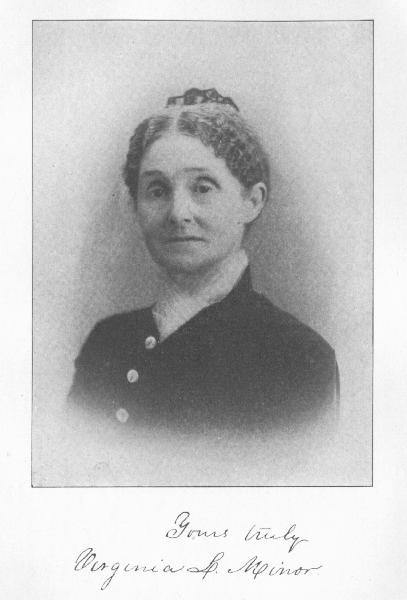
Virginia L. Minor
Miss Anthony never hesitated to ask the most distinguished men to speak on the woman suffrage platform, and Henry Wilson writes from the chamber of the Vice-President his regrets that he can not accept her invitation. Benjamin F. Butler replies: "As a rule I have refused to take part in any 455 convention in the District of Columbia about any matter which might come before Congress. I have gone farther out of my way in that regard in the matter of woman suffrage than in any other. Having given evidence that I am most strongly committed to the legality, propriety and justice of granting the ballot to woman, I do not see how I can add anything to it. Hoping that your cause may succeed, I have the honor to be, very truly yours."
Her cousin, Elbridge G. Lapham, M. C., of New York, says in a letter: "I am persuaded the time is fast hastening when woman will be accorded the exercise of the right your association demands. With that secured, many other advantages, now denied, will surely and speedily follow. I can see no valid objection to the right of suffrage being conferred, while there are many and very cogent reasons in favor of it. As has been said, you may go on election day to the most degraded elector you can find at the polls, who would sell his vote for a dollar or a dram, and ask him what he would take for his right to vote and you couldn't purchase it with a kingdom."
Elbridge G. Lapham
She found it possible even to interview the President of the United States on this question. During a conversation with General Grant one day on Pennsylvania Avenue, she said, "Well, Mr. President, what are you going to do for woman suffrage?" In a hearty, pleasant way he answered, "I have already done more for women than any other President, I have recognized the right of 5,000 of them to be postmasters." There were always distinguished men to champion this cause, but the chief drawback was expressed in a letter from that staunch supporter, Hon. A.G. Riddle, in 1874:
There is not, I think, the slightest hope from the courts; and just as little from politicians. They never will take up this cause, never! Individuals will, parties never—till the thing is done. The Republicans want no new issues or disturbing elements. The Democrats are certain that the Republicans 456 are about to dissolve; and they want to hold on as they are. Both think this thing may, perhaps will come, but now is not the time; and with both, there never will be a "now." The trouble is that below all this lies the fact that man can govern alone and that, though woman has the right, man wants to do it; and if she wait for him to ask her, she will never vote.
There never was a cause with so much unembodied strength, and with so little working power; and the problem is how to vitalize and organize it. One of two things, I think, must occur; either man must be made to see and feel, as he never has done yet, the need of woman's help in the great field of human government, and so demand it; or woman must arise and come forward as she never has, and take her place. I still think that one of the main hindrances is with women. The fact is, that the worst bugbear is the never-seen, ever-felt law of caste which has always walled woman around, and which few have the courage to step over.
A.G. Riddle
At the close of the convention Miss Anthony accepted the invitation of Mrs. Hooker, the State president, to join her in a month's tour through Connecticut. They spoke in nineteen different cities and towns, Mrs. Hooker assuming all financial responsibility and paying Miss Anthony $25 for each lecture. They had excellent audiences and were entertained in many beautiful homes. In Miss Anthony's diary, March 11, she says: "Senator Sumner died today, the noblest Roman of them all; true to the negro, but never a public word for woman. How I have pleaded with him for years, and he always admitted that his principles logically carried out gave woman an equal guarantee with man."
In the spring of 1874 the women's temperance crusade began in Rochester and, although their methods were very different from those Miss Anthony would have employed, she met with them at their request to help them organize. After this was effected they called on her for a speech and she said in brief: 457
I am always glad to welcome every association of women for any good purpose, because I know that they will quickly learn the impossibility of accomplishing any substantial end. Women never realize their inability to effect a reform until they attempt it, and then they find how closely interwoven with politics are all such matters, and how entirely without political power are they themselves.... Now my good women, the best thing this organization will do for you will be to show you how utterly powerless you are to put down the liquor traffic. You never can talk down or sing down or pray down an institution which is voted into existence. You never will be able to lessen this evil until you have votes. Frederick Douglass used to tell how, when he was a Maryland slave and a good Methodist, he would go into the farthest corner of the tobacco field and pray God to bring him liberty; but God never answered his prayers until he prayed with his heels. And so, dear friends, He never will answer yours for the suppression of the liquor traffic until you are able to pray with your ballots.[80]
Miss Anthony's sentiments on this question are further expressed in a letter to her brother Daniel R., editor Leavenworth Times:
I like the Times' article on the women's whiskey war. Emerson says, "God answers only such prayers as men themselves answer." After ignorant and helpless mothers have transmitted to their children the drunkard's appetite, God can not answer their prayers to prevent them from gratifying it. But this crusade will educate the women who engage in it to use the one and only means of regulating or prohibiting the traffic in liquor—that of the ballot. As soon as they find this crusade experiment a failure, which they certainly will, because all spasmodic, sensational religious efforts are transient and fleeting, they will realize the enduring strength and usefulness of the franchise. However little that is permanent may come of this movement, it is good in itself because anything is better for women than tame submission to the evils around them; and when they find kind words, entreaties and tears avail nothing, they will surely try the virtue of stones (votes) to bring down the great demon that desolates their homes.
An entry in the journal made soon afterward says: "I dropped into the Industrial Congress today and was invited to speak. I told the men that the degraded labor of women made them quite as heavy a millstone round the necks of working-men as is the Heathen Chinese." And a few days later: "Dr. Dio Lewis called today, and I went to hear him speak this evening. Same old story—men make and break the laws, and women by love and persuasion must soften their hearts to 458 abandon their wickedness. Never a hint that women should have anything to do with the making and enforcing of the laws. They must only coax."
The diary shows over one hundred letters written by Miss Anthony's own hand in arranging for the May Anniversary in New York, while she sat at the bedside of her mother, who was very ill. Many cordial answers were received, among them one from Josephine E. Butler, of England. Mary L. Booth thus closed her reply: "Pray believe that I always hold you in affectionate remembrance as one of the most sincere, earnest and disinterested women whom it has ever been my fortune to meet, and whom I shall always be glad to hear from or to see." Mrs. Stanton sent an extract from a letter of Martha C. Wright, saying: "Our only hope is in the gradual accession of thinking men and women, and in our indomitable Susan."
At Miss Anthony's earnest desire, Mrs. Wright was elected president of the association and this proved to be her last appearance on that platform which she had graced for many years. An interesting feature of the meeting was the presence of the veteran worker, Ernestine L. Rose, who was back from England on a visit. During this May meeting a telegram was sent over the country stating: "Miss Anthony stalked down the aisle with faded alpaca dress to the top of her boots, blue cotton umbrella and white cotton gloves, perched herself on the platform, crossed her legs, pulled out her snuff-box and passed it around. On the platform were Mrs. Stanton, Mrs. Wright, Mrs. Gage, Mrs. Rose and other noted women, all dressed in unmentionables cut bias, and smoking penny drab cigars. Susan was quite drunk." The New York Herald, which rarely had a good word for the suffrage conventions, in a long and respectful account of this same meeting, said:
There was a perfume of Fifth Avenue about the audience. Carriages in livery rolled up to the door. The striking contrast of this audience with that of other years, in the almost perfect conformity of the manner and dress of the women to those of other women who rule in the fashionable world and 459 are supposed to look down upon these knights-errant of the sex, was not greater than that between the treatment of Miss Anthony now and in other times. In former years they came to scoff at this wiry and resolute champion of her sex. Now every word she utters is received with almost reverent rapture. Yesterday brought together as intelligent and perhaps as refined an audience of ladies as might he gathered in the city. Miss Anthony was dressed with her usual simplicity in black silk. She read the call for the convention and made thereon one of her characteristic addresses, full of fire and prophecy.
During the summer of 1874 Miss Anthony lectured in many places in Massachusetts and New York, striving to pay the interest and reduce by a little her pressing debts, and slipping home occasionally to see her mother who was carefully tended by the devoted sister Mary. At one of these times she writes in her diary: "It is always so good to get into my own humble bed." August 22 she sent a letter of congratulation on his fiftieth birthday to her brother Daniel R. After referring to the $50 he sent to her at the close of her half century, she says:
Though I can not return my love and wishes in the same kind, they are none the less for your joy and peace in the future, neither is my rejoicing less over the success of your first half of life. From your many experiences, whether they have been such as you would have chosen or not, strength, growth, discipline have resulted, and sometimes I think all the adverse winds of life are needed to check our ever-rising vain-glory in our own power and success.... Whatever comes to those closely united by marriage or by blood, the one lesson from recent developments in Brooklyn is that none of the parties ever should take in an outside person as confidant. If the twain can not themselves restore their oneness, none other can. If parents and children, brothers and sisters, can not adjust their own differences among themselves, it is in vain they look to friends outside.
What lessons we are having that not only is honesty the best policy, but that there is nothing but most dreadful disaster in any policy which is not based on absolute honesty. The fact is, nothing is worth the getting, if that has to be done by cunning, falsehood, deception. Whether it be wealth, position, office or the society of one we love, if we have to steal it, though it may be sweet and seemingly real and lasting, the exposure of the illicit means of gaining it is sure to come, and then the thing itself turns to dross. When will the children of men learn this fact, that nothing pays but that which is obtained fairly, openly and honestly?
This year the Michigan Legislature submitted a woman suffrage amendment to the voters, and Miss Anthony decided to 460 canvass the State. To do this would ruin her own lecture season for the autumn, and those in charge of the suffrage campaign could offer her no salary. She did not hesitate, however, but without any financial guarantee, began her work there September 24. On the eve of going she wrote to a friend: "I leave home without having had one single week of rest this summer—not this year, indeed, nor for twenty-five years." She made a forty days' canvass, taking out three days for the Illinois convention at Chicago, and during that time spoke in thirty-five different places. Everywhere she addressed immense and enthusiastic crowds. She was frequently preceded by Senator Zach. Chandler, speaking for the Republican party, and often her audiences were much larger than the senator's.[81] Toward the close of the campaign she wrote home:
If these meetings of mine were only by and in favor of an enfranchised class, they would carry almost the solid vote of every town for the measure advocated; but alas, they are for a class powerless to help or hinder any party for good or for evil. It is wonderful to see how quickly the prejudices yield to a little common sense talk. If only we had speakers and time, we could carry the vote of this State, but we have neither, and so all we can hope for is a respectable minority. I enclose $200 left above travelling expenses, hall rent, etc., from collections and the sale of my trial pamphlets. If I could 461 have had even a twenty-five cents admission, I should have cleared over $1,000, but I could not have it said that I went to Michigan, at such a crisis, to make money for myself; it would have ruined the moral effect of my work. Now they are calling on me from Washington to stay in that city all next winter to get our measure considered by Congress, but I ought to go to work to earn money, for I need it if ever anybody did. If I have to get it, however, at the cost of losing our golden opportunity there, it will be too dear a price to pay.
Miss Anthony was correct in her forecast, the suffrage amendment was defeated in Michigan by more than three to one, but there is no doubt her able canvass contributed largely to secure "a respectable minority."
In the summer of 1874 the so-called Beecher-Tilton scandal, which had been smouldering a long time, burst into full blaze. Miss Anthony had been for many years on intimate terms with all the parties in this unfortunate affair, and there was a persistent rumor that she had at one time received a confession from Mrs. Tilton which, if given by her to the public, would settle the vexed question beyond a doubt. It is scarcely possible to describe the pressure brought to bear to force her to disclose what she knew. During her lecture tours of that summer and fall, while the trial was in progress before the church committee, she never entered a railroad car, an omnibus or a hotel but there was somebody ready to question her. In every town and city she was called upon for an interview before she had time to brush off the dust of travel. One of the New York papers detailed a reporter to follow her from point to point, catch every word she uttered, ferret out all she said to her friends and in some way extort what was wanted. She often remarked that "in this case men proved themselves the champion gossips of the world."
Papers which had befriended her and her cause reminded her of this fact and urged her to return the favor by telling them what she knew. Telegrams and letters poured in upon her from strangers and friends, some commending and begging her to continue silent; others censuring and urging her to tell the whole story. Lawyers connected with the case wrote her the shrewdest of pleas, telling her how the other side were trying 462 to defame her character and urging her to speak in self-defense; but it is a significant fact that she received no official summons either during the church committee investigation or the trial in court.
The Chicago Tribune, having failed to secure an interview, said: "Miss Anthony keeps her own counsel in this matter with a resolution which would do credit to General Grant." Several papers manufactured interviews with her out of whole cloth. Everybody else, man or woman, who had the slightest knowledge of the affair, rushed into print, but under all the pressure she remained as immovable and silent as the granite mountains amid which she was born. The universal desire to have her speak was because of the value placed upon her integrity and veracity. John Hooker, the eminent lawyer of Hartford, Conn., brother-in-law of Mr. Beecher, voiced the opinion of her friends when he wrote under date of November 9, 1874: "A more truthful person does not live. The whole world could not get her to go into a conspiracy against one whom she believed to be innocent. I have perfect confidence in her truthfulness and always stoutly assert it."
The New York Sun expressed the general sentiment of the press when it said in this connection: "Miss Anthony is a lady whose word will everywhere be believed by those who know anything of her character." Her home paper, the Democrat and Chronicle, paid this tribute: "Whether she will make any definite revelations remains to be seen, but whatever she does say will be received by the public with that credit which attaches to the evidence of a truthful witness. Her own character, known and honored by the country, will give importance to any utterances she may make."
Most of the charges made against her during this ordeal were so manifestly absurd they did not need refuting, but the oft-repeated assertions that she believed in what was popularly termed "free love" were a source of great annoyance. In a letter written at this time to Elizabeth Smith Miller she thus definitely expressed herself: "I have always believed the 'variety' system vile, and still do so believe. I am convinced 463 that no one has yet wrought out the true social system. I am sure no theory can be correct which a mother is not willing for her daughter to practice. Decent women should not live with licentious husbands in the relation of wife. As society is now, good, pure women, by so living, cover up and palliate immorality and help to violate the law of monogamy. Women must take the social helm into their own hands and not permit the men of their own circle, any more than the women, to be transgressors."
To Mr. Hooker, on this same subject, she wrote: "In my heart of hearts I hate the whole doctrine of 'variety' or 'promiscuity.' I am not even a believer in second marriages after one of the parties is dead, so sacred and binding do I consider the marriage relation." A few extracts from her diary during these days will show the trend of her thoughts:
Silence alone is all there is for me at present. I appreciate as never before the value of having lived an open life.... The parlor, the street corner, the newspapers, the very air seem full of social miasma.... Sad, sad revelations! There is nothing more demoralizing than lying. The act itself is scarcely so base as the lie which denies it.... It is almost an impossibility for a man and a woman to have a close, sympathetic friendship without the tendrils of one soul becoming fastened around the other, with the result of infinite pain and anguish.... The great financial rings, Christian Union, Life of Christ and Plymouth church, the three in one, most powerful trinity, seem to have subsidized the entire New York press.
In her positive refusal to speak the word which would criminate a woman, Miss Anthony was actuated by the highest sense of honor. She loved Mr. and Mrs. Tilton as her own family. She had enjoyed the hospitality of their beautiful home and seen their children grow up from babyhood. Mrs. Tilton was one of the loveliest characters she ever had known, an exquisite housekeeper, an ideal mother; a woman of wide reading and fine literary taste, of sunny temperament and affectionate disposition. To violate the confidence of such a woman, given in an hour of supreme anguish, would have been treachery unparalleled. In answer to the charge that Mrs. Tilton was a very weak or a very wicked woman, Miss Anthony always maintained that none ever was called upon to 464 suffer such temptation. On the one hand was her husband, one of the most brilliant writers and speakers of the day, a man of marvellously attractive powers in the home as well as in the outside world. At his table often sat Phillips, Garrison, Sumner, Wilson and many other prominent men, who all alike admired and loved him.
On the other hand was her pastor, the most powerful and magnetic preacher and orator not only in Brooklyn but in the nation. When he spoke on Sunday to his congregation of 3,000 people, there was not a man present but felt that he could get strength by touching even the hem of his garment. If his power were such over men, by the law of nature it must have been infinitely greater over women. Since it was thus irresistible in public, how transcendent must it have been in the close and intimate companionship of private life!
The house of the Tiltons was the second home of Mr. Beecher, and scarcely a day passed that he did not visit it. He found here the brightness, congeniality, sympathy and loving trust which every human being longs for. The choicest new literature was sent hither for the delicate appreciation it was sure to receive. When he came in from his Peekskill country place with great baskets of flowers, the most beautiful always found their way to this household. Miss Anthony recalls one occasion when Mrs. Tilton, slipping her hand through her arm, drew her to the mantelpiece over which hung a lovely water color of the trailing arbutus, and said, "My pastor brought that to me this morning." At another time, when she went on Saturday evening to stay over Sunday, Mrs. Tilton said, as she dropped into a low chair: "Mr. Beecher sat here all the morning writing his sermon. He says there is no place in the world where he can get such inspiration as at Theodore's desk, while I sit beside him in this little chair darning the children's stockings."
In all of these and many similar occurrences Miss Anthony saw nothing but a warm and sincere friendship. To Mr. Tilton Mr. Beecher was as a father or an elder brother. He had placed the ambitious and talented youth where he could achieve 465 both fame and fortune, had introduced him into the highest social circles and shown to the world that he regarded him as his dearest confidential friend, and for years the two men had enjoyed the closest and strongest intimacy. Mrs. Tilton had been born into Plymouth church, baptized by Mr. Beecher, had taught in his Sunday school, visited at his home. He loved her as his own, and she adored him as a very Christ. To these two great intellectual and spiritual magnets, first to one, then to the other, she was irresistibly and uncontrollably drawn. When troubles arose and the two became bitterly hostile, her situation was most pitiable. After matters had culminated and the battle was on, Beecher still spoke of her as "the beloved Christian woman," and Tilton, as "the whitest-souled woman who ever lived." Weak she may have been through her emotions, never wilfully wicked, and far less sinning than sinned against. She was wholly dominated by two powerful influences. Between the upper and the nether millstone her life was crushed.
[81] Not far from three times as many were at Miss Anthony's lecture as gathered to hear Senator Chandler.—Jackson Patriot.
One of the largest audiences ever in the opera house gathered last evening on the occasion of the lecture of Miss Susan B. Anthony.—Adrian Times and Expositor.
Probably the largest audience ever assembled in Clinton Hall convened to hear-Miss Susan B. Anthony, the celebrated expounder of the rights of women.—Pontiac Gazette.
Since the great Children's Jubilee there has not been so large an audience in the Academy of Music as that assembled to hear Miss Anthony's lecture.—East Saginaw Daily Republican.
Miss Anthony spoke at Hillsdale to a densely crowded opera house, while full 1,000 people were unable to gain admission.—Grand Rapids Post.
Miss Susan B. Anthony spoke last evening to the largest audience that ever greeted a lecturer in Marshall, and we have had Mrs. Stanton, Theodore Tilton, Mark Twain and Olive Logan. She had at least 1,200 hearers.—Telegram to Detroit Evening News.
Last evening the aisles were double-seated, and the anterooms, staircases and vestibules densely packed with standing hearers. No such house ever was had at this place. She spoke with wonderful power. At Pigeon, between trains, she spoke to a great throng who would not consider her strength and take "no" for an answer.—Three Rivers Reporter.
A woman with whose public sayings and doings we have been familiar since the fall of 1867, and for whom our respect and admiration has never wavered during that period, spoke to the largest indoor audience ever assembled in this village. The courthouse was literally packed, and the speaker had to stand on a table in front of the judge's desk.—Cassopolis National Democrat.
At the close of 1874, December 28, the cause of woman suffrage lost a strong supporter by the death of Gerrit Smith. Miss Anthony felt the loss deeply, as he had been her warm personal friend for twenty-five years and always ready with financial aid for her projects; but she suffered a keener shock one week later when the news came of the sudden death of Martha C. Wright, January 4, 1875. She says in her diary: "It struck me dumb, I could not believe it; clear-sighted, true and steadfast almost beyond all other women! Her home was my home, always so restful and refreshing, her friendship never failed; the darker the hour, the brighter were her words of encouragement, the stronger and closer her support. I can not be reconciled."
But for this earnest advocate there could be no cessation of work and the 14th of January found her again in Washington at the National Convention. These annual meetings, with their advertising, hall rent, expenses of speakers, etc., were costly affairs. Before every one Miss Anthony always received scores of letters from the other workers begging that it might be given up for that year, insisting that for various reasons it would be a failure, and declaring that they could not and would not attend. Mrs. Stanton usually headed the list of the objectors, for she hated everything connected with a convention. On the back of one of these vehement protests, carefully filed away, is written in Miss Anthony's penmanship, "Mrs. Stanton's chronic letter before each annual meeting." She 468 never paid the slightest heed to any of these appeals, but went straight ahead, wheeled all of them into line, engaged the speakers, raised the money and carried the convention to a finish. When the funds were lacking she advanced them from her own, usually ending one or two hundred dollars out of pocket. Then she went about among the friends and secured enough to replace the loan or, failing in this, worked so much the harder to make it up out of her earnings.
On her way home from Washington, Miss Anthony stopped for a visit with her loved cousin Anson Lapham and on leaving he handed her a check for $1,000, saying, "Susan, this is not for suffrage but for thee personally." Nevertheless she at once applied it on the debt still hanging over her from The Revolution. Francis & Loutrel, of New York, who had furnished her with paper, letter-heads, etc., also presented her at this time with their receipted bill for $200.
In the winter of 1875, Miss Anthony prepared her speech on "Social Purity" and gave it first at the Grand Opera House, Chicago, March 14, in the Sunday afternoon Dime lecture course.[82] When she reached the opera house the crowd was so dense she could not get inside and was obliged to go through the engine room and up the back way to the stage. The gentleman who was to introduce her could not make his way through the throng and so this service was gracefully performed by "Long John" Wentworth, who was seated on the stage. At the close of the address, to her surprise, A. Bronson Alcott, Parker Pillsbury and A.J. Grover came up to congratulate her. She had not known they were in the city. Mr. Alcott said: "You have stated here this afternoon, in a fearless manner, truths that I have hardly dared to think, much less to utter." No other speaker, man or woman, ever had handled this question with such boldness and severity and the lecture produced a great sensation. Even the radical Mrs. Stanton wrote her she would never again be asked to speak in Chicago, and Mr. Slayton said that she had ruined 469 her future chances there; nevertheless she was invited by the same committee the following winter.
It was given at several places in Wisconsin, Illinois,[83] Iowa, Kansas and Missouri to crowded houses and the newspaper comments were varied. On the occasion of its delivery in Mercantile Library Hall, St. Louis, in the Star lecture course, the Democrat said: "The audience was large and composed of the most respectable and intelligent of our citizens, a majority being ladies. Miss Anthony is one of the most remarkable women of the nineteenth century—remarkable for the purity of her life, the earnestness with which she promulgates her peculiar views, and the indomitable courage and perseverance with which she bears defeat and misfortune. No longer in the bloom of youth—if she ever had any bloom—hard-featured, guileless, cold as an icicle, fluent and philosophical, she wields today tenfold more influence than all the beautiful and brilliant female lecturers that ever flaunted upon the platform as preachers of social impossibilities."
The metropolitan press generally acknowledged the necessity for such a lecture and complimented Miss Anthony's courage in undertaking it, but the country papers were greatly distressed, as a specimen extract will show:
There is very little satisfaction in observing that Miss Anthony is following in the wake of Anna Dickinson, in publicly lecturing upon subjects that no modest woman ought, in respect for her sex, to acknowledge that she is so familiar with. Miss D. expatiates upon the "Social Evil," and Miss A. enlarges upon "Social Purity"—topics that maidenly delicacy, we repeat, should refuse to discuss. It would be suggestively coarse for a married woman to deliberately select such questionable themes for a public discourse; but these two ladies are spinsters yet, and spinsters are presumed to be wholly innocent of the necessary information—are supposed, in truth, to be too pure-minded to contemplate vice in its most repulsive shape, not to say analyze it, and dwell oratorically before the world upon its nauseous details. The women's crusade against liquor effected nothing, for the simple reason that women were out of their proper sphere in attempting it; but if so, how much 470 more do they degrade their sex when they go out of the way to ask us to believe that they are intimate with a corruption infinitely more debasing and more destructive? The best lecture a woman can give the community on "moral purity" is the eloquent one of a spotless life. The best discourse she can furnish us on the sad "evil" alluded to is the sincerity of her profound ignorance of the subject.
A woman suffrage bill was under consideration by the legislature of Iowa and Miss Anthony felt that missionary work ought to be done in that State, so she wrote to the friends in one hundred different towns, offering to speak for $25 or one-half the gross receipts. Sixty of them accepted and during the spring and autumn of 1875 she filled these engagements, the sixty lectures averaging $30 apiece. In order to reach the different places she had to take trains at all hours of the night, occasionally to ride in a freight car, sometimes to drive twenty-five or thirty miles across country in mud and snow and prairie winds, and frequently to go on the platform without having eaten a mouthful or changed her dress. Even these ills were not so hard to bear as the cold, dirty rooms, hard beds, and poorly cooked food sometimes found in small hotels. Frequently she had to sit by the kitchen stove all day as not a bedroom would have a fire and the only sitting-room contained the bar and was black with tobacco smoke. The path of the lecturer is uphill, over stony roads, with briar hedges on both sides.
While Miss Anthony was in attendance at the May Suffrage Anniversary in New York, a telegram came announcing that her brother Daniel R., of Leavenworth, had been shot and fatally wounded. Her friends feeling that they could not go through with the meeting without her, retained the telegram until after her speech in the evening, and then she could get no train before the next day. She did not go to bed that night but, in the midst of her grief, she examined every bill for the convention and put each in an envelope with the money to pay it. In the early morning she took a local train for Albany and stopped off to bid a last farewell to her old friend, Lydia Mott, who was dying of consumption. Her sisters met her at the Rochester station with wrapper, slippers and comfortable things 471 for the sickroom, and she learned that her brother was still alive. Telegrams came to her at intervals during the journey, and, after a most distressing delay at Kansas City, she finally reached Leavenworth at midnight, May 14, and was gladly received by her brother who had watched the clock and counted her progress every hour. The shooting had grown out of some criticisms in his paper. The ball had fractured the clavicle and severed the subclavian artery. His devoted wife and brother Merritt were in constant attendance.
Then began the long struggle for life. For nine weeks Miss Anthony sat by his bedside giving the service of a born nurse, added to the gentleness of a loving sister. At the end of the first month the physicians decided on a continued pressure upon the artery above the wound to prevent the constant rush of blood into the aneurism which had formed. Owing to its peculiar position this could be done only by pressing the finger upon it, and so the family and friends took turns day and night, sitting by the patient and pressing upon this vital spot. After five weeks, to the surprise of the whole medical fraternity, the experiment proved a success and recovery was no longer doubtful. The papers were filled with glowing accounts of Miss Anthony's devotion, seeming to think it wonderful that a woman whose whole life had been spent in public work should possess in so large a degree not only sisterly affection but the accomplishments of a trained nurse.[84]
Miss Anthony took back to Rochester her little four-year-old niece and namesake, Susie B., and many touching entries in her journal show how closely the child entwined itself about her heart. She found that Lydia Mott still lived, and, allowing herself only two days' rest after all the hard weeks of physical and mental strain, she went to Albany to stay with her friend till the end came, a month later. The diary of August 20 says: "There passed out of my life today the one who, next to my own family, has been the nearest and dearest to me for thirty years." 472
On October 2, 1875, she heard Frances E. Willard lecture for the first time, and comments, "A lovely, spirited and spiritual woman, characterized by genuine Christian simplicity." Miss Anthony was a guest with Miss Willard at the home of Professor and Mrs. Lattimore. When they reached the hall Miss Willard asked her to sit on the platform, but Miss Anthony declined, saying, "No, you have a heavy enough load to carry without taking me." November 4 Miss Anthony gave her lecture on "Social Purity" in Rochester, introduced by Judge Henry R. Selden, and writes, "I had a most attentive and solemn listening." The rest of the year was spent in finishing the interrupted lectures in Iowa, and the beginning of 1876 found her in the far West with so many engagements that she decided, for the first time in all the years, not to go to Washington to the National Convention. This was in the capable hands of Mrs. Gage, who was then president; so she sent an encouraging letter and a liberal contribution.
Miss Anthony still continued on her weary round-through the inclement winter and spring, sometimes lecturing to meager and sometimes to crowded houses but netting an average of $100 a week, which was religiously applied to the payment of the debt. She returned to Chicago to lecture again in the Dime course, Sunday, March 26, and says in her diary: "An immense audience, hall packed, my speech was free, easy and happy, my audience quick to see and appreciate." The address on this occasion was "Bread and the Ballot."[85] She returned at once to Iowa, Kansas and Missouri, and by May 1, 1876, was able to write, "The day of Jubilee for me has come. I have paid the last dollar of The Revolution debt!" It was just six years to the very month since she had given up her cherished paper and undertaken to pay off its heavy indebtedness, and all her friends rejoiced with her that it was finally rolled from her shoulders and she was free. Even the newspapers 473 offered congratulations in pleasant editorial paragraphs.[86] In a long notice, the Chicago Daily News said:
Her paper lived a few years and then went down. In the heart of the woman whose hopes went down with it, the little paper that cost so much and died so prematurely occupies, perhaps, the place which in other women's hearts is occupied by the remembrance of a baby's face, now shrouded in folds of white satin and hushed in death. But The Revolution left behind a debt of several thousand dollars. Susan B. Anthony was poor, yet she stepped forward and assumed, individually, the entire indebtedness. By working six years and devoting to the purpose all the money she could earn she has paid the debt and interest. And now, when the creditors of that paper and others who really know her, whatever they may think of her political opinions, hear the name of Susan B. Anthony, they feel inclined to raise their hats in reverence.
The Rochester Post-Express thus voiced the opinion of her own townspeople:
The thousands of friends of the plucky and noble woman of whom we speak will rejoice with her over this success. There are a good many men who have hidden behind their wives' petticoats for a much smaller sum than $10,000. It should be remembered, furthermore, that Miss Anthony has 474 labored indefatigably in the cause of woman suffrage, paying her own expenses most of the time; has undergone a contemptible and outrageous persecution at the hands of the United States court for violating the election laws; has bent for months over the bed of a brother wounded almost to death by an assassin's bullet; has watched tenderly over the steps of an aged mother; and has always, everywhere, been the soul of helpfulness and benevolence. Here is an example, in a woman, who our laws say is not fit to exercise the active and defensive privilege of citizenship, that puts to shame the lives of ninety-nine in every hundred men.
It is not surprising that the letters of her friends during these past months should speak of "the pale, sad face, so worn by lines of care and toil," but now all was over and she returned home. To rest? Far from it. The third day found her en route for New York to attend the Suffrage Anniversary, May 10 and 11.
The thinking women of the country were justly indignant, in this great centennial year of the Republic, at the high-handed manner in which they had been ignored in the vast preparations for its celebration, in spite of their protests and in face of the fact that women had purchased $100,000 of the centennial stock issued to pay expenses. It had been decided at the Washington convention that the National Association should open headquarters in Philadelphia, and at this May meeting Miss Anthony was made chairman of the 1876 campaign committee. The resolutions adopted show the spirit of the convention:
WHEREAS, The right of self-government inheres in the individual before governments are founded, constitutions framed or courts created; and whereas, Governments exist to protect the people in the enjoyment of their natural rights, and when one becomes destructive of this end, it is the right of the people to resist and abolish it; and whereas, The women of the United States for one hundred years have been denied the exercise of their natural right of self-government; therefore
Resolved, That it is their natural right and most sacred duty to rebel against the injustice, usurpation and tyranny of our present government.
WHEREAS, The men of 1776 rebelled against a government which did not claim to be of the people, but on the contrary upheld the "divine right of kings;" and whereas, The women of this nation today, under a government which claims to be based upon individual rights, in an infinitely greater degree are suffering all the wrongs which led to the war of the Revolution; and whereas, the oppression is all the more keenly felt because our masters, 475 instead of dwelling in a foreign land, are our husbands, fathers, brothers and sons; therefore
Resolved, That the women of this nation, in 1876, have greater cause for discontent, rebellion and revolution, than had the men of 1776.
Resolved, That with Abigail Adams we believe "the passion for liberty can not be strong in the breasts of those who are accustomed to deprive their fellow-creatures of liberty;" that, as she predicted in 1776, "we are determined to foment a rebellion, and will not hold ourselves bound by laws in which we have no voice or representation."
WHEREAS, We believe in the principles of the Declaration of Independence and of the Constitution of the United States, and that a true republic is the best form of government in the world; and whereas, This government is false to its underlying principles in denying to women the only means of self-government, the ballot; and one-half of the citizens of this nation, after a century of boasted liberty, are still political slaves; therefore
Resolved, That we protest against calling the present centennial a celebration of the independence of the people of the United States.
Resolved, That we meet in our respective towns and districts on the Fourth of July, 1876, and declare ourselves no longer bound to obey laws in whose making we have had no voice and, in presence of the assembled nations of the world gathered on this soil to celebrate our nation's centennial, demand justice for the women of this land.
Miss Anthony, Mrs. Stanton and Mrs. Gage had long had in view the preparation of a history of the woman's rights movement, which they expected to be a pamphlet of several hundred pages, and they offered this as a premium to every one who should send $5 toward the contemplated headquarters.[87] Fifty-two women responded at once, and with this $260 they ventured to rent fine, large parlors in a desirable part of Philadelphia and fit them up in an attractive manner. By the laws of Pennsylvania a married woman could not make a contract and Miss Anthony, being the only femme sole, was obliged to assume the financial responsibility. She and Mrs. Gage took charge of the headquarters May 25, and issued the following announcement:
The National Woman Suffrage Association has established its Centennial headquarters in Philadelphia at No. 1431 Chestnut street. The parlors, in charge of the officers of the association, are devoted to the special work of the year, pertaining to the centennial celebration and the political party conventions; also to calls, receptions, etc. On the table a Centennial autograph book receives the names of visitors.... 476
On July 4th, while the men of this nation and the world are rejoicing that "all men are free and equal" in the United States, a declaration of rights for women will be issued from these headquarters, and a protest against calling this Centennial a celebration of the independence of the people, while one-half are still political slaves. Let the women of the whole land, on that day, in meetings, in parlors, in kitchens, wherever they may be, unite with us in this declaration and protest; and immediately thereafter send full reports for record in our centennial book, that the world may see that the women of 1876 know and feel their political degradation no less than did the men of 1776.
In commemoration of the twenty-eighth anniversary of the first woman's rights convention, the National Suffrage Association will hold in Philadelphia, July 19 and 20, of the present year, a grand mass convention, in which eminent reformers from the new and the old world will take part.
From these headquarters eloquent letters were written to the national political conventions and sent by delegations of prominent women, asking for a woman suffrage plank. The Democrats ignored the question in their platform; the Republicans adopted the following: "The Republican party recognizes with approval the substantial advance recently made toward the establishment of equal rights for women by the many important amendments effected by the Republican legislatures, in the laws which concern the personal and property relations of wives, mothers and widows, and by the election and appointment of women to the superintendence of education, charities and other public trusts. The honest demands of this class of citizens for additional rights, privileges and immunities should be treated with respectful consideration." In a letter from Mrs. Duniway, of Oregon, she says, "Well, the Republicans have thickened the old sop and re-served it."
The women were determined to obtain a recognition at the centennial celebration to be held July 4, in Independence Square. "It is the hour, the golden hour, for woman to speak her word which shall roll down our second century as has man's Fourth of July manifesto through the last one hundred years," wrote Miss Anthony. Then she and Mrs. Stanton and Mrs. Gage put their heads together and framed a document which had all the holy fire of the immortal Declaration of Independence, and this they proposed to have made a part 477 of the-great day's proceedings.[88] Their efforts to this end, their repulse and their subsequent action are so delightfully described in the History of Woman Suffrage that it would be presumptuous to attempt to improve upon it. Their utmost efforts could obtain but four seats on the platform. Miss Anthony had a ticket as reporter for her brother's paper. The earnest request of Mrs. Stanton, president of the National Suffrage Association, to General Joseph R. Hawley, president of the Centennial Commission, not that the women might read but simply might present their declaration, was refused on the ground that the program could not be changed. The report thus continues:
As President Grant was not to attend the celebration, the acting Vice-President, Thomas W. Ferry, representing the government, was to officiate in his place and he, too, was addressed by note, and courteously requested to make time for the reception of this declaration. As Mr. Ferry was a well-known sympathizer with the demands of woman for political rights, it was presumable that he would render his aid. Yet he was forgetful that in his position that day he represented, not the exposition, but the government of a hundred years, and he too refused; thus the simple request of woman for a half moment's recognition on the nation's centennial birthday was denied by all in authority.
While the women of the nation were thus absolutely forbidden the right of public protest, lavish preparations were made for the reception and entertainment of foreign potentates and the myrmidons of monarchial institutions. Dom Pedro, emperor of Brazil, a representative of that form of government against which the United States is a perpetual defiance and protest, was welcomed with fulsome adulation, and given a seat of honor near the officers of the day; Prince Oscar of Sweden, a stripling of sixteen, on whose shoulders rests the promise of a future kingship, was seated near. Count Rochambeau of France, the Japanese commissioners, high officials from Russia and Prussia, from Austria, Spain, England, Turkey, representing the barbarism and semi-civilization of the day, found no difficulty in securing recognition and places of honor upon that platform, where representative womanhood was denied.
Though refused by their own countrymen a place and part in the centennial celebration, the women who had taken this presentation in hand were not to be conquered. They had respectfully asked for recognition; now that it had been denied, they determined to seize upon the moment when the reading of the Declaration of Independence closed, to proclaim to the world the tyranny and injustice of the nation toward one-half its people. Five officers of the National Suffrage Association, with that heroic spirit which has ever 478 animated lovers of liberty in resistance to tyranny, determined, whatever the result, to present the Woman's Declaration of Rights at the chosen hour. They would not, they dared not sacrifice the golden opportunity to which they had so long looked forward; their work was not for themselves alone, nor for the present generation, but for all women of all time. The hopes of posterity were in their hands and they determined to place on record for the daughters of 1976 the fact that their mothers of 1876 had asserted their equality of rights, and impeached the government of that day for its injustice toward woman. Thus, in taking a grander step toward freedom than ever before, they would leave one bright remembrance for the women of the next Centennial.
That historic Fourth of July dawned at last, one of the most oppressive days of that terribly heated season. Susan B. Anthony, Matilda Joslyn Gage, Sara Andrews Spencer, Lillie Devereux Blake and Phoebe Couzins made their way through the crowds under the broiling sun to Independence Square, carrying the Woman's Declaration of Rights. This declaration had been handsomely engrossed by Mrs. Spencer and signed by the oldest and most prominent advocates of woman's enfranchisement. Their tickets of admission proved an open sesame through the military and all other barriers, and a few moments before the opening of the ceremonies, these women found themselves within the precincts from which most of their sex were excluded.
The declaration of 1776 was read by Richard Henry Lee, of Virginia, about whose family clusters so much of historic fame. The close of his reading was deemed the appropriate moment for the presentation of the Woman's Declaration. Not quite sure how their approach might be met—not quite certain if at this final moment they would be permitted to reach the presiding officer—these ladies arose from their seats at the back of the stage and walked down the aisle. The bustle of preparation for the Brazilian hymn covered their advance. The foreign guests, the military and civil officers who filled the space directly around the speaker's stand, courteously made way, while Miss Anthony in fitting words presented the Declaration. Mr. Ferry's face paled, as bowing low, with no word, he received it, and it thus became a part of the day's proceedings; the ladies turned, scattering printed copies as they deliberately passed up the aisle and off the platform. On every side eager hands were stretched; men stood on seats and asked for them, while General Hawley, thus defied and beaten in his audacious denial to women of the right to present their Declaration, shouted, "Order, order!"
Going out through the crowd, they made their way to a platform erected for the musicians in front of Independence Hall. Here on this historic ground, under the shadow of of Washington's statue, back of them the old bell which proclaimed "liberty to all the land and all the inhabitants thereof," they took their places, and to a listening, applauding crowd, Miss Anthony read a copy of the Declaration just presented to Mr. Ferry. It was warmly applauded at many points, and after again scattering a number of printed copies, the delegation descended from the platform and hastened to the convention of the National Association. A meeting had been appointed at 12 o'clock, in the First Unitarian church, where Rev. William H. Furness preached for fifty years, but whose pulpit was then filled by Joseph May, a son of Rev. 479 Samuel J. May. They found the church crowded with an expectant audience, which greeted them with thanks for what they had just done; the first act of this memorable day taking place on the old centennial platform in Independence Square, the last in a church so long devoted to equality and justice.
The venerable Lucretia Mott, then in her eighty-fourth year, presided. Belva A. Lockwood took up the judiciary, showing the way that body lends itself to party politics. Matilda Joslyn Gage spoke upon the writ of habeas corpus, pointing out what a mockery to married women was that constitutional guarantee. Lucretia Mott reviewed the progress of the reform from the first convention. Sara Andrews Spencer illustrated the evils arising from two codes of morality. Lillie Devereux Blake spoke upon trial by jury; Susan B. Anthony upon taxation without representation, illustrating her remarks by incidents of unjust taxation of women during the present year. Elizabeth Cady Stanton pictured the aristocracy of sex and the evils arising from manhood suffrage. Judge Esther Morris, of Wyoming, said a few words in regard to suffrage in that territory. Phoebe Couzins, with great pathos, told of woman's work in the war. Margaret Parker, president of the women's suffrage club of Dundee, Scotland, and of the newly formed International W.C.T.U., declared this was worth the journey across the Atlantic. Mr. J.H. Raper, of Manchester, England, characterized it as the grandest meeting of the day, and said the patriot of a hundred years hence would seek for every incident connected with it, and the next Centennial would be adorned by the portraits of the women who sat upon that platform.
The Hutchinsons were present and in their best vein interspersed the speeches with appropriate and felicitous songs. Lucretia Mott did not confine herself to a single speech but, in Quaker style, whenever the spirit moved made many happy points. As her sweet and placid countenance appeared above the pulpit, the Hutchinsons burst into, "Nearer, My God, to Thee." The effect was marvellous; the audience at once arose, and spontaneously joined in the hymn. For five long hours of that hot midsummer day, that crowded audience listened earnestly to woman's demand for equality of rights before the law. When the meeting at last adjourned, the Hutchinsons singing, "A Hundred Years Hence," it was slowly and reluctantly that the great audience left the house.
The headquarters were kept open for two months, the weekly receptions were largely attended and the rooms each day crowded with visitors. The immense autograph book was signed by hundreds, most of whom also affixed their names to the Woman's Declaration of Rights. Lucretia Mott always came in after attending the mid-week meeting of the Friends, and the ladies had a pot of tea ready for her coming.[89] When she left she never failed to hand them $5 "to pay for the trouble she had made," her contributions in this way amounting to 480 $50. George W. Childs gave $100, Dr. Clemence Lozier, $100, Ellen C. Sargent, $50, Elizabeth B. Phelps, $50, Miss Anthony herself contributed $175, and altogether about two hundred people donated nearly $1,700, all of which was expended in keeping up the headquarters and printing and circulating thousands of documents. When the accounts were audited they showed a balance of just $4.64.
At this time Mrs. Mott sent Miss Anthony this little note, accompanied by a large package of fine tea: "I forgot to take the tea I promised thee, so please accept it now. Thank thee for so oft remembering me with the delicious drinks of it. After leaving thee so hurriedly yesterday, I feared that thou wast still short of an even balance, and now enclose another $10 for thy own personal use. It is too hard for our widely extended national society to suffer thee to labor so unceasingly without a consideration." But Miss Anthony did not work for personal reward and said in a letter to her old friend Clarina Howard Nichols: "The Kansas women say, 'All we have of freedom we owe to Mrs. Nichols and yet we never have given her a testimonial.' Well, you and I and all who labor to make the conditions of the world better for coming generations, must find our testimonials in the good accomplished through our work."
As soon as the Centennial headquarters were closed Miss Anthony proceeded to carry out her cherished plan of writing the history of the woman's rights movement. She had sent the most peremptory orders to Mrs. Stanton not to make a lecture engagement before December 1, so that in August, September, October and November they might prepare this history. She then shipped to Mrs. Stanton's home several large trunks and boxes full of letters, reports and various documents which she had carefully preserved during the past quarter of a century, and the first day of August they set to work. The entries in the diary for the next two months give some idea of her state of mind: "I am immersed to my ears and feel almost discouraged.... The work before me is simply appalling.... The prospect of ever getting out a 481 satisfactory history grows less each day.... Would that the good spirits in my own brain would come to the rescue!... O, these old letters! It makes me sad and tired to read them over, to see the terrible strain I was under every minute then, have been ever since, am now and shall be, I think, the rest of my life."[90]
On August 24 occurred the death of Paulina Wright Davis and, at the husband's request, Miss Anthony and Mrs. Stanton spoke at the funeral. The former felt that again she had lost a friend who never could be replaced. Mrs. Davis was a woman of beauty, culture, wealth and social position and a life-long advocate of woman suffrage. In October the dear cousin Anson Lapham passed away, and in the diary that night was written: "No man except my father ever gave me such love and confidence, and his acts were equal to his faith."
Pauline Wright Davis.
Work was pressing upon her from every side. In the spring of this year she had been engaged by the editors of Johnson's Universal Cyclopedia to write the chapter on suffrage and prepare the biographies of a number of eminent women. Amidst all the other cares of the summer and fall, she had been endeavoring to collect the materials for these sketches, having the usual experience. Some failed to answer; others wrote asking a score of questions; many sent four 482 times as many words as were requested, with the statement that not one single line could be cut out; while a number forwarded a mass of unintelligible matter and requested her to make a good sketch out of it. The history also was occupying her waking and sleeping thoughts, and the depleted condition of her pocket-book foreshadowed the necessity of another lecture tour. Meanwhile, the mother at home was growing very feeble, and on Thanksgiving Day Miss Anthony wrote to her: "I feel as if I were robbing myself of the last moments which I may ever have to be with you, but I can not see the way clear to stay at home this coming winter. It is ever thus with me, so hard to know which is the strongest duty, the one that ought to be done first, and so I grope on in the dark. That I am always away from home may look to the world as if I care less for it than other people, whereas my longing for it almost makes me weak; but you, dear mother, understand my love."
[86] From a large number of clippings, the following are selected as specimens:
Miss Anthony has now earned the money and discharged the last obligation of her paper. This is the work of a brave and good woman.... She is a woman who pays her debts and sets a watch upon her lips.—Cincinnati Enquirer.
It is the fashion among fools of both sexes to sneer at Susan B. Anthony and use her name to point witless jokes. But it seems to us—and we differ from her most emphatically on the question of woman suffrage—that her brave, unselfish life reflects a credit on womanhood which the follies of a thousand others can not remove.—Utica Observer.
"She has paid her debts like a man," says an exchange. Like a man? Not so. Not one man in a thousand but would have "squealed," "laid down" and settled at ten or twenty cents on the dollar. As people go in this wicked world, it is no more than fair to say in good faith that Miss Anthony is a very admirable person. She is in business, as in other matters, one of the few—the select few—who steer by their own compass and not by the shifting winds.—Buffalo Express.
Miss Susan B. Anthony has done a noble thing, which deserves to be widely known. She has lectured 120 times during this season and has paid off the last debt of The Revolution. That she has felt obliged to work thus for years when thousands of men avail themselves of the privileges of the bankrupt act, is a phenomenal exhibition of personal honor. A woman is thoroughly qualified to plead for the claims of her own sex when she respects the rights of human nature so keenly.—New York Graphic.
We are thankful to see the recognition accorded to the worth of our townswoman. She has been often misjudged and sometimes abused; but unfalteringly and unselfishly she has devoted herself to her life-work, and despite cavilling and sneers, has deeply impressed her thought upon the age in which she has been placed. Her executive talent has unceasingly declared itself and her character has been without reproach. She is today a power in the land, respected even by those who oppose her. She may not witness the full triumph of her cause; but her fame as a brave, truthful and consistent advocate of a conquering cause is secure. Even in her lifetime she is receiving something of the reward to which her fidelity to principle entities her.—Rochester Democrat and Chronicle.
The decision of the Supreme Court of the United States in the case of Virginia L. Minor rendered useless any further efforts to obtain suffrage under the National Constitution until it should be amended for this special purpose. The agitation of the last eight years, however, had not been without its value. The student of history will observe that the ablest constitutional arguments ever made in favor of the practical application of the great underlying principles of our government, were those of Benjamin F. Butler, A.G. Riddle, Henry R. Selden, William Loughridge, Francis Minor, Susan B. Anthony, Elizabeth Cady Stanton and Matilda Joslyn Gage on the right of women to vote under the Fourteenth Amendment. These were reviewed by the newspapers and law journals and widely discussed by the people, while the congressional debates, published in the Record, became a part of history.
Although from the standpoint of justice these arguments were unanswerable, they did not succeed in establishing the political rights of women, and the advocates therefore were compelled to return to their former policy of demanding a Sixteenth Amendment to the Constitution, which should protect them as the Fifteenth protected the negroes. To this end, in November, 1876, an earnest appeal was sent out by Mrs. Stanton, president; Miss Anthony, secretary; and Mrs. Gage, chairman of the executive committee of the National Association, asking the women to secure petitions for the amendment 484 and send them to the annual meeting. Two letters received by Miss Anthony in January, 1877, illustrate the wide difference of opinion which prevailed. Wm. Lloyd Garrison wrote:
You desire me to send you a letter, to be read at the Washington convention, in favor of a petition to Congress, asking that body to submit to the several States a Sixteenth Amendment securing suffrage for all, irrespective of sex. On fully considering the subject, I must decline doing so, because such a petition I deem to be quite premature. If its request were complied with by the present Congress—a supposition simply preposterous—the proposed amendment would be rejected by every State in the Union, and in nearly every instance by such an overwhelming majority as to bring the movement into needless contempt. Even as a matter of "agitation," I do not think it would pay. Look over the whole country and see in the present state of public sentiment on the question of woman suffrage what a mighty primary work remains to be done in enlightening the masses, who know nothing and care nothing about it and, consequently, are not at all prepared to cast their vote for any such thing. I think it is a mistake to look for a favorable consideration of the question on the part of legislators under such circumstances. More light is needed for the popular mind.
In the early days of the anti-slavery agitation, Mr. Garrison never waited for the popular mind to become prepared but, by the ploughshare of bold, aggressive action, he turned up the soil and made it ready for the seed. When "more light" was needed, by vigorous effort he stirred up a blaze which illuminated the world.
From Wendell Phillips came the old-time clarion note: "I think you are on the right track—the best method to agitate the question—and I am with you, though, between you and me, I still think the individual States must lead off and that this reform must advance piecemeal, State by State. But I mean always to help everywhere and every one."
The convention met in Lincoln Hall, January 16 and 17. Although there had been but a few weeks for the work, petitions asking a Sixteenth Amendment were received from twenty-six different States, aggregating over 10,000 names. The History says: "To Sara Andrews Spencer we are indebted for the great labor of receiving, assorting, counting, rolling-up and planning the presentation of the petitions. It was by a well-considered coup d'état that, with her brave coadjutors, she 485 appeared on the floor of the House and gave each member a petition from his own State. Even Miss Anthony, always calm in the hour of danger, on finding herself suddenly whisked into those sacred enclosures, amid a crowd of stalwart men, spittoons and scrap-baskets, when brought vis-a-vis with our champion, Mr. Hoar, hastily apologized for the intrusion, to which the honorable gentleman promptly replied, 'I hope, madam, yet to see you on this floor in your own right and in business hours too.'"
The spectacle is variously described.[91] The trustworthy correspondent of the Independent, Mary Clemmer, looked at the proceedings with a woman's eyes and, in her weekly letter, thus vented her indignation:
A few read the petitions as they would any other, with dignity and without comment; but the majority seemed intensely conscious of holding something unutterably funny in their hands. They appeared to consider it a huge joke. The entire Senate presented the appearance of a laughing-school practising side-splitting and ear-extended grins. Mr. Wadleigh leaned back in his chair and shook with laughter, after portraying to his next neighbor, Pinkney Whyte, of Maryland, the apparition of Pinkney's landlady descending upon the polls like a wolf on the fold, to annihilate his election. Oglesby, erst warrior of Illinois, spake with such endearing gallantry of his "dear constituents," whom he did all his wit could do to make ridiculous, that the Senate laughed, and even Roscoe Conkling, who never condescends to sneer at a woman in public, turned and listened and smiled his most sardonic smile. Then Thurman blew his loudest regulation blast—sure portent of approaching battle—and 486 rose and moved that the petition be referred to the committee on public lands, of which Oglesby is chairman. At this proposition—intended to be equally humorous and contemptuous—the whole Senate laughed aloud.
There was one senator man enough and gentleman enough to lift the petition from this insulting proposition. It was Senator Sargent, of California, the husband of the woman who, though a senator's wife, is brave enough to be the treasurer of the National Suffrage Association. He turned to Mr. Thurman and demanded for the petition of more than 10,000 women at least the courtesy which would be given to any other.... Then the craven Senate declared Thurman's motion, which was only an insult, carried. Let it be recorded of the Senate of the Forty-fifth Congress that the one petition which it received as a preposterous joke and treated with utter contempt and outrage was that of tens of thousands of the mothers, wives and daughters of the land.
The Capital of Sunday was perfectly correct when it said: "The ladies managed the business badly. If they had employed the female lobby, the venerable Solons would have softened and thrown open their doors as readily as their hearts." It seems an ungracious thing to say; but it is the truth. The woman who wins her way with the majority of these men is the siren of the gallery and the anteroom, who sends in her card and her invitation to the senator at his desk. She never talks of "rights." She cares for no "cause" but her own cause of ease and pelf. She shakes her tresses, "banged" and usually blonde; she lifts her alluring eyes, and nine times out of ten makes him do as she listeth. No wonder when the earnest appeal of honest women reaches his hands, he has neither response, honor nor justice to give it.
Miss Anthony had been speaking in all parts of the country for a quarter of a century and generally had been her own manager. The preceding year she had given the Slayton Lyceum Bureau a partial trial and at the beginning of 1877 made a contract with it, commencing the last of January. The entire first page of the circular for the season was devoted to this new engagement and began:
The manager takes pride in announcing the name of Susan B. Anthony, the most earnest, fearless advocate of the ballot for woman. She has hitherto confined herself entirely to this one question, which to her is most sacred and righteous, but this season we are to have something different, as will be seen from the titles of her new lectures. Her great speeches, "Woman and the Sixteenth Amendment," and "Woman wants Bread, not the Ballot," will still be called for, and committees will have their choice in all cases.... A certain gentleman frequently wrote us last year to avoid "all night rides" after his lectures; Miss Anthony never makes such a request. She can lecture every night in the season.... When a list of fifty or one hundred engagements has been mapped out and fixed, nothing but an act of 487 God will prevent her filling them.... Of nearly fifty consecutive lectures, delivered by Miss Anthony last spring in the State of Illinois alone, only two failed to realize a profit.... She is always making converts among the men as well as the women.
Among the notices quoted is one from Col. John W. Forney, of the Philadelphia Press, saying: "I must accept woman suffrage as I did negro emancipation; as a necessity made urgent and imperative by the times in which we live. Put me down then, if you please, as being an ardent woman's rights man, fighting under the banner of Susan B. Anthony, and proud of following such a leader."
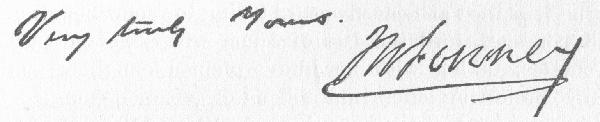
J W Forney
Miss Anthony found both advantages and disadvantages in this new arrangement; for while it relieved her of much responsibility, it took away the control of her own time and movements, a situation which she soon found very trying. She lectured through February and March, but by this time her sister, Mrs. Hannah Mosher, whose failing health had sent her to Kansas in the hope of benefit, was declared by the physicians beyond recovery. Miss Anthony's first impulse was to hasten to her side, but she was confronted with her lecture engagements and told that it would be impossible to release her until May. She was almost desperate to be with the loved one and at last could bear it no longer, so telegraphing Mr. Slayton to cancel everything after April 5, regardless of consequences, she took the train at Chicago and reached Leavenworth on the 7th. She found her sister rapidly declining with the same inexorable disease which had claimed another four years before, and at once installed herself beside the invalid, who was rejoiced indeed to have her companionship and ministrations. All that loving hands could do she had had from husband, children and brothers, but she had longed for the presence of her sister and it filled her with joy and peace.
In just a week, though her heart was breaking, Miss Anthony 488 was obliged to return to Illinois to fill four or five engagements in places which threatened claims for damages if this were not done. She hastened back to Leavenworth, reaching the bedside of her sister at midnight, April 20, and scarcely leaving it a moment until the end came, May 12. Between herself and this sister, just nineteen months younger, beautiful in character and strong in affection, there ever had existed the closest sympathy. For the last decade they had been separated only by a dooryard, they had shared each other's every joy and sorrow, and the severing of these ties of over a half-century seemed more than she could endure.
She remained at Leavenworth,[92] trying to renew her strength and courage, until the last of June, when she returned to Rochester, taking with her the orphaned daughter Louise. Many comforting letters and tokens of affection came to her during these months, among them a gift of $100 from Helen Potter, the famous impersonator. Her imitations of Gough, Ristori, Charlotte Cushman, Anna Dickinson, Mrs. Stanton and even Miss Anthony herself were most remarkable. During the Centennial they had become warm personal friends, and in giving the money she said: "Now, this is not for any society or committee or cause, but for your very self."
Mrs. Stanton wrote her: "Do be careful, dear Susan, you can not stand what you once did. I should feel desolate indeed with you gone." When the lecturing had commenced she again wrote: "As I go dragging around in these despicable hotels, I think of you and often wish we had at least the little comfort of enduring it together. When is your agony over?" Referring to a young woman speaker who was being spoiled by flattery, she said: "We should be thankful, Susan, for the ridicule and abuse on which we have fed." To one who tried to make trouble between Miss Anthony and herself she sent this reply: "Our friendship is of too long standing and has too deep roots to be easily shattered. I think we have said worse things to each other, face to face, than we 489 have ever said about each other. Nothing that Susan could say or do could break my friendship with her; and I know nothing could uproot her affection for me." And to Miss Anthony she wrote: "I send you letters from our children. As the environments of the mother influence the child in prenatal life, and you were with me so much, there is no doubt you have had a part in making them what they are. There are a depth and earnestness in these younger ones and a love for you that delight my heart." Such letters as these are scattered thickly through the correspondence of nearly fifty years, and while Miss Anthony seldom put her own feelings into words, her absolute loyalty and devotion to Mrs. Stanton during all the half-century bear their own testimony.
The talented contributor to the Philadelphia Sunday Republic, Annie McDowell, paid a beautiful tribute to Miss Anthony at this time, illustrating how much she was loved by women:
"Some one wishes to know which of the advocates of woman's rights we think the ablest. Why, Susan B., of course. Without her, the organization would have been utterly broken to pieces and scattered. She is the guiding spirit, the executive power that leads the forlorn hope and brings order out of chaos. Others seek to promote their own interests, but Susan, earnest, honest, self-sacrificing, much-enduring, thinks only of the work she has in hand, and speculates solely on the chances of living long enough to accomplish it. She has given up home, friends, her profession of teacher and the modest competence acquired by her labor; has been caricatured, ridiculed, maligned and persecuted, but has never turned aside or faltered in the work to which she has given her life. Whatever may be the opinion of the conservative or fogy world with regard to Susan B. Anthony, those who know her well and have watched her career most attentively, know her to be rich in all the best and most tender of womanly virtues, and possessed of as brave and noble a spirit and as great integrity of character as ever fell to the lot of mortal woman."
The legislature of Colorado had submitted the question of woman suffrage to be voted on October 2, 1877, and notwithstanding the lucrative business under the lyceum bureau, Miss Anthony could not resist offering her services to the women of Colorado with their little money and few speakers. From Dr. Alida C. Avery, president of the State Suffrage Association, came the quick response: "Your generous proposal was duly 490 received, and laid before the executive committee, who resolved that the thanks of the association be tendered you for your friendly offer, which we gratefully accept."
Although inured to hardship, Miss Anthony found this Colorado campaign the most trying she ever had experienced, not excepting that of Kansas ten years before. The country was new, many of the towns were off the railroad among the mountains and in most of them woman suffrage never had been heard of; there was no one to advertise the meetings, nobody to meet her when she reached her destination, hotels were of the most primitive nature and there were few public halls. There were, of course, some oases in this desert, and occasionally she found a good hotel or was hospitably entertained in a comfortable home. At one place she spoke in the railroad station to about twenty-five men who could not understand what it was she wanted them to do, though all were voters. Sometimes a landlord would clear out the hotel dining-room and she would gather her audience there, but they would have to stand and soon would grow tired. The mining towns were filled with a densely ignorant class of foreigners, and some of the southern counties were almost wholly populated by Mexicans. It was to these men that an American woman, her grandfather a soldier of the Revolution, appealed for the right of women to representation in this government.
To reach Del Norte Miss Anthony rode sixty-five miles by stage over a vast, arid tract evidently once the bed of an inland sea, but the terrible discomforts of the journey were almost overlooked in the enjoyment of the magnificent scenery. She travelled all the next night; at Wagon Wheel Gap the stage stopped for a while and, taking a cup, she went alone down to the river, drank of its icy waters and stood a long time absorbed in the glory of the moonlight on the mountain peaks. In all this weary journey of two days, she was the only woman in a stage filled with men. When she reached Lake City she was delightfully entertained, finding her hostess to be a college graduate, and spoke in the evening from a dry-goods box 491 on the courthouse steps to an enthusiastic audience of a thousand persons. Ouray was the next place marked on the route sent her, but to reach it would require a ride of fifty miles over a dangerous mountain trail or a three days' journey of 150 miles around, for which she must hire a private conveyance, so she gave it up.
She rested one whole day and night and started at 6 A.M. on a buckboard for the next place, wound around the mountainsides by the picturesque Gunnison river, and reached her destination at 5 o'clock. She found a disbeliever of equal rights in her landlady, whom she describes as "a weak, silly woman and a wretched cook and housekeeper." To be an opponent of suffrage and a poor housekeeper Miss Anthony always regarded as two unpardonable sins. The husband, however, intended to vote for it. At the next stopping-place her hostess was a cultured woman, her house neatly kept and meals well-cooked, and she wanted to vote. The husband in this case was violently opposed and expected to cast his ballot against the amendment. Thus it is that wives are "represented by their husbands."
On she went, over mountain and through canyon, across the "great divide," sometimes having large audiences, more often only a handful, and enduring every possible hardship in the way of travel, sleep and food. At Oro City she lectured in a saloon, as she had done at a number of places, and Governor Routt, happening to be in town, stood by her and spoke also in favor of woman suffrage. At many places she slept on a straw-filled tick laid on planks, with sometimes a "corded" bed for a luxury. A door with a lock scarcely ever was found. Once she had a room with a board partition which extended only half-way up, separating it from one adjoining where half a dozen men slept. It is hardly necessary to say that this was a wakeful night and the dawn was hailed with rejoicing. At Leadville the gold fever was at its height and she spoke in a big saloon to the roughest crowd she had encountered. They were good-natured, however, and when they saw she was coughing from the tobacco smoke, put out their pipes and 492 made up for the sacrifice by more frequent drinks. At Fair Play she found the Democratic editor had placarded the town with bills announcing in big letters: "A New Version! Suffrage! Free Love in the Ascendency. Anthony! On the Gale Tonight." The citizens were indignant, there was a large and respectful audience, Miss Anthony was introduced by Judge Henry and resolutions were unanimously passed denouncing the posters.
On election day, her work finished, she started on a stage ride of eighty-five miles to Denver. The collections at her twenty-four meetings amounted to $165. Her fare to Colorado and return, exclusive of some passes furnished by her brother and including sleeper and meals, was $100, and her expenses during the tour more than used up the other $65, so it hardly could be called a good financial speculation. Soon afterwards she received from Mr. and Mrs. Israel Hall, of Ann Arbor, Mich., a deed for 320 acres of well-timbered land in St. Francis county, Ark., "as a tribute to her life-work for woman suffrage and especially her hard campaign in Colorado." There came also a letter from the ever-generous and faithful Mrs. Knox Goodrich, of San Jose, Cal., with a draft for $50 "to be used for your campaign expenses;" and in her diary Miss Anthony writes: "It is a great comfort, after all these years of financially unrequited work, to receive such marks of appreciation."
At Denver she met Margaret Campbell, of Iowa, and Matilda Hindman, of Pennsylvania, who also had been campaigning in Colorado. They had an amusing time comparing notes, but as Mrs. Campbell had travelled in her own carriage with her husband, and Miss Hindman had spoken mostly in towns along the railroad, their experiences had been less picturesque and less harrowing. She also met here Abby Sage Richardson, who was giving a course of readings in Denver. It was in this locality that her sister Hannah had spent many weary weeks the year before, seeking for health, and Miss Anthony hunted up every person who had known her, hoping each would recall some incident of her stay; visited every spot 493 her sister had loved, and felt the whole place haunted with her hallowed memory.
Dr. Alida C. Avery was going East for some time, but was to leave two young women medical students in her house and she invited Miss Anthony to stay there while she remained in Denver. She was soon installed in the large, airy front chamber of this lovely home, looking down on a grassy and well-irrigated lawn and outward towards the rugged and massive Rocky mountains. It was an inspiring spot and, as she had promised a new lecture for the Slayton Bureau, she decided to remain and write it here. Her surroundings recalled the many charming homes made and maintained by unmarried women whom she had visited, and so in the three weeks that she enjoyed Dr. Avery's hospitality, she wrote her lecture, "Homes of Single Women." During this time she spoke at Boulder; and also in the opera house at Denver under the auspices of a committee, receiving $100.
She started, October 23, on a long lecture tour arranged for her through Nebraska,[93] Kansas, Missouri, Iowa and Wisconsin, which lasted the remainder of the year. She almost perished with cold and fatigue before it was finished but found some compensation in the $30 a night which the lectures yielded. At this time she received an urgent request from a San Francisco lecture committee to come to that State, but was unable to accept. "If I only could have sister Mary with me over Sunday in these dull and lonely little towns, I could stand it the rest of the week," she wrote; and to a friend who sent her an account of a visit to her mother: "I am very glad you do go occasionally to see dear mother, sitting there in her rocking-chair by the window as life ebbs out and out. O, how I fear the final ebb will come when I am away, but still I hope and trust it may not, and work and work on."
As Miss Anthony was still under contract with the lecture bureau, she was once more compelled to forego the satisfaction 494 of attending the annual convention in Washington, January 8 and 9, 1878, but as in 1876 she sent $100 of the money she had worked so hard to earn. "It is not quite just to myself to do it," she wrote a friend, "but if the women of wealth and leisure will not help us, we must give both the labor and the money." While this convention was a success as to numbers and enthusiasm, several things occurred which the ladies thought might have been avoided if Miss Anthony had been in command with her cool head and firm hand. Especially was this true in regard to a prayer meeting which some of the religious zealots, in spite of the most urgent appeals from the other members, persisted in holding in the reception room of the Capitol directly after a morning session of the convention. The affair itself was most inopportune but, to make it still worse, the cranks and bores who always are watching for an opportunity, gained control and turned it into a farce.
In her disgust and wrath Mrs. Stanton wrote Miss Anthony: "Mrs. Sargent and I did not attend the prayer meeting. As God has never taken a very active part in the suffrage movement, I thought I would stay at home and get ready to implore the committee, having more faith in their power to render us the desired aid." Mrs. Sargent, with her usual calm and beautiful philosophy, wrote: "Do not let yourself be troubled. We can not take down and rebuild without a great deal of dirt and rubbish, and we must endure it all for the sake of the grand edifice that is to appear in due time. Work and let work, each in her own way. We can not all work alike any more than we can look alike. We must not require impossibilities. All action helps us, it shows life; inaction, we know, means death. I hope you can be with us next convention. The women of this country and of the world owe you a debt they never can repay. I know, however, that you will get your reward."
Virginia L. Minor sent this earnest plea: "Can not you and Mrs. Stanton, before another convention, manage in some way to civilize our platform and keep off that element which is 495 doing us so much harm? I think the ship never floated that had so many barnacles attached as has ours.... I have a compliment for you, my dear. Wendell Phillips has just told a reporter of the St. Louis Post that, 'of all the advocates of the woman's movement, Miss Anthony stands at the head.'"
In her usual racy style Phoebe Couzins concluded her description by saying: "It seems very strange that when you are not about, things generally break loose and no woman can be found who unites the moderation, brains and common sense necessary to carry matters to a respectable conclusion. That meeting was like those they used to have in the District of Columbia. Not until the National Association, in the persons of Mrs. Stanton and yourself, came to the rescue and raised them to a dignified standard did they attain any degree of hearing from the thoughtful people of the capital." And so Miss Anthony determined that no lecture bureau should keep her away from another National convention.
The entire year of 1878, with the exception of the three summer months, was spent in the lecture field. On July 19 Miss Anthony and other workers arranged a celebration at Rochester of the thirtieth anniversary of the first woman's rights convention. This was held in place of the usual May Anniversary in New York and was attended by a distinguished body of women. The Unitarian church, in spite of the intense heat, was filled with a representative audience. The noble Quaker, Amy Post, now seventy-seven years old, who had been the leading spirit in the convention of thirty years before, assisted in the arrangements. The usual brilliant and logical speeches were made by Mrs. Mott, Mrs. Stanton, Miss Anthony, Mrs, Gage, Dr. Lozier, Mrs. Spencer, Mrs. Sargent, Frederick Douglass, Miss Couzins and others. This was the first appearance on the National platform of Mrs. May Wright Sewall, of Indianapolis, from that time one of the leaders of the movement. Almost one hundred interesting and encouraging letters were received from Phillips, Garrison, Senator 496 Sargent, Frances E. Willard, Clara Barton and many others in this country and in England.
This was the last convention Lucretia Mott ever attended, and she had made the journey hither under protest from her family, for she was nearly eighty-six years old, but her devoted friend Sarah Pugh accompanied her. She spoke several times in her old, gentle, half-humorous but convincing manner and was heard with rapt attention. As she walked down the aisle to leave the church, the whole audience arose and Frederick Douglass called out with emotion, "Good-by, Lucretia." The convention received a telegram of congratulation from the International Congress at Paris, presided over by Victor Hugo. Mrs. Stanton was re-elected president and Miss Anthony chairman of the executive committee. The Rochester Democrat and Chronicle said:
The assemblage was composed of as fine a body of American women as ever met in convention or anywhere else. Among them were many noted for their culture and refinement, and for their attainments in the departments of literature, medicine, divinity and law. As Douglass said, to which the president bowed her acquiescence, any cause which could stand the test of thirty years' agitation, was bound to succeed. The foremost ladies engaged in the movement today are those who initiated it in this country and have bravely and grandly upheld their cause from that day to this. Among them we must first speak of Susan B. Anthony, one of the most sensible and worthy citizens of this republic, a lady of warm and tender heart but indomitable purpose and energy, and a resident of whom Rochester may well be proud.
Miss Anthony was very tired after the labors of this convention and was glad to remain with the invalid mother while sister Mary went to the White mountains for rest and change. She received an invitation from the board of directors to address the Kansas State Fair in September, and also one from Col. John P. St. John, Republican candidate for governor, to speak at a Grand National Temperance Camp Meeting near Lawrence, but was obliged to decline both.
During the summer of 1878 reports were so constantly circulated declaring woman suffrage a failure in Wyoming that Miss Anthony wrote to J.H. Hayford, postmaster and editor of the Sentinel at Laramie City, in regard to one of these in the New 497 York World, which paper declared it would vouch for the integrity of the writer. She received the following answer:
The enclosed slander upon Wyoming women I had seen before, but did not deem it worthy reply. Some of my Cheyenne friends took pains to ascertain the writer and they assure me (and the Cheyenne papers have published the fact) that he is a worthless, drunken dead-beat, who worked out a ten days' sentence on the streets of that city with a ball and chain to his leg.
I have not time to go into a detailed history of the practical working of woman suffrage in Wyoming, but I can add my testimony to the fact that its effect has been most salutary and beneficial. Not one of the imaginary evils which its opponents predicted has ever been realized here. On this frontier, where the roughest element is supposed to exist, and where women are so largely in the minority—even here, under these adverse circumstances, woman's influence has redeemed our politics. Our elections are conducted as quietly and civilly as any other public gatherings. Republicans are not always elected, the most desirable men are not always elected, perhaps; but the influence of our women is almost universally given for the best men and the best laws, and we would as soon be without woman's assistance in the government of the family as in that of the Territory.
After having tried the experiment for nine years, it is safe to say there is not one citizen of the Territory—man or woman—who desires good order, good laws and good government, who would be willing to see it abolished. Woman's influence in the government of our Territory is a terror only to evil-doers, and they, and they only, are the ones who desire its repeal. Such base slanders as the specimen you sent me excite in the minds of Wyoming citizens only feelings of disgust and contempt for the author, and wonder at the ignorance of any one who is gullible enough to believe them.
In August she received a letter from Lucy Stone, asking if she had been correctly reported by the papers as saying that "the suffragists would advocate any party which would declare for woman suffrage," to which she replied:
I answer "yes," save that I used the pronoun "I" instead of the word "suffragists." I spoke for myself alone, because I know many of our women are so much more intensely Republican or Democratic, Hard-Money or Green-back, Prohibition or License, than they are "Equal Rights for All," that now, as in the past, they will hold the question of woman's enfranchisement in abeyance, while they give their money and their energies to secure the success of one or another of the contending parties, even though it wholly ignore their just claim to a voice in the government. It is not that I have no opinions or preferences on the many grave questions which distract and divide the parties; but it is that, in my judgment, the right of self-government for one-half the people is of far more vital consequence to the nation than any or all other questions. 498
This has been my position ever since the abolition of slavery, by which the black race were raised from chattels to citizens, and invested also with civil rights equally with the cultured, tax-paying, white women of the country. Have you forgotten the cry "This is the negro's hour," which came back to us in 1866, when we urged the Abolitionists to make common cause with us and demand suffrage as a right for all United States citizens, instead of asking it simply as an expediency for only another class of men? Do you not remember, too how the taunt "false to the negro" was flung into the face of every one of us who insisted that it was "humanity's hour," and that to talk of "freedom without the ballot" was no less "mockery" to woman than to the negro?
If, in those most trying reconstruction years, I could not subordinate the fundamental principle of "Equal Rights for All" to Republican party necessity for negro suffrage—if, in that fearful national emergency, I would not sacrifice the greater to the less—I surely can not and will not today hold any of the far less important party questions paramount to that most sacred principle of our republic. So long as you and I and all women are political slaves, it ill becomes us to meddle with the weightier discussions of our sovereign masters. It will be quite time enough for us, with self-respect, to declare ourselves for or against any party upon the intrinsic merit of its policy, when men shall recognize us as their political equals, duly register our names and respectfully count our opinions at the ballot-box, as a constitutional right—not as a high crime, punishable with "$500 fine or six months' imprisonment, or both, at the discretion of the court."
If all the "suffragists" of all the States could see eye to eye on this point, and stand shoulder to shoulder against every party and politician not fully and unequivocally committed to "Equal Rights for Women," we should become at once a moral balance of power which could not fail to compel the party of highest intelligence to proclaim woman suffrage the chief plank of its platform. "In union alone there is strength." Until that good day comes, I shall continue to invoke the party in power, and each party struggling to get into power, to pledge itself to the emancipation of our enslaved half of the people; and in turn, I shall promise to do all a "subject" can do, for the success of the party which thus declares its purpose "to undo the heavy burdens and let the oppressed go free."
[91] That women will, by voting, lose nothing of man's courteous, chivalric attention and respect is admirably proven by the manner in which Congress, in the midst of the most anxious and perplexing presidential conflict in our history, received their appeals for a Sixteenth Amendment protecting the rights of women. In both Houses, by unanimous consent, the petitions were presented and read in open session, and the most prominent senators impressed upon the Senate the importance of the question.... The ladies naturally feel greatly encouraged by the evident interest of both parties in the proposed amendment.—Washington Star.
The time has evidently arrived when demands for a recognition of the personal, civil and political rights of one-half—unquestionably the better half—of the people can not be laughed down or sneered down, and recent indications are that they can not much longer be voted down. The speaker of the House set a commendable example by proposing that the petitions be delivered in open session, to which there was no objection. The early advocates of equal rights for women—Hoar, Kelley, Banks, Kasson, Lawrence and Lapham—were, if possible, surpassed in courtesy by those who are not committed, but are beginning to see that a finer element, in the body politic would clear the vision, purify the atmosphere and help to settle many vexed questions on the basis of exact and equal justice. In the Senate the unprecedented courtesy was extended to women of half an hour's time on the floor and while this kind of business has usually been transacted with an attendance of from seven to ten senators, it was observed that only two out of the twenty-six who had Sixteenth Amendment petitions to present were out of their seats.—National Republican.
At the beginning of 1879 Miss Anthony put all lecture work aside until after the Washington convention, January 9 and 10. The thunderbolts forged by the resolution committee were a little more fiery even than those of former years, and the combined workmanship of the two Vulcans, Mrs. Stanton and Miss Anthony, is quite apparent, with vivid sparks from the chairman, Mrs. Spencer:
Resolved, That the Forty-fifth Congress, in ignoring the individual petitions of more than 300 women of high social standing and culture, asking for the removal of their political disabilities, while promptly enacting special legislation for the removal of those of every man who petitioned, illustrates the indifference of Congress to the rights of a sex deprived of political power.
WHEREAS, Senator Blaine says it is the very essence of tyranny to count any citizens in the basis of representation who are denied a voice in the laws and a choice in their rulers; therefore
Resolved, That counting women in the basis of representation, while denying them the right of suffrage, is compelling them to swell the number of their tyrants and is an unwarrantable usurpation of power over one-half the citizens of this republic.
WHEREAS, In President Hayes' last message, he makes a truly paternal review of the interests of this republic, both great and small, from the army, the navy and our foreign relations, to the ten little Indians in Hampton, Va., our timber on the western mountains, and the switches of the Washington railroads; from the Paris Exposition, the postal service, the abundant harvests, and the possible bulldozing of some colored men in various southern districts, to cruelty to live animals and the crowded condition of the mummies, dead ducks and fishes in the Smithsonian Institute—yet forgets to mention 20,000,000 women robbed of their social, civil and political rights; therefore
Resolved, That a committee of three be appointed to wait upon the President and remind him of the existence of one-half the American people .... 500
WHEREAS, All the vital principles involved in the Thirteenth, Fourteenth and Fifteenth Amendments have been denied in their application to women by courts, legislatures and political parties; therefore
Resolved, That it is logical that these amendments should fail to protect even the male African for whom said courts, legislatures and parties declare they were expressly designed and enacted.
WHEREAS, The general government has refused to exercise federal power to protect women in their right to vote in the various States and Territories; therefore
Resolved, That it should forbear to exercise federal power to disfranchise the women of Utah, who have had a more just and liberal spirit shown them by Mormon men than Gentile women in the States have yet received from their rulers.
WHEREAS, The proposed legislation for Chinese women on the Pacific slope and for outcast women in our cities, and the opinion of the press that no respectable woman should be seen in the streets after dark, are all based upon the presumption that woman's freedom must be forever sacrificed to man's license; therefore
Resolved, That the ballot in woman's hand is the only power by which she can restrain the liberty of those men who make our streets and highways dangerous to her, and secure the freedom which belongs to her by day and by night.
An address to President Hayes, asking that in his next message he recommend that women should be protected in their civil and political rights, was signed by Mrs. Stanton, Miss Anthony and Mrs. Gage. Several ladies, by appointment, had a private audience in the President's library and a courteous and friendly hearing. The petition for a Sixteenth Amendment was sent in printed form to every member of Congress, presented in the Senate by Vice-President Wheeler and, at the request of Senator Ferry, was read at length and referred to the committee on privileges and elections. This was done by the special desire of its chairman, Senator Oliver P. Morton, of Indiana, who stated that he wished to bring in a report in favor of the amendment.[94]
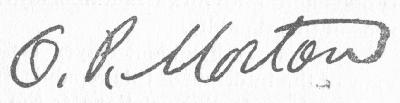
O.P. Morton
Before the committee could act upon this question Senator Morton passed away. An adverse report was presented by his successor, Senator Bainbridge Wadleigh, of New Hampshire, June 14, 1878. Among many severe scorings received by this honorable gentleman, the following from Mary Clemmer will serve as an example:
... You can not be unconscious of the fact that a new race of women is born into the world who, while they lack no womanly attribute, are the peers of any man in intellect and aspiration. It will be impossible long to deny to such women that equality before the law granted to the lowest creature that crawls, if he happen to be a man; denied to the highest creature that asks it, if she happen to be a woman.
On what authority, save that of the gross regality of physical strength, do you deny to a thoughtful, educated, tax-paying person the common rights of citizenship because she is a woman? I am a property-owner, the head of a household. By what right do you assume to define and curtail for me my prerogatives as a citizen, while as a tax-payer you make not the slightest distinction between me and a man? Leave to my own perception what is proper for me as a lady, to my own discretion what is wise for me as a woman, to my own conscience what is my duty to my race and to my God. Leave to unerring nature to protect the subtle boundaries which define the distinctive life and action of the sexes, while you as a legislator do everything in your power to secure to every creature of God an equal chance to make the best and most of himself.
If American men could say, as Huxley says, "I scorn to lay a single obstacle in the way of those whom nature from the beginning has so heavily burdened," the sexes would cease to war, men and women would reign together, the equal companions, friends, helpers and lovers that nature intended they should be. But what is love, tenderness, protection, even, unless rooted in justice? Tyranny and servitude, that is all, brute supremacy, spiritual slavery. By what authority do you say that the country is not prepared for a more enlightened franchise, for political equality, if even six women citizens, earnest, eloquent, long-suffering, come to you and demand both?
All the women's papers expressed indignation, and there was general rejoicing when, at the next election, Mr. Wadleigh was superseded by Hon. Henry W. Blair.
The first favorable consideration this question ever received from the Senate was the minority report of this committee, 502 signed by Senators George F. Hoar, John H. Mitchell and Angus Cameron, an unanswerable argument for the enfranchisement of women.[95] It declared that "the people of the United States are committed to the doctrine of universal suffrage by their constitution, their history and their opinions, and by it they must stand or fall." One week later the bill admitting women to practice before the Supreme Court passed the Senate, grandly advocated by Senators McDonald, Sargent and Hoar.
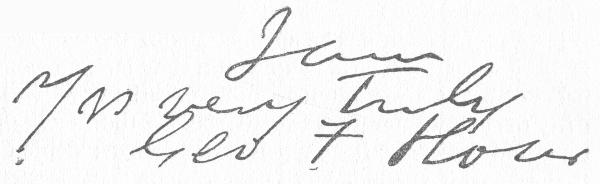
Geo F Hoar
After the convention Miss Anthony went to Tenafly with Mrs. Stanton for a few days, to aid in disentangling the mass of material which was being prepared for the History; then started again into the lecture field, commencing at Skowhegan, Me. She lectured through New Hampshire and Vermont, taking long sleigh-rides from point to point, through wind and sleet, but comforted by the thought that many of her audience had done likewise to receive the gospel she preached. On her way westward she stopped at home for one short day, the first for four months, and then started on the old route through the States of the Middle West, this year adding Kentucky to the list. It is not essential to a full appreciation of her work to follow in detail these tours, which extended through a number of years and were full of pleasant as well as disagreeable features; nor is it possible to quote extensively the comments of the press. Miss Anthony undoubtedly has been as widely written up as any lecturer, and she seldom received less than a column in each paper of every town visited. Large numbers of these notices have been carefully preserved in those wonderful scrap-books which cover a period of fifty years.
At first her demands seemed so radical and the idea of a woman on the platform was so contrary to the precedent of all the ages, that the tone of the press, almost without exception, was contemptuous or denunciatory. As the justice of her 503 claims began to dawn upon the minds of enlightened people, as many other prominent women joined in advocating the same reforms, and as these were adopted, one after another, without serious consequences, the public mind awakened to the remarkable change which was being wrought, and in a large measure gave its approval. When the masses of people throughout the country came to see and hear and know Miss Anthony, they resented the way in which she had been misrepresented. There was in her manner and words so much of dignity, earnestness and sincerity that "those who came to scoff remained to pray," and this change of sentiment was nowhere so marked as in the newspapers. Even those who differed radically from her views paid tribute to the persistence with which she had urged them and the sacrifices she had made for them during the past thirty years. Not only had there been developed a recognition of her high purposes and noble life, but also of her great intellectual ability and clear comprehension of all the issues of the day. An extract from the Terre Haute Express, February 12, 1879, illustrates this:
Miss Anthony's lecture was full of fine passages and strong appeals, and replete with well-stated facts in support of her arguments. She has wonderful command of language, and her speech at times flows with such rapidity that no reporter could do her justice or catch a tithe of the brilliance of her sayings. Moreover, there are not half of our public men who are nearly so well posted in the political affairs of our country as she, or who, knowing them, could frame them so solidly in argument. If the women of the nation were half so high-minded or even half so earnest, their title to the franchise might soon be granted.[96]
Another Indiana paper thus voiced the changing sentiment: "The fact is, that like the advance agent of any great reform—especially if a woman—Susan B. Anthony has been so belied and maligned by the press in years gone by that many who do not stop to think had come to believe her a perfect ogre, a cross-grained, incongruous old maid whom nobody could like, when the truth of the matter is, one has but to look at and 504 listen to her, either in public or private, to realize that she is a pure, generous, deep-thinking, womanly woman. Simply because she has lived her own life, spoken her own thoughts and stood upon her own platform, the masses have condemned her; but history has already recorded her as one of the most earnest, hard-working reformers of the day. If the women of this country only knew how many changes and ameliorations have been made in the laws regarding themselves through her unselfish, persistent efforts, at her approach they would all rise up and call her blessed." But that there still existed editors of the old-time caliber, this extract from the Richmond, Ky., Herald, October 29, 1879, shows:
Miss Anthony is above the medium height for women, dresses plainly, is uncomely in person, has rather coarse, rugged features and masculine manners. Her piece, which doubtless she has been studying for thirty or forty years, was very well delivered for a woman, containing no original thought, but full of old hackneyed ideas, which every female suffrage shrieker has hurled from the stump against "ignorant men and small boys," for time out of mind all over this country and every other country where they could command an audience of curious people willing to throw away an hour or two on a vain, futile and foolish harangue, proposing to transform men into women and women into men. Such dissatisfied females should not hurl anathemas at men, forsooth, because they happened to be born into the world women instead of men. God alone is responsible for the difference between the sexes, and he is able to bear it. Men are not to blame that women are women, for there is not a man in this whole land who wouldn't rather have a boy baby than a gal baby any time. There never was a newly-married man when he learned that his first born was a girl, that didn't try to tear out his hair by the roots because it wasn't a boy.... If this tirade against men is to be persisted in, we see no escape for man except to quit his foolishness and have no more children, unless he can have some sort of guarantee that they will all be boys. It will have come to a strange pass indeed when the good women of this land, who, as mothers, have the nurture, training and admonition of every boy from his cradle to mature manhood, are unwilling to trust in the hands of their own offspring the destinies of the nation.
That such an attack can not be attributed to sectional prejudice may be proved by this extract from a column of vituperation in the Grand Rapids, Mich., Times, during this same trip, headed "Spinster Susan's Suffrage Show:"
A "miss" of an uncertain number of years, more or less brains, a slimsy 505 figure, nut-cracker face and store teeth, goes raiding about the country attempting to teach mothers and wives their duty.... As is the yellow-fever to the South, the grasshopper to the plains, and diphtheria to our northern cities, so is Susan B. Anthony and her class to all true, pure, lovely women. The sirocco of the desert blows no hotter or more tainting breath in the face of the traveller, than does this woman against all men who do not believe as she does, and no pestilence makes sadder havoc among them than would Susan B. Anthony if she had the power. The women who make homes, who are sources of comfort to husbands, fathers, brothers, sisters or themselves, who wish to keep sacred all that goes to make their lives noble, refined and worth the living, will be as diametrically opposed to the lecturer of last evening as are most intelligent men. Susan B. Anthony may find her remedy in suffrage, but alas! there is no remedy for us against Susan and her ilk.
Each lecture usually was followed by letters not only from friends but from entire strangers, asking her forgiveness for having misjudged her so many years, and closing something like this from a lady in St. Paul, Minn.: "For the last ten years your name has been familiar to me through the newspapers, or rather through newspaper ridicule, and has always been associated with what was pretentious and wholly unamiable. Your lecture tonight has been a revelation to me. I wanted to come and touch your hand, but I felt too guilty. Henceforth I am the avowed defender of woman suffrage. Never again shall a word of mine be heard derogatory to the noble women who are working with heart and hand for the best welfare of humanity."
A two-column interview in the Chicago Tribune during this tour gives Miss Anthony's views on many public matters, concluding thus:
"If men would only think of the question without paying attention to prejudice or precedent, simply as one of political economy, they would soon begin to regard woman, and woman's rights, just as they regard themselves and their own rights," said she.
"The W.C.T.U. are doing good work, are they not?"
"Yes, Miss Willard is doing noble work, but I can not coincide with her views, and my new lecture, 'Will Home Protection Protect,' will combat them. The officer who holds his position by the votes of men who want free whiskey, can not prosecute the whiskey-sellers. The district-attorney and the judge can not enforce the law when they know that to do so will defeat them at the next election. If women had votes the officials would no longer 506 fear to enforce the law, as they would know that though they lost the votes of 5,000 whiskey-sellers and drinkers, they would gain those of 20,000 women. Miss Willard has a lever, but she has no fulcrum on which to place it."
"Where do you find the strongest antipathy to woman suffrage?"
"In the fears of various parties that it might he disastrous to their interests. The Protestants fear it lest there should be a majority of Catholic women to increase the power of that church; the free-thinkers are afraid that, as the majority of church-members are women, they would put God in the Constitution; the free-whiskey men are opposed because they think women would vote down their interests; the Republicans would put a suffrage plank in their platform if they knew they could secure the majority vote of the women, and so would the Democrats, but each party fears the result might help the other. Thus, you see, we can not appeal to the self-interest of anybody and this is our great source of weakness."
It was decided to bold this year's May Anniversary in St. Louis instead of New York, and all arrangements having been made by Virginia L. Minor and Phoebe Couzins, the convention opened formally on the evening of May 7, to quote the newspapers, "in the presence of a magnificent audience which packed every part of St. George's Hall, crowding gallery and stairs and leaving hardly standing room in the aisles." They also paid many compliments to the intellectual character of the audience, its evident sympathy with the cause for which the convention was assembled, and the elegant costumes worn by the ladies both in the body of the house and on the platform. Mrs. Minor presided and a beautiful address of welcome was delivered by Miss Couzins. The ladies were invited to the Merchants' Exchange by its president, and also visited the Fair grounds by invitation of the board. Miss Couzins gave a reception at her home, and the evening before the convention opened, Mrs. Minor entertained the delegates informally. Of this latter occasion the Globe-Democrat said:
Miss Susan B. Anthony, perhaps the only lady present of national reputation, commanded attention at a glance. Her face is one which would attract notice anywhere; full of energy, character and intellect, the strong lines soften on a closer inspection. There is a good deal that is "pure womanly" in the face which has been held up to the country so often as a gaunt and hungry specter's crying for universal war upon mankind. The spectacles sit upon a nose strong enough to be masculine, but hide eyes which can beam with kindliness as well as flash with wit, irony and satire. Angular she may 507 be—"angular as a Lebanon Shakeress" she said the New York Herald once termed her—but if so, the irregularities of outline were completely hidden under the folds of the modest and dignified black silk which covered her most becomingly.
At this convention occurred that touching scene which has been so often described, when May Wright Sewall presented Miss Anthony, to her complete surprise, with a beautiful floral offering from the delegates. The Globe-Democrat thus reports:
Miss Anthony, visibly affected, responded: "Mrs. President and Friends: I am not accustomed to demonstrations of gratitude or of praise. I don't know how to behave tonight. Had you thrown stones at me, had you called me hard names, had you said I should not speak, had you declared I had done women more harm than good and deserved to be burned at the stake; had you done anything, or said anything, against the cause which I have tried to serve for the last thirty years, I should have known how to answer, but now I do not. I have been as a hewer of wood and a drawer of water to this movement. I know nothing and have known nothing of oratory or rhetoric. Whatever I have done has been done because I wanted to see better conditions, better surroundings, better circumstances for women. Now, friends, don't expect me to make any proper acknowledgments for such a demonstration as has been made here tonight. I can not; I am overwhelmed."
As the association wished to continue Mrs. Stanton at the head, they created the office of vice-president-at-large and elected Miss Anthony to fill it. Senator Sargent's term having expired, he returned with his family to San Francisco, and Mrs. Jane H. Spofford was elected national treasurer in place of Mrs. Sargent, who had served so acceptably for six years. Her return to California was deeply regretted by Miss Anthony. From the time of their first acquaintance, on that long snow-bound journey in 1871, they had been devoted friends, and on all her annual trips to Washington she was a guest at the spacious and comfortable home of the Sargents. The senator always was a true and consistent friend of suffrage, and frequently said to Miss Anthony: "Tell my wife what you want done and, if she indorses it, I will try to bring it about." Mrs. Sargent was of a serene, philosophical nature, with an unwavering faith in the evolution of humanity into a broader and better life. She was thoroughly without personal 508 ends to serve, ready to receive new ideas and those who brought them, weigh them carefully in her well-balanced mind and pronounce the judgment which was usually correct. The closing of their Washington house was a severe loss to the many who had enjoyed their free and gracious hospitality.
On May 24, 1879, Miss Anthony received notice of the death of her old and revered fellow-laborer, Wm. Lloyd Garrison. She could not attend the funeral but wrote at once, saying in part:
The telegrams of the last few days had prepared us for this morning's tidings that your dear father and humanity's devoted friend had passed on to the beyond, where so many of his brave co-workers had gone before; and where his devoted life-companion, your precious mother, awaited his coming.... It is impossible for me to express my feelings of love and respect, of honor and gratitude, for the life, the words, the works, of your father; but you all know, I trust, that few mortals had greater veneration for him than I. His approbation was my delight; his disapproval, my regret.... That each and all of you may strive to be to the injustice of your day and generation what he was to that of his, is the best wish—the best aspiration—I can offer. Blessed are you indeed, that you mourn so true, so noble, so grand a man as your loved and loving father.
In her diary that night she wrote: "I sent a letter, but how paltry it seemed compared to what was in my heart. Why can I not put my thought into words?"
The last of May she went home, having lectured and worked every day since the previous October. She records with much delight that she has now snugly tucked away in bank $4,500, the result of her last two lecture seasons. During the one just closed she spoke 140 nights, besides attending various conventions. This bank account did not represent all she had earned, for she always gave with a lavish hand. How much she has given never can be known, but in the year 1879, for instance, one friend acknowledges the receipt of $50 to enable her to buy a dress and other articles so that she can attend the Washington convention. Another writes: "I have just learned that the $25 you handed me to pay my way home from the meeting had been given you to pay your own." To an old and faithful fellow-worker, now in California, she 509 sends by express a warm flannel wrapper. There is scarcely a month which does not record some gift varying from $100 in value down to a trinket for remembrance. Each year she contributed $100 to the suffrage work, besides many smaller sums at intervals, and the account-books show that her benefactions were many. She never spared money if an end were to be accomplished, and never failed to keep an engagement, no matter at what risk or expense. On several occasions she chartered an engine, even though the cost was more than she would receive for the lecture. As she was now approaching her sixtieth birthday, relatives and friends were most anxious that she should lay aside part of her earnings for a time when even her indomitable spirit might have to succumb to physical weakness, but she herself never seemed to feel any anxiety as to the future.
Notwithstanding her own disastrous experiment, Miss Anthony never ceased to desire a woman's paper, one which not only should present the questions relating directly to women but should be edited and controlled entirely by women, and discuss all the issues of the day. Scattered through the correspondence of years are letters on this subject, either wanting to resurrect The Revolution or to start a new paper. At intervals some wealthy woman would seem half-inclined to advance money for the purpose and then hope would be revived, only to be again destroyed. During the summer of 1872 a clever journalist, Mrs. Helen Barnard, had edited a paper called the Woman's Campaign, supported by Republican funds. Miss Anthony had hoped to convert this into her ideal paper after the election, and spent considerable time in trying to form a stock company. A large amount was subscribed but not enough, and all was returned by Mrs. Sargent, then national treasurer. Sarah L. Williams, editor of the woman's department of the Toledo Blade, started a bright suffrage paper called the Ballot-Box and edited it for several years. Miss Anthony assisted her in every possible way, and spoiled the effect of many a fine speech by asking at its close for subscribers to this paper. In 1878, '79 and '80 she secured 2,500 names. In 510 1878 Mrs. Williams turned her paper over to Matilda Joslyn Gage, who added National Citizen to the title. Miss Anthony's and Mrs. Stanton's names were placed at the head as corresponding editors, and the paper was ably conducted by Mrs. Gage, but it had not the financial backing necessary to success; when Miss Anthony ceased lecturing, new subscribers no longer came and, after much tribulation, it finally suspended in 1881.
While Miss Anthony continued for many years to cherish this idea of a distinctively woman's paper, the daily press grew more and more liberal, devoting larger space to the interests of women every year, and she became of the opinion that possibly the most effective work might be accomplished through this medium. She held, however, that there should be one woman upon each paper whose special business it should be to look after this department, and who should be permitted to discuss not only the "woman question" but all others from a woman's standpoint. As newspapers are now managed, the readers have only man's views of all the vital issues attracting public attention. Woman occupies a subordinate position and must write on all subjects in a spirit which will be acceptable to the masculine head of the paper; so the public gets in reality his thought and not hers. She had come to see, also, that the newspaper work should be a leading and distinctive feature of the National Association to a far greater extent than hitherto had been attempted, and which, until of late years, had not been possible. No man or woman ever had a higher opinion of the influence of the press, which she considered the most powerful agency in the world for good or for evil.
In the summer of 1879, Miss Anthony received from her friend, A. Bronson Alcott, a complimentary ticket for three seasons of lectures at the Concord School of Philosophy; but the living questions of the day were too pressing for her to withdraw to this classic and sequestered retreat, outside the busy and practical world.
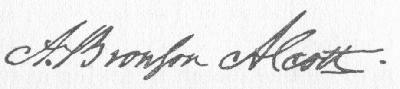
A. Bronson Alcott
During the decade from 1870 to 1880, there was a large 511 accession of valuable workers to the cause of woman suffrage and many new friends came into Miss Anthony's life. Among these were May Wright Sewall; the sisters, Julia and Rachel Foster; Clara B. Colby; Zerelda G. Wallace; Frances E. Willard; J. Ellen Foster; the wife and three talented daughters of Cassius M. Clay, Mary B., Laura and Sallie Clay Bennett; M. Louise Thomas; Elizabeth Boynton Harbert and others, who became her devoted adherents and fellow-workers, and whose homes and hospitality she enjoyed during all the years which followed.
At the close of her lecture season in 1879 she was able to spend Christmas and New Year's at her own home for the first time in many years; but she left on January 2 to fill engagements, reaching Washington on the eve of the National Convention, which assembled at Lincoln Hall, January 21, 1880. As Mrs. Stanton was absent, Miss Anthony presided over the sessions. During this meeting, 250 new petitions for a Sixteenth Amendment, signed by over 12,000 women, were sent to Congress, besides over 300 petitions from individual women praying for a removal of their political disabilities. These were presented by sixty-five different representatives. Hon. T.W. Ferry, of Michigan, in the Senate, and Hon. George B. Loring, of Massachusetts, in the House, introduced a resolution for a Sixteenth Amendment. This with all the petitions was referred to the judiciary committees, each of which granted a hearing of two hours to the ladies. Among the delegates who addressed them was Julia Smith Parker, of Glastonbury, Conn., at that time over eighty years old, who with her sister Abby annually resisted the payment of taxes because they were denied representation, and whose property was in consequence annually seized and sold. Mrs. Zerelda G. Wallace, the mother so beautifully pictured in Ben Hur, addressed a congressional committee for the first time, and among the other speakers were Mrs. Gage, Mrs. Blake, Miss Couzins, Mrs. Emma Mont McRae, of Indiana, and Mrs. Elizabeth Lyle Saxon, of Louisiana. It was at this hearing that Senator Edmunds complimented Miss Anthony by saying, 512 "Most speeches on this question are platform oratory; yours is argument." Through the influence of Hon. E.G. Lapham, all these addresses were printed in pamphlet form.
During this convention Miss Anthony was the guest of Mrs. Spofford, whose husband was proprietor of the Riggs House. The place of hostess, which had been so beautifully filled by Mrs. Sargent, was assumed at once by Mrs. Spofford, a lady of culture and position. For twelve years a suite of rooms was set apart for Miss Anthony in this commodious hotel whenever she was at the capital, whether for days or for months, and she received every possible courtesy and attention, without price. Miss Anthony wrote her many times: "You can not begin to know what a blessing your home is to me, or how grateful I am to you for its comfort and luxury. You are indeed Mrs. Sargent's successor in love and hospitality, and my hope is always to deserve them."
After a brilliant reception at the Riggs House to the delegates, Miss Anthony left for Philadelphia, in company with the venerable Julia Smith Parker, and went to Roadside, the suburban home of Lucretia Mott, "where," she writes, "it was a wonderful sight to see the two octogenarians talking together, so bright and wide awake to the questions of the present." She never again saw Lucretia Mott or heard her sweet voice.
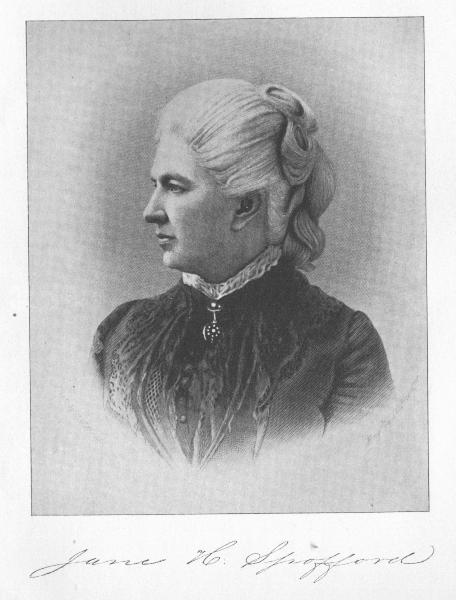
Jane H. Spofford
The health of Miss Anthony's mother was now so precarious that she did not dare go far from home and a course of lectures was arranged for her through Pennsylvania by Rachel Foster, a young girl of wealth and distinction, who was growing much interested in the cause of woman and very devoted to Miss Anthony personally. Frequent trips were made to the home in Rochester through the inclement weather, and toward the last of March she saw that the end was near and did not go away. The beloved mother fell asleep on the morning of April 3, 1880, the two remaining daughters by her side. She was in her eighty-seventh year, her long life had been passed entirely within the immediate circle of home, but her interest in outside matters was strong. The husband and children, in 513 whatever work they were engaged, felt always the encouragement of her sanction and sympathy. Her ambition was centered in them, their happiness and success were her own; she was content to be the home-keeper, to have the house swept and garnished and the bountiful table ready for their return, finding a rich reward in their unceasing love and appreciation. She was extremely fond of reading, had read the Bible from cover to cover many times, and could give the exact location and wording of many texts of Scripture. She enjoyed history, was familiar with the works of Dickens and Scott and knew by heart The Lady of the Lake. In old age, when memory failed, she lived among historical personages and characters in books and would speak of them as persons she had known in her youth. As the four children gathered about the still form and looked lovingly upon the placid face, they could not remember that she ever had spoken an unkind word. And so, with tenderness and affection, they laid her to rest by the side of the husband whose memory she had so faithfully cherished for eighteen years.
A month later Miss Anthony again set forth on the weary round, leaving her sister Mary in the lonely house with two young nieces, Lucy and Louise, whose education she was superintending. Just before going she wrote to Rachel Foster: "Yes, the past three weeks are all a dream—such constant watching and care and anxiety for so many years all taken away from us! But my mother, like my father, if she could speak would bid us 'go forward' to greater and better work. She never asked me to stop at home when she was living, not even after she became feeble, but always said, 'Go and do all the good you can;' and I know my highest regard for her and for my father and sisters gone before will be shown by my best and noblest doing."
[94] In 1874, when a bill was pending to establish the Territory of Pembina, Senator Sargent wished to so amend it as to incorporate woman suffrage. After he had finished a matchless argument, in which he was supported by Senators Stewart, of Nevada, and Carpenter, of Wisconsin, Senator Morton made one of those grand speeches for which he was famous. He based his demands for woman suffrage on the Declaration of Independence, whose principles, he declared, did not apply to man alone but to the human family; and he demonstrated that no man or woman could "consent" to a government except through a vote.
For Sargent's and Morton's speeches see History of Woman Suffrage, Vol. II, pp. 546 and 549.
End of the Project Gutenberg EBook of The Life and Work of Susan B. Anthony
(Volume 1 of 2), by Ida Husted Harper

*** END OF THIS PROJECT GUTENBERG EBOOK SUSAN B. ANTHONY ***

***** This file should be named 15220-h.htm or 15220-h.zip *****
This and all associated files of various formats will be found in:
        https://www.gutenberg.org/1/5/2/2/15220/

Produced by Jonathan Ingram, Leonard Johnson and the PG Online
Distributed Proofreading Team at https://www.pgdp.net.


Updated editions will replace the previous one--the old editions
will be renamed.

Creating the works from public domain print editions means that no
one owns a United States copyright in these works, so the Foundation
(and you!) can copy and distribute it in the United States without
permission and without paying copyright royalties.  Special rules,
set forth in the General Terms of Use part of this license, apply to
copying and distributing Project Gutenberg-tm electronic works to
protect the PROJECT GUTENBERG-tm concept and trademark.  Project
Gutenberg is a registered trademark, and may not be used if you
charge for the eBooks, unless you receive specific permission.  If you
do not charge anything for copies of this eBook, complying with the
rules is very easy.  You may use this eBook for nearly any purpose
such as creation of derivative works, reports, performances and
research.  They may be modified and printed and given away--you may do
practically ANYTHING with public domain eBooks.  Redistribution is
subject to the trademark license, especially commercial
redistribution.


*** START: FULL LICENSE ***

THE FULL PROJECT GUTENBERG LICENSE
PLEASE READ THIS BEFORE YOU DISTRIBUTE OR USE THIS WORK

To protect the Project Gutenberg-tm mission of promoting the free
distribution of electronic works, by using or distributing this work
(or any other work associated in any way with the phrase "Project
Gutenberg"), you agree to comply with all the terms of the Full Project
Gutenberg-tm License (available with this file or online at
https://gutenberg.org/license).


Section 1.  General Terms of Use and Redistributing Project Gutenberg-tm
electronic works

1.A.  By reading or using any part of this Project Gutenberg-tm
electronic work, you indicate that you have read, understand, agree to
and accept all the terms of this license and intellectual property
(trademark/copyright) agreement.  If you do not agree to abide by all
the terms of this agreement, you must cease using and return or destroy
all copies of Project Gutenberg-tm electronic works in your possession.
If you paid a fee for obtaining a copy of or access to a Project
Gutenberg-tm electronic work and you do not agree to be bound by the
terms of this agreement, you may obtain a refund from the person or
entity to whom you paid the fee as set forth in paragraph 1.E.8.

1.B.  "Project Gutenberg" is a registered trademark.  It may only be
used on or associated in any way with an electronic work by people who
agree to be bound by the terms of this agreement.  There are a few
things that you can do with most Project Gutenberg-tm electronic works
even without complying with the full terms of this agreement.  See
paragraph 1.C below.  There are a lot of things you can do with Project
Gutenberg-tm electronic works if you follow the terms of this agreement
and help preserve free future access to Project Gutenberg-tm electronic
works.  See paragraph 1.E below.

1.C.  The Project Gutenberg Literary Archive Foundation ("the Foundation"
or PGLAF), owns a compilation copyright in the collection of Project
Gutenberg-tm electronic works.  Nearly all the individual works in the
collection are in the public domain in the United States.  If an
individual work is in the public domain in the United States and you are
located in the United States, we do not claim a right to prevent you from
copying, distributing, performing, displaying or creating derivative
works based on the work as long as all references to Project Gutenberg
are removed.  Of course, we hope that you will support the Project
Gutenberg-tm mission of promoting free access to electronic works by
freely sharing Project Gutenberg-tm works in compliance with the terms of
this agreement for keeping the Project Gutenberg-tm name associated with
the work.  You can easily comply with the terms of this agreement by
keeping this work in the same format with its attached full Project
Gutenberg-tm License when you share it without charge with others.

1.D.  The copyright laws of the place where you are located also govern
what you can do with this work.  Copyright laws in most countries are in
a constant state of change.  If you are outside the United States, check
the laws of your country in addition to the terms of this agreement
before downloading, copying, displaying, performing, distributing or
creating derivative works based on this work or any other Project
Gutenberg-tm work.  The Foundation makes no representations concerning
the copyright status of any work in any country outside the United
States.

1.E.  Unless you have removed all references to Project Gutenberg:

1.E.1.  The following sentence, with active links to, or other immediate
access to, the full Project Gutenberg-tm License must appear prominently
whenever any copy of a Project Gutenberg-tm work (any work on which the
phrase "Project Gutenberg" appears, or with which the phrase "Project
Gutenberg" is associated) is accessed, displayed, performed, viewed,
copied or distributed:

This eBook is for the use of anyone anywhere at no cost and with
almost no restrictions whatsoever.  You may copy it, give it away or
re-use it under the terms of the Project Gutenberg License included
with this eBook or online at www.gutenberg.org

1.E.2.  If an individual Project Gutenberg-tm electronic work is derived
from the public domain (does not contain a notice indicating that it is
posted with permission of the copyright holder), the work can be copied
and distributed to anyone in the United States without paying any fees
or charges.  If you are redistributing or providing access to a work
with the phrase "Project Gutenberg" associated with or appearing on the
work, you must comply either with the requirements of paragraphs 1.E.1
through 1.E.7 or obtain permission for the use of the work and the
Project Gutenberg-tm trademark as set forth in paragraphs 1.E.8 or
1.E.9.

1.E.3.  If an individual Project Gutenberg-tm electronic work is posted
with the permission of the copyright holder, your use and distribution
must comply with both paragraphs 1.E.1 through 1.E.7 and any additional
terms imposed by the copyright holder.  Additional terms will be linked
to the Project Gutenberg-tm License for all works posted with the
permission of the copyright holder found at the beginning of this work.

1.E.4.  Do not unlink or detach or remove the full Project Gutenberg-tm
License terms from this work, or any files containing a part of this
work or any other work associated with Project Gutenberg-tm.

1.E.5.  Do not copy, display, perform, distribute or redistribute this
electronic work, or any part of this electronic work, without
prominently displaying the sentence set forth in paragraph 1.E.1 with
active links or immediate access to the full terms of the Project
Gutenberg-tm License.

1.E.6.  You may convert to and distribute this work in any binary,
compressed, marked up, nonproprietary or proprietary form, including any
word processing or hypertext form.  However, if you provide access to or
distribute copies of a Project Gutenberg-tm work in a format other than
"Plain Vanilla ASCII" or other format used in the official version
posted on the official Project Gutenberg-tm web site (www.gutenberg.org),
you must, at no additional cost, fee or expense to the user, provide a
copy, a means of exporting a copy, or a means of obtaining a copy upon
request, of the work in its original "Plain Vanilla ASCII" or other
form.  Any alternate format must include the full Project Gutenberg-tm
License as specified in paragraph 1.E.1.

1.E.7.  Do not charge a fee for access to, viewing, displaying,
performing, copying or distributing any Project Gutenberg-tm works
unless you comply with paragraph 1.E.8 or 1.E.9.

1.E.8.  You may charge a reasonable fee for copies of or providing
access to or distributing Project Gutenberg-tm electronic works provided
that

- You pay a royalty fee of 20% of the gross profits you derive from
     the use of Project Gutenberg-tm works calculated using the method
     you already use to calculate your applicable taxes.  The fee is
     owed to the owner of the Project Gutenberg-tm trademark, but he
     has agreed to donate royalties under this paragraph to the
     Project Gutenberg Literary Archive Foundation.  Royalty payments
     must be paid within 60 days following each date on which you
     prepare (or are legally required to prepare) your periodic tax
     returns.  Royalty payments should be clearly marked as such and
     sent to the Project Gutenberg Literary Archive Foundation at the
     address specified in Section 4, "Information about donations to
     the Project Gutenberg Literary Archive Foundation."

- You provide a full refund of any money paid by a user who notifies
     you in writing (or by e-mail) within 30 days of receipt that s/he
     does not agree to the terms of the full Project Gutenberg-tm
     License.  You must require such a user to return or
     destroy all copies of the works possessed in a physical medium
     and discontinue all use of and all access to other copies of
     Project Gutenberg-tm works.

- You provide, in accordance with paragraph 1.F.3, a full refund of any
     money paid for a work or a replacement copy, if a defect in the
     electronic work is discovered and reported to you within 90 days
     of receipt of the work.

- You comply with all other terms of this agreement for free
     distribution of Project Gutenberg-tm works.

1.E.9.  If you wish to charge a fee or distribute a Project Gutenberg-tm
electronic work or group of works on different terms than are set
forth in this agreement, you must obtain permission in writing from
both the Project Gutenberg Literary Archive Foundation and Michael
Hart, the owner of the Project Gutenberg-tm trademark.  Contact the
Foundation as set forth in Section 3 below.

1.F.

1.F.1.  Project Gutenberg volunteers and employees expend considerable
effort to identify, do copyright research on, transcribe and proofread
public domain works in creating the Project Gutenberg-tm
collection.  Despite these efforts, Project Gutenberg-tm electronic
works, and the medium on which they may be stored, may contain
"Defects," such as, but not limited to, incomplete, inaccurate or
corrupt data, transcription errors, a copyright or other intellectual
property infringement, a defective or damaged disk or other medium, a
computer virus, or computer codes that damage or cannot be read by
your equipment.

1.F.2.  LIMITED WARRANTY, DISCLAIMER OF DAMAGES - Except for the "Right
of Replacement or Refund" described in paragraph 1.F.3, the Project
Gutenberg Literary Archive Foundation, the owner of the Project
Gutenberg-tm trademark, and any other party distributing a Project
Gutenberg-tm electronic work under this agreement, disclaim all
liability to you for damages, costs and expenses, including legal
fees.  YOU AGREE THAT YOU HAVE NO REMEDIES FOR NEGLIGENCE, STRICT
LIABILITY, BREACH OF WARRANTY OR BREACH OF CONTRACT EXCEPT THOSE
PROVIDED IN PARAGRAPH F3.  YOU AGREE THAT THE FOUNDATION, THE
TRADEMARK OWNER, AND ANY DISTRIBUTOR UNDER THIS AGREEMENT WILL NOT BE
LIABLE TO YOU FOR ACTUAL, DIRECT, INDIRECT, CONSEQUENTIAL, PUNITIVE OR
INCIDENTAL DAMAGES EVEN IF YOU GIVE NOTICE OF THE POSSIBILITY OF SUCH
DAMAGE.

1.F.3.  LIMITED RIGHT OF REPLACEMENT OR REFUND - If you discover a
defect in this electronic work within 90 days of receiving it, you can
receive a refund of the money (if any) you paid for it by sending a
written explanation to the person you received the work from.  If you
received the work on a physical medium, you must return the medium with
your written explanation.  The person or entity that provided you with
the defective work may elect to provide a replacement copy in lieu of a
refund.  If you received the work electronically, the person or entity
providing it to you may choose to give you a second opportunity to
receive the work electronically in lieu of a refund.  If the second copy
is also defective, you may demand a refund in writing without further
opportunities to fix the problem.

1.F.4.  Except for the limited right of replacement or refund set forth
in paragraph 1.F.3, this work is provided to you 'AS-IS' WITH NO OTHER
WARRANTIES OF ANY KIND, EXPRESS OR IMPLIED, INCLUDING BUT NOT LIMITED TO
WARRANTIES OF MERCHANTIBILITY OR FITNESS FOR ANY PURPOSE.

1.F.5.  Some states do not allow disclaimers of certain implied
warranties or the exclusion or limitation of certain types of damages.
If any disclaimer or limitation set forth in this agreement violates the
law of the state applicable to this agreement, the agreement shall be
interpreted to make the maximum disclaimer or limitation permitted by
the applicable state law.  The invalidity or unenforceability of any
provision of this agreement shall not void the remaining provisions.

1.F.6.  INDEMNITY - You agree to indemnify and hold the Foundation, the
trademark owner, any agent or employee of the Foundation, anyone
providing copies of Project Gutenberg-tm electronic works in accordance
with this agreement, and any volunteers associated with the production,
promotion and distribution of Project Gutenberg-tm electronic works,
harmless from all liability, costs and expenses, including legal fees,
that arise directly or indirectly from any of the following which you do
or cause to occur: (a) distribution of this or any Project Gutenberg-tm
work, (b) alteration, modification, or additions or deletions to any
Project Gutenberg-tm work, and (c) any Defect you cause.


Section  2.  Information about the Mission of Project Gutenberg-tm

Project Gutenberg-tm is synonymous with the free distribution of
electronic works in formats readable by the widest variety of computers
including obsolete, old, middle-aged and new computers.  It exists
because of the efforts of hundreds of volunteers and donations from
people in all walks of life.

Volunteers and financial support to provide volunteers with the
assistance they need, is critical to reaching Project Gutenberg-tm's
goals and ensuring that the Project Gutenberg-tm collection will
remain freely available for generations to come.  In 2001, the Project
Gutenberg Literary Archive Foundation was created to provide a secure
and permanent future for Project Gutenberg-tm and future generations.
To learn more about the Project Gutenberg Literary Archive Foundation
and how your efforts and donations can help, see Sections 3 and 4
and the Foundation web page at https://www.pglaf.org.


Section 3.  Information about the Project Gutenberg Literary Archive
Foundation

The Project Gutenberg Literary Archive Foundation is a non profit
501(c)(3) educational corporation organized under the laws of the
state of Mississippi and granted tax exempt status by the Internal
Revenue Service.  The Foundation's EIN or federal tax identification
number is 64-6221541.  Its 501(c)(3) letter is posted at
https://pglaf.org/fundraising.  Contributions to the Project Gutenberg
Literary Archive Foundation are tax deductible to the full extent
permitted by U.S. federal laws and your state's laws.

The Foundation's principal office is located at 4557 Melan Dr. S.
Fairbanks, AK, 99712., but its volunteers and employees are scattered
throughout numerous locations.  Its business office is located at
809 North 1500 West, Salt Lake City, UT 84116, (801) 596-1887, email
business@pglaf.org.  Email contact links and up to date contact
information can be found at the Foundation's web site and official
page at https://pglaf.org

For additional contact information:
     Dr. Gregory B. Newby
     Chief Executive and Director
     gbnewby@pglaf.org


Section 4.  Information about Donations to the Project Gutenberg
Literary Archive Foundation

Project Gutenberg-tm depends upon and cannot survive without wide
spread public support and donations to carry out its mission of
increasing the number of public domain and licensed works that can be
freely distributed in machine readable form accessible by the widest
array of equipment including outdated equipment.  Many small donations
($1 to $5,000) are particularly important to maintaining tax exempt
status with the IRS.

The Foundation is committed to complying with the laws regulating
charities and charitable donations in all 50 states of the United
States.  Compliance requirements are not uniform and it takes a
considerable effort, much paperwork and many fees to meet and keep up
with these requirements.  We do not solicit donations in locations
where we have not received written confirmation of compliance.  To
SEND DONATIONS or determine the status of compliance for any
particular state visit https://pglaf.org

While we cannot and do not solicit contributions from states where we
have not met the solicitation requirements, we know of no prohibition
against accepting unsolicited donations from donors in such states who
approach us with offers to donate.

International donations are gratefully accepted, but we cannot make
any statements concerning tax treatment of donations received from
outside the United States.  U.S. laws alone swamp our small staff.

Please check the Project Gutenberg Web pages for current donation
methods and addresses.  Donations are accepted in a number of other
ways including including checks, online payments and credit card
donations.  To donate, please visit: https://pglaf.org/donate


Section 5.  General Information About Project Gutenberg-tm electronic
works.

Professor Michael S. Hart was the originator of the Project Gutenberg-tm
concept of a library of electronic works that could be freely shared
with anyone.  For thirty years, he produced and distributed Project
Gutenberg-tm eBooks with only a loose network of volunteer support.


Project Gutenberg-tm eBooks are often created from several printed
editions, all of which are confirmed as Public Domain in the U.S.
unless a copyright notice is included.  Thus, we do not necessarily
keep eBooks in compliance with any particular paper edition.


Most people start at our Web site which has the main PG search facility:

     https://www.gutenberg.org

This Web site includes information about Project Gutenberg-tm,
including how to make donations to the Project Gutenberg Literary
Archive Foundation, how to help produce our new eBooks, and how to
subscribe to our email newsletter to hear about new eBooks.
