
| CHAPTER | page | ||
| PREFACE | 7 | ||
| I. THE JEWISH COMMUNITY AT ALEXANDRIA | 13 | ||
| II. THE LIFE AND TIMES OF PHILO | 44 | ||
| III. PHILO'S WORKS AND METHOD | 74 | ||
| IV. PHILO AND THE TORAH | 104 | ||
| V. PHILO'S THEOLOGY | 132 | ||
| VI. PHILO AS A PHILOSOPHER | 167 | ||
| VII. PHILO AND JEWISH TRADITION | 199 | ||
| VIII. THE INFLUENCE OF PHILO | 242 | ||
| BIBLIOGRAPHY | 263 | ||
| ABBREVIATIONS USED FOR THE REFERENCES | 266 | ||
| INDEX | 269 |
It is a melancholy reflection upon the history of the Jews that they have failed to pay due honor to their two greatest philosophers. Spinoza was rejected by his contemporaries from the congregation of Israel; Philo-Judæus was neglected by the generations that followed him. Maimonides, our third philosopher, was in danger of meeting the same fate, and his philosophical work was for long viewed with suspicion by a large part of the community. Philosophers, by the very excellence of their thought, have in all races towered above the comprehension of the people, and aroused the suspicion of the religious teachers. Elsewhere, however, though rejected by the Church, they have left their influence upon the nation, and taken a commanding place in its history, because they have founded secular schools of thought, which perpetuated their work. In Judaism, where religion and nationality are inextricably combined, that could not be. The history of Judaism since the extinction of political independence is the history of a national religious culture; what was national in its thought alone found favor; and unless a philosopher's work bore this national religious stamp it dropped out of Jewish history.
Philo certainly had an intensely strong Jewish feeling, but his work had also another aspect, which [pg.8] was seized upon and made use of by those who wished to denationalize Judaism and convert it into a philosophical monotheism. The favor which the Church Fathers showed to his writings induced and was balanced by the neglect of the rabbis.
It was left till recently to non-Jews to study the works of Philo, to present his philosophy, and estimate its value. So far from taking a Jewish standpoint in their work, they emphasized the parts of his teaching that are least Jewish; for they were writing as Christian theologians or as historians of Greek philosophy. They searched him primarily for traces of Christian, neo-Platonic, or Stoic doctrines, and commiserated with him, or criticised him as a weak-kneed eclectic, a half-blind groper for the true light.
Even during the last hundred years, which have marked a revival
of the historical consciousness of the Jews, as of all peoples, it
has still been left in the main to non-Jewish scholars to write of
Philo in relation to his time and his environment. The purpose of
this little book is frankly to give a presentation of Philo from
the Jewish standpoint. I hold that Philo is essentially and
splendidly a Jew, and that his thought is through and through
Jewish. The surname given him in the second century,
"Judæus," not only distinguishes him from an obscure
Christian bishop, but it expresses the predominant characteristic
of his teaching. It may be objected that I have pointed the moral
and adorned the tale in accordance with preconceived opinions,
which—as Mr. Claude [pg.9] Montefiore says in his essay on
Philo—it is easy to do with so strange and curious a writer.
I confess that my worthy appeals to me most strongly as an exponent
of Judaism, and it may be that in this regard I have not always
looked on him as the calm, dispassionate student should; for I
experience towards him that warmth of feeling which his name,
 , "the beloved one," suggests. But I have tried so to
write this biography as neither to show partiality on the one side
nor impartiality on the other. If nevertheless I have exaggerated
the Jewishness of my worthy's thought, my excuse must be that my
predecessors have so often exaggerated other aspects of his
teaching that it was necessary to call a new picture into being, in
order to redress the balance of the old.
, "the beloved one," suggests. But I have tried so to
write this biography as neither to show partiality on the one side
nor impartiality on the other. If nevertheless I have exaggerated
the Jewishness of my worthy's thought, my excuse must be that my
predecessors have so often exaggerated other aspects of his
teaching that it was necessary to call a new picture into being, in
order to redress the balance of the old.
Although I have to some extent taken a line of my own in this Life, my obligations to previous writers upon Philo are very great. I have used freely the works of Drummond, Schürer, Massebieau, Zeller, Conybeare, Cohn, and Wendland; and among those who have treated of Philo in relation to Jewish tradition I have read and borrowed from Siegfried (Philon als Ausleger der heiligen Schrift), Freudenthal (Hellenistische Studien), Ritter (Philo und die Halacha), and Mr. Claude Montefiore's Florilegium Philonis, which is printed in the seventh volume of the Jewish Quarterly Review. Once for all Mr. Montefiore has selected many of the most beautiful and most vital passages of Philo, and much as I should have liked to unearth new gems, as beautiful and as [pg.10] illuminating, I have often found myself irresistibly attracted to Mr. Montefiore's passages. Dr. Neumark's book, Geschichte der jüdischen Philosophie des Mittelalters, appeared after my manuscript was set up, or I should have dealt with his treatment of Philo. With what he says of the relation of Plato to Judaism I am in great part in agreement, and I had independently come to the conclusion that Plato was the main Greek influence on Philo's thought.
To these various books I owe much, but not so much as to the teaching, influence, and help of one whose name I have not the boldness to associate with this little volume, but whose notes on my manuscript have given it whatever value it may possess. The index I owe to the kindly help of a sister, who would also be nameless. Lastly I have to thank Dr. Lionel Barnett, professor of Sanscrit at University College, London, and my father, who read my manuscript before it was sent to the printers. The one gave me the benefit of his wide and accurate scholarship, the other gave me much valuable advice and removed many a blazing indiscretion.
NORMAN BENTWICH.
February 28, 1907. [pg.11]
THE JEWISH COMMUNITY AT ALEXANDRIA
The three great world-conquerors known to history, Alexander, Julius Cæsar, and Napoleon, recognized the pre-eminent value of the Jew as a bond of empire, an intermediary between the heterogeneous nations which they brought beneath their sway. Each in turn showed favor to his religion, and accorded him political privileges. The petty tyrants of all ages have persecuted Jews on the plea of securing uniformity among their subjects; but the great conqueror-statesmen who have made history, realizing that progress is brought about by unity in difference, have recognized in Jewish individuality a force making for progress. Whereas the pure Hellenes had put all the other peoples of the world in the single category of barbarians, their Macedonian conqueror forced upon them a broader view, and, regarding his empire as a world-state, made Greeks and Orientals live together, and prepared the way for a mingling of races and culture. Alexander the Great became a notable figure in the Talmud and Midrashim, and many a marvellous legend was told about his passing [pg.14] visit to Jerusalem during his march to Egypt.[1] The high priest—whether it was Jaddua, Simon, or Onias the records do not make clear—is said to have gone out to meet him, and to have compelled the reverence and homage of the monarch by the majesty of his presence and the lustre of his robes. Be this as it may, it is certain that Alexander settled a considerable number of Jews in the Greek colonies which he founded as centres of cosmopolitan culture in his empire, and especially in the town by the mouth of the Nile that received his own name, and was destined to become within two centuries the second town in the world; second only to Rome in population and power, equal to it in culture. By its geographical position, the nature of its foundation, and the sources of its population, and by the wonderful organization of its Museum, in which the records of all nations were stored and studied, Alexandria was fitted to become the meeting-place of civilizations.
There was already a considerable settlement of Jews in Egypt before Alexander's transplantation in 332 B.C.E. Throughout Bible times the connection between Israel and Egypt had been close. Isaiah speaks of the day when five cities in the land of Egypt should speak the language of Canaan and swear to the Lord of hosts (xix. 18); and when Nebuchadnezzar led away the first captivity, many of the people had fled from Palestine to the old "cradle of the nation." Jeremiah (xliv) went down with them [pg.15] to prophesy against their idolatrous practices and their backslidings; and Jewish and Christian writers in later times, daring boldly against chronology, told how Plato, visiting Egypt, had heard Jeremiah and learnt from him his lofty monotheism. Doubt was thrown in the last century upon the continuance of the Diaspora in Egypt between the time of Jeremiah and Alexander, but the recent discovery of a Jewish temple at Elephantine and of Aramaic papyri at Assouan dated in the fifth and fourth centuries B.C.E. has proved that these doubts were not well founded, and that there was a well-established community during the interval.
From the time of the post-exilic prophets Judaism developed in three main streams, one flowing from Jerusalem, another from Babylon, the third from Egypt. Alexandria soon took precedence of existing settlements of Jews, and became a great centre of Jewish life. The first Ptolemy, to whom at the dismemberment of Alexander's empire Egypt had fallen,[2] continued to the Jewish settlers the privileges of full citizenship which Alexander had granted them. He increased also the number of Jewish inhabitants, for following his conquest of Palestine (or Coele-Syria, as it was then called), he brought back to his capital a large number of Jewish families and settled thirty thousand Jewish soldiers in garrisons. For the next hundred years the Palestinian and Egyptian Jews were under the same rule, and for the most part the Ptolemies [pg.16] treated them well. They were easy-going and tolerant, and while they encouraged the higher forms of Greek culture, art, letters, and philosophy, both at their own court and through their dominions, they made no attempt to impose on their subjects the Greek religion and ceremonial. Under their tolerant sway the Jewish community thrived, and became distinguished in the handicrafts as well as in commerce. Two of the five sections into which Alexandria was divided were almost exclusively occupied by them; these lay in the north-east along the shore and near the royal palace—a favorable situation for the large commercial enterprises in which they were engaged. The Jews had full permission to carry on their religious observances, and besides many smaller places of worship, each marked by its surrounding plantation of trees, they built a great synagogue, of which it is said in the Talmud, "He who has not seen it has not seen the glory of Israel."[3] It was in the form of a basilica, with a double row of columns, and so vast that an official standing upon a platform had to wave his head-cloth or veil to inform the people at the back of the edifice when to say "Amen" in response to the Reader. The congregation was seated according to trade-guilds, as was also customary during the Middle Ages; the goldsmiths, silversmiths, coppersmiths, and weavers had their own places, for the Alexandrian Jews seem to have partially adopted the Egyptian caste-system. The Jews enjoyed a large amount of [pg.17] self-government, having their own governor, the ethnarch, and in Roman times their own council (Sanhedrin), which administered their own code of laws. Of the ethnarch Strabo says that he was like an independent ruler, and it was his function to secure the proper fulfilment of duties by the community and compliance with their peculiar laws.[4] Thus the people formed a sort of state within a state, preserving their national life in the foreign environment. They possessed as much political independence as the Palestinian community when under Roman rule; and enjoyed all the advantages without any of the narrowing influences, physical or intellectual, of a ghetto. They were able to remain an independent body, and foster a Jewish spirit, a Jewish view of life, a Jewish culture, while at the same time they assimilated the different culture of the Greeks around them, and took their part in the general social and political life.
At the end of the third and the beginning of the second century Palestine was a shuttlecock tossed between the Ptolemies and the Seleucids; but in the reign of Antiochus Epiphanes (c. 150 B.C.E.) it finally passed out of the power of the Ptolemaic house, and from this time the Palestinian Jews had a different political history from the Egyptian. The compulsory Hellenization by Antiochus aroused the best elements of the Jewish nation, which had seemed likely to lose by a gradual assimilation its adherence to pure monotheism and the Mosaic law. The struggle of [pg.18] foe as against the Hellenizing party of his own people, which, led by the high priests Jason, Menelaus, and Alcimus, tried to crush both the national and the religious spirit. The Maccabæan rule brought not only a renaissance of national life and national culture, but also a revival of the national religion. Before, however, the deliverance of the Jews had been accomplished by the noble band of brothers, many of the faithful Palestinian families had fled for protection from the tyranny of Antiochus to the refuge of his enemy Ptolemy Philometor. Among the fugitives were Onias and Dositheus, who, according to Josephus,[5] became the trusted leaders of the armies of the Egyptian monarch. Onias, moreover, was the rightful successor to the high-priesthood, and despairing of obtaining his dignity in Jerusalem, where the office had been given to the worthless Hellenist Alcimus, he conceived the idea of setting up a local centre of the Jewish religion in the country of his exile. He persuaded Ptolemy to grant him a piece of territory upon which he might build a temple for Jewish worship, assuring him that his action would have the effect of securing forever the loyalty of his Jewish subjects. Ptolemy "gave him a place one hundred and eighty furlongs distant from Memphis, in the nomos of Heliopolis, where he built a fortress and a temple, not like that at Jerusalem, but such as [pg.19] resembled a tower."[6] Professor Flinders Petrie has recently discovered remains at Tell-el-Yehoudiyeh, the "mound of the Jews," near the ancient Leontopolis, which tally with the description of Josephus, and may be presumed to be the ruins of the temple.
It is difficult to arrive at an accurate idea of the nature and importance of the Onias temple, because our chief authority, Josephus,[7] gives two inconsistent accounts of it, and the Talmud references[8] are equally involved. But certain negative facts are clear. First, the temple did not become, even if it were designed to be, a rival to the temple of Jerusalem: it did not diminish in any way the tribute which the Egyptian Jews paid to the sacred centre of the religion. They did not cease to send their tithes for the benefit of the poor in Judæa, or their representatives to the great festivals, and they dispatched messengers each year with contributions of gold and silver, who, says Philo,[9] "travelled over almost impassable roads, which they looked upon as easy, in that they led them to piety." The Alexandrian-Jewish writers, without exception, are silent about the work of Onias; Philo does not give a single hint of it, and on the other hand speaks[10] several times of the great [pg.20] national centre at Jerusalem as "the most beautiful and renowned temple which is honored by the whole East and West." The Egyptian Jews, according to Josephus, claimed that the prophecy of Isaiah had been accomplished, "that there shall be an altar to the Lord in the midst of the land of Egypt" (Is. xix. 19). But the altar, it has recently been suggested,[11] was rather a "Bamah" (a high place) than a temple. It served as a temporary sanctuary while the Jerusalem temple was defiled, and afterwards it was a place where the priestly ritual was carried out day by day, and offerings were brought by those who could not make the pilgrimage to Jerusalem. Though the synagogue was the main seat of religious life in the Diaspora, there was still a desire for the sacrificial worship, and for a long time the rabbis looked with favor upon the establishment of Onias. But when the tendency to found a new ritual there showed itself, they denied its holiness.[12] The religious importance of the temple, however, was never great, and its chief interest is that it shows the survival of the affection for the priestly service among the Hellenized community, and helps therefore to disprove the myth that the Alexandrians allegorized away the Levitical laws.
During the checkered history of Egypt in the first century B.C.E., when it was in turn the plaything of the corrupt Roman Senate, who supported the claims [pg.21] of a series of feeble puppet-Ptolemies, the prize of the warriors, who successively aspired to be masters of the world, Julius Cæsar, Mark Antony, and Octavian, and finally a province of the Roman Empire, the political and material prosperity of the Alexandrian Jews remained for the most part undisturbed. Julius Cæsar and Augustus, who everywhere showed special favor to their Jewish subjects, confirmed the privileges of full citizenship and limited self-government which the early Ptolemies had bestowed.[13] Josephus records a letter of Augustus to the Jewish community at Cyrene, in which he ordains: "Since the nation of the Jews hath been found grateful to the Roman people, it seemed good to me and my counsellors that the Jews have liberty to make use of their own customs, and that their sacred money be not touched, but sent to Jerusalem, and that they be not obliged to go before the judge on the Sabbath day nor on the day of preparation for it after the ninth hour," i.e., after the early evening.[14] This decree is typical of the emperor's attitude to his Jewish subjects; and Egypt became more and more a favored home of the race, so that the Jewish population in the land, from the Libyan desert to the border of Ethiopia, was estimated in Philo's time at not less than one million.[15]
The prosperity and privileges of the Jews, combined with their peculiar customs and their religious [pg.22] separateness, did not fail at Alexandria, as they have not failed in any country of the Diaspora, to arouse the mixed envy and dislike of the rude populace, and give a handle to the agitations of self-seeking demagogues. The third book of the Maccabees tells of a Ptolemaic persecution during which Jewish victims were turned into the arena at Alexandria, to be trodden down by elephants made fierce with the blood of grapes, and of their deliverance by Divine Providence. Some fiction is certainly mixed with this recital, but it may well be that during the rule of the stupid and cruel usurper Ptolemy Physcon (c. 120 B.C.E.) the protection of the royal house was for political reasons removed for a time from the Jews. Josephus[16] relates that the anniversary of the deliverance was celebrated as a festival in Egypt. The popular feeling against the peculiar people was of an abiding character, for it had abiding causes, envy and dislike of a separate manner of life; and the professional anti-Semite,[17] who had his forerunners before the reign of the first Ptolemy, was able from time to time to fan popular feelings into flame. In those days, when history and fiction were not clearly distinguished, he was apt to hide his attacks under the guise of history, and stir up odium by scurrilous and offensive accounts of the ancient Hebrews. Hence anti-Jewish literature originated at Alexandria.
[pg.23] Manetho, an historian of the second century B.C.E., in his chronicles of Egypt, introduced an anti-Jewish pamphlet with an original account of the Exodus, which became the model for a school of scribes more virulent and less distinguished than himself. The Battle of Histories was taken up with spirit by the Jews, and it was round the history of the Israelites in Egypt that the conflict chiefly raged. In reply to the offensive picture of a Manetho and the diatribes of some "starveling Greekling," there appeared the eulogistic picture of an Aristeas, the improved Exodus of an Artapanus. Joseph and Moses figured as the most brilliant of Egyptian statesmen, and the Ptolemies as admirers of the Scriptures. The morality of this apologetic literature, and more particularly of the literary forgeries which formed part of it, has been impugned by certain German theologians. But apart from the necessities of the case, it is not fair to apply to an age in which Cicero declared that artistic lying was legitimate in history, the standard of modern German accuracy. The fabrications of Jewish apologists were in the spirit of the time.
The outward history of the Alexandrian community is far less interesting and of far less importance than its intellectual progress. When Alexander planted the colony of Jews in his greatest foundation, he probably intended to facilitate the fusion of Eastern and Western thought through their mediation. Such, at any rate, was the result of his work. His marvellous exploits had put an end for a time to the political strife between Asia and Europe, and had [pg.24] started the movement between the two realms of culture, which was fated to produce the greatest combination of ideas that the world has known. Now, at last, the Hebrew, with his lofty conception of God, came into close contact with the Greek, who had developed an equally noble conception of man. Disraeli, in his usual sweeping manner, makes one of his characters in "Lothair" tell how the Aryan and Semitic races, after centuries of wandering upon opposite courses, met again and, represented by their two choicest families, the Hellenes and the Hebrews, brought together the treasures of their accumulated wisdom and secured the civilization of man. Apart from the question of the original common source, of which we are no longer sure, his rhetoric is broadly true; but for two centuries the influence was nearly all upon one side. The Jew, attracted by the brilliant art, literature, science, and philosophy of the Hellene, speedily Hellenized, and as early as the third century B.C.E. Clearchus, the pupil of Aristotle, tells of a Jew whom his master met, who was "Greek not only in language but also in mind."[18] The Greek, on the other hand, who had not yet comprehended the majesty of his neighbor's monotheism, for lack of adequate presentation, did not Hebraize. In Palestine the adoption of Greek ways and the introduction of Greek ideas proceeded rapidly to the point of demoralization, until the Maccabees stayed it. Unfortunately, the Hellenism that was brought to Palestine was not [pg.25] the lofty culture, the eager search for truth and knowledge, that marked Athens in the classical age; it was a bastard product of Greek elegance and Oriental luxury and sensuousness, a seeking after base pleasures, an assertion of naturalistic polytheism. And hence came the strong reaction against Greek ideas among the bulk of the people, which prevented any permanent fusion of cultures in the land of Israel.
The Hellenism of Alexandria was a more genuine product. The liberal policy of the early Ptolemies made their capital a centre of art, literature, science, and philosophy. To their court were gathered the chief poets, savants, and thinkers of their age. The Museum was the most celebrated literary academy, and the Library the most noted collection of books in the world. Dwelling in this atmosphere of culture and research, the Hebrew mind rapidly expanded and began to take its part as an active force in civilization. It acquired the love of knowledge in a wider sense than it had recognized before, and assimilated the teachings of Hellas in all their variety. Within a hundred years of their settlement Hebrew or Aramaic had become to the Jews a strange language, and they spoke and thought in Greek. Hence it was necessary to have an authoritative Greek translation of the Holy Scriptures, and the first great step in the Jewish-Hellenistic development is marked by the Septuagint version of the Bible.
Fancy and legend attached themselves early to an [pg.26] event fraught with such importance for the history of the race and mankind as the translation of the Scriptures into the language of the cultured world. From this overgrowth it is difficult to construct a true narrative; still, the research of latter-day scholars has gone far to prove a basis of truth in the statements made in the famous letter of the pseudo-Aristeas, which professes to describe the origin of the work. We may extract from his story that the Septuagint was written in the reign of Ptolemy Philadelphus, about 250 B.C.E., with the approval, if not at the express request, of the king, and with the help of rabbis brought from Palestine to give authority to the work. But we need not believe with later legend that each of the seventy translators was locked up in a separate cell for seventy days till he had finished the whole work, and that when they were let out they were all found to have written exactly the same words. Philo gives us a version of the event, romantic, indeed, but more rational, in his "Life of Moses."[19] He tells how Ptolemy, having conceived a great admiration for the laws of Moses, sent ambassadors to the high priest of Juddea, requesting him to choose out a number of learned men that might translate them into Greek. "These were duly chosen, and came to the king's court, and were allotted the Isle of Pharos as the most tranquil spot in the city for carrying out their work; by God's grace they all found the exact Greek words to correspond [pg.27] to the Hebrew words, so that they were not mere translators, but prophets to whom it had been granted to follow in the divinity of their minds the sublime spirit of Moses." "On which account," he adds, "even to this day there is in every year celebrated a festival in the Island of Pharos, to which not only Jews but many persons of other nations sail across, reverencing the place in which the light of interpretation first shone forth, and thanking God for His ancient gift to man, which has eternal youth and freshness." It is significant that Philo makes no mention in his books of the festival of Hanukah, while the Talmud has no mention of this feast of Pharos; the Alexandrian Jews celebrated the day when the Bible was brought within reach of the Greek world, the Palestinians the day when the Greeks were driven out of the temple. At the same time the celebrations in honor of the Septuagint and of the deliverance from the Ptolemaic persecution[20] are remarkable illustrations of a living Jewish tradition at Alexandria, which attached a religious consecration to the special history of the community.
It is not correct to say with Philo that the translator rendered each word of the Hebrew with literal faithfulness, so as to give its proper force. Rather may we accept the words of the Greek translator of Ben Sira: "Things originally spoken in Hebrew have not the same force in them when they are translated into another tongue, and not only these, but the law itself [pg.28] (the Torah) and the prophecies and the rest of the books have no small difference when they are spoken in their original language."[21]
From the making of the translation one can trace the movement that ended in Christianity. By reading their Scriptures in Greek, Jews began to think them in Greek and according to Greek conceptions. Certain commentators have seen in the Septuagint itself the infusion of Greek philosophical ideas. Be this as it may, it is certain that the version facilitated the introduction of Greek philosophy into the interpretation of Scripture, and gave a new meaning to certain Hebraic conceptions, by suggesting comparison with strange notions. This aspect of the work led the rabbis of Palestine and Babylon in later days, when the spread of Hellenized Judaism was fraught with misery to the race, to regard it as an awful calamity, and to recount a tale of a plague of darkness which fell upon Palestine for three days when it was made;[22] and they observed a fast day in place of the old Alexandrian feast on the anniversary of its completion. They felt as the old Italian proverb has it, Traduttori, traditori! ("Translators are traitors!"). And the Midrash in the same spirit declares[23] that the oral law was not written down, because God knew that otherwise it would be translated into Greek, and He wished it to be the special mystery of His people, as the Bible no longer was. [pg.29] The Septuagint translation of the Bible was one answer to the lying accounts of Israel's early history concocted by anti-Semitic writers. As we have seen,[24] the Alexandrian Jews began early to write histories and re-edit the Bible stories to the same purpose. And for some time their writings were mainly apologetic, designed, whatever their form, to serve a defensive purpose. But later they took the offensive against the paganism and immorality of the peoples about them, and the missionary spirit became predominant. Alexander Polyhistor, who lived in the first century, included in his "History of the Jews" fragments of these early Jewish historians and apologists, which the Christian bishop Eusebius has handed down to us. From them we can gather some notion of the strange medley of fact and imagination which was composed to influence the Gentile world. Abraham is said to have instructed the Egyptians in astrology; Joseph devised a great system of agriculture; Moses was identified variously with the legendary Greek seer Musaeus and the god Hermes. A favorite device for rebutting the calumnies of detractors and attracting the outer world to Jewish ideas, was the attachment to some ancient source of panegyrics upon Judaism and monotheism. To the Greek philosopher Heraclitus and the Greek historian Hecatæeus, who wrote a history of the world, passages which glorify the Hebrew people and the Hebrew God were ascribed. Still more daring was [pg.30] the conversion into archaic hexameter verse of the stories of Genesis and Exodus, and of Messianic prophecies in the guise of Sibylline oracles. The Sibyl, whom the superstitions of the time revered as an inspired seeress of prehistoric ages, was made to recite the building of the tower of Babel, or the virtues of Abraham, and again to prophesy the day when the heathen nations should be wiped out, and the God of Israel be the God of all the world. Although the fabrication of oracles is not entirely defensible, it is unnecessary to see, with Schürer, in these writings a low moral standard among the Egyptian Jews. They were not meant to suggest, to the cultured at any rate, that the Sibyl in one case or Heraclitus in another had really written the words ascribed to them. The so-called forgery was a literary device of a like nature with the dialogues of Plato or the political fantasies of More and Swift. By the striking nature of their utterances the writers hoped to catch the ear of the Gentile world for the saving doctrine which they taught. The form is Greek, but the spirit is Hebraic; in the third Sibylline oracle, particularly, the call to monotheism and the denunciation of idolatry, with the pictures of the Divine reward for the righteous, and of the Divine judgment for the ungodly, remind us of the prophecies of Isaiah and Jeremiah; as when the poet says,[25] "Witless mortals, who cling to an image that ye have fashioned to be your god, why do ye vainly go astray, and march along a path which is [pg.31] not straight? Why remember ye not the eternal founder of All? One only God there is who ruleth alone." And again: "The children of Israel shall mark out the path of life to all mortals, for they are the interpreters of God, exalted by Him, and bearing a great joy to all mankind."[26] The consciousness of the Jewish mission is the dominant note. Masters now of Greek culture, the Jews believed that they had a philosophy of their own, which it was their privilege to teach to the Greeks; their conception of God and the government of the world was truer than any other; their conception of man's duty more righteous; even their conception of the state more ideal.
The apocryphal book, the Wisdom of Solomon, which was probably written at Alexandria during the first century B.C.E., is marked by the same spirit. There again we meet with the glorification of the one true God of Israel, and the denunciation of pagan idolatry; and while the author writes in Greek and shows the influence of Greek ideas, he makes the Psalms and the Proverbs his models of literary form. "Love righteousness," he begins, "ye that be judges of the earth; think ye of the Lord with a good mind and in singleness of heart seek ye Him." His appeal for godliness is addressed to the Gentile world in a language which they understood, but in a spirit to which most of them were strangers. The early history of the Israelites in Egypt comes home to him [pg.32] with especial force, for he sees it "in the light of eternity," a striking moral lesson for the godless Egyptian world around him in which the house of Jacob dwelt again. With poetical imagination he tells anew the story of the ten plagues as though he had lived through them, and seen with his own eyes the punishment of the idolatrous land. He ends with a pæan to the God who had saved His people. "For in all things Thou didst magnify them, and Thou didst glorify them, and not lightly regard them, standing by their side in every time and place."
At this epoch, and at Alexandria especially, Judaism was no self-centred, exclusive faith afraid of expansion. The mission of Israel was a very real thing, and conversion was widespread in Rome, in Egypt, and all along the Mediterranean countries. The Jews, says the letter of Aristeas, "eagerly seek intercourse with other nations, and they pay special care to this, and emulate each other therein." And one of the most reliable pagan writers says of them, "They have penetrated into every state, and it is hard to find a place where they have not become powerful."[27] Nor was it merely material power which they acquired. The days had come which the prophet Amos (viii. 11) had predicted, when "God will send a famine in the land, not a famine of bread, nor a thirst for water, but a famine of hearing the words of the Lord." The Greek world had lost faith in the poetical gods of its [pg.33] mythology and in the metaphysical powers of its philosophical schools, and was searching for a more real object to revere and lean on. The people were thirsting for the living God. And in place of the gods of nature, whom they had found unsatisfying, or the impersonal world-force, with which they sought in vain to come into harmony, the Jews offered them the God of history, who had preserved their race through the ages, and revealed to them the law of Moses.
The missionary purpose was largely responsible for the rise of a
philosophical school of Bible commentators. The Hellenistic world
was thoroughly sophisticated, and Alexandria was distinguished
above all towns as the home of philosophical lectures and
book-making. One of Philo's contemporaries is said to have written
over one thousand treatises, and in one of his rare touches of
satire Philo relates[28] how bands
of sophists talked to eager crowds of men and women day and night
about virtue being the only good, and the blessedness of life
according to nature, all without producing the slightest effect,
save noise. The Jews also studied philosophy, and began to talk in
the catchwords of philosophy, and then to re-interpret their
Scriptures according to the ideas of philosophy. The Septuagint
translation of the Pentateuch was to the cultured Gentile an
account in rather bald and impure Greek of the history of a family
which grew into a petty nation, and of their tribal and national
[pg.34] laws. The prophets, it is true, set
forth teachings which were more obviously of general moral import;
but the books of the prophets were not God's special revelation to
the Jews, but rather individual utterances and exhortations: and
their teaching was treated as subordinate to the Divine revelation
in the Five Books of Moses. Those, then, who aimed at the spread of
Jewish monotheism were impelled to draw out a philosophical
meaning, a universal value from the Books of Moses. Nowadays the
Bible is the holy book of so much of the civilized world that it is
somewhat difficult for us to form a proper conception of what it
was to the civilized world before the Christian era. We have to
imagine a state of culture in which it was only the Book of books
to one small nation, while to others it was at best a curious
record of ancient times, just as the Code of Hammurabi or the
Egyptian Book of Life is to us. The Alexandrian Jews were the first
to popularize its teachings, to bring Jewish religion into line
with the thought of the Greek world. It was to this end that they
founded a particular form of Midrash—the allegorical
interpretation, which is largely a distinctive product of the
Alexandrian age. The Palestinian rabbis of the time were on the one
hand developing by dialectic discussion the oral tradition into a
vast system of religious ritual and legal jurisprudence; on the
other, weaving around the law, by way of adornment to it, a
variegated fabric of philosophy, fable, allegory, and legend.
Simultaneously the Alexandrian preachers—they [pg.35] were
never quite the same as the rabbis—were emphasizing for the
outer world as well as their own people the spiritual side of the
religion, elaborating a theology that should satisfy the reason,
and seeking to establish the harmony of Greek philosophy with
Jewish monotheism and the Mosaic legislation. Allegorical
interpretation is "based upon the supposition or fiction that the
author who is interpreted intended something 'other'  than what is expressed"; it is the method used to read thought into
a text which its words do not literally bear, by attaching to each
phrase some deeper, usually some philosophical meaning. It enables
the interpreter to bring writings of antiquity into touch with the
culture of his or any age; "the gates of allegory are never closed,
and they open upon a path which stretches without a break through
the centuries." In the region of jurisprudence there is an
institution with a similar purpose, which is known as "legal
fiction," whereby old laws by subtle interpretation are made to
serve new conditions and new needs. Allegorical interpretation must
be carefully distinguished from the writing of allegory, of which
Bunyan's "Pilgrim's Progress" is the best-known type. One is the
converse of the other; for in allegories moral ideas are
represented as persons and moral lessons enforced by what purports
to be a story of life. In allegorical interpretation persons are
transformed into ideas and their history into a system of
philosophy. The Greek philosophers had applied this method to Homer
since the [pg.36] fourth century B.C.E., in order to
read into the epic poet, whose work they regarded almost as a
Divine revelation, their reflective theories of the universe. And
doubtless the Jewish philosophers were influenced by their
example.
than what is expressed"; it is the method used to read thought into
a text which its words do not literally bear, by attaching to each
phrase some deeper, usually some philosophical meaning. It enables
the interpreter to bring writings of antiquity into touch with the
culture of his or any age; "the gates of allegory are never closed,
and they open upon a path which stretches without a break through
the centuries." In the region of jurisprudence there is an
institution with a similar purpose, which is known as "legal
fiction," whereby old laws by subtle interpretation are made to
serve new conditions and new needs. Allegorical interpretation must
be carefully distinguished from the writing of allegory, of which
Bunyan's "Pilgrim's Progress" is the best-known type. One is the
converse of the other; for in allegories moral ideas are
represented as persons and moral lessons enforced by what purports
to be a story of life. In allegorical interpretation persons are
transformed into ideas and their history into a system of
philosophy. The Greek philosophers had applied this method to Homer
since the [pg.36] fourth century B.C.E., in order to
read into the epic poet, whose work they regarded almost as a
Divine revelation, their reflective theories of the universe. And
doubtless the Jewish philosophers were influenced by their
example.
Their allegorical treatment of the Bible was intended, not
merely to adapt it to the Greek world, but to strengthen its hold
on the Alexandrian Jews themselves. These, as they acquired
Hellenic culture, found that the Bible in its literal sense did not
altogether satisfy their conceptions. They detected in it a certain
primitiveness, and having eaten further of the tree of knowledge,
they were aware of its philosophical nakedness. It was full of
anthropomorphism, and it seemed wanting in that which the Greek
world admired above all things—a systematic theology and
systematic ethics. The idea that the words of the Bible contained
some hidden meanings goes back to the earliest Jewish tradition and
is one of the bases of the oral law; but the special characteristic
of the Alexandrian exegesis is that it searched out theories of God
and life like those which the Greek philosophers had developed. The
device was necessary to secure the allegiance of the people to the
Torah. And from the need of expounding the Bible in this way to the
Jewish public at Alexandria, there arose a new form of religious
literature, the sermon, and a new form of commentary, the
homiletical. The words "homiletical" and "homily" suggest what they
originally connoted; they are derived from the Greek word  ,
[pg.37] "an assembly," and a homily was a
discourse delivered to an assembly. The Meturgeman of Palestine and
Babylon, who expounded the Hebrew text in Aramaic, became the
preacher of Alexandria, who gave, in Greek, of course, homiletical
expositions of the law. In the great synagogue each Sabbath some
leader in the community would give a harangue to the assembly,
starting from a Biblical text and deducing from it or weaving into
it the ideas of Hellenic wisdom, touched by Jewish influence; for
the synagogues at Alexandria as elsewhere were the schools
(Schule) as much as the houses of prayer; schools, as Philo
says, of "temperance, bravery, prudence, justice, piety, holiness,
and in short of all virtues by which things human and Divine are
well ordered."[29] He speaks
repeatedly of the Sabbath gatherings, when the Jews would become,
as he puts it, a community of philosophers,[30] as they
listened to the exegesis of the preacher, who by allegorical and
homiletical fancies would make a verse or chapter of the Torah live
again with a new meaning to his audience. The Alexandrian Jews,
though the form of their writing was influenced by the Greeks,
probably brought with them from Palestine primitive traces of
allegorism. Allegory and its counterpart, allegorical
interpretation, are deeply imbedded in the Oriental mind, and we
hear of ancient schools of symbolists in the oldest portions of the
[pg.38] Talmud.[31] At what
period the Alexandrians began to use allegorical interpretation for
the purpose of harmonizing Greek ideas with the Bible we do not
know, but the first writer in this style of whom we have record
(though scholars consider that his fragments are of doubtful
authenticity) is Aristobulus. He is said to have been the tutor of
Ptolemy Philometor, and he must have written at the beginning of
the first century B.C.E. He dedicated to the king his "Exegesis of
the Mosaic Law," which was an attempt to reveal the teachings of
the Peripatetic system, i.e., the philosophy of Aristotle,
within the text of the Pentateuch. All anthropomorphic expressions
are explained away allegorically, and God's activity in the
material universe is ascribed to his
,
[pg.37] "an assembly," and a homily was a
discourse delivered to an assembly. The Meturgeman of Palestine and
Babylon, who expounded the Hebrew text in Aramaic, became the
preacher of Alexandria, who gave, in Greek, of course, homiletical
expositions of the law. In the great synagogue each Sabbath some
leader in the community would give a harangue to the assembly,
starting from a Biblical text and deducing from it or weaving into
it the ideas of Hellenic wisdom, touched by Jewish influence; for
the synagogues at Alexandria as elsewhere were the schools
(Schule) as much as the houses of prayer; schools, as Philo
says, of "temperance, bravery, prudence, justice, piety, holiness,
and in short of all virtues by which things human and Divine are
well ordered."[29] He speaks
repeatedly of the Sabbath gatherings, when the Jews would become,
as he puts it, a community of philosophers,[30] as they
listened to the exegesis of the preacher, who by allegorical and
homiletical fancies would make a verse or chapter of the Torah live
again with a new meaning to his audience. The Alexandrian Jews,
though the form of their writing was influenced by the Greeks,
probably brought with them from Palestine primitive traces of
allegorism. Allegory and its counterpart, allegorical
interpretation, are deeply imbedded in the Oriental mind, and we
hear of ancient schools of symbolists in the oldest portions of the
[pg.38] Talmud.[31] At what
period the Alexandrians began to use allegorical interpretation for
the purpose of harmonizing Greek ideas with the Bible we do not
know, but the first writer in this style of whom we have record
(though scholars consider that his fragments are of doubtful
authenticity) is Aristobulus. He is said to have been the tutor of
Ptolemy Philometor, and he must have written at the beginning of
the first century B.C.E. He dedicated to the king his "Exegesis of
the Mosaic Law," which was an attempt to reveal the teachings of
the Peripatetic system, i.e., the philosophy of Aristotle,
within the text of the Pentateuch. All anthropomorphic expressions
are explained away allegorically, and God's activity in the
material universe is ascribed to his  or power, which
pervades all creation. Whether the power is independent and treated
as a separate person is not clear from the fragments that
Eusebius[32] has preserved for us. Aristobulus was
only one link in a continuous chain, though his is the only name
among Philo's predecessors that has come down to us. Philo speaks,
fifteen times in all, of explanations of allegorists who read into
the Bible this or that system of thought[33]
regarding the words of the law as "manifest symbols of things
invisible and hints of things inexpressible." And if their work
were [pg.39] before us, it is likely that Philo
would appear as the central figure of an Alexandrian Midrash
gathered from many sources, instead of the sole authority for a
vast development of the Torah. We must not regard him as a single
philosophical genius who suddenly springs up, but as the
culmination of a long development, the supreme master of an old
tradition.
or power, which
pervades all creation. Whether the power is independent and treated
as a separate person is not clear from the fragments that
Eusebius[32] has preserved for us. Aristobulus was
only one link in a continuous chain, though his is the only name
among Philo's predecessors that has come down to us. Philo speaks,
fifteen times in all, of explanations of allegorists who read into
the Bible this or that system of thought[33]
regarding the words of the law as "manifest symbols of things
invisible and hints of things inexpressible." And if their work
were [pg.39] before us, it is likely that Philo
would appear as the central figure of an Alexandrian Midrash
gathered from many sources, instead of the sole authority for a
vast development of the Torah. We must not regard him as a single
philosophical genius who suddenly springs up, but as the
culmination of a long development, the supreme master of an old
tradition.
If the allegorical method appears now as artificial and frigid,
it must be remembered that it was one which recommended itself
strongly to the age. The great creative era of the Greek mind had
passed away with the absorption of the city-state in Alexander's
empire. Then followed the age of criticism, during which the works
of the great masters were interpreted, annotated, and compared.
Next, as creative thought became rarer, and confidence in human
reason began to be shaken, men fell back more and more for their
ideas and opinions upon some authority of the distant past, whom
they regarded as an inspired teacher. The sayings of Homer and
Pythagoras were considered as divinely revealed truths; and when
treated allegorically, they were shown to contain the philosophical
tenets of the Platonic, the Aristotelian, or the Stoic school.
Thus, in the first century B.C.E., the Greek mind, which had
earlier been devoted to the free search for knowledge and truth,
was approaching the Hebraic standpoint, which considered that the
highest truth had once for all been revealed to mankind in inspired
writings, and that the duty of later generations was to interpret
this revealed doctrine rather than [pg.40] search independently for
knowledge. On the other hand, the Jewish interpreters were trying
to reach the Greek standpoint when they set themselves to show that
the writers of the Bible had anticipated the philosophers of Hellas
with systems of theology, psychology, ethics, and cosmology.
Allegorism, it may be said, is the instrument by which Greek and
Hebrew thought were brought together. Its development was in its
essence a sign of intellectual vigor and religious activity; but in
the time of Philo it threatened to have one evil consequence, which
did in the end undermine the religion of the Alexandrian community.
Some who allegorized the Torah were not content with discovering a
deeper meaning beneath the law, but went on to disregard the
literal sense, i.e., they allegorized away the law, and held
in contempt the symbolic observance to which they had attached a
spiritual meaning. On the other hand, there was a party which
adhered strictly to the literal sense  and rejected allegorism.[34] Philo
protested against these extremes and was the leader of those who
were liberal in thought and conservative in practice, and who
venerated the law both for its literal and for its allegorical
sense. To effect the true harmony between the literal and the
allegorical sense of the Torah, between the spiritual and the legal
sides of Judaism, between Greek philosophy and revealed
religion—that was the great work of Philo-Judæus.
[pg.41] Though the religious and intellectual
development of the Alexandrian community proceeded on different
lines from that of the main body of the nation in Palestine, yet
the connection between the two was maintained closely for
centuries. The colony, as we have noticed, recognized
whole-heartedly the spiritual headship of Jerusalem, and at the
great festivals of the year a deputation went from Alexandria to
the holy sanctuary, bearing offerings from the whole community. In
Jerusalem, on the other hand, special synagogues, where Greek was
the language,[35] were built
for Alexandrian visitors. Alexandrian artisans and craftsmen took
part in the building of Herod's temple, but were found inferior to
native workmen.[36] The notices
within the building were written in Greek as well as in Aramaic,
and the golden gates to the inner court were, we are told by
Josephus,[37] the gift of Philo's brother, the head of
the Alexandrian community. Some fragments have come down to us of a
poem about Jerusalem in Greek verse by a certain Philo, who lived
in the first century B.C.E., and was perhaps an ancestor of our
worthy. He glorifies the Holy City, extols its fertility, and
speaks of its ever-flowing waters beneath the earth. His greater
namesake says that wherever the Jews live they consider Jerusalem
as their metropolis. The Talmud again [pg.42] tells
how Judah Ben Tabbai and Joshua Ben Perahya, during the persecution
of the Pharisees by Hyreanus, fled to Alexandria, and how later
Joshua Ben Hanania[38] sojourned
there and gave answers to twelve questions which the Jews
propounded to him, three of them dealing with "the Wisdom." The
Talmud has frequent reference to Alexandrian Jews, and that it
makes little direct mention of the Alexandrian exegesis is
explained by the distrust of the whole Hellenistic movement, which
the rise of Christianity and the growth of Gnosticism induced in
the rabbis of the second and third centuries. They lived at a time
when it had been proved that that movement led away from Judaism,
and its main tenets had been adopted or perverted by an
antagonistic creed. It was a tragic necessity which compelled the
severance between the Eastern and Western developments of the
religion. In Philo's day the breach was already threatened, through
the anti-legal tendencies of the extreme allegorists. His own aim
was to maintain the catholic tradition of Judaism, while at the
same time expounding the Torah according to the conceptions of
ancient philosophy. Unfortunately, the balance was not preserved by
those who followed him, and the branch of Judaism that had
blossomed forth so fruitfully fell off from the parent tree. But
till the middle of the first century of the common era the
Alexandrian and the Palestinian developments of Jewish [pg.43] culture
were complementary: on the one side there was legal, on the other,
philosophical expansion. Moreover, the Judæo-Alexandrian
school, though, through its abandonment of the Hebrew tongue, it
lies outside the main stream of Judaism, was an immense force in
the religious history of the world, and Philo, its greatest figure,
stands out in our annals as the embodiment of the Jewish religious
mission, which is to preach to the nations the knowledge of the one
God, and the law of righteousness. [pg.44]
and rejected allegorism.[34] Philo
protested against these extremes and was the leader of those who
were liberal in thought and conservative in practice, and who
venerated the law both for its literal and for its allegorical
sense. To effect the true harmony between the literal and the
allegorical sense of the Torah, between the spiritual and the legal
sides of Judaism, between Greek philosophy and revealed
religion—that was the great work of Philo-Judæus.
[pg.41] Though the religious and intellectual
development of the Alexandrian community proceeded on different
lines from that of the main body of the nation in Palestine, yet
the connection between the two was maintained closely for
centuries. The colony, as we have noticed, recognized
whole-heartedly the spiritual headship of Jerusalem, and at the
great festivals of the year a deputation went from Alexandria to
the holy sanctuary, bearing offerings from the whole community. In
Jerusalem, on the other hand, special synagogues, where Greek was
the language,[35] were built
for Alexandrian visitors. Alexandrian artisans and craftsmen took
part in the building of Herod's temple, but were found inferior to
native workmen.[36] The notices
within the building were written in Greek as well as in Aramaic,
and the golden gates to the inner court were, we are told by
Josephus,[37] the gift of Philo's brother, the head of
the Alexandrian community. Some fragments have come down to us of a
poem about Jerusalem in Greek verse by a certain Philo, who lived
in the first century B.C.E., and was perhaps an ancestor of our
worthy. He glorifies the Holy City, extols its fertility, and
speaks of its ever-flowing waters beneath the earth. His greater
namesake says that wherever the Jews live they consider Jerusalem
as their metropolis. The Talmud again [pg.42] tells
how Judah Ben Tabbai and Joshua Ben Perahya, during the persecution
of the Pharisees by Hyreanus, fled to Alexandria, and how later
Joshua Ben Hanania[38] sojourned
there and gave answers to twelve questions which the Jews
propounded to him, three of them dealing with "the Wisdom." The
Talmud has frequent reference to Alexandrian Jews, and that it
makes little direct mention of the Alexandrian exegesis is
explained by the distrust of the whole Hellenistic movement, which
the rise of Christianity and the growth of Gnosticism induced in
the rabbis of the second and third centuries. They lived at a time
when it had been proved that that movement led away from Judaism,
and its main tenets had been adopted or perverted by an
antagonistic creed. It was a tragic necessity which compelled the
severance between the Eastern and Western developments of the
religion. In Philo's day the breach was already threatened, through
the anti-legal tendencies of the extreme allegorists. His own aim
was to maintain the catholic tradition of Judaism, while at the
same time expounding the Torah according to the conceptions of
ancient philosophy. Unfortunately, the balance was not preserved by
those who followed him, and the branch of Judaism that had
blossomed forth so fruitfully fell off from the parent tree. But
till the middle of the first century of the common era the
Alexandrian and the Palestinian developments of Jewish [pg.43] culture
were complementary: on the one side there was legal, on the other,
philosophical expansion. Moreover, the Judæo-Alexandrian
school, though, through its abandonment of the Hebrew tongue, it
lies outside the main stream of Judaism, was an immense force in
the religious history of the world, and Philo, its greatest figure,
stands out in our annals as the embodiment of the Jewish religious
mission, which is to preach to the nations the knowledge of the one
God, and the law of righteousness. [pg.44]
THE LIFE AND TIMES OF PHILO
"The hero," says Carlyle, "can be poet, prophet, king, priest, or what you will, according to the kind of world he finds himself born into."[39] The Jews have not been a great political people, but their excellence has been a peculiar spiritual development: and therefore most of their heroes have been men of thought rather than action, writers rather than statesmen, men whose influence has been greater on posterity than upon their own generation. Of Philo's life we know one incident in very full detail, the rest we can only reconstruct from stray hints in his writings, and a few short notices of the commentators. From that incident also, which we know to have taken place in the year 40 C.E., we can fix the general chronology of his life and works. He speaks of himself as an old man in relating it, so that his birth may be safely placed at about 20 B.C.E. The first part of his life therefore was passed during the tranquil era in which Augustus and Tiberius were reorganizing the Roman Empire after a half-century of war; but he was fated to see more troublesome times for his people, when the emperor Gaius, for a miserable eight years, harassed the world with his mad escapades. In the riots which ensued upon the attempt to deprive the Jews of their religious freedom his brother the alabarch was [pg.45] imprisoned;[40] and he himself was called upon to champion the Alexandrian community in its hour of need. Although the ascent of the stupid but honest Claudius dispelled immediate danger from the Jews and brought them a temporary increase of favor in Alexandria as well as in Palestine, Philo did not return entirely to the contemplative life which he loved; and throughout the latter portion of his life he was the public defender as well as the teacher of his people. He probably died before the reign of Nero, between 50 and 60 C.E. In Jewish history his life covered the reigns of King Herod, his sons, and King Agrippa, when the Jewish kingdom reached its height of outward magnificence; and it extended probably up to the ill-omened conversion of Judæa into a Roman province under the rule of a procurator. It is noteworthy also that Philo was partly contemporary with Hillel, who came from Babylon to Jerusalem in 30 B.C.E., and according to the accepted tradition was president of the Sanhedrin till his death in 10 C.E. In this epoch Judaism, by contact with external forces, was thoroughly self-conscious, and the world was most receptive of its teaching; hence it spread itself far and wide, and at the same time reached its greatest spiritual intensity. Hillel and Philo show the splendid expansion of the Hebrew mind. In the history of most races national greatness and national genius appear together. The two grandest expressions of Jewish genius immediately [pg.46] preceded the national downfall. For the genius of Judaism is religious, and temporal power is not one of the conditions of its development.
Philo belonged to the most distinguished Jewish family of
Alexandria,[41] and
according to Jerome and Photius, the ancient authorities for his
life, was of the priestly rank; his brother Alexander Lysimachus
was not only the governor of the Jewish community, but also the
alabarch, i.e., ruler of the whole Delta region, and enjoyed
the confidence of Mark Antony, who appointed him guardian of his
second daughter Antonia, the mother of Germanicus and the Roman
emperor Claudius. Born in an atmosphere of power and affluence,
Philo, who might have consorted with princes, devoted himself from
the first with all his soul to a life of contemplation; like a
Palestinian rabbi he regarded as man's highest duty the study of
the law and the knowledge of God.[42] This is the
way in which he understood the philosopher's life[43]: man's true function is to know God, and
to make God known: he can know God only through His revelation, and
he can comprehend that revelation only by continued study.
 , God's interpreter must have a wise heart,[44] as the rabbis explained. Philo then
considered that the true understanding of the law required a
complete knowledge of general culture, and that secular philosophy
[pg.47] was a necessary preparation for the
deeper mysteries of the Holy Word. "He who is practicing to abide
in the city of perfect virtue, before he can be inscribed as a
citizen thereof, must sojourn with the 'encyclic' sciences, so that
through them he may advance securely to perfect goodness."[45] The "encyclic," or encyclopædic
sciences, to which he refers, are the various branches of Greek
culture, and Philo finds a symbol of their place in life in the
story of Abraham. Abraham is the eternal type of the seeker after
God, and as he first consorted with the foreign woman Hagar and had
offspring by her, and afterwards in his mature age had offspring by
Sarah, so in Philo's interpretation the true philosopher must first
apply himself to outside culture and enlarge his mind with that
training; and when his ideas have thus expanded, he passes on to
the more sublime philosophy of the Divine law, and his mind is
fruitful in lofty thoughts.[46]
, God's interpreter must have a wise heart,[44] as the rabbis explained. Philo then
considered that the true understanding of the law required a
complete knowledge of general culture, and that secular philosophy
[pg.47] was a necessary preparation for the
deeper mysteries of the Holy Word. "He who is practicing to abide
in the city of perfect virtue, before he can be inscribed as a
citizen thereof, must sojourn with the 'encyclic' sciences, so that
through them he may advance securely to perfect goodness."[45] The "encyclic," or encyclopædic
sciences, to which he refers, are the various branches of Greek
culture, and Philo finds a symbol of their place in life in the
story of Abraham. Abraham is the eternal type of the seeker after
God, and as he first consorted with the foreign woman Hagar and had
offspring by her, and afterwards in his mature age had offspring by
Sarah, so in Philo's interpretation the true philosopher must first
apply himself to outside culture and enlarge his mind with that
training; and when his ideas have thus expanded, he passes on to
the more sublime philosophy of the Divine law, and his mind is
fruitful in lofty thoughts.[46]
As a prelude to the study of Greek philosophy he built up a
harmony of the mind by a study of Greek poetry, rhetoric, music,
mathematics, and the natural sciences. His works bear witness to
the thoroughness with which he imbibed all that was best in Greek
literature. His Jewish predecessors had written in the impure
dialect of the Hellenistic colonies (the  , and had shown little literary charm; but Philo's
style is more graceful than that of any Greek prose writer since
the golden age of the fourth [pg.48] century. Like his
thought, indeed, it is eclectic and not always clear, but full of
reminiscences of the epic and tragic poets on the one hand, and of
Plato on the other,[47] it gives a
happy blending of prose and poetry, which admirably fits the
devotional philosophy that forms its subject. And what was said of
Plato by a Greek critic applies equally well to Philo: "He rises at
times above the spirit of prose in such a way that he appears to be
instinct, not with human understanding, but with a Divine oracle."
From the study of literature and kindred subjects Philo passed on
to philosophy, and he made himself master of the teachings of all
the chief schools. There was a mingling of all the world's wisdom
at Alexandria in his day; and Philo, like the other philosophers of
the time, shows acquaintance with the ideas of Egyptian, Chaldean,
Persian,[48] and even Indian thought. The chief Greek
schools in his age were the Stoic, the Platonic, the Skeptic and
the Pythagorean, which had each its professors in the Museum and
its popular preachers in the public lecture-halls. Later we will
notice more closely Philo's relations to the Greek philosophers:
suffice it here to say that he was the most distinguished Platonist
of his age.
, and had shown little literary charm; but Philo's
style is more graceful than that of any Greek prose writer since
the golden age of the fourth [pg.48] century. Like his
thought, indeed, it is eclectic and not always clear, but full of
reminiscences of the epic and tragic poets on the one hand, and of
Plato on the other,[47] it gives a
happy blending of prose and poetry, which admirably fits the
devotional philosophy that forms its subject. And what was said of
Plato by a Greek critic applies equally well to Philo: "He rises at
times above the spirit of prose in such a way that he appears to be
instinct, not with human understanding, but with a Divine oracle."
From the study of literature and kindred subjects Philo passed on
to philosophy, and he made himself master of the teachings of all
the chief schools. There was a mingling of all the world's wisdom
at Alexandria in his day; and Philo, like the other philosophers of
the time, shows acquaintance with the ideas of Egyptian, Chaldean,
Persian,[48] and even Indian thought. The chief Greek
schools in his age were the Stoic, the Platonic, the Skeptic and
the Pythagorean, which had each its professors in the Museum and
its popular preachers in the public lecture-halls. Later we will
notice more closely Philo's relations to the Greek philosophers:
suffice it here to say that he was the most distinguished Platonist
of his age.
Philo's education therefore was largely Greek, and his method of thought, and the forms in which his ideas were associated and impressed, were Greek. It [pg.49] must not be thought, however, that this involved any weakening of his Judaism, or detracted from the purity of his belief. Far from it. The Torah remained for him the supreme standard to which all outside knowledge had to be subordinated, and for which it was a preparation.[49] But Philo brought to bear upon the elucidation of the Torah and Jewish law and ceremony not only the religious conceptions of the Jewish mind, but also the intellectual ideas of Greek philosophy, and he interpreted the Bible in the light of the broadest culture of his day. Beautiful as are the thoughts and fancies of the Talmudic rabbis, their Midrash was a purely national monument, closed by its form as by its language to the general world; Philo applied to the exposition of Judaism the most highly-trained philosophic mind of Alexandria, and brought out clearly for the Hellenistic people the latent philosophy of the Torah.
Greek was his native language, but at the same time he was not,
as has been suggested, entirely ignorant of Hebrew. The Septuagint
translation was the version of the Bible which he habitually used,
but there are passages in his works which show that he knew and
occasionally employed the Hebrew Bible.[50] Moreover,
his etymologies are evidence of his knowledge of the Hebrew
language; though he sometimes gives a symbolic value to Biblical
names according to [pg.50] their Greek equivalent, he more
frequently bases his allegory upon a Hebrew derivation. That all
names had a profound meaning, and signified the true nature of that
which they designated, is among the most firmly established of
Philo's ideas. Of his more striking derivations one may cite
Israel,  the man who beholdeth God; Jerusalem,
  , the
sight of peace; Hebrew,
, the
sight of peace; Hebrew,  one who has passed
over from the life of the passions to virtue; Isaac,
one who has passed
over from the life of the passions to virtue; Isaac,  the joy
or laughter of the soul. These etymologies are more ingenious than
convincing, and are not entirely true to Hebrew philology, but
neither were those of the early rabbis; and they at least show that
Philo had acquired a superficial knowledge of the language of
Scripture. Nor can it be doubted that he was acquainted with the
Palestinian Midrash, both Halakic and Haggadic. At the beginning of
the "Life of Moses" he declares that he has based it upon "many
traditions which I have received from the elders of my
nation,"[51] and in several places he speaks of the
"ancestral philosophy," which must mean the Midrash which embodied
tradition. Eusebius also, the early Christian authority, bears
witness to his knowledge of the traditional interpretations of the
law.[52]
the joy
or laughter of the soul. These etymologies are more ingenious than
convincing, and are not entirely true to Hebrew philology, but
neither were those of the early rabbis; and they at least show that
Philo had acquired a superficial knowledge of the language of
Scripture. Nor can it be doubted that he was acquainted with the
Palestinian Midrash, both Halakic and Haggadic. At the beginning of
the "Life of Moses" he declares that he has based it upon "many
traditions which I have received from the elders of my
nation,"[51] and in several places he speaks of the
"ancestral philosophy," which must mean the Midrash which embodied
tradition. Eusebius also, the early Christian authority, bears
witness to his knowledge of the traditional interpretations of the
law.[52]
It is fairly certain, moreover, that Philo sojourned some time in Jerusalem. He was there probably during the reign of Agrippa (c. 30 C.E.), who was an [pg.51] intimate friend of his family, and had found a refuge at Alexandria when an exile from Palestine and Rome. In the first book on the Mosaic laws[53] Philo speaks with enthusiasm of the great temple, to which "vast assemblies of men from a countless variety of cities, some by land, some by sea, from East, West, North, and South, come at every festival as if to some common refuge and harbor from the troubles of this harassed and anxious life, seeking to find there tranquillity and gain a new hope in life by its joyous festivities." These gatherings, at which, according to Josephus,[54] over two million people assembled, must, indeed, have been a striking symbol of the unity of the Jewish race, which was at once national and international; magnificent embassies from Babylon and Persia, from Egypt and Cyrene, from Rome and Greece, even from distant Spain and Gaul, went in procession together through the gate of Xistus up the temple-mount, which was crowned by the golden sanctuary, shining in the full Eastern sun like a sea of light above the town. Philo describes in detail the form of the edifice that moved the admiration of all who beheld it, and for the Jew, moreover, was invested with the most cherished associations. Its outer courts consisted of double porticoes of marble columns burnished with gold, then came the inner courts of simple columns, and "within these stood the temple itself, beautiful beyond all possible description, as one may [pg.52] tell even from what is seen in the outer court; for the innermost sanctuary is invisible to every being except the high priest." The majesty of the ceremonial within equalled the splendor without. The high priest, in the words of Ben Sira (xlv), "beautified with comely ornament and girded about with a robe of glory," seemed a high priest fit for the whole world. Upon his head the mitre with a crown of gold engraved with holiness, upon his breast the mystic Urim and Thummim and the ephod with its twelve brilliant jewels, upon his tunic golden pomegranates and silver bells, which for the mystic ear pealed the harmony of the world as he moved. Little wonder that, inspired by the striking gathering and the solemn ritual, Philo regarded the temple as the shrine of the universe,[55] and thought the day was near when all nations should go up there together, to do worship to the One God.
Sparse as are the direct proofs of Philo's connection with Palestinian Judaism, his account of the temple and its service, apart from the general standpoint of his writings, proves to us that he was a loyal son of his nation, and loved Judaism for its national institutions as well as its great moral sublimity. His aspiration was to bring home the truths of the religion to the cultured world, and therefore he devised a new expression for the wisdom of his people, and transformed it into a literary system. Judaism forms the kernel, but Greek philosophy and literature the shell, [pg.53] of his work; for the audience to which he appealed, whether Jewish or Gentile, thought in Greek, and would be moved only by ideas presented in Greek form, and by Greek models he himself was inspired.
Philo's first ideal of life was to attain to the profoundest knowledge of God so as to be fitted for the mission of interpreting His Word: and he relates in one of his treatises how he spent his youth and his first manhood in philosophy and the contemplation of the universe.[56] "I feasted with the truly blessed mind, which is the object of all desire (i.e., God), communing continually in joy with the Divine words and doctrines. I entertained no low or mean thought, nor did I ever crawl about glory or wealth or worldly comfort, but I seemed to be carried aloft in a kind of spiritual inspiration and to be borne along in harmony with the whole universe." The intense religious spirit which seeks to perceive all things in a supreme unity Philo shares with Spinoza, whose life-ideal was the intuitional knowledge of the universe and "the intellectual love of God." Both men show the pursuit of righteousness raised to philosophical grandeur.
In his early days the way to virtue and happiness appeared to Philo to lie in the solitary and ascetic life. He was possessed by a noble pessimism, that the world was an evil place,[57] and the worldly life an [pg.54] evil thing for a man's soul, that man must die to live, and renounce the pleasures not only of the body but also of society in order to know God. The idea was a common one of the age, and was the outcome of the mingling of Greek ethics and psychology and the Jewish love of righteousness. For the Greek thinkers taught a psychological dualism, by which the body and the senses were treated as antagonistic to the higher intellectual soul, which was immortal, and linked man with the principle of creation. The most remarkable and enduring effect of Hellenic influence in Palestine was the rise of the sect of Essenes,[58] Jewish mystics, who eschewed private property and the general social life, and forming themselves into communistic congregations which were a sort of social Utopia, devoted their lives to the cult of piety and saintliness. It cannot be doubted that their manner of life was to some degree an imitation of the Pythagorean brotherhoods, which ever since the sixth century had spread a sort of monasticism through the Greek world. Nor is it unlikely that Hindu teachings exercised an influence over them, for Buddhism was at this age, like Judaism, a missionizing religion, and had teachers in the West. Philo speaks in several places of its doctrines.[59] Whatever its moulding influences, Essenism represented the spirit of the age, and it spread far and wide. At Alexandria, above all places, where the life of luxury and dissoluteness [pg.55] repelled the serious, ascetic ideas took firm hold of the people, and the Therapeutic life, i.e., the life of prayer and labor devoted to God, which corresponded to the system of the Essenes, had numerous votaries. The first century witnessed the extremes of the religious and irreligious sentiments. The world was weary and jaded; it had lost confidence in human reason and faith in social ideals, and while the materialists abandoned themselves to hideous orgies and sensual debaucheries, the higher-minded went to the opposite excess and sought by flight from the world and mortification of the flesh to attain to supernatural states of ecstasy. A book has come down to us under the name of Philo[60] which describes "the contemplative life" of a Jewish brotherhood that lived apart on the shores of Lake Mareotis by the mouth of the Nile. Men and women lived in the settlement, though all intercourse between the sexes was rigidly avoided. During six days of the week they met in prayer, morning and evening, and in the interval devoted themselves in solitude to the practice of virtue and the study of the holy allegories, and the composition of hymns and psalms. On the Sabbath they sat in common assembly, but with the women separated from the men, and listened to the allegorical homily of an elder; they paid special honor to the Feast of Pentecost, reverencing the mystical attributes of the number fifty, and they celebrated a religious banquet [pg.56] thereon. During the rest of the year they only partook of the sustenance necessary for life, and thus in their daily conduct realized the way which the rabbis set out as becoming for the study of the Torah: "A morsel of bread with salt thou must eat, and water by measure thou must drink; thou must sleep upon the ground and live a life of hardship, the while thou toilest in the Torah."[61]
We do not know whether Philo attached himself to one of these brotherhoods of organized solitude, or whether he lived even more strictly the solitary life out in the wilderness by himself. Certainly he was at one period in sympathy with ascetic ideas. It seemed to him that as God was alone, so man must be alone in order to be like God.[62] In his earlier writings he is constantly praising the ascetic life, as a means, indeed, to virtue rather than as a good in itself, and as a helpful discipline to the man of incomplete moral strength, though inferior to the spontaneous goodness which God vouchsafes to the righteous. Isaac is the type of this highest bliss, while the life of Jacob is the type of the progress to virtue through asceticism.[63] The flight from Laban represents the abandonment of family and social life for the practical service of God, and as Jacob, the ascetic, became Israel, "the man who beholdeth God," so Philo determined "to scorn delights and live laborious days" in order to be drawn [pg.57] nearer to the true Being. But he seems to have been disappointed in his hopes, and to have discovered that the attempt to cut out the natural desires of man was not the true road to righteousness. "I often," he says,[64] "left my kindred and friends and fatherland, and went into a solitary place, in order that I might have knowledge of things worthy of contemplation, but I profited nothing: for my mind was sore tempted by desire and turned to opposite things. But now, sometimes even when I am in a multitude of men, my mind is tranquil, and God scatters aside all unworthy desires, teaching me that it is not differences of place which affect the welfare of the soul, but God alone, who knows and directs its activity howsoever he pleases."
The noble pessimism of Philo's early days was replaced by a
noble optimism in his maturity, in which he trusted implicitly in
God's grace, and believed that God vouchsafed to the good man the
knowledge of Himself without its being necessary for him to inflict
chastisements upon his body or uproot his inclinations. In this
mood moderation is represented as the way of salvation; the
abandonment of family and social life is selfish, and betrays a
lack of the humanity which the truly good man must possess.[65] Of Philo's own domestic life we catch
only a fleeting glimpse in his writings. He realized the place of
woman in the home; "her absence is its destruction," [pg.58]
he said; and of his wife it is
told in another of the "Fragments"
that when asked one day in an assembly of women why she alone did
not wear any golden ornament, she replied, "The virtue of a husband
is a sufficient ornament for his wife."
Though in his maturity Philo renounced the ascetic life, his
ideal throughout was a mystical union with the Divine Being. To a
certain school of Judaism, which loves to make everything rational
and moderate, mysticism is alien; it was alien indeed to the
Sadducee realist and the Karaite literalist; it was alien to the
systematic Aristotelianism of Maimonides, and it is alien alike to
Western orthodox and Reform Judaism. But though often obscured and
crushed by formal systems, mysticism is deeply seated in the
religious feelings, and the race which has developed the Cabbalah
and Hasidism cannot be accused of lack of it. Every great religion
fosters man's aspiration to have direct communion with God in some
super-rational way. Particularly should this be the case with a
religion which recognizes no intermediary. The Talmudic conceptions
of  , the Divine Presence, and
 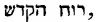 the holy spirit,
which was vouchsafed to the saint, certainly are mystic, and at
Alexandria similar ideas inspired a striking development. Once
again we can trace the fertilizing influence of Greek ideas. Even
when the old naturalistic cults had flourished in Greece, and
political life had provided a worthy goal for man, mystical beliefs
and ceremonies had a powerful [pg.59] attracion for the
Hellene; and, when the belief in the old gods had been shattered,
and with the national greatness the liberal life of the State had
passed away, he turned more and more to those rites which professed
to provide healing and rest for the sickening soul. Many of the
Alexandrian Jews must have been initiated into these Greek
mysteries, for Philo introduces into his exegesis of the law of
Moses an ordinance forbidding the practice.[66] He
himself advocates a more spiritual mysticism, and it is a cardinal
principle of his philosophy to treat the human soul as a god within
and its absorption in the universal Godhead as supreme bliss, the
end of all endeavor. He claimed to have attained, himself, to this
union, and to have received direct inspiration. Giving a Greek
coloring to the Hebrew notion of prophecy, "My soul," he says, "is
wont to be affected with a Divine trance and to prophesy about
things of which it has no knowledge"[67].... "Many a
time have I come with the intention of writing, and knowing exactly
what I ought to set down, but I have found my mind barren and
fruitless, and I have gone away with nothing done, but at times I
have come empty, and suddenly been full, for ideas were invisibly
rained down upon me from above, so that I was seized by a Divine
frenzy, and was lost to everything, place, people, self, speech,
and thought. I had gotten a stream of interpretation, [pg.60] a gift
of light, a clear survey of things, the clearest that eye can
give."[68]
the holy spirit,
which was vouchsafed to the saint, certainly are mystic, and at
Alexandria similar ideas inspired a striking development. Once
again we can trace the fertilizing influence of Greek ideas. Even
when the old naturalistic cults had flourished in Greece, and
political life had provided a worthy goal for man, mystical beliefs
and ceremonies had a powerful [pg.59] attracion for the
Hellene; and, when the belief in the old gods had been shattered,
and with the national greatness the liberal life of the State had
passed away, he turned more and more to those rites which professed
to provide healing and rest for the sickening soul. Many of the
Alexandrian Jews must have been initiated into these Greek
mysteries, for Philo introduces into his exegesis of the law of
Moses an ordinance forbidding the practice.[66] He
himself advocates a more spiritual mysticism, and it is a cardinal
principle of his philosophy to treat the human soul as a god within
and its absorption in the universal Godhead as supreme bliss, the
end of all endeavor. He claimed to have attained, himself, to this
union, and to have received direct inspiration. Giving a Greek
coloring to the Hebrew notion of prophecy, "My soul," he says, "is
wont to be affected with a Divine trance and to prophesy about
things of which it has no knowledge"[67].... "Many a
time have I come with the intention of writing, and knowing exactly
what I ought to set down, but I have found my mind barren and
fruitless, and I have gone away with nothing done, but at times I
have come empty, and suddenly been full, for ideas were invisibly
rained down upon me from above, so that I was seized by a Divine
frenzy, and was lost to everything, place, people, self, speech,
and thought. I had gotten a stream of interpretation, [pg.60] a gift
of light, a clear survey of things, the clearest that eye can
give."[68]
In his "Guide of the Perplexed,"[69] Maimonides
describes the various degrees of the , or what we call
religious "genius," with which man may be blessed. He distinguishes
between the man who possesses it only for his own exaltation, and
the man who feels himself compelled to impart it to others for
their happiness. To this higher order of genius Philo advanced in
his maturity. He consciously regarded himself as a follower of
Moses, who was the perfect interpreter of God's thought. So he,
though in a lesser degree, was an inspired interpreter, a
hierophant (as he expressed it in the language of the Greek
mystics) who expounded the Divine Word to his own generation by the
gift of the Divine wisdom. When he had fled from Alexandria, to
secure virtue by contemplation, he had as his final goal the
attainment of the true knowledge of God, and as he advanced in age,
he advanced in decision and authority. He was conscious of his
philosophic grasp of the Torah, and the diffidence with which he
allegorized in his early works gave place to a serene confidence
that he had a lesson for his own and for future generations. Hoping
for the time when Judaism should be a world-religion, he spoke his
message for Jew and Gentile. We can imagine him preaching on
Sabbaths to the [pg.61] great congregation which filled the
synagogue at Alexandria, and on other days of the week expounding
his philosophical ideas to a smaller circle which he collected
around him.
Essentially, then, he was a philosopher and a teacher, but he was called upon to play a part in the world of action. Following the passage already quoted, wherein Philo speaks of the blessings of the life of contemplation that he had led in the past,[70] he goes on to relate how that "envy, the most grievous of all evils, attacked me, and threw me into the vast sea of public affairs, in which I am still tossed about without being able to make my way out." A French scholar[71] conjectures that this is only a metaphorical way of saying that he was forced into some public office, probably, a seat in the Alexandrian Sanhedrin; and he ascribes the language to the bitter disappointment of one who was devoted to philosophical pursuits and found himself diverted from them. Philo's language points rather to duties which he was compelled to undertake less congenial than those of a member of the Sanhedrin would have been; and probably must refer to the polemical activity which he was called upon to exert in defending his people against misrepresentation and persecution. During the reign of Augustus and the early years of Tiberius (30 B.C.E.-20 C.E.) the Roman provinces were firmly ruled, and [pg.62] the governors were as firmly controlled by the emperor. To Rectus, who was the prefect of Egypt till 14 C.E., and who was removed for attempted extortion, Tiberius addressed the rebuke, "I want my sheep to be shorn, not strangled." But when Tiberius fell under the influence of Sejanus, and left to his hated minister the active control of the empire, harder times began for the provincials, and especially for the Jews. Sejanus was an upstart, and like most upstarts a tyrant; and for some reason—it may be jealousy of the power of the Jews at Rome—he hated the Jewish race and persecuted it. The great opponent of Sejanus was Antonia, the ward of Philo's brother, and a loyal friend to his people; and this, too, may have incited Sejanus' ill-feeling. Whatever the reason, the Alexandrian Jews felt the heavy hand, and when Philo came to write the story of his people in his own times, he devoted one book to the persecution by Sejanus. Unfortunately it has not survived, but veiled hints of the period of stress through which the people passed are not wanting in the commentary on the law.
There were always anti-Semites spoiling for a fight at
Alexandria, and there was always inflammable material which they
could stir up. The Egyptian populace were by nature, says Philo,
"jealous and envious, and were filled moreover with an ancient and
inveterate enmity towards the Jews,"[72] and of the
degenerate Greek population, many were anxious from motives
[pg.63] of private gain as well as from
religious enmity to incite an outbreak; since the Jews were wealthy
and the booty would be great. Among the cultured, too, there was
one philosophical school powerful at Alexandria, which maintained a
persistent attitude of hostility towards the Jews. The chief
literary anti-Semites of whom we have record at this period were
Stoics, and it is probably their "envy" to which Philo refers when
he complains of being drawn into the sea of politics. In writings
and in speeches the Stoic leaders Apion and Chæremon carried
on a campaign of misrepresentation, and sought to give their
attacks a fine humanitarian justification by drawing fancy pictures
of the Jewish religion and Jewish laws. The Jews worshipped the
head of an ass,[73] they hated
the Gentiles, and would have no communication with them, they
killed Gentile children at the Passover, and their law allowed them
to commit any offences against all but their own people, and
inculcated a low morality. When it was not morally bad, it was
degraded and superstitious. Whereas the modern anti-Semite usually
complains about Jewish success and dangerous cleverness, Apion
accused them of having produced no original ideas and no great men,
and no citizen as worthy of Alexandria as himself! Against these
charges Philo, the most philosophical Jew of the time and the most
distinguished member of the Alexandrian [pg.64]
community, was called upon to defend his people, and that part of
his works which Eusebius calls  ; i.e.
apologetics, was probably written in reply to the Stoic attacks.
The hatred of the Stoics was a religious hatred, which is the
bitterest of all; the Stoics were the propagators of a rival
religious system, which had originally been founded by Hellenized
Semites and borrowed much from Semitic sources. They had their
missionaries everywhere and aspired to found a universal
philosophical religion. In their proselytizing activity they tried
to assimilate to their pantheism the mythological religion of the
masses, and thus they became the philosophical supporters of
idolatry. Their greatest religious opponents were the Jews, who not
only refused to accept their teachings, but preached to the nations
a transcendental monotheism against their impersonal and
accommodating pantheism, and a divinely-revealed law of conduct
against their vague natural reason. In the Stoic pantheism the
first stand of the pagan national deities was made against the God
of Israel, and at Alexandria during the first century the fight
waxed fierce. It was a fight of ideas in which persons only were
victims, but at the back of the intermittent persecutions of which
we have record we may always surmise the influence of the Stoic
anti-Semites. The war of words translated itself from time to time
into the breaking of heads.
; i.e.
apologetics, was probably written in reply to the Stoic attacks.
The hatred of the Stoics was a religious hatred, which is the
bitterest of all; the Stoics were the propagators of a rival
religious system, which had originally been founded by Hellenized
Semites and borrowed much from Semitic sources. They had their
missionaries everywhere and aspired to found a universal
philosophical religion. In their proselytizing activity they tried
to assimilate to their pantheism the mythological religion of the
masses, and thus they became the philosophical supporters of
idolatry. Their greatest religious opponents were the Jews, who not
only refused to accept their teachings, but preached to the nations
a transcendental monotheism against their impersonal and
accommodating pantheism, and a divinely-revealed law of conduct
against their vague natural reason. In the Stoic pantheism the
first stand of the pagan national deities was made against the God
of Israel, and at Alexandria during the first century the fight
waxed fierce. It was a fight of ideas in which persons only were
victims, but at the back of the intermittent persecutions of which
we have record we may always surmise the influence of the Stoic
anti-Semites. The war of words translated itself from time to time
into the breaking of heads.
Philo, indeed, never mentions Apion by name, but he refers covertly in many places to his insolence and [pg.65] unscrupulousness.[74] Josephus wrote a famous reply to his attacks, refuting "his vulgar abuse, gross ignorance and demagogic claptrap,"[75] and the fact that a Palestinian Jew thought this apology necessary, proves the wide dissemination of the poison. The disgrace and death of Sejanus seem to have brought a relief from actual persecution to the Alexandrian Jews; but the ill-will between the two races in the city smouldered on, and it only required a weakening of the controlling hand at Rome to set the passions aflame again. Right through Philo's treatise "On the Confusion of Tongues," we can trace the tension. As soon as Gaius, surnamed Caligula, came to the imperial chair, the opportunity of the anti-Semites returned. Gaius, after reigning well a few months, fell ill, was seized with madness, and proved how much evil can be done in a short space by an imbecile autocrat. Flaccus, the governor of Egypt, who had hitherto ruled fairly, hoping to ingratiate himself by misrule, allowed himself to be led by worthless minions, who, from motives of private greed, desired a riot at Alexandria; he was won over by the anti-Semites and gave the mob a free hand in their attacks upon the "alien Jews."[76] The arrival of Agrippa, the grandson of Herod, who was on his way to his kingdom of Palestine, which the capricious emperor had just conferred upon him, excited the ill-will of the Alexandrian [pg.66] mob. Flaccus looked on while the people attacked the Jewish quarters, sacked the houses, and assailed everyone that came within their reach. The most distinguished Jews were not spared, and thirty members of the Council of Elders were dragged to the marketplace and scourged. Philo's account gives a picture strikingly similar to that of a modern pogrom. The brutal indifference of Flaccus did not indeed avail to ingratiate him with the emperor, and he was recalled to Italy, exiled, and afterwards executed.
The recall of Flaccus did not, however, put an end to the troubles; the mob had got out of hand, the anti-Semitic demagogues were elated, and a fresh opportunity for outrage soon presented itself. The mad emperor, having exhausted ordinary human follies, went on to imagine himself first a god and then the Supreme God, and finally ordered his image to be set up in every temple throughout his dominion. The Jews could not obey the order, and the mob rushed into fresh excesses upon them, defiled the synagogues with images of the lunatic, and in the great synagogue itself set up a bronze statue of him, inscribed with the name of Jupiter. With bitterness Philo points out that it was easy enough for the vile Egyptians, who worshipped reptiles and beasts, to erect a statue of the emperor in their temples; for the Jews, with their lofty idea of God, it was impossible. Against the attack upon their liberty of conscience they appealed directly to Gaius. An embassy was sent to lay their case before him, and Philo went to Italy at the [pg.67] head of the embassy. "He who is learned, gentle, and modest, and who is beloved of men, he shall be leader in the city." So said one of the rabbis of old, and the maxim is especially appropriate to Philo, who in name and deed was "beloved of men." Philo has left us a very full account of his mission, so that this incident of his life is a patch of bright light, which stands out almost glaringly from the general shadow. The account is not merely, nor, indeed, entirely history. Looking always for a sermon or a subject for a philosophical lesson, Philo has tricked out the record of the facts with much moralizing observation on the general lot of mankind, and elaborated the part of Providence more in the spirit of religious romance than of scientific history. Yet the main facts are clear. Philo prepared a long philosophical "apologia" for the Jews and set out with five colleagues for Italy. Nor were the enemies of the Jews remiss; and Apion, the Alexandrian anti-Semite, was sent at the head of a hostile deputation. The emperor, Gaius, was in one of his most flippant moods and little inclined to listen to philosophical or literary disquisitions. At first he received the Jewish deputation in a friendly way, and led them to think that he was favorable; but when they came to plead their cause, they had a rude awakening. Philo, who was not likely to appreciate the bitter humor of the situation, tells[77] with gravity that he expected that [pg.68] the emperor would hear the two contending parties in all proper judicial form, but that in fact he behaved like an insolent, overbearing tyrant. The audience—if it can be so called—took place in the gardens of the palace, and the emperor dragged the unfortunate deputation after him about the place, while he gave orders to his gardeners, builders, and workmen. Whenever they tried to put forward their arguments, he would rush ahead, enjoying the fright and dismay of his helpless victims. At times he would stop to make some ribald and jeering remark, as, "Why don't you eat pork, you fools?" at which the Egyptians following loudly applauded. Philo and his comrades, half-dead with agony, could only pray; and in response to the prayer, says our moralizing chronicler, the emperor's heart was turned to pity, so that he dismissed them without giving any hostile answer. According to Josephus, he drove them away in a passion, and Philo had to cheer his companions by assuring them of the Divine aid.[78]
The affair was a pathetic farce, and the Jewish actors in it had a sorry time. The people about the palace, taking their lead from the emperor, treated them as clowns, and hissed and mocked them, and even beat them. The scene is somewhat revolting when one conjures up the picture of the aged Jewish philosopher being roughly handled by the set of ruffians and impudent slaves who surrounded a Roman emperor. Happily Gaius jeered once too often in his [pg.69] mad life. One Chaerea, a Roman of position, nursed an insult of the emperor, and stabbed him shortly after these events; and the world had the respite of a tolerably sane emperor before the crowning horror of Nero was let loose upon it.
The murder of the capricious tyrant released not only the Jews of Alexandria, but also the Jews of Palestine, from the burden of fear for their religion. The order had been given to set up a bronze statue of the emperor in the temple; the Roman governor Petronius was averse to obeying the edict, but the emperor insisted. King Agrippa, who had been but lately advanced by him to the kingdom of Judæa, interceded zealously on behalf of his people. Philo gives us an account of this appeal by the Jewish king,[79] which recalls at every turn the scenes of the book of Esther. We have again the fasting, the banquet, the emperor's request, the appeal of the royal favorite for his people. One higher critic, indeed, has been found to suggest that the Biblical book really relates Agrippa's intercession at Rome disguised in the setting of a Persian story. Agrippa secured for a short time the rescission of the fateful decree, but the capricious madman soon returned to his old frame of mind, and ordered his image to be set up immediately. Had not his death intervened, there would certainly have been rebellion in Palestine. As it was, the great revolt was postponed for thirty years. For a little the Jews [pg.70] prevailed over their adversaries; the anti-Semitic influences were put down in Judæa and in Alexandria, and in both places "there was light and joy and gladness for the Jews." Their political privileges were reaffirmed by imperial decree, and Philo's brother Alexander, who had been imprisoned, was restored to honor.[80] "It is fitting," ran the rescript of Claudius, "to permit the Jews everywhere under our sway to observe their ancient customs without hindrance. And I charge them to use my indulgence with moderation, and not to show contempt for the religious rites of other peoples."
The note of triumph rings through the political references to be found in the last parts of Philo's allegorical commentary, and no doubt it was accentuated in the lost book which he added as an epilogue, or palinode, to his history of the embassy. God had again preserved his people, and discomfited their foes; recently-discovered papyri have revealed that the arch anti-Semites, Isidorus and Lampon, were tried at Rome and executed. Claudius was well-disposed to the Jewish race, and before the final storm there was a calm. Howbeit, after the death of Agrippa, in 44 C.E., Judæa became a Roman province, and under the rapacious governorship of Felix Florus and Cestius Gallus, the hostility of the people to the Romans grew more and more bitter. But in Alexandria there was tranquillity, or at least we know of no disquieting events during the next decade. [pg.71] "Old age," said Philo, "is an unruffled harbor,"[81] and the saying refers possibly to his own experience. For he must have died full of years and full of honors. Through his life he was the spiritual and philosophical guide, and finally he had become the champion of his people against their persecutors, giving dignity to their cause and inspiring respect even in their enemies. He was happy in the time of his death, for he did not live to see the destruction of the national home of his people and of that temple which he had loved to contemplate as the future centre of a universal religion. The disintegration of his own community at Alexandria followed full soon on the greater disaster; the temple of Onias was dismantled and interdicted against Jewish worship by Vespasian in the year 73 C.E., and though, as has been noted, this was not in itself of great importance, it is symbolic of the uprooting of national life in the Diaspora as well as in Palestine itself. On the downfall of Jerusalem in 70 C.E. many of the extreme anti-Roman party, known as the Zealots, fled to Alexandria and stirred up rebellion and dissension. Nothing but disaster could have attended the outbreak, but it is a sad reflection that the governor who put it down and ruthlessly exterminated the rebels was none other than Tiberius Alexander, the nephew of Philo, who was in turn procurator of Judæa and Egypt. By another irony of history he had in the previous year been largely instrumental in securing for Vespasian, [pg.72] who was besieging Jerusalem, the imperial throne of Rome.[82] With him ends our knowledge of Philo's family, and it ends significantly with one who has ceased to be a Jew. The ruin of the Jewish-Alexandrian community was completed by a desperate revolt in the reign of Trajan, 114-117 C.E., after which they were deprived of their chief political privileges; and finally, after incessant conflicts with the Christians, they were expelled from the city by the all-powerful Bishop Cyril (415 C.E.).
Philo himself passed out of Jewish tradition within a short time, to become a Christian worthy. The destruction of the nation and the gradual severance of the Christian heresy from the main community compelled the abandonment of missionary activity and distrust of the work of its exponents. The dangerous aspect of the Alexandrian development was revealed. Its philosophical allegorizing might attract the Gentile to the Jewish Scriptures, but it also led the Jew away from his special conduct of life. The Alexandrian Church, which claimed to continue the tradition of Philo, departed further and further from the Jewish standpoint, and formulated a dogmatic creed that was utterly opposed to Jewish monotheism. A philosophical Judaism for the whole world was a splendid ideal, but unfortunately in Philo's time it was incapable of accomplishment. The result of the attempt to found it was the establishment of a religion in which, together with the adoption of Hebraic [pg.73] teachings about God, certain ideas of Alexandrian mysticism became stereotyped as dogmas, and Jewish law was abrogated. When Babylon replaced Palestine as the centre of Jewish intellect, the works of Philo, like the rest of the Hellenistic-Jewish literature, written as they were in a strange tongue, fell into disuse, and before long were entirely forgotten. The Christians, on the other hand, found in Philo a notable evidence for many of their beliefs and a philosophical testimony for the dogmas of their creed. They claimed him as their own, and the Church Fathers, to bind him more closely to their tradition, invented fables of his meeting with Peter at Rome and Mark at Alexandria, They traced, in the treatise "On the Contemplative Life," a record of early Christian monastic communities, and on account of this book especially regarded Philo almost with the reverence of an apostle. To the Christian theologians of Alexandria we owe it that the interpretation of Judaism to the Hellenic world in the light of Hellenic philosophy has been preserved. Of the two Jewish philosophers who have made a great contribution to the world's intellectual development, Spinoza was excommunicated in his lifetime, and Philo suffered moral excommunication after his death. The writings of both exercised their chief influence outside the community; but the emancipated Jewry of our own day can in either case recognize the worth of the thinker, and point with pride to the saintliness of the man. [pg.74]
PHILO'S WORKS AND METHOD
The first thing that strikes a reader of Philo is the great volume of his work: he is the first Jewish writer to produce a large and systematic body of writings, the first to develop anything in the nature of a complete Jewish philosophy. He had essentially the literary gift, the capacity of giving lasting expression to his own thought and the thought of his generation. Treating him merely as a man of letters, he is one of the chief figures in Greek literature of the first century. We have extant over forty books of his composition, and nearly as many again have disappeared. His works are one and all expositions of Judaism, but they fall into six distinct classes of exegesis:
I. The allegorical commentary, or "Allegories of the Laws," which is a series of philosophical treatises based upon continuous texts in Genesis, from the first to the eighteenth chapter. Together with this, the best authorities place the two remaining books on the "Dreams of the Bible," which are a portion of a larger work, and deal allegorically with the dreams of Jacob and Joseph.
II. The Midrashic commentary on the Five Books of Moses, for which we have no single name, but [pg.75] which was clearly intended to be an ethical and philosophical treatise upon the whole law.
III. A commentary in the form of "Questions and Answers to Genesis and Exodus," which is incomplete now, and save for detached fragments exists only in a Latin translation. In its original form it provided a short running exegesis, verse by verse, to the whole of the first three books of the Pentateuch, and was contained in twelve parts.
IV. A popular and missionizing presentation of the Jewish system in the form of a "Life of Moses," and three appended tractates on the virtues "Courage," "Humanity," and "Repentance." Scholars[83] are of opinion that there are gaps in the extant "Life of Moses," but the general plan of the work is clear. It is at once an abstract and an interpretation of Jewish law for the Greek world, and also an ideal biography of the Jewish lawgiver.
V. Philosophical monographs, not so intimately connected with the Bible as the preceding works; but in the nature of rhetorical exercises upon the stock subjects of the schools, which receive a Jewish coloring by reason of Biblical illustrations.
VI. Historical and apologetic works that set out the case of the contemporary Jews against their persecutors and traducers. Of these writings the larger part has disappeared, and of a portion of those which remain the genuineness has been doubted.
Lastly, there is a miscellaneous number of works [pg.76] ascribed to Philo, which all good scholars[84] now admit to be spurious: "On the Incorruptibility of the World," "On the Universe," "On Samson," and "On Jonah," etc.
It will be seen from this classification of Philo's works, that he has dealt in several ways with the Biblical material. The reason of this is partly that his mind developed, and the interpretation of his maturer years differed widely from that of his earliest writings. Partly, however, it arises from the fact that the different treatments were meant for different audiences, and Philo always took the measure of those whom he was addressing. His most representative works are "a triple cord" with which he binds the Jewish Scripture to Greek culture. For the Greek-speaking populace he set out a broad statement of the Mosaic law; for the cultured community of Alexandria, Jew and Gentile, a more elaborate exegesis, in which each character and each ordinance of the Pentateuch received a particular ethical value; and, finally, for the esoteric circle of Hellenic-Jewish philosophers, a theological and psychological study of the allegories of the law. Origen, the first great Christian exegete of the Bible and a close student of the Philonic writings, distinguished three forms of interpreting: the historical, the moral, and the philosophical; he probably took the distinction from Philo, who exemplifies it in his commentaries upon the Books of Moses. [pg.77] Varied as is its scope, the religious idea dominates all his work, and endows it with one spirit. Whether he is writing philosophical, ethical, or mystical commentary, whether history, apology, or essay, his purpose is to assert the true notion of the one God, and the Divine excellence of God's revelation to His chosen people. Thus he regards history as a theodicy, vindicating the ways of God to man, and His special providence for Israel; philosophy as the inner meaning of the Scriptures, revealed by God in mystic communion with His holy prophets,[85] and, if comprehended aright, able to lead us on to a true conception of His Divine being. The greater part of the Hellenistic-Jewish literature has disappeared, but Philo sums up for us the whole of the Alexandrian development of Judaism. He represents it worthily in both its main aspects: the infusion of Greek culture into the Jewish pursuit of righteousness, and the recommendation of Jewish monotheism and the Torah to the Greek world. Aristaeus, Aristobulus, and Artapanus are hardly more than names, but their spirit is inherited and glorified in Philo-Judæus. His work, therefore, is more than the expression of one great mind; it is the record and expression of a great culture.
The chronology of Philo's writings is as uncertain as the
chronology of his life. Yet it is possible to trace a deepening of
outlook and an increasing originality, if we work our way up from
the sixth to the [pg.78] first division of the classification.
It does not follow that the works were written in this
order—and it may well be that Philo was producing at one and
the same time books of several classes—but we may use this
order as an ideal scale by which to mark off the stage of his
philosophical progress. In the first place come the , or apologetic works, which have a practical purpose. With
these we may associate the moralizing history that dealt in five
books respectively with the persecutions of Sejanus, Flaccus, and
Caligula, the ill-starred embassy, and the final triumph of the
Jews over their enemies. The proper, as we gather
from Eusebius, contained a general apology for Judaism, and an
account of the Essenes—which have disappeared—and the
suspected book on the Therapeutic sect known by the title "On the
Contemplative Life." Whether they received this generic name
because they are suggestions for the Jewish cause, or because they
are written to answer the insinuations  of adversaries, is a moot point. But their general
purport is clear: they were an apologetic presentation of Jewish
life, written to show the falsity of anti-Semitic calumnies. The
Jews are good citizens and their manner of life is humanitarian.
The Essene sect is a living proof of Jewish practical socialism and
practical philosophy, the Therapeutae show the Jewish zeal for the
contemplative life.
of adversaries, is a moot point. But their general
purport is clear: they were an apologetic presentation of Jewish
life, written to show the falsity of anti-Semitic calumnies. The
Jews are good citizens and their manner of life is humanitarian.
The Essene sect is a living proof of Jewish practical socialism and
practical philosophy, the Therapeutae show the Jewish zeal for the
contemplative life.
Next we come to Philo's philosophical monographs, which are not, as one might expect, the work of his [pg.79] mature thought, but rather the exercises of youth. Dissertations or declamations upon hackneyed subjects were part of the regular course of the university student at Alexandria, and Philo prepared himself for his Jewish philosophy by composing in the approved style essays upon "Providence," "The Liberty of the Good," and "The Slavery of the Wicked," etc. What chiefly distinguishes them above other collections of commonplaces is the appeal to the Bible for types of goodness, and here again the Essenes figure as the type of the philosophical life.[86] The writer, while still engaged in the studies of the Greek university, is feeling his way towards his system of universal Mosaism.
This he expounds confidently and enthusiastically in his "Life of Moses." Philo in this book is not any longer the apt pupil of Greek philosophers, nor the eloquent defender of the Jewish-Alexandrian community against lying detractors. He preaches a mission to the whole world, and he lays before it his gospel of monotheism and humanity. Each Greek school has its ideal type, its Socrates, Diogenes, or Pythagoras; but Philo places above them all "the most perfect man that ever lived, Moses, the legislator of the Jews,[87] as some hold, but according to others the interpreter of the sacred laws, and the greatest of men in every way." And above all the ethical systems of the day he sets the law of life that God [pg.80] revealed to His greatest prophet: "The laws of the Greek legislators are continually subject to change; the laws of Moses alone remain steady, unmoved, unshaken, stamped as it were with the seal of nature herself, from the day when they were written to the present day, and will so remain for all time so long as the world endures. Not only the Jews but all other peoples who care for righteousness adopt them.... Let all men follow this code and the age of universal peace will come about, the kingdom of God on earth will be established."[88] Nor is the Greek to fear the lot of a proselyte. "God loves the man who turns from idolatry to the true faith not less than the man who has been a believer all his life;"[89] and in the little essays upon Repentance and Nobility, which are attached to the larger treatise, Philo appeals to his own people to welcome the stranger within the community. "The Life of Moses" is the greatest attempt to set monotheism before the world made before the Christian gospels. And it is truer to the Jewish spirit, because it breathes on every page love for the Torah. Philo in very truth wished to fulfil the law.
If Judaism was to be the universal religion, it must be shown to contain the ultimate truth both about real being, i.e. God, and about ethics; for the philosophical world in that age—and the philosophical world included all educated people—demanded of [pg.81] religion that it should be philosophical, and of philosophy that it should be religious. The desire to expound Judaism in this way is the motive of Philo's three Biblical commentaries. The "Questions and Answers to Genesis and Exodus" constitute a preliminary study to the more elaborate works which followed. In them Philo is collecting his material, formulating his ideas, and determining the main lines of his allegory. They are a type of Midrash in its elementary stage, the explanation of the teacher to the pupil who has difficulties about the words of the law: at once like and unlike the old Tannaitic Midrash; like in that they deal with difficulties in the literal text of the Bible; unlike in that the reply of Philo is Agadic more usually than Halakic, speculative rather than practical. In these books,[90] as has been pointed out, there are numerous interpretations which Philo shares with the Palestinian schools. A few specimens taken from the first book will illustrate Philo's plan, but it should be mentioned that in every case he sets out the simple meaning of the text, the Peshat, as well as the inner meaning, or Derash.
"Why does it say: 'And God made every green herb of the field before it was upon the earth'? (Gen. ii. 4.)
"By these words he suggests symbolically the incorporeal Idea. The phrase, 'before it was upon the earth,' marks the original perfection of every plant [pg.82] and herb. The eternal types were first created in the noetic world, and the physical objects on earth, perceptible by the senses, were made in their likeness."
In this way Philo reads into the first chapter of the Bible the Platonic idealism which we shall see was a fundamental part of his philosophy.
"Why, when Enoch died, does it say, 'And he pleased God'? (Gen. v. 24.)
"He says this to teach that the soul is immortal, inasmuch as after it is released from the body it continues to please."
"What is the meaning of the expression, 'And Noah opened the roof of the ark'? (Gen. viii. 13.)
"The text appears to need no interpretation; but in its symbolical meaning the ark is our body, and that which covers the body and for a long time preserves its strength is spoken of as its roof. And this is appetite. Hence when the mind is attracted by a desire for heavenly things, it springs upwards and makes away with all material desires. It removes that which threw a shade over it so as to reach the eternal Ideas."
The "Questions and Answers" are essentially Hebraic in form,
designed for Jews who knew and studied their Bible; and we can feel
in them the influences of a training in traditional Mishnah and
Midrash; but Philo passed from them to a more artistic expression
and a more thoroughly Hellenized presentation of the philosophy of
the Bible. This work is the largest extant expression of his
thought and mission; it embraces the treatises which we know
[pg.83] as "On the Creation of the World,"
"The Lives of Abraham and Joseph," "On the Decalogue," and finally
those "On the Specific Laws," which are partly thus entitled and
partly have separate ethical names, as "On Honoring Parents," "On
Rewards and Punishments," "On Justice," etc. Large portions of it
have disappeared, notably the "Lives of Isaac and Jacob"; and also
the "Life of Moses," which was introductory to his laws. For the
book which we have under that name does not belong to the series,
but is separate. The purpose of the work broadly is to deepen the
value of the Bible for the Jews by revealing its constant spiritual
message, and to assert its value for the whole of humanity by
showing in it a philosophical conception of the universe and its
creation, the most lofty ethical and moral types, the most
admirable laws, and, above all, the purest ideas of God and His
relation to man. All that seems tribal and particularist is
explained away, and the spiritual aspect of every chapter—of
every word almost—of the Torah is emphasized. Philo expounds
the sacred book, not of one particular nation, but of mankind. The
Roman and Greek peoples were waiting for a religious message which
should at once harmonize with rational ideas and satisfy their
longing for God. All the philosophical schools were converting the
scientific systems of the classical age into 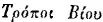 , "plans of life," and Philo challenges them all with a new
faith which has as its basis a God who not only was the sole
Creator and Ruler of [pg.84] the world, but who had revealed to man
the way of happiness, and the good life, social as well as
individual. To-day, when the world about us has accepted—or
has professed to accept—the ethical law of the Bible, we are
apt to regard the essentials of Judaism as the belief in One God
and the observance of ceremonies. But to Philo Judaism was
something more comprehensive. It was the spiritual life, and the
Mosaic law is the complete code of the Divine Republic, of which
all are or can be citizens. In the introduction to the "Life of
Abraham," Philo explains the scheme of his work:[91]
, "plans of life," and Philo challenges them all with a new
faith which has as its basis a God who not only was the sole
Creator and Ruler of [pg.84] the world, but who had revealed to man
the way of happiness, and the good life, social as well as
individual. To-day, when the world about us has accepted—or
has professed to accept—the ethical law of the Bible, we are
apt to regard the essentials of Judaism as the belief in One God
and the observance of ceremonies. But to Philo Judaism was
something more comprehensive. It was the spiritual life, and the
Mosaic law is the complete code of the Divine Republic, of which
all are or can be citizens. In the introduction to the "Life of
Abraham," Philo explains the scheme of his work:[91]
"'The Sacred Laws' [as he regularly calls the Bible] were written in five books, of which the first is entitled Genesis. It derives its title from the account of the creation which it contains, though it deals also with endless other subjects, peace and war, hunger and plenty, great cataclysms, and the histories of good and evil men. We have examined with great care the accounts of the creation in our former treatise ['On the Making of the Universe'], and we now go on naturally to inquire into the laws; and postponing the particular laws, which are as it were copies, we will first of all examine the more universal, which are their models. Now men who have lived irreproachable lives are these laws, and their virtues are recorded in the Holy Scriptures not only by way of eulogy, but in order to lead on those who read about them to emulate their life. They are become living standards of right reason, whom the lawgiver has glorified for two reasons: (1) To show that the laws laid down are consistent with nature [the conception of a [pg.85] natural law binding upon all peoples was one of the fixed ideas of the age]. (2) To show that it is not a matter of terrible labor to live according to our positive laws if a man has the will to do so; seeing that the patriarchs spontaneously followed the unwritten principles before any of the particular laws were written. So that a man may properly say that the code of law is only a memorial of the lives of the patriarchs. For the patriarchs, of their own accord and impulse, chose to follow nature, and, regarding her course with truth as the most ancient ordinance, they lived a life according to the law."
Philo dwells affectionately on the patriarchs, because, as he
held, they proved the Jewish life to be truest to man's nature and
to the highest ideal of humanity, and served therefore as examples
to the Gentile world of the universal truth of the religion. The
rabbis also took the patriarchs as the perfect type of our life,
saying, "Everything that happens to them is a sign to future
generations,"[92] and again:
"The patriarchs are the true  , manifestation of
God." But while he emphasized the broad moral teachings of Judaism
exemplified by the patriarchs, Philo nevertheless upheld in its
integrity the Mosaic law, and found in every one of the six hundred
and thirteen precepts a spiritual meaning. Even the details of the
tabernacle offerings have their universal lesson when he expounds
them as symbols. Voltaire speaks cynically of Judaism as a religion
of sacrifices: Philo shows that the ritual of sacrifice
[pg.86] suggests moral lessons. The command of
the red heifer, a part of the law which was particularly subject to
attack, emphasizes the law of moral as well as of physical
cleanliness. The prohibition to add honey or leaven to the
sacrifice[93] (Lev. ii. 13) points the lesson that all
superfluous pleasure is unrighteous; and so on with each
prescription.
, manifestation of
God." But while he emphasized the broad moral teachings of Judaism
exemplified by the patriarchs, Philo nevertheless upheld in its
integrity the Mosaic law, and found in every one of the six hundred
and thirteen precepts a spiritual meaning. Even the details of the
tabernacle offerings have their universal lesson when he expounds
them as symbols. Voltaire speaks cynically of Judaism as a religion
of sacrifices: Philo shows that the ritual of sacrifice
[pg.86] suggests moral lessons. The command of
the red heifer, a part of the law which was particularly subject to
attack, emphasizes the law of moral as well as of physical
cleanliness. The prohibition to add honey or leaven to the
sacrifice[93] (Lev. ii. 13) points the lesson that all
superfluous pleasure is unrighteous; and so on with each
prescription.
The Mosaic code in his exposition is commensurate with life in all its aspects. It deals not only with the duties of the individual but also with the good government of the state. The life of Joseph is made the text of a political treatise, and throughout the books "On the Specific Laws," the socialism of the Bible is emphasized,[94] and held up as the ideal order of the future. The Jewish State is enlarged in Philo's vision from a national theocracy into a world-city inspired by the two ideas of love of God and love of humanity. In this conception, no doubt, the influence of Greek philosophy is to be seen; the Jewish interpreter keeps before him the "Republic" of Plato, and the "Polity" of Aristotle. With him, however, the ideal state is not a vision "laid up in heaven";[95] its foundation is already laid upon earth, its capital is Jerusalem, and it is the mission of his people to extend its borders till it embraces all nations[96]—an idea which permeates the Jewish litany.
This commentary of the law is allegorical in the [pg.87] sense that beneath the particular law the interpreter constantly reveals a spiritual idea, but it is not allegorical in the sense that he makes an exchange of values. He is not for the most part reading into the text conceptions which are not suggested by it, but really and truly expounding; and where he gives a philosophical piece of exegesis, as when he explains the visit of the three angels to Abraham as a theory of the human soul about God's being,[97] he does so with diffidence or with reference to authorities that have founded a tradition. It is quite otherwise with the last class of Philo's work, the fruit of his maturest thought, with which it remains to deal.
Throughout the "Allegories of the Laws" he takes the verse of
the Bible not so much as a text to be amplified and interpreted,
but as a pretext for a philosophical disquisition. The allegories
indeed are only in form a commentary on the Bible; in one aspect
they are a history of the human soul, which, if they had been
completed, would have traced the upward progress from Adam to
Moses. It is not to be expected, however, that Philo should adhere
closely to any plan in the allegories. Theology, metaphysics, and
ethics have as large a part in the medley of philosophical ideas as
the story of the soul. His Hebraic mind, even when fortified by the
mastery of philosophy, was unable to present its ideas
systematically; it passed from subject to subject, weaving the
whole together only by the thread of a continuous [pg.88]
commentary upon Genesis. Parts of the work are missing, it is true,
which adds to the seeming want of plan; and—greatest loss of
all—the first part, which gave the philosophical account of
the first chapter of Genesis, the first six days of creation,
referred to as "The Hexameron" 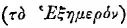 , has
disappeared.[98] Here must
have been the general introduction to the allegories, wherein Philo
declared his purpose and his method of exposition. The first
treatise that we possess starts abruptly with a comment on the
first verse of the second chapter, "'And the heaven and earth and
all their world were completed.' Moses has previously related the
creation of the mind and sense, and now he proceeds to describe
their perfection. Their perfection is not the individual mind or
sense, but their archetypal 'ideas.' And symbolically he calls the
mind heaven, because in heaven are the ideas of the mind, and the
sense he calls earth, because it is corporeal and
material."[99]
, has
disappeared.[98] Here must
have been the general introduction to the allegories, wherein Philo
declared his purpose and his method of exposition. The first
treatise that we possess starts abruptly with a comment on the
first verse of the second chapter, "'And the heaven and earth and
all their world were completed.' Moses has previously related the
creation of the mind and sense, and now he proceeds to describe
their perfection. Their perfection is not the individual mind or
sense, but their archetypal 'ideas.' And symbolically he calls the
mind heaven, because in heaven are the ideas of the mind, and the
sense he calls earth, because it is corporeal and
material."[99]
So in a rambling, unsystematic way Philo embarks upon a discourse on idealism and psychology, making a fresh start continually from a verse or a phrase of the Bible. The Biblical narrative in the earliest chapters offered a congenial soil for his explorations, but no ground is too stubborn for his seed. The genealogy of Noah's sons is as fertile in suggestion as the story of Adam and Eve, for each name represents some hidden power or possesses some ethical import.
[pg.89] The allegorical commentary is clearly the work of Philo's maturity, wherein he exhibits full mastery of an original method of exegesis. His allegories are no longer tentative, and he writes with the confidence of the sage, who has received not only the admiration of his people, but the inspiration of God. Another sign of their maturity is that asceticism seems no longer the true path to virtue, as it was to the author of "The Lives of the Patriarchs" and "The Specific Laws," but, on the contrary, a moderate use of the world's goods and a share in political life are marks of the perfect man. These characteristics bespeak the firmer hand and the profounder experience. Yet the series of works which form together Philo's esoteric doctrine were certainly put together over a long period of years, as the varied political references indicate. It has indeed been suggested by a modern German scholar[100] that large parts were originally given in the form of detached lectures and sermons, and that Philo later composed them together into a continuous commentary, working them up with much literary elaboration. In support of this theory, it may be urged that several of the treatises contain political addresses to public audiences, notably the De Agricultura and De Confusione Linguarum, while in others there are invocations to prayer, or a summons to read a passage in the Bible, addressed apparently by the preacher to the Hazan, who had before him the scroll of the law. From Philo's own statements we know that the wisest men used to deliver philosophical [pg.90] homilies upon the Bible on the Sabbath day; and it is natural that the man who was appointed to head the Jewish embassy to Gaius had made himself known in the past to his brethren for oratory and wisdom of speech. "Sermons," said Jowett, "though they deal with eternal subjects, are the most evanescent form of literature." The dictum is true for the most part, but occasionally the sermon, by its depth of thought, the universality of its message, and the beauty of its expression, has become part of the world's heritage from the ages. Moreover, at Alexandria philosophy was associated with preaching. And the sermons of the Jewish-Hellenistic writer, in their style as well as in their thought, represent an epoch. Philo spoke in the language of the intellectual world of his day, and strove to associate the intellectual precepts of Hellenism with the Hebraic passion for righteousness. In his great moments, however, the Hebraic spirit towers supreme. "He was," said Croiset, the historian of Greek literature, "the first Greek prose writer who could speak to God and of God to man with the ardent piety and reverence of the Jewish prophets."[101]
It is a serious misconception to imagine that Philo's
philosophical allegories were meant for the general body of
Alexandrian Jews. He frequently[102]
declares that he is speaking to a specially initiated sect, and
warns his hearers not to divulge his teaching. The [pg.91] notion
of an esoteric doctrine for the aristocracy of intellect had become
a fixed idea in the Greek schools for three centuries, ever since
the days of Aristotle; and whether through Greek influence or
otherwise it had been generally adopted by the Jewish teachers. The
rabbis of the Talmud derived from the first chapters of Genesis the
inner mystery of the law, which was cognizable only by the sage;
and the same idea is found in later Jewish tradition, which,
expounding Paradise  as four stages of
interpretation, each marked by a letter of the word, Peshat, Remez,
Derash, and Sod
as four stages of
interpretation, each marked by a letter of the word, Peshat, Remez,
Derash, and Sod  , [103]
regarded the last as the final reward of the devoted seeker after
God, as it is said in the Psalms, "The secret of the Lord is for
those who fear Him." Jewish religious philosophers have in all ages
designed their work for a select few. The Halakah, or way of life,
is the fit study of the many. So Maimonides wrote his Moreh only
for those who already were masters of the law. And Philo likewise
at Alexandria taught an esoteric doctrine to an esoteric circle,
which alone was fitted to receive the profoundest theology.[104] The allegories of the law do not take
the place of the law itself, nor of its ethical ordinances. They
are additional to the other exegesis and distinct, destined only
for the man of learning. And as we shall see, he asserts
emphatically in the midst of his allegories[105] that the [pg.92]
perception of the philosophical value does not release man from the
practice itself. The wise man even as the fool must obey the
law.
, [103]
regarded the last as the final reward of the devoted seeker after
God, as it is said in the Psalms, "The secret of the Lord is for
those who fear Him." Jewish religious philosophers have in all ages
designed their work for a select few. The Halakah, or way of life,
is the fit study of the many. So Maimonides wrote his Moreh only
for those who already were masters of the law. And Philo likewise
at Alexandria taught an esoteric doctrine to an esoteric circle,
which alone was fitted to receive the profoundest theology.[104] The allegories of the law do not take
the place of the law itself, nor of its ethical ordinances. They
are additional to the other exegesis and distinct, destined only
for the man of learning. And as we shall see, he asserts
emphatically in the midst of his allegories[105] that the [pg.92]
perception of the philosophical value does not release man from the
practice itself. The wise man even as the fool must obey the
law.
Why, it may be asked, does Philo artificially attach his philosophy to the Scriptures? He does so for two reasons: first, because he holds and wishes to prove that between faith and philosophy there is no conflict, and his generation worked out the agreement by this method; he does so also because he wishes to establish the Torah and Judaism upon a sure foundation for the man of outside culture. The pursuit of philosophy must have menaced the attachment to Judaism and challenged the authority of the Bible at Alexandria. A superficial knowledge of the materialistic or rationalistic theories, which were propagated respectively by the Epicurean and Stoic schools, was made the excuse for indifference to the law. Then as now the advanced Jew would mask his self-indulgence under the guise of a banal philosophy, and jeer easily at archaic myths and tribal laws. The dominating motive of Philo's work is to show that the Bible contains for those who will seek it the richest treasures of wisdom, that its ethical teaching is more ideal and yet more real than that which hundreds of sophists poured forth daily in the lecture-theatres[106] to the gaping dilettanti of learning, and lastly that the cultured Jew may search out knowledge and truth to their depths, and find them expressed in his holy books and [pg.93] in his religious beliefs and practices. Philo frequently introduces into his philosophical interpretation a polemic against the disintegrating and demoralizing forces which were at work in the Alexandria of his day. His commentary therefore is a strange medley, compounded of idealistic speculation, theology, homiletics, moral denunciation, and polemical rhetoric. The idea, which is not uncommon, that Philo represents the extreme Hellenic development of Judaism, and that he gathered into his writings the opinions of all Greek schools to the ruin of his Jewish individuality, is utterly erroneous. In fact, he chooses out only the valuable parts of Greek thought, which could enter into a true harmony with the Hebraic spirit; and he not only rejects, but he attacks unsparingly those elements which were antagonistic to holiness and righteousness. With the enthusiasm of a Maccabee, if with other weapons, he fought against the bastard culture, which meant self-indulgence and the excessive attention to the body, the idol-worship, the degraded ideas of the Divine power, and the disregard of truth and justice, that were current in the pagan society about him. The seeking after sensual pleasure and luxury was the most glaring evil of his city—as the Talmud says,[107] of ten parts of lust nine were given to Alexandria—and with every variety of denunciation he returns again and again to the charge. Epicureanism is detestable not only for its low idea of [pg.94] human life, but for its godless conception of the universe. Its theory that the world was a fortuitous concourse of atoms, which was governed by blind chance, and that the gods lived apart in complete indifference to men—this was to Philo utter atheism, and as such the greatest of sins. He attacked paganism not only in its crude form of idolatry,[108] but in its more seductive disguise of a pretentious philosophy. Always and entirely he was the champion of monotheism.
Nearly as godless, and therefore as vile in his eyes as the follower of Epicurus, is the follower of the Stoic doctrines. It has been shown that the Jews and the Stoics were continually in conflict at Alexandria; and the "Allegories of the Laws" are filled with attacks, overt and hidden, upon the Stoic doctrines. The Stoics, indeed, believed in one supreme Divine Power, not however in a transcendental and personal God, but a cosmic, impersonal, fatalistic world-force.[109] To Philo this conception, with its denial of the Divine will and the Divine care for the individual, was as atheistic as the Epicurean "chance." Equally repulsive to his religious standpoint was the Stoic dogma, that man is, or should be, independent of all help, and that the human reason is all-powerful and can comprehend the universe by its own unaided power.[110] Repulsive also were their pride, their rejection of the emotions, their hard rationalism. The [pg.95] battle of Philo against the Stoics is the battle of personal monotheism against impersonal pantheism, of religious faith and revelation against arrogant rationalism, and of idealism against materialism. Hostile as he is to the Stoic intellectual dogmatism, Philo is none the less opposed to its converse, intellectual skepticism and agnosticism. Man, he is convinced, has a Divine revelation[111] which he may not deny without ruin. He holds with Pope that we have
"Too much of knowledge for the
Skeptic side,
Too much of weakness for the
Stoic's pride,"
and he attacks the Skeptics of the day who devoted their minds to destructive dialectical quibbling and sophistry[112] instead of seeking for God and the human good. They are the Ishmaels of philosophy.
Philo's polemic is directed less against the Greek schools in themselves than against the Jewish followers of the Greek schools. He saw the danger to Judaism in the teachings of these anti-religious philosophers, and deeply as he loved Greek culture, he loved more deeply his religion. He wanted to reveal a philosophy in the Bible which should win back to Judaism the men who had been captivated by foreign thought. In one aspect, therefore, his master-work is a plea for unity. The community at Alexandria was a very heterogeneous body; not only were the sects which had appeared in Palestine, the Sadducees, [pg.96] Samaritans, Pharisees, and Essenes, represented there too, but in addition there were parties who attached themselves to one or other of the Greek schools, the Pythagoreans, Skeptics, and the like, and lastly Gnostic groups, who cultivated an esoteric doctrine of the Godhead, and were lax in their observance of the law, which they held to be purely symbolical and of no account in its literal meaning. The mental activity which this growth of sects exemplified was in some respects a healthy sign, but it contained seeds of religious chaos, which bore their fruit in the next century. Men started by thinking out a philosophical Judaism for themselves; they ended by ceasing to be Jews and philosophers. Philo foresaw this danger, and he tried to combat it by presenting his people with a commentary of the Bible which should satisfy their intellectual and speculative bent, but at the same time preserve their loyalty to the Bible and the law. To the Greek world he offered a philosophical religion, to his own people a religious philosophy. Thus the allegorical commentary is the crowning point of his work, the offering of his deepest thought to the most cultured of the community; and though much of its detail had only relevancy for its own time, and its method may repel our modern taste, yet the spirit which animates it is of value to all ages, and should be an inspiration to every generation of emancipated Jews. That spirit is one of fearless acceptance of the finest culture of the age combined with unswerving love of the law and loyalty to catholic Judaism.
[pg.97] We have already treated of the general characteristics of Philo's method of allegorical interpretation, but we must now consider rather more closely the way in which he employs it. The general principle upon which he depends is, that besides and in addition to the literal meaning which the Bible bears for the common man, it has a hidden and deeper meaning for the philosopher. It is, as it were, a sort of palimpsest; the writing on the top all may read, the writing below the student alone can decipher. With the rabbis Philo holds that the Torah was written "in the language of the sons of man,"[113] but he believes with them again that it contains all wisdom. And if the ideas of reason do not appear in its literal meaning, then they must be searched out in some inner interpretation. Commenting on the verse in Genesis (xi. 7), "Let us confound their language, that they may not understand one another's speech," he says: "Those who follow the literal and obvious interpretation think that the origin of the Greek and barbarian languages is here described; [the contrast between Greek, on the one hand, and barbarian—in which Hebrew, it seems, is included—on the other, is remarkable]. I would not find fault with them, because they also, perhaps, employ right reason, but I would call on them not to remain content with this, but to follow me to the metaphorical renderings, considering that the actual words of the holy oracle are, [pg.98] as it were, shadows of the real bodies, and the powers which they reflect are the true underlying ideas."[114]
Elsewhere he tells a story of the condign punishment which
befell a godless and impious man, perchance a Samaritan Jew, who
made mock of the race of allegorical interpreters, jeering at the
idea that the change of names from Abram to Abraham and from Sarai
to Sarah contained some deep meaning. He soon paid a fitting
penalty for his wicked wit, for on some very trivial pretext he
went and hanged himself. Which was just, says Philo; for such a
rascal deserved a rascal's death.[115] It is
noteworthy that the Talmud also lays stress upon the deep meaning
of the patriarch's change of name.[116] "He
who calls Abraham Abram," said Bar Kappara, "transgresses a
positive command"  . "Nay," said Rabbi Levi, "he transgresses
both a positive and a negative command (and commits a double sin)."
Clearly this was a test-question and an article of faith, possibly
because the letter
. "Nay," said Rabbi Levi, "he transgresses
both a positive and a negative command (and commits a double sin)."
Clearly this was a test-question and an article of faith, possibly
because the letter  , which was added to the name, was a letter
of mystical import in the opinion of the age. Both the rejection of
the literal and the rejection of the allegorical value of the
Bible, Philo regarded as impious, and he had to struggle against
opposite factions that were one-sided. The true son of the law
believes in both
, which was added to the name, was a letter
of mystical import in the opinion of the age. Both the rejection of
the literal and the rejection of the allegorical value of the
Bible, Philo regarded as impious, and he had to struggle against
opposite factions that were one-sided. The true son of the law
believes in both  .[117] Seeing that the Bible was the
[pg.99] inspired revelation of God, who is the
fountain of all wisdom and knowledge—this is Philo's cardinal
dogma—it is not to be supposed, on the one hand, that it was
silent about the profoundest ideas of the human mind, or, on the
other, that it contained ideas opposed to right reason and truth.
Yet at first sight it seemed to lack any definite philosophy and to
offer anthropomorphic views of God. Hence the true interpreter must
use the actual words of the sage as metaphors, following the maxim,
"Turn it about and about, because all is in it, and contemplate it
and wax grey over it, for thou canst have no better rule than
this."[118] The principle upon which Philo,
Saadia, Maimonides, and in fact the whole line of Jewish
philosophical exegetes have worked, is that the "words of the law
are fruitful and multiply"; or, as the Bible phrase runs, "The
Torah which Moses commanded unto us is the inheritance of the
congregation of Jacob." It is the separate inheritance of each
generation, which each must cultivate so as to gather therefrom its
own fruit.
.[117] Seeing that the Bible was the
[pg.99] inspired revelation of God, who is the
fountain of all wisdom and knowledge—this is Philo's cardinal
dogma—it is not to be supposed, on the one hand, that it was
silent about the profoundest ideas of the human mind, or, on the
other, that it contained ideas opposed to right reason and truth.
Yet at first sight it seemed to lack any definite philosophy and to
offer anthropomorphic views of God. Hence the true interpreter must
use the actual words of the sage as metaphors, following the maxim,
"Turn it about and about, because all is in it, and contemplate it
and wax grey over it, for thou canst have no better rule than
this."[118] The principle upon which Philo,
Saadia, Maimonides, and in fact the whole line of Jewish
philosophical exegetes have worked, is that the "words of the law
are fruitful and multiply"; or, as the Bible phrase runs, "The
Torah which Moses commanded unto us is the inheritance of the
congregation of Jacob." It is the separate inheritance of each
generation, which each must cultivate so as to gather therefrom its
own fruit.
The Halakah is the outcome of this devotion in one aspect, the
philosophical exegesis in another. In the one case Jewish
jurisprudence and the body of legal tradition, in the other,
philosophical ideas inspired by outer civilization, are attached to
the text of the Bible by ingenious devices of association. The
device is partly a pious fiction, partly a genuine belief; in other
[pg.100] words, the teachers honestly thought
that there was respectively a hidden philosophical meaning in the
Bible and an oral tradition, supplementary to the written law and
arising out of it; but on the other hand they would not have urged
that their particular interpretation alone was portended by the
Scriptures. This is shown in the Talmud by the fact that different
rabbis deduced the same lessons from different verses, and contrary
laws from the same verse; in Philo by the fact that he often gives
various interpretations of one text in different parts of his work.
All that was claimed was that knowledge and truth must be primarily
referred to the Divine revelation, and all law and practice to the
authority of the Mosaic code. Philo, then, in the same way as the
rabbis, deduces all his teaching from the Bible, not because he
holds that it was explicitly contained there, but because he
desires to give to his philosophical notions Divine authority. Like
the rabbis, again, he suggests definite rules of interpretation
which may always be applied  .[119] He declares that every name in the
Torah has a deep symbolical meaning, and symbolizes some
power.[120] Thus the names of the sons of Jacob
typify each some moral quality, and these qualities together make
the perfect man and the perfect nation. Reuben is "the son of
insight"
.[119] He declares that every name in the
Torah has a deep symbolical meaning, and symbolizes some
power.[120] Thus the names of the sons of Jacob
typify each some moral quality, and these qualities together make
the perfect man and the perfect nation. Reuben is "the son of
insight"  , Simeon is learning
  , Judah [pg.101]
 stands for the praise of God.[121] It may
be noted, by the way, that all these values show traces of Hebrew
etymology. Again, the synonyms in the Bible are to be carefully
studied, while even particles and parts of words have their special
value and importance. And the skilful exegete may for homiletical
purposes make slight changes in a word, following the rabbinical
rule,[122] "Read not so, but so." Thus he plays
upon the name Esau, and takes the Hebrew word as though it were
written, not
stands for the praise of God.[121] It may
be noted, by the way, that all these values show traces of Hebrew
etymology. Again, the synonyms in the Bible are to be carefully
studied, while even particles and parts of words have their special
value and importance. And the skilful exegete may for homiletical
purposes make slight changes in a word, following the rabbinical
rule,[122] "Read not so, but so." Thus he plays
upon the name Esau, and takes the Hebrew word as though it were
written, not  but
but  , a thing made.[123]
Whence he shows that Esau represents the sham (made-up) greatness,
which is boastful and insolent and shameless. Philo is referring
perhaps to Apion, the vainglorious anti-Semite, whom he often
covertly attacks. Again, whenever there is repetition in the text,
a deeper meaning is portended. Dealing with the verse, "Sarah the
wife of Abraham took Hagar the Egyptian" (Gen. xvi. 3), Philo
comments, that we already knew that Sarah was Abraham's wife: why,
then, does the Bible mention it again? And following certain values
which he has made, he draws the lesson that the study of philosophy
must always go together with the study of general culture.[124] These examples are not isolated; yet
it is rather a barren science to search for the canons of Philo's
allegory, as Siegfried has done.
, a thing made.[123]
Whence he shows that Esau represents the sham (made-up) greatness,
which is boastful and insolent and shameless. Philo is referring
perhaps to Apion, the vainglorious anti-Semite, whom he often
covertly attacks. Again, whenever there is repetition in the text,
a deeper meaning is portended. Dealing with the verse, "Sarah the
wife of Abraham took Hagar the Egyptian" (Gen. xvi. 3), Philo
comments, that we already knew that Sarah was Abraham's wife: why,
then, does the Bible mention it again? And following certain values
which he has made, he draws the lesson that the study of philosophy
must always go together with the study of general culture.[124] These examples are not isolated; yet
it is rather a barren science to search for the canons of Philo's
allegory, as Siegfried has done.
[pg.102] For his allegory is a very flexible instrument, which can be employed at pleasure to deduce anything from anything. And Philo regards these "points of construction" as the excuse, not as the motive, of his ethical and philosophical teaching. He does not depend on such devices, for he wanders into allegory more often than not without any pretext of the kind.
The modern reader may consider the allegorical method artificial and unconvincing, even if he does not go so far as Spinoza, and say that it is "useless, harmful, and absurd."[125] We prefer to-day to show the inner agreement of philosophical with Biblical teaching, rather than pretend that all philosophy is contained within the Bible; and we accept the Bible as it stands, as a book of supreme religious worth, without requiring more of it. But that is mainly a difference of taste or of method, and in Philo's day, and in fact down to the time of the sixteenth-century Renaissance, Jew and Gentile alike preferred the other way. For thought, ancient and mediæval, was pervaded with the craving for authority or a plausible show of it. The Bible was not only the great book of morality, but the standard of truth, that from which knowledge in all its branches started, and that by which it was to be judged. As all knowledge came from God, so all knowledge was in God's Book; and allegory was the method by which the intellectual conceptions of succeeding ages were attached to it.
The two main heads of Biblical interpretation which the Jewish religious genius developed, Peshat and Derash,—these represent two permanent attitudes of mind. In the first the commentator tries to get at the exact meaning of the text before him, to make its lesson clear and discuss the circumstances of the composition, the exact relations of its parts. He is satisfied to take the writer of the Biblical book for what he says in his own form of utterance. In the second the commentator is more anxious to inculcate ideas and lessons which do not arise obviously from the text, and to widen the significance of what he finds in the Bible. The interpretation ceases to be a mere exposition; it becomes creative or conciliating thought, and the interpreter becomes a religious reformer, a philosopher, a prophet. To this school Philo belongs, and the framework of his teaching or the ingenuity by which he develops it from his text is of small account. It is what he teaches and what he considers to be the vital things in religion and life to which we must pay attention. Judged on this ground Philo is a supreme master of Derash, and must take a place among the most creative of the interpreters of the Bible.
IV
PHILO AND THE TORAH
Over and over again Philo declares that his function is to expound the law of Moses. Moses was the interpreter of God's word to Israel; and Philo aspired to be the interpreter of the revelation of Moses to the Hellenistic world, "the living voice of the holy law." He believed that Israel was a chosen people in the sense that it had received the Divine message on behalf of the whole human race,[126] a Kingdom of Priests, in that it occupied to other nations the position which the priest—using the word in the fullest sense—occupied to the common people.[127] The Torah is God's covenant, not only with one small nation, but with all His children, and its teachings are true for all times and for all places. "The Bible," as Professor Butcher says,[128] "is the one book which appears to have the capacity of eternal self-adjustment, of uninterrupted correspondence with an ever-shifting and ever-widening environment." Nowadays this appears a truism, but the truth first presented itself to the Jewish-Alexandrian community when they came in contact with external culture. The Palestinian and Babylonian Jews, free for the most part from outside influences, developed the Torah for the Jewish people, amplified the tradition, and determined [pg.105] the Halakah, the practical law. But the Alexandrian Jews in the first place found their own attitude to the Torah affected by their acquaintance with Greek ethics and metaphysics, and also found it necessary to interpret the Bible in a new fashion in order to make its value known to their environment. The Greek world required to be shown the general principle, the broad ethical idea in each ordinance. And thus it came about that the Alexandrian interpreters always emphasized the universal beneath the particular, the moral spirit beneath the forms.
It had been one of the chief functions of the prophets to demonstrate the moral import of the law. In their vision the God of Israel became the God of the universe, and His law of conduct was spread over all mankind. "For the law shall go forth from Zion, and the word of the Lord from Jerusalem" (Micah iv. 2). Philo in effect expounds Judaism in their spirit, though he speaks their message in the voice of Plato and to a people whose minds were trained in Greek culture. Yet it is significant that he wrote all his commentaries round the Five Books of Moses, and used the prophets and other Biblical books only to illustrate and support the Mosaic teaching, which contains the whole way of life and the whole religious philosophy. According to the rabbis also the Prophets formed only a complement to the Torah, "a species of Agadah";[129] and the prophetic vision of
[pg.106] Moses was much clearer than that of his successors. Philo, too, clearly realized that Judaism was the religion of the law. His view of the Torah is what the modern world would call uncritical: that is to say, he accepts the idea that the whole of the Five Books was an objective revelation to Moses at Sinai. But though—or because—he is innocent of the higher criticism, and believes in the literal inspiration of the Torah, his conception is none the less enlightened and spiritual. The law—the Divine Logos—is not the enactment of an outside power, arbitrarily imposed, and to be obeyed because of its miraculous origin; it is the expression of the human soul within, when raised to its highest power by the Divine inspiration. Every man may fit himself to receive the Divine word, which is, in modern language, revelation.[130] Moses, then, is distinguished above all other legislators, not because he alone received it, but because he received it in its purest form, and because he was the most noble interpreter of it. It is for this reason that the law of Moses is of universal validity for conduct. The Divine spirit possessed him so fully that his Logos, or revelation, is eternally true, and by following it all men become fit to be blessed with the Divine gift themselves. This is true of the other prophets of the Bible to a smaller degree, and in a still minor degree Philo hoped that it was true of himself.
It should be premised that the "law of nature" [pg.107] was at the time of Philo an idea as widely accepted as "evolution" is to-day. Men believed that by a study of the processes of the universe the individual might discover the law of conduct that should bring his action into harmony with the whole. What the Greek philosophers declared to be the privilege of the few, Philo declared to have been imparted by God to His people as their law of life. Hence the Mosaic legislation is the code of nature and reason, and the righteous man directs his conduct in accordance with those rules of nature by which the cosmos is ordered.[131] Obedience to the law should not be obedience to an outward prescription, but rather the following out of our own highest nature. The ideal which the Stoic sage continually aspired for and never attained to—the life according to nature and right reason—this Philo claimed had been accomplished in the Mosaic revelation, handed down by God to Israel and through them to the world.
Before we deal with Philo's treatment of the law in its narrower
sense, it will be as well to consider briefly his interpretation of
the historical parts of the Torah. Here likewise he finds ideas of
natural reason and eternal truths embodied. To Philo, as we have
seen, the Torah is a unity, and every part of it has equal validity
and value. He had to contend against certain higher critics of his
day, who declared that Genesis was a collection of myths
[pg.108]  ).[132]
Moreover, the long catalogues of genealogies in Genesis and the
longer recitals of sacrifices in Leviticus and Numbers seemed to
refute those who declared that every part of the Pentateuch was a
Divine revelation. In the third book of the "Questions to Genesis"
Philo directly grapples with this objection. Commenting on the
verse (Gen. xv. 9), "Take for me a heifer of three years old and a
goat of three years old," etc., he says that in interpreting any
part or any verse of Scripture we must look to the purpose of the
whole and explain it from this outlook, "without dissecting or
disturbing its harmony or disintegrating its unity."[133] Why should God, asked the scoffer,
reveal these trivial or prolix details? Philo's answer is in fact
to spiritualize everything that is material, and universalize
everything that is particular. While he believes in the literal
inspiration of the Bible, he does not insist upon the literal truth
of every word of it, and in the opening chapters of Genesis in
particular, he treats the tales as symbolical or allegorical myths.
His philosophical commentary on the creation, corresponding to the
).[132]
Moreover, the long catalogues of genealogies in Genesis and the
longer recitals of sacrifices in Leviticus and Numbers seemed to
refute those who declared that every part of the Pentateuch was a
Divine revelation. In the third book of the "Questions to Genesis"
Philo directly grapples with this objection. Commenting on the
verse (Gen. xv. 9), "Take for me a heifer of three years old and a
goat of three years old," etc., he says that in interpreting any
part or any verse of Scripture we must look to the purpose of the
whole and explain it from this outlook, "without dissecting or
disturbing its harmony or disintegrating its unity."[133] Why should God, asked the scoffer,
reveal these trivial or prolix details? Philo's answer is in fact
to spiritualize everything that is material, and universalize
everything that is particular. While he believes in the literal
inspiration of the Bible, he does not insist upon the literal truth
of every word of it, and in the opening chapters of Genesis in
particular, he treats the tales as symbolical or allegorical myths.
His philosophical commentary on the creation, corresponding to the
 of the rabbis, is found in the book De Mundi Opificio,
which stands in modern editions at the head of his writings. Its
main theme is to trace in the text the Platonic idealism,
i.e., the theory that God first created transcendental,
incorporeal archetypes of all [pg.109] physical and material
things. Philo uses the double account of the creation of man in the
first and second chapters of Genesis as clear evidence that the
Bible describes—for those who have the mind to see—the
creation of an ideal before the terrestrial man.
of the rabbis, is found in the book De Mundi Opificio,
which stands in modern editions at the head of his writings. Its
main theme is to trace in the text the Platonic idealism,
i.e., the theory that God first created transcendental,
incorporeal archetypes of all [pg.109] physical and material
things. Philo uses the double account of the creation of man in the
first and second chapters of Genesis as clear evidence that the
Bible describes—for those who have the mind to see—the
creation of an ideal before the terrestrial man.
In the "Allegories of the Laws," which is the profounder philosophical doctrine, the account of Adam and Eve is deliberately chosen by Philo as the text of a psychological treatise, in which he analyzes[134] the relations of the mind, the senses, and the pleasures, represented respectively by Adam, Eve, and the Serpent. The necessity of explaining the story symbolically is professedly based on the fact that otherwise we are driven to the idea that the Bible spoke inaccurately about God. "It is silly," he says, "to suppose that Adam and Eve can have hidden themselves in the Garden of Eden, for God filled the whole." We are driven then to suggest another meaning; and Philo passes into a homily about the false opinion of the man who follows the bidding of the senses (Eve) at the instigation of pleasure (the Serpent).[135]
The story of Cain and Abel is another piece of moral philosophy embodied in a concrete form. Abel symbolizes pious humility, Cain the deadly sin of atheism and intellectual pride, which denies the absolute and ever-present power of the Deity. Philo asks himself the question that other commentators have frequently raised, some in reverence, some in [pg.110] ridicule, "Who was Cain's wife?"[136] And he answers that the Bible expression about the children of Cain cannot be taken literally, but suggests the union of the ill-ruled mind with impious opinions, which have as their issue false pride and sin.
Philo here treats the stories in the opening of Genesis as pure
allegories, in which the men and women represent symbolically
characters and qualities. It should be remembered, however, that
these interpretations occur in the commentary where our author is
not so much expounding the Torah as deducing secret doctrines from
it. His proper exposition of the law proceeds from the book on the
Creation to the lives of the patriarchs Abraham, Isaac, and Jacob,
and then to the lives of Joseph and Moses. And in this commentary
the Bible narrative is taken as historical truth: only in addition
to the historical fact there is a moral and universal value in
every figure and every episode. The patriarchs' lives represent the
unwritten law which the Greek world held in high honor, for it was
considered to contain the broad principles of individual and social
conduct, and to be prior logically and chronologically to the
written codes. Moses, therefore, the perfect legislator, according
to Philo, has presented in the three founders of the Hebrew race
embodiments of the unwritten law of good conduct for all mankind.
Each of them is a moral type of eternal validity and represents one
of the ways in [pg.111] which blessedness may be
attained.[137]
Abraham represents the goodness which comes from instruction;
Isaac, the spontaneous goodness that is innate, and the joy (or
laughter) of the soul that is God's gift to his favored sons;
Jacob, the goodness that comes after long effort, through the life
of practice and severe discipline. Before this triad, the Bible
presents another group of three, who represent the virtues
preparatory to the acquisition of perfect goodness: Enosh, Enoch,
and Noah.[138] They
typify respectively, as their names indicate, hope, repentance, and
justice. It is a pretty thought, helped by an error in the
Septuagint translation,[139] which
sees in the name of the first i.e., man,  the symbol of
hope. Hope, the commentator suggests, is the distinguishing
characteristic of man[140] as
compared with other animals, and hope therefore is our first step
towards the Divine nature, the seed of which faith is the fruit.
Next in order come repentance and natural justice, and from these
stepping-stones we can rise to the higher self. Philo's
interpretation of these Bible figures would appear to have behind
it an old Midrashic tradition. As far back as the book of Ben Sira,
in the passage on "the Praises of Famous Men" (xliv), they are
taken as typical of the different virtues, and Enoch notably
[pg.112] is the type of repentance. In the
first century the world was becoming incapable of understanding
abstract ideas, and required ethics to be concretely embodied in
examples of life. Philo found within the Jewish Scriptures what the
Christian apostles later transferred to other events.
the symbol of
hope. Hope, the commentator suggests, is the distinguishing
characteristic of man[140] as
compared with other animals, and hope therefore is our first step
towards the Divine nature, the seed of which faith is the fruit.
Next in order come repentance and natural justice, and from these
stepping-stones we can rise to the higher self. Philo's
interpretation of these Bible figures would appear to have behind
it an old Midrashic tradition. As far back as the book of Ben Sira,
in the passage on "the Praises of Famous Men" (xliv), they are
taken as typical of the different virtues, and Enoch notably
[pg.112] is the type of repentance. In the
first century the world was becoming incapable of understanding
abstract ideas, and required ethics to be concretely embodied in
examples of life. Philo found within the Jewish Scriptures what the
Christian apostles later transferred to other events.
Joseph, whose life followed that of the patriarchs, is the type of the political life, the model of the man of action and ambition. Taken alone, this is inferior to the life of the saint and philosopher, but mixed with the other it produces the perfect man, for the truly good man must take his part in public life. The story of Joseph, then, illustrates the full humanity of Moses' scheme, and it marks also, according to Philo, the great moral lesson, that if there be one spark of nobility in a man's soul, God will find it and cause it to shine forth.[141] For Joseph, until he comes down to Egypt, is not a virtuous man, but full of conceit and unworthy aspiration for supremacy; he shows his true worth when he is sold into slavery; and then by the Divine inspiration he becomes the ideal statesman. Very suggestive is Philo's homily, by which he develops the Bible narrative, that the function of the statesman is to expound dreams;[142] because his task is to interpret the life of man, which is one long dream of changing scenes, wherein we forget what has gone before, as the fleeting shadow leads us from childhood to youth, from youth to manhood, from manhood to [pg.113] old age. Lastly, from the story of Joseph he draws the lesson that when the Hebrew has attained to a high position in a foreign land, as in Egypt, where there is utter blindness about the true God, he can and should retain his national laws,[143] and not assimilate the practices of his environment.
Eusebius[144] mentions, among the works of Philo which he had before him, a book on "The Statesman," in which doubtless the principles of government and social life were more fully treated. The book has disappeared, but the life of Joseph suffices to show that Philo recognized the place of public service in the human ideal.
Moses is not only the divinely inspired legislator, but he typifies also the perfection of the human soul, the highest example of the man at one with God, supreme as king, lawgiver, priest, and prophet. He is the link between God and man, the perfect interpreter of the Divine Word; and though Philo avoids the suggestion of any Divine power incarnate in man, he speaks imaginatively of the Logos of Moses,[145] i.e., his reason, as identical with the Logos of God, the Divine law of the universe. It is significant of his attitude to religion that he lays no stress upon the miracles of the Bible narrative. Not that he rationalizes them away; he rejects all rationalizing whatsoever; but he [pg.114] interprets them as great spiritual signs, rather than as diversions from the laws of nature. His allegory of the burning bush, which Moses saw at Horeb is typical, and presents a truth to which the whole history of Israel bears witness. The weak thorn-bush, which was not consumed by the fire, is the image of the idea of Israel, which almost cries to the people in their misfortune: "Do not despair! Your weakness is your strength, and by it you shall wound race after race. You will be preserved by those who wish to destroy you, and you shall not perish. In evil days you shall not suffer, and when a tyrant thinks to uproot you, you shall shine forth the more in brighter glory."[146] The passage is typical also of the rhetorical artifice with which Philo, following the taste of the time, recommended the Bible to the Greeks.
We turn now to Philo's treatment of the Mosaic legislation, the
Torah in its narrower sense, which is to modern Jewry perhaps the
most striking part of his commentary. His problem was the same as
ours—to bring the ancient law into harmony with the ideas of
a non-Jewish environment, and to show its essential value when
tried by an external cultural standard. Briefly his solution is
that he sees everything in the Torah sub specie
æternitatis, in the light of eternity; and by his
faithfulness to the law, combined with his spiritual interpretation
of it, he stands forth as the greatest Jewish missionary of his
age. Unfortunately for Judaism, depth of thought and philosophical
[pg.115] judgment are not the qualities which
mark the successful religious missionary. Philo's philosophical
treatment of the Torah was understood only of the few; the
fanatical Pauline rejection of the law appealed to the masses. The
spirit of the age demanded, indeed, the ethical interpretation of
the Bible, and it was carried out in many ways, some true, some
untrue to Judaism. Philo and Josephus tell us how Judaism was
spreading over the world.[147] "There
is not any city of the Greeks," says the historian, "nor of the
barbarians, nor of any nation whatsoever, to which our custom of
resting on the seventh day has not been introduced, and where our
fasts and our dietary laws are not observed.... As God Himself
pervadeth all the universe, so hath our law passed through the
world." And their testimony is supported by the frequent gibes
against Judaizing Romans in the Roman poets,[148] and by the explicit statements of
Strabo,[149] the
famous geographer, and, more remarkable still, of Seneca, the Stoic
philosopher-statesman. The bitter foe of the Jews, he confessed
that this superstitious pest was infecting the whole world, and
that the conquered people (Judæa had lately been made a Roman
province) were taking their conquerors captive.[150] Philo, with his ardent hope, looked
for the near coming of the time when the worship of the Jewish God
would prevail over the [pg.116] world, and sought to show that the
Jewish law, which is the expression of Jewish belief, and which
differs from all others, not only in the extent of its sway, but in
its unchangeableness, could be universalized to fit its new
service. To this end he interpreted the Mosaic code, which "no war,
tyrant, persecution, or visitation, human or Divine, can destroy:
for it is eternal."[151] In the
arrangement of the Torah, Philo finds a proof of its universality.
It begins with the account of the creation, to teach us that the
same Being that is the Creator and Father of the universe is also
its Legislator, and, again, that he who follows the law will choose
to live in harmony with nature, and will exhibit consistency of
action with words and of words with action. Other philosophers,
notably the Stoics, claimed to lay down a plan of life that
followed the law of nature; but their practice notoriously fell
below their unrealizable professions. In Judaism alone spirit and
practice were at one, so that each inspired the other and secured
human excellence. "Not theory but practice is the root of the
matter"  , according to the rabbis:[152] and
Philo, who, contemplative philosopher as he was, yet recognized the
all-importance of conduct, writes in the same spirit:[153] "We must first study and then act,
for we learn, not for learning's sake, but in order to action."
, according to the rabbis:[152] and
Philo, who, contemplative philosopher as he was, yet recognized the
all-importance of conduct, writes in the same spirit:[153] "We must first study and then act,
for we learn, not for learning's sake, but in order to action."
[pg.117] Philo seeks to arrange the law under
general moral heads, and he finds in the Decalogue the holy text
upon which the rest of the code is but a commentary. He may be
following a tradition common among all the Jews, for in the Midrash
to Numbers (xiii) it is said that the six hundred and thirteen
precepts are all contained in the Ten Commandments:  . We do
not know, however, in what way the early rabbis carried out this
idea, whereas we possess Philo's arrangement; and some of its
features are very suggestive.[154] To the
first two commandments he attaches the ritual laws relating to
priests and sacrifices, to the fourth the laws of all the
festivals, to the seventh the criminal and civil law, to the tenth
the dietary laws. The Decalogue he conceives as falling into two
divisions, between which the fifth commandment is a link. For the
first four commandments are ordinances that determine man's
relation to God, and the last five those which determine his
relation to his fellows. Honor of the parents is the link between
the Divine and the human virtues, even as parents themselves are a
link between immortal God and mortal man. Corresponding to the two
divisions of the Decalogue are the two generic virtues which the
Mosaic legislation has set as its goal, piety, and humanity, or
what the rabbis called charity
. We do
not know, however, in what way the early rabbis carried out this
idea, whereas we possess Philo's arrangement; and some of its
features are very suggestive.[154] To the
first two commandments he attaches the ritual laws relating to
priests and sacrifices, to the fourth the laws of all the
festivals, to the seventh the criminal and civil law, to the tenth
the dietary laws. The Decalogue he conceives as falling into two
divisions, between which the fifth commandment is a link. For the
first four commandments are ordinances that determine man's
relation to God, and the last five those which determine his
relation to his fellows. Honor of the parents is the link between
the Divine and the human virtues, even as parents themselves are a
link between immortal God and mortal man. Corresponding to the two
divisions of the Decalogue are the two generic virtues which the
Mosaic legislation has set as its goal, piety, and humanity, or
what the rabbis called charity  . "He who loves God,
but does not show love towards his own kind, has but the half of
virtue."[155] Thus
in one and the same age Hillel, [pg.118] incited by a single
scoffer, and Philo, moved by the taunts of a tribe of anti-Semites,
looked for the most vital lesson of the Torah, and they found it
alike in "the love of our neighbor." That was Judaism on its
practical side.
. "He who loves God,
but does not show love towards his own kind, has but the half of
virtue."[155] Thus
in one and the same age Hillel, [pg.118] incited by a single
scoffer, and Philo, moved by the taunts of a tribe of anti-Semites,
looked for the most vital lesson of the Torah, and they found it
alike in "the love of our neighbor." That was Judaism on its
practical side.
In order to show the humanitarian spirit of the Torah, Philo
emphasizes its socialistic institutions, the law of the seventh
year's rest to the land  , of the emancipation
of the slaves, and of the Jubilee. These to him are not tribal
laws, but the ideal institutions for the whole world, which shall
one day be set up when the theocracy has been established over all
mankind. And in an age when slavery was as accepted a condition as
factory-labor is to-day, he ventured to assert the principle of the
equality of man. "If," saith the law, "one of thy brethren be sold
to thee, let him serve thee for six years, and in the seventh year
let him go free without payment." And Philo thereon
comments:[156] "A
second time Moses calls our fellow-creature brother, to impress
upon the master that he has a tie with his servant, so that he may
not neglect him as a stranger. Nay, but if he follows the direction
of the law, he will feel sympathy with him, and will not be vexed
when he is about to liberate him. For though we call our servants
slaves, yet in verity they are only dependents who serve us in
order to have the means of life." This corresponds with the Talmud
dictum, "Whoever buys a [pg.119] Jewish slave buys a master for
himself."[157]
Commenting again upon the verse in Exodus xxi. 6, which says with
seeming harshness that a servant who wishes to stay with his master
after the year of emancipation has arrived, shall be nailed by the
ear to a door, he explains that no man should consent of his own
will to be a slave, for we should only be servants of God; and if a
man deliberately rejects freedom for comfort, he should wear a mark
of degradation. The so-called Christian principle of the dignity of
human life and the equality of man, Philo shows to be the spirit of
the Mosaic law, not limited within the confines of one nation, but
valid for the world. Nor is it contained therein as a mere
sentimental aspiration, but it is realized in the institutions of
the Jewish polity.
, of the emancipation
of the slaves, and of the Jubilee. These to him are not tribal
laws, but the ideal institutions for the whole world, which shall
one day be set up when the theocracy has been established over all
mankind. And in an age when slavery was as accepted a condition as
factory-labor is to-day, he ventured to assert the principle of the
equality of man. "If," saith the law, "one of thy brethren be sold
to thee, let him serve thee for six years, and in the seventh year
let him go free without payment." And Philo thereon
comments:[156] "A
second time Moses calls our fellow-creature brother, to impress
upon the master that he has a tie with his servant, so that he may
not neglect him as a stranger. Nay, but if he follows the direction
of the law, he will feel sympathy with him, and will not be vexed
when he is about to liberate him. For though we call our servants
slaves, yet in verity they are only dependents who serve us in
order to have the means of life." This corresponds with the Talmud
dictum, "Whoever buys a [pg.119] Jewish slave buys a master for
himself."[157]
Commenting again upon the verse in Exodus xxi. 6, which says with
seeming harshness that a servant who wishes to stay with his master
after the year of emancipation has arrived, shall be nailed by the
ear to a door, he explains that no man should consent of his own
will to be a slave, for we should only be servants of God; and if a
man deliberately rejects freedom for comfort, he should wear a mark
of degradation. The so-called Christian principle of the dignity of
human life and the equality of man, Philo shows to be the spirit of
the Mosaic law, not limited within the confines of one nation, but
valid for the world. Nor is it contained therein as a mere
sentimental aspiration, but it is realized in the institutions of
the Jewish polity.
Philo looked for the same broad principles in his treatment of
the ceremonial law. The Sabbath day is the central observance, one
might say, the lodestar of the Jewish life, round which the other
ceremonies revolve. The Sabbath is the call to man's higher nature,
for it is the day on which we are bidden to devote ourselves to the
Divine power within us and to seek to know God. "The six days in
which the Creator made the universe are an example to us to work,
but the seventh day, on which He rested, is an example to us to
meditate. As on that day God is said to have looked upon His work,
so we, too, should [pg.120] contemplate the universe thereon,
and consider our highest welfare. Let us never neglect the example
of the best life, the combination of action and thought, but
keeping a clear vision of it before our minds, so far as our human
nature will permit, let us liken ourselves to immortal God by word
and deed."[158]
High-flown this language may be, but what Philo wishes to mark is
the spiritual value of the Sabbath. It is not merely a day of rest
from workaday toil, but it is a day upon which we devote all our
thoughts to God, and enter into closer communion with Him,
 , a repose of love and devotion. Heine said that on one day of
the week the lowliest Jew became a prince, Philo that he became a
philosopher. As in all of Philo's interpretations of Jewish custom,
there is something mystic in his conception of the Sabbath. For he
regards all Divine service and all prayer as a mystic rite which
leads the human soul unto God. In the special ordinances of the day
he finds a spiritual motive. We may not touch fire, because fire is
the seed and beginning of industry.[159] The
servant of the house may not work,[160]
because on this day he shall have a taste of freedom and humanity,
and he will work the more cheerfully during the remaining six days.
Some rabbis later, when numbers of Gentiles had adopted this
without the other institutions of Judaism, claimed the Sabbath as
the [pg.121] special heritage of Israel; and in
the book of Jubilees[161] it is
said that Israel alone has the right to observe the Sabbath. Not so
Philo, who, desiring to give the day a value for all, regards it as
God's covenant with the whole of humanity.[162]
, a repose of love and devotion. Heine said that on one day of
the week the lowliest Jew became a prince, Philo that he became a
philosopher. As in all of Philo's interpretations of Jewish custom,
there is something mystic in his conception of the Sabbath. For he
regards all Divine service and all prayer as a mystic rite which
leads the human soul unto God. In the special ordinances of the day
he finds a spiritual motive. We may not touch fire, because fire is
the seed and beginning of industry.[159] The
servant of the house may not work,[160]
because on this day he shall have a taste of freedom and humanity,
and he will work the more cheerfully during the remaining six days.
Some rabbis later, when numbers of Gentiles had adopted this
without the other institutions of Judaism, claimed the Sabbath as
the [pg.121] special heritage of Israel; and in
the book of Jubilees[161] it is
said that Israel alone has the right to observe the Sabbath. Not so
Philo, who, desiring to give the day a value for all, regards it as
God's covenant with the whole of humanity.[162]
The Sabbath idea is reflected in all the festivals, which have
as their dominating idea man's joyful gratitude to God. Influenced
probably by a mystic fondness for certain numbers, Philo enumerates
ten festivals, as follows:[163] (1)
Each day in the year, if we use it aright—a truly Philonic
conception; (2) The Sabbath; (3) The new moon—then in
Alexandria, as in Palestine, a solemn day; (4) The Passover; (5)
The bringing of the first barley ('Omer); (6) The Feast of
Unleavened Bread. These last three are separate aspects of one
celebration, which is divided up so as to produce the holy decad.
(7) Pentecost; (8) New Year; (9) Atonement (to the mystic the Feast
of feasts); (10) Tabernacles. Following his design of revealing in
Judaism a religion of universal validity, Philo points out in all
these festivals a double meaning. On the one hand, they mark God's
providence to His chosen people, shown in some great event of their
history—this is the special meaning for the
Israelite—and, on the other, they indicate God's goodness as
revealed in the march of nature, and thus help to bind man to the
[pg.122] universal process. So Passover is
the festival of the spring and a memorial of the creation  as
well as the memorial of the great Exodus, and of our gratitude for
the deliverance from the inhospitable land of Egypt. And those who
look for a deeper moral meaning may find in it a symbol of the
passing over from the life of the senses to the life with God.
Similarly, Philo deals with the other festivals,[164] and in their particular ceremonies he
finds symbols which stamp eternal lessons of history and of
morality upon our hearts. The unleavened bread is the mark of the
simple life, the New Year Shofar of the Divine rule of peace, the
Sukkot booth of the equality of all men, and, as he puts it
elsewhere, of man's duty in prosperity to remember the troubles of
his past, so that he may worthily recognize God's goodness. Much of
this may appear trite to us; and the association of the festivals
with the seasons of nature may to some appear a false development
of historical Judaism; nevertheless Philo's treatment of this part
of the Torah is notable. It shows remarkable feeling for the
ethical import of the law, and it establishes the harmony between
the Greek and Hebrew conceptions of the Deity by combining the God
of history with the God of nature in the same festival. The ideas
were not unknown to Palestinian rabbis; Philo, by giving them a
Greek dress, opened them to the world.
as
well as the memorial of the great Exodus, and of our gratitude for
the deliverance from the inhospitable land of Egypt. And those who
look for a deeper moral meaning may find in it a symbol of the
passing over from the life of the senses to the life with God.
Similarly, Philo deals with the other festivals,[164] and in their particular ceremonies he
finds symbols which stamp eternal lessons of history and of
morality upon our hearts. The unleavened bread is the mark of the
simple life, the New Year Shofar of the Divine rule of peace, the
Sukkot booth of the equality of all men, and, as he puts it
elsewhere, of man's duty in prosperity to remember the troubles of
his past, so that he may worthily recognize God's goodness. Much of
this may appear trite to us; and the association of the festivals
with the seasons of nature may to some appear a false development
of historical Judaism; nevertheless Philo's treatment of this part
of the Torah is notable. It shows remarkable feeling for the
ethical import of the law, and it establishes the harmony between
the Greek and Hebrew conceptions of the Deity by combining the God
of history with the God of nature in the same festival. The ideas
were not unknown to Palestinian rabbis; Philo, by giving them a
Greek dress, opened them to the world.
Equally remarkable and equally suggestive is Philo's treatment of the dietary laws. We have seen that he placed them under the governing principle of the tenth commandment, "Thou shalt not covet," or, more broadly, "Thou shalt not have base desires." The dietary laws are at once a symbol and a discipline of temperance and self-control. We know that the Greeks, as soon as they had a superficial knowledge of Jewish observance, jeered at the barbarous and stupid superstition of refusing to eat pork. Again we are told in the letter of the false Aristeas that when Ptolemy's ambassadors went to Jerusalem, to summon learned men to translate the Torah into Greek, Eleazar, the high priest, instructed them in the deeper moral meaning of the dietary laws. Further, in the fourth book of the Maccabees—an Alexandrian sermon upon the Empire of Right Reason—we find an eloquent defence of these same laws as the precepts of reason which fortify our minds. Philo, then, is following a tradition, but he improves upon it. Accepting the Platonic psychology, which divided the soul into reason, temper (i.e., will), and desire, he shows how the aim of the Mosaic law about food is to control desire and will, so as to make them subservient to reason. By practicing self-restraint in the two commonest actions of life—eating and drinking—the Israelite acquires it in all things. The hard ascetic who would root out bodily desires errs against human nature, but the wise legislator controls them and curbs them by precepts, so that they are bent to the higher reason.
[pg.124] Modern apologists for Judaism have been found who, trying to force science to support their tottering faith, allege that the dietary law is hygienic. Philo relies on no such treacherous reed. We may not eat, he says,[165] the flesh of the pig or shell-fish, not because they are unhealthy, but because they are the sweetest and most delightful of all food, and for that very reason they are marks of the sensual life. This and this alone is the true religious justification of the dietary law.
In this way, by showing how the letter represents the spirit, Philo fulfils the law; his religion is liberal in thought, conservative in practice. He sees clearly that to throw off the law and reject tradition involves in the end chaos and the overthrow of righteousness. And certain Christian—and other—theologians, if one may make bold to say so, fail to realize the spirit of Philo, when they speak of him as a man who approached the light, but was too tied down by the old traditions to receive the full illumination. Rather is it true that the Jewish aspiration of "freedom under the law," or spirit through the letter, is absolutely fundamental in Philo, and loyalty to the Torah is a guiding principle in his religious outlook. He asserts it clearly and strikingly, not only in his ethical commentary on the law, but in his philosophical allegories. Both passages deserve quotation, since they mark the fundamental contrast between Philo and non-Jewish allegorists of the law. In the first [pg.125] Philo is commenting upon the command "Thou shalt not add to or take away from the law" (Deut. xix. 14).[166] He shows first how each of the virtues is marred by excess in either direction; virtue in fact, according to the Aristotelian formula, is "a mean."
"And in the same way, if we add anything great or small to piety, the queen of virtues, or take anything away, we mar it and change its form. Addition will engender superstition, and diminution impiety, and true piety will disappear, which above all things we should pray for to enlighten our souls: for it is the cause of the greatest of goods, inducing in us a knowledge of our conduct towards God, which is a thing more royal and kingly than any public office or distinction. Further, Moses lays down another general command, 'Do not remove the boundary stone of thy neighbor, which thy ancestors have set up.' This, methinks, does not refer merely to inheritances and the boundary of land, but it is ordained with a view to the preservation of ancient customs. For customs are unwritten laws, the decrees of men of old, not carved indeed upon pillars and inscribed upon parchment, but engraved upon the souls of the generations who through the ages maintain the chosen community. Children should take over the paternal customs from their parents as part of their inheritance, for they were reared on them, and lived on them from their swaddling days, and they should not neglect them merely because the tradition is not written. The man who obeys the written laws is not, indeed, worthy of praise, for he may be constrained thereto by fear of punishment. But he who holds fast to the unwritten laws gives proof of a voluntary goodness and is worthy of our eulogy."
Clearly he is arguing here for the observance of the oral law, which later was standardized in the Halakah.
In the other passage, which occurs in the philosophical book "On the Migration of Abraham,"[167] he sets forth the reason of the authority of the law with more argument, and controverts those who would allegorize away the ordinances.
"To whom, then, God has granted both to be and to seem good, he
is truly happy and truly renowned. And we must have a great care
for reputation, as a matter of great importance and of much value,
for our social and bodily life. [By reputation Philo means
reputation of being loyal Jews. He is addressing here an esoteric
circle who, if they were lax, would bring philosophy into
disrepute.] And almost all can secure it, who are well content not
to disturb established customs, but diligently preserve the
constitution of their nation. But there are some who, looking upon
the written laws as symbols of intellectual things, lay great
stress on these, but neglect the former. Such men I would blame for
their shallowness of mind  . For they ought to
give good heed to both—to the accurate investigation of the
unseen meaning, but also to the blameless observance of the visible
letter. But now, as if they were living by themselves in a desert,
and were souls without bodies, and knew nothing of city or village
or house or intercourse with men, they despise all that seems
valuable to the many, and search for bare and naked truth as it is
in itself. Such people the sacred Scripture teaches to give good
heed to a good reputation, and to abolish none of those customs
which greater and more inspired men than we instituted in the past.
For, because the seventh day teaches us symbolically [pg.127]
concerning the power of the uncreated God, and the inactivity of
the creature, we must not therefore abolish its ordinances, so as
to light a fire, or till the ground, or bear a burden, or prosecute
a lawsuit, or demand the restoration of a deposit, or exact the
repayment of a loan, or do any other thing, which on week-days is
allowed. Because the festivals are symbols of spiritual joy and of
our gratitude to God, we must not therefore give up the fixed
assemblies at the proper seasons of the year. Nor, because
circumcision symbolizes the excision of all lusts and passions, and
the destruction of the impious opinion according to which the mind
imagines that it is itself capable of production, must we therefore
abolish the law of fleshly circumcision. We should have to neglect
the service of the temple, and a thousand other things, if we were
to restrict ourselves only to the allegorical or symbolic sense.
That sense resembles the soul, the other sense the body. Just as we
must be careful of the body, as the house of the soul, so must we
give heed to the letter of the written laws. For only when these
are faithfully observed, will the inner meaning, of which they are
the symbols, become more clearly realized, and, at the same time,
the blame and accusation of the multitude will be avoided."[168]
. For they ought to
give good heed to both—to the accurate investigation of the
unseen meaning, but also to the blameless observance of the visible
letter. But now, as if they were living by themselves in a desert,
and were souls without bodies, and knew nothing of city or village
or house or intercourse with men, they despise all that seems
valuable to the many, and search for bare and naked truth as it is
in itself. Such people the sacred Scripture teaches to give good
heed to a good reputation, and to abolish none of those customs
which greater and more inspired men than we instituted in the past.
For, because the seventh day teaches us symbolically [pg.127]
concerning the power of the uncreated God, and the inactivity of
the creature, we must not therefore abolish its ordinances, so as
to light a fire, or till the ground, or bear a burden, or prosecute
a lawsuit, or demand the restoration of a deposit, or exact the
repayment of a loan, or do any other thing, which on week-days is
allowed. Because the festivals are symbols of spiritual joy and of
our gratitude to God, we must not therefore give up the fixed
assemblies at the proper seasons of the year. Nor, because
circumcision symbolizes the excision of all lusts and passions, and
the destruction of the impious opinion according to which the mind
imagines that it is itself capable of production, must we therefore
abolish the law of fleshly circumcision. We should have to neglect
the service of the temple, and a thousand other things, if we were
to restrict ourselves only to the allegorical or symbolic sense.
That sense resembles the soul, the other sense the body. Just as we
must be careful of the body, as the house of the soul, so must we
give heed to the letter of the written laws. For only when these
are faithfully observed, will the inner meaning, of which they are
the symbols, become more clearly realized, and, at the same time,
the blame and accusation of the multitude will be avoided."[168]
Philo's position is, then, that man on the one hand owes loyalty to his nation, and on the other is not only a creature of spirit, but has a body and bodily passions. He cannot, therefore, have a religion which is individual or merely spiritual, but he requires common forms and ceremonies that can bind him with [pg.128] the rest of the community, and train his body by good habit to obey his reason. We do not reach the spirit by denying but by obeying the letter. To the mere formal observance of the law and the unreasoning custom which blindly follows the practice of our fathers [Greek: synêtheia] Philo is equally opposed, and he protests, with the earnestness of an Isaiah, against superstitious sacrifice and against the lip-service of the materialist.[169]
"If a man practices ablutions and purifications, but defiles his mind while he cleanses his body; or if, through his wealth, he founds a temple at a large outlay and expense; or if he offers hecatombs and sacrifices oxen without number, or adorns the shrine with rich ornaments, or gives endless timber and cunningly wrought work, more precious than silver or gold—let him none the more be called religious ([Greek: eusebês]). For he has wandered far from the path of religion, mistaking ritual for holiness, and attempting to bribe the Incorruptible, and to flatter Him whom none can flatter. God welcomes genuine service, and that is the service of a soul that offers the bare and simple sacrifice of truth, but from false service, the mere display of material wealth, he turns away."
Lot's daughter, born of a pillar of stone, symbolizes this unthinking, hypertrophied religion; and custom, its mother, which always lags behind and has no seed of life, is the enemy of truth. The religious man pursueth righteousness righteously, the superstitious unrighteously.
Thus Philo holds the balance between a formless spirituality and an unspiritual formalism. The end of religious observance is the love of God, but the love of God requires more than feeling; it must impregnate life. Dubnow, in his summary of Jewish history, formulates an epigram, which, like most of its kind, becomes in its conciseness and pointed antithesis a half-truth. "At Jerusalem," he says, "Judaism appeared as a system of practical ceremonies; at Alexandria as a complex of abstract symbols." No doubt it is true that at Jerusalem the practical side of the law was most prominent, but the spiritual exaltation to which it should lead was appraised as the true end by the great rabbis. Witness Hillel, and indeed all the writers of the gnomic wisdom in the "Ethics of the Fathers." At Alexandria, again, while the philosophical principle underlying the outward practice was especially emphasized, the practice itself was loyally observed, and its value perceived, by those who most thoroughly understood Judaism. Witness the writings of Philo, the Wisdom of Solomon, and the fourth book of the Maccabees. The antithesis between letter and spirit, faith and works, is in truth a false one; and wherever the significance of Judaism has been fully comprehended, the two aspects of the law have been inextricably intertwined. As Philo understood the Jewish mission, it was not merely to diffuse the Jewish God-idea, but quite as much to diffuse the Jewish attitude to God, the way of life. Abstract ideas, however lofty, can never be the bond of a [pg.130] religious community, nor can they be a safeguard for moral conduct. Sooner or later congregations must submit themselves to some law, be it a law of dogma, or be it a law of conduct. Antinomianism, the opposition to the law, to which Paul later gave powerful, even fanatical, expression, was a strong movement at Alexandria in Philo's day. Preparatory to the spread of Christianity, numerous sects sprang up there which purported to follow a spiritual Judaism wherein the law was abrogated because, forsooth, its symbolism was understood! In the extreme allegorists, whom Philo attacks for their shallowness, one may discern the prototypes of the Cainites, Ophites, Melchizedecians, and the rest of the heretical parties that produced the religious chaos of the next centuries. From that welter of opinions there at last emerged dogmatic Christianity. The Christian reformers came to free man from the yoke of the law; but their successors imposed on the mind the fetters of dogma, and, in order to check the passions of the body, advocated renunciation and asceticism. So that not only Judaism as a system of belief, but Judaism as a system of life was lost in their handiwork. Spirituality lacking knowledge and allegorism in excess led to this result. In Philo they are controlled by affection for the Torah, and by a conviction of the need for national cohesion.
Philo is loyal to the Jewish tradition not only because he had a deep feeling for what a modern teacher has called the catholic conscience and the historical [pg.131] continuity of Judaism, but because his philosophy was based on a conviction that the Jewish religion was the truest guide to conduct and righteousness and to the love of God. To him, as to Plato and Aristotle, the law was the outward register of the moral ideal; the "word-and-deed symbols" of ceremonial and prayer were emblems indeed of moral principles, but at the same time they had an intrinsic value, in that they impressed these principles upon the mind, and brought belief and action into harmony. "Religion is law, not philosophy," said Hobbes. With Philo, religion is law and philosophy. Thus the love of the Torah is of the essence of his religious thought. As he puts it in the exhortation to his fellow-ambassadors before Gaius,[170] "to die in defence of it is a kind of life." In his philosophical Judaism he sought always for the universal and the spiritual, but so as always to increase the honor of the law, and not only of the law but of the customs of his ancestors, thinking with the Psalmist that "the Torah is a tree of life to those who keep fast hold of her, and those who support her are blessed."
V
PHILO'S THEOLOGY
"The most remarkable feature about Judaism," says Darmesteter, "is that without a philosophical system it had reached a philosophical conclusion about the government of the world and the nature of God."[171] The same idea underlies the statement of the Peripatetic writer Theophrastus (who lived in the latter part of the fourth century B.C.E.) that the Jews are a people of philosophers,[172] and the epigram of Heine, that they pray in metaphysics. Intuitively, the lawgiver and prophets of the Hebrew race had attained a conception of monotheism to which the greatest of the Greek philosophers had hardly struggled by reason. The Greeks had started with separate nature-powers, which they had finally resolved into a supreme nature-force; the Hebrews had started with the historical God of their fathers, whom they had universalized into the Creator of the world and Father of all the human race. Wellhausen has suggested that the intellectual development of Judaism with its tendency to become a purified monotheism moved in the same direction towards which Greek thought tended in its philosophical speculation of the universe. The [pg.133] difference between the two conceptions of God, however, remained even in their universalized aspect; the one was an impersonal world-force, the other a personal God in direct relation with individual man. Elsewhere than in Judæa, it has been well said, religious development reaches unity only by sacrificing personality. But the prophets, whose conception of God was imaginative rather than rational, preserved His nearness while expanding His sway. Israel, to use Philo's etymology, is the man who sees God,[173] and his religious genius gave to the world a personal incorporeal Deity, who is both transcendent and immanent, personal and yet above human conception. It is unnecessary to quote evidence of this view of the Godhead in the Bible, and it would be superfluous to adduce passages from the rabbis, did they not bear a striking similarity to the words of Philo. God to them is not only the Creator of the world, but also the Father of the world, the Governor of the world, the Only One of the world, the Space of the world, filling it as the soul fills the body.[174] Now, this Jewish conception of God is dominant in Philo. To him also God is not only the Creator but the Father of the universe.[175] He is the One and the All.[176] He is ever at rest, yet he outstrippeth everything, [pg.134] nearest to everyone, yet far removed, everywhere and nowhere, above and outside the universe, yet filling creation with Himself.[177] Philo loves to attach to the Deity these opposite predicates, for in this way alone can we form for ourselves some conception, however inadequate, of His Being. Strictly, God is unconditioned, and cannot be the subject of predication, for all determination involves negation, and hence in one aspect He is not conceivable nor describable, nor nameable.[178] Siegfried and Zeller press this negative attitude to the Deity, and find that there is an inherent contradiction in Philo's system, which ruins it, in that his God, upon whom all depends and who is the object of all knowledge, is absolutely unknowable and unapproachable. But this is to take Philo according to the strict letter to the neglect of the spirit, and to do that with one so eloquent and so careless of verbal accuracy is utterly to misunderstand him.
The Greek philosophers in their attempt to formulate an exact
notion of the First Being by abstract metaphysics had, indeed,
conceived it in this fashion; and Philo, harmonizing Greek
metaphysics and Hebrew intuition, is drawn at times into a
presentation of God which appears to deny His personality and make
of Him an abstraction. What has been said of Spinoza is true no
less of Philo.[179] "The
tendency to unity, to the infinite, to religion, overbalanced
itself [pg.135] till, by its mere excess, it seemed
to be changed into its opposite. But this is not his spirit, only
the dead ultimate result of an imperfect logic that confuses an
abstract with a concrete unity." In truth, the moment man tries to
define his conception of God's essence in words, he either impairs
and perverts his idea, or he must use words that do not really make
the idea any clearer than it was unexpressed. Thus in the Hymn of
 the writer, versifying the creeds of Maimonides, seeks to
define God: "He is a Unity, but there is no Unity like His; He is
hidden and there is no end to His oneness." But nobody can claim
that this gives any adequate conception of what he means; so, too,
Philo, when he tries to analyze God's being metaphysically, only
obscures the God of his soul, who was the historical God of
Israel.
the writer, versifying the creeds of Maimonides, seeks to
define God: "He is a Unity, but there is no Unity like His; He is
hidden and there is no end to His oneness." But nobody can claim
that this gives any adequate conception of what he means; so, too,
Philo, when he tries to analyze God's being metaphysically, only
obscures the God of his soul, who was the historical God of
Israel.
The Hebraic God, like the Greek First Being, has no qualities, but unlike the other He has ethical attributes, and it is by these that we know Him and by these that He is related to the universe and to man. "Failing to comprehend Him in His essence we must aim at the next best thing, to comprehend Him as He is manifested to the world."[180] So in the "Hymn of Unity" it is written, "In images they told of Thee, but not according to Thy essence! They but likened Thee in accordance with Thy works."[181] And this is the manner in which Philo conceives Him: "God's grace and goodness it is which are the causes of [pg.136] creation."[182] "The just man, seeking the nature of all things, makes this most excellent discovery, that all things are due to the grace of God." "To those who ask the origin of creation, one could most easily reply that it is the goodness and grace of God which He bestowed on the race that is after His image."[183] "For all that is in the universe and the universe itself are the gift and bounty and grace of God."[184] Again, "God is omnipotent; He could make all evil, but He wills only what is best."[185] "All is due to God's grace, though nothing is worthy of it;[186] but God looked to His own eternal goodness, and considered that to do good befitted His own blessed and happy nature."
Philo's life-aim, as we have seen,[187] was to see God in all things and all things in God. He is the sole principle of being, exercising continuous causality; and yet He is always at rest, for His energy is the expression of His being. "He never ceases to create, for creation is as proper to Him as it is proper to fire to burn and to snow to cause cold."[188] Further, to Him all human activity and excellence are directly due. He fertilizes virtue by sending down the seed from Heaven,[189] and He brings forth wisdom [pg.137] from the human mind by His own Divine effluence. "It is the distinctive feature of Jewish thought," said Spinoza, "never to make account of particular and secondary causes, but in a spirit of devotion, piety, and godliness to refer all things directly to the Deity." No Jewish thinker ever applied this principle more thoroughly than Philo; and it gives an unique color to his work in the history of ancient philosophy. All our lives are one unceasing miracle, due to the constant manifestation of God's power; and the miracles of the Bible are examples of the universal working of Divine care rather than exceptions from it.
The dominant feeling behind Greek thought is that man is the measure of all things: Plato, attacking the standpoint of his nation, had declared that God is the measure, and Philo repeats his maxim with a new intensity. It means for him that man's mind is a fragment or particle of the Divine universal mind, which, however, is impotent till called into activity by the further Divine gift of inspiration. Knowledge and happiness, therefore, come not through God, but from God.[190] "The Divine Word streams down from the fount of wisdom, and waters the plants of virtuous souls."[191] "To God alone is it fitting to use the word 'my,'"[192] or, put in another way, man has only the usufruct and God the ownership of his [pg.138] powers. Pride of intellect is therefore a deadly sin, because it involves a false, incomplete idea of God, and true knowledge involves reverence. The ideal of the Greek sage, the independent reason, is a godless thing, and those in whom a knowledge of Greek philosophy produces intellectual pride are not disciples of Divine Wisdom. In a fine passage Philo charges with hypocrisy those who talk in high-sounding language about the all-powerful Deity, and yet declare that by their own intellect they can comprehend the world.[193] This was the attitude not only of the proud Stoic, but of certain kindred Jewish sects, which were subject to Greek influences, such as the Gnostics and the Cainites. And upon them Philo appears to be pouring his wrath when he exclaims: "How have you the effrontery to go on making and listening to fine professions about piety and the honor of God, when you have within you, forsooth, the mind equal to God that comprehends all human things, and can combine good and evil portions, giving to some a mixed, to others an unmixed lot? And when anybody accuses you of impiety, you brazenly declare that you belong to the school of that noble guide and teacher Cain (i.e. insolent reason), who bade you pay honor to the secondary rather than the primary cause."
Philo has often been reproached with intellectualism, and excessive regard to acquired wisdom, and it [pg.139] may be urged that by his allegorical method he tried to find in the Bible the sanction of two degrees of religious faith, the higher for the philosopher and the lower for the ordinary man. At the same time, however, before his God he retains the childlike simplicity of the most un-Hellenic rabbi, and the perfect humility of the Hasid. His conviction of the dependence of all upon God's grace is the perfect corrective of his intellectual exclusiveness. The idea of God as the unity which comprehends everything and causes everything is the great Jewish contribution to thought, and binds our literature together in all its manifestations. It characterizes and unites the poetical utterance of the Bible prophets, the pious wisdom of the rabbis, the philosophical systems of Philo and Maimonides.
The more sublime and exalted the conception of God, the more imperative became the need for the thinking Jew to explain how the perfect infinite Being came into relation with the imperfect finite world of man and matter. How can the incorporeal God be the founder of the material universe? How can the infinite mind be present in the finite thought of man? How can the all-good Power be the creator of the evil which we see in the material world and of the wickedness that flourisheth among men? These questions presented themselves to the Israelite after he had consummated his marvellous religious intuition, and became the starting-point of a theology which is nascent in the Wisdom literature of the Bible. Theology is [pg.140] the reasoning about God which follows always in the footsteps of religious certitude. First, man by his intuitive reason rises to some idea of the Godhead satisfying to his emotion; next, by his discursive reason, he endeavors to justify that idea to his experience in analyzing God's operations. Renan, disposing sweepingly of a great question, declares that the Jewish monotheism excluded any true theology. But, in fact, in Palestine, and still more in Alexandria from the third century B.C.E., Jewish thought had as one of its constant aims to develop a theory of the operations of the one God in the world of material plurality. When the Jews came in contact with the cosmological mythology of Babylon, their God seemed to soar beyond the reach of men, and they looked to powers nearer them to bridge the widening gulf. To some extent this aim engendered a modification in the religious monotheism, and led to the interposition of intermediate conceptions between the Inconceivable and man. "The whole angelology," says Deutsch,[194] "so strikingly simple before the Captivity and so wonderfully complex after it, owes its quick development in Babylonian soil to some awe-stricken desire which grows with growing culture, removing the inconceivable Being further and further from human touch or knowledge." Speaking generally, it may be said that reflection about God's relations produced in Palestine the doctrine of angels, in Alexandria the doctrine of Wisdom and the Logos. At the same time the [pg.141] Wisdom and the Word were not unknown to the Palestinian Midrash, and the hierarchies of angels to the Alexandrian, for the suggestion of the different subordinate powers had been evolved before the two traditions had become independent. The doctrine of angels never indeed won recognition from the rabbis, but it was for centuries an element of popular belief.
More philosophical than the doctrine of angels was the
conception of different attributes of God  , which were different
manifestations of His activity, to the human mind separable and
distinguishable from each other, though absolutely they were
inseparable aspects of the Godhead. Chief among these were the
attribute of mercy and the attribute of justice,
, which were different
manifestations of His activity, to the human mind separable and
distinguishable from each other, though absolutely they were
inseparable aspects of the Godhead. Chief among these were the
attribute of mercy and the attribute of justice,  [195] by which, according to a Midrash,
Adam was driven from Eden. And these conceptions, though distrusted
by the Synagogue, entered into later parts of the Prayer Book.
"Attribute of Mercy, reveal thyself for us; make our supplication
to fall at the feet of Thy Creator; and on behalf of Thy people
beseech for mercy"; thus runs a fine prayer in the Ne'ilah service
of the Day of Atonement, and many of the other Selihot prove the
persistence of this development of Jewish belief. The theory of
Divine attributes was common to Palestine and Alexandria, and
plays, as we shall see, an important part in Philo's[196] thought; but the distinctive
Hellenistic theology is the hypostasis of the Wisdom and the
[pg.142] Word of God. In the Bible itself,
and notably in Proverbs, we find Wisdom personified—the first
vague, poetical suggestion of a Jewish theology. As the Jews came
into contact with Hellenic influence, the tendency to develop the
personification into a power increased, and may be traced through
the first flower of Græco-Jewish culture, the Wisdom
literature. The Greek philosophers had conceived the First Cause as
a ruling Mind, or universal Reason, and influenced by this
conception, yet loyal to their monotheistic faith, the Jewish
writers of the Hellenistic age spoke of the Wisdom as the minister
of God, the power by which He ruled creation. The apocryphal books
of Ecclesiasticus and the Wisdom of Solomon exhibit Wisdom passing
from the poetical personification of the Bible to the separate
hypostasis of theology. In the verse of the Bible sage, "Wisdom
hath builded her house, she hath hewn out her seven pillars" (Prov.
ix. 1), she is the creation of the purely poetical fancy, but in
the Wisdom of Solomon she has become a link between Heaven and
earth, the creation of the theologian's reflection. "She reacheth
from one end of the world to the other with strength, and ordereth
all things graciously. She is settled by God on His throne, and by
her He made the world, by her the righteous were saved. She watched
over the father of the human race, and she delivered Israel from
Egypt." In Ecclesiasticus it is written, "All Wisdom is from the
Lord and is with Him forever. She cometh forth from the mouth of
the Most High, and was created [pg.143] before all things. God
having fashioned her from the beginning placed her over all His
works. Then she covered the earth as a mist, she pitched her tent
in high places and her palace was in a pillar of cloud. She
ministered in the tabernacle, and was established in Zion, in
Jerusalem, the beloved city." In similar strain, in the apocalyptic
book of Enoch (xxx), God says, "On the sixth day I ordered My
Wisdom to make man"; and in the Sibylline Oracles and Aristobulus
she appears as the assessor of God who ruleth over men.
[195] by which, according to a Midrash,
Adam was driven from Eden. And these conceptions, though distrusted
by the Synagogue, entered into later parts of the Prayer Book.
"Attribute of Mercy, reveal thyself for us; make our supplication
to fall at the feet of Thy Creator; and on behalf of Thy people
beseech for mercy"; thus runs a fine prayer in the Ne'ilah service
of the Day of Atonement, and many of the other Selihot prove the
persistence of this development of Jewish belief. The theory of
Divine attributes was common to Palestine and Alexandria, and
plays, as we shall see, an important part in Philo's[196] thought; but the distinctive
Hellenistic theology is the hypostasis of the Wisdom and the
[pg.142] Word of God. In the Bible itself,
and notably in Proverbs, we find Wisdom personified—the first
vague, poetical suggestion of a Jewish theology. As the Jews came
into contact with Hellenic influence, the tendency to develop the
personification into a power increased, and may be traced through
the first flower of Græco-Jewish culture, the Wisdom
literature. The Greek philosophers had conceived the First Cause as
a ruling Mind, or universal Reason, and influenced by this
conception, yet loyal to their monotheistic faith, the Jewish
writers of the Hellenistic age spoke of the Wisdom as the minister
of God, the power by which He ruled creation. The apocryphal books
of Ecclesiasticus and the Wisdom of Solomon exhibit Wisdom passing
from the poetical personification of the Bible to the separate
hypostasis of theology. In the verse of the Bible sage, "Wisdom
hath builded her house, she hath hewn out her seven pillars" (Prov.
ix. 1), she is the creation of the purely poetical fancy, but in
the Wisdom of Solomon she has become a link between Heaven and
earth, the creation of the theologian's reflection. "She reacheth
from one end of the world to the other with strength, and ordereth
all things graciously. She is settled by God on His throne, and by
her He made the world, by her the righteous were saved. She watched
over the father of the human race, and she delivered Israel from
Egypt." In Ecclesiasticus it is written, "All Wisdom is from the
Lord and is with Him forever. She cometh forth from the mouth of
the Most High, and was created [pg.143] before all things. God
having fashioned her from the beginning placed her over all His
works. Then she covered the earth as a mist, she pitched her tent
in high places and her palace was in a pillar of cloud. She
ministered in the tabernacle, and was established in Zion, in
Jerusalem, the beloved city." In similar strain, in the apocalyptic
book of Enoch (xxx), God says, "On the sixth day I ordered My
Wisdom to make man"; and in the Sibylline Oracles and Aristobulus
she appears as the assessor of God who ruleth over men.
Parallel with Wisdom, the Word of God was developed into
something between a poetical image and a separate power. Again the
development starts from a Biblical metaphor. "By the word of the
Lord were the heavens created, and all their host by the breath of
His mouth" (Ps. xxxiii). "God of our Fathers and Lord of Mercy, who
didst make all things by Thy word," says the writer of the Wisdom
of Solomon. Inspired again by the phrase of the Psalmist, "He sent
His word, and healed them" (Ps. cvi. 20), he hymns the Divine Logos
as the all-powerful emissary doing God's bidding among men. "It was
neither herb nor emollient that cured Israel in the wilderness
(when bitten by the fiery scorpions), but Thy Logos, O Lord, which
heals all things." Later, when he describes the destruction of the
first-born in Egypt, he rises in a pæan to a finer poetical
flight: "When tranquil silence folded all things, and night in her
own swiftness was in the midst of her course, Thy [pg.144]
all-powerful Logos leaped from heaven, from his royal throne, a
stern warrior into the midst of the doomed land, bearing as a sharp
sword Thy Divine commandment, and having taken his stand filled all
things with death: and he touched heaven and walked upon earth."
The Jewish poet, rejecting the idea that the perfect God could
descend to earth and slay men, brushes away the anthropomorphism of
the Bible, and summons from his mind this creation mixed of Hebrew
imagination and Greek reason. So, too, Onkelos, wherever activity
upon earth was ascribed to God, wrote, in his translation (Targum)
of Scripture, "the word of the Lord," and for the material hand he
substituted the more abstract might. The same development,[197] under the names of Memra and (less
frequently) of  , shows that the word-agent of God appealed to
certain of the rabbis in their desire to explain away, on the one
hand, expressions in the Bible which seemed to invest the Deity
with corporeal qualities, and, on the other, so to divide His
infinite perfection as to make His presence immanent upon
earth.
, shows that the word-agent of God appealed to
certain of the rabbis in their desire to explain away, on the one
hand, expressions in the Bible which seemed to invest the Deity
with corporeal qualities, and, on the other, so to divide His
infinite perfection as to make His presence immanent upon
earth.
The teachers at Alexandria were above all others induced to develop the Word into the active power, since they seemed thereby to find in the Bible a remarkable anticipation of Greek philosophy. The Greek Logos, by which "the Word" was translated in the Septuagint, meant also thought and reason, and during the Hellenistic age was the regular term by which [pg.145] the philosophical schools expressed the impersonal world-force which governed all things. The Logos idea among the Jews was a modification of intuitive and naïve monotheism; among the Greeks it was a step upwards, demanded by reason, from polytheism to a monistic view of the universe. By the first century its recognition as the ruling power in both the physical and moral universe had become a point of union in all philosophical schools—the common stamp of philosophical theology. Between the Semitic ministerial word uttered by a personal Being and the Greek pantheistic governing reason, there was probably an early connection, due to Eastern influences which operated upon the founders of Greek philosophy, which later schools lost sight of. When the Hebrew Scriptures were translated, the two coalesced more fruitfully in the Greek term Logos, and a point of union was provided between the philosophical and the Jewish theology. Moreover the local Egyptian influence aided the union, for the god Thoth was also identified with the Logos, which thus appeared as a religious conception common to all races, the basis of a universal creed. And besides the world-reason of the philosophers, another Greek influence no doubt tended to further the development of the Logos in Jewish thought. One of the most marked characteristics of the Hellenistic age is the renascence of wonder at the institutions of human life, and more especially at numbers and speech.
[pg.146] Numbers were held to contain the
essence of things, and the marvellous powers of four, seven, and
ten received honor from all sects and schools. Words, too, were
regarded almost as a mystic power, distinct from thought,
incorporeal things which made thought real and gave it expression.
The mystical susceptibility of Philo to the power of numbers has
been noticed by every critic and exaggerated by not a few; his
mystical valuation of words and speech, though far more important
in his thought, has been commonly passed over. The analysis which
Greek writers made of the relation between the mental thought, the
sound which utters it, and the mind which thinks it, was invested
with special importance for the Jewish thinker, who transferred it
from the human to the Divine sphere. He applied it to interpret the
constant Biblical phrases "and God said" or "and God spoke,"
according to notions in which philosophy and theology are mixed;
and propounded a mystic idealism and a mystic cosmology, in which
God's thought or comprehensive Word becomes the archetype of the
visible universe, His single words the substantive universe and the
laws of nature. A century before Philo, Aristobulus—assuming
the genuineness of his Fragments—wrote:[198] "We must understand the Word of God,
not as a spoken word, but as the establishment of actual things,
seeing that we find throughout the Torah that Moses has declared
the whole creation to be words of God." Philo, following his
predecessor, [pg.147] says, "God speaks not words but
things,"[199] and,
again, commenting on the first chapter of Genesis, "God, even as He
spake, at the same moment created."[200] And of
human speech he has this pretty conceit a little before: "Into the
mouth there enter food and drink, the perishable food of a
perishable body; out of it issue words, immortal laws of an
immortal soul, by which rational life is guided."[201] If human speech is "immortal law,"
much more is the speech of God. His words are ideas seen by the eye
of the soul, not heard by the ear.[202] The
ten commandments given at Sinai were "ideas" of this incorporeal
nature, and the voice that Israel heard was no voice such as men
possess, but the  , the Divine Presence itself, which exalted
the multitude.[203] Philo
is here expanding and developing Jewish tradition. In the "Ethics
of the Fathers" (v) we read: "By ten words was the world created";
and in the pages of the Midrash the
, the Divine Presence itself, which exalted
the multitude.[203] Philo
is here expanding and developing Jewish tradition. In the "Ethics
of the Fathers" (v) we read: "By ten words was the world created";
and in the pages of the Midrash the  , i.e., the
mystic emanation of the Deity, which revealed itself after the
spirit of prophecy had ceased to be vouchsafed, is credited with
wondrous and varied powers, now revealing the Decalogue, now
performing some miracle, now appearing in a vision to the blessed,
now prophesying the future fate of the race to a pious rabbi. The
fertilizing stream of Greek [pg.148] philosophical idealism
nourished the growth of the Jewish pious imagination, and in the
Logos of Philo the fruit matured. It is idle to try to formulate a
single definite notion of Philo's Logos. For it is the expression
of God in all His multiple and manifold activity, the instrument of
creation, the seat of ideas, the world of thought which God first
established as the model of the visible universe, the guiding
providence, the sower of virtue, the fount of wisdom, described
sometimes in religious ecstasy, sometimes in philosophical
metaphysics, sometimes in the spirit of the mystical poet. Of his
last manner let us take a specimen singled out by a Christian and a
Jewish theologian as of surprising beauty. Commenting on the verse
of the Psalmist, "The river of God is filled with water," Philo
declares that it is absurd to call any earthly stream the river of
God.
, i.e., the
mystic emanation of the Deity, which revealed itself after the
spirit of prophecy had ceased to be vouchsafed, is credited with
wondrous and varied powers, now revealing the Decalogue, now
performing some miracle, now appearing in a vision to the blessed,
now prophesying the future fate of the race to a pious rabbi. The
fertilizing stream of Greek [pg.148] philosophical idealism
nourished the growth of the Jewish pious imagination, and in the
Logos of Philo the fruit matured. It is idle to try to formulate a
single definite notion of Philo's Logos. For it is the expression
of God in all His multiple and manifold activity, the instrument of
creation, the seat of ideas, the world of thought which God first
established as the model of the visible universe, the guiding
providence, the sower of virtue, the fount of wisdom, described
sometimes in religious ecstasy, sometimes in philosophical
metaphysics, sometimes in the spirit of the mystical poet. Of his
last manner let us take a specimen singled out by a Christian and a
Jewish theologian as of surprising beauty. Commenting on the verse
of the Psalmist, "The river of God is filled with water," Philo
declares that it is absurd to call any earthly stream the river of
God.
"The poet clearly refers to the Divine Logos that is full of the fountain of wisdom, and is in no part itself empty. Nay, it is diffused through the universe, and is raised up on high. In another verse the Psalmist says, 'The course of the river gladdens the city of God.' And in truth the continuous rush of the Divine Logos is borne along with eager but regular onset, and overflows and gladdens all things. In one sense he calls the world the city of God, for it has received the 'full cup' of the Divine draught, and has quaffed a perpetual, eternal joy. But in another sense he gave this name to the soul of the wise, wherein God is said to walk as in a city. And who can pour out the sacred measures of their joy to the blissful soul which holds out the holy cup, that is its own reason, save the Logos, the cupbearer of God, the
master of the feast? Nor is the Logos cupbearer only, but it is itself the pure draught, itself the joy and exultation, itself the pouring forth and the delight, itself the ambrosial philtre and potion of bliss."[204]
Through the luxury of metaphor and imagination one may discern the underlying thought of the mystic writer, that the Logos is the effluence of God, either in the whole universe or the individual man, filling the one as the other with the Divine Shekinah. It is the link which joins God and man, the ladder of Jacob's dream, which stretches from Heaven to earth.[205] That man can attain the Divine state by the help of God's effluence was a cardinal thought of Philo's; this, indeed, is the form in which he conceives the Messianic hope. God does not come down to earth incarnate in man's form, but God's active influence possesses the soul of man, and makes it live with God, and if man be peculiarly blessed, carries it up to the ineffable Spirit. Similarly his idea of the Messiah is more spiritual than that of the popular belief. The ascent of man to God's height, not the descent of God to man's level, will produce the age of universal peace.
There are various degrees of the Divine influence, stretching
from complete possession by the Deity Himself to the advent of
single Divine thoughts. These Philo regards as  ,
words or thoughts—for he does not clearly distinguish between
the two—and he resolves the realistic angels of the Bible
[pg.150] into this spiritual
conception.[206] Thus
he says, "the place" where Jacob alighted and had the vision (Gen.
xxvii. 11) is the symbol of the perfect contemplation of God; the
angels which he saw ascending and descending are the inferior light
of Divine precepts. These thoughts are continually vouchsafed to
all of us, prompting us to noble actions, comforting us in times of
sadness, inspiring lofty ideas.
,
words or thoughts—for he does not clearly distinguish between
the two—and he resolves the realistic angels of the Bible
[pg.150] into this spiritual
conception.[206] Thus
he says, "the place" where Jacob alighted and had the vision (Gen.
xxvii. 11) is the symbol of the perfect contemplation of God; the
angels which he saw ascending and descending are the inferior light
of Divine precepts. These thoughts are continually vouchsafed to
all of us, prompting us to noble actions, comforting us in times of
sadness, inspiring lofty ideas.
"Up and down through the whole soul the Logoi of God move without end; when they ascend, drawing it up with them, and severing it from the mortal part, and showing only the vision of ideal things; but when they descend, not casting it down, but descending with it from humanity or compassion towards our race, so as to give assistance and help, in order that, inspiring what is noble, they may revive the soul which is borne along on the stream of the body."[207]
Conversely, the rabbis taught that from each word that proceeded from the mouth of God an angel was created, as it is said: "By the word of the Lord the Heavens were made, and all the host of them by the breath of His mouth."[208]
Apart from these sudden and occasional emanations of the Divine Spirit, the individual man has within him a permanent Divine Logos by which he may direct his conduct aright. Viewed in this aspect, the Logos, i.e., the activity of God, is conscience, the [pg.151] Judge in the soul, which is the true man dwelling within,[209] ruler and king, judge and arbiter, witness and accuser, correcting and restraining. Rising to bolder personification, Philo, who loves to present a spiritual thought in a concrete image, calls it the undefiled high priest in us.[210] In this power he finds a sure refutation of skepticism; for in virtue of the Divine voice man may secure moral certitude: and he finds also a philosophical value for popular superstition. It was a common notion of the pagans as well as the Jews of the time that an intermediate order of beings passed between heaven and earth and brought supernatural aid to men; and also that a familiar spirit, or Dæmon, dwelt within the soul of each man. The finer spirit of Philo resolves the attendant Dæmon and the messenger-dæmons or angels into the spiritual effluences of the one Deity; save for a few places where he makes a pose of agreement with popular notions and speaks of winged denizens of Heaven[211] who descend to earth, he habitually expounds angels as inward revelations of God.
As the revelation of God to the individual is a Logos, so, too,
is his revelation to the whole of mankind. It was pointed out in
the last chapter that Philo identified the Torah with the law of
nature, and he did this by regarding it as the Divine Logos. The
more perfect emanation of God is in one view the power by
[pg.152] which He directs the physical
creation, in another the perfect law which He set up as the model
of conduct for His highest creatures. The rabbis, indeed, were
prone to glorify the law as the primal creation of God, and the
instrument of all the later creations,  .[212] They speak of it as the light, the
pillar, and the bond of the universe, the model whereon the
architect looked;[213] and
Philo amplifies this simple poetical concept and develops it afresh
in the light of Greek idealistic and cosmical notions,[214] so that the Torah, as the Logos of
God, is equated with the source of all being, wisdom, and
knowledge, with the ideal world which is the archetype of the
material, and with all the law and order of nature. And as the
Torah is the Logos, so also its particular precepts are Logoi.
.[212] They speak of it as the light, the
pillar, and the bond of the universe, the model whereon the
architect looked;[213] and
Philo amplifies this simple poetical concept and develops it afresh
in the light of Greek idealistic and cosmical notions,[214] so that the Torah, as the Logos of
God, is equated with the source of all being, wisdom, and
knowledge, with the ideal world which is the archetype of the
material, and with all the law and order of nature. And as the
Torah is the Logos, so also its particular precepts are Logoi.
It seems difficult to trace the unity among all these different
aspects of the "Word," but in fact they are only different
expressions of the Divine activity in the universe. All these are
comprehended in the Logos, and then again divided out of it, so
that it is, as it were, a crystal prism reflecting the light of the
Godhead in a myriad different ways. One curious illustration of the
universal sense in which Philo understood the Logos is his
interpretation of the manna; it is typical also of his manner of
exegesis [pg.153] and his habit of spiritualizing the
material. It is related in Exodus (xvi. 15) that when the
Israelites saw the heavenly food they exclaimed  , "What is it?" and
hence the food obtained its name of manna. Now the Greek Septuagint
word for
, "What is it?" and
hence the food obtained its name of manna. Now the Greek Septuagint
word for  which means not only "what" but "anything." Philo sees
in the gift of the heavenly food a symbol of the inspiration of the
chosen people by the Divine Logos, and says that the Logos is
rightly called manna, i.e., anything, because it is the
"most generic of all things, and that by which man may be
nourished."[215]
which means not only "what" but "anything." Philo sees
in the gift of the heavenly food a symbol of the inspiration of the
chosen people by the Divine Logos, and says that the Logos is
rightly called manna, i.e., anything, because it is the
"most generic of all things, and that by which man may be
nourished."[215]
The central thought of Philo's system is that God is immanent in all His work; but it would seem to him sacrilegious to apply to the Godhead itself this universal, unceasing activity, and so he develops the Logos as the most ideal attribute of the Deity, and the sum of all His immanence and effluence. He preferred the Logos to the older Wisdom, probably because he could by this conception bring his idea of God into closer relation with Greek philosophical notions, for already the Hellenistic world had come spontaneously to revere the cosmical Logos. Only Philo gave to the expression of their physical and metaphysical speculation a religious warmth new to it, when he associated it with the word uttered by the personal God. Philosophy, theology, and religion were all joined and harmonized in his conception.
If we have followed thus far the spirit of Philo [pg.154] aright, the Logos is only the immanent manifestation of the One God, who is both transcendental and immanent, metaphorically, not metaphysically, separate. In other words, it is the complete aspect of God as He reveals Himself to the world. Above it and including it is the being or essence of God, seen in Himself, and not in relation to His outward activity. But it is often suggested that the Logos appears to Philo as a second God, subordinate, indeed, to the Supreme Being, but yet a separate personality. It is said, with truth, that he speaks of it as a person, now calling it king, priest, primal man, the first-born son of God, even the second God, and identifying it at other times with some personal being, Melchizedek or Moses, and apostrophizing it as man's helper, guide, and advocate.[216] Now we have reason to think that Gnostic sects of Jews, both in Alexandria and in Palestine, were at this time tending towards the division of the Godhead into separate powers. The heresy of "Minut," frequently mentioned in the Talmud, consisted originally, in the opinion of modern scholars, of a Gnostic ditheism;[217] and during the latter part of the first century and thereafter we hear of sects in Egypt and Syria which supported similar theories. Theology here produced its fantastic offspring theosophy, and the followers of the esoteric wisdom let their speculations carry them away from the cardinal principle of [pg.155] Judaism. Influenced by Egyptian speculation, they imagined an incarnation of the Divine Spirit, and in the mystical thought of the day they adumbrated theories of virgin birth.
Now these prototypes of Christian belief had undoubtedly manifested themselves at Alexandria in Philo's day. His treatises show traces of them,[218] and the question is whether he countenanced them or tried to summon the theosophists of his generation back to the true Jewish conception of God. Certain Christian and philosophical critics of Philo, for whom the wish was perhaps father to the thought, have found in Philo's Logos a conception which is at times impersonal, at times personal, at times an aspect of the One God, and at times a second independent God. If we take Philo literally, this certainly is the case. But let it be clearly understood, this interpretation not only involves Philo in inconsistency, but it utterly ruins and destroys his religious and philosophical system. It means that the champion of Jewish monotheism wanders into a vague ditheism. And in view of this, the modern commentators of Philo, notably Professor Drummond,[219] have examined his words more carefully and studied them in relation to their context; and they have shown how, judged in this critical fashion, the personality of the Logos is only figurative. It is, indeed, probable that certain extreme passages, where the Logos is presented most explicitly as [pg.156] a separate Deity, are due to Christological interpolation. The Church Fathers found in the popular belief in the Divine Word a remarkable support of the Trinity, and regarding, as they did, Philo's writings as valuable testimony to the truth of Christianity, they had every temptation to bring his passages about the Logos still closer to their ideas. And between the first and the fifth century, when we first hear from Eusebius of manuscripts of Philo at the Christian monastery of Cæsarea—from which we can trace our texts in direct line—there was no high standard in dealing with ancient authorities. It is the Christian teachers who preserved Philo, and they preserved him not as scholars but as missioners. The best editors have recognized that our text has been interfered with by evidenced-making scribes, as where a passage about the new Jerusalem appears, agreeing almost word for word with the picture of Revelations. Similarly, not a few passages about the Logos are probably spurious.[220]
Yet, even when we have expurgated our text of Philo, there remain, it will be said, numerous passages where the Logos is spoken of and apostrophized as a person. This is so, but the conclusion which is drawn, that the Logos is regarded as a second deity, is unjustifiable. The Jewish mind from the time of the prophets unto this day has thought in images and metaphors, and the personification of the Logos is only the most striking instance of Philo's regular [pg.157] habit of personifying all abstract ideas. The allegorical habit particularly conduces to this, for as persons are constantly resolved into ideas, so ideas come to be naturally represented as persons. There are thus two steps in Philo's theology, which seem to some extent to counteract each other; in the first place, he resolves the concrete physical expressions of the Bible into spiritual ideas, in the second he portrays those ideas in pictorial language and clothes them in personifications. The allegorizer requires an allegorist to interpret him aright.
Nor must it be forgotten that Philo was preaching spiritual
monotheism not only to Jews, but also to the Hellenic world, for
whom it was a vast bound from their naturalistic polytheism.
Zealous as he was for the pure faith, he realized that mankind
could not attain it directly, but must approach it by conceptions
of the One God gradually increasing in profundity and truth. The
Greek thinkers had approximated closest to the Hebraic God-idea
when they conceived one supreme, immanent reason in the universe;
and Philo, in carrying his audiences beyond this to the
transcendent-immanent Being, transformed the Greek cosmical concept
into a Divine power of the One Being. For the true believer this is
the stepping-stone to the perfect idea. "The Logos," he says, "is
the God of us imperfect people, but the true sages worship the One
Being."[221] And,
again, "The imperfect have [pg.158] as their law the holy
Logos."[222] And in
this sense, it is "intermediate  between God and
man."[223] What such passages mean is that the
separation of the Logos is a stage in man's progress up to the true
idea of God. It is a second-best Deity, so to say, rather than a
second Deity; for those who regard the Logos as God have no
conception at all of the perfect Being of which it is only the
principal attribute.
between God and
man."[223] What such passages mean is that the
separation of the Logos is a stage in man's progress up to the true
idea of God. It is a second-best Deity, so to say, rather than a
second Deity; for those who regard the Logos as God have no
conception at all of the perfect Being of which it is only the
principal attribute.
The theology of Philo is characterized throughout by a tolerant and philosophical grasp of the difficulty of pure monotheism, and of the necessity of a long intellectual searching before the goal can be attained. To declare the Unity of God is simple enough; to have a real conception of it is a very different and a very difficult thing. And Philo's theology has a two-fold aim, in which either part complements the other. It explains, on the one hand, how God is revealed to the world through His powers or attributes or modes of activity, and, on the other, how man can ascend to an ecstatic union with the Real Being through comprehension of those powers. By the ideal ladder which brings down God to earth, man can climb again to Heaven. The three chief rungs of the ladder are the attributes of creation, and of ruling power, and the Logos. The perfect unity of the Godhead is not, of course, properly the subject of attributes, but the limited mind of man so conceives it for its own understanding, and speaks of God's justice, God's goodness, [pg.159] God's wisdom. These are, to use philosophical terminology, categories of the religious understanding, which are finally resolved by the perfect sage in "the synthetic apperception of Unity."
Philo follows what may have been a Hebrew tradition in explaining the two names of God, "Elohim" and "Jehovah," as connoting His two chief attributes: (1) the creative or beneficent, (2) the ruling or judicial, or, as it is sometimes called, the law-giving power.[224] Names, as we know, were always regarded by Philo as profound symbols, and naturally the names of God are of vital import; and the twofold expression for the Hebrew Deity, of which the higher critics have made much destructive use, was noticed by the earliest commentators, but made the basis by them of a constructive theology. The ruling and the creative attributes of God are outlined and contained in the highest mode of all, the Logos, "the reason of God in every phase and form of it that is discoverable and realizable by man." For by the Logos, God is both ruler and good.[225] This is the profound interpretation of the story in Genesis, that "God placed at the east of the garden of Eden the two Cherubim and a flaming sword, which turned every way to keep the way of the tree of life" (Gen. iv. 24). The Cherubim are the symbols of the powers of majesty and goodness; the flaming sword is the Logos; "because," says our author quaintly, "all thought and speech are the most [pg.160] mobile and the most ardent (i.e., the most intensive) of things, and especially the thought and speech of the only Principle."[226]
To correspond with the descending attributes of God we have the ascending dispositions of man towards Him, fear, love, and thirdly their synthesis in loving knowledge. When we are in the first stage of religion we obey the law in hope of reward or fear of punishment; when we have progressed higher in thought, we worship God as the good Creator; when we have ascended one further stage, we surpass both fear and love in an emotion which combines them, realizing, as Browning puts it, that "God is law and God is love." In illustration of this scheme of Philo's we may examine two passages out of his philosophical commentary. In the first he is commenting upon the appearance of the three angels to Abraham as he sat outside his tent (Gen. xviii).[227] And, by the way, it may be remarked that the Midrash commenting on this passage notes that it begins, "And the Lord appeared unto Abraham," and then continues, "And he lifted up his eyes and looked, and, lo, three men stood before him." Hence we may learn that it was really the one God who appeared to the Patriarch, and that the three angels were but a vision of his mind. This is the dominant note of Philo's interpretation, but he as usual elaborates the old Midrash philosophically. [pg.161]
"The words," he says, "are symbols of things apprehended by intelligence alone—the soul receives a triple expression of one being, of which one is the representative of the actual existent, and the other two are shadows, as it were, cast from this. So it happens also in the physical world, for there often occur two shadows of bodies at rest or in motion. Let no one suppose, however, that shadow is properly used in relation to God. It is only a popular use of words for the clearer understanding of our subject. The reality is not so, but, as one standing nearest to the truth might say, the middle one is the Father of the universe, who is called in Scripture the 'Self-existent'; and those on either side of Him are the two oldest and chief powers, the Creative and the Regal. The middle one, then, being attended by the others as by a bodyguard, presents to the contemplative mind a mental image or representation now of one and now of three; of one whenever the soul, being properly purified and perfectly initiated, rises to the idea which is unmingled and free from limitation, and requires nothing to complete it; but of three whenever it has not yet been initiated into the great mysteries, and still celebrates the lesser rites, unable to apprehend the Being in itself without modification, but apprehending it through its modes as either creating or ruling. This is, as the proverb says, a second-best course, but yet it partakes of godlike opinion. But the former does not partake of—for it is itself—the Godlike opinion, or rather it is truth, which is more precious than all opinion.
"Further, there are three classes of human character, to each of which one of the three conceptions of God has been assigned. The best class goes with the first, the conception of the absolute Being; the next goes with the conception of Him as a Benefactor, in virtue of which He is called God; the third with the conception of Him as a Ruler, in virtue of which He is called Lord. The [pg.162] noblest character serves Him who is in all the purity of His absolute Being; it is attracted by no other thing or aspect, but is solely and intently devoted to the honor of the one and only Being; the second is brought to the knowledge of the Father through His beneficent power; the third through His regal power."
In the second passage, which occurs in the treatise on flight
from the world,[228] Philo
is allegorizing the law about founding six cities of refuge (Exodus
xxxii). These are but material symbols for the six stages of the
ascent of the mind to the pure God-idea. The chief city, the
metropolis, is the Divine Logos, next come the two powers already
considered, and then three secondary powers, the retributive, the
law-giving, and the prohibitive. "Very beautiful and well-fenced
cities they are, worthy refuges of souls that merit salvation."
Each of these cities is an aspect of the religious mind; when it
settles in the first it obeys the law from fear of punishment and
thinks of God as the Judge; in the second it observes the precepts
in hope of reward and conceives God as the legislator of a fixed
code; in the next it is repentant and throws itself on God's grace,
marking the first step of the spiritual life. Then it ascends in
order to the idea of God as the governor of the universe, and the
emotion which the rabbis called  , the fear of Heaven;
and to the idea of God as the Creator and the universal Providence,
which has as its emotional reflex the love of Heaven,
, the fear of Heaven;
and to the idea of God as the Creator and the universal Providence,
which has as its emotional reflex the love of Heaven,  [pg.163] But even this, which is the highest
stage for many men, is not an adequate conception. Above it is the
contemplation of God, apart from all manifestations in the
perceptible world, in His ideal nature, the Logos, which at once
transcends and comprehends the universe. And the attitude of this
man can be best expressed perhaps by Spinoza's phrase, "the
intellectual love of God," amor intellectualis Dei. The
worshipper of the Logos has grasped and has harmonized all the
manifestations of the Deity; he sees and honors all things in God;
he comprehends the universe as the perfect manifestation of one
good Being.
[pg.163] But even this, which is the highest
stage for many men, is not an adequate conception. Above it is the
contemplation of God, apart from all manifestations in the
perceptible world, in His ideal nature, the Logos, which at once
transcends and comprehends the universe. And the attitude of this
man can be best expressed perhaps by Spinoza's phrase, "the
intellectual love of God," amor intellectualis Dei. The
worshipper of the Logos has grasped and has harmonized all the
manifestations of the Deity; he sees and honors all things in God;
he comprehends the universe as the perfect manifestation of one
good Being.
Is this the highest point which man can reach? Many religious
philosophers have held that it is, but Philo, the mystic, yearning
to track out God "beyond the utmost bound of human thought,"
imagines one higher condition. The Logos is only the image or the
shadow of the Godhead.[229] Above
it is the one perfect reality, the transcendent Essence. Now, man
cannot by any intellectual effort attain knowledge of the Infinite
as He truly is, for this is above thought. But to a few blessed
mortals God of His grace vouchsafes a mystic vision of His nature.
Thus Moses, the perfect hierophant, had this perfect apprehension,
and passed from intellectual love to holy adoration. And the true
philosopher has as the goal of his aspirations the heaven-sent
ecstasy, in which he sees God no longer through His effects, or in
the modes of His [pg.164] activity, but through Himself in His
own essence. The philosopher, when he receives this vision
 is possessed by the Shekinah,[230] and, losing consciousness of his
individuality, becomes at one with God.
is possessed by the Shekinah,[230] and, losing consciousness of his
individuality, becomes at one with God.
So much for Philo's theory of man's upward progress. We may add
a word about his treatment of the problem which troubled thinkers
in that age, and which has harassed theologians ever since, viz.,
to show how punishment and evil could be derived from a God who was
all-powerful and all-good. The Gnostics were driven by the
difficulty to imagine an evil world-power, which was in incessant
conflict with the Good God: and popular belief had conjured up a
legion of subordinate powers, who took part in the work of creation
and the government of the world. When Philo is speaking popularly,
he accepts this current theology and speaks also of a punitive
power of God[231]
 ; but not when he is
the philosopher. For then, in perfect faith, he denies the absolute
existence of evil. "It is neither in Paradise nor indeed anywhere
whatsoever."[232] Man,
however, by his free will causes evil in the human sphere; and when
God formed in man a rational nature capable of choosing for itself,
moral evil became the necessary contrary of good.[233] Moreover, the punitive activity of
God, though it seems [pg.165] to cause suffering and misery, is in
truth a good, simulating evil, and if men judged the universal
process as a whole, they would find it all good. The existence of
evil involves no derogation from the perfect unity of God.
; but not when he is
the philosopher. For then, in perfect faith, he denies the absolute
existence of evil. "It is neither in Paradise nor indeed anywhere
whatsoever."[232] Man,
however, by his free will causes evil in the human sphere; and when
God formed in man a rational nature capable of choosing for itself,
moral evil became the necessary contrary of good.[233] Moreover, the punitive activity of
God, though it seems [pg.165] to cause suffering and misery, is in
truth a good, simulating evil, and if men judged the universal
process as a whole, they would find it all good. The existence of
evil involves no derogation from the perfect unity of God.
If we have understood correctly Philo's theology, neither Logos, nor subordinate powers, nor angels, nor demons have an objective existence; they are mere imaginings of varying incompleteness which the limited minds of men, "moving in worlds not realized," make for themselves of the one and only true God. Philo's theology is the philosophical treatment of Jewish tradition, just as Philo's legal exegesis is the philosophical treatment of the Torah. While maintaining and striving to deepen the conception of God's unity, he aims at expounding to the reason how, on the one hand, that unity is revealed in the world about us, and how, on the other, we may advance to its true comprehension. It was, however, unfortunate that Philo expressed his theology in the current language, which was vague and inexact, and adapted certain foreign theosophical ideas to Judaism; hence succeeding generations, paying regard to the pictorial representation rather than to the principles of his thought, sought and found in him evidence of theories of Divine government to which Judaism was pre-eminently opposed. The first chapter of the Fourth Gospel shows that gradual process of thought which finally made the Logos doctrine the antithesis of Judaism. In the first verse we have a thought which might well [pg.166] have been written by Philo himself: "In the beginning was the Word, and the Word was with God, and the Word was God." But in the fourteenth verse there is manifest the sharp cleavage: "And the Word was made flesh, and dwelt among us, and we beheld his glory, the glory as of the only begotten of the Father, full of grace and truth." There may be a fine spiritual thought beneath the letter here, but the notion of the Incarnation is not Jewish, nor philosophical, nor Philonic. Philo's work was made to serve as the guide of that Christian Gnosticism which, within the next hundred years, proclaimed that Judaism was the work of an evil God, and that the essential mission of Jesus—the good Logos—was to dethrone Jehovah! But though the Logos conception was turned to non-Jewish and anti-Jewish purposes, it was in Philo the offspring of a pure and philosophical monotheism. Whatever the later abuse of his teaching, Philo constructed a theology which, though affected by foreign influences, was essentially true to Judaism; and more than that, he was the first to weave the Jewish idea of God into the world's philosophy.
PHILO AS A PHILOSOPHER
Save for a few monographs of no great importance, because of the absence of original thought, Philo's works form avowedly an exegesis of the Bible and not a series of philosophical writings. Nor must the reader expect to find an ordered system of philosophy in his separate works, much more than in the writings of the rabbis. As Professor Caird says,[234] "The Hebrew mind is intuitive, imaginative, incapable of analysis or systematic connection of ideas." Philo's philosophical conceptions lie scattered up and down his writings, "strung on the thread of the Bible narrative which determines the sequence of his thoughts." Nevertheless, though he has not given us explicit treatises on cosmology, metaphysics, ethics, psychology, etc., and though he was incapable of close logical thinking, he has treated all these subjects suggestively and originally in the course of his commentary, and his readers may gather together what he has dispersed, and find a co-ordinated body of religious philosophy. However loosely they are set forth in his treatises, his ideas are closely connected in his mind. Herein he [pg.168] differs from his Jewish predecessors, for the notion of the old historians of the Alexandrian movement, that there was a systematic Jewish philosophy before Philo, does not appear to have been well-founded. All that Aristeas and Aristobulus and the Apocryphal authors had done was to assimilate certain philosophemes to their religious ideas; they had not re-interpreted the whole system of philosophy from a Jewish point of view or traced an independent system, or an eclectic doctrine in the Holy Scriptures. This was the achievement of Philo. His thought is not original in the sense of presenting a new scheme of philosophy, but it is original in the sense of giving a fresh interpretation to the philosophical ideas of his age and environment. He ranges them under a new principle, puts them in a new light, and combines them in a new synthesis. This again is characteristic of the Jewish mind. Intent on God, it does not endeavor to make its own analysis of the universe by independent reasoning, but it utilizes the systems of other nations and endeavors to harmonize them with its religious convictions. Hence it is that nearly all Jewish philosophy appears to be eclectic; its writers have ranged through the fields of thought of many schools and culled flowers from each, which they bind together into a crown for their religion. They do not, with few exceptions, pursue philosophy with the purpose of widening the borders of secular knowledge; but rather in order to bring the light of reason to illuminate and clarify faith, to harmonize Judaism with the [pg.169] general culture of its environment, and to revivify belief and ceremony with a new interpretation. All this applies to our worthy, but at the same time he was a philosopher at heart, because he believed that the knowledge of God came by contemplation as well as by practice, and, further, because he had a firm faith in the universalism of Judaism; and he believed that this universal religion must comprehend all that is highest and truest in human thought. Like most Jewish philosophers he is synthetic rather than analytic, believing in intuition and distrusting the discursive reason, careless of physical science and soaring into religious metaphysics. Again, like most Jewish philosophers, he is deductive, starting with a synthesis of all in the Divine Unity, and making no fresh inductions from phenomena. It has been said that, though Philo was a philosopher and a Jew, yet Saadia was the first Jewish philosopher. But Philo's philosophical ideas are in complete harmony with his Judaism; and if by the criticism it is meant that most of the content of his works is based upon Greek models, it is true on the other hand that the spirit which pervades them is essentially Jewish, and that by the new force which he breathed into it he reformed and gave a new direction to the Greek philosophy of his age.
Philo's philosophy is certainly eclectic in some degree, and we find in it ideas taken from the schools of Plato, Aristotle, Pythagoras, and the Stoics. Its fixed point was his theology, and wherever he finds anything to support this he adapts it to his [pg.170] purpose. He approached philosophy from a position opposed to that of the Greeks: they brought a questioning and free mind to the problems of the universe; he comes full of religious preconceptions. Yet in this lies his strength as well as his limitation, for he gains thus a point of certainty and a clear end, which other eclectic systems of the day did not possess. He welds together all the different elements of his thought in the heat of his passion for God. His cosmology and his ontology are a philosophical exposition of the Jewish conception of God's relation to the universe, his ethics and his psychology of the Jewish conception of man's relation to God.
The religious preconceptions of Philo drew him to Plato above all other philosophers, so that his thought is essentially a religious development of Platonism. It is not too much to say that Philo's work has a double function, to interpret the Bible according to Platonic philosophy and to interpret Plato in the spirit of the Bible. The agreement was not the artificial production of the commentator, for in truth Plato was in sympathy with the religious conscience as a whole. The contrast between Hellenism and Hebraism is true, if we restrict it to the average mind of the two races. The one is intent on things secular, the other on God. But the greatest genius of the Hellenic race, influenced perhaps by contact with Oriental peoples, possessed, in a remarkable degree, the Hebraic spirit, which is zealous for God and makes for righteousness. Plato was not only a great [pg.171] philosopher, but also a great theologian, a great religious reformer, and a great prophet, the most perfectly developed mind which the world, ancient or modern, has known. His "Ideas," which are the archetypes of sensible things, were not only logical concepts but also a kingdom of Heaven connected with the human individual by the Divine soul. And as he grew older so his religious feeling intensified, and he translated his philosophy into theology and positive religion. Platonism, it has been well said, is a temper as much as a doctrine; it is the spirit that turns from the earth to Heaven, from creation to God. In his last work, "The Laws," wherein he designs a theocratic state, which has striking points of resemblance with the Jewish polity, he says: "The conclusion of the matter is this, which is the fairest and truest of all sayings, that for the good man to sacrifice and hold converse with the Deity by means of prayers and service of every kind is the noblest thing of all and the most conducive to a happy life, and above all things fitting."[235]
This is typical of Plato's attitude towards life in his old age; and further, his metaphysical system of monistic idealism is the most remarkable approach to Hebrew monotheism which the Greek world made. The Patristic writers in the first centuries of the Christian era were so struck by this Hebraism in the Greek thinker, that they attributed it to direct borrowing. [pg.172] Aristobulus had written of a translation of the Pentateuch older than the Septuagint, which Plato was supposed to have studied. Clement called him the Hebrew philosopher, Origen and Augustine comment on his agreement with Genesis, and think that when he was in Egypt he listened to Jeremiah.[236] Eusebius worked out in detail his correspondences with the Bible. Some early neo-Platonist, perhaps Numenius, declared that Plato was only the Attic Moses; and in more modern times the Cambridge Platonists of the sixteenth century harbored similar ideas, and Nietzsche spoke bitterly of the day when "Plato went to school with the Jews in Egypt."
Of Philo, then, we may say, as Montaigne said of himself, that he was a Platonist before he knew who Plato was. Yet he was the first Hellenistic Jew who perceived the fundamental harmony between the philosopher's idealism and Jewish monotheism, and he was the first important commentator of Plato who developed the religious teaching of his master into a powerful spiritual force.
It is true that the seeds of neo-Platonism, i.e., the religious re-interpretation of Platonism under the influence of Eastern thought, had been sown already; and Philo must have received from his environment to some extent the mystical version of the master's system, with its goal of ecstatic union with God, and its tendency to asceticism as a means thereto. But the earlier products of the movement had been crude, [pg.173] and had lacked a powerful moving spirit. This was provided by Philo when he introduced his overmastering conception of God. The popular saying, "Either Plato Philonizes or Philo Platonizes"[237] contains a deep truth in its first as well as in its second part. It not only marks the likeness in style of the two writers, but it suggests that Philo, on the one hand, made fruitful the religious germ in Plato's teaching by his Hebraism, and, on the other, nourished the philosophical seed in Judaism by his Platonism. Plato's teaching falls into two main classes, the dialectical and the mythical, and it is with the latter that Philo is in specially close connection. For in his myths Plato tries to achieve a synthesis by imaginative flight where he had failed by discursive reason. He unifies experience by striking intuitions, something in the spirit of a Hebrew prophet. Moreover his style, as well as his thought, has here affinity with Jewish modes of thought. As Zeller says, speaking of the myths: "From the first, in the act of producing his work he thinks in images. They mark the point where it becomes evident that he cannot be wholly a philosopher because he is still too much of a poet." And this is true of all Philo's writings, and to generalize somewhat widely, of most Jewish philosophy. In "The Timæus," particularly, Plato, throughout, is the poet-philosopher, writing imaginative myths, which present pictorially an idealistic scheme of the universe; and "The Timæus" is for [pg.174] Philo, after the Bible, the most authoritative of books, the source of his chief philosophical ideas.
The dominant philosophical principle of Plato is what is known as the Theory of Ideas. He imagined a world of real existences, invisible, incorporeal, eternal, grasped only by thought, prior to the objects of the physical universe, and the models or archetypes of them. In "The Timæus," which is a system of cosmology at once religious and metaphysical, the "Ideas" are represented as the thoughts of the one Supreme Mind, the intermediate powers by which the Supreme Unity, known as the "Idea of the Good," or "the Creator," evolves the material universe. Thus the universe is seen as the manifestation of one Beneficent Spirit, who brings it into existence and rules over it through His "ideal" thoughts. Philo adopts completely and uncritically this theory of transcendental ideas in his philosophical exegesis of the cosmogony in Genesis. "Without an incorporeal archetype God brings no simple thing to fulfilment."[238] There is an idea of stars, of grass, of man, of virtue, of music. And the Platonic conception receives a religious sanction. The ideas are a necessary step between God and the material universe, and those who deny them throw all things into confusion.[239] "God would not touch matter Himself, but He did not grudge a share of His nature to it through His powers, of which the true name [pg.175] is ideas." We have already noticed[240] how ingeniously Philo deduces the Theory of Ideas from the Biblical account of the creation, and associates it with the Hebraic conception of the ministerial Wisdom and Word. He, however, gives a new direction to the Platonic theory, owing to his Hebraic conception of God. The ideas with him are not the thoughts of an impersonal mind, but the emanations of a personal, volitional Deity. Keeping close to Jewish tradition, he says that they are the words of the Deity speaking. As human speech consists of incorporeal ideas, which produce an effect upon the minds of others, so the Divine speech is a pattern of incorporeal ideas which impress themselves upon a formless void, and so create the material world.[241] In this way Philo associates his cosmology with his theology. The creative "Ideas" are equated collectively with the Supreme Logos,[242] individually with the Logoi which represent God's particular activities. Thus the Logos represents the whole ideal or noetic world, "the kingdom of Heaven"; and it is in this metaphysical sense that the Logos is the first creation, "the first-born son of God," prior to the physical universe, which is His grandson. The whole universe is thus seen as the orderly manifestation of one principle. Philo, expanding a favorite image of the Haggadah, illustrates God's creation by the simile of a king founding a city. "He gets to him an architect, who first designs [pg.176] in his mind the parts of the perfect city, and then, looking continually to his model, begins to construct the city of stones and wood. So when God resolved to found the world-city, He first brought its form into mind, and using this as a model he completed the visible world."[243]
The theory of religious idealism is the centre of Philo's philosophy, and provides the basis of his explanation of the material universe. Physics, indeed, he considered of small account, because he believed there could be no certainty in such speculations.[244] His mind was utterly unscientific; but as a religious philosopher he found it necessary to give a theory of the creation. Jewish dogma held that the world had been called into being out of nothing; the Greek philosophers repudiated such an idea, and held that creation must be the result of a reasonable process; Aristotle had imagined that matter was a separately existent principle with mind, and that the world was eternal; and the Stoics held that matter was the substance of all things, including the pantheistic power itself:
"All are but parts of one
stupendous whole,
Whose body nature is, and God the
soul."
Philo impugns both these theories,[245] the
one because it denies the creative power of God, the other because
it confuses the Creator with His creation. He looked [pg.177] for
a system which should satisfy at once the Jewish notion that the
world was brought out of nothing by the will of God, and the
philosophical concept that God is all reality; and he found in
Plato's idealism a view of the creation which he could harmonize
with the religious view. Plato declared that the material world had
been created out of the Non-Ens  i.e., that which has no real existence. He conceived
space and matter as the mere passive receptacle of form, which is
nothing till the form has given it quality. Though Philo's language
is vague, this seems to be his view when he is speaking
philosophically. It is, perhaps, a slight deviation from the
earlier religious standpoint of the Jews, which looks to a direct
and deliberate creation of the world-stuff, rather than to the
informing of space by spirit, and regards the world as separate
from God, and not as a manifestation of His being. But the more
philosophical conception appears likewise in the Wisdom of Solomon.
"For Thine all-powerful hand that created the world out of formless
matter," says the author (xi. 17), establishing before Philo the
compromise between two competing influences in his mind. More
emphatically Philo rejects the notion of creation in time.[246] Time, he says, came into being after
God had made the universe, and has no meaning for the Divine Ruler,
whose life is in the eternal present. [pg.178]
i.e., that which has no real existence. He conceived
space and matter as the mere passive receptacle of form, which is
nothing till the form has given it quality. Though Philo's language
is vague, this seems to be his view when he is speaking
philosophically. It is, perhaps, a slight deviation from the
earlier religious standpoint of the Jews, which looks to a direct
and deliberate creation of the world-stuff, rather than to the
informing of space by spirit, and regards the world as separate
from God, and not as a manifestation of His being. But the more
philosophical conception appears likewise in the Wisdom of Solomon.
"For Thine all-powerful hand that created the world out of formless
matter," says the author (xi. 17), establishing before Philo the
compromise between two competing influences in his mind. More
emphatically Philo rejects the notion of creation in time.[246] Time, he says, came into being after
God had made the universe, and has no meaning for the Divine Ruler,
whose life is in the eternal present. [pg.178]
Summing up, we may say that Philo regards the universe as the image of the Divine manifestation or evolution in thought produced by His beneficent will; and this view is true to the religious standpoint of traditional Judaism in spirit if not in letter.
In his conception of the human soul, Philo again harmonizes the simple Jewish notion with the developed Greek psychology by means of the Platonic idealism. The soul in the Bible is the breath of God; in Plato it is an Idea incarnate, represented in "The Timæus" as a particle of the Supreme Mind. Philo, following the psychology of his age, divides the soul into a higher and a lower part: (1) the Nous; (2) the vital functions, which include the senses. He lays all the stress upon the former, which gives man his kinship with God and the ideal world, while the other part is the necessary result of its incarnation in the body. He variously describes the Nous as an inseparable fragment of the Divine soul, a Divine breath which God inspires into each body, a reflection, an impression, or an image of the blessed Logos, sealed with its stamp.[247] Following the Platonic conception, Philo occasionally speaks of the Divine soul as having a prenatal existence,[248] holding, as the English poet put it, that
"The soul that rises with us,
our life's star,
Hath had elsewhere its
setting
And cometh from
afar."
[pg.179] Here, too, he follows an older Jewish-Hellenistic tradition, which appears in the Wisdom of Solomon (viii. 19 and 20), where it is written: "A good soul fell to my lot. Nay rather, being good, I came into a body undefiled." The Nous is in fact the god within, and it bears to the microcosm Man the relation which the infinite God bears to the macrocosm.[249] Indeed, it is the Logos descended from above, but yearning to return to its true abode. Thus Philo sings its Divine nature:
"It is unseen, but sees all things: its essence is unknown, but it comprehends the essence of all things. And by arts and sciences it makes for itself many roads and ways, and traverses sea and land, searching out all things within them. And it soars aloft on wings, and when it has investigated the sky and its changes it is borne upwards towards the æther and the revolutions of the heavens. It follows the stars in their orbits, and passing the sensible it yearns for the intelligible world."
The Nous is the king of the whole organism, the governing and
unifying power, and hence is often called the man himself. The
senses, resembling the powers of God, are only the bodyguard,
subordinate instruments, and inferior modes of the Divine
part.[250] So Philo explains that all our
faculties are derived from the Divine principle, and he draws the
moral lesson that our true function is to bend them all to the
Divine service, so as to foster our noblest part. The aim of the
good man is to bring the god within [pg.180] him into union with
the God without, and to this end he must avoid the life of the
senses,[251] which
mars the Divine Nous, and may entirely crush it. The Divine soul,
as it had a life before birth, so also has a life after death; for
what is Divine cannot perish. Immortality is man's most splendid
hope. If the Divine Presence fills him with a mystic ecstasy, he
has, indeed, attained it upon this earth, but this bliss is only
for the very blessed sage; and he, too, looks forward to the more
lasting union with the Godhead after this terrestrial life is
over.[252] True at once to the principles of
Platonism and Judaism, Philo admits no anthropomorphic conception
of Heaven or of Hell. He is convinced that there is a life
hereafter, and finds in the story of Enoch the Biblical symbol
thereof,[253] but he
does not speculate about the nature of the Divine reward. The pious
are taken up to God, he says, and live forever,[254] communing alone with the
Alone.[255] The unrighteous souls, Philo
sometimes suggests, in accordance with current Pythagorean ideas,
are reincarnated according to a system of transmigration within the
human species ( ).[256] Yet the sinner suffers his full doom
on earth. The true Hades is the life of the wicked man who has not
[pg.181] repented, exposed to vengeance, with
uncleansed guilt, obnoxious to every curse.[257] And the Divine punishment is to live
always dying, to endure death deathless and unending, the death of
the soul.[258]
).[256] Yet the sinner suffers his full doom
on earth. The true Hades is the life of the wicked man who has not
[pg.181] repented, exposed to vengeance, with
uncleansed guilt, obnoxious to every curse.[257] And the Divine punishment is to live
always dying, to endure death deathless and unending, the death of
the soul.[258]
The Divine Nous constitutes the true nature of man; Philo,
however, insists with almost wearisome repetition, that the god
within us has no power in itself, and depends entirely on the grace
and inspiration of God without for knowledge, virtue, and
happiness.[259] The
Stoic dogma, that the wise man is perfectly independent and
self-contained  appears to him as a
wicked blasphemy. "Those who make God the indirect, and the mind
the direct cause are guilty of impiety, for we are the instruments
through which particular activities are developed, but He who gives
the impulse to the powers of the body and the soul is the Creator
by whom all things are moved."[260] All
thought-functions, memory, reasoning, intuition, are referred
directly to Divine inspiration, which is in Platonic terminology
the illumination of the mind by the ideas. Thus, finally, all human
activity is referred back to God.
appears to him as a
wicked blasphemy. "Those who make God the indirect, and the mind
the direct cause are guilty of impiety, for we are the instruments
through which particular activities are developed, but He who gives
the impulse to the powers of the body and the soul is the Creator
by whom all things are moved."[260] All
thought-functions, memory, reasoning, intuition, are referred
directly to Divine inspiration, which is in Platonic terminology
the illumination of the mind by the ideas. Thus, finally, all human
activity is referred back to God.
This guiding principle determines Philo's attitude to knowledge, involving, as it does, that we only know by Divine inspiration, or, as he says, by the immanence [pg.182] of the Logoi.[261] The possibility of knowledge was one of the burning questions of the age, and it was the failure of the old dogmatic schools to answer it which led to a great religious movement in Greek philosophy. How can man attain to true knowledge, it was asked, about the universe, seeing that perceptions vary with each individual, and of conceptions we have no certain standard? The old Hebrew attitude to this question is expressed by the verse of the Psalmist: "The heavens are the heavens of the Lord, but the earth hath He given to the sons of men" (Psalm cxv), which implies that man must not try to penetrate the secrets of the universe. Philo is sufficiently a philosopher to desire knowledge about things Divine and human, but at the same time he has a complete distrust in the powers of human sense and human reason. About the physical universe he is frankly a skeptic,[262] but his religious faith leads him to hold that God vouchsafes to man some knowledge of Himself and of the proper way of life, i.e., ethics. "Man knows all things in God."[263] Plato similarly had despaired of knowledge of the physical world, and had turned to the heavenly ideas as the true object of thought. Moreover, in his early period, while his theory was still poetical and mystical, he had conceived that knowledge was made possible in the subject, [pg.183] by the entrance of "forms," or emanations, from the ideas. This theory Philo adapts to his Jewish outlook. Like Plato, he turns away from the physical to the ideal world,[264] and he regards the ideas of wisdom, virtue, bravery, etc., which are theologically powers of God, as continually sending forth Logoi, forms or forces (the angels of popular belief), to inform and enlighten our minds. Throughout, God is the cause of all knowledge as well as of being, for these effluences are but an expression of God's activity. In Philo's theory, object and subject are really one. What can be known are the modes or attributes of God, which philosophically are" Ideas"; what knows is the emanation of the Idea, which God sends into the human soul that is prepared to receive it by pious contemplation. "Through the heavenly Wisdom, wisdom is seen, for wisdom sees itself." "Through God, God is known, for He is His own light."[265]
Thus all knowledge is intuition, and man's function is not so
much to reason as to lead a life of piety and contemplate the
Divine work in the hope of being blessed with inspiration. It would
be a mistake, however, to take Philo's words quite literally. He
does not deny the need of human effort and striving for knowledge;
for the Divine influence is not vouchsafed till we have prepared
for it and consecrated all our faculties to God. But, devout mystic
as he is, [pg.184] he ascribes every consummation to
the direct help of the Deity. "The mind is the cause of nothing,
but rather the Deity, who is prior to mind, generates
thought."[266] The
Greek philosopher had ascribed the final synthesis of knowledge to
a superhuman force. Philo ascribes to God all the intermediate
steps from sense-perception. It may be admitted that his passive
notion of philosophy involves the abandonment of the Greek ideal,
the eager searching of Plato after truth. He lived in an age in
which, through loss of intellectual power, man had come to despair
of the attainment of knowledge by human effort, and to rely
entirely upon supernatural means, Divine revelations, visions, and
the like. It is consistent with his whole position that the crown
of life is represented, not as an intellectual state, but as a
superhuman ecstasy of the Nous, wherein it is freed not only from
the body but from the rest of the soul, and is, so to say, led out
of itself.[267] He
comments on the verse, "And the sun went down and a deep sleep fell
on Abraham" (Gen. xv. 12). "When the Divine light," he says,
"shines upon the mortal soul, the mortal light sinks, and our
reason is driven out at the approach of the Divine spirit."[268] This is the Alexandrian
interpretation of  , and though it is much affected by Greek
mystical ideas, yet at the same time it is broadly true to the
spirit of Jewish mysticism, as we see it [pg.185]
presented in writers of all ages, and as the Psalmist expressed it,
"to abide under the shadow of the Almighty."
, and though it is much affected by Greek
mystical ideas, yet at the same time it is broadly true to the
spirit of Jewish mysticism, as we see it [pg.185]
presented in writers of all ages, and as the Psalmist expressed it,
"to abide under the shadow of the Almighty."
Philo's ethics, like the rest of his philosophy, exhibits the
transfusion of Greek ideas with his Hebrew spirit. The Greek
philosophers had evolved a rational plan of life, while the Jewish
teachers were impregnated with burning ardor for the living God;
and Philo brings the two things together, making ethics dependent
on religion. The Stoics, who were the most powerful school of his
day, regarded as the ideal of goodness life according to unbending
reason and in complete independence of God or man. Philo
understands God as a personal power making for righteousness, and
man's excellence, accordingly, which is likeness to God, is piety
and charity.[269] Above
all he insists upon Faith  and he defines virtue
as a condition of soul which fixes its hopes upon the truly
Existent God. The Stoics also professed to honor faith or
confidence above all things, but the virtue which they meant was
reliance upon man's own powers. Philo's virtue is almost the
converse of this. Man must feel completely dependent upon God, and
his proper attitude is humility and resignation. So only can he
receive within his soul the seed of goodness, and finally the
Divine Logos.[270] Yet at
the same time Philo remains loyal to the Jewish [pg.186]
ideal of conduct: faith without works is empty, and, as he puts it,
"The true-born goods are faith and consistency of word and
action."[271]
and he defines virtue
as a condition of soul which fixes its hopes upon the truly
Existent God. The Stoics also professed to honor faith or
confidence above all things, but the virtue which they meant was
reliance upon man's own powers. Philo's virtue is almost the
converse of this. Man must feel completely dependent upon God, and
his proper attitude is humility and resignation. So only can he
receive within his soul the seed of goodness, and finally the
Divine Logos.[270] Yet at
the same time Philo remains loyal to the Jewish [pg.186]
ideal of conduct: faith without works is empty, and, as he puts it,
"The true-born goods are faith and consistency of word and
action."[271]
The attainment of the highest excellence demands severe
discipline, save for those few blessed souls whom God perfects
without any effort on their part. The rest can only secure
self-realization by self-renunciation; they must avoid the bodily
passions and bodily lusts.[272] At
times the Divine enthusiasm causes Philo, like many a Jewish saint
and like his master Plato, to scorn all bodily limitations and
recommend "insensibility" [273] by which he means that man should
crush his physical desires and repress his feelings. Not that the
good life seems to him to imply absence of pleasure. On the
contrary, it is filled with the purest of joy, for when man rises
to the love of God "in calm of mind, all passion spent," then and
then alone has he tasted true joyousness. The symbol of this bliss
is Isaac
[273] by which he means that man should
crush his physical desires and repress his feelings. Not that the
good life seems to him to imply absence of pleasure. On the
contrary, it is filled with the purest of joy, for when man rises
to the love of God "in calm of mind, all passion spent," then and
then alone has he tasted true joyousness. The symbol of this bliss
is Isaac  , the laughter of the soul.
It was noticed in the second chapter that Philo modified his ethical ideas during his life. In the earlier period he insists more strongly on the need of ascetic self-denial, and has almost a horror of the world. Maturer experience, however, taught him that man is made for this world, and that a wise use of its goods was a surer path to happiness and to [pg.187] God than flight from all temptations. In his later writings, therefore, he exhibits a striking moderation. He reproaches the ascetics for their "savage enthusiasm,"[274] probably hinting at the extreme sects of the Essenes and the Therapeutæ. "Those who follow a gentler wisdom seek after God, but at the same time do not despise human things."
"Truth will properly blame those who without discrimination shun all concern with the life of the State, and say that they despise the acquisition of good repute and pleasure. They are only making grand pretensions, and they do not really despise these things. They go about in torn raiment and with solemn visage, and live the life of penury and hardship as a bait, to make people believe that they are lovers of good conduct, temperance, and self-control."[275]
Philo's aphorism, which follows, "Be drunk in a sober manner," is characteristic. The Stoic extreme of passionlessness is almost as false as the Epicurean hedonism, and the mean between them is the ideal Jewish life, in which godliness and humanity are blended.
We have now examined the main divisions of Philo's philosophy, and we see that his metaphysics, cosmology, theory of knowledge, and ethics are all religious in tone, and all determined in their main lines by his Jewish outlook. His Hebraism is a seal which stamps all that enters his mind from Greek [pg.188] sources, and the Bible, spiritually interpreted, is the canon of all his wisdom.
There remains one minor aspect of his work which must be briefly
examined, because it has become closely associated with his name.
This is his number-symbolism, by which he ascribes important powers
to certain numbers, so that they are regarded as holy themselves
and sanctifying that to which they are attached. This feature of
his thought is commonly ascribed to Pythagorean influence, which
was strong at Alexandria, and, indeed, throughout the world, at
this era. The exact details of the holiness of four, seven, ten,
fifty, etc., Philo may have borrowed from neo-Pythagorean sources,
but the general tendency was the natural result of his environment
and his stage of thought. It was a feature of the recurring
childishness of ideas and the renascence of wonder at common things
which is apparent on many hands. To have denied the powers of
numbers would have seemed as absurd and eccentric then as to deny
the powers of electricity to-day. And in all ages people have been
found to regard numbers mystically as a link between God and earth,
and a means of solving all physical and metaphysical problems. The
Hebrew intellect, primitive as it was, tended particularly to the
reverence of the numerical powers. Witness the Bible itself, which
emphasizes certain numbers; and witness also the fifth chapter of
the Pirke Abot, with its lists ranged under four, seven, and ten,
which is only typical of the rabbinical attitude. Philo is not
original in his views [pg.189] concerning numbers, not above nor
below the loose thinking of his age. He accepts unquestioningly the
potency of seven, because of its marvellous mathematical
properties, ratios, etc., its geometrical efficacy, and because of
the seven periods of life from infancy to old age, of the seven
parts of the body, the seven motions, the seven strings of the
lyre, the seven vowels, and the very name, which is connected with
worship  . All this is trifling and trite, but what is of
importance is the use which Philo makes of the sentiment. He
converts it throughout to the support and glorification of Jewish
institutions. Thus, if a man honors seven, he says, he will devote
the Sabbath to meditation and philosophy.[276]
Further, as seven is the symbol of rest and tranquillity, the
Sabbath must be a day of perfect rest. Ten is magnified so as to
honor the Decalogue,[277] fifty
so as to honor the Feast of Pentecost. So, too, the Pythagoreans'
mathematical conceptions of God as "the beginning and limit of all
things," or, again, as the principle of equality, are approved by
Philo, "because they breed in the soul the fairest and most
nourishing fruit—piety." In short, Philo's Pythagoreanism
only emphasizes his commanding purpose—to deepen and
recommend the Jewish God-idea and the Jewish method of life.
. All this is trifling and trite, but what is of
importance is the use which Philo makes of the sentiment. He
converts it throughout to the support and glorification of Jewish
institutions. Thus, if a man honors seven, he says, he will devote
the Sabbath to meditation and philosophy.[276]
Further, as seven is the symbol of rest and tranquillity, the
Sabbath must be a day of perfect rest. Ten is magnified so as to
honor the Decalogue,[277] fifty
so as to honor the Feast of Pentecost. So, too, the Pythagoreans'
mathematical conceptions of God as "the beginning and limit of all
things," or, again, as the principle of equality, are approved by
Philo, "because they breed in the soul the fairest and most
nourishing fruit—piety." In short, Philo's Pythagoreanism
only emphasizes his commanding purpose—to deepen and
recommend the Jewish God-idea and the Jewish method of life.
Jewish influences throughout are the determining element of Philo's teaching; they are the dynamic [pg.190] forces working upon the Greek matter and producing the new Platonism, which constitutes Philo's contribution to Greek philosophy. It may, indeed, be said that his Hebraism makes Philo anti-philosophical, because he has no desire or hope of adding to positive knowledge, but aims only at the calm of the individual soul in union with its God. The Platonic Theory of Ideas, metaphysical in origin, plays a very important part in his works, but it is adapted mystically, and turned from an ideal of the human intellect to a support of monotheism and piety. Here Philo is at once the leader and the child of his generation; men were no longer satisfied with rational systems, but wanted a religious philosophy, based upon a transcendental principle and a Divine revelation which could give them some certainty and some positive hope in life. Doubtless, the strong mystical tendency in Philo destroyed the balance between the intuitive and the discursive reason which makes the perfect philosopher. In his overpowering passion for God, he distrusts overmuch the analytical efforts of the human mind. Nevertheless, his acquired Hellenism gives his Jewish conceptions a philosophical impress, and this has made him the model of the school of religious philosophers. The ministerial "Word" became the "ideal" expression of God's mind, the governing reason, the world-soul; the angels were spiritualized as a kingdom of Ideas. Piety received an intellectual as well as a religious value, and the Mosaic law was raised to a higher dignity as an ethical code of universal validity.
A complete harmony between the Hellenic and the Hebraic outlook upon life was impossible, but Philo at least accomplished a harmony between Hebraic monotheism and Greek metaphysics. He desired to show that faith and philosophy were in agreement, and that the imaginative and reflective conceptions of God and the Divine government were in unison. And he may be considered to have realized his desire in his synthesis of Jewish theology and Platonic idealism. He is through and through a great interpreter, elucidating points of unity between distinct systems of thought. In him the fusion of cultures, which began with the Septuagint translation, reached its culmination. It reached its zenith and straightway the severance began.
In the next chapter we shall trace Philo's place in Jewish thought; here we may glance at his place in the development of Greek philosophy. The fusion between Eastern and Western thought, which he himself so strikingly illustrates, continued to dominate philosophy for the next four hundred years; and Plato, who, with his deep religious spirit, had a broad affinity with the Oriental conception of the universe, was the supreme philosophical master. All the chief teachers looked to him for the intellectual basis of their ideas and read into his works their particular religious beliefs; but they failed to maintain a true harmony between the two. The cultures of all countries and races mingled, even as their peoples mingled under the Roman Empire, but they were so combined [pg.192] as to lose the purity and individuality of each element. The Eastern Platonists who followed Philo brought to their interpretation less noble conceptions of the Godhead, the Gnosticism of Syria, the dualism of Persia, the impersonal pantheism of India, and the theurgies of Egypt, and produced strange hybrids of the human mind. The one point of agreement between them is that they conceive the Supreme God as impersonal and entirely inactive, "a deified Zero," and endeavor by a system of emanation to trace the descent of this baffling principle into man and the universe. Philo was as unfortunate in his philosophical as in his religious following, who both transformed his poetical metaphors into fixed and rigid dogmas. His doctrine of the Logos was, on the one hand, the forerunner of the Trinity of the Church, on the other of the Trinity of the Alexandrian neo-Platonists. It is difficult, indeed, to trace with certainty the connection between Philo and the later school of Alexandrian Platonists, but there appears to be at least one clear link in the teaching of the Syrian Numenius, who flourished in the middle of the second century. To him are attributed the two sayings: "Either Plato Philonizes or Philo Platonizes," and "What is Plato but the Attic Moses?" Modern scholars have questioned the correctness of the reference, but be this as it may, it is certain that Numenius used the Bible as evidence of Platonic doctrines. "We should go back," he says, in a fragment, "to the actual writings of Plato and call in as testimony the ideas of the most [pg.193] cultured races; comparing their holy books and laws we should bring in support the harmonious ideas which are to be found among the Brahmans and the Jews."[278] Origen tells us,[279] moreover, that he often introduced excerpts from the books of Moses and the Prophets, and allegorized them with ingenuity. In one of the few remains of his writings which have come down to us, we find him praising the verse in the first chapter of Genesis, "The spirit of God was upon the waters"; because, as Philo had interpreted it—following perhaps a rabbinical tradition—water represents the primal world-stuff. And elsewhere he mentions the efforts of the Egyptian magicians to frustrate the miracles of Moses, following Philo's account in his life of the Jewish hero.
The work of Philo helped to spread a knowledge of the Hebrew Scriptures far and wide and to give them general authority as a philosophical book; but it did not succeed in spreading the pure Hebrew monotheism. The exalted Hebrew idea of God was still too sublime for the pagan nations, even for their philosophers. The world in truth was decaying morally and intellectually, and most of all in powers of imagination; and its hunger for God found expression in crude and stunted conceptions of His nature. Unable any longer to soar to Heaven, it sullied the majesty of the Deity, and divided the Godhead in order to [pg.194] bridge the gap. Numenius represents in philosophy the Gnostic ideas about God which were widely held by the heretics, Jewish and Christian, of the second century. He divides the Godhead into two separate powers: (1) the impersonal Being behind all reality, free from all activity whatsoever; (2) the Demiurge or active governor of the universe, who again is subdivided into a transcendent and an immanent power.
The teaching of Plotinus, the most famous of the later Alexandrian neo-Platonists, shows a further step in the development of religious Platonism. Viewed from its higher side it is an attempt to explain everything as the emanation of the One. But philosophy in the third century debased itself in order to support the tottering polytheistic religion of the pagan world against the modified Hebraic creed, Christianity, which was fast demolishing its power. Against the Trinity of the Church the philosophers set up a heavenly Trinity of so-called reason: the Ineffable One, the Demiurgic Mind, and the World Soul; and between this Trinity and man they placed intermediate hierarchies of gods, angels, and demons—in fact, the whole fugitive army of Greek polytheism thinly disguised. All the vulgar fancies and superstitions which Philo had intellectualized, these later Eastern Platonists sought to revive and justify by conceptions of physical emanation blended of false science and mysticism. They hoped to found a universal religion by finding room in one system for the deities of all nations! [pg.195]
From Plotinus down to Proclus, neo-Platonism became more
unintellectual, more insane, more pagan, and, finally, with its
vapid dreams, it brought the history of Greek philosophy to an
inglorious close. Its finer teachings, however, deeply affected
mediaeval philosophy, and not least the Arab-Jewish school. The
theory of emanations and spiritual hierarchies pervades the
writings of Ibn Ezra, Ibn Gabirol, and Ibn Daud, and thus
indirectly provides a connection between the culture of Alexandrian
Judaism and the culture of Spanish Judaism. The praise of God known
as the  by Ibn Gabirol is a splendid example of the Hebraizing
of neo-Platonic doctrines, which, though probably quite independent
of his teaching, recalls constantly the ideas of Philo.
by Ibn Gabirol is a splendid example of the Hebraizing
of neo-Platonic doctrines, which, though probably quite independent
of his teaching, recalls constantly the ideas of Philo.
By his place at the head of the neo-Platonic school Philo enters the broad stream of the world's philosophical development, but his more lasting influence was exercised over the religious philosophy of Christianity. He was the direct master of what is known as the Patristic school, which sought to combine the intellectual conceptions of Plato with the religious ideas of the Gospels. Its most celebrated teachers were Clement and Origen, both of Alexandria, who flourished in the second century. They resorted largely to allegorical interpretation, learning from Philo to trace in the Bible principles of universal thought and profound philosophy; but they used his method and his lessons to support notions of God and the Logos which were alien to his spirit. He had [pg.196] possessed pre-eminently the soaring imagination of poetry, which is the crown of the intellectual and of the religious mind, and unites them in their highest excellence; but they bounded their philosophy within the narrow limits of dogma, and thereby destroyed the harmony between Hebraism and Hellenism which he had contrived to effect. The controversy of Origen and Celsus began again the battle between reason and faith, "which was to destroy for centuries the independence of philosophy and to break the continuity of civilization." Had Philo really been ploughing the sand, and was an agreement between faith and reason, between religion and philosophy, impossible? Can the two finest creations of the mind only be combined on the terms that one is subordinate, or rather servile, to the other? In Judaism, if anywhere, the combination should be possible, for Judaism has as its basis an intuitional conception of God, which is in harmony with the philosophical conception of the universe, and it has little dogma besides. The neo-Platonists and the Church Fathers failed to carry on the ideal of Philo, but it was to be expected that among his own people, the nation of philosophers, as he had called them, he would have found true successors. Yet the use made of his work by the Christians compelled his people to regard him as a betrayer of the law and to avoid his goal as a treacherous snare. For centuries Greek philosophy was banned from Jewish thought, and Philo's works are not mentioned by any Jewish writer. Strangers possessed his inheritance, [pg.197] and his name alone, "Philo-Judæus," bore witness to his nationality. It is an interesting speculation to consider how different might have been the history, not only of the Jews, but of the world, if the Hellenistic Judaism of Philo had prevailed in the Roman-Greek world instead of "the impurer Hellenism of Christianity." When, in the tenth century, the leaders of Jewish thought broke the bonds of seclusion, and brought anew to the interpretation of their religion the culture of the outer world, Greek philosophy became again a powerful influence, though it was Aristotle rather than Plato whom they studied. The harmonizing spirit of Philo, which may be accounted part of the genius of the race, lives on in Saadia, Maimonides, Ibn Ezra, Ibn Gabirol, and Judah Halevi. But the difference between him and the Arabic school is marked. They do not inherit his whole object, for they aimed not at a philosophical Judaism which should be a world-religion, but at a philosophical Judaism for the more enlightened Jews alone. Philo's work was the culminating point, indeed, of a great development in Judaism, produced by the mingling of the finest products of human reason and human imagination, but it was particularly the expression of his own commanding genius. He lacked a true successor, for those who shared his aim did not inherit his Jewish outlook, and those who shared his Jewish outlook did not inherit his aim. What is characteristic of and peculiar to Philo is the combination of the missionary and the philosopher. Living at a time [pg.198] when the Jewish genius expanded most brilliantly, and when Judaism exercised its greatest influence, he hoped to make his religion universal by showing it to be philosophical, and to bring about by the aid of Plato the ideal of the prophets. [pg.199]
PHILO AND JEWISH TRADITION
We have seen from time to time how Philo's interpretation of the Bible corresponds with Palestinian Jewish tradition; and we must now consider more in detail the relations of the two schools of Jewish learning. Until the last century it was commonly supposed that no close relation existed, and that the Alexandrian and Palestinian schools were independent and opposed; Scaliger, the greatest scholar of the seventeenth century, wrote[280] that "Philo was more ignorant of Hebraic and Aramaic lore than any Gaul or Scythian," and this was the opinion generally held. The researches of Freudenthal and Siegfried[281] have shown the falsity of these views; and, most important of all, Philo refutes them out of his own mouth. He refers in many different parts of his works[282] to the tradition and the wisdom of his ancestors, he tells us how on the Sabbath the Jews studied in their synagogues their special philosophy,[283] and he commences his "Life of Moses" by declaring that against the false calumnies of Greek writers he will set forth the true account which he has learnt from the sacred [pg.200] writings and "from certain elders of his race." In support of his statement we have the remark of Eusebius, the Christian historian, and our chief ancient authority for Philo's work,[284] that he set forth and expounded not only the laws of the Bible, but many institutions and opinions of his fathers. Apart from these direct references, the numerous points of correspondence between Philo's interpretations and those of the Talmud and later Midrash would compel us to admit a connection between Alexandria and Jerusalem.
The break between the two schools did not show itself till after the time of Philo. Up to the first century of the Christian era the rabbis encouraged the union of Shem and Japheth—the two good sons of one parent—and the stream of ideas flowed quite freely between the teachers in Palestine and the Hellenized colony in Egypt.[285] Hence the Palestinian Jews, on the one hand, received the first fruits of this mingling of cultures, and the Alexandrian Jews, on the other, must have inherited the early tradition of the rabbinical interpreters embodied in ancient Halakah and Haggadah. By this common heritage, rather than by any direct borrowing, it seems more reasonable to account for the correspondence in the two Midrashim. It should be remembered that until the second century of the common era the mass of Jewish tradition was a floating and developing body of [pg.201] opinion not consigned to writing or formalized, but handed down by word of mouth from teacher to pupil, and preacher to congregation: in this way it was diffused throughout the mind of the race, indefinitely and, to some extent, unconsciously shaping its thought. The detailed points of agreement between Philo and the Talmud and Midrash are not of great moment in themselves, but they are the signs of a unity of development and the catholicity of Judaism in the East and West. Doubtless the development was more national and at the same time more legal in Judæa, in Alexandria more Hellenistic and philosophical, but there is a common spiritual bond between the two expressions, pious images, fancies, similes, interpretations which they share. They are, as it were, children of one family, and despite the varying influences of environment they maintain a family resemblance. With the Sibylline oracles we may compare Daniel and the Psalms of Solomon; with Aristeas and his fellow-Apologists, Josephus; with the allegorical commentaries of Philo, the Midrashim. Modern scholars have gone far to prove that Philo was the expounder of an Hellenic Midrash upon the Bible, in which were gathered the thoughts and ideas that had been brought to Egypt by the Jewish settlers, modified, no doubt, by Greek influences, but still bearing the stamp of their origin. Philo, then, appears in the direct line of the tradition which from the time of the Great Synagogue was disseminated through two channels, the schools of Palestine and the writers of Alexandria. He developed the national [pg.202] Jewish theology in a literary form, which made it available for the world, but with him the tradition as a Jewish tradition ends; in its further Hellenistic development it departed entirely from its original principles.
It is natural that the larger number of parallels between Philo
and the rabbis is to be found in the Haggadic portions of Talmudic
teaching, for the Haggadah represents the same spirit as underlies
Philo's work, though in a more peculiarly Jewish form; it is an
allegory, a play of fancy, a tale that points a moral, or
illustrates a question. It had, too, largely the same origin, for
it gathered together the popular discourses given in the synagogue
on the Sabbaths. Yet the relation of Philo to the other domain of
the Talmud, the code of life, or the Halakah, is of great interest;
for, as we have seen,[286] the
Alexandrian community had a Sanhedrin of their own, of which
Philo's brother was the president, and he himself probably a
member; and in his exposition of the "Specific Laws" he has
preserved for us the record of certain interpretations of the
Jewish code, which are illuminating as much by their difference
from, as by their agreement with, the practices of Palestine. The
general aim of Philo's exegesis of the law was to show its broad
principles of justice and humanity rather than to formulate its
exact detail. It is true, he makes it an offence[287]—unknown to the rabbis—for
[pg.203] a Jew to be initiated into the Greek
mysteries, but usually he is concerned to recommend the Halakah to
the world rather than expand it for his own community. This is
shown in his treatment of the civil as much as the moral law. The
great system of jurisprudence in his day, with which every code
claiming to have universal value had necessarily to challenge
comparison, was Roman Law. That part of it which was applied
throughout the Empire, the jus gentium, was regarded as
"written reason." It is probable that contact with Roman
jurisprudence had affected the practical interpretations which the
Alexandrian Sanhedrin put upon the Biblical legislation, and was
the cause of some of their differences from the Palestinian
Halakah. In treating the ethical law, Philo's object was to show
its agreement with the loftiest conceptions of Greek philosophers,
and, indeed, its profounder truth; in treating the civil law of the
Bible, his object likewise was to show its agreement with the
highest principles of jurisprudence and its superiority to pagan
codes. If at times he supports a greater severity than the
Palestinian rabbis eventually allowed, that is where greater
severity implies a closer relation to Roman Law. Thus he has not
the horror of capital punishment which the Jerusalem Sanhedrin
exhibited; he would condemn to death the man who commits wilful
homicide, whether by his own hand or by poison;[288] [pg.204] whereas the other
Halakah allows it only in the former case. He who commits perjury
also is to suffer capital punishment.[289] He
adds a law which finds no place in the Palestinian tradition,
making the exposure of children a capital crime.[290] Again, following the text of the
Biblical law literally (see Deut. xxi. 18), he gives power of life
and death to parents over their rebellious children, whereas the
Jewish law demands a trial before a court to make the death
sentence legal. He approves of the lex talionis, "an eye for
an eye, a tooth for a tooth," agreeing here, indeed, with the
opinion of earlier rabbis like R. Eliezer (see Baba Kama 84,
 , "the law of eye for eye is to be taken literally"), and
disagreeing with the later Halakic interpretation, which says that
the law of Moses means the award of the value of an eye for an eye,
etc.
, "the law of eye for eye is to be taken literally"), and
disagreeing with the later Halakic interpretation, which says that
the law of Moses means the award of the value of an eye for an eye,
etc.
This is one instance among many of Philo's adoption of the older
tradition, established probably under the Sadducæan
predominance, which was modified in the rabbinical schools of the
first and the second century. Paradoxically, in his exposition of
the law, Philo follows the letter more closely as the expression of
justice, while the later rabbis often allegorize it in order to
support their humaner interpretation. Thus, commenting on the
passage in Exodus xxii. 3 about the law of theft, "If the sun be
risen upon him, blood shall be shed for blood," he, like R.
[pg.205] Eliezer, interprets  [291] i.e., literally. "If," he
says, "the owner catches the thief before sunrise, he may kill him,
but after the sun has risen he must bring him before the
court."[292] This
also was the Roman law, but the Halakah interprets more
artificially: "If it were as clear as sunlight that the thief would
not have killed the owner, then the owner may not kill him." Philo
would justify the old law; the rabbis explain it away. On the other
hand, in his treatment of the law relating to slaves, Philo extends
the liberality both of the Bible and the Halakah. He declares that
the slave is to be set free when by his master's violence he loses
an eye or even a tooth.[293] The
Bible and the Talmud direct emancipation only where the slave loses
a limb; but Philo writes eloquently of the humanity of which man is
deprived by the loss of sight; and he would apparently condemn the
master who injured his slave more seriously to the full penalties
of the ordinary law.[294]
Maimonides, in his exposition of the law, approves the milder
practice,[295] and
this suggests that it had an old tradition behind it. Beautiful is
Philo's stray maxim, "Behave to your servants as you pray that God
may behave to you. For as we hear them, so shall we be heard, and
as we regard them, so shall we [pg.206] be regarded."[296] In his whole treatment of slavery,
Philo shows remarkable enlightenment for his age. He objects,
indeed, to the institution altogether, and he tempers it
continually with ideas of equality. Thus, following the Halakah, he
directs the redemption of a slave seven years after his purchase,
and he treats the laws of the seventh-year rest to the land and of
the jubilee as of universal validity.
[291] i.e., literally. "If," he
says, "the owner catches the thief before sunrise, he may kill him,
but after the sun has risen he must bring him before the
court."[292] This
also was the Roman law, but the Halakah interprets more
artificially: "If it were as clear as sunlight that the thief would
not have killed the owner, then the owner may not kill him." Philo
would justify the old law; the rabbis explain it away. On the other
hand, in his treatment of the law relating to slaves, Philo extends
the liberality both of the Bible and the Halakah. He declares that
the slave is to be set free when by his master's violence he loses
an eye or even a tooth.[293] The
Bible and the Talmud direct emancipation only where the slave loses
a limb; but Philo writes eloquently of the humanity of which man is
deprived by the loss of sight; and he would apparently condemn the
master who injured his slave more seriously to the full penalties
of the ordinary law.[294]
Maimonides, in his exposition of the law, approves the milder
practice,[295] and
this suggests that it had an old tradition behind it. Beautiful is
Philo's stray maxim, "Behave to your servants as you pray that God
may behave to you. For as we hear them, so shall we be heard, and
as we regard them, so shall we [pg.206] be regarded."[296] In his whole treatment of slavery,
Philo shows remarkable enlightenment for his age. He objects,
indeed, to the institution altogether, and he tempers it
continually with ideas of equality. Thus, following the Halakah, he
directs the redemption of a slave seven years after his purchase,
and he treats the laws of the seventh-year rest to the land and of
the jubilee as of universal validity.
Coming to the more specifically religious laws we find that Philo, missionary as he is, prohibits altogether marriage with Gentiles,[297] and that though, in the opinion of certain rabbinic teachers, the Biblical prohibition extended only to marriage with the Canaanite tribes, and unions with other Gentiles were permitted.[298] Philo recognizes how dangerous such unions are for the cause which he had so dearly at heart, the spreading of Judaism. "Even," says he, "if you yourself remain true to your religion through the influence of the excellent instruction of your parents, yet there is no small danger that your children by such a marriage may be beguiled away by bad customs to unlearn the true religion of the one only God."[299] Throughout, Philo is true to the mission of Israel in its highest sense. That mission is not assimilation, and it is to be brought about by no easy method of mixing with the surrounding people. It can be effected [pg.207] only by holding up the Torah in its purity as a light to the nations, and by offering them examples of life according to the law.
Of the special ordinances for Sabbaths and festivals Philo mentions only those consecrated by the Biblical law or ancient tradition, which probably were the only ones settled in his day. He lays down the prohibition to kindle fire,[300] to make or return deposits, or to plead in the law courts on the Sabbath; he speaks of the reading of the Haggadah and Hallel on the night of Passover, of the bringing of a barley cake during the 'Omer and of the first fruits to the Temple on the Feast of Weeks, of the Shofar at New Year, and of the Sukkah, but not of the Lulab at Tabernacles. It should be remembered that the Halakah was not consolidated till the second or third century, and in Philo's time it was in the process of formation by different schools of rabbis. But the passage quoted in an earlier chapter, about adding to the law, proves his reverence for the oral law.[301]
Though his statement of the civil and religious law is of great interest to the student of Halakic development, Philo's work presents greater correspondence, on the whole, with the Haggadah, which in a primitive way draws philosophical and ethical lessons from the Bible narrative. It is a free interpretation of the Scriptures, the expression of the individual moralist; it loves to point a moral and adorn a tale, and in many cases it is in agreement with the [pg.208] Hellenistic school. To take a few typical examples: An early interpretation explains the story of the Brazen Serpent, as Philo does,[302] to mean that as long as Israel are looking upward to the Father in Heaven they will live, but when they cease to do so they will die. Another, like him again, finds the motive of the command to bore the ear of the slave who will not leave his master at the seventh year of redemption, in the principle that men are God's servants, and should not voluntarily throw away their precious freedom. So, too, the Haggadah agrees in numerous points with Philo's stories about the patriarchs.[303] If one were to go through the Midrashic interpretations of the Five Books of Moses, he would find in nearly every section interpretations reminiscent of Philo. In some cases, however, there are striking contrasts in the two commentaries. Thus the Midrash[304] tells that the four rivers of Eden symbolize the four great nations of the old world; to Philo, they represent the four cardinal virtues established by Greek philosophers. The Palestinian commentators were prone to see an historical where Philo saw a philosophical image.
The question may be asked, Who is the originator and who the borrower of the common tradition? And it is a question to which chronology can give no certain answer, and for which dates or records have no [pg.209] meaning. For the Haggadah was not committed to writing till many generations had known its influences, and it was not finally compiled till many generations more had handed it down with continuous accretions. The Haggadah in fact is part of the permanent spirit of the race going back to a hoary past, and stretching down "the echoing grooves of time" to the tradition of Judaism in our own day. The Hebrew Word means, and the thing is, "what is said": the utterances of the inspired teacher, some tale, some happy play of fancy, some moral aphorism, some charming allegory which captivated the hearers, and was handed down the generations as a precious thought. It is significant in this regard that the Haggadah is remarkable for the number of foreign words which it contains, Greek, Persian, and Roman terms jostling with Hebrew and Aramaic. For while the Halakah was the production of the Palestinian and Babylonian schools alone, the Haggadah brought together the harvest of all lands; and scraps of Greek philosophy found their way to Palestine before the Alexandrian school developed its systematic allegory. In the Mishnah, the earliest body of Jewish lore which was definitely formulated and written down, one section is Haggadic, the passages we know as the "Ethics of the Fathers." Now, we cannot place the date of this compilation before the first century,[305] and thus it would seem to [pg.210] be contemporary with Philo's work, to which it affords numerous parallels. But the great mass of the Haggadah, the Pesikta, the Mekilta, and the other Midrashim, were all later compilations, some of them as late as the fifth and the sixth century. Are we to say, then, that where they correspond to Philo they show his influence? At first this would appear the natural conclusion.
There is a better test of priority, however, than the date of compilation, the test of the thought itself and its expression. And judged by this test we see that the Haggadah is the more ancient, the primal development of the Hebrew mind. The "Sayings of the Fathers" are typical of the finest and most concentrated wisdom of the Haggadah, and exhibit thought in its impulsive, unsystematic, gnomic expression, neither logical nor illogical, because it knows not logic. Beautiful ethical intuitions and profound guesses at theological truth abound; anything like a definite system of ethics and theology is not to be found, whence it is said, "Do not argue with the Haggadah." Even more so is this the case with the bulk of the Midrash. There, pious fancy will weave itself around the history and ideals of the people, and suddenly one comes across a sage reflection or a philosophical utterance. With Philo it is otherwise. Compared with the Greeks he is unsystematic, inaccurate, wanting in logic, exuberant in imagination. Compared with the rabbis he is a formal and accurate philosopher, an exact and scholarly [pg.211] theologian. The floating poetical ideas of the Haggadah are woven by him into the fabric of a Jewish philosophy and a Jewish theology, and knit together with the rational conceptions of Aristotle's "Metaphysics" and Plato's "Timæus." We may say, then, almost with certainty, that Philo derives from the early Jewish tradition, though at the same time he introduced into that tradition many an idea taken from the Greek thinkers, which found its way to the later Palestinian schools of Jamnia and Tiberias, and was recast by the Hebraic imagination.
Over and over again we find that he adopts some fancy of his ancestors and develops it rhetorically and philosophically in his commentary. To give many examples or references to examples of this feature of Philo's work is not within the scope of this book, but of his development of an old Palestinian tradition the following passage may serve as a typical instance:
"There is an old story," he writes, "composed by the sages and handed down by memory from age to age.... They say that, when God had finished the world, he asked one of the angels if aught were wanting on land or in sea, in air or in heaven. The angel answered that all was perfect and complete. One thing only he desired, speech, to praise God's works, or to recount, rather than praise, the exceeding wonderfulness of all things made, even of the smallest and the least. For the due recital of God's works would be their most adequate praise, seeing that they needed no addition of ornament, but possessed in the sincerity of truth the most perfect eulogy. And the Father approved the angel's words, and afterwards appeared the race gifted with the muses and [pg.212] with song. This is the ancient story; and in accord with it, I say that it is God's peculiar work to do good, and the creature's work to give Him thanks."[306]
Now this legend and moral appear in another form in the collection of Midrash, the Pirke Rabbi Eliezer, which apparently had ancient sources that have disappeared. There it is told: "When the Holy One, blessed be He, consulted the Torah as to the completeness of the work of creation, she answered him: 'Master of the future world, if there be no host, over whom will the King reign, and if there be no creatures to praise him, where is the glory of the King?' And the Lord of the world was pleased with her answer and forthwith He created man."[307]
The Haggadah is rich also in allegorical speculation, of which
there are traces in the Biblical books themselves. In the book of
Micah, for example, we find that the patriarchs are taken as types
of certain virtues, Abraham of Kindness,  , and Jacob of Truth,
 (vii. 20). And when the ideas of the people expanded
philosophically in Palestine and in Alexandria, the profounder
conceptions were attached to Scripture by the device of allegorical
interpretation, [pg.213] and certain rabbis attributed a
higher value to the inner than to the literal meaning. Thus Akiba,
who wrote an elaborate allegorical work upon the Song of
Songs,[308] held that the book was the most
profound in the Bible, and Rabbi Judah similarly regarded the book
of Job.[309] The
Palestinian allegorists took to themselves a wider field than the
Alexandrian, and looked for the deeper meanings rather in the
Wisdom Literature than in the Pentateuch, which was to them
essentially the Book of the Law, and, therefore, not a fit subject
for Mashal, i.e., inner meanings.[310]
Hence, their allegorism was more natural, more real, and truer to
the spirit of that which they interpreted. They allegorized when an
allegory was invited, whereas Philo and his school often forced
their philosophical meanings in face of the clear purport of the
text, and without regard to the Hebrew. In the one case allegory
was a genuine development, and might have been adopted by the
original prophet: in the other, it was reconstruction; and the
artificial un-Hebraic character of the Hellenistic commentary was
one of the causes of its disappearance from Jewish tradition. While
the Palestinian allegorists based their continuous philosophical
interpretation upon the Wisdom Books, they, at the same time,
looked for secondary meanings wherever opportunity offered, and
found lessons in letters and teachings in names. An early school of
[pg.214] commentators was actually known as
(vii. 20). And when the ideas of the people expanded
philosophically in Palestine and in Alexandria, the profounder
conceptions were attached to Scripture by the device of allegorical
interpretation, [pg.213] and certain rabbis attributed a
higher value to the inner than to the literal meaning. Thus Akiba,
who wrote an elaborate allegorical work upon the Song of
Songs,[308] held that the book was the most
profound in the Bible, and Rabbi Judah similarly regarded the book
of Job.[309] The
Palestinian allegorists took to themselves a wider field than the
Alexandrian, and looked for the deeper meanings rather in the
Wisdom Literature than in the Pentateuch, which was to them
essentially the Book of the Law, and, therefore, not a fit subject
for Mashal, i.e., inner meanings.[310]
Hence, their allegorism was more natural, more real, and truer to
the spirit of that which they interpreted. They allegorized when an
allegory was invited, whereas Philo and his school often forced
their philosophical meanings in face of the clear purport of the
text, and without regard to the Hebrew. In the one case allegory
was a genuine development, and might have been adopted by the
original prophet: in the other, it was reconstruction; and the
artificial un-Hebraic character of the Hellenistic commentary was
one of the causes of its disappearance from Jewish tradition. While
the Palestinian allegorists based their continuous philosophical
interpretation upon the Wisdom Books, they, at the same time,
looked for secondary meanings wherever opportunity offered, and
found lessons in letters and teachings in names. An early school of
[pg.214] commentators was actually known as
 [311] or interpreters of signs, and their
method was by examination of the letters of a word, or by
comparison of different verses, to explore homilies. For instance,
the verse, "And God showed Moses a tree" (Exod. xvi. 26), by which
he sweetened the waters at Marah, symbolized, by a play on the word
[311] or interpreters of signs, and their
method was by examination of the letters of a word, or by
comparison of different verses, to explore homilies. For instance,
the verse, "And God showed Moses a tree" (Exod. xvi. 26), by which
he sweetened the waters at Marah, symbolized, by a play on the word
 ,[312] that God taught Moses the Torah, of
which it is said, "She is a tree of life" (Prov. iii. 18). Another
happy example of this method occurs in the sixth section of the
Pirke Abot, where the names in the itinerary,
,[312] that God taught Moses the Torah, of
which it is said, "She is a tree of life" (Prov. iii. 18). Another
happy example of this method occurs in the sixth section of the
Pirke Abot, where the names in the itinerary,  (Numb. xxi. 19),
are invested with a spiritual meaning. Whoever believes in the
Torah, it is written, shall be exalted, as it is said, "From the
gift of the law man attains the heritage of God, and by that
heritage he reaches Heaven."
(Numb. xxi. 19),
are invested with a spiritual meaning. Whoever believes in the
Torah, it is written, shall be exalted, as it is said, "From the
gift of the law man attains the heritage of God, and by that
heritage he reaches Heaven."
In this passage of Palestinian allegorism, it may be noticed that the Torah is regarded as a spiritual bond between man and God, and as a sort of intermediary power between them. This feature is almost as frequent in the Midrash as the Logos-idea in Philo, so that it may be said that rabbinic theology finds an idealism in the Torah which corresponds to the idealism of the Philonic Word. It is expressed, no doubt, naïvely and fancifully, even playfully, without attempt at philosophical deductions. It is informed by the same spirit as the Alexandrian allegory, but it is essentially poetical and impulsive, and set forth in [pg.215] mythical personification, not in deliberate metaphysics. The Torah to the rabbis was the embodiment of the Wisdom which the writer of Proverbs had glorified, and it takes its prerogatives. God gazes upon the Torah before He creates the world.[313] The Torah, though the chief, is not, however, the only object of rabbinic idealism. God and His name, it is said, alone existed before the world was created,[314] and in a Talmud legend relating the birth of man, the ideal power is identified with Truth, which, like the Logos, is pictured as God's own seal.
"From Heaven to Earth, from
Earth once more to Heaven
Shall Truth, with constant
interchange, alight
And soar again, an everlasting
link
Between the world and
Sky."
(Translation of Emma
Lazarus.)[315]
Correspondingly, Philo identifies the Logos with the name of God and with Truth.
Of another piece of Talmudic idealism we catch a trace in
Maimonides' "Guide of the Perplexed,"[316] where
he says that the rabbis explained the designation of God,  [rendered in the authorized version, "He who rideth on the heavens"
(Ps. lxviii. 4)], to mean that He dwelt in the highest sphere of
heaven amid the eternal ideas of Justice and Virtue, as it is said:
"Justice and Righteousness are the base [pg.216] of
Thy throne" (Ps. lxxxix. 15). These fancies and interpretations
indicate that in Palestine as well as in Alexandria an idealistic
theology and a religious metaphysics were developing at this
period, though in the East it was more imaginative, more Hebraic,
more in the spirit of the old prophets.
[rendered in the authorized version, "He who rideth on the heavens"
(Ps. lxviii. 4)], to mean that He dwelt in the highest sphere of
heaven amid the eternal ideas of Justice and Virtue, as it is said:
"Justice and Righteousness are the base [pg.216] of
Thy throne" (Ps. lxxxix. 15). These fancies and interpretations
indicate that in Palestine as well as in Alexandria an idealistic
theology and a religious metaphysics were developing at this
period, though in the East it was more imaginative, more Hebraic,
more in the spirit of the old prophets.
The more serious metaphysical and theological speculation of the
rabbis was embodied in the doctrine of the "Creation," and the
"Chariot,"  , which in form were commentaries on the early chapters
of Genesis and the visions of Ezekiel. They were reserved for the
wisest and most learned, for the rabbis had always a fear of
introducing the student to philosophy until his knowledge of the
law was well established. They held, with Plato, that metaphysical
speculation must be the crown of knowledge, and if treated as its
foundation, before the necessary discipline had been obtained, it
would produce all sorts of wild ideas. Judaism for them was
primarily not a philosophical doctrine but a system of life. The
Hellenistic school was so far false to their standpoint that it
laid stress for the ordinary believer upon the philosophical
meaning as well as upon the law. And as events proved, this led to
the neglect of the law and the dogmatic establishment of
speculative theories as the basis of a new religion. Doubtless the
consciousness that the philosophical development led away from
Judaism increased the distrust of the later rabbis for such
speculation, and made them regard esoteric as a milder term for
heretical; [pg.217] but the warning is already given in
Ben Sira: "It is not needful for thee to see the secret
things."[317] The
Talmud, indeed, records certain ideas about the powers of God and
His relation to the universe in the names of the great masters; and
in these ideas there are striking resemblances to Philo's
conceptions. The Word is spoken of as an intermediate
agency;[318] the
finger of God is really the Word; the angels are sprung from the
Words of God: Ben Zoma declared that the whole work of creation was
carried out by the Word, as it is written, "And God said."[319] But on the other hand there are
passages in which the rabbis oppose the Alexandrian attitude, and
point out in its excessive philosophizing a danger to Judaism, so
that in the end they exclude it. Rabbi Ishmael, we are told, warned
his pupils of the danger of Greek wisdom.[320]
Akiba, living at a time when the Jews were fighting for spiritual
as well as for physical life against the combined forces of the
Greeks and Romans, proposed to ban all the
, which in form were commentaries on the early chapters
of Genesis and the visions of Ezekiel. They were reserved for the
wisest and most learned, for the rabbis had always a fear of
introducing the student to philosophy until his knowledge of the
law was well established. They held, with Plato, that metaphysical
speculation must be the crown of knowledge, and if treated as its
foundation, before the necessary discipline had been obtained, it
would produce all sorts of wild ideas. Judaism for them was
primarily not a philosophical doctrine but a system of life. The
Hellenistic school was so far false to their standpoint that it
laid stress for the ordinary believer upon the philosophical
meaning as well as upon the law. And as events proved, this led to
the neglect of the law and the dogmatic establishment of
speculative theories as the basis of a new religion. Doubtless the
consciousness that the philosophical development led away from
Judaism increased the distrust of the later rabbis for such
speculation, and made them regard esoteric as a milder term for
heretical; [pg.217] but the warning is already given in
Ben Sira: "It is not needful for thee to see the secret
things."[317] The
Talmud, indeed, records certain ideas about the powers of God and
His relation to the universe in the names of the great masters; and
in these ideas there are striking resemblances to Philo's
conceptions. The Word is spoken of as an intermediate
agency;[318] the
finger of God is really the Word; the angels are sprung from the
Words of God: Ben Zoma declared that the whole work of creation was
carried out by the Word, as it is written, "And God said."[319] But on the other hand there are
passages in which the rabbis oppose the Alexandrian attitude, and
point out in its excessive philosophizing a danger to Judaism, so
that in the end they exclude it. Rabbi Ishmael, we are told, warned
his pupils of the danger of Greek wisdom.[320]
Akiba, living at a time when the Jews were fighting for spiritual
as well as for physical life against the combined forces of the
Greeks and Romans, proposed to ban all the  [321] and the Gemara argues that among
these were included the Apocryphal works which showed Greek
influence. Again, Elisha ben Abuya, the arch-heretic, is held up to
reproach because he read
[321] and the Gemara argues that among
these were included the Apocryphal works which showed Greek
influence. Again, Elisha ben Abuya, the arch-heretic, is held up to
reproach because he read  ,[322] under which title Greek Gnostic books
are probably implied. [pg.218]
,[322] under which title Greek Gnostic books
are probably implied. [pg.218]
At the time when this spirit shows itself, the appearance of
heretical offshoots from Judaism was already pronounced. Heresy was
the aftermath of the combination of Judaism and Hellenism, and if
further disintegration was to be avoided, the seductive Greek
influence had to be discouraged. There is always the danger in a
mingling of two cultures, that each will lose its particular
excellence in a compound which has certain qualities, but not the
virtues, of either element. Compromises may be desirable in
political affairs; in affairs of thought they are perilous. Down to
the time of Philo, the fusion of thought at Alexandria had been
beneficial, and had broadened the Jewish outlook without impairing
its strength, but the dissolving forces of civilization never
operated more powerfully than in the early centuries of the common
era, when the intellect of the world was jaded and weary, and the
great movement in culture was a jumbling together of the ideas of
East and West. More especially in the cosmopolitan towns,
Alexandria, Antioch, and Rome, national life, national culture, and
national religion were undermined; and even the Jew, despite the
stronghold of his law and tradition, was caught in the general
vortex of mingling creeds and theologies. Out of this confusion
(which was in one aspect a continuation of the work of Philo)
emerged, first, fantastic Gnostic religious and philosophical
sects, and, finally, the Christian Church, which proved the system
best fitted to survive [pg.219] in the circumstances, but was in
essence as well as in origin a blending of different outlooks, and
true to the cardinal points of neither Hebraism nor Hellenism. The
rabbis, with remarkable intuition, saw that the Hellenistic
development of Judaism, which had vainly striven to make Judaism
universal, had ended in violating its monotheism and abrogating its
law; and in that era of disintegration, denationalization, and
decomposition they determined to keep their heritage pure and
inviolate. Judaism by their efforts was the only national culture
which survived, and some sacrifice had to be made to secure this
end. The literary monuments of the Alexandrian community from the
Septuagint translation to the philosophy of the Christian
scholarchs were cut out of Jewish tradition, and the Babylonian
school was ignorant altogether of the  (Greek wisdom). When
Ben Zoma desired to study the
(Greek wisdom). When
Ben Zoma desired to study the  , and asked of his
teacher at what hour of the day it was lawful to do so, he received
the reply that it was permissible at an hour which was neither day
nor night; for the precept was to study the Torah by day and night,
as it is said,
, and asked of his
teacher at what hour of the day it was lawful to do so, he received
the reply that it was permissible at an hour which was neither day
nor night; for the precept was to study the Torah by day and night,
as it is said,  (Josh. i. 8). Bar Kappara, indeed, a rabbi of
the third century, explained Genesis ix. 27, "God shall enlarge
Japheth and he shall dwell in the tents of Shem," to mean that the
words of the Torah shall be recited in the speech of Japheth
(i.e., Greek) in the synagogues and schools,[323] but by [pg.220] most other teachers
the union between Shem and Japheth was no longer encouraged,
because Japheth had become degraded and was allied with the cruel
children of Edom (Rome).
(Josh. i. 8). Bar Kappara, indeed, a rabbi of
the third century, explained Genesis ix. 27, "God shall enlarge
Japheth and he shall dwell in the tents of Shem," to mean that the
words of the Torah shall be recited in the speech of Japheth
(i.e., Greek) in the synagogues and schools,[323] but by [pg.220] most other teachers
the union between Shem and Japheth was no longer encouraged,
because Japheth had become degraded and was allied with the cruel
children of Edom (Rome).
Besides the Talmud and the Midrash we have, in the work of
Josephus, another indication that there was in Philo's own day
communication between Alexandria and Palestine. The Jewish
historian marks the influence of Hellenic ideas in Palestine in
fullest measure, and like Philo he seeks by embellishment to
recommend the histories and Scriptures of his people to the non-Jew
and to bring home their thought to the cultured Roman-Greek world.
Thus, in the preface to his "Antiquities," he notes, as Philo noted
in his commentary, that Moses begins his laws with a philosophical
cosmology; he says also that Moses spoke some things under a
fitting allegory, hiding beneath it a very remarkable philosophical
theory. The allegorical commentary which Josephus declared that he
intended to write has not—if it was written—come down
to us, but we have in his writings certain allegorical valuations
of names that agree directly with Philo. Abel he explains as
signifying mourning, Cain,  , as selfish
possession. In the priestly garments of Aaron he sees with Philo a
symbol of the universe, which the high priest supported when he
entered the Holy of Holies. And the ritual vessels of the
tabernacle have also their universal significance.
, as selfish
possession. In the priestly garments of Aaron he sees with Philo a
symbol of the universe, which the high priest supported when he
entered the Holy of Holies. And the ritual vessels of the
tabernacle have also their universal significance.
"If," says the Palestinian Hellenist, "any man do but consider the fabric of the tabernacle and regard the [pg.221] vestments of the high priest, he will find that our legislator was a Divine man, and that we are unjustly reproached by those who attack us for tribal narrowness. For if he look upon these things without prejudice, he will find that each one was made by way of imitation and representation of the universe. When Moses ordered twelve loaves to be set on the table, he denoted the years as distinguished into so many months. By branching out the candlestick into seven parts, he intimated the seven divisions of the planets.... The vestments of the high priest, being made of linen, signified the earth, the blue color thereof denoted the sky, the pomegranates symbolized lightning, and the noise of the bells resembled thunder. And the fashion of the ephod showed that God had made the world of four elements."[324]
Let us now listen now to Philo: "The raiment of the priest is
altogether a representation and imitation of the universe, and its
parts are the parts of the other. His tunic is all of blue linen,
the symbol of the sky. [The rabbis had a similar fancy of the
Tsitsith (fringes).] And the flowers embroidered thereon mark the
earth, from which all things flower. And the pomegranates are a
symbol of the water, being skilfully called thus ( , i.e., flowing fruit) because of their juice, and the
bells are the symbols of the harmony of all the elements."[325]
, i.e., flowing fruit) because of their juice, and the
bells are the symbols of the harmony of all the elements."[325]
It is true that the symbolism of two allegorists is varied, but a common spirit and aim underlie their interpretations. This is true alike of their account of the ritualistic and civil law of Moses. Either, then, [pg.222] there was a common source of Jewish apologetic literature, or Josephus must have borrowed from Philo. It is significant that he is the only contemporary of Philo that mentions him. He speaks of him as a distinguished philosopher, the brother of the alabarch, and the leader of the embassy to Gaius.[326] He knows also of the anti-Semitic diatribes of Philo's great enemy Apion, and two of his extant books are masterly reply to their outpourings. Hence it is not rash to assume that he knew at least that part of Philo's work which had a missionary and apologetic purpose—the "Life of Moses" and the "Hypothetica." He makes no acknowledgment to them, it is true, but expressions of obligation were not in the fashion of the time. Plagiarism was held to be no crime, and citation of authorities in notes or elsewhere was almost unknown in literature—save in the Talmud,[327] where to tell something in the name of somebody else is a virtue. But one can hardly doubt that the man who devoted himself to refuting the lying calumnies of Apion first made himself master of the classical work of Apion's opponent, which claimed to give to the Greek world the authoritative account of the Jewish lawgiver and his legislation.
What Josephus knew must have been known to other cultured Jews of Palestine. Yet Philo, save in one doubtful case which will be noticed, is not mentioned by any Jewish writer between Josephus in the [pg.223] first and Azariah dei Rossi in the sixteenth century. The compilers of the Midrashim and the Yalkut, the philosophers of the Dark and Middle Ages, finally the Cabbalists, are continually reminiscent of his doctrines, but they do not mention his works or his existence. The Midrash Tadshé,[328] a tenth century compilation of allegorical exegesis, contains definite parallels to Philonic passages, especially in its quotations from an Essene Tannaite, Pin[h.]as ben Jaïr; but again the trace of influence is indirect. On the other hand, the Christian writers from the time of Clement in the second century quote him freely, make anthologies of his beautiful sayings, and in their more imaginative moments acclaim him the comrade of Mark and the friend of Peter. The rise of the Christian Church, which coincided with the downfall of the nation, caused the rabbis to emphasize the national character of Judaism in order to preserve the old faith of their fathers in the critical condition in which exile, persecution, and assimilation placed it. The first century was a time of feverish dreams and wild hopes that were not realizable: men had looked for the coming of the days of universal peace and good-will, and the Alexandrian Jews in particular hoped for the spreading of Judaism over the world. The rabbis recognized that this consummation was far away, and that Judaism must remain particularist for centuries in the hope of a final universalism. Meantime it must [pg.224] hold fast to the law and, in default of a national home, strengthen the national religious life in each Jewish household. They regarded Greek as not only a strange but a hostile tongue, and the allegorical exegesis of the Bible, which had led to the whittling away of the law, as a godless wisdom. The Septuagint translation, which had offered a starting point for philosophical speculation, was replaced by a new Greek version of the Old Testament made by Aquila, a proselyte, in the first century. It gave a baldly literal translation of the Hebrew text, sacrificing form and even lucidity to a faithful transcript. With unconscious irony the rabbis, who rejoiced in its truth to the Hebrew, said of Aquila, "Thou art fairer than the children of men, grace is poured into thy lips"[329] (Ps. xlv). In truth the work was utterly innocent of literary grace. A translation of the Bible marked the end, as it had marked the beginning, of Jewish-Hellenistic literature, but if the first had suggested the admission, so the other suggested the rejection of Greek philosophy from the interpretation of Judaism and a return to the exclusive national standpoint. The rabbinical appreciation of Aquila's work shows that, while the Jews were in Palestine, many still required a Greek translation of the Bible; but when in the third century C.E. the centre of the religion was moved to Babylon, Greek was forgotten, and the rabbis for a period lost sight of Greek culture. It is another irony of history that our manuscripts of Philo go back to [pg.225] an archetype in the library of Cæsarea in Palestine, which Eusebius studied in the fourth century. Philo came to the land of his fathers in the possession of his people's enemies, and at a time when he could no longer be understood by his people.
Philo's works were not translated into Hebrew, and as Greek ceased to be the language of the cultured, they could not, in their original form, have influenced later Jewish philosophers. But the Christians, in their proselytizing activity, had translated them into Latin and Armenian before the fifth century, and through one of these means they may possibly have exercised an influence upon the new school of Jewish philosophy, which, opening with Saadia in the tenth century, blossomed forth in the Arabic-Spanish epoch. The light of historical research is beginning to illumine the obscurity of the Dark Ages, and has revealed traces of an Alexandrian allegorist in the writings of the Persian Jew Benjamin al-Nehawendi, himself a distinguished allegorizer of the Bible, who wrote in the ninth century and taught that God created the world by means of one ministerial angel.[330] Benjamin relates that the doctrine was held by a Jewish sect known as the Maghariya, which probably sprang up in the fourth or the fifth century, when sects grew like mushrooms. The Karaite al-Kirkisani, who wrote fifty years later, says that [pg.226] the Maghariya sect used in support of their doctrine the "prolegomena of an Alexandrian sage" who gave certain remarkable interpretations of the Bible; and in one of Dr. Schechter's Genizah fragments, which is probably to be ascribed to Kirkisani, there are contained examples of the Alexandrian's explanations of the Decalogue, which occur, and occur only, in Philo's treatise on the "Ten Commandments."
This connection between Philo and an obscure Jewish sect, or an
obscurer Persian-Jewish writer, may appear far-fetched and not
worth the making. In itself doubtless it is unimportant, but it
serves to keep Philo, however barely, within Jewish tradition. For
it shows that Alexandrian literature, though probably through the
medium of a Mohammedan source, was known to some Jews in the
centuries of transition. It may be that further examination of the
great Genizah collection, which has opened to Jewish scholarship a
new world, will reveal further and stronger ties to unite Philo
with his philosophical successors, of whom the first is Saadia Gaon
(892-942 C.E.). Indeed the main interest of this newly-discovered
connection, if it can be seriously so regarded, is that it suggests
the possibility of Saadia's acquaintance with Philo by means of a
translation. That Saadia read the works upon which Christian
theologians relied, is certain; and a fragment in which he refers
to the teaching of Judah the Alexandrian[331]—also unearthed from the
[pg.227] Cairo Genizah—goes some way to
support the suggestion. The passage refers to the connection of the
number "fifty" with the different seasons of the year, and though
it does not tally exactly with any piece of the extant Philo, it is
in the Philonic manner. And Philo, who was surnamed Judæus by
the Church, would have been re-named by his own people, translating
from the Church writers,  . One would the more
willingly catch on to this floating straw, because Saadia was at
once a compatriot of Philo, born in the Fayyum of Egypt, and the
first Jew who strove to carry on his work. He aimed at showing the
philosophy of the Torah, and its harmony with Greek wisdom in
particular. Aristotle, who had been translated into Arabic, had
meantime supplanted Plato as the master of philosophy for
theologians, and Saadia's magnum opus,
. One would the more
willingly catch on to this floating straw, because Saadia was at
once a compatriot of Philo, born in the Fayyum of Egypt, and the
first Jew who strove to carry on his work. He aimed at showing the
philosophy of the Torah, and its harmony with Greek wisdom in
particular. Aristotle, who had been translated into Arabic, had
meantime supplanted Plato as the master of philosophy for
theologians, and Saadia's magnum opus,  , is colored
throughout by Aristotelian ideas. But the difference of masters
does not obscure the likeness of aim, and, albeit unconsciously,
Saadia renews the task of the Hellenic-Jewish school.
, is colored
throughout by Aristotelian ideas. But the difference of masters
does not obscure the likeness of aim, and, albeit unconsciously,
Saadia renews the task of the Hellenic-Jewish school.
Saadia's work was carried on and expanded in a great outburst of the Jewish genius, which showed itself most brilliantly in the Moorish-Spanish kingdom. The general cultural conditions of Alexandria in the first century B.C.E. were reproduced in Spain in the tenth century. Once again the Jews found themselves politically emancipated amid a sympathetic environment, and again they illumined their religious tradition with all the culture which their [pg.228] environment could afford. The mingling of thought gave birth to a great literature, both creative and critical; to a striking body of lyric poetry; to a systematic theology, and a religious philosophy.
While the study of the old Talmudic lore was maintained, the greatest teachers developed tradition afresh by a philosophical restatement designed to make it appeal to the mental attitude of the enlightened. The sermon flourished again, collections of Haggadah (Yalkut) were made as storehouses of homilies, and metaphysical treatises modelled upon the works of the schoolmen set forth a philosophical Judaism for the learned world. It is notable also that these last were not written in Hebrew or in the Talmudic dialect, but in Arabic, the language of their cultured environment; for though the missionary spirit was dead, the controversial activity of the period impelled the Jewish philosophers to present their ideas in the form used by the philosophers of the general community.
It is not only the general conditions of the Arab-Jewish period, but also the special development of Jewish ideas, which recalls the work of the Alexandrian school. This was, indeed, to be expected, seeing that in both cases there was a mingling of Hebraism and Hellenism. In Spain, however, the Jews acquired Hellenism at second hand, and through the somewhat distorted medium of Arabic translations or scholastic misunderstanding, and hence the harmony is neither complete nor pure. They endeavored to [pg.229] show that the teachings of Aristotle are implicit in the written and the oral law, but the interpretation is hardly convincing even in "The Guide of the Perplexed," of Maimonides, the monumental work which marks the culmination of mediæval Jewish philosophy.
If there is one figure in Jewish tradition with whom Philo challenges at once comparison and contrast, it is Maimonides, the brightest star of the Arabic, as he was of the Hellenic, development of the Jewish religion. Though there is nothing on which to found any direct influence of the one on the other, the aim, the method, the scope of their philosophical work are the same, the relation which they hold to exist between faith and philosophy wellnigh identical. The metaphysics of the Bible, according to both, is hidden beneath an allegory, and is meant only for the more learned of the people. To Maimonides the Bible is not only the standard of all wisdom, but it is "the Divine anticipation of human discovery." In the words of Hosea, God has therein "multiplied visions and spoken in similitudes" (xii. 11). The duty of the Jewish philosopher is to expound these metaphors and similes; and Maimonides, endeavoring to knit Greek metaphysics closely with Jewish tradition, propounds a science of allegorical values, which by exact philological study traces the inner as well as the outer meaning of the Hebrew words. But differentiated as it is by greater mastery of the tradition and closer adherence to the [pg.230] Hebrew text, his method is nearly as artificial and his thought as extraneous to the text as the method and thought of Philo. The content of their philosophies is, indeed, strikingly alike, save that the one is a Platonist, the other an Aristotelian. This involves not so much a difference of philosophical views as a difference of temper and of objective. The followers of Plato are mystics, yearning for the love of God; the followers of Aristotle are rationalists, seeking for the abstract knowledge of God. Hence in Maimonides there is less soaring and more argument than in Philo. Everything is deduced, so far as may be, with exactitude and logical sequence—according to the logic of the schoolmen—and everything is formalized according to scholastic principles. But the subjects treated are the same—the nature of God and His attributes, His relation to the universe and man, the manner of the creation, and the way of righteousness.
Maimonides, who is in form more loyal to Jewish tradition, is to
a larger degree than Philo dependent on authority for the
philosophical ideas which he applies to religion. To a great extent
this is due to the spirit of his age, for in the Middle Ages not
only was the matter of thought, but also its form, accepted on
authority, and Aristotle ruled the one as imperiously as the Bible
ruled the other. The differences of form and substance do not,
however, obscure the essential likeness with Philo's interpretation
of Judaism. With him Maimonides holds that the essential nature
[pg.231] of God is incognizable.[332] No positive predication can properly
be applied to Him, but we know Him by His activities in relation to
man and the world, i.e., by His attributes or by what Philo
called His powers. Maimonides does not preserve the absolute
monarchy of the Divine government, but places between God and man
intermediate beings with subordinate creative powers—the
separate intelligences of the stars, which are identified with the
angels of the Bible.[333] But he
maintains inviolate the sole causality of God and His immanence in
the human soul. Maimonides, like Philo, gives in addition to a
metaphysical theology a philosophical exposition of the law of
Moses, which has the same guiding principle as the books on the
"Specific Laws." Moses was the perfect legislator,[334] whose ordinances are  ,
i.e., perfectly equitable, attaining "the mean"—the
Aristotelian conception of excellence—and identical with the
eternal laws of nature.[335]
Numerous details of Maimonides' interpretations agree with those
given in the books on the "Specific Laws." Whether correspondence
of thought is merely an indication of the similar workings of
Jewish genius in similar conditions, or whether it is the effect of
an early tradition common to both, or whether, finally, there was
connection, however indirect, between the two minds, it is now
[pg.232] impossible to say. But at least the
philosophy of Maimonides confirms the inner Jewishness of the
philosophy of Philo, and its essential loyalty to Jewish
tradition.
,
i.e., perfectly equitable, attaining "the mean"—the
Aristotelian conception of excellence—and identical with the
eternal laws of nature.[335]
Numerous details of Maimonides' interpretations agree with those
given in the books on the "Specific Laws." Whether correspondence
of thought is merely an indication of the similar workings of
Jewish genius in similar conditions, or whether it is the effect of
an early tradition common to both, or whether, finally, there was
connection, however indirect, between the two minds, it is now
[pg.232] impossible to say. But at least the
philosophy of Maimonides confirms the inner Jewishness of the
philosophy of Philo, and its essential loyalty to Jewish
tradition.
Not less striking than his correspondence with later Jewish
religious philosophy, though not less indefinite, is the relation
of Philo to the later Jewish mystical and theosophical literature,
purporting also to be a development of hoary tradition, and indeed
calling itself simply the tradition,  . Between Philo and the
Cabbalah it is as difficult to establish any direct connection as
between Philo and rabbinic Midrash, but the likeness in spirit and
the signs of a common source are equally remarkable. To trace God
in all things through various attributes and emanations, to bring
God and man into direct union, to prove that there is an immanent
God within the soul of the individual, and to show how this may be
inspired with the transcendental Deity—this is common to
both. In the earliest times the mystic doctrine appears to have
been a form of Jewish Gnosticism, speculation about the nature of
God and His connection with the world. It probably embraced the
. Between Philo and the
Cabbalah it is as difficult to establish any direct connection as
between Philo and rabbinic Midrash, but the likeness in spirit and
the signs of a common source are equally remarkable. To trace God
in all things through various attributes and emanations, to bring
God and man into direct union, to prove that there is an immanent
God within the soul of the individual, and to show how this may be
inspired with the transcendental Deity—this is common to
both. In the earliest times the mystic doctrine appears to have
been a form of Jewish Gnosticism, speculation about the nature of
God and His connection with the world. It probably embraced the
 , though we know not what these exactly contained.[336] But it was not till the Middle Ages
that Jewish mysticism received definite and separate literary
expression, and by that time it was mixed up with a number of
neo-Platonic and magical [pg.233] fancies and foreign theosophies.
The later compilations of this character form what is more
regularly known as the Cabbalah; but, apart from the professions of
the later writers, a continuous train of tradition affirms the
existence of secret teachings in Judaism from the time of the
Babylonian captivity. Jewish mysticism is as much a continuous
expression of the spirit of the race as the Jewish law. We may then
without rashness conclude that the later Cabbalah is a coarser
development, for a less enlightened and less philosophical age, of
the Gnostic material which Philo refashioned in the light of
Platonism for the Hellenized community at Alexandria. Modern
scholars have favored the idea that the Essenes were the first
systematizers of and the first practitioners in the Cabbalah, and
have interpreted their name[337] to
mean those engaged in secret things, but the mystic tradition
itself is earlier than the foundation of a special mystic sect. It
is part of the heritage from the Jewish prophets and psalmists and
the Babylonian interaction with Hebraism.
, though we know not what these exactly contained.[336] But it was not till the Middle Ages
that Jewish mysticism received definite and separate literary
expression, and by that time it was mixed up with a number of
neo-Platonic and magical [pg.233] fancies and foreign theosophies.
The later compilations of this character form what is more
regularly known as the Cabbalah; but, apart from the professions of
the later writers, a continuous train of tradition affirms the
existence of secret teachings in Judaism from the time of the
Babylonian captivity. Jewish mysticism is as much a continuous
expression of the spirit of the race as the Jewish law. We may then
without rashness conclude that the later Cabbalah is a coarser
development, for a less enlightened and less philosophical age, of
the Gnostic material which Philo refashioned in the light of
Platonism for the Hellenized community at Alexandria. Modern
scholars have favored the idea that the Essenes were the first
systematizers of and the first practitioners in the Cabbalah, and
have interpreted their name[337] to
mean those engaged in secret things, but the mystic tradition
itself is earlier than the foundation of a special mystic sect. It
is part of the heritage from the Jewish prophets and psalmists and
the Babylonian interaction with Hebraism.
Philo had large sympathies with the Essenic development of
Judaism, and he speaks at times as though he had joined one of
their communities, and therein had been initiated into the great
mysteries and secret philosophies of the sages. We have noted that
he offers his most precious wisdom to the worthy few alone, "who in
all humility practice genuine piety, [pg.234] free from all false
pretence." They, in turn, are to discourse on these doctrines only
to other members of the brotherhood. "I bid ye, initiated brethren,
who listen with chastened ears, receive these truly sacred
mysteries in your inmost souls, and reveal them not to one of the
uninitiated, but laying them up in your hearts, guard them as a
most excellent treasure in which the noblest of possessions is
stored, the knowledge, namely, of the First Cause and of virtue,
and moreover of what they generate."[338] These
mysteries, it is not unlikely, represent according to some scholars
the  of the Talmudical rabbis, which was elaborately developed in
the Zohar and kindred writings. Be this as it may, Philo's
religious intensity expresses the spirit of the Cabbalists, his
mystic soaring is the prototype of their theosophical ecstasies;
his persistent declaration that God encloses the universe, but is
Himself not enclosed by anything, contains the root of their
conception of the En Sof
of the Talmudical rabbis, which was elaborately developed in
the Zohar and kindred writings. Be this as it may, Philo's
religious intensity expresses the spirit of the Cabbalists, his
mystic soaring is the prototype of their theosophical ecstasies;
his persistent declaration that God encloses the universe, but is
Himself not enclosed by anything, contains the root of their
conception of the En Sof  ,[339] his Logos-idealism, with its Divine
effluences, which are the true causes of all changes, physical and
mental, is companion to their system of
,[339] his Logos-idealism, with its Divine
effluences, which are the true causes of all changes, physical and
mental, is companion to their system of  emanations and
spheres. His fancies about sex and the struggle between a male and
female principle in all things[340] are a
constant theme of their teachers, and form a special section of
their wisdom,
emanations and
spheres. His fancies about sex and the struggle between a male and
female principle in all things[340] are a
constant theme of their teachers, and form a special section of
their wisdom,  , the mystery of generation. His conception of the
Logos as the heavenly [pg.235] archetype of the human race, the
"Man-himself," is the Platonic counterpart of their
, the mystery of generation. His conception of the
Logos as the heavenly [pg.235] archetype of the human race, the
"Man-himself," is the Platonic counterpart of their  , or
"primal man," who is known in the ancient allegorizing of the Song
of Songs. His number-mysticism and his speech-idealism reappear
more crudely, but not obscurely, in their ideas of creative
letters, of which the cosmogony by the twenty-two letters of the
Hebrew alphabet in the Sefer Yezirah is typical. Finally, his
teachings of ecstasy and Divine possession are repeated in divers
ways in their descriptions of the pious life
, or
"primal man," who is known in the ancient allegorizing of the Song
of Songs. His number-mysticism and his speech-idealism reappear
more crudely, but not obscurely, in their ideas of creative
letters, of which the cosmogony by the twenty-two letters of the
Hebrew alphabet in the Sefer Yezirah is typical. Finally, his
teachings of ecstasy and Divine possession are repeated in divers
ways in their descriptions of the pious life  .
.
Philo, indeed, viewed from the Jewish standpoint, is the Hellenizer not only of the law but also of the Cabbalah, the philosophical adapter of the secret traditional wisdom of his ancestors. He brings it into close relation with Platonism and purifies it; he clears away its anthropomorphisms and superstitious fantasies, or rather he raises them into idealistic conceptions and sublime exaltations of the soul. By his deep knowledge of the intellectual ideas of Greece he refined the strange compound of lofty imagination and popular fancy, and raised it to a higher value. Plato and the Cabbalah represent the same mystic spirit in different degrees of intellectual sublimity and religious aspiration; Philo endeavored to unite the two manifestations. He lived in a markedly non-rational age given over to mystical speculation; and Alexandria especially, by her cosmopolitan character, "furnished the soil and seed which formed the mystic philosophy that knew how to blend the wisdom and [pg.236] folly of the ages."[341] Through the mass of apocalyptic literature that was poured forth in the first centuries of the common era, through the later books of the Apocrypha, through the Sefer Yezirah of the ninth and the Zohar of the thirteenth century, and through the vast literature inspired by these books, run the ideas that composed Philo's mystic theology. Philo himself was unknown, but his religious interpretation of Platonism had entered into the world's thought, and inspired the mystics of his own race as well as of the Christian world.
After a thousand years of Latin domination the Renaissance
revived the study of Greek in Western Europe, and to the most
cultured of his race Philo was no longer a sealed book. The first
Jewish writer to show an intimate acquaintance with him and a clear
idea of his relation to Jewish tradition was Azariah dei Rossi, who
lived in the sixteenth century. His "Meor Einayim" dealt largely
with the Hellenistic epoch of Judaism, and its attitude towards it
is summed up in the remark that "all that is good in Philo agrees
with our law."[342] He
pointed out many instances of agreement, and some of disagreement,
but he objected in general to the allegorizing of the historical
parts of the Torah and to the absence of the traditional
interpretations in Philo's commentaries. He shared largely the
rabbinical attitude and could not give an independent historical
appreciation of [pg.237] Philo's work. That was not to come
for two hundred years more. To Dei Rossi we owe the Jewish
translation of Philo's name,  .[343] To the outer world Philo was "the
Jew"; to his own people, "the Alexandrian."
.[343] To the outer world Philo was "the
Jew"; to his own people, "the Alexandrian."
As soon as Greek was reintroduced into the scholarly world, Philo began to reassert an important influence on theology. One remarkable school of English mystics and religious philosophers, the Cambridge Platonists, who wrote during the seventeenth century, founded upon him their method and also their general attitude to philosophy.[344] They were Christian neo-Platonists, who looked for spiritual allegories in the Old and New Testaments, and combined the teachings of Jesus with the emotional idealism of the Alexandrian interpreters of Plato. They affirmed enthusiastically God's revelation to the universe and to individual man through the Logos. Their imitation of Philo's allegorism serves to mark the important place that he occupied in the learned world during the seventeenth century; and supports, however slightly, the suggestion that he influenced, directly or indirectly, the supreme Jewish philosopher of the age, Baruch de Spinoza. That he was well known in Holland at the time is shown in divers ways. He is quoted by the famous jurist Grotius in his book which founded the science of international law; he is quoted and criticised, as we have seen, by Scaliger; [pg.238] and curiously enough, his name, "Philo-Judæus," is applied by Rembrandt to the portrait of his own father, now in the Ferdinandeum at Innsbruck. It is tempting to conjecture that there was a direct connection between the Jewish philosophers of the ancient and the modern world. Whether it existed or not, there is certainly kinship in their ideas. Spinoza does actually refer in one place, in his "Theologico-Political Tractate" (ch. x), to the opinion of Philo-Judæus upon the date of Psalm lxxxviii, and there are other places in the same book, where he almost echoes the words of the Jewish Platonist; as where he speaks of God's eternal Word being divinely inscribed in the human mind: "And this is the true original of God's covenant, stamped with His own seal, namely, the idea of Himself, as it were, with the image of His Godhead" (iv); or, again, "The supreme reward for keeping God's Word is that Word itself." Spinoza knew no Greek, but, master as he was of Christian theology, he may have studied Philo in a Latin translation, and caught some of his phrases. With or without influence, he developed, as Philo had done, a system of philosophy, starting from the Hebrew conception of God and blending Jewish tradition with scientific metaphysics. The Unity of God and His sole reality were the fundamental principles of his thought, as they had been of Philo's. He rejected, indeed, with scorn the notion that all philosophy must be deduced from the Bible, which was to him a book of moral and religious worth, but free from [pg.239] all philosophical doctrine. Theology, the subject of the Bible, according to him, demands perfect obedience, philosophy perfect knowledge.[345] Both alike are saving, but the spheres of the two are distinct: and Moses and the prophets excel in law and imagination, not in reason and reflection. Hence Spinoza approached the Bible from the critical standpoint; and, on the other hand, he approached philosophy with a free mind searching for truth, independent of religious dogmatism, and he was, therefore, the founder of modern philosophy. None the less his view of the universe is an intellectual expression of the Hebraic monotheism, which unites a religious with a scientific monism. He regards God as the only reality, sees and knows all things in Him, and deduces all things from His attributes, which are the incomplete representations that man makes of His true nature; he explains all thought, all movement, and all that seems material as the working of His modes; and, finally, he places as the end of man's intellectual progress and the culmination of his moral life the love of God. In truth, Jewish philosophy has its unity and its special stamp, no less than Jewish religion and tradition, from which it receives its nurture. Thrice it has towered up in a great system: through Philo in the classical, through Maimonides in the mediæval, through Spinoza in the modern world. In the Renaissance of Jewish learning during the nineteenth century, [pg.240] Philo was at last studied and interpreted by scholars of his own people. The first modern writer to reveal the philosophy of Jewish history was Nachman Krochmal (1785-1840), and his posthumous Hebrew book, "The Guide of the Perplexed of the Time," edited by Zunz, contained the first critical appreciation of the Hellenistic Jewish culture by a rabbinic scholar. He knew no Greek, but he studied the works of German writers, and in his account of Philo gives a summary of the remarks of the theologian Neander, himself a baptized Jew. In his own criticism he discerns the weakness and strength of Philo from the Jewish aspect. "There are," he says, "many strange things in Philo's exegesis, not only because he draws far-fetched allegories from the text, but also because he interprets single words without a sure foundation in Hebrew philology. He uses Scripture as a sort of clay which he moulds to convey his philosophical ideas. Yet we must be grateful to him because many of his interpretations are beautiful ornaments to the text; and we may apply to them what Ibn Ezra said of the teachings of the Haggadah, 'Some of them are fine silks, others as heavy as sack-cloth.'"
Krochmal translated into Hebrew examples of Philo's allegories and gave parallels and contrasts from the Talmud. The relation between the Palestinian and the Alexandrian exegesis was more elaborately considered by a greater master of Hellenistic literature, [pg.241] Zacharias Frankel (1801-1875), who has been followed by a band of Jewish scholars. Yearly our understanding of the Alexandrian culture becomes fuller. Philo, too, has in part been translated into Hebrew. Indirect in the past, his influence on Jewish thought in the future bids fair to be direct and increasing.
THE INFLUENCE OF PHILO
The hope which Philo had cherished and worked for was the
spreading of the knowledge of God and the diffusion of the true
religion over the whole world.[346] The
end of Jewish national life was approaching, but rabbis in
Palestine and philosophers at Alexandria, unconscious of the
imminent doom, thought that the promise of the prophet was soon to
be fulfilled, and all peoples would go up to worship the one God at
the temple upon Mount Zion, which should be the religious centre of
the world. In Philo's day a universal Judaism seemed possible, a
Judaism true to the Torah as well as to the Unity of God, [347] spread over the Megalopolis of all
peoples; and in the light of this hope Philo welcomed proselytism.
The Jews had a clear mission; they were to be the light of the
world, because they alone of all peoples had perceived God. Israel
(), to repeat Philo's etymology, is the man who beholds God,
and through him the other nations were to be led to the light. The
mission of Israel was not a passive service, but an active
preaching of God's word, and an active propagation of God's law to
the Gentile. He must welcome the stranger [pg.243] that
came within the gates.[348] Philo
struggled against the separative and exclusive tendency which
characterized a section of his race. He laid stress upon the
valuelessness of birth, and the saving power of God's grace to the
pagan who has come to recognize Him, in language which Christian
commentators call incredible in a Jew, but which was in fact
typical of the common feeling at Alexandria. Appealing to the
Gentiles, Philo declared that "God has special regard for the
proselyte, who is in the class of the weak and humble together with
the widow and orphan[349]; for
he may be alienated from his kindred when he is converted to the
honor of the one true God, and abandons idolatrous, polytheistic
worship, but God is all the more his advocate and helper." And
speaking to the Jews he says:[350]
"Kinship is not measured by blood alone when truth is the judge,
but by likeness of conduct and by the pursuit of the same objects."
Similarly, in the Midrash, it is said that proselytes are as dear
to God as those who were born Jews;[351] and,
again, that the Torah was given to Israel for the benefit of all
peoples;[352]
or[353] that the purpose of Israel's
dispersion was that they might make proselytes. Philo's short
treatise on "Nobility" is an eloquent [pg.244] plea
for the equal treatment of the stranger who joins the true faith;
and the author finds in the Bible narratives support for his
thesis, that not good birth but the virtue of the individual is the
true test of merit. Of the valuelessness of the one, Cain, Ham, and
Esau are types; of the supreme worth of the other, Abraham, who is
set up as the model of the excellent man brought up among
idolaters, but led by the Divine oracle, revealed to his mind, to
embrace the true idea of God. If the founder of the Hebrew nation
was himself a convert, then surely there was a place within the
religion for other converts. Remarkable is the closing note of the
book:
"We should, therefore, blame those who spuriously appropriate as their own merit what they derive from others, good birth; and they should justly be regarded as enemies not only of the Jewish race, but of all mankind; of the Jewish race, because they engender indifference in their brethren, so that they despise the righteous life in their reliance upon their ancestors' virtue; and of the Gentiles, because they would not allow them their meed of reward even though they attain to the highest excellence of conduct, simply because they have not commendable ancestors. I know not if there could be a more pernicious doctrine than this: that there is no punishment for the wicked offspring of good parents, and no reward for the good offspring of evil parents. The law judges each man upon his own merit, and does not assign praise or blame according to the virtues of the forefathers."
And, again, he writes: "God judges by the fruit of the tree, not by the root; and in the Divine judgment [pg.245] the proselyte will be raised on high, and he will have a double distinction, because on earth he 'deserted' to God, and later he receives as his reward a place in Heaven."[354]
Unfortunately, the development of missionizing activity, which
followed Philo's epoch, threatening, as it did, the fundamental
principles of Judaism, necessitated the reassertion of its national
character and antagonism to an attitude which sought expansion by
compromise. It is the tragedy of Philo's work that his mission to
the nations was of necessity distrusted by his own race, and that
his appeal for tolerance within the community was turned to a
mockery by the hostility which the converts of the next century
showed to the national ideas. Christian apologists early learned to
imitate Philo's allegorical method, and appropriated it to explain
away the laws of Moses. Within a hundred years of Philo's death,
his ideal, at least in the form in which he had conceived it, had
been shattered for ages. While he was preaching a philosophical
Judaism for the world at Alexandria, Peter and Paul were preaching
through the Diaspora an heretical Judaism for the half-converted
Gentiles. The disciples of Jesus spread his teaching far and wide;
but they continually widened the breach which their Master had
himself initiated, and so their work became, not so much a
development of Judaism, as an attack upon it. In some of its
principles, [pg.246] indeed, the message of Jesus was the
message of Philo, emphasizing, as it did, the broad principles of
morality and the need of an inner godliness. But it was
fundamentally differentiated by a doctrine of God and the Messiah
which was neither Jewish nor philosophical, and by the breaking
away from the law of Moses, which cut at the roots of national
life. Whatever the moral worth of the preaching of Jesus, it
involved and involves the overthrow of the Jewish attitude to life
and religion, which may be expressed as the sanctification of
ordinary conduct, and as morality under the national law. To this
ideal Philo throughout was true, and the Christian teachers were
essentially opposed, and however much they approximated to his
method and utilized his thought, they were always strangers to his
spirit. Philo's philosophy was in great part a philosophy of the
law; the Patristic school borrowed his allegorizing method and
produced a philosophy of religious dogma! Those who spread the
Christian doctrine among the Hellenized peoples and the
sophisticated communities that dwelt round the Mediterranean found
it necessary to explain and justify it by the metaphysical and
ethical catchwords of the day, and in so doing they took Philo as
their model. They followed both in general and in detail his
allegorical interpretations in their recommendation of the Old
Testament to the more cultured pagans, as the apology of Justin,
the commentaries of Origen, and the philosophical miscellany
( ) of Clement abundantly show.
[pg.247] Certain parts of the New Testament itself exhibit the combination of Hebraism and Hellenism which characterizes the work of Philo. In the sayings of Jesus we have the Hebraic strain, but in Luke and John and the Epistles the mingling of cultures. Thus the Apostles seem to some the successors of Philo, and the Epistles the lineal descendants of the "Allegories of the Laws." In the Fourth Gospel and the Epistle to the Hebrews especially the correspondence is striking. But there is, in fact, despite much that is common, a great gulf between them. The later missionaries oppose the national religion and the Torah: Philo was pre-eminently their champion.
The most commanding of the Apostles, Paul of Tarsus, when he took the new statement of Judaism out of the region of spirit and tried to shape it into a definite religion for the world, "forgot the rock from which he was hewn." As a modern Jewish theologian says, [355] "His break with the past is violent; Jesus seemed to expand and spiritualize Judaism; Paul in some senses turns it upside down." His work may have been necessary to bring home the Word to the heathen, but it utterly breaks the continuity of development. Paul himself was little of a philosopher, and those to whom he preached were not usually philosophical communities such as Philo addressed at Alexandria, but congregations of half converted, superstitious pagans. The philosophical exposition of [pg.248] the law was too difficult for them, while the observance of the law in its strictness demanded too great a sacrifice. The spiritual teaching of Jesus was dissociated by his Apostle from its source, and the break with Judaism was deliberate and complete. The fanatical zest of the missionary dominated him, and he proclaimed distinctly where the new Hebraism which was offered to the Gentile should depart from the historic religion of the Jews: "For Christ is the end of the law for righteousness to everyone that believeth,"[356] he says to the Romans; and to the Galatians: "As many as are of the works of the law are under the curse."[357] "Christ hath redeemed us from the curse of the law.... But before faith came, we were kept under the law, shut up with the faith which should afterwards be revealed. Wherefore the law was our schoolmaster to bring us unto Christ that we might be justified by faith. But after that faith is come, we are no longer under a schoolmaster." Paul's position then—and he is the forerunner of dogmatic Christianity—involved a rejection of the Torah; and it is this which above all else constituted his cleavage from both Judaism and the Philonic presentation of it.
Philo is commonly regarded as the forerunner of Christian
teaching, and it is doubtless true that he suggested to the Church
Fathers parts of their theology, and represented also the
missionary spirit [pg.249] which inspired the teaching of some
Apostles. But it must be clearly understood that he shared still
more the spirit of Hillel, whose maxim was "to love thy
fellow-creatures and draw them near to the Torah," and that he
would have been fundamentally opposed to the new missionary
attitude of Paul. The doctrines of the Epistle to the Romans, or
the Epistle to the Ephesians, are absolutely antipathetic to the
ideal of the "Allegories of the Laws." Paul is allied in
spirit—though his expression is that of the fanatic rather
than of the philosopher—to the extreme allegorist section of
philosophical Jews at Alexandria, attacked by Philo for their
shallowness in the famous passage, quoted from De Migratione
Abrahami (ch. 16[358]), who,
because they recognized the spiritual meaning of the law, rejected
its literal commands; because they saw that circumcision symbolized
the abandonment of the sensual life, no longer observed the
ceremony. The same antinomian spirit is shown in the Epistle to the
Galatians by the allegory of the children whom Abraham had by Hagar
the bondwoman and Sarah the free wife: "For there are the two
covenants, the one from the mount of Sinai which gendereth to
bondage, which is Hagar.... But we, brethren, as Isaac was, are the
children of promise." To Philo the law and the observance of the
letter were the high-road to freedom and the Divine spirit, and,
remaining loyal to the Jewish conception of religion, for all his
[pg.250] philosophical outlook, he said: "The
rejection of the  will produce chaos in our lives." To Paul
the law was an obstacle to the spread of religious truth and a
fetter to the spiritual life of the individual.
will produce chaos in our lives." To Paul
the law was an obstacle to the spread of religious truth and a
fetter to the spiritual life of the individual.
It is possible that an extremist section of the Jews pressed the
letter of the law to excess, so as to lose its spirit, but the
opposite excess, into which Paul plunged the new faith, was as
narrow. It involved a glorification of belief, which did not imply
any relation to conduct. Philo had pleaded no less earnestly than
the Apostle for the reliance upon grace and the saving virtue of
faith, but he did not therefore absolve men from the law which made
for righteousness.[359] And
lest it be thought that the stress laid upon faith was peculiar to
Hellenizing Judaism, we have only to note such passages as Dr.
Schechter has adduced from the early Midrash on the rabbinic
conception.[360] "Great
was the merit of faith which Israel put in God; for it was by the
merit of this faith that the Holy Spirit came over them, and they
said the  , (i.e., the Song of Moses) to God, as it is
said, 'And they believed in the Lord and His servant Moses. Then
sang Moses and the children of Israel this song unto the Lord.'" Or
again[361]—and the passage reminds us
still more strongly of both Philo and Christian Gospel—"Our
Father Abraham came [pg.251] into the possession of this world
and the world hereafter only by the merit of his faith."
, (i.e., the Song of Moses) to God, as it is
said, 'And they believed in the Lord and His servant Moses. Then
sang Moses and the children of Israel this song unto the Lord.'" Or
again[361]—and the passage reminds us
still more strongly of both Philo and Christian Gospel—"Our
Father Abraham came [pg.251] into the possession of this world
and the world hereafter only by the merit of his faith."
What is new in the Christian position is not the magnifying of faith; it is the severance of faith from the law and the particular faith which is magnified. Philo, and the rabbis, too, believed that faith was the goal of virtue, and the culmination of the moral life; but faith to them implied the sanctification of the whole of life, the love of God "shown in obedience to a law of conduct." Paul, however, hating the law, set up a new faith in the saving power of Jesus and in certain beliefs about him, which afterwards were crystallized, or petrified, into merciless dogmas, contrary alike to the Jewish ideas of God and of life. The new religion, when it was denationalized, inevitably became ecclesiastical: for as the national regulation of life was rejected, in order to ensure some kind of uniformity, it had to bind its members together by definite articles of belief imposed by a central authority. The true alternative was not between a legal and a spiritual religion—for every religion must have some external rule—but between a law of conduct and a law of belief. Philo and the rabbis chose the former way; Paul and the Church, the latter. Christian theology, no less than the Christian conception of religion, exhibits also a complete breach with the Jewish spirit of Philo. In the Epistles there are, indeed, in many places doctrines of the Logos in the same images and the same Hebraic metaphors as Philo had worked into his system; but their purport [pg.252] is entirely changed by association with new un-Jewish dogmas. Philo, allegorizing, [362] had seen the holy Word typified in the high priest, and in Melchizedek, the priest of the Most High; he had called it the son of God and His first-born. Paul, dogmatizing, exalts Jesus Christ, the incarnate Word, above Melchizedek and the high priest, and calls on the Hebrews to gain salvation by faith in the son of God, who died on behalf of the sinful human race. Philo, in his poetic fancy, speaks of God associating with the virgin soul and generating therein the Divine offspring of holy wisdom;[363] the Christian creed-makers enunciated the irrational dogma of the immaculate conception of Jesus. So, too, the earliest philosophical exponents of Christianity, Clement of Alexandria, and Origen, may have derived many of their detailed ideas from Philo, but they converted—one might rather say perverted—his monotheistic theology into a dogmatic trinitarianism. They exalted the Logos, to Philo the "God of the imperfect," and a second-best Deity, to an equal place with the perfect God. For man, indeed, he was nearer and the true object of human adoration. And this not only meant a departure from Judaism; it meant a departure from philosophy. The supreme unity of the pure reason was sacrificed no less than the unity of the soaring religious imagination. The one transcendental God [pg.253] became again, as He had been to the Greek theologians, an inscrutable impersonal power, who was unknown to man and ruled over the universe by His begotten son, the Logos. The sublimity of the Hebrew conception, which combines personality with unity, was lost, and the harmony of the intellectual and emotional aspirations achieved by Philo was broken straightway by those who professed to follow him. The skeleton of his thought was clothed with a body wherein his spirit could never have dwelt. It was the penalty which Philo paid for vagueness of expression and luxuriance of words that his works became the support of doctrines which he had combated, the guide of those who were opposed to his life's ideal.
The experience of the Church showed how right was Philo's judgment when he declared that the rejection of the Torah would produce chaos. The fourth and fifth centuries exhibit an era of unparalleled disorder and confusion in the religious world, [364] sect struggling with sect, creed with creed, churches rising and falling, dogmas set up by councils and forced upon men's souls at the point of the Roman sword! And out of this struggling mass of beliefs and fancies, theologies and superstitions, sects and political forces, there arose a tyrannical, dogmatic Church which laid far heavier burthens on men's minds than ever the most ruthless Pharisee of the theologian's [pg.254] imagination had laid upon their body and spirit. The yoke of the law of Moses, sanctifying the life, had been broken; the fiat of popes and the decrees of synods were the saving beliefs which ensured the Kingdom of Heaven! Was it to this that the allegorizing of the law, the search for the spirit beneath the letter, the reinterpretation of the holy law of Moses in the light of philosophical reason, had brought Judaism? And was the association of Jewish religion with Greek philosophy one long error? That would be a hard conclusion, if we had to admit that Judaism cannot stand the test of contact with foreign culture. But in truth the Hellenistic interpretation of the Bible, so long as it was genuinely philosophical, remained loyal to Judaism. Only when it became hardened into dogma, fixed not only as good doctrine, but as the only saving doctrine, as the tree of life opposed to the Torah, the tree of death—only then did it become anti-Jewish, and appear as a bastard offspring of the Hebraic God-idea and Greek culture. Nor should it be forgotten that the Christian theology and the Christian conception of religion are a falling away also from the highest Hellenic ideas; for to Plato as well God was a purely spiritual unity, and religion "a system of morality based upon a law of conduct and touched with emotion." In Philo, as we have seen, the Hebraic and Hellenic conceptions of God touch at their summits in their noblest expressions; the conceptions of Plato are interfused with the imagination of the prophets. The Christian [pg.255] theology was a descent to a commoner Hellenism—or one should rather call it a commoner syncretism—as well as to an easier, impurer Hebraism.
It must not be put down to the fault of the Septuagint or the allegorists or Philo that the Alexandrian development of Judaism led on to Roman Christianity. It is to be ascribed rather to the infirmity of human nature, which requires the ideas of its inspired teachers and peoples to be brought down to the common understanding, and causes the progress towards universal religion to be a slow growth. The masses of the Alexandrian Jews in his own day cannot have grasped his teaching; for Philo, to some degree, lived in a narrow world of philosophical idealism, and he did not calculate the forces which opposed and made impossible the spread of his faith in its integrity. He was aiming at what was and must for long remain unattainable—the establishment among the peoples of philosophical monotheism.
No man is a prophet in his own land—or in his own time—and because Philo has in him much of the prophet, he seems to have failed. But it is the burden of our mission to sow in tears that we may reap in joy. And the work of the Alexandrian-Jewish school may be sad from one aspect of Jewish history, but it is nevertheless one of the dominating incidents of our religious annals. It did not succeed in bringing over the world to the pure idea of God, but it did help in undermining cruder paganism. It brought the nations nearer to God, and it introduced Hebraism into the [pg.256] thought of the Western peoples. It marked, therefore, a great step in the religious work of Israel; yet by the schools of rabbis who felt the hard hand of its offspring upon their people it was regarded as a long misfortune, to be blotted from memory. What seemed so ominous to them was that the annihilation of the nation came at the same time as the cleavage in the religion. Judaism seemed attacked no less by internal foes than by external calamity; and was likely to perish altogether or to drift into a lower conception of God, unless it could find some stalwart defence. Hence they insisted on the extension of the fence of the law, and abandoned for centuries the mission of the Jews to the outer world. This was the true Galut, or exile; not so much the political exclusion from the land of their fathers, but the enforced exclusion from the mission of the prophets. Philo is one of the brightest figures of a golden age of Jewish expansion, which passed away of a sudden, and has never since returned. In the silver and bronze ages which followed, his place in Judaism was obscured. But this age of ours, which boasts of its historical sense, looking back over the centuries and freed from the bitter dismay of the rabbis, can appraise his true worth and see in him one who realized for himself all that Judaism and Jewish culture could and still can be.
Some Jewish teachers have thought that Philo's work was a
failure, others that it provides a warning rather than an example
for later generations of Jews, [pg.257] proving the mischief
of expanding Judaism for the world. As well one might say that
Isaiah's prophecy was a calamity, because the Christian synoptics
used his words as evidences of Christianity. What is universal in
Jewish literature is in the fullest sense Jewish, and we should
beware of renouncing our inheritance because others have abused and
perverted it. Other critics, again, say that Philo is wearisome and
prolix, artificial and sophisticated. There is certainly some truth
in this judgment; but Philo has many beautiful passages which
compensate. Part of his message was for his own generation and the
Alexandrian community, and with the passing away of the Hellenistic
culture, it has lost its attraction. But part of it is of universal
import, and is very pertinent and significant for every generation
of Jews which, enjoying social and intellectual emancipation, lives
amid a foreign culture. Doubtless the position of Philo and the
Alexandrian community was to some extent different from that of the
Jews at any time since the greater Diaspora that followed the
destruction of the temple. They had behind them a national culture
and a centre of Jewish life, religious and social, which was a
powerful influence in civilization and united the Jews in every
land. And this gave a catholicity to their development and a
standard for their teaching which the scattered communities of Jews
to-day do not possess. None the less Philo's ideal of Judaism as
religion and life is an ideal for our time and for all time. Its
keynote is that Israel [pg.258] is a holy people, a kingdom of
priests, which has a special function for humanity. And the
performance of this function demands the religious-philosophical
ordering of life. From the negative side Philo stands for the
struggle against Epicureanism, which in other words is the devotion
to material pleasures and sensual enjoyments. In adversity, as he
notes, the race is truest to its ideals, but as soon as the breeze
of prosperity has caught its sails, then it throws overboard all
that ennobles life. The hedonist whom he attacks, like the Epicuros
 of the rabbis, is not the banal thinker of one particular
age, but a permanent type in the history of our people. We seem to
spend nearly all our moral strength in the resistance of
persecution, and with tranquillity from without comes degradation
within. Emancipation, which should be but a means to the
realization of the higher life, is taken as an end, and becomes the
grave of idealism. With a reiteration that becomes almost
wearisome, but which is the measure of the need for the warning,
Philo protests against this desecration of life, of liberty, and of
Judaism. His position is, that a free and cultured Jewry must
pursue the mission of Israel alike by the example of the righteous
life devoted to the service of God, and by the preaching of God's
revealed word. This is his "burden of the word of the Lord" to the
worldly-wise and the materialists of civilized Alexandria—and
to Jews of other lands.
of the rabbis, is not the banal thinker of one particular
age, but a permanent type in the history of our people. We seem to
spend nearly all our moral strength in the resistance of
persecution, and with tranquillity from without comes degradation
within. Emancipation, which should be but a means to the
realization of the higher life, is taken as an end, and becomes the
grave of idealism. With a reiteration that becomes almost
wearisome, but which is the measure of the need for the warning,
Philo protests against this desecration of life, of liberty, and of
Judaism. His position is, that a free and cultured Jewry must
pursue the mission of Israel alike by the example of the righteous
life devoted to the service of God, and by the preaching of God's
revealed word. This is his "burden of the word of the Lord" to the
worldly-wise and the materialists of civilized Alexandria—and
to Jews of other lands.
From the positive side Philo stands for the spiritual significance of the religion. Judaism, which [pg.259] lays stress upon the law, the ceremonial, and the customs of our forefathers, is threatened at times with the neglect of the inward religion and the hardness of legalism. Not that the law, when it is understood, kills the spirit or fetters the feelings, but a formal observance and an unenlightened insistence upon the letter may crush the soul which good habits should nurture. Religion at its highest must be the expression of the individual soul within, not the acceptance of a law from without. Although Philo's estimate of the Torah is from the historical and philological standpoint uncritical, in the religious sense it is finely critical inasmuch as it searches out true values. Philo looks in every ordinance of the Bible for the spiritual light and conceives the law as an inspiration of spiritual truth and the guide to God, or, as he puts it sometimes, "the mystagogue to divine ecstasy." For the crown of life to him is the saint's union with God. In mysticism religion and philosophy blend, for mysticism is the philosophical form of faith. Just as the Torah to Philo has an outward and an inward meaning, so, too, has the religion of the Torah; and the outward Judaism is the symbol, the necessary bodily expression of the inward, even as the words of Moses are the symbol, the suggestive expression of the deeper truth behind them. Yet mystic and spiritual as he is, Philo never allows religion to sink into mere spirituality, because he has a true appreciation and a real love for the law. The Torah is the foundation of Judaism, and one of the three pillars of the universe, [pg.260] as the rabbis said; and neither the philosopher nor the mystic in Philo ever causes him to forget that Judaism is a religion of conduct as well as of belief, and that the law of righteousness is a law which must be practiced and show itself in active life. He holds fast, moreover, to the catholicity of Judaism, which restrains the individual from abrogating observance till the united conscience of the race calls for it; unless progress comes in this ordered way, the reformer will produce chaos.
Philo is conservative then in practice, but he is pre-eminently liberal in thought. The perfect example himself of the assimilation of outside culture, he demands that Judaism shall always seek out the fullest knowledge, and in the light of the broadest culture of the age constantly reinterpret its religious ideas and its holy books. Above all it must be philosophical, for philosophy is "the breath and finer spirit of all knowledge," and it vivifies the knowledge of God as well as the knowledge of human things. Without it religion becomes bigoted, faith obscurantist, and ceremony superstitious. But the Jew does not merely borrow ideas or accept his philosophy ready-made from his environment; he interprets it afresh according to his peculiar God-idea and his conception of God's relation to man, and thereby makes it a genuine Jewish philosophy, forming in each age a special Jewish culture. And as religion without philosophy is narrow, so, to Philo, philosophy without religion is barren; remote from the true life, and failing in [pg.261] the true purpose of the search for wisdom, which is to raise man to his highest function. Philosophy, then, is not the enemy of the Torah: it is its true complement, endowing it with a deeper meaning and a profounder influence. Thus the saying runs in the "Ethics of the Fathers,"

"If there is no Torah, there is no wisdom; if there is no wisdom, there is no Torah." The thought that study of the law is essential to Judaism Philo shares with the rabbis, and the Torah is in his eyes Israel's great heritage, not only her literature but her life. As Saadia said later, [365] "This nation is only a nation by reason of its Torah." It is because Philo starts from this conviction that his mission is so striking, and its results so tragical. The Judaism which he preached to the pagan world was no food for the soul with the strength taken out to render it more easily assimilated. He emphasizes its spiritual import, he shows its harmony, as the age demanded, with the philosophical and ethical conceptions of the time, but he steadfastly holds aloft, as the standard of humanity, the law of Moses. The reign of "one God and one law" seemed to him not a far-off Divine event, but something near, which every good Jew could bring nearer. He was oppressed by no craven fear of Jewish distinctiveness; and the Biblical saying that Israel was a chosen people [pg.262] was real to him and moved him to action. It meant that Israel was essentially a religious nation, nearer God, and possessed of the Divine law of life, and that it had received the Divine bidding to spread the truth about God to all the world. It was a creed, and more, it was an inspiration which constantly impelled to effort. It would be difficult to sum up Philo's message to his people better than by the verses in Deuteronomy which he, the interpreter of God's Word and the successor of Moses, as he loved to consider himself, proclaims afresh to his own age, and beyond it to the congregation of Jacob in all ages, "Keep therefore my commandments and do them; for this is your wisdom and your understanding in the sight of the nations, which shall hear all these statutes, and say, Surely this great nation is a wise and understanding people.
"For what nation is there so great, who hath God so nigh unto them, as the Lord our God is in all things that we call upon Him for?
"And what nation is there so great that hath statutes and judgments so righteous as all this law, which I set before you this day?" (Deut. iv. 5-7).
The following are the chief works which have been consulted and are recommended to the student of Philo:
The standard edition of Philo is still that of Thomas Mangey, Philonis Judæi opera quæ reperiri potuerunt omnia. 1742. Londini.
A far more accurate and critical edition, which is provided with introductory essays and notes upon the sources of Philo, is in course of publication for the Berlin Academy, by Dr. Leopold Cohn and Dr. Paul Wendland. The first five volumes have already appeared, and the remainder may be expected before long. The only complete edition which contains the Latin text of the Quaestiones as well as the Greek works is that published by Tauchnitz in eight volumes; but the text is not reliable.
There is an English translation of Philo's works in the Bohn Library (G. Bell & Sons) by C.D. Yonge (4 vols.), but it is neither accurate nor neat. The same may he said of the German translation of Jost, but an admirable German version edited by Dr. L. Cohn is now appearing, which contains notes of the parallel passages in rabbinic and patristic literature.
Works bearing on Philo and his period generally:

  Schürer, "History of the Jewish People at the Time
    of Jesus Christ" (English translation).

  Siegfried, Philo von Alexandrien als Ausleger der
    heiligen Schrift.

  Zeller, Geschiehte der Philosophie der Griechen,
    vol. III, sec. 2.

  Drummond, "Philo-Judæus and the Jewish Alexandrian
    School." 2 vols. (London.)

  Herriot, Philon le Juif.

  Vacherot, école d'Alexandrie, vol. I.

  Eusebius, Præparatio Evangelica, ed. Gifford.

  Freudenthal, J., Hellenistische Studien.

  Harnack, "History of Dogma," vol. I.

  Josephus, "Wars of the Jews"; "Antiquities of the Jews."

  Mommsen, Th., "The Roman Provinces."

Works bearing on the special subjects of the different
chapters:

  I. THE JEWISH COMMUNITY AT ALEXANDRIA
    Graetz, "History of the Jews" (Eng. trans.), vol. II.
    Swete, "introduction to the Septuagint."
    Hirsch, S.A., "The Temple of Onias," in the
    Jews' College Jubilee Volume.
    Friedländer, M. (Vienna), Geschichte der jüdischen
    Apologetitc and Religiöse Bewegungen
    der Juden irn Zeitalter von Jesus.

  II. THE LIFE AND TIMES OF PHILO
    Conybeare, edition of De Vita Contemplativa. (Oxford.)
    Hils, Les juifs en Rome. Revue des Etudes
    Juives, vols. 8 and 11.
    Reinach, Théodor, Textes d'auteurs grecs et romains
    rélatifs au Judaisme.
    Bréhier et Massebieau, Essai sur la chronologie
    de Philon. Revue de l'Histoire des Religions,   1906.

  III. PHILO'S WORKS AND METHOD
    Hart, J.H.A., "Philo of Alexandria," Jewish
    Quarterly Review, vols. XVII and XVIII.
    Massebieau, Du classement des oeuvres de Philon.
    Cohn, Leopold, Einteilung und Chronologie der
    Schriften Philon.

  IV. PHILO AND THE TORAH
    Treitel, L., Der Nomos in Philon. Monatsschrift
    für Geschichte und Wissenschaft des Judenthums, 1905.

  V. PHILO'S THEOLOGY
    Montefiore, C., Florilegium Philonis, Jewish
    Quarterly Review, vol. VIII.
    Caird, Ed., "Evolution of Theology in the
    Greek Philosophers."
    Heinze, Die Lefire vom Logos,
    Bucher, Philonische Studien.
    Von Arnim, Philonische Studien.

  VI. PHILO AS A PHILOSOPHER
    Freudenthal, Max, Die Erkenntnisstheorie von Philo.
    Bigg, "The Christian neo-Platonists of Alexandria."
    Bussell, "The School of Plato."
    Stewart, J.A., "The Myths of Plato."
    Cuyot, H., Les reminiscences de Philon chez Plotin. 1906.
    Neumark, Geschichte der jildischen Philosophie
    des Mittelalters.


  VII. PHILO AND JEWISH TRADITION
    Schechter, "Aspects of Rabbinic Theology."
    Taylor, "Ethics of the Fathers."
    Ritter, Bernhard, Philo und die Halacha. Breslau, 1879.
    Dei Rossi, "Meor Einayim," ed. Cassel.
    Krochmal, "Moreh Nebuchei Hazeman," ed. Zunz.
    Frankel, Z., Ueber den Einfluss der palästinensischen
    Exegese auf die alexandrinische Hermeneutik.
    Epstein, Le livre des Jubilis, Philon et le Midrasch
    Tadsché, Revue des Etudes Juives, XXI.
    Ginzberg, L., "Allegorical Interpretation," in
    Jewish Encyclopedia.
    Joel, M., Blicke in die Religionsgeschichte.
    Treitel, L., Agadah bei Philo. Monatsschrift
    für Geschichte und Wissenschaft des Judenthums, 1909.
The references to Philo's works are made according to the chapters in Conn and Wendland's edition, so far as it has appeared. In referring to the works which they have not edited, I have used the pages of Mangey'a edition; but I have frequently mentioned the name of the treatise in which the passage occurs, as well as the page-number.
I have employed the following abbreviations in the references:
L.A. I-III Legum Allegoriae.

De Mundi Op. De Mundi Opificio.

De Sacrif. De Sacrifices Abelis.

Quod Det. Quod Deterius Potiori Insidiatur.

De Post. C. De Posteritate Caini.

De Gigant. De Gigantibus.

Quod Deus Quod Deus Sit Immutabilis.

De Agric. De Agricultura.

De Plant. De Plantatione.

De Ebr. De Ebrietate.

De Confus. De Confusione Linguarum.

De Migr. De Migratione Abrahami.

Quis Rer. Div. Quis Rerum Divinarum Heres.

De Cong. De Congressu Eruditorum Causa.

De Fuga De Fuga et Inventione.

De Mut. Nom. De Mutatione Nominum.

De Somn. De Somniis.

De Abr. De Vita Abrahami.

De Jos. De Vita Josephi.

De V. Mos. De Vita Mosis.

De Mon. De Monarchia.

De Spec. Leg. De Specialibus Legibus.

De Sac. De Sacerdotum Honoribus et de Victimis.

De Leg. De Legatione ad Gaium.

In Flacc. In Flaccum.

De Decal. De Decalogo.

De Septen. De Septenario.

De Concupisc. De Concupiscentia.

De Just. De Justitia.

De Exsecr. De Exsecrationibus.

Ant. Josephus: Antiquities of the Jews, tr. by Whiston.

Bell. Jud. Wars of the Jews.

C. Apion. Contra Apionem.

Hist. Ecclesiast. Eusebius: Historia Ecclesiastica.

Praep. Evang. Eusebius: Praeparatio Evangelica.

Photius, Cod. Photius: Codex.
[pg.269]
[1] Comp. Leviticus Rabba 13.
[2] Comp. Josephus, Ant. IX. 1.
[3] Sukkah 51b.
[4] Quoted by Josephus, Ant. XIV. 7.
[5] Ant. XII. 5, 9, XX. 10.
[6] Josephus, Bell. Jud. VII. 10.
[7] Comp. the passages in the "Antiquities" above and the Bell. Jud. V. 5.
[8] Menahot 109, Abodah Zarah 52b.
[9] De Leg. II. 578.
[10] Comp. De Mon. I. 5.
[11] Dr. Hirseh, in The Jews' College Jubilee Volume, p.39.
[12] Menahot 119.
[13] Comp. Ant. XIV. 14-16.
[14] Ant. XVI. 7.
[15] Philo, In Flacc. 6.
[16] C. Apion. II. 5.
[17] I have used the word anti-Semite because, though the hatred at Alexandria was not racial, but national, it has now become synonymous with Jew-hater generally.
[18] Quoted in C. Apion. I. 22.
[19] De V. Mos. II. 6, 7.
[20] See p. 22, above.
[21] Preface to Ecclesiasticus.
[22] Tract. Soferim I. 7.
[23] Tanhuma

[24] See p. 23, above.
[25] Orac. Sib., ed. Alexandre, III. 8.
[26] Ibid., III. 195.
[27] Comp. Strabo, Frag. 6, Didot.
[28] De Post.C. 24.
[29] De V. Mos. II. 28.
[30] Comp. De Decal. 20.
[31] Comp. Yer. Berakot 24c.
[32] Praep. Evang. VIII. 10, XIII. 12.
[33] Comp. De Abr. 15 and 37, De Jos. II. 63, De Spec. Leg. III. 32, De Migr. 89.
[34] Quod Deus 11, De Abr. 36.
[35] Comp. Acts of the Apostles VI. 9, and Tosef. Meg. III. 6.
[36] Yoma 83a.
[37] Bell. Jud. V. 5.
[38] Comp. Niddah 69b, Sotah 47a.
[39] "Heroes and Hero-Worship," ch. 3.
[40] Ant. XIX. 5.
[41] Photius, Cod. 108.
[42] Comp. De Confus. 15.
[43] Comp. De Mon. I. 6.
[44] Comp. Maimonides, Moreh II, ch. 36.
[45] L.A. I. 135.
[46] Comp. De Cong. 6 ff.
[47] Comp. Croiset, Histoire de la littérature grecque, V, pp. 425 ff.
[48] Comp. Mills, "Zoroaster, Philo, and Israel."
[49] Comp. Quis Rer. Div. 43, De Judice II, De V. Mos. II. 4.
[50] Ritter, Philon und die Halacha.
[51] Comp. De V. Mos. I. 1, In Flacc. 23 and 33, De Mut. Nom. 39.
[52] Præp. Evang. VIII. v.
[53] De Mon. II. 1-3.
[54] Comp. Bell. Jud. VI. 9. 3.
[55] Comp. De V. Mos. II. 4.
[56] De Spec. Leg. III. 1.
[57] Comp. De Migr. 4, L.A. III. 45.
[58] Comp. Graetz, "History of the Jews" III. 91 ff.
[59] Comp. Quod Omnis Probus Liber 11 ff.
[60] The authenticity of this book is elaborately discussed by Conybeare in his edition of it.
[61] "Ethics of the Fathers" VI. 4.
[62] De Mundi Op. I. 42.
[63] Comp. De Migr. 6 ff.
[64] L.A. II. 21.
[65] De Fuga 7 ff.
[66] Comp. De Spec. Leg. II. 260.
[67] Comp. De Cherubim 9.
[68] De Migr. 7-9.
[69] II, ch. 36 ff.
[70] Comp. De Spec. Leg. III. 1.
[71] Massebieau, Du classement des oeuvres de Philon.
[72] In Flacc. 5.
[73] Comp. Th. Reinach, Textes d'auteurs romains et grecs relatifs au Judaisme, pp. 120 ff.
[74] Comp. De Confus., passim.
[75] Josephus, C. Apion., Introduction.
[76] In Flacc. 10.
[77] De Leg. 27 and 28.
[78] Ant. XVIII. 8. 1.
[79] De Leg., ad fin.
[80] Ant. XIX. 5.
[81] Frag, preserved by John of Damascus, p. 404.
[82] Comp. Ant. XX. 5.
[83] Comp. Massebieau, op. cit.
[84] Comp.
Bernays, Ueber die unter Philos Werken stehenden Schriften
 and Siegfried, art.
"Philo" in the Jewish Encyclopedia.
and Siegfried, art.
"Philo" in the Jewish Encyclopedia.
[85] Quod Deus 86.
[86] Quod Omnis Probus Liber 12 ff.
[87] De V. Mos. I. 1.
[88] De V. Mos. II. 5.
[89] "On Repentance," II.
[90] Comp. Treitel, Agadah bei Philo. Monatsschrift, 1909.
[91] De Abr. 12.
[92] Comp. Bereshit Rabba 47.
[93] De Sac. et Victimis 5 and 6.
[94] De Mon. II. 3 ff.
[95] Comp. Plato, Rep. V, ad fin.
[96] De Exsecr. II. 587.
[97] De Abr. 3.
[98] Comp. L.A. II. 4.
[99] L.A. I. 1.
[100] Comp. Freudenthal, Hellenistische Studien.
[101] Croiset, op. cit. V, p. 427.
[102] Comp. De Cherubim, passim.
[103] Comp. Zohar III.
[104] De Cherubim, 9 and 14, De Somn. 8.
[105] De Migr. 12.
[106] De Post. C. 22.
[107] Midrash Esther I.
[108] Comp. De Sac. II. 245.
[109] Comp. De Migr. 32.
[110] Comp. De Post C, 11.
[111] Quaestiones in Gen. III. 33.
[112] De Cong. 10.
[113] Comp. Berakot 51b, De Agric. 12, De Somn. II. 25.
[114] De Confus. 38.
[115] De Mut. Nom. 8.
[116] Comp. Bereshit Rabba 64.
[117] De Somn. I. 16 and 17.
[118] Comp. "Ethics of the Fathers" V. 25.
[119] Comp. De Somn. I. 13.
[120] De Mut. Nom. 9.
[121] De Somn. I. 5.
[122] Berakot 10a.
[123] De Cong. 12.
[124] De Cong. 14.
[125] "Theologico-Political Tractate" VII.
[126] De Abr. 19.
[127] De Mon. II. 6.
[128] Harvard Studies, "Hellenism and Hebraism."
[129] Comp. Schechter, "Aspects of Rabbinic Theology," p. 119.
[130] Comp. De V. Mos. II. 9 and 10, III. 1.
[131] L.A. I. 2.
[132] Comp. De Mundi Op. 2.
[133] Comp. p. 85, above.
[134] Comp. L.A. I, passim.
[135] L.A. III. 12.
[136] De Post. C. 11.
[137] De Abr. 3 ff.
[138] Ibid. 6-10.
[139] The LXX
renders the verse Gen. iv. 26, which is translated in the
Authorized Version: "Then began men to call upon the name of the
Lord,"  , "He hoped in
the Father of all."
, "He hoped in
the Father of all."
[140] Quod Det. 38.
[141] De Jos. 21.
[142] De Jos. 22.
[143] De Jos. 42.
[144] Hist. Ecclesiast. II. 18, 1.
[145] De V. Mos. III. 4 ff.
[146] De V. Mos. II. 3.
[147] De V. Mos. II. 5, Josephus, C. Apion. II. 37.
[148] Comp. Horace, Satires I. 4, 138; I. 9, 60.
[149] Frag. preserved in Josephus, Ant. XIV. 7.
[150] Comp. Reinach, op. cit., p. 262.
[151] De V. Mos. II. 3.
[152] "Ethics of the Fathers" I. 17.
[153] De Fuga 6.
[154] De Decal. 12.
[155] De Decal. 23.
[156] De Septen. 9.
[157] Kiddushin 20a.
[158] De Decal. 20.
[159] De Septen. 7.
[160] De Septen. 6.
[161] Ch. 2. 31.
[162] Comp. De Migr. 23.
[163] De Septen. 1. 2.
[164] De Septen. 18 ff.
[165] De Concupisc. 1-3.
[166] Comp. De Just. II. 360.
[167] Ch. 16.
[168] I have taken this translation and that on the next page from Mr. Claude Montefiore's Florilegium Philonis. Jewish Quarterly Review, vol. VII.
[169] Comp. De Ebr. 40, and De Spec. Leg. II. 414.
[170] De Leg. II. 574.
[171] Essais, Les Prophètes d'Israël.
[172] Frag. cited by Porphyry, De Abstinentia II. 25.
[173] De Cong. 10.
[174] Comp. Schechter, "Aspects of Rabbinic Theology," pp. 21 ff.
[175] L.A. I. 7.
[176] L.A. I. 14.
[177] De Confus. 2, De Post. C. 5.
[178] Comp. De Somn. I. 11, De Mut. Nom. 4.
[179] Caird, "Life of Spinoza" II.
[180] De Mon. I. 5.
[181] Comp. "The Authorised Prayer Book." p. 78.
[182] Quod Deus 23.
[183] De Mundi Op. 5.
[184] L.A. III. 24.
[185] De Somn. II. 38.
[186] L.A. III. 24.
[187] See p. 77, above.
[188] L.A. I. 3.
[189] De Plant. 7, Quod Det. 31.
[190] De Cherubim 35.
[191] L.A. II. 70.
[192] De Cherubim 32, De Somn. II, 56.
[193] De Post. C. 11.
[194] Essay on the Talmud.
[195] Bereshit Rabba 21, and Yalkut 26.
[196] Comp. De Plant. 30.
[197] Comp. [H.]agigah 14.
[198] Quoted by Euseb., op. cit. XIII. 8.
[199] De Decal. 11.
[200] De Mundi Op. 24.
[201] Ibid. 20.
[202] De Migr. 9.
[203] De Decal. 11.
[204] De Somn. II. 37.
[205] De Somn. I. 23.
[206] Comp. De Somn. II. 11.
[207] De Somn. I. 22.
[208] Comp. [H.]agigah 14a.
[209] Quod Deus 26 and 32.
[210] De Confus. 14.
[211] De Gigant. 2.
[212] "Ethics of the Fathers" III.
[213] Comp. Schechter, op. cit., "The Law as Personified in Literature."
[214] Comp. L.A. III. 73, De Somn. II. 33.
[215] De Cong. 31.
[216] De Confus. 14, Fragments I, L.A. III. 23, Quis Rer. Div. 42, De Gigant. 12.
[217] Comp. Graetz, "Gnosticism and Judaism," pp. 15 ff.
[218] Comp. De Cherubim 14 and 17, De Gigant. 12.
[219] Drummond, "Philo-Judæus and the Jewish Hellenistic School," vol. II.
[220] De Somn. I. 32, De Confus. 14, L.A. III. 25, De V. Mos. III. 14.
[221] L.A. III. 73.
[222] De Sacrif. 38.
[223] Quis Rer. Div. 42.
[224] De Plant. 21.
[225] L.A. III.
[226] De Cherubim 9.
[227] De Abr. 24 and 25.
[228] De Fuga 18.
[229] L.A. II.
[230] L.A. I. 13, II. 15, Quis Rer. Div. 53.
[231] Comp. De Decal., ad fin.
[232] L.A. I. 2232, De Fuga 12.
[233] De Mundi Op. 54, De Fuga 11.
[234] "The Evolution of Theology in the Greek Philosophers" VIII.
[235] Plato, "Laws" 718.
[236] Comp. Bk. 12 of the Præp. Evang.
[237] Quoted by Suidas, s.v. Philo.
[238] De Mundi Op. 43.
[239] De Victimis II. 260-262.
[240] Comp. p. 81, above.
[241] De Sacrif. 24, Quod Det. 24.
[242] De Mundi Op. 24.
[243] De Mundi Op. 4.
[244] De Somn. I. 4.
[245] De Victimis II. 260.
[246] Quod Deus 6, De Post. C. 5.
[247] Quod Det. 24, De Mundi Op. 45 and 51.
[248] L.A. I. 32, De Confus. 27.
[249] De Mon. II. 214, De Mundi Op. I. 16.
[250] De Mundi Op. 22 and 48, L.A. I. 13 and II. 12 ff.
[251] De Sacrif. 32.
[252] De Plant. 9.
[253] Quaestiones in Gen. II. 59.
[254] De Fuga 6.
[255] Quaestiones in Gen. IV. 140.
[256] De Cherubim 32.
[257] L.A. I. 15.
[258] L.A. II. 25.
[259] L.A. I. 11 ff., II. 12-14.
[260] De Cherubim 35.
[261] De Somn. I. 12.
[262] De Somn. I. 4.
[263] De Plant. 7.
[264] Quod Det. 31.
[265] De Migr. 8, De Spec. Leg. I. 9.
[266] L.A. I. 13.
[267] L.A. III. 13, 14.
[268] Quis Rer. Div. 53.
[269] De Mundi Op. 54.
[270] De Abr. 31.
[271] De Fuga 27.
[272] L.A. I. 32, II. 25.
[273] Comp. L.A. III. 45.
[274] Quod Det. 7.
[275] De Fuga 5 ff.
[276] De Mundi Op. 15, L.A. I. 46.
[277] De Decal. 6-8.
[278] Comp. Euseb., Praep. Evang. IX 411A.
[279] C. Celsum IV. 51.
[280] De Sectis Judaicis XVIII.
[281] Comp. Freudenthal, Hellenistische Studien, and Siegfried, Philo als Ausleger der hieligen Schrift.
[282] Comp. Quis Rer. Div. XLIII, and Chapter II above.
[283] De Mon. II. 212.
[284] Hist. Ecclesiast. II. iv. 2.
[285] Comp. Graetz, "History" II. xviii.
[286] Comp. Chapter I, p. 17, above.
[287] De Spec. Leg. II. 260.
[288] De Spec. Leg. III. 17.
[289] Ibid. II. 6.
[290] De Parentibus Colendis 56.
[291] Comp. Sifre Debarim 237.
[292] De Spec. Leg. IV.
[293] De Spec. Leg. III. 36.
[294] De Spec. Leg. III. 33 and 34.
[295] Moreh Nebukim III, ch. 39.
[296] Fragmenta ex Antonio II. 672.
[297] De Spec. Leg. III. 5, II. 304, 305.
[298] Deut. vii. 3, and Abodah Zarah 36b.
[299] De Spec. Leg. III. 5, II. 304.
[300] De Septen. 5 ff.
[301]See Chapter IV, p. 125, above.
[302] Mishnah Rosh Hashanah III. 8, and Philo, De Somn. II. 11.
[303] Comp. Agadah bei Philo, by Treitel, Monatsschrift, 1909.
[304] Comp. Bereshit Rabba 16, 4.
[305] Comp. Taylor's edition.
[306] De Plant. 30.
[307] It is impossible for me to make an adequate acknowledgment of my debt to Dr. Schechter, President of the Jewish Theological Seminary of America. But I should say that I have borrowed freely from his articles on rabbinic theology in the Jewish Quarterly Review, vols. VI and VII, now included in his "Aspects of Rabbinic Theology."
[308] Mishnah Yodayim III. 5.
[309] Bereshit Rabba 26. 7.
[310] Comp. Schechter, op. cit., Introduction.
[311] Berakot 24b.
[312] Mekilta
 I. 1.
I. 1.
[313] Bereshit Rabba I. 2.
[314] Pirke R. Eliezer III.
[315] Comp. Poems, II, p. 25.
[316] Moreh II, ch. 70.
[317]Eccles. III. 15.
[318] [H.]agigah 14 ff., Sanhedrin 37a.
[319] Bereshit Rabba 4.
[320] Mena[h.]ot 99.
[321] Mishnah Sanhedrin II. 1.
[322] 322: [H.]agigah 15b.
[323] Bereshit Rabba 36. 8.
[324] Ant. III. 2.
[325] De V. Mos. II. 12.
[326] Comp. Ant. XVIII. 8. 1.
[327] Comp. "Ethics of the Fathers" VI. 6.
[328] See Epstein, Philon et le Midrasch Tadsché, Revue des Etudes Juives, XXI, p. 80.
[329] Yer. Meg. I. 71c.
[330] Comp. an article by Dr. Poznànski in the Revue des études Juives, 1905, Philo dans l'ancienne littérature judéo-arabe, pp. 10 ff.
[331] Comp. Poznànski, op. cit., p. 27.
[332] Moreh II. ch. 1 ff.
[333] Ibid. 31.
[334] Ibid. 31.
[335] Moreh III. 43 ff.
[336] Comp. Ginzberg, art. "Cabbalah," Jewish Encyclopedia.
[337] Comp. Taylor's "Ethics of the Fathers," ch. 5, notes.
[338] De Cherubim 12 and 14. Comp. De Somn. I. 8.
[339] Comp. De Somn. I. 12.
[340] Comp. De Fuga 9.
[341] Comp.
Hort, Introduction to Clement's 
[342] Ed. Cassel, pp. 4 and 15b.
[343] Comp. Imre Binah. Meor Einayim, ch. 30.
[344] Comp. J.A. Stewart, "Myths of Plato," ad fin.
[345] Comp. "Theologico-Political Tractate" XV.
[346] Comp. De Humanitate II. 395.
[347] De V. Mos. II. 1-5.
[348] Comp. De Mon. II. 6.
[349] De Just. 6.
[350] Comp. De Nobilitate 6.
[351] Bamidbar Rabba 8.
[352] Tan[h.]uma to Debarim.
[353] Comp. Pesa[h.]im 87b.
[354] De Exsecr. 6. II. 433.
[355] Comp. Montefiore, Jewish Quarterly Review, VI, p. 428.
[356] Epistle to the Romans V.
[357] Epistle to the Galatians III. 10.
[358] Comp. Chapter IV, above, p. 126.
[359] De Abr. 46.
[360] Comp. Schechter, op. cit., Introduction.
[361] Comp. Mekilta 33a, ed. Friedmann.
[362] Comp. L.A. III. 26, and Chapter V, above, p. 154.
[363] De Cherubim 12.
[364] Comp. Gibbon, "Decline of the Roman Empire," ch. 15.
[365]  III.
III.