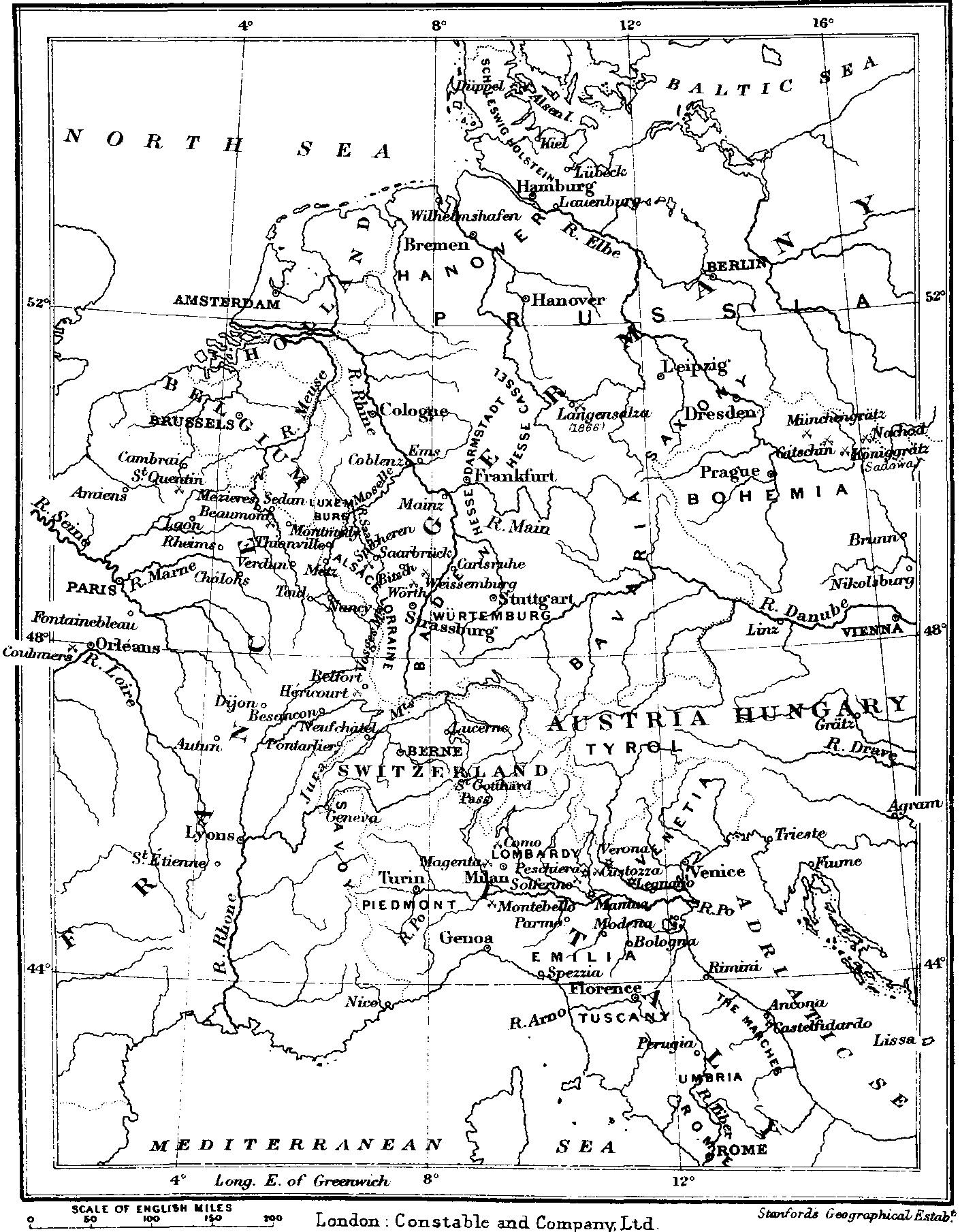
Campaigns 1859-71.
Campaigns 1859-71.
| First Edition | October 1905. |
| Second " | November 1905. |
| Third " | December 1911. |
| Fourth " | November 1914. |
| Fifth " | October 1915. |
In this Edition are included three new chapters (Nos. XXI.-XXIII.), in which I seek to describe the most important and best-ascertained facts of the period 1900-14. Necessarily, the narrative is tentative at many points; and it is impossible to attain impartiality; but I have sought to view events from the German as well as the British standpoint, and to sum up the evidence fairly. The addition of these chapters has necessitated the omission of the former Epilogue and Appendices. I regret the sacrifice of the Epilogue, for it emphasised two important considerations, (1) the tendency of British foreign policy towards undue complaisance, which by other Powers is often interpreted as weakness; (2) the danger arising from the keen competition in armaments. No one can review recent events without perceiving the significance of these considerations. Perhaps they may prove to be among the chief causes producing the terrible finale of July-August 1914. I desire to express my acknowledgments and thanks for valuable advice given by Mr. J.W. Headlam, M.A., Mr. A.B. Hinds, M.A., and Dr. R.W. Seton-Watson, D. Litt.
J.H.R.
CAMBRIDGE,
September 5, 1915.
The outbreak of war in Europe is an event too momentous to be treated fully in this Preface. But I may point out that the catastrophe resulted from the two causes of unrest described in this volume, namely, the Alsace-Lorraine Question and the Eastern Question. Those disputes have dragged on without any attempt at settlement by the Great Powers. The Zabern incident inflamed public opinion in Alsace-Lorraine, and illustrated the overbearing demeanour of the German military caste; while the insidious attempts of Austria in 1913 to incite Bulgaria against Servia marked out the Hapsburg Empire as the chief enemy of the Slav peoples of the Balkan Peninsula after the collapse of Turkish power in 1912. The internal troubles of the United Kingdom, France, and Russia in July 1914 furnished the opportunity so long sought by the forward party at Berlin and Vienna; and the Austro-German Alliance, which, in its origin, was defensive (as I have shown in this volume), became offensive, Italy parting from her allies when she discovered their designs. Drawn into the Triple Alliance solely by pique against France after the Tunis affair, she now inclines towards the Anglo-French connection.
Readers of my chapter on the Eastern Question will not fail to see how the neglect of the Balkan peoples by the Great Powers has left that wound festering in the weak side of Europe; and they will surmise that the Balkan troubles have, by a natural Nemesis, played their part in bringing about the [pg x] European War. It is for students of modern Europe to seek to form a healthy public opinion so that the errors of the past may not be repeated, and that the new Europe shall be constituted in conformity with the aspirations of the peoples themselves.
CAMBRIDGE,
September 25, 1914.
The line of Virgil quoted on the title-page represents in the present case a sigh of aspiration, not a paean of achievement. No historical student, surely, can ever feel the conviction that he has fathomed the depths of that well where Truth is said to lie hid. What, then, must be the feelings of one who ventures into the mazy domain of recent annals, and essays to pick his way through thickets all but untrodden? More than once I have been tempted to give up the quest and turn aside to paths where pioneers have cleared the way. There, at least, the whereabouts of that fabulous well is known and the plummet is ready to hand. Nevertheless, I resolved to struggle through with my task, in the consciousness that the work of a pioneer may be helpful, provided that he carefully notches the track and thereby enables those who come after him to know what to seek and what to avoid.
After all, there is no lack of guides in the present age. The number of memoir-writers and newspaper correspondents is legion; and I have come to believe that they are fully as trustworthy as similar witnesses have been in any age. The very keenness of their rivalry is some guarantee for truth. Doubtless competition for good "copy" occasionally leads to artful embroidering on humdrum actuality; but, after spending much time in scanning similar embroidery in the literature of the Napoleonic Era, I unhesitatingly place the work of Archibald Forbes, and that of several knights of the pen still living, far above the delusive tinsel of Marbot, Thiébault, and Ségur. [pg xii] I will go further and say that, if we could find out what were the sources used by Thucydides, we should notice qualms of misgiving shoot through the circles of scientific historians as they contemplated his majestic work. In any case, I may appeal to the example of the great Athenian in support of the thesis that to undertake to write contemporary history is no vain thing.
Above and beyond the accounts of memoir-writers and newspaper correspondents there are Blue Books. I am well aware that they do not always contain the whole truth. Sometimes the most important items are of necessity omitted. But the information which they contain is enormous; and, seeing that the rules of the public service keep the original records in Great Britain closed for well-nigh a century, only the most fastidious can object to the use of the wealth of materials given to the world in Parliamentary Papers.
Besides these published sources there is the fund of information possessed by public men and the "well-informed" of various grades. Unfortunately this is rarely accessible, or only under conventional restrictions. Here and there I have been able to make use of it without any breach of trust; and to those who have enlightened my darkness I am very grateful. The illumination, I know, is only partial; but I hope that its effect, in respect to the twilight of diplomacy, may be compared to that of the Aurora Borealis lights.
After working at my subject for some time, I found it desirable to limit it to events which had a distinctly formative influence on the development of European States. On questions of motive and policy I have generally refrained from expressing a decided verdict, seeing that these are always the most difficult to probe; and facile dogmatism on them is better fitted to omniscient leaderettes than to the pages of an historical work. At the same time, I have not hesitated to pronounce a judgment on these questions, and to differ from other writers, where the evidence has seemed to me decisive. To quote one instance, I reject the verdict of most authorities [pg xiii] on the question of Bismarck's treatment of the Ems telegram, and of its effect in the negotiations with France in July 1870.
For the most part, however, I have dealt only with external events, pointing out now and again the part which they have played in the great drama of human action still going on around us. This limitation of aim has enabled me to take only specific topics, and to treat them far more fully than is done in the brief chronicle of facts presented by MM. Lavisse and Rambaud in the concluding volume of their Histoire Générale. Where a series of events began in the year 1899 or 1900, and did not conclude before the time with which this narrative closes, I have left it on one side. Obviously the Boer War falls under this head. Owing to lack of space my references to the domestic concerns of the United Kingdom have been brief. I have regretfully omitted one imperial event of great importance, the formation of the Australian Commonwealth. After all, that concerned only the British race; and in my survey of the affairs of the Empire I have treated only those which directly affected other nations as well, namely the Afghan and Egyptian questions and the Partition of Africa. Here I have sought to show the connection with "world politics," and I trust that even specialists will find something new and suggestive in this method of treatment.
In attempting to write a history of contemporary affairs, I regard it as essential to refer to the original authority, or authorities, in the case of every important statement. I have sought to carry out this rule (though at the cost of great additional toil) because it enables the reader to check the accuracy of the narrative and to gain hints for further reading. To compile bibliographies, where many new books are coming out every year, is a useless task; but exact references to the sources of information never lose their value.
My thanks are due to many who have helped me in this undertaking. Among them I may name Sir Charles Dilke, M.P., Mr. James Bryce, M.P., and Mr. Chedo Mijatovich, who have given me valuable advice on special topics. My [pg xiv] obligations are also due to a subject of the Czar, who has placed his knowledge at my service, but for obvious reasons does not wish his name to be known. Mr. Bernard Pares, M.A., of the University of Liverpool, has very kindly read over the proofs of the early chapters, and has offered most helpful suggestions. Messrs. G. Bell and Sons have granted me permission to make use of the plans of the chief battles of the Franco-German War from Mr. Hooper's work, Sedan and the Downfall of the Second Empire, published by them. To Mr. H.W. Wilson, author of Ironclads in Action, my thanks are also due for permission to make use of the plan illustrating the fighting at Alexandria in 1882.
J.H.R.
July, 1905.
"The movements in the masses of European peoples are divided and slow, and their progress interrupted and impeded, because they are such great and unequally formed masses; but the preparation for the future is widely diffused, and . . . the promises of the age are so great that even the most faint-hearted rouse themselves to the belief that a time has arrived in which it is a privilege to live."--GERVINUS, 1853.
The Roman poet Lucretius in an oft-quoted passage describes the satisfaction that naturally fills the mind when from some safe vantage-ground one looks forth on travellers tossed about on the stormy deep. We may perhaps use the poet's not very altruistic words as symbolising many of the feelings with which, at the dawn of the twentieth century, we look back over the stormy waters of the century that has passed away. Some congratulation on this score is justifiable, especially as those wars and revolutions have served to build up States that are far stronger than their predecessors, in proportion as they correspond more nearly with the desires of the nations that compose them.
As we gaze at the revolutions and wars that form the storm-centres of the past century, we can now see some of the causes that brought about those storms. If we survey them with discerning eye, we soon begin to see that, in the main, the cyclonic disturbances had their origins in two great natural impulses of the civilised races of mankind. The first of these forces is that great impulse towards individual liberty, which we name Democracy; the second is that impulse, [pg 002] scarcely less mighty and elemental, that prompts men to effect a close union with their kith and kin: this we may term Nationality.
Now, it is true that these two forces have not led up to the last and crowning phase of human development, as their enthusiastic champions at one time asserted that they would; far from that, they are accountable, especially so the force of Nationality, for numerous defects in the life of the several peoples; and the national principle is at this very time producing great and needless friction in the dealings of nations. Yet, granting all this, it still remains true that Democracy and Nationality have been the two chief formative influences in the political development of Europe during the Nineteenth Century.
In no age of the world's history have these two impulses worked with so triumphant an activity. They have not always been endowed with living force. Among many peoples they lay dormant for ages and were only called to life by some great event, such as the intolerable oppression of a despot or of a governing caste that crushed the liberties of the individual, or the domination of an alien people over one that obstinately refused to be assimilated. Sometimes the spark that kindled vital consciousness was the flash of a poet's genius, or the heroism of some sturdy son of the soil. The causes of awakening have been infinitely various, and have never wholly died away; but it is the special glory of the Nineteenth Century that races which had hitherto lain helpless and well-nigh dead, rose to manhood as if by magic, and shed their blood like water in the effort to secure a free and unfettered existence both for the individual and the nation. It is a true saying of the German historian, Gervinus, "The history of this age will no longer be only a relation of the lives of great men and of princes, but a biography of nations."
At first sight, this illuminating statement seems to leave out of count the career of the mighty Napoleon. But it does not. The great Emperor unconsciously called into vigorous [pg 003] life the forces of Democracy and Nationality both in Germany and in Italy, where there had been naught but servility and disunion. His career, if viewed from our present standpoint, falls into two portions: first, that in which he figured as the champion of Revolutionary France and the liberator of Italy from foreign and domestic tyrants; and secondly, as imperial autocrat who conquered and held down a great part of Europe in his attempt to ruin British commerce. In the former of these enterprises he had the new forces of the age acting with him and endowing him with seemingly resistless might; in the latter part of his life he mistook his place in the economy of Nature, and by his violation of the principles of individual liberty and racial kinship in Spain and Central Europe, assured his own downfall.
The greatest battle of the century was the tremendous strife that for three days surged to and fro around Leipzig in the month of October 1813, when Russians, Prussians, Austrians, Swedes, together with a few Britons, Hanoverians, and finally his own Saxon allies, combined to shake the imperial yoke from the neck of the Germanic peoples. This Völkerschlacht (Battle of the Peoples), as the Germans term it, decided that the future of Europe was not to be moulded by the imperial autocrat, but by the will of the princes and nations whom his obstinacy had embattled against him. Far from recognising the verdict, the great man struggled on until the pertinacity of the allies finally drove him from power and assigned to France practically the same boundaries that she had had in 1791, before the time of her mighty expansion. That is to say, the nation which in its purely democratic form had easily overrun and subdued the neighbouring States in the time of their old, inert, semi-feudal existence, was overthrown by them when their national consciousness had been trampled into being by the legions of the great Emperor.
In 1814, and again after Waterloo, France was driven in on herself, and resumed something like her old position in Europe, save that the throne of the Bourbons never acquired [pg 004] any solidity--the older branch of that family being unseated by the Revolution of 1830. In the centre of the Continent, the old dynasties had made common cause with the peoples in the national struggles of 1813-14, and therefore enjoyed more consideration--a fact which enabled them for a time to repress popular aspirations for constitutional rule and national unity.
Nevertheless, by the Treaties of Vienna (1814-15) the centre of Europe was more solidly organised than ever before. In place of the effete institution known as the Holy Roman Empire, which Napoleon swept away in 1806, the Central States were reorganised in the German Confederation--a cumbrous and ineffective league in which Austria held the presidency. Austria also gained Venetia and Lombardy in Italy. The acquisition of the fertile Rhine Province by Prussia brought that vigorous State up to the bounds of Lorraine and made her the natural protectress of Germany against France. Russia acquired complete control over nearly the whole of the former Kingdom of Poland. Thus, the Powers that had been foremost in the struggle against Napoleon now gained most largely in the redistribution of lands in 1814-15, while the States that had been friendly to him now suffered for their devotion. Italy was split up into a mosaic of States; Saxony ceded nearly the half of her lands to Prussia; Denmark yielded up her ancient possession, Norway, to the Swedish Crown.
In some respects the triumph of the national principle, which had brought victory to the old dynasties, strengthened the European fabric. The Treaties of Vienna brought the boundaries of States more nearly into accord with racial interests and sentiments than had been the case before; but in several instances those interests and feelings were chafed or violated by designing or short-sighted statesmen. The Germans, who had longed for an effective national union, saw with indignation that the constitution of the new Germanic Confederation left them under the control of the rulers of the component States and of the very real headship exercised by Austria, which was always used to repress popular movements. [pg 005] The Italians, who had also learned from Napoleon the secret that they were in all essentials a nation, deeply resented the domination of Austria in Lombardy-Venetia and the parcelling out of the rest of the Peninsula between reactionary kings somnolent dukes, and obscurantist clerics. The Belgians likewise protested against the enforced union with Holland in what was now called the Kingdom of the United Netherlands (1815-30). In the east of Europe the Poles struggled in vain against the fate which once more partitioned them between Russia, Austria, and Prussia. The Germans of Holstein, Schleswig, and Lauenburg submitted uneasily to the Danish rule; and only under the stress of demonstrations by the allies did the Norwegians accept the union with Sweden.
It should be carefully noted that these were the very cases which caused most of the political troubles in the following period. In fact, most of the political occurrences on the Continent in the years 1815 to 1870--the revolts, revolutions, and wars, that give a special character to the history of the century--resulted directly from the bad or imperfect arrangements of the Congress of Vienna and of the so-called Holy Alliance of the monarchs who sought to perpetuate them. The effect of this widespread discontent was not felt at once. The peoples were too exhausted by the terrific strain of the Napoleonic wars to do much for a generation or more, save in times of popular excitement. Except in the south-east of Europe, where Greece, with the aid of Russia, Britain, and France, wrested her political independence from the grasp of the Sultan (1827), the forty years that succeeded Waterloo were broken by no important war; but they were marked by oft-recurring unrest and sedition. Thus, when the French Revolution of 1830 overthrew the reactionary dynasty of the elder Bourbons, the universal excitement caused by this event endowed the Belgians with strength sufficient to shake off the heavy yoke of the Dutch; while in Italy, Germany, and Poland the democrats and nationalists (now working generally [pg 006] in accord) made valiant but unsuccessful efforts to achieve their ideals.
The same was the case in 1848. The excitement, which this time originated in Italy, spread to France, overthrew the throne of Louis Philippe (of the younger branch of the French Bourbons), and bade fair to roll half of the crowns of Europe into the gutter. But these spasmodic efforts of the democrats speedily failed. Inexperience, disunion, and jealousy paralysed their actions and yielded the victory to the old Governments. Frenchmen, in dismay at the seeming approach of communism and anarchy, fell back upon the odd expedient of a Napoleonic Republic, which in 1852 was easily changed by Louis Napoleon into an Empire modelled on that of his far greater uncle. The democrats of Germany achieved some startling successes over their repressive Governments in the spring of the year 1848, only to find that they could not devise a working constitution for the Fatherland; and the deputies who met at the federal capital, Frankfurt, to unify Germany "by speechifying and majorities," saw power slip back little by little into the hands of the monarchs and princes. In the Austrian Empire nationalist claims and strivings led to a very Babel of discordant talk and action, amidst which the young Hapsburg ruler, Francis Joseph, thanks to Russian military aid, was able to triumph over the valour of the Hungarians and the devotion of their champion, Kossuth.
In Italy the same sad tale was told. In the spring of that year of revolutions, 1848, the rulers in quick succession granted constitutions to their subjects. The reforming Pope, Pius IX., and the patriotic King of Sardinia, Charles Albert, also made common cause with their peoples in the effort to drive out the Austrians from Lombardy-Venetia; but the Pope and all the potentates except Charles Albert speedily deserted the popular cause; friction between the King and the republican leaders, Mazzini and Garibaldi, further weakened the nationalists, and the Austrians had little difficulty in crushing Charles Albert's forces, whereupon he abdicated in [pg 007] favour of his son, Victor Emmanuel II. (1849). The Republics set up at Rome and Venice struggled valiantly for a time against great odds--Mazzini, Garibaldi, and their volunteers being finally overborne at the Eternal City by the French troops whom Louis Napoleon sent to restore the Pope (June 1849); while, two months later, Venice surrendered to the Austrians whom she had long held at bay. The Queen of the Adriatic under the inspiring dictatorship of Manin had given a remarkable example of orderly constitutional government in time of siege.
It seemed to be the lot of the nationalists and democrats to produce leaders who could thrill the imagination of men by lofty teachings and sublime heroism; who could, in a word, achieve everything but success. A poetess, who looked forth from Casa Guidi windows upon the tragi-comedy of Florentine failure in those years, wrote that what was needed was a firmer union, a more practical and intelligent activity, on the part both of the people and of the future leader:
A land's brotherhood
Is most puissant: men, upon the whole,
Are what they can be,--nations, what they would.
Will therefore to be strong, thou Italy!
Will to be noble! Austrian Metternich
Can fix no yoke unless the neck agree.
Whatever hand shall grasp this oriflamme,
Whatever man (last peasant or first Pope
Seeking to free his country) shall appear,
Teach, lead, strike fire into the masses, fill
These empty bladders with fine air, insphere
These wills into a unity of will,
And make of Italy a nation--dear
And blessed be that man!
When Elizabeth Barrett Browning penned those lines she cannot have surmised that two men were working their way up the rungs of the political ladder in Piedmont and Prussia, [pg 008] whose keen intellects and masterful wills were to weld their Fatherlands into indissoluble union within the space of one momentous decade. These men were Cavour and Bismarck.
It would far exceed the limits of space of this brief Introduction to tell, except in the briefest outline, the story of the plodding preparation and far-seeing diplomacy by which these statesmen raised their respective countries from depths of humiliation to undreamt of heights of triumph. The first thing was to restore the prestige of their States. No people can be strong in action that has lost belief in its own powers and has allowed its neighbours openly to flout it. The history of the world has shown again and again that politicians who allow their country to be regarded as une quantité négligeable bequeath to some abler successor a heritage of struggle and war--struggle for the nation to recover its self-respect, and war to regain consideration and fair treatment from others. However much frothy talkers in their clubs may decry the claims of national prestige, no great statesman has ever underrated their importance. Certainly the first aim both of Cavour and Bismarck was to restore self-respect and confidence to their States after the humiliations and the dreary isolation of those dark years, 1848-51. We will glance, first, at the resurrection (Risorgimento) of the little Kingdom of Sardinia, which was destined to unify Italy.
Charles Albert's abdication immediately after his defeat by the Austrians left no alternative to his son and successor, Victor Emmanuel II., but that of signing a disastrous peace with Austria. In a short time the stout-hearted young King called to his councils Count Cavour, the second son of a noble Piedmontese family, but of firmly Liberal principles, who resolved to make the little kingdom the centre of enlightenment and hope for despairing Italy. He strengthened the constitution (the only one out of many granted in 1848 that survived the time of reaction); he reformed the tariff in the direction of Free Trade; and during the course of the Crimean War he persuaded his sovereign to make an active alliance with [pg 009] France and England, so as to bind them by all the claims of honour to help Sardinia in the future against Austria. The occasion was most opportune; for Austria was then suspected and disliked both by Russia and the Western Powers owing to her policy of armed neutrality. Nevertheless the reward of Cavour's diplomacy came slowly and incompletely. By skilfully vague promises (never reduced to writing) Cavour induced Napoleon III. to take up arms against Austria; but, after the great victory of Solferino (June 24, 1859), the French Emperor enraged the Italians by breaking off the struggle before the allies recovered the great province of Venetia, which he had pledged himself to do. Worse still, he required the cession of Savoy and Nice to France, if the Central Duchies and the northern part of the Papal States joined the Kingdom of Sardinia, as they now did. Thus, the net result of Napoleon's intervention in Italy was his acquisition of Savoy and Nice (at the price of Italian hatred), and the gain of Lombardy and the central districts for the national cause (1859-60).
The agony of mind caused by this comparative failure undermined Cavour's health; but in the last months of his life he helped to impel and guide the revolutionary elements in Italy to an enterprise that ended in a startling and momentous triumph. This was nothing less than the overthrow of Bourbon rule in Sicily and Southern Italy by Garibaldi. Thanks to Cavour's connivance, this dashing republican organised an expedition of about 1000 volunteers near Genoa, set sail for Sicily, and by a few blows shivered the chains of tyranny in that island. It is noteworthy that British war-ships lent him covert but most important help at Palermo and again in his crossing to the mainland; this timely aid and the presence of a band of Britons in his ranks laid the foundation of that friendship which has ever since united the two nations. In Calabria the hero met with the feeblest resistance from the Bourbon troops and the wildest of welcomes from the populace. At Salerno he took tickets for Naples and entered the enemy's capital by railway train (September 7). Then he [pg 010] purposed, after routing the Bourbon force north of the city, to go on and attack the French at Rome and proclaim a united Italy.
Cavour took care that he should do no such thing. The Piedmontese statesman knew when to march onwards and when to halt. As his compatriot, Manzoni, said of him, "Cavour has all the prudence and all the imprudence of the true statesman." He had dared and won in 1855-59, and again in secretly encouraging Garibaldi's venture. Now it was time to stop in order to consolidate the gains to the national cause.
The leader of the red-shirts, having done what no king could do, was thenceforth to be controlled by the monarchy of the north. Victor Emmanuel came in as the deus ex machina; his troops pressed southwards, occupying the eastern part of the Papal States in their march, and joined hands with the Garibaldians to the north of Naples, thus preventing the collision with France which the irregulars would have brought about. Even as it was, Cavour had hard work to persuade Napoleon that this was the only way of curbing Garibaldi and preventing the erection of a South Italian Republic; but finally the French Emperor looked on uneasily while the Pope's eastern territories were violated, and while the cause of Italian Unity was assured at the expense of the Pontiff whom France was officially supporting in Rome. A plébiscite, or mass vote, of the people of Sicily, South Italy, and the eastern and central parts of the Papal States, was resorted to by Cavour in order to throw a cloak of legality over these irregular proceedings. The device pleased Napoleon, and it resulted in an overwhelming vote in favour of annexation to Victor Emmanuel's kingdom. Thus, in March 1861, the soldier-king was able amidst universal acclaim to take the title of King of Italy. Florence was declared to be the capital of the realm (1864), which embraced all parts of Italy except the Province of Venetia, pertaining to Austria, and the "Patrimonium Petri"--that is, Rome and its vicinity,--still held by the Pope and garrisoned by the French. The former of these was to be regained for la patria in 1866, [pg 011] the latter in 1870, in consequence of the mighty triumphs then achieved by the principle of nationality in Prussia and Germany. To these triumphs we must now briefly advert.
No one who looked at the state of European politics in 1861, could have imagined that in less than ten years Prussia would have waged three wars and humbled the might of Austria and France. At that time she showed no signs of exceptional vigour: she had as yet produced no leaders so inspiring as Mazzini and Garibaldi, no statesman so able as Cavour. Her new king, William, far from arousing the feelings of growing enthusiasm that centred in Victor Emmanuel, was more and more distrusted and disliked by Liberals for the policy of militarism on which he had just embarked. In fact, the Hohenzollern dynasty was passing into a "Conflict Time" with its Parliament which threatened to impair the influence of Prussia abroad and to retard her recovery from the period of humiliations through which she had recently passed.
A brief recital of those humiliations is desirable as showing, firstly, the suddenness with which the affairs of a nation may go to ruin in slack and unskilful hands, and, secondly, the immense results that can be achieved in a few years by a small band of able men who throw their whole heart into the work of national regeneration.
The previous ruler, Frederick William IV., was a gifted and learned man, but he lacked soundness of judgment and strength of will--qualities which are of more worth in governing than graces of the intellect. At the time of the revolutionary outbreaks of 1848 he capitulated to the Berlin mob and declared for a constitutional régime in which Prussia should merge herself in Germany; but when the excesses of the democrats had weakened their authority, he put them down by military force, refused the German Crown offered him by the popularly elected German Parliament assembled at Frankfurt-on-Main (April 1849); and thereupon attempted to form a smaller union of States, namely, Prussia, Saxony, and Hanover. This Three Kings' League, as it was called, soon [pg 012] came to an end; for it did not satisfy the nationalists who wished to see Germany united, the constitutionalists who aimed at the supremacy of Parliament, or the friends of the old order of things. The vacillations of Frederick William and the unpractical theorisings of the German Parliament at Frankfurt having aroused general disgust, Austria found little difficulty in restoring the power of the old Germanic Confederation in September, 1850. Strong in her alliance with Russia, she next compelled Frederick William to sign the Convention of Olmütz (Nov. 1850). By this humiliating compact he agreed to forbear helping the German nationalists in Schleswig-Holstein to shake off the oppressive rule of the Danes; to withdraw Prussian troops from Hesse-Cassel and Baden, where strifes had broken out; and to acknowledge the supremacy of the old Federal Diet under the headship of Austria. Thus, it seemed that the Prussian monarchy was a source of weakness and disunion for North Germany, and that Austria, backed up by the might of Russia, must long continue to lord it over the cumbrous Germanic Confederation.
But a young country squire, named Bismarck, even then resolved that the Prussian monarchy should be the means of strengthening and binding together the Fatherland. The resolve bespoke the patriotism of a sturdy, hopeful nature; and the young Bismarck was nothing if not patriotic, sturdy, and hopeful. The son of an ancient family in the Mark of Brandenburg, he brought to his life-work powers inherited from a line of fighting ancestors; and his mind was no less robust than his body. Quick at mastering a mass of details, he soon saw into the heart of a problem, and his solution of it was marked both by unfailing skill and by sound common sense as to the choice of men and means. In some respects he resembles Napoleon the Great. Granted that he was his inferior in the width of vision and the versatility of gifts that mark a world-genius, yet he was his equal in diplomatic resourcefulness and in the power of dealing lightning strokes; while his possession of the priceless gift of moderation endowed [pg 013] his greatest political achievements with a soundness and solidity never possessed by those of the mighty conqueror who "sought to give the mot d'ordre to the universe." If the figure of the Prussian does not loom so large on the canvas of universal history as that of the Corsican--if he did not tame a Revolution, remodel society, and reorganise a Continent--be it remembered that he made a United Germany, while Napoleon the Great left France smaller and weaker than he found her.
Bismarck's first efforts, like those of Cavour for Sardinia, were directed to the task of restoring the prestige of his State. Early in his official career, the Prussian patriot urged the expediency of befriending Russia during the Crimean War, and he thus helped on that rapprochement between Berlin and St. Petersburg which brought the mighty triumphs of 1866 and 1870 within the range of possibility. In 1857 Frederick William became insane; and his brother William took the reins of Government as Regent, and early in 1861 as King. The new ruler was less gifted than his unfortunate brother; but his homely common sense and tenacious will strengthened Prussian policy where it had been weakest. He soon saw the worth of Bismarck, employed him in high diplomatic positions, and when the royal proposals for strengthening the army were decisively rejected by the Prussian House of Representatives, he speedily sent for Bismarck to act as Minister-President (Prime Minister) and "tame" the refractory Parliament. The constitutional crisis was becoming more and more acute when a great national question came into prominence owing to the action of the Danes in Schleswig-Holstein affairs.
Without entering into the very tangled web of customs, treaties, and dynastic claims that made up the Schleswig-Holstein question, we may here state that those Duchies were by ancient law very closely connected together, that the King of Denmark was only Duke of Schleswig-Holstein, and that the latter duchy, wholly German in population, formed part of the Germanic Confederation. Latterly the fervent nationalists in Denmark, while leaving Holstein to its German connections, [pg 014] had resolved thoroughly to "Danify" Schleswig, the northern half of which was wholly Danish, and they pressed on this policy by harsh and intolerant measures, making it difficult or well-nigh impossible for the Germans to have public worship in their own tongue and to secure German teachers for their children in the schools. Matters were already in a very strained state, when shortly before the death of King Frederick VII. of Denmark (November, 1863) the Rigsraad at Copenhagen sanctioned a constitution for Schleswig, which would practically have made it a part of the Danish monarchy. The King gave his assent to it, an act which his successor, Christian IX., ratified.
Now, this action violated the last treaty--that signed by the Powers at London in 1852, which settled the affairs of the Duchies; and Bismarck therefore had strong ground for appealing to the Powers concerned, as also to the German Confederation, against this breach of treaty obligations. The Powers, especially England and France, sought to set things straight, but the efforts of our Foreign Minister, Lord John Russell, had no effect. The German Confederation also refused to take any steps about Schleswig as being outside its jurisdiction. Bismarck next persuaded Austria to help Prussia in defeating Danish designs on that duchy. The Danes, on the other hand, counted on the unofficial expressions of sympathy which came from the people of Great Britain and France at sight of a small State menaced by two powerful monarchies. In fact, the whole situation was complicated by this explosion of feeling, which seemed to the Danes to portend the armed intervention of the Western States, especially England, on their behalf. As far as is known, no official assurance to that effect ever went forth from London. In fact, it is certain that Queen Victoria absolutely forbade any such step; but the mischief done by sentimental orators, heedless newspaper-editors, and factious busybodies, could not be undone. As Lord John Russell afterwards stated in a short "Essay on the Policy of England": "It pleased some English [pg 015] advisers of great influence to meddle in this affair; they were successful in thwarting the British Government, and in the end, with the professed view, and perhaps the real intention, of helping Denmark, their friendship tended to deprive her of Holstein and Schleswig altogether." This final judgment of a veteran statesman is worth quoting as showing his sense of the mischief done by well-meant but misguided sympathy, which pushed the Danes on to ruin and embittered our relations with Prussia for many years.
Not that the conduct of the German Powers was flawless. On January 16, 1864, they sent to Copenhagen a demand for the withdrawal of the constitution for Schleswig within two days. The Danish Foreign Minister pointed out that, as the Rigsraad was not in session, this could not possibly be done within two days. In this last step, then, the German Powers were undoubtedly the aggressors[1]. The Prussian troops were ready near the River Eider, and at once invaded Schleswig. The Danes were soon beaten on the mainland; then a pause occurred, during which a Conference of the Powers concerned was held at London. It has been proved by the German historian, von Sybel, that the first serious suggestion to Prussia that she should take both the Duchies came secretly from Napoleon III. It was in vain that Lord John Russell suggested a sensible compromise, namely, the partition of Schleswig between Denmark and Germany according to the language-frontier inside the Duchy. To this the belligerents demurred on points of detail, the Prussian representative asserting that he would not leave a single German under Danish rule. The war was therefore resumed, and ended in a complete defeat for the weaker State, which finally surrendered both Duchies to Austria and Prussia (1864)[2].
[pg 016]The question of the sharing of the Duchies now formed one of the causes of the far greater war between the victors; but, in truth, it was only part of the much larger question, which had agitated Germany for centuries, whether the balance of power should belong to the North or the South. Bismarck also saw that the time was nearly ripe for settling this matter once for all in favour of Prussia; but he had hard work even to persuade his own sovereign; while the Prussian Parliament, as well as public opinion throughout Germany, was violently hostile to his schemes and favoured the claims of the young Duke of Augustenburg to the Duchies--claims that had much show of right. Matters were patched up for a time between the two German States, by the Convention of Gastein (August 1865), while in reality each prepared for war and sought to gain allies.
Here again Bismarck was successful. After vainly seeking to buy Venetia from the Austrian Court, Italy agreed to side with Prussia against that Power in order to wrest by force a province which she could not hope to gain peaceably. Russia, too, was friendly to the Court of Berlin, owing to the help which the latter had given her in crushing the formidable revolt of the Poles in 1863. It remained to keep France quiet. In this Bismarck thought he had succeeded by means of interviews which he held with Napoleon III. at Biarritz (Nov. 1865). What there occurred is not clearly known. That Bismarck played on the Emperor's foible for oppressed nationalities, in the case of Italy, is fairly certain; that he fed him with hopes of gaining Belgium, or a slice of German land, is highly probable, and none the less so because he later on indignantly denied in the Reichstag that he ever "held out the prospect to [pg 017] anybody of ceding a single German village, or even as much as a clover-field." In any case Napoleon seems to have promised to observe neutrality--not because he loved Prussia, but because he expected the German Powers to wear one another out and thus leave him master of the situation. In common with most of the wiseacres of those days he believed that Prussia and Italy would ultimately fall before the combined weight of Austria and of the German States, which closely followed her in the Confederation; whereupon he could step in and dictate his own terms[3].
Bismarck and the leaders of the Prussian army had few doubts as to the result. They were determined to force on the war, and early in June 1866 brought forward proposals at the Frankfurt Diet for the "reform" of the German Confederation, the chief of them being the exclusion of Austria, the establishment of a German Parliament elected by manhood suffrage, and the formation of a North German army commanded by the King of Prussia.
A great majority of the Federal Diet rejected these proposals, and war speedily broke out, Austria being supported by nearly all the German States except the two Mecklenburgs.
The weight of numbers was against Prussia, even though she had the help of the Italians operating against Venetia. On that side Austria was completely successful, as also in a sea-fight near Lissa in the Adriatic; but in the north the Hapsburgs and their German allies soon found out that organisation, armament, and genius count for more than numbers. The great organiser, von Roon, had brought Prussia's citizen army to a degree of efficiency that surprised every one; and the [pg 018] quick-firing "needle-gun" dealt havoc and terror among the enemy. Using to the full the advantage of her central position against the German States, Prussia speedily worsted their isolated and badly-handled forces, while her chief armies overthrew those of Austria and Saxony in Bohemia. The Austrian plan of campaign had been to invade Prussia by two armies--a comparatively small force advancing from Cracow as a base into Silesia, while another, acting from Olmütz, advanced through Bohemia to join the Saxons and march on Berlin, some 50,000 Bavarians joining them in Bohemia for the same enterprise. This design speedily broke down owing to the short-sighted timidity of the Bavarian Government, which refused to let its forces leave their own territory; the lack of railway facilities in the Austrian Empire also hampered the moving of two large armies to the northern frontier. Above all, the swift and decisive movements of the Prussians speedily drove the allies to act on the defensive--itself a grave misfortune in war.
Meanwhile the Prussian strategist, von Moltke, was carrying out a far more incisive plan of operations--that of sending three Prussian armies into the middle of Bohemia, and there forming a great mass which would sweep away all obstacles from the road to Vienna. This design received prompt and skilful execution. Saxony was quickly overrun, and the irruption of three great armies into Bohemia compelled the Austrians and their Saxon allies hurriedly to alter their plans. After suffering several reverses in the north of Bohemia, their chief array under Benedek barred the way of the two northern Prussian armies on the heights north of the town of Königgrätz. On the morning of July 3 the defenders long beat off all frontal attacks with heavy loss; but about 2 P.M. the Army of Silesia, under the Crown Prince Frederick of Prussia, after a forced march of twelve miles, threw itself on their right flank, where Benedek expected no very serious onset. After desperate fighting the Army of Silesia carried the village of Chlum in the heart of the Austrian position, and compelled Austrians and Saxons to a hurried retreat over the Elbe. In this the Austrian [pg 019] infantry was saved from destruction by the heroic stand made by the artillery. Even so, the allies lost more than 13,000 killed and wounded, 22,000 prisoners, and 187 guns[4].
Königgrätz (or Sadowa, as it is often called) decided the whole campaign. The invaders now advanced rapidly towards Vienna, and at the town of Nikolsburg concluded the Preliminaries of Peace with Austria (July 26), whereupon a mandate came from Paris, bidding them stop. In fact, the Emperor of the French offered his intervention in a manner most threatening to the victors. He sought to detach Italy from the Prussian alliance by the offer of Venetia as a left-handed present from himself--an offer which the Italian Government subsequently refused.
To understand how Napoleon III. came to change front and belie his earlier promises, one must look behind the scenes. Enough is already known to show that the Emperor's hand was forced by his Ministers and by the Parisian Press, probably also by the Empress Eugénie. Though desirous, apparently, of befriending Prussia, he had already yielded to their persistent pleas urging him to stay the growth of the Protestant Power of North Germany. On June 10, at the outbreak of the war, he secretly concluded a treaty with Austria, holding out to her the prospect of recovering the great province of Silesia (torn from her by Frederick the Great in 1740) in return for a magnanimous cession of Venetia to Italy. The news of Königgrätz led to a violent outburst of anti-Prussian feeling; but Napoleon refused to take action at once, when it might have been very effective.
The best plan for the French Government would have been to send to the Rhine all the seasoned troops left available by Napoleon III.'s ill-starred Mexican enterprise, so as to help the hard-pressed South German forces, offering also the armed mediation of France to the combatants. In that case Prussia must have drawn back, and Napoleon III. could have dictated [pg 020] his own terms to Central Europe. But his earlier leanings towards Prussia and Italy, the advice of Prince Napoleon ("Plon-Plon") and Lavalette, and the wheedlings of the Prussian ambassador as to compensations which France might gain as a set-off to Prussia's aggrandisement, told on the French Emperor's nature, always somewhat sluggish and then prostrated by severe internal pain; with the result that he sent his proposals for a settlement of the points in dispute, but took no steps towards enforcing them. A fortnight thus slipped away, during which the Prussians reaped the full fruits of their triumph at Königgrätz; and it was not until July 29, three days after the Preliminaries of Peace were signed, that the French Foreign Minister, Drouyn de Lhuys, worried his master, then prostrate with pain at Vichy, into sanctioning the following demands from victorious Prussia: the cession to France of the Rhenish Palatinate (belonging to Bavaria), the south-western part of Hesse Darmstadt, and that part of Prussia's Rhine-Province lying in the valley of the Saar which she had acquired after Waterloo. This would have brought within the French frontier the great fortress of Mainz (Mayence); but the great mass of these gains, it will be observed, would have been at the expense of South German States, whose cause France proclaimed her earnest desire to uphold against the encroaching power of Prussia.
Bismarck took care to have an official copy of these demands in writing, the use of which will shortly appear; and having procured this precious document, he defied the French envoy, telling him that King William, rather than agree to such a surrender of German land, would make peace with Austria and the German States on any terms, and invade France at the head of the forces of a united Germany. This reply caused another change of front at Napoleon's Court. The demands were disavowed and the Foreign Minister, Drouyn de Lhuys, resigned[5].
[pg 021]The completeness of Prussia's triumph over Austria and her German allies, together with the preparations of the Hungarians for revolt, decided the Court of Vienna to accept the Prussian terms which were embodied in the Treaty of Prague (Aug. 23); they were, the direct cession of Venetia to Italy; the exclusion of Austria from German affairs and her acceptance of the changes there pending; the cession to Prussia of Schleswig-Holstein; and the payment of 20,000,000 thalers (about £3,000,000) as war indemnity. The lenience of these conditions was to have a very noteworthy result, namely, the speedy reconciliation of the two Powers: within twenty years they were firmly united in the Triple Alliance with Italy (see Chapter X.).
Some difficulties stood in the way of peace between Prussia and her late enemies in the German Confederation, especially Bavaria. These last were removed when Bismarck privately disclosed to the Bavarian Foreign Minister the secret demand made by France for the cession of the Bavarian Palatinate. In the month of August, the South German States, Bavaria, Würtemberg and Baden, accepted Prussia's terms; whereby they paid small war indemnities and recognised the new constitution of Germany. Outwardly they formed a South German Confederation; but this had a very shadowy existence; and the three States by secret treaties with Prussia agreed to place their armies and all military arrangements, in case of war, under the control of the King of Prussia. Thus within a month from the close of "the Seven Weeks' War," the whole of Germany was quietly but firmly bound to common action in military matters; and the actions of France left little doubt as to the need of these timely precautions.
On those German States which stood in the way of Prussia's territorial development and had shown marked hostility, Bismarck bore hard. The Kingdom of Hanover, Electoral Hesse (Hesse-Cassel), the Duchy of Nassau, and the Free City of Frankfurt were annexed outright, Prussia thereby gaining direct contact with her Westphalian and Rhenish [pg 022] Provinces. The absorption of Frankfurt-on-the-Main, and the formation of a new league, the North German Confederation, swept away all the old federal machinery, and marked out Berlin, not Vienna or Frankfurt, as the future governing centre of the Fatherland. It was doubtless a perception of the vast gains to the national cause which prompted the Prussian Parliament to pass a Bill of Indemnity exonerating the King's Ministers for the illegal acts committed by them during the "Conflict Time" (1861-66)--acts which saved Prussia in spite of her Parliament.
Constitutional freedom likewise benefited largely by the results of the war. The new North German Confederation was based avowedly on manhood suffrage, not because either King William or Bismarck loved democracy, but because after lately pledging themselves to it as the groundwork of reform of the old Confederation, they could not draw back in the hour of triumph. As Bismarck afterwards confessed to his Secretary, Dr. Busch, "I accepted universal suffrage, but with reluctance, as a Frankfurt tradition" (i.e. of the democratic Parliament of Frankfurt in 1848)[6]. All the lands, therefore, between the Niemen and the Main were bound together in a Confederation based on constitutional principles, though the governing powers of the King and his Ministers continued to be far larger than is the case in Great Britain. To this matter we shall recur when we treat of the German Empire, formed by the union of the North and South German Confederations of 1866.
Austria also was soon compelled to give way before the persistent demands of the Hungarian patriots for their ancient constitution, which happily blended monarchy and democracy. Accordingly, the centralised Hapsburg monarchy was remodelled by the Ausgleich (compromise) of 1867, and became the Dual-Monarchy of Austria-Hungary, the two parts of the realm being ruled quite separately for most purposes of government, and united only for those of army organisation, foreign [pg 023] policy, and finance. Parliamentary control became dominant in each part of the Empire; and the grievances resulting from autocratic or bureaucratic rule vanished from Hungary. They disappeared also from Hanover and Hesse-Cassel, where the Guelf sovereigns and Electors had generally repressed popular movements.
Greatest of all the results of the war of 1866, however, was the gain to the national cause in Germany and Italy. Peoples that had long been divided were now in the brief space of three months brought within sight of the long-wished-for unity. The rush of these events blinded men to their enduring import and produced an impression that the Prussian triumph was like that of Napoleon I., too sudden and brilliant to last. Those who hazarded this verdict forgot that his political arrangements for Europe violated every instinct of national solidarity; while those of 1866 served to group the hitherto divided peoples of North Germany and Italy around the monarchies that had proved to be the only possible rallying points in their respective countries. It was this harmonising of the claims and aspirations of monarchy, nationality, and democracy that gave to the settlement of 1866 its abiding importance, and fitted the two peoples for the crowning triumph of 1870.
FOOTNOTES:
[1] Lord Wodehouse (afterwards Earl of Kimberley) was at that time sent on a special mission to Copenhagen. When his official correspondence is published, it will probably throw light on many points.
[2] Sybel,
Die Begründung des deutschen Reiches, vol. iii. pp.
299-344; Débidour, Hist. diplomatique de l'Europe,
vol. ii. pp. 261-273; Lowe, Life of Bismarck, vol. i. chap.
vi.; Headlam, Bismarck, chap. viii.; Lord Malmesbury,
Memoirs of an ex-Minister pp. 584-593 (small edition);
Spencer Walpole, Life of Lord J. Russell, vol. ii. pp.
396-411.
In several respects the cause of ruin to Denmark in 1863-64 bears a
remarkable resemblance to that which produced war in South Africa
in 1899, viz. high-handed action of a minority towards men whom
they treated as Outlanders, the stiff-necked obstinacy of the
smaller State, and reliance on the vehement but (probably)
unofficial offers of help or intervention by other nations.
[3] Busch,
Our Chancellor, vol. ii. p. 17 (Eng. edit.);
Débidour, Histoire diplomatique de l'Europe
(1814-1878), vol ii. pp. 291-293. Lord Loftus in his
Diplomatic Reminiscences (vol. ii. p. 280) says: "So
satisfied was Bismarck that he could count on the neutrality of
France, that no defensive military measures were taken on the Rhine
and western frontier. He had no fears of Russia on the eastern
frontier, and was therefore able to concentrate the military might
of Prussia against Austria and her South German Allies."
Light has been thrown on the bargainings between Italy and Prussia
by the Memoirs of General Govone, who found Bismarck a hard
bargainer.
[4] Sybel, Die Begründung des deutschen Reiches, vol. v. pp. 174-205; Journals of Field Marshal Count von Blumenthal for 1866 and 1871 (Eng. edit.), pp. 37-44.
[5] Sybel, op. cit. vol. v. pp. 365-374. Débidour, op. cit. vol. ii. pp. 315-318. See too volume viii. of Ollivier's work, L'Empire libéral, published in 1904; and M. de la Gorce's work, Histoire du second Empire, vol. vi. (Paris 1903).
[6] Busch, Our Chancellor, vol. ii. p. 196 (English edit.).
"After the fatal year 1866, the Empire was in a state of decadence."--L. GREGOIRE, Histoire de France.
The irony of history is nowhere more manifest than in the curious destiny which called a Napoleon III. to the place once occupied by Napoleon I., and at the very time when the national movements, unwittingly called to vigorous life by the great warrior, were attaining to the full strength of manhood. Napoleon III. was in many ways a well-meaning dreamer, who, unluckily for himself, allowed his dreams to encroach on his waking moments. In truth, his sluggish but very persistent mind never saw quite clearly where dreams must give way to realities; or, as M. de Falloux phrased it, "He does not know the difference between dreaming and thinking[7]." Thus his policy showed an odd mixture of generous haziness and belated practicality.
Long study of his uncle's policy showed him, rightly enough, that it erred in trampling down the feeling of nationality in Germany and elsewhere. The nephew resolved to avoid this mistake and to pose as the champion of the oppressed and divided peoples of Italy, Germany, Poland, and the Balkan Peninsula--a programme that promised to appeal to the ideal aspirations of the French, to embarrass the dynasties that had overthrown the first Napoleon, and to yield substantial gains [pg 026] for his nephew. Certainly it did so in the case of Italy; his championship of the Roumanians also helped on the making of that interesting Principality (1861) and gained the goodwill of Russia; but he speedily forfeited this by his wholly ineffective efforts on behalf of the Poles in 1863. His great mistakes, however, were committed in and after the year 1863, when he plunged into Mexican politics with the chimerical aim of founding a Roman Catholic Empire in Central America, and favoured the rise of Prussia in connection with the Schleswig-Holstein question. By the former of these he locked up no small part of his army in Mexico when he greatly needed it on the Rhine; by the latter he helped on the rise of the vigorous North German Power.
As we have seen, he secretly advised Prussia to take both Schleswig and Holstein, thereby announcing his wish for the effective union of Germans with the one great State composed almost solely of Germans. "I shall always be consistent in my conduct," he said. "If I have fought for the independence of Italy, if I have lifted up my voice for Polish nationality, I cannot have other sentiments in Germany, or obey other principles." This declaration bespoke the doctrinaire rather than the statesman. Untaught by the clamour which French Chauvinists and ardent Catholics had raised against his armed support of the Italian national cause in 1859, he now proposed to further the aggrandisement of the Protestant North German Power which had sought to partition France in 1815.
The clamour aroused by his leanings towards Prussia in 1864-66 was naturally far more violent, in proportion as the interests of France were more closely at stake. Prussia held the Rhine Province; and French patriots, who clung to the doctrine of the "natural frontiers"--the Ocean, Pyrenees, Alps, and Rhine--looked on her as the natural enemy. They pointed out that millions of Frenchmen had shed their blood in the Revolutionary and Napoleonic wars to win and to keep the Rhine boundary; and their most eloquent spokesman, M. Thiers, who had devoted his historical gifts to glorifying those [pg 027] great days, passionately declaimed against the policy of helping on the growth of the hereditary foe.
We have already seen the results of this strife between the pro-Prussian foibles of the Emperor and the eager prejudices of Frenchmen, whose love of oppressed and divided nations grew in proportion to their distance from France, and changed to suspicion or hatred in the case of her neighbours. In 1866, under the breath of ministerial arguments and oratorical onslaughts Napoleon III.'s policy weakly wavered, thereby giving to Bismarck's statecraft a decisive triumph all along the line. In vain did he in the latter part of that year remind the Prussian statesman of his earlier promises (always discreetly vague) of compensation for France, and throw out diplomatic feelers for Belgium, or at any rate Luxemburg[8]. In vain did M. Thiers declare in the Chamber of Deputies that France, while recognising accomplished facts in Germany, ought "firmly to declare that we will not allow them to go further" (March 14, 1867). Bismarck replied to this challenge of the French orator by publishing five days later the hitherto secret military alliances concluded with the South German States in August 1866. Thenceforth France knew that a war with Prussia would be war with a united Germany.
In the following year the Zollverein, or German Customs' Union (which had been gradually growing since 1833), took a definitely national form in a Customs' Parliament which assembled in April 1868, thus unifying Germany for purposes of trade as well as those of war. This sharp rebuff came at a time when Napoleon's throne was tottering from the utter collapse of his Mexican expedition; when, too, he more than ever needed popular support in France for the beginnings of a more constitutional rule. Early in 1867 he sought to buy Luxemburg from Holland. This action aroused a storm of [pg 028] wrath in Prussia, which had the right to garrison Luxemburg; but the question was patched up by a Conference of the Powers at London, the Duchy being declared neutral territory under the guarantee of Europe; the fortifications of its capital were also to be demolished, and the Prussian garrison withdrawn. This success for French diplomacy was repeated in Italy, where the French troops supporting the Pope crushed the efforts of Garibaldi and his irregulars to capture Rome, at the sanguinary fight of Mentana (November 3, 1867). The official despatch, stating that the new French rifle, the chassepôt, "had done wonders," spread jubilation through France and a sharp anti-Gallic sentiment throughout Italy.
And while Italy heaved with longings for her natural capital, popular feelings in France and North Germany made steadily for war.
Before entering upon the final stages of the dispute, it may be well to take a bird's-eye view of the condition of the chief Powers in so far as it explains their attitude towards the great struggle.
The condition of French politics was strangely complex. The Emperor had always professed that he was the elect of France, and would ultimately crown his political edifice with the corner-stone of constitutional liberty. Had he done so in the successful years 1855-61, possibly his dynasty might have taken root. He deferred action, however, until the darker years that came after 1866. In 1868 greater freedom was allowed to the Press and in the case of public meetings. The General Election of the spring of 1869 showed large gains to the Opposition, and decided the Emperor to grant to the Corps Législatif the right of initiating laws concurrently with himself, and he declared that Ministers should be responsible to it (September 1869).
These and a few other changes marked the transition from autocracy to the "Liberal Empire." One of the champions of constitutional principles, M. Emile Ollivier, formed a Cabinet to give effect to the new policy, and the Emperor, deeming the [pg 029] time ripe for consolidating his power on a democratic basis, consulted the country in a plébiscite, or mass vote, primarily as to their judgment on the recent changes, but implicitly as to their confidence in the imperial system as a whole. His skill in joining together two topics that were really distinct, gained him a tactical victory. More than 7,350,000 affirmative votes were given, as against 1,572,000 negatives; while 1,900,000 voters registered no vote. This success at the polls emboldened the supporters of the Empire; and very many of them, especially, it is thought, the Empress Eugénie, believed that only one thing remained in order to place the Napoleonic dynasty on a lasting basis--that was, a successful war.
Champions of autocracy pointed out that the growth of Radicalism coincided with the period of military failures and diplomatic slights. Let Napoleon III., they said in effect, imitate the policy of his uncle, who, as long as he dazzled France by triumphs, could afford to laugh at the efforts of constitution-mongers. The big towns might prate of liberty; but what France wanted was glory and strong government. Such were their pleas: there was much in the past history of France to support them. The responsible advisers of the Emperor determined to take a stronger tone in foreign affairs, while the out-and-out Bonapartists jealously looked for any signs of official weakness so that they might undermine the Ollivier Ministry and hark back to absolutism. When two great parties in a State make national prestige a catchword of the political game, peace cannot be secure: that was the position of France in the early part of 1870[9].
The eve of the Franco-German War was a time of great importance for the United Kingdom. The Reform Bill of 1867 gave a great accession of power to the Liberal Party; and the General Election of November 1868 speedily led to the resignation of the Disraeli Cabinet and the accession of the Gladstone Ministry to power. This portended change in other directions than home affairs. The tradition of a spirited [pg 030] foreign policy died with Lord Palmerston in 1865. With the entry of John Bright to the new Cabinet peace at all costs became the dominant note of British statesmanship. There was much to be said in favour of this. England needed a time of rest in order to cope with the discontent of Ireland and the problems brought about by the growth of democracy and commercialism in the larger island. The disestablishment and partial disendowment of the Protestant Church in Ireland (July 1869), the Irish Land Act (August 1870), and the Education Act of 1870, showed the preoccupation of the Ministry for home affairs; while the readiness with which, a little later, they complied with all the wishes of the United States in the "Alabama" case, equally proclaimed their pacific intentions. England, which in 1860 had exercised so powerful an influence on the Italian national question, was for five years a factor of small account in European affairs. Far from pleasing the combatants, our neutrality annoyed both of them. The French accused England of "deserting" Napoleon III. in his time of need--a charge that has lately been revived by M. Hanotaux. To this it is only needful to reply that the French Emperor entered into alliance with us at the time of the Crimean War merely for his own objects, and allowed all friendly feeling to be ended by French threats of an invasion of England in 1858 and his shabby treatment of Italy in the matter of Savoy and Nice a year later. On his side, Bismarck also complained that our feeling for the German cause went no further than "theoretical sympathy," and that "during the war England never compromised herself so far in our favour as to endanger her friendship with France. On the contrary." These vague and enigmatic charges at bottom only express the annoyance of the combatants at their failure to draw neutrals into the strife[10].
[pg 031]The traditions of the United States, of course, forbade their intervention in the Franco-Prussian dispute. By an article of their political creed termed the Monroe Doctrine, they asserted their resolve not to interfere in European affairs and to prevent the interference of any strictly European State in those of the New World. It was on this rather vague doctrine that they cried "hands off" from Mexico to the French Emperor; and the abandonment of his protégé, the so-called Emperor Maximilian, by French troops, brought about the death of that unhappy prince and a sensible decline in the prestige of his patron (June 1867).
Russia likewise remembered Napoleon III.'s championship of the Poles in 1863, which, however Platonic in its nature, caused the Czar some embarrassment. Moreover, King William of Prussia had soothed the Czar's feelings, ruffled by the dethroning of three German dynasties in 1866, by a skilful reply which alluded to his (King William's) desire to be of service to Russian interests elsewhere--a hint which the diplomatists of St. Petersburg remembered in 1870 to some effect.
For the rest, the Czar Alexander II. (1855-81) and his Ministers were still absorbed in the internal policy of reform, which in the sixties freed the serfs and gave Russia new judicial and local institutions, doomed to be swept away in the reaction following the murder of that enlightened ruler. The Russian Government therefore pledged itself to neutrality, but in a sense favourable to Prussia. The Czar ascribed the Crimean War to the ambition of Napoleon III., and remembered the friendship of Prussia at that time, as also in the Polish Revolt of 1863[11]. Bismarck's policy now brought its reward.
The neutrality of Russia is always a matter of the utmost moment for the Central Powers in any war on their western frontiers. Their efforts against Revolutionary France in 1792-94 failed chiefly because of the ambiguous attitude of the Czarina Catherine II.; and the collapse of Frederick William IV.'s [pg 032] policy in 1848-51 was due to the hostility of his eastern neighbour. In fact, the removal of anxiety about her open frontier on the east was now worth a quarter of a million of men to Prussia.
But the Czar's neutrality was in one matter distinctly friendly to his uncle, King William of Prussia. It is an open secret that unmistakable hints went from St. Petersburg to Vienna to the effect that, if Austria drew the sword for Napoleon III. she would have to reckon with an irruption of the Russians into her open Galician frontier. Probably this accounts for the conduct of the Hapsburg Power, which otherwise is inexplicable. A war of revenge against Prussia seemed to be the natural step to take. True, the Emperor Francis Joseph had small cause to like Napoleon III. The loss of Lombardy in 1859 still rankled in the breast of every patriotic Austrian; and the suspicions which that enigmatical ruler managed to arouse, prevented any definite agreement resulting from the meeting of the two sovereigns at Salzburg in 1867.
The relations of France and Austria were still in the same uncertain state before the War of 1870. The foreign policy of Austria was in the hands of Count Beust, a bitter foe of Prussia; but after the concession of constitutional rule to Hungary by the compromise (Ausgleich) of 1867, the Dual Monarchy urgently needed rest, especially as its army was undergoing many changes. The Chancellor's action was therefore clogged on all sides. Nevertheless, when the Luxemburg affair of 1867 brought France and Prussia near to war, Napoleon began to make advances to the Court of Vienna. How far they went is not known. Beust has asserted in his correspondence with the French Foreign Minister, the Duc de Gramont (formerly ambassador at Vienna), that they never were more than discussions, and that they ended in 1869 without any written agreement. The sole understanding was to the effect that the policy of both States should be friendly and pacific, Austria reserving the right to remain neutral if France were compelled to make war. [pg 033] The two Empires further promised not to make any engagement with a third Power without informing the other.
This statement is not very convincing. States do not usually bind themselves in the way just described, unless they have some advantageous agreement with the Power which has the first claim on their alliance. It is noteworthy, however, that the Duc de Gramont, in the correspondence alluded to above, admits that, as Ambassador and as Foreign Minister of France, he never had to claim the support of Austria in the war with Prussia[12].
How are we to reconcile these statements with the undoubted fact that the Emperor Napoleon certainly expected help from Austria and also from Italy? The solution of the riddle seems to be that Napoleon, as also Francis Joseph and Victor Emmanuel, kept their Foreign Ministers in the dark on many questions of high policy, which they transacted either by private letters among themselves, or through military men who had their confidence. The French and Italian sovereigns certainly employed these methods, the latter because he was far more French in sympathy than his Ministers.
As far back as the year 1868, Victor Emmanuel made overtures to Napoleon with a view to alliance, the chief aim of which, from his standpoint, was to secure the evacuation of Rome by the French troops, and the gain of the Eternal City for the national cause. Prince Napoleon lent his support to this scheme, and from an article written by him we know that the two sovereigns discussed the matter almost entirely by means of confidential letters[13]. These discussions went on up to the month of June 1869. Francis Joseph, on hearing of them, urged the French Emperor to satisfy Italy, and thus pave the way for an alliance between the three Powers against Prussia. Nothing definite came of the affair, and chiefly, it would seem, owing to the influence of the Empress Eugénie and the French clerics. She is said to have remarked: "Better [pg 034] the Prussians in Paris than the Italian troops in Rome." The diplomatic situation therefore remained vague, though in the second week of July 1870, the Emperor again took up the threads which, with greater firmness and foresight, he might have woven into a firm design.
The understanding between the three Powers advanced only in regard to military preparations. The Austrian Archduke Albrecht, the victor of Custoza, burned to avenge the defeat of Königgrätz, and with this aim in view visited Paris in February to March 1870. He then proposed to Napoleon an invasion of North Germany by the armies of France, Austria, and Italy. The French Emperor developed the plan by more specific overtures which he made in the month of June; but his Ministers were so far in the dark as to these military proposals that they were then suggesting the reduction of the French army by 10,000 men, while Ollivier, the Prime Minister, on June 30 declared to the French Chamber that peace had never been better assured[14].
And yet on that same day General Lebrun, aide-de-camp to the Emperor, was drawing up at Paris a confidential report of the mission with which he had lately been entrusted to the Austrian military authorities. From that report we take the following particulars. On arriving at Vienna, he had three private interviews with the Archduke Albrecht, and set before him the desirability of a joint invasion of North Germany in the autumn of that year. To this the Archduke demurred, on the ground that such a campaign ought to begin in the spring if the full fruits of victory were to be gathered in before the short days came. Austria and Italy, he said, could not place adequate forces in the field in less than six weeks owing to lack of railways[15].
[pg 035]Developing his own views, the Archduke then suggested that it would be desirable for France to undertake the war against North Germany not later than the middle of March 1871, Austria and Italy at the same time beginning their mobilisations, though not declaring war until their armies were ready at the end of six weeks. Two French armies should in the meantime cross the Rhine in order to sever the South Germans from the Confederation of the North, one of them marching towards Nuremberg, where it would be joined by the western army of Austria and the Italian forces sent through Tyrol. The other Austrian army would then invade Saxony or Lusatia in order to strike at Berlin. He estimated the forces of the States hostile to Prussia as follows:--
Men. Horses. Cannon. France 309,000 35,000 972 Austria (exclusive of reserve) 360,000 27,000 1128 Italy 68,000 5000 180 Denmark 260,000 (?) 2000 72
He thus reckoned the forces of the two German Confederations:--
Men. Horses. Cannon. North 377,000 48,000 1284 South 97,000 10,000 288
but the support of the latter might be hoped for. Lebrun again urged the desirability of a campaign in the autumn, but the Archduke repeated that it must begin in the spring. In [pg 036] that condition, as in his earlier statement that France must declare war first, while her allies prepared for war, we may discern a deep-rooted distrust of Napoleon III.
On June 14 the Archduke introduced Lebrun to the Emperor Francis Joseph, who informed him that he wanted peace; but, he added, "if I make war, I must be forced to it." In case of war Prussia might exploit the national German sentiment existing in South Germany and Austria. He concluded with these words, "But if the Emperor Napoleon, compelled to accept or to declare war, came with his armies into South Germany, not as an enemy but as a liberator, I should be forced on my side to declare that I [would] make common cause with him. In the eyes of my people I could do no other than join my armies to those of France. That is what I pray you to say for me to the Emperor Napoleon; I hope that he will see, as I do, my situation both in home and foreign affairs." Such was the report which Lebrun drew up for Napoleon III. on June 30. It certainly led that sovereign to believe in the probability of Austrian help in the spring of 1871, but not before that time.
The question now arises whether Bismarck was aware of these proposals. If warlike counsels prevailed at Vienna, it is probable that some preparations would be made, and the secret may have leaked out in this way, or possibly through the Hungarian administration. In any case, Bismarck knew that the Austrian chancellor, Count Beust, thirsted for revenge for the events of 1866[16]. If he heard any whispers of an approaching league against Prussia, he would naturally see the advantage of pressing on war at once, before Austria and Italy were ready to enter the lists. Probably in this fact will be found one explanation of the origin of the Franco-German War.
Before adverting to the proximate cause of the rupture, we may note that Beust's despatch of July 11, 1870, to Prince Metternich, Austrian ambassador at Paris, displayed genuine [pg 037] fear lest France should rush blindly into war with Prussia; and he charged Metternich tactfully to warn the French Government against such a course of action, which would "be contrary to all that we have agreed upon. . . . Even if we wished, we could not suddenly equip a respectably large force. . . . Our services are gained to a certain extent [by France]; but we shall not go further unless events carry us on; and we do not dream of plunging into war because it might suit France to do so."
Again, however, the military men seem to have pushed on the diplomatists. The Archduke Albrecht and Count Vitzthum went to Paris charged with some promises of support to France in case of war. Thereafter, Count Beust gave the assurance at Vienna that the Austrians would be "faithful to our engagements, as they have been recorded in the letters exchanged last year between the two sovereigns. We consider the cause of France as ours, and we will contribute to the success of her arms to the utmost of our power[17]."
In the midst of this maze of cross-purposes this much is clear: that both Emperors had gone to work behind the backs of their Ministers, and that the military chiefs of France and Austria brought their States to the brink of war while their Ministers and diplomatists were unaware of the nearness of danger.
As we have seen, King Victor Emmanuel II. longed to draw the sword for Napoleon III., whose help to Italy in 1859-60 he so curiously overrated. Fortunately for Italy, his Ministers took a more practical view of the situation; but probably they too would have made common cause with France had they received a definite promise of the withdrawal of French troops from Rome and the satisfaction of Italian desires for the Eternal City as the national capital. This promise, even after the outbreak of war, the French Emperor declined to [pg 038] give, though his cousin, Prince Napoleon, urged him vehemently to give way on that point[18].
In truth, the Emperor could not well give way. An Oecumenical Council sat at Rome from December 1869 to July 1870; its Ultramontane tendencies were throughout strongly marked, as against the "Old Catholic" views; and it was a foregone conclusion that the Council would vote the dogma of the infallibility of the Pope in matters of religion--as it did on the day before France declared war against Prussia. How, then, could the Emperor, the "eldest son of the Church," as French monarchs have proudly styled themselves, bargain away Rome to the Italian Government, already stained by sacrilege, when this crowning aureole of grace was about to encircle the visible Head of the Church? There was no escape from the dilemma. Either Napoleon must go into war with shouts of "Judas" hurled at him by all pious Roman Catholics; or he must try his fortunes without the much-coveted help of Austria and Italy. He chose the latter alternative, largely, it would seem, owing to the influence of his vehemently Catholic Empress[19]. After the first defeats he sought to open negotiations, but then it was too late. Prince Napoleon went to Florence and arrived there on August 20; but his utmost efforts failed to move the Italian Cabinet from neutrality.
Even this brief survey of international relations shows that Napoleon III. was a source of weakness to France. Having seized on power by perfidious means, he throughout his whole reign strove to dazzle the French by a series of adventures, which indeed pleased the Parisians for the time, but at the cost of lasting distrust among the Powers. Generous in his aims, [pg 039] he at first befriended the German and Italian national movements, but forfeited all the fruits of those actions by his pettifogging conduct about Savoy and Nice, the Rhineland and Belgium; while his final efforts to please French clericals and Chauvinists[20] by supporting the Pope at Rome, lost him the support of States that might have retrieved the earlier blunders. In brief, by helping on the nationalists of North Germany and Italy he offended French public opinion; and his belated and spasmodic efforts to regain popularity at home aroused against him the distrust of all the Powers. Their feelings about him may be summarised in the mot of a diplomatist, "Scratch the Emperor and you will find the political refugee."
How different were the careers of Napoleon III. and of Bismarck! By resolutely keeping before him the national aim, and that only, the Prussian statesman had reduced the tangle of German affairs to simplicity and now made ready for the crowning work of all. In his Reminiscences he avows his belief, as early as 1866, "that a war with France would succeed the war with Austria lay in the logic of history"; and again, "I did not doubt that a Franco-German War must take place before the construction of a United Germany could take place[21]." War would doubtless have broken out in 1867 over the Luxemburg question, had he not seen the need of delay for strengthening the bonds of union with South Germany and assuring the increase of the armies of the Fatherland by the adoption of Prussian methods; or, as he phrased it, "each year's postponement of the war would add 100,000 trained soldiers to our army[22]." In 1870 little was to be gained by delay. In fact, the unionist movement in Germany then showed ominous signs of slackening. In the South the Parliaments opposed any further approach to union with the North; and the voting of the military budget in the North for that year was likely to lead to strong opposition [pg 040] in the interests of the overtaxed people. A war might solve the unionist problem which was insoluble in time of peace; and a casus belli was at hand.
Early in July 1870, the news leaked out that Prince Leopold of Hohenzollern was the officially accepted candidate for the throne of Spain, left vacant since the revolution which drove Queen Isabella into exile in 1868[23]. At once a thrill of rage shot through France; and the Duc de Gramont, Foreign Minister of the new Ollivier Ministry, gave expression to the prevailing feeling in his answer to a question on the subject in the Chamber of Deputies (July 6):--
We do not think that respect for the rights of a neighbouring people [Spain] obliges us to allow an alien Power [Prussia], by placing one of its princes on the throne of Charles V., to succeed in upsetting to our disadvantage the present equilibrium of forces in Europe, and imperil the interests and honour of France. We have the firm hope that this eventuality will not be realised. To hinder it, we count both on the wisdom of the German people and on the friendship of the Spanish people. If that should not be so, strong in your support and in that of the nation, we shall know how to fulfil our duty without hesitation and without weakness[24].
The opening phrases were inaccurate. The prince in question was Prince Leopold of the Swabian and Roman Catholic branch of the Hohenzollern family, who, as the Duc de Gramont knew, could by no possibility recall the days when Charles V. reigned as Emperor in Germany and monarch in Spain. This misstatement showed the intention of the French Ministry to throw down the glove to Prussia--as is also clear from this statement in Gramont's despatch of July 10 to Benedetti: "If the King will not advise the Prince of Hohenzollern to withdraw, well, it is war forthwith, and in a few days we are at the Rhine[25]."
[pg 041]Nevertheless, those who were behind the scenes had just cause for anger against Bismarck. The revelations of Benedetti, French ambassador at Berlin, as well as the Memoirs of the King of Roumania (brother to Prince Leopold of Hohenzollern) leave no doubt that the candidature of the latter was privately and unofficially mooted in 1868, and again in the spring of 1869 through a Prussian diplomatist, Werthern, and that it met with no encouragement whatever from the Prussian monarch or the prince himself. But early in 1870 it was renewed in an official manner by the provisional Government of Spain, and (as seems certain) at the instigation of Bismarck, who, in May-June, succeeded in overcoming the reluctance of the prince and of King William. Bismarck even sought to hurry the matter through the Spanish Cortes so as to commit Spain to the plan; but this failed owing to the misinterpretation of a ciphered telegram from Berlin at Madrid[26].
Such was the state of the case when the affair became known to the Ollivier Ministry. Though not aware, seemingly, of all these details, Napoleon's advisers were justified in treating the matter, not as a private affair between the Hohenzollerns and Spain (as Germans then maintained it was) but as an attempt of the Prussian Government to place on the Spanish throne a prince who could not but be friendly to the North German Power. In fact, the French saw in it a challenge to war; and putting together all the facts as now known, we must pronounce that they were almost certainly right. Bismarck undoubtedly wanted war; and it is impossible to think that he did not intend to use this candidature as a means of exasperating the French. The man who afterwards declared that, at the beginning of the Danish disputes in 1863, he made up his mind to have Schleswig-Holstein for Prussia[27], [pg 042] certainly saw in the Hohenzollern candidature a step towards a Prusso-Spanish alliance or a war with France that might cement German unity.
In any case, that was the outcome of events. The French papers at once declaimed against the candidature in a way that aroused no less passion on the other side of the Rhine. For a brief space, however, matters seemed to be smoothed over by the calm good sense of the Prussian monarch and his nephew. The King was then at Ems, taking the waters, when Benedetti, the French ambassador, waited on him and pressed him most urgently to request Prince Leopold to withdraw from the candidature to the Spanish Crown. This the King declined to do in the way that was pointed out to him, rightly considering that such a course would play into the hands of the French by lowering his own dignity and the prestige of Prussia. Moreover, he, rather illogically, held the whole matter to be primarily one that affected the Hohenzollern family and Spain. The young prince, however, on hearing of the drift of events, solved the problem by declaring his intention not to accept the Crown of Spain (July 12). The action was spontaneous, emanating from Prince Leopold and his father Prince Antony, not from the Prussian monarch, though, on hearing of their decision, he informed Benedetti that he entirely approved it.
If the French Government had really wished for peace, it would have let the matter end there. But it did not do so. The extreme Bonapartists--plus royalistes que le roi--all along wished to gain prestige for their sovereign by inflicting an open humiliation on King William and through him on Prussia. They were angry that he had evaded the snare, and now brought pressure to bear on the Ministry, especially the Duc de Gramont, so that at 7 P.M. of that same day (July 12) he sent a telegram to Benedetti at Ems directing him to see King William and press him to declare that he "would not again authorise this candidature." The Minister added: "The effervescence of spirits [at Paris] is such that we do not know whether we shall succeed in mastering it." This was true. [pg 043] Paris was almost beside herself. As M. Sorel says: "The warm July evening drove into the streets a populace greedy of shows and excitements, whose imagination was spoiled by the custom of political quackery, for whom war was but a drama and history a romance[28]." Such was the impulse which led to Gramont's new demand, and it was made in spite of the remonstrances of the British ambassador, Lord Lyons.
Viewing that demand in the clearer light of the present time, we must say that it was not unreasonable in itself; but it was presented in so insistent a way that King William declined to entertain it. Again Gramont pressed Benedetti to urge the matter; but the utmost that the King would do was to state: "He gives his approbation entirely and without reserve to the withdrawal of the Prince of Hohenzollern: he cannot do more." He refused to see the ambassador further on this subject; but on setting out to return to Berlin--a step necessitated by the growing excitement throughout Germany--he took leave of Benedetti with perfect cordiality (July 14). The ambassador thereupon returned to Paris.
Meanwhile, however, Bismarck had given the last flick to the restive courses of the Press on both sides of the Rhine. In his Reminiscences he has described his depression of spirits on hearing the news of the withdrawal of Prince Leopold's candidature and of his nearly formed resolve to resign as a protest against so tame a retreat before French demands. But while Moltke, Roon, and he were dining together, a telegram reached him from the King at Ems, dated July 13, 3.50 P.M., which gave him leave to inform the ambassadors and the Press of the present state of affairs. Bismarck saw his chance. The telegram could be cut down so as to give a more resolute look to the whole affair. And, [pg 044] after gaining Moltke's assurance that everything was ready for war, he proceeded to condense it. The facts here can only be understood by a comparison of the two versions. We therefore give the original as sent to Bismarck by Abeken, Secretary to the Foreign Office, who was then at Ems:--
His Majesty writes to me: "Count Benedetti spoke to me on
the promenade, in order to demand from me, finally in a very
importunate manner, that I should authorise him to telegraph at
once that I bound myself for all future time never again to give my
consent if the Hohenzollerns should renew their candidature. I
refused at last somewhat sternly, as it is neither right nor possible
to undertake engagements of this kind à tout jamais. Naturally I
told him that I had as yet received no news, and as he was earlier
informed about Paris and Madrid than myself, he could see clearly
that my Government once more had no hand in the matter." His
Majesty has since received a letter from the Prince. His Majesty
having told Count Benedetti that he was awaiting news from the
Prince, has decided, with reference to the above demand, upon the
representation of Count Eulenburg and myself, not to receive
Count Benedetti again, but only to let him be informed through an
aide-de-camp: "That his Majesty had now received from the
Prince confirmation of the news which Benedetti had already
received from Paris, and had nothing further to say to the
ambassador." His Majesty leaves it to your Excellency whether
Benedetti's fresh demand and its rejection should not be at once
communicated both to our ambassadors and to the Press.
Bismarck cut this down to the following:--
After the news of the renunciation of the hereditary Prince of
Hohenzollern had been officially communicated to the Imperial
Government of France by the Royal Government of Spain, the
French ambassador at Ems further demanded of his Majesty, the
King, that he would authorise him to telegraph to Paris that his
Majesty, the King, bound himself for all future time never again
to give his consent if the Hohenzollerns should renew their
candidature. His Majesty, the King, thereupon decided not to
receive the French ambassador again, and sent to tell him through
[pg 045] the aide-de-camp on duty that his Majesty had nothing further to
communicate to the ambassador.
Efforts have been made to represent Bismarck's "editing" of the Ems telegram as the decisive step leading to war; and in his closing years, when seized with the morbid desire of a partly discredited statesman to exaggerate his influence on events, he himself sought to perpetuate this version. He claims that the telegram, as it came from Ems, described the incident there "as a fragment of a negotiation still pending, and to be continued at Berlin." This claim is quite untenable. A careful perusal of the original despatch from Ems shows that the negotiation, far from being "still pending," was clearly described as having been closed on that matter. That Benedetti so regarded it is proved by his returning at once to Paris. If it could have been "continued at Berlin," he most certainly would have proceeded thither. Finally, the words in the original as to the King refusing Benedetti "somewhat sternly" were omitted, and very properly omitted, by Bismarck in his abbreviated version. Had he included those words, he might have claimed to be the final cause of the War of 1870. As it is, his claim must be set aside as the offspring of senile vanity. His version of the original Ems despatch did not contain a single offensive word, neither did it alter any statement. Abeken also admitted that his original telegram was far too long, and that Bismarck was quite justified in abbreviating it as he did[29].
If we pay attention, not to the present more complete knowledge of the whole affair, but to the imperfect information then open to the German public, war was the natural result of [pg 046] the second and very urgent demand that came from Paris. The Duc de Gramont in dispatching it must have known that he was playing a desperate game. Either Prussia would give way and France would score a diplomatic triumph over a hated rival; or Prussia would fight. The friends of peace in France thought matters hopeless when that demand was sent in so insistent a manner. As soon as Gladstone heard of the second demand of the Ollivier Ministry, he wrote to Lord Granville, then Foreign Minister: "It is our duty to represent the immense responsibility which will rest upon France, if she does not at once accept as satisfactory and conclusive the withdrawal of the candidature of Prince Leopold[30]."
On the other hand, we must note that the conduct of the German Press at this crisis was certainly provocative of war. The morning on which Bismarck's telegram appeared in the official North German Gazette, saw a host of violent articles against France, and gleeful accounts of imaginary insults inflicted by the King on Benedetti. All this was to be expected after the taunts of cowardice freely levelled by the Parisian papers against Prussia for the last two days; but whether Bismarck directly inspired the many sensational versions of the Ems affair that appeared in North German papers on July 14 is not yet proven.
However that may be, the French Government looked on the refusal of its last demand, the publication of Bismarck's telegram, and the insults of the German Press as a casus belli. The details of the sitting of the Emperor's Council at 10 P.M. on July 14, at which it was decided to call out the French reserves, are not yet known. Ollivier was not present. There had been a few hours of wavering on this question; but the tone of the Parisian evening papers--it was the French national day--the loud cries of the rabble for war, and their smashing the windows of the Prussian embassy, seem to have convinced the Emperor and his advisers that to draw back now would involve the fall of the dynasty. Report has uniformly pointed [pg 047] to the Empress as pressing these ideas on her consort, and the account which the Duc de Gramont later on gave to Lord Malmesbury of her words at that momentous Council-meeting support popular rumour. It is as follows:--
Before the final resolve to declare war the Emperor, Empress, and Ministers went to St. Cloud. After some discussion Gramont told me that the Empress, a high-spirited and impressionable woman, made a strong and most excited address, declaring that "war was inevitable if the honour of France was to be sustained." She was immediately followed by Marshal Leboeuf, who, in the most violent tone, threw down his portfolio and swore that if war was not declared he would give it up and renounce his military rank. The Emperor gave way, and Gramont went straight to the Chamber to announce the fatal news[31].
On the morrow (July 15) the Chamber of Deputies appointed a Commission, which hastily examined the diplomatic documents and reported in a sense favourable to the Ollivier Ministry, The subsequent debate made strongly for a rupture; and it is important to note that Ollivier and Gramont based the demand for warlike preparations on the fact that King William had refused to see the French ambassador, and held that that alone was a sufficient insult. In vain did Thiers protest against the war as inopportune, and demand to see all the necessary documents. The Chamber passed the war supplies by 246 votes to 10; and Thiers had his windows broken. Late on that night Gramont set aside a last attempt of Lord Granville to offer the mediation of England in the [pg 048] cause of peace, on the ground that this would be to the harm of France--"unless means were found to stop the rapid mobilisation of the Prussian armies which were approaching our frontier[32]." In this connection it is needful to state that the order for mobilising the North German troops was not given by the King of Prussia until late on July 15, when the war votes of the French Chambers were known at Berlin.
Benedetti, in his review of the whole question, passes the following very noteworthy and sensible verdict: "It was public opinion which forced the [French] Government to draw the sword, and by an irresistible onset dictated its resolutions[33]." This is certainly true for the public opinion of Paris, though not of France as a whole. The rural districts which form the real strength of France nearly always cling to peace. It is significant that the Prefects of French Departments reported that only 16 declared in favour of war, while 37 were in doubt on the matter, and 34 accepted war with regret. This is what might be expected from a people which in the Provinces is marked by prudence and thrift.
In truth, the people of modern Europe have settled down to a life of peaceful industry, in which war is the most hateful of evils. On the other hand, the massing of mankind in great cities, where thought is superficial and feelings can quickly be stirred by a sensation-mongering Press, has undoubtedly helped to feed political passions and national hatred. A rural population is not deeply stirred by stories of slights to ambassadors. The peasant of Brittany had no active dislike for the peasant of Brandenburg. Each only asked to be left to till his fields in peace and safety. But the crowds on the Parisian boulevards and in Unter den Linden took (and seemingly always will take) a very different view of life. To them the news of the humiliation of the rival beyond the Rhine was the greatest and therefore the most welcome of sensations; and, unfortunately, the papers which pandered to their habits set the tone of [pg 049] thought for no small part of France and Germany and exerted on national policy an influence out of all proportion to its real weight.
The story of the Franco-German dispute is one of national jealousy carefully fanned for four years by newspaper editors and popular speakers until a spark sufficed to set Western Europe in a blaze. The spark was the Hohenzollern candidature, which would have fallen harmless had not the tinder been prepared since Königgratz by journalists at Paris and Berlin. The resulting conflagration may justly be described as due partly to national friction and partly to the supposed interests of the Napoleonic dynasty, but also to the heat engendered by a sensational Press.
It is well that one of the chief dangers to the peace of the modern world should be clearly recognised. The centralisation of governments and of population may have its advantages; but over against them we must set grave drawbacks; among those of a political kind the worst are the growth of nervousness and excitability, and the craving for sensation--qualities which undoubtedly tend to embitter national jealousies at all times, and in the last case to drive weak dynasties or Cabinets on to war. Certainly Bismarck's clever shifts to bring about a rupture in 1870 would have failed had not the atmosphere both at Paris and Berlin been charged with electricity[34].
FOOTNOTES:
[7] Notes from a Diary, 1851-1872, by Sir M.E. Grant Duff, vol. i. p. 120.
[8] In 1867 Bismarck's promises went so far as the framing of a secret compact with France, one article of which stated that Prussia would not object to the annexation of Belgium by France. The agreement was first published by the Times on July 25, 1870, Bismarck then divulging the secret so as to inflame public opinion against France.
[9] See Ollivier's great work, L'Empire libéral, for full details of this time.
[10]
Hanotaux, Contemporary France, vol. i. p. 9 (Eng. ed.);
Bismarck: his Reflections and Reminiscences, vol. ii. p. 61.
The popular Prussian view about England found expression in the
comic paper Kladderdatsch:--
Deutschland beziehe billige Sympathien
Und Frankreich theures Kriegsmateriel.
[11] See Sir H. Rumbold's Recollections of a Diplomatist (First Series), vol. ii. p. 292, for the Czar's hostility to France in 1870.
[12] Memoirs of Count Beust, vol. ii. pp. 358-359 (Appendix D, Eng. edit.).
[13] Revue des deux Mondes for April 1, 1878.
[14] Seignobos, A Political History of Contemporary Europe, vol. ii. pp. 806-807 (Eng. edit.). Oncken, Zeitalter des Kaisers Wilhelm (vol. i. pp. 720-740), tries to prove that there was a deep conspiracy against Prussia. I am not convinced by his evidence.
[15] Souvenirs militaires, by General B.L.J. Lebrun (Paris 1895), pp. 95-148.
[16] Bismarck: his Reflections and Reminiscences, vol. ii. p. 58.
[17] Memoirs of Count Beust, vol. ii. p. 359. The Present Position of European Politics p. 366 (1887). By the author of Greater Britain.
[18] See the Rev. des deux Mondes for April 1, 1878, and "Chronique" of the Revue d'Histoire diplomatique for 1905, p. 298; also W.H. Stillman, The Union of Italy, 1815-1895, p. 348.
[19] For the relations of France to the Vatican, see Histoire du second Empire, by M. De la Gorce, vol. vi. (Paris, 1903); also Histoire Contemporaine (i.e. of France in 1869-1875), by M. Samuel Denis, 4 vols. The Empress Eugénie once said that she was "deux fois Catholique," as a Spaniard and as French Empress. (Sir M.K. Grant Duff, Notes from a Diary, 1851-1872, vol. i. p. 125.)
[20] Chauvinist is a term corresponding to our "Jingo." It is derived from a man named Chauvin, who lauded Napoleon I. and French glory to the skies.
[21] Bismarck, Reminiscences, vol. ii. pp. 41, 57 (Eng. edit.).
[22] Ib. p. 58.
[23] The ex-queen Isabella died in Paris in April 1904.
[24] Sorel, Hist. diplomatique de la Guerre Franco-Allemande, vol. i. p. 77.
[25] Benedetti, Ma Mission en Prusse, p.34. This work contains the French despatches on the whole affair.
[26] In a recent work, Kaiser Wilhelm und die Begründung des Reichs, 1866-1871, Dr. Lorenz tries to absolve Bismarck from complicity in these intrigues, but without success. See Reminiscences of the King of Roumania (edited by S. Whitman), pp. 70, 86-87, 92-95; also Headlam's Bismarck, p. 327.
[27] Busch, Our Chancellor, vol. i. p. 367.
[28] Sorel,
Hist. diplomatique de la Guerre Franco-Allemande, vol. i.
chap. iv.; also for the tone of the French Press, Giraudeau, La
Vérité sur la Campagne de 1870, pp. 46-60.
Ollivier tried to persuade Sir M.E. Grant Duff (Notes from a
Diary, 1873-1881, vol. i. p. 45) that the French demand to King
William was quite friendly and natural.
[29]
Heinrich Abeken, by Hedwig Abeken, p. 375. Bismarck's
successor in the chancellory, Count Caprivi, set matters in their
true light in a speech in the Reichstag shortly after the
publication of Bismarck's Reminiscences.
I dissent from the views expressed by the well-informed reviewer of
Ollivier's L'Empire libéral (vol. viii.) in the
Times of May 27, 1904, who pins his faith to an interview of
Bismarck with Lord Loftus on July 13, 1870. Bismarck, of course
wanted war; but so did Gramont, and I hold that the latter
brought it about.
[30] J. Morley, Life of Gladstone, vol. ii. p. 328.
[31] This version has, I believe, not been refuted. Still, I must look on it with suspicion. No Minister, who had done so much to stir up the war-feeling, ought to have made any such confession--least of all against a lady, who could not answer it. M. Seignobos in his Political History of Contemporary Europe, vol. i. chap. vi. p. 184 (Eng edit.) says of Gramont: "He it was who embroiled France in the war with Prussia." In the course of the parliamentary inquiry of 1872 Gramont convicted himself and his Cabinet of folly in 1870 by using these words: "Je crois pouvoir déclarer que si on avait eu un doute, un seule doute, sur notre aptitude à la guerre, on eût immédiatement arrêté la négociation" (Enquête parlementaire, I. vol. i. p. 108).
[32] Quoted by Sorel, op. cit. vol. i. p. 196.
[33] Benedetti, Ma Mission en Prusse, p. 411.
[34] Prince Leopold of Hohenzollern died at Berlin on June 8, 1905. He was born in 1835, and in 1861 married the Infanta of Portugal.
"The Chief of the General Staff had his eye fixed from the first upon the capture of the enemy's capital, the possession of which is of more importance in France than in other countries. . . . It is a delusion to believe that a plan of war may be laid for a prolonged period and carried out in every point."--VON MOLTKE, The Franco-German War.
In olden times, before the invention of long-range arms of precision, warfare was decided mainly by individual bravery and strength. In the modern world victory has inclined more and more to that side which carefully prepares beforehand to throw a force, superior alike in armament and numbers, against the vitals of its enemy. Assuming that the combatants are fairly equal in physical qualities--and the spread of liberty has undoubtedly lessened the great differences that once were observable in this respect among European peoples--war becomes largely an affair of preliminary organisation. That is to say, it is now a matter of brain rather than muscle. Writers of the school of Carlyle may protest that all modern warfare is tame when compared with the splendidly rampant animalism of the Homeric fights. In the interests of Humanity it is to be hoped that the change will go on until war becomes wholly scientific and utterly unattractive. Meanwhile, the soldier-caste, the politician, and the tax-payer have to face the fact that the fortunes of war are very largely decided by humdrum costly preparations in time of peace.
The last chapter set forth the causes that led to war in [pg 051] 1870. That event found Germany fully prepared. The lessons of the campaign of 1866 had not been lost upon the Prussian General Staff. The artillery was improved alike in matériel and in drill-tactics, Napoleon I.'s plan of bringing massed batteries to bear on decisive points being developed with Prussian thoroughness. The cavalry learnt to scout effectively and act as "the eyes and ears of an army," as well as to charge in brigades on a wavering foe. Universal military service had been compulsory in Prussia since 1813; but the organisation of territorial army corps now received fuller development, so that each part of Prussia, including, too, most of the North German Confederation, had its own small army complete in all arms, and reinforced from the Reserve, and, at need, from the Landwehr[35]. By virtue of the military conventions of 1866, the other German States adopted a similar system, save that while Prussians served for three years (with few exceptions in the case of successful examinees), the South Germans served with the colours for a shorter period. Those conventions also secured uniformity, or harmony, in the railway arrangements for the transport of troops.
The General Staff of the North German Army had used these advantages to the utmost, by preparing a most complete plan of mobilisation--so complete, in fact, that the myriad orders had only to be drawn from their pigeon-holes and dated in the last hours of July 15. Forthwith the whole of the vast machinery started in swift but smooth working. Reservists speedily appeared at their regimental depôts, there found their equipment, and speedily brought their regiments up to the war footing; trains were ready, timed according to an elaborate plan, to carry them Rhinewards; provisions and stores were sent forward, ohne Hast, ohne Rast, as the Germans say; and so perfect were the plans on rail, river, and road, [pg 052] that none of those blocks occurred which frequently upset the plans of the French. Thus, by dint of plodding preparation, a group of federal States gained a decisive advantage over a centralised Empire which left too many things to be arranged in the last few hours.
Herein lies the true significance of the War of 1870. All Governments that were not content to jog along in the old military ruts saw the need of careful organisation, including the eventual control of all needful means of transport; and all that were wise hastened to adapt their system to the new order of things, which aimed at assuring the swift orderly movement of great masses of men by all the resources of mechanical science. Most of the civilised States soon responded to the new needs of the age; but a few (among them Great Britain) were content to make one or two superficial changes and slightly increase the number of troops, while leaving the all-important matter of organisation almost untouched; and that, too, despite the vivid contrast which every one could see between the machine-like regularity of the German mobilisation and the chaos that reigned on the French side.
Outwardly, the French army appeared to be beyond the reach of criticism. The troops had in large measure seen active service in the various wars whereby Napoleon III. fulfilled his promise of 1852--"The Empire is peace"; and their successes in the Crimea, Lombardy, Syria, and China, everywhere in fact but Mexico, filled them with warlike pride. Armed with the chassepôt, a newer and better rifle than the needle-gun, while their artillery (admittedly rather weak) was strengthened by the mitrailleuse, they claimed to be the best in the world, and burned to measure swords with the upstart forces of Prussia.
[pg 053]
Sketch Map Of The District Between Metz And The Rhine.
But there was a sombre reverse to this bright side. All thinking Frenchmen, including the Emperor, were aware of grave defects--the lack of training of the officers[36], and the [pg 054] want of adaptability in the General Staff, which had little of that practical knowledge that the German Staff secured by periods of service with the troops. Add to this the leaven of republicanism working strongly in the army as in the State, and producing distrust between officers and men; above all, the lack of men and materials; and the outlook was not reassuring to those who knew the whole truth. Inclusive of the levies of the year 1869, which were not quite ready for active service, France would have by August 1, 1870, as many as 567,000 men in her regular army; but of these colonial, garrison, and other duties claimed as many as 230,000--a figure which seems designed to include the troops that existed only on paper. Not only the personnel but the matériel came far below what was expected. General Leboeuf, the War Minister, ventured to declare that all was ready even to the last button on the gaiters; but his boast at once rang false when at scores of military depôts neither gaiters, boots, nor uniforms were ready for the reservists who needed them.
Even where the organisation worked at its best, that best was slow and confused. There were no territorial army corps in time of peace; and the lack of this organisation led to a grievous waste of time and energy. Regiments were frequently far away from the depôts which contained the reservists' equipment; and when these had found their equipment, they often wandered widely before finding their regiments on the way to the frontier. One general officer hunted about on the frontier for a command which did not exist. As a result of this lack of organisation, and of that control over the railways which the Germans had methodically enforced, France lost the many advantages which her compact territory and excellent railway system ought to have ensured over her more straggling and poorer rival.
The loss of time was as fatal as it was singular under the [pg 055] rule of a Napoleon whose uncle had so often shattered his foes by swift movements of troops. In 1870 Napoleonic France had nothing but speed and dash on which to count. Numbers were against her. In 1869 Marshal Leboeuf had done away with the Garde Mobile, a sort of militia which had involved only fifteen days' drill in the year; and the Garde Nationale of the towns was less fit for campaigning than the re-formed Mobiles proved to be later on in the war. Thus France had no reserves: everything rested on the 330,000 men struggling towards the frontiers. It is doubtful whether there were more than 220,000 men in the first line by August 6, with some 50,000 more in reserve at Metz, etc.
Against them Germany could at once put into the field 460,000 infantry, 56,000 cavalry, with 1584 cannon; and she could raise these forces to some 1,180,000 men by calling out all the reserves and Landwehr. These last were men who had served their time and had not, as a rule, lost their soldierly qualities in civil life. Nearly 400,000 highly trained troops were ready to invade France early in August.
In view of these facts it seems incredible that Ollivier, the French Prime Minister, could have publicly stated that he entered on war with a light heart. Doubtless, Ministers counted on help from Austria or Italy, perhaps from both; but, as it proved, they judged too hastily. As was stated in Chapter I. of this work, Austria was not likely to move as long as Russia favoured the cause of Prussia; for any threatening pressure of the Muscovites on the open flank of the Hapsburg States, Galicia, has sufficed to keep them from embarking on a campaign in the West. In this case, the statesmen of Vienna are said to have known by July 20 that Russia would quietly help Prussia; she informed the Hapsburg Government that any increase in its armaments would be met by a corresponding increase in those of Russia. The meaning of such a hint was clear; and Austria decided not to seek revenge for Königgrätz unless the French triumph proved to be overwhelming. As for Italy, her alliance with [pg 056] France alone was very improbable for the reasons previously stated.
Another will o' the wisp which flitted before the ardent Bonapartists who pushed on the Emperor to war, was that the South German States would forsake the North and range their troops under the French eagles, as they had done in the years 1805-12. The first plan of campaign drawn up at Paris aimed at driving a solid wedge of French troops between the two Confederations and inducing or compelling the South to join France; it was hoped that Saxony would follow. As a matter of fact, very many of the South Germans and Saxons disliked Prussian supremacy; Catholic Bavaria looked askance at the growing power of Protestant Prussia. Würtemberg was Protestant, but far too democratic to wish for the control of the cast-iron bureaucrats of Berlin. The same was even more true of Saxony, where hostility to Prussia was a deep-rooted tradition; some of the Saxon troops on leaving their towns even shouted Napoleon soll leben[37]. It is therefore quite possible that, had France struck quickly at the valleys of the Neckar and Main, she might have reduced the South German States to neutrality. Alliance perhaps was out of the question save under overwhelming compulsion; for France had alienated the Bavarian and Hessian Governments by her claims in 1866, and the South German people by her recent offensive treatment of the Hohenzollern candidature. It is, however, safe to assert that if Napoleon I. had ordered French affairs he would have swept the South Germans into his net a month after the outbreak of war, as he had done in 1805. But Nature had not bestowed warlike gifts on the nephew, who took command of the French army at Metz at the close of July 1870. His feeble health, alternating with periods of severe pain, took from him all that buoyancy which lends life to an army and vigour to the headquarters; and his Chief of Staff, Leboeuf, did not make good the lack of these qualities in the nominal chief.
[pg 057]All the initiative and vigour were on the east of the Rhine. The spread of the national principle to Central and South Germany had recently met with several checks; but the diplomatic blunders of the French Government, the threats of their Press that the Napoleonic troops would repeat the wonders of 1805; above all, admiration of the dignified conduct of King William under what were thought to be gratuitous insults from France, began to kindle the flame of German patriotism even in the particularists of the South. The news that the deservedly popular Crown Prince of Prussia, Frederick William, would command the army now mustering in the Palatinate, largely composed of South Germans, sent a thrill of joy through those States. Taught by the folly of her stay-at-home strategy in 1866, Bavaria readily sent her large contingent beyond the Rhine; and all danger of a French irruption into South Germany was ended by the speedy massing of the Third German Army, some 200,000 strong in all, on the north of Alsace. For the French to cross the Rhine at Speyer, or even at Kehl, in front of a greatly superior army (though as yet they knew not its actual strength) was clearly impossible; and in the closing hours of July the French headquarters fell back on other plans, which, speaking generally, were to defend the French frontier from the Moselle to the Rhine by striking at the advanced German troops. At least, that seems to be the most natural explanation of the sudden and rather flurried changes then made.
It was wise to hide this change to a strategic defensive by assuming a tactical offensive; and on August 2 two divisions of Frossard's corps attacked and drove back the advanced troops of the Second German Army from Saarbrücken. The affair was unimportant: it could lead to nothing, unless the French had the means of following up the success. This they had not; and the advance of the First and Second German Armies, commanded by General Steinmetz and Prince Frederick Charles, was soon to deprive them of this position.
Meanwhile the Germans were making ready a weighty [pg 058] enterprise. The muster of the huge Third Army to the north of Alsace enabled their General Staff to fix August 4 for a general advance against that frontier. It fell to this army, under the Crown Prince of Prussia, Frederick William, to strike the first great blow. Early on August 4 a strong Bavarian division advanced against the small fortified town of Weissenburg, which lies deep down in the valley of the Lauter, surrounded by lofty hills. There it surprised a weak French division, the vanguard of MacMahon's army, commanded by General Abel Douay, whose scouts had found no trace of the advancing enemy. About 10 A.M. Douay fell, mortally wounded; another German division, working round the town to the east, carried the strong position of the Geisberg; and these combined efforts, frontal and on the flank, forced the French hastily to retreat westwards over the hills to Wörth, after losing more than 2000 men.
The news of this reverse and of the large German forces ready to pour into the north of Alsace led the Emperor to order the 7th French corps at Belfort, and the 5th in and around Bitsch, to send reinforcements to MacMahon, whose main force held the steep and wooded hills between the villages of Wörth, Fröschweiler, and Reichshofen. The line of railway between Strassburg and Bitsch touches Reichshofen; but, for some reason that has never been satisfactorily explained, MacMahon was able to draw up only one division from the side of Strassburg and Belfort, and not one from Bitsch, which was within an easy march. The fact seems to be that de Failly, in command at Bitsch, was a prey to conflicting orders from Metz, and therefore failed to bring up the 5th corps as he should have done. MacMahon's cavalry was also very defective in scouting, and he knew nothing as to the strength of the forces rapidly drawing near from Weissenburg and the east.
Certainly his position at Wörth was very strong. The French lines were ranged along the steep wooded slope running north and south, with buttress-like projections, intersected by gullies, the whole leading up to a plateau on which stand the village
[pg 059]
Plan of the Battle of Wörth.
of Fröschweiler and the hamlet of Elsasshausen. Behind is the wood called the Grosser Wald, while the hamlet is flanked on the south and in front by an outlying wood, the Niederwald. Behind the Grosser Wald the ground sinks away to the valley in which runs the Bitsch-Reichshofen railway. In front of MacMahon's position lay the village of Wörth, deep in the valley of the Sauerbach. The invader would therefore have to carry this village or cross the stream, and press up the long open slopes on which were ranged the French troops and batteries with all the advantages of cover and elevation on their side. A poor general, having forces smaller than those of his enemy, might hope to hold such a position. But there was one great defect. Owing to de Failly's absence MacMahon had not enough men to hold the whole of the position marked out by Nature for defence.
Conscious of its strength, the Prussian Crown Prince ordered the leaders of his vanguard not to bring on a general engagement on August 6, when the invading army had not at hand its full striking strength[38]. But orders failed to hold in the ardour of the Germans under the attacks of the French. Affairs of outposts along the Sauerbach early on that morning brought on a serious fight, which up to noon went against the invaders. At that time the Crown Prince galloped to the front, and ordered an attack with all available forces. The fighting, hitherto fierce but spasmodic between division and division, was now fed by a steady stream of German reinforcements, until 87,000 of the invaders sought to wrest from MacMahon the heights, with their woods and villages, which he had but 54,000 to defend. The superiority of numbers soon made itself felt. Pursuant to the Crown Prince's orders, parts of two Bavarian corps began to work their way (but with one strangely long interval of inaction) through the wood to the north of the French left wing; on the Prussian [pg 060] 11th corps fell the severer task of winning their way up the slopes south of Wörth, and thence up to the Niederwald and Elsasshausen. When these woods were won, the 5th corps was to make its frontal attack from Wörth against Fröschweiler. Despite the desperate efforts of the French and their Turco regiments, and a splendid but hopeless charge of two regiments of Cuirassiers and one of Lancers against the German infantry, the Niederwald and Elsasshausen were won; and about four o'clock the sustained fire of fifteen German batteries against Fröschweiler enabled the 5th corps to struggle up that deadly glacis in spite of desperate charges by the defenders.
Throughout the day the French showed their usual dash and devotion, some regiments being cut to pieces rather than retire. But by five o'clock the defence was outflanked on the two wings and crushed at the centre; human nature could stand no more after eight hours' fighting; and after a final despairing effort of the French Cuirassiers all their line gave way in a general rout down the slopes to Reichshofen and towards Saverne. Apart from the Würtembergers held in reserve, few of the Germans were in a condition to press the pursuit. Nevertheless the fruits of victory were very great: 10,000 Frenchmen lay dead or wounded; 6000 unwounded prisoners were taken, with 28 cannon and 5 mitrailleuses. Above all, MacMahon's fine army was utterly broken, and made no attempt to defend any of the positions on the north of the Vosges. Not even a tunnel was there blown up to delay the advance of the Germans. Hastily gathering up the 5th corps from Bitsch--the corps which ought to have been at Wörth--that gallant but unfortunate general struck out to the south-west for the great camp at Châlons. The triumph, however, cost the Germans dear. As many as 10,600 men were killed or wounded, the 5th Prussian corps alone losing more than half that number. Their cavalry failed to keep touch with the retreating French.
On that same day (August 6) a disaster scarcely less serious overtook the French 2nd corps, which had been holding Saarbrücken. Convinced that that post was too advanced and [pg 061] too weak in presence of the foremost divisions of the First and Second German Armies now advancing rapidly against it, General Frossard drew back his vanguard some mile and a half to the line of steep hills between Spicheren and Forbach, just within the French frontier. This retreat, as it seemed, tempted General Kameke to attack with a single division, as he was justified in doing in order to find the direction and strength of the retiring force. The attack, when pushed home, showed that the French were bent on making a stand on their commanding heights; and an onset on the Rothe Berg was stoutly beaten off about noon.
But now the speedy advance and intelligent co-operation of other German columns was instrumental in turning an inconsiderable repulse into an important victory. General Göben was not far off, and marching towards the firing, sent to offer his help with the 8th corps. General von Alvensleben, also, with the 3rd corps had reached Neunkirchen when the sound of firing near Saarbrücken led him to push on for that place with the utmost speed. He entrained part of his corps and brought it up in time to strengthen the attack on the Rothe Berg and other heights nearer to Forbach. Each battalion as it arrived was hurled forward, and General von François, charging with his regiment, gained a lodgment half-way up the broken slope of the Rothe Berg, which was stoutly maintained even when he fell mortally wounded. Elsewhere the onsets were repelled by the French, who, despite their smaller numbers, kept up a sturdy resistance on the line of hills in the woods behind, and in the iron-works in front of Forbach. Even when the Germans carried the top of the Rothe Berg, their ranks were riddled by a cross fire; but by incredible exertions they managed to bring guns to the summit and retaliate with effect[39].
This, together with the outflanking movement which [pg 062] their increasing numbers enabled them to carry out against the French left wing at Forbach, decided the day; and Frossard's corps fell back shattered towards the corps of Bazaine. It is noteworthy that this was but nine or ten miles to the rear. Bazaine had ordered three divisions to march towards the firing: one made for a wrong point and returned; the others made half-hearted efforts, and thus left Frossard to be overborne by numbers. The result of these disjointed movements was that both Frossard and Bazaine hurriedly retired towards Metz, while the First and Second German Armies now gathered up all their strength with the aim of shutting up the French in that fortress. To this end the First Army made for Colombey, east of Metz, while the leading part of the Second Army purposed to cross the Moselle south of Metz, and circle round that stronghold on the west.
It is now time to turn to the French headquarters. These two crushing defeats on a single day utterly dashed Napoleon's plan of a spirited defence of the north-east frontier, until such time as the levies of 1869 should be ready, or Austria and Italy should draw the sword. On July 26 the Austrian ambassador assured the French Ministry that Austria was pushing on her preparations. Victor Emmanuel was with difficulty restrained by his Ministers from openly taking the side of France. On the night of August 6 he received telegraphic news of the Battles of Wörth and Forbach, whereupon he exclaimed, "Poor Emperor! I pity him, but I have had a lucky escape." Austria also drew back, and thus left France face to face with the naked truth that she stood alone and unready before a united and triumphant Germany, able to pour treble her own forces through the open portals of Lorraine and northern Alsace.
Napoleon III., to do him justice, had never cherished the wild dreams that haunted the minds of his consort and of the frothy "Mamelukes" lately in favour at Court; still less did the "silent man of destiny" indulge in the idle boasts that had helped to alienate the sympathy of Europe and to weld together [pg 063] Germany to withstand the blows of a second Napoleonic invasion. The nephew knew full well that he was not the Great Napoleon--he knew it before Victor Hugo in spiteful verse vainly sought to dub him the Little. True, his statesmanship proved to be mere dreamy philosophising about nationalities; his administrative powers, small at the best, were ever clogged by his too generous desire to reward his fellow-conspirators of the coup d'état of 1851; and his gifts for war were scarcely greater than those of the other Napoléonides, Joseph and Jerome. Nevertheless the reverses of his early life had strengthened that fund of quiet stoicism, that energy to resist if not to dare, which formed the backbone of an otherwise somewhat weak, shadowy, and uninspiring character. And now, in the rapid fall of his fortunes, the greatest adventurer of the nineteenth century showed to the full those qualities of toughness and dignified reserve which for twenty years had puzzled and imposed on that lively emotional people. By the side of the downcast braggarts of the Court and the unstrung screamers of the Parisian Press, his mien had something of the heroic. Tout peut se rétablir--"All may yet be set right"--such was the vague but dignified phrase in which he summarised the results of August 6 to his people.
The military situation now required a prompt retirement beyond the Moselle. The southerly line of retreat, which MacMahon and de Failly had been driven to take, forbade the hope of their junction with the main army at Metz in time to oppose a united front to the enemy. And it was soon known that their flight could not be stayed at Nancy or even at Toul. During the agony of suspense as to their movements and those of their German pursuers, the Emperor daily changed his plans. First, he and Leboeuf planned a retreat beyond the Moselle and Meuse; next, political considerations bade them stand firm on the banks of the Nied, some twelve miles east of Metz; and when this position seemed unsafe, they ended the marchings and counter-marchings of their troops by taking up a position at Colombey, nearer to Metz.
[pg 064]Meanwhile at Paris the Chamber of Deputies had overthrown the Ollivier Ministry, and the Empress-Regent installed in office Count Palikao. There was a general outcry against Leboeuf, and on the 12th the Emperor resigned the command to Marshal Bazaine (Lebrun now acting as Chief of Staff), with the injunction to retreat westwards to Verdun. For the Emperor to order such a retreat in his own name was thought to be inopportune. Bazaine was a convenient scapegoat, and he himself knew it. Had he thrown an army corps into Metz and obeyed the Emperor's orders by retreating on Verdun, things would certainly have gone better than was now to be the case. In his printed defence Bazaine has urged that the army had not enough provisions for the march, and, further, that the outlying forts of Metz were not yet ready to withstand a siege--a circumstance which, if true, partly explains Bazaine's reluctance to leave the "virgin city[40]." Napoleon III. quitted it early on the 16th: he and his escort were the last Frenchmen to get free of that death-trap for many a week.
While Metz exercised this fatal fascination over the protecting army, the First and Second German Armies were striding westwards to envelop both the city and its guardians. Moltke's aim was to hold as many of the French to the neighbourhood of the fortress, while his left wing swung round it on the south. The result was the battle of Colombey on the east of Metz (August 14). It was a stubborn fight, costing the Germans some 5000 men, while the French with smaller losses finally withdrew under the eastern walls of Metz. But that heavy loss meant a great ultimate gain to Germany. The vacillations of Bazaine, whose strategy was far more faulty than that of Napoleon III. had been, together with the delay caused by the defiling of a great part of the army through the narrow [pg 065] streets of Metz, gave the Germans an opportunity such as had not occurred since the year 1805, when Napoleon I. shut up an Austrian army in Ulm.
The man who now saw the splendid chance of which Fortune vouchsafed a glimpse, was Lieutenant-General von Alvensleben, Commander of the 3rd corps, whose activity and resource had so largely contributed to the victory of Spicheren-Forbach. Though the orders of his Commander-in-Chief, Prince Frederick Charles, forbade an advance until the situation in front was more fully known, the General heard enough to convince himself that a rapid advance southwards to and over the Moselle might enable him to intercept the French retreat on Verdun, which might now be looked on as certain. Reporting his conviction to his chief as also to the royal headquarters, he struck out with all speed on the 15th, quietly threw a bridge over the river, and sent on his advanced guard as far as Pagny, near Gorze, while all his corps, about 33,000 strong, crossed the river about midnight. Soon after dawn, he pushed on towards Gorze, knowing by this time that the other corps of the Second Army were following him, while the 7th and 8th corps of the First Army were about to cross the river nearly opposite that town.
This bold movement, which would have drawn on him sharp censure in case of overthrow, was more than justifiable seeing the discouraged state of the French troops, the supreme need of finding their line of retreat, and the splendid results that must follow on the interception of that retreat. The operations of war must always be attended with risk, and the great commander is he whose knowledge of the principles of strategy enables him quickly to see when the final gain warrants the running of risks, and how they may be met with the least likelihood of disaster.
Alvensleben's advance was in accordance with Moltke's general plan of operations; but that corps-leader, finding the French to be in force between him and Metz, determined to attack them in order to delay their retreat. The result was the [pg 066] battle of August 16, variously known as Vionville, Rezonville, or Mars-la-Tour--a battle that defies brief description, inasmuch as it represented the effort of the Third, or Brandenburg, corps, with little help at first from others, to hold its ground against the onsets of two French corps. Early in the fight Bazaine galloped up, but he did not bring forward the masses in his rear, probably because he feared to be cut off from Metz. Even so, all through the forenoon, it seemed that the gathering forces of the French must break through the thin lines audaciously thrust into that almost open plain on the flank of their line of march. But Alvensleben and his men held their ground with a dogged will that nothing could shatter. In one sense their audacity saved them. Bazaine for a long time could not believe that a single corps would throw itself against one of the two roads by which his great army was about to retreat. He believed that the northern road might also be in danger, and therefore did not launch at Alvensleben the solid masses that must have swept him back towards the Meuse. At noon four battalions of the German 10th corps struggled up from the south and took their share of the hitherto unequal fight.
But the crisis of the fight came a little later. It was marked by one of the most daring and effective strokes ever dealt in modern warfare. At 2 o'clock, when the advance of Canrobert's 6th corps towards Vionville threatened to sweep away the wearied Brandenburgers, six squadrons of the 7th regiment of Cuirassiers with a few Uhlans flung themselves on the new lines of foemen, not to overpower them--that was impossible--but to delay their advance and weaken their impact. Only half of the brave horsemen returned from that ride of death, but they gained their end.
The mad charge drove deep into the French array about Rezonville, and gave their leaders pause in the belief that it was but the first of a series of systematic attacks on the French left. System rather than dash was supposed to characterise German tactics; and the daring of their enemies for once made the French too methodical. Bazaine scarcely brought [pg 067] the 3rd corps and the Guard into action at all, but kept them in reserve. As the afternoon sun waned, the whole weight of the German 10th corps was thrown into the fight about Vionville, and the vanguards of the 8th and 9th came up from Gorze to threaten the French left. Fearing that he might be cut off from Metz on the south--a fear which had unaccountably haunted him all the day--Bazaine continued to feed that part of his lines; and thus Alvensleben was able to hold the positions near the southern road to Verdun, which he had seized in the morning. The day closed with a great cavalry combat on the German left wing in which the French had to give way. Darkness alone put an end to the deadly strife. Little more than two German corps had sufficed to stay the march of an army which potentially numbered in all more than 170,000 men.
On both sides the losses were enormous, namely, some 16,000 killed and wounded. No cannon, standards, or prisoners were taken; but on that day the army of Prince Frederick Charles practically captured the whole of Bazaine's army. The statement may seem overdrawn, but it is none the less true. The advance of other German troops on that night made Bazaine's escape from Metz far more difficult than before, and very early on the morrow he drew back his lines through Gravelotte to a strong position nearer Metz. Thus, a battle, which in a tactical sense seemed to be inconclusive, became, when viewed in the light of strategy, the most decisive of the war. Had Bazaine used even the forces which he had in the field ready to hand he must have overborne Alvensleben; and the arrival of 170,000 good troops at Verdun or Châlons would have changed the whole course of the war. The campaign would probably have followed the course of the many campaigns waged in the valleys of the Meuse and Marne; and Metz, held by a garrison of suitable size, might have defied the efforts of a large besieging army for fully six months. These conjectures are not fanciful. The duration of the food supply of a garrison cut off from the outside world varies inversely with the size of [pg 068] that garrison. The experiences of armies invading and defending the East of France also show with general accuracy what might have been expected if the rules of sound strategy had been observed. It was the actual course of events which transcended experience and set all probabilities at defiance.
The battle of Gravelotte, or St. Privat, on the 18th completed the work so hardily begun by the 3rd German corps on the 16th. The need of driving back Bazaine's army upon Metz was pressing, and his inaction on the 17th gave time for nearly all the forces of the First and Second German Armies to be brought up to the German positions, some nine miles west of Metz, though one corps was left to the east of that fortress to hinder any attempt of the French to break out on that side. Bazaine, however, massed his great army on the west along a ridge stretching north and south, and presenting, especially in the southern half, steep slopes to the assailants. It also sloped away to the rear, thus enabling the defenders (as was the case with Wellington at Waterloo) secretly to reinforce any part of the line. On the French left wing, too, the slopes curved inward, thus giving the defenders ample advantage against any flanking movements on that side. On the north, between Amanvillers and Ste. Marie-aux-Chênes, the defence had fewer strong points except those villages, the Jaumont Wood, and the gradual slope of the ground away to the little River Orne, which formed an open glacis. Bazaine massed his reserves on the plateau of Plappeville and to the rear of his left wing; but this cardinal fault in his dispositions--due to his haunting fear of being cut off from Metz--was long hidden by the woods and slopes in the rear of his centre. The position here and on the French left was very strong, and at several parts so far concealed the troops that up to 11 A.M. the advancing Germans were in doubt whether the French would not seek to break away towards the north-west. That so great an army would remain merely on the defensive, a course so repugnant to the ardour of the French nature and the traditions of their army, entered into the thoughts of few.
[pg 069] [pg 070]Yet such was the case. The solution of the riddle is to be found in Bazaine's despatch of August 17 to the Minister of War: "We are going to put forth every effort to make good our supplies of all kinds in order to resume our march in two days if that is possible[41]." That the army was badly hampered by lack of stores is certain; but to postpone even for a single day the march to Verdun by the northern road--that by way of Briey--was fatal. Possibly, however, he hoped to deal the Germans so serious a blow, if they attacked him on the 18th, as to lighten the heavy task of cutting his way out on the 19th.
If so, he nearly succeeded. The Germans were quite taken aback by the extent and strength of his lines. Their intention was to outflank his right wing, which was believed to stretch no further north than Amanvillers; but the rather premature advance of Manstein's 9th corps soon drew a deadly fire from that village and the heights on either side, which crushed the artillery of that corps. Soon the Prussian Guards and the 12th corps began to suffer from the fire poured in from the trenches that crowned the hill. On the German right, General Steinmetz, instead of waiting for the hoped-for flank attack on the north to take effect, sent the columns of the First Army to almost certain death in the defile in front of Gravelotte, and he persisted in these costly efforts even when the strength of the French position on that side was patent to all. For this the tough old soldier met with severe censure and ultimate disgrace. In his defence, however, it may be urged that when a great battle is raging with doubtful fortunes, the duty of a commander on the attacking side is to busy the enemy at as many points as possible, so that the final blow may be dealt with telling effect on a vital point where he cannot be adequately reinforced; and the bull-dog tactics of Steinmetz in front of Gravelotte, which cost the assailants many thousands of men, at any rate [pg 071] served to keep the French reserves on that side, and thereby weaken the support available for a more important point at the crisis of the fight. It so happened, too, that the action of Steinmetz strengthened the strange misconception of Bazaine that the Germans were striving to cut him off from Metz on the south.
The real aim of the Germans was exactly the contrary, namely, to pin his whole army to Metz by swinging round their right flank on the villages of St. Privat and Raucourt. Having some 40,000 men under Canrobert in and between these villages, whose solid buildings gave the defence the best of cover, Bazaine had latterly taken little thought for that part of his lines, though it was dangerously far removed from his reserves. These he kept on the south, under the misconception which clung to him here as at Rezonville.
The mistake was to prove fatal. As we have said, the German plan was to turn the French right wing in the more open country on the north. To this end the Prussian Guards and the Saxons, after driving the French outposts from Ste. Marie-aux-Chênes, brought all their strength to the task of crushing the French at their chief stronghold on the right, St. Privat. The struggle of the Prussian Guards up the open slope between that village and Amanvillers left them a mere shadow of their splendid array; but the efforts of the German artillery cost the defenders dear: by seven o'clock St. Privat was in flames, and as the Saxons (the 12th corps), wheeling round from the north after a long flank-march, closed in on the outlying village of Raucourt, Canrobert saw that the day was lost unless he received prompt aid from the Imperial Guard. Bourbaki, however, brought up only some 3000 of these choice troops, and that too late to save St. Privat from the persistent fury of the German onset.
As dusk fell over the scene of carnage the French right fell back in some disorder, even from part of Amanvillers. Farther south, they held their ground. On the whole they had dealt to their foes a loss of 20,159 men, or nearly a tenth of their [pg 072] total. Of the French forces engaged, some 150,000 in number, 7853 were killed and wounded, and 4419 were taken prisoners. The disproportion in the losses shows the toughness of the French defence and the (in part) unskilful character of the German attack. On this latter point the recently published Journals of Field-Marshal Count von Blumenthal supply some piquant details. He describes the indignation of King William at the wastefulness of the German tactics at Gravelotte: "He complained bitterly that the officers of the higher grades appeared to have forgotten all that had been so carefully taught them at manoeuvres, and had apparently all lost their heads." The same authority supplies what may be in part an explanation of this in his comment, written shortly before Gravelotte, that he believed there might not be another battle in the whole war--a remark which savours of presumption and folly. Gravelotte, therefore, cannot be considered as wholly creditable to the victors. Still, the result was that some 180,000 French troops were shut up within the outworks of Metz[42].
NOTE THE SECOND EDITION
With reference to M. Ollivier's statement (quoted on p. 55) that he entered on war with a light heart, it should be added that he has since explained his meaning to have been that the cause of France was just, that of Prussia unjust.
FOOTNOTES:
[35] By the Prussian law of November 9, 1867, soldiers had to serve three years with the colours, four in the reserve, and five in the Landwehr. Three new army corps (9th, 10th, and 11th) were formed in the newly annexed or confederated lands, Hanover, Hesse-Cassel, Saxony, etc. (Maurice, The Franco-German War, 1900).
[36] M. de la Gorce in his Histoire du second Empire, vol. vi., tells how the French officers scouted study of the art of war, while most of them looked on favouritism as the only means of promotion. The warnings of Colonel Stoffel, French Military Attaché at Berlin, were passed over, as those of "a Prussomane, whom Bismarck had fascinated."
[37] I.e. "Long live Napoleon." The author had this from an Englishman who was then living in Saxony.
[38] See von Blumenthal's Journals, p. 87 (Eng. edit.): "The battle which I had expected to take place on the 7th, and for which I had prepared a good scheme for turning the enemy's right flank, came on of itself to-day."
[39] For these details about the fighting at the Rothe Berg I am largely indebted to my friend, Mr. Bernard Pares, M.A., who has made a careful study of the ground there, as also at Wörth and Sedan.
[40] Bazaine gave this excuse in his Rapport sommaire sur les Opérations de l'Armée du Rhin; but as a staff-officer pointed out in his incisive Réponse, this reason must have been equally cogent when Napoleon (August 12) ordered him to retreat; and he was still bound to obey the Emperor's orders.
[41] Bazaine, Rapport sommaire, etc. The sentence quoted above is decisive. The defence which Bazaine and his few defenders later on put forward, as well as the attacks of his foes, are of course mixed up with theories evolved after the event.
[42] For fuller details of these battles the student should consult the two great works on the subject--the Staff Histories of the war, issued by the French and German General Staffs; Bazaine, L'Armée du Rhin, and Episodes de la Guerre; General Blumenthal's Journals; Aus drei Kriegen, by Gen. von Lignitz; Maurice, The Franco-German War; Hooper, The Campaign of Sedan; the War Correspondence of the Times and the Daily News, published in book form.
"Nothing is more rash and contrary to the principles of war than to make a flank-march before an army in position, especially when this army occupies heights before which it is necessary to defile."--NAPOLEON I.
The success of the German operations to the south and west of Metz virtually decided the whole of the campaign. The Germans could now draw on their vast reserves ever coming on from the Rhine, throw an iron ring around that fortress, and thereby deprive France of her only great force of regular troops. The throwing up of field-works and barricades went on with such speed that the blockading forces were able in a few days to detach a strong column towards Châlons-sur-Marne in order to help the army of the Crown Prince of Prussia. That army in the meantime was in pursuit of MacMahon by way of Nancy, and strained every nerve so as to be able to strike at the southern railway lines out of Paris. It was, however, diverted to the north-west by events soon to be described.
The German force detached from the neighbourhood of Metz consisted of the Prussian Guards, the 4th and 12th corps, and two cavalry divisions. This army, known as the Army of the Meuse, was placed under the command of the Crown Prince of Saxony. Its aim was, in common with the Third German Army (that of the Crown Prince of Prussia), to strike at MacMahon before he received reinforcements. The screen of cavalry which preceded the Army of the Meuse passed that [pg 074] river on the 22nd, when the bulk of the forces of the Crown Prince of Prussia crossed not many miles farther to the south. The two armies swept on westwards within easy distance of one another; and on the 23rd their cavalry gleaned news of priceless value, namely, that MacMahon's army had left Châlons. On the next day the great camp was found deserted.
In fact, MacMahon had undertaken a task of terrible difficulty. On taking over the command at Châlons, where Napoleon III. arrived from Metz on the 16th, he found hopeless disorder not only among his own beaten troops, but among many of the newcomers; the worst were the Garde Mobile, many regiments of whom greeted the Emperor with shouts of À Paris. To meet the Germans in the open plains of Champagne with forces so incoherent and dispirited was sheer madness; and a council of war on the 17th came to the conclusion to fall back on the capital and operate within its outer forts--a step which might enable the army to regain confidence, repress any rising in the capital, and perhaps inflict checks on the Germans, until the provinces rose en masse against the invaders. But at this very time the Empress-Regent and the Palikao Ministry at Paris came to an exactly contrary decision, on the ground that the return of the Emperor with MacMahon's army would look like personal cowardice and a mean desertion of Bazaine at Metz. The Empress was for fighting à outrance, and her Government issued orders for a national rising and the enrolling of bodies of irregulars, or francs-tireurs, to harass the Germans[43].
Their decision was telegraphed to Napoleon III. at Châlons. Against his own better judgment the Emperor yielded to political considerations--that mill-stone around the neck of the [pg 075] French army in 1870--and decided to strike out to the north with MacMahon's army, and by way of Montmédy stretch a hand to Bazaine, who, on his side, was expected to make for that rendezvous. On the 21st, therefore, they marched to Reims. There the Emperor received a despatch which Bazaine had been able to get through the enemies' lines on the 19th, stating that the Germans were making their way in on Metz, but that he (Bazaine) hoped to break away towards Montmédy and so join MacMahon's army. (This, it will be observed, was after Gravelotte had been lost.) Napoleon III. thereupon replied: "Received yours of the 19th at Reims; am going towards Montmédy; shall be on the Aisne the day after to-morrow, and there will act according to circumstances to come to your aid." Bazaine did not receive this message until August 30, and then made only two weak efforts to break out on the north (August 31-September 1). The Marshal's action in sending that message must be pronounced one of the most fatal in the whole war. It led the Emperor and MacMahon to a false belief as to the position at Metz, and furnished a potent argument to the Empress and Palikao at Paris to urge a march towards Montmédy at all costs.
Doubtfully MacMahon led his straggling array from Reims in a north-easterly direction towards Stenay on the Meuse. Rain checked his progress, and dispirited the troops; but on the 27th August, while about half-way between the Aisne and the Meuse, his outposts touched those of the enemy. They were, in fact, those of the Prussian Crown Prince, whose army was about to cross the northern roads over the Argonne, the line of hills that saw the French stem the Prussian invasion in 1792. Far different was the state of affairs now. National enthusiasm, organisation, enterprise--all were on the side of the invaders. As has been pointed out, their horsemen found out on the 23rd that the Châlons camp was deserted; on the next day their scouts found out from a Parisian newspaper that MacMahon was at Reims; and, on the day following, newspaper tidings that had come round by way of London [pg 076] revealed the secret that MacMahon was striving to reach Bazaine.
How it came about that this news escaped the eye of the censor has not been explained. If it was the work of an English journalist, that does not absolve the official censorship from the charge of gross carelessness in leaving even a loophole for the transmission of important secrets. Newspaper correspondents, of course, are the natural enemies of Governments in time of war; and the experience of the year 1870 shows that the fate of Empires may depend on the efficacy of the arrangements for controlling them. As a proof of the superiority of the German organisation, or of the higher patriotism of their newspapers, we may mention that no tidings of urgent importance leaked out through the German Press. This may have been due to a solemn declaration made by German newspaper editors and correspondents that they would never reveal such secrets; but, from what we know of the fierce competition of newspapers for priority of news, it is reasonable to suppose that the German Government took very good care that none came in their way.
As a result of the excellent scouting of their cavalry and of the slipshod Press arrangements of the French Government, the German Army of the Meuse, on the 26th, took a general turn towards the north-west. This movement brought its outposts near to the southernmost divisions of MacMahon, and sent through that Marshal's staff the foreboding thrill felt by the commander of an unseaworthy craft at the oncoming of the first gust of a cyclone. He saw the madness of holding on his present course and issued orders for a retreat to Mézières, a fortress on the Meuse below Sedan. Once more, however, the Palikao Ministry intervened to forbid this salutary move--the only way out of imminent danger--and ordered him to march to the relief of Bazaine. At this crisis Napoleon III. showed the good sense which seemed to have deserted the French politicians: he advised the Marshal not to obey this order if he thought it dangerous. Nevertheless, MacMahon [pg 077] decided to yield to the supposed interests of the dynasty, which the Emperor was ready to sacrifice to the higher claims of the safety of France. Their rôles were thus curiously reversed. The Emperor reasoned as a sound patriot and a good strategist. MacMahon must have felt the same promptings, but obedience to the Empress and the Ministry, or chivalrous regard for Bazaine, overcame his scruples. He decided to plod on towards the Meuse.
The Germans were now on the alert to entrap this army that exposed its flank in a long line of march near to the Belgian frontier. Their ubiquitous horsemen captured French despatches which showed them the intended moves in MacMahon's desperate game; Moltke hurried up every available division; and the elder of the two Alvenslebens had the honour of surprising de Failly's corps amidst the woods of the Ardennes near Beaumont, as they were in the midst of a meal. The French rallied and offered a brisk defence, but finally fell back in confusion northwards on Mouzon, with the loss of 2000 prisoners and 42 guns (August 30).
This mishap, the lack of provisions, and the fatigue and demoralisation of his troops, caused MacMahon on the 31st to fall back on Sedan, a little town in the valley of the Meuse. It is surrounded by ramparts planned by the great Vauban, but, being commanded by wooded heights, it no longer has the importance that it possessed before the age of long-range guns of precision. The chief strength of the position for defence lay in the deep loop of the river below the town, the dense Garenne Wood to the north-east, and the hollow formed by the Givonne brook on the east, with the important village of Bazeilles. It is therefore not surprising that von Moltke, on seeing the French forces concentrating in this hollow, remarked to von Blumenthal, Chief of the Staff: "Now we have them in a trap; to-morrow we must cross over the Meuse early in the morning."
The Emperor and MacMahon seem even then, on the afternoon of the 31st, to have hoped to give their weary troops [pg 078] a brief rest, supply them with provisions and stores from the fortress, and on the morrow, or the 2nd, make their escape by way of Mézières. Possibly they might have done so on that night, and certainly they could have reached the Belgian frontier, only some six miles distant, and there laid down their arms to the Belgian troops whom the resourceful Bismarck had set on the qui vive. To remain quiet even for a day in Sedan was to court disaster; yet passivity characterised the French headquarters and the whole army on that afternoon and evening. True, MacMahon gave orders for the bridge over the Meuse at Donchéry to be blown up, but the engine-driver who took the engineers charged with this important task, lost his nerve when German shells whizzed about his engine, and drove off before the powder and tools could be deposited. A second party, sent later on, found that bridge in the possession of the enemy. On the east side, above Sedan, the Bavarians seized the railway bridge south of Bazeilles, driving off the French who sought to blow it up[44].
Over the Donchéry bridge and two pontoon bridges constructed below that village the Germans poured their troops before dawn of September 1, and as the morning fog of that day slowly lifted, their columns were seen working round the north of the deep loop of the Meuse, thus cutting off escape on the west and north-west. Meanwhile, on the other side of the town, von der Tann's Bavarians had begun the fight. Pressing in on Bazeilles so as to hinder the retreat of the enemy (as had been so effectively done at Colombey, on the east of Metz), they at first surprised the sleeping French, but quickly drew on themselves a sharp and sustained counter-attack from the marines attached to the 12th French corps.
In order to understand the persistent vigour of the French on this side, we must note the decisions formed by their headquarters on August 31 and early on September 1. At a council of war held on the afternoon of the 31st no decision
[pg 079]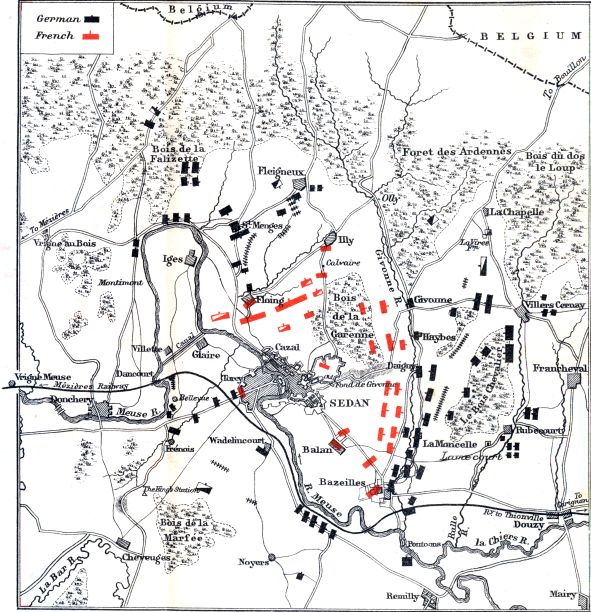
Plan of the Battle of Sedan.
was reached, probably because the exhaustion of the 5th and 7th corps and the attack of the Bavarians on the 12th corps at Bazeilles rendered any decided movement very difficult. The general conclusion was that the army must have some repose; and Germans afterwards found on the battlefield a French order--"Rest to-day for the whole army." But already on the 30th an officer had come from Paris determined to restore the morale of the army and break through towards Bazaine. This was General de Wimpffen, who had gained distinction in previous wars, and, coming lately from Algeria to Paris, was there appointed to supersede de Failly in command of the 5th corps. Nor was this all. The Palikao Ministry apparently had some doubts as to MacMahon's energy, and feared that the Emperor himself hampered the operations. De Wimpffen therefore received an unofficial mandate to infuse vigour into the counsels at headquarters, and was entrusted with a secret written order to take over the supreme command if anything were to happen to MacMahon. On taking command of the 5th corps on the 30th, de Wimpffen found it demoralised by the hurried retreat through Mouzon; but neither this fact nor the exhaustion of the whole army abated the determination of this stalwart soldier to break through towards Metz.
Early on September 1 the positions held by the French formed, roughly speaking, a triangle resting on the right bank of the Meuse from, near Bazeilles to Sedan and Glaire. Damming operations and the heavy rains of previous days had spread the river over the low-lying meadows, thus rendering it difficult, if not impossible, for an enemy to cross under fire; but this same fact lessened the space by which the French could endeavour to break through. Accordingly they deployed their forces almost wholly along the inner slopes of the Givonne brook and of the smaller stream that flows from the high land about Illy down to the village of Floing and thence to the Meuse. The heights of Illy, crowned by the Calvaire, formed the apex of the French position, while Floing and Bazeilles formed the other corners of what was in many [pg 080] respects good fighting-ground. Their strength was about 120,000 men, though many of these were disabled or almost helpless from fatigue; that of the Germans was greater on the whole, but three of their corps could not reach the scene of action before 1 P.M. owing to the heaviness of the roads[45]. At first, then, the French had a superiority of force and a far more compact position, as will be seen by the accompanying plan.
We now resume the account of the battle. The fighting in and around Bazeilles speedily led to one very important result. At 6 A.M. a splinter of a shell fired by the assailants from the hills north-east of that village, severely wounded Marshal MacMahon as he watched the conflict from a point in front of the village of Balan. Thereupon he named General Ducrot as his successor, passing over the claims of two generals senior to him. Ducrot, realising the seriousness of the position, prepared to draw off the troops towards the Calvaire of Illy preparatory to a retreat on Mézières by way of St. Menges. The news of this impending retreat, which must be conducted under the hot fire of the Germans now threatening the line of the Givonne, cut de Wimpffen to the quick. He knew that the Crown Prince held a force to the south-west of Sedan, ready to fall on the flank of any force that sought to break away to Mézières; and a temporary success of his own 5th corps against the Saxons in la Moncelle strengthened his prepossession in favour of a combined move eastwards towards Carignan and Metz. Accordingly, about nine o'clock he produced the secret order empowering him to succeed MacMahon should the latter be incapacitated. Ducrot at once yielded to the ministerial ukase; the Emperor sought to intervene in favour of Ducrot, only to be waved aside by the confident de Wimpffen; and thus the long conflict between MacMahon and the Palikao Ministry ended in victory for the latter--and disaster for France[46].
[pg 081]In hazarding this last statement we do not mean to imply that a retreat on Mézières would then have saved the whole army. It might, however, have enabled part of it to break through either to Mézières or the Belgian boundary; and it is possible that Ducrot had the latter objective in view when he ordered the concentration at Illy. In any case, that move was now countermanded in favour of a desperate attack on the eastern assailants. It need hardly be said that the result of these vacillations was deplorable, unsteadying the defenders, and giving the assailants time to bring up troops and cannon, and thereby strengthen their grip on every important point. Especially valuable was the approach of the 2nd Bavarian corps; setting out from Raucourt at 4 A.M. it reached the hills south of Sedan about 9, and its artillery posted near Frénois began a terrible fire on the town and the French troops near it.
About the same time the Second Division of the Saxons reinforced their hard-pressed comrades to the north of la Moncelle, where, on de Wimpffen's orders, the French were making a strong forward move. The opportune arrival of these new German troops saved their artillery, which had been doing splendid service. The French were driven back across the Givonne with heavy loss, and the massed battery of 100 guns crushed all further efforts at advance on this side. Meanwhile at Bazeilles the marines had worthily upheld the honour of the French arms. Despite the terrible artillery fire now concentrated on the village, they pushed the German footmen back, but never quite drove them out. These, when reinforced, renewed the fight with equal obstinacy; the inhabitants themselves joined in with whatever weapons fury suggested to them and as that merciless strife swayed to and fro amidst the roar of artillery, the crash of walls, and the hiss of flame, war was seen in all its naked ferocity.
Yet here again, as at all points, the defence was gradually overborne by the superiority of the German artillery. About eleven o'clock the French, despite their superhuman efforts, were outflanked by the Bavarians and Saxons on the north of [pg 082] the village. Even then, when the regulars fell back, some of the inhabitants went on with their mad resistance; a great part of the village was now in flames, but whether they were kindled by the Germans, or by the retiring French so as to delay the victors, has never been cleared up. In either case, several of the inhabitants perished in the flames; and it is admitted that the Bavarians burnt some of the villagers for firing on them from the windows[47].
In the defence of Bazeilles the French infantry showed its usual courage and tenacity. Elsewhere the weary and dispirited columns were speedily becoming demoralised under the terrific artillery fire which the Germans poured in from many points of vantage. The Prussian Guards coming up from Villers Cernay about 10 A.M. planted their formidable batteries so as to sweep the Bois de Garenne and the ground about the Calvaire d'Illy from the eastward; and about that time the guns of the 5th and 11th German corps, that had early crossed the Meuse below Sedan, were brought to bear on the west front of that part of the French position. The apex of the defenders' triangle was thus severely searched by some 200 guns; and their discharges, soon supported by the fire of skirmishers and volleys from the troops, broke all forward movements of the French on that side. On the south and south-east as many cannon swept the French lines, but from a greater distance.
Up to nearly noon there seemed some chance of the French bursting through on the north, and some of them did escape. Yet no well-sustained effort took place on that side, apparently because, even after the loss of Bazeilles at eleven o'clock, de Wimpffen clung to the belief that he could cut his way out towards Carignan, if not by Bazeilles, then perhaps by some other way, as Daigny or la Moncelle. The reasoning by which he convinced himself is hard to follow; for the only road to Carignan on that side runs through Bazeilles. Perhaps we ought to say that he did not reason, but was haunted by [pg 083] one fixed notion; and the history of war from the time of the Roman Varro down to the age of the Austrian Mack and the French de Wimpffen shows that men whose brains work in grooves and take no account of what is on the right hand and the left, are not fit to command armies; they only yield easy triumphs to the great masters of warfare--Hannibal, Napoleon the Great, and von Moltke.
De Wimpffen, we say, paid little heed to the remonstrances of Generals Douay and Ducrot at leaving the northern apex and the north-western front of the defence to be crushed by weight of metal and of numbers. He rode off towards Balan, near which village the former defenders of Bazeilles were making a gallant and partly successful stand, and no reinforcements were sent to the hills on the north. The villages of Illy and Floing were lost; then the French columns gave ground even up the higher ground behind them, so great was the pressure of the German converging advance. Worst of all, skulkers began to hurry from the ranks and seek shelter in the woods, or even under the ramparts of Sedan far in the rear. The French gunners still plied their guns with steady devotion, though hopelessly outmatched at all points, but it was clear that only a great forward dash could save the day. Ducrot therefore ordered General Margueritte with three choice cavalry regiments (Chasseurs d'Afrique) and several squadrons of Lancers to charge the advancing lines. Moving forward from the northern edge of the Bois de Garenne to judge his ground, Margueritte fell mortally wounded. De Bauffremont took his place, and those brave horsemen swept forward on a task as hopeless as that of the Light Brigade at Balaclava, or that of the French Cuirassiers at Wörth[48]. Their conduct was as glorious; but the terrible power of the modern rifle was once more revealed. The pounding of distant batteries they could brave; disordered but defiant they swept on towards the German lines, but when the German infantry opened fire almost at [pg 084] pistol range, rank after rank of the horsemen went down as grass before the scythe. Here and there small bands of horsemen charged the footmen on the flank, even in a few cases on their rear, it is said; but the charge, though bravely renewed, did little except to delay the German triumph and retrieve the honour of France.
By about two o'clock the French cavalry was practically disabled, and there now remained no Imperial Guard, as at Waterloo, to shed some rays of glory over the disaster. Meanwhile, however, de Wimpffen had resolved to make one more effort. Gathering about him a few of the best infantry battalions in and about Sedan, he besought the Emperor to join him in cutting a way out towards the east. The Emperor sent no answer to this appeal; he judged that too much blood had already been needlessly shed. Still, de Wimpffen persisted in his mad endeavour. Bursting upon the Bavarians in the village of Balan, he drove them back for a space until his men, disordered by the rush, fell before the stubborn rally of the Bavarians and Saxons. With the collapse of this effort and the cutting up of the French cavalry behind Floing, the last frail barriers to the enemy's advance gave way. The roads to Sedan were now thronged with masses of fugitives, whose struggles to pass the drawbridges into the little fortress resembled an African battue; for King William and his Staff, in order to hurry on the inevitable surrender, bade the 200 or more pieces on the southern heights play upon the town. Still de Wimpffen refused to surrender, and, despite the orders of his sovereign, continued the hopeless struggle. At length, to stay the frightful carnage, the Emperor himself ordered the white flag to be hoisted[49]. A German officer went down to arrange preliminaries, and to his astonishment was ushered into the presence of the Emperor. The German Staff had no knowledge of his whereabouts. On hearing the news, King William, who throughout the day sat on horseback at the top of the slope behind Frénois, said to his [pg 085] son, the Crown Prince: "This is indeed a great success; and I thank thee that thou hast contributed to it." He gave his hand to his son, who kissed it, and then, in turn, to Moltke and to Bismarck, who kissed it also. In a short time, the French General Reille brought to the King the following autograph letter:--
MONSIEUR MON FRÈRE--N'ayant pu mourir au milieu de mes troupes, il ne me reste qu'à remettre mon épée entre les mains de Votre Majesté.--Je suis de Votre Majesté le bon Frère
NAPOLÉON.
SÉDAN, le 1er Septembre, 1870.
The King named von Moltke to arrange the terms and then rode away to a village farther south, it being arranged, probably at Bismarck's suggestion, that he should not see the Emperor until all was settled. Meanwhile de Wimpffen and other French generals, in conference with von Moltke, Bismarck, and Blumenthal, at the village of Donchéry, sought to gain easy terms by appealing to their generosity and by arguing that this would end the war and earn the gratitude of France. To all appeals for permission to let the captive army go to Algeria, or to lay down its arms in Belgium, the Germans were deaf,--Bismarck at length plainly saying that the French were an envious and jealous people on whose gratitude it would be idle to count. De Wimpffen then threatened to renew the fight rather than surrender, to which von Moltke grimly assented, but Bismarck again interposed to bring about a prolongation of the truce. Early on the morrow, Napoleon himself drove out to Donchéry in the hope of seeing the King. The Bismarckian Boswell has given us a glimpse of him as he then appeared: "The look in his light grey eyes was somewhat soft and dreamy, like that of people who have lived too fast." [In his case, we may remark, this was induced by the painful disease which never left him all through the campaign, and carried him off three years later.] "He wore his cap a little on the right, to which side his head also inclined. His short legs [pg 086] were out of proportion to the long upper body. His whole appearance was a little unsoldier-like. The man looked too soft--I might say too spongy--for the uniform he wore."
Bismarck, the stalwart Teuton who had wrecked his policy at all points, met him at Donchéry and foiled his wish to see the King, declaring this to be impossible until the terms of the capitulation were settled. The Emperor then had a conversation with the Chancellor in a little cottage belonging to a weaver. Seating themselves on two rush-bottomed chairs beside the one deal table, they conversed on the greatest affairs of State. The Emperor said he had not sought this war--"he had been driven into it by the pressure of public opinion. I replied" (wrote Bismarck) "that neither had any one with us wished for war--the King least of all[50]." Napoleon then pleaded for generous terms, but admitted that he, as a prisoner, could not fix them; they must be arranged with de Wimpffen. About ten o'clock the latter agreed to an unconditional surrender for the rank and file of the French army, but those officers who bound themselves by their word of honour (in writing) not to fight again during the present war were to be set free. Napoleon then had an interview with the King. What transpired is not known, but when the Emperor came out "his eyes" (wrote Bismarck) "were full of tears."
The fallen monarch accepted the King's offer of the castle of Wilhelmshöhe near Cassel for his residence up to the end of the war; it was the abode on which Jerome Bonaparte had spent millions of thalers, wrung from Westphalian burghers, during his brief sovereignty in 1807-1813. Thither his nephew set out two days after the catastrophe of Sedan. And this, as it seems, was the end of a dynasty whose rise to power dated from the thrilling events of the Bridge of Lodi, Arcola, Rivoli, and the Pyramids. The French losses on September 1 were about 3000 killed, 14,000 wounded, and 21,000 prisoners. [pg 087] On the next day there surrendered 83,000 prisoners by virtue of the capitulation, along with 419 field-pieces and 139 cannon of the fortress. Some 3000 had escaped, through the gap in the German lines on the north-east, to the Belgian frontier, and there laid down their arms.
The news of this unparalleled disaster began to leak out at Paris late on the 2nd; on the morrow, when details were known, crowds thronged into the streets shouting "Down with the Empire! Long live the Republic!" Power still remained with the Empress-Regent and the Palikao Ministry. All must admit that the Empress Eugénie did what was possible in this hopeless position. She appealed to that charming literary man, M. Prosper Mérimée, to go to his friend, M. Thiers (at whom we shall glance presently), and beg him to form a Ministry that would save the Empire for the young Prince Imperial. M. Thiers politely but firmly refused to give a helping hand to the dynasty which he looked on as the author of his country's ruin.
On that day the Empress also summoned the Chambers--the Senate and the Corps Législatif--a vain expedient, for in times of crisis the French look to a man, not to Chambers. The Empire had no man at hand. General Trochu, Governor of Paris, was suspected of being a Republican--at any rate he let matters take their course. On the 4th, vast crowds filled the streets; a rush was made to the Chamber, where various compromises were being discussed; the doors were forced, and amid wild excitement a proposal to dethrone the Napoleonic dynasty was put. Two Republican deputies, Gambetta and Jules Favre, declared that the Hôtel de Ville was the fit place to declare the Republic. There, accordingly, it was proclaimed, the deputies for the city of Paris taking office as the Government of National Defence. They were just in time to prevent Socialists like Blanqui, Flourens, and Henri Rochefort from installing the "Commune" in power. The Empress and the Prince Imperial at once fled, and, apart from a protest [pg 088] by the Senate, no voice was raised in defence of the Empire. Jules Favre who took up the burden of Foreign Affairs in the new Government of National Defence was able to say in his circular note of September 6 that "the Revolution of September 4 took place without the shedding of a drop of blood or the loss of liberty to a single person[51]."
That fact shows the unreality of Bonapartist rule in France. At bottom Napoleon III.'s ascendancy was due to several causes, that told against possible rivals rather than directly in his favour. Hatred of the socialists, whose rash political experiments had led to the bloody days of street fighting in Paris in June 1848, counted for much. Added to this was the unpopularity of the House of Orleans after the sordid and uninteresting rule of Louis Philippe (1830-48). The antiquated royalism of the Elder or Legitimist branch of that ill-starred dynasty made it equally an impossibility. Louis Napoleon promised to do what his predecessors, Monarchical and Republican, had signally failed to do, namely, to reconcile the claims of liberty and order at home and uphold the prestige of France abroad. For the first ten years the glamour of his name, the skill with which he promoted the material prosperity of France, and the successes of his early wars, promised to build up a lasting power. But then came the days of failing health and tottering prestige--of financial scandals, of the Mexican blunder, of the humiliation before the rising power of Prussia. To retrieve matters he toyed with democracy in France, and finally allowed his Ministers to throw down a challenge to Prussia; for, in the words of a French historian, the conditions on which he held power "condemned him to be brilliant[52]."
Failing at Sedan, he lost all; and he knew it. His reign, in fact, was one long disaster for France. The canker of moral corruption began to weaken her public life when the creatures [pg 089] of whom he made use in the coup d'état of 1851 crept into place and power. The flashy sensationalism of his policy, setting the tone for Parisian society, was fatal to the honest unseen drudgery which builds up a solid edifice alike in public and in private life. Even the better qualities of his nature told against ultimate success. As has been shown, his vague but generous ideas on Nationality drew French policy away from the paths of obvious self-interest after the year 1864, and gave an easy victory to the keen and objective statecraft of Bismarck. That he loved France as sincerely as he believed in the power of the Bonapartist tradition to help her, can scarcely admit of doubt. His conduct during the war of 1870 showed him to be disinterested, while his vision was clearer than that of the Generals about him. But in the field of high policy, as in the moral events that make or mar a nation's life, his influence told heavily against the welfare of France; and he must have carried into exile the consciousness that his complex nature and ill-matched strivings had but served to bring his dynasty and his country to an unexampled overthrow.
It may be well to notice here an event of world-wide importance, which came as a sequel to the military collapse of France. Italians had always looked to the day when Rome would be the national capital. The great Napoleon during his time of exile at St. Helena had uttered the prophetic words: "Italy isolated between her natural limits is destined to form a great and powerful nation. . . . Rome will without doubt be chosen by the Italians as their capital." The political and economic needs of the present, coinciding herein with the voice of tradition, always so strong in Italian hearts, pointed imperiously to Rome as the only possible centre of national life.
As was pointed out in the Introduction, Pius IX. after the years of revolution, 1848-49, felt the need of French troops in his capital, and his harsh and reactionary policy (or rather, that of his masterful Secretary of State, Antonelli) before long completely alienated the feelings of his subjects.
[pg 090]After the master-mind of Cavour was removed by death, (June 1861), the patriots struggled desperately, but in vain, to rid Rome of the presence of foreign troops and win her for the national cause. Garibaldi's raids of 1862 and 1867 were foiled, the one by Italian, the other by French troops; and the latter case, which led to the sharp fight of Mentana, effaced any feelings of gratitude to Napoleon III. for his earlier help, which survived after his appropriation of Savoy and Nice. Thus matters remained in 1867-70, the Pope relying on the support of French bayonets to coerce his own subjects. Clearly this was a state of things which could not continue. The first great shock must always bring down a political edifice which rests not on its own foundations, but on external buttresses. These were suddenly withdrawn by the war of 1870. Early in August, Napoleon ordered all his troops to leave the Papal States; and the downfall of his power a month later absolved Victor Emmanuel from the claims of gratitude which he still felt towards his ally of 1859.
At once the forward wing of the Italian national party took action in a way that either forced, or more probably encouraged, Victor Emmanuel's Government to step in under the pretext of preventing the creation of a Roman Republic. The King invited Pius IX. to assent to the peaceful occupation of Rome by the royal troops, and on receiving the expected refusal, moved forward 35,000 soldiers. The resistance of the 11,000 Papal troops proved to be mainly a matter of form. The wall near the Porta Pia soon crumbled before the Italian cannon, and after a brief struggle at the breach, the white flag was hoisted at the bidding of the Pope (Sept. 20).
Thus fell the temporal power of the Papacy. The event aroused comparatively little notice in that year of marvels, but its results have been momentous. At the time there was a general sense of relief, if not of joy, in Italy, that the national movement had reached its goal, albeit in so tame and uninspiring a manner. Rome had long been a prey to political reaction, accompanied by police supervision of the most exasperating [pg 091] kind. The plébiscite as to the future government gave 133,681 votes for Victor Emmanuel's rule, and only 1507 negative votes[53].
Now, for the first time since the days of Napoleon I. and of the short-lived Republic for which Mazzini and Garibaldi worked and fought so nobly in 1849, the Eternal City began to experience the benefits of progressive rule. The royal government soon proved to be very far from perfect. Favouritism, the multiplication of sinecures, municipal corruption, and the prosaic inroads of builders and speculators, soon helped to mar the work of political reconstruction, and began to arouse a certain amount of regret for the more picturesque times of the Papal rule. A sentimental reaction of this kind is certain to occur in all cases of political change, especially in a city where tradition and emotion so long held sway.
The consciences of the faithful were also troubled when the fiat of the Pope went forth excommunicating the robber-king and all his chief abettors in the work of sacrilege. Sons of the Church throughout Italy were bidden to hold no intercourse with the interlopers and to take no part in elections to the Italian Parliament which thenceforth met in Rome. The schism between the Vatican and the King's Court and Government was never to be bridged over; and even to-day it constitutes one of the most perplexing problems of Italy.
Despite the fact that Rome and Italy gained little of that mental and moral stimulus which might have resulted from the completion of the national movement solely by the action of the people themselves, the fact nevertheless remains that Rome needed Italy and Italy needed Rome. The disappointment loudly expressed by idealists, sentimentalists, and reactionaries must not blind us to the fact that the Italians, and above all the Romans, have benefited by the advent of unity, political freedom, and civic responsibility. It may well be that, in acting as the leader of a constitutional people, the Eternal City [pg 092] will little by little develop higher gifts than those nurtured under Papal tutelage, and perhaps as beneficent to Humanity as those which, in the ancient world, bestowed laws on Europe.
As Mazzini always insisted, political progress, to be sound, must be based ultimately on moral progress. It is of its very nature slow, and is therefore apt to escape the eyes of the moralist or cynic who dwells on the untoward signs of the present. But the Rome for which Mazzini and his compatriots yearned and struggled can hardly fail ultimately to rise to the height of her ancient traditions and of that noble prophecy of Dante: "There is the seat of empire. There never was, and there never will be, a people endowed with such capacity to acquire command, with more vigour to maintain it, and more gentleness in its exercise, than the Italian nation, and especially the Holy Roman people." The lines with which Mr. Swinburne closed his "Dedication" of Songs before Sunrise to Joseph Mazzini are worthy of finding a place side by side with the words of the mediaeval seer:--
Yea, even she as at first,
Yea, she alone and none other,
Shall cast down, shall build up, shall bring home,
Slake earth's hunger and thirst,
Lighten, and lead as a mother;
First name of the world's names, Rome.
FOOTNOTES:
[43] See
General Lebrun's Guerre de 1870: Bazailles-Sedan, for an
account of his corps of MacMahon's army.
In view of the events of the late Boer War, it is worth noting that
the Germans never acknowledged the francs-tireurs as
soldiers, and forthwith issued an order ending with the words,
"They are amenable to martial law and liable to be sentenced to
death" (Maurice, Franco-German War, p. 215).
[44] Moltke, The Franco-German War, vol. i. p. 114. Hooper, The Campaign of Sedan, p. 296.
[45] Maurice, The Franco-German War, p. 235.
[46] See Lebrun's Guerre de 1870: Bazeilles-Sédan, for these disputes.
[47] M. Busch, Bismarck in the Franco-German War, vol. i. p. 114.
[48] Lebrun (op. cit. pp. 126-127; also Appendix D) maintains that de Bauffremont then led the charge, de Gallifet leading only the 3rd Chasseurs d'Afrique.
[49] Lebrun, op. cit. pp. 130 et seq. for the disputes about surrender.
[50] Busch, Bismarck on the Franco-German War, vol. i. p. 109. Contrast this statement with his later efforts (Reminiscences, vol. ii. pp. 95-100) to prove that he helped to bring on war.
[51] Gabriel Hanotaux, Contemporary France, vol. i. p. 14 (Eng. edit.)
[52] Said in 1852 by an eminent Frenchman to our countryman, Nassau Senior (Journals, ii. ad fin).
[53] Countess Cesaresco, The Liberation of Italy, p. 411.
"[Greek: egigneto te logo men daemokratia, ergo de hupo tou protou andros archae]."
"Thus Athens, though still in name a democracy, was in fact ruled by her greatest man."--THUCYDIDES, book ii. chap. 65.
The aim of this work being to trace the outlines only of those outstanding events which made the chief States of the world what they are to-day, we can give only the briefest glance at the remaining events of the Franco-German War and the splendid though hopeless rally attempted by the newly-installed Government of National Defence. Few facts in recent history have a more thrilling interest than the details of the valiant efforts made by the young Republic against the invaders. The spirit in which they were made breathed through the words of M. Picard's proclamation on September 4: "The Republic saved us from the invasion of 1792. The Republic is proclaimed."
Inspiring as was this reference to the great and successful effort of the First Republic against the troops of Central Europe in 1792, it was misleading. At that time Prussia had lapsed into a state of weakness through the double evils of favouritism and a facing-both-ways policy. Now she felt the strength born of sturdy championship of a great principle--that of Nationality--which had ranged nearly the whole of the German race on her side. France, on the other hand, owing to the shocking blunders of her politicians and generals during the war, had but one army corps free, that of General Vinoy, [pg 094] which hastily retreated from the neighbourhood of Mézières towards Paris on September 2 to 4. She therefore had to count almost entirely on the Garde Mobile, the Garde Nationale, and Francs-tireurs; but bitter experience was to show that this raw material could not be organised in a few weeks to withstand the trained and triumphant legions of Germany.
Nevertheless there was no thought of making peace with the invaders. The last message of Count Palikao to the Chambers had been one of defiance to the enemy; and the Parisian deputies, nearly all of them Republicans, who formed the Government of National Defence, scouted all faint-hearted proposals. Their policy took form in the famous phrase of Jules Favre, Minister of Foreign Affairs: "We will give up neither an inch of our territory nor a stone of our fortresses." This being so, all hope of compromise with the Germans was vain. Favre had interviews with Bismarck at the Château de Ferrières (September 19); but his fine oratory, even his tears, made no impression on the Iron Chancellor, who declared that in no case would an armistice be granted, not even for the election of a National Assembly, unless France agreed to give up Alsace and a part of Lorraine, allowing the German troops also to hold, among other places, Strassburg and Toul.
Obviously, a self-constituted body like the provisional Government at Paris could not accept these terms, which most deeply concerned the nation at large. In the existing temper of Paris and France, the mention of such terms meant war to the knife, as Bismarck must have known. On their side, Frenchmen could not believe that their great capital, with its bulwarks and ring of outer forts, could be taken; while the Germans--so it seems from the Diary of General von Blumenthal--looked forward to its speedy capitulation. One man there was who saw the pressing need of foreign aid. M. Thiers (whose personality will concern us a little later) undertook to go on a mission to the chief Powers of Europe in the hope of urging one or more of them to intervene on behalf of France.
The details of that mission are, of course, not fully known. [pg 095] We can only state here that Russia now repaid Prussia's help in crushing the Polish rebellion of 1863 by neutrality, albeit tinged with a certain jealousy of German success. Bismarck had been careful to dull that feeling by suggesting that she (Russia) should take the present opportunity of annulling the provision, made after the Crimean War, which prevented her from sending war-ships on to the Black Sea; and this was subsequently done, under a thin diplomatic disguise, at the Congress of London (March 1871). Bismarck's astuteness in supporting Russia at this time therefore kept that Power quiet. As for Austria, she undoubtedly wished to intervene, but did not choose to risk a war with Russia, which would probably have brought another overthrow. Italy would not unsheathe her sword for France unless the latter recognised her right to Rome (which the Italian troops entered on September 20). To this the young French Republic demurred. Great Britain, of course, adhered to the policy of neutrality which she at first declared[54].
Accordingly, France had to rely on her own efforts. They were surprisingly great. Before the complete investment of Paris (September 20), a Delegation of the Government of National Defence had gone forth to Tours with the aim of stirring up the provinces to the succour of the besieged capital. Probably the whole of the Government ought to have gone there; for, shut up in the capital, it lost touch with the provinces, save when balloons and carrier-pigeons eluded the German sharpshooters and brought precious news[55]. The [pg 096] mistake was seen in time to enable a man of wondrous energy to leave Paris by balloon on October 7, to descend as a veritable deus ex machina on the faltering Delegation at Tours, and to stir the blood of France by his invective. There was a touch of the melodramatic not only in his apparition but in his speeches. Frenchmen, however, follow a leader all the better if he is a good stage-manager and a clever actor. The new leader was both; but he was something more.
Léon Gambetta had leaped to the front rank at the Bar in the closing days of 1868 by a passionate outburst against the coup d'état, uttered, to the astonishment of all, in a small Court of Correctional Police, over a petty case of State prosecution of a small Parisian paper. Rejecting the ordinary methods of defence, the young barrister flung defiance at Napoleon III. as the author of the coup d'état and of all the present degradation of France. The daring of the young barrister, who thus turned the tables on the authorities and impeached the head of the State, made a profound impression; it was redoubled by the Southern intensity of his thought and expression. Disdaining all forms of rhetoric, he poured forth a torrent of ideas, clothing them in the first words that came to his facile tongue, enforcing them by blows of the fist or the most violent gestures, and yet, again, modulating the roar of passion to the falsetto of satire or the whisper of emotion. His short, thick-set frame, vibrating with strength, doubled the force of all his utterances. Nor did they lack the glamour of poetry and romance that might be expected from his Italian ancestry. He came of a Genoese stock that had for some time settled in the South of France. Strange fate, that called him now to the front with the aim of repairing the ills wrought to France by another Italian House! In time of peace his power over men would have raised him to the highest positions had his Bohemian exuberance of thought and speech been tameable. It was not. He scorned prudence in moderation at all times, and his behaviour, when the wave of Revolution at last carried him to power, gave point to the taunt of Thiers--"c'est un fou furieux." Such was the man who [pg 097] now brought the quenchless ardour of his patriotism to the task of rousing France. As far as words and energy could call forth armies, he succeeded; but as he lacked all military knowledge, his blind self-confidence was to cost France dear.
Possibly the new levies of the Republic might at some point have pierced the immense circle of the German lines around Paris (for at first the besieging forces were less numerous than the besieged), had not the assailants been strengthened by the fall of Metz (Oct. 27). This is not the place to discuss the culpability of Bazaine for the softness shown in the defence. The voluminous evidence taken at his trial shows that he was very slack in the critical days at the close of August; it is also certain that Bismarck duped him under the pretence that, on certain conditions to be arranged with the Empress Eugénie, his army might be kept intact for the sake of re-establishing the Empire[56]. The whole scheme was merely a device to gain time and keep Bazaine idle, and the German Chancellor succeeded here as at all points in his great game. On October 27, then, 6000 officers, 173,000 rank and file, were constrained by famine to surrender, along with 541 field-pieces and 800 siege guns.
This capitulation, the greatest recorded in the history of civilised nations, dealt a death-blow to the hopes of France. Strassburg had hoisted the white flag a month earlier; and the besiegers of these fortresses were free to march westwards and overwhelm the new levies. After gaining a success at Coulmiers, near Orleans (Nov. 9), the French were speedily driven down the valley of the Loire and thence as far west as Le [pg 098] Mans. In the North, at St. Quentin, the Germans were equally successful, as also in Burgundy against that once effective free-lance, Garibaldi, who came with his sons to fight for the Republic. The last effort was made by Bourbaki and a large but ill-compacted army against the enemy's communications in Alsace. By a speedy concentration the Germans at Héricourt, near Belfort, defeated this daring move (imposed by the Government of National Defence on Bourbaki against his better judgment), and compelled him and his hard-pressed followers to pass over into Switzerland (January 30, 1871).
Meanwhile Paris had already surrendered. During 130 days, and that too in a winter of unusual severity, the great city had held out with a courage that neither defeats, schisms, dearth of food, nor the bombardment directed against its southern quarters could overcome. Towards the close of January famine stared the defenders in the face, and on the 28th an armistice was concluded, which put an end to the war except in the neighbourhood of Belfort. That exception was due to the determination of the Germans to press Bourbaki hard, while the French negotiators were not aware of his plight. The garrison of Paris, except 12,000 men charged with the duty of keeping order, surrendered; the forts were placed in the besiegers' hands. When that was done the city was to be revictualled and thereafter pay a war contribution of 200,000,000 francs (£8,000,000). A National Assembly was to be freely elected and meet at Bordeaux to discuss the question of peace. The National Guards retained their arms, Favre maintaining that it would be impossible to disarm them; for this mistaken weakness he afterwards expressed his profound sorrow[57].
Despite the very natural protests of Gambetta and many others against the virtual ending of the war at the dictation of [pg 099] the Parisian authorities, the voice of France ratified their action. An overwhelming majority declared for peace. The young Republic had done wonders in reviving the national spirit: Frenchmen could once more feel the self-confidence which had been damped by the surrenders of Sedan and Metz; but the instinct of self-preservation now called imperiously for the ending of the hopeless struggle. In the hurried preparations for the elections held on February 8, few questions were asked of the candidates except that of peace or war; and it soon appeared that a great majority was in favour of peace, even at the cost of part of the eastern provinces.
Of the 630 deputies who met at Bordeaux on February 12, fully 400 were Monarchists, nearly evenly divided between the Legitimists and Orleanists; 200 were professed Republicans; but only 30 Bonapartists were returned. It is not surprising that the Assembly, which met in the middle of February, should soon have declared that the Napoleonic Empire had ceased to exist, as being "responsible for the ruin, invasion, and dismemberment of the country" (March 1). These rather exaggerated charges (against which Napoleon III. protested from his place of exile, Chislehurst) were natural in the then deplorable condition of France. What is surprising and needs a brief explanation here, is the fact that a monarchical Assembly should have allowed the Republic to be founded.
This paradoxical result sprang from several causes, some of them of a general nature, others due to party considerations, while the personal influence of one man perhaps turned the balance at this crisis in the history of France. We will consider them in the order here named.
Stating the matter broadly, we may say that the present Assembly was not competent to decide on the future constitution of France; and that vague but powerful instinct, which guides representative bodies in such cases, told against any avowedly partisan effort in that direction. The deputies were fully aware that they were elected to decide the urgent question of peace or war, either to rescue France from her long agony, [pg 100] or to pledge the last drops of her life-blood in an affair of honour. By an instinct of self-preservation, the electors, especially in the country districts, turned to the men of property and local influence as those who were most likely to save them from the frothy followers of Gambetta. Accordingly, local magnates were preferred to the barristers and pressmen, whose oratorical and literary gifts usually carry the day in France; and more than 200 noblemen were elected. They were chosen not on account of their nobility and royalism, but because they were certain to vote against the fou furieux.
Then, too, the Royalists knew very well that time would be required to accustom France to the idea of a King, and to adjust the keen rivalries between the older and the younger branches of the Bourbon House. Furthermore, they were anxious that the odium of signing a disastrous peace should fall on the young Republic, not on the monarch of the future. Just as the great Napoleon in 1814 was undoubtedly glad that the giving up of Belgium and the Rhine boundary should devolve on his successor, Louis XVIII., and counted on that as one of the causes undermining the restored monarchy, so now the Royalists intended to leave the disagreeable duty of ceding the eastern districts of France to the Republicans who had so persistently prolonged the struggle. The clamour of no small section of the Republican party for war à outrance still played into the hands of the royalists and partly justified this narrow partisanship. Events, however, were to prove here, as in so many cases, that the party which undertook a pressing duty and discharged it manfully, gained more in the end than those who shirked responsibility and left the conduct of affairs to their opponents. Men admire those who dauntlessly pluck the flower, safety, out of the nettle, danger.
Finally, the influence of one commanding personality was ultimately to be given to the cause of the Republic. That strange instinct which in times of crisis turns the gaze of a people towards the one necessary man, now singled out M. Thiers. The veteran statesman was elected in twenty-six [pg 101] Departments. Gambetta and General Trochu, Governor of Paris, were each elected nine times over. It was clear that the popular voice was for the policy of statesmanlike moderation which Thiers now summed up in his person; and Gambetta for a time retired to Spain.
The name of Thiers had not always stood for moderation. From the time of his youth, when his journalistic criticisms on the politics, literature, art and drama of the Restoration period set all tongues wagging, to the day when his many-sided gifts bore him to power under Louis Philippe, he stood for all that is most beloved by the vivacious sons of France. His early work, The History of the French Revolution, had endeared him to the survivors of the old Jacobin and Girondin parties, and his eager hostility to England during his term of office flattered the Chauvinist feelings that steadily grew in volume during the otherwise dull reign of Louis Philippe. In the main, Thiers was an upholder of the Orleans dynasty, yet his devotion to constitutional principles, the ardour of his Southern temperament,--he was a Marseillais by birth,--and the vivacious egotism that never brooked contradiction, often caused sharp friction with the King and the King's friends. He seemed born for opposition and criticism. Thereafter, his conduct of affairs helped to undermine the fabric of the Second Republic (1848-51). Flung into prison by the minions of Louis Napoleon at the time of the coup d'état, he emerged buoyant as ever, and took up again the rôle that he loved so well.
Nevertheless, amidst all the seeming vagaries of Thiers' conduct there emerge two governing principles--a passionate love of France, and a sincere attachment to reasoned liberty. The first was absolute and unchangeable; the second admitted of some variations if the ruler did not enhance the glory of France, and also (as some cynics said) recognise the greatness of M. Thiers. For the many gibes to which his lively talents and successful career exposed him, he had his revenge. His keen glance and incisive reasoning generally warned him [pg 102] of the probable fate of Dynasties and Ministries. Like Talleyrand, whom he somewhat resembled in versatility, opportunism, and undying love of France, he might have said that he never deserted a Government before it deserted itself. He foretold the fall of Louis Philippe under the reactionary Guizot Ministry as, later on, he foretold the fall of Napoleon III. He blamed the Emperor for not making war on Prussia in 1866 with the same unanswerable logic that marked his opposition to the mad rush for war in 1870. And yet the war spirit had been in some sense strengthened by his own writings. His great work, The History of the Consulate and Empire, which appeared from 1845 to 1862--the last eight volumes came out during the Second Empire--was in the main a glorification of the First Napoleon. Men therefore asked with some impatience why the panegyrist of the uncle should oppose the supremacy of the nephew; and the action of the crowd in smashing the historian's windows after his great speech against the war of 1870 cannot be called wholly illogical, even if it erred on the side of Gallic vivacity.
In the feverish drama of French politics Time sometimes brings an appropriate Nemesis. It was so now. The man who had divided the energies of his manhood between parliamentary opposition of a somewhat factious type and the literary cultivation of the Napoleonic legend, was now in the evening of his days called upon to bear a crushing load of responsibility in struggling to win the best possible terms of peace from the victorious Teuton, in mediating between contending factions at Bordeaux and Paris, and, finally, in founding a form of government which never enlisted his whole-hearted sympathy, save as the least objectionable expedient then open to France.
For the present, the great thing was to gain peace with the minimum of sacrifice for France. Who could drive a better bargain than Thiers, the man who knew France so well, and had recently felt the pulse of the Governments of Europe? Accordingly, on the 17th of February, the Assembly named him Head of the Executive Power "until it is based upon the [pg 103] French Constitution." He declined to accept this post until the words "of the French Republic" were substituted for the latter clause. He had every reason for urging this demand. Unlike the Republic of 1848, the strength of which was chiefly, or almost solely, in Paris, the Republic was proclaimed at Lyons, Marseilles, and Bordeaux, before any news came of the overthrow of the Napoleonic dynasty at the capital[58].
He now entrusted three important portfolios, those for Foreign Affairs, Home Affairs, and Public Instruction, to pronounced Republicans--Jules Favre, Picard, and Jules Simon. Having pacified the monarchical majority by appealing to them to defer all questions respecting the future constitution until affairs were more settled, he set out to meet Bismarck at Versailles.
A disadvantage which almost necessarily besets parliamentary institutions had weakened the French case before the negotiations began. The composition of the Assembly implied a strong desire for peace--a fact which Thiers had needlessly emphasised before he left Bordeaux. On the other hand, Bismarck was anxious to end the war. He knew enough to be uneasy at the attitude of the neutral States; for public opinion was veering round in England, Austria, and Italy to a feeling of keen sympathy for France, and even Russia was restless at the sight of the great military Empire that had sprung into being on her flank. The recent proclamation of the German Empire at Versailles--an event that will be treated in a later chapter--opened up a vista of great developments for the Fatherland, not unmixed with difficulties and dangers. Above all, sharp differences had arisen between him and the military men at the German headquarters, who wished to "bleed France white" by taking a large portion of French Lorraine (including its capital Nancy), a few colonies, and part of her fleet. It is now known that Bismarck, with the same moderation that he displayed after Königgrätz, opposed these extreme claims, because he doubted the advisability of [pg 104] keeping Metz, with its large French population. The words in which he let fall these thoughts while at dinner with Busch on February 21 deserve to be quoted:--
If they (the French) gave us a milliard more (£40,000,000) we might perhaps let them have Metz. We would then take 800,000,000 francs, and build ourselves a fortress a few miles further back, somewhere about Falkenberg or Saarbrück--there must be some suitable spot thereabouts. We should thus make a clear profit of 200,000,000 francs. [N.B.--A milliard = 1,000,000,000 francs.] I do not like so many Frenchmen being in our house against their will. It is just the same with Belfort. It is all French there too. The military men, however, will not be willing to let Metz slip, and perhaps they are right[59].
A sharp difference of opinion had arisen between Bismarck and Moltke on this question, and the Emperor Wilhelm intervened in favour of Moltke. That decided the question of Metz against Thiers despite his threat that this might lead to a renewal of war. For Belfort, however, the French statesman made a supreme effort. That fortress holds a most important position. Strong in itself, it stands as sentinel guarding the gap of nearly level ground between the spurs of the Vosges and those of the Jura. If that virgin stronghold were handed over to Germany, she would easily be able to pour her legions down the valley of the Doubs and dominate the rich districts of Burgundy and the Lyonnais. Besides, military honour required France to keep a fortress that had kept the tricolour flying. Metz the Germans held, and it was impossible to turn them out. Obviously the case of Belfort was on a different footing. In his conference of February 24, Thiers at last defied Bismarck in these words: "No; I will never yield Belfort and Metz in the same breath. You wish to ruin France in her finances, in her frontiers. Well! Take her. Conduct her administration, collect her revenues, and you will have to govern her in the face of Europe--if Europe permits[60]."
[pg 105]Probably this defiance had less weight with the Iron Chancellor than his conviction, noticed above, that to bring two entirely French towns within the German Empire would prove a source of weakness; beside which his own motto, Beati possidentes, told with effect in the case of Belfort. That stronghold was accordingly saved for France. Thiers also obtained a reduction of a milliard from the impossible sum of six milliards first named for the war indemnity due to Germany; in this matter Jules Favre states that British mediation had been of some avail. If so, it partly accounts for the hatred of England which Bismarck displayed in his later years. The Preliminaries of Peace were signed at Versailles on February 26.
One other matter remained. The Germans insisted that, if Belfort remained to France, part of their army should enter Paris. In vain did Thiers and Jules Favre point out the irritation that this would cause and the possible ensuing danger. The German Emperor and his Staff made it a point of honour, and 30,000 of their troops accordingly marched in and occupied for a brief space the district of the Champs Élysées. The terms of peace were finally ratified in the Treaty of Frankfurt (May 10, 1871), whereby France ceded Alsace and part of Lorraine, with a population of some 1,600,000 souls, and underwent the other losses noted above. Last but not least was the burden of supporting the German army of occupation that kept its grip on the north-east of France until, as the instalments came in, the foreign troops were proportionately drawn away eastwards. The magnitude of these losses and burdens had already aroused cries of anguish in France. The National Assembly at Bordeaux, on first hearing the terms, passionately confirmed the deposition of Napoleon III.; while the deputies from the ceded districts lodged a solemn protest against their expatriation (March 1). Some of the advanced Republican deputies, refusing to acknowledge the cession of territory, resigned their seats in the Assembly. Thus there began a [pg 106] schism between the Radicals, especially those of Paris, and the Assembly, which was destined to widen into an impassable gulf. Matters were made worse by the decision of the Assembly to sit, not at the capital, but at Versailles, where it would be free from the commotions of the great city. Thiers himself declared in favour of Versailles; there the Assembly met for the first time on March 20, 1871.
A conflict between this monarchical Assembly and the eager Radicals of Paris perhaps lay in the nature of things. The majority of the deputies looked forward to the return of the King (whether the Comte de Chambord of the elder Bourbons, or the Comte de Paris of the House of Orleans) as soon as France should be freed from the German armies of occupation and the spectre of the Red Terror. Some of their more impatient members openly showed their hand, and while at Bordeaux began to upbraid Thiers for his obstinate neutrality on this question. For his part, the wise old man had early seen the need of keeping the parties in check. On February 17 he begged them to defer questions as to the future form of government, working meanwhile solely for the present needs of France, and allowing future victory to be the meed of that party which showed itself most worthy of trust. "Can there be any man" (he exclaimed) "who would dare learnedly to discuss the articles of the Constitution, while our prisoners are dying of misery far away, or while our people, perishing of hunger, are obliged to give their last crust to the foreign soldiers?" A similar appeal on March led to the informal truce on constitutional questions known as the Compact of Bordeaux. It was at best an uncertain truce, certain to be broken at the first sign of activity on the Republican side.
That activity was now put forth by the "Reds" of Paris. It would take us far too long to describe the origins of the municipal socialism which took form in the Parisian Commune of 1871. The first seeds of that movement had been sown by its prototype of 1792-93, which summed up all the daring and vigour of the revolutionary socialism of that age. [pg 107] The idea had been kept alive by the "National Workshops" of 1848, whose institution and final suppression by the young Republic of that year had been its own undoing.
History shows, then, that Paris, as the head of France, was accustomed to think and act vigorously for herself in time of revolution. But experience proved no less plainly that the limbs, that is, the country districts, generally refused to follow the head in these fantastic movements. Hence, after a short spell of St. Vitus' activity, there always came a time of strife, followed only too often by torpor, when the body reduced the head to a state of benumbed subjection. The triumph of rural notions accounts for the reactions of 1831-47, and 1851-70. Paris having once more regained freedom of movement by the fall of the Second Empire on September 4, at once sought to begin her politico-social experiments, and, as we pointed out, only the promptitude of the "moderates," when face to face with the advancing Germans, averted the catastrophe of a socialistic regime in Paris during the siege. Even so, the Communists made two determined efforts to gain power; the former of these, on October 31, nearly succeeded. Other towns in the centre and south, notably Lyons, were also on the brink of revolutionary socialism, and the success of the movement in Paris might conceivably have led to a widespread trial of the communal experiment. The war helped to keep matters in the old lines.
But now, the feelings of rage at the surrender of Paris and the cession of the eastern districts of France, together with hatred of the monarchical assembly that flouted the capital by sitting at the abode of the old Kings of France, served to raise popular passion to fever heat. The Assembly undoubtedly made many mistakes: it authorised the payment of rents and all other obligations in the capital for the period of siege as if in ordinary times, and it appointed an unpopular man to command the National Guards of Paris. At the close of February the National Guards formed a Central Committee to look after their interests and those of the capital; and when [pg 108] the Executive of the State sent troops of the line to seize their guns parked on Montmartre, the Nationals and the rabble turned out in force. The troops refused to act against the National Guards, and these murdered two Generals, Lecomte and Thomas (March 18). Thiers and his Ministers thereupon rather tamely retired to Versailles, and the capital fell into the hands of the Communists. Greater firmness at the outset might have averted the horrors that followed.
The Communists speedily consulted the voice of the people by elections conducted in the most democratic spirit. In many respects their programme of municipal reforms marked a great improvement on the type of town-government prevalent during the Empire. That was, practically, under the control of the imperial préfets. The Communists now asserted the right of each town to complete self-government, with the control of its officials, magistrates, National Guards, and police, as well as of taxation, education, and many other spheres of activity. The more ambitious minds looked forward to a time when France would form a federation of self-governing Communes, whose delegates, deciding matters of national concern, would reduce the executive power to complete subservience. At bottom this Communal Federalism was the ideal of Rousseau and of his ideal Cantonal State.
By such means, they hoped, the brain of France would control the body, the rural population inevitably taking the position of hewers of wood and drawers of water, both in a political and material sense. Undoubtedly the Paris Commune made some intelligent changes which pointed the way to reforms of lasting benefit; but it is very questionable whether its aims could have achieved permanence in a land so very largely agricultural as France then was. Certainly it started its experiment in the worst possible way, namely, by defying the constituted authorities of the nation at large, and by adopting the old revolutionary calendar, and the red flag, the symbol of social revolution. Thenceforth it was an affair of war to the knife.
The National Government, sitting at Versailles, could not [pg 109] at first act with much vigour. Many of the line regiments sympathised with the National Guards of Paris: these were 200,000 strong, and had command of the walls and some of the posts to the south-west of Paris. The Germans still held the forts to the north and east of the capital, and refused to allow any attack on that side. It has even been stated that Bismarck favoured the Communists; but this is said to have resulted from their misreading of his promise to maintain a friedlich (peaceful) attitude, as if it were freundlich (friendly)[61]. The full truth as to Bismarck's relations to the Commune is not known. The Germans, however, sent back a force of French prisoners, and these with other troops, after beating back the Communist sortie of April 3, began to threaten the defences of the city. The strife at once took on a savage character, as was inevitable after the murder of two Generals in Paris. The Versailles troops, treating the Communists as mere rebels, shot their chief officers. Thereupon the Commune retaliated by ordering the capture of hostages, and by seizing the Archbishop of Paris, and several other ecclesiastics (April 5). It also decreed the abolition of the budget for Public Worship and the confiscation of clerical and monastic property throughout France--a proposal which aroused ridicule and contempt.
It would be tedious to dwell on the details of this terrible strife. Gradually the regular forces overpowered the National Guards of Paris, drove them from the southern forts, and finally (May 21) gained a lodgment within the walls of Paris at the Auteuil gate. Then followed a week of street-fighting and madness such as Europe had not seen since the Peninsular War. "Room for the people, for the bare-armed fighting men. The hour of the revolutionary war has struck." This was the placard posted throughout Paris on the 22nd, by order of the Communist chief, Delescluze. And again, "After the barricades, our houses; after our houses, our ruins." Preparations were made to burn down a part of Central Paris to delay the progress of the Versaillese. Rumour magnified this into [pg 110] a plan of wholesale incendiarism, and wild stories were told of pétroleuses flinging oil over buildings, and of Communist firemen ready to pump petroleum. A squad of infuriated "Reds" rushed off and massacred the Archbishop of Paris and six other hostages, while elsewhere Dominican friars, captured regulars, and police agents fell victims to the rage of the worsted party.
Madness seemed to have seized on the women of Paris. Even when the men were driven from barricades by weight of numbers or by the capture of houses on their flank, these creatures fought on with the fury of despair till they met the death which the enraged linesmen dealt out to all who fought, or seemed to have fought. Simpson, the British war correspondent, tells how he saw a brutal officer tear the red cross off the arm of a nurse who tended the Communist wounded, so that she might be done to death as a fighter[62]. Both sides, in truth, were maddened by the long and murderous struggle, which showed once again that no strife is so horrible as that of civil war. On Sunday, May 28, the last desperate band was cut down at the Cemetery Père-Lachaise, and fighting gave way to fusillades. Most of the chiefs perished without the pretence of trial, and the same fate befel thousands of National Guards, who were mown down in swathes and cast into trenches. In the last day of fighting, and the horrible time that followed, 17,000 Parisians are said to have perished[63]. Little by little, law reasserted her sway, but only to doom 9600 persons to heavy punishment. Not until 1879 did feelings of mercy prevail, and then, owing to Gambetta's powerful pleading, an amnesty was passed for the surviving Communist prisoners.
The Paris Commune affords the last important instance of a determined rising in Europe against a civilised Government. From this statement we of course except the fitful efforts of [pg 111] the Carlists in Spain; and it is needless to say that the risings of the Bulgarians and other Slavs against Turkish rule have been directed against an uncivilised Government. The absence of revolts in the present age marks it off from all that have preceded, and seems to call for a brief explanation. Obviously, there is no lack of discontent, as the sequel will show. Finland, portions of Caucasia, and all the parts of the once mighty realm of Poland which have fallen to Russia and Prussia, now and again heave with anger and resentment. But these feelings are suppressed. They do not flame forth, as was the case in Poland as late as the year 1863. What is the reason for this? Mainly, it would seem, the enormous powers given to the modern organised State by the discoveries of mechanical science and the triumphs of the engineer. Telegraphy now flashes to the capital the news of a threatening revolt in the hundredth part of the time formerly taken by couriers with their relays of horses. Fully as great is the saving of time in the transport of large bodies of troops to the disaffected districts. Thus, the all-important factors that make for success--force, skill, and time--are all on the side of the central Governments[64].
The spread of constitutional rule has also helped to dispel discontent--or, at least, has altered its character. Representative government has tended to withdraw disaffection from the market-place, the purlieus of the poor, and the fastnesses of the forest, and to focus it noisily but peacefully in the columns of the Press and the arena of Parliament. The appeal now is not so much to arms as to argument; and in this new sphere a minority, provided that it is well organised and persistent, may generally hope to attain its ends. Revolt, even if it take the form of a refusal to pay taxes, is therefore an anachronism under a democracy; unless, as in the case of the American Civil War, two great sections of the country are irreconcilably opposed.
[pg 112]The fact, however, that there has been no widespread revolt in Russia since the year 1863, shows that democracy has not been the chief influence tending to dissolve or suppress discontent. As we shall see in a later chapter, Russia has defied constitutionalism and ground down alien races and creeds; yet (up to the year 1904) no great rising has shaken her autocratic system to its base. This seems to prove that the immunity of the present age in regard to insurrections is due rather to the triumphs of mechanical science than to the progress of democracy. The fact is not pleasing to contemplate; but it must be faced. So also must its natural corollary: that the minority, if rendered desperate, may be driven to arm itself with new and terrible engines of destruction in order to shatter that superiority of force with which science has endowed the centralised Governments of to-day.
Certain it is that desperation, perhaps brought about by a sense of helplessness in face of an armed nation, was one of the characteristics of the Paris Commune, as it was also of Nihilism in Russia. In fact the Communist effort of 1871 may be termed a belated attempt on the part of a daring minority to dominate France by seizing the machinery of government at Paris. The success of the Extremists of 1793 and 1848 in similar experiments--not to speak of the Communistic rising of Babeuf in 1797--was only temporary; but doubtless it encouraged the "Reds" of 1871 to make their mad bid for power. Now, however, the case was very different. France was no longer a lethargic mass, dominated solely by the eager brain of Paris. The whole country thrilled with political life. For the time, the provinces held the directing power, which had been necessarily removed from the capital; and--most powerful motive of all--they looked on the Parisian experiment as gross treason to la patrie, while she lay at the feet of the Germans. Thus, the very motives which for a space lent such prestige and power to the Communistic Jacobins of 1793 told against their imitators in 1871.
The inmost details of their attempt will perhaps never be [pg 113] fully known; for too many of the actors died under the ruins of the building they had so heedlessly reared. Nevertheless, it is clear that the Commune was far from being the causeless outburst that it has often been represented. In part it resulted from the determination of the capital to free herself from the control of the "rurals" who dominated the National Assembly; and in that respect it foreshadowed, however crudely, what will probably be the political future of all great States, wherein the urban population promises altogether to outweigh and control that of the country. Further, it should be remembered that the experimenters of 1871 believed the Assembly to have betrayed the cause of France by ceding her eastern districts, and to be on the point of handing over the Republic to the Monarchists. A fit of hysteria, or hypochondria, brought on by the exhausting siege and by exasperation at the triumphal entry of the Germans, added the touch of fury which enabled the Radicals of Paris to challenge the national authorities and thereafter to persist in their defiance with French logicality and ardour.
France, on the other hand, looked on the Communist movement at Paris and in the southern towns as treason to the cause of national unity, when there was the utmost need of concord. Thus on both sides there were deplorable misunderstandings. In ordinary times they might have been cleared away by frank explanations between the more moderate leaders; but the feverish state of the public mind forbade all thoughts of compromise, and the very weakness brought on by the war sharpened the fit of delirium which will render the spring months of the year 1871 for ever memorable even in the thrilling annals of Paris.
FOOTNOTES:
[54] See Débidour, Histoire diplomatique de l'Europe, vol. ii. pp. 412-415. For Bismarck's fears of intervention, especially that of Austria, see his Reminiscences, vol. ii. p. 109 (English edit.); Count Beust's Aus drei Viertel-Jahrhunderten, pt. ii. pp. 361, 395; for Thiers' efforts see his Notes on the years 1870-73 (Paris 1904).
[55] M. Grégoire in his Histoire de France, vol. iv. p. 647, states that 64 balloons left Paris during the siege, 5 were captured and 2 lost in the sea; 363 carrier-pigeons left the city and 57 came in. For details of the French efforts see Les Responsabilités de la Défense rationale, by H. Génevois; also The People's War in France, 1870-1871, by Col. L. Hale (The Pall Mall Military Series, 1904), founded on Hönig's Der Volkskrieg an der Loire.
[56] Bazaine gives the details from his point of view in his Episodes de la Guerre de 1870 et le Blocus de Metz (Madrid, 1883). One of the go-betweens was a man Regnier, who pretended to come from the Empress Eugénie, then at Hastings; but Bismarck seems to have distrusted him and to have dismissed him curtly. The adventuress, Mme. Humbert, recently claimed that she had her "millions" from this Regnier. A sharp criticism on Bazaine's conduct at Metz is given in a pamphlet, Réponse au Rapport sommaire sur les Opérations de l'Armée du Rhin, by one of his Staff Officers. See, too, M. Samuel Denis in his recent work, Histoire Contemporaine (de France).
[57] It of course led up to the Communist revolt. Bismarck's relations to the disorderly elements in Paris are not fully known; but he warned Favre on Jan. 26 to "provoke an émeute while you have an army to suppress it with" (Bismarck in Franco-German War, vol. ii. p. 265).
[58] Seignobos, A Political History of Contemporary Europe, vol. i. p. 187 (Eng. edit.).
[59] Busch, Bismarck in the Franco-German War, vol. ii. p. 341.
[60] G. Hanotaux, Contemporary France, vol i. p. 124 (Eng. edit.). This work is the most detailed and authoritative that has yet appeared on these topics. See, too, M. Samuel Denis' work, Histoire Contemporaine.
[61] Débidour, Histoire diplomatique de l'Europe, vol. ii. p. 438-440.
[62] The Autobiography of William Simpson (London, 1903), p. 261.
[63] G. Hanotaux, Contemporary France, p. 225. For further details see Lissagaray's History of the Commune; also personal details in Washburne's Recollections of a Minister to France, 1869-1877, vol. ii. chaps, ii.-vii.
[64] See Turkey in Europe, by "Odysseus" (p. 130), for the parallel instance of the enhanced power of the Sultan Abdul Hamid owing to the same causes.
The seemingly suicidal energy shown in the civil strifes at Paris served still further to depress the fortunes of France. On the very day when the Versailles troops entered the walls of Paris, Thiers and Favre signed the treaty of peace at Frankfurt. The terms were substantially those agreed on in the preliminaries of February, but the terms of payment of the indemnity were harder than before. Resistance was hopeless. In truth, the Iron Chancellor had recently used very threatening language: he accused the French Government of bad faith in procuring the release of a large force of French prisoners, ostensibly for the overthrow of the Commune, but really in order to patch up matters with the "Reds" of Paris and renew the war with Germany. Misrepresentations and threats like these induced Thiers and Favre to agree to the German demands, which took form in the Treaty of Frankfurt (May 10, 1871).
Peace having been duly ratified on the hard terms[65], it remained to build up France almost de nova. Nearly everything was wanting. The treasury was nearly empty, and that [pg 115] too in face of the enormous demands made by Germany. It is said that in February 1871, the unhappy man who took up the Ministry of Finance, carried away all the funds of the national exchequer in his hat. As Thiers confessed to the Assembly, he had, for very patriotism, to close his eyes to the future and grapple with the problems of every day as they arose. But he had faith in France, and France had faith in him. The French people can perform wonders when they thoroughly trust their rulers. The inexhaustible wealth inherent in their soil, the thrift of the peasantry, and the self-sacrificing ardour shown by the nation when nerved by a high ideal, constituted an asset of unsuspected strength in face of the staggering blows dealt to French wealth and credit. The losses caused by the war, the Commune, and the cession of the eastern districts, involved losses that have been reckoned at more than £614,000,000. Apart from the 1,597,000 inhabitants transferred to German rule, the loss of population due to the war and the civil strifes has been put as high as 491,000 souls[66].
Yet France flung herself with triumphant energy into the task of paying off the invaders. At the close of June 1871, a loan for two milliards and a quarter (£90,000,000) was opened for subscription, and proved to be an immense success. The required amount was more than doubled. By means of the help of international banks, the first half milliard of the debt was paid off in July 1871, and Normandy was freed from the burden of German occupation. We need not detail the dates of the successive payments. They revealed the unsuspected vitality of France and the energy of her Government and financiers. In March 1873, the arrangements for the payment of the last instalment were made, and in the autumn of that year the last German troops left Verdun and Belfort. For his great services in bending all the powers of France to this great financial feat, Thiers was universally acclaimed as the Liberator of the Territory,
Yet that very same period saw him overthrown. To read [pg 116] this riddle aright, we must review the outlines of French internal politics. We have already referred to the causes that sent up a monarchical majority to the National Assembly, the schisms that weakened the action of that majority, and the peculiar position held by M. Thiers, an Orleanist in theory, but the chief magistrate of the French Republic. No more paradoxical situation has ever existed; and its oddity was enhanced by the usually clear-cut logicality of French political thought. Now, after the war and the Commune, the outlook was dim, even to the keenest sight. One thing alone was clear, the duty of all citizens to defer raising any burning question until law, order, and the national finances were re-established. It was the perception of this truth that led to the provisional truce between the parties known as the Compact of Bordeaux. Flagrantly broken by the "Reds" of Paris in the spring of 1871, that agreement seemed doomed. The Republic itself was in danger of perishing as it did after the socialistic extravagances of the Revolution of 1848. But Thiers at once disappointed the monarchists by stoutly declaring that he would not abet the overthrow of the Republic: "We found the Republic established, as a fact of which we are not the authors; but I will not destroy the form of government which I am now using to restore order. . . . When all is settled, the country will have the liberty to choose as it pleases in what concerns its future destinies[67]." Skilfully pointing the factions to the future as offering a final reward for their virtuous self-restraint, this masterly tactician gained time in which to heal the worst wounds dealt by the war.
But it was amidst unending difficulties. The Monarchists, eager to emphasise the political reaction set in motion by the extravagances of the Paris Commune, wished to rid themselves at the earliest possible time of this self-confident little bourgeois who seemed to stand alone between them and the realisation of their hopes. Their more unscrupulous members belittled his services and hinted that love of power alone led him to cling to [pg 117] the Republic, and thus belie his political past. Then, too, the Orleans princes, the Duc d'Aumale and the Prince de Joinville, the surviving sons of King Louis Philippe, took their seats as deputies for the Oise and Haute-Marne Departments, thus keeping the monarchical ideal steadily before the eye of France. True, the Duc d'Aumale had declared to the electorate that he was ready to bow before the will of France whether it decided for a Constitutional Monarchy or a Liberal Republic; and the loyalty with which he served his country was destined to set the seal of honesty on a singularly interesting career. But there was no guarantee that the Chamber would not take upon itself to interpret the will of France and call from his place of exile in London the Comte de Paris, son of the eldest descendant of Louis Philippe, around whom the hopes of the Orleanists centred.
Had Thiers followed his earlier convictions and declared for such a Restoration, it might quite conceivably have come about without very much resistance. But early in the year 1871, or perhaps after the fall of the Empire, he became convinced that France could not heal her grievous wounds except under a government that had its roots deep in the people's life. Now, the cause of monarchy in France was hopelessly weakened by schisms. Legitimists and Orleanists were at feud ever since, in 1830, Louis Philippe, so the former said, cozened the rightful heir out of his inheritance; and the efforts now made to fuse the claims of the two rival branches remained without result, owing to the stiff and dogmatic attitude of the Comte de Chambord, heir to the traditions of the elder branch. A Bonapartist Restoration was out of the question. Yet all three sections began more and more to urge their claims. Thiers met them with consummate skill. Occasionally they had reason to resent his tactics as showing unworthy finesse; but oftener they quailed before the startling boldness of his reminders that, as they constituted the majority of the deputies of France, they might at once undertake to restore the monarchy--if they could. "You do not, and you cannot, do so. There is only one throne and it cannot have [pg 118] three occupants[68]." Or, again, he cowed them by the sheer force of his personality: "If I were a weak man, I would flatter you," he once exclaimed. In the last resort he replied to their hints of his ambition and self-seeking by offering his resignation. Here again the logic of facts was with him. For many months he was the necessary man, and he and they knew it.
But, as we have seen, there came a time when the last hard bargains with Bismarck as to the payment of the war debt neared their end; and the rapier-play between the Liberator of the Territory and the parties of the Assembly also drew to a close. In one matter he had given them just cause for complaint. As far back as November 13, 1872 (that is, before the financial problem was solved), he suddenly and without provocation declared from the tribune of the National Assembly that it was time to establish the Republic. The proposal was adjourned, but Thiers had damaged his influence. He had broken the "Compact of Bordeaux" and had shown his hand. The Assembly now knew that he was a Republican. Finally, he made a dignified speech to the Assembly, justifying his conduct in the past, appealing from the verdict of parties to the impartial tribunal of History, and prophesying that the welfare of France was bound up with the maintenance of the Conservative Republic. The Assembly by a majority of fourteen decided on a course of action that he disapproved, and he therefore resigned (May 24, 1873).
It seems that History will justify his appeal to her tribunal. Looking, not at the occasional shifts that he used in order to disunite his opponents, but rather at the underlying motives that prompted his resolve to maintain that form of government which least divided his countrymen, posterity has praised his conduct as evincing keen insight into the situation, a glowing love for France before which all his earliest predilections vanished, and a masterly skill in guiding her from the abyss of anarchy, civil war, and bankruptcy that had but recently [pg 119] yawned at her feet. Having set her upon the path of safety, he now betook himself once more to those historical and artistic studies which he loved better than power and office. It is given to few men not only to write history but also to make history; yet in both spheres Thiers achieved signal success. Some one has dubbed him "the greatest little man known to history." Granting even that the paradox is tenable, we may still assert that his influence on the life of France exceeded that of many of her so-called heroes.
In fact, it would be difficult to point out in any country during the Nineteenth Century, since the time of Bonaparte's Consulate, a work of political, economic, and social renovation greater than that which went on in the two years during which Thiers held the reins of power. Apart from the unparalleled feat of paying off the Germans, the Chief of the Executive breathed new vigour into the public service, revived national spirit in so noteworthy a way as to bring down threats of war from German military circles in 1872 (to be repeated more seriously in 1875), and placed on the Statute Book two measures of paramount importance. These were the reform of Local Government and the Army Bill.
These measures claim a brief notice. The former of them naturally falls into two parts, dealing severally with the Commune and the Department. These are the two all-important areas in French life. In rural districts the Commune corresponds to the English parish; it is the oldest and best-defined of all local areas. In urban districts it corresponds with the municipality or township. The Revolutionists of 1790 and 1848 had sought to apply the principle of manhood suffrage to communal government; but their plans were swept away by the ensuing reactions, and the dawn of the Third Republic found the Communes, both rural and urban, under the control of the préfets and their subordinates. We must note here that the office of préfet, instituted by Bonaparte in 1800, was designed to link the local government of the Departments closely to the central power: this magistrate, appointed by the [pg 120] Executive at Paris, having almost unlimited control over local affairs throughout the several Departments. Indeed, it was against the excessive centralisation of the prefectorial system that the Parisian Communists made their heedless and unmeasured protest. The question having thus been thrust to the front, the Assembly brought forward (April 1871) a measure authorising the election of Communal Councils elected by every adult man who had resided for a year in the Commune. A majority of the Assembly wished that the right of choosing mayors should rest with the Communal Councils, but Thiers, browbeating the deputies by his favourite device of threatening to resign, carried an amendment limiting this right to towns of less than 20,000 inhabitants. In the larger towns, and in all capitals of Departments, the mayors were to be appointed by the central power. Thus the Napoleonic tradition in favour of keeping local government under the oversight of officials nominated from Paris was to some extent perpetuated even in an avowedly democratic measure.
Paris was to have a Municipal Council composed of eighty members elected by manhood suffrage from each ward; but the mayors of the twenty arrondissements, into which Paris is divided, were, and still are, appointed by the State; and here again the control of the police and other extensive powers are vested in the Préfet of the Department of the Seine, not in the mayors of the arrondissements or the Municipal Council. The Municipal or Communal Act of 1871, then, is a compromise--on the whole a good working compromise--between the extreme demands for local self-government and the Napoleonic tradition, now become an instinct with most Frenchmen in favour of central control over matters affecting public order[69].
The matter of Army Reform was equally pressing. Here, again, Thiers had the ground cleared before him by a great overturn, like that which enabled Bonaparte in his day to remodel France, and the builders of Modern Prussia--Stein, [pg 121] Scharnhorst, and Hardenberg--to build up their State from its ruins. In particular, the inefficiency of the National Guards and of the Garde Mobile made it easy to reconstruct the French Army on the system of universal conscription in a regular army, the efficiency of which Prussia had so startlingly displayed in the campaigns of Königgrätz (Sadowa) and Sedan. Thiers, however, had no belief in a short service system with its result of a huge force of imperfectly trained troops: he clung to the old professional army; and when that was shown to be inadequate to the needs of the new age, he pleaded that the period of compulsory service should be, not three, but five years. On the Assembly demurring to the expense and vital strain for the people which this implied, he declared with passionate emphasis that he would resign unless the five years were voted. They were voted (June 10, 1872). At the same time, the exemptions, so numerous during the Second Empire, were curtailed and the right of buying a substitute was swept away. After five years' service with the active army were to come four years with the reserve of the active army, followed by further terms in the territorial army. The favour of one year's service instead of five was to be accorded in certain well-defined cases, as, for instance, to those who had distinguished themselves at the Lycées, or highest grade public schools. Such was the law which was published on July 27, 1872[70].
The sight of a nation taking on itself this heavy blood-tax (heavier than that of Germany, where the time of service with the colours was only for three years) aroused universal surprise, which beyond the Rhine took the form of suspicion that France was planning a war of revenge. That feeling grew in intensity in military circles in Berlin three years later, as the sequel will show. Undaunted by the thinly-veiled threats that came from Germany, France proceeded with the tasks of paying off her conquerors and reorganising her own forces; so that Thiers on his retirement from office could proudly [pg 122] point to the recovery of French credit and prestige after an unexampled overthrow.
In feverish haste, the monarchical majority of the National Assembly appointed Marshal MacMahon to the Presidency (May 24, 1873). They soon found out, however, the impossibility of founding a monarchy. The Comte de Paris, in whom the hopes of the Orleanists centred, went to the extreme of self-sacrifice, by visiting the Comte de Chambord, the Legitimist "King" of France, and recognising the validity of his claims to the throne. But this amiable pliability, while angering very many of the Orleanists, failed to move the monarch-designate by one hair's-breadth from those principles of divine right against which the more liberal monarchists always protested. "Henri V." soon declared that he would neither accept any condition nor grant a single guarantee as to the character of his future rule. Above all, he declared that he would never give up the white flag of the ancien régime. In his eyes the tricolour, which, shortly after the fall of the Bastille, Louis XVI. had recognised as the flag of France, represented the spirit of the Great Revolution, and for that great event he had the deepest loathing. As if still further to ruin his cause, the Count announced his intention of striving with all his might for the restoration of the Temporal Power of the Pope. It is said that the able Bishop of Orleans, Mgr. Dupanloup, on reading one of the letters by which the Comte de Chambord nailed the white flag to the mast, was driven to exclaim, "There! That makes the Republic! Poor France! All is lost."
Thus the attempts at fusion of the two monarchical parties had only served to expose the weaknesses of their position and to warn France of the probable results of a monarchical restoration. That the country had well learnt the lesson appeared in the bye-elections, which in nearly every case went in favour of Republican candidates. Another event that happened early in 1873 further served to justify Thiers' contention that the Republic was the only possible form of [pg 123] government. On January 9, Napoleon III. died of the internal disease which for seven years past had been undermining his strength. His son, the Prince Imperial, was at present far too young to figure as a claimant to the throne.
It is also an open secret that Bismarck worked hard to prevent all possibility of a royalist Restoration; and when the German ambassador at Paris, Count Arnim, opposed his wishes in this matter, he procured his recall and subjected him to a State prosecution. In fact, Bismarck believed that under a Republic France would be powerless in war, and, further, that she could never form that alliance with Russia which was the bugbear of his later days. A Russian diplomatist once told the Duc de Broglie that the kind of Republic which Bismarck wanted to see in France was "une République dissolvante."
Everything therefore concurred to postpone the monarchical question, and to prolong the informal truce which Thiers had been the first to bring about. Accordingly, in the month of November, the Assembly extended the Presidency of Marshal MacMahon to seven years--a period therefore known as the Septennate.
Having now briefly shown the causes of the helplessness of the monarchical majority in the matter that it had most nearly at heart, we must pass over subsequent events save as they refer to that crowning paradox--the establishment of a Republican Constitution. This was due to the despair felt by many of the Orleanists of seeing a restoration during the lifetime of the Comte de Chambord, and to the alarm felt by all sections of the monarchists at the activity and partial success of the Bonapartists, who in the latter part of 1874 captured a few seats. Seeking above all things to keep out a Bonaparte, they did little to hinder the formation of a Constitution which all of them looked on as provisional. In fact, they adopted the policy of marking time until the death of the Comte de Chambord--whose hold on life proved to be no less tenacious than on his creed--should clear up the situation. Accordingly, [pg 124] after many diplomatic delays, the Committee which in 1873 had been charged to draw up the Constitution, presented its plan, which took form in the organic laws of February 25, 1875. They may be thus summarised:--
The Legislature consists of two Assemblies--the Chamber of Deputies and the Senate, the former being elected by "universal" (or, more properly, manhood) suffrage. The composition of the Senate, as determined by a later law, lies with electoral bodies in each of the Departments; these bodies consist of the national deputies for that Department, the members of their General Councils and District Councils, and delegates from the Municipal Councils. Senators are elected for nine years; deputies to the Chamber of Deputies for four years. The President of the Republic is chosen by the Senate and the Chamber of Deputies sitting together for that purpose. He is chosen for seven years and is eligible for re-election; he is responsible to the Chambers only in case of high treason; he enjoys, conjointly with the members of the two Chambers, the right of proposing laws; he promulgates them when passed and supervises their execution; he disposes of the armed forces of France and has the right of pardon formerly vested in the Kings of France. Conformably to the advice of the Senate he may dissolve the Chamber of Deputies. Each Chamber may initiate proposals for laws, save that financial measures rest solely with the Chamber of Deputies.
The Chambers may decide that the Constitution shall be revised. In that case, they meet together, as a National Assembly, to carry out such revision, which is determined by the bare majority. Each arrondissement, or district of a Department, elects one deputy. From 1885 to 1889 the elections were decided by each Department on a list, but since that time the earlier plan has been revived. We may also add that the seat of government was fixed at Versailles; four years later this was altered in favour of Paris, but certain of the most important functions, such as the election of a new President, take place at Versailles.
[pg 125]Taken as a whole, this Constitution was a clever compromise between the democratic and autocratic principles of government. Having its roots in manhood suffrage, it delegated very extensive powers to the head of the State. These powers are especially noteworthy if we compare them with those of the Ministry. The President commissions such and such a senator or deputy to form a Ministry (not necessarily representing the opinions of the majority of the Chambers); and that Ministry is responsible to the Chambers for the execution of laws and the general policy of the Government; but the President is not responsible to the Chambers, save in the single and very exceptional case of high treason to the State. Obviously, the Assembly wished to keep up the autocratic traditions of the past as well as to leave open the door for a revision of the Constitution at any time favourable to the monarchical cause. That this Constitution did not pave the way for the monarchy was due to several causes. Some we have named above.
Another and perhaps a final cause was the unwillingness or inability of Marshal MacMahon to bring matters to the test of force. Actuated, perhaps, by motives similar to those which kept the Duke of Wellington from pushing matters to an extreme in England in 1831, the Marshal refused to carry out a coup d'état against the Republican majority sent up to the Chamber of Deputies by the General Election of January 1876. Once or twice he seemed on the point of using force. Thus, in May 1877, he ventured to dissolve the Chamber of Deputies; but the Republican party, led by the impetuous Gambetta, appealed to the country with decisive results. That orator's defiant challenge to the Marshal, either to submit or to resign (se soumettre ou se démettre) was taken up by France, with the result that nearly all the Republican deputies were re-elected. The President recognised the inevitable, and in December of that year charged M. Dufaure to form a Ministry that represented the Republican majority. In January 1879 even, some senatorial elections went against the President, and he accordingly resigned, January 30, 1879.
[pg 126]In the year 1887 the Republic seemed for a time to be in danger owing to the intrigues of the Minister for War, General Boulanger. Making capital out of the difficulties of France, the financial scandals brought home to President Grévy, and his own popularity with the army, the General seemed to be preparing a coup d'état. The danger increased when the Ministry had to resign office (May 1887). A "National party" was formed, consisting of monarchists, Bonapartists, clericals, and even some crotchety socialists--in fact, of all who hoped to make capital out of the fell of the Parliamentary regime. The malcontents called for a plebiscite as to the form of government, hoping by these means to thrust in Boulanger as dictator to pave the way for the Comte de Paris up to the throne of France. After a prolonged crisis, the scheme ignominiously collapsed at the first show of vigour on the Republican side. When the new Floquet Ministry summoned Boulanger to appear before the High Court of Justice, he fled to Belgium, and shortly afterwards committed suicide.
The chief feature of French political life, if one reviews it in its broad outlines, is the increase of stability. When we remember that that veteran opportunist, Talleyrand, on taking the oath of allegiance to the new Constitution of 1830, could say, "It is the thirteenth," and that no régime after that period lasted longer than eighteen years, we shall be chary of foretelling the speedy overthrow of the Third Republic at any and every period of Ministerial crisis or political ferment. Certainly the Republic has seen Ministries made and unmade in bewilderingly quick succession; but these are at most superficial changes--the real work of administration being done by the hierarchy of permanent officials first established by the great Napoleon. Even so terrible an event as the murder of President Sadi Carnot (June 1894) produced none of the fatal events that British alarmists confidently predicted. M. Casimir Périer was quietly elected and ruled firmly. The same may be said of his successors, MM. Faure and Loubet. Sensible, businesslike men of bourgeois origin, they typify the new [pg 127] France that has grown up since the age when military adventurers could keep their heels on her neck provided that they crowned her brow with laurels. That age would seem to have passed for ever away. A well-known adage says: "It is the unexpected that happens in French politics." To forecast their course is notoriously unsafe in that land of all lands. That careful and sagacious student of French life, Mr. Bodley, believes that the nation at heart dislikes the prudent tameness of Parliamentary rule, and that "the day will come when no power will prevent France from hailing a hero of her choice[71]."
Doubtless the advent of a Napoleon the Great would severely test the qualities of prudence and patience that have gained strength under the shelter of democratic institutions. Yet it must always be remembered that Democracy has until now never had a fair chance in France. The bright hopes of 1789 faded away ten years later amidst the glamour of military glory. As for the Republic of 1848, it scarcely outlived the troubles of infancy. The Third Republic, on the other hand, has attained to manhood. It has met and overcome very many difficulties; at the outset parts of two valued provinces and a vast sum of treasure were torn away. In those early days of weakness it also crushed a serious revolt. The intrigues of Monarchists and Bonapartists were foiled. Hardest task of all, the natural irritation of Frenchmen at playing a far smaller part in the world was little by little allayed.
In spite of these difficulties, the Third Republic has now lasted a quarter of a century. That is to say, it rests on the support of a generation which has gradually become accustomed to representative institutions--an advantage which its two predecessors did not enjoy. The success of institutions depends in the last resort on the character of those who work them; and the testimony of all observers is that the character of Frenchmen has slowly but surely changed in the direction which Thiers pointed out in the dark days of February 1871 as offering the only means of a sound national [pg 128] revival--"Yes: I believe in the future of France: I believe in it, but on condition that we have good sense; that we no longer use mere words as the current coin of our speech, but that under words we shall place realities; that we have not only good sense, but good sense endowed with courage."
These are the qualities that have built up the France of to-day. The toil has been enormous, and it has been doubled by the worries and disappointments incident to Parliamentarism when grafted on to a semi-military bureaucracy; but the toil and the disappointments have played their part in purging the French nature of the frothy sensationalism and eager irresponsibility that naturally resulted from the Imperialism of the two Napoleons. France seems to be outgrowing the stage of hobble-de-hoyish ventures, military or communistic, and to have taken on the staid, sober, and self-respecting mien of manhood--a process helped on by the burdens of debt and conscription resulting from her juvenile escapades. In a word, she has attained to a full sense of responsibility. No longer are her constructive powers hopelessly outmatched by her critical powers. In the political sphere she has found a due balance between the brain and the hand. From analysis she has worked her way to synthesis.
NOTE TO THE SECOND EDITION
The following are the Ministries of the Republic in 1870-1900:--1870, Favre; 1871, Dufaure (1); 1873, De Broglie (1); 1874, Cissey; 1875, Buffet; 1876, Dufaure (2); 1876, Simon; 1877, De Broglie (2); 1877, De Rochebouet; 1877, Dufaure (3); 1879, Waddington; 1879, Freycinet (1); 1880, Ferry (1); 1881, Gambetta; 1882, Freycinet (2); 1882, Duclerc; 1883, Fallières; 1883, Ferry (2); 1885, Brisson; 1886, Freycinet (3); 1886, Goblet; 1887, Rouvier; 1887, Tirard (1); 1888, Floquet; 1889, Tirard (2); 1890, Freycinet (4); 1892, Loubet; 1892, Ribot (1); 1892, Dupuy (1); 1893, Casimir Périer; 1894, Dupuy (2); 1895, Ribot (2); 1895, Bourgeois; 1896, Méline; 1898, Brisson; 1898 Dupuy (3); 1899, Waldeck-Rousseau.
FOOTNOTES:
[65] They
included the right to hold four more Departments until the third
half milliard (£20,000,000, that is, £60,000,000 in
all) had been paid. A commercial treaty on favourable terms, those
of the "most favoured nation," was arranged, as also an exchange of
frontier strips near Luxemburg and Belfort. Germany acquired Elsass
(Alsace) and part of Lorraine, free of all their debts.
We may note here that the Anglo-French Treaty of Commerce arranged
in 1860 with Napoleon largely by the aid of Cobden, was not renewed
by the French Republic, which thereafter began to exclude British
goods. Bismarck forced France at Frankfurt to concede favourable
terms to German products. England was helpless. For this subject,
see Protection in France, by H.O. Meredith (1905).
[66] Quoted by M. Hanotaux, Contemporary France, vol. i. pp. 323-327.
[67] Speech of March 27, 1871.
[68] De Mazade, Thiers, p. 467. For a sharp criticism of Thiers, see Samuel Denis' Histoire Contemperaine (written from the royalist standpoint).
[69] On the strength of this instinct see Mr. Bodley's excellent work, France, vol. i. pp. 32-42. etc. For the Act, see Hanotaux op. cit. pp. 236-238.
[70] Hanotaux, op. cit. pp. 452-465.
[71] Mr. Bodley, France, vol. i. ad fin.
"From the very beginning of my career my sole guiding-star has been how to unify Germany, and, that being achieved, how to strengthen, complete, and so constitute her unification that it may be preserved enduringly and with the goodwill of all concerned in it."--BISMARCK: Speech in the North German Reichstag, July 9, 1869.
On the 18th of January 1871, while the German cannon were still thundering against Paris, a ceremony of world-wide import occurred in the Palace of the Kings of France at Versailles. King William of Prussia was proclaimed German Emperor. The scene lacked no element that could appeal to the historic imagination. It took place in the Mirror Hall, where all that was brilliant in the life of the old French monarchy used to encircle the person of Louis XIV. And now, long after that dynasty had passed away, and when the crown of the last of the Corsican adventurers had but recently fallen beneath the feet of the Parisians, the descendant of the Prussian Hohenzollerns celebrated the advent to the German people of that unity for which their patriots had vainly struggled for centuries.
The men who had won this long-deferred boon were of no common stamp. King William himself, as is now shown by the publication of many of his letters to Bismarck, had played a far larger share in the making of a united Germany than was formerly believed. His plain good sense and unswerving fortitude had many times marked out the path of safety and kept [pg 130] his country therein. The policy of the Army Bill of 1860, which brought salvation to Prussia in spite of her Parliament, was wholly his. Bismarck's masterful grip of the helm of State in and after 1862 helped to carry out that policy, just as von Roon's organising ability perfected the resulting military machine; but its prime author was the King, who now stood triumphant in the hall of his ancestral foes. Beside and behind him on the dais, in front of the colours of all the German States, were the chief princes of Germany--witnesses to the strength of the national sentiment which the wars against the First Napoleon had called forth, and the struggle with the nephew had now brought to maturity. Among their figures one might note the stalwart form of the Crown Prince, along with other members of the House of Prussia; the Grand Duke of Baden, son-in-law of the Prussian King; the Crown Prince of Saxony, and representatives of every reigning family of Germany. Still more remarkable were some of the men grouped before the King and princes. There was the thin war-worn face of Moltke; there, too, the sturdy figure of Bismarck: the latter, wrote Dr. Russell, "looking pale, but calm and self-possessed, elevated, as it were, by some internal force[72]."
The King announced the re-establishment of the German Empire; and those around must have remembered that that venerable institution (which differed so widely from the present one that the word "re-establishment" was really misleading) had vanished but sixty-four years before at the behests of the First Napoleon. Next, Bismarck read the Kaiser's proclamation, stating his sense of duty to the German nation and his hope that, within new and stronger boundaries, which would guarantee them against attacks from France, they would enjoy peace and prosperity. The Grand Duke of Baden then called for three cheers for the Emperor, which were given with wild enthusiasm, and were taken up by the troops far round the iron ring that encircled Paris.
Few events in history so much impress one, at first sight, [pg 131] with a sense of strength, spontaneity, and inevitableness. And yet, as more is known of the steps that led up to the closer union of the German States, that feeling is disagreeably warped. Even then it was known that Bavaria and Würtemberg strongly objected to the closer form of union desired by the northern patriots, which would have reduced the secondary States to complete dependence on the federal Government. Owing to the great reluctance of the Bavarian Government and people to give up the control of their railways, posts and telegraphs, these were left at their disposal, the two other Southern States keeping the direction of the postal and telegraphic services in time of peace. Bavaria and Würtemberg likewise reserved the control of their armed forces, though in case of war they were to be placed at the disposal of the Emperor--arrangements which also hold good for the Saxon forces. In certain legal and fiscal matters Bavaria also bargained for freedom of action.
What was not known then, and has leaked out in more or less authentic ways, was the dislike, not only of most of the Bavarian people, but also of its Government, to the whole scheme of imperial union. It is certain that the letter which King Louis finally wrote to his brother princes to propose that union was originally drafted by Bismarck; and rumour asserts, on grounds not to be lightly dismissed, that the opposition of King Louis was not withdrawn until the Bavarian Court favourite, Count Holstein, came to Versailles and left it, not only with Bismarck's letter, but also with a considerable sum of money for his royal master and himself. Probably, however, the assent of the Bavarian monarch, who not many years after became insane, was helped by the knowledge that if he did not take the initiative, it would pass to the Grand Duke of Baden, an ardent champion of German unity.
Whatever may be the truth as to this, there can be no doubt as to the annoyance felt by Roman Catholic Bavaria and Protestant democratic Würtemberg at accepting the supremacy of the Prussian bureaucracy. This doubtless explains [pg 132] why Bismarck was so anxious to hurry through the negotiations, first, for the imperial union, and thereafter for the conclusion of peace with France.
Even in a seemingly small matter he had met with much opposition, this time from his master. The aged monarch clung to the title King of Prussia; but if the title of Emperor was a political necessity, he preferred the title "Emperor of Germany"; nevertheless, the Chancellor tactfully but firmly pointed out that this would imply a kind of feudal over-lordship of all German lands, and that the title "German Emperor", as that of chief of the nation, was far preferable. In the end the King yielded, but he retained a sore feeling against his trusted servant for some time on this matter. It seems that at one time he even thought of abdicating in favour of his son rather than "see the Prussian title supplanted[73]." However, he soon showed his gratitude for the immense services rendered by Bismarck to the Fatherland. On his next birthday (March 22) he raised the Chancellor to the rank of Prince and appointed him Chancellor of the Empire.
It will be well to give here an outline of the Imperial Constitution. In all essentials it was an extension, with few changes, of the North German federal compact of the year 1866. It applied to the twenty-five States of Germany--inclusive, that is, of Hamburg, Bremen, and Lubeck, but exclusive, for the present, of Elsass-Lothringen (Alsace-Lorraine). In those areas imperial law takes precedence of local law (save in a few specially reserved cases for Bavaria and the Free Cities). The same laws of citizenship hold good in all parts of the Empire. The Empire controls these laws, the issuing of passports, surveillance of foreigners and of manufactures, likewise matters relating to emigration and colonisation. Commerce, customs dues, weights and measures, coinage, banking regulations, patents, the consular service abroad, and matters relating to navigation also fall under its control. Railways, posts and telegraphs (with the exceptions [pg 133] noted above) are subject to imperial supervision, the importance of which during the war had been so abundantly manifested.
The King of Prussia is ipso facto German Emperor. He represents the Empire among foreign nations; he has the right to declare war, conclude peace, and frame alliances; but the consent of the Federal Council (Bundesrath) is needed for the declaration of war in the name of the Empire. The Emperor convenes, adjourns, and closes the sessions of the Federal Council and the Imperial Diet (Reichstag). They are convened every year. The Chancellor of the Empire presides in the Federal Council and supervises the conduct of its business. Proposals of laws are laid before the Reichstag in accordance with the resolutions of the Federal Council, and are supported by members of that Council. To the Emperor belongs the right of preparing and publishing the laws of the Empire: they must be passed by the Bundesrath and Reichstag, and then receive the assent of the Kaiser. They are then countersigned by the Chancellor, who thereby becomes responsible for their due execution.
The members of the Bundesrath are appointed by the Federal Governments: they are sixty-two in number, and now include those from the Reichstand of Elsass-Lothringen (Alsace-Lorraine)[74]
The Prussian Government nominates seventeen members; Bavaria six; Saxony and Würtemburg and Alsace-Lorraine four each; and so on. The Bundesrath is presided over by the Imperial Chancellor. At the beginning of each yearly session it appoints eleven standing committees to deal with the following matters: (1) Army and fortifications; (2) the Navy; (3) tariff, excise, and taxes; (4) commerce and trade; (5) railways, posts and telegraphs; (6) civil and criminal law; (7) financial [pg 134] accounts; (8) foreign affairs; (9) Alsace-Lorraine; (10) the Imperial Constitution; (11) Standing Orders. Each committee is presided over by a chairman. In each committee at least four States of the Empire must be represented, and each State is entitled only to one vote. To this rule there are two modifications in the case of the committees on the army and on foreign affairs. In the former of these Bavaria has a permanent seat, while the Emperor appoints the other three members from as many States: in the latter case, Prussia, Bavaria, Saxony, and Würtemberg only are represented. The Bundesrath takes action on the measures to be proposed to the Reichstag and the resolutions passed by that body; it also supervises the execution of laws, and may point out any defects in the laws or in their execution.
The members of the Reichstag, or Diet, are elected by universal (more properly manhood) suffrage and by direct secret ballot, in proportion to the population of the several States[75]. On the average, each of the 397 members represents rather more than 100,000 of the population. The proceedings of the Reichstag are public; it has the right (concurrently with those wielded by the Emperor and the Bundesrath) to propose laws for the Empire. It sits for three years, but may be dissolved by a resolution of the Bundesrath, with the consent of the Emperor. Deputies may not be bound by orders and instructions issued by their constituents. They are not paid.
As has been noted above, important matters such as railway management, so far as it relates to the harmonious and effective working of the existing systems, and the construction of new lines needful for the welfare and the defence of Germany, are under the Control of the Empire--except in the case of Bavaria. The same holds good of posts and telegraphs except in the Southern States. Railway companies are bound to convey troops and warlike stores at uniform reduced rates. In fact, the Imperial Government controls the fares of all lines [pg 135] subject to its supervision, and has ordered the reduction of freightage for coal, coke, minerals, wood, stone, manure, etc., for long distances, "as demanded by the interests of agriculture and industry." In case of dearth, the railway companies can be compelled to forward food supplies at specially low rates.
Further, with respect to military affairs, the central authority exercises a very large measure of control over the federated States. All German troops swear the oath of allegiance to the Emperor. He appoints all commanders of fortresses; the power of building fortresses within the Empire is also vested in him; he determines the strength of the contingents of the federated States, and in the last case may appoint their commanding officers; he may even proclaim martial law in any portion of the Empire, if public security demands it. The Prussian military code applies to all parts of the Empire (save to Bavaria, Würtemberg, and Saxony in time of peace); and the military organisation is everywhere of the same general description, especially as regards length of service, character of the drill, and organisation in corps and regiments. Every German, unless physically unfit, is subject to military duty and cannot shift the burden on a substitute. He must serve for seven years in the standing army: that is, three years in the field army and four in the reserve; thereafter he takes his place in the Landwehr[76].
The secondary States are protected in one important respect. The last proviso of the Imperial Constitution stipulates that any proposal to modify it shall fail if fourteen, or more, votes are cast against it in the Federal Council. This implies that Bavaria, Würtemberg, and Saxony, if they vote together, can prevent any change detrimental to their interests. On the whole, the new system is less centralised than that of the North German Confederation had been; and many of the Prussian [pg 136] Liberals, with whom the Crown Prince of Prussia very decidedly ranged himself on this question, complained that the government was more federal than ever, and that far too much had been granted to the particularist prejudices of the Southern States[77]. To all these objections Bismarck could unanswerably reply that it was far better to gain this great end without bitterness, even if the resulting compact were in some respects faulty, than to force on the Southern States a more logically perfect system that would perpetuate the sore feeling of the past.
Such in its main outlines is the new Constitution of Germany. On the whole, it has worked well. That it has fulfilled all the expectations aroused in that year of triumph and jubilation will surprise no one who knows that absolute and lasting success is attained only in Utopias, never in practical politics. In truth, the suddenness with which German unity was finally achieved was in itself a danger.
The English reader will perhaps find it hard to realise this until he remembers that the whole course of recorded history shows us the Germans politically disunited, or for the most part engaged in fratricidal strifes. When they first came within the ken of the historians of Ancient Rome, they were a set of warring tribes who banded together only under the pressure of overwhelming danger; and such was to be their fate for well-nigh two thousand years. Their union under the vigorous rule of the great Frankish chief whom the French call Charlemagne, was at best nominal and partial. The Holy Roman Empire, which he founded in the year 800 by a mystically vague compact with the Pope, was never a close bond of union, even in his stern and able hands. Under his weak successors that imposing league rarely promoted peace among its peoples, while the splendour of its chief elective dignity not seldom conduced to war. Next, feudalism came in as a strong political solvent, and thus for centuries Germany crumbled and mouldered away, until disunion seemed to be the fate of her richest lands, and particularism became a rooted instinct of her princes, burghers, [pg 137] and peasants. Then again South was arrayed against North during and long after the time of the Reformation; when the strife of creeds was stayed, the rivalry of the Houses of Hapsburg and Hohenzollern added another cause of hatred.
As a matter of fact, it was reserved for the two Napoleons, uncle and nephew, to force those divided peoples to comradeship in arms. The close of the campaign of 1813 and that of 1814 saw North and South, Prussians and Austrians, for the first time fighting heartily shoulder to shoulder in a great war--for that of 1792-94 had only served to show their rooted suspicion and inner hostility. Owing to reasons that cannot be stated here, the peace of 1814-15 led up to no effective union: it even perpetuated the old dualism of interests. But once more the hostility of France under a Napoleon strengthened the impulse to German consolidation, and on this occasion there was at hand a man who had carefully prepared the way for an abiding form of political union; his diplomatic campaign of the last seven years had secured Russia's friendship and consequently Austria's reluctant neutrality; as for the dislike of the Southern States to unite with the North, that feeling waned for a few weeks amidst the enthusiasm caused by the German triumphs. The opportunity was unexampled: it had not occurred even in 1814; it might never occur again; and it was certain to pass away when the war fever passed by. How wise, then, to strike while the iron was hot! The smaller details of the welding process were infinitely less important than the welding itself.
One last consideration remains. If the opportunity was unexampled, so also were the statesmanlike qualities of the man who seized it. The more that we know concerning the narrowly Prussian feelings of King William, the centralising pedantry of the Crown Prince of Prussia, and the petty particularism of the Governments of Bavaria and Würtemberg, the more does the figure of Bismarck stand out as that of the one great statesman of his country and era. However censurable much of his conduct may be, his action in working up to and finally consummating German unity at the right [pg 138] psychological moment stands out as one of the greatest feats of statesmanship which history records.
But obviously a wedded life which had been preceded by no wooing, over whose nuptials Mars shed more influence than Venus, could not be expected to run a wholly smooth course. In fact, this latest instance in ethnical lore of marriage by capture has on the whole led to a more harmonious result than was to be expected. Possibly, if we could lift the veil of secrecy which is wisely kept drawn over the weightiest proceedings of the Bundesrath and its committees, the scene would appear somewhat different. As it is, we can refer here only to some questions of outstanding importance the details of which are fairly well known.
The first of these which subjected the new Empire to any serious strain was a sharp religious struggle against the new claims of the Roman Catholic hierarchy. Without detailing the many causes of friction that sprang up between the new Empire and the Roman Catholic Church, we may state that most of them had their roots in the activity shown by that Church among the Poles of Prussian Poland (Posen), and also in the dogma of Papal infallibility. Decreed by the Oecumenical Council at Rome on the very eve of the outbreak of the Franco-German War, it seemed to be part and parcel of that forward Jesuit policy which was working for the overthrow of the chief Protestant States. Many persons--among them Bismarck[78]--claimed that the Empress Eugénie's hatred of Prussia and the warlike influence which she is said to have exerted on Napoleon III. on that critical day, July 14, 1870, were prompted by Jesuitical intrigues. However that may be (and it is a matter on which no fair-minded man will dogmatise until her confidential papers see the light) there is little doubt that the Pope at Rome and the Roman hierarchy among the Catholics of Central and Eastern Europe did their best to [pg 139] prevent German unity and to introduce elements of discord. The dogma of the infallibility of the Pope in matters of faith and doctrine was itself a cause of strife. Many of the more learned and moderate of the German Catholics had protested against the new dogma, and some of these "Old Catholics", as they were called, tried to avoid teaching it in the Universities and schools. Their bishops, however, insisted that it should be taught, placed some recalcitrants under the lesser ban, and deprived them of their posts.
When these high-handed proceedings were extended even to the schools, the Prussian Government intervened, and early in 1872 passed a law ordaining that all school inspectors should be appointed by the King's Government at Berlin. This greatly irritated the Roman Catholic hierarchy and led up to aggressive acts on both sides, the German Reichstag taking up the matter and decreeing the exclusion of the Jesuits from all priestly and scholastic duties of whatever kind within the Empire (July 1872). The strife waxed ever fiercer. When the Roman Catholic bishops of Germany persisted in depriving "Old Catholics" of professorial and other charges, the central Government retorted by the famous "May Laws" of 1873. The first of these forbade the Roman Catholic Church to intervene in civil affairs in any way, or to coerce officials and citizens of the Empire. The second required of all ministers of religion that they should have passed the final examination at a High School, and also should have studied theology for three years at a German University: it further subjected all seminaries to State inspection. The third accorded fuller legal protection to dissidents from the various creeds.
This anti-clerical policy is known as the "Kultur-Kampf", a term that denotes a struggle for civilisation against the forces of reaction. For some years the strife was of the sharpest kind. The Roman Catholic bishops continued to ban the "Old Catholics", while the State refused to recognise any act of marriage or christening performed by clerics who disobeyed the new laws. The logical sequel to this was obvious, namely, [pg 140] that the State should insist on the religious ceremony of marriage being supplemented by a civil contract[79]. Acts to render this compulsory were first passed by the Prussian Landtag late in 1873 and by the German Reichstag in 1875.
It would be alike needless and tedious to detail the further stages of this bitter controversy, especially as several of the later "May Laws" have been repealed. We may, however, note its significance in the development of parties. Many of the Prussian nobles and squires (Junkers the latter were called) joined issue with Bismarck on the Civil Marriage Act, and this schism weakened Bismarck's long alliance with the Conservative party. He enjoyed, however, the enthusiastic support of the powerful National Liberal party, as well as the Imperialist and Progressive groups. Differing on many points of detail, these parties aimed at strengthening the fabric of the central power, and it was with their aid in the Reichstag that the new institutions of Germany were planted and took root. The General Election of 1874 sent up as many as 155 National Liberals, and they, with the other groups just named, gave the Government a force of 240 votes--a good working majority as long as Bismarck's aims were of a moderately Liberal character. This, however, was not always the case even in 1874-79, when he needed their alliance. His demand for a permanently large military establishment alienated his allies in 1874, and they found it hard to satisfy the requirements of his exacting and rigorous nature.
The harshness of the "May Laws" also caused endless friction. Out of some 10,000 Roman Catholic priests in Prussia (to which kingdom alone the severest of these laws applied) only about thirty bowed the knee to the State. In 800 parishes the strife went so far that all religious services came to an end. In the year 1875, fines amounting to 28,000 marks (£2800) were imposed, and 103 clerics or their supporters were expelled from the Empire[80]. Clearly this state of things [pg 141] could not continue without grave danger to the Empire; for the Church held on her way with her usual doggedness, strengthened by the "protesting" deputies from the Reichsland on the south-west, from Hanover (where the Guelph feeling was still uppermost), as well as those from Polish Posen and Danish Schleswig. Bismarck and the anti-clerical majority of the Reichstag scorned any thoughts of surrender. Yet, slowly but surely, events at the Vatican and in Germany alike made for compromise. In February 1878, Pope Pius IX. passed away. That unfortunate pontiff had never ceased to work against the interests of Prussia and Germany, while his encyclicals since 1873 mingled threats of defiance of the May Laws with insults against Prince Bismarck. His successor, Leo XIII. (1878-1903), showed rather more disposition to come to a compromise, and that, too, at a time when Bismarck's new commercial policy made the support of the Clerical Centre in the Reichstag peculiarly acceptable.
Bismarck's resolve to give up the system of Free Trade, or rather of light customs dues, adopted by Prussia and the German Zollverein in 1865, is so momentous a fact in the economic history of the modern world, that we must here give a few facts which will enable the reader to understand the conditions attending German commerce up to the years 1878-79, when the great change came. The old order of things in Prussia, as in all German States, was strongly protective--in fact, to such an extent as often to prevent the passing of the necessaries of life from one little State to its Lilliputian neighbours. The rise of the national idea in Germany during the wars against the great Napoleon led to a more enlightened system, especially for Prussia. The Prussian law of 1818 asserted the principle of imposing customs dues for revenue purposes, but taxed foreign products to a moderate extent. On [pg 142] this basis she induced neighbouring small German States to join her in a Customs Union (Zollverein), which gradually extended, until by 1836 it included all the States of the present Empire except the two Mecklenburgs, the Elbe Duchies, and the three Free Cities of Hamburg, Bremen, and Lübeck. That is to say, the attractive force of the highly developed Prussian State practically unified Germany for purposes of trade and commerce, and that, too, thirty-eight years before political union was achieved.
This, be it observed, was on condition of internal Free Trade, but of moderate duties being levied on foreign products. Up to 1840 these import duties were on the whole reduced; after that date a protectionist reaction set in; it was checked, however, by the strong wave of Free Trade feeling which swept over Europe after the victory of that principle in England in 1846-49. Of the new champions of Free Trade on the Continent, the foremost in point of time was Cavour, for that kingdom of Sardinia on which he built the foundations of a regenerated and united Italy. Far more important, however, was the victory which Cobden won in 1859-60 by inducing Napoleon III. to depart from the almost prohibitive system then in vogue in France. The Anglo-French Commercial Treaty of January 1860 seemed to betoken the speedy conversion of the world to the enlightened policy of unfettered exchange of all its products. In 1862 and 1865 the German Zollverein followed suit, relaxing duties on imported articles and manufactured goods--a process which was continued in its commercial treaties and tariff changes of the years 1868 and 1869.
At this time Bismarck's opinions on fiscal matters were somewhat vague. He afterwards declared that he held Free Trade to be altogether false. But in this as in other matters he certainly let his convictions be shaped by expediency. Just before the conclusion of peace with France he so far approximated to Free Trade as to insist that the Franco-German Commercial Treaty of 1862, which the war had of [pg 143] course abrogated--- war puts an end to all treaties between the States directly engaged--should now be again regarded as in force and as holding good up to the year 1887[81]. He even stated that he "would rather begin again the war of cannon-balls than expose himself to a war of tariffs." France and Germany, therefore, agreed to place one another permanently on "the most favoured nation" footing. Yet this same man, who so much desired to keep down the Franco-German tariff, was destined eight years later to initiate a protectionist policy which set back the cause of Free Trade for at least a generation.
What brought about this momentous change? To answer this fully would take up a long chapter. We can only glance at the chief forces then at work. Firstly, Germany, after the year 1873, passed through a severe and prolonged economic crisis. It was largely due to the fever of speculation induced by the incoming of the French milliards into a land where gold had been none too plentiful. Despite the efforts of the German Government to hold back a large part of the war indemnity for purposes of military defence and substantial enterprises, the people imagined themselves to be suddenly rich. Prices rapidly rose, extravagant habits spread in all directions, and in the years 1872-73 company-promoting attained to the rank of a fine art, with the result that sober, hard-working Germany seemed to be almost another England at the time of the South Sea Bubble. Alluding to this time, Busch said to Bismarck early in 1887: "In the long-run the [French] milliards were no blessing, at least not for our manufacturers, as they led to over-production. It was merely the bankers who benefited, and of these only the big ones[82]."
The result happened that always happens when a nation mistakes money, the means of commercial exchange, for the [pg 144] ultimate source of wealth. After a time of inflation came the inevitable collapse. The unsound companies went by the board; even sound ventures were in some cases overturned. How grievously public credit suffered may be seen by the later official admission, that liquidations and bankruptcies of public companies in the following ten years inflicted on shareholders a total loss of more than 345,000,000 marks (£17,250,000)[83].
Now, it was in the years 1876-77, while the nation lay deep in the trough of economic depression, that the demand for "protection for home industries" grew loud and persistent. Whether it would not have been raised even if German finance and industry had held on its way in a straight course and on an even keel, cannot of course be determined, for the protectionist movement had been growing since the year 1872, owing to the propaganda of the "Verein für Sozialpolitik" (Union for Social Politics) founded in that year. But it is safe to say that the collapse of speculation due to inflowing of the French milliards greatly strengthened the forces of economic reaction.
Bismarck himself put it in this way: that the introduction of Free Trade in 1865 soon produced a state of atrophy in Germany; this was checked for a time by the French war indemnity; but Germany needed a permanent cure, namely, Protection. It is true that his ideal of national life had always been strict and narrow--in fact, that of the average German official; but we may doubt whether he had in view solely the shelter of the presumedly tender flora of German industry from the supposed deadly blasts of British, Austrian, and Russian competition. He certainly hoped to strengthen the fabric of his Empire by extending the customs system and making its revenue depend more largely on that source and less on the contributions of the federated States. But there was probably a still wider consideration. He doubtless wished to bring prominently before the public gaze another great subject that would distract it [pg 145] from the religious feuds described above and bring about a rearrangement of political parties. The British people has good reason to know that the discussion of fiscal questions that vitally touch every trade and every consumer, does act like the turning of a kaleidoscope upon party groupings; and we may fairly well assume that so far-seeing a statesman as Bismarck must have forecast the course of events.
Reasons of statecraft also warned him to build up the Empire four-square while yet there was time. The rapid recovery of France, whose milliards had proved somewhat of a "Greek gift" to Germany, had led to threats on the part of the war party at Berlin, which brought from Queen Victoria, as also from the Czar Alexander, private but pressing intimations to Kaiser Wilhelm that no war of extermination must take place. This affair and its results in Germany's foreign policy will occupy us in Chapter XII. Here we may note that Bismarck saw in it a reason for suspecting Russia, hating England, and jealously watching every movement in France. Germany's future, it seemed, would have to be safeguarded by all the peaceable means available. How natural, then, to tone down her internal religious strifes by bringing forward another topic of still more absorbing interest, and to aim at building up a self-contained commercial life in the midst of uncertain, or possibly hostile, neighbours. In truth, if we view the question in its broad issues in the life of nations, we must grant that Free Trade could scarcely be expected to thrive amidst the jealousies and fears entailed by the war of 1870. That principle presupposes trust and good-will between nations; whereas the wars of 1859, 1864, and 1870 left behind bitter memories and rankling ills. Viewed in this light, Germany's abandonment of Free Trade in 1878 was but the natural result of that forceful policy by which she had cut the Gordian knot of her national problem.
The economic change was decided on in the year 1879, when the federated States returned to "the time-honoured ways of 1823-65." Bismarck appealed to the Reichstag to [pg 146] preserve at least the German market to German industry. The chances of having a large export trade were on every ground precarious; but Germany could, at the worst, support herself. All interests were mollified by having moderate duties imposed to check imports. Small customs dues were placed on corn and other food supplies so as to please the agrarian party; imports of manufactured goods were taxed for the benefit of German industries, and even raw materials underwent small imposts. The Reichstag approved the change and on July 7 passed the Government's proposals by 217 to 117: the majority comprised the Conservatives, Clericals, the Alsace-Lorrainers, and a few National Liberals; while the bulk of the last-named, hitherto Bismarck's supporters on most topics, along with Radicals and Social Democrats, opposed it. The new tariff came into force on January 1, 1880.
On the whole, much may be said in favour of the immediate results of the new policy. By the year 1885 the number of men employed in iron and steel works had increased by 35 per cent over the numbers of 1879; wages also had increased, and the returns of shipping and of the export trade showed a considerable rise. Of course, it is impossible to say whether this would not have happened in any case owing to the natural tendency to recovery from the deep depression of the years 1875-79. The duties on corn did not raise its price, which appears strange until we know that the foreign imports of corn were less than 8 per cent of the whole amount consumed. In 1885, therefore, Bismarck gave way to the demands of the agrarians that the corn duties should be raised still further, in order to make agriculture lucrative and to prevent the streaming of rural population to the towns. Again the docile Reichstag followed his lead. But, two years later, it seemed that the new corn duties had failed to check the fall of prices and keep landlords and farmers from ruin; once more, then, the duties were raised, being even doubled on certain food products. This time they undoubtedly had one important result, that of making the urban population, especially that of the great [pg 147] industrial centres, more and more hostile to the agrarians and to the Government which seemed to be legislating in their interests. From this time forward the Social Democrats began to be a power in the land.
And yet, if we except the very important item of rent, which in Berlin presses with cruel weight on the labouring classes, the general trend of the prices of the necessaries of life in Germany has been downwards, in spite of all the protectionist duties. The evidence compiled in the British official Blue-book on "British and Foreign Trade and Industry" (1903. Cd. 1761, p. 226) yields the following results. By comparing the necessary expenditure on food of a workman's family of the same size and living under the same conditions, it appears that if we take that expenditure for the period 1897-1901 to represent the number 100 we have these results:--
Period. Germany. United Kingdom. 1877-1881 112 140 1882-1886 101 125 1887-1891 103 106 1892-1896 99 98 1897-1901 100 100
Thus the fall in the cost of living of a British working man's family has been 40 points, while that of the German working man shows a decline of only 12 points. It is, on the whole, surprising that there has not been more difference between the two countries[84].
[pg 148]Before dealing with the new social problems that resulted, at least in part, from the new duties on food, we may point out that Bismarck and his successors at the German Chancellory have used the new tariff as a means of extorting better terms from the surrounding countries. The Iron Chancellor has always acted on the diplomatic principle do ut des--"I give that you may give"--with its still more cynical corollary--"Those who have nothing to give will get nothing." The new German tariff on agricultural products was stiffly applied against Austria for many years, to compel her to grant more favourable terms to German manufactured goods. For eleven years Austria-Hungary maintained their protective barriers; but in 1891 German persistence was rewarded in the form of a treaty by which the Dual Monarchy let in German goods on easier terms provided that the corn duties of the northern Power were relaxed. The fiscal strife with Russia was keener and longer, but had the same result (1894). Of a friendlier kind were the negotiations with Italy, Belgium, and Switzerland, which led to treaties with those States in 1891. It is needless to say that in each of these cases the lowering of the corn duties was sharply resisted by the German agrarians. We may here add that the Anglo-German commercial treaty which expired in 1903 has been extended for two years; and that Germany's other commercial treaties were at the same time continued.
It is hazardous at present to venture on any definite judgment as to the measure of success attained by the German protectionist policy. Protectionists always point to the prosperity of Germany as the crowning proof of its efficacy. In one respect they are, perhaps, fully justified in so doing. The persistent pressure which Germany brought to bear on the even more protectionist systems of Russia and Austria undoubtedly induced those Powers to grant easier terms to German goods than they would have done had Germany lost her bargaining power by persisting in her former Free Trade tendencies. Her success in this matter is the best instance in recent economic [pg 149] history of the desirability of holding back something in reserve so as to be able to bargain effectively with a Power that keeps up hostile tariffs. In this jealously competitive age the State that has nothing more to offer is as badly off in economic negotiations as one that, in affairs of general policy, has no armaments wherewith to face a well-equipped foe. This consideration is of course scouted as heretical by orthodox economists; but it counts for much in the workaday world, where tariff wars and commercial treaty bargainings unfortunately still distract the energies of mankind.
On the other hand, it would be risky to point to the internal prosperity of Germany and the vast growth of her exports as proofs of the soundness of protectionist theories. The marvellous growth of that prosperity is very largely due to the natural richness of a great part of the country, to the intelligence, energy, and foresight of her people and their rulers, and to the comparatively backward state of German industry and commerce up to the year 1870. Far on into the Nineteenth Century, Germany was suffering from the havoc wrought by the Napoleonic wars and still earlier struggles. Even after the year 1850, the political uncertainties of the time prevented her enjoying the prosperity that then visited England and France. Therefore, only since 1870 (or rather since 1877-78, when the results of the mad speculation of 1873 began to wear away) has she entered on the normal development of a modern industrial State; and he would be an eager partisan who would put down her prosperity mainly to the credit of the protectionist régime. In truth, no one can correctly gauge the value of the complex causes--economic, political, educational, scientific and engineering--that make for the prosperity of a vast industrial community. So closely are they intertwined in the nature of things, that dogmatic arguments laying stress on one of them alone must speedily be seen to be the merest juggling with facts and figures.
As regards the wider influences exerted by Germany's new protective policy, we can here allude only to one; and that will [pg 150] be treated more fully in the chapter dealing with the Partition of Africa. That policy gave a great stimulus to the colonial movement in Germany, and, through her, in all European States. As happened in the time of the old Mercantile System, Powers which limited their trade with their neighbours, felt an imperious need for absorbing new lands in the tropics to serve as close preserves for the mother-country. Other circumstances helped to impel Germany on the path of colonial expansion; but probably the most important, though the least obvious, was the recrudescence of that "Mercantilism" which Adam Smith had exploded. Thus, the triumph of the national principle in and after 1870 was consolidated by means which tended to segregate the human race in masses, regarding each other more or less as enemies or rivals, alike in the spheres of politics, commerce, and colonial expansion.
We may conclude our brief survey of German constructive policy by glancing at the chief of the experiments which may be classed as akin to State Socialism.
In 1882 the German Government introduced the Sickness Insurance Bill and the Accident Insurance Bill, but they were not passed till 1884, and did not take effect till 1885. For the relief of sickness the Government relied on existing institutions organised for that object. This was very wise, seeing that the great difficulty is how to find out whether a man really is ill or is merely shamming illness. Obviously a local club can find that out far better than a great imperial agency can. The local club has every reason for looking sharply after doubtful cases as a State Insurance Fund cannot do. As regards sickness, then, the Imperial Government merely compelled all the labouring classes, with few exceptions, to belong to some sick fund. They were obliged to pay in a sum of not less than about fourpence in the pound of their weekly wages; and this payment of the workman has to be supplemented by half as much, paid by his employer--or rather, the employer pays the whole of the premium and [pg 151] deducts the share payable by the workman from his wages.
Closely linked with this is the Accident Insurance Law. Here the brunt of the payment falls wholly on the employer. He alone pays the premiums for all his work-people; the amount varies according to (1) the man's wage, (2) the risk incidental to the employment. The latter is determined by the actuaries of the Government. If a man is injured (even if it be by his own carelessness) he receives payments during the first thirteen weeks from the ordinary Sick Fund. If his accident keeps him a prisoner any longer, he is paid from the Accident Fund of the employers of that particular trade, or from the Imperial Accident Fund. Here of course the chance of shamming increases, particularly if the man knows that he is being supported out of a general fund made up entirely by the employers' payments. The burden on the employers is certainly very heavy, seeing that for all kinds of accidents relief may be claimed; the only exception is in cases where the injury can be shown to be wilfully committed[85]. A British Blue-book issued on March 31, 1905, shows that the enormous sum of £5,372,150 was paid in Germany in the year 1902 as compensation to workmen for injuries sustained while at work.
The burden of the employers does not end here. They have to bear their share of Old Age Insurance. This law was passed in 1889, at the close of the first year of the present Kaiser's reign. His father, the Emperor Frederick, during his brief reign had not favoured the principles of State Socialism; but the young Emperor William in November 1888 announced that he would further the work begun by his grandfather, and though the difficulties of insurance for old age were very great, yet, with God's help, they would prove not to be insuperable.
[pg 152]Certainly the effort was by far the greatest that had yet been made by any State. The young Emperor and his Chancellor sought to build up a fund whereby 12,000,000 of work-people might be guarded against the ills of a penniless old age. Their law provided for all workmen (even men in domestic service) whose yearly income did not exceed 2000 marks (£100). Like the preceding laws, it was compulsory. Every youth who is physically and mentally sound, and who earns more than a minimum wage, must begin to put by a fixed proportion of that wage as soon as he completes his sixteenth year. His employer is also compelled to contribute the same amount for him. Mr. Dawson, in the work already referred to, gives some figures showing what the joint payment of employer and employed amount to on this score. If the workman earns £15 a year (i.e. about 6s. a week), the sum of 3s. 3-1/2d. is put by for him yearly into the State Fund. If he earns £36 a year, the joint annual payment will be 5s. 7-1/2d.; if he earns £78, it will be 7s. a year, and so on. These payments are reckoned up in various classes, according to the amounts; and according to the total amount is the final annuity payable to the worker in the evening of his days. That evening is very slow in coming for the German worker. For old age merely, he cannot begin to draw his full pension until he has attained the ripe age of seventy-one years. Then he will draw the full amount. He may anticipate that if he be incapacitated; but in that case the pension will be on a lower scale, proportioned to the amounts paid in and the length of time of the payments.
The details of the measure are so complex as to cause a good deal of friction and discontent. The calculation of the various payments alone employs an army of clerks: the need of safeguarding against personation and other kinds of fraud makes a great number of precautions necessary; and thus the whole system becomes tied up with red tape in a way that even the more patient workman of the Continent cannot endure.
[pg 153]In a large measure, then, the German Government has failed in its efforts to cure the industrial classes of their socialistic ideas. But its determination to attach them to the new German Empire, and to make that Empire the leading industrial State of the Continent, has had a complete triumph. So far as education, technical training, research, and enlightened laws can make a nation great, Germany is surely on the high road to national and industrial supremacy.
It is a strange contrast that meets our eyes if we look back to the years before the advent of King William and Bismarck to power. In the dark days of the previous reign Germany was weak, divided, and helpless. In regard to political life and industry she was still almost in swaddling-clothes; and her struggles to escape from the irksome restraints of the old Confederation seemed likely to be as futile as they had been since the year 1815. But the advent of the King and his sturdy helper to power speedily changed the situation. The political problems were grappled with one by one, and were trenchantly solved. Union was won by Bismarck's diplomacy and Prussia's sword; and when the longed-for goal was reached in seven momentous years, the same qualities were brought to bear on the difficult task of consolidating that union. Those qualities were the courage and honesty of purpose that the House of Hohenzollern has always displayed since the days of the Great Elector; added to these were rarer gifts, namely, the width of view, the eagle foresight, the strength of will, the skill in the choice of means, that made up the imposing personality of Bismarck. It was with an eye to him, and to the astonishing triumphs wrought by his diplomacy over France, that a diplomatist thus summed up the results of the year 1870: "Europe has lost a mistress, but she has got a master."
After the lapse of a generation that has been weighted with the cuirass of Militarism, we are able to appreciate the force of that remark. Equally true is it that the formation of the German Empire has not added to the culture and the inner [pg 154] happiness of the German people. The days of quiet culture and happiness are gone; and in their place has come a straining after ambitious aims which is a heavy drag even on the vitality of the Teutonic race. Still, whether for good or for evil, the unification of Germany must stand out as the greatest event in the history of the Nineteenth Century.
NOTE TO THE SECOND EDITION
The statement on page 135 that service in the German army is compulsory for seven years, three in the field army and four in the reserve, applies to the cavalry and artillery only. In the infantry the time of service is two years with the colours and five years in the reserve.
FOOTNOTES:
[72] Quoted by C. Lowe, Life of Bismarck, vol. i. p. 615.
[73] E. Marcks, Kaiser Wilhelm I. (Leipzig, 1900), pp. 337-343.
[74] Up to 1874 the government of Alsace-Lorraine was vested solely in the Emperor and Chancellor. In 1874 the conquered lands returned deputies to the Reichstag. In October 1879 they gained local representative institutions, but under the strict control of the Governor, Marshal von Manteuffel. This control has since been relaxed, the present administration being quasi-constitutional.
[75] Bismarck said in a speech to the Reichstag, on September 16, 1878: "I accepted universal suffrage, but with repugnance, as a Frankfurt tradition."
[76] The three years are shortened to one year for those who have taken a high place in the Gymnasia (highest of the public schools); they feed and equip themselves and are termed "volunteers." Conscription is the rule on the coasts for service in the German Navy. For the text of the Imperial Constitution, see Lowe, Life of Bismarck, vol. ii. App. F.
[77] J.W. Headlam, Bismarck, p. 367.
[78] Busch, Our Chancellor, vol i. p. 139, where he quotes a conversation of Bismarck of Nov. 1883. On the Roman Catholic policy in Posen, see ibid. pp. 143-145.
[79] Lowe, Life of Bismarck, vol. ii. p. 336, note.
[80] Busch, Our Chancellor, vol. i. p. 122, quotes speeches of his hero to prove that Bismarck himself disliked this Civil Marriage Law. "From the political point of view I have convinced myself that the State . . . is constrained by the dictates of self-defence to enact this law in order to avert from a portion of His Majesty's subjects the evils with which they are menaced by the Bishops' rebellion against the laws and the State" (Speech of Jan. 17, 1873). In 1849 he had opposed civil marriage.
[81] For that treaty, and Austria's desire in 1862 to enter the German Zollverein, see The Diplomatic Reminiscences of Lord A. Loftus, vol. ii. pp. 250-251.
[82] Bismarck: Some Secret Pages of his History, by M. Busch, vol. iii. p. 161 (English edition).
[83] German State Paper of June 28, 1884, quoted by Dawson, Bismarck and State Socialism, App. B.
[84] In a recent work, England and the English (London, 1904), Dr. Carl Peters says: "Considering that wages in England average 20 per cent higher in England than in Germany, that the week has only 54 working hours, and that all articles of food are cheaper, the fundamental conditions of prosperous home-life are all round more favourable in England than in Germany. And yet he [the British working-man] does not derive greater comfort from them, for the simple reason that a German labourer's wife is more economical and more industrious than the English wife."
[85] For the account given above, as also that of the Old Age Insurance Law, I am indebted to Mr. Dawson's excellent little work, Bismarck and State Socialism (Swan Sonnenschein & Co., 1890). See also the Appendix to The German Empire of To-day, by "Veritas" (1902).
"Perhaps one fact which lies at the root of all the actions of the Turks, small and great, is that they are by nature nomads. . . . Hence it is that when the Turk retires from a country he leaves no more sign of himself than does a Tartar camp on the upland pastures where it has passed the summer."--Turkey in Europe, by "Odysseus."
The remark was once made that the Eastern Question was destined to perplex mankind up to the Day of Judgment. Certainly that problem is extraordinarily complex in its details. For a century and a half it has distracted the statesmen and philanthropists of Europe; for it concerns not only the ownership of lands of great intrinsic and strategic importance, but also the welfare of many peoples. It is a question, therefore, which no intelligent man ought to overlook.
For the benefit of the tiresome person who insists on having a definition of every term, the Eastern Question may be briefly described as the problem of finding a modus vivendi between the Turks and their Christian subjects and the neighbouring States. This may serve as a general working statement. No one who is acquainted with the rules of Logic will accept it as a definition. Definitions can properly apply only to terms and facts that have a clear outline; and they can therefore very rarely apply to the facts of history, which are of necessity as many-sided as human life itself. The statement given above is incomplete, inasmuch as it neither hints at the great difficulty of reconciling the civic ideas of Christian and [pg 156] Turkish peoples, nor describes the political problems arising out of the decay of the Ottoman Power and the ambitions of its neighbours.
It will be well briefly to see what are the difficulties that arise out of the presence of Christians under the rule of a great Moslem State. They are chiefly these. First, the Koran, though far from enjoining persecution of Christians, yet distinctly asserts the superiority of the true believer and the inferiority of "the people of the book" (Christians). The latter therefore are excluded from participation in public affairs, and in practice are refused a hearing in the law courts. Consequently they tend to sink to the position of hewers of wood and drawers of water to the Moslems, these on their side inevitably developing the defects of an exclusive dominant caste. This is so especially with the Turks. They are one of the least gifted of the Mongolian family of nations; brave in war and patient under suffering and reverses, they nevertheless are hopelessly narrow-minded and bigoted; and the Christians in their midst have fared perhaps worse than anywhere else among the Mohammedan peoples.
M. de Lavelaye, who studied the condition of things in Turkey not long after the war of 1877-78, thus summed up the causes of the social and political decline of the Turks:--
The true Mussulman loves neither progress, novelty, nor education; the Koran is enough for him. He is satisfied with his lot, therefore cares little for its improvement, somewhat like a Catholic monk; but at the same time he hates and despises the Christian raya, who is the labourer. He pitilessly despoils, fleeces, and ill-treats him to the extent of completely ruining and destroying those families, which are the only ones who cultivate the ground; it was a state of war continued in time of peace, and transformed into a regime of permanent spoliation and murder. The wife, even when she is the only one, is always an inferior being, a kind of slave, destitute of any intellectual culture; and as it is she who trains the children--boys and girls--the bad results are plainly seen.
[pg 157]Matters were not always and in all parts of Turkey so bad as this; but they frequently became so under cruel or corrupt governors, or in times when Moslem fanaticism ran riot. In truth, the underlying cause of Turkey's troubles is the ignorance and fanaticism of her people. These evils result largely from the utter absorption of all devout Moslems in their creed and ritual. Texts from the Koran guide their conduct; and all else is decided by fatalism, which is very often a mere excuse for doing nothing[86]. Consequently all movements for reform are mere ripples on the surface of Turkish life; they never touch its dull depths; and the Sultan and officials, knowing this, cling to the old ways with full confidence. The protests of Christian nations on behalf of their co-religionists are therefore met with a polite compliance which means nothing. Time after time the Sublime Porte has most solemnly promised to grant religious liberty to its Christian subjects; but the promises were but empty air, and those who made them knew it. In fact, the firmans of reform now and again issued with so much ostentation have never been looked on by good Moslems as binding, because the chief spiritual functionary, the Sheikh-ul-Islam, whose assent is needed to give validity to laws, has withheld it from those very ordinances. As he has power to depose the Sultan for a lapse of orthodoxy, the result may be imagined. The many attempts of the Christian Powers to enforce their notions of religious toleration on the Porte have in the end merely led to further displays of Oriental politeness.
It may be asked: Why have not the Christians of Turkey united in order to gain civic rights? The answer is that they are profoundly divided in race and sentiment. In the north-east are the Roumanians, a Romano-Slavonic race long ago Latinised in speech and habit of mind by contact with Roman [pg 158] soldiers and settlers on the Lower Danube. South of that river there dwell the Bulgars, who, strictly speaking, are not Slavs but Mongolians. After long sojourn on the Volga they took to themselves the name of that river, lost their Tartar speech, and became Slav in sentiment and language. This change took place before the ninth century, when they migrated to the south and conquered the districts which they now inhabit. Their neighbours on the west, the Servians, are Slavs in every sense, and look back with pride to the time of the great Servian Kingdom, carved out by Stephen Dushan, which stretched southwards to the Ægean and the Gulf of Corinth (about 1350).
To the west of the present Kingdom of Servia dwell other Servians and Slavs, who have been partitioned and ground down by various conquerors and have kept fewer traditions than the Servians who won their freedom. But from this statement we must except the Montenegrins, who in their mountain fastnesses have ever defied the Turks. To the south of them is the large but little-known Province of Albania, inhabited by the descendants of the ancient Illyrians, with admixtures of Greeks in the south, Bulgarians in the east, and Servians in the north-east. Most of the Albanians forsook Christianity and are among the most fanatical and warlike upholders of Islam; but in their turbulent clan-life they often defy the authority of the Sultan, and uphold it only in order to keep their supremacy over the hated and despised Greeks and Bulgars on their outskirts. Last among the non-Turkish races of the Balkan Peninsula are a few Wallachs in Central Macedonia, and Greeks; these last inhabit Thessaly and the seaboard of Macedonia and of part of Roumelia. It is well said that Greek influence in the Balkans extends no further inland than that of the sea breezes.
Such is the medley of races that complicates the Eastern Question. It may be said that Turkish rule in Europe survives owing to the racial divisions and jealousies of the Christians. The Sultan puts in force the old Roman motto, Divide et impera, [pg 159] and has hitherto done so, in the main, with success. That is the reason why Islam dominates Christianity in the south-east of Europe.
This brief explanation will show what are the evils that affect Turkey as a whole and her Christian subjects in particular. They are due to the collision of two irreconcilable creeds and civilisations, the Christian and the Mohammedan. Both of them are gifted with vitality and propagandist power (witness the spread of the latter in Africa and Central Asia in our own day); and, while no comparison can be made between them on ideal grounds and in their ethical and civic results, it still remains true that Islam inspires its votaries with fanatical bravery in war. There is the weakness of the Christians of south-eastern Europe. Superior in all that makes for home life, civilisation, and civic excellence, they have in time past generally failed as soldiers when pitted against an equal number of Moslems. But the latter show no constructive powers in time of peace, and have very rarely assimilated the conquered races. Putting the matter baldly, we may say that it is a question of the survival of the fittest between beavers and bears. And in the Nineteenth Century the advantage has been increasingly with the former.
These facts will appear if we take a brief glance at the salient features of the European history of Turkey. After capturing Constantinople, the capital of the old Eastern Empire, in the year 1453, the Turks for a time rapidly extended their power over the neighbouring Christian States, Bulgaria, Servia, and Hungary. In the year 1683 they laid siege to Vienna; but after being beaten back from that city by the valiant Sobieski, King of Poland, they gradually lost ground. Little by little Hungary, Transylvania, the Crimea, and parts of the Ukraine (South Russia) were wrenched from their grasp; and the close of the eighteenth century saw their frontiers limited to the River Dniester and the Carpathians[87]. Further losses were [pg 160] staved off only by the jealousies of the Great Powers. Joseph II. of Austria came near to effecting further conquests, but his schemes of partition fell through amidst the wholesale collapse of his too ambitious policy. Napoleon Bonaparte seized Egypt in 1798, but was forced by Great Britain to give it back to Turkey (1801-2). In 1807-12 Alexander I. of Russia resumed the conquering march of the Czars southward, captured Bessarabia, and forced the Sultan to grant certain privileges to the Principalities of Moldavia and Wallachia. In 1815 the Servians revolted against Turkish rule: they had always remembered the days of their early fame, and in 1817 wrested from the Porte large rights of local self-government.
Ten years later the intervention of England and France in favour of the Greek patriots led to the battle of Navarino, which destroyed the Turco-Egyptian fleet and practically secured the independence of Greece. An even worse blow was dealt by the Czar Nicholas I. of Russia. In 1829, at the close of a war in which his troops drove the Turks over the Balkans and away from Adrianople, he compelled the Porte to sign a peace at that city, whereby they acknowledged the almost complete independence of Moldavia and Wallachia. These Danubian Principalities owned the suzerainty of the Sultan and paid him a yearly tribute, but in other respects were practically free from his control, while the Czar gained for the time the right of protecting the Christians of the Eastern, or Greek, Church in the Ottoman Empire. The Sultan also recognised the independence of Greece. Further troubles ensued which laid Turkey for a time at the feet of Russia. England and France, however, intervened to raise her up; and they also thwarted the efforts of Mehemet Ali, the rebellious Pacha of Egypt, to seize Syria from his nominal lord, the Sultan.
Even this bare summary will serve to illustrate three [pg 161] important facts: first, that Turkey never consolidated her triumph over the neighbouring Christians, simply because she could not assimilate them, alien as they were, in race, and in the enjoyment of a higher creed and civilisation; second, that the Christians gained more and more support from kindred peoples (especially the Russians) as these last developed their energies; third, that the liberating process was generally (though not in 1827) delayed by the action of the Western Powers (England and France), which, on grounds of policy, sought to stop the aggrandisement of Austria, or Russia, by supporting the Sultan's authority.
The policy of supporting the Sultan against the aggression of Russia reached its climax in the Crimean War (1854-55), which was due mainly to the efforts of the Czar Nicholas to extend his protection over the Greek Christians in Turkey. France, England, and later on the Kingdom of Sardinia made war on Russia--France, chiefly because her new ruler, Napoleon III., wished to play a great part in the world, and avenge the disasters of the Moscow campaign of 1812; England, because her Government and people resented the encroachments of Russia in the East, and sincerely believed that Turkey was about to become a civilised State; and Sardinia, because her statesman Cavour saw in this action a means of securing the alliance of the two western States in his projected campaign against Austria. The war closed with the Treaty of Paris, of 1856, whereby the signatory Powers formally admitted Turkey "to participate in the advantages of the public law and system of Europe."
This, however, merely signified that the signatory Powers would resist encroachments on the territorial integrity of Turkey. It did not limit the rights of the Powers, as specified in various "Capitulations," to safeguard their own subjects residing in Turkey against Turkish misrule. The Sultan raised great hopes by issuing a firman granting religious liberty to his Christian subjects; this was inserted in the Treaty of Paris, and thereby became part of the public law of [pg 162] Europe. The Powers also became collectively the guarantors of the local privileges of the Danubian Principalities. Another article of the Treaty provided for the exclusion of war-ships from the Black Sea. This of course applied specially to Russia and Turkey[88].
The chief diplomatic result of the Crimean War, then, was to substitute a European recognition of religious toleration in Turkey for the control over her subjects of the Greek Church which Russia had claimed. The Sublime Porte was now placed in a stronger position than it had held since the year 1770; and the due performance of its promises would probably have led to the building up of a strong State. But the promises proved to be mere waste-paper. The Sultan, believing that England and France would always take his part, let matters go on in the old bad way. The natural results came to pass. The Christians showed increasing restiveness under Turkish rule. In 1860 numbers of them were massacred in the Lebanon, and Napoleon III. occupied part of Syria with French troops. The vassal States in Europe also displayed increasing vitality, while that of Turkey waned. In 1861, largely owing to the diplomatic help of Napoleon III., Moldavia and Wallachia united and formed the Principality of Roumania. In 1862, after a short but terrible struggle, the Servians rid themselves of the Turkish garrisons and framed a constitution of the Western type. But the worst blow came in 1870. During the course of the Franco-German War the Czar's Government (with the good-will and perhaps the active connivance of the Court of Berlin) announced that it would no longer be bound by the article of the Treaty of Paris excluding Russian war-ships from the Black Sea. The Gladstone Ministry sent a protest against this act, but took no steps to enforce its protest. Our young diplomatist, Sir [pg 163] Horace Rumbold, then at St. Petersburg, believed that she would have drawn back at a threat of war[89]. Finally, the Russian declaration was agreed to by the Powers in a Treaty signed at London on March 31, 1871.
These warnings were all thrown away on the Porte. Its promises of toleration to Christians were ignored; the wheels of government clanked on in the traditional rusty way; governors of provinces and districts continued, as of yore, to pocket the grants that were made for local improvements; in defiance of the promises given in 1856, taxes continued to be "farmed" out to contractors; the evidence of Christians against Moslems was persistently refused a hearing in courts of justice[90]; and the collectors of taxes gave further turns of the financial screw in order to wring from the cultivators, especially from the Christians, the means of satisfying the needs of the State and the ever-increasing extravagance of the Sultan. Incidents which were observed in Bosnia by an Oxford scholar of high repute, in the summer of 1875, will be found quoted in an Appendix at the end of this volume.
Matters came to a climax in the autumn of 1875 in Herzegovina, the southern part of Bosnia. There after a bad harvest the farmers of taxes and the Mohammedan landlords insisted on having their full quota; for many years the peasants had suffered under agrarian wrongs, which cannot be described here; and now this long-suffering peasantry, mostly Christians, fled to the mountains, or into Montenegro, whose sturdy mountaineers had never bent beneath the Turkish yoke[91]. Thence they made forays against their oppressors until the [pg 164] whole of that part of the Balkans was aflame with the old religious and racial feuds. The Slavs of Servia, Bulgaria, and of Austrian Dalmatia also gave secret aid to their kith and kin in the struggle against their Moslem overlords. These peoples had been aroused by the sight of the triumph of the national cause in Italy, and felt that the time had come to strike for freedom in the Balkans. Turkey therefore failed to stamp out the revolt in Herzegovina, fed as it was by the neighbouring Slav peoples; and it was clear to all the politicians of Europe that the Eastern Question was entering once more on an acute phase.
These events aroused varied feelings in the European States. The Russian people, being in the main of Slavonic descent, sympathised deeply with the struggles of their kith and kin, who were rendered doubly dear by their membership in the Greek Church. The Panslavonic Movement, for bringing the scattered branches of the Slav race into some form of political union, was already gaining ground in Russia; but it found little favour with the St. Petersburg Government owing to the revolutionary aims of its partisans. Sympathy with the revolt in the Balkans was therefore confined to nationalist enthusiasts in the towns of Russia. Austria was still more anxious to prevent the spread of the Balkan rising to the millions of her own Slavs. Accordingly, the Austrian Chancellor, Count Andrassy, in concert with Prince Bismarck and the Russian statesman, Prince Gortchakoff, began to prepare a scheme of reforms which was to be pressed on the Sultan as a means of conciliating the insurgents of Herzegovina. They comprised (1) the improvement of the lot of the peasantry; (2) complete religious liberty; (3) the abolition of the farming of taxes; (4) the application of the local taxation to local needs; (5) the appointment of a Commission, half of Moslems, half of Christians, to supervise the execution of these reforms and of others recently promised by the Porte[92].
[pg 165]These proposals would probably have been sent to the Porte before the close of 1875 but for the diplomatic intervention of the British Cabinet. Affairs at London were then in the hands of that skilful and determined statesman, Disraeli, soon to become Lord Beaconsfield. It is impossible to discuss fully the causes of that bias in his nature which prejudiced him against supporting the Christians of Turkey. Those causes were due in part to the Semitic instincts of his Jewish ancestry,--the Jews having consistently received better treatment from the Turks than from the Russians,--and in part to his staunch Imperialism, which saw in Muscovite expansion the chief danger to British communications with India. Mr. Bryce has recently pointed out in a suggestive survey of Disraeli's character that tradition had great weight with him[93]. It is known to have been a potent influence on the mind of Queen Victoria; and, as the traditional policy at Whitehall was to support Turkey against Russia, all the personal leanings, which count for so much, told in favour of a continuance in the old lines, even though the circumstances had utterly changed since the time of the Crimean War.
When, therefore, Disraeli became aware that pressure was about to be applied to the Porte by the three Powers above named, he warned them that he considered any such action to be inopportune, seeing that Turkey ought to be allowed time to carry out a programme of reforms of recent date. By an iradé of October 2, 1875, the Sultan had promised to all his Christian subjects a remission of taxation and the right of choosing not only the controllers of taxes, but also delegates to supervise their rights at Constantinople.
In taking these promises seriously, Disraeli stood almost alone. But his speech of November 9, 1875, at the Lord Mayor's banquet, showed that he viewed the Eastern Question solely from the standpoint of British interests. His acts spoke even more forcibly than his words. That was the time when the dawn of Imperialism flushed all the eastern sky. H.R.H. [pg 166] the Prince of Wales had just begun his Indian tour amidst splendid festivities at Bombay; and the repetition of these in the native States undoubtedly did much to awaken interest in our Eastern Empire and cement the loyalty of its Princes and peoples. Next, at the close of the month of November, came the news that the British Government had bought the shares in the Suez Canal, previously owned by the Khedive of Egypt, for the sum of £4,500,000[94]. The transaction is now acknowledged by every thinking man to have been a master-stroke of policy, justified on all grounds, financial and Imperial. In those days it met with sharp censure from Disraeli's opponents. In a sense this was natural; for it seemed to be part of a scheme for securing British influence in the Levant and riding roughshod over the susceptibilities of the French (the constructors of the canal) and the plans of Russia. Everything pointed to the beginning of a period of spirited foreign policy which would lead to war with Russia.
Meanwhile the three Empires delayed the presentation of their scheme of reforms for Turkey, and, as it would seem, out of deference to British representations. The troubles in Herzegovina therefore went on unchecked through the winter, the insurgents refusing to pay any heed to the Sultan's promises, even though these were extended by the iradé of December 12, offering religious liberty and the institution of electoral bodies throughout the whole of European Turkey. The statesmen of the Continent were equally sceptical as to the bona fides of these offers, and on January 31, 1876, presented to the Porte their scheme of reforms already described. Disraeli and our Foreign Minister, Lord Derby, gave a cold and guarded assent to the "Andrassy Note," though they were known to regard it as "inopportune." To the surprise of the world, the Porte accepted the Note on February 11, with one reservation.
This act of acceptance, however, failed to satisfy the insurgents. They decided to continue the struggle. Their [pg 167] irreconcilable attitude doubtless arose from their knowledge of the worthlessness of Turkish promises when not backed by pressure from the Powers; and it should be observed that the "Note" gave no hint of any such pressure[95]. But it was also prompted by the hope that Servia and Montenegro would soon draw the sword on their behalf--as indeed happened later on. Those warlike peoples longed to join in the struggle against their ancestral foes; and their rulers were nothing loth to do so. Servia was then ruled by Prince Milan (1868-89), of that House of Obrenovitch which has been extinguished by the cowardly murders of June 1903 at Belgrade. He had recently married Nathalie Kechko, a noble Russian lady, whose connections strengthened the hopes that he naturally entertained of armed Muscovite help in case of a war with Turkey. Prince Nikita of Montenegro had married his second daughter to a Russian Grand Duke, cousin of the Czar Alexander II., and therefore cherished the same hopes. It was clear that unless energetic steps were taken by the Powers to stop the spread of the conflagration it would soon wrap the whole of the Balkan Peninsula in flames. An outbreak of Moslem fanaticism at Salonica (May 6), which led to the murder of the French and German Consuls at that port, shed a lurid light on the whole situation and convinced the Continental Powers that sterner measures must be adopted towards the Porte.
Such was the position, and such the considerations, that led the three Empires to adopt more drastic proposals. Having found, meanwhile, by informal conferences with the Herzegovinian leaders, what were the essentials to a lasting settlement, they prepared to embody them in a second Note, the Berlin Memorandum, issued on May 13. It was drawn up by the three Imperial Chancellors at Berlin, but Andrassy is [pg 168] known to have given a somewhat doubtful consent. T his "Berlin Memorandum" demanded the adoption of an armistice for two months; the repatriation of the Bosnian exiles and fugitives; the establishment of a mixed Commission for that purpose; the removal of Turkish troops from the rural districts of Bosnia; the right of the Consuls of the European Powers to see to the carrying out of all the promised reforms. Lastly, the Memorandum stated that if within two months the three Imperial Courts did not attain the end they had in view (viz. the carrying out of the needed reforms), it would become necessary to take "efficacious measures" for that purpose[96]. Bismarck is known to have favoured the policy of Gortchakoff in this affair.
The proposals of the Memorandum were at once sent to the British, French, and Italian Governments for their assent. The two last immediately gave it. After a brief delay the Disraeli Ministry sent a decisive refusal and made no alternative proposal, though one of its members, Sir Stafford Northcote, is known to have formulated a scheme[97]. The Cabinet took a still more serious step: on May 24, it ordered the British fleet in the Mediterranean to steam to Besika Bay, near the entrance to the Dardanelles--the very position it had taken before the Crimean War[98]. It is needless to say that this act not only broke up the "European Concert," but ended all hopes of compelling Turkey at once to grant the much-needed reforms. That compulsion would have been irresistible had the British fleet joined the Powers in preventing the landing of troops from Asia Minor in the Balkan Peninsula. As it was, the Turks could draw those reinforcements without hindrance.
[pg 169]The Berlin Memorandum was, of course, not presented to Turkey, and partly owing to the rapid changes which then took place at Constantinople. To these we must now advert.
The Sultan, Abdul Aziz, during his fifteen years of rule had increasingly shown himself to be apathetic, wasteful, and indifferent to the claims of duty. In the month of April, when the State repudiated its debts, and officials and soldiers were left unpaid, his life of luxurious retirement went on unchanged. It has been reckoned that of the total Turkish debt of £T200,000,000, as much as £T53,000,000 was due to his private extravagance[99]. Discontent therefore became rife, especially among the fanatical bands of theological students at Constantinople. These Softas, as they are termed, numbering some 20,000 or more, determined to breathe new life into the Porte--an aim which the patriotic "Young Turkey" party already had in view. On May 11 large bands of Softas surrounded the buildings of the Grand Vizier and the Sheik-ul-Islam, and with wild cries compelled them to give up their powers in favour of more determined men. On the night of May 29-30 they struck at the Sultan himself. The new Ministers were on their side: the Sheik-ul-Islam, the chief of the Ulemas, who interpret Mohammedan theology and law, now gave sentence that the Sultan might be dethroned for mis-government; and this was done without the least show of resistance. His nephew, Murad Effendi, was at once proclaimed Sultan as Murad V.; a few days later the dethroned Sultan was secretly murdered, though possibly his death may have been due to suicide[100].
We may add here that Murad soon showed himself to be a friend to reform; and this, rather than any incapacity for ruling, was probably the cause of the second palace revolution, which led to his deposition on August 31. Thereupon his brother, [pg 170] the present ruler, Abdul Hamid, ascended the throne. His appearance was thus described by one who saw him at his first State progress through his capital: "A somewhat heavy and stern countenance . . . narrow at the temples, with a long gloomy cast of features, large ears, and dingy complexion. . . . It seemed to me the countenance of a ruler capable of good or evil, but knowing his own mind and determined to have his own way[101]." This forecast has been fulfilled in the most sinister manner.
If any persons believed in the official promise of June 1, that there should be "liberty for all" in the Turkish dominions, they might have been undeceived by the events that had just transpired to the south of the Balkan Mountains. The outbreak of Moslem fanaticism, which at Constantinople led to the dethronement of two Sultans in order to place on the throne a stern devotee, had already deluged with blood the Bulgarian districts near Philippopolis. In the first days of May, the Christians of those parts, angered by the increase of misrule and fired with hope by the example of the Herzegovinians, had been guilty of acts of insubordination; and at Tatar Bazardjik a few Turkish officials were killed. The movement was of no importance, as the Christians were nearly all unarmed. Nevertheless, the authorities poured into the disaffected districts some 18,000 regulars, along with hordes of irregulars, or Bashi-Bazouks; and these, especially the last, proceeded to glut their hatred and lust in a wild orgy which desolated the whole region with a thoroughness that the Huns of Attila could scarcely have excelled (May 9-16). In the upper valley of the Maritza out of eighty villages, all but fifteen were practically wiped out. Batak, a flourishing town of some 7000 inhabitants, underwent a systematic massacre, culminating in the butchery of all who had taken refuge in the largest church; of the whole population only 2000 managed to escape[102].
[pg 171]It is painful to have to add that the British Government was indirectly responsible for these events. Not only had it let the Turks know that it deprecated the intervention of the European Powers in Turkey (which was equivalent to giving the Turks carte blanche in dealing with their Christian subjects), but on hearing of the Herzegovina revolt, it pressed on the Porte the need of taking speedy measures to suppress them. The despatches of Sir Henry Elliott, our ambassador at Constantinople, also show that he had favoured the use of active measures towards the disaffected districts north of Philippopolis[103].
Of course, neither the British Government nor its ambassador foresaw the awful results of this advice; but their knowledge of Turkish methods should have warned them against giving it without adding the cautions so obviously needed. Sir Henry Elliott speedily protested against the measures adopted by the Turks, but then it was too late[104]. Furthermore, the contemptuous way in which Disraeli dismissed the first reports of the Bulgarian massacres as "coffee-house babble" revealed his whole attitude of mind on Turkish affairs; and the painful impression aroused by this utterance was increased by his declaration of July 30 that the British fleet then at Besika Bay was kept there solely in defence of British interests. He made a similar but more general statement in the House of Commons on August 11. On the next morning the world heard that Queen Victoria had been pleased to confer on him the title of Earl of Beaconsfield. It is well known, on his own [pg 172] admission, that he could no longer endure the strain of the late sittings in the House of Commons and had besought Her Majesty for leave to retire. She, however, suggested the gracious alternative that he should continue in office with a seat in the House of Lords. None the less, the conferring of this honour was felt by very many to be singularly inopportune.
For at this time tidings of the massacres at Batak and elsewhere began to be fully known. Despite the efforts of Ministers to discredit them, they aroused growing excitement; and when the whole truth was known, a storm of indignation swept over the country as over the whole of Europe. Efforts were made by the Turcophil Press to represent the new trend of popular feeling as a mere party move and an insidious attempt of the Liberal Opposition to exploit humanitarian sentiment; but this charge will not bear examination. Mr. Gladstone had retired from the Liberal Leadership early in 1875 and was deeply occupied in literary work; and Lords Granville and Hartington, on whom devolved the duty of leading the Opposition, had been very sparing of criticisms on the foreign policy of the Cabinet. They, as well as Mr. Gladstone, had merely stated that the Government, on refusing to join in the Berlin Memorandum, ought to have formulated an alternative policy. We now know that Mr. Gladstone left his literary work doubtfully and reluctantly[105].
Now, however, the events in Bulgaria shed a ghastly light on the whole situation, and showed the consequences of giving the "moral support" of Britain to the Turks. The whole question ceased to rest on the high and dry levels of diplomacy, and became one of life or death for many thousands of men and women. The conscience of the country was touched to the quick by the thought that the presence of the British Mediterranean fleet at Besika Bay was giving the same encouragement to the Turks as it had done before the Crimean War, and that, too, when they had belied the promises so solemnly given in 1856, and were now proved to be guilty of [pg 173] unspeakable barbarities. In such a case, the British nation would have been disgraced had it not demanded that no further alliance should be formed. It was equally the duty of the leaders of the Opposition to voice what was undoubtedly the national sentiment. To have kept silence would have been to stultify our Parliamentary institutions. The parrot cry that British interests were endangered by Russia's supposed designs on Turkey, was met by the unanswerable reply that, if those designs existed, the best way to check them was to maintain the European Concert, and especially to keep in close touch with Austria, seeing that that Power had as much cause as England to dread any southward extension of the Czar's power. Russia might conceivably fight Turkey and Great Britain; but she would not wage war against Austria as well. Therefore, the dictates of humanity as well as those of common sense alike condemned the British policy, which from the outset had encouraged the Turks to resist European intervention, had made us in some measure responsible for the Bulgarian massacres, and, finally, had broken up the Concert of the Powers, from which alone a peaceful solution of the Eastern Question could be expected.
The union of the Powers having been dissolved by British action, it was but natural that Russia and Austria should come to a private understanding. This came about at Reichstadt in Bohemia on July 8. No definitive treaty was signed, but the two Emperors and their Chancellors framed an agreement defining their spheres of influence in the Balkans in case war should break out between Russia and Turkey. Francis Joseph of Austria covenanted to observe a neutrality friendly to the Czar under certain conditions that will be noticed later on. Some of those conditions were distasteful to the Russian Government, which sounded Bismarck as to his attitude in case war broke out between the Czar and the Hapsburg ruler. Apparently the reply of the German Chancellor was unfavourable to Russia[106], for it thereafter renewed the negotiations [pg 174] with the Court of Vienna. On the whole, the ensuing agreement was a great diplomatic triumph; for the Czar thereby secured the neutrality of Austria--a Power that might readily have remained in close touch with Great Britain had British diplomacy displayed more foresight.
The prospects of a great war, meanwhile, had increased owing to the action of Servia and Montenegro. The rulers of those States, unable any longer to hold in their peoples, and hoping for support from their Muscovite kinsfolk, declared war on Turkey at the end of June. Russian volunteers thronged to the Servian forces by thousands; but, despite the leadership of the Russian General, Tchernayeff, they were soon overborne by the numbers and fanatical valour of the Turks. Early in September, Servia appealed to the Powers for their mediation; and, owing chiefly to the efforts of Great Britain, terms for an armistice were proposed by the new Sultan, Abdul Hamid, but of so hard a nature that the Servians rejected them.
On the fortune of war still inclining against the Slavonic cause, the Russian people became intensely excited; and it was clear that they would speedily join in the war unless the Turks moderated their claims. There is reason to believe that the Czar Alexander II. dreaded the outbreak of hostilities with Turkey in which he might become embroiled with Great Britain. The Panslavonic party in Russia was then permeated by revolutionary elements that might threaten the stability of the dynasty at the end of a long and exhausting struggle. But, feeling himself in honour bound to rescue Servia and Montenegro from the results of their ill-judged enterprise, he assembled large forces in South Russia and sent General Ignatieff to Constantinople with the demand, urged in the most imperious manner (Oct. 30), that the Porte should immediately grant an armistice to those States. At once Abdul Hamid gave way.
Even so, Alexander II. showed every desire of averting the horrors of war. Speaking to the British ambassador at St. [pg 175] Petersburg on November 2, he said that the present state of affairs in Turkey "was intolerable, and unless Europe was prepared to act with firmness and energy, he should be obliged to act alone." But he pledged his word that he desired no aggrandisement, and that "he had not the smallest wish or intention to be possessed of Constantinople[107]." At this time proposals for a Conference of the Powers at Constantinople were being mooted: they had been put forth by the British Government on October 5. There seemed, therefore, to be some hope of a compromise if the Powers reunited so as to bring pressure to bear on Turkey; for, a week later, the Sultan announced his intention of granting a constitution, with an elected Assembly to supervise the administration. But hopes of peace as well as of effective reform in Turkey were damped by the warlike speech of Lord Beaconsfield at the Lord Mayor's banquet on November 9. He then used these words. If Britain draws the sword "in a righteous cause; if the contest is one which concerns her liberty, her independence, or her Empire, her resources, I feel, are inexhaustible. She is not a country that, when she enters into a campaign, has to ask herself whether she can support a second or a third campaign." On the next day the Czar replied in a speech at Moscow to the effect that if the forthcoming Conference at Constantinople did not lead to practical results, Russia would be forced to take up arms; and he counted on the support of his people. A week later 160,000 Russian troops were mobilised.
The issue was thus clear as far as concerned Russia. It was not so clear for Great Britain. Even now, we are in ignorance as to the real intent of Lord Beaconsfield's speech at the Guildhall. It seems probable that, as there were divisions in his Cabinet, he may have wished to bring about such a demonstration of public feeling as would strengthen his hands in proposing naval and military preparations. The duties of a Prime Minister are so complex that his words may be viewed either in an international sense, or as prompted by administrative [pg 176] needs, or by his relations to his colleagues, or, again, they may be due merely to electioneering considerations. Whatever their real intent on this occasion, they were interpreted by Russia as a defiance and by Turkey as a promise of armed help.
On the other hand, if Lord Beaconsfield hoped to strengthen the pro-Turkish feeling in the Cabinet and the country, he failed. The resentment aroused by Turkish methods of rule and repression was too deep to be eradicated even by his skilful appeals to Imperialist sentiment. The Bulgarian atrocities had at least brought this much of good: they rendered a Turco-British alliance absolutely impossible.
Lord Derby had written to this effect on August 29 to Sir Henry Elliott: "The impression produced here by events in Bulgaria has completely destroyed sympathy with Turkey. The feeling is universal and so strong that even if Russia were to declare war against the Porte, Her Majesty's Government would find it practically impossible to interfere[108]."
The assembly of a Conference of the envoys of the Powers at Constantinople was claimed to be a decisive triumph for British diplomacy. There were indeed some grounds for hoping that Turkey would give way before a reunited Europe. The pressure brought to bear on the British Cabinet by public opinion resulted in instructions being given to Lord Salisbury (our representative, along with Sir H. Elliott, at the Conference) which did not differ much from the avowed aims of Russia and of the other Powers. Those instructions stated that the Powers could not accept mere promises of reform, for "the whole history of the Ottoman Empire, since it was admitted into the European Concert under the engagements of the Treaty of Paris [1856], has proved that the Porte is unable to guarantee the execution of reforms in the provinces by Turkish officials, who accept them with reluctance and neglect them with impunity." The Cabinet, therefore, insisted that there must be "external guarantees," but stipulated that no foreign [pg 177] armies must be introduced into Turkey[109]. Here alone British Ministers were at variance with the other Powers; and when, in the preliminary meetings of the Conference, a proposal was made to bring Belgian troops in order to guarantee the thorough execution of the proposed reforms, Lord Salisbury did not oppose it. In pursuance of instructions from London, he even warned the Porte that Britain would not give any help in case war resulted from its refusal of the European proposals.
It is well known that Lord Salisbury was far less pro-Turkish than the Prime Minister or the members of the British embassy at Constantinople. During a diplomatic tour that he had made to the chief capitals he convinced himself "that no Power was disposed to shield Turkey--not even Austria--if blood had to be shed for the status quo." (The words are those used by his assistant, Mr., afterwards Sir, William White.) He had had little or no difficulty in coming to an understanding with the Russian plenipotentiary, General Ignatieff, despite the intrigues of Sir Henry Elliott and his Staff to hinder it[110]. Indeed, the situation shows what might have been effected in May 1876, had not the Turks then received the support of the British Government.
Now, however, there were signs that the Turks declined to take the good advice of the Powers seriously; and on December 23, when the "full" meetings of the Conference began, the Sultan and his Ministers treated the plenipotentiaries to a display of injured virtue and reforming zeal that raised the situation to the level of the choicest comedy. In the midst of the proceedings, after the Turkish Foreign Minister, Safvet Pacha, had explained away the Bulgarian massacres as a myth woven by the Western imagination, salvoes of cannon were heard, that proclaimed the birth of a new and most democratic constitution for the whole of the Turkish Empire. Safvet did justice to the solemnity of the occasion; the envoys of the Powers [pg 178] suppressed their laughter; and before long, Lord Salisbury showed his resentment at this display of oriental irony and stubbornness by ordering the British Fleet to withdraw from Besika Bay[111].
But deeds and words were alike wasted on the Sultan and his Ministers. To all the proposals and warnings of the Powers they replied by pointing to the superior benefits about to be conferred by the new constitution. The Conference therefore speedily came to an end (Jan. 20). It had served its purpose. It had fooled Europe[112].
The responsibility for this act of cynical defiance must be assigned to one man. The Sultan had never before manifested a desire for any reform whatsoever; and it was not until December 19, 1876, that he named as Grand Vizier Midhat Pasha, who was known to have long been weaving constitutional schemes. This Turkish Siéyès was thrust to the front in time to promulgate that fundamental reform. His tenure of power, like that of the French constitution-monger in 1799, ended when the scheme had served the purpose of the real controller of events. Midhat obviously did not see whither things were tending. On January 24, 1877, he wrote to Saïd Pasha, stating that, according to the Turkish ambassador at London (Musurus Pasha), Lord Derby congratulated the Sublime Porte on the dissolution of the Conference, "which he considers a success for Turkey[113]."
It therefore only remained to set the constitution in motion. After six days, when no sign of action was forthcoming, Midhat wrote to the Sultan in urgent terms, reminding him that their object in promulgating the constitution "was certainly not merely to find a solution of the so-called Eastern [pg 179] Question, nor to seek thereby to make a demonstration that should conciliate the sympathies of Europe, which had been estranged from us." This Note seems to have irritated the Sultan. Abdul Hamid, with his small, nervous, exacting nature, has always valued Ministers in proportion to their obedience, not to their power of giving timely advice. In every independent suggestion he sees the germ of opposition, and perhaps of a palace plot. He did so now. By way of reply, he bade Midhat come to the Palace. Midhat, fearing a trap, deferred his visit, until he received the assurance that the order for the reforms had been issued. Then he obeyed the summons; at once he was apprehended, and was hurried to the Sultan's yacht, which forthwith steamed away for the Aegean (Feb. 5). The fact that he remained above its waters, and was allowed to proceed to Italy, may be taken as proof that his zeal for reform had been not without its uses in the game which the Sultan had played against the Powers. The Turkish Parliament, which assembled on March 1, acted with the subservience that might have been expected after this lesson. The Sultan dissolved it on the outbreak of war, and thereafter gave up all pretence of constitutional forms. As for Midhat, he was finally lured back to Turkey and done to death. Such was the end of the Turkish constitution, of the Turkish Parliament, and of their contriver[114].
Even the dissolution of the Conference of the Powers did not bring about war at once. It seems probable that the Czar hoped much from the statesmanlike conduct of Lord Salisbury at Constantinople, or perhaps he expected to secure the carrying out of the needed reforms by means of pressure from the Three Emperors' League (see Chapter XII.). But, unless the Russians gave up all interest in the fate of her kinsmen and co-religionists in Turkey, war was now the more probable outcome of events. Alexander had already applied to Germany for help, either diplomatic or military; but these overtures, of [pg 180] whatever kind, were declined by Bismarck--so he declared in his great speech of February 6, 1888. Accordingly, the Czar drew closer to Austria, with the result that the Reichstadt agreement of July 8, 1876, now assumed the form of a definitive treaty signed at Vienna between the two Powers on January 15, 1877.
The full truth on this subject is not known. M. Élie de Cyon, who claims to have seen the document, states that Austria undertook to remain neutral during the Russo-Turkish War, that she stipulated for a large addition of territory if the Turks were forced to quit Europe; also that a great Bulgaria should be formed, and that Servia and Montenegro should be extended so as to become conterminous. To the present writer this account appears suspect. It is inconceivable that Austria should have assented to an expansion of these principalities which would bar her road southward to Salonica[115].
Another and more probable version was given by the Hungarian Minister, M. Tisza, during the course of debates in the Hungarian Delegations in the spring of 1887, to this effect:--(1) No Power should claim an exclusive right of protecting the Christians of Turkey, and the Great Powers should pronounce on the results of the war; (2) Russia would annex no land on the right (south) bank of the Danube, would respect the integrity of Roumania, and refrain from touching Constantinople; (3) if Russia formed a new Slavonic State in the Balkans, it should not be at the expense of non-Slavonic peoples; and she would not claim special rights over Bulgaria, which was to be governed by a prince who was neither Russian nor Austrian; (4) Russia would not extend her military operations to the districts west of Bulgaria. These were the terms on which Austria agreed to remain neutral; and in certain cases she claimed to occupy Bosnia and Herzegovina[116].
[pg 181]Doubtless these, or indeed any, concessions to Austria were repugnant to Alexander II. and Prince Gortchakoff; but her neutrality was essential to Russia's success in case war broke out; and the Czar's Government certainly acted with much skill in securing the friendly neutrality of the Power which in 1854 had exerted so paralysing a pressure on the Russian operations on the Lower Danube.
Nevertheless, Alexander II. still sought to maintain the European Concert with a view to the exerting of pacific pressure upon Turkey. Early in March he despatched General Ignatieff on a mission to the capitals of the Great Powers; except at Westminster, that envoy found opinion favourable to the adoption of some form of coercion against Turkey, in case the Sultan still hardened his heart against good advice. Even the Beaconsfield Ministry finally agreed to sign a Protocol, that of March 31, 1877, which recounted the efforts of the six Great Powers for the improvement of the lot of the Christians in Turkey, and expressed their approval of the promises of reform made by that State on February 13, 1876. Passing over without notice the new Turkish Constitution, the Powers declared that they would carefully watch the carrying out of the promised reforms, and that, if no improvement in the lot of the Christians should take place, "they [the Powers] reserve to themselves to consider in common as to the means which they may deem best fitted to secure the wellbeing of the Christian populations, and the interests of the general peace[117]." This final clause contained a suggestion scarcely less threatening than that with which the Berlin Memorandum had closed; and it is difficult to see why the British Cabinet, which now signed the London Protocol, should have wrecked that earlier effort of the Powers. In this as in other matters it is clear that the Cabinet was swayed by a "dual control."
But now it was all one whether the British Government signed the Protocol or not. Turkey would have none of it. [pg 182] Despite Lord Derby's warning that "the Sultan would be very unwise if he would not endeavour to avail himself of the opportunity afforded him to arrange a mutual disarmament," that potentate refused to move a hair's-breadth from his former position. On the 12th of April the Turkish ambassador announced to Lord Derby the final decision of his Government: "Turkey, as an independent State, cannot submit to be placed under any surveillance, whether collective or not. . . . No consideration can arrest the Imperial Government in their determination to protest against the Protocol of the 31st March, and to consider it, as regards Turkey, as devoid of all equity, and consequently of all binding character." Lord Derby thereupon expressed his deep regret at this decision, and declared that he "did not see what further steps Her Majesty's Government could take to avert a war which appeared to have become inevitable[118]."
The Russian Government took the same view of the case, and on April 7-19, 1877, stated in a despatch that, as a pacific solution of the Eastern Question was now impossible, the Czar had ordered his armies to cross the frontiers of Turkey. The official declaration of war followed on April 12-24. From the point of view of Lord Derby this seemed "inevitable." Nevertheless, on May 1 he put his name to an official document which reveals the curious dualism which then prevailed in the Beaconsfield Cabinet. This reply to the Russian despatch contained the assertion that the last answer of the Porte did not remove all hope of deference on its part to the wishes and advice of Europe, and "that the decision of the Russian Government is not one which can have their concurrence or approval." We shall not be far wrong in assuming that, while the hand that signed this document was the hand of Derby, the spirit behind it was that of Beaconsfield.
In many quarters the action of Russia was stigmatised as the outcome of ambition and greed, rendered all the more odious by the cloak of philanthropy which she had hitherto [pg 183] worn. The time has not come when an exhaustive and decisive verdict can be given on this charge. Few movements have been free from all taint of meanness; but it is clearly unjust to rail against a great Power, because, at the end of a war which entailed frightful losses and a serious though temporary loss of prestige, it determined to exact from the enemy the only form of indemnity which was forthcoming, namely, a territorial indemnity. Russia's final claims, as will be seen, were open to criticism at several points; but the censure just referred to is puerile. It accords, however, with most of the criticisms passed in London "club-land," which were remarkable for their purblind cynicism.
No one who has studied the mass of correspondence contained in the Blue-books relating to Turkey in 1875-77 can doubt that the Emperor Alexander II. displayed marvellous patience in face of a series of brutal provocations by Moslem fanatics and the clamour of his own people for a liberating crusade. Bismarck, who did not like the Czar, stated that he did not want war, but waged it "under stress of Panslavist influence[119]." That some of his Ministers and Generals had less lofty aims is doubtless true; but practically all authorities are now agreed that the maintenance of the European Concert would have been the best means of curbing those aims. Yet, despite the irritating conduct of the Beaconsfield Cabinet, the Emperor Alexander sought to re-unite Europe with a view to the execution of the needed reforms in Turkey. Even after the successive rebuffs of the rejection of the Berlin Memorandum by Great Britain and of the suggestions of the Powers at Constantinople by Turkey, he succeeded in restoring the semblance of accord between the Powers, and of leaving to Turkey the responsibility of finally and insolently defying their recommendations. A more complete diplomatic triumph has rarely been won. It was the reward of consistency and patience, qualities in which the Beaconsfield Cabinet was signally lacking.
[pg 184]We may notice one other criticism: that Russia's agreement with Austria implied the pre-existence of aggressive designs. This is by no means conclusive. That the Czar should have taken the precaution of coming to the arrangement of January 1877 with Austria does not prove that he was desirous of war. The attitude of Turkey during the Conference at Constantinople left but the slightest hope of peace. To prepare for war in such a case is not a proof of a desire for war, but only of common prudence.
Certain writers in France and Germany have declared that Bismarck was the real author of the Russo-Turkish War. The dogmatism of their assertions is in signal contrast with the thinness of their evidence[120]. It rests mainly on the statement that the Three Emperors' League (see Chapter XII.) was still in force; that Bismarck had come to some arrangement for securing gains to Austria in the south-east as a set-off to her losses in 1859 and 1866; that Austrian agents in Dalmatia had stirred up the Herzegovina revolt of 1875; and that Bismarck and Andrassy did nothing to avert the war of 1877. Possibly he had a hand in these events--he had in most events of the time; and there is a suspicious passage in his Memoirs as to the overtures made to Berlin in the autumn of 1876. The Czar's Ministers wished to know whether, in the event of a war with Austria, they would have the support of Germany. To this the Chancellor replied, that Germany could not allow the present equilibrium of the monarchical Powers to be disturbed: "The result . . . was that the Russian storm passed from Eastern Galicia to the Balkans[121]." Thereafter Russia came to terms with Austria as described above.
But the passage just cited only proves that Russia might have gone to war with Austria over the Eastern Question. In point of fact, she went to war with Turkey, after coming to a friendly arrangement with Austria. Bismarck [pg 185] therefore acted as "honest-broker" between his two allies; and it has yet to be proved that Bismarck did not sincerely work with the two other Empires to make the coercion of Turkey by the civilised Powers irresistibly strong. In his speech of December 6, 1876, to the Reichstag, the Chancellor made a plain and straightforward declaration of his policy, namely, that of neutrality, but inclining towards friendship with Austria. That, surely, did not drive Russia into war with Turkey, still less entice her into it. As for the statement that Austrian intrigues were the sole cause of the Bosnian revolt, it must appear childish to all who bear in mind the exceptional hardships and grievances of the peasants of that province. Finally, the assertion of a newspaper, the Czas, that Queen Victoria wrote to Bismarck in April 1877 urging him to protest against an attack by Russia on Turkey, may be dismissed as an impudent fabrication[122]. It was altogether opposed to the habits of her late Majesty to write letters of that kind to the Foreign Ministers of other Powers.
Until documents of a contrary tenor come to light, we may say with some approach to certainty that the responsibility for the war of 1877-78 rests with the Sultan of Turkey and with those who indirectly encouraged him to set at naught the counsels of the Powers. Lord Derby and Lord Salisbury had of late plainly warned him of the consequences of his stubbornness; but the influence of the British embassy at Constantinople and of the Turkish ambassador in London seems greatly to have weakened the force of those warnings.
It must always be remembered that the Turk will concede religious freedom and civic equality to the "Giaours" only under overwhelming pressure. In such a case he mutters "Kismet" ("It is fate"), and gives way; but the least sign of weakness or wavering on the part of the Powers awakens his fanatical scruples. Then his devotion to the Koran forbids any surrender. History has afforded several proofs of this, from the time of the Battle of Navarino (1827) to that of [pg 186] the intervention of the Western Powers on behalf of the slaughtered and harried Christians of the Lebanon (1860). Unfortunately Abdul Hamid had now come to regard the Concert of the Powers as a "loud-sounding nothing." With the usual bent of a mean and narrow nature he detected nothing but hypocrisy in its lofty professions, and self-seeking in its philanthropic aims, together with a treacherous desire among influential persons to make the whole scheme miscarry. Accordingly he fell back on the boundless fund of inertia, with which a devout Moslem ruler blocks the way to western reforms. A competent observer has finely remarked that the Turk never changes; his neighbours, his frontiers, his statute-books may change, but his ideas and his practice remain always the same. He will not be interfered with; he will not improve[123]. To this statement we must add that only under dire necessity will he allow his Christian subjects to improve. The history of the Eastern Question may be summed up in these assertions.
Abdul Hamid II. is the incarnation of the reactionary forces which have brought ruin to Turkey and misery to her Christian subjects. He owed his crown to a recrudescence of Moslem fanaticism; and his reign has illustrated the unsuspected strength and ferocity of his race and creed in face of the uncertain tones in which Christendom has spoken since the spring of the year 1876. The reasons which prompted his defiance a year later were revealed by his former Grand Vizier, Midhat Pasha, in an article in the Nineteenth Century for June 1877. The following passage is especially illuminating:--
Turkey was not unaware of the attitude of the English Government towards her; the British Cabinet had declared in clear terms that it would not interfere in our dispute. This decision of the English Cabinet was perfectly well known to us, but we knew still better that the general interests of Europe and the particular [pg 187] interests of England were so bound up in our dispute with Russia that, in spite of all the Declarations of the English Cabinet, it appeared to us to be absolutely impossible for her to avoid interfering sooner or later in this Eastern dispute. This profound belief, added to the reasons we have mentioned, was one of the principal factors of our contest with Russia[124].
It appears, then, that the action of the British Government in the spring and summer of 1876, and the well-known desire of the Prime Minister to intervene in favour of Turkey, must have contributed to the Sultan's decision to court the risks of war rather than allow any intervention of the Powers on behalf of his Christian subjects.
The information that has come to light from various quarters serves to strengthen the case against Lord Beaconsfield's policy in the years 1875-77. The letter written by Mr. White to Sir Robert Morier on January 16, 1877, and referred to above, shows that his diplomatic experience had convinced him of the futility of supporting Turkey against the Powers. In that letter he made use of these significant words:--"You know me well enough. I did not come here (Constantinople) to deceive Lord Salisbury or to defend an untenable Russophobe or pro-Turkish policy. There will probably be a difference of opinion in the Cabinet as to our future line of policy, and I shall not wonder if Lord Salisbury should upset Dizzy and take his place or leave the Government on this question. If he does the latter, the coach is indeed upset." Mr. White also referred to the personnel of the British Embassy at Constantinople in terms which show how mischievous must have been its influence on the counsels of the Porte.
A letter from Sir Robert Morier of about the same date proves that that experienced diplomatist also saw the evil [pg 188] results certain to accrue from the Beaconsfield policy:--"I have not ceased to din that into the ears of the F.O. (Foreign Office), to make ourselves the point d'appui of the Christians in the Turkish Empire, and thus take all the wind out of the sails of Russia; and after the population had seen the difference between an English and a Russian occupation [of the disturbed parts of Turkey] it would jump to the eyes even of the blind, and we should débuter into a new policy at Constantinople with an immense advantage[125]." This advice was surely statesmanlike. To support the young and growing nationalities in Turkey would serve, not only to checkmate the supposed aggressive designs of Russia, but also to array on the side of Britain the progressive forces of the East. To rely on the Turk was to rely on a moribund creature. It was even worse. It implied an indirect encouragement to the "sick man" to enter on a strife for which he was manifestly unequal, and in which we did not mean to help him. But these considerations failed to move Lord Beaconsfield and the Foreign Office from the paths of tradition and routine[126].
Finally, in looking at the events of 1875-76 in their broad outlines, we may note the verdict of a veteran diplomatist, whose conduct before the Crimean War proved him to be as friendly to the interests of Turkey as he was hostile to those of Russia, but who now saw that the situation differed utterly from that which was brought about by the aggressive action of Czar Nicholas I. in 1854. In a series of letters to the Times he pointed out the supreme need of joint action by all the Powers who signed the Treaty of Paris; that that treaty by no means prohibited their intervention in the affairs of Turkey; that wise and timely intervention would be to the advantage of that State; that the Turks had always yielded to coercion if it were of overwhelming strength, but only on those terms; and that therefore the severance of England from the European Concert [pg 189] was greatly to be deplored[127]. In private this former champion of Turkey went even farther, and declared on Sept. 10, 1876, that the crisis in the East would not have become acute had Great Britain acted conjointly with the Powers[128]. There is every reason to believe that posterity will endorse this judgment of Lord Stratford de Redcliffe.
FOOTNOTES:
[86] "Islam continues to be, as it has been for twelve centuries, the most inflexible adversary to the Western spirit" (History of Serbia and the Slav Provinces of Turkey, by L. von Ranke, Eng. edit. p. 296).
[87] The story that Peter the Great of Russia left a clause in his will, bidding Russia to go on with her southern conquests until she gained Constantinople, is an impudent fiction of French publicists in the year 1812, when Napoleon wished to keep Russia and Turkey at war. Of course, Peter the Great gave a mighty impulse to Russian movements towards Constantinople.
[88] For the treaty and the firman of 1856, see The European Concert in the Eastern Question, by T. E. Holland; also Débidour, Histoire diplomatique de l'Europe (1814-1878), vol. ii. pp. 150-152; The Eastern Question, by the late Duke of Argyll, vol. i. chap. i.
[89] Sir Horace Rumbold, Recollections of a Diplomatist (First Series), vol. ii. p. 295.
[90] As to this, see Reports: Condition of Christians in Turkey (1860). Presented to Parliament in 1861. Also Parliamentary Papers, Turkey, No. 16 (1877).
[91] Efforts were made by the British Consul, Holmes, and other pro-Turks, to assign this revolt to Panslavonic intrigues. That there were some Slavonic emissaries at work is undeniable; but it is equally certain that their efforts would have had no result but for the existence of unbearable ills. It is time, surely, to give up the notion that peoples rise in revolt merely owing to outside agitators. To revolt against the warlike Turks has never been child's play.
[92] For the full text, see Hertslet, The Map of Europe by Treaty, iv. pp. 2418-2429.
[93] Bryce, Studies in Contemporary Biography (1904).
[94] For details of this affair, see Chapter XV. of this work.
[95] See Parliamentary Papers, Turkey, No. 5 (1877), for Consul Freeman's report of March 17, 1877, of the outrages by the Turks in Bosnia. The refugees declared they would "sooner drown themselves in the Unna than again subject themselves to Turkish oppression." The Porte denied all the outrages.
[96] Hertslet, iv. pp. 2459-2463.
[97] Sir Stafford Northcote, Earl of Iddesleigh, by Andrew Lang, vol. ii. p. 181.
[98] Our ambassador at Constantinople, Sir Henry Elliott, asked (May 9) that a squadron should be sent there to reassure the British subjects in Turkey; but as the fleet was not ordered to proceed thither until after a long interval, and was kept there in great strength and for many months, it is fair to assume that the aim of our Government was to encourage Turkey.
[99] Gallenga, The Eastern Question, vol. ii. p. 99.
[100] For the aims of the Young Turkey party, see the Life of Midhat Pasha, by his son; also an article by Midhat in the Nineteenth Century for June 1878.
[101] Gallenga, The Eastern Question, vol. ii. p. 126. Murad died in the year 1904.
[102] Mr. Baring, a secretary of the British Legation at Constantinople, after a careful examination of the evidence, gave the number of Bulgarians slain as "not fewer than 12,000"; he opined that 163 Mussulmans were perhaps killed early in May. He admitted the Batak horrors. Achmet Agha, their chief perpetrator, was at first condemned to death by a Turkish commission of inquiry, but he was finally pardoned. Shefket Pasha, whose punishment was also promised, was afterwards promoted to a high command. Parl. Papers, Turkey, No. 2 (1877), pp. 248-249; ibid. No. 15 (1877), No. 77, p. 58. Mr. Layard, successor to Sir Henry Elliott at Constantinople, afterwards sought to reduce the numbers slain to 3500. Turkey, No. 26 (1877), p. 54.
[103] Parl. Papers, Turkey, No. 3 (1876), pp. 144, 173, 198-199.
[104] See, inter alia, his letter of May 26, 1876, quoted in Life and Correspondence of William White (1902), pp. 99-100.
[105] J. Morley, Life of Gladstone, vol. ii. pp. 548-549.
[106] Bismarck, Reflections and Reminiscences vol. ii. chap, xxviii.
[107] Hertslet, iv. p. 2508.
[108] Parliamentary Papers, Turkey, No. 6 (1877).
[109] Parliamentary Papers, Turkey, ii. (1877), No. 1; also, in part, in Hertslet, iv. p. 2517.
[110] Sir William White: Life and Correspondence, p. 117.
[111] See Gallenga (The Eastern Question, vol. ii. pp. 255-258) as to the scepticism regarding the new constitution, felt alike by foreigners and natives at Constantinople.
[112] See Parl. Papers (1878), Turkey, No. 2, p. 114, for the constitution; and p. 302 for Lord Salisbury's criticisms on it; also ibid, pp. 344-345, for Turkey's final rejection of the proposals of the Powers.
[113] Life of Midhat Pasha, by Midhat Ali (1903), p. 142. Musurus must have deliberately misrepresented Lord Derby.
[114] Life of Midhat Pasha, chaps. v.-vii. For the Sultan's character and habits, see an article in the Contemporary Review for December 1896, by D. Kelekian.
[115] Élie de Cyon, Histoire de l'Entente franco-russe, chap, i.; and in Nouvelle Revue for June 1, 1887. His account bears obvious signs of malice against Germany and Austria.
[116] Débidour, Hist. diplomatique de l'Europe (1814-1878), vol. ii. p. 502.
[117] Parl. Papers, Turkey, No. 9 (1877), p. 2.
[118] Parl. Papers, Turkey, No. 15 (1877), pp. 354-355.
[119] Bismarck: his Reflections and Reminiscences, vol. ii. p. 259 (Eng. ed.).
[120] Élie de Cyon, op. cit. chap. i.; also in Nouvelle Revue for 1880.
[121] Bismarck, Recollections and Reminiscences, vol. ii. p. 231 (Eng. ed.).
[122] Busch, Our Chancellor, vol. ii. p. 126.
[123] Turkey in Europe, by Odysseus, p. 139.
[124] See, too, the official report of our pro-Turkish Ambassador at Constantinople, Mr. Layard (May 30, 1877), as to the difficulty of our keeping out of the war in its final stages (Parl. Papers, Turkey, No. 26 (1877), p. 52).
[125] Sir William White: Life and Correspondence, pp. 115-117.
[126] For the power of tradition in the Foreign Office, see Sir William White: Life and Correspondence, p. 119.
[127] Letters of Dec. 31, 1875, May 16, 1876, and Sept. 9, 1876, republished with others in The Eastern Question, by Lord Stratford de Redcliffe (1881).
[128] J. Morley, Life of Gladstone, vol. ii. p. 555.
"Knowledge of the great operations of war can be acquired only by experience and by the applied study of the campaigns of all the great captains. Gustavus, Turenne, and Frederick, as well as Alexander, Hannibal, and Cæsar, have all acted on the same principles. To keep one's forces together, to bear speedily on any point, to be nowhere vulnerable,--such are the principles that assure victory."--NAPOLEON.
Despite the menace to Russia contained in the British Note of May 1, 1877, there was at present little risk of a collision between the two Powers for the causes already stated. The Government of the Czar showed that it desired to keep on friendly terms with the Cabinet of St. James, for, in reply to a statement of Lord Derby that the security of Constantinople, Egypt, and the Suez Canal was a matter of vital concern for Great Britain, the Russian Chancellor, Prince Gortchakoff, on May 30 sent the satisfactory assurance that the two latter would remain outside the sphere of military operations; that the acquisition of the Turkish capital was "excluded from the views of His Majesty the Emperor," and that its future was a question of common interest which could be settled only by a general understanding among the Powers[129]. As long as Russia adhered to these promises there could scarcely be any question of Great Britain intervening on behalf of Turkey.
Thus the general situation in the spring of 1877 scarcely seemed to warrant the hopes with which the Turks entered on [pg 191] the war. They stood alone confronting a Power which had vastly greater resources in men and treasure. Seeing that the Sultan had recently repudiated a large part of the State debt, and could borrow only at exorbitant rates of interest, it is even now mysterious how his Ministers managed to equip very considerable forces, and to arm them with quick-firing rifles and excellent cannon. The Turk is a born soldier, and will fight for nothing and live on next to nothing when his creed is in question; but that does not solve the problem how the Porte could buy huge stores of arms and ammunition. It had procured 300,000 American rifles, and bought 200,000 more early in the war. On this topic we must take refuge in the domain of legend, and say that the life of Turkey is the life of a phoenix: it now and again rises up fresh and defiant among the flames.
As regards the Ottoman army, an English officer in its service, Lieutenant W.V. Herbert, states that the artillery was very good, despite the poor supply of horses; that the infantry was very good; the regular cavalry mediocre, the irregular cavalry useless. He estimates the total forces in Europe and Asia at 700,000; but, as he admits that the battalions of 800 men rarely averaged more than 600, that total is clearly fallacious. An American authority believes that Turkey had not more than 250,000 men ready in Europe and that of these not more than 165,000 were north of the Balkans when the Russians advanced towards the Danube[130]. Von Lignitz credits the Turks with only 215,000 regular troops and 100,000 irregulars (Bashi Bazouks and Circassians) in the whole Empire; of these he assigns two-thirds to European Turkey[131].
It seemed, then, that Russia had no very formidable task before her. Early in May seven army corps began to move towards that great river. They included 180 battalions of infantry, 200 squadrons of cavalry, and 800 guns--in all about [pg 192] 200,000 men. Their cannon were inferior to those of the Turks, but this seemed a small matter in view of the superior numbers which Russia seemed about to place in the field. The mobilisation of her huge army, however, went on slowly, and produced by no means the numbers that were officially reported. Our military attaché at the Russian headquarters, Colonel Wellesley, reported this fact to the British Government; and, on this being found out, incurred disagreeable slights from the Russian authorities[132].
Meanwhile Russia had secured the co-operation of Roumania by a convention signed on April 16, whereby the latter State granted a free passage through that Principality, and promised friendly treatment to the Muscovite troops. The Czar in return pledged himself to "maintain and defend the actual integrity of Roumania[133]." The sequel will show how this promise was fulfilled. For the present it seemed that the interests of the Principality were fully secured. Accordingly Prince Charles (elder brother of the Prince Leopold of Hohenzollern, whose candidature for the Crown of Spain made so much stir in 1870) took the further step of abrogating the suzerainty of the Sultan over Roumania (June 3).
Even before the declaration of independence Roumania had ventured on a few acts of war against Turkey; but the co-operation of her army, comprising 50,000 regulars and 70,000 National Guards, with that of Russia proved to be a knotty question. The Emperor Alexander II., on reaching the Russian headquarters at Plojeschti, to the north of Bukharest, expressed his wish to help the Roumanian army, but insisted that it must be placed under the commander-in-chief of the Russian forces, the Grand Duke Nicholas. To this Prince Charles demurred, and the Roumanian troops at first took no active part in the campaign. Undoubtedly their non-arrival served to mar the plans of the Russian Staff[134].
[pg 193]Delays multiplied from the outset. The Russians, not having naval superiority in the Black Sea which helped to gain them their speedy triumph in the campaign of 1828, could only strike through Roumania and across the Danube and the difficult passes of the middle Balkans. Further, as the Roumanian railways had but single lines, the movement of men and stores to the Danube was very slow. Numbers of the troops, after camping on its marshy banks (for the river was then in flood), fell ill of malarial fever; above all, the carelessness of the Russian Staff and the unblushing peculation of its subordinates and contractors clogged the wheels of the military machine. One result of it was seen in the bad bread supplied to the troops. A Roumanian officer, when dining with the Grand Duke Nicholas, ventured to compare the ration bread of the Russians with the far better bread supplied to his own men at cheaper rates. The Grand Duke looked at the two specimens and then--talked of something else[135]. Nothing could be done until the flood subsided and large bodies of troops were ready to threaten the Turkish line of defence at several points[136]. The Ottoman position by no means lacked elements of strength. The first of these was the Danube itself. The task of crossing a great river in front of an active foe is one of the most dangerous of all military operations. Any serious miscalculation of the strength, the position, or the mobility of the enemy's forces may lead to an irreparable disaster; and until the bridges used for the crossing are defended by têtes de pont the position of the column that has passed over is precarious.
The Danube is especially hard to cross, because its northern bank is for the most part marshy, and is dominated by the southern bank. The German strategist, von Moltke, who knew Turkey well, and had written the best history of the Russo-Turkish War of 1828, maintained that the passage of [pg 194] the Danube must cost the invaders upwards of 50,000 men. Thereafter, they would be threatened by the Quadrilateral of fortresses--Rustchuk, Shumla, Varna, and Silistria. Three of these were connected by railway, which enabled the Turks to send troops quickly from the port of Varna to any position between the mountain stronghold of Shumla and the riverine fortress, Rustchuk.
Even the non-military reader will see by a glance at the map that this Quadrilateral, if strongly held, practically barred the roads leading to the Balkans on their eastern side. It also endangered the march of an invading army through the middle of Bulgaria to the central passes of that chain. Moreover, there are in that part only two or three passes that can be attempted by an army with artillery. The fortress of Widdin, where Osman Pasha was known to have an army of about 40,000 seasoned troops, dominated the west of Bulgaria and the roads leading to the easier passes of the Balkans near Sofia.
These being the difficulties that confronted the invaders in Europe, it is not surprising that the first important battles took place in Asia. On the Armenian frontier the Russians, under Loris Melikoff, soon gained decided advantages, driving back the Turks with considerable losses on Kars and Erzeroum. The tide of war soon turned in that quarter, but, for the present, the Muscovite triumphs sent a thrill of fear through Turkey, and probably strengthened the determination of Abdul-Kerim, the Turkish commander-in-chief in Europe, to maintain a cautious defensive.
Much could be said in favour of a "Fabian" policy of delay. Large Turkish forces were in the western provinces warring against Montenegro, or watching Austria, Servia, and Greece. It is even said that Abdul-Kerim had not at first more than about 120,000 men in the whole of Bulgaria, inclusive of the army at Widdin. But obviously, if the invaders so far counted on his weakness as to thrust their columns across the Danube in front of forces that could be secretly and swiftly strengthened by drafts from the south and west, they would expose themselves
[pg 195]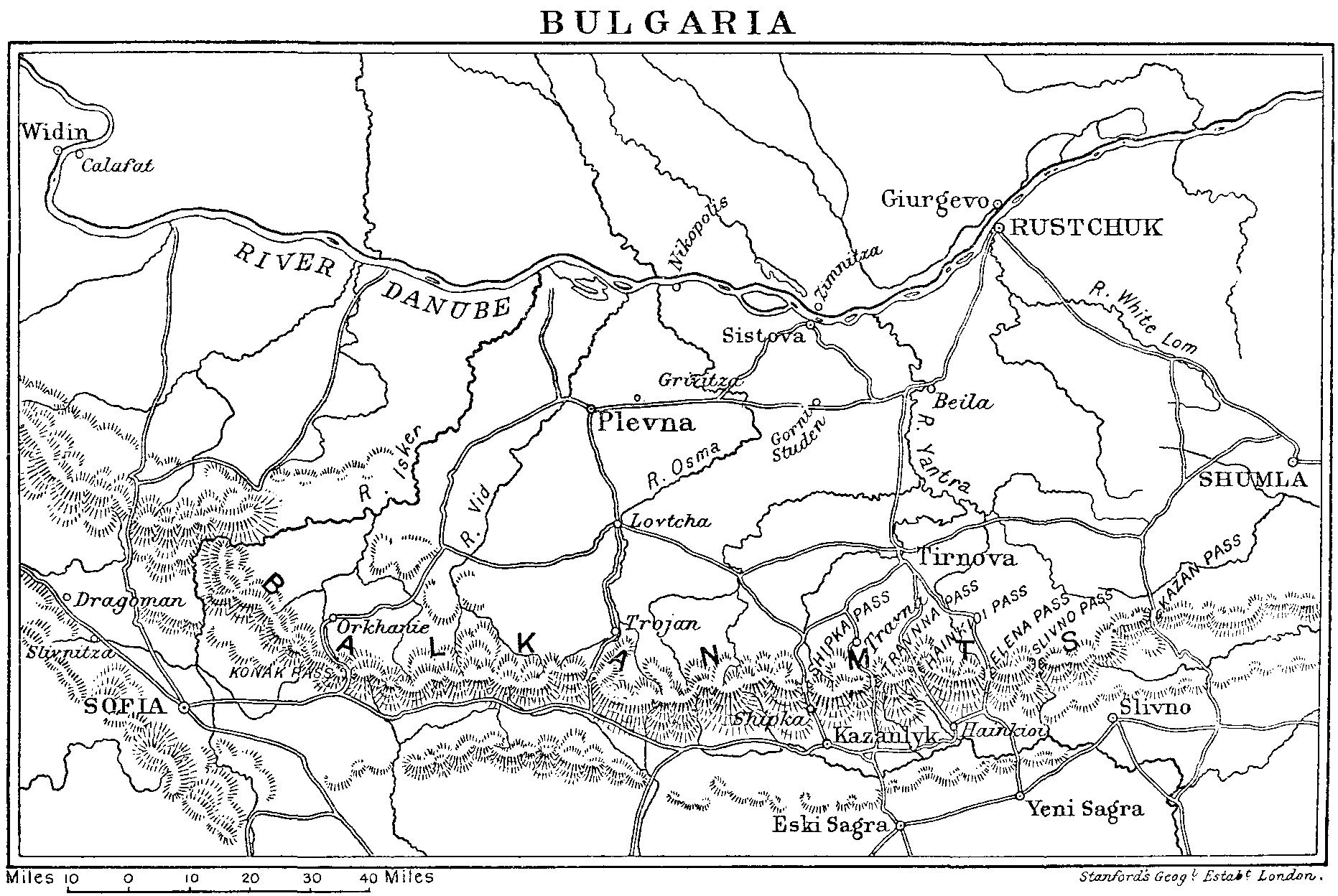
Map of Bulgaria.
to the gravest risks. The apologists of Abdul-Kerim claim that such was his design, and that the signs of sluggishness which he at first displayed formed a necessary part of a deep-laid scheme for luring the Russians to their doom. Let the invaders enter Central Bulgaria in force, and expose their flanks to Abdul-Kerim in the Quadrilateral, and to Osman Pasha at Widdin; then the Turks, by well-concerted moves against those flanks, would drive the enemy back on the Danube, and perhaps compel a large part of his forces to lay down their arms. Such is their explanation of the conduct of Abdul-Kerim.
As the Turkish Government is wholly indifferent to the advance of historical knowledge, it is impossible even now to say whether this idea was definitely agreed on as the basis of the plan of campaign. There are signs that Abdul-Kerim and Osman Pasha adopted it, but whether it was ever approved by the War Council at Constantinople is a different question. Such a plan obviously implied the possession of great powers of self-control by the Sultan and his advisers, in face of the initial success of the Russians; and unless that self-control was proof against panic, the design could not but break down at the crucial point. Signs are not wanting that in the suggestions here tentatively offered, we find a key that unlocks the riddle of the Danubian campaign of 1877.
At first Abdul-Kerim in the Quadrilateral, and Osman at Widdin, maintained a strict defensive. The former posted small bodies of troops, probably not more than 20,000 in all, at Sistova, Nicopolis, and other neighbouring points. But, apart from a heavy bombardment of Russian and Roumanian posts on the northern bank, neither commander did much to mar the hostile preparations. This want of initiative, which contrasted with the enterprise displayed by the Turks in 1854, enabled the invaders to mature their designs with little or no interruption.
The Russian plan of campaign was to destroy or cripple the four small Turkish ironclads that patrolled the lower [pg 197] reaches of the river, to make feints at several points, and to force a passage at two places--first near Ibrail into the Dobrudscha, and thereafter, under cover of that diversion, from Simnitza to Sistova. The latter place of crossing combined all the possible advantages. It was far enough away from the Turkish Quadrilateral to afford the first essentials of safety; it was known to be but weakly held; its position on the shortest line of road between the Danube and a practicable pass of the Balkans--the Shipka Pass--formed a strong recommendation; while the presence of an island helped on the first preparations.
The flood of the Danube having at last subsided, all was ready by midsummer. Russian batteries and torpedo-boats had destroyed two Turkish armoured gunboats in the lower reaches of the river, and on June 22 a Russian force crossed in boats from a point near Galatz to Matchin, and made good their hold on the Dobrudscha.
Preparations were also ripe at Simnitza. In the narrow northern arm of the river the boats and pontoons collected by the Russians were launched with no difficulty, the island was occupied, and on the night of June 26-27, a Volhynian regiment, along with Cossacks, crossed in boats over the broad arm of the river, there some 1000 yards wide, and gained a foothold on the bank. Already their numbers were thinned by a dropping fire from a Turkish detachment; but the Turks made the mistake of trusting to the bullet instead of plying the bayonet. Before dawn broke, the first-comers had been able to ensconce themselves under a bank until other boats came up. Then with rousing cheers they charged the Turks and pressed them back.
This was the scene which greeted the eyes of General Dragomiroff as his boat drew near to the shore at 5 A.M. Half hidden by the morning mist, the issue seemed doubtful. But at his side stood a general, fresh from triumphs in Turkestan, who had begged to be allowed to come as volunteer or aide-de-camp. When Dragomiroff, in an agony of suspense, lowered his glass, the other continued to gaze, and at last [pg 198] exclaimed: "I congratulate you on your victory." "Where do you see that?" asked Dragomiroff "Where? on the faces of the soldiers. Look at them. Watch them as they charge the enemy. It is a pleasure to see them." The verdict was true. It was the verdict of Skobeleff[137].
Such was the first appearance in European warfare of the greatest leader of men that Russia has produced since the days of Suvoroff. The younger man resembled that sturdy veteran in his passion for war, his ambition, and that frank, bluff bearing which always wins the hearts of the soldiery. The grandson of a peasant, whose bravery had won him promotion in the great year, 1812; the son of a general whose prowess was renowned--Skobeleff was at once a commander and a soldier. "Ah! he knew the soul of a soldier as if he were himself a private." These were the words often uttered by the Russians about Skobeleff; similar things had been said of Suvoroff in his day. For champions such as these the emotional Slavs will always pour out their blood like water. But, like the captor of Warsaw, Skobeleff knew when to put aside the bayonet and win the day by skill. Both were hard hitters, but they had a hold on the principles of the art of war. The combination of these qualities was formidable; and many Russians believe that, had the younger man, with his magnificent physique and magnetic personality, enjoyed the length of days vouchsafed to the diminutive Suvoroff, he would have changed the face of two continents.
The United States attaché to the Russian army in the Russo-Turkish War afterwards spoke of his military genius as "stupendous," and prophesied that, should he live twenty years longer, and lead the Russian armies in the next Turkish war, he would win a place side by side with "Napoleon, Wellington, Grant, and Moltke." To equate these four names is a mark of transatlantic enthusiasm rather than of balanced judgment; [pg 199] but the estimate, so far as it concerns Skobeleff, reflects the opinion of nearly all who knew him[138].
Encouraged by the advent of Skobeleff and Dragomiroff, the Russians assumed the offensive with full effect, and by the afternoon of that eventful day, had mastered the rising ground behind Sistova. Here again the Turkish defence was tame. The town was unfortified, but its outskirts presented facilities for defence. Nevertheless, under the pressure of the Russian attack and of artillery fire from the north bank, the small Turkish garrison gave up the town and retreated towards Rustchuk. At many points on that day the Russians treated their foes to a heavy bombardment or feints of crossing, especially at Nicopolis and Rustchuk; and this accounts for the failure of the defenders to help the weak garrison on which fell the brunt of the attack. All things considered, the crossing of the Danube must rank as a highly creditable achievement, skilfully planned and stoutly carried out; it cost the invaders scarcely 700 men[139].
They now threw a pontoon-bridge across the Danube between Simnitza and Sistova; and by July 2 had 65,000 men and 244 cannon in and near the latter town. Meanwhile, their 14th corps held the central position of Babadagh in the Dobrudscha, thereby preventing any attack from the north-east side of the Quadrilateral against their communications with the south of Russia.
It may be questioned, however, whether the invaders did well to keep so large a force in the Dobrudscha, seeing that a smaller body of light troops patrolling the left bank of the lower Danube or at the tête de pont at Matchin would have answered the same purpose. The chief use of the crossing at Matchin was to distract the attention of the enemy, an advance through the unhealthy district of the Dobrudscha against the Turkish Quadrilateral being in every way risky; above all, the retention [pg 200] of a whole corps on that side weakened the main line of advance, that from Sistova; and here it was soon clear that the Russians had too few men for the enterprise in hand. The pontoon-bridge over the Danube was completed by July 2--a fact which enabled those troops which were in Roumania to be hurried forward to the front.
Obviously it was unsafe to march towards the Balkans until both flanks were secured against onsets from the Quadrilateral on the east, and from Nicopolis and Widdin on the west. At Nicopolis, twenty-five miles away, there were about 10,000 Turks; and around Widdin, about 100 miles farther up the stream, Osman mustered 40,000 more. To him Abdul-Kerim now sent an order to march against the flank of the invaders.
Nor were the Balkan passes open to the Russians; for, after the crossing of the Danube, Reuf Pasha had orders to collect all available troops for their defence, from the Shipka Pass to the Slievno Pass farther east; 7000 men now held the Shipka; about 10,000 acted as a general reserve at Slievno; 3000 were thrown forward to Tirnova, where the mountainous country begins, and detachments held the more difficult tracks over the mountains. An urgent message was also sent to Suleiman Pasha to disengage the largest possible force from the Montenegrin war; and, had he received this message in time, or had he acted with the needful speed and skill, events might have gone very differently.
For some time the Turks seemed to be paralysed at all points by the vigour of the Muscovite movements. Two corps, the 13th and 14th, marched south-east from Sistova to the torrent of the Jantra, or Yantra, and seized Biela, an important centre of roads in that district. This secured them against any immediate attack from the Quadrilateral. The Grand Duke Nicholas also ordered the 9th corps, under the command of General Krüdener, to advance from Sistova and attack the weakly fortified town of Nicopolis. Aided by the Roumanian guns on the north bank of the Danube, this [pg 201] corps succeeded in overpowering the defence and capturing the town, along with 7000 troops and 110 guns (July 16).
Thus the invaders seemed to have gained a secure base on the Danube, from Sistova to Nicopolis, whence they could safely push forward their vanguard to the Balkans. In point of fact their light troops had already seized one of its more difficult passes--an exploit that will always recall the name of that dashing leader, General Gurko. The plan now to be described was his conception; it was approved by the Grand Duke Nicholas. Setting out from Sistova and drawing part of his column from the forces at Biela, Gurko first occupied the important town of Tirnova, the small Turkish garrison making a very poor attempt to defend the old Bulgarian capital (July 7). The liberators there received an overwhelming ovation, and gained many recruits for the "Bulgarian Legion." Pushing ahead, the Cossacks and Dragoons seized large supplies of provisions stored by the Turks, and gained valuable news respecting the defences of the passes.
The Shipka Pass, due south of Tirnova, was now strongly held, and Turkish troops were hurrying towards the two passes north of Slievno, some fifty miles farther east. Even so they had not enough men at hand to defend all the passes of the mountain chain that formed their chief line of defence. They left one of them practically undefended; this was the Khainkoi Pass, having an elevation of 3700 feet above the sea.
A Russian diplomatist, Prince Tserteleff, who was charged to collect information about the passes, found that the Khainkoi enjoyed an evil reputation. "Ill luck awaits him who crosses the Khainkoi Pass," so ran the local proverb. He therefore determined to try it; by dint of questioning the friendly Bulgarian peasantry he found one man who had been through it once, and that was two years before with an ox-cart. Where an ox-cart could go, a light mountain gun could go. Accordingly, the Prince and General Rauch went with 200 Cossacks to explore the pass, set the men to work at the worst places, and, thanks to the secrecy observed by the peasantry, soon [pg 202] made the path to the summit practicable for cavalry and light guns. The Prince disguised himself as a Bulgarian shepherd to examine the southern outlet; and, on his bringing a favourable report, 11,000 men of Gurko's command began to thread the intricacies of the defile.
Thanks to good food, stout hearts, jokes, and songs, they managed to get the guns up the worst places. Then began the perils of the descent. But the Turks knew nothing of their effort, else it might have ended far otherwise. At the southern end 300 Turkish regulars were peacefully smoking their pipes and cooking their food when the Cossack and Rifles in the vanguard burst upon them, drove them headlong, and seized the village of Khainkoi. A pass over the Balkans had been secured at the cost of two men killed and three wounded. Gurko was almost justified in sending to the Grand Duke Nicholas the proud vaunt that none but Russian soldiers could have brought field artillery over such a pass, and in the short space of three days (July 11-14)[140].
After bringing his column of 11,000 men through the pass, Gurko drove off four Turkish battalions sent against him from the Shipka Pass and Kazanlik. Next he sent out bands of Cossacks to spread terror southwards, and delude the Turks into the belief that he meant to strike at the important towns, Jeni Zagra and Eski Zagra, on the road to Adrianople. Having thus caused them to loosen their grip on Kazanlik and the Shipka, he wheeled his main force to the westward (leaving 3500 men to hold the exit of the Khainkoi), and drove the Turks successively from positions in front of the town, from the town itself, and then from the village of Shipka. Above that place towered the mighty wall of the Balkans, lessened somewhat at the pass itself, but presenting even there a seemingly impregnable position.
Gurko, however, relied on the discouragement of the [pg 203] Turkish garrison after the defeats of their comrades, and at seeing their positions turned on the south while they were also threatened on the north. For another Russian column had advanced from Tirnova up the more gradual northern slopes of the Balkans, and now began to hammer at the defences of the pass on that side. The garrison consisted of six and a half battalions under Khulussi Pasha, and the wreckage of five battalions already badly beaten by Gurko's column. These, with one battery of artillery, held the pass and the neighbouring peaks, which they had in part fortified.
In pursuance of a pre-arranged plan for a joint attack on July 17 of both Russian forces, the northern body advanced up the slopes; but, as Gurko's men were unable to make their diversion in time, the attack failed. An isolated attempt by Gurko's force on the next day also failed, the defenders disgracing themselves by tricking the Russians with the white flag and firing upon them. But the Turks were now in difficulties for want of food and water; or possibly they were seized with panic. At any rate, while amusing the Russians with proposals of surrender, they stole off in small bodies, early on July 19. The truth was, ere long, found out by outposts of the north Russian forces; Skobeleff and his men were soon at the summit, and there Gurko's vanguard speedily joined them with shouts of joy.
Thus, within twenty-three days from the crossing of the Danube Gurko seized two passes of the Balkans, besides capturing 800 prisoners and 13 guns. It is not surprising that a Turkish official despatch of July 21 to Suleiman summed up the position: "The existence of the Empire hangs on a hair." And when Gurko's light troops proceeded to raid the valley of the Maritsa, it seemed that the Turkish defence would collapse as helplessly as in the memorable campaign of 1828. We must add here that the Bulgarians now began to revenge themselves for the outrages of May 1876; and the struggle was sullied by horrible acts on both sides.
The impression produced by these dramatic strokes was profound [pg 204] and widespread. The British fleet was sent to Besika Bay, a step preparatory, as it seemed, to steaming up the Dardanelles to the Sea of Marmora. At Adrianople crowds of Moslems fled away in wild confusion towards Constantinople. There the frequent meetings of ministers at the Sultan's palace testified to the extent of the alarm; and that nervous despot wavered between the design of transferring the seat of government to Brussa in Asia Minor, and that of unfurling the standard of the Prophet and summoning all the faithful to rally to its defence against the infidels. Finally he took courage from despair, and adopted the more manly course. But first he disgraced his ministers. The War Minister and Abdul-Kerim were summarily deposed, the latter being sent off as prisoner to the island of Lemnos.
All witnesses agree that the War Minister, Redif Pasha, was incapable and corrupt. The age and weakness of Abdul-Kerim might have excused his comparative inaction in the Quadrilateral in the first half of July. It is probable that his plan of campaign, described above, was sound; but he lacked the vigour, and the authorities at Constantinople lacked the courage, to carry it out thoroughly and consistently.
Mehemet Ali Pasha, a renegade German, who had been warring with some success in Montenegro, assumed the supreme command on July 22; and Suleiman Pasha, who, with most of his forces had been brought by sea from Antivari to the mouth of the River Maritsa, now gathered together all the available troops for the defence of Roumelia.
The Czar, on his side, cherished hopes of ending the war while Fortune smiled on his standards. There are good grounds for thinking that he had entered on it with great reluctance. In its early stages he let the British Government know of his desire to come to terms with Turkey; and now his War Minister, General Milutin, hinted to Colonel F.A. Wellesley, British attaché at headquarters, that the mediation of Great Britain would be welcomed by Russia. That officer on July 30 had an interview with the Emperor, who set forth the conditions on which he would be prepared to accept peace [pg 205] with Turkey. They were--the recovery of the strip of Bessarabia lost in 1856, and the acquisition of Batoum in Asia Minor. Alexander II. also stated that he would not occupy Constantinople unless that step were necessitated by the course of events; that the Powers would be invited to a conference for the settlement of Turkish affairs; and that he had no wish to interfere with the British spheres of interest already referred to. Colonel Wellesley at once left headquarters for London, but on the following day the aspect of the campaign underwent a complete change, which, in the opinion of the British Government, rendered futile all hope of a settlement on the conditions laid down by the Czar.[141]
For now, when the Turkish cause seemed irrevocably lost, the work of a single brave man to the north of the Balkans dried up, as if by magic, the flood of invasion, brought back victory to the standards of Islam, and bade fair to overwhelm the presumptuous Muscovites in the waters of the Danube. Moltke in his account of the war of 1828, had noted a peculiarity of the Ottomans in warfare (a characteristic which they share with the glorious defenders of Saragossa in 1808) of beginning the real defence when others would abandon it as hopeless. This remark, if not true of the Turkish army as a whole, certainly applies to that part of it which was thrilled to deeds of daring by Osman Pasha.
More fighting had fallen to him perhaps than to any Turk of his time. He was now forty years of age; his frame, slight and of middle height, gave no promise of strength or capacity; neither did his face, until the observer noted the power of his eyes to take in the whole situation "with one slow comprehensive look[142]." This gave him a magnetic faculty, the effect of which was not wholly marred by his disdainful manners, curt speech, and contemptuous treatment of foreigners. Clearly here was a cold, sternly objective nature like that of Bonaparte. [pg 206] He was a good representative of the stolid Turk of the provinces, who, far from the debasing influence of the Court, retains the fanaticism and love of war on behalf of his creed that make his people terrible even in the days of decline[143].
In accordance with the original design of Abdul-Kerim, Osman had for some time remained passive at Widdin. On receiving orders from the commander-in-chief, he moved eastwards on July 13, with 40,000 men, to save Nicopolis. Finding himself too late to save that place he then laid his plans for the seizure of Plevna. The importance of that town, as a great centre of roads, and as possessing many advantages for defence on the hills around, had been previously pointed out to the Russian Staff by Prince Charles of Roumania, as indeed, earlier still, by Moltke. Accordingly, the Grand Duke Nicholas had directed a small force of cavalry towards that town. General Krüdener made the mistake of recalling it in order to assist in the attack on Nicopolis on July 14-16, an unlucky move, which enabled Osman to occupy Plevna without resistance on July 19[144]. On the 18th the Grand Duke Nicholas ordered General Krüdener to occupy Plevna. Knowing nothing of Osman's whereabouts, his vanguard advanced heedlessly on the town, only to meet with a very decided repulse, which cost the Russians 3000 men (July 20).
Osman now entrenched himself on the open downs that stretch eastwards from Plevna. As will be seen by reference to the map on page 213, his position, roughly speaking, formed an ellipse pointing towards the village of Grivitza. Above that village his engineers threw up two great redoubts which dominated the neighbourhood. Other redoubts and trenches screened Plevna on the north-east and south. Finally, the crowns of three main slopes lying to the east of Plevna bristled with defensive works. West of the town lay the deep vale of the little River Wid, itself the chief defence on that side. We may state here that during the long operations against Plevna [pg 207] the Russians had to content themselves with watching this western road to Orkanye and Sofia by means of cavalry; but the reinforcements from Sofia generally made their way in. From that same quarter the Turks were also able to despatch forces to occupy the town of Lovtcha, between Plevna and the Shipka Pass.
The Russian Staff, realising its error in not securing this important centre of roads, and dimly surmising the strength of the entrenchments which Osman was throwing up near to the base of their operations, determined to attack Plevna at once. Their task proved to be one of unexpected magnitude. Already the long curve of the outer Turkish lines spread along slopes which formed natural glacis, while the ground farther afield was so cut up by hollows as to render one combined assault very difficult. The strength, and even the existence, of some of Osman's works were unknown. Finally, the Russians are said to have had only 32,000 infantry men at hand with two brigades of cavalry.
Nevertheless, Generals Krüdener and Schahofski received orders to attack forthwith. They did so on July 31. The latter, with 12,000 men took two of the outer redoubts on the south side, but had to fall back before the deadly fire that poured on him from the inner works. Krüdener operated against the still stronger positions on the north; but, owing to difficulties that beset his advance, he was too late to make any diversion in favour of his colleague. In a word, the attack was ill planned and still worse combined. Five hours of desperate fighting yielded the assailants not a single substantial gain; their losses were stated officially to be 7336 killed and wounded; but this is certainly below the truth. Turkish irregulars followed the retreating columns at nightfall, and butchered the wounded, including all whom they found in a field-hospital.
This second reverse at Plevna was a disaster of the first magnitude. The prolongation of the Russian line beyond the Balkans had left their base and flanks too weak to stand against the terrible blows that Osman seemed about to deal [pg 208] from his point of vantage. Plevna was to their right flank what Biela was to their left. Troops could not be withdrawn from the latter point lest the Turks from Shumla and Rustchuk should break through and cut their way to the bridge at Sistova; and now Osman's force threatened that spinal cord of the Russian communications. If he struck how could the blow be warded off? For bad news poured in from all quarters. From Armenia came the tidings that Mukhtar Pasha, after a skilful retreat and concentration of force, had turned on the Russians and driven them back in utter confusion.
From beyond the Balkans Gurko sent news that Suleiman's army was working round by way of Adrianople, and threatened to pin him to the mountain chain. In fact, part of Gurko's corps sustained a serious reverse at Eski Zagra, and had to retreat in haste through the Khainkoi Pass; while its other sections made their way back to the Shipka Pass, leaving a rearguard to hold that important position (July 30-August 8). Thus, on all sides, proofs accumulated that the invaders had attempted far too much for their strength, and that their whole plan of campaign was more brilliant than sound. Possibly, had not the 14th corps been thrown away on the unhealthy Dobrudscha, enough men would have been at hand to save the situation. But now everything was at stake.
The whole of the month of August was a time of grave crisis for the Russians, and it is the opinion of the best military critics that the Turks, with a little more initiative and power of combination, might have thrown the Russians back on the Danube in utter disarray. From this extremity the invaders were saved by the lack among the Turks of the above-named gifts, on which, rather than on mere bravery, the issue of campaigns and the fate of nations now ultimately depend. True to their old renown, the Turks showed signal prowess on the field of battle, but they lacked the higher intellectual qualities that garner the full harvest of results.
Osman, either because he knew not that the Russians had used up their last reserves at Plevna, or because he mistrusted [pg 209] the manoeuvring powers of his men, allowed Krüdener quietly to draw off his shattered forces towards Sistova, and made only one rather half-hearted move against that all-important point. The new Turkish commander-in-chief, Mehemet Ali, gathered a formidable array in front of Shumla and drove the Russian army now led by the Cesarewich back on Biela, but failed to pierce their lines. Finally, Suleiman Pasha, in his pride at driving Gurko through the Khainkoi Pass, wasted time on the southern side, first by harrying the wretched Bulgarians, and then by hurling his brave troops repeatedly against the now almost impregnable position on the Shipka Pass.
It is believed that jealousy of the neighbouring Turkish generals kept Suleiman from adopting less wasteful and more effective tactics. If he had made merely a feint of attacking that post, and had hurried with his main body through the Slievno Pass on the east to the aid of Mehemet, or through the western defiles of the Balkans to the help of the brave Osman in his Plevna-Lovtcha positions, probably the gain of force to one or other of them might have led to really great results. As it was, these generals dealt heavy losses to the invaders, but failed to drive them back on the Danube.
Moreover, Russian reinforcements began to arrive by the middle of August, the Emperor having already, on July 22, called out the first ban of the militia and three divisions of the reserve of the line, in all some 224,000 men[145].
The bulk of these men did not arrive until September; and meanwhile the strain was terrible. The war correspondence of Mr. Archibald Forbes reveals the state of nervous anxiety in which Alexander II. was plunged at this time. Forbes had been a witness of the savage tenacity of the Turkish attack and the Russian defence on the hills commanding the Shipka Pass. Finally, he had shared in the joy of the hard-pressed defenders at the timely advent of a rifle battalion hastily sent up on Cossack ponies, and the decisive charge of General Radetzky at the head of two companies of reserves at a Turkish breastwork [pg 210] in the very crisis of the fight (Aug. 24). Then, after riding post-haste northwards to the Russian headquarters at Gornisstuden, he was at once taken to the Czar's tent, and noted the look of eager suspense on his face until he heard the reassuring news that Radetzky kept his seat firm on the pass.
The worst was now over. The Russian Guards, 50,000 strong, were near at hand, along with the other reinforcements above named. The urgency of the crisis also led the Grand Duke Nicholas to waive his claim that the Roumanian troops should be placed under his immediate command. Accordingly, early in August, Prince Charles led some 35,000 Roumanians across the Danube, and was charged with the command of all the troops around Plevna[146]. The hopes of the invaders were raised by Skobeleff's capture, on September 3, of Lovtcha, a place half-way between Plevna and the Balkans, which had ensured Osman's communications with Suleiman Pasha. The Turkish losses at Lovtcha are estimated at nearly 15,000 men[147].
This success having facilitated the attack on Plevna from the south, a general assault was ordered for September 11. In the meantime Osman also had received large reinforcements from Sofia, and had greatly strengthened his defences. So skilfully had outworks been thrown up on the north-east of Plevna that what looked like an unimportant trench was found to be a new and formidable redoubt, which foiled the utmost efforts of the 3rd Roumanian division to struggle up the steep slopes on that side. To their 4th division and to a Russian brigade fell an equally hard task, that of advancing from the east against the two Grivitza redoubts which had defied all assaults. The Turks showed their usual constancy, despite the heavy and prolonged bombardment which preluded the attack here and all along the lines. But the weight and vigour of the onset told by degrees; and the Russian and [pg 211] Roumanian supports finally carried by storm the more southerly of the two redoubts. The Turks made desperate efforts to retrieve this loss. From the northern redoubt and the rear entrenchments somewhat to the south there came a galling fire which decimated the victors; for a time the Turks succeeded in recovering the work, but at nightfall the advance of other Russian and Roumanian troops ousted the Moslems. Thenceforth the redoubt was held by the allies.
Meanwhile, to the south of the village of Grivitza the 4th and 9th Russian Corps had advanced in dense masses against the cluster of redoubts that crowned the heights south-east of Plevna; but their utmost efforts were futile; under the fearful fire of the Turks the most solid lines melted away, and the corps fell back at nightfall, with the loss of 110 officers and 5200 men.
Only on the south and south-west did the assailants seriously imperil Osman's defence at a vital point; and here again Fortune bestowed her favours on a man who knew how to wrest the utmost from her, Michael Dimitrievitch Skobeleff. Few men or women could look on his stalwart figure, frank, bold features, and keen, kindling eyes without a thrill of admiration. Tales were told by the camp-fires of the daring of his early exploits in Central Asia; how, after the capture of Khiva in 1874, he dressed himself in Turkoman garb, and alone explored the route from that city to Igdy, as well as the old bed of the River Oxus; or again how, at the capture of Khokand in the following year, his skill and daring led to the overthrow of a superior force and the seizure of fifty-eight guns. Thus, at thirty-two years of age he was the darling of the troops; for his prowess in the field was not more marked than his care and foresight in the camp. While other generals took little heed of their men, he saw to their comforts and cheered them by his jokes. They felt that he was the embodiment of the patriotism, love of romantic exploit, and soaring ambition of the Great Russians.
They were right. Already, as will appear in a later chapter, [pg 212] he was dreaming of the conquest of India; and, like Napoleon, he could not only see visions but also master details, from the principles of strategy to the routine of camp life, which made those visions realisable. If ambition spurred him on towards Delhi, hatred of things Teutonic pointed him to Berlin. Ill would it have fared with the peace of the world had this champion of the Slavonic race lived out his life. But his fiery nature wore out its tenement, the baser passions, so it is said, contributing to hasten the end of one who lived his true life only amidst the smoke of battle. In war he was sublime. Having recently came from Central Asia, he was at first unattached to any corps, and roved about in search of the fiercest fighting. His insight and skill had warded off a deadly flank attack on Schahofski's shattered corps at Plevna on July 30, and his prowess had contributed largely to the capture of Lovtcha on September 3. War correspondents, who knew their craft, turned to follow Skobeleff, wherever official reports might otherwise direct them; and the lust of fighting laid hold of the grey columns when they saw the "white general" approach.
On September 11 Prince Imeritinski and Skobeleff (the order should be inverted) commanded the extreme left of the Russian line, attacking Plevna from the south. Having four regiments of the line and four battalions of sharpshooters--about 12,000 men in all--he ranged them at the foot of the hill, whose summit was crowned by an all-important redoubt-the "Kavanlik." There were four others that flanked the approach. When the Russian guns had thoroughly cleared the way for an assault, he ordered the bands to play and the two leading regiments to charge up the slope. Keeping his hand firmly on the pulse of the battle, he saw them begin to waver under the deadly fire of the Turks; at once he sent up a rival regiment; the new mass carried on the charge until it too threatened to die away. The fourth regiment struggled up into that wreath of death, and with the like result.
Then Skobeleff called on his sharpshooters to drive home
[pg 213]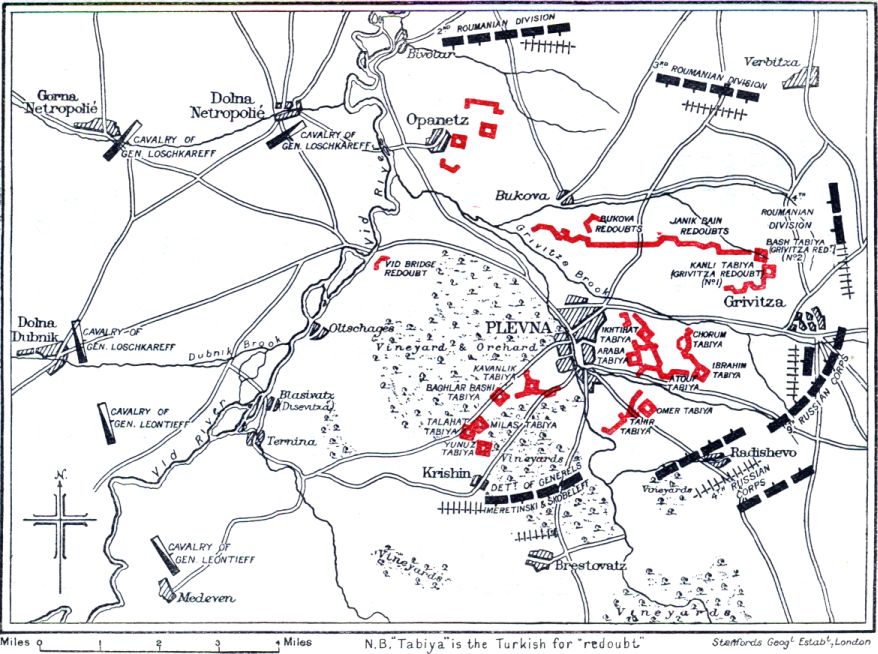
Plan of Plevna.
the onset. Riding on horseback before the invigorating lines, he swept on the stragglers and waverers until all of them came under the full blast of the Turkish flames vomited from the redoubt. There his sword fell, shivered in his hand, and his horse rolled over at the very verge of the fosse. Fierce as ever, the leader sprang to his feet, waved the stump in air, and uttered a shout which put fresh heart into his men. With him they swarmed into the fosse, up the bank, and fell on the defenders. The bayonet did the rest, taking deadly revenge for the murderous volleys.
But Osman's engineers had provided against such an event. The redoubt was dominated from the left and could be swept by cross fire from the rear and right. On the morrow the Turks drew in large forces from the north side and pressed the victors hard. In vain did Skobeleff send urgent messages for reinforcements to make good the gaps in his ranks. None were sent, or indeed could be sent. Five times his men beat off the foe. The sixth charge hurled them first from the Kavanlik redoubt, and thereafter from the flanking works and trenches out on to that fatal slope. A war correspondent saw Skobeleff after this heart-breaking loss, "his face black with powder and smoke, his eyes haggard and bloodshot, and his voice quite gone. I never before saw such a picture of battle[148]."
Thus all the efforts of the Russians and Roumanians had failed to wrest more than a single redoubt from the Moslems; and at that point they were unable to make any advance against the inner works. The fighting of September 11-12 is believed to have cost the allies 18,000 men killed and wounded out of the 75,000 infantrymen engaged. The mistakes of July 31 had been again repeated. The number of assailants was too small for an attack on so great an extent of fortified positions defended with quick-firing rifles. Had the Russians, while making feints at other points to hold the Turks there, concentrated their efforts either on the two Grivitza redoubts, or [pg 215] on those about the Kavanlik work, they would almost certainly have succeeded. As it was, they hurled troops in close order against lines, the strength of which was not well known; and none of their commanders but Skobeleff employed tactics that made the most of their forces[149]. The depression at the Russian headquarters was now extreme[150]. On September 13 the Emperor held a council of war at which the Prince of Roumania, the Grand Duke Nicholas, General Milutin (Minister of War), and three other generals were present. The Grand Duke declared that the only prudent course was to retire to the Danube, construct a tête de pont guarding the southern end of their bridge and, after receiving reinforcements, again begin the conquest of Bulgaria. General Milutin, however, demurred to this, seeing that Osman's army was not mobile enough to press them hard; he therefore proposed to await the reinforcements in the positions around Plevna. The Grand Duke thereupon testily exclaimed that Milutin had better be placed in command, to which the Emperor replied: "No; you shall retain the command; but the plan suggested by the Minister of War shall be carried out[151]."
The Emperor's decision saved the situation. The Turks made no combined effort to advance towards Plevna in force; and Osman felt too little trust in the new levies that reached him from Sofia to move into the open and attack Sistova. Indeed, Turkish strategy over the whole field of war is open to grave censure. On their side there was a manifest lack of combination. Mehemet Ali pounded away for a month at the army of the Czarewitch on the River Lom, and then drew back his forces (September 24). He allowed Suleiman Pasha to fling his troops in vain against the natural stronghold of the Russians at the Shipka Pass, and had made no dispositions for succouring Lovtcha. Obviously he should have concentrated the Turkish forces so as to deal a timely and decisive blow either on the [pg 216] Lom or on the Sofia-Plevna road. When he proved his incapacity both as commander-in-chief and as commander of his own force, Turkish jealousy against the quondam German flared forth; and early in October he was replaced by Suleiman. The change was greatly for the worse. Suleiman's pride and obstinacy closed the door against larger ideas, and it has been confidently stated that at the end of the campaign he was bribed by the Russians to betray his cause. However that may be, it is certain that the Turkish generals continued to fight, each for his own hand, and thus lost the campaign.
It was now clear that Osman must be starved out from the position which the skill of his engineers and the steadiness of his riflemen had so speedily transformed into an impregnable stronghold. Todleben, the Russian engineer, who had strengthened the outworks of Sevastopol, had been called up to oppose trench to trench, redoubt to redoubt. Yet so extensive were the Turkish works, and so active was Shevket Pasha's force at Sofia in sending help and provisions, that not until October 24 was the line of investment completed, and by an army which now numbered fully 120,000 men. By December 10 Osman came to the end of his resources and strove to break out on the west over the River Wid towards Sofia. Masking the movement with great skill, he inflicted heavy losses on the besiegers. Slowly, however, they closed around him, and a last scene of slaughter ended in the surrender of the 43,000 half-starved survivors, with the 77 guns that had wrought such havoc among the invaders. Osman's defence is open to criticism at some points, but it had cost Russia more than 50,000 lives, and paralysed her efforts in Europe during five months.
The operations around Plevna are among the most instructive in modern warfare, as illustrating the immense power that quick-firing rifles confer upon the defence. Given a nucleus of well-trained troops, with skilled engineers, any position of ordinary strength can quickly be turned into a stronghold that will foil the efforts of a far greater number of [pg 217] assailants. Experience at Plevna showed that four or five times as many men were needed to attack redoubts and trenches as in the days of muzzle-loading muskets. It also proved that infantry fire is far more deadly in such cases than the best served artillery. And yet a large part of Osman's troops--perhaps the majority after August--were not regulars. Doubtless that explains why (with the exception of an obstinate but unskilful effort to break out on August 31) he did not attack the Russians in the open after his great victories of July 31 and September 11-12. On both occasions the Russians were so badly shaken that, in the opinion of competent judges, they could easily have been driven in on Nicopolis or Sistova, in which case the bridges at those places might have been seized. But Osman did not do so, doubtless because he knew that his force, weak in cavalry and unused to manoeuvring, would be at a disadvantage in the open. Todleben, however, was informed on good authority that, when the Turkish commander heard of the likelihood of the investment of Plevna, he begged the Porte to allow him to retire; but the assurance of Shevket Pasha, the commander of the Turkish force at Sofia, that he could keep open communications between that place and Plevna, decided the authorities at Constantinople to order the continuance of defensive tactics[152].
Whatever may have been the cause of this decision it ruined the Turkish campaign. Adherence to the defensive spells defeat now, as it has always done. Defeat comes more slowly now that quick-firing rifles quadruple the power of the defence; but all the same it must come if the assailant has enough men to throw on that point and then at other points. Or, to use technical terms, while modern inventions alter tactics, that is, the dispositions of troops on the field of battle--a fact which the Russians seemed to ignore at Plevna--they do not change the fundamental principles of strategy. These are practically [pg 218] immutable, and they doom to failure the side that, at the critical points, persists in standing on the defensive. A study of the events around Plevna shows clearly what a brave but ill-trained army can do and what it cannot do under modern conditions.
From the point of view of strategy--that is, the conduct of the great operations of a campaign--Osman's defence of Plevna yields lessons of equal interest. It affords the most brilliant example in modern warfare of the power of a force strongly intrenched in a favourable position to "contain," that is, to hold or hold back, a greater force of the enemy. Other examples are the Austrian defence of Mantua in 1796-97, which hindered the young Bonaparte's invasion of the Hapsburg States; Bazaine's defence of Metz in 1870; and Sir George White's defence of Ladysmith against the Boers. We have no space in which to compare these cases, in which the conditions varied so greatly. Suffice it to say that Mantua and Plevna were the most effective instances, largely because those strongholds lay near the most natural and easy line of advance for the invaders. Metz and Ladysmith possessed fewer advantages in this respect; and, considering the strength of the fortress and the size and quality of his army, Bazaine's conduct at Metz must rank as the weakest on record; for his 180,000 troops "contained" scarcely more than their own numbers of Germans.
On the other hand, Osman's force brought three times its number of Russians to a halt for five months before hastily constructed lines. In the opinion of many authorities the Russians did wrong in making the whole campaign depend on Plevna. When it was clear that Osman would cling to the defensive, they might with safety have secretly detached part of the besieging force to help the army of the Czarewitch to drive back the Turks on Shumla. This would have involved no great risk; for the Russians occupied the inner lines of what was, roughly speaking, a triangle, resting on the Shipka Pass, the River Lom, and Plevna as its extreme points. Having the advantage of the inner position, they could quickly [pg 219] have moved part of their force at Plevna, battered in the Turkish defence on the Lom, and probably captured the Slievno passes. In that case they would have cleared a new line of advance to Constantinople farther to the east, and made the possession of Plevna of little worth. Its value always lay in its nearness to their main line of advance, but they were not tied to that line. It is safe to say that, if Moltke had directed their operations, he would have devised some better plan than that of hammering away at the redoubts of Plevna.
In fact, the Russians made three great blunders: first, in neglecting to occupy Plevna betimes; second, in underrating Osman's powers of defence; third, in concentrating all their might on what was a very strong, but not an essential, point of the campaign.
The closing scenes of the war are of little interest except in the domain of diplomacy. Servia having declared war against Turkey immediately after the fall of Plevna, the Turks were now hopelessly outnumbered. Gurko forced his way over one of the western passes of the Balkans, seized Sofia (January 4, 1878), and advancing quickly towards Philippopolis, utterly routed Suleiman's main force near that town (January 17). The Turkish commander-in-chief thus paid for his mistake in seeking to defend a mountain chain with several passes by distributing his army among those passes. Experience has proved that this invites disaster at the hands of an enterprising foe, and that the true policy is to keep light troops or scouts at all points, and the main forces at a chief central pass and at a convenient place in the rear, whence the invaders may be readily assailed before they complete the crossing. As it was, Suleiman saw his main force, still nearly 50,000 strong, scatter over the Rhodope mountains; many of them reached the Aegean Sea at Enos, whence they were conveyed by ship to the Dardanelles. He himself was tried by court-martial and imprisoned for fifteen years[153].
[pg 220]A still worse fate befell those of his troops which hung about Radetzky's front below the Shipka Pass. The Russians devised skilful moves for capturing this force. On January 5-8 Prince Mirsky threaded his way with a strong column through the deep snows of the Travna Pass, about twenty-five miles east of the Shipka, which he then approached; while Skobeleff struggled through a still more difficult defile west of the central position. The total strength of the Russians was 56,000 men. On the 8th, when their cannon were heard thundering in the rear of the Turkish earthworks at the foot of the Shipka Pass, Radetzky charged down on the Turkish positions in front, while Mirsky assailed them from the east. Skobeleff meanwhile had been detained by the difficulties of the path and the opposition of the Turks on the west. But on the morrow his onset on the main Turkish positions carried all before it. On all sides the Turks were worsted and laid down their arms; 36,000 prisoners and 93 guns (so the Russians claim) were the prize of this brilliant feat (January 9, 1878)[154].
In Roumelia, as in Armenia, there now remained comparatively few Turkish troops to withstand the Russian advance, and the capture of Constantinople seemed to be a matter of a few weeks. There are grounds for thinking that the British Ministry, or certainly its chief, longed to send troops from Malta to help in its defence. Colonel Wellesley, British attaché at the Russian headquarters, returned to London at the time when the news of the crossing of the Balkans reached the Foreign Office. At once he was summoned to see the Prime Minister, who inquired eagerly as to the length of time which would elapse before the Russians occupied Adrianople. The officer thought that that event might occur within a month--an estimate which proved to be above the mark. Lord Beaconsfield was deeply concerned to hear this and added, "If you can only guarantee me six weeks, I see my way." He did not further explain his meaning; but Colonel Wellesley felt sure that he wished to move British troops from [pg 221] Malta to Constantinople[155]. Fortunately the Russian advance to Adrianople was so speedy--their vanguard entered that city on January 20--as to dispose of any such project. But it would seem that only the utter collapse of the Turkish defence put an end to the plans of part at least of the British Cabinet for an armed intervention on behalf of Turkey.
Here, then, as at so many points of their history, the Turks lost their opportunity, and that, too, through the incapacity and corruption of their governing class. The war of 1877 ended as so many of their wars had ended. Thanks to the bravery of their rank and file and the mistakes of the invaders, they gained tactical successes at some points; but they failed to win the campaign owing to the inability of their Government to organise soundly on a great scale, and the intellectual mediocrity of their commanders in the sphere of strategy. Mr. Layard, who succeeded Sir Henry Elliot at Constantinople early in 1878, had good reason for writing, "The utter rottenness of the present system has been fully revealed by the present war[156]." Whether Suleiman was guilty of perverse obstinacy, or, as has often been asserted, of taking bribes from the Russians, cannot be decided. What is certain is that he was largely responsible for the final débacle.
But in a wider and deeper sense the Turks owed their misfortunes to themselves--to their customs and their creed. Success in war depends ultimately on the brain-power of the chief leaders and organisers; and that source of strength has long ago been dried up in Turkey by adhesion to a sterilising creed and cramping traditions. The wars of the latter half of the nineteenth century are of unique interest, not only because they have built up the great national fabrics of to-day, but also because they illustrate the truth of that suggestive remark of the great Napoleon, "The general who does great things is he who also possesses qualities adapted for civil life."
FOOTNOTES:
[129] Hertslet, vol. iv. p. 2625.
[130] The Campaign in Bulgaria, by F.V. Greene, pt. ii. ch. i.; W.V. Herbert, The Defence of Plevna, chaps, i.-ii.
[131] Aus drei Kriegen, by Gen. von Lignitz, p. 99.
[132] With the Russians in War and Peace, by Colonel F.A. Wellesley (1905), ch. xvii.
[133] Hertslet, vol. iv. p. 2577.
[134] Reminiscences of the King of Roumania, edited by S. Whitman (1899), pp. 269, 274.
[135] Farcy, La Guerre sur le Danube, p. 73. For other malpractices see Colonel F.A. Wellesley's With the Russians in Peace and War, chs. xi. xii.
[136] Punch hit off the situation by thus parodying the well-known line of Horace: "Russicus expectat dum defluat amnis."
[137] Quoted from a report by an eye-witness, by "O.K." (Madame Novikoff), Skobeleff and the Slavonic Cause, p. 38. The crossing was planned by the Grand Duke Nicholas; see von Lignitz, Aus drei Kriegen, p. 149.
[138] F.V. Green, Sketches of Army Life in Russia, p. 142.
[139] Farcy, La Guerre sur le Danube, ch. viii.; Daily News Correspondence of the War of 1877-78, ch. viii.
[140] General Gurko's Advance Guard In 1877, by Colonel Epauchin, translated by H. Havelock (The Wolseley Series, 1900), ch. ii.; The Daily News War Correspondence (1877), pp. 263-270.
[141] Parl. Papers, Turkey, No. 9 (1878), Nos. 2, 3. With the Russians in Peace and War, by Colonel the Hon. F.A. Wellesley, ch. xx.
[142] W.W. Herbert, The Defence of Plevna, p. 81.
[143] For these qualities, see Turkey in Europe, by "Odysseus," p. 97.
[144] Herbert, The Defence of Plevna, p. 129.
[145] F.V. Greene, The Campaign in Bulgaria, p. 225.
[146] Reminiscences of the King of Roumania, p. 275.
[147] F.V. Greene, op. cit. p. 232.
[148] War Correspondence of the "Daily News," pp. 479-483. For another character-sketch of Skobeleff see the Fortnightly Review of Oct. 1882, by W.K. Rose.
[149] For an account of the battle, see Greene, op. cit. pt. ii. chap. v.
[150] Gen. von. Lignitz, Aus drei Kriegen, p. 167.
[151] Col. F.A. Wellesley, op. cit. p. 281.
[152] A. Forbes, Czar and Sultan, p. 291. On the other hand, W.V. Herbert (op. cit. p. 456) states that it was Osman's wish to retire to Orkanye, on the road to Sofia, and that this was forbidden. For remarks on this see Greene, op. cit. chap. viii.
[153] Sir N. Layard attributed to him the overthrow of Turkey. See his letter of February 1, 1878, in Sir W. White: Life and Correspondence, p. 127.
[154] Greene, op. cit. chap. xi. I have been assured by an Englishman serving with the Turks that these numbers were greatly exaggerated.
[155] With the Russians in Peace and War, by Colonel F.A. Wellesley, p. 272.
[156] Sir William White: Life and Correspondence, p. 128.
New hopes should animate the world; new light
Should dawn from new revealings to a race
Weighed down so long, forgotten so long.
ROBERT BROWNING, Paracelsus.
The collapse of the Turkish defence in Roumelia inaugurated a time of great strain and stress in Anglo-Russian relations. On December 13, 1877, that is, three days after the fall of Plevna, Lord Derby reminded the Russian Government of its promise of May 30, 1876, that the acquisition of Constantinople was excluded from the wishes and intentions of the Emperor Alexander II., and expressed the earnest hope that the Turkish capital would not be occupied, even for military purposes. The reply of the Russian Chancellor (December 16) was reserved. It claimed that Russia must have full right of action, which is the right of every belligerent, and closed with a request for a clearer definition of the British interests which would be endangered by such a step. In his answer of January 13, 1878, the British Foreign Minister specified the occupation of the Dardanelles as an event that would endanger the good relations between England and Russia; whereupon Prince Gortchakoff, on January 16, 1878, gave the assurance that this step would not be taken unless British forces were landed at Gallipoli, or Turkish troops were concentrated there.
So far this was satisfactory; but other signs seemed to [pg 223] betoken a resolve on the part of Russia to gain time while her troops pressed on towards Constantinople. The return of the Czar to St. Petersburg after the fall of Plevna had left more power in the hands of the Grand Duke Nicholas and of the many generals who longed to revenge themselves for the disasters in Bulgaria by seizing Constantinople.
In face of the probability of this event, public opinion in England underwent a complete change. Russia appeared no longer as the champion of oppressed Christians, but as an ambitious and grasping Power. Mr. Gladstone's impassioned appeals for non-intervention lost their effect, and a warlike feeling began to prevail. The change of feeling was perfectly natural. Even those who claimed that the war might have been averted by the adoption of a different policy by the Beaconsfield Cabinet, had to face the facts of the situation; and these were extremely grave.
The alarm increased when it was known that Turkey, on January 3, 1878, had appealed to the Powers for their mediation, and that Germany had ostentatiously refused. It seemed probable that Russia, relying on the support of Germany, would endeavour to force her own terms on the Porte. Lord Loftus, British Ambassador at St. Petersburg, was therefore charged to warn the Ministers of the Czar (January 16) that any treaty made separately between Russia and Turkey, which affected the international treaties of 1856 and 1871, would not be valid without the consent of all the signatory Powers. Four days later the Muscovite vanguard entered Adrianople, and it appeared likely that peace would soon be dictated at Constantinople without regard to the interests of Great Britain and Austria.
Such was the general position when Parliament met at Westminster on January 17. The Queen's Speech contained the significant phrase that, should hostilities be unfortunately prolonged, some unexpected occurrence might render it incumbent to adopt measures of precaution. Five days later it transpired that the Sultan had sent an appeal to Queen Victoria [pg 224] for her mediation with a view to arranging an armistice and the discussion of the preliminaries of peace. In accordance with this appeal, the Queen telegraphed to the Emperor of Russia in these terms:--
I have received a direct appeal from the Sultan which I cannot
leave without an answer. Knowing that you are sincerely desirous
of peace, I do not hesitate to communicate this fact to you, in hope
that you may accelerate the negotiations for the conclusion of an
armistice which may lead to an honourable peace.
This communication was sent with the approval of the Cabinet. The nature of the reply is not known. Probably it was not encouraging; for on the next day (January 23) the British Admiralty ordered Admiral Hornby with the Mediterranean fleet to steam up the Dardanelles to Constantinople. On the following day this was annulled, and the Admiral was directed not to proceed beyond Besika Bay[157]. The original order was the cause of the resignation of Lord Carnarvon. The retirement of Lord Derby was also announced, but he afterwards withdrew it, probably on condition that the fleet did not enter the Sea of Marmora.
Light was thus thrown on the dissensions in the Cabinet, and the vacillations in British policy. Disraeli once said in his whimsical way that there were six parties in the Ministry. The first party wanted immediate war with Russia; the second was for war in order to save Constantinople; the third was for peace at any price; the fourth would let the Russians take Constantinople and then turn them out; the fifth wanted to plant the cross on the dome of St. Sofia; "and then there are the Prime Minister and the Chancellor of the Exchequer, who desire to see something done, but don't know exactly what[158]." The coupling of himself with the amiable Sir Stafford [pg 225] Northcote is a good instance of Disraelian irony. It is fairly certain that he was for war with Russia; that Lord Carnarvon constituted the third party, and Lord Derby the fourth.
On the day after the resignation of Lord Carnarvon, the British Cabinet heard for the first time what were the demands of Russia. They included the formation of a Greater Bulgaria, "within the limits of the Bulgarian nationality," practically independent of the Sultan's direct control; the entire independence of Roumania, Servia, and Montenegro; a territorial and pecuniary indemnity to Russia for the expenses of the war; and "an ulterior understanding for safeguarding the rights and interests of Russia in the Straits."
The extension of Bulgaria to the shores of the Aegean seemed at that time a mighty triumph for Russian influence; but it was the last item, vaguely foreshadowing the extension of Russian influence to the Dardanelles, that most aroused the alarm of the British Cabinet. Russian control of those straits would certainly have endangered Britain's connections with India by way of the Suez Canal, seeing that we then had no foothold in Egypt. Accordingly, on January 28, the Ministry proposed to Parliament the voting of an additional sum of £6,000,000 towards increasing the armaments of the country. At once there arose strong protests against this proposal, especially from the districts then suffering from the prolonged depression of trade. The outcry was very natural; but none the less it can scarcely be justified in view of the magnitude of the British interests then at stake. Granted that the views of the Czar were pacific, those of his generals at the seat of war were very much open to question[159]. The long coveted prize of Constantinople, or the Dardanelles, was likely to tempt them to disregard official orders from St. Petersburg, unless they knew that any imprudent step would bring on a European [pg 226] war. In any case, the vote of £6,000,000 was a precautionary measure; and it probably had the effect of giving pause to the enthusiasts at the Russian headquarters.
The preliminary bases of peace between Russia and Turkey were signed at Adrianople (Jan. 31) on the terms summarised above, except that the Czar's Ministers now withdrew the obnoxious clause about the Straits. A line of demarcation was also agreed on between the hostile forces; it passed from Derkos, a lake near the Black Sea, to the north of Constantinople, in a southerly direction by the banks of the Karasou stream as far as the Sea of Marmora. This gave to the Russians the lines of Tchekmedje, the chief natural defence of Constantinople, and they occupied this position on February 6. This fact was reported by Mr. Layard, Sir Henry Elliot's successor at Constantinople, in alarmist terms, and it had the effect of stilling the opposition at Westminster to the vote of credit. Though official assurances of a reassuring kind came from Prince Gortchakoff at St. Petersburg, the British Ministry on February 7 ordered a part of the Mediterranean fleet to enter the Sea of Marmora for the defence of British interests and the protection of British subjects at Constantinople. The Czar's Government thereupon declared that if the British fleet steamed up the Bosporus, Russian troops would enter Constantinople for the protection of the Christian population.
This rivalry in philanthropic zeal was not pushed to its logical issue, war. The British fleet stopped short of the Bosporus, but within sight of the Russian lines. True, these were pushed eastwards slightly beyond the limits agreed on with the Turks; but an arrangement was arrived at between Lord Derby and Prince Gortchakoff (Feb. 19) that the Russians would not occupy the lines of Bulair close to Constantinople, or the Peninsula of Gallipoli commanding the Dardanelles, provided that British forces were not landed in that important strait[160]. So matters rested, both sides regarding [pg 227] each other with the sullenness of impotent wrath. As Bismarck said, a war would have been a fight between an elephant and a whale.
The situation was further complicated by an invasion of Thessaly by the Greeks (Feb. 3); but they were withdrawn at once on the urgent remonstrance of the Powers, coupled with a promise that the claims of Greece would be favourably considered at the general peace[161].
In truth, all the racial hatreds, aspirations, and ambitions that had so long been pent up in the south-east of Europe now seemed on the point of bursting forth and overwhelming civilisation in a common ruin. Just as the earth's volcanic forces now and again threaten to tear their way through the crust, so now the immemorial feuds of Moslems and Christians, of Greeks, Servians, Bulgars, Wallachs, and Turks, promised to desolate the slopes of the Balkans, of Rhodope and the Pindus, and to spread the lava tide of war over the half of the Continent. The Russians and Bulgars, swarming over Roumelia, glutted their revenge for past defeats and massacres by outrages well-nigh as horrible as that of Batak. At once the fierce Moslems of the Rhodope Mountains rose in self-defence or for vengeance. And while the Russian eagles perforce checked their flight within sight of Stamboul, the Greeks and Armenians of that capital--nay, the very occupants of the foreign embassies--trembled at sight of the lust of blood that seized on the vengeful Ottomans.
Nor was this all. Far away beyond the northern horizon the war cloud hung heavily over the Carpathians. The statesmen of Vienna, fearing that the terms of their bargain with Russia were now forgotten in the intoxication of her triumph, determined to compel the victors to lay their spoils before the Great Powers. In haste the Austrian and Hungarian troops took station on the great bastion of the Carpathians, and began to exert on the military situation the pressure which had been so fatal to Russia in her Turkish campaign of 1854.
[pg 228]But though everything betokened war, there were forces that worked slowly but surely for a pacific settlement. However threatening was the attitude of Russia, her rulers really desired peace. The war had shown once again the weakness of that Power for offence. Her strength lies in her boundless plains, in the devotion of her millions of peasants to the Czar, and in the patient, stubborn strength which is the outcome of long centuries of struggle with the yearly tyrant, winter. Her weakness lies in the selfishness, frivolity, corruption, and narrowness of outlook of her governing class--in short, in their incapacity for organisation. Against the steady resisting power of her peasants the great Napoleon had hurled his legions in vain. That campaign of 1812 exhibited the strength of Russia for defence. But when, in fallacious trust in that precedent, she has undertaken great wars far from her base, failure has nearly always been the result. The pathetic devotion of her peasantry has not made up for the mental and moral defects of her governing classes. This fact had fixed itself on every competent observer in 1877. The Emperor Alexander knew it only too well. Now, early in 1878, it was fairly certain that his army would succumb under the frontal attacks of Turks and British, and the onset of the Austrians on their rear.
Therefore when, on Feb. 4, the Hapsburg State proposed to refer the terms of peace to a Conference of the Powers at Vienna, the consent of Russia was almost certain, provided that the prestige of the Czar remained unimpaired. Three days later the place of meeting was changed to Berlin, the Conference also becoming a Congress, that is, a meeting where the chief Ministers of the Powers, not merely their Ambassadors, would take part. The United Kingdom, France, and Italy at once signified their assent to this proposal. As for Bismarck, he promised in a speech to the Reichstag (Feb. 19) that he would act as an "honest broker" between the parties most nearly concerned. There is little doubt that Russia took this in a sense favourable to her claims, and she, too, consented.
Nevertheless, she sought to tie the hands of the Congress by [pg 229] binding Turkey to a preliminary treaty signed on March 3 at San Stefano, a village near to Constantinople. The terms comprised those stated above (p. 225), but they also stipulated the cession of frontier districts to Servia and Montenegro, while Russia was to acquire the Roumanian districts east of the River Pruth, Roumania receiving the Dobrudscha as an equivalent. Most serious of all was the erection of Bulgaria into an almost independent Principality, extending nearly as far south as Midia (on the Black Sea), Adrianople, Salonica, and beyond Ochrida in Albania. As will be seen by reference to the map (p. 239), this Principality would then have comprised more than half of the Balkan Peninsula, besides including districts on the Ægean Sea and around the town of Monastir, for which the Greeks have never ceased to cherish hopes. A Russian Commissioner was to supervise the formation of the government for two years; all the fortresses on the Danube were to be razed, and none others constructed; Turkish forces were required entirely to evacuate the Principality, which was to be occupied by Russian troops for a space of time not exceeding two years.
On her side, Turkey undertook to grant reforms to the Armenians, and protect them from Kurds and Circassians, Russia further claimed 1,410,000,000 roubles as war indemnity, but consented to take the Dobrudscha district (offered to Roumania, as stated above), and in Asia the territories of Batoum, Kars, Ardahan, and Bayazid, in lieu of 1,100,000,000 roubles. The Porte afterwards declared that it signed this treaty under persistent pressure from the Grand Duke Nicholas and General Ignatieff, who again and again declared that otherwise the Russians would advance on the capital[162].
At once, from all parts of the Balkan Peninsula, there arose a chorus of protests against the Treaty of San Stefano. The Mohammedans of the proposed State of Bulgaria protested against subjection to their former helots. The Greeks saw in [pg 230] the treaty the death-blow to their hopes of gaining the northern coasts of the Aegean and a large part of Central Macedonia. They fulminated against the Bulgarians as ignorant peasants, whose cause had been taken up recently by Russia for her own aggrandisement[163]. The Servians were equally indignant. They claimed, and with justice, that their efforts against the Turks should be rewarded by an increase of territory which would unite to them their kinsfolk in Macedonia and part of Bosnia, and place them on an equality with the upstart State of Bulgaria. Whereas the treaty assigned to these protégés of Russia districts inhabited solely by Servians, thereby barring the way to any extension of that Principality.
Still more urgent was the protest of the Roumanian Government. In return for the priceless services rendered by his troops at Plevna, Prince Charles and his Ministers were kept in the dark as to the terms arranged between Russia and Turkey. The Czar sent General Ignatieff to prepare the Prince for the news, and sought to mollify him by the hint that he might become also Prince of Bulgaria--a suggestion which was scornfully waved aside. The Government at Bukharest first learnt the full truth as to the Bessarabia-Dobrudscha exchange from the columns of the Journal du St. Pétersbourg, which proved that the much-prized Bessarabian territory was to be bargained away by the Power which had solemnly undertaken to uphold the integrity of the Principality. The Prince, the Cabinet, and the people unanimously inveighed against this proposal. On Feb. 4 the Roumanian Chamber of Deputies declared that Roumania would defend its territory to the last, by armed force if necessary; but it soon appeared that none of the Powers took any interest in the matter, and, thanks to the prudence of Prince Charles, the proud little nation gradually schooled itself to accept the inevitable[164].
[pg 231]The peace of Europe now turned on the question whether the Treaty of San Stefano would be submitted as a whole to the Congress of the Powers at Berlin; England claimed that it must be so submitted. This contention, in its extreme form, found no support from any of the Powers, not even from Austria, and it met with firm opposition from Russia. She, however, assured the Viennese Court that the Congress would decide which of the San Stefano terms affected the interests of Europe and would pronounce on them. The Beaconsfield Cabinet later on affirmed that "every article in the treaty between Russia and Turkey will be placed before the Congress--not necessarily for acceptance, but in order that it may be considered what articles require acceptance or concurrence by the several Powers and what do not[165]."
When this much was conceded, there remained no irreconcilable difference, unless the treaty contained secret articles which Russia claimed to keep back from the Congress. As far as we know, there were none. But the fact is that the dispute, small as it now appears to us, was intensified by the suspicions and resentment prevalent on both sides. The final decision of the St. Petersburg Government was couched in somewhat curt and threatening terms: "It leaves to the other Powers the liberty of raising such questions at the Congress as they may think it fit to discuss, and reserves to itself the liberty of accepting, or not accepting, the discussion of these questions[166]."
This haughty reply, received at Downing Street on March 27, again brought the two States to the verge of war. Lord Beaconsfield, and all his colleagues but one, determined to make immediate preparations for the outbreak of hostilities; while Lord Derby, clinging to the belief that peace would best be preserved by ordinary negotiations, resigned the portfolio for foreign affairs (March 28); two days later he was [pg 232] succeeded by the Marquis of Salisbury[167]. On April 1 the Prime Minister gave notice of motion that the reserves of the army and militia should be called out; and on the morrow Lord Salisbury published a note for despatch to foreign courts summarising the grounds of British opposition to the Treaty of San Stefano, and to Russia's contentions respecting the Congress.
Events took a still more threatening turn fifteen days later, when the Government ordered eight Indian regiments, along with two batteries of artillery, to proceed at once to Malta. The measure aroused strong differences of opinion, some seeing in it a masterly stroke which revealed the greatness of Britain's resources, while the more nervous of the Liberal watch-dogs bayed forth their fears that it was the beginning of a Strafford-like plot for undermining the liberties of England.
So sharp were the differences of opinion in England, that Russia would perhaps have disregarded the threats of the Beaconsfield Ministry had she not been face to face with a hostile Austria. The great aim of the Czar's government was to win over the Dual Monarchy by offering a share of the spoils of Turkey. Accordingly, General Ignatieff went on a mission to the continental courts, especially to that of Vienna, and there is little doubt that he offered Bosnia to the Hapsburg Power. That was the least which Francis Joseph and Count Andrassy had the right to expect, for the secret compact made before the war promised them as much. In view of the enormous strides contemplated by Russia, they now asked for certain rights in connection with Servia and Montenegro, and commercial privileges that would open a way to Salonica[168]. But Russia's aims, as expressed at San Stefano, clearly were to dominate the Greater Bulgaria there foreshadowed, which would probably shut out Austria from political and commercial influence over the regions north of Salonica. Ignatieff's effort to gain over Austria therefore failed; and it was doubtless [pg 233] Lord Beaconsfield's confidence in the certainty of Hapsburg support in case of war that prompted his defiance alike of Russia and of the Liberal party at home.
The Czar's Government also was well aware of the peril of arousing a European war. Nihilism lifted its head threateningly at home; and the Russian troops before Constantinople were dying like flies in autumn. The outrages committed by them and the Bulgarians on the Moslems of Roumelia had, as we have seen, led to a revolt in the district of Mount Rhodope; and there was talk in some quarters of making a desperate effort to cut off the invaders from the Danube[169]. The discontent of the Roumanians might have been worked upon so as still further to endanger the Russian communications. Probably the knowledge of these plans and of the warlike preparations of Great Britain induced the Russian Government to moderate its tone. On April 9 it expressed a wish that Lord Salisbury would formulate a definite policy.
The new Foreign Minister speedily availed himself of this offer; and the cause of peace was greatly furthered by secret negotiations which he carried on with Count Shuvaloff. The Russian ambassador in London had throughout bent his great abilities to a pacific solution of the dispute, and, on finding out the real nature of the British objections to the San Stefano Treaty, he proceeded to St. Petersburg to persuade the Emperor to accept certain changes. In this he succeeded, and on his return to London was able to come to an agreement with Lord Salisbury (May 30), the chief terms of which clearly foreshadowed those finally adopted at Berlin.
In effect they were as follows: The Beaconsfield Cabinet strongly objected to the proposed wide extension of Bulgaria at the expense of other nationalities, and suggested that the [pg 234] districts south of the Balkans, which were peopled almost wholly by Bulgarians, should not be wholly withdrawn from Turkish control, but "should receive a large measure of administrative self-government . . . with a Christian governor." To these proposals the Russian Government gave a conditional assent. Lord Salisbury further claimed that the Sultan should have the right "to canton troops on the frontiers of southern Bulgaria"; and that the militia of that province should be commanded by officers appointed by the Sultan with the consent of Europe. England also undertook to see that the cause of the Greeks in Thessaly and Epirus received the attention of all the Powers, in place of the intervention of Russia alone on their behalf, as specified in the San Stefano Treaty.
Respecting the cession of Roumanian Bessarabia to Russia, on which the Emperor Alexander had throughout insisted (see page 205), England expressed "profound regret" at that demand, but undertook not to dispute it at the Congress. On his side the Emperor Alexander consented to restore Bayazid in Asia Minor to the Turks, but insisted on the retention of Batoum, Kars, and Ardahan. Great Britain acceded to this, but hinted that the defence of Turkey in Asia would thenceforth rest especially upon her--a hint to prepare Russia for the Cyprus Convention.
For at this same time the Beaconsfield Cabinet had been treating secretly with the Sublime Porte. When Lord Salisbury found out that Russia would not abate her demands for Batoum, Ardahan, and Kars, he sought to safeguard British interests in the Levant by acquiring complete control over the island of Cyprus. His final instructions to Mr. Layard to that effect were telegraphed on May 30, that is, on the very day on which peace with Russia was practically assured[170]. The Porte, unaware of the fact that there was little fear of the renewal of hostilities, agreed to the secret Cyprus Convention on June 4; while Russia, knowing little or [pg 235] nothing as to Britain's arrangement with the Porte, acceded to the final arrangements for the discussion of Turkish affairs at Berlin. It is not surprising that this manner of doing business aroused great irritation both at St. Petersburg and Constantinople. Count Shuvaloff's behaviour at the Berlin Congress when the news came out proclaimed to the world that he considered himself tricked by Lord Beaconsfield; while that statesman disdainfully sipped nectar of delight that rarely comes to the lips even of the gods of diplomacy.
The terms of the Cyprus Convention were to the effect that, if Russia retained the three districts in Asia Minor named above, or any of them (as it was perfectly certain that she would); or if she sought to take possession of any further Turkish territory in Asia Minor, Great Britain would help the Sultan by force of arms. He, on his side assigned to Great Britain the island of Cyprus, to be occupied and administered by her. He further promised "to introduce necessary reforms, to be agreed upon later between the two Powers, into the government, and for the protection of the Christian and other subjects of the Porte in these territories." On July I Britain also covenanted to pay to the Porte the surplus of revenue over expenditure in Cyprus, calculated upon the average of the last five years, and to restore Cyprus to Turkey if Russia gave up Kars and her other acquisitions[171].
Fortified by the secret understanding with Russia, and by the equally secret compact with Turkey, the British Government could enter the Congress of the Powers at Berlin with complete equanimity. It is true that news as to the agreement with Russia came out in a London newspaper which at once published a general description of the Anglo-Russian agreement of May 30; and when the correctness of the news was stoutly denied by Ministers, the original deed was given to the world by the same newspaper on June 14; but again vigorous disclaimers [pg 236] and denials were given from the ministerial bench in Parliament[172]. Thus, when Lords Beaconsfield and Salisbury proceeded to Berlin for the opening of the Congress (June 13), they were believed to hold the destinies of the British Empire in their hands, and the world waited with bated breath for the scraps of news that came from that centre of diplomacy.
On various details there arose sharp differences which the tactful humour of the German Chancellor could scarcely set at rest. The fate of nations seemed to waver in the balance when Prince Gortchakoff gathered up his maps and threatened to hurry from the room, or when Lord Beaconsfield gave pressing orders for a special train to take him back to Calais; but there seemed good grounds for regarding these incidents rather as illustrative of character, or of the electioneering needs of a sensational age, than as throes in the birth of nationalities. The "Peace with honour," which the Prime Minister on his return announced at Charing Cross to an admiring crowd, had virtually been secured at Downing Street before the end of May respecting all the great points in dispute between England and Russia.
We know little about the inner history of the Congress of Berlin, which is very different from the official Protocols that half reveal and half conceal its debates. One fact and one incident claim attention as serving to throw curious sidelights on policy and character respectively. The Emperor William had been shot at and severely wounded by a socialist fanatic, Dr. Nobiling, on June 2, 1878, and during the whole time of the Congress the Crown Prince Frederick acted as regent of the Empire. Limited as his powers were by law, etiquette, and Bismarck, he is said to have used them on behalf of Austria and England. The old Emperor thought so; for in a moment of confiding indiscretion he hinted to the Princess Radziwill (a Russian by birth) that Russian interests would have fared [pg 237] better at Berlin had he then been steering the ship of State[173]. Possibly this explains why Bismarck always maintained that he had done what he could for his Eastern neighbour, and that he really deserved a Russian decoration for his services during the Congress.
The incident, which flashes a search-light into character and discloses the recherché joys of statecraft, is also described in the sprightly Memoirs of Princess Radziwill. She was present at a brilliant reception held on the evening of the day when the Cyprus Convention had come to light. Diplomatists and generals were buzzing eagerly and angrily when the Earl of Beaconsfield appeared. A slight hush came over the wasp-like clusters as he made his way among them, noting everything with his restless, inscrutable eyes. At last he came near the Princess, once a bitter enemy, but now captivated and captured by his powers of polite irony. "What are you thinking of," she asked. "I am not thinking at all," he replied, "I am enjoying myself[174]." After that one can understand why Jew-baiting became a favourite sport in Russia throughout the next two decades.
We turn now to note the terms of the Treaty of Berlin (July 13, 1878)[175]. The importance of this compact will be seen if its provisions are compared with those of the Treaty of San Stefano, which it replaced. Instead of the greater Bulgaria subjected for two years to Russian control, the Congress ordained that Bulgaria proper should not extend beyond the main chain of the Balkans, thus reducing its extent from 163,000 square kilometres to 64,000, and its population from four millions to a million and a half. The period of military occupation and supervision of the new administration by Russia was reduced to nine months. At the end of that time, and on [pg 238] the completion of the "organic law," a Prince was to be elected "freely" by the population of the Principality. The new State remained under the suzerainty of Turkey, the Sultan confirming the election of the new Prince of Bulgaria, "with the assent of the Powers."
Another important departure from the San Stefano terms was the creation of the Province of Eastern Roumelia, with boundaries shown in the accompanying map. While having a Christian governor, and enjoying the rights of local self-government, it was to remain under "the direct political and military authority of the Sultan, under conditions of administrative autonomy." The Sultan retained the right of keeping garrisons there, though a local militia was to preserve internal order. As will be shown in the next chapter, this anomalous state of things passed away in 1885, when the province threw off Turkish control and joined Bulgaria.
The other Christian States of the Balkans underwent changes of the highest importance. Montenegro lost half of her expected gains, but secured access to the sea at Antivari. The acquisitions of Servia were now effected at the expense of Bulgaria. These decisions were greatly in favour of Austria. To that Power the occupation of Bosnia and Herzegovina was now entrusted for an indefinite period in the interest of the peace of Europe, and she proceeded forthwith to drive a wedge between the Serbs of Servia and Montenegro. It is needless to say that, in spite of the armed opposition of the Mohammedan people of those provinces--which led to severe fighting in July to September of that year--Austria's occupation has been permanent, though nominally they still form part of the Turkish Empire.
[Illustration: MAP OF THE TREATIES OF BERLIN AND SAN STEFANO.]
Roumania and Servia gained complete independence and ceased to pay tribute to the Sultan, but both States complained of the lack of support accorded to them by Russia, considering the magnitude of their efforts for the Slavonic cause. Roumania certainly fared very badly at the hands of the Power for which it had done yeoman service in the
[pg 239]
Map of the Treaties of Berlin and San Stefano.
war. The pride of the Roumanian people brooked no thought of accepting the Dobrudscha, a district in great part marshy and thinly populated, as an exchange for a fertile district peopled by their kith and kin. They let the world know that Russia appropriated their Bessarabian district by force, and that they accepted the Dobrudscha as a war indemnity. By dint of pressure exerted at the Congress their envoys secured a southern extension of its borders at the expense of Bulgaria, a proceeding which aroused the resentment of Russia.
The conduct of the Czar's Government in this whole matter was most impolitic. It embittered the relations between the two States and drove the Government of Prince Charles to rely on Austria and the Triple Alliance. That is to say, Russia herself closed the door which had been so readily opened for her into the heart of the Sultan's dominions in 1828, 1854, and 1877[176]. We may here remark that, on the motion of the French plenipotentiaries at the Congress, that body insisted that Jews must be admitted to the franchise in Roumania. This behest of the Powers aroused violent opposition in that State, but was finally, though by no means fully, carried out.
Another Christian State of the Peninsula received scant consideration at the Congress. Greece, as we have seen, had recalled her troops from Thessaly on the understanding that her claims should be duly considered at the general peace. She now pressed those claims; but, apart from initial encouragement given by Lord Salisbury, she received little or no support. On the motion of the French plenipotentiary, M. Waddington, her desire to control the northern shores of the Aegean and the island of Crete was speedily set aside; but he sought to win for her practically the whole of Thessaly and Epirus. This, however, was firmly opposed by Lord Beaconsfield, [pg 241] who objected to the cession to her of the southern and purely Greek districts of Thessaly and Epirus. He protested against the notion that the plenipotentiaries had come to Berlin in order to partition "a worn-out State" (Turkey). They were there to "strengthen an ancient Empire--essential to the maintenance of peace."
"As for Greece," he said, "States, like individuals, which have a future are in a position to be able to wait." True, he ended by expressing "the hope and even the conviction" that the Sultan would accept an equitable solution of the question of the Thessalian frontier; but the Congress acted on the other sage dictum and proceeded to subject the Hellenes to the educative influences of hope deferred. Protocol 13 had recorded the opinion of the Powers that the northern frontier of Greece should follow the courses of the Rivers Salammaria and Kalamas; but they finally decided to offer their mediation to the disputants only in case no agreement could be framed. The Sublime Porte, as we shall see, improved on the procrastinating methods of the Nestors of European diplomacy[177].
As regards matters that directly concerned Turkey and Russia, we may note that the latter finally agreed to forego the acquisition of the Bayazid district and the lands adjoining the caravan route from the Shah's dominions to Erzeroum. The Czar's Government also promised that Batoum should be a free port, and left unchanged the regulations respecting the navigation of the Dardanelles and Bosporus. By a subsequent treaty with Turkey of February 1879 the Porte agreed to pay to Russia a war indemnity of about £32,000,000.
More important from our standpoint are the clauses relating to the good government of the Christians of Turkey. By article 61 of the Treaty of Berlin the Porte bound itself to [pg 242] carry out "the improvements and reforms demanded by local requirements in the provinces inhabited by the Armenians, and to guarantee their security against the Circassians and Kurds." It even added the promise "periodically" to "make known the steps taken to this effect to the Powers who will superintend their application." In the next article Turkey promised to "maintain" the principle of religious liberty and to give it the widest application. Differences of religion were to be no bar to employment in any public capacity, and all persons were to "be admitted, without distinction of religion, to give evidence before the tribunals."
Such was the Treaty of Berlin (July 13, 1878). Viewed in its broad outlines, it aimed at piecing together again the Turkish districts which had been severed at San Stefano; the Bulgars and Serbs who there gained the hope of effecting a real union of those races were now sundered once more, the former in three divisions; while the Serbs of Servia, Bosnia, and Montenegro were wedged apart by the intrusion of the Hapsburg Power. Yet, imperfect though it was in several points, that treaty promised substantial gains for the Christians of Turkey. The collapse of the Sultan's power had been so complete, so notorious, that few persons believed he would ever dare to disregard the mandate of the Great Powers and his own solemn promises stated above. But no one could then foresee the exhibition of weakness and cynicism in the policy of those Powers towards Turkey, which disgraced the polity of Europe in the last decades of the century. The causes that brought about that state of mental torpor in the face of hideous massacres, and of moral weakness displayed by sovereigns and statesmen in the midst of their millions of armed men, will be to some extent set forth in the following chapters.
As regards the welfare of the Christians in Asia Minor, the Treaty of Berlin assigned equal responsibilities to all the signatory Powers. But the British Government had already laid itself under a special charge on their behalf by the terms [pg 243] of the Cyprus Convention quoted above. Five days before that treaty was signed the world heard with a gasp of surprise that England had become practically mistress of Cyprus and assumed some measure of responsibility for the good government of the Christians of Asiatic Turkey. No limit of time was assigned for the duration of the Convention, and apparently it still holds good so far as relates to the material advantages accruing from the possession of that island.
It is needless to say that the Cypriotes have benefited greatly by the British administration; the value of the imports and exports nearly doubled between 1878 and 1888. But this fact does not and cannot dispose of the larger questions opened up as to the methods of acquisition and of the moral responsibilities which it entailed. These at once aroused sharp differences of opinion. Admiration at the skill and daring which had gained for Britain a point of vantage in the Levant and set back Russia's prestige in that quarter was chequered by protests against the methods of secrecy, sensationalism, and self-seeking that latterly had characterised British diplomacy.
One more surprise was still forthcoming. Lord Derby, speaking in the House of Lords on July 18, gave point to these protests by divulging a State secret of no small importance, namely, that one of the causes of his retirement at the end of March was a secret proposal of the Ministry to send an expedition from India to seize Cyprus and one of the Syrian ports with a view to operations against Russia, and that, too, with or without the consent of the Sultan. Whether the Cabinet arrived at anything like a decision in this question is very doubtful. Lord Salisbury stoutly denied the correctness of his predecessor's statement. The papers of Sir Stafford Northcote also show that the scheme at that time came up for discussion, but was "laid aside[178]." Lord Derby, however, stated that he had kept private notes of the discussion; and it is improbable that he would have resigned on a question that was merely mooted and entirely dismissed. The mystery in [pg 244] which the deliberations of the Cabinet are involved, and very rightly involved, broods over this as over so many topics in which Lord Beaconsfield was concerned.
On another and far weightier point no difference of opinion is possible. Viewed by the light of the Cyprus Convention, Britain's responsibility for assuring a minimum of good government for the Christians of Asiatic Turkey is undeniable. Unfortunately it admits of no denial that the duties which that responsibility involves have not been discharged. The story of the misgovernment and massacre of the Armenian Christians is one that will ever redound to the disgrace of all the signatories of the Treaty of Berlin; it is doubly disgraceful to the Power which framed the Cyprus Convention.
A praiseworthy effort was made by the Beaconsfield Government to strengthen British influence and the cause of reform by sending a considerable number of well-educated men as Consuls to Asia Minor, under the supervision of the Consul-General, Sir Charles Wilson. In the first two years they effected much good, securing the dismissal of several of the worst Turkish officials, and implanting hope in the oppressed Greeks and Armenians. Had they been well supported from London, they might have wrought a permanent change. Such, at least, is the belief of Professor Ramsay after several years' experience in Asia Minor.
Unfortunately, the Gladstone Government, which came into power in the spring of 1880, desired to limit its responsibilities on all sides, especially in the Levant. The British Consuls ceased to be supported, and after the arrival of Mr. (now Lord) Goschen at Constantinople in May 1880, as Ambassador Extraordinary, British influence began to suffer a decline everywhere through Turkey, partly owing to the events soon to be described. The outbreak of war in Egypt in 1882 was made a pretext by the British Government for the transference of the Consuls to Egypt; and thereafter matters in Asia Minor slid back into the old ruts. The progress of the Greeks and Armenians, the traders of that land, suffered a check; and the remarkable [pg 245] Moslem revival which the Sultan inaugurated in that year (the year 1300 of the Mohammedan calendar) gradually led up to the troubles and massacres which culminated in the years 1896 and 1897. We may finally note that when the Gladstone Ministry left the field open in Asia Minor, the German Government promptly took possession; and since 1883 the influence of Berlin has more and more penetrated into the Sultan's lands in Europe and Asia[179].
The collapse of British influence at Constantinople was hastened on by the efforts made by the Cabinet of London, after Mr. Gladstone's accession to office, on behalf of Greece. It soon appeared that Abdul Hamid and his Ministers would pay no heed to the recommendations of the Great Powers on this head, for on July 20, 1878, they informed Sir Henry Layard of their "final" decision that no Thessalian districts would be given up to Greece. Owing to pressure exerted by the Dufaure-Waddington Ministry in France, the Powers decided that a European Commission should be appointed to consider the whole question. To this the Beaconsfield Government gave a not very willing assent.
The Porte bettered the example. It took care to name as the first place of meeting of the Commissioners a village to the north of the Gulf of Arta which was not discoverable on any map. When at last this mistake was rectified, and the Greek envoys on two occasions sought to steam into the gulf, they were fired on from the Turkish forts. After these amenities, the Commission finally met at Prevesa, only to have its report shelved by the Porte (January-March 1879). Next, in answer to a French demand for European intervention, the Turks opposed various devices taken from the inexhaustible stock of oriental subterfuges. So the time wore on until, in the spring of 1880, the fall of the Beaconsfield Ministry brought about a new political situation.
The new Prime Minister, Mr. Gladstone, was known as the statesman who had given the Ionian Isles to Greece, and who [pg 246] advocated the expulsion of the Turks, "bag and baggage," from Europe. At once the despatches from Downing Street took on a different complexion, and the substitution of Mr. Goschen for Sir Henry Layard at Constantinople enabled the Porte to hear the voice of the British people, undimmed by official checks. A Conference of the Powers met at Berlin to discuss the carrying out of their recommendations on the Greek Question, and of the terms of the late treaty respecting Montenegro.
On this latter affair the Powers finally found it needful to make a joint naval demonstration against the troops of the Albanian League who sought to prevent the handing over of the seaport of Dulcigno to Montenegro, as prescribed by the Treaty of Berlin. But, as happened during the Concert of the Powers in the spring of 1876, a single discordant note sufficed to impair the effect of the collective voice. Then it was England which refused to employ any coercive measures; now it was Austria and Germany, and finally (after the resignation of the Waddington Ministry) France. When the Sultan heard of this discord in the European Concert, his Moslem scruples resumed their wonted sway, and the Albanians persisted in defying Europe.
The warships of the Powers might have continued to threaten the Albanian coast with unshotted cannon to this day, had not the Gladstone Cabinet proposed drastic means for bringing the Sultan to reason. The plan was that the united fleet should steam straightway to Smyrna and land marines for the sequestration of the customs' dues of that important trading centre. Here again the Powers were not of one mind. The three dissentients again hung back; but they so far concealed their refusal, or reluctance, as to leave on Abdul Hamid's mind the impression that a united Christendom was about to seize Smyrna[180]. This was enough. He could now (October 10, 1880) bow his head resignedly before superior force without sinning against the Moslem's [pg 247] unwritten but inviolable creed of never giving way before Christians save under absolute necessity. At once he ordered his troops to carry out the behests of the Powers; and after some fighting, Dervish Pasha drove the Albanians out of Dulcigno, and surrendered it to the Montenegrins (Nov.-Dec. 1880). Such is the official account; but, seeing that the Porte knows how to turn to account the fanaticism and turbulence of the Albanians[181], it may be that their resistance all along was but a device of that resourceful Government to thwart the will of Europe.
The same threat as to the seizure of the Turkish customs-house at Smyrna sufficed to help on the solution of the Greek Question. The delays and insults of the Turks had driven the Greeks to desperation, and only the urgent remonstrances of the Powers availed to hold back the Cabinet of Athens from a declaration of war. This danger by degrees passed away; but, as usually happens where passions are excited on both sides, every compromise pressed on the litigants by the arbiters presented great difficulty. The Congress of Berlin had recommended the extension of Greek rule over the purely Hellenic districts of Thessaly, assigning as the new boundaries the course of the Rivers Salammaria and Kalamas, the latter of which flows into the sea opposite the Island of Corfu.
Another Conference of the Powers (it was the third) met to decide the details of that proposal; but owing to the change of Government in France, along with other causes, the whole question proved to be very intricate. In the end, the Powers induced the Sultan to sign the Convention of May 24, 1881, whereby the course of the River Arta was substituted for that of the Kalamas.
As a set-off to this proposal, which involved the loss of Jannina and Prevesa for Greece, they awarded to the Hellenes some districts north of the Salammaria which helped partially to screen the town of Larissa from the danger of Turkish [pg 248] inroads[182]. To this arrangement Moslems and Christians sullenly assented. On the whole the Greeks gained 13,200 square kilometres in territory and about 150,000 inhabitants, but their failure to gain several Hellenic districts of Epirus rankled deep in the popular consciousness and prepared the way for the events of 1885 and 1897.
These later developments can receive here only the briefest reference. In the former year, when the two Bulgarias framed their union, the Greeks threatened Turkey with war, but were speedily brought to another frame of mind by a "pacific" blockade by the Powers. Embittered by this treatment, the Hellenes sought to push on their cause in Macedonia and Crete through a powerful Society, the "Ethnike Hetairia." The chronic discontent of the Cretans at Turkish misrule and the outrages of the Moslem troops led to grave complications in 1897. At the beginning of that year the Powers intervened with a proposal for the appointment of a foreign gendarmerie (January 1897). In order to defeat this plan the Sultan stirred up Moslem fanaticism in the island, until the resulting atrocities brought Greece into the field both in Thessaly and Crete. During the ensuing strifes in Crete the Powers demeaned themselves by siding against the Christian insurgents, and some Greek troops sent from Athens to their aid. Few events in our age have caused a more painful sensation than the bombardment of Cretan villages by British and French warships. The Powers also proclaimed a "pacific" blockade of Crete (March-May 1897). The inner reasons that prompted these actions are not fully known. It may safely be said that they will need far fuller justification than that which was given in the explanations of Ministers at Westminster.
Meanwhile the passionate resentment felt by the Greeks had dragged the Government of King George into war with Turkey (April 18, 1897). The little kingdom was speedily overpowered by Turks and Albanians; and despite the recall of their troops from Crete, the Hellenes were unable to hold [pg 249] Phersala and other positions in the middle of Thessaly. The Powers, however, intervened on May 12, and proceeded to pare down the exorbitant terms of the Porte, allowing it to gain only small strips in the north of Thessaly, as a "strategic rectification" of the frontier. The Turkish demand of £T10,000,000 was reduced to T4,000,000 (September 18).
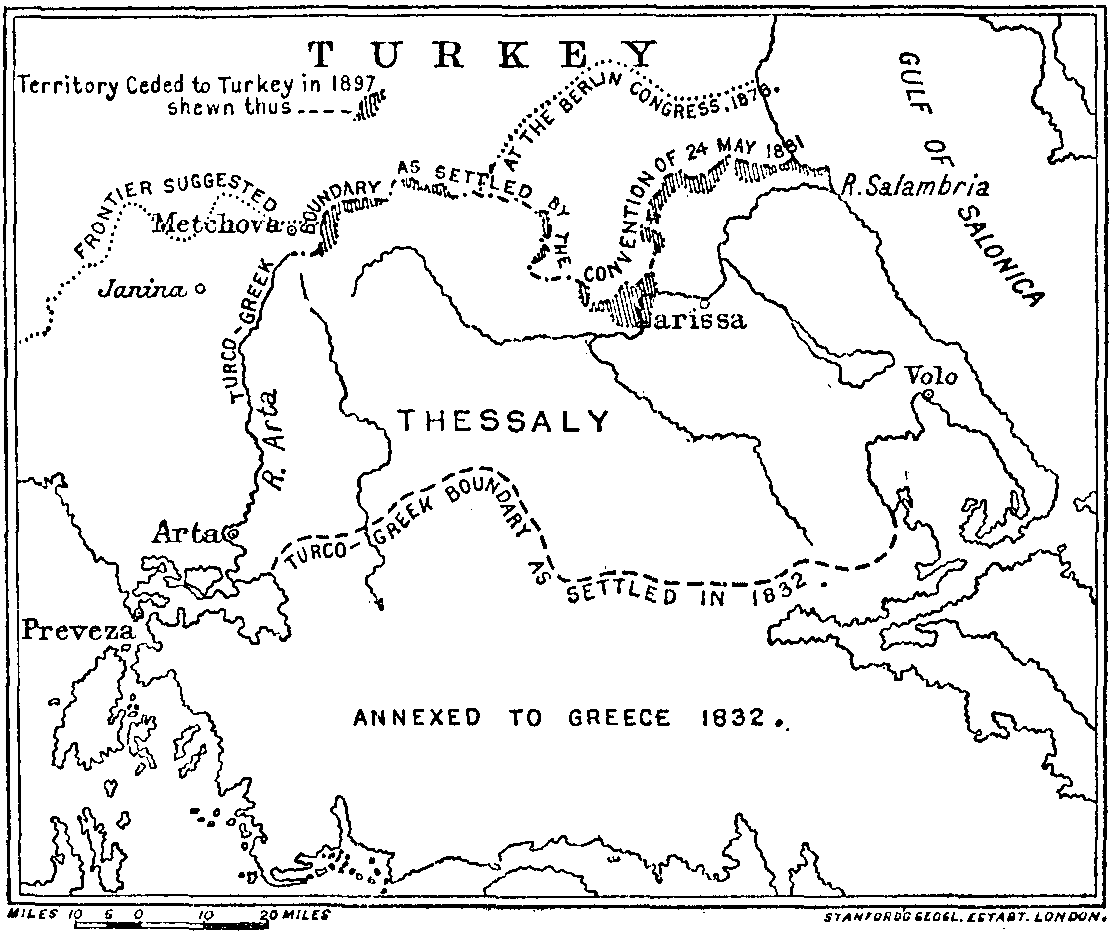
Map of Thessaly.
This successful war against Greece raised the prestige of Turkey and added fuel to the flames of Mohammedan bigotry. These, as we have seen, had been assiduously fanned by Abdul Hamid II. ever since the year 1882, when a Pan-Islam movement began. The results of this revival were far-reaching, being felt even among the hill tribes on the Afghan-Punjab border (see Chapter XIV.). Throughout the Ottoman Empire the Mohammedans began to assert their superiority [pg 250] over Christians; and, as Professor Ramsay has observed, "the means whereby Turkish power is restored is always the same--massacre[183]."
It would be premature to inquire which of the European Powers must be held chiefly responsible for the toleration of the hideous massacres of the Armenians in 1896-97, and the atrocious misgovernment of Macedonia, by the Turks. All the Great Powers who signed the Berlin Treaty are guilty; and, as has been stated above, the State which framed the Cyprus Convention is doubly guilty, so far as concerns the events in Armenia. A grave share of responsibility also rests with those who succeeded in handing back a large part of Macedonia to the Turks. But the writer who in the future undertakes to tell the story of the decline of European morality at the close of the nineteenth century, and the growth of cynicism and selfishness, will probably pass still severer censures on the Emperors of Germany and Russia, who, with the unequalled influence which they wielded over the Porte, might have intervened with effect to screen their co-religionists from unutterable wrongs, and yet, as far as is known, raised not a finger on their behalf. The Treaty of Berlin, which might have inaugurated an era of good government throughout the whole of Turkey if the Powers had been true to their trust, will be cited as damning evidence in the account of the greatest betrayal of a trust which Modern History records.
NOTE.--For the efforts made by the British Government on behalf of the Armenians, the reader should consult the last chapter of Mr. James Bryce's book, Transcaucasia and Mount Ararat (new edition, 1896). Further information may be expected in the Life of Earl Granville, soon to appear, from the pen of Lord Edmund Fitzmaurice.
FOOTNOTES:
[157] For the odd mistake in a telegram, which caused the original order, see Sir Stafford Northcote, Earl of Iddesleigh, by Andrew Lang, vol. ii. pp. 111-112.
[158] Ibid. pp. 105-106. For the telegrams between the First Lord of the Admiralty, W.H. Smith, and Admiral Hornby, see Life and Times of W.H. Smith, by Sir H. Maxwell, vol. i. chap. xi.
[159] See the compromising revelations made by an anonymous Russian writer in the Revue de Paris for July 15, 1897. The authoress, "O.K.," in her book, The Friends and Foes of Russia (pp. 240-241), states that only the autocracy could have stayed the Russian advance on Constantinople. General U.S. Grant told her that if he had had such an order, he would have put it in his pocket and produced it again when in Constantinople.
[160] Hertslet, iv. p. 2670.
[161] L. Sergeant, Greece in the Nineteenth Century (1897), ch. xi.
[162] For the text of the treaty see Parl. Papers, Turkey, No. 22 (1878); also The European Concert in the Eastern Question by T.E. Holland, pp. 335-348.
[163] Parl. Papers, Turkey, No. 31 (1878), Nos. 6-17, and enclosures; L'Hellénisme et la Macédonie, by N. Kasasis (Paris, 1904); L. Sergeant, op. cit. ch. xii.
[164] Parl. Papers, Turkey, No. 30 (1878); also Reminiscences of the King of Roumania, chs. x. xi.
[165] Lord Derby to Sir H. Elliot, March 13, 1878. Turkey, No. xxiv. (1878), No 9, p. 5.
[166] Ibid. No. 15, p. 7.
[167] See p. 243 for Lord Derby's further reason for resigning.
[168] Débidour, Hist. diplomatique de l'Europe, vol. ii. p. 515.
[169] For these outrages, see Parl. Papers, Turkey (1878), Nos. 42 and 45, with numerous enclosures. The larger plans of the Rhodope insurgents and their abettors at Constantinople are not fully known. An Englishman, Sinclair, and some other free-lances were concerned in the affair. The Rhodope district long retained a kind of independence, see Les Événements politiques en Bulgarie, by A.G. Drandar, Appendix.
[170] Parl. Papers, Turkey, No. 36 (1878). See, too, ibid. No. 43.
[171] Parl. Papers, Turkey, No. 36 (1878); Hertslet, vol. iv. pp. 2722-2725; Holland, op. cit., pp. 354-356.
[172] Mr. Charles Marvin, a clerk in the Foreign Office, was charged with this offence, but the prosecution failed (July 16) owing to lack of sufficient evidence.
[173] Princess Radziwill, My Recollections (Eng. ed. 1900), p. 91.
[174] Ibid. p. 149.
[175] For the Protocols, see Parl. Papers, Turkey (1878), No. 39. For the Treaty see ibid. No. 44; also The European Concert in the Eastern Question, by T. E. Holland, pp. 277-307.
[176] Frederick, Crown Prince of Germany, expressed the general opinion in a letter written to Prince Charles after the Berlin Congress: "Russia's conduct, after the manful service you did for that colossal Empire, meets with censure on all sides." (Reminiscences of the King of Roumania, p. 325).
[177] See Mr. L. Sergeant's Greece in the Nineteenth Century (1897), ch. xii., for the speeches of the Greek envoys at the Congress; also that of Sir Charles Dilke in the House of Commons in the debate of July 29-August 2, 1878, as to England's desertion of the Greek cause after the ninth session (June 29) of the Berlin Congress.
[178] Sir Stafford Northcote, vol. ii. p. 108.
[179] See Impressions of Turkey, by Professor W.M. Ramsay (1897), chap. vi.
[180] Life of Gladstone, by J. Morley, vol. iii. p. 9.
[181] See Turkey in Europe, by "Odysseus," p. 434.
[182] The European Concert in the Eastern Question, by T.E. Holland, pp. 60-69.
[183] Impressions of Turkey, by W.M. Ramsay, p. 139.
"If you can help to build up these peoples into a bulwark of independent States and thus screen the 'sick man' from the fury of the northern blast, for God's sake do it."--SIR R. MORIER to SIR W. WHITE, December 27, 1885.
The failure which attended the forward Hellenic movement during the years 1896-97 stands in sharp relief with the fortunes of the Bulgarians. To the rise of this youngest, and not the least promising, of European States, we must devote a whole chapter; for during a decade the future of the Balkan Peninsula and the policy of the Great Powers turned very largely on the emancipation of this interesting race from the effective control of the Sultan and the Czar.
The rise of this enigmatical people affords a striking example of the power of national feeling to uplift the downtrodden. Until the year 1876, the very name Bulgarian was scarcely known except as a geographical term. Kinglake, in his charming work, Eothen, does not mention the Bulgarians, though he travelled on horseback from Belgrade to Sofia and thence to Adrianople. And yet in 1828, the conquering march of the Russians to Adrianople had awakened that people to a passing thrill of national consciousness. Other travellers,--for instance, Cyprien Robert in the "thirties,"--noted their sturdy patience in toil, their slowness to act, but their great perseverance and will-power, when the resolve was formed.
[pg 252]These qualities may perhaps be ascribed to their Tatar (Tartar) origin. Ethnically, they are closely akin to the Magyars and Turks, but, having been long settled on the banks of the Volga (hence their name, Bulgarian = Volgarian), they adopted the speech and religion of the Slavs. They have lived this new life for about a thousand years[184]; and in this time have been completely changed. Though their flat lips and noses bespeak an Asiatic origin, they are practically Slavs, save that their temperament is less nervous, and their persistence greater than that of their co-religionists[185]. Their determined adhesion to Slav ideals and rejection of Turkish ways should serve as a reminder to anthropologists that peoples are not mainly to be judged and divided off by craniological peculiarities. Measurement of skulls may tell us something concerning the basal characteristics of tribes: it leaves untouched the boundless fund of beliefs, thoughts, aspirations, and customs which mould the lives of nations. The peoples of to-day are what their creeds, customs, and hopes have made them; as regards their political life, they have little more likeness to their tribal forefathers than the average man has to the chimpanzee.
The first outstanding event in the recent rise of the Bulgarian race was the acquisition of spiritual independence in 1869-70. Hitherto they, in common with nearly all the Slavs, had belonged to the Greek Church, and had recognised the supremacy of its Patriarch at Constantinople, but, as the national idea progressed, the Bulgarians sought to have their own Church. It was in vain that the Greeks protested against this schismatic attempt. The Western Powers and Russia favoured it; the Porte also was not loth to see the Christians further divided. Early in the year 1870, the Bulgarian Church came into existence, with an Exarch of its own at Constantinople who has survived the numerous attempts of the Greeks to ban him as a schismatic from the [pg 253] "Universal Church." The Bulgarians therefore took rank with the other peoples of the Peninsula as a religious entity., the Roumanian and Servian Churches having been constituted early in the century. In fact, the Porte recognises the Bulgarians, even in Macedonia, as an independent religious community, a right which it does not accord to the Servians; the latter, in Macedonia, are counted only as "Greeks[186]."
The Treaty of San Stefano promised to make the Bulgarians the predominant race of the Balkan Peninsula for the benefit of Russia; but, as we have seen, the efforts of Great Britain and Austria, backed by the jealousies of Greeks and Servians, led to a radical change in those arrangements. The Treaty of Berlin divided that people into three unequal parts. The larger mass, dwelling in Bulgaria Proper, gained entire independence of the Sultan, save in the matter of suzerainty; the Bulgarians on the southern slopes of the Balkans acquired autonomy only in local affairs, and remained under the control of the Porte in military affairs and in matters of high policy; while the Bulgarians who dwelt in Macedonia, about 1,120,000 in number, were led to hope something from articles 61 and 62 of the Treaty of Berlin, but remained otherwise at the mercy of the Sultan[187].
This unsatisfactory state of things promised to range the Principality of Bulgaria entirely on the side of Russia, and at the outset the hope of all Bulgarians was for a close friendship with the great Power that had effected their liberation. These sentiments, however, speedily cooled. The officers appointed by the Czar to organise the Principality carried out their task in a high-handed way that soon irritated the newly enfranchised people. Gratitude is a feeling that soon vanishes, especially in political life. There, far more than in private life, it is a great mistake for the party that has conferred a boon [pg 254] to remind the recipient of what he owes, especially if that recipient be young and aspiring. Yet that was the mistake committed everywhere throughout Bulgaria. The army, the public service--everything--was modelled on Russian lines during the time of the occupation, until the overbearing ways of the officials succeeded in dulling the memory of the services rendered in the war. The fact of the liberation was forgotten amidst the irritation aroused by the constant reminders of it.
The Russians succeeded in alienating even the young German prince who came, with the full favour of the Czar Alexander II., to take up the reins of Government. A scion of the House of Hesse Darmstadt by a morganatic marriage, Prince Alexander of Battenberg had been sounded by the Russian authorities, with a view to his acceptance of the Bulgarian crown. By the vote of the Bulgarian Chamber, it was offered to him on April 29, 1879. He accepted it, knowing full well that it would be a thorny honour for a youth of twenty-two years of age. His tall commanding frame, handsome features, ability and prowess as a soldier, and, above all, his winsome address, seemed to mark him out as a natural leader of men; and he received a warm welcome from the Bulgarians in the month of July.
His difficulties began at once. The chief Russian administrator, Dondukoff Korsakoff, had thrust his countrymen into all the important and lucrative posts, thereby leaving out in the cold the many Bulgarians, who, after working hard for the liberation of their land, now saw it transferred from the slovenly overlordship of the Turk to the masterful grip of the Muscovite. The Principality heaved with discontent, and these feelings finally communicated themselves to the sympathetic nature of the Prince. But duty and policy alike forbade him casting off the Russian influence. No position could be more trying for a young man of chivalrous and ambitious nature, endowed with a strain of sensitiveness which he probably derived from his Polish mother. He early set [pg 255] forth his feelings in a private letter to Prince Charles of Roumania:--
Devoted with my whole heart to the Czar Alexander, I am anxious to do nothing that can be called anti-Russian. Unfortunately the Russian officials have acted with the utmost want of tact; confusion prevails in every office, and peculation, thanks to Dondukoff's decrees, is all but sanctioned. I am daily confronted with the painful alternative of having to decide either to assent to the Russian demands or to be accused in Russia of ingratitude and of "injuring the most sacred feelings of the Bulgarians." My position is truly terrible.
The friction with Russia increased with time. Early in the year 1880, Prince Alexander determined to go to St. Petersburg to appeal to the Czar in the hope of allaying the violence of the Panslavonic intriguers. Matters improved for a time, but only because the Prince accepted the guidance of the Czar. Thereafter he retained most of his pro-Russian Ministers, even though the second Legislative Assembly, elected in the spring of that year, was strongly Liberal and anti-Russian. In April 1881 he acted on the advice of one of his Ministers, a Russian general named Ehrenroth, and carried matters with a high hand: he dissolved the Assembly, suspended the constitution, encouraged his officials to browbeat the voters, and thereby gained a docile Chamber, which carried out his behests by decreeing a Septennate, or autocratic rule for seven years. In order to prop up his miniature czardom, he now asked the new Emperor, Alexander III., to send him two Russian Generals. His request was granted in the persons of Generals Soboleff and Kaulbars, who became Ministers of the Interior and for War; a third, General Tioharoff, being also added as Minister of Justice.
The triumph of Muscovite influence now seemed to be complete, until the trio just named usurped the functions of the Bulgarian Ministers and informed the Prince that they took their orders from the Czar, not from him. Chafing [pg 256] at these self-imposed Russian bonds, the Prince now leant more on the moderate Liberals, headed by Karaveloff; and on the Muscovites intriguing in the same quarter, and with the troops, with a view to his deposition, they met with a complete repulse. An able and vigorous young Bulgarian, Stambuloff, was now fast rising in importance among the more resolute nationalists. The son of an innkeeper of Tirnova, he was sent away to be educated at Odessa; there he early became imbued with Nihilist ideas, and on returning to the Danubian lands, framed many plots for the expulsion of the Turks from Bulgaria. His thick-set frame, his force of will, his eloquent, passionate speech, and, above all, his burning patriotism, soon brought him to the front as the leader of the national party; and he now strove with all his might to prevent his land falling to the position of a mere satrapy of the liberators. Better the puny autocracy of Prince Alexander than the very real despotism of the nominees of the Emperor Alexander III.
The character of the new Czar will engage our attention in the following chapter; here we need only say that the more his narrow, hard, and overbearing nature asserted itself, the greater appeared the danger to the liberties of the Principality. At last, when the situation became unbearable, the Prince resolved to restore the Bulgarian constitution; and he took this momentous step, on September 18, 1883, without consulting the three Russian Ministers, who thereupon resigned[188].
At once the Prince summoned Karaveloff, and said to him: "My dear Karaveloff--For the second time I swear to thee that I will be entirely submissive to the will of the people, and that I will govern in full accordance with the constitution of Tirnova. Let us forget what passed during the coup d'état [pg 257] [of 1881], and work together for the prosperity of the country." He embraced him; and that embrace was the pledge of a close union of hearts between him and his people[189].
The Czar forthwith showed his anger at this act of independence, and, counting it a sign of defiance, allowed or encouraged his agents in Bulgaria to undermine the power of the Prince, and procure his deposition. For two years they struggled in vain. An attempt by the Russian Generals Soboleff and Kaulbars to kidnap the Prince by night failed, owing to the loyalty of Lieutenant Martinoff, then on duty at his palace; the two ministerial plotters forthwith left Bulgaria[190].
Even now the scales did not fall from the eyes of the Emperor Alexander III. Bismarck was once questioned by the faithful Busch as to the character of that potentate. The German Boswell remarked that he had heard Alexander III. described as "stupid, exceedingly stupid"; whereupon the Chancellor replied: "In a general way that is saying too much[191]." Leaving to posterity the task of deciding that question, we may here point out that Muscovite policy in the years 1878-85 achieved a truly remarkable feat in uniting all the liberated races of the Balkan Peninsula against their liberators. By the terms of the Treaty of San Stefano, Russia had alienated the Roumanians, Servians, and Greeks; so that when the Princes of those two Slav Principalities decided to take the kingly title (as they did in the spring of 1881 and 1882 respectively), it was after visits to Berlin and Vienna, whereby they tacitly signified their friendliness to the Central Powers.
In the case of Servia this went to the length of alliance. On June 25, 1881, the Foreign Minister, M. Mijatovich, concluded with Austria-Hungary a secret convention, whereby [pg 258] Servia agreed to discourage any movement among the Slavs of Bosnia, while the Dual Monarchy promised to refrain from any action detrimental to Servian hopes for what is known as old Servia. The agreement was for eight years; but it was not renewed in 1889[192]. The fact, however, that such a compact could be framed within three years of the Berlin Congress, shows how keen was the resentment of the Servian Government at the neglect of its interests by Russia, both there and at San Stefano.
The gulf between Bulgaria and Russia widened more slowly, but with the striking sequel that will be seen. The Dondukoffs, Soboleffs, and Kaulbars first awakened and then estranged the formerly passive and docile race for whose aggrandisement Russia had incurred the resentment of the neighbouring peoples. Under Muscovite tutelage the "ignorant Bulgarian peasants" were developing a strong civic and political instinct. Further, the Czar's attacks, now on the Prince, and then on the popular party, served to bind these formerly discordant elements into an alliance. Stambuloff, the very embodiment of young Bulgaria in tenacity of purpose and love of freedom, was now the President of the Sobranje, or National Assembly, and he warmly supported Prince Alexander so long as he withstood Russian pretensions. At the outset the strifes at Sofia had resembled a triangular duel, and the Russian agents could readily have disposed of the third combatant had they sided either with the Prince or with the Liberals. By browbeating both they simplified the situation to the benefit both of the Prince and of the nascent liberties of Bulgaria.
Alexander III. and his Chancellor, de Giers, had also tied their hands in Balkan affairs by a treaty which they framed with Austria and Germany, and signed and ratified at the meeting of the three Emperors at Skiernewice (September 1884--see Chapter XII.). The most important of its provisions from our present standpoint was that by which, in the event of two of [pg 259] the three Empires disagreeing on Balkan questions, the casting vote rested with the third Power. This gave to Bismarck the same role of arbiter which he had played at the Berlin Congress.
But in the years 1885 and 1886, the Czar and his agents committed a series of blunders, by the side of which their earlier actions seemed statesmanlike. The welfare of the Bulgarian people demanded an early reversal of the policy decided on at the Congress of Berlin (1878), whereby the southern Bulgarians were divided from their northern brethren in order that the Sultan might have the right to hold the Balkan passes in time of war. That is to say, the Powers, especially Great Britain and Austria, set aside the claims of a strong racial instinct for purely military reasons. The breakdown of this artificial arrangement was confidently predicted at the time; and Russian agents at first took the lead in preparing for the future union. Skobeleff, Katkoff, and the Panslavonic societies of Russia encouraged the formation of "gymnastic societies" in Eastern Roumelia, and the youth of that province enrolled themselves with such ardour that by the year 1885 more than 40,000 were trained to the use of arms. As for the protests of the Sultan and those of his delegates at Philippopolis, they were stilled by hints from St. Petersburg, or by demands for the prompt payment of Turkey's war debt to Russia. All the world knew that, thanks to Russian patronage, Eastern Roumelia had slipped entirely from the control of Abdul Hamid.
By the summer of 1885, the unionist movement had acquired great strength. But now, at the critical time, when Russia should have led that movement, she let it drift, or even, we may say, cast off the tow-rope. Probably the Czar and his Ministers looked on the Bulgarians as too weak or too stupid to act for themselves. It was a complete miscalculation; for now Stambuloff and Karaveloff had made that aim their own, and brought to its accomplishment all the skill and zeal which they had learned in a long career of resistance to Turkish and Russian masters. There is reason to think that [pg 260] they and their coadjutors at Philippopolis pressed on events in the month of September 1885, because the Czar was then known to disapprove any immediate action.
In order to understand the reason for this strange reversal of Russia's policy, we must scrutinise events more closely. The secret workings of that policy have been laid bare in a series of State documents, the genuineness of which is not altogether established. They are said to have been betrayed to the Bulgarian patriots by a Russian agent, and they certainly bear signs of authenticity. If we accept them (and up to the present they have been accepted by well-informed men) the truth is as follows:--
Russia would have worked hard for the union of Eastern Roumelia to Bulgaria, provided that the Prince abdicated and his people submitted completely to Russian control. Quite early in his reign Alexander III. discovered in them an independence which his masterful nature ill brooked. He therefore postponed that scheme until the Prince should abdicate or be driven out. As one of the Muscovite agents phrased it in the spring of 1881, the union must not be brought about until a Russian protectorate should be founded in the Principality; for if they made Bulgaria too strong, it would become "a second Roumania," that is, as "ungrateful" to Russia as Roumania had shown herself after the seizure of her Bessarabian lands. In fact, the Bulgarians could gain the wish of their hearts only on one condition--that of proclaiming the Emperor Alexander Grand Duke of the greater State of the future[193].
The chief obstacles in the way of Russia's aggrandisement were the susceptibilities of "the Battenberger," as her agents impertinently named him, and the will of Stambuloff. When [pg 261] the Czar, by his malevolent obstinacy, finally brought these two men to accord, it was deemed needful to adopt various devices in order to shatter the forces which Russian diplomacy had succeeded in piling up in its own path. But here again we are reminded of the Horatian precept--
Vis consili expers mole ruit sua.
To the hectorings of Russian agents the "peasant State" offered an ever firmer resistance, and by the summer of 1885 it was clear that bribery and bullying were equally futile.
Of course the Emperor of all the Russias had it in his power to harry the Prince in many ways. Thus in the summer of 1885, when a marriage was being arranged between him and the Princess Victoria, daughter of the Crown Princess of Germany, the Czar's influence at Berlin availed to veto an engagement which is believed to have been the heartfelt wish of both the persons most nearly concerned. In this matter Bismarck, true to his policy of softening the Czar's annoyance at the Austro-German alliance by complaisance in all other matters, made himself Russia's henchman, and urged his press-trumpet, Busch, to write newspaper articles abusing Queen Victoria as having instigated this match solely with a view to the substitution of British for Russian influence in Bulgaria[194]. The more servile part of the German Press improved on these suggestions, and stigmatised the Bulgarian Revolution of the ensuing autumn as an affair trumped up at London. So far is it possible for minds of a certain type to read their own pettiness into events.
Meanwhile, if we may credit the despatches above referred to, the Russian Government was seeking to drag Bulgaria into fratricidal strife with Roumania over some trifling disputes [pg 262] about the new border near Silistria. That quarrel, if well managed, promised to be materially advantageous to Russia and mentally soothing to her ruler. It would weaken the Danubian States and help to bring them back to the heel of their former protector. Further, seeing that the behaviour of King Charles to his Russian benefactors was no less "ungrateful" than that of Prince Alexander, it would be a fit Nemesis for these ingrats to be set by the ears. Accordingly, in the month of August 1885, orders were issued to Russian agents to fan the border dispute; and on August 12/30 the Director of the Asiatic Department at St. Petersburg wrote the following instructions to the Russian Consul-General at Rustchuk:--
You remember that the union [of the two Bulgarias] must not take place until after the abdication of Prince Alexander. However, the ill-advised and hostile attitude of King Charles of Roumania [to Russia] obliges the imperial government to postpone for some time the projected union of Eastern Roumelia to the Principality, as well as the abdication and expulsion of the Prince of Bulgaria. In the session of the Council of [Russian] Ministers held yesterday it was decided to beg the Emperor to call Prince Alexander to Copenhagen or to St. Petersburg in order to inform him that, according to the will of His Majesty, Bulgaria must defend by armed force her rights over the points hereinbefore mentioned[195].
The despatch then states that Russia will keep Turkey quiet and will eventually make war on Roumania; also, that if Bulgaria triumphs over Roumania, the latter will pay her in territory or money, or in both. Possibly, however, the whole scheme may have been devised to serve as a decoy to bring Prince Alexander within the power of his imperial patrons, who, in that case, would probably have detained and dethroned him.
Further light was thrown on the tortuous course of Russian diplomacy by a speech of Count Eugen Zichy to the [pg 263] Hungarian Delegations about a year later. He made the startling declaration that in the summer of 1885 Russia concluded a treaty with Montenegro with the aim of dethroning King Milan and Prince Alexander, and the division of the Balkan States between Prince Nicholas of Montenegro and the Karageorgevich Pretender who has since made his way to the throne at Belgrade. The details of these schemes are not known, but the searchlight thrown upon them from Buda-Pesth revealed the shifts of the policy of those "friends of peace," the Czar Alexander III. and his Chancellor, de Giers.
Prince Alexander may not have been aware of these schemes in their full extent, but he and his friends certainly felt the meshes closing around them. There were only two courses open, either completely to submit to the Czar (which, for the Prince, implied abdication) or to rely on the Bulgarian people. The Prince took the course which would have been taken by every man worthy of the name. It is, however, almost certain that he did not foresee the events at Philippopolis. He gave his word to a German officer, Major von Huhn, that he had not in the least degree expected the unionist movement to take so speedy and decisive a step forward as it did in the middle of September. The Prince, in fact, had been on a tour throughout Europe, and expressed the same opinion to the Russian Chancellor, de Giers, at Franzensbad.
But by this time everything was ready at Philippopolis. As the men of Eastern Roumelia were all of one mind in this matter, it was the easiest of tasks to surprise the Sultan's representative, Gavril Pasha, to surround his office with soldiers, and to request him to leave the province (September 18). A carriage was ready to conduct him towards Sofia. In it sat a gaily dressed peasant girl holding a drawn sword. Gavril turned red with rage at this insult, but he mounted the vehicle, and was driven through the town and thence towards the Balkans.
Such was the departure of the last official of the Sultan from [pg 264] the land which the Turks had often drenched with blood; such was the revenge of the southern Bulgarians for the atrocities of 1876. Not a drop of blood was shed; and Major von Huhn, who soon arrived at Philippopolis, found Greeks and Turks living contentedly under the new government. The word "revolution" is in such cases a misnomer. South Bulgaria merely returned to its natural state[196]. But nothing will convince diplomatists that events can happen without the pulling of wires by themselves or their rivals. In this instance they found that Prince Alexander had made the revolution.
At first, however, the Prince doubted whether he should accept the crown of a Greater Bulgaria which the men of Philippopolis now enthusiastically offered to him. Stambuloff strongly urged him to accept, even if he thereby still further enraged the Czar: "Sire," he said, "two roads lie before you: the one to Philippopolis and as far beyond as God may lead; the other to Sistova and Darmstadt. I counsel you to take the crown the nation offers you." On the 20th the Prince announced his acceptance of the crown of a united Bulgaria. As he said to the British Consul at Philippopolis, he would have been a "sharper" (filou) not to side with his people[197].
Few persons were prepared for the outburst of wrath of the Czar at hearing this news. Early in his reign he had concentrated into a single phrase--"silly Pole"--the spleen of an essentially narrow nature at seeing a kinsman and a dependant dare to think and act for himself[198]. But on this occasion, as we can now see, the Prince had marred Russia's plans in the most serious way. Stambuloff and he had deprived her of her unionist trump card. The Czar found his project of becoming Grand Duke of a Greater Bulgaria blocked by the action of this same hated kinsman. Is it surprising that his usual stolidity gave way to one of those fits of bull-like fury which [pg 265] aroused the fear of all who beheld them? Thenceforth between the Emperor Alexander and Prince Alexander the relations might be characterised by the curt phrase which Palafox hurled at the French from the weak walls of Saragossa--"War to the knife." Like Palafox, the Prince now had no hope but in the bravery of his people.
In the ciphered telegrams of September 19 and 20, which the Director of the Asiatic Department at St. Petersburg sent to the Russian Consul-General at Rustchuk, the note of resentment and revenge was clearly sounded. The events in Eastern Roumelia had changed "all our intentions." The agent was therefore directed to summon the chief Russian officers in Bulgaria and ask them whether the "young" Bulgarian officers could really command brigades and regiments, and organise the artillery; also whether that army could alone meet the army of "a neighbouring State." The replies of the officers being decidedly in the negative, they were ordered to leave Bulgaria[199]. Nelidoff, the Russian ambassador at Constantinople, also worked furiously to spur on the Sultan to revenge the insult inflicted on him by Prince Alexander.
Sir William White believed that the volte face in Russian policy was due solely to Nelidoff's desire to thwart the peaceful policy of the Russian Chancellor, de Giers, who at that time chanced to be absent in Tyrol, while the Czar also was away at Copenhagen[200]. But it now appears that the Russian Foreign Office took Nelidoff's view, and bade him press Turkey to restore the "legal order" of things in Eastern Roumelia. Further, the Ministers of the Czar found that Servia, Greece, and perhaps also Roumania, intended to oppose the aggrandisement of Bulgaria; and it therefore seemed easy to chastise "the Battenberger" for his wanton disturbance of the peace of Europe.
[pg 266]Possibly Russia would herself have struck at Bulgaria but for the difficulties of the general situation. How great these were will be realised by a perusal of the following chapters, which deal with the spread of Nihilism in Russia, the formation of the Austro-German alliance, and the favour soon shown to it by Italy, the estrangement of England and the Porte owing to the action taken by the former in Egypt, and the sharp collision of interests between Russia and England at Panjdeh on the Afghan frontier. When it is further remembered that France fretted at the untoward results of M. Ferry's forward policy in Tonquin; that Germany was deeply engaged in colonial efforts; and that the United Kingdom was distracted by those efforts, by the failure of the expedition to Khartum, and by the Parnellite agitation in Ireland--the complexity of the European situation will be sufficiently evident. Assuredly the events of the year 1885 were among the most distracting ever recorded in the history of Europe.
This clash of interests among nations wearied by war, and alarmed at the apparition of the red spectre of revolution in their midst, told by no means unfavourably on the fortunes of the Balkan States. The dominant facts of the situation were, firstly, that Russia no longer had a free hand in the Balkan Peninsula in face of the compact between the three Emperors ratified at Skiernewice in the previous autumn (see Chapter XII.); and, secondly, that the traditional friendship between England and the Porte had been replaced by something like hostility. Seeing that the Sultan had estranged the British Government by his very suspicious action during the revolts of Arabi Pasha and of the Mahdi, even those who had loudly proclaimed the need of propping up his authority as essential to the stability of our Eastern Empire now began to revise their prejudices.
Thus, when Lord Salisbury came to office, if not precisely to power, in June 1885, he found affairs in the East rapidly ripening for a change of British policy--a change which is known to have corresponded with his own convictions. Finally, [pg 267] the marriage of Princess Beatrice to Prince Henry of Battenberg, on July 23, 1885, added that touch of personal interest which enabled Court circles to break with the traditions of the past and to face the new situation with equanimity. Accordingly the power of Britain, which in 1876-78 had been used to thwart the growth of freedom in the Balkan Peninsula, was now put forth to safeguard the union of Bulgaria. During these critical months Sir William White acted as ambassador at Constantinople, and used his great knowledge of the Balkan peoples with telling effect for this salutary purpose.
Lord Salisbury advised the Sultan not to send troops into Southern Bulgaria; and the warning chimed in with the note of timorous cunning which formed the undertone of that monarch's thought and policy. Distracted by the news of the warlike preparations of Servia and Greece, Abdul Hamid looked on Russia's advice in a contrary sense as a piece of Muscovite treachery. About the same time, too, there were rumours of palace plots at Constantinople; and the capricious recluse of Yildiz finally decided to keep his best troops near at hand. It appears, then, that Nihilism in Russia and the spectre of conspiracy always haunting the brain of Abdul Hamid played their part in assuring the liberties of Bulgaria.
Meanwhile the Powers directed their ambassadors at Constantinople to hold a preliminary Conference at which Turkey would be represented. The result was a declaration expressing formal disapproval of the violation of the Treaty of Berlin, and a hope that all parties concerned would keep the peace. This mild protest very inadequately reflected the character of the discussions which had been going on between the several Courts. Russia, it is known, wished to fasten the blame for the revolution on Prince Alexander; but all public censure was vetoed by England.
Probably her action was as effective in still weightier matters. A formal Conference of the ambassadors of the Powers met at Constantinople on November 5; and there again Sir William White, acting on instructions from Lord Salisbury, defended [pg 268] the Bulgarian cause, and sought to bring about a friendly understanding between the Porte and "a people occupying so important a position in the Sultan's dominions." Lord Salisbury also warned the Turkish ambassador in London that if Turkey sought to expel Prince Alexander from Eastern Roumelia, she would "be making herself the instrument of those who desired the fall of the Ottoman Empire[201]."
This reference to the insidious means used by Russia for bringing the Turks to a state of tutelage, as a preliminary to partition, was an effective reminder of the humiliations which they had undergone at the hands of Russia by the Treaty of Unkiar Skelessi (1833). France also showed no disposition to join the Russian and Austrian demand that the Sultan should at once re-establish the status quo; and by degrees the more intelligent Turks came to see that a strong Bulgaria, independent of Russian control, might be an additional safeguard against the Colossus of the North. Russia's insistence on the exact fulfilment of the Treaty of Berlin helped to open their eyes, and lent force to Sir William White's arguments as to the need of strengthening that treaty by "introducing into it a timely improvement[202]."
Owing to the opposition offered by Great Britain, and to some extent by France, to the proposed restoration of the old order of things in Eastern Roumelia, the Conference came to an end at the close of November, the three Imperial Powers blaming Sir William White for his obstructive tactics. The charges will not bear examination, but they show the irritation of those Governments at England's championship of the Bulgarian cause[203]. The Bulgarians always remember the [pg 269] names of Lord Salisbury and Sir William White as those of friends in need.
In the main, however, the consolidation of Bulgaria was achieved by her own stalwart sons. While the Imperial Powers were proposing to put back the hands of the clock, an alarum sounded forth, proclaiming the advent of a new era in the history of the Balkan peoples. The action which brought about this change was startling alike in its inception, in the accompanying incidents, and still more in its results.
Where Abdul Hamid forebore to enter, even as the mandatory of the Continental Courts, there Milan of Servia rushed in. As an excuse for his aggression, the Kinglet of Belgrade alleged the harm done to Servian trade by a recent revision of the Bulgarian tariff. But the Powers assessed this complaint and others at their due value, and saw in his action merely the desire to seize a part of Western Bulgaria as a set-off to the recent growth of that Principality. On all sides his action in declaring war against Prince Alexander (November 14) met with reprobation, even on the part of his guide and friend, Austria. A recent report of the Hungarian Committee on Foreign Affairs contained a recommendation which implied that he ought to receive compensation; and this seemed to show the wish of the more active part of the Dual Monarchy peacefully but effectively to champion his cause[204].
Nevertheless, the King decided to carve out his fortunes by his own sword. He had some grounds for confidence. If a Bulgarian fait accompli could win tacit recognition from the Powers, why should not a Servian triumph over Bulgaria force their hands once more? Prince Alexander was unsafe on his throne; thanks to the action of Russia his troops had very few experienced officers; and in view of the Sultan's resentment his southern border could not be denuded of troops. Never did a case seem more desperate than that of the "Peasant State," deserted and flouted by Russia, disliked by the Sultan, on bad terms with Roumania, and publicly lectured by the [pg 270] Continental Powers for her irregular conduct. Servia's triumph seemed assured.
But now there came forth one more proof of the vitalising force of the national principle. In seven years the downtrodden peasants of Bulgaria had become men, and now astonished the world by their prowess. The withdrawal of the Russian officers left half of the captaincies vacant; but they were promptly filled up by enthusiastic young lieutenants. Owing to the blowing up of the line from Philippopolis to Adrianople, only five locomotives were available for carrying back northwards the troops which had hitherto been massed on the southern border; and these five were already overstrained. Yet the engineers now worked them still harder and they did not break down[205]. The hardy peasants tramped impossibly long distances in their longing to meet the Servians. The arrangements were carried through with a success which seems miraculous in an inexperienced race. The explanation was afterwards rightly discerned by an English visitor to Bulgaria. "This is the secret of Bulgarian independence--everybody is in grim earnest. The Bulgarians do not care about amusements[206]." In that remark there is food for thought. Inefficiency has no place among a people that looks to the welfare of the State as all in all. Breakdowns occur when men think more about "sport" and pleasure than about doing their utmost for their country.
The results of this grim earnestness were to astonish the world. The Servians at first gained some successes in front of Widdin and Slivnitza; but the defenders of the latter place (an all-important position north-west of Sofia) hurried up all possible forces. Two Bulgarian regiments are said to have marched 123 kilometres in thirty hours in order to defend that military outwork of their capital; while others, worn out with marching, rode forward on horseback, two men to each horse, and then threw themselves into the fight. The Bulgarian [pg 271] artillery was well served, and proved to be very superior to that of the Servians.
Thus, on the first two days of conflict at Slivnitza, the defenders beat back the Servians with some loss. On the third day (November 19), after receiving reinforcements, they took the offensive, with surprising vigour. A talented young officer, Bendereff, led their right wing, with bands playing and colours flying, to storm the hillsides that dominated the Servian position. The hardy peasants scaled the hills and delivered the final bayonet charge so furiously that there and on all sides the invaders fled in wild panic, and scarcely halted until they reached their own frontier.
Thenceforth King Milan had hard work to keep his men together. Many of them were raw troops; their ammunition was nearly exhausted; and their morale had vanished utterly. Prince Alexander had little difficulty in thrusting them forth from Pirot, and seemed to have before him a clear road to Belgrade, when suddenly he was brought to a halt by a menace from the north[207].
A special envoy sent by the Hapsburgs, Count Khevenhüller, came in haste to the headquarters of the Prince on November 28, and in imperious terms bade him grant an armistice to Servia, otherwise Austrian troops would forthwith cross the frontier to her assistance. Before this threat Alexander gave way, and was blamed by some of his people for this act of complaisance. But assuredly he could not well have acted otherwise. The three Emperors, of late acting in accord in Balkan questions, had it in their power to crush him by launching the Turks against Philippopolis, or their own troops against Sofia. He had satisfied the claims of honour; he had punished Servia for her peevish and unsisterly jealousy. Under his lead the Bulgarians had covered themselves with glory, and had leaped at a bound from political youth to manhood. Why should he risk their new-found unity merely [pg 272] in order to abase Servia? The Prince never acted more prudently than when he decided not to bring into the field the Power which, as he believed, had pushed on Servia to war[208].
Had he known that the Russian Chancellor, de Giers, on hearing of Austria's threat to Bulgaria, informed the Court of Vienna of the Czar's condign displeasure if that threat were carried into effect, perhaps he would have played a grand game, advancing on Belgrade, dethroning the already unpopular King Milan, and offering to the Czar the headship of a united Servo-Bulgarian State. He might thus have appeased that sovereign, but at the cost of a European war. Whether from lack of information, or from a sense of prudence and humanity, the Prince held back and decided for peace with Servia. Despite many difficulties thrown in the way by King Milan, this was the upshot of the ensuing negotiations. The two States finally came to terms by the Treaty of Bukharest, where, thanks to the good sense of the negotiators and the efforts of Turkey to compose these strifes, peace was assured on the basis of the status quo ante bellum (March 3, 1886).
Already the Porte had manifested its good-will towards Bulgaria in the most signal manner. This complete reversal of policy may be assigned to several causes. Firstly, Prince Alexander, on marching against the Servians, had very tactfully proclaimed that he did so on behalf of the existing order of things, which they were bent on overthrowing. His actions having corresponded to his words, the Porte gradually came to see in him a potent defender against Russia. This change in the attitude of the Sultan was undoubtedly helped on by the arguments of Lord Salisbury to the Turkish ambassador at London. He summarised the whole case for a recognition of the union of the two Bulgarias in the following remarks (December 23, 1885):--
Every week's experience showed that the Porte had little to
dread from the subserviency of Bulgaria to foreign influence, if
[pg 273] only Bulgaria were allowed enjoyment of her unanimous desires, and the Porte did not gratuitously place itself in opposition to the
general feeling of the people. A Bulgaria, friendly to the Porte,
and jealous of foreign influence, would be a far surer bulwark
against foreign aggression than two Bulgarias, severed in administration,
but united in considering the Porte as the only obstacle to
their national development[209].
Events served to reveal the soundness of this statesmanlike pronouncement. At the close of the year Prince Alexander returned from the front to Sofia and received an overwhelming ovation as the champion of Bulgarian liberties. Further, he now found no difficulty in coming to an understanding with the Turkish Commissioners sent to investigate the state of opinion in Southern Bulgaria. Most significant of all was the wrath of the Czar at the sight of his popularity, and the utter collapse of the Russian party at Sofia.
Meanwhile the Powers found themselves obliged little by little to abandon their pedantic resolve to restore the Treaty of Berlin. Sir Robert Morier, British ambassador at St. Petersburg, in a letter of December 27, 1885, to Sir William White, thus commented on the causes that assured success to the Bulgarian cause:
The very great prudence shown by Lord Salisbury, and the consummate
ability with which you played your part, have made it a
successful game; but the one crowning good fortune, which we
mainly owe to the incalculable folly of the Servian attack, has been
that Prince Alexander's generalship and the fighting capacities of
his soldiers have placed our rival action [his own and that of Sir
W. White] in perfect harmony with the crushing logic of fact.
The rivalry is thus completely swamped in the bit of cosmic work
so successfully accomplished. A State has been evolved out of the
protoplasm of Balkan chaos.
Sir Robert Morier finally stated that if Sir William White succeeded in building up an independent Bulgaria friendly to [pg 274] Roumania, he would have achieved the greatest feat of diplomacy since Sir James Hudson's statesmanlike moves at Turin in the critical months of 1859-60 gained for England a more influential position in Italy than France had secured by her aid in the campaign of Solferino. The praise is overstrained, inasmuch as it leaves out of count the statecraft of Bismarck in the years 1863-64 and 1869-70; but certainly among the peaceful triumphs of recent years that of Sir William White must rank very high.
If, however, we examine the inner cause of the success of the diplomacy of Hudson and White we must assign it in part to the mistakes of the liberating Powers, France and Russia. Napoleon III., by requiring the cession of Savoy and Nice, and by revealing his design to Gallicise the Italian Peninsula, speedily succeeded in alienating the Italians. The action of Russia, in compelling Bulgaria to give up the Dobrudscha as an equivalent to the part of Bessarabia which she took from Roumania, also strained the sense of gratitude of those peoples; and the conduct of Muscovite agents in Bulgaria provoked in that Principality feelings bitterer than those which the Italians felt at the loss of Savoy and Nice. So true is it that in public as in private life the manner in which a wrong is inflicted counts for more than the wrong itself. It was on this sense of resentment (misnamed "ingratitude" by the "liberators") that British diplomacy worked with telling effect in both cases. It conferred on the "liberated" substantial benefits; but their worth was doubled by the contrast which they offered to the losses or the irritation consequent on the actions of Napoleon III. and of Alexander III.
To the present writer it seems that the great achievements of Sir William White were, first, that he kept the Sultan quiet (a course, be it remarked, from which that nervous recluse was never averse) when Nelidoff sought to hound him on against Bulgaria; and, still more, that he helped to bring about a good understanding between Constantinople and Sofia. In view of the hatred which Abdul Hamid bore to England [pg 275] after her intervention in Egypt in 1882, this was certainly a great diplomatic achievement; but possibly Abdul Hamid hoped to reap advantages on the Nile from his complaisance to British policy in the Balkans.
The outcome of it all was the framing of a Turco-Bulgarian Convention (February 1, 1886) whereby the Porte recognised Prince Alexander as Governor of Eastern Roumelia for a term of five years; a few border districts in Rhodope, inhabited by Moslems, were ceded to the Sultan, and (wonder of wonders!) Turkey and Bulgaria concluded an offensive and defensive alliance. In case of foreign aggression on Bulgaria, Turkish troops would be sent thither to be commanded by the Prince; if Turkey were invaded, Bulgarian troops would form part of the Sultan's army repelling the invader. In other respects the provisions of the Treaty of Berlin remained in force for Southern Bulgaria[210].
On that same day, as it chanced, the Salisbury Cabinet resigned office, and Mr. Gladstone became Prime Minister, Lord Rosebery taking the portfolio for Foreign Affairs. This event produced little variation in Britain's Eastern policy, and that statement will serve to emphasise the importance of the change of attitude of the Conservative party towards those affairs in the years 1878-85--a change undoubtedly due in the main to the Marquis of Salisbury.
In the official notes of the Earl of Rosebery there is manifest somewhat more complaisance to Russia, as when on February 12 he instructed Sir William White to advise the Porte to modify its convention with Bulgaria by abandoning the stipulation as to mutual military aid. Doubtless this advice was sound. It coincided with the known opinions of the Court of Vienna; and at the same time Russia formally declared that she could never accept that condition[211]. As Germany took the same view the Porte agreed to expunge the obnoxious clause. The Government of the Czar also objected to the naming of Prince Alexander in the Convention. This [pg 276] unlooked-for slight naturally aroused the indignation of the Prince; but as the British Government deferred to Russian views on this matter, the Convention was finally signed at Constantinople on April 5, 1886. The Powers, including Turkey, thereby recognised "the Prince of Bulgaria" (not named) as Governor of Eastern Roumelia for a term of five years, and referred the "Organic Statute" of that province to revision by a joint Conference.
The Prince submitted to this arrangement, provisional and humiliating though it was. But the insults inflicted by Russia bound him the more closely to his people; and at the united Parliament, where 182 members out of the total 300 supported his Ministers, he advocated measures that would cement the union. Bulgarian soon became the official language throughout South Bulgaria, to the annoyance of the Greek and Turkish minorities. But the chief cause of unrest continued to be the intrigues of Russian agents.
The anger of the Czar at the success of his hated kinsman showed itself in various ways. Not content with inflicting every possible slight and disturbing the peace of Bulgaria through his agents, he even menaced Europe with war over that question. At Sevastopol on May 19, he declared that circumstances might compel him "to defend by force of arms the dignity of the Empire"--a threat probably aimed at Bulgaria and Turkey. On his return to Moscow he received an enthusiastic welcome from the fervid Slavophils of the old Russian capital, the Mayor expressing in his address the hope that "the cross of Christ will soon shine on St. Sofia" at Constantinople. At the end of June the Russian Government repudiated the clause of the Treaty of Berlin constituting Batoum a free port[212]. Despite a vigorous protest by Lord Rosebery against this infraction of treaty engagements, the Czar and M. de Giers held to their resolve, evidently by way of retort to the help given from London to the union of the two Bulgarias.
[pg 277]The Dual Monarchy, especially Hungary, also felt the weight of Russia's displeasure in return for the sympathy manifested for the Prince at Pesth and Vienna; and but for the strength which the friendship of Germany afforded, that Power would almost certainly have encountered war from the irate potentate of the North.
Turkey, having no champion, was in still greater danger; her conduct in condoning the irregularities of Prince Alexander was as odious to Alexander III. as the atrocities of her Bashi-bazouks ten years before had been to his more chivalrous sire. It is an open secret that during the summer of 1886 the Czar was preparing to deal a heavy blow. The Sultan evaded it by adroitly shifting his ground and posing as a well-wisher of the Czar, whereupon M. Nelidoff, the Russian ambassador at Constantinople, proposed an offensive and defensive alliance, and went to the length of suggesting that they should wage war against Austria and England in order to restore the Sultan's authority over Bosnia and Egypt at the expense of those intrusive Powers. How far negotiations went on this matter and why they failed is not known. The ordinary explanation, that the Czar forbore to draw the sword because of his love of peace, hardly tallies with what is now known of his character and his diplomacy. It is more likely that he was appeased by the events now to be described, and thereafter attached less importance to a direct intervention in Balkan affairs.
No greater surprise has happened in this generation than the kidnapping of Prince Alexander by officers of the army which he had lately led to victory. Yet the affair admits of explanation. Certain of their number nourished resentment against him for his imperfect recognition of their services during the Servian War, and for the introduction of German military instructors at its close. Among the malcontents was Bendereff, the hero of Slivnitza, who, having been guilty of discourtesy to the Prince, was left unrewarded. On this discontented [pg 278] knot of men Russian intriguers fastened themselves profitably, with the result that one regiment at least began to waver in its allegiance.
A military plot was held in reserve as a last resort. In the first place, a Russian subject, Captain Nabokoff, sought to simplify the situation by hiring some Montenegrin desperadoes, and by seeking to murder or carry off the Prince as he drew near to Bourgas during a tour in Eastern Bulgaria. This plan came to light through the fidelity of a Bulgarian peasant, whereupon Nabokoff and a Montenegrin priest were arrested (May 18). At once the Russian Consul at that seaport appeared, demanded the release of the conspirators, and, when this was refused, threatened the Bulgarian authorities if justice took its course. It is not without significance that the Czar's warlike speech at Sevastopol startled the world on the day after the arrest of the conspirators at Bourgas. Apparently the arrest of Nabokoff impelled the Czar of all the Russias to uphold the dignity of his Empire by hurling threats against a State which protected itself from conspiracy. The champion of order in Russia thereby figured as the abettor of plotters in the Balkans.
The menaces of the Northern Power availed to defer the trial of the conspirators, and the affair was still undecided when the conspirators at Sofia played their last card. Bendereff was at that time acting as Minister of War, and found means to spread broadcast a rumour that Servia was arming as if for war. Sending northwards some faithful troops to guard against this baseless danger, he left the capital at the mercy of the real enemy.
On August 21, when all was ready, the Struma Regiment hastily marched back by night to Sofia, disarmed the few faithful troops there in garrison, surrounded the palace of the Prince, while the ringleaders burst into his bedchamber. He succeeded in fleeing through a corridor which led to the garden, only to be met with levelled bayonets and cries of hatred. The leaders thrust him into a corner, tore a sheet out of the visitors' book which lay on a table close by, and on it hastily scrawled words [pg 279] implying abdication; the Prince added his signature, along with the prayer, "God save Bulgaria." At dawn the mutineers forced him into a carriage, Bendereff and his accomplices crowding round to dismiss him with jeers and screen him from the sight of the public. Thence he was driven at the utmost speed through byways towards the Danube. There the conspirators had in readiness his own yacht, which they had seized, and carried him down the stream towards Russian territory.
The outburst of indignation with which the civilised world heard of this foul deed had its counterpart in Bulgaria. So general and so keen was the reprobation (save in the Russian and Bismarckian Press) that the Russian Government took some steps to dissociate itself from the plot, while profiting by its results. On August 24, when the Prince was put on shore at Reni, the Russian authorities kept him under guard, and that, too, despite an order of the Czar empowering him to "continue his journey exactly as he might please." Far from this, he was detained for some little time, and then was suffered to depart by train only in a northerly direction. He ultimately entered Austrian territory by way of Lemberg in Galicia, on August 27. The aim of the St. Petersburg Government evidently was to give full time for the conspirators at Sofia to consolidate their power[213].
Meanwhile, by military display, the distribution of money, and a Te Deum at the Cathedral for "liberation from Prince Battenberg," the mutineers sought to persuade the men of Sofia that peace and prosperity would infallibly result from the returning favour of the Czar. The populace accepted the first tokens of his good-will and awaited developments. These were not promising for the mutineers. The British Consul at Philippopolis, Captain Jones, on hearing of the affair, hurried to the commander of the garrison, General Mutkuroff, and besought him to crush the plotters[214]. The General speedily enlisted his own troops and those in garrison elsewhere on the side of the [pg 280] Prince, with the result that a large part of the army refused to take the oath of allegiance to the new Russophil Ministry, composed of trimmers like Bishop Clement and Zankoff. Karaveloff also cast in his influence against them.
Above all, Stambuloff worked furiously for the Prince; and when a mitred Vicar of Bray held the seals of office and enjoyed the official counsels of traitors and place-hunters, not all the prayers of the Greek Church and the gold of Russian agents could long avail to support the Government against the attacks of that strong-willed, clean-handed patriot. Shame at the disgrace thus brought on his people doubled his powers; and, with the aid of all that was best in the public life of Bulgaria, he succeeded in sweeping Clement and his Comus rout back to their mummeries and their underground plots. So speedy was the reverse of fortune that the new Provisional Government succeeded in thwarting the despatch of a Russian special Commissioner, General Dolgorukoff, through whom Alexander III. sought to bestow the promised blessings on that "much-tried" Principality.
The voice of Bulgaria now made itself heard. There was but one cry--for the return of Prince Alexander. At once he consented to fulfil his people's desire; and, travelling by railway through Bukharest, he reached the banks of the Danube and set foot on his yacht, not now a prisoner, but the hero of the German, Magyar, and Balkan peoples. At Rustchuk officers and deputies bore him ashore shoulder-high to the enthusiastic people. He received a welcome even from the Consul-General for Russia--a fact which led him to take a false step. Later in the day, when Stambuloff was not present, he had an interview with this agent, and then sent a telegram to the Czar, announcing his return, his thanks for his friendly reception by Russia's chief agent, and his readiness to accept the advice of General Dolgorukoff. The telegram ended thus:--
I should be happy to be able to give to Your Majesty the definitive
proof of the devotion with which I am animated towards Your
[pg 281] august person. The monarchical principle forces me to re-establish
the reign of law (la légalité) in Bulgaria and Roumelia. Russia
having given me my crown, I am ready to give it back into the
hands of its Sovereign.
To this the Czar sent the following telegraphic reply, and allowed it to appear at once in the official paper at St. Petersburg:--
I have received Your Highness's telegram. I cannot approve your return to Bulgaria, as I foresee the sinister consequences that it may bring on Bulgaria, already so much tried. The mission of General Dolgorukoff is now inopportune. I shall abstain from it in the sad state of things to which Bulgaria is reduced so long as you remain there. Your Highness will understand what you have to do. I reserve my judgment as to what is commanded me by the venerated memory of my father, the interests of Russia, and the peace of the Orient[215].
What led the Prince to use the extraordinary words contained in the last sentence of his telegram can only be conjectured. The substance of his conversation with the Russian Consul-General is not known; and until the words of that official are fully explained he must be held open to the suspicion of having played on the Prince a diplomatic version of the confidence trick. Another version, that of M. Élie de Cyon, is that he acted on instructions from the Russian Chancellor, de Giers, who believed that the Czar would relent. On the contrary, he broke loose, and sent the answer given above[216].
It is not surprising that, after receiving the Czar's retort, the Prince seemed gloomy and depressed where all around him were full of joy. At Tirnova and Philippopolis he had the same reception; but an attempt to derail his train on the [pg 282] journey to Sofia showed that the malice of his foes was still unsated. The absence of the Russian and German Consuls from the State reception accorded to the Prince at the capital on September 3 showed that he had to reckon with the hostility or disapprobation of those Governments; and there was the ominous fact that the Russian agent at Sofia had recently intervened to prevent the punishment of the mutineers and Bishop Clement. Few, however, were prepared for what followed. On entering his palace, the Prince called his officers about him and announced that, despairing of overcoming the antipathy of the Czar to him, he must abdicate. Many of them burst into tears, and one of them cried, "Without your Highness there is no Bulgaria."
This action, when the Prince seemed at the height of popularity, caused intense astonishment. The following are the reasons that probably dictated it. Firstly, he may have felt impelled to redeem the pledges which he too trustfully made to the Czar in his Rustchuk telegram, and of which that potentate took so unchivalrous an advantage. Secondly, the intervention of Russia to protect the mutineers from their just punishment betokened her intention to foment further plots. In this intervention, strange to say, she had the support of the German Government, Bismarck using his influence at Berlin persistently against the Prince, in order to avert the danger of war, which once or twice seemed to be imminent between Russia and Germany.
Further, we may note that Austria and the other States had no desire to court an attack from the Eastern Power, on account of a personal affair between the two Alexanders. Great Britain also was at that time too hampered by domestic and colonial difficulties to be able to do more than offer good wishes.
Thus the weakness or the weariness of the States friendly to Bulgaria left the Czar a free hand in the personal feud on which he set such store. Accordingly, on September 7, the Prince left Bulgaria amidst the lamentations of that usually stolid people and the sympathy of manly hearts throughout the [pg 283] world. At Buda-Pesth and London there were ominous signs that the Czar must not push his triumph further. Herr Tisza at the end of the month assured the Hungarian deputies that, if the Sultan did not choose to restore the old order of things in Southern Bulgaria, no other Power had the right to intervene there by force of arms. Lord Salisbury, also, at the Lord Mayor's banquet, on November 9, inveighed with startling frankness against the "officers debauched by foreign gold," who had betrayed their Prince. He further stated that all interest in foreign affairs centred in Bulgaria, and expressed the belief that the freedom of that State would be assured.
These speeches were certainly intended as a warning to Russia and a protest against her action in Bulgaria. After the departure of Prince Alexander, the Czar hit upon the device of restoring order to that "much-tried" country through the instrumentality of General Kaulbars, a brother of the General who had sought to kidnap Prince Alexander three years before. It is known that the despatch of the younger Kaulbars was distasteful to the more pacific and Germanophil chancellor, de Giers, who is said to have worked against the success of his mission. Such at least is the version given by his private enemies, Katkoff and de Cyon[217]. Kaulbars soon succeeded in adding to the reputation of his family. On reaching Sofia, on September 25, he ordered the liberation of the military plotters still under arrest, and the adjournment of the forthcoming elections for the Sobranje; otherwise Russia would not regard them as legal. The Bulgarian Regents, Stambuloff at their head, stoutly opposed these demands and fixed the elections for October the 10th; whereupon Kaulbars treated the men of Sofia, and thereafter of all the chief towns, to displays of bullying rhetoric, which succeeded in blotting out all memories of Russian exploits of nine years before[218].
[pg 284]Despite his menace, that 100,000 Russian troops were ready to occupy Bulgaria, despite the murder of four patriots by his bravos at Dubnitza, Bulgaria flung back the threats by electing 470 supporters of independence and unity, as against 30 Russophils and 20 deputies of doubtful views. The Sobranje met at Tirnova, and, disregarding his protest, proceeded to elect Prince Waldemar of Denmark; it then confirmed Stambuloff in his almost dictatorial powers. The Czar's influence over the Danish Royal House led to the Prince promptly refusing that dangerous honour, which it is believed that Russia then designed for the Prince of Mingrelia, a dignitary of Russian Caucasia.
The aim of the Czar and of Kaulbars now was to render all government impossible; but they had to deal with a man far more resolute and astute than Prince Alexander. Stambuloff and his countrymen fairly wearied out Kaulbars, until that imperial agent was suddenly recalled (November 19). He also ordered the Russian Consuls to withdraw.
It is believed that the Czar recalled him partly because of the obvious failure of a hectoring policy, but also owing to the growing restlessness of Austria-Hungary, England, and Italy at Russia's treatment of Bulgaria. For several months European diplomacy turned on the question of Bulgaria's independence; and here Russia could not yet count on a French alliance. As has been noted above, Alexander III. and de Giers had tied their hands by the alliance contracted at Skiernewice in 1884; and the Czar had reason to expect that the Austro-German compact would hold good against him if he forced on his solution of the Balkan Question.
Probably it was this consideration which led him to trust to underground means for assuring the dependence of Bulgaria. If so, he was again disappointed. Stambuloff met his agents everywhere, above ground and below ground. That son of an innkeeper at Tirnova now showed a power of inspiring men and controlling events equal to that of the innkeeper of the Pusterthal, Andreas Hofer. The discouraged Bulgarians [pg 285] everywhere responded to his call; at Rustchuk they crushed a rising of Russophil officers, and Stambuloff had nine of the rebels shot (March 7, 1887). Thereafter he acted as dictator and imprisoned numbers of suspects. His countrymen put up with the loss of civic freedom in order to secure the higher boon of national independence.
In the main, however, the freedom of Bulgaria from Russian control was due to events transpiring in Central Europe. As will appear in Chapter XII. of this work, the Czar and de Giers became convinced, early in the year 1887, that Bismarck was preparing for war against France, and they determined to hold aloof from other questions, in order to be free to checkmate the designs of the war party at Berlin. The organ usually inspired by de Giers, the Nord, uttered an unmistakable warning on February 20, 1887, and even stated that, with this aim in view, Russia would let matters take their course in Bulgaria.
Thus, once again, the complexities of the general situation promoted the cause of freedom in the Balkans; and the way was cleared for a resolute man to mount the throne at Sofia. In the course of a tour to the European capitals, a Bulgarian delegation found that man. The envoys were informed that Prince Ferdinand of Saxe-Coburg, a grandson of Louis Philippe on the spindle-side, would welcome the dangerous honour. He was young, ambitious, and, as events were to prove, equally tactful and forceful according to circumstances. In vain did Russia seek to prevent his election by pushing on the Sultan to intervene. Abdul Hamid was not the man to let himself long be the catspaw of Russia, and now invited the Powers to name one or two candidates for the throne of Bulgaria. Stambuloff worked hard for the election of Prince Ferdinand; and on July 7, 1887, he was unanimously elected by the Sobranje. Alone among the Great Powers, Russia protested against his election and threw many difficulties in his path. In order to please the Czar, the Sultan added his protest; but this [pg 286] act was soon seen to be merely a move in the diplomatic game.
Limits of space, however, preclude the possibility of noting later events in the history of Bulgaria, such as the coolness that clouded the relations of the Prince to Stambuloff, the murder of the latter, and the final recognition of the Prince by the Russian Government after the "conversion" of his little son, Boris, to the Greek Church (Feb. 1896). In this curious way was fulfilled the prophetic advice given by Bismarck to the Prince not long after his acceptance of the crown of Bulgaria: "Play the dead (faire mort). . . . Let yourself be driven gently by the stream, and keep yourself, as hitherto, above water. Your greatest ally is time--force of habit. Avoid everything that might irritate your enemies. Unless you give them provocation, they cannot do you much harm, and in course of time the world will become accustomed to see you on the throne of Bulgaria[219]."
Time has worked on behalf of Bulgaria, and has helped to strengthen this Benjamin of the European family. Among the events which have made the chief States of to-day, none are more remarkable than those which endowed a population of downtrodden peasants with a passionate desire for national existence. Thanks to the liberating armies of Russia, to the prowess of Bulgarians themselves, to the inspiring personality of Prince Alexander and the stubborn tenacity of Stambuloff, the young State gained a firm grip on life. But other and stranger influences were at work compelling that people to act for itself; these are to be found in the perverse conduct of Alexander III. and of his agents. The policy of Russia towards Bulgaria may be characterised by a remark made by Sir Robert Morier to Sir M. Grant Duff in 1888: "Russia is a great bicephalic creature, having one head European, and the other Asiatic, but with the persistent habit of turning its European face to the East, and its Asiatic face to the West[220]." [pg 287] Asiatic methods, put in force against Slavised Tartars, have certainly played no small part in the upbuilding of this youngest of the European States.
In taking leave of the Balkan peoples, we may note the strange tendency of events towards equipoise in the Europe of the present age. Thirty years ago the Turkish Empire seemed at the point of dissolution. To-day it is stronger than ever; and this cause is to be found, not so much in the watchful cunning of Abdul Hamid, as in the vivifying principle of nationality, which has made of Bulgaria and Roumania two strong barriers against Russian aggression in that quarter. The feuds of those States have been replaced by something like friendship, which in its turn will probably ripen into alliance. Together they could put 250,000 good troops in the field--that is, a larger force than that which the Turks had in Europe during the war with Russia. Turkey is therefore fully as safe as she was under Abdul Aziz.
An enlightened ruler could consolidate her position still further. Just as Austria has gained in strength by having Venetia as a friendly and allied land, rather than a subject province heaving with discontent, so, too, it is open to the Porte to secure the alliance of the Balkan States by treating them in an honourable way, and by according good government to Macedonia.
Possibly the future may see the formation of a federation of all the States of European Turkey. If so, Russia will lose all foothold in a quarter where she formerly had the active support of three-fourths of the population. However that may be, it is certain that her mistakes in and after the year 1878 have profoundly modified the Eastern Question. They have served to cancel those which, as it seems to the present writer, Lord Beaconsfield committed in the years 1876-77; and the skilful diplomacy of Lord Salisbury and Sir William White has regained for England the prestige which she then lost among the rising peoples of the Peninsula.
The final solution of the tangled racial problems of Mace [pg 288] donia cannot be long deferred, in spite of the timorous selfishness of the Powers who incurred treaty obligations for the welfare of that land; and, when that question can be no longer postponed or explained away, it is to be hoped that the British people, taking heed of the lessons of the past, will insist on a solution that will conform to the claims of humanity, which have been proved to be those of enlightened statesmanship[221].
FOOTNOTES:
[184] The Peasant State: Bulgaria in 1894, by E. Dicey, C.B. (1904), p. 11.
[185] Turkey in Europe, by "Odysseus," pp. 28, 356, 367.
[186] Turkey in Europe, by "Odysseus," pp. 280-283, 297; The Peasant State, by E. Dicey, pp. 75-77.
[187] Récius, Kiepert, Ritter, and other geographers and ethnologists, admit that the majority in Macedonia is Bulgarian.
[188] For
the scenes which then occurred, see Le Prince Alexandre de
Battenberg en Bulgarie, by A.G. Drandar, pp. 169 et
seq.; also A. Koch, Fürst Alexander von Bulgarien,
pp. 144-147.
For the secret aims of Russia, see Documents secrets de la
Politique russe en Orient, by R. Leonoff (Berlin, 1893), pp.
49-65. General Soboleff, Der erste Fürst von Bulgarian
(Leipzig, 1896), has given a highly coloured Russian account of all
these incidents.
[189] See Laveleye's The Balkan Peninsula, pp. 259-262, for an account of Karaveloff.
[190] J.G.C. Minchin, The Growth of Freedom in the Balkan Peninsula (1886) p. 237. The author, Consul-General for Servia in London, had earlier contributed many articles to the Times and Morning Advertiser on Balkan affairs.
[191] Bismarck: Some Secret Pages of his History, by Dr. M. Busch (Note of January 5, 1886), vol. iii. p. 150 (English edition).
[192] The treaty has not been published; for this general description of it I am indebted to the kindness of M. Mijatovich himself.
[193] Documents secrets de la Politique russe en Orient, ed. by R. Leonoff (Berlin, 1893), pp. 8, 48. This work is named by M. Malet in his Bibliographie on the Eastern Question on p. 448, vol. ix., of the Histoire Générale of MM. Lavisse and Rambaud. I have been assured of its genuineness by a gentleman well versed in the politics of the Balkan States.
[194] For Bismarck's action and that of the Emperor William I. in 1885, see Bismarck: Some Secret Pages of his History, by M. Busch, vol. iii. pp. 171, 180, 292, also p. 335. Russian agents came to Stambuloff in the summer of 1885 to say that "Prince Alexander must be got rid of before he can ally himself with the German family regnant." Stambuloff informed the Prince of this. See Stambuloff, by A.H. Beaman, p. 52.
[195] R. Leonoff, op. cit. pp. 81-84.
[196] The Struggle of the Bulgarians for National Independence, by Major A. von Huhn, chap. ii. See, too, Parl. Papers, Turkey, No. 1 (1886), p. 83.
[197] Stambuloff, by A.H. Beaman, chap. iii.; Parl. Papers, ibid. p. 81.
[198] Bismarck: Reflections and Reminiscences, vol. ii. p. 116 (Eng. ed.).
[199] R. Leonoff, op. cit. Nos. 75, 77.
[200] Sir William White: Memoirs and Correspondence, by H. Sutherland Edwards, pp. 231-232.
[201] Parl. Papers, Turkey, No. 1 (1886), pp. 214-215. See, too, ibid. pp. 197 et seq. for Lord Salisbury's instructions to Sir William White for the Conference. In view of them it is needless to waste space in refuting the arguments of the Russophil A.G. Drandar, op. cit. p. 147, that England sought to make war between the Balkan States.
[202] Ibid. pp. 273-274, 288, for Russia's policy; p. 284 for Sir W. White's argument.
[203] Ibid. pp. 370-372.
[204] Parl. Papers, Turkey, No. 1 (1886), p. 250.
[205] A. von Huhn, op. cit. p. 105.
[206] E.A.B. Hodgetts, Round about Armenia, p. 7.
[207] Drandar, Événements politiques en Bulgarie, pp. 89-116; von Huhn, op. cit. chaps. x. xi.
[208] Drandar, op. cit. chap. iii.; Kuhn, op. cit. chap. xviii.
[209] Parl. Papers, Turkey, No. 1 (1886), p. 424.
[210] Parl. Papers, Turkey, No. 2 (1886).
[211] Ibid. pp. 96-98.
[212] Parl. Papers, Russia (1886), p. 828.
[213] A. von Huhn, op. cit. chap. iv.
[214] See Mr. Minchin's account in the Morning Advertiser for September 23, 1886.
[215] A. von Huhn, The Kidnapping of Prince Alexander, chap. xi. (London, 1887). Article III. of the Treaty of Berlin ran thus: "The Prince of Bulgaria shall be freely elected by the population and confirmed by the Sublime Porte, with the assent of the Powers." Russia had no right to choose the Prince, and her assent to his election was only that of one among the six Great Powers. The mistake of Prince Alexander is therefore inexplicable.
[216] Histoire de l'Entente franco-russe, by Élie de Cyon, p. 158.
[217] Élie de Cyon, Histoire de l'Entente franco-russe, pp. 177-178.
[218] The Russophil Drandar (op. cit. p. 214) calls these demands "remarqueblement modérées et sages"! For further details of Kaulbars' electioneering devices see Minchin, op. cit. pp. 327-330.
[219] Personal Reminiscences of Prince Bismarck, by S. Whitman, p. 179.
[220] Sir M. Grant Duff, Notes from a Diary (1886-88), vol. ii. p. 139.
[221] For the recent developments of the Macedonian Question, see Turkey in Europe, by "Odysseus" (1900); the Middle Eastern Question, by V. Chirol, 18s. net (Murray); A Tour in Macedonia, by G.F. Abbot (1903); The Burden of the Balkans, by Miss Edith Durham (1904); The Balkans from Within, by R. Wyon (1904); The Balkan Question, edited by L. Villari (1904); Critical Times in Turkey, by G. King-Lewis (1904); Pro Macedonia, by V. Bérard (Paris, 1904); La Péninsule balkanique, by Capitaine Lamouche (Paris, 1899).

The Whig statesman, Charles James Fox, once made the profound though seemingly paradoxical assertion that the most dangerous part of a Revolution was the Restoration that ended it. In a similar way we may hazard the statement that the greatest danger brought about by war lies in the period of peace immediately following. Just as the strain involved by any physical effort is most felt when the muscles and nerves resume their normal action, so, too, the body politic is liable to [pg 290] depression when once the time of excitement is over and the artificial activities of war give place to the tiresome work of paying the bill. England after Waterloo, France and Germany after the war of 1870, afford examples of this truth; but never perhaps has it been more signally illustrated than in the Russia of 1878-82.
There were several reasons why the reaction should be especially sharp in Russia. The Slav peoples that form the great bulk of her population are notoriously sensitive. Shut up for nearly half the year by the rigours of winter, they naturally develop habits of brooding introspection or coarse animalism--witness the plaintive strains of their folk-songs, the pessimism that haunts their literature, and the dram-drinking habits of the peasantry. The Muscovite temperament and the Muscovite climate naturally lead to idealist strivings against the hardships of life or a dull grovelling amongst them. Melancholy or vodka is the outcome of it all.
The giant of the East was first aroused to a consciousness of his strength by the invasion of Napoleon the Great. The comparative ease with which the Grand Army was engulfed left on the national mind of Russia a consciousness of pride never to be lost even amidst the cruel disappointments of the Crimean War. Holy Russia had once beaten back the forces of Europe marshalled by the greatest captain of all time. She was therefore a match for the rest of the Continent. Such was the belief of every patriotic Muscovite. As for the Turks, they were not worthy of entering the lists against the soldiers of the Czar. Did not every decade bring further proofs of the decline of the Ottomans in governing capacity and military prowess? They might harry Bulgarian peasants and win laurels over the Servian militia. But how could that bankrupt State and its undisciplined hordes hold up against the might of Russia and the fervour of her liberating legions?
After the indulgence of these day dreams the disillusionment caused by the events at Plevna came the more cruelly. One general after another became the scapegoat for the popular [pg 291] indignation. Then the General Staff was freely censured, and whispers went round that the Grand Duke Nicholas, brother of the Czar, was not only incompetent to conduct a great war, but guilty of underhand dealings with the contractors who defrauded the troops and battened on the public funds. Letters from the rank and file showed that the bread was bad, the shoes were rotten, the rifles outclassed by those of the Turks, and that trenching-tools were lacking for many precious weeks[222]. Then, too, the Bulgarian peasants were found to be in a state of comfort superior to that of the bulk of their liberators--a discovery which aroused in the Russian soldiery feelings like those of the troops of the old French monarchy when they fought side by side with the soldiers of Washington for the triumph of democracy in the New World. In both cases the lessons were stored up, to be used when the champions of liberty returned home and found the old order of things clanking on as slowly and rustily as ever.
Finally, there came the crushing blow of the Treaty of Berlin. The Russian people had fought for an ideal: they longed to see the cross take the place of the crescent which for five centuries had flashed defiance to Christendom from the summit of St. Sofia at Constantinople. But Britain's ironclads, Austria's legions, and German diplomacy barred the way in the very hour of triumph; and Russia drew back. To the Slav enthusiasts of Moscow even the Treaty of San Stefano had seemed a dereliction of a sacred duty; that of Berlin seemed the most cowardly of betrayals. As the Princess Radziwill confesses in her Recollections--that event made Nihilism possible.
As usual, the populace, whether reactionary Slavophils or Liberals of the type of Western Europe, vented its spleen on the Government. For a time the strongest bureaucracy in Europe was driven to act on the defensive. The Czar [pg 292] returned stricken with asthma and prematurely aged by the privations and cares of the campaign. The Grand Duke Nicholas was recalled from his command, and, after bearing the signs of studied hostility of the Czarevitch, was exiled to his estates in February 1879. The Government inspired contempt rather than fear; and a new spirit of independence pervaded all classes. This was seen even as far back as February 1878, in the acquittal of Vera Zazulich, a lady who had shot the Chief of the Police at St. Petersburg, by a jury consisting of nobles and high officials; and the verdict, given in the face of damning evidence, was generally approved. Similar crimes occurred nearly every week[223]. Everything therefore, favoured the designs of those who sought to overthrow all government. In a word, the outcome of the war was Nihilism.
The father of this sombre creed was a wealthy Russian landlord named Bakunin; or rather, he shares this doubtful honour with the Frenchman Prudhon. Bakunin, who was born in 1814, entered on active life in the time of soulless repression inaugurated by the Czar Nicholas I. (1825-1855). Disgusted by Russian bureaucracy, the youth eagerly drank in the philosophy of Western Europe, especially that of Hegel. During a residence at Paris, he embraced and developed Prudhon's creed that "property is theft," and sought to prepare the way for a crusade against all Governments by forming the Alliance of Social Democracy (1869), which speedily became merged in the famous "Internationale." Driven successively from France and Central Europe, he was finally handed over to the Russians and sent to Siberia; thence he escaped to Japan and came to England, finally settling in Switzerland. His writings and speeches did much to rouse the Slavs of Austria, Poland, and Russia to a sense of their national importance, and of the duty of overthrowing the Governments that cramped their energies.
As in the case of Prudhon his zeal for the non-existent [pg 293] and hatred of the actual bordered on madness, as when he included most of the results of art, literature, and science in his comprehensive anathemas. Nevertheless his crusade for destruction appealed to no small part of the sensitive peoples of the Slavonic race, who, differing in many details, yet all have a dislike of repression and a longing to have their "fling[224]." A union in a Panslavonic League for the overthrow of the Houses of Romanoff, Hapsburg, and Hohenzollern promised to satisfy the vague longings of that much-baffled race, whose name, denoting "glorious," had become the synonym for servitude of the lowest type. Such was the creed that disturbed Eastern and Central Europe throughout the period 1847-78, now and again developing a kind of iconoclastic frenzy among its votaries.
This revolutionary creed absorbed another of a different kind. The second creed was scientific and self-centred; it had its origin in the Liberal movement of the sixties, when reforms set in, even in governmental circles. The Czar, Alexander II., in 1861 freed the serfs from the control of their lords, and allotted to them part of the plots which they had hitherto worked on a servile tenure. For various reasons, which we cannot here detail, the peasants were far from satisfied with this change, weighted, as it was, by somewhat onerous terms, irksome restrictions, and warped sometimes by dishonest or hostile officials. Limited powers of local government were also granted in 1864 to the local Zemstvos or land-organisations; but these again failed to satisfy the new cravings for a real system of self-government; and the Czar, seeing that his work produced more ferment than gratitude, began at the close of the sixties to fall back into the old absolutist ways[225].
At that time, too, a band of writers, of whom the novelist [pg 294] Turgenieff is the best known, were extolling the triumphs of scientific research and the benefits of Western democracy. He it was who adapted to scientific or ethical use the word "Nihilism" (already in use in France to designate Prudhon's theories), so as to represent the revolt of the individual against the religious creed and patriarchal customs of old Russia. "The fundamental principle of Nihilism," says "Stepniak," "was absolute individualism. It was the negation, in the name of individual liberty, of all the obligations imposed upon the individual by society, by family life, and by religion[226]."
For a time these disciples of Darwin and Herbert Spencer were satisfied with academic protests against autocracy; but the uselessness of such methods soon became manifest; the influence of professors and philosophic Epicureans could never permeate the masses of Russia and stir them to their dull depths. What "the intellectuals" needed was a creed which would appeal to the many.
This they gained mainly from Bakunin. He had pointed the way to what seemed a practical policy, the ownership of the soil of Russia by the Mirs, the communes of her myriad villages. As to methods, he advocated a propaganda of violence. "Go among the people," he said, and convert them to your aims. The example of the Paris Communists in 1871 enforced his pleas; and in the subsequent years thousands of students, many of them of the highest families, quietly left their homes, donned the peasants' garb, smirched their faces, tarred their hands, and went into the villages or the factories in the hope of stirring up the thick sedimentary deposit of the Russian system[227]. In many cases their utmost efforts ended in failure, [pg 295] the tragi-comedy of which is finely set forth in Turgenieff's Virgin Soil. Still more frequently their goal proved to be--Siberia. But these young men and women did not toil for nought. Their efforts hastened the absorption of philosophic Nihilism in the creed of Prudhon and Bakunin. The Nihilist of Turgenieff's day had been a hedonist of the clubs, or a harmless weaver of scientific Utopias; the Nihilist of the new age was that most dangerous of men, a desperado girt with a fighting creed.
The fusing of these two diverse elements was powerfully helped on by the white heat of indignation that glowed throughout Russia when details of the official peculation and mismanagement of the war with Turkey became known. Everything combined to discredit the Government; and enthusiasts of all kinds felt that the days for scientific propaganda and stealthy agitation were past. Voltaire must give way to Marat. It was time for the bomb and the dagger to do their work.
The new Nihilists organised an executive committee for the removal of the most obnoxious officials. Its success was startling. To name only a few of their chief deeds: on August 15, 1878, a Chief of the Police was slain near one of the Imperial Palaces at the capital; and, in February 1879, the Governor of Kharkov was shot, the Nihilists succeeding in announcing his condemnation by placards mysteriously posted up in every large town. In vain did the Government intervene and substitute a military Commission in place of trial by jury. Exile and hanging only made the Nihilists more daring, and on more than one occasion the Czar nearly fell a victim to their desperadoes.
The most astounding of these attempts was the explosion of a mine under the banqueting-hall of the Winter Palace at St. Petersburg on the evening of February 17, 1880, when the Imperial family escaped owing to a delay in the arrival of the Grand Duke of Hesse. Ten soldiers were killed and forty-eight wounded in and near the guard-room.
[pg 296]The Czar answered outrage by terrorism. A week after this outrage he issued a ukase suspending the few remaining rights of local self-government hitherto spared by the reaction, and vesting practically all executive powers in a special Commission, presided over by General Loris Melikoff. This man was an Armenian by descent, and had distinguished himself as commander in the recent war in Asia, the capture of Kars being largely due to his dispositions. To these warlike gifts, uncommon in the Armenians of to-day, he added administrative abilities of a high order. Enjoying in a peculiar degree the confidence of Alexander II., he was charged with the supervision of all political trials and a virtual control of all the Governors-General of the Empire. Thereupon the central committee of the Nihilists proclaimed war à outrance until the Czar conceded to a popularly elected National Assembly the right to reform the life of Russia.
Here was the strength of the Nihilist party. By violent means it sought to extort what a large proportion of the townsfolk wished for and found no means of demanding in a lawful manner. Loris Melikoff, gifted with the shrewdness of his race, saw that the Government would effect little by terrorism alone. Wholesale arrests, banishment, and hangings only added to the number of the disaffected, especially as the condemned went to their doom with a calm heroism that inspired the desire of imitation or revenge. Repression must clearly be accompanied by reforms that would bridge over the gulf ever widening between the Government and the thinking classes of the people. He began by persuading the Emperor to release several hundreds of suspects and to relax the severe measures adopted against the students of the Universities. Lastly, he sought to induce the Czar to establish representative institutions, for which even the nobles were beginning to petition. Little by little he familiarised him with the plan of extending the system of the Zemstvos, so that there should be elective councils for towns and provinces, as well as delegations from the provincial noblesse. He did not propose to democratise the [pg 297] central Government. In his scheme the deputies of nobles and representatives of provinces and towns were to send delegates to the Council of State, a purely consultative body which Alexander I. had founded in 1802.
Despite the tentative nature of these proposals, and the favourable reception accorded to them by the Council of State, the Czar for several days withheld his assent. On March 9 he signed the ukase, only to postpone its publication until March 12. Not until the morning of March 13 did he give the final order for its publication in the Messager Officiel. It was his last act as lawgiver. On that day (March 1, and Sunday, in the Russian calendar) he went to the usual military parade, despite the earnest warnings of the Czarevitch and Loris Melikoff as to a rumoured Nihilist plot. To their pleadings he returned the answer, "Only Providence can protect me, and when it ceases to do so, these Cossacks cannot possibly help." On his return, alongside of the Catharine Canal, a bomb was thrown under his carriage; the explosion tore the back off the carriage, injuring some of his Cossack escort, but leaving the Emperor unhurt. True to his usual feelings of compassion, he at once alighted to inquire after the wounded. This act cost him his life. Another Nihilist quickly approached and flung a bomb right at his feet. As soon as the smoke cleared away, Alexander was seen to be frightfully mangled and lying in his blood. He could only murmur, "Quick, home; carry to the Palace; there die." There, surrounded by his dearest ones, Alexander II. breathed his last.
In striking down the liberator of the serfs when on the point of recurring to earlier and better methods of rule, the Nihilists had dealt the death-blow to their own cause. As soon as the details of the outrage were known, the old love for the Czar welled forth: his imperfections in public and private life, the seeming weakness of his foreign policy, and his recent use of terrorism against the party of progress were forgotten; and to the sensitive Russian nature, ever prone to extremes, his [pg 298] figure stood forth as the friend of peace, and the would-be reformer, hindered in his efforts by unwise advisers and an untoward destiny.
His successor was a man cast in a different mould. It is one of the peculiarities of the recent history of Russia that her rulers have broken away from the policy of their immediate predecessors, to recur to that which they had discarded. The vague and generous Liberalism of Alexander I. gave way in 1825 to the stern autocracy of his brother, Nicholas I. This being shattered by the Crimean War, Alexander II. harked back to the ideals of his uncle, and that, too, in the wavering and unsatisfactory way which had brought woe to that ruler and unrest to the people. Alexander III., raised to the throne by the bombs of the revolutionaries, determined to mould his policy on the principles of autocracy and orthodoxy. To pose as a reformer would have betokened fear of the Nihilists; and the new ruler, gifted with a magnificent physique, a narrow mind, and a stern will, ever based his conduct on elementary notions that appealed to the peasant and the common soldier. In 1825 Nicholas I. had cowed the would-be rebels at his capital by a display of defiant animal courage. Alexander III. resolved to do the like. He had always been noted for a quiet persistence on which arguments fell in vain. The nickname, "bullock," which his father early gave him (shortened by his future subjects to "bull"), sufficiently summed up the supremacy of the material over the mental that characterised the new ruler. Bismarck, who knew him, had a poor idea of his abilities, and summed up his character by saying that he looked at things from the point of view of a Russian peasant[228]. That remark supplies a key to Russian politics during the years 1881-94.
At first, when informed by Melikoff that the late Czar was on the point of making the constitutional experiment described [pg 299] above, Alexander III. exclaimed, "Change nothing in the orders of my father. This shall count as his will and testament." If he had held to this generous resolve the world's history would perhaps have been very different. Had he published his father's last orders; had he appealed to the people, like another Antony over the corpse of Cæsar, the enthusiastic Slav temperament would have eagerly responded to this mark of Imperial confidence. Loyalty to the throne and fury against the Nihilists would have been the dominant feelings of the age, impelling all men to make the wisest use of the thenceforth sacred bequest of constitutional freedom.
The man who is believed to have blighted these hopes was Pobyedonosteff, the Procureur of the highest Ecclesiastical Court of the Empire. To him had been confided the education of the present Czar; and the fervour of his orthodoxy, as well as the clear-cut simplicity of his belief in old Muscovite customs, had gained complete ascendancy over the mind of his pupil. Different estimates have been formed as to the character of Pobyedonosteff. In the eyes of some he is a conscientious zealot who believes in the mission of Holy Russia to vivify an age corrupted by democracy and unbelief; others regard him as the Russian Macchiavelli, straining his beliefs to an extent which his reason rejects, in order to gain power through the mechanism of the autocracy and the Greek Church. The thin face, passionless gaze, and coldly logical utterance bespeak the politician rather than the zealot; yet there seems to be good reason for believing that he is a "fanatic by reflection," not by temperament[229]. A volume of Reflections which he has given to the world contains some entertaining judgments on the civilisation of the West. It may be worth while to select a few, as showing the views of the man who, through his pupil, influenced the fate of Russia and of the world.
Parliament is an institution serving for the satisfaction of the
personal ambition, vanity, and self-interest of its members. The
[pg 300] institution of Parliament is indeed one of the greatest illustrations
of human delusion. . . . On the pediment of this edifice is inscribed,
"All for the public good." This is no more than a lying
formula: Parliamentarism is the triumph of egoism--its highest
expression. . . .
From the day that man first fell, falsehood has ruled the world--ruled
it in human speech, in the practical business of life, in all
its relations and institutions. But never did the Father of Lies
spin such webs of falsehood of every kind as in this restless age. . . .
The press is one of the falsest institutions of our time.
In the chapter "Power and Authority" the author holds up to the gaze of a weary world a refreshing vision of a benevolent despotism which will save men in spite of themselves.
Power is the depository of truth, and needs, above all things,
men of truth, of clear intellects, of strong understandings, and of
sincere speech, who know the limits of "yes" and "no," and never
transcend them, etc[230].
To this Muscovite Laud was now entrusted the task of drafting a manifesto in the interests of "power" and "truth."
Meanwhile the Nihilists themselves had helped on the cause of reaction. Even before the funeral of Alexander II. their executive committee had forwarded to his successor a document beseeching him to give up arbitrary power and to take the people into his confidence. While purporting to impose no conditions, the Nihilist chiefs urged him to remember that two measures were needful preliminaries to any general pacification, namely, a general amnesty of all political offenders, as being merely "executors of a hard civic duty"; and "the convocation of representatives of all the Russian people for a revision and reform of all the private laws of the State, according to the will of the nation." In order that the election of this Assembly might be a reality, the Czar was pressed to grant freedom of speech and of public meetings[231].
[pg 301]It is difficult to say whether the Nihilists meant this document as an appeal, or whether the addition of the demand of a general amnesty was intended to anger the Czar and drive him into the arms of the reactionaries. In either case, to press for the immediate pardon of his father's murderers appeared to Alexander III. an unpardonable insult. Thenceforth between him and the revolutionaries there could be no truce. As a sop to quiet the more moderate reformers, he ordered the appointment of a Commission, including a few members of Zemstvos, and even one peasant, to inquire into the condition of public-houses and the excessive consumption of vodka. Beyond this humdrum though useful question the imperial reformer did not deign to move.
After a short truce, the revolutionaries speedily renewed their efforts against the chief officials who were told off to crush them; but it soon became clear that they had lost the good-will of the middle class. The Liberals looked on them, not merely as the murderers of the liberating Czar, but as the destroyers of the nascent constitution; and the masses looked on unmoved while five of the accomplices in the outrage of March 13 were slowly done to death. In the next year twenty-two more suspects were arrested on the same count; ten were hanged and the rest exiled to Siberia. Despite these inroads into the little band of desperadoes, the survivors compassed the murder of the Public Prosecutor as he sat in a café at Odessa (March 30, 1882). On the other hand, the official police were helped for a time by zealous loyalists, who formed a "Holy Band" for secretly countermining the Nihilist organisation. These amateur detectives, however, did little except appropriate large donations, arrest a few harmless travellers and no small number of the secret police force. The professionals thereupon complained to the Czar, who suppressed the "Holy Band."
The events of the years 1883 and 1884 showed that even the army, on which the Czar was bestowing every care, was permeated with Nihilism, women having by their arts won over many officers to the revolutionary cause. Poland, also, [pg 302] writhing with discontent under the Czar's stern despotism, was worked on with success by their emissaries; and the ardour of the Poles made the recruits especially dangerous to the authorities, ever fearful of another revolt in that unhappy land. Finally, the Czar was fain to shut himself up in nearly complete seclusion in his palace at Gatchina, near St. Petersburg, or in his winter retreat at Livadia, on the southern shores of the Crimea.
These facts are of more than personal and local importance. They powerfully affected the European polity. These were the years which saw the Bulgarian Question come to a climax; and the impotence of Russia enabled that people and their later champions to press on to a solution which would have been impossible had the Czar been free to strike as he undoubtedly willed. For the present he favoured the cause of peace upheld by his chancellor, de Giers; and in the autumn of the year 1884, as will be shown in the following chapter, he entered into a compact at Skiernewice, which virtually allotted to Bismarck the arbitration on all urgent questions in the Balkans. As late as November 1885, we find Sir Robert Morier, British ambassador at the Russian Court, writing privately and in very homely phrase to his colleague at Constantinople, Sir William White: "I am convinced Russia does not want a general war in Europe about Turkey now, and that she is really suffering from a gigantic Katzenjammer (surfeit) caused by the last war[232]." It is safe to say that Bulgaria largely owes her freedom from Russian control to the Nihilists.
For the Czar the strain of prolonged warfare against unseen and desperate foes was terrible. Surrounded by sentries, shadowed by secret police, the lonely man yet persisted in governing with the assiduity and thoroughness of the great Napoleon. He tried to pry into all the affairs of his vast empire; and, as he held aloof even from his chief Ministers, he insisted that they should send to him detailed reports on all the affairs of State, foreign [pg 303] and domestic, military and naval, religious and agrarian. What wonder that the Nihilists persisted in their efforts, in the hope that even his giant strength must break down under the crushing burdens of toil and isolation. That he held up so long shows him to have been one of the strongest men and most persistent workers known to history. He had but one source of inspiration, religious zeal, and but one form of relaxation, the love of his devoted Empress.
It is needless to refer to the later phases of the revolutionary movement. Despite their well-laid plans, the revolutionaries gradually lost ground; and in 1892 even Stepniak confessed that they alone could not hope to overthrow the autocracy. About that time, too, their party began to split in twain, a younger group claiming that the old terrorist methods must be replaced by economic propaganda of an advanced socialistic type among the workers of the towns. For this new departure and its results we must refer our readers to the new materials brought to light by Sir D. Mackenzie Wallace in the new edition of his work Russia (1905).
Here we can point out only a few of the more general causes that contributed to the triumph of the Czar. In the first place, the difficulties in the way of common action among the proletariat of Russia are very great. Millions of peasants, scattered over vast plains, where the great struggle is ever against the forces of nature, cannot effectively combine. Students of history will observe that even where the grievances are mainly agrarian, as in the France of 1789, the first definite outbreak is wont to occur in great towns. Russia has no Paris, eager to voice the needs of the many.
Then again, the Russian peasants are rooted in customs and superstitions which cling about the Czar with strange tenacity and are proof against the reasoning of strangers. Their rising could, therefore, be very partial; besides which, the land is for the most part unsuited to the guerilla tactics that so often have favoured the cause of liberty in mountainous lands. The Czar and his officials know that the strength of their system [pg 304] lies in the ignorance of the peasants, in the soldierly instincts of their immense army, and in the spread of railways and telegraphs, which enables the central power to crush the beginnings of revolt. Thus the Czar's authority, resting incongruously on a faith dumb and grovelling as that of the Dark Ages, and on the latest developments of mechanical science, has been able to defy the tendencies of the age and the strivings of Russian reformers.
The aim of this work prescribes a survey of those events alone which have made modern States what they are to-day; but the victory of absolutism in Russia has had so enormous an influence on the modern world--not least in the warping of democracy in France--that it will be well to examine the operation of other forces which contributed to the set back of reform in that Empire, especially as they involved a change in the relations of the central power to alien races in general, and to the Grand Duchy of Finland in particular.
These forces, or ideals, may be summed up in the old Slavophil motto, "Orthodoxy, Autocracy, Nationality." These old Muscovite ideals had lent strength to Nicholas I. in his day; and his grandson now determined to appeal to the feeling of Nationality in its narrowest and strongest form. That instinct, which Mazzini looked on as the means of raising in turn all the peoples of the world to the loftier plane of Humanity, was now to be the chief motive in the propulsion of the Juggernaut car of the Russian autocracy.
The first to feel the weight of the governmental machine were the Jews. Rightly or wrongly, they were thought to be concerned in the peculations that disgraced the campaign of 1877 and in the plot for the murder of Alexander II. In quick succession the officials and the populace found out that outrages on the Jews would not be displeasing at headquarters. The secret once known, the rabble of several towns took the law into their own hands. In scores of places throughout the years 1881 and 1882, the mob plundered and fired their shops [pg 305] and houses, beat the wretched inmates, and in some cases killed them outright. At Elisabetgrad and Kiev the Jewish quarters were systematically pillaged and then given over to the flames. The fury reached its climax at the small town of Balta; the rabble pillaged 976 Jewish houses, and, not content with seizing all the wealth that came to hand, killed eight of the traders, besides wounding 211 others.
Doubtless these outrages were largely due to race-hatred as well as to spite on the part of the heedless, slovenly natives against the keen and grasping Hebrews. The same feelings have at times swept over Roumania, Austria, Germany, and France. Jew-baiting has appealed even to nominally enlightened peoples as a novel and profitable kind of sport; and few of its votaries have had the hypocritical effrontery to cloak their conduct under the plea of religious zeal. The movement has at bottom everywhere been a hunt after Jewish treasure, embittered by the hatred of the clown for the successful trader, of the individualist native for an alien, clannish, and successful community. In Russia religious motives may possibly have weighed with the Czar and the more ignorant and bigoted of the peasantry; but levelling and communistic ideas certainly accounted for the widespread plundering--witness the words often on the lips of the rioters: "We are breakfasting on the Jews; we shall dine on the landlords, and sup on the priests." In 1890 there appeared a ukase ordering the return of the Jews to those provinces and districts where they had been formerly allowed to settle--that is, chiefly in the South and West; and all foreign Jews were expelled from the Empire. It is believed that as many as 225,000 Jewish families left Russia in the sixteen months following[233].
The next onslaught was made against a body of Christian dissenters, the humble community known as Stundists. These God-fearing peasants had taken a German name because the founder of their sect had been converted at the Stunden, or hour-long [pg 306] services, of German Lutherans long settled in the south of Russia; they held a simple evangelical faith; their conduct was admittedly far better than that of the peasants, who held to the mass of customs and superstitions dignified by the name of the orthodox Greek creed; and their piety and zeal served to spread the evangelical faith, especially among the more emotional people of South Russia, known as Little Russians.
Up to the year 1878, Alexander II. refrained from persecuting them, possibly because he felt some sympathy with men who were fast raising themselves and their fellows above the old level of brutish ignorance. But in that year the Greek Church pressed him to take action. If he chastised them with whips, his son lashed them with scorpions. He saw that they were sapping the base of one of the three pillars that supported the imperial fabric--Orthodoxy, in the Russian sense. Orders went forth to stamp out the heretic pest. At once all the strength of the governmental machine was brought to bear on these non-resisting peasants. Imprisonment, exile, execution--such was their lot. Their communities, perhaps the happiest then to be found in rural Russia, were broken up, to be flung into remote corners of Transcaucasia or Siberia, and there doomed to the régime of the knout or the darkness of the mines[234]. According to present appearances the persecutors have succeeded. The evangelical faith seems to have been almost stamped out even in South Russia; and the Greek Church has regained its hold on the allegiance, if not on the beliefs and affections, of the masses.
To account for this fact, we must remember the immense force of tradition and custom among a simple rural folk, also that very many Russians sincerely believe that their institutions and their national creed were destined to regenerate Europe. See, they said in effect, Western Europe oscillates between papal control and free thought; its industries, with their laissez faire methods, raise the few to enormous wealth and crush the [pg 307] many into a new serfdom worse than the old. For all these evils Russia has a cure; her autocracy saves her from the profitless wrangling of Parliaments; her national Church sums up the beliefs and traditions of nobles and peasants; and at the base of her social system she possesses in the "Mir" a patriarchal communism against which the forces of the West will beat in vain. Looking on the Greek Church as a necessary part of the national life, they sought to wield its powers for nationalising all the races of that motley Empire. "Russia for the Russians," cried the Slavophils. "Let us be one people, with one creed. Let us reverence the Czar as head of the Church and of the State. In this unity lies our strength." However defective the argument logically, yet in the realm of sentiment, in which the Slavs live, move, and have their being, the plea passed muster. National pride was pressed into the service of the persecutors; and all dissenters, whether Roman Catholics of Poland, Lutherans of the Baltic Provinces, or Stundists of the Ukraine, felt the remorseless grinding of the State machine, while the Greek Church exalted its horn as it had not done for a century past.
Other sides of this narrowly nationalising policy were seen in the determined repression of Polish feelings, of the Germans in the Baltic provinces, and of the Armenians of Transcaucasia. Finally, remorseless pressure was brought to bear on that interesting people, the Finns. We can here refer only to the last of these topics. The Germans in the Provinces of Livonia, Courland, and Esthonia formed the majority only among the land-holding and merchant classes; and the curbing of their semi-feudal privileges wore the look of a democratic reform.
The case was far different with the Finns. They are a non-Aryan people, and therefore differ widely from the Swedes and Russians. For centuries they formed part of the Swedish monarchy, deriving thence in large measure their literature, civilisation, and institutions. To this day the Swedish tongue is used by about one-half of their gentry and burghers. On [pg 308] the annexation of Finland by Alexander I., in consequence of the Franco-Russian compact framed at Tilsit in 1807, he made to their Estates a solemn promise to respect their constitution and laws. Similar engagements have been made by his successors. Despite some attempts by Nicholas I. to shelve the constitution of the Grand Duchy, local liberties remained almost intact up to a comparatively recent time. In the year 1869 the Finns gained further guarantees of their rights. Alexander II. then ratified the laws of Finland, and caused a statement of the relations between Finland and Russia to be drawn up.
In view of the recent struggle between the Czar and the Finnish people, it may be well to give a sketch of their constitution. The sovereign governs, not as Emperor of Russia, but as Grand Duke of Finland. He delegates his administrative powers to a Senate, which is presided over by a Governor-General. This important official, as a matter of fact, has always been a Russian; his powers are, or rather were[235], shared by two sections of the Finnish Senate, each composed of ten members nominated by the Grand Duke. The Senate prepares laws and ordinances which the Grand Duke then submits to the Diet. This body consists of four Orders--nobles, clergy, burghers, and peasants. Since 1886 it has enjoyed to a limited extent the right of initiating laws. The Orders sit and vote separately. In most cases a resolution that is passed by three of them becomes law, when it has received the assent of the Grand Duke. But the assent of a majority in each of the four Orders is needed in the case of a proposal that affects the constitution of the Grand Duchy and the privileges of the Orders. In case a Bill is accepted by two Orders and is rejected by the other two, a deadlock is averted by each of the Orders appointing fifteen delegates; these sixty delegates, meeting without discussion, vote by ballot, and a bare majority carries the day. Measures are then referred to [pg 309] the Grand Duke, who, after consulting the Senate, gives or witholds his assent[236].
A very important clause of the law of 1869 declares that "Fundamental laws can be made, altered, explained, or repealed, only on the representation of the Emperor and Grand Duke, and with the consent of all the Estates." This clause sharply marked off Finland from Russia, where the power of the Czar is theoretically unlimited. New taxes may not be imposed nor old taxes altered without the consent of the Finnish Diet; but, strange to say, the customs dues are fixed by the Government (that is, by the Grand Duke and the Senate) without the co-operation of the Diet. Despite the archaic form of its representation, the Finnish constitution (an offshoot of that of Sweden) has worked extremely well; and in regard to civil freedom and religious toleration, the Finns take their place among the most progressive communities of the world. Moreover, the constitution is no recent and artificial creation; it represents customs and beliefs that are deeply ingrained in a people who, like their Magyar kinsmen, cling firmly to the old, even while they hopefully confront the facts of the present. There was every ground for hope. Between the years 1812 and 1886 the population grew from 900,000 to 2,300,000, and the revenue from less than 7,000,000 marks (a Finnish mark = about ten pence) to 40,000,000 marks.
Possibly this prosperity prompted in the Russian bureaucracy the desire to bring the Grand Duchy closely into line with the rest of the Empire. On grounds other than constitutional, the bureaucrats had a case. They argued that while the revenue of Finland was increasing faster than that of Russia Proper, yet the Grand Duchy bore no share of the added military burdens. It voted only 17 per cent of its [pg 310] revenue for military defence as against 28 per cent set apart in the Russian Budget. The fact that the Swedish and Finnish languages, as well as Finnish money, were alone used on the railways of the Grand Duchy, even within a few miles of St. Petersburg, also formed a cause of complaint. When, therefore, the Slavophils began to raise a hue and cry against everything that marred the symmetry of the Empire, an anti-Finnish campaign lay in the nature of things. Historical students discovered that the constitution was the gift of the Czars, and that their goodwill had been grossly misused by the Finns. Others, who could not deny the validity of the Finnish constitution, claimed that even constitutions and laws must change with changing circumstances; that a narrow particularism was out of place in an age of railways and telegraphs; and that Finland must take its fair share in the work of national defence[237].
Little by little Alexander III. put in force this Slavophil creed against Finland. His position as Grand Duke gave him the right of initiating laws; but he overstepped his constitutional powers by imposing various changes. In January 1890 he appointed three committees, sitting at St. Petersburg, to bring the coinage, the customs system, and the postal service of Finland into harmony with those of Russia. In June there appeared an imperial ukase assimilating the postal service of Finland to that of Russia--an illegal act which led to the resignation of the Finnish Ministers. In May 1891 the "Committee for Finnish Affairs," sitting at St. Petersburg, was abolished; and that year saw other efforts curbing the liberty of the Press, and extending the use of the Russian language in the government of the Grand Duchy.
The trenches having now been pushed forward against the outworks of Finnish freedom, an assault was prepared against [pg 311] the ramparts--the constitution itself. The assailants discovered in it a weak point, a lack of clearness in the clauses specifying the procedure to be followed in matters where common action had to be taken in Finland and in Russia. They saw here a chance of setting up an independent authority, which, under the guise of interpreting the constitution, could be used for its suspension and overthrow. A committee, consisting of six Russians and four Finns, was appointed at the close of the year 1892 to codify laws and take the necessary action. It sat at St. Petersburg; but the opposition of the Finnish members, backed up by the public opinion of the whole Duchy, sufficed to postpone any definite decision. Probably this time of respite was due to the reluctance felt by Alexander III. in his closing days to push matters to an extreme.
The alternating tendencies so well marked in the generations of the Romanoff rulers made themselves felt at the accession of Nicholas II. (Nov. 1, 1894). Lacking the almost animal force which carried Alexander III. so far in certain grooves, he resembles the earlier sovereigns of that name in the generous cosmopolitanism and dreamy good nature which shed an autumnal haze over their careers. Unfortunately the reforming Czars have been without the grit of the crowned Boyars, who trusted in Cossack, priest, and knout; and too often they have bent before the reactionary influences always strong at the Russian Court. To this peculiarity in the nature of Nicholas II. we may probably refer the oscillations in his Finnish policy. In the first years of his reign he gradually abated the rigour of his father's regime, and allowed greater liberty of the Press in Finland. The number of articles suppressed sank from 216 in the year 1893 to 40 in 1897[238].
The hopes aroused by this display of moderation soon vanished. Early in 1898 the appointment of General Kuropatkin to the Ministry for War for Russia foreboded evil to the Grand Duchy. The new Minister speedily counselled the [pg 312] exploitation of the resources of Finland for the benefit of the Empire. Already the Russian General Staff had made efforts in this direction; and now Kuropatkin, supported by the whole weight of the Slavophil party, sought to convince the Czar of the danger of leaving the Finns with a separate military organisation. A military committee, in which there was only one Finn, the Minister Procope, had for some time been sitting at St. Petersburg, and finally gained over Nicholas II. to its views. He is said to have formed his final decision during his winter stay at Livadia in the Crimea, owing to the personal intervention of Kuropatkin, and that too in face of a protest from the Finnish Minister, Procope, against the suspension by imperial ukase of a fundamental law of the Grand Duchy. The Czar must have known of the unlawfulness of the present procedure, for on November 6/18, 1894, shortly after his accession, he signed the following declaration:--
. . . We have hereby desired to confirm and ratify the religion,
the fundamental laws, the rights and privileges of every class in the
said Grand Duchy, in particular, and all its inhabitants high and
low in general, which they, according to the constitution of this
country, had enjoyed, promising to preserve the same steadfastly and
in full force[239].
The military system of Finland having been definitely organised by the Finnish law of 1878, that statute clearly came within the scope of those "fundamental laws" which Nicholas II. had promised to uphold in full force. We can imagine, then, the astonishment which fell on the Finnish Diet and people on the presentation of the famous Imperial Manifesto of February 3/15, 1899. While expressing a desire to leave purely Finnish affairs to the consideration of the Government and Diet of the Grand Duchy, the Czar warned his Finnish subjects that there were others that could not be so treated, [pg 313] seeing that they were "closely bound up with the needs of the whole Empire." As the Finnish constitution pointed out no way of treating such subjects, it was needful now to complete the existing institutions of the Duchy. The Manifesto proceded as follows:--
Whilst maintaining in full force the now prevailing statutes
which concern the promulgation of local laws touching exclusively
the internal affairs of Finland, We have found it necessary to
reserve to Ourselves the ultimate decision as to which laws come
within the scope of the general legislation of the Empire. With
this in view, We have with Our Royal Hand established and confirmed
the fundamental statutes for the working out, revision, and
promulgation of laws issued for the Empire, including the Grand
Duchy of Finland, which are proclaimed simultaneously herewith[240].
The accompanying enactments made it clear that the Finnish Diet would thenceforth have only consultative duties in respect to any measure which seemed to the Czar to involve the interests of Russia as well as of Finland. In fact, the proposals of February 15 struck at the root of the constitution, subjecting it in all important matters to the will of the autocrat at St. Petersburg. At once the Finns saw the full extent of the calamity. They observed the following Sunday as a day of mourning; the people of Helsingfors, the capital, gathered around the statue of Alexander II., the organiser of their liberties, as a mute appeal to the generous instincts of his grandson. Everywhere, even in remote villages, solemn meetings of protest were held; but no violent act marred the impressiveness of these demonstrations attesting the surprise and grief of a loyal people.
By an almost spontaneous impulse a petition was set on foot begging the Czar to reconsider his decision. If ever a petition deserved the name "national," it was that of Finland. Towns and villages signed almost en masse. Ski-runners braved the [pg 314] hardships of a severe winter in the effort to reach remote villages within the Arctic Circle; and within five days (March 10-14) 529,931 names were signed, the marks of illiterates being rejected. All was in vain. The Czar refused to receive the petition, and ordered the bearers of it to return home[241].
The Russian Governor-General of Finland then began a brisk campaign against the Finnish newspapers. Four were promptly suppressed, while there were forty-three cases of "suspension" in the year 1899 alone. The public administration also underwent a drastic process of russification, Finnish officials and policemen being in very many cases ousted by Muscovites. Early in the year 1901 local postage stamps gave place to those of the Empire. Above all, General Kuropatkin was able almost completely to carry out his designs against the Finnish army, the law of 1901 practically abolishing the old constitutional force and compelling Finns to serve in any part of the Empire--in defiance of the old statutes which limited their services to the Grand Duchy itself.
The later developments of this interesting question fall without the scope of this volume. We can therefore only state that the steadfast opposition of the Finns to these illegal proceedings led to still harsher treatment, and that the few concessions granted since the outbreak of the Japanese War have apparently failed to soothe the resentment aroused by the former unprovoked attacks upon the liberties of Finland.
One fact, which cannot fail to elicit the attention of thoughtful students of contemporary history, is the absence of able leaders in the popular struggles of the age. Whether we look at the orderly resistance of the Finns, the efforts of the Russian revolutionaries, or the fitful efforts now and again put forth by the Poles, the same discouraging symptom is everywhere apparent. More than once the hour seemed to have struck for the overthrow of the old order, but no man appeared. Other instances might of course be cited to show that the adage [pg 315] about the hour and the man is more picturesque than true. The democratic movements of 1848-49 went to pieces largely owing to the coyness of the requisite hero. Or rather, perhaps, we ought to say that the heroes were there, in the persons of Cavour and Garibaldi, Bismarck and Moltke; but no one was at hand to set them in the places which they filled so ably in 1858-70. Will the future see the hapless, unguided efforts of to-day championed in an equally masterful way? If so, the next generation may see strange things happen in Russia, as also elsewhere.
Two suggestions may be advanced, with all diffidence, as to the reasons for the absence of great leaders in the movements of to-day. As we noted in the chapter dealing with the suppression of the Paris Commune of 1871, the centralised Governments now have a great material advantage in dealing with local disaffection owing to their control of telegraphs, railways, and machine-guns. This fact tells with crushing force, not only at the time of popular rising, but also on the men who work to that end. Little assurance was needed in the old days to compass the overthrow of Italian Dukes and German Translucencies. To-day he would be a man of boundlessly inspiring power who could hopefully challenge Czar or Kaiser to a conflict. The other advantage which Governments possess is in the intellectual sphere. There can be no doubt that the mere size of the States and Governments of the present age exercises a deadening effect on the minds of individuals. As the vastness of London produces inertia in civic affairs, so, too, the great Empires tend to deaden the initiative and boldness of their subjects. Those priceless qualities are always seen to greatest advantage in small States like the Athens of Pericles, the England of Elizabeth, or the Geneva of Rousseau; they are stifled under the pyramidal mass of the Empire of the Czars; and as a result there is seen a respectable mediocrity, equal only to the task of organising street demonstrations and abortive mutinies. It may be that in the future some commanding genius will arise, able to free himself from the [pg 316] paralysing incubus, to fire the dull masses with hope, and to turn the very vastness of the governmental machine into a means of destruction. But, for that achievement, he will need the magnetism of a Mirabeau, the savagery of a Marat, and the organising powers of a Bonaparte.
FOOTNOTES:
[222] Russia Before and After the War, translated by E.F. Taylor (London, 1880), chap. xvi.: "We have been cheated by blockheads, robbed by people whose incapacity was even greater than their villainy."
[223] Ibid. chap. xvii. The Government thereafter dispensed with the ordinary forms of justice for political crimes and judged them by special Commissions.
[224] For this peculiarity and a consequent tendency to extremes, see Prof. G. Brandes Impressions of Russia, p. 22.
[225] See Wallace's Russia, 2 vols.; Russia under the Tzars, by "Stepniak," vol. ii. chap. xxix.; also two lectures on Russian affairs by Prof. Vinogradoff, in Lectures on the History of the Nineteenth Century (Camb. 1902).
[226] Underground Russia, by "Stepniak," Introduction, p. 4. Or, as Turgenieff phrased it in one of his novels: "a Nihilist is a man who submits to no authority, who accepts not a single principle upon faith merely, however high such a principle may stand in the eyes of men." In short, a Nihilist was an extreme individualist and rationalist.
[227] Russia in Revolution, by G.H. Perriss, pp. 204-206, 210-214; Arnaudo, I Nihilismo (Turin, 1879). See, too, the chapters added by Sir D.M. Wallace to the new edition of his work Russia (1905).
[228] Reminiscences of Bismarck, by S. Whitman, p. 114; Bismarck: some Secret Pages of his History, by M. Busch, vol. iii. p. 150.
[229] Russia under Alexander III., by H. von Samson-Himmelstierna, Eng. ed. ch. vii.
[230] Pobyedonosteff; his Reflections, Eng. ed.
[231] The whole document is printed in the Appendix to "Stepniak's" Underground Russia.
[232] Memoirs and Correspondence of Sir William White, edited by H.S. Edwards, ch. xviii.
[233] Rambaud, Histoire de la Russie, ch. xxxviii.; Lowe, Alexander III. of Russia, ch. viii.; H. Frederic, The New Exodus; Professor Errera, The Russian Jews.
[234] See an article by Count Leo Tolstoy in the Contemporary Review for November 1895; also a pamphlet on "The Stundists," with Preface by Rev. J. Brown, D.D.
[235] A law of the autumn of 1902 altered this. It delegated the administration to the Governor-General, assisted by the Senate.
[236] For the constitution of Finland and its relation to Russia, see A Précis of the Public Law of Finland, by L. Mechelin, translated by C.J. Cooke (1889); Pour la Finlande, par Jean Deck; Pour la Finlande, La Constitution du Grand Duché de Finlande (Paris, 1900). J.R. Danielsson, Finland's Union with the Russian Empire (Borga, 1891).
[237] See for the Russian case d'Elenew, Les Prétentions des Séparatistes finlandais (1895); also La Conquête de la Finlande, by K. Ordine (1889)--answered by J.R. Danielsson, op. cit.; also Russland und Finland vom russischen Standpunkte aus betrachtet, by "Sarmatus" (1903).
[238] Pour la Finlande, par Jean Deck, p. 36.
[239] The Rights of Finland, p. 4 (Stockholm 1899). See too for the whole question Finland and the Tsars, 1809-1899, by J.R. Fisher (London, 2nd Edit. 1900).
[240] The Rights of Finland, pp. 6-7 also in Pour la Finlande, par J. Deck, p. 43.
[241] The Rights of Finland, pp. 23-30.
"International policy is a fluid element which, under certain conditions, will solidify, but, on a change of atmosphere, reverts to its original condition."--Bismarck's Reflections and Reminiscences.
It is one thing to build up a system of States: it is quite another thing to guarantee their existence. As in the life of individuals, so in that of nations, longevity is generally the result of a sound constitution, a healthy environment, and prudent conduct. That the new States of Europe possessed the first two of these requisites will be obvious to all who remember that they are co-extensive with those great limbs of Humanity, nations. Yet even so they needed protection from the intrigues of jealous dynasties and of dispossessed princes or priests, which have so often doomed promising experiments to failure. It is therefore essential to our present study to observe the means which endowed the European system with stability.
Here again the master-builder was Bismarck. As he had concentrated all the powers of his mind on the completion of German unity (with its natural counterpart in Italy), so, too, he kept them on the stretch for its preservation. For two decades his policy bestrode the continent like a Colossus. It rested on two supporting ideas. The one was the maintenance of alliance with Russia, which had brought the events of the years 1863-70 within the bounds of possibility; the other [pg 318] aim was the isolation of France. Subsidiary notions now and again influenced him, as in 1884 when he sought to make bad blood between Russia and England in Central Asian affairs (see Chapter XIV.), or to busy all the Powers in colonial undertakings: but these considerations were secondary to the two main motives, which at one point converged and begot a haunting fear (the realisation of which overclouded his last years) that Russia and France would unite against Germany.
In order, as he thought, to obviate for ever a renewal of the "policy of Tilsit" of the year 1807, he sought to favour the establishment of the Republic in France. In his eyes, the more Radical it was the better: and when Count von Arnim, the German ambassador at Paris, ventured to contravene his instructions in this matter, he subjected him to severe reproof and finally to disgrace. However harsh in his methods, Bismarck was undoubtedly right in substance. The main consideration was that which he set forth in his letter of December 20, 1872, to the Count:--"We want France to leave us in peace, and we have to prevent France finding an ally if she does not keep the peace. As long as France has no allies she is not dangerous to Germany." A monarchical reaction, he thought, might lead France to accord with Russia or Austria. A Republic of the type sought for by Gambetta could never achieve that task. Better, then, the red flag waving at Paris than the fleur-de-lys.
Still more important was it to bring about complete accord between the three empires. Here again the red spectre proved to be useful. Various signs seemed to point to socialism as the common enemy of them all. The doctrines of Bakunin, Herzen, and Lassalle had already begun to work threateningly in their midst, and Bismarck discreetly used this community of interest in one particular to bring about an agreement on matters purely political. In the month of September 1872 he realised one of his dearest hopes. The Czar, Alexander II., and the Austrian Emperor, Francis Joseph, visited Berlin, where they were most cordially received. At that city the chancellors [pg 319] of the three empires exchanged official memoranda--there seems to have been no formal treaty[242]--whereby they agreed to work together for the following purposes: the maintenance of the boundaries recently laid down, the settlement of problems arising from the Eastern Question, and the repression of revolutionary movements in Europe.
Such was the purport of the Three Emperors' League of 1872. There is little doubt that Bismarck had worked on the Czar, always nervous as to the growth of the Nihilist movement in Russia, in order to secure his adhesion to the first two provisions of the new compact, which certainly did not benefit Russia. The German Chancellor has since told us that, as early as the month of September 1870, he sought to form such a league, with the addition of the newly-united Italian realm, in order to safeguard the interests of monarchy against republicans and revolutionaries[243]. After the lapse of two years his wish took effect, though Italy as yet did not join the cause of order. The new league stood forth as the embodiment of autocracy and a terror to the dissatisfied, whether revengeful Gauls, Danes, or Poles, intriguing cardinals--it was the time of the "May Laws"--or excited men who waved the red flag. It was a new version of the Holy Alliance formed after Waterloo by the monarchs of the very same Powers, which, under the plea of watching against French enterprises, succeeded in bolstering up despotism on the Continent for a whole generation.
Fortunately for the cause of liberty, the new league had little of the solidity of its predecessor. Either because the dangers against which it guarded were less serious, or owing to the jealousies which strained its structure from within, signs of weakness soon appeared, and the imposing fabric was disfigured [pg 320] by cracks which all the plastering of diplomatists failed to conceal. An eminent Russian historian, M. Tatischeff, has recently discovered the hidden divulsive agency. It seems that, not long after the formation of the Three Emperors' League, Germany and Austria secretly formed a separate compact, whereby the former agreed eventually to secure to the latter due compensation in the Balkan Peninsula for her losses in the wars of 1859 and 1866 (Lombardy, Venetia, and the control of the German Confederation, along with Holstein)[244].
That is, the two Central Powers in 1872 secretly agreed to take action in the way in which Austria advanced in 1877-78, when she secured Herzegovina. When and to what extent Russian diplomatists became aware of this separate agreement is not known, but their suspicion or their resentment appears to have prompted them to the unfriendly action towards Germany which they took in the year 1875. According to the Bismarck Reflections and Reminiscences, the Russian Chancellor, Prince Gortchakoff, felt so keenly jealous of the rapid rise of the German Chancellor to fame and pre-eminence as to spread "the lie" that Germany was about to fall upon France. Even the uninitiated reader might feel some surprise that the Russian Chancellor should have endangered the peace of Europe and his own credit as a statesman for so slight a motive; but it now seems that Bismarck's assertion must be looked on as a "reflection," not as a "reminiscence."
The same remark may perhaps apply to his treatment of the "affair of 1875," which largely determined the future groupings of the Powers. At that time the recovery of France from the wounds of 1870 was well nigh complete; her military and constitutional systems were taking concrete form; and in the early part of the year 1875 the Chambers decreed a large increase to the armed forces in the form of "the fourth battalions." At once the military party at Berlin took alarm, and through their chief, Moltke, pressed on the [pg 321] Emperor William the need of striking promptly at France. The Republic, so they argued, could not endure the strain which it now voluntarily underwent; the outcome must be war; and war at once would be the most statesmanlike and merciful course. Whether the Emperor in any way acceded to these views is not known. He is said to have more than once expressed a keen desire to end his reign in peace.
The part which Bismarck played at this crisis is also somewhat obscure. If the German Government wished to attack France, the natural plan would have been to keep that design secret until the time for action arrived. But it did not do so. Early in the month of April, von Radowitz, a man of high standing at the Court of Berlin, took occasion to speak to the French ambassador, de Gontaut-Biron, at a ball, and warned him in the most significant manner of the danger of war owing to the increase of French armaments. According to de Blowitz, the Paris correspondent of the Times (who had his information direct from the French Premier, the Duc Decazes), Germany intended to "bleed France white" by compelling her finally to pay ten milliards of francs in twenty instalments, and by keeping an army of occupation in her Eastern Departments until the last half-milliard was paid. The French ambassador also states in his account of these stirring weeks that Bismarck had mentioned to the Belgian envoy the impossibility of France keeping up armaments, the outcome of which must be war[245].
As Radowitz continued in favour with Bismarck, his disclosure of German intentions seems to have been made with the Chancellor's approval; and we may explain his action as either a threat to compel France to reduce her army, a provocation to lead her to commit some indiscretion, or a means of undermining the plans of the German military party. Leaving these questions on one side, we may note that Gontaut-Biron's [pg 322] report to the Duc Decazes produced the utmost anxiety in official circles at Paris. The Duke took the unusual step of confiding the secret to Blowitz, showed him the document, along with other proofs of German preparations for war, and requested him to publish the chief facts in the Times. Delane, the editor of the Times, having investigated the affair, published the information on May 4. It produced an immense sensation. The Continental Press denounced it as an impudent fabrication designed to bring on war. We now know that it was substantially correct. Meanwhile Marshal MacMahon and the Duc Decazes had taken steps to solicit the help of the Czar if need arose. They despatched to St. Petersburg General Leflô, armed with proofs of the hostile designs of the German military chiefs. A perusal of them convinced Alexander II. of the seriousness of the situation; and he assured Leflô of his resolve to prevent an unprovoked attack on France. He was then about to visit his uncle, the German Emperor; and there is little doubt that his influence at Berlin helped to end the crisis.
Other influences were also at work, emanating from Queen Victoria and the British Government. It is well known that Her late Majesty wrote to the Emperor William stating that it would be "easy to prove that her fears [of a Franco-German war] were not exaggerated[246]." The source of her information is now known to have been unexceptionable. It reached our Foreign Office through the medium of German ambassadors. Such is the story imparted by Lord Odo Russell, our Ambassador at Berlin, to his brother, and by him communicated to Sir Mountstuart Grant Duff. It concerns an interview between Gortchakoff and Bismarck in which the German Chancellor inveighed against the Russian Prince for blurting out, at a State banquet held the day before, the news that he had received a letter from Queen Victoria, begging him to work in the interests of peace. Bismarck thereafter sharply upbraided Gortchakoff for this amazing indiscretion. Lord Odo Russell [pg 323] was present at their interview in order to support the Russian Chancellor, who parried Bismarck's attack by affecting a paternal interest in his health:--
"Come, come, my dear Bismarck, be calm. You know that I am
very fond of you. I have known you since your childhood. But
I do not like you when you are hysterical. Come, you are going
to be hysterical. Pray be calm: come, come, my dear fellow."
A short time after this interview Bismarck complained to Odo of
"the preposterous folly and ignorance of the English and all other
Cabinets, who had mistaken stories got up for speculations on the
Bourse for the true policy of the German Government." "Then
will you," asked Odo, "censure your four ambassadors who have
misled us and the other Powers?" Bismarck made no reply[247].
It seems, then, that the German Chancellor had no ground for suspicion against the Crown Princess as having informed Queen Victoria of the suggested attack on France; but thenceforth he had an intense dislike of these august ladies, and lost no opportunity of maligning them in diplomatic circles and through the medium of the Press. Yet, while nursing resentful thoughts against Queen Victoria, her daughter, and the British Ministry, the German Chancellor reserved his wrath mainly for his personal rival at St. Petersburg. The publication of Gortchakoff's circular despatch of May 10, 1875, beginning with the words, "Maintenant la paix est assurée," was in his eyes the crowning offence.
The result was the beginning of a good understanding between Russia and France, and the weakening of the Three Emperors' League[248]. That league went to pieces for a time amidst the disputes at the Berlin Congress on the Eastern Question, where Germany's support of Austria's resolve to limit the sphere of Muscovite influence robbed the Czar of prospective spoils and placed a rival Power as "sentinel on the Balkans." [pg 324] Further, when Germany favoured Austrian interests in the many matters of detail that came up for settlement in those States, the rage in Russian official circles knew no bounds. Newspapers like the Journal de St. Pétersbourg, the Russki Mir, and the Golos, daily poured out the vials of their wrath against everything German; and that prince of publicists, Katkoff, with his coadjutor, Élie de Cyon, moved heaven and earth in the endeavour to prove that Bismarck alone had pushed Russia on to war with Turkey, and then had intervened to rob her of the fruits of victory. Amidst these clouds of invective, friendly hands were thrust forth from Paris and Moscow, and the effusive salutations of would-be statesmen marked the first beginnings of the present alliance. A Russian General--Obretchoff--went to Paris and "sounded the leading personages in Paris respecting a Franco-Russian alliance[249]."
Clearly, it was high time for the two Central Powers to draw together. There was little to hinder their rapprochement. Bismarck's clemency to the Hapsburg Power in the hour of Prussia's triumph in 1866 now bore fruit; for when Russia sent a specific demand that the Court of Berlin must cease to support Austrian interests or forfeit the friendship of Russia, the German Chancellor speedily came to an understanding with Count Andrassy in an interview at Gastein on August 27-28, 1879. At first it had reference only to a defensive alliance against an attack by Russia, Count Andrassy, then about to retire from his arduous duties, declining to extend the arrangement to an attack by another Power--obviously France. The plan of the Austro-German alliance was secretly submitted by Bismarck to the King of Bavaria, who signified his complete approval[250]. It received a warm welcome from the Hapsburg Court; and, when the secret leaked out, Bismarck had enthusiastic greetings on his journey to Vienna and thence northwards to Berlin. The reason is obvious. For the first time in modern history the centre of Europe seemed about to [pg 325] form a lasting compact, strong enough to impose respect on the restless extremities. That of 1813 and 1814 had aimed only at the driving of Napoleon I. from Germany. The present alliance had its roots in more abiding needs.
Strange to say, the chief obstacle was Kaiser Wilhelm himself. The old sovereign had very many claims on the gratitude of the German race, for his staunchness of character, singleness of aim, and homely good sense had made the triumphs of his reign possible. But the newer light of to-day reveals the limitations of his character. He never saw far ahead, and even in his survey of the present situation Prussian interests and family considerations held far too large a space. It was so now. Against the wishes of his Chancellor, he went to meet the Czar at Alexandrovo; and while the Austro-German compact took form at Gastein and Vienna, Czar and Kaiser were assuring each other of their unchanging friendship. Doubtless Alexander II. was sincere in these professions of affection for his august uncle; but Bismarck paid more heed to the fact that Russia had recently made large additions to her army, while dense clouds of her horsemen hung about the Polish border, ready to flood the Prussian plains. He saw safety only by opposing force to force. As he said to his secretary, Busch: "When we [Germany and Austria] are united, with our two million soldiers back to back, they [the Russians], with their Nihilism, will doubtless think twice before disturbing the peace." Finally the Emperor William agreed to the Austro-German compact, provided that the Czar should be informed that if he attacked Austria he would be opposed by both Powers[251].
It was not until November 5, 1887, that the terms of the treaty were made known, and then through the medium of the Times. The official publication did not take place until February 3, 1888, at Berlin, Vienna, and Buda-Pesth. The compact provides that if either Germany or Austria shall be [pg 326] attacked by Russia, each Power must assist its neighbour with all its forces. If, however, the attack shall come from any other Power, the ally is pledged merely to observe neutrality; and not until Russia enters the field is the ally bound to set its armies in motion. Obviously the second case implies an attack by France on Germany; in that case Austria would remain neutral, carefully watching the conduct of Russia. As far as is known, the treaty does not provide for joint action, or mutual support, in regard to the Eastern Question, still less in matters further afield.
In order to give pause to Russia, Bismarck even indulged in a passing flirtation with England. At the close of 1879, Lord Dufferin, then British ambassador at St. Petersburg, was passing through Berlin, and the Chancellor invited him to his estate at Varzin, and informed him that Russian overtures had been made to France through General Obretcheff, "but Chanzy [French ambassador at St. Petersburg], having reported that Russia was not ready, the French Government became less disposed than ever to embark on an adventurous policy[252]."
To the end of his days Bismarck maintained that the Austro-German alliance did not imply the lapse of the Three Emperors' League, but that the new compact, by making a Russian attack on Austria highly dangerous, if not impossible, helped to prolong the life of the old alliance. Obviously, however, the League was a mere "loud-sounding nothing" (to use a phrase of Metternich's) when two of its members had to unite to guard the weakest of the trio against the most aggressive. In the spirit of that statesmanlike utterance of Prince Bismarck, quoted as motto at the head of this chapter, we may say that the old Triple Alliance slowly dissolved under the influence of new atmospheric conditions. The three Emperors met for friendly intercourse in 1881, 1884, and 1885; and at or after the meeting of 1884, a Russo-German agreement [pg 327] was formed, by which the two Powers promised to observe a friendly neutrality in case either was attacked by a third Power. Probably the Afghan question, or Nihilism, brought Russia to accept Bismarck's advances; but when the fear of an Anglo-Russian war passed away, and the revolutionists were curbed, this agreement fell to the ground; and after the fall of Bismarck the compact was not renewed[253].
It will be well now to turn to the events which brought Italy into line with the Central Powers and thus laid the foundation of the Triple Alliance of to-day.
The complex and uninteresting annals of Italy after the completion of her unity do not concern us here. The men whose achievements had ennobled the struggle for independence passed away in quick succession after the capture of Rome for the national cause. Mazzini died in March 1872 at Pisa, mourning that united Italy was so largely the outcome of foreign help and monarchical bargainings. Garibaldi spent his last years in fulminating against the Government of Victor Emmanuel. The soldier-king himself passed away in January 1878, and his relentless opponent, Pius IX., expired a month later. The accession of Umberto I. and the election of Leo XIII. promised at first to assuage the feud between the Vatican and the Quirinal, but neither the tact of the new sovereign nor the personal suavity of the Pope brought about any real change. Italy remained a prey to the schism between Church and State. A further cause of weakness was the unfitness of many parts of the Peninsula for constitutional rule. Naples and the South were a century behind the North in all that made for civic efficiency, the taint of favouritism and corruption having spread from the governing circles to all classes of society. Clearly the time of wooing had been too short and feverish to lead up to a placid married life.
During this period of debt and disenchantment came news [pg 328] of a slight inflicted by the Latin sister of the North. France had seized Tunis, a land on which Italian patriots looked as theirs by reversion, whereas the exigencies of statecraft assigned it to the French. It seems that during the Congress of Berlin (June-July 1878) Bismarck and Lord Salisbury unofficially dropped suggestions that their Governments would raise no objections to the occupation of Tunis by France. According to de Blowitz, Bismarck there took an early opportunity of seeing Lord Beaconsfield and of pointing out the folly of England quarrelling with Russia, when she might arrange matters more peaceably and profitably with her. England, said he, should let Russia have Constantinople and take Egypt in exchange; "France would not prove inexorable--besides, one might give her Tunis or Syria[254]." Another Congress story is to the effect that Lord Salisbury, on hearing of the annoyance felt in France at England's control over Cyprus, said to M. Waddington at Berlin: "Do what you like with Tunis; England will raise no objections." A little later, the two Governments came to a written understanding that France might occupy Tunis at a convenient opportunity.
The seizure of Tunis by France aroused all the more annoyance in Italy owing to the manner of its accomplishment. On May 11, 1881, when a large expedition was being prepared in her southern ports, M. Barthélémy de St. Hilaire disclaimed all idea of annexation, and asserted that the sole aim of France was the chastisement of a troublesome border tribe, the Kroumirs; but on the entry of the "red breeches" into Kairwan and the collapse of the Moslem resistance, the official assurance proved to be as unsubstantial as the inroads of the Kroumirs. Despite the protests that came from Rome and Constantinople, France virtually annexed that land, though the Sultan's representative, the Bey, still retains the shadow of authority[255].
[pg 329]In vain did King Umberto's ministers appeal to Berlin for help against France. They received the reply that the affair had been virtually settled at the time of the Berlin Congress[256]. The resentment produced by these events in Italy led to the fall of the Cairoli Ministry, which had been too credulous of French assurances; and Depretis took the helm of State. Seeing that Bismarck had confessed his share in encouraging France to take Tunis, Italy's rapprochement to Germany might seem to be unnatural. It was so. In truth, her alliance with the Central Powers was based, not on good-will to them, but on resentment against France. The Italian Nationalists saw in Austria the former oppressor, and still raised the cry of Italia irredenta for the recovery of the Italian districts of Tyrol, Istria, and Dalmatia. In January 1880, we find Bismarck writing: "Italy must not be numbered to-day among the peace-loving and conservative Powers, who must reckon with this fact. . . . We have much more ground to fear that Italy will join our adversaries than to hope that she will unite with us, seeing that we have no more inducements to offer her[257]."
This frame of mind changed after the French acquisition of Tunis.
Timeo Danaos et dona ferentes
should have been the feeling of MM. Waddington and Ferry when Bismarck encouraged them to undertake that easiest but most expensive of conquests. The nineteenth century offers, perhaps, no more successful example of Macchiavellian statecraft. The estrangement of France and Italy postponed at any rate for a whole generation, possibly for the present age, that war of revenge in which up to the spring of 1881 the French might easily have gained the help of Italy. Thenceforth they [pg 330] had to reckon on her hostility. The irony of the situation was enhanced by the fact that the Tunis affair, with the recriminations to which it led, served to bring to power at Paris the very man who could best have marshalled the French people against Germany.
Gambetta was the incarnation of the spirit of revenge. On more than one occasion he had abstained from taking high office in the shifting Ministries of the seventies; and it seems likely that by this calculating coyness he sought to keep his influence intact, not for the petty personal ends which have often been alleged, but rather with a view to the more effective embattling of all the national energies against Germany. Good-will to England and to the Latin peoples, hostility to the Power which had torn Elsass-Lothringen from France--such was the policy of Gambetta. He had therefore protested, though in vain, against the expedition to Tunis; and now, on his accession to power (November 9, 1881), he found Italy sullenly defiant, while he and his Radical friends could expect no help from the new autocrat of all the Russias. All hope of a war of revenge proved to be futile; and he himself fell from power on January 26, 1882[258]. The year to which he looked forward with high hopes proved to be singularly fatal to the foes of Germany. The armed intervention of Britain in Egypt turned the thoughts of Frenchmen from the Rhine to the Nile. Skobeleff, the arch enemy of all things Teutonic, passed away in the autumn; and its closing days witnessed the death of Gambetta at the hands of his mistress.
The resignation of Gambetta having slackened the tension between Germany and France, Bismarck displayed less desire for the alliance of Italy. Latterly, as a move in the German parliamentary game, he had coquetted with the Vatican; and as a result of this off-hand behaviour, Italy was slow in coming to accord with the Central Powers. Nevertheless, her resentment respecting Tunis overcame her annoyance at Bismarck's procedure; and on May 20, 1882, treaties were signed which [pg 331] bound Italy to the Central Powers for a term of five years. Their conditions have not been published, but there are good grounds for thinking that the three allies reciprocally guaranteed the possession of their present territories, agreed to resist attack on the lands of any one of them, and stipulated the amount of aid to be rendered by each in case of hostilities with France or Russia, or both Powers combined. Subsequent events would seem to show that the Roman Government gained from its northern allies no guarantee whatever for its colonial policy, or for the maintenance of the balance of power in the Mediterranean[259].
Very many Italians have sharply questioned the value of the Triple Alliance to their country. Probably, when the truth comes fully to light, it will be found that the King and his Ministers needed some solid guarantee against the schemes of the Vatican to drive the monarchy from Rome. The relations between the Vatican and the Quirinal were very strained in the year 1882; and the alliance of Italy with Austria removed all fear of the Hapsburgs acting on behalf of the Jesuits and other clerical intriguers. The annoyance with which the clerical party in Italy received the news of the alliance shows that it must have interfered with their schemes. Another explanation is that Italy actually feared an attack from France in 1882 and sought protection from the Central Powers. We may add that on the renewal of the Triple Alliance in 1891, Italy pledged herself to send two corps through Tyrol to fight the French on their eastern frontier if they attacked Germany. But it is said that that clause was omitted from the treaty on its last renewal, in 1902.
The accession of Italy to the Austro-German Alliance gave pause to Russia. The troubles with the Nihilists also indisposed Alexander III. from attempting any rash adventures, especially in concert with a democratic Republic which changed [pg 332] its Ministers every few months. His hatred of the Republic as the symbol of democracy equalled his distrust of it as a political kaleidoscope; and more than once he rejected the idea of a rapprochement to the western Proteus because of "the absence of any personage authorised to assume the responsibility for a treaty of alliance[260]." These were the considerations, doubtless, which led him to dismiss the warlike Ignatieff, and to entrust the Ministry of Foreign Affairs to a hard-headed diplomatist, de Giers (June 12, 1882). His policy was peaceful and decidedly opposed to the Slavophil propaganda of Katkoff, who now for a time lost favour.
For the present, then, Germany was safe. Russia turned her energies against England and achieved the easy and profitable triumphs in Central Asia which nearly brought her to war with the British Government (see Chapter xiv.).
In the year 1884 Bismarck gained another success in bringing about the signature of a treaty of alliance between the three Empires. It was signed on March 24, 1884, at Berlin, but was not ratified until September, during a meeting of the three Emperors at Skiernewice. M. Élie de Cyon gives its terms as follows:
(1) If one of the three contracting parties makes war on a fourth Power, the other two will maintain a benevolent neutrality. (To this Bismarck sought to add a corollary, that if two of them made war on a fourth Power, the third would equally remain neutral; but the Czar is said to have rejected this, in the interests of France.) (2) In case of a conflict in the Balkan Peninsula, the three Powers shall consult their own interests; and in the case of disagreement the third Power shall give a casting vote. (A protocol added here that Austria might annex Bosnia and Herzegovina, and occupy Novi-Bazar.) (3) The former special treaties between Russia and Germany, or Russia and Austria, are annulled. (4) The three Powers will supervise the execution of the terms of the Treaty of Berlin respecting Turkey; and if the Porte allows a fourth [pg 333] Power (evidently England) to enter the Dardanelles, it will incur the hostility of one of the three Powers (Russia). (5) They will not oppose the union of Bulgaria and Eastern Roumelia "if it comes about by the force of circumstances"; and will not allow Turkey to fortify the Balkan Passes. Finally, by Article 6, they forbid any one of the contracting Powers to occupy the Balkan Principalities. The compact held good only for three years.
If these terms are correctly stated, the treaty was a great triumph for Austria and Germany at the expense of Russia. It is not surprising that the Czar finally broke away from the constraint imposed by the Skiernewice compact. As we have seen, his conduct towards Bulgaria in 1885-86 brought him very near to a conflict with the Central Powers. The mystery is why he ever joined them on terms so disadvantageous. The explanation would seem to be that, like the King of Italy, he felt an alliance with the "conservative" Powers of Central Europe to be some safeguard against the revolutionary elements then so strong in Russia.
In the years 1886-87 that danger became less acute, and the dictates of self-interest in foreign affairs resumed their normal sway. At the beginning of the year 1887 Katkoff regained his influence over the mind of the Czar by convincing him that the troubles in the Balkan Peninsula were fomented by the statesmen of Berlin and Vienna in order to distract his attention from Franco-German affairs. Let Russia and France join hands, said Katkoff in effect, and then Russia would have a free hand in Balkan politics and could lay down the law in European matters generally.
In France the advantage of a Russian alliance was being loudly asserted by General Boulanger--then nearing the zenith of his popularity--as also by that brilliant leader of society, Mme. Adam, and a cluster of satellites in the Press. Even de Giers bowed before the idea of the hour, and allowed the newspaper which he inspired, Le Nord, to use these remarkable words (February 20, 1887):
[pg 334]Henceforth Russia will watch the events on the Rhine, and
relegates the Eastern Question to the second place. The interests of
Russia forbid her, in case of another Franco-German war, observing
the same benevolent neutrality which she previously observed.
The Cabinet of St. Petersburg will in no case permit a further
weakening of France. In order to keep her freedom of action for
this case, Russia will avoid all conflict with Austria and England,
and will allow events to take their course in Bulgaria.
Thus, early in the year 1887, the tendency towards that equilibrium of the Powers, which is the great fact of recent European history, began to exercise a sedative effect on Russian policy in Bulgaria and in Central Asia. That year saw the delimitation of the Russo-Afghan border, and the adjustment in Central Asian affairs of a balance corresponding to the equilibrium soon to be reached in European politics. That, too, was the time when Bulgaria began firmly and successfully to assert her independence and to crush every attempt at a rising on the part of her Russophil officers. This was seen after an attempt which they made at Rustchuk, when Stambuloff condemned nine of them to death. The Russian Government having recalled all its agents from Bulgaria, the task of saving these rebels devolved on the German Consuls, who were then doing duty for Russia. Their efforts were futile, and Katkoff used their failure as a means of poisoning the Czar's mind not only against Germany, but also against de Giers, who had suggested the supervision of Russian interests by German Consuls[261].
Another incident of the spring-tide of 1887 kindled the Czar's anger against the Teutons more fiercely and with more reason. On April 20, a French police commissioner, Schnaebele, was arrested by two German agents or spies on the Alsacian border in a suspiciously brutal manner, and thrown into prison. Far from soothing the profound irritation which this affair produced in France, Bismarck poured oil upon the [pg 335] flames a few days later by a speech which seemed designed to extort from France a declaration of war. That, at least, was the impression produced on the mind of Alexander III., who took the unusual step of sending an autograph letter to the Emperor William I. He, in his turn, without referring the matter to Bismarck, gave orders for the instant release of Schnaebele[262]. Thus the incident closed; but the disagreeable impression which it created ended all chance of renewing the Three Emperors' League. The Skiernewice compact, which had been formed for three years, therefore came to an end.
Already, if we may trust the imperfect information yet available, France and Russia had sought to break up the Triple Alliance. In the closing weeks of 1886 de Giers sought to entice Italy into a compact with Russia with a view to an attack on the Central States (her treaty with them expired in the month of May following), and pointed to Trieste and the Italian districts of Istria as a reward for this treachery. The French Government is also believed to have made similar overtures, holding out the Trentino (the southern part of Tyrol) as the bait. Signor Depretis, true to the policy of the Triple Alliance, repelled these offers--an act of constancy all the more creditable seeing that Bismarck had on more than one occasion shown scant regard for the interests of Italy.
Even now he did little to encourage the King's Government to renew the alliance framed in 1882. Events, however, again brought the Roman Cabinet to seek for support. The Italian enterprise in Abyssinia had long been a drain on the treasury, and the annihilation of a force by those warlike mountaineers on January 26, 1887, sent a thrill of horror through the Peninsula. The internal situation was also far from promising. The breakdown of attempts at a compromise between the monarchy and Pope Leo XIII. revealed the adamantine hostility of the Vatican to the King's Government in Rome. A prey to these discouragements, King Umberto and his advisers were [pg 336] willing to renew the Triple Alliance (March 1887), though on terms no more advantageous than before. Signor Depretis, the chief champion of the alliance, died in July; but Signor Crispi, who thereafter held office, proved to be no less firm in its support. After a visit to Prince Bismarck at his abode of Friedrichsruh, near Hamburg, the Italian Prime Minister came back a convinced Teutophil, and announced that Italy adhered to the Central Powers in order to assure peace to Europe.
Crispi also hinted that the naval support of England might be forthcoming if Italy were seriously threatened; and when the naval preparations at Toulon seemed to portend a raid on the ill-protected dockyard of Spezzia, British warships took up positions at Genoa in order to render help if it were needed. This incident led to a discussion in the Neue Freie Presse of Vienna, owing to a speech made by Signor Chiala at Rome. Mr. Labouchere also, on February 10, 1888, sharply questioned Sir James Fergusson in the House of Commons on the alleged understanding between England and Italy. All information, however, was refused[263].
Next to nothing, then, is known on the interesting question how far the British Government went in framing an agreement with Italy, and through her, with the Triple Alliance. We can only conjecture the motives which induced the Salisbury Cabinet to make a strategic turn towards that "conservative" alliance, and yet not definitely join it. The isolation of England proved, in the sequel, to be not only a source of annoyance to the Continental Powers but of weakness to herself, because her statesmen failed to use to the full the potential advantages of their position at the middle of the see-saw. Bismarck's dislike of England was not incurable; he was never a thorough-going "colonial"; and it is probable that the adhesion of England to his league would have inaugurated a period of mutual good-will in politics, colonial policy, and commerce. The abstention of England has in the sequel led German statesmen to show all [pg 337] possible deference to Russia, generally at the expense of British interests.
The importance of this consideration becomes obvious when the dangers of the year 1887 are remembered. The excitement caused in Russia and France by the Rustchuk and Schnaebele affairs, the tension in Germany produced by the drastic proposals of a new Army Bill, and, above all, the prospect of the triumph of Boulangist militarism in France, kept the Continent in a state of tension for many months. In May, Katkoff nearly succeeded in persuading the Czar to dismiss de Giers and adopt a warlike policy, in the belief that a strong Cabinet was about to be formed at Paris with Boulanger as the real motive power. After a long ministerial crisis the proposed ministerial combination broke down; Boulanger was shelved, and the Czar is believed to have sharply rebuked Katkoff for his presumption[264]. This disappointment of his dearest hopes preyed on the health of that brilliant publicist and hastened his end, which occurred on August 1, 1887.
The seed which Katkoff had sown was, however, to bring forth fruit. Despite the temporary discomfiture of the Slavophils, events tended to draw France and Russia more closely together. The formal statement of Signor Crispi that the Triple Alliance was a great and solid fact would alone have led to some counter move; and all the proofs of the instability of French politics furnished by the Grévy-Wilson scandals could not blind Russian statesmen to the need of some understanding with a great Power[265].
Bismarck sought to give the needed hand-grip. In November 1887, during an interview with the Czar at Berlin, he succeeded in exposing the forgery of some documents concerning Bulgaria which had prejudiced Alexander against him. [pg 338] He followed up this advantage by secretly offering the Cabinet of St. Petersburg a guarantee of German support in case of an attack from Austria; but it does not appear that the Czar placed much trust in the assurance, especially when Bismarck made his rhetorical fanfare of February 6, 1888, in order to ensure the raising of a loan of 28,000,000 marks for buying munitions of war.
That speech stands forth as a landmark in European politics. In a simple, unadorned style the German Chancellor set forth the salient facts of the recent history of his land, showing how often its peace had been disturbed, and deducing the need for constant preparation in a State bordered, as Germany was, by powerful neighbours:--"The pike in the European pool prevent us from becoming carp; but we must fulfil the designs of Providence by making ourselves so strong that the pike can do no more than amuse us." He also traced the course of events which led to the treaties with Austria and Italy, and asserted that by their formation and by the recent publication of the treaty of 1882 with Austria the German Government had not sought in any way to threaten Russia. The present misunderstandings with that Power would doubtless pass away; but seeing that the Russian Press had "shown the door to an old, powerful, and effective friend, which we were, we shall not knock at it again."
Bismarck's closing words--"We Germans fear God and nothing else in the world; and it is the fear of God which makes us seek peace and ensue it"--carried the Reichstag with him, with the result that the proposals of the Government were adopted almost unanimously, and Bismarck received an overwhelming ovation from the crowd outside. These days marked the climax of the Chancellor's career and the triumph of the policy which led to the Triple Alliance.
The question, which of the two great hostile groups was the more sincere in its championship of peace principles, must remain one of the riddles of the age. Bismarck had certainly given much provocation to France in the Schnaebele affair; [pg 339] but in the year 1888 the chief danger to the cause of peace came from Boulanger and the Slavophils of Russia. The Chancellor, having carried through his army proposals, posed as a peacemaker; and Germany for some weeks bent all her thoughts on the struggle between life and death which made up the ninety days' reign of the Emperor Frederick III. Cyon and other French writers have laboured to prove that Bismarck's efforts to prevent his accession to the throne, on the ground that he was the victim of an incurable disease, betokened a desire for immediate war with France.
It appears, however, that the contention of the Chancellor was strictly in accord with one of the fundamental laws of the Empire. His attitude towards France throughout the later phases of the Boulanger affair was coldly "correct," while he manifested the greatest deference towards the private prejudices of the Czar when the Empress Frederick allowed the proposals of marriage between her daughter and Prince Alexander of Battenberg to be renewed. Knowing the unchangeable hatred of the Czar for the ex-Prince of Bulgaria, Bismarck used all his influence to thwart the proposal, which was defeated by the personal intervention of the present Kaiser[266]. According to our present information, then, German policy was sincerely peaceful, alike in aim and in tone, during the first six months of the year; and the piling up of armaments which then went on from the Urals to the Pyrenees may be regarded as an unconsciously ironical tribute paid by the Continental Powers to the cause of peace.
A change came over the scene when William II. ascended the throne of Germany (June 15, 1888). At once he signalised the event by issuing a proclamation to the army, in which occurred the words: "I swear ever to remember that the eyes of my ancestors look down upon me from the other world, and that I shall one day have to render account to them of the glory and honour of the army." The navy received his salutation [pg 340] on that same day; and not until three days later did a proclamation go forth to his people. Men everywhere remembered that "Frederick the Noble" had first addressed his people, and then his army and navy. The inference was unavoidable that the young Kaiser meant to be a Frederick the Great rather than a "citizen Emperor," as his father had longed to be known. The world has now learnt to discount the utterances of the most impulsive of Hohenzollern rulers; but in those days, when it knew not his complex character, such an army order seemed to portend the advent of another Napoleon.
Not only France but Russia felt some alarm. True, the young Kaiser speedily paid a visit to his relative at St. Petersburg; but it soon appeared that the stolid and very reserved Alexander III. knew not what to make of the versatile personality that now controlled the policy of Central Europe. It was therefore natural that France and Russia should take precautionary measures; and we now know that these were begun in the autumn of that year.
In the first instance, they took the form of loans. A Parisian financier, M. Hoskier, Danish by descent, but French by naturalisation and sympathy, had long desired to use the resources of Paris as a means of cementing friendship, and, if possible, alliance with Russia. For some time he made financial overtures at St. Petersburg, only to find all doors closed against him by German capitalists. But in the spring of the year 1888 the Berlin Bourse had been seized by a panic at the excessive amount of Russian securities held by German houses; large sales took place, and thenceforth it seemed impossible for Russia to raise money at Berlin or Frankfurt except on very hard terms.
Now was the opportunity for which the French houses had been waiting and working. In October 1888, Hoskier received an invitation to repair to St. Petersburg secretly, in order to consider the taking up of a loan of 500,000,000 francs at 4 per cent, to replace war loans contracted in 1877 at 5 per cent. At once he assured the Russian authorities that his [pg 341] syndicate would accept the offer, and though the German financiers raged and plotted against him, the loan went to Paris. This was the beginning of a series of loans launched by Russia at Paris, and so successfully that by the year 1894 as much as four milliards of francs (£160,000,000) is said to have been subscribed in that way[267]. Thus the wealth of France enabled Russia to consolidate her debt on easier terms, to undertake strategic railways, to build a new navy, and arm her immense forces with new and improved weapons. It is well known that Russia could not otherwise have ventured on these and other costly enterprises; and one cannot but admire the skill which she showed in making so timely a use of Gallic enthusiasm, as well as the statesmanlike foresight of the French in piling up these armaments on the weakest flank of Germany.
Meanwhile the Boulangist bubble had burst. After his removal from the army on the score of insubordination, "le brav' général" entered into politics, and, to the surprise of all, gained an enormous majority in the election for a district of Paris (January 1889). It is believed that, had he rallied his supporters and marched against the Elysée, he might have overthrown the parliamentary Republic. But, like Robespierre at the crisis of his career, he did not strike--he discoursed of reason and moderation. For once the authorities took the initiative; and when the new Premier, Tirard, took action against him for treason, he fled to Brussels on the appropriate date of the 1st of April. Thenceforth, the Royalist-Bonapartist-Radical hybrid, known as Boulangism, ceased to scare the world; and its challenging snorts died away in sounds which were finally recognised as convulsive brayings. How far the Slavophils of Russia had a hand in goading on the creature is not known. Élie de Cyon, writing at a later date, declared that he all along saw through and distrusted Boulanger. Disclaimers of this kind were plentiful in the following years[268].
After the exposure of that hero of the Boulevards, it was [pg 342] natural that the Czar should decline to make a binding compact with France; and he signalised the isolation of Russia by proposing a toast to the Prince of Montenegro as "the only sincere and faithful friend of Russia." Nevertheless, the dismissal of Bismarck by William II., in March 1890, brought about a time of strain and friction between Russia and Germany which furthered the prospects of a Franco-Russian entente. Thenceforth peace depended on the will of a young autocrat who now and again gave the impression that he was about to draw the sword for the satisfaction of his ancestral manes. A sharp and long-continued tariff war between Germany and Russia also embittered the relations between the two Powers.
Rumours of war were widespread in the year 1891. Wild tales were told as to a secret treaty between Germany and Belgium for procuring a passage to the Teutonic hosts through that neutralised kingdom, and thus turning the new eastern fortresses which France had constructed at enormous cost[269]. Parts of Northern France were to be the reward of King Leopold's complaisance, and the help of England and Turkey was to be secured by substantial bribes[270]. The whole scheme wears a look of amateurish grandiosity; but, on the principle that there is no smoke without fire (which does not always hold good for diplomatic smoke), much alarm was felt at Paris. The renewal of the Triple Alliance in June 1891, for a term of six years, was followed up a month later by a visit of the Emperor William to England, during which he took occasion at the Guildhall to state his desire "to maintain the historical friendship between these our two nations" (July 10). Balanced though this assertion was by an expression of a hope in the peaceful progress of all peoples, the words sent an imaginative thrill to the banks of the Seine and the Neva.
The outcome of it all was the visit of the French Channel Fleet to Cronstadt at the close of July; and the French statesman [pg 343] M. Flourens asserts that the Czar himself took the initiative in this matter[271]. The fleet received an effusive welcome, and, to the surprise of all Europe, the Emperor visited the flagship of Admiral Gervais and remained uncovered while the band played the national airs of the two nations. Few persons ever expected the autocrat of the East to pay that tribute to the Marseillaise. But, in truth, French democracy was then entering on a new phase at home. Politicians of many shades of opinion had begun to cloak themselves with "opportunism"--a conveniently vague term, first employed by Gambetta, but finally used to designate any serviceable compromise between parliamentary rule, autocracy, and flamboyant militarism. The Cronstadt fêtes helped on the warping process.
Whether any definite compact was there signed is open to doubt. The Times correspondent, writing on July 31 from St. Petersburg, stated that Admiral Gervais had brought with him from Paris a draft of a convention, which was to be considered and thereafter signed by the Russian Ministers for Foreign Affairs, War, and the Navy, but not by the Czar himself until the need for it arose. Probably, then, no alliance was formed, but military and naval conventions were drawn up to serve as bases for common action if an emergency should arise. These agreements were elaborated in conferences held by the Russian generals, Vanoffski and Obrucheff, with the French generals, Saussier, Miribel, and Boisdeffre. A Russian loan was soon afterwards floated at Paris amidst great enthusiasm.
For the present the French had to be satisfied with this exchange of secret assurances and hard cash. The Czar refused to move further, mainly because the scandals connected with the Panama affair once more aroused his fears and disgust. De Cyon states that the degrading revelations which came to light, at the close of 1891 and early in 1892, did more than [pg 344] anything to delay the advent of a definite alliance. The return visit of a Russian squadron to French waters was therefore postponed to the month of October 1893, when there were wild rejoicings at Toulon. The Czar and President exchanged telegrams, the former referring to "the bonds which unite the two countries."
It appeared for a time that Russia meant to keep her squadron in the Mediterranean; and representations on this subject are known to have been made by England and Italy, which once again drew close together. A British squadron visited Italian ports--an event which seemed to foreshadow the entrance of the Island Power to the Triple Alliance. The Russian fleet, however, left the Mediterranean, and the diplomatic situation remained unchanged. Despite all the passionate wooing of the Gallic race, no contract of marriage took place during the life of Alexander III. He died on November 1, 1894, and his memory was extolled in many quarters as that of the great peacemaker of the age.
How far he deserved this praise, to which every statesman of the first rank laid claim, is matter for doubt. It is certain that he disliked war on account of the evil results accruing from the Russo-Turkish conflict; but whether his love of peace rested on grounds other than prudential will be questioned by those who remember his savage repression of non-Russian peoples in his Empire, his brutal treatment of the Bulgarians and of their Prince, his underhand intrigues against Servia and Roumania, and the favour which he showed to the commander who violated international law at Panjdeh. That the French should enshrine his memory in phrases to which their literary skill gives a world-wide vogue is natural, seeing that he ended their days of isolation and saved them from the consequences of Boulangism; but it still has to be proved that, apart from the Schnaebele affair, Germany ever sought a quarrel with France during the reign of Alexander III.; and it may finally appear that the Triple Alliance was the genuinely conservative league which saved Europe from the [pg 345] designs of the restless Republic and the exacting egotism of Alexander III.
Another explanation of the Franco-Russian entente is fully as tenable as the theory that the Czar based his policy on the seventh beatitude. A careful survey of the whole of that policy in Asia, as well as in Europe, seems to show that he drew near to the Republic in order to bring about an equilibrium in Europe which would enable him to throw his whole weight into the affairs of the Far East. Russian policy has oscillated now towards the West, now towards the East; but old-fashioned Russians have always deplored entanglement in European affairs, and have pointed to the more hopeful Orient. Even during the pursuit of Napoleon's shattered forces in their retreat from Moscow in 1812, the Russian Commander, Kutusoff, told Sir Robert Wilson that Napoleon's overthrow would benefit, not the world at large, but only England[272]. He failed to do his utmost, largely because he looked forward to peace with France and a renewal of the Russian advance on India.
The belief that England was the enemy came to be increasingly held by leading Russians, especially, of course, after the Crimean War and the Berlin Congress. Russia's true mission, they said, lay in Asia. There, among those ill-compacted races, she could easily build up an Empire that never could be firmly founded on tough, recalcitrant Bulgars or warlike Turks. The Triple Alliance having closed the door to Russia on the West, there was the greater temptation to take the other alternative course--that line of least resistance which led towards Afghanistan and Manchuria. The value of an understanding with France was now clear to all. As we have seen, it guarded Russia's exposed frontier in Poland, and poured into the exchequer treasures which speedily took visible form in the Siberian railway, as well as the extensions of the lines leading to Merv and Tashkend.
But this eastern trend of Russian policy can scarcely be [pg 346] called peaceful. The Panjdeh incident (March 29, 1885) would have led any other Government than that of Mr. Gladstone to declare war on the aggressor. Events soon turned the gaze of the Russians towards Manchuria, and the Franco-Russian agreement enabled them to throw their undivided energies in that direction (see Chapter XX.). It was French money which enabled Russia to dominate Manchuria, and, for the time, to overawe Japan. In short, the Dual Alliance peacefully conducted the Muscovites to Port Arthur.
The death of Alexander III. in November 1894 brought to power a very different personality, kindlier and more generous, but lacking the strength and prudence of the deceased ruler. Nicholas II. had none of that dislike of Western institutions which haunted his father. The way was therefore open for a more binding compact with France, the need for which was emphasised by the events of the years 1894-95 in the Far East. But the manner in which it came about is still but dimly known. Members of the House of Orleans are said to have taken part in the overtures, perhaps with the view of helping on the hypnotising influence which alliance with the autocracy of the East exerts on the democracy of the West.
The Franco-Russian entente ripened into an alliance in the year 1895. So, at least, we may judge from the reference to Russia as "notre allié" by the Prime Minister, M. Ribot, in the debate of June 10, 1895. Nicholas II., at the time of his visit to Paris in 1896, proclaimed his close friendship with the Republic; and during the return visit of President Faure to Cronstadt and St. Petersburg he gave an even more significant sign that the two nations were united by something more than sentiment and what Carlyle would have called the cash-nexus. On board the French warship Pothuau he referred in his farewell speech to the "nations amies et alliées" (August 26, 1897).
[pg 347]The treaty has never been made public, but a version of it appeared in the Wiener Allgemeine Zeitung of September 21, 1901, and in the Paris paper, La Liberté five days later. Mr. Henry Norman gives the following summary of the information there unofficially communicated. After stating that the treaty contains no direct reference to Germany, he proceeds: "It declares that if either nation is attacked, the other will come to its assistance with the whole of its military and naval forces, and that peace shall only be concluded in concert and by agreement between the two. No other casus belli is mentioned, no term is fixed to the duration of the treaty, and the whole instrument consists of only a few clauses[273]."
Obviously France and Russia cannot help one another with all their forces unless the common foe were Germany, or the Triple Alliance as a whole. In that case alone would such a clause be operative. The pressure of France and Russia on the flanks of the German Empire would be terrible; and it is inconceivable that Germany would attack France, knowing that such action would bring the weight of Russia upon her weakest frontier. It is, however, conceivable that the three central allies might deem the strain of an armed peace to be unendurable and attack France or Russia. To such an attack the Dual Alliance would oppose about equal forces, though now hampered by the weakening of the Empire in the Far East.
Another account, also unofficial and discreetly vague, was given to the world by a diplomatist at the time when the Armenian outrages had for a time quickened the dull conscience of Christendom[274]. Assuming that the Sick Man of the East was at the point of death, the anonymous writer hinted at the profitable results obtainable by the Continental States if, [pg 348] leaving England out of count, they arranged the Eastern Question à l'aimable among themselves. The Dual Alliance, he averred, would not meet the needs of the situation; for it did not contemplate the partition of Turkey or a general war in the East.
Both parties [France and Russia] have examined the course to
be taken in the case of aggression by one or more members of the
Triple Alliance; an understanding has been arrived at on the great
lines of general policy; but of necessity they did not go further.
If the Russian Government could not undertake to place its sword
at the service of France with a view to a revision of the Treaty of
Frankfurt--a demand, moreover, which France did not make--it
cannot claim that France should mobilise her forces to permit it to
extend its territory in Europe or in Asia. They know that very
well on the banks of the Neva.
To this interesting statement we may add that France and Russia have been at variance on the Eastern Question. Thus, when, in order to press her rightful claims on the Sultan, France determined to coerce him by the seizure of Mitylene, if need be, the Czar's Government is known to have discountenanced this drastic proceeding. Speaking generally, it is open to conjecture whether the Dual Alliance refers to other than European questions. This may be inferred from the following fact. On the announcement of the Anglo-Japanese compact early in 1902, by which England agreed to intervene in the Far Eastern Question if another Power helped Russia against Japan, the Governments of St. Petersburg and Paris framed a somewhat similar convention whereby France definitely agreed to take action if Russia were confronted by Japan and a European or American Power in these quarters. No such compact would have been needed if the Franco-Russian alliance had referred to the problems of the Far East.
Another "disclosure" of the early part of 1904 is also noteworthy. The Paris Figaro published official documents [pg 349] purporting to prove that the Czar Nicholas II., on being sounded by the French Government at the time of the Fashoda incident, declared his readiness to abide by his engagements in case France took action against Great Britain. The Figaro used this as an argument in favour of France actively supporting Russia against Japan, if an appeal came from St. Petersburg. This contention would now meet with little support in France. The events of the Russo-Japanese War and the massacre of workmen in St. Petersburg on January 22, 1905, have visibly strained Franco-Russian relations. This is seen in the following speech of M. Anatole France on February 1, 1905, with respect to his interview with the Premier, M. Combes:--
At the beginning of this war I had heard it said very vaguely
that there existed between France and Russia firm and fast engagements,
and that, if Russia came to blows with a second Power,
France would have to intervene. I asked M. Combes, then Prime
Minister, whether anything of the kind existed. M. Combes
thought it due to his position not to give a precise answer; but he
declared to me in the clearest way that so long as he was Minister
we need not fear that our sailors and our soldiers would be sent to
Japan. My own opinion is that this folly is not to be apprehended
under any Ministry. (The Times. February 3.)
At present, then, everything tends to show that the Franco-Russian alliance refers solely to European questions and is merely a defensive agreement in view of a possible attack from one or more members of the Triple Alliance. Seeing that the purely defensive character of the latter has always been emphasised, doubts are very naturally expressed in many quarters as to the use of these alliances. The only tangible advantage gained by any one of the five Powers is that Russia has had greater facilities for raising loans in France and in securing her hold on Manchuria. On the other hand, Frenchmen complain that the alliance has entailed an immense financial responsibility, which is dearly bought by the cessation of those irritating frontier incidents of the Schnaebele type which they [pg 350] had to put up with from Bismarck in the days of their isolation[275].
Italy also questions the wisdom of her alliance with the Central Powers which brings no obvious return except in the form of slightly enhanced consideration from her Latin sister. In cultured circles on both sides of the Maritime Alps there is a strong feeling that the present international situation violates racial instincts and tradition; and, as we have already seen, Italy's attitude towards France is far different now from what it was in 1882. It is now practically certain that Italians would not allow the King's Government to fight France in the interests of the Central Powers. Their feelings are quite natural. What have Italians in common with Austrians and Prussians? Little more, we may reply, than French republicans with the subjects of the Czar. In truth both of these alliances rest, not on whole-hearted regard or affection, but on fear and on the compulsion which it exerts.
To this fact we may, perhaps, largely attribute the malaise of Europe. The Greek philosopher Empedocles looked on the world as the product of two all-pervading forces, love and hate, acting on blind matter: love brought cognate particles together and held them in union; hate or repulsion kept asunder the unlike or hostile elements. We may use the terms of this old cosmogony in reference to existing political conditions, and assert that these two elemental principles have drawn Europe apart into two hostile masses; with this difference, that the allies for the most part are held together, not so much by mutual regard as by hatred of their opposites. From this somewhat sweeping statement we must mark off one exception. There were two allies who came together with the ease which betokens a certain amount of affinity. Thanks to the statesmanlike moderation of Bismarck after Königgrätz, Austria willingly entered into a close compact with her former rival. At least that was the feeling among the Germans and Magyars of the Dual Monarchy. The [pg 351] Austro-German alliance, it may be predicted, will hold good while the Dual Monarchy exists in its present form; but even in that case fear of Russia is the one great binding force where so much else is centrifugal. If ever the Empire of the Czar should lose its prestige, possibly the two Central Powers would drift apart.
Although there are signs of weakness in both alliances, they will doubtless remain standing as long as the need which called them into being remains. Despite all the efforts made on both sides, the military and naval resources of the two great leagues are approximately equal. In one respect, and in one alone, Europe has benefited from these well-matched efforts. The uneasy truce that has been dignified by the name of peace since the year 1878 results ultimately from the fact that war will involve the conflict of enormous citizen armies of nearly equal strength.
So it has come to this, that in an age when the very conception of Christendom has vanished, and ideal principles have been well-nigh crushed out of life by the pressure of material needs, peace again depends on the once-derided principle of the balance of power. That it should be so is distressing to all who looked to see mankind win its way to a higher level of thought on international affairs. The level of thought in these matters could scarcely be lower than it has been since the Armenian massacres. The collective conscience of Europe is as torpid as it was in the eighteenth century, when weak States were crushed or partitioned, and armed strength came to be the only guarantee of safety.
At the close of this volume we shall glance at some of the influences which the Tantalus toil of the European nations has exerted on the life of our age. It is not for nothing that hundreds of millions of men are ever striving to provide the sinews of war, and that rulers keep those sinews in a state of tension. The result is felt in all the other organs of the body politic. Certainly the governing classes of the Continent must be suffering from atrophy of the humorous instinct if [pg 352] they fail to note the practical nullity of the efforts which they and their subjects have long put forth. Perhaps some statistical satirist of the twentieth century will assess the economy of the process which requires nearly twelve millions of soldiers for the maintenance of peace in the most enlightened quarter of the globe.
NOTE TO THE SECOND EDITION
In the Echo de Paris of July 3, 1905, the Comte de Nion published documents which further prove the importance of the services rendered by Great Britain to France at the time of the war scare of May 1875. They confirm the account as given in this chapter, but add a few more details. See, too, corroborative evidence in the Times for July 4, 1905.
NOTE TO THE THIRD EDITION
It has been stated, apparently on good authority, that the informal conversations which went on during the Congress of Berlin between the plenipotentiaries of the Powers (see ante, p. 328) furnished Italy with an assurance that, in the event of France expanding in North Africa, Italy should find "compensation" in Tripoli. Apparently this explains her recent action there (October 1911).
FOOTNOTES:
[242] In his speech of February 19, 1878, Bismarck said, "The liaison of the three Emperors, which is habitually designated an alliance, rests on no written agreement and does not compel any one of the three Emperors to submit to the decisions of the two others."
[243] Débidour, Histoire diplomatique de l'Europe, vol. ii. pp. 458-59; Bismarck, Reflections and Reminiscences, vol. ii. ch. xxix.
[244] The Emperor Alexander II.: His Life and Reign, by S.S. Tatischeff (St. Petersburg, 1903), Appendix to vol. ii.
[245] De Blowitz, Memoirs, ch. v.; An Ambassador of the Vanquished (ed. by the Duc de Broglie), pp. 180 et seq. Probably the article "Krieg in Sicht," published in the Berlin Post of April 15, 1875, was "inspired."
[246] Bismarck: his Reflections, etc., vol. ii. pp. 191-193, 249-153 (Eng. ed.); the Bismarck Jahrbuch, vol. iv. p. 35.
[247] Sir M. Grant Duff, Notes from a Diary, 1886-88, vol. i. p. 129. See, too, other proofs of the probability of an attack by Germany on France in Professor Geffcken's Frankreich, Russland, und der Dreibund, pp. 90 et seq.
[248] Histoire de l'Entente franco-russe, by Élie de Cyon, ch. i. (1895).
[249] Our Chancellor, by M. Busch, vol. ii. pp. 137-138.
[250] Bismarck: Reflections and Reminiscences, vol. ii. pp. 251-289.
[251] Bismarck: Some Secret Pages of his History, by M. Busch, vol. ii. p. 404; Bismarck: Reflections and Reminiscences, vol. ii. p. 268.
[252] The Life of the Marquis of Dufferin and Ava, by Sir A. Lyall (1905), vol. i. p. 304.
[253] On October 24, 1896, the Hamburger Nachrichten, a paper often inspired by Bismarck, gave some information (all that is known) about this shadowy agreement.
[254] De Blowitz, Memoirs, ch. vi., also Busch, Our Chancellor, vol. ii. pp. 92-93.
[255] It transpired later on that Barthélémy de St. Hilaire did not know of the extent of the aims of the French military party, and that these subsequently gained the day; but this does not absolve the Cabinet and him of bad faith. Later on France fortified Bizerta, in contravention (so it is said) of an understanding with the British Government that no part of that coast should be fortified.
[256] Politische Geschichte der Gegenwart, for 1881, p. 176; quoted by Lowe, Life of Bismarck, vol. ii. p. 133.
[257] Bismarck: Some Secret Pages, etc., vol. iii. p. 291.
[258] Seignobos, A Political History of Contemporary Europe, vol. i. p. 210 (Eng. Ed.).
[259] For the Triple Alliance see the Rev. des deux Mondes, May 1, 1883; also Chiala, Storia contemporanea--La Triplice e la Duplice Alleanza (1898).
[260] Élie de Cyon, op. cit. p. 38.
[261] Élie de Cyon, op. cit. p. 274.
[262] See the Nouvelle Revue for April 15, 1890, for Cyon's version of the whole affair, which is treated with prudent brevity by Oncken, Blum, and Delbrück.
[263] Hansard, vol. cccxii. pp. 1180 et seq.; Chiala, La Triplice e la Duplice Alleanza, app. ii.; Mr. Stillman, Francesco Crispi (p. 177), believes in the danger to Spezzia.
[264] This version (the usual one) is contested by Cyon, who says that Katkoff's influence over the Czar was undermined by a mean German intrigue.
[265] See the Chauvinist pamphlets, Échec et Mat à la Politique de l'Ennemi de la France, by "un Russe" (Paris, 1887); and Nécessité de l'Alliance franco-russe, by P. Pader (Toulouse, 1888).
[266] Bismarck: Some Secret Pages, etc. vol. iii. p. 335.
[267] E. Daudet, Histoire diplomatique de l'Alliance franco-russe, pp. 270-279.
[268] De Cyon, op. cit. pp. 394 et seq.
[269] In the French Chamber of Deputies it was officially stated in 1893, that in two decades France had spent the sum of £614,000,000 on her army and the new fortresses, apart from that on strategic railways and the fleet.
[270] Notovich, L'Empereur Alexandre III. ch. viii.
[271] L.E. Flourens, Alexandre III.: sa Vie, son Oeuvre, p. 319.
[272] The French Invasion of Russia, by Sir R. Wilson, p. 234.
[273] H. Norman, M.P., All the Russias, p. 390 (Heinemann, 1902). See the articles on the alliance as it affects Anglo-French relations by M. de Pressensé in the Nineteenth Century for February and November 1896; also Mr. Spenser Wilkinson's The Nation's Awakening, ch. v.
[274] L'Alliance Franco-russe devant la Crise Orientale, par un Diplomate étranger. (Paris, Plon. 1897).
[275] See an article by Jules Simon in the Contemporary Review, May 1894.
"The Germans have reached their day, the English their mid-day, the French their afternoon, the Italians their evening, the Spanish their night; but the Slavs stand on the threshold of the morning."--MADAME NOVIKOFF ("O.K.")--The Friends and Foes of Russia.
The years 1879-85 which witnessed the conclusion of the various questions opened up by the Treaty of Berlin and the formation of the Triple Alliance mark the end of a momentous period in European history. The quarter of a century which followed the Franco-Austrian War of 1859 in Northern Italy will always stand out as one of the most momentous epochs in State-building that the world has ever seen. Italy, Denmark, Austria-Hungary, Germany, and Turkey, assumed their present form. The Christians of the Balkan Peninsula made greater strides towards liberty than they had taken in the previous century. Finally, the new diplomatic grouping of the Powers helped to endow these changes with a permanence which was altogether wanting to the fitful efforts of the period 1815-59. That earlier period was one of feverish impulse and picturesque failure; the two later decades were characterised by stern organisation and prosaic success.
It generally happens to nations as to individuals that a period devoted to recovery from internal disorders is followed by a time of great productive and expansive power. The introspective epoch gives place to one of practical achievement. [pg 354] Faust gives up his barren speculations and feels his way from thought to action. From "In the beginning was the Word" he wins his way onward through "the Thought" and "the Might," until he rewrites the dictum "In the beginning was the Deed." That is the change which came over Germany and Europe in the years 1850-80. The age of the theorisers of the Vor-Parlament at Frankfurt gave place to the age of Bismarck. The ideals of Mazzini paled in the garish noonday of the monarchical triumph at Rome.
Alas! too, the age of great achievement, that of the years 1859-85, makes way for a period characterised by satiety, torpor, and an indefinable malaise. Europe rests from the generous struggles of the past, and settles down uneasily into a time of veiled hostility and armed peace. Having framed their State systems and covering alliances, the nations no longer give heed to constitutions, rights of man, or duties of man; they plunge into commercialism, and search for new markets. Their attitude now is that of Ancient Pistol when he exclaims
"The world's mine oyster,
Which I with sword will open."
In Europe itself there is little to chronicle in the years 1885-1900, which are singularly dull in regard to political achievement. No popular movement (not even those of the distressed Cretans and Armenians) has aroused enough sympathy to bring it to the goal. The reason for this fact seems to be that the human race, like the individual, is subject to certain alternating moods which may be termed the enthusiastic and the practical; and that, during the latter phase, the material needs of life are so far exalted at the expense of the higher impulses that small struggling communities receive not a tithe of the sympathy which they would have aroused in more generous times.
The fact need not beget despair. On the contrary, it should inspire the belief that, when the fit passes away, the healthier, nobler mood will once more come; and then the [pg 355] world will pulsate with new life, making wholesome use of the wealth previously stored up but not assimilated. It is significant that Gervinus, writing in 1853, spoke of that epoch as showing signs of disenchantment and exhaustion in the political sphere. In reality he was but six years removed from the beginning of an age of constructive activity the like of which has never been seen.
Further, we may point out that the ebb in the tide of human affairs which set in about the year 1885 was due to specific causes operating with varied force on different peoples. First in point of time, at the close of the year 1879, came the decision of Bismarck and of the German Reichstag to abandon the cause of Free Trade in favour of a narrow commercial nationalism. Next came the murder of the Czar Alexander II. (March 1881), and the grinding down of the reformers and of all alien elements by his stern successor. Thus, the national impulse, which had helped on that of democracy in the previous generation, now lent its strength to the cause of economic, religious, and political reaction in the two greatest of European States.
In other lands that vital force frittered itself away in the frothy rhetoric of Déroulède and the futile prancings of Boulanger, in the gibberings of Italia Irredenta, or in the noisy obstruction of Czechs and Parnellites in the Parliaments of Vienna and London. Everything proclaimed that the national principle had spent its force and could now merely turn and wobble until it came to rest.
A curious series of events also served to discredit the party of progress in the constitutional States. Italian politics during the ascendancy of Depretis, Mancini, and Crispi became on the one side a mere scramble for power, on the other a nervous edging away from the gulf of bankruptcy ever yawning in front. France, too, was slow to habituate herself to parliamentary institutions, and her history in the years 1887 to 1893 is largely that of a succession of political scandals and screechy recriminations, from the time of the Grévy-Wilson affair to the [pg 356] loathsome end of the Panama Company. In the United Kingdom the wheels of progress lurched along heavily after the year 1886, when Gladstone made his sudden strategic turn towards the following of Parnell. Thus it came about that the parties of progress found themselves almost helpless or even discredited; and the young giant of Democracy suddenly stooped and shrivelled as if with premature decay.
The causes of this seeming paralysis were not merely political and dynamic: they were also ethical. The fervour of religious faith was waning under the breath of a remorseless criticism and dogmatic materialism. Already, under their influence, the teachers of the earlier age, Carlyle, Tennyson, and Browning, had lost their joyousness and spontaneity; and the characteristic thinkers of the new age were chiefly remarkable for the arid formalism with which they preached the gospel of salvation for the strong and damnation to the weak. The results of the new creed were not long in showing themselves in the political sphere. If the survival of the fittest were the last word of philosophy, where was the need to struggle on behalf of the weak and oppressed? In that case, it might be better to leave them to the following clutch of the new scientific devil; while those who had charged through to the head of the rout enjoyed themselves with utmost abandon. Such was, and is, the deduction from the new gospel (crude enough, doubtless, in many respects), which has finally petrified in the lordly egotism of Nietzche and in the unlovely outlines of one or two up-to-date Utopias.
These fashions will have their day. Meanwhile it is the duty of the historian to note that self-sacrifice and heroism have a hard struggle for life in an age which for a time exalted Herbert Spencer to the highest pinnacle of greatness, which still riots in the calculating selfishness of Nietzsche and raves about Omar Khayyám.
Seeing, then, that the last fifteen years of the nineteenth century in Europe were almost barren of great formative movements such as had ennobled the previous decades, we may well [pg 357] leave that over-governed, over-drilled continent weltering in its riches and discontent, its militarism and moral weakness, in order to survey events further afield which carried on the State-building process to lands as yet chaotic or ill-organised. There, at least, we may chronicle some advance, hampered though it has been by the moral languor or laxity that has warped the action of Europeans in their new spheres.
The transference of human interest from European history to that of Asia and Africa is certainly one of the distinguishing features of the years in question. The scene of great events shifts from the Rhine and the Danube to the Oxus and the Nile. The affairs of Rome, Alsace, and Bulgaria being settled for the present, the passions of great nations centre on Herat and Candahar, Alexandria and Khartum, the Cameroons, Zanzibar, and Johannesburg, Port Arthur and Korea. The United States, after recovering from the Civil War and completing their work of internal development, enter the lists as a colonising Power, and drive forth Spain from two of her historic possessions. Strife becomes keen over the islands of the Pacific. Australia seeks to lay hands on New Guinea, and the European Powers enter into hot discussions over Madagascar, the Carolines, Samoa, and many other isles.
In short, these years saw a repetition of the colonial strifes that marked the latter half of the eighteenth century. Just as Europe, after solving the questions arising out of the religious wars, betook itself to marketing in the waste lands over the seas, so too, when the impulses arising from the incoming of the principles of democracy and nationality had worn themselves out, the commercial and colonial motive again came uppermost. And, as in the eighteenth century, so too after 1880 there was at hand an economic incentive spurring on the Powers to annexation of new lands. France had recurred to protective tariffs in 1870. Germany, under Bismarck, followed suit ten years later; and all the continental Powers in turn, oppressed by armaments and girt around with hostile tariffs, turned instinctively to the unclaimed territories oversea as [pg 358] life-saving annexes for their own overstocked industrial centres.
It will be convenient to begin the recital of extra-European events by considering the expansion of Russia and Great Britain in Central Asia. There, it is true, the commercial motive is less prominent than that of political rivalry; and the foregoing remarks apply rather to the recent history of Africa than to that of Central Asia. But, as the plan of this work is to some extent chronological, it seems better to deal first with events which had their beginning further back than those which relate to the partition of Africa.
The two great colonising and conquering movements of recent times are those which have proceeded from London and Moscow as starting-points. In comparison with them the story of the enterprise of the Portuguese and Dutch has little more than the interest that clings around an almost vanished past. The halo of romance that hovers over the exploits of Spaniards in the New World has all but faded away. Even the more solid achievements of the gallant sons of France in a later age are of small account when compared with the five mighty commonwealths that bear witness to the strength of the English stock and the adaptability of its institutions, or with the portentous growth of the Russian Empire in Asia.
The methods of expansion of these two great colonial Empires are curiously different; and students of Ancient History will recall a similar contrast in the story of the expansion of the Greek and Latin races. The colonial Empire of England has been sown broadcast over the seas by adventurous sailors, the freshness and spontaneity of whose actions recall corresponding traits in the maritime life of Athens. Nursed by the sea, and filled with the love of enterprise and freedom which that element inspires, both peoples sought wider spheres for their commerce, and homes more spacious and wealthy than their narrow cradles offered; [pg 359] but, above all, they longed to found a microcosm of Athens or England, with as little control from the mother-land as might be.
The Russian Empire, on the other hand, somewhat resembles that of Rome in its steady, persistent extension of land boundaries by military and governmental methods. The Czars, like the Consuls and Emperors of Rome, set to work with a definite purpose, and brought to bear on the shifting, restless tribes beyond their borders the pressure of an unchanging policy and of a well-organised administration. Both States relied on discipline and civilisation to overcome animal strength and barbarism; and what they won by the sword, they kept by means of a good system of roads and by military colonies. In brief, while Ancient Greece and Modern England worked through sailors and traders, Rome and Russia worked through soldiers, road-makers, and proconsuls. The Sea Powers trusted mainly to individual initiative and civic freedom; the Land Powers founded their empires on organisation and order. The dominion of the former was sporadic and easily dissolvable; that of the latter was solid, and liable to be destroyed only by some mighty cataclysm. The contrast between them is as old and ineffaceable as that which subsists between the restless sea and the unchanging plain.
While the comparison between England and Athens is incomplete, and at some points fallacious, that between the Czars and the Cæsars is in many ways curiously close and suggestive. As soon as the Roman eagles soared beyond the mighty ring of the Alps and perched securely on the slopes of Gaul and Rhætia, the great Republic had the military advantage of holding the central position as against the mutually hostile tribes of Western, Central, and Eastern Europe. Thanks to that advantage, to her organisation, and to her military colonies, she pushed forward an ever-widening girdle of empire, finally conferring the blessings of the pax Romana on districts as far remote as the Tyne, the Lower Rhine and Danube, the Caucasus, and the Pillars of Hercules.
[pg 360]Russia also has used to the full the advantages conferred by a central position, an inflexible policy, and a military-agrarian system well adapted to the needs of the nomadic peoples on her borders. In the fifteenth century, her polity emerged victorious from the long struggle with the Golden Horde of Tartars [I keep the usual spelling, though "Tatars" is the correct form]; and, as the barbarous Mongolians lost their hold on the districts of the middle Volga, the power of the Czars began its forward march, pressing back Asiatics on the East and Poles on the West. In 1556, Ivan the Terrible seized Astrakan at the mouth of the Volga, and victoriously held Russia's natural frontiers on the East, the Ural Mountains, and the northern shore of the Caspian Sea. We shall deal in a later chapter with her conquest of Siberia, and need only note here that Muscovite pioneers reached the shores of the Northern Pacific as early as the year 1636.
Russia's conquests at the expense of Turks, Circassians, and Persians is a subject alien to this narrative; and the tragic story of the overthrow of Poland at the hand of the three partitioning Powers, Russia, Prussia, and Austria, does not concern us here.
It is, however, needful to observe the means by which she was able to survive the dire perils of her early youth and to develop the colonising and conquering agencies of her maturer years. They may be summed up in the single word, "Cossacks."
The Cossacks are often spoken of as though they were a race. They are not; they are bands or communities, partly military, partly nomadic or agricultural, as the case may be. They can be traced back to bands of outlaws who in the time of Russia's weakness roamed about on the verge of her settlements, plundering indifferently their Slavonic kinsmen, or the Tartars and Turks farther south. They were the "men of the plain," who had fled from the villages of the Slavs, or (in fewer cases) from the caravans of the Tartars, owing to private feuds, or from love of a freer and more [pg 361] lucrative life than that of the village or the encampment. In this debatable land their numbers increased until, Slavs though they mainly were, they became a menace to the growing power of the Czars. Ivan the Terrible sent expeditions against them, transplanted many of their number, and compelled those who remained in the space between the rivers Don and Ural to submit to his authority, and to give military service in time of war in return for rights of pasturage and tillage in the districts thenceforth recognised as their own. Some of them transferred their energies to Asia; and it was a Cossack outlaw, Jermak, who conquered a great part of Siberia. The Russian pioneers, who early penetrated into Siberia or Turkestan, found it possible at a later time to use these children of the plain as a kind of protective belt against the warlike natives. The same use was made of them in the South against Turks. Catharine II. broke the power of the "Zaporoghians" (Cossacks of the Dnieper), and settled large numbers of them on the River Kuban to fight the Circassians.
In short, out of the driftwood and wreckage of their primitive social system the Russians framed a bulwark against the swirling currents of the nomad world outside. In some respects the Cossacks resemble the roving bands of Saxons and Franks who pushed forward roughly but ceaselessly the boundaries of the Teutonic race[276]. But, whereas those offshoots soon came to have a life of their own, apart from the parent stems, Russia, on the other hand, has known how to keep a hold on her boisterous youth, turning their predatory instincts against her worst neighbours, and using them as hardy irregulars in her wars.
Considering the number of times that the Russian Government crushed the Cossack revolts, broke up their self-made organisation, and transplanted unruly bands to distant parts, their almost invariable loyalty to the central authority is very remarkable. It may be ascribed either to the veneration [pg 362] which they felt for the Czar, to the racial sentiment which dwells within the breast of nearly every Slav, or to their proximity to alien peoples whom they hated as Mohammedans or despised as godless pagans. In any case, the Russian autocracy gained untold advantages from the Cossack fringe on the confines of the Empire.
Some faint conception of the magnitude of that gain may be formed, if, by way of contrast, we try to picture the Teutonic peoples always acting together, even through their distant offshoots; or, again, if by a flight of fancy we can imagine the British Government making a wise use of its old soldiers and the flotsam and jetsam of our cities for the formation of semi-military colonies on the most exposed frontiers of the Empire. That which our senators have done only in the case of the Grahamstown experiment of 1819, Russia has done persistently and successfully with materials far less promising--a triumph of organisation for which she has received scant credit.
The roving Cossacks have become practically a mounted militia, highly mobile in peace and in war. Free from taxes, and enjoying certain agrarian or pastoral rights in the district which they protect, their position in the State is fully assured. At times the ordinary Russian settlers are turned into Cossacks. Either by that means, or by migration from Russia, or by a process of accretion from among the conquered nomads, their ranks are easily recruited; and the readiness with which Tartars and Turkomans are absorbed into this cheap and effective militia has helped to strengthen Russia alike in peace and war. The source of strength open to her on this side of her social system did not escape the notice of Napoleon--witness his famous remark that within fifty years Europe would be either Republican or Cossack[277].
[pg 363]The firm organisation which Central Europe gained under the French Emperor's hammer-like blows served to falsify the prophecy; and the stream of Russian conquest, dammed up on the west by the newly-consolidated strength of Prussia and Austria, set strongly towards Asia. Pride at her overthrow of the great conqueror in 1812 had quickened the national consciousness of Russia; and besides this praiseworthy motive there was another perhaps equally potent, namely, the covetousness of her ruling class. The Memoirs written by her bureaucrats and generals reveal the extravagance, dissipation, and luxury of the Court circles. Fashionable society had as its main characteristic a barbaric and ostentatious extravagance, alike in gambling and feasting, in the festivals of the Court or in the scarcely veiled debauchery of its devotees. Baron Löwenstern, who moved in its higher ranks, tells of cases of a license almost incredible to those who have not pried among the garbage of the Court of Catharine II. This recklessness, resulting from the tendency of the Muscovite nature, as of the Muscovite climate, to indulge in extremes, begot an imperious need of large supplies of money; and, ground down as were the serfs on the broad domains of the nobles, the resulting revenues were all too scanty to fill up the financial void created by the urgent needs of St. Petersburg, Gatchina, or Monte Carlo. Larger domains had to be won in order to outvie rivals or stave off bankruptcy; and these new domains could most easily come by foreign conquest.
For an analogous reason, the State itself suffered from land hunger. Its public service was no less corrupt than inefficient. Large sums frequently vanished, no one knew whither; but one infallible cure for bankruptcy was always at hand, namely, conquests over Poles, Turks, Circassians, or Tartars. To this Catharine II. had looked when she instituted the vicious practice of paying the nobles for their services at Court; and during her long career of conquest she greatly developed the old Muscovite system of meeting the costs of war out of the domains of the vanquished, besides richly dowering the Crown, [pg 364] and her generals and favoured courtiers. One of the Russian Ministers, referring to the notorious fact that his Government made war for the sake of booty as well as glory, said to a Frenchman, "We have remained somewhat Asiatic in that respect[278]." It is not always that a Minister reveals so frankly the motives that help to mould the policy of a great State.
The predatory instinct, once acquired, does not readily pass away. Alexander I. gratified it by forays in Circassia, even at the time when he was face to face with the might of the great Napoleon; and after the fall of the latter, Russia pushed on her confines in Georgia until they touched those of Persia. Under Nicholas I. little territory was added except the Kuban coast on the Black Sea, Erivan to the south of Georgia, and part of the Kirghiz lands in Turkestan.
The reason for this quiescence was that almost up to the verge of the Crimean War Nicholas hoped to come to an understanding with England respecting an eventual partition of the Turkish Empire, Austria also gaining a share of the spoils. With the aim of baiting these proposals, he offered, during his visit to London in 1844, to refrain from any movement against the Khanates of Central Asia, concerning which British susceptibilities were becoming keen. His Chancellor, Count Nesselrode, embodied these proposals in an important Memorandum, containing a promise that Russia would leave the Khanates of Turkestan as a neutral zone in order to keep the Russian and British possessions in Asia "from dangerous contact[279]."
For reasons which we need not detail, British Ministers rejected these overtures, and by degrees England entered upon the task of defending the Sultan's dominions, largely on the assumption that they formed a necessary bulwark of her Indian Empire. It is not our purpose to criticise British policy at [pg 365] that time. We merely call attention to the fact that there seemed to be a prospect of a friendly understanding with Russia respecting Turkey, Asia Minor, Egypt, and Central Asia; and that the British Government decided to maintain the integrity of Turkey by attacking the Power which seemed about to impugn it. As a result, Turkey secured a new lease of life by the Crimean War, while Alexander II. deemed himself entirely free to press on Asiatic conquests from which his father had refrained. Thus, the two great expanding Powers entered anew on that course of rivalry in Asia which has never ceased, and which forms to-day the sole barrier to a good understanding between them.
After the Crimean War circumstances favoured the advance of the Russian arms. England, busied with the Sepoy Mutiny in India, cared little what became of the rival Khans of Turkestan; and Lord Lawrence, Governor-General of India in 1863-69, enunciated the soothing doctrine that "Russia might prove a safer neighbour than the wild tribes of Central Asia." The Czar's emissaries therefore had easy work in fomenting the strifes that constantly arose in Bokhara, Khiva, and Tashkend, with the result that in 1864 the last-named was easily acquired by Russia. We may add here that Tashkend is now an important railway centre in the Russian Central Asian line, and that large stores of food and material are there accumulated, which may be utilised in case Russia makes a move against Afghanistan or Northern India.
In 1868 an outbreak of Mohammedan fanaticism in Bokhara brought the Ameer of that town into collision with the Russians, who thereupon succeeded in taking Samarcand. The capital of the empire of Tamerlane, "the scourge of Asia," now sank to the level of an outpost of Russian power, and ultimately to that of a mart for cotton. The Khan of Bokhara fell into a position of complete subservience, and ceded to the conquerors the whole of his province of Samarcand[280].
[pg 366]It is believed that the annexation of Samarcand was contrary to the intentions of the Czar. Alexander II. was a friend of peace; and he had no desire to push forward his frontiers to the verge of Afghanistan, where friction would probably ensue with the British Government. Already he had sought to allay the irritation prevalent in Russophobe circles in England. In November 1864, his Chancellor, Prince Gortchakoff, issued a circular setting forth the causes that impelled the Russians on their forward march. It was impossible, he said, to keep peace with uncivilised and predatory tribes on their frontiers. Russia must press on until she came into touch with a State whose authority would guarantee order on the boundaries. The argument was a strong one; and it may readily be granted that good government, civilisation, and commerce have benefited by the extension of the pax Russica over the slave-hunting Turkomans and the inert tribes of Siberia.
Nevertheless, as Gortchakoff's circular expressed the intention of refraining from conquest for the sake of conquest, the irritation in England became very great when the conquest of Tashkend, and thereafter of Samarcand, was ascribed, apparently on good grounds, to the ambition of the Russian commanders, Tchernaieff and Kaufmann respectively. On the news of the capture of Samarcand reaching London, the Russian ambassador hastened to assure the British Cabinet that his master did not intend to retain his conquest. Nevertheless, it was retained. The doctrine of political necessity proved to be as expansive as Russia's boundaries; and, after the rapid growth of the Indian Empire under Lord Dalhousie, the British Government could not deny the force of the plea.
This mighty stride forward brought Russia to the northern bounds of Afghanistan, a land which was thenceforth to be the central knot of diplomatic problems of vast magnitude. It will therefore be well, in beginning our survey of a question which was to test the efficacy of autocracy and democracy in [pg 367] international affairs, to gain some notion of the physical and political conditions of the life of that people.
As generally happens in a mountainous region in the midst of a great continent, their country exhibits various strata of conquest and settlement. The northern district, sloping towards Turkestan, is inhabited mainly by Turkomans who have not yet given up their roving habits. The rugged hill country bordering on the Punjab is held by Pathans and Ghilzais, who are said by some to be of the same stock as the Afghans. On the other hand, a well-marked local legend identifies the Afghans proper with the lost ten tribes of Israel; and those who love to speculate on that elusive and delusive subject may long use their ingenuity in speculating whether the oft-quoted text as to the chosen people possessing the gates of their enemies is more applicable to the sea-faring and sea-holding Anglo-Saxons or to the pass-holding Afghans.
That elevated plateau, ridged with lofty mountains and furrowed with long clefts, has seen Turkomans, Persians, and many other races sweep over it; and the mixture of these and other races, perhaps including errant Hebrews, has there acquired the sturdiness, tenacity, and clannishness that mark the fragments of three nations clustering together in the Alpine valleys; while it retains the turbulence and fierceness of a full-blooded Asiatic stock. The Afghan problem is complicated by these local differences and rivalries; the north cohering with the Turkomans, Herat and the west having many affinities and interests in common with Persia, Candahar being influenced by Baluchistan, while the hill tribes of the north-east bristle with local peculiarities and aboriginal savagery. These districts can be welded together only by the will of a great ruler or in the white heat of religious fanaticism; and while Moslem fury sometimes unites all the Afghan clans, the Moslem marriage customs result fully as often in a superfluity of royal heirs, which gives rein to all the forces that make for disruption. Afghanistan is a hornet's nest; and yet, as we shall see presently, owing to geographical and strategical [pg 368] reasons, it cannot be left severely alone. The people are to the last degree clannish; and nothing but the grinding pressure of two mighty Empires has endowed them with political solidarity.
It is not surprising that British statesmen long sought to avoid all responsibility for the internal affairs of such a land. As we have seen, the theory which found favour with Lord Lawrence was that of intervening as little as possible in the affairs of States bordering on India, a policy which was termed "masterly inactivity" by the late Mr. J.W.S. Wyllie. It was the outcome of the experience gained in the years 1839-42, when, after alienating Dost Mohammed, the Ameer of Afghanistan, by its coolness, the Indian Government rushed to the other extreme and invaded the country in order to tear him from the arms of the more effusive Russians.
The results are well known. Overweening confidence and military incapacity finally led to the worst disaster that befell a British army during the nineteenth century, only one officer escaping from among the 4500 troops and 12,000 camp followers who sought to cut their way back through the Khyber Pass[281]. A policy of non-intervention in the affairs of so fickle and savage a people naturally ensued, and was stoutly maintained by Lords Canning, Elgin, and Lawrence, who held sway during and after the great storm of the Indian Mutiny. The worth of that theory of conduct came to be tested in 1863, on the occasion of the death of Dost Mohammed, who had latterly recovered Herat from Persia, and brought nearly the whole of the Afghan clans under his sway. He had been our friend during the Mutiny, when his hostility might readily have turned the wavering scales of war; and he looked for some tangible return for his loyal behaviour in preventing the attempt of some of his restless tribesmen to recover the once Afghan city of Peshawur.
To his surprise and disgust he met with no return whatever, even in a matter which most nearly concerned his dynasty and the future of Afghanistan. As generally happens with Moslem [pg 369] rulers, the aged Ameer occupied his declining days with seeking to provide against the troubles that naturally resulted from the oriental profusion of his marriages. Dost Mohammed's quiver was blessed with the patriarchal equipment of sixteen sons--most of them stalwart, warlike, and ambitious. Eleven of them limited their desires to parts of Afghanistan, but five of them aspired to rule over all the tribes that go to make up that seething medley. Of these, Shere Ali was the third in age but the first in capacity, if not in prowess. Moreover, he was the favourite son of Dost Mohammed; but where rival mothers and rival tribes were concerned, none could foresee the issue of the pending conflict[282].
Dost Mohammed sought to avert it by gaining the effective support of the Indian Government for his Benjamin. He pleaded in vain. Lord Canning, Governor-General of India at the time of the Mutiny, recognised Shere Ali as heir-apparent, but declined to give any promise of support either in arms or money. Even after the Mutiny was crushed, Lord Canning and his successor, Lord Elgin, adhered to the former decision, refusing even a grant of money and rifles for which father and son pleaded.
As we have said, Dost Mohammed died in 1863; but even when Shere Ali was face to face with formidable family schisms and a widespread revolt, Lord Lawrence clung to the policy of recognising only "de facto Powers," that is, Powers which actually existed and could assert their authority. All that he offered was to receive Shere Ali in conference, and give him good advice; but he would only recognise him as Ameer of Afghanistan if he could prevail over his brothers and their tribesmen. He summed it up in this official letter of April 17, 1866, sent to the Governor of the Punjab:--
It should be our policy to show clearly that we will not interfere in the struggle, that we will not aid either party, that we will leave the Afghans to settle their own quarrels, and that we are willing to [pg 370] be on terms of amity and good-will with the nation and with their rulers de facto. Suitable opportunities can be taken to declare that these are the principles which will guide our policy; and it is the belief of the Governor-General that such a policy will in the end be appreciated[283].
The Afghans did not appreciate it. Shere All protested that it placed a premium on revolt; he also complained that the Viceroy not only gave him no help, but even recognised his rival, Ufzul, when the latter captured Cabul. After the death of Ufzul and the assumption of authority at Cabul by a third brother, Azam, Shere Ali by a sudden and desperate attempt drove his rival from Cabul (September 8, 1868) and practically ended the schisms and strifes which for five years had rent Afghanistan in twain. Then, but then only, did Lord Lawrence consent to recognise him as Ameer of the whole land, and furnish him with £60,000 and a supply of arms. An act which, five years before, would probably have ensured the speedy triumph of Shere Ali and his lasting gratitude to Great Britain, now laid him under no sense of obligation[284]. He might have replied to Lord Lawrence with the ironical question with which Dr. Johnson declined Lord Chesterfield's belated offer of patronage: "Is not a patron, my lord, one who looks with unconcern on a man struggling for life in the water, and, when he has reached ground, encumbers him with help?"
[pg 371]Moreover, there is every reason to think that Shere Ali, with the proneness of orientals to refer all actions to the most elemental motives, attributed the change of front at Calcutta solely to fear. That was the time when the Russian capture of Samarcand cowed the Khan of Bokhara and sent a thrill through Central Asia. In the political psychology of the Afghans, the tardy arrival at Cabul of presents from India argued little friendship for Shere Ali, but great dread of the conquering Muscovites.
Such, then, was the policy of "masterly inactivity" in 1863-68, cheap for India, but excessively costly for Afghanistan. Lord Lawrence rendered incalculable services to India before and during the course of the Mutiny, but his conduct towards Shere Ali is certainly open to criticism. The late Duke of Argyll, Secretary of State for India in the Gladstone Ministry (1868-74), supported it in his work, The Eastern Question, on the ground that the Anglo-Afghan treaty of 1855 pledged the British not to interfere in the affairs of Afghanistan[285]. But uncalled for interference is one thing; to refuse even a slight measure of help to an ally, who begs it as a return for most valuable services, is quite another thing.
Moreover, the Viceroy himself was brought by the stern logic of events implicitly to give up his policy. In one of his last official despatches, written on January 4, 1869, he recognised the gain to Russia that must accrue from our adherence to a merely passive policy in Central Asian affairs. He suggested that we should come to a "clear understanding with the Court of St. Petersburg as to its projects and designs in Central Asia, and that it might be given to understand in firm but courteous language, that it cannot be permitted to interfere in the affairs of Afghanistan, or in those of any State which lies contiguous to our frontier."
This sentence tacitly implied a change of front; for any prohibition to Russia to interfere in the affairs of Afghanistan [pg 372] virtually involved Britain's claim to exercise some degree of suzerainty in that land. The way therefore seemed open for a new departure, especially as the new Governor-General, Lord Mayo, was thought to favour the more vigorous ideas latterly prevalent at Westminster. But when Shere Ali met the new Viceroy in a splendid Durbar at Umballa (March 1869) and formulated his requests for effective British support, in case of need, they were, in the main, refused[286].
We may here use the words in which the late Duke of Argyll summed up the wishes of the Ameer and the replies of Lord Mayo:--
He (the Ameer) wanted to have an unconditional treaty, offensive and defensive. He wanted to have a fixed subsidy. He wanted to have a dynastic guarantee. He would have liked sometimes to get the loan of English officers to drill his troops, or to construct his forts--provided they retired the moment they had done this work for him. On the other hand, officers "resident" in his country as political agents of the British Government were his abhorrence.
Lord Mayo's replies, or pledges, were virtually as follows:--
The first pledge (says the Duke of Argyll) was that of non-interference in his (the Ameer's) affairs. The second pledge was that "we would support his independence." The third pledge was "that we would not force European officers, or residents, upon him against his wish[287]."
There seems to have been no hopeless contrariety between the views of the Ameer and the Viceroy save in one matter that will be noted presently. It is also of interest to learn from the Duke's narrative, which claims to be official in substance, however partisan it may be in form, that there was no difference of opinion on this important subject between Lord Mayo and the Gladstone Ministry, which came to power shortly [pg 373] after his departure for India. The new Viceroy summed up his views in the following sentence, written to the Duke of Argyll: "The safe course lies in watchfulness, and friendly intercourse with neighbouring tribes."
Apparently, then, there was a fair chance of arriving at an agreement with the Ameer. But the understanding broke down on the question of the amount of support to be accorded to Shere Ali's dynasty. That ruler wished for an important modification of the Anglo-Afghan treaty of 1855, which had bound his father to close friendship with the old Company without binding the Company to intervene in his favour. That, said Shere Ali, was a "dry friendship." He wanted a friendship more fruitful than that of the years 1863-67, and a direct support to his dynasty whenever he claimed it. The utmost concession that Lord Mayo would grant was that the British Government would "view with severe displeasure any attempt to disturb your position as Ruler of Cabul, and rekindle civil war[288]."
It seems that Shere Ali thought lightly of Britain's "displeasure," for he departed ill at ease. Not even the occasional presents of money and weapons that found their way from Calcutta to Cabul could thenceforth keep his thoughts from turning northwards towards Russia. At Umballa he had said little about that Power; and the Viceroy had very wisely repressed any feelings of anxiety that he may have had on that score. Possibly the strength and cheeriness of Lord Mayo's personality would have helped to assuage the Ameer's wounded feelings; but that genial Irishman fell under the dagger of a fanatic during a tour in the Andaman Islands (February 1872). His death was a serious event. Shere Ali cherished towards him feelings which he did not extend to his successor, Lord Northbrook (1872-76).
Yet, during that vice-royalty, the diplomatic action of Great Britain secured for the Ameer the recognition of his claims over the northern part of Afghanistan, as far as the [pg 374] banks of the Upper Oxus. In the years 1870-72 Russia stoutly contested those claims, but finally withdrew them, the Emperor declaring at the close of the latter year "that such a question should not be a cause of difference between the two countries, and he was determined it should not be so." It is further noteworthy that Russian official communications more than once referred to the Ameer of Afghanistan as being "under the protection of the Indian Government[289]".
These signal services of British diplomacy counted for little at Cabul in comparison with the question of the dynastic guarantee which we persistently withheld. In the spring of 1873, when matters relating to the Afghan-Persian frontier had to be adjusted, the Ameer sent his Prime Minister to Simla with the intention of using every diplomatic means for the extortion of that long-delayed boon.
The time seemed to favour his design. Apart from the Persian boundary questions (which were settled in a manner displeasing to the Ameer), trouble loomed ahead in Central Asia. The Russians were advancing on Khiva; and the Afghan statesman, during his stay at Simla, sought to intimidate Lord Northbrook by parading this fact. He pointed out that Russia would easily conquer Khiva and then would capture Merv, near the western frontier of Afghanistan, "either in the current year or the next." Equally obvious was his aim in insisting that "the interests of the Afghan and English Governments are identical," and that "the border of Afghanistan is in truth the border of India." These were ingenious ways of working his intrenchments up to the hitherto inaccessible citadel of Indian border policy. The news of the Russian advance on Khiva lent strength to his argument.
[Illustration: AFGHANISTAN]
Yet, when he came to the question of the guarantee of Shere Ali's dynasty, he again met with a rebuff. In truth, Lord Northbrook and his advisers saw that the Ameer was seeking to
[pg 375]
Map of Afghanistan.
frighten them about Russia in order to improve his own family prospects in Afghanistan; and, paying too much attention, perhaps, to the oriental artfulness of the method of request, and too little to the importance of the questions then at stake, he decided to meet the Ameer in regard to non-essentials, though he failed to satisfy him on the one thing held to be needful at the palace of Cabul.
Anxious, however, to consult the Home Government on a matter of such importance, now that the Russians were known to be at Khiva, Lord Northbrook telegraphed to the Duke of Argyll on July 24, 1873:--
Ameer of Cabul alarmed at Russian progress, dissatisfied with general assurance, and anxious to know how far he may rely on our help if invaded. I propose assuring him that if he unreservedly accepts and acts on our advice in all external relations, we will help him with money, arms, and troops, if necessary, to expel unprovoked aggression. We to be the judge of the necessity. Answer by telegraph quickly.
The Gladstone Ministry was here at the parting of the ways. The Ameer asked them to form an alliance on equal terms. They refused, believing, as it seems, that they could keep to the old one-sided arrangement of 1855, whereby the Ameer promised effective help to the Indian Government, if need be, and gained only friendly assurance in return. The Duke of Argyll telegraphed in reply on July 26:--
Cabinet thinks you should inform Ameer that we do not at all share his alarm, and consider there is no cause for it; but you may assure him we shall maintain our settled policy in favour of Afghanistan if he abides by our advice in external affairs[290].
This answer, together with a present of £100,000 and [pg 377] 20,000 rifles, was all that the Ameer gained; his own shrewd sense had shown him long before that Britain must in any case defend Afghanistan against Russia. What he wanted was an official recognition of his own personal position as ruler, while he acted, so to speak, as the "Count of the Marches" of India. The Gladstone Government held out no hopes of assuring the future of their Mark-graf or of his children after him. The remembrance of the disaster in the Khyber Pass in 1841 haunted them, as it had done their predecessors, like a ghost, and scared them from the course of action which might probably have led to the conclusion of a close offensive and defensive alliance between India and Afghanistan.
Such a consummation was devoutly to be hoped for in view of events which had transpired in Central Asia. Khiva had been captured by the Russians. This Khanate intervened between Bokhara and the Caspian Sea, which the Russians used as their base of operations on the west. The plea of necessity was again put forward, and it might have been urged as forcibly on geographical and strategic grounds as on the causes that were alleged for the rupture. They consisted mainly of the frontier incidents that are wont to occur with restless, uncivilised neighbours. The Czar's Government also accused the Khivans of holding some Russian subjects in captivity, and of breaking their treaty of 1842 with Russia by helping the Khirgiz Horde in a recent revolt against their new masters.
Russia soon had ready three columns, which were to converge on Khiva: one was stationed on the River Ural, a second at the rising port of Krasnovodsk on the Caspian Sea, and a third, under General Kaufmann, at Tashkend. So well were their operations timed that, though the distances to be traversed varied from 480 to 840 miles, in parts over a waterless desert, yet the three chief forces arrived almost simultaneously at Khiva and met with the merest show of resistance (June 1873). Setting the young Khan on the throne of his father, they took from him his ancestral lands of [pg 378] the right bank of the Amu Daria (Oxus) and imposed on him a crushing war indemnity of 2,200,000 roubles, which assured his entire dependence on his new creditors. They further secured their hold on these diminished territories by erecting two forts on the river[291]. The Czar's Government was content with assuring its hold upon Khiva, without annexing the Khanate outright, seeing that it had disclaimed any such intention[292]. All the same, Russia was now mistress of nearly the whole of Central Asia; and the advance of roads and railways portended further conquests at the expense of Persia and the few remaining Turkoman tribes.
In order to estimate the importance of these facts, it must be remembered that the teachings of Geography and History concur in showing the practicability of an invasion of India from Central Asia. Touching first the geographical facts, we may point out that India and Afghanistan stand in somewhat the same relation to the Asiatic continent that Italy and Switzerland hold to that of Europe. The rich lands and soft climate of both Peninsulas have always been an irresistible attraction to the dwellers among the more barren mountains and plains of the North; and the lie of the land on the borders of both of these seeming Eldorados favours the advance of more virile peoples in their search for more genial conditions of life. Nature, which enervates the defenders in their sultry plains, by her rigorous training imparts a touch of the wolf to the mountaineers or plain-dwellers of the North; and her guides (rivers and streams) conduct the hardy seekers for the sun by easy routes up to the final mountain barriers. Finally, those barriers, the Alps and the Hindu Koosh, are notched by passes that are practicable for large armies, as has been seen now and again from the times of Alexander the Great and Hannibal to those of Nadir Shah and Napoleon.
[pg 379]In these conditions, physical and climatic, is to be found the reason for the success that has so often attended the invasions of Italy and India. Only when the Romans organised all the forces of their Peninsula and the fresh young life beyond, were the defensive powers of Italy equal to her fatally attractive powers. Only when Britain undertook the defence of India, could her peoples feel sure of holding the North-West against the restless Pathans and Afghans; and the situation was wholly changed when a great military Empire pushed its power to the river-gates of Afghanistan.
The friendship of the Ameer was now a matter of vital concern; and yet, as we have seen, Lord Northbrook alienated him, firstly by giving an unfavourable verdict in regard to the Persian boundary in the district of Seistan, and still more so by refusing to grant the long-wished-for guarantee of his dynasty.
The year 1873 marks a fatal turning-point in Anglo-Afghan relations. Yakub Khan told Lord Roberts at Cabul in 1879 that his father, Shere Ali, had been thoroughly disgusted with Lord Northbrook in 1873, "and at once made overtures to the Russians, with whom constant intercourse had since been kept up[293]."
In fact, all who are familiar with the events preceding the first Afghan War (1839-42) can now see that events were fast drifting into a position dangerously like that which led Dost Mohammed to throw himself into the arms of Russia. At that time also the Afghan ruler had sought to gain the best possible terms for himself and his dynasty from the two rivals; and, finding that the Russian promises were far more alluring than those emanating from Calcutta, he went over to the Muscovites. At bottom that had been the determining cause of the first Afghan War; and affairs were once more beginning to revolve in the same vicious circle. Looking back on the events leading up to the second Afghan War, we can now see that a frank compliance with the demands of Shere Ali would [pg 380] have been far less costly than the non-committal policy which in 1873 alienated him. Outwardly he posed as the aggrieved but still faithful friend. In reality he was looking northwards for the personal guarantee which never came from Calcutta.
It should, however, be stated that up to the time of the fall of the Gladstone Ministry (February 1874), Russia seemed to have no desire to meddle in Afghan affairs. The Russian Note of January 21, 1874, stated that the Imperial Government "continued to consider Afghanistan as entirely beyond its sphere of action[294]." Nevertheless, that declaration inspired little confidence. The Russophobes, headed by Sir Henry Rawlinson and Sir Bartle Frere, could reply that they distrusted Russian disclaimers concerning Afghanistan, when the plea of necessity had so frequently and so speedily relegated to oblivion the earlier "assurances of intention."
Such was the state of affairs when, in February 1874, Disraeli came to power at Westminster with Lord Salisbury as Secretary of State for India. The new Ministry soon showed the desire to adopt a more spirited foreign policy than their predecessors, who had fretted public opinion by their numerous acts of complaisance or surrender. Russia soon gave cause for complaint. In June 1874 the Governor of the trans-Caspian province issued a circular, warning the nomad Turkomans of the Persian border-lands against raiding; it applied to tribes inhabiting districts within what were considered to be the northern boundaries of Persia. This seemed to contravene the assurances previously given by Russia that she would not extend her possessions in the southern part of Central Asia[295]. It also foreshadowed another stride forward at the expense of the Turkoman districts both of Persia and Afghanistan.
[pg 381]As no sufficient disclaimer appeared, the London partisans of the Indian "forward policy" sought to induce Lord Derby and Lord Salisbury to take precautionary measures. Their advice was summed up in the Note of January 11, 1875, written by that charming man and able administrator, Sir Bartle Frere. Its chief practical recommendation was, firstly, the despatch of British officers to act as political agents at Cabul, Candahar, and Herat; and, secondly, the occupation of the commanding position of Quetta, in Baluchistan, as an outpost commanding the chief line of advance from Central Asia into India[296].
This Note soon gained the ear of the Cabinet; and on January 22, 1875, Lord Salisbury urged Lord Northbrook to take measures to procure the assent of the Ameer to the establishment of British officers at Candahar and Herat (not at Cabul)[297]. The request placed Lord Northbrook in an embarrassing position, seeing that he knew full well the great reluctance of the Ameer at all times to receive any British Mission. On examining the evidence as to the Ameer's objection to receive British Residents, the viceroy found it to be very strong, while there is ground for thinking that Ministers and officials in London either ignored it or sought to minimise its importance. The pressure which they brought to bear on Lord Northbrook was one of the causes that led to his resignation (February 1876). He believed that he was in honour bound by the promise, given to the Ameer at the Umballa Conference, not to impose a British Resident on him against his will.
He was succeeded by a man of marked personality, Lord Lytton. The only son of the celebrated novelist, he inherited decided literary gifts, especially an unusual facility of expression both in speech and writing, in prose and verse. Any tendency to redundance in speech is generally counted unfavourable to [pg 382] advancement in diplomatic circles, where Talleyrand's mot as to language being a means of concealing thought still finds favour. Owing, however, to the influence of his uncle, then British Ambassador at Washington, but far more to his own talents, Lytton rose rapidly in the diplomatic service, holding office in the chief embassies, until Disraeli discerned in the brilliant speaker and writer the gifts that would grace the new imperial policy in the East.
In ordinary times the new Viceroy would probably have crowned the new programme with success. His charm and vivacity of manner appealed to orientals all the more by contrast with the cold and repellent behaviour that too often characterises Anglo-Indian officials in their dealings with natives. Lytton's mind was tinged with the eastern glow that lit up alike the stories, the speeches, and the policy of his chief. It is true, the imperialist programme was as grandiosely vague as the meaning of Tancred itself; but in a land where forms and words count for much the lack of backbone in the new policy was less observed and commented on than by the matter-of-fact islanders whom it was designed to glorify.
The apotheosis of the new policy was the proclamation of Queen Victoria as Empress of India (July 1, 1877), an event which was signalised by a splendid Durbar at Delhi on January 1, 1878. The new title warned the world that, however far Russia advanced in Central Asia, England nailed the flag of India to her masthead. It was also a useful reminder to the small but not uninfluential Positivist school in England that their "disapproval" of the existence of a British Empire in India was wholly Platonic. Seeing also that the name "Queen" in Hindu (Malika) was one of merely respectable mediocrity in that land of splendour, the new title, "Kaisar-i-Hind," helped to emphasise the supremacy of the British Raj over the Nizam and Gaekwar. In fact, it is difficult now to take seriously the impassioned protests with which a number of insulars greeted the proposal.
Nevertheless, in one sense the change of title came about [pg 383] most inopportunely. Fate willed that over against the Durbar at Delhi there stood forth the spectral form of Famine, bestriding the dusty plains of the Carnatic. By the glint of her eyes the splendours of Delhi shone pale, and the viceregal eloquence was hushed in the distant hum of her multitudinous wailing. The contrast shocked all beholders, and unfitted them for a proper appreciation of the new foreign policy.
That policy may also be arraigned on less sentimental grounds. The year 1876 witnessed the re-opening of the Eastern Question in a most threatening manner, the Disraeli Ministry taking up what may be termed the Palmerstonian view that the maintenance of Turkey was essential to the stability of the Indian Empire. As happened in and after 1854, Russia, when thwarted in Europe, sought for her revenge in the lands bordering on India. No district was so favourable to Muscovite schemes as the Afghan frontier, then, as now, the weakest point in Great Britain's imperial armour. Thenceforth the Afghan Question became a pendant of the Eastern Question.
Russia found ready to hand the means of impressing the Ameer with a sense of her irresistible power. The Czar's officials had little difficulty in picking a quarrel with the Khanate of Khokand. Under the pretext of suppressing a revolt (which Vambéry and others consider to have been prepared through Muscovite agencies) they sent troops, ostensibly with the view of favouring the Khan. The expedition gained a complete success, alike over the rebels and the Khan himself, who thenceforth sank to the level of pensioner of his liberators (1876). It is significant that General Kaufmann at once sent to the Ameer at Cabul a glowing account of the Russian success[298]; and the news of this communication increased the desire of the British Government to come to a clear understanding with the Ameer.
Unfortunately our authorities set to work in a way that increased his irritation. Lord Salisbury on February 28, 1876, [pg 384] instructed Lord Lytton to offer slightly larger concessions to Shere Ali; but he refused to go further than to allow "a frank recognition (not a guarantee) of a de facto order in the succession" to the throne of Afghanistan, and undertook to defend his dominions against external attack "only in some clear case of unprovoked aggression." On the other hand, the British Government stated that "they must have, for their own agents, undisputed access to [the] frontier positions [of Afghanistan][299]." Thus, while granting very little more than before, the new Ministry claimed for British agents and officers a right of entry which wounded the pride of a suspicious ruler and a fanatical people.
To sum up, we gave Shere Ali no help while he was struggling for power with his rivals; and after he had won the day, we pinned him to the terms of a one-sided alliance. In the matter of the Seistan frontier dispute with Persia, British arbitration was insolently defied by the latter Power, yet we urged the Ameer to accept the Shah's terms. According to Lord Napier of Magdala, he felt the loss of the once Afghan district of Seistan more keenly than anything else, and thenceforth regarded us as weak and untrustworthy[300].
The Ameer's irritation increased at the close of the year when the Viceroy concluded an important treaty with the Khan of Khelat in Baluchistan. It would take us too far from our main path to turn aside into the jungle of Baluchee politics. Suffice it to say that the long series of civil strifes in that land had come to an end largely owing to the influence of Major (afterwards Sir Robert) Sandeman. His fine presence, masterful personality, frank, straightforward, and kindly demeanour early impressed the Khan and his turbulent Sirdars. In two Missions which he undertook to Khelat in the years 1875 and 1876, he succeeded in stilling their internal feuds and in clearing away the misunderstandings which had arisen with the Indian Government. But he saw still further ahead. Detecting [pg 385] signs of foreign intrigue in that land, he urged that British mediation should, if possible, become permanent. His arguments before long convinced the new Viceroy, Lord Lytton, who had at first doubted the advisability of the second Mission; and in the course of a tour along the north-west frontier, he held at Jacobabad a grand Durbar, which was attended by the Khan of Khelat and his once rebellious Sirdars. There on December 8, 1876, he signed a treaty with the Khan, whereby the British Government became the final arbiter in all disputes between him and his Sirdars, obtained the right of stationing British troops in certain parts of Baluchistan, and of constructing railways and telegraphs. Three lakhs of rupees were given to the Khan, and his yearly subsidy of Rs. 50,000 was doubled[301].
The Treaty of Jacobabad is one of the most satisfactory diplomatic triumphs of the present age. It came, not as the sequel to a sanguinary war, but as a sign of the confidence inspired in turbulent and sometimes treacherous chiefs by the sterling qualities of those able frontier statesmen, the Napiers, the Lawrences, General Jacob, and Major Sandeman. It spread the pax Britannica over a land as large as Great Britain, and quietly brought a warlike people within the sphere of influence of India. It may be compared with Bonaparte's Act of Mediation in Switzerland (1803), as marking the triumph of a strong organising intelligence over factious groups, to which it imparted peace and order under the shelter of a generally beneficent suzerainty. Before long a strong garrison was posted at Quetta, and we gained the right to enlist Baluchee troops of excellent fighting powers. The Quetta position is a mountain bastion which strengthens the outer defences of India, just as the Alps and Juras, when under Napoleon's control, menaced any invaders of France.
[pg 386]This great advantage was weighted by one considerable drawback. The victory of British influence in Baluchistan aroused the utmost resentment of Shere Ali, who now saw his southern frontier outflanked by Britain. Efforts were made in January-February 1877 to come to an understanding; but, as Lord Lytton insisted on the admission of British Residents to Afghanistan, a long succession of interviews at Peshawur, between the Ameer's chief adviser and Sir Lewis Pelly, led to no other result than an increase of suspicion on both sides. The Viceroy thereupon warned the Ameer that all supplies and subsidies would be stopped until he became amenable to advice and ceased to maltreat subjects known to be favourable to the British alliance. As a retort the Ameer sought to call the border tribes to a Jehad, or holy war, against the British, but with little success. He had no hold over the tribes between Chitral and the Khyber Pass; and the incident served only to strengthen the Viceroy's aim of subjecting them to Britain. In the case of the Jowakis we succeeded, though only after a campaign which proved to be costly in men and money.
In fact, Lord Lytton was now convinced of the need of a radical change of frontier policy. He summed up his contentions in the following phrases in his despatches of the early summer of 1877:--"Shere Ali has irrevocably slipped out of our hands; . . . I conceive that it is rather the disintegration and weakening, than the consolidation and establishment, of the Afghan power at which we must now begin to aim." As for the mountain barrier, in which men of the Lawrence school had been wont to trust, he termed it "a military mouse-trap," and he stated that Napoleon I. had once for all shown the futility of relying on a mountain range that had several passes[302]. These assertions show what perhaps were the weak points of Lord Lytton in practical politics--an eager and impetuous disposition, too prone to be dazzled by the very brilliance of the phrases which he coined.
[pg 387]At the close of his despatch of April 8, 1878, to Lord Cranbrook (Lord Salisbury's successor at the India Office) he sketched out, as "the best arrangement," a scheme for breaking up the Cabul power and bringing about "the creation of a West Afghan Khanate, including Merv, Maimena, Balkh, Candahar, and Herat, under some prince of our own selection, who would be dependent on our support. With Western Afghanistan thus disposed of, and a small station our own, close to our frontier in the Kurram valley, the destinies of Cabul itself would be to us a matter of no importance[303]."
This, then, was the new policy in its widest scope. Naturally it met with sharp opposition from Lord Lawrence and others in the India Council at Whitehall. Besides involving a complete change of front, it would naturally lead to war with the Ameer, and (if the intentions about Merv were persisted in) with Russia as well. And for what purpose? In order that we might gain an advanced frontier and break in pieces the one important State which remained as a buffer between India and Russian Asia. In the eyes of all but the military men this policy stood self-condemned. Its opponents pointed out that doubtless Russian intrigues were going on at Cabul; but they were the result of the marked hostility between England and Russia in Europe, and a natural retort to the sending of Indian troops to Malta. Besides, was it true that British influence at Cabul was permanently lost? Might it not be restored by money and diplomacy? Or if these means failed, could not affairs be so worked at Cabul as to bring about the deposition of the Ameer in favour of some claimant who would support England? In any case, the extension of our responsibilities to centres so remote as Balkh and Herat would overstrain the already burdened finances of India, and impair her power of defence at vital points.
These objections seem to have had some weight at Whitehall, for by the month of August the Viceroy somewhat lowered his tone; he gave up all hope of influencing Merv, and [pg 388] consented to make another effort to win back the Ameer, or to seek to replace him by a more tractable prince. But, failing this, he advised, though with reluctance on political grounds, the conquest and occupation of so much of Afghan territory as would "be absolutely requisite for the permanent maintenance of our North-West frontier[304]."
But by this time all hope of peace had become precarious. On June 13, the day of opening of the Congress of Berlin, a Russian Mission, under General Stolieteff, left Samarcand for Cabul. The Ameer is said to have heard this news with deep concern, and to have sought to prevent it crossing the frontier. The Russians, however, refused to turn back, and entered Cabul on July 22[305]. As will be seen by reference to Skobeleff's "Plan for the Invasion of India" (Appendix II.), the Mission was to be backed up by columns of troops; and, with the aim of redoubling the pressure of Russian diplomacy in Europe, the Minister for War at St. Petersburg had issued orders on April 25, 1878, for the despatch of three columns of troops which were to make a demonstration against India. The chief force, 12,000 strong, with 44 guns and a rocket battery, was to march from Samarcand and Tashkend on Cabul; the second, consisting of only 1700 men, was to stir up the mountain tribes of the Chitral district to raid the north of the Punjab; while the third, of the same strength, moved from the middle part of the Amu Daria (Oxus) towards Merv and Herat. The main force set out from Tashkend on June 13, and after a most trying march reached the Russo-Bokharan border, only to find that its toils were fruitless owing to the signature of the Treaty of Berlin (July 13). The same disappointing news dispelled the dreams of conquest which had nerved the other columns in their burning march.
[pg 389]Thus ended the scheme of invasion of India to which Skobeleff had lately given shape and body. In January 1877, while in his Central Asian command, he had drawn up a detailed plan, the important parts of which will be found in the Appendices of this volume. During the early spring of 1878, when the Russian army lay at San Stefano, near Constantinople, he drew up another plan of the same tenour. It seems certain that the general outline of these projects haunted the minds of officers and men in the expeditions just referred to; for the columns withdrew northwards most slowly and reluctantly[306].
A perusal of Skobeleff's plan will show that he relied also on a diplomatic Mission to Cabul and on the despatch of the Afghan pretender, Abdur Rahman, from Samarcand to the Afghan frontier. Both of these expedients were adopted in turn; the former achieved a startling but temporary success.
As has been stated above, General Stolieteff's Mission entered Cabul on July 22. The chief himself returned on August 24; but other members of his Mission remained several weeks longer. There seem to be good grounds for believing that the Ameer, Shere Ali, signed a treaty with Stolieteff; but as to its purport we have no other clue than the draft which purports to be written out from memory by a secret agent of the Indian Government. Other Russian documents, some of which Lord Granville afterwards described as containing "some very disagreeable passages . . . written subsequently to the Treaty of Berlin," were found by Lord Roberts; and the Russian Government found it difficult to give a satisfactory explanation of them[307].
In any case the Government of India could not stand by and witness the intrusion of Muscovite influence into [pg 390] Afghanistan. Action, however, was very difficult owing to the alienation of the Ameer. His resentment had now settled into lasting hatred. As a test question Lord Lytton sought to impose on him the reception of a British Mission. On August 8 he received telegraphic permission from London to make this demand. The Ameer, however, refused to allow a single British officer to enter the country; and the death of his son and heir on August 17 enabled him to decline to attend to affairs of State for a whole month.
His conduct in this matter was condoned by the champions of "masterly inactivity" in this country, who proceeded to accuse the Viceroy of haste in sending forward the British Mission to the frontier before the full time of mourning was over[308]. We now know, however, that this sympathy was misplaced. Shere Ali's grief did not prevent him seeing officers of the Russian Mission after his bereavement, and (as it seems) signing an alliance with the emissaries of the Czar. Lord Lytton was better informed as to the state of things at Cabul than were his very numerous critics, one of whom, under the shield of anonymity, confidently stated that the Russian Mission to Cabul was either an affair of etiquette or a means of warding off a prospective attack from India on Russian Turkestan; that the Ameer signed no treaty with the Mission, and was deeply embarrassed by its presence; while Lord Lytton's treatment of the Ameer was discourteous[309].
In the light of facts as now known, these charges are seen to be the outcome of a vivid imagination or of partisan malice. There can be no doubt that Shere Ali had played us false. Apart from his intrigues with Russia, he had condoned the murder of a British officer by keeping the murderer in office, and had sought to push on the frontier tribes into a holy war. Finally, he sent orders to stop the British Mission at Ali Musjid, the fort commanding the entrance to the Khyber Pass. This action, which occurred on September 22, must be [pg 391] pronounced a deliberate insult, seeing that the progress of that Mission had been so timed as that it should reach Cabul after the days of mourning were over. In the Viceroy's view, the proper retort would have been a declaration of war; but again the Home Government imposed caution, urging the despatch of an ultimatum so as to give time for repentance at Cabul. It was sent on November 2, with the intimation that if no answer reached the frontier by November 20, hostilities would begin. No answer came until a later date, and then it proved to be of an evasive character.
Such, in brief outline, were the causes of the second Afghan War. In the fuller light of to-day it is difficult to account for the passion which the discussion of them aroused at the time. But the critics of the Government held strong ground at two points. They could show, first, that the war resulted in the main from Lord Beaconsfield's persistent opposition to Russia in the Eastern Question, also that the Muscovite intrigues at Cabul were a natural and very effective retort to the showy and ineffective expedient of bringing Indian troops to Malta; in short, that the Afghan War was due largely to Russia's desire for revenge.
Secondly, they fastened on what was undoubtedly a weak point in the Ministerial case, namely, that Lord Beaconsfield's speech at the Lord Mayor's Banquet, on November 9, 1878, laid stress almost solely on the need for acquiring a scientific frontier on the north-west of India. In the parliamentary debate of December 9 he sought to rectify this mistake by stating that he had never asserted that a new frontier was the object of the war, but rather a possible consequence. His critics refused to accept the correction. They pinned him to his first words. If this were so, they said, what need of recounting our complaints against Shere Ali? These were merely the pretexts, not the causes, of a war which was to be waged solely in the cold-blooded quest for a scientific frontier. Perish India, they cried, if her fancied interests required the [pg 392] sacrifice of thousands of lives of brave hillmen on the altar of the new Imperialism.
These accusations were logically justifiable against Ministers who dwelt largely on that frigid abstraction, the "scientific frontier," and laid less stress on the danger of leaving an ally of Russia on the throne of Afghanistan. The strong point of Lord Lytton's case lay in the fact that the policy of the Gladstone Ministry had led Shere Ali to side with Russia; but this fact was inadequately explained, or, at least, not in such a way as to influence public opinion. The popular fancy caught at the phrase "scientific frontier"; and for once Lord Beaconsfield's cleverness in phrase-making conspired to bring about his overthrow.
But the logic of words does not correspond to the logic of facts. Words are for the most part simple, downright, and absolute. The facts of history are very rarely so. Their importance is very often relative, and is conditioned by changing circumstances. It was so with the events that led up to the second Afghan War. They were very complex, and could not be summed up, or disposed of, by reference to a single formula. Undoubtedly the question of the frontier was important; but it did not become of supreme importance until, firstly, Shere Ali became our enemy, and, secondly, showed unmistakable signs of having a close understanding with Russia. Thenceforth it became a matter of vital import for India to have a frontier readibly defensible against so strong a combination as that of Russia and Afghanistan.
It would be interesting to know what Mr. Gladstone and his supporters would have done if they had come into power in the summer of 1878. That they blamed their opponents on many points of detail does not prove that they would not have taken drastic means to get rid of Shere Ali. In the unfortunate state into which affairs had drifted in 1878, how was that to be effected without war? The situation then existing may perhaps best be summed up in the words which General Roberts penned at Cabul on November 22, 1879, after [pg 393] a long and illuminating conversation with the new Ameer concerning his father's leanings towards Russia: "Our recent rupture with Shere Ali has, in fact, been the means of unmasking and checking a very serious conspiracy against the peace and security of our Indian Empire[310]."
Given the situation actually existing in 1878, the action of the British Government is justifiable as regards details. The weak point of the Beaconsfield policy was this: that the situation need not have existed. As far as can be judged from the evidence hitherto published (if we except some wild talk on the part of Muscovite Chauvinists), Russia would not have interfered in Afghanistan except in order to paralyse England's action in Turkish affairs. As has been pointed out above, the Afghan trouble was a natural sequel to the opposition offered by Disraeli to Russia from the time of the re-opening of the Balkan problem in 1875-76; and the consideration of the events to be described in the following chapter will add one more to the many proofs already existing as to the fatefulness of the blunder committed by him when he wrecked the Berlin Memorandum, dissolved the Concert of the Powers, and rendered hopeless a peaceful solution of the Eastern Question.
FOOTNOTES:
[276] See Cæsar, Gallic War, bk. vi., for an account of the formation, at the tribal meeting, of a roving band.
[277] For the Cossacks, see D. M. Wallace's Russia, vol. ii. pp. 80-95; and Vladimir's Russia on the Pacific, pp. 46-49. The former points out that their once democratic organisation has vanished under the autocracy; and that their officers, appointed by the Czar, own most of the land, formerly held in common.
[278] Quoted by Vandal, Napoléon I. et Alexandre, vol. i. p. 136.
[279] Quoted on p. 14 of A Diplomatic Study on the Crimean War, issued by the Russian Foreign Office, and attributed to Baron Jomini (Russian edition, 1879; English edition, 1882).
[280] For an account of Samarcand and Bokhara, see Russia in Central Asia, by Hon. G. (Lord) Curzon (1889); A. Vambéry's Travels in Central Asia (1867-68); Rev. H. Lansdell, Russian Central Asia, 2 vols. (1885); E. Schuyler, Journey in Russian Turkestan, etc., 2 vols. (1876); E. O'Donovan, The Merv Oasis, 2 vols. (1883).
[281] Sir J.W. Kaye, History of the War in Afghanistan, 5 vols. (1851-78).
[282] G.B. Malleson, History of Afghanistan, p. 421.
[283] Parl. Papers, Afghanistan, No. 1 (1878), p. 10. For a defence of this policy of "masterly inactivity," see Mr. Bosworth Smith's Life of Lord Lawrence, vol. ii. pp. 570-590; also Mr. J.W.S. Wyllie's Essays on the External Policy of India.
[284] The
late Duke of Argyll in his Eastern Question (vol. ii. p. 42)
cited the fact of this offer of money and arms as a proof that Lord
Lawrence was not wedded to the theory of "masterly inactivity," and
stated that the gift helped Shere Ali to complete his success. It
is clear, however, that Lord Lawrence waited to see whether that
success was well assured before the offer was made.
The Duke of Argyll proves one thing, that the action of Lord
Lawrence in September 1868 was not due to Sir Henry Rawlinson's
despatch from London (dated July 20, 1868) in favour of more
vigorous action. It was due to Lawrence's perception of the change
brought about by Russian action in the Khanate of Bokhara, near the
Afghan border.
[285] The Duke of Argyll, op. cit. vol. ii. p. 226 (London, 1879). For the treaty, see Parl. Papers, Afghanistan, No. 1 (1878), p. 1.
[286] Sir W.W. Hunter, The Earl of Mayo, p. 125 (Oxford, 1891); the Duke of Argyll, op. cit. vol. ii, p. 252.
[287] Argyll, op. cit. vol. i. Preface, pp. xxiii.-xxvi.
[288] Argyll, op. cit. vol. ii. p. 263.
[289] Argyll, op. cit. vol. ii. pp. 289, 292. For the Czar's assurance that "extension of territory" was "extension of weakness," see Parl. Papers, Afghanistan, No. 1 (1878), p. 101.
[290] Argyll, op. cit. vol. ii. 331. The Gladstone Cabinet clearly weakened Lord Northbrook's original proposal, and must therefore bear a large share of responsibility for the alienation of the Ameer which soon ensued. The Duke succeeded in showing up many inaccuracies in the versions of these events afterwards given by Lord Lytton and Lord Cranbrook; but he was seemingly quite unconscious of the consequences resulting from adherence to an outworn theory.
[291] J. Popowski, The Rival Powers in Central Asia, p. 47 (Eng. edit).; A. Vambéry, The Coming Struggle for India, p. 21; A.R. Colquhoun, Russia against India, pp. 24-26; Lavisse and Rambaud, Histoire Générale, vol. xii. pp. 793-794.
[292] Parl. Papers, Afghanistan, No. 1 (1878), p. 101.
[293] Lord Roberts, Forty-one Years in India, vol. ii. p. 247; also Life of Abdur Rahman, by Mohammed Khan, 2 vols. (1900), vol. i. p. 149.
[294] Argyll, Eastern Question, vol. ii. p. 347. See, however, the letters that passed between General Kaufmann, Governor of Turkestan, and Cabul in 1870-74, in Parl. Papers, Central Asia, No. 1 (1881), pp. 2-10.
[295] Parl. Papers, Afghanistan, No. 1 (1878), p. 107.
[296] General Jacob had long before advocated the occupation of this strong flanking position. It was supported by Sir C. Dilke in his Greater Britain (1867).
[297] Parl. Papers, Afghanistan, No. 1 (1878), pp. 128-129.
[298] Parl. Papers, Central Asia, No. 1 (1881), pp. 12-14; Shere Ali's letters to him (some of them suspicious) and the replies are also printed.
[299] Parl. Papers, Central Asia, No. 1 (1881), pp. 156-159.
[300] Ibid. pp. 225-226.
[301]
Sir Robert Sandeman, by T.H. Thornton, chaps, ix.-x.; Parl.
Papers relating to the Treaty . . . of 8th Dec. 1876; The Forward
Policy and its Results, by R.I. Bruce; Lord Lytton's Indian
Administration, by Lady Betty Balfour, chap. iii.
The Indian rupee is worth sixteen pence.
[302] Lady B. Balfour, op. cit. pp.166-185, 247-148.
[303] Ibid. pp. 246-247.
[304] Lady B. Balfour, op. cit. p. 255. For a defence of this on military grounds see Lord Roberts' Forty-One Years in India, vol. ii, p. 187; and Thorburn's Asiatic Neighbours, chap. xiv.
[305] Parl Papers, Afghanistan, No. 1 (1878), pp.242-243; ibid. Central Asia, No. 1, pp.165 et seq.
[306] For details see Russia's Advance towards India, by "an Indian Officer," vol. ii. pp.109 et seq.
[307] The alleged treaty is printed, along with the other documents, in Parl. Papers, Central Asia, No. 1 (1881), pp. 17-30. See also Lord Roberts' Forty-one Years in India, vol. ii. p.477.
[308] Duke of Argyll, The Eastern Question, vol. ii. pp. 504-507.
[309] The Causes of the Afghan War, pp. 305 et seq.
[310] Parl. Papers, Afghanistan, No. 1 (1880), p. 171.
"The Forward Policy--in other words, the policy of endeavouring to extend our influence over, and establish law and order on, that part of the [Indian] Border, where anarchy, murder, and robbery up to the present time have reigned supreme, a policy which has been attended with the happiest results in Baluchistan and on the Gilgit frontier--is necessitated by the incontrovertible fact that a great Military Power is now within striking distance of our Indian possessions, and in immediate contact with a State for the integrity of which we have made ourselves responsible."--LORD ROBERTS: Speech in the House of Lords, March 7, 1898.
The operations at the outset of the Afghan War ended with so easy a triumph for the British arms that it is needless to describe them in much detail. They were planned to proceed at three points on the irregular arc of the south-eastern border of Afghanistan. The most northerly column, that of General Sir Samuel Browne, had Peshawur as its base of supplies. Some 16,000 strong, it easily captured the fort of Ali Musjid at the mouth of the Khyber Pass, then threaded that defile with little or no opposition, and pushed on to Jelalabad. Around that town (rendered famous by General Sale's defence in 1841-2) it dealt out punishment to the raiding clans of Afridis.
The column of the centre, acting from Kohat as a base against the Kurram Valley, was commanded by a general destined to win renown in the later phases of the war. Major-General Roberts represented all that was noblest and [pg 395] most chivalrous in the annals of the British Army in India. The second son of General Sir Abraham Roberts, G.C.B., and born at Cawnpore in 1832, he inherited the traditions of the service which he was to render still more illustrious. His frame, short and slight, seemed scarcely to fit him for warlike pursuits; and in ages when great stature and sturdy sinews were alone held in repute, he might have been relegated to civil life; but the careers of William III., Luxemburg, Nelson, and Roberts show that wiriness is more essential to a commander than animal strength, and that mind rather than muscle determines the course of campaigns. That the young aspirant for fame was not deficient in personal prowess appeared at Khudaganj, one of the battles of the Mutiny, when he captured a standard from two sepoys, and, later on the same day, cut down a third sepoy. But it was his clear insight into men and affairs, his hold on the principles of war, his alertness of mind, and his organising power, that raised him above the crowd of meritorious officers who saved India for Britain in those stormy days.
His achievements as Deputy Assistant Quartermaster-General at Delhi and elsewhere at that time need not be referred to here; for he himself has related them in clear, life-like, homely terms which reveal one of the sources of his personal influence. Englishmen admire a man who is active without being fussy, who combines greatness with simplicity, whose kindliness is as devoid of ostentation as his religion is of mawkishness, and with whom ambition is ever the handmaid of patriotism. The character of a commander perhaps counts for more with British troops than with any others, except the French; and the men who marched with Roberts from Cabul to Candahar, and from Paardeberg to Bloemfontein, could scarcely have carried out those feats of endurance for a general who did not possess both their trust and their love.
The devotion of the Kurram column to its chief was soon put to the test. After advancing up that valley, girt on both sides with lofty mountains and scored with numerous gulleys, [pg 396] the force descried the Peiwar Kotal Pass at its head--a precipitous slope furrowed only in one place where a narrow zigzag path ran upwards through pines and giant boulders. A reconnaissance proved that the Afghans held the upper part in force; and for some time Roberts felt the gravest misgivings. Hiding these feelings, especially from his native troops, he spent a few days in reconnoitring this formidable position. These efforts resulted in the discovery by Major Collett of another practicable gorge further to the north leading up to a neighbouring height, the Peiwar Spingawi, whence the head of the Kotal might possibly be turned.
To divide a column, comprising only 889 British and 2415 native troops, and that too in face of the superior numbers of the enemy, was a risky enterprise, but General Roberts determined to try the effect of a night march up to the Spingawi. He hoped by an attack at dawn on the Afghan detachment posted there, to turn the main position on the Kotal, and bring about its evacuation. This plan had often succeeded against Afghans. Their characteristics both in peace and war are distinctly feline. Prone to ease and enjoyment at ordinary times, yet, when stirred by lust of blood or booty, they are capable of great feats of swift fierce onset; but, like all men and animals dominated by sudden impulses, their bravery is fitful, and is apt to give way under persistent attack, or when their rear is threatened. The cat-like, stalking instinct has something of strategic caution, even in its wildest moods; it likes to be sure of the line of retreat[311].
The British commander counted on exploiting these peculiarities to the full by stalking the enemy on their left flank, while he left about 1000 men to attack them once more in front. Setting out at nightfall of December 1, he led the remainder northwards through a side valley, and then up a gully [pg 397] on the side of the Spingawi. The ascent through pine woods and rocks, in the teeth of an icy wind, was most trying; and the movement came near to failure owing to the treachery of two Pathan soldiers in the ranks, who fired off their rifles in the hope of warning the Afghans above them. The reports, it afterwards transpired, were heard by a sentry, who reported the matter to the commander of the Afghan detachment; he, for his part, did nothing. Much alarm was felt in the British column when the shots rang out in the darkness; a native officer hard by came up at once, and, by smelling the rifles of all his men, found out the offenders; but as they were Mohammedans, he said nothing, in the hope of screening his co-religionists. Later on, these facts transpired at a court-martial, whereupon the elder of the two offenders, who was also the first to fire, was condemned to death, and the younger to a long term of imprisonment. The defaulting officer likewise received due punishment[312].
After this alarming incident, the 72nd Highlanders were sent forward to take the place of the native regiment previously leading; and once more the little column struggled on through the darkness up the rocky path. Their staunchness met its reward. At dawn the Highlanders and 5th Gurkhas charged the Afghan detachment in its entrenchments and breastworks of trees, and were soon masters of the Spingawi position. A long and anxious time of waiting now ensued, caused by the failure of the first frontal attack on the Kotal; but Roberts' pressure on the flank of the main Afghan position and another frontal attack sent the enemy flying in utter rout, leaving behind guns and waggons. The Kurram column had driven eight Afghan regiments and numbers of hillmen from a seemingly impregnable position, and now held the second of the outer passes leading towards Cabul (December 2, 1878). The Afghans offered but slight resistance at the Shutargardan Pass [pg 398] further on, and from that point the invaders looked down on valleys that conducted them easily to the Ameer's capital[313].
Meanwhile equal success was attending the 3rd British column, that of General Biddulph, which operated from Quetta. It occupied Sibi and the Khojak Pass; and on January 8, 1879, General Stewart and the vanguard reached Candahar, which they entered in triumph. The people seemed to regard their entry with indifference. This was but natural. Shere Ali had ruined his own cause. Hearing of the first defeats he fled from Cabul in company with the remaining members of the Russian Mission still at that city (December 13), and made for Afghan Turkestan in the hope of inducing his northern allies to give active aid.
He now discovered his error. The Czar's Government had been most active in making mischief between England and the Ameer, especially while the diplomatic struggle was going on at Berlin; but after the signature of the Treaty of Berlin (July 13, 1878), the natural leaning of Alexander II. towards peace and quietness began by degrees to assert itself. The warlike designs of Kaufmann and his officials in Turkestan received a check, though not so promptly as was consistent with strict neutrality.
Gradually the veil fell from the ex-Ameer's eyes. On the day of his flight (December 13), he wrote to the "Officers of the British Government," stating that he was about to proceed to St. Petersburg, "where, before a Congress, the whole history of the transactions between myself and yourselves will be submitted to all the Powers[314]." But nine days later he published a firman containing a very remarkable letter purporting to come from General Stolieteff at Livadia in the Crimea, where [pg 399] he was staying with the Czar. After telling him that the British desired to come to terms with him (the Ameer) through the intervention of the Sultan, the letter proceeded as follows:--
But the Emperor's desire is that you should not admit the English into your country, and like last year, you are to treat them with deceit and deception until the present cold season passes away. Then the Almighty's will will be made manifest to you, that is to say, the [Russian] Government having repeated the Bismillah, the Bismillah will come to your assistance. In short you are to rest assured that matters will end well. If God permits, we will convene a Government meeting at St. Petersburg, that is to say, a Congress, which means an assemblage of Powers. We will then open an official discussion with the English Government, and either by force of words and diplomatic action we will entirely cut off all English communications and interference with Afghanistan, or else events will end in a mighty and important war. By the help of God, by spring not a symptom or a vestige of trouble and dissatisfaction will remain in Afghanistan.
It is impossible to think that the Czar had any knowledge of this treacherous epistle, which, it is to be hoped, originated with the lowest of Russian agents, or emanated from some Afghan chief in their pay. Nevertheless the fact that Shere Ali published it shows that he hoped for Russian help, even when the British held the keys of his country in their hands. But one hope after another faded away, and in his last days he must have come to see that he had been merely the catspaw of the Russian bear. He died on February 21, 1879, hard by the city of Bactra, the modern Balkh.
That "mother of cities" has seen strange vicissitudes. It nourished the Zoroastrian and Buddhist creeds in their youth; from its crowded monasteries there shone forth light to the teeming millions of Asia, until culture was stamped out under the heel of Genghis Khan, and later, of Timur. In a still later day it saw the dawning greatness of that most brilliant but ill-starred of the Mogul Emperors, Aurungzebe. Its fallen [pg 400] temples and convents, stretching over many a mile, proclaim it to be the city of buried hopes. There was, then, something fitting in the place of Shere Ali's death. He might so readily have built up a powerful Afghan State in friendly union with the British Raj; he chose otherwise, and ended his life amidst the wreckage of his plans and the ruin of his kingdom. This result of the trust which he had reposed in Muscovite promises was not lost on the Afghan people and their rulers.
There is no need to detail the events of the first half of the year 1879 in Afghanistan. On the assembly of Parliament in February, Lord Beaconsfield declared that our objects had been attained in that land now that the three chief mountain highways between Afghanistan and India were completely in our power. It remained to find a responsible ruler with whom a lasting peace could be signed. Many difficulties were in the way owing to the clannish feuds of the Afghans and the number of possible claimants for the crown. Two men stood forth as the most likely rulers, Shere Ali's rebellious son, Yakub Khan, who had lately been released from his long confinement, and Abdur Rahman, son of Ufzal Khan, who was still kept by the Russians in Turkestan under some measure of constraint, doubtless in the hope that he would be a serviceable trump card in the intricate play of rival interests certain to ensue at Cabul.
About February 20, Yakub sent overtures for peace to the British Government; and, as the death of his father at that time greatly strengthened his claim, it was favourably considered at London and Calcutta. Despite one act at least of flagrant treachery, he was recognised as Ameer. On May 8 he entered the British camp at Gandarnak, near Jelalabad; and after negotiations, a treaty was signed there, May 26. It provided for an amnesty, the control of the Ameer's foreign policy by the British Government, the establishment of a British Resident at Cabul, the construction of a telegraph line to that city, the grant of commercial facilities, and the cession to India of the frontier districts of Kurram, Pishin, and Sibi (the latter two are [pg 401] near Quetta). The British Government retained control over the Khyber and Michnee Passes and over the neighbouring tribes (which had never definitely acknowledged Afghan rule). It further agreed to pay to the Ameer and his successors a yearly subsidy of six lakhs of rupees (nearly £50,000)[315].
General Roberts and many others feared that the treaty had been signed too hastily, and that the Afghans, "an essentially arrogant and conceited people," needed a severer lesson before they acquiesced in British suzerainty. But no sense of foreboding depressed Major Sir Louis Cavagnari, the gallant and able officer who had carried out so much of the work on the frontier, when he proceeded to take up his abode at Cabul as British Resident (July 24). The chief danger lay in the Afghan troops, particularly the regiments previously garrisoned at Herat, who knew little or nothing of British prowess, and whose fanaticism was inflamed by arrears of pay. Cavagnari's Journal kept at Cabul ended on August 19 with the statement that thirty-three Russians were coming up the Oxus to the Afghan frontier. But the real disturbing cause seems to have been the hatred of the Afghan troops to foreigners.
Failure to pay was so usual a circumstance in Afghanistan as scarcely to account for the events that ensued. Yet it furnished the excuse for an outbreak. Early on September 3, when assembled for what proved to be the farce of payment at Bala Hissar (the citadel), three regiments mutinied, stoned their officers, and then rushed towards the British Embassy. These regiments took part in the first onset against an unfortified building held by the Mission and a small escort. A steady musketry fire from the defenders long held them at bay; but, when joined by townsfolk and other troops, the mutineers set fire to the gates, and then, bursting in, overpowered the gallant garrison. The Ameer made only slight efforts to quell this treacherous outbreak, and, while defending his own palaces by faithful troops, sent none to help the envoy. These facts, as reported by trustworthy witnesses, did not correspond to the [pg 402] magniloquent assurances of fidelity that came from Yakub himself[316].
Arrangements were at once made to retrieve this disaster, but staff and transport arrangements caused serious delay. At length General Roberts was able to advance up the Kurram Valley and carry the Shutargardan Pass by storm, an exploit fully equal to his former capture of the Peiwar Kotal in the same mountain range. Somewhat further on he met the Ameer, and was unfavourably impressed with him: "An insignificant-looking man, . . . with a receding forehead, a conical-shaped head, and no chin to speak of, . . . possessed moreover of a very shifty eye." Yakub justified this opinion by seeking on various pretexts to delay the British advance, and by sending to Cabul news as to the numbers of the British force.
All told it numbered only 4000 fighting men with 18 cannon. Nevertheless, on nearing Cabul, it assailed a strong position at Charasia, held by 13 regular regiments of the enemy and some 10,000 irregulars. The charges of Highlanders (the 72nd and 92nd), Gurkhas, and Punjabis proved to be irresistible, and drove the Afghans from two ridges in succession. This feat of arms, which bordered on the miraculous, served to reveal the feelings of the Ameer in a manner equally ludicrous and sinister. Sitting in the British camp, he watched the fight with great eagerness, then with growing concern, until he finally needed all his oriental composure for the final compliment which he bestowed on the victor. Later on it transpired that he and his adherents had laid careful plans for profiting by the defeat of the venturesome little force, so as to ensure its annihilation[317].
The brilliant affair at Charasia served to bring out the conspicuous gallantry of two men, who were later on to win distinction in wider fields, Major White and Colour-Sergeant Hector Macdonald. White carried a ridge at the head of a [pg 403] body of 50 Highlanders. When the enemy fled to a second ridge, he resolved to spare the lives of his men by taking a rifle and stalking the enemy alone, until he suddenly appeared on their flank. Believing that his men were at his back, the Afghans turned and fled.
On October 9 Roberts occupied the Siah Sang ridge, overlooking Cabul, and on the next day entered the citadel, Bala Hissar, to inspect the charred and blood-stained ruins of the British Embassy. In the embers of a fire he and his staff found numbers of human bones. On October 12 Yakub came to the General to announce his intention of resigning the Ameership, as "he would rather be a grass-cutter in the English camp than ruler of Afghanistan." On the next day the British force entered the city itself in triumph, and Roberts put the Ameer's Ministers under arrest. The citizens were silent but respectful, and manifested their satisfaction when he proclaimed that only those guilty of the treacherous attack on the Residency would be punished. Cabul itself was much more Russian than English. The Afghan officers wore Russian uniforms, Russian goods were sold in the bazaars, and Russian money was found in the Treasury. It is evident that the Czar's officials had long been pushing on their designs, and that further persistency on the part of England in the antiquated policy of "masterly inactivity" would have led to Afghanistan becoming a Muscovite satrapy.
The pendulum now swung sharply in favour of India. To that land Roberts despatched the ex-Ameer on December 1, on the finding of the Commission that he had been guilty of criminal negligence (if not worse) at the time of the massacre of Cavagnari and his escort. Two Afghan Sirdars, whose guilt respecting that tragedy had been clearly proven, were also deported and imprisoned. This caused much commotion, and towards the close of the year the preaching of a fanatic, whose name denoted "fragrance of the universe," stirred up hatred to the conquerors.
Bands of tribesmen began to cluster around Cabul, and an [pg 404] endeavour to disperse them led to a temporary British reverse not far from the Sherpur cantonments where Roberts held his troops. The situation was serious. As generally happens with Asiatics, the hillmen rose by thousands at the news, and beset the line of communications with India. Sir Frederick Roberts, however, staunchly held his ground at the Sherpur camp, beating off one very serious attack of the tribesmen on December 20-23. On the next day General Gough succeeded in breaking through from Gandamak to his relief. Other troops were hurried up from India, and this news ended the anxiety which had throbbed through the Empire at the news of Roberts being surrounded near Cabul.
Now that the league of hillmen had been for the time broken up, it became more than ever necessary to find a ruler for Afghanistan, and settle affairs with all speed. This was also desirable in view of the probability of a general election in the United Kingdom in the early part of the year 1880, the Ministry wishing to have ready an Afghan settlement to act as a soporific drug on the ravening Cerberus of democracy at home. Unhappily, the outbreak of the Zulu War on January 11, 1880, speedily followed by the disaster of Isandlana, redoubled the complaints in the United Kingdom, with the result that matters were more than ever pressed on in Afghanistan.
Some of the tribes clamoured for the return of Yakub, only to be informed by General Roberts that such a step would never be allowed. In the midst of this uncertainty, when the hour for the advent of a strong man seemed to have struck, he opportunely appeared. Strange to say, he came from Russian Turkestan.
As has been stated above, Abdur Rahman, son of Ufzal Khan, had long lived there as a pensioner of the Czar; his bravery and skill in intrigue had been well known. The Russian writer, Petrovsky, described him as longing, above all things, to get square with the English and Shere Ali. It was doubtless with this belief in the exile's aims that the Russians gave him £2500 and 200 rifles. His advent in [pg 405] Afghanistan seemed well calculated to add to the confusion there and to the difficulties of England. With only 100 followers he forded the Oxus and, early in 1880, began to gather around him a band in Afghan Turkestan. His success was startlingly rapid, and by the end of March he was master of all that district[318].
But the political results of this first success were still more surprising. Lord Lytton, Sir Frederick Roberts, and Mr. Lepel Griffin (political commissioner in Afghanistan) soon saw the advantage of treating with him for his succession to the throne of Cabul. The Viceroy, however, true to his earlier resolve to break up Afghanistan, added the unpleasant condition that the districts of Candahar and Herat must now be severed from the north of Afghanistan. Abdur Rahman's first request that the whole land should form a neutral State under the joint protection of Great Britain and Russia was decisively negatived on the ground that the former Power stood pledged by the Treaty of Gandamak not to allow the intervention of any foreign State in Afghan affairs. A strong man like Abdur Rahman appreciated the decisiveness of this statement; and, while holding back his hand with the caution and suspicion natural to Afghans, he thenceforth leant more to the British side, despite the fact that Lord Lytton had recognised a second Shere Ali as "Wali," or Governor of Candahar and its district[319]. On April 19, Sir Donald Stewart routed a large Afghan force near Ghaznee, and thereafter occupied that town. He reached Cabul on May 5. It appeared that the resistance of the natives was broken.
Such was the state of affairs when the General Election of April 1880 installed Mr. Gladstone in power in place of Lord Beaconsfield. As has been hinted above, Afghan affairs had helped to bring about this change; and the world now waited to see what would be the action of the party which had [pg 406] fulminated against the "forward policy" in India. As is usually the case after ministerial changes, the new Prime Minister disappointed the hopes of his most ardent friends and the fears of his bitterest opponents. The policy of "scuttle" was, of course, never thought of; but, as the new Government stood pledged to limit its responsibilities in India as far as possible, one great change took place. Lord Lytton laid down his Viceroyalty when the full results of the General Election manifested themselves; and the world saw the strange sight of a brilliant and powerful ruler, who took precedence of ancient dynasties in India, retiring into private life at the bidding of votes silently cast in ballot-boxes far away in islands of the north.
No more startling result of the working of the democratic system has ever been seen in Imperial affairs; and it may lead the student of Roman History to speculate what might have been the results in that ancient Empire if the populace of Italy could honestly have discharged the like duties with regard to the action of their proconsuls. Roman policy might have lacked some of its stateliness and solidity, but assuredly the government of the provinces would have improved. Whatever may be said as to the evils of change brought about by popular caprice, they are less serious than those which grow up under the shadow of an uncriticised and irresponsible bureaucracy.
Some time elapsed before the new Viceroy, Lord Ripon, could take up the reins of power. In that interval difficulties had arisen with Abdur Rahman, but on July 20 the British authorities at Cabul publicly recognised him as Ameer of Northern Afghanistan. The question as to the severance of Candahar from Cabul, and the amount of the subsidy to be paid to the new ruler, were left open and caused some difference of opinion; but a friendly arrangement was practically assured a few days later.
For many reasons this was desirable. As far back as April 11, 1880, Mr. (now Sir) Lepel Griffin had announced in a Durbar at Cabul that the British forces would withdraw [pg 407] from Afghanistan when the Government considered that a satisfactory settlement had been made; that it was the friend, not the enemy, of Islam, and would keep the sword for its enemies. The time had now come to make good these statements. In the closing days of July Abdur Rahman was duly installed in power at Cabul, and received 19-1/2 lakhs of rupees (£190,500)[320]. Meanwhile his champions prepared to evacuate that city and to avenge a disaster which had overtaken their arms in the Province of Candahar. On July 29 news arrived that a British brigade had been cut to pieces at Maiwand.
The fact that we supported the Sirdar named Shere Ali at Candahar seemed to blight his authority over the tribesmen in that quarter. All hope of maintaining his rule vanished when tidings arrived that Ayub Khan, a younger brother of the deported Yakub, was marching from the side of Herat to claim the crown. Already the new pretender had gained the support of several Afghan chiefs around Herat, and now proclaimed a jehad, or holy war, against the infidels holding Cabul. With a force of 7500 men and 10 guns he left Herat on June 15, and moved towards the River Helmand, gathering around him numbers of tribesmen and ghazis[321].
In order to break this gathering cloud of war betimes, the Indian Government ordered General Primrose, who commanded the British garrison at Candahar, to despatch a brigade to the Helmand. Accordingly, Brigadier-General Burrows, with 2300 British and Indian troops, marched out from Candahar on July 11. On the other side of the Helmand lay an Afghan force, acting in the British interest, sent thither by the Sirdar, Shere Ali. Two days later the whole native force mutinied and marched off towards Ayub Khan. Burrows [pg 408] promptly pursued them, captured their six guns, and scattered the mutineers with loss.
Even so his position was most serious. In front of him, at no great distance, was a far superior force flushed with fanaticism and the hope of easy triumph; the River Helmand offered little, if any, protection, for at that season it was everywhere fordable; behind him stretched twenty-five miles of burning desert. By a speedy retreat across this arid zone to Khushk-i-Nakhud, Burrows averted the disaster then imminent, but his anxiety to carry out the telegraphic orders of the Commander-in-chief, and to prevent Ayub's force from reaching Ghaznee, led him into an enterprise which proved to be far beyond his strength.
Hearing that 2000 of the enemy's horsemen and a large number of ghazis had hurried forward in advance of the main body to Maiwand, he determined to attack them there. At 6.30 A.M. on July 27 he struck camp and moved forwards with his little force of 2599 fighting men. Daring has wrought wonders in Indian warfare, but rarely has any British commander undertaken so dangerous a task as that to which Burrows set his hand on that morning.
During his march he heard news from a spy that the Afghan main body was about to join their vanguard; but, either because he distrusted the news, or hoped even at the last to "pluck the flower, safety, out of the nettle, danger," he pushed on and sought to cut through the line of the enemy's advance as it made for Maiwand. About 10 A.M. his column passed the village of Khig and, crossing a dried watercourse, entered a parched plain whereon the fringe of the enemy's force could dimly be seen through the thick and sultry air. Believing that he had to deal with no large body of men, Burrows pushed on, and two of Lieutenant Maclaine's guns began to shell their scattered groups. Like wasps roused to fury, the ghazis rushed together as if for a charge, and lines of Afghan regulars came into view. The deceitful haze yielded up its secret. Burrows' brigade stood face to face with 15,000 Afghans. Moreover
[pg 409]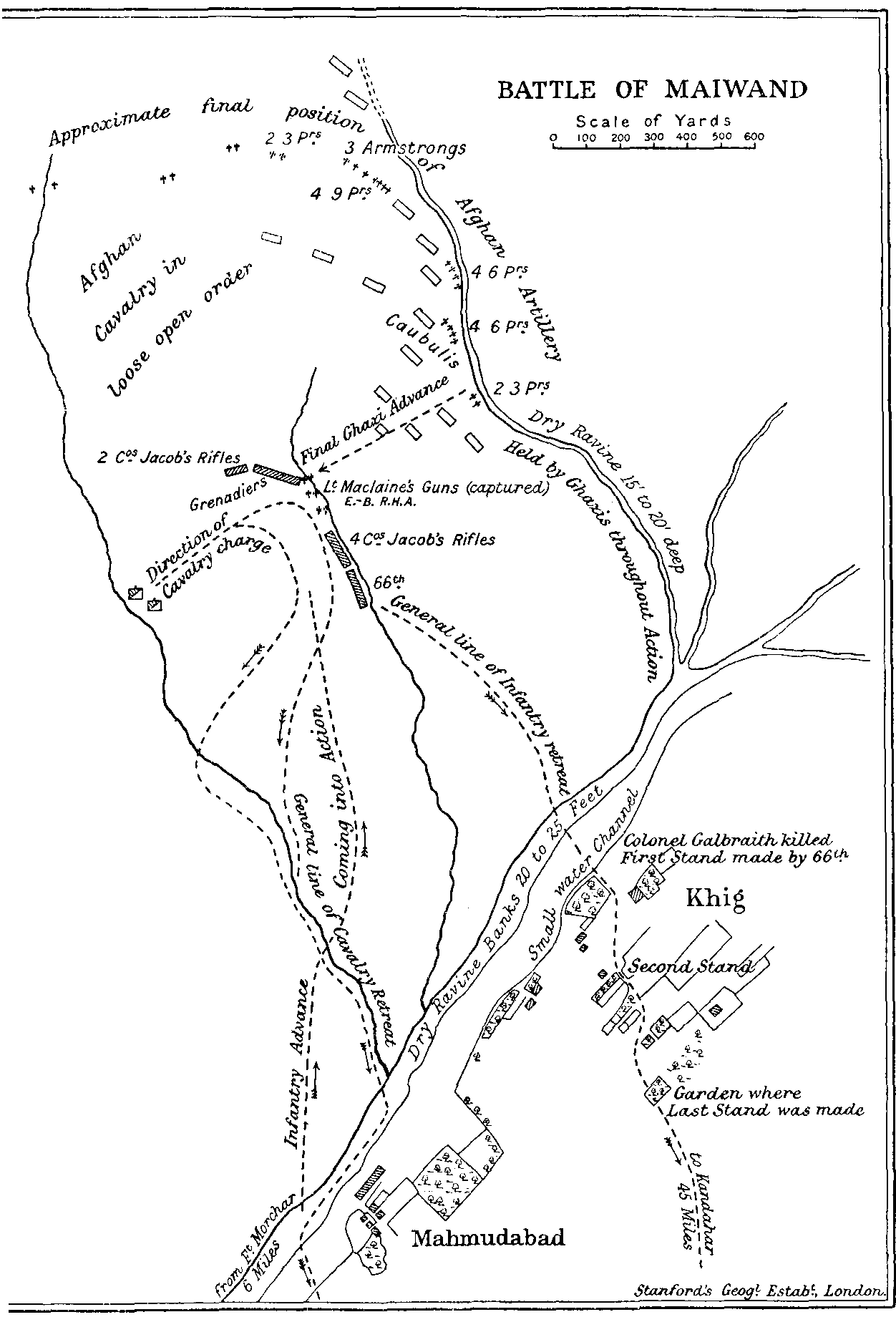
Battle of Maiwand.
some influence, baleful to England, kept back those Asiatics from their usually heedless rush. Their guns came up and opened fire on Burrows' line. Even the white quivering groups of their ghazis forebore to charge with their whetted knives, but clung to a gully which afforded good cover 500 yards away from the British front and right flank; there the Afghan regulars galled the exposed khaki line, while their cannon, now numbering thirty pieces, kept up a fire to which Maclaine's twelve guns could give no adequate reply.
[Illustration: Battle of Maiwand]
It has been stated by military critics that Burrows erred in letting the fight at the outset become an affair of artillery, in which he was plainly the weaker. Some of his guns were put out of action; and in that open plain there was no cover for the fighting line, the reserves, or the supporting horse. All of them sustained heavy losses from the unusually accurate aim of the Afghan gunners. But the enemy had also suffered under our cannonade and musketry; and it is consonant with the traditions of Indian warfare to suppose that a charge firmly pushed home at the first signs of wavering in the hostile mass would have retrieved the day. Plassey and Assaye were won by sheer boldness. Such a chance is said to have occurred about noon at Maiwand. However that may be, Burrows decided to remain on the defensive, perhaps because the hostile masses were too dense and too full of fight to warrant the adoption of dashing tactics.
After the sun passed his zenith the enemy began to press on the front and flanks. Burrows swung round his wings to meet these threatening moves; but, as the feline and predatory instincts of the Afghans kindled more and more at the sight of the weak, bent, and stationary line, so too the morale of the defenders fell. The British and Indian troops alike were exhausted by the long march and by the torments of thirst in the sultry heat. Under the fire of the Afghan cannon and the frontal and flank advance of the enemy, the line began to waver about 2 P.M., and two of the foremost guns were lost. A native regiment in the centre, Jacob's Rifles, fled in utter [pg 411] confusion and spread disorder on the flanks, where the 1st Bombay Grenadiers and the 66th line regiment had long maintained a desperate fight. General Nuttall now ordered several squadrons of the 3rd Light Cavalry and 3rd Sind Horse to recover the guns and stay the onrushing tide, but their numbers were too small for the task, and the charge was not pressed home. Finally the whole mass of pursued and pursuers rolled towards the village of Khig and its outlying enclosures.
There a final stand was made. Colonel Galbraith and about one hundred officers and men of the 66th threw themselves into a garden enclosure, plied the enemy fiercely with bullets, and time after time beat back every rush of the ghazis, now rioting in that carnival of death. Surrounded by the flood of the Afghan advance, the little band fought on, hopeless of life, but determined to uphold to the last the honour of their flag and country. At last only eleven were left. These heroes determined to die in the open; charging out on the masses around, they formed square, and back to back stood firing on the foe. Not until the last of them fell under the Afghan rifles did the ghazis venture to close in with their knives, so dauntless had been the bearing of this band[322].
They had not fought in vain. Their stubborn stand held back the Afghan pursuit and gave time for the fugitives to come together on the way back to Candahar. Had the pursuit been pushed on with vigour few, if any, could have survived. Even so, Maiwand was one of the gravest disasters ever sustained by our Indian army. It cost Burrows' force nearly half its numbers; 934 officers and men were killed and 175 wounded. The strange disproportion between these totals may serve as a measure of the ferocity of Afghans in the hour of victory. Of the non-combatants 790 fell under the knives of the ghazis. The remnant struggled towards Candahar, whence, on the 28th, General Primrose despatched a column to the aid of the exhausted survivors. In the citadel of that fortress there [pg 412] mustered as many as 4360 effectives as night fell. But what were these in face of Ayub's victorious army, now joined by tribesmen eager for revenge and plunder[323]?
In face of this disaster, the British generals in Northern Afghanistan formed a decision commendable alike for its boldness and its sagacity. They decided to despatch at once all available troops from Cabul to the relief of the beleaguered garrison at Candahar. General Sir Frederick Roberts had handed over the command at Cabul to Sir Donald Stewart, and was about to operate among the tribes on the Afghan frontier when the news of the disaster sent him hurrying back to confer with the new commander-in-chief. Together they recommended the plan named above.
It involved grave dangers: for affairs in the north of Afghanistan were unsettled; and to withdraw the rest of our force from Cabul to the Khyber would give the rein to local disaffection. The Indian authorities at Simla inclined to the despatch of the force at Quetta, comprising seven regiments of native troops, from Bombay. The route was certainly far easier; for, thanks to the toil of engineers, the railway from the Indus Valley towards Quetta had been completed up to a point in advance of Sibi; and the labours of Major Sandeman, Bruce, and others, had kept that district fairly quiet[324]. But the troops at Quetta and Pishin were held to be incapable of facing a superior force of victorious Afghans. At Cabul there were nine regiments of infantry, three of cavalry, and three mountain-batteries, all of them British or picked Indian troops. On August 3, Lord Ripon telegraphed his permission for the despatch of the Cabul field-force to Candahar. It amounted to 2835 British (the 72nd and 92nd Highlanders and 2nd battalion [pg 413] of the 60th Rifles, and 9th Lancers), 7151 Indian troops, together with 18 guns. On August 9 it struck camp and set out on a march which was destined to be famous.
Fortunately before it left the Cabul camp on August 9, matters were skilfully arranged by Mr. Griffin with Abdur Rahman, on terms which will be noticed presently. In spite of one or two suspicious incidents, his loyalty to the British cause now seemed to be assured, and that, too, in spite of the remonstrances of many of his supporters. He therefore sent forward messengers to prepare the way for Roberts' force. They did so by telling the tribesmen that the new Ameer was sending the foreign army out of the land by way of Candahar! This pleasing fiction in some measure helped on the progress of the force, and the issue of events proved it to be no very great travesty of the truth.
Every possible device was needed to ensure triumph over physical obstacles. In order to expedite the march through the difficult country between Cabul and Candahar, no wheeled guns or waggons went with the force. As many as 8000 native bearers or drivers set out with the force, but very many of them deserted, and the 8255 horses, mules and donkeys were thenceforth driven by men told off from the regiments. The line of march led at first through the fertile valley of the River Logar, where the troops and followers were able to reap the ripening crops and subsist in comfort. Money was paid for the crops thus appropriated. After leaving this fertile district for the barren uplands, the question of food and fuel became very serious; but it was overcome by ingenuity and patience, though occasional times of privation had to be faced, as, for instance, when only very small roots were found for the cooking of corn and meat. A lofty range, the Zamburak Kotal, was crossed with great toil and amidst biting cold at night-time; but the ability of the commander, the forethought and organising power of his Staff, and the hardihood of the men overcame all trials and obstacles.
The army then reached the more fertile districts around [pg 414] Ghazni, and on August 15 gained an entry without resistance to that once formidable stronghold. Steady marching brought the force eight days later to the hill fort of Kelat-i-Ghilzai, where it received a hearty welcome from the British garrison of 900 men. Sir Frederick Roberts determined to take on these troops with him, as he needed all his strength to cope with the growing power of Yakub. After a day's rest (well earned, seeing that the force had traversed 225 miles in 14 days), the column set forth on its last stages, cheered by the thought of rescuing their comrades at Candahar, but more and more oppressed by the heat, which, in the lower districts of South Afghanistan, is as fierce as anywhere in the world. Mr. Hensman, the war correspondent of the Daily News, summed up in one telling phrase the chief difficulties of the troops. "The sun laughed to scorn 100° F. in the shade." On the 27th the commander fell with a sharp attack of fever.
Nevertheless he instructed the Indian cavalry to push on to Robat and open up heliographic communication with Candahar. It then transpired that the approach of the column had already changed the situation. Already, on August 23, Ayub had raised the siege and retired to the hills north of the city. That relief came none too soon appeared on the morning of the 31st, when the thin and feeble cheering that greeted the rescuers on their entrance to the long beleaguered town told its sad tale of want, disease, and depression of heart. The men who had marched 313 miles in 22 days--an average of 14-1/4 miles a day--felt a thrill of sympathy, not unmixed with disgust in some cases, at the want of spirit too plainly discernible among the defenders. The Union Jack was not hoisted on the citadel until the rescuers were near at hand[325]. General Roberts might have applied to them Hecuba's words to Priam:--
Non tali auxilio, nec defensoribus istis
Tempus eget.
As for the morale of the relieving force, it now stood at the [pg 415] zenith, as was seen on the following day. Framing his measures so as to encourage Ayub to stand his ground, Roberts planned his attack in the way that had already led to success, namely, a frontal attack more imposing than serious, while the enemy's flank was turned and his communications threatened. These moves were carried out by Generals Ross and Baker with great skill. Under the persistent pressure of the British onset the Afghans fell back from position to position, north-west of Candahar; until finally Major White with the 92nd, supported by Gurkhas and the 23rd Pioneers, drove them back to their last ridge, the Baba Wali Kotal, swarmed up its western flank, and threw the whole of the hostile mass in utter confusion into the plain beyond. Owing to the very broken nature of the ground, few British and Indian horsemen were at hand to reap the full fruits of victory; but many of Ayub's regulars and ghazis fell under their avenging sabres. The beaten force deserved no mercy. When the British triumph was assured, the Afghan chief ordered his prisoner, Lieutenant Maclaine, to be butchered; whereupon he himself and his suite took to flight. The whole of his artillery, twenty-seven pieces, including the two British guns lost at Maiwand, fell into the victor's hands. In fact, Ayub's force ceased to exist; many of his troops at once assumed the garb of peaceful cultivators, and the Pretender himself fled to Herat[326].
Thus ended an enterprise which, but for the exercise of the highest qualities on the part of General Roberts, his Staff, the officers, and rank and file, might easily have ended in irretrievable disaster. This will appear from the following considerations. The question of food and water during a prolonged march in that parched season of the year might have caused the gravest difficulties; but they were solved by a wise choice of route along or near water-courses where water could generally be procured. The few days when little or no water could be [pg 416] had showed what might have happened. Further, the help assured by the action of the Ameer's emissaries among the tribesmen was of little avail after the valley of the Logar was left behind. Many of the tribes were actively hostile, and cut off stragglers and baggage-animals.
Above and beyond these daily difficulties, there was the problem as to the line of retreat to be taken in case of a reverse inflicted by the tribes en route. The army had given up its base of operations; for at the same time the remaining British and Indian regiments at Cabul were withdrawn to the Khyber Pass. True, there was General Phayre's force holding Quetta, and endeavouring to stretch out a hand towards Candahar; but the natural obstacles and lack of transport prevented the arrival of help from that quarter. It is, however, scarcely correct to say that Roberts had no line of retreat assured in case of defeat[327]. No serious fighting was to be expected before Candahar; for the Afghan plundering instinct was likely to keep Ayub near to that city, where the garrison was hard pressed. After leaving Ghazni, the Quetta route became the natural way of retirement.
As it happened, the difficulties were mainly those inflicted by the stern hand of Nature herself; and their severity may be gauged by the fact that out of a well-seasoned force of less than 10,000 fighting men as many as 940 sick had at once to go into hospital at Candahar. The burning days and frosty nights of the Afghan uplands were more fatal than the rifles of Ayub and the knives of the ghazis. As Lord Roberts has modestly admitted, the long march gained in dramatic effect because for three weeks he and his army were lost to the world, and, suddenly emerging from the unknown, gained a decisive triumph. But, allowing for this element of picturesqueness, so unusual in an age when the daily din of telegrams dulls the perception of readers, we may still maintain that the march from Cabul to Candahar will bear comparison with any similar achievement in modern history.
[pg 417]The story of British relations with Afghanistan is one which illustrates the infinite capacity of our race to "muddle through" to some more or less satisfactory settlement. This was especially the case in the spring and summer of 1880, when the accession of Mr. Gladstone to power and the disaster of Maiwand changed the diplomatic and military situation. In one sense, and that not a cryptic one, these events served to supplement one another. They rendered inevitable the entire evacuation of Afghanistan. That, it need hardly be said, was the policy of Mr. Gladstone, of the Secretary for India, Lord Hartington (now Duke of Devonshire), and of Lord Ripon.
On one point both parties were agreed. Events had shown how undesirable it was to hold Cabul and Central Afghanistan. The evacuation of all these districts was specified in Lord Lytton's last official Memorandum, that which he signed on June 7, 1880, as certain to take place as soon as the political arrangements at Cabul were duly settled. The retiring Viceroy, however, declared that in his judgment the whole Province of Candahar must be severed from the Cabul Power, whether Abdur Rahman assented to it or not[328]. Obviously this implied the subjection of Candahar to British rule in some form. General Roberts himself argued stoutly for the retention of that city and district; and so did most of the military men. Lord Wolseley, on the other hand, urged that it would place an undesirable strain upon the resources of India, and that the city could readily be occupied from the Quetta position, if ever the Russians advanced to Herat. The Cabinet strongly held this opinion. The exponents of Whig ideas, Lord Hartington and the Duke of Argyll, herein agreeing with the exponents of a peaceful un-Imperial commercialism, Mr. Bright and Mr. Chamberlain. Consequently the last of the British troops were withdrawn from Candahar on April 15, 1881.
[pg 418]The retirement was more serious in appearance than in reality. The war had brought some substantial gains. The new frontier acquired by the Treaty of Gandamak--and the terms of that compact were practically void until Roberts' victory at Candahar gave them body and life--provided ample means for sending troops easily to the neighbourhood of Cabul, Ghazni, and Candahar; and experience showed that troops kept in the hill stations on the frontier preserved their mettle far better than those cantoned in or near the unhealthy cities just named. The Afghans had also learnt a sharp lesson of the danger and futility of leaning on Russia; and to this fact must be attributed the steady adherence of the new Ameer to the British side.
Moreover, the success of his rule depended largely on our evacuation of his land. Experience has shown that a practically independent and united Afghanistan forms a better barrier to a Russian advance than an Afghanistan rent by the fanatical feuds that spring up during a foreign occupation. Finally, the great need of India after the long famine was economy. A prosperous and contented India might be trusted to beat off any army that Russia could send; a bankrupt India would be the breeding-ground of strife and mutiny; and on these fell powers Skobeleff counted as his most formidable allies[329].
It remained to be seen whether Abdur Rahman could win Candahar and Herat, and, having won them, keep them. At first Fortune smiled on his rival, Ayub. That pretender sent a force from Herat southwards against the Ameer's troops, defeated them, and took Candahar (July 1881). But Abdur Rahman had learnt to scorn the shifts of the fickle goddess. With a large force he marched to that city, bought over a part of Ayub's following, and then utterly defeated the remainder. This defeat was the end of Ayub's career. Flying back to Herat, he found it in the hands of the Ameer's supporters, and was fain to seek refuge in Persia. Both of these successes [pg 419] seem to have been due to the subsidies which the new Ameer drew from India[330].
We may here refer to the last scene in which Ayub played a part before Englishmen. Foiled of his hopes in Persia, he finally retired to India. At a later day he appeared as a pensioner on the bounty of that Government at a review held at Rawal Pindi in the Punjab in honour of the visit of H.R.H. Prince Victor. The Prince, on being informed of his presence, rode up to his carriage and saluted the fallen Sirdar. The incident profoundly touched the Afghans who were present. One of them said: "It was a noble act. It shows that you English are worthy to be the rulers of this land[331]."
The Afghans were accustomed to see the conquered crushed and scorned by the conqueror. Hence they did not resent the truculent methods resorted to by Abdur Rahman in the consolidation of his power. In his relentless grip the Afghan tribes soon acquired something of stability. Certainly Lord Lytton never made a wiser choice than that of Abdur Rahman for the Ameership; and, strange to say, that choice obviated the evils which the Viceroy predicted as certain to accrue from the British withdrawal from Candahar[332]. Contrasting the action of Great Britain towards himself with that of Russia towards Shere Ali in his closing days, the new Ameer could scarcely waver in his choice of an alliance. And while he held the Indian Government away at arm's length, he never wavered at heart.
For in the meantime Russia had resumed her southward march, setting to work with the doggedness that she usually displays in the task of avenging slights and overbearing opposition. The penury of the exchequer, the plots of the Nihilists, and the discontent of the whole people after the [pg 420] inglorious struggle with Turkey, would have imposed on any other Government a policy of rest and economy. To the stiff bureaucracy of St. Petersburg these were so many motives for adopting a forward policy in Asia. Conquests of Turkoman territory would bring wealth, at least to the bureaucrats and generals; and military triumphs might be counted on to raise the spirit of the troops, silence the talk about official peculations during the Turkish campaign, and act in the manner so sagaciously pointed out by Henry IV. to Prince Hal:--
Therefore, my Harry,
Be it thy course to busy giddy minds
With foreign quarrels, that action, hence borne out,
May waste the memory of the former days.
In the autumn of 1878 General Lomakin had waged an unsuccessful campaign against the Tekke Turkomans, and finally fell back with heavy losses on Krasnovodsk, his base of operations on the Caspian Sea. In the summer of 1879 another expedition set out from that port to avenge the defeat. Owing to the death of the chief, Lomakin again rose to the command. His bad dispositions at the climax of the campaign led him to a more serious disaster. On coming up to the fortress of Denghil Tepe, near the town of Geok Tepe, he led only 1400 men, or less than half of his force, to bombard and storm a stronghold held by some 15,000 Turkomans, and fortified on the plan suggested by a British officer, Lieutenant Butler[333]. Preluding his attack by a murderous cannonade, he sent round his cavalry to check the flight of the faint-hearted among the garrison; and, before his guns had fully done their work, he ordered the whole line to advance and carry the walls by storm. At once the Turkoman fire redoubled in strength, tore away the front of every attacking party, and finally drove [pg 421] back the assailants everywhere with heavy loss (Sept. 9, 1879). On the morrow the invaders fell back on the River Atrek and thence made their way back to the Caspian in sore straits[334].
The next year witnessed the advent of a great soldier on the scene. Skobeleff, the stormy petrel of Russian life, the man whose giant frame was animated by a hero's soul, who, when pitched from his horse in the rush on one of the death-dealing redoubts at Plevna, rose undaunted to his feet, brandished his broken sword in the air and yelled at the enemy a defiance which thrilled his broken lines to a final mad charge over the rampart--Skobeleff was at hand. He had culled his first laurels at Khiva and Khokand, and now came to the shores of the Caspian to carry forward the standards which he hoped one day to plant on the walls of Delhi. That he cherished this hope is proved by the Memorandum which will be found in the Appendix of this volume. His disclaimer of any such intention to Mr. Charles Marvin (which will also be found there) shows that under his frank exterior there lay hidden the strain of Oriental duplicity so often found among his countrymen in political life.
At once the operations felt the influence of his active, cheery, and commanding personality. The materials for a railway which had been lying unused at Bender were now brought up; and Russia found the money to set about the construction of a railway from Michaelovsk to the Tekke Turkoman country--an undertaking which was destined wholly to change the conditions of warfare in South Turkestan and on the Afghan border. By the close of the year more than forty miles were roughly laid down, and Skobeleff was ready for his final advance from Kizil Arvat towards Denghil Tepe.
Meanwhile the Tekkes had gained reinforcements from their kinsmen in the Merv oasis, and had massed nearly 40,000 men--so rumour ran--at their stronghold. Nevertheless, [pg 422] they offered no serious resistance to the Russian advance, doubtless because they hoped to increase the difficulties of his retreat after the repulse which they determined to inflict at their hill fortress. But Skobeleff excelled Lomakin in skill no less than in prowess and magnetic influence. He proceeded to push his trenches towards the stronghold, so that on January 23, 1881, his men succeeded in placing 2600 pounds of gunpowder under the south-eastern corner of the rampart. Early on the following day the Russians began the assault; and while cannon and rockets wrought death and dismay among the ill-armed defenders, the mighty shock of the explosion tore away fifty yards of their rampart.
At once the Russian lines moved forward to end the work begun by gunpowder. With the blare of martial music and with ringing cheers, they charged at the still formidable walls. A young officer, Colonel Kuropatkin, who has since won notoriety in other lands, was ready with twelve companies to rush into the breach. Their leading files swarmed up it before the Tekkes fully recovered from the blow dealt by the hand of western science; but then the brave nomads closed in on foes with whom they could fight, and brought the storming party to a standstill. Skobeleff was ready for the emergency. True to his Plevna tactics of ever feeding an attack at the crisis with new troops, he hurled forward two battalions of the line and companies of dismounted Cossacks. These pushed on the onset, hewed their way through all obstacles, and soon met the smaller storming parties which had penetrated at other points. By 1 p.m. the Russian standard waved in triumph from the central hill of the fortress, and thenceforth bands of Tekkes began to stream forth into the desert on the further side.
Now Skobeleff gave to his foes a sharp lesson, which, he claimed, was the most merciful in the end. He ordered his men, horse and foot alike, to pursue the fugitives and spare no one. Ruthlessly the order was obeyed. First, the flight of grape shot from the light guns, then the bayonet, and lastly [pg 423] the Cossack lance, strewed the plain with corpses of men, women, and children; darkness alone put an end to the butchery, and then the desert for eleven miles eastwards of Denghil Tepe bore witness to the thoroughness of Muscovite methods of warfare. All the men within the fortress were put to the sword. Skobeleff himself estimated the number of the slain at 20,000[335]. Booty to the value of £600,000 fell to the lot of the victors. Since that awful day the once predatory tribes of Tekkes have given little trouble. Skobeleff sent his righthand man, Kuropatkin, to occupy Askabad, and reconnoitre towards Merv. But these moves were checked by order of the Czar.
A curious incident, told to Lord Curzon, illustrates the dread in which Russian troops have since been held. At the opening of the railway to Askabad, five years later, the Russian military bands began to play. At once the women and children there present raised cries and shrieks of dread, while the men threw themselves on the ground. They imagined that the music was a signal for another onslaught like that which preluded the capture of their former stronghold[336].
This victory proved to be the last of Skobeleff's career. The Government having used their knight-errant, now put him on one side as too insubordinate and ambitious for his post. To his great disgust, he was recalled. He did not long survive. Owing to causes that are little known, among which a round of fast-living is said to have played its part, he died suddenly from failure of the heart at his residence near Moscow (July 7 1882). Some there were who whispered dark things as to his militant notions being out of favour with the new Czar, Alexander III.; others pointed significantly to Bismarck. Others again prattled of Destiny; but the best comment on the death of Skobeleff would seem to be that illuminating saying of Novalis--"Character is Destiny." Love of fame prompted in him the desire one day to measure swords with Lord Roberts [pg 424] in the Punjab; but the coarser strain in his nature dragged him to earth at the age of thirty-nine.
The accession of Alexander III., after the murder of his father on March 13, 1881, promised for a short time to usher in a more peaceful policy; but, in truth, the last important diplomatic assurance of the reign of Alexander II. was that given by the Minister M. de Giers, to Lord Dufferin, as to Russia's resolve not to occupy Merv. "Not only do we not want to go there, but, happily, there is nothing which can require us to go there."
In spite of a similar assurance given on April 5 to the Russian ambassador in London, both the need and the desire soon sprang into existence. Muscovite agents made their way to the fruitful oasis of Merv; and a daring soldier, Alikhanoff, in the guise of a merchant's clerk, proceeded thither early in 1882, skilfully distributed money to work up a Russian party, and secretly sketched a plan of the fortress. Many chiefs and traders opposed Russia bitterly, for our brilliant and adventurous countryman, O'Donovan, while captive there, sought to open their eyes to the coming danger. But England's influence had fallen to zero since Skobeleff's victory and her own withdrawal from Candahar[337].
In 1882 a Russian Engineer officer, Lessar, in the guise of a scientific explorer, surveyed the route between Merv and Herat, and found that it presented far fewer difficulties than had been formerly reported to exist[338]. Finally, in 1884, the Czar's Government sought to revenge itself for Britain's continued occupation of Egypt by fomenting trouble near the Afghan border. Alikhanoff then reappeared, not in disguise, browbeat the hostile chieftains at Merv by threats of a Russian invasion, and finally induced them to take an oath of allegiance to Alexander III. (Feb. 12, 1884)[339].
[pg 425]There was, however, some reason for Russia's violation of her repeated promises respecting Merv. In practical politics the theory of compensation has long gained an assured footing; and, seeing that Britain had occupied Egypt partly as the mandatory of Europe, and now refused to evacuate that land, the Russian Government had a good excuse for retaliation. As has happened at every time of tension between the two Empires since 1855, the Czar chose to embarrass the Island Power by pushing on towards India. As a matter of fact, the greater the pressure that Russia brought to bear on the Afghan frontier, the greater became the determination of England not to withdraw from Egypt. Hence, in the years 1882-4, both Powers plunged more deeply into that "vicious circle" in which the policy of the Crimean War had enclosed them, and from which they have never freed themselves.
The fact is deplorable. It has produced endless friction and has strained the resources of two great Empires; but the allegation of Russian perfidy in the Merv affair may be left to those who look at facts solely from the insular standpoint. In the eyes of patriotic Russians England was the offender, first by opposing Muscovite policy tooth and nail in the Balkans, secondly by seizing Egypt, and thirdly by refusing to withdraw from that commanding position. The important fact to notice is that after each of these provocations Russia sought her revenge on that flank of the British Empire to which she was guided by her own sure instincts and by the shrieks of insular Cassandras. By moving a few sotnias of Cossacks towards Herat she compelled her rival to spend a hundredfold as much in military preparations in India.
It is undeniable that Russia's persistent breach of her promises in Asiatic affairs exasperated public opinion, and brought the two Empires to the verge of war. Conduct of that description baffles the resources of diplomacy, which are designed to arrange disputes. Unfortunately, British foreign affairs were in the hands of Lord Granville, whose gentle reproaches only awakened contempt at St. Petersburg. The [pg 426] recent withdrawal of Lord Dufferin from St. Petersburg to Constantinople, on the plea of ill-health, was also a misfortune; but his appointment to the Viceroyalty of India (September 1884) placed at Calcutta a Governor-General superior to Lord Ripon in diplomatic experience.
There was every need for the exercise of ability and firmness both at Westminster and Calcutta. The climax in Russia's policy of lance-pricks was reached in the following year; and it has been assumed, apparently on good authority, that the understanding arrived at by the three Emperors in their meeting at Skiernewice (September 1884) implied a tacit encouragement of Russia's designs in Central Asia, however much they were curbed in the Balkan Peninsula. This was certainly the aim of Bismarck, and that he knew a good deal about Russian movements is clear from his words to Busch on November 24, 1884: "Just keep a sharp look-out on the news from Afghanistan. Something will happen there soon[340]."
This was clearly more than a surmise. At that time an Anglo-Russian Boundary Commission was appointed to settle the many vexed questions concerning the delimitation of the Russo-Afghan boundary. General Sir Peter Lumsden proceeded to Sarrakhs, expecting there to meet the Russian Commissioners by appointment in the middle of October 1884. On various pretexts the work of the Commission was postponed in accordance with advices sent from St. Petersburg. The aim of this dilatory policy soon became evident. That was the time when (as will appear in Chapter XVI.) the British expedition was slowly working its way towards Khartum in the effort to unravel the web of fate then closing in on the gallant Gordon. The news of his doom reached England on February 5, 1885. Then it was that Russia unmasked her designs. They included the appropriation of the town and district of Panjdeh, which she herself had previously acknowledged to be in Afghan territory. In vain did Lord Granville protest; in vain did he put forward proposals which conceded [pg 427] very much to the Czar, but less than his Ministers determined to have. All that he could obtain was a promise that the Russians would not advance further during the negotiations.
On March 13, Mr. Gladstone officially announced that an agreement to this effect had been arrived at with Russia. The Foreign Minister at St. Petersburg, M. de Giers, on March 16 assured our ambassador, Sir Edward Thornton, that that statement was correct. On March 26, however, the light troops of General Komaroff advanced beyond the line of demarcation previously agreed on, and on the following day pushed past the Afghan force holding positions in front of Panjdeh. The Afghans refused to be drawn into a fight, but held their ground; thereupon, on March 29, Komaroff sent them an ultimatum ordering them to withdraw beyond Panjdeh. A British staff-officer requested him to reconsider and recall this demand, but he himself was waived aside. Finally, on March 30, Komaroff attacked the Afghan position, and drove out the defenders with the loss of 900 men. The survivors fell back on Herat, General Lumsden and his escort retired in the same direction, and Russia took possession of the coveted prize[341].
The news of this outrage reached England on April 7, and sent a thrill of indignation through the breasts of the most peaceful. Twenty days later Mr. Gladstone proposed to Parliament to vote the sum of £11,000,000 for war preparations. Of this sum all but £4,500,000 (needed for the Sudan) was devoted to military and naval preparations against Russia; and we have the authority of Mr. John Morley for saying that this vote was supported by Liberals "with much more than a mechanical loyalty[342]." Russia had achieved the impossible; she had united Liberals of all shades of thought against her, and the joke about "Mervousness" was heard no more.
[pg 428]Nevertheless the firmness of the Government resembled that of Bob Acres: it soon oozed away. Ministers deferred to the Czar's angry declaration that he would allow no inquiry into the action of General Komaroff. This alone was a most mischievous precedent, as it tended to inflate Russian officers with the belief that they could safely set at defiance the rules of international law. Still worse were the signs of favour showered on the violator of a truce by the sovereign who gained the reputation of being the upholder of peace. From all that is known semi-officially with respect to the acute crisis of the spring of 1885, it would appear that peace was due solely to the tact of Sir Robert Morier, our ambassador at St. Petersburg, and to the complaisance of the Gladstone Cabinet.
Certainly this quality carried Ministers very far on the path of concession. When negotiations were resumed, the British Government belied its former promises of firmness in a matter that closely concerned our ally, and surrendered Panjdeh to Russia, but on the understanding that the Zulfikar Pass should be retained by the Afghans. It should be stated, however, that Abdur Rahman had already assured Lord Dufferin, during interviews which they had at Rawal Pindi early in April, of his readiness to give up Panjdeh if he could retain that pass and its approaches. The Russian Government conceded this point; but their negotiators then set to work to secure possession of heights dominating the pass. It seemed that Lord Granville was open to conviction even on this point.
Such was the state of affairs when, on June 9, 1885, Mr. Gladstone's Ministry resigned owing to a defeat on a budget question. The accession of Lord Salisbury to power after a brief interval helped to clear up these disputes. The crisis in Bulgaria of September 1885 (see Chapter X.) also served to distract the Russian Government, the Czar's chief pre-occupation now being to have his revenge on Prince Alexander of Battenberg. Consequently the two Powers came to a compromise about the Zulfikar Pass[343]. There still remained several [pg 429] questions outstanding, and only after long and arduous surveys, not unmixed with disputes, was the present boundary agreed on in a Protocol signed on July 22, 1887. We may here refer to a prophecy made by one of Bismarck's confidantes, Bucher, at the close of May 1885: "I believe the [Afghan] matter will come up again in about five years, when the [Russian] railways are finished[344]."
Thus it was that Russia secured her hold on districts dangerously near to Herat. Her methods at Panjdeh can only be described as a deliberate outrage on international law. It is clear that Alexander III. and his officials cared nothing for the public opinion of Europe, and that they pushed on their claims by means which appealed with overpowering force to the dominant motive of orientals--fear. But their action was based on another consideration. Relying on Mr. Gladstone's well-known love of peace, they sought to degrade the British Government in the eyes of the Asiatic peoples. In some measure they succeeded. The prestige of Britain thenceforth paled before that of the Czar; and the ease and decisiveness of the Russian conquests, contrasting with the fitful advances and speedy withdrawals of British troops, spread the feeling in Central Asia that the future belonged to Russia.
Fortunately, this was not the light in which Abdur Rahman viewed the incident. He was not the man to yield to intimidation. That "strange, strong creature," as Lord Dufferin called him, "showed less emotion than might have been expected," but his resentment against Russia was none the less keen[345]. Her pressure only served to drive him to closer union with Great Britain. Clearly the Russians misunderstood Abdur Rahman. Their miscalculation was equally great as regards the character of the Afghans and the conditions of life among those mountain clans. Russian officers and administrators, after pushing their way easily through the loose rubble [pg 430] of tribes that make up Turkestan, did not realise that they had to deal with very different men in Afghanistan. To ride roughshod over tribes who live in the desert and have no natural rallying-point may be very effective; but that policy is risky when applied to tribes who cling to their mountains.
The analogy of Afghanistan to Switzerland may again serve to illustrate the difference between mountaineers and plain-dwellers. It was only when the Hapsburgs or the French threatened the Swiss that they formed any effective union for the defence of the Fatherland. Always at variance in time of peace, the cantons never united save under the stress of a common danger. The greater the pressure from without, the closer was the union. That truth has been illustrated several times from the age of the legendary Tell down to the glorious efforts of 1798. In a word, the selfsame mountaineers who live disunited in time of peace, come together and act closely together in war, or under threat of war.
Accordingly, the action of England in retiring from Candahar, contrasting as it did with Russia's action at Panjdeh, marked out the line of true policy for Abdur Rahman. Thenceforth he and his tribesmen saw more clearly than ever that Russia was the foe; and it is noteworthy that under the shadow of the northern peril there has grown up among those turbulent clans a sense of unity never known before. Unconsciously Russia has been playing the part of a Napoleon I.; she has ground together some at least of the peoples of Central Asia with a thoroughness which may lead to unexpected results if ever events favour a general rising against the conqueror.
Amidst all his seeming vacillations of policy, Abdur Rahman was governed by the thought of keeping England, and still more Russia, from his land. He absolutely refused to allow railways and telegraphs to enter his territories; for, as he said: "Where Europeans build railways, their armies quickly follow. My neighbours have all been swallowed up in this manner. I have no wish to suffer their fate."
[pg 431]His judgment was sound. Skobeleff conquered the Tekkes by his railway; and the acquisition of Merv and Panjdeh was really the outcome of the new trans-Caspian line, which, as Lord Curzon has pointed out, completely changed the problem of the defence of India. Formerly the natural line of advance for Russia was from Orenburg to Tashkend and the upper Oxus; and even now that railway would enable her to make a powerful diversion against Northern Afghanistan[346]. But the route from Krasnovodsk on the Caspian to Merv and Kushk presents a shorter and far easier route, leading, moreover, to the open side of Afghanistan, Herat, and Candahar. Recent experiments have shown that a division of troops can be sent in eight days from Moscow to Kushk within a short distance of the Afghan frontier. In a word, Russia can operate against Afghanistan by a line (or rather by two lines) far shorter and easier than any which Great Britain can use for its defence[347].
It is therefore of the utmost importance to prevent her pushing on her railways into that country. This is the consideration which inspired Mr. Balfour's noteworthy declaration of May 11, 1905, in the House of Commons:--
As transport is the great difficulty of an invading army, we must not allow anything to be done which would facilitate transport. It ought in my opinion to be considered as an act of direct aggression upon this country that any attempt should be made to build a railway, in connection with the Russian strategic railways, within the territory of Afghanistan.
It is fairly certain that the present Ameer, Habibulla, who succeeded his father in 1901, holds those views. This doubtless was the reason why, early in 1905, he took the unprecedented step of inviting the Indian Government to send a Mission to Cabul. In view of the increase of Russia's [pg 432] railways in Central Asia there was more need than ever of coming to a secret understanding with a view to defence against that Power.
Finally, we may note that Great Britain has done very much to make up for her natural defects of position. The Panjdeh affair having relegated the policy of "masterly inactivity" to the limbo of benevolent futilities, the materials for the Quetta railway, which had been in large part sent back to Bombay in the year 1881, were now brought back again; and an alternative route was made to Quetta. The urgent need of checkmating French intrigues in Burmah led to the annexation of that land (November 1885); and the Kurram Valley, commanding Cabul, which the Gladstone Government had abandoned, was reoccupied. The Quetta district was annexed to India in 1887 under the title of British Baluchistan. The year 1891 saw an important work undertaken in advance of Quetta, the Khojak tunnel being then driven through a range close by the Afghan frontier, while an entrenched camp was constructed near by for the storage of arms and supplies. These positions, and the general hold which Britain keeps over the Baluchee clans, enable the defenders of India to threaten on the flank any advance by the otherwise practicable route from Candahar to the Indus.
Certainly there is every need for careful preparations against any such enterprise. Lord Curzon, writing before Russia's strategic railways were complete, thought it feasible for Russia speedily to throw 150,000 men into Afghanistan, feed them there, and send on 90,000 of them against the Indus[348]. After the optimistic account of the problem of Indian defence given by Mr. Balfour in the speech above referred to, it is well to remember that, though Russia cannot invade India until she has conquered Afghanistan, yet for that preliminary undertaking she has the advantages of time and position nearly entirely on her side. Further, the [pg 433] completion of her railways almost up to the Afghan frontier (the Tashkend railway is about to be pushed on to the north bank of the Oxus, near Balkh) minimises the difficulties of food supply and transport in Afghanistan, on which the Prime Minister laid so much stress.
It is, however, indisputable that the security of India has been greatly enhanced by the steady pushing on of that "Forward Policy," which all friends of peace used to decry. The Ameer, Abdur Rahman, irritated by the making of the Khojak tunnel, was soothed by Sir Mortimer Durand's Mission in 1893; and in return for an increase of subsidy and other advantages, he agreed that the tribes of the debatable borderland--the Waziris, Afridis, and those of the Swat and Chitral valleys--should be under the control of the Viceroy. Russia showed her annoyance at this Mission by seeking to seize an Afghan town, Murghab; but the Ameer's troops beat them off[349]. Lord Lansdowne claimed that this right of permanently controlling very troublesome tribes would end the days of futile "punitive expeditions." In the main he was right. The peace and security of the frontier depend on the tact with which some few scores of officers carry on difficult work of which no one ever hears[350].
In nearly all cases they have succeeded in their heroic toil. But the work of pacification was disturbed in the year 1895 by a rising in the Chitral Valley, which cut off in Chitral Fort a small force of Sikhs and loyal Kashmir troops with their British officers. Relieving columns from the Swat Valley and Gilgit cut their way through swarms of hillmen and relieved the little garrison after a harassing leaguer of forty-five days[351]. The annoyance evinced by Russian officers at the success of the expedition and the retention of the whole of the Chitral district (as large as Wales) prompts the [pg 434] conjecture that they had not been strangers to the original outbreak. In this year Russia and England delimited their boundaries in the Pamirs.
The year 1897 saw all the hill tribes west and south of Peshawur rise against the British Raj. Moslem fanaticism, kindled by the Sultan's victories over the Greeks, is said to have brought about the explosion, though critics of the Calcutta Government ascribe it to official folly[352]. With truly Roman solidity the British Government quelled the risings, the capture of the heights of Dargai by the "gay Gordons" showing the sturdy hillmen that they were no match for our best troops. Since then the "Forward Policy" has amply justified itself, thousands of fine troops being recruited from tribes which were recently daring marauders, ready for a dash into the plains of the Punjab at the bidding of any would-be disturber of the peace of India. In this case, then, Britain has transformed a troublesome border fringe into a protective girdle.
Whether the Russian Government intends in the future to invade India is a question which time alone can answer. Viewing her Central Asian policy from the time of the Crimean War, the student must admit that it bears distinct traces of such a design. Her advance has always been most conspicuous in the years succeeding any rebuff dealt by Great Britain, as happened after that war, and still more, after the Berlin Congress. At first, the theory that a civilised Power must swallow up restless raiding neighbours could be cited in explanation of such progress; but such a defence utterly fails to account for the cynical aggression at Panjdeh and the favour shown by the Czar to the general who violated a truce. Equally does it fail to explain the pushing on of strategic railways since the time of the conclusion of the Anglo-Japanese Treaty of 1902. Possibly Russia intends only to exert upon that Achilles heel of the British Empire the terrible but nominally pacific pressure which she brings to bear on the open frontiers of Germany and [pg 435] Austria; and the constant discussion by her officers of plans of invasion of India may be wholly unofficial. At the same time we must remember that the idea has long been a favourite one with the Russian bureaucracy; and the example of the years 1877-81 shows that that class is ready and eager to wipe out by a campaign in Central Asia the memory of a war barren of fame and booty. But that again depends on more general questions, especially those of finance (now a very serious question for Russia, seeing that she has drained Paris and Berlin of all possible loans) and of alliance with some Great Power, or Powers, anxious to effect the overthrow of Great Britain.
If Great Britain be not enervated by luxury; if she be not led astray from the paths of true policy by windy talk about "splendid isolation"; if also she can retain the loyal support of the various peoples of India,--she may face the contingency of such an invasion with firmness and equanimity. That it will come is the opinion of very many authorities of high standing. A native gentleman of high official rank, who brings forward new evidence on the subject, has recently declared it to be "inevitable[353]." Such, too, is the belief of the greatest authority on Indian warfare. Lord Roberts closes his Autobiography by affirming that an invasion is "inevitable in the end. We have done much, and may do still more to delay it; but when that struggle comes, it will be incumbent upon us, both for political and military reasons, to make use of all the troops and war material that the Native States can place at our disposal."
POSTSCRIPT
On May 22, 1905, the Times published particulars concerning the Anglo-Afghan Treaty recently signed at Cabul. It renewed the compact made with the late Ameer, whereby he agreed to have no relations with any foreign Power except Great Britain, the latter agreeing to defend him against foreign aggression. The subsidy of £120,000 a year is to be continued, but the present Ameer, Habibulla, henceforth receives a title equivalent to "King" and is styled "His Majesty."
FOOTNOTES:
[311] General [Sir] J.L. Vaughan, in a Lecture on "Afghanistan and the Military Operations therein" (December 6, 1878), said of the Afghans: "When resolutely attacked they rarely hold their ground with any tenacity, and are always anxious about their rear."
[312] Lord Roberts, Forty-One Years in India, vol. ii. p. 130 et seq.; Major J.A.S. Colquhoun, With the Kurram Field Force, 1878-79, pp. 101-102.
[313] Lord Roberts, op. cit., vol. ii. pp. 135-149; S.H. Shadbolt, The Afghan Campaigns of 1878-80, vol. i. pp. 21-25 (with plan).
[314] Parl. Papers, Afghanistan, No. 7, (1879), p. 9. He also states on p. 172 that the advice of the Afghan officials who accompanied Shere Ali in his flight was (even in April-May 1879) favourable to a Russian alliance, and that they advised Yakub in this sense. See Kaufmann's letters to Yakub, in Parl. Papers, Afghanistan, No. 9 (1879).
[315] Parl. Papers, Afghanistan, No. 7 (1879), p. 23; Roberts, op. cit. pp. 170-173.
[316] Parl. Papers, Afghanistan, No. 1 (1880), pp. 32-42, 89-96.
[317] Roberts, op. cit. vol. ii. pp. 213-224; Hensman, The Afghan War of 1878-1880.
[318] See his adventures in The Life of Abdur Rahman, by Sultan Mohammed Khan, vol. ii, chaps, v., vi. He gave out that he came to expel the English (pp. 173-175).
[319] Roberts, op. cit. vol. ii. pp. 315-323.
[320] The Life of Abdur Rahman, vol. ii. pp. 197-98. For these negotiations and the final recognition, see Parl. Papers, Afghanistan, No. 1 (1881), pp. 16-51.
[321] "A ghazi is a man who, purely for the sake of his religion, kills an unbeliever, Kaffir, Sikh, Hindu, Buddhist, or Christian, in the belief that in so doing he gains a sure title to Paradise" (R.I. Bruce, The Forward Policy, p. 245).
[322] Report of General Primrose in Parl. Papers, Afghanistan, No. 3 (1880), p. 156.
[323] S.H. Shadbolt, The Afghan Campaigns of 1878-80, pp. 96-100. Parl. Papers, Afghanistan, No. 2 (1880), p. 21; No. 3, pp. 103-5; Lord Roberts, op. cit. vol. ii. pp. 333-5; Hensman, op. cit. pp. 553-4.
[324] Colonel Sandeman: His Life and Work on our Indian Frontier, by T.H. Thornton; R.I. Bruce, The Forward Policy and its Results (1900), chaps. iv. v.; Candahar in 1879; being the Diary of Major Le Mesurier, R.E. (1880). The last had reported in 1879 that the fortifications of Candahar were weak and the citadel in bad repair.
[325] Roberts, op. cit. vol. ii. p. 357.
[326] Parl. Papers, Afghanistan, No. 3 (1880), p. 82. Hensman, The Afghan War; Shadbolt, op. cit. pp. 108-110. The last reckons Ayub's force at 12,800, of whom 1200 were slain.
[327] Shadbolt, op. cit. p. 107.
[328] Lady B. Balfour, op. cit. pp. 430, 445. On June 8 Lord Ripon arrived at Simla and took over the Viceroyalty from Lord Lytton; the latter was raised to an earldom.
[329] See Appendix; also Lord Hartington's speeches in the House of Commons, March 25-6, 1881
[330] Abdur Rahman's own account (op. cit. ch. ix.) ascribes his triumph to his own skill and to Ayub's cowardice.
[331] Eighteen Years in the Khyber Pass (1879-1898), by Colonel Sir R. Warburton, p. 213. The author's father had married a niece of the Ameer Dost Mohammed.
[332] Lord Lytton's speech in the House of Lords, Jan. 1881.
[333] This officer wrote to the Globe on January 25, 1881, stating that he had fortified two other posts east of Denghil Tepe. This led Skobeleff to push on to Askabad after the capture of that place; but he found no strongholds. See Marvin's Russian Advance towards India, p. 85.
[334] Parl. Papers, Central Asia, No. 1 (1880), pp. 167-173, 182.
[335] Siege and Assault of Denghil Tepe. By General Skobeleff (translated). London, 1881.
[336] Russia in Central Asia in 1889. By the Hon. G.N. Curzon (1889), p. 83.
[337] C. Marvin, Merv, the Queen of the World (1881); E. O'Donovan, The Merv Oasis, 2 vols. (1882-83), and Merv (1883).
[338] See his reports in Parl. Papers, Central Asia, No. 1 (1884), pp. 26, 36, 39, 63, 96, 106.
[339] Ibid. p. 119.
[340] Bismarck: Some Secret Pages of his History, vol. iii. pp. 124, 133 (Eng. ed.).
[341] See Parl. Papers, Central Asia, No. 1 (1885), for General Lumsden's refutation of Komaroff's misstatements; also for the general accounts, ibid. No. 5 (1885), pp. 1-7.
[342] J. Morley, Life of Gladstone, vol. iii. p. 184.
[343] Parl. Papers, Central Asia, No. 4 (1885), pp. 41-72.
[344] Bismarck: Some Secret Pages, etc., vol. iii. p. 135.
[345] In his Life (vol. i, pp. 244-246) he also greatly blames British policy.
[346] See Col. A. Durand's The Making of a Frontier (1899), pp. 41-43.
[347] Colquhoun, Russia against India, p. 170. Lord Curzon in 1894 went over much of the ground between Sarrakhs and Candahar and found it quite easy for an army (except in food supply).
[348] Op. cit. p. 307. Other authorities differ as to the practicability of feeding so large a force even in the comparatively fertile districts of Herat and Candahar.
[349] Life of Abdur Rahman, vol. i. p. 287.
[350] For this work see The Life of Sir R. Sandeman; Sir R. Warburton, Eighteen Years in the Khyber; Durand, op. cit.; Bruce, The Forward Policy and its Results; Sir James Willcock's From Cabul to Kumassi; S.S. Thorburn, The Punjab in Peace and War.
[351] The Relief of Chitral, by Captains G.J. and F.E. Younghusband (1895).
[352] See The Punjab in Peace and War, by S.S. Thorburn, ad fin.
[353] See The Nineteenth Century and After for May 1905.
It will be well to begin the story of the expansion of the nations of Europe in Africa by a brief statement of the events which brought Britain to her present position in Egypt. As we have seen, the French conquest of Tunis, occurring a year earlier, formed the first of the many expeditions which inaugurated "the partition of Africa"--a topic which, as regards the west, centre, and south of that continent, will engage our attention subsequently. In this chapter and the following it will be convenient to bring together the facts concerning the valley of the Nile, a district which up to a recent time has had only a slight connection with the other parts of that mighty continent. In his quaint account of that mysterious land, Herodotus always spoke of it as distinct from Libya; and this aloofness has characterised Lower Egypt almost down to the present age, when the events which we are about to consider brought it into close touch with the equatorial regions.
The story of the infiltration of British influence into Egypt is one of the most curious in all history. To this day, despite the recent agreement with France (1904), the position of England in the valley of the Lower Nile is irregular, in view of the undeniable fact that the Sultan is still the suzerain of that land. What is even stranger, it results from the gradual control which the purse-holder has imposed on the borrower. The power that holds the purse-strings counts for much in the [pg 437] political world, as also elsewhere. Both in national and domestic affairs it ensures, in the last instance, the control of the earning department over the spending department. It is the ultima ratio of Parliaments and husbands.
In order fully to understand the relations of Egypt to Turkey and to the purse-holders of the West, we must glance back at the salient events in her history for the past century. The first event that brought the land of the Pharaohs into the arena of European politics was the conquest by Bonaparte in 1798. He meant to make Egypt a flourishing colony, to have the Suez Canal cut, and to use Alexandria and Suez as bases of action against the British possessions in India. This daring design was foiled by Nelson's victory at the Nile, and by the Abercromby-Hutchinson expedition of 1801, which compelled the surrender of the French army left by Bonaparte in Egypt. The three years of French occupation had no great political results except the awakening of British statesmanship to a sense of the value of Egypt for the safeguarding of India. They also served to weaken the power of the Mamelukes, a Circassian military caste which had reduced the Sultan's authority over Egypt to a mere shadow. The ruin of this warlike cavalry was gradually completed by an Albanian soldier of fortune named Mohammed Ali, who, first in the name of the Sultan, and later in defiance of his power, gradually won the allegiance of the different races of Egypt and made himself virtually ruler of the land. This powerful Pasha conquered the northern part of the Sudan, and founded Khartum as the southern bulwark of his realm (1823). He seems to have grasped the important fact that, as Egypt depends absolutely on the waters poured down by the Nile in its periodic floods, her rulers must control that river in its upper reaches--an idea also held by the ablest of the Pharaohs. To secure this control, what place could be so suitable as Khartum, at the junction of the White and Blue Niles?
Mohammed Ali was able to build up an army and navy, which in 1841 was on the point of overthrowing Turkish [pg 438] power in Syria, when Great Britain intervened, and by the capture of Acre compelled the ambitious Pasha to abandon his northern schemes and own once more the suzerainty of the Porte. The Sultan, however, acknowledged that the Pashalic of Egypt should be hereditary in his family. We may remark here that England and France had nearly come to blows over the Syrian question of that year; but, thanks to the firm demeanour of Lord Palmerston, their rivalry ended, as in 1801, in the triumph of British influence and the assertion of the nominal ascendancy of the Sultan in Egypt. Mohammed was to pay his lord £363,000 a year. He died in 1849.
No great event took place during the rule of the next Pashas, or Khedives as they were now termed, Abbas I. (1849-54), and Said (1854-63), except that M. de Lesseps, a French engineer, gained the consent of Said in 1856 to the cutting of a ship canal, the northern entrance to which bears the name of that Khedive. Owing to the rivalry of Britain and France over the canal it was not finished until 1869, during the rule of Ismail (1863-79). We may note here that, as the concession was granted to the Suez Canal Company only for ninety-nine years, the canal will become the property of the Egyptian Government in the year 1968.
The opening of the canal placed Egypt once more on one of the greatest highways of the world's commerce, and promised to bring endless wealth to her ports. That hope has not been fulfilled. The profits have gone almost entirely to the foreign investors, and a certain amount of trade has been withdrawn from the Egyptian railways. Sir John Stokes, speaking in 1887, said he found in Egypt a prevalent impression that the country had been injured by the canal[354].
Certainly Egypt was less prosperous after its opening, but probably owing to another and mightier event which occurred at the beginning of Ismail's rule. This was the American Civil War. The blockade of the Southern States by the federal cruisers cut off from Lancashire and Northern France the [pg 439] supplies of raw cotton which are the life-blood of their industries. Cotton went up in price until even the conservative fellahin of Egypt saw the desirability of growing that strange new shrub--the first instance on record of a change in their tillage that came about without compulsion. So great were the profits reaped by intelligent growers that many fellahin bought Circassian and Abyssinian wives, and established harems in which jewels, perfumes, silks, and mirrors were to be found. In a word, Egypt rioted in its new-found wealth. This may be imagined from the totals of exports, which in three years rose from £4,500,000 to considerably more than £13,000,000[355].
But then came the end of the American Civil War. Cotton fell to its normal price, and ruin stared Egypt in the face. For not only merchants and fellahin, but also their ruler, had plunged into expenditure, and on the most lavish scale. Nay! Believing that the Suez Canal would bring boundless wealth to his land, Ismail persisted in his palace-building and other forms of oriental extravagance, with the result that in the first twelve years of his reign, that is, by the year 1875, he had spent more than £100,000,000 of public money, of which scarcely one-tenth had been applied to useful ends. The most noteworthy of these last were the Barrage of the Nile in the upper part of the Delta, an irrigation canal in Upper Egypt, the Ibrahimiyeh Canal, and the commencement of the Wady Haifa-Khartum railway. The grandeur of his views may be realised when it is remembered that he ordered this railway to be made of the same gauge as those of South Africa, because "it would save trouble in the end."
As to the sudden fall in the price of cotton, his only expedient for making good the loss was to grow sugar on a great scale, but this was done so unwisely as to increase the deficits. As a natural consequence, the Egyptian debt, which at his accession stood at £3,000,000, reached the extraordinary sum of [pg 440] £89,000,000 in the year 1876, and that, too, despite the increase of the land tax by one-half. All the means which oriental ingenuity has devised for the systematic plunder of a people were now put in force; so that Sir Alfred Milner (now Lord Milner), after unequalled opportunities of studying the Egyptian Question, declared: "There is nothing in the financial history of any country, from the remotest ages to the present time, to equal this carnival of extravagance and oppression[356]."
The Khedive himself had to make some sacrifices of a private nature, and one of these led to an event of international importance. Towards the close of the year 1875 he decided to sell the 177,000 shares which he held in the Suez Canal Company. In the first place he offered them secretly to the French Government for 100,000,000 francs; and the Foreign Minister, the Duc Decazes, it seems, wished to buy them; but the Premier, M. Buffet, and other Ministers hesitated, perhaps in view of the threats of war from Germany, which had alarmed all responsible men. In any case, France lost her chance[357]. Fortunately for Great Britain, news of the affair was sent to one of her ablest journalists, Mr. Frederick Greenwood, who at once begged Lord Derby, then Minister for Foreign Affairs, to grant him an interview. The result was an urgent message from Lord Derby to Colonel Staunton, the British envoy in Egypt, to find out the truth from the Khedive himself. The tidings proved to be correct, and the Beaconsfield Cabinet at once sanctioned the purchase of the shares for the sum of close on £4,000,000.
It is said that the French envoy to Egypt was playing billiards when he heard of the purchase, and in his rage he broke his cue in half. His anger was natural, quite apart from financial considerations. In that respect the purchase has been a brilliant success; for the shares are now worth more than £30,000,000, and yield an annual return of about a million [pg 441] sterling; but this monetary gain is as nothing when compared with the influence which the United Kingdom has gained in the affairs of a great undertaking whereby M. de Lesseps hoped to assure the ascendancy of France in Egypt.
The facts of history, it should be noted, lent support to this contention of "the great Frenchman." The idea of the canal had originated with Napoleon I., and it was revived with much energy by the followers of the French philosopher, St. Simon, in the years 1833-37[358]. The project, however, then encountered the opposition of British statesmen, as it did from the days of Pitt to those of Palmerston. This was not unnatural; for it promised to bring back to the ports of the Mediterranean the preponderant share in the eastern trade which they had enjoyed before the discovery of the route by the Cape of Good Hope. The political and commercial interests of England were bound up with the sea route, especially after the Cape was definitively assigned to her by the Peace of Paris of 1814; but she could not see with indifference the control by France of a canal which would divert trade once more to the old overland route. That danger was now averted by the financial coup just noticed--an affair which may prove to have been scarcely less important in a political sense than Nelson's victory at the Nile.
In truth, the Sea Power has made up for her defects of position as regards Egypt by four great strokes--the triumph of her great admiral, the purchase of Ismail's canal shares, the repression of Arabi's revolt, and Lord Kitchener's victory at Omdurman. The present writer has not refrained from sharp criticism on British policy in the period 1870-1900; and the Egyptian policy of the Cabinets of Queen Victoria has been at times open to grave censure; but, on the whole, it has come out well, thanks to the ability of individuals to supply the qualities of foresight, initiative, and unswerving persistence, in which Ministers since the time of Chatham have rarely excelled.
The sale of Ismail's canal shares only served to stave off the [pg 442] impending crash which would have formed the natural sequel to this new "South Sea Bubble." All who took part in this carnival of folly ought to have suffered alike, Ismail and his beys along with the stock-jobbers and dividend-hunters of London and Paris. In an ordinary case these last would have lost their money; but in this instance the borrower was weak and dependent, while the lenders were in a position to stir up two powerful Governments to action. Nearly the whole of the Egyptian loans was held in England and France; and in 1876, when Ismail was floating swiftly down stream to the abyss of bankruptcy, the British and French bondholders cast about them for means to secure their own safety. They organised themselves for the protection of their interests. The Khedive consented to hear the advice of their representatives, Messrs. Goschen and Joubert; but it was soon clear that he desired merely a comfortable liquidation and the continuance of his present expenditure.
That year saw the institution of the "Caisse de la Dette," with power to receive the revenue set aside for the service of the debt, and to sanction or forbid new loans; and in the month of November 1876 the commission of bondholders took the form of the "Dual Control." In 1878 a Commission was appointed with power to examine the whole of the Egyptian administration. It met with the strongest opposition from the Khedive, until in the next year means were found to bring about his abdication by the act of the Sultan (June 26, 1879). His successor was his son Tewfik (1879-92).
On their side the bondholders had to submit to a reduction of rates of interest to a uniform rate of 4 per cent on the Unified Debt. Even so, it was found in the year 1881--a prosperous year--that about half of the Egyptian revenue, then £9,229,000, had to be diverted to the payment of that interest[359]. Again, one must remark that such a situation in an overtaxed [pg 443] country would naturally end in bankruptcy; but this was prevented by foreign control, which sought to cut down expenditure in all directions. As a natural result, many industries suffered from the lack of due support; for even in the silt-beds formed by the Nile (and they are the real Egypt) there is need of capital to bring about due results. In brief, the popular discontent gave strength to a movement which aimed at ousting foreign influences of every kind, not only the usurers and stock-jobbers that sucked the life-blood of the land, but even the engineers and bankers who quickened its sluggish circulation. This movement was styled a national movement; and its abettors raised that cry of "Egypt for Egyptians," which has had its counterpart wherever selfish patriots seek to keep all the good things of the land to themselves. The Egyptian troubles of the year 1882 originated partly in feelings of this narrow kind, and partly in the jealousies and strifes of military cliques.
Sir D. Mackenzie Wallace, after carefully investigating the origin of the "Arabi movement," came to the conclusion that it was to be found in the determination of the native Egyptian officers to force their way to the higher grades of that army, hitherto reserved for Turks or Circassians. Said and Ismail had favoured the rise of the best soldiers of the fellahin class (that is, natives), and several of them, on becoming colonels, aimed at yet higher posts. This aroused bitter resentment in the dominant Turkish caste, which looked on the fellahin as born to pay taxes and bear burdens. Under the masterful Ismail these jealousies were hidden; but the young and inexperienced Tewfik, the nominee of the rival Western Powers, was unable to bridle the restless spirits of the army, who looked around them for means to strengthen their position at the expense of their rivals. These jealousies were inflamed by the youthful caprice of Tewfik. At first he extended great favour to Ali Fehmi, an officer of fellah descent, only to withdraw it owing to the intrigues of a Circassian rival. Ali Fehmi sought for revenge by forming a cabal with other [pg 444] fellah colonels, among whom a popular leader soon came to the front. This was Arabi Bey.
Arabi's frame embodied the fine animal qualities of the better class of fellahin, but to these he added mental gifts of no mean order. After imbibing the rather narrow education of a devout Moslem, he formed some acquaintance with western thought, and from it his facile mind selected a stock of ideas which found ready expression in conversation. His soft dreamy eyes and fluent speech rarely failed to captivate men of all classes[360]. His popularity endowed the discontented camarilla with new vigour, enabling it to focus all the discontented elements, and to become a movement of almost national import. Yet Arabi was its spokesman, or figure-head, rather than the actual propelling power. He seems to have been to a large extent the dupe of schemers who pushed him on for their own advantage. At any rate it is significant that after his fall he declared that British supremacy was the one thing needful for Egypt; and during his old age, passed in Ceylon, he often made similar statements[361].
The Khedive's Ministers, hearing of the intrigues of the discontented officers, resolved to arrest their chiefs; but on the secret leaking out, the offenders turned the tables on the authorities, and with soldiers at their back demanded the dismissal of the Minister of War and the redress of their chief grievance--the undue promotion of Turks and Circassians.
The Khedive felt constrained to yield, and agreed to the [pg 445] appointment of a Minister of War who was a secret friend of the plotters. They next ventured on a military demonstration in front of the Khedive's palace, with a view to extorting the dismissal of the able and energetic Prime Minister, Riaz Pasha. Again Tewfik yielded, and consented to the appointment of the weak and indolent Sherif Pasha. To consolidate their triumph the mutineers now proposed measures which would please the populace. Chief among them was a plan for instituting a consultative National Assembly. This would serve as a check on the Dual Control and on the young Khedive, whom it had placed in his present ambiguous position.
A Chamber of Notables met in the closing days of 1881, and awakened great hopes, not only in Egypt, but among all who saw hope in the feeling of nationality and in a genuine wish for reform among a Moslem people. What would have happened had the Notables been free to work out the future of Egypt, it is impossible to say. The fate of the Young Turkish party and of Midhat's constitution of December 1877 formed by no means a hopeful augury. In the abstract there is much to be said for the two chief demands of the Notables--that the Khedive's Ministers should be responsible to the people's representatives, and that the Dual Control of Great Britain and France should be limited to the control of the revenues set apart for the purposes of the Egyptian public debt. The petitioners, however, ignored the fact that democracy could scarcely be expected to work successfully in a land where not one man in a hundred had the least notion what it meant, and, further, that the Western Powers would not give up their coign of vantage at the bidding of Notables who really represented little more than the dominant military party. Besides, the acts of this party stamped it as oriental even while it masqueraded in the garb of western democracy. Having grasped the reins of government, the fellahin colonels proceeded to relegate their Turkish and Circassian rivals to service at Khartum--an ingenious form of banishment. Against this and other despotic acts the representatives of Great Britain and France [pg 446] energetically protested, and, seeing that the Khedive was helpless, they brought up ships of war to make a demonstration against the de facto governors of Egypt.
It should be noted that these steps were taken by the Gladstone and Gambetta Cabinets, which were not likely to intervene against a genuinely democratic movement merely in the interests of British and French bondholders. On January 7, 1882, the two Cabinets sent a Joint Note to the Khedive assuring him of their support and of their desire to remove all grievances, external and internal alike, that threatened the existing order[362].
While, however, the Western Powers sided with the Khedive, the other European States, including Turkey, began to show signs of impatience and annoyance at any intervention on their part. Russia saw the chance of revenge on England for the events of 1878, and Bismarck sought to gain the favour of the Sultan. As for that potentate, his conduct was as tortuous as usual. From the outset he gave secret support to Arabi's party, probably with the view of undermining the Dual Control and the Khedive's dynasty alike. He doubtless saw that Turkish interests might ultimately be furthered even by the men who had imprisoned or disgraced Turkish officers and Ministers.
Possibly the whole question might have been peaceably solved had Gambetta remained in power; for he was strongly in favour of a joint Anglo-French intervention in case the disorders continued. The Gladstone Government at that time demurred to such intervention, and claimed that it would come more legally from Turkey, or, if this were undesirable, from all the Powers; but this divergence of view did not prevent the two Governments from acting together on several matters. Gambetta, however, fell from power at the end of January 1882, and his far weaker successor, de Freycinet, having to face a most complex parliamentary situation in France and the possible hostility of the other Powers, drew back from the leading [pg 447] position which Gambetta's bolder policy had accorded to France. The vacillations at Paris tended alike to weaken Anglo-French action and to encourage the Arabi party and the Sultan. As matters went from bad to worse in Egypt, the British Foreign Minister, Lord Granville, proposed on May 24 that the Powers should sanction an occupation of Egypt by Turkish troops. To this M. de Freycinet demurred, and, while declaring that France would not send an expedition, proposed that a European Conference should be held on the Egyptian Question.
The Gladstone Cabinet at once agreed to this, and the Conference met for a short time at the close of June, but without the participation of Turkey[363]. For the Sultan, hoping that the divisions of the Powers would enable him to restore Turkish influence in Egypt, now set his emissaries to work to arouse there the Moslem fanaticism which he has so profitably exploited in all parts of his Empire. A Turkish Commission had been sent to inquire into matters--with the sole result of enriching the chief commissioner. In brief, thanks to the perplexities and hesitations of the Western Powers and the ill-humour manifested by Germany and Russia, Europe was helpless, and the Arabi party felt that they had the game in their own hands. Bismarck said to his secretary, Busch, on June 8: "They [the British] set about the affair in an awkward way, and have got on a wrong track by sending their ironclads to Alexandria, and now, finding that there is nothing to be done, they want the rest of Europe to help them out of their difficulty by means of a Conference[364]."
Already, on May 27, the Egyptian malcontents had ventured on a great military demonstration against the Khedive, which led to Arabi being appointed Minister of War. His followers also sought to inflame the hatred to foreigners for which the greed of Greek and Jewish usurers was so largely responsible. The results perhaps surpassed the hopes of the Egyptian [pg 448] nationalists. Moslem fanaticism suddenly flashed into flame. On the 11th of June a street brawl between a Moslem and a Maltese led to a fierce rising. The "true believers" attacked the houses of the Europeans, secured a great quantity of loot, and killed about fifty of them, including men from the British squadron. The English party that always calls out for non-intervention made vigorous efforts at that time, and subsequently, to represent this riot and massacre as a mere passing event which did not seriously compromise the welfare of Egypt; but Sir Alfred Milner in his calm and judicial survey of the whole question states that the fears then entertained by Europeans in Egypt "so far from being exaggerated, . . . perhaps even fell short of the danger which was actually impending[365]."
The events at Alexandria and Tantah made armed intervention inevitable. Nothing could be hoped for from Turkey. The Sultan's special envoy, Dervish Pasha, had arrived in Egypt only a few days before the outbreak; and after that occurrence Abdul Hamid thought fit to send a decoration to Arabi. Encouraged by the support of Turkey and by the well-known jealousies of the Powers, the military party now openly prepared to defy Europe. They had some grounds for hope. Every one knew that France was in a very cautious mood, having enough on her hands in Tunis and Algeria, while her relations to England had rapidly cooled[366]. Germany, Russia, and Austria seemed to be acting together according to an understanding arrived at by the three Emperors after their meeting at Danzig in 1881; and Germany had begun that work of favouring the Sultan which enabled her to supplant British influence at Constantinople. Accordingly, few persons, least of all Arabi, believed that the Gladstone Cabinet would dare to act alone and strike a decisive blow. But they counted wrongly. Gladstone's toleration in regard to foreign affairs [pg 449] was large-hearted, but it had its limits. He now declared in Parliament that Arabi had thrown off the mask and was evidently working to depose the Khedive and oust all Europeans from Egypt; England would intervene to prevent this--if possible with the authority of Europe, with the support of France, and the co-operation of Turkey; but, if necessary, alone[367].
Even this clear warning was lost on Arabi and his following. Believing that Britain was too weak, and her Ministry too vacillating, to make good these threats, they proceeded to arm the populace and strengthen the forts of Alexandria. Sir Beauchamp Seymour, now at the head of a strong squadron, reported to London that these works were going on in a threatening manner, and on July 6 sent a demand to Arabi that the operations should cease at once. To this Arabi at once acceded. Nevertheless, the searchlight, when suddenly turned on, showed that work was going on at night. A report of an Egyptian officer was afterwards found in one of the forts, in which he complained of the use of the electric light by the English as distinctly discourteous. It may here be noted that M. de Freycinet, in his jaundiced survey of British action at this time, seeks to throw doubt on the resumption of work by Arabi's men. But Admiral Seymour's reports leave no loophole for doubt. Finally, on July 10, the admiral demanded, not only the cessation of hostile preparations, but the surrender of some of the forts into British hands. The French fleet now left the harbour and steamed for Port Said. Most of the Europeans of Alexandria had withdrawn to ships provided for them; and on the morrow, when the last of the twenty-four hours of grace brought no submission, the British fleet opened fire at 7 A.M.
The ensuing action is of great interest as being one of the [pg 450] very few cases in modern warfare where ships have successfully encountered modern forts. The seeming helplessness of the British unarmoured ships before Cronstadt during the Crimean War, their failure before the forts of Sevastopol, and the uselessness of the French navy during the war of 1870, had spread the notion that warships could not overpower modern fortifications. Probably this impression lay at the root of Arabi's defiance. He had some grounds for confidence. The British fleet consisted of eight battleships (of which only the Inflexible and Alexandra were of great fighting power), along with five unarmoured vessels. The forts mounted 33 rifled muzzle-loading guns, 3 rifled breech-loaders, and 120 old smooth-bores. The advantage in gun-power lay with the ships, especially as the sailors were by far the better marksmen. Yet so great is the superiority of forts over ships that the engagement lasted five hours or more (7 A.M. till noon) before most of the forts were silenced more or less completely. Fort Pharos continued to fire till 4 P.M. On the whole, the Egyptian gunners stood manfully to their guns. Considering the weight of metal thrown against the forts, namely, 1741 heavy projectiles and 1457 light, the damage done to them was not great, only 27 cannon being silenced completely, and 5 temporarily. On the other hand, the ships were hit only 75 times and lost only 6 killed and 27 wounded. The results show that the comparatively distant cannonades of to-day, even with great guns, are far less deadly than the old sea-fights when ships were locked yard-arm to yard-arm.
[Illustration: BATTLE OF ALEXANDRIA (BOMBARDMENT OF, 1882).]
Had Admiral Seymour at once landed a force of marines and bluejackets, all the forts would probably have been surrendered at once. For some reason not fully known, this was not done. Spasmodic firing began again in the morning, but a truce was before long arranged, which proved to be only a device for enabling Arabi and his troops to escape. The city, meanwhile, was the scene of a furious outbreak against Europeans, in which some 400 or 500 persons perished. Damage, afterwards assessed at £7,000,000, was done by fire
[pg 451]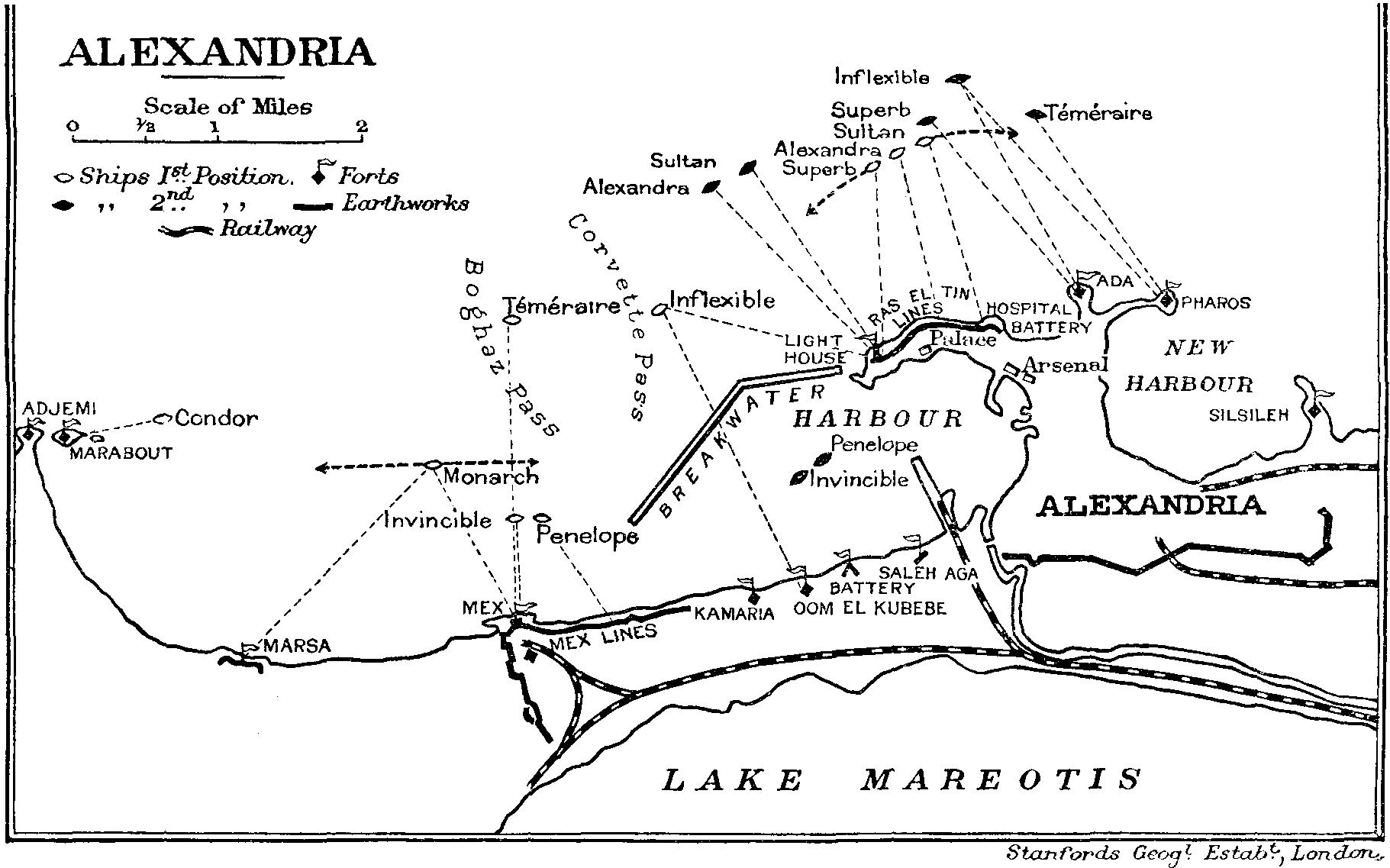
Battle of Alexandria (Bombardment of, 1882)
and pillage. It was not till the 14th that the admiral, after receiving reinforcements, felt able to send troops into the city, when a few severe examples cowed the plunderers and restored order. The Khedive, who had shut himself up in his palace at Ramleh, now came back to the seaport under the escort of a British force, and thenceforth remained virtually, though not in name, under British protection.
The bombardment of Alexandria brought about the resignation of that sturdy Quaker, and friend of peace, Mr. John Bright from the Gladstone Ministry; but everything tends to show (as even M. de Freycinet admits) that the crisis took Ministers by surprise. Nothing was ready at home for an important campaign; and it would seem that hostilities resulted, firstly, from the violence of Arabi's supporters in Alexandria, and, secondly, from their persistence in warlike preparations which might have endangered the safety of Admiral Seymour's fleet. The situation was becoming like that of 1807 at the Dardanelles, when the Turks gave smooth promises to Admiral Duckworth, all the time strengthening their forts, with very disagreeable results. Probably the analogy of 1807, together with the proven perfidy of Arabi's men, brought on hostilities, which the British Ministers up to the end were anxious to avoid.
In any case, the die was now cast, and England entered questioningly on a task, the magnitude and difficulty of which no one could then foresee. She entered on it alone, and that, too, though the Gladstone Ministry had made pressing overtures for the help of France, at any rate as regarded the protection of the Suez Canal. To this extent, de Freycinet and his colleagues were prepared to lend their assistance; but, despite Gambetta's urgent appeal for common action with England at that point, the Chamber of Deputies still remained in a cautiously negative mood, and to that frame of mind M. Clémenceau added strength by a speech ending with a glorification of prudence. "Europe," he said, "is covered with soldiers; every one is in a state of expectation; all the Power [pg 453] are reserving their future liberty of action; do you reserve the liberty of action of France." The restricted co-operation with England which the Cabinet recommended found favour with only seventy-five deputies; and, when face to face with a large hostile majority, de Freycinet and his colleagues resigned (July 29, 1882)[368]. Prudence, fear of the newly-formed Triple Alliance, or jealousy of England, drew France aside from the path to which her greatest captains, thinkers, and engineers had beckoned her in time past. Whatever the predominant motive may have been, it altered the course of history in the valley of the Nile.
After the refusal of France to co-operate with England even to the smallest extent, the Conference of the Powers became a nullity, and its sessions ceased despite the lack of any formal adjournment[369]. Here, as on so many other occasions, the Concert of the Powers displayed its weakness; and there can be no doubt that the Sultan and Arabi counted on that weakness in playing the dangerous game which brought matters to the test of the sword. The jealousies of the Powers now stood fully revealed. Russia entered a vigorous protest against England's action at Alexandria; Italy evinced great annoyance, and at once repelled a British proposal for her co-operation; Germany also showed much resentment, and turned the situation to profitable account by substituting her influence for that of Britain in the counsels of the Porte. The Sultan, thwarted in the midst of his tortuous intrigues for a great Moslem revival, showed his spleen and his diplomatic skill by loftily protesting against Britain's violation of international law, and thereafter by refusing (August 1) to proclaim Arabi a rebel against the Khedive's authority. The essential timidity of Abdul Hamid's nature in presence of superior force was shown by a subsequent change of front. On hearing of British successes, he placed Arabi under the ban (September 8).
Meanwhile, the British expedition of some 10,000 men, [pg 454] despatched to Egypt under the command of Sir Garnet Wolseley made as though it would attack Arabi from Alexandria as a base. But on nearing that port at nightfall it steered about and occupied Port Said (August 15). Kantara and Ismailia, on the canal, were speedily seized; and the Seaforth Highlanders by a rapid march occupied Chalouf and prevented the cutting of the freshwater canal by the rebels. Thenceforth the little army had the advantage of marching near fresh water, and by a route on which Arabi was not at first expecting them. Sir Garnet Wolseley's movements were of that quick and decisive order which counts for so much against orientals. A sharp action at Tel-el-Mahuta obliged Arabi's forces, some 10,000 strong, to abandon entrenchments thrown up at that point (August 24).
Four days later there was desperate fighting at Kassassin Lock on the freshwater canal. There the Egyptians flung themselves in large numbers against a small force sent forward under General Graham to guard that important point. The assailants fought with the recklessness begotten by the proclamation of a holy war against infidels, and for some time the issue remained in doubt. At length, about sundown, three squadrons of the Household Cavalry, and the 7th Dragoon Guards, together with four light guns, were hastily sent forward from the main body in the rear to clinch the affair. General Drury Lowe wheeled this little force round the left flank of the enemy, and, coming up unperceived in the gathering darkness, charged with such fury as to scatter the hostile array in instant rout[370]. The enemy fell back on the entrenchments at Tel-el-Kebir, while the whole British force (including a division from India) concentrated at Kassassin, 17,400 strong, with 61 guns and 6 Gatlings.
The final action took place on September 13, at Tel-el-Kebir. There Arabi had thrown up a double line of earthworks of some strength, covering about four miles, and lay with a force that has been estimated at 20,000 to 25,000 regulars and 7000 [pg 455] irregulars. Had the assailants marched across the desert and attacked these works by day, they must have sustained heavy losses. Sir Garnet therefore determined to try the effect of a surprise at dawn, and moved his men forward after sunset of the 12th until they came within striking distance of the works. After a short rest they resumed their advance shortly before the time when the first streaks of dawn would appear on the eastern sky. At about 500 yards from the works, the advance was dimly silhouetted against the paling orient. Shortly before five o'clock, an Egyptian rifle rang out a sharp warning, and forthwith the entrenchments spurted forth smoke and flame. At once the British answered by a cheer and a rush over the intervening ground, each regiment eager to be the first to ply the bayonet. The Highlanders, under the command of General Graham, were leading on the left, and therefore won in this race for glory; but on all sides the invaders poured almost simultaneously over the works. For several minutes there was sharp fighting on the parapet; but the British were not to be denied, and drove before them the defenders as a kind of living screen against the fire that came from the second entrenchments; these they carried also, and thrust the whole mass out into the desert[371]. There hundreds of them fell under the sabres of the British cavalry which swept down from the northern end of the lines; but the pursuit was neither prolonged nor sanguinary. Sir Garnet Wolseley was satisfied with the feat of dissolving Arabi's army into an armed or unarmed rabble by a single sharp blow, and now kept horses and men for further eventualities.
By one of those flashes of intuition that mark the born leader of men, the British commander perceived that the whole war might be ended if a force of cavalry pushed on to Cairo and demanded the surrender of its citadel at the moment when the news of the disaster at Tel-el-Kebir unmanned its defenders. The conception must rank as one of the most daring recorded [pg 456] in the annals of war. In the ancient capital of Egypt there were more than 300,000 Moslems, lately aroused to dangerous heights of fanaticism by the proclamation of a "holy war" against infidels. Its great citadel, towering some 250 feet above the city, might seem to bid defiance to all the horsemen of the British army. Finally, Arabi had repaired thither in order to inspire vigour into a garrison numbering some 10,000 men. Nevertheless, Wolseley counted on the moral effect of his victory to level the ramparts of the citadel and to abase the mushroom growth of Arabi's pride.
His surmise was more than justified by events. While his Indian contingent pushed on to occupy Zagazig, Sir Drury Lowe, with a force mustering fewer than 500 sabres, pressed towards Cairo by a desert road in order to summon it on the morrow. After halting at Belbeïs the troopers gave rein to their steeds; and a ride of nearly 40 miles brought them to the city about sundown. Rumour magnified their numbers; while the fatalism that used to nerve the Moslem in his great days now predisposed him to bow the knee and mutter Kismet at the advent of the seemingly predestined masters of Egypt. To this small, wearied, but lordly band Cairo surrendered, and Arabi himself handed over his sword. On the following day the infantry came up and made good this precarious conquest.
In presence of this startling triumph the Press of the Continent sought to find grounds for the belief that Arabi, and Cairo as well, had been secretly bought over by British gold. It is somewhat surprising to find M. de Freycinet[372] repeating to-day this piece of spiteful silliness, which might with as much reason be used to explain away the victories of Clive and Coote, Outram and Havelock. The slanders of continental writers themselves stand in need of explanation. It is to be found in their annoyance at discovering that England had an army which could carry through a difficult campaign to a speedy and triumphant conclusion. Their [pg 457] typical attitude had been that of Bismarck, namely, of exultation at her difficulties and of hope of her discomfiture. Now their tone changed to one of righteous indignation at the irregularity of her conduct in acting on behalf of Europe without any mandate from the Powers, and in using the Suez Canal as a base of operations.
In this latter respect Britain's conduct was certainly open to criticism[373]. On the other hand, it is doubtful whether Arabi would have provoked her to action had he not been tacitly encouraged by the other Powers, which, while professing their wish to see order restored in Egypt, in most cases secretly sought to increase her difficulties in undertaking that task. As for the Sultan, he had now trimmed his sails by declaring Arabi a rebel to the Khedive's authority; and in due course that officer was tried, found guilty, and exiled to Ceylon early in 1883. The conduct of France, Germany, and Russia, if we may judge by the tone of their officially inspired Press, was scarcely more straightforward, and was certainly less discreet. On all sides there were diatribes against Britain's high-handed and lawless behaviour, and some German papers affected to believe that Hamburg might next be chosen for bombardment by the British fleet. These outbursts, in the case of Germany, may have been due to Bismarck's desire to please Russia, and secondarily France, in all possible ways. It is doubtful whether he gained this end. Certainly he and his underlings in the Press widened the gulf that now separated the two great Teutonic peoples.
The annoyance of France was more natural. She had made the Suez Canal, and had participated in the Dual Control; but her mistake in not sharing in the work of restoring order was irreparable. Every one in Egypt saw that the control of that country must rest with the Power which had swept away Arabi's Government and re-established the fallen [pg 458] authority of the Khedive. A few persons in England, even including one member of the Gladstone Administration, Mr. Courtney, urged a speedy withdrawal; but the Cabinet, which had been unwillingly but irresistibly drawn thus far by the force of circumstances, could not leave Egypt a prey to anarchy; and, clearly, the hand that repressed anarchy ruled the country for the time being. It is significant that on April 4, 1883, more than 2600 Europeans in Egypt presented a petition begging that the British occupation might be permanent[374].
Mr. Gladstone, however, and others of his Cabinet, had declared that it would be only temporary, and would, in fact, last only so long as to enable order and prosperity to grow up under the shadow of new and better institutions. These pledges were given with all sincerity, and the Prime Minister and his colleagues evidently wished to be relieved from what was to them a disagreeable burden. The French in Egypt, of course, fastened on these promises, and one of their newspapers, the Journal Egyptien, printed them every day at the head of its front columns[375]. Mr. Gladstone, who sought above all things for a friendly understanding with France, keenly felt, even to the end of his career, that the continued occupation of Egypt hindered that most desirable consummation. He was undoubtedly right. The irregularity of England's action in Egypt hampered her international relations at many points; and it may be assigned as one of the causes that brought France into alliance with Russia.
What, then, hindered the fulfilment of Mr. Gladstone's pledges? In the first place, the dog-in-the-manger policy of French officials and publicists increased the difficulties of the British administrators who now, in the character of advisers of the Khedive, really guided him and controlled his Ministers. The scheme of administration adopted was in the main that advised by Lord Dufferin in his capacity of Special Envoy. [pg 459] The details, however, are too wide and complex to be set forth here. So also are those of the disputes between our officials and those of France. Suffice it to say that by shutting up the funds of the "Caisse de la Dette," the French administrators of that great reserve fund hoped to make Britain's position untenable and hasten her evacuation. In point of fact, these and countless other pin-pricks delayed Egypt's recovery and furnished a good reason why Britain should not withdraw[376].
But above and beyond these administrative details, there was one all-compelling cause, the war-cloud that now threatened the land of the Pharaohs from that home of savagery and fanaticism, the Sudan.
NOTE TO THE SECOND EDITION
For new light on the nationalist movement in Egypt and the part which Arabi played in it, the reader should consult How we defended Arabi, by A.M. Broadley (London, 1884). The same writer in his Tunis, Past and Present (2 vols. 1882) has thrown much light on the Tunis Question and on the Pan-Islamic movement in North Africa.
FOOTNOTES:
[354] Quoted by D.A. Cameron, Egypt in the Nineteenth Century, p. 242.
[355] Egypt and the Egyptian Question, by Sir D. Mackenzie Wallace (1883), pp. 318-320.
[356] England in Egypt, by Sir Alfred Milner (Lord Milner), 1892, pp. 216-219. (The Egyptian £ is equal to £1:0:6.) I give the figures as pounds sterling.
[357] La Question d'Égypte, by C. de Freycinet (1905), p. 151.
[358] La Question d'Égypte, by C. de Freycinet, p. 106.
[359] England in Egypt, etc. p. 222. See there for details as to the Dual Control; also de Freycinet, op. cit. chap. ii., and The Expansion of Egypt, by A. Silva White, chap. vi.
[360] Sir D.M. Wallace, Egypt and the Egyptian Question, p. 67.
[361] Mr. Morley says (Life of Gladstone, vol. iii. p. 73) that Arabi's movement "was in truth national as well as military; it was anti-European, and above all, it was in its objects anti-Turk."--In view of the evidence collected by Sir D.M. Wallace, and by Lord Milner (England in Egypt), I venture to question these statements. The movement clearly was military and anti-Turk in its beginning. Later on it sought support in the people, and became anti-European and to some extent national; but to that extent it ceased to be anti-Turk. Besides, why should the Sultan have encouraged it? How far it genuinely relied on the populace must for the present remain in doubt; but the evidence collected by Mr. Broadley, How We Defended Arabi (1884), seems to show that Arabi and his supporters were inspired by thoroughly patriotic and enlightened motives.
[362] For Gambetta's despatches see de Freycinet, op. cit. pp. 209 et seq.
[363] Morley, Life of Gladstone, iii. p. 79.
[364] Bismarck: Some Secret Pages of his History, vol. iii. p. 51.
[365] England in Egypt, p. 16. For details of the massacre and its preconcerted character, sec Parl. Papers, Egypt, No. 4 (1884).
[366] For the reasons of de Freycinet's caution, see his work, ch. iii., especially pp. 236 et seq.
[367] See, too, Gladstone's speech of July 25, 1882, in which he asserted that there was not a shred of evidence to support Arabi's claim to be the leader of a national party; also, his letter of July 14 to John Bright, quoted by Mr. Morley, Life of Gladstone, vol. iii. pp. 84-85. Probably Gladstone was misinformed.
[368] De Freycinet, op, cit. pp. 311-312.
[369] For its proceedings, see Parl. Papers, Egypt, 1882 (Conference on Egyptian Affairs).
[370] History of the Campaign in Egypt (War Office), by Col. J.F. Maurice, pp. 62-65.
[371] Life, Letters, and Diaries of General Sir Gerald Graham (1901). J.F. Maurice, op. cit. pp. 84-95.
[372] Op. cit. p. 316.
[373] It is said, however, that Arabi had warned M. de Lesseps that "the defence of Egypt requires the temporary destruction of the Canal" (Traill, England, Egypt, and the Sudan, p. 57). The status of the Canal was defined in 1885. Ibid. p. 59.
[374] Sir A. Milner, England in Egypt, p. 31.
[375] H.F. Wood, Egypt under the British, p. 59 (1896).
[376] The
reader should consult for full details Sir A. Milner, England in
Egypt (1892); Sir D.M. Wallace, The Egyptian Question
(1883), especially chaps, xi.-xiii.; and A. Silva White, The
Expansion of Egypt (1899), the best account of the
Anglo-Egyptian administration, with valuable Appendices on the
"Caisse," etc.
A far more favourable light is thrown on the conduct of Arabi and
his partisans by Mr. A.M. Broadley in his work How We Defended
Arabi (1884).
What were my ideas in coming out? They were these: Agreed abandonment of Sudan, but extricate the garrisons; and these were the instructions of the Government (Gordon's Journal, October 8, 1885).
It is one of the peculiarities of the Moslem faith that any time of revival is apt to be accompanied by warlike fervour somewhat like that which enabled its early votaries to sweep over half of the known world in a single generation. This militant creed becomes dangerous when it personifies itself in a holy man who can make good his claim to be received as a successor of the Prophet. Such a man had recently appeared in the Sudan. It is doubtful whether Mohammed Ahmed was a genuine believer in his own extravagant claims, or whether he adopted them in order to wreak revenge on Rauf Pasha, the Egyptian Governor of the Sudan, for an insult inflicted by one of his underlings. In May 1881, while living near the island of Abba in the Nile, he put forward his claim to be the Messiah or Prophet, foretold by the founder of that creed. Retiring with some disciples to that island, he gained fame by his fervour and asceticism. His followers named him "El [pg 461] Mahdi," the leader, but his claims were scouted by the Ulemas of Khartum, Cairo, and Constantinople, on the ground that the Messiah of the Moslems was to arise in the East. Nevertheless, while the British were crushing Arabi's movement, the Mahdi stirred the Sudan to its depths, and speedily shook the Egyptian rule to its base[377].
There was every reason to fear a speedy collapse. In the years 1874-76 the Province of the White Nile had known the benefits of just and tactful rule under that born leader of men, Colonel Gordon; and in the three following years, as Governor-General of the Sudan, he gained greater powers, which he felt to be needful for the suppression of the slave-trade and other evils. Ill-health and underhand opposition of various kinds caused him to resign his post in 1879. Then, to the disgust of all, the Khedive named as his successor Rauf Pasha, whom Gordon had recently dismissed for maladministration of the Province of Harrar, on the borders of Abyssinia[378]. Thus the Sudan, after experiencing the benefits of a just and able government, reeled back into the bad old condition, at the time when the Mahdi was becoming a power in the land. No help was forthcoming from Egypt in the summer of 1882, and the Mahdi's revolt rapidly made headway even despite several checks from the Egyptian troops.
Possibly, if Mr. Gladstone and his colleagues had decided to crush it in that autumn, the task might have been easy. But, far from doing so, they sought to dissuade the Khedive from attempting to hold the most disturbed districts, those of Kordofan and Darfur, beyond Khartum. This might have been the best course, if the evacuation could have been followed at once and without risk of disaster at the hands of the fanatics. But Tewfik willed otherwise. Against the advice of Lord Dufferin, he sought to reconquer the Sudan, and that, too, by wholly insufficient forces. The result was a series of disasters, culminating in the extermination of Hicks Pasha's Egyptian force by the Mahdi's followers near El Obeid, the capital of Kordofan (November 5, 1883).
[pg 462]The details of the disaster are not fully known. Hicks Pasha was appointed, on August 20, 1883, by the Khedive to command the expedition into that province. He set out from Omdurman on September 9, with 10,000 men, 4 Krupp guns and 16 light guns, 500 horses and 5500 camels. His last despatch, dated October 3, showed that the force had been greatly weakened by want of water and provisions, and most of all by the spell cast on the troops by the Mahdi's claim to invincibility. Nevertheless, Hicks checked the rebels in two or three encounters, but, according to the tale of one of the few survivors, a camel-driver, the force finally succumbed to a fierce charge on the Egyptian square at the close of an exhausting march, prolonged by the treachery of native guides. Nearly the whole force was put to the sword. Hicks Pasha perished, along with five British and four German officers, and many Egyptians of note. The adventurous newspaper correspondents, O'Donovan and Vizetelly, also met their doom (November 5, 1883)[379].
This catastrophe decided the history of the Sudan for many years. The British Government was in no respect responsible for the appointment of General Hicks to the Kordofan command. Lord Dufferin and Sir E. Malet had strongly urged the Khedive to abandon Kordofan and Darfur; but it would seem that the desire of the governing class at Cairo to have a hand in the Sudan administration overbore these wise remonstrances, and hence the disaster near El Obeid with its long train of evil consequences[380]. It was speedily followed by another reverse at Tokar not far from Suakim, where the slave-raiders and tribesmen of the Red Sea coast exterminated another force under the command of Captain Moncrieff.
The Gladstone Ministry and the British advisers of the [pg 463] Khedive, among whom was Sir Evelyn Baring (the present Lord Cromer), again urged the entire evacuation of the Sudan, and the limitation of Egyptian authority to the strong position of the First Cataract at Assuan. This policy then received the entire approval of the man who was to be alike the hero and the martyr of that enterprise[381]. But how were the Egyptian garrisons to be withdrawn? It was a point of honour not to let them be slaughtered or enslaved by the cruel fanatics of the Mahdi. Yet under the lead of Egyptian officers they would almost certainly suffer one of these fates. A way of escape was suggested--by a London evening newspaper in the first instance. The name of Gordon was renowned for justice and hardihood all through the Sudan. Let this knight-errant be sent--so said this Mentor of the Press--and his strange power over men would accomplish the impossible. The proposal carried conviction everywhere, and Lord Granville, who generally followed any strong lead, sent for the General.
Charles George Gordon, born at Woolwich in 1833, was the scion of a staunch race of Scottish fighters. His great-grandfather served under Cope at Prestonpans; his grandfather fought in Boscawen's expedition at Louisburg and under Wolfe at Quebec. His father attained the rank of Lieutenant-General. From his mother, too, he derived qualities of self-reliance and endurance of no mean order. Despite the fact that she had eleven children, and that three of her sons were out at the Crimea, she is said never to have quailed during that dark time. Of these sons, Charles George was serving in the Engineers; he showed at his first contact with war an aptitude and resource which won the admiration of all. "We used always to send him out to find what new move the Russians were making"--such was the testimony of one of his superior officers. Of his subsequent duties in delimiting the new Bessarabian frontier and his miraculous career in China we cannot speak in detail. By the consent of all, it was his [pg 464] soldierly spirit that helped to save that Empire from anarchy at the hands of the Taeping rebels, whose movement presented a strange medley of perverted Christianity, communism, and freebooting. There it was that his magnetic influence over men first had free play. Though he was only thirty years of age, his fine physique, dauntless daring, and the spirit of unquestionable authority that looked out from his kindly eyes, gained speedy control over the motley set of officers and the Chinese rank and file--half of them ex-rebels--that formed the nucleus of the "ever victorious army." What wonder that he was thenceforth known as "Chinese Gordon"?
In the years 1865-71, which he spent at Gravesend in supervising the construction of the new forts at the mouth of the river, the religious and philanthropic side of his character found free play. His biographer, Mr. Hake, tells of his interest in the poor and suffering, and, above all, in friendless boys, who came to idolise his manly yet sympathetic nature. Called thereafter by the Khedive to succeed Sir Samuel Baker in the Governorship of the Sudan, he grappled earnestly with the fearful difficulties that beset all who have attempted to put down the slave-trade in its chief seat of activity. Later on he expressed the belief that "the Sudan is a useless possession, ever was so, ever will be so." These words, and certain episodes in his official career in India and in Cape Colony, revealed the weak side of a singularly noble nature. Occasionally he was hasty and impulsive in his decisions, and the pride of his race would then flash forth. During his cadetship at Woolwich he was rebuked for incompetence, and told that he would never make an officer. At once he tore the epaulets from his shoulders and flung them at his superior's feet. A certain impatience of control characterised him throughout life. No man was ever more chivalrous, more conscientious, more devoted, or abler in the management of inferiors; but his abilities lay rather in the direction of swift intuitions and prompt achievement than in sound judgment and plodding toil. In short, his qualities were those of a [pg 465] knight-errant, not those of a statesman. The imperious calls of conscience and of instinct endowed him with powers uniquely fitted to attract and enthral simple straightforward natures, and to sway orientals at his will. But the empire of conscience, instinct, and will-power consorts but ill with those diplomatic gifts of effecting a timely compromise which go far to make for success in life. This was at once the strength and the weakness of Gordon's being. In the midst of a blasé, sceptical age, his personality stood forth, God-fearing as that of a Covenanter, romantic as that of a Coeur de Lion, tender as that of a Florence Nightingale. In truth, it appealed to all that is most elemental in man.
At that time Gordon was charged by the King of the Belgians to proceed to the Congo River to put down the slave-trade. Imagination will persist in wondering what might have been the result if he had carried out this much-needed duty. Possibly he might have acquired such an influence as to direct the "Congo Free State" to courses far other than those to which it has come. He himself discerned the greatness of the opportunity. In his letter of January 6, 1884, to H.M. Stanley, he stated that "no such efficacious means of cutting at root of slave-trade ever was presented as that which God has opened out to us through the kind disinterestedness of His Majesty."
The die was now cast against the Congo and for the Nile. Gordon had a brief interview with four members of the Cabinet--Lords Granville, Hartington, Northbrooke, and Sir Charles Dilke,--Mr. Gladstone was absent at Hawarden; and they forthwith decided that he should go to the Upper Nile. What transpired in that most important meeting is known only from Gordon's account of it in a private letter:--
At noon he, Wolseley, came to me and took me to the Ministers.
He went in and talked to the Ministers, and came back and
[pg 466] said, "Her Majesty's Government want you to undertake this.
Government are determined to evacuate the Sudan, for they will
not guarantee future government. Will you go and do it?" I
said, "Yes." He said, "Go in." I went in and saw them. They
said, "Did Wolseley tell you our orders?" I said, "Yes." I said,
"You will not guarantee future government of the Sudan, and you
wish me to go up to evacuate now?" They said, "Yes," and it
was over, and I left at 8 P.M. for Calais.
Before seeing the Ministers, Gordon had a long interview with Lord Wolseley, who in the previous autumn had been named Baron Wolseley of Cairo. That conversation is also unknown to us, but obviously it must have influenced Gordon's impressions as to the scope of the duties sketched for him by the Cabinet. We turn, then, to the "Instructions to General Gordon," drawn up by the Ministry on Jan. 18, 1884. They directed him to "proceed at once to Egypt, to report to them on the military situation in the Sudan, and on the measures which it may be advisable to take for the security of the Egyptian garrisons still holding positions in that country and for the safety of the European population in Khartum." He was also to report on the best mode of effecting the evacuation of the interior of the Sudan and on measures that might be taken to counteract the consequent spread of the slave-trade. He was to be under the instructions of H.M.'s Consul-General at Cairo (Sir Evelyn Baring). There followed this sentence: "You will consider yourself authorised and instructed to perform such other duties as the Egyptian Government may desire to entrust to you, and as may be communicated to you by Sir Evelyn Baring[382]."
After receiving these instructions, Gordon started at once for Egypt, accompanied by Colonel Stewart. At Cairo he had an interview with Sir Evelyn Baring, and was appointed by the Khedive Governor-General of the Sudan. The firman of Jan. 26 contained these words: "We trust that you will carry out our good intentions for the establishment of justice and order, and that you will assure the peace and prosperity of the people of the Sudan by maintaining the security of the [pg 467] roads," etc. It contained not a word about the evacuation of the Sudan, nor did the Khedive's proclamation of the same date to the Sudanese. The only reference to evacuation was in his letter of the same date to Gordon, beginning thus: "You are aware that the object of your arrival here and of your mission to the Sudan is to carry into execution the evacuation of those territories and to withdraw our troops, civil officials, and such of the inhabitants, together with their belongings, as may wish to leave for Egypt. . . ." After completing this task he was to "take the necessary steps for establishing an organised Government in the different provinces of the Sudan for the maintenance of order and the cessation of all disasters and incitement to revolt[383]." How Gordon, after sending away all the troops, was to pacify that enormous territory His Highness did not explain.
There is almost as much ambiguity in the "further instructions" which Sir Evelyn Baring drew up on January 25 at Cairo. After stating that the British and Egyptian Governments had agreed on the necessity of "evacuating" the Sudan, he noted the fact that Gordon approved of it and thought it should on no account be changed; the despatch proceeds:--
You consider that it may take a few months to carry it out with
safety. You are further of opinion that "the restoration of the
country should be made to the different petty Sultans who existed
at the time of Mohammed Ali's conquest, and whose families still
exist"; and that an endeavour should be made to form a confederation
of those Sultans. In this view the Egyptian Government
entirely concur. It will of course be fully understood that the
Egyptian troops are not to be kept in the Sudan merely with a
view to consolidating the powers of the new rulers of the country.
But the Egyptian Government has the fullest confidence in your
judgment, your knowledge of the country, and your comprehension
of the general line of policy to be pursued. You are
therefore given full discretionary power to retain the troops for
such reasonable period as you may think necessary, in order that
[pg 468] the abandonment of the country may be accomplished with the
least possible risk to life and property. A credit of £100,000 has
been opened for you at the Finance Department[384]. . . .
In themselves these instructions were not wholly clear. An officer who is allowed to use troops for the settlement or pacification of a vast tract of country can hardly be the agent of a policy of mere "abandonment." Neither Gordon nor Baring seems at that time to have felt the incongruity of the two sets of duties, but before long it flashed across Gordon's mind. At Abu Hammed, when nearing Khartum, he telegraphed to Baring: "I would most earnestly beg that evacuation but not abandonment be the programme to be followed." Or, as he phrased it, he wanted Egypt to recognise her "moral control and suzerainty" over the Sudan[385]. This, of course, was an extension of the programme to which he gave his assent at Cairo; it differed toto caelo from the policy of abandonment laid down at London.
Even now it is impossible to see why Ministers did not at once simplify the situation by a clear statement of their orders to Gordon, not of course as Governor-General of the Sudan, but as a British officer charged by them with a definite duty. At a later date they sought to limit him to the restricted sphere sketched out at London; but then it was too late to bend to their will a nature which, firm at all times, was hard as adamant when the voice of conscience spoke within. Already it had spoken, and against "abandonment."
There were other confusing elements in the situation. Gordon believed that the "full discretionary power" granted to him by Sir E. Baring was a promise binding on the British Government; and, seeing that he was authorised to perform such other duties as Sir Evelyn Baring would communicate to him, he was right. But Ministers do not seem to have understood that this implied an immense widening of the original [pg 469] programme. Further, Sir Evelyn Baring used the terms "evacuation" and "abandonment" as if they were synonymous; while in Gordon's view they were very different. As we shall see, his nature, at once conscientious, vehement, and pertinacious, came to reject the idea of abandonment as cowardly and therefore impossible.
Lastly, we may note that Gordon was left free to announce the forthcoming evacuation of the Sudan, or not, as he judged best[386]. He decided to keep it secret. Had he kept it entirely so for the present, he would have done well; but he is said to have divulged it to one or two officials at Berber; if so, it was a very regrettable imprudence, which compromised the defence of that town. But surely no man was ever charged with duties so complex and contradictory. The qualities of Nestor, Ulysses, and Achilles combined in one mortal could scarcely have availed to untie or sever that knot.
The first sharp collision between Gordon and the Home Government resulted from his urgent request for the employment of Zebehr Pasha as the future ruler of the Sudan. A native of the Sudan, this man had risen to great wealth and power by his energy and ambition, and figured as a kind of king among the slave-raiders of the Upper Nile, until, for some offence against the Egyptian Government, he was interned at Cairo. At that city Gordon had a conference with Zebehr in the presence of Sir E. Baring, Nubar Pasha, and others. It was long and stormy, and gave the impression of undying hatred felt by the slaver for the slave-liberator. This alone seemed to justify the Gladstone Ministry in refusing Gordon's request[387]. Had Zebehr gone with Gordon, he would certainly have betrayed him--so thought Sir Evelyn Baring.
Setting out from Cairo and travelling quickly up the Nile, Gordon reached Khartum on February 18, and received an enthusiastic welcome from the discouraged populace. At once he publicly burned all instruments of torture and records of old debts; so that his popularity overshadowed that of the Mahdi. [pg 470] Again he urged the despatch of Zebehr as his "successor," after the withdrawal of troops and civilians from the Sudan. But, as Sir Evelyn Baring said in forwarding Gordon's request to Downing Street, it would be most dangerous to place them together at Khartum. It should further be noted that Gordon's telegrams showed his belief that the Mahdi's power was overrated, and that his advance in person on Khartum was most unlikely[388]. It is not surprising, then, that Lord Granville telegraphed to Sir E. Baring on February 22 that the public opinion of England "would not tolerate the appointment of Zebehr Pasha[389]." Already it had been offended by Gordon's proclamation at Khartum that the Government would not interfere with the buying and selling of slaves, though, as Sir Evelyn Baring pointed out, the re-establishment of slavery resulted quite naturally from the policy of evacuation; and he now strongly urged that Gordon should have "full liberty of action to complete the execution of his general plans[390]."
Here it is desirable to remember that the Mahdist movement was then confined almost entirely to three chief districts--Kordofan, parts of the lands adjoining the Blue Nile, and the tribes dwelling west and south-west of Suakim. For the present these last were the most dangerous. Already they had overpowered and slaughtered two Egyptian forces; and on February 22 news reached Cairo of the fall of Tokar before the valiant swordsmen of Osman Digna. But this was far away from the Nile and did not endanger Gordon. British troops were landed at Suakim for the protection of that port, but this step implied no change of policy respecting the Sudan. The slight impression which two brilliant but costly victories, those of El Teb and Tamai, made on the warlike tribes at the back of Suakim certainly showed the need of caution in pushing a force into the Sudan when the fierce heats of summer were coming on[391].
[pg 471]The first hint of any change of policy was made by Gordon in his despatch of Feb. 26, to Sir E. Baring. After stating his regret at the refusal of the British Government to allow the despatch of Zebehr as his successor, he used these remarkable words:--
You must remember that when evacuation is carried out, Mahdi will come down here, and, by agents, will not let Egypt be quiet. Of course my duty is evacuation, and the best I can for establishing a quiet government. The first I hope to accomplish. The second is a more difficult task, and concerns Egypt more than me. If Egypt is to be quiet, Mahdi must be smashed up. Mahdi is most unpopular, and with care and time could be smashed. Remember that once Khartum belongs to Mahdi, the task will be far more difficult; yet you will, for safety of Egypt, execute it. If you decide on smashing Mahdi, then send up another £100,000 and send up 200 Indian troops to Wady Haifa, and send officer up to Dongola under pretence to look out quarters for troops. Leave Suakim and Massowah alone. I repeat that evacuation is possible, but you will feel effect in Egypt, and will be forced to enter into a far more serious affair in order to guard Egypt. At present, it would be comparatively easy to destroy Mahdi[392].
This statement arouses different opinions according to the point of view from which we regard it. As a declaration of general policy it is no less sound than prophetic; as a despatch from the Governor-General of the Sudan to the Egyptian Government, it claimed serious attention; as a recommendation sent by a British officer to the Home Government, it was altogether beyond his powers. Gordon was sent out for a distinct aim; he now proposed to subordinate that aim to another far vaster aim which lay beyond his province. Nevertheless, Sir E. Baring on February 28, and on March 4, urged the Gladstone Ministry even now to accede to Gordon's request for Zebehr Pasha as his successor, on the ground that some Government must be left in the Sudan, and Zebehr was deemed at Cairo to be the only possible governor. Again the [pg 472] Home Government refused, and thereby laid themselves under the moral obligation of suggesting an alternate course. The only course suggested was to allow the despatch of a British force up the Nile, if occasion seemed to demand it[393].
In this connection it is well to remember that the question of Egypt and the Sudan was only one of many that distracted the attention of Ministers. The events outside Suakim alone might give them pause before they plunged into the Sudan; for that was the time when Russia was moving on towards Afghanistan; and the agreement between the three Emperors imposed the need of caution on a State as isolated and unpopular as England then was. In view of the designs of the German colonial party (see Chapter XVII.) and the pressure of the Irish problem, the Gladstone Cabinet was surely justified in refusing to undertake any new responsibilities, except on the most urgent need. Vital interests were at stake in too many places to warrant a policy of Quixotic adventure up the Nile.
Nevertheless, it is regrettable that Ministers took up on the Sudan problem a position that was logically sound but futile in the sphere of action. Gordon's mission, according to Earl Granville, was a peaceful one, and he inquired anxiously what progress had been made in the withdrawal of the Egyptian garrisons and civilians. This question he put, even in the teeth of Gordon's positive statement in a telegram of March 8:--
If you do not send Zebehr, you have no chance of getting the garrisons away; . . . Zebehr here would be far more powerful than the Mahdi, and he would make short work of the Mahdi[394].
A week earlier Gordon had closed a telegram with the despairing words:--
I will do my best to carry out my instructions, but I feel conviction I shall be caught in Khartum[395].
It is not surprising that Ministers were perplexed by Gordon's despatches, or that Baring telegraphed to Khartum [pg 473] that he found it very difficult to understand what the General wanted. All who now peruse his despatches must have the same feeling, mixed with one of regret that he ever weakened his case by the proposal to "smash the Mahdi." Thenceforth the British Government obviously felt some distrust of their envoy; and in this disturbing factor, and the duality of Gordon's duties, we may discern one cause at least of the final disaster.
On March 11, the British Government refused either to allow the appointment of Zebehr, or to send British or Indian troops from Suakim to Berber. Without wishing to force Gordon's hand prematurely, Earl Granville urged the need of evacuation at as early a date as might be practicable. On March 16, after hearing ominous news as to the spread of the Mahdi's power near to Khartum and Berber, he advised the evacuation of the former city at the earliest possible date[396]. We may here note that the rebels began to close round it on March 18.
Earl Granville's advice directly conflicted with Gordon's sense of honour. As he stated, on or about March 20, the fidelity of the people of Khartum, while treachery was rife all around, bound him not to leave them until he could do so "under a Government which would give them some hope of peace." Here again his duty as Governor of the Sudan, or his extreme conscientiousness as a man, held him to his post despite the express recommendations of the British Government. His decision is ever to be regretted; but it redounds to his honour as a Christian and a soldier. At bottom, the misunderstanding between him and the Cabinet rested on a divergent view of duty. Gordon summed up his scruples in his telegram to Baring:--
You must see that you could not recall me, nor could I possibly obey, until the Cairo employés get out from all the places. I have named men to different places, thus involving them with the Mahdi. [pg 474] How could I look the world in the face if I abandoned them and fled? As a gentleman, could you advise this course?
Earl Granville summed up his statement of the case in the words:--
The Mission of General Gordon, as originally designed and decided upon, was of a pacific nature and in no way involved any movement of British forces. . . . He was, in addition, authorised and instructed to perform such other duties as the Egyptian Government might desire to entrust to him and as might be communicated by you to him. . . . Her Majesty's Government, bearing in mind the exigencies of the occasion, concurred in these instructions [those of the Egyptian Government], which virtually altered General Gordon's Mission from one of advice to that of executing, or at least directing, the evacuation not only of Khartum but of the whole Sudan, and they were willing that General Gordon should receive the very extended powers conferred upon him by the Khedive to enable him to effect his difficult task. But they have throughout joined in your anxiety that he should not expose himself to unnecessary personal risk, or place himself in a position from which retreat would be difficult[397].
He then states that it is clear that Khartum can hold out for at least six months, if it is attacked, and, seeing that the British occupation of Egypt was only "for a special and temporary purpose," any expedition into the Sudan would be highly undesirable on general as well as diplomatic grounds.
Both of these views of duty are intelligible as well as creditable to those who held them. But the former view is that of a high-souled officer; the latter, that of a responsible and much-tried Minister and diplomatist. They were wholly divergent, and divergence there spelt disaster.
On hearing of the siege of Khartum, General Stephenson, then commanding the British forces in Egypt, advised the immediate despatch of a brigade to Dongola--a step which would probably have produced the best results; but that advice [pg 475] was overruled at London for the reasons stated above. Ministers seem to have feared that Gordon might use the force for offensive purposes. An Egyptian battalion was sent up the Nile to Korosko in the middle of May; but the "moral effect" hoped for from that daring step vanished in face of a serious reverse. On May 19, the important city of Berber was taken by the Mahdists[398].
Difficult as the removal of about 10,000 to 15,000[399] Egyptians from Khartum had always been--and there were fifteen other garrisons to be rescued--it was now next to impossible, unless some blow were dealt at the rebels in that neighbourhood. The only effective blow would be that dealt by British or Indian troops, and this the Government refused, though Gordon again and again pointed out that a small well-equipped force would do far more than a large force. "A heavy, lumbering column, however strong, is nowhere in this land (so he wrote in his Journals on September 24). . . . It is the country of the irregular, not of the regular." A month after the capture of Berber a small British force left Siut, on the Nile, for Assuan; but this move, which would have sent a thrill through the Sudan in March, had little effect at midsummer. Even so, a prompt advance on Dongola and thence on Berber would probably have saved the situation at the eleventh hour.
But first the battle of the routes had to be fought out by the military authorities. As early as April 25, the Government ordered General Stephenson to report on the best means of relieving Gordon; after due consideration of this difficult problem he advised the despatch of 10,000 men to Berber from Suakim in the month of September. Preparations were actually begun at Suakim; but in July experts began to favour the Nile route. In that month Lord Wolseley urged the immediate despatch of a force up that river, and he promised that it [pg 476] should be at Dongola by the middle of October. Even so, official hesitations hampered the enterprise, and it was not until July 29 that the decision seems to have been definitely formed in favour of the Nile route. Even on August 8, Lord Hartington, then War Minister, stated that help would be sent to Gordon, if it proved to be necessary[400]. On August 26, Lord Wolseley was appointed to the command of the relief expedition gathering on the Nile, but not until October 5 did he reach Wady Haifa, below the Second Cataract.
Meanwhile the web of fate was closing in on Khartum. In vain did Gordon seek to keep communications open. All that he could do was to hold stoutly to that last bulwark of civilisation. There were still some grounds for hope. The Mahdi remained in Kordofan, want of food preventing his march northwards in force. Against his half-armed fanatics the city opposed a strong barrier. "Crows' feet" scattered on the ground ended their mad rushes, and mines blew them into the air by hundreds. Khartum seemed to defy those sons of the desert. The fire of the steamers drove them from the banks and pulverised their forts[401]. The arsenal could turn out 50,000 Remington cartridges a week. There was every reason, then, for holding the city; for, as Gordon jotted down in his Journal on September 17, if the Mahdi took Khartum, it would need a great force to stay his propaganda. Here and there in those pathetic records of a life and death struggle we catch a glimpse of Gordon's hope of saving Khartum for civilisation. More than once he noted the ease of holding the Sudan from the Nile as base. With forts at the cataracts and armed steamers patrolling the clear reaches of the river, the defence of the Sudan, he believed, was by no means impossible[402].
On September 10 he succeeded in sending away down stream by steamer Colonel Stewart and Messrs. Power and Herbin; but unfortunately they were wrecked and murdered
[pg 477]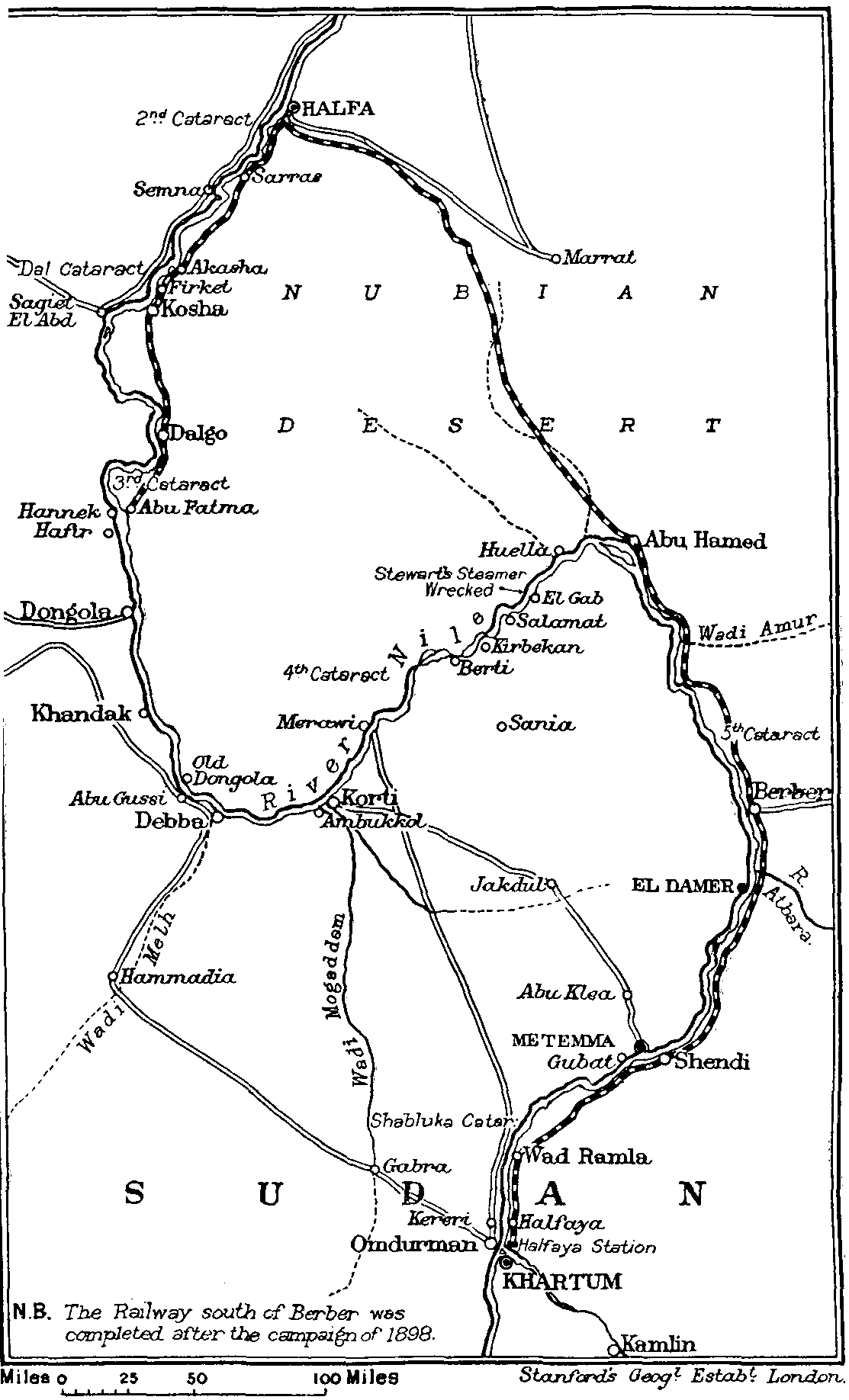
Map of the Nile
by Arabs near Korti. The advice and help of that gallant officer would have been of priceless service to the relieving force. On September 10, when the Journals begin, Gordon was still hopeful of success, though food was scarce.
At this time the rescue expedition was mustering at Wady Haifa, a point which the narrowing gorge of the Nile marks out as one of the natural defences of its lower valley. There the British and Egyptian Governments were collecting a force that soon amounted to 2570 British troops and some Egyptians, who were to be used solely for transport and portage duties. A striking tribute to the solidarity of the Empire was the presence of 350 Canadians, mostly French, whose skill in working boats up rapids won admiration on all sides. The difficulties of the Nile route were soon found to be far greater than had been imagined. Indeed many persons still believe that the Suakim-Berber route would have been far preferable. The Nile was unfortunately lower than usual, and many rapids, up which small steamers had been hauled when the waters ran deep and full, were impassable even for the whale-boats on which the expedition depended for its progress as far as Korti. Many a time all the boats had to be hauled up the banks and carried by Canadians or Egyptians to the next clear reaches. The letters written by Gordon in 1877 in a more favourable season were now found to be misleading, and in part led to the miscalculation of time which was to prove so disastrous.
Another untoward fact was the refusal of the authorities to push on the construction of the railway above Sarras. It had been completed from Wady Haifa up to that point, and much work had been done on it for about fifteen miles further. But, either from lack of the necessary funds, or because the line could not be completed in time, the construction was stopped by Lord Wolseley's orders early in October. Consequently much time was lost in dragging the boats and their stores up or around the difficult rapids above Semneh[403].
[pg 479]Meanwhile a large quantity of stores had been collected at Dongola and Debbeh; numbers of boats were also there, so that a swift advance of a vanguard thence by the calmer reaches farther up the Nile seemed to offer many chances of success. It was in accord with Gordon's advice to act swiftly with small columns; but, for some reason, the plan was not acted on, though Colonel Kitchener, who had collected those stores, recommended it. Another argument for speedy action was the arrival on November 14, of a letter from Gordon, dated ten days before, in which he stated that he could hold out for forty days, but would find it hard to do so any longer.
The advance of the main body to Dongola was very slow, despite the heroic toil of all concerned. We now know that up to the middle of September the Gladstone Ministry cherished the belief that the force need not advance beyond Dongola. Their optimism was once again at fault. The Mahdists were pressing on the siege of Khartum, and had overpowered and slaughtered faithful tribes farther down the river. Such was the news sent by Gordon and received by Lord Wolseley on December 31 at Korti. The "secret and confidential" part of Gordon's message was to the effect that food was running short, and the rescuers must come quickly; they should come by Metammeh or Berber, and inform Gordon by the messenger when they had taken Berber.
The last entries in Gordon's Journals or in that part which has survived, contain the following statements:--
December 13. ". . . All that is absolutely necessary is for fifty of the expeditionary force to get on board a steamer and come up to Halfeyeh, and thus let their presence be felt; this is not asking much, but it must happen at once; or it will (as usual) be too late."
December 14. [After stating that he would send down a steamer with the "Journal" towards the expeditionary force]. . . . "Now mark this, if the expeditionary force, and I ask for no more than two hundred men, does not come in ten days the town may fall; and I have done my best for the honour of our country. Good bye."
[pg 480]Owing to lack of transport and other difficulties, the vanguard of the relieving force could not begin its march from the new Nile base, near Korti, until December 30. Thence the gallant Sir Herbert Stewart led a picked column of men with 1800 camels across the desert towards Metammeh. Lord Wolseley remained behind to guard the new base of operations. At Abu Klea wells, when nearing the Nile, the column was assailed by a great mass of Arabs. They advanced in five columns, each having a wedge-shaped head designed to pierce the British square. With a low murmuring cry or chant they rushed on in admirable order, disregarding the heavy losses caused by the steady fire of three faces of the square. Their leaders soon saw the weak place in the defence, namely, at one of the rear corners, where belated skirmishers were still running in for shelter, where also one of the guns jammed at the critical moment. One of their Emirs, calmly reciting his prayers, rode in through the gap thus formed, and for ten minutes bayonet and spear plied their deadly thrusts at close quarters. Thanks to the firmness of the British infantry, every Arab that forced his way in perished; but in this mêlée there perished a stalwart soldier whom England could ill spare, Colonel Burnaby, hero of the ride to Khiva. Lord Charles Beresford, of the Naval Brigade, had a narrow escape while striving to set right the defective cannon. In all we lost 65 killed and 60 wounded, a proportion which tells its own tale as to the fighting[404].
Two days later, while the force was beating off an attack of the Arabs near Metammeh, General Stewart received a wound which proved to be mortal. The command now devolved on Sir Charles Wilson of the Royal Engineers. After repelling the attacks of other Mahdists and making good his position on the Nile, the new commander came into touch with Gordon's steamers, which arrived there on the 21st, with 190 Sudanese. Again, however, the advance of other Arabs from Omdurman [pg 481] caused a delay until a fortified camp or zariba could be formed. Wilson now had but 1322 unwounded men; and he saw that the Mahdists were in far greater force than Lord Wolseley or General Gordon had expected. Not until January 24 could the commander steam away southwards with 20 men of the Sussex regiment and the 190 Sudanese soldiers on the two largest of Gordon's boats--his "penny steamers" as he whimsically termed them.
The sequel is well known. After overcoming many difficulties caused by rocks and sandbanks, after running the gauntlet of the Mahdist fire, this forlorn hope neared Khartum on the 28th, only to find that the place had fallen. There was nothing for it but to put about and escape while it was possible. Sir Charles Wilson has described the scene: "The masses of the enemy with their fluttering banners near Khartum, the long rows of riflemen in the shelter-trenches at Omdurman, the numerous groups of men on Tuti [Island], the bursting of shells, and the water torn up by hundreds of bullets, and occasionally heavier shot, made an impression never to be forgotten. Looking out over the stormy scene, it seemed almost impossible that we should escape[405]."
Weighed down by grief at the sad failure of all their strivings, the little band yet succeeded in escaping to Metammeh. They afterwards found out that they were two days too late. The final cause of the fall of Khartum is not fully known. The notion first current, that it was due to treachery, has been discredited. Certainly the defenders were weakened by privation and cowed by the Mahdist successes. The final attack was also given at a weak place in the long line of defence; but whether the defenders all did their best, or were anxious to make terms with the Mahdi, will probably never be known. The conduct of the assailants in at once firing on the relieving force forbids the notion that they all along intended to get into Khartum by treachery just before the approach of the steamers. Had that been their aim, they would surely have added one [pg 482] crowning touch of guile, that of remaining quiet until Wilson and his men landed at Khartum. The capture of the town would therefore seem to be due to force, not to treachery.
All these speculations are dwarfed by the overwhelming fact that Gordon perished. Various versions have been given of the manner of his death. One that rests on good authority is that he died fighting. Another account, which seems more consistent with his character, is that, on hearing of the enemy's rush into the town, he calmly remarked: "It is all finished; to-day Gordon will be killed." In a short time a chief of the Baggara Arabs with a few others burst in and ordered him to come to the Mahdi. Gordon refused. Thrice the Sheikh repeated the command. Thrice Gordon calmly repeated his refusal. The sheikh then drew his sword and slashed at his shoulder. Gordon still looked him steadily in the face. Thereupon the miscreant struck at his neck, cut off his head, and carried it to the Mahdi[406].
Whatever may be the truth as to details, it is certain that no man ever looked death in the face so long and so serenely as Gordon. For him life was but duty--duty to God and duty to man. We may fitly apply to him the noble lines which Tennyson offered to the memory of another steadfast soul--
He, that ever following her commands,
On with toil of heart and knees and hands,
Thro' the long gorge to the far light has won
His path upward, and prevail'd,
Shall find the toppling crags of Duty scaled
Are close upon the shining table-lands
To which our God Himself is moon and sun.
NOTE TO THE SECOND EDITION
Shortly before the publication of this work, Lord Edmund Fitzmaurice published his Life of Earl Granville, some of the details of which tend somewhat to modify the account of the relations subsisting between the Earl and General Gordon. See too the issue of the Times of December 10, 1905 (Weekly Edition), for a correction of some of the statements, made in the Life of Earl Granville, by Lord Cromer (Sir Evelyn Baring).]
FOOTNOTES:
[377] See the Report of the Intelligence Department of the War Office, printed in The Journals of Major-General C.G. Gordon at Khartum, Appendix to Bk. iv.
[378] See Gordon's letter of April 1880, quoted in the Introduction to The Journals of Major-General C.G. Gordon at Khartum (1885), p. xvii.
[379] Gordon's Journals, pp. 347-351; also Parl. Papers, Egypt, No. 12 (1884), pp. 85 and 127-131 for another account. See, too, Sir F.R. Wingate's Mahdism, chaps. i.-iii., for the rise of the Mahdi and his triumph over Hicks.
[380] J. Morley, Life of Gladstone, vol. iii. p. 146; Sir A. Lyall, Life of Lord Dufferin, vol. ii. chap. ii.
[381] Morley, Life of Gladstone, vol. iii. p. 147.
[382] Parl. Papers, Egypt, No. 2 (1884), p. 3.
[383] Parl. Papers, Egypt, No. 12 (1884), pp. 27, 28.
[384] Parl. Papers, Egypt, No. 6 (1884), p. 3.
[385] Egypt, No. 12 (1884), p. 133.
[386] Ibid. p. 27.
[387] Ibid. pp. 38-41.
[388] Egypt, No. 12 (1884), pp. 74, 82, 88.
[389] Ibid. p. 95.
[390] Ibid. p. 94.
[391] For details of these battles, see Sir F. Wingate's Mahdism, chap, iii., and Life of Sir Gerald Graham (1901).
[392] Egypt, No. 12 (1884), p. 115.
[393] Egypt, No. 12 (1884) p. 119.
[394] Ibid. p. 145.
[395] Ibid. p. 152.
[396] Ibid. pp. 158, 162, 166.
[397] Egypt, No. 13 (1884), pp. 5, 6. Earl Granville made the same statement in his despatch of April 23. See, too, The Life of Lord Granville.
[398] Parl. Papers, Egypt, No. 25 (1884), pp. 129-131.
[399] This is the number as estimated by Gordon in his Journals (Sept. 10, 1884), p. 6.
[400] Morley, Life of Gladstone, vol. iii. p. 164.
[401] For details, see Letters from Khartum, by Frank Power.
[402] Journal, p. 35, etc.
[403] See Gordon's letters of the year 1877, quoted in the Appendix of A. Macdonald's Too Late for Gordon and Khartum (1887); also chap. vi. of that book.
[404] Sir C.W. Wilson, From Korti to Khartum, pp. 28-35; also see Hon. R. Talbot's article on "Abu Klea," in the Nineteenth Century for January 1886.
[405] Sir C.W. Wilson, op. cit. pp. 176-177.
[406] A third account given by Bordeini Bey, a merchant of Khartum, differs in many details. It is printed by Sir F.R. Wingate in his Mahdism, p. 171.
"The Sudan, if once proper communication was established, would not be difficult to govern. The only mode of improving the access to the Sudan, seeing the impoverished state of Egyptian finances, and the mode to do so without an outlay of more than £10,000, is by the Nile."--Gordon's Journals (Sept. 19, 1884).
It may seem that an account of the fall of Khartum is out of place in a volume which deals only with formative events. But this is not so. The example of Gordon's heroism was of itself a great incentive to action for the cause of settled government in that land. For that cause he had given his life, and few Britons were altogether deaf to the mute appeal of that lonely struggle. Then again, the immense increase to the Mahdi's power resulting from the capture of the arsenal of Khartum constituted (as Gordon had prophesied) a serious danger to Egypt. The continued presence of British troops at Wady Haifa, and that alone, saved the valley of the Lower Nile from a desolating flood of savagery. This was a fact recognised by every one at Cairo, even by the ultra-Gallic party. Egypt alone has rarely been able to hold at bay any great downward movement of the tribes of Ethiopia and Nubia; and the danger was never so great as in and after 1885. The Mahdi's proclamations to the faithful now swelled with inconceivable pride. To a wavering sheikh he sent the warning: "If you live long enough you will see the troops of [pg 484] the Mahdi spreading over Europe, Rome, and Constantinople, after which there will be nothing left for you but hell and damnation." The mistiness of the geography was hidden by the vigour of the theology, and all the sceptics of Nubia hastened to accept the new prophet.
But his time of tyranny soon drew to a close. A woman of Khartum, who had been outraged by him or his followers, determined to wreak her vengeance. On June 14, 1885, she succeeded in giving him slow poison, which led him to his death amidst long-drawn agonies eight days later. This ought to have been the death of Mahdism as well, but superstitions die hard in that land of fanatics. The Mahdi's factotum, an able intriguer named Abdullah Taashi, had previously gained from his master a written declaration that he was to be Khalifa after him; he now produced this document, and fortified its influence by describing in great detail a vision in which the ghost of the Mahdi handed him a sacred hair of inestimable worth, and an oblong-shaped light which had come direct from the hands of the true Prophet, who had received it from the hands of the angel Gabriel, to whom it had been entrusted by the Almighty.
This silly story was eagerly believed by the many, the questioning few also finding it well to still their doubts in presence of death or torture. Piety and politics quickly worked hand in hand to found the impostor's authority. A mosque began to rise over the tomb of the Mahdi in his chosen capital, Omdurman; and his successor gained the support and the offerings of the thousands of pilgrims who came to visit that wonder-working shrine. Such was the basis of the new rule, which spread over the valley of the Upper and Middle Nile, and carried terror nearly to the borders of Egypt[407].
There law and order slowly took root under the shadow of the British administration, but Egypt ceased to control the lands south of Wady Halfa. Mr. Gladstone announced that decision in the House of Commons on May 11, 1885; and those [pg 485] who discover traces of the perfidy of Albion even in the vacillations of her policy, maintain that that declaration was made with a view to an eventual annexation of the Sudan by England. Their contention would be still more forcible if they would prove that the Gladstone Ministry deliberately sacrificed Gordon at Khartum in order to increase the Mahdi's power and leave Egypt open to his blows, thereby gaining one more excuse for delaying the long-promised evacuation of the Nile delta by the redcoats. This was the outcome of events; and those who argue backwards should have the courage of their convictions and throw all the facts of the case into their syllogisms.
All who have any knowledge of the trend of British statesmanship in the eighties know perfectly well that the occupation of Egypt was looked on as a serious incubus. The Salisbury Cabinet sought to give effect to the promises of evacuation, and with that aim in view sent Sir Henry Drummond Wolff to Constantinople in the year 1887 for the settlement of details. The year 1890 was ultimately fixed, provided that no danger should accrue to Egypt from such action, and that Great Britain should "retain a treaty-right of intervention if at any time either the internal peace or external security [of Egypt] should be seriously threatened." To this last stipulation the Sultan seemed prepared to agree. Austria, Germany, and Italy notified their complete agreement with it; but France and Russia refused to accept the British offer with this proviso added, and even influenced the Sultan so that he too finally opposed it. Their unfriendly action can only be attributed to a desire of humiliating Great Britain, and of depriving her of any effective influence in the land which, at such loss of blood and treasure to herself, she had saved from anarchy. Their opposition wrecked the proposal, and the whole position therefore remained unchanged. British officials continued to administer Egypt in spite of opposition from the French in all possible details connected with the vital question of finance[408].
[pg 486]Other incidents that occurred during the years intervening between the fall of Gordon and the despatch of Sir Herbert Kitchener's expedition need not detain us here[409]. The causes which led to this new departure will be more fitly considered when we come to notice the Fashoda incident; but we may here remark that they probably arose out of the French and Belgian schemes for the partition of Central Africa. A desire to rescue the Sudan from a cruel and degrading tyranny and to offer a tardy reparation to the memory of Gordon doubtless had some weight with Ministers, as it undoubtedly had with the public. Indeed, it is doubtful whether the vox populi would have allowed the expedition but for these more sentimental considerations. But, in the view of the present writer, the Sudan expedition presents the best instance of foresight, resolve, and able execution that is to be found in the recent annals of Britain.
With the hour had come the man. During the dreary years of the "mark time" policy Colonel Kitchener had gained renown as a determined fighter and able organiser. For some time he acted as governor of Suakim, and showed his powers of command by gaining over some of the neighbouring tribes and planning an attack on Osman Digna which came very near to success. Under him and many other British officers the Egyptians and Sudanese gradually learnt confidence, and broke the spell of invincibility that so long had rested with the Dervish hordes. On all sides the power of the Khalifa was manifestly waning. The powerful Hadendowa tribe, near Suakim, which had given so much trouble in 1883-84, became neutral. On the Nile also the Dervishes lost ground. The Anglo-Egyptian troops wrested from them the post of Sarras, some thirty miles south of Wady Halfa; and the efforts of the fanatics to capture the wells along desert routes far to the east of the river were bloodily repulsed. As long as Sarras, Wady Halfa, and those wells were firmly held, Egypt was safe.
[pg 487]At Gedaref, not very far from Omdurman, the Khalifa sustained a severe check from the Italians (December 1893), who thereupon occupied the town of Kassala. It was not to be for any length of time. In all their enterprises against the warlike Abyssinians they completely failed; and, after sustaining the disastrous defeat of Adowa (March 1, 1896), the whole nation despaired of reaping any benefit from the Hinterland of their colony around Massowah. The new Cabinet at Rome resolved to withdraw from the districts around Kassala. On this news being communicated to the British Ministers, they sent a request to Rome that the evacuation of Kassala might be delayed until Anglo-Egyptian troops could be despatched to occupy that important station. In this way the intended withdrawal of the Italians served to strengthen the resolve of the British Government to help the Khedive in effecting the recovery of the Sudan[410].
Preparations for the advance southwards went forward slowly and methodically through the summer and autumn of 1896. For the present the operations were limited to the recapture of Dongola. Sir Herbert Kitchener, then the Sirdar of the Egyptian army, was placed in command. Under him were men who had proved their worth in years of desultory fighting against the Khalifa--Broadwood, Hunter, Lewis, Macdonald, Maxwell, and many others. The training had been so long and severe as to weed out all weaklings; and the Sirdar himself was the very incarnation of that stern but salutary law of Nature which ordains the survival of the fittest. Scores of officers who failed to come up to his requirements were quietly removed; and the result was seen in a finely seasoned body of men, apt at all tasks, from staff duties to railway control. A comparison of the Egyptian army that fought at Omdurman with that which thirteen years before ran away [pg 488] screaming from a tenth of its number of Dervishes affords the most impressive lesson of modern times of the triumph of mind over matter, of western fortitude over the weaker side of eastern fatalism.
Such a building up of character as this implies could not take place in a month or two, for the mind of Egyptians and Sudanese was at first an utter blank as to the need of prompt obedience and still prompter action. An amusing case of their incredible slackness has been recorded. On the first parade of a new camel transport corps before Lord Kitchener, the leading driver stopped his animal, and therefore all that followed, immediately in front of the Sirdar, in order to light a cigarette. It is needless to say, the cigarette was not lighted, but the would-be smoker had his first lesson as to the superiority of the claims of collectivism over the whims of the individual[411].
As will be seen by reference to the map on page 477, the decision to limit the campaign to Dongola involved the choice of the Nile route. If the blow had been aimed straight at Khartum, the Suakim-Berber route, or even that by way of Kassala, would have had many advantages. Above all, the river route held out the prospect of effective help from gunboats in the final attacks on Berber, Omdurman, and Khartum. Seeing, however, that the greater part of the river's course between Sarras and Dongola was broken up by rapids, the railway and the camel had at first to perform nearly the whole of the transport duties for which the Nile was there unsuited. The work of repairing the railway from Wady Haifa to Sarras, and thenceforth of constructing it through rocky wastes, amidst constant risk of Dervish raids, called into play every faculty of ingenuity, patience, and hardihood. But little by little the line crept on; the locomotives carried the piles of food, stores, and ammunition further and further south, until on June 6, 1897, the first blow was dealt by the surprise and destruction of the Dervish force at Ferket.
There a halt was called; for news came in that an unprecedented [pg 489] rain-storm further north had washed away the railway embankments from some of the gulleys. To make good the damage would take thirty days, it was said. The Sirdar declared that the line must be ready in twelve days; he went back to push on the work; in twelve days the line was ready. As an example of the varied difficulties that were met and overcome, we may mention one. The work of putting together a steamer, which had been brought up in sections, was stopped because an all-important nut had been lost in transit. At once the Sirdar ordered horsemen to patrol the railway line--and the nut was found. At last the vessel was ready; but on her trial trip she burst a cylinder and had to be left behind[412]. Three small steamers and four gunboats were, however, available for service in the middle of September, when the expedition moved on.
By this time the effective force numbered about 12,000 men. The Dervishes had little heart for fighting to the north of Dongola; and even at that town the Dervishes made but a poor stand, cowed as they were by the shells of the steamers and perplexed by the enveloping moves which the Sirdar ordered; 700 were taken in Dongola, and the best 300 of these were incorporated in the Sirdar's Sudanese regiments (Sept. 23, 1896).
Thus ended the first part of the expedition. Events had justified Gordon's statement that a small well-equipped expedition could speedily overthrow the Mahdi--that is, in the days of his comparative weakness before the capture of Khartum. The ease with which Dongola had been taken and the comparative cheapness of the expedition predisposed the Egyptian Government and the English public to view its extension southwards with less of disfavour.
Again the new stride forward had to be prepared for by careful preparations at the base. The question of route also caused delay. It proved to be desirable to begin a new railway from Wady Haifa across the desert to Abu Hamed at the northern tip of the deep bend which the Nile makes below [pg 490] Berber. To drive a line into a desert in order to attack an enemy holding a good position beyond seemed a piece of fool-hardiness. Nevertheless it was done, and at the average rate of about 1 1/4 miles a day. In due course General Hunter pushed on and captured Abu Hamed, the inhabitants of which showed little fight, being thoroughly weary of Dervish tyranny (August 6, 1897).
The arrival of gunboats after a long struggle with the rapids below Abu Hamed gave Hunter's little force a much-needed support; and before he could advance further, news reached him that the Dervishes had abandoned Berber. This step caused general surprise, and it has never been fully explained. Some have averred that a panic seized the wives of the Dervish garrison at Berber, and that when they rushed out of the town southwards their husbands followed them[413]. Certain it is that family feelings, which the Dervishes so readily outraged in others, played a leading part in many of their movements. Whatever the cause may have been, the abandonment of Berber greatly facilitated the work of Sir Herbert Kitchener. A strong force soon mustered at that town, and the route to the Red Sea was reopened by a friendly arrangement with the local sheikhs.
The next important barrier to the advance was the river Atbara. Here the Dervishes had a force some 18,000 strong; but before long the Sirdar received timely reinforcement of a British brigade, consisting of the Cameron and Seaforth Highlanders and the Lincolnshire and Warwickshire regiments, under General Gatacre. Various considerations led the Sirdar to wait until he could strike a telling blow. What was most to be dreaded was the adoption of Parthian tactics by the enemy. Fortunately they had constructed a zariba (a camp surrounded by thorn-bushes) on the north bank of the Atbara at a point twenty miles above its confluence with the Nile. At last, on April 7, 1898, after trying to tempt the enemy to a battle in the open, the Sirdar moved forward his 14,000 men in [pg 491] the hope of rushing the position soon after dawn of the following day, Good Friday.
Before the first streaks of sunrise tinged the east, the assailants moved forward to a ridge overlooking the Dervish position; but very few heads were seen above the thorny rampart in the hollow opposite. It was judged to be too risky at once to charge a superior force that clung to so strong a shelter; and for an hour and a half the British and Egyptian guns plied the zariba in the hope of bringing the fanatics out to fight. Still they kept quiet; and their fortitude during this time of carnage bore witness to their bravery and discipline[414].
At 7.45 the Sirdar ordered the advance. The British brigade held the left wing, the Camerons leading in line formation, while behind them in columns were ranged the Warwicks, Seaforths, and Lincolns, to add weight to the onset. Macdonald's and Maxwell's Egyptian and Sudanese Brigades, drawn up in lines, formed the centre and right. Squadrons of Egyptian horse and a battery of Maxims confronted the Dervish horsemen ranged along; the front of a dense scrub to the left of the zariba. As the converging lines advanced, they were met by a terrific discharge; fortunately it was aimed too high, or the loss would have been fearful. Then the Highlanders and Sudanese rushed in, tore apart the thorn bushes and began a fierce fight at close quarters. From their shelter trenches, pits, and huts the Dervishes poured in spasmodic volleys, or rushed at their assailants with spear or bayonet. Even at this the fanatics of the desert were no match for the seasoned troops of the Sirdar; and soon the beaten remnant streamed out through the scrub or over the dry bed of the Atbara. About 2500 were killed, and 2000, including Mahmud, the commander, were taken prisoners. Those who attempted to reach the fertile country round Kassala were there hunted down or captured by the Egyptian garrison that lately had arrived there.
[pg 492]As on previous occasions, the Sirdar now waited some time until the railway could be brought up to the points lately conquered. More gunboats were also constructed for the final stage of the expedition. The dash at Omdurman and Khartum promised to tax to the uttermost the strength of the army; but another brigade of British troops, commanded by Colonel Lyttelton, soon joined the expedition, bringing its effective strength up to 23,000 men. General Gatacre received the command of the British division. Ten gunboats, five transport steamers, and eight barges promised to secure complete command of the river banks and to provide means for transporting the army and all needful stores to the western bank of the Nile whenever the Sirdar judged it to be advisable. The midsummer rains in the equatorial districts now made their influence felt, and in the middle of August the Nile covered the sandbanks and rocks that made navigation dangerous at the time of "low Nile." In the last week of that month all was ready for the long and carefully prepared advance. The infantry travelled in steamers or barges as far as the foot of the Shabluka, or Sixth Cataract, and this method of advance left the Dervishes in some doubt by which bank the final advance would be made.
By an unexpected piece of good fortune the Dervishes had evacuated the rocky heights of the Shabluka gorge. This was matter for rejoicing. There the Nile, which above and below is a mile wide, narrows to a channel of little more than a hundred yards in width. It is the natural defence of Khartum on the north. The strategy of the Khalifa was here again inexplicable, as also was his abandonment of the ridge at Kerreri, some seven miles north of Omdurman. Mr. Bennett Burleigh in his account of the campaign states that the Khalifa had repaired thither once a year to give thanks for the triumph about to be gained there.
At last on September 1, on topping the Kerreri ridge, the invaders caught their first glimpse of Omdurman. Already the gunboats were steaming up to the Mahdist capital to throw in [pg 493] their first shells. They speedily dismounted several guns, and one of the shells tore away a large portion of the gaudy cupola that covered the Mahdi's tomb. Apart from this portent, nothing of moment was done on that day; but it seems probable that the bombardment led the Khalifa to hazard an attack on the invaders in the desert on the side away from the Nile. Nearer to the Sirdar's main force the skirmishing of the 21st Lancers, new to war but eager to "win their spurs," was answered by angry but impotent charges of the Khalifa's horse and foot, until at sunset both sides retired for the night's rest.
The Anglo-Egyptian force made a zariba around the village of el-Gennuaia on the river bank; and there, in full expectation of a night attack, they sought what slumber was to be had. What with a panic rush of Sudanese servants and the stampede of an angry camel, the night wore away uneasily; but there was no charge of Dervishes such as might have carried death to the heart of that small zariba. It is said that the Sirdar had passed the hint to some trusty spies to pretend to be deserters and warn the enemy that he was going to attack them by night. If this be so, spies have never done better service.
When the first glimmer of dawn came on September 2, every man felt instinctively that the Khalifa had thrown away his last chance. Yet few were prepared for the crowning act of madness. Every one feared that he would hold fast to Omdurman and fight the new crusaders from house to house. Possibly the seeming weakness of the zariba tempted him to a concentric attack from the Kerreri Hills and the ridge which stretches on both sides of the steep slopes of the hill, Gebel Surgham. A glance at the accompanying plan will show that the position was such as to tempt a confident enemy. The Sirdar also manoeuvred so as to bring on an attack. He sent out the Egyptian cavalry and camel corps soon after dawn to the plain lying between Gebel Surgham and Omdurman to lure on the Khalifa's men.
The device was completely successful. Believing that they could catch the horsemen in the rocky ridge alongside of Gebel [pg 494] Surgham, the Dervishes came forth from their capital in swarms, pressed them hard, and inflicted some losses. Retiring in good order, the cavalry drew on the eager hordes, until about 6.30 A.M. the white glint of their gibbehs, or tunics, showed thickly above the tawny slopes on either side of Gebel Surgham. On they came in unnumbered throngs, until, pressing northwards along the sky-line, their lines also topped the Kerreri Hills to the north of the zariba. Their aim was obvious: they intended to surround the invaders, pen them up in their zariba, and slaughter them there. To all who did not know the value of the central position in war and the power of modern weapons, the attack seemed to promise complete success. The invaders were 1300 miles away from Cairo and defeat would mean destruction.
Religious zeal lent strength to the onset. From the converging crescent of the Mahdists a sound as of a dim murmur was wafted to the zariba. Little by little it deepened to a hoarse roar, as the host surged on, chanting the pious invocations that so often had struck terror into the Egyptians. Now they heard the threatening din with hearts unmoved; nay, with spirits longing for revenge for untold wrongs and insults. Thus for some minutes in that vast amphitheatre the discipline and calm confidence of the West stood quietly facing the fanatic fury of the East. Two worlds were there embattled: the world of Mohammedanism and the world of Christian civilisation; the empire of untutored force and the empire of mind.
At last, after some minutes of tense expectancy, the cannon opened fire, and speedily gaps were seen in the white masses. Yet the crescent never slackened its advance, except when groups halted to fire their muskets at impossible ranges. Waving their flags and intoning their prayers, the Dervishes charged on in utter scorn of death; but when their ranks came within range of the musketry fire, they went down like swathes of grass under the scythe. Then was seen a marvellous sight. When the dead were falling their fastest, a band of about 150
[pg 495]
The Battle of Omdurman
Dervish horsemen formed near the Khalifa's dark-green standard in the centre and rushed across the fire zone, determined to snatch at triumph or gain the sensuous joys of the Moslem paradise. None of them rode far.
Only on the north, where the camel-corps fell into an awkward plight among the rocks of the Kerreri slope, had the attack any chance of success; and there the shells of one of the six protecting gunboats helped to check the assailants. On this side, too, Colonel Broadwood and his Egyptian cavalry did excellent service by leading no small part of the Dervish left away from the attack on the zariba. At the middle of the fiery crescent the assailants did some execution by firing from a dip in the ground some 400 yards away; but their attempts to rush the intervening space all ended in mere slaughter. Not long after eight o'clock the Khalifa, seeing the hopelessness of attempting to cross the zone of fire around el-Gennuaia, now thickly strewn with his dead, drew off the survivors beyond the ridge of Gebel Surgham; and those who had followed Broadwood's horse also gave up their futile pursuit, and began to muster on the Kerreri ridge.
The Sirdar now sought to force on a fight in the open; and with this aim in view commanded a general advance on Omdurman. In order, as it would seem, to keep a fighting formation that would impose respect on the bands of Dervishes on the Kerreri Hills, he adopted the formation known as echelon of brigades from the left. Macdonald's Sudanese brigade, which held the northern face of the zariba, was therefore compelled to swing round and march diagonally towards Gebel Surgham; and, having a longer space to cover than the other brigades, it soon fell behind them.
For the present, however, the brunt of the danger fell, not on Macdonald, but on the vanguard. The 21st Lancers had been sent forward over the ridge between Gebel Surgham and the Nile with orders to reconnoitre, and, if possible, to head the Dervishes away from their city. Throwing out scouts, they [pg 497] rode over the ridge, but soon afterwards came upon a steep and therefore concealed khor or gulley whence a large body of concealed Dervishes poured a sharp fire[415]. At once Colonel Martin ordered his men to dash at the enemy. Eagerly the troopers obeyed the order and jumped their horses down the slope into the mass of furious fanatics below; these slashed to pieces every one that fell, and viciously sought to hamstring the horses from behind. Pushing through the mass, the lancers scrambled up the further bank, re-formed, and rushed at the groups beyond; after thrusting these aside, they betook themselves to less dramatic but more effective methods. Dismounting, they opened a rapid and very effective fire from their carbines on the throngs that still clustered in or near the gulley. The charge, though a fine display of British pluck, cost the horsemen dear: out of a total of 320 men 60 were killed and wounded; 119 horses were killed or made useless[416].
Meanwhile, Macdonald's brigade, consisting of one Egyptian and three Sudanese battalions, stood on the brink of disaster. The bands from the Kerreri Hills were secretly preparing to charge its rear, while masses of the Khalifa's main following turned back, rounded the western spurs of Gebel Surgham, and threatened to envelop its right flank. The Sirdar, on seeing the danger, ordered Wauchope's brigade to turn back to the help of Macdonald, while Maxwell's Sudanese, swarming up the eastern slopes of Gebel Surgham, poured deadly volleys on the Khalifa's following. Collinson's division and the camel corps were ordered to advance from the neighbourhood of the zariba and support Macdonald on that side. Before these dispositions were complete, that sturdy Scotsman and his Sudanese felt the full weight of the Khalifa's onset. Excited beyond measure, Macdonald's men broke into spasmodic firing as the enemy [pg 498] came on; the deployment into line was thereby disordered, and it needed all Macdonald's power of command to make good the line. His steadiness stiffened the defence, and before the potent charm of western discipline the Khalifa's onset died away.
But now the storm cloud gathering in the rear burst with unexpected fury. Masses of men led by the Khalifa's son, the Sheikh ed Din, rushed down the Kerreri slopes and threatened to overwhelm the brigade. Again there was seen a proof of the ascendancy of mind over brute force. At once Macdonald ordered the left part of his line to wheel round, keeping the right as pivot, so that the whole speedily formed two fronts resembling a capital letter V, pointing outwards to the two hostile forces. Those who saw the movement wondered alike at the masterly resolve, the steadiness of execution, and the fanatical bravery which threatened to make it all of no avail. On came the white swarms of Arabs from the north, until the Sudanese firing once more became wild and ineffective; but, as the ammunition of the blacks ran low and they prepared to trust to the bayonet, the nearest unit of the British division, the Lincolns, doubled up, prolonged Macdonald's line to the right, and poured volley upon volley obliquely into the surging flood. It slackened, stood still, and then slowly ebbed. Macdonald's coolness and the timely arrival of the Lincolns undoubtedly averted a serious disaster[417].
Meanwhile, the Khalifa's main force had been held in check and decimated by the artillery now planted on Gebel Surgham and by the fire of the brigades on or near its slopes; so that about eleven o'clock the Sirdar's lines could everywhere advance. After beating off a desperate charge of Baggara horsemen from the west, Macdonald unbent his brigade and drove back the sullen hordes of ed Din to the western spurs of the Kerreri Hills, where they were harassed by Broadwood's horse. All was now ended, except at the centre of the Khalifa's force,
[pg 499]
Plan of Khartum
where a faithful band clustered about the dark-green standard of their leader and chanted defiance to the infidels till one by one they fell. The chief himself, unworthy object of this devotion, fled away on a swift dromedary some time before the last group of stalwarts bit the sand.
Despite the terrible heat and the thirst of his men, the Sirdar allowed only a brief rest before he resumed the march on Omdurman. Leaving no time for the bulk of the Dervish survivors to reach their capital, he pushed on at the head of Maxwell's brigade, while once more the shells of the gunboats spread terror in the city. The news brought by a few runaways and the sight of the Khalifa's standard carried behind the Egyptian ensign dispelled all hopes of resisting the disciplined Sudanese battalions; and, in order to clinch matters, the Sirdar with splendid courage rode at the head of the brigade to summon the city to surrender. Through the clusters of hovels on the outskirts he rode on despite the protests of his staff against any needless exposure of his life. He rightly counted on the effect which such boldness on the part of the chief must have on an undecided populace. Fanatics here and there fired on the conquerors, but the news of the Khalifa's cowardly flight from the city soon decided the wavering mass to bow before the inscrutable decrees of fate, and ask for backsheesh from the victors.
Thus was Omdurman taken. Neufeld, an Austrian trader, and some Greeks and nuns who had been in captivity for several years, were at once set free. It was afterwards estimated that about 10,000 Dervishes perished in the battle; very many died of their wounds upon the field or were bayoneted owing to their persistence in firing on the victors. This episode formed the darkest side of the triumph; but it was malignantly magnified by some Continental journals into a wholesale slaughter. This is false. Omdurman will bear comparison with Skobeleff's victory at Denghil Tepé at all points.
Two days after his triumph the Sirdar ordered a parade [pg 501] opposite the ruins of the palace in Khartum where Gordon had met his doom. The funeral service held there in memory of the dead hero was, perhaps, the most affecting scene that this generation has witnessed. Detachments of most of the regiments of the rescue force formed a semicircle round the Sirdar; and by his side stood a group of war-worn officers, who with him had toiled for years in order to see this day. The funeral service was intoned; the solemn assembly sang Gordon's favourite hymn, "Abide with me," and the Scottish pipes wailed their lament for the lost chieftain. Few eyes were undimmed by tears at the close of this service, a slight but affecting reparation for the delays and blunders of fourteen years before. Then the Union Jack and the Egyptian Crescent flag were hoisted and received a salute of 21 guns.
The recovery of the Sudan by Egypt and Great Britain was not to pass unchallenged. All along France had viewed the reconquest of the valley of the upper Nile with ill-concealed jealousy, and some persons have maintained that the French Government was not a stranger to designs hatched in France for helping the Khalifa[418]. Now that these questions have been happily buried by the Anglo-French agreement of the year 1904, it would be foolish to recount all that was said amidst the excitements of the year 1898. Some reference must, however, be made to the Fashoda incident, which for a short space threatened to bring Great Britain and France to an open rupture.
On September 5, a steamer, flying the white flag, reached Omdurman. The ex-Dervish captain brought the news that at Fashoda he had been fired upon by white men bearing a strange flag. The Sirdar divined the truth, namely, that a French expedition under Major (now Colonel) Marchand must have made its way from the Congo to the White Nile at Fashoda with the aim of annexing that district for France.
Now that the dust of controversy has cleared away, we can see facts in their true proportions, especially as the work [pg 502] recently published by M. de Freycinet and the revelations of Colonel Marchand have thrown more light on the affair. Briefly stated, the French case is as follows. Mr. Gladstone on May 11, 1885, declared officially that Egypt limited her sway to a line drawn through Wady Haifa. The authority of the Khedive over the Sudan therefore ceased, though this did not imply the cessation of the Sultan's suzerainty in those regions. Further, England had acted as if the Sudan were no man's land by appropriating the southernmost part in accordance with the Anglo-German agreement of July I, 1890; and Uganda became a British Protectorate in August 1894. The French protested against this extension of British influence over the Upper Nile; and we must admit that, in regard to international law, they were right. The power to will away that district lay with the Sultan, the Khedive's claims having practically lapsed. Germany, it is true, agreed not to contest the annexation of Uganda, but France did contest it.
The Republic also entered a protest against the Anglo-Congolese Convention of May 12, 1894, whereby, in return for the acquisition of the right bank of the Upper Nile, England ceded to the Congo Free State the left bank[419]. That compact was accordingly withdrawn, and on August 14, 1894, France secured from the Free State the recognition of her claims to the left bank of the Nile with the exception of the Lado district below the Albert Nyanza. This action on the part of France implied a desire on her part to appropriate these lands, and to contest the British claim to the right bank. In regard to law, she was justified in so doing; and had she, acting as the mandatory of the Sultan, sent an expedition from the Congo to the Upper Nile, her conduct in proclaiming a Turco-Frankish condominium would have been unexceptionable. That of Britain was open to question, seeing that we practically ignored the Sultan[420] and acted (so far as is known) [pg 503] on our own initiative in reversing the policy of abandonment officially announced in May 1885. From the standpoint of equity, however, the Khedive had the first claim to the territories then given up under stress of circumstances; and the Power that helped him to regain the heritage of his sires obviously had a strong claim to consideration so long as it acted with the full consent of that potentate.
The British Cabinet, that of Lord Rosebery, frankly proclaimed its determination to champion the claims of the Khedive against all comers, Sir Edward Grey declaring officially in the debate of March 28, 1895, that the despatch of a French expedition to the Upper Nile would be "an unfriendly act[421]." We know now, through the revelations made by Colonel Marchand in the Matin of June 20, 1905, that in June 1895 he had pressed the French Government to intervene in that quarter; but it did little, relying (so M. de Freycinet states) on the compact of August 14, 1894, and not, apparently, on any mandate from the Sultan. If so, it had less right to intervene than the British Government had in virtue of its close connection with the Khedive. As a matter of fact, both Powers lacked an authoritative mandate and acted in accordance with their own interests. It is therefore futile to appeal to law, as M. de Freycinet has done.
It remained to see which of the two would act the more efficiently. M. Marchand states that his plan of action was approved by the French Minister for the Colonies, M. Berthelot, on November 16, 1895; but little came of it until the news of the preparations for the Anglo-Egyptian Expedition reached Paris. It would be interesting to hear what Lord Rosebery and Sir Edward Grey would say to this. For the present we may affirm with some confidence that the tidings of the Franco-Congolese compact of August 1894 and of expeditions sent under Monteil and Liotard towards the Nile basin must have furnished the real motive for the despatch of the Sirdar's army on the expedition to Dongola. That event in its turn aroused [pg 504] angry feelings at Paris, and M. Berthelot went so far as to inform Lord Salisbury that he would not hold himself responsible for events that might occur if the expedition up the Nile were persisted in. After giving this brusque but useful warning of the importance which France attached to the Upper Nile, M. Berthelot quitted office, and M. Bourgeois, the Prime Minister, took the portfolio for foreign affairs. He pushed on the Marchand expedition; so also did his successor, M. Hanotaux, in the Méline Cabinet which speedily supervened.
Marchand left Marseilles on June 25, 1896, to join his expeditionary force, then being prepared in the French Congo. It is needless to detail the struggles of the gallant band. After battling for two years with the rapids, swamps, forests, and mountains of Eastern Congoland and the Bahr-el-Ghazal, he brought his flotilla down to the White Nile, thence up its course to Fashoda, where he hoisted the tricolour (July 12, 1898). His men strengthened the old Egyptian fort, and beat off an attack of the Dervishes.
Nevertheless they had only half succeeded, for they relied on the approach of a French Mission from the east by way of Abyssinia. A Prince of the House of Orleans had been working hard to this end, but owing to the hostility of the natives of Southern Abyssinia that expedition had to fall back on Kukong. A Russian officer, Colonel Artomoroff, had struggled on down the River Sobat, but he and his band also had to retire[422]. The purport of these Franco-Russian designs is not yet known; but even so, we can see that the situation was one of great peril. Had the French and Russian officers from Abyssinia joined hands with Marchand at Fashoda, their Governments might have made it a point of honour to remain, and to claim for France a belt of territory extending from the confines of the French Congo eastwards to Obock on the Red Sea.
[pg 505]As it was, Marchand and his heroic little band were in much danger from the Dervishes when the Sirdar and his force steamed up to Fashoda. The interview between the two chiefs at that place was of historic interest. Sir Herbert Kitchener congratulated the Major on his triumph of exploration, but claimed that he must plant the flag of the Khedive at Fashoda. M. Marchand declared that he would hoist it himself over the village. "Over the fort, Major," replied the Sirdar. "I cannot permit it," exclaimed the Major, "as the French flag is there." A reference by the Sirdar to his superiority of force produced no effect, the French commander stating that if it were used he and his men would die at their posts. He, however, requested the Sirdar to let the matter be referred to the Government at Paris, to which Sir Herbert assented. After exchanging courteous gifts they parted, the Sirdar leaving an Egyptian force in the village, and lodging a written protest against the presence of the French force[423]. He then proceeded up stream to the Sobat tributary, on the banks of which at Nassar he left half of a Sudanese battalion to bar the road on that side to geographical explorers provided with flags. He then returned to Khartum.
The sequel is well known. Lord Salisbury's Government behaved with unexpected firmness, asserting that the overthrow of the Mahdi brought again under the Egyptian flag all the lands which that leader had for a time occupied. The claim was not wholly convincing in the sphere of logic; but the victory of Omdurman gave it force. Clearly, then, whether Major Marchand was an emissary of civilisation or a pioneer of French rule, he had no locus standi on the Nile. The French Government before long gave way and recalled Major Marchand, who returned to France by way of Cairo. This tame end to what was a heroic struggle to extend French influence greatly incensed the major; and at Cairo he made a speech, declaring that for the present France was worsted in the valley of the Nile, but the day might come when she would be supreme.
[pg 506]It is generally believed that France gave way at this juncture partly because her navy was known to be unequal to a conflict with that of Great Britain, but also because Franco-German relations were none of the best. Or, in the language of the Parisian boulevards: "How do we know that while we are fighting the British for the Nile valley, Germany will not invade Lorraine?" As to the influences emanating from St. Petersburg contradictory statements have been made. Rumour asserted that the Czar sought to moderate the irritation in France and to bring about a peaceful settlement of the dispute; and this story won general acceptance. The astonishment was therefore great when, in the early part of the Russo-Japanese war, the Paris Figaro published documents which seemed to prove that he had assured the French Government of his determination to fulfil the terms of the alliance if matters came to the sword.
There we must leave the affair, merely noting that the Anglo-French agreement of March 1899 peaceably ended the dispute and placed the whole of the Egyptian Sudan, together with the Bahr-el-Ghazal district and the greater part of the Libyan Desert, west of Egypt, under the Anglo-Egyptian sphere of influence. (See map at the end of this volume.)
The battle of Omdurman therefore ranks with the most decisive in modern history, not only in a military sense, but also because it extended British influence up the Nile valley as far as Uganda. Had French statesmen and M. Marchand achieved their aims, there is little doubt that a solid wedge would have been driven through north-central Africa from west to east, from the Ubangi Province of French Congoland to the mouth of the Red Sea. The Sirdar's triumph came just in time to thwart this design and to place in the hands that administered Egypt the control of the waters whence that land draws its life. Without crediting the stories that were put forth in the French Press as to the possibility of France damming up the Nile at Fashoda and diverting its floods into the Bahr-el-Ghazal district, we may recognise that the control [pg 507] of that river by Egypt is a vital necessity, and that the nation which helped the Khedive to regain that control thereby established one more claim to a close partnership in the administration at Cairo. The reasonableness of that claim was finally admitted by France in the Anglo-French agreement of the year 1904.
That treaty set the seal, apparently, on a series of efforts of a strangely mixed character. The control of bondholders, the ill-advised strivings of Arabi, the armed intervention undertaken by Sir Beauchamp Seymour and Sir Garnet Wolseley, the forlorn hope of Gordon's Mission to Khartum, the fanaticism of the Mahdists, the diplomatic skill of Lord Cromer, the covert opposition of France and the Sultan, and the organising genius of Lord Kitchener--such is the medley of influences, ranging from the basest up to the noblest of which human nature is capable, that served to draw the Government of Great Britain deeper and deeper into the meshes of the Egyptian Question, until the heroism, skill, and stubbornness of a few of her sons brought about results which would now astonish those who early in the eighties tardily put forth the first timid efforts at intervention.
FOOTNOTES:
[407] Wingate, Mahdism, pp. 228-233.
[408] England in Egypt, by Sir Alfred Milner, pp. 145-153.
[409] For the Sudan in this period see Wingate's Mahdism; Slatin's Fire and Sword in the Sudan; C. Neufeld's A Prisoner of the Khalifa.
[410] See articles by Dr. E. J. Dillon and by Jules Simon in the Contemporary Review for April and May 1896. Kassala was handed over to an Egyptian force under Colonel Parsons in December 1897. The Egyptian Sudan, by H. S. L. Alford and W. D. Sword (1898).
[411] Sudan Campaign, 1896-97, by "An Officer," p. 20.
[412] Ibid, p. 54.
[413] The Downfall of the Dervishes, by E. N. Bennett, M.A., p. 23.
[414] The Egyptian Sudan: its Loss and Recovery, by H. S. L. Alford and W. D. Sword, ch. iv.
[415] Some accounts state that the Lancers had no scouts, but "an officer" denies this (Sudan Campaign, 1896-99, p. 198).
[416] The general opinion of the army was that the charge of the Lancers "was magnificent, but was not war." See G.W. Steevens' With Kitchener to Khartum, ch. xxxii.
[417] See Mr. Winston Churchill's The River War, vol. ii. pp. 160-163, for the help given by the Lincolns.
[418] See an unsigned article in the Contemporary Review for Dec. 1897.
[419] Parl. Papers, Egypt, No. 2 (1898), pp. 13-14.
[420] The Earl of Kimberley's reply of Aug. 14, 1894, to M. Hanotaux, is very weak on this topic. Parl. Papers, Egypt, No. 2 (1898), pp. 14-15.
[421] Ibid. p. 18.
[422] Marchand l'Africain, by C. Castellani, pp. 279-280. The author reveals his malice by the statement (p. 293) that the Sirdar, after the battle of Omdurman, ordered 14,000 Dervish wounded to be éventrés.
[423] Parl. Papers, Egypt, No. 2 (1898), p. 9; No. 3 (1898), pp. 3-4.
In the opening up of new lands by European peoples the order of events is generally somewhat as follows:--First come explorers, pioneers, or missionaries. These having thrown some light on the character of a land or of its people, traders follow in their wake; and in due course factories are formed and settlements arise. The ideas of the new-comers as to the rights of property and landholding differ so widely from those of the natives, that quarrels and strifes frequently ensue. Warships and soldiers then appear on the scene; and the end of the old order of things is marked by the hoisting of the Union Jack, or the French or German tricolour. In the case of the expansion of Russia as we have seen, the procedure is far otherwise. But Africa has been for the most part explored, exploited, and annexed by agencies working from the sea and proceeding in the way just outlined.
The period since the year 1870 has for the most part witnessed the operation of the last and the least romantic of these so-called civilising efforts. The great age of African exploration was then drawing to a close. In the year 1870 that devoted missionary explorer, David Livingstone, was lost to sight for many months owing to his earnest longing peacefully to solve the great problem of the waterways of Central Africa, and thus open up an easy path for the suppression of the slave-trade. But when, in 1871, Mr. H. M. Stanley, the enterprising [pg 509] correspondent of the New York Herald, at the head of a rescue expedition, met the grizzled, fever-stricken veteran near Ujiji and greeted him with the words--"Mr. Livingstone, I presume," the age of mystery and picturesqueness vanished away.
A change in the spirit and methods of exploration naturally comes about when the efforts of single individuals give place to collective enterprise[424], and that change was now rapidly to come over the whole field of African exploration. The day of the Mungo Parks and Livingstones was passing away, and the day of associations and companies was at hand. In 1876, Leopold II., King of the Belgians, summoned to Brussels several of the leading explorers and geographers in order to confer on the best methods of opening up Africa. The specific results of this important Conference will be considered in the next chapter; but we may here note that, under the auspices of the "International Association for the Exploration and Civilisation of Africa" then founded, much pioneer work was carried out in districts remote from the River Congo. The vast continent also yielded up its secrets to travellers working their way in from the south and the north, so that in the late seventies the white races opened up to view vast and populous districts which imaginative chartographers in other ages had diversified with the Mountains of the Moon or with signs of the Zodiac and monstrosities of the animal creation.
The last epoch-marking work carried through by an individual was accomplished by a Scottish explorer, whose achievements almost rivalled those of Livingstone. Joseph Thomson, a native of Dumfriesshire, succeeded in 1879 to the command of an exploring party which sought to open up the country around the lakes of Nyassa and Tanganyika. Four years later, on behalf of the Royal Geographical Society, [pg 510] he undertook to examine the country behind Mombasa which was little better known than when Vasco da Gama first touched there. In this journey Thomson discovered two snow-capped mountains, Kilimanjaro and Kenia, and made known the resources of the country as far inland as the Victoria Nyanza. Considering the small resources he had at hand, and the cruel and warlike character of the Masai people through whom he journeyed, this journey was by far the most remarkable and important in the annals of exploration during the eighties. Thomson afterwards undertook to open a way from the Benuë, the great eastern affluent of the Niger, to Lake Chad and the White Nile. Here again he succeeded beyond all expectation, while his tactful management of the natives led to political results of the highest importance, as will shortly appear.
These explorations and those of French, German, and Portuguese travellers served to bring nearly the whole of Africa within the ken of the civilised world, and revealed the fact that nearly all parts of tropical Africa had a distinct commercial value.
This discovery, we may point out, is the necessary preliminary to any great and sustained work of colonisation and annexation. Three conditions may be looked on as essential to such an effort. First, that new lands should be known to be worth the labour of exploitation or settlement; second, that the older nations should possess enough vitality to pour settlers and treasure into them; and thirdly, that mechanical appliances should be available for the overcoming of natural obstacles.
Now, a brief glance at the great eras of exploring and colonising activity will show that in all these three directions the last thirty years have presented advantages which are unique in the history of the world. A few words will suffice to make good this assertion. The wars which constantly devastated the ancient world, and the feeble resources in regard to navigation wielded by adventurous captains, such as Hanno the Carthaginian, grievously hampered all the efforts of explorers by sea, while [pg 511] mechanical appliances were so weak as to cripple man's efforts at penetrating the interior. The same is true of the mediaeval voyagers and travellers. Only the very princes among men, Columbus, Magellan, Vasco da Gama, Cabot, Cabral, Gilbert, and Raleigh, could have done what they did with ships that were mere playthings. Science had to do her work of long and patient research before man could hopefully face the mighty forces and malignant influences of the tropics. Nor was the advance of knowledge and invention sufficient by itself to equip man for successful war against the ocean, the desert, the forest, and the swamp. The political and social development of the older countries was equally necessary. In order that thousands of settlers should be able and ready to press in where the one great leader had shown the way, Europe had to gain something like peace and stability. Only thus, when the natural surplus of the white races could devote itself to the task of peacefully subduing the earth rather than to the hideous work of mutual slaughter, could the life-blood of Europe be poured forth in fertilising streams into the waste places of the other continents.
The latter half of the eighteenth century promised for a brief space to inaugurate such a period of expansive life. The close of the Seven Years' War seemed to be the starting point for a peaceful campaign against the unknown; but the efforts of Cook, d'Entrecasteaux, and others then had little practical result, owing to the American War of Independence, and the great cycle of the Revolutionary and Napoleonic Wars. These in their turn left Europe too exhausted to accomplish much in the way of colonial expansion until the middle of the nineteenth century. Even then, when the steamship and the locomotive were at hand to multiply man's powers, there was, as yet, no general wish, except on the part of the more fortunate English-speaking peoples, to enter into man's new heritage. The problems of Europe had to be settled before the age of expansive activity could dawn in its full radiance. As has been previously shown, Europe was in an introspective mood up to the years 1870-1878.
[pg 512]Our foregoing studies have shown that the years following the Russo-Turkish War of 1877-8, brought about a state of political equilibrium which made for peace and stagnation in Europe; and the natural forces of the Continent, cramped by the opposition of equal and powerful forces, took the line of least resistance--away from Europe. For Russia, the line of least resistance was in Central Asia. For all other European States it was the sea, and the new lands beyond.
Furthermore, in that momentous decade the steamship and locomotive were constantly gaining in efficiency; electricity was entering the arena as a new and mighty force; by this time medical science had so far advanced as to screen man from many of the ills of which the tropics are profuse; and the repeating rifle multiplied the power of the white man in his conflicts with savage peoples. When all the advantages of the present generation are weighed in the balance against the meagre equipment of the earlier discoverers, the nineteenth century has scant claim for boasting over the fifteenth. In truth, its great achievements in this sphere have been practical and political. It has only fulfilled the rich promise of the age of the great navigators. Where they could but wonderingly skirt the fringes of a new world, the moderns have won their way to the heart of things and found many an Eldorado potentially richer than that which tempted the cupidity of Cortes and Pizarro.
In one respect the European statesmen of the recent past tower above their predecessors of the centuries before. In the eighteenth century the "mercantilist" craze for seizing new markets and shutting out all possible rivals brought about most of the wars that desolated Europe. In the years 1880-1890 the great Powers put forth sustained and successful efforts to avert the like calamity, and to cloak with the mantle of diplomacy the eager scrambles for the unclaimed lands of the world.
For various reasons the attention of statesmen turned almost solely on Africa. Central and South America were [pg 513] divided among States that were nominally civilised and enjoyed the protection of the Monroe Doctrine put forward by the United States. Australia was wholly British. In Asia the weakness of China was but dimly surmised; and Siam and Cochin China alone offered any field for settlement or conquest by European peoples from the sea. In Polynesia several groups of islands were still unclaimed; but these could not appease the land-hunger of Europe. Africa alone provided void spaces proportionate to the needs and ambitions of the white man. The opening of the Suez Canal in 1869 served to bring the east coast of that continent within easy reach of Europe; and the discoveries on the Upper Nile, Congo, and Niger opened a way into other large parts. Thus, by the year 1880, everything favoured the "partition of Africa."
Rumour, in the guise of hints given by communicative young attaches or "well-informed" correspondents, ascribes the first beginnings of the plans for the partition of Africa to the informal conversations of statesmen at the time of the Congress of Berlin (1878). Just as an architect safeguards his creation by providing a lightning-conductor, so the builder of the German Empire sought to divert from that fabric the revengeful storms that might be expected from the south-west. Other statesmen were no less anxious than Bismarck to draw away the attention of rivals from their own political preserves by pointing the way to more desirable waste domains. In short, the statesmen of Europe sought to plant in Africa the lightning-conductors that would safeguard the new arrangements in Europe, including that of Cyprus. The German and British Governments are known then to have passed on hints to that of France as to the desirability of her appropriating Tunis. The Republic entered into the schemes, with results which have already been considered (Chapter XII.); and, as a sequel to the occupation of Tunis, plans were set on foot for the eventual conquest of the whole of the North-West of Africa (except Morocco and a few British, Spanish, and Portuguese settlements) from Cape Bon to Cape Verde, and thence nearly [pg 514] to the mouth of the River Niger. We may also note that in and after 1883 France matured her schemes for the conquest of part, and ultimately the whole, of Madagascar, a project which reached completion in the year 1885[425].
The military occupation of Egypt by Great Britain in 1882 also served to quicken the interest of European Powers in Africa. It has been surmised that British acquiescence in French supremacy in Tunis, West Africa, and Madagascar had some connection with the events that transpired in Egypt, and that the perpetuation of British supremacy in the valley of the Nile was virtually bought by the surrender of most of our political and trading interests in these lands, the lapse of which under the French "protective" regime caused much heart-burning in commercial circles.
Last among the special causes that concentrated attention on Africa was the activity of King Leopold's Association at Brussels in opening up the Congo district in the years 1879-1882. Everything therefore tended to make the ownership of tropical Africa the most complex question of the early part of the eighties.
For various reasons Germany was a little later than France and England in entering the field. The hostility of France on the west, and, after 1878, that of Russia on the east, made it inadvisable for the new Empire to give hostages to Fortune, in the shape of colonies, until by alliances it secured its position at home and possessed a fleet strong enough to defend distant possessions. In some measure the German Government had to curb the eagerness of its "colonial party." The present writer was in Germany in the year 1879, when the colonial propaganda was being pushed forward, and noted the eagerness in some quarters, and the distrust in others, with which pamphlets like that of Herr Fabri, Bedarf Deutschland Colonien? were received. Bismarck himself at first checked the "colonials," until he felt sure of the European situation. That, however, [pg 515] was cleared up to some extent by the inclusion of Italy in the compact which thus became the Triple Alliance (May 1882), and by the advent to office of the pacific Chancellor, de Giers, at St. Petersburg a little later. There was therefore the less need officially to curb the colonising instinct of the Teutonic people. The formation of the German Colonial Society at Frankfurt in December 1882, and the immense success attending its propaganda, spurred on the statesmen of Berlin to take action. They looked longingly (as they still do) towards Brazil, in whose southern districts their people had settled in large numbers; but over all that land the Monroe Doctrine spread its sheltering wings. A war with the United States would have been madness, and Germany therefore turned to Polynesia and Africa. We may note here that in 1885 she endeavoured to secure the Caroline Islands from Spain, whose title to them seemed to have lapsed; but Spanish pride flared up at the insult, and after a short space Bismarck soothed ruffled feelings at Madrid by accepting the mediation of the Pope, who awarded them to Spain--Germany, however, gaining the right to occupy an islet of the group as a coaling station.
Africa, however, absorbed nearly all the energy of the German colonial party. The forward wing of that party early in the year 1884 inaugurated an anti-British campaign in the press, which probably had the support of the Government. As has been stated in chapter XII., that was the time when the Three Emperors' League showed signs of renewed vitality; and Bismarck, after signing the secret treaty of March 24, 1884 (later on ratified at Skiernevice), felt safe in pressing on colonial designs against England in Africa, especially as Russia was known to be planning equally threatening moves against the Queen's Empire in Asia. We do not know enough of what then went on between the German and Russian Chancellors to assert that they formed a definite agreement to harry British interests in those continents; but, judging from the general drift of Bismarck's diplomacy and from the "nagging" to which England was thenceforth subjected for [pg 516] two years, it seems highly probable that the policy ratified at Skiernevice aimed at marking time in European affairs and striding onwards in other continents at the expense of the Island Power.
The Anglophobes of the German press at once fell foul of everything British; and that well-known paper the Kölnische Zeitung in an article of April 22, 1884, used the following words:--"Africa is a large pudding which the English have prepared for themselves at other people's expense, and the crust of which is already fit for eating. Let us hope that our sailors will put a few pepper-corns into it on the Guinea coast, so that our friends on the Thames may not digest it too rapidly." The sequel will show whether the simile correctly describes either the state of John Bull's appetite or the easy aloofness of the Teutonic onlooker.
It will be convenient to treat this great and complex subject on a topographical basis, and to begin with a survey of the affairs of East Africa, especially the districts on the mainland north and south of the island of Zanzibar. At that important trade centre, the natural starting point then for the vast district of the Great Lakes, the influence of British and Indian traders had been paramount; and for many years the Sultan of Zanzibar had been "under the direct influence of the United Kingdom and of the Government of India[426]." Nevertheless, in and after 1880 German merchants, especially those of Hamburg, pressed in with great energy and formed plans for annexing the neighbouring territories on the mainland.
Their energy was in strange contrast to the lethargy shown by the British Government in the protection of Anglo-Indian trade interests. In the year 1878 the Sultan of Zanzibar, who held a large territory on the mainland, had offered the control of all the commerce of his dominions to Sir W. Mackinnon, Chairman of the British-India Steam Navigation Company; but, for some unexplained reason, the Beaconsfield [pg 517] Cabinet declined to be a party to this arrangement, which, therefore, fell through[427]. Despite the fact that England and France had in 1862 agreed to recognise the independence of the Sultan of Zanzibar, the Germans deemed the field to be clear, and early in November 1884, Dr. Karl Peters and two other enthusiasts of the colonial party landed at Zanzibar, disguised as mechanics, with the aim of winning new lands for their Fatherland. They had with them several blank treaty forms, the hidden potency of which was soon to be felt by dusky potentates on the mainland. Before long they succeeded in persuading some of these novices in diplomacy to set their marks to these documents, an act which converted them into subjects of the Kaiser, and speedily secured 60,000 square miles for the German tricolour. It is said that the Government of Berlin either had no knowledge of, or disapproved of, these proceedings; and, when Earl Granville ventured on some representations respecting them, he received the reply, dated November 28, 1884, that the Imperial Government had no design of obtaining a protectorate over Zanzibar[428]. It is difficult to reconcile these statements with the undoubted fact that on February 17, 1885, the German Emperor gave his sanction to the proceedings of Dr. Peters by extending his suzerainty over the signatory chiefs[429]. This event caused soreness among British explorers and Indian traders who had been the first to open up the country to civilisation. Nevertheless, the Gladstone Ministry took no effective steps to safeguard their interests.
In defence of their academic treatment of this matter some considerations of a general nature may be urged.
The need of colonies felt by Germany was so natural, so imperious, that it could not be met by the high and dry legal argument as to the priority of Great Britain's commercial interests. Such an attitude would have involved war with [pg 518] Germany about East Africa and war with France about West Africa, at the very time when we were on the brink of hostilities with Russia about Merv, and were actually fighting the Mahdists behind Suakim. The "weary Titan"--to use Matthew Arnold's picturesque phrase--was then overburdened. The motto, "Live and let live," was for the time the most reasonable, provided that it was not interpreted in a weak and maudlin way on essential points.
Many critics, however, maintain that Mr. Gladstone's and Lord Granville's diplomatic dealings with Germany in the years 1884 and 1885 displayed most lamentable weakness, even when Dr. Peters and others were known to be working hard at the back of Zanzibar, with the results that have been noted. In April 1885 the Cabinet ordered Sir John Kirk, British representative at Zanzibar, and founder of the hitherto unchallenged supremacy of his nation along that coast, forthwith to undo the work of a lifetime by "maintaining friendly relations" with the German authorities at that port. This, of course, implied a tacit acknowledgment by Britain of what amounted to a German protectorate over the mainland possessions of the Sultan. It is not often that a Government, in its zeal for "live and let live," imposes so humiliating a task on a British representative. The Sultan did not take the serene and philosophic view of the situation that was held at Downing Street, and the advent of a German squadron was necessary in order to procure his consent to these arrangements (August-December 1885.)[430]
The Blue Book dealing with Zanzibar (Africa, No. 1, 1886) by no means solves the riddle of the negotiations which went on between London and Berlin early in the year 1885. From other sources we know that the most ardent of the German colonials were far from satisfied with their triumph. Curious details have appeared showing that their schemes included the laying of a trap for the Sultan of Zanzibar, which failed owing to clumsy baiting and the loquacity of the would-be [pg 519] captor. Lord Rosebery also managed, according to German accounts, to get the better of Count Herbert Bismarck in respect of St. Lucia Bay (see page 528) and districts on the Benuë River; so that this may perhaps be placed over against the losses sustained by Britain on the coast opposite Zanzibar. Even there, as we have seen, results did not fully correspond to the high hopes entertained by the German Chauvinists[431].
In the meantime (June 1885) the Salisbury Cabinet came into office for a short time, but the evil effects of the slackness of British diplomacy were not yet at an end. At this time British merchants, especially those of Manchester, were endeavouring to develop the mountainous country around the giant cone of Mt. Kilimanjaro, where Mr. (now Sir) Harry Johnston had, in September 1884, secured some trading and other rights with certain chiefs. A company had been formed in order to further British interests, and this soon became the Imperial British East Africa Company, which aspired to territorial control in the parts north of those claimed by Dr. Peters' Company. A struggle took place between the two companies, the German East Africa Company laying claim to the Kilimanjaro district. Again it proved that the Germans had the more effective backing, and, despite objections urged by our Foreign Minister, Lord Rosebery, against the proceedings of German agents in that tract, the question of ownership was referred to the decision of an Anglo-German boundary commission.
Lord Iddesleigh assumed control of the Foreign Office in August, but the advent of the Conservatives to power in no way helped on the British case. By an agreement between the two Powers, dated November 1, 1886, the Kilimanjaro district was assigned to Germany. From the northern spurs of that mountain the dividing line ran in a north-westerly direction towards the Victoria Nyanza. The same agreement recognised [pg 520] the authority of the Sultan of Zanzibar as extending over the island of that name, those of Pemba and Mafia, and over a strip of coastline ten nautical miles in width; but the ownership of the district of Vitu north of Mombasa was left open[432]. (See map at the close of this volume.)
On the whole, the skill which dispossessed a sovereign of most of his rights, under a plea of diplomatic rearrangements and the advancement of civilisation, must be pronounced unrivalled; and Britain cut a sorry figure as the weak and unwilling accessory to this act. The only satisfactory feature in the whole proceeding was Britain's success in leasing from the Sultan of Zanzibar administrative rights over the coast region around Mombasa. The gain of that part secured unimpeded access from the coast to the northern half of Lake Victoria Nyanza. The German Company secured similar rights over the coastline of their district, and in 1890 bought it outright. By an agreement of December 1896, the River Rovuma was recognised by Germany and Portugal as the boundary of their East African possessions.
The lofty hopes once entertained by the Germans as to the productiveness of their part of East Africa have been but partially realised[433]. Harsh treatment of the natives brought about a formidable revolt in 1888-89. The need of British co-operation in the crushing of this revolt served to bring Germany to a more friendly attitude towards this country. Probably the resignation, or rather the dismissal, of Bismarck by the present Emperor, in March 1890, also tended to lessen the friction between England and Germany. The Prince while in retirement expressed strong disapproval of the East African policy of his successor, Count Caprivi.
Its more conciliatory spirit found expression in the Anglo-German agreement of July 1, 1890, which delimited the districts claimed by the two nations around the Victoria [pg 521] Nyanza in a sense favourable to Great Britain and disappointing to that indefatigable treaty-maker, Dr. Peters. It acknowledged British claims to the northern half of the shores and waters of that great lake and to the valley of the Upper Nile, as also to the coast of the Indian Ocean about Vitu and thence northwards to Kismayu.
On the other hand, Germany acquired the land north of Lake Nyassa, where British interests had been paramount. The same agreement applied both to the British and German lands in question the principle of free or unrestricted transit of goods, as also between the great lakes. Germany further recognised a British Protectorate over the islands held by the Sultan of Zanzibar, reserving certain rights for German commerce in the case of the Island of Mafia. Finally, Great Britain ceded to Germany the Island of Heligoland in the North Sea. On both sides of the North Sea the compact aroused a storm of hostile comment, which perhaps served to emphasise its fairness[434]. Bismarck's opinion deserves quotation:--
Zanzibar ought not to have been left to the English. It would have been better to maintain the old arrangement. We could then have had it at some later time when England required our good offices against France or Russia. In the meantime our merchants, who are cleverer, and, like the Jews, are satisfied with smaller profits, would have kept the upper hand in business. To regard Heligoland as an equivalent shows more imagination than sound calculation. In the event of war it would be better for us that it should be in the hands of a neutral Power. It is difficult and most expensive to fortify[435].
The passage is instructive as showing the aim of Bismarck's colonial policy, namely, to wait until England's difficulties were acute (or perhaps to augment those difficulties, as he certainly did by furthering Russian schemes against Afghanistan [pg 522] in 1884-85[436]), and then to apply remorseless pressure at all points where the colonial or commercial interests of the two countries clashed.
The more his policy is known, the more dangerous to England it is seen to have been, especially in the years 1884-86. In fact, those persons who declaim against German colonial ambitions of to-day may be asked to remember that the extra-European questions recently at issue between Great Britain and Germany are trivial when compared with the momentous problems that were peacefully solved by the agreement of the year 1890. Of what importance are Samoa, Kiao-chow, and the problem of Morocco, compared with the questions of access to the great lakes of Africa and the control of the Lower Niger? It would be unfair to Wilhelm II., as also to the Salisbury Cabinet, not to recognise the statesmanlike qualities which led to the agreement of July 1, 1890--one of the most solid gains peacefully achieved for the cause of civilisation throughout the nineteenth century.
Among its many benefits may be reckoned the virtual settlement of long and tangled disputes for supremacy in Uganda. We have no space in which to detail the rivalries of French and British missionaries and agents at the Court of King M'tesa and his successor M'wanga, or the futile attempt of Dr. Peters to thrust in German influence. Even the Anglo-German agreement of 1890 did not end the perplexities of the situation; for though the British East Africa Company (to which a charter had been granted in 1888) thenceforth had the chief influence on the northern shores of Victoria Nyanza, the British Government declined to assume any direct responsibility for so inaccessible a district. Thanks, however, to the activity and tact of Captain Lugard, difficulties were cleared away, with the result that the large and fertile territory of Uganda (formerly included in the Khedive's dominions) became a British Protectorate in August 1894 (see Chapter XVII).
[pg 523]The significance of the events just described will be apparent when it is remembered that British East Africa, inclusive of Uganda and the Upper Nile basin, comprises altogether 670,000 square miles, to a large extent fertile, and capable of settlement by white men in the more elevated tracts of the interior. German East Africa contains 385,000 square miles, and is also destined to have a future that will dwarf that of many of the secondary States of to-day.
The prosperity of British East Africa was greatly enhanced by the opening of a railway, 580 miles long, from Mombasa to Victoria Nyanza in 1902. Among other benefits, it has cut the ground from under the slave-trade, which used to depend on the human beast of burden for the carriage of all heavy loads[437].
The Anglo-German agreement of 1890 also cleared up certain questions between Britain and Germany relating to South-West Africa which had made bad blood between the two countries. In and after the year 1882 the attention of the colonial party in Germany was turned to the district north of the Orange River, and in the spring of the year 1883 Herr Lüderitz founded a factory and hoisted the German flag at Angra Pequeña. There are grounds for thinking that that district was coveted, not so much for its intrinsic value, which is slight, as because it promised to open up communications with the Boer Republics. Lord Granville ventured to express his doubts on that subject to Count Herbert Bismarck, whom the Chancellor had sent to London in the summer of 1884 in order to take matters out of the hands of the too Anglophil ambassador, Count Münster. Anxious to show his mettle, young Bismarck fired up, and informed Lord Granville that his question was one of mere curiosity; later on he informed him that it was a matter which did not concern him[438].
It must be admitted, however, that the British Government [pg 524] had acted in a dilatory and ineffective manner. Sir Donald Currie had introduced a deputation to Lord Derby, Colonial Minister in the Gladstone Cabinet, which warned him seriously as to German aims on the coast of Damaraland; in reply to which that phlegmatic Minister stated that Germany was not a colonising Power, and that the annexation of those districts would be resented by Great Britain as an "unfriendly act[439]." In November 1883 the German ambassador inquired whether British protection would be accorded to a few German settlers on the coast of Damaraland. No decisive answer was given, though the existence of British interests there was affirmed. Then, when Germany claimed the right to annex it, a counter-claim was urged from Whitehall (probably at the instigation of the Cape Government) that the land in question was a subject of close interest to us, as it might be annexed in the future. It was against this belated and illogical plea that Count Bismarck was sent to lodge a protest; and in August 1884 Germany clinched the matter by declaring Angra Pequeña and surrounding districts to be German territory. (See note at the end of the chapter.)
In this connection we may remark that Angra Pequeña had recently figured as a British settlement on German maps, including that of Stieler of the year 1882. Walfisch Bay, farther to the north, was left to the Union Jack, that flag having been hoisted there by official sanction in 1878 owing to the urgent representations of Sir Bartle Frere, the Governor of Cape Colony. The rest of the coast was left to Germany; the Gladstone Government informed that of Berlin that no objection would be taken to her occupation of that territory. Great annoyance was felt at the Cape at what was looked on as an uncalled for surrender of British claims, especially when the Home Government failed to secure just treatment for the British settlers. Sir Charles Dilke states in his Problems of Greater Britain that only the constant protests of the Cape [pg 525] Ministry prevented the authorities at Whitehall from complying with German unceasing requests for the cession of Walfisch Bay, doubtless as an item for exchange during the negotiations of 1889-90[440].
We may add here that in 1886 Germany defined the northern limits of "South-West Africa"--such was the name of the new colony--by an agreement with Portugal; and in 1890 an article of the Anglo-German agreement above referred to gave an eastward extension of that northern border which brought it to the banks of the River Zambesi.
The British Government took a firmer stand in a matter that closely concerned the welfare of Natal and the relations of the Transvaal Republic to Germany. In 1884 some German prospectors sought to gain a footing in St. Lucia Bay in Zululand and to hoist the German flag. The full truth on this interesting matter is not yet known; it formed a pendant to the larger question of Delagoa Bay, which must be briefly noticed here.
Friction had arisen between Great Britain and Portugal over conflicting claims respecting Delagoa Bay and its adjoining lands; and in this connection it may be of interest to note that the Disraeli Ministry had earlier missed an opportunity of buying out Portuguese claims. The late Lord Carnarvon stated that, when he took the portfolio for colonial affairs in that Ministry, he believed the purchase might have been effected for a comparatively small sum. Probably the authorities at Lisbon were aroused to a sense of the potential value of their Laurenço Marquez domain by the scramble for Africa which began early in the eighties; and it must be regretted that the British Government, with the lack of foresight which has so often characterised it, let slip the opportunity of securing Delagoa Bay until its value was greatly enhanced. It then agreed to refer the questions in dispute to the arbitration of General MacMahon, President of the French Republic (1875). As has generally happened when foreign [pg 526] potentates have adjudicated on British interests, his verdict was wholly hostile to us. It even assigned to Portugal a large district to the south of Delagoa Bay which the Portuguese had never thought of claiming from its native inhabitants, the Tongas[441]. In fact, a narrative of all the gains which have accrued to Portugal in Delagoa Bay, and thereafter to the people who controlled its railway to Pretoria, would throw a sinister light on the connection that has too often subsisted between the noble theory of arbitration and the profitable practice of peacefully willing away, or appropriating, the rights and possessions of others. Portugal soon proved to be unable to avail herself of the opportunities opened up by the gift unexpectedly awarded her by MacMahon. She was unable to control either the Tongas or the Boers.
England having been ruled out, there was the chance for some other Power to step in and acquire St. Lucia Bay, one of the natural outlets of the southern part of the Transvaal Republic. It is an open secret that the forerunners of the "colonial party" in Germany had already sought to open up closer relations with the Boer Republics. In 1876 the President of the Transvaal, accompanied by a Dutch member of the Cape Parliament, visited Berlin, probably with the view of reciprocating those advances. They had an interview with Bismarck, the details of which are not fully known. Nothing, however, came of it at the time, owing to Bismarck's preoccupation in European affairs. Early in the "eighties," the German colonial party, then beginning its campaign, called attention repeatedly to the advantages of gaining a foothold in or near Delagoa Bay; but the rise of colonial feeling in Germany led to a similar development in the public sentiment of Portugal, and indeed of all lands; so that, by the time that Bismarck was won over to the cause of Teutonic Expansion, the Portuguese refused to barter away any of their ancient possessions. This probably accounts for the concentration of German energies on other parts of the South African coast, [pg 527] which, though less valuable in themselves, might serve as points d'appui for German political agents and merchants in their future dealings with the Boers, who were then striving to gain control over Bechuanaland. The points selected by the Germans for their action were on the coast of Damaraland, as already stated, and St. Lucia Bay in Zululand, a position which President Burgers had striven to secure for the Transvaal in 1878.
In reference to St. Lucia Bay our narrative must be shadowy in outline owing to the almost complete secrecy with which the German Government wisely shrouds a failure. The officials and newspaper writers of Germany have not yet contracted the English habit of proclaiming their intentions beforehand and of parading before the world their recriminations in case of a fiasco. All that can be said, then, with certainty is that in the autumn of 1884 a German trader named Einwold attempted to gain a footing in St. Lucia Bay and to prepare the way for the recognition of German claims if all went well. In fact, he could either be greeted as a Mehrer des Reichs, or be disowned as an unauthorised busybody.
We may here cite passages from the Diary of Dr. Busch, Bismarck's secretary, which prove that the State took a lively interest in Einwold's adventure. On February 25, 1885, Busch had a conversation with Herr Andrae, in the course of which they "rejoiced at England's difficulties in the Sudan, and I expressed the hope that Wolseley's head would soon arrive in Cairo, nicely pickled and packed." Busch then referred to British friction with Russia in Afghanistan and with France in Burmah, and then put the question to Andrae, "'Have we given up South Africa; or is the Lucia Bay affair still open?' He said that the matter was still under consideration[442]."
It has since transpired that the British Government might have yielded to pressure from Berlin, had not greater pressure been exercised from Natal and from British merchants and [pg 528] shipowners interested in the South African trade. Sir Donald Currie, in the paper already referred to, stated that he could easily have given particulars of the means which had to be used in order to spur on the British Government to decisive action. Unfortunately he was discreetly reticent, and merely stated that not only St. Lucia Bay, but the whole of the coast between Natal and the Delagoa Bay district was then in question, and that the Gladstone Ministry was finally induced to telegraph instructions to Cape Town for the despatch of a cruiser to assert British claims to St. Lucia Bay. H.M.S. Goshawk at once steamed thither, and hoisted the British flag, by virtue of a treaty made with a Zulu chief in 1842. Then ensued the usual interchange of angry notes between Berlin and London; Bismarck and Count Herbert sought to win over, or browbeat, Lord Rosebery, then Colonial Minister. In this, however, he failed; and the explanation of the failure given to Busch was that Lord Rosebery was too clever for him and "quite mesmerised him." On May 7, 1885, Germany gave up her claims to that important position, in consideration of gaining at the expense of England in the Cameroons[443]. Here again a passage from Busch's record deserves quotation. In a conversation which he had with Bismarck on January 5, 1886, he put the question:--
"Why have we not been able to secure the Santa Lucia Bay?" I asked. "Ah!" he replied, "it is not so valuable as it seemed to be at first. People who were pursuing their own interests on the spot represented it to be of greater importance than it really was. And then the Boers were not disposed to take any proper action in the matter. The bay would have been valuable to us if the distance from the Transvaal were not so great. And the English attached so much importance to it that they declared it was impossible for them to give it up, and they ultimately conceded a great deal to us in New Guinea and Zanzibar. In colonial matters we must not take too much in hand at a time, and we already have enough for a beginning. We must now hold rather with the [pg 529] English, while, as you know, we were formerly more on the French side[444]. But, as the last elections in France show, every one of any importance there had to make a show of hostility to us."
This passage explains, in part at least, why Bismarck gave up the nagging tactics latterly employed towards Great Britain. Evidently he had hoped to turn the current of thought in France from the Alsace-Lorraine question to the lands over the seas, and his henchmen in the Press did all in their power to persuade people, both in Germany and France, that England was the enemy. The Anglophobe agitation was fierce while it lasted; but its artificiality is revealed by the passage just quoted.
We may go further, and say that the more recent outbreak of Anglophobia in Germany may probably be ascribed to the same official stimulus; and it too may be expected to cease when the politicians of Berlin see that it no longer pays to twist the British lion's tail. That sport ceased in and after 1886, because France was found still to be the enemy. Frenchmen did not speak much about Alsace-Lorraine. They followed Gambetta's advice: "Never speak about it, but always think of it." The recent French elections revealed that fact to Bismarck; and, lo! the campaign of calumny against England at once slackened.
We may add that two German traders settled on the coast of Pondoland, south of Natal; and in August 1885 the statesmen of Berlin put forth feelers to Whitehall with a view to a German Protectorate of that coast. They met with a decisive repulse[445].
Meanwhile, the dead-set made by Germany, France, and [pg 530] Russia against British interests in the years 1883-85 had borne fruit in a way little expected by those Powers, but fully consonant with previous experience. It awakened British statesmen from their apathy, and led them to adopt measures of unwonted vigour. The year 1885 saw French plans in Indo-China checked by the annexation of Burmah. German designs in South Africa undoubtedly quickened the resolve of the Gladstone Ministry to save Bechuanaland for the British Empire.
It is impossible here to launch upon the troublous sea of Boer politics, especially as the conflict naturally resulting from two irreconcilable sets of ideas outlasted the century with which this work is concerned. We can therefore only state that filibustering bands of Boers had raided parts of Bechuanaland, and seemed about to close the trade-route northwards to the Zambesi. This alone would have been a serious bar to the prosperity of Cape Colony; but the loyalists had lost their confidence in the British Government since the events of 1880, while a large party in the Cape Ministry, including at that time Mr. Cecil Rhodes, seemed willing to abet the Boers in all their proceedings. A Boer deputation went to England in the autumn of 1883, and succeeded in cajoling Lord Derby into a very remarkable surrender. Among other things, he conceded to them an important strip of land west of the River Harts[446].
Far from satisfying them, this act encouraged some of their more restless spirits to set up two republics named Stellaland and Goshen. There, however, they met a tough antagonist, John Mackenzie. That devoted missionary, after long acquaintance with Boers and Bechuanas, saw how serious would be the loss to the native tribes and to the cause of civilisation if the raiders were allowed to hold the routes to the interior. By degrees he aroused the sympathy of leading men in the Press, who thereupon began to whip up the laggards of [pg 531] Whitehall and Downing Street. Consequently, Mackenzie, on his return to South Africa, was commissioned to act as British Resident in Bechuanaland, and in that capacity he declared that country to be under British protection (May 1884). At once the Dutch throughout South Africa raised a hue and cry against him, in which Mr. Rhodes joined, with the result that he was recalled on July 30.
His place was taken by a statesman whose exploits raised him to a high place among builders of the Empire. However much Cecil Rhodes differed from Mackenzie on the native question and other affairs, he came to see the urgent need of saving for the Empire the central districts which, as an old Boer said, formed "the key of Africa." Never were the loyalists more dispirited at the lack of energy shown by the Home Government; and never was there greater need of firmness. In a sense, however, the action of the Germans on the coast of Damaraland (August-October 1884) helped to save the situation. The imperious need of keeping open the route to the interior, which would be closed to trade if ever the Boers and Germans joined hands, spurred on the Gladstone Ministry to support the measures proposed by Mr. Rhodes and the loyalists of Cape Colony. When the whole truth on that period comes to be known, it will probably be found that British rule was in very grave danger in the latter half of the year 1884.
Certainly no small expedition ever accomplished so much for the Empire, at so trifling a cost and without the effusion of blood, as that which was now sent out. It was entrusted to Sir Charles Warren. He recruited his force mainly from the loyalists of South Africa, though a body named Methuen's Horse went out from these islands. In all it numbered nearly 5000 men. Moving quickly from the Orange River through Griqualand West, he reached the banks of the Vaal at Barkly Camp by January 22, 1885, that is, only six weeks after his arrival at Cape Town. At the same time 3000 troops took their station in the north of Natal in readiness to attack the [pg 532] Transvaal Boers, should they fall upon Warren, It soon transpired, however, that the more respectable Boers had little sympathy with the raiders into Bechuanaland. These again were so far taken aback by the speed of his movements and the thoroughness of his organisation as to manifest little desire to attack a force which seemed ever ready at all points and spied on them from balloons. The behaviour of the commander was as tactful as his dispositions were effective; and, as a result of these favouring circumstances (which the superficial may ascribe to luck), he was able speedily to clear Bechuanaland of those intruders[447].
On September 30 it became what it has since remained--a British possession, safeguarding the route into the interior and holding apart the Transvaal Boers from the contact with the Germans of Damaraland which could hardly fail to produce an explosion. The importance of the latter fact has already been made clear. The significance of the former will be apparent when we remember that Mr. Rhodes, in his later and better-known character of Empire-builder, was able from Bechuanaland as a base to extend the domain of his Chartered Company up to the southern end of Lake Tanganyika in the year 1889.
It is well known that Rhodes hoped to extend the domain of his company as far north as the southern limit of the British East Africa Company. Here, however, the Germans forestalled him by their energy in Central Africa. Finally, the Anglo-German agreement of 1890 assigned to Germany all the hinterland of Zanzibar as far west as the frontier of the Congo Free State, thus sterilising the idea of an all-British route from the Cape to Cairo, which possessed for some minds an alliterative and all-compelling charm.
As for the future of the vast territory which came to be known popularly as Rhodesia, we may note that the part [pg 533] bordering on Lake Nyassa was severed from the South Africa Company in 1894, and was styled the British Central Africa Protectorate. In 1895 the south of Bechuanaland was annexed to Cape Colony, a step greatly regretted by many well-wishers of the natives. The intelligent chief, Khama, visited England in that year, mainly in order to protest against the annexation of his lands by Cape Colony and by the South Africa Company. In this he was successful; he and other chiefs are directly under the protection of the Crown, but parts of the north and east of Bechuanaland are administered by the British South Africa Company. The tracts between the Rivers Limpopo and Zambesi, and thence north to the Tanganyika, form a territory vaster and more populous than any which has in recent years been administered by a company; and its rule leaves much to be desired.
It is time now to turn to the expansion of German and British spheres of influence in the Bight of Guinea and along the course of the Rivers Niger and Benuë. In the innermost part of the Bight of Guinea, British commercial interests had been paramount up to about 1880; but about that time German factories were founded in increasing numbers, and, owing to the dilatory action of British firms, gained increasing hold on the trade of several districts. The respect felt by native chiefs for British law was evinced by a request of five of the "Kings" of the Cameroons that they might have it introduced into their lands (1879). Authorities at Downing Street and Whitehall were deaf to the request. In striking contrast to this was the action of the German Government, which early in the year 1884 sent Dr. Nachtigall to explore those districts. The German ambassador in London informed Earl Granville on April 19, 1884, that the object of his mission was "to complete the information now in possession of the Foreign Office at Berlin on the state of German commerce on that coast." He therefore requested that the British authorities there should be furnished with suitable recommendations for [pg 534] his reception[448]. This was accordingly done, and, after receiving hospitality at various consulates, he made treaties with native chiefs, and hoisted the German flag at several points previously considered to be under British influence. This was especially the case on the coast to the east of the River Niger.
The British Government was incensed at this procedure, and all the more so as plans were then on foot for consolidating British influence in the Cameroons. On that river there were six British, and two German firms, and the natives had petitioned for the protection of England; but H.M.S. Flint, on steaming into that river on July 20, found that the German flag had been hoisted by the officers of the German warship Möwe. Nachtigall had signed a treaty with "King Bell" on July 12, whereby native habits were to remain unchanged and no customs dues levied, but the whole district was placed under German suzerainty[449]. The same had happened at neighbouring districts. Thereupon Consul Hewitt, in accordance with instructions from London, established British supremacy at the Oil Rivers, Old and New Calabar, and several other points adjoining the Niger delta as far west as Lagos.
For some time there was much friction between London and Berlin on these questions, but on May 7, 1885, an agreement was finally arrived at, a line drawn between the Rio del Rey and the Old Calabar River being fixed on as the boundary of the spheres of influence of the two Powers, while Germany further recognised the sovereignty of Britain over St. Lucia Bay in Zululand, and promised not to annex any land between Natal and Delagoa Bay[450]. Many censures were lavished on this agreement, which certainly sacrificed important British interests in the Cameroons in consideration of the abandonment of German claims on the Zulu coast which were legally untenable. Thus, by pressing on various points formerly regarded as under British influence, Bismarck secured at least one considerable district--one moreover that is the healthiest [pg 535] on the West African coast. Subsequent expansion made of the Cameroons a colony containing some 140,000 square miles with more than 1,100,000 inhabitants.
It is an open secret that Germany was working hard in 1884-85 to get a foothold on the Lower Niger and its great affluent, the Benuë. Two important colonial societies combined to send out Herr Flegel in the spring of 1885 to secure possession of districts on those rivers where British interests had hitherto been paramount. Fortunately for the cause of Free Trade (which Germany had definitely abandoned in 1880) private individuals had had enough foresight and determination to step in with effect, and to repair the harm which otherwise must have come from the absorption of Mr. Gladstone and his colleagues in home affairs.
In the present case, British merchants were able to save the situation, because in the year 1879 the firms having important business dealings with the River Niger combined to form the National African Company in order to withstand the threatening pressure of the French advance soon to be described. In 1882 the Company's powers were extended, largely owing to Sir George Taubman Goldie, and it took the name of the National African Company. Extending its operations up the River Niger, it gradually cut the ground from under the French companies which had been formed for the exploitation and ultimate acquisition of those districts, so that after a time the French shareholders agreed to merge themselves in the British enterprise.
This important step was taken just in time to forestall German action from the side of the Cameroons, which threatened to shut out British trade from the banks of the River Benuë and the shores of Lake Chad. Forewarned of this danger, Sir George Goldie and his directors urged that bold and successful explorer, Mr. Joseph Thomson, to safeguard the nation's interests along the Benuë and north thereof. Thomson had scarcely recovered from the hardships of his epoch-marking journey through Masailand; but he now threw [pg 536] himself into the breach, quickly travelled from England to the Niger, and by his unrivalled experience alike of the means of travel and of native ways, managed to frame treaties with the Sultans of Sokoto and Gando, before the German envoy reached his destination (1885). The energy of the National African Company and the promptitude and tact of Mr. Thomson secured for his countrymen undisputed access to Lake Chad and the great country peopled by the warlike Haussas[451].
Seeing that both France and Germany seek to restrict foreign trade in their colonies, while Great Britain gives free access to all merchants on equal terms, we may regard this brilliant success as a gain, not only for the United Kingdom, but for the commerce of the world. The annoyance expressed in influential circles in Germany at the failure of the plans for capturing the trade of the Benuë district served to show the magnitude of the interests which had there been looked upon as prospectively and exclusively German. The delimitation of the new British territory with the Cameroon territory and its north-eastern extension to Lake Chad was effected by an Anglo-German agreement of 1886, Germany gaining part of the upper Benuë and the southern shore of Lake Chad. In all, the territories controlled by the British Company comprised about 500,000 square miles (more than four times the size of the United Kingdom).
It is somewhat characteristic of British colonial procedure in that period that many difficulties were raised as to the grant of a charter to the company which had carried through this work of national importance; but on July 10, 1886, it gained that charter with the title of the Royal Niger Company. The chief difficulties since that date have arisen from French aggressions on the west, which will be noticed presently.
In 1897 the Royal Niger Company overthrew the power of the turbulent and slave-raiding Sultan of Nupe, near the [pg 537] Niger, but, as has so often happened, the very success of the company doomed it to absorption by the nation. On January 1, 1900, its governing powers were handed over to the Crown; the Union Jack replaced the private flag; and Sir Frederick Lugard added to the services which he had rendered to the Empire in Uganda by undertaking the organisation of this great and fertile colony. In an interesting paper, read before the Royal Geographical Society in November 1903, he thus characterised his administrative methods: "To rule through the native chiefs, and, while checking the extortionate levies of the past, fairly to assess and enforce the ancient tribute. By this means a fair revenue will be assured to the emirs, in lieu of their former source of wealth, which consisted in slaves and slave-raiding, and in extortionate taxes on trade. . . . Organised slave-raiding has become a thing of the past in the country where it lately existed in its worst form." He further stated that the new colony has made satisfactory progress; but light railways were much needed to connect Lake Chad with the Upper Nile and with the Gulf of Guinea. The area of Nigeria (apart from the Niger Coast Protectorate) is about 500,000 square miles[452].
The result, then, of the activity of French and Germans in West Africa has, on the whole, not been adverse to British interests. The efforts leading to these noteworthy results above would scarcely have been made but for some external stimulus. As happened in the days of Dupleix and Montcalm, and again at the time of the little-known efforts of Napoleon I. to appropriate the middle of Australia, the spur of foreign competition furthered not only the cause of exploration but also the expansion of the British Empire.
The expansion of French influence in Africa has been far greater than that of Germany; and, while arousing less attention on political grounds, it has probably achieved more solid results--a fact all the more remarkable when we bear [pg 538] in mind the exhaustion of France in 1871, and the very slow growth of her population at home. From 1872 to 1901 the number of her inhabitants rose from 36,103,000 to 38,962,000; while in the same time the figures for the German Empire showed an increase from 41,230,000 to 56,862,000. To some extent, then, the colonial growth of France is artificial; at least, it is not based on the imperious need which drives forth the surplus population of Great Britain and Germany. Nevertheless, so far as governmental energy and organising skill can make colonies successful, the French possessions in West Africa, Indo-China, Madagascar, and the Pacific, have certainly justified their existence[453]. No longer do we hear the old joke that a French colonial settlement consists of a dozen officials, a restaurateur, and a hair-dresser.
In the seventies the French Republic took up once more the work of colonial expansion in West Africa, in which the Emperor Napoleon III. had taken great interest. The Governor of Senegal, M. Faidherbe, pushed on expeditions from that colony to the head waters of the Niger in the years 1879-81. There the French came into collision with a powerful slave-raiding chief, Samory, whom they worsted in a series of campaigns in the five years following. Events therefore promised to fulfil the desires of Gambetta, who, during his brief term of office in 1881, initiated plans for the construction of a trans-Saharan railway (never completed) and the establishment of two powerful French companies on the Upper Niger. French energy secured for the Republic the very lands which the great traveller Mungo Park first revealed to the gaze of civilised peoples. It is worthy of note that in the year 1865 the House of Commons, when urged to [pg 539] promote British trade and influence on that mighty river, passed a resolution declaring that any extension of our rule in that quarter was inexpedient. So rapid, however, was the progress of the French arms on the Niger, and in the country behind our Gold Coast settlements, that private individuals in London and Liverpool began to take action. Already in 1878 the British firms trading with the Lower Niger had formed the United African Company, with the results noted above. A British Protectorate was also established in the year 1884 over the coast districts around Lagos, "with the view of guarding their interests against the advance of the French and Germans[454]."
Meanwhile the French were making rapid progress under the lead of Gallieni and Archinard. In 1890 the latter conquered Segu-Sikoro, and a year later Bissandugu. A far greater prize fell to the tricolour at the close of 1893. Boiteux and Bonnier succeeded in leading a flotilla and a column to the mysterious city of Timbuctu; but a little later a French force sustained a serious check from the neighbouring tribes. The affair only spurred on the Republic to still greater efforts, which led finally to the rout of Samory's forces and his capture in the year 1898. That redoubtable chief, who had defied France for fifteen years, was sent as a prisoner to Gaboon.
These campaigns and other more peaceful "missions" added to the French possessions a vast territory of some 800,000 square kilometres in the basin of the Niger. Meanwhile disputes had occurred with the King of Dahomey, which led to the utter overthrow of his power by Colonel Dodds in a brilliant little campaign in 1892. The crowned slave-raider was captured and sent to Martinique.
These rapid conquests, especially those on the Niger, [pg 540] brought France and England more than once to the verge of war. In the autumn of the year 1897, the aggressions of the French at and near Bussa, on the right bank of the Lower Niger, led to a most serious situation. Despite its inclusion in the domains of the Royal Niger Company, that town was occupied by French troops. At the Guildhall banquet (November 9), Lord Salisbury made the firm but really prudent declaration that the Government would brook no interference with the treaty rights of a British company. The pronouncement was timely; for French action at Bussa, taken in conjunction with the Marchand expedition from the Niger basin to the Upper Nile at Fashoda (see Chapter XVII.), seemed to betoken a deliberate defiance of the United Kingdom. Ultimately, however, the tricolour flag was withdrawn from situations that were legally untenable. These questions were settled by the Anglo-French agreement of 1898, which, we may add, cleared the ground for the still more important compact of 1904.
The limits of this chapter having already been passed, it is impossible to advert to the parts played by Italy and Portugal in the partition of Africa. At best they have been subsidiary; the colonial efforts of Italy in the Red Sea and in Somaliland have as yet produced little else than disaster and disappointment. But for the part played by Serpa Pinto in the Zambesi basin, the rôle of Portugal has been one of quiescence. Some authorities, as will appear in the following chapter, would describe it by a less euphonious term; it is now known that slave-hunting goes on in the upper part of the Zambesi basin owned by them. The French settlement at Obock, opposite Perim, and the partition of Somaliland between England and Italy, can also only be named.
The general results of the partition of Africa may best be realised by studying the map at the close of this volume, and by the following statistics as presented by Mr. Scott Keltie in the Encyclopoedia Britannica:--
[pg 541]
Square Miles. French territories in Africa (inclusive of the Sahara) 3,804,974 British (inclusive of the Transvaal and Orange River Colonies, but exclusive of the Anglo-Egyptian Sudan--610,000 square miles) 2,713,910 German 933,380 Congo Free State 900,000 Portuguese 790,124 Italian 188,500
These results correspond in the main to the foresight and energy displayed by the several States, and to the initial advantages which they enjoyed on the coast of Africa. The methods employed by France and Germany present a happy union of individual initiative with intelligent and persistent direction by the State; for it must be remembered that up to the year 1880 the former possessed few good bases of operation, and the latter none whatever. The natural portals of Africa were in the hands of Great Britain and Portugal. It is difficult to say what would have been the present state of Africa if everything had depended on the officials at Downing Street and Whitehall. Certainly the expansion of British influence in that continent (apart from the Nile valley) would have been insignificant but for the exertions of private individuals. Among them the names of Joseph Thomson, Sir William Mackinnon, Sir John Kirk, Sir Harry Johnston, Sir George Goldie, Sir Frederick Lugard, John Mackenzie, and Cecil Rhodes, will be remembered as those of veritable Empire-builders.
Viewing the matter from the European standpoint, the partition of Africa may be regarded as a triumph for the cause of peace. In the years 1880-1900, France, Germany, Great Britain, Portugal, Italy, and Belgium came into possession of new lands far larger than those for which French and British fleets and armies had fought so desperately in the eighteenth [pg 542] century. If we go further back and think of the wars waged for the possession of the barrier towns of Flanders, the contrast between the fruitless strifes of that age and the peaceful settlement of the affairs of a mighty continent will appear still more striking. It is true, of course, that the cutting up of the lands of natives by white men is as indefensible morally as it is inevitable in the eager expansiveness of the present age. Further, it may be admitted that the methods adopted towards the aborigines have sometimes been disgraceful. But even so, the events of the years 1880-1900, black as some of them are, compare favourably with those of the long ages when the term "African trade" was merely a euphemism for slave-hunting.
NOTE.--The Parliamentary Papers on Angra Pequeña (1884) show that the dispute with Germany was largely due to the desire of Lord Derby to see whether the Government of Cape Colony would bear the cost of administration of that whole coast if it were annexed. Owing to a change of Ministry at Cape Town early in 1884, the affirmative reply was very long in coming; and meantime Germany took decisive action, as described on p. 524.
FOOTNOTES:
[424] In saying this I do not underrate the achievements of explorers like Stanley, Thomson, Cameron, Schweinfurth, Pogge, Nachtigall, Pinto, de Brazza, Johnston, Wissmann, Holub, Lugard, and others; but apart from the first two, none of them made discoveries that can be called epoch-marking.
[425] For the French treaty of December 17, 1885, with Madagascar see Parl. Papers, Africa, No. 2 (1886).
[426] Parl. Papers, Africa, No. 1 (1886), p. 2.
[427] The Partition of Africa, by J. Scott Keltie (1893), pp. 157, 225.
[428] Parl. Papers, Africa, No. 1 (1886), p. 1.
[429] Ibid. pp. 12-20.
[430] J. Scott Keltie, The Partition of Africa, ch. xv.
[431] Bismarck: Some Secret Pages of his History, vol. iii. pp. 135, 144-45. Parl. Papers, Africa, No. 1 (1886), pp. 39-45, 61 et seq.; also No. 3 (1886), pp. 4, 15.
[432] Banning, op. cit. pp. 45-50; Parl. Papers, Africa, No. 3 (1887), pp. 46, 59.
[433] See the Report on German East Africa for 1900, in our Diplomatic and Consular Reports.
[434] Parl. Papers, Africa, No. 6 (1890).
[435] Bismarck: Some Secret Pages of his History, vol. iii. p. 353. See, too, S. Whitman, Personal Reminiscences of Prince Bismarck, p. 122.
[436] Bismarck: Some Secret Pages of his History, vol. iii. pp. 124, 133: also see p. 426 of this work.
[437] For the progress and prospects of this important colony, see Sir G. Portal, The British Mission to Uganda in 1893; Sir Charles Elliot, British East Africa (1905); also Lugard, Our East African Empire; Sir H. Johnston, The Uganda Protectorate.
[438] Bismarck: Some Secret Pages of his History, vol. iii. p. 120.
[439] See Sir D. Currie's paper on South Africa to the members of the Royal Colonial Institute, April 10, 1888 (Proceedings, vol. xix. p. 240).
[440] Op. cit. vol. i. p. 502.
[441] Sir C. Dilke, Problems of Greater Britain, vol. i. pp. 553-556.
[442] Bismarck: Some Secret Pages of his History, vol. iii. p. 132.
[443] Parl. Papers, Africa, No. 6 (1885), p. 2.
[444] He here referred to the Franco-German agreement of Dec. 24, 1885, whereby the two Powers amicably settled the boundaries of their West African lands, and Germany agreed not to thwart French designs on Tahiti, the Society Isles, the New Hebrides, etc. See Banning, Le Partage politique de l'Afrique, pp. 22-26.
[445] Cape Colony, Papers on Pondoland, 1887, pp. 1, 41. For the progress of German South-West Africa and East Africa, see Parl. Papers, Germany, Nos. 474, 528, 2790.
[446] For the negotiations and the Convention of February 27, 1884, see Papers relating to the South African Republic, 1887.
[447] See Sir Charles Warren's short account of the expedition, in the Proceedings of the Royal Colonial Institute for 1885-86, pp. 5-45; also Mackenzie's Austral Africa, vol. ii. ad init., and John Mackenzie, by W.D. Mackenzie (1902).
[448] Parl. Papers, Africa, No. 1 (1885), p. 14.
[449] Ibid. p. 24.
[450] Parl. Papers, Africa, No. 6 (1885), p. 2.
[451] This greatest among recent explorers of Africa died in 1895. He never received any appropriate reward from the Court for his great services to science and to the nation at large.
[452] The Geographical Journal, January 1, 1904, pp. 5, 18, 27.
[453] See La Colonisation chez les Peuples modernes, by Paul Leroy-Beaulieu; Discours et Opinions, by Jules Ferry; La France coloniale (6th edit. 1893), by Alfred Rambaud; La Colonisation de l'Indo-Chine (1902), by Chailley-Bert; L'Indo-Chine française (1905), by Paul Doumer (describing its progress under his administration); Notre Epopée coloniale (1901), by P. Legendre; La Mise en Valeur de notre Domaine coloniale (1903), by C. Guy; Un Siècle d'Expansion coloniale (1900), by M. Dubois and A. Terrier; Le Partage de l'Afrique (1898), by V. Deville.
[454] For its progress see Colonial Reports, Niger Coast Protectorate, for 1898-99. For the Franco-German agreement of December 24, 1885, delimiting their West African lands, see Banning, Le Partage politique de l'Afrique, pp. 22-26. For the Anglo-French agreement of August 10, 1889, see Parl. Papers, Africa, No. 3 (1890).
"The object which unites us here to-day is one of those which deserve in the highest degree to occupy the friends of humanity. To open to civilisation the only part of our globe where it has not yet penetrated, to pierce the darkness which envelops entire populations, is, I venture to say, a crusade worthy of this century of progress."--KING LEOPOLD II., Speech to the Geographical Congress of 1876 at Brussels.
The Congo Free State owes its origin, firstly, to the self-denying pioneer-work of Livingstone; secondly, to the energy of the late Sir H.M. Stanley in clearing up the problems of African exploration which that devoted missionary had not fully solved, and thirdly, to the interest which His Majesty, Leopold II., King of the Belgians, has always taken in the opening up of that continent. It will be well briefly to note the chief facts which helped to fasten the gaze of Europe on the Congo basin; for these events had a practical issue; they served to bring King Leopold and Mr. Stanley into close touch with a view to the establishment of a settled government in the heart of Africa.
In 1874 Mr. H.M. Stanley (he was not knighted until the year 1899) received a commission from the proprietors of the Daily Telegraph to proceed to Central Africa in order to complete the geographical discoveries which had been cut short by the lamented death of Livingstone near Lake Bangweolo. That prince of explorers had not fully solved the riddle of the waterways of Central Africa. He had found what were really [pg 544] the head waters of the Congo at and near Lake Moero; and had even struck the mighty river itself as far down as Nyangwe; but he could not prove that these great streams formed the upper waters of the Congo.
Stanley's journey in 1874-1877 led to many important discoveries. He first made clear the shape and extent of Victoria Nyanza; he tracked the chief feeder of that vast reservoir; and he proved that Lake Tanganyika drained into the River Congo. Voyaging down its course to the mouth, he found great and fertile territories, thus proving what Livingstone could only surmise, that here was the natural waterway into the heart of "the Dark Continent."
Up to the year 1877 nearly all the pioneer work in the interior of the Congo basin was the outcome of Anglo-American enterprise. Therefore, so far as priority of discovery confers a claim to possession, that claim belonged to the English-speaking peoples. King Leopold recognised the fact and allowed a certain space of time for British merchants to enter on the possession of what was potentially their natural "sphere of influence." Stanley, however, failed to convince his countrymen of the feasibility of opening up that vast district to peaceful commerce. At that time they were suffering from severe depression in trade and agriculture, and from the disputes resulting from the Eastern Question both in the Near East and in Afghanistan. For the time "the weary Titan" was preoccupied and could not turn his thoughts to commercial expansion, which would speedily have cured his evils. Consequently, in November 1878, Stanley proceeded to Brussels in order to present to King Leopold the opportunity which England let slip.
Already the King of the Belgians had succeeded in arousing widespread interest in the exploration of Africa. In the autumn of 1876 he convened a meeting of leading explorers and geographers of the six Great Powers and of Belgium for the discussion of questions connected with the opening up of that continent; but at that time, and until the results of [pg 545] Stanley's journey were made known, the King and his coadjutors turned their gaze almost exclusively on East Africa. It is therefore scarcely appropriate for one of the Belgian panegyrists of the King to proclaim that when Central Africa celebrates its Day of Thanksgiving for the countless blessings of civilisation conferred by that monarch, it will look back on the day of meeting of that Conference (Sept. 12, 1876) as the dawn of the new era of goodwill and prosperity[455]. King Leopold, in opening the Conference, made use of the inspiring words quoted at the head of this chapter, and asked the delegates to discuss the means to be adopted for "planting definitely the standard of civilisation on the soil of Central Africa."
As a result of the Conference, "The International Association for the Exploration and Civilisation of Africa" was founded. It had committees in most of the capitals of Europe, but the energy of King Leopold, and the sums which he and his people advanced for the pioneer work of the Association, early gave to that of Brussels a priority of which good use was made in the sequel[456]. The Great Powers were at this time distracted by the Russo-Turkish war and by the acute international crisis that supervened. Thus the jealousies and weakness of the Great Powers left the field free for Belgian activities, which, owing to the energy of a British explorer, were definitely concentrated upon the exploitation of the Congo.
On November 25, 1878, a separate committee of the International Association was formed at Brussels with the name of "Comité d'Études du Haut Congo." In the year 1879 it took the title of the "International Association of the Congo," and for all practical purposes superseded its progenitor. Outwardly, however, the Association was still international. Stanley became its chief agent on the River Congo, and in the years 1879-1880 made numerous treaties with local chiefs. In [pg 546] February 1880 he founded the first station of the Association at Vivi, and within four years established twenty-four stations on the main river and its chief tributaries. The cost of these explorations was largely borne by King Leopold.
The King also commissioned Lieutenant von Wissmann to complete his former work of discovery in the great district watered by the River Kasai and its affluents; and in and after 1886 he and his coadjutor, Dr. Wolf, greatly extended the knowledge of the southern and central parts of the Congo basin[457]. In the meantime the British missionaries, Rev. W.H. Bentley and Rev. G. Grenfell, carried on explorations, especially on the River Ubangi, and in the lands between it and the Congo. The part which missionaries have taken in the work of discovery and pacification entitles them to a high place in the records of equatorial exploration; and their influence has often been exerted beneficially on behalf of the natives. We may add here that M. de Brazza did good work for the French tricolour in exploring the land north of the Congo and Ubangi rivers; he founded several stations, which were to develop into the great French Congo colony.
Meanwhile events had transpired in Europe which served to give stability to these undertakings. The energy thrown into the exploration of the Congo basin soon awakened the jealousy of the Power which had long ago discovered the mouth of the great river and its adjacent coasts. In the years 1883, 1884, Portugal put forward a claim to the overlordship of those districts on the ground of priority of discovery and settlement. On all sides that claim was felt to be unreasonable. The occupation of that territory by the Portuguese had been short-lived, and nearly all traces of it had disappeared, except at Kabinda and one or two points on the coast. The fact that Diogo Cam and others had discovered the mouth of the Congo in the fifteenth century was a poor argument for closing to other peoples, three centuries later, the [pg 547] whole of the vast territory between that river and the mouth of the Zambesi. These claims raised the problem of the Hinterland, that is, the ownership of the whole range of territory behind a coast line. Furthermore, the Portuguese officials were notoriously inefficient and generally corrupt; while the customs system of that State was such as to fetter the activities of trade with shackles of a truly mediaeval type.
Over against these musty claims of Portugal there stood the offers of "The International Association of the Congo" to bring the blessings of free trade and civilisation to downtrodden millions of negroes, if only access were granted from the sea. The contrast between the dull obscurantism of Lisbon and the benevolent intentions of Brussels struck the popular imagination. At that time the eye of faith discerned in the King of the Belgians the ideal godfather of a noble undertaking, and great was the indignation when Portugal interfered with freedom of access to the sea at the mouth of the Congo. Various matters were also in dispute between Portugal and Great Britain respecting trading rights at that important outlet; and they were by no means settled by an Anglo-Portuguese Convention of February 26 (1884), in which Lord Granville, Foreign Minister in the Gladstone Cabinet, was thought to display too much deference to questionable claims. Protests were urged against this Convention, by the United States, France, and Germany, with the result that the Lisbon Government proposed to refer all these matters to a Conference of the Powers; and arrangements were soon made for the summoning of their representatives to Berlin, under the presidency of Prince Bismarck.
Before the Conference met, the United States took the decisive step of recognising the rights of the Association to the government of that river-basin (April 10, 1884)--a proceeding which ought to have secured to the United States an abiding influence on the affairs of the State which they did so much to create. The example set by the United States was soon followed by the other Powers. In that same month [pg 548] France withdrew the objections which she had raised to the work of the Association, and came to terms with it in a treaty whereby she gained priority in the right of purchase of its claims and possessions. The way having been thus cleared, the Berlin Conference met on November 15, 1884. Prince Bismarck suggested that the three chief topics for consideration were (1) the freedom of navigation and of trade in the Congo area; (2) freedom of navigation on the River Niger; (3) the formalities to be thenceforth observed in lawful and valid annexations of territories in Africa. The British plenipotentiary, Sir Edward Malet, however, pointed out that, while his Government wished to preserve freedom of navigation and of trade upon the Niger, it would object to the formation of any international commission for those purposes, seeing that Great Britain was the sole proprietory Power on the Lower Niger (see Chapter XVIII.)[458]. This firm declaration possibly prevented the intrusion of claims which might have led to the whittling down of British rights on that great river. An Anglo-French Commission was afterwards appointed to supervise the navigation of the Niger.
The main question being thus concentrated on the Congo, Portugal was obliged to defer to the practically unanimous refusal of the Powers to recognise her claims over the lower parts of that river; and on November 19 she conceded the principle of freedom of trade on those waters. Next, it was decided that the Congo Association should acquire and hold governing rights over nearly the whole of the vast expanse drained by the Congo, with some reservations in favour of France on the north and Portugal on the south. The extension of the principle of freedom of trade nearly to the Indian Ocean was likewise affirmed; and the establishment of monopolies or privileges "of any kind" was distinctly forbidden within the Congo area.
An effort strictly to control the sale of intoxicating liquors to natives lapsed owing to the strong opposition of Germany [pg 549] and Holland, though a weaker motion on the same all-important matter found acceptance (December 22). On January 7, 1885, the Conference passed a stringent declaration against the slave-trade:--". . . these regions shall not be used as markets or routes of transit for the trade in slaves, no matter of what race. Each of these Powers binds itself to use all the means at its disposal to put an end to this trade, and to punish those engaged in it."
The month of February saw the settlement of the boundary claims with France and Portugal, on bases nearly the same as those still existing. The Congo Association gained the northern bank of the river at its mouth, but ceded to Portugal a small strip of coast line a little further north around Kabinda. These arrangements were, on the whole, satisfactory to the three parties. France now definitively gained by treaty right her vast Congo territory of some 257,000 square miles in area, while Portugal retained on the south of the river a coast nearly 1000 miles in length and a dominion estimated at 351,000 square miles. The Association, though handing over to these Powers respectively 60,000 and 45,000 square miles of land which its pioneers hoped to obtain, nevertheless secured for itself an immense territory of some 870,000 square miles.
The General Act of the Berlin Conference was signed on February 26, 1885. Its terms and those of the Protocols prove conclusively that the governing powers assigned to the Congo Association were assigned to a neutral and international State, responsible to the Powers which gave it its existence. In particular, Articles IV. and V. of the General Act ran as follows:--
Merchandise imported into these regions shall remain free from import and transit dues. The Powers reserve to themselves to determine, after the lapse of twenty years, whether this freedom of import shall be retained or not.
No Power which exercises, or shall exercise, sovereign rights in the above mentioned regions shall be allowed to grant therein a monopoly or favour of any kind in matters of trade. Foreigners, [pg 550] without distinction, shall enjoy protection of their persons and property, as well as the right of acquiring and transferring movable and immovable possessions, and national rights and treatment in the exercise of their professions.
Before describing the growth of the Congo State, it is needful to refer to two preliminary considerations. Firstly, it should be noted that the Berlin Conference committed the mistake of failing to devise any means for securing the observance of the principles there laid down. Its work, considered in the abstract, was excellent. The mere fact that representatives of the Powers could meet amicably to discuss and settle the administration of a great territory which in other ages would have provoked them to deadly strifes, was in itself a most hopeful augury, and possibly the success of the Conference inspired a too confident belief in the effective watchfulness of the Powers over the welfare of the young State to which they then stood as godfathers. In any case it must be confessed that they have since interpreted their duties in the easy way to which godfathers are all too prone. As in the case of the Treaty of Berlin of 1878, so in that of the Conference of Berlin of 1885, the fault lay not in the promise but in the failure of the executors to carry out the terms of the promise.
Another matter remains to be noted. It resulted from the demands urged by Portugal in 1883-84. By way of retort, the plenipotentiaries now declared any occupation of territory to be valid only when it had effectively taken place and had been notified to all the Powers represented at the Conference. It also defined a "sphere of influence" as the area within which one Power is recognised as possessing priority of claims over other States. The doctrine was to prove convenient for expansive States in the future.
The first important event in the life of the new State was the assumption by King Leopold II. of sovereign powers. All nations, and Belgium not the least, were startled by his announcement to his Ministers, on April 16, 1885, that he [pg 551] desired the assent of the Belgian Parliament to this proceeding. He stated that the union between Belgium and the Congo State would be merely personal, and that the latter would enjoy, like the former, the benefits of neutrality. The Parliament on April 28 gave its assent, with but one dissentient voice, on the understanding stated above. The Powers also signified their approval. On August 1, King Leopold informed them of the facts just stated, and announced that the new State took the title of the Congo Free State (L'État indépendant du Congo)[459].
Questions soon arose concerning the delimitation of the boundary with the French Congo territory; and these led to the signing of a protocol at Brussels on April 29, 1887, whereby the Congo Free State gave up certain of its claims in the northern part of the Congo region (the right bank of the River Ubangi), but exacted in return the addition of a statement "that the right of pre-emption accorded to France could not be claimed as against Belgium, of which King Leopold is sovereign[460]."
There seems, however, to be some question whether this clause is likely to have any practical effect. The clause is obviously inoperative if Belgium ultimately declines to take over the Congo territory, and there is at least the chance that this will happen. If it does happen, King Leopold and the Belgian Parliament recognise the prior claim of France to all the Congolese territory. The King and the Congo Ministers seem to have made use of this circumstance so as to strengthen the financial relations of France to their new State in several ways, notably in the formation of monopolist groups for the exploitation of Congoland. For the present we may remark that by a clause of the Franco-Belgian Treaty of Feb. 5, 1895, the Government of Brussels declared that it "recognises the right of preference possessed by France over its Congolese [pg 552] possessions, in case of their compulsory alienation, in whole or in part[461]."
Meanwhile King Leopold proceeded as if he were the absolute ruler of the new State. He bestowed on it a constitution on the most autocratic basis. M. Cattier, in his account of that constitution sums it up by stating that
The sovereign is the direct source of legislative, executive, and judiciary powers. He can, if he chooses, delegate their exercise to certain functionaries, but this delegation has no other source than his will. . . . He can issue rules, on which, so long as they last, is based the validity of certain acts by himself or by his delegates. But he can cancel these rules whenever they appear to him troublesome, useless, or dangerous. The organisation of justice, the composition of the army, financial systems, and industrial and commercial institutions--all are established solely by him in accordance with his just or faulty conceptions as to their usefulness or efficiency[462].
A natural outcome of such a line of policy was the gradual elimination of non-Belgian officials. In July 1886 Sir Francis de Winton, Stanley's successor in the administration of the Congo area, gave place to a Belgian "Governor-General," M. Janssen; and similar changes were made in all grades of the service.
Meanwhile other events were occurring which enabled the officials of the Congo State greatly to modify the provisions laid down at the Berlin Conference. These events were as follows. For many years the Arab slave-traders had been extending their raids in easterly and south-easterly directions, until they began to desolate the parts of the Congo State nearest to the great lakes and the Bahr-el-Ghazal.
Their activity may be ascribed to the following causes. The slave-trade has for generations been pursued in Africa. The negro tribes themselves have long practised it; and the [pg 553] Arabs, in their gradual conquest of many districts of Central Africa, found it to be by far the most profitable of all pursuits. The market was almost boundless; for since the Congress of Vienna (1815) and the Congress of Verona (1822) the Christian Powers had forbidden their subjects any longer to pursue that nefarious calling. It is true that kidnapping of negroes went on secretly, despite all the efforts of British cruisers to capture the slavers. It is said that the last seizure of a Portuguese schooner illicitly trading in human flesh was made off the Congo coast as late as the year 1868[463]. But the cessation of the trans-Atlantic slave-trade only served to stimulate the Arab man-hunters of Eastern Africa to greater efforts; and the rise of Mahdism quickened the demand for slaves in an unprecedented manner. Thus, the hateful trade went on apace, threatening to devastate the Continent which explorers, missionaries, and traders were opening up.
The civilising and the devastating processes were certain soon to clash; and, as Stanley had foreseen, the conflict broke out on the Upper Congo. There the slave-raiders, subsidised or led by Arabs of Zanzibar, were specially active. Working from Ujiji and other bases, they attacked some of the expeditions sent by the Congo Free State. Chief among the raiders was a half-caste Arab negro nick-named Tipu Tib ("The gatherer of wealth"), who by his energy and cunning had become practically the master of a great district between the Congo and Lake Tanganyika. At first (1887-1888) the Congo Free State adopted Stanley's suggestion of appointing Tipu Tib to be its governor of the Stanley Falls district, at a salary of £30 a month[464]. So artificial an arrangement soon broke down, and war broke out early in 1892. The forces of the Congo Free State, led by Commandants Dhanis and Lothaire, and by Captain S.L. Hinde, finally worsted the Arabs after two long and wearisome campaigns waged on the Upper Congo. Into the details of the war it is impossible to [pg 554] enter. The accounts of all the operations, including that of Captain Hinde[465], are written with a certain reserve; and the impression that the writers were working on behalf of civilisation and humanity is somewhat blurred by the startling admissions made by Captain Hinde in a paper read by him before the Royal Geographical Society in London, on March 11, 1895. He there stated that the Arabs, "despite their slave-raiding propensities," had "converted the Manyema and Malela country into one of the most prosperous in Central Africa." He also confessed that during the fighting the two flourishing towns, Nyangwe and Kasongo, had been wholly swept away. In view of these statements the results of the campaign cannot be regarded with unmixed satisfaction.
Such, however, was not the view taken at the time. Not long before, the Continent had rung with the sermons and speeches of Cardinal Lavigerie, Bishop of Algiers, who, like a second Peter the Hermit, called all Christians to unite in a great crusade for the extirpation of slavery. The outcome of it all was the meeting of an Anti-Slavery Conference at Brussels, at the close of 1889, in which the Powers that had framed the Berlin Act again took part. The second article passed at Brussels asserted among other things the duties of the Powers "in giving aid to commercial enterprises to watch over their legality, controlling especially the contracts for service entered into with natives." The abuses in the trade in firearms were to be carefully checked and controlled.
Towards the close of the Conference a proposal was brought forward (May 10, 1890) to the effect that, as the suppression of the slave-trade and the work of upraising the natives would entail great expense, it was desirable to annul the clause in the Berlin Act prohibiting the imposition of import duties for, at least, twenty years from that date (that is, up to the year 1905). The proposal seemed so plausible as to disarm the opposition of all the Powers, except Holland, which strongly protested against the change. Lord Salisbury's Government neglected to safeguard [pg 555] British interests in this matter; and, despite the unremitting opposition of the Dutch Government, the obnoxious change was finally registered on January 2, 1892, it being understood that the duties were not to exceed 10 per cent ad valorem except in the case of spirituous liquors, and that no differential treatment would be accorded to the imports of any nation or nations.
Thus the European Powers, yielding to the specious plea that they must grant the Congo Free State the power of levying customs dues in order to further its philanthropic aims, gave up one of the fundamentals agreed on at the Berlin Conference. The raison d'être of the Congo Free State was, that it stood for freedom of trade in that great area; and to sign away one of the birthrights of modern civilisation, owing to the plea of a temporary want of cash in Congoland, can only be described as the act of a political Esau. The General Act of the Brussels Conference received a provisional sanction (the clause respecting customs dues not yet being definitively settled) on July 2, 1890[466].
On the next day the Congo Free State entered into a financial arrangement with the Belgian Government which marked one more step in the reversal of the policy agreed on at Berlin five years previously. In this connection we must note that King Leopold by his will, dated August 2, 1889, bequeathed to Belgium after his death all his sovereign rights over that State, "together with all the benefits, rights and advantages appertaining to that sovereignty." Apparently, the occasion that called forth the will was the urgent need of a loan of 10,000,000 francs which the Congo State pressed the Belgian Government to make on behalf of the Congo railway. Thus, on the very eve of the summoning of the European Conference at Brussels, the Congo Government [pg 556] (that is, King Leopold) had appealed, not to the Great Powers, but to the Belgian Government, and had sought to facilitate the grant of the desired loan by the prospect of the ultimate transfer of his sovereign rights to Belgium.
Unquestionably the King had acted very generously in the past toward the Congo Association and State. It has even been affirmed that his loans often amounted to the sum of 40,000,000 francs a year; but, even so, that did not confer the right to will away to any one State the results of an international enterprise. As a matter of fact, however, the Congo State was at that time nearly bankrupt; and in this circumstance, doubtless, may be found an explanation of the apathy of the Powers in presence of an infraction of the terms of the Berlin Act of 1885.
We are now in a position to understand more clearly the meaning of the Convention of July 3, 1890, between the Congo Free State and the Belgian Government. By its terms the latter pledged itself to advance a loan of 25,000,000 francs to the Congo State in the course of ten years, without interest, on condition that at the close of six months after the expiration of that time Belgium should have the right of annexing the Free State with all its possessions and liabilities.
Into the heated discussions which took place in the Belgian Parliament in the spring and summer of 1901 respecting the Convention of July 3, 1890, we cannot enter. The King interfered so as to prevent the acceptance of a reasonable compromise proposed by the Belgian Prime Minister, M. Beernaert; and ultimately matters were arranged by a decree of August 7, 1901, which will probably lead to the transference of King Leopold's sovereign rights to Belgium at his death. In the meantime, the entire executive and legislative control is vested in him, and in a Colonial Minister and Council of four members, who are responsible solely to him, though the Minister has a seat in the Belgian Parliament[467]. [pg 557] To King Leopold, therefore, belongs the ultimate responsibility for all that is done in the Congo Free State. As M. Cattier phrased it in the year 1898: "Belgium has no more right to intervene in the internal affairs of the Congo than the Congo State has to intervene in Belgian affairs. As regards the Congo Government, Belgium has no right either of intervention, direction, or control[468]."
Very many Belgians object strongly to the building up of an imperium in imperio in their land; and the wealth which the ivory and rubber of the Congo brings into their midst (not to speak of the stock-jobbing and company-promoting which go on at Brussels and Antwerp), does not blind them to the moral responsibility which the Belgian people has indirectly incurred. It is true that Belgium has no legal responsibility, but the State which has lent a large sum to the Congo Government, besides providing the great majority of the officials and exploiters of that territory, cannot escape some amount of responsibility. M. Vandervelde, leader of the Labour Party in Belgium, has boldly and persistently asserted the right of the Belgian people to a share in the control of its eventual inheritance, but hitherto all the efforts of his colleagues have failed before the groups of capitalists who have acquired great monopolist rights in Congoland.
Having now traced the steps by which the Congolese Government reached its present anomalous position, we will proceed to give a short account of its material progress and administration.
No one can deny that much has been done in the way of engineering. A light railway has been constructed from near Vivi on the Lower Congo to Stanley Pool, another from Boma into the districts north of that important river port. Others have been planned, or are already being constructed, between Stanley Falls and the northern end of Lake Tanganyika, with a branch to the Albert Nyanza. Another line [pg 558] will connect the upper part of the River Congo with the westernmost affluent of the River Kasai, thus taking the base of the arc instead of the immense curve of the main stream. By the year 1903, 480 kilometres of railway were open for traffic, while 1600 more were in course of construction or were being planned. It seems that the first 400 kilometres, in the hilly region near the seaboard, cost 75,000,000 francs in place of the 25,000,000 francs first estimated[469]. Road-making has also been pushed on in many directions. A flotilla of steamers plies on the great river and its chief affluents. In 1885 there were but five; the number now exceeds a hundred. As many as 1532 kilometres of telegraphs are now open. The exports advanced from 1,980,441 francs in 1885-86 to 50,488,394 francs in 1901-02, mainly owing to the immense trade in rubber, of which more anon; the imports from 9,175,103 francs in 1893 to 23,102,064 in 19O1-O2[470].
Far more important is the moral gain which has resulted from the suppression of the slave-trade over a large part of the State. On this point we may quote the testimony of Mr. Roger Casement, British Consul at Boma, in an official report founded on observations taken during a long tour up the Congo. He writes: "The open selling of slaves and the canoe convoys which once navigated the Upper Congo have everywhere disappeared. No act of the Congo State Government has perhaps produced more laudable results than the vigorous suppression of this widespread evil[471]."
King Leopold has also striven hard to extend the bounds of the Congo State. Not satisfied with his compact with France of April 1887, which fixed the River Ubangi and its tributaries as the boundary of their possessions, he pushed ahead to the north-east of those confines, and early in the nineties established posts at Lado on the White Nile and in the Bahr-el-Ghazal [pg 559] basin. Clearly his aim was to conquer the districts which Egypt for the time had given up to the Mahdi. These efforts brought about sharp friction between the Congolese authorities and France and Great Britain. After long discussions the Cabinet of London agreed to the convention of May 12, 1894, whereby the Congo State gained the Bahr-el-Ghazal basin and the left bank of the Upper Nile, together with a port on the Albert Nyanza. On his side, King Leopold recognised the claims of England to the right bank of the Nile and to a strip of land between the Albert Nyanza and Lake Tanganyika. Owing to the strong protests of France and Germany this agreement was rescinded, and the Cabinet of Paris finally compelled King Leopold to give up all claims to the Bahr-el-Ghazal, though he acquired the right to lease the Lado district below the Albert Nyanza. The importance of these questions in the development of British policy in the Nile basin has been pointed out in Chapter XVII.
The ostensible aim, however, of the founders of the Congo Free State was, not the exploitation of the Upper Nile district, the making of railways and the exportation of great quantities of ivory and rubber from Congoland, but the civilising and uplifting of Central Africa. The General Act of the Berlin Conference begins with an invocation to Almighty God; and the Brussels Conference imitated its predecessor in this particular. It is, therefore, as a civilising and moralising agency that the Congo Government will always be judged at the bar of posterity.
The first essential of success in dealing with backward races is sympathy with their most cherished notions. Yet from the very outset one of these was violated. On July 1, 1885, a decree of the Congo Free State asserted that all vacant lands were the property of the Government, that is, virtually of the King himself. Further, on June 30, 1887, an ordinance was decreed, claiming the right to let or sell domains, and to grant mining or wood-cutting rights on any land, "the ownership of which is not recognised as appertaining to any one." These [pg 560] decrees, we may remark, were for some time kept secret, until their effects became obvious.
All who know anything of the land systems of primitive peoples will see that they contravened the customs which the savage holds dear. The plots actually held and tilled by the natives are infinitesimally small when compared with the vast tracts over which their tribes claim hunting, pasturage, and other rights. The land system of the savage is everywhere communal. Individual ownership in the European sense is a comparatively late development. The Congolese authorities must have known this; for nearly all troubles with native races have arisen from the profound differences in the ideas of the European and the savage on the subject of land-holding.
Yet, in face of the experience of former times, the Congo State put forward a claim which has led, or will lead, to the confiscation of all tribal or communal land-rights in that huge area. Such confiscation may, perhaps, be defended in the case of the United States, where the new-comers enormously outnumbered the Red Indians, and tilled land that previously lay waste. It is indefensible in the tropics, where the white settlers will always remain the units as compared with the millions whom they elevate or exploit[472]. The savage holds strongly to certain rudimentary ideas of justice, especially to the right, which he and his tribe have always claimed and exercised, of using the tribal land for the primary needs of life. When he is denied the right of hunting, cutting timber, or pasturage, he feels "cribbed, cabined, and confined." This, doubtless, is the chief source of the quarrels between the new State and its protégés, also of the depression of spirits which Mr. Casement found so prevalent. The best French authorities on colonial development now admit that it is madness to interfere with the native land tenures in tropical Africa.
[pg 561]The method used in the enlisting of men for public works and for the army has also caused many troubles. This question is admittedly one of great difficulty. Hard work must be done, and, in the tropics, the white man can only direct it. Besides, where life is fairly easy, men will not readily come forward to labour. Either the inducement offered must be adequate, or some form of compulsory enlistment must be adopted. The Belgian officials, in the plentiful lack of funds that has always clogged their State, have tried compulsion, generally through the native chiefs. These are induced, by the offer of cotton cloth or bright-coloured handkerchiefs, to supply men from the tribe. If the labourers are not forthcoming, the chief is punished, his village being sometimes burned. By means, then, of gaudy handkerchiefs, or firebrands, the labourers are obtained. They figure as "apprentices," under the law of November 8, 1888, which accorded "special protection to the blacks."
The British Consul, Mr. Casement, in his report on the administration of the Congo, stated that the majority of the government workmen at Léopoldville were under some form of compulsion, but were, on the whole, well cared for[473].
According to a German resident in Congoland, the lot of the apprentices differs little from that of slaves. Their position, as contrasted with that of their former relation to the chief, is humorously defined by the term libérés[474] The hardships of the labourers on the State railways were such that the British Government refused to allow them to be recruited from Sierra Leone or other British possessions.
However, now that a British Cabinet has allowed a great colony to make use of indentured yellow labour in its mines, Great Britain cannot, without glaring inconsistency, lodge any protest against the infringement, in Congoland, of the Act of [pg 562] the Berlin Conference in the matter of the treatment of hired labourers. If the lot of the Congolese apprentices is to be bettered, the initiative must be taken at some capital other than London.
Another subject which nearly concerns the welfare of the Congo State is the recruiting and use of native troops. These are often raised from the most barbarous tribes of the far interior; their pay is very small; and too often the main inducement to serve under the blue banner with the golden star, is the facility for feasting and plunder at the expense of other natives who have not satisfied the authorities. As one of them naïvely said to Mr. Casement, he preferred to be with the hunters rather than with the hunted.
It seems that grave abuses first crept in during the course of the campaign for the extirpation of slavery and slave-raiding in the Stanley Falls region. The Arab slave-raiders were rich, not only in slaves, but in ivory--prizes which tempted the cupidity of the native troops, and even, it is said, of their European officers. In any case, it is certain that the liberating forces, hastily raised and imperfectly controlled, perpetrated shocking outrages on the tribes for whose sake they were waging war. The late Mr. Glave, in the article in the Century Magazine above referred to, found reason for doubting whether the crusade did not work almost as much harm as the evils it was sent to cure. His words were these: "The black soldiers are bent on fighting and raiding; they want no peaceful settlement. They have good rifles and ammunition, realise their superiority over the natives with their bows and arrows, and they want to shoot and kill and rob. Black delights to kill black, whether the victim be man, woman, or child, and no matter how defenceless." This deep-seated habit of mind is hard to eradicate; and among certain of the less reputable of the Belgian officers it has occasionally been used, in order to terrorise into obedience tribes that kicked against the decrees of the Congo State.
Undoubtedly there is great difficulty in avoiding friction [pg 563] with native tribes. All Governments have at certain times and places behaved more or less culpably towards them. British annals have been fouled by many a misdeed on the part of harsh officials and grasping pioneers, while recent revelations as to the treatment of natives in Western Australia show the need of close supervision of officials even in a popularly governed colony. The record of German East Africa and the French Congo is also very far from clean. Still, in the opinion of all who have watched over the welfare of the aborigines--among whom we may name Sir Charles Dilke and Mr. Fox Bourne--the treatment of the natives in a large part of the Congo Free State has been worse than in the districts named above[475]. There is also the further damning fact that the very State which claimed to be a great philanthropic agency has, until very recently, refused to institute any full inquiry into the alleged defects of its administration.
Some of these defects may be traced to the bad system of payment of officials. Not only are they underpaid, but they have no pension, such as is given by the British, French, and Dutch Governments to their employees. The result is that the Congolese officer looks on his term of service in that unhealthy climate as a time when he must enrich himself for life. Students of Roman History know that, when this feeling becomes a tradition, it is apt to lead to grave abuses, the recital of which adds an undying interest to the speech of Cicero against Verres. In the case of the Congolese administrators the State provided (doubtless unwittingly) an incentive to harshness. It frequently supplemented its inadequate stipends by "gratifications," which are thus described and criticised by M. Cattier: "The custom was introduced of paying to officials prizes proportioned to the amount of produce of the 'private domain' of the State, and of the taxes paid by the natives. That amounted to the inciting, by the spur of personal interest, of officials to severity and to rigour [pg 564] in the application of laws and regulations." Truly, a more pernicious application of the plan of "payment by results" cannot be conceived; and M. Cattier affirms that, though nominally abolished, it existed in reality down to the year 1898.
Added to this are defects arising from the uncertainty of employment. An official may be discharged at once by the Governor-General on the ground of unfitness for service in Africa; and the man, when discharged, has no means of gaining redress. The natural result is the growth of a habit of almost slavish obedience to the authorities, not only in regard to the written law, but also to private and semi-official intimations[476].
Another blot on the record of the Congo Free State is the exclusive character of the trading corporation to which it has granted concessions. Despite the promises made to private firms that early sought to open up business in its land, the Government itself has become a great trading corporation, with monopolist rights which close great regions to private traders and subject the natives to vexatious burdens. This system took definite form in September 1891, when the Government claimed exclusive rights in trade in the extreme north and north-east. At the close of that year Captain Baert, the administrator of these districts, also enjoined the collection of rubber and other products by the natives for the benefit of the State.
The next step was to forbid to private traders in that quarter the right of buying these products from natives. In May 1892 the State monopoly in rubber, etc., was extended to the "Equator" district, natives not being allowed to sell them to any one but a State official. Many of the merchants protested, but in vain. The chief result of their protest was the establishment of privileged companies, the "Société Anversoise" and the "Anglo-Belgian," and the reservation to the State of large areas under the title of Domaines privés (Oct. 1892)[477]. [pg 565] The apologetic skill of the partisans of the Congo State is very great; but it will hardly be equal to the task of proving that this new departure is not a direct violation of Article V. of the General Act of the Berlin Conference of 1885, quoted above.
A strange commentary on the latter part of that article, according full protection to all foreigners, was furnished by the execution of the ex-missionary, Stokes, at the hands of Belgian officials in 1895--a matter for which the Congo Government finally made grudging and incomplete reparation[478]. Another case was as bad. In 1901 an Austrian trader, Rabinek, was arrested and imprisoned for "illegal" trading in rubber in the "Katanga Trust" country. Treated unfeelingly during his removal down the country, he succumbed to fever. His effects were seized and have not been restored to his heirs[479].
When such treatment is meted out to white men who pursued their trade in reliance on the original constitution of the State, the natives may be expected to fare badly. Their misfortunes thickened when the Government, on the plea that natives must contribute towards the expenses of the State, began to require them to collect and hand in a certain amount of rubber. The evidence of Mr. Casement clearly shows that the natives could not understand why this should suddenly be imposed on them; that the amount claimed was often excessive; and that the punishment meted out for failure to comply with the official demands led to many barbarous actions on the part of officials and their native troops. Thus, at Bolobo, he found large numbers of industrious workers in iron who had fled from the "Domaine de la Couronne" (King Leopold's private domain) because "they had endured such ill-treatment at the hands of the Government officials and Government soldiers in their own country that life had become intolerable, that nothing had remained for them at home but to be killed for failure to bring in a certain amount of rubber, or to die of [pg 566] starvation or exposure in their attempts to satisfy the demands made upon them[480]."
On the north side of Lake Mantumba Mr. Casement found that the population had diminished by 60 or 70 per cent since the imposition of the rubber tax in 1893--a fact, however, which may be partly assigned to the sleeping sickness. The tax led to constant fighting, until at last the officials gave up the effort and imposed a requisition of food or gum-copal; the change seems to have been satisfactory there and in other parts where it has been tried. In the former time the native soldiers punished delinquents with mutilation: proofs on this subject here and in several other places were indisputable. On the River Lulongo, Mr. Casement found that the amount of rubber collected from the natives generally proved to be in proportion to the number of guns used by the collecting force[481]. In some few cases natives were shot, even by white officers, on account of their failure to bring in the due amount of rubber[482]. A comparatively venial form of punishment was the capture and detention of wives until their husbands made up the tale. Is it surprising that thousands of the natives of the north have [pg 567] fled into French Congoland, itself by no means free from the grip of monopolist companies, but not terrorised as are most of the tribes of the "Free State"?
Livingstone, in his day, regarded ivory as the chief cause of the slave-trade in Central and Eastern Africa; but it is questionable whether even ivory (now a vanishing product) brought more woe to millions of negroes than the viscous fluid which enables the pleasure-seekers of Paris, London, and New York to rush luxuriously through space. The swift Juggernaut of the present age is accountable for as much misery as ever sugar or ivory was in the old slave days. But it seems that, so long as the motor-car industry prospers, the dumb woes of the millions of Africa will count for little in the Courts of Europe. During the session of 1904 Lord Lansdowne made praiseworthy efforts to call their attention to the misgovernment of the Congo State; but he met with no response except from the United States, Italy, and Turkey(!) A more signal proof of the weakness and cynical selfishness now prevalent in high quarters has never been given than in this abandonment of a plain and bounden duty.
A slight amount of public spirit on the part of the signatories of the Berlin Act would have sufficed to prevent Congolese affairs drifting into the present highly anomalous situation. That land is not Belgian, and it is not international--except in a strictly legal sense. It is difficult to say what it is if it be not the private domain of King Leopold and of several monopolist-controlling trusts. Probably the only way out of the present slough of despond is the definite assumption of sole responsibility by the Belgian people; for it should be remembered that a very large number of patriotic Belgians urgently long to redress evils for which they feel themselves to be indirectly, and to a limited extent, chargeable. At present, those who carefully study the evidence relating to the Berlin Conference of 1885, and the facts, so far as they are ascertainable to-day, must pronounce the Congo experiment to be a terrible failure.
FOOTNOTES:
[455] L'Afrique nouvelle. Par. E. Descamps, Brussels, Paris, 1903, p. 8.
[456] For details see J. de C. Macdonell, King Leopold II., p. 113.
[457] H. von Wissmann, My Second Journey through Equatorial Africa, 1891. Rev. W.H. Bentley, Pioneering on the Congo, 2 vols.
[458] See Protocols, Parl. Papers, Africa, No. 4 (1885), pp. 119 et seq.
[459] The Story of the Congo Free State, by H.W. Wack (New York, 1905), p. 101; Wauters, L'État indépendant du Congo, pp. 36-37.
[460] The Congo State, by D.C. Boulger (London, 1896), p. 62.
[461] Cattier, Droit et Administration de l'État indépendent du Congo, p. 82.
[462] Cattier, op. cit. pp. 134-135.
[463] A.J. Wauters, L'État indépendent du Congo, p. 52.
[464] Stanley, In Darkest Africa, vol. i. pp. 60-70.
[465] The Fall of the Congo Arabs, by Capt. S.L. Hinde (London, 1897).
[466] On August 1, 1890, the Sultan of Zanzibar declared that no sale of slaves should thenceforth take place in his dominions. He also granted to slaves the right of appeal to him in case they were cruelly treated. See Parl. Papers, Africa, No. 1 (1890-91).
[467] H.R. Fox-Bourne, Civilisation in Congoland p. 277.
[468] M. Cattier, op. cit. p. 88.
[469] L'Afrique nouvelle, by E. Descamps (1903), chap. xv. Much of the credit of the early railway-making was due to Colonel Thys.
[470] Ibid. pp. 589-590.
[471] Parl. Papers, Africa, No. I (1904), p. 26.
[472] The number of whites in Congoland is about 1700, of whom 1060 are Belgians; the blacks number about 29,000,000, according to Stanley; the Belgian Governor-General, Wahis, thinks this below the truth. See Wauters, L'État indépendant du Congo, pp. 261, 432.
[473] Parl. Papers, Africa, No. 1 (1904), p. 27.
[474] A. Boshart, Zehn Jahre Afrikanischen Lebens (1898), quoted by Fox Bourne, op. cit. p. 77. For further details see the article by Mr. Glave, once an official of the Congo Free State, in the Century Magazine, vol. liii.; also his work, Six Years in the Congo (1892).
[475] Sir Charles Dilke stated this very forcibly in a speech delivered at the Holborn Town Hall on June 7, 1905.
[476] Cattier, Droit et Administration . . . du Congo, pp. 243-245.
[477] For a map of the domains now appropriated by these and other privileged "Trusts," see Morel, op. cit. p. 466.
[478] See the evidence in Parl. Papers, Africa. No. 8 (1896).
[479] Morel, op. cit. chaps. xxiii.-xxv.
[480] Parl. Papers, Africa, No. I (1904), pp. 29, 60. A missionary, Rev. J. Whitehead, wrote in July 1903: "During the past seven years this 'domaine privé' of King Leopold has been a veritable 'hell on earth.'" (Ibid. p. 64).
[481] Ibid. pp. 34, 43, 44, 49, 76, etc.
[482]
Ibid. p. 70. The effort made by the Chevalier De Cuvelier to
rebut Mr. Casement's charges consists mainly of an ineffective
tu quoque. To compare the rubber-tax of the Congo State with
the hut-tax of Sierra Leone begs the whole question. Mr. Casement
proves (p. 27) that the natives do not object to reasonable
taxation which comes regularly. They do object to demands for
rubber which are excessive and often involve great privations.
Above all, the punishments utterly cow them and cause them to flee
to the forests.
The efforts of Mr. Macdonnell in King Leopold II. (London,
1905) to refute Mr. Casement also seem to me weak and inconclusive.
The reply of the Congo Free State is printed by Mr. H.W. Wack in
the Appendix of his Story of the Congo Free State (New York,
1905). It convicts Mr. Casement of inaccuracy on a few details.
Despite all that has been written by various apologists, it may be
affirmed that the Congo Free State has yet made no adequate
defence. Possibly it will appear in the report which, it is hoped,
will be published in full by the official commission of inquiry now
sitting.
"This war, waged . . . for the command of the waters of the Pacific Ocean, so urgently necessary for the peaceful prosperity, not only of our own, but of other nations."--The Czar's Proclamation of March 3, 1905.
Of all the collisions of racial interests that have made recent history, none has turned the thoughts of the world to regions so remote, and events so dramatic in their intensity and momentous in their results, as that which has come about in Manchuria. The Far Eastern Question is the outcome of the expansion of two vigorous races, that of Russia and Japan, at the expense of the almost torpid polity of China. The struggle has taken place in the debatable lands north and west of Korea, where Tartars and Chinese formerly warred for supremacy, and where geographical and commercial considerations enhance the value of the most northerly of the ice-free ports of the Continent of Asia.
In order to understand the significance of this great struggle, we must look back to the earlier stages of the extension of Russian influence. Up to a very recent period the eastern growth of Russia affords an instance of swift and natural expansion. Picture on the one side a young and vigorous community, dowered with patriotic pride by the long and eventually triumphant conflict with the Tartar hordes, and dwelling in dreary plains where Nature now and again drives men forth on the quest for a sufficiency of food. On the other [pg 569] hand, behold a vast territory, well-watered, with no natural barrier between the Urals and the Pacific, sparsely inhabited by tribes of nomads having little in common. The one active community will absorb the ill-organised units as inevitably as the rising tide overflows the neighbouring mud-flats when once the intervening barrier is overtopped. In the case of Russia and Siberia the only barrier is that of the Ural Mountains; and their gradual slopes form a slighter barrier than is anywhere else figured on the map of the world in so conspicuous a chain. The Urals once crossed, the slopes and waterways invite the traveller eastwards.
The French revolutionists of 1793 used to say, "With bread and iron one can get to China." Russian pioneers had made good that boast nearly two centuries before it was uttered in Paris. The impelling force which set in motion the Muscovite tide originated with a man whose name is rarely heard outside Russia. Yet, if the fame of men were proportionate to the effect of their exploits, few names would be more widely known than that of Jermak. This man had been a hauler of boats up the banks of the Volga, until his strength, hardihood, and love of adventure impelled him to a freebooting life, wherein his powers of command and the fierce thoroughness of his methods speedily earned him the name of Jermak, "the millstone." In the year 1580, the wealthy family of the Stroganoffs, tempted by stories of the wealth to be gained from the fur-bearing animals of Siberia, turned their thoughts to Jermak and his robber band as the readiest tools for the conquest of those plains. The enterprise appealed to Jermak and the hardy Cossacks with whom he had to do. He and his men were no less skilled in river craft than in fighting; and the roving Cossack spirit kindled at the thought of new lands to harry. Proceeding by boat from Perm, they worked their way into the spurs of the Urals, and then by no very long portage crossed one of its lower passes and found themselves on one of the tributaries of the Obi.
Thenceforth their course was easy. Jermak and his small [pg 570] band of picked fighters were more than a match for the wretchedly armed and craven-spirited Tartars, who fled at the sound of firearms. In 1581 the settlement, called Sibir, fell to the invaders; and, though they soon abandoned this rude encampment for a new foundation, the town of Tobolsk, yet the name Siberia recalls their pride at the conquest of the enemy's capital. The traditional skill of the Cossacks in the handling of boats greatly aided their advance, and despite the death of Jermak in battle, his men pressed on and conquered nearly the half of Siberia within a decade. What Drake and the sea-dogs of Devon were then doing for England on the western main, was being accomplished for Russia by the ex-pirate and his band from the Volga. The two expansive movements were destined finally to meet on the shores of the Pacific in the northern creeks of what is now British Columbia.
The later stages in Russian expansion need not detain us here. The excellence of the Cossack methods in foraying, pioneer-work, and the forming of military settlements, consolidated the Muscovite conquests. The Tartars were fain to submit to the Czar, or to flee to the nomad tribes of Central Asia or Northern China. The invaders reached the River Lena in the year 1630; and some of their adventurers voyaged down the Amur, and breasted the waves of the Pacific in 1636. Cossack bands conquered Kamchatka in 1699-1700[483].
Meanwhile the first collision between the white and the yellow races took place on the River Amur, which the Chinese claimed as their own. At first the Russians easily prevailed; but in the year 1689 they suffered a check. New vigour was then manifested in the councils of Pekin, and the young Czar, Peter the Great, in his longing for triumphs over Swedes and Turks, thought lightly of gains at the expense of the "celestials." He therefore gave to Russian energies that trend westwards and southwards, which after him marked the reigns of Catharine II., Alexander I., and, in part, of Nicholas I. The [pg 571] surrender of the Amur valley to China in 1689 ended all efforts of Russia in that direction for a century and a half. Many Russians believe that the earlier impulse was sounder and more fruitful in results for Russia than her meddling in the wars of the French Revolution and Empire.
Not till 1846 did Russia resume her march down the valley of the Amur; and then the new movement was partly due to British action. At that time the hostility of Russia and Britain was becoming acute on Asiatic and Turkish questions. Further, the first Anglo-Chinese War (1840-42) led to the cession of Hong-Kong to the distant islanders, who also had five Chinese ports opened to their trade. This enabled Russia to pose as the protector of China, and to claim points of vantage whence her covering wings might be extended over that Empire. The statesmen of Pekin had little belief in the genuineness of these offers, especially in view of the thorough exploration of the Amur region and the Gulf of Okhotsk which speedily ensued.
The Czar, in fact, now inaugurated a forward Asiatic policy, and confided it to an able governor, Muravieff (1847). The new departure was marked by the issue of an imperial ukase (1851) ordering the Russian settlers beyond Lake Baikal to conform to the Cossack system; that is, to become liable to military duties in return for the holding of land in the more exposed positions. Three years later Muravieff ordered 6000 Cossacks to migrate from these trans-Baikal settlements to the land newly acquired from China on the borders of Manchuria[484]. In the same year the Russians established a station at the mouth of the Amur, and in 1853 gained control over part of the Island of Saghalien.
For the present, then, everything seemed to favour Russia's forward policy. The tribes on the Amur were passive; an attack of an Anglo-French squadron on Petropaulovsk, a port in Kamchatka, failed (Aug. 1854); and the Russians hoped to be able to harry British commerce from this and other naval [pg 572] bases in the Pacific. Finally, the rupture with England and France, and the beginning of the Taeping rebellion in China, induced the Court of Pekin to agree to Russia's demands for the Amur boundary, and for a subsequent arrangement respecting the ownership of the districts between the mouth of that river and the bay on which now stands the port of Vladivostok (May 15, 1858). The latter concession left the door open for Muravieff to push on Russia's claims to this important wedge of territory. His action was characteristic. He settled Cossacks along the River Ussuri, a southern tributary of the Amur, and, by pressing ceaselessly on the celestials (then distracted by a war with England and France), he finally brought them to agree to the cession of the district around the new settlement, which was soon to receive the name of Vladivostok ("Lord of the East"). He also acquired for the Czar the Manchurian coast down to the bounds of Korea (November 2, 1860). Russia thus threw her arms around the great province which had provided China with her dynasty and her warrior caste, and was still one of the wealthiest and most cherished lands of that Empire. Having secured these points of vantage in Northern China, the Muscovites could await with confidence further developments in the decay of that once formidable organism.
Such, in brief, is the story of Russian expansion from the Urals to the Sea of Japan. Probably no conquest of such magnitude was ever made with so little expenditure of blood and money. In one sense this is its justification, that is, if we view the course of events, not by the limelight of abstract right, but by the ordinary daylight of expediency. Conquests which strain the resources of the victors and leave the vanquished longing for revenge, carry their own condemnation. On the other hand, the triumph of Russia over the ill-organised tribes of Siberia and northern Manchuria reminds one of the easy and unalterable methods of Nature, which compels a lower type of life to yield up its puny force for the benefit of a [pg 573] higher. It resembles the victory of man over quadrupeds, of order over disorder, of well-regulated strength over weakness and stupidity.
Muravieff deserves to rank among the makers of modern Russia. He waited his time, used his Cossack pawns as an effective screen to each new opening of the game, and pushed his foes hardest when they were at their weakest. Moreover, like Bismarck, he knew when to stop. He saw the limit that separated the practicable from the impracticable. He brought the Russian coast near to the latitudes where harbours are free from ice; but he forbore to encroach on Korea--a step which would have brought Japan on to the field of action. The Muscovite race, it was clear, had swallowed enough to busy its digestive powers for many a year; and it was partly on his advice that Russian North America was sold to the United States.
Still, Russia's advance southwards towards ice-free ports was only checked, not stopped. In 1861 a Russian man-of-war took possession of the Tshushima Isles between Korea and Japan, but withdrew on the protest of the British admiral. Six years later the Muscovites strengthened their grip on Saghalien, and thereafter exercised with Japan joint sovereignty over that island. The natural result followed. In 1875 Russia found means to eject her partner, the Japanese receiving as compensation undisputed claim to the barren Kuriles, which they already possessed[485].
Even before this further proof of Russia's expansiveness, Japan had seen the need of adapting herself to the new conditions consequent on the advent of the Great Powers in the Far East. This is not the place for a description of the remarkable Revolution of the years 1867-71. Suffice it to say that the events recounted above undoubtedly helped on the centralising of the powers in the hands of the Mikado, and the Europeanising of the institutions and armed forces of Japan. [pg 574] In face of aggressions by Russia and quarrels with the maritime Powers, a vigorous seafaring people felt the need of systems of organisation and self-defence other than those provided by the rule of feudal lords, and levies drilled with bows and arrows. The subsequent history of the Far East may be summed up in the statement that Japan faced the new situation with the brisk adaptability of a maritime people, while China plodded along on her old tracks with a patience and stubbornness eminently bovine.
The events which finally brought Russia and Japan into collision arose out of the obvious need for the construction of a railway from St. Petersburg to the Pacific having its terminus on an ice-free port. Only so could Russia develop the resources of Siberia and the Amur Province. In the sixties and seventies trans-continental railways were being planned and successfully laid in North America. But there is this difference: in the New World the iron horse has been the friend of peace; in the Far East of Asia it has hurried on the advent of war; and for this reason, that Russia, having no ice-free harbour at the end of her great Siberian line, was tempted to grasp at one which the yellow races looked on as altogether theirs.
The miscalculation was natural. The rapid extension of trade in the Pacific Ocean seemed to invite Russia to claim her full share in a development that had already enriched England, the United States, and, later, Germany and France; and events placed within the Muscovite grasp positions which fulfilled all the conditions requisite for commercial prosperity and military and naval domination.
For many years past vague projects of a trans-Siberian railway had been in the air. In 1857 an English engineer offered to construct a horse tramway from Perm, across the Urals, and to the Pacific. An American also proposed to make a railway for locomotives from Irkutsk to the head waters of the Amur. In 1875 the Russian Government decided to construct a line from Perm as far as a western [pg 575] affluent of the River Obi; but owing to want of funds the line was carried no farther than Tiumen on the River Tobol (1880).
The financial difficulty was finally overcome by the generosity of the French, who, as we have already seen (Chapter XII.), late in the eighties began to subscribe to all the Russian loans placed on the Paris Bourse. The scheme now became practicable, and in March 1891 an imperial ukase appeared sanctioning the mighty undertaking. It was made known at Vladivostok by the Czarevitch (now Nicholas II.) in the course of a lengthy tour in the Far East; and he is known then to have gained that deep interest in those regions which has moulded Russian policy throughout his reign. Quiet, unostentatious, and even apathetic on most subjects, he then, as we may judge from subsequent events, determined to give to Russian energies a decided trend towards the Pacific. As Czar, he has placed that aim in the forefront of his policy. With him the Near East has always been second to the Far East; and in the critical years 1896-97, when the sufferings of Christians in Turkey became acute, he turned a deaf ear to the cries of myriads who had rarely sent their prayers northwards in vain. The most reasonable explanation of this callousness is that Nicholas II. at that time had no ears save for the call of the Pacific Ocean. This was certainly the policy of his Ministers, Prince Lobánoff, Count Muravieff, and Count Lamsdorff. It was oceanic.
The necessary prelude to Russia's new policy was the completion of the trans-Siberian railway, certainly one of the greatest engineering feats ever attempted by man. While a large part of the route offers no more difficulty than the conquest of limitless levels, there are portions that have taxed to the utmost the skill and patience of the engineer. The deep trough of Lake Baikal has now (June 1905) been circumvented by the construction of a railway (here laid with double tracks) which follows the rocky southern shore. This part of the line, 244 versts (162 miles) long, has involved enormous [pg 576] expense. In fifty-six miles there are thirty-nine tunnels, and thirteen galleries for protection against rock-slides. This short section is said to have cost £1,170,000. The energy with which the Government pushed on this stupendous work during the Russo-Japanese war yields one more proof of their determination to secure at all costs the aims which they set in view in and after the year 1891[486].
Other parts of the track have also presented great difficulties. East of Lake Baikal the line gradually winds its way up to a plateau some 3000 feet higher than the lake, and then descends to treacherous marsh lands. The district of the Amur bristles with obstacles, not the least being the terrible floods that now and again (as in 1897) turn the whole valley into a trough of swirling waters[487].
All these difficulties have been overcome in course of time; but there remained the question of the terminus. Up to the year 1894 the objective had been Vladivostok; but the outbreak of the Chino-Japanese War at that time opened up vast possibilities. Russia could either side with the islanders and share with them the spoils of Northern China, or, posing as the patron of the celestials, claim some profitable douceurs as her reward.
She chose the latter alternative, and, in the opinion of some of her own writers, wrongly. The war proved the daring, the patriotism, and the organising skill of the Japanese to be as signal as the sloth and corruptibility of their foes. Then, for the first time, the world saw the utter weakness of China--a fact which several observers (including Lord Curzon) had vainly striven to make clear. Even so, when Chinese generals and armies took to their heels at the slightest provocation; when their battleships were worsted by Japanese armoured cruisers; when their great stronghold, Port Arthur, was stormed with a loss of about 400 killed, the moral of it all [pg 577] was hidden from the wise men of the West. Patronising things were said of the Japanese as conquerors--of the Chinese; but few persons realised that a new Power had arisen. It seemed the easiest of undertakings to despoil the "venomous dwarfs" of the fruits of their triumph over China[488].
The chief conditions of the Chino-Japanese Treaty of Shimonoseki (April 17, 1895) were the handing over to Japan the island of Formosa and the Liaotung Peninsula. The latter was very valuable, inasmuch as it contained good ice-free harbours which dominated the Yellow Sea and the Gulf of Pechili; and herein must be sought the reason for the action of Russia at this crisis. Li Hung Chang, the Chinese negotiator, had already been bought over by Russia in an important matter[489], and he early disclosed the secret of the terms of peace with Japan. Russia was thus forewarned; and, before the treaty was ratified at Pekin, her Government, acting in concert with those of France and Germany, intervened with a menacing declaration that the cession of the Liaotung Peninsula would give to Japan a dangerous predominance in the affairs of China and disturb the whole balance of power in the Far East. The Russian Note addressed to Japan further stated that such a step would "be a perpetual obstacle to the permanent peace of the Far East." Had Russia alone been concerned, possibly the Japanese would have referred matters to the sword; but, when face to face with a combination of three Powers, they decided on May 4 to give way, and to restore the Liaotung Peninsula to China[490].
The reasons for the conduct of France and Germany in this matter are not fully known. We may safely conjecture that the Republic acted conjointly with the Czar in order to clinch the new Franco-Russian alliance, not from any special regard for China, a Power with which she had frequently come into [pg 578] collision respecting Tonquin. As for Germany, she was then entering on new colonial undertakings; and she doubtless saw in the joint intervention of 1895 a means of sterilising the Franco-Russian alliance, so far as she herself was concerned, and possibly of gaining Russia's assent to the future German expansion in the Far East.
Here, of course, we are reduced to conjecture, but the conjecture is consonant with later developments. In any case, the new Triple Alliance was a temporary and artificial union, which prompt and united action on the part of Great Britain and the United States would have speedily dissolved. Unfortunately these Powers were engrossed in other concerns, and took no action to redress the balance which the self-constituted champions of political stability were upsetting to their own advantage.
The effects of their action were diverse, and for the most part unforeseen. In the first place, Japan, far from being discouraged by this rebuff, set to work to perfect her army and navy, and with a thoroughness which Roon and Moltke would have envied. Organisation, weapons, drill, marksmanship (the last a weak point in the war with China) were improved; heavy ironclads were ordered, chiefly in British yards, and, when procured, were handled with wonderful efficiency. Few, if any, of those "disasters" which are so common in the British navy in time of peace, occurred in the new Japanese navy--a fact which redounds equally to the credit of the British instructors and to the pupils themselves.
The surprising developments of the Far Eastern Question were soon to bring the new armaments to a terrible test. Japan and the whole world believed that the Liaotung Peninsula was made over to China in perpetuity. It soon appeared that the Czar and his Ministers had other views, and that, having used France and Germany for the purpose of warning off Japan, they were preparing schemes for the subjection of Manchuria to Russian influence. Or rather, it is probable that Li Hung Chang had already arranged the following terms with Russia as the price of her intervention on behalf of [pg 579] China. The needs of the Court of Pekin and the itching palms of its officials proved to be singularly helpful in the carrying out of the bargain. China being unequal to the task of paying the Japanese war indemnity, Russia undertook to raise a four per cent loan of 400,000,000 francs--of course mainly at Paris--in order to cover the half of that debt. In return for this favour, the Muscovites required the establishment of a Russo-Chinese Bank having widespread powers, comprising the receipt of taxes, the management of local finances, and the construction of such railway and telegraph lines as might be conceded by the Chinese authorities.
This in itself was excellent "brokerage" on the French money, of which China was assumed to stand in need. At one stroke Russia ended the commercial supremacy of England in China, the result of a generation of commercial enterprise conducted on the ordinary lines, and substituted her own control, with powers almost equal to those of a Viceroy. They enabled her to displace Englishmen from various posts in Northern China and to clog the efforts of their merchants at every turn. The British Government, we may add, showed a singular equanimity in face of this procedure.
But this was not all. At the close of March 1896, it appeared that the gratitude felt by the Chinese Andromeda to the Russian Perseus had ripened into a definite union. The two Powers framed a secret treaty of alliance which accorded to the northern State the right to make use of any harbour in China, and to levy Chinese troops in case of a conflict with an Asiatic State. In particular, the Court of Pekin granted to its ally the free use of Port Arthur in time of peace, or, if the other Powers should object, of Kiao-chau. Manchuria was thrown open to Russian officers for purposes of survey, etc., and it was agreed that on the completion of the trans-Siberian railway, a line should be constructed southwards to Talienwan or some other place, under the joint control of the two Powers[491].
The Treaty marks the end of the first stage in the Russification [pg 580] of Manchuria. Another stage was soon covered, and, as it seems, by the adroitness of Count Cassini, Russian Minister at Pekin. The details, and even the existence, of the Cassini Convention of September 30, 1896, have been disputed; but there are good grounds for accepting the following account as correct. Russia received permission to construct her line to Vladivostok across Manchuria, thereby saving the northern detour down the difficult valley of the Amur; also to build her own line to Mukden, if China found herself unable to do so; and the line southwards to Talienwan and Port Arthur was to be made on Russian plans. Further, all these new lines built by Russia might be guarded by her troops, presumably to protect them from natives who objected to the inventions of the "foreign devils." As regards naval affairs, the Czar's Government gained the right to "lease" from China the harbour of Kiao-chau for fifteen years; and, in case of war, to make use of Port Arthur. The last clauses granted to Russian subjects the right to acquire mining rights in Manchuria, and to the Czar's officers to drill the levies of that province in the European style, should China desire to reorganise them.[492]
But the protector had not reaped the full reward of his timely intervention in the spring of 1895. He had not yet gained complete control of an ice-free harbour. In fact, the prize of Kiao-chau, nearly within reach, now seemed to be snatched from his grasp by Kaiser Wilhelm. The details are well known. Two German subjects who were Roman Catholic missionaries in the Shan-tung province were barbarously murdered by Chinese ruffians on November 1, 1897. The outrage was of a flagrant kind, but in ordinary times would have been condoned by the punishment of the offenders and a fine payable by the district. But the occasion was far from ordinary. A German squadron therefore steamed into Kiao-chau and occupied that important harbour.
There is reason to think that Germany had long been [pg 581] desirous of gaining a foothold in that rich province. The present writer has been assured by a geological expert, Professor Skertchley, who made the first map of the district for the Chinese authorities, that that map was urgently demanded by the German envoy at Pekin about this time. In any case, the mineral wealth of the district undoubtedly influenced the course of events. In accordance with a revised version of the old Christian saying: "The blood of the martyrs is the seed of--the Empire," the Emperor William despatched his brother Prince Henry--the "mailed fist" of Germany--with a squadron to strengthen the Imperial grip on Kiao-chau. The Prince did so without opposition either from China or Russia. Finally, on March 5, 1898, the Court of Pekin confirmed to Germany the lease of that port and of the neighbouring parts of the province of Shan-tung.
The whole affair caused a great stir, because it seemed to prelude a partition of China, and that, too, in spite of the well-meaning declarations of the Salisbury Cabinet in favour, first, of the integrity of that Empire, and, when that was untenable, of the policy of the "open door" for traders of all nations. Most significant of all was the conduct of Russia. As far as is known, she made no protest against the action of Germany in a district to which she herself had laid claim. It is reasonable, on more grounds than one, to suppose that the two Powers had come to some understanding, Russia conceding Kiao-chau to the Kaiser, provided that she herself gained Port Arthur and its peninsula. Obviously she could not have faced the ill-will of Japan, Great Britain, Germany, and the United States--all more or less concerned at her rapid strides southward; and it is at least highly probable that she bought off Germany by waiving her own claims to Kiao-chau, provided that she gained an ideal terminus for her Siberian line, and a great naval and military stronghold. It is also worth noting that the first German troops were landed at Kiao-chau on November 17, 1897, while three Russian warships steamed into Port Arthur on December 18; and that the German [pg 582] "lease" was signed at Pekin on March 5, 1898; while that accorded to Russia bears date March 27[493].
If we accept the naive suggestion of the Russian author, "Vladimir," the occupation of Kiao-chau by Germany "forced" Russia "to claim some equivalent compensation." Or possibly the cession of Port Arthur was another of the items in Li Hung Chang's bargain with Russia. In any case, the Russian warships entered Port Arthur, at first as if for a temporary stay; when two British warships repaired thither the Czar's Government requested them to leave--a request with which the Salisbury Cabinet complied in an inexplicably craven manner (January 1898). Rather more pressure was needed on the somnolent mandarins of Pekin; but, under the threat of war with Russia if the lease of the Liao-tung Peninsula were not granted by March 27, it was signed on that day. She thereby gained control of that peninsula for twenty-five years, a period which might be extended "by mutual agreement." The control of all the land forces was vested in a Russian official; and China undertook not to quarter troops to the north without the consent of the Czar. Port Arthur was reserved to the use of Russian and Chinese ships of war; and Russia gained the right to erect fortifications.
The British Government, which had hitherto sought to uphold the integrity of China, thereupon sought to "save its face" by leasing Wei-hai-wei (July 1). An excuse for the weakness of the Cabinet in Chinese affairs has been put forward, namely, that the issue of the Sudan campaign was still in doubt, and that the efforts of French and Russians to reach the Upper Nile from the French Congo and Southern Abyssinia compelled Ministers to concentrate their attention on that great enterprise. But this excuse will not bear examination. Strength at any one point of an Empire is not increased by discreditable surrenders at other points. No great statesman would have proceeded on such an assumption.
Obviously the balance of gain in these shabby transactions [pg 583] in the north of China was enormously in favour of Russia. She now pushed on her railway southwards with all possible energy. It soon appeared that Port Arthur could not remain an open port, and it was closed to merchant ships. Then Talienwan was named in place of it, but under restrictions which made the place of little value to foreign merchants. Thereafter the new port of Dalny was set apart for purposes of commerce, but the efficacy of the arrangements there has never been tested. In the intentions of the Czar, Port Arthur was to become the Gibraltar of the Far East, while Dalny, as the commercial terminus of the trans-Siberian line, figured as the Cadiz of the new age of exploration and commerce opening out to the gaze of Russia.
That motives of genuine philanthropy played their part in the Far Eastern policy of the Czar may readily be granted; but the enthusiasts who acclaimed him as the world's peacemaker at the Hague Congress (May 1899) were somewhat troubled by the thought that he had compelled China to cede to his enormous Empire the very peninsula, the acquisition of which by little Japan had been declared to be an unwarrantable disturbance of the balance of power in the Far East.
These events caused a considerable sensation in Great Britain, even in a generation which had become inured to "graceful concessions." In truth, the part played by her in the Far East has been a sorry one; and if there be eager partisans who still maintain that British Imperialism is an unscrupulously aggressive force, ever on the search for new enemies to fight and new lands to annex, a course of study in the Blue Books dealing with Chinese affairs in 1897-99 may with some confidence be prescribed as a sedative and lowering diet. It seems probable that the weakness of British diplomacy induced the belief at St. Petersburg that no opposition of any account would be forthcoming. With France acting as the complaisant treasurer, and Germany acquiescent, the Czar and his advisers might well believe that they had reached the goal of their efforts, "the domination of the Pacific."
With the Boxer movement of the years 1899-1900 we have [pg 584] here no concern. Considered pathologically, it was only the spasmodic protest of a body which the dissectors believed to be ready for operation. To assign it solely to dislike of European missionaries argues sheer inability to grasp the laws of evidence. Missionaries had been working in China for several decades, and were no more disliked than other "foreign devils." The rising was clearly due to indignation at the rapacity of the European Powers. We may note that it gave the Russian governor of the town of Blagovestchensk an opportunity of cowing the Chinese of northern Manchuria by slaying and drowning some 4500 persons at that place (July 1900). Thereafter Russia invaded Manchuria and claimed the unlimited rights due to actual conquest. On April 8, 1902, she promised to withdraw; but her persistent neglect to fulfil that promise (cemented by treaty with China) led to the outbreak of hostilities with Japan[494].
We can now see that Russia, since the accession of Nicholas II., has committed two great faults in the Far East. She has overreached herself; and she has overlooked one very important factor in the problem--Japan. The subjects of the Mikado quivered with rage at the insult implied by the seizure of Port Arthur; but, with the instinct of a people at once proud and practical, they thrust down the flames of resentment and turned them into a mighty motive force. Their preparations for war, steady and methodical before, now gained redoubled energy; and the whole nation thrilled secretly but irresistibly to one cherished aim, the recovery of Port Arthur. How great is the power of chivalry and patriotism the world has now seen; but it is apt to forget that love of life and fear of death are feelings alike primal and inalienable among the Japanese as among other peoples. The inspiring force which nerved some 40,000 men gladly to lay down their lives on the hills around Port Arthur was the feeling that they were helping to hurl back in the face of Russia the gauntlet which she had there so insolently flung down as to an inferior race.
FOOTNOTES:
[483] Vladimir, Russia en the Pacific.
[484] Popowski, The Rival Powers in Central Asia, p. 13.
[485] The Russo-Japanese Conflict, by K. Asakawa (1904), p. 67; Europe and the Far East, by Sir R. K. Douglas (1904), p. 191.
[486] See an article by Mr. J.M. Price in The Fortnightly Review for May 1905.
[487] Russia on the Pacific, by "Vladimir"; The Awakening of the East, by P. Leroy-Beaulieu, chaps, ix. x.
[488] See the evidence adduced by V. Chirol, The Far Eastern Question, chap, xi., as to the ultimately aggressive designs of China on Japan.
[489] Manchu and Muscovite, by B.L. Putnam Weale, p. 60.
[490] Asakawa, op. cit. p, 76.
[491] Asakawa, pp. 85-87.
[492] Asakawa, chap. ii.
[493] Asakawa, p. 110, note.
[494] Asakawa, chap. vii.; and for the Korean Question, chaps. xvi, xvii
When I penned the words at the end of Chapter XX. it seemed probable that the mad race in armaments must lead either to war or to revolution. In these three supplementary chapters I seek to trace very briefly the causes that have led to war, in other words, to the ascendancy (perhaps temporary) of the national principle over the social, and international tendencies of the age.
The collapse of the international and pacifist movement may be ascribed to various causes. The Franco-German and Russo-Turkish Wars left behind rankling hatreds which rendered it very difficult for nations to disarm; and, after the decline of those resentments, there arose others as the outcome of the Greco-Turkish War and the Boer War. Further, the conflict between Japan and Russia so far weakened the latter as to leave Germany and Austria almost supreme in Europe; and, while in France and the United Kingdom the social movement has made considerable progress, Germany and Austria have remained in what may be termed the national stage of development, which offers many advantages over the international for purposes of war. Then again in the Central Empires parliamentary institutions have not been successful, tending on the whole to accentuate the disputes between the [pg 586] dominant and the subject races. The same is partially true of Russia, and far more so of the Balkan States. Consequently, in Central and Eastern Europe the national idea has become militant and aggressive; while Great Britain, the Netherlands, and to some extent France, have sought as far as possible to concentrate their efforts upon social legislation, arming only in self-defence. In this contrast lay one of the dangers of the situation.
Nationality caused the movements and wars of 1848-77. Thereafter, that principle seemed to wane. But it revived in redoubled force among the Balkan peoples owing partly to the brutal oppressions of the Sublime Porte; and the cognate idea, aiming, however, not at liberty but conquest, became increasingly popular with the German people after the accession of Kaiser William II. The sequel is only too well known. Civilisation has been overwhelmed by a recrudescence of nationalism, and the wealthiest age which the world has seen is a victim to the perfection and potency of its machinery. A recovery of the old belief in the solidarity of mankind and a conviction of the futility of all efforts for domination by any one people, are the first requisites towards the recovery of conditions that make for peace and good-will.
Meanwhile, recent history has had to concern itself largely with groupings or alliances, which have in the main resulted from ambition, distrust, or fear. As has already been shown, the Partition of Africa was arranged without a resort to arms; but after that appropriation of the lands of the dark races, the white peoples in the south came into collision late in 1899.
Much has been written as to the causes of the Boer War; but the secret encouragements which those brave farmers received from Germany are still only partly known. Even in 1894 Mr. Merriman warned Sir Edward Grey of the danger arising from "the steady way in which Krüger was Teutonising the Transvaal." Germany undoubtedly stiffened the neck of Krüger and the reactionary Boers in resisting the [pg 587] much-needed reforms. It is significant that the Kaiser's telegram to Krüger after the defeat of Jameson's raiders was sent only a few days before his declaration, January 18, 1896, that Germany must now pursue a World-Policy, as she did by browbeating Japan in the Far East. These developments had been rendered possible by the opening of the Kiel-North Sea Canal in 1895, an achievement which doubled the naval power of Germany. Thenceforth she pushed on construction, especially by the Navy Bill of 1898. Reliance on her largely accounts for the obstinate resistance of the Boers to the just demands of England and the Outlanders in 1899. A German historian, Count Reventlow, has said that "a British South Africa could not but thwart all German interests"; and the anti-British fury prevalent in Germany in and after 1899 augured ill for the preservation of peace in the twentieth century so soon as her new fleet was ready[496].
The results of the Boer War were as follows. For the time Great Britain lost very seriously in prestige and in material resources. Amidst the successes gained by the Boers, the intervention of one or more European States in their favour seemed highly probable; and it is almost certain that Krüger relied on such an event. He paid visits to some of the chief European capitals, and was received by the French President (November 1900), but not by Kaiser William. The personality and aims of the Kaiser will concern us later; but we may notice here that in that year he had special reasons for avoiding a rupture with the United Kingdom. The Franco-Russian Alliance gave him pause, especially since June 1898, when a resolute man, Delcassé, became Foreign Minister at Paris and showed less complaisance to Germany than had of late been the case[497]. Besides, in 1898, the Kaiser had concluded with Great Britain a secret arrangement on [pg 588] African affairs, and early in 1900 acquired sole control of Samoa instead of the joint Anglo-American-German protectorate, which had produced friction. Finally, in the summer of 1900, the Boxer Rising in China opened up grave problems which demanded the co-operation of Germany and the United Kingdom.
It has often been stated that the Kaiser desired to form a Coalition against Great Britain during the Boer War; and it is fairly certain that he sounded Russia and France with a view to joint diplomatic efforts to stop the war on the plea of humanity, and that, after the failure of this device, he secretly informed the British Government of the danger which he claimed to have averted[498]. His actions reflected the impulsiveness and impetuosity which have often puzzled his subjects and alarmed his neighbours; but it seems likely that his aims were limited either to squeezing the British at the time of their difficulties, or to finding means of breaking up the Franco-Russian alliance. His energetic fishing in troubled waters caused much alarm; but it is improbable that he desired war with Great Britain until his new navy was ready for sea. The German Chancellor, Prince von Bülow, has since written as follows: "We gave England no cause to thwart us in the building of our fleet: . . . we never came into actual conflict with the Dual Alliance, which would have hindered us in the gradual acquisition of a navy[499]." This, doubtless, was the governing motive in German policy, to refrain from any action that would involve war, to seize every opportunity for pushing forward German claims, and, above all, to utilise the prevalent irritation at the helplessness of Germany at sea as a means of overcoming the still formidable opposition of German Liberals to the ever-increasing naval expenditure.
[pg 589]In order to discourage the futile anti-British diatribes in the German Press, Bülow declared in the Reichstag that in no quarter was there an intention to intervene against England. There are grounds for questioning the sincerity of this utterance; for the Russian statesman, Muraviev, certainly desired to intervene, as did influential groups at Petrograd, Berlin, and Paris. In any case, the danger to Great Britain was acute enough to evoke help from all parts of the Empire, and implant the conviction of the need of closer union and of maintaining naval supremacy. The risks of the years 1899-1902 also revealed the very grave danger of what had been termed "splendid isolation," and aroused a desire for a friendly understanding with one or more Powers as occasion might offer.
The war produced similar impressions on the German people. Dislike of England, always acute in Prussia, especially in reactionary circles, now spread to all parts and all classes of the nation; and the Kaiser, as we have seen, made skilful use of it to further his naval policy. His speech at Hamburg on October 18, 1899, on the need of a great navy, marked the beginning of a new era, destined to end in war with Great Britain. Admiral von Tirpitz, in introducing the Amending Bill of February 1900, demanded the doubling of the navy in a scheme working automatically until 1920. The Socialist leader, Bebel, opposed it as certain to strain relations with England, a war with whom would be the greatest possible misfortune for the German people. On the other hand, the Chancellor, Prince Hohenlohe, voiced the opinions of the governing class and the German Navy League when he declared that the demand for a great navy originated in the ambition of the German nation to become a World-Power[500]. The Bill passed; and thenceforth the United Kingdom and Germany became declared rivals at sea. Fortunately for the islanders, the new German Navy could not be ready for action before the year 1904; otherwise, a very dangerous situation would have arisen. Even as it was, British statesmen were induced to [pg 590] secure an ally and to end the Boer War as quickly as possible.
During that conflict the tension between England and the Dual Alliance (France and Russia) was at times so acute as to render it doubtful whether we should not gravitate towards the rival Triple Alliance. The problem was the most important that had confronted British statesmen during a century. Kinship and tradition seemed to beckon us towards Germany and Austria. On the other hand, democracy and social intercourse told in favour of the French connection. Further, now that Russia was retiring more and more from her Balkan and Central Asian projects in order to concentrate on the Far East, she ceased to threaten India and the Levant. Moreover, the personality of the Tsar, Nicholas II., was reassuring, while that of Kaiser Wilhelm II. aroused distrust and alarm.
In truth, the inordinate vanity, restless energy, and flamboyant Chauvinism of the Kaiser placed great difficulties in the way of an Anglo-German Entente. An article believed to have been inspired by Bismarck contained the following reference to the Kaiser's megalomania: "It causes the deepest anxiety in Germany, because it is feared that it may lead to some irreparable piece of want of tact, and thence to war. For it is argued that, vanity being at the bottom of it all, and the Emperor finding he is unable to gain the premature immortality he thirsts for by peaceful prodigies, his restless nervous irritability may degenerate into recklessness, and then his megalomania may blind him to the dangers he and, above all, poor blood-soaken Germany may encounter on the war-path[501]." Kaiser William possesses more power of self-restraint than this passage indicates; for, though he has spread a warlike enthusiasm through his people, he has also restrained it until there arrived a fit opportunity for its exercise. It arrived when Germany and her Allies were far better prepared, both by land and sea, than the Powers whom she expected to meet in arms.
His attitude towards Great Britain has varied surprisingly. [pg 591] During several years he figured as her friend. But it is difficult to believe that a man of his keen intellect did not discern ahead the collision which his policy must involve. His many claims to acquire maritime supremacy and a World-Empire were either mere bluff or a portentous challenge. Only the good-natured, easy-going British race could so long have clung to the former explanation, thereby leaving the most diffuse, vulnerable, and ill-armed Empire that has ever existed face to face with an Empire that is compact, well-fortified, and armed to the teeth. In this contrast lies one of the main causes of the present war.
Moreover, the internal difficulties of France and the preoccupation of Russia in the Far East gave to Kaiser William a disquietingly easy victory in the affairs of the Near East. His visit to Constantinople and Palestine in 1898 inaugurated a Levantine policy destined to have momentous results. On the Bosphorus he scrupled not to clasp the hand of Sultan Abdul Hamid II., still reeking with the blood of the Christians of Armenia and Macedonia. At Jerusalem he figured as the Christian knight-errant, but at Damascus as the champion of the Moslem creed. After laying a wreath on the tomb of Saladin, he made a speech which revealed his plan of utilising the fighting power of Islam. He said: "The three hundred million Mohammedans who live scattered over the globe may be assured of this, that the German Emperor will be their friend at all times." Taken in conjunction with his pro-Turkish policy, this implied that the Triple Alliance was to be buttressed by the most terrible fighting force in the East[502].
During the tour he did profitable business with the Sublime Porte by gaining a promise for the construction of a railway to Bagdad and the Persian Gulf, under German auspices. The scheme took practical form in 1902-3, when the Sultan [pg 592] granted a firman for the construction of that line together with very extensive proprietary rights along its course. Russian opposition had been bought off in 1900 by the adoption of a more southerly course than was originally designed; and the Kaiser now sought to get the financial support of England to the enterprise. British public opinion, however, was invincibly sceptical, and with justice, for the scheme would have ruined our valuable trade on the River Tigris and the Persian Gulf; while the proposed prolongation of the line to Koweit on the gulf would enable Germany, Austria, and Turkey to threaten India.
By the year 1903 Austria was so far mistress of the Balkans as to render it possible for her and Germany in the near future to send troops through Constantinople and Asia Minor by the railways which they controlled. Accordingly, affairs in the Near East became increasingly strained; and, when Russia was involved in the Japanese War, no Great Power could effectively oppose Austro-German policy in that quarter. The influence of France and Britain, formerly paramount both politically and commercially in the Turkish Empire, declined, while that of Germany became supreme. Every consideration of prudence therefore prompted the Governments of London and Paris to come to a close understanding, in order to make headway against the aggressive designs of the two Kaisers in the Balkans and Asia Minor. Looking forward, we may note that the military collapse of Russia in 1904-5 enabled the Central Powers to push on in the Levant. Germany fastened her grip on the Turkish Government, exploited the resources of Asia Minor, and posed as the champion of the Moslem creed. Early in the twentieth century that creed became aggressive, mainly under the impulse of Sultan Abdul Hamid II., who varied his propagandism by massacre with appeals to the faithful to look to him as their one hope in this world. Constantinople and Cairo were the centres of this Pan-Islamic movement, which, aiming at the closer union of all Moslems in Asia, Europe, and Africa around the Sultan, [pg 593] threatened to embarrass Great Britain, France, and Russia. The Kaiser, seeing in this revival of Islam an effective force, took steps to encourage the "true believers" and strengthen the Sultan by the construction of a branch line of the Bagdad system running southwards through Aleppo and the district east of the Dead Sea towards Mecca. Purporting to be a means for lessening the hardships of pilgrims, it really enabled the Sultan to threaten the Suez Canal and Egypt.
The aggressive character of these schemes explains why France, Great Britain, and Russia began to draw together for mutual support. The three Powers felt the threat implied in an organisation of the Moslem world under the aegis of the Kaiser. He, a diligent student of Napoleon's career, was evidently seeking to dominate the Near East, and to enrol on his side the force of Moslem enthusiasm which the Corsican had forfeited by his attack on Egypt in 1798. The construction of German railways in the Levant and the domination of the Balkan Peninsula by Austria would place in the hands of the Germanic Powers the keys of the Orient, which have always been the keys to World-Empire.
Closely connected with these far-reaching schemes was the swift growth of the Pan-German movement. It sought to group the Germanic and cognate peoples in some form of political union--a programme which threatened to absorb Holland, Belgium, the greater part of Switzerland, the Baltic Provinces of Russia, the Western portions of the Hapsburg dominions, and, possibly, the Scandinavian peoples. The resulting State or Federation of States would thus extend from Ostend to Reval, from Amsterdam (or Bergen) to Trieste.
Even those Germans who did not espouse these ambitious schemes became deeply imbued with the expansively patriotic ideas championed by the Kaiser. So far back as 1890 he ordered their enforcement in the universities and schools[503]. Thenceforth professors and teachers vied in their eagerness [pg 594] to extol the greatness of Germany and the civilising mission of the Hohenzollerns, whose exploits in the future were to eclipse all the achievements of Frederick the Great and William I. Moreover, the new German Navy was acclaimed as a necessary means to the triumph of German Kultur throughout the world. Other nations were depicted as slothful, selfish, decadent; and the decline in the prestige of Great Britain, France, and Russia to some extent justified these pretensions. The Tsar, by turning away from the Balkans towards Korea, deadened Slav aspirations. For the time Pan-Slavism seemed moribund. Pan-Germanism became a far more threatening force.
Summing up, and including one topic that will soon be dealt with, we may conclude as follows: Germany showed that she did not want England's friendship, save in so far as it would help her to oppose the Monroe Doctrine or supply her with money to finish the Bagdad Railway. For reasons that have been explained, she and Austria were likely to undermine British interests in the Near East; while, on the other hand, the diversion of Russia's activities from Central Asia and the Balkans to the Far East, lessened the Muscovite menace which had so long determined the trend of British policy. Moreover, Russia's ally, France, showed a conciliatory spirit. Forgetting the rebuff at Fashoda (see ante, pp. 501-6), she aimed at expansion in Morocco. Now, Korea and Morocco did not vitally concern us. The Bagdad Railway and the Kaiser's court to Pan-Islamism were definite threats to our existence as an Empire. Finally, the development of the German Navy and the growth of a furiously anti-British propaganda threatened the long and vulnerable East Coast of Great Britain.
A temporary understanding with Germany could have been attained if we had acquiesced in her claim for maritime equality and in the oriental and colonial enterprises which formed its sequel. But that course, by yielding to her undisputed ascendancy in all parts of the world, would have [pg 595] led to a policy of partition. Now, since 1688, British statesmen have consistently opposed, often by force of arms, a policy of partition at the expense of civilised nations. Their aim has been to support the weaker European States against the stronger and more aggressive, thus assuring a Balance of Power which in general has proved to be the chief safeguard of peace. In seeking an Entente with France, and subsequently with Russia, British policy has followed the course consistent with the counsels of moderation and the teachings of experience. We may note here that the German historian, Count Reventlow, has pointed out that the Berlin Government could not frame any lasting agreement with the British; for, sooner or later, they would certainly demand the limitation of Germany's colonial aims and of her naval development, to neither of which could she consent. The explanation is highly significant[504].
Nevertheless, at first Great Britain sought to come to a friendly understanding with Germany in the Far East, probably with a view to preventing the schemes of partition of China which in 1900 assumed a menacing guise. At that time Russia seemed likely to take the lead in those designs. But opposite to the Russian stronghold of Port Arthur was the German province of Kiao Chau, in which the Kaiser took a deep interest. His resolve to play a leading part in Chinese affairs appeared in his speech to the German troops sent out in 1900 to assist in quelling the Boxer Rising. He ordered them to adopt methods of terrorism like those of Attila's Huns, so that "no Chinaman will ever again dare to look askance at a German." The orders were ruthlessly obeyed. After the capture of Pekin by the Allies (September 1900) there ensued a time of wary balancing. Russia and Germany were both suspected of designs to cut up China; but they were opposed by Great Britain and Japan. This obscure situation was somewhat cleared by the statesmen of London and Berlin agreeing to maintain the territorial integrity of China and [pg 596] freedom of trade (October 1900). But in March 1901 the German Chancellor, Prince von Bülow, nullified the agreement by officially announcing that it did not apply to, or limit, the expansion of Russia in Manchuria. What caused this volte face is not known; but it implied a renunciation of the British policy of the status quo in the Far East and an official encouragement to Russia to push forward to the Pacific Ocean, where she was certain to come into conflict with Japan. Such a collision would enfeeble those two Powers; while Germany, as tertius gaudens would be free to work her will both in Europe and Asia[505].
On the other hand, Eckardstein, the German ambassador in London, is said to have made proposals of an Anglo-German-Japanese Alliance in March-April 1901. If we may trust the work entitled Secret Memoirs of Count Hayashi (Japanese ambassador in London) these proposals were dangled for some weeks, why, he could never understand. Probably Germany was playing a double game; for Hayashi believed that she had a secret understanding with Russia on these questions. He found that the Salisbury Cabinet welcomed her adhesion to the principles of maintaining the territorial integrity of China and of freedom of commerce in the Far East[506].
In October 1901 Germany proposed to the United Kingdom that each Power should guarantee the possessions of the other in every Continent except Asia. Why Asia was excepted is not clear, unless Germany wished to give Russia a free hand in that Continent. The Berlin Government laid stress on the need of our support in North and South America, where its aim of undermining the Monroe Doctrine was notorious. [pg 597] The proposed guarantee would also have compelled us to assist Germany in any dispute that might arise between her and France about Alsace-Lorraine or colonial questions. The aim was obvious, to gain the support of the British fleet either against the United States or France. A British diplomatist of high repute, who visited Berlin, has declared that the German Foreign Office made use of garbled and misleading documents to win him over to these views[507]. It was in vain. The British Government was not to be hoodwinked; and, as soon as it declined these compromising proposals, a storm of abuse swept through the German Press at the barbarities of British troops in South Africa. That incident ended all chance of an understanding, either between the two Governments or the two peoples.
The inclusion of Germany in the Anglo-Japanese compact proving to be impossible, the two Island Powers signed a treaty of alliance at London on January 30, 1902. It guaranteed the maintenance of the status quo in the Far East, and offered armed assistance by either signatory in the event of its ally being attacked by more than one Power[508]. The alliance ended the isolation of the British race, and marked the entry of Japan into the circle of the World-Powers. The chief objections to the new departure were its novelty, and the likelihood of its embroiling us finally with Russia and France or Russia and Germany. These fears were groundless; for France and even Russia(!) expressed their satisfaction at the treaty. Lord Lansdowne's diplomatic coup not only ended the isolation of two Island States, which had been severally threatened by powerful rivals; it also safeguarded China; and finally, by raising the prestige of Great Britain, it helped to hasten the end of the Boer War. During the discussion of their future policy by the Boer delegates at [pg 598] Vereeniging on May 30, General Botha admitted that he no longer had any hope of intervention from the Continent of Europe; for their deputation thither had failed. All the leaders except De Wet agreed, and they came to terms with Lords Kitchener and Milner at Pretoria on May 31. That the Anglo-Japanese compact ended the last hopes of the Boers for intervention can scarcely be doubted.
Still more significant was the new alliance as a warning to Russia not to push too far her enterprises in the Far East. On April 12, 1902, she agreed with China to evacuate Manchuria; but (as has appeared in Chapter XX.) she finally pressed on, not only in Manchuria, but also in Korea, in which the Anglo-Japanese treaty recognised that Japan had predominant interests. For this forward policy Russia had the general support of the Kaiser, whose aims in the Near East were obviously served by the transference thence of Russia's activities to the Far East. It is, indeed, probable that he and his agents desired to embroil Russia and Japan. Certain it is that the Russian people regarded the Russo-Japanese War, which began in February 1904, as "The War of the Grand Dukes." The Russian troops fought an uphill fight loyally and doggedly, but with none of the enthusiasm so conspicuous in the present truly national struggle. In Manchuria the mistakes and incapacity of their leaders led to an almost unbroken series of defeats, ending with the protracted and gigantic contests around Mukden (March 1-10, 1905). The almost complete destruction of the Russian Baltic fleet by Admiral Togo at the Battle of Tsushima (May 27-28) ended the last hopes of the Tsar and his ministers; and, fearful of the rising discontent in Russia, they accepted the friendly offers of the United States for mediation. By the Treaty of Portsmouth (Sept. 5, 1905) they ceded to Japan the southern half of Saghalien and the Peninsula on which stands Port Arthur: they also agreed to evacuate South Manchuria and to recognise Korea as within Japan's sphere of influence. No war indemnity was paid. Indeed it could not be exacted, as Japan occupied no Russian [pg 599] territory which she did not intend to annex. To Russia the material results of the war were the loss of some 350,000 men, killed, wounded, and prisoners; of two fleets; and of the valuable provinces and ice-free harbours for the acquisition of which she had constructed the Trans-Siberian Railway. So heavy a blow had not been dealt to a Great Power since the fall of Napoleon III.; and worse, perhaps, than the material loss was that of prestige in accepting defeat at the hands of an Island State, whose people fifty years before fought with bows and arrows.
Japan emerged from the war triumphant, but financially exhausted. Accordingly, she was not loath to conclude with Russia, on July 30, 1907, a convention which adjusted outstanding questions in a friendly manner[509]. The truth about this Russo-Japanese rapprochement is, of course, not known; but it may reasonably be ascribed in part to the good services of England (then about to frame an entente with Russia); and in part to the suspicion of the statesmen of Petrograd and Tokio that German influences had secretly incited Russia to the policy of reckless exploitation in Korea which led to war and disaster.
The chief results of the Russo-Japanese War were to paralyse Russia, thereby emasculating the Dual Alliance and leaving France as much exposed to German threats as she was before its conclusion; also to exalt the Triple Alliance and enable its members (Germany, Austria, and Italy) successively to adopt the forward policy which marked the years 1905, 1908, 1911, and 1914. The Russo-Japanese War therefore inaugurated a new era in European History. Up to that time the Triple Alliance had been a defensive league, except when the exuberant impulses of Kaiser William forced it into provocative courses; and then the provocations generally stopped at telegrams and orations. But in and after 1905 the Triple Alliance forsook the watchwords of Bismarck, Andrassy and [pg 600] Crispi. Expansion at the cost of rivals became the dominant aim.
We must now return to affairs in France which predisposed her to come to friendly terms, first with Italy, then with Great Britain. Her internal history in the years 1895-1906 turns largely on the Dreyfus affair. In 1895, he, a Jewish officer in the French army, was accused and convicted of selling military secrets to Germany. But suspicions were aroused that he was the victim of anti-Semites or the scapegoat of the real offenders; and finally, thanks to the championship of Zola, his condemnation was proved to have been due to a forgery (July 1906). Meanwhile society had been rent in twain, and confidence in the army and in the administration of justice was seriously impaired. A furious anti-militarist agitation began, which had important consequences. Already in May 1900, the Premier, Waldeck-Rousseau, appointed as Minister of War General André, who sympathised with these views and dangerously relaxed discipline. The Combes Ministry, which succeeded in June 1902, embittered the strife between the clerical and anti-clerical sections by measures such as the separation of Church and State and the expulsion of the Religious Orders. In consequence France was almost helpless in the first years of the century, a fact which explains her readiness to clasp the hand of England in 1904 and, in 1905, after the military collapse of Russia in the Far East, to give way before the threats of Germany[510].
The weakness of France predisposed Italy to forget the wrong done by French statesmen in seizing Tunis twenty years before. That wrong (as we saw on pp. 328, 329) drove Italy into the arms of Germany and Austria. But now Crispi and other pro-German authors of the Triple Alliance had passed away; and that compact, founded on passing passion against France rather than community of interest or sentiment [pg 601] with the Central Empires, had sensibly weakened. Time after time Italian Ministers complained of disregard of their interests by the men of Berlin and Vienna[511], whereas in 1898 France accorded to Italy a favourable commercial treaty. Victor Emmanuel III. paid his first state visit to Petrograd, not to Berlin. In December 1900 France and Italy came to an understanding respecting Tripoli and Morocco; and in May 1902 the able French Minister, Delcassé, then intent on his Morocco enterprise, prepared the way for it by a convention with Italy, which provided that France and Italy should thenceforth peaceably adjust their differences, mainly arising out of Mediterranean questions. Seeing that Italy and Austria were at variance respecting Albania, the Franco-Italian Entente weakened the Triple Alliance; and the old hatred of Austria appeared in the shouts of "Viva Trento," "Viva Trieste," often raised in front of the Austrian embassy at Rome. Despite the renewal of the Triple Alliance in 1907 and 1912, the adhesion of Italy was open to question, unless the Allies became the object of indisputable aggression.
Still more important was the Anglo-French Entente of 1904. That the Anglophobe outbursts of the Parisian Press and populace in 1902 should so speedily give way to a friendly understanding was the work, partly of the friends of peace in both lands, partly of the personal tact and charm of Edward VII. as manifested during his visit to Paris in May 1903, but mainly of the French and British Governments. In October 1903 they agreed by treaty to refer to arbitration before the Hague Tribunal disputes that might arise between them. This agreement (one of the greatest triumphs of the principle of arbitration[512]) naturally led to more cordial relations. During the visit of President Loubet and M. Delcassé to London in [pg 602] July 1903, the latter discussed with Lord Lansdowne the questions that hindered a settlement, namely, our occupation of Egypt (a rankling sore in France ever since 1882); French claims to dominate Morocco both commercially and politically, "the French shore" of Newfoundland, the New Hebrides, the French convict-station in New Caledonia, as also the territorial integrity of Siam, championed by England, threatened by France. A more complex set of problems never confronted statesmen. Yet a solution was found simply because both of them were anxious for a solution. Their anxiety is intelligible in view of the German activities just noticed, and of the outbreak of the Russo-Japanese War in February 1904. True, France was allied to Russia only for European affairs; and our alliance with Japan referred mainly to the Far East. Still, there was danger of a collision, which both Paris and London wished to avert. It was averted by the skill and tact of Lord Lansdowne and M. Delcassé, whose conversations of July 1903 pointed the way to the definitive compact of April 8, 1904.
Stated briefly, France gave way on most of the questions named above, except one, that is, Morocco. There she attained her end, the recognition by us of her paramount claims. For this she conceded most of the points in dispute between the two countries in Egypt, though she maintains her Law School, hospitals, mission schools, and a few other institutions. Thenceforth England had opposed to her in that land only German influence and the Egyptian nationalists and Pan-Islam fanatics whom it sought to encourage. France also renounced some of her fishing rights in Newfoundland in return for gains of territory on the River Gambia and near Lake Chad. In return for these concessions she secured from us the recognition of her claim to watch over the tranquillity of Morocco, together with an offer of assistance for all "the administrative, economic, financial, and military reforms which it needs." True, she promised not to change the political condition of Morocco, as also to maintain equality of [pg 603] commercial privileges. Great Britain gave a similar undertaking for Egypt[513].
The Anglo-French Entente of 1904 is the most important event of modern diplomacy. Together with the preceding treaty of arbitration, it removed all likelihood of war between two nations which used to be "natural enemies"; and the fact that it in no respect menaced Germany appeared in the communication of its terms to the German ambassador in Paris shortly before its signature. On April 12 Bülow declared to the Reichstag his approval of the compact as likely to end disputes in several quarters, besides assuring peace and order in Morocco, where Germany's interests were purely commercial. Two days later, in reply to the Pan-German leader, Count Reventlow, he said he would not embark Germany on any enterprise in Morocco. These statements were reasonable and just. The Entente lessened the friction between Great Britain and Russia during untoward incidents of the Russo-Japanese War. After the conclusion of the Entente the Russian ambassador in Paris publicly stated the approval of his Government, and, quoting the proverb, "The friends of our friends are our friends," added with a truly prophetic touch--"Who knows whether that will not be true?" The agreement also served to strengthen the position of France at a time when her internal crisis and the first Russian defeats in the Far East threatened to place her almost at the mercy of Germany. A dangerous situation would have arisen if France had not recently gained the friendship both of England and Italy.
Finally, the Anglo-French Entente induced Italy to reconsider her position. Her dependence on us for coal and iron, together with the vulnerability of her numerous coast-towns, rendered a breach with the two Powers of the Entente highly [pg 604] undesirable, while on sentimental grounds she could scarcely take up the gauntlet for her former oppressor, Austria, against two nations which had assisted in her liberation. As we shall see, she declared at the Conference of Algeciras her complete solidarity with Great Britain.
Even so, Germany held a commanding position owing to the completion of the first part of her naval programme, which placed her far ahead of France at sea. For reasons that have been set forth, the military and naval weakness of France was so marked as greatly to encourage German Chauvinists; but the Entente made them pause, especially when France agreed to concentrate her chief naval strength in the Mediterranean, while that of Great Britain was concentrated in the English Channel and the North Sea. It is certain that the Entente with France never amounted to an alliance; that was made perfectly clear; but it was unlikely that the British Government would tolerate an unprovoked attack upon the Republic, or look idly on while the Pan-Germans refashioned Europe and the other Continents. Besides, Great Britain was strong at sea. In 1905 she possessed thirty-five battleships mounting 12-in. guns; while the eighteen German battleships carried only 11-in. and 9.4-in. guns. Further, in 1905-7 we began and finished the first Dreadnought; and the adoption of that type for the battle-fleet of the near future lessened the value of the Kiel-North Sea Canal, which was too small to receive Dreadnoughts. In these considerations may perhaps be found the reason for the caution of Germany at a time which was otherwise very favourable for aggressive action.
Meanwhile Kaiser William, pressed on by the colonials, had intervened in a highly sensational manner in the Morocco Affair, thus emphasising his earlier assertion that nothing important must take place in any part of the world without the participation of Germany. Her commerce in Morocco was unimportant compared with that of France and Great Britain; but the position of that land, commanding the routes to the Mediterranean and the South Atlantic, was such as to [pg 605] interest all naval Powers, while the State that gained a foothold in Morocco would have a share in the Moslem questions then arising to prime importance. As we have seen, the Kaiser had in 1898 declared his resolve to befriend all Moslem peoples; and his Chancellor, Bülow, has asserted that Germany's pro-Islam policy compelled her to intervene in the Moroccan Question. The German ambassador at Constantinople, Baron von Marschall, said that, if after that promise Germany sacrificed Morocco, she would at once lose her position in Turkey, and therefore all the advantages and prospects that she had painfully acquired by the labour of many years[514].
On the other hand, the feuds of the Moorish tribes vitally concerned France because they led to many raids into her Algerian lands which she could not merely repel. In 1901 she adopted a more active policy, that of "pacific penetration," and, by successive compacts with Italy, Great Britain, and Spain, secured a kind of guardianship over Moroccan affairs. This policy, however, aroused deep resentment at Berlin. Though Germany was pacifically penetrating Turkey and Asia Minor, she grudged France her success in Morocco, not for commercial reasons but for others, closely connected with high diplomacy and world-policy. As the German historian, Rachfahl, declared, Morocco was to be a test of strength[515].
In one respect Germany had cause for complaint. On October 6, 1904, France signed a Convention with Spain in terms that were suspiciously vague. They were interpreted by secret articles which defined the spheres of French and Spanish influence in case the rule of the Sultan of Morocco ceased. It does not appear that Germany was aware of these secret articles at the time of her intervention[516]. But their existence, even perhaps their general tenor, was surmised. The effective causes of her intervention were, firstly, her [pg 606] resolve to be consulted in every matter of importance, and, secondly, the disaster that befel the Russians at Mukden early in March 1905. At the end of the month, the Kaiser landed at Tangier and announced in strident terms that he came to visit the Sultan as an independent sovereign. This challenge to French claims produced an acute crisis. Delcassé desired to persevere with pacific penetration; but in the debate of April 19 the deficiencies of the French military system were admitted with startling frankness; and a threat from Berlin revealed the intention of humiliating France, and, if possible, of severing the Anglo-French Entente. Here, indeed, is the inner significance of the crisis. Germany had lately declared her indifference to all but commercial questions in Morocco. But she now made use of the collapse of Russia to seek to end the Anglo-French connection which she had recently declared to be harmless. The aim obviously was to sow discord between those two Powers. In this she failed. Lord Lansdowne and Delcassé lent each other firm support, so much so that the Paris Temps accused us of pushing France on in a dangerous affair which did not vitally concern her. The charge was not only unjust but ungenerous; for Germany had worked so as to induce England to throw over France or make France throw over England. The two Governments discerned the snare, and evaded it by holding firmly together[517].
The chief difficulty of the situation was that it committed France to two gigantic tasks, that of pacifying Morocco and also of standing up to the Kaiser in Europe. In this respect the ground for the conflict was all in his favour; and both he and she knew it. Consequently, a compromise was desirable; and the Kaiser himself, in insisting on the holding of a [pg 607] Conference, built a golden bridge over which France might draw back, certainly with honour, probably with success; for in the diplomatic sphere she was at least as strong as he. When, therefore, Delcassé objected to the Conference, his colleagues accepted his resignation (June 6). His fall was hailed at Berlin as a humiliation for France. Nevertheless, her complaisance earned general sympathy, while the bullying tone of German diplomacy, continued during the Conference held at Algeciras, hardened the opposition of nearly all the Powers, including the United States. Especially noteworthy was the declaration of Italy that her interests were identical with those of England. German proposals were supported by Austria alone, who therefore gained from the Kaiser the doubtful compliment of having played the part of "a brilliant second" to Germany.
It is needless to describe at length the Act of Algeciras (April 7, 1906). It established a police and a State Bank in Morocco, suppressed smuggling and the illicit trade in arms, reformed the taxes, and set on foot public works. Of course, little resulted from all this; but the position of France was tacitly regularised, and she was left free to proceed with pacific penetration. "We are neither victors nor vanquished," said Bülow in reviewing the Act; and M. Rouvier echoed the statement for France. In reality, Germany had suffered a check. Her chief aim was to sever the Anglo-French Entente, and she failed. She sought to rally Italy to her side, and she failed; for Italy now proclaimed her accord with France on Mediterranean questions. Finally the North German Gazette paid a tribute to the loyal and peaceable aims of French policy; while other less official German papers deplored the mistakes of their Government, which had emphasised the isolation of Germany[518]. This is indeed the outstanding result of the Conference. The threatening tone of Berlin had disgusted everybody. Above all it brought to more cordial relations the former rivals, Great Britain and Russia.
[pg 608]As has already appeared, the friction between Great Britain and Russia quickly disappeared after the Japanese War. During the Congress of Algeciras the former rivals worked cordially together to check the expansive policy of Germany, in which now lay the chief cause of political unrest. In fact, the Kaiser's Turcophile policy acquired a new significance owing to the spread of a Pan-Islamic propaganda which sent thrills of fanaticism through North-West Africa, Egypt, and Central Asia. At St. Helena Napoleon often declared Islam to be vastly superior to Christianity as a fighting creed; and his imitator now seemed about to marshal it against France, Russia, and Great Britain. Naturally, the three Powers drew together for mutual support. Further, Germany by herself was very powerful, the portentous growth of her manufactures and commerce endowing her with wealth which she spent lavishly on her army and navy. In May 1906 the Reichstag agreed to a new Navy Bill for further construction which was estimated to raise the total annual expenditure on the navy from £11,671,000 in 1905 to £16,492,000 in 1917; this too though Bebel had warned the House that the agitation of the_ German Navy League had for its object a war with England.
In 1906 and 1907 Edward VII. paid visits to William II., who returned the compliment in November 1907. But this interchange of courtesies could not end the distrust caused by Germany's increase of armaments. The peace-loving Administration of Campbell-Bannerman, installed in power by the General Election of 1906, sought to come to an understanding with Berlin, especially at the second Hague Conference of 1907, with respect to a limitation of armaments. But Germany rejected all such proposals[519]. The hopelessness of framing a friendly arrangement with her threw us into the arms of Russia; and on August 31, 1907, Anglo-Russian [pg 609] Conventions were signed defining in a friendly way the interests of the two Powers in Persia, Afghanistan, and Thibet. True, the interests of Persian reformers were sacrificed by this bargain; but it must be viewed, firstly, in the light of the Bagdad Railway scheme, which threatened soon to bring Germany to the gates of Persia and endanger the position of both Powers in that land[520]; secondly, in that of the general situation, in which Germany and Austria were rapidly forcing their way to a complete military ascendancy and refused to consider any limitation of armaments. The detailed reasons which prompted the Anglo-Russian Entente are of course unknown. But the fact that the most democratic of all British Administrations should come to terms with the Russian autocracy is the most convincing proof of the very real danger which both States discerned in the aggressive conduct of the Central Powers. The Triple Alliance, designed by Bismarck solely to safeguard peace, became, in the hands of William II., a menace to his neighbours, and led them to form tentative and conditional arrangements for defence in case of attack. This is all that was meant by the Triple Entente. It formed a loose pendant to the Dual Alliance between France and Russia, which was binding and solid. With those Powers the United Kingdom formed separate agreements; but they were not alliances; they were friendly understandings on certain specific objects, and in no respect threatened the Triple Alliance so long as it remained non-aggressive[521].
One question remains. When was it that the friction between Great Britain and Germany first became acute? Some have dated it from the Morocco Affair of 1905-6. The assertion is inconsistent with the facts of the case. Long before that crisis the policy of the Kaiser tended increasingly towards a collision. His patronage of the Boers early in 1896 [pg 610] was a threatening sign; still more so was his World-Policy, proclaimed repeatedly in the following years, when the appointments of Tirpitz and Bülow showed that the threats of capturing the trident, and so forth, were not mere bravado. The outbreak of the Boer War in 1899, followed quickly by the Kaiser's speech at Hamburg, and the adoption of accelerated naval construction in 1900, brought about serious tension, which was not relaxed by British complaisance respecting Samoa. The coquetting with the Sultan, the definite initiation of the Bagdad scheme (1902-3), and the completion of the first part of Germany's new naval programme in 1904 account for the Anglo-French Entente of that year. The chief significance of the Morocco Affair of 1905-6 lay in the Kaiser's design of severing that Entente. His failure, which was still further emphasised during the Algeciras Conference, proved that a policy which relies on menace and ever-increasing armaments arouses increasing distrust and leads the menaced States to form defensive arrangements. That is also the outstanding lesson of the career of Napoleon I. Nevertheless, the Kaiser, like the Corsican, persisted in forceful procedure, until Army Bills, Navy Bills, and the rejection of pacific proposals at the Hague, led to their natural result, the Anglo-Russian agreement of 1907. This event should have made him question the wisdom of relying on armed force and threatening procedure. The Entente between the Tsar and the Campbell-Bannerman Administration formed a tacit but decisive censure of the policy of Potsdam; for it realised the fears which had haunted Bismarck like a nightmare[522]. Its [pg 611] effect on William II. was to induce him to increase his military and naval preparations, to reject all proposals for the substitution of arbitration in place of the reign of force, and thereby to enclose the policy of the Great Powers in a vicious circle from which the only escape was a general reduction of armaments or war.
FOOTNOTES:
[495] Written in May-July 1915.
[496] E, Lewin, The Germans and Africa, p. xvii. and chaps. v.-xiii.; J. H. Rose, The Origins of the War, Lectures I.-III.; Reventlow, Deutschlands auswärtige Politik, p. 71.
[497] Delcassé was Foreign Minister in five Administrations until 1905.
[498] Sir V. Chirol, Quarterly Review, Oct. 1914.
[499] Bülow, Imperial Germany, pp. 98-9 (Eng. transl.); Rachfahl, Kaiser und Reich (p. 163), states that, as in 1900-1, the German fleet, even along with those of France and Russia, was no match for the British fleet, Germany necessarily remained neutral. See, too, Hurd and Castle, German Sea Power, chap. v.
[500] Prince Hohenlohe, Memoirs, vol. ii. p. 480.
[501] Contemporary Review, April 1892.
[502] See Hurgronje, The Holy War; made in Germany, pp. 27-39, 68-78; also G. E. Holt, Morocco the Piquant (1914), who says (chap, xiv.): "Islam is waiting for war in Europe. . . . A war between any two European Powers, in my opinion, would mean the uprising of Islam."
[503] Latterly, the catchword, England ist der Feind ("England is the enemy"), has been taught in very many schools.
[504] Reventlow, Deutschlands auswärtige Politik, pp. 178-9; Mr. Chamberlain's Speeches, vol. ii. p. 68.
[505] In September 1895 the Tsar thanked Prince Hohenlohe for supporting his Far East policy, and said he was weary of Armenia and distrustful of England; so, too, in September 1896, when Russo-German relations were also excellent (Hohenlohe Mems., Eng. edit., ii. 463, 470).
[506] Secret Memoirs of Count Hayashi (London, 1915), pp. 97-131. There are suspicious features about this book. I refer to it with all reserve. Reventlow (Deutschlands auswärtige Politik, p. 178) thinks Eckardstein may have been playing his own game--an improbable suggestion.
[507] Quarterly Review, Oct. 1914, pp. 426-9.
[508] E.g., if the Russians alone attacked Japan we were not bound to help her: but if the French also attacked Japan we must help her. The aim clearly was to prevent Japan being overborne as in 1895 (see p. 577). The treaty was signed for five years, but was renewed on August 12, 1905, and in July 1911.
[509] Hayashi, op. cit. ch. viii. and App. D. On June 10, 1907, Japan concluded with France an agreement, for which see Hayashi, ch. vi. and App. C.
[510] Even in 1908 reckless strikes occurred, and there were no fewer than 11,223 cases of insubordination in the army. Professor Gustave Hervé left the University in order to direct a paper, La Guerre sociale, which advocated a war of classes.
[511] Crispi, Memoirs (Eng. edit.) vol. ii. pp. 166, 169, 472; vol. iii. pp. 330, 347.
[512] Sir Thomas Barclay, Anglo-French Reminiscences (1876-1906), ch. xviii-xxii; M. Hanotaux (La Politique de l'Équilibre, p. 415) claims that Mr. Chamberlain was chiefly instrumental in starting the negotiations leading to the Entente with France.
[513] A. Tardieu, Questions diplomatiques de l'année 1904, Appendix II. England in 1914 annulled the promise respecting Egypt because of the declaration of war by Turkey and the assistance afforded her by the Khedive, Abbas II. (see Earl of Cromer, Modern Egypt and Abbas II.), On February 15, 1904, France settled by treaty with Siam frontier disputes of long standing.
[514] Bülow, Imperial Germany, p. 83.
[515] Tardieu, Questions diplomatiques de 1904, pp. 56-102; Rachfahl, Kaiser und Reich, pp. 230-241; E.D. Morel, Morocco in Diplomacy, chaps, i-xii.
[516] Rachfahl, pp. 235, 238. For details, see Morel, chap. ii.
[517] In an interview with M. Tardieu at Baden-Baden on October 4, 1905, Bülow said that Germany intervened in Morocco because of her interests there, and also to protest against this new attempt to isolate her (Tardieu, Questions actuelles de Politique étrangère, p. 87). If so, her conduct increased that isolation. Probably the second Anglo-Japanese Treaty of August 12, 1905 (published on September 27), was due to fear of German aggression. France and Germany came to a preliminary agreement as to Morocco on September 28.
[518] Tardieu, La Conference d'Algeciras, pp. 410-20.
[519] See the cynical section in Reventlow, op. cit. (pp. 280-8), entitled "Utopien und Intrigen im Haag." For Austria's efforts to prevent the Anglo-Russian Entente, see H.W. Steed, The Hamburg Monarchy, p. 230.
[520] Rachfahl (p. 307) admits this, but accuses England of covert opposition everywhere, even at the Hague Conference.
[521] On December 24, 1908, the Russian Foreign Minister, Izvolsky, assured the Duma that "no open or secret agreements directed against German interests existed between Russia and England."
[522] Bismarck, his Reflections and Recollections, vol. ii. pp. 252, 289. There are grounds for thinking that William II. has been pushed on to a bellicose policy by the Navy, Colonial, and Pan-German Leagues. In 1908 he seems to have sought to pause; but powerful influences (as also at the time of the crises of July 1911 and 1914) propelled him. See an article in the Revue de Paris of April 15, 1913, "Guillaume II et les pangermanistes." In my narrative I speak of the Kaiser as equivalent to the German Government; for he is absolute and his Ministers are responsible solely to him.
"To tell the truth, the Slav seems to us a born slave."--TREITSCHKE, June 1876.
On October 7, 1908, Austria-Hungary exploded a political bomb-shell by declaring her resolve to annex Bosnia-Herzegovina. Since the Treaty of Berlin of 1878, she had provisionally occupied and administered those provinces as mandatory of Europe (see p. 238). But now, without consulting Europe, she appropriated her charge. On the other hand, she consented to withdraw from the Sanjak of Novi-Bazar which she had occupied by virtue of a secret agreement with Russia of July 1878. Even so, her annexation of a great province caused a sharp crisis for the following reasons: (1) It violated the international law of Europe without any excuse whatever. (2) It exasperated Servia, which hoped ultimately to possess Bosnia, a land peopled by her kindred and necessary to her expansion seawards. (3) It no less deeply offended the Young Turks, who were resolved to revivify the Turkish people and assert their authority over all parts of the Ottoman dominions. (4) It came at the same time as the assumption by Prince Ferdinand of Bulgaria of the title of Tsar of the Bulgarians. This change of title, which implied a prospect of sovereignty over the Bulgars of Macedonia, had been arranged during a recent visit to Buda-Pest, and foreshadowed the supremacy of Austrian influence not only in the [pg 613] new kingdom of Bulgaria but eventually in the Bulgar districts of Macedonia[523].
Thus, Austria's action constituted a serious challenge to the Powers in general, especially to Russia, Servia, and to regenerated Turkey[524]. So daring a coup had not been dealt by Austria since 1848, when Francis Joseph ascended the throne; it is believed that he desired to have the provinces as a jubilee gift, a set off to the loss of Lombardy and Venetia in 1859 and 1866. Certainly Austria had carried out great improvements in Bosnia; but an occupier who improves a farm does not gain the right to possess it except by agreement with others who have joint claims. Moreover, the Young Turks, in power since July 1908, boasted their ability to civilise Bosnia and all parts of their Empire. Servia also longed to include it in the large Servo-Croat kingdom of the future.
The Bosnian Question sprang out of a conflict of racial claims, which two masterful men, the Archduke Francis Ferdinand and the Austrian Foreign Minister, Aehrenthal, were resolved to decide in favour of Austria. The Archduke disliked, and was disliked by, the Germans and Magyars on account of his pro-Slav tendencies. In 1900 he contracted with a Slav lady, the Countess Chotek, a morganatic marriage, which brought him into strained relations with the Emperor and Court. A silent, resolute man, he determined to lessen German and Magyar influence in the Empire by favouring the law for universal suffrage (1906), and by the appointment as Foreign Minister of Aehrenthal, who harboured ambitiously expansive schemes. The Archduke also furthered a policy known as Trialism, that of federalising the Dual Monarchy by constituting the Slav provinces as the third of its component groups. The annexation of Bosnia would serve to advance this programme by depressing the hitherto dominant [pg 614] races, the Germans and Magyars, besides rescuing the monarchy from the position of "brilliant second" to Germany. Kaiser William was taken aback by this bold stroke, especially as it wounded Turkey; but he soon saw the advantage of having a vigorous rather than a passive Ally; and, in a visit which he paid to the Archduke in November 1908, their intercourse, which had hitherto been coldly courteous, ripened into friendship, which became enthusiastic admiration when the Archduke advocated the building of Austrian Dreadnoughts.
The annexation of Bosnia was a defiance to Europe, because, at the Conference of the Powers held at London in 1871, they all (Austria included) solemnly agreed not to depart from their treaty engagements without a previous understanding with the co-signatories. Austria's conduct in 1908, therefore, dealt a severe blow to the regime of international law. But it was especially resented by the Russians, because for ages they had lavished blood and treasure in effecting the liberation of the Balkan peoples. Besides, in 1897, the Tsar had framed an agreement with the Court of Vienna for the purpose of exercising conjointly some measure of control over Balkan affairs; and he then vetoed Austria's suggestion for the acquisition of Bosnia. In 1903, when the two Empires drew up the "February" and "Mürzsteg" Programmes for more effectually dealing with the racial disputes in Macedonia, the Hapsburg Court did not renew the suggestion about Bosnia, yet in 1908 Austria annexed that province. Obviously, she would not have thus defied the public law of Europe and Russian, Servian, and Turkish interests, but for the recent humiliation of Russia in the Far East, which explains both the dramatic intervention of the Kaiser at Tangier against Russia's ally, France, and the sudden apparition of Austria as an aggressive Power. In his speech to the Austro-Hungarian Delegations Aehrenthal declared that he intended to continue "an active foreign policy," which would enable Austria-Hungary to "occupy to the full her place in the world." She had to act because otherwise "affairs might have developed against her."
[pg 615]Thus the Eastern Question once more became a matter of acute controversy. The Austro-Russian agreements of 1897 and 1903 had huddled up and cloaked over those racial and religious disputes, so that there was little chance of a general war arising out of them. But since 1908 the Eastern Question has threatened to produce a general conflict unless Austria moderated her pretensions. She did not do so; for, as we have seen, Germany favoured them in order to assure uninterrupted communications between Central Europe and her Bagdad Railway. Already Hapsburg influence was supreme at Bukharest, Sofia, and in Macedonian affairs. If it could dominate Servia (anti-Austrian since the accession of King Peter in 1903) the whole of the Peninsula would be subject to Austro-German control. True, the influence of Germany at Constantinople at first suffered a shock from the Young Turk Revolution of July 1908; and those eager nationalists deeply resented the annexation of Bosnia, which they ascribed to the Austro-German alliance. The men of Berlin, however, so far from furthering that act, disapproved of it as endangering their control of Turkey and exploitation of its resources. In fact, Germany's task in inducing her prospective vassals, the Turks, to submit to spoliation at the hands of her ally, Austria, was exceedingly difficult; and in the tension thus created, the third partner of the Triple Alliance, Italy, very nearly parted company, from disgust at Austrian encroachments in a quarter where she cherished aspirations. As we have seen, Victor Emmanuel III., early in his reign, favoured friendly relations with Russia; and these ripened quickly during the "Annexation Crisis" of 1908-9, as both Powers desired to maintain the status quo against Austria[525]. On December 24, 1908, the Russian Foreign Minister, Izvolsky, declared that, with that aim in view, he was acting in close concert with France, [pg 616] Great Britain, and Italy. He urged Bulgaria, Servia, and Montenegro to hold closely together for the defence of their common interests: "Our aim must be to bring them together and to combine them with Turkey in a common ideal of defence of their national and economic development." A cordial union between the Slav States and Turkey now seems a fantastic notion; but it was possible then, under pressure of the Austro-German menace, which the Young Turks were actively resisting.
During the early part of 1909 a general war seemed imminent; for Slavonic feeling was violently excited in Russia and Servia. But, hostilities being impossible in winter, passions had time to cool. It soon became evident that those States could not make head against Austria and Germany. Moreover, the Franco-Russian alliance did not bind France to act with Russia unless the latter were definitely attacked; and France was weakened by the widespread strikes of 1907-8 and the vehement anti-militarist agitation already described. Further, Italy was distracted by the earthquake at Messina, and armed intervention was not to be expected from the Campbell-Bannerman Ministry. Bulgaria and Roumania were pro-Austrian. Turkey alone could not hope to reconquer Bosnia, and a Turco-Serb-Russian league was beyond the range of practical politics. These material considerations decided the issue of events. Towards the close of March, Kaiser William, the hitherto silent backer of Austria, ended the crisis by sending to his ambassador at Petrograd an autograph letter, the effect of which upon the Tsar was decisive. Russia gave way, and dissociated herself from France, England, and Italy. In consideration of an indemnity of £2,200,000 from Austria, Turkey recognised the annexation. Consequently no Conference of the Powers met even to register the fait accompli in Bosnia. The Germanic Empires had coerced Russia and Servia, despoiled Turkey, and imposed their will on Europe. Kaiser William characteristically asserted that it was his apparition "in shining armour" by the side of [pg 617] Austria which decided the issue of events. Equally decisive, perhaps, was Germany's formidable shipbuilding in 1908-9, namely, four Dreadnoughts to England's two, a fact which explains this statement of Bülow: "When at last, during the Bosnian crisis, the sky of international politics cleared, when German power on the Continent burst its encompassing bonds, we had already got beyond the stage of preparation in the construction of our fleet[526]."
The crisis of 1908-9 revealed in a startling manner the weakness of international law in a case where the stronger States were determined to have their way. It therefore tended to discourage the peace propaganda and the social movement in Great Britain and France. The increased speed of German naval construction alarmed the British people, who demanded precautionary measures[527]. France and Russia also improved their armaments, for it was clear that Austria, as well as Germany, intended to pursue an active foreign policy which would inflict other rebuffs on neighbours who were unprepared. Further, the Triple Entente had proved far too weak for the occasion. True, France and England loyally supported Russia in a matter which chiefly concerned her and Servia, and her sudden retreat before the Kaiser's menace left them in the lurch. Consequently, the relations between the Western Powers and Russia were decidedly cool during the years 1909-10, especially in and after November 1910, when the Tsar met Kaiser William at Potsdam, and framed an agreement, both as to their general relations and the railways then under construction towards Persia. On the other hand, the rapid advance of Germany and Austria alarmed Italy, who, in order to safeguard her interests in the Balkans (especially Albania), came to an understanding with Russia for the support of their claims. The details are not known, neither are the agreements [pg 618] of Austria with Bulgaria and Roumania, though it seems probable that they were framed with the two kings rather than with the Governments of Sofia and Bukharest. Those sovereigns were German princes, and the events of 1908-9 naturally attracted them towards the Central Powers.
In 1909-10 France and England also lost ground in Turkey. There the Young Turks, who seized power in July 1908, were overthrown in April 1909, when Abdul Hamid II. was deposed. He was succeeded by his weakly complaisant brother, Mohammed V. This change, however, did not promote the cause of reform. The Turkish Parliament became a bear-garden, and the reformers the tools of reaction. In the four years 1908-12 there were seven Ministries and countless ministerial crises, and the Young Turks, copying the forms and killing the spirit of English Liberalism, soon became the most intolerant oppressors of their non-Moslem subjects. In administrative matters they acted on the old Turkish proverb--"The Sultan's treasure is a sea, and he who does not draw from it is a pig." Germany found means to satisfy these dominating and acquisitive instincts, and thus regained power at the Sublime Porte. The Ottoman Empire therefore remained the despair of patriotic reformers, a hunting-ground for Teutonic concessionnaires, a Hell for its Christian subjects, and the chief storm-centre of Europe[528].
The death of King Edward VII. on May 6, 1910, was a misfortune for the cause of peace. His tact and discernment had on several occasions allayed animosity and paved the way for friendly understandings. True, the German Press sought to represent those efforts as directed towards the "encircling" [pg 619] (Einkreisung) of Germany. But here we may note that (1) King Edward never transgressed the constitutional usage, which prescribed that no important agreement be arrived at apart from the responsible Ministers of the Crown[529]. (2) The agreements with Spain, Italy, France, Germany, and Portugal (in 1903-4) were for the purposes of arbitration. (3) The alliance with Japan and the Ententes with France and Russia were designed to end the perilous state of isolation which existed at the time of his accession. (4) At that time Germany was allied to Austria, Italy, and (probably) Roumania, not to speak of her secret arrangements with Turkey. She had no right to complain of the ending of our isolation. (5) The marriage of King Alfonso of Spain with Princess Ena of Battenberg (May 1906), was a love-match, and was not the result of King Edward's efforts to detach Spain from Germany. It had no political significance. (6) The Kaiser's sister was Crown Princess (now Queen) of Greece; the King of Roumania was a Hohenzollern; and the King of Bulgaria and the Prince Consort of Holland were German Princes. (7) On several occasions King Edward testified his friendship with Germany, notably during his visit to Berlin in February 1909, which Germans admit to have helped on the friendly Franco-German agreement of that month on Morocco; also in his letter of January 1910, on the occasion of the Kaiser's birthday, when he expressed the hope that the United Kingdom and Germany might always work together for the maintenance of peace[530].
The chief danger to public tranquillity arises from the vigorous expansion of some peoples and the decay of others. [pg 620] Nearly all the great nations of Europe are expansive; but on their fringe lie other peoples, notably the Turks, Persians, Koreans, and the peoples of North Africa, who are in a state of decline or semi-anarchy. In such a state of things friction is inevitable and war difficult to avoid, unless in the councils of the nations goodwill and generosity prevail over the suspicion and greed which are too often the dominant motives. Scarcely was the Bosnian-Turkish crisis over before Morocco once more became a danger to the peace of the world.
There the anarchy continued, with results that strained the relations between France and Germany. Nevertheless, on February 8, 1909 (probably owing to the friendly offices of Great Britain[531]), the two rivals came to an agreement that France should respect the independence of Morocco and not oppose German trade in that quarter, while Germany declared that her sole interests there were commercial, and that she would not oppose "the special political interests of France in that country[532]." But, as trade depended on the maintenance of order, this vague compact involved difficulties. Clearly, if disorders continued, the task of France would be onerous and relatively unprofitable, for she would be working largely for the benefit of British and German traders. Indeed, the new Chancellor, Bethmann-Hollweg, admitted to the French ambassador, Jules Cambon, that thenceforth Morocco was a fruit destined to fall into the lap of France; only she must humour public opinion in Germany. Unfortunately, the "Consortium," for joint commercial enterprises of French and Germans in Morocco and the French Congo, broke down on points of detail; and this produced a very sore feeling in Germany in the spring of 1911. Further, as the Moorish rebels pushed their raids up to the very gates of Fez, French troops in those same months proceeded to march to that capital (April 1911). The Kaiser saw in that move, and a corresponding advance of Spanish troops in the North, a design to partition Morocco. Failing to secure what he [pg 621] considered satisfactory assurances, he decided to send to Agadir a corvette, the Panther (July 1, 1911), replaced by a cruiser, the Berlin.
Behind him were ambitious parties which sought to compass world-predominance for Germany. The Pan-German, Colonial, and Navy Leagues had gained enormous influence since 1905, when they induced the Kaiser to visit Tangiers; and early in 1911 they issued pamphlets urging the annexation of part of Morocco. The chief, termed West-Marokko deutsch, was inspired by the Under-Secretary of Foreign Affairs, Kiderlen-Wächter, who thereafter urged officially that the Government must take into account public opinion--which he himself had manipulated.
Again, as at Tangiers in 1905, Germany's procedure was needlessly provocative if, as the agreement of 1909 declared, her interests in Morocco were solely commercial. If this were so, why send a war-ship, when diplomatic insistence on the terms of 1909 would have met the needs of the case, especially as German trade with Morocco was less than half that of French firms and less than one-third that of British firms? Obviously, Germany was bent on something more than the maintenance of her trade (which, indeed, the French were furthering by suppressing anarchy); otherwise she would not have risked the chance of a collision which might at any time result from the presence of a German cruiser alongside French war-ships in a small harbour.
It is almost certain that the colonial and war parties at Berlin sought to drive on the Kaiser to hostilities. The occasion was favourable. In the spring of 1911 France was a prey to formidable riots of vine-growers. On June 28 occurred an embarrassing change of Ministry. Besides, the French army and navy had not yet recovered from the Socialist régime of previous years. The remodelling of the Russian army was also very far from complete. Moreover, the Tsar and Kaiser had come to a friendly understanding at Potsdam in November 1910, respecting Persia and their attitude towards [pg 622] other questions, so that it was doubtful whether Russia would assist France if French action in Morocco could be made to appear irregular. As for Great Britain, her ability to afford sufficiently large and timely succour to the French was open to question. In the throes of a sharp constitutional crisis, and beset by acute Labour troubles, she was ill-fitted even to defend herself. By the close of 1911 the Navy would include only fourteen first-class ships as against Germany's nine; while Austria was also becoming a Naval Power. The weakness of France and England had appeared in the spring when they gave way before Germany's claims in Asia Minor. On March 18, 1911, by a convention with Turkey she acquired the right to construct from the Bagdad Railway a branch line to Alexandretta, together with large privileges over that port which made it practically German, and the natural outlet for Mesopotamia and North Syria, heretofore in the sphere of Great Britain and France. True, she waived conditionally her claim to push the Bagdad line to the Persian Gulf; but her recent bargain with the Tsar at Potsdam gave her the lion's share of the trade of Western Persia.
After taking these strides in the Levant, Germany ought not to have shown jealousy of French progress in Morocco, where her commerce was small. As in 1905, she was clearly using the occasion to test the validity of the Anglo-French Entente and the effectiveness of British support to France. Probably, too, she desired either a territorial acquisition in South Morocco, for which the colonial party and most of the Press were clamouring; or she intended, in lieu of it, to acquire the French Congo. At present it is not clear at which of these objects she aimed. Kiderlen-Wächter declared privately that Germany must have the Agadir district, and would never merely accept in exchange Congolese territory[533].
[pg 623]Whatever were the real aims of the Kaiser, they ran counter to French and British interests. Moreover, the warning of Sir Edward Grey, on July 4, that we must be consulted as to any new developments, was completely ignored; and even on July 21 the German ambassador in London could give no assurance as to the policy of his Government. Consequently, on that evening Mr. Lloyd George, during a speech at the Mansion House, apprised Germany that any attempt to treat us as a negligible factor in the Cabinet of Nations "would be a humiliation intolerable for a great country like ours to endure." The tension must have been far more severe than appeared in the published documents to induce so peace-loving a Minister to speak in those terms. They aroused a storm of passion in the German Press; and, somewhat later, a German admiral, Stiege, declared that they would have justified an immediate declaration of war by Germany[534]. Certainly they were more menacing than is usual in diplomatic parlance; but our cavalier treatment by Germany (possibly due to Bethmann-Hollweg's belief in blunt Bismarckian ways) justified a protest, which, after all, was less questionable than Germany's despatching a cruiser to Agadir, owing to the reserve of the French Foreign Office. Up to July 27 the crisis remained acute; but on that day the German ambassador gave assurances as to a probable agreement with France.
What caused the change of front at Berlin? Probably it was due to a sharp financial crisis (an unexpected result of the political crisis), which would have produced a general crash in German finance, then in an insecure position; and prudence may have counselled the adoption of the less ambitious course, namely a friendly negotiation with the French for territorial expansion in their Congo territory in return for the recognition of their protectorate of Morocco. Such a compromise (which, [pg 624] as we shall see, was finally arrived at) involved no loss for Germany. On the contrary, she gained fertile districts in the tropics and left the French committed to the Morocco venture, which, at great cost to them, would tend finally to benefit commerce in general, and therefore that of Germany.
Also, before the end of these discussions there occurred two events which might well dispose the Kaiser to a compromise with France. Firstly, as a result of his negotiations with Russia (then beset by severe dearth) he secured larger railway and trading concessions in Persia, the compact of August 19 opening the door for further German enterprises in the Levant. Secondly, on September 29, Italy declared war on Turkey, partly (it is said) because recent German activity in Tripoli menaced the ascendancy which she was resolved to acquire in that land. This event greatly deranged the Kaiser's schemes. He had hoped to keep the Triple Alliance intact, and yet add to it the immense potential fighting force of Turkey and the Moslem World. Now, however he might "hedge," he could hardly avoid offending either Rome or Constantinople; and even if he succeeded, his friends would exhaust each other and be useless for the near future. Consequently, the Italo-Turkish War (with its sequel, the Balkan War of 1912) dealt him a severe blow. The Triple Alliance was at once strained nearly to breaking-point by Austria forbidding Italy to undertake naval operations in the Adriatic (probably also in the Aegean). Equally serious was the hostility of Moslems to Europeans in general which compromised the Kaiser's schemes for utilising Islam. Accordingly, for the present, his policy assumed a more peaceful guise.
Here, doubtless, are the decisive reasons for the Franco-German accord of November 4, 1911, whereby the Berlin Government recognised a French protectorate over Morocco and agreed not to interfere in the Franco-Spanish negotiation still pending. France opened certain "closed" ports (among them Agadir), and guaranteed equality of trading rights to all nations. She also ceded to Germany about 100,000 square miles of fertile land in the north-west of her Congo territory, which [pg 625] afforded access to the rivers Congo and Ubangi. The explosion of Teutonic wrath produced by these far from unfavourable conditions revealed the magnitude of the designs that prompted the coup of Agadir. The Colonial Minister at once resigned; and scornful laughter greeted the Chancellor when he announced to the Reichstag that the Berlin would be withdrawn from that port, the protection of German subjects being no longer necessary. He added that Germany would neither fight for Southern Morocco nor dissipate her strength in distant expeditions. In fact, he would "avoid any war which was not required by German honour." Far different was the tone of the Conservative leader, Herr Heydebrand, who declared Mr. Lloyd George's "challenge" to be one which the German people would not tolerate; England had sought to involve them in a war with France, but they now saw "where the real enemy was to be found." The Crown Prince, who was present, loudly applauded these Anglophobe outbursts. The German Press showed no less bitterness. Besides criticising the Chancellor's blustering beginning and huckstering conclusion, they manifested a resolve that Germany should always and everywhere succeed. The Berlin journal, the Post, went so far as to call the Kaiser ce poltron misérable for giving up South Morocco; and it was clear that a large section of the German people ardently desired war with the Western Powers.
Many Frenchmen and Belgians credited the German colonial party with the design of acquiring the whole of the French Congo, as a first step towards annexing the Belgian Congo[535]. Belgium became alarmed, and in 1913 greatly extended the principle of compulsory military service. On the other hand, the German Chauvinists certainly desired the acquisition of a naval base in Morocco which would help to link up their naval stations and facilitate the conquest of a World Empire. This was the policy set forth by Bernhardi in the closing parts of his work, Germany and the next War, where he protested against the Chancellor's surrender of [pg 626] Morocco as degrading to the nation and damaging to its future. Following the lead of Treitschke, he depreciated colonies rich merely in products; for Germany needed homes for her children in future generations, and she must fight for them with all her might at the first favourable opportunity. This is the burden of Bernhardi's message, which bristles with rage at the loss of Morocco. He regarded that land as more important than the Congo; for, in addition to the strategic value of its coasts, it offered a fulcrum in the west whereby to raise the Moslems against the Triple Entente. In the Epilogue he writes: "Our relations with Islam have changed for the worse by the abandonment of Morocco. . . . We have lost prestige in the whole Mohammedan world, which is a matter of the first importance for us."
The logical conclusion of Bernhardi's thesis was that Germany and Austria should boldly side with the Moors and Turks against France and Italy, summoning Islam to arms, if need be, against Christendom. Perhaps if Turkey had possessed the 1,500,000 troops whom her War Minister, Chevket Pacha, was hopefully striving to raise, this might have been the outcome of events. As it was, Realpolitik counselled prudence, and the observance of the forms of Christianity.
Certainly there was no sufficient pretext for war. France and Russia had humoured Germany. As to "the real enemy," light was thrown on her attitude during the debate of November 27, 1911, at Westminster. Sir Edward Grey then stated that we had consistently helped on, and not impeded, the Franco-German negotiations. Never had we played the dog-in-the-manger to Germany. In fact, the Berlin Government would greatly have eased the tension if she had declared earlier that she did not intend to take part of Morocco. Further, the Entente with France (made public on November 24) contained no secret articles; nor were there any in any compact made by the British Government. On December 6, Mr. Asquith declared that we had no secret engagement with any Power obliging us to take up arms. "We do not desire [pg 627] to stand in the light of any Power which wants to find its place in the sun. The first of British interests is, as it always has been, the peace of the world; and to its attainment British diplomacy and policy will be directed." The German Chancellor, Bethmann-Hollweg, also said in the Reichstag, "We also, sirs, sincerely desire to live in peace and friendship with England"--an announcement received with complete silence. Some applause greeted his statement that he would welcome any definite proof that England desired friendlier relations with Germany.
Thus ended the year 1911. Frenchmen were sore at discovering that the Entente entailed no obligation on our part to help them by force of arms[536]; and Germans, far from rejoicing at their easy acquisition of a new colony, harboured resentment against both the Western Powers. Britons had been aroused from party strifes and Labour quarrels by finding new proofs of the savage enmity with which Junkers, Colonials, and Pan-Germans regarded them; and the problem was--Should England seek to regain Germany's friendship, meanwhile remaining aloof from close connections with France and Russia; or should she recognise that her uncertain attitude possessed all the disadvantages and few of the advantages of a definite alliance?
Early in 1912 light was thrown on the situation, and the Berlin Government thenceforth could not plead ignorance as to our intentions; for efforts, both public and private, were made to improve Anglo-German relations. Mr. Churchill advocated a friendly understanding in naval affairs. Lord Haldane also visited Berlin on an official invitation. He declared to that Government that "we would in no circumstances be a party to any sort of aggression upon Germany." But we must oppose a violation of the neutrality of Belgium, and, if the naval competition continued, we should lay down two keels to Germany's one. As a sequel to these discussions the two Governments discussed the basis of an Entente. It soon [pg 628] appeared that Germany sought to bind us almost unconditionally to neutrality in all cases. To this the British Cabinet demurred, but suggested the following formula:
The two Powers being mutually desirous of securing peace and friendship between them, England declares that she will neither make, nor join in, any unprovoked attack upon Germany. Aggression upon Germany is not the subject, and forms no part of any treaty, understanding, or combination to which England is now a party, nor will she become a party to anything that has such an object.
Further than this it refused to go; and Mr. Asquith in his speech of October 2, 1914, at Cardiff thus explained the reason:
They [the Germans] wanted us to go further. They asked us to pledge ourselves absolutely to neutrality in the event of Germany being engaged in war, and this, mark you, at a time when Germany was enormously increasing both her aggressive and defensive resources, and especially upon the sea. They asked us (to put it quite plainly) for a free hand, so far as we were concerned, when they selected the opportunity to overbear, to dominate, the European World. To such a demand, but one answer was possible, and that was the answer we gave[537].
Thus, efforts for a good understanding with Germany broke down owing to the exacting demands of German diplomacy for our neutrality in all circumstances (including, of course, a German invasion of Belgium). Thereupon she proceeded with a new Navy Act (the fifth in fourteen years) for a large increase in construction[538].
Perhaps Germany would have been more conciliatory if she had foreseen the events of the following autumn. As has already appeared, Italy's attack upon the Turks (coinciding with difficulties which their rigour raised up) furnished the opportunity--for which the Balkan States had been longing--to [pg 629] shake off the Turkish yoke. On March 13, 1912, Servia and Bulgaria framed a secret treaty of alliance against Turkey, which contained conditions as to joint action against Austria or Roumania, if they attacked, and a general understanding as to the partition of Macedonia. Greece came into the agreement later[539]. No time was fixed for action against Turkey; but in view of her obstinacy and intolerance action was inevitable. She precipitated matters by massacring Christians in and on the borders of Macedonia. Thereupon the three States and Montenegro demanded the enforcement of the reforms and toleration guaranteed by the Treaty of Berlin (see p. 242). The Turks having as usual temporised (though they were still at war with Italy[540]), the four States demanded complete autonomy and the reconstruction of frontiers according to racial needs. Both sides rejected the joint offers of Austria and Russia for friendly intervention; whereupon Turkey declared war upon Bulgaria and Servia (October 17). On the morrow Greece declared war upon her. Montenegro had already opened hostilities. In view of these facts, the later assertions of the German Powers, that the Balkan League was a Russian plot for overthrowing Turkey and weakening Teutonic influence, is palpably false. Turkey had treated her Christian subjects (including the once faithful Albanians) worse than ever. Their union against Turkey had long been foretold. [pg 630] It was helped on by Ottoman misrule, and finally cemented by massacre. Further, Russia and Austria acted together in seeking to avert an attack on Turkey; and the Powers collectively warned the Balkan States that no changes of boundary would be tolerated. Those States refused to accept the European fiat; for the present misrule was intolerable, and the inability of the Turks to cope with either the Italians or the Albanian rebels opened a vista of hope. The German accusations levelled at Russia were obviously part of the general scheme adopted at Berlin and Vienna for exasperating public opinion against the Slav cause.
The Balkan States, though waging war with no combined aim, speedily overthrew the Turks in the most dramatic and decisive conflict of our age. The Greeks entered Salonica on November 8 (a Bulgarian force a few days later); on November 18 the Servians occupied Monastir, and the Albanian seaport, Durazzo, at the end of the month. The Bulgar army meanwhile drove the Turks southwards in headlong rout until in the third week of November the fortified Tchataldja Lines opposed an invincible obstacle. There, on December 3, all the belligerents, except Greece, concluded an armistice, and negotiations for peace were begun at London on December 16. Up to January 22, 1913, Turkey seemed inclined towards peace; but on the morrow a revolution took place at Constantinople, the Ministry of Kiamil Pacha being ousted by the warlike faction of Enver Bey. He, one of the contrivers of the revolution of July 1908, had since been attached to the Turkish Embassy at Berlin; and his successful coup was a triumph of German influence. The Peace Conference at London broke up on February 1. In March the Greeks and Bulgars captured Janina and Adrianople respectively, while Scutari fell to the Montenegrins (April 22). The Powers (Russia included) demanded the evacuation of this town by Montenegro; for they had decided to constitute Albania (the most turbulent part of the Peninsula) an independent State, including Scutari.
[pg 631]In Albania, as elsewhere, the feuds of rival races had drenched the Balkan lands with blood; Greek and Bulgar forces had fought near Salonica, and there seemed slight chance of a peaceful settlement in Central Macedonia. That chance disappeared when the Powers in the resumed Peace Conference at London persisted in ruling the Serbs and Montenegrins out of Albania, a decision obviously dictated by the longings of Austria and Italy to gain that land at a convenient opportunity. This blow to Servia's aspirations aroused passionate resentment both there and in Russia. Finally the Serbs gave way, and claimed a far larger part of Macedonia than had been mapped out in their agreement with Bulgaria prior to the war. Hence arose strifes between their forces, in which the Greeks also sided against the Bulgars. Meanwhile, the London Conference of the Powers and the Balkan States framed terms of peace, which were largely due to the influence of Sir Edward Grey[541].
They may be disregarded here; for they were soon disregarded by all the Balkan States. Seeking to steal a march upon their rivals, the Bulgar forces (it is said on the instigation of their King and his unofficial advisers) made a sudden and treacherous attack. Now, the dour, pushing Bulgars are the most unpopular race in the Peninsula. Therefore not only Serbs and Greeks, but also Roumanians and Turks turned savagely upon them[542]. Overwhelmed on all sides, Bulgaria sued for peace; and again the Great Powers had to revise terms that they had declared to be final. Ultimately, on August 10, 1913, the Peace of Bukharest was signed. It imposed the present boundaries of the Balkan States, and left them furious but helpless to resist a policy known to have been dictated largely from Vienna and Berlin. In May 1914 a warm friend of the Balkan peoples thus described its effects: "No permanent solution of the Balkan Question has been arrived at. The ethnographical questions have been ignored. [pg 632] A portion of each race has been handed over to be ruled by another which it detests. Servia has acquired a population which is mostly Bulgar and Albanian, though of the latter she has massacred and expelled many thousands. Bulgars have been captured by Greeks, Greeks by Bulgars, Albanians by Greeks, and not one of these races has as yet shown signs of being capable to rule another justly. The seeds have been sown of hatreds that will grow and bear fruit[543]." Especially lamentable were the recovery of the Adrianople district by the Turks and the unprovoked seizure of the purely Bulgar district south of Silistria by Roumania. On the other hand, Kaiser William thus congratulated her king, Charles (a Hohenzollern), on the peace, a "splendid result, for which not only your own people but all the belligerent States and the whole of Europe have to thank your wise and truly statesmanlike policy. At the same time your mentioning that I have been able to contribute to what has been achieved is a great satisfaction to me. I rejoice at our mutual co-operation in the cause of peace."
This telegram, following the trend of Austro-German policy, sought to win back Roumania to the Central Powers, from which she had of late sheered off. In other respects the Peace of Bukharest was a notable triumph for Austria and Germany. Not only had they rendered impossible a speedy revival of the Balkan League which had barred their expansion towards the Levant, but they bolstered up the Ottoman Power when its extrusion from Europe seemed imminent. They also exhausted Servia, reduced Bulgaria to ruin, and imposed on Albania a German prince, William of Wied, an officer in the Prussian army, who was destined to view his principality from the quarter-deck of his yacht. Such was the Treaty of Bukharest. Besides dealing a severe blow to the Slav cause, it perpetuated the recent infamous spoliations and challenged every one concerned to further conflicts. Within a year the whole of the Continent was in flames.
FOOTNOTES:
[523] H.W. Steed, The Hapsburg Monarchy, pp. 52, 214.
[524] The constitutional regime which the Young Turks imposed on the reactionary Abdul Hamid II., in July 1908, was hailed as a victory for British influence. The change in April 1909 favoured German influence. I have no space for an account of these complex events.
[525] Tittoni, Italy's Foreign and Colonial Policy (English translation, p. 128). Tittoni denied that the Triple Alliance empowered Italy to demand "compensation" if Austria expanded in the Balkans. But the Triple Alliance Treaty, as renewed in 1912, included such a clause, No. VII.
[526] Bülow, Imperial Germany, p. 99.
[527] Annoyance had been caused by the Kaiser's letter of Feb. 18, 1908, to Lord Tweedmouth, First Lord of the Admiralty, advising (though in friendly terms) the cessation of suspicion towards Germany's naval construction. It was held to be an attempt to put us off our guard.
[528] Lack of space precludes an account of the Cretan Question, also of the Agram and Friedjung trials which threw lurid light on Austria's treatment of her South-Slav subjects, for which see Seton-Watson, Corruption and Reform in Hungary. Rohrbach, Der deutsche Gedanke in der Welt (1912), p. 172, explains the success of German efforts at the Porte by the belief of the Young Turks that Germany was the only Power that wished them well--Germany who helped Austria to secure Bosnia; Germany, whose Bagdad Railway scheme mercilessly exploited Turkish resources! (See D. Fraser, The Short Cut to India, chs. iii. iv.)
[529] I have been assured of this on high authority.
[530] Viscount Esher, the Influence of King Edward: and Other Essays, p. 56. The "encircling" myth is worked up by Rachfahl, Kaiser und Reich, p, 228; Reventlow, op, cit. pp. 254, 279, 298, etc.; and by Rohrbach, Der deutsche Gedanke in der Welt (ch. vi.), where he says that King Edward's chief idea from the outset was to cripple Germany. He therefore won over Japan, France, Spain, and Russia, his aim being to secure all Africa from the Cape to Cairo, and all Asia from the Sinaitic Peninsula to Burmah.
[531] Rachfahl, p. 310.
[532] Morel, App. XIV.
[533] The following facts are significant. On November 9, 1911, the Chancellor, Bethmann-Hollweg, assured the Reichstag that Germany had never intended to annex Moroccan territory, an assertion confirmed by Kiderlen-Wächter on Nov. 17. But during the libel action brought against the Berlin Post it was positively affirmed that the Government and Kiderlen-Wächter had intended to annex South-West Morocco. A high official, Dr. Heilbronn, telephoned so to the Post, urging it to demand that step.
[534] Rear-Admiral Stiege in Überall for March 1912.
[535] Hanotaux, La Politique de l'Équilibre, p. 417.
[536] Hanotaux, La Politique de l'Équilibre, p. 419.
[537] See Times of October 3, 1914, and July 20, 1915 (with quotations from the North German Gazette). Bethmann-Hollweg declared to the Reichstag, on August 19, 1915, that Asquith's statement was false; but in a letter published on August 26, and an official statement of September 1, 1915, Sir E. Grey convincingly refuted him.
[538] Castle and Hurd, German Naval Power, pp. 142-152.
[539] The claim that the Greek statesman, Venizelos, founded the league seems incorrect. So, too, is the rumour that Russia, through her minister, Hartvig, at Belgrade, framed it (but see N. Jorga, Hist. des États balcaniques, p. 436). Miliukoff, in a "Report to the Carnegie Foundation," denies this. The plan occurred to many men so soon as Turkish Reform proved a sham. Venizelos is said to have mooted it to Mr. James Bourchier in May 1911. (R. Rankin, Inner History of the Balkan War, p. 13.)
[540] Italy made peace on October 15, gaining possession of Tripoli and agreeing to evacuate the Aegean Isles, but on various pretexts kept her troops there. A little later she renewed the Triple Alliance with Germany and Austria for five years. This may have resulted from the Balkan crisis then beginning, and from the visits of the Russian Foreign Minister, Sazonoff, to Paris and London, whereupon it was officially stated that Russia adhered both to her treaty with France and her Entente with England. He added that the grouping of the great States was necessary in the interests of the Balance of Power.
[541] See Times of May 30, 1913; Rankin, op. cit. p. 517.
[542] Roumania's sudden intervention annoyed Austria, who had hoped for a longer and more exhausting war in the Balkans.
[543] Edith Durham, The Struggle for Scutari, p. 315.
"We have an interest in the independence of Belgium which is wider than that which we have in the literal operation of the guarantee. It is found in the answer to the question whether this country would quietly stand by and witness the perpetration of the direst crime that ever stained the pages of history and thus become participators in the sin."--GLADSTONE:
Speech of August 1870.
The Prussian and German Army Bills of 1860 and onwards have tended to make military preparedness a weighty factor in the recent development of nations; and the issue of events has too often been determined, not by the justice of a cause, but rather by the armed strength at the back of it. We must therefore glance at the military and naval preparations which enabled the Central Powers to win their perilous triumph over Russia and the Slavs of the Balkans. In April 1912 the German Chancellor introduced to the Reichstag Army and Navy Bills (passed on May 21) providing for great increases in the navy, also forces amounting to two new army corps, and that, too, though Germany's financial position was admitted to be "very serious," and the proposed measures merely precautionary. Nevertheless, only Socialists, Poles, and Alsatians voted against them. But the events of the first Balkan War were cited as menacing Germany with a conflict in which she "might have to protect, against several enemies, frontiers which are extended and by nature to a large extent open." A new Army Bill was therefore introduced in March 1913 (passed in [pg 634] June), which increased the total of the forces by 145,000, and raised their peace strength in 1914 to more than 870,000 men. The Chancellor referred gratefully to "the extraordinary ability and spirit of conciliation" of Sir Edward Grey during the Conference at London, and admitted that a collision between Germans and Slavs was not inevitable; but Germany must take precautions, this, too, at a time when Russia and Austria agreed to place their forces again on a peace footing. Germany, far from relaxing her efforts after the sharp rebuff to the Slavonic cause in the summer of 1913, continued her military policy. It caused grave apprehension, especially as the new drastic taxes (estimated to produce £50,000,000) were loudly declared a burden that could not long be borne. As to the naval proposals, the Chancellor commended Mr. Churchill's suggestion (on March 26) of a "naval holiday," but said there were many difficulties in the way.
The British Naval Budget of 1912 had provided for a six years' programme of 25 Dreadnoughts against Germany's 14; and for every extra German ship two British would be added. In March 1913 this was continued, with the offer of a "holiday" for 1914 if Germany would soon accept. No acceptance came. The peace strength of the British Regular Army was reckoned early in 1914 at 156,000 men, with about 250,000 effective Territorials.
The increases in the German army induced the French Chambers, in July 1913, to recur to three years' military service, that of two years being considered inadequate in face of the new menace from beyond the Rhine[544]. Jaurès and the Socialists, who advocated a national militia on the Swiss system, were beaten by 496 votes to 77, whereupon some of them resorted to obstructive tactics, and the measure was carried with some difficulty on July 8. The General Confederation of Labour and the Anarchist Congress both announced their resolve to [pg 635] keep up the agitation in the army against the three years' service. Mutinous symptoms had already appeared. The military equipment of the French army was officially admitted to be in an unsatisfactory state during the debate of July 13, 1914, when it appeared that France was far from ready for a campaign. The peace strength of the army was then reckoned at 645,000 men.
In Russia in 1912 the chief efforts were concentrated on the navy. As regards the army, it was proposed in the Budget of July 1913 to retain 300,000 men on active service for six months longer than before, thus strengthening the forces, especially during the winter months. Apart from this measure (a reply to that of Germany) no important development took place in 1912-14. The peace strength of the Russian army for Europe in 1914 exceeded 1,200,000[545]. That of Austria-Hungary exceeded 460,000 men, that of Italy 300,000 men. Consequently the Triple Entente had on foot just over 2,000,000 men as against 1,590,000 for the Triple Alliance; but the latter group formed a solid well-prepared block, while the Triple Entente were separate units; and the Russian and British forces could not be speedily marshalled at the necessary points on the Continent. Moreover, all great wars, especially from the time of Frederick the Great, have shown the advantage of the central position, if vigorously and skilfully used.
In these considerations lies the key to the European situation in the summer of 1914. The simmering of fiscal discontent and unsated military pride in Germany caused general alarm, especially when the memories of the Wars of Liberation of 1813-14 were systematically used to excite bellicose ardour against France. Against England it needed no official stimulus, for professors and teachers had long taught that "England was the foe." In particular preparations had been made in South-West Africa for stirring up a revolt of the Boers as a preliminary to the expulsion of the British [pg 636] from South Africa. Relations had been established with De Wet and Maritz. In 1913 the latter sent an agent to the German colony asking what aid the Kaiser would give and how far he would guarantee the independence of South Africa. The reply came: "I will not only acknowledge the independence of South Africa, but I will even guarantee it, provided the rebellion is started immediately[546]." The reason for the delay is not known. Probably on further inquiry it was found that the situation was not ready either in Europe or in South Africa. But as to German preparations for a war with England both in South-West Africa and Egypt there can be no doubt. India and probably Ireland also were not neglected.
In fact a considerable part of the German people looked forward to a war with Great Britain as equally inevitable and desirable. She was rich and pleasure-loving; her Government was apt to wait till public opinion had been decisively pronounced; her sons, too selfish to defend her, paid "mercenaries" to do it. Her scattered possessions would therefore fall an easy prey to a well-organised, warlike, and thoroughly patriotic nation. Let the world belong to the ablest race, the Germanic. Such had been the teachings of Treitschke and his disciples long before the Boer War or the Anglo-French Entente. Those events and the Morocco Question in 1905 and 1911 sharpened the rivalry; but it is a superficial reading of events to suppose that Morocco caused the rivalry, which clearly originated in the resolve of the Germans to possess a World-Empire. So soon as their influential classes distinctly framed that resolve a conflict was inevitable with Great Britain, which blocked their way to the Ocean and possessed in every sea valuable colonies which she seemed little able to defend. The Morocco affair annoyed them because, firstly, they wanted that strategic position, and secondly, they desired to sunder the Anglo-French Entente. But Morocco was settled in 1911, and still the friction continued unabated. There remained the Eastern [pg 637] Question, a far more serious affair; for on it hung the hopes of Germany in the Orient and of Austria in the Balkans.
The difficulty for Germany was, how to equate her world-wide ambitions with the restricted and diverse aims of Austria and Italy. The interests of the two Central Empires harmonised only respecting the Eastern Question. Weltpolitik in general and Morocco in particular did not in the least concern Austria. Further, the designs of Vienna and Rome on Albania clashed hopelessly. An effort was made in the Triple Alliance, as renewed in 1912, to safeguard Italian interests by insisting that, if Austria gained ground in the Balkans, Italy should have "compensation." The effort to lure the Government of Rome into Balkan adventures prompted the Austrian offer of August 9, 1913, for joint action against Servia. Italy refused, alleging that, as Servia was not guilty of aggression, the Austro-Italian Alliance did not hold good for such a venture. Germany also refused the Austrian offer--why is not clear. Austria was annoyed with the gains of Servia in the Peace of Bukharest, for which Kaiser William was largely responsible. Probably, then, they differed as to some of the details of the Balkan settlement. But it is far more probable that Germany checked the Austrians because she was not yet fully ready for vigorous action. The doctrine of complete preparedness was edifyingly set forth by a well-informed writer, Rohrbach, who, in 1912, urged his countrymen to be patient. In 1911 they had been wrong to worry France and England about Morocco, where German interests were not vital. Until the Bagdad and Hedjaz Railways had neared their goals, Turkish co-operation in an attack on Egypt would be weak. Besides, adds Rohrbach, the Kiel-North Sea Canal was not ready, and Heligoland and other coast defences were not sufficiently advanced for Germany confidently to face a war with England. Thanks to the Kaiser, the fleet would soon be in a splendid condition, and then Germany could launch out boldly in the world. The same course was urged by Count Reventlow early in 1914. [pg 638] Germany must continue to arm, though fully conscious that she was "constructing for her foreign politics and diplomacy, a Calvary which nolens volens she would have to climb[547]."
Other evidence, especially from Bernhardi, Frobenius, and the works of the Pan-German and Navy Leagues, might be quoted in proof of Germany's design to begin war when she was fully prepared. Now, the immense sums voted in the War Budget of 1913 had not as yet provided the stores of artillery and ammunition that were to astonish the world. Nor had Turkey recovered from the wounds of 1912. Nor was the enlarged Kiel-North Sea Canal ready. Its opening at Midsummer 1914 created a naval situation far more favourable to Germany. A year earlier a French naval officer had prophesied that she would await the opening of the canal before declaring war[548].
At Midsummer 1914 the general position was as follows. Germany had reached the pitch of perfection in armaments, and the Kiel Canal was open. France was unready, though the three years' service promised to improve her army. The Russian forces were slowly improving in number and cohesion. Belgium also, alarmed by the German menace both in Europe and on the Congo, had in 1912-13 greatly extended the principle of compulsory service, so that in 1914 she would have more than 200,000 men available, and by 1926 as many as 340,000. In naval strength it was unlikely that Germany would catch up Great Britain. But the submarine promised to make even the most powerful ironclads of doubtful value.
Consequently, Germany and her friends (except perhaps Turkey) could never hope to have a longer lead over the Entente Powers than in 1914, at least as regards efficiency and preparedness. Therefore in the eyes of the military party at Berlin the problem resembled that of 1756, which Frederick the Great thus stated: "The war was equally certain and [pg 639] inevitable. It only remained to calculate whether there was more advantage in deferring it a few months or beginning at once." We know what followed in 1756--the invasion of neutral Saxony, because she had not completed her armaments[549]. For William II. in 1914 the case of Belgium was very similar. She afforded him the shortest way of striking at his enemy and the richest land for feeding the German forces. That Prussia had guaranteed Belgian neutrality counted as naught; that in 1912 Lord Haldane had warned him of the hostility of England if he invaded Belgium was scarcely more important. William, like his ancestor, acted solely on military considerations. He despised England: for was she not distracted by fierce party feuds, by Labour troubles, by wild women, and by what seemed to be the beginnings of civil war in Ireland? All the able rulers of the House of Hohenzollern have discerned when to strike and to strike hard. In July 1914 William II.'s action was typically Hohenzollern; and by this time his engaging personality and fiery speeches, aided by professorial and Press propaganda, had thoroughly Prussianised Germany. In regard to moral as well as matériel, "the day" had come by Midsummer 1914.
Moreover, her generally passive partner, Austria, was then excited to frenzy by the murder of the heir to the throne, Archduke Francis Ferdinand. The criminals were Austrian Serbs; but no proof was then or has since been forthcoming as to the complicity of the Servian Government. Nevertheless, in the state of acute tension long existing between Servia and Austria-Hungary, the affair seemed the climax of a series of efforts at wrecking the Dual Monarchy and setting up a Serbo-Croatian Kingdom. Therefore German and Magyar sentiment caught flame, and war with Servia was loudly demanded. Dr. Dillon, while minimising the question of the murder, prophesied that the quarrel would develop into a gigantic struggle between Teuton and Slav[550]. In this connection we must remember [pg 640] that the Central Empires had twice dictated to the rest of Europe: first, in the Bosnian crisis of 1908-9; secondly, in the negotiations which led to the Treaty of Bukharest (August 1913). On other occasions Kaiser William had bent the will of Tsar Nicholas II., notably in the Potsdam interview of November 1910. It is therefore possible that Berlin reckoned once more on the complaisance of Russia; and in that event Austria would have dragooned Servia and refashioned the Balkan lands at her will, Germany meanwhile "keeping the ring." This explanation of the crisis is, however, open to the objection that the questions at issue more vitally affected Russia than did those of 1908-10, and she had nearly recovered normal strength. Unless the politicians of Berlin and Vienna were blind, they must have foreseen that Russia would aid Servia in resisting the outrageous demands sent from Vienna to Belgrade on July 23. Those demands were incompatible with Servia's independence; and though she, within the stipulated forty-eight hours, acquiesced in all save two of them, the Austrian Government declared war (July 28). In so doing it relied on the assurances of the German Ambassador, von Tchirsky, that Russia would not fight. But by way of retort to the Austrian order for complete mobilisation (July 31, 1 A.M.), Russia quite early on that same day ordered a similar measure[551].
The procedure of Austria and Germany now claims our attention. The policy of Count Berchtold, Austria's Foreign Minister, had generally been pacific. On July 28 he yielded to popular clamour for war against Servia, but only, it appears, because of his belief that "Russia would have no right to intervene after receiving his assurance that Austria sought no territorial aggrandisement." On July 30 and 31 he consented to continue friendly discussions with Russia. Even on August 1 the Austrian Ambassador at Petrograd expressed to the Foreign [pg 641] Minister, Sazonoff, the hope that things had not gone too far[552]. There was then still a hope that Sir Edward Grey's offer of friendly mediation might be accepted by Germany, Austria, and Russia. But on August 1 Germany declared war on Russia.
It is well to remember that by her action in August 1913 she held back Austria from a warlike policy. In July 1914 some of Germany's officials knew of the tenor of the Austrian demands on the Court of Belgrade; and her Ambassador at Vienna stated on July 26 that Germany knew what she was doing in backing up Austria. Kaiser William, who had been on a yachting cruise, hurriedly returned to Berlin on the night of July 26-27. He must have approved of Austria's declaration of war against Servia on July 28, for on that day his Chancellor, Bethmann-Hollweg, finally rejected Sir Edward Grey's proposal of a Peace Conference to settle that dispute. The Chancellor then also expressed to our Ambassador, Sir Edward Goschen, the belief that Russia had no right to intervene in the Austro-Serb affair. The Austrian Ambassador at Berlin also opined that "Russia neither wanted nor was in a position to make war." This belief was widely expressed in diplomatic circles at Berlin. Military men probably viewed matters from that standpoint; and in all probability there was a struggle between the civilians and the soldiers, which seems to have ended in a victory for the latter in an important Council meeting held at Potsdam on the evening of July 29. Immediately afterwards the Chancellor summoned Sir Edward Goschen and made to him the "infamous proposals" for the neutrality of Great Britain in case of a European War, provided that Germany (1) would engage to take no territory from the mainland of France (he would make no promise respecting the French colonies); (2) would respect the neutrality of Holland; (3) would restore the independence of Belgium in case the French menace compelled her to invade that country.
These proposals prove that by the evening of July 29 [pg 642] Germany regarded war as imminent[553]. But why? Even in the East matters did not as yet threaten such a conflict. Russia had declared that Servia was not to be made a vassal of the Hapsburgs; and, to give effect to that declaration, she had mobilised the southern and eastern portions of her forces as a retort to a similar partial mobilisation by Austria. But neither Russia nor, perhaps, Austria wished for, or expected, a European war[554]. Austria seems to have expected a limited war, i.e. only with the Serbs. She denied that the Russians had any right to intervene so long as she did not annex Serb land. Her aim was to reduce the Serbs to vassalage, and she expected Germany successfully to prevent Russia's intervention, as in 1909[555]. The German proposals of July 29 are the first clear sign of a general conflict; for they presumed the probability of a war with France in which Belgium, and perhaps England, might be involved while Holland would be left alone. In the course of his remarks the Chancellor said that "he had in mind a general neutrality agreement between England and Germany"--a reference to the German offers of 1912 described in this chapter. As at that time the Chancellor sought to tie our hands in view of any action by Germany, so, too, at present his object clearly was to preclude the possibility of our stirring on behalf of Belgium. Both Goschen and Grey must have seen the snare. The former referred the proposals to Grey, who of course decisively refused them.
[pg 643]This was the first of Grey's actions which betokened tension with Germany. Up to the 28th his efforts for peace had seemed not unlikely to be crowned with success. On July 20, that is three days before Austria precipitated the crisis, he begged the Berlin Government to seek to moderate her demands on Servia. The day after the Austrian Note he urged a Conference between France and England on one side and Germany and Italy on the other so as to counsel moderation to their respective Allies, Russia and Austria. It was Germany and Austria who negatived this by their acts of the 28th. Still Grey worked for peace, with the approval of Russia, and, on July 30 to August 1, of Austria. But on July 31 and August 1 occurred events which frustrated these efforts. On July 31 the Berlin Government, hearing of the complete mobilisation by Russia (a retort to the similar proceeding of Austria a few hours earlier), sent a stiff demand to Petrograd for demobilisation within twelve hours; also to Paris for a reply within eighteen hours whether it would remain neutral in case of a Russo-German War.
Here we must pause to notice that to ask Russia to demobilise, without requiring the same measure from Austria, was manifestly unjust. Russia could not have assented without occupying an inferior position to Austria. If Germany had desired peace, she would have suggested the same action for each of the disputants. Further, while blaming the Russians for mobilising, she herself had taken all the preliminary steps, including what is called Kriegsgefahr, which made her army far better prepared for war than mobilisation itself did for the Russian Empire in view of its comparatively undeveloped railway system. Again, if the Kaiser wished to avoid war, why did he not agree to await the arrival (on August 1) of the special envoy, Tatisheff, whom, on the night of July 30, the Tsar had despatched to Berlin[556]? There is not a single [pg 644] sign that the Berlin Government really feared "the Eastern Colossus," though statements as to "the eastern peril" were very serviceable in frightening German Socialists into line.
The German ultimatum failed to cow Russia; and as she returned no answer, the Kaiser declared war on August 1. He added by telegram that he had sought, in accord with England, to mediate between Russia and Austria, but the Russian mobilisation led to his present action. In reply to the German demand at Paris the French Premier, M. Viviani, declared on August 1 at 1 P.M. that France would do that "which her interests dictated"--an evasive reply designed to gain time and to see what course Russia would take. The Kaiser having declared war on Russia, France had no alternative but to come to the assistance of her Ally. But the Kaiser's declaration of war against France did not reach Paris until August 3 at 6.45 P.M.[557] His aim was to leave France and Belgium in doubt as to his intentions, and meanwhile to mass overwhelming forces on their borders, especially that of Belgium.
Meanwhile, on August 1, German officials detained and confiscated the cargoes of a few British ships. On August 2 German troops violated the neutrality of Luxemburg. On the same day Sir Edward Grey assured the French ambassador, M. Paul Cambon, that if the German fleet attacked that of France or her coasts, the British fleet would afford protection. This assurance depended, however, on the sanction of Parliament. It is practically certain that Parliament would have sanctioned this proceeding; and, if so, war would have come about owing to the naval understanding with France[558], that is, if Germany chose to disregard it. But another incident brought matters to a clearer issue. On August 3, German troops entered Belgium, though on the previous day the German ambassador had assured the Government of King Albert that no such step would be taken. The pretext now was that the [pg 645] French were about to invade Belgium, as to which there was then, and has not been since, any proof whatever.
Here we must go back in order to understand the action of the British, French, and German Governments. They and all the Powers had signed the treaty of 1839 guaranteeing the independence of Belgium; and nothing had occurred since to end their engagement. The German proposals of July 29, 1914, having alarmed Sir Edward Grey, he required both from Paris and Berlin assurances that neither Power would invade Belgium. That of France on August 1 was clear and satisfactory. On July 31 the German Secretary of State, von Jagow, declined to give a reply, because "any reply they [the Emperor and Chancellor] might give could not but disclose a certain amount of their plan of campaign in the event of war ensuing." As on August 2 the official assurances of the German ambassador at Brussels were satisfactory, the British Foreign Office seems to have felt no great alarm on this topic. But at 7 P.M. of that evening the same ambassador presented a note from his Government demanding the right to march its troops into Belgium in order to prevent a similar measure by the French. On the morrow Belgium protested against this act, and denied the rumour as to French action. King Albert also telegraphed to King George asking for the help of the United Kingdom. The tidings reached the British Cabinet after it had been carefully considering whether German aggression on Belgium would not constitute a casus belli[559].
The news of the German demand and the King's appeal reached Westminster just before the first debate on August 3. Sir Edward Grey stated that we were not parties to the Franco-Russian Alliance, of which we did not know the exact terms; and there was no binding compact with France; but the conversations on naval affairs pledged us to consult her [pg 646] with a view to preventing an unprovoked attack by the German navy. He explained his conditional promise to M. Cambon. Thereupon Mr. Redmond promised the enthusiastic support of all Irishmen. Mr. Ramsay Macdonald, though demurring to the policy of Sir Edward Grey, said, "If the Right Honourable gentleman could come to us and tell us that a small European nationality like Belgium is in danger, and could assure us that he is going to confine the conflict to that question, then we would support him." Now, the Cabinet had by this time resolved that the independence of Belgium should be a test question, as it was in 1870. Therefore, there seemed the hope that not only the Irish but all the Labour party would give united support to the Government. By the evening debate official information had arrived; and, apart from some cavilling criticisms, Parliament was overwhelmingly in favour of decided action on behalf of Belgium. Sir Edward Grey despatched to Berlin an ultimatum demanding the due recognition of Belgian neutrality by Germany. No answer being sent, Great Britain and Germany entered on a state of war shortly before midnight of August 4.
The more fully the facts are known, the clearer appears the aggressive character of German policy. Some of her Ministers doubted the advisability of war, and hoped to compass their ends by threats as in 1909 and 1913; but they were overborne by the bellicose party on or shortly before July 29. Whether the Kaiser, the Crown Prince, or the General Staff is most to blame, it is idle to speculate; but German diplomacy at the crisis shows every sign of having been forced on by military men. Bethmann-Hollweg was never remarkable for breadth of view and clearness of insight; yet he alone could scarcely have perpetrated the follies which alienated Italy and outraged the sentiments of the civilised world in order to gain a few days' start over France and stab her unguarded side. It is a clumsy imitation of the policy of Frederick in 1756.
As to the forbearance of Great Britain at the crisis, few words are needed. In earlier times the seizure of British [pg 647] ships and their cargoes (August 1) would have led to a rupture. Clearly, Sir Edward Grey and his colleagues clung to peace as long as possible. The wisdom of his procedure at one or two points has been sharply impugned. Critics have said that early in the crisis he should have empowered Sir George Buchanan, our ambassador at Petrograd, to join Russia and France in a declaration of our resolve to join them in case of war[560]. But (1) no British Minister is justified in committing his country to such a course of action. (2) The terms of the Ententes did not warrant it. (3) A menace to Germany and Austria would, by the terms of the Triple Alliance, have compelled Italy to join them, and it was clearly the aim of the British Government to avert such a disaster. (4) On July 30 and 31 Grey declared plainly to Germany that she must not count on our neutrality in all cases, and that a Franco-German War (quite apart from the question of Belgium) would probably draw us in[561].
Sir Edward is also charged with not making our intentions clear as to what would happen in case of the violation of the neutrality of Belgium. But he demanded, both from France and Germany, assurances that they would respect that neutrality; and on August 1 he informed the German ambassador in London of our "very great regret" at the ambiguity of the German reply. Also, on August 2 the German ambassador at Brussels protested that Belgium was quite safe so far as concerned Germany[562]. When a great Power gives those assurances, it does not improve matters to threaten her with war if she breaks them. She broke them on August 3; whereupon Grey took the decided action which Haldane had declared in 1912 that we would take. The clamour raised in Germany as to [pg 648] our intervention being unexpected is probably the result of blind adherence to a preconceived theory and of rage at a "decadent" nation daring to oppose an "invincible" nation. The German Government of course knew the truth, but its education of public opinion through the Press had become a fine art. Therefore, at the beginning of the war all Germans believed that France was about to invade Belgium, whereupon they stepped in to save her; that the Eastern Colossus had precipitated the war by its causeless mobilisation (a falsehood which ranged nearly all German Socialists on the side of the Government); that Russia and Servia had planned the dismemberment of Austria; that, consequently, Teutons (and Turks) must fight desperately for national existence in a conflict forced upon them by Russia, Servia, and France, England perfidiously appearing as a renegade to her race and creed.
By these falsehoods, dinned into a singularly well-drilled and docile people, the Germans were worked up to a state of frenzy for an enterprise for which their rulers had been preparing during more than a decade. The colossal stores of war material, amassed especially in 1913-14 (some of them certain soon to deteriorate), the exquisitely careful preparations at all points of the national life, including the colonies, refute the fiction that war was forced upon Germany. The course of the negotiations preceding the war, the assiduous efforts of Germany to foment Labour troubles in Russia before the crisis, the unpreparedness of the Allies for the fierce and sustained energy of the Teutonic assault,--all these symptoms prove the guilt of Germany[563]. The crowning proof is that up to the present (August 1915) she has not issued a complete set of diplomatic documents, and not one despatch which bears out the Chancellor's statement that he used his influence at Vienna for peace. The twenty-nine despatches published in her White Book are a mere fragment of her immense diplomatic correspondence which she has found it desirable to keep secret, and, [pg 649] as we have seen, her officials suppressed the Tsar's second telegram of July 29 urging that the Austro-Serb dispute be referred to the Hague Tribunal.
The sets of despatches published by the Allies show conclusively that each of them worked for peace and was surprised by the war. Their unpreparedness and the absolute preparedness of Germany have appeared so clearly during the course of hostilities as to give the lie to the German pamphleteers who have striven to prove that in the last resort the war was "a preventive war," that is, designed to avert a future conflict at a time unfavourable to Germany. There is not a sign that any one of the Powers of the Entente was making more than strictly defensive preparations; and, as has been shown, the Entente themselves were formed in order to give mutual protection in case of aggression from her. The desperate nature of that aggression appeared in her unscrupulous but successful efforts to force Turkey into war (Oct.-Nov. 1914). No crime against Christendom has equalled that whereby the champions of Kultur sought to stir up the fanatical passions of the Moslem World against Europe. Fortunately, that design has failed; and incidentally it added to the motives which have led Italy to break loose from the Central Powers and assist the Allies in assuring the future of the oppressed nationalities of Europe.
[pg 650]
Map of Africa (1902)
FOOTNOTES:
[544] The Temps of March 30, 1913, estimated that Germany would soon have 500,000 men in her first line, as against 175,000 French, unless France recurred to three years' service. See M. Sembat, Faites un Roi, si non faites la Paix.
[545] G. Alexinsky, La Russie et la guerre, pp. 83-88.
[546] General Botha's speech at Cape Town, July 25, 1915.
[547] Rohrbach, Der deutsche Gedanke in der Welt (1912), p. 216 (more than 10,000 copies of this work were sold in a year); Reventlow, Deutschlands auswärtige Politik, p. 251.
[548] Revue des questions diplomatiques (1913), pp. 417-18.
[549] Frédéric, Hist. de la guerre de sept Ans, i. p. 37.
[550] Daily Telegraph, July 25, 1914.
[551] J'accuse, pp. 134-5 (German edition). The partial mobilisations of Austria and Russia earlier were intended to threaten and protect Servia. The time of Austria's order for complete mobilisation is shown in French Yellow Book, No. 115. That of Russia in Austrian "Rotbuch," No. 52, and Russian Orange Book, No. 77.
[552] Austrian "Rotbuch," Nos. 50-56; British White Papers, Miscellaneous (1914), No. 6 (No. 137), and No. 10, p. 3; French Yellow Book, No. 120.
[553] M. Jules Cambon telegraphed from Berlin to his Government on July 30 that late on July 29 Germany had ordered mobilisation, but countermanded it in view of the reserve of Sir Edward Goschen as to England's attitude, and owing to the Tsar's telegram of July 29 to the Kaiser. Berlin papers which had announced the mobilisation were seized. All measures preliminary to mobilisation had been taken (French Yellow Book, No. 107; German White Book, No. 21).
[554] Russian Orange Book, Nos. 25, 40, 43, 58.
[555] Austrian "Rotbuch," Nos. 28, 31, 44; Brit. White Paper, Nos. 91-97, 161. J'accuse (III. A) goes too far in accusing Austria of consciously provoking a European War; for, as I have shown, she wished on August 1 to continue negotiations with Russia. The retort that she did so only when she knew that Germany was about to throw down the gauntlet, seems to me far-fetched. Besides, Austria was not ready; Germany was.
[556] German White Book, No. 23a; J'accuse, Section III. B, pp. 153, 164 (German edit.), shows that the German White Book suppressed the Tsar's second telegram of July 29 to the Kaiser, inviting him to refer the Austro-Serb dispute to the Hague Tribunal. (See, too, J.W. Headlam, History of Twelve Days, p. 183.)
[557] German White Book, Nos. 26, 27; French Yellow Book, No. 147.
[558] British White Paper, No. 105 and Enclosures, also No. 116.
[559] British White Paper, Nos. 123, 151, 153; Belgian Grey Book, Nos. 20-25. For a full and convincing refutation of the German charges that our military attachés at Brussels in 1906 and 1912 had bound us by conventions(!) to land an army in Belgium, see second Belgian Grey Book, pp. 103-6; Headlam, op. cit., ch. xvi., also p. 377, on the charge that France was about to invade Belgium.
[560] British White Paper, Nos. 6, 24, 99; Russian Orange Book, No. 17.
[561] British White Paper, Nos. 101, 102, 111, 114, 119. I dissent from Mr. F.S. Oliver (Ordeal by Battle, pp. 30-34) on the question discussed above. For other arguments, see my Origins of the War, pp. 167-9. The ties binding Roumania to Germany and Austria were looser; but anything of the nature of a general threat to the Central Powers would probably have ranged her too on their side.
[562] British White Paper, Nos. 114, 122, 123, 125; Belgian Grey Book, No. 19.
[563] See the damning indictment by a German in J'accuse, Section III., also the thorough and judicial examination by J.W. Headlam, The History of Twelve Days.
Abdul, Aziz 168-9
Abdul Hamid II., 169-70, 174, 177-9, 185-6, 204, 223-4, 238, 245-9, 259, 266-9, 274-5, 277, 285, 328, 436, 447-8, 453, 457, 591-2, 618
Abdul Kerim, 194-6, 200, 204, 206
Abdur Rahman, 389, 400, 404-5, 407, 417, 418-19, 428-31, 433
Abeken, Herr, 44
Abu Klea, Battle of, 480
Adam, Mme, 333
Adrianople, 221, 223, 229, 251, 270
Aehrenthal, Count, 613-4
Afghanistan, 334, 345-6, 366, 378-9, 386-91, 472, 527
War in (1878-9), chap. xiv. 394 passim
Africa, Partition of, chap. xviii, passim, 586
Africa, South-West, 635-6
Agadir, Coup d', 621, 623, 625
Albania, autonomy of, 630-1
Albert, King of Belgium, 644-5
Albrecht, Archduke, 33-6
Alexander I., 31, 160-1, 297, 364
Alexander II., 145, 167, 173-5, 180-83, 192, 204-5, 209-10, 215, 222-8, 234, 254-6, 289, 293, 295-8, 306, 308, 313, 318, 322, 325, 355, 398-9
Alexander III., 255-65, 272-86, 298-9, 301-4, 309-11, 331, 337, 340, 343-6, 423-4, 428-9
Alexander, Prince of Bulgaria, 254, 260-82, 286, 339, 428
Alexandretta, 622
Alexandria, bombardment of, 450-52
Alfonso, King of Spain, 619
Algeciras, Conference of, 604, 606-8, 610
Act of, 607
Alikhanoff, M., 424
Alvensleben, General von, 61, 65-7, 77
Andrassy, Count, 164, 232, 599
André, General, 600
Anglo-French Entente (1904), 601-4, 606, 607, 609, 622, 626, 636
Anglo-German Agreement (1890), 520-523, 525, 532
Anglo-Japanese Compact, 597-8, 602
Anglo-Russian Conventions, 608-10
Antonelli, Cardinal, 89
Arabi Pasha, 266, 444, 447-9, 452, 453-7
Archinard, M., 539
Argyll, Duke of, 371-2, 376, 417
Armenia, 220, 229, 242, 244, 250, 307
Army Bill, French (1875), 119, 121-2
Artomoroff, Colonel, 504
Asquith, H.H., 626-8
Atbara, Battle of the, 490-91
Augustenburg, Duke of, 16
Aumale, Duc d', 117
Austria, 4-23, 32-7, 55, 63, 137, 148, 164, 177, 180-81, 184-6, 194, 227-8, 231, 232, 238, 242, 246, 257-8, 259, 271, 282, 284, 318, 320, 323-7, 331-3, 350-51, 485, 585, 592-3, 601, 604, 607, 609, 612-17, 622, 629-32, 634, 637, 639, 644, 647, 649
Army of, 635
[pg 652]Austro-German Alliance, 324-7
Austro-Prussian War (1866), 17-21
Austro-Russian Agreements (1897 and 1903), 615
Austro-Russian Treaty (1877), 179-180
Baden, Grand Duke of, 130
Baert, Captain, 564
Bagdad Railway, 591-4, 609, 615, 622, 637
Bahr-el-Ghazal, the, 504, 506, 552, 558-9
Bakunin, 292-5
Balfour, Mr. A., 431-2
Balkan Question, the, 631-2
Balkan States, 586, 592, 616, 628-9, 633
Balkan War (1912), 624, 629-31, 633
Baluchistan, 367, 381, 384-6, 432
Batoum, 205, 229, 234, 241, 276
Bavaria, 18, 20, 21, 131, 133-5
Bazaine, Marshall, 63-5, 67-73, 75-8, 97
Bazeilles, 79-82
Beaconsfield, Earl of, 29, 165-6, 171, 175, 181, 182, 187-8, 220, 231, 232-3, 234, 236-7, 240-41, 243-5, 287, 328, 380, 282-3, 391-3, 400, 405, 440, 516
Beaumont, Battle of, 78
Bebel, Herr, 589
Bechuanaland, 530-33
Beernaert, M., 556
Belgium, 5, 16, 26, 148, 550-52, 555-7, 567, 625, 627-8, 638-9, 641-2, 644-8
Benedek, General, 18
Bentley, Rev. W.H., 546
Berber, 473, 475, 478, 488, 490
Berchtold, Count, 640
Beresford, Lord Charles, 480
Berlin Conference (1885), 548-50, 552, 559, 562, 567
Congress of (1878), 228, 235-42, 247, 259, 323, 328, 345, 388, 513
Berlin, Treaty of (1878), 237-42, 253, 267-8, 275, 291, 332, 353, 612, 629
Bernhardi, General von, 625-6, 638
Besika Bay, 168, 171, 172, 177, 224
Bessarabia, 160, 205, 230, 234, 260
Bethman-Hollweg, Chancellor, 620, 623, 625, 627, 633-4, 641-2, 645-6, 648
Biarritz, 16
Biddulph, General, 398
Bismarck, Prince Otto von, 8, 12-22, 27, 30, 31, 39, 41-49, 85, 86, 89, 94, 97, 103-5, 109, 114, 118, 123, 129-32, 137, 140, 141, 153, 164, 168, 173, 184, 228, 257, 261, 282, 317-27, 332, 335, 336-8, 342, 426, 446, 457, 513-15, 520-21, 527, 528, 534, 547, 548, 590, 599, 609
and "Protection," 141-150
Bismarck, Count Herbert, 523-4, 528
Blagovestchensk, 584
Blowitz, M. de, 321-2
Blumenthal, Count von, 72, 77, 85, 94
Boer War, 585-8, 590, 597-8, 610, 636
Bonnier, M., 539
Bordeaux, 98, 99, 103, 105, 106, 116, 118
Bosnia, 163, 168, 238, 242, 258, 332
Bosnia-Herzegovina, annexation of, 612, seq. 640
Botha, General, 598
Boulanger, General, 126, 333, 337, 339, 341
Bourbaki, General, 98
Bourbon, House of, 3-6
Bourgas, 278
Bourgeois, M., 504
Boxer Movement, the, 583
Boxer Rising in China (1900), 588, 595
Brazza, M. de, 546
British Central Africa Protectorate, 533
Broadwood, General, 487, 496, 498
Browne, General Sir Samuel, 394
Brussels, Conference at (1876), 545
Anti-Slavery Conference at, 534
Buchanan, Sir George, 647
Bukharest, Peace of (1913), 631-2, 637, 639
Bukharest, Treaty of (1886), 272
[pg 653]Bulgaria, 157-9, 163, 170-72, 176, 180, 225, 229-30, 234, 237-9, 251-288, 302, 333, 334
Campaigns in, 194-216
Bülow, Prince von, 588-9, 596, 603, 605, 607, 617
Annexation of, 432
Burnaby, Colonel, 480
Burrows, Brigadier-General, 407
Busa, 540
Cabul, 370, 381, 383, 387, 388, 390, 401-5, 412-413, 431
Cabul, Treaty of (1905), 435
Cairo, capture of, 455-6
Cairoli, Signor, 329
"Caisse de la Delte" (Egyptian), 442, 459
Cambon, Jules, 620
Candahar, 367, 381, 387, 398, 405, 407, 413-18, 432
Canning, Lord, 368
Canrobert, Marshal, 72
Caprivi, Count, 520
Carnot, President Sadi, 127
Casement, Mr. Roger, 558, 560-62, 565, 566
Cassini, Count, 580
Catharine II., 361
Cavagnari, Sir Louis, 401
Cavour, Count, 8-11, 13, 90, 142, 161
Centralisation of Governments, 111-112, 315
Chad, Lake, 537
Chamberlain, Mr., 417
Chambord, Comte de, 117, 122, 123
Charasia, Battle of (1878), 402-3
Charles, King of Roumania, 192, 206, 210, 215, 230, 262, 632
Charles Albert, King, 6-8
Chevket Pacha, 626
China, 568, 571-2, 576-82, 595-7
Chino-Japanese War, 576-7
Chotek, Countess, 613
Christian IX., 14
Cobden, Mr., 142
Colombey, Battle of, 63-5
Congo Free State, the, 502, 541, passim chap. xix.
Constantinople, Conference of (1876), 174, 176-9
Constitution, French (1875), 124-5
German, 132-7
Turkish (1876), 177-9
Constitution of Finland, 308, 309
Cossacks, the, 360-62, 434, 435, 453
Coulmiers, Battle of, 97
Cranbrook, Lord, 387
Crimean War, 8, 13, 30, 31, 161-2, 345, 365, 425, 434
Crispi, Signor, 336, 337, 355, 600
Cromer, Lord. See Baring, Sir E.
Crown Prince of Saxony, 74, 130
Curzon, Lord, 423, 431, 432, 576
Cyprus, 328
Dahomey, 539
Dalmatia, 329
Dalny, 583
Dardanelles, the, 168, 222, 224, 225, 241
Delcassé, M., 587, 601, 606, 607
Denghil Tepe, Battle of, 420-23, 500
Depretis, Signor, 329, 335-6, 355
Derby, Lord, 166, 176, 178, 181, 222, 224, 225, 226, 231, 243, 440, 524, 530
Dhanis, Commandant, 553
Dillon, Dr., 639
Disraeli. See Beaconsfield
Dobrudscha, 197, 199, 229-30, 240
Dodds, Colonel, 539
Dolgorukoff, General, 280-81
Dongola, 474, 476, 479, 488, 489
Dragomiroff, General, 197
Dreyfus, M., 600
Drouyn de Lhuys, 20
Drury Lowe, General Sir, 454-6
[pg 654]Dual Alliance, 342-50, 587-8, 590, 599, 609, 616, 644
Dual Control, the (in Egypt), 442, 443, 445, 457
Dufferin, Lord, 326, 424, 426-8, 429, 458, 461-2
Dulcigno, 246-7
Durand, Sir Mortimer, 433
Durbar at Delhi (1878), 383
East Africa (British), 520-21, 523
(German), 520-23
East Africa Company (British), 519-22
Eastern Question, the, 155-189, 222-250, 383, 615, 636-7
Eastern Roumelia, 238, 253, 259, 260, 263-4, 268, 275-6, 333
Eckardstein, Herr, 527
Egypt, 166, 244, 266, 275, 602, 636-7, passim chaps. xv. xvi. xvii.
Einwold, Herr, 527
Elgin, Lord, 368
Elliott, Sir Henry, 176, 177, 221
El Teb, Battle of, 470
Ems, 42-5
Ena, Queen of Spain, 619
England. See Great Britain
Enver Bey, 630
Faidherbe, M. 538
Favre, M. Jules, 87, 88, 94, 98, 103, 114
Ferdinand, Prince, 285-6
Ferdinand, Tsar, of Bulgaria, 612, 631
Fergusson, Sir James, 336
Flegel, Herr, 535
Floquet, M., 126
Flourens, M., 343
Formosa, Island of, 577
Fox Bourne, Mr., 563
France, 3-6, 9, 19, 20, 25-9, 32, 33, 35, 46-9, 52-6, 87-9, 112, 161, 228, 318, 320-24, 326, 333-6, 337-8, 341-5, 347-9, 350, 437-8, 442, 446, 448, 452-3, 457, 458-9, 485, 513-514, 529, 535, 537-41, 546-9, 558, 559, 577-9, 585-6, 591, 593-4, 597, 599-608, 614-6, 618, 620-2, 624, 626, 638, 641-8
and Morocco, 602, 604-7, 609-10, 620 seq., 636-7
Army of, 634-5
France and the Sudan, 501-6
France and Tunis, 328-30
Francis Ferdinand, Archduke, 613-4, 639
Francis Joseph, 6, 32, 36, 173, 232, 318, 613
Franco-German War, causes of, 36-49
Franco-Italian Entente, 601
Franco-Russian Alliance. (See Dual Alliance)
Frankfurt, Treaty of, 105, 114
Frankfurt-on-Main, 11, 12, 21, 22
Frederick the Great, 594, 635, 638, 646
Frederick III., Crown Prince of Germany and Emperor, 18, 74, 76, 80, 130, 136, 151, 236
Frederick VII., 14
Frederick Charles, Prince, 66, 68
Frederick William IV., 11-13, 31, 593
Free Trade (in Germany), 141-3
(in France), 142
French Congoland, 506, 546, 622, 625
French Revolution of 1830, 5
Frere, Sir Bartle, 380-81, 524
Freycinet, M. de, 446, 447, 452, 456, 502, 503
Frobenius, Herr, 638
Frossard, General, 63-5
Galatz, 197
Galbraith, Colonel, 411
Gallieni, M., 539
Gambetta, M., 87, 96-101, 110, 125, 318, 330, 446, 452, 538
Garibaldi, 6, 7, 9-11, 28, 90-91, 327
Gastein, Convention of, 16
Gavril, Pasha, 263
Geok Tepe. See Denghil Tepe
George V., King of England, 645
[pg 655]German Army, Kriegsgefahr, 643
Confederation (1815-66), 4-22
Constitution (1871), 132-7
Navy, 587-9, 594, 609, 617, 628, 633, 638
Zollverein, the, 141-2
Germany, 3-6, 11-18, 20-23, 27, 34, 39, 45-9, 51-5, 129-154, 164-6, 223, 246, 275, 277, 282, 318-27, 329, 330, 337-9, 350, 447-8, 453, 457, 472, 485, 513-18, 520-22, 524-30, 533-7, 541, 547, 559, 577-9, 581, 585-9, 592, 595-7, 600-609, 615-18, 620-21, 623-8, 632, 634, 635-8, 640-49
Gervais, Admiral, 343
Ghaznee, Battle of, 405
Giers, M. de, 258, 263, 265, 276, 281, 285, 302, 332, 333-5, 337, 424, 427, 515
Gladstone, Mr., 29, 46, 172, 223, 244, 275, 356, 371, 372, 376, 380, 392, 405, 417, 427-9, 446, 448-9, 452, 458, 461, 465, 484-5, 502, 517, 524, 528, 530, 531
Glave, Mr., 562
Gold Coast, 539
Goldie, Sir George T., 535, 541
Gontaut-Biron, M. de, 421
Gordon, General, passim chaps. xvi. xvii.
Gortchakoff, Prince, 164, 168, 190, 222, 226, 320, 322-3, 366
Goschen, Sir Edward, 641-2
Gough, General, 404
Gramont, Duc de, 32, 40, 42, 43, 47
Grant Duff, Sir Mountstuart, 322
Granville, Earl, 45, 389, 425-6, 447, 463, 465, 470, 473-4, 517, 523, 533, 547
Gravelotte, Battle of, 68-73
Great Britain, 14, 29, 30, 52, 95, 145, 147-9, 160-61, 168-77, 181, 187-8, 190, 231, 259, 266, 282, 284, 322-4, 328, 336, 337, 342, 364-6, 372-4, 382-4, 392-4, 400, 404-6, 417, 435, 513-14, 521, 523-30, 533-7, 541, 547, 578-9, 581-2, 585-7, 600, 604-9, 616, 618, 620, 622-3, 626-8, 636-9, 641-8
Army of, 634
Great Britain and Egypt, passim chaps. xv. xvi. xvii.
Great Britain and Russia (1878), 222-8
Greco-Turkish War, 585
Greece, 5, 158, 160, 194, 227, 240-41, 245-8, 257, 267
Grenfell, Rev. G., 546
Grey, Sir Edward, 503, 586, 623, 626, 631, 634, 641-7
Griffin, Sir Lepel, 405-6
Habibulla, Ameer of Afghanistan, 431, 435
Hague Conference, 608
Congress, the (1899), 583
Hanotaux, M., 504
Hartington, Lord, 417, 465, 476
Hayashi, Count, 596
Herat, 367, 368, 381, 387, 388, 405, 425
Héricourt, Battle of, 98
Herzegovina, 163-5, 170, 238, 332
Hesse Darmstadt, 20
Heydebrand, Herr, 625
Hicks, Pasha, 461-2
Hinde, Captain S.L., 553
Hinterland, Question of the, 547, 550
Hohenlohe, Prince, 589
Hohenzollern, House of, 11, 39-41, 129;
also see Germany
Holy Roman Empire, the, 136
Hornby, Admiral, 224
Hoskier, M., 340
Hudson, Sir James, 274
Hungary, 32, 36, 159, 263, 277
Hunter, General, 487
Iddesleigh, Lord, 519
Ignatieff, General, 174, 177, 181, 229, 230, 232, 332
India, 165, 212, 365, 368, 592
"International Association of the Congo," 545, 547-9
"Internationale," the, 292
Isabella, Queen, 40
[pg 656]Istria, 329
Isvolsky, M., 615
"Italia irredenta," 329
Italo-Turkish War, the, 624, 628
Italy, 4-11, 16-23, 28, 30, 34, 37, 38, 55, 56, 63, 89-92, 148, 228, 266, 284, 319, 335, 350, 453, 485, 487, 540, 541, 567, 601, 603-5, 607, 615-17, 624, 628, 631, 636, 643, 646-7, 649
Italy and the Triple Alliance, 327-331, 600, 601, 615, 624, 637, 647
Jacob, General, 385
Jacobabad, Treaty of, 385
Jagow, Herr von, 645
Jameson, Dr. 587
Janssen, M., 552
Japan, 348, 572-4, 576-8, 581-4, 585, 597-9
Jaurés, M., 634
Jesuits, the, 138
Katkoff, M., 259, 283, 324, 332, 333, 334, 337
Kaufmann, General, 366, 383, 398
Kaulbars, General, 255, 257-8, 283, 284
Khalifa, passim chap. xvii.
Khama, 533
Khartum, 437, 439, 445, passim chaps. xvi. xvii.
Khelat, Khan of, 384-5
Khokand, 383
Khyber Pass, 386, 390, 394, 401, 412
Kiamil Pacha, 630
Kiao-chau, 580-81
Kiderlen-Wächter, Herr, 621-2
Kiel, North Sea Canal, 587, 604, 637-8
Kitchener, Lord, 441, 479, 598, passim chap. xvii.
Königgrätz, Battle of, 18-20
Korea, 568
Korsakoff, General, 254
Kossuth, 6
Krüger, President, 586-7
Kultur-Kampf, the, 139-41
Labouchere, Mr., 336
Lagos, 539
Lamsdorff, Count, 575
Lansdowne, Lord, 433, 567, 597, 602, 606
Lavigerie, Cardinal, 534
Lawrence, Lord J., 365, 368-9, 371, 385, 387
Layard, Sir Henry, 221, 226, 245, 246
Leboeuf, Marshall, 47, 53, 64, 65
Leflô, General, 322
Le Mans, Battle of, 98
Leopold II. (King of the Belgians), 342, 465, 509, 514, 543, 550-52, 555-7, 558, 565
Leopold, Prince of Hohenzollern, 40, 42
Lessar, M., 424
Lewis, General, 487
Liaotung Peninsula, 577, 578, 581-2
Liberation, Wars of (1813-14), 635
Lissa, Battle of, 17
Livingstone, D., 508-9, 543-4, 567
Lobánoff, Prince, 575
Local Government (French), 119, 120
Lomakin, General, 420
London, Conference of (1867), 15, 28
Congress of (1871), 95
London, Peace Conference at (1913), 630-31, 634
Lorraine, 94, 103, 105, 132, 133-4
Lothaire, Commandant, 553
Louis Philippe, King, 6
Lüderitz, Herr, 523
Lugard, Sir Frederick, 522, 537, 541
Lumsden, Sir Peter, 426
Lyttleton, Colonel, 492
Macdonald, General, 402, 487, 491, 496-8
Macdonald, Ramsay, 646
Macedonia, 158, 230, 248, 250, 287-8, 391
Mackenzie, Rev. John, 530-31, 541
Mackinnon, Sir William, 516, 541
Maclaine, Lieutenant, 408, 415
MacMahon, Marshall, 59-61, 74-80, 123, 125-7, 322, 525-6
Mahdi, the, 266; chaps. xvi. xvii. passim
Maiwand, Battle of, 407-11
Malet, Sir Edward, 548
Malmesbury, Lord, 47
Manchuria, 345-6, 349, 568, 578, 580, 584
Mancíní, Sígnor, 355
Manin, 7
Maritz, General, 635
Marschall, Baron von, 605
Mars-la-Tour, Battle of, 67-70
Maxwell, General, 487, 491, 497
Mayo, Lord, 372-3
Mazzini, 6, 7, 91, 92, 304, 327
Mehemet Ali, Pasha, 204, 209, 215-16
Melikoff, General Loris, 194, 296-8
Méline, M., 504
Mercantile System, the, 150
Merriman, Mr., 586
Merv, 345, 374, 387, 388, 423-5, 431, 518
Mohammed Ali, 437-8
Mohammed V., 618
Moltke, Count von, 18, 43, 65, 66, 78, 85, 104, 130, 193, 205, 320
Montenegro, 158, 163, 167, 173-4, 180, 194, 204, 225, 229, 232, 238, 242, 246-7, 263
Morier, Sir Robert, 187, 273, 286, 302, 428
Morley, Mr. John, 427
Morocco, 602, 604-7, 609-10, 620 seq., 636-7
Moslem Creed, the, and Christians, 156-8, 186-7
Mukhtar, Pasha, 208
Münster, Count, 523
Murad V., 169
Nabokoff, Captain, 278
Nachtigall, Dr., 533-4
Napoleon I., 2-4, 12, 13, 15-17, 23, 25, 89, 100, 160, 325, 437, 537, 593, 608, 610
Napoleon III., 6, 7, 9-11, 16, 17, 19, 20, 25-33, 37-40, 46-9, 52, 63-5, 75-8, 84-6, 88-9, 98, 99, 105, 123, 138, 142, 162, 538, 599
Napoleon, Prince Jerome, 20, 37
National African Company, the, 535
National Assembly, the French, 98-108, 115-26
Nationality, 2-12, 23, 25, 26-8, 36, 89, 586
Nelidoff, Count, 265, 274, 277
Nesselrode, Count, 364
Netherlands, the, 586
Nicholas, I., 160, 289, 292, 304, 308, 364
Nicholas II., 289, 311-14, 346, 349, 506, 575, 580, 584, 590, 594, 598. 610, 614, 617, 621-2, 640, 643, 649
Nicholas, Grand Duke, 192-3, 200-2, 206, 210, 215, 223, 229, 291, 292
Nicholas, Prince of Montenegro, 263
Nicopolis, 196, 200-1, 206, 217
Nigeria, 534-7
Nihilism, 112, 233, 266-7, 291-8, 300-4, 327
Nikolsburg, 19
Northbrook, Lord, 373-4, 376, 379, 381, 465
Northcote, Sir Stafford, 168, 224, 225, 243
North German Confederation, 22, 35, 51, 52, 136
Novi-Bazar, 332
[pg 658]Novi-Bazar, Sanjak of, 612
Nuttall, General, 411
Palikao, Count, 65, 75, 77, 79, 87
Palmerston, Lord, 30, 438, 441
Pan-German Movement, 593-4, 621
Pan-Islamic Movement, 592-3, 608
Paris, 87, 88, 95, 97, 98, 105, 107-113, 120
Paris Commune, the (1871), 106-113, 116, 315
Paris, Treaty of (1856), 161, 176
Peiwar, Kotal, Battle at, 396
Pekin, Capture of, 595
Persia, 367, 368, 374, 378, 380, 609, 624
Persian Gulf, the, 592
Peshawur, 394
Peter, King of Servia, 615
Phayre, General, 416
Philippopolis, 219, 260, 263-4, 270, 271, 281
Picard, M., 103
Piedmont, 7
Pishin, 400
Pius IX., 6, 7, 38, 89-91, 122, 138-9, 141, 327
Plevna, Battles at, 206-19
Pondoland, 529
Porte, the. See Turkey
Portsmouth, Treaty of, 598
Portugal, 520, 525, 526, 540, 541, 546-9
Posen, 141
Prudhon, 292-5
Prussia (1815-66), 4-22, 26, 51-5, 95, 130, 140, 141. See Germany
Rabinek, Herr, 565
Rachfahl, Herr, 605
Radowitz, Herr von, 321
Radziwill, Princess, 236-7, 291
Rauf Pasha, 460-61
Rawlinson, Sir Henry, 380
Redcliffe, Lord Stratford de, 188
Redmond, Mr., 646
Reichstag, the German, 133-4, 140, 141, 145-6
Reventlow, Count, 587, 595, 603, 637-8
Revolutions of 1848, 6-7, 11-12
Rezonville, Battle of, 67-70
Rhodes, Mr. Cecil, 530-32, 541
Rhodesia, 532
Riaz Pasha, 445
Ribot, M., 346
Roberts, Lord, 379, 389, 392-3, 395-8, 402-4, 535
Rohrbach, Herr, 637
Rome, 7, 10, 38, 89-92, 95, 138
Rosebery, Earl of, 275, 276, 503, 519, 528
Roumania, 26, 157, 158, 162, 192-3, 220, 222, 225, 229-30, 238-40, 257, 260-62, 269
Roumania, King of, 41
Rouvier, M., 607
Royal Niger Company, the, 526, 540
Rubber Tax, in Congo State, 565-7
Russell, Lord Odo, 322
Russia, 5, 9, 12, 13, 26, 31, 32, 55, 95, 112, 145, 148, 161, 164-8, 172, 182, 190-92, 231, 234, 240, 289, 290, 318, 322-7, 331-5, 337, 341-5, 347-9, 371, 446, 447-8, 457, 458, 472, 485, 527, 586, 590-91, 593-5, 597, 603, 606-8, 612-13, 615-17, 621, 624, 626, 629-31, 633-4, 640-44, 647-8
and Bulgaria, 253-88
and Finland, 307-14
and the Jews, 304-5
[pg 659]Russia in Central Asia, 359-66, 371-4, 376-80, 383, 387-91, 398-9, 403, 419-30
in the Far East, 595-6, 598, 614, chap. xx. passim
Russo-Japanese War, 598-9, 602
Russo-Turkish War, 585
Saarbrücken, Battle of, 61, 62
Said, Khedive, 438
St. Hilaire, Barthélémy de, 328
St. Lucia Bay, 519, 525, 527, 528, 534
St. Privat, Battle of See Gravelotte
St. Quentin, Battle of, 98
Saladin, 591
Salisbury, Marquis of, 176-7, 187, 232-4, 240, 243, 266-9, 272, 275, 283, 287, 328, 336, 380-81, 383, 387, 428, 505, 519, 522, 540, 554, 581
Samarcand, 365-6, 371, 388-9, 604
Samory, 539
San Stefano, Treaty of, 229-32, 233, 238, 253
Sandeman, Sir Robert, 384-5
Sardinia, Kingdom of, 8-11, 162
Sazonoff, M., 641
Schleswig-Holstein, 5, 12, 13-16, 21, 26, 142
Sedan, Battle of, 77-88
Septennate, the (in France), 123
Serpa Pinto, 540
Servia, 158-9, 163, 167, 173-4, 180, 194, 225, 229, 232, 238, 242, 257, 258, 267, 612-13, 615-16, 631, 637, 639-43, 648-9
Seymour, Admiral, 449-50
Shan-tung, Province of, 580, 581
Shere Ali, 369-74, 376-7, 379-80, 384, 386-8, 390-92, 398-400
Sherpur, Engagements at (1878), 404
Shipka Pass, 197, 201-3, 208, 220
Shutargardan Pass, the, 402
Siberia, 361, 366, 570-72, 574
Simon, Jules, 103
Sistova, 196, 197, 199, 208, 217
Skiernewice, 258, 266, 284, 302, 332-5, 426, 515-18
Skobeleff, General, 198-9, 203, 210, 211-15, 220, 259, 330, 388-9, 421-4, 431
Slivnitza, Battle of, 270-71
Sofia, 210, 219, 271, 273, 278-9
Solferino, Battle of, 9
Somaliland, 540
South Africa Company, British, 533
South German Confederation, 21, 22, 35
South-West Africa (German), 523-7, 531-2
Stambuloff, 256, 259, 264, 289, 283-6, 334
Stanley, Sir H.M., 465, 508-9, 543-4, 552, 553
State Socialism (in Germany), 150-53
Steinmetz, General, 71
Stephenson, General, 474
Stewart, Sit Herbert, 480
Stiege, Admiral, 623
Stoffel, Colonel, 53
Stokes, Mr., execution of, 565
Stolieteff, General, 388-90, 398
Stundists, the, 305-7
Suakim, 462, 473, 478, 486, 488, 518
Sudan, the, passim chaps. xvi. xvii.
Suez Canal, the, 166, 190, 225, 438, 439, 457, 513
Suleiman Pasha, 204, 208-9, 215, 216, 219, 221
Swat Valley, the, 433
Tamai, Battle of, 470
Tangier, 614
Tatisheff, M., 643
Tchernayeff, General, 174
Tchirsky, Herr von, 640
Tel-el-Kebir, Battle of, 454-5
Tewfik, Khedive, 442-7, 452-3, 458, 461, 466-7, 487, 503, 507
[pg 660]Thiers, M., 26, 27, 47, 87, 94, 100-6, 108, 114-19, passim chaps. iv. v.
Thomson, Joseph, 509-10, 535-6, 541
Thornton, Sir Edward, 427
Three Emperors' League, the, 179, 184, 319-23, 326, 332-4, 448, 515
Tilsit, Treaty of, 308
Timbuctu, 539
Tipu Tib, 553
Tirard, M., 341
Tirpitz, Admiral von, 589, 609
Todleben, 216-17
Togo, Admiral, 598
Trans-Siberian Railway, the, 574-6, 580, 582-3, 599
Trentino, 335
Triple Alliance, the, 21, 327-33, 335-9, 453, 515, 590-1, 599-601, 609, 615, 624, 635, 637, 647
Triple Entente, the, 593, 595, 609, 617, 635, 647, 649
Trochu, General, 101
Tsushima, Battle of, 598
Tunis, 328-30, 436, 448, 513-14, 600
Turkestan, 361, 364, 366-7, 419-30
Turkey, 5, 155, 168-77, 181, 187-8, 190-221, 229-42, 332, 342, 348,
436-8, 446, 502, 567, 592, 613, 615-616, 618, 624, 628-30, 632, 638-9
Umballa, Conference at, 372-3
Umberto I., King of Italy, 327, 329-31, 333, 335, 336
United Kingdom. See Great Britain
United Netherlands, Kingdom of, 5
Vandervelde, M., 557
Versailles, 103, 106, 108, 109, 129
Victor Emmanuel II., King of Italy, 2-11, 37, 63, 90, 327
Victor Emmanuel III., 601, 615
Victoria, Queen, 14, 145, 165, 171, 223-4, 261, 322
proclaimed Empress of India, 382
Victoria, Crown Princess of Germany, 323
Vienna, Treaty of (1815), 4, 5
Vionville, Battle of, 67-70
Viviani, M., 644
Waddington, M., 240, 245, 246, 328
Wady Halfa, 439, 476, 478, 483, 484, 486, 489, 502
Waldeck-Rousseau, M., 600
Waldemar, Prince, 284
Walfisch Bay, 524
Wallachia, 160-62
Warren, Sir Charles, 531-2
Wei-hai-wei, 582
West Africa, 533-40
White, Major G., 402
White, Sir William, 177, 187, 265, 267-9, 273-4, 287, 302
Widdin, 194, 196, 200, 206, 270
William I. (King of Prussia, German Emperor), 11-22, 31, 32, 41-6, 73, 104, 129-30, 137, 152, 236, 321-2, 325, 335, 339, 517, 594
William II. (King of Prussia, German Emperor), 151-3, 339-40, 342, 522, 580, 582, 586-93, 598-9, 604, 606-611, 614, 616-7, 620-1, 623-4, 632, 636-7, 639-41, 643-6
William, Crown Prince of Germany, 625, 646
William of Weid, Prince, 632
Wilson, Sir Charles, 480
Wimpffen, General de, 79-86
Winton, Sir Francis de, 552
Wissmann, Lieutenant von, 546
Wolf, Dr., 546
Wolff, Sir H. Drummond, 485
Wolseley, Lord, 454-6, 466, 475, 476, 478, 481, 507
Wörth, Battle of, 59-62